“Phoning it in”–or How to Make the Romanian Revolution Understandable and Acceptable to a Western Academic Audience
Posted by romanianrevolutionofdecember1989 on June 28, 2025
I once read a review that credited Peter Siani-Davies’ The Romanian Revolution of December 1989 (2005, Cornell University Press) with “placing the ‘terrorists’ in context.” That is an odd way to phrase it, because Siani-Davies denies their existence. Of course you are going to relativize their importance, downplay their significance, spend less time discussing them and more time discussing other issues, “put them in context,” if your conclusion is that they didn’t exist!
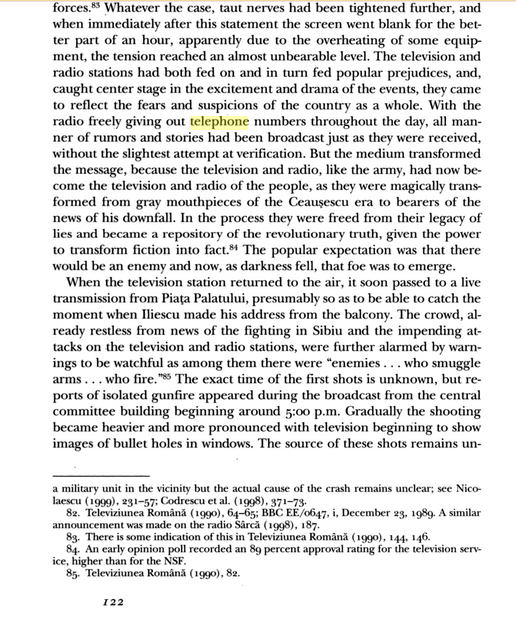
With such reviews and reviewers, it should come as little surprise that basic questionable assumptions made by Siani-Davies did not and do not face scrutiny, pre-or post-publication. Take the issue of “rumors and stories” spread by telephone calls. Look up “telephone” in the Google Books version of Siani-Davies’ volume and you get the following:
“The television and radio stations had both fed on and in turn fed popular prejudices, and, caught center stage in the excitement and drama of the events, they came to reflect the fears and suspicions of the country as a whole. With the radio freely giving out telephone numbers throughout the day, all manners of rumors and stories had been broadcast just as they were received, without the slightest attempt at verification….The popular expectation was that there would be an enemy and now, as darkness fell, that foe was to emerge. (p. 122)”
All the elements are there for a structural argument to explain the outcome in question. Popular “prejudices, fears and suspicions,” feelings of excitement and drama (the emotional state of those involved), free-floating telephone numbers, “rumors and stories,” the need for and expectation of an enemy, and darkness (contributing to human associations of darkness with evil and wrongdoing, of the playground of real and imagined enemies, and of an inability to see what is going on; once again the emotional state of those involved). But this is not an exercise in crafting intellectually seductive arguments, but in finding the argument that accurately reflects the evidence.
Ironically, Siani-Davies also makes a lot of either/or assumptions. Thus the spread of rumors is either a largely spontaneous process, quite free from an intentional disinformation campaign, OR it is a disinformation campaign. The idea that ALL OF THE ABOVE (a disinformation campaign, the psychological impact of a disinformation campaign, AND organic rumors typical of conditions of great uncertainty) could be at play largely eludes him.
Yes, television and radio gave out phone numbers that contributed to the scope of the confusion, and arguably incentivized the spread of incorrect information. A Western academic audience will love this. See, it was all understandable, without having to go down the rabbit hole of “conspiratorial-thinking”…like so many of those silly Romanians (they don’t say the latter out loud, but it is implied).
It is a massive and fundamental mistake to reduce the confusion and spread of false information in December 1989 to organic processes. It is simply at odds with the historical record as becomes clear in Dosarul Revolutiei (The Files of the Revolution). Below, three examples to emphasize different points in this regard. They show how those involved in this situation, deduced that at least some of the disinformation 1) received including on Operational Classified Lines (did television and radio give out those numbers, Dr. Siani-Davies?) 2) included information clearly prepared in advance 3) was beyond the means of average citizens and 4) ceased or could be avoided by employing different countermeasures. For the time being in Romanian.
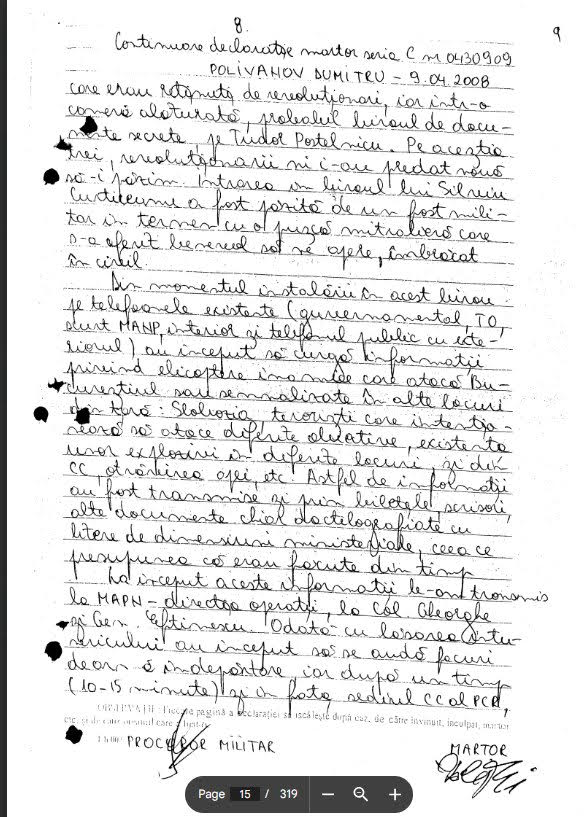
1&2) Dumitru Polivanov, declaratie, 09.04.2008
“Din momentul instalarii in acest birou pe telefoanele existente (guvernmental, TO, scurt, MANP [?sic.], interior si telefonul public cu exteriorul) au inceput sa curga informatii privind elicoptere inamice care ataca Bucurestiul sau semnalizate in alte locuri din tara: Slobozia, teroristi care intentioneaza sa atace diferite obiective, existenta unor explozivi in diferite locuri, si din CC, otravirea apei, etc. Astfel de informatii au fost transmise si prin biletele, scrisori, alte documente CHIAR DACTILOGRAFIATE CU LITERE DE DIMENSIUNI MINISTERIALE, CEEA CE PRESPUNEA CA ERAU FACUTE DIN TIMP.”
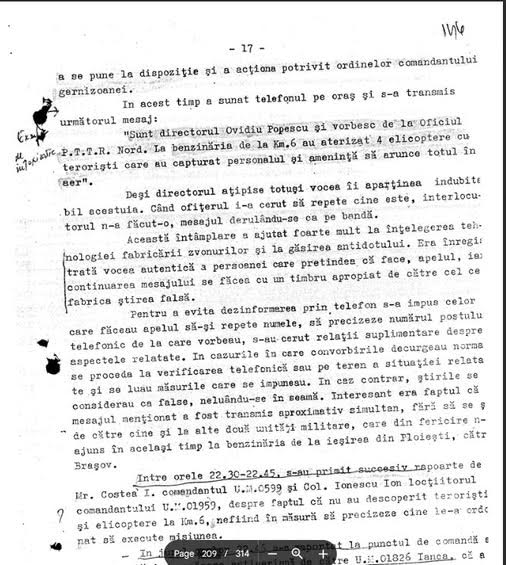
2&3) Ploiesti Misiunile si Actiunile Unitatilor Armatei, Jurnal-Sinteza
“In acest timp a sunat telefonul pe oras si s-a transmis urmatorul mesaj:
‘Sunt directorul Ovidiu Popescu si vorbesc de la Oficiul P. T. T. R. Nord. La benzinaria de la km. 6 au aterizat 4 elicoptere cu teroristi care au capturat personalul si ameninta sa arunce totul in aer.’
Desi directorul atipise totusi vocea ii apartinea indubitabil acestuia. Cand ofiterul i-a cerut sa repete cine este interlocutorul n-a facut-o, mesajul derulandu-se ca pe banda.
Aceasta intamplare a ajutat foarte mult la intelegerea tehnologiei fabricarii zvonurilor si la gasirea antidotului. ERA INREGISTRATA VOCEA AUTENTICA A PERSOANEI CARE PRETINDEA CA FACE, APELUL, IAR CONTINUAREA MESAJULUI SE FACEA CU UN TIMBRU APROPIAT DE CATRE CEL CE FABRICA STIREA FALSA.”
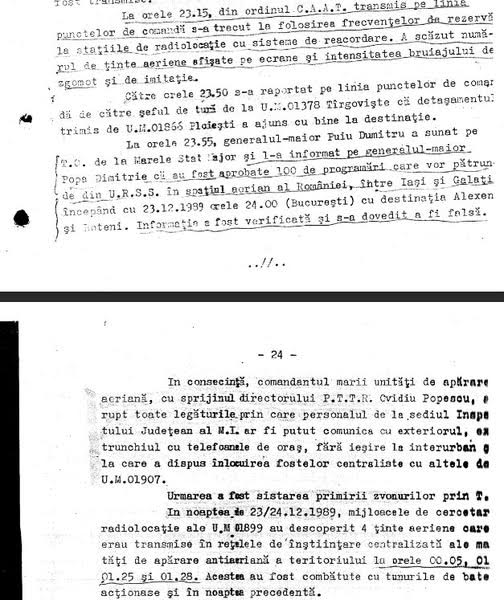
1&4)
“La orele 23,55, generalul-maior Puiu Dumitru a sunat pe T.O. de la Marele Stat Major si l-a informat pe generalul-maior Popa Dimitrie ca au fos aprobate 100 de programari care vor patrunde din U.R.S.S. in spatiul aerian al Romaniei, intre Iasi si Galati incepand cu 23.12.1989 orele 24,00 (Bucuresti) cu destinatia Alexandria si Boteni. Informatia a fost verificata si s-a dovedit a fi falsa.”
“IN CONSECINTA, COMANDANTUL MARII UNITATI DE APARARE ANTIAERIANA, CU SPRIJINUL DIRECTORULUI P. T. T. R. OVIDIU POPESCU, AU RUPT TOATE LEGATURILE PRIN CARE PERSONALUL DE LA SEDIUL INSPECTORATULUI JUDETEAN AL M.I. AR FI PUTUT COMUNICA CU EXTERIORUL, ? TRUNCHIUL CU TELEFOANELE DE ORAS, FARA IESIRE LA INTERURBAN SI LA CARE A DISPUS INLOCUIREA FOSTELOR CENTRALISTE CU ALTELE DE U.M. 010907.
URMAREA A FOST SISTAREA PRIMIRII ZVONURILOR PRIN T.O.”
1) Thus, once they cut off IJMI, and isolated those associated with the M.I., suddenly they did not have the same problem with the intoxicating rumors.
2) Generalul Maior Puiu Dumitru was at the time Sef al Departamentul Aviatiei Civilie and adjunct al Ministerului Transporturilor si Telecomunicatilor (see in comments, a snip from early 1989). Puiu Dumitru (Dumitru Puiu) died on 28 martie 1990. The only thing I have been able to find on the circumstances of his death is from a county (Csongrad) newspaper from Hungary that says he suddenly became ill on 24 March, was taken to a psychiatric hospital, and died on 28 March. He was 60 years old. He had also, according to that article, been recently on local Timisoara radio prior to this happening.
 The Archive of the Romanian Revolution of December 1989
Leave a Reply