The Archive of the Romanian Revolution of December 1989

A Catch-22 December 1989, Groundhog-Day Production. Presenting the Personal Research & Scholarship of Richard Andrew Hall, Ph.D.

A former CIA analyst (2000-2024) on the Romanian Revolution of December 1989

Posted by romanianrevolutionofdecember1989 on December 22, 2025

My thanks to Silviu Sergiu for his questions and publication of a two part interview with me. Here are the links to the Romanian language versions of the interview. Below that are the English language answers I sent Silviu for the interviews

Categorizing what kind of event happened in December 1989

Without the protests, uprising, and conquering of local power in Timisoara from 15-21 December 1989, there may not have been an uprising in Bucharest on 21 December 1989 and the overthrow of Nicolae Ceausescu on 22 December. However, without the overthrow of Nicolae Ceausescu, the Ceausescu regime probably would have crushed the Timisoara revolt, just as it had done two years earlier in Brasov. It is important to note that Timisoara’s Frontul Democratic Roman (FDR) was the first revolutionary group to achieve power, albeit only in the Banat.

The uprising had to spread to the capital, and the armed institutions of the Ceausescu regime had to transfer their allegiance to an “alternative polity,” to use Charles Tilly’s term, for the revolution to succeed. This happened on the afternoon of 22 December 1989. Although there were other attempts to form a revolutionary government, only the Council of the National Salvation Front (CFSN) was able to secure the majority support of the armed institutions of the Ceausescu regime, precisely because it was made up of the communist nomenklatura. The CFSN possessed a huge structural advantage that other groups did not have, and it inevitably stunted the anti-communist evolution of the Revolution. The CFSN’s seizure of power was a direct product of the Ceausescu regime’s repression, because it had prevented the formation of civil society groups that could come to power, as happened in Czechoslovakia for instance.

The Importance of the Terrorists to Understanding December 1989 and Pitu’s “False Flag” and “Friendly Fire” Arguments

The key questions about December 1989—and even retired military prosecutor Catalin Ranco Pitu acknowledges this in his 2024 book—is did the terrorists exist and, if they did, who were they, what were their goals, and who did they report to? In other words, who bears responsibility for the almost 1,000 deaths and 3,000 injuries after 22 December? Pitu maintains that what happened after 22 December was a coup d’etat and that the Army—with the understanding and agreement of Ion Iliescu and the CFSN—engaged in a “false flag” operation. The “false flag” meant that the Army “invented” the “terrorists” through a massive disinformation campaign and blamed the Securitate by use of the phrase “securisti-teroristi.” The Securitate—and even the Ceausescus, Pitu maintains—were thus “victims” and “scapegoats” of the Army’s “false flag.” According to Pitu, there were no real terrorists and all those who died or were injured were the victims of “friendly fire” among the military, Patriotic Guards, and armed civilians. The military leadership, we are told, purposely disinformed and gave conflicting orders to their subordinates to spark this “friendly fire.”

Pitu is unable to tell us why, if this was a standing military plan, nobody involved in the operation of the plan leaked the details; why the CI-isti didn’t know about it and didn’t inform the Securitate leadership; and why nobody in the military—officers or recruits—or among civilians came forward during and immediately after December 1989 to counter the Army and CFSN’s claims of “Securitate terrorists?” Nobody was willing to say publicly that as bad as the Securitate were, they were not responsible for the violence and mayhem after 22 December. The idea that nobody spoke at the time about what is supposedly so obvious today—the “false flag” and the non-existence of the “terrorists”—should raise immediate doubts in those who listen to Pitu.

Pitu’s “Logic”

Pitu and his promoters keep on appealing to the supposed “logic” of their position. They point out that X was arrested or called a “terrorist” by the crowd, but the suspect proved in fact to be innocent. For example, they cite the famous case of Cristian Lupu in Bucharest. What they seem to fail to understand is that for their argument to be logically correct, they must prove that all 1,425 people officially arrested as “terrorists” were innocent. By contrast, it is far easier, as we do, to logically argue that the “terrorists” existed. All we have to do is to demonstrate that one or two of those 1,425 were “terrorists.” One or two cases of people being wrongly identified as “terrorists” is therefore not the same as one or two cases of people being “terrorists.” For the first outcome—”no terrorists”—the researcher must keep digging until they have examined all 1,425 cases and determined that all 1,425 suspects were in fact innocent. This is why it is so important to the former Securitate that the military prosecutors negate that even one terrorist existed: if even one existed, then there are likely to be other “terrorists” among the 1,425 who were detained. Ultimately, however, the truth of the Revolution File is not a matter of logic, but a matter of the details found in those documents.

Pitu’s Falsehoods

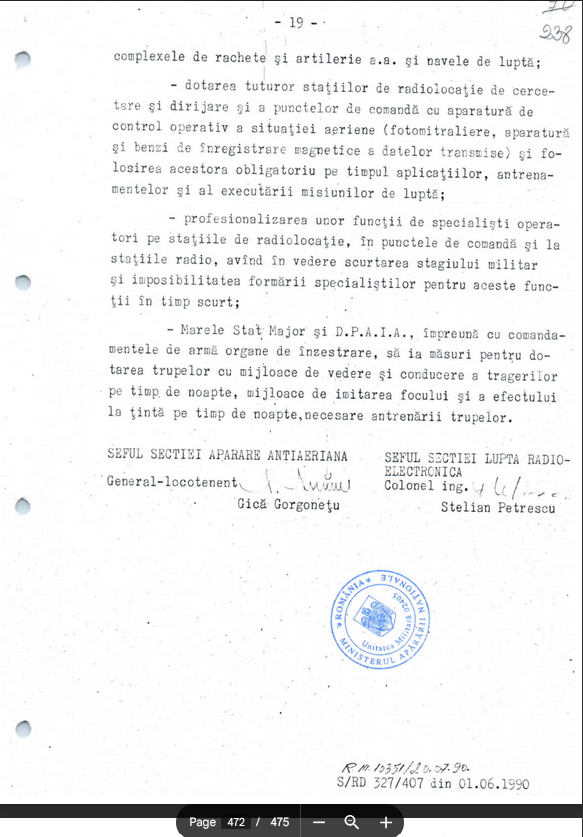
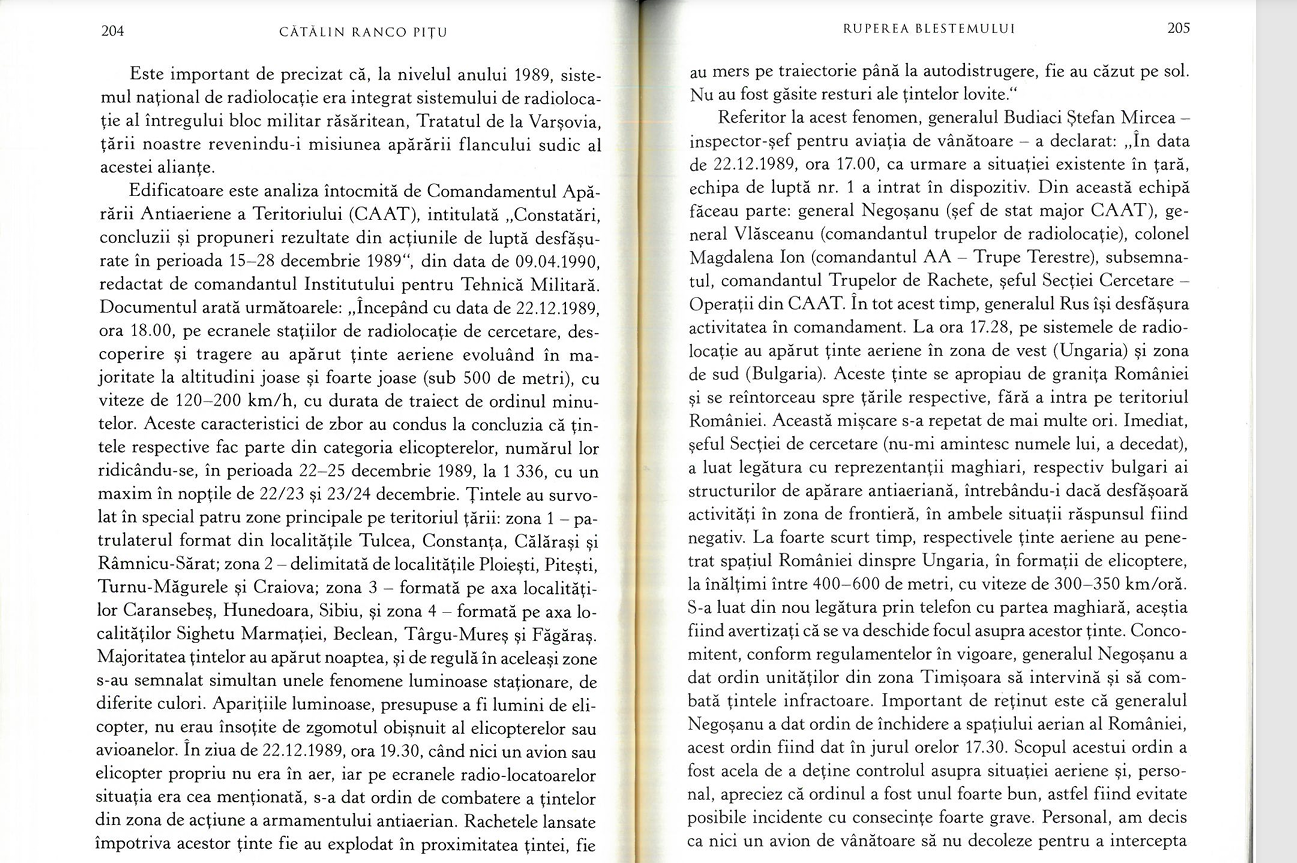
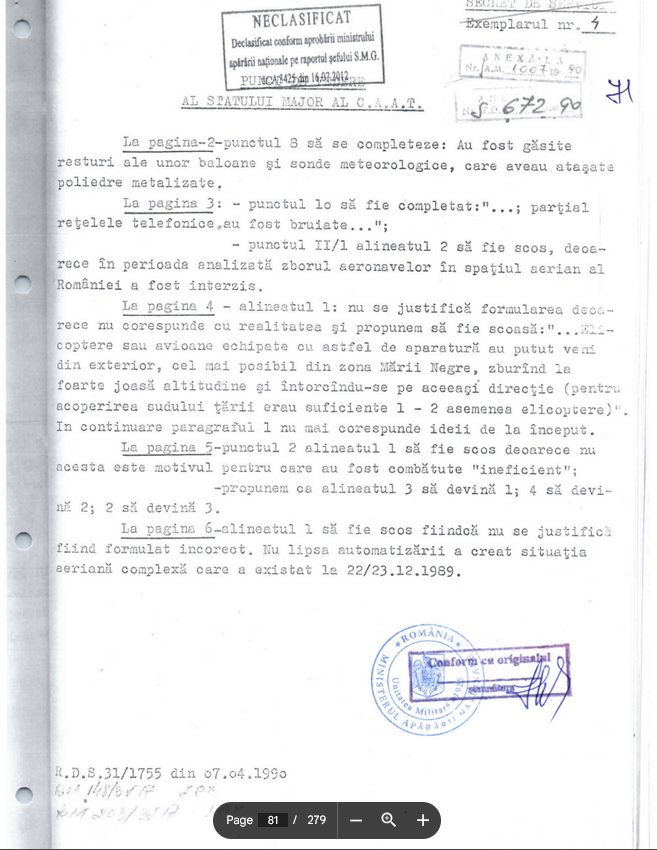
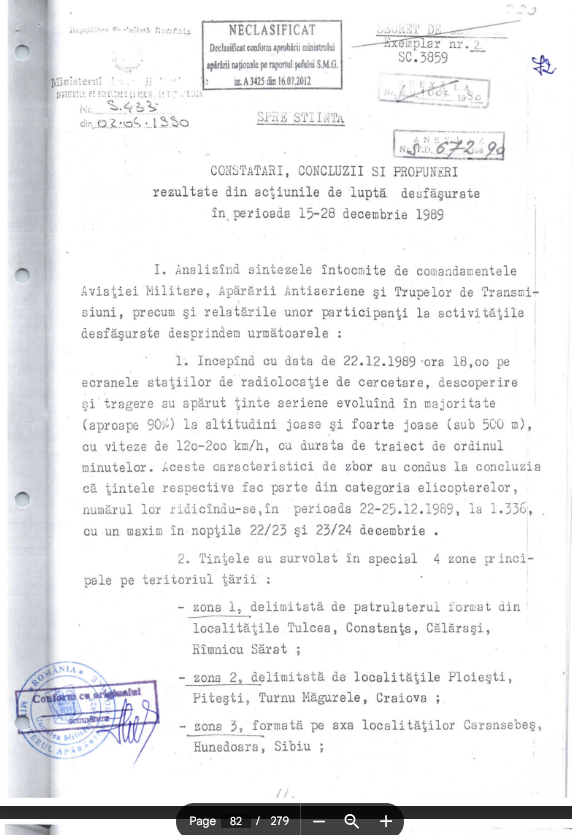
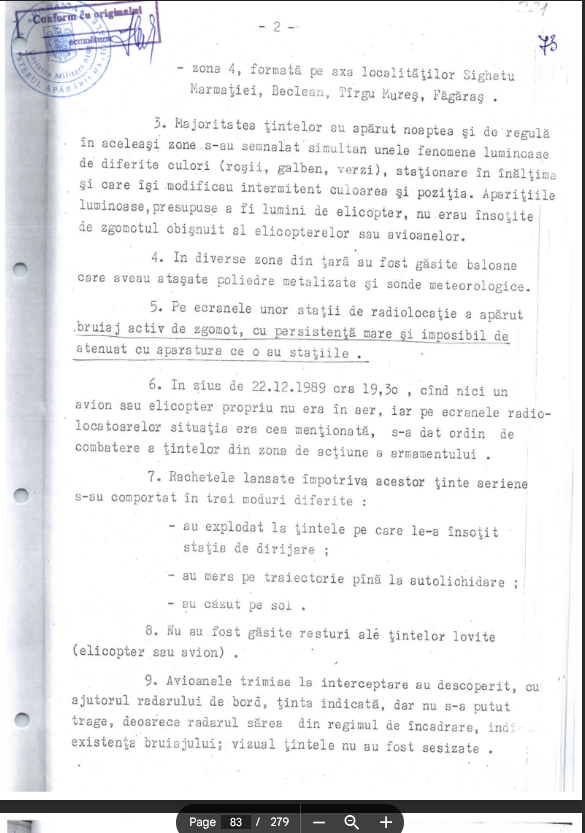
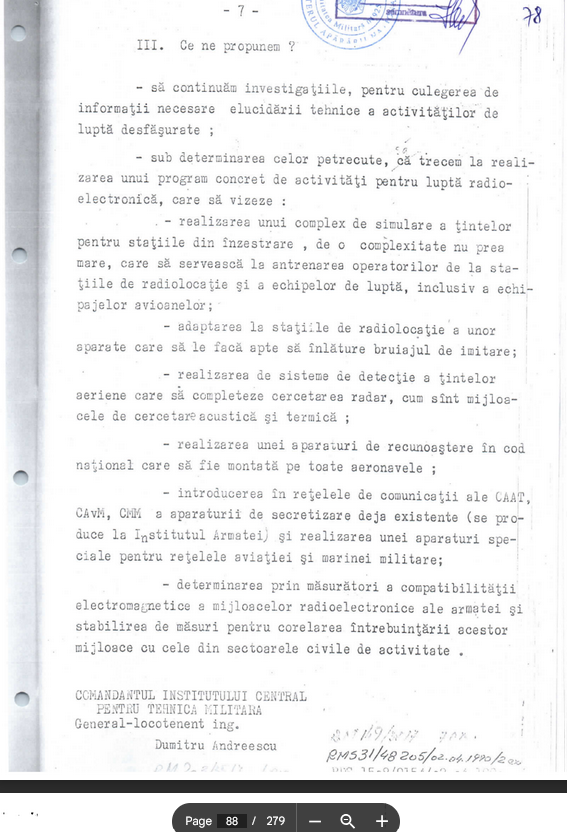
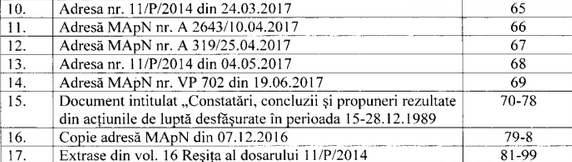
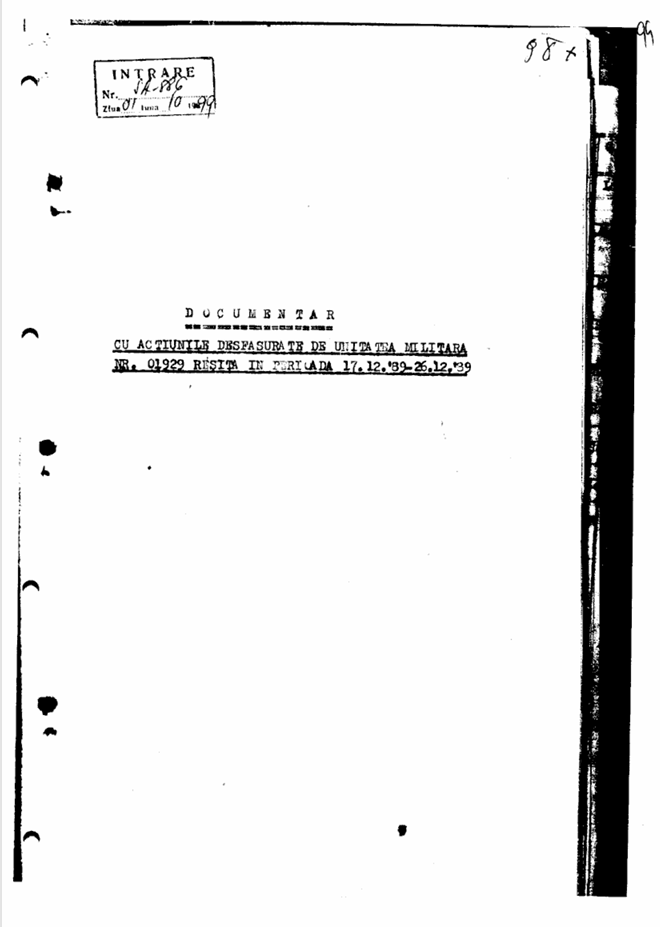
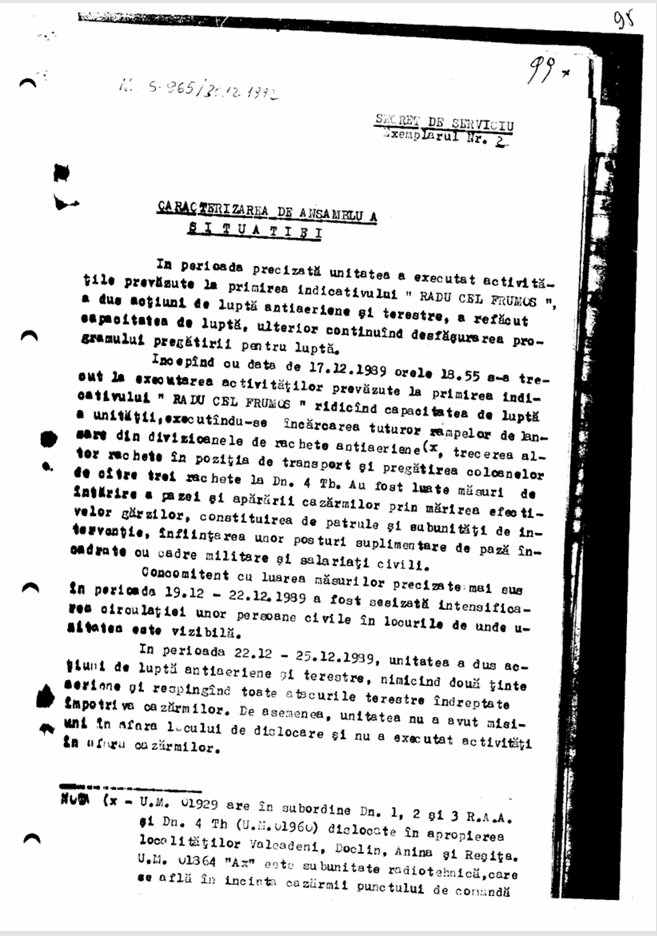
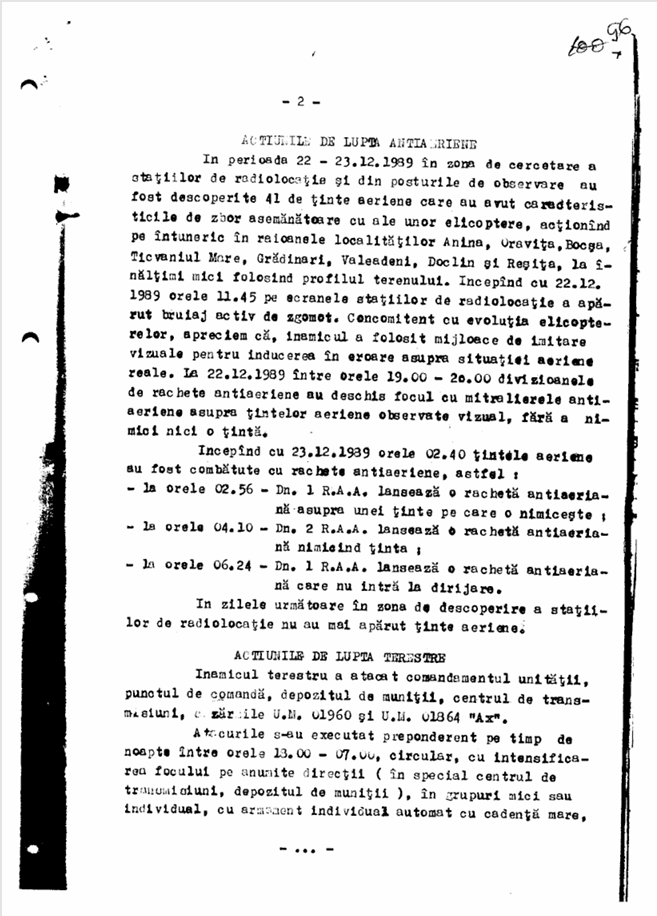
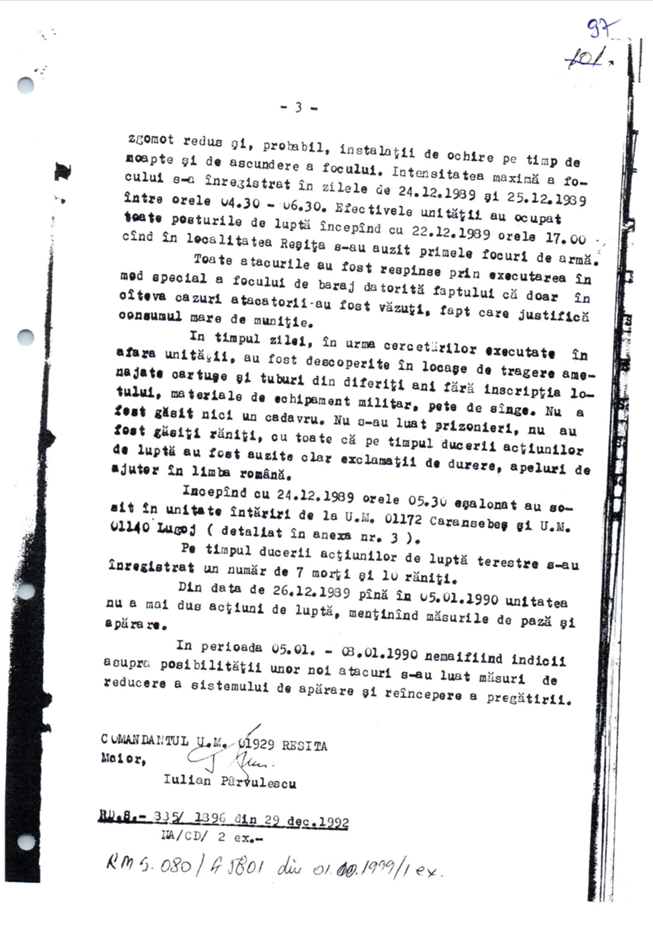
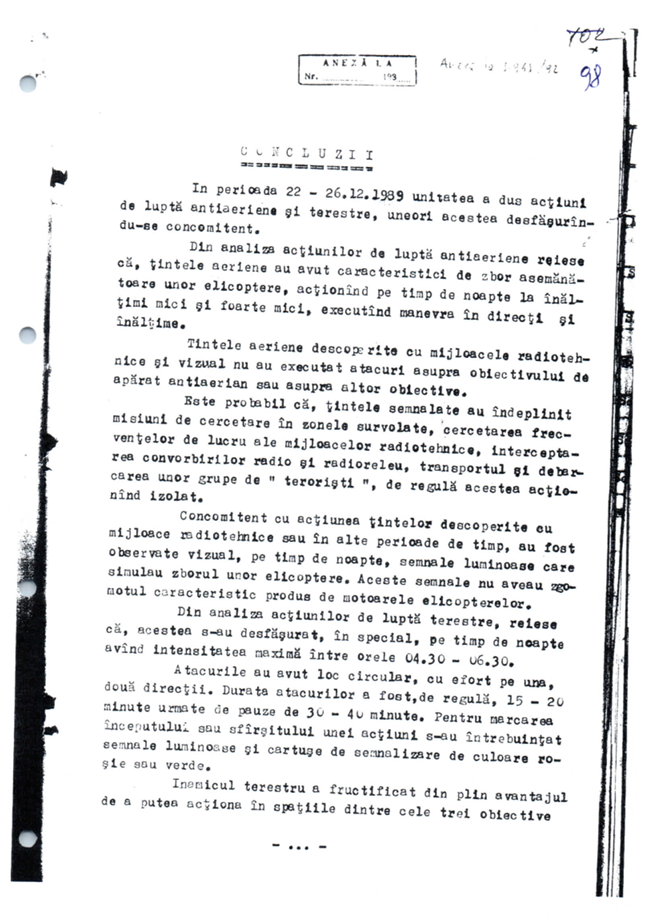
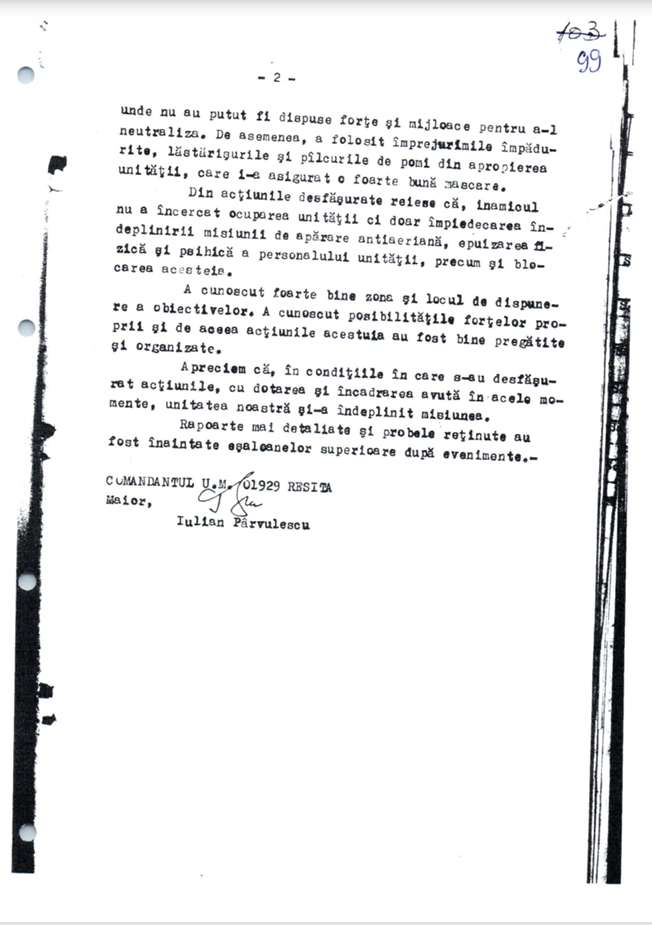
To demonstrate just how disingenuous Pitu’s claims are, let us look at a single file from the Revolution File, “Dosar revolutie nou.” This file includes depositions of different actors carried out in 2017 and 2018. It also includes many previously unseen, now declassified documents, especially from the military’s archive in Pitesti. In your interview with Pitu this summer, Pitu declared, “Fiecare structură din MApN, adică Apărarea antiaeriană, Infanterie, Tancuri, Informații Militare, Aviație Militară. Toate acele documente MApN, nu DSS, nu SRI, au demonstrat că fenomenul securist- terorist a fost un fenomen inventat de noua putere politico-militară a României, cu scopul obținerii legitimității și dobândirii impunității pentru unii din MApN.” On the contrary, the documents of these MApN structures which Pitu invokes, say exactly the opposite of what Pitu claims they say: they in fact say that the “terrorists” existed. I have posted these documents on my substack, https://richhall.substack.com/, so that anyone can draw their own conclusions about Pitu’s credibility and knowledge.

The Soviet role…or lack of one.

In interviews, Pitu has alleged that, “It is certain that in December 1989, 80 to 90 percent of those in the political-military group [CFSN + Army] who took power belonged to the [Soviet] GRU and KGB”; in fact, that “all 40 generals who were reactivated after 25 December 1989 have been documented as GRU or KGB collaborators.”

This begs a basic question: what were the Securitate doing prior to December 1989? Wasn’t it their job—especially the CI-isti—to catch spies? The Securitate did not notice all these KGB or GRU agents or did not surveil, interrogate, or arrest them? Who prevented them from moving against these supposed agents? Pitu’s numbers are simply ridiculous, but no one has challenged him on this claim.

Similarly, regarding the alleged “Soviet tourists,” if the Securitate were so suspicious, why did they not monitor or expel them if they suspected them of being undercover agents? Typical of Pitu is that he muddies the water. He claims there is no proof of the involvement of “armed foreigners” in December 1989, but then accredits UM 0110 Securitate Deputy Vasile Lupu (“martorul L. V.”, Rechizitoriul, pp. 304-305) when he invokes what Lupu has said about the tourists. As far as I can see far from being Soviet undercover agents, the “tourists” were likely of three kinds: 1) Soviets driving to Yugoslavia to sell their LADAs and other cars and then returning home (this is why they came back with multiple men in the same car—because they had sold the other cars with which they arrived in Yugoslavia); 2) convoys of Soviet cars (actual tourists) attempting to escape the violence and return back home (near Brasov and Sibiu I believe this was the case); and 3) a form of cover (acoperire operativa) used by the Securitate to be able to move around unnoticed in the event of a Soviet invasion. The 2,000 or 10,000 or 40,000 or 65,000 Soviet “tourists”–all supposedly let into the country and not monitored by the Securitate—is PURE FANTASY. I have traced the origins of this myth to the former Securitate and their collaborators in the media in 1990-1991, notably including former informant Sorin Rosca Stanescu and former Directorate Five Securitate officers.

Dr. Mark Kramer, head of Harvard University’s Cold War Studies Project, has probably performed more research in the Soviet archives than anyone else. He has not found anything to substantiate the accusations of Soviet involvement in December 1989, let alone of a planned Soviet invasion. One has to understand how ridiculous it sounds to a specialist on the Soviet Union, like Dr. Kramer, that the Soviets would have accepted the loss of East Germany and Czechoslovakia in November 1989—especially given the 350,00 Soviet troops based in East Germany—and done nothing to reverse it, only to intervene in Romania, a country of much less geopolitical importance, in December 1989.

The hard truth is that in the Soviet mind, Romania was comparatively unimportant: the Soviets did not care about Romania. They did not have the resources–personnel, cars–to devote anything approaching such numbers and they did not have the incentives to waste such precious resources on Romania. This will be difficult for many Romanians to accept, but it is the truth.

The documents we possess

Andrei Ursu and I have possessed a copy of the Revolution File (Dosarul Revolutiei) since 2021. Pitu routinely ignores this by only focusing on our 2019 book Tragatori si Mistificatori, and not our 2022 book Caderea unui dictator, which uses documents from the Revolution File. When Pitu talks about what is in the Revolution File, we know what documents he ignores in the Indictment (Rechizitoriul), in his 2024 book, Ruperea blestemului, and in the many interviews he has given since retiring in 2023. Much of what Pitu says is false and is contradicted by documents in the Revolution File.

The tactics of the “terrorists”

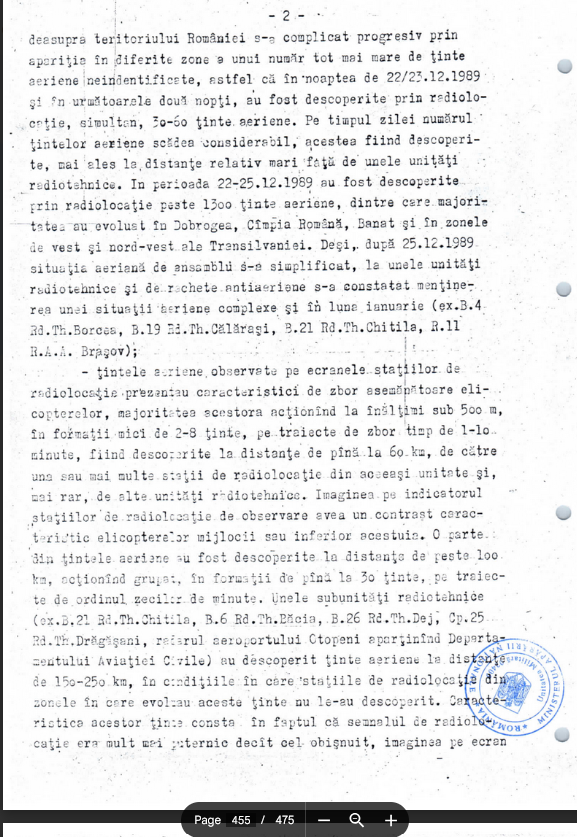
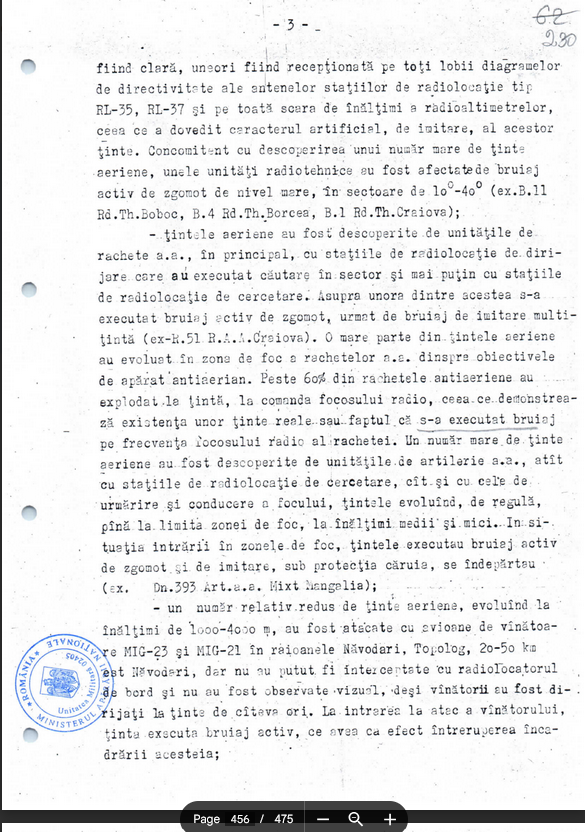
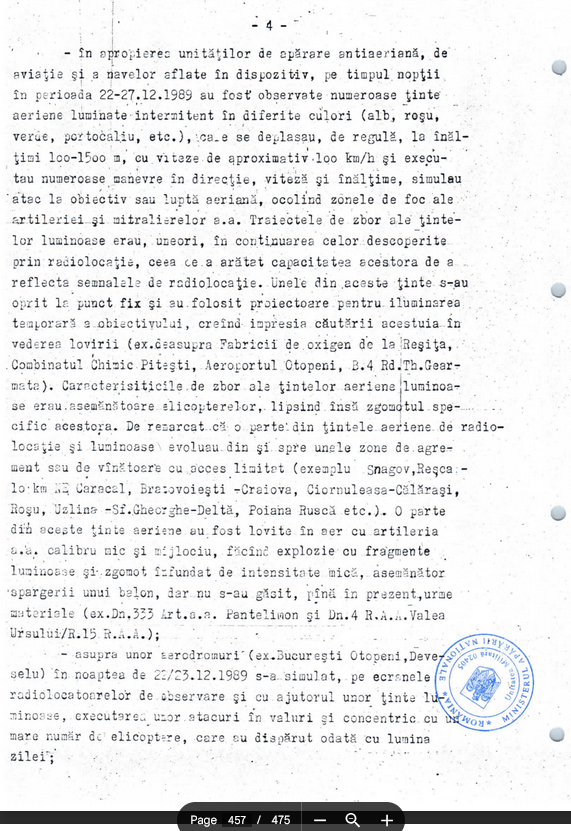
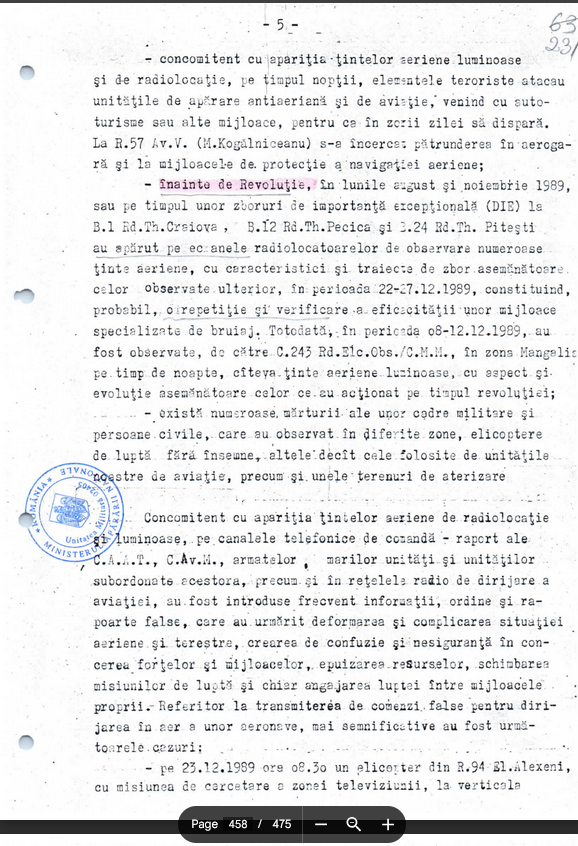
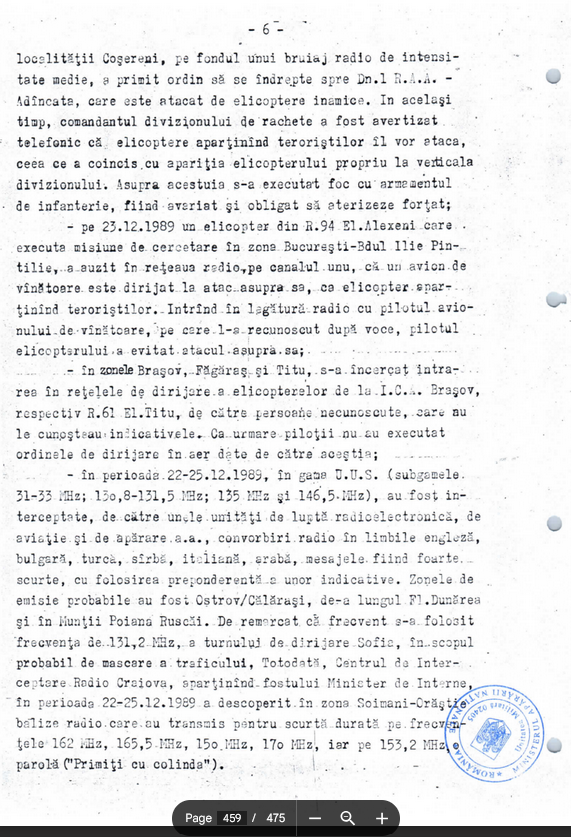
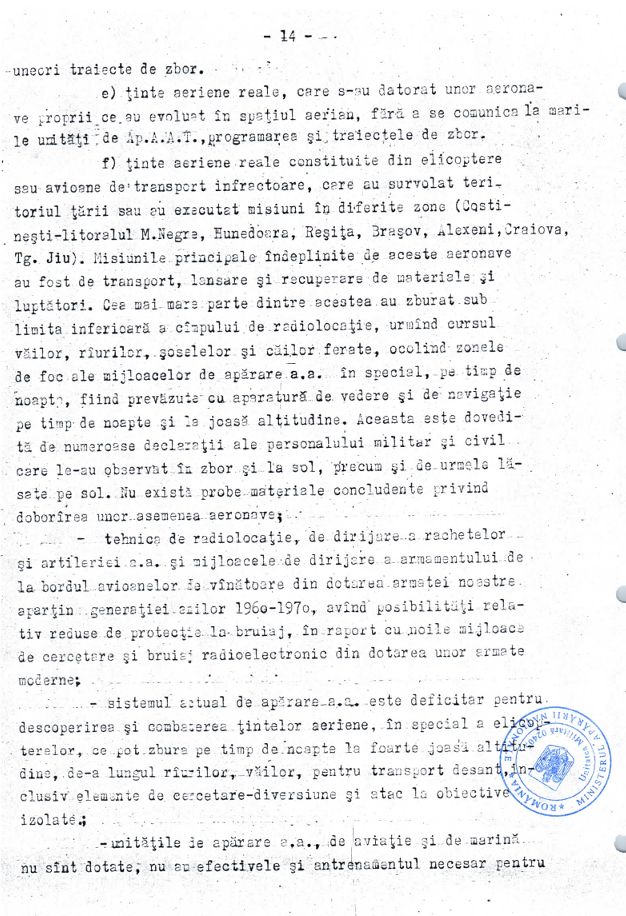
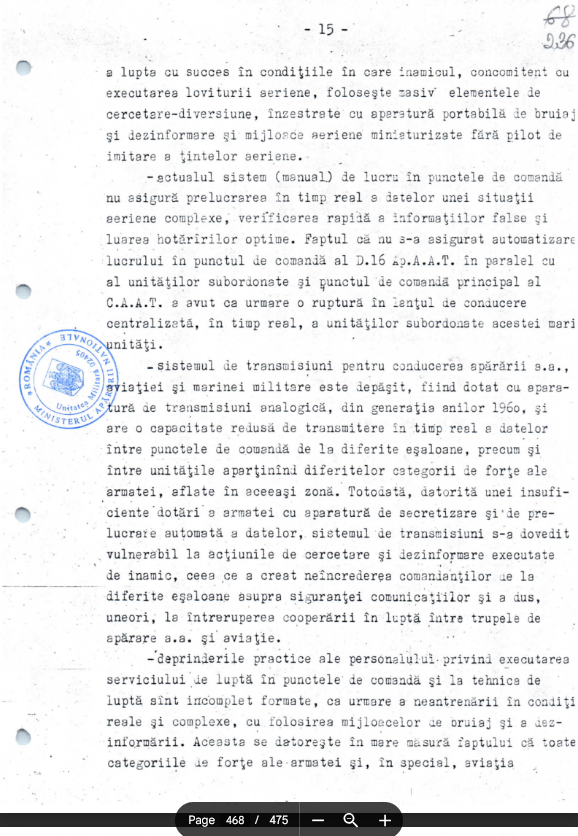
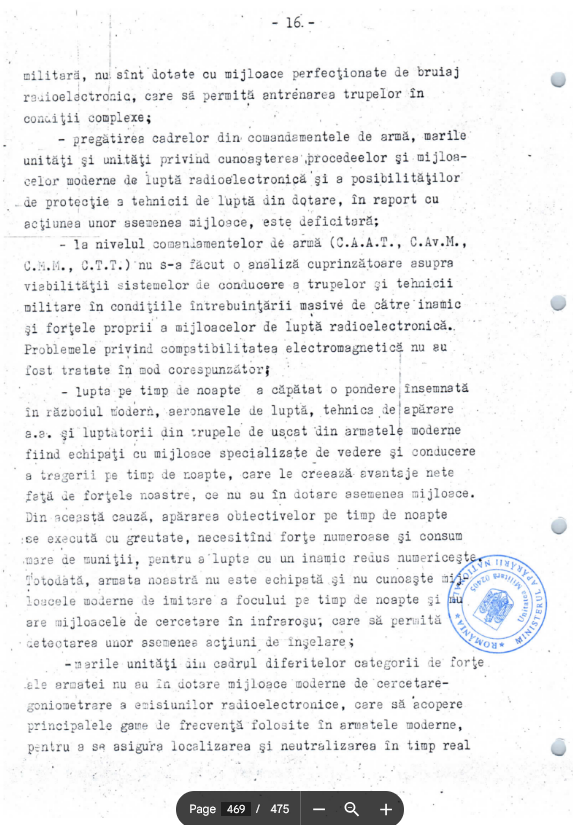
The “terrorists” of December 1989 existed. The “terrorism” of December 1989 had three main components: 1) Disinformation, by telephone, the spreading of rumors in person, and the interception and intoxication of military communications; 2) Radio-electronic warfare to make it look as if Romania were being invaded and that the enemy was more numerous than they in fact were, as well as the jamming of military communications; and 3) Sporadic episodes of gunfire, especially at night, designed to frighten, confuse, panic, exhaust, and keep the military pinned down in their barracks and the population in their homes. The latter followed the guerrilla tactic of “harassment and intimidation,” or as some military officers detected, “hit and run” or “strike and disappear” operations.

The “terrorists’” affiliation and what they said

Another point of “logic” that Pitu and his promoters appeal to is their conviction that once the Ceausescus fled the CC building shortly after noon on 22 December, everyone concluded that Nicolae Ceausescu was finished and therefore everyone, including the Securitate, abandoned him. We are told that it “wouldn’t be logical” for any Securitate members to attempt to save him. Therefore, they conclude, no one tried to save the Ceausescus.

This is highly problematic, since it is a retrospective judgment based on knowing the outcome of the events and working backward from the events to assess the actions of those who took them. Like the previous “logic” they appeal to, if their “logic” is correct, then there should not be any case of the Securitate acknowledging the existence of the “terrorists” or any confrontations or verbal exchanges with the counterrevolutionaries.

The Revolution File contains occasional verbal exchanges between those on the side of the revolution and the counterrevolutionaries. For example, at the antiaircraft battalion in Resita and in the Romarta building in Bucharest, the terrorists called those on the side of the Revolution “traitors” who had “violated their military oath” and had “betrayed Conducatorul [i.e. Nicolae Ceausescu].” The Deputy Foreign Minister recounts in a January 1990 deposition how two Securitate Directorate Five officers who were firing from inside the Foreign Ministry Building (MAE) told him they were shooting because 1) they were well-reimbursed and 2) they had taken an oath to defend the Ceausescus. Senior officials of the Securitate Troop Command who had joined the Revolution also discussed these two Fifth Directorate officers. Commanders who dispatched Securitate Troop officers to disarm the Fifth Directorate officers warned that the two were dangerous. In fact, when the Securitate Troop officers arrived on 25 December to arrest the two Fifth Directorate officers, it turned out they had far more numerous forces under their command than was believed and that they initially refused to surrender their weapons. Thus, even those elements of the Securitate not participating on the side of the counterrevolution at the time acknowledged the existence of “terrorists” who would not submit to the Revolution. Additionally, those present at the interrogation of the head of Directorate Five, Marin Neagoe, say that he admitted the existence of “the terrorists,” that they would continue to fight as long as the Ceausescus remained alive, and the location from which they were being commanded.

It is unclear whether Securitate Director Iulian Vlad initiated or could have turned off the “terrorist” actions. What is clear is that he knew the details of the plan and could have told the revolutionaries and military about them. He did not. That he knew of the existence of the “terrorists” is clear: he told the Deputy Foreign Minister to be careful as the Securitate Directorate Five officers at the MAE would “wipe them out.” He yelled at the Securitate officers arrested in the CC building. Per Army General Ion Hortopan and a civilian (Sergiu Tanasescu), Vlad admonished them for not heeding his orders, but this may have just been a tactic to deceive the revolutionaries and cover up his role in directing them.

According to Hortopan, “Our troops arrested a number of terrorists who identified their Securitate unit (UM 672, 639, 0106, 0620) to which Securitate Director Vlad suggested they could be fanatics acting of their own accord.” What is significant here is that General Vlad realizes in this situation—when presented with the Securitate unit numbers from which the arrested terrorist suspects belonged—that he has few options. Elsewhere during these December days, he attempted to suggest that the shooting was the result of common criminals who had stolen arms, armed civilians who didn’t know how to shoot, or Hungarians.

The “terrorists” and the “Lupta de Rezistenta”

The “terrorists” were in fact the name given to a failed counterrevolution to save the Ceausescus that took the form of a guerrilla warfare “resistance struggle” (lupta de rezistenta). Its main and most important protagonists were culled from the Securitate.

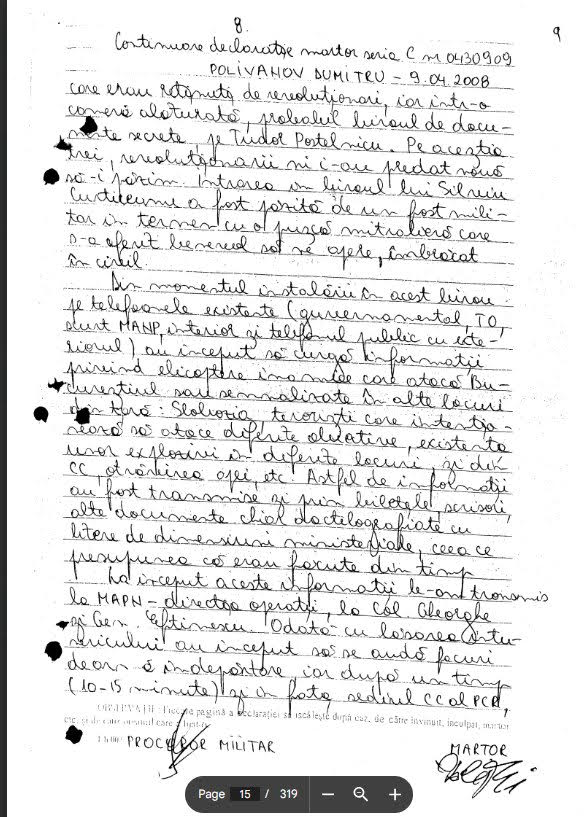
Significantly, among the documents in the Revolution File, is a handwritten three-page “urgent message” dated 25 December from retired Securitate foreign intelligence officer Domitian Baltei to those overseeing the campaign against the “terrorists.” In it Baltei details the actions and locations of what he refers to as “the resisters,” in other words those involved in the lupta de rezistenta. He talks about the involvement of Securitate Directorate Five (Service for the Protection and Guarding of the Ceausescus) officers and reservists, the use of safe houses, and the secret Securitate telephone exchange where the Securitate intercepted and redirected phone calls. He used the term “resisters” interchangeably with the term “terrorists.” Baltei was no uninitiated neophyte, however. In the late 1960s he had overseen the creation of funding mechanisms for the “resisters” abroad and thus knew of the “lupta de rezistenta.”

The “lupta de rezistenta” was drawn up in the late 1960s initially to respond to an invasion and occupation of Romanian territory, in theory by NATO, but in actuality by the Soviet Union and its Warsaw Pact allies. Over time the plan was adapted to counter a potential military coup or popular revolt. However, its authors could never have conceived of and prepared for a popular revolt in which the military defected from the regime to the side of the people, as happened in December 1989. Like other so-called “stay-behind forces,” the “lupta de rezistenta” aimed at causing panic, mayhem, and confusion, with the goal of slowing the enemy’s advance and preventing the “occupying” government from functioning normally. In its initial stages then, it did not imagine the seizing of military and political objectives, because even if it had forces to conquer such objectives it was unlikely to have enough forces to hold such objectives. It was a plan for a battle that could take weeks or months, yet the compressed timeline of what happened in December, and the capture and holding of the Ceausescus, forced them to speed up the timeline and types of actions they engaged in, to include infiltration efforts and ambushes. Notably, preparations for what happened after 22 December 1989, began in some cases back to before the XIVth PCR Congress in November, and especially in the days preceding the 22nd.

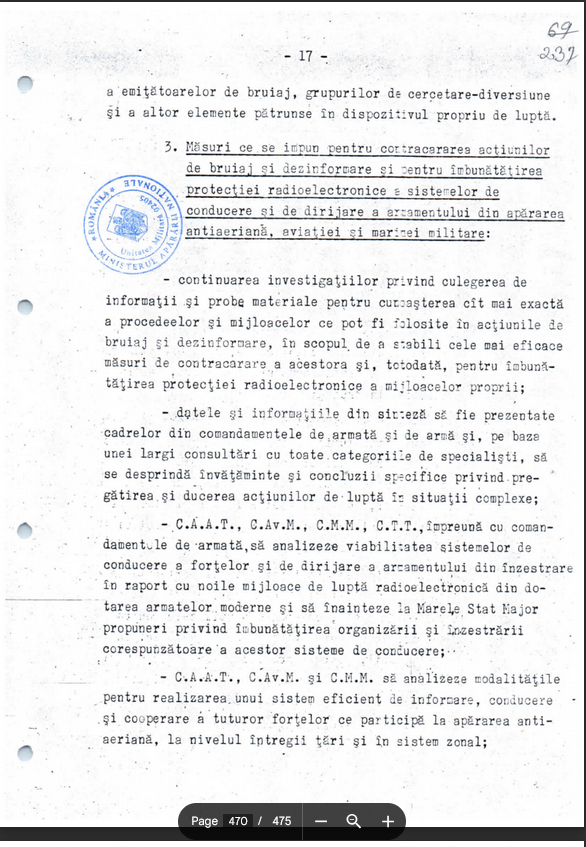
It was in southern Romania, from the border with non-Warsaw Pact member Yugoslavia through the mountains in the center of the country to the Black Sea, where much of the most intense action took place in December 1989. The focus on the televised images of the CC or TVR misses the fact that it was in places, out of the domestic and international media spotlight, like Resita and Hateg, where you had real battles. Significantly, antiaircraft units were a particular objective of interest for the “terrorists.” They were subject to radioelectronic warfare, to terrestrial shooting, and to a wave of disinformation phone calls and intercepts or blocking of their communications. Antiaircraft units were targeted because the “terrorists” needed to secure the airspace in these more vulnerable points (the Yugoslav border; the Black Sea) to evacuate or infiltrate forces, and if they rescued the Ceausescus, to spirit them out of the country.

Iliescu’s responsibility

Because the “terrorists” existed and fought on behalf of Ceausescu, Ion Iliescu is not guilty of the crimes the Indictment alleges. This will be an unpopular answer for many Romanians, but it is the truth found in the files. Iliescu’s mistakes tended to be more of what he did not do, rather than what he did—sins of omission, rather than sins of commission. He was reluctant to execute the Ceausescus, even though the evidence was accumulating that as long as the Ceausescus remained alive, the chaos and death would continue. As head of the CFSN and then as President, his willingness to grant amnesties and his unwillingness to hold the Securitate accountable contributed to the burying of the truth about December 1989. Iliescu was really a transitional figure and thus had he accepted that role and walked away from power in 1990, his reputation would be far better today. Romanians like to think of the post-1989 political evolution of the country—seven years of rule by the successors of the Romanian Communist Party—as unique. They don’t have to look far to see that Romania’s political evolution was not. In Bulgaria, with a short-lived exception in 1991-1992, political power was dominated by the Bulgarian Socialist Party, the successor to the Bulgarian Communist Party. In Serbia, Slobodan Milosevic held power until 2000. And unlike Milosevic, who refused to stand down when he lost an election, Iliescu relinquished power peacefully in 1996 (after losing an election) and again in 2004 (when his mandate had expired). And during his second term (2000-2004) Romania continued to progress toward EU and NATO membership, with the latter actually being achieved during Iliescu’s Presidency.

What is missing and what should Romanian youth know about December 1989

Unfortunately, the Revolution File is incomplete. For example, we have noticed that in the cases of Sibiu, Braila, and Resita, many volumes are missing. We are sure that there are volumes missing in the case of other places too. We have learned the hard way that many files from the Revolution File were sent back to local procuracies under the pretense that they “did not contain information relevant to the investigations.” In fact, those few files we have recovered from a local procuracy show exactly the opposite and that they appear to have been sent back to local procuracies to bury them. Although prosecutors have closed the file examining the events of 15-22 December 1989, these files probably need to be reopened to properly assess responsibility for the bloodshed in Timisoara and elsewhere. Just as the military prosecutors can’t be trusted in what they say about what happened after 22 December, we believe that they can’t be trusted completely about what happened before 22 December.

Young people should know that Nicolae and Elena Ceausescu were not “victims” of the Revolution as Pitu has sought to suggest in relation to their trial and execution. They were responsible for the bloodshed and death, including after 22 December. Young Romanians need to know that they should be proud of how most Romanian citizens acted in December 1989. The Romanian Revolution of December 1989 should be seen as a heroic event that gained worldwide recognition.

The former Securitate has stolen the Revolution from Romanians, to make them believe foreign agents before and after 22 December played an important role, to believe that the events were more coup d’etat than popular revolt. Romanians need to reclaim the authenticity, spontaneity, and courage of the Revolution of December 1989 from the former Securitate.

PART II

Lack of progress in investigating the Revolution under Traian Băsescu

– Why do you think that during Traian Băsescu’s presidency no real progress was made in clarifying the events of December 1989?

–It wasn’t just Basescu’s presidency during which there was no real progress made in clarifying the events of December 1989. It was merely a continuation of what happened under Iliescu and Constantinescu and what would continue under Iohannis. From 1994, no institution of the Romanian state—especially not SRI or the Military Procuracy—had an interest in the truth about December 1989.

– What does the discussion between Laura Codruța Kovesi and Traian Băsescu reveal about Băsescu’s understanding of justice and the independence of investigations?

My interpretation of this famous incident from 9 September 2009 is that this was for show as the 20th anniversary of December 1989 approached. In Basescu’s populist manner, he made it look as if he was channeling public frustration and outrage against “the elites”—”the bureaucrats,” in this case the Prosecutor General—on camera. “Justice” was to blame, not Basescu. His twice-repeated phrase of “don’t confuse me with journalists” demonstrated a contempt for justice and the independence of investigations.

– How did the president’s attitude influence the relationship between Cotroceni and the General Prosecutor’s Office in the Revolution cases?

Despite what I said above, I don’t believe Basescu gave “indicatii pretioase” in the Revolution Case. Basescu didn’t tell Kovesi what to do, he just said “do it”—“resolve” the cases. He expected “Justice” to do what it always did in the Revolution File—which was cover up the truth.

– How do you interpret Băsescu’s temporary support for military prosecutor Dan Voinea and then his removal?

Dan Voinea’s dismissal by Basescu in March 2009 was based on a request from Kovesi in October 2008. Kovesi accused Voinea of “making mistakes that not even a novice would make” in the Revolution and Mineriade files. It was thus Kovesi who wanted Voinea to be gone, rather than Basescu, who merely signed off on Voinea’s dismissal.

– What can you tell us about Colonel Ion Baciu’s testimony that he knew Lt. Col. Voinea Dan because he worked in the State Security Department, criminal investigation division?

I have come to believe that Baciu was wrong when he referred to Dan Voinea in his deposition. He may have confused Voinea with another military prosecutor, possibly Mircea Levanovici, or Judge Coriolan Voinea. As far as I know, Dan Voinea did not work for the State Security Department, criminal investigation division.

– Do you believe that Băsescu truly sought to uncover the truth about the Revolution, or did he use the case for political purposes?

As I said above, Basescu, like those who came before him as president and those who came after him, was disinterested in the truth about December 1989. Basescu clearly has a Securitate background, but I don’t believe that is why the truth about December 1989 was not revealed during his presidency.

II. Dan Voinea, the Tismăneanu Report, and the construction of a false narrative

– What responsibility does Dan Voinea bear for the legal compromise of the Revolution files?

From what I have heard, Voinea was a terrible prosecutor. Sloppy and lazy enough to ask other people to write things for him. He may have become anti-communist, but he avoided the truth about the Securitate’s actions after 22 December in his investigations. Like any other Ceausescu era prosecutor, he knew the conclusion that the Securitate wanted to be drawn in any investigation. The role of the military procuracy was to confirm what the Securitate gave them. Moreover, Voinea has admitted that in December 1989 he personally released a terrorist suspect, a former colleague (Pana) from the unit in Dragasani where Voinea did his military service. He released Pana even though, like other terrorist suspects, Pana had the usual three layers of clothing (including a salopeta) and three identity cards.

– How did his error-ridden “investigations” come to form the basis of the chapter on December 1989 in the Tismăneanu Commission’s Final Report?

The Tismaneanu Commission’s Final Report was a rushed document, coming out 8 months after Tismaneanu was appointed Commission Chair. It looks as if the Revolution chapter was added at the last minute and was hurriedly written.

Apparently, Stelian Tanase wrote it. It includes 3 ½ pages verbatim from a 1996 chapter by Tismaneanu that is not cited. Tismaneanu says “what? You accuse me of plagiarizing my own work?” No, the issue is that in typical Romanian fashion, the author of the chapter chose to include the work of the Commission Chair, because the Commission Chair had given him the chapter to write. Tismaneanu will say, these were all collective decisions, and everyone had an equal role and everyone assumed the final product. However, one must be naïve if one actually thinks that the inclusion of 3 ½ pages of Tismaneanu’s work is not the result of typical patron-client relations in Romania. Moreover, Tismaneanu’s writings and understandings of December 1989 are very thin and he routinely repackages things he wrote in the 1990s, as if no one had come up with anything new since then and he is the authority on any political event over the past century. If the Final Report had been treated like what it was, a rushed first cut at recent Romanian history, that would have been one thing; but, instead, Tismaneanu treats it as if he were Moses coming down from Mount Sinai with the Ten Commandments, unerring and eternal. Only minimal “corrections” were made after the publication of the document.

– To what extent did the Report uncritically adopt the false narrative that the “terrorists” were an invention of Ion Iliescu?

An interview by Andrei Badin with Dan Voinea, in which Voinea denied the existence of the “terrorists,” served as the basis for that conclusion. It could have been anyone who conducted an interview with Dan Voinea. Just like how most of the Romanian media—and especially the so-called anticommunist intellectuals, “Basescu’s intellectuals”—just accept as truth what Catalin Ranco Pitu tells them, so it was with Dan Voinea. Voinea told them what they wanted to hear—there were no terrorists, Iliescu is guilty—and so they welcomed and promoted what Voinea said. These people believe that the idea that the “terrorists” existed is a “FSN-ist, Iliescu theory.” They fail to understand that the opposite of their theory is the former Securitate’s theory that the “securisti-teroristi” did not exist and the Securitate were scapegoated in December 1989. To begin with who is more credible? Iliescu and his associates? Or the former Securitate? These people do not understand that they are replicating the former Securitate’s theory. Tismaneanu likes to say that he doesn’t read what the Securitate says and thus he couldn’t be influenced by them, or he identifies the Securitate narrative solely with Pavel Corut’s discussion of “bubuli.” But like so many of his intellectual friends, he has not traced, as I have, the evolution of the former Securitate’s narrative and how it penetrated the anti-Iliescu media in the early 1990s and went mainstream.

– What facts did the Report ignore or distort in relation to the events of December 22–27?

Pretty much everything. It just took Voinea’s word as truth: that the “terrorists” didn’t exist and that they were “invented” by Iliescu and the CFSN.

– Why do you think the Commission’s chairman, Vladimir Tismăneanu, avoided confronting the declassified documents from the US, the UK, and Canada? What did those documents reveal?

He didn’t ignore them. Those documents had not been declassified and released yet when the Report was written, in 2006. They were only declassified and released in the 2010s. These documents reveal that the CIA, the State Department, and UK Foreign Affairs and Canadian intelligence believed in the existence of Securitate terrorists. Tismaneanu does ignore them now because he doesn’t want to know them, acknowledge them or analyze them, because they discredit his writings and the Final Report’s chapter on December 1989.

III. The Băsescu–Tismăneanu relationship and the symbolic manipulation of the “condemnation of communism”

– How do you explain the fact that Vladimir Tismăneanu constantly defended Traian Băsescu’s image, even after the CNSAS verdict?

Before Basescu named Tismaneanu to head the Commission, Tismaneanu was lukewarm about Basescu. But once Basescu named Tismaneanu, Tismaneanu became fiercely loyal. I mean, Tismaneanu says “When Basescu speaks, I don’t hear ‘Petrov’”—Basescu’s codename as an informer. To which my reaction is: of course, you don’t hear ‘Petrov,’ because you are in total denial and have supported Basescu in almost everything he has done over the past 19 years. Tismaneanu has built up a mythology—the exact kind of mythology he analyzes and accuses others of all the time—around Basescu. Of how Basescu was transformed and converted into this “anti-communist, anti-Securitate” true believer and how heroic Basescu was when he presented the Report to parliament on December 18, 2006—a date which Tismaneanu insists be marked in every year, although with each passing year he is able to get fewer and fewer clients to sing its praises.

One has to remember that Tismaneanu had lost many intellectual friends because of his book length interview with Ion Iliescu, while Iliescu was a sitting president, and their media tour on Marius Tuca’s show and elsewhere (2002-2004). Because Iliescu was still in office, this seemed like opportunism to many other anti-communist intellectuals. Tismaneanu was ostracized in the way that happens among Romanian intellectuals. He was so much ostracized that he would end up writing an op-ed for a year in Dan “Felix” Voiculescu’s Jurnalul National. Tismaneanu’s defense? It had not been proved legally yet that Felix had a Securitate past. One can still hear the laughter from Bucharest. Two years later he would be praising Basescu for revealing Voiculescu’s Securitate past, even though Basescu had accepted the support of Voiculescu’s party in the December 2004 elections.

Tismaneanu’s vulnerability in the wake of his book with sitting President Ion Iliescu made him a perfect mark for Traian Basescu. Basescu would be his savior, and indeed he was. Tismaneanu went from being isolated among Romanian intellectuals, to being the gatekeeper to inclusion on The Commission.

– What does the photo from the 2006 Police Academy ceremony, in which Băsescu appears alongside the former head of the Securitate, Iulian Vlad, reveal?

The photo, from 21 July 2006, in which Vlad stands one person behind and away from Basescu is very revealing. It shows just how unserious and insincere Basescu was about the Tismaneanu Commission and the condemnation of the Securitate. As President, Basescu could easily have insisted Vlad leave. He did not. He clearly did not see anything wrong with Vlad being at the ceremony and standing close to him. It sent the message that the former Securitate had nothing to fear, in practice, from the Tismaneanu Commission.

Tismaneanu has insisted that from April 2006 Basescu was “convinced of the necessity” of the Commission and that for Basescu “breaking with the communist past was inseparable from the breaking of the political, moral, and social vestiges of totalitarian despotism.” Tismaneanu so prized the Commission Chairmanship, which Basescu had given him, that it was necessary to build a myth about Basescu: the changed man who was convinced by the Commission’s amazing work to break with the past. If this was just a rhetorical, political act by Basescu then it would undermine the importance of the Commission and the Final Report, and consequently, Tismaneanu’s importance. Tismaneanu just ignored Basescu’s actual behavior and focused on Basescu’s rhetoric. Those were just words, not deeds. In actuality, the Commission had very little real impact—not unexpectedly, given the Basescu-Vlad photo. Needless to say, Tismaneanu has never addressed this, because it undermines the myth he created. To see the hypocrisy, imagine how Tismaneanu would have reacted if a similar photo of Vlad with Iliescu, Constantinescu, or Iohannis had surfaced.

– Could the Băsescu–Tismăneanu case be a “double game” in relation to the former Securitate – a rhetorical condemnation and a real continuity?

It isn’t Tismaneanu’s double game. Tismaneanu is genuinely anti-communist and anti-Securitate, although he strategically employs it, forgetting about it when it comes to allies, and activating it when it comes to opponents or critics.

Basescu, on the other hand, definitely played a double game. Others have played it since, but few as effectively as Basescu. As it was, had PM Tariceanu not awarded Marius Oprea ICCR in December 2005, I sincerely doubt there would have been a commission. The Commission was Basescu’s way of “one-upping” Tariceanu, with whom he was increasingly in conflict. Basescu was able to detract attention from his own Securitate past, by rhetorically criticizing communism and the Securitate. That may seem a contradiction, but for someone as much of a chameleon and cynic as Basescu, it made perfect sense. How better to distract from his own Securitate past than to rhetorically criticize the Securitate? And if people think Basescu’s connection to the Securitate was only during his student days, as they say in the United States, I have a bridge to sell you. There is enough evidence to believe that after his informer days, he worked for the local Constanta Securitate from 1979 to 1987, before becoming an undercover foreign intelligence officer (CIE) during his time in Anvers, Belgium, 1987 to 1989. In fact, the emphasis on his student days, is a good way to avoid the larger questions about his later connections. Moreover, he surrounded himself with and advanced in the early 1990s precisely because of his ties to former CIE officers.

– To what extent was the speech condemning communism on December 18, 2006, more of a political gesture than a moral one?

Tismaneanu always brings up how Iliescu called him a “scribbler” and condemned the report and how Vadim Tudor made a scandal in parliament when Basescu presented it, because of how they were presented in the Final Report. But Tismaneanu never recognizes what for Iliescu, Vadim Tudor, and others was the hypocrisy of precisely Basescu, who did well under communism and was through and through Securitate, condemning communism and the Securitate. They recognized Basescu’s speech for what it was: pure hypocrisy and window-dressing. They knew well that Basescu hadn’t changed, that for him this was all political theater. Only the convenient and selective blindness of Tismaneanu and others prevented them from seeing this and acknowledging it. That is why even today they can’t admit it. Because if they were to admit it, they would have to admit that Basescu tricked them or they themselves had been blind or opportunist. Far better to be honest: Basescu used them because it was politically convenient, but they effectively used Basescu to get a politician to formally condemn the old regime. But no, instead we get grandiose claims about how the Final Report was imperative because Romania was going to enter the European Union on 1 January 2007. Really? Hungary in 2004, and Bulgaria in 2007, both entered the European Union without any such commission or condemnation of the communist regime.

– How was the Final Report used as an instrument of legitimization and political capital for the Băsescu regime?

For Basescu it turned out to be a good bet. Many intellectuals “held their fire” and failed to criticize Basescu’s well-known corruption and penchant for extortion—which the anti-FSN press detailed in the 1990s, sometimes no doubt with SRI “intoxication” following the Iliescu-Roman split. But this did not mean the accusations were false. Basescu’s faults were already known while Basescu was mayor of Bucharest. I had one American academic tell me Basescu asked him straight out for a bribe during this time. Basescu wasn’t an authoritarian, but from what I have read and heard, he was a crook. Anybody who thinks, all those around Basescu were crooks, whether his brother Mircea, or his mistress Elena Udrea, but he was not, only fool themselves.

IV. The “Petrov” file and Băsescu’s links to the Securitate

– What impact did the 2019 court decision confirming Traian Băsescu’s collaboration with the Securitate have?

It merely confirmed what had long been known. It did not, however, address the more sensitive issues of Basescu’s relationship to the Constanta Securitate from 1979 to 1987, and his being an undercover CIE officer in Anvers from 1987 to 1989. I naively believed that by affirming Basescu’s informer status something good had been achieved; but it turns out it was just another example of the political use of the files. This was the “USL,” Iohannis payback against Basescu.

– How do you interpret the fact that the Fourth Directorate of Military Counterintelligence, with which he collaborated, was the same one involved in military surveillance and repression before 1989?

Anybody who thinks that the CI-sti were only interested in preventing recruitment by foreign intelligence services is naïve. They caused fear and they ruined the lives of soldiers. Speaking in general, I believe Dr. Mark Kramer, Director of the Cold War Studies Program at Harvard University, and who has special expertise in the study of the former Soviet Union, described military counter-intelligence officers as being some of the more “nasty” type of informers.

– How relevant is Băsescu’s professional biography (Navrom, Antwerp, Ministry of Transport) to understanding his relationship with the Securitate apparatus?

It is very important. You mention Ministry of Transport, thus after December 1989. It is well known that Basescu surrounded himself with and advanced politically because of his ties to the former Securitate, especially of CIE (see, for example, the case of Silvian Ionescu).

– What consequences does this collaboration have on the credibility of the Romanian state’s condemnation of communism?

The Final Report and the Romanian state’s condemnation of communism still have value, but nothing like its promoters want people to believe. Basescu’s actions and hypocrisy undermine its value.

– What was the role of protecting former Securitate officers in Băsescu’s entourage after 1989?

This seems to have been a practice of as we say, “you scratch my back, I’ll scratch yours.” PCR—pile, cunostiinte, si relatii—lasted well beyond December 1989. Who were those pile and cunostiinte in Basescu’s world—former Securitate officers, especially those in foreign intelligence (CIE/SIE).

V. Control over the public narrative

– How did the academic and media network formed around Tismăneanu and Băsescu influence the public representation of the Revolution?

Tismaneanu used his credibility in Western academia to legitimize Basescu. Like many others in the US and elsewhere, I believed Tismaneanu’s noble language about values for far longer than I should have. I had long decided that Tismaneanu knew very little about December 1989, but I still thought he was credible on other matters. I should have been suspicious of Tismaneanu when he published his book with Iliescu. I was skeptical when the English academic, Tom Gallagher, accused Tismaneanu of attempting to create patron-client networks inside and outside Romania, but he was exactly right. In truth, in the mid-2000s, most Western academics still believed anything that was not PSD and that claimed to be anti-communist was good and credible. Basescu shows how damaging such a narrative was. Those who came out in support of Basescu and wrote chapters in yet another Tismaneanu creation for a sitting president can’t be faulted; they simply did not know or question enough. Other Romanian intellectuals and some Western academics are far more sober today in their assessments of Basescu and Tismaneanu. The illusions are gone.

– Why was the debate about Băsescu’s collaboration with the Securitate avoided in Romanian and Western academic circles?

Tismaneanu’s influence and wishful thinking are among the notable factors. It is not true that it has been completely ignored. The Romanian-Canadian academic, Professor Lavinia Stan, has addressed the Basescu case and placed it in the larger issue of lustration at the Jena Cultures of History Forum in December 2-19. I encourage those interested to read that piece, which is available online.

– How much did this network contribute to blocking a real lustration in Romania?

I see it merely as a continuation of what came before it and what came after it—hopelessly political.

– What common interests linked the “anti-communist” intellectuals to the former president?

See the above discussion on the Commission and its Final Report.

VI. Moral and historical reassessment

– What should be revised today in the official interpretation of the Revolution and the years 2004–2014?

Most Romanians appear to recognize and have recognized the disjuncture between Basescu’s words and deeds. The illusions and propaganda about Basescu should end.

– How can the myth of Băsescu as a “reformist and anti-communist president” be deconstructed?

See the above discussion.

– Why do you think Romania failed to produce a truly independent commission for the truth about December 1989?

It has been in nobody’s interest. And as we have seen previous attempts have been hopelessly politicized. Moreover, the former Securitate are mafia-like. Fear and self-censorship thus have not died.

– What should be the role of the new generations of historians and journalists in correcting these falsifications?

Be an equal opportunity skeptic, especially regardless of the political orientation of the people and institutions being studied.

– What connection do you see between Băsescu’s past in the Securitate and the stagnation of the Revolution files?

As discussed above, ironically, I don’t think it had a meaningful effect, as demonstrated by the actions of other presidents without a Securitate past.

– How can public trust be restored in institutions that have been politically compromised in investigating the truth about 1989?

First, IRRD needs to be shut down. Unlike what many people think, its main problem is not its defense of Iliescu, but its defense of and unwillingness to challenge the former Securitate. There should be an incompatibility between serving on CNSAS—the institution charged with examining the files of the former Securitate—and any affiliation with SRI (including teaching at the SRI’s Intelligence Academy), the institutional successor the Securitate. This is a rather clear conflict of interest. The Revolution File should be taken away from the Military Procuracy and given to a new, independent body to study them and arrive at conclusions about them.
Posted in decembrie 1989 | Tagged: , , , , , , | Leave a Comment »

A former CIA analyst on Iliescu, the terrorists, and the Revolution (Balkan Insight, SINOPSIS)

Posted by romanianrevolutionofdecember1989 on September 6, 2025

My first interview since retiring from CIA (2000-2024). My thanks to Marian Chiriac (Balkan Insight, BIRN SINOPSIS) for his interest in what I had so say on the topics. I will post the links to the interview (translated by Marian into Romanian), Marian’s summary in English regarding the regional comparative aspects of the interview (for the Balkan Insight audience), and my original responses to his questions in English. Thanks and hope you find interesting.

https://sinopsis.info.ro/2025/08/25/fost-analist-cia-despre-iliescu-teroristi-revolutie-i/

https://sinopsis.info.ro/2025/08/26/fost-analist-cia-despre-iliescu-teroristi-revolutie-ii/

https://balkaninsight.com/2025/08/26/former-cia-analyst-sheds-new-light-on-romanias-revolution-story/

Richard Andrew Hall (Rich Hall), Ph.D.: Introduction on my background

I first became familiar with Romania with the Summer Olympics of 1976 and 1984, when Romania was celebrated by the West. I became politically interested in Romania only in 1985 at the age of 19. In 1987, while backpacking for three months across Europe, especially communist Eastern Europe, I spent a week in Romania. Like the rest of the world, I watched the Romanian Revolution on television. I was living at my parents’ house in northern Virginia and working a boring, private sector job. As a graduate student at Indiana University, I visited Romania for three weeks in 1990 and again in 1991, three months in 1992, and 10 months on a dissertation research grant in 1993-1994. After I received my Ph.D. in Political Science in 1997, I returned to Romania to teach a semester and continue my research on the Revolution. I joined CIA in 2000; I had no prior association with CIA except the application process. I was an intelligence analyst for 23 years, about half the time working counter-terrorism because of 9/11, and the other half on Europe, where I was able to use my Romanian and Hungarian language skills on a daily basis. I have been studying and writing about the Revolution for 35 years, before, during, and after my CIA employment.

  1. The recent passing of Mr. Ion Iliescu has brought back into the spotlight a key issue in Romania’s collective memory: the “truth” about the 1989 Revolution. In this context, how do you interpret Ion Iliescu’s role in the revolution and in Romania’s post-1989 transition?

Let us start with Iliescu’s broader role and work back to the Revolution. Iliescu was already a political anachronism in 1990. His insistence on staying politically active and running for and serving as president ruined the way in which he will be remembered. Much of the anger shown toward Iliescu is about what he did and didn’t do as politician and president and this is retroactively projected back on to his role in December 1989. This is bad historical analysis and unfair. Because Iliescu is guilty for his role in the 1990 mineriada does not mean the accusations about his role in December 1989 are true. A person deserves to be judged for their actions at a particular moment in time, not judged retroactively in light of what they did later.

Iliescu could have been remembered for stepping down when he lost elections in 1996 and his mandate ended in 2004. One only has to look at Serbia and how Slobodan Milosevic tried to defy election results in 2000 to realize that leaving power at the end of a mandate is not automatic. Some of the criticisms of Iliescu are partisan and/or subjective nonsense: for example, the idea that Iliescu was some Russian agent. Romania continued on the road to EU and NATO membership (the latter achieved during Iliescu’s presidency in 2004) just like it did during Emil Constantinescu’s presidency. There was a broad political consensus among mainstream center-right and center-left parties in Romania towards joining these bedrock Western groupings. That was something that made Romania an attractive geopolitical partner for the United States.

Iliescu was what they call a “cost of the transition” from communism because of timing and how that transition played out. In Poland, it meant that Wojciech Jaruzelski was president for a year and a half because of the Round Table Agreement between Solidarity and the communist regime. Iliescu and the National Salvation Front were a cost of the transition—specifically a transition from Nicolae Ceausescu’s dictatorship. In Bulgaria, the cost of the transition was similar to Romania, because except for a brief government in 1991-1992, the former communists dominated politics until early 1997.

Ion Iliescu arrived late for his historical role. Had he arrived as Karoly Grosz in Hungary (1987-1989 in positions of power), a timid reformer of the late communist era, uncomfortable with political pluralism, he would be far better regarded today. But then again, that was all-but-impossible because of the character of the Ceausescu regime. Instead, Iliescu is remembered for encouraging and welcoming the miners’ brutality in June 1990 and for presiding over political alliances with the ultranationalist, Ceausescu nostalgics from 1992 to 1995.

  1. How do you interpret the charges against Iliescu for crimes against humanity related to the revolution, especially in light of your research on the aftermath and the continuing conflict following Ceaușescu’s fall?

The official argument in the Indictment is that Iliescu and the Army engaged in a “false flag” operation, that they created/invented a non-existent enemy—securisti-teroristi—in order to legitimize their seizure of power, prevent the continuation of an anti-communist revolution from below, and cover-up the Army’s role in the repression in Timisoara and elsewhere. Retired military prosecutor Catalin Ranco Pitu and his promoters are always telling us how “logical” this explanation is.

Let us examine this accusation/explanation for a minute. I don’t think those who accept Pitu’s claims really understand what his argument implies. In fact, I am not sure Pitu does. In order for the Indictment to be correct, Pitu and company must demonstrate that there was not a single real terrorist, that all 1,425 people, each and every one of them, who were arrested as suspects, were arrested by mistake or without cause. They must go through, to begin with, all 1,425 people on the list in the Files and demonstrate that each and every one of the suspects was innocent. Pitu has done nothing of the sort.

Moreover, Pitu claims the Army operationalized an existing plan. How is it that the Securitate did not know about the plan and were unable to stop it? Directorate Four—military counter-intelligence, the CI-isti—somehow didn’t know or couldn’t stop it? How is it that no Securitate officer in December 1989 or immediately after came forth in domestic or international media to reveal this alleged “false flag?” How is it that there was no dissident Army member or revolutionary or bystander who said, wait a minute this isn’t right, it is not fair to make the Securitate a scapegoat, and came forward in the media to reveal this so-called “truth?” Pitu wants us to believe that the Securitate knew about this plan, were the victims of it, but said nothing at the time about it? That’s pretty ridiculous. Moreover, he wants us to believe that Iliescu and the Army were better at disinformation than the Securitate which had a unit specifically devoted to Disinformation. That makes no sense. That is Pitu’s “logic.”

Ultimately, though, history is not about logic, but about what happened, which often includes elements that in retrospect seem illogical, but may have been very logical for the actors involved at the time. Thanks to an injured party in the Revolution case and European law, since 2021 my colleague Andrei Ursu and I have had access to the documents in the so-called Revolution File. We thus know what the military prosecutors used from the File in preparing the Indictment, but we also know what they have ignored.

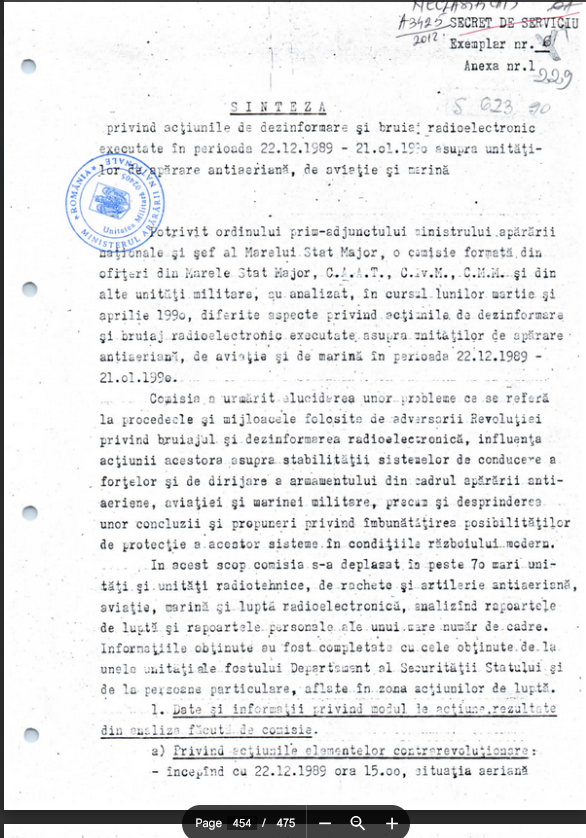
Recently, Pitu repeated in the press what he told Ion Cristoiu in May 2023: that each and every component of the Defense Ministry prepared after action reports on December 1989 and that, independently, each and every component, as well as the operations’ journals, concluded that there were “no terrorists.” This is absolutely false. On the contrary, those documents—they are included in the file “dosar revolutie nou,” and many of them were declassified in 2017/2018 from the MApN archive in Pitesti—demonstrate exactly the opposite of what Pitu says. I would appreciate if you could publish some of them in some form.

Pitu is a promoter and disseminator of the former Securitate’s narrative on December 1989. He is covering up for the former Securitate. I can only figure that Pitu engages in such a blatant lie about the declassified MApN documents because he knows that the Romanian media will not challenge him. You have to understand: when you read these documents, you realize this isn’t a matter of interpretation, this isn’t just negligence. Pitu knows exactly what he is doing, but he assumed no one would ever be able to have access to the documents to which he refers. He is wrong.

Regarding the Revolution, Iliescu’s “crimes” are in fact better categorized as “errors” and are not what most Romanians believe. Iliescu made a mistake on the evening of 22 December 1989, declaring there would be a “public trial,” which it quickly turned out was going to be impossible. His error with regard to executing the Ceausescus is that he was so fixated on demonstrating “communism/socialism with a human face,” that he was slow to realize the threat posed by the “terrorists.” Had Iliescu and the other Front leaders killed the Ceausescus on the night of 22/23 December, there would have been far fewer deaths, injuries, and mayhem. Gelu Voican Voiculescu claims that it was only after the attacks of the night of 23/24 December that he was able to prevail on Iliescu to kill the Ceausescus. According to Voican, Voican asked him, “Do you want to end up like [the overthrown Marxist Chilean leader] Allende?” In fact, they wanted to keep the Ceausescus alive for the semblance of a trial; insulin was transported to Tirgoviste, but the diabetic Nicolae refused to take it because he thought it might be poisoned. The point is that they tried to keep Nicolae Ceausescu alive, when they in fact should have executed him much earlier, based on what captured “terrorists” described as their oath and their mission.

  1. To what extent do you believe the violence and confusion during the December 1989 Revolution, especially the role of the so-called “terrorists”, were orchestrated by remnants of the Securitate, versus being spontaneous?

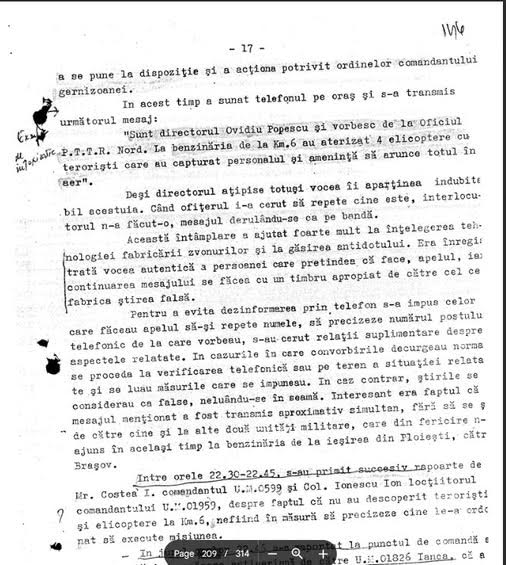
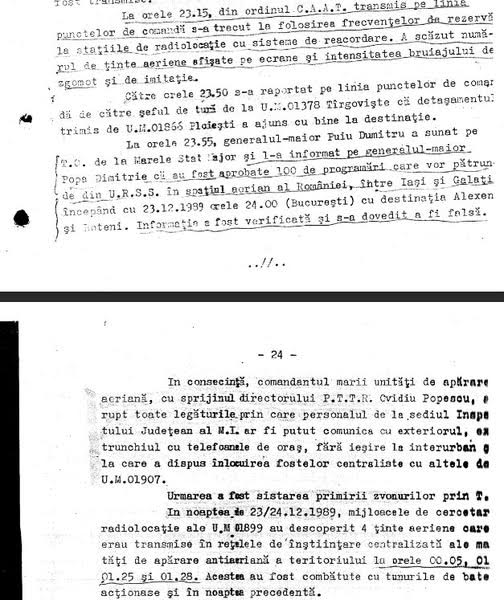
The “terrorists” of December 1989 existed. The “terrorism” of December 1989 had three main components: 1) Disinformation, by telephone, the spreading of rumors in person, and the interception and intoxication of military communications; 2) Radio-electronic warfare to make it look as if Romania were being invaded and that the enemy was more numerous than they in fact were; and 3) Sporadic episodes of gunfire, especially at night, designed to frighten, to confuse, to panic, to exhaust, and to keep the military pinned down in their barracks and the population in their homes. The latter followed the guerrilla tactic of harassment and intimidation, or as some military officers detected, “hit and run” or “strike and disappear” operations.

The ”terrorists” were in fact the name given to a failed counterrevolution to save the Ceausescus that took the form of a guerrilla warfare “resistance struggle” (lupta de rezistenta). Its main and most important protagonists were culled from the Securitate. A key word there is “failed.” Many people dismiss out of hand that there could have been counterrevolutionaries precisely because the plan failed. That’s just bad historical analysis. History is not and cannot be about cui prodest, establishing who benefited from an event and working backwards to assess the preferences, pro-con balance sheet, and strategic calculation of actors in retrospect. This is a common shortcut practiced by many who don’t have the time or patience to study the dynamics of the event itself.

The “lupta de rezistenta” was drawn up in the late 1960s initially to respond to an invasion and occupation of Romanian territory, in theory by NATO, but in actuality by the Soviet Union and its Warsaw Pact allies. Over time the plan was adapted to counter a potential military coup or popular revolt. However, its authors could never have conceived of and prepared for a popular revolt in which the military defected from the regime to the side of the people, as happened in December 1989. Like other so-called stay-behind forces it aimed at causing panic, mayhem, and confusion, with the goal of slowing the enemy’s advance and preventing the “occupying” government from functioning normally. In its initial stages then, it did not imagine the seizing of military and political objectives, because even if it had forces to conquer such objectives it was unlikely to have enough forces to hold such objectives. It was a plan for a battle that could take weeks or months, yet the compressed timeline of what happened in December, and the capture and holding of the Ceausescus, forced them to speed up the timeline and types of actions they engaged in, to include infiltration efforts and ambushes. Notably, preparations for what happened after 22 December 1989, began in some cases back to before the XIVth PCR Congress in November, and especially in the days preceding the 22nd.

It was in southern Romania, from the border with non-Warsaw Pact member Yugoslavia through the mountains in the center of the country to the Black Sea where much of the most intense action took place in December 1989. All of the focus on the televised images of the CC or TVR misses the fact that it was in places, out of the domestic and international media spotlight, like Resita and Hateg, where you had real battles. Significantly, antiaircraft units were a particular objective of interest for the “terrorists.” They were subject to radioelectronic warfare, to terrestrial shooting, and to a wave of disinformation phone calls and intercepts or blocking of their communications. Antiaircraft units were targeted because the “terrorists” needed to secure the airspace in these more vulnerable points (the Yugoslav border; the Black Sea) to evacuate or infiltrate forces, and in the event that they rescued the Ceausescus, to spirit them out of the country.

Significantly, among the documents in the Revolution File, is a handwritten three page “urgent message” dated 25 December from retired Securitate foreign intelligence officer Domitian Baltei to those overseeing the campaign against the “terrorists.” In it Baltei details the actions and locations of what he refers to as “the resisters,” in other words those involved in the lupta de rezistenta. He talks about the involvement of Securitate Directorate Five (service for the protection and guarding of the Ceausescus) officers and reserves, the use of safe houses, and the secret Securitate telephone exchange where they intercept and redirect phone calls. Baltei was no uninitiated neophyte, however. In the late 1960s he had been in charge of creating funding mechanisms for the “resisters” abroad and thus knew of “lupta de rezistenta.” Those present at the interrogation of the head of Directorate Five, say that he admitted the existence of “the terrorists” and the location from which they were being commanded.

The files also contain occasional verbal exchanges between those on the side of the revolution and the counterrevolutionaries. For example, the deputy foreign minister recounts in a January 1990 deposition how two Securitate Directorate Five officers who were firing from inside the Foreign Ministry Building (MAE) told him they were shooting because they were well-reimbursed and they had taken an oath to defend the Ceausescus. Senior officials of the Securitate Troop Command who had joined the Revolution also discussed these two Fifth Directorate officers. Commanders who dispatched Securitate Troop officers to disarm the Fifth Directorate officers, warned them that they were dangerous. In fact, when the Securitate Troop officers arrived on 25 December to arrest the two Fifth Directorate officers, it turned out they had far more numerous forces under their command than was believed and that they initially refused to surrender their weapons. Thus, even those elements of the Securitate not participating on the side of the counterrevolution acknowledged the existence of “terrorists” who would not submit to the Revolution.

  1. What aspects of the 1989 Revolution and its aftermath still require serious investigation or reassessment by historians and researchers? Do you think valuable information could still be found in archives, whether from the former Securitate, the Romanian Army, the CIA, or Russian sources?

The Securitate documents released with much fanfare in late 2022 and promoted by two CNSAS researchers who just happen to also teach at the SRI’s intelligence academy brought little light on what had happened in December 1989 and were in fact something of a diversion. Army documents that could help clarify December 1989 remain in the archives of local military procuracies. We have learned the hard way that many files from the Revolution File were sent back to local procuracies under the pretense that they “did not contain information relevant to the investigations.” In fact, those few files we have recovered from a local procuracy, show exactly the opposite and that they appear to have been sent back to local procuracies in order to bury them. The absence of many files that are part of Dosarul Revolutiei is particularly glaring in the cases of cities like Sibiu or Braila.
Dr. Mark Kramer, head of Harvard University’s Cold War Studies Project, has probably performed more research in the Soviet archives than anyone I know. He has not found anything to substantiate the accusations of Soviet involvement in December 1989, let alone of a planned Soviet invasion. One has to understand how ridiculous it sounds to a Soviet specialist like Dr. Kramer that the Soviets would have accepted the loss of East Germany and Czechoslovakia in November 1989—especially given the Soviet forces based in East Germany—and done nothing to reverse it, only to intervene in Romania, a country of much less geopolitical importance, in December 1989.

We still need to better understand the “lupta de rezistenta,” its tactics and resources, and how it was operationalized in December 1989. Moreover, ironically, establishing what happened after 22 December 1989 is easier than what happened before 22 December 1989. We know the Securitate, the Militie, and the Army all had a role in the repression, killing, and maiming of demonstrators during that week. In December 1989 and immediately after, the focus was on the Securitate and Militie. 36 years later the focus is on the Army’s role. The Securitate have effectively written themselves out of the repression of that week, to leave the Army, as always, “out front” to take the blame. Establishing the exact role and responsibility for the pre-22 December 1989 period has to be taken from the top again, because Securitate disinformation has succeeded in rewriting and muddying the narrative.

  1. What lasting myths or misconceptions about the Romanian Revolution remain in Romanian society and historiography, and how did political figures like Iliescu contribute to shaping these narratives?

Iliescu’s crime is not that he invented non-existent “terrorists” as Pitu accuses, or that he controlled the “terrorists” or they fought on his behalf, but that he allowed the Securitate to clean up and cover up their bloody responsibility for the deaths, injured, and mayhem of December. Iliescu needed the former Securitate to hold power, and so he turned the other way and ignored their true role in December 1989. Iliescu wanted and needed the problem of December 1989 to go away, so he needed the “terrorists” to disappear; he was not interested in justice and accountability.

Since February 2022 and the continued Russian full-scale invasion of Ukraine, Romania finds itself in a geopolitical position that may not have existed since Romania of the late 1960s/early 1970s. After the Warsaw Pact invasion of Czechoslovakia, Romanians sensed that they could be next. After Russia invaded Ukraine in February 2022, suddenly the threat to Moldova and even to Romania increased. Because of fear and anger, narratives about the Russian threat posed to Romania “sell” to the broader Romanian population. Today’s anger and fear is thus projected back on to historical events, especially December 1989. Hence, the former Securitate narrative about December 1989, that it was a Soviet/Russian coup d’etat—what Ceausescu himself voiced at the time—is much easier to market to the historically Russophobic Romanian population. It is demagogic and populist, and thus now more successful than in the past three decades. The former Securitate narrative has reshaped the story about December 1989 from focusing on the Ceausescus and the Securitate, to focusing on Ion Iliescu, the Army, and the Russians. One can see plainly how this revisionism plays to the benefit of the sovereigntist, nationalist Ceausist Securitate.

Romanians need to know that although “foc fratricid” was a real component of the December events, it was a consequence not just of disinformation and radioelectronic warfare, but also of the actual gunfire of Ceausescu’s counterrevolutionary network. In fact, there is some evidence to believe that in certain places and circumstances, the “terrorists” attempted to confuse and weaken units—including morale—by causing them to shoot into one another. Suspicion and fear were the weapons of the “terrorists.”

  1. This year – 36 years after the fall of communism – Romanian secondary school students will begin studying the history of communism. In this context, what would you tell a young person today about the communist regime and the 1989 Revolution?

To begin with Nicolae and Elena Ceausescu were not “victims” of the Revolution as Pitu has sought to suggest in relation to their trial and execution. They were responsible for the bloodshed and death, including after 22 December. What young Romanians need to know is that they should be proud of how the majority of Romanian citizens acted in December 1989. The Romanian Revolution of December 1989 should be seen as a heroic event.

Young people need to know that the revolt that turned into a Revolution, from Timisoara, during the week of 15-22 December, was mostly spontaneous. It was fueled by the political repression and economic destitution of the late Ceausescu era, not by the actions of foreign agents. The Securitate narrative promoted by Ranco Pitu steals that from the Romanian people. Pitu argues that what happened after 22 December was a coup d’etat. But no matter how he presents the week leading up to 22 December, because it is “lucru de fapt judecat,” his words betray him. He suggests it was not so much the demonstrators from Timisoara who traveled by train to Bucharest and were trying to get into the mass rally who were responsible for the disruption of Ceausescu’s speech on the 21st, but the Army trying to undermine Ceausescu. In his book, Ruperea blestemului in one breath he states the juridical interpretation of Timisoara—that even the Securitate participated in the bloodshed—but then raises doubts about the possible role of Soviet tourists and suggests that perhaps knowing Ceausescu would fall the Securitate took a step back and allowed the Army to exclusively engage in the repression of demonstrators. This is needless and baseless speculation but Pitu purposely seeks to muddy the waters even with regard to the period before 22 December, always in the direction of reducing the responsibility of the Securitate.

The former Securitate has stolen the Revolution from Romanians, to make them believe foreign agents before and after 22 December played an important role, to believe that the events were more coup d’etat than popular revolt. Romanians need to reclaim the authenticity, the spontaneity, and the courage of the Revolution of December 1989 from the former Securitate.

Thank you.

Posted in decembrie 1989 | Tagged: , , , , | Leave a Comment »

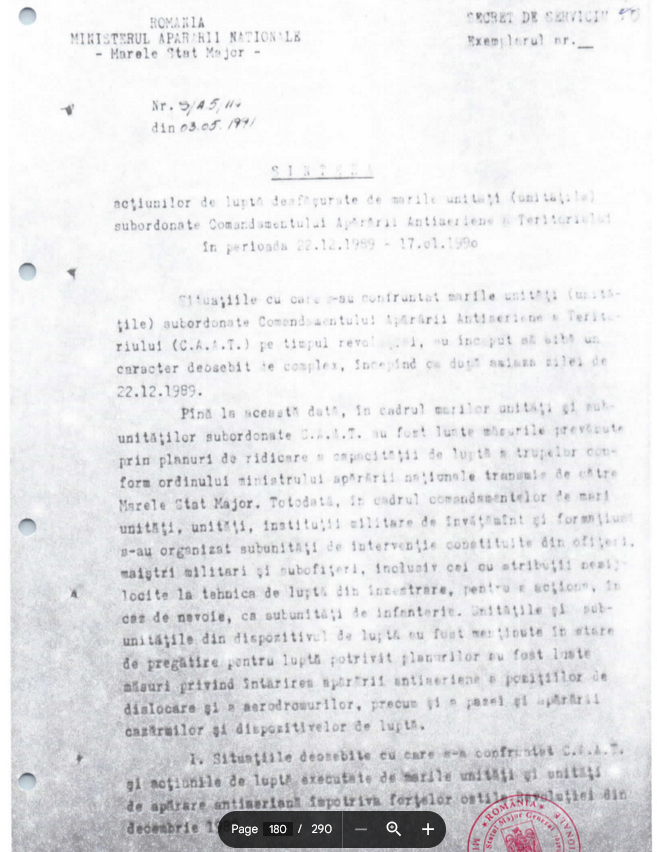
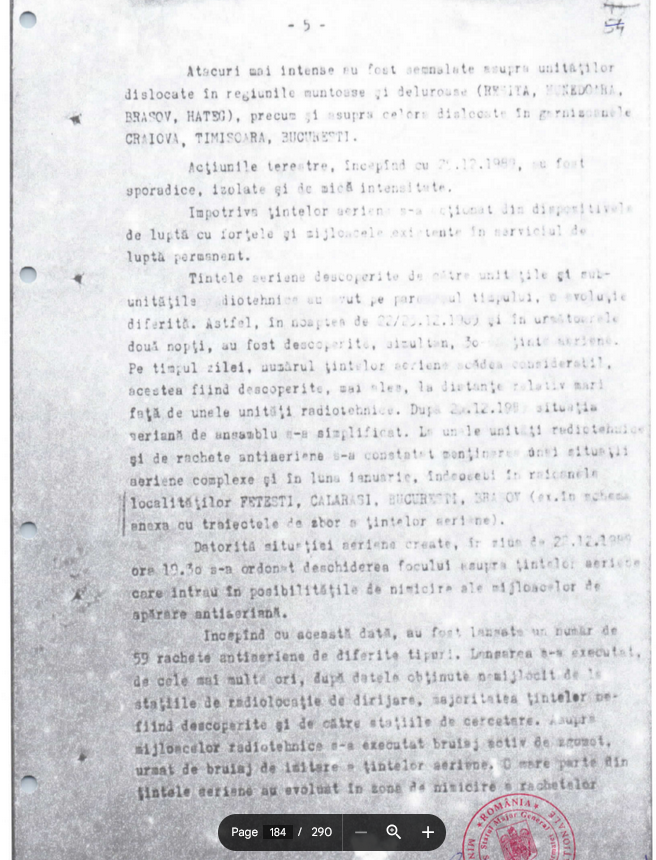
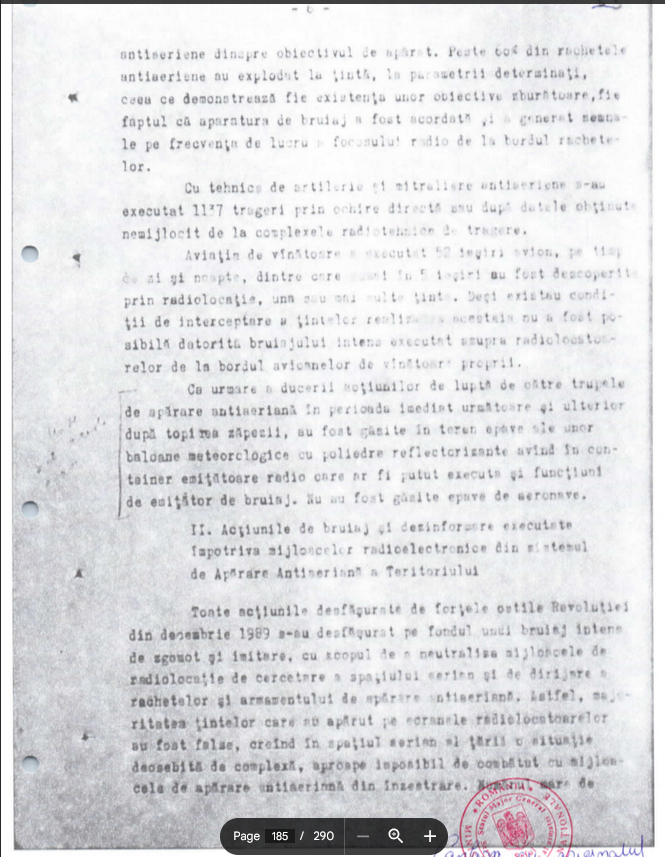
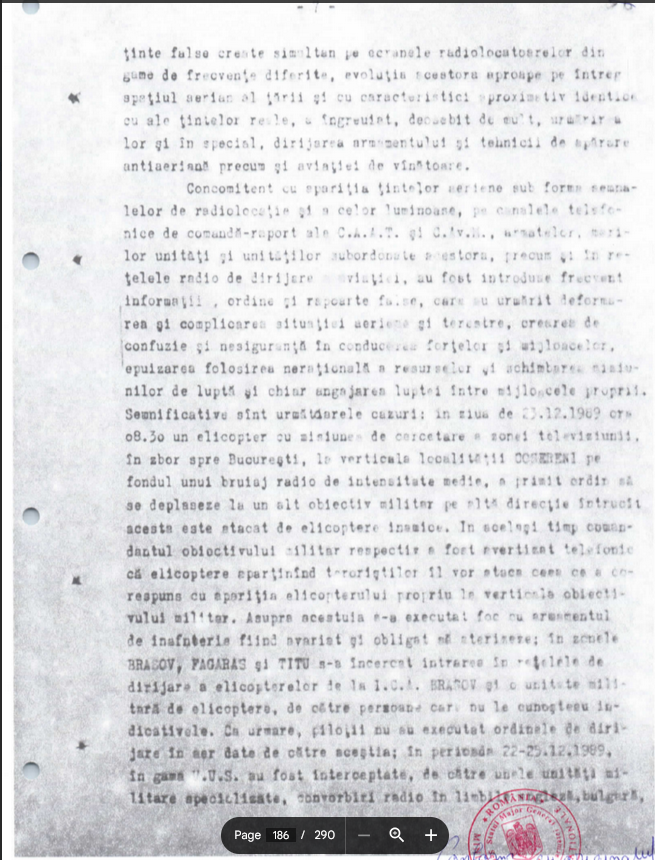
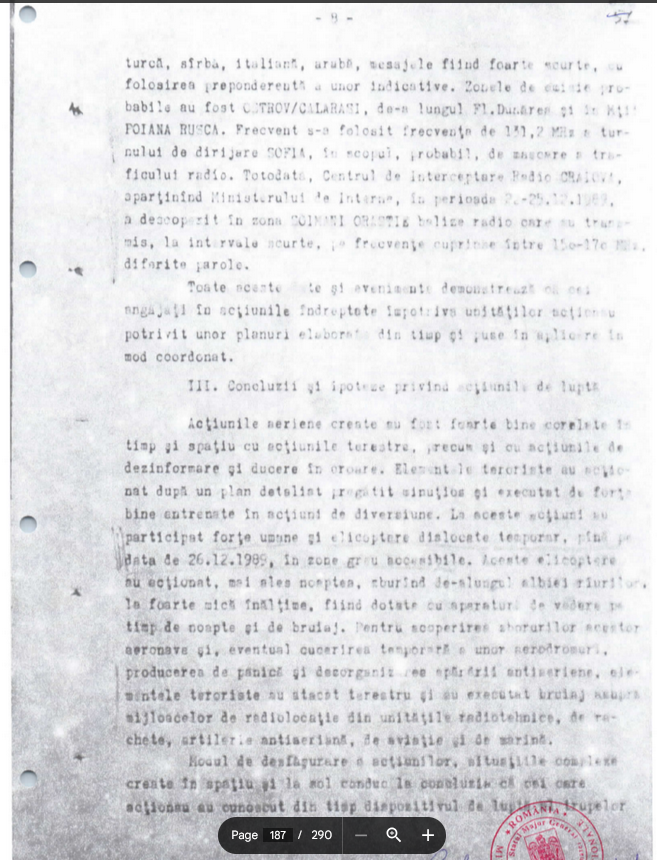
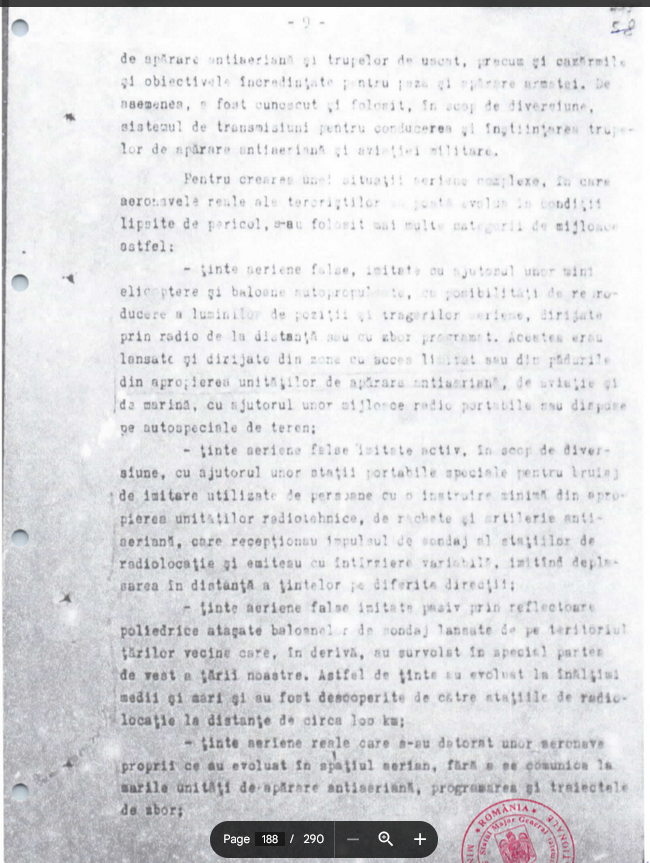
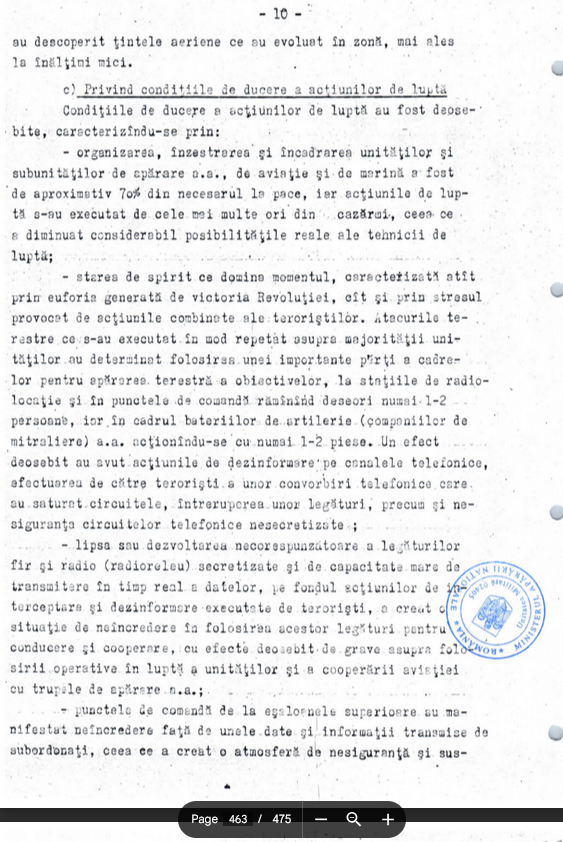
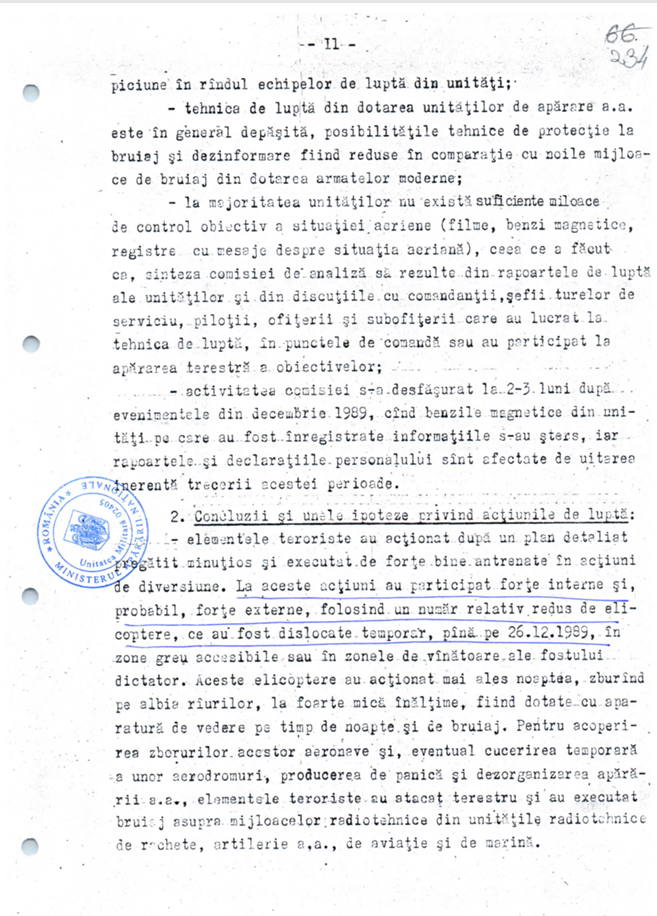
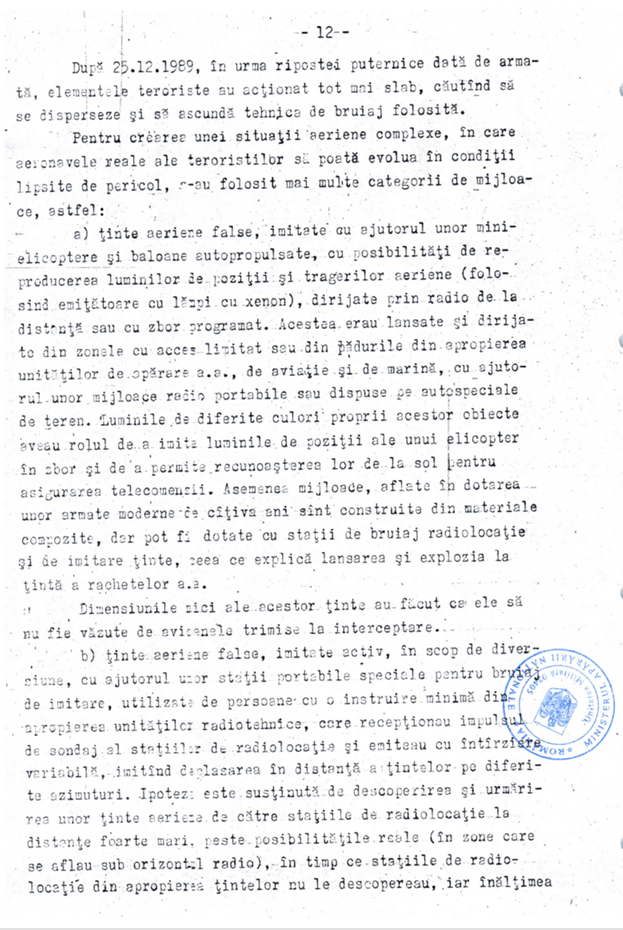
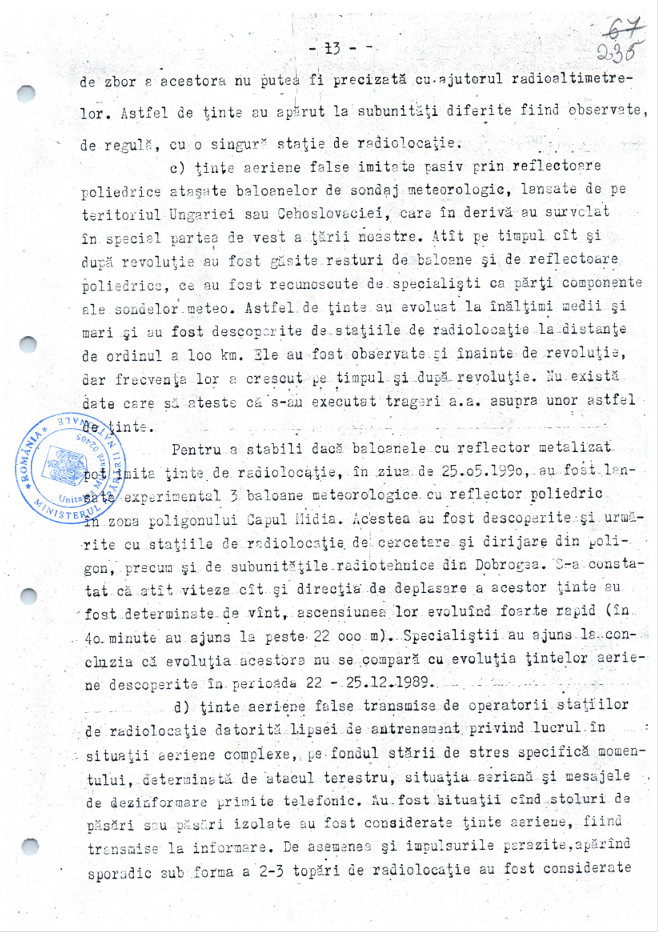
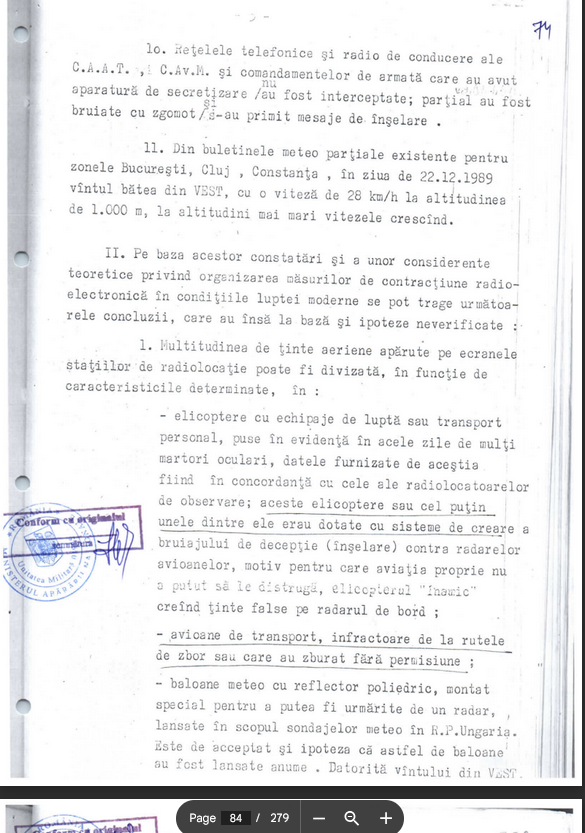
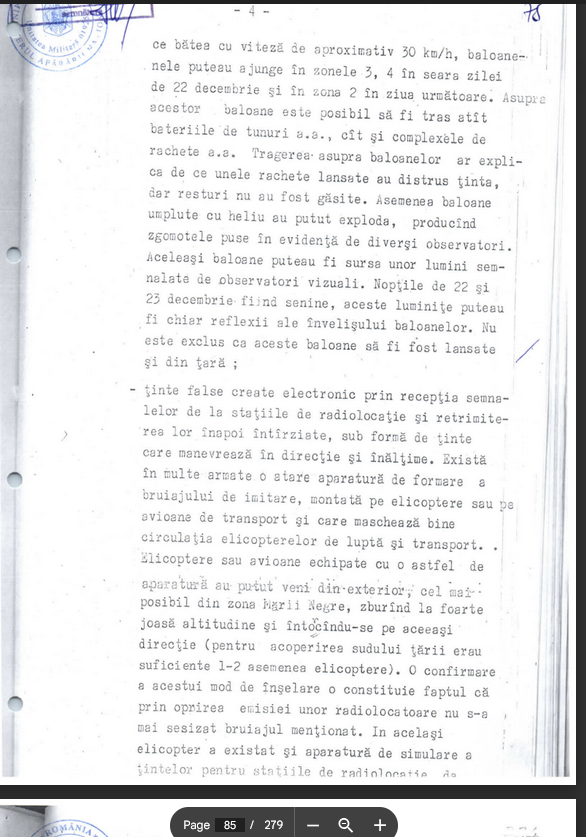
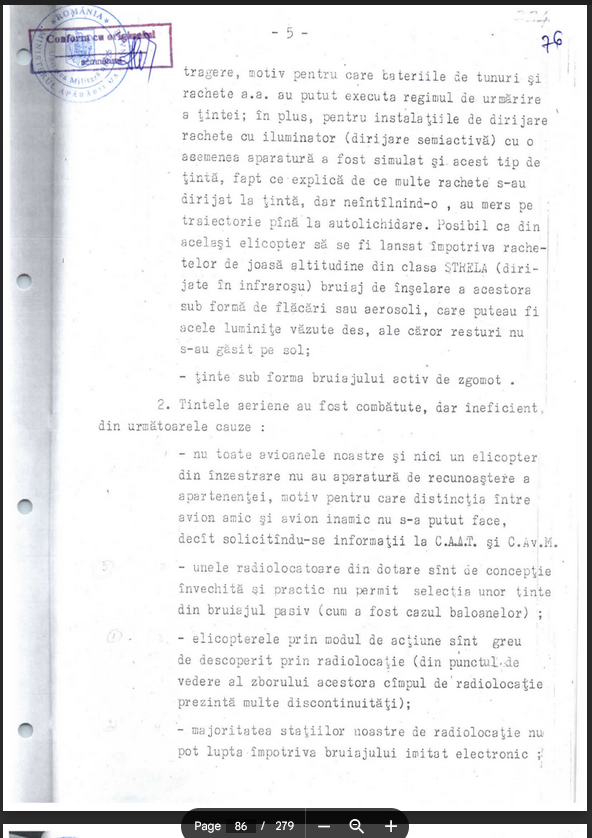
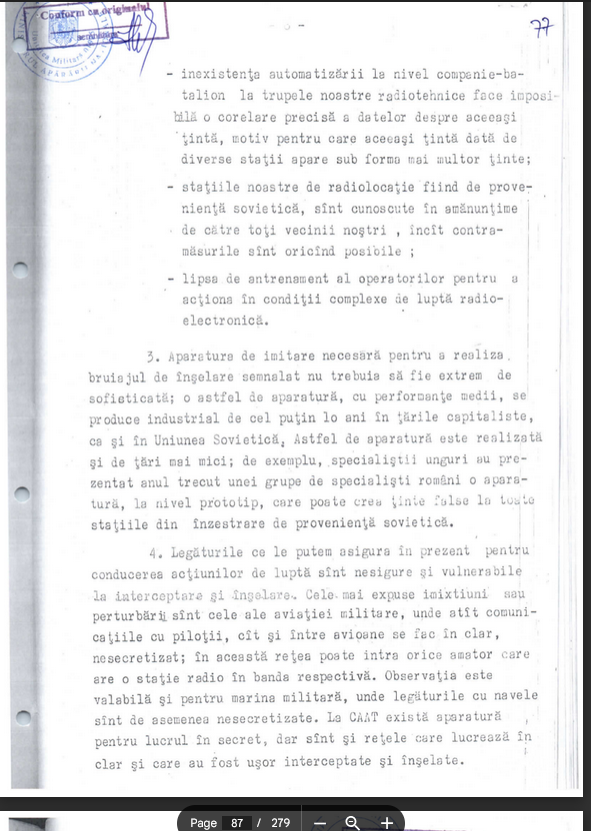
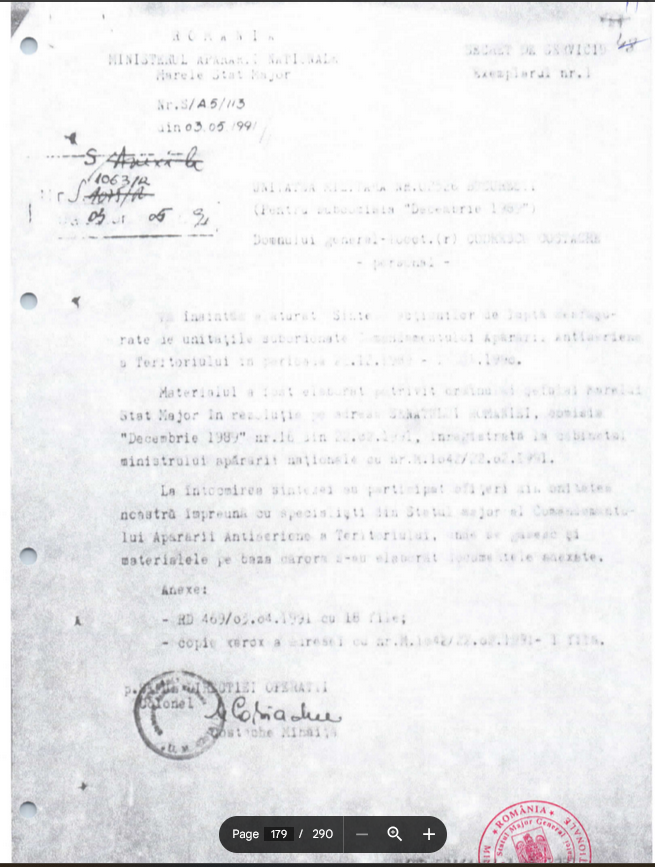
C.A.A.T. (03.05.1991) SINTEZA actiunilor militare desfasurate de marile unitati (unitatile) subordonate Comandantului Apararii Antiaeriene a Teritoriului in perioada 22.12.1989-17.01.1990 v. Military Prosecutor Catalin Ranco Pitu: “Every Army structure after January 1990…concluded that the terrorists did not exist”

Posted by romanianrevolutionofdecember1989 on July 14, 2025

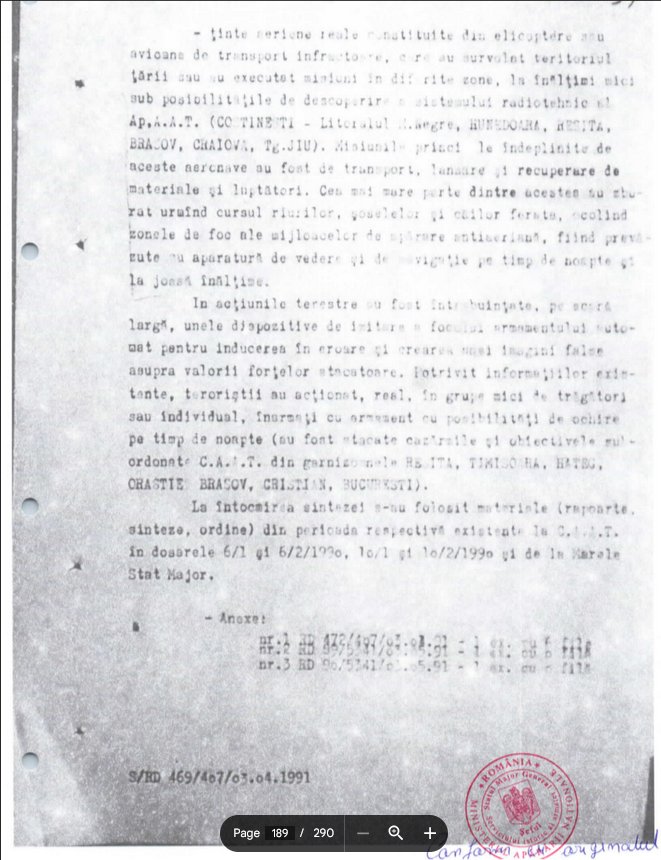
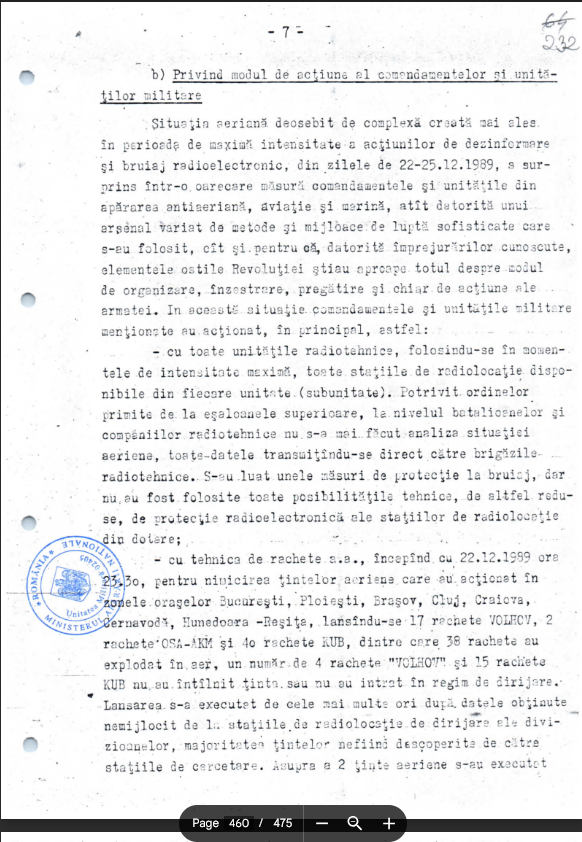
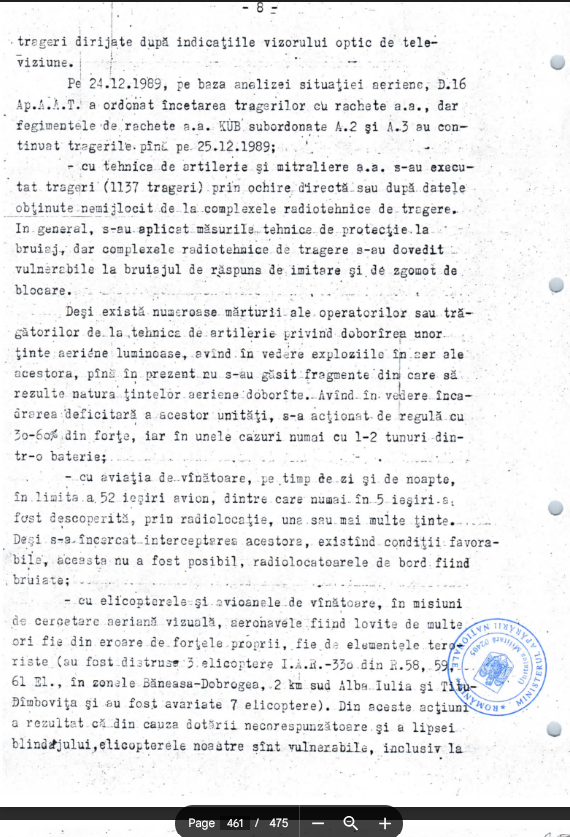
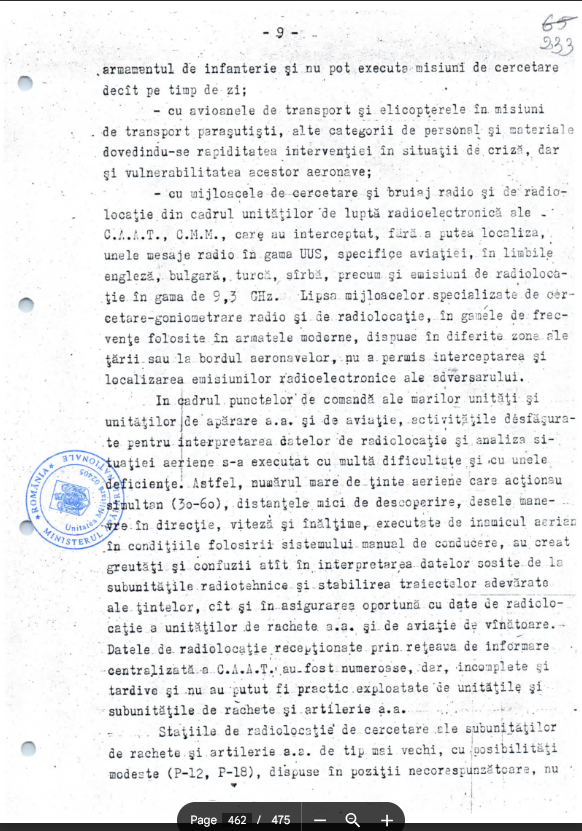
A single excerpt from the Territorial Antiaircraft Defense Command’s (C.A.A.T.) “SYNTHESIS of military operations undertaken by major units (the units) subordinated to the Territorial Antiaircraft Defense Command during the period 22 December 1989 to 17 January 1990” sums up the conclusions (although the document breaks down in much greater details) of this report from spring 1991 (thus over a year after the events themselves) as follows:

Potrivit informatiilor existente, teroristii au actionat, real, in grupe mici de tragatori sau individual, inarmati cu armament cu posibilitati de ochire pe timp de noapte (au fost atacate cazarmile si obiective subordonate C.A.A.T. din garnizoanele RESITA, TIMISOARA, HATEG, ORASTIE, BRASOV, CRISTIAN, BUCURESTI).

(According to existing information, the terrorists acted, in fact, in small groups of shooters or on an individual basis, armed with weapons capable of night-time targeting (barracks and objectives subordinated to the C.A.A.T. from the garrisons at RESITA, TIMISOARA, HATEG, ORASTIE, BRASOV, CRISTIAN, BUCURESTI were attacked).)

Yet retired military prosecutor General Catalin Ranco Pitu maintains (May 2023, repeated since),

“every Army structure…structures…prepared their own very thorough analyses after January 1990 [after action reports] about what happened hour by hour during the Revolution…their conclusions are phenomenal…EACH AND EVERY MATERIAL INDEPENDENTLY SHOWS THAT THE TERRORISTS [COUNTERREVOLUTIONARY CEAUSESCU LOYALISTS] DID NOT EXIST…” (from approximately min. 25:30-26:00 in the link below)

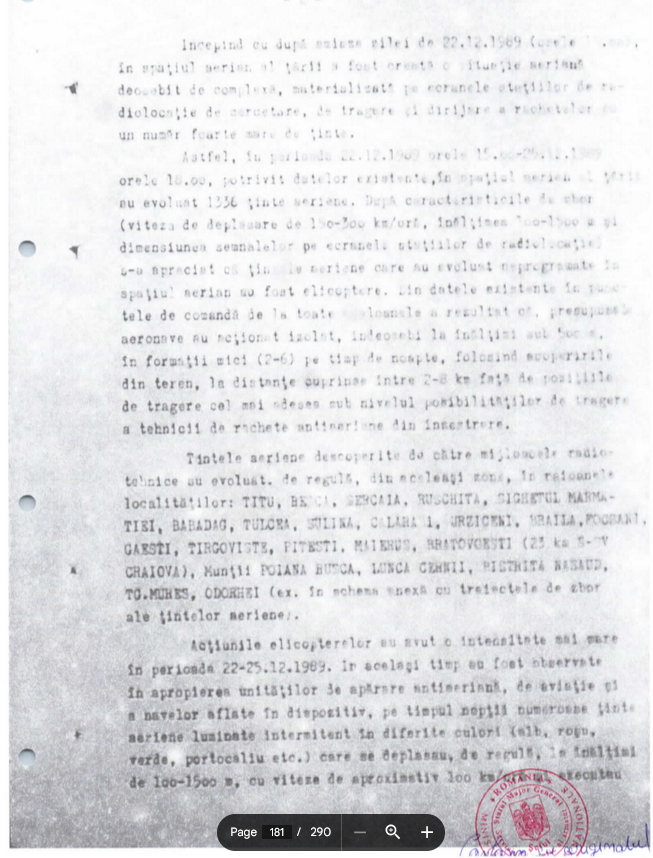
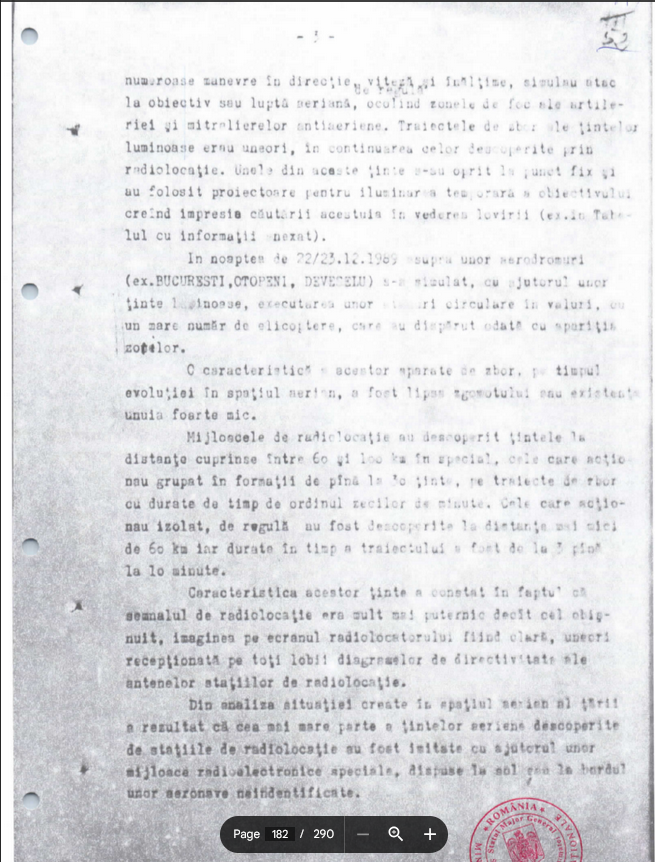
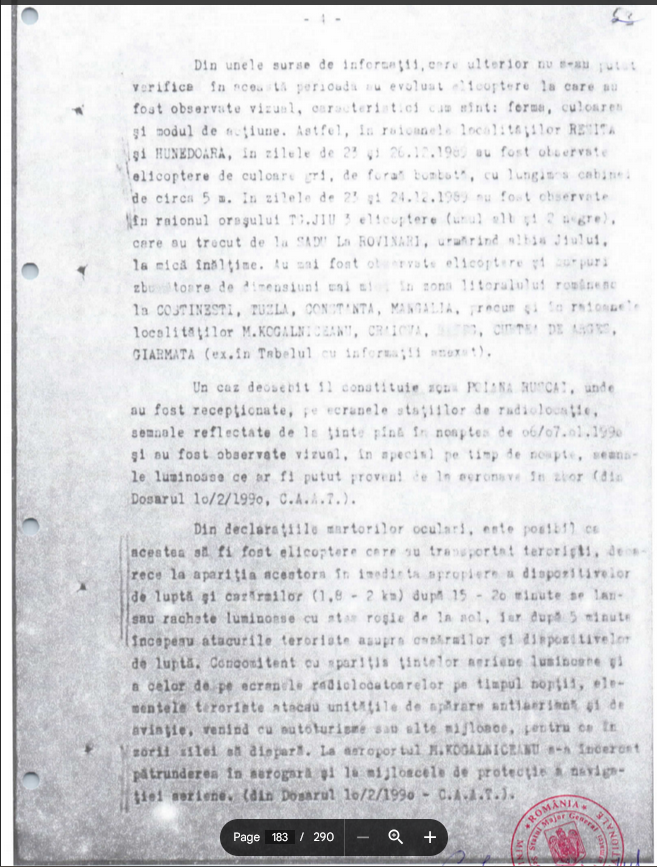
Below the full C.A.A.T. synthesis dated 3 May 1991 for those who can read Romanian (these are the copies as received by Pitu, Cosneanu, and the other military prosecutors; apologize for the quality, but this is how they were sent), with excerpts from the first two pages (p. 180 and p. 181) transcribed courtesy of Costinel Mirea Venus:

C1

ROMÂNIA

MINISTERUL APĂRĂRII NAȚIONALE

-Marele Stat Major-

Nr. S/A5/114

din 03.05.1991

SECRET DE SERVICIU

Exemplarul nr. _

S I N T E Z A

acțiunilor de luptă desfășurate de marile unități (unitățile) subordonate Comandamentului Apărării Antiaeriene a Teritoriului în perioada 22.12.1989 – 17.01.1990

Situațiile cu care s-au confruntat marile unități (unitățile) subordonate Comandantul Apărării Antiaeriene a Teritoriului (C.A.T.T.) pe timpul revoluției, au început să aibă un caracter deosebit de complex, începînd cu după amiaza zilei de 22.12.1989.

Până la această dată, în cadrul marilor unități și subunităților subordonate C.A.A.T. au fost luate măsurile prevăzute prin planuri de ridicare a capacității de luptă a trupelor conform ordinului ministrului apărării naționale transmis de către Marele Stat Major. Totodată, în cadrul comandamentelor de mari unități, unități, instituții similare de învățămînt și formațiuni s-au organizat subunități de intervenție constituite din ofițeri, maiștri militari și subofițeri, inclusiv cei cu atribuții nemijlocite la tehnica de luptă din înzestrare, pentru a acționa, în caz de nevoie, ca subunități de infanterie. Unitățile și subunitățile din dispozitivul de luptă au fost menținute în stare de pregătire pentru lupta potrivit planurilor au fost luate măsuri pentru întărirea apărării antiaeriene a pozițiilor de dislocare și aerodromurilor, precum și a pazei și apărării cazărmilor și dispozitivelor de luptă.

I. Situațiile deosebite cu care s-a confruntat C.A.A.T. și acțiunile de luptă executate de marile unități și unități de apărare antiaeriene împotriva forțelor ostile Revoluției din decembrie 1989.

Page 180 / 290

În partea de jos a paginii ștampila Șefului Statului Major General

Conform cu originalul

C2

Începând cu după amiaza zilei de 22.12.1989 (orele 15.00), în spațiul aerian al țării a fost creată o situație aeriană deosebit de complexă, materializată pe ecranul stațiilor de radiolocație de cercetare, de tragere și dirijare a rachetelor cu un număr foarte mare de ținte.

Astfel în perioada 22.12.1989 orele 15.00 – 25.12.1989 orele 18.00, potrivit datelor existente în spațiul aerian al țării au evoluat 1336 ținte aeriene. După caracteristicile de zbor viteza de deplasare de 150 300 km/h înălțimea 100 1500 m și dimensiunea semnalelor pe ecranele stațiilor de radio locație s a apreciat că țintele aeriene care au evoluat neprogramate în spațiu la ea au fost elicoptere din datele existente în punctele de comandă de la toate eșaloanele A rezultat că presupusele aeronave au acționat izolat în deosebi la înălțimi…, în formații mici (2-6) pe timp de noapte, folosind acoperiile din teren, la distanțe cuprinse între 2-8 km față de pozițiile de tragere cel mai adesea sub nivelul posibilităților de tragere a tehnicii de rachete antiaeriene din înzestrare.

Țintele aeriene descoperite de către mijloacele radiotehnice au evoluat, de regulă, din aceeași zonă, în raioanele localităților TITU, BERCA, SERCAIA, RUȘCHIȚA, SIGHETU MARMAȚIEI, BABADAG, TULCEA, SULINA, CĂLĂRAȘI, URZICENI, BRĂILA, FOCȘANI, GĂEȘTI, TÂRGOVIȘTE, PITEȘTI, MĂIERUȘ, BRATOVOEȘTI (23 km în S-V Craiova), Munții POIANA RUSCA, LUNCA CERNII, BISTRIȚA NĂSĂUD, TÂRGU MUREȘ, ODORHEI (ex. în schema anexă cu caietele de zbor ale țintelor aeriene).

Acțiunile elicopterelor a avut o intensitate mai mare în perioada 22-25.12.1989. În același timp au fost observate în apropierea unităților de apărare antiaeriană, de aviație și a navelor aflate în dispozitiv, pe timpul nopții numeroase ținte aeriene luminate intermitent în diferite culori (alb, roșu, verde, portocaliu etc.) Care se deplasau de regulă la înălțimi de 100 1500 m cu viteza de aproximativ 100 km pe oră și executau

Page 181/ 290

În partea de jos a paginii ștampila Șefului Statului Major General

Conform cu originalul.

Posted in decembrie 1989 | Tagged: , , , , | Leave a Comment »

“Phoning it in”–or How to Make the Romanian Revolution Understandable and Acceptable to a Western Academic Audience

Posted by romanianrevolutionofdecember1989 on June 28, 2025

I once read a review that credited Peter Siani-Davies’ The Romanian Revolution of December 1989 (2005, Cornell University Press) with “placing the ‘terrorists’ in context.” That is an odd way to phrase it, because Siani-Davies denies their existence. Of course you are going to relativize their importance, downplay their significance, spend less time discussing them and more time discussing other issues, “put them in context,” if your conclusion is that they didn’t exist!

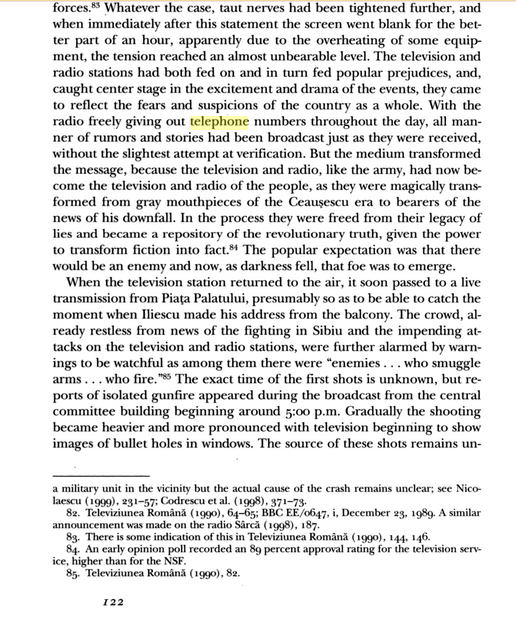
With such reviews and reviewers, it should come as little surprise that basic questionable assumptions made by Siani-Davies did not and do not face scrutiny, pre-or post-publication. Take the issue of “rumors and stories” spread by telephone calls. Look up “telephone” in the Google Books version of Siani-Davies’ volume and you get the following:

“The television and radio stations had both fed on and in turn fed popular prejudices, and, caught center stage in the excitement and drama of the events, they came to reflect the fears and suspicions of the country as a whole. With the radio freely giving out telephone numbers throughout the day, all manners of rumors and stories had been broadcast just as they were received, without the slightest attempt at verification….The popular expectation was that there would be an enemy and now, as darkness fell, that foe was to emerge. (p. 122)”

All the elements are there for a structural argument to explain the outcome in question. Popular “prejudices, fears and suspicions,” feelings of excitement and drama (the emotional state of those involved), free-floating telephone numbers, “rumors and stories,” the need for and expectation of an enemy, and darkness (contributing to human associations of darkness with evil and wrongdoing, of the playground of real and imagined enemies, and of an inability to see what is going on; once again the emotional state of those involved). But this is not an exercise in crafting intellectually seductive arguments, but in finding the argument that accurately reflects the evidence.

Ironically, Siani-Davies also makes a lot of either/or assumptions. Thus the spread of rumors is either a largely spontaneous process, quite free from an intentional disinformation campaign, OR it is a disinformation campaign. The idea that ALL OF THE ABOVE (a disinformation campaign, the psychological impact of a disinformation campaign, AND organic rumors typical of conditions of great uncertainty) could be at play largely eludes him.

Yes, television and radio gave out phone numbers that contributed to the scope of the confusion, and arguably incentivized the spread of incorrect information. A Western academic audience will love this. See, it was all understandable, without having to go down the rabbit hole of “conspiratorial-thinking”…like so many of those silly Romanians (they don’t say the latter out loud, but it is implied).

It is a massive and fundamental mistake to reduce the confusion and spread of false information in December 1989 to organic processes. It is simply at odds with the historical record as becomes clear in Dosarul Revolutiei (The Files of the Revolution). Below, three examples to emphasize different points in this regard. They show how those involved in this situation, deduced that at least some of the disinformation 1) received including on Operational Classified Lines (did television and radio give out those numbers, Dr. Siani-Davies?) 2) included information clearly prepared in advance 3) was beyond the means of average citizens and 4) ceased or could be avoided by employing different countermeasures. For the time being in Romanian.

1&2) Dumitru Polivanov, declaratie, 09.04.2008

“Din momentul instalarii in acest birou pe telefoanele existente (guvernmental, TO, scurt, MANP [?sic.], interior si telefonul public cu exteriorul) au inceput sa curga informatii privind elicoptere inamice care ataca Bucurestiul sau semnalizate in alte locuri din tara: Slobozia, teroristi care intentioneaza sa atace diferite obiective, existenta unor explozivi in diferite locuri, si din CC, otravirea apei, etc. Astfel de informatii au fost transmise si prin biletele, scrisori, alte documente CHIAR DACTILOGRAFIATE CU LITERE DE DIMENSIUNI MINISTERIALE, CEEA CE PRESPUNEA CA ERAU FACUTE DIN TIMP.”

2&3) Ploiesti Misiunile si Actiunile Unitatilor Armatei, Jurnal-Sinteza

“In acest timp a sunat telefonul pe oras si s-a transmis urmatorul mesaj:

‘Sunt directorul Ovidiu Popescu si vorbesc de la Oficiul P. T. T. R. Nord. La benzinaria de la km. 6 au aterizat 4 elicoptere cu teroristi care au capturat personalul si ameninta sa arunce totul in aer.’

Desi directorul atipise totusi vocea ii apartinea indubitabil acestuia. Cand ofiterul i-a cerut sa repete cine este interlocutorul n-a facut-o, mesajul derulandu-se ca pe banda.

Aceasta intamplare a ajutat foarte mult la intelegerea tehnologiei fabricarii zvonurilor si la gasirea antidotului. ERA INREGISTRATA VOCEA AUTENTICA A PERSOANEI CARE PRETINDEA CA FACE, APELUL, IAR CONTINUAREA MESAJULUI SE FACEA CU UN TIMBRU APROPIAT DE CATRE CEL CE FABRICA STIREA FALSA.”

1&4)

“La orele 23,55, generalul-maior Puiu Dumitru a sunat pe T.O. de la Marele Stat Major si l-a informat pe generalul-maior Popa Dimitrie ca au fos aprobate 100 de programari care vor patrunde din U.R.S.S. in spatiul aerian al Romaniei, intre Iasi si Galati incepand cu 23.12.1989 orele 24,00 (Bucuresti) cu destinatia Alexandria si Boteni. Informatia a fost verificata si s-a dovedit a fi falsa.”

“IN CONSECINTA, COMANDANTUL MARII UNITATI DE APARARE ANTIAERIANA, CU SPRIJINUL DIRECTORULUI P. T. T. R. OVIDIU POPESCU, AU RUPT TOATE LEGATURILE PRIN CARE PERSONALUL DE LA SEDIUL INSPECTORATULUI JUDETEAN AL M.I. AR FI PUTUT COMUNICA CU EXTERIORUL, ? TRUNCHIUL CU TELEFOANELE DE ORAS, FARA IESIRE LA INTERURBAN SI LA CARE A DISPUS INLOCUIREA FOSTELOR CENTRALISTE CU ALTELE DE U.M. 010907.

URMAREA A FOST SISTAREA PRIMIRII ZVONURILOR PRIN T.O.”

1) Thus, once they cut off IJMI, and isolated those associated with the M.I., suddenly they did not have the same problem with the intoxicating rumors.

2) Generalul Maior Puiu Dumitru was at the time Sef al Departamentul Aviatiei Civilie and adjunct al Ministerului Transporturilor si Telecomunicatilor (see in comments, a snip from early 1989). Puiu Dumitru (Dumitru Puiu) died on 28 martie 1990. The only thing I have been able to find on the circumstances of his death is from a county (Csongrad) newspaper from Hungary that says he suddenly became ill on 24 March, was taken to a psychiatric hospital, and died on 28 March. He was 60 years old. He had also, according to that article, been recently on local Timisoara radio prior to this happening.

Posted in decembrie 1989 | Leave a Comment »

Disinformation simply isn’t on the RADAR–or writing history that is safe for Western academic consumption

Posted by romanianrevolutionofdecember1989 on June 10, 2025

Having inhabited both the intelligence analysis and academic worlds in my professional life, I believe I gained insights that I would not have acquired had I resided solely in one world or the other. A fundamental observation involves the level of emphasis placed on voluntarist vs. structural explanations of behavior and outcomes. This is a first, early, and unfinished take on this question.

Nothing is more of a “nullifier” in the Western academic world than the taint of “conspiratorial thinking.” I don’t think this is accidental. In part, it is a somewhat reflexive, defensive reaction to the conspiratorial thinking that Western academics identify in the non-Western countries they study. Critics might call this a variant of neo-Orientalism. My own experience comes in particular in the study of communist/post-communist “Eastern Europe,” the Balkans, especially Romania.

While it is true that locals attracted by and desirous of integrating Western academic trends in Romania also denounce the conspiratorial thinking of others, often their competitors or their enemies, they remain a minority. Moreover, and perhaps more interesting, is that Romanian academic emigres to the West are unwilling in practice to fully assimilate the same level of preference for structure over agency, and for unintentional or accidental outcomes, that their non-emigre Romanianist colleagues display. There seems to be precious little acknowledgement and discussion that such a Western academic preference is itself potentially a cultural affect, derivative of the status of outsiders examining a foreign country. This is not to say that it is wrong, or even automatically wrong, just to say that it needs to be acknowledged, just as the proclivity of Romanians for “conspiratorial thinking” is stressed by these same scholars.

Take, the most “Western academic” among “Western academic studies” on the topic, The Romanian Revolution of December 1989 (Cornell University Press, 2005) by Peter Siani-Davies. You can do a search, as I did, on Google Books, for terms like “rumor” and “myth” and get back essentially three dozen hits for each. Of course, both rumor and myth in the Western connotation, especially Western academic connotation, tend to subsume/be preceded by the word “false.” And, crucially, the underlying assumption is that these are predominantly organic phenomena, that to the extent they are wrong, they were/are unintentional or accidental. A good counterpoint is to look up terms like “disinform/ation,” “misinform/ation,” or “lie” in Siani-Davies volume. One finds almost nothing. This highlights a major flaw underlying Siani-Davies’ analysis: the unspoken assumption that confusion, stereotypes, and understandable, but ultimately unsubstantiated suspicion, explain ACCURATELY what happened in December 1989 in Romania. That should be a hypothesis, something to be tested, not a stealth assumption in the background.

In Siani-Davies’ volume, a search for “radar” in Google Books comes up with three hits, but only one of any real consequence. Even then, Siani-Davies blithely recounts that “in several cities the first shooting during the revolution was by antiaircraft guns firing at targets located by radar.” Siani-Davies makes no attempt to investigate the targets on radar further, focusing instead on the misunderstandings that ensued. This is also a fundamental error in Siani-Davies’ analysis: the assumption that misunderstandings completely take the place of or cannot coexist with real, intentional confrontations. Siani-Davies fails to ask if the targets on the radar were real or artificial, the latter a consequence of intentional disinformation, or both? That is a critical question and one that has dominated much of the discussion of this question in Romania. Siani-Davies should have known that, and perhaps does, although it is doubtful a single reviewer of his work did, cared, or realized its significance.

We see just how important the issue of disinformation and psychological warfare was in December 1989 in the following almost 20 page document from 1 June 1990 concerning “the actions of disinformation and radioelectronic jamming executed between 22.12.1989 and 21.01.1990 against (military) units of antiaircraft defense, aviation, and the navy.” This is an after-action report for internal use only and as it says it was tasked by the first deputy of the Defense Ministry and Chief Head of Defense. The commission investigating these questions contained officers from the Chiefs of Staff, the Territorial Air Defense Command, the Military Aviation Command, the Naval Command, and other units, and was carried out in March and April 1990. It clearly suggests this was a big deal and not just some talking point for public consumption, as Siani-Davies, to the extent he even mentions it, and others, would have us believe….

Posted in decembrie 1989 | Leave a Comment »

Comandamentul Apararii Antiaeriene a Teritoriului (C.A.A.T.), 9 aprilie 1990, “Constatari, concluzii, propunere rezultate din actiunile de lupta desfasurata in perioada 15-28 decembrie 1989”

Posted by romanianrevolutionofdecember1989 on June 4, 2025

Radio-electronic and psychological warfare were intentional, important, and integral components of what happened in December 1989 in Romania. However, what Catalin Ranco Pitu and the other military prosecutors have attempted to do in recent years is to focus on these absent the context of the real (urban guerrilla) warfare that rather naturally accompanied them.
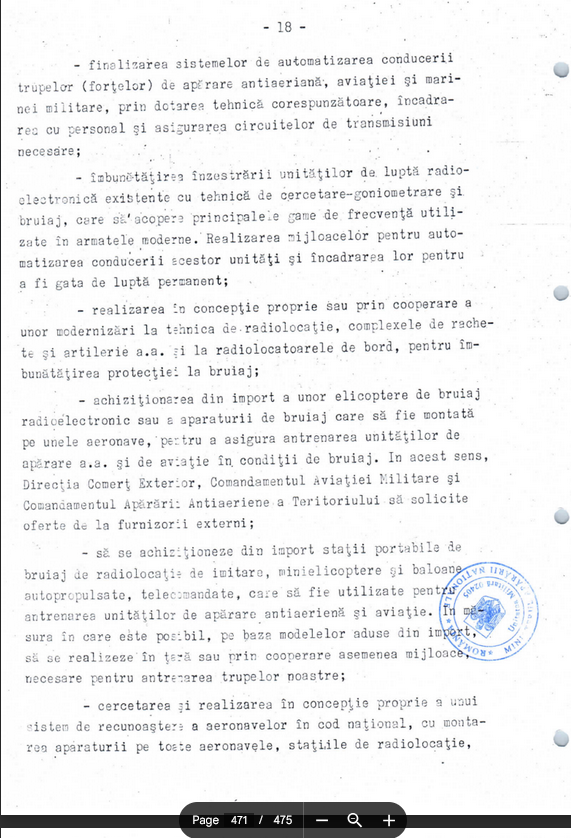
Case in point, is the following document from 09.04.1990, “Constatari” for short, conducted by CAAT. Remember, Pitu claimed to Ion Cristoiu in May 2023 (see previous two posts here) that ALL Army structures, to include CAAT (“aparare antiaeriana,” the Territorial Anti-aircraft Defense Command), conducted their own independent studies after January 1990 and came to the same conclusion: THE TERRORISTS DID NOT EXIST.

I ask my readers to examine the following. Pitu’s characterization of Constatari in Rechizitoriul din dosarul Revolutiei and in Ruperea blestemului. Read what he selected to cite in those publications and then read the entire document, especially from page 84 section II. 1., information that is left out by Pitu. Dear reader, did CAAT indeed conclude as Pitu claims in Rechizitoriul and in Ruperea blestemului that the “terrorists did not exist”?! The answer is pretty clear. Pitu lies by omission in this particular case.

Posted in decembrie 1989 | Leave a Comment »

Military Prosecutor Catalin Ranco Pitu: “Every Army structure after January 1990…concluded that the terrorists did not exist” v. DOCUMENTAR CU ACTIUNILE DESFASURATE DE U.M. 01929 RESITA 17.12.’89-26.12.’89 (29.12.1992)

Posted by romanianrevolutionofdecember1989 on May 29, 2025

After he retired in March 2023, military prosecutor General Catalin Ranco Pitu began an extensive media tour. Among his first and most important stops was a 16 May 2023 interview by journalist Ion Cristoiu (alias “Coroiu,” his alleged codename as an informer for the communist era secret police, Securitate, of Nicolae Ceausescu; I have detailed on this site how Cristoiu launched the journalistic careers of former Securitate influencers–Angela Bacescu, Pavel Corut (aka Paul Cernescu), G.I. Olbojan, etc.). [Cristoiu supported and promoted the “suveranist,” far right, Trumpist cause of AUR Presidential Candidate George Simion in the 2025 Romanian Presidential Election.]

Asked by Cristoiu about the new documents Pitu had studied, Pitu references a series of documents declassified/”desecretized” and delivered to the Military Procuracy in 2017/2018. Because of how Pitu discusses and presents these documents, it is quite clear which file in the so called Dosarul Revolutiei (File of the Revolution) Pitu is talking about. Pitu could say that the documents prepared by various “Army structures”–which he identifies as military aviation, anti-aircraft defense, tank regiments, infantry, the marines–say one thing, but the military prosecutors determined through additional depositions and study that their claims and allegations did not hold up to closer scrutiny. But, no! Pitu instead makes the bombastic claim that “every Army structure…structures…prepared their own very thorough analyses after January 1990 about what happened hour by hour during the Revolution…their conclusions are phenomenal…EACH AND EVERY MATERIAL SHOWS THAT THE TERRORISTS [COUNTERREVOLUTIONARY CEAUSESCU LOYALISTS] DID NOT EXIST…” (from approximately min. 25:30-26:00 in the link below)

It is a brazen, childish and almost child-like claim. The documents in fact argue completely the opposite of what Pitu claims. Pitu seems to assume no one will ever see or read or study the documents he is referencing. He is wrong. Pitu and his believers and supporters are able to continue their media campaign because of access to personalities and platforms, where they never face anything even approaching challenging questions.
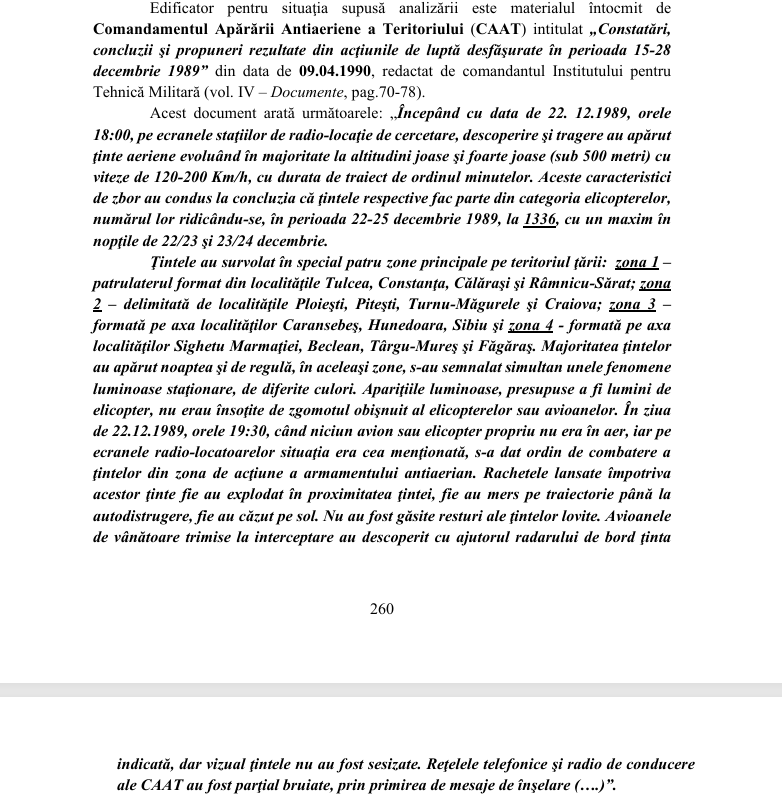
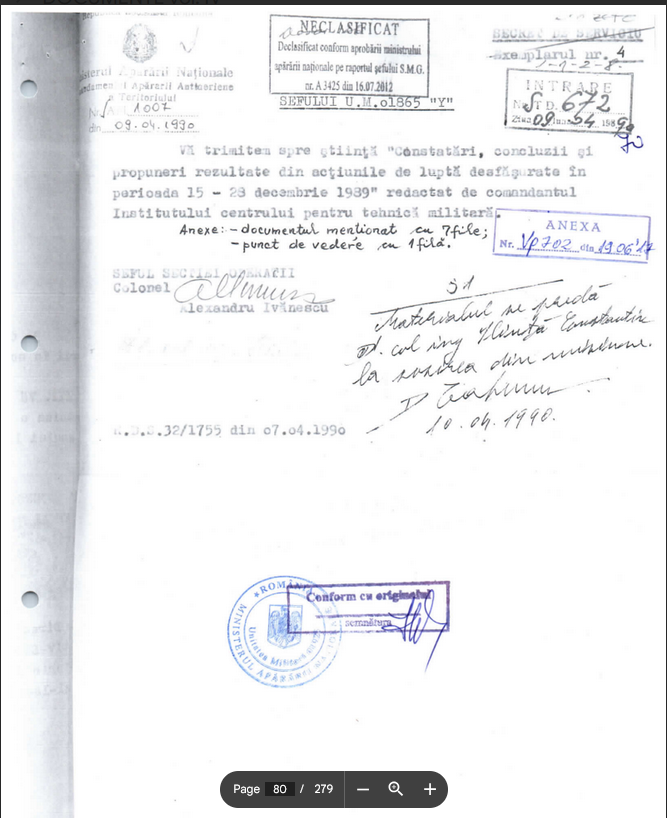
Were Pitu to admit that the military concluded exactly the opposite, as they did, then he could be forced to explain the discrepancy. What caused military prosecutors to claim differently? What changed over time and when did it change? It is simply easier to lie and to assume that no one will ever see what these “Army structures” argued.


Below documents from #17 from the Table of Contents at the start of this post. As we will see in a future post, Pitu refers to the document “Constatari” from #15 above in both the Indictment (Rechizitoriul, 2022) and in his book, Ruperea blestemului (2024). So it would be difficult for Pitu to argue that he did not receive or see the following document. Even more than many of the other documents in this 2017/2018 tranche, this document was not in the immediate wake of December 1989. In fact, it is dated December 1992, three full years after the Revolution. The seductive deconstructionist Western academic obsession with “(false) myths” resulting from the confusion and suspicion of the moment and on public narratives designed to influence public opinion, thus faces a real challenge with an internal study, not designed for public distribution, three years after the events.

Posted in decembrie 1989 | Tagged: , , , , , | Leave a Comment »