The Archive of the Romanian Revolution of December 1989

A Catch-22 December 1989, Groundhog-Day Production. Presenting the Personal Research & Scholarship of Richard Andrew Hall, Ph.D.

Archive for September, 2010

“ORWELLIAN…POSITIVELY ORWELLIAN:” PROSECUTOR VOINEA’S CAMPAIGN TO SANITIZE THE ROMANIAN REVOLUTION OF DECEMBER 1989 (Part Four, The Mysterious Men in Black)

Posted by romanianrevolutionofdecember1989 on September 30, 2010

“ORWELLIAN…POSITIVELY ORWELLIAN:”

PROSECUTOR VOINEA’S CAMPAIGN TO SANITIZE

THE ROMANIAN REVOLUTION OF DECEMBER 1989

by Richard Andrew Hall

Disclaimer:  All statements of fact, opinion, or analysis expressed are those of the author and do not reflect the official positions or views of the Central Intelligence Agency (CIA) or any other U.S. Government agency.  Nothing in the contents should be construed as asserting or implying U.S. Government authentication of information or CIA endorsement of the author’s views.  This material has been reviewed by CIA to prevent the disclosure of classified information.

This paper MAY be cited when accompanied by a full, proper citation.  Thank you.


MEN IN BLACK:  The Recurring Theme of “Black Jumpsuits”

Part of the great riddle of the “terrorists” concerns their clothing.  In Brasov, it was noted the individual arrested on 23 December firing a 5.65 mm Thomson automatic was wearing a “black jumpsuit.”  The descriptions go by different names—“combinezoane negre,” “salopete negre,” or “de culor inchis,” for example—but they all note the black or dark outfits of many of those suspected of being “terrorists.”

It is critical to note that we have evidence that the focus on the black clothing of those identified as “terrorists” occurred among participants at the time, and is not merely some ex post facto artifact.  Major A.D. of Directorate V-a (probably Major Aurel David) recounted in early 1991 that while under arrest on 27 December 1989, the Army soldiers guarding him asked “If” as Major A.D. had sought to convince them, “it isn’t Ceausescu’s guard [i.e. V-a]” who was firing, “then who are the black-shirted ones [emphasis added]?”[52] The report of the SRI [the Securitate’s institutional successor] on Timisoara indirectly confirms Army suspicion when alleging that Army Colonel Constantin Zeca gave the order after 22 December 1989, to shoot at anybody “in a blue, navy blue, or black jumpsuit.”[53] Why this clothing in particular, and why the suspicion then?

Some of those shot as “terrorists” turn out to have been wearing “black jumpsuits.”  Bucking the hegemony of official, elite interpretations denying the very existence of the “terrorists,” a poster calling himself “Danka” posted the following on the Jurnalul National web forum in April 2006:

“22 decembrie 1989, military unit 010_ _ at the edge of the Branesti forest.

The Branesti forest houses one of the largest munitions depots around the capital.  It is said that an explosion at this depot would destroy the Pantelimon neighborhood from the beginning of the no. 14 tram [route].  Towards evening gunfire opened on the unit from the railroad.  Everything was a target, [and] small caliber arms and semi-automatic weapons were being used [emphasis added; note:  possible reference to 5 mm weapons].  Based on the flashes from the gun-barrels it appeared that there were 3 persons hiding among the tracks who opened fire with the goal of creating panic.  The soldiers came out of their barracks and set up in the car-park under trucks.  They couldn’t stay inside the buildings, “the terrorists” were shooting the windows [out].  Even though an alert had been given earlier in the day, nobody was prepared to respond except those on duty.  A group of soldiers with officers and n.c.o.s equipped with AK-47s, and TT pistols launched an attack from the surrounding area.  All reached their destined locations without problem by nightfall, in part because the intruders were preoccupied with maintaining a continuous gunfire on the unit.  At a given moment, the soldiers opened fire, the gunfight lasted less than 10 minutes.  Their little UZIs weren’t equipped for long-distance and thus could not stand up to the renowned AK 47.  One of the terrorists was shot in the head, while the other two were wounded when they tried to flee through a field leading away from the military unit.  The three were transported to the guard post where the lights were turned on (until then the unit had been in complete darkness) and we realized that one of the two survivors was in fact a woman.  All three were olive-skinned, clothed in black jumpsuits [emphasis added] and the two wounded survivors struggled to say something in Arabic.  After a half hour an ARO [vehicle] of the Army arrived saying they had come from the Chief of Staff’s Division and they took all three.  After a few days all the soldiers who participated in the activities of that night were made to sign a declaration pledging not to divulge anything about what had happened.  All of this is true and can easily be verified.”[54]

Another small group of people wearing “black jumpsuits” held a military convoy under fire near the city of Buzau. On the evening of 23 December 1989, a military convoy from Piatra Neamt en route to Bucharest reached the community of Maracineni near Buzau.  Members of the local military unit told the soldiers from Piatra Neamt that

…the unit had been attacked by two people, a civilian and Militia NCO, who disappeared with an Oltcit [car] and an ABI vehicle [an armored transport used exclusively by the Securitate’s USLA].  Shortly after [being told] this, gunfire opened on the convoy.  And gunfire reopened on the local military unit….those from the unit fired back with ordinance that lit the sky, in this way enabling them to observe a group of 3-4 armed people, wearing black jumpsuits (“salopete negre”) who were shooting while constantly changing position.  At the same time, on the radio frequencies of the convoy, they received messages about coming devastating attacks, and even Soviet intervention.  All of these proved to be simple disinformation.  The next day, in a moment of calm, villagers brought the soldiers food, and related how the terrorists had occupied attics of their houses.  They said they [the occupiers] were Romanians and that in a few words they had ordered [the villagers] to let them into the attics of their houses….In general, they shot at night, but on 25 December the cannonade continued during the day…. Curiously, the ‘fighting’ in Maracineni continued until 30 December.  Who and for whom were they trying to impress? [emphasis added][55]

Indeed, there are three key aspects here:  1) this was not a heavily populated area, thereby undermining arguments about “operetta-like” fake warfare to impress the population, 2) it is difficult to explain this episode as the result of “misunderstandings” between units, and 3) the gunfire lasted well over a week, a fact that is difficult to ascribe to confusion.

Did the black-suited ones have any affiliation to any institution?  After all, is it not odd that so many of them would appear to be dressed in the same garb?  In 1990, an engineer, Mircea Georgescu, expressed his frustration about the post-December disappearance of the “terrorists” in Sibiu, Nicu Ceausescu’s fiefdom, as follows:

“Who fired from the attics of Sibiu on 21-22 December 1989?  Who are the so-called terrorists?  Where are their guns with scopes and unmistakable cadence?  Silence on all fronts:…

c) A fighter from the guards, along with his brother, captured in these days (23-25 dec.) some 8 securisti among whom:  one about 45-50 years old, at the State Theater Sibiu, we surrendered him to the Commander at the Army House.  He was taken under guard by 4 civilian fighters (one in front had a club in his hand) and by a soldier with a gun at his side.  He was dressed in a vest (like a smith’s) and a pant-suit (combinezon) that was black or a very dark grey…brown with short hair, well-built and 1,70-1,75 m tall….What, nobody knows anything about this guy either?…[emphases added]”[56]

Lt. Col. Aurel Dragomir, former commander of the “Nicolae Balcescu” Military Officers School in Sibiu, described in 1994 those killed as “terrorists” in Sibiu in December 1989:

…On the morning of 22 December…I was informed that on the rooftops there were some suspicious persons.  I saw 2-3 people in black jumpsuits.  The Militia told me that they weren’t their people.  At noon there appeared 10 to 15 people in black jumpsuits who opened massive gunfire on the crowds and soldiers. I ordered them to respond with fire.  I headed to the infirmary—the reserve command site, and col. Pircalabescu [head of the Patriotic Guards] called and asked me “why was there gunfire?”  I told him we were being attacked.  He told me to cease fire.  Ilie Ceausescu [Ceausescu’s brother, and an Army General] told me to surrender.  I slammed the telephone down.  Then [Army General] Stanculescu called.  I told him that we are under attack. Stanculescu said to me:  ‘Defend yourselves!’….The attackers had on black jumpsuits under which they had on civilian clothes….Weapons and ammunition that weren’t in the arsenal of the Army were found, guns with silencers were found, that aren’t in the Army’s arsenal….After the events declarations given to the investigating commissions disappeared, notebooks filled with the recordings of officers on duty (ofiterii de serviciu), and a map that noted from which houses gunfire came. The dead who were in jumpsuits and had several layers of clothing were identified:  they were cadre from the Sibiu Interior Ministry (Militia and Securitate)…. (“black jumpsuits” emphases and “weapons and ammunition…” emphasis added; rest in original)[57]

Finally, in this context, the comments of a Codrut H. in July 1990 about what he and other civilians found when they occupied Securitate headquarters in Brasov on the night of 22 December:  “What appeared suspicious to me was that the Securitate there appeared to have been prepared [for something]….  Out front of the building there was a white ARO [automobile] in which there were complete antiterrorist kits [emphasis added].” What else did the civilians find there?…combinezoane negre. [58]

Where and From Where Was There Gunfire?

So if there is evidence of ammunition that cannot be accounted for in standard arsenals and of people killed and identified as “dead terrorists”—who clearly do not fit into the standard categories of those killed during the events—what is perhaps the next logical question?  That might be:  where and from where did the gunfire come?

To continue with Sibiu and Lt. Col. Dragomir’s claims, former Prosecutor Marian Valer, who claimed to have “noticed shortly after the publication of his resignation from this position [claiming obstruction] that I was benefiting from the services of the organization of Virgil Magureanu [i.e. the SRI, the Securitate’s institutional successor],” stated in September 1990:

…during the events of December 1989 in Sibiu, the army found a map with the safehouses of the Securitate, around the city’s military units, in which Securitate cadre were to be placed to act against them, in the eventuality of a defection by the army from the Ceausist regime.  Following the investigations conducted, it was determined that from these same houses gunfire was opened on some of these military units, beginning with the afternoon of 22 December 1989, therefore after the overthrow of the dictatorship.  It was also established that, in general, in these respective houses lived former cadre of the Securitate and Militie, who had retired or crossed into reserve status, or informers of the Securitate, and also that, following the outbreak of the antiCeausist demonstrations in Sibiu, at these houses entered cars that had license plates from other counties, for example Constanta, Iasi, [and] Bacau.  Thus upon the [Army unit] U.M. 01512, gunfire was opened from the house at no. 7 Stefan Cel Mare Street…in which lived the families of a former Sibiu Securitate commander and an informer of the Securitate…On U.M. 1606 there was shooting from no. 47 Moldoveanu Street, in which lived a former Militia chief of Sibiu county, while upon U.M. 01080 there was fire from vila Branga [see earlier discussion of this location referencing five mm caliber bullets]…It was determined that the owners of these places were not at home during the events, having left several days earlier, and that in some houses there was no furniture or signs of habitation.  The map of the safehouses of the Securitate and Militie came into possession of Lt. Col. Dragomir, commander of the Sibiu garrison, but when he was asked to present it to the investigatory commission he said he could not find it.[59]

In 1991, Dumitru Mazilu, a key player in the December events who quickly fell out of favor with those who seized power and was marginalized, posed these appropriate observations about the fighting in Bucharest:

The involvement of some units and soldiers of the Interior Ministry during this particular period [after 22 December] is confirmed by the following observations:  a) the sites from which crowds were fired upon certainly belonged to the Interior Ministry (for example in the case of the buildings near the Central University Library, that belonged to the Guard Directorate [V-a] of the Ceausescus] or with great probability (the apartments from the Building General across from the work space of the tyrant; the apartments near the villas of Elena and Nicolae Ceausescu, as well as those near objects of strategic importance, such as the Defense Department, Television, and Romanian Radio etc.)…[60]

…Without a doubt two other issues could play a major role in finding out who those were who were firing on Television:  a) First, to request the identity of the meeting houses of the organs of repression, in the area around the Television.  Then to verify who the people were who used these houses in the days from the afternoon of 22 December until 27, 28 December.  Again these sites could play a big role in the success of the investigations; b) Then to find out the other places from which people were fired upon in these dramatic days and nights.  And those who put their places at the disposition, either willingly or under duress, as well as their neighbors, could play a big role in discovering the terrorists.[61]

In 2003, Senator Sergiu Nicolaescu, who headed the first investigation into the December events back in the early 1990s was asked by an interviewer, “Mr. Senator, by now I also have reached the conclusion that in order for something like this to function there had to exist at least two things:  a plan and a leadership.  Who led it?”  Nicolaescu responded as follows:

There are links to the Securitate here.  They had made this strategy.  They had long had this mission, when these people were selected and conspired and received their orders.  In order to understand the phenomenon we started an investigation from the ground floor, with the most basic information.  There existed safehouses. I asked officially for information about these safehouses.  I don’t know if this is what they are technically-called, but we are talking about apartments, empty spaces in safehouses, some even in hotels, while another category that should not be confused with the first is that of guesthouses, where their people lived.  That was something else altogether.  They met there with informers.  That is different.  In the safehouses there were weapons and military outfits of different grades and specializations, as well as civilian clothing.  I asked the SRI [the Securitate’s official institutional heir] for the list, but they never gave me it.  I had the list of the apartments from which there was gunfire.  I attempted to reconstitute [a list] with the help of specialists and identified the places from which there was gunfire.  My intention was to compare this list with the list of safehouses.  They wouldn’t give it to me.  Thus, I made recourse, unofficially, to a different method to secure a copy of the list of safehouses.  It turned out exactly as I suspected—they matched exactly.  Thus I was able to learn who were the terrorists from this category who acted, since there were some houses from which there was no gunfire, where they did not go into action. [emphasis added][62]

[52] Maior A.D., “Scenariile si Realitatea:  Marturie la dosarul ,Teroristi’ (VI),” Timpul (ed. Raoul Sorban), 1 March 1991, p. 11.

[53] See Raportul SRI EPISODUL I (2/2) Timisoara ’89 at www.ceausescu.org/ceausesscu texts/revolution/raportul sri12.htm. As if to confirm the suspicions, Securitate officer Filip Teodorescu told the Gabrielescu Commission that “Whoever had the idea to dress [them] in combinezoane negre had a clever idea!” (using the English translation at en.wikisource.org.wiki/Stenograma sedintei de audiere din 14 decembrie 1994).

[54] Posted on the web forum at Jurnalul National, April 2006, online edition.

[55] Stoian, Arta Diversiunii, 1993, pp. 55-57.

[56] Ing. Mircea Georgescu, “Sibiu (III),” Expres, no. 28 August 1990.

[57] Quoted in Dan Badea, “Secretle Revolutiei,” Expres no. 22 (6-13 June 1994), pp. 8-9.

[58] Quoted in Alin Alexandru, “Brasov (II):  Linistea dinaintea macelului,” Expres, no. 26 (July 1990).

[59] Marian Valer, interview by Monica N. Marginean, “Asistam la ingroparea Revolutiei [We are witnessing the burying of the Revolution],” Expres, no. 33 (September 1990), p. 2.  In 1994, Dragomir maintained:  “After the events some declarations given to the investigating commission disappeared, as well as notebooks filled with the recordings of officers on duty, and a map that had markings of the houses from where there was gunfire.”  See his comments in Dan Badea, “Secretele Revolutiei,” Expres, no. 22 (7-13 June 1994), p. 9.

[60] Dumitru Mazilu, “Cine sint teroristii?” Flacara, no. 39 (25 September 1991), p. 4.

[61] Dumitru Mazilu, “Cine sint teroristii?” Flacara, no. 41 (9 October 1991), p. 4

[62] Sergiu Nicolaescu, interview by Alex Mihai Stoenescu (2 September 2003), “Teroristi din URSS, Ungaria si Occident,” Jurnalul National, 10 December 2004, online edition.

Posted in Uncategorized | Tagged: | 3 Comments »

“ORWELLIAN…POSITIVELY ORWELLIAN:” PROSECUTOR VOINEA’S CAMPAIGN TO SANITIZE THE ROMANIAN REVOLUTION OF DECEMBER 1989 (Part III, A Fistful of Bullets: Unregistered, Atypical Munitions…)

Posted by romanianrevolutionofdecember1989 on September 29, 2010

“ORWELLIAN…POSITIVELY ORWELLIAN:”

PROSECUTOR VOINEA’S CAMPAIGN TO SANITIZE

THE ROMANIAN REVOLUTION OF DECEMBER 1989

by Richard Andrew Hall

Disclaimer:  All statements of fact, opinion, or analysis expressed are those of the author and do not reflect the official positions or views of the Central Intelligence Agency (CIA) or any other U.S. Government agency.  Nothing in the contents should be construed as asserting or implying U.S. Government authentication of information or CIA endorsement of the author’s views.  This material has been reviewed by CIA to prevent the disclosure of classified information.

This paper MAY be cited when accompanied by a full, proper citation.  Thank you.

A Fistful of Bullets:  Unregistered, Atypical Munitions…


“Five, Five Something…”

Perhaps more directly pertinent to the issue of the “terrorists,” and the question on which Voinea lays a big goose-egg, is the following.  What does Voinea have to say about allegations that there was “special ammunition used, bullets with a vidia tip or dum-dum bullets”?

Romulus Cristea:  “Did special ammunition, bullets with a vidia tip or dum-dum bullets, claim [any] victims?  The press of the time was filled with such claims…”

Dan Voinea:  There were no victims (people who were shot) from either vidia bullets or dum-dum bullets.  During the entire period of the events war munitions were used, normal munitions that were found at the time in the arsenal of the Interior Ministry and the Defense Ministry.  The confusion and false information were the product of the fact that different caliber weapons were used, and therefore, the resulting sound was perceived differently.[29]

Prosecutor Voinea is perhaps less definitive, less clear here than in denying the existence of gunfire simulators and insisting that the lunetisti were unquestionably from the Army.  By “normal munitions” I understand him to mean what was officially in the registered stockpiles of the Romanian armed forces:  mostly 7,62 mm caliber weapons, but also apparently 12,7 and 14,5 mm caliber vehicle-mounted guns, and perhaps including 9 mm weapons belonging to the Securitate (more on this below).  That is, of course, the rub of the Revolution, for nowhere in the official registered arsenals do bullets of a 5 (five) something caliber appear…and yet they showed up all over the place in December 1989.

Brasov: 14 June 1990 was an unusual and important day in Romanian history, but not solely for the event you probably have in mind if you follow Romanian affairs.  Yes, in Bucharest, miners from the Jiu Valley were brutally hunting down anti-regime demonstrators and pretty much anyone else they suspected of sympathizing with opposition to President Ion Iliescu, but that was not the only significant event of that day.  General Nicolae Spiroiu, future Defense Minister (1991-1994), appears to have been in the city of Brasov, assisting at the exhumation of people killed there during the December 1989 Revolution.[30] Such a step was a rarity, and apparently followed earlier talks between Spiroiu, five other officers, and the staff of the local newspaper Opinia, who were seeking clarification over who was responsible for the deaths of their fellow citizens.  “They found in particular bullets of a 5.6 mm caliber that are not in the Army’s arsenal,” wrote the journalist Romulus Nicolae of the investigation.[31] It is worth noting that eyewitnesses recount that on 23 December 1989, an individual in a black jumpsuit (“combinezon negru,” this is a recurring theme as we shall see) firing a Thompson automatic of 5.65 caliber (with many cartridges on him) was shot, injured, and arrested as a “terrorist.”[32]

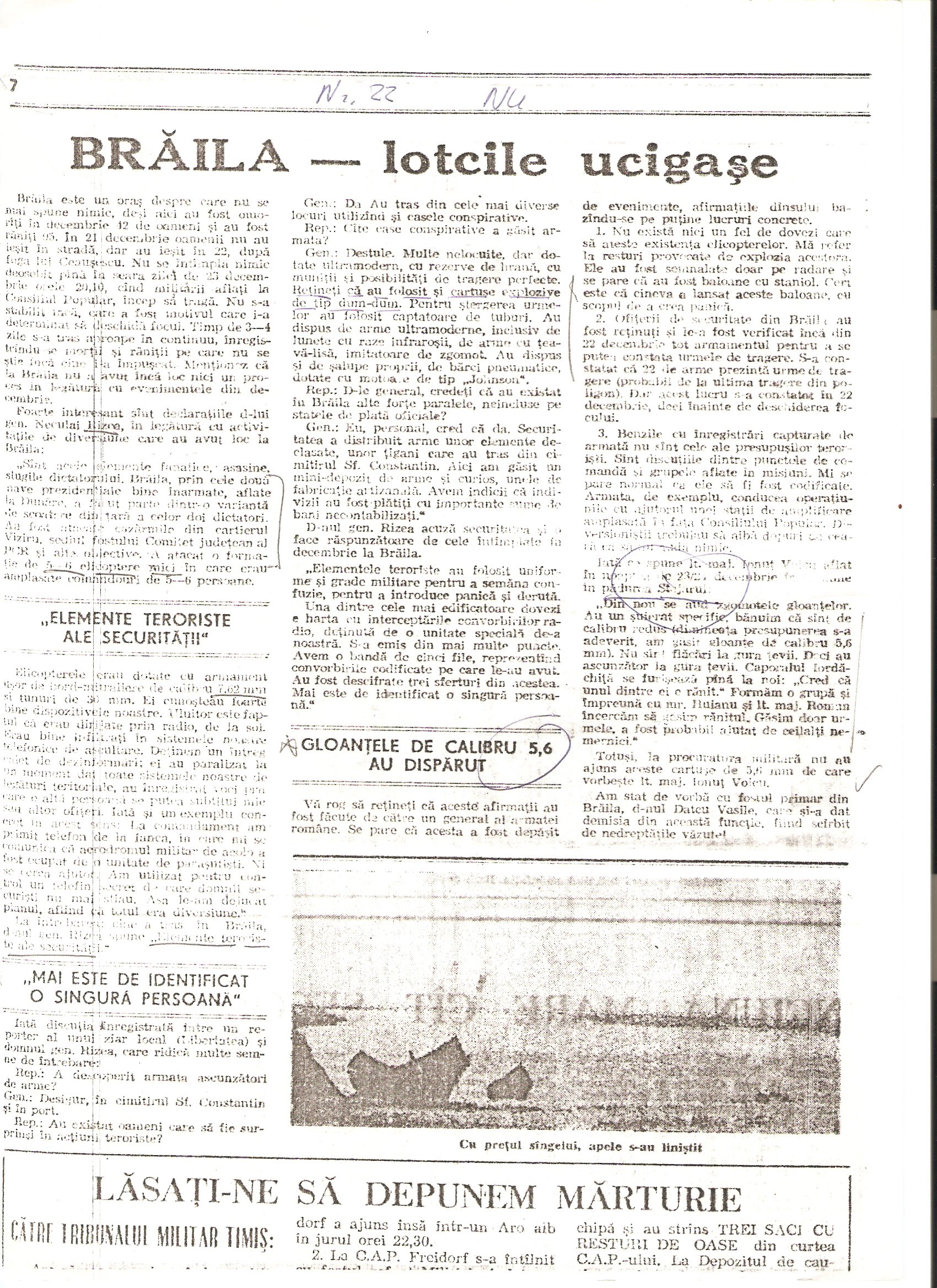
Braila: In Braila (where 42 people died and 95 were wounded), Army Lt. Major Ionut Voicu told the military prosecutor in charge of the case at the time of what he found while on a mission in the Stejarul forest on the night of 23-24 December 1989:

Again I heard the sound of bullets.  They had a specific whistle, I figured they were of a reduced caliber (the next morning this hunch was confirmed when I found bullets of a 5.6 caliber).  There wasn’t any flash from the mouth of their gun-barrels.  Thus, they [must have] had a silencer over it.[33]

Sibiu: Army Lieutenant Colonel Aurel Dragomir claims that in the building across from the Vila Branga in Sibiu “remains of 40 5.45 mm bullets, that were not in the Army’s arsenal, were discovered.”[34] On 23 December 1989 in Sibiu, a soldier participated in the capture of one Fanea Nicolae who was carrying a Belgian-made 5.6 mm Browning and “a radio transmitter-receiver of the type used by the Romanian ‘Militia’.”[35]

Timisoara: “…a 5.6 tube was found by a MapN [Army] subunit which was in pursuit of shooters found moving rapidly in the area of the blocs around the [Militia] Inspectorate.”[36]

Bucharest: According to the Army’s semi-official account of the December events, in the area around the Defense Ministry “there were also found bullets that were atypical for the weapons of Defense Ministry troops, having a caliber of approximately 5.45-5.65 mm.”[37] During the trial of Nicolae Ceausescu’s brother, Nicolae Andruta Ceausescu, head of the Securitate’s Baneasa training academy, it was disclosed that at his home “a gun with an infra-red scope and 695 cartridges of 5.6 mm bullets were found.”[38] Nicolae Stefan Soucup maintains he found 5.6 caliber bullets on 23 and 24 December in the area around the Television station.[39] Savin Chiritescu wrote to Romania Libera in October 1990:

“…myself and many colleagues from this tank unit [UM 01060 Bucuresti-Pantelimon] captured armed Arab terrorists (one of whom told us he was from Beirut), who we turned over to the Chief of Staff’s Division.  One was a student, upon whom we found a machine gun of 5.62 caliber series UF 060866, 40 cm long, capable of being carried under clothes:  the weapon was made from a hard plastic, with the exception of the gun barrel and the trigger.  He admitted he had been paid and that he loved Ceausescu greatly.  He was wearing leather pants, PUMA sneakers and a black sweater….”[40]

What can we gather from this brief discussion thus far?  Well, for one thing, those who wish to draw our attention to the use of these “five something” caliber bullets are from the Army or civilians.  (Although the exact caliber clearly matters, the Army seems to acknowledge a window above in noting “5.45-5.65 mm,” suggesting that we should not get too caught up on the exact measurements for our purposes here.)

Indeed, this is par for the course.  Members of the former Securitate and Militia generally avoid mentioning these uncharacteristic munitions and certainly don’t want to draw undue attention to them.  The question is why?  By contrast, the Army must feel they are on pretty comfortable ground that they draw attention to this ammunition and specify that the Army did not have it in their arsenal.

To conclude this section, it seems appropriate to recall the observation of Army General Tiberiu Urdareanu in 1996:  “…in contacts with certain cadre of the former Securitate, even some friends among them, [to a person] they negate the existence of the terrorists, saying that the soldiers as a result of poor training shot each other by accident.”[41] Why such firm conviction?!

Vidia…

What about the use of “vidia” tip bullets Prosecutor Voinea also flatly dismisses?

In March 1991, Spiroiu’s predecessor as Defense Minister, General Victor Athanasie Stanculescu, was asked by two journalists if the “terrorists used a particular type of ammunition…against the armed forces.”[42] Stanculescu responded:

Yes, as I have already said, I have here two bullets with vidia [grooves].  Our Army does not use this type of ammunition.  It is of caliber 5.56.  As you can see, the bullet has a jacket that got deformed, while its core remained intact.[43]

Bucharest: Stanculescu’s unexpected revelation prompted a participant in the Revolution to challenge Stanculescu’s claim to ignorance as to the source of the bullets.  Ironically, while this challenge suggests Stanculescu may have being playing coy and not telling everything he knew, it does not contradict Stanculescu’s claim that the ammunition was not the Army’s, but rather buttresses it:

Balasa Gheorghe:  I am very intrigued by the interview given by General Stanculescu to the newspaper ‘Tineretul Liber,’ an interview in which he avoids the truth.

From [Securitate] Directorate V-a, from the weapons depot, on 23-24 December 1989, DUM-DUM cartridges, special cartridges that did not fit any arm in the arsenal of the Defense Ministry were retrieved.  Three or four boxes with these kinds of cartridges were found.  The special bullets were 5-6 cm. in length and less thick than a pencil.  Such a cartridge had a white stone tip that was transparent.  All of these cartridges I personally presented to be filmed by Mr. Spiru Zeres.  All the special cartridges, other than the DUM-DUM [ones] were of West German [FRG] make. From Directorate V-a we brought these to the former CC building, and on 23-24 December ’89 they were surrendered to U.M. 01305.  Captain Dr. Panait, who told us that he had never seen such ammunition before, Major Puiu and Captain Visinescu know about [what was turned over].

In the former CC of the PCR, all of those shot on the night of 23-24 December ’89 were shot with special bullets.  It is absurd to search for the bullet in a corpse that can penetrate a wall….[44]

One of the particularly moving stories of the December events is that of Bogdan Serban Stan, 21 years old and one of three members of the under-22 Rapid Bucuresti rugby team who perished in the events.  Bogdan’s mother, Elena Bancila, was determined not to let the memory of her son be forgotten with his tragic death.  Bogdan had demonstrated on the night of 21-22 December in University Square and returned to fight at Television where on the night of 23 December at 3:50 am he was shot by an assailant in civilian clothes:  “The path of the ‘6 mm vidia’ cartridge blew a hole through his lung and ‘passed through’the T9 section of his spine, coming to a rest vertically in the bone marrow.”[45]

Engineer Dan Iliescu (no apparent relation to Ion Iliescu), an employee of the Museum of National Art located in the old Royal Palace across from the CC building, alleged in December 1990—therefore prior to the above claim by, and response to, Stanculescu—that those who fired from the museum onto the square below on 22 and 23 December

…had weapons which sounded different.  They had a healthy cadence.  The next day [23 December 1989] and over the following days I found bullets in the Museum.  They were not normal bullets.  They had a rounded head.  They appeared to have a lead jacket.  It was of a caliber between five, five something. The USLAsi [USLA, Special Unit for Anti-terrorist Warfare] did not want to leave us a bullet.  I asked them to leave me one as a memento.  They did not want to.  They said that they needed them for the purpose of identification.  They noted where they gathered them from. [emphases added][46]

Caransebes: Furthermore, there is evidence that the use of “vidia” tip bullets was not exclusive to Bucharest.  Asked in February 1990 what he had experienced in December 1989 while participating in the defense of the airport of the southwestern town of Caransebes, Army Captain Mircea Apostol responded:

No, we only found blood stains and that was it.  We didn’t even find shell casings, because these melted away after firing.  It sounds incredible.  It was a real battle.  From our ranks, there were a few victims shot precisely in vital organs by bullets with a “vidia” tip, which were not in the arsenal of our Army, but we don’t know against whom we fought.  A fact which the enemy now uses. [emphases added][47]

Craiova: Finally, there is the case of one of the big personalities of the post-Ceausescu era, Dinel Staicu, a one-time soccer club mogul and owner of a kitschy Ceausescu nostalgic restaurant and park/museum.[48] Apparently, he “shot 63 bullets during the events,” but “according to him ‘only 11 to 13 stupid people died”[49]:

“Dinel Staicu moved about in those days unhindered, entering and exiting the prefecture, each time being armed, despite the interrogations to which he had been subject.  It would be interesting to know if the seizure of his weapons was recorded because, if not, it means, he still possesses them [the article dates from 1992].  After he was confined to his home for six days, for carrying an arm during the events, he resumed his mission:  ‘This time I succeeded to infiltrate Mr. Sandu, since he was my boss and bosses must stay at the helm.’  Implicated during this period in the policing of Valea Rosie (a neighborhood that had been raked by gunfire), forced by the former Militia commander, Colonel Langa, to verify to General Rosu [Army], the existence of vidia bullets following his confinement to his home, Dinel Staicu attempted a diversion in order to replace those who had seized power (Nisipeanu, Popa), …Although [technically-speaking] it was still confined to barracks, the Securitate (col. Gheorghe) ‘lent Mr. D. Staicu two TAB vehicles and some men from the Securitate’s USLA platoon (not from the Militia), even though the Securitate had been ordered not to carry arms.  But Mr. Staicu came on behalf of the Front…’

Following the inspection he performed in Valea Rosie, Staicu maintained that there were no terrorists (despite the fact that he himself is an example that contradicts such a denial), his basic training (Commander of Group 2-a USLA) being both for diversion and disinformation.  His opinion is that the Army fired millions of cartridges and that anywhere there was a military unit, the earth filled up with them.  Only that the military unit from Craiovita where there was no firing disputes this (…)[50]

In other words, a member of the USLA denies the existence of vidia bullets and “terrorists”….

Brasov, Sibiu, Bucharest (multiple locations), Braila, Caransebes, and Craiova…[51] Does such geographical distribution suggest accident or pattern? Yet, out-of-hand, Voinea dismisses the existence in December 1989 of either untraditional caliber weapons and bullets, or “vidia” tipped munitions!

[29] Interview with General Dan Voinea, by Romulus Cristea, “Toti alergau dupa un inamic invizibil,” Romania Libera, 22 December 2005 online edition.  Contrast Voinea’s definitive negations with the statements of Army Colonel Ion Stoleru, not just right after the events, but several years later.  According to Stoleru, the “terrorists” had “weapons with silencers, with scopes, for shooting at night time (in ‘infrared’), bullets with a ‘vidia’ tip.  Really modern weapons.  The civilian and military commissions haven’t followed through in investigating this…” (see Mihai Galatanu, “Din Celebra Galerie a Teroristilor,” Expres, no. 151 (22-28 December 1992), p. 4, and Mihai Galatanu, “Am vazut trei morti suspecti cu fata intoarsa spre caldarim,” Flacara, no. 29 (22 July 1992), p. 7.)

[30] Romulus Nicolae, “Au ars dosarele procuraturii despre evenimente din decembrie,”Cuvintul, no. 32 (August 1991), pp. 4-5.  Approximately 100 people died and 250 were injured in Brasov during the December events.

[31] Ibid.

[32] Andrei N. in Alin Alexandru, “Brasov (III). Teroristii au intrat in pamint,” Expres, no. 27 (July 1990), p. 6.  See also Ilie Stoian, Decembrie ’89.  Arta diversiunii. (Bucharest:  Editura Colaj, 1993), p. 44.

[33] Ciprian Banciu, “Braila—lotcile ucigase,” NU (Cluj), no. 22 (24-31 August 1990), p. 7.

[34] Aurel Dragomir, interview by Viorel Patrichi, “Conspiratiile nu erau de nasul meu!” (2), Lumea Magazin, 2002 (no. 6), online at www.lumeam.ro/nr6_2002/politica_si_servicii_secrete.html.

[35] Ion Neata, interview by Major Mihai Floca, “Unde sint teroristii?,” Armata Poporului, no. 30 (25 July 1990), p. 3.

[36] Grudgingly admitted by Col Stefan Demeter, former chief of the Timis County Militia’s armament office, in Stefan Demeter, interview by Radu Ciobotea, “M.I.—Martor Incomod,” Flacara, no. 33 (14 August 1991), pp. 4-5.

[37] Codrescu Costache, Radu Olaru, Mircea Seteanu, and Constantin Monac, Armata Romana in Revolutia din Decembrie 1989 (Bucharest:  Editura Militara, 1998), p. 157.

[38] Richard Andrew Hall, “Rewriting the Revolution:  Authoritarian Regime-State Relations and the Triumph of Securitate Revisionism in Post-Ceausescu Romania,” Ph.D. Dissertation, 1997, Indiana University , p. 322, citing Victor Dinu, Romania Libera, 12 April 1990, p. 2.

[39] Revolutia Romana in Direct (Bucuresti:  Televiziunea Romana, 1990), pp. 133-134, quoted in Hall 1997, p. 322.

[40] Quoted in Al. Mihalcea, “O gafa monumentala,” Romania Libera, 31 October 1990, p. 5a.

[41] Tiberiu Urdareanu, 1989—Martor si Participant (Bucharest:  Editura Militara, 1996), p. 139.

[42] Interview by Aurel Perva and Gavrila Inoan, Tineretul Liber, 5 March 1991, pp. 1-2, as translated in FBIS-EEU-91-047, 11 March 1991, p. 39.

[43] Ibid., using FBIS translation.

[44] Interviewed by Dan Badea, “Gloante speciale sau ce s-a mai gasit in cladirea Directiei a V-a,” Expres, 16-22 April 1991.

[45] Elena Bancila, Trage Lasule! (Bucuresti:  Editura Victor Frunza, 1990), pp. 65-66 (from Adevarul, 13 January 1990), and quote from pp. 94-95.  Bancila also claimed that a hospital nurse had told her some of those killed appeared to have been the victims of “exploding bullets” (see the series by Cristina Balint and Nicolae Tone in Tineretul Liber in September 1991, particularly part XI “Eu nu pot fi cumparata [I can’t be bought],” and part XII “Daca altfel nu se poate, voi cere deshumarea [If there is no other way, I’ll ask for his body to be exhumed], 22 and 24 September 1991 respectively).  In this series, the bullet that killed her son is referred to as “under 6 mm.”

[46] Dan Iliescu, interview by Ion Zubascu, “Misterioasa revolutie romana,” Flacara, no. 51 (19 December 1990), p. 11.

[47] Radu Ciobotea, “Teroristii au tras.  Unde sint teroristii?” Flacara, no. 8 (21 February 1990), p. 8.

[48] Dinel Staicu is one of those “personages” of the post-communist era.  He is something more than the hallucinatory former Militia officer, Sergeant Petre Olaru (see my discussion in “The Securitate Roots of a Modern Romanian Fairy Tale.  Part 3:  The Hypnotic Spell of Sergeant Petre Olaru,” Radio Free Europe Research “East European Perspectives,” May 2002, online).  But, for post-communist, or as is now said, post-post-communist, surrealism, he is probably something less than fellow soccer magnate, Gigi Becali—see, for example “Elita lui Gigi,” Cotidianul, 13 September 2006, online.  Reporters from ProSport claimed that Dinel Staicu told them he purchased for 2,000 dollars the original copy of the extraordinary military tribunal decision condemning the Ceasusescus to death.  That document had apparently been missing from the archives of the Bucharest Territory Military Tribunal (TMTB) since 1990, and although Staicu denied he is in possession of the original, he apparently supplied the TMTB with xeroxes of the document—after being fined for failing to present the original—so that the TMTB could reconstitute the judgment  (see Razvan Savaliuc, “S-a reconstituit dosarul procesului Ceausescu,” Ziua, 20 March 2004, online edition).  For a discussion of Staicu’s 200 hectare “Parcul RSR,” dedicated to Ceausescu’s “Golden Epoch” see Lucian Cazan, “‘Domnul si tovarasul’ Staicu,” Cotidianul, 7 October 2005, online edition.  On Nicoale Ceausescu’s 88th birthday, Staicu’s 3TV station apparently celebrated the occasion with footage from “The Golden Epoch,” see Lucian Cazan, “Oltenii, invitati sa se joace cu Michiduta,” Cotidianul, 27 January 2006, online edition.  Exactly what the mix of communist and post-communist corruption, genuine admiration for Nicolae Ceausescu and “the Golden Epoch,” entrepreneurship, greed, and playing to foreign tourists (Russian, according to Cazan, and Western), motivates Staicu is unclear.

[49] “‘Antimafia’—Un Armagedon de Craiova,” Adevarul, 3 May 2002, online edition.

[50] Reprinted from the testimony of Dinel Staicu in the Craiovan publication Cartel (8 April 1992), Dinel Staicu:  “Misunea mea a fost sa-l infiltrez pe Sandu in prefectura,” Gazeta de Sud, 23 December 2002, online at http://www.gds.ro/print/13885.

[51] In the interview cited above in which Mircea Dinescu discusses the existence of simulators, his interlocutor, Eugen Evu, notes in passing the presence of “vidia” bullets in yet another locality, this time, Hunedoara:  “The same scenario, everywhere that people were shot.  And in Hunedoara, I swear that they shot at me, I was in front of the Post Office, with a trade union woman…Traces, holes of a vidia bullet, next to a normal one, remained for a long time in the window at the entrance to the Post Office, they shot at me, I had long been followed by securisti and some militie people, who would periodically arrest me.”  See Mircea Dinescu, with Eugen Evu, “Dialoguri integrale in forum: ‘Tenebre romanian color,’” 1997 at http://www.agero-stuttgart.de.

Posted in decembrie 1989, raport final, Uncategorized | Tagged: | 8 Comments »

“ORWELLIAN…POSITIVELY ORWELLIAN:” PROSECUTOR VOINEA’S CAMPAIGN TO SANITIZE THE ROMANIAN REVOLUTION OF DECEMBER 1989 (Part Two, Sergeant Schultz)

Posted by romanianrevolutionofdecember1989 on September 28, 2010

“ORWELLIAN…POSITIVELY ORWELLIAN:”

PROSECUTOR VOINEA’S CAMPAIGN TO SANITIZE

THE ROMANIAN REVOLUTION OF DECEMBER 1989

by Richard Andrew Hall

Disclaimer:  All statements of fact, opinion, or analysis expressed are those of the author and do not reflect the official positions or views of the Central Intelligence Agency (CIA) or any other U.S. Government agency.  Nothing in the contents should be construed as asserting or implying U.S. Government authentication of information or CIA endorsement of the author’s views.  This material has been reviewed by CIA to prevent the disclosure of classified information.

This paper MAY be cited when accompanied by a full, proper citation.  Thank you.

PART ONE:  http://atomic-temporary-3899751.wpcomstaging.com/2010/03/26/orwellian%E2%80%A6positively-orwellian%E2%80%9D-prosecutor-voinea%E2%80%99s-campaign-to-sanitize-the-romanian-revolution-of-december-1989-part-one-groundhog-day/

PART TWO:

Judging Voinea’s Credibility

Why do I question Voinea’s credibility on the “terrorist” question—despite the chorus of adulation, gratitude, and acceptance outlined above?  Before moving on directly to the issue of the “terrorists,” let us look at two potentially-related—in fact, I argue, related—matters as test cases of Voinea’s credibility in his recent comments on the Revolution.  Although not necessarily central to the story of December 1989, allegations regarding the existence, use, and discovery of gunfire simulators, and the institutional affiliation of so-called “lunetisti” (sharpshooters/snipers), are part of that story.  These should not be difficult questions for Voinea, but instead he dismisses them with an unexpected salvo of “definitive” answers, designed to leave little room for further questioning from the interviewer.  As I shall demonstrate, however, it leaves an ocean of doubt.

Test Case I:  Automatic Gunfire Simulators

Romulus Cristea (reporter “Romania Libera,” interview 22 December 2005):  “Were any automatic gunfire devices or simulators found?”

Dan Voinea:  “No!  We don’t have a single confirmation of any such gunfire simulator!  Until now we have not come into possession of any such device.  No one saw such a gunfire simulator.  A device was presented on TV as a simulator, but [it] was nothing of the sort.  It was a lie!  Before 1989, any device would have been in the inventory of a[n state] institution.  No organization of ours, from the army to the Interior Ministry to the information services had such an apparatus in its stockpile.  Not only did they not exist in the stockpiles, none were found, and we do not have any evidence that such apparatuses were brought into the country….”[14]

Doesn’t leave a lot of room for misinterpretation or doubt, huh?  Let us observe three key elements in Voinea’s response.  He denies not only that 1) no Romanian institution had such device, but that 2) no such devices were used in December 1989, and 3) no such devices were found in December 1989.  This offers us three potential points of access to refuting his argument.

To begin with, there are the comments of senior communist official, CPEx (Romania’s version of the Politburo) member Silviu Curticeanu, who was in the Central Committee building [the center of Nicolae Ceausescu’s power] during these fateful December days.  Asked by the daily Jurnalul National about Ceausescu’s reaction to the disruption of his ill-conceived outdoor mass rally on 21 December 1989, Curticeanu responded:

“There was no public reaction.  He called together everyone responsible for the organization and smooth functioning of the meeting.  Those from the Securitate came and brought these nightsticks of which I spoke earlier, [as well as] simulators.  They had some electronic apparatuses. Everyone said the meeting was a provocation and everyone concluded the meeting was a provocation.  After that [Ceausescu] left, as I said earlier, and then he held the teleconference [with party officials throughout the country] and that was it.”[15]

So, according to Curticeanu, there were simulators:   they were brought to the CC building, and they were brought by the Securitate.

But wait, you say, Curticeanu was a party official, how would he know if these were simulators?  A fair question.  Well, then, let us look at the response of Securitate Director General Iulian Vlad before the Gabrielescu commission investigating the December events during the early 1990s:

“Mr. Gabrielescu:  Did you hear about these simulators that were used?”

“Mr. Vlad:  Of course, all of the Securitate had them…It seems to me that just such an electronic apparatus was used also on 21 December when the meeting broke up.  After Nica Leon (shouted ‘Timisoara, Timisoara!’) automatic gunfire was heard and panic broke out…”[16]

So, according to no less than the head of the Securitate himself, the Securitate had such simulators and such a device was used on 21 December (—significantly he leaves the context ambiguous, suggesting indeed that they could have been used to break up the rally after it had turned against Ceausescu).

But neither of these sources, even if somewhat unintentionally divulging details that undermine their claims about December 1989, has a great deal of credibility.  How about someone else—particularly someone with greater credibility among those who accept Voinea’s arguments—and how about a discussion of the simulators after 22 December?  Understood.

Dumitru Mazilu, a key player in the December events who had by the time of the following comments become a fierce critic of Ion Iliescu and his cohorts, declared in 1991:

Reporter:  What do you know about these controversial simulators?

Mazilu:  In several places simulators were found.  These imitated perfectly the rat-a-tat-tat of machine guns, making an infernal racket, which provoked a lot of panic in the population and confused the young revolutionaries and soldiers.[17]

Yes, but what about eyewitness accounts, by average citizens?  Andrei Ionescu, who claims to have demonstrated on 21 December in University Square and to have participated in the events of the next several days in and around the Central Committee [i.e., CC] building, stated in 1992: “They didn’t break a single window [firing] in the CC.  There were simulators because a bunch of us verified this in the ‘Romarta’ bloc, on the second floor.”[18]

Those inclined to give Prosecutor Voinea the benefit of the doubt also happen to be people who otherwise listen to what poet Mircea Dinescu has to say—with the convenient exception of the Revolution:

Interviewer:  But the terrorists existed?

Mircea Dinescu:  Yes, they existed!  They exist! [the interview transpires in 1997]  I also saw the electronic simulators, Bucharest was full of them, there were long-existing plans, for the eventuality of invasions, attacks, etc.[19]

Nor were simulators found in only in Bucharest.  Recent articles on the Internet show people discovering them in Arad (Gai), Brasov, Sibiu, and Satu Mare.[20] These findings are significant because they show pattern, and, likely, planning and pre-positioning, across distant reaches of the country—just as Dinescu surmises.

Yet, remember:  Prosecutor Voinea wants us to believe that the gunfire simulators did not exist and were not used in December 1989.

Test Case II:  The Lunetisti

Romulus Cristea:  “If the terrorists didn’t exist, what can you tell us about the sharpshooters [lunetisti]?

Dan Voinea:  “The sharpshooters existed, all those who were equipped with weapons with scopes and were dispatched in battle at the time.  There was shooting with weapons with scopes.  The sharpshooters were from the army. [emphasis added]”[21]

That the Army had sharpshooters with gun scopes is not in question.  But Voinea’s certainty that those who shot with them in December 1989 were from the Army is jarring.  In fact, it was the Securitate who we know had sharpshooters dispatched during these days.  How do we know it?  Well, here is Alexandru Cristescu, former chief of special operations for the Securitate’s “Special Unit for Anti-terrorist Warfare” (USLA), in front of the (Gabrielescu) Senate Commission investigating the December events in the early 1990s:

“On the night of 20-21 December, the decision was made to hold the meeting [i.e. Ceausescu’s ill-fated outdoor address].  At 5 AM I was called to organize measures for the meeting.  I had 5 reserve [groups] of about 20 cadres, in 5 places, and 5 observation posts in the buildings surrounding the square with the CC building.  The officers had pistols, while the observation posts had guns with scopes [“pusca cu luneta,” PSL, i.e. what lunetisti use], with five cartridges each, and binoculars.”[22]

Andreea Tudor and Vasile Surcel more recently wrote of having come into possession of the “notes” of an “information service” that suggest that the Bucharest Municipal Securitate’s “Service 8 Guards” were deployed on 21 December 1989 in central Bucharest, some near University Square [where demonstrators were later massacred]:

“‘observer-sharpshooters’ were placed on the ‘Generala’ bloc, the tower of the bloc on Boteanu Street number 3.  In the ‘Generala’ bloc there even existed a ‘safe house’ apartment in which ‘sharpshooters’ were usually ‘located.’  The same ‘Note’ shows that, on 21 December 1989, Lt. Dumitru Safta was placed in this bloc, on the fourth floor, in apartment 23, that officially belongs to the Piciu family.  The officer had on his person a Makarov [9 mm] pistol with 12 cartridges, a machine gun with 120 cartridges, a sharpshooter rifle, binoculars, and a walkie-talkie.”[23]

Razvan Belciuganu observes of a document from the Army’s Chief of the General Staff listing the weapons found on 109 suspected “terrorists” during the events:  “What is interesting is the fact that on many of these [people] were found hunting rifles to which had been attached scopes [“lunete”], and even sophisticated night-vision devices.”[24]

Finally, there are the recollections of eyewitnesses, a decade and a half later, who—despite the onslaught of cynicism toward such ideas—continue to maintain they saw what they thought they saw…

“I was an eyewitness to the capture of a terrorist (based on the color of his tan I’d swear he was Arab) who was using a PSL [i.e. sharpshooting rifle, a lunetist] and firing into the population…he was taken alive and beaten in front of my own eyes by the Army, then taken up into a truck, also by the Army…in the following days they continued to sustain over and over on radio and TV that there did NOT exist any terrorists, or at least that none had been captured…Yeah, I’m sure this guy bought his PSL at the ‘Universal’ department store.” [25]

and…

“On the 24th I think, I was an eyewitness when soldiers captured an Arab sharpshooter (brown[-skinned] and he spoke broken Romanian)—who was using the famous “Pusca Semiautomata cu Luneta” (PSL—apparently Romanian) modified from an AK47.  I’m sure that he had  used it, and not just to help on his travels.  They whisked him away in a truck and they brought him to the command [post] of a large town (Brasov).  Later it was said that foreign forces were NOT implicated, or if they were, that there were no traces to prove it.  For me, that was the moment in which I began to believe that I was having a lie forced down my throat.”[26]

But Prosecutor Voinea can tell us—point blank—that those sharpshooters who fired in December were only from the Army!

What kind of people do not agree with Prosecutor Voinea’s type of conclusions regarding  the “lunetisti” and the alleged non-existence of  “terrorists”?  People like Andrei Firica, head of Floreasca Emergency Hospital in December 1989.  In 2004, he recalled of those who were shot after 22 December:

“…The conduct of a terrorist is to kill innocent people, to create panic.  When combatants are at war with one another, these can’t be considered terrorists.  But what else can you call someone who shoots [someone] right between the eyes, as happened to a woman on the 8th floor of a bloc on Balcescu Boulevard, in the area of the Unic department store…That person who fired was a ‘lunetist’ and for good reason was considered a terrorist.  Or what happened to a colleague of ours, a secretary at the Medical Sciences Academy, who was sitting in his home when he was hit in the middle of his head by a bullet.  These lunetisti, these sharpshooters, for good reason we call them terrorists….From a [medical] diagnostic standpoint, those who say that there were no terrorists are telling a boldfaced lie (porcarie).  In the Emergency hospital there were brought people who were shot with precision in the front, demonstrators hit by gunfire, from the back, from several meters away from the line of demonstrators, only terrorists could have done such things…”[27]

Firica claims that he “made a small file of the medical situations of the 15-20 suspected terrorists from [i.e. interned at] the Emergency Hospital,” but as he adds “of course, all these files disappeared.”  Firica reports that a Militia colonel, who he later saw on TV in stripes as a defendant in the Timisoara trial, came to the hospital and advised him “not to bring reporters to the beds of the terrorists, because these were just terrorist suspects and I didn’t want to wake up one day on trial for having defamed someone” (!)  The colonel later came and loaded the wounded terrorist suspects into a bus and off they went.[28]

Voinea stands 0-for-2 then…and these were seemingly the easy questions.

Let us move on then from these two test cases, directly now to the question of the “terrorists”’ alleged non-existence.

[14] Interview with General Dan Voinea, by Romulus Cristea, “Toti alergau dupa un inamic invizibil [Everyone was chasing after an invisible enemy],” Romania Libera, 22 December 2005 online edition.

[15] “‘Trebuie sa demascam si sa lichidam actiunea,’” Jurnalul National, 17 November 2004, online edition.

[16] Quoted in Vlad Mihai, “Recurs la adevar.  Profesionistii diversiunii,” Dimineata, no. 244 (1801), December 1996, online edition.

[17] Dumitru Mazilu, interview by Emanoil Catan, “Mari Mistificari ale Istoriei Revolutiei Romane,” Expres Magazin, no. 64 (September 1991), p. 12.

[18] Rodica Chelaru, “De la Revolutie la cantina saracilor,” Expres, no. 101 (7-13 January 1992), p. 10.

[19] Mircea Dinescu, with Eugen Evu, “Dialoguri integrale in forum: ‘Tenebre romanian color,’” 1997 at http://www.agero-stuttgart.de.  Inevitably, such claims recall initial reporting about the December events:  according to Blaine Harden on 30 December 1989, “In the days of street fighting that followed, he [a soldier] said, Securitate forces played tape recordings of gunfire over hidden speakers to confuse soldiers into firing their weapons.”  See Blaine Harden, “Elite Unit of Romanian Secret Police Seen Battling to the Death,” The Washington Post, 30 December 1989, p. A14.

[20] Vasile Surcel, “19 oameni au murit la Arad in zilele Revolutiei,” Jurnalul National, 29 October 2004, online edition.  Pintea Mos recounted in 2004 that in Arad in December 1989, “at the unit in Gai, on the covers of the entrance gunfire simulators were found.”  See “Remember 1989:  Revolutie de la Brasov,” 21 December 2003, at www.arhiva.informatia.ro. and “Remember decembrie 1989,” 22 August 2005 at www.einformatii.ro concerning events in Brasov and Satu Mare.  For an older account placing them in Brasov, see Adrian Socaciu, “Cronica unei morti inexplicabile,” Cuvintul, January 1991, reproduced at http://www.portalulrevolutiei.ro/arhiva/1991_226.html..  In Sibiu, “The locals are convinced that in Sibiu the famous ‘gunfire simulators’ ‘functioned,’ electronic apparatuses, not very complex, were placed in the attics of houses, but also on certain official buildings, that created panic among people through the broadcast of sounds similar to automatic gunfire” (Andreea Tudorica and Vasile Surcel, “Misterul disparitiei ‘baietilor in negru’, [“The mystery of the disappearance of ‘the boys in black’”], Jurnalul National, 15 September 2004, online edition.)

[21] Interview with General Dan Voinea, by Romulus Cristea, “Toti alergau dupa un inamic invizibil,” Romania Libera, 22 December 2005 online edition.

[22] Alexandru Cristescu, quoted in Cornel Dumitrescu, “Alte Dezvaluiri Senationale despre decembrie ’89,” Lumea Libera (New York), 18 March 1995, p. 21.

[23] Andreea Tudor and Vasile Surcel, “Mecanismul Terorii,” Jurnalul National, December 2004, online edition.

[24] Razvan Belciuganu, “Armele cu care au tras teroristii,” Jurnalul National, 6 December 2004, online edition.

[25] Posted on http://forum.softpedia.com/lofiversion/index.php/t18855.html, 2 December 2003.

[26] Posted on  http://forum.softpedia.com/lofiversion/index.php/t96198.html, 15 December 2005.

[27] Professor Andrei Firica, interview by Florin Condurateanu, “Teroristii din Spitalul de Urgenta,” Jurnalul National, 9 March 2004, online edition.

[28] Ibid.

Posted in raport final, Uncategorized | Tagged: , , , | 10 Comments »

“ORWELLIAN…POSITIVELY ORWELLIAN:” PROSECUTOR VOINEA’S CAMPAIGN TO SANITIZE THE ROMANIAN REVOLUTION OF DECEMBER 1989 (Part One, Groundhog Day)

Posted by romanianrevolutionofdecember1989 on September 28, 2010

“ORWELLIAN…POSITIVELY ORWELLIAN:”

PROSECUTOR VOINEA’S CAMPAIGN TO SANITIZE

THE ROMANIAN REVOLUTION OF DECEMBER 1989

by Richard Andrew Hall

PART I:  GROUNDHOG DAY

Disclaimer:  All statements of fact, opinion, or analysis expressed are those of the author and do not reflect the official positions or views of the Central Intelligence Agency (CIA) or any other U.S. Government agency.  Nothing in the contents should be construed as asserting or implying U.S. Government authentication of information or CIA endorsement of the author’s views.  This material has been reviewed by CIA to prevent the disclosure of classified information.

This paper MAY be cited when accompanied by a full, proper citation.  Thank you.

I hold a B.A. from the University of Virginia (1984-1988) and a Ph.D. from Indiana University (1990-1997).  I have been employed by the CIA since September 2000.  I researched and wrote extensively on this topic prior to joining the Agency.  Outside of the application process, I had no association with the CIA prior to coming on duty in September 2000.  From October 2000 to April 2001, I served as a Romanian Political Analyst.  Since October 2001, I have served as an intelligence analyst on accounts essentially unrelated to Romania or central and eastern Europe.

Informational Note:  In December 1989 forty-two years of communist rule came to an end with the overthrow of the regime of the dictator Nicolae Ceausescu.  The official death toll for the period of the Romanian Revolution, from 17 December 1989 – 10 January 1990 is 1,104 with 3,352 wounded.  Of those, 942 people died (almost 90% of the total) and 2,251 were wounded, after Nicolae Ceausescu and his wife, Elena, fled power at approximately noon on 22 December 1989.  Although the quotations below are taken from print and electronic publications, and electronic bulletin boards, what follows is in many ways, an “oral history” of participants in the December 1989 events.

It Turns Out…the “Terrorists” Were Just a Hallucination

This just in…Breaking News from Romania…

Dateline Bucharest:  General Dan Voinea, Chief Military Prosecutor, “has committed himself to uncovering the truth of the ‘terrorists’ who…killed so many [942] in December [1989].”[1] Voinea spoke of investigating the “terrorist diversion” and “suggested that the former president [Ion Iliescu] might have engaged in arranging the ‘terrorist affair’.”[2]

Wait a minute!  Sorry, that was December 1997.  Let’s try this again.

This just in…Breaking News from Romania…

Dateline Bucharest:  In a stunning development, General Dan Voinea has declared:  “There are no terrorists in the December ’89 files.”[3]

Nope.  That was December 1998.  Here, let’s give it another shot.

This just in…Breaking News from Romania…

Dateline Bucharest:  “In a single blow, the Chief Military Prosecutor shoots down the entire invention of Iliescu:  ‘There were no terrorists!’  General Dan Voinea declares that in December ’89 it was all a diversion.”[4]

A foreign journalist summarizes the quest of the heroic Voinea as follows:  “General Dan Voinea is Romania’s chief military prosecutor and has embarked on a one-man mission to uncover the truth about what exactly happened during those days.  When shooting mysteriously re-erupted on the night of December 22 and continued unabated until December 25, Iliescu and his generals blamed it on dark ‘terrorist forces.’  But Voinea and others believe the whole episode was a scenario crafted by the military.  ‘The same people who had shot before now took power…The Superior Military Council, with its headquarters at the Ministry of Defense, gave orders to the Central Military Command inside the Central Committee building and this Central Military Command directed military operations across the country, or more exactly, where there were masses of demonstrators.’”[5] According to the journalist, Voinea is “on a lonely struggle to bring to justice those responsible for the unexplained deaths in the 1989 revolution.”[6]

A reporter for the daily “Ziua” states that a poll, conducted by the CURS  public opinion polling firm at the request of the Open Society Foundation, reveals that “only 11% of Romanians still buy the tale of the terrorists.” [7]

A leading Romanian editorialist declares:  “No one has the right any longer to question that this is the case [i.e., that the “terrorists” were a diversion by those who seized power], especially now that General Dan Voinea, Chief Military Prosecutor, the judge who had access to absolutely all existing documents and information, has officially declared that there were no terrorists.  That it was all just a concoction.”[8]

Sorry.  That was November and December 1999.  My mistake.  You are catching on:  this is Romania’s version of “Groundhog Day,” whereby Voinea steps forward seemingly almost every December, makes the same claims, and his statements are triumphantly reported in the Romanian media as some kind of bombshell that no one has ever heard before.  At this rate this could take a while…so let’s fast-forward to this past December:  December 2005.

Broken News.

Dateline:  Bucharest.  “A ray of hope still exists for finding out the truth [about December 1989].  The lead investigator of the Revolution Dossier, Dan Voinea, declared yesterday that the diversion with the terrorists was used in order to change the goals of the revolution begun in Timisoara.  ‘After 22 December 1989, the communists shot in order to stay in power.  And they remained!,” affirmed General Voinea…All of the events of December 1989 in Romania were directed from the center, from Bucharest, specified General Voinea, who Monday declared that on 22 December 1989, in accordance with a diversion, people were duped into believing in the existence of terrorists.  After 22 December 1989, the Romanian Revolution transformed, through a diversion ‘on television,’  from a fight against communism into one against a non-existent enemy—the terrorists.”[9]

The reactions by some of Romania’s prominent intellectuals have been extraordinary.  Nicolae Prelipceanu writes, “What Dan Voinea says after investigating the terrorist files has been said by many people since 1990.  True, these [people] had little in the way of data or testimonies to support them.  Instead, knowing the people and the mentalities of those who were at the front of this so-called revolution, which confiscated the real one, they drew conclusions that today are being validated, after more substantial research.  Now the conclusion of the prosecutor, according to which there did not exist any type of terrorists, but rather incitement to violence by those from the front of the new power, can no longer be denied.”[10]

According to Stelian Tanase, in an article entitled simply “The Diversion”:  “For 15 years the terrorist scenario has been floated by different politicians courting electoral support.  No one made even a step toward finding out the truth.  An event with hundreds of thousands of participants and eyewitnesses remained, paradoxically, a mystery.  Were the investigators and prosecutors so incapable that they could not reconstitute the events and identify the guilty?  I believe rather that they lacked the will to do it.  I believe that the beneficiaries of this situation were those sufficiently powerful to block the investigations for 15 years.  And do I need to remind anyone that after Dan Voinea’s revelations, Ion Iliescu brought grave accusations against the prosecutor?”[11]

Liviu Cangeopol invoked the comparison with the Kennedy assassination in the U.S.:  “As a result of the investigations of prosecutor Dan Voinea and the investigative accounts of some journalists and historians, Romanians appear to be luckier than their counterparts across the Ocean, who 42 years later still don’t know who left them without a president.  For us, out of the thicket of Decembrist adventures, one thing has become certain:  there weren’t any terrorists!”[12]

The ultimate expression of satisfaction and gratitude may have come from respected historian Stejarel Olaru.  In “A Letter to Dan Voinea (the opinion of a historian),” he wrote:   “Sir, Mr. Prosecutor, you know all these things [referring to events in Timisoara in December 1989].  I write to you now, 16 years after the bloody revolution and a year after the orange revolution [a reference in this case to the fall 2004 Romanian elections], I don’t know how to call it otherwise, tired of so many insincere commemorations.  My theory, Mr. Prosecutor Voinea, is simple enough…If in Timisoara the order to fire at the population was given by “The Comrade [i.e. Ceausescu],” after 22 December, other ‘comrades’ tricked us as if we were a bunch of kids—and we were then!—, inventing a theory that would immediately be accepted:  the terrorists are coming!…Mr. Prosecutor Voinea, I can only hope that you will have at your disposal sufficient computers, printers, food, cars and gas vouchers so that on 17 December 2006 I can enjoy for the rest of my long life that I could see two defendants in the box and not just one:  Nicolae Ceausescu and Ion Iliescu.”[13]

[1] Quote from Andrei Cornea, “The Curse of Ceausescu,” January 1998, in English, at http://www.project-syndicate.org/commentaries/commentary.

[2] Recounted in George Baleanu, “Romania at a Historic Crossroads,” Conflict Studies Research Centre No. G65, found at www.pims.org/Events/Projects/CSRC/g65.htm, and second quote from Cornea, “The Curse of Ceausescu.”

[3] Adina Anghelescu, “Generalul Dan Voinea:  ‘In dosarele din decembrie ’89 nu exista teroristi,” Ziua, 16 December 1998, online edition.

[4] Oana Sima, “‘Nu au existat teroristi!’,” Ziua, 25 November 1999, online edition.

[5] Jeremy Bransten, “Romania:  The Bloody Revolution in 1989:  Chaos As the Ceausescus Are Executed,” RFE/RFL, 14 December 1999 at http://www.rferl.org/specials/communism/10years/romania2.asp.  For those coming to the Romanian Revolution for the first time, Brantsen’s series is an excellent journalistic introduction to the December 1989 events.  By contrast, although like many people I continue to be amazed at the value of information that can be found in the Wikipedia, the Romanian Revolution entry (in both Romanian and English) is, to say the least, disappointing.  An immediate flag to the entry’s credibility is its uncritical acceptance of the allegations of former Securitate Colonel Dumitru Burlan, Nicolae Ceausescu’s body-double.  I have elsewhere discussed Burlan’s claims in “Doublespeak:  The All-too-Familiar Tales of Nicolae Ceausescu’s Double,” which can be found online.

[6] Jeremy Bransten, “Romania:  The Bloody Revolution in 1989: Historic Facts Remain Obscured,” RFE/RL, 15 December 1999 at http://www.rferl.org/specials/communism/10years/romania3.asp.

[7] Gabriel Hizo, “Pentru prima data in ultimii zece ani, un sondaj de opinie national ii intreaba pe cetateni ce cred despre evenimentele din decembrie 1989,” Ziua, 17 November 1999, online edition.

[8] Sorin Rosca Stanescu, “Lui Magureanu  i-a iesit un porumbel din gura,” Ziua, 1 December 1999, online edition.

[9] Marius Batca, “Teroristii tovarasului,” Ziua, 20 December 2005, online edition.

[10] Nicolae Prelipceanu, “Craciunul de la Tirgoviste si urmariile sale,” Romania Libera, 26 December 2005, online edition.

[11] Stelian Tanase, “Diversiunea,” Ziua, 24 December 2005, online edition.  Somehow, this saturation coverage appeared to elude Victor Roncea who in June 2006 wrote, “Sixteen years after the December events the same prosecutor general who has been swimming for years in the files of the “Revolution Dossier,” Dan Voinea, declared—without the central press observing the weight of the announcement [!!!]—that there doesn’t exist any proof of ‘terrorists’ firing into the population during the insurrection of 1989.”  (Victor Roncea, “13-15 iunie, zile negre,” Ziua, 14 June 2006, online edition.)

[12] Liviu Cangeopol, “Realizarile Intregului Popor,” New York Magazin, 23 December 2005, no. 9 (issue 451), at http://www.nymagazin.com/html/451_liviu_cangeopol.html.

[13] Stejarel Olaru, “O scrisoare lui Dan Voinea,” Evenimentul Zilei, 18 December 2005, online edition.  It is worth noting here that those few voices that have been raised against Voinea belong to people who essentially nevertheless accept Voinea’s arguments with regard to the alleged non-existence of the “terrorists.”  Cozmin Gusa accused Voinea in December 2005 of politicizing the investigations and of “playing the game of structures that could have triumphed in December 1989 and could in the future  again,” but nonetheless maintains the 1989 events were a “coup d’etat.”  Ion Cristoiu termed Voinea “sinister” but has declared his own views as follows:

“We have known for a long time now who won the diversion with the terrorists in December 1989:  Ion Iliescu and the Army, which were disturbed that they could be called to account for its involvement in the repression of the preceding days.  Ion Iliescu legitimized himself the savior of the nation against the horrible terrorists who, according to him, were shooting from all positions.  Ion Iliescu created such arguments to justify the trial and execution of Nicolae Ceausescu, accused at his trial by Dan Voinea of having put into action the terrorist campaign in order to reconquer power.  To the Army, was offered the opportunity to cross over in the eyes of the populace as those who were fighting to save the conquests of the Revolution from the terrorists with whom they were fighting….Concerning the terrorist affair from December 1989, which miraculously served the new potentates of Romania to consolidate their power and to execute the Ceausescus, we have not yet found out [the truth], although the hypothesis of a diversion, launched by myself among others, in the article “22 December—an afternoon with too many questions,” from the 23 February 1990 edition of Expres, has now become the standard.  In December 1989, the price of this affair was huge:  over 1,000 innocent deaths, a chief of state (Nicolae Ceausescu) executed, together with his wife, after a farce of a trial….” (see Ion Cristoiu, “De la teroristii din 1989 la Teroristul din 2005,” Jurnalul National, 21 June 2005, online edition.)

In other words, Cristoiu believes that the terrorists were a myth created by those who seized power—i.e. Voinea’s argument.

Posted in raport final, Uncategorized | Tagged: | 7 Comments »

THE 1989 ROMANIAN REVOLUTION AS GEOPOLITICAL PARLOR GAME: BRANDSTATTER’S “CHECKMATE” DOCUMENTARY AND THE LATEST WAVE IN A SEA OF REVISIONISM, Part Seven (Conclusion)

Posted by romanianrevolutionofdecember1989 on September 26, 2010

THE 1989 ROMANIAN REVOLUTION AS GEOPOLITICAL PARLOR GAME:  BRANDSTATTER’S “CHECKMATE” DOCUMENTARY AND THE LATEST WAVE IN A SEA OF REVISIONISM

By Richard Andrew Hall

Disclaimer:  This material has been reviewed by CIA.  That review neither constitutes CIA authentification of information nor implies CIA endorsement of the author’s views.

Please Note:  This article is not to be cited, reproduced, translated, or used in any form without the acknowledgement and permission of the author.

Part 7:  Why the “End of Amnesia” May Not Come Anytime Soon*

II.  Revelations/Confessions/Admissions

1) The Revelations of former Timisoara Securitate officer Roland Vasilevici

Two months after the violence that marked Ceausescu’s overthrow, when in Bucharest the official and media rehabilitation of the USLA was already underway (see Part 5), a three-part series entitled “Piramida Umbrelor [Pyramid of Shadows]” appeared in the cultural/political Timisoara weekly, “Orizont,” on 2, 9, and 16 March 1990.  The articles appeared under the name “Puspoki F.,” but it was clear from the text of the articles that the author must have some connection to the former Securitate or Militia because he described the inner workings of these organs in their dealings with Pastor Tokes and their actions once protests began outside his residence on 15-16 December 1989.  Significantly, the author related the responsibilities and actions of the USLA, including their weaponry, munitions, clothing, and physical disposition—details which were later to be substantiated elsewhere.  It was pretty clear in his discussion of the USLA and the “Comando” unit (a likely reference to the USLAC) that he believed them to have been the “terrorists” who had claimed so many lives.

In 1996, I asked Mircea Mihaies, the editor of “Orizont” at the time the “Pyramid of Shadows” series appeared, what recollection he had about the circumstances of the article’s publication (Mihaies, interview, Bloomington, IN 1996). He could not recall the situation, and I have no reason to question his lack of recollection.  It is important to point out that at the time of the interview with Mihaies, I had no knowledge of Vasilevici’s book “Pyramid of Shadows”—I first learned of it in summer 1997—and therefore could not draw the comparison between the series in “Orizont” and the book.  As a result, throughout my Ph.D. Dissertation, I cite only “Puspoki F.” and the “Orizont” series—believing them to have been the revelations of someone with access to the former Securitate’s methods and actions, but without realizing them to be Vasilevici’s (see Hall, February 1997).

Nevertheless, there is no denying that the text of the “Orizont” series is identical to the passages found in Vasilevici’s book (Editura Vest, 1991) of the same title as the series.  This does not leave many explanations:  1) “Puspoki F.” is the source of both the “Orizont” series and of the work under Vasilevici’s name; 2) someone other than “Puspoki F.” or Vasilevici is the author of all the texts involved; or 3) Vasilevici was the source of the article published under the name “Puspoki F.”  Clearly—and especially given Vasilevici’s later comments with William Totok and others—Vasilevici was the author of the series in “Orizont” (see, the 1995 interview in Totok, 2001, pp. 186-203; Vasilevici had worked the surveillance of “Culte (churches),” specifically Roman Catholic, in Timisoara, under Radu Tinu).

2)  The comments of former USLA Captain Marian Romanescu

In mid-1991, the revelations of former USLA Captain Marian Romanescu surfaced, first under his initials and later under his real name.  Romanescu admitted the unit’s involvement in the repression of workers in Brasov in November 1987 and the juridical basis upon which the unit’s involvement lay (Order No. 2600).  Furthermore, as we saw in the last installment of this series, he reported USLA Commander Ardeleanu’s comments at the unit’s headquarters after the execution of the Ceausescus.  On the USLA’s actions during the week of 16-22 December, and particularly on his own actions during 22-25 December he was somewhat more reticent.  However, he did supply information on the enigmatic USLAC (special unit for antiterrorist and commando warfare), referenced by Ardeleanu in his speech:

The USLAC Commandos:  Those who had and have knowledge about the existence and activities of the shock troops subordinated directly to Ceausescu remained quiet and continue to do so out of fear or out of calculation.  Much has been said about individuals in black jumpsuits, with tatoos on their left hand and chest, mercenary fanatics who acted at night killing with precision and withdrawing when they were encircled to the underground tunnels of Bucharest.  Much was said, then nobody said anything, as if nothing had ever happened.  Superimposed above the Fifth Directorate and the USLA, the USLAC commandos were made up of individuals who ‘worked’ undercover in different places.  Many were foreign students, doctors and thugs commited with heart and soul to the dictator. Many were Arabs who knew with precision the nooks and crannies of Bucharest, Brasov and other towns in Romania.  (emphasis in original).”  ((with Dan Badea, “USLA, Bula Moise, teroristii si ‘Fratii Musulmani’,” “Expres (2-8 July 1991), p. 8)).

3)  The comments of an anonymous former USLA recruit

As in the case of the “Puspoki” series, so it was in the case of the comments of a former USLA recruit.  Asked about the significance of this short A.M. Press news agency dispatch on page 3 of the daily “Romania Libera” on 28 December 1994 (“Dezvaluiri despre implicarea USLA in evenimentele din decembrie ’89 [Revelations on USLA involvement in the events of December ‘89]”), Romanian journalists and intellectuals have no knowledge of it—not surprising—and dismiss it as unimportant.  Strangely, a former USLA officer read it and was so incensed he immediately published responses condemning it and identifying and denigrating the similarly anonymous correspondent of the dispatch.  Why such a zealous reaction?

Here are the comments of the recruit that precipitated the reaction:

“A youth who did his military service with the USLA troops declared to A.M. Press’ Dolj correspondent:  ‘I was in Timisoara and Bucharest in December ’89.  In addition to us [USLA] draftees, recalled professionals, who wore black camouflage outfits, were dispatched.  Antiterrorist troop units and these professionals received live ammunition.  In Timisoara demonstrators were shot at short distances.  I saw how the skulls of those who were shot would explode.  I believe the masked ones, using their own special weapons, shot with exploding bullets.  In January 1990, all the draftees from the USLA troops were put in detox.  We had been drugged.  We were discharged five months before our service was due to expire in order to lose any trace of us.  Don’t publish my name.  I fear for me and my parents.  When we trained and practiced we were separated into ‘friends’ and ‘enemies.’  The masked ones were the ‘enemies’ who we had to find and neutralize.  I believe the masked ones were the terrorists.’” [“Romania Libera,” 28 December 1994]**

Teodor Filip, a former USLA officer, was apparently intrigued enough by this article that he went to the trouble of tracking down the identity of the correspondent of the dispatch.  According to Filip, the correspondent was Sterie Petrescu, who Filip claims was later expelled by both AM Press (Dolj) and “Romania Libera” for printing “scandalous disinformation,” and removed in 1996 from his position as head of Dolj County for the anti-Iliescu regime “Civic Alliance,” after which he had legal motions lodged against him (Filip 1998, pp. 109-111).  Filip claims immediately after the above dispatch came out, he published rejoinders in the daily “Crisana Plus.”  In those responses, he rejected the claims of the dispatch in their entirety.  According to Filip:  “during the December 1989 events, not a single member of USLA was dispatched into the field…[and] the USLA did not commit a single act [of repression] against demonstrators” (Filip 1998, p. 111).

Fear

It is significant that all of the aforementioned former Securitate (USLA) members who have revealed the USLA’s role in the December 1989 bloodshed have been “called out” and threatened.  Marian Romanescu claimed harassment and “hostile surveillance,” and initially tried to hide his identity (see details of his ordeal as recounted to Dan Badea, “U.S.L.A. in Stare de Hipnoza,” “Expres,” 9-15 April 1991); the anonymous USLA recruit, more explicit too—as if his anonymity were not enough—claiming that he feared for himself and his family.  Then there is Vasilevici’s case.

Despite the denial of any recollection or importance of the articles by “Puspoki F. (i.e. Vasilevici),” they did not escape the notice of the former Securitate.  Thus, from jail, Radu Tinu, the Timis County Deputy Securitate chief, sought to counter the accusations “during March 1990, in the weekly “Orizont” in which a certain Puspok accused me of nationalism” (interview from 1991, in Bacescu 1994, p. 67).  When Vasilevici was preparing to release his book, he maintained that he was “receiving many threatening and ‘dead line’ phone calls in the middle of the night” (interview with Mireca Iovan, “Cuvintul,” no. 119 (May 1992), p. 8).  He said two to three cars were posted outside his residence, and that he was accosted by six individuals when was on his way to the police station to file a complaint.  A former colleague informed him that he “had been contacted by the same Radu Tinu [by now out of jail] and was instructed to alert the network with the goal of by all means impeding the publication of the book.”  According to the “Cuvintul” reporter, when he spoke to Vasilevici by phone, Vasilevici was “very scared…such a man generally does not panic so easily.”

Vasilevici’s story seems plausible for a number of reasons.  First, at a time when he would have gained notoriety with his revelations in “Orizont”—March 1990—he chose anonymity.  Clearly, his story was more important than notoriety to him—a notoriety he probably did not seek, for reasons of personal security.  Second, former Securitate have also attacked him viciously in their literature.  In March 1992, retired Securitate Colonel Ion Lemnaru wrote in “Spionaj-Contraspionaj” about the 1990 pamphlet of Romeo Vasiliu, “Piramida Umbrelor,” identifying the author as Roland Vasilevici, publishing Vasilevici’s address, and then citing an extended section of the text of the pamphlet (identical to what is in the March 1990 “Orizont” article).  The section that is cited precisely concerns allegations about the USLA’s role in the Timisoara repression and terrorism—this is clearly the focus of Colonel Lemnaru’s ire (“Piramida de minciuni a lui Roland Vasilevici,” “Spionaj-Contraspionaj,” no. 24 (March 1992), p. 7a).  In late 1994, while giving an interview on a local independent TV station in Timisoara, Radu Tinu came to the station while Vasilevici was on air and tried to interrupt the broadcast! (“Romania Libera,” 28 December 1994, p. 3)

It was also not good to have been a former military prosecutor who resigned the post because he saw where things were going with the “terrorist” investigation.  Marian Valer, who alleged SRI non-cooperation in the attempt to reconstitute what happened in December 1989, as well as the disappearance of maps captured at the time in Sibiu, said wryly in September 1990 that “Shortly after the publication of my resignation I sensed that I was benefiting from the services of Mr. Magureanu’s organization [i.e. the SRI…he was being surveilled]” (interview by Monica Marginean, “Expres,” no. 33 (September 1990), p. 2).  When questioned by a military judge at the proceedings of a trial linked to the Timisoara repression—as to why his fellow SRI colleagues called to testify were not showing up—a SRI junior officer who had been a member of the Timisoara Securitate’s antiterrorist intervention group in December 1989 responded:  “they don’t come, because they are afraid” (“Romania Libera,” 18 June 1991, p. 2a).

If this is how former Securitate whistleblowers and military prosecutors feel, what must be the situation for civilians and people of lower-rank in the Army?  In summer 1990, “Expres” reported on two young men recovering in an Italian hospital from wounds inflicted during the December events (Victor Radulescu, “Excursii prin Contul Libertatea,” “Expres” no. 11 (August 1990), p. 5).  They recalled how, at the Intercontinental on 21-22 December, “those in kaki [i.e. Securitate, likely USLA] shot us.  The first two rows of troops [Army] shot tracers, while those behind them opened live fire.”  The two, one injured on the 21st, the other on the 23rd, claimed that after they arrived in Italy, a certain 40 year old Iordan Cristian, who admitted to them he had been USLA, visited the hospital—he had been shot in the hand at an earlier time and recovered (!)—snatched any reading material showing photos of the 13-15 June rampage against the opposition in Bucharest, and kept them in a general state of fear.  In addition, he asked them to surrender their passports, something which “made even the Italians realize something was not quite right in all of this.”  Similarly, in an article that captures in a microcosm the complexity and fluidity of the first years of the post-Ceausescu era, one-time leader of the small “Liberal Democratic Party,” Elena Serban, maintains she was blackmailed in 1990 by Radu Grigore (a name that was to crop up again in some of the more underhanded political affairs of 1991-1992) who threatened her that “…if I betrayed him, he would kill me, and that I only needed to remember he had been an USLA officer…who had been in charge of the USLA machine-gun detachments on the night of 21 December in University Sqaure” (Dan Badea, “Securitatea—un joc in numele trandafirului,” “Expres,” 8-14 September 1992, p. 9).

Army soldiers who had been posted out front of the Defense Ministry on the night of 23/24 December, and who vigorously contested the revisionist account of the event by detailing the suspicious behavior of the USLA detachment in question, reported after expressing their recollections, having “been warned to think long and hard since they have families and to stay on their own turf if they do not want to have problems” (see Major Mihai Floca, “Crima?” “Armata Poporului” (6 June 1990), 3, and idem., “Eroi, victime, sau teroristi?” “Adevarul” 29August 1990, pp. 1-2).  Residents of the apartment blocs surrounding the Defense Ministry told Army journalists that there had indeed existed “terrorists” and that they had fired on the Ministry building from these surrounding buildings.  One family maintained that they had been visited in May 1990 by two individuals flashing “Militia” identity cards, inquiring what had happened in December 1989 in that location, and insisting that different parts of the Army had merely fired at one another—there had been no “terrorists.”  Some residents maintained that a neighbor suspected of being a Securitate collaborator had been going around suggesting “how to ‘correctly’ interpret the incident with the two armored personnel vehicles [i.e. the USLA unit] on the night of 23/24 December.”  The Army journalists concluded based on these interviews that “therefore, ‘the boys’ [a common euphemism for the Securitate] are [still] at work” (Mihai Floca and Victor Stoica, “Unde sint teroristii? PE STRADA, PRINTRE NOI,” “Armata Poporului” 13 June 1990, 27 June 1990).

Whereever the USLA showed up, even when supposedly fulfilling the “Special Action Plan” of coordination under such circumstances, they ended up in gunfights.  Was it the suspicion so “illfounded” or tendentious launched by Television?  A tragic error or misunderstanding?

Not even those who rose to influential posts in the early Iliescu administration were immune.  According to the well-known Romanian actor, Ernest Maftei, who was in the one of the focal points of the December events, the CC (the Central Committee building), even members of the Front were being careful about what they said.  Speaking in mid-September 1991, the 71 year-old Maftei was clearly disenchanted with Iliescu and the post-December evolution of politics.  He had written for the daily “Dreptatea” of the opposition National Peasants Party (PNTCD) in 1990 and spoken against the Front at the famous 28 January 1990 siege of opposition party officials. He noted bitterly, how on 14 June 1990, he had been beaten by the miners who came to Bucharest to ‘defend’ the Front:  “I’ll end on this note:  so I was in the revolution so that I could be almost beaten to death on 14 June and my son end up unemployed…?”  Nevertheless, it is significant what he said recalling the events in the CC on the night of 22 December after 11pm:

Dan Badea (the reporter, DB):  Who was it Dan Iosif [a civilian who was to become a key member and defender of Iliescu’s circle from the December events onward] shot?

EM (Ernest Maftei:  USLA!  Sir, they ostensibly came to help us and instead they ended up shooting us!…In the sub-basement there were some men of ours, because there were some armored doors there and we didn’t know what the deal was with them.  And someone opened a door and saw lights on.  So we got scared about what was there.  Then the USLA came to help us.  Yes!  And when they went down, they shot all our people.  Two of ours were killed there, they were revolutionaries, simple people who went there to die [as it turned out].  And then we realized that these guys would kill us.  Then they ascended.  They too had three dead.  And so we surrounded them:  “Undress we told them!” My god, it was awful.

DB:  Dan Iosif claims that he didn’t shoot the 15 USLASI…

EM:  He’s having you on, don’t listen to him!  It was necessary to kill them there.  But he doesn’t want to say it because he doesn’t want it to be known because today the Securitate still rules.  Precisely some of those who shot at us are now in power.  Listen to me.  The USLA, the Fifth Column, were with Ceausescu [emphasis added]. You don’t think they would have killed us?  My god!

DB:  Who else besides Dan Iosif shot?

EM:  Many, about 5, I don’t know their names.  Hell, if we hadn’t shot them, we would have been dead!  It was revolution, sir.  It was civil war…(see interview with Dan Badea, “Iliescu putea sa fie eroul neamului, dar a pierdut ocazia! [Iliescu could have been a national hero, but he squandered the opportunity!],” “Expres,” no. 36 (85) 10-16 September 1991)

Nor does such reticence on this subject appear to have disappeared after all these years.  With the advent of the Internet, unverifiable bulletin board postings also pop up.  On 23 December 2003, under the name of “kodiak,” the following appeared:  “In ’89 I was a major in the USLA…and I know enough things that it would be better I didn’t know…15, 16, 20, 30 years will pass and nothing will be known beyond what you need and have permission to know…” (http://www.cafeneaua.com)

Conclusions

This article began with an extended discussion of Suzanne Brandstatter’s much-publicized and debated “Checkmate” documentary on the Romanian Revolution of December 1989, first broadcast in late February 2004 on the Franco-German television station TV Arte.  Many who commented upon the film presented its thesis that 1989 events were a CIA-engineered coup as original.  This is only partially true, as the French scholar Catherine Durandin had already been pushing the thesis in recent years.  But the arguments of the Brandstatter-Durandin Franco-German school are indeed new—not to mention, surprising—given that it was precisely journalists and academics in France and Germany who in 1990 zealously marketed the idea of the December 1989 events as a KGB-engineered coup.

On the surface, what has changed over the past decade and a half is the broader geopolitical context, from Romania’s membership in the Warsaw Pact to Romania as NATO member and a key US ally in the Afghanistan and Iraqi military campaigns.  This, the break-up of the Soviet Union, the decline of Russia as a major power, and perceived and real US hegemony on the world stage, have all contributed to the prism through which a historical event fifteen years ago is now interpreted.

Aside from the apparent numerous instances of selective editing and a director who had reached her conclusion before she had started interviewing—as related time and again by the now frustrated and, in some cases, angry interviewees—the Brandstatter film is beset by a major problem, in which she is hardly alone.  Not being steeped enough in the history of December 1989, but particularly, not being steeped enough in the post-1989 historiography of those events, she is oblivious to the context and agendas of those whose “revelations” upon which she bases her argument.  Thus, when Gheorghe Ratiu, former head of the Securitate directorate most identified by Romanians as the “political police” talks about secret CIA training camps in West Germany, Austria, and Hungary and of the trainees as having sparked the anti-Ceausescu uprising, she appears to accept it at face value.  But this is not some “new revelation”; it was born in 1990-1991 when the former Securitate was intent on exonerating the institution and those directly involved in repression, including Ratiu himself.

Brandstatter, of course, as in the case of the French journalists of the first wave, can easily be forgiven for not knowing better the historiography of the Revolution or questioning the agendas of those who made these sensational revelations or the context in which such details and arguments were born.  The same does not stand true, however, for those inside and outside Romania who have written on the December 1989 events.  One simply cannot understand what happened in December 1989, if one is not familiar with exactly what the former Securitate have argued about those events since December 1989, in particular during the key period of 1990 and 1991.  The etymology of details and arguments about December 1989, where—when, and how these were born—is imperative for understanding the Revolution.

The time for reifying Ceausescu’s overthrow, for arcane and simply by now uncontroversial and unenlightening debates about whether it was a revolution or a coup—while making little or no effort to examine the specifics of what happened—for failing to address the Securitate’s historiography of the events, for declarative statements about “the trick with the terrorists” or “the well-controlled chaos” without providing any proof, has passed.  It has been a hallmark of my research on the Revolution from the start to deconstruct and test the arguments and claims of others who have studied this event.  I ask that future investigations of the December 1989 events will address the many details presented in this article, particularly in the last two installments.

*Title inspired by phrase used by Radu Ciobotea in “Flacara” July 1991.

**Space does not permit me to discuss the tactics, ballistics’ evidence, and equipment of the “terrorists.”  As I wrote in 1999, a major problem with research on the Revolution is the failure to “get out of Bucharest” and compare what happened in other locations.  Such a comparison shows a clear pattern.  In addition to prior sources discussed in Hall 1997 and 1999, see the following:  “Orizont (Timisoara),” no. 5 1990; “Flacara” no. 8 1990 (on Caransebes), no. 51 1990 p. 11, no. 6 1991 p. 9 (Coltea Hospital, Bucharest), no. 39 1991, p. 4 (Dumitru Mazilu revelations), no. 29 1992, p. 7; “22,” no. 5 1990, p. 10; “Tineretul Liber,” 5 January 1990, p. 4a; “NU (Cluj),” no. 22 1990 (Gen. Rizea, Braila), “Cuvintul,” nos. 1-4 January 1991 (Brasov), no. 7 February 1991 (Gen. Spiroiu and staff of “Opinia” exhumation on 14 June 1990 of those killed in Brasov); “Tinerama,” no. 123 1993 (26 December 1989 description of “terrorists” at Bucharest morgue); “Expres,” no. 24 and 27 1991 (Resita and Hateg).

SOURCES

“Adevarul,” 1990.

“Armata Poporului,” 1990.

Bacescu, A. 1994.  Din Nou in Calea Navalirilor Barbare [In the Path of Barbaric Invasions Again] (Cluj-Napoca:  Zalmoxis).

“Cuvintul,” 1991, 1992.

“Expres,” 1990, 1991, 1992.

Filip, T. 1998.  Secretele USLA [Secrets of the USLA] (Craiova:  Editura Obiectiv).

“Flacara,” 1990, 1991, 1992.

Hall, R. A. 1997, “Rewriting the Revolution: Authoritarian Regime-State Relations and the Triumph of Securitate Revisionism in Post-Ceausescu Romania,” (Ph.D. Dissertation, Indiana University).

Hall, R. A., 1999, “The Uses of Absurdity: The Staged War Theory and the Romanian Revolution of December 1989,” in “East European Politics and Societies,” Vol. 13, no.3, pp. 501-542.

Mihaies, M.  Interview (Bloomington, Indiana), March 1996.

“NU (Cluj), 1990.

“Orizont (Timisoara),” 1990.

Revista “22,” 1990.

“Romania Libera,” 1991, 1994.

“Spionaj-Contraspionaj,” 1992.

“Tinerama,” 1993.

Totok, W. 2001.  Constrangerea memoriei.  Insemnari, documente, amintiri [The Compulsion to Remember.  Notes, documents, memories] (Bucharest: Polirom).

Vasilevici, R., 1991, Piramida Umbrelor [Pyramid of Shadows] (Timisoara:  Editura de Vest).

My thanks in particular to the libraries at Babes-Bolyai University (Cluj) and Indiana University (Bloomington) for the use of their collections in the process of researching and writing this series.

This article was originally prepared for submission to Radio Free Europe’s online publication “East European Perspectives (EEP),” where I previously published on the topics of Securitate revisionism (2002) and nationalism in late-communist Hungary and Serbia (2003).  Due to shifting priorities, RFE is reducing its coverage of Romania and plans to discontinue EEP.  EEP provided a forum for younger scholars such as myself, as well as for scholars from central and eastern Europe, and it will be missed.  My thanks to Dr. Michael Shafir for providing that opportunity.

Richard Andrew Hall holds a BA from the University of Virginia (1988) and a PhD from Indiana University (1997).  He joined the CIA in September 2000 and served as a Romanian Political Analyst from October 2000 to April 2001.  Since October 2001, he has worked as an analyst on issues unrelated to eastern Europe.  He published extensively on the Romanian Revolution and its historiography prior to joining the Agency, including the Romanian journals “22” and “Sfera Politicii” in 1996, “East European Politics and Societies,” in 1999, and “Europe-Asia Studies” in 2000.  He can be reached for comment on this series at hallria@msn.com.

Disclaimer:  This material has been reviewed by CIA.  That review neither constitutes CIA authentification of information nor implies CIA endorsement of the author’s views.

Please Note:  This article is not to be cited, reproduced, translated, or used in any form without the acknowledgement and permission of the author.

Posted in raport final, Uncategorized | Tagged: , , , , | Leave a Comment »

THE 1989 ROMANIAN REVOLUTION AS GEOPOLITICAL PARLOR GAME: BRANDSTATTER’S “CHECKMATE” DOCUMENTARY AND THE LATEST WAVE IN A SEA OF REVISIONISM, Part Six

Posted by romanianrevolutionofdecember1989 on September 26, 2010

THE 1989 ROMANIAN REVOLUTION AS GEOPOLITICAL PARLOR GAME:  BRANDSTATTER’S “CHECKMATE” DOCUMENTARY AND THE LATEST WAVE IN A SEA OF REVISIONISM


By Richard Andrew Hall

Disclaimer:  This material has been reviewed by CIA.  That review neither constitutes CIA authentification of information nor implies CIA endorsement of the author’s views.

Please Note:  This article is not to be cited, reproduced, translated, or used in any form without the acknowledgement and permission of the author.


Part 6:  When Suspicion Meets Admission


The USLA:  “Who, we all remember, don’t we?, just how much with the people they were in the days of the Revolution… (emphasis in the original)” (Paul Vinicius, “Flacara,” 29 May 1991).


I.  Suspecting/Blaming the USLA:  Cloaking a Coup, Creating a Revolutionary Halo for a Bloodstained Army, or Accidental?


a) Where could the idea that the USLA was hostile to the Revolution have possibly come from?


To believe the revisionists, the idea that during the December events there existed “terrorists” and that the Securitate’s anti-terrorist special unit was behind the “terrorism” originated in the minds and announcements of Romanian Television reporters Teodor Brates and Alexandru Stark, General Nicolae Tudor and other military officials at the Television station, and/or General Nicolae Militaru, Silviu Brucan, Ion Iliescu and other members of the National Salvation Front.  A popular belief among revisionists is that they were all in on this deception, the new political officials and televsion personalities.  At their most charitable, revisionists will argue that the suspicion regarding the existence of “terrorists” and of the USLA specifically was based in an understandable and rational fear regarding the Ceausescu regime—but that ultimately these fears were misplaced, and that the suspicion of the USLA actually played a large role in contributing to needless bloodshed after Ceausescu fled.  As in so many controversies surrounding the Revolution, little effort has been made in “process tracing,” working backwards to find the roots of claims and ideas.


It is significant that in 1990, the infamous Securitate cheerleader, Angela Bacescu, blamed all of the above personalities for creating “imaginary terrorists,” but also added another culprit.


“Among those [who showed up at Television on the afternoon of 22 December after Ceausescu fled] was this Cirjan, an ordinary thief, who entered with a false ID.  He had been thrown out of the USLA, several years earlier, because he was stealing from passengers’ baggage, was dealing on the black market, and other such things, and [here] he is from the first moment shouting ‘Death to the Securitate’ and ‘The USLA are coming to shoot us’.” (Bacescu, “Romania Mare” 7 September 1990, p. 5a; see also her allegations against Cirjan in the 21 August 1990 edition)


A “Constantin Cirjan” appears on the list of the 38 “founding” members of the National Salvation Front read out on Television by Ion Iliescu.  And, although I cannot verify that they are one and the same, it is possible that this Constantin Cirjan is the same as a Captain Constantin Cirjan of Romania’s special “mountain hunter” forces, whose recent training exercises are discussed on a web page (see geocities.com/romanianspecialforces/vanatoridemunte).  It would certainly make sense, given that the “mountain hunter” forces were affiliated with the Securitate before the Revolution, and USLA training would likely have had many similarities with the current training of these “mountain hunter” forces.


This is signficant.  In other words, the point that so many revisionists highlight—how was it that even before the “terrorists” appeared, Television was warning about their appearance?—appears to have an explanation.  We must ask:  what would lead Cirjan to suspect this?  From where would he have such information?  Even if we assume for a minute that Bacescu has made up this episode, the question is why?  Afterall, she already targets Brates, Stark, etc. for this allegedly false, intentional “rumor” about the existence of “terrorists” and the USLA’s contribution to them.  True, Bacescu could be wrong, misinformed, or determined to find a scapegoat or settle scores with this individual.  But the point is that she identifies the source of the USLA rumor as a former member of the USLA—in other words, someone with access to such knowledge.  In other words, the “USLA rumor” appears to have originated not with Brates, Stark, or others, but from a former USLA member.


b) But what evidence exists to believe that Front officials at the time suspected the USLA?  Were the public statements that the USLA were involved merely for public consumption, and did not reflect their actual beliefs—particularly in the event that they were lying to begin with and knew the USLA was innocent?


Despite expressions of suspicion of the USLA on TV and elsewhere, regime forces followed the so-called “Special Action Plan” that called for the combined participation of Army units alongside USLA and other Securitate units.  In Bucharest and elsewhere, the USLA were sent out on patrol in pursuit of the “terrorists” (for example, Buzau and Arad, see Armata Romana in Revolutia din Decembrie 1989, p. 192, 209).  With USLA Commander Ardeleanu having “joined” the Revolution from early on, and with the appearance of USLA cooperation, Front officials found it hard to believe that the USLA were the “terrorists.”


Yet they kept on getting reports that something was not right.*  At the very least, Securitate Director General Vlad and USLA Commander Ardeleanu were not putting all their cards on the table, unwilling or “unable” to fulfill requests for maps of Securitate safehouses and architectural plans of key buildings that might have clarified from where the shooting was coming and what exactly was going on (Ardeleanu himself seems to have admitted this obliquely in a document drafted on 8 January 1990, see its reproduction in Dan Badea, “Cine au fost teroristii?,” “Expres,” 15-21 October 1991, p. 15).  In theory, the USLA had either surrendered their registered arms on the 22nd, and/or were performing joint missions with the Army to root out the “terrorists.”  The straw that appeared to break the camel’s back was the arrest of an armed USLA sergeant, Ion Popa Stefan, in the neighborhood of the Defense Ministry—he claimed he was on his way to the Defense Ministry to “surrender”.  Commander Ardeleanu is said to have played dumb upon being confronted with the news:  “I think it’s the hand of my chief of staff Trosca, he’s done this to me” (Lt. Col. Mihai Floca and a group of Army officers, “Eroi, victime sau teroristi?” “Adevarul,” 29 August 1990).  Senior Army officers and Front leaders had had enough.  They would try to call Ardeleanu’s bluff and give them a “loyalty test” of sorts.


One important admission from Commander Ardeleanu—one that has little alternative explanation given his accusations toward Army General Nicolae Militaru who instructed Ardeleanu to order USLA units to the building—severely undermines much that underlies revisionist accounts that Trosca and his men were intentionally lured into a diabolical ambush:


“…When I reported at the Defense Ministry [during the late evening of 23 December], I was asked to give details regarding the organization of the unit, its subdivisions, responsibilities, and attributes.  After this, I was told that the Defense Ministry was being attacked from all around…Then, General Militaru announced that in the “Orizont” building terrorists had barricaded themselves and were firing on the Defense Ministry, ordering me to transmit to my unit an order that 3 intervention groups come to annihilate the terrorists.  He warned me that the order I would transmit would be recorded and that I should proceed with this in mind. I transmitted the order to Colonel B.I. [Ion Bleort] who reported to me that by his side was Colonel Gheorghe Trosca, the unit’s chief of staff, who would take measures to execute the order.  Keeping in mind the importance of the mission I gave the order.  I know that I pronounced the name of Colonel Trosca, and therefore those present knew that he would lead the group.”  [interview from 1991, in Bacescu 1994, p. 116]


This passage is critical for two reasons in terms of the revisionist accounts:  a) it was Ardeleanu, not Militaru or anyone else, who chose Col. Trosca, and b) it was known that the USLA transmissions would be recorded.  Furthermore, the passage testifies to the suspicion of Front leaders:  why all the questions to Ardeleanu about the composition and activities of his unit?


The understanding of what followed, the famous so-called “Defense Ministry incident,” in which seven USLA members lost their lives after Army units out front of the building opened fire upon them, became even more confused after exchanges from the tape of USLA transmissions appeared in the press in early 1993 (Ioan Itu, “Armata Trage in Propriul Minister,” “Tinerama” 8-14 January 1993, p. 7—pretty much the entire article and discussion of this important incident shows up in Deletant, pp. 360-362).  Those exchanges show Trosca communicating to an uncomprehending Bleort back at USLA headquarters—Trosca repeated himself several times—that “a column of six-seven TABs, two trucks with soldiers and two ARO, fired for ten minutes on the Ministry and then stopped.”  In other words, Army units were firing on their own ministry.  A few minutes after Trosca’s announcement to headquarters, Trosca reported that Army tanks guarding the ministry had opened up fire on his USLA team’s armored personnel carriers (ABI).  The impression one gets after that is that the USLA personnel became tank fodder and that they never event fired a shot in response.  The journalist Ioan Itu concluded from this, and Deletant appears to accept, that the USLA detachment had been attacked “because they had to disappear, having accidentally witnessed one part of the Army at war with another part of the Army.”


Of course, there is more to this story.  It was not just a few minutes between the arrival of the USLA detachment at the scene, their report of what was going on, and their coming under attack.  Instead, they had stationed themselves in between tanks—as they had been instructed—for almost a half hour, without making contact with anyone among the Army personnel out front of the Ministry, a fact which caused obvious suspicion for those personnel.  Moreover, according to officers interviewed in spring 1990, they witnessed gunfire from the guns on the USLA vehicles, three of the machine guns recovered from the USLA vehicles showed signs of having been fired, the gunbarrell of one the tanks had been blocked, and on the top of another tank a machine gun and signal lantern were found (Major Mihai Floca, “Crima?” “Armata Poporului” 6 June 1990, p. 3).


What is amazing, of course, if we take Trosca’s transmission about the Army forces firing on their own ministry at face value, is that somehow this occurred “for ten minutes” and yet there is no report that the USLA detachment or the Army units defending the Ministry were hit or returned fire.  And when the USLA detachment is attacked it is from the units guarding the Ministry…because they are embarrassed ?, afraid ? that the USLA personnel witnessed something they should not have seen?  And why or how did these rebel Army units stop attacking the Ministry and what became of them? Furthermore, as Army General Tiberiu Udrareanu relates:


“Personally, I have serious doubts regarding the use of  ‘7-8 TAB-uri, two trucks of soldiers (two platoons) and two AROs’ in a mission of this type, to be able to operate in the center of the Capital and to not be seen by a single person.  And the survivors, because we are talking about hundreds of people, have kept this secret so tightly for over seven years?” (Udrareanu 1996, p. 143).


Indeed, the latter point is significant, as one could imagine how once the content of the tapes were made public, that some lips might have loosened.  And I ask the reader:  which is more plausible, that Trosca—knowing his words were being listened to—was lying or trying to communicate something in code to his headquarters, or that hundreds of soldiers—including draftees and students at the military academy—could or would keep quiet about Army units intentionally attacking their own Ministry?


What happened after the firefight is even more intriguing as evidence of the genuine suspicion of the USLA on the part of Front leaders.  USLA Lieutenant Stefan Soldea who survived the firefight outside the Defense Ministry relates what happened when he was taken to the building.  Remember, here is an USLA officer, who participated in this key incident and his clearly defending his own actions and those of his unit, talking about his experiences in the pages of the Securitate mouthpiece “Europa,” so hardly in a position to, as is soften alleged, be somehow serving the Front leadership:


“A civilian, Gelu Voican Voiculescu, was in the office surrounded by the other generals [Army General Nicolae Militaru, Militia General Cimpeanu, Securitate General Iulian Vlad, and Securitate Fifth Directorate General Neagoe]…he began to interrogate me, ordering that my USLA commander, Colonel Ardeleanu go outside.  He demanded information about the organization, make-up, and functioning of  the unit, its address, what the unit’s members were doing at that moment, my personal information, after which he confronted me with Colonel Ardeleanu and asked me to identify who he was…”(“Crime care nu se prescriu,” interview with Angela Bacescu, “Europa” 28 July-5 August 1992).


Among the many interesting details that come out of Soldea’s interview is his complaint that the next day of his detention he “was forced to take a urinalysis test to see if I was drugged.”  What does all this tell us?  At the very least, it tells us that Voiculescu and other Front officials suspected that the USLA were the terrorists and suspected that—as the rumor circulated at the time (it turned out to be correct, but that is an issue for a different discussion)—they were drugged.**


This was an incredible and inexplicable charade to go through at the time if Voiculescu, who is always portrayed as one of those at the center of the alleged Front “staged war,” was attempting to stage such a confrontation.  If the Front “controlled” the “terrorists,” why do this?  Who exactly were Front leaders trying to impress/convince with this incident?  Moreover, if this truly was a charade—such as is alleged of the Ceausescus’ trial and execution—why is there no record/tape of it?  Would not this have been a great bit of counter-propaganda to the revisionists that could have been given to the media to protect their reputations and credibility?


c) What else would have made Front officials suspect the USLA?


We now have enough evidence to confirm that after the Ceausescus were executed on Christmas Day 1989, a meeting took place at the headquarters of the USLA that included senior Front leaders, with a tight military guard outside the building.  USLA Commander Ardeleanu (Bacescu 1994, p. 142), former USLA Captain Marian Romanescu (more on him below), and Army General Tiberiu Urdareanu have all related this in their spoken and written comments on the Revolution.  According to Urdareanu, who claims to have been present at the meeting, the new Defense Minister General Militaru took the floor in a speech that focused principally on the secretive nature of and confusion surrounding the USLA.  Militaru stressed that now was the time for reconciliation between the Defense Ministry and the Interior Ministry (i.e. Securitate)—it had just been announced that the Interior Ministry was being dissolved in the Defense Ministry—and appealed at the end “for those involved in the genocide:  put an end to it!”  As Udrareanu concluded:


“From his [Militaru’s] discussion it was clear that, among other forces, the USLA were definitely taking part [in the terrorist actions], that they had prepared for this for many years, and it was not known how much money their preparation had cost” (Udrareanu 1996, p. 137).


Urdareanu asserts that USLA Commander Ardeleanu also talked at the session:


“Colonel Ardeleanu, the USLA Commander, palely observed that it wasn’t they [the USLA] who were fighting, but that they [the “terrorists”] were acting in the name of the USLA, but his intervention went unnoticed.” (Urdareanu 1996, p. 137).


Five years before Urdareanu, former USLA Captain Marian Romanescu described Adreleanu’s comments to his troops as follows:


On 25 December at around 8 pm, after the execution of the dictators, Colonel Ardeleanu gathered the unit’s members into an improvised room and said to them:

‘The Dictatorship has fallen!  The Unit’s members are in the service of the people.  The Romanian Communist Party [PCR] is not disbanding!  It is necessary for us to regroup in the democratic circles of the PCR—the inheritor of the noble ideas of the people of which we are a part!…Corpses were found, individuals with USLAC (Special Unit for Antiterrorist and Comando Warfare) identitity cards and indentifications with the 0620 stamp of the USLA, identity cards that they had no right to be in possession of when they were found…’ He instructed that the identity cards [of members of the unit] had to be turned in within 24 hours, at which time all of them would receive new ones with Defense Ministry markings.” (emphasis in the original) (with Dan Badea, “USLA, Bula Moise, teroristii si ‘Fratii Musulmani’,” “Expres (2-8 July 1991), p. 8)


Ardeleanu’s statement begs the question:  if these were non-USLA personnel, why exactly were they trying to pass themselves off as USLA personnel…to the point of losing their lives?  At the very least, his statement infirms the idea that the individuals with these identity cards were innocent victims—because otherwise he would likely not have stated that they had “no right” to possess these identity documents, but instead would have presented them as heroes who had died in the name of the Revolution.  Ardeleanu’s comments can be interpreted as the beginnings of a cover-up, designed to reverse the popular understanding of the USLA’s responsibility for the December bloodshed.


It is odd that, at the time, even those who contested the seizure of power by the second-tier of the communist regime—and spoke in terms of a coup d’etat designed to staunch the revolution or that had been pushed ahead of schedule in order to take advantage of the popular uprising—did not question the existence of the “terrorists.”  Would there not have been some first-hand accounts that contradicted the official and initial understanding if it had indeed been a “staged war?”  Personal retrospective judgements based on the fact that the “terrorists” never came to trial or that someone never saw or captured a “real terrorist,” are not the same as doubts expressed at the time—suggesting that someone else other than the Securitate/USLA was behind the “terrorist” gunfire.


II.  Revelations/Confessions/Admissions

Suspicion, of course, does not equal guilt.  Even if circumstantially understandable, it can still prove unfounded.  In the case of the Romanian Revolution, in order to prove the idea of a “staged war,” one has to have admissions from those in the DIA [the Army’s Defense Intelligence unit charged with search and diversion missions, accused by many of having been the “terrorists”] or Army personnel who would have been in a position to know such plans that this is what took place.  What is significant is that there are none.  Conversely, in order to substantiate the USLA’s role in the “terrorist” violence, one needs admissions from those who served in the USLA or Securitate personnel who would have been in a position to know such plans.  These exist.  The very existence of such revelations is extremely damaging for the theory of a “staged war” or accidental free-for-all between units all on the same side of the battle.


There is a great difference, of course, between alleging somebody else—foreigners, another institution, a rival—did something, and saying that your own institution, unit, commanders, etc. did something.  The latter clearly appropriates more risk and opprobrium—especially if one is wrong.  This issue in weighing declarations is rarely addressed in works on the Revolution, but is of critical importance.


To begin with there are the admissions, speculation, and alleged confessions of high-ranking Securitate personnel…regarding their own institution.  Army General Dan Ioan, former head of the Military Prosecutor’s office maintained just this January (2005) that Securitate Director Vlad admitted that the “terrorists” were special forces of the Interior Ministry and Securitate (“Gardianul,” 29 January 2005).  Although Vlad provided many possible formations and individuals within these categories—and it is possible they also participated—the focus of his comments was that “the terrorists could have been from the Special Units for Antiterrorist Warfare (USLA), Directorate V-a, more precisely elite sharpshooters.”  Ten years earlier, Army General Nicolae Militaru maintained that during the days of the Revolution, Lt. Col. Dumitru Pavelescu, commander of the Securitate’s regular troops, had told him pretty much the same thing and that Order 2600 was the basis for the operation (“Cotidianul,” 25 May 1995).  Aristotel Stamatoiu, head of foreign intelligence at the time of the Revolution, is quoted as having said “Who fired?  Ask at the units specially-equipped and trained—USLA, Dicrectorate V-a, Militia, and Securitate Troops etc.” (“Revolutia—vazuta de securisti,” 20 December 2003, at http://www.hanuancutei.com).


Then there is Interior Minister Tudor Postelnicu.  He is quoted as having said after his arrest on 22 December 1989 and after the gunfire had begun:  “Who’s firing?!  The USLA!” (“Tineretul Liber,” 13 March 1990, p. 4).  On 23 December, the following statement allegedly by him was read on Romanian Television and Radio:


“Appeal:  To the Soldiers of the Securitate troops who are engaging in special missions that were ordered by the leadership of the T.S. [Trupele speciale]!  I come as Interior Minister, specifically to ask you in writing, in the most categoric terms, to cease your actions of warfare because they have transformed into a crime against humanity!  Think of your children and families, because only this way can you receive legal clemency!  Stop your actions of a terrorist nature and establish means of surrendering your forces to your commanders, to Colonel Pavelescu!  Whoever permits you to continue these terrorist actions will be punished severely!  This is the last warning I will give you to save your lives for a crime that is futile and irresponsible.  Signed Tudor Postelnicu, former Interior Minister.”  (Societatea Romana de Radiodifiziune 1998, pp. 244-245).


What is never explained of course by those who maintain he was forced to do this, or that he did it to gain clemency for himself from Front officials, is why either he or the Front would blame the Interior Ministry and Securitate.  Iliescu and others were straightforward in declaring from the beginning in televised announcements that the Securitate had joined the Revolution (see the quotes in Hall 1999, pp. 516-517).  If your goal is supposedly to incriminate someone so that you can seize power, but you admit publicly that the Securitate has sided with the Revolution, and you plan on maintaining the bulk of the Securitate in the new regime, why not blame unknown civilian loyalists, outside any formal structure of the Ceausescu regime’s institutions, as those villains?  Why on earth would you plant any idea that the “terrorists” were associated with the Interior Ministry or Securitate?  It simply does not make sense—unless of course you genuinely suspect them, as we have seen they did and good reason to do so.


All of these claims can of course be dismissed as “second-hand,” related by Army personnel at the center of the December events with an interest perhaps in protecting their own hides, or as the temporary kowtowing and doubletalk of people (Securitate and Interior Ministry) under arrest.  These explanations, however, do not wash for the revelations of those discussed in the next installment.


* In place after place, over the course of the next few days, USLA personnel either tried to penetrate/infiltrate key buildings or were found furtively exiting zones from which there had been extensive gunfire, leading local Army commanders and others to suspect and move against them.  See, for example, “Expres,” no. 27 and 34 (1991) on Caras-Severin county; “Flacara,” no. 21 (22 May 1991), p. 7, on Galati; “Gazeta de Sud,” 23 December 2002 (citing “Cartel (Craiova),” 8 April 1992) on Craiova; and Armata Romana in Revolutia din Decembrie, p. 210, on Arad.


**Many—I’d venture to guess most—Romanians and East Europeanists today chuckle knowingly—“how naïve!”—at the notion that, to the extent “terrorists” actually existed, they were drugged.  Those who captured or treated them are less amused.  See for example, the comments of Sergiu Tanasescu (“Cuvintul,” 28 March 1990) regarding the capture of an USLAC officer, and Doctor Zorel Filipescu (“22,” no. 48 December 1990 in Hall 1997, p. 269).  The journalist Ondine Gherghut, who was a nurse at the time of the December events, also has no doubt that those who arrived at her hospital as “terrorists” were drugged (author interview, Bucharest, 25 June 1997).  And the passage of time and domestic and foreign cynicism have not erased the memories of Professor Andrei Firica, director of the Floreasca Emergency Hospital in 1989 (interview, “Jurnalul National,” 9 March 2004).  Finally, the former Securitate and USLA personnel who have admitted the USLA and USLAC role in the “terrorism” all tell of them being drugged (see next installment).


SOURCES


“Armata Poporului,” 1990.


Armata Romana in Revolutia din Decembrie 1989, 1998, (Bucharest: Editura Militara).


Bacescu, A. 1994.  Din Nou in Calea Navalirilor Barbare [In the Path of Barbaric Invasions Again] (Cluj-Napoca:  Zalmoxis).


“Cotidianul,” 1995.


“Cuvintul,” 1990.


Deletant, D. 1995.  Ceausescu and the Securitate:  Coercion and Dissent in Romania, 1965-1989 (Armonk, NY:  M.E. Sharpe).


“Expres,” 1991.


“Europa,” 1990, 1992.


“Gardianul (online),” 2005.


Gherghut, O.  Interview, Bucharest, 25 June 1997.


Hall, R. A. 1997, “Rewriting the Revolution: Authoritarian Regime-State Relations and the Triumph of Securitate Revisionism in Post-Ceausescu Romania,” (Ph.D. Dissertation, Indiana University).

Hall, R. A., 1999, “The Uses of Absurdity: The Staged War Theory and the Romanian Revolution of December 1989,” in “East European Politics and Societies,” Vol. 13, no.3, pp. 501-542.


“Jurnalul National (online),” 2004.


Revista “22,” 1990.


“Romania Mare,” 1990.


Societatea Romana de Radiodifiziune, 1998.  E un inceput in tot sfarsitul [There’s a beginning to every ending] (Bucharest).


“Tinerama,” 1993.


“Tineretul Liber,” 1990.


Udrareanu, T. 1996.  1989—Martor si Participant [1989—Witness and Participant] (Bucharest:  Editura Militara).


Posted in raport final, Uncategorized | Tagged: , , , , | Leave a Comment »

THE 1989 ROMANIAN REVOLUTION AS GEOPOLITICAL PARLOR GAME: BRANDSTATTER’S “CHECKMATE” DOCUMENTARY AND THE LATEST WAVE IN A SEA OF REVISIONISM, Part Five

Posted by romanianrevolutionofdecember1989 on September 25, 2010

THE 1989 ROMANIAN REVOLUTION AS GEOPOLITICAL PARLOR GAME:  BRANDSTATTER’S “CHECKMATE” DOCUMENTARY AND THE LATEST WAVE IN A SEA OF REVISIONISM

By Richard Andrew Hall

Disclaimer:  This material has been reviewed by CIA.  That review neither constitutes CIA authentification of information nor implies CIA endorsement of the author’s views.

Please Note:  This article is not to be cited, reproduced, translated, or used in any form without the acknowledgement and permission of the author.

Part 5:  Opportunity Lost

–“Now, three months after the revolution, everyone is with the people and the Army…So then who was shooting?…The idea that only the Army fired in December is being advanced with great skill…”  (Major Mihai Floca, “Armata Poporului,” 14 March 1990).


Many Romanians and foreign observers will tell you the great “secret,” the most prized and protected issue in post-Ceausescu Romania, is who among the appartchiks who assumed power under the banner of the “National Salvation Front” knew one another before the December 1989 events, what were the dimensions and plans of this conspiracy, when was the “Front” formed, and what were their relations with the Soviet Union, etc.  Nonsense.  By comparison to the issue of the identity of the “terrorists,” the former are lightly guarded.  The question of the “terrorists” is THE issue of the Revolution precisely because it has far more weighty criminal and moral repercussions and implications associated with it.


OPPORTUNITY LOST


There are, perhaps, few sadder stories of historical revisionism in modern times than that of the Romanian Revolution of December 1989.  This is, of course, not because of the magnitude of the event or the number of lives lost (1,104)—unspeakably painful for their loved ones and for the citizens of the country, but a minor total in the scheme of the world’s great historical tragedies.  Instead, it is because rarely have the victims and prisoners of a former political system played such an unwitting, zealous, and unfortunate role in serving, assimilating, and perpetuating a revisionist falsehood.  In the case of the Romanian Revolution, this revisionist falsehood, it must be admitted, is undeniably seductive, popular, and deeply-embedded in the Romanian popular consciousness and the country’s observers abroad.


The beginning of the burial of the truth about the “terrorists” of December can be dated to 17 February 1990, when General Victor Atanasie Stanculescu replaced General Militaru as Defense Minister.  Significantly, the same former Securitate and USLA personnel who are bitterly critical of Stanculescu’s actions during the days of the Revolution praise him for his actions later, particularly after assuming this post.  For example, former USLA officer turned author, Teodor Filip (not to be confused with the aforementioned Filip Teodorescu), writes:  “On the first day he was appointed, Stanculescu convened all USLA personnel (at least those engaged in ordinary missions) and addressed them with words of encouragment (Filip 1998, p. 109; for his criticism of Stanculescu during the Revolution, see, for example, p. 148).”  Indeed, such a revelation—and likely the source of Filip’s claim—came from Gheorghe Ardeleanu, Commander of the USLA at the time of the December events, who told the former Securitate’s journalistic mouthpiece in “Europa,” Angela Bacescu:


“As is known, General Stanculescu came to the helm of the Defense Ministry, and upon this occasion, I addressed him, in the name of USLA personnel and their grieving families, thanks, recognition for all he had done to honor the memory of those who had fallen, by declaring them heroes post mortem and promoting them.  In the first day after being named to the post, General Stanculescu came to our unit and before the entire group, addressed them with words of encouragement, and promised then, and he delivered on it, that the situation of those who had fallen on duty would quickly be resolved in the spirit of truth and human dignity.” (from a 1991 interview, in Bacescu 1994, p. 123).


It was Stanculescu’s public presentation of the former Securitate and in particular the USLA that was perhaps most appreciated.  In the days after the appointment, while many domestic and foreign observers were scrutinizing Stanculescu’s revelations on the bureaucratic makeup and membership of the Securitate—the first hard numbers, however flawed, to be released by the Front up until that time—Stanculescu was making critical, if generally unnoticed, revisionist statements about the USLA’s role in the December events.  (At the time, at least one foreign observer picked up on the suspicious nature of Stanculescu’s revisionism and interpreted it as an attempt to rehabilitate the Securitate (Strudza, pp. 33-34).  The Securitate’s official institutional successor, the Romanian Information Service, SRI was unveiled in late March 1990.)  In his comments to the press, Stanculescu not only denied that the USLA had been responsible for the “terrorist actions,” but that they had any role in the repression in Timisoara and Bucharest during the week preceding Ceausescu’s fall (ROMPRES 8 March 1990 in FBIS 15 March 1990).


We’ll leave the first of these allegations alone for the moment.  As for the second, it can only be called Orwellian, a true whopper among lies, that could only stand if the newspapers of the previous two months were disposed of and memories of those papers and the events purged from minds.  In the same daily, “Libertatea,” to which Stanculescu related this new understanding of the USLA’s actions in December (26 and 28 February 1990), between 27 January and 15 February, transcripts of regime communications, including USLA communications, from the afternoon of 21 December and then again from the morning of 22 December, had been published under the headline “Dintre sute de…catarge! [From hundreds of “masts!” (the radio identification for USLA officers conducting surveillance)].* Although rather conveniently missing from the transcripts is the key period in the early hours of 22 December when regime forces opened gunfire in University Square, killing 48 and wounding 604 (684 people were also arrested), these truncated transcripts nevertheless reveal USLA involvement in the repression in Bucharest.  According to the transcript, upon the orders of Securitate Director General Vlad, the USLA launched tear gas grenades at demonstrators.  They also show USLA “intervention units” claiming to have “restored order” and one USLA member communicating in reference to protesters, “These hooligans must be annihilated at once.  They are not determined.  They must be taken quickly.  The rest are hesitating.”


The USLA had already been trying to “correct” the memories of citizens, prior to Stanculescu’s “clarification” of their role.  When a participant in the demonstrations at Piata Romana in central Bucharest related on 12 January 1990 in “Libertatea” the role of the USLA in beating demonstrators there on the 21st and later the presence of the USLA among the gunmen who killed demonstrators in University Square in the early hours of 22 December, USLA chief Ardeleanu rushed to issue a public denial in the paper several days later.  Particularly in Timisoara, the presence of the USLA among the forces of repression has been detailed by so many sources—including former USLA who participated—that there is not much point in seeking to prove Stanculescu’s contention false.  Indeed, even elsewhere, beyond eyewitness/demonstrator contentions, the presence of USLA among repressive forces in the week of 16-22 December has occasionally been accidentally acknowledged by Securitate officials, essentially speaking to their sympathizers.  The Securitate chief for Sibiu County, Theodor Petrisor, wrote in April 1991:


“On Monday, 18 December 1989, upon the order of the [Militia’s] Inspector General, I activated the antiterrorist intervention group.  This group had been reorganized in September 1989 and was made up of Securitate officers who were involved in informational-operational services…Militia officers and officers from the joint units of the inspectorate.  I’ll note that the existence of this group was to intervene in order to neutralize terrorist activities, not for other street actions.  In the command chain, the coordination of the group’s activity was the responsibility of the special unit for antiterrorist warfare (U.S.L.A.) in Bucharest. [Emphasis added]” (Theodor Petrisor, “Revolutia din decembrie 1989 in Sibiu County (I),” “Europa” no. 22 (April 1991), p. 8).


None of this should come as a great surprise, since the USLA—employing their tell-tale A.B.I. armored vehicles, which they alone among regime forces possessed—participated in the repression of protesting workers in Brasov on 15 November 1987 (see “Jurnalul National,” 14 November 2004; the former USLA officer Marian Romanescu in Dan Badea, “USLA, Bula Moise, teroristii si ‘Fratii Musulmani’,” “Expres” (2-8 July 1991), p. 8), and since there was a juridical basis to their key role in combatting civil unrest, as confirmed by Interior Ministry Order 02600 (July 1988).  Indeed, as recently as January 1990, in the first—and soon to be, almost last—trial to sentence those accused of participating in the repression before 22 December, one of the defendants was an USLA officer (Burian), charged with having opened fire on demonstrators on 21 December in the western city of Cugir.


Stanculescu’s “revelations” essentially opened up the floodgates of revisionism, some of it accidental and the result of the confusion Stanculescu’s comments had sewn, some of it very clearly motivated.  Horia Alexandrescu, former editor of the primary Romanian sports’ daily during the Ceausescu era, and later editor of “Curierul National” and “Cronica Romana” among other dailies, wrote in March 1990 as editor of “Tineretul Liber” a multi-part series extolling the work of the USLA before December 1989, and arguing not only that they had not been the post-22 December “terrorists,” but that they had not played a role in the repression of demonstrators between 16 and 22 December.  Clearly, the most unexpected journalist to run to the defense of the USLA was Petre Mihai Bacanu of the daily “Romania Libera,” who had been imprisoned earlier in 1989 for attempting to publish an underground newspaper and who arrived emaciated and haggard at television in the hours following Ceausescu’s flight, direct from Securitate custody.


In his March-April 1990 series on the events of 21-22 December in Bucharest, Bacanu vigorously sought to make clear for his audience, on two occasions during a multi-part series, that the USLA had not been responsible for the repression of demonstrators at Bucharest’s University Square on the night of 21-22 December.  In fact, he clarified that “we have incontrovertible proof that the USLA officers had only one mission, to defend the American Embassy and the El Al Israel Airlines ticket office” (17 March 1990).  To say that this was confusing to the researcher is an understatement, particularly as the “Libertatea” transcripts had clearly shown USLA officers discussing that their mission was to “block” the access of demonstrators to these locations (i.e. fearing that they would seek refuge there.)  Moreover, despite claims to the contrary of civilian and military eyewitnesses in the Army daily, “Armata Poporului” in January and later in the Military Prosecutor’s report released on 4 June 1990 (discussed Hall, 1997, pp. 219-224), Bacanu declared, “We must clarify that the USLA detachments did not fire a single shot, nor arrest a single person among the columns of demonstrators” (16 March 1990).


Significantly, almost four years later, based on what he claimed was “new” information from Army soldiers who had been in the square that bloody “longest night of the year,” in an example of professional integrity, Bacanu admitted that he had been duped:


“Very many officers talk about these ‘civilians’ in long raincoats and sheepskin coats, who arrested demonstrators from within the crowd and then beat them brutally…No one has been interested until now in these dozens of ‘civilians’ with hats who shot through the pockets of their clothes…For a time we gave credence to the claims of the USLA troops that they were not present in University Square.  We have now entered into the possession of information which shows that 20 USLA officers, under the command of Colonel Florin Bejan, were located…among the demonstrators” (28 December 1993, p. 10)


USLA Commander Gheorghe Ardeleanu admitted in passing in court testimony that USLA personnel operated in civilian clothes on this evening (Stefanescu 1994, p. 288).  At the very least, it is clear that uniformed USLA personnel participated in the repression.  An official at the National Theater—located next to the Hotel Intercontinental in University Square—claims USLA troops beat demonstrators and policed the building to see if any were hiding there (Vasile Neagoe, “Expres” 30 March-5 April 1990, p. 6).  According to the Military Prosecutor’s 4 June 1990 charges:  “The witness [Spiru Radet] specified that one of the soldiers from the USLA troops, who had a machine gun in his hand, fired warning shots and then shot at the demonstrators.  At that point, the witness was wounded in the hand by bullets and transported to Coltea Hospital” (in Bunea 1994, p. 88).


In April 1990, two important articles would appear in the opposition weekly, “Zig-Zag.”  One was by Gheorghe Ionescu Olbojan, who sought to accredit the idea that 40 corpses transported from Timisoara to Bucharest for cremation were not civilian demonstrators, but members of those Army “special forces,” the DIA unit.  As Marius Mioc has noted, this was a clear effort to muddy the understanding of the Timisoara uprising (Mioc 2000).  The other article was by Angela Bacescu, who wrote that the USLA anti-terrorist troops had no responsibility for repression and bloodshed before or after 22 December; instead, they were victims of those events, cynically targeted to leave Romania defenseless.  Bacescu would transfer to the Ceausescu nostalgic weekly “Romania Mare” in the fall of 1990, and then the former Securitate’s favored mouthpiece, “Europa,” where she has stayed ever since.  Ion Cristoiu, editor of “Zig-Zag” at the time was later asked if Bacescu had infiltrated his opposition weekly.  Cristoiu responded that Bacescu came with a lot of documents and no need for money, but that it was important that the former Securitate’s side of the story be told.**  Olbojan would admit openly and in detail from 1993 onward that he had been a Securitate officer (for a discussion of all this, see Hall 1999; 2002a).


It was these articles, as I suggested in the last segment of this series, that set off writers in the Army press, with the intentions and ties of both Bacescu and Olbojan being questioned.  Elsewhere, Octavian Andronic of “Libertatea” finally published on 10 May, a letter he had received from unnamed Army officers who had written in response to Andronic’s seemingly anomalous article in early January devoted to the bravery of the USLA in defusing bombs in the 1980s.  The authors expressed dismay over Andronic’s article and wondered about his motivations in trying to burnish the image of the unit that was still considered at that time the source of the “terrorists.”  It was only four months later, when Andronic’s views had been “vindicated” by the change in the official history of the USLA’s actions in December that he published that letter.


Nor was the damage wrought by Bacescu and Olbojan in the pages of “Zig-Zag” over yet.  In June, in an article that would be republished almost verbatim in “Romania Mare” two months later, Bacescu wrote “The Truth about Sibiu” suggesting that there were only “imaginary terrorists” in Nicu Ceausescu’s town and declaring that all those Secruitate and Militia people arrested were innocent and unjust victims (no. 15, 19-26 June 1990, p. 8).  Meanwhile, in July (no. 19, 17-23 July 1990, p. 13), Olbojan would continue his push to turn the DIA into the villians of December, describing the unit as:  “‘The special forces’ of the Defense Ministry troops [who] were used in diversion operations last December to create the impression that Interior Ministry forces were putting up resistance to the revolutionary wave sweeping Timisoara, Bucharest, [and] Sibiu.”  In other words, the notion of a “fictitious war with fictitious terrorists,” whose victims were the Securitate and Militia.


AND NOW, WITH YOUR PERMISSION DEAR FRIENDS…BACK TO THE “TERRORISTS”


Let us ask:  if this was a “fictitious war with fictitious terrorists,” “a staged war,” what would be evidence of it, and what information would falsify it?  The “staged war” theory suggests that in reality there existed no “terrorists,” but just unfounded (if perhaps understandable) suspicion and fear, confusion, and insufficient, poor, or inappropriate military training.  This resulted in Army units, other forces, and civilians firing haphazardly at “phantoms,” at each other and at civilians in the wrong place at the wrong time.  Or it suggests that there were “terrorists” but they were acting upon the orders of those who had seized power—Iliescu and his friends—or whose actions were known or understood by those officials, but allowed to continue because they were seen as legitimating their seizure of power.  As we have seen, in the latter scenario, very frequently these “friendly terrorists” are identified as Soviet or other foreign “tourists”/agents, and or the Army’s DIA unit.


In either scenario, one must explain why, either intentionally or accidentally, during the events, the Securitate—primarily from the USLA anti-terrorist unit—was suspected and publicly accused of being the “terrorists” and responsible directly and indirectly for the death of 942 people and wounding of 2245.  It is difficult to “prove” the first scenario, because it is essentially the process of proving a negative.  It is possible to infirm it, however.  If people who would have been in the position to know, to have access to such information, claim that there were no actual terrorists, then we have to take such an allegation seriously—although we also have to examine their credibility and if they might have some institutional or personal agenda.  It should be pointed out, however, that if this or that Army officer or soldier speculates post-facto that because they found no terrorists, that therefore there were none and that they had intentionally been sent on a wild-goose chase designed to create military confrontations and victims to legitimate the seizure of power, this cannot be interpreted as confirmation of the thesis:  since it is speculation, conflates personal experience with collective experience, and runs into the problem of proving a negative.


In the scenario alleging that there were terrorists but that they were intentionally serving those who seized power, we must have people from the institution, group, or unit, and/or would have been in a position to have knowledge of that information, make the allegations.  To have someone from a different institution or political perspective make this allegation, does not necessarily invalidate it, but it is clear that the credibility of the allegation is substantially enhanced if it comes from one’s associates.  Thus, the Army officer who suspects the Securitate of having been the “terrorists” is not as convincing as the Securitate officer who alleges the same thing—and therefore is at the very least taking an implicit risk by breaking ranks with his colleagues.  Similarly, in the scenario where the DIA are thought to be the “terrorists,” one needs admissions from current or former members of the unit, or at least from senior Army officials who would have been in the position to know, in order for the scenario to be credible.


It is important to emphasize—particularly in the case of the historiography of the Romanian Revolution—that all “revelations” are not equal.  This point has simply been lost on many analysts of the December 1989 events.  “Revelations” in which an individual blames an institution of which he was not a member are less credible because 1) it is less likely that the individual would have access to knowledge about the actions of those he accuses, 2) the risk he incurs by such revelations is far less than if he were a member of that institution—in which case he violates a written or unwritten code of loyalty to the organization, and perhaps more important, to his colleagues.  “Revelations” that damage one’s institution or impugn one’s colleagues are, as we know, far more dangerous to the individual who makes them, if that institution is based on secrecy.  In the Romanian context, it is clear that the institution most strongly based on secrecy—and with the capability and record of enforcing its maintenance—was the Securitate.  To suggest that such laws of silence were—and, in particular, still are—stronger among those in the Communist Party, the military, or the nomenklatura as a whole is an extraordinary proposition.


What is significant in the case of the Romanian Revolution is that we have not just one, but several “whistleblowers” who worked in the former Securitate, and in two cases served in the USLA, who have admitted that components of the USLA were the hub of the December 1989 “terrorist” actions.  The effort these individuals have gone to in order to mask their identities, the fear of retribution from the former Securitate they have expressed in their revelations, the lengths to which other former Securitate officials have gone to in order to publicly identify these “whistleblowers,” and the vitriol with which these former Securitate officials have attempted to discredit these whistleblowers and their claims, sharply differentiate these revelations from the ocean of accusations by other former regime members who have spoken or written on the topic.  These circumstances also attest to their credibility:  why do they fear to speak?  Why do their former colleagues make such efforts to find out who they are and publicly identify them?  Why the obsession of their former colleagues with silencing these “whistleblowers?”


It is precisely the admissions that exist and the gaping gaps in opposing accounts that lead me to conclude that the 1) terrorists existed, 2) they were primarily from the Securitate, and that 3) the core source within the Securitate was the USLA/USLAC.


Those who deny that there were terrorists or that their key component was members of  the Securitate’s  “Special Unit for Antiterrorist Warfare (USLA)” fighting to prevent the collapse of the Ceausescu regime have yet to confront or respond to the following four critical questions:


1)    If there were no terrorists, why do there exist people who have come forward to declare their existence?

2)    Why are the only people to declare that the terrorists came from their institution or unit those from the Securitate/Militia, and specifically the USLA?”

3)    Why have former Securitate members made such efforts to discover the sources of these allegations, write with such vitriol against them, and threaten them?

4)    Why has nobody from the Army come forward to state that the terrorists were from their particular unit?  (Particularly significant considering that the “law of silence” in the Securitate/Militia was inevitably far more deeply-embedded and enforced that in the Army.)


* USLA’s chief of operations Alexandru Cristescu admitted elsewhere that those posted at observation points had sniper rifles (pusca cu luneta) and live ammunition (see “Lumea Libera,” 18 March 1995, p. 21).  It is also very important to specify, given the events of the next several days in the area of the Central Committee (CC) building and the allegations since, that both Securitate Director Vlad (“Dimineata,” 25 November 1996) and senior communist party official Silviu Curticeanu (“Jurnalul National,” November 2004) have admitted that on 21 December, the Securitate installed gunfire simulators in the area.  Demonstrators who investigated the Romarta bloc in the following days, found several of them (“Expres,” 7-13 January 1992, p. 10).


**Although Cristoiu’s motives remain unclear, like so many in the post-Ceausescu media, he has displayed a “laissez-faire” attitude toward the former Securitate:  publishing anything that comes his way, whether it be blatant revisionist falsehoods such as those of Bacescu or Olbojan, or documents incriminating the Securitate, such as the text of Order 2600 in “Expres” 1991, or a host of documents on the December events in 1993 in “Evenimentul Zilei.”  The former Securitate have been somewhat serendipitous beneficiaries of the—perhaps inevitable given the situation at the time—mercenary and sensationalist temptations confronting those working in the post-Ceausescu media.


SOURCES


“Armata Poporului,” 1990.


Bacescu, A. 1994.  Din Nou in Calea Navalirilor Barbare [In the Path of Barbaric Invasions Again] (Cluj-Napoca:  Zalmoxis).


Bunea, M. 1994.  Praf in Ochi.  Procesul celor 24-1-2 [Dust in the Eyes.  The Trial of the 24+1+2] (Bucharest:  Editura Scripta).


“Dimineata (online),” 1996.


“Europa,” 1991.


“Expres,” 1991


Filip, T.  1999.  Secretele USLA [Secrets of the USLA] (Craiova:  Editura Obiectiv).


Hall, R. A., 1999, “The Uses of Absurdity: The Staged War Theory and the Romanian Revolution of December 1989,” in “East European Politics and Societies,” Vol. 13, no.3, pp. 501-542.


Hall, R. A., 2002, “Part 1:  The Many Zig-Zags of Gheorghe Ionescu Olbojan,” “The Securitate Roots of a Modern Romanian Fairy Tale:  The Press, the Former Securitate, and the Historiography of December 1989,” Radio Free Europe “East European Perspectives,” Vol. 4, no 7.


“Jurnalul National (online),” 2004.


“Libertatea,” 1990.


“Lumea Libera,” (New York), 1995.


Mioc, M., 2000. “Ion Cristoiu, virful de lance al campaniei de falsificare a istoriei revolutiei” at http://www.timisoara.com/newmioc/51.htm.


“Romania Libera,” 1990, 1993.


Stefanescu, P. 1994, Istoria Serviciilor Secrete Romanesti [The History of the Romanian Secret Services], (Bucharest:  Editura Divers Press).


Sturdza, M. 1990, “How Dead is Ceausescu’s Secret Police Force?” in Radio Free Europe’s “Report on Eastern Europe,” Vol. 1, No. 15, (13 April).


“Tineretul Liber,” 1990.

“Zig-Zag,” 1990.


Posted in raport final, Uncategorized | Tagged: , , , , | Leave a Comment »