The Archive of the Romanian Revolution of December 1989

A Catch-22 December 1989, Groundhog-Day Production. Presenting the Personal Research & Scholarship of Richard Andrew Hall, Ph.D.

Archive for the ‘Uncategorized’ Category

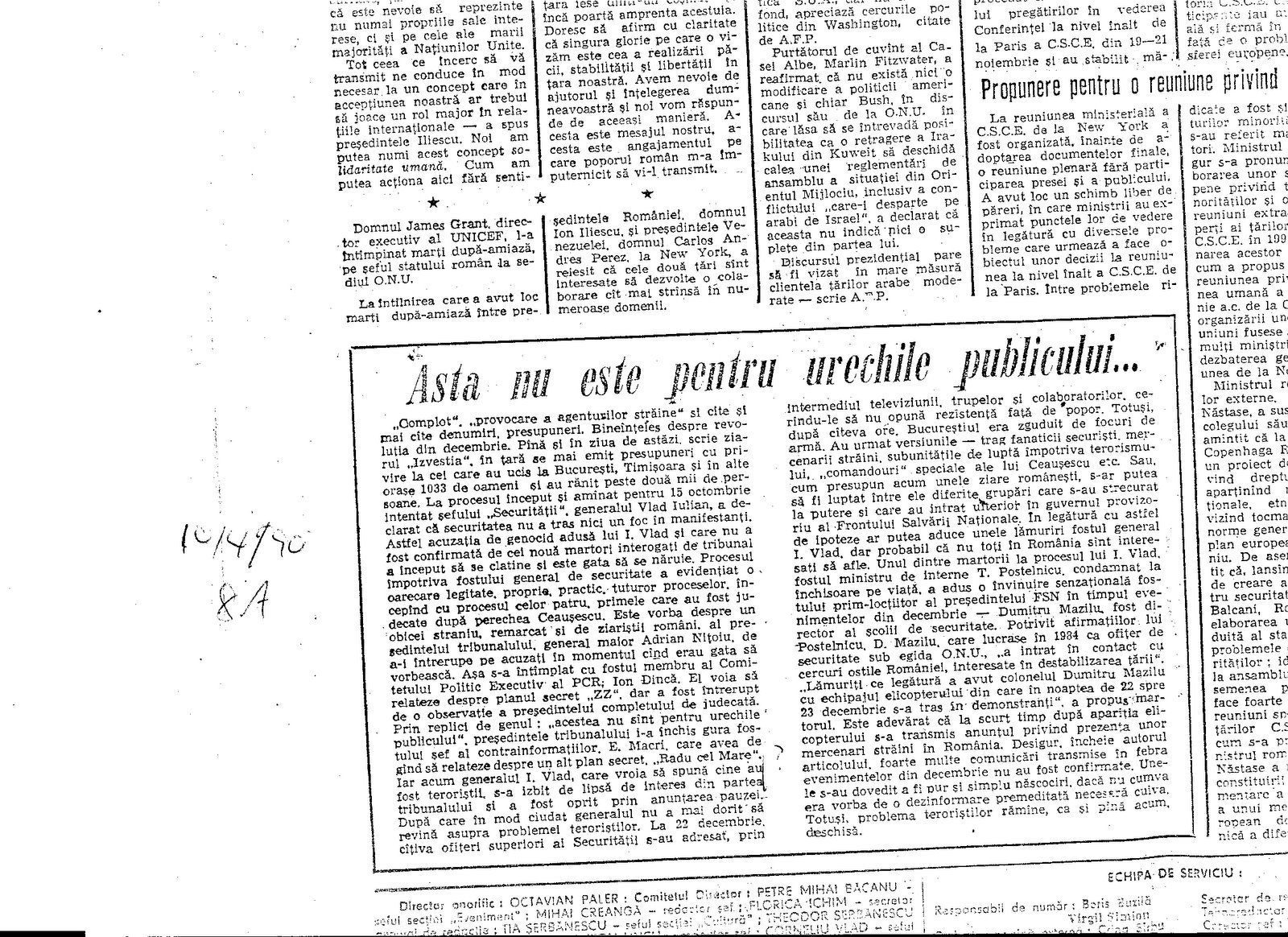
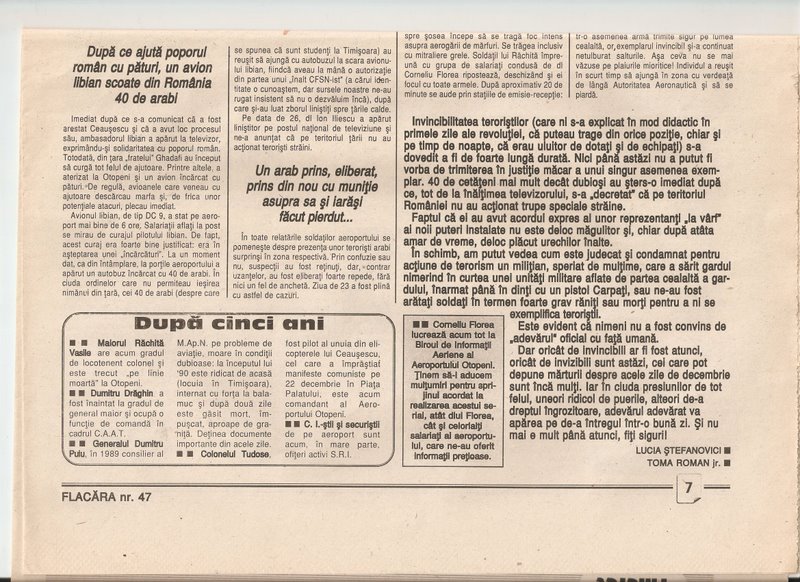
“Asta nu este pentru urechile publicului…”: Muammar Gaddafi, teroristi libieni, Plan Z-Z, si decembrie 1989 in Romania

Posted by romanianrevolutionofdecember1989 on August 23, 2011

“Asta nu este pentru urechile publicului…” Romania Libera, 4 octombrie 1990, p. 8a.

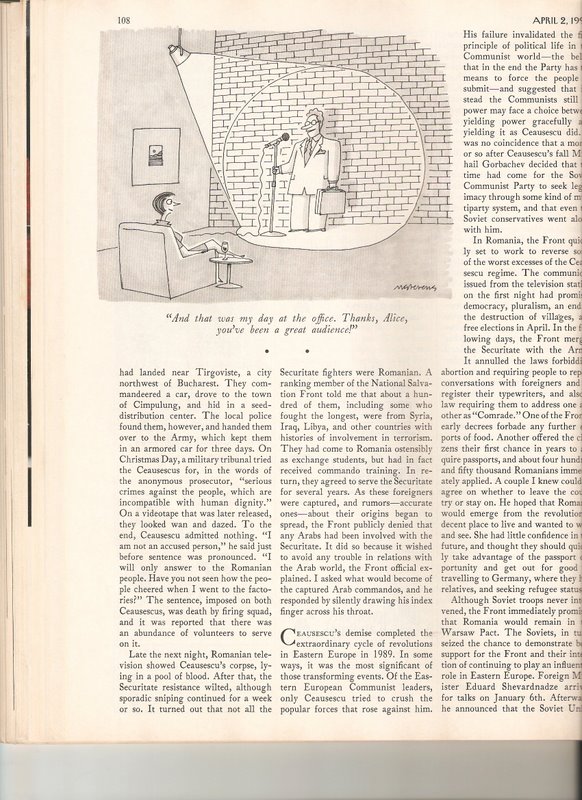
Robert Cullen, “Report from Romania:  Down with the Tyrant,” The New Yorker, 2 April 1990.

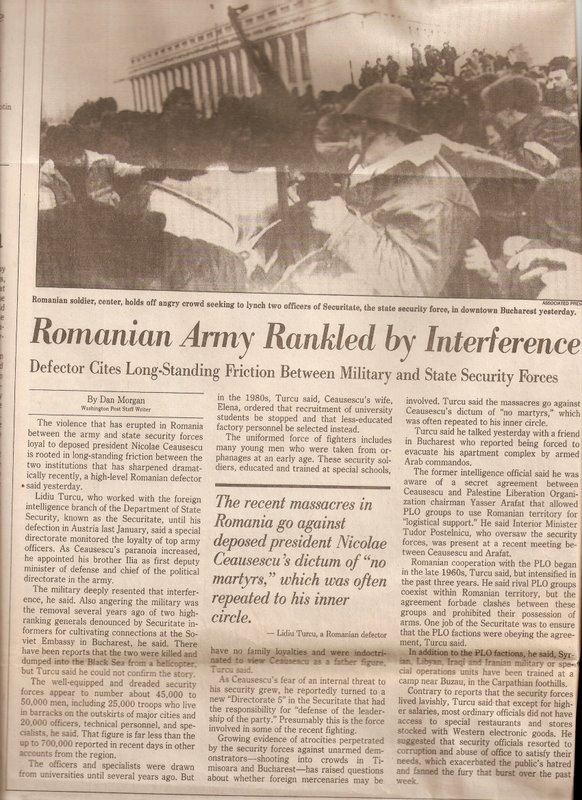
Late the next night, Romanian television showed Ceausescu’s corpse, lying in a pool of blood.  After that, the Securitate resistance wilted, although sporadic sniping continued for a week or so.  It turned out that not all of the Securitate fighters were Romanian.  A ranking member of the National Salvation Front told me that about a hundred of them, including some who fought the longest, were from Syria, Iraq, Libya, and other countries with histories of involvement in terrorism.  They had come to Romania ostensibly as exchange students, but had in fact received commando training.  In return, they agreed to serve the Securitate for several years.  As these foreigners were captured, and rumors–accurate ones–about their origins began to spread, the Front publicly denied that any Arabs had been involved with the Securitate.  It did so because it wished to avoid any trouble in relations with the Arab world, the Front official explained.  I asked what would become of the captured Arab commandos, and he responded by silently drawing his index finger across his throat.
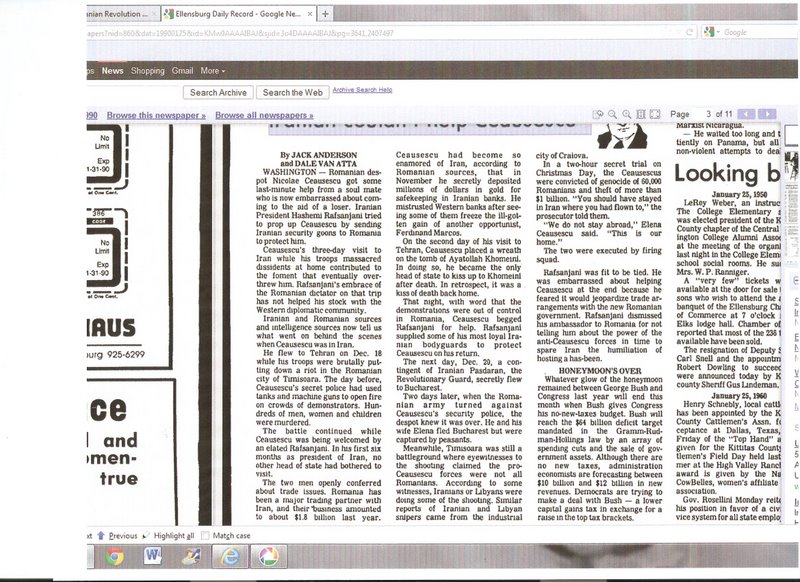
Jack Anderson and Dale Van Atta, “Iran Embarrassed by Ceausescu Visit,” The Washington Post, 17 January 1990, E17. (syndicated copy above)

WASHINGTON — Romanian despot Nicolae Ceausescu got some help last-minute help from a soul mate who is now embarrassed about coming to the aid of a loser.  Iranian President Hashemi Rafsanjani tried to prop up Ceausescu by sending Iranian security goons to Romania to protect him.  Ceausescu’s three-day visit to Iran while his troops massacred dissidents at home contributed to the foment that eventually overthrew him.  Rafsanjani’s embrace of the Romanian dictator on that trip has not helped his stock with the Western diplomatic community. Iranian and Romanian sources and intelligence sources now tell us what went on behind the scenes when Ceausescu was in Iran. He flew to Tehran on Dec 18 while his troops were brutally putting down a riot in the Romanian city of Timisoara. The day before, Ceausescu’s secret police had used tanks and machine guns to open fire on crowds of demonstrators. Hundreds of men women and children were murdered. The battle continued while Ceausescu was being welcomed by an elated Rafsanjani. In his first six months as president of Iran, no other head of state had bothered to visit. The two men openly conferred about trade issues. Romania has been a major trading partner with Iran, and their business amounted to about $1.8 billion last year.  Ceausescu had become so enamored of Iran, according to Romanian sources, that in November he secretly deposited millions of dollars in gold for safekeeping in Iranian banks. He mistrusted Western banks after seeing some of them freeze the ill-gotten gain of another opportunist Ferdinand Marcos. On the second day of his visit to Tehran, Ceausescu placed a wreath on the tomb of Ayatollah Khomeini. In doing so, he became the only head of state to kiss up to Khomeini after death.  In retrospect, it was a kiss of death back home.  That night, with word that the demonstrations were out of control in Romania, Ceausescu begged Rajsanjani for help.  Rafsanjani supplied some of his most loyal Iranian bodyguards to protect Ceausescu on his return.  The next day, Dec 20, a contingent of Iranian Pasdaran, the Revolutionary Guard, secretly flew to Bucharest. Two days later, when the Romanian army turned against Ceausescu’s security police. the despot knew it was over.  He and his wife Elena fled Bucharest but were captured by peasants. Meanwhile, Timisoara was still a battleground where eyewitnesses to the shooting claimed the forces were not all Romanians.  According to some witnesses, Iranians or Libyans were doing some of the shooting. Similar reports of Iranian and Libyan snipers came from the industrial city of Craiova. In a two-hour secret trial on Christmas Day, the Ceausescus were convicted of genocide of 60,000 Romanians and theft of more than billion. “You should have stayed in Iran where you had flown to, the prosecutor told them. “We do not stay abroad,” Elena Ceausescu said. “This is our home.” The two were executed by firing squad. Rafsanjani was fit to be tied. He was embarrassed about helping Ceausescu at the end because he feared it would jeopardize trade arrangements with the new Romanian government. Rafsanjani dismissed his ambassador to Romania for not telling him about the power of the anti-Ceausescu forces in time to spare Iran the humiliation of hosting a has-been.

http://rendszervaltas.mti.hu/Pages/News.aspx?se=1&wo=pasdaran&sd=19890101&ed=19901231&sp=0&ni=231602&ty=1


Irán – Románia – fegyveres gárdisták

Bagdad, 1990. január 2. kedd (MTI/AFP)- A Modzsahedin Khalk (Népi Modzsahedin) elnevezésű iráni ellenzéki szervezet irodája Bagdadból közleményt juttatott el kedden az MTI-hez. Ebben a szervezet Iránból származó – pontosan meg nem nevezett – forrásokra hivatkozva közli: amikor Romániában kiéleződtek a belső harcok, december 20-án Rafszandzsani iráni elnök utasítására fegyveres gárdát (pasdaran) küldtek Bukarestbe a Ceausescu-rendszer védelmére.

A december 19-i romániai véres összecsapást követően
Rafszandzsani és Ceausescu december 19-én este Teheránban állapodott
meg abban, hogy a gárdistákat sürgősen átdobják – írja a Modzsahedin
Khalk közleménye. A bagdadi székhelyű szervezet a hír hitelességének
alátámasztására hét, Romániába küldött gárdistát név szerint is
megemlít: Morteza Hazveh, Szejed Reza Arai, Mohaved Tezar-Parto
Dezfuli, Masszud Orei, Szejed Ali-Aszgar Szadegi, Morteza Nikokar,
és M. Szalamati.

Az AFP bagdadi irodájának jelentése szerint az iráni ellenzéki
szervezet azonos tartalmú közleményt juttatott el hozzájuk, s ezt a
francia hírügynökség kedden nyilvánosságra hozta.+++

1990. január 2., kedd 13:37

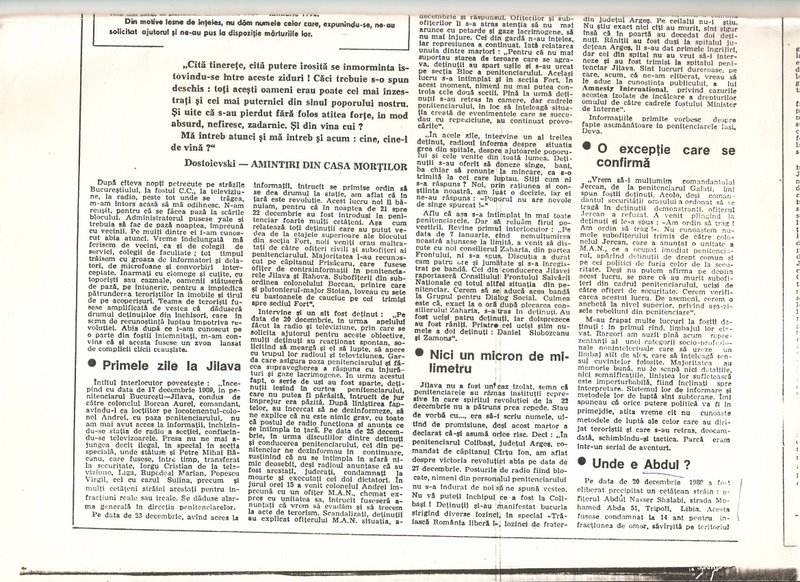
Pe 28 decembrie am predat patru cetateni de nationalitate araba.  Aveau pasaport, Republica Iraq. 

“Unde e Abdul?”  Dan Pavel, 22, nr. 5.
Mircea Dinescu:

De când erau în Cehoslovacia… Simulatoarele imitau mitralierele, soldaţii trăgeau uşurel, cu gloanţe în infraroşu, eu am văzut, erau împuşcaţi numai în frunte, aşa: în C.C., în întuneric! Numai acolo-ntr-o oră au fost împuşcaţi şaişpe inşi. Numai pe lumină stinsă, în frunte, doar erau profesionişti, erau băieţi care… aveau arme speciale cu lunetă! A existat şi o echipă specială care-l păzea pe Ceauşescu şi erau Arabi. Erau de-ai lui Araffat. Erau libieni, care au fost arestaţi de ai noştri, dar în acea vreme lucrau în Libia lui Gadaffi vreo zece mii de români. Ăla, terorist de rang mondial, a ameninţat că dacă nu li-se dă drumul imediat, ne împuşcă compatrioţii! A apărut şi la televiziunea lor, se ştie… Vă daşi seama ce ieşea? Şi le-a dat drumul înapoi, şi gata.

Eugen Evu despre un glont vidia, decembrie 1989, Hunedoara I
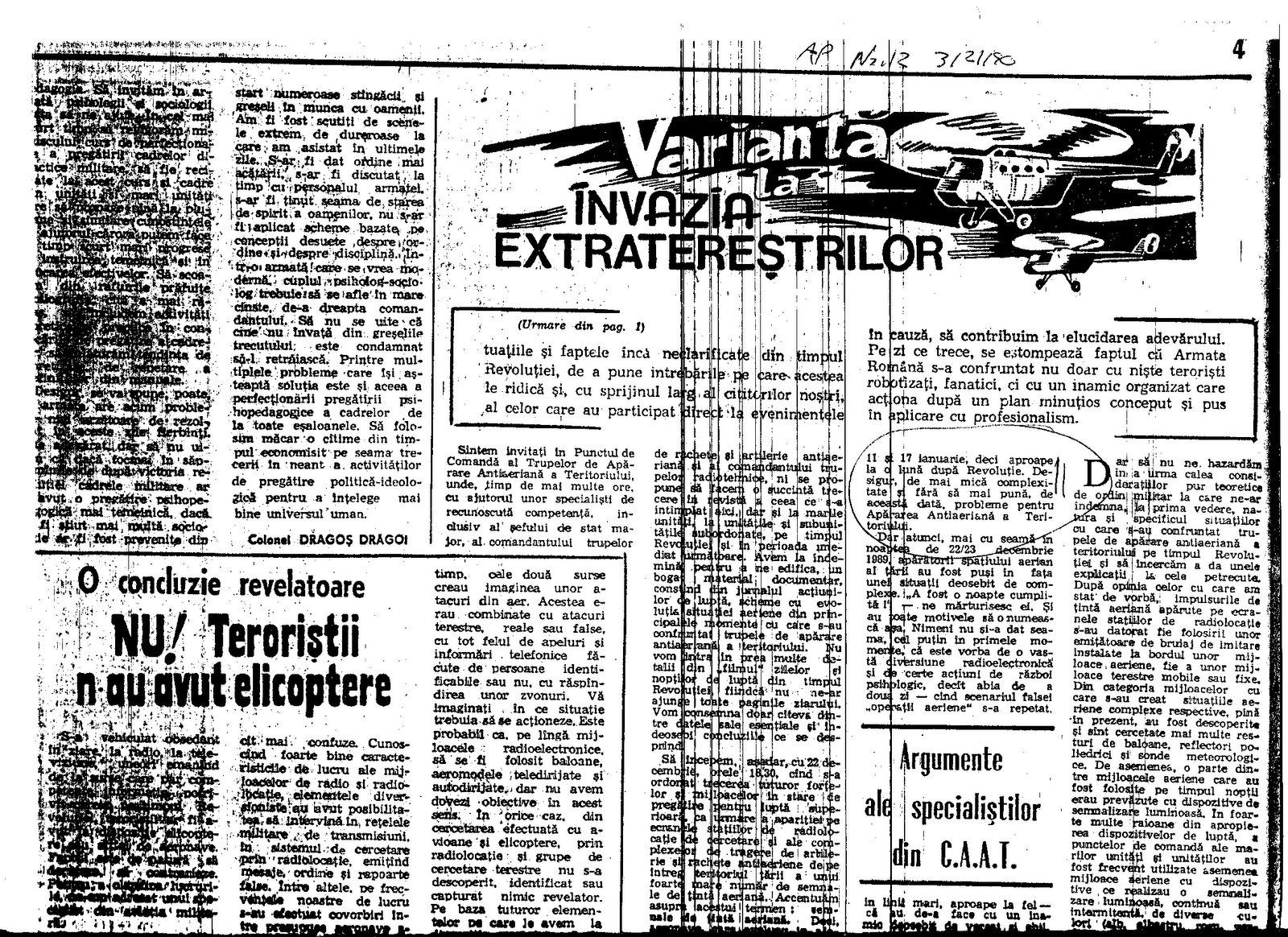
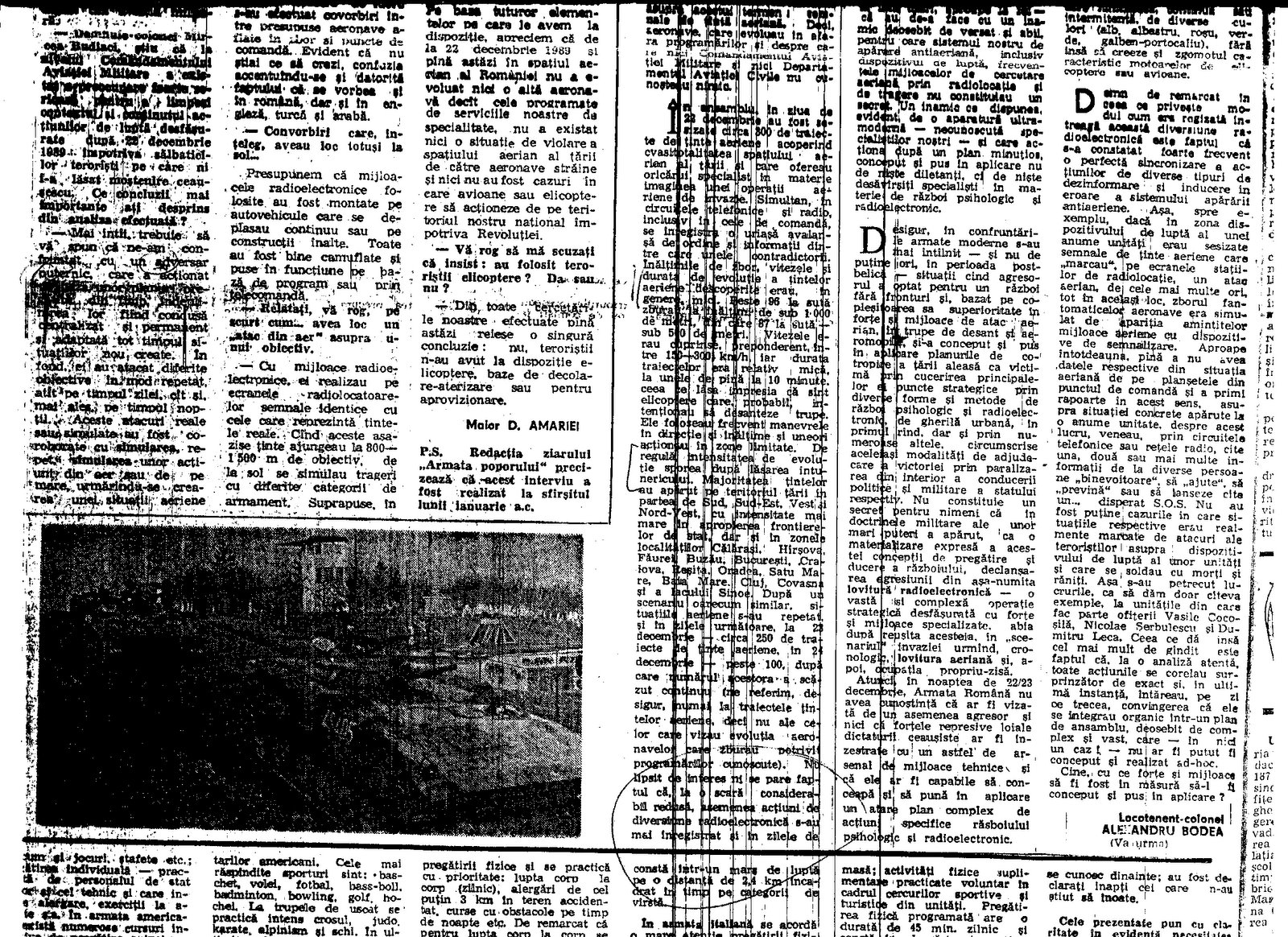
9 ianuarie 1990; 11-17 ianuarie 1990
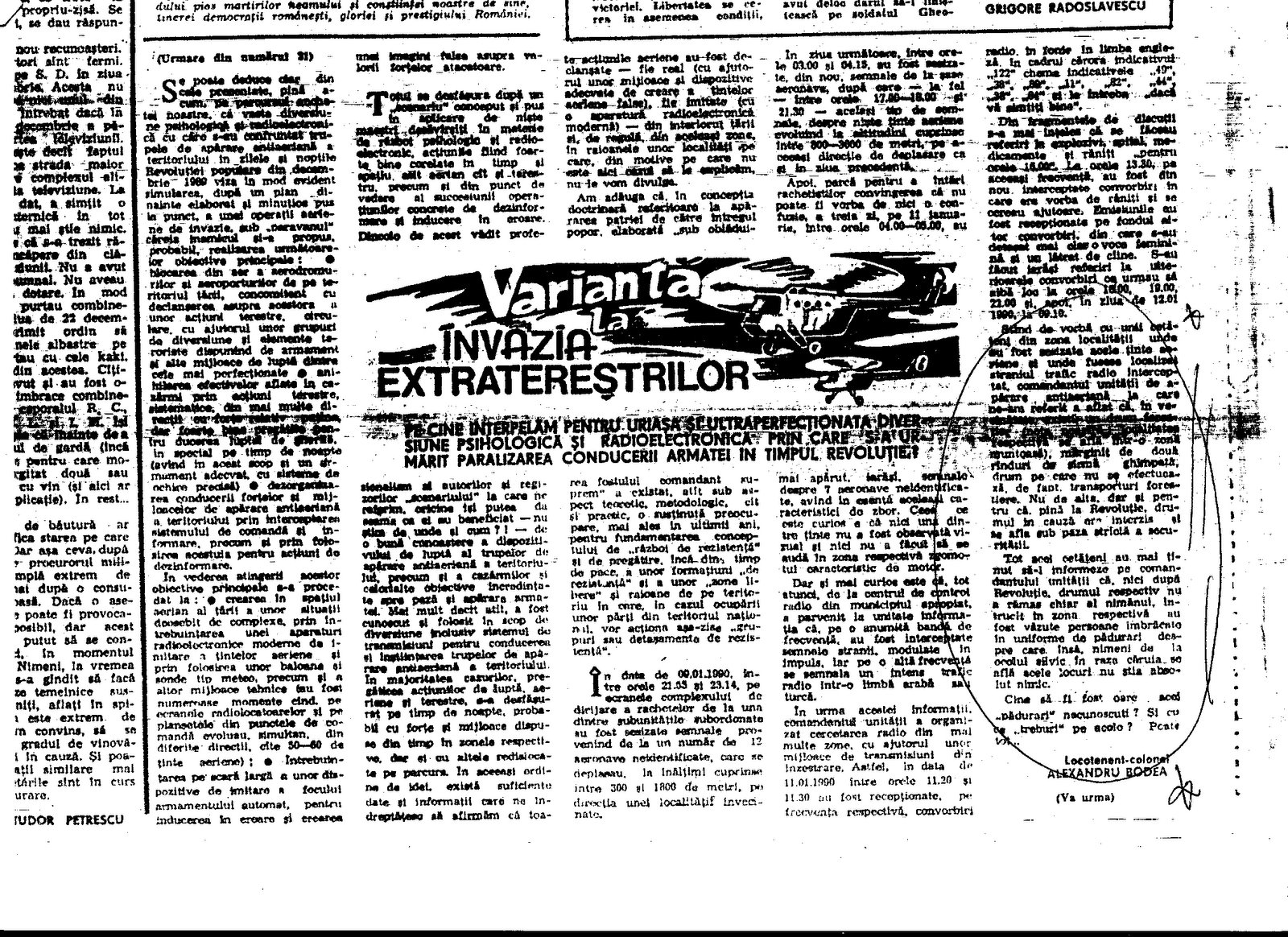
“…In data de 09.01.1990, intre orele 21.55 si 23.14, pe ecranele complexului de dirijare a rachetelor de la una dintre subunitatiile subordonate au fost sesizate semnale provenind de la un numar de 12 aeronave neidentificate, care se deplasau la inaltimi cuprinse intre 300 si 1800 de metri, pe directia unei localitatii invecinate.
In ziua urmatoare, intre orele 03.00 si 04.15, au fost sesizate, din nou, semnale de la sase aeronave, dupa care–la fel–intre orele 17.00-18.00 si 21.30–acelasi tip de semnale, despre niste tinte aeriene evoluind la altitudini cuprinse intre 800-3000 de metri, pe aceeasi directie de deplasare ca si in ziua precedenta.
Apoi, parca pentru a intari rachetistilor convingerea ca nu poate fi vorba de nici o confuzie, a treia zi, pe 11 ianuarie, intre orele 04.00-05.00, au mai aparut, iarasi, semnale despre 7 aeronave neidentificate, avind in esenta aceleasi caracteristici de zbor.  Ceea ce este curios e ca nici una dintre tinte nu a fost observata vizual si nici nu a facut sa se auda in zona respectiva zgomotului caracteristic de motor.
Dar si mai curios este ca, tot atunci, de la centrul de control radio din municipiul apropriat, a parvenit la unitate informatia ca, pe o anumita banda de frecventa, au fost interceptate semnale strainii, modulate in impuls, iar pe o alta frecventa se semnala un intens trafic radio intr-o limba araba sau turca.
In urma acestei informatii, comandantul unitatii a organizat cercetarea radio din mai multe zone, cu ajutorul unor mijloace de transmisiuni din inzestrare.  Astfel, in data de 11.01.1990 intre orele 11.20 si 11.30 au fost receptionate, pe frecventa respectiva, convorbiri radio, in fonic [?] in limba engleza, in cadrul carora indicatul “122″ chema indicativele “49″, “38″, “89″, “11″, “82″, “44″, “38″, “84″, si le intreba “daca va simtiti bine”.
Din fragmentele de discutii s-a mai inteles ca se faceau referiri la explozivi, spital, medicamente, si raniti “pentru orele 16.00″.  La orele 13,30, pe aceeasi frecventa, au fost din nou interceptate convorbiri in care era vorba de raniti si se cereau ajutoare.  Emisiunile au fost receptionate pe fondul altor convorbiri, din care s-au detasat mai clar o voce feminina si un latrat de ciine.  S-au facut iarasi referiri la ulterioarele convorbiri ca urmau sa aiba loc la orele 16.00, 19.00, 22.00 si, apoi, in ziua de 12.01.1990, la 09.10.
Stind de vorba cu unii cetateni din zona localitatii unde au fost sesizate acele tinte aeriene si unde fusese localizat straniul trafic radio interceptat, comandantul unitatii de aparare antiaeriana la care ne-am referit a aflat ca, in vecinatate, exista un drum forestier (nota noastra; localitatea respectiva se afla intr-o zona muntoasa), marginit de doua rinduri de sirma ghimpata, drum pe care nu se efectueaza [?], de fapt, transporturi forestiere.  Nu de alta, dar si pentru ca, pina la Revolutie, drumul in cauza era interzis si se afla sub paza stricta a securitatii.
Tot acei cetateni au mai tinut sa-l informeze pe comandantul unitatii ca, nici dupa Revolutie, drumul respectiv nu a ramas chiar al nimanului, intrucit in zona respectiva au fost vazute persoane imbracate in uniforme de padurari despre care insa, nimeni de la ocolul silvic in raza cariua se afla acele locuri nu stia absolut nimic.
Cine sa fi fost oare acei “padurari” necunoscuti?  Si cu ce “treburi” pe acolo?  Poate tot…”
(Locotenent-colonel Alexandru Bodea, din serialul “Varianta la Invazia Extraterestrilor.  Pe cine interpelam pentru uriasa si ultraperfectionata diversiune psihologica si radioelectronica prin care s-a urmarit paralizarea conducerii armatei in timpul Revolutiei?”
Armata Poporului, nr. 22 (“urmare din numarul 21″), mai 1990.)

Foreign Involvement

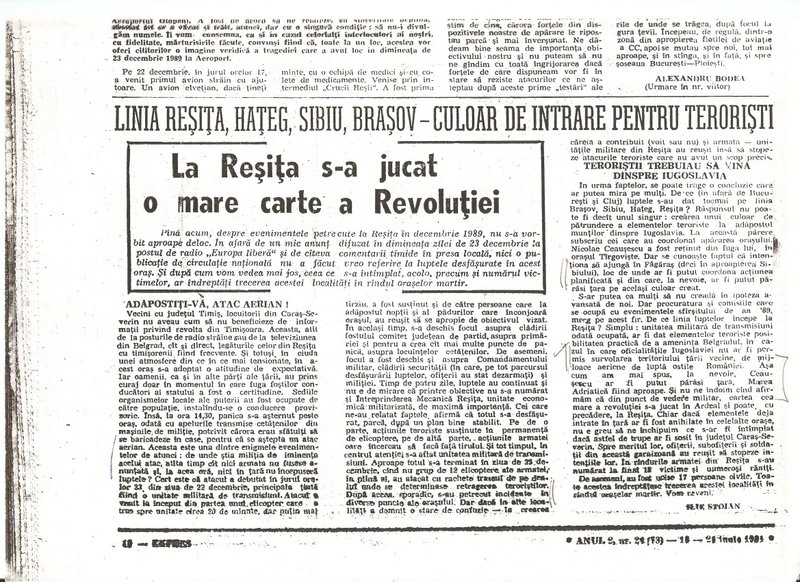
So far in this piece, we have seen references to the arrest or killing as “terrorists” of the following as apparent foreigners, notably Arabs:  1) the arrest of one with a PSL in Bucharest, 2) the arrest of another with a PSL, apparently somewhere near Brasov, 3) the revelations of soldiers who killed and arrested several in the Pantelimon area of Bucharest (I will consider these two revelations one and the same for our purposes here).  Years after the Revolution, there are still claims that Arabs were captured elsewhere:  in 2005, Catalin Radulescu told a journalist that “two Arabs were caught in Pitesti, dressed in combinezoane negre [emphasis added], and armed with Carpati pistols.”[81] Later we will see reports written by two Securitate officers immediately after the events—apparently required of them by Army officials—attesting to the killing of Arab “terrorists” in the area around the Defense Ministry building in Bucharest. We shall also see how a weapon registered to a member of the Securitate’s Fifth Directorate just happened to show up in the hands of a man with a Libyan passport in his billfold who was shot in the Central Committee building in Bucharest on the night of 22 December.

Indeed, the presence and activity of these foreign, apparently mostly Arab terrorists, was almost prosaic.  Liviu Viorel Craciun (appropriately enough craciun means “Christmas”), the so-called “First Interior Minister of the Revolution” in one of the protogovernments that tried to form in the CC after the Ceausescus fled and—a source of much confusion in research on the events (more on this below)—a former USLA officer until 1986, reported that on 28 December 1989:  “…in the morning five cadavers were collected and a rough count was made, out of the five terrorist cadavers found in the street, two belonged to Arab mercenaries…The shot terrorists could not be identified and they did not seem to interest anyone.”[82]

So what was the role of foreigners, specifically Arabs, in the Revolution?  Interesting in this regard is a report dated 1 March 1990 by Lt-Colonel Ion Aurel Rogojan, who in 1989 was Securitate Director General Vlad’s chief of cabinet staff.  As B. Mihalache speculates somebody must have been interested in this question, “since Rogojan was ordered to write a report on it.”[83] Rogojan wrote in his 1 March 1990 report that he “has knowledge of the fact that between the Department of State Security and the ‘Al Fatah’ Security [service] of the Palestinian Liberation Organization there existed relations of cooperation based on a protocol.”  Rogojan continues in this report:

“At the same time, some activities for the training of USLA cadres abroad were carried out (the group was led by reserve colonel Firan, former chief of general staff of the mentioned unit).  The protocol was established in the period 1979-1980 and a copy can be found in the protocol relations division of the former Independent Judicial Secretariat Service of the DSS [i.e. Securitate].  In connection with the existence of this protocol, I was asked in recent weeks, by Colonel Ardeleanu Gheorghe, USLA Commander.  The Special Unit for Antiterrorist Warfare was coordinated on behalf of the DSS’ Executive Bureau by General-Colonel Iulian Vlad in the period 1977-1987, and after that by Secretary of State General-Major Alexie Stefan and Deputy Minister Major General Bucurescu Gianu.  In the USLA there existed a special detachment for antiterrorist intervention, organized in three shifts and subordinated to the chief of the general staff.  I don’t have any data concerning the activity of the USLA in the period of the December ’89 events.”[84]

It should also be abundantly clear here that Rogojan was being asked to write not just about the role of outside forces, but specifically about the role of the USLA in December 1989.  Once again, why such interest in the USLA?

In this regard, further claims related by former USLA Captain Marian Romanescu to Dan Badea, are to say the least intriguing:

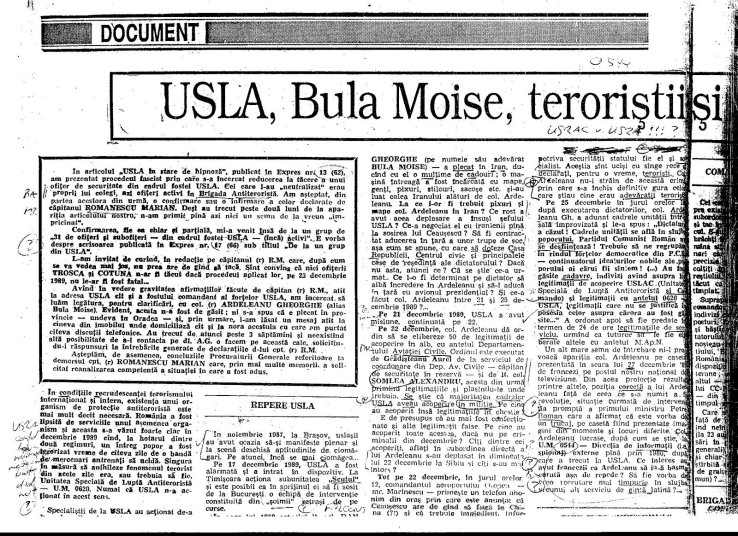
Several days before the outbreak of the December events, the commander of the USLA forces—col. ARDELEANU GHEORGHE (his real name being BULA MOISE)—left for Iran, bringing with him a great many gifts; and a car’s load of maps, bags, pens, sacks, etc. What did Col. Ardeleanu need these for in Iran? What was the use of having the head of the USLA go?  What did he negotiate with the Iranians before the arrival of Ceausescu [18-19 December]?  Could he have contracted the bringing into the country of some shock troops, as they are called, to enforce the guard at the House of the Republic, the civic Center and the principal residences of the dictator?  If not for that reason, why?  Because it is known what followed…

On 22 December, col. Ardeleanu gave the order that 50 blank cover IDs, with the stamp of the Department of Civil Aviation, be released.  The order is executed by Gradisteanu Aurel from the coordinating service of that department—a Securitate captain in reserve—and by lt. Col. SOMLEA ALEXANDRU, the latter receiving the IDs and putting them where they needed to be.  It is known that the majority of USLA cadre work under the cover of being in the Militia.  But who did these IDs cover in this situation? [emphases and capitalization in original][85]

We know from the revelations of a former worker (engineer Hristea Todor) at the Securitate’s special unit “P,” that the new Front leadership was sufficiently suspicious of Arab presence that “General Militaru referred to the transfer of some units from the MI and Securitate to the Defense Ministry.  He said the USLA had transformed into terrorists.  The electronic (telephone) surveillance of certain objectives was started up again—in particular Arab embassies.”[86] (Note:  this appears yet another reference to the aforementioned meeting at USLA headquarters on the evening of 25 December.)  Gheorghe Ratiu, head of the Securitate’s First Directorate, maintains that, on Director Vlad’s orders, between 25 and 27 December 1989 he was tasked with finding out the “truth” concerning the “foreign terrorists” reported to be in the hospitals and morgues; he had to resort to subterfuge to verify the situation, since Army personnel were denying him entrance.[87]

Notably, of course, with these exceptions, the former Securitate and their apologists—whom as Army General Urdareanu suggests uniformly don’t believe in the existence of real terrorists in December 1989, yet who love to blame foreign interference for Ceausescu’s overthrow (in particular, Russians, Hungarians, and Jews)—do not like to make reference to or talk about “Arab terrorists.”

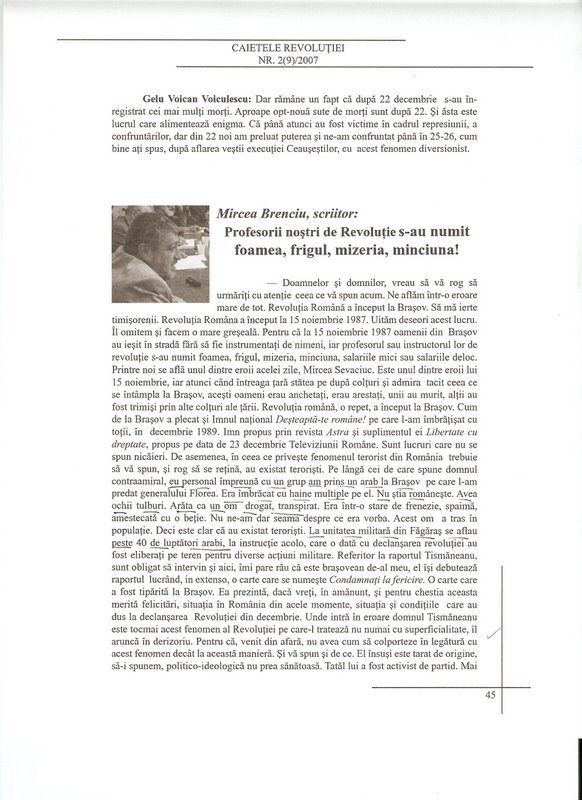
Further evidence of the involvement of “Arab terrorists” comes from the behavior in late December 1989, as much as the later statements, of the usually garrulous Silviu Brucan.  In August 1990, Brucan would allege the involvement of “some 30 foreigners,” according to him, mostly Palestinian, who had been trained by the Securitate—what Michael Shafir termed “the first admission of foreign intervention by a member of the December 1989 leadership.”[88] Reminiscent of Tanasescu’s curt response to the reporter’s question about the involvement of foreign terrorists (discussed above)—“I ask that you be so kind as to…” not ask me about this—back on 29 December 1989, Brucan, at the time a key decision-maker in the new Front leadership (he would leave in February), told Le Monde that the issue was “very delicate” and “involving diplomatic implications that must still be worked out”; “better to be cautious,” he opined.[89] That was, of course, no denial; indeed, it sounds like the new leadership was trying to find a solution to the dilemma they found themselves in.

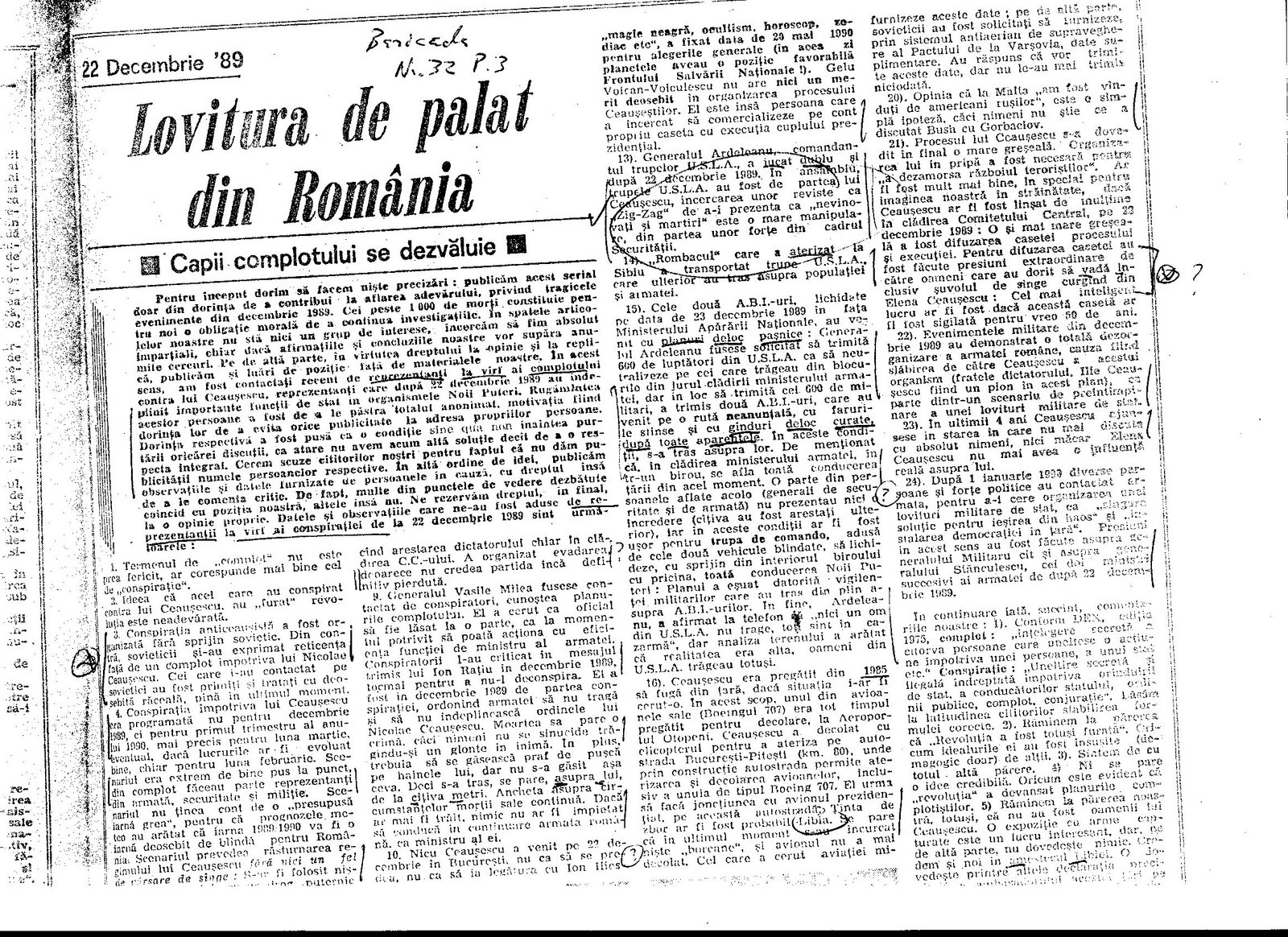
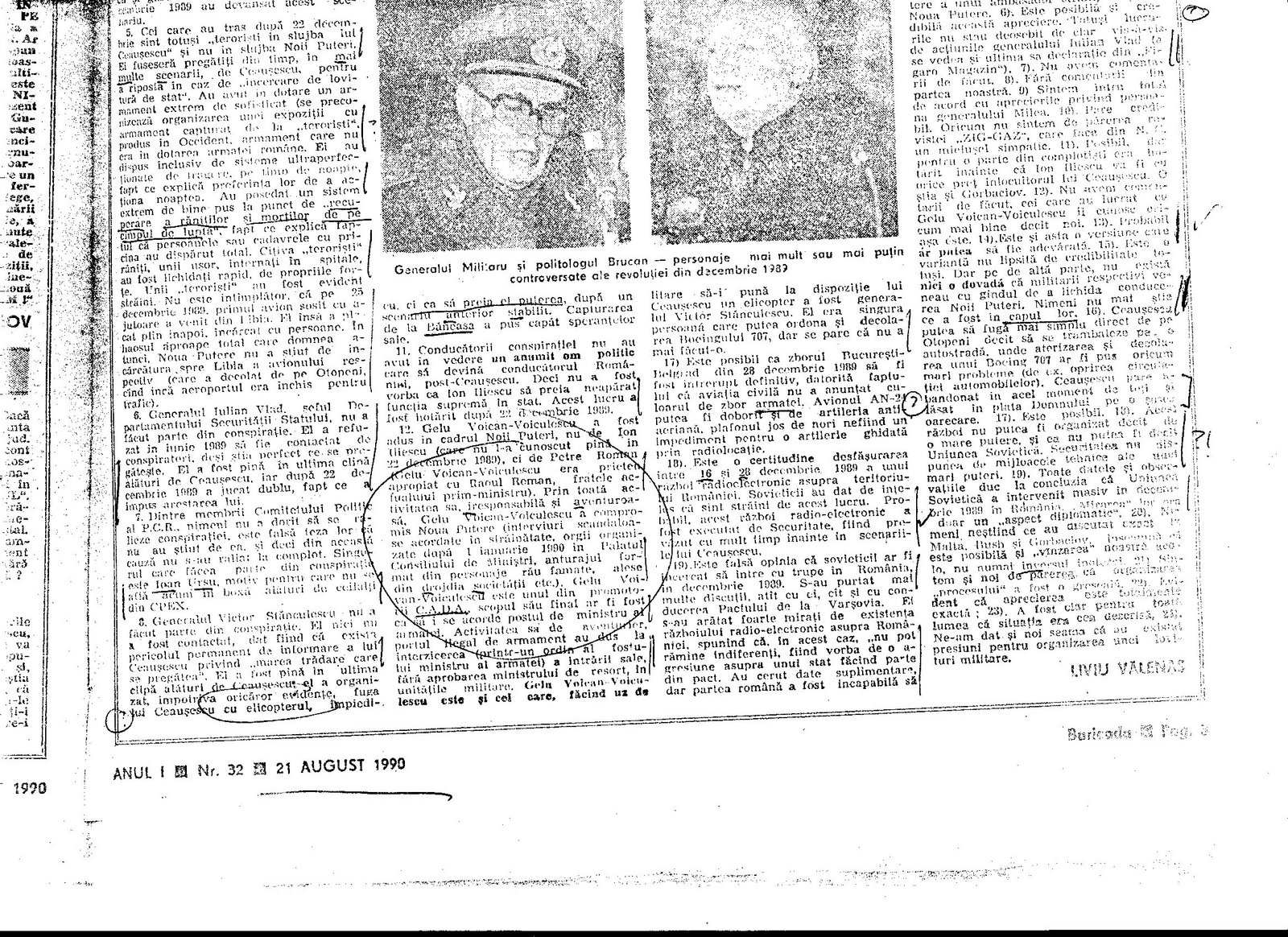
Suspicion, in particular, surrounded the role of Libyans, which, as we have seen, at the very least, somehow found themselves in areas of gunfire in December.  Sergiu Nicolaescu claims—I have been unable to verify this—that of all the countries to recognize the new National Salvation Front government, running to the top of the line to be first was…Qadafi’s Libya![90] The “anonymous plotters” who leaked information to Liviu Valenas of Baricada in August 1990 maintained that “It isn’t accidental that on 25 December 1989, the first plane bringing aid came from Libya.  However, when it went on its return route it was loaded with people.  In the almost complete chaos that dominated at the time, the New Power [i.e. the Front] did not know what the plane to Libya was carrying (it left from Otopeni, when the airport was still closed to traffic).”[91] In 1994, two journalists specified that the plane in question on the 25th was a DC9 and that “40 Arabs” had been loaded aboard, and noted that they had learned that on 28-29 December 1989, “the [Otopeni’s] airport archive had disappeared.”[92]

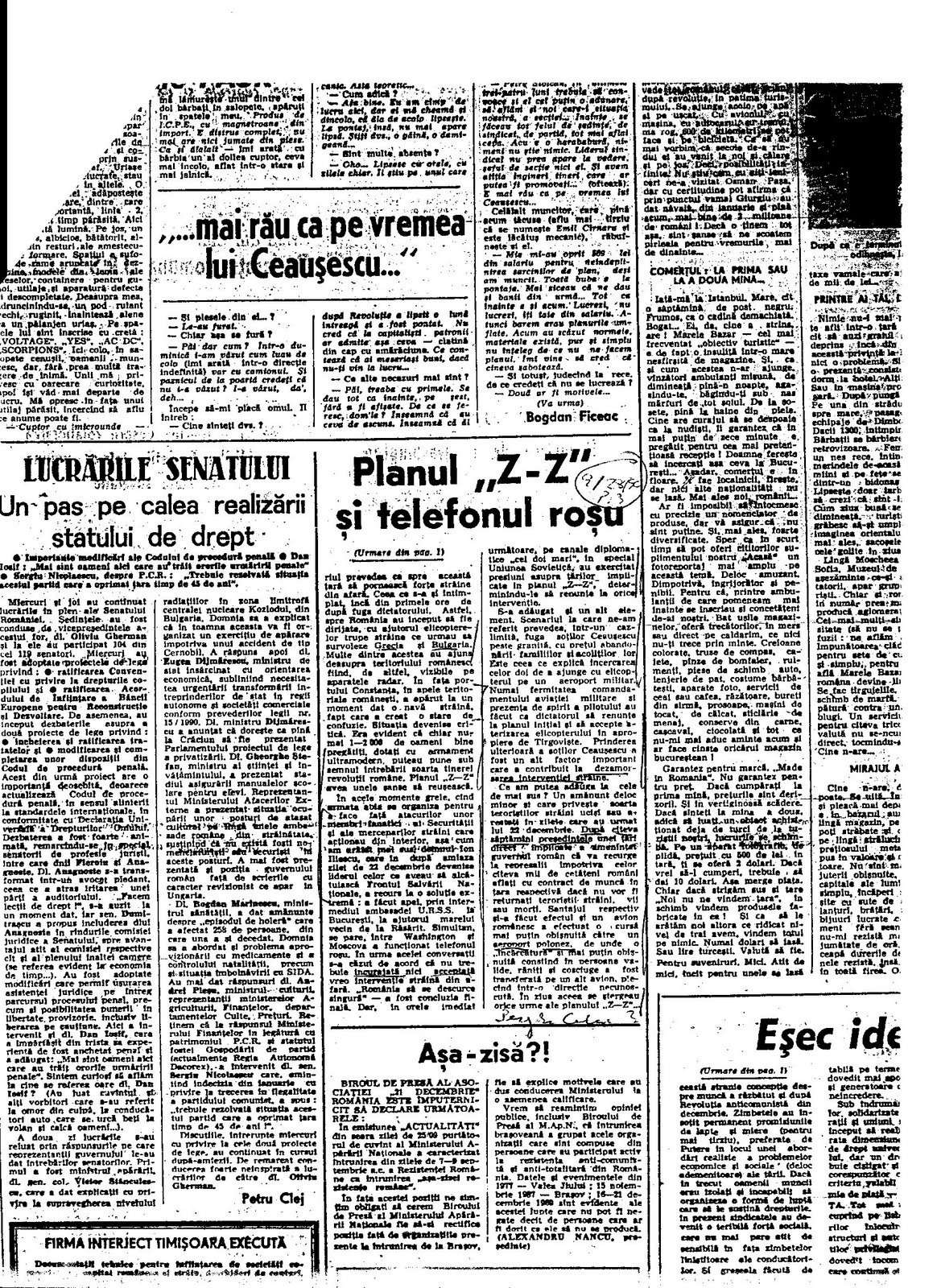
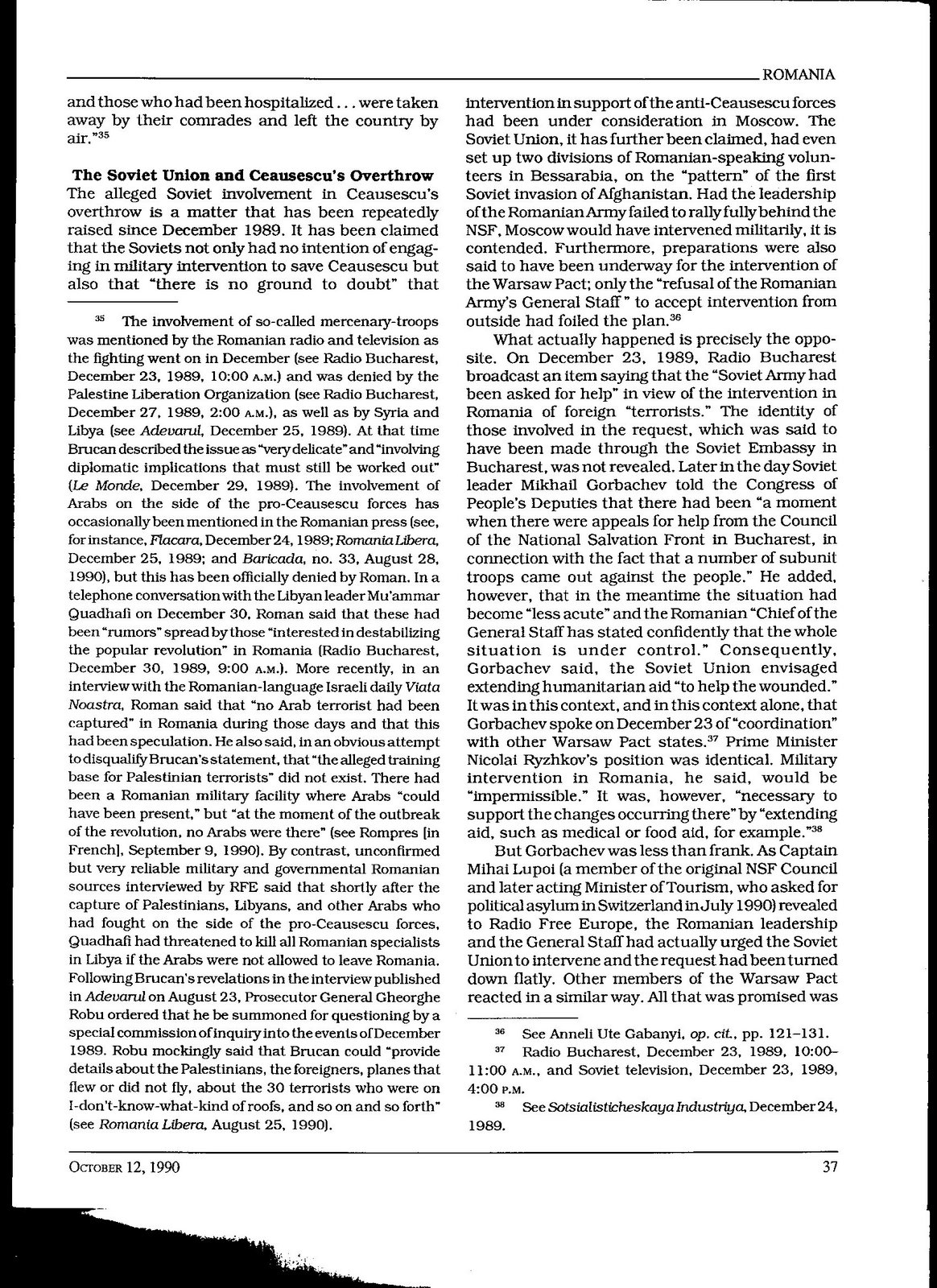
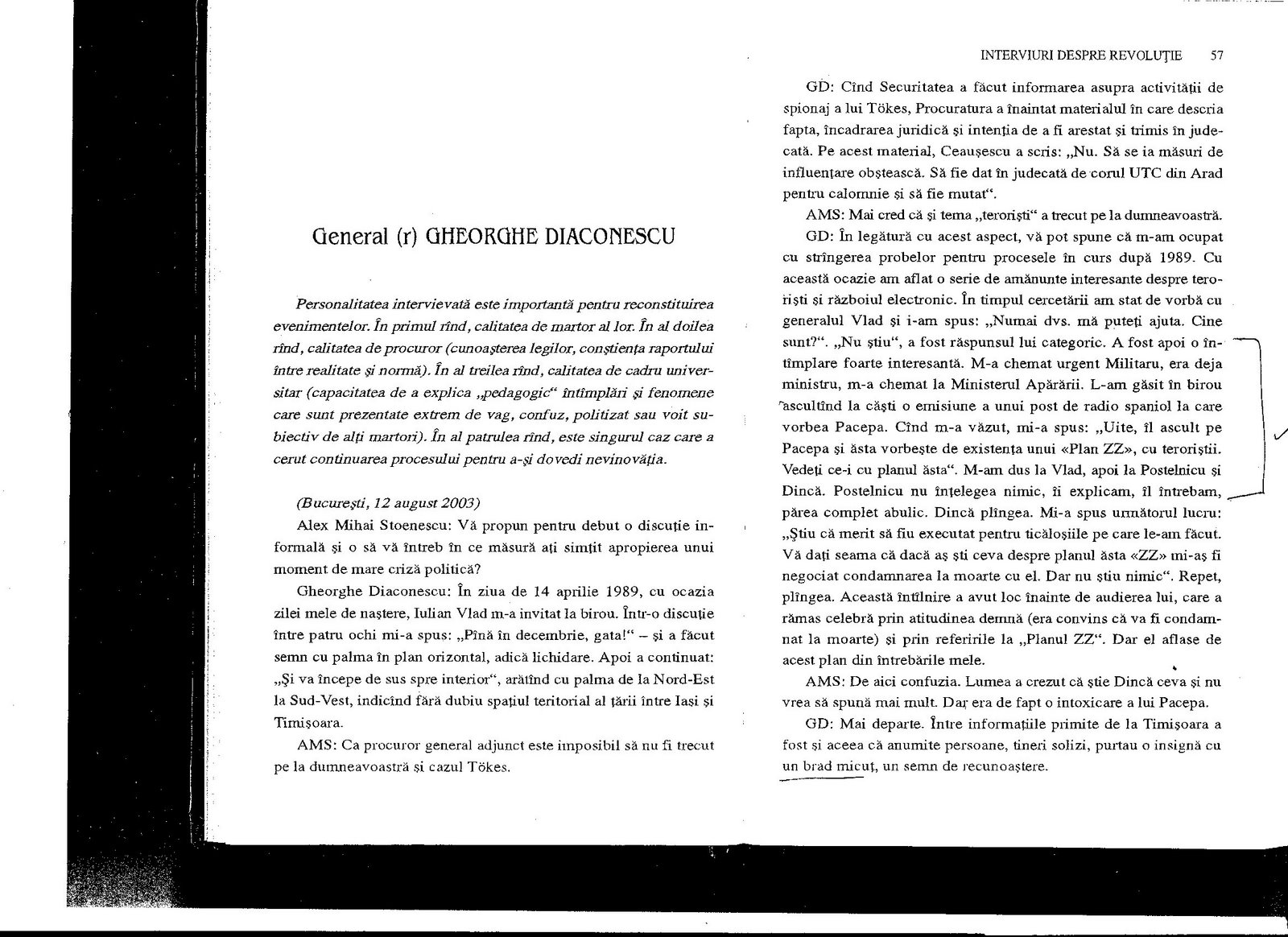
Michael Shafir at Radio Free Europe Research at the time noted in October 1990 that “unconfirmed but very reliable military and governmental Romanian sources interviewed by RFE said that shortly after the capture of Palestinians, Libyans, and other Arabs who had fought on the side of pro-Ceausescu forces, Quadhafi had threatened to kill all Romanian specialists in Libya if the Arabs were not allowed to leave Romania.”[93] Certainly, this is what Constantin Vranceanu hinted at in September 1990 in Romania Libera when he wrote of “Plan Z-Z”—according to him, “practically an alliance, on many levels, including military between Romania and several other countries with totalitarian regimes (Iran, Libya, Syria), to which was added the PLO…which called for the other parties to intervene with armed forces to reestablish state order when one of the leaderships was in trouble”:

“Several weeks after 22 December, the president of one of the countries directly involved threatened the Romanian government that it would make recourse to reprisals against those several thousand Romania citizens who were working in that country if [the Romanian government] did not return the foreign terrorists, [whether] alive or dead.  This blackmail worked and a Romanian plane went on an unusual route to a Polish airport, from where the ‘contents,’ unusually including the able-bodied, wounded, and coffins, were transferred to another plane, that took off in an unknown direction.”[94]

Nestor Ratesh quotes one of Ceausescu’s senior party henchman, Ion Dinca, as having stated at his trial in early February 1990:

“During the night of 27-28 [of January 1990] at 12:30 A.M., I was called by several people from the Prosecutor’s Office to tell what I knew about the agreement entitled Z.Z. between Romania and five other states providing for the dispatching of terrorist forces to Romania in order to intervene in case of a military Putsch.  This agreement Z.Z. is entitled ‘the End of the End.’  I stated then, and I am stating now to you, that I have never been involved in this agreement, neither I nor other people.  And I was told:  Only you and two other people know this.  I stated that and a detailed check was made in order to prove that I was not involved in such acts.”[95]

Relatedly, in July 1990, Liviu Valenas noted that,

“On 24 January 1990, the new Foreign Minister of Romania announced on Television and Radio that a series of secret treaties between the R.S.R. [Romanian Socialist Republic] and third countries had been abrogated, and are no longer valid and operational for the new Romania.  The New Power pledged to deal with these countries concerning Romania’s obligations through the abrogation of these accords.  An ambiguous text, apparently launched by Sergiu Celac’s group,led public opinion in Romania to believe that these treaties concerned ‘terrorist assistance.’”[96]

It is noteworthy that in the context of a series entitled “The Truth about the U.S.L.A.,” (more on this infamous series below), Horia Alexandrescu paused on 14 March 1990 to quote from a 1 February article by another journalist about TAROM flight 259 (to Warsaw and back):

“24 January, 4 PM:  After the aircraft was inspected [“controlul antiterorist”] (after the Revolution of 22 December, ,soimi’ as those who performed antiterrorist protection [i.e. USLA] were called by the pilots, were removed from both internal and external TAROM flights, even though all airlines have such teams), the plane left for Bucharest.  Meanwhile, however, the 45 Libyan passengers, who had gotten off for 5-6 hours in a layover at Otopeni, wanted to cross ‘the Polish border.’”[97]

According to Alexandrescu, the Polish authorities would not allow the TAROM plane to leave Poland, so it sat on the runway in Warsaw…until a second TAROM plane came—this time, according to Alexandru, including “uslasi”—the moral of the story of course being that the USLA needed to be put back on flights as soon as possible.[98] It is possible this is the plane Vranceanu was referring to in the quotation above.  One thing’s for sure, this seemingly insignificant incident got unusual media coverage, in particular with regard to the USLA.

Not surprisingly, in June 2006, Prosecutor General Dan Voinea reiterated his contention that there was no foreign involvement/intervention in the December 1989 Romanian Revolution!

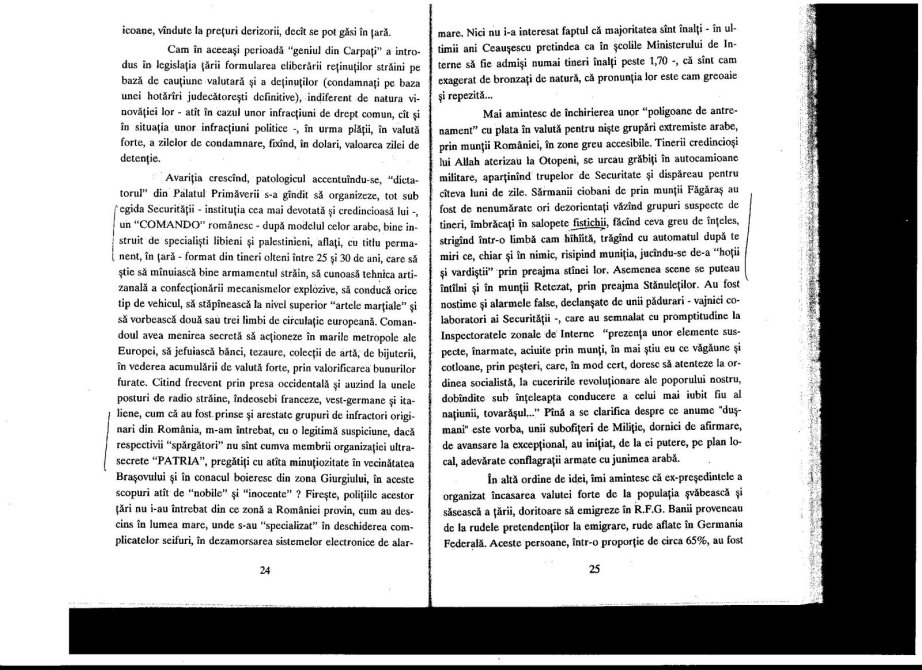
image-18image-17image-16image-15

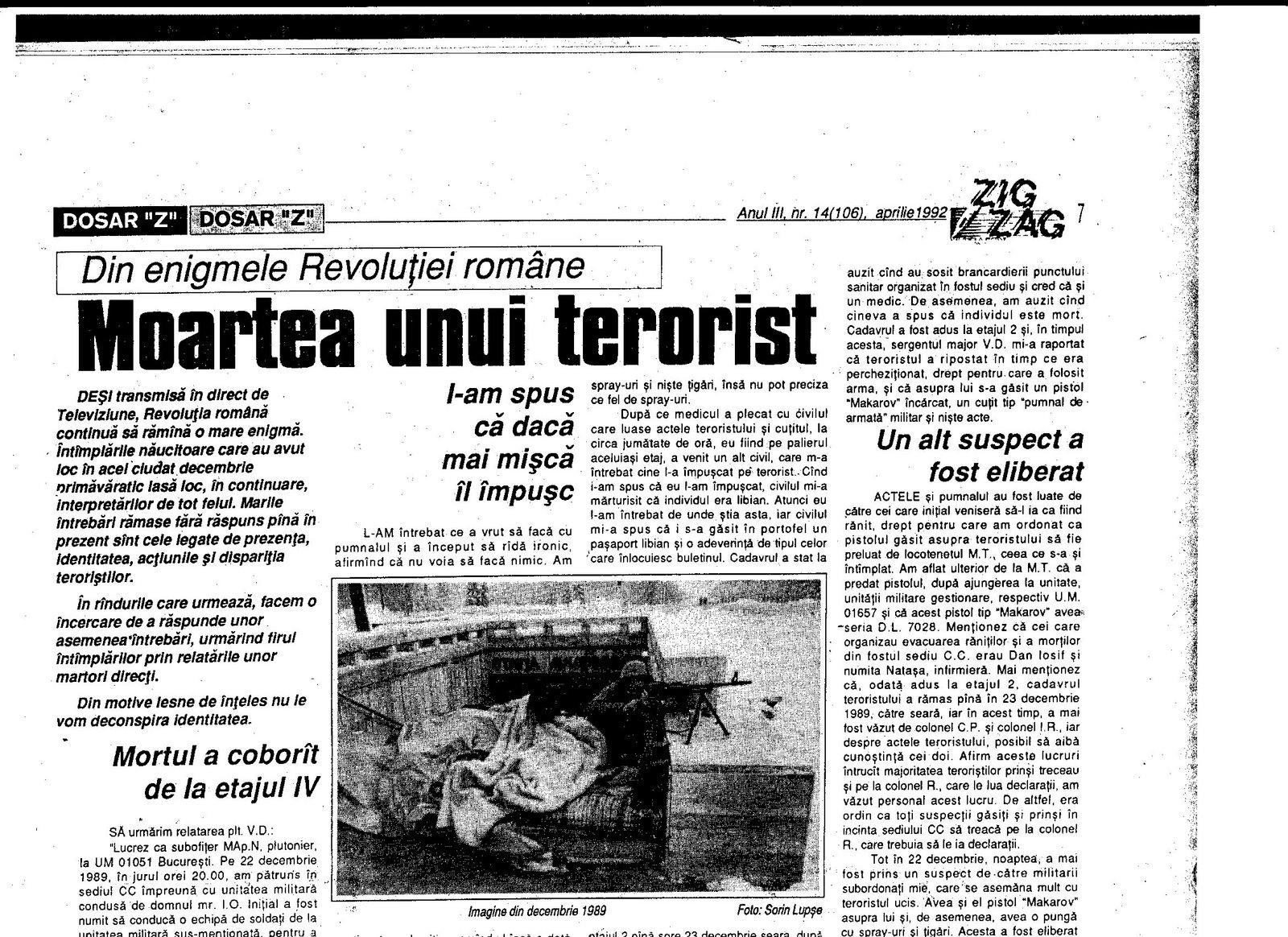
…i s-a gasit in portofel un pasaport libian…
[81] Mirel Paun, “Ion Capatana:  ‘Argeseni, va cer scuze ca am participat la Revolutie!” Cotidianul Argesul, 5/8/05 online at http://www.cotidianul-argesul.ro.

[82] Interestingly and notably, Craciun, who attempted in these days to form a political party with other revolutionaries, bitterly describes how the vague language that emerged in Front declarations by the ultimatum of the 27th—suggesting anyone without authorization was prohibited from carrying an arm—allowed the rump party-state that was the Front to essentially crush any alternative nascent groups of anti-communist opposition.  That said, it is important to point out that Craciun had no doubt as to the existence of the “terrorists” that fought in these days; he describes matters as follows:  “…for five days they fought against the last partisans of the ‘Conducator’ [i.e. Ceausescu], the terrorists who attacked every night, using secret tunnels that allowed them to communicate between different government buildings.  The battlefield was well-defined:  Piata Republicii, on the one hand, the Presidential Palace, to which the terrorists would repair, on the other.”  See Liviu Viorel Craciun, with Horatiu Firica, “Destainuirile unui ministru de interne,” Zig-Zag, no. 70, 71, 72 (July and August 1991), p. 6, quotes from issue no. 72.

Soldiers entered the tunnels of the former Central Committee building, with Major Gheorghe Grigoras and Nicolae Grigoras, of the special unit for antiterrorist warfare [i.e. USLA].  The museum curator Dan Falcan relates the findings of the soldiers as follows:

“…in the basement of the building they found a tunnel, not very long, that descended into a type of barracks.  There were eight rooms with folding beds.  These rooms gave way to many hallways, one leading to the second floor of the building.  Via another hallway a larger bunker 7 meters deep could be reached.  This led to an armored door and a spacious apartment, 9 meters deep.  The soldiers found a room with a ventilation system and from there found a new corridor.  After going approximately 30 meters the soldiers noticed an alcove with a large trunk, in which there were 16 rubber rafts with pumps.  Twenty meters forward they found another room with synthetic…10 meters further and they were under water….  Following reconnaissance it was discovered that there were exits to 80 objectives in Bucharest, such as the ASE building, the Enescu House, the Romanian Opera, etc….”  (Sorin Golea, “Cai de navigatie secrete sub Bucuresti,” Libertatea, 22 December 2002, online edition, originally accessed at http://news.softpedia.com/news/1/2002/December/1913.shtml.)

[83] B. Mihalache, Romania Libera, 19 December 2004, online edition.

[84] Document reproduced in E. O. Ohanesian, “Pe stil vechi-colonel de securitate, pe stil nou-general NATO,” Romania Libera, 8 April 2004, online edition.

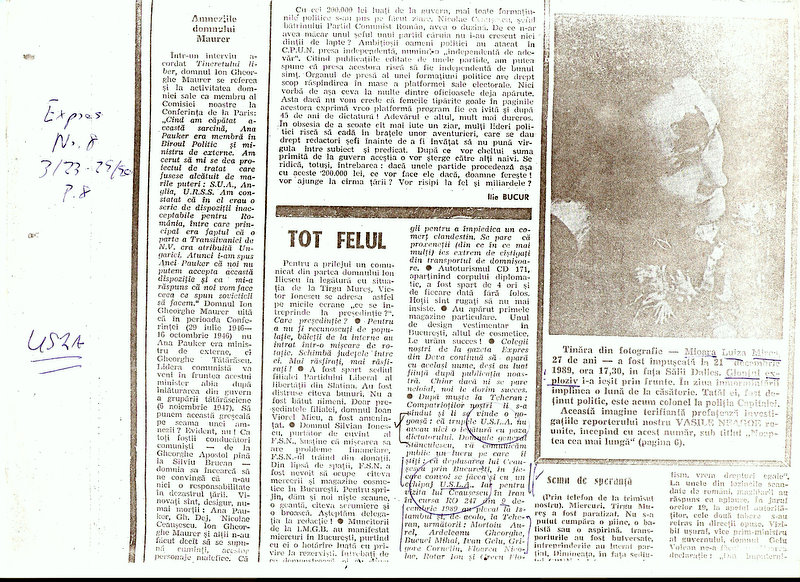
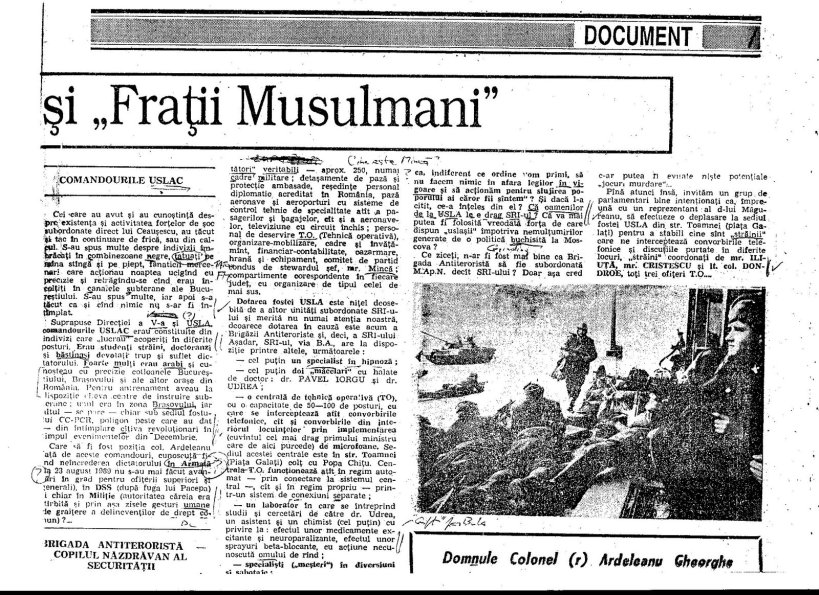
[85] Marian Romanescu with Dan Badea, “USLA, Bula Moise, teroristii si Fratii Musulmani,” Expres, no. 26 (2-8 July 1991), p. 8.  In no.8 (23-30 March 1990) Expres p. 8, Cornel Nistorescu wrote in “Tot Felul,”

“Our compatriots tried and are trying to sell a lie:  that the USLA had no role in guarding the dictator.  Mr. General Stanculescu, we communicate publicly to you something you know:  that every time Ceausescu went out in Bucharest, in each convoy there was an USLA team.  And for Ceausescu’s visit to Iran on flight RO 247 of 9 December to Istanbul and on to Tehran were the following:  Mortoriu Aurel, Ardeleanu Gheorghe, Bucuci Mihai, Ivan Gelu, Grigore Corneliu, Floarea Nicolae, Rotar Ion and Grecu Florin.  These weren’t diplomats and they weren’t going for a snack.”

[86] “Marturii din 23 decembrie,” Ziua , 23 December 2005, online edition.

[87] Gheorghe Ratiu, interview by Ilie Neacsu (episode 17), Europa, 7-22 March 1995, cited in Hall 1997, p. 366.

[88] See Michael Shafir, “Preparing for the Future by Revising the Past,” Radio Free Europe Report on Eastern Europe, vol. 1, no. 41 (12 October 1990), p. 36.

[89] Quoted in Shafir, “Preparing for the Future,” p. 37, fn. 35; also FBIS, 30 December 1989, for the last quote.

[90] See Sergiu Nicolaescu, Revolutia:  inceputul adevarului (Bucharest:  Editura TOPAZ, 1995), concluding chapter.  The Libyan ambassador gave a hasty statement on Romanian Television on 25 December 1989, becoming the first foreign ambassador to recognize the new government, according to Valenas et. al. (see next note #91, and Ratesh 1991, pp. 65-66).  According to FBIS, Bucharest’s Domestic Service on 30 December 1989 announced Dumitru Mazilu of the Front had met with “Qadafi’s representative.”

[91] See Liviu Valenas, “Lovitura de palat din Romania:  Capii complotului dezvaluie,” Baricada, no. 32 (21 August 1990), p.3.  The speculation by Ratesh that the “anonymous plotters” were “surely Brucan and Militaru” seems correct; in fact, their photos appear in the center of the article, see Nestor Ratesh, Romania:  The Entangled Revolution (New York:  Praeger, 1991), p. 65. Ion Cristoiu maintained in 1993 that, Gelu Voican Voiculescu, a key figure in the early Front, had then recently told him, that the British photo journalist (Ian Parry) who perished in the still murky incident surrounding the shooting down of an AN-24 on 28 December 1989, “had stayed at the ‘Hotel National’ and discovered, it appears, on a list many Libyans.” See Constantin Iftime, Cu ION CRISTOIU prin infernul contemporan (Bucharest:  Edtirua Contraria, 1993), pp. 31-32.

[92] Toma Roman, jr. and Lucia Stefanovici, “In 25 decembrie 1989, un avion DC9 venit din Libia as scos din tara 40 de arabi, la ordinul unui ‘emanat,’” Flacara, no 43 (25-31 October 1994), p. 6.

[93] Shafir, “Preparing the Past,” p. 37, fn. 35.

[94] Constantin Vranceanu, “Planul ,Z-Z’ si telefonul rosu,” Romania Libera, 28 September 1990, p. 3.  The information was given, according to Vranceanu, to him by a high-level anonymous political personality and supposedly confirmed by people of high-rank in the Securitate.  Vranceanu claimed he was told Soviet pressure led the countries involved to renounce fulfilling their end of the agreement.

[95] Ratesh, Romania:  The Entangled Revolution, pp. 66-67, quoting Radio Bucharest, 2 February 1990.  I don’t think from the context given it is clear that this alleged incident took place in January 1990, as Ratesh assumes; the reference to 27-28 might have been a reference to December 1989.

[96] Liviu Valenas, “Lovitura de palat din Romania:  Enigma ,teroristilor (I),’ Baricada, no. 29 (31 July 1990), p. 3.  Once again, I am unsure of the accuracy of the date used here, this time by Valenas.

[97] Horia Alexandrescu, “Adevarul despre U.S.L.A.:  Pornind de la ,Odiseea Zborului RO-259’,” Tineretul Liber, 14 March 1990, p.4.  He is quoting Rodica Dumitrescu’s article in Lumea, no. 5 (1 February 1990).

[98] I should add here:  they actually returned to airport duties in July 1990, but not before protests by airport employees.
Arabesque II: Arab Terrorists in the December 1989 Romanian Revolution

ARABESQUE: Arab Terrorists in the December 1989 Romanian Revolution

Posted in decembrie 1989, raport final, Uncategorized | Tagged: , , , , , | 7 Comments »

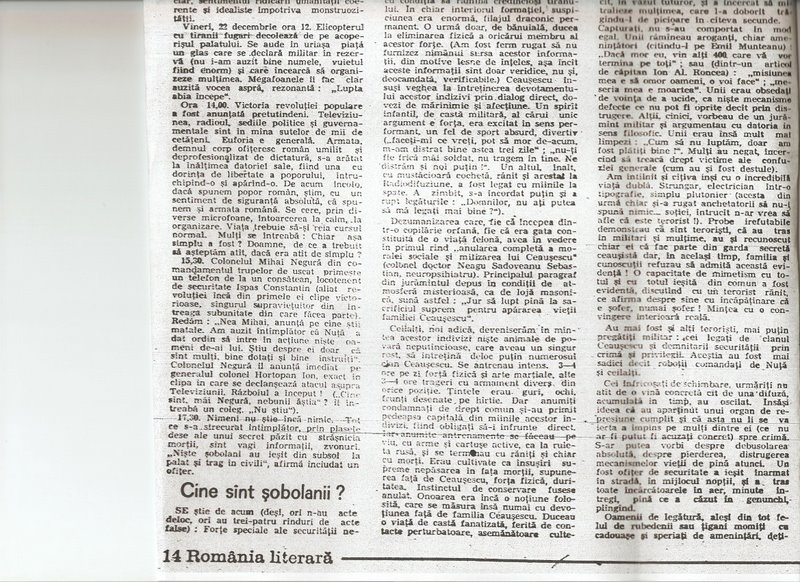
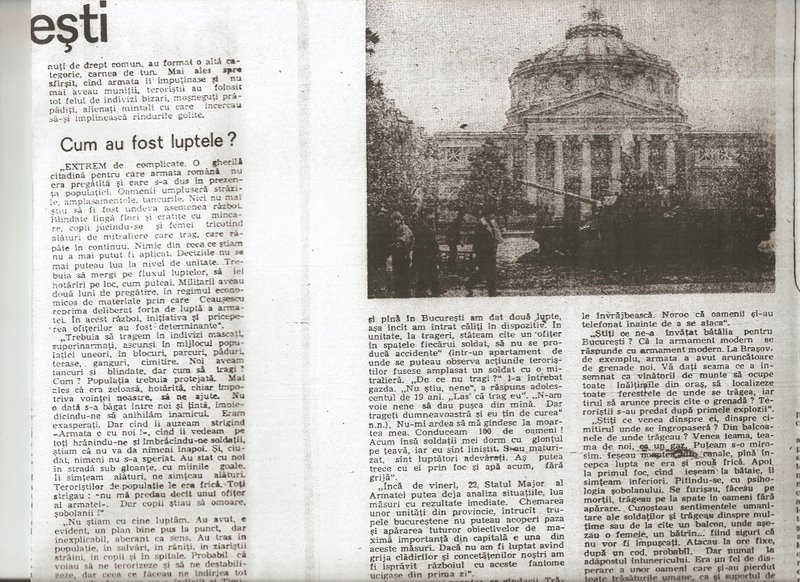
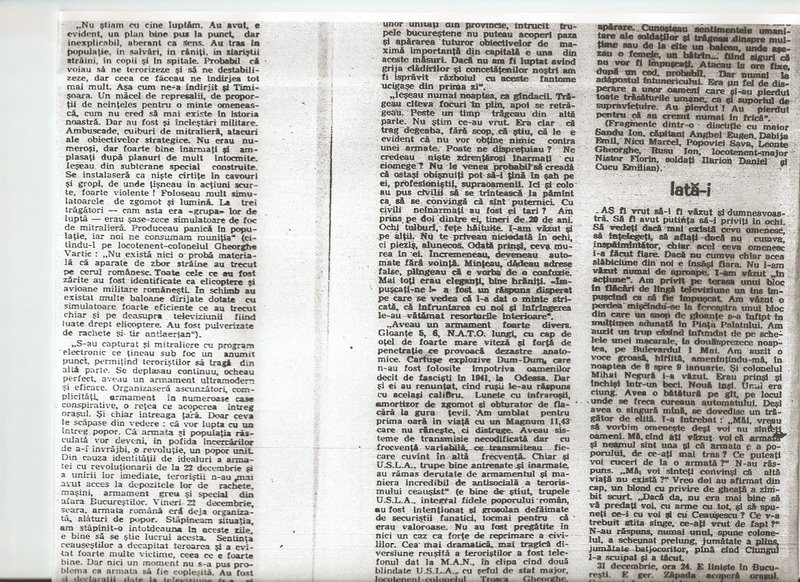
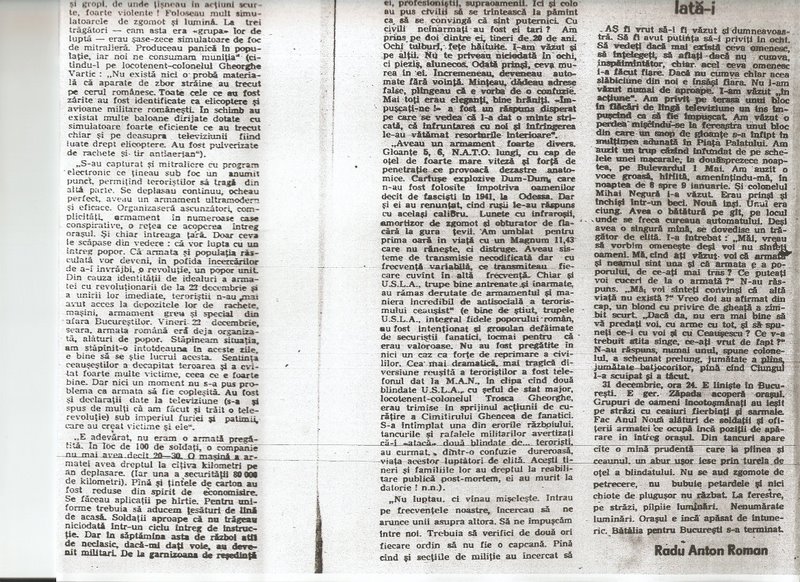
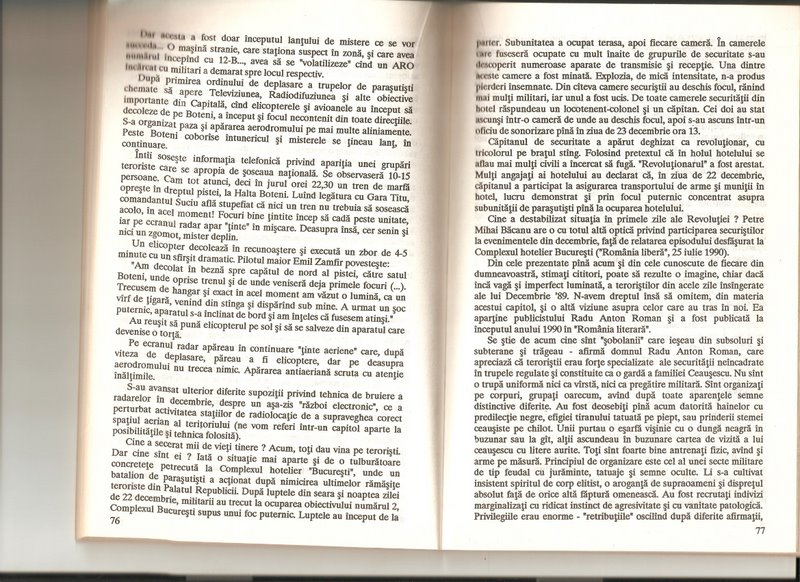
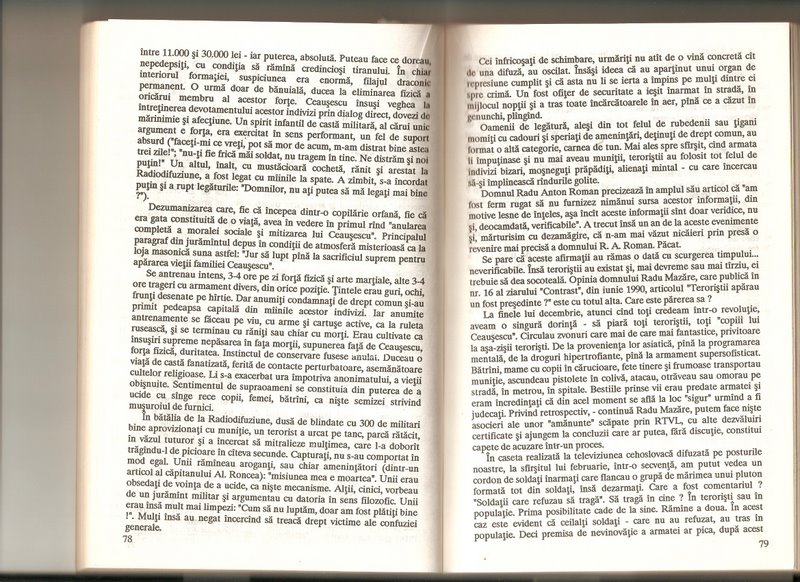
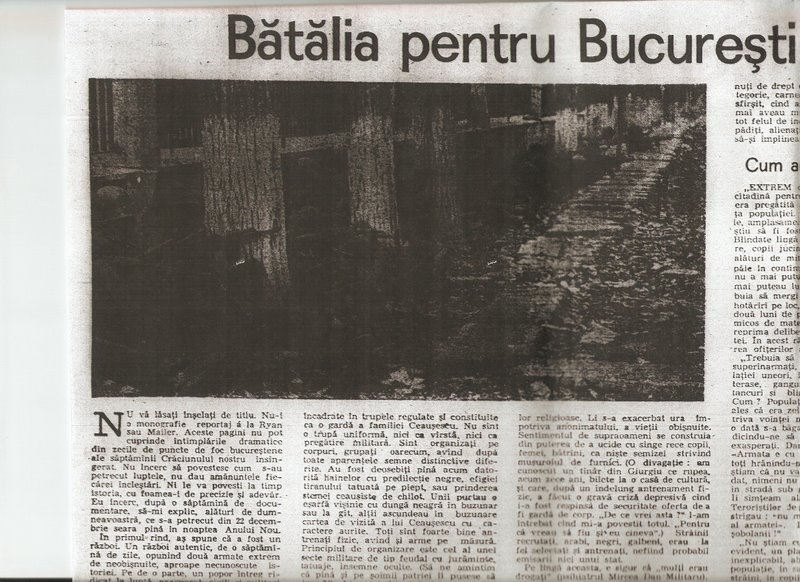
Radu Anton Roman, “Batalia pentru Bucuresti,” Romania Literara, anul 23, nr. 3, 18 ianuarie 1990, pp. 14-15.

Posted by romanianrevolutionofdecember1989 on August 21, 2011

Radu Anton Roman, “Batalia pentru Bucuresti” Romania Literara, anul 23, nr. 3, 18 ianuarie 1990, pp. 14-15.

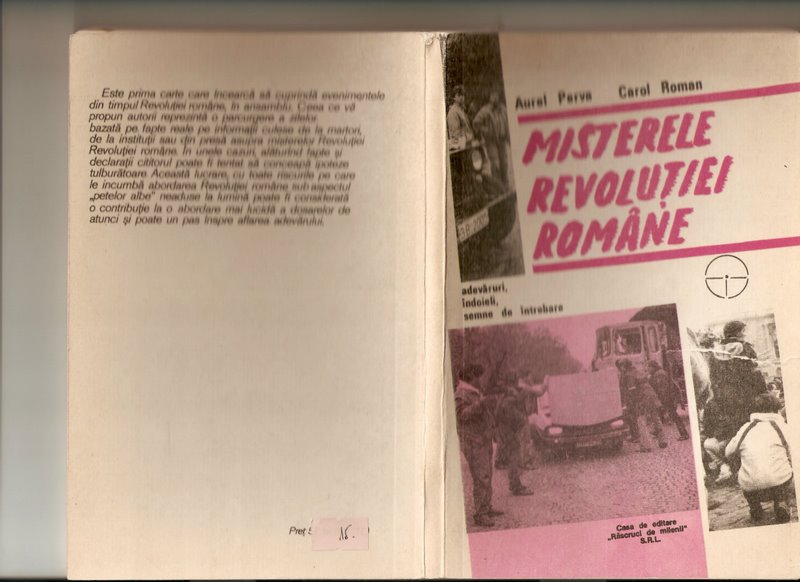
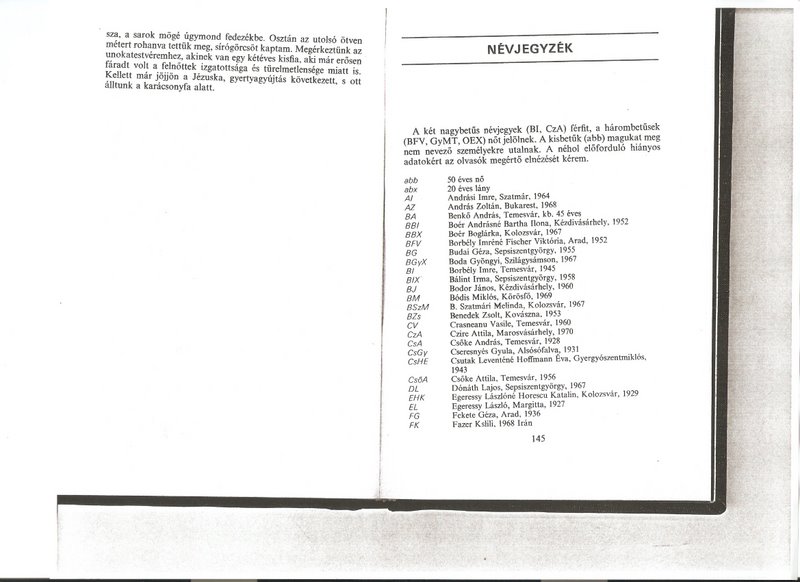
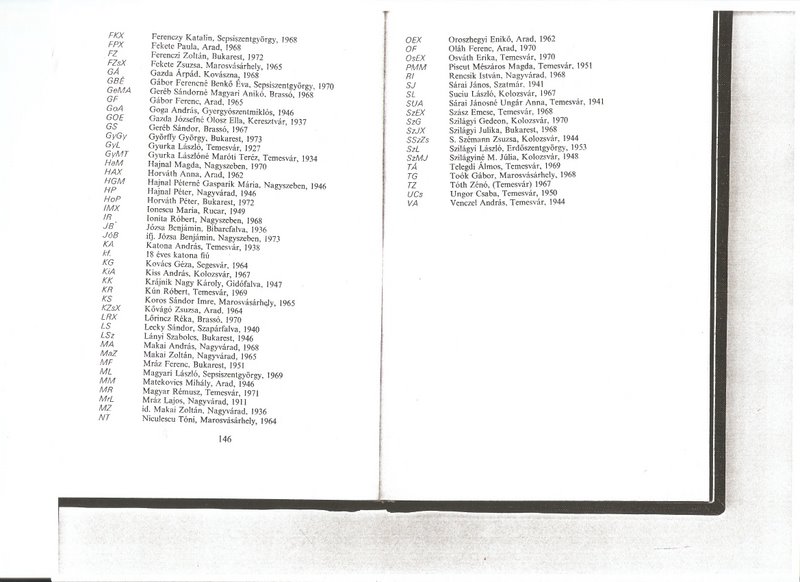
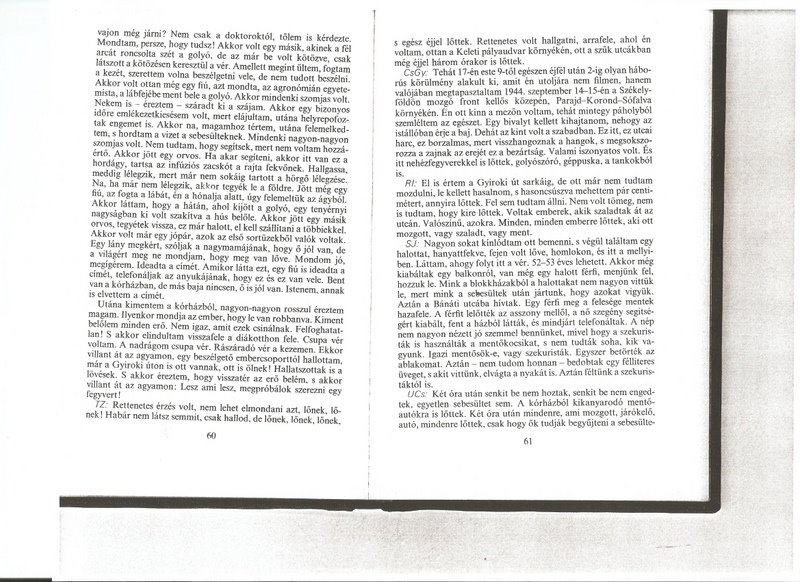
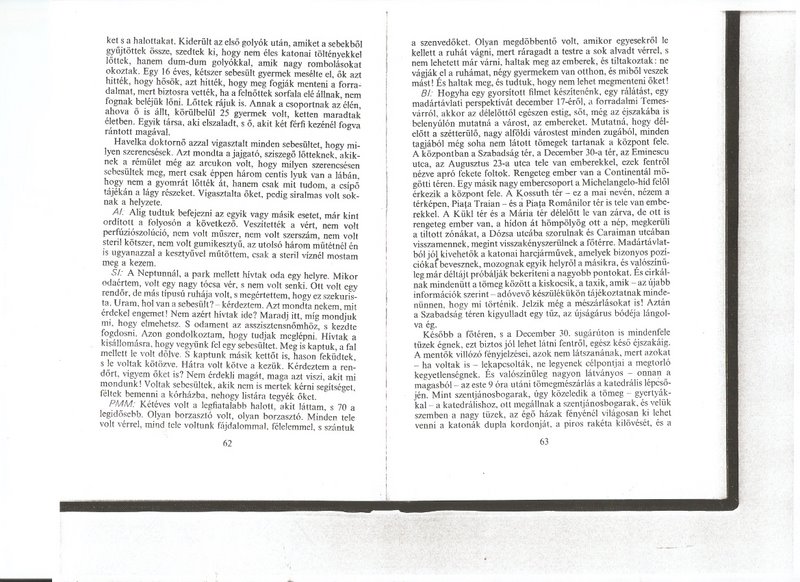
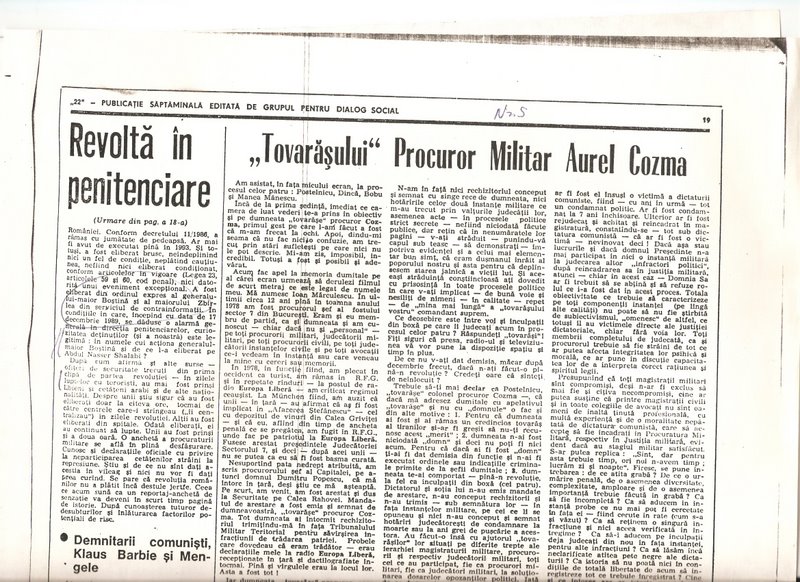
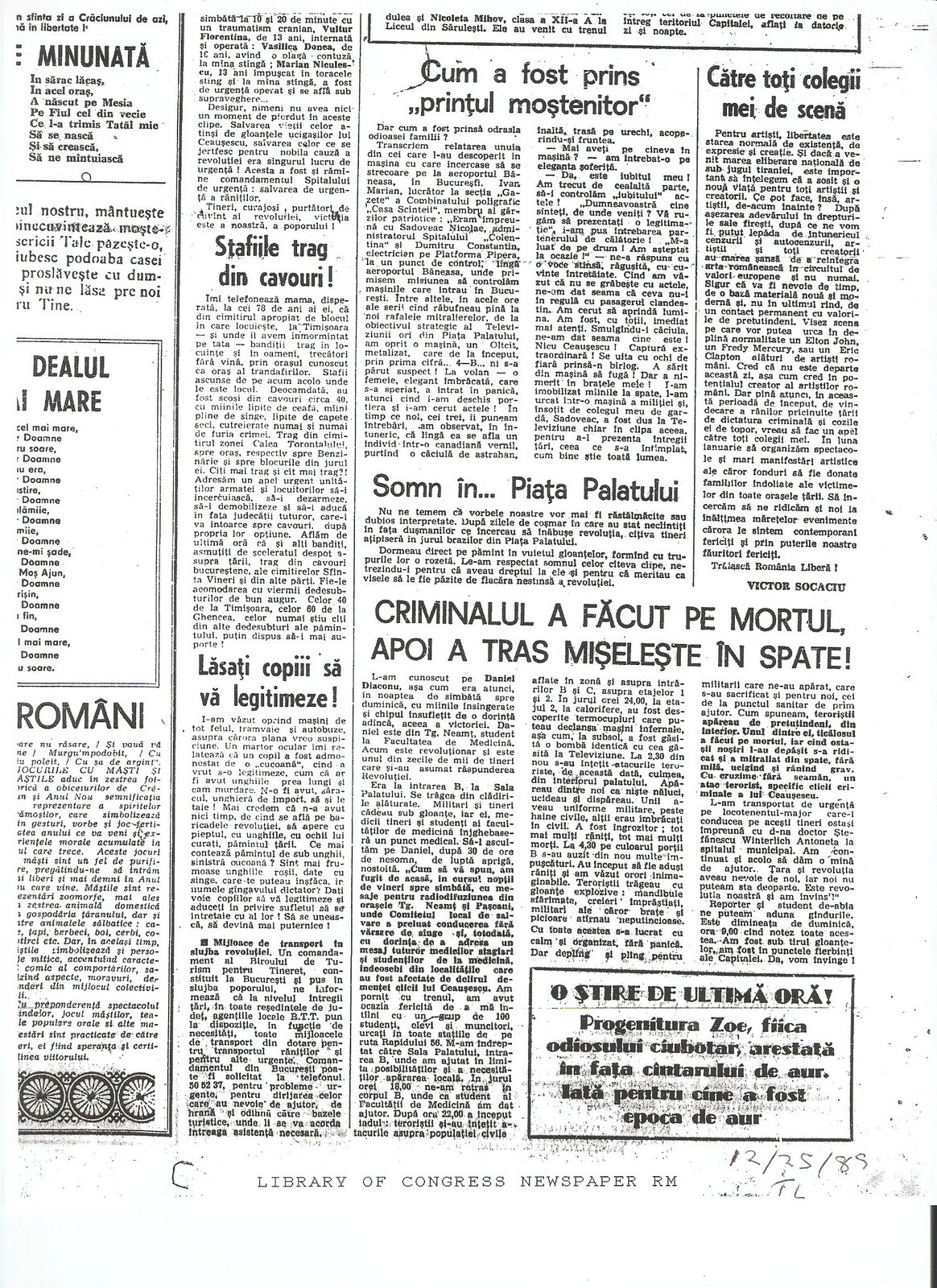
There’s much to be said about this article.  My apologies for it’s quality:  it was xeroxed from the Library of Congress’s microfilm collection and then scanned in.  I wish I could say I came across this by myself, as I have so much of what I have found on the Romanian Revolution of December 1989.  Instead, I found reference to it in Aurel Perva and Carol Roman’s 1991 book, Misterele Revolutiei Romane (see below).

“Aveau un armament foarte divers.  Gloante 5, 6, N.A.T.O. lungi, cu cap de otel de foarte mare viteza si forta de penetratie ce provoaca dezastre anatomice.  Cartuse explozive Dum-Dum care n-au fost folosite impotriva oamenilor decit de fascisti in 1941 la Odessa.  Dar si ei au renuntat, cind rusii le-au raspuns cu acelasi calibru.  Lunete cu infrarosii, amortizor de zgomot si obturator de flacara la gura tevii.”

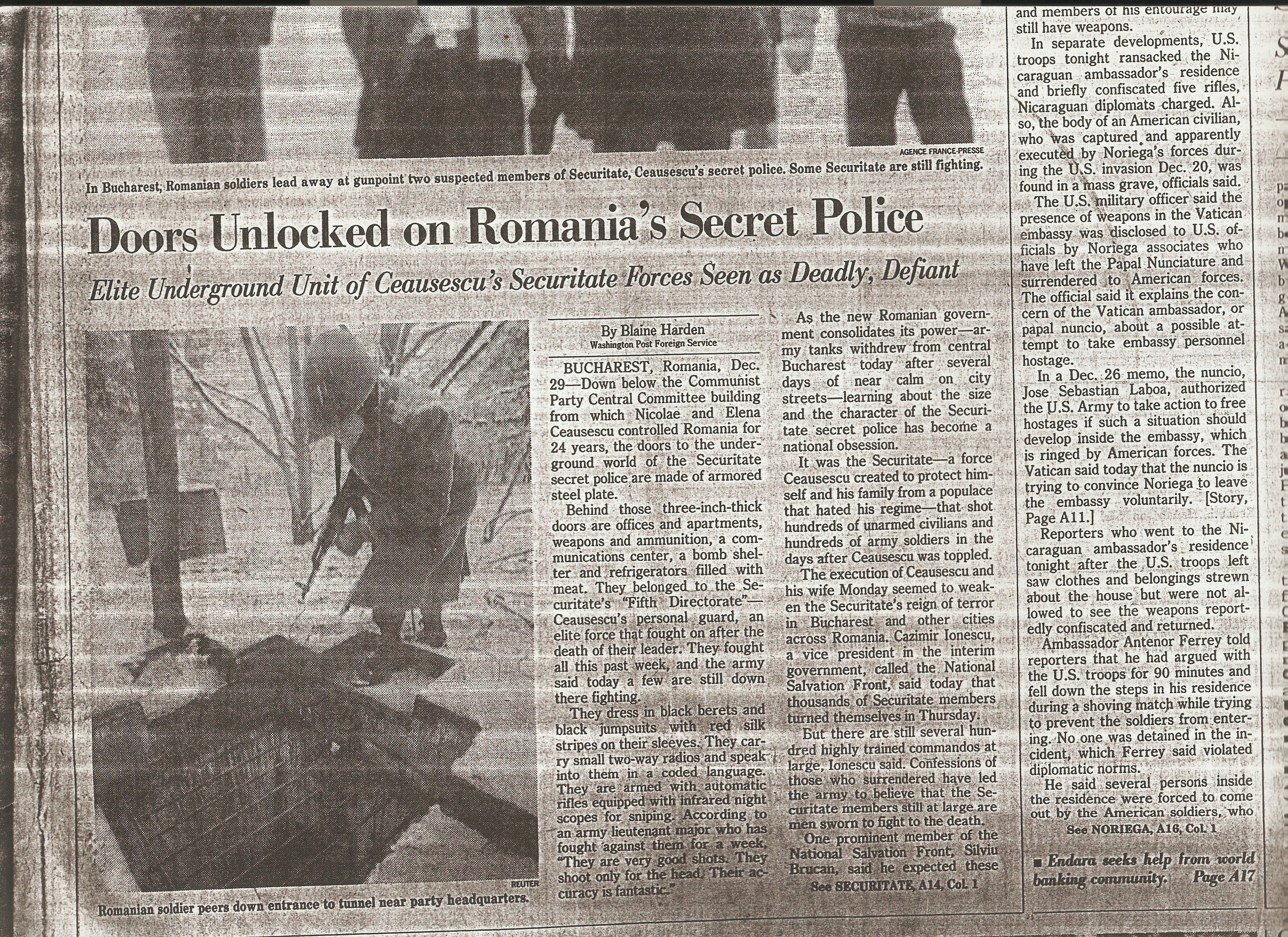
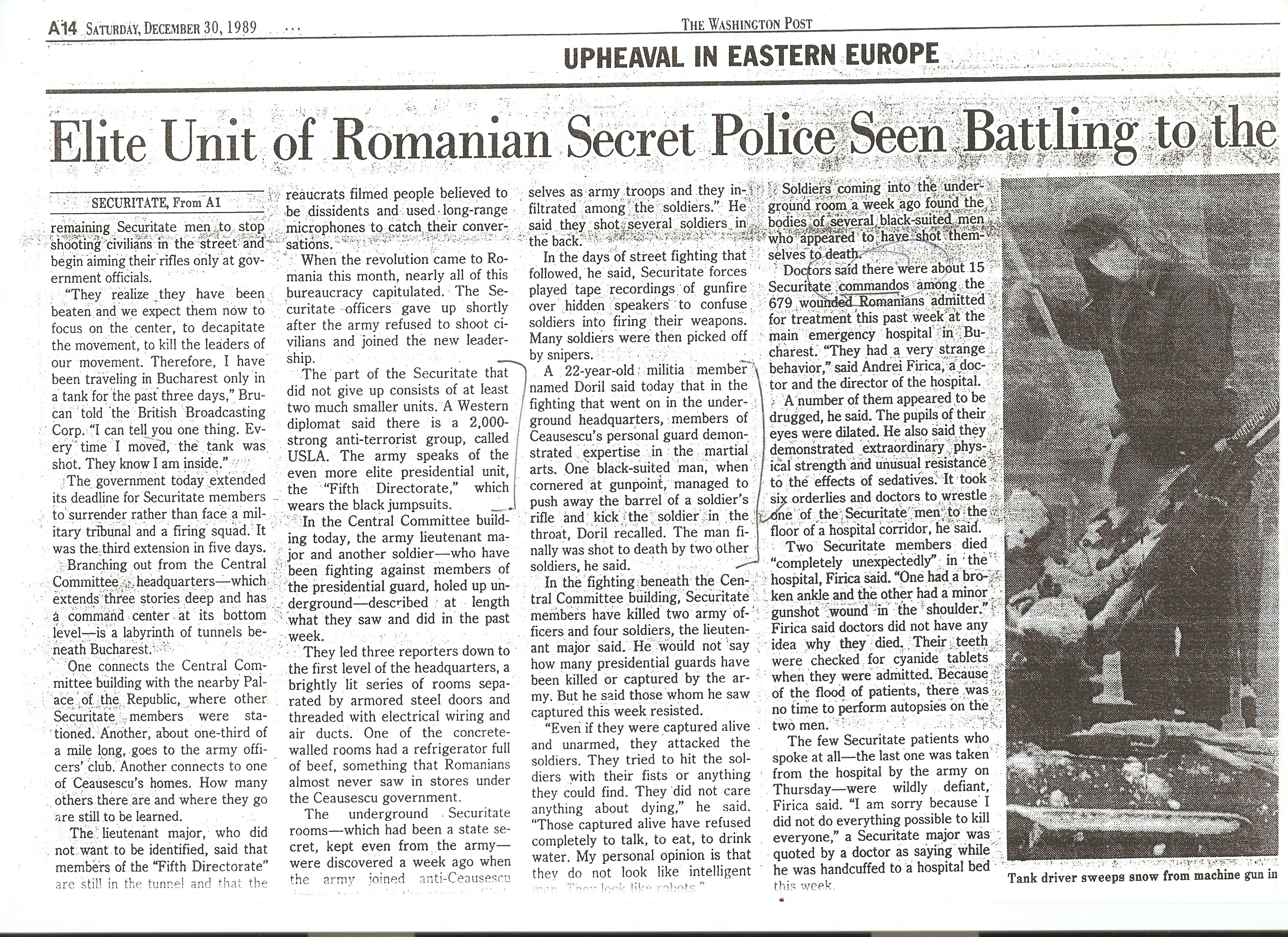
Blaine Harden, “Doors Unlocked on Romania’s Secret Police,” The Washington Post, 30 December 1989, p. 1, 14A (sau cu alte cuvinte, despre USLAC in combinezoane negre)

http://atomic-temporary-3899751.wpcomstaging.com/2010/11/19/les-souterrains-de-bucarest-ja2-20h-27121989-01min55s/

Sediul U.S.L.A , pe 25 decembrie 1989 in jurul orelor 18…

Pe 25 decembrie in jurul orelor 18, dupa executarea dictatorilor, col. Ardeleanu Gh. a adunat cadrele unitatii intr-o sala
improvizata si le-a spus: “Dictatura a cazut! Cadrele unitatii se afla in slujba
poporului. Partidul Comunist Roman nu se desfiinteaza! Trebuie sa ne regrupam in
rindul fortelor democratice din P.C.R.–continuatorul idealurilor nobile ale
poporului ai carui fii sintem ! (…) Au fost gasite cadavre, indivizi avind
asupra lor legitimatii de acoperire USLAC (Unitatea Speciala de Lupta
Antiterorista si Comando) si legitimatii cu antetul 0620–USLA, legitimatii care
nu se justifica in posesia celor asupra carora au fost gasite…” A ordonat apoi
sa fie predate in termen de 24 de ore legitmatiile de serviciu, urmind ca
tuturor sa le fie eliberate altele cu antetul M.Ap.N.

(capitanul Romanescu Marian, cu Dan Badea, “USLA, Bula Moise, teroristii si
‘Fratii Musulmani’,” Expres nr. 26 (75), 2-8 iulie 1991, 8-9)

image-15

(Capitanul Romanescu Marian (fost cadru USLA) si Dan Badea, “USLA, Bula Moise, teroristii, si ‘Fratii Musulmani’,” Expres nr. 26 (75), 2-8 iulie 1991, pp. 8-9)

COMANDOURILE USLAC

Cei care au avut si au cunostinta despre existenta si activitatea fortelor de soc subordonate direct lui Ceausescu, au tacut si tac in continuare de frica, sau din calcul.  S-au spus multe despre indivizii imbracati in combinezoane negre, tatuati pe mina stinga si pe piept, fanaticii mercenari care actionau noaptea ucigind cu precizie si retragindu-se cind erau incoltiti in canalele subterane ale Bucurestiului.  S-au spus multe, iar apoi au tacut ca si cind nimic nu s-ar fi intimplat.

Suprapuse Directiei a V-a si USLA comandourile USLAC erau constituite din indivizi care “lucrau” acoperiti in diferite posturi. Erau studenti straini, doctoranzi si bastinasi devotati trup si suflet dictatorului.  Foarte multi erau arabi si cunosteau cu precizie cotloanele Bucurestiului, Brasovului si ale altor orase din Romania.  Pentru antrenament aveau la dispozitie citeva centre de instruire subterane:  unul era in zona Brasovului, iar altul–se pare–chiar sub sediul fostului CC-PCR, poligon care au dat–din intimplare citiva revolutionari in timpul evenimentelor din Decembrie.

image-13

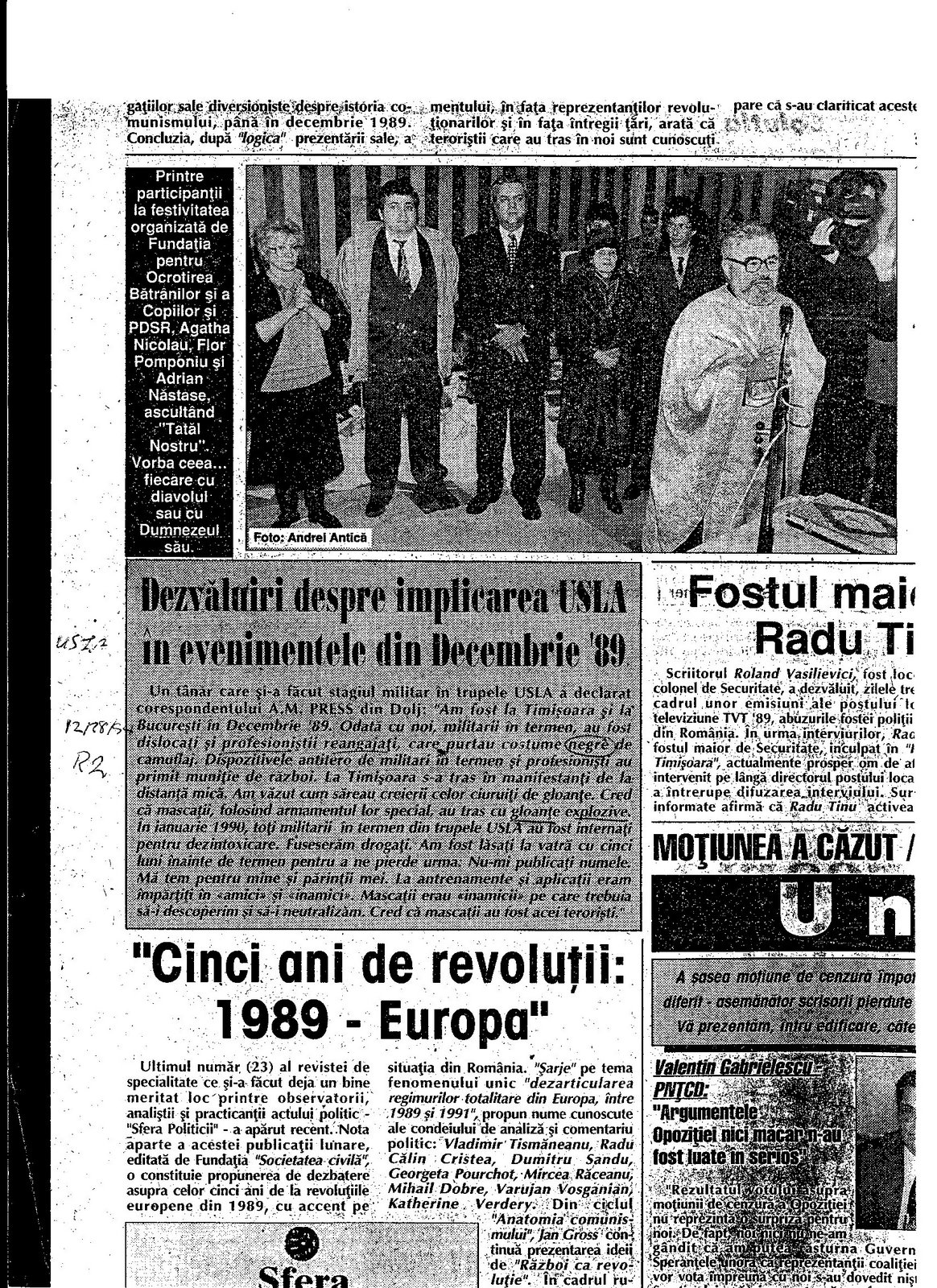
Dezvaluiri despre implicarea USLA in evenimentele din Decembrie ‘89

Un tanar care si-a facut stagiul militar in trupele USLA a declarat
corespondentului A.M. PRESS din Dolj: “Am fost la Timisoara si la Bucuresti in
Decembrie ‘89. Odata cu noi, militarii in termen, au fost dislocati si
profesionistii reangajati, care purau costume negre de camuflaj. Dispozitivele
antitero de militari in termen si profesionisti au primit munitie de razboi. La
Timisoara s-a tras in manifestanti de la distanta mica. Am vazut
cum sareau creierii celor ciuruiti de gloante. Cred ca mascatii, folosind armamentul lor special, au tras cu
gloante explozive.
In ianuarie 1990, toti militarii in termen din trupele USLA
au fost internati pentru dezintoxicare. Fusesaram drogati. Am fost lasati la
vatra cu cinci luni inainte de termen pentru a ne pierde urma. Nu-mi publicati
numele. Ma tem pentru mine si parintii mei. La antranamente si aplicatii eram
impartiti in “amici” si “inamici.” Mascatii erau “inamicii” pe care trebuia sa-i
descoperim si sa-i neutralizam. Cred ca mascatii au
fost acei teroristi.”

(Romania Libera, 28 Decembrie 1994, p. 3)

Bullets, Lies, and Videotape: The Amazing, Disappearing Romanian Counter-Revolution of December 1989 (Part VII: Conclusion. Those Who Told Us the Truth) by Richard Andrew Hall (UPDATED with new xeroxes)

Posted in decembrie 1989, raport final, Uncategorized | 4 Comments »

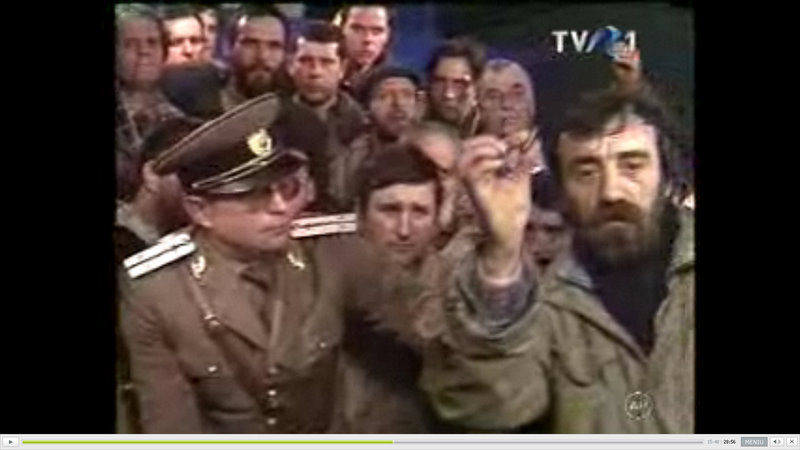
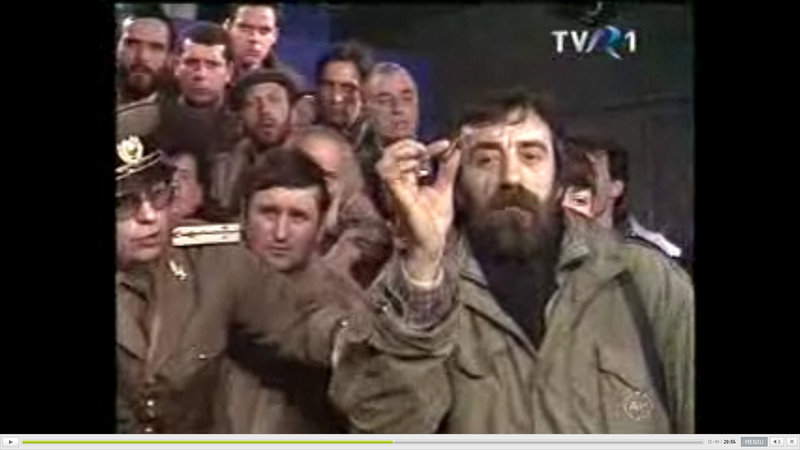
TVR 22 decembrie, Constantin Vaeni: “…s-a tras de catre alti oameni cu cartuse, cu glont (o voce: “de securitate)”

Posted by romanianrevolutionofdecember1989 on August 18, 2011

(a strictly personal observation)

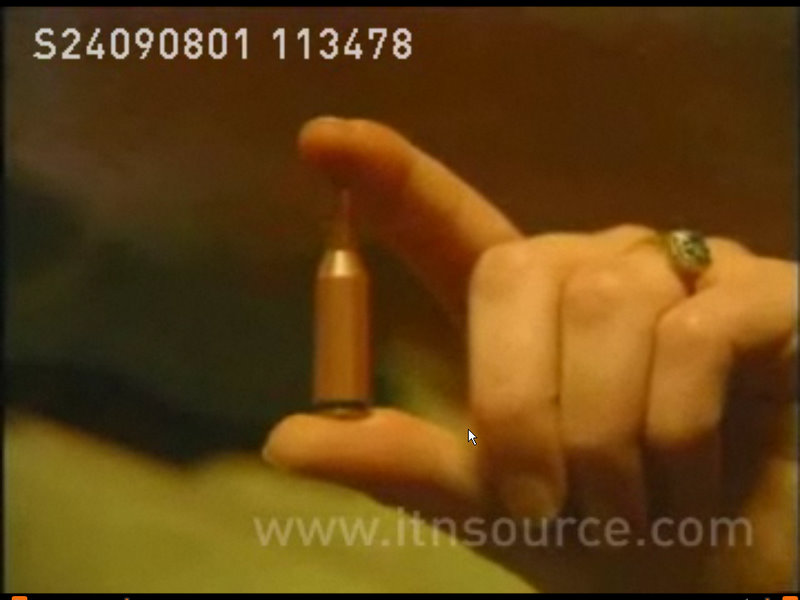
This seems all-too-typical to me.  For all the clips from TVR during the events of the Romanian Revolution of December 1989–in fact, for all the clips including Col. Mihai(l) Lupoi–this is the first time I have seen the following clip with Constantin Vaeni from the early afternoon of 22 December 1989.

It is significant.  Vaeni, in a confused intervention, shows a bullet which he says he was given by a soldier on a tank which he and other civilians rode out from the center…one can only imagine that since the soldier gave him the bullet as evidence that as Vaeni says “others shot,” that this was not in the Army’s arsenal (otherwise it does not make a lot of sense).  So it is important to note, the whole discussion of the bullets used by non-Army forces (Securitate and Militia) began before the “terrorists” ever opened fire and in fact was specifically in discussion to bullets with which demonstrators had been shot the night before in Piata Universitatii (University Square).

Needless to say, the producer of this film (Sange pe Catifea, Cornel Mihalache) is unaware of the significance of this brief scene and doesn’t draw attention to it.

from TVR film “Sange pe catifea” (6b) between 10:00 and 10:30

http://www.trilulilu.ro/clauteo/6c99efb920996b

Posted in decembrie 1989, raport final, Uncategorized | 3 Comments »

december 1989: temesvari orvosok, dum-dum golyok, es a roman forradalom

Posted by romanianrevolutionofdecember1989 on August 16, 2011

Below, in Hungarian, the discussion of three doctors (Vladimir Fluture, Csaba Ungor, and Andras Goga) present and performing surgery in Timisoara hospitals from 17-19 december 1989 who recount separately their discovery of dum-dum exploding bullets among the bullets with which demonstrators arriving at the hospital had been shot.

Doctors and Dum-Dum Bullets in Romania in December 1989 (III): Ce spun medici romani?

Doctors and Dum-Dum Bullets in Romania in December 1989 (II): Trimisi in strainatate (Italia, Franta, Austria, Anglia, si Germania) pentru tratament

Doctors and Dum-Dum Bullets in Romania in December 1989 (I): Dr. Manuel Burzaco (Médecins Sans Frontières)

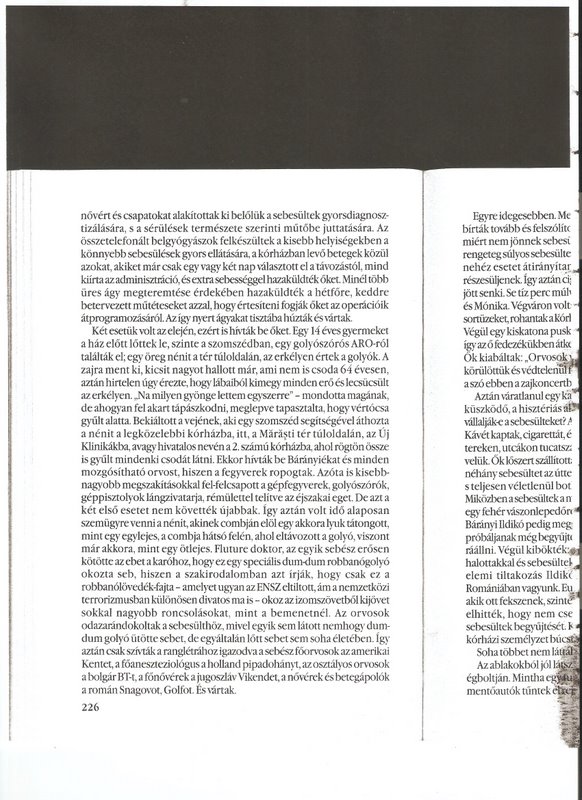
The following first appeared in Gyorgy Mandics’s Temesvari golgota (1991) pp. 348-349 and is reprinted in his A Manipulalt Forradalom (2009).  [My guess is this is also the source for the reference to dum dum bullets in the German language wikipedia entry for http://de.wikipedia.org/wiki/Rum%C3%A4nische_Revolution_1989 — Hans Vastag, György Mandics, Manfred Engelmann: Temeswar. Symbol der Freiheit. Wien 1992. ]

pp. 348-349

Ket esetuk volt az elejen.  Ezert is hivtak be oket.  Egy 14 eves gyermeket a haz elott lottek le, szinte a szomszedban, egy golyoszoros ARO-rol talaltak el; egy oreg nenit a ter tuloldalon, az erkelyen ertek a golyok.  A zarja ment ki, kicsit nagyott hallott mar, amire is csoda, 64 evesen, azt hirtelen ugy erezte, hogy labaibol kimegy minden ero es lecsusott az erholya.  Na milyen gyonge lettem egyszeruen–mondotta maganak. de ahogyan fel akart tapaszkodni meg lepve tapasztalt, hogy vertocsa gyult alatta.  Bekialtolt a vegenek aki egy szomszed segitsegevel athozta a nenit a legkozelebbi korhazba, itt a Marasti ter tuloldalan, az uj Klinikakba, avagy hivatalos neven a 2 szamu korhazba, ahol rogton osszecodult mindenki csodat latni.  Ekkor hivtak be Baranziekat es minden mozgositato orvost, hiszen a fegyverek ropogatak.  Azota is kisebb nagyobb megszakitasokkal, felfelecsapolt a gepfegyverek, golyoszorok, geppisztolyok langzivatarja, remulettel telitva az ejszaki eget.

p. 349

De azt a ket elso esett nem kovettek ujabbok.  Igz aztan volt ido alaposan szemugyre venni a nenit akinek combjan elol egz akkora lyuk tatongott mint egy egy lejes, a comba hatso felen ahol eltavotott a golyo, ott viszont mar akkora mint egy otlejes.  Fluture doktor, az egzik sebesz erosen kototte az ebet a korohoz, hogy ez egz specialis dum-dum robbanogolyo okozta seb, hiszen a szakirodalomban azt irjak, hogy csak ez a robbannolovedek-fajta-amelyet ugyan az ENSZ eltitott, am a nemzetkozi terrorizmusban kulonesen divatos ma is–okoz az izomszovetbol kijovet sokkal nagyobb roncsolasokat mint a bemenetnel.  Az orvosok odazarandokoltak a sebesulthoz, mivel egzik sem latott semhogy dum-dum golyo utotte sebet, de egyaltalan lott sebet sem soha eleteben.  Igz aztan csak szivtak a rangeletrahoz igazodva a sebesz foorvosok az amerikai Kentet, a foamnesztezialogus a holland pipadohanyt, az asztalyos orovosok a bolgar BT-t, a fonoverek a jugoslav Vikend-et, a noverek es helyapolok a roman Snagov-t, Golfot.  Es vartak.
(Note: it is unclear who the 64 yr. old described was…there are several individuals without ages listed as injured or dead during the events, but I think it more likely the age of the woman is incorrect)

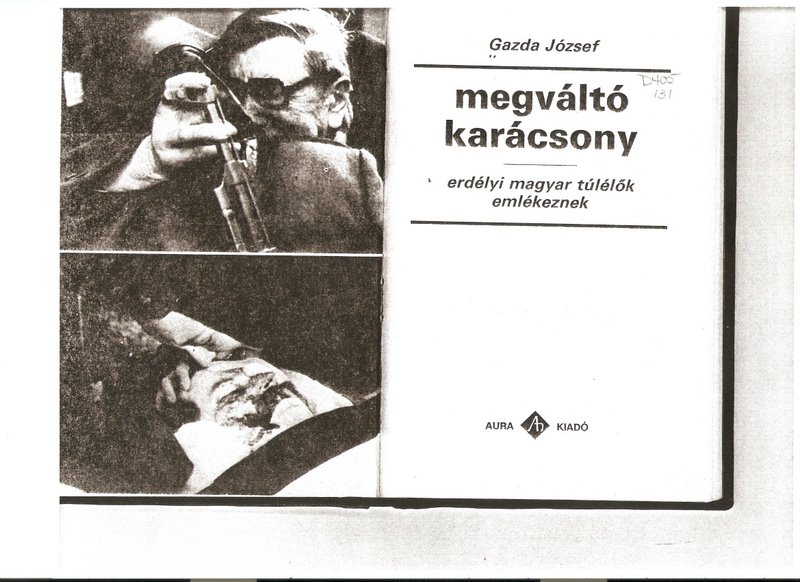
Jozsef Gazda Megvalto karacsonyErdelyi magyar tulelok emlekeznek. (1990)

Ungor Csaba:  Ket ora utan senkit be nem hoztak, senkit be nem engedtek, egyetlen sebesult sem.  A korhazbol kikanyarado  mentoautokra is lottek.  Ket ora utan mindre, ami mozgott, jarokelo, auto, mindenre lottek, csak hogy ok tudjak begyujteni a sebesulteket s a halottakat.  Kiderult az elso golyok utan, amiket a sebekbol gyujottek ossze, szedtek ki, hogy nem eles katonai toltenyekkel lottek, hanem dum-dum golyokkal, amik nagy rombolasokat okoztak.  Egy 16 eves, ketszer sebesult gyermek meselte el, ok azt hittek, hogy hosok, azt hittek, hogy meg fogjak menteni a forradalmat, mert biztosra vettek, ha a felnottek sorfala ele allnak, nem fognak belejuk loni.  Lottek rajuk is.
Goga Andras:  A masodik izgalomkelto esemeny volt kedden delelott, hogy az osszes regiszterunk–mind a surgossegen, mind az osztalyon–, melyekre felirtuk a muteteinket, eltuntek, a mai napig sem talaltuk meg.  Bennuk voltak az ev osszes mutetei[***]…En aznap kettot operaltam.  Egy tuntetonek a bore alol vettem ki egy nagyon kulonleges golyok, nem is golyot, egy ilyen repeszdarabot, melyet a katonasag aztan megvizsgalt, s azt mondtak, nekik nincs tudmasuk, hogy ez mi lehet.  Egy masiknak pedig fejserulese volt, persze abban nem talaltam golyot, amtent rajta.
***This appears to be a discussion of the operation of Colonel Nicolae Ghircoias (Director of the Criminalistic Institute of the Militia’s [Police’s] General Inspectorate) to make evidence disappear–for a discussion, see Bullets, Lies, and Videotape: The Amazing, Disappearing Romanian Counter-Revolution of December 1989 (Part I: “His name was Ghircoias…Nicolae Ghircoias”) by Richard Andrew Hall

Let’s Go to the Videotape! (I) “To the Army it’s confirmation that they’ve been dealing with a specially-trained force…because it’s the type of bullet they’ve never seen before” (ITN UK Television, Timisoara Romania, December 1989) (plus Irish Television, The Tragic Fate of Florica Sava)


Posted in decembrie 1989, raport final, Uncategorized | Tagged: , , , , , , | Leave a Comment »

Doctors and Dum-Dum Bullets in Romania in December 1989 (III): Ce spun medici romani?

Posted by romanianrevolutionofdecember1989 on August 11, 2011

Doctors and Dum-Dum Bullets in Romania in December 1989 (I): Dr. Manuel Burzaco (Médecins Sans Frontières)

Doctors and Dum-Dum Bullets in Romania in December 1989 (II): Trimisi in strainatate (Italia, Franta, Austria, Anglia, si Germania) pentru tratament

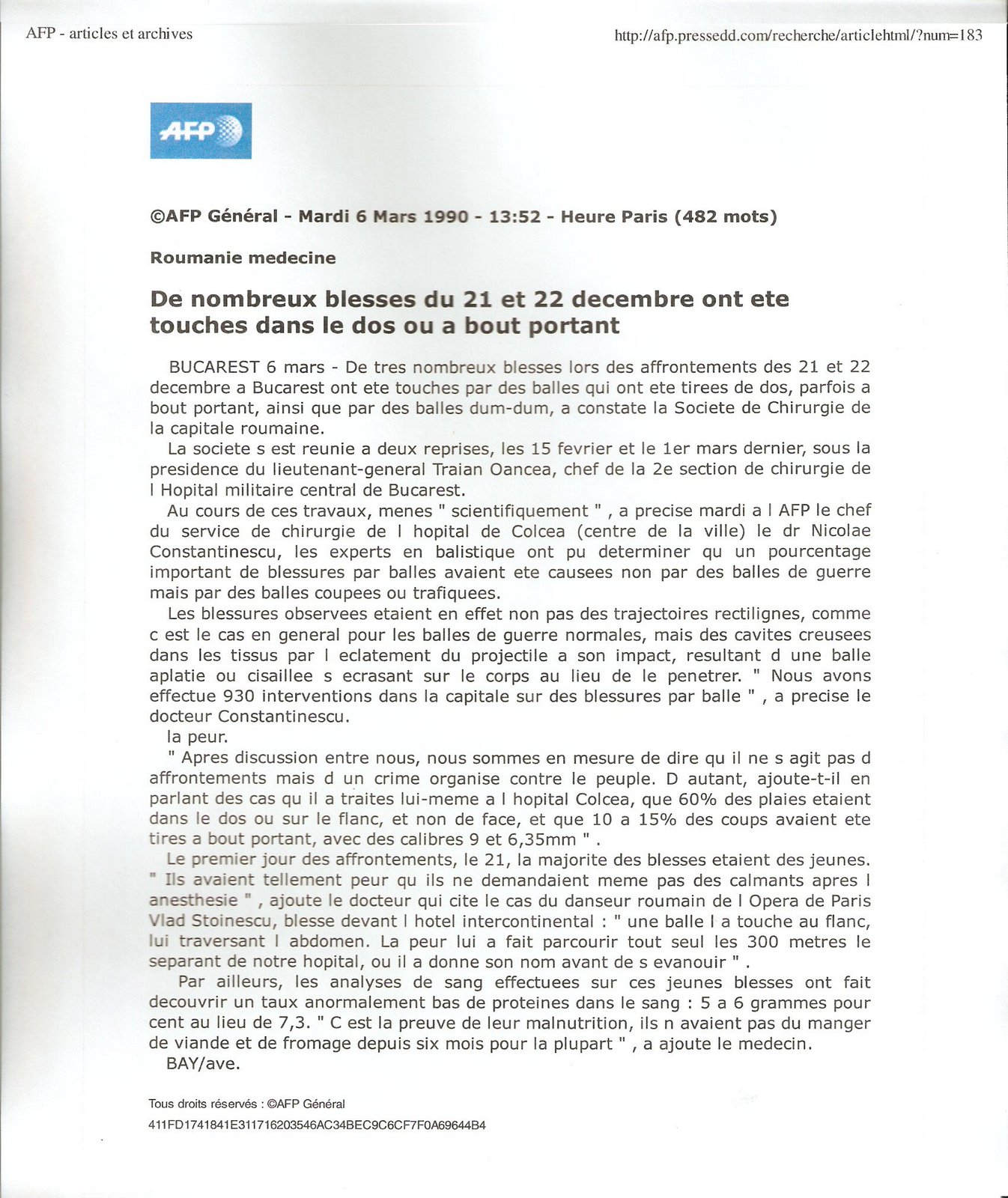
In early March 1990, AFP reported the declared findings of surgeons in Bucharest, attesting to the fact that many of those wounded on 21-22 December 1989 in Bucharest had been shot with exploding bullets, DUM-DUM bullets.  This is a critical article (and description of an event that I believe has gotten almost no coverage inside or outside Romania).

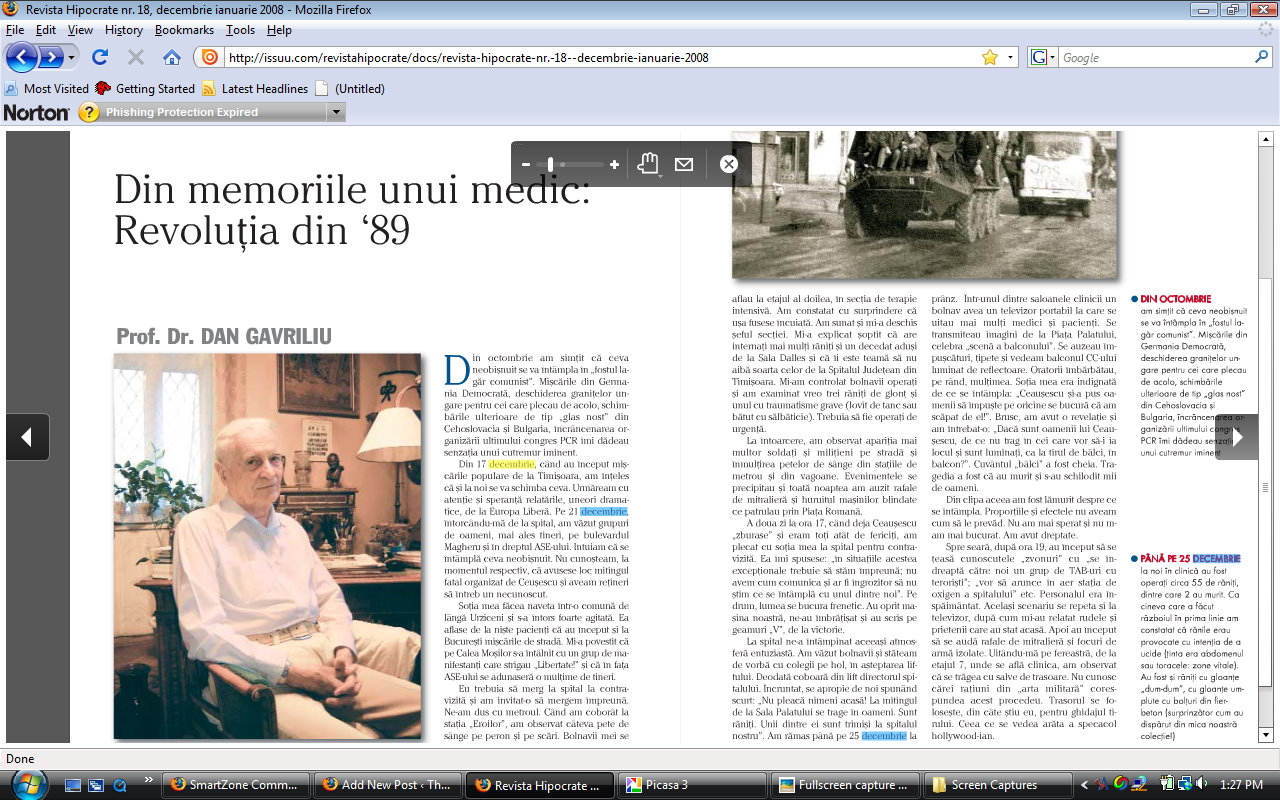
Prof. Dr. Dan Gavriliu:

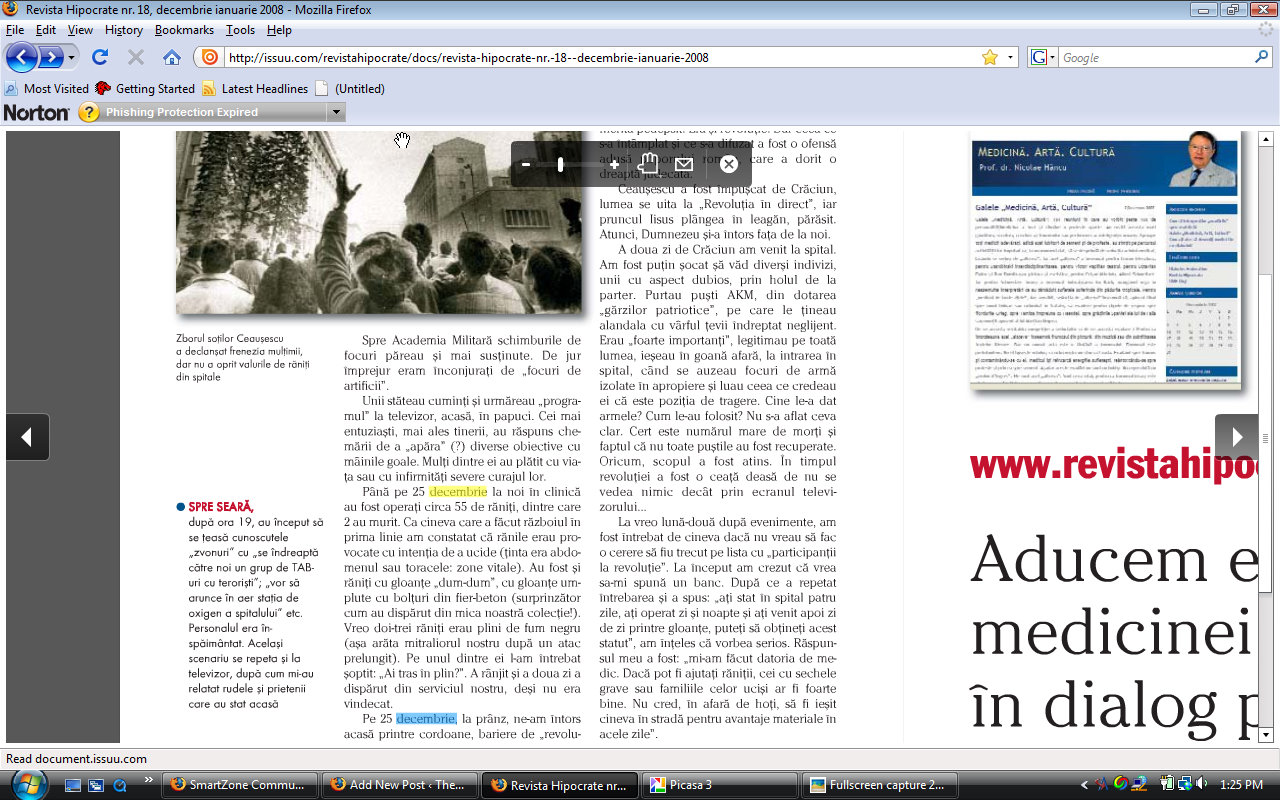
Pana pe 25 decembrie la noi in clinica au fost operati circa 55 de raniti, dintre care 2 au murit.  Ca cineva care a facut razboiul in prima linie am constatat ca ranile au fost provocate cu intentia de a ucide (tinta era abdomenul sau toracele:  zone vitale).  Au fost si raniti cu gloante “dum-dum,” cu gloante umplute cu bolturi de fier-beton (surprinzator cum au disparut din mica noastra colectie!)

Revista Hipocrate nr. 18 decembrie 2007-ianuarie 2008 pp. 80-82

Tot un medic despre folosirea gloantelor dum-dum in decembrie 1989 (Prof. dr. Dan Gavriliu)

—————————————————————————————————————————————————————————————————————–

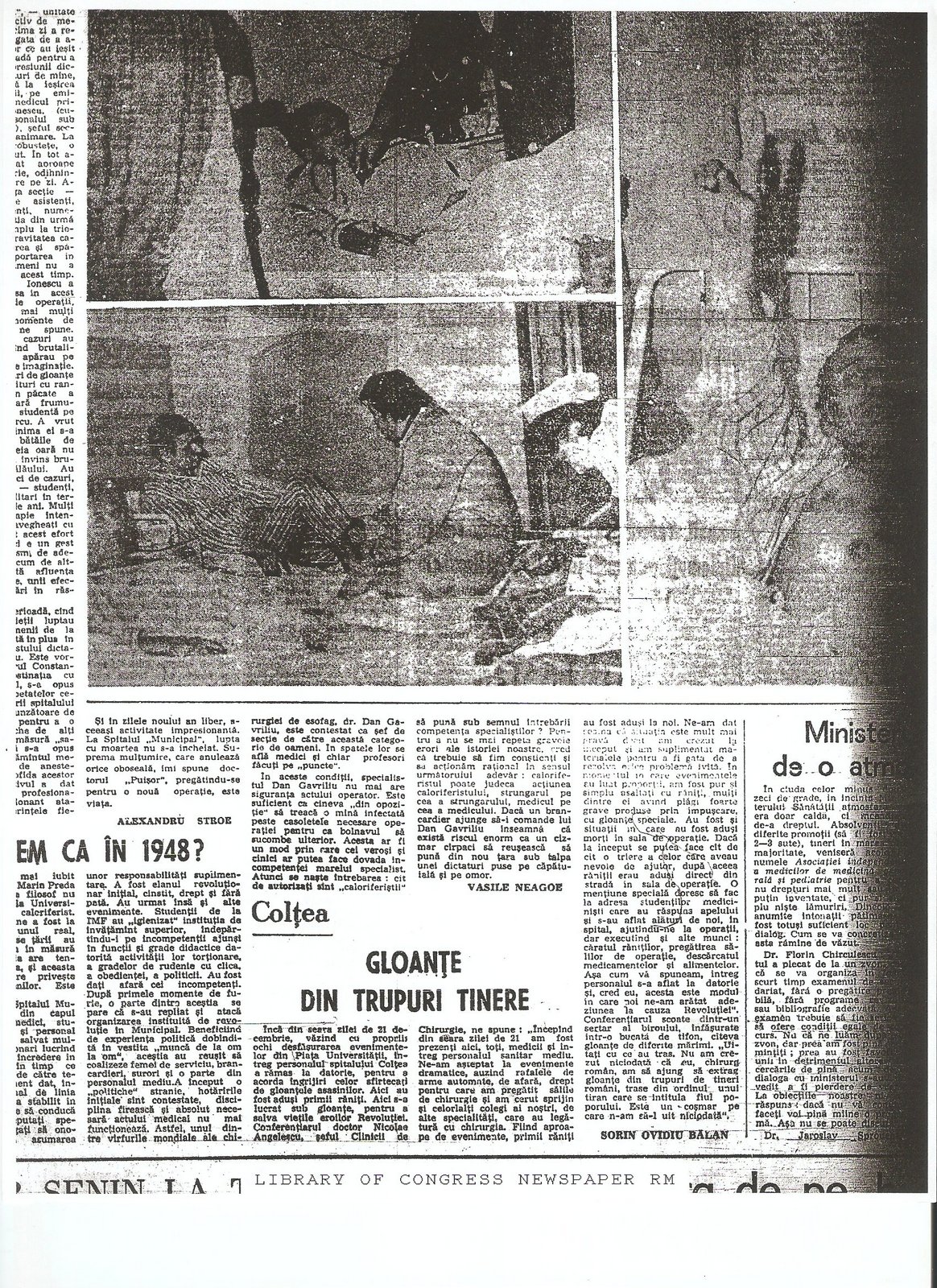
Conterentiarul doctor Nicolae Angelescu, seful Clinicii de Chirurgie, Spitalul Coltea:  “Incepind din seara zilei de 21 am fost prezenti aici, toti, medicii si intreg personalul sanitar mediu….In momentul in care evenimentele au luat proportii, am fost pur si simplu asaltati cu raniti, multi dintre ei avind plagi foarte grave produse prin impuscare, cu gloante speciale….” (Sorin Ovidiu Balan, “Coltea:  Gloante din trupuri tinere,” Tineretul Liber, 11 ianuarie 1990, p. 5)

image-45

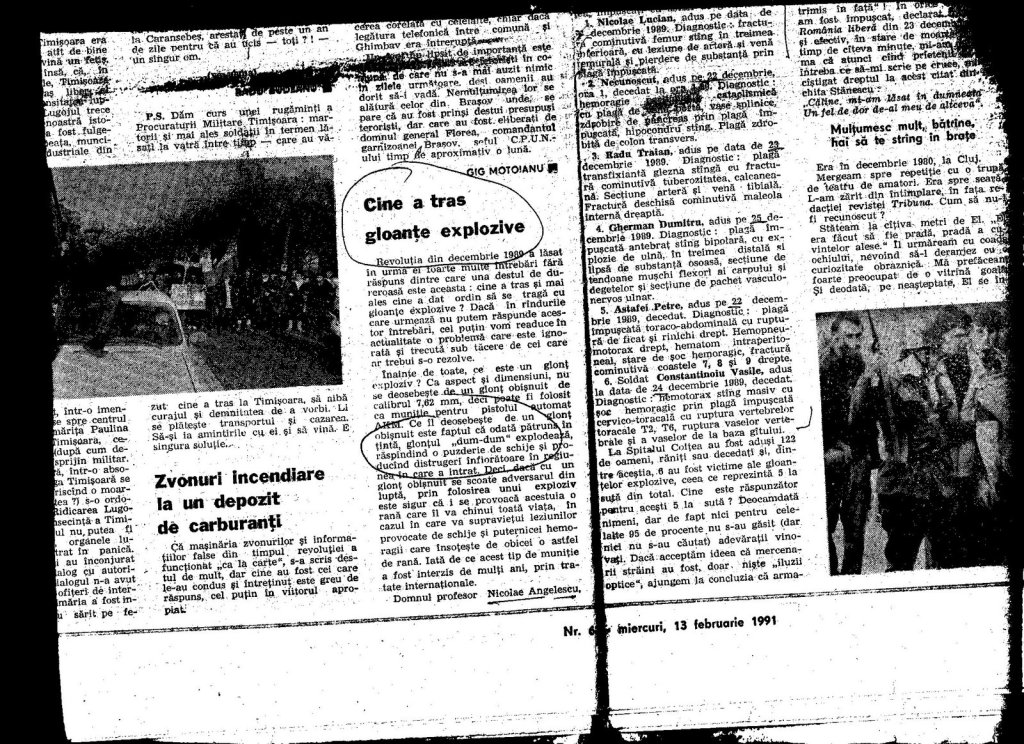
“Cine a tras gloante explozive?”

Revolutia din decembrie 1989 a lasat in urma ei foarte multe intrebari fara raspuns dintre care una destul de dureroasa este aceasta: cine a tras si mai ales cine a dat ordin sa se traga cu gloante explozive? Daca in rindurile care urmeaza nu putem raspunde acestor intrebari, cei putin vom reduce in actualitate o problema care este ignorata si trecuta sub tacere de cei care ar trebui s-o rezolve.

Inainte de toate, ce este un glont exploziv? Ca aspect si dimensiuni, nu se deosebeste de un glont obisnuit de calibrul 7,62 mm, deci poate fi folosit ca munitie pentru pistolul automat AKM. Ce il deosebeste de un glont obisnuit este faptul ca odata patruns in tinta, glontul “dum-dum” explodeaza, raspindind o puzderie de schije si producind distrugeri infioratoare in regiunea in care a intrat. Deci, daca cu un glont obisnuit se scoate adversarul din lupta, prin folosirea unui exploziv este sigur ca i se provoaca acestuia o rana care il va chinui toata viata, in cazul in care va supravietui leziunilor provocate de schije si puternicei hemoragii care insoteste de obicei o astfel de rana. Iata de ce acest tip de munitie a fost interzis de multi ani, prin tratate internationale.

Domnul profesor Nicolae Angelescu, seful Sectiei Chirurgie a Spitalului Coltea a avut amabilitatea sa ne explice citeva din aspectele tratamentului chirurgical al ranilor produse de gloante explozive:

–Sint mai multi factori, care contribuie la a face ca o plaga provocata de un astfel de glont sa fie greu de tratat si greu de vindecat. In primul rind prin explozia glontului se produc distrugeri masive de tesuturi in zona in care aceasta a patruns si uneori aceste tesuturi nu se mai pot reface. In al doilea rind, fragmentele metalice rezultate (?) in urma exploziei se raspindesc pe o intindere mare si de aceea nu pot fi extrase in totalitate, pentru ca extragerea lor ar provoca pacientului o rana mult mai mare decit cea produsa de glontul in sine. Deci, dupa operatie mai ramin in corpul pacientului destule fragmente metalice si acestea constituie surse de infectie care il agraveaza starea.

Pentru a va ajuta sa va dati seama cum arata si ce inseamna o rana produsa de un glont exploziv, va prezentam in continuarea diagnosticele de internare ale celor adusi in Spitalul Coltea, impuscati cu astfel de gloante:

1. Nicolae Lucian, adus pe data de 21 (?) decembrie 1989. Diagnostic: fractura cominutiva femur sting in treimea inferioara, cu leziune de artera si vena femurala si pierdere de substanta prin plaga impuscata.

2. Necunoscut, adus pe 22 decembrie, ora 1, decedat la ora 1.30. Diagnostic: hemoragie peritoneala cataclismica cu plage de vena porta, case splinice, zdrobire de pancreas prin plaga impuscata hipocondru sting. Plaga zdrobita de colon travers.

3. Radu Traian, adus pe data de 23 decembrie 1989. Diagnostic: plaga transfixianta glezna stinga cu fractura cominutiva tuberozitatea calcaneana. Sectinue artera si vena tibiala. Fractura deschisa cominutiva maleola interna dreapta.

4. Gherman Dumitru, adus pe 25 decembrie 1989. Diagnostic: plaga impuscata antrebat sting bipolara, cu explozie de ulna, in treimea distala si lipsa de substanta osoasa, sectiune de tendoane muschi flexori ai carpului si degetelor si sectiune de pachet vasculo-nervos ulnar.

5. Astafei Petre, adus pe 22 decembrie 1989, decedat. Diagnostic: plaga impuscata toraco-abdominala cu ruptura de ficat si rinichi drept. Hemopneu-motorax drept, hematom intraperitoneal, stare de soc hemoragic, fractura cominutiva coastele 7,8, si 9 drepte.

6. Soldat Constantinoiu Vasile, adus la data de 24 decembrie 1989, decedat. Diagnostic: hemotorax sting masiv cu soc hemoragic prin plaga impuscata cervico-toracala cu ruptura vertebrelor toracale T2, T6, ruptura vaselor vertebrale si a vaselor de la baza gitului….

Cristian Calugar, Flacara, 13-19 februarie 1991 (nr. 6) , pp. 8-9.

———————————————————————————————————————————————————————————-

“Criminalul a facut pe mortul, apoi a tras miseleste in spate!” Tineretul Liber, 25 decembrie 1989, p. 2.

Daniel Diaconu din Tirgu Neamt, student la Facultatea de Medicina, la Sala Palatului intrarea B

“La 4,30 pe culoarul portii B s-au auzit din nou multe impuscaturi.  Au inceput sa fie adusi raniti si am vazut orori inimaginabile.  Teroristii trageau cu gloante explozive...”

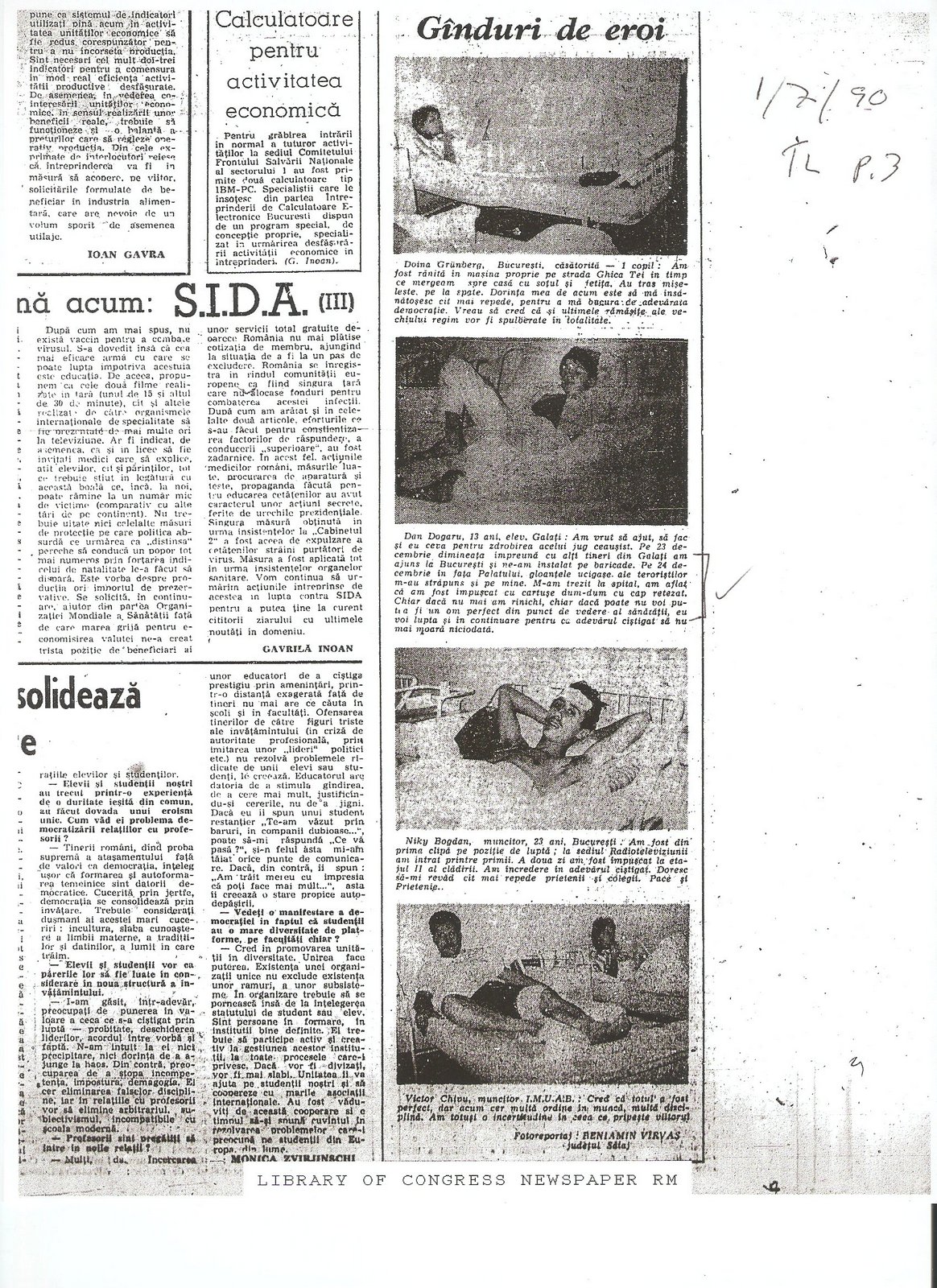
Dan Dogaru, 13 ani, elev, Galati:  “…Pe 23 decembrie dimineata impreuna cu alti tineri din Galati am ajuns la Bucuresti si ne-am instalat pe baricade.  Pe 24 decembrie in fata Palatului, gloantele ucigase ale teroristilor m-au strapuns si pe mine.  M-am trezit la spital, am aflat ca am fost impuscat cu cartuse dum-dum cu cap retezat….”  (Tineretul Liber, 7 ianuarie 1990, p. 3.

————————————————————————————————————————————————————————————————-

Sava Florica, 33 de ani, vinzatoare la Loto-pronosport in cartierul Fabric, impuscata din mers, in Piata Traian

Barzeanu Atanasie, 65 anit, medic primar, doctor in stiinte, chirurg, Spitalul Judetean Timisoara

“…sintem deci in 18 decembrie…Pe la orele doua si patruzeci, cind inchideam o operatie–Sava Florica, 33 de ani, vinzatoare la Loto-pronosport in cartierul Fabric, impuscata din mers, in Piata Traian, dintr-un ARO [!], pacienta prezentindu-se o echimoza cu distrugerea tesuturilor (plaga in diametru de 15 centimetri), a tesuturilor din regiunea epigastrica, inclusiv a muschilor drepti abdominali, cu ruptura a colonului ascendent transvers si a jejuno-ileonului, fiind in stare de soc grav traumatic, hemoragic–, fara sa-mi poti explica nici macar acum cu ce fel de gloante a putut fi lovita, pentru ca nu am identificat nici orificiul de iesire si nici pe cel de intrare, a venit o asistenta de la Chirurgie I, care mi-a spus sa merg la domnul Ignat.”

Titus Suciu, Reportaj cu Sufletul la Gura, (Editura Facla 1990), pp. 133-134.

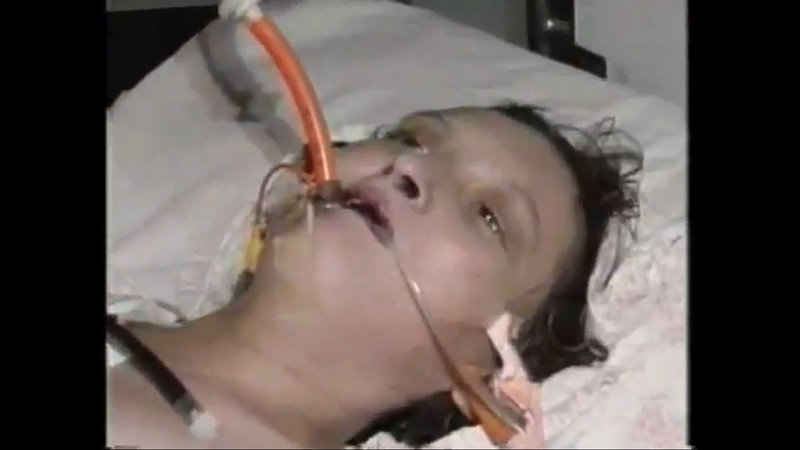
Irish Television (RTE) captured what were apparently the last hours of Florica Sava’s  tragic end.  Warning:  the scene from 11:00 to 11:30 is graphic and unsettling.

posted by mikenork

http://www.youtube.com/watch?v=c3A6IiaOWhs

Brendan O’Brien (reporter):  “Florica Sava, a 33 year old mother of two young sons, was shot from a car with a dum-dum bullet.  It caused massive internal injuries.  Doctors said she had just hours to live.”

http://atomic-temporary-3899751.wpcomstaging.com/2011/05/11/lets-go-to-the-videotape-i-to-the-army-its-confirmation-that-theyve-been-dealing-with-a-specially-trained-force-because-its-the-type-of-bullet-theyve-never-seen-before-itn-uk-telev/

———————————————————————————————————————————————————————————————-

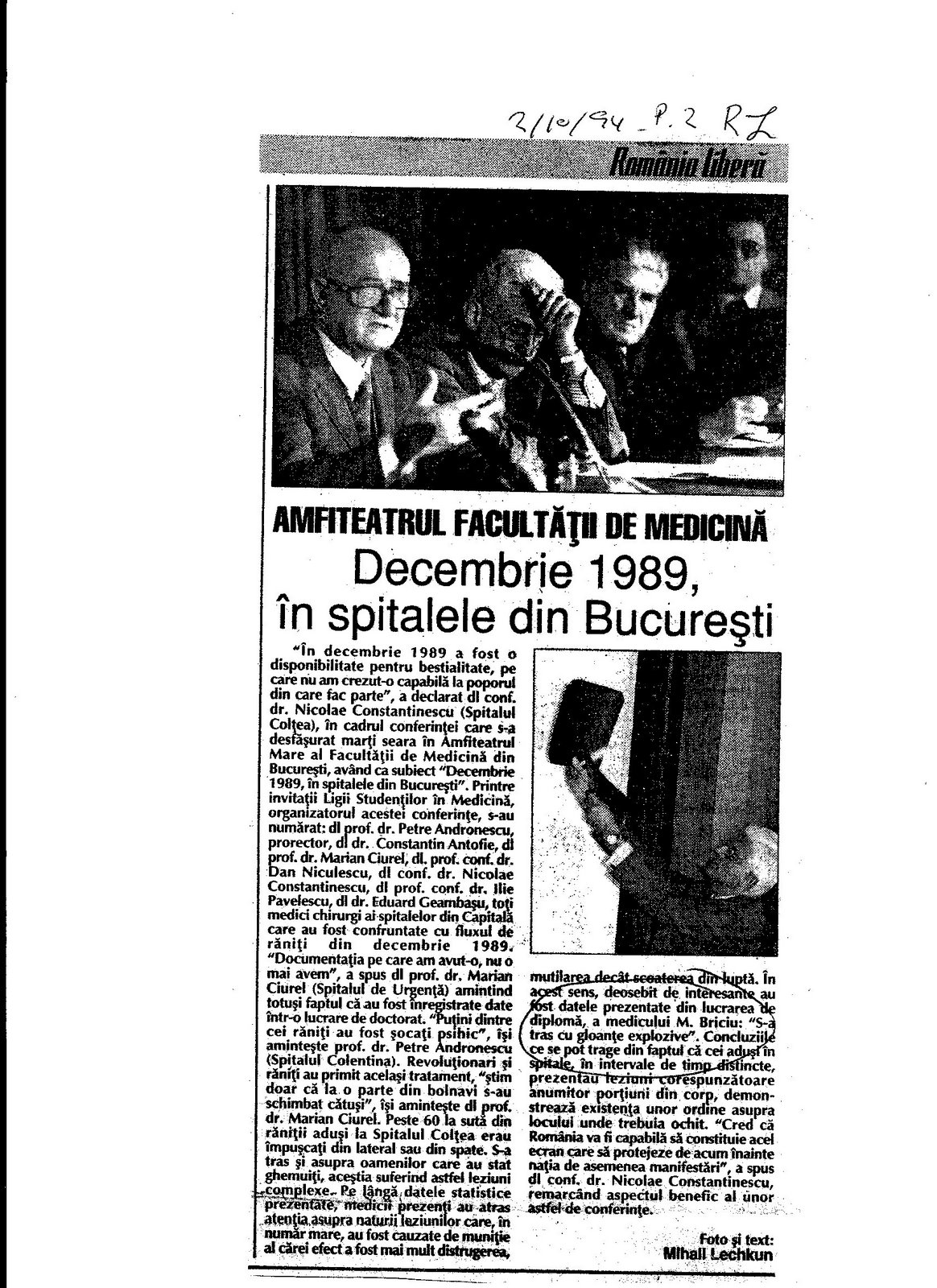
AMFITEATRUL FACULTATII DE MEDICINA

“Decembrie 1989, in spitalele din Bucuresti”

Mihail Lechkun, Romania Libera, 10 februarie 1994, p. 2

“In decembrie 1989 a fost o disponsibilitate pentru bestialitate, pe care nu am crezut-o capabila la poporul care fac parte, ” a declarat dl. conf. dr. Nicolae Constantinescu (Spitalul Coltea), in cadrul conferintei care s-a desfasurat marti seara in Amfiteatrul Mare al Facultatii de Medicina din Bucurest, avand ca subiect “Decembrie 1989, in spitalele din Bucuresti”.  Printre invitatii Ligii Studentilor in Medicina, organizatorul acestei conferinte, s-au numarat:  dl. prof. dr. Petre Andronescu, prorector, dl. dr. Constantin Antofie, dl. prof. dr. Marian Ciurel, dl. prof. conf. dr. Dan Niculescu, dl. conf. dr. Nicolae Constantinescu, dl. prof. conf. dr. Ilie Pavelescu, dl. dr. Eduard Geambasu, toti medici chirurgi din Capitala care au fost confruntate cu fluxul de raniti din decembrie 1989.  “Documentatia pe care am avut-o, nu o mai avem,” a spus dl. prof. dr. Marian Ciurel (Spitalul de Urgenta) amintind totusi faptul ca au fost inregistrate date intr-o lucrare de doctorat.  “Putini dintre cei raniti au fost socati psihic,” isi aminteste prof. dr. Petre Andronescu (Spitalul Colentina).  Revolutionari si raniti au primit acelasi tratament, “stim doar ca la o parte din bolnavi s-au schimbat catusi” isi aminteste dl. prof. dr. Marian Ciurel.  Peste 60 la suta din ranitii adusi la Spitalul Coltea erau impuscati lateral sau din spate.  S-a tras si asupra oamenilor care au stat ghemuiti, acestia suferind astfel leziuni complexe.  Pe langa datele statistice prezentate, medicii prezenti au atras atentia asupra naturii leziunilor care, in numar mare, au fost cazate de munitie al carie efect a fost mai mult distrugerea, mutilarea decat scoaterea din lupta.  In acest sens, deosebit de interesante au fost datele prezentate din lucrarea de diploma, a medicului M. Briciu:  “S-a tras cu gloante explozive”. Concluziile ce se pot trage din faptul ca cei adusi in spitale, in intervale de timp distincte, prezentau leziuni corespunzatoare anumitor portiuni din corp, demonstreaza existenta unor ordine asupra locului unde trebuia ochit.  “Cred ca Romania va fi capabila sa constituie acel ecran care sa protejeze de acum inainte natia de asemenea manifestari,” a spus dl. conf. dr. Nicolae Constantinescu, remarcand aspectul benefic al unor astfel de conferinte.


http://atomic-temporary-3899751.wpcomstaging.com/2010/10/20/in-premiere-bullets-lies-and-videotape-the-amazing-disappearing-romanian-counter-revolution-of-december-1989-by-richard-andrew-hall-part-i-his-name-was-ghircoias-nicolae-ghircoias/

Posted in decembrie 1989, raport final, Uncategorized | 13 Comments »

Doctors and Dum-Dum Bullets in Romania in December 1989 (II): Trimisi in strainatate (Italia, Franta, Austria, Anglia, si Germania) pentru tratament

Posted by romanianrevolutionofdecember1989 on August 10, 2011

Doctors and Dum-Dum Bullets in Romania in December 1989 (I): Dr. Manuel Burzaco (Médecins Sans Frontières)

FRANTA

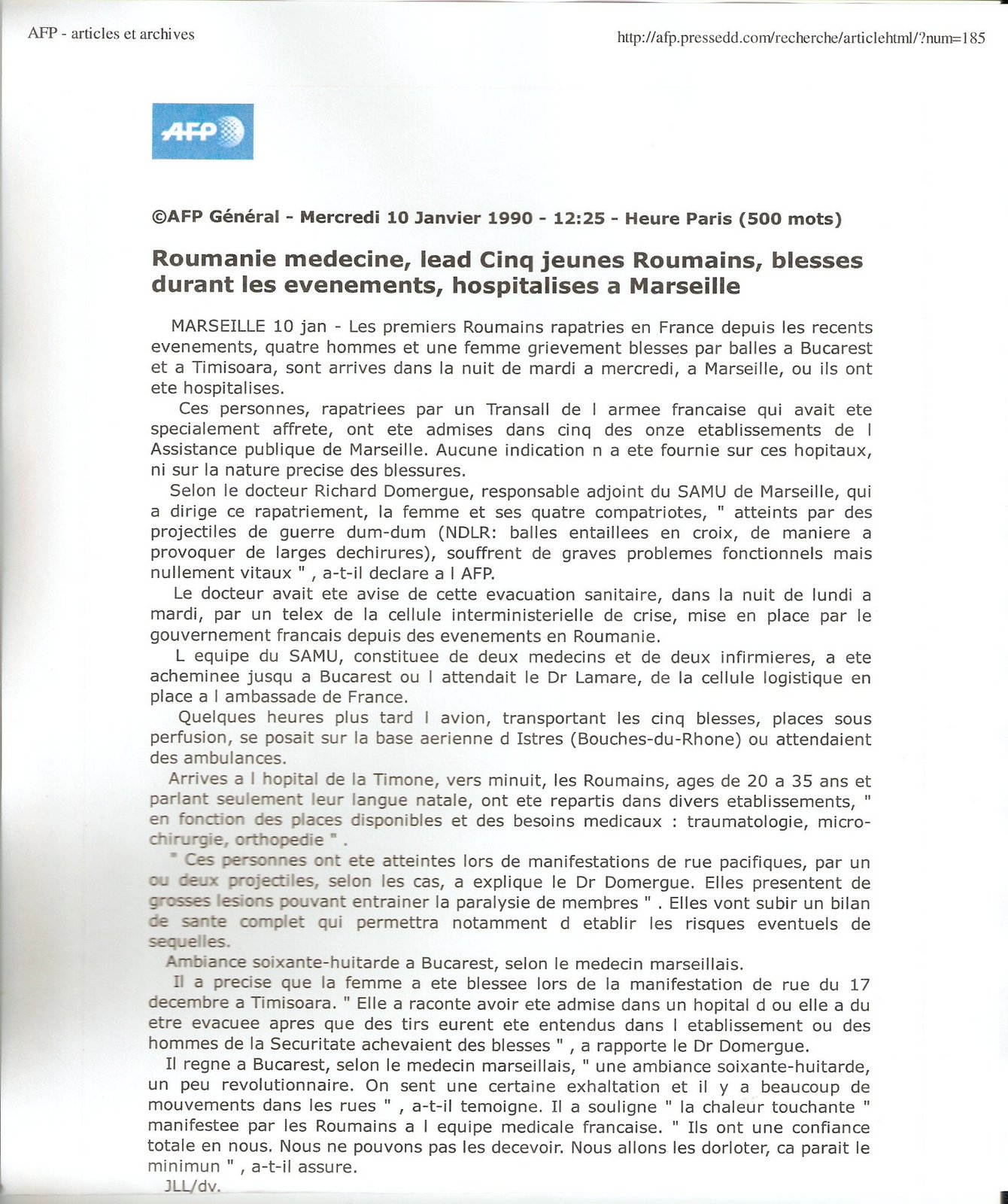
Below Dr. Richard Domergue from a hospital in Marseille discusses that the woman and her five compatriots who have been flown for medical treatment to France had been wounded by Dum-Dum bullets during the December 1989 violence in Romania (in other words, a foreign doctor attesting to the use of Dum-Dum bullets…).

(de notat aici:  e vorba de doua gloante, numai unul a fost exploziv (dum-dum) care inseamna ca medicii puteau sa faca o deosebire intre aceste gloante)

Farcau Mariana Rodica  nascuta in 9 ianuarie 1962 la Supur (jud. Satu Mare), lucratoare comerciala la ICSMA (1989), acum pensionata cu grad 2 de invaliditate, impuscata in umarul drept si spate

…La podul Decebal, intre pod si parc, erau militari in uniforma verde. Printre ei si unii mai in virsta, imbracati civil. In spate se vedea si un camion. Cind ne-am aproiat de ei, strigind “Armata e cu noi!” si alte lozinci, ne-am pomenit cu o ploaie de gloante (fara somatie). In momentul acela am simtit o durere puternica si am cazut. Fusesem atinsa de doua gloante (unul exploziv). Am facut pipi pe mine si am vazut parca niste stele si oameni luind-o la fuga. Dupa ce rafalele au incetat cei care se aruncasera la pamint s-au ridicat si unii plecau. Am strigat: “Luati-ma si pe mine!”. Cineva a zis: “Uite, asta nu-i moarta! Hai s-o luam!”. Altul zice: “Bine, dar e grea!”. M-au legat cu fularul si vorbeau intre ei sa aduca o masina. Eu am scos cheile de la masina si le-am dat, spunind ca am masina in parcarea de la Terma l (unde o dusesem intre timp). Apoi mi-am pierdut cunostiinta si m-am trezit la spital.  Doctorii de la spital spuneau ca trebuie sa-mi amputeze mina. Eu am refuzat. Dupa revolutie am fost trimisa la tratament in Franta, unde mi s-a adaptat o proteza metalica la umar, scapind astfel de amputare.  6 octombrie 1995

Mioc: Farcau

———————————————————————————————————————————–

ITALIA

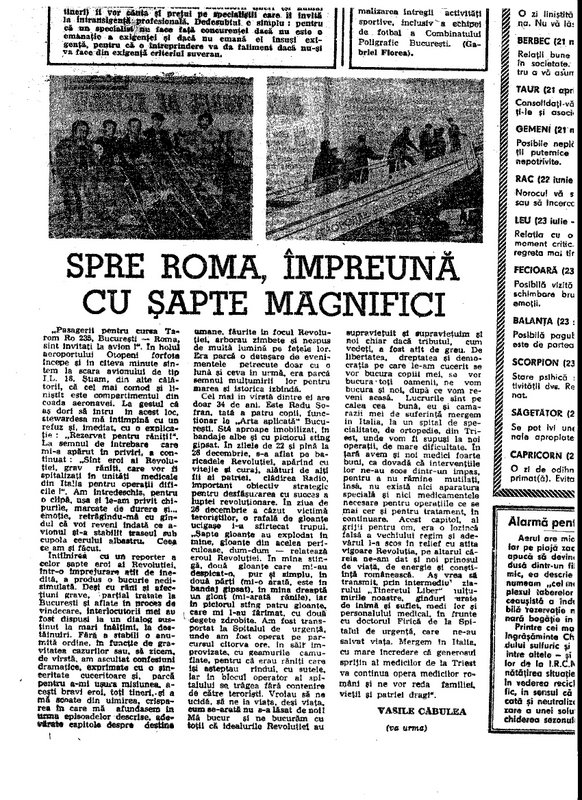
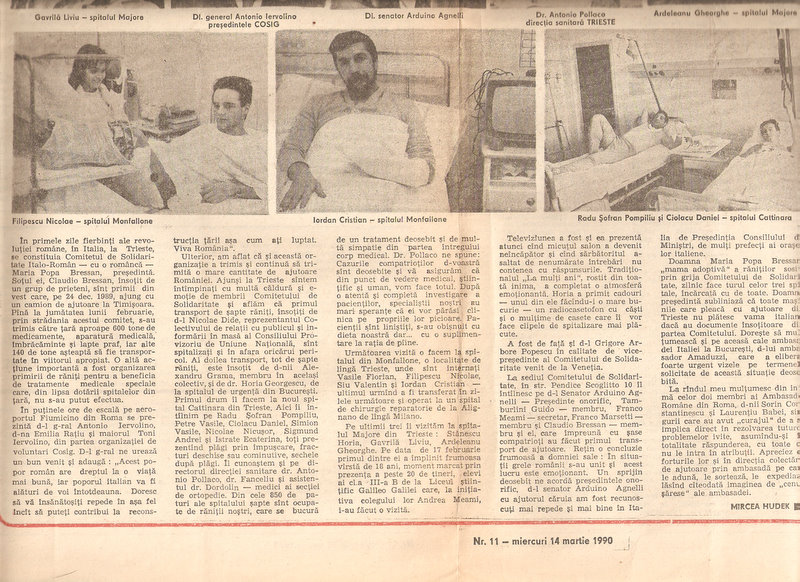
Radu Sofran, 34, "sapte gloante au explodat in mine, gloante din acelea periculoase, dum-dum"
  • 93. Mariana Mion Pop | 22 Decembrie 2010 21:48

    Dl Presedinte Iliescu, a fost primul presedinte al Romaniei primit cu covor rosu la prima sa vizita in Italia la Venezia. Am fost printre organizatorii acelei primiri impreuna cu Dl. Gheorghiu , insarcinatul cu afaceri la Roma in acea vreme.
    A tinut un discurs frumos, intr-o sala impunatoare.

    Am trimis ajutoare la Sibiu cu camioanele, dar nici macar de la primar, nu am primit un …multumesc.
    La spitalul din Dolo Venezia am primit doi baieti prin Crucea Rosie, care aveau cartuse ; unul intr-un picior, altul in coloana vertebtala. Au fost operati ; cel care avea Dum-dum in apropierea vertebrei bazinului a fost operat la Padova. A plecat de acolo cu un treinig de-al meu. Numele lui era XX Marian.
    In acele zile,ziarele din Venezia duduiau de chemarea mea sa trimitem ajutoare in tara si sa ajutam niste marinari ramasi acolo , uitati….de situatie.
    Eu nu am un certificat de … bun patriot.
    In schimb am oferit si ofer ocazia multor romani sa studieze. O carte scrisa de mine, este ETICHETA SI PROTOCOL; as vrea sa fie difuzata
    gratuit pentru binele poporului in care m-am nascut si l-am lasat in
    1974.
    As avea multe de spus,dar …toti romanii se plang; nimeni nu face nimic.
    Cu stima
    Prof. Mariana Mion Pop
    Venezia

  • http://www.antena3.ro/emisiunea-din-data-de-miercuri-22-decembrie-2010-115590.html?cpage=7#comments

from Flacara, 14 martie 1990, pp. 12-13, “Vederi din Italia”

—————————————————————————————————————————–

ITALIA

Bucuresti, Hunedoara, Arad, Lugoj: Decembrie 1989, Teroristii, si Gloante Explozive sau Gloante Speciale (romana)

Un alt tânăr de 20 de ani, Gheorghe Nicolosu, a fost împuşcat în picior, la intrarea pe strada Lipscani, pe lângă Grădiniţa ICSH. După ce a fost operat, s-a stabilit că glonţul cu care a fost împuşcat nu figura în dotarea Armatei Române. Nicolosu a fost operat în prima fază la Hunedoara, apoi a ajuns în Italia, unde a suferit încă o intervenţie. Tot în zona aceea, pe Lipscani, a fost împuşcat, în stomac, tot cu muniţie care nu aparţinea armatei, Cristea Valeriu, de 36 de ani. El a decedat câteva ore mai târziu, medicii încercând să-i salveze viaţa, dar glonţul exploziv i-a perforat intestinele.

Florin Ghiuzela îsi aminteste astazi: „Nu stiu de unde a venit informatia ca se trage din casa lui Raceanu. Nu s-a tras de acolo, asta e sigur, dar focul a fost deschis de undeva din zona. Mai târziu, dupa ce Gheorghe Nicolosu a fost operat, am aflat ca glontul cu care a fost împuscat nu figura în dotarea Armatei Române. De altfel, medicii mi-au spus ca e vorba despre un cartus exploziv. Nicolosu a fost operat în prima faza la Hunedoara, apoi a ajuns în Italia, unde a suferit înca o interventie chirurgicala efectuata de medicul care l-a operat si pe celebrul fotbalist Paolo Rossi.

http://www.replicahd.ro/images/replica165/special5.htm

——————————————————————————————————————————————————

AUSTRIA

NU EXISTA NICI O SCUZA — Presa romana on-line din decembrie 2010: gloante dum-dum in decembrie 1989 (Cluj, Sibiu, Darabeni, Braila, Craiova)

Marturii din Revolutia de la Cluj: Au tras lunetistii dupa noi si militarii parca erau drogati

Nicolae Cristea Nemeti este unul dintre clujenii care a infruntat plutonul de militari, in Piata Libertatii (actuala Piata Unirii), in 21 Decembrie 1989.Ajuns la 69 de ani, Nicolae Cristea Nemeti povesteste acum cu detasare ce s-a intamplat in urma cu 21 de ani in Cluj Napoca si de ce au iesit oamenii in strada pentru a striga “Libertate!”.

Nemeti isi aduce aminte ca si cum ar fi fost ieri cum, militarii condusi de capitanul Carp Dando, au deschis focul si revolutionarii au cazut secerati la pamant.

A venit banditul ala, ca e un bandit ordinar, capitanul Carp Dando, s-a asezat in mijlocul strazii, si-a asezat un rand de militar in zona asta (n. red. Piata Unirii). Aia de langa mine nu erau toti militari. Eu am vazut oameni mai in varsta, erau oarecum drogati, nu erau militari. Nu stiu cine erau. In momentul in care a venit Calin Nemes si l-a intrabat ce cauta aici, capitanul Carp Dando a zis ‘Foc‘. In momentul acela a pus mana pe pistol si a inceput sa traga. L-am vazut pe Matis cum s-a intors intr-un picior si a cazut jos si a cazut si Ladiu, dar nu a fost lovit“, a rememorat Nemeti scena.

Acesta sustine ca, dupa ce a fost deschis focul, lumea din piata s-a imprastiat. “Eu am ramas singur cuc in strada si mi-a zis: ‘Si pe mine ma impusca’. In momentul acela, am facut un pas sa ma trantesc si nu stiu de unde, din biserica sau de la geamurile acestea, pe mine m-a lovit cu cartusul ala nenorocit dum-dum. Mi-a facut o gaurica mica aici in picior sus si in momentul in care a explodat a fost ca si floarea soarelui. Era praf piciorul, dubla fractura de femur“, a mai spus barbatul.

Nemeti sustine ca un strain l-a tras de pe strada si l-a dus intr-o curte, de unde a fost luat de o salvare. “Am fost operat si in cele din urma am ajuns in Austria, unde am stat aproape un an si am avut 16 interventii chirurgicale si transplant de os. Am vrut sa il gasesc pe cel care m-a salvat, dar nu am putut“, a mai spus revolutionarul.
In total, in Piata Libertatii si-au pierdut viata 14 persoane, dar capitanul Carp Dando, cel care a condus plutonul de reprimare, a scapat fara sa fie condamnat pentru aceste crime.

Revolutionarii din Cluj vor depune in luna ianuarie o plangere la CEDO si la Tribunalul de la Haga, pentru pedepsirea lui Carp Dando si a lui Florian Caba.

[Va rog, sa ascultati interviul cu dle Nemeti de pe saitul acesta

http://www.stiridecluj.ro/social/marturii-din-revolutia-de-la-cluj-au-tras-lunetistii-dupa-noi-si-militarii-parca-erau-drogati- ]

—————————————————————————————————————————–

AUSTRIA

La gara primim un grup de belgieni care insotesc un tren de 42 de vagoane cu marfuri trimise de Comunitatea Europeana, in cadrul actiunii Operation Villages Roumains . Seful lor, care rupe cateva cuvinte romanesti, ne spune ca totul a fost organizat de Crucea Rosie belgiana si service-cluburile care au adoptat in lunile anterioare sate din judetele Iasi, Botosani, Caras-Severin sau Mehedinti. In noaptea urmatoare, prima echipa de 5 medici de la spitalul austriac Lorenz Bohler, care au sosit la Curtici cu un vagon-spital preiau un numar de 18 bolnavi in stare grava pentru a li se acorda un tratament special de 2-3 luni in Austria. E vorba de unele transferuri de organe sau proteze speciale, datorate efectelor monstruoase ale gloantelor dum-dum . Victimele sosesc de la Timisoara cu cateva ambulante; la lumina becurilor si a farurilor zarim fete tinere transfigurate de durere – printre acestea femei, adolescenti, un soldat si o fetita cu cate un picior amputat.

http://www.tourismguide.ro/html/orase/Arad/Curtici/istoric_curtici.php

———————————————————————————————-

ANGLIA

“CUGIR:  Revolutionari achetati, criminali in libertate,” Expres, nr. 6, 9 martie 1990, p. 6.

“…Se tragea din birourile securistilor si s-a mai tras si cu o pusca de vinatoare si s-a mai tras cu gloante dum-dum si militia ardea ca o torta si oamenii au intrat in incendiu si atunci locotenentul major Mezei Dorin a sarit de la etaj cu pistolul mitraliera…Sint peste 40 de raniti si unii au primit gloante in cap dar cu totii sint in viata.  Doi raniti sint in spitalele din RFG si unul este in Anglia.  Cel din Anglia a fost impuscat cu dum-dum….UNDE SINT CEI CARE AU TRAS IN OAMENI?”                 –Vasile Neagoe

Cugir, 21 decembrie 1989

————————————————————————————————————————————-

GERMANIA

(E foarte interesant sa constatam aici ca Dan Voinea, sustinut puternic de catre  liderii Asociatiei 21 decembrie 1989, neaga complet folosirea gloantelor dum-dum in decembrie 1989, si totusi uite ce se scrie pe forumul asociatiei:  Subsemnata Onofrei Mihaela vaduva lui Onofrei Savel Cristi, aduc in fata dumneavoastra acest memoriu de cauza foarte grava, pe care a suferit-o sotul meu din 23 decembrie 1989 si pana a murit in data de 17 septembrie 2005.
Povestea sotului meu este lunga si trista. Aceasta a inceput in seara zilei de 23 decembrie 1989 cand a participat impreuna cu mai multi colegi la asa zisa Revolutie Romana din Bucuresti sa salveze raniti si sa adune cadavre de pe strazile capitalei. In seara de 24 decembrie 1989 in fata hotelului Bucuresti a fost impuscat cu o arma automata de la etajul al II-lea al hotelului. Cele 8 gloante speciale de tip dum-dum, au fost trase de catre asa zisii teroristi transformandu-l intr-o masa de carne sangeranda. Cristi Onofrei a fost transportat la Spitalul de Copii Grigore Alexandrescu unde a suportat prima interventie chirurgicala. In certificatul de expertiza medicala, doctorita Rodica Botezatu consemna: ,,Plagi prin impuscare gamba dreapta, cu sectionarea arterei tibiale posterioare, plaga fesiera dreapta cu retentie de gloante de tip ,,dum–dum”, ramanand cu infirmitate fizica permanenta prin lipsa de masa musculara. Dar aceasta nu a fost prima operatie suportata. Din decembrie 1989 si pana in februarie 1990, a fost spitalizat si operat de 11 ori in Spitalul Grigore Alexandrescu, pe o perioada indelungata de 4 ani de zile, a necesitat 9 operatii in Germania apoi dupa anul 1990 si pina in ziua care a murit in 2005, a fost internat de nenumarate ori in spitalele din Bucuresti, cat si in Galati.)

9) Asociatia 21 decembrie Cristi Onofrei dum-dum

carmen
maestru
Joined: 27 Nov 2008
Posts: 515
Location: Bucuresti
Posted: Sun Mar 22, 2009 8:30 pm    Post subject:

Memoriul soţiei
Subsemnata Onofrei Mihaela vaduva lui Onofrei Savel Cristi, aduc in fata dumneavoastra acest memoriu de cauza foarte grava, pe care a suferit-o sotul meu din 23 decembrie 1989 si pana a murit in data de 17 septembrie 2005.
Povestea sotului meu este lunga si trista. Aceasta a inceput in seara zilei de 23 decembrie 1989 cand a participat impreuna cu mai multi colegi la asa zisa Revolutie Romana din Bucuresti sa salveze raniti si sa adune cadavre de pe strazile capitalei. In seara de 24 decembrie 1989 in fata hotelului Bucuresti a fost impuscat cu o arma automata de la etajul al II-lea al hotelului. Cele 8 gloante speciale de tip dum-dum, au fost trase de catre asa zisii teroristi transformandu-l intr-o masa de carne sangeranda. Cristi Onofrei a fost transportat la Spitalul de Copii Grigore Alexandrescu unde a suportat prima interventie chirurgicala. In certificatul de expertiza medicala, doctorita Rodica Botezatu consemna: ,,Plagi prin impuscare gamba dreapta, cu sectionarea arterei tibiale posterioare, plaga fesiera dreapta cu retentie de gloante de tip ,,dum–dum”, ramanand cu infirmitate fizica permanenta prin lipsa de masa musculara. Dar aceasta nu a fost prima operatie suportata. Din decembrie 1989 si pana in februarie 1990, a fost spitalizat si operat de 11 ori in Spitalul Grigore Alexandrescu, pe o perioada indelungata de 4 ani de zile, a necesitat 9 operatii in Germania apoi dupa anul 1990 si pina in ziua care a murit in 2005, a fost internat de nenumarate ori in spitalele din Bucuresti, cat si in Galati.
Fiind internat in spital, Cristi a incercat sa-si i-a viata de 3 ori pentru ca nu mai suporta durerile si boala. In total 3 tentative de sinucidere, la care se adauga si cele doua morti clinice. In 1990 a fost externat din Germania in Romania la cererea Ministerului Sanatatii, sa revina in tara, promitandu-i plecarea in Anglia pentru un nou transplant de muschi si dezintoxificare de morfina. Intoarcerea acasa nu i-a adus nimic nou in ceea ce priveste starea sanatatii, dimpotriva, se agravase si mai serios. Drumurile la Ministerul Sanatatii, l-au obosit si mai mult, iar neputinta medicilor de ai efectua un transplant de muschi i-a retezat toate sperantele de supravietuire. Devenise un obiect purtat din usa in usa. Oasele i-au intrat in putrefactie si, in luna septembrie 1990 a fost nevoit sa mearga din nou in Germania, pentru amputarea degetelor de la piciorul drept, in spitalul Medichine Hosculle din Hanover.
In Galati orasul in care a locuit, a avut inaintea plecarii un apartament in cartierul I.C Frim, bloc S, ap.41. et 1 si o casa, care dupa plecarea lui in strainatate i s-au luat aceste drepturi abuziv, de catre stat. Revenind in 1994 in tara, nu a benificiat de nici o casa si nici un drept al legii 42/1990.
In anul 1995 ca semn de recunostinta si cu mare fast primaria orasului Galati i-au eliberat o diploma de cetatean de onoare al orasului,si i s-a dat o hala de 800 mp in care sa stea cu familia. Acolo era o mizerie de neinchipuit, nu exista curent electric, caldura, apa curenta si platea lunar 120.000 lei vechi chirie, din pensia de invaliditate, care era in acel moment de numai 159.000 de lei vechi. Aproape un an si sase luni, am dormit pe cateva cauciucuri (anvelope) de tractor si masina acoperite cu placaje din lemn, improvizand un pat, noaptea stateam cu randul sa bagam lemne in foc, sa nu se stinga, iar injectiile cu morfina pe care i le faceam eu, pentru ca nu a beneficiat de ingrijire medicala, le faceam la lumina lumanarii. In frig, bolnav mereu flamand, Cristi a ajuns la 60 kg fata de 120 kg, cat avea la intoarcerea din Germania.

Posted in decembrie 1989, raport final, Uncategorized | 10 Comments »

Doctors and Dum-Dum Bullets in Romania in December 1989 (I): Dr. Manuel Burzaco (Médecins Sans Frontières)

Posted by romanianrevolutionofdecember1989 on August 8, 2011

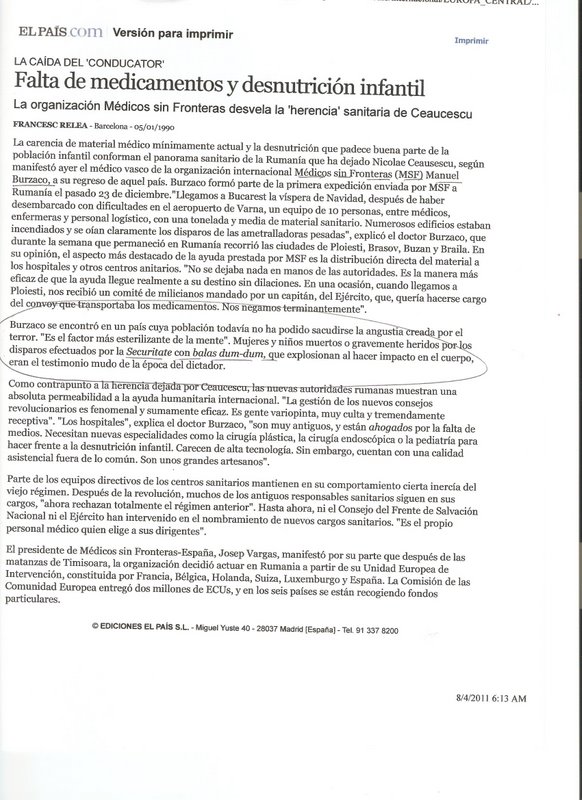
Dr. Manuel Burzaco from “Doctors without Borders” was part of a team of doctors from that group who visited hospitals in Bucharest, Ploiesti, Brasov, Buzau and Braila in late December 1989 and early January 1990.  This report from the Madrid daily El Pais touches upon the women and children gravely injured by the exploding “dum dum bullets used by the Securitate.”

Other reports from Bucharest and Timisoara hospitals during the events:

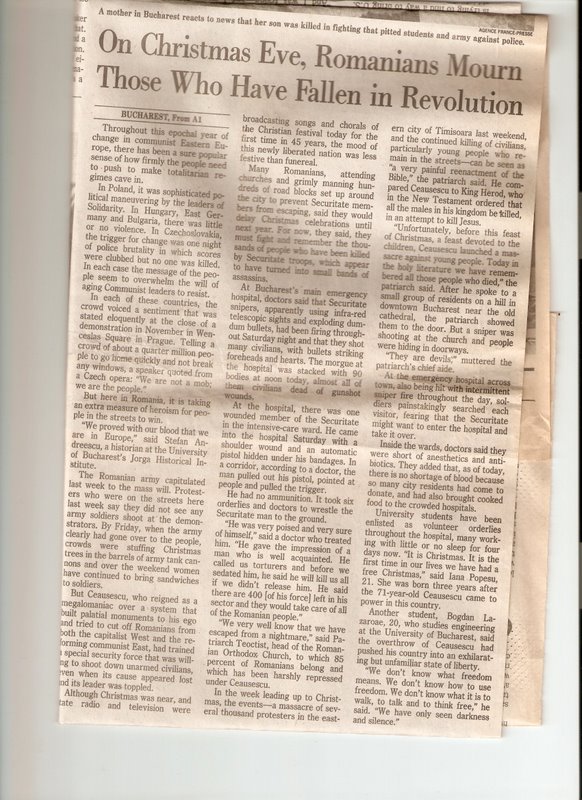
“At Bucharest’s main emergency hospital, doctors said that Securitate snipers, apparently using infra-red telescopic sights and exploding dum-dum bullets, had been firing throughout Saturday night and they shot many civilians, with bullets striking foreheads and hearts.  The morgue at the hospital was stacked with 90 bodies at noon today, almost all of them civilians dead of gunshot wounds.”

Blaine Harden, “In Bucharest, Tears and Prayers for the Fallen,” The Washington Post, 25 December 1989, p. A1; A40.

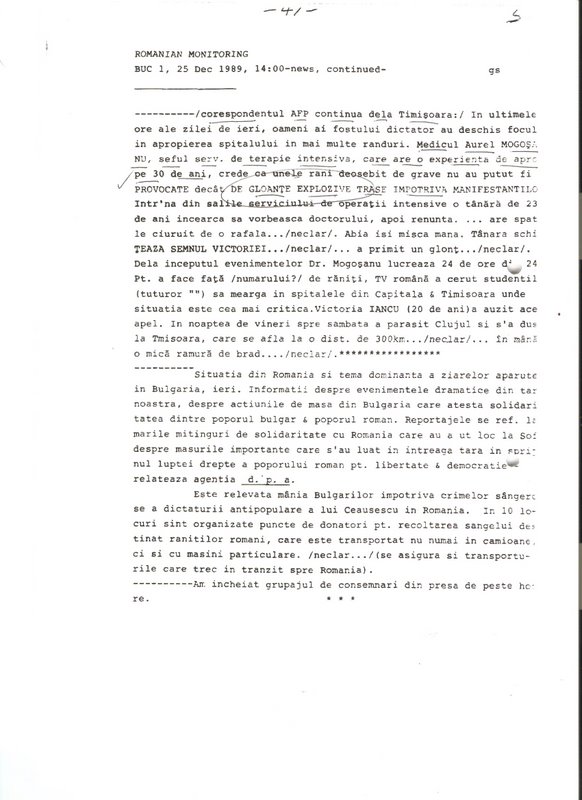
Doctors also reported on the wounds caused by explosive bullets (i.e. dum-dum bullets):  In this dispatch from Agence France Presse, relayed by Radio Free Europe on 25 December 1989, Dr. Aurel Mogosanu, a medic in the intensive care unit of a Timisoara hospital, says based on his thirty years of experience, some of the wounds could only have been CAUSED by EXPLOSIVE BULLETS SHOT AT THE PROTESTERS”

sursa (documentele Europa Libera disponsibile la):  http://media.hotnews.ro/media_server1/generic_file-2009-12-22-6754154-0-radio-bucuresti-25-dec-pdf.pdf (p. 49 of 82)

Posted in decembrie 1989, raport final, Uncategorized | 10 Comments »