The Archive of the Romanian Revolution of December 1989

A Catch-22 December 1989, Groundhog-Day Production. Presenting the Personal Research & Scholarship of Richard Andrew Hall, Ph.D.

Archive for the ‘raport final’ Category

Timisoara si Mostenitorii Revizionismului Securist

Posted by romanianrevolutionofdecember1989 on December 17, 2010

(punct de vedere strict personal; bazat pe cercetarea mea veche din anii ’90)

Faptul ca ieri la IICCMER a fost invitat si a vorbit despre decembrie 1989 Grigore Cartianu http://www.adevarul.ro/actualitate/eveniment/Dezbateri_incinse__pe_tema_Revolutiei_0_391161457.html nu trebuie sa fie o surpriza nimanui.

Era laudat in vara trecuta cu cuvinte frumoase de catre eternul Vladimir Tismaneanu “Este un lucru demonstrat cu prisosinta si de onesta ancheta jurnalistica a lui Grigore Cartianu (publicata sub titlul de carte: “Sfârşitul Ceauşeştilor”). http://tismaneanu.wordpress.com/2010/07/21/deshumarea-lui-ceausescu-un-pas-spre-adevar/ “

(inainte, si nu lipsit de importanta…: http://tismaneanu.wordpress.com/2009/11/10/impotriva-linsajelor-mediatice-un-articol-de-andrei-cornea/ ; http://www.adevarul.ro/financiar/Kogalniceanu-Fripturistul_0_150585030.html ; http://tismaneanu.wordpress.com/2009/08/05/chipurile-infamiei-grigore-cartianu-despre-nistorescu-groparul/#more-3428)

……………………

se pare ca Tismaneanu e mandru de “isprava” lui Cartianu…http://tismaneanu.wordpress.com/2010/12/27/dezbatere-despre-caderea-comunismului-la-iiccmer/

Cartianu vorbeste despre GRU, si “politica de cadre,” cine a studiat la Moscova samd

min 5:30 despre “turisti”…

despre Cartianu ca mostenitor al lui Stoenescu

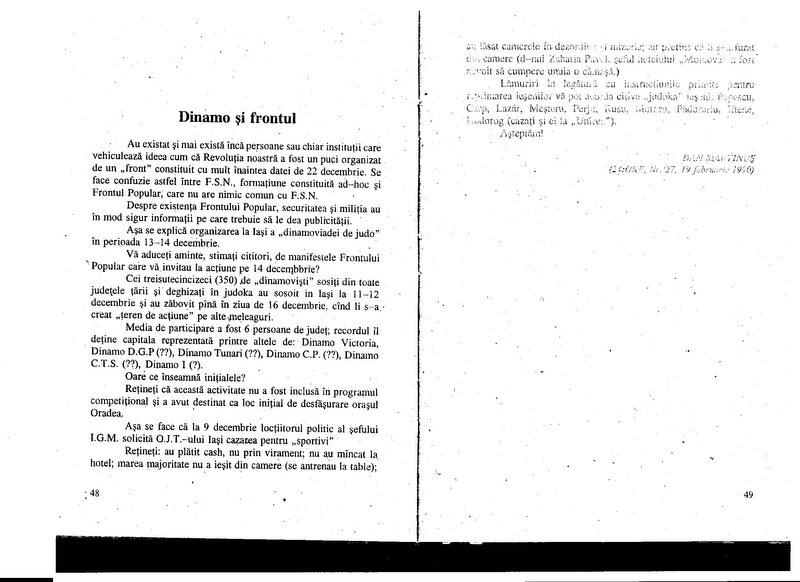
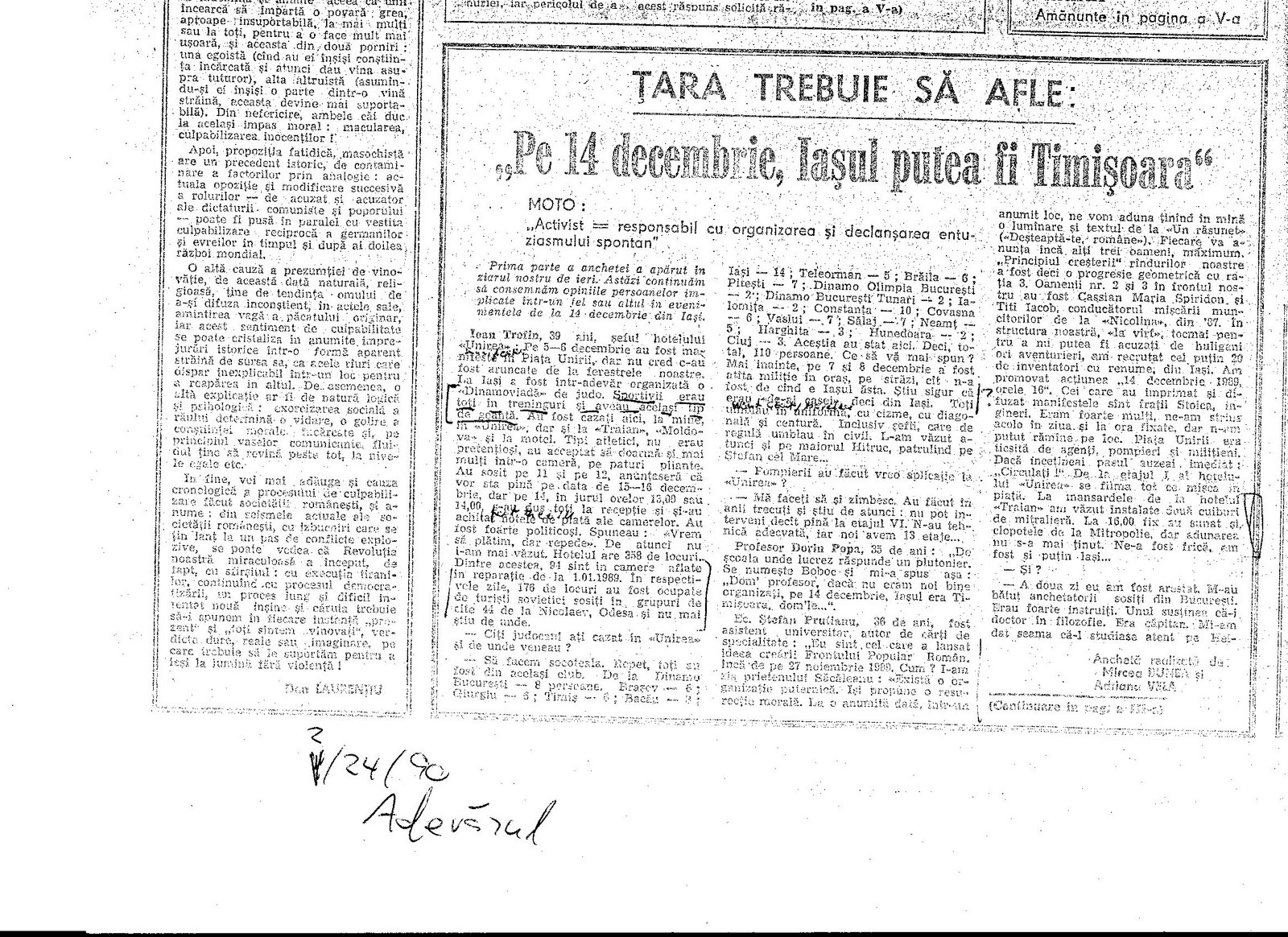
http://atomic-temporary-3899751.wpcomstaging.com/2010/12/14/iasi-14-decembrie/

hai sa radem cu dle. Cartianu…http://webtv.realitatea.net/actual/cartianu-l-a-intrebat-pe-gorbaciov-despre-turistii-sovietici-aflati-in-romania-in-decembrie-1989

ar fi bine pentru VT si altii la IICCMER sa reciteasca concluzia mea dintr-un articol publicat in EEPS in 1999 (chiar daca stiu bine ca nu vor face niciodata…)

http://atomic-temporary-3899751.wpcomstaging.com/2010/12/08/the-uses-of-absurdity-the-staged-war-theory-and-the-romanian-revolution-of-december-1989-part-iv-pp-530-542-1999-by-richard-andrew-hall/

…………………..

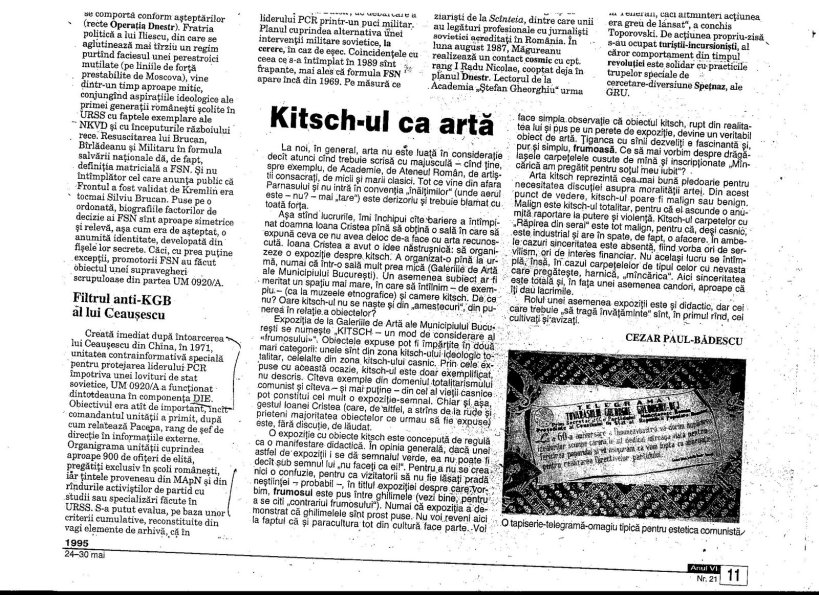
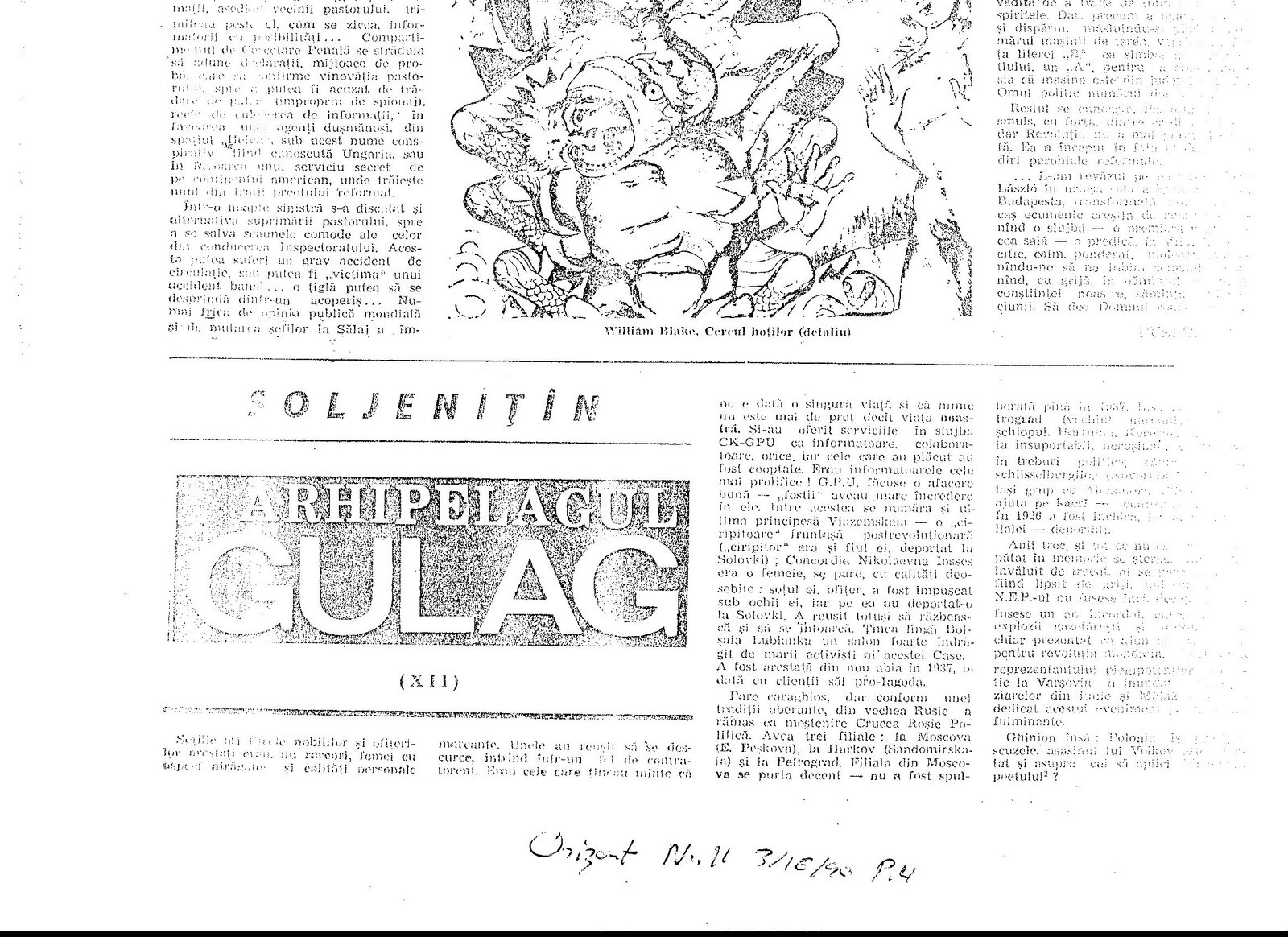
In 1995, si Vladimir Tismaneanu si Maria Bucur (tot un membru IICCMER acum, Profesoara de Istorie la Universitatea din Indiana la Bloomington) m-au sfatuit sa le citesc articolele lui Cornel Ivanciuc…fiindca el scria in Revista 22, tribuna intelectualilor cinstiti din Romania…

image-77

image-83

Numai ca atunci deja le-am citit articolele lui Ivanciuc, si aveam indoieli http://atomic-temporary-3899751.wpcomstaging.com/2009/10/04/decembrie-89-citeva-indoieli-stirnite-de-un-articol-din-revista-22-cazul-ivanciuc-si-teza-turistilor-sovietici/ …cum am descris in teza mea din 1996:

The theory has also found its way into the opposition media. Cornel Ivanciuc, who in 1995 wrote one of the most influential exposes to date on the former Securitate for the weekly 22, maintains that the Soviets achieved their aims in December 1989 by means of the so-called “tourist-incursionists, whose activity during the revolution was identical to those of the Spetsnaz special troops for reconnaissance and diversion of the GRU [Soviet military intelligence].”[13] Two months after General Vlad’s 1991 court statement, Sorin Rosca Stanescu, one of the most prominent journalist critics of the Iliescu regime and the SRI, presented an interview in the leading opposition daily Romania Libera with an anonymous KGB officer residing in Paris who outlined a familiar scenario.[14] The KGB officer claimed that he had entered Romania on 14 December with others as part of a KGB plan to open fire and create confusion. He had been in Timisoara during the events, but suggested he never received the anticipated order to open fire and left the country on 26 December. Rosca Stanescu, however, made sure to remind his audience of “the insistent rumors which have been circulating referring to the existence on Romanian territory of 2,000 “LADA” automobiles with Soviet tags and two men inside each car…”[15] Stanescu closed by asking his readers: “What did the Ceausescu couple know but were unable to say? Why is general Vlad held in this ambiguous chess game?…Is Iliescu protected by the KGB?”

Stanescu’s intentions are further drawn into question by the fact that this particular article has been cited positively by former Securitate officers in their writings. Colonel Filip Teodorescu of the Securitate‘s Counter-espionage Directorate, the second highest-ranking Securitate officer in Timisoara during the repression and sentenced to prison for his role in those events, cites extensively and favorably from this very article by Stanescu in a book on the December events.[16] Pavel Corut also invokes Rosca Stanescu’s interview in support his arguments.[17] Moreover, Rosca Stanescu’s questionable comments make the issue of his (revealed and acknowledged) past collaboration with the Securitate‘s USLA unit between 1975 and 1985 relevant.[18]

[13].. Cornel Ivanciuc, “Raporturile dintre Frontul Salvarii Nationale si KGB [The Relations between the National Salvation Front and the KGB],” 22, no. 21 (24-30 May 1995), 11.

[14].. Sorin Rosca Stanescu, “Iliescu aparat de K.G.B.? [Iliescu defended by the KGB]” Romania Libera, 18 April 1991, 8.

[15].. Ibid. Rosca Stanescu had in fact already floated this theory. In June 1990, he wrote: “…in the Army, more and more insistently there is talk of the over 4,000 ‘LADA’ automobiles with two men per car, which travelled by various routes in the days preceding the Revolution and then disappeared…” (Sorin Rosca Stanescu, “Se destrama conspiratia tacerii? [Is the conspiracy of silence unravelling?]” Romania Libera, 14 June 1990, 2a). At that time it could be argued that Rosca Stanescu was unaware of the Securitate account. It is difficult to say the same of his comment in April 1991.

[16].. Filip Teodorescu, Un Risc Asumat: Timisoara, decembrie 1989 (Bucharest: Editura Viitorul Romanesc, 1992), 93-94. Curiously, Teodorescu adds: “Besides, I have no reason to suspect that the journalist Sorin Rosca Stanescu would have invented a story in order to come to the defense of those accused by the judicial system and public opinion of the tragic consequences of the December 1989 events.”

[17].. Although Corut does not mention Stanescu by name as does Teodorescu, the references are unambiguous. See Pavel Corut, Floarea de Argint [The Silver Flower] (Bucharest: Editura Miracol, 1994), 173; idem, Fulgerul Albastru [Blue Lightning] (Bucharest: Editura Miracol, 1993), 211.

[18].. In April 1992, documents were leaked (presumably by regime sources) to the media and foreign embassies showing that Stanescu had been an informer for the Securitate‘s elite anti-terrorist unit (the USLA) between 1975 and 1985. Stanescu admitted that the charges were true. Although released from Romania Libera in June 1992, he was picked up elsewhere in the opposition press, returned to Romania Libera the following year, and eventually became editor of an opposition daily owned by the trust which runs Romania Libera. Prominent opposition figures have steadfastly defended him as a victim of the Iliescu regime, and in spite of his past, his writings have largely gone unscrutinized. On Stanescu’s case, see Sorin Rosca Stanescu, “Securea lui Magureanu,” Romania Libera, 17 April 1992, 1, 3 (the article which personally attacked the SRI’s Director Virgil Magureanu and appears to have prompted the release of Stanescu’s file); Anton Uncu, “Opriti-l pe Arturo Ui,” Romania Libera, 30 April 1992, 1, 3; Rosca Stanescu, “Sint H-15,” Romania Libera, 9 May 1992, 5; idem, interview by Andreea Pora, “‘H-15′ in slujba patriei,” 22, no. 120 (15-21 May 1992), 13; “Catre SRI,” Romania Libera, 9 June 1992, 1; “Goodbye Magureanu,” The Economist, no. 2212 (18 June 1992) in Tinerama, no. 85 (10-17 July 1992), 3.

Si intr-adevar, multi ani mai tarziu s-a dovedit ca intr-adevar ceva n-a fost in regula cu dle. Ivanciuc, era un fost colaborator al Securitatii.

http://www.hotnews.ro/stiri-arhiva-1147456-cornel-ivanciuc-turnat-fost-platit-securitate.htm

http://www.hotnews.ro/stiri-arhiva-1119849-ivanciuc-braia-colaborat-fosta-securitate-chireac-nu.htm

http://www.revista22.ro/colaborarea-lui-ivanciuc-la-revista-22-3194.html

(mie putin amuzant interviul cu Gabriela Adamesteanu…in iunie 1994 am luat un interviu cu Dinsa si cu Gabriel Andreescu, si i-am intrebat daca nu cumva erau infiltrate (fosti) informatori  in GDS si Revista 22–exclus, in nici un caz, mi-au spus…)

——————————————————————–

Deci ce crede dle. Cartianu, invitat stralucit la IICCMER, despre Timisoara?

http://www.adevarul.ro/grigore_cartianu/Europrovocatorul_Tokes_Laszlo_7_382831715.html

Lászlo Tökes face un joc dubios, aşa cum a făcut şi în decembrie 1989. După căderea regimului Ceauşescu, Tökes a fost prezentat drept un vajnic luptător împotriva dictaturii comuniste. În realitate, el era doar un pion într-un amplu scenariu al serviciilor secrete. A întreţinut relaţii „fierbinţi” atât cu Securitatea română, cât şi cu omoloaga sa maghiară. Refuzul de a părăsi casa parohială din Timişoara a durat doar până când Ceauşescu a fost înfrânt. Apoi, pastorul şi-a luat catrafusele şi s-a stabilit, cuminţel, într-o mică parohie din Sălaj.

Mircea Marian a relatat ceea ce scrie Cartianu in cartea lui “Sfirsitul Ceausestilor”–cea laudata de catre Tismaneanu:

Relatarea evenimentelor de la Timișoara este mult mai scandaloasă. Ceea ce s-a întâmplat acolo a fost, potrivit lui Cartianu, „o diversiune”, iar în oraș au acționat „profesioniști” care au asaltat „tenace și silențios” instituțiile statului comunist. Despre Tokes: „Avem dovezile trădării, chitanța olografă scrisă de pastor, pentru 20.000 de lei…”. Trec peste imbecilitatea – preluată de la istoricul Ioan Scurtu – cu agenții secreți care primesc factură fiscală. Dar Cartianu nu scrie nimic despre cei uciși la Timișoara în capitolul dedicat evenimentelor din acest oraș. Informația apare tangențial, undeva departe. În schimb, teza intervenției maghiare este elaborată minuțios, pornind de la declarațiile fostului șef al Direcției l a securității, Gheorghe Rațiu [http://atomic-temporary-3899751.wpcomstaging.com/2009/12/20/nicolae-plesita-si-gheorghe-ratiu-despre-decembrie-1989-teza-pretuita-a-securistilor-dia-e-de-vina/]. Cartianu pare că are toată încrederea în acest personaj, citat frecvent în cartea sa. Pentru cine nu știe, Rațiu este cel care a coordonat represiunea împotriva Doinei Cornea – o spune chiar fosta dizidentă. Și, cine sunt cei care vroiau să răstoarne regimul Ceaușescu? Țiganii antrenați în Ungaria, spune colonenlul Rațiu. Probe? Poate în volumul doi al „Sfârșitului Ceaușeștilor”, pe care Cartianu ni l-a promis deja.  http://kiseleff.ro/2010/06/22/bietul-cartianu-a-ajuns-%C8%99i-vuvuzela-securistului-patriot/

Cinism despre motivele si legaturile lui Tokes in decembrie 1989 nu este noua, de exemplu, Ioan Itu:

extras din teza mea

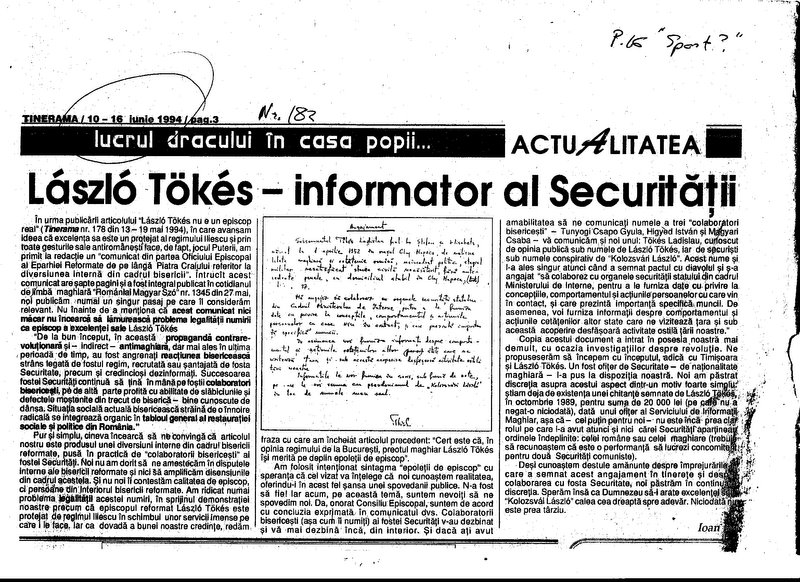
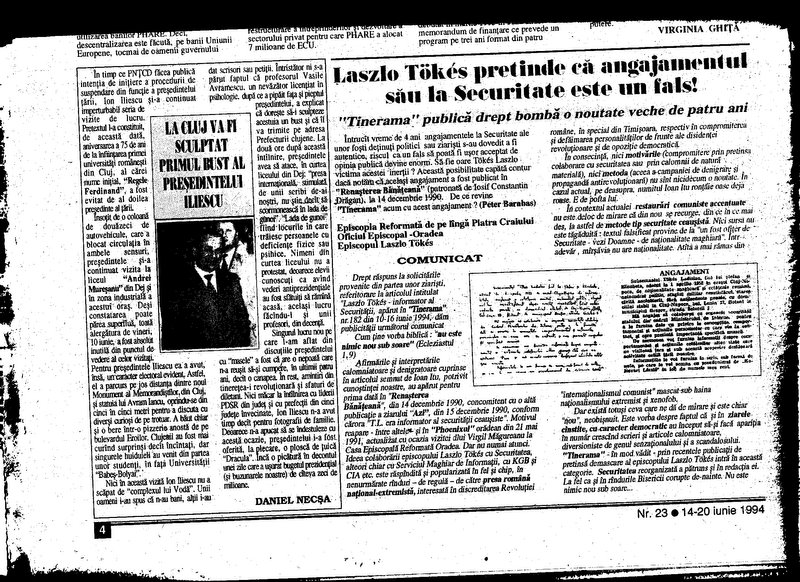
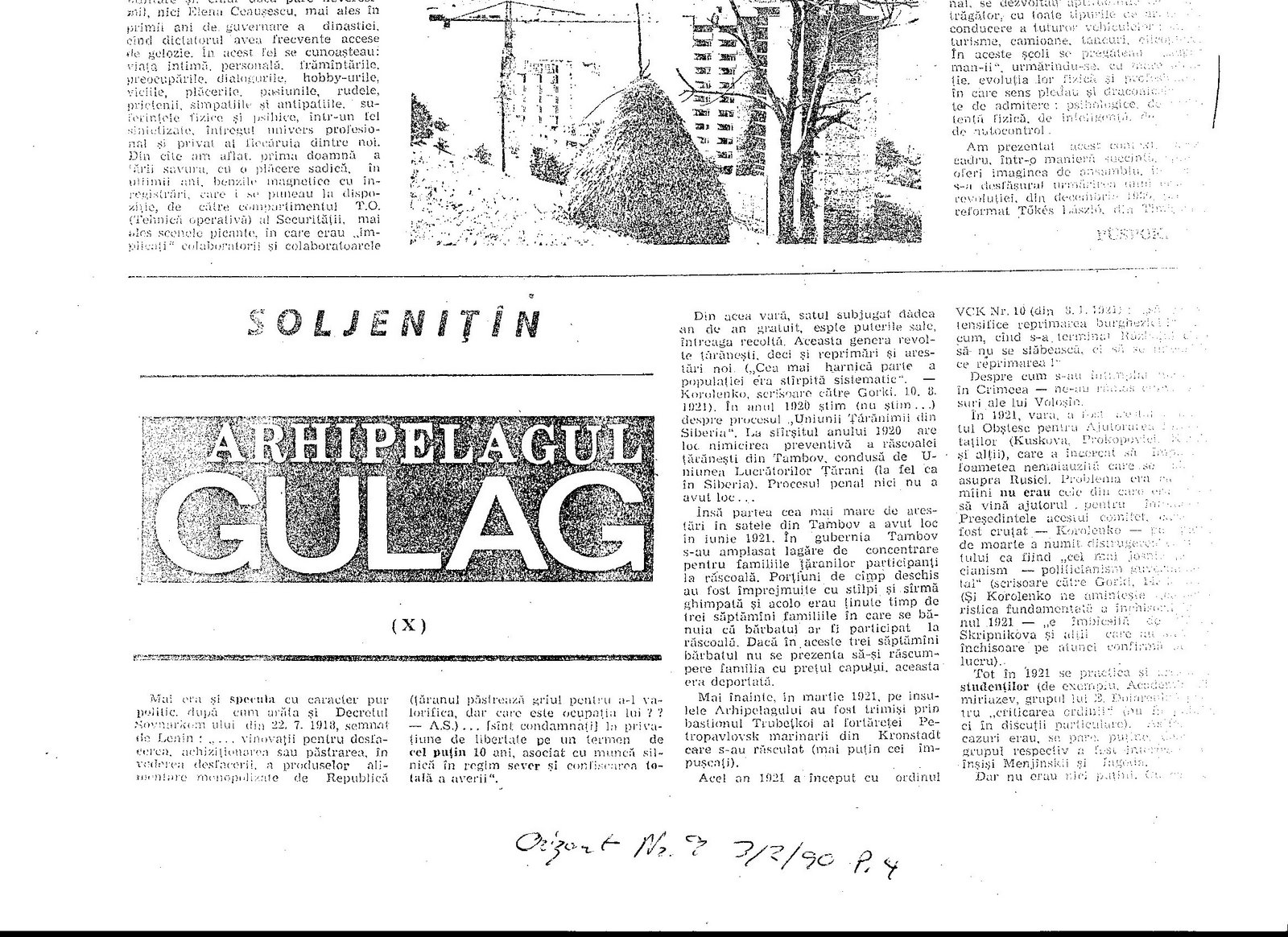
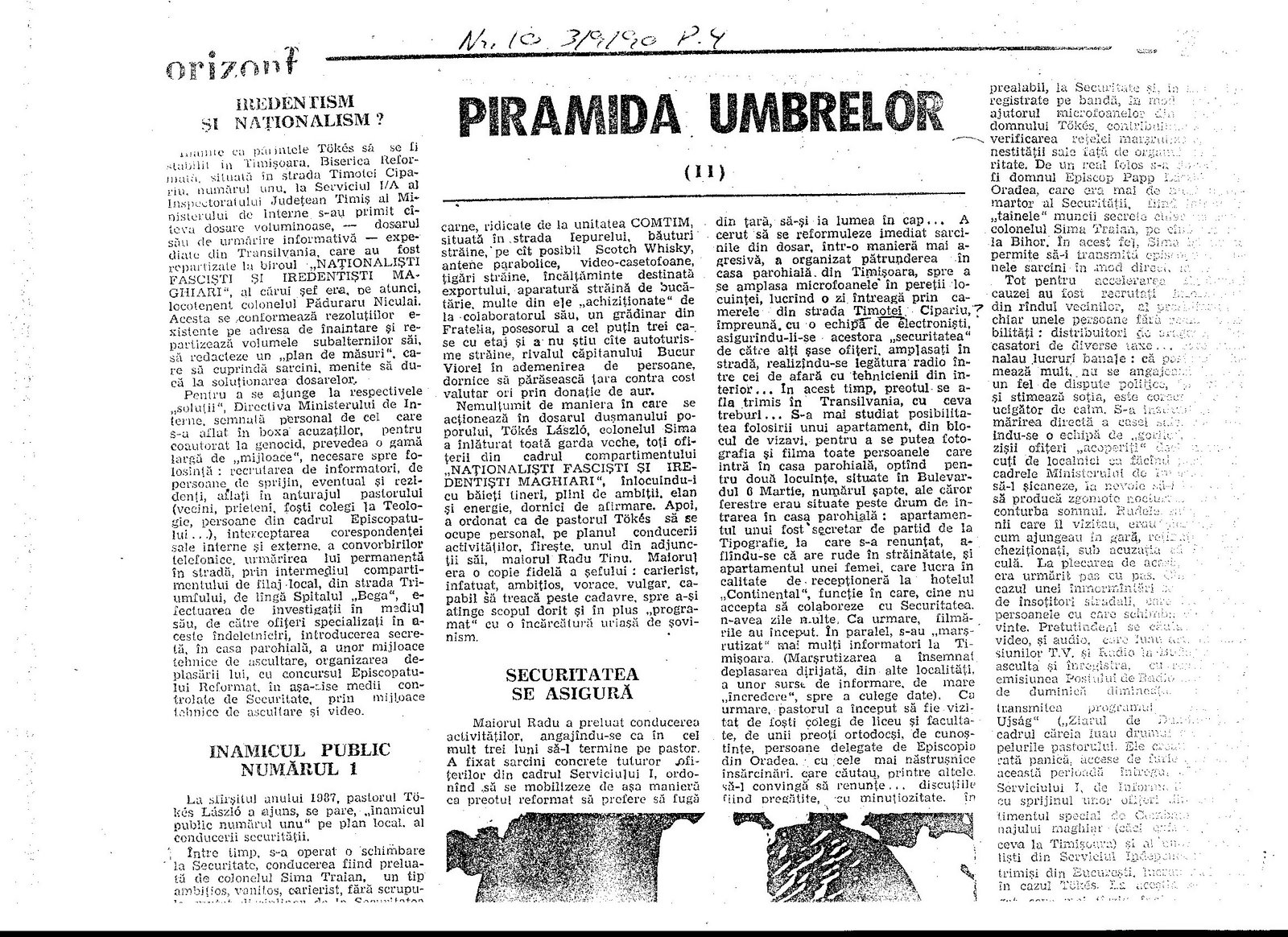
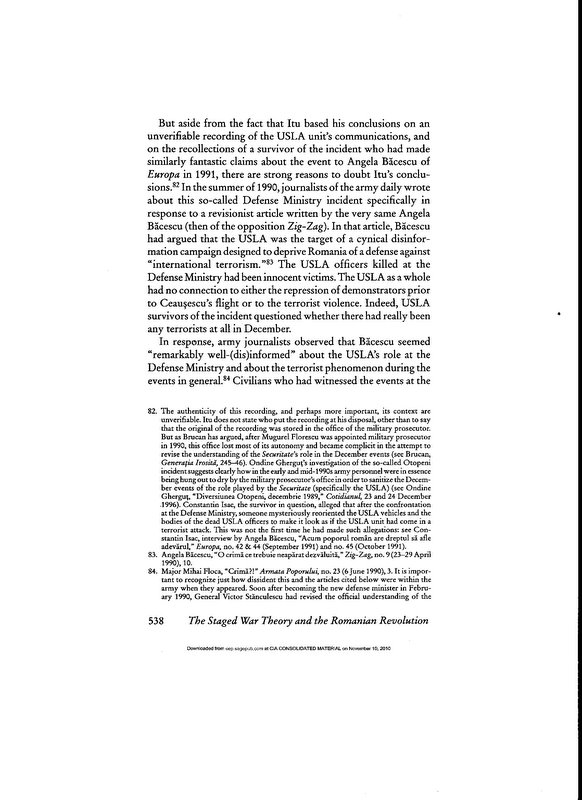
Moreover, Pastor Tokes has himself become the subject of scrutiny. In 1994, the opposition weekly Tinerama published documents it maintained revealed that ever since the mid-1970s Pastor Tokes had been an informer for the Securitate.[30] Well-known journalist Ioan Itu hinted that the revelation of this fact meant that the story of December 1989 needed to be completely reconsidered in light of this new information.

[30].. Ioan Itu, “Laszlo Tokes nu e un episcop real [Laszlo Tokes is not a real bishop],” Tinerama, no. 178 (12-19 May 1994), 2; idem, “Laszlo Tokes–informator al Securitatii [Laszlo Tokes–Securitate informer,” Tinerama, no. 182 (10-16 June 1994), 3.

http://atomic-temporary-3899751.wpcomstaging.com/2010/12/15/timisoara-15-decembrie/

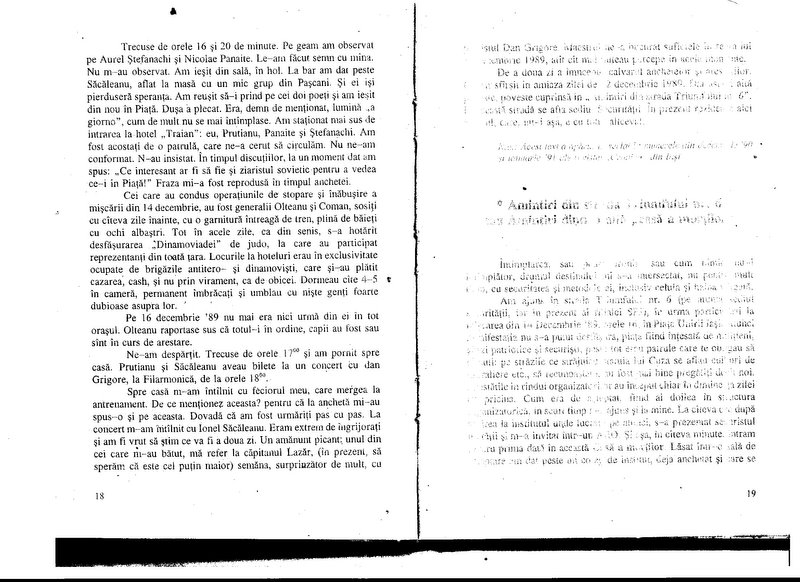
Tot un mare “Romanianist” din occident a relatat cercetarea lui Ioan Itu fara dubii (de ce?, fiindca revista Tinerama a fost impotriva Puterii de atunci, impotriva lui Iliescu)—e vorba de englezul Dennis Deletant in cartea sa, Ceausescu and the Securitate (1995)…

numai ca Itu era si el un fost colaborator al Securitatii (deci ca Ivanciuc vulnerabil dupa 1989):  Marius Mioc despre colaborarea cu securitatea a lui Ioan Itu

extras din…

http://atomic-temporary-3899751.wpcomstaging.com/2009/12/19/revizionism-despre-cazul-mapn-23-24-decembrie-89-de-catre-cine-si-cu-ce-scop/

for the broader discussion in English see Doublespeak: The All-Too-Familiar Tales of Nicolae Ceausescu\’s Double

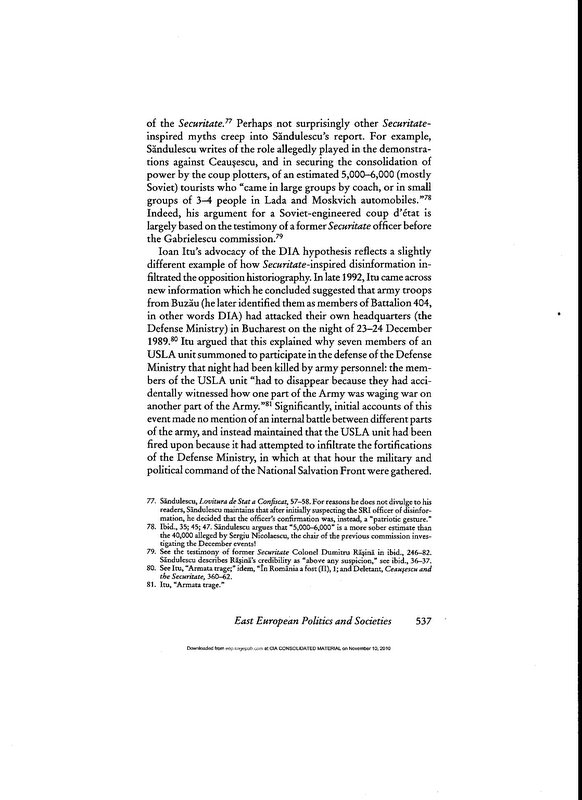
The DIA variant, so dear to the hearts of Ceausescu’s double and his Securitate counterparts, has a long and fabled history. In the early and mid-1990s, it became a favorite of the opposition to the communist successor regime of President Ion Iliescu—an opposition that included many of those who had suffered most under the old regime. (After being voted out in 1996, Iliescu returned to the presidency in the 2000 elections.) In the opposition press, noted journalists such as Ioan Itu and Ilie Stoian at “Tinerama,” Cornel Ivanciuc at “22″ and later at “Academia Catavencu, ” and Petre Mihai Bacanu at “Romania Libera” promoted the DIA thesis at one time or another.

Marius Mioc despre colaborarea cu securitatea a lui Ioan Itu

significantly, Itu didnt just collaborate with just anybody, but–like Sorin Rosca Stanescu–precisely the USLA, from 1978 to 1983 !

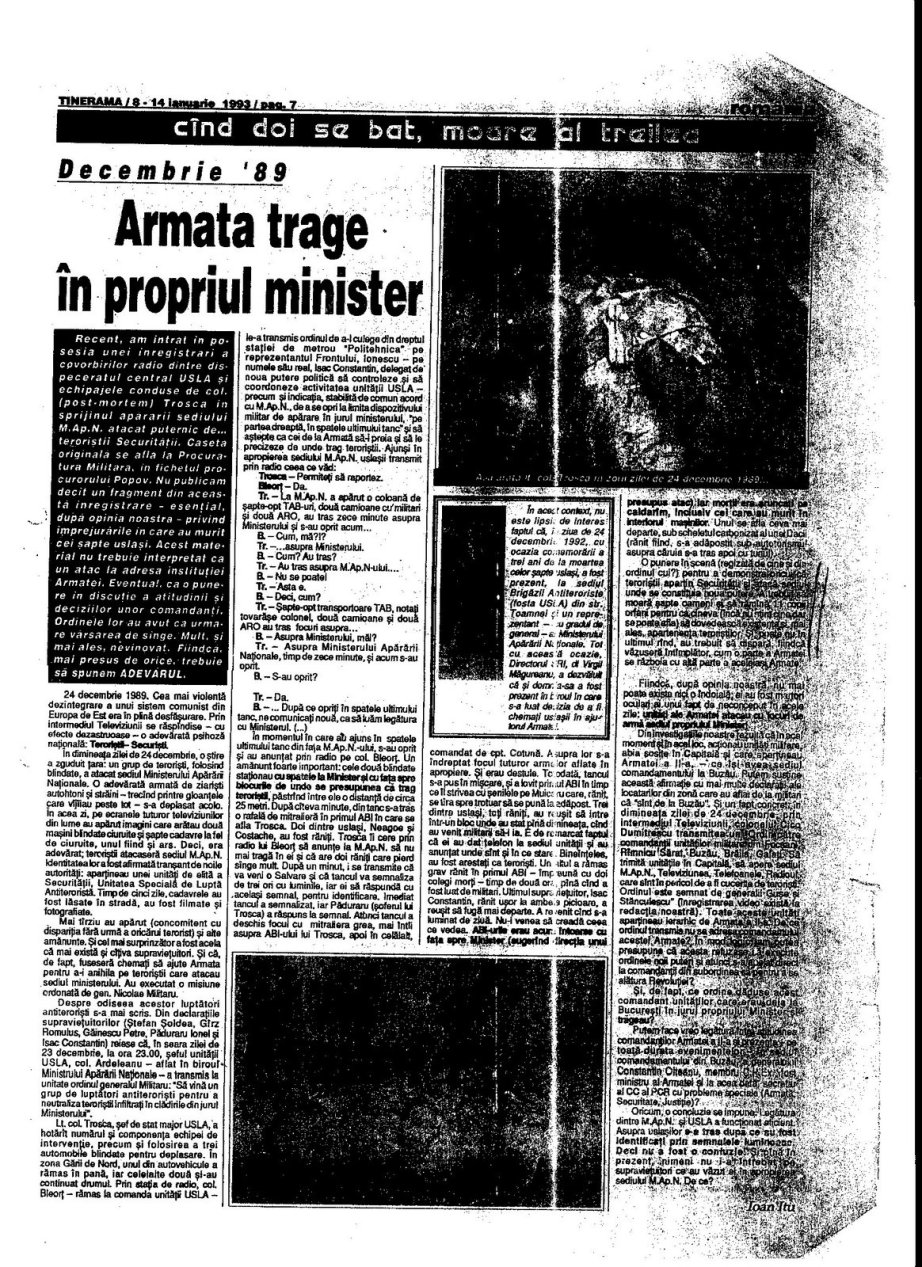
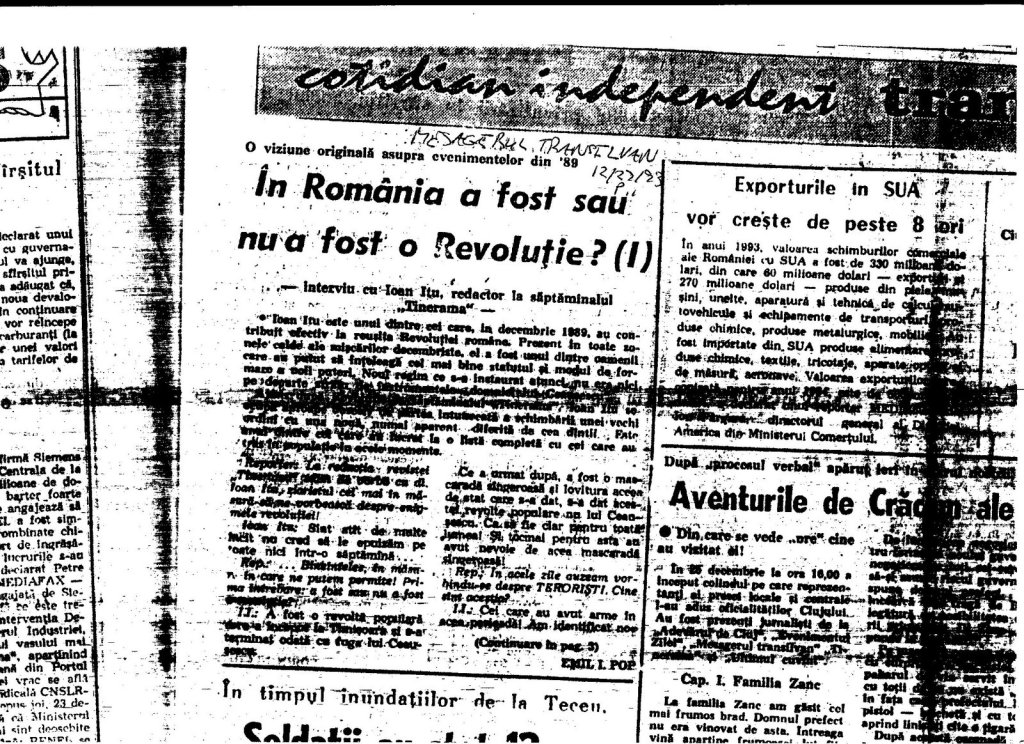
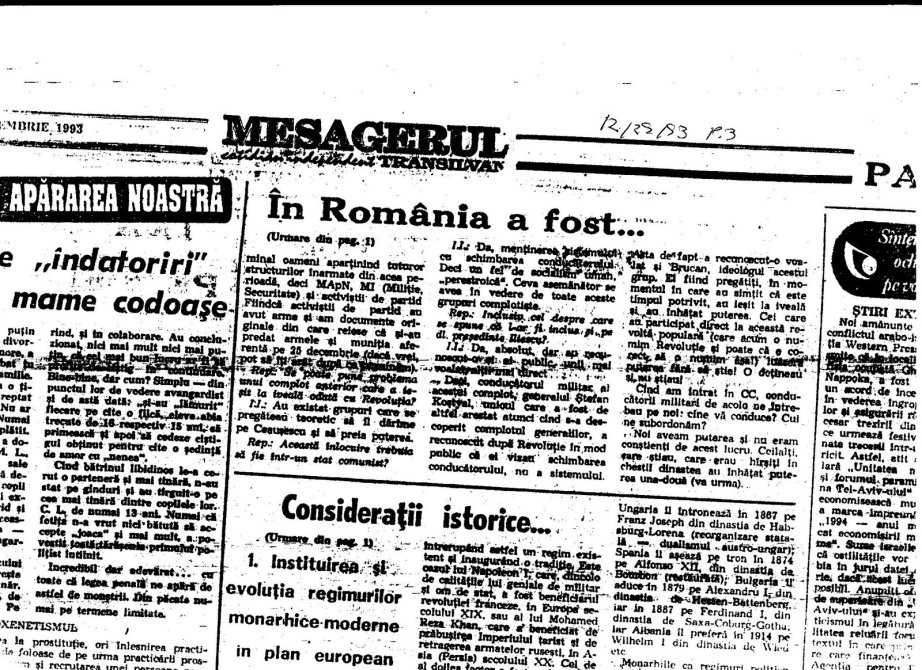
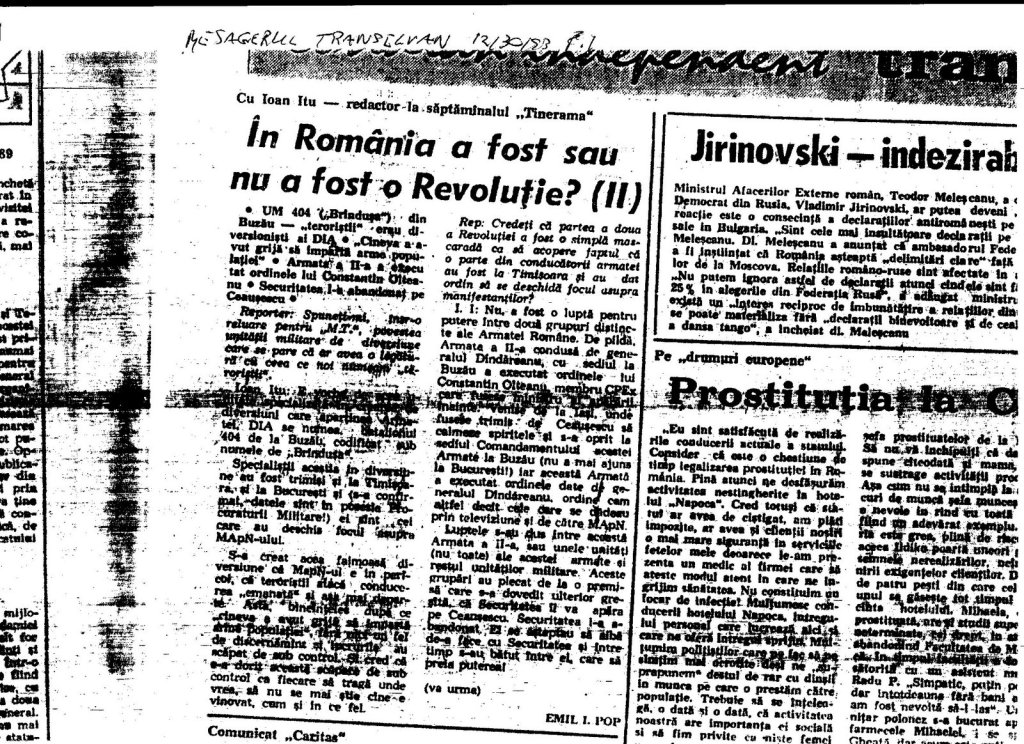
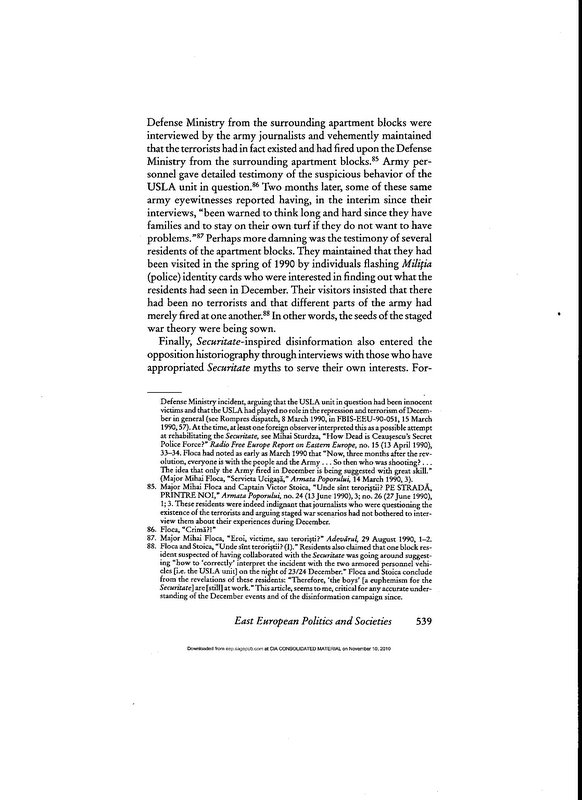
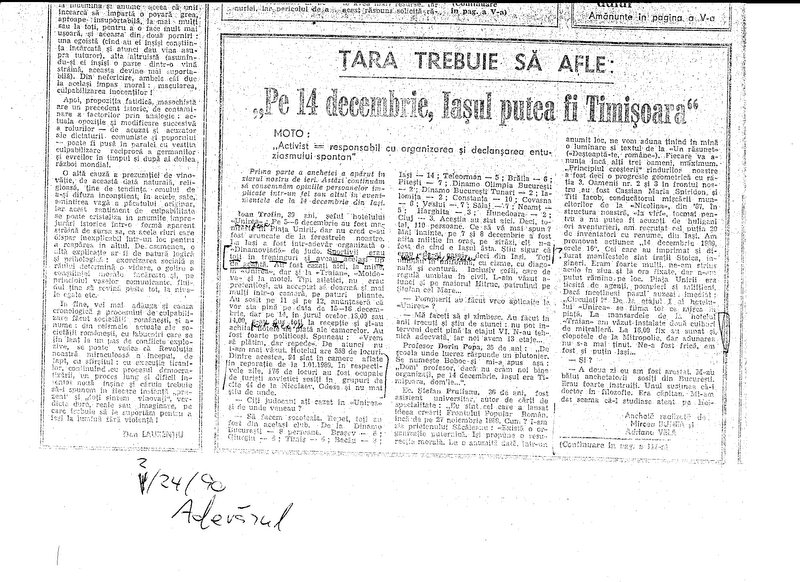
The following article, in which Itu exculpated the USLA (Securitate) and attempted to cast blame instead on the DIA (Army)–in part by taking out of context the communication that is recreated–has been used by Denis Deletant, Peter Siani-Davies, and others to suggest how original understandings of the December events were erroneous.  In twenty years, there has not been a single confirmation that at this moment “army units were attacking their own Ministry” as the article suggests.

image-20

By the end of 1993, Itu had become a strong proponent of the DIA theory, which had its roots directly in the former Securitate http://atomic-temporary-3899751.wpcomstaging.com/2009/12/20/radaciniile-securiste-ale-tezei-dia-despre-decembrie-1989/, http://atomic-temporary-3899751.wpcomstaging.com/2009/12/20/dezinformare-securista-despre-decembrie-1989-in-actiune-zig-zag-anul-1990-angela-bacescu-teroristii-n-au-fost-securisti-nici-n-au-existat-teroristi-gheorghe-ionescu-olbojan-teroristii-au-2/

image-23

image-22

image-21

—————————————–

deci nu este nici o surpriza ca un mare admirator al cartii lui Cartianu este…Alex Mihai Stoenescu:

” Grigore Cartianu a gasit numeroase amanunte pe care istoricul si juristul le ignora. Din acest punct de vedere, imaginea despre evenimentele din decembrie 1989, din Romania, este la el mult mai ampla si, totodata, mult mai aproape de actorii lor: oamenii.

Din acest moment, la 20 de ani de la evenimente, istoricii au in sfarsit un aliat. Si este vorba despre un demers jurnalistic coerent, nu ipsit de evadari literare, care ofera cititorilor o imagine mai aproape de realitatea pe care am trait-o si care in acesti 20 de ani a fost acoperita cu rogojina minciunii.

Cartea de fata este povestea loviturii de stat transformate in revolutie si a revolutiei tranformata in lovitura de stat.” – Alex Mihai Stoenescu, istoric

http://www.ishop.ro/carte/Sfarsitul-Ceausestilor-Sa-mori-impuscat-ca-un-animal-salbatic_30515.html

despre AMS si Securitatea… http://atomic-temporary-3899751.wpcomstaging.com/2010/12/14/iasi-14-decembrie/

Posted in decembrie 1989, raport final, Uncategorized | 3 Comments »

Timisoara, 16 decembrie

Posted by romanianrevolutionofdecember1989 on December 16, 2010

(punct de vedere strict personal; publicat pe site-ul acesta pe 16 decembrie 2009)

(sigur, ca in limba romana, sunt multe constatari de vazut, de exemplu operele lui Marius Mioc:

16 decembrie 1989 inceputul revolutiei la timisoara

Marius Mioc 16 decembrie 1989

Il vizitam pe Tokes aproape zilnic

Cronologia cazului Laszlo Tokes )

An excerpt from

A chapter from my Ph.D. Dissertation at Indiana University: Richard Andrew Hall, Rewriting the Revolution: Authoritarian Regime-State Relations and the Triumph of Securitate Revisionism in Post-Ceausescu Romania (defended 16 December 1996). This is the original chapter as it appeared then and thus has not been revised in any form.

Chapter Five


The Beginning of the End: Timisoara, 15-17 December 1989

On the morning of Saturday, 16 December, both the demonstrators and Mayor Mot’s delegation returned to the Tokes residence. The Securitate and Militia apparently kept their distance. Work crews set about replacing the broken glass–quite a sight apparently, since glass had been a rare commodity in Timisoara for months. The crowd demanded written confirmation from Mot that Tokes’ eviction would be canceled. Mot and his delegation left, promising to return with written confirmation in hand. Shortly after their departure, however, news began to filter back to the protesters: such a written promise was impossible, the Bucharest legal department charged with such matters was closed because it was Saturday![51] Meanwhile, the crowd was steadily growing.

Mot himself did not return. Instead, the deputy mayor came. An angry negotiating session ensued between the deputy mayor and ten representatives of the crowd (six Romanians and four Hungarians, a testament to the multi-ethnic character of the demonstration). The deputy mayor left, promising he would have Bucharest fax him the necessary documents to secure a peaceful end to the demonstration. As Tokes observes: “I did not ask why Bucharest was suddenly able to produce documents on a Saturday.”[52] Instead of the documents, however, the mayor sent back an ultimatum: if the crowd did not disperse by 5 p.m., water cannon would be used against the protesters.

Although Tokes appealed for the crowd to go home, he himself admits that by this time the protest had assumed a dynamic of its own and was not heeding his or anyone else’s pleas. According to Tokes: “though the crowd looked to me as a figurehead, in truth I was a prisoner of their anger.”[53] By the evening, the addition of high school and university students had clearly radicalized the crowd. Buoyed by their sense of growing strength–this time the absence of regime forces at the scene had backfired–protesters were now chanting “Down with Ceausescu! Down with the regime! Down with Communism!” and singing the long-outlawed anthem “Awake, Romanian!”[54] About one thousand of the protesters broke off from the rest of the group and headed for the Romanian Orthodox Cathedral in the central Opera Square. The demonstrators seemed to believe that the regime would be less likely to resort to violence in the shadow of a house of worship.

On their way, the protesters became increasingly aggressive and began ripping down the ubiquitous, rusting billboards extolling the joys of living in Ceausescu’s “Golden era.” Their ranks were strengthened by thousands of university students who had made their way down from the so-called “Student Complex” zone. Initially, these students had been prevented from leaving the “Student Complex” zone by cordons of Securitate men. But as their ranks grew and they became more angry, the Securitate suddenly found themselves vastly outnumbered and decided the better part of valor was to cut and run. This delighted and emboldened the protesters.[55]

The two groups of protesters made their way towards the county party headquarters building. They found it deserted, unlit, and unguarded–save for two fire engines with water cannon.[56] The water cannon were turned against the protesters and the crowd responded with a furious attack against the vehicles and the party building. The demonstrators broke the windows of the building and attempted to destroy any symbol of the regime they could find. Suddenly, Militia men appeared on the scene with clubs and tear gas. The protesters were savagely beaten and many were arrested. Around the same time, back at Piata Maria, two hundred Militia officers and junior officers (some in uniform, some in civilian clothes) had arrived. Violent altercations broke out: windows were smashed and several cars in the area set ablaze. The demonstrators threw pavement stones, bottles, anything they could get their hands on. Numerous arrests were made. Confrontations also occurred between demonstrators and regime forces elsewhere in the city.[57]

Lost in the revisionist coverage of the December events is the fact that the Securitate and Militia did indeed enforce Tokes’ eviction notice. Sometime after 3 a.m. on Sunday, 17 December, a large number of plainclothes and uniformed Securitate and Militia men broke into the parochial residence. The Tokes family sought refuge in the church. Laszlo Tokes was captured inside the church and beaten severely, then taken back to the apartment where Securitate and Militia officers, the local party secretary, and the Minister of Cults from Bucharest were waiting for him. Tokes was forced to sign a blank sheet of paper which was to serve as his resignation from the Timisoara congregation. As Tokes notes, in spite of the fact that he was bleeding profusely over his clerical robe, “there was a veneer of formality about the proceedings. One of the people in the office was a lawyer in charge of evictions, and a form of official procedure was being precariously observed.”[58] Tokes and his wife were taken by car out of Timisoara. Initially, they believed they would be killed.[59] But as they kept on driving, they realized they were heading north to Transylvania, to the village of Mineu, their ordained place of exile.

[51].. Ibid., 145-151.

[52].. Ibid., 153.

[53].. Ibid., 155.

[54].. Ibid., 154-157. Evidence of the rare solidarity of this moment was the fact that Hungarians were reported to have also sung this Romanian nationalist anthem.

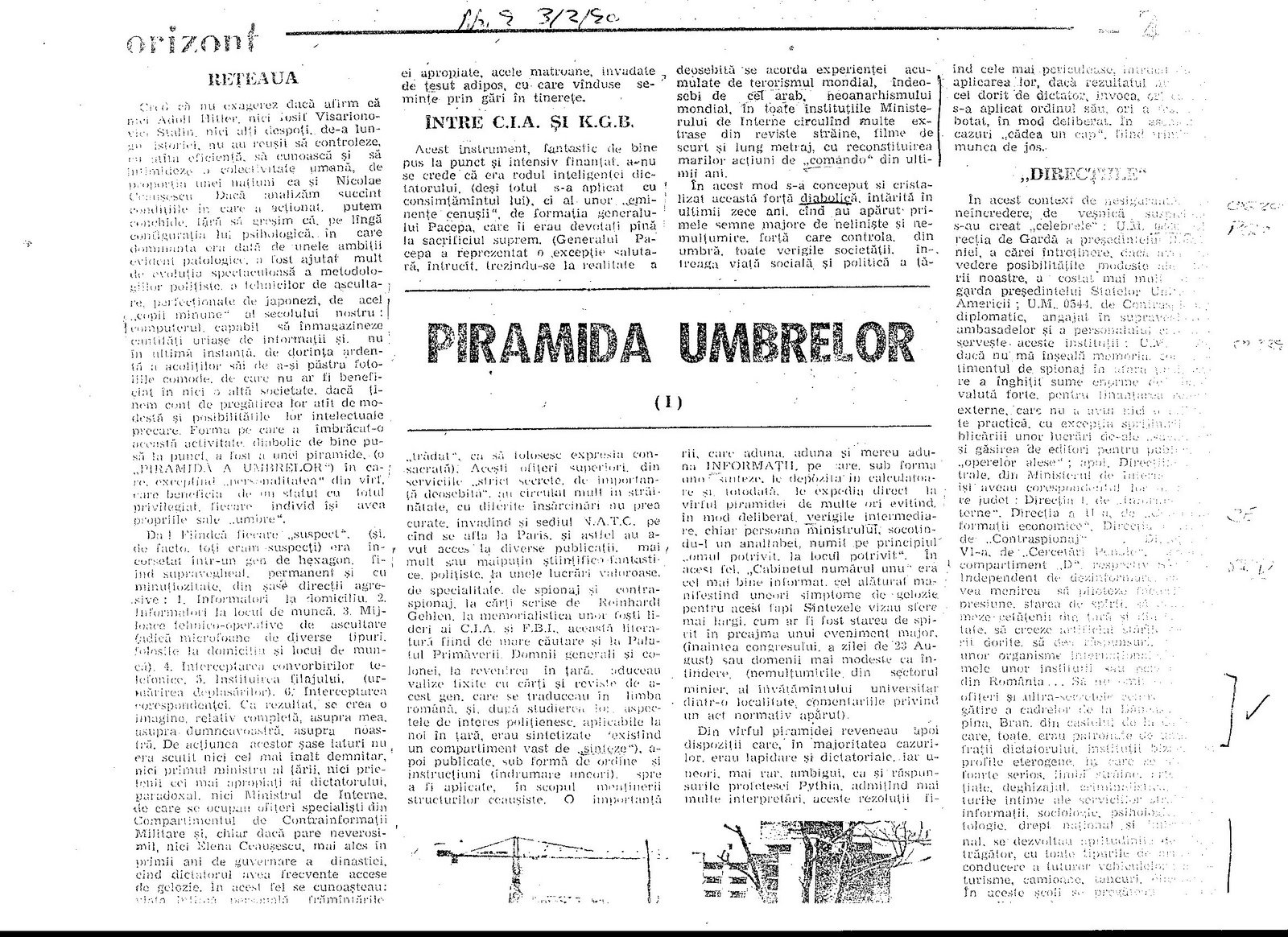
[55].. Miodrag Milin, “Sapte zile care au zguduit Romania (II) [Seven days which shook Romania],” Orizont, (13 January 1990), 2; idem, “Sapte zile care au zguduit Romania (III),” Orizont, (19 January 1990), 2; Mircea Balan, “Au tras cu disperare ca sa inabuse revolutia [They shot out of desperation in order to crush the revolution],” Cuvintul, no. 36 (2-8 October 1990), 8.

[56].. The fire department was a component of the Interior Ministry.

[57].. Milin, “Sapte zile…(II)”; idem, “Sapte zile (III).”

[58].. Tokes, With God, for the People, 165.

[59].. Tokes and his wife firmly believed that only Western publicity about their case had prevented the Ceausescu regime from killing them at this point (Rady, Romania in Turmoil, 88).

Posted in decembrie 1989, raport final, Uncategorized | Leave a Comment »

Timisoara 15 decembrie

Posted by romanianrevolutionofdecember1989 on December 15, 2010

An excerpt from my Ph.D. Dissertation at Indiana University: Richard Andrew Hall, Rewriting the Revolution: Authoritarian Regime-State Relations and the Triumph of Securitate Revisionism in Post-Ceausescu Romania (defended 16 December 1996)–unfortunately all but forgotten at Indiana University’s Russian and East European Institute (REEI, Director: Professor Maria Bucur), but thankfully of use to others elsewhere.  This is the original text as it appeared then and thus has not been revised in any form.  [The discussion and alleged role of foreign “tourists” goes back much farther than Alex Mihai Stoenescu and Grigore Cartianu, but the roots lie in the same place…and thus with the same institution.]

Chapter Five

The Beginning of the End: Timisoara, 15-17 December 1989

———————————————————————————–

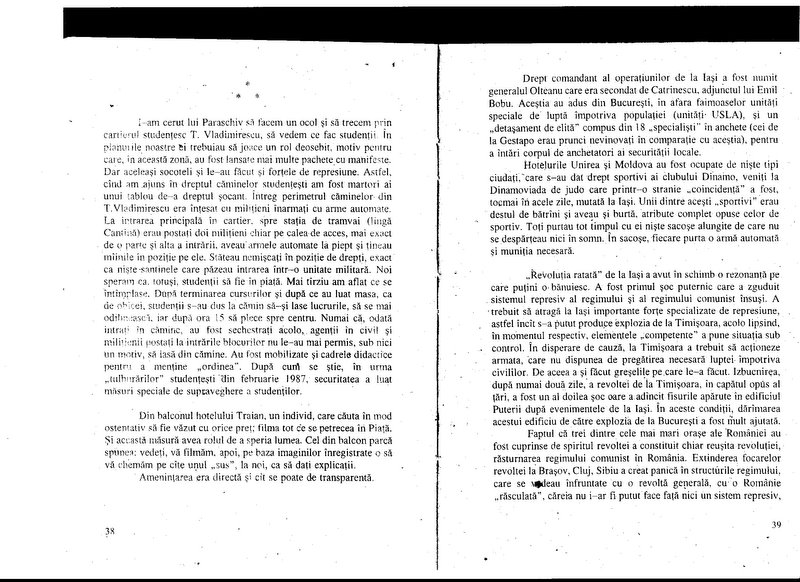
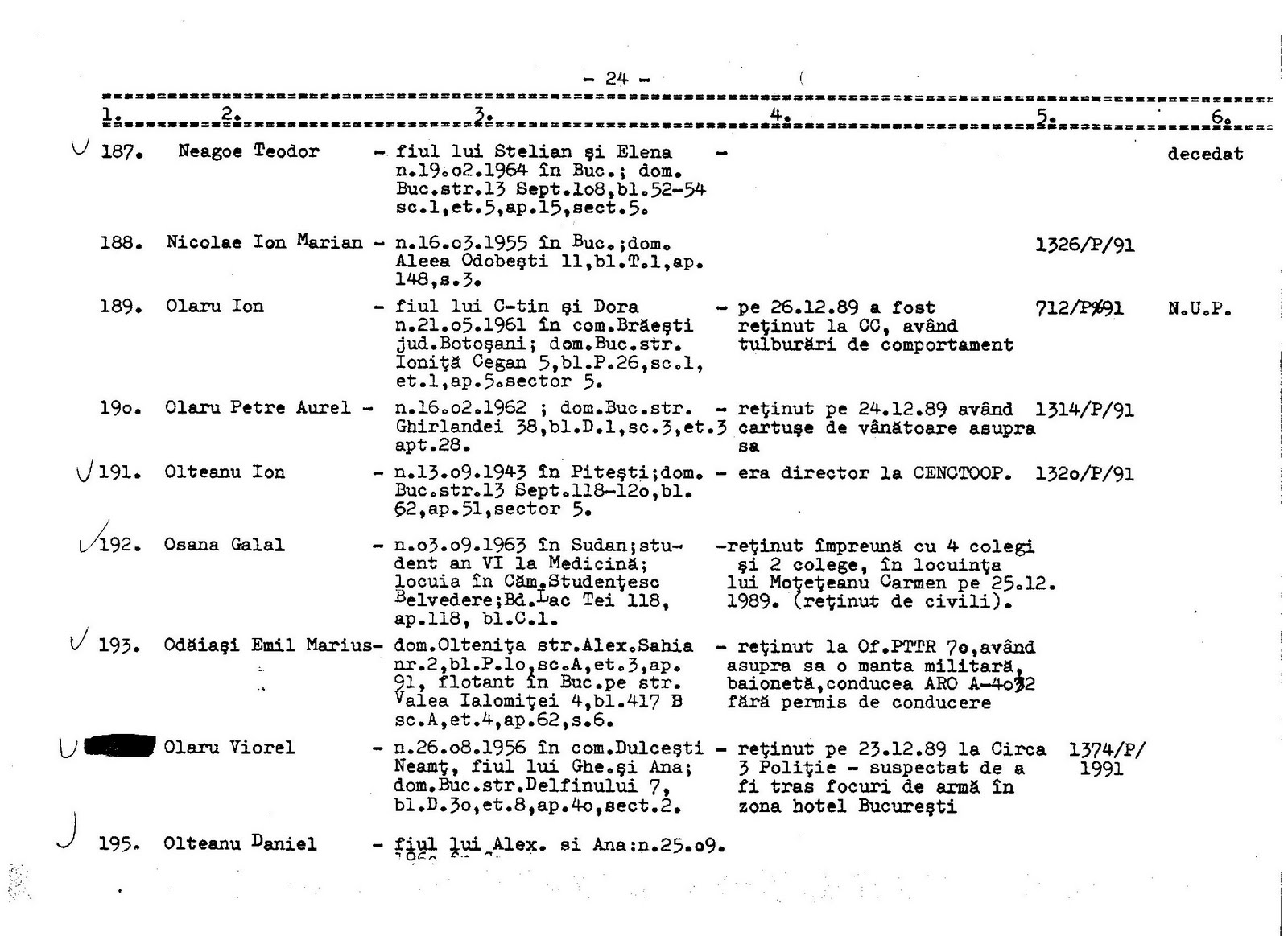
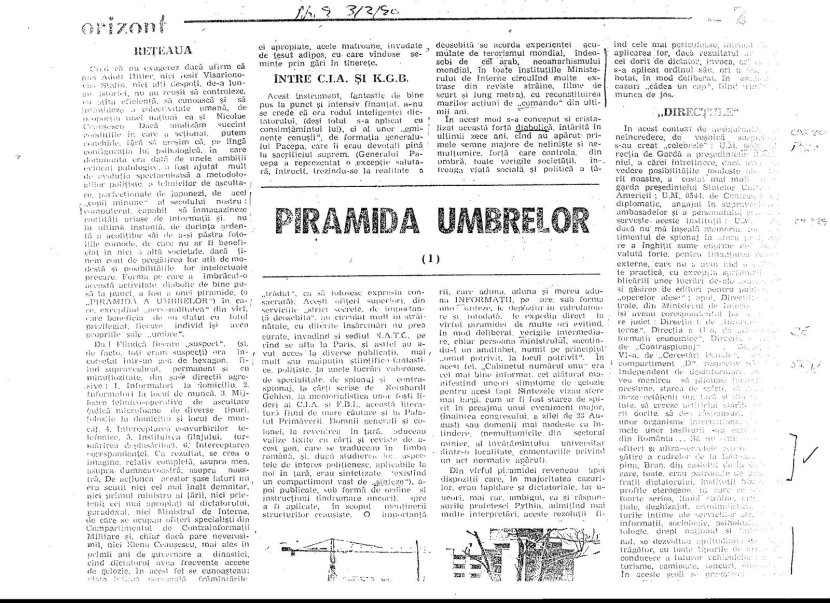
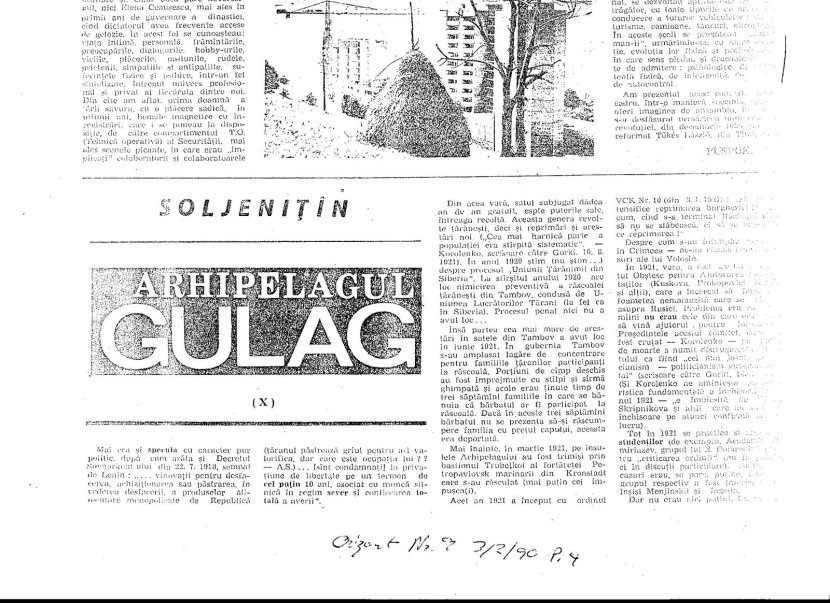
S-a dovedit mai tirziu prin 1990/1991, ca Roland Vasilevici, fost securist Dir. I (Culte) judetul Timis, era sursa…
—————————————————–

As we discussed in chapter three, where state institutions become deeply-implicated in authoritarian regime politics, the personnel of these state institutions are more likely to respond to the calls of political leaders to save the regime in the face of a serious challenge to its survival. Moreover, should the authoritarian regime nevertheless collapse, their enduring identification with authoritarian-era institutional interests and identities will prove detrimental to the construction and consolidation of democracy in the post-authoritarian era. The remnants of these authoritarian-era state institutions will constitute unaccountable islands of influence and privilege, resistant to attempts to subordinate them to democratic control, and determined to defend their lingering institutional and personal interests. The elevated role of state institutions in the authoritarian era thus means that the delegitimation and decomposition of the authoritarian regime are likely to be incomplete.

The Timisoara events of 15-17 December 1989–the events which eventually resulted in the collapse of the Ceausescu regime–offer confirmation for both these hypotheses. The details of what happened in Timisoara suggest that in spite of the clearly popular character of the anti-regime demonstrations which took place there, and the backdrop of the events which had already taken place elsewhere that fall in Eastern Europe, state institutions responded faithfully to Nicolae Ceausescu’s orders to repress. This was significantly different than what happened elsewhere in Eastern Europe where the army and security apparatus generally abstained from brutal intervention when aging, hardline leaders attempted to goad them into action against anti-regime protesters.

It is the content of the historiography of the December 1989 events which serves as our window to the ability of former Securitate personnel to influence the behavior of other Romanian citizens in the defense of the lingering institutional interests of the Securitate. Thus, it is the historiography of the December events which is our window to the legacy of Ceausescu era regime-state relations upon post-authoritarian outcomes. To the extent that we can identify an institutional view of the Securitate with regard to any particular event or incident, we can use this view to judge other accounts against. We will say that such an institutional view exists where we can show that, regardless of the directorate or unit they used to serve in, former Securitate personnel express similar views about a particular event or incident. We can conclude that the former Securitate continues to exercise detrimental influence if we can show that there is a high degree of similarity or convergence between the accounts of post-Ceausescu media and political elites, and Securitate accounts, and if we can show that this consensual account is false. Thus, in our analysis of the Timisoara events–and in the analysis of all the events of December 1989–we are interested in establishing the views of former Securitate personnel, comparing these views with accounts of the same event or incident by post-Ceausescu political and media elites, and judging the validity of the these accounts.

Ultimately, it is the behavior of opposition media and political elites which is of greatest importance for judging the Securitate‘s influence. These are the people who express the greatest ideological distaste for the former Securitate and who have given proof of their independence from the Iliescu regime through their consistently vigorous criticism and investigation of the Iliescu leadership and the personnel of the Securitate‘s institutional successors within the regime. Thus, we would expect for their discussion of the December 1989 events to be the most diametrically-opposed to Securitate accounts of those same events. Their behavior is something of a “lowest common denominator,” our true test of the substance of Romania’s young democracy.

In comparing the views of former Securitate personnel (or their unabashed cheerleaders in the Ceausescu nostalgic press) with those of opposition media and political elites, it is important to rely on the accounts of opposition elites who, through the content of their accounts, show that they are not merely repeating what other opposition elites have heard or said, but have come to these conclusions first-hand. Opposition elites routinely express their opinions on the December events, but the vagueness of their allegations usually suggests that these allegations are not originally their own and that they may not be aware of the context of the allegations. Such accounts are thus unsatisfying for our purposes as these elites do not exhibit a degree of knowledgeability which would confirm to us that they are sufficiently conscious of the content, meaning, and implications of their allegations.

We will assume that the closer opposition elites have gotten to the details of the December events, the more aware of, and responsible for, their allegations they must be. Therefore, among opposition elites, we are more interested in those journalists who have investigated the December events in great detail over an extended period of time than in those who sporadically express vague opinions, and in those politicians who have served on parliamentary commissions investigating the December events, rather than politicians who merely drop a line in a campaign speech about the events and clearly do not have such in-depth knowledge of them. These are the people who have set the agenda and “framed the discourse” on December 1989–who have indicated how society should think and believe about the December events–and therefore among opposition elites it is their accounts which are most important. The criteria for determining what constitutes an “opposition account” and thus who is an “opposition elite” are discussed in Appendix One.

The primary institutional interests which former Securitate members seek to defend in the historiography of the Timisoara events–and in the historiography of the December 1989 events in general–are fairly straightforward. First, they wish to deny both that major repression and bloodshed took place, and that if it did, they had any part in it. Second, they wish to cast doubt upon the degree to which the demonstrations were genuine, spontaneous, and peaceful. Third, they wish to suggest that they embraced the popular characteristics of the uprising and enabled the revolution to succeed. From the Securitate point of view, these second and third interests are not mutually exclusive–i.e. they can maintain that foreign agents sparked the protests in order to oust Ceausescu, but that even if the catalyst of the protests was illegitimate, those protests did contain a genuine, understandable, and laudable popular element. In other words, the Securitate wants to “have their cake and eat it too.”

Specifically, the historiography of the Timisoara events reveals the degree to which the Securitate were deeply implicated in the repressive policies of the Ceausescu regime and to which it attempted (especially in the period preceding the outbreak of the anti-regime demonstrations) to impose its institutional interests and interpretation of events upon the regime leadership, including Ceausescu. It also suggests the degree to which the anti-Soviet orientation of regime ideology and legitimacy influenced Ceausescu’s perception of the Timisoara events at the time and have influenced the content of Securitate disinformation in the post-Ceausescu era.

The Timisoara Uprising: An Overview

Timisoara, a multi-ethnic city of approximately 330,000 residents in southwestern Romania, was the birthplace of the December 1989 revolution. Demonstrations began there on Friday, 15 December 1989 when members of a Hungarian Reformed (Calvinist) congregation gathered to protest the imminent eviction of their pastor, Laszlo Tokes. Although originally a small demonstration of several hundred members of the Hungarian minority, many Romanians soon joined the crowd. On Saturday, 16 December and Sunday, 17 December, protest spread throughout the city and began to assume an unambiguous anti-regime tone. On the Sunday evening, the authorities opened fire on the demonstrators, killing approximately 100 and wounding in excess of 300. About 900 demonstrators were arrested. By the Monday morning, the city was described as an armed camp and the repression continued throughout the day. Protests unexpectedly rekindled on Tuesday, 19 December. By Wednesday, 20 December, regime forces were withdrawing from the city and a committee representing the demonstrators was negotiating with regime officials sent from Bucharest. As of Wednesday evening–a day before protests erupted in Bucharest and two days before the unexpected flight of the Ceausescus–protesters appeared to be in control of Timisoara.

In any country, such a sudden change in fortunes might have induced curiosity and suspicion. But because these events had taken place in one of the most tightly-controlled societies in the world, and because popular protest had been so rare and so brutally and effectively repressed in the past, questions arose almost immediately over the spontaneity of the protests and the regime’s surprising inability to crush them. How could the case of Pastor Tokes have been allowed to reach such a dangerous juncture given the extraordinarily tense circumstances in which the Ceausescu regime found itself in December 1989? Why did regime forces wait so long to engage in brutal repression and why did it then fail? How could this seemingly invincible regime lose or abandon this major industrial city to the protesters, especially given what had already happened to communist regimes elsewhere in Eastern Europe that autumn?

The incomplete, contradictory, and bizarre evidence which exists about the Timisoara events has fueled suspicion on two fronts: a) that foreign powers were involved with the intent of exploiting the upheaval and uncertainty which prevailed in Eastern Europe at the time in order to topple Ceausescu, and/or b) that elements within the Ceausescu regime nurtured the Timisoara unrest or dragged their feet in carrying out its repression in order to propel Ceausescu’s ouster. The former Securitate usually favor the first explanation because it tends to deny the spontaneous and popular dimension of the December events and presents Nicolae Ceausescu and their institution as the innocent victims of a diabolical international conspiracy. Nevertheless, it is not difficult to see how the second explanation can also serve the former Securitate‘s interests. It suggests that at least a faction within the Securitate sided with or encouraged the actions of the protesters. In other words, it bestows revolutionary merit upon the Securitate.

“Yalta-Malta” and the Theme of Foreign Intervention in the Timisoara Uprising

At an emergency CPEx meeting on the afternoon of 17 December 1989, Nicolae Ceausescu sought to make sense out of the news from Timisoara by attempting to fit it in with what had happened elsewhere in Eastern Europe thus far that fall:

Everything which has happened and is happening in Germany, in Czechoslovakia, and in Bulgaria now and in the past in Poland and Hungary are things organized by the Soviet Union with American and Western help. It is necessary to be very clear in this matter, what has happened in the last three countries–in the GDR, in Czechoslovakia, and Bulgaria, were coups d’etat organized by the dregs of society with foreign help.[1]

Ceausescu was giving voice to what would later become known as the “Yalta-Malta” theory. Significantly, the idea that the Soviet Union and, to different degrees of complicity, the United States and the West, played a pivotal role in the December 1989 events pervades the vast majority of accounts about December 1989 in post-Ceausescu Romania, regardless of the part of the ideological spectrum from which they come.

The theory suggests that after having first been sold out to Stalin and the Soviet Union at Yalta, in early December 1989 American President George Bush sold Romania out to Mikhail Gorbachev during their summit in Malta. The convenient rhyme of the two sites of Romania’s alleged betrayal have become a shorthand for Romania’s fate at the hands of the Russians and other traditional enemies (especially the Hungarians and Jews). To be sure, similar versions of this theory have cropped up throughout post-communist Eastern Europe among those disappointed with the pace and character of change in their country since 1989.[2] The different versions share the belief that Mikhail Gorbachev and the Soviet KGB engineered the sudden, region-wide collapse of communism in 1989. Their successors in Russia have been able to maintain behind-the-scenes control in Eastern Europe in the post-communist era by means of hidden influence and the help of collaborators within those countries. “Yalta-Malta” has become the mantra of those who seem to have experienced Eastern Europe’s el desencanto most deeply.[3]

Although one can probably find adherents to the Yalta-Malta theory in every East European country–particularly since the “Return of the Left” through the ballot box–there is little doubt that the theory finds its widest and most convinced audience–both at elite and mass levels–in Romania.[4] This is because, as we have seen, the suggestion that the Soviet Union and the KGB were attempting to undermine the regime leadership and infringe upon national sovereignty was not an ad hoc slogan in Romania in 1989, as it was in East Germany, Czechoslovakia, and Bulgaria where aging political leaderships hinted at such arguments in a last-ditch effort to save their positions. Such appeals had far greater resonance in Romania in December 1989–particularly within the regime–because they had been tenets of the Romanian regime’s ideology for well over two decades. And they have had a lingering popularity in the post-Ceausescu era for that same reason. It is the uniquely antagonistic character of the relationship between the Securitate and the KGB during the Ceausescu era (discussed in chapter four), and the genuine, scarcely-veiled animosity between Ceausescu and Gorbachev, which give the Yalta-Malta scenario a plausibility and credibility (however spurious) in Romania it cannot find elsewhere in Eastern Europe.

Western analysts have frequently caricatured the views of the former Securitate towards the Ceausescu era by suggesting that they uniformly look back favorably and nostalgically upon it. In fact, many of them now openly criticize Nicolae Ceausescu’s misguided policies, erratic behavior, and harsh rule.[5] Clearly, much of this is post facto judgement. The deceased Ceausescu serves as a convenient scapegoat for all that went wrong during his rule and by blaming him they can absolve themselves. Nevertheless, regardless of how they now view Nicolae Ceausescu, almost every former Securitate officer challenges the spontaneity of the Timisoara protests and suggests that the catalyst for the unrest came from outside Romania’s borders. Thus, they argue, even if Nicolae Ceausescu had brought the country to the point of profound crisis, this “foreign intervention” converted the Timisoara events primarily into a matter of national security.

It is interesting to recall Nicolae Ceausescu’s own interpretation of the Timisoara events during a rambling, scarcely coherent teleconference on 20 December 1989:

…all of these grave incidents in Timisoara were organized and directed by revanchist, revisionist circles, by foreign espionage services, with the clear intention of provoking disorder, of destabilizing the situation in Romania, of acting in order to eliminate the independence and territorial integrity of Romania….It is necessary to attract the attention of everyone, not only of the communists [emphasis added], but everyone to the shameful…campaign… unleashed right now by different circles, beginning with Budapest, convincingly demonstrates that…, including the declarations of the president of the United States, who declared that he had discussed the problems of Romania with Gorbachev at Malta…[6]

In their discussion of the December events, the former Securitate have expanded upon Ceausescu’s allegations of “foreign intervention.”

In February 1991, while on trial for his part in ordering the repression of demonstrators in December 1989, the former director of the Securitate, General Iulian Vlad, proposed two principal groups of suspects for the Timisoara unrest.[7] He described the first group as Romanian citizens (the majority of whom were presumably of Hungarian ethnicity) who had fled to Hungary, passed through refugee camps, and been sent back to Romania with a mission to engage in “destabilizing acts.” According to Vlad, “only able-bodied males” were sent back. The second group of suspects were large groups of so-called Soviet “tourists.” Here is Vlad’s depiction of this second group:

Halfway through December 1989 massive groups of Soviet tourists began to enter the country. They entered coming directly from the USSR or from Yugoslavia or Hungary. The majority were men and–in a coordinated fashion–they deployed in a convoy of brand-new “LADA” automobiles. During the night of 16-17 December ’89 such a column attempted to enter Timisoara. Some of these cars were forced to make a detour around the town, others managed to enter it…[8]

Pavel Corut, a former high-ranking Securitate counter-military intelligence officer who has written dozens of novels seeking to rehabilitate the reputation of the former Securitate, has written of “the infiltration on Romanian territory of groups of Soviet commandos (Spetsnaz) under the cover of being tourists. It is noteworthy that December is not a tourist month and nevertheless the number of Soviet tourists grew greatly.”[9]

In 1994, the Securitate‘s official institutional heir, the Romanian Information Service (or SRI), declared in a report on the December events:

In addition to gathering information, some Soviet agents from among our ranks received the mission to make propaganda for “changes,” even at the risk of being found out. Actions at direct incitement [of the population] were also initiated by Soviet “tourists,” whose number had grown in the preceding period and had taken on exceptional proportions by the end of 1989.

Beginning on 9 December 1989, the number of Soviet “tourists” in “private” vehicles grew from around 80 to 1,000 cars a day. This phenomenon, although realized at the time, did not lead to the necessary conclusions and measures. The occupants (two to three per car), athletic men between 25 and 40 years in the majority, avoided lodging facilities, sleeping in their cars…The cars were mostly of a “LADA” and “MOSKOVICI” make, deployed in a convoy, and had consecutively-numbered license plates and similar new equipment. The majority were “in transit towards Yugoslavia”…

It is certain that during the Timisoara events there was a large number

of Soviet “tourists.” During 15, 16, and 17 December 1989, to these already in the country were added those “returning from Yugoslavia,” the majority by car.[10]

But the reach of this theory extends well beyond the former Securitate and their cheerleaders in the Ceausist nostalgic press. The head of the first Senatorial commission investigating the December events, film director Sergiu Nicolaescu–a key figure in the newly-formed National Salvation Front during the events of 22-25 December 1989 and a legislator of the ruling Front after 1989–described the catalyst of the December events to a journalist in December 1993 as follows:

By chance, everything began in Timisoara. It could have begun elsewhere since many places were prepared. It is known that in Iasi something was being prepared, and also in Brasov and Bucharest. There was clearly foreign intervention….For example, the intervention of the Russians in Romania. A year before in 1988 about 30,000 Russians came. A year later in 1989, in December, the number doubled. Thus, it reached 67,000. It is known that there were at least 1,000 automobiles in which there were two to three men between the ages of 30 and 40 years old, at a maximum 45 years old. It is very interesting to observe that, only a few months earlier, the Securitate had ordered that for those from socialist countries crossing the border, it was no longer necessary to note their license plate number or how many people were on board.[11]

Asked who in the Securitate gave the order to no longer record this information, Nicolaescu insinuated that they were Soviet “moles” who had been placed there “4, 5, 10, and even 30 years earlier.”[12]

The theory has also found its way into the opposition media. Cornel Ivanciuc, who in 1995 wrote one of the most influential exposes to date on the former Securitate for the weekly 22, maintains that the Soviets achieved their aims in December 1989 by means of the so-called “tourist-incursionists, whose activity during the revolution was identical to those of the Spetsnaz special troops for reconnaissance and diversion of the GRU [Soviet military intelligence].”[13] Two months after General Vlad’s 1991 court statement, Sorin Rosca Stanescu, one of the most prominent journalist critics of the Iliescu regime and the SRI, presented an interview in the leading opposition daily Romania Libera with an anonymous KGB officer residing in Paris who outlined a familiar scenario.[14] The KGB officer claimed that he had entered Romania on 14 December with others as part of a KGB plan to open fire and create confusion. He had been in Timisoara during the events, but suggested he never received the anticipated order to open fire and left the country on 26 December. Rosca Stanescu, however, made sure to remind his audience of “the insistent rumors which have been circulating referring to the existence on Romanian territory of 2,000 “LADA” automobiles with Soviet tags and two men inside each car…”[15] Stanescu closed by asking his readers: “What did the Ceausescu couple know but were unable to say? Why is general Vlad held in this ambiguous chess game?…Is Iliescu protected by the KGB?”

Stanescu’s intentions are further drawn into question by the fact that this particular article has been cited positively by former Securitate officers in their writings. Colonel Filip Teodorescu of the Securitate‘s Counter-espionage Directorate, the second highest-ranking Securitate officer in Timisoara during the repression and sentenced to prison for his role in those events, cites extensively and favorably from this very article by Stanescu in a book on the December events.[16] Pavel Corut also invokes Rosca Stanescu’s interview in support his arguments.[17] Moreover, Rosca Stanescu’s questionable comments make the issue of his (revealed and acknowledged) past collaboration with the Securitate‘s USLA unit between 1975 and 1985 relevant.[18]

Securitate accounts also routinely insinuate that foreign diplomats who came to Timisoara ostensibly to “monitor the situation” there, and foreign radio stations such as Radio Free Europe, Voice of America, the BBC, and Deutsche Welle which transmitted information about Timisoara developments, contributed directly and intentionally to the unrest.[19] For example, the former deputy director of the Timis county Securitate, Major Radu Tinu, highlights the allegedly suspicious role played by representatives of the American and British embassies who came to Timisoara on 15 December 1989 and transmitted back to Bucharest that “everything is in order, we have seen him,” apparently referring to pastor Tokes.[20]

Similar elements also creep into some opposition accounts. Ilie Stoian, a journalist for Expres and then Tinerama, ranks among those who have written most extensively about the December events. Stoian argues for a “Yalta-Malta” interpretation of the December events.[21] In discussing the Timisoara events, he notes the presence of Hungarians who were filming the events from their “LADA” automobiles and the expulsion of Russians across the Yugoslav border by the Securitate–thus insinuating that they were somehow implicated in the unrest.[22] According to Stoian:

…the December revolution was prepared in advance. In order to make things even clearer, we draw your attention to the fact that prior to the date fixed by the authorities for the evacuation of pastor Tokes from the parochial residence, in almost every evening Voice of America and Radio Free Europe would broadcast long pieces about this personage. Moreover, inside the country, foreign diplomats began to fuss….[23]

Finally, Stoian asks:

Wasn’t the presence of foreign diplomats somehow to verify if everything “was in order,” as was said during a telephone conversation intercepted on 15 December? Weren’t they somehow doing more than just supervising and reporting on these events to their superiors? We think the answer is yes.[24]

Questioning the Regime’s Treatment of the Tokes Case

What of the scheduled eviction of the Hungarian pastor, Laszlo Tokes, which apparently sparked the Timisoara uprising? It is known that the Securitate had placed Tokes under heavy surveillance for a long time prior to this event because of his persistent criticism of the subservient hierarchy of the Reformed Church and of the Ceausescu regime’s violation of human rights. At the same time, given the Ceausescu regime’s tradition of snuffing out dissidence before it could gain a foothold among the population–Ceausescu reportedly was fond of counseling his subordinates to “avoid creating martyrs”–the regime’s failure to isolate or silence Tokes appears uncharacteristic. Moreover, the fact that demonstrators could gather to prevent his eviction without being immediately and brutally dispersed is also unexpected.

Radu Ciobotea’s summary of the circumstances surrounding the outbreak of the Timisoara events captures the suspicions of many Romanians:

The Securitate hurries slowly, makes noisy efforts…but doesn’t resolve anything. The situation is quite strange. In a totalitarian state with a top-notch information and counter-information service and a “case” which had been pursued not for months but for years, the chiefs of state security…don’t make a decision, thus allowing matters to proceed. Moreover, the intervention of these organs is–as we say–too noisy to camouflage other hidden projects.

From May until December, a simple eviction from a residence–even if it was a parochial residence–cannot be fulfilled! A single man who had the “daring” to collaborate before all of Europe with the Hungarian mass-media (and not only with them) cannot be “neutralized”! We are looking at a dubious reality, especially when we are speaking of the activity and discretion of the Securitate.

No real threat, no sickness, not even an accident, in the end, nothing, blocks the way of this person, who under the eyes of agents, becomes a personality and gives birth by way of an almost inexplicable stubbornness to a conflict which resonates in the social consciousness…of Romanians.

Where? In Timisoara…[i]n “the Western city” close to the border full of tourists and foreign and Romanian students.

When? During winter vacation when tens of thousands of young people would be on the move from their schools and university departments. When Ceausescu’s trip to Iran was certain. When–around the holidays–Romanians had nothing to put on their tables, nothing to heat their homes with, nothing with which to heal the old and young sick with pneumonia or rheumatism. When nothing was possible.

Upon close scrutiny–with the exception of the date–everything was therefore predictable.[25]

“Romania: Revelations of a Coup d’etat,” the influential expose by the French journalists Radu Portocala and Olivier Weber, challenged the spontaneity of the Timisoara protests.[26] Because the authors suggest that their conclusions are based on information provided by Romanian sources; their account was rapidly translated and published widely in the Romanian press during 1990; and it was the first concerted attempt to analyze the December events and therefore “framed the dialogue” so-to-speak–by creating a paradigm to which future analyses would implicitly have to respond–the article deserves mention.

The authors allege a “Yalta-Malta” scenario in which the KGB plays the pivotal role. They suggest that the Securitate purposely attempted to instigate the Timisoara uprising:

In Romania, it was always known when somebody was arrested, but never that somebody will be arrested. However, in the case of Laszlo Tokes this is exactly what happened. The Securitate launched the rumor from the beginning of December that the pastor would be arrested on the sixteenth or seventeenth of that month. Public opinion was therefore carefully prepared.[27]

“Someone therefore had an interest for this small demonstration of 300 to 500 people in support of Tokes to degenerate into a revolt, and then a revolution,” they conclude. In support of their allegation that foreign security services were involved in the Timisoara events, the authors marshal the court statement of Colonel Filip Teodorescu, the Securitate‘s alleged “master spycatcher,” in which he claimed to have personally arrested “foreign agents” during the Timisoara unrest. Regime forces opened fire against the protesters on the evening of 17 December because “in order to create and then maintain a state of revolutionary spirit, a brutal repression also must occur.” In other words, the Timisoara events, from the genesis of the protests, to the crackdown on demonstrators, were staged, part of an elaborate coup d’etat supported–and even masterminded–by the Securitate.

Such arguments have found an echo among some opposition journalists within Romania. For example, Ilie Stoian insinuates that at least a part of the Securitate must have been trying to undermine regime policy towards Tokes:

Returning to the name of pastor Tokes, we must say that very few remember that in the months leading up to the events, [Tokes] was guarded day and night by the Securitate. Well, if he was guarded, then how did he wind up on Radio Budapest every week giving interviews? And how could the reporters who were taping his sermons or opinions smuggle the tapes out of the country? The Securitate, after all, was not made up of children! Don’t we witness in this case, a tacit accord of some men from the D.S.S. [i.e. the Securitate] with the very acts which they were supposed to stop?[28]

Ecaterina Radoi alleges that Tokes had informed his congregation of his imminent arrest on Sunday, 10 December 1989.[29] Sarcastically she asserts: “And, indeed, Friday, 15 December, the authorities intended for this event–announced long ago, and given ample media coverage in Hungary and the West–to take place.” After the protest got under way, “the forces of order intervened, dispersed the few protesters there and arrested a few so that the next day they could be let free.” Moreover, Pastor Tokes has himself become the subject of scrutiny. In 1994, the opposition weekly Tinerama published documents it maintained revealed that ever since the mid-1970s Pastor Tokes had been an informer for the Securitate.[30] Well-known journalist Ioan Itu hinted that the revelation of this fact meant that the story of December 1989 needed to be completely reconsidered in light of this new information.

A Review of the Evidence

Although at first glance the regime’s treatment of Pastor Tokes seems strange and even illogical, within the context of the workings of the Ceausescu regime and the regime’s strategy for dealing with dissent it makes perfect sense. There is simply no convincing evidence to believe that the Securitate–or a faction within it–purposely dragged its feet in enforcing Pastor Tokes’ eviction, or was attempting to spark a demonstration in the hopes of precipitating Ceausescu’s fall. The regime’s decision to evict Tokes was not a last-minute decision. Moreover, the regime exerted tremendous and sometimes brutal pressure to silence Tokes in the months preceding this deadline. Interestingly, according to high-ranking members of the former Securitate, Nicolae Ceausescu’s unwillingness to approve the more definitive measures requested by the Securitate allowed the Tokes case to drag on without resolution (see below). The Tokes case suggests the bureaucratic and byzantine mentalities of the Ceausescu regime, and the clash between a dictator’s instructions and how the institutions charged with defending him interpret their mission.

Contrary to its presentation in the aforementioned accounts, the plan to evict Tokes had not appeared overnight. Tokes had known since 31 March 1989 that he had been suspended from his position as pastor in Timisoara. In August, the Hungarian Reformed Calvinist Bishop of Oradea, Laszlo Papp, had responded to Tokes’ appeal of his suspension. Papp informed Tokes that he was to vacate his residence in Timisoara by 15 December 1989 and leave for the remote village of Mineu. On 14 October 1989, the Reformed Church Council met–according to Tokes, under duress, as a result of Papp’s heavy-handed intimidation of other council members–and sent an ultimatum to Tokes stating that he must leave Timisoara by 20 October 1989 at the latest. In response, Tokes placed himself under “voluntary house arrest” and launched another appeal claiming that the bishop’s actions lacked a legal basis. On 28 November, Tokes received a rejection of this new appeal and was informed that his eviction would definitely be enforced on Friday, 15 December 1989.[31]

Both Laszlo Tokes and his father (who was also a minister) had long had run-ins with the regime. In the mid-1980s, Laszlo Tokes had been defrocked from the ministry because of his persistent criticism of collaboration and corruption among the church’s leadership and of the regime’s policies towards the Hungarian minority. Tokes proved to be more of a problem outside of the church and unemployed than he had been as a pastor, however. Radicalized by his expulsion, he began a letter-writing campaign to slow the regime’s ongoing elimination of Hungarian educational facilities. Moreover, his fight for reinstatement in the church caught the attention of Western embassies and international organizations. This occurred right as the West was beginning to conclude that Gorbachev’s emerging reformist course in the Soviet Union and the deteriorating quality of human rights in Romania were devaluing Romania’s “maverick” status within the bloc. Thus, in 1986, apparently after the issue had been raised in the Foreign Relations Committee of the U.S. Senate and considerable diplomatic pressure had been applied, the Reformed church reinstated Tokes. This incident was once again evidence that in individual, high-profile cases, Nicolae Ceausescu could upon occasion prove surprisingly pliable in the face of external pressure.[32]

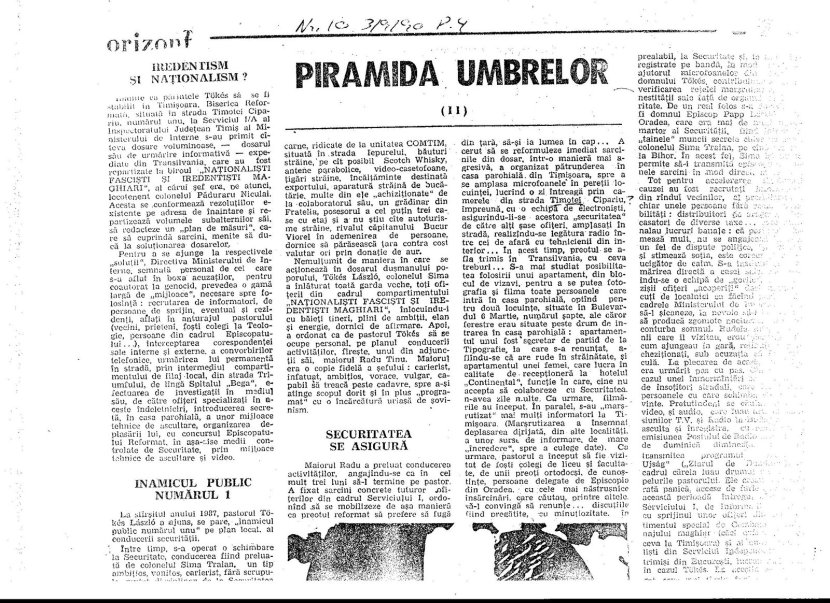
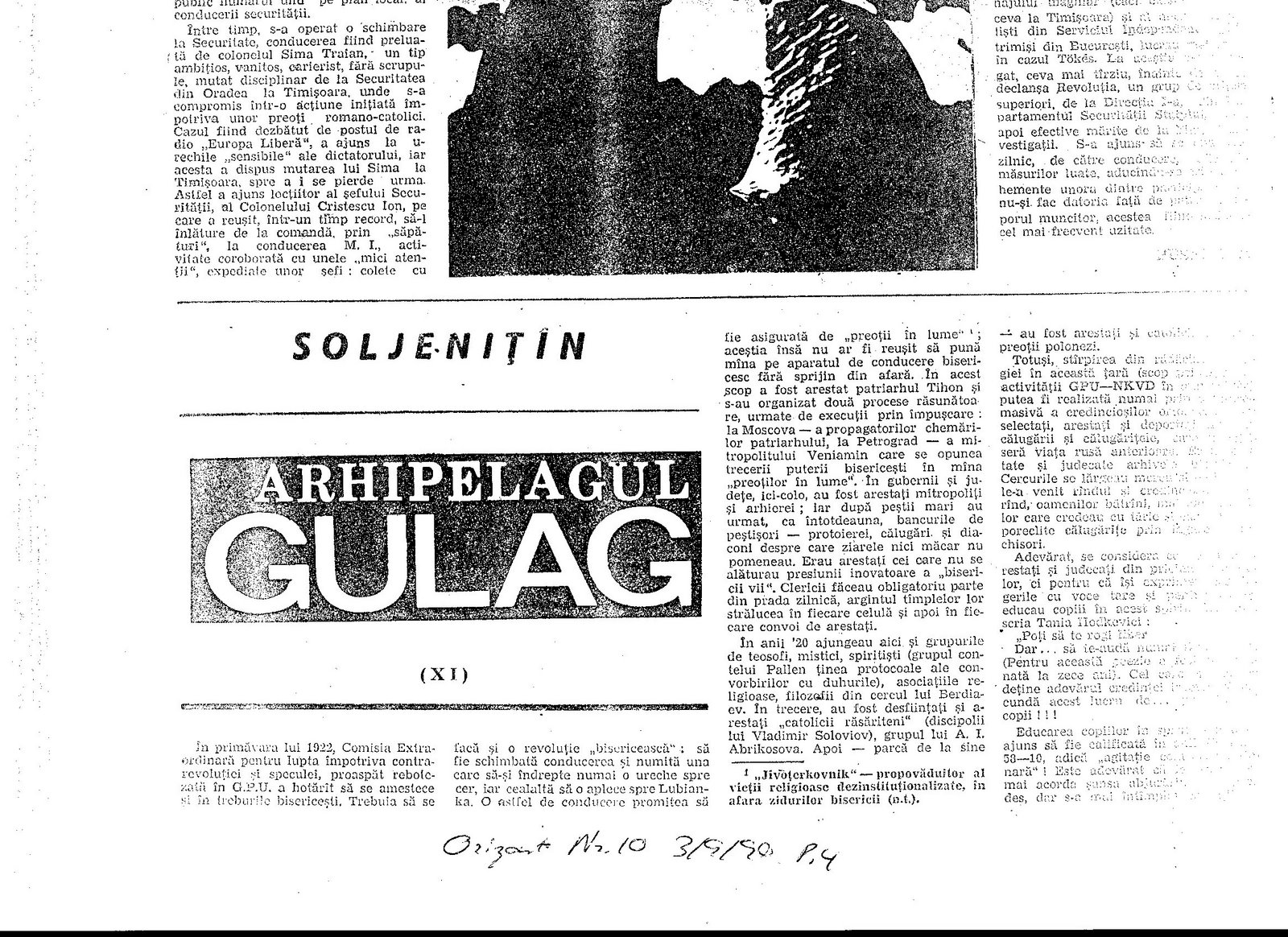
Transferred to Timisoara, Tokes rapidly became a popular preacher and continued where he had left off: in his sermons, he routinely made “scarcely veiled attacks” on Ceausescu and assailed regime policies such as the “systematization” (de-villagization) program.[33] Upon Tokes’ arrival in Timisoara in 1986, the Timis county bureau of the Securitate‘s First Directorate (Internal Affairs) “Office for the Study of Nationalists, Fascists, and Hungarian Irredentists” took control of his file and placed him under surveillance. According to Puspoki, by the end of 1987 Tokes had become “public enemy number one of the Timis county Securitate” and the newly appointed director of the local Securitate, Colonel Traian Sima, had taken personal charge of the Tokes case.[34] This reflected both the regime’s increasing fear of Tokes’ dissidence and Sima’s well-known zealotry.[35]

At least initially, the Securitate pursued less heavy-handed tactics in dealing with Tokes. Laszlo Tokes has himself acknowledged the changed methods of the Securitate:

In Dej, I had been threatened, harassed and constantly pressured by the Securitate. Now my chief Securitate spy was Laszlo Papp [the Bishop of Oradea and Tokes’ superior]. From my arrival at the church in 1986 to my departure, I never saw a Securitate man in my office. They were present at Sunday services, visited the presbyters and questioned people with whom I was in close contact. But they did not approach me. At Dej I had made public outside Romania the persecution I was receiving; this time, the Securitate and the authorities were changing their tactics.[36]

Thus, when in March 1989 the regime believed Tokes’ behavior was becoming a serious threat, Tokes was not kicked out of the church as had happened several years earlier, but was instead banished to the remote village of Mineu. As Tokes comments:

open expulsion would have provoked a Church incident and considerable interest from the West. Refusal to accept a bishop’s instruction, however, would look like deliberate disobedience on my part. The skilled foresight that had ensured I was kept a probationary pastor had kept me firmly under the direct jurisdiction of the bishop.[37]

As 1989 progressed and the confrontation between Tokes and the Reformed Church leadership deepened, Tokes’ case once again emerged into the international spotlight. The BBC, Radio Free Europe, and Deutsche Welle began to follow the Tokes case closely and beamed news of it back into Romania. Reflecting the scope of political change inside Hungary, Hungarian state radio broadcast weekly reports on the pastor’s fate. The broadcast by Hungarian state television on 26 July 1989 of an interview with Pastor Tokes (secretly taped earlier that spring) seemed to precipitate a change in the Securitate‘s treatment of Tokes.[38] The Securitate moved beyond the habitual telephone threats and rumor-mongering about Tokes, to detaining, beating up, and arresting (on the pretext of foreign currency violations) members of his congregation and relatives. On 14 September 1989, the church elder Erno Ujvarossy, who had previously organized a petition in defense of Tokes, was found murdered in the woods outside Timisoara. Uniformed and plainclothes Securitate men were posted permanently outside the parochial residence and in the surrounding buildings. About all Tokes was able to do by this time was to go the cemetery to conduct burials.[39]

The suggestion that the Securitate treated Tokes gently prior to his eviction is simply incorrect. On 2 November 1989, four masked men burst through the locked doors of the parochial residence, wielding knives and screaming in a fury. Tokes was slashed on the forehead before his church bodyguards could come to his rescue, causing the four to flee. The numerous Securitate men posted out front of the building had done nothing to intervene in spite of calls for help. Puspoki suggests that these “Mafia-like thugs,” who attacked as if from “an Incan tribe,” were some of Colonel Sima’s “gorillas,” sent to deliver a clear message to Tokes that he should leave immediately.[40] The view of the former Securitate–as expounded by Colonel Sima’s senior deputy, Major Radu Tinu–insinuates a “tourist”-like scenario. According to Tinu, the incident was clearly a “set-up” designed to draw sympathy to Tokes’ cause since the assailants fled away in a car with West German tags.[41] Not for the last time, the Securitate thus appears to attempt to attribute its own actions to foreign agents.

A week after the mysterious attack by the masked intruders, all of the windows of the parochial residence and nearby buildings were smashed. Interestingly, the report drawn up for Bucharest by the Timisoara Securitate attempted to argue that “workers” from the Timisoara Mechanical Enterprise, offended by pastor Tokes’ behavior, had broken the windows. According to Puspoki, the use of a propaganda-like description was not accidental: the local Securitate was trying to present the incident as evidence of “the dissatisfaction of the working people of Timisoara” in the hope that it would finally prompt Ceausescu into approving definitive measures against Tokes.[42]

Was Ceausescu responsible for the fact that the Tokes case dragged on without resolution? Support for such a conclusion comes from the comments of Securitate officers Colonel Filip Teodorescu and Major Radu Tinu. Teodorescu was dispatched to Timisoara with sixty other Securitate information officers in order to “verify” the request of the local Securitate that proceedings for treason be initiated against Tokes.[43] Teodorescu laments:

Unfortunately, as in other situations…Nicolae Ceausescu did not agree because he didn’t want to further muddy relations with Hungary. Moreover, groundlessly, he hoped to avoid the criticisms of “Western democracies” by taking administrative measures against the pastor through the Reformed Church to which [Tokes] belonged.[44]

Major Radu Tinu suggests that Ceausescu’s approval was necessary in the case of Securitate arrests and that the local Securitate remained “stupefied” that after having worked so long and hard in gathering information with which to charge Tokes with the crime of treason, Ceausescu rejected the request.[45] Tinu speculates that Ceausescu “did not want to create problems at the international level.”

Because former Securitate officers rarely pass up the opportunity to absolve themselves of blame, and it would appear both easier and more advantageous to blame the deceased Ceausescu for being too unyielding in the Tokes affair, these allegations seem plausible. Thus, it would appear that because Nicolae Ceausescu was skittish of further damaging Romania’s already deteriorating relations with the international community, and the Tokes case was a high-profile one, he refrained from approving visible, definitive action against the pastor. The Securitate‘s attempt to goad Ceausescu to bolder action would appear to confirm Ghita Ionescu’s suggestion that where the security apparatus comes to dominate regime affairs it attempts to impose its institutional prerogatives upon political superiors. Ceausescu and the Securitate appear then to have had sometimes conflicting views over how to resolve the Tokes affair in the quickest and most efficient fashion.

By December 1989, a huge group of Securitate officers were working on the Tokes case: the entire branch of the First Directorate for Timis county, the special division charged with combatting Hungarian espionage, high-ranking members of the First Directorate and Independent Service “D” (responsible for disinformation) from Bucharest, and members of the division charged with “Surveillance and Investigation.”[46] Puspoki describes Timisoara at this late hour as follows:

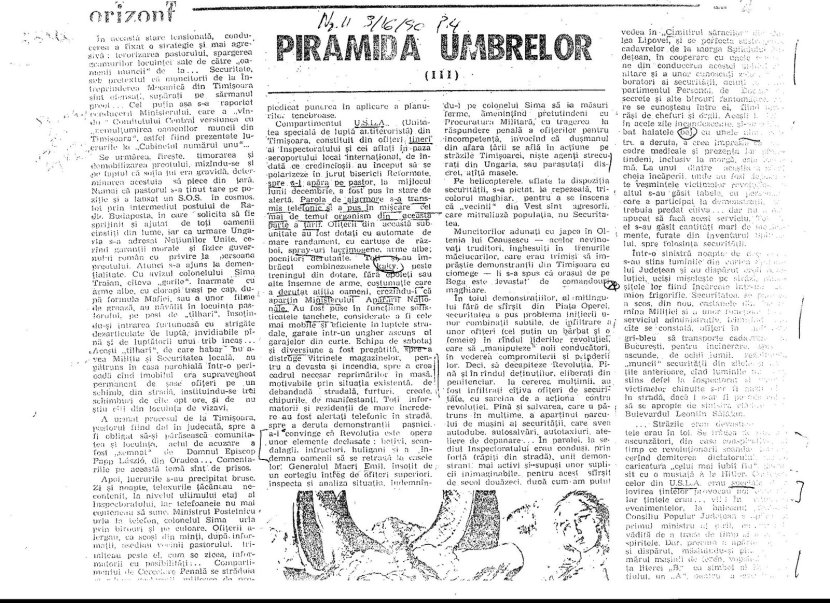
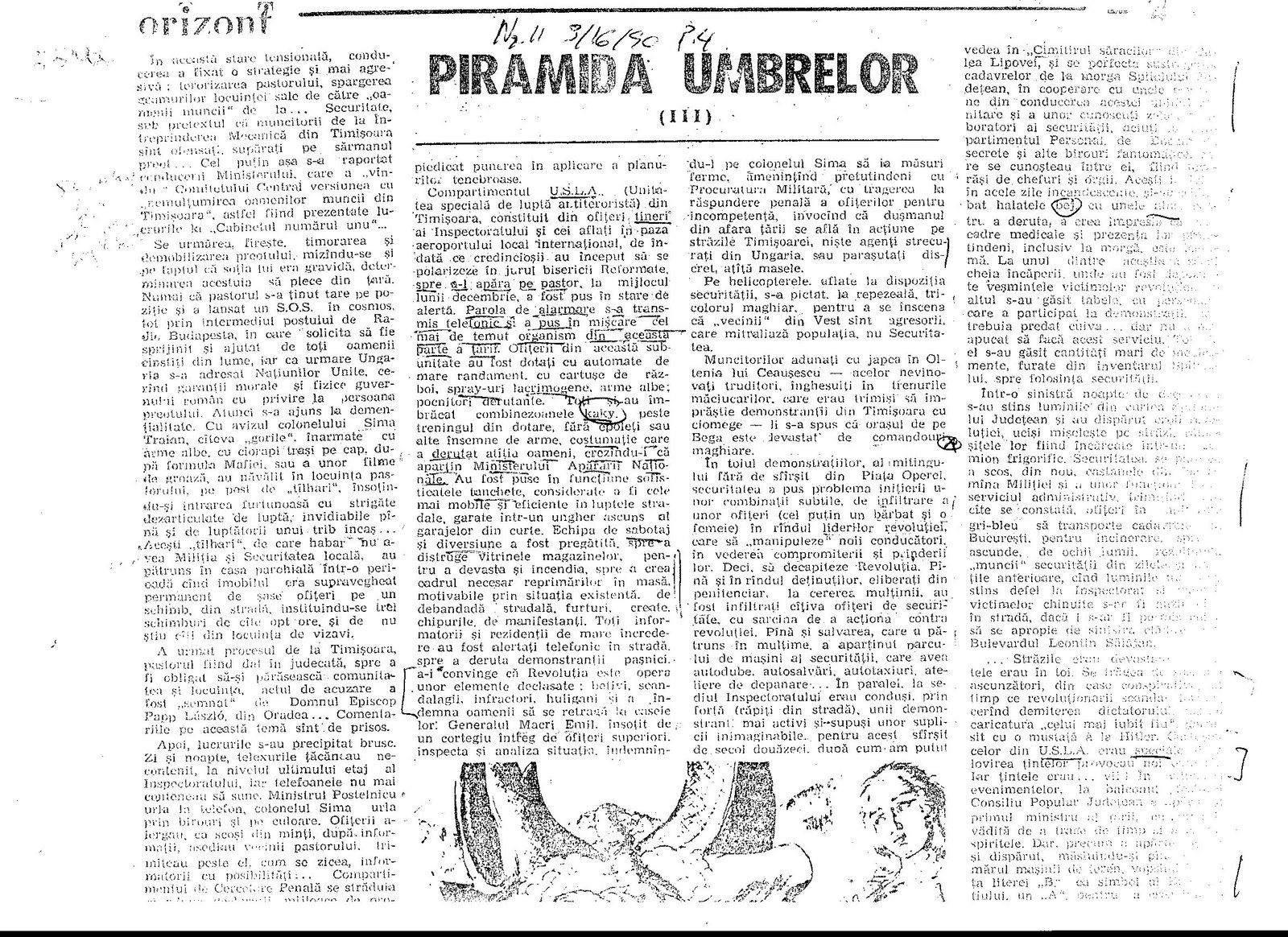
Day and night, the telex machines on the top floor of the [County Militia] “Inspectorate” incessantly banged out communications, while the telephones never stopped ringing. Minister Postelnicu yelled on the phone, Colonel Sima yelled through the offices and the hallways. The officers ran, as if out of their minds, after information, besieged neighbors of the pastor, and dispatched in his direction–what they call–”informers with possibilities.”[47]

Yet the case lingered on. On Sunday, 10 December 1989, Pastor Tokes announced to his congregation that he had received a rejection of his most recent appeal: the regime would make good on its threat to evict him on Friday, 15 December. He termed this an “illegal act” and suggested that the authorities would probably use force since he would not go willingly. He appealed for people to come and attend as “peaceful witnesses.”[48] They came.

The Evolution of the Timisoara Protests: Securitate Complicity or Tactical Miscalculation?

From the morning of Friday, 15 December until the afternoon of Sunday, 17 December 1989, regime forces were unable to halt the expansion of the street protests which began with the intention of preventing the eviction of pastor Tokes. Regime forces appear to have had several opportunities to intervene and put an end to these demonstrations, and either chose not to do so, or did so remarkably ineffectively. Indeed, at certain key moments, regime forces seem to have disappeared or ceded control of the streets to the demonstrators for extended periods of time. Moreover, eyewitnesses suggest that there were many plainclothes Securitate operatives among the crowds. Even if the Securitate had not intended for the scheduled eviction of Tokes to spark anti-regime demonstrations, had a faction from within it attempted to exploit this unexpected opportunity?

On the morning of Friday, 15 December 1989, the scheduled day of pastor Tokes’ eviction, small groups of three to four people from his congregation began gathering in front of the parochial residence at Piata Maria. The crowd gradually grew to number in the hundreds. At this stage, most demonstrators were still ethnic Hungarians. By evening, however, many Romanians had joined the crowd. The crowd now exceeded one thousand people. Interestingly, many of these Romanians were members of the Romanian Baptist and Pentecostal communities in Timisoara. Earlier that week, a senior member of Tokes’ congregation had informed these religious communities of the scheduled eviction and they had turned out in support of Tokes. By the evening of Saturday, 16 December 1989, the crowd had been swelled by the addition of high school and university students, and its radicalized contingents decided to march on the principal regime buildings in the city.[49]

Three factors which favored the genesis of these demonstrations deserve mention here. Timisoara, located less than fifty miles from both the Hungarian and Yugoslav (Serb) borders, has an uncharacteristically cosmopolitan climate for this part of the world. Through the years, majority Romanians and minorities of Hungarians, Germans, and Serbs have lived in relative harmony. The traditional absence of inter-ethnic tensions clearly strengthened the chances for protest to bridge ethnic boundaries. That the initial core of the Timisoara demonstrations was provided by members of religious communities–and especially religious communities which were persecuted because of their identification with a particular ethnic group or because they lay outside the mainstream (Orthodox Christian in Romania)–was also vital. Throughout the communist world, after an initial period of attempting to extinguish religious institutions, communist regimes had grudgingly come to tolerate their existence (if under strict control) and even to see them as a beneficial vehicle for absorbing popular dissatisfaction with the regime.

But in a country such as Romania–where almost every other societal institution (no matter how small or seemingly innocuous) had been destroyed, outlawed, or denied local autonomy–at the grassroots level religious institutions served as a unique hub for association and resistance. Thus, Hungarian religious institutions came to be viewed as vehicles for the defense of Hungarian ethnic identity even among secular Hungarians. The sense of community among those religious institutions most persecuted by the regime provided the basis by which a demonstration of a small number of Hungarians could transform into a large crowd in which Romanians were the majority. Finally, Timisoara’s proximity to Hungary and Yugoslavia, which enabled residents to pick up Hungarian and Yugoslav television broadcasts (the latter of which ran taped CNN broadcasts at night at the time), likely meant that the population of Timisoara was better informed than others in Romania about the collapse of communism elsewhere in Eastern Europe.

How had a protest of several dozen timid parishioners evolved into a radicalized crowd of thousands in less than thirty-six hours? The answer appears to lie in the cliched image of a totalitarian regime, so overconfident of its own control and endurance, and so drunk with its own propaganda, that it is caught off-guard by the slightest expression of open dissidence and misjudges the potential for further trouble. Such regimes are prone less to an impulsive, bloody crackdown against demonstrators, than to a confused mix of violence and concessions which reflects the regime’s own confusion and hesitation. The unclear message sent by such a confused response appears to have backfired in this case and emboldened the Timisoara protesters who, perhaps after what had happened elsewhere in Eastern Europe, had come to believe that anything was possible.

After what Tokes describes as an initial “half-hearted attempt to impose control” on the morning of 15 December, around midday the Securitate and Militia men at the scene suddenly withdrew. Guards who had been posted in front of the Tokes residence for weeks disappeared. They even took with them the vehicles they had warmed themselves in during their surveillance operations. That this was merely a tactical retreat is made clear by what happened later that evening. At approximately 10:30 p.m., with about one thousand protesters blocking the entrance to the parochial residence, the authorities finally reappeared.

Mayor Petre Mot and a small delegation of officials arrived on the scene. Mot feigned ignorance of the orders for Tokes’ eviction. Nevertheless, he pledged that he would arrange a temporary civil residency permit for Tokes; that Tokes’ pregnant wife, who was quite ill, would be able to see a doctor; and that the windows–so mysteriously smashed weeks earlier and now allowing the winter air to fill the apartment–would be repaired immediately. The proposed concessions achieved their goal and the crowd began to break up. Only about 150 people stayed to stand vigil through the night. Plainclothes Securitate men then moved in with clubs and dispersed these remaining demonstrators. On this first day, the regime’s carrot-and-stick approach succeeded. It was reminiscent of what had happened in Motru in 1981 and Brasov in 1987. The targets of popular hatred–the Securitate and Militia–had disappeared merely until the setting was more to their advantage.[50]

[1].. See the stenogram from the emergency CPEx meeting of 17 December 1989 in Mircea Bunea, Praf in ochi. Procesul celor 24-1-2. (Bucharest: Editura Scripta, 1994), 34.

[2].. Tina Rosenberg, The Haunted Land. Facing Europe’s Ghosts after Communism (New York: Random House, 1995), 109-117, 235. Rosenberg suggests the theory’s popularity in Poland and especially in the former Czechoslovakia.

[3].. Huntington discusses the concept of el desencanto (the characteristic disillusionment or disenchantment which sets in after the transition) in Samuel P. Huntington, The Third Wave. Democratization in the Late Twentieth Century (Norman, OK: University of Oklahoma Press, 1993), 255-256.

[4].. By contrast, Rosenberg clearly suggests that those who buy into the Yalta-Malta conspiracy theory elsewhere in Eastern Europe are a distinct minority in political circles and marginal figures in the post-communist era.

[5].. This has come through, for example, in the novels and articles of the well-known, former high-ranking military counter-intelligence officer, Pavel Corut, and in the comments of the former head of the First Directorate (Internal Affairs), Colonel Gheorghe Ratiu, in an extended interview during 1994 and 1995 with the Ceausist weekly Europa.

[6].. See the transcript in Bunea, Praf in Ochi, 47. Ceausescu goes on to link the US invasion of Panama which was taking place at this time to a general offensive by the superpowers to eliminate the sovereignty of independent states. The fact that Ceausescu appeals “not only to the communists” suggests his attempt to play on a non-ideological Romanian nationalism.

[7].. See Vlad’s testimony in Mircea Bunea, “Da sau Ba?” Adevarul, 16 February 1991, in Bunea, Praf in Ochi, 460-461.

[8].. Ibid.

[9].. Pavel Corut, Cantecul Nemuririi [The Song of Immortality] (Bucharest: Editura Miracol, 1994), 165.

[10].. See the excerpts of the SRI’s preliminary report on the December events in “Dispozitivul informativ si de diversiune sovietic a fost conectat la toate fazele evenimentelor (III) [Soviet information and diversion teams were connected to all phases of the events],” Curierul National, 11 July 1994, 2a.

[11].. Sergiu Nicolaescu, interview by Ion Cristoiu, “Moartea lui Milea, Momentul Crucial al Caderii,” Expres Magazin, no. 48 (8-15 December 1993), 31.

[12].. Ibid.

[13].. Cornel Ivanciuc, “Raporturile dintre Frontul Salvarii Nationale si KGB [The Relations between the National Salvation Front and the KGB],” 22, no. 21 (24-30 May 1995), 11.

[14].. Sorin Rosca Stanescu, “Iliescu aparat de K.G.B.? [Iliescu defended by the KGB]” Romania Libera, 18 April 1991, 8.

[15].. Ibid. Rosca Stanescu had in fact already floated this theory. In June 1990, he wrote: “…in the Army, more and more insistently there is talk of the over 4,000 ‘LADA’ automobiles with two men per car, which travelled by various routes in the days preceding the Revolution and then disappeared…” (Sorin Rosca Stanescu, “Se destrama conspiratia tacerii? [Is the conspiracy of silence unravelling?]” Romania Libera, 14 June 1990, 2a). At that time it could be argued that Rosca Stanescu was unaware of the Securitate account. It is difficult to say the same of his comment in April 1991.

[16].. Filip Teodorescu, Un Risc Asumat: Timisoara, decembrie 1989 (Bucharest: Editura Viitorul Romanesc, 1992), 93-94. Curiously, Teodorescu adds: “Besides, I have no reason to suspect that the journalist Sorin Rosca Stanescu would have invented a story in order to come to the defense of those accused by the judicial system and public opinion of the tragic consequences of the December 1989 events.”

[17].. Although Corut does not mention Stanescu by name as does Teodorescu, the references are unambiguous. See Pavel Corut, Floarea de Argint [The Silver Flower] (Bucharest: Editura Miracol, 1994), 173; idem, Fulgerul Albastru [Blue Lightning] (Bucharest: Editura Miracol, 1993), 211.

[18].. In April 1992, documents were leaked (presumably by regime sources) to the media and foreign embassies showing that Stanescu had been an informer for the Securitate‘s elite anti-terrorist unit (the USLA) between 1975 and 1985. Stanescu admitted that the charges were true. Although released from Romania Libera in June 1992, he was picked up elsewhere in the opposition press, returned to Romania Libera the following year, and eventually became editor of an opposition daily owned by the trust which runs Romania Libera. Prominent opposition figures have steadfastly defended him as a victim of the Iliescu regime, and in spite of his past, his writings have largely gone unscrutinized. On Stanescu’s case, see Sorin Rosca Stanescu, “Securea lui Magureanu,” Romania Libera, 17 April 1992, 1, 3 (the article which personally attacked the SRI’s Director Virgil Magureanu and appears to have prompted the release of Stanescu’s file); Anton Uncu, “Opriti-l pe Arturo Ui,” Romania Libera, 30 April 1992, 1, 3; Rosca Stanescu, “Sint H-15,” Romania Libera, 9 May 1992, 5; idem, interview by Andreea Pora, “‘H-15′ in slujba patriei,” 22, no. 120 (15-21 May 1992), 13; “Catre SRI,” Romania Libera, 9 June 1992, 1; “Goodbye Magureanu,” The Economist, no. 2212 (18 June 1992) in Tinerama, no. 85 (10-17 July 1992), 3.

[19].. See, for example, the comments of the deputy director of the Timis county Securitate, Major Radu Tinu, in Angela Bacescu, Din Nou in Calea Navalirilor Barbare [Once again in the path of barbaric invaders] (Cluj-Napoca: Editura “Zalmoxis,” 1994), 72-74. This book consists of articles and interviews which appeared in the Ceausist weekly Europa between 1990 and 1994.

[20].. Ibid., 73.

[21].. Ilie Stoian, Decembrie ’89: Arta diversiunii. (Bucharest: Editura Colaj, 1993), 7-10. This book is a collection of articles he wrote while at Expres between 1991 and 1993.

[22].. Ibid., 11.

[23].. Ibid.

[24].. Ibid., 12.

[25].. Excerpts from Ultimul Decembrie in Radu Ciobotea, “Inceputul Sfirsitului [The Beginning of the End],” Flacara, no. 51 (19 December 1990), 6.

[26].. See, for example, Radu Portocala and Olivier Weber, trans. Liviu Man, “Romania: Revelatii asupra unui complot,” Nu, no. 17 (July 1990), 6-7. The original article appeared in Le Point, no. 922 (27 May 1990).

[27].. Ibid.

[28].. Stoian, Decembrie ’89, 9.

[29].. Ecaterina Radoi, “Remember 15 decembrie 1989-20 mai 1990,” Zig-Zag, no. 190 (23-31 December 1993), 4-7.

[30].. Ioan Itu, “Laszlo Tokes nu e un episcop real [Laszlo Tokes is not a real bishop],” Tinerama, no. 178 (12-19 May 1994), 2; idem, “Laszlo Tokes–informator al Securitatii [Laszlo Tokes–Securitate informer,” Tinerama, no. 182 (10-16 June 1994), 3.

<!–[if !supportFootnotes]–>[31].. Laszlo Tokes, with David Porter, With God, For the People: The Autobiography of Laszlo Tokes (Toronto: Hodder and Stoughton Publishers, 1990), 2-3, 121, 138-139, 141.

[32].. Martyn Rady, Romania in Turmoil (New York: IB Tauris & Co. Ltd., 1992), 83-86.

[33].. Ibid., 86; Tokes, With God, for the People, 105-109.

[34].. F. Puspoki, “Piramida Umbrelor (II) [The Pyramid of Shadows (II)],” Orizont, no. 10 (9 March 1990), 4.

[35].. Ibid. Colonel Sima had been transferred from Oradea to Timisoara after a particularly ugly action carried out against several Roman Catholic priests had gotten him into trouble with his superiors. Radio Free Europe had drawn attention to the incident and, according to Puspoki, news of it had reached the “‘sensitive’ ears of the dictator,” prompting Sima’s reassignment. Upon arriving in Timisoara, the particularly ambitious and unscrupulous Sima immediately set about replacing those in the “Office for the Study of Nationalists, Fascists, and Hungarian Irredentists” with young officers who were personally loyal and appealed to his sense of zealotry for such work.

[36].. Tokes, With God, for the People, 102. According to Puspoki F., the pre-existing relationship between Securitate chief Traian Sima and Bishop Laszlo Papp facilitated Tokes’ surveillance: Papp had been “initiated into ‘the secrets’ of security work by the same Colonel Sima when the latter was Securitate chief of Bihor country.” See Puspoki, “Piramida Umbrelor (II).”

[37].. Ibid., 120.

[38].. The very fact that this broadcast was permitted in Hungary was symbolic of the scope of political change which had occurred in that country in the preceding two years alone. As the transition from one-party communist rule unfolded and political pluralization became more and more tolerated and formalized, Hungarian nationalism (which had theretofore been muted by the technocratic bent of the Kadar regime’s legitimacy) gained greater public expression. Inevitably, this meant raising the issue of the Romanian regime’s treatment of its approximately two million member Hungarian minority–something which had been done gingerly in the past.

A month after Kadar’s removal from power in May 1988, on 27 June 1988 40,000 Hungarians demonstrated in the largest protest since the 1956 uprising against the systematization program and human rights abuses in Romania (Rady, Romania in Turmoil, 73). During 1989, the Hungarian government launched protests at the United Nations against Tokes’ treatment and the Hungarian parliament nominated Tokes in conjunction with the ethnic Romanian dissident Doina Cornea from Cluj for the Nobel peace prize (Ibid., 88).

[39].. Rady, Romania in Turmoil, 87; Puspoki, “Piramida Umbrelor (II)”; Tokes, With God, for the People, 139.

[40].. Puspoki, “Piramida Umbrelor (III),” Orizont, no. 11 (16 March 1990), 4.

[41].. Bacescu, Din Nou in Calea, 78.

[42].. Puspoki, “Piramida Umbrelor (III).”

[43].. Teodorescu, Un Risc Asumat, 45-46.

[44].. Ibid., 90.

[45].. Bacescu, Din Nou in Calea, 78.

[46].. Puspoki, “Piramida Umbrelor (II).”

[47].. Ibid.

[48].. Tokes, With God, for the People, 1-4.

[49].. For information on the evolution of events on the 15 December see ibid., 1-20.
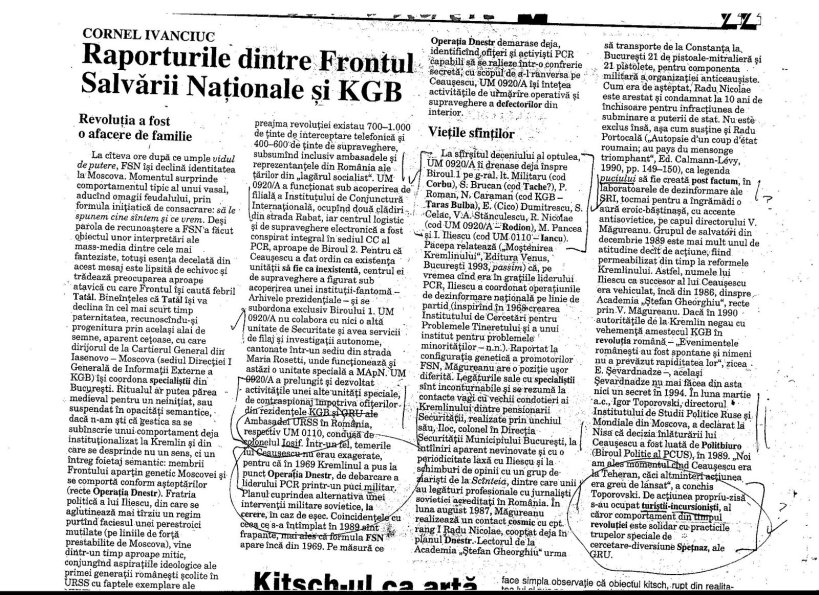
[50].. Ibid.

Posted in decembrie 1989, raport final, Uncategorized | 2 Comments »

Iasi 14 decembrie

Posted by romanianrevolutionofdecember1989 on December 14, 2010

e vorba aici, ca intotdeauna, de un punct de vedere strict personal…

HOOSIER Tribute…Slight Return (1993) (august 1990-ianuarie 1997, sporadic…cu mihnire)

Iesenii isi amintesc–cum pot sa uite?!–ca in zilele de 13 si 14 decembrie, toate caile de penetratie in Piata Unirii erau pazite de acele grupe de comando, care–s-a aflat–aveau si mitraliere, si tunuri de apa.  S-a mai aflat, apoi, ca in podul Hotelului Traian erau montate alte mitraliere, iar baietii de la ‘Dinamoviada’  erau masati la etajele 1 si 2 din Hotelul Unirea.  Cu lunete si pistoale-mitraliera.  Generalul Olteanu, fostul secretar cu propaganda al C.C. venise la Iasi cu ofiteri superiori din Departmentul securitatii pentru anchete.  Revoltator este ca anchetorii si batausii securitatii sint libera astazi…. (Vasile Iancu, “Sa nu uitam!,” Romania Libera, 14 decembrie 1990).

Cassian Maria Spiridon, Iași, 14 decembrie 1989, Începutul Revoluției Române (Ed. Timpul, Iași, 1994)

PLIN DE MILIŢIENI ŞI DE ARME
Când grupul complotiştilor a ajuns aproape de Piaţă, aceştia au fost fra­paţi de măsurile luate pentru com­ba­terea adunării. Existau două maşini de pompieri, fiecare dispusă de o par­te şi de alta a zonei. Chiar cu acea oca­zie, o Dinamoviadă ce trebuia să aibă loc la Oradea a fost transferată la Iaşi, aşa încât cele două hoteluri de lângă piaţă colcăiau de “sportivi” şi se filma totul. Cassian Maria Spiridon ar fi in­tuit chiar şi nişte cuiburi de mi­tra­lie­ră, numai bine pregătite înspre marginea pieţei, pe clădirile din jur. Existau şi foarte multe maşini de Miliţie, ba era şi una cu prelată, în spatele căreia se putea uşor intui că se găsesc oameni înarmaţi. ( http://www.jurnalul.ro/jurnalul-national/jurnalul-national/revolutia-a-vrut-sa-inceapa-la-iasi-print-530252.html )

http://www.ziaruldeiasi.ro/local/iasi/a-inceput-revolutia-anticomunista-la-iasi~ni37tl

Au rememorat clipe din decembrie ’89

Parerea lui Emilian Stoica a fost sustinuta si de subprefectul Corneliu Rusu Banu si de primarul Gheorghe Nichita. “Iasul a fost singurul mare oras in care s-a instituit neoficial starea de asediu in 1989. Studentii au fost consemnati in camine, caile de acces spre Piata Unirii au fost blocate, s-a interzis formarea grupurilor mai mari de trei persoane, a fost mutata statia de tramvai in fata Postei din Cuza Voda. In balcoanele hotelurilor din piata au fost instalate cuiburi de mitraliere. Au fost aduse unitati ale Securitatii din Botosani si Neamt, inclusiv o companie USLA”, a spus Rusu Banu.

http://www.24-ore.ro/index.php?option=com_content&view=article&id=2721:adi-cristi-chiar-dac-revoluia-din-1989-nu-a-plecat-fizic-de-la-iai-ea-a-fost-gandit-la-iai-la-fel-ca-multe-din-momentele-importante-ale-rii-&catid=7:invatamant&Itemid=6

Pe 14 decembrie 1989, un grup de intelectuali ieşeni au aprins scânteia Revoluţiei Române. Oameni precum scriitorii Cassian Maria Spiridon, Aurel Ştefanachi, prof univ. Ştefan Prutianu, inginerii Vasile Vicol şi Ionel Săcăleanu, juristul Valentin Odobescu, sunt cei care i-au îndemnat pe ieşeni să iasă în Piaţa Unirii şi să se împotrivească  regimului comunist. Pentru faptul că au îndrăznit să se împotrivească şi să conspire împotriva regimului, trupele Securităţii şi cele ale USLA, i-au reţinut  şi  întemniţat  în beciurile Miliţiei, de unde au fost eliberaţi pe data de 22 decembrie 1989. „ Din temniţă am mers direct în mijlocul evenimentelor”, a spus scriitorul Aurel Ştefanachi.
La finalul manifestării, celor prezenţi le-a fost oferită cartea „ Revoluţia la Iaşi”, care poartă semnătura scriitorului Adi Cristi.

iata cum este denaturata informatia aceasta de catre Alex Mihai Stoenescu…sportivi uslasi si dinamovisti…sunt cazati…cot la cot…cu agenti sovietici in aceeasi hoteluri!

http://www.jurnalul.ro/special/special/tentativa-de-revolta-populara-de-la-iasi-54662.html

Tentativa de revolta populara de la Iasi

16 decembrie 2004
REMEMBER DECEMBRIE “”89

Mitingul anticeausist din 14 decembrie 1989, la care au fost indemnati iesenii sa participe, a fost oprit de autoritati. Una dintre temele tentativei de revolta de la Iasi este “Dinamoviada” de judo organizata in pripa acolo intre 13 si 16 decembrie. Nu stim daca s-a desfasurat ceva din ea, dar peste 300 de sportivi s-au cazat cu cateva zile inainte in hotelurile din Iasi.

ALEX MIHAI STOENESCU
VICTIMA. Vasile Vicol este primul arestat al conspiratiei de la Iasi din decembrie 1989
SPERANTA. Emilian Stoica a fabricat manifeste si a impanzit orasul cu ele

Ei sunt suspectati a fi luptatori si tragatori din trupele speciale ale Securitatii sau ale Armatei. Nucleul s-ar fi aflat la Hotelul Unirea, care domina cu inaltimea sa Piata Unirii si unde se cazasera 110 “sportivi”. Pe aceasta ipoteza, intamplarile au o doza de spectaculozitate, pentru ca in acelasi hotel se cazasera si 176 de turisti sovietici din localitatile Nicolaev si Odessa. Securitatea afirma ca “turistii” erau luptatori din trupele speciale sovietice. Cum s-or fi simtit impreuna, vecini de camere? Cert este insa ca, in dupa-amiaza zilei de 14 decembrie, cand era clar ca manifestatia a esuat, hotelul s-a golit in mai putin de o ora. Cercetarea arata ca mutarea “Dinamoviadei” a fost o simpla coincidenta, dar asta nu exclude ca sovieticii sa fi vazut in ea o contraoperatie a Securitatii, fiind probabil unul din motivele abandonarii actiunii.

HARTA. Mai mult decat atat, a existat si un indiciu. Colonelul Ciurlau arata ca “la un hotel, parca Moldova, in camere existau niste pliante si s-a gasit intr-o camera o harta pe care se trasese o linie incepand de la Iasi, Craiova, Timisoara”. Subiectul a trezit interesul senatorilor:

“Dl. Sandulescu: “Ati spus ca vi s-a dat o harta pe care era o linie ce trecea prin – Craiova – Timisoara, era romaneasca sau ruseasca?”

Dl. Ciurlau: “Era romaneasca, in fiecare camera de hotel erau pliante turistice si, pe o harta dintr-un asemenea pliant, era acea linie trasa. In acea camera statusera niste turisti rusi. Noi cautam prin camere de hotel si, ceea ce gaseam foarte mult, erau sticle goale de bautura, inclusiv sticle de colonie, tampoane de vata prin care strecurau, era la ei o perioada de restrictie”.”
[Iata, in schimb, ce spunea Ioan Trofin, seful hotelului ‘Unirea,’ in februarie 1990,  mai sus…]
despre Alex Mihai Stoenescu este mult de spus…
laudat cu cuvinte frumoase de catre eternul Vladimir Tismaneanu “Este un lucru demonstrat cu prisosinta si de onesta ancheta jurnalistica a lui Grigore Cartianu (publicata sub titlul de carte: “Sfârşitul Ceauşeştilor”). http://tismaneanu.wordpress.com/2010/07/21/deshumarea-lui-ceausescu-un-pas-spre-adevar/ ”

Posted in decembrie 1989, raport final, Uncategorized | 5 Comments »

Constantin Isac intre 14 si 22 decembrie: dinamovist de judo la Iasi, prezent in zona “Crematoriului Cenusa,” si martor in Piata Universitatii…

Posted by romanianrevolutionofdecember1989 on December 12, 2010

(ca intotdeauna, e vorba aici de un punct de vedere strict personal, legat de cercetarea mea mai veche cand eram in lumea academica, va multumesc)

Iata un inteviu foarte interesant cu Constantin Isac (mai jos, ziarul Curentul 4 iunie), un membru marcant al Asociatiei 21 decembrie 1989 din Bucuresti

http://ro.wikipedia.org/wiki/Asocia%C8%9Bia_21_Decembrie_din_Bucure%C8%99ti

http://www.asociatia21decembrie.ro/2010/01/asasinii-lui-ion-iliescu/

am scris de mult despre dle. Isac si dezvaluirile lui in privinta incidentului MApN din noaptea 23-24 decembrie 1989, de exemplu http://atomic-temporary-3899751.wpcomstaging.com/2010/12/08/the-uses-of-absurdity-the-staged-war-theory-and-the-romanian-revolution-of-december-1989-part-iv-pp-530-542-1999-by-richard-andrew-hall/

Atentie la n. 82 pe pagina 538

http://www.curentul.ro/2010/index.php/2010060444382/Interviu/Constantin-Isac-M-am-dus-sa-l-daram-pe-Nicolae-Ceausescu-la-costum-si-cravata-nu-ca-bagabontii-cu-pulovereII.html

cateva extrase

Eraţi un mijlocitor între acele firme şi  Bucureşti. Cum v-au  surprins totuşi evenimentele premergătoare izbucnirii revoluţiei din decembrie 1989?

Pe linie sportivă  trebuia organizată  la Oradea în vara lui 1989 dinamoviada de judo. Am fost acolo împreună cu secretarul general al Federaţiei (n.r. Romåne de Judo) şi  acolo pe la graniţă un cioban cu 400 de oi şi cu două ARO a trecut în Ungaria pe la Arad şi Nadia Comăneci, care a trecut în Ungaria pe la Oradea. Aceste cazuri arătau vulnerabilitatea sistemului de la noi în timp ce-n Cehoslovacia şi Ungaria, graniţa fusese deschisă  pentru germanii  refugiaţi din RDG(n.r. Republica Democrată Germania) pentru a putea trece în RFG. În acest sens, graniţa de vest fusese închisă şi toţi cei care ar fi  dorit să fugă erau blocaţi.  Astfel,  absolut tot ce însemna spectacole şi acţiune sportive  erau închise. La nivelul partidului, s-a luat decizia ca dinamoviada de judo să se mute la IaşI, între 13-14 decembrie 1989.

Dar era si perioda desfăşurării celui de-al XIV-lea Congres? Din cåte ştim în această perioadă la Iaşi a izbucnit prima scånteie împotriva regimului comunist?

Congresul a fost în noiembrie 1989. La Iaşi a fost o primă încercare. Se spera că va fi sprijinită de la graniţa cu Moldova unde se produsese perestrioka. Pe 14-15 decembrie 1989 sunt  la Iaşi. Ce însemna dinamoviada? Toate cadrele (n.r. active) sportive  din cadrul  MAI şi de la Securitate, ofiţeri, subofiţeri, soldaţi  participau la această competiţei. La aceasta s-a dat cate cinci zile libere nu numai la cei care au ieşit campioni ci şi la cei de pe locul al doilea pană la al cincilea,fapt care dă notă că Securitatea înţelesese ceva despre mersul evenimentelor. La Iaşi a venit inclusiv generalul Iulian Vlad, şeful Departamentului Securităţii Statului.

Aţi purtat în acest răstimp vreun dialog cu generalul Iulian Vlad?

Nu, doar la premiere,oficial.

Simultan cu aceste evenimente fusese întalnirea de la Malta dintre Bush şi Gorbaciov  din 2-4 decembrie 1989 ?

Ştiam ce se întamplase la Malta. Iniţial nu s-a discutat cazul Romaniei ci schimbarea de sistem. Romania rămăsese ultimul bastion. Aşa cum erau informaţiile atunci, se stabiliseră  noi sfere de influenţă şi schimbarea lui Ceauşescu. Practic, fostele state socialiste rămaneau sub înfluenţa URSS iar tarile baltice erau lăsate libere, sub influenţa Occidentului, în special a SUA.  Ceea ce ştiam  atunci era că existau mai multe planuri de intervenţie  asupra Romåniei, era unul de aplicare  al testamentului Ţarului Petru şi altul care prevedea libertatea deplină  de acţiune a SUA împotriva comunismului din Panama,a regimului Noriega, sprijinit de Moscova şi cuba. Era clar că Noriega a aşteptat sprijinul Moscovei şi al Cubei care nu a  mai venit după cum şi noi am fost lăsaţi să ne desfăşurăm fără nici o intervenţie. Cu o lună de zile,(n.r. înaintea izbucnirii revoluţiei romane), la noi s-a organizat TIBCO(n.r. Targul Internaţional Bucureşti) în octombrie unde am avut convorbiri cu reprezentanţii Securităţii întrucåt eram obligaţi toţi cei care aveam legături cu străinii să prezentăm un raport de lucru şi am pus pariu cu ofiţerul coordonator pe o ladă cu bere că Ceauşescu nu mai apucă Crăciunul.

Domnule Isac vreau să precizaţi foarte clar că acele rapoarte pe care  le dădeaţi  la Securitate erau ca urmare a faptului că  reprezentaţi acele firme din RFG în Romånia?

Eram obligaţi prin natura activităţii  care o desfăşuram întrucåt Securitatea controla pe toţi cei care aveau legături cu străinii şi trebuia  să dăm rapoarte pentru că reprezentam  intersele acelor firme în Romania şi invers. Era imposibil să nu fii contactat de Securitate.

Momentul din 21 decembrie 1989?


Pe 19 decembrie, organizam competiţia ”Floarea de Cireş”, noi  cei de la judo şi participau sportivi din toată ţara, prilej cu care sărbătoream sfårşitul anului. Pe 21 decembrie, am organizat  ”Floarea de Cireş”, în Regie la 303, la fosta sală de menaj a Regelui. Această organizare  a coincis  însă şi cu mitingul de sprijinire a regimului  de pe 21decembrie, după întoarcerea lui Ceauşescu din Iran. Dimineaţa, eram la Republica şi la 7.00 ni s-a spus să ne încolonăm pentru că se va organiza  un meeting.  La ora 8.00 s-a contramandat  pentru că, la ora 9.00  să se spună  că se face din nou. Nemaiavånd timp  să  se organizeze  pe echipe, în marş, s-a dat un punct de întalnire, care era pentru muncitorii de la Republica la Sfåntul  Gheorghe.  Profitånd de ocazie, eu am plecat la judo. Ceva era în neregulă, la partid, în uzină, subiectul era despre ce se întåmplase la Timişoara.


Să înţeleg că nu mai era o tragere de inimă ?


De data aceasta, mitingul a fost organizat  fără  a se mai respecta regulile şi măsurile care se lua înainte, spre exemplu cum se făcuse la congresul al XIV-lea.


A fost organizat în grabă de Barbu Petrescu?


Nu a fost  numai el. Eu vă spun că  cel care a organizat totul a fost secretarul cu propaganda din Bucureşti. Eu nu am fost în Piata Palatului ca să-l aplaud pe Ceauşescu, compeţia  era mai  importantă pentru  mine după cum ştiţI. Le-am spus sportivilor ,de faţă cu cei care ne păzeau, că regimul a căzut, morţii de la Timişoara sunt arşi la Bucureşti.


De ce le-aţi  spus asta?


Eu pe 19 decembrie  alergam în zona parcului din faţa ”Crematoriului Cenuşa” care era închis demult din raţiuni economice.  Eu, în seara de 19 decembrie, eram cu maşina în faţă, mă pregăteam să alerg, cand  am văzut luminile  aprinse la crematoriu. Peste 15 minute, îşi face apariţia o dacie neagră cu număr cu 1B, cu cinci cifre, s-a dat jos un tip care a venit la mine,tocmai mă schimbasem, după care s-a uitat la mine şi crezånd  că sunt de al lor, s-a întors şi a intrat în crematoriu. E clar, a crezut că sunt trimis acolo. Imediat, cånd să ies din curte, pe partea stångă era o frigorifică parcată acolo. O dacie neagră de la Securitate preluase frigorifica cu morţii de la Timişoara de la KM 38 (n.r. al autostrăzii Bucureşti-Piteşti) la ordinul tembel al Elenei Ceauşescu care dorea să şteargă orice urmă. Eu fusesem acolo.

Era pe 21 decembrie seara?


Da, era după  ora 7 seara.


Sentimentul fricii  nu exista?


Da, însă ne apăram pentru  că ne dusesem în faţă la Inter,fiindcă era  luminat şI erau foarte mulţI străini.

Ştim că la Inter erau cazaţI foarte mulţI jurnalişti occidentali care după Congresul al XIV-lea nu au mai plecat?

Mare atenţie, nu-i lăsa regimul să stea două luni după  Congres. Securitatea  nu era o fată mare, ea lucra, aresta în  tot acest răstimp, culegea informaţii. Se luase măsuri împotriva disidenţilor: spre exemplu în cazul lui  Mazilu. Pe vremea generalului  Ioniţă, se luase măsuri împotriva lui Ceauşescu  cånd  acesta  era plecat în Uganda.  A venit urgent de acolo şi a luat măsuri împotriva grupului, era Vasile Patilineţ, de orientare spre Moscova,  Măgureanu, Iliescu, împotriva acestora  se luase măsuri de control.


Brucan?


Brucan, e ciudat în acele timpuri făcea naveta pe ruta: Moscova –Germania-Isreal-SUA, fusese primit de unul dintre  consilierii  lui Gorbaciov. Purta mesaje între CIA-KGB-Mossad, care mai mult sau mai puţin au acţionat în Romånia. A mai fost şi Securitatea romånă.  Au fost măsurile luate de  generalul Iulian Vlad pentru  conservarea acesteia.

Pe Militaru îl văzuserăţI?


Nu, încă nu venise.  Ca dovadă,  că  am fost acolo v-am aratat fotografii. Era o masă acolo şi erau toţi revoluţionarii în timp ce  monitoarele  tvr aveau încă  mine de control şI nu difuzau  imagini cu noi. Fiind inginer am văzut că era o farsă si nu se transmitea. Voiam să anuţăm că armata e cu noi, stiam şi de planurile din afară întrucåt  unii au vrut să provoace un razboi civil între armată, securitate şi interne.  Am strigat să vină directorul  tvr şI să  se dea drumul la emisiune. Să anunţăm că Ceauşescu a căzut şi nu trebuia să  existe un război civil între armată, securitate şi MAI. Strigam: armata e cu noi!. La USLA, la Securitate, aveam colegi de judo, îi cunoşteam, vorbeam  liber. Pe nivel sportiv îi ştiam.

Vedeti si:

http://atomic-temporary-3899751.wpcomstaging.com/2010/04/18/cine-este-constantin-isac-martorul-la-uciderea-lui-trosca/

http://atomic-temporary-3899751.wpcomstaging.com/2010/12/10/dinamoviada-iasi-decembrie-1989-si-sportivi-in-treninguri-cu-acelasi-de-tip-geanta-cazati-la-unirea-traian-si-moldova/


Posted in decembrie 1989, raport final, Uncategorized | 4 Comments »

Dinamoviada Iasi decembrie 1989 si “sportivi…in treninguri…cu acelasi de tip geanta…cazati la Unirea, Traian, si Moldova”

Posted by romanianrevolutionofdecember1989 on December 10, 2010

partea 1-a http://atomic-temporary-3899751.wpcomstaging.com/2010/12/09/pe-7-8-sau-9-decembrie-a-venit-de-la-bucuresti-la-iasi-generalul-olteanu-cu-o-garnitura-de-tren-plina-cu-trupa-i-au-cazat-pe-la-unirea-traian-si-moldova-v-incepand-cu-data-d/

extrase (pp. 18-19, pp. 38-39) din Cassian Maria Spiridon,  Iași, 14 decembrie 1989, Începutul Revoluției Române (Ed. Timpul, Iași, 1994), o carte dispretuita mult prea usor de catre Ruxandra Cesereanu in cartea sa Decembrie ’89. Deconstrucţia unei revoluţii (“December 1989. Deconstruction of a Revolution”), essay, Polirom, Iaşi, 2004–adevarul este ca Dinsa nu este un istoric…

Posted in decembrie 1989, raport final, Uncategorized | 5 Comments »

Why do I feel like we’ve been down this road before?…: “F” is for “Fabrication” or “PETRE OLARU: THE MOST SOUGHT-AFTER MAN IN POST-CEAUSESCU ROMANIA” (1999)

Posted by romanianrevolutionofdecember1989 on December 10, 2010

pentru o traducere in limba romana

mariusmioc.wordpress.com traducerea in limba romana cazul olaru

1 May 2002, Volume 4, Number 9

THE SECURITATE ROOTS OF A MODERN ROMANIAN FAIRY TALE: THE PRESS, THE FORMER SECURITATE, AND THE HISTORIOGRAPHY OF DECEMBER 1989

By Richard Hall

Nothing is perhaps more indicative of the smug ignorance or delusional wishful thinking of rigidly partisan critics of Ion Iliescu and those who seized power in December 1989 than the coverage of the case of former Militia Sergeant Petre Olaru, which broke upon the Romanian press scene in April 1999. Tragically, the result of such blindly partisan analysis has been similar to that seen in the cases discussed in the first two episodes of this article — in their zeal to target and tar Iliescu and other members of the “nomenklatura” with the greatest share of blame for the December 1989 bloodshed, these critics have eagerly embraced and promoted the wildest and most ridiculous fabrications of the former Securitate and Militia, fabrications designed to exonerate these institutions and their employees for the repression and bloodshed of December 1989.

Those who are inclined to view the December 1989 events as a “dead story” that lost its importance in Romanian politics after the early 1990s, or who claim that the historiographical revisionism in the media has had little impact on public opinion, generally tuned out reporting on the revolution — out of fatigue and cynicism — rather early on, and thus tend to be unfamiliar with more recent developments on this front. For example, a poll by the Center for Rural and Urban Sociology (CURS) on the eve of the 10th anniversary of Ceausescu’s overthrow, revealed just how far media revisionism of the understanding of what happened in December 1989 has advanced. As the daily “Ziua” announced, a bare 11 percent of those questioned continued to believe — in what not even the author of the piece could struggle to present in neutral terms — in the “myth of the terrorists” — those accused of responsibility for the over 900 deaths that followed Ceausescu’s flight from power on 22 December 1989 and who were originally portrayed as Securitate members (most likely from the Special Unit for Anti-Terrorist Warfare — USLA — and the Fifth Directorate) fighting on behalf of Ceausescu (“Ziua,” 17 November 1999). That almost 90 percent of those polled could admit to having changed their mind on this issue — for during the events, nobody expressed doubt as to the either the existence, or the identity, of the “terrorists” — must say something about the impact of media coverage, since from the beginning of the post-Ceausescu era debunking the “myth of the terrorists” has been at the forefront of reporting on the December 1989 events.

Nor, as the so-called “Olaru case” demonstrates, is it true to say that December 1989 has lost its value as an instrument in fighting contemporary political battles. For at least a year and a half — from late 1997 through early 1999 — former Militia Sergeant Petre Olaru, and those who promoted his claims, attempted to influence the administration of President Emil Constantinescu and the leadership of institutions of the Romanian state, as the following discussion of the case elucidates.

[one wonders…is this the same Petre Olaru who was listed as “terrorist” no. 190 arrested in Bucharest during the December 1989 events…?]

http://badeadan.blogspot.com/2009/12/documente-inedite-lista-teroristilor.html

‘ZIUA’ BREAKS THE ‘OLARU CASE’: ‘THE MOST SPECTACULAR INVESTIGATION OF DECEMBER ’89 TO DATE’

On 5 April 1999, the so-called “Olaru case” first came into the public eye at a specially convened news conference at the Hotel Bucuresti (“Ziua,” 6 April 1999). Presenting what they maintained was incontrovertible proof that the December 1989 events were from start to finish part of a KGB-engineered coup d’etat were: Sorin Rosca Stanescu, editor in chief of the daily “Ziua”; Serban Sandulescu, a senator representing the ruling National Peasant Party Christian Democratic (PNTCD), vice president of the Senate’s Defense Committee, and head of the third parliamentary commission to investigate the December 1989 events; and Stefan Radoi, a former “Ziua” advisor and assistant to Sandulescu in his capacity as head of the aforementioned parliamentary commission.

The three explained how former Militia Sergeant Petre Olaru had approached President Emil Constantinescu in late 1997 with evidence of the KGB’s role in the December 1989 events; how the state secretary for the Interior Ministry, General Teodor Zaharia, had conducted three hypnosis sessions with Olaru in order to “maximize Olaru’s ‘complete memory'”; and how in a meeting the previous night at the Presidential Palace, Constantinescu had allegedly asked Radoi to investigate the allegations of KGB involvement. As proof of Olaru’s revelations they apparently showed excerpts from a fourth hypnosis session conducted with Olaru (which was shown on the Prima TV station). The next morning’s edition of “Ziua” printed a copy of a letter the newspaper had sent to a whole series of Western embassies and well-known Western media outlets and watchdog organizations — including CNN and Reporteurs sans Frontiers — requesting “international protection for the witness Petre Olaru” (“Ziua,” 6 April 1999).

Olaru had an amazing story to tell. December 1989 had found Olaru as a simple policeman in the village of Crevedia in Dambovita county in the south of the country, not far from Bucharest. Actors, journalists, and intellectuals had reportedly made a habit of staying in summer houses on Lake Crevedia. On 14 December 1989 — therefore a day prior to the first demonstrations in Timisoara that were to spark Ceausescu’s downfall — Olaru claimed he made “a routine inspection” of film director George Vitanidis’ house ( Olaru in “Ziua,” 6 April 1999). Olaru said that Vitanidis had been suspected of engaging in illegal currency transactions and that this was the motivation for the inspection of his premises. To his astonishment, Olaru claimed, among Vitanidis’s undergarments he allegedly found an unopened letter, sealed with the insignia of the Soviet Union on the back.

When Olaru opened and read the letter, he discovered that it was a detailed description of plans for a Soviet-backed coup d’etat, including the names of those who were to act in conjunction with the plan. It spoke of a “group of 60 excursionists with cars who were in Buzau and would disperse to the specified place” — in other words, of “tourists.” It even specified how many people it was anticipated would die in the unfolding of the coup: “there will be 30,000-40,000 deaths,” the letter read, but hastened to add, “it will be worth it.” Vitanidis, the letter went on to say, had been selected to film the historic events, because the Soviets’ original choice, film director Sergiu Nicolaescu, had changed his mind.

According to Olaru, he informed his superiors and later that day Securitate Director General Iulian Vlad came to Crevedia, leafed through the letter, and took possession of it, instructing Olaru not to mention its contents to anyone. Then, a week later, on 21 December — thus in the midst of the upheaval and bloodshed in Timisoara — army Chief of Staff General Stefan Guse showed up in Crevedia to try to find out the contents of the letter, of which by now he had heard. Ceausescu was overthrown the next day…but this was only the beginning of Olaru’s ordeal.

PETRE OLARU: THE MOST SOUGHT-AFTER MAN IN POST-CEAUSESCU ROMANIA

After Ion Iliescu, Petre Roman, and many of the others mentioned in the letter seized power in December 1989, Olaru claimed he became a focal point of attention among the country’s new leaders. Prior to writing to President Constantinescu in late 1997, Olaru maintains that he was approached by a series of political celebrities, all either wanting to know the contents of the letter Olaru had allegedly seen (and of which he was no longer in possession) or warning him of the trouble he would encounter if he ever disclosed its contents. Olaru alleged that he was repeatedly offered large sums of money and other inducements, but consistently rejected the offers.

A copy of the “Report to Emil Constantinescu” Petre Olaru submitted to the Romanian president in late 1997 detailed the alleged approaches and threats as the following synopsis shows:

January 1990: Prime Minister Petre Roman comes to Crevedia and tells Olaru, “Sir, you are the man who can destroy NUMBER ONE [i.e. Iliescu],” and offers him help.

May-June 1990: General Nicolae Militaru, also mentioned in the letter as a co-conspirator, tries on several occasions to get Olaru to come to Sinaia to “discuss some problems.” Olaru refuses to meet with him.

Early 1991: Director Sergiu Nicolaescu travels to Crevedia and tells Olaru, “…don’t talk about anything with anyone — even in the future.”

March 1993: General Adrian Nitoi tries to ply Olaru with whiskey, but Olaru keeps mum.

June 1993: General Gheorghe Ionescu Danescu, minister of the interior, demands to know what Olaru knows; Olaru tells him he does not know anything.

September 1994: General Iulian Vlad tells Olaru not to worry, he won’t talk.

August 1995: Colonel Stoica calls on Olaru to offer him a position in the Romanian Intelligence Service (SRI), but Olaru rejects it.

Summer 1995: Editor Ion Cristoiu offers Olaru 5 million lei to reveal what he knows, but in vain.

1995: Greater Romania Party (PRM) Chairman Corneliu Vadim Tudor’s sister and Defense Minister Taracila contact Olaru trying to get him to talk, but to no avail.

February 1996: Corneliu Vadim Tudor offers Olaru 100 million lei to talk and then offers an additional 200 million lei when Olaru won’t accept. Olaru continues to refuse to talk.

May 1996: Former Foreign Minister Adrian Severin contacts Olaru.

June 1996: Former Minister of Finance Florin Georgescu comes calling.

May-October 1996: General Buzea from the SRI tries to arrange a meeting with SRI General Marcu; Olaru refuses.

June-July 1996: General Suceava wishes to get in touch with Olaru.

Summer 1996: General Tepelea tries the same, also unsuccessfully.

September 1996: General Dumitru Iliescu of the Presidential Guard and Protection Service offers Olaru a transfer, an embassy post, or early retirement. Olaru turns him down on all accounts.

1997: Journalist Petre Mihai Bacanu of “Romania libera” unsuccessfully attempts to get Olaru to talk.

March 1997: Petre Roman comes calling again.

April 1997: The so-called “Refrigerator King,” Novolan, an influential member of the ruling Party of Social Democracy in Romania (PDSR) local branch, approaches Olaru.

May 1997: Two men sent on the orders of “Cotroceni” by Interior Minister Dejeu contact Olaru. (“Ziua,” 6 April 1999, emphasis in the original)

It would appear that Olaru had become — without a doubt — the most sought-after man in Romania!

SKEPTICISM AND CYNICISM GREET OLARU’S REVELATIONS FROM SOME CORNERS

On 7 April, “Ziua” published the response of Presidential Adviser for Defense and National Security Dorin Marian to the claims made by Olaru and promoted by the daily “Ziua,” (“Ziua,” 7 April 1999). Marian acknowledged that he had known of the “Olaru case” since late 1997. In November 1997, Sandulescu and Radoi had met with President Constantinescu to discuss the case. In December 1997, Olaru had sent his report to the Presidency. In his statement, Marian highlighted the reasons he had informed President Constantinescu in the fall of 1998 that he had concluded that Olaru’s claims were “baseless” and “an ingenious combination of speculation that circulated in the mass media, especially during 1990 and 1991.”

Marian pointed out that there was no extant copy of the document Olaru claimed to have come across in Vitanidis’s home. Moreover, he noted it would be highly unusual that a letter detailing such prized secrets should have displayed such amateurish “tradecraft,” without any effort at concealing names and operational instructions in “code words.” The dates on which certain events were said to have transpired strained credulity — for example, General Guse is known to have been in Timisoara from the 17 until the morning of 22 December and thus could not have been in Crevedia on 21 December as Olaru maintained.

Marian also commented that Olaru appeared to have displayed an amazingly insubordinate attitude for a Romanian noncommissioned officer faced with the repeated orders and threats of military and political superiors: “If these events had really happened, it is hard to believe that he would still be working for the Interior Ministry!” In four months of tapping Olaru’s phone, Marian stated that Olaru received no threats and that in the conversations Olaru did have with notable personages they appeared not to know or recall who Olaru was. Finally, Marian expressed skepticism as to why Olaru was subjected to hypnosis rather than a lie-detector machine, and was cynical about the fact that Olaru had requested of the Presidency that he be granted an ambassadorial post abroad as a “means of enforcing his protection.”

Cornel Nistorescu, editor in chief of the daily “Evenimentul Zilei,” a competitor of “Ziua,” and a sometimes protagonist in journalistic controversies with “Ziua” director Rosca Stanescu, was also having none of Olaru’s hypnotic or uninduced recollections. In editorials on 7 and 8 April, he wrote sarcastically of his own dream, how he and Nicolae Ceausescu had bathed together and Ceausescu had invited him to travel in the presidential helicopter (“Evenimentul Zilei,” 7 and 8 April 1999). Nistorescu suggested that claims as outlandish as Olaru’s were not even worthy of a bad spy novel.

Nistorescu also noted how this was not the first he had heard of Olaru. He too had been aware of Olaru’s existence and allegations for some time: for one and a half years Olaru’s tale had been persistently and skillfully floated his way. As early as the summer of 1997, he revealed, two individuals had attempted to put him in touch with Olaru. The question was why? Nistorescu observed. According to Nistorescu, “one gets the feeling that insistent efforts are made to march [us] in the direction of Olaru’s tale.”

‘ZIUA’ AND COMPANY STRIKE BACK: ‘OLARU’S ORDEAL CONTINUES’

In response to the dismissive remarks of Presidential Adviser Dorin Marian and presumably to the cynical commentary of the likes of Cornel Nistorescu, Sorin Rosca Stanescu, Senator Sandulescu, and Stefan Radoi sought to fight back. Rosca Stanescu penned an editorial entitled, “Who is being duplicitous? Dorin Marian or Costin Georgescu? Or Both?,” in which he insinuated that Marian and perhaps even SRI Director Georgescu — who had failed to comment on the validity of Olaru’s charges — were either too fearful, compromised, or complicit to admit the KGB’s role in the December 1989 events (“Ziua,” 9 April 1999). Sandulescu and Radoi maintained that “Sergeant Olaru isn’t crazy!” and “Ziua” published even more details of what they claimed was evidence that “Olaru’s ordeal continued even into 1998” (“Ziua,” 8 and 9 April 1999).

If 1990-97 had seen a parade of political celebrities making a pilgrimage to Crevedia trying to get Olaru to talk or remain silent, the year 1998, according to the details published by “Ziua,” was even busier. After writing to President Constantinescu, Olaru claimed, he had been contacted by the following personages in 1998, as insistent as ever about the information Olaru held and willing to offer even larger sums of money than in previous years:

— Novolan, the PDSR “Refrigerator King,” returns — this time offering 200 million lei.

— The director of Antena-1 TV in Targoviste offers Olaru $40,000-$50,000 to talk.

— General Victor Atanasie Stanculescu offers “unlimited amounts of money or gold.”

— General Paul Sarpe of the army’s Defense Intelligence unit threatens Olaru’s son.

— More representatives of the PRM seek out Olaru.

— Two more unidentified generals offer Olaru 400-500 million lei. (“Ziua,” 9 April 1999).

“Ziua” continued to defend the veracity of Olaru’s story in the days that followed. It published portions of Olaru’s three hypnosis sessions with General Teodor Zaharia on 7, 12, and 22 November 1998. Sorin Rosca Stanescu became more explicit in his accusations against those who had cast doubt on Olaru’s account. In an editorial entitled “Fear of the KGB,” he excoriated the “cowardly fear of the government,” and its wishful thinking that the KGB would “simply go away.” He claimed that by now the SRI had weighed in — although he did not say whether it had been SRI Director Costin Georgescu, whom he had criticized for his silence in an earlier editorial — and that the SRI had informed him that “they don’t believe Marian’s theory that Olaru is crazy” (“Ziua,” 14 April 1999). Rosca Stanescu even insinuated that Dorin Marian himself might possibly have KGB ties — thus explaining his reluctance to believe Olaru or take Olaru’s charges seriously.

Stefan Radoi also stepped out of the shadows, so to speak. When “Ziua” first broke the Olaru story on 6 April 1999, Rosca Stanescu had mentioned Radoi as a former “information officer” until 1982, who had in 1990 become a close confidant of Corneliu Coposu, the long-persecuted head of the outlawed National Peasant Party during the communist era. In an interview with “Ziua” on 18 April 1999, Radoi admitted more precisely that he had been a member of the information service of the Securitate’s USLA between 1979 and 1982. In the interview, Radoi alleged that “KGB and GRU agents were openly involved in the December 1989 coup d’etat,” that the “terrorists” in December 1989 had acted to “create enough panic in order for the ‘luminaries’ of the ‘revolution’ [i.e. Iliescu, et al.] to seize power,” and that the USLA troops accused of being the “terrorists” during the events had never fired on anyone, as they had never been trained in guerrilla warfare, contrary to what had been alleged (“Ziua,” 19 April 1999). According to Radoi, Zaharia had been frightened by what he heard during the hypnosis sessions with Olaru — thus causing him to abscond with the documents and tapes of the sessions — and that “many of those mentioned on the Olaru list want to kill him.”

Radoi’s admission that he had been an USLA officer was significant — especially in light of the fact that Rosca Stanescu himself happens to have been an informer for the USLA (between 1975 and 1985). Given that it was precisely the USLA that had been accused during the December events as being responsible for the lion’s share of the bloodshed, it is difficult to regard their past as wholly irrelevant to the fact that they were now promoting a story that exonerated the USLA — even if indirectly — of being the “terrorists” and thus of responsibility for the bloodshed. In light of Radoi’s position as an advisor to Senator Serban Sandulescu, Radoi’s account of the December 1989 events and his claims regarding role of the KGB and GRU provided some insight as to the possible influence Radoi may have had upon Sandulescu in the latter’s capacity as head of the parliamentary commission investigating the December 1989 events. Sandulescu had published his conclusions on those events in a 1996 book entitled “The Coup d’etat that Abducted the Revolution,” a work that alleged that the December 1989 events were essentially a Soviet-engineered coup (Sandulescu, 1996).

THE BENEFICIAL CONSEQUENCES OF PROFESSIONAL AND ECONOMIC COMPETITION IN THE PRESS SCORE A VICTORY FOR COMMON SENSE

If the “Olaru case” was evidence of the still-troubling cultural and institutional legacies of the communist era, it was also evidence of the intrinsic benefits of the journalistic and personal competition characteristic of the postcommunist era (for a good overview of trends in the Romanian media’s postcommunist development, see Gross, 1996). As we have seen, Cornel Nistorescu was having none of Rosca Stanescu’s latest, proclaimed journalistic coup. But more important and promising from the journalistic point of view was the investigative response of the journalists at the daily “Cotidianul.”

On 14 April 1999, “Cotidianul” published an interview with Dimitrie Vitanidis, the son of the man in whose house Olaru claimed he had found the “key to the secrets of the revolution” — the letter with Soviet insignia unearthed during a “routine inspection.” The interview was with George Vitanidis’s son precisely because the director was no longer in a position to defend himself — he had died in 1994. According to Dimitrie Vitanidis, no one — including the staff from “Ziua” and the “officer” Radoi who had promoted the allegations against his father — had bothered to contact his family. The younger Vitanidis dwelt on the fact that if the letter had existed, as Olaru suggested, the KGB would have had to have been complete idiots. But he also said that the Vitanidis’s chauffeur mentioned by Olaru did not in fact exist, and that there had been no such search of the house at Crevedia — mainly because the house was uninhabited in December 1989 because it was too cold to stay in during the winter.

Approximately a week later, on 20 April 1999, an extraordinary news conference took place in Crevedia. Present were the mayor of Crevedia, the next-door neighbor of the Vitanidis home in Crevedia, and a group of peasants from a neighboring village who had had run-ins with the police officer Olaru during the Ceausescu era. The Vitanidis family neighbor, Ionel Dumitru, stated that he did not recall either the house-search or the existence of the alleged Vitanidis chauffeur mentioned by Olaru. The peasants recounted Olaru’s less-than-stellar human rights record prior to December 1989. The town mayor opined that he believed Olaru had been “‘helped’ to invent this subject.” Irina Dumitrescu of “Cotidianul,” who rather cynically noted Radoi’s previous affiliation with the USLA, remarked that no one from “Ziua,” Prima TV, or Senator Sandulescu’s staff was in attendance at the news conference (“Cotidianul,” 21 April 1999; see also “Evenimentul Zilei,” 21 April 1999).

BUT ROMANIA’S MODERN FAIRY TALE HAS DEEP ROOTS…

It is practically surreal that well over a decade after the December 1989 events, a well-known and perceptive critical intellectual and journalist from Romania could unabashedly argue to a Western audience in the pages of the journal “East European Politics and Societies” that accounts of the December 1989 events fall into two categories: those advocated by the remnants of the communist party-state (including the Securitate) and those advocated by “critical intellectuals, journalists, and representatives of the re-founded ‘historical parties.'” According to Dan Pavel — himself apparently a believer of Olaru’s tall tale (see his article in “Ziua.” 20 April 1999) — “critical intellectuals, journalists, and representatives of the re-founded ‘historical parties'” differ in their assessment of December 1989 because they have “asserted that Iliescu and his group were the masterminds of those bloody events (more than 1,000 victims) involving ‘terrorists’ that nobody ever saw in trials” (Pavel, 2001, p. 184). Pavel’s clear-cut dichotomy of good versus evil and truth versus falsehood makes for a good morality play. Unfortunately, it bears little resemblance to reality and is, hence, deeply misleading. Perhaps most distressing of all, it is indicative of just how poorly many who have the capacity — wanted or unwanted — to shape public opinion in Romania know the story of what the former Securitate and its sympathizers have argued about December 1989, as this three-part article has demonstrated.

(Richard Andrew Hall received his Ph.D. in Political Science from Indiana University in 1997. He currently works and lives in northern Virginia. Comments can be directed to him at hallria@msn.com.) [This article was submitted for pre-publication review February 2002, and cleared without redactions March 2002.]

SOURCES

“Cotidianul” (Bucharest), 1999, web edition, http://www.cotidianul.ro.

“Evenimentul zilei” (Bucharest), 1999, web edition, http://www.evenimentulzilei.ro.

Gross, P., 1996, Mass Media in Revolution and National Development: The Romanian Laboratory, (Ames: Iowa State Press).

Pavel, D., 2001, “The Textbooks Scandal and Rewriting History in Romania–Letter from Bucharest,” in “East European Politics and Societies,” Vol. 15, no. 1 (Winter) pp., 179-189.

Sandulescu, S., 1996, Decembrie ’89: Lovitura de Stat a Confiscat Revolutia Romana [December ’89: The Coup d’tat Abducted the Romanian Revolution], (Bucharest: Editura Omega Press Investment).

“Ziua” (Bucharest), 1999, web edition, http://www.ziua.net.

Compiled by Michael Shafir

why we continue to go down this road…and end up in a logical cul-de-sac…

The Walls Come Tumbling Down…

What is arguably still the best historical account of the collapse of communism in Eastern Europe, Gale Stokes’ “The Walls Came Tumbling Down (1993),” repeats as fact a list of allegations regarding the trial of the Ceausescus that first were given publicity by Vladimir Tismaneanu and Matei Calinescu.  (Even where Stokes cites others, those articles are usually themselves derivative and their arguments can be traced back to Tismaneanu and Calinescu).  Based in large part on the broadcast of the full tape of the Ceausescus’ trial and execution in April 1990, analyses in the French press, and the allegations of French forensic experts (which apparently derived solely from having watched the tape (!)), Tismaneanu and Calinescu clearly showed their preference in a 1991 article for the French theory of the events.  They therefore write that the trial of the Ceausescus lasted nine hours but only “fifty-odd minutes” was shown on the tape, that the execution of the couple had been faked, since Nicolae had likely suffered a heart-attack—“during the trial or during a separate interrogation, possibly under torture”—that caused Elena to go into hysterics, which necessitated that she be killed on the spot “gangland style.” (Stokes, 1993, pp. 292-293, n.118; Calinescu and Tismaneanu, 1991, p. 45-46, especially n. 14).  They then go on to speculate that the 1 March 1990 suicide of the chief judge of the trial, General Gica Popa, “could have been an act of desperation by an essentially honest man” who would have had to go through “the criminal charade” of sentencing two corpses to death.

Of course, all of these judgments—and I contend this is the cornerstone of so many accounts/theories of the Revolution, although many researchers do not appear to acknowledge or realize it—are premised on their understanding of the identity and intentions of the “terrorists.”  For example, if one believes there was no real “terrorist” threat, then one can countenance a leisurely nine-hour trial and the idea that the Ceausescus died during a “separate interrogation, possibly under torture.” On this question, Tismaneanu and Calinescu clearly reject the idea that those firing were fighting to topple the new leadership and restore the Ceausescus to power:

“In retrospect, the purpose of the reports of terrorism appears to have been to create apprehension among the populace and induce people to forgo further public demonstration against communism.  It was used, in effect, to help the new power structure.” (Calinescu and Tismaneanu, 1991, p. 45, n. 12)

As to the allegations made by Calinescu and Tismaneanu in their 1991 account:  even at the time of their article, there were very strong reasons to question the validity of their information and speculation.  Numerous testimonies by Army personnel present at Tirgoviste while the Ceausescus were there negate their claims (see, for example, the interviews in “Ceausestii la Tirgoviste,” “Flacara,” 19 December 1990, pp. 8-10, which place the length of the trial anywhere between 50 minutes and one hour).  As I wrote in 1997:  “…even a year after the events, one of the eyewitnesses to what transpired, Maria Stefan, the cook in the officer’s mess, continued to maintain that the trial itself lasted ‘an hour’ (Hall, 1997, p. 342).  When it comes to the question of Nicolae having been tortured prior to his death, Ratesh in 1991 notably stated that this version was “attributed to an official of the Romanian Ministry of the Interior”—i.e. likely former Securitate, and indeed given its utility for them it is not surprising that the former Securitate have sought to promote this idea in their literature on the Revolution (Ratesh, 1991, p. 76).  Military and civilian personnel present at the execution are simply dismissive at the contentions of the French forensic experts that the Ceausescus were already dead by the time they were executed (they have effective counter-arguments regarding bloodflow—Nicolae’s greatcoat, Elena’s hysterical reaction by that point).  They consider it ridiculous and the product of Westerners with no knowledge of the events (this comes through again on several occasions in the year long set of interviews in “Jurnalul National” during 2004).

http://atomic-temporary-3899751.wpcomstaging.com/2010/09/24/the-1989-romanian-revolution-as-geopolitical-parlor-game-brandstatter%E2%80%99s-%E2%80%9Ccheckmate%E2%80%9D-documentary-and-the-latest-wave-in-a-sea-of-revisionism-part-four/

Posted in decembrie 1989, raport final, Uncategorized | 1 Comment »