Vorbele lui Stanculescu continua sa fie interpretate strict literal: Stănculescu reconfirmă teoria agenţilor străini. Teroriştii – un scenariu testat pe România. Hai sa ne intoarcem inapoi in 1990 sa vedem cum au fost discutat “misterul” acesta atunci…foarte lamuritor:
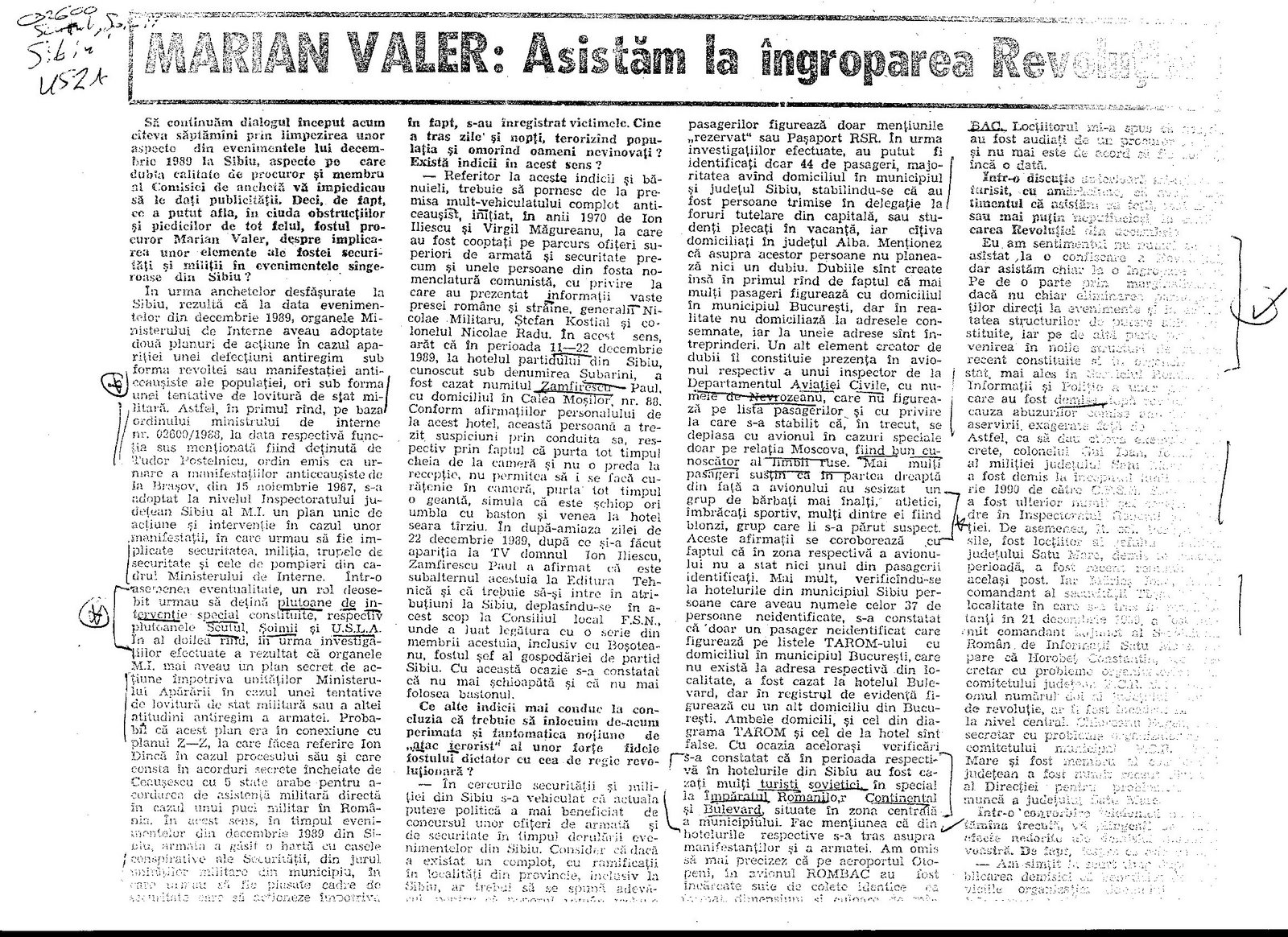
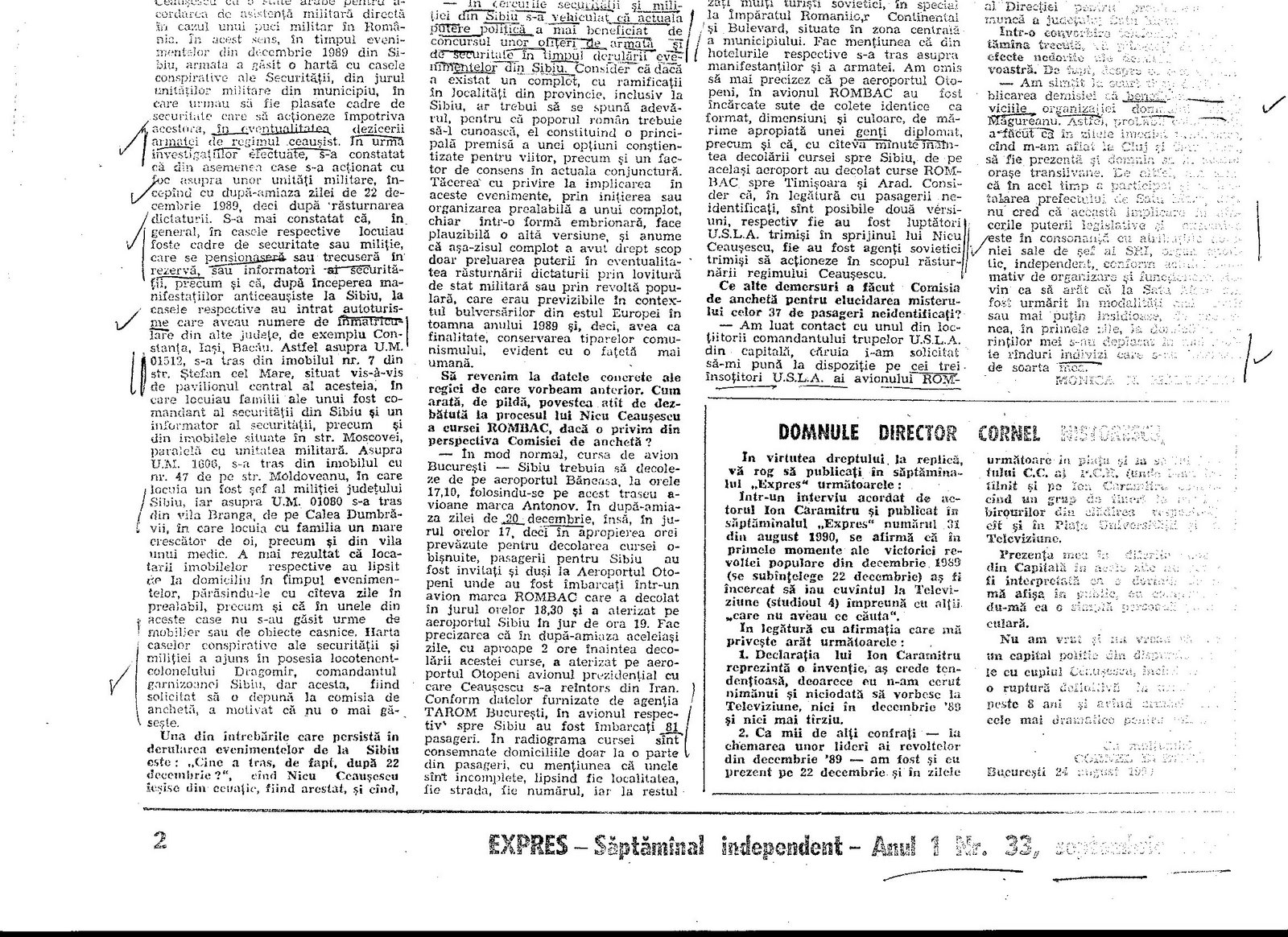
Monica N. Marginean: Sa revenim la datele concrete ale regiei de care vorbeam anterior. Cum arata, de pilda, povestea atit de dezbatuta la procesul lui Nicu Ceausescu a cursei ROMBAC, daca o privim din perspectiva Comisiei de ancheta?
fostul procuror Marian Valer: In mod normal, cursa de avion Bucuresti-Sibiu trebuia sa decoleze de pe aeroportul Baneasa, la orele 17,10 folosindu-se pe acest traseu avioane marca Antonov. In dupa-amiaza zilei de 20 decembrie, insa, in jurul orelor 17, deci in apropierea orei prevazute pentru decolarea cursei obisnuite, pasagerii pentru Sibiu au fost invitati si dusi la Aeroportul Otopeni unde au fost imbarcati intr-un avion marca ROMBAC care a decolat in jurul orelor 18,30 si a aterizat pe aeroportul Sibiu in jur de ora 19. Fac precizarea ca in dupa-amiaza aceleiasi zile, cu aproape 2 ore inaintea decolarii acestei curse, a aterizat pe aeroportul Otopeni avionul prezidential cu care Ceausescu s-a reintors din Iran. Conform datelor furnizate de agentia TAROM Bucuresti, in avionul respectiv spre Sibiu au fost imbarcati 81 pasageri. In radiograma cursei sint consemnate domiciile doar la o parte din pasageri, cu mentiunea ca unele sint incomplete, lipsind fie localitatea, fie strada, fie numarul, iar la restul pasagerilor figureaza doar mentiunile ,rezervat’ sau Pasaport RSR. In urma investigatiilor efectuate, au putut fi identificati doar 44 de pasageri, majoritatea avind domiciliul in municipul si judetul Sibiu, stabilindu-se ca au fost persoane trimise in delegatie la foruri tutelare din capitala, sau studenti plecati in vacanta, iar citiva domiciliati in judetul Alba. Mentionez ca asupra acestor persoane nu planeaza nici un dubiu. Dubiile sint create insa in primul rind de faptul ca mai multi pasageri figureaza cu domiciliul in municipiul Bucuresti, dar in realitate nu domiciliaza la adresele consemnate, iar la unele adrese sint intreprinderi. Un alt element creator de dubii il constituie prezenta in avionul respectiv a unui inspector de la Departmentul Aviatiei Civile, cu numele de Nevrozeanu, care nu figureaza pe lista pasagerilor si cu privire la care s-a stabilit ca, in trecut, se deplasa cu avionul in cazuri speciale doar pe relatia Moscova, fiind un bun cunoscator al limbii ruse. Mai multi pasageri sustin ca in partea dreapta din fata a avionului au sesizat un grup de barbati, mai inalti, atletici, imbracati sportiv, multi dintre ei fiind blonzi, grup care li s-a parut suspect. Aceste afirmatii se coroboreaza cu faptul ca in zona respectiva a avionului nu a stat nici unul din pasagerii identificati. Mai mult, verificindu-se la hotelurile din municipiul Sibiu persoane care aveau numele celor 37 de persoane neidentificate, s-a constatat ca doar un pasager neidentificat care figureaza pe listele TAROM-ului cu domiciliul in municipiul Bucuresti, care nu exista la adresa respectiva din localitate, a fost cazat la hotelul Bulevard, dar in registrul de evidenta figureaza cu un alt domiciliu din Bucuresti. Ambele domicilii, si cei din diagrama TAROM si cel de la hotel sint false. Cu ocazia acelorasi verificari s-a constatat ca in perioada respectiva in hotelurile din Sibiu au fost cazati multi turisti sovietici, in special la Imparatul Romanilor, Continental, si Bulevard, situate in zona centrala a municipiului. Fac mentiunea ca din hotelurile respective s-a tras asupra manifestantilor si a armatei. Am omis sa precizez ca pe aeroportul Otopeni, in avionul ROMBAC au fost incarcate sute de colete identice ca format, dimensiuni si culoare, de marime apropriata unei genti diplomat, precum si ca, cu citeva minute inaintea decolarii cursei spre Sibiu, de pe acelasi aeroport au decolat curse ROMBAC spre Timisoara si Arad. Consider ca, in legatura cu pasagerii neidentificati, sint posibile doua versiuni, respectiv sa fie au fost luptatorii U.S.L.A. trimisi in sprijinul lui Nicu Ceausescu, fie au fost agenti sovietici trimisi sa actioneze in scopul rasturnarii regimului Ceausescu.
Monica N. Marginean: Ce alte demersuri a facut Comisia de ancheta pentru elucidarea misterului celor 37 de pasageri neidentificati?
Marian Valer: Am luat contact cu unul din loctiitorii comandamentului trupelor U.S.L.A. din capitala, caruia i-am solicitat sa-mi puna la dispozitie pe cei trei insotitori U.S.L.A. ai avionului ROMBAC. Loctiitorul mi-a spus ca acestia au fost audiati de un procuror militar si nu mai este de acord sa fie audiati inca o data.
Monica M. Maginean: “MARIAN VALER: Asistam la ingroparea Revolutiei,” Expres nr. 33, septembrie 1990, p. 2.
[Observatiile mele: S-a stabilit ca pe 19 decembrie Nicu Ceausescu a cerut din partea lui Tudor Postelnicu “ceva trupe” (Nicu Silvestru, fostul sef al Militiei din Sibiu, spune ca Nicu i-a povestit ca ar cerea “specialistii [lui] din Bucuresti”) si Postelnicu i-a instiintat lui Iulian Vlad, seful Securitatii despre cererea aceasta. Si insotitorii USLA n-au vrut sa povesteasca despre acesti 37 pasageri neidentificati. Ce putem credea? Ca acesti 37 pasageri neidenticati au fost inventati? Au fost oamenii DIA (care de altfel au calatorit de la Buzau, nu de la Bucuresti, si nu cu un avion ROMBAC)? Sau au fost intr-adevar turisti sovietici, spetznaz acoperiti? HAI SA FIM SERIOSI! Acesti pasageri neidentificati au venit cu insotitorii USLA, dupa o cerere a lui Nicu Ceausescu pentru “ceva trupe” de la Postelnicu si Vlad (atentie! nu de la Milea). Nu e destul de clar ca au fost securisti?!!!
————————————————————————————————————————————————-
Richard Andrew Hall. The 1989 Romanian Revolution as Geopolitical Parlor Game (2005)
CWIHP. New Evidence on the 1989 Crisis in Romania (December 2001)
e-Dossier No. 5
New Evidence on the 1989 Crisis in Romania
Documents Translated and Introduced
by Mircea Munteanu
1
Recently released Romanian documents translated by the Cold War International History
Project (CWIHP) shed new light on how, in December 1989, the dramatic albeit mostly peaceful
collapse of Eastern Europe’s communist regimes came to its violent crescendo with the toppling
and execution of Romanian dictator Nicolae Ceausescu. Following Solidarity’s electoral victory
in Poland, the demise of Communist authority in Hungary, the fall of Erich Honecker, a close
friend and ally of Ceausescu, and, finally, the deposing of Bulgaria’s Todor Zhivkov, Romania
had remained the last Stalinist bulwark in Eastern Europe. Much to everybody’s surprise,
however, an explosion of popular unrest in mid December 1989 over Securitate actions in
Timisoara quickly engulfed the Ceausescu regime, leading to the dictator’s ouster and execution.
CWIHP previously documented from Russian sources how, confronted with the violent
turmoil in Romania, the US administration sought intervention by the Soviet Union on behalf of
the oppositionforces. On Christmas Eve, 24 December 1989, with Moscow some eight hours
ahead of Washington, US Ambassador Jack Matlock went to the Soviet Foreign Ministry and met
with Deputy Foreign Minister I. P. Aboimov. According to the Soviet documents, the message
Matlock delivered— while veiled in diplomatic indirection— amounted to an invitation for the
Soviets to intervene in Romania. The Russian documents recorded that Matlock, apparently on
instructions from Washington, “suggested the following option: what would the Soviet Union do
if an appropriate appeal came from the [opposition] Front? He let us know that under the present
circumstances the military involvement of the Soviet Union in Romanian affairs might not be
regarded in the context of ‘the Brezhnev doctrine.’” Repudiating “any interference in the
domestic affairs of other states,” Aboimov— probably referring to the then ongoing US invasion
of Panama— proposed instead “that the American side may consider that ‘the Brezhnev doctrine’
is now theirs as our gift.”
2
The newly accessible Romanian documents, obtained by Romanian historians Vasile
Preda and Mihai Retegan, bring to light the Soviet reaction to the Romanian events in Timisoara
and Bucharest through the perspective of the Romanian ambassador in Moscow, Ion Bucur. His
cables, now declassified, illustrate the isolated and paranoid stance of the Ceausescu regime at the
height of its final crisis.
The events of December 1989 in Romania started, inconspicuously enough, with the
attempted relocation of the ethnic Hungarian Calvinist pastor László Tökés from his parish in
Timisoara. The failed attempts of the police (Militia) forces, joined by the secret police
(Securitate), to remove the pastor from his residence enraged the local population. Dispelling the
so-called “historical discord” between Hungarians and Romanians in the border region, the
population of Timisoara united together to resist the abuses of the regime.
Ceausescu’s reaction was a violent outburst. Blaming “foreign espionage agencies” for
inciting “hooligans” the ordered the Militia, the Securitate, the patriotic guards and the army to
use all force necessary to repress the growing challenge to the “socialist order.” The repression
caused over 70 deaths in the first few days alone; hundreds suffered injuries. By 20 December
however, it became clear that the popular uprising could not be put down without causing
massive casualties, an operation which the army did not want to undertake while Ceausescu was
1
For more information, please contact the CWIHP at Coldwar1@wwic.si.edu or 202.691.4110 or Mircea
Munteanu at MunteanuM@wwic.si.edu or 202.691.4267
2
See Thomas Blanton, “When did the Cold War End” in CWIHP Bulletin #10, (March 1998) pp. 184-191.
out of the country. After the army withdrew in the barracks on 20 December, the city was
declared “liberated” by the demonstrators.
Ceausescu returned from a trip in Iran on 20 December and immediately convened a
session of the Politburo. He demanded that a demonstration be organized in Bucharest
showcasing the support of the Bucharest workers for his policies. The demonstration proved to be
a gross miscalculation. The popular resentment had, by that time, reached a new peak: The
demonstration quickly degenerated into chaos and erupted in an anti-Ceausescu sentiment. The
violent suppression of the Bucharest unrest rivaled that of Timisoara.
3
Securitate, police and army
forces fired live ammunition into the population in Piata Universitatii (University Plaza) and
close to Piata Romana (Roman Square).
The following documents show the attempts of the Romanian regime to maintain secrecy
on the events taking place in Romania— even with regard to its increasingly estranged Soviet ally.
From restricting the access of Russian tourists in Romania beginning with 18 December
4
(Document No. 1) to the demands made by the Romanian embassy in Moscow to the Soviet
leadership to prevent the Soviet media from publishing news reports about “alleged events”
taking place in Timisoara, Cluj and, later, Bucharest (Documents Nos. 4 and 5),Bucharest sought
to limit the damage to the regime’s image of stability. Afraid that information about the events
taking place in Romania would tarnish Ceausescu’s image of “a world leader,” the Foreign
Ministry instructed the Romanian embassies not to respond to any questions concerning the
“alleged” events and demanded that all actions taken by the Romanian government were
legitimate by virtue of its sovereignty. (Document No. 2).
The documents also present a picture of a regime grasping at straws, accusing even
former allies of conspiracy, and believing that isolation would insure its survival. Ceausescu’s
longstanding hysteria about the machinations of “foreign espionage agencies” — and his growing
mistrust towards Soviet leader Mikhail Gorbachev— reached new heights in his accusation that
turmoil in Romania was used by the Warsaw Pact to oust him (Ceausescu) from office, a
suggestion that struck Aboimov as utter “insanity.” (Documents Nos. 5 and 7). Quite the
contrary, the US-Soviet conversations suggest, was actually the case.
3
Official statistics place the death figure at 162 dead (73 in Timisoara, 48 in Bucharest, and 41 in the rest
of the country) and 1107 wounded (of which 604 in Bucharest alone).
4
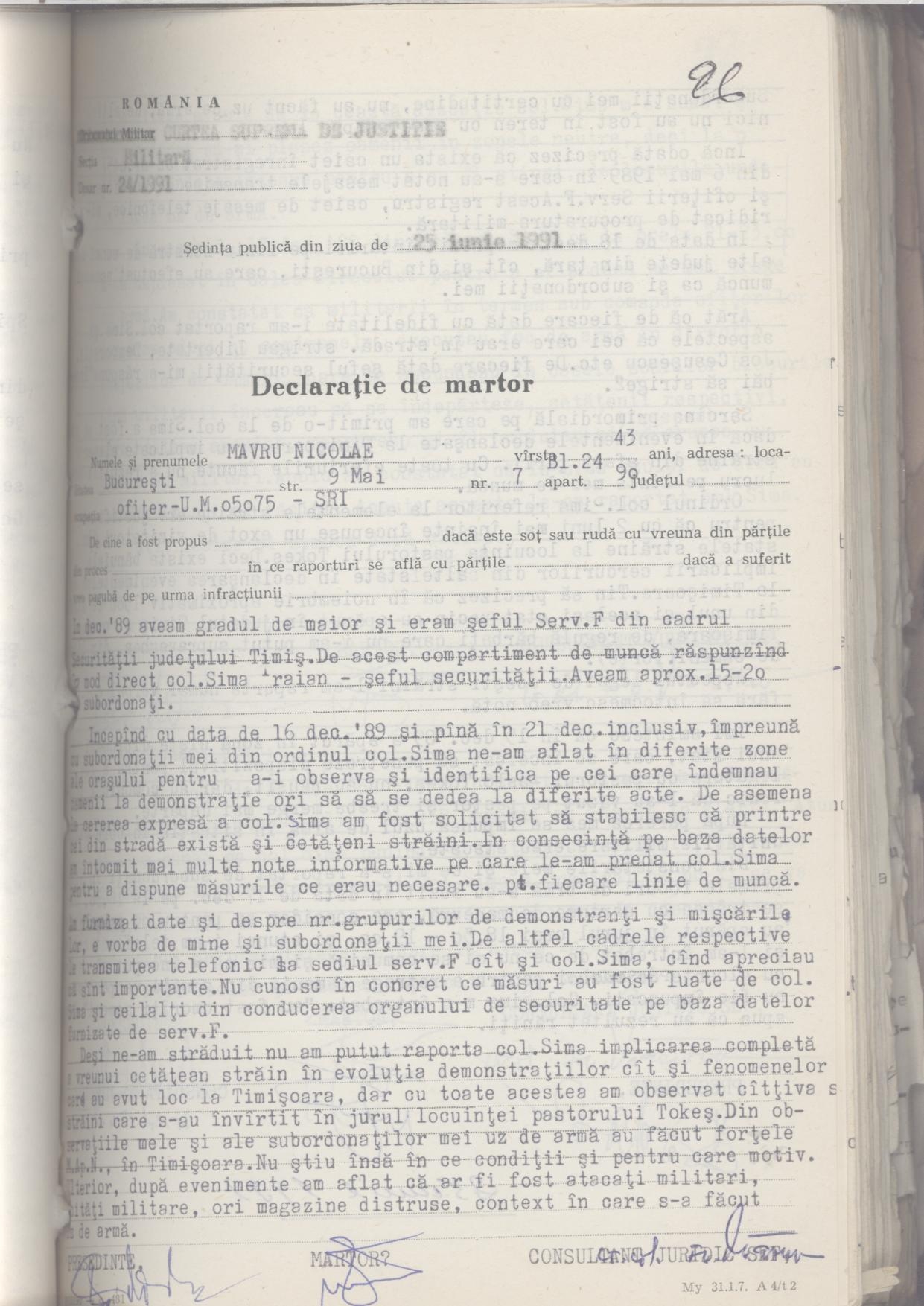
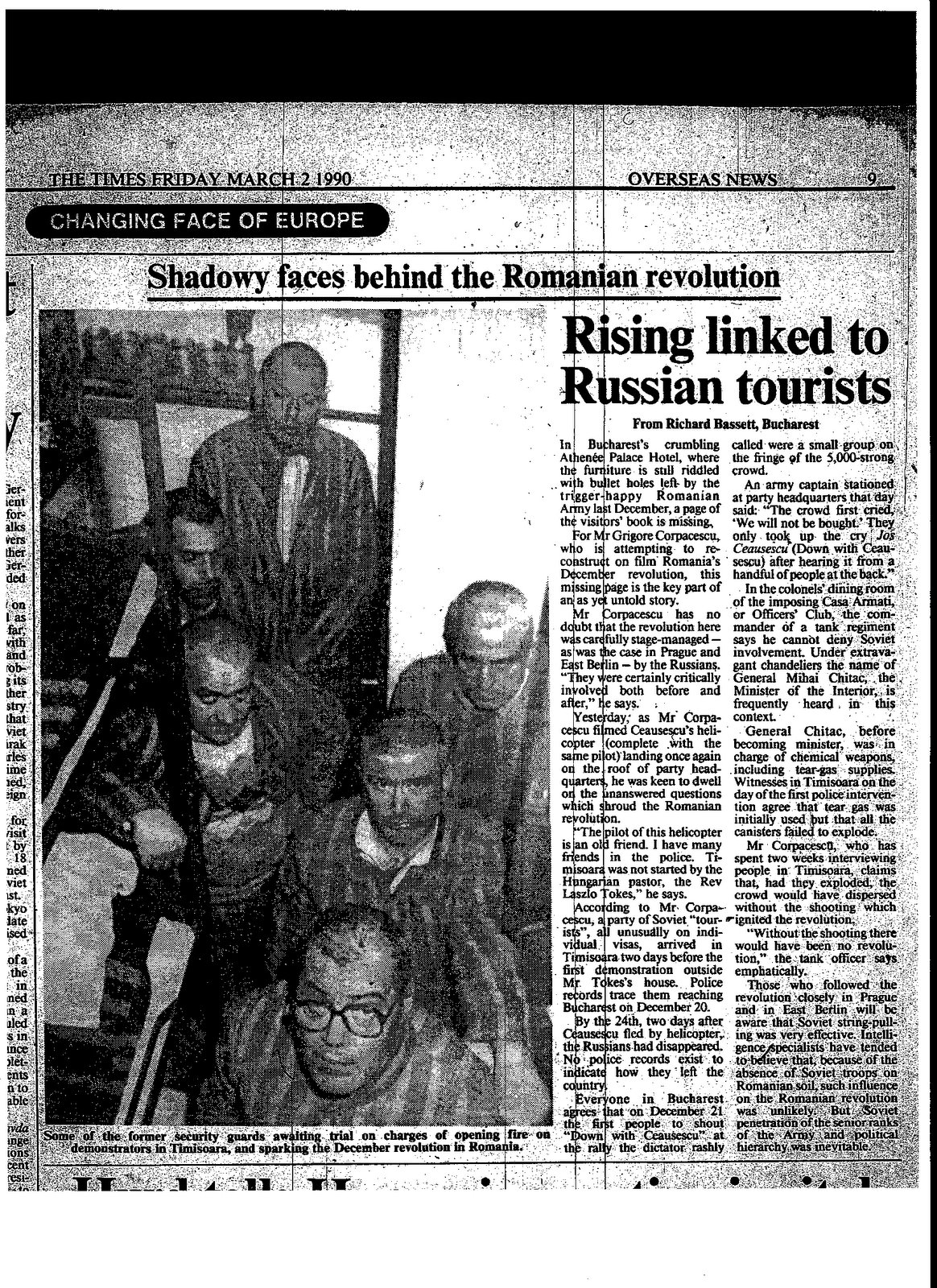
There were persistent rumors, during and after the 1989 events in Romania that the Soviet KGB sent
numerous agents in Romania in December 1989. Some accounts accused the KGB of attempting to
destabilize the regime while others accused them of attempting to shore it up. Likely both accounts are
somewhat exaggerated. While it is clear that the KGB was interested in obtaining information about the
events, it is unlikely that it attempted to interfere, either way in the unfolding of the events. It is more likely
that the closing of the borders both with the USSR but also with Hungary and Yugoslavia, is likely that
stranded numerous transistors on Romanian territory.
Document 1
Telegram from the Romanian Embassy in Moscow
to the Ministry of Foreign Affairs (Bucharest)
18 December 1989, 12:35 pm
Comrade Ion Stoian, Candidate Member of the Executive Political Committee
5
of the Central
Committee of the Romanian Communist Party (CC PCR), Foreign Minister,
1. We took note of your instructions (in your telegram nr. 20/016 750 of 17 December
1989)
6
and we will conform to the orders given.
We have taken actions to implement your instructions, both at the consular section of the
Embassy and at the General Consulate in Kiev.
[Furthermore] we would [like to] inform that the Director of the TAROM
7
office [in
Moscow] received, through his own channels, instructions regarding foreign citizens traveling to
our country.
2. Considering the importance of the problem and the nature of the activity of issuing
visas to Soviet citizens, we would like to mention the following problems [which have arisen],
[problems] to which we would like you to send us your instructions as soon as possible.
A. Beginning with the morning of 18 December of this year, Soviet citizens have begun
to make telephonic inquiries to the Embassy from border crossings into Romania, implying that
there are hundreds of vehicles which are not allowed to cross [the border] into our country. [W]e
anticipate that the Soviet government will ask for an explanation with regard to this decision
taken [by the Romanian government]. We ask that instructions be sent explaining the way we
must deal with the situation if it arises.
B. Continuously, at the Consular Section, we have given transit visas to Soviet Jews
who have the approval [of the Soviet government] to emigrate to Israel, as well as to foreign
students studying in the Soviet Union. Since the director of the TAROM office has received
instructions that he is to continue boarding transit passengers without any changes, we would like
to request instructions with regard to the actions we must take in such situations.
C. Considering the great number of Romanian citizens that are living in the Soviet
Union who during the holidays travel to our country, we would like to know if we should issue
them visas.
D. For business travel to Romania, the instructions given to TAROM are that the
applicants must show proof [of an invitation] from the ir Romanian partners.
Please inform whether we must inform the Soviet government of this requirement since
the official Soviet delegations use, for their travels to Bucharest, exclusively AEROFLOT
8
and
that we have no means of [us] controlling the planning of such travels.
5
Politburo
6
The 17 December telegram is not available at this time.
7
The state-owned Romanian National Airline— Transportul Aerian Român
8
Soviet Airlines.
We are experiencing similar problems in dealing with the possible situation of Soviet
citizens with tourist passports, which have received a visa prior to the [17 December 1989]
instructions and who will be using AEROFLOT for their travel to Romania.
E. We request that the Civil Aviation Department send instruction to the TAROM office
regarding the concrete actions that should be taken in connection with the 20 December flight
[from Moscow to Bucharest] so that they are able to make the final decision, during boarding,
regarding the passengers [that are to be allowed on to the plane].
We would [like to] mention that the list of passengers is given to the Director of
TAROM, from AEROFLOT or other [travel] companies, without any mention of the purpose of
the trip.
(ss) [Ambassador] Ion Bucur
[Source: Archives of the Ministry of Foreign Affairs— Arhivele Ministerului Afacerilor Externe
(AMAE), Moscow/1989, vol. 10, pp. 271-272. Translated for CWIHP by Mircea Munteanu]
Document 2
Telegram from the Minister of Foreign Affairs (Bucharest) to all Embassies
19 December 1989
Cde. Chief of Mission,
In case you are asked during the exercise of your diplomatic attributes (we repeat: only in
case you are asked) about the so-called events taking place in Timisoara, reiterate, with all clarity,
that you have no knowledge of such events. After this short answer, and without allowing you to
be drawn into a prolonged discussion, resolutely present the following:
We strongly reject any attempts to intervene in the internal affairs of S.R. Romania, a free
and independent state. [We reject] any attempt to ignore the fundamental attributes of our
national independence and sovereignty, any attempt at [harming] the security interests of our
country, of violating its laws. The Romanian [government] will take strong actions against any
such attempts, against any actions meant to provoke or cause confusion, [actions] initiated by
reactionary circles, anti-Romanian circles, foreign special services and espionage organizations.
The [Romanian] socialist state, our society, will not tolerate under any circumstances a violation
of its vital interests, of the Constitution, and will take [any] necessary action to maintain the strict
following of the letter of the law, the rule of law, without which the normal operation of all
spheres of society would be impossible. No one, no matter who he is, is allowed to break the laws
of the country without suffering the consequences of his actions.
Instruct all members of the mission to act in conformity with the above instructions.
Inform [the Minister of Foreign Affairs] immediately of any discussions on this topic.
Aurel Duma [Secretary of State
9
, MFA]
[Source: Archives of the Ministry of Foreign Affairs— Arhivele Ministerului Afacerilor Externe
(AMAE), Ministry Telegrams, vol. 4/1989, pp. 387-388. Translated for CWIHP by Mircea
Munteanu.]
9
Assistant Deputy Minister— Secretar de State.
Document 3
Telegram from the Romanian Embassy in Moscow
to the Ministry of Foreign Affairs
21 December 1989, 7:35 am
Cde. Ion Stoica, Minister [of Foreign Affairs],
Cde. Constantin Oancea, Deputy Minister [of Foreign Affairs],
DRI
10
On 20 December 1989, during a discussion with G. N. Gorinovici, Director of the
General Section for Socialist Countries in Europe, I expressed [the Romanian government’s] deep
indignation in regards with the inaccurate and tendentious way in which the Soviet mass media is
presenting the allegedevents taking place in Timisoara. I stressed that the stories made public by
radio and television are based on private, unofficial sources, and not on truthful information.
Many stories refer to the Hungarian press agency MTI, which is known for its antagonistic
attitude towards our country. I mentioned that V. M. Kulistikov, Deputy Chief Editor of the
publication Novoe Vremia, during an interview given to Radio Svoboda, expressed some opinions
vis-ŕ-vis Romania with are unacceptable. I brought to his [Gorinovici’s] attention the fact that on
19 December, Soviet television found it necessary to air news regarding the events in Timisoara
in particular, and in Romania in general, four separate occasions.
I argued that such stories do not contribute to the development of friendly relations
between our two countries and that they cannot be interpreted in any other way but as an
intervention in the internal affairs concerning [only] the Romanian government. I asked that the
Soviet government take action to insure the cessation of this denigration campaign against our
country and also to prevent possible public protests in front of our embassy. Gorinovici said that
he will inform the leadership of the Soviet MFA. In regards with the problems raised during our
discussion, he said that, in his opinion, no campaign of denigrating Romania is taking place in the
Soviet Union. “The mass media had to inform the public of the situation,” Gorinovici indicated,
in order to “counter-balance the wealth of information reaching the Soviet Union through
Western airwaves. Keeping silent on the subject would have only [served to] irritate the Soviet
public.” Following this statement, he recapitulated the well-known Soviet position with regards to
the necessity of allowing a diversity of opinions and ideas be expressed in the context of
informing the Soviet public about world events.
(ss) [Ambassador] Ion Bucur
[Source: Archives of the Ministry of Foreign Affairs— Arhivele Ministerului Afacerilor Externe,
Moscow/1989, vol. 10, pp. 297-298. Translated for CWIHP by Mircea Munteanu.]
10
Directia Relatii I— Directorate 1, Socialist Countries, Europe
Document 4
Informational Note from the Romanian Embassy in Moscow
to the Ministry of Foreign Affairs (Bucharest)
21 December 1989, 8:00 am
Cde. Ion Stoian, Minister of Foreign Affairs,
Cde. Costantin Oancea, Deputy Foreign Minister,
DR1
During the evening of 20 December 1989, I was invited in audience at I. P. Aboimov,
Deputy Foreign Minister of USSR. He related to me the following:
1. Lately, the Soviet press published news in connection to events unfolding in Romania,
specifically with the events in Timisoara. It is true that some of the published materials are based,
generally, on foreign [i.e. not Romanian] sources. It is evident that the [Soviet] mass media need
information on the basis of which to inform the public. Aside from this, during meetings with
foreign journalists, there were many requests addressed to the Soviet [government] to state its
position in regards with the events taking place in Romania as they were presented by various
press agencies. Furthermore, during his recent visits in Brussels and London, [Foreign Minister
Edward] Shevardnadze
11
was asked to state his opinion vis-ŕ-vis those events. In London, after
the official talks ended,
12
the Soviet Foreign Minister had a difficult time convincing [Prime
Minister Margaret] Thatcher that there should be no comments to the press on the events
allegedly taking place in Romania. The [Romanian] Foreign Ministry is also informed that
interest in this matter was expressed during working meetings of the Second Congress of the
People’s Deputies taking place in Moscow at this time.
13
The [Soviet] ambassador in Bucharest
was instructed to contact the Romanian government and obtain, from authorized officials,
information to confirm or refute the version of the events distributed by foreign press agencies.
To this date, the Soviet Embassy was unable to obtain and transmit any such information.
Due to such problems, the Soviet government asks that the Romanian government send
an informational note, even one that is restricted [cu caracter închis] regarding the events that are
really taking place in Romania. [The Soviet government] is interested in receiving information
that is as comprehensive as possible. If information is not received, it would be extremely
difficult to create an effective set of directions for the Soviet mass media, with which there are,
even so, many difficulties. [The Soviet government] is worried that, based on the news reported
in the press, some of the deputies participating at the sessions, would ask that the 2
nd
Congress of
the People’s Deputies take a position vis-ŕ-vis the alleged events taking place in Romania. The
MFA prepared for the deputies an information note in which it stresses that it does not have any
official information, but it is possible that this argument will not accepted long. Based on the
information available to the MFA, the Congress will adopt a resolution with regards to the US
military actions in Panama.
Of course, there is no connection between the two events. In Panama, a foreign military
intervention is taking place, while in Romania the events are domestic in nature. I. P. Aboimov
stressed his previous request that the Romanian government send, in the spirit of cooperation
11
Edward Sevardnadze traveled to Brussels and London at the end of 1989. On 19 December he met at
NATO HQ with NATO Secretary General Manfred Woerner and Permanent Representatives of NATO
countries.
12
Prime Minister Thatcher met Shevardnadze in London on 19 December 1989.
13
The Second Congress of the People’s Deputies began its session on 12 December 1989.
between the two countries, an informational note truthfully describing the current situation in the
country.
2. The Soviet MFA received a series of complaints that the border between the Soviet
Union and Romania has been closed for Soviet citizens, especially tourists. The Soviet
government was not previously informed with regards to this development. [T]his omission
causes consternation. The Soviet government is not overly concerned with the situation, but
[notes that] it creates difficulties with tourists that have already paid for and planned their
vacations accordingly.
3. With regards to the above statements, I said that I would, of course, inform Bucharest
of this. At the same time, I expressed the displeasure [of the Romanian government] with the fact
that the Soviet radio, television and newspapers have distributed news regarding events in
Romania taken from foreign news agencies, agencies that are distributing distorted and overtly
antagonistic stories regarding the situation in Romania. I gave concrete examples of such stories
published in newspapers such as Izvestia, Pravda, Komsomolskaia Pravda, Krasnaia Zvezda,
stories distributed by western press agencies as well as the Hungarian Press Agency MTI, which
is known for its antagonistic attitude towards our country. In that context, I mentioned that the
Romanian government has not requested that the Soviet Union inform it concerning events
unfolding in Grozny or Nagornîi-Karabah, nor has it published any news stories obtained from
Western press agencies, believing that those [events] are strictly an internal matter concerning
[only] the Soviet government.
I expressed my displeasure with the fact that some Soviet correspondents in Bucharest—
including the TASS correspondent— have transmitted materials from unofficial sources, which
contain untruthful descriptions of the events and which create in [the mind of] the Soviet public
an erroneous impression of the situation existing in our country. I stressed the point that such
behavior is not conducive to strengthening the relationship between our peoples and
governments, on the contrary, causing [only] serious damage [to said relationship]. I brought to
the attention of the Deputy Foreign Minister in no uncertain terms that a resolution of the
Congress of the People’s Deputies [concerning] the alleged events taking place in Romania
would be an action without precedent in the history of relations between the two countries and
would cause serious damage to the relationship.
At I. P. Aboimov’s question, I described the events regarding the situation of pastor
László Tökes, as described in your memorandum, stressing that this information does not have an
official character. I presented, in no uncertain terms, the decision of [the government of] Romania
to reject any attempts at interference in the internal matters of Romania. I expressed the decision
[of the Romanian leadership] to take any necessary measures against disruptive and diversionary
actions perpetrated by reactionary, anti-Romanian circles, by foreign special services and
espionage agencies (servicii speciale si oficinele de spionaj staine). With regard to the issue of
tourists crossing the border in Romania, I said that I did not posses an official communication in
this regard. I suggested that some temporary measures were adopted due to the need to limit
access of certain groups of tourists [in the country]. [Those limitats were imposed] due to
difficulties in assuring their access to hotel rooms and other related essential conditions. Those
limitations do not apply to business travel or tourists transiting Romania. I reminded [I. P.
Aboimov] that the Soviet government had introduced at different times such limitations on travel
for Romanian tourists to certain regions [of the Soviet Union] (Grozny and Armenia), which
[had] provoked dissatisfaction.
4. The conversation took place in a calm, constructive atmosphere.
(ss) [Ambassador] Ion Bucur
[Source: Archives of the Ministry of Foreign Affairs— Arhivele Ministerului Afacerilor Externe
(AMAE), Telegrams, Folder: Moscow/1989, vol. 10, pp. 299-302. Translated for CWIHP by
Mircea Munteanu.]
Document 5
Information Note from the Romanian Embassy in Moscow
to the Ministry of Foreign Affairs
21 December 1989, 2:00 pm
Comrade Ion Stoica, Minister of Foreign Affairs,
1. On 21 December 1989, at 12:00 pm, I paid a visit to Deputy Foreign Minister I. P.
Aboimov to whom I presented a copy of the speech given by Comrade Nicolae Ceausescu,
General Secretary of the Romanian Communist Party [PCR] and President of the Socialist
Republic of Romania [SRR], on the 20 December 1989 over radio and television. I. P. Aboimov
made no comments with regard to the speech. He requested that the Soviet side receive
information as to whether,during the events taking place in Timisoara, any deaths had occurred
and what the current situation in the city was.
2. Aboimov said that during the 19 December discussions between the Soviet ambassador
in Bucharest and Cde. Nicolae Ceausescu, the latter expressed his disapproval with the official
declarations made by Soviet officials concerning the events in Timisoara. He [Ceausescu] said
that those [actions taking place in Timisoara] are the result of strategies developed beforehand by
[member nations of] the Warsaw Treaty Organization (WTO). [Ceausescu] suggested that certain
officials in Bucharest told ambassadors from socialist countries that they have information with
respect to the intention of the Soviet Union to intervene militarily in Romania.
As for the so-called official declarations [Aboimov added], they probably refer to a reply
made by Cde. E[dward] Shevardnadze, [Soviet] Minister of Foreign Affairs to a question from a
Western journalist during his trip to Brussels. [The question] referred to the events in Timisoara
and [the question of] whether force was used there. Cde. Shevardnadze answered that “I do not
have any knowledge [of this], but if there are casualties, I am distressed.” Aboimov said that, if
indeed there are casualties, he considered [Shevardnadze’s] answer justified. He stressed that E.
Shevardnadze made no other specific announcement in Brussels [with regards to the events in
Timisoara]. Concerning the accusations that the actions [in Timisoara] were planned by the
Warsaw Pact, and specifically the declarations with regard to the intentions of the USSR,
14
Aboimov said that, personally, and in a preliminary fashion, he qualifies the declarations as
“without any base, not resembling reality and apt to give rise to suspicion. It is impossible that
anybody will believe such accusations. Such accusations”— Aboimov went on to say— “have
such grave repercussions that they necessitate close investigation.”
He stressed that the basis of interaction between the USSR and other governments rested
on the principles of complete equality among states, mutual respect, and non-intervention in
internal affairs.
(ss) [Ambassador] Ion Bucur
[Source: Archives of the Ministry of Foreign Affairs— Arhivele Ministerului Afacerilor Externe
(AMAE), Moscow/1989, vol. 10, pp. 303-304. Translated for CWIHP by Mircea Munteanu.]
14
Ceausescu repeatedly accused the Soviet Union in December 1989 of planning an invasion of Romania.
Document 6
Telegram from the Romanian Embassy in Moscow
to the Ministry of Foreign Affairs (Bucharest)
22 December 1989, 07:30 am
Cde. Constantin Oancea, Deputy [Foreign Affairs] Minister
Directorate 1— Socialist Countries, Europe
During a conversation between N. Stânea and V. L. Musatov, Deputy Director of the
International Department of the Central Committee (CC) of Communist Party of the Soviet Union
(CPSU) [Musatov], referring to the situation in Eastern European countries, declared:
The processes taking place [in Eastern Europe] are the result of objective needs.
Unfortunately, these processes taking place are [sometimes] incongruous. In some countries, such
as Hungary and Poland, the changes that took place went outside the initial limits planned by the
[local] communists, who have [now] lost control. The situation is also becoming dangerous in
Czechoslovakia and the German Democratic Republic [GDR]. At this time, in Bulgaria the
[Communist] Party is trying to maintain control, however, it is unknown which way the situation
will evolve. As far as it is concerned, the CPSU is trying to give aid to the communists.
Representatives of the CC of the CPSU have been or are at this time in the GDR [and]
Czechoslovakia to observe the situation personally. The attitude towards the old leadership is
regrettable. For example, [East German Communist Party leader] E[rich] Honecker will be
arrested. In the majority of these countries there are excesses against the communists. The Soviet
government is preoccupied with the future of “Our Alliance.” [The Soviet government] is
especially interested in the evolution of events in the GDR, in the background of the discussions
taking place regarding reunification. The Soviet Union is following all these events, but is not
getting involved in the internal affairs of the respective countries.
.
(ss) [Ambassador] Ion Bucur
[Source: Archives of the Ministry of Foreign Affairs— Arhivele Ministerului Afacerilor Externe
(AMAE), Moscow/1989, vol. 10, p. 313. Translated for CWIHP by Mircea Munteanu.]
Document 7
Telegram from the Romanian Embassy in Moscow
to the Ministry of Foreign Affairs (Bucharest)
22 December 1989, 04:20 pm
Cde. Ion Stoian, Minister of Foreign Affairs,
On 22 December 1989, at 02:00 pm I. P. Aboimov, Deputy Foreign Affairs Minister,
called me at the Soviet Ministry of Foreign Affairs. Accompanying me was I. Rîpan, [Embassy]
secretary. V. A. Lapsin, [Soviet MFA] secretary was also present.
Aboimov said that he was instructed to present, on behalf of the Soviet leadership, the
following reply to the message sent [by the Romanian government] through the Soviet
ambassador in Bucharest [during his discussion with Nicolae Ceausescu on 19 December].
“The message sent [by] the Romanian nation on 20 December of this year, has been
carefully examined in Moscow. We consider the problems raised in the message as very serious,
15
since they are dealing with the basic issues of our collaboration.
In the spirit of sincerity, characteristic for our bilateral relations, we would like to
mention that we are surprised by its tone and the accusations regarding the position and role of
the Soviet Union with respect to the events taking place in Timisoara. We reject wholeheartedly
the statements with regard to the anti-Romanian campaign supposedly taking place in the Soviet
Union, not to mention the accusation that the actions against Romania have allegedly planned by
the Warsaw Treaty Organization [WTO]. Such accusations are unfounded and absolutely
unacceptable. Just as absurd are the declarations of certain Romanian officials who are suggesting
that the Soviet Union is preparing to intervene in Romania. We are starting, invariably, from the
idea that, in our relations with allied nations, as well as with all other nations, the principles of
sovereignty, independence, equality of rights, non-intervention in the internal affairs. These
principles have been once again confirmed during the [WTO] Political Consultative Committee
summit in Bucharest.
It is clear that the dramatic events taking place in Romania are your own internal
problem. The fact that during these events deaths have occured has aroused deep grief among the
Soviet public. The declaration adopted by the Congress of the People’s Deputies is also a
reflection of these sentiments.
Furthermore, I would like to inform you that our representative at the UN Security
Council has received instructions to vote against convening the Security Council for [the purpose
of] discussing the situation in Romania, as some countries have proposed. We consider that this
would be an infringement of the sovereignty of an independent state by an international
organization.
We want to hope that, in the resolution of the events in Romania, wisdom and realism
will prevail and that political avenues to solve the problems to the benefit of [our] friend, the
Romanian nation, will be found.
Our position comes out of our sincere desire not to introduce into our relationship
elements of suspicion or mistrust, out of our desire to continue our relations normally, in the
interest of both our nations, [and in the interest of] the cause of peace and socialism.
I. P. Aboimov asked that this message be sent immediately to Bucharest.
(ss) [Ambassador] Ion Bucur
[Source: Archives of the Ministry of Foreign Affairs— Arhivele Ministerului Afacerilor Externe
(AMAE), Telegrame, Folder Moscow/1989, vol. 10, pp. 324-325. Translated for CWIHP by
Mircea Munteanu]
15
Ceausescu had accused the Soviet leadership, in cooperation with “other Warsaw Pact members” of
masterminding the events taking place in Timisoara, and of preparing an attack on Romania.



 Offline


 The Archive of the Romanian Revolution of December 1989