The Archive of the Romanian Revolution of December 1989

A Catch-22 December 1989, Groundhog-Day Production. Presenting the Personal Research & Scholarship of Richard Andrew Hall, Ph.D.

Archive for September, 2014

The Collapse of European Communism 25 Years Ago: The East German Exodus through Prague, September-October 1989

Posted by romanianrevolutionofdecember1989 on September 30, 2014

(purely personal views as always)

Iconic photo by Associated Press “Prague Policeman pulls on coat of East German to prevent him from climbing fence to West German Embassy”
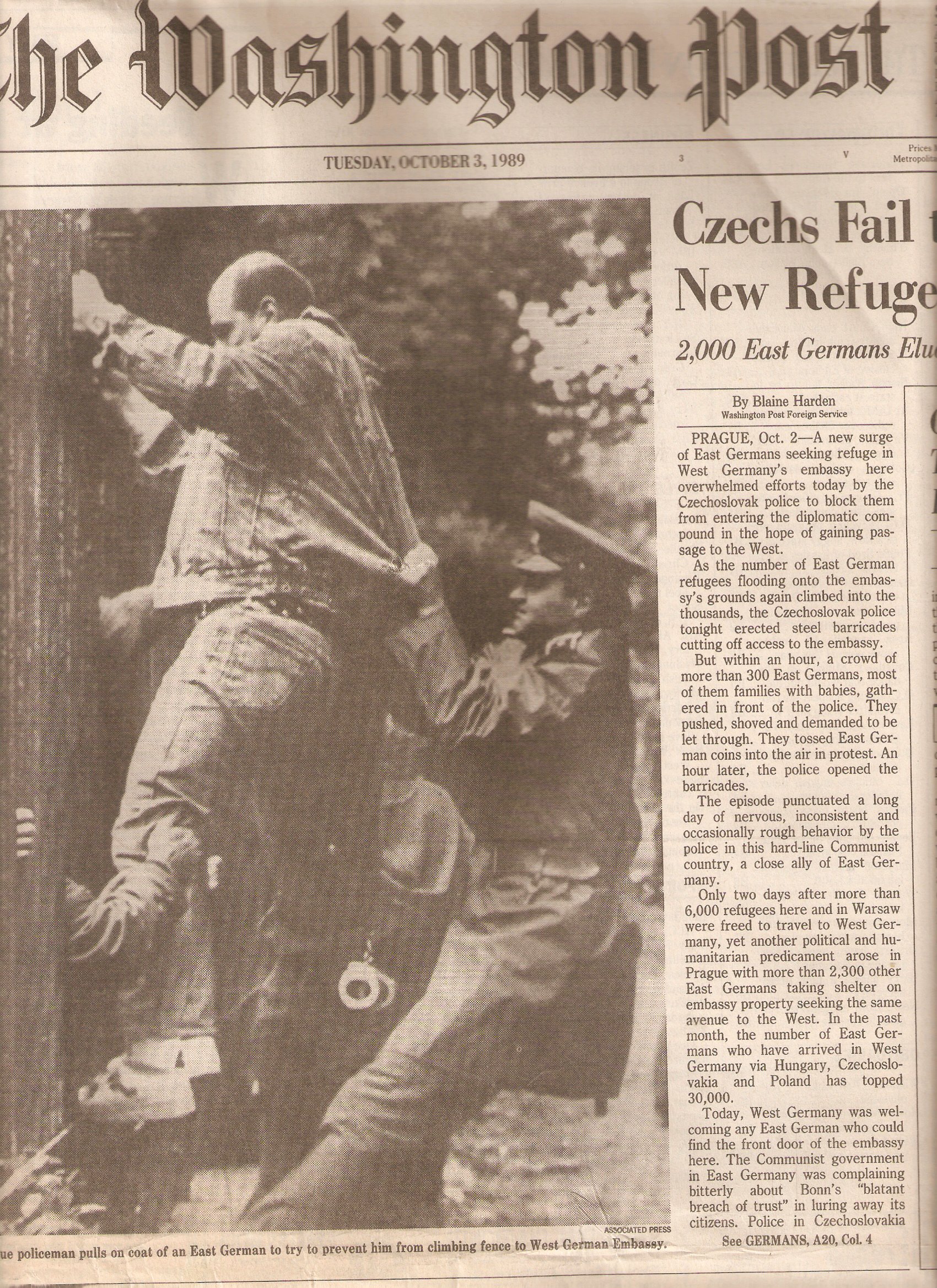
image0

For earlier related see:

http://atomic-temporary-3899751.wpcomstaging.com/2014/09/20/25-years-ago-east-german-exodus-continues-and-things-start-getting-serious-press-from-the-time/

http://atomic-temporary-3899751.wpcomstaging.com/2014/08/16/the-light-and-guns-of-19-august-media-accounts-and-video-about-an-important-day-in-the-fall-of-european-communism-in-1989-featuring-hungary-poland-and-romania/

For some good links on the East German exodus via Prague, see for example:

Exit-Voice Dynamics and the Collapse of East Germany: The …

books.google.com/books?isbn=0822387921
Steven Pfaff – 2006 – ‎History

The Crisis of Leninism and the Revolution of 1989 Steven Pfaff … hundreds of embassy occupiers agreed to re- turn to East Germany, but thousands more … On September 30, the West German foreign minister, Hans- Dietrich Genscher, and … principal route to Hungary as well as the conduit to the FRG embassy in Prague.

It is worth noting the extraordinary growth in the number of East German emigrants/refugees in 1989, from approximately 5,000 a month from January 1989 to April 1989 to approximately:

May, 10,000

June 12,000

July 11,700

August 21,000

September 33,200

October 57,000

This is abundant demonstration of the fact that any model that gives primacy to the extent of structural factors at the expense of contingency does a disservice to the effort to understand the phenomenon of 1989 in communist Eastern Europe.

A particularly good and useful English language source that I recently found is the following:  http://www.chronik-der-mauer.de/index.php/de/Start/Index/id/652147

September 1989

A young couple from the GDR arrives in the Csilleborc refugee reception centre near Budapest after the opening of the Hungarian-Austrian border, 4 September 1989In this month, the Hungarian government opens Hungary’s border with Austria for East German citizens without asking Moscow for permission – thus tearing the first hole in the Wall.

September 4: Following the regular Monday prayer for peace in the Nikolaikirche in Leipzig, there is a demonstration by around 1,200 people. Demonstrators express their desire to be able to leave the country freely by chanting “We want out!” and demand to be allowed to travel to the West – In Böhlen, representatives of a socialist opposition group meet and formulate an appeal “for a united left wing in the GDR,” which argues in favour of radical socialist reform and sees the best economic and political conditions for such a reform in East Germany and the CSSR.
GDR citizens wait for the opening of the border between Austria and Hungary on the evening of 10 September 1989September 8: Persuaded by assurances from the GDR lawyer Vogel, all East German citizens leave the West German Permanent Mission in East Berlin. It is then shut to visitors. – In Budapest, Stasi members do not succeed in convincing would-be emigrants to return to the GDR.

September 9: The West German news programme “Tagesschau” reports that East German refugees are about to leave Hungary for the West.

10/11 September 1989: Hungary opens the border to Austria for GDR citizens

September 10: In the night of 10-11 September, the Hungarian government opens the border to Austria for East German citizens. In the following days and weeks, tens of thousands of GDR citizens travel to West Germany via Austria. The General Secretary of the Communist Party of the Soviet Union, Mikhail Gorbachev, later confirms that Hungary did not ask permission in Moscow before carrying out this step.

GDR citizens cross the Hungarian-Austrian border, 11 September 1989September 11: Another prayer for peace in the Nikolaikirche in Leipzig; the Volkspolizei closes off the church yard to prevent a demonstration. Numerous people are arrested.

September 12: At the Tuesday Politburo meeting, Günter Mittag, standing in for an ill Honecker, brings up the question of how “to close the hole in Hungary” as the most important issue, as the number of applications for travel to Hungary has risen steeply all over the GDR. To prevent “heavy losses” of citizens, Mittag proposes “not to allow departures on such a universal basis anymore. Why do the doubtful contenders have to travel? But this internal regulation must not affect our party and the majority of the population. We would make them angry. The Ministry of Security and the Interior Ministry should be the ones to carry out these measures.”

On the very same day, Stasi minister Mielke orders a “programme of measures for the timely recognition and prevention of the abuse of trips to or through the People’s Republic of Hungary.” It stipulates that all applications for travel to Hungary, Bulgaria and Romania are to be checked by the Stasi. “The unit responsible has to decide whether objections should be raised against allowing the trip for security reasons” on the basis of the material collected about the applicant, and these objections are to override the Volkspolizei, the authority actually responsible for such applications.

September 12: At the invitation of the German Confederation of Trade Unions (DGB), the chairman of the Free German Trade Union Federation (FDGB), Harry Tisch, arrives in West Germany. When asked by journalists about the flood of refugees from the GDR, he angrily demands, among other things, that the “mud fight” stop.

September 14: In Bonn, the Erfurt pastor Edelbert Richter announces the founding of the GDR opposition group “Demokratischer Aufbruch” (Democratic Awakening), which champions a “socialist social order on a democratic basis” and speaks out in favour of human rights, freedom to travel, freedom of expression, of the press and of assembly, and free elections in the GDR. – The West Berlin Senate discusses the growing number of East German refugees and how to put them up. It decides that everything possible should be done to organise emergency accommodation.

Leipzig, 18 September 1989: People in front of the cordon of People’s PoliceSeptember 18: Hundreds of demonstrators take to the streets in Leipzig after the prayer for peace in the Nikolaikirche: they chant “We’re staying here!” and not “We want out!” as in previous weeks. Numerous demonstrators are arrested. – In view of the number of people leaving the country, rock musicians, songwriters and entertainers issue a public resolution demanding forms of democratisation and reform that are compatible with socialism, saying that cowardly delay provided “arguments and preconditions for all-German ideas.”
Leipzig, 18 September 1989: People in front of the cordon of People’s PoliceSeptember 19: The group “Neues Forum,” which has made a public founding statement on September 10, applies to be officially registered as a citizens’ association. Two days later, the Interior Ministry rejects the application, saying that the Neues Forum was a “subversive platform”. Three thousand people have so far signed the statement by the Neues Forum. – The synod of the Federation of Protestant Churches (Evangelischer Kirchenbund) passes a resolution in Eisenach in which it calls for a pluralist media policy, a democratic diversity of parties, freedom to travel for all citizens, economic reforms and freedom to demonstrate, describing all these things as “long overdue reforms”.

September 20: The West German embassy in Warsaw has to be closed because of overcrowding. – The Central Committee of the Communist Party of the Soviet Union issues a statement on nationalities policy, in which republics are promised economic independence.

September 22: Erich Honecker, firmly resolved to put a swift end to all demonstrations and “provocations,” sends a telex to the First Secretaries of the SED district administrations, telling them “that these hostile actions must be nipped in the bud, that no mass basis for them is allowed.” They are also to make sure “that the organisers of the counterrevolutionary activity are isolated.”

September 24: The West German embassy in Prague becomes a meeting place for GDR refugees, because the CSSR has tightened checks on its border to Hungary.
Leipzig, 25 September 1989: People standing near the Church of St. Nicholas (Nikolaikirche), shortly before the start of the demonstrationSeptember 25: At the “Monday demonstration” in Leipzig, 5,000 to 8,000 demonstrators call for democratic reforms and official recognition of the Neues Forum movement. Those wanting to leave the GDR have now become a minority among the demonstrators.

September 26: The deputy Stasi minister, Rudolf Mittig, calls together the deputy leaders of the district administrations of the Ministry of Security and gives them the watchword to “operatively work on” the “hostile, oppositional alliances” with the aim of destroying them. The Ministry of Security, he says, is to provoke infighting, sow mistrust, split up the members and try to stop the politicisation of the groups by raising issues regarding organisation and structure – a major role here is to be played by the “inoffizielle Mitarbeiter” (“unofficial collaborators”) in their ranks.
Leipzig, 25 September 1989: The protest march turns around on Tröndlinring and heads back to the main railway stationIt is also on this day that Honecker orders the “Bezirkseinsatzleitung Berlin” (“Berlin District Operational Command”) and the various “Kreiseinsatzleitungen” (“Operational Commands”) of the Berlin districts to be ready to take command to “ensure security and order” and “to prevent provocations of various sorts” for the 40th anniversary of the GDR. On the basis of this order, Defence Minister Kessler orders the National People’s Army (Nationale Volksarmee/NVA) to take up position for action in Berlin from 6 to 9 October as a precautionary measure.

September 27: The CSSR government says that there will be no Hungarian solution for the now more than 900 people occupying the Prague embassy.

September 29: Union members from VEB Bergmann-Borsig, a large Berlin company, express their outrage to the FDGB chairman and Politburo member Harry Tisch “for depicting the desertion by so many of our people as being the result of machinations on the part of the class enemy, where these GDR citizens are supposedly mere victims or pawns.” Along with rock musicians, artists, authors, academics and representatives of the “block parties,” they call on the SED to enter into dialogue with all social powers.

September 30: The GDR yields to Soviet pressure in the Prague embassy conflict: West German Foreign Minister Genscher and Chancellery Minister Seiter travel to Prague and announce that the people occupying the embassy can leave the country. Several thousand East German refugees are taken to West Germany via GDR territory in special sealed trains.

In September, 33255 GDR citizens manage to flee to the West; 11903 are given permission to leave the GDR.

A commentary attributed to the Allgemeiner Deutscher Nachrichtendienst (ADN) calls after the East German citizens emigrating via Prague: “We won’t shed any tears over them.”

October 3: The GDR virtually closes its borders by stopping visa-free travel to the CSSR; the next day, this measure is extended to transit travel to Bulgaria and Romania as well. This results in protests and even threats of strike action in the areas bordering on the CSSR.

Arrival of GDR refugees in Ahlsfeld, October 1989 October 4: Once more, around 7,000 East German citizens who have again occupied the Prague embassy are allowed to travel to West Germany in special closed trains. In the night of October 5 here is a street fight at Dresden’s main train station between security personnel and around 10,000 demonstrators who want to jump onto the refugee trains.
http://www.chronik-der-mauer.de/index.php/de/Start/Index/id/652005

August 1989

GDR citizens rush a border gate to Austria in SopronBeginning of August: According to the draft of a paper presented by the Central Committee Security Issues Department (“Information and Conclusions on Some Current Issues Regarding Hostile Influences on Citizens of the GDR”), GDR security organs have counted 160 “hostile, oppositional groups,” including 150 so-called grass-roots church groups, with altogether 2,500 members. The paper says that “around 25 non-permitted printed and duplicated publications with anti-socialist content were produced and distributed, almost always using church-owned or private equipment.” One of the main strategies used by oppositional elements, it says, is to allege that the GDR “permanently lags behind, particularly with regard to implementing human rights. This includes continually calling into question the validity of local elections.” The existence of 51 skinhead groups (to which around 1,000 young people belong), ten punk groups, 32 heavy metal groups and nine gothic groups is seen as a “non-socialist tendency”.
The breakthrough: GDR citizens rush a border gate to Austria in SopronAugust 5: The GDR government makes its first official statement on the embassy refugees on GDR television, confirming that the exodus constitutes a problem.

August 7: The SED leadership rescinds the so-called “lawyer’s promise”. The lawyer Wolfgang Vogel tells the West German Ministry for Inner-German Relations that he can offer those seeking refuge in West German missions impunity when leaving and returning to the GDR, but cannot, as previously, promise them a quick, affirmative decision on their applications to leave the country. – In an official statement by the GDR Foreign Ministry, the West German government is harshly accused of a “gross intervention in sovereign affairs of the GDR” for taking GDR citizens into its care; the statement calls this “typical pan-German arrogance” and says that it could “lead to far-reaching consequences”.
The breakthrough: GDR citizens rush a border gate to Austria in SopronAugust 8: The West German Permanent Mission in East Berlin, which is being occupied by around 130 GDR citizens, is shut. This is followed on August 14 and 22 by the closures of the embassies in Budapest and Prague, in which, respectively, 171 and 140 would-be emigrants are staying. At nearly every meeting with SED leaders, West German politicians have emphasised that they do not desire a flood of refugees from the GDR. West German politicians from government and opposition now publicly warn GDR citizens not to flee their country. In West Germany, a public debate begins on whether the country can or wants to take in refugees and how many it can absorb. – Chancellery Minister Rudolf Seiters announces that 46,343 people have legally moved from the GDR to West Germany up to the end of July. He appeals to GDR citizens wanting to leave East Germany not to do so via West German diplomatic missions.
Invitation to take part in the Pan-European Picnic (pamphlet)Every day, up to 100 GDR citizens are managing to flee from Hungary to Austria. However, hundreds are still being arrested as well. Several thousand GDR holidaymakers camp out on roadsides and front gardens in Budapest in 35-degree heat and wait for their chance to flee.

August 14: At the handing-over of the first functional models of 32-bit microprocessors by the Erfurt collective combine Mikroelektronik, Erich Honecker says: “Neither ox nor mule can stay socialism’s rule.” (“Den Sozialismus in seinem Lauf halt weder Ochs noch Esel auf.”)
Invitation to take part in the Pan-European Picnic (pamphlet)August 19: The Hungarian Democratic Forum and other Hungarian opposition groups, under the patronage of the MEP Otto von Habsburg and the Hungarian reformist politician Imre Pozsgay, member of the HSWP Politburo and state minister, have organised a “Pan-European Picnic” at the Hungarian-Austrian border near Sopron to demonstrate for the abolition of borders and a united Europe by symbolically opening a border gate and allowing a “one-off, occasional border crossing”. Over 600 GDR citizens rush through the half-open gate to Austria. The gate is shut again after a few hours.
Cars left behind by GDR refugees, who had waited and saved for them for yearsAs later becomes known, this chance to cross the border without danger has been made possible by a standstill agreement between the state minister Pozsgay, the interior minister and the head of the border troops – and is a test to see how the Soviet Union reacts to such actions.

August 21: Several hundred people are arrested during demonstrations in Prague on the 21st anniversary of the “Prague Spring”.

August 22: A GDR citizen is shot dead by a Hungarian border guard while trying to escape to Austria.
Arrival in Austria: unbounded joy at being liberated
August 23: Hundreds of thousands of people in the Baltic republics of the Soviet Union commemorate their lost independence.

August 24: With the assistance of the International Red Cross, over one hundred would-be East German emigrants from the Budapest embassy are flown to West Germany via Austria. In Poland, the co-founder of the Solidarity movement, Tadeusz Mazowiecki, is elected as the first non-communist prime minister.

August 25: In Bonn, the Hungarian prime minister, Miklos Németh, and Foreign Minister Gyula Horn meet secretly at Gymnich Castle with West German Chancellor Helmut Kohl and Foreign Minister Hans Dietrich Genscher. Németh says that he opened the talks with Kohl and Genscher with the words: “Chancellor, Hungary has decided to allow GDR citizens to leave freely. The decision was taken mostly on humanitarian grounds.”
Arrival in Austria: unbounded joy at being liberatedAccording to Horst Teltschik, Kohl promises his guests to compensate any disadvantages that Hungary might experience as the result of reprisals on the part of the GDR. The German government later gives Hungary an additional loan of 500 million marks and promises to abolish mandatory visas and to provide political aid to Hungary in its bid to join the European Community.

August 26: An initiative group including Martin Gutzeit, Markus Meckel, Arndt Noack and Ibrahim Böhme calls for the formation of a social democratic party in the GDR.

August 29: At a SED Politburo meeting, perplexity prevails on the question of how to proceed in the refugee crisis. Günter Mittag, who is standing in for a sick Erich Honecker, says: “Sometimes I’d like to smash the television, but that’s no use. (…) The business with Hungary wasn’t prepared by chance. It is an attack on the weakest point aimed at bringing the GDR into disrepute as well.

Comrade Mielke could talk for an hour or more about what means were used. Then there is the front-line reporting of the enemy, as we have very correctly called it. We have to show the main weaknesses of imperialism. We have to show where it aims to undermine socialism. But the basic guideline is: we do this calmly and don’t come to blows. We have to think about how to continue our line of argumentation.”
GDR citizens wait in a refugee centre run by the August 31: The Hungarian foreign minister, Gyula Horn, arrives in East Berlin to talk with GDR Foreign Minister Oskar Fischer and Günter Mittag. Horn announces that Hungary is going to allow the refugees to leave the country as of September 11, if they have not by then been persuaded to return to the GDR by assurances that they will be allowed to depart. Mittag and Fischer reject both options.

In August, 20,995 GDR citizens manage to flee to the West; 12,812 people are given permission to leave the GDR.

http://www.chronik-der-mauer.de/index.php/de/Start/Index/id/652002

http://www.chronik-der-mauer.de/index.php/de/Start/Index/id/652001

June 12: Hungary’s joining of the Geneva Convention Relating to the Status of Refugees comes into force. The Convention makes it unlawful to send refugees back to the country from which they have escaped. A worried Stasi delegation in Budapest enquires about the consequences for GDR refugees. The Hungarian secret service chief Ferenc Pallagi tells it that GDR citizens will still not be recognised as refugees, and will be deported to the GDR. “Leaving for West Germany/Austria or another country of their choice will not be permitted.”

May 1989

Hungarian soldiers cut through the border fence on 2 May 1989May 2: Hungarian border forces start taking down the barbed-wire fence to Austria. – In a memo of May 6 to SED General Secretary Erich Honecker about the start of the “planned dismantling of the border security fence on the national border of the Hungarian People’s Republic to Austria,” GDR Defence Minister Heinz Kessler assumes that it is only a cosmetic measure and that the Hungarian government will continue to keep the border secure.

January 1989
Erich Honecker, 18 January 1989 January 3: According to figures from the West German Interior Ministry, reception centres in West Germany registered 39,832 emigrants from the GDR in 1988, double the number in the year before (1987: 18,985). The number of immigrants of German descent, mainly from Poland, the Soviet Union and Romania, but also from other countries, also rose steeply in comparison with the previous year (1988: 202,673; 1987: 78,523). The number of asylum-seekers rose by 80 percent to 103,076 (1987: 57,379).
 

Posted in decembrie 1989, raport final | Tagged: , , , , , , , , , , | 1 Comment »

25 for 2014: 25 Things You Should Know about the Romanian Revolution on the 25th Anniversary of the Fall of Nicolae Ceausescu’s Communist Regime: #6 The Securitate Sends a Coded-Message to Its Undercovers in the Field (“Citeva sfaturi pentru cei aflati in aceste zile la mare,” Scinteia Tineretului, 18 December 1989)

Posted by romanianrevolutionofdecember1989 on September 28, 2014

(Purely personal views as always, based on over two decades of research and publications inside and outside Romania)

2014 marks the 25th anniversary of the collapse of communism in central and eastern Europe–Poland, Hungary, East Germany, Czechoslovakia, Bulgaria, and Romania.  This (likely aperiodic) series looks at 25 things I have learned about the events of the Romanian Revolution of December 1989.  The numbering is not designed to assign importance, but rather–to the extent possible–to progress chronologically through those events.

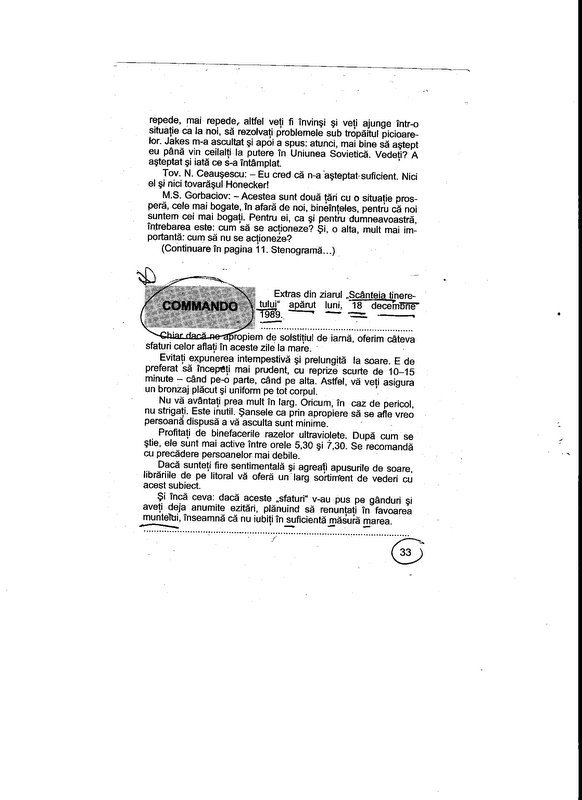
Significance:   The morning after the bloodbath in Timisoara, a by-any-standard bizarre article entitled “Some [very specific] advice for those who find themselves at the ocean these days,” was published in the official central organ, Scinteia Tineretului.  From the beginning the explanation that this was a joke–who in the dead of December would be vacationing at the beach in these days?–as the claimed author of this article later maintained was implausible.  The morning after the Timisoara massacre, when the Ceausescu regime was across the board in a high-state of alert, when the regime was desperately attempting to cover up that anything was wrong, on that morning the author and the editors decided this would be a good time for a joke about summer vacations?  Highly unlikely, and downright suicidal under such circumstances.  Of somewhat greater plausibility is the suggestion that the article was either an effort to communicate to would-be protesters about how to carefully assemble, or that this was the coded message of some KGB/GRU mole to Russian agents in the country.  Neither of these stands up very well either.  Everybody knew then as now, but especially in those tense days, that the Securitate controlled what got published and it is hard to see either of these scenarios playing out.  Another more plausible scenario is that it was from the Romanian military, a DIA message.  However, given the relationship between DIA and the Securitate at that time–not good–it is hard to see that happening.  Moreover, what is most significant, and what would seem to confirm the most likely scenario that it was a Securitate coded-message to undercovers in the field in light of what had happened in Timisoara, is that we now know the Romanian military was trying to divine the meaning of the message during December 1989 and January 1990.  Most significant in this regard are the revelations/interpretations below by General Dan Ioan.

Photo from http://www.agentia.org/anchete/decriptarea-textului-din-scanteia-tineretului-321.html
“Citeva sfaturi pentru cei aflati in aceste zile la mare,” Scinteia Tineretului, 18 decembrie 1989
Photo from “Decriptarea textului din Scanteia Tineretului,” Luni, 28 decembrie 2009 11:51 by Mihaela G.

http://www.agentia.org/anchete/decriptarea-textului-din-scanteia-tineretului-321.html

Aceasta este decriptarea trimisa CSAT in 2007 – Declansati, pe neasteptate, planul ”Soare”. Incepeti prudent, cu operatiuni scurte, de 10-15 minute, simultan in mai multe zone, pana la acoperirea intregii tari.2 – Nu depasiti obiectivele. Altfel sunteti in mare pericol si nu va va ajuta nimeni.3 – Bazati-va pe sprijinul trupelor speciale care au rol activ intre orele 5,30 si 7,30 in scopul recuperarii ranitilor.4 – Devastati librariile si distrugeti ”operele alese” (cartile lui Ceausescu – n.r.) pentru instigare si intimidare.5 – Pentru nehotarati: nu tradati scopul, daca va iubiti tara.

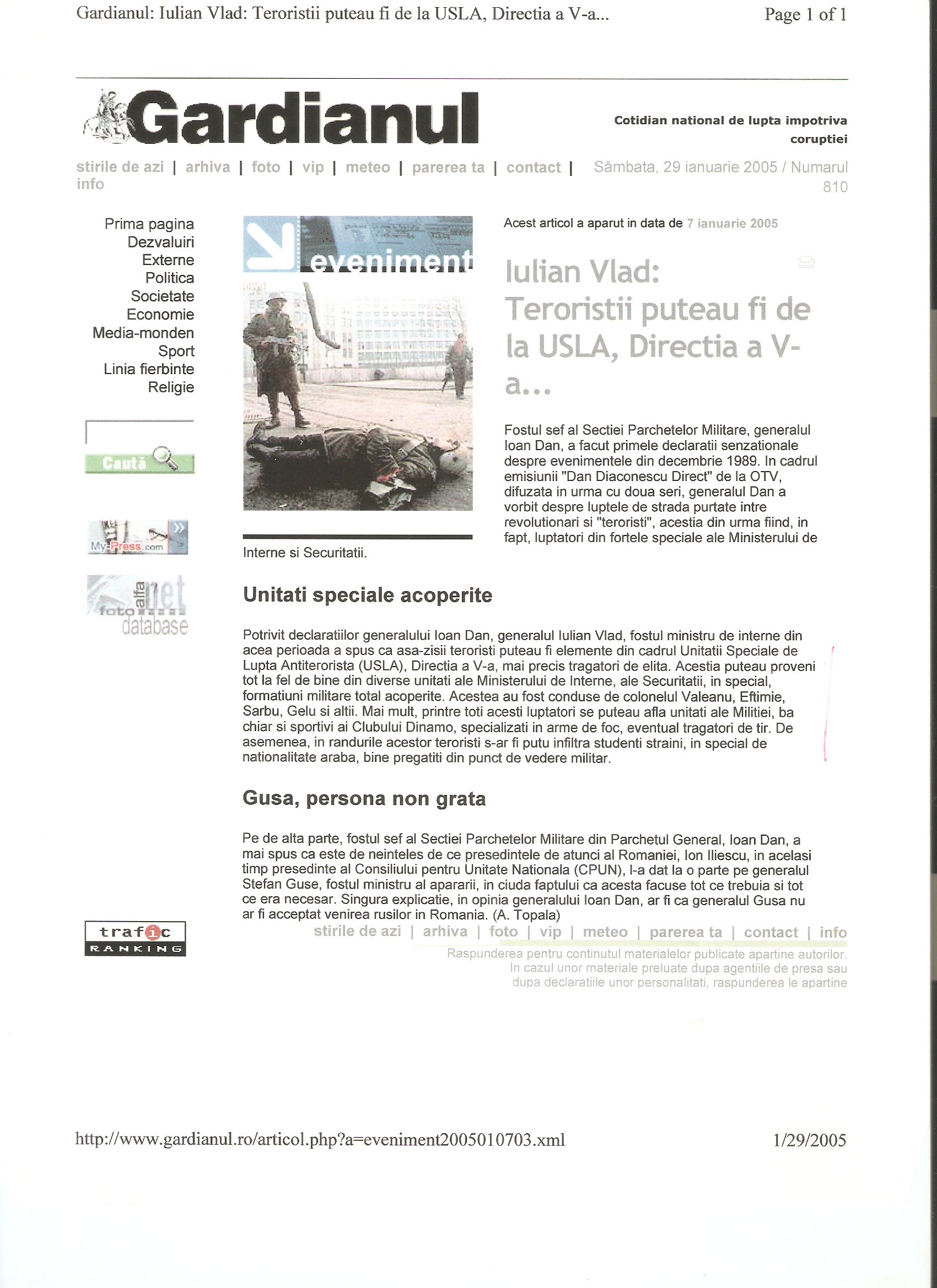
Securitate General Iulian Vlad’s Declaration of 29 January 1990 identifying the “terrorists”:  http://atomic-temporary-3899751.wpcomstaging.com/2013/11/20/when-a-truth-commission-misses-crucial-evidence-the-romanian-cpadcr-final-report-and-securitate-general-iulian-vlads-declaration/

“Acel articol a fost un cosmar pentru mine. In 22 decembrie au aparut fluturasi in Bucuresti cu “sfaturile ” din “Scinteia Tineretului “. Cine avea xeroxuri in acea vreme?”, se intreaba Sorin Preda. Am fost anchetat de Ministerul Apararii Nationale pentru ca generalul Militaru a considerat sau i s-a sugerat ca articolul meu era un semnal si pentru teroristi. Articolul il scrisesem cu patru zile inainte de aparitie si avea o introducere in care explicam caracterul lui umoristic. Nu stiu de ce acea introducere a disparut.”
 
…Buna ziua. Imi pare rau sa spun asta dar nu cred nici cat negru sub unghie ceea ce declara dl. Sorin Preda legat de articolul referitor la “sfaturile” pentru cei aflati pe litoral “la plaja” pe 18 Decembrie 1989. Este absurd. Ar fi prea multe coincidente. Eu detin ziarul respectiv in intregime. La vremea aceea eram ofiter activ in Brasov si vreau sa va spun ca dupa aparitia articolului, imediat dupa teleconferinta tinuta de Ceausescu in 17.12.1989, evenimentele au inceput sa se desfasoare intocmai cum era “ordonat” in “sfaturile” aparute in Scinteia Tineretului din 18.12.1989. Daca doriti sa va dau si decodificarea articolului o fac bucuros.Cu stima,Mircea
——————————————————————————
Mircea Ferestrăuariu avea 25 de ani în decembrie 1989 şi era locotenent în cadrul Şcolii Militare de Ofiţeri Activi şi Artilerie Antiaeriană şi Radiolocaţii „Leontin Sălăjan” din Braşov. Îşi aminteşte clar cum s-a răspândit în unitatea militară zvonul că „e ceva” cu articolul din „Scînteia tineretului”, că ar fi un articol codat şi cum, după câteva zile, a apărut şi o decodare pe care mai toată lumea din unitate şi-o copia de pe o fiţuică.  Mircea Ferestrăuariu are şi-acum decodarea, într-o cutie cu documente din casă. „Nu ştiu cum a intrat în şcoală decodarea, cine a adus-o, de unde, dar ea părea veridică. Iar la sfârşitul decodării scria că ea fusese făcută de un maior şi de un căpitan, maiorul Ioan Ardelean şi căpitanul Ioan Hendre. Numele nu-mi erau cunoscute, nu erau din unitatea noastră.  Oricum, eu sunt absolut convins că articolul a fost un ordin codat către forţele de represiune care nu făceau parte din structurile militare. Cine se duce la mare în decembrie să facă plajă şi baie? E de neconceput ca la vremea respectivă să apară un astfel de articol şi nimeni să nu sesizeze că e ceva aberant”.

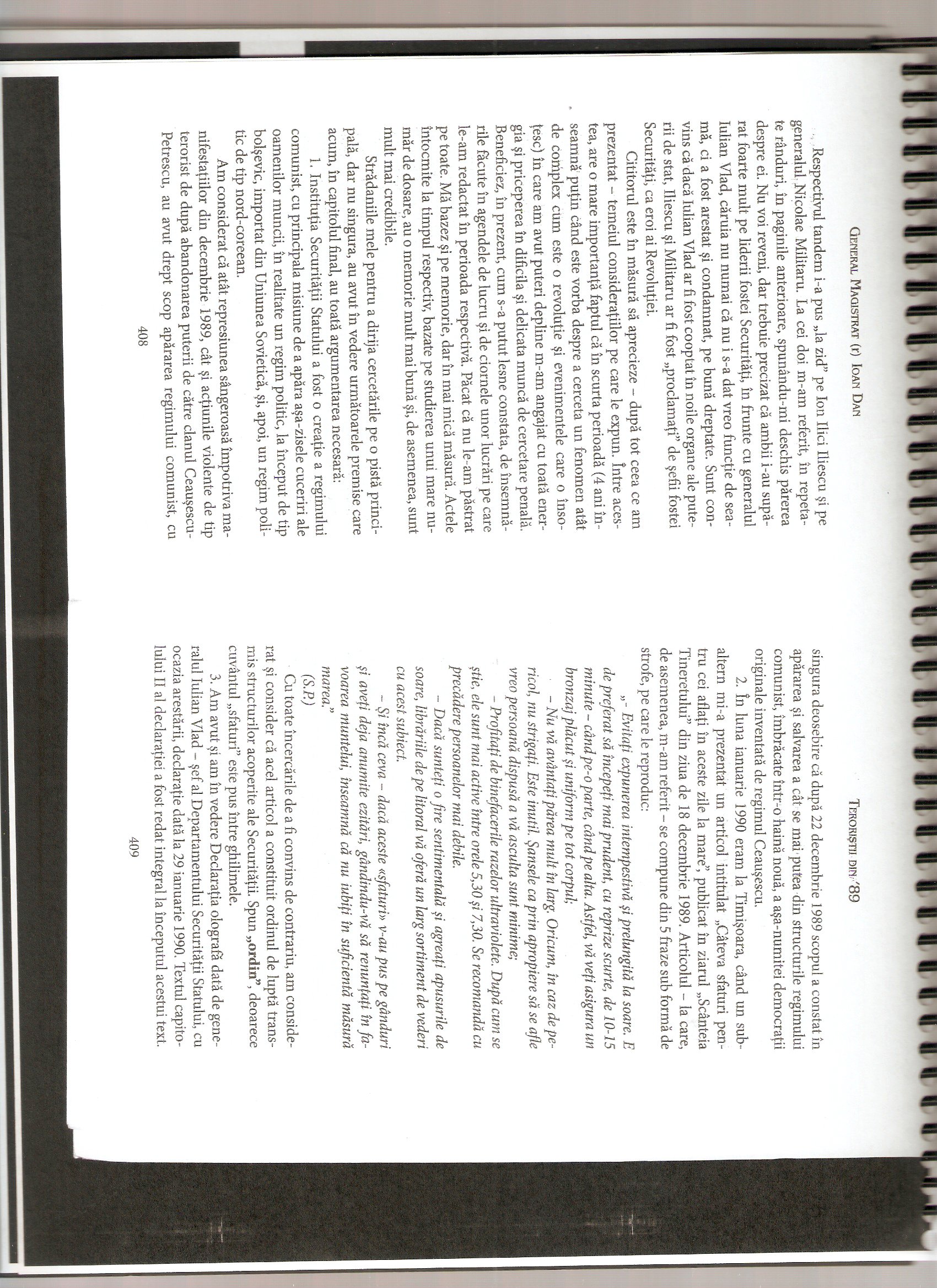
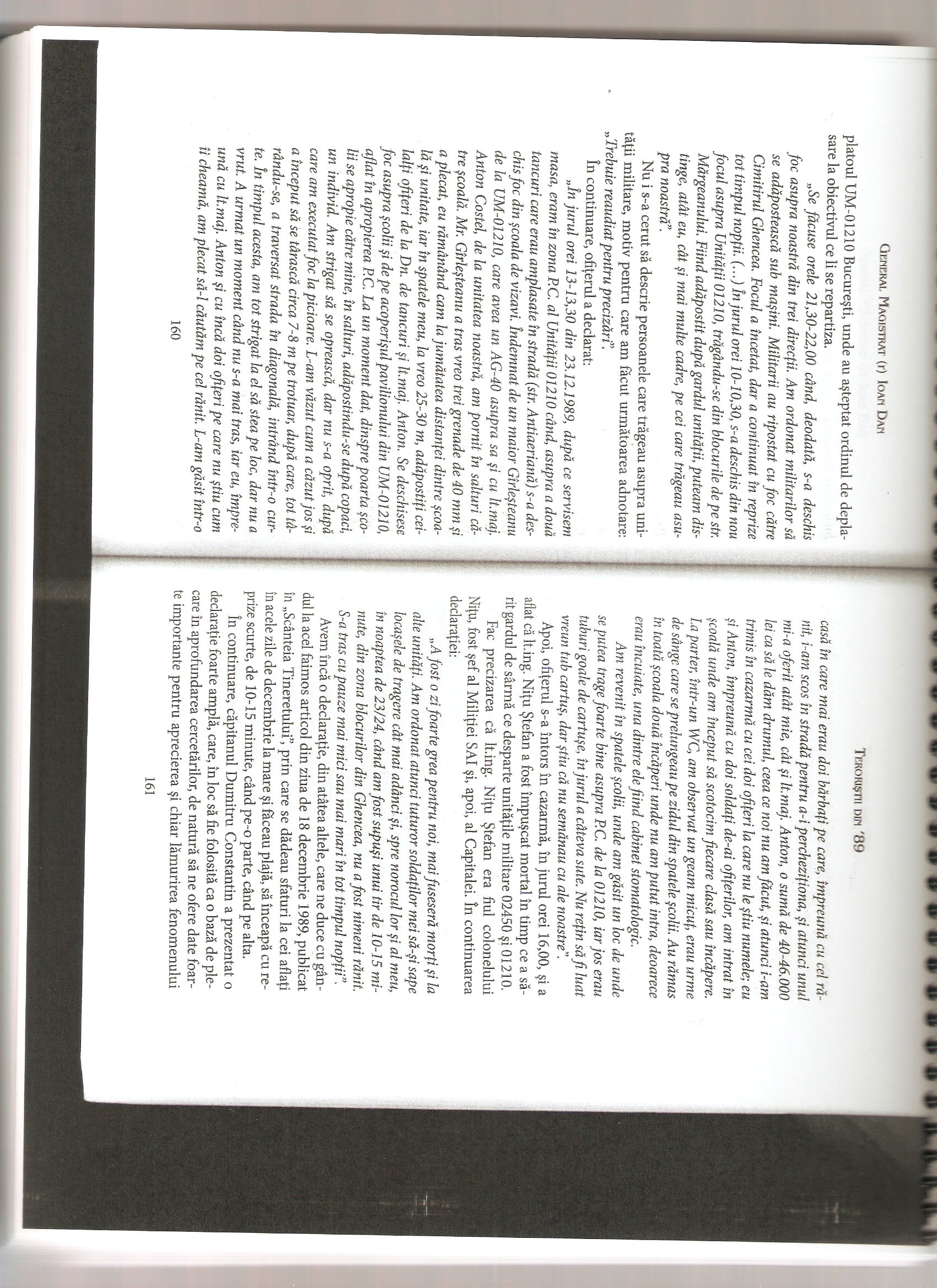
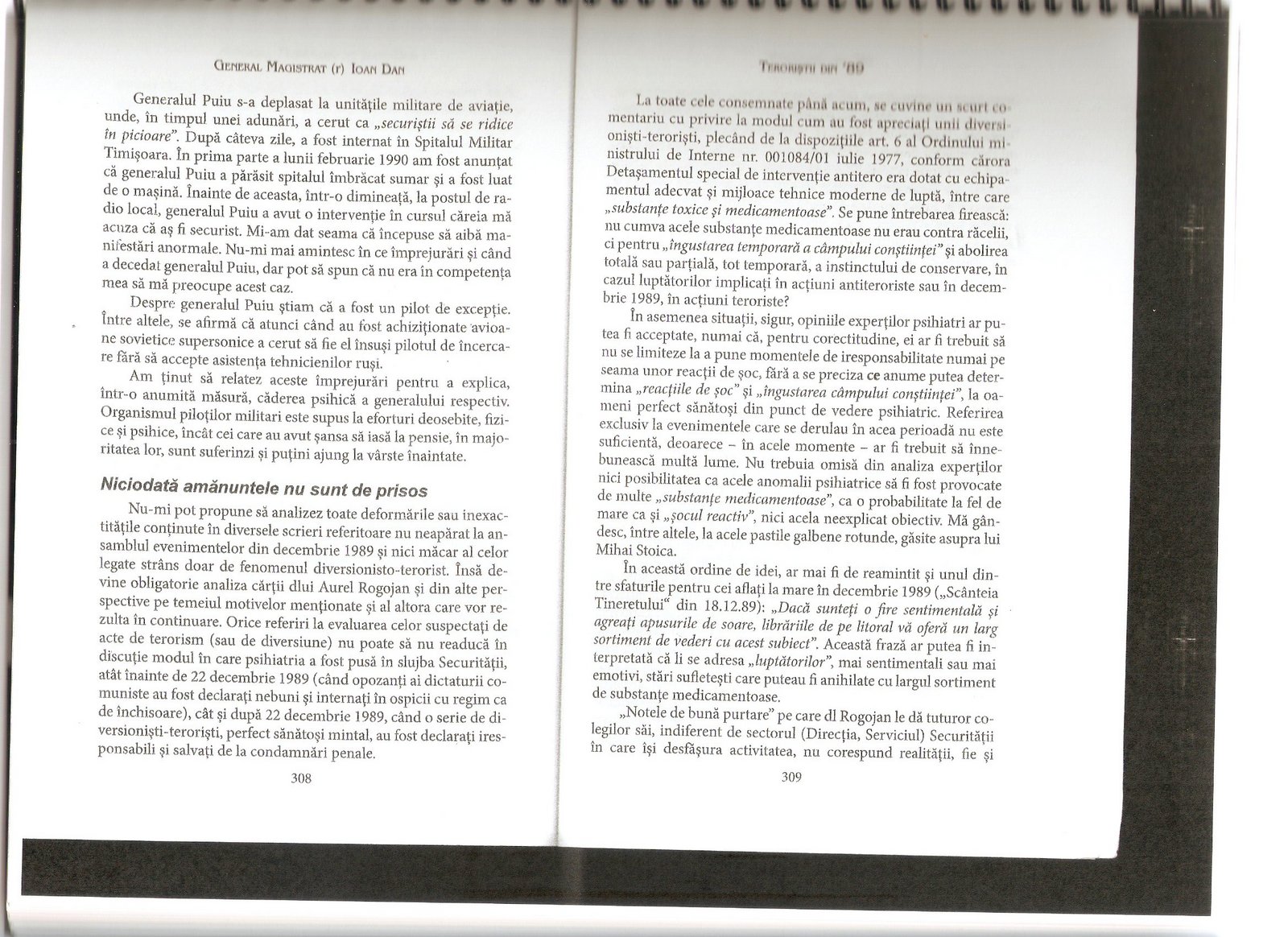
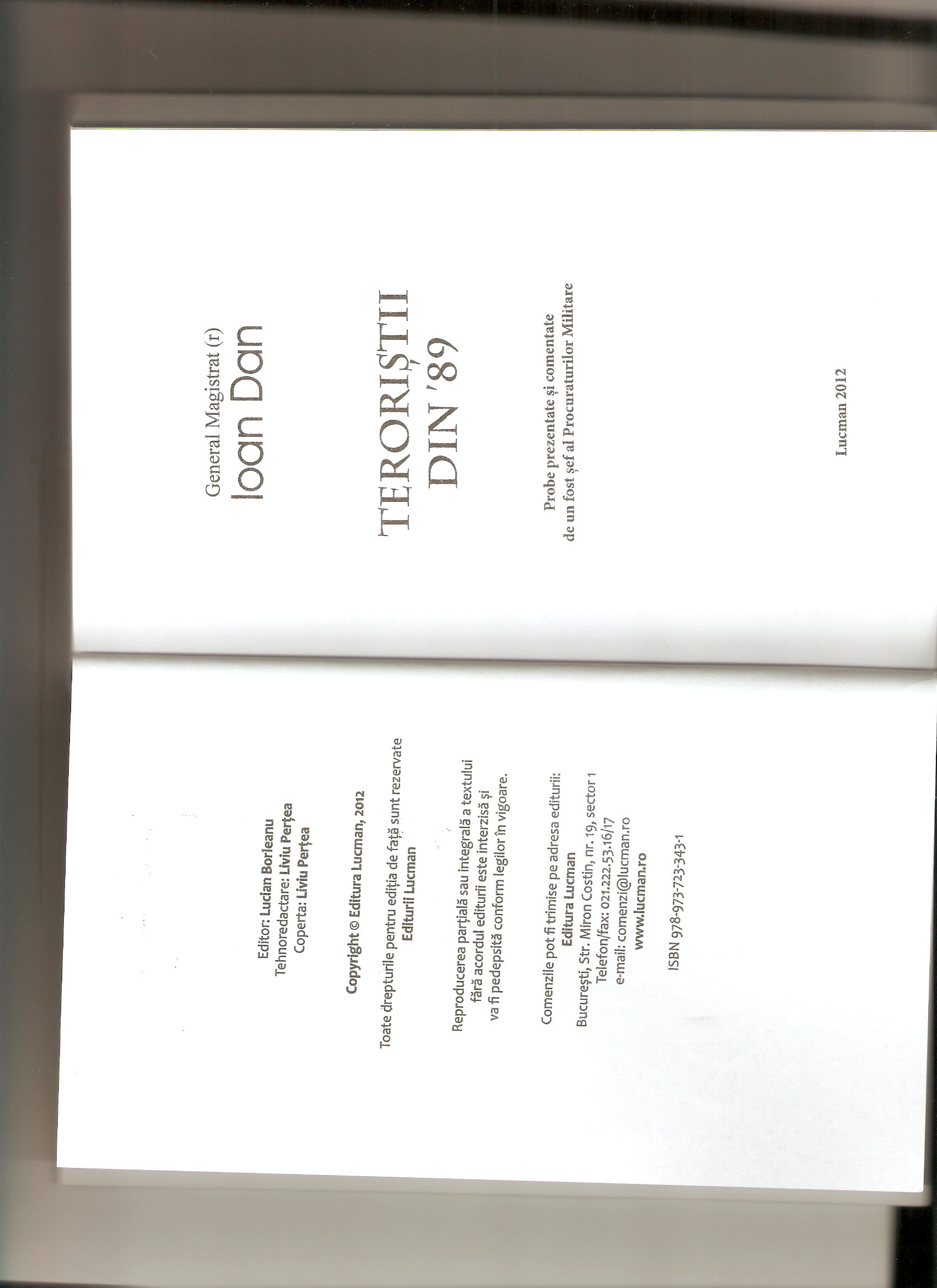
General Magistrat (r) Ioan Dan, Teroristii din ’89 (Lucman, 2012):

In luna ianuarie 1990 eram la Timisoara, cand un subaltern mi-a prezentat un articol intitulat “Cateva sfaturi pentru cei aflati in aceste zile la mare,” publicat in ziarul ‘Scanteia Tineretului’ din ziua de 18 decembrie 1989.  Articolul–la care, de asemenea, m-a referit–se compune din 5  fraze sub forma de strofe, pe care le reproduc:

image0-001

Cu toate incercarile de a fi convins de contrariu, am considerat si consider ca acest articol a constituit ordinul de lupta transmis structurilor acoperite ale Securitatii.  Spun “ordin”, deoarece cuvantul “sfaturi” este pus intre ghilimele.

image0

“Avem inca o declaratie, din atatea altele, care ne duce cu gandul la acel faimos articol din ziua de 18 decembrie 1989, publicat in “Scanteia Tineretului”, prin care se dadeau sfaturi la cei aflati in acele zile de decembrie la mare si faceau plaja, sa inceapa cu reprize scurte, de 10-15 minute, cand pe-o parte, cand pe alta.”

image0-001

p. 309 In aceaste ordine de idei…

Ion Costin Grigore, Cucuveaua cu pene rosii (1994, Editura Miracol)


Textul din Scateia Tineretului:”Citeva sfaturi pentru cei aflati in aceste zile la mare”*Evitati expunerea intempestiva si prelungita la soare. E de preferat sa incepeti mai prudent, cu reprize scurte de 10-15 minute – cand pe-o parte, cand pe alta. Astfel, va veti asigura un bronzaj placut si uniform.* Nu va avantati prea mult in larg. Oricum, in caz de pericol, nu strigati. Este inutil. Sansele ca prin apropuiere sa se afle vreo persoana dispusa a va asculta sunt minime.* Profitati de binefacerile razelor ultraviolete. Dupa cum se stie, ele sunt mai active intre orele 5,30 si 7,30. Se recomanda cu precadere persoanelor mai debile.* Daca sunteti o fire sentimentala si agreati apusurile soarelui, librariile de pe litoral va ofera un larg sortiment de vederi cu acest subiect.* Si inca ceva – daca aceste <sfaturi> v-au pus pe ganduri si aveti deja anumite ezitari, gandindu-va sa renuntati in favoarea muntelui, inseamna ca nu iubiti in suficienta masura marea. (S.P.)”Aceasta este decriptarea trimisa CSAT in 20071 – Declansati, pe neasteptate, planul ”Soare”. Incepeti prudent, cu operatiuni scurte, de 10-15 minute, simultan in mai multe zone, pana la acoperirea intregii tari.2 – Nu depasiti obiectivele. Altfel sunteti in mare pericol si nu va va ajuta nimeni.3 – Bazati-va pe sprijinul trupelor speciale care au rol activ intre orele 5,30 si 7,30 in scopul recuperarii ranitilor.4 – Devastati librariile si distrugeti ”operele alese” (cartile lui Ceausescu – n.r.) pentrui instigare si intimidare.5 – Pentru nehotarati: nu tradati scopul, daca va iubiti tara.
—————————————
“Acel articol a fost un cosmar pentru mine. In 22 decembrie au aparut fluturasi in Bucuresti cu “sfaturile ” din “Scinteia Tineretului “. Cine avea xeroxuri in acea vreme?”, se intreaba Sorin Preda. Am fost anchetat de Ministerul Apararii Nationale pentru ca generalul Militaru a considerat sau i s-a sugerat ca articolul meu era un semnal si pentru teroristi. Articolul il scrisesem cu patru zile inainte de aparitie si avea o introducere in care explicam caracterul lui umoristic. Nu stiu de ce acea introducere a disparut.”
…Buna ziua. Imi pare rau sa spun asta dar nu cred nici cat negru sub unghie ceea ce declara dl. Sorin Preda legat de articolul referitor la “sfaturile” pentru cei aflati pe litoral “la plaja” pe 18 Decembrie 1989. Este absurd. Ar fi prea multe coincidente. Eu detin ziarul respectiv in intregime. La vremea aceea eram ofiter activ in Brasov si vreau sa va spun ca dupa aparitia articolului, imediat dupa teleconferinta tinuta de Ceausescu in 17.12.1989, evenimentele au inceput sa se desfasoare intocmai cum era “ordonat” in “sfaturile” aparute in Scinteia Tineretului din 18.12.1989. Daca doriti sa va dau si decodificarea articolului o fac bucuros.Cu stima,Mircea
——————————————————————————
Mircea Ferestrăuariu avea 25 de ani în decembrie 1989 şi era locotenent în cadrul Şcolii Militare de Ofiţeri Activi şi Artilerie Antiaeriană şi Radiolocaţii „Leontin Sălăjan” din Braşov. Îşi aminteşte clar cum s-a răspândit în unitatea militară zvonul că „e ceva” cu articolul din „Scînteia tineretului”, că ar fi un articol codat şi cum, după câteva zile, a apărut şi o decodare pe care mai toată lumea din unitate şi-o copia de pe o fiţuică.  Mircea Ferestrăuariu are şi-acum decodarea, într-o cutie cu documente din casă. „Nu ştiu cum a intrat în şcoală decodarea, cine a adus-o, de unde, dar ea părea veridică. Iar la sfârşitul decodării scria că ea fusese făcută de un maior şi de un căpitan, maiorul Ioan Ardelean şi căpitanul Ioan Hendre. Numele nu-mi erau cunoscute, nu erau din unitatea noastră.  Oricum, eu sunt absolut convins că articolul a fost un ordin codat către forţele de represiune care nu făceau parte din structurile militare. Cine se duce la mare în decembrie să facă plajă şi baie? E de neconceput ca la vremea respectivă să apară un astfel de articol şi nimeni să nu sesizeze că e ceva aberant”.
—————————————————————-
Photo from “Decriptarea textului din Scanteia Tineretului,” Luni, 28 decembrie 2009 11:51 by Mihaela G.
Photo from http://www.agentia.org/anchete/decriptarea-textului-din-scanteia-tineretului-321.html

Decriptarea textului din Scanteia Tineretului

  • Luni, 28 decembrie 2009 11:51
  • |
  • 2309 vizualizari
  • |
  • Anchete
Sfaturi catre securisti in decembrie ’89Pe Ceausescu l-a doborat “o gluma” * In ziarul UTC, in plina iarna apare textul “Sfaturi pentru cei aflati in aceste zile la mare” * La Timisoara era razboi civil, Armata tragea in populatie * Dupa 12 ani, un general din contraspionaj a trimis decriptarea textului la CSAT * Autorul sustine ca a scris un text umoristicIn data de 18 decembrie 1989, in timp ce in Timisoara era razboi civil, “Scanteia Tineretului” a publicat, in pagina 5, un text straniu, care nu avea nicio logica. Textul a facut valva la acea vreme, ca si in anii imediat urmatori Revolutiei. Erau sfaturi pentru cei ce se bronzau in acel moment, adica in mijlocul lunii decembrie, la mare. Textul a atras atentia imediat, in sensul ca semana cu un semnal incifrat pentru a se declansa ceva – dar pana azi contextul aparitiei sale nu a fost elucidat. A ramas ”o gluma”. In decembrie 2007, un general activ din contraspionajul romanesc a trimis decriptarea textului pentru a fi citita intr-o sedinta a Consiliului Suprem de Aparare a Tarii (CSAT). El era consilier in cadrul CSAT la acea vreme.
Textul din Scateia Tineretului:”Citeva sfaturi pentru cei aflati in aceste zile la mare”*Evitati expunerea intempestiva si prelungita la soare. E de preferat sa incepeti mai prudent, cu reprize scurte de 10-15 minute – cand pe-o parte, cand pe alta. Astfel, va veti asigura un bronzaj placut si uniform.* Nu va avantati prea mult in larg. Oricum, in caz de pericol, nu strigati. Este inutil. Sansele ca prin apropuiere sa se afle vreo persoana dispusa a va asculta sunt minime.* Profitati de binefacerile razelor ultraviolete. Dupa cum se stie, ele sunt mai active intre orele 5,30 si 7,30. Se recomanda cu precadere persoanelor mai debile.* Daca sunteti o fire sentimentala si agreati apusurile soarelui, librariile de pe litoral va ofera un larg sortiment de vederi cu acest subiect.* Si inca ceva – daca aceste <sfaturi> v-au pus pe ganduri si aveti deja anumite ezitari, gandindu-va sa renuntati in favoarea muntelui, inseamna ca nu iubiti in suficienta masura marea. (S.P.)”

Aceasta este decriptarea trimisa CSAT in 2007 – Declansati, pe neasteptate, planul ”Soare”. Incepeti prudent, cu operatiuni scurte, de 10-15 minute, simultan in mai multe zone, pana la acoperirea intregii tari.2 – Nu depasiti obiectivele. Altfel sunteti in mare pericol si nu va va ajuta nimeni.3 – Bazati-va pe sprijinul trupelor speciale care au rol activ intre orele 5,30 si 7,30 in scopul recuperarii ranitilor.4 – Devastati librariile si distrugeti ”operele alese” (cartile lui Ceausescu – n.r.) pentru instigare si intimidare.5 – Pentru nehotarati: nu tradati scopul, daca va iubiti tara.

Autorul spune ca a fost o glumaAutorul articolului, Sorin Preda, a declarat atat in fata anchetatorilor Ministerului Apararii cat si in presa, ca el a scris un text umoristic si atat. Adica cele cinci paragrafe, care au avut trimitere pe prima pagina, nu aveau nicio legatura cu Revolutia si a fost o simpla intamplare faptul ca au sunat atat de straniu in acele zile. Trebuie mentionat aici ca fisetul in care se pastrau manuscrisul si spaltul acestor ”sfaturi” a fost spart iar obiectele mai sus mentionate au disparut in timpul evenimentelor de dupa 22 decembrie 1989.Mihaela G.

25 for 2014: 25 Things You Should Know about the Romanian Revolution on the 25th Anniversary of the Fall of Nicolae Ceausescu’s Communist Regime: #1 The Securitate Deny Foreign Instigation of the Timisoara Uprising

25 for 2014: 25 Things You Should Know about the Romanian Revolution on the 25th Anniversary of the Fall of Nicolae Ceausescu’s Communist Regime: #2 Shattered Glass: Securitate Vandalism to Justify Timisoara Crackdown

25 for 2014: 25 Things You Should Know about the Romanian Revolution on the 25th Anniversary of the Fall of Nicolae Ceausescu’s Communist Regime: #3 “Anti-terrorism” and Regime Repression

25 for 2014: 25 Things You Should Know about the Romanian Revolution on the 25th Anniversary of the Fall of Nicolae Ceausescu’s Communist Regime: #4 Timisoara Demonstrators Injured and Killed by Dum-Dum Bullets

25 for 2014: 25 Things You Should Know about the Romanian Revolution on the 25th Anniversary of the Fall of Nicolae Ceausescu’s Communist Regime: #5 Timisoara (Podul Decebal) Evidence Suggests only the Securitate Had Dum-Dum Bullets

Posted in decembrie 1989 | Tagged: , , , , , , , , , | 2 Comments »

“Doi revolutionari, doua destine…” “1.500.000 dolari–C.C.–Emanatii Revolutiei” si alte articole despre Rebeca Doina Cercel si Revolutia din 1989

Posted by romanianrevolutionofdecember1989 on September 27, 2014

(purely personal views as always, based on two decades of prior research and publications)

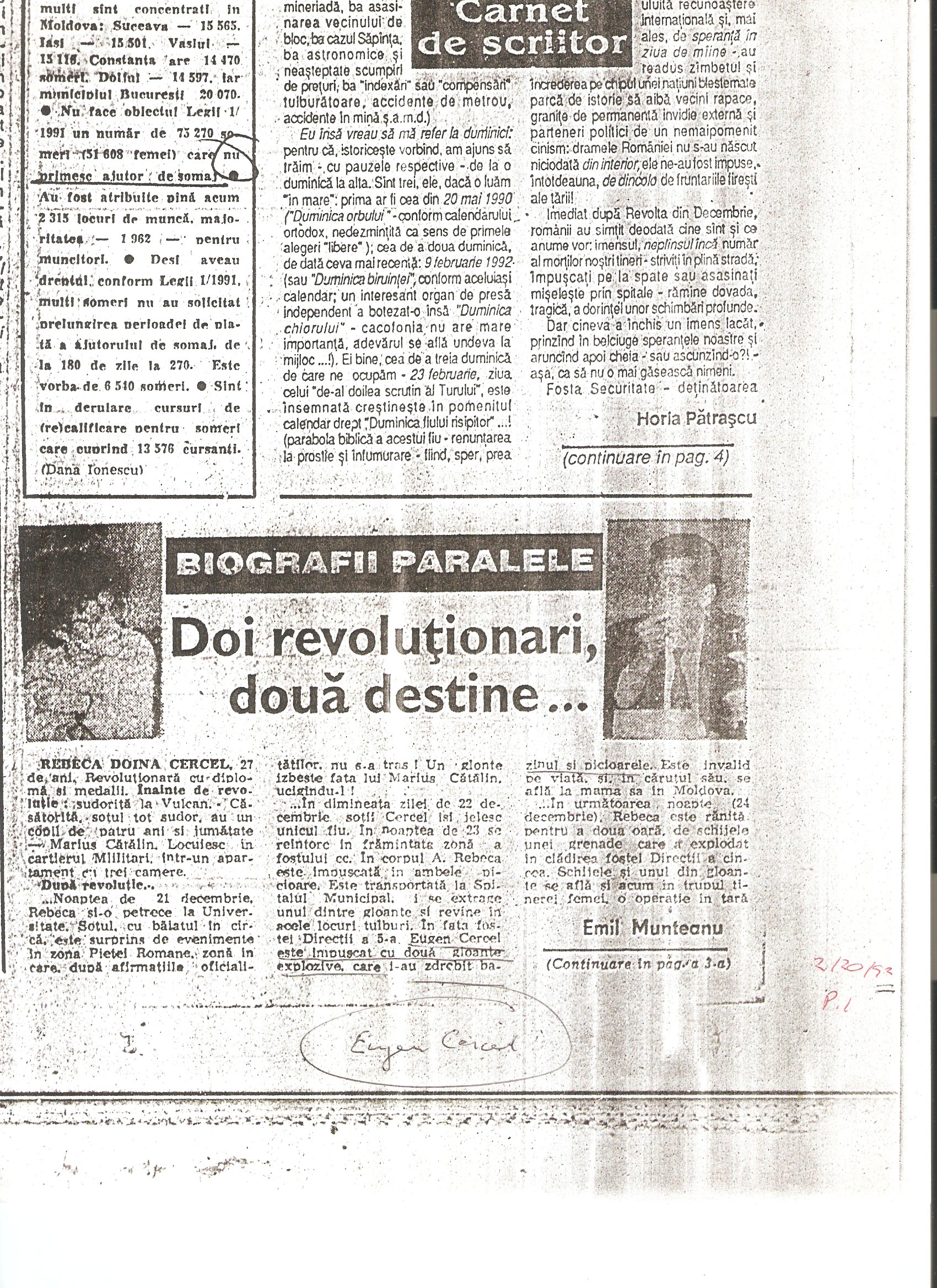
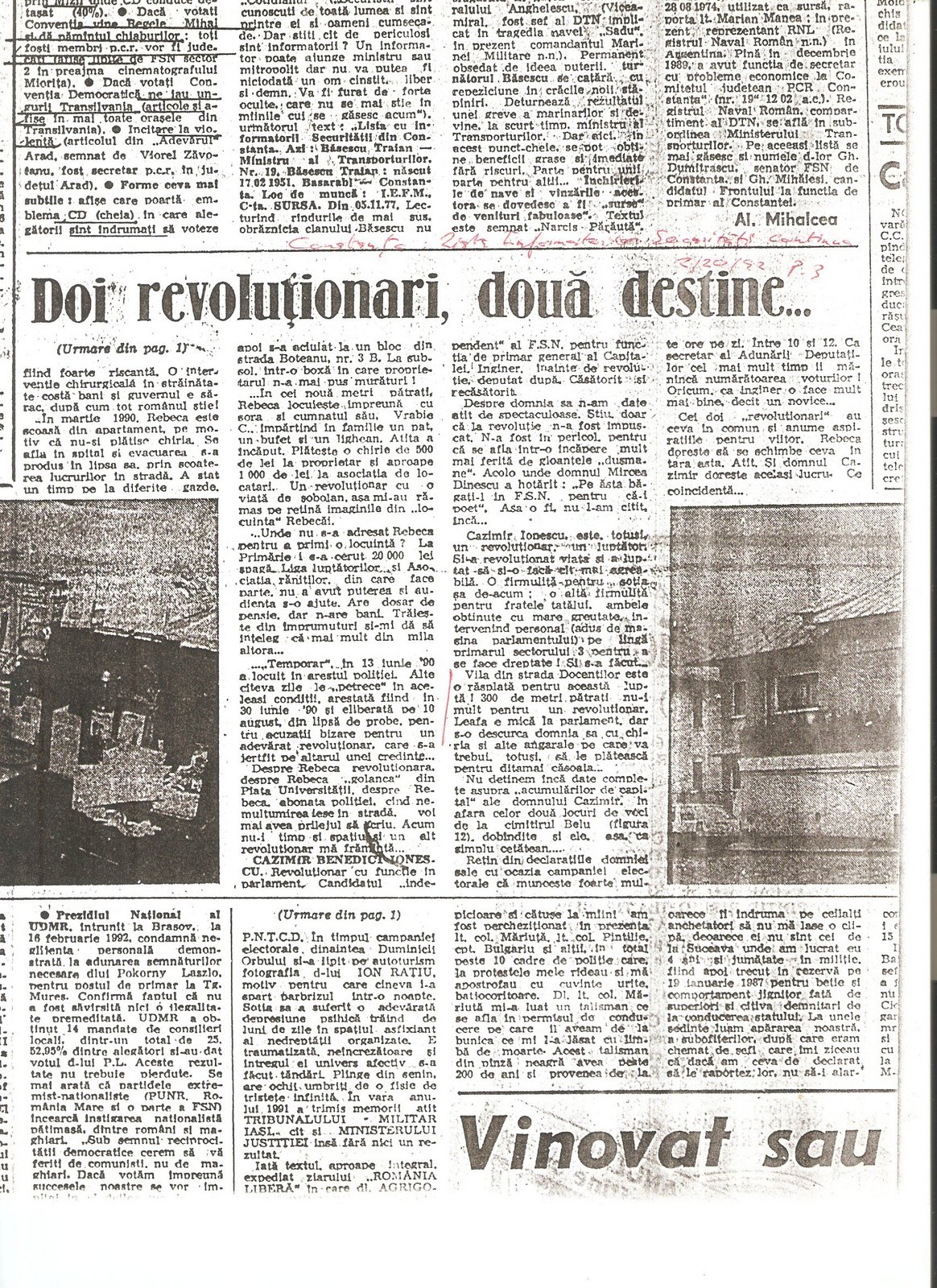
“In noaptea de 23 se reintorc in framintate zona a fostului cc.  In corpul A. Rebeca este impuscata in ambele picioare.  Este transportata la Spitalul Municipal.  I se extrase unul dintre gloante si revine in acele locuri tulburi.  In fata Directii a 5-a.  Eugen Cercel este impuscat cu doua gloante explozive care i-au zdrobit bazinul si picioarele.  Este invalid pe viata, si in carutul sa, se afla la mama sa in Moldova...”

Emil Munteanu, “Doi revolutionari [Rebeca Doina Cercel si Cazimir Benedict Ionescu], doua destine…” Romania Libera, 20 februarie 1992, p. 1.

image0

image0-003

http://atomic-temporary-3899751.wpcomstaging.com/2014/09/25/rebeca-doina-cercel-revolutionar-cc-pcr-decembrie-1989-erau-intr-adevar-dosare-pe-care-era-scris-strict-secret-si-in-care-am-vazut-ca-erau-mentionate-bazele-de-antrenament-antiterorist/

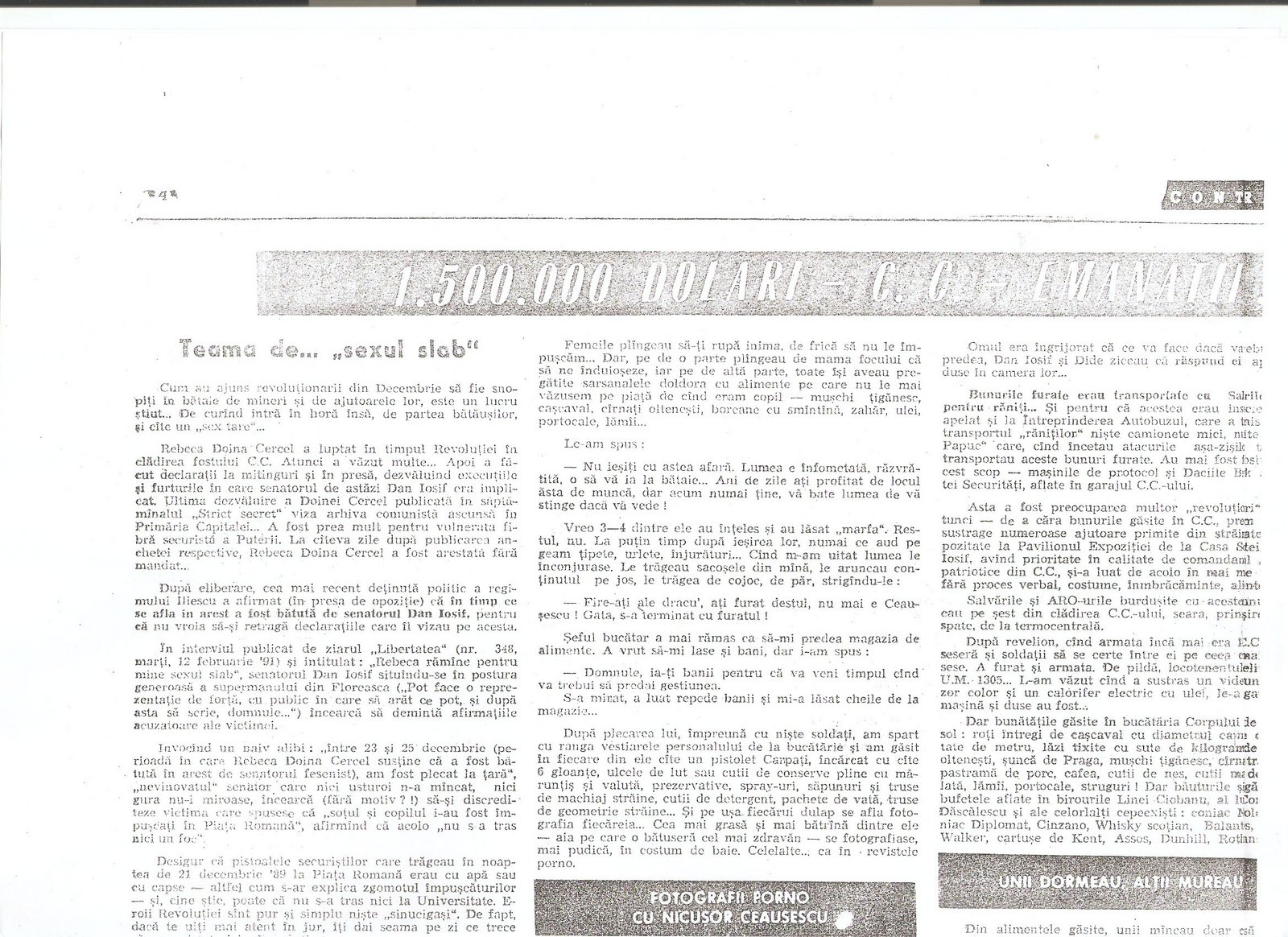
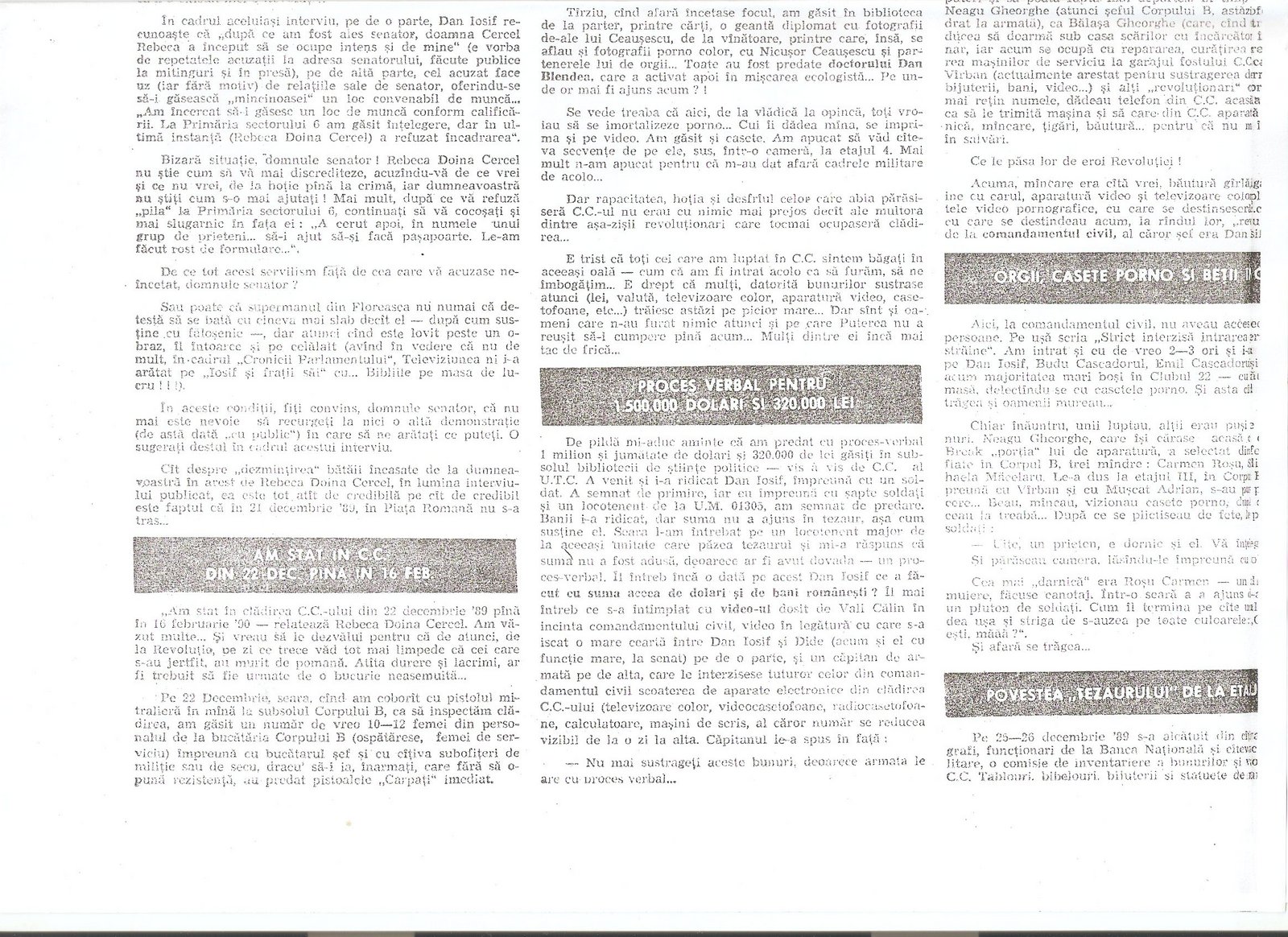
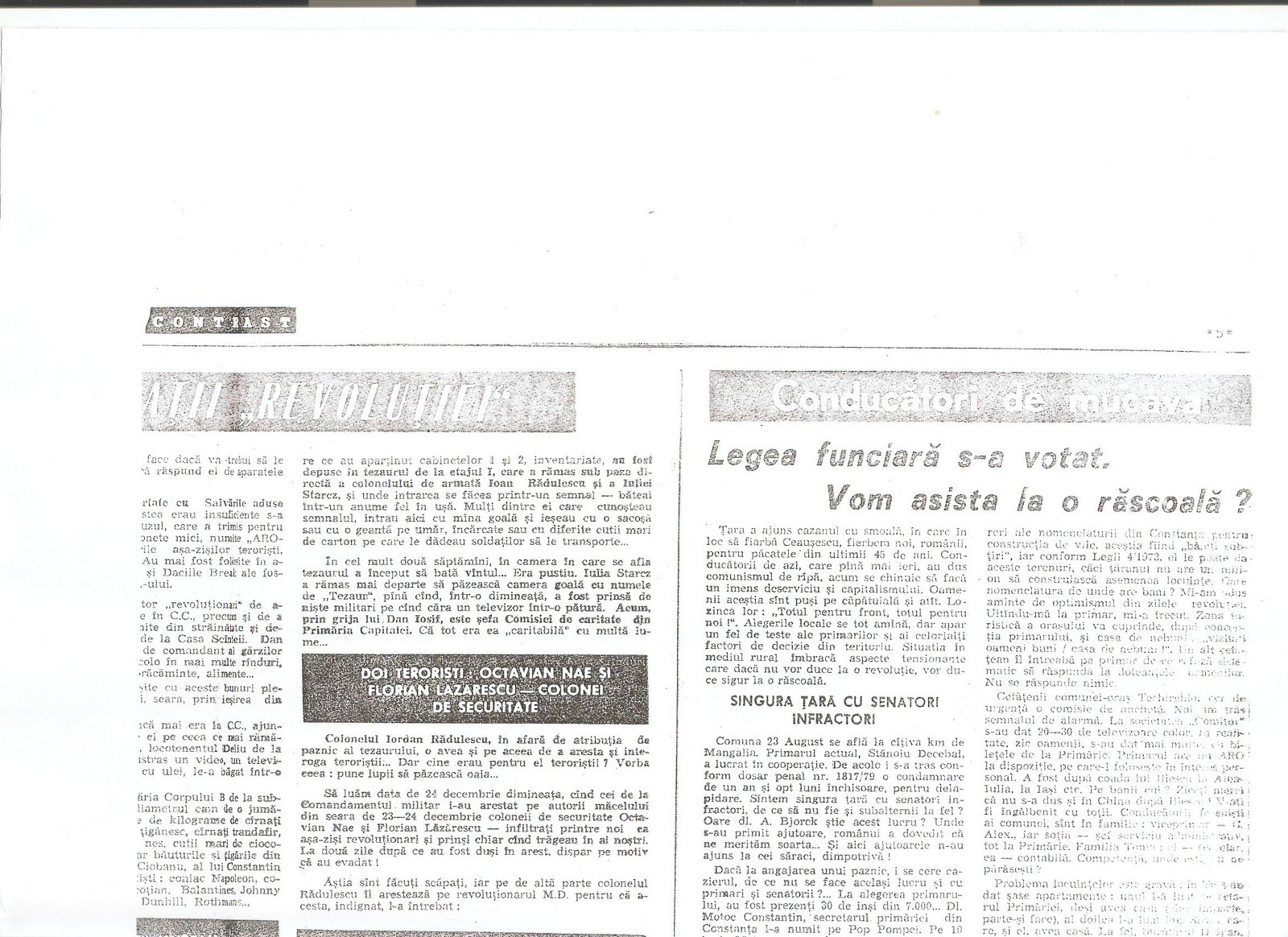
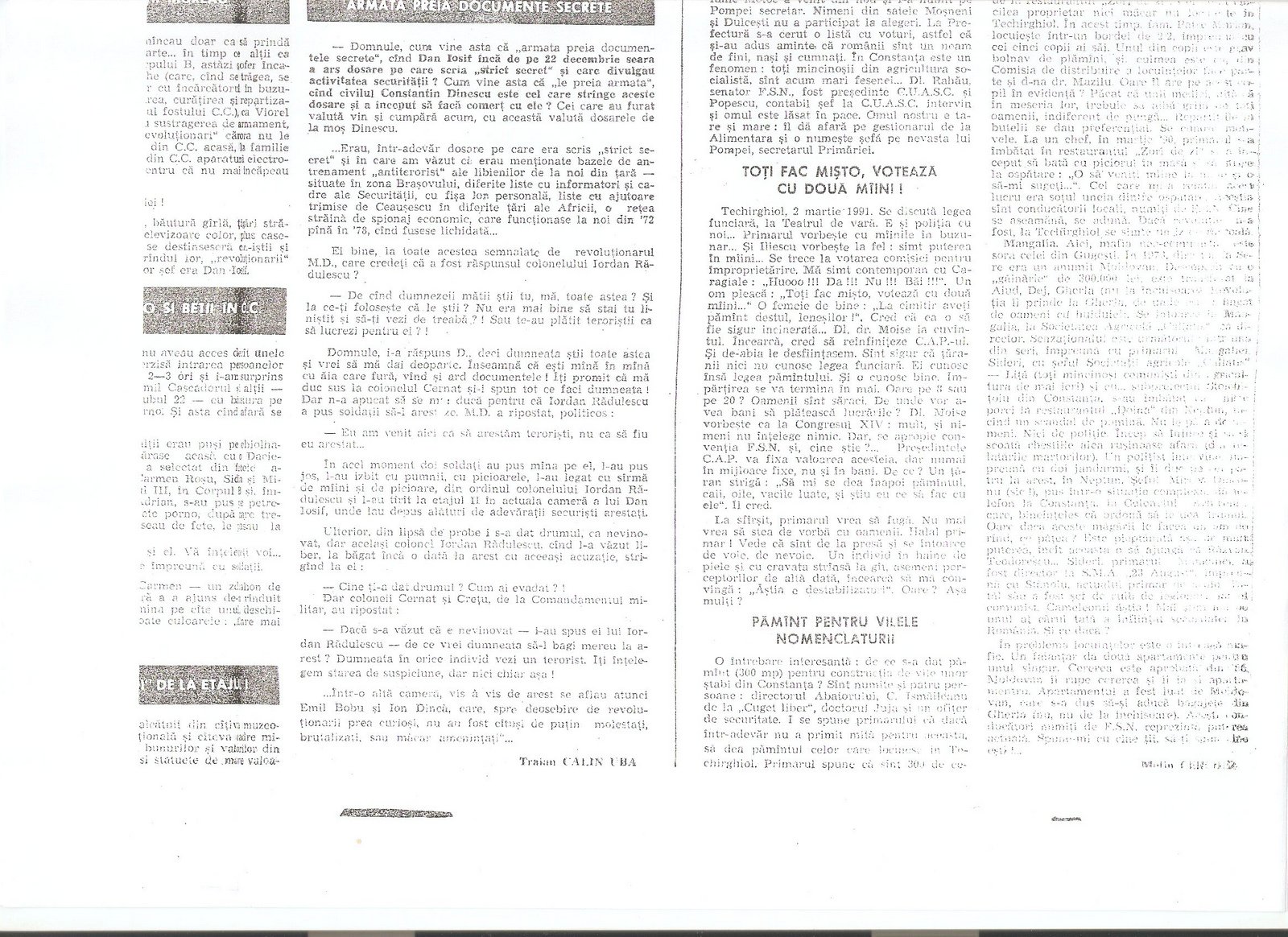
Rebeca Doina Cercel cu Traian Calin Uba, “1.500.000 dolari–C.C.–Emanatii ‘Revolutiei’” Contrast (Constanta), nr. 9 (49) 8-14 martie 1991, pp. 4-5.

image0-005

image0-007

image0-009

image0-012

 http://atomic-temporary-3899751.wpcomstaging.com/2013/07/07/after-the-ceausescus-were-executed-the-counter-revolution-is-disappeared-26-december-1989-24-january-1990/

11 January 1990

Mai tirziu in 11 ianuarie [1990], cind toata lumea spunea iarasi ‘civili sa predea armele’ impreuna cu Cercel Doina Rebeca am intrat in buncarul subteran din CC si am mai prins inca opt insi.  Au tras–daca nu era Rebeca era a treia oara cind muream….

Mihai Barbulescu, “Teroristi infiltrati in rindurile revolutionarilor,” Expres Magazin, nr. 21, 1991, p. 11.

http://atomic-temporary-3899751.wpcomstaging.com/2014/09/06/before-the-narratives-of-december-1989-consolidated-slight-return-looking-through-the-272-issues-of-the-pntcds-dreptatea-newspaper-from-1990/

Posted in decembrie 1989, raport final | Tagged: , , , , , , , , , | Leave a Comment »

Dinel Staicu (fost USLA), Craiova, si decembrie 1989

Posted by romanianrevolutionofdecember1989 on September 26, 2014

(purely personal views as always, based on two decades of prior research and publications)

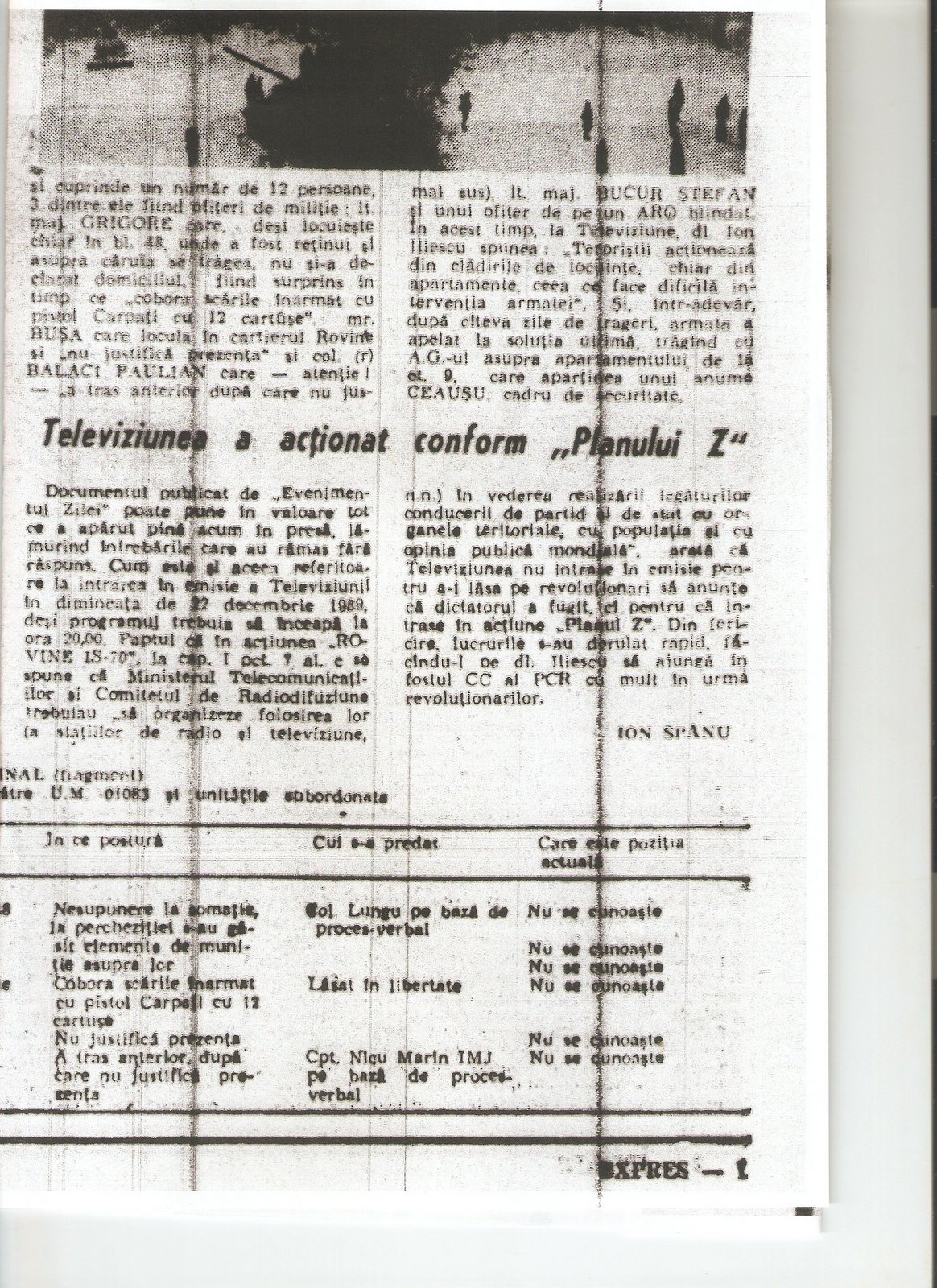
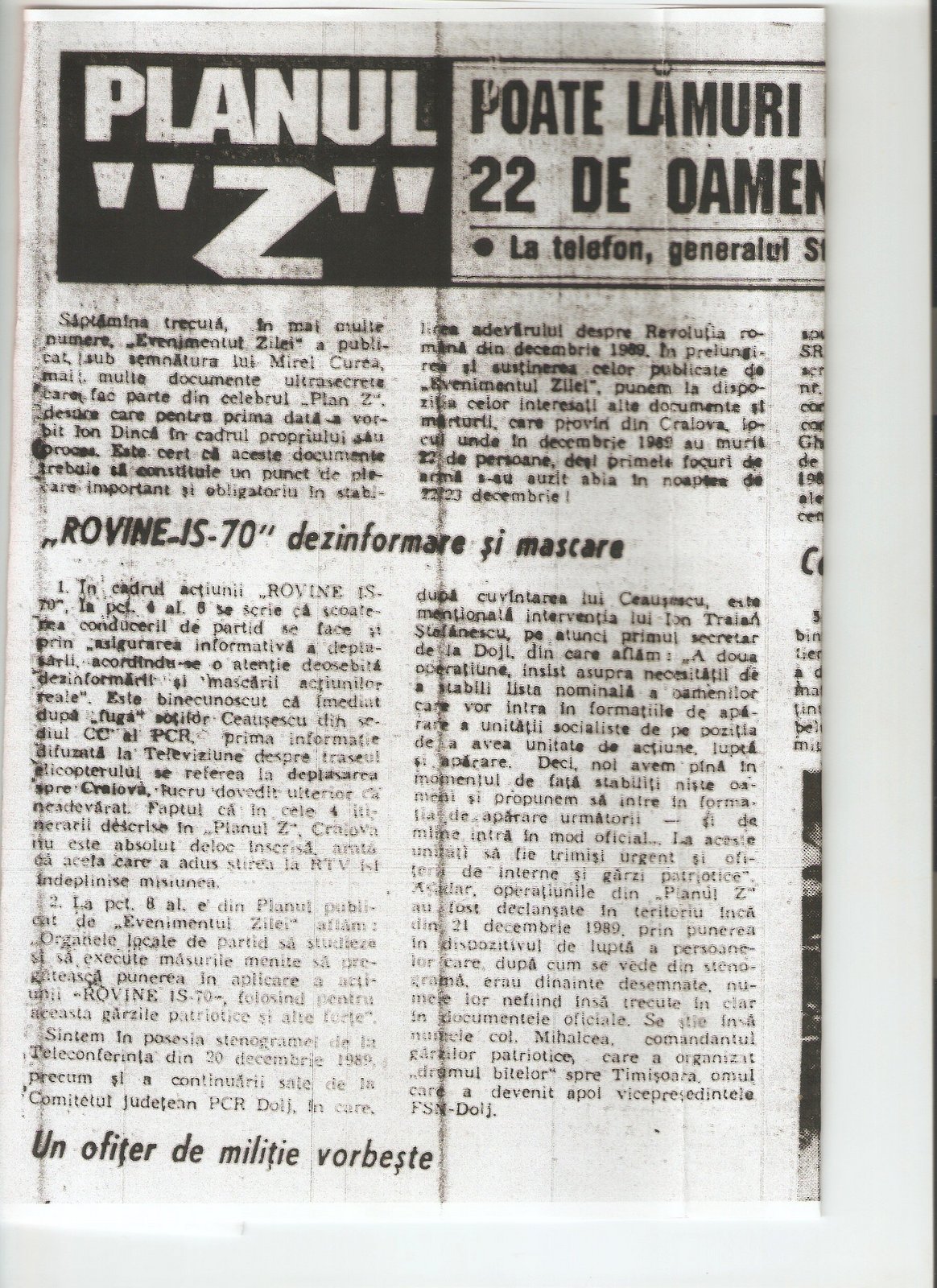
Ion Spanu, “Un ofiter de militie vorbeste despre ostateteci ai revolutionarilor,” Expres nr. 28 (179), 13-19 iulie 1993.

image0

http://ro.wikipedia.org/wiki/Dinel_Staicu

Dinel Staicu: „Misiunea mea a fost sa-l infiltrez pe Sandu in prefectura“

Ca fost comandant al grupei a II-a de patrundere si capturare din cadrul Militiei doljene, Dinel Staicu a fost bagat pina la briu in evenimentele din „22“. Cind a plecat din politie, in ’92, a luat cu el multe secrete. Dar nu a lepadat uniforma, pina nu a dezvaluit ce rol a avut el pe scena miscarilor revolutionare de la Craiova. Reproducem, mai jos, parte din marturiile livrate de ex-capitanul Dinel Staicu, pe 8 aprilie 1992, revistei craiovene Cartel.Dinel Staicu a circulat in zilele acelea fara oprelisti, intrind si iesind in prefectura, de fiecare data fiind inarmat, in ciuda perchezitiilor care i se faceau. Interesant daca in scriptele unitatii din acea perioada figureaza ridicarea armei sale, pentru ca, daca nu, inseamna ca, de acum, fostul ofiter poate sa posede si in prezent arme de foc. Dupa ce a fost consemnat la domiciliu timp de sase zile, pentru portul armei in evenimente, el si-a reluat misiunea: „… De data asta reusesc, il infiltrez atit de bine pe domnul Sandu, imi era doar sef si sefii trebuie sa stea in fata“.
Implicat si in cercetarea cauzelor din care se tragea in perioada aceea in Valea Rosie (cartier secerat metru cu metru de gloante), silit de catre fostul comandant al militiei, colonelul Langa, sa-i dau dreptate generalului Rosu, referitor la existenta unor gloante vidia in urma condamnarii la domiciliu, Dinel Staicu incearca o diversiune pentru inlaturarea celor care luasera conducerea (Nisipeanu, Popa), montind studentii aflati pe pozitii in Casa Studentilor. Actiunea lui de atunci a dat gres. La citva timp dupa aceasta, un alt grup de interes din prefectura n-a mai ratat. El poate fi admirat si astazi in fruntea judetului. La ora aceea, militia facea inca politica. Desi a stat inca in cazarma, securitatea (col. Gheorghe) „a imprumutat d-lui D. Staicu doua TAB-uri si citiva oameni din plutonul USLA al Securitatii (nu cel al militiei), desi cei de la Securitate primisera ordin sa nu mai ridice armament. Dar dl Staicu venea din partea Frontului…
In urma cercetarilor facute de el in Valea Rosie, Staicu sustine ca n-au fost teroristi (desi el insusi este un contraexemplu), pregatirea lui de baza (comandant al grupei a 2-a USLA) fiind si pentru diversiune, si pentru dezinformare. Parerea lui este ca armata a tras milioane de cartuse si ca, peste tot unde au fost unitati militare, pamintul s-a umplut de treburi. Numai ca il contrazice unitatea militara din Craiovita unde nu s-a tras. (…)
Dinel Staicu se considera singurul implicat cu adevarat in evenimentele din decembrie „singurul care-i capacitasem pe toti,… si totul a fost cum am vrut eu“. De aici sa intelegem ca artizanul „Revolutiei“ craiovene a fost un locotenent de militie?
Referitor la activitatea de atunci a sefilor lui, Staicu declara: „In zilele de dupa erau: Langa, Vaduva, Velicu, Sandu… Erau prezenti mai mult cu fizicul, in rest erau absenti total. Cam asta a fost aportul lor. Erau un fel de ostatici… Atunci, ceea ce puteai sa lucrezi era cam ceea ce am facut eu. Sa-i organizez pe studenti, sa linistesc starea de spirit“.
In ceea ce priveste vinovatii pentru victimele din decembrie ’89, pentru ca s-a tras in Craiova, Staicu e de parere ca „sint vinovati cu intentie si vinovati fara intentie, adica vinovati din culpa, asa-zisii incompetenti. Ca au fost generali sau au fost plutonieri, nu are importanta doar daca au avut capacitate de decizie“.
La intrebarea daca in Craiova evenimentele ar fi putut sa se desfasoare fara varsare de singe, ni se raspunde: „Cu o conditie, daca in Craiova n-ar fi existat unitati militare“.
Si iata ca, dupa atita osteneala, lt. maj. Staicu Dinel nici macar nu a fost avansat, de aceste binefaceri beneficiind „unii care n-au avut nici in clin, nici in mineca cu Revolutia“. Intr-un tirziu a fost totusi inaintat la gradul de capitan, ocazie cu care a avut urmatoarea conversatie cu colonelul (de-acum, generalul de miine? Asta ne-ar mai lipsi – n.r.) Sandu: „Ba, eu te-am facut capitan la exceptional. Imi pare rau, cam ai dreptate, dar de ce-mi strigi chestia asta? „…Dumneavoastra ati inceput“. In ceea ce priveste institutia in care a lucrat capitanul Staicu, relativ la „curatirea“ personalului, dl Staicu este drastic: „Este imposibil sa faca asa ceva, pentru ca ar trebui sa lichidezi 80-90% din efective, ceea ce nu se face peste noapte, se face in timp“.
Iata ca, pe masura ce trece timpul, capitanul isi pierde prietenii, care uita ca au fost avansati la exceptional datorita lui si incep sa-l marginalizeze. (Dl Sandu, pe care-l consideram… zice: „Mai putin Staicu – de la arme – referitor cu participarea la o sedinta“). Simtind aceasta marginalizare, Staicu, orientat deja spre zona afacerilor (deschisese chiar un gratar impreuna cu un amic de-ai sai, care i-a creat baza economica a „viitorului om de afaceri“, inca din anul 1990), ca orice politist care se respecta s-a apucat de cu totul altceva decit ii lasa dreptul legea, avind in vedere ca inca era functionar public. In virtutea experientei cu negustorii in general pentru ca „Eram anchetator la cercetare penala, in general lucram la dosare economice, de comert. D-aia ma pricep acum la afaceri, ca am invatat de la negustori“.
Si cum militia este „casa negustorilor“, a avut de unde invata.

http://www.gds.ro/print/13885

http://atomic-temporary-3899751.wpcomstaging.com/2011/10/18/episodul-gloante-vidia-sau-uite-si-eu-am-o-mostra-din-martie-aprilie-1991/

from one of my publications, Hall 2006

Craiova: Finally, there is the case of one of the big personalities of the post-Ceausescu era, Dinel Staicu, a one-time soccer club mogul and owner of a kitschy Ceausescu nostalgic restaurant and park/museum.[48] Apparently, he “shot 63 bullets during the events,” but “according to him ‘only 11 to 13 stupid people died”[49]:

“Dinel Staicu moved about in those days unhindered, entering and exiting the prefecture, each time being armed, despite the interrogations to which he had been subject.  It would be interesting to know if the seizure of his weapons was recorded because, if not, it means, he still possesses them [the article dates from 1992].  After he was confined to his home for six days, for carrying an arm during the events, he resumed his mission:  ‘This time I succeeded to infiltrate Mr. Sandu, since he was my boss and bosses must stay at the helm.’  Implicated during this period in the policing of Valea Rosie (a neighborhood that had been raked by gunfire), forced by the former Militia commander, Colonel Langa, to verify to General Rosu [Army], the existence of vidia bullets following his confinement to his home, Dinel Staicu attempted a diversion in order to replace those who had seized power (Nisipeanu, Popa), …Although [technically-speaking] it was still confined to barracks, the Securitate (col. Gheorghe) ‘lent Mr. D. Staicu two TAB vehicles and some men from the Securitate’s USLA platoon (not from the Militia), even though the Securitate had been ordered not to carry arms.  But Mr. Staicu came on behalf of the Front…’

Following the inspection he performed in Valea Rosie, Staicu maintained that there were no terrorists (despite the fact that he himself is an example that contradicts such a denial), his basic training (Commander of Group 2-a USLA) being both for diversion and disinformation.  His opinion is that the Army fired millions of cartridges and that anywhere there was a military unit, the earth filled up with them.  Only that the military unit from Craiovita where there was no firing disputes this (…)[50]

In other words, a member of the USLA denies the existence of vidia bullets and “terrorists”….

http://atomic-temporary-3899751.wpcomstaging.com/2010/09/29/%E2%80%9Corwellian%E2%80%A6positively-orwellian%E2%80%9D-prosecutor-voinea%E2%80%99s-campaign-to-sanitize-the-romanian-revolution-of-december-1989-part-iii-a-fistful-of-bullets-unregistered-atyp/

image0-003

image0-005

image0-007

“Antimafia”–un Armagedon de Craiova, Adevarul, 3 mai 2002

image0-009

Posted in decembrie 1989, raport final | Tagged: , , , , , , | Leave a Comment »

Rebeca Doina Cercel (revolutionar, CC PCR, decembrie 1989): “Erau intr-adevar dosare pe care era scris ‘strict secret’ si in care am vazut ca erau mentionate bazele de antrenament ‘antiterorist’ ale libienilor de la noi din tara–situate in zona Brasovului”

Posted by romanianrevolutionofdecember1989 on September 25, 2014

(purely personal views as always, based on two decades of prior research and publications)

Rebeca Doina Cercel cu Traian Calin Uba, “1.500.000 dolari–C.C.–Emanatii ‘Revolutiei'” Contrast (Constanta), nr. 9 (49) 8-14 martie 1991, pp. 4-5.

image0-002

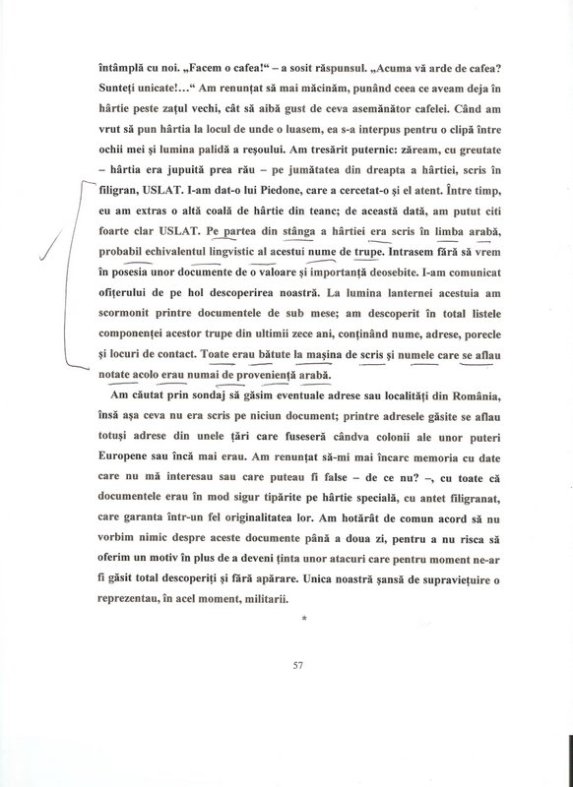
si Viorel Ringhilescu, prezent si el in cladirea CC PCR, spune ca el a vazut documente USLA in limba araba…

‘USLAT-externe’ (“Pe partea din stanga a hartiei era scris in limba araba, probabil echivalentul lingvistic al aceste nume de trupe.”…”Toate erau batute la masina de scris si numele care se aflau notate acolo erau numai de provenienta araba” O Revolutie Originala, Bucuresti 2008)

https://romanianrevolutionofdecember1989.com/wp-content/uploads/2011/08/image012.jpg

https://romanianrevolutionofdecember1989.com/wp-content/uploads/2011/08/image012.jpg

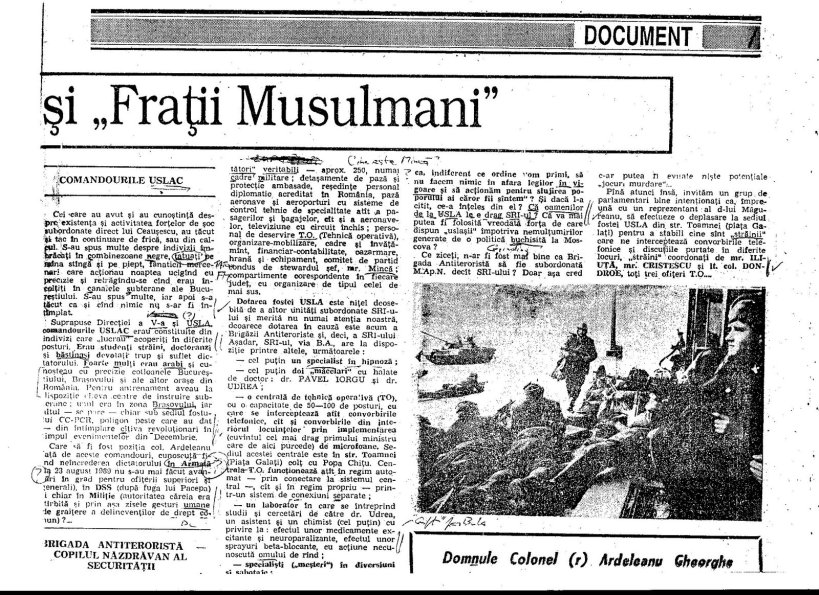
cu alte cuvinte, exact ce spunea Marian Romanescu, fost cadru USLA, in 1991:

Capitanul Romanescu Marian (fost cadru USLA) si Dan Badea, “USLA, Bula Moise, teroristii, si ‘Fratii Musulmani’,” Expres nr. 26 (75), 2-8 iulie 1991, pp. 8-9)

COMANDOURILE USLAC

Cei care au avut si au cunostinta despre existenta si activitatea fortelor de soc subordonate direct lui Ceausescu, au tacut si tac in continuare de frica, sau din calcul.  S-au spus multe despre indivizii imbracati in combinezoane negre, tatuati pe mina stinga si pe piept, fanaticii mercenari care actionau noaptea ucigind cu precizie si retragindu-se cind erau incoltiti in canalele subterane ale Bucurestiului.  S-au spus multe, iar apoi au tacut ca si cind nimic nu s-ar fi intimplat.

Suprapuse Directiei a V-a si USLA comandourile USLAC erau constituite din indivizi care “lucrau” acoperiti in diferite posturi. Erau studenti straini, doctoranzi si bastinasi devotati trup si suflet dictatorului.  Foarte multi erau arabi si cunosteau cu precizie cotloanele Bucurestiului, Brasovului si ale altor orase din Romania.  Pentru antrenament aveau la dispozitie citeva centre de instruire subterane:  unul era in zona Brasovului, iar altul–se pare–chiar sub sediul fostului CC-PCR, poligon care au dat–din intimplare citiva revolutionari in timpul evenimentelor din Decembrie.

image-13

Related:

http://atomic-temporary-3899751.wpcomstaging.com/2013/09/07/former-securitate-officials-who-corroborated-general-iulian-vlads-declaration-on-the-terrorists-liviu-turcu-ion-mihai-pacepa-radu-vasilevici-marian-romanescu-and-others/

http://atomic-temporary-3899751.wpcomstaging.com/2011/08/25/teroristii-din-decembrie-1989-camasile-negre-a-fekete-ingesek-the-black-shirts-uslac/

http://atomic-temporary-3899751.wpcomstaging.com/2014/01/10/nicolae-ceausescu-securitatea-libieni-cincufagarasbrasov-si-revolutia-romana/

http://atomic-temporary-3899751.wpcomstaging.com/2014/08/09/misterele-revolutiei-la-brasov-au-ars-dosarele-procuraturii-despre-evenimentele-din-decembrie-romulus-nicolae-cuvintul-nr-32-august-1991/

http://atomic-temporary-3899751.wpcomstaging.com/in-response-to-an-inquiry-by-professor-charles-king-of-georgetown-university/http://atomic-temporary-3899751.wpcomstaging.com/in-response-to-an-inquiry-by-professor-charles-king-of-georgetown-university/

Posted in decembrie 1989, raport final | Tagged: , , , , , , | 2 Comments »

A Tale of Two Letters by Securitate Director General Iulian Vlad: What the Romanian Press Does and Does Not Publish

Posted by romanianrevolutionofdecember1989 on September 23, 2014

(purely personal views as always, based on two decades of prior research and publications)

And one wonders why I found (find) mainstream Romanian studies so unhelpful in trying to understand Nicolae Ceausescu’s overthrow and the Romanian Revolution of December 1989?  Read Vladimir Tismaneanu or Tom Gallagher (or in its 2014 variation, see Grigore Pop-Eleches in Bernhard and Kubik) on Romania in the early 1990s and one is presented with a world of good and evil, of angels and demons, with distance from former nomenklaturist and high-ranking communist Ion Iliescu and the core of the National Salvation Front being as being the simple formula for explaining and understanding any event or policy.  As opposed to this highly–one might say blatantly–politically partisan [and bureaucratically ignorant] approach, on the other side stand functional or deconstructionist explanations–the kind favored by Peter Gross, Katherine Verdery, Peter Siani-Davies, or Ruxandra Cesereanu–which would explain the press of the time as the function of market pressures, sensationalist appetites, an anomic readership, poor journalistic training and professionalism, etc.

How then does one explain the following conundrum:  the selective treatment of the letters and declarations of former Securitate Director General Iulian Vlad?  Oh, yes, the text of General Vlad’s letters which allege he was a stooge and victim of Ion Iliescu, etc. can be found in the Romanian press.  No problem!  But what about his declaration of 29 January 1990, where he deftly admits the responsibility of his institution for the bloodshed of December?  What, that not sensationalist enough, different enough to sell papers?  That’s not “anti-communist” enough for publication?  Is it somehow less credible than the other letters whose text has been published without problem?  24 plus years later, the Romanian media has yet to publish this document!  Could it be that the problem with this declaration is that it does not fit with and undermines the other popular narratives of December 1989 that minimize and even absolve the former Securitate of responsibility for the bloodshed of December 1989?

image0-001

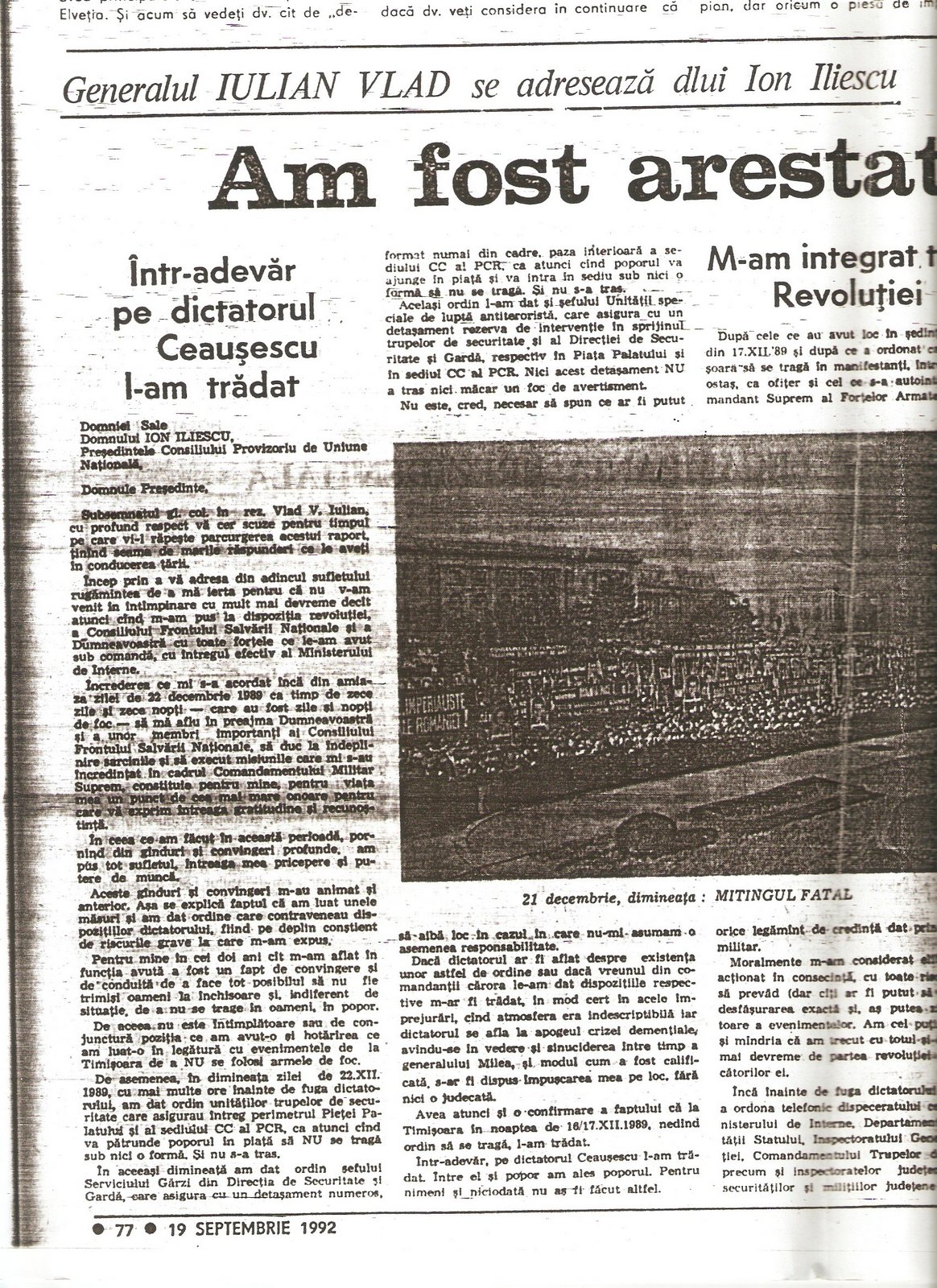
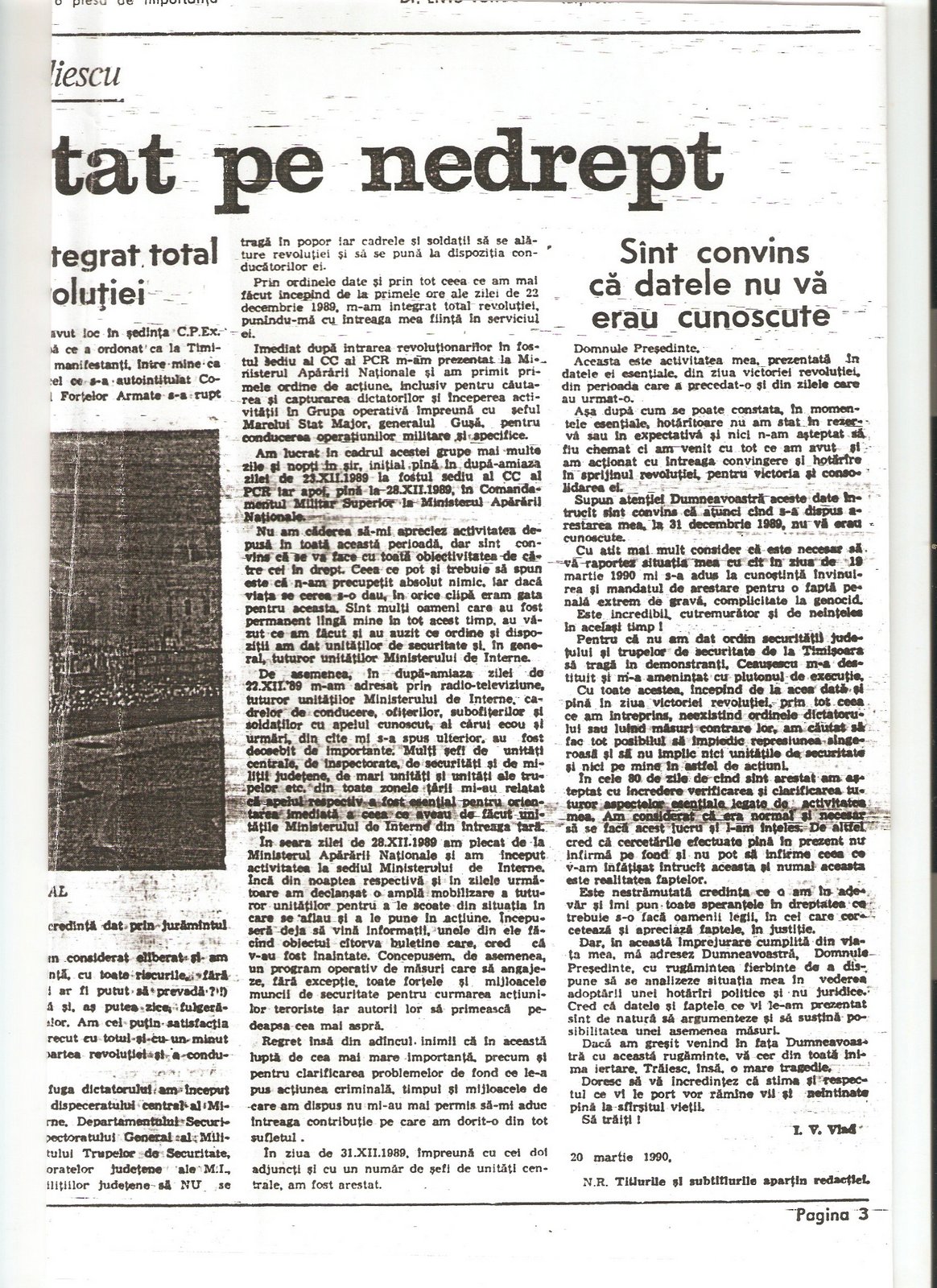
Ion Cristoiu’s Evenimentul Zilei debuted in June 1992 and was the flagship of opposition to the regime of Ion Iliescu.  In the fall of 1992 it ran a zealous campaign opposed to Iliescu’s reelection.  Here is the exculpatory letter from former Securitate General Iulian Vlad (dated 20 March 1990) that was published on 19 September 1992:

image0-004

“Generalul IULIAN VLAD se adreseaza dlui Ion Iliescu:  Am fost arestat pe nedrept (20 March 1990),” Evenimentul Zilei, 19 septembrie 1992, p. 3.  “Intr-adevar pe dictatorul Ceausescu l-am tradat” “M-am integrat total Revolutiei” “Sint convins ca datele nu va erau cunoscute”  I.V. Vlad 20 martie 1990

And, yet, what of General Iulian Vlad’s declaration of 29 January 1990.  As far as I know, in 24 plus years, only this brief allusive mention on the 15th anniversary of the letter (although not mentioned or acknowledged in the article, and possibly accidental) has made its way into the Romanian press.  Below it:  the text of the statement of 29 January 1990!

image0-005

http://atomic-temporary-3899751.wpcomstaging.com/text-of-securitate-general-iulian-vlads-29-january-1990-declaration-identifying-the-terrorists/

image0-001

It took 22 years for the text of Securitate Director General Iulian Vlad’s handwritten declaration of 29 January 1990 to become public knowledge–thanks to former military prosecutor General Ioan Dan.  (Inevitably, there will no doubt be those who will allege that General Vlad was “forced” to write this declaration to save his skin, etc., that this was the “propaganda of the moment” and all a huge lie.  If that were the case, one would have expected Iliescu, Brucan, Militaru, Voican Voiculescu, etc. to have made every effort for Vlad’s declaration to leak to the media.  Instead, for 22 years it was hidden from public knowledge!)

Of Note:  No “Soviet tourists,” no DIA (Batallion 404) troops of the army’s intelligence wing, no “there were no terrorists:  the Army shot into everyone else and into itself”–in other words, none of the spurious claims that have littered the narrative landscape, fueled by the former Securitate over the past two decades plus.  No, Vlad knew who the terrorists of the Romanian Revolution of December 1989 were, because they reported to him!

image0

image0-002

General Magistrat (r) Ioan Dan

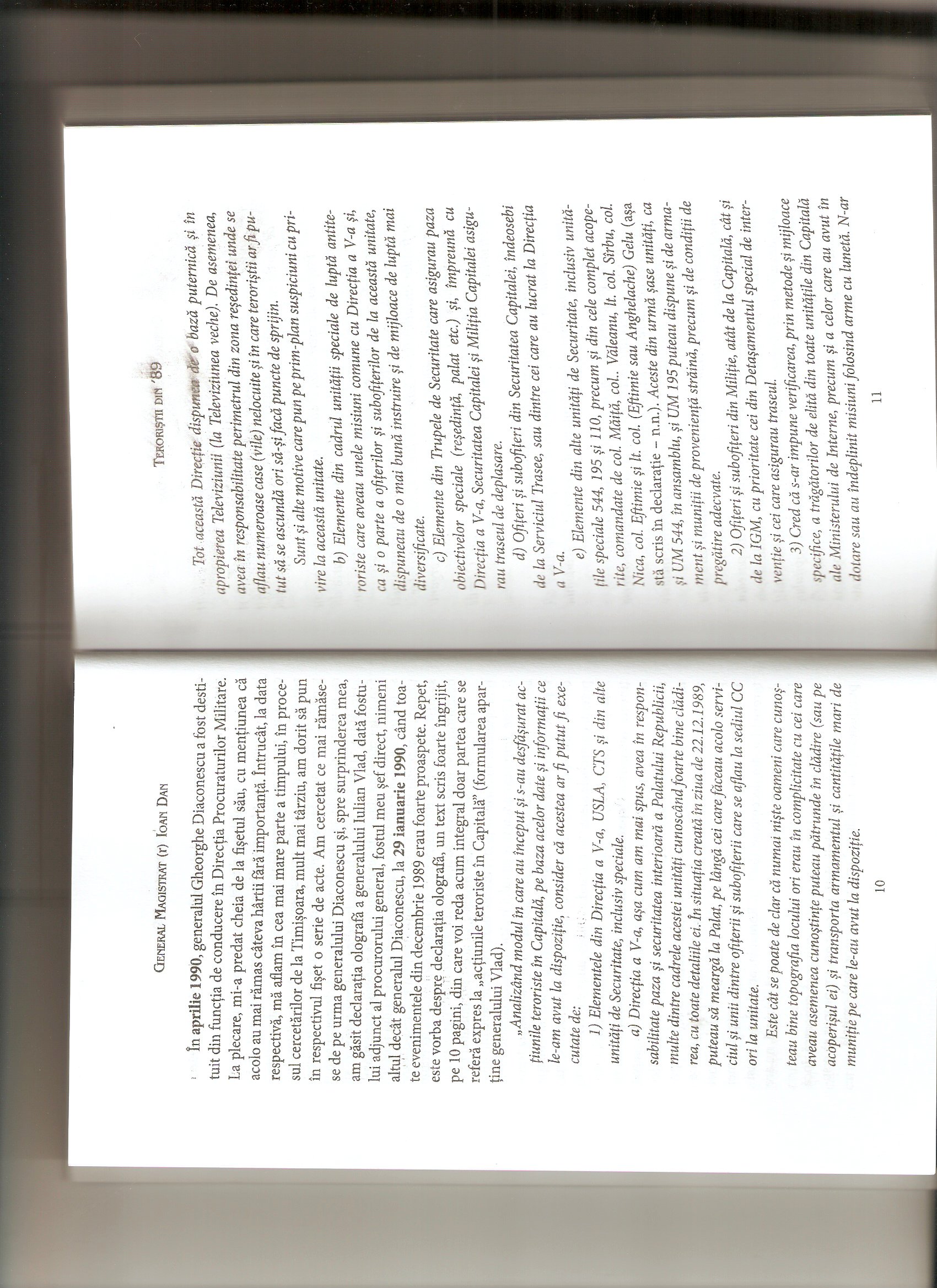
In aprilie 1990, generalul Ghoerghe Diaconescu a fost destituit din functia de conducere in Directia Procuraturilor Militare.  La plecare, mi-a predat cheia de la fisteul sau, cu mentiunea ca acolo au mai ramas cateva hartii fara importanta. Intrucat, la data respectiva, ma aflam in cea mai mare parte a timpului, in procesul cercetarilor de la Timisoara, mult mai tarziu, am dorit sa pun in respectivul fiset o serie de acte.  Am cercetat ce mai ramasese de pe urma generalului Diaconescu si, spre surprinderea mea, am gasit declaratia olografa a generalului Iulian Vlad, data fostului adjunct al procurorului general, fostul meu sef direct, nimeni altul decat generalul Diaconescu, la 29 ianuarie 1990, cand toate evenimentele din decembrie 1989 erau foarte proaspete.  Repet, este vorba despre declaratia olografa, un text scris foarte ingrijit, pe 10 pagini, din care voi reda acum integral doar partea care se refera expres la “actiunile teroriste in Capitala” (formularea apartine generalului Vlad).

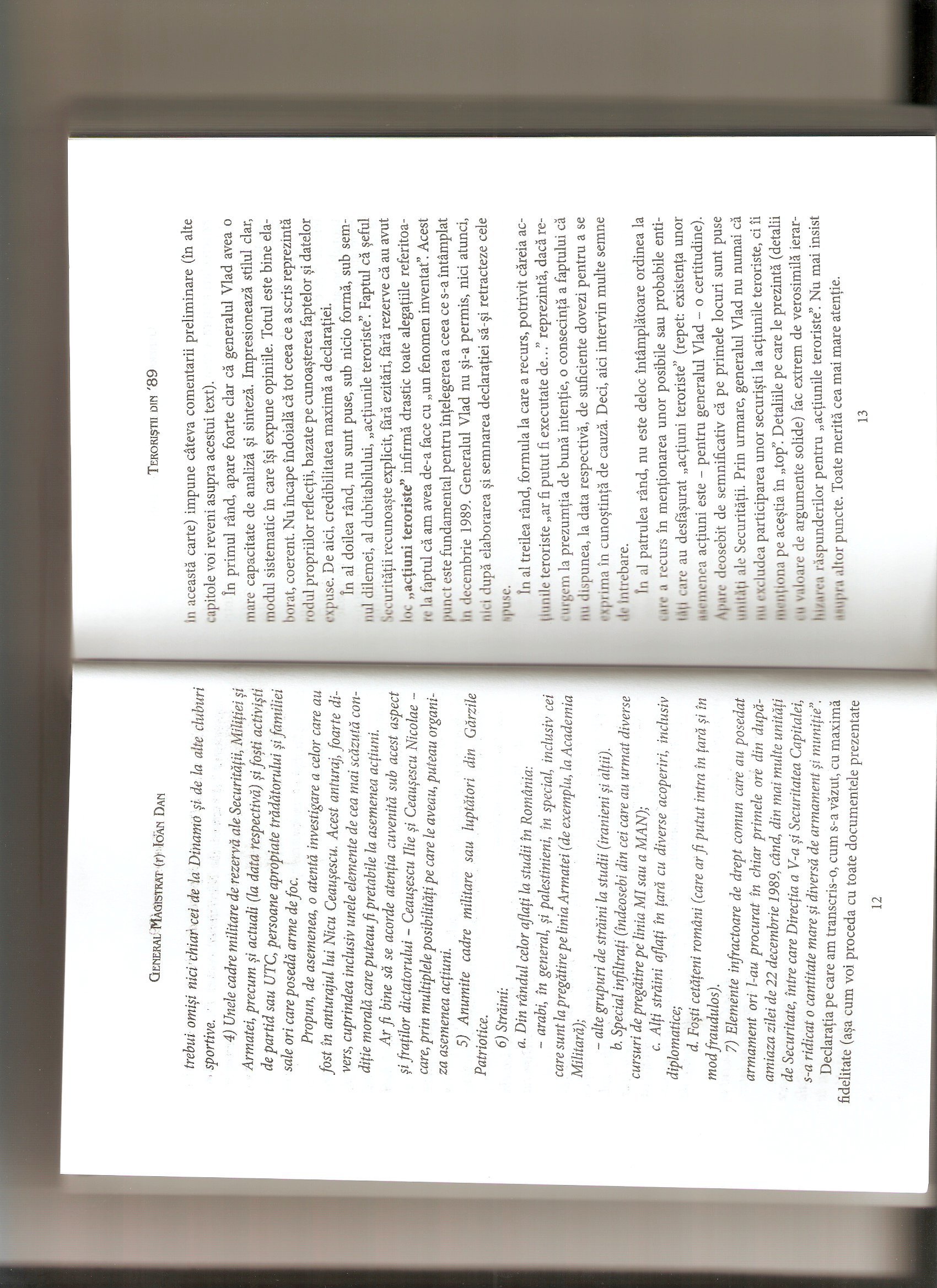
“Analizand modul in care au inceput si s-au desfasurat actiunile teroriste in Capitala, pe baza acelor date si informatii ce le-am avut la dispozitie, consider ca acestea ar fi putut fi executate de:

1) Elementele din Directia a V-a, USLA, CTS si din alte unitati de Securitate, inclusiv speciale.

a) Directia a V-a, asa cum am mai spus, avea in responsabilitate paza si securitatea interioara a Palatului Republicii, multe dintre cadrele acestei unitati cunoscand foarte bine cladirea, cu toate detaliile ei.  In situatia creata in ziua de 22.12.1989, puteau sa mearga la Palat, pe langa cei care faceau acolo serviciul si unii dintre ofiterii si subofiterii care se aflau la sediul CC ori la unitate.

Este ca se poate de clar ca numai niste oameni care cunosteanu bine topografia locului ori erau in complicitate cu cei care aveau asemenea cunostinte puteau patrunde in cladire (sau pe acoperisul ei) si transporta armamentul si cantitatile mari de munitie pe care le-au avut la dispozitie.

Tot aceasta Directie dispunea de o baza puternica si in apropierea Televiziunii (la Televiziunea veche).  De asemenea, avea in responsabilitate perimetrul din zona resedintei unde se aflau numeroase case (vile) nelocuite si in care teroristii ar fi putut sa se ascunda ori sa-si faca puncte de sprijin.

Sunt si alte motive care pun pe prim-plan suspiciuni cu privire la aceasta unitate.

b) Elemente din cadrul unitatii speciale de lupta antiterroriste care aveau unele misiuni comune cu Directia a V-a si, ca si o parte a ofiterilor si subofiterilor de la aceasta unitate, dispuneau de o mai buna instruire si de mijloace de lupta mai diversificate.

c) Elemente din Trupele de Securitate care asigurau paza obiectivilor speciale (resedinta, palat etc.) si, impreuna cu Directia a-V-a, Securitatea Capitalei si Militia Capitalei asigurau traseul de deplasare.

d) Ofiteri si subofiteri din Securitatea Capitalei, indeosebi de la Serviciul Trasee, sau dintre cei care au lucrat la Directia a V-a.

e) Elemente din alte unitati de Securitate, inclusiv unitatile speciale 544, 195 si 110, precum si din cele complet acoperite, comandate de col. Maita, col. Valeanu, lt. col. Sirbu, col. Nica, col. Eftimie si lt. col. (Eftimie sau Anghelache) Gelu (asa sta scris in declaratie–n.n.).  Aceste din urma sase unitati, ca si UM 544, in ansamblu, si UM 195 puteau dispune si de armament si munitii de provenienta straina, precum si de conditii de pregatire adecvate.

2) Ofiteri si subofiteri din Militie, atat de la Capitala, cat si de la IGM, cu prioritate cei din Detasamentul special de interventie si cei care asigurau traseul.

3) Cred ca s-ar impune verificarea, prin metode si mijloace specifice, a tragatorilor de elita din toate unitatile din Capitala ale Ministerului de Interne, precum si a celor care au avut in dotare sau au indeplinit misiuni folosind arme cu luneta.  N-ar trebui omisi nici chiar cei de la Dinamo si de la alte cluburi sportive.

4) Unele cadre militare de rezerva ale Securitatii, Militiei si Armatei, precum si actuali (la data respectiva) si fosti activisti de partid sau UTC, persoane apropriate tradatorului si familiei sale ori care poseda arme de foc.

Propun, de asemenea, o atenta investigare a celor care au fost in anturajul lui Nicu Ceausescu.  Acest anturaj, foarte divers, cuprindea inclusive unele elemente de cea mai scazuta conditie morala care puteau fi pretabile la asemenea actiuni.

Ar fi bine sa se acorde atentia cuvenita sub acest aspect si fratilor dictatorului–Ceausescu Ilie si Ceausescu Nicolae–care, prin multiplele posibilitati pe care le aveau, puteau organiza asemenea actiuni.

5) Anumite cadre militare sau luptatori din Garzile Patriotice.

6) Straini:

a. Din randul celor aflati la studii in Romania:

– arabi, in general, si palestinieni, in special, inclusiv cei care sunt la pregatire pe linia Armatei (de exemplu, la Academia Militara);

– alte grupuri de straini la studii (iranieni si altii).

b. Special infiltrati (indeosebi din cei care au urmat diverse cursuri de pregatire pe linia MI sau a MAN);

c. Alti straini aflati in tara cu diverse acoperiri, inclusiv diplomatice;

d. Fosti cetateni romani (care ar fi putut intra in tara si in mod fraudulos).

7) Elemente infractoare de drept comun care au posedat armament ori l-au procurat in chiar primele ore din dupa-amiaza zilei de 22 decembrie 1989, cand, din mai multe unitati de Securitate, intre care Directia a V-a si Securitatea Capitalei, s-a ridicat o cantitate mare si diversa de armament si munitie.”


Posted in decembrie 1989, raport final | Tagged: , , , , , , , , | 1 Comment »

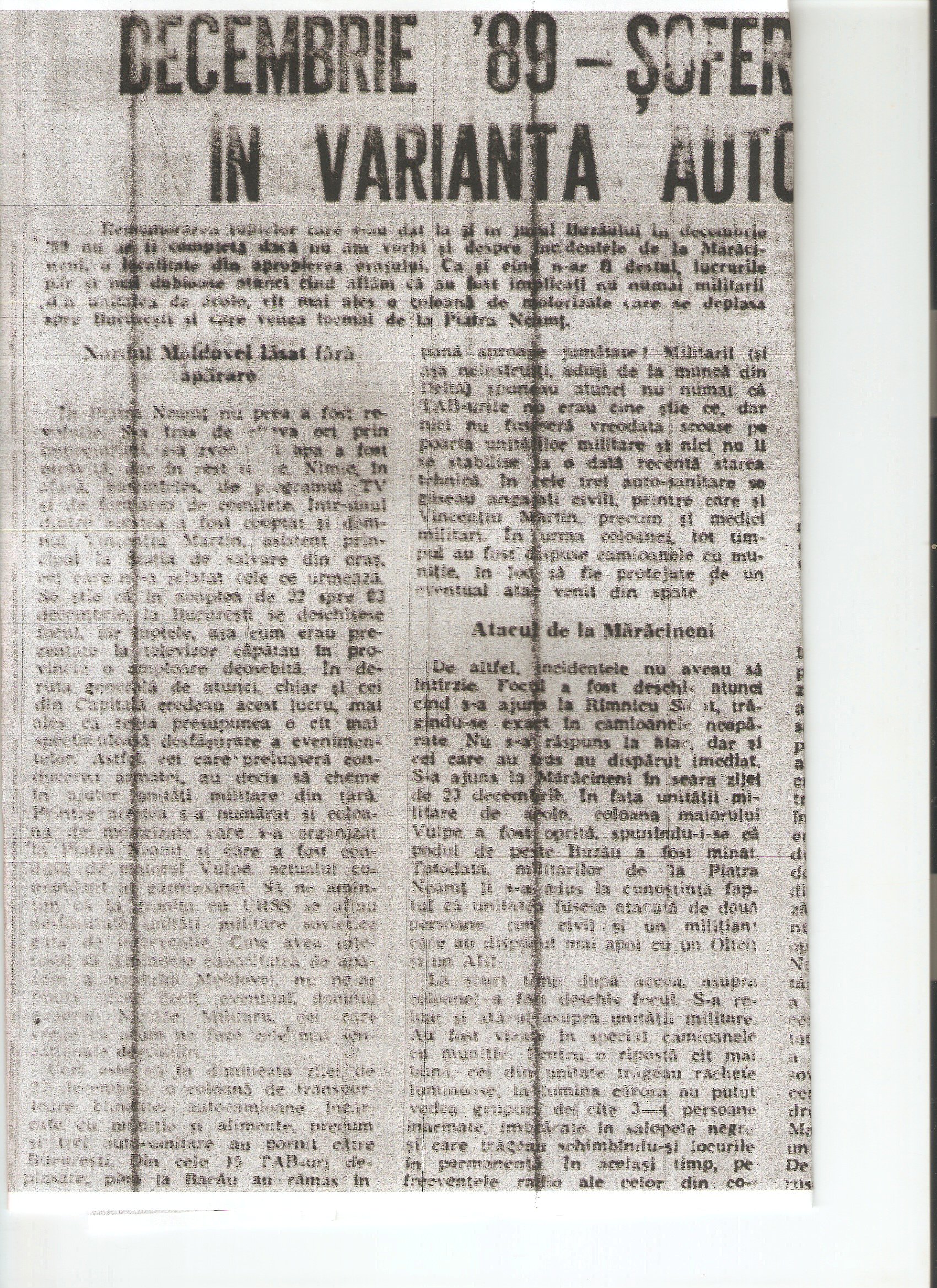
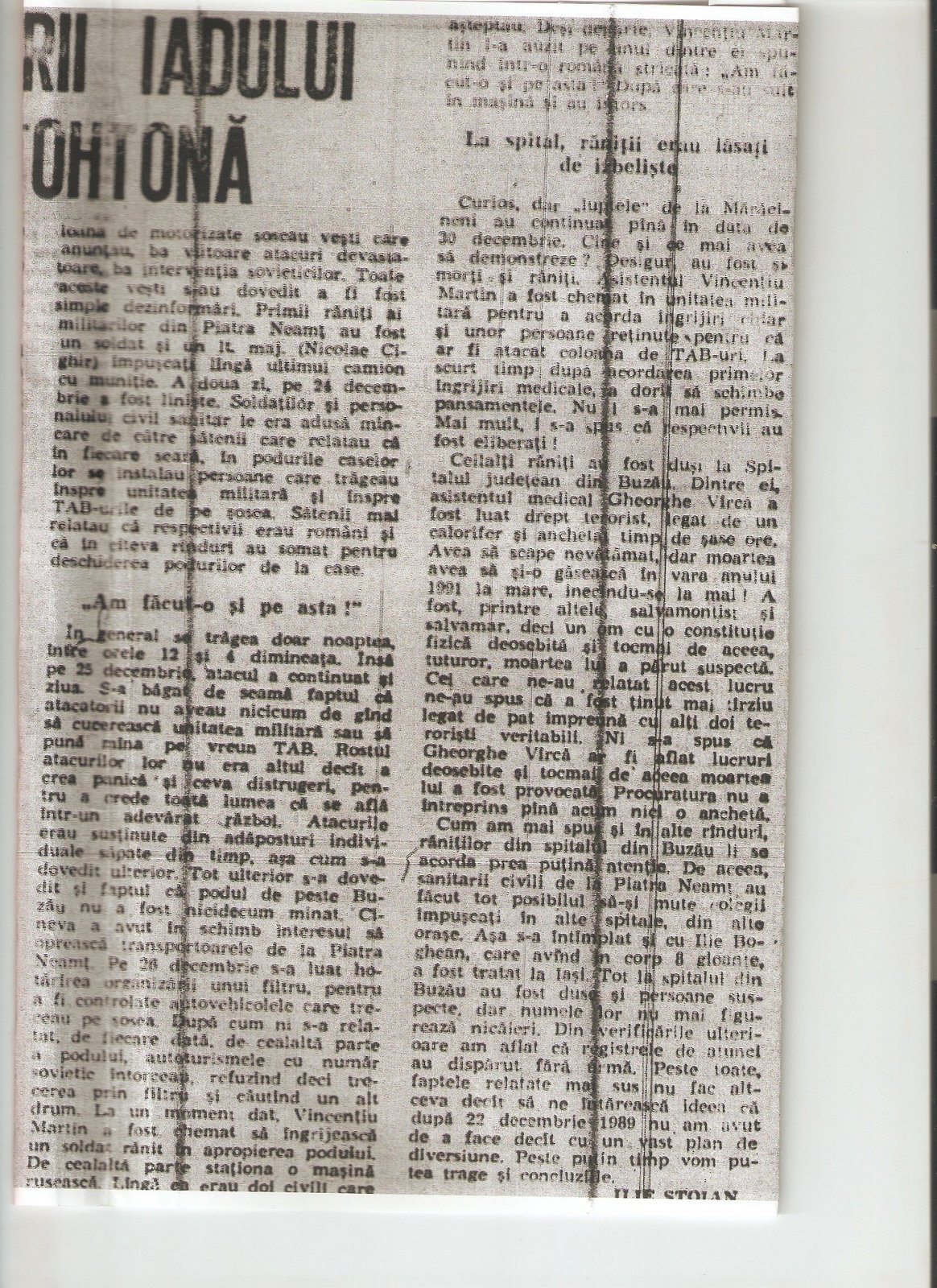
Maracineni, Securitatea, si Lupta de rezistenta pe teritoriul vremelnic ocupat de inamic: “Decembrie ’89–soferii iadului in varianta autohtona” (Expres, 19-25 ianuarie 1993)

Posted by romanianrevolutionofdecember1989 on September 21, 2014

http://ro.wikipedia.org/wiki/Comuna_M%C4%83r%C4%83cineni,_Buz%C4%83u

Possibly linked to the Maracineni case is the following:   Securitatea: Lupta de rezistenta in cadrul razboiului de aparare a patriei. Particularitati ale participarii unitatilor centrale si teritoriale de securitate la organizarea si ducerea luptei de rezistenta pe teritoriul vremelnic ocupat de inamic.  http://atomic-temporary-3899751.wpcomstaging.com/2014/01/27/what-would-it-have-looked-like-if-nicolae-ceausescus-securitate-executed-a-plan-to-counter-an-invasionbut-the-invaders-never-came-iv/

image0

image0-003

image0

image0-001

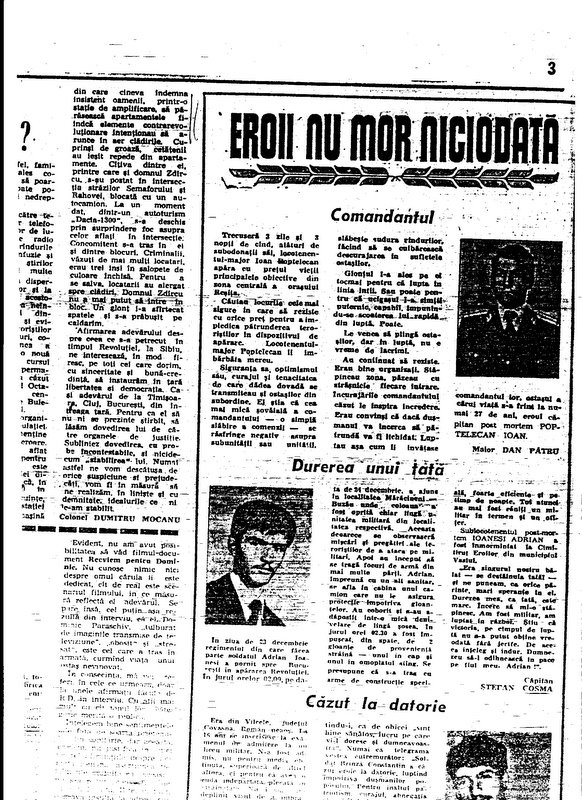
Ioanesi Adrian ( 548 )
Profesie: Soldat in termen la UM 01027 Piatra-Neamt, sublocotenent post-mortem
Data nasteri: 24.09.1969
Locul nasterii: Vaslui
Calitate: Erou Martir
Data mortii: 24 decembrie 1989
Locul mortii: Maracineni, Buzau
Cauza: Impuscat in inima si cap
Vinovati:
Observatii:

http://www.portalulrevolutiei.ro/index.php?menu=1&jud=53

“In jurul orei 02,30 a fost impuscat, din spate, de 2 gloante de provenienta straina–unul in cap si unul in omoplatul sting.  Se presupune ca s-a tras cu arme de constructie speciala, foarte eficiente si pe timp de noapte.” Armata Poporului, p. 3, nr. 41 (44) Octombrie 1990.

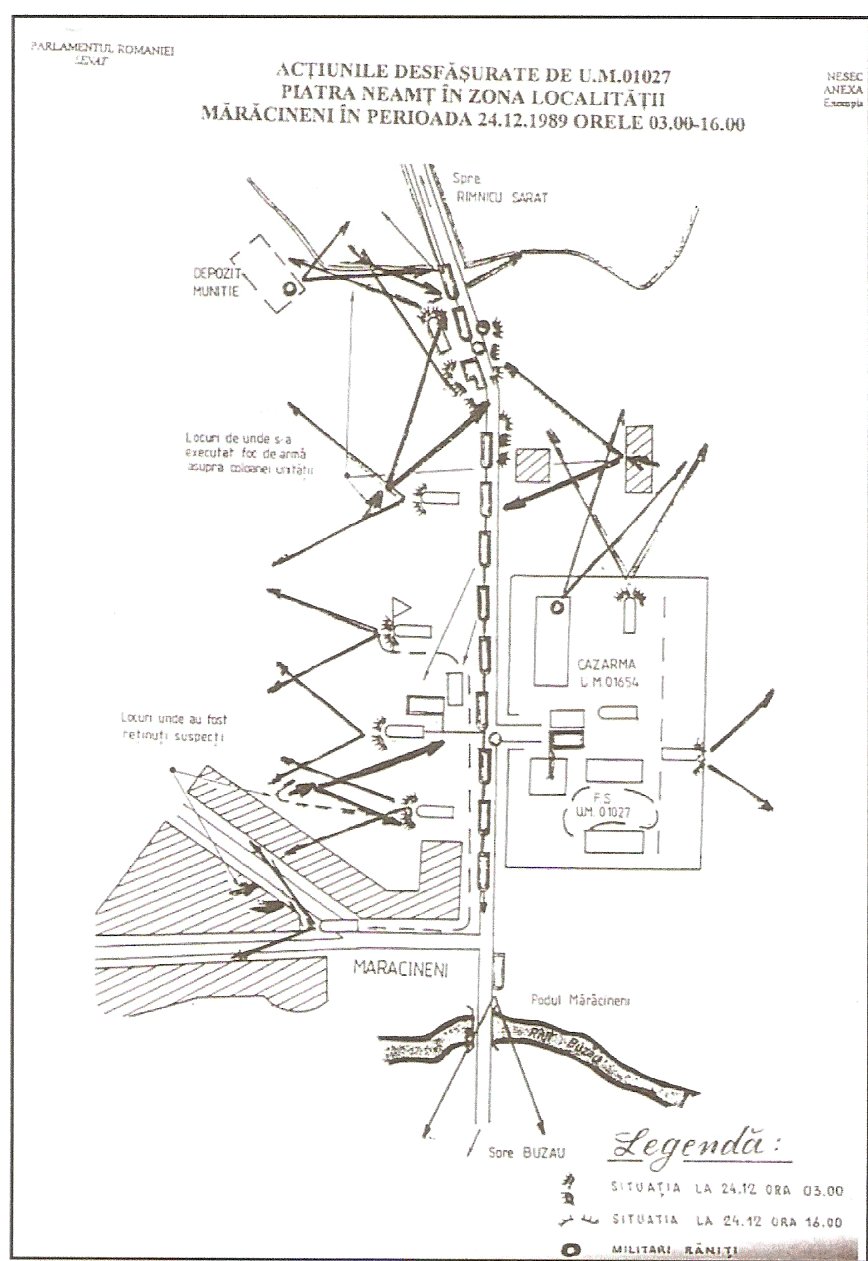
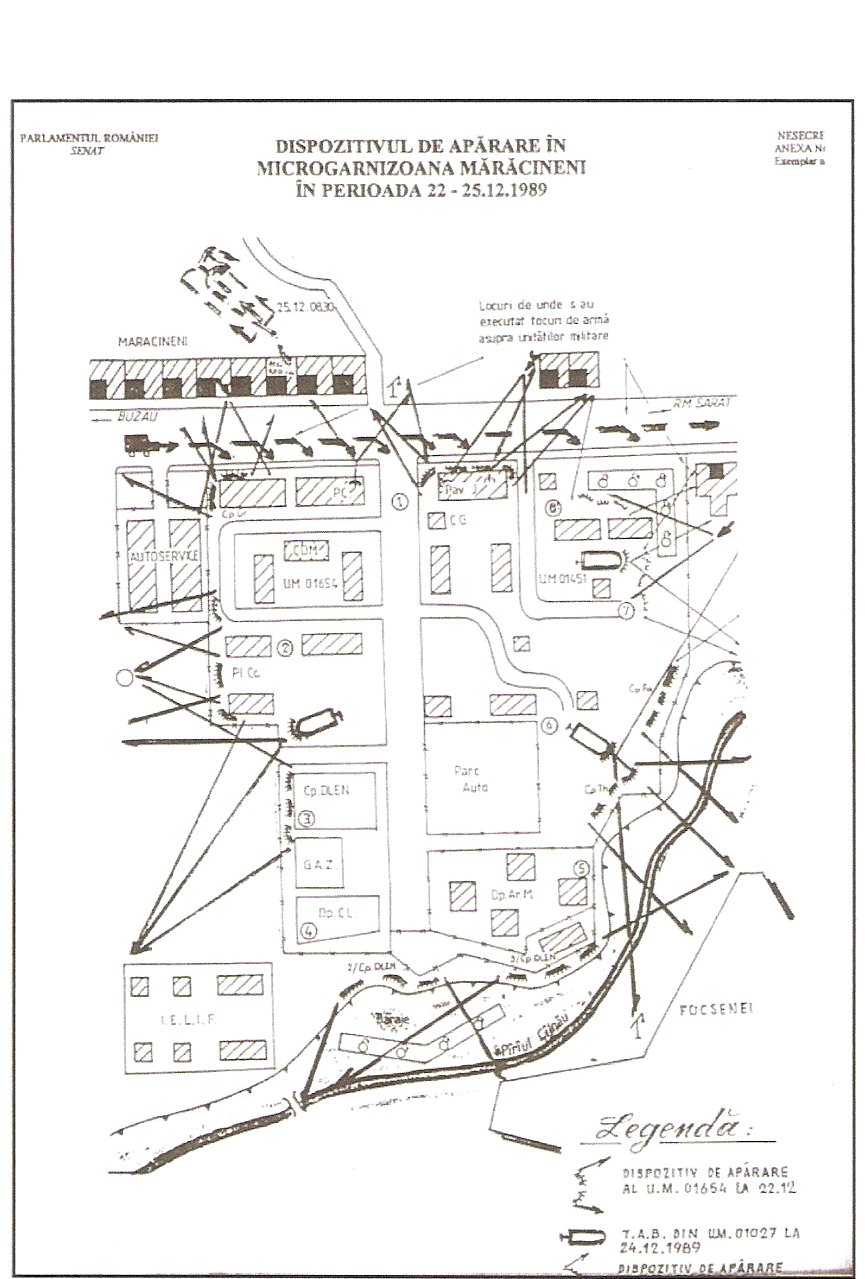
Cazul Maracineni

Another small group of people wearing “black jumpsuits” held a military convoy under fire near the city of Buzau. On the evening of 23 December 1989, a military convoy from Piatra Neamt en route to Bucharest reached the community of Maracineni near Buzau.  Members of the local military unit told the soldiers from Piatra Neamt that

image0-002

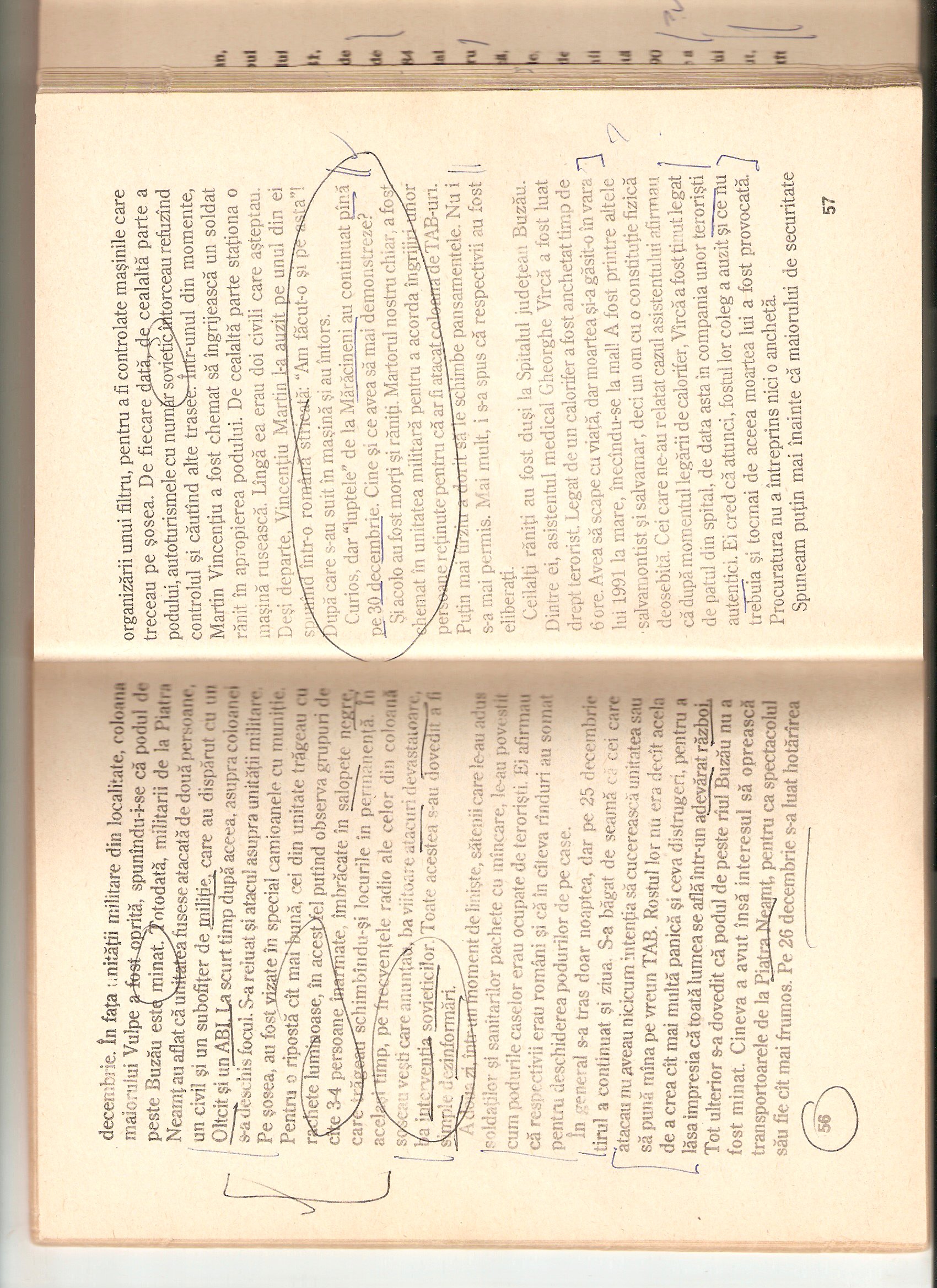
…the unit had been attacked by two people, a civilian and Militia NCO, who disappeared with an Oltcit [car] and an ABI vehicle [an armored transport used exclusively by the Securitate’s USLA].  Shortly after [being told] this, gunfire opened on the convoy.  And gunfire reopened on the local military unit….those from the unit fired back with ordinance that lit the sky, in this way enabling them to observe a group of 3-4 armed people, wearing black jumpsuits (“salopete negre”) who were shooting while constantly changing position.  At the same time, on the radio frequencies of the convoy, they received messages about coming devastating attacks, and even Soviet intervention.  All of these proved to be simple disinformation.  The next day, in a moment of calm, villagers brought the soldiers food, and related how the terrorists had occupied attics of their houses.  They said they [the occupiers] were Romanians and that in a few words they had ordered [the villagers] to let them into the attics of their houses….In general, they shot at night, but on 25 December the cannonade continued during the day…. Curiously, the ‘fighting’ in Maracineni continued until 30 December.  Who and for whom were they trying to impress? [emphasis added][55]

Indeed, there are three key aspects here:  1) this was not a heavily populated area, thereby undermining arguments about “operetta-like” fake warfare to impress the population, 2) it is difficult to explain this episode as the result of “misunderstandings” between units, and 3) the gunfire lasted well over a week, a fact that is difficult to ascribe to confusion.

Ilie Stoian, Arta Diversiunii, 1993, pp. 55-57.

http://atomic-temporary-3899751.wpcomstaging.com/2011/08/25/teroristii-din-decembrie-1989-camasile-negre-a-fekete-ingesek-the-black-shirts-uslac/

http://www.romanialibera.ro/exclusiv-rl/campaniile-rl/exclusiv-cum-au-disparut-gloantele-de-la-revolutie-si-despre-mortii-in-salopete-negre-247874.html

http://atomic-temporary-3899751.wpcomstaging.com/2010/09/30/%E2%80%9Corwellian%E2%80%A6positively-orwellian%E2%80%9D-prosecutor-voinea%E2%80%99s-campaign-to-sanitize-the-romanian-revolution-of-december-1989-part-four-the-mysterious-men-in-black/

Posted in decembrie 1989, raport final | Tagged: , , , , , , , , , | Leave a Comment »