The Archive of the Romanian Revolution of December 1989

A Catch-22 December 1989, Groundhog-Day Production. Presenting the Personal Research & Scholarship of Richard Andrew Hall, Ph.D.

Archive for the ‘Uncategorized’ Category

Cat de noi sunt dezvaluirile Asociatiei 21 decembrie? (“Asociatia 21 Decembrie 1989 acuza Romania la CEDO pentru crimele lui Iliescu”)

Posted by romanianrevolutionofdecember1989 on April 9, 2010

Liderii asociatiei 21 decembrie si sprijinatorii lor cred ca ei au descoperit mari adevaruri si secrete pana acum niciodata auzite in scrisoarea aceasta:  http://www.ziuaveche.ro/investigatii/2391-asociatia-21-decembrie-1989-acuza-romania-la-cedo-pentru-crimele-lui-iliescu.

E chiar asa?

Iata un exemplu elocvent despre cat de noua si nemaiauzita este informatia prezentata in scrisoarea.

8. Extras din Jurnalul grupei operative a unitatii militare 01315 Bucuresti. (ANEXA 10)

– “In seara zilei de 21.12.1989 in jurul orelor 18:30 B. Tc. a fost alarmat, a primit misiunea de a se deplasa pe itinerariul Cazarma, Calea 13 Septembrie, Academia Militara, str. Stirbei Voda, Sala Palatului, Hotel Intercontinental si a executa ordinele M.Ap.N (…).

– Ajuns in zona Salii Dalles, m-am prezentat Ministrului Apararii Nationale care era insotit de domnul general Ortopan, domnul col. Oana Marin, care mi-a ordonat sa trec cu tancurile prin baricada ridicata de demonstranti din diferite automobile, alte obiecte care toate ardeau. (…)

– In timp ce incercam sa iau legatura radio cu tancurile am vazut 4 civili, langa Sala Dalles cum executau foc cu arme automate, de sub pardesiile cu care erau imbracati. (…)

NUMAI CA ACELA DIN URMA A APARUT MAI DETALIAT INTR-UN ARTICOL DIN ANUL TRECUT!

În acest timp, gen. Hortopan s-a deplasat la tancul plt. maj. Neagu Victor făcându-i semn să se deplaseze peste baricadă. (…) În timp ce încercam să iau legătura radio cu tancurile am văzut patru civili lângă Sala Dalles cum executau foc cu arme automate, de sub pardesiile cu care erau îmbrăcaţi”.   http://www.jurnalul.ro/stire-decembrie-89/cine-a-distrus-baricada-de-la-inter-528444.html

si in cazul meu scriem despre cazul acesta de la 1996 incoace:  cazul a fost discutat si invocat mai ales in doua articole, unul din ianuarie 1990 si altul din decembrie 1993.

image-19image-18

Interestingly, almost four years later, in December 1993, Bacanu appeared to reconsider his earlier unquestioning claims about the role of the USLA on the basis of “new” information brought forth by Army soldiers who had been in University Square on the night of 21/22 December. According to Bacanu:

Very many officers talk about these “civilians” in long raincoats or sheepskin coats [cojoace], who arrested demonstrators from within the crowd and then beat them brutally….No one has been interested until now in these tens of “civilians” with hats who shot through the pockets of their clothes….For a time we gave credence to the claims of the USLA troops that they were not present in University Square. We have now entered into the possession of information which shows that 20 USLA officers, under the command of Colonel Florin Bejan, were located…among the demonstrators. [Emphasis added][98]

One of the Army officers told Bacanu that during the evening

…a Militia vehicle arrived from which tens of men–who appeared almost as if they were brothers, in that they were all solidly-built, dressed in leather jackets, with hats on their heads–disembarked….These individuals had “short barrel” weapons and were from the Interior Ministry….They positioned themselves behind the cordon of shieldbearers and then shot from the pockets of their clothes into the demonstrators and dragged demonstrators out of the crowd…[99]

But what Bacanu termed “new revelations” were hardly new. In mid-January 1990, several Army recruits and officers referred to the actions of these “civilians” in interviews with reporters of the Army daily.[100] According to soldier Rudolf Suster:

About fifteen to twenty (dressed in civilian clothes, but one could tell that they were well-trained) disembarked from a single truck and passed in front of the soldiers with shields and when the tanks broke through the barricade which was on fire, they fired. I saw the flashes in front of their raincoats.[101]

Soldier Tiberiu Florea described a similar scene:

I also saw them. They had long raincoats or overcoats and they had guns hidden under them and they opened fire. They were in front of us, they couldn’t hide themselves from us. They didn’t all fire at the same time…One fired, then the other would.[102]

Furthermore, at the trial of Nicolae’s brother, Nicolae Andruta Ceausescu (director of the Securitate’s Baneasa Academy) in April 1990, military witnesses testified that “after the salvo of warning shots were fired, in the uproar produced, from behind us we saw civilians who were firing–I observed the movement of their clothes–hidden weapons through the pockets of their clothes.”[103] Significantly, former USLA commander, Colonel Gheorghe Ardeleanu, confirmed in a court statement that on 21 December the USLA had “performed their duties in civilian dress.”[104]

[98].. Petre Mihai Bacanu, “Au evacuat ‘materialele.’ Stropite cu sange [The got rid of “the materials” Covered with blood],” Romania Libera, 28 December 1993, 10. The reference to these civilian gunmen dressed in “sheepskin coats” (cojoace) brings back into discussion one of the articles from Horia Alexandrescu’s March 1990 series (“Adevarul despre USLA” [The truth about the USLA]) in Tineretul Liber exonerating the USLA of any wrongdoing for their actions in December. The title of the 6 March 1990 article–”‘Ace’ pentru ‘cojoacele’ teroristilor,” [‘Pins’ for the ‘sheepskin coats’ of the terrorists]–appears to bear no connection whatsoever to the article, which has no mention of “sheepskin coats” and does not even refer to the role of the USLA in University Square (events discussed in a later episode). Yet this clue and a number of others–including Alexandrescu’s introduction of this article as a “calmant,” an apparent reference to the treatment given to the drugged USLA after the events–suggest that in spite of the fact that the text of the article clears the USLA, Alexandrescu is fully conscious of the USLA’s guilt.

[99].. “Seful represiunii: maiorul Amariucai” in Bacanu, “Au evacuat ‘materialele’.”

[100].. Colonel Gh. Vaduva et. al., “Nici o pata sa nu planeze pe onoarea Armatei! [Not a stain can be placed on the Army’s honor]” Armata Poporului, no. 3 (17 January 1990), 1-2.

[101].. Ibid.

[102].. Ibid.

[103].. Captain Mihai Margineanu, “Un ‘inger’ cu aripile murdare [An ‘angel’ with dirty wings],” Armata Poporului, no. 15 (11 April 1990), 5. The witness, Lieutenant Colonel Teodor Amariucai, appears to bear his own share of the guilt for the bloodshed on the night of 21/22 December.

[104].. Stefanescu, Istoria Serviciilor Secrete, 288. The former Securitate once again appear to transfer their actions onto others in their discussion of the events in University Square. According to “a group of former Securitate officers,” the “tourists” took advantage “of the sound of shots fired in the air and resorted as in Timisoara to shooting the demonstrators in the back to produce victims to ‘mobilize’ Bucharest’s citizens.” See A Group of Former Securitate Officers, “Asa va place revolutia!”

http://atomic-temporary-3899751.wpcomstaging.com/rewriting-the-revolution-1997-chapter-6-18-22-december-1989/

Posted in Uncategorized | 2 Comments »

Nicu Ceausescu, Sibiu, teroristii, combinezoane negre, si decembrie 1989 (articole uitate, revista Expres 1990)

Posted by romanianrevolutionofdecember1989 on April 8, 2010

from Orwellian, Positively Orwellian (2006)

MEN IN BLACK:  The Recurring Theme of “Black Jumpsuits”

Part of the great riddle of the “terrorists” concerns their clothing.  In Brasov, it was noted the individual arrested on 23 December firing a 5.65 mm Thomson automatic was wearing a “black jumpsuit.”  The descriptions go by different names—“combinezoane negre,” “salopete negre,” or “de culor inchis,” for example—but they all note the black or dark outfits of many of those suspected of being “terrorists.”

It is critical to note that we have evidence that the focus on the black clothing of those identified as “terrorists” occurred among participants at the time, and is not merely some ex post facto artifact.  Major A.D. of Directorate V-a (probably Major Aurel David) recounted in early 1991 that while under arrest on 27 December 1989, the Army soldiers guarding him asked “If” as Major A.D. had sought to convince them, “it isn’t Ceausescu’s guard [i.e. V-a]” who was firing, “then who are the black-shirted ones [emphasis added]?”[52] The report of the SRI [the Securitate’s institutional successor] on Timisoara indirectly confirms Army suspicion when alleging that Army Colonel Constantin Zeca gave the order after 22 December 1989, to shoot at anybody “in a blue, navy blue, or black jumpsuit.”[53] Why this clothing in particular, and why the suspicion then?

Some of those shot as “terrorists” turn out to have been wearing “black jumpsuits.”  Bucking the hegemony of official, elite interpretations denying the very existence of the “terrorists,” a poster calling himself “Danka” posted the following on the Jurnalul National web forum in April 2006:

“22 decembrie 1989, military unit 010_ _ at the edge of the Branesti forest.

The Branesti forest houses one of the largest munitions depots around the capital.  It is said that an explosion at this depot would destroy the Pantelimon neighborhood from the beginning of the no. 14 tram [route].  Towards evening gunfire opened on the unit from the railroad.  Everything was a target, [and] small caliber arms and semi-automatic weapons were being used [emphasis added; note:  possible reference to 5 mm weapons].  Based on the flashes from the gun-barrels it appeared that there were 3 persons hiding among the tracks who opened fire with the goal of creating panic.  The soldiers came out of their barracks and set up in the car-park under trucks.  They couldn’t stay inside the buildings, “the terrorists” were shooting the windows [out].  Even though an alert had been given earlier in the day, nobody was prepared to respond except those on duty.  A group of soldiers with officers and n.c.o.s equipped with AK-47s, and TT pistols launched an attack from the surrounding area.  All reached their destined locations without problem by nightfall, in part because the intruders were preoccupied with maintaining a continuous gunfire on the unit.  At a given moment, the soldiers opened fire, the gunfight lasted less than 10 minutes.  Their little UZIs weren’t equipped for long-distance and thus could not stand up to the renowned AK 47.  One of the terrorists was shot in the head, while the other two were wounded when they tried to flee through a field leading away from the military unit.  The three were transported to the guard post where the lights were turned on (until then the unit had been in complete darkness) and we realized that one of the two survivors was in fact a woman.  All three were olive-skinned, clothed in black jumpsuits [emphasis added] and the two wounded survivors struggled to say something in Arabic.  After a half hour an ARO [vehicle] of the Army arrived saying they had come from the Chief of Staff’s Division and they took all three.  After a few days all the soldiers who participated in the activities of that night were made to sign a declaration pledging not to divulge anything about what had happened.  All of this is true and can easily be verified.”[54]

Another small group of people wearing “black jumpsuits” held a military convoy under fire near the city of Buzau. On the evening of 23 December 1989, a military convoy from Piatra Neamt en route to Bucharest reached the community of Maracineni near Buzau.  Members of the local military unit told the soldiers from Piatra Neamt that

…the unit had been attacked by two people, a civilian and Militia NCO, who disappeared with an Oltcit [car] and an ABI vehicle [an armored transport used exclusively by the Securitate’s USLA].  Shortly after [being told] this, gunfire opened on the convoy.  And gunfire reopened on the local military unit….those from the unit fired back with ordinance that lit the sky, in this way enabling them to observe a group of 3-4 armed people, wearing black jumpsuits (“salopete negre”) who were shooting while constantly changing position.  At the same time, on the radio frequencies of the convoy, they received messages about coming devastating attacks, and even Soviet intervention.  All of these proved to be simple disinformation.  The next day, in a moment of calm, villagers brought the soldiers food, and related how the terrorists had occupied attics of their houses.  They said they [the occupiers] were Romanians and that in a few words they had ordered [the villagers] to let them into the attics of their houses….In general, they shot at night, but on 25 December the cannonade continued during the day…. Curiously, the ‘fighting’ in Maracineni continued until 30 December.  Who and for whom were they trying to impress? [emphasis added][55]

Indeed, there are three key aspects here:  1) this was not a heavily populated area, thereby undermining arguments about “operetta-like” fake warfare to impress the population, 2) it is difficult to explain this episode as the result of “misunderstandings” between units, and 3) the gunfire lasted well over a week, a fact that is difficult to ascribe to confusion.

Did the black-suited ones have any affiliation to any institution?  After all, is it not odd that so many of them would appear to be dressed in the same garb?  In 1990, an engineer, Mircea Georgescu, expressed his frustration about the post-December disappearance of the “terrorists” in Sibiu, Nicu Ceausescu’s fiefdom, as follows:

“Who fired from the attics of Sibiu on 21-22 December 1989?  Who are the so-called terrorists?  Where are their guns with scopes and unmistakable cadence?  Silence on all fronts:…

c) A fighter from the guards, along with his brother, captured in these days (23-25 dec.) some 8 securisti among whom:  one about 45-50 years old, at the State Theater Sibiu, we surrendered him to the Commander at the Army House.  He was taken under guard by 4 civilian fighters (one in front had a club in his hand) and by a soldier with a gun at his side.  He was dressed in a vest (like a smith’s) and a pant-suit (combinezon) that was black or a very dark grey…brown with short hair, well-built and 1,70-1,75 m tall….What, nobody knows anything about this guy either?…[emphases added]”[56]

Lt. Col. Aurel Dragomir, former commander of the “Nicolae Balcescu” Military Officers School in Sibiu, described in 1994 those killed as “terrorists” in Sibiu in December 1989:

…On the morning of 22 December…I was informed that on the rooftops there were some suspicious persons.  I saw 2-3 people in black jumpsuits.  The Militia told me that they weren’t their people.  At noon there appeared 10 to 15 people in black jumpsuits who opened massive gunfire on the crowds and soldiers. I ordered them to respond with fire.  I headed to the infirmary—the reserve command site, and col. Pircalabescu [head of the Patriotic Guards] called and asked me “why was there gunfire?”  I told him we were being attacked.  He told me to cease fire.  Ilie Ceausescu [Ceausescu’s brother, and an Army General] told me to surrender.  I slammed the telephone down.  Then [Army General] Stanculescu called.  I told him that we are under attack. Stanculescu said to me:  ‘Defend yourselves!’….The attackers had on black jumpsuits under which they had on civilian clothes….Weapons and ammunition that weren’t in the arsenal of the Army were found, guns with silencers were found, that aren’t in the Army’s arsenal….After the events declarations given to the investigating commissions disappeared, notebooks filled with the recordings of officers on duty (ofiterii de serviciu), and a map that noted from which houses gunfire came. The dead who were in jumpsuits and had several layers of clothing were identified:  they were cadre from the Sibiu Interior Ministry (Militia and Securitate)…. (“black jumpsuits” emphases and “weapons and ammunition…” emphasis added; rest in original)[57]

Finally, in this context, the comments of a Codrut H. in July 1990 about what he and other civilians found when they occupied Securitate headquarters in Brasov on the night of 22 December:  “What appeared suspicious to me was that the Securitate there appeared to have been prepared [for something]….  Out front of the building there was a white ARO [automobile] in which there were complete antiterrorist kits [emphasis added].” What else did the civilians find there?…combinezoane negre. [58]

Sibiu, 19-22 December 1989

In Sibiu, Siani-Davies tells us:

Controversy also continues to surround a commercial TAROM flight, which is alleged to have brought up to eighty USLA troops from Bucharest to Sibiu on December 20, 1989.  It is not clear if the USLA forces were actually on the airplane, or, even if they were, what they actually did in Sibiu…[Serban] Sandulescu (c1996), 57-58…suggests they were not members of USLA but the DIA [Army’s Intelligence Unit].[151]

From the standpoint of Siani-Davies’ unsuspecting reader such a conclusion may seem not only credible, but judicious.  But one of Siani-Davies’ habits—identified negatively by even those who praise the book—is his tendency to draw negative equivalencies:  i.e. there is about as much evidence to support x as there is to support y, in order to disprove or discount both propositions.  In a review, Doris Mironescu writes:

“Very common are claims such as the following:  ‘Finding the proof to sustain such an explanation of the events [that the Army’s Intelligence arm, the DIA simulated the “terrorist diversion,” to permit the Front’s takeover and a possible Warsaw Pact invasion of the country] is as difficult as proving that special units of the securitate took up arms against the revolution’ (p. 154).  Mutually contradictory hypotheses are invoked in order to negate each other, not so much because of the weight of the claims, but through the ideological similarity of both.”[152]

This tendency definitely affects Siani-Davies’ analysis of the “terrorists” and its accuracy.  To begin with, in the very book (Sandulescu) invoked by Siani-Davies, the head of the DIA (Battalion 404 Buzau), Rear Admiral Stefan Dinu, is quoted as having told the Gabrielescu commission investigating the December events (of which Sandulescu was a member) that “we hardly had 80 fighters in this battalion.”[153] It is known that 41 of them were in Timisoara from the morning of 18 December and only returned to their home base in Buzau on 22 December.[154] This makes it highly unlikely that they were on the 20 December TAROM flight to Sibiu that is in question.[155]

Contrast this with the signs that exist pointing to the mystery passengers as having been from the Securitate/Interior Ministry, in particular the USLA.  Nicu Silvestru, chief of the Sibiu County Militia, admitted in passing in a letter from prison that on the afternoon of 19 December 1989, in a crisis meeting, Nicolae Ceausescu’s son, Nicu, party head of Sibiu County, announced that he was going to “call [his] specialists from Bucharest” to take care of any protests.[156] Ceausescu’s Interior Minister, Tudor Postelnicu, admitted at his trial in January 1990 that Nicu had called him requesting “some troops” and he had informed Securitate Director General Iulian Vlad of the request.[157] If they were, indeed, DIA personnel, why would Nicu have called Postelnicu, and Postelnicu informed Vlad of the request—would such a request not have been relayed through the Defense Minister?

The first two military prosecutors for Sibiu, Anton Socaciu and Marian Valer, identified the passengers as USLA.  Even Nicu Ceausescu admits that this was the accusation when he stated in August 1990:

“…[T]he Military Prosecutor gave me two variants. In the first part of the inquest, they [the flight’s passengers] were from the Interior Ministry. Later, however, in the second half of the investigation, when the USLA and those from the Interior Ministry began, so-to-speak, to pass ‘into the shadows,’ – after which one no longer heard anything of them – they [the passengers] turned out to be simple citizens…”[158]

Beginning, at least as early as August 1990, with the allusions of Major Mihai Floca, and later seemingly indirectly confirmed by former USLA officer Marian Romanescu, it was suggested that when USLA Commander Ardeleanu was confronted at the Defense Ministry on the night of 23/24 December 1989, Ardeleanu reportedly admitted that “30 were on guard at [various] embassies, and 80 had been dispatched to Sibiu with a Rombac [aircraft] from 20 December 1989 upon ‘orders from on-high’.”[159] Finally, and along these lines, we bring things full circle—and recall our “phantoms in black” again in the process—with the testimony of Army officer Hortopan to the same Serban Sandulescu at the Gabrielescu Commission hearings:

Sandulescu:  About those dressed in black jumpsuits do you know anything, do you have any information about whom they belonged to?

Hortopan:  On the contrary.  These were the 80 uslasi sent by the MI [Interior Ministry], by General Vlad and Postelnicu to guard Nicolae Ceausescu [i.e. Nicu].  I make this claim because Colonel Ardelean[u] in front of General Militaru, and he probably told you about this problem, at which I was present when he reported, when General Militaru asked him how many men he had in total and how many were now present, where each of them was:  out of which he said that 80 were in Sibiu based on an order from his commanders.  Thus, it is natural that these are who they were.[160]

Bringing us up to the morning of 22 December 1989, and setting the stage for what was to come, Lt. Col. Aurel Dragomir told the Army daily in November 1990:

Dragomir:  Events began to develop quickly on 22 December.  In the morning some of the students posted in different parts of the town began to observe some suspect individuals in black jumpsuits on the roofs in the lights of the attics of several buildings.

Reporter:  The same equipment as the USLAsi killed out front of the Defense Ministry…

Dragomir:  And on the roof of the Militia building there were three or four similar individuals…[161]

Of course, the fact that these individuals were posted on the top of the Militia building on this morning, speaks volumes in itself about their affiliation.  Indeed, in a written statement dated 28 January 1990, Ioan Scarlatescu, (Dir. Comm. Jud. Sibiu), admitted that he was asked by the Army on that morning if the unknown individuals “could be from the USLA?”[162]

Posted in raport final, Uncategorized | Tagged: , , , , , , , , | 1 Comment »

Unde sint teroristii? PE STRADA, PRINTRE NOI (II) (Romania, decembrie 1989)

Posted by romanianrevolutionofdecember1989 on March 30, 2010

Armata Poporului, nr. 26, 27 iunie 1990

Mult incercatul bloc A1

Prinsi intre focuri–ale teroristilor, dintr-o parte, si cele ale militarilor aflati in dispozitivul de aparare al M.Ap.N., din cealalta parte–locatarii blocului A1 (Drumul Taberei, 16) au trait, in zilele Revolutiei din Decembrie, nopti de groaza.  Sa-i ascultam.

–Eu, pur si simplu, nu inteleg domnilor, cum unii ziaristi pot fi asa de rai si palavragii.  Distrug omul, nu alta!  S-au scris in presa fel de fel de minciuni despre ce s-a intimplat aici, in zilele si noptile ce au urmat fugii lui Ceausescu.  Unii s-au apucat sa arate–culmea nerusinarii!–ca nici n-au fost teroristi.  Pe noi, insa, nu ne-a intrebat nimeni:  ce am trait, ce am simtit atunci, cum am supravietuit…

Si spre a fi mai convingatoare, doamna Stela Baila (scara B, apart. 26) ne arata o cutie cu…gloante (18 la numar), pe care le-a strins din camere.

–Cum a inceput lupta?

–Era pe 22 decembrie.  In jurul orei 21,00 am vazut, aproape de poarta Centrului de Calcul, un TIR mare, un fel de sa lunga.  Soldatii nici nu apucasera sa ia pozitie de lupta.  De sub masina s-a deschis focul:  atit spre Ministerul Apararii Nationale, cit si spre noi.  Tirul era foarte intens, cred ca de sub masina trageau peste 20 de indivizi.  Un glont mi-a trecut pe deasupra capului si s-a infipt, uitati-i urma, sub tavan.  Ce a urmat, nu va mai spun.  Ne-am refugiat in camera din spate, dar nici acolo n-am avut parte de liniste:  din parculet, se auzeau multe strigate, apoi a inceput rapaiala.  De pe toate blocurile se tragea!  Tocmai umblam la televizor, il reglam, cind un glont a lovit in perete, deasupra televizorului, la citeva zeci de centimetri de capul meu.  M-am ales doar cu o rana la mina stinga.  Dupa ce teroristii ne-au mai “onorat” cu un glont, am fugit in baie.  Dimineata, geamurile erau faramitate.

Din aceeasi directie, dinspre blocul B4, s-a tras si in apartamentul vecin.  Gaura din geam se afla la aceeasi inaltime cu cea de pe perete:  1,45 m.  Dat fiind ca apartamentul se gaseste la etajul 1, este evident ca teroristul a deschis foc dintr-un loc situat la aceeasi inaltime.  De la locatarii acestui apartament (27), aflam ca teroristii erau imbracati intr-un fel de salopete, probabil de culoare gri.

–Da, i-am vazut cu ochii nostri.  Alergau ca niste speriati prin parculet, de la un bloc la altul, isi aminteste doamna Maria Cotofana.  Dupa miezul noptii, in careul format din cele trei blocuri a avut locu un violent schimb de focuri.  Apoi, am auzit batai puternice in usa.  “Deschideti, sintem armata, avem raniti!”–auzeam de pe scari.  Am primit si noi un ranit–il cheama Cristian Popescu si niste student la Academia Tehnica Militara–impreuna cu un coleg.  Imedia cei doi tineri s-au repezit la balcon, sa traga in teroristii care le-au ucis colegii.  Foarte greu i-am determinat sa renunte, le-am explicat ca teroristii ne “avertizasera” deja si ne vor face zob apartamentul.  Ii vedeam cum se chinuiesc privind neputinciosi cum banditii scuipau moarte si foc de pe blocul B3…

“Au tras din blocul meu!!!”

Exista locatari care i-au vazut foarte de aproape pe teroristi, au discutat cu ei. Unul din acesti oameni a acceptat sa ne povesteasca patania sa, dar cu conditia sa nu-i precizam identitatea. Intimplarea a avut loc in aceeasi noapte: 22/23 decembrie 1989.

–Sa tot fi fost 12,30-1,00, cind am auzit “poc, poc, poc”–cineva umbla pe balcon. Fiindca am instalatie electrica acolo, am aprins lumina. Am deschis prima usa ce dadea spre balcon si am vazut un tinar de 24-25 de ani: brunetel, creol, cu parul andulat, slabut. Purta of gluga bej, iar pe deasupra un fel de veston kaki. Inapoi lui, pe lada mai era unul. Grozav m-am speriat: “Deschideti, deschideti”–mi-a strigat brunetul. Am raspuns instantaneu: “Nu se poate, e militia la mine, e militia la mine!” si am inchis usa la loc. El a scos ceva din buzunar–un corp rotund–si a spart geamul usii din exterior. Am fugit, iar in urma mea au rasunat focuri de arma.

Intr-adevar, pe peretele opus balconului sint citeva gauri: acestea nu puteau fi provocate decit de gloante trase din balcon. Din acest balcon–asa cum ne-a relatat locotenentul Marius Mitrofan–s-a tras si asupra studentilor de la Academia Tehnica Militara.

–L-ati recunoaste pe cel care a tras?

–L-am si recunoscut! Dar ma opresc aici, ca si asa am spus prea multe!

Sa mai adaugum ca, pe 23 decembrie, cind gazda noastra a povestit scena cu balconul, un vecin, “binevoitor,” i-a spus: “ti s-a nazarit.”

Foc concentrat asupra Centrului de calcul!

Spre Centrul de Calcul al M.Ap.N. teroristii si-au indreptat cu predilectie armele. Oricine poate constata asta. Daca s-ar fi inarmat cu putina rabdare, gazetarii revistei “Le Point” ar fi putut numara, in peretele frontul al cladirii, circa 300 urme de gloante.  La care trebuie adaugate si gaurile care se mai vad, inca, in geamuri.  Sigur, geamurile ciuruite au fost schimbate, dar,–prevazatori si rigurosi–, cei din Centrul de Calcul, au avut grija sa le fotografieze.  Avem, la redactie, cliseele respective si le putem pune la dispozitia oricui.  Ne este imposibil sa credem ipoteza cu “confuzia generala” a confratilor francezi.  Pentru ca aici nu este vorba de doua, trei focuri–scapate, la un moment dat, intr-o directie gresita–, ci de sute de gloante trimise cu buna stiinta, nopti de-a rindul, asupra unui obiectiv militar.  Si vizind cu prioritate birourile cadrelor cu functii de raspundere.

S-a tras nu numai din strada, ci, in special, de la etajele superioare ale cladirilor de peste drum.

–Noi nu avem caderea sa acuzam pe nimeni–arata colonelul Marcel Dumitru.  Dar nu ne putem mira indeajuns de faptul ca nimeni din cei in drept nu a initiat pina acum o cercetare.  Nu stim cine a tras, dar stim, cu destula precizie, de unde s-a tras in noi.  Cind copacii erau desfunziti, privind prin gaurile produse de gloante in geamurile noastre–avem geamuri duble–vizam tocmai acoperisul, balconul, fereasta de unde s-a tras?

De altfel, cu pricepere de artilerist, pe baza observatiilor facute in acele vile de decembrie, maiorul Vasile Savu a intocmit o schema cu locurile de unde s-a tras asupra Centrului de Calcul.  Numaram pe schema peste 25 puncte de foc, citeva din acestea coincid cu cele indicate de studentii Academiei Tehnice Militare.  In “Le Point” se arata:  “Desigur, citiva securisti, infierbintati, au tras pe strada, de pe acoperisuri.  Dar nu era decit o mina de oameni, cei multi fiind falsii “teroristi”…armata a amplificat roulu securistilor si a plasat ea insasi falsi teroristi in diferite cartiere ale capitalei.”  Ce om cu mintea intreaga poate accepta ideea ca armata a ordonat unor membri ai ei sa traga asupra proprilului minister?!!

Centrul de Calcul este doar una din cladirile aflate in localul M.Ap.N.  Nu vom sti niciodata, cu exactitate cite gloante s-au tras asupra integrului complex.  Oricum, in comparatie cu cele ce au tintit Centrul de Calcul, acestea sint mult mai multe, ele producind victime mai ales in rindurile personalului neadapostit.

Sa mai amintim ca in 22/23 decembrie, tot inainte de a intra in sediul M.Ap.N.–deci in aceleasi conditii, ca si cei cinci studenti–au cazut un ofiter, un subofiter, si doi soldati dint-o unitate de parasutisti.  Tot aici Regimentul de Garda a avut 9 mortii–doi ofiteri si sapte soldati–toti impuscate dupa ce intrasera in dispozitivul de aparare constituit in curtea ministerului.  Deci au cazut, in total, 18 eroi.  Vom afla, vreodata, cine-i are pe constiinta?

(Maior Mihai Floca si Capitan Victor Stoica, “Unde sint teroristii?  PE STRADA, PRINTRE NOI (II), Armata Poporului, 27 iunie 1990, p. 3)

Posted in Uncategorized | Tagged: , , , , , , , | Leave a Comment »

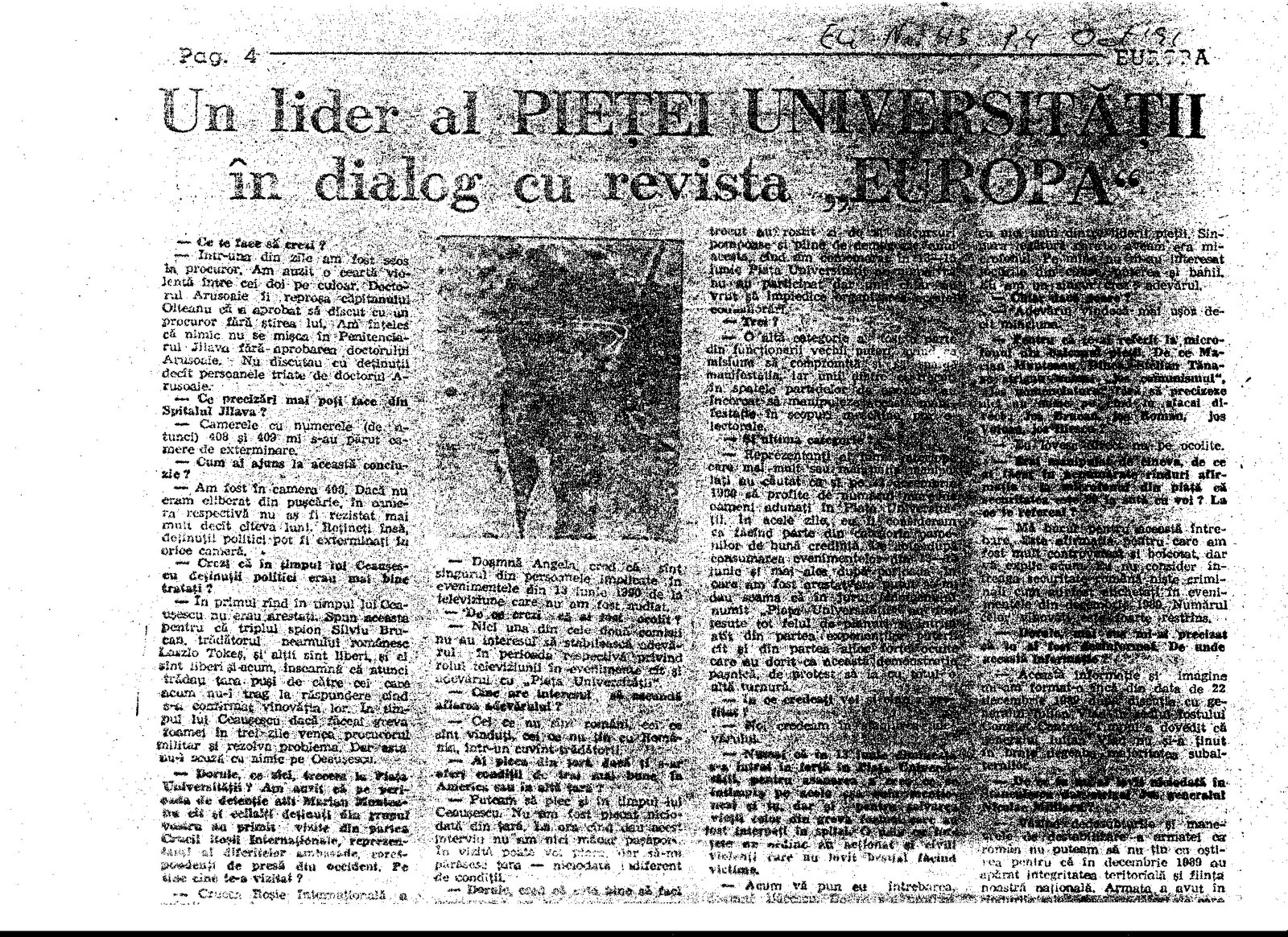
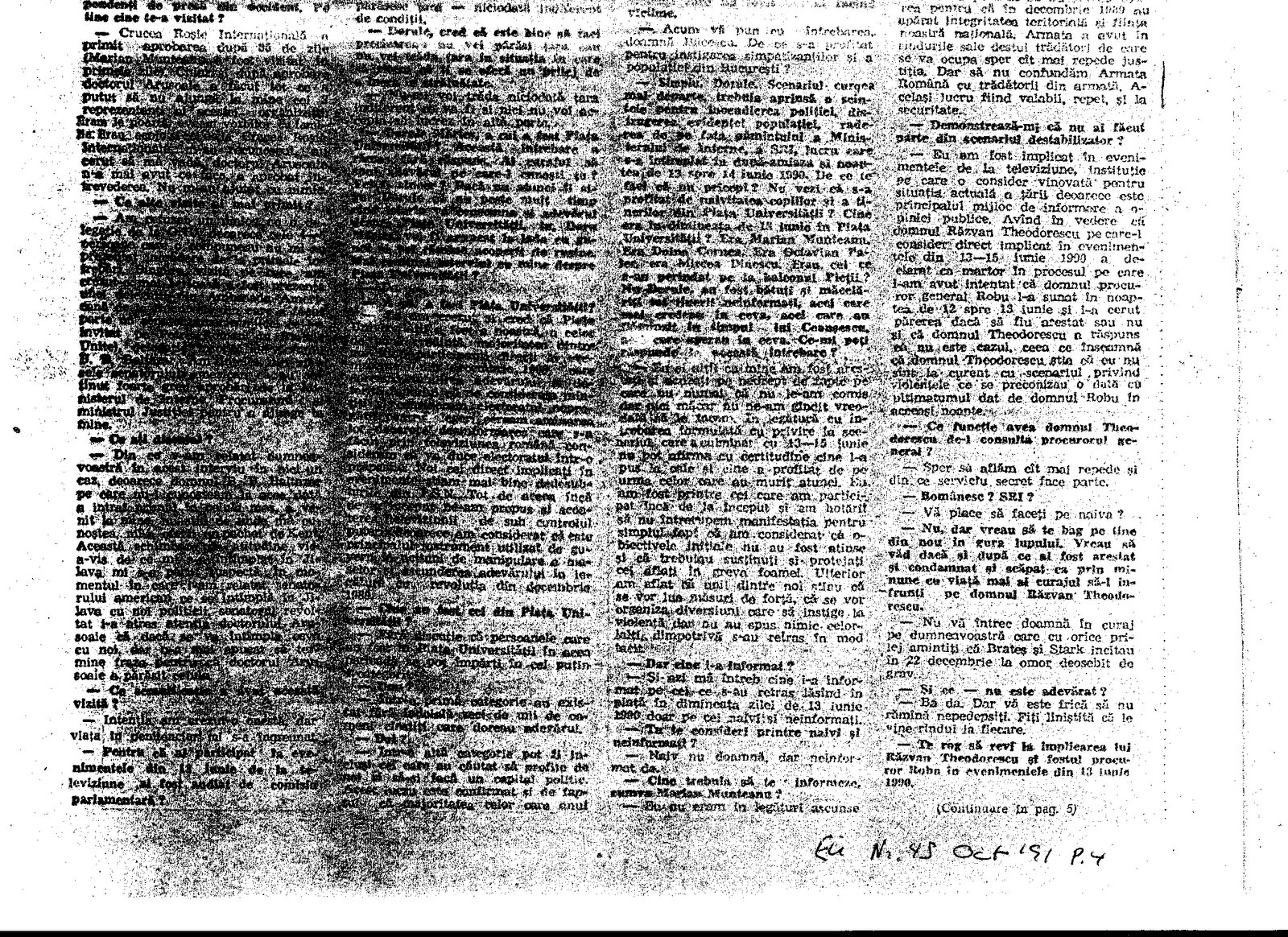
Dupa 20 de ani: Adevarul vinde…minciuni…fabricate de catre fosta securitate (Angela Bacescu, aprilie 1990)

Posted by romanianrevolutionofdecember1989 on March 30, 2010

Cazul Angela Bacescu

image-57image-58image-59image-60

Posted in Uncategorized | Tagged: , , , | 1 Comment »

Romania 1989: Unde sint teroristii? PE STRADA, PRINTRE NOI (I) 13 iunie 1990

Posted by romanianrevolutionofdecember1989 on March 30, 2010

Ziarul armatei–deci al unei institutii situate, gratie Revolutiei din Decembrie, in afara politicii–nu este, in mod deliberat, o publicatie polemica. Asa cum este si organismul din care faceum parte, noi, ziaristii militari, am optat pentru o atitudine sobra, echilibrata, pe cit posibil obiectiva, constienti de faptul ca, prin lispa materialelor sezationale, de scandal vom avea, pentru inceput, o audienta mai redusa in rindul cititorilor. Fericiti ca, in sfirsit, ne putem vedea de treburile noastre–ca si armata in ansamblul el, de altfel–noi nu ne-am propus deci, in mod programatic, sa ne luam la harta cu diverse organe de presa din tari, nici vorba de cele din strainatate. Iata, insa, ca saptaminal independent “Expres”–nr. 18, mai 1990–ne pune la curent cu dezvaluirile senzationale ale revistei franceze “LE POINT”, din 21 mai 1990. Initial, ne-am gindit ca-i treaba politicienilor sa dezamorseze, sa combata continuntul incitantului articol, intitulat “In Romania, complotul iese la iveala.” Dar cind am aflat, de la niste ziaristi straini, ca armata noastra “a tras si asupra propriilor rinduri, astfel ca, in confuzia generala, au murit aproape la fel de multi ostasi si civili,” nu am putut ramine in expectativa. Pentru ca este vorba de o incalificabila ofensa adusa eroilor pe care armata i-a jertfit pe altarul Revolutiei. Noi nu cunoastem meseria armelor din carti, ci am deprins-o in poligoane, pe cimpurile de instructie. Daca accidentele se pot produce si pe timp de pace–lucru de care ne-au convins viata, practica militara pe care am trait-o, vreme de peste doua decenii–acestea au fost pe deplin posibile, si chiar s-au produs, si pe timpul Revolutiei, cind inamicul era peste tot si nicaieri. Dar de aici si pina a afirma ca cei 267 de morti si 674 raniti ai armatei s-au impuscat intre ei e o cale atit de lunga, pe care nici un om cu buna credinta n-ar face-o. Nu punem la indoiala buna credinta a jurnalistilor francezi, desi ideea promovata de ei convine de minune celor care se dau de ceasul mortii sa ne demonstreaza ca, de fapt, teroristii n-au existat. Fie-ne, insa, permis sa aratam ca documentarea celor de la “Le point” a fost, cel putin, incompleta. O spunem noi, care am fost tot timpul aici, reporteri printre gloante, in punctele fierbinti ale Revolutiei. O spunem si o argumentam, pentru inceput, cu fapte petrecute in zona sediului Ministerului Apararii Nationale.

DIVERSIUNE SI INTIMIDARE.

Nu ne vine sa credem! Desi a trecut peste o jumatate de an de la consumarea
evenimentelor, oamenii sint speriati. Este vorba de locatarii celor trei
blocuri–A1, A2, B3–dispuse in fata Centrul de Calcul al M.Ap.N. In urma cu
citeva saptamini, erau deschisi, raspundeau la orice intrebare, relatau faptele,
imprejurarile extrem de grele prin care au trecut, iar acum sint prudenti, retinuti, tematori. Mai mult, o doamna–cu mina pe inima si vocea tremurinda–ne
sfatuieste sa o lasam balta, ca riscam prea mult…

Ce s-a intimplat de fapt? In ultima vreme, pe la usile unor apartamente, au
batut citeva…persoane de bine, care, cu destula discretie–si
subtitlitate–s-au straduit sa le explice oamenilor cum s-au petrecut, cu
adevarat, lucrurile in perioada 22-25 decembrie 1989. De exemplu, in blocul A.1,
apartamentul 27, o doamna–banuitaj de a fi avut, in trecut, relatii cu
securitatea de trist renume–le a sugerat gazdelor cum sa interpreteze ,corect’
incidentul cu cele doua A.B.I.-uri din noaptea de 23/24 decembrie.

Alti vizitatori n-au avut nici macar inspiratia de a-si disimula identitatea
(sau poate ca chiar asta au facut). Domnilor, mie sa nu-mi dati numele la ziar,
ne roaga alt locatar. Am avut destule necazuri cu securitatea. In 21 mai, a fost
la mine un maior de politie, Popescu zicea ca-l cheama. S-a interesat despre
teroristii care au tras din blocul nostru. I-am spus ca, daca vrea sa loveasca in armata, nu are nici o sansa: au tot adevarul ii voi
spune. In final mi-a adresat o rugaminte: sa nu stie cei de la armata de vizita
lui… A revenit peste 2-3 zile, dar mi-a fost frica sa-i mai deschid…”

Cine-o fi misteriosul maior si de ce pastreaza atita discretie? Se pare insa ca
persoanele cu pricina manifesta un mare interes pentru blocul B.3. Domnul Stancu
Varzan are mai mult curaj.

–Dumneavoastra nu stiti ce nopti de cosmar am trait noi: se tragea si din fata
si din spate, de la gunoaie. Totul a inceput in 22 decembrie, pe la orele 22.00:
la inceput sa auzeau focuri izolate. Apoi–ca la razboi. Numai in baie ne
simteam oarecum in siguranta. La un moment dat, am si ris. Fata mea a plecat
pina la bucatarie si, cind s-a intors, ne-a spus sa fim linistiti ca, de sus, de
pe bloc, trage o mitraliera si ne apara! Era vorba, de fapt, de o
pusca-mitraliera, care executa foc spre Centrul de Calcul…Si de pe casa
scarilor s-a tras, in aceasi directie. Teroristii au incercat sa intre la mine in apartament, dar noi avuseseram grija sa blocam usa cu un cuier
greu. Sint bolnavi astia care vor sa ne convinga ca a tras armata in noi si ca,
de fapt, nici nu au existat teroristi. Dar i-am auzit discutind precipitat,
tropaind: in jurul blocului, pe scari, pe acoperis.

In acelasi bloc, stam de vorba si cu sotii Florica si Gheorghe Petrut. Sint
revoltati.

–Au fost la noi doi civili, spune doamna. Ne-au fluturat pe sub nas niste
legitimatii, din care am retinut ca sint de la militia din Turnu-Severin. Cind
noi am intrebat cine a tras, ei ne-au informat: “armata a tras.” Bine, dar in
armata cine a tras?–am continuat noi–doar in parcul din fata blocului au fost
impuscati studenti militari. “Au tras unii in altii”–ni s-a raspuns.

Si in incheiere, gazdele noastre ne avertizeaza:

–Fiti cu mare bagare de seama, domnilor ofiteri. Astia au tot interesul sa va
compromita!!!

Deci ,baietii’ lucreaza. Fara voie ne gindim la povestea cu lupul care se
intoarce la locul unde a mincat o oaie. Si a criminalului care se intoarce la locul faptei…

(Maior Mihai Floca si Capitan Victor Stoica, Armata Poporului, 13 iunie 1990, p. 3)

Posted in Uncategorized | Tagged: , , , , , , , , , | Leave a Comment »

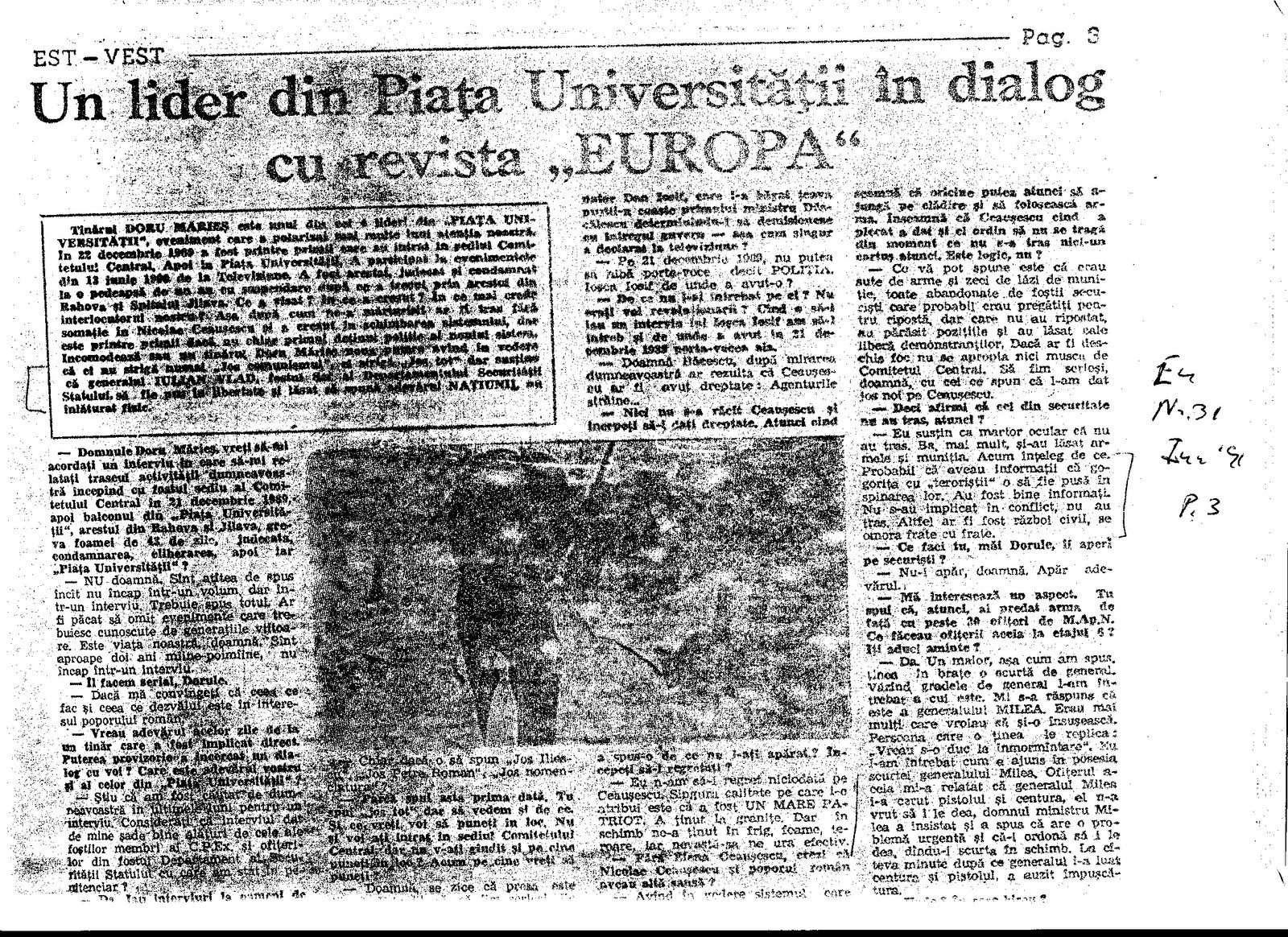
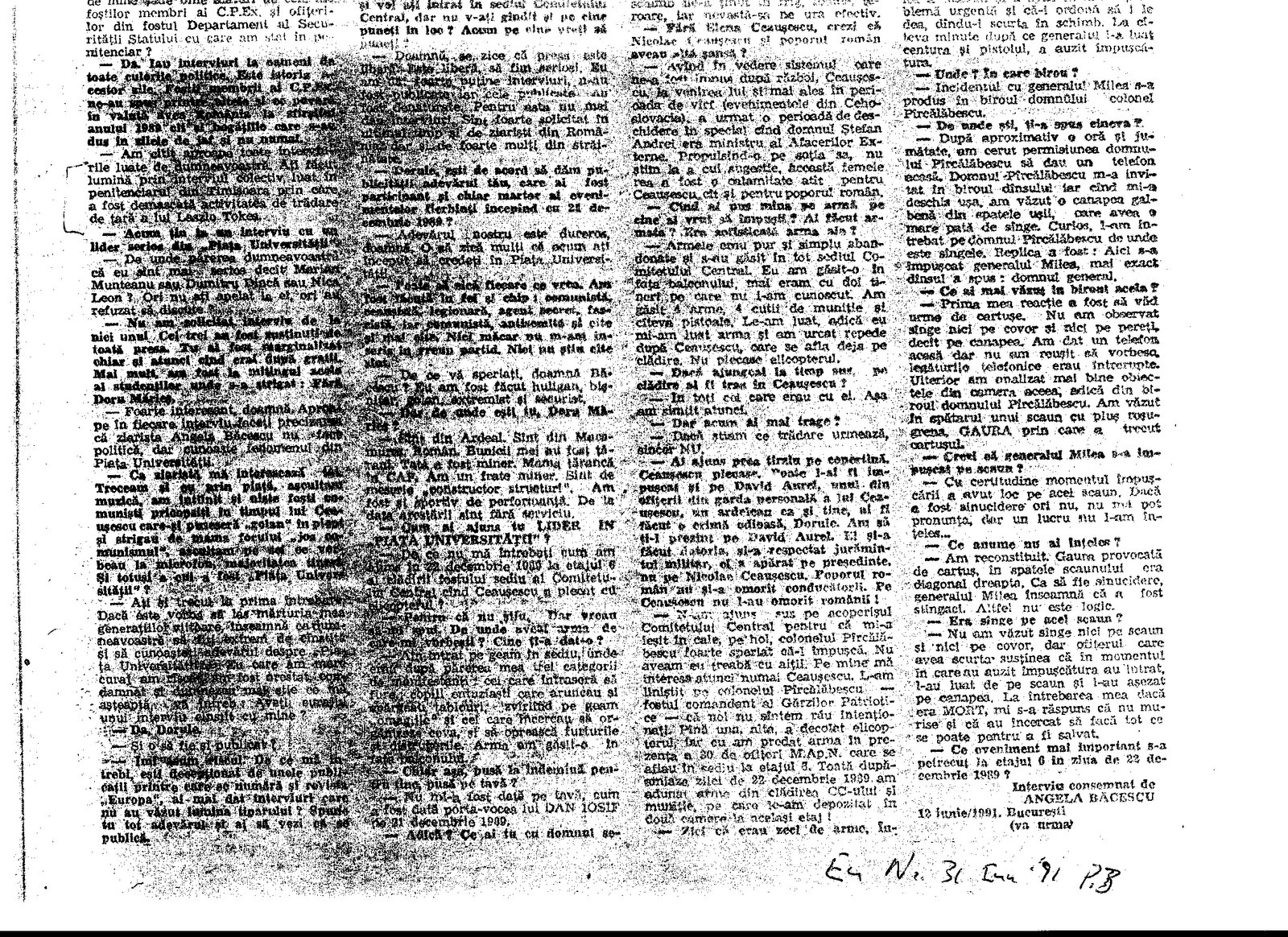
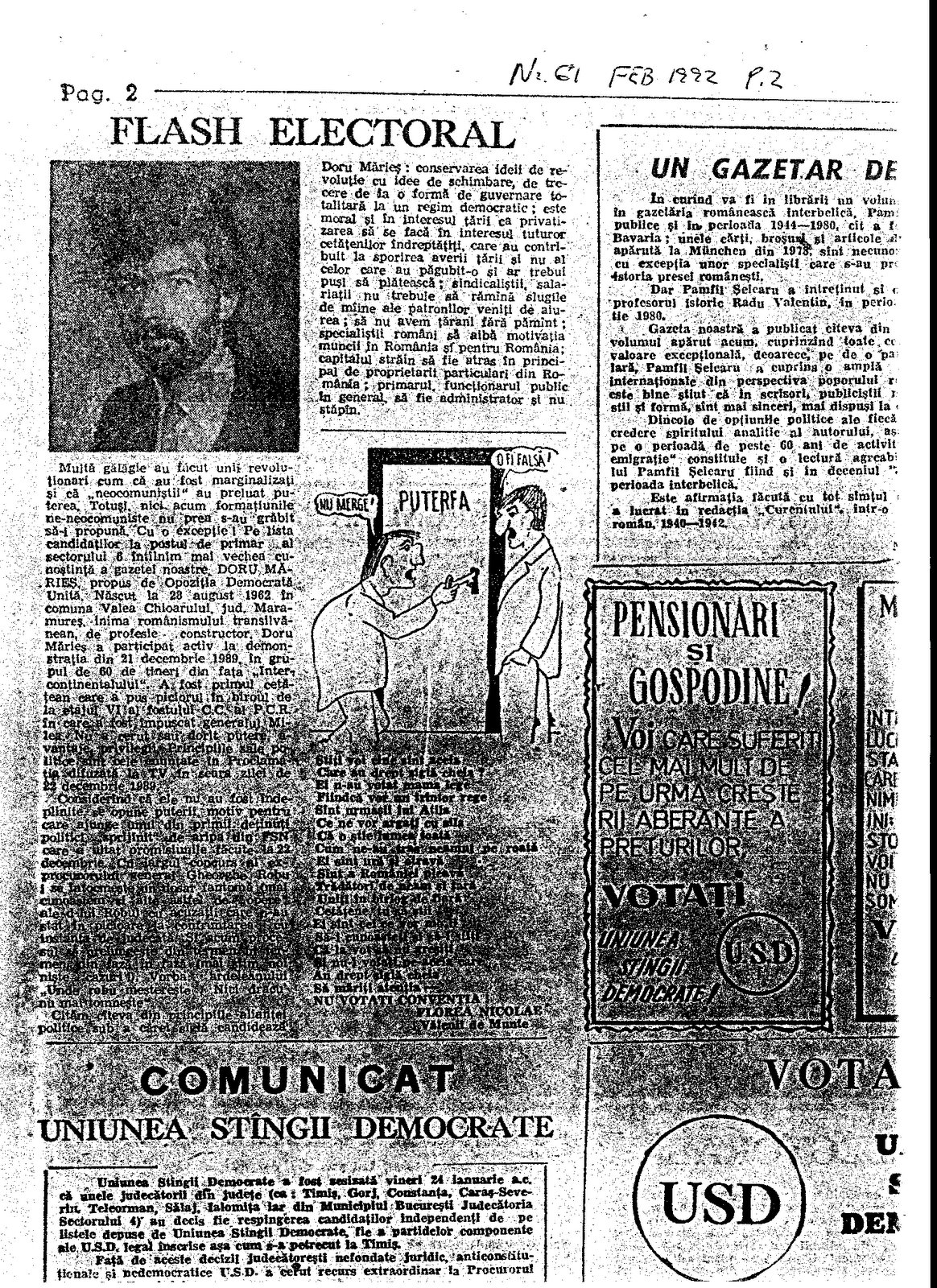
EUROPA: cu Doru Teodor Maries! Adevarul (despre decembrie 1989) e greu…

Posted by romanianrevolutionofdecember1989 on March 29, 2010


TEODOR MARIES (13 iunie 1991, interviu luat de Angela Bacescu, revista Europa):

“Am citit aproape toate interviurile luate de dumneavoastra.  Ati facut lumina prin interviul colectiv luat in penitenciarul din Timisoara prin care a fost demascata activitatea de tradare de tara a lui Laszlo Tokes.”

“Doamna Bacescu, dupa mirarea dumneavoastra ar rezulta ca Ceausescu ar fi avut dreptate:  Agenturile straine…”

“Eu n-am sa-l regret niciodata pe Ceausescu.  Singura calitate pe care i-o atribui este ca a fost UN MARE PATRIOT.  A tinut la granite.  Dar in schim ne-a tinut in frig, foame, teroare, iar nevasta sa ne ura efectiv.”

“Eu sustin ca martor ocular ca [securistii] nu au tras.  Ba, mai mult, si-au lasat armele si munitia.  Acum inteleg de ce.  Probabil ca aveau informatii ca gogorita cu “teroristii” o sa fie pusa in spinarea lor.  Au fost bine informati.  Nu s-au implicat in conflict, nu au tras.  Altfel ar fi fost razboi civil, se omora frate cu frate.”


TEODOR MARIES:

“In primul rind in timpul lui Ceausescu nu erau arestati.  Spun acestea pentru ca triplul spion Silviu Brucan, tradatorul neamului romanesc, Laszlo Tokes, si altii sint liberi, si ei sint liberi si acum, inseamna ca atunci tradau tara pusi de catre cei care acum nu-i trag la raspundere cind s-a confirmat vinovatia lor.  In timpul lui Ceausescu daca faceai greva foamei in trei zile venea procurorul militar si rezolva problema.  Dar asta nu-l scuza cu nimic pe Ceausescu.”

iata surpriza (si dezamagirea) mea din 1997 cand am citit si am copiat interviul acesta:  se pare ca romanilor ii plac mituri mai mult decat adevaruri…asa este…


Posted in Uncategorized | Tagged: , , , , , , , , , | 1 Comment »

Cine l-a nominalizat pe Trosca? (cazul MApN, 23-24 decembrie 1989)

Posted by romanianrevolutionofdecember1989 on March 28, 2010

Dezinformare despre Cazul M.Ap.N. 23-24 decembrie 1989…dejucata de catre uslasii ei insusi

pe pagina 116 Ardeleanu admite ca el insusi–nici vorba de Militaru sau altcineva–l-a nominalizat pe Trosca pentru misiunea faimoasa…

pe pagina 153 uslas-ul Soldea admite ca dupa incidentul sangeros, el a fost anchetat pentru informatii despre subunitatea lui…si pe pagina 155 ca i s-a supus o analiza de urina…ca sa verifice daca el a fost drogat…

Posted in raport final, Uncategorized | Tagged: , , , , , | 3 Comments »