The Archive of the Romanian Revolution of December 1989

A Catch-22 December 1989, Groundhog-Day Production. Presenting the Personal Research & Scholarship of Richard Andrew Hall, Ph.D.

Posts Tagged ‘dosarele revolutiei de la timisoara’

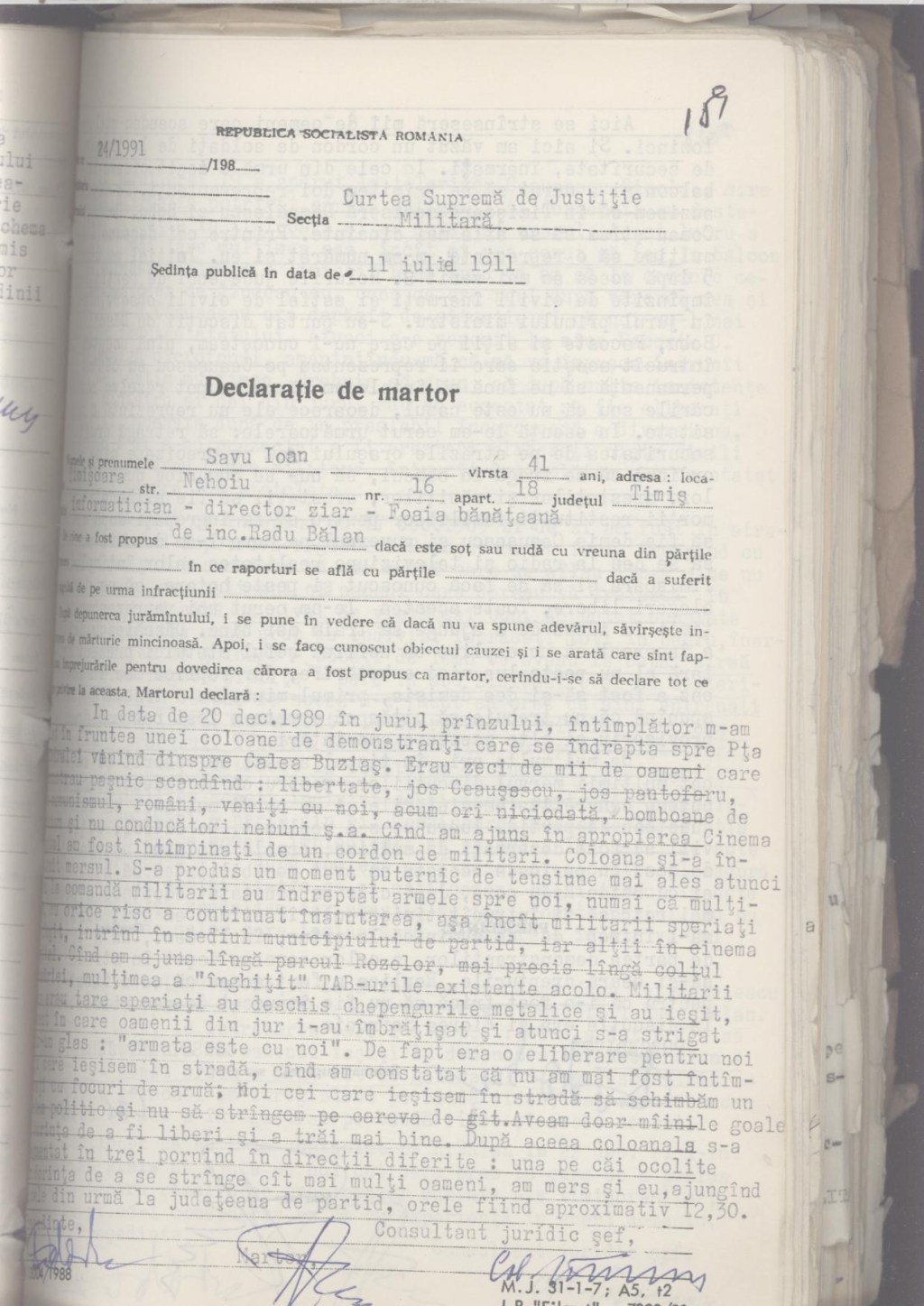
Filip Teodorescu (adj. sef. Dir III Contraspionaj D.S.S.): “…nu sint date ca ar exista instigatori sau conducatori anume veniti din strainatate…”

Posted by romanianrevolutionofdecember1989 on March 17, 2013

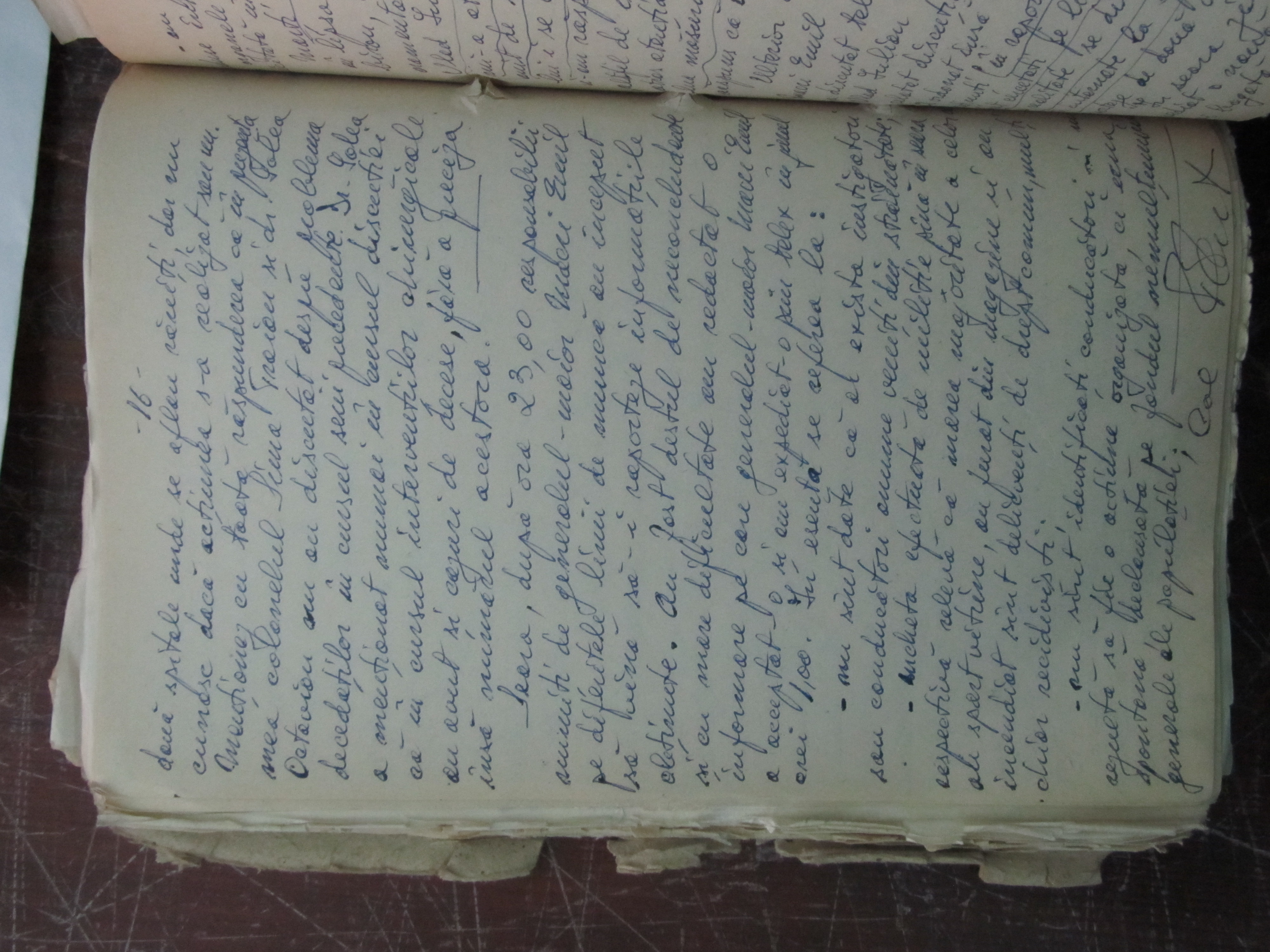
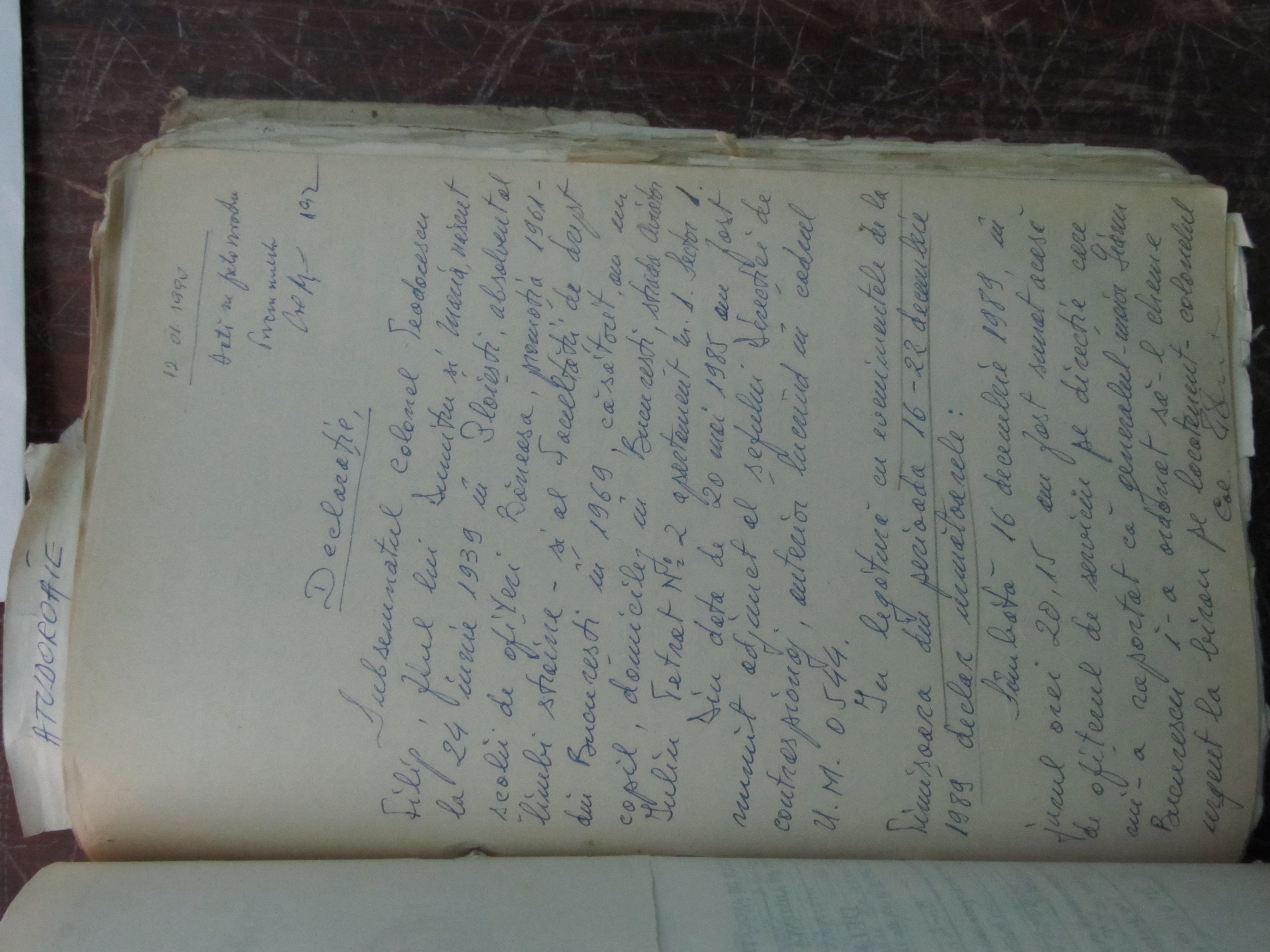
Filip Teodorescu (adj. sef. Dir III Contraspionaj D.S.S.), Declaratie, 12 ianaurie 1990: 

Seara [luni, 18 decembrie 1989], dupa 23:00, responsabili (anumiti ?) de generalul-maior Macri Emil pe diferitele linii de munca au inceput sa vina sa-i raporteze informatiile obtinute.  Au fost destul de neconcludente si cu mare dificultate am redat o informare pe care generalul-maior Macri Emil a acceptat-o si am expediat-o prin telex in jurul orei 01:00 [marti, 19 decembrie 1989.  In esenta se refera la:

–nu sint date ca ar exista instigatori sau conducatori anume veniti din strainatate…

IMG_1453

IMG_1438

Posted in decembrie 1989, raport final | Tagged: , , , | 5 Comments »

Emil Macri: “Rezumind sintetic informatiile obtinute ele nu au pus in evidenta nici lideri si nici amestecul vreunei puteri straine in producerea evenimentelor de la Timisoara.”

Posted by romanianrevolutionofdecember1989 on March 16, 2013

Generalul Emil Macri (seful Dir. II-a Securitatii, Contrainformatii Economice),

Declaratie 2 ianuarie 1990:

“Rezumind sintetic informatiile obtinute ele nu au pus in evidenta nici lideri si nici amestecul vreunei puteri straine in producerea evenimentelor de la Timisoara.  Raportaua (?) acestor date la esalonul superior respectivi generalului I. Vlad a produs iritare si chiar suparare…”

IMG_1219

IMG_1215

Posted in decembrie 1989, raport final | Tagged: , , , , | 8 Comments »

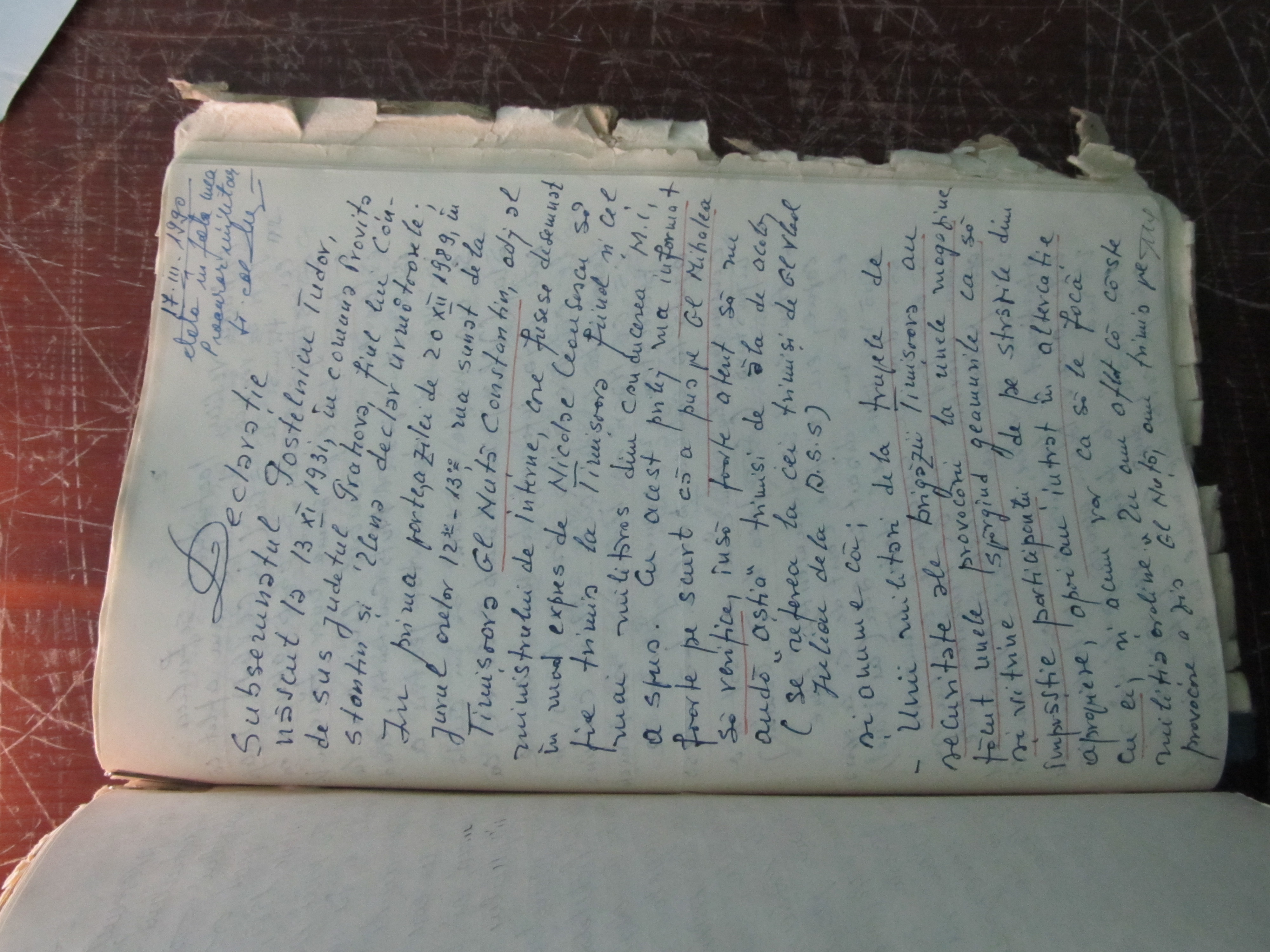
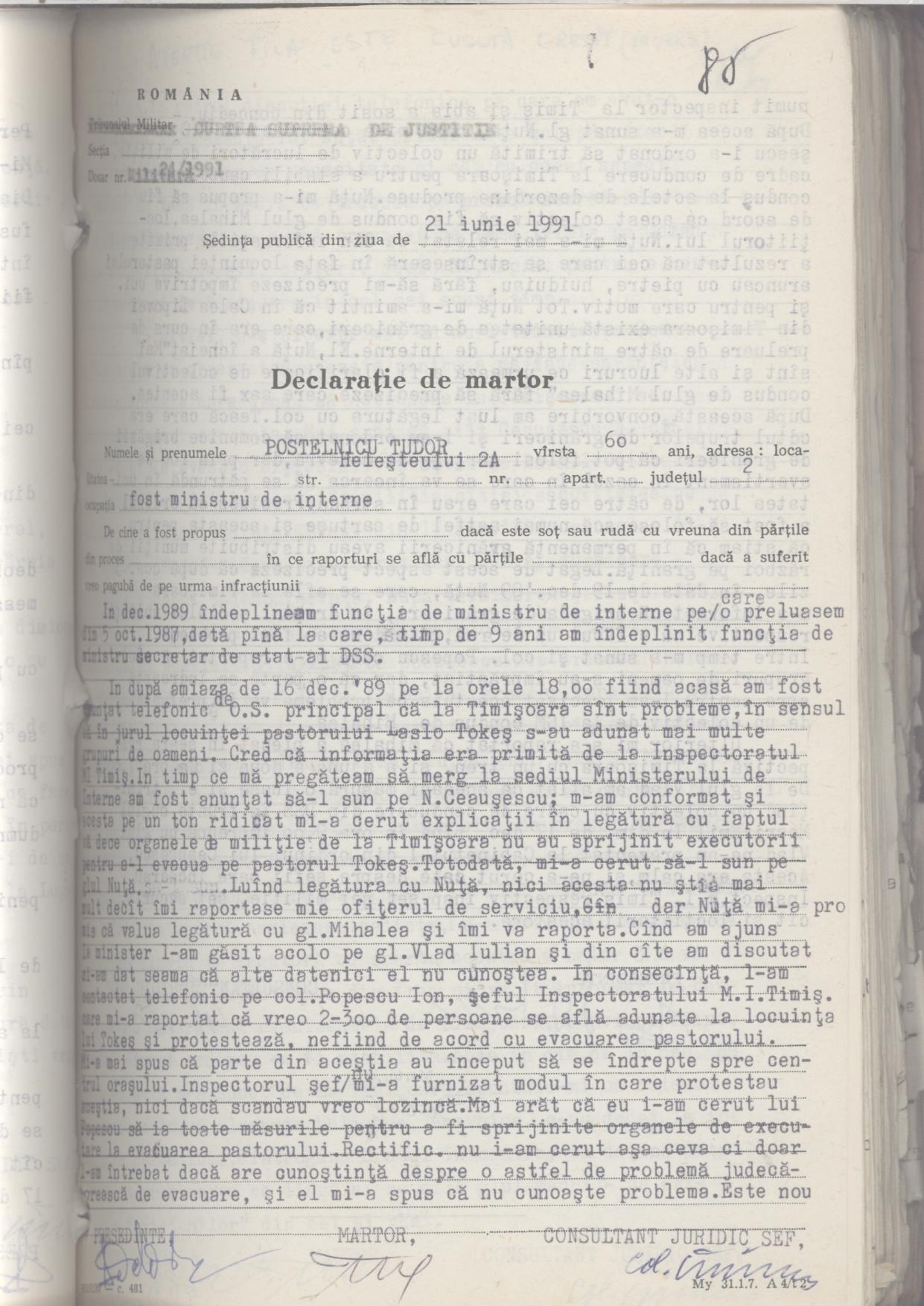
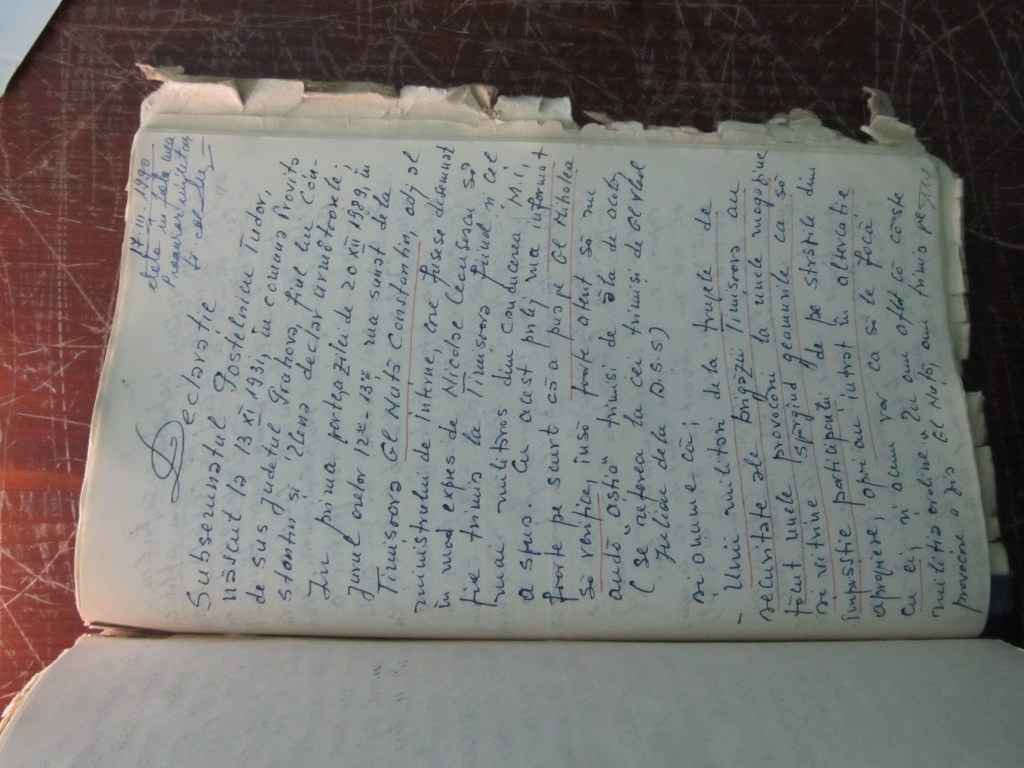
Dosarele Revolutiei de la Timisoara: Tudor Postelnicu “Unii militari de la trupele de securitate ale brigazii Timisoara au facut unele provocari la unele magazine si vitrine spargind geamurile sa imprastie participantii…” (17.III.1990)

Posted by romanianrevolutionofdecember1989 on March 15, 2013

IMG_2576

Tudor Postelnicu (Ministerul de Interne in decembrie 1989):  “Unii militari de la trupele de securitate ale brigazii Timisoara au facut unele provocari la unele magazine si vitrine spargind geamurile sa imprastie participantii de pe straziile din apropriere, apoi au intrat in altercatie cu ei, si acum (?) vor sa le faca militia ordine.  ‘Nu am aflat ca costa provocare a zis Gl. Nuta, am trimis pe …” (17.III.1990)  http://sensidev.com/fc/dosare%20de%20urmarire%20penala/dosar%20%20de%20urmarire%20penala%20volumul%2011/IMG_2576.JPG (Dosarul de Urmarire Penala, Vol. 11, IMG 2576)

Cateva observatii:

1) Postelnicu nu spune nimic despre asa-zisii “turisti sovietici” sau “turisti rusi” (o tema revizionista foarte populara) …nu spune ca ei au facut distrugerea…

2) In schimb, Postelnicu spune ca securistii au facut provocarile…dar atentie:  nu spune ca ei le-au facut sa intareasca demonstrantii, ci “sa imprastie participantii de pe straziile din apropriere…”

deci nu intr-un scop ca detonatorii a unei revolutii (alta tema revizionista foarte populara), ci ca o tactica din arsenalul represiunii!

3) Lipseste din nenorocire continuarea acestei marturii din paginile dosarele revolutiei de la timisoara la http://dosarelerevolutiei.ro/

————————————————————————————————————————————————————————————————————————-

An excerpt from Chapter 5 of my Ph.D. Dissertation at Indiana University: Richard Andrew Hall, Rewriting the Revolution: Authoritarian Regime-State Relations and the Triumph of Securitate Revisionism in Post-Ceausescu Romania (defended 16 December 1996). This is the original chapter as it appeared then and thus has not been revised in any form.

Chapter Five.  The Beginning of the End: Timisoara, 15-17 December 1989

The “Window Breakers”

The reportedly unusual scope of physical destruction which occurred in Timisoara, particularly on the afternoon and evening of 17 December 1989, has fueled revisionist arguments. Estimates of the damage during the Timisoara unrest are in the neighborhood of four to five billion lei (approximately forty to fifty million dollars at the time), a reasonably large sum given Romania’s standard of living at the time. A huge number of windows was broken and as many as 300 to 400 stores suffered some sort of damage, although relatively few were actually looted. On the evening of 17 December, stores, vehicles, and kiosks were burning in at least ten different areas of the city.[65]

Former Securitate officers clearly wish to link this destruction to the “foreign tourists” who were supposedly so ubiquitous in Timisoara during these days.[66] Perhaps somewhat surprisingly, former Securitate Director Iulian Vlad argued at his trial that

…the acts of vandalism, theft, destruction, arson… acts without precedent…could not have been the work [“opera”] of the faithful [apparently referring sarcastically to Tokes’ parishioners], nor the revolutionaries. They were produced by elements which wished to create a certain atmosphere of tension.[67]

“A group of former Securitate officers” wrote to the Ceausist Democratia in September 1990 that after the Militia and Securitate refused to respond to the demonstrations provoked by the “foreign tourists”: “they advance[d] to the next stage: the massive destruction of public property designed to provoke forcible interventions–human victims were needed.”[68]

Nevertheless, here is how one opposition journalist, Grid Modorcea, has described the strange character of Timisoara destruction:

For the first time in history, a revolution…was announced in a previously unknown and absolutely original manner, both literally and figuratively speaking: through the methodical breakage of thousands of windows. On 16 and 17 December 1989, Timisoara was the city of [glass] shards. Well-trained groups of athletes spread throughout the town, tactically, but energetically smashing to pieces hundreds of huge windows without apparently being interested in stealing from these stores…they were like mythical Magis coming to announce the end of one world and the beginning of another. And they gave it an apocalyptic quality: the sound produced by the breaking glass was infernal. The panic this caused was indescribable….Those who “executed” the windows did so with karate-like kicks while yelling “Liberty and Justice”!…The crowds of people who came out into the streets transformed spontaneously into columns of demonstrators, of authentic revolutionaries. The effect was therefore monumental: the breaking of the windows unleashed the popular revolt against the dictator.[69]

Modorcea is convinced that the Tokes case was “merely a pretext” and that “someone–perhaps those who planned the vandalizing of the windows–has an interest in preventing it from being known who broke the windows.” Although Modorcea maintains he is unsure who was responsible, he insists on observing that:

Only the Customs people know how many tourists there were. All were men and long-haired. Inside their cars they had canisters. This fits with the method of the breaking of the windows, with the Molotov cocktails, and the drums used as barricades–they were exactly of the same type….To what extent the new regime which came to power was implicated, we cannot say![70]

Many Timisoara protesters appear torn between wishing to rationalize the extensive destruction as the courageous response of an enraged, long-suffering population, and denying that the perpetrators could have come from among their ranks. Even those investigators attuned to the retroactive psychology of the protesters cannot help but admit that widespread destruction occurred and that it could not have been wholly spontaneous.[71] Furthermore, as Laszlo Tokes has observed in discussing the events at Piata Maria, manipulation and attempts to instigate the crowd to violence were constant features during these days.

Tokes maintains that Securitate provocateurs had tried to agitate the crowd by shouting things like, “Let’s break into the house. The Securitate are in there; they’re trying to kidnap Laszlo Tokes! Let’s rush them!” and by appealing for him to “Come down into the street and lead us!”[72] According to Tokes:

I was alarmed at the obvious provocation from individuals in the crowd clearly intent on making the situation uncontrollable….Later, thinking about the events of those two days, I realized that the authorities would have had a great deal to gain if the situation had become a riot.[73]

Mircea Balan questions whether the protesters would have set stores on fire which were located on the ground floor of the buildings in which the protesters themselves lived.[74] Moreover, he wonders how even the revolutionary fury of the crowd could drive protesters to break so many windows, particularly given the presence of repressive forces on the streets. It is what Balan has termed the “systematic devastation” of property which raises questions.

Eyewitness accounts recorded soon after the events–therefore at a time before the various plots and scenarios had permeated the popular imagination–support the hypothesis that the vandalism was organized. Moldovan Fica remarks:

I admit that I cannot escape a certain conclusion. All of this [destruction] was done by a group of about five or six individuals, whose calm demeanor and self-control continues to stay with me to this day. They did not run from the scene, they appeared as if they did not fear anything; I would say that, in fact, they were doing what was required of them, something which had been ordered directly of them![75]

Describing destruction in a different part of the city, Andras Vasile observed that

…four young men with shaved heads and wearing civilian clothes had sticks–I would term them special sticks–1.7 to 1.8 meters long, equipped with metal rings on the top of them. They were breaking the windows, but not taking anything, as if they only had something against the windows, something which they thus went about with great enjoyment…they were led by two individuals in leather jackets.[76]

Other eyewitnesses supply details which confirm the widespread character of the vandalism; its undeniably organized quality; the disinterest of its perpetrators in looting the stores; and the almost “drugged” nature of the perpetrators, who seemed unperturbed by the chaos and repression going on around them.[77]

Mircea Balan has little doubt who committed this “systematic destruction”:

Demonstrators might have thrown rocks in windows, but the destruction of the entire store was not their work…Nobody need believe that for such a thing foreign intervention was necessary, seeing as there were enough first-class specialists in destruction and demolition right here at home. The Securitate could not have been foreign to what happened, no matter how much it fiercely attempts to deny this today. They were professionals in the art of destruction. They needed a justification for the bloody repression.[78]

In March 1990, Puspoki had been willing to identify the culprits more specifically. According to Puspoki, as the demonstrators began to gather to prevent Tokes’ eviction:

The USLA’s Sabotage and Diversion team was readied to break store windows, to devastate and set fires–to create the conditions necessary for mass repression: the existence of disorder in the streets and theft on the part of the demonstrators.[79]

Securitate Major Radu Tinu’s observation that the commercial complex “in front of the county Militia building” (i.e. the Inspectorate in which both the Securitate and Militia offices were located) was one of only two such complexes in the whole city to remain intact during these days may also be an indication of the source of the destruction.[80]

It is possible then that to the extent that this destruction did indeed contain an organized component, it was designed by the regime to subvert and cast suspicion upon the intentions of the protesters and to create a pretext for repression. To the extent that an organized component did contribute to the destruction, it was far more likely to have been regime forces attempting to undermine the protests than foreign agents attempting to provoke an uprising against the regime.

[65].. See, for example, Grid Modorcea, “Spargerea Geamurilor [The Breaking of the Windows],” Expres Magazin, no. 49 (1991), 8-9; Mircea Bunea, “Eroii noi si vechi [New and old heroes],” Adevarul, 2 February 1991, in Bunea, Praf in Ochi, 448-449; Suciu, Reportaj cu Sufletul, 57-58.

[66].. See, for example, the comments of Radu Tinu, the deputy director of the Timis County Securitate, in Bacescu, Din Nou in Calea, 67-85.

[67].. Mircea Bunea, “Ipse Dixit,” Adevarul, 21 February 1991, in Bunea, Praf in Ochi, 463. Vlad’s determination to emphasize that these were “acts without precedent” makes one wonder if they were indeed without precedent.

[68].. A group of former Securitate officers, “Asa va place revolutia? Asa a fost! [You like the revolution? Here is how it was!],” Democratia, no. 36 (24-30 September 1990), 4. The lengthy defense by these officers of the Fifth Directorate in this letter suggests that they were members of this directorate.

[69].. Modorcea, “Spargerea Geamurilor,” 8.

[70].. Ibid.

[71].. Balan, “Masacrul.”

[72].. Tokes, With God, for the People, 153, 156.

[73].. Ibid., 156.

[74].. Balan, “Masacrul.”

[75].. Suciu, Reportaj cu Sufletul, 96.

[76].. Ibid, 118. The fact that the two persons supervising the destruction are described as having worn “leather jackets” strongly suggests they may have been Securitate men. Mihai Decean claims that on a train headed for Bucharest on 25 December (therefore after Ceausescu’s flight), he helped in the arrest of two USLA officers whom he describes as “athletic, with shaved heads, and wearing leather jackets.” See Laura Ganea, “La Timisoara se mai trage inca” Tinerama, no. 77 (July 1991), 3.

[77].. Ibid., 71, 122. Some of the eyewitnesses cited in Modorcea, “Spargerea Geamurilor,” say similar things; Modorcea, however, gives them a very different interpretation.

[78].. Balan, “Masacrul.”

[79].. Puspoki, “Piramida Umbrelor (III).”

[80].. Bacescu, Din Nou in Calea, 80.

The following was added some years later as a footnote to the section above in republications of this chapter.  Badea says here “many years later” Postelnicu admitted this, but as we can now see from the Timisoara files, he wrote it in his declaration/statement dated 17 March 1990.

(In connection with the “window breakers” we do know a little more today than we did then back in 1996.  Dan Badea wrote in 1999 Bunoaica and the Window Breakers that “Tudor Postelnicu, the Interior Minister at the time, was to declare many years later that the “breaking of the windows” was a mission executed by personnel from the 30th Securitate Brigade led by col. Ion Bunoaica).  Orele 20.00 – 21.00: Sint sparte toate vitrinele magazinelor de pe Bulevardul 6 Martie (Tudor Postelnicu, ministru de interne la acea vreme, avea sa declare multi ani mai tirziu ca “spargerea vitrinelor” a fost o misiune executata de militari ai Brigazii 30 Securitate condusa de col. Ion Bunoaica).

Other depictions of this event available online:

Conducerea partidului, alarmată, a trimis în Piaţa Maria, conform Ordinului 02600, numeroşi miliţieni şi trupe speciale, pentru a lichida manifestaţia care luase amploare. Circulaţia în zonă se întrerupsese. În Piaţa Maria au fost trimişi aproximativ 200 de activişti de partid, miliţieni şi numeroşi ofiţeri de securitate, îmbrăcaţi în haine civile. Au urmat ciocniri violente, mai ales după ce manifestanţii s-au încolonat şi au pornit spre sediul CJ PCR, strigând “Libertate”, “Vrem pâine”, “Vrem căldură”, “Azi la Timişoara, mâine în toată ţara”.
În acea seară echipe de miliţie dinainte pregătite au spart vitrinele magazinelor din centrul oraşului, pentru a avea argumente pentru o intervenţie în forţă. Desigur, multe vitrine au fost sparte şi de derbedei, asupra cărora s-au găsit bunuri furate. În acea noapte au fost arestate aproape 5-600 de cetăţeni. Ei au fost duşi la Penitenciarul oraşului, unde au fost bătuţi în mod bestial. În zilele care au urmat arestării au fost anchetaţi în vederea trimiterii lor în judecată. Bineînţeles, dacă Revoluţia n-ar fi reuşit.

“Azi la Timişoara”
Ivan Sabin

http://revista.memoria.ro/?location=view_article&id=371

Totuşi, se ştie că în acele zile fierbinţi din Timişoara au existat „personaje neidentificate” care au acţionat în mai multe zone ale oraşului. Am să amintesc aici doar două aspecte concrete cu privire la implicarea acestora în evenimentele din Timişoara. În zilele de 16 şi 17 decembrie au fost sparte aproape toate vitrinele magazinelor din zona centrală a oraşului. Sunt zeci de declaraţii ale revoluţionarilor care fac o descriere clară a celor care au spart acele geamuri. Au fost oameni bine îmbrăcaţi, robuşti şi tunşi scurt. Aceştia erau dotaţi cu nişte beţe speciale cu care printr-un gest scurt şi foarte bine exersat loveau vitrinele, după care plecau fără a încerca să sustragă ceva din magazine. Aceste persoane au fost văzute chiar şi de forţele de ordine desfăşurate în acea zonă, care în mod ciudat nu au luat măsuri împotriva lor, ci au acţionat împotriva manifestanţilor ce demonstrau împotriva regimului ceauşist. Un alt aspect relatat de mulţi timişoreni se referă mai ales la zilele de 17-19 decembrie, când, în rândul cordoanelor militare din diferite dispozitive amplasate în zonele importante ale oraşului, între soldaţi, erau intercalate persoane mai în vârstă, nebărbierite îmbrăcate doar parţial în uniforme militare, care nu făceau parte din acele unităţi militare.

Cine au fost acele „persoane neidentificate”? De ce s-a dorit în unele cercuri, cu insistenţă chiar, acreditarea ideii că oamenii au fost scoşi în stradă de agenţi străini? De ce, chiar şi după 20 de ani, se fac afirmaţii de genul: cadavrele celor arşi la Crematoriul „Cenuşa” erau ale unor agenţi străini? Nu voi căuta acum răspunsuri la aceste întrebări, dar, cu siguranţă, ele există.

Kali Adrian Matei

nascut in 30 iulie 1968 la Timisoara, muncitor la IJPIPS (1989), profesor de istorie la Liceul de informatica (1998), impuscat in spate

La Bijuterii concetatenii nostri tigani carau ce puteau. Numai la “Modex” nu era spart. Un grup de oameni se uitau cum niste indivizi bine instruiti spargeau geamurile de linga restaurantul Bulevard. Am rugat oamenii sa apere Modexul, pentru ca era clar ca spargatorii n-aveau nimic comun cu revolta.  30 septembrie 1995  http://timisoara.com/newmioc/4.htm

“În data de 14 decembrie, securitatea a spart toate gemurile din partea străzii principale, iar clădirea arăta ca o cetate asediată. Fostul primar al Timişorei, Petre Moţ l-a vizitat pe Tokes şi a ieşit la geam pentru a vorbi mulţimii. Moţ a cerut să se pună geamuri noi. Erau foarte multe maşini ale securiştilor. Întreaga stradă era ocupată. Se făcea filaj. Eu locuiam acolo, ba intram, ba ieşeam. Nu se vorbea încă revoluţie. Era o solidaritatea faţă de pastor”, declarat Iosif Kabai (foto), care locuieşte şi acum în clădirea bisericii reformate.

Citeste mai mult: adevarul.ro/locale/timisoara/16-decembrie-1989-ziua-timisoara-s-a-strigat-data-democratie-jos-comunismul-1_50bd3d887c42d5a663c8e01f/index.html

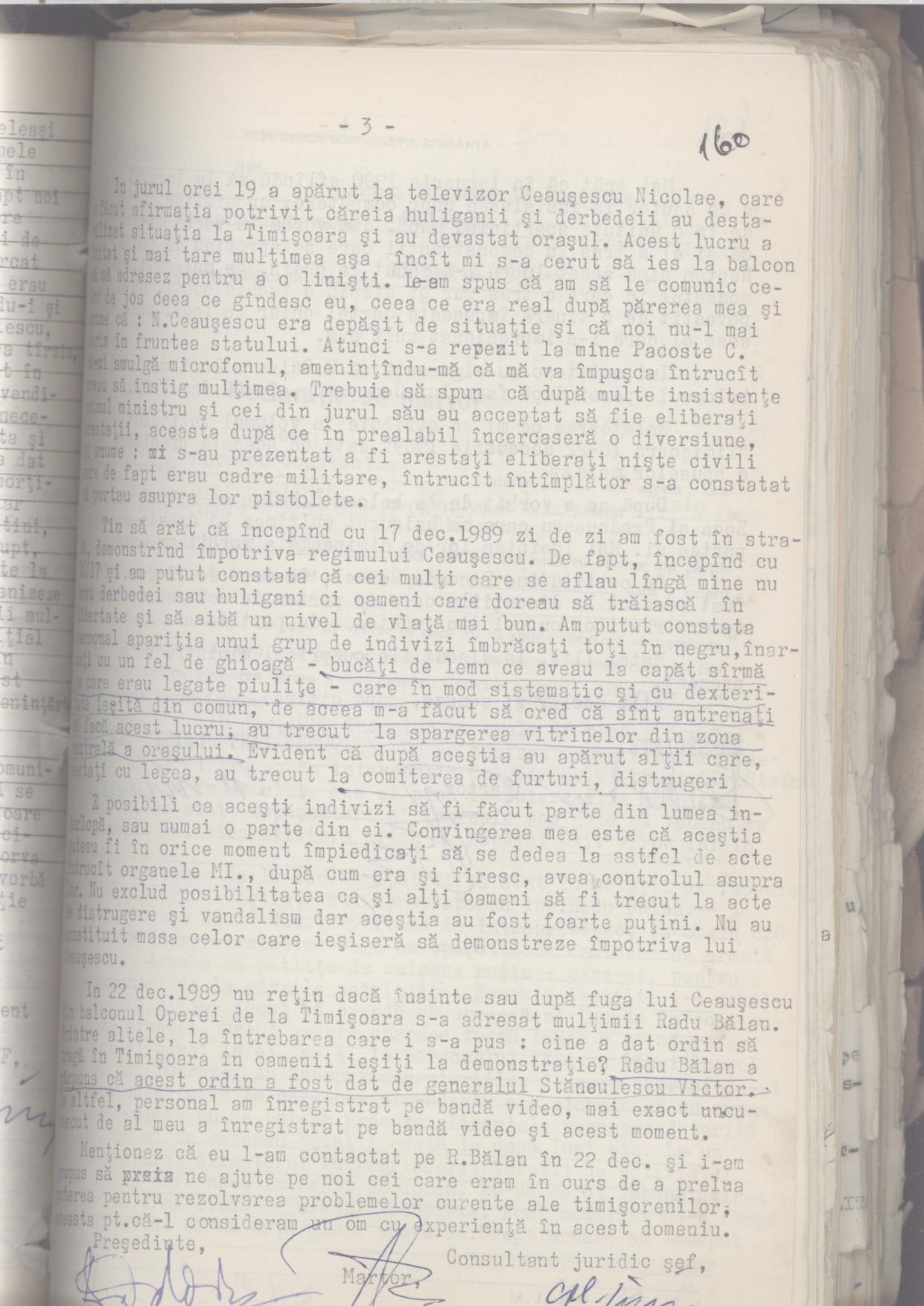
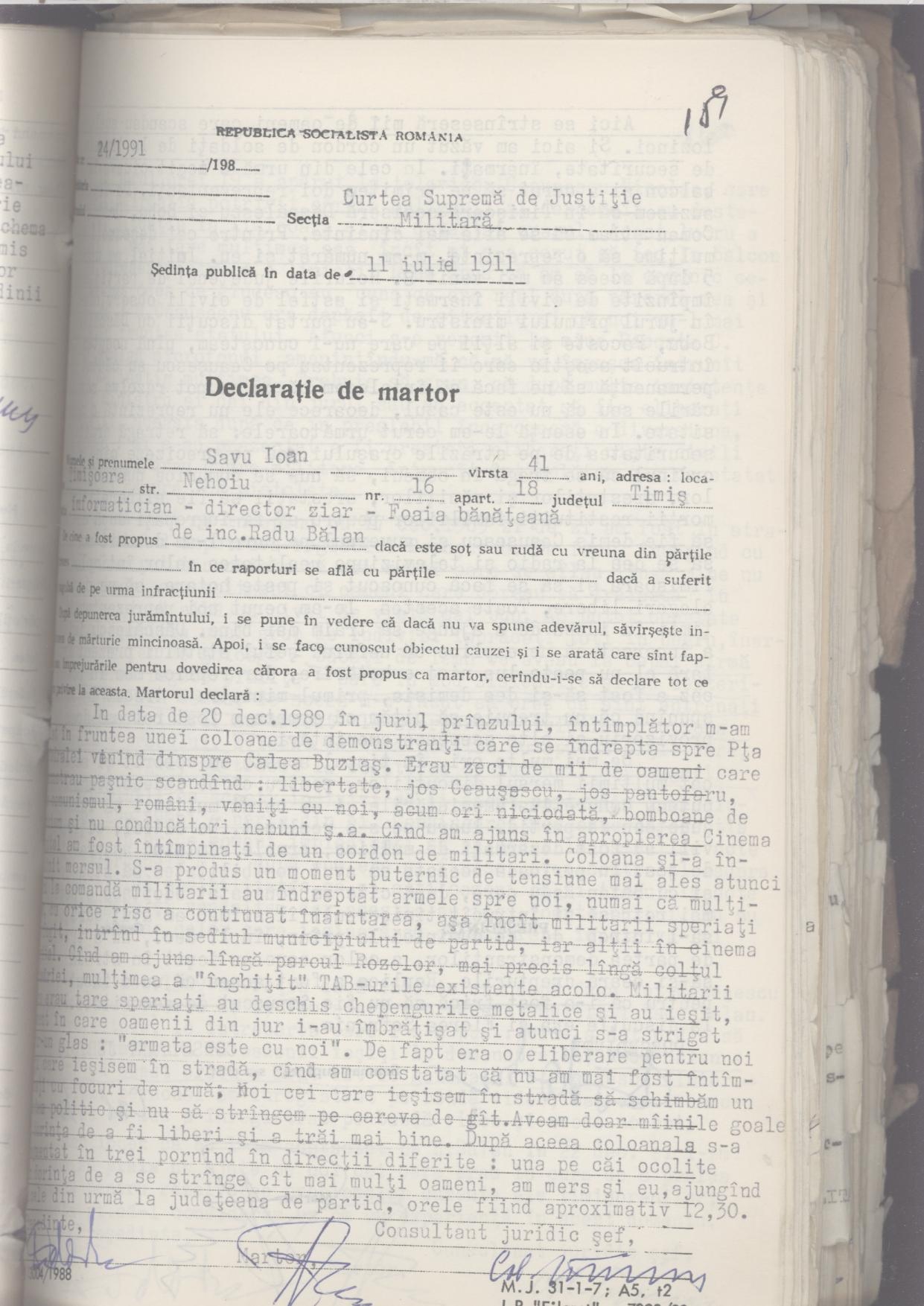
Ioan Savu discussed the windowbreakers as follows:
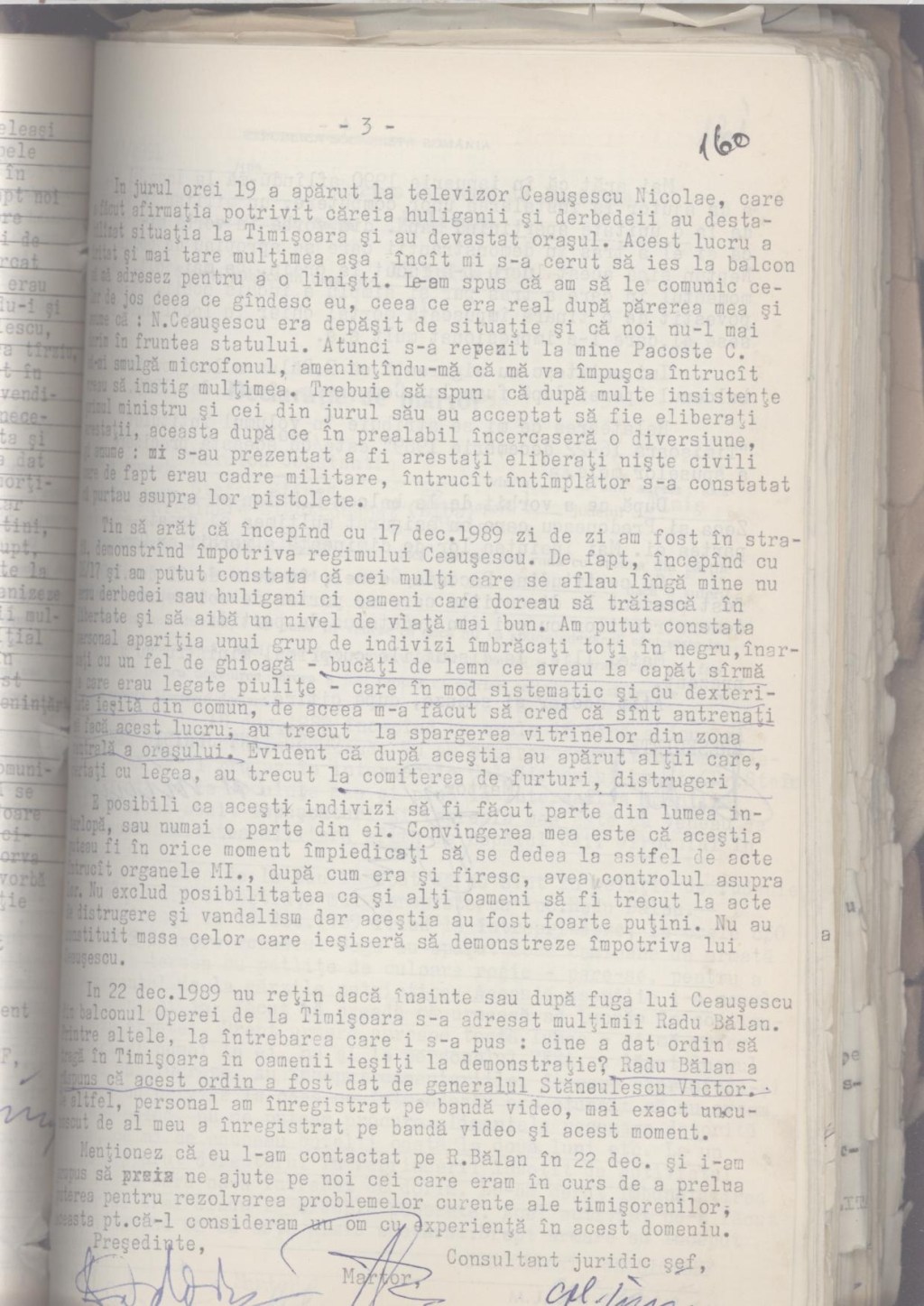
0282

0280

———————————-

Shattered Glass:  The Interior Ministry’s Self-Generated Pretext for the Repression of Demonstrators in Timisoara in December 1989

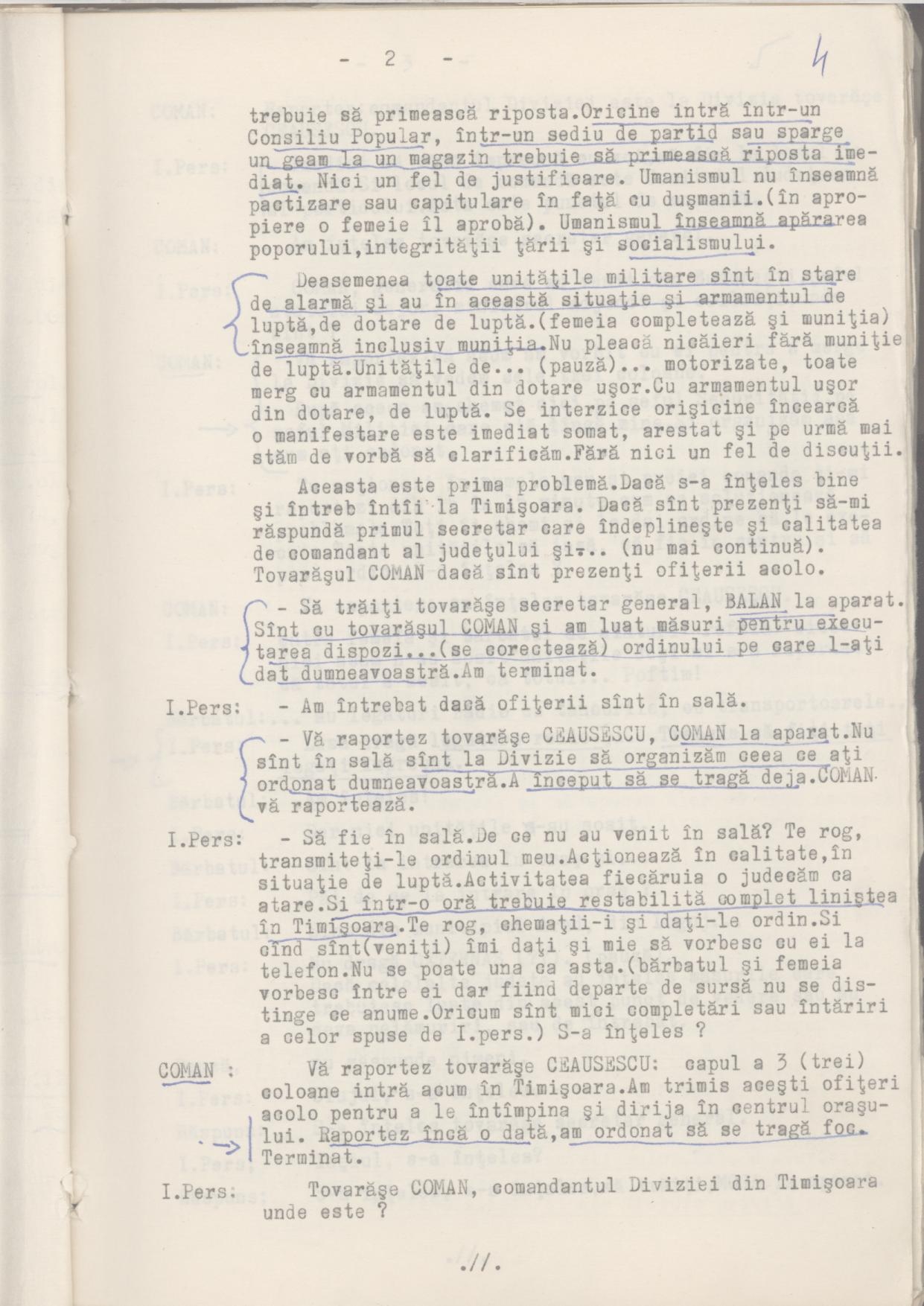
The significance of window-breaking as a justification for repression–something the Securitate would have realized–was outlined by Nicolae Ceausescu in his teleconference of 17 December 1989 as follows:

“Oricine intra intr-un Consiliu Popular, intr-un sediu de partid sau sparge un geam la un magazin trebuie sa primeasca riposta imediat.
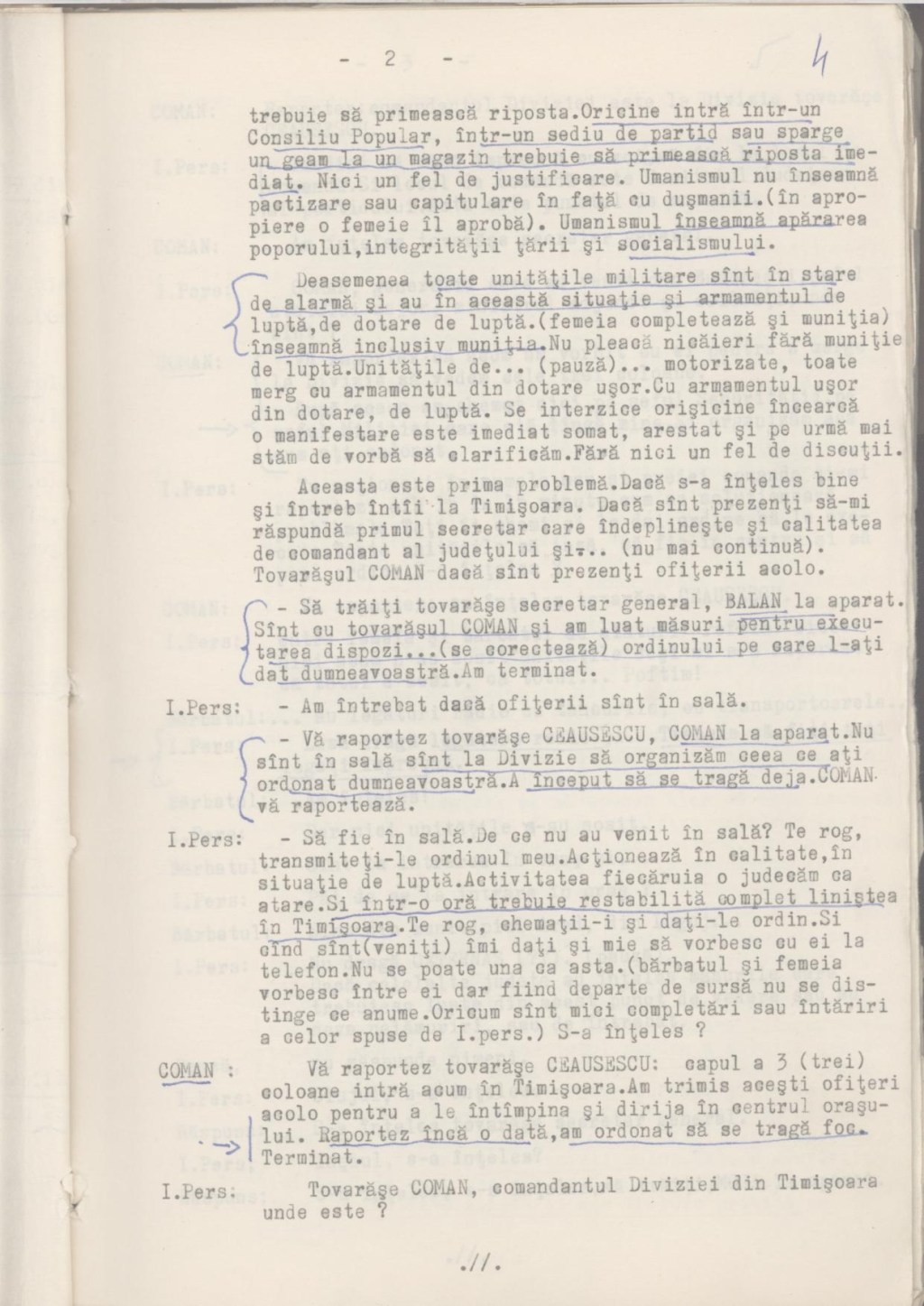
0007

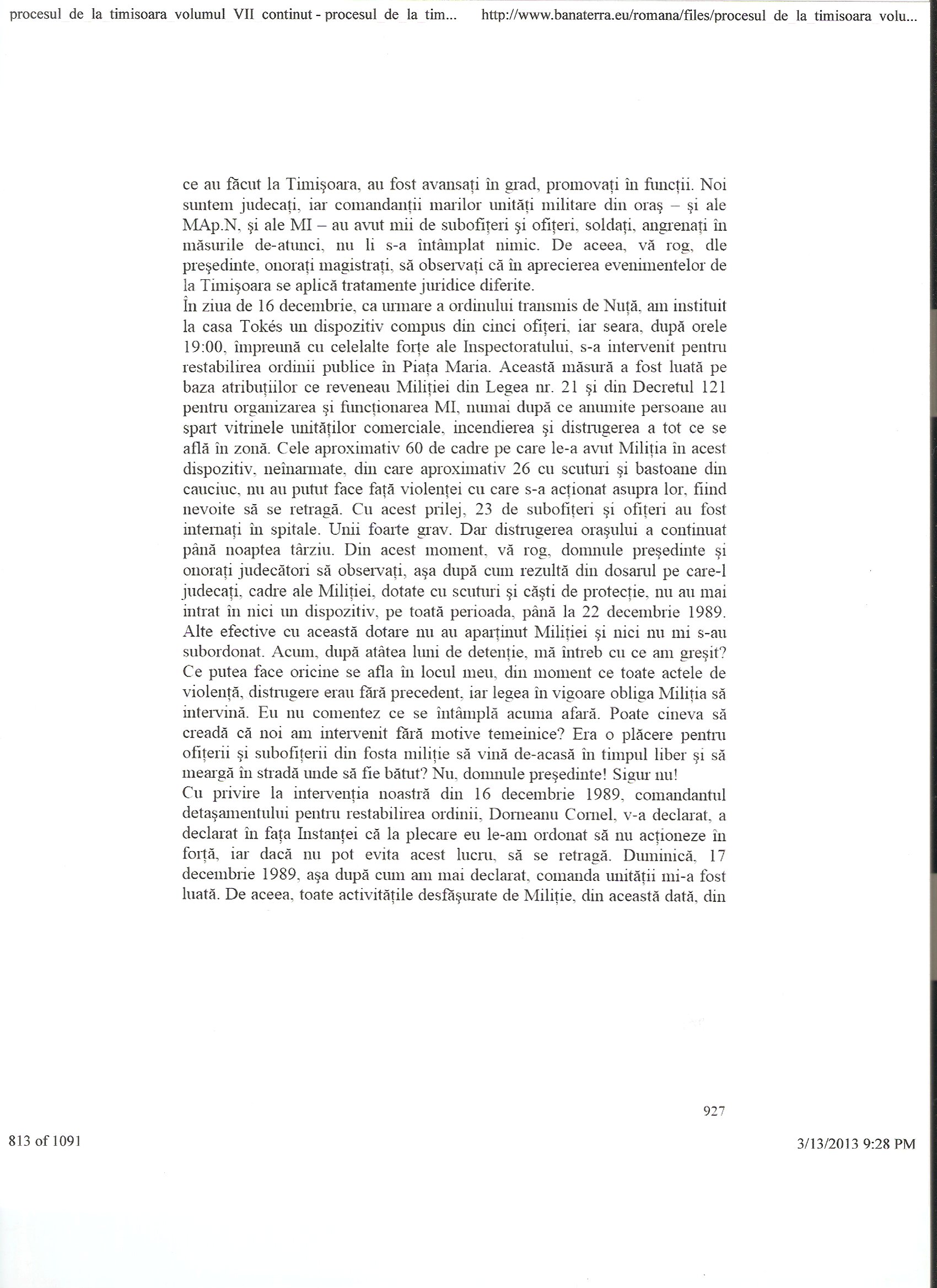
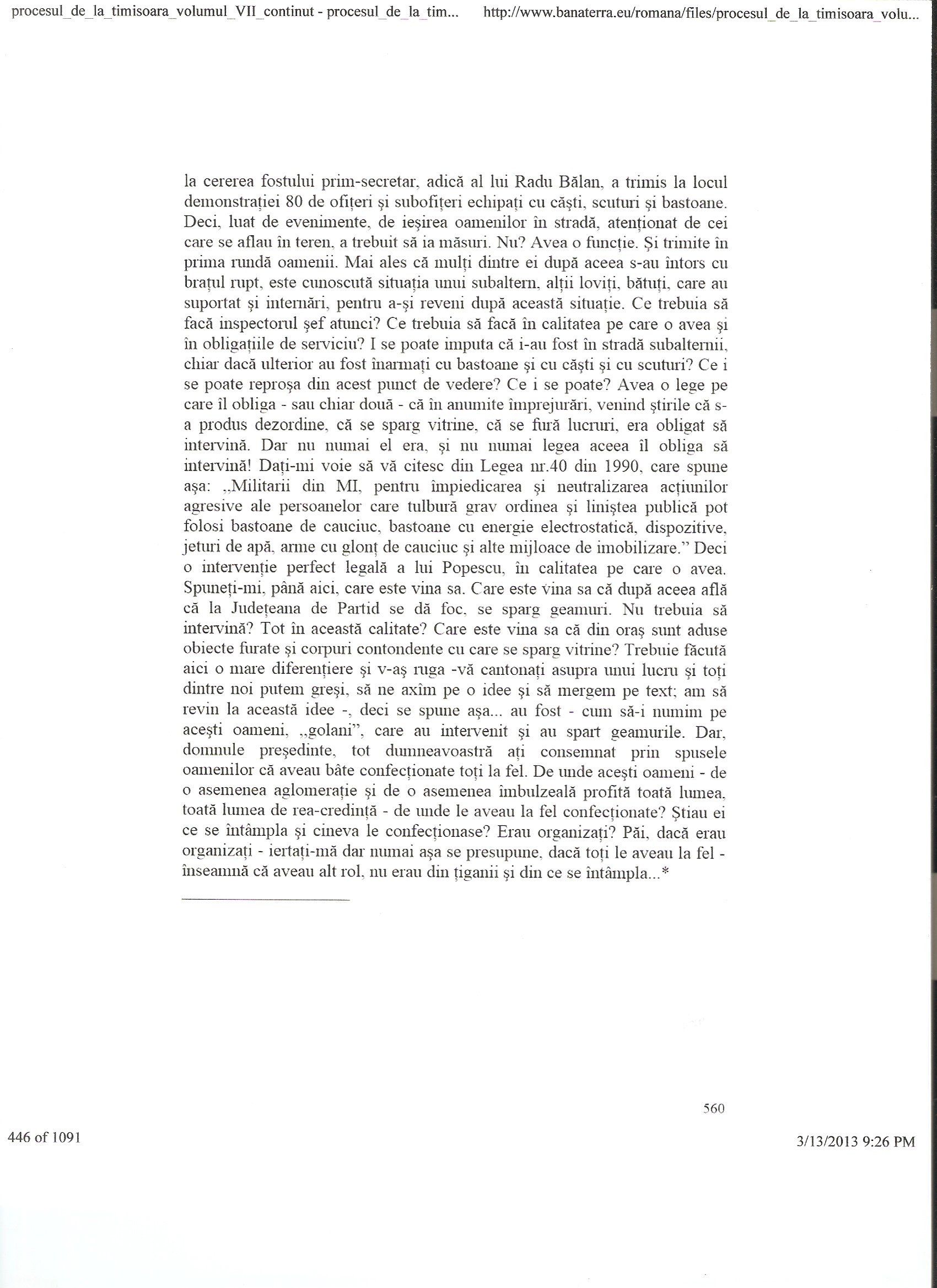
Col. Ion Popescu (sef IGM)’s defense lawyer appealed to Legea 21 and Decretul 121 specifically as obligating Interior Ministry (M.I.–Militia and Securitate) forces to intervene in response to the breaking of windows of commercial units…
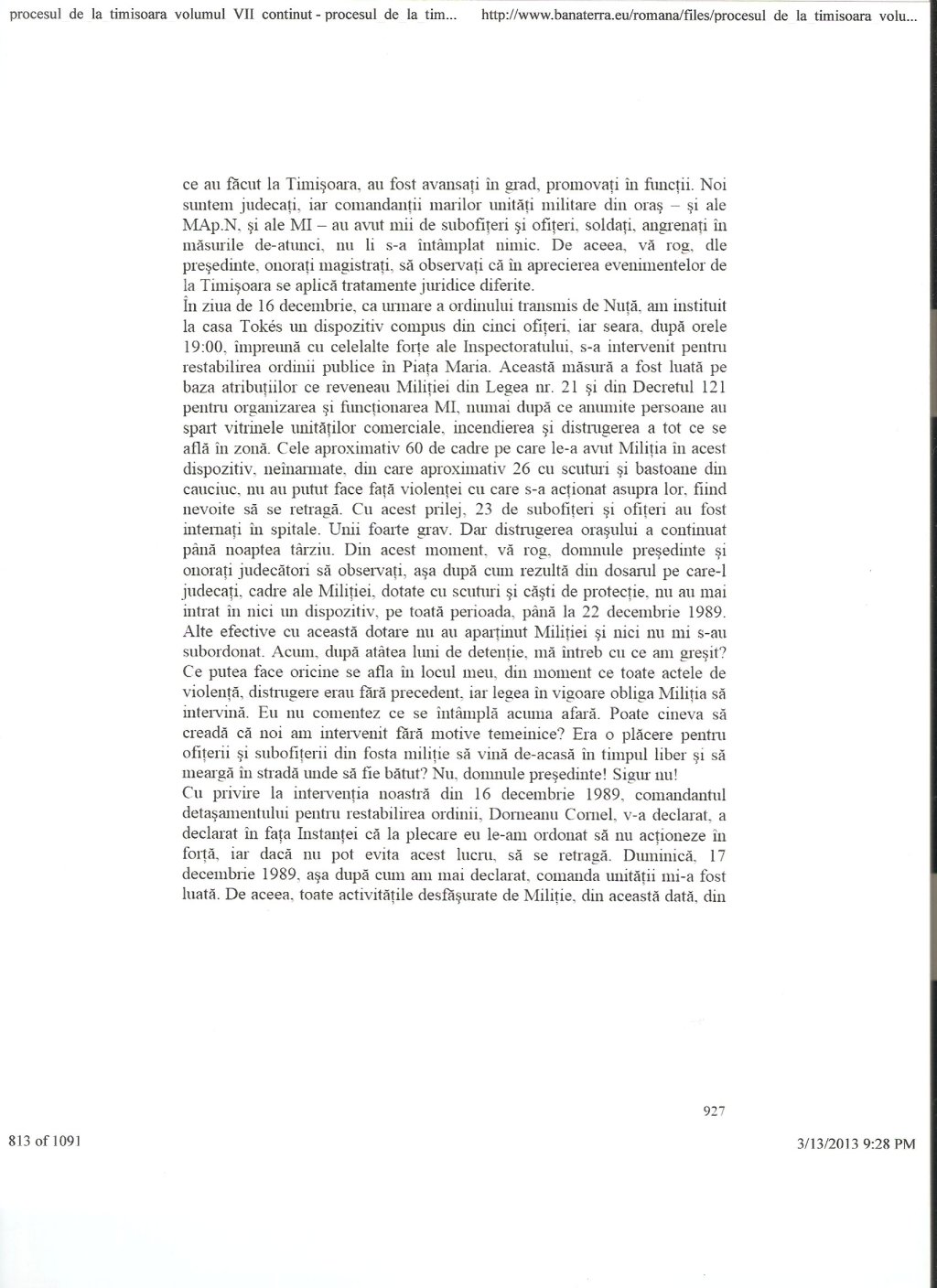
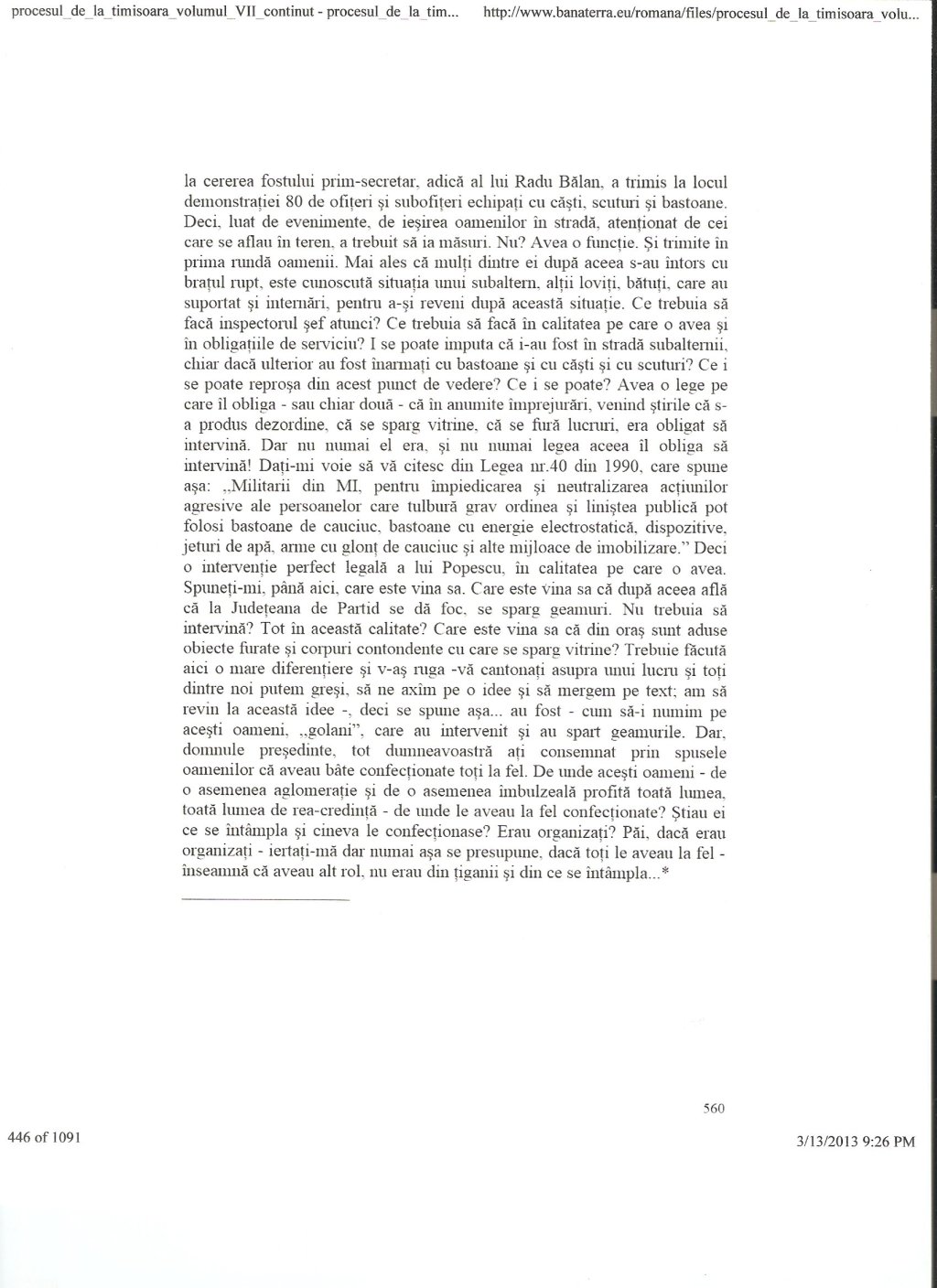
image0-001

image0

Thus, the breaking of windows, which according to Interior Minister was instigated and carried out in part by Securitate Brigade 30 under the command of Ion Bunoaica served a bureaucratic and legalistic function–a tactic not unknown in the annals of other totalitarian or authoritarian regimes…
Posted in decembrie 1989, raport final | Tagged: , , , , , | 5 Comments »

Cine a avut ideea organizării mitingului din 21 decembrie 1989?

Posted by romanianrevolutionofdecember1989 on March 12, 2013

0541

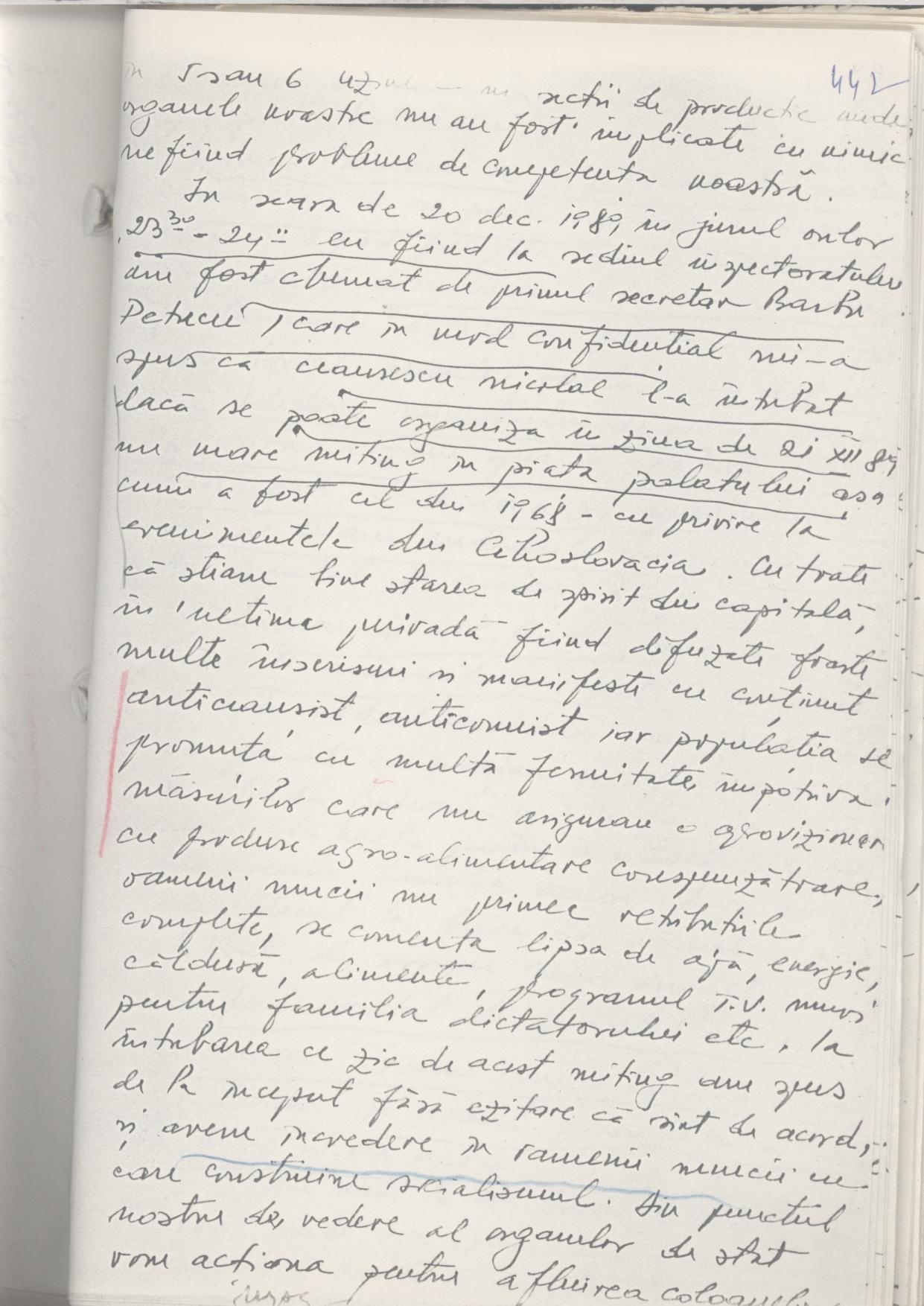
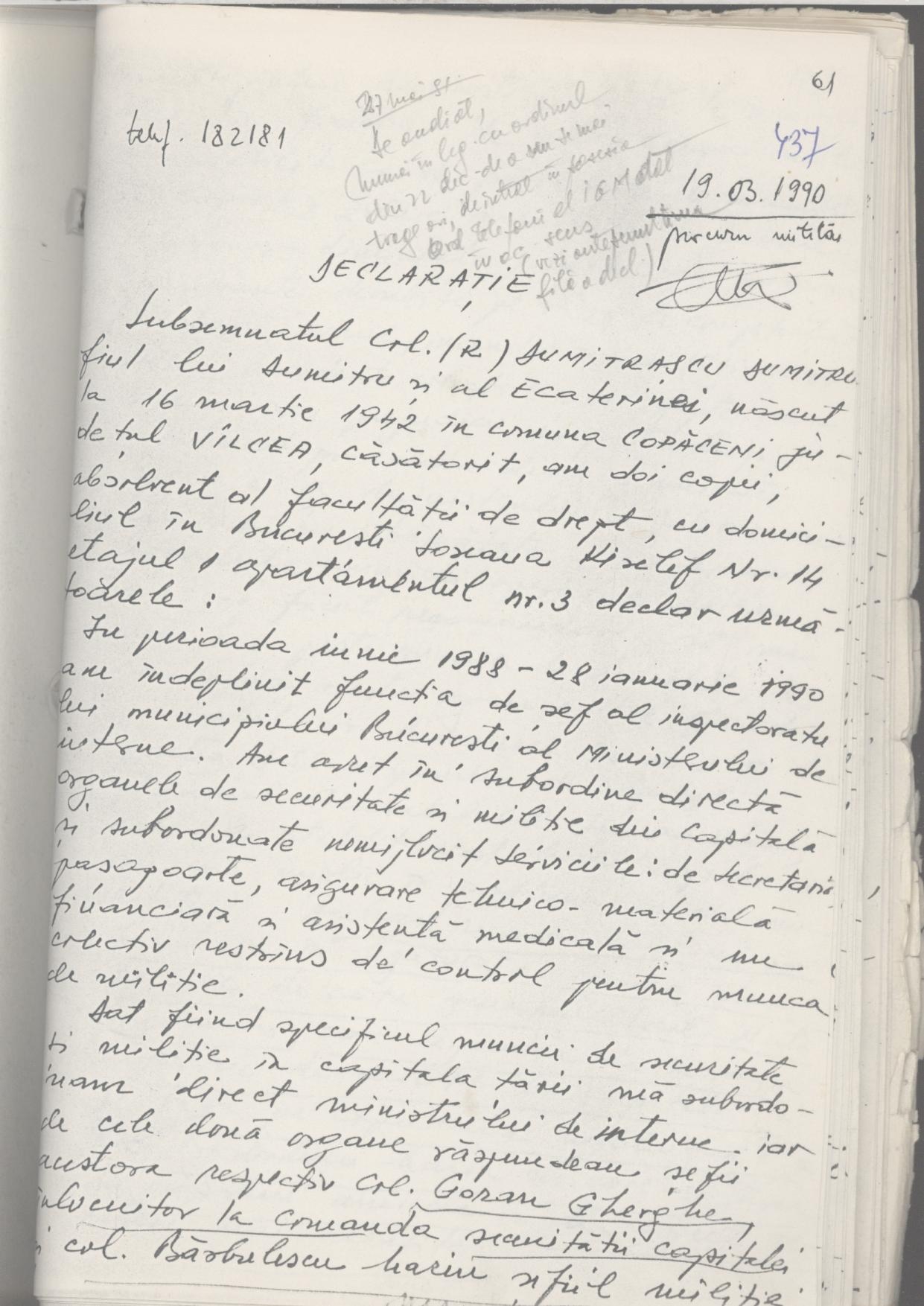
Col. Dumitru Dumitrascu, sef al Inspectoratului Muncipiului Bucuresti al Ministerului de Interne, Declaratie, 19 martie 1990

“In seara de 20 dec. 1989 in jurul orelor 23:30-24:00 eu fiind la inspectoratului am fost informat de primul secretar Barbu Petrescu, care in mod confidential mi-a spus ca ceausescu nicolae l-a intrebat daca se poate organiza in ziua de 21 XII 89 un mare miting in piata palatului asa cum a fost cel din 1968–cu privire la evenimentele din Cehoslovacia.”

0536

0160

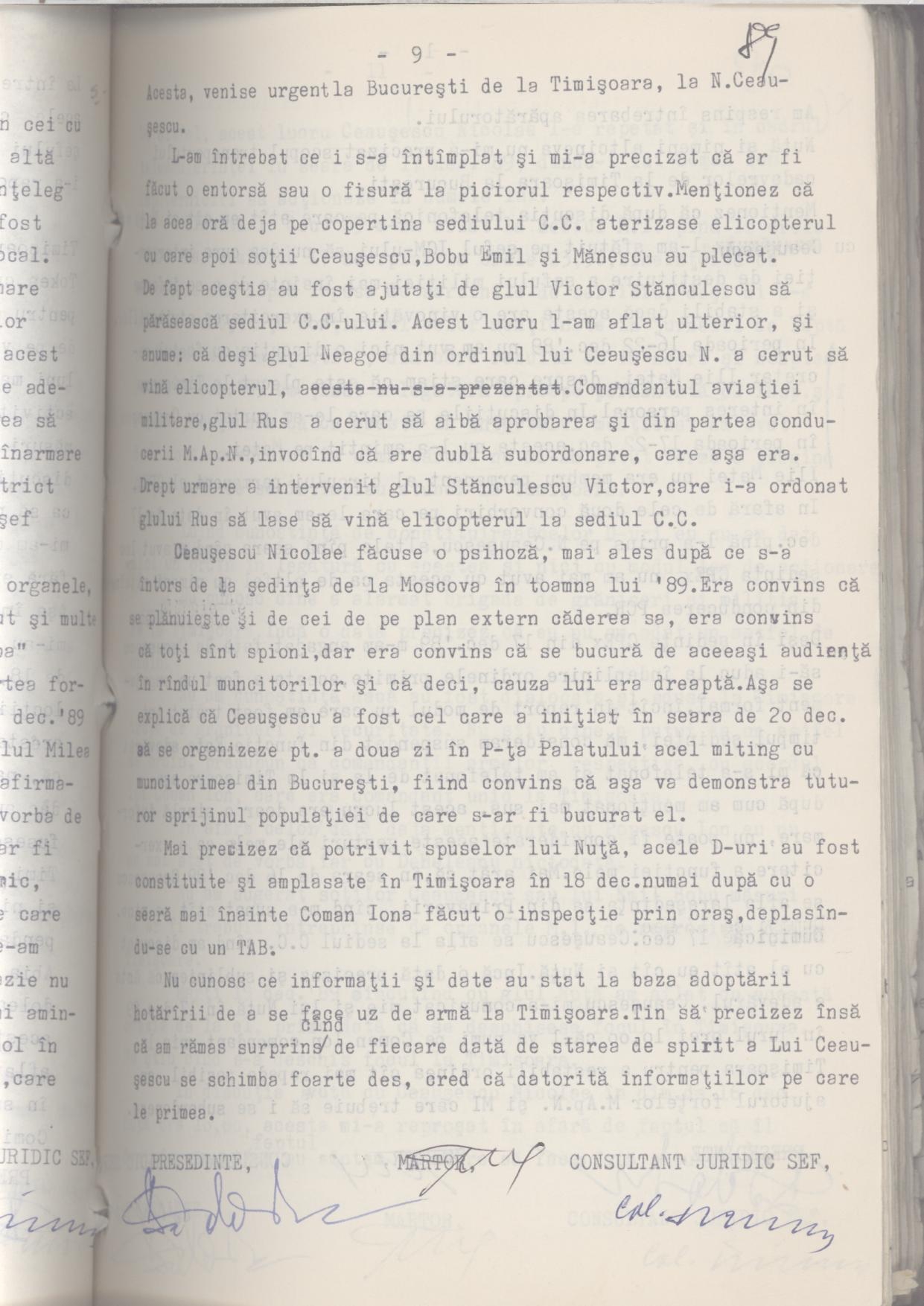
Tudor Postelnicu, Ministrul de Interne, Declaratie, 21 iunie 1991

“Asa se explica ca Ceausescu a fost cel care a initiat in seara de 20 dec. sa se organizeze pt. a doua zi in P-ta Palatului acel miting cu muncitorimea din Bucuresti, fiind convins ca asa va demonstra tuturor sprijinul populatiei de care s-ar fi bucurat el.”

0152

An excerpt from

A chapter from my Ph.D. Dissertation at Indiana University: Richard Andrew Hall, Rewriting the Revolution: Authoritarian Regime-State Relations and the Triumph of Securitate Revisionism in Post-Ceausescu Romania (defended 16 December 1996). This is the original chapter as it appeared then and thus has not been revised in any form.

http://atomic-temporary-3899751.wpcomstaging.com/rewriting-the-revolution-1997-chapter-6-18-22-december-1989/ 

Ceausescu’s Fatal Mistake: The Pro-Regime Rally of 21 December

By the morning of Thursday, 21 December 1989, the regime was no longer master of the situation in Timisoara. Moreover, it was rapidly losing control in several nearby cities: Lugoj and Cugir. Nevertheless, the regime might have withstood these challenges had it not been for Nicolae Ceausescu’s insistence on convoking a mass rally and addressing his “adoring” subjects in person. It was Nicolae Ceausescu’s delusion of his own invincibility which ensured that the regime would be unable to reestablish control. Ceausescu’s inflammatory, rambling tirade on national television on Wednesday evening had signalled panic to those who watched it. If Ceausescu was so worked up, they concluded, something serious must have occurred in Timisoara. Following his televised address, Ceausescu decided to hold an open-air, pro-regime rally the following day in the sprawling square in front of the Central Committee building in the center of Bucharest. The event was to be carried live over Romanian radio and television.

Precisely because this mass rally turned out to be the deathknell for the Ceausescu regime speculation has surrounded who “goaded” Ceausescu into making such a colossally-misguided decision. In January 1993, the opposition daily Romania Libera suggested that “the meeting was organized at the suggestion of [CPEx member] Gogu Radulescu.”[31] The same article maintained that Radulescu had been followed during these days and was “observed transmitting something abroad,” thereby once again insinuating the role of foreign powers in the Romanian events.[32]

Yet it is doubtful that Nicolae Ceausescu required Radulescu’s encouragement to convoke such a rally. It seems highly likely that the idea was Ceausescu’s own brainchild and that as usual the docile members of the CPEx did not dare contradict him. It was a typically instinctive, rash, and overconfident reaction to crisis on Ceausescu’s part. Moreover, as we have seen, for Nicolae Ceausescu the events confronting him in December 1989 were a replay of August 1968: not only was socialism at stake, but Romania’s national sovereignty and independence. Thus, in this crucial moment, he would appeal not primarily to the party’s political interests, but to what were the core institutional interests of the Securitate. And he would rely on a trusted totalitarian, mobilizational technique: the “spontaneous” mass rally of support for the regime.

[31].. R.M., “Dezvaluiri [Revelations],” Romania Libera, 19 January 1993, 1. Radulescu died in 1994.

[32].. Ibid. Presumably that foreign power would have been the Soviet Union.

Posted in decembrie 1989, raport final | Tagged: , , , , , , | 2 Comments »

Liviu Dinulescu, cpt. la Serviciul de Pasapoarte al jud. Timis: “Precizez ca anterior declansarii evenimentelor de la Timisoara din datele ce le detineam serviciul nostru nu rezulta vreun amestec din exterior in zona judetului Timis.”

Posted by romanianrevolutionofdecember1989 on March 10, 2013

26 iunie 1991, Declaratia lui Liviu Dinulescu, cpt. la Serviciul de Pasapoarte al jud. Timis (in decembrie 1989, lt. maj. ofiter operativ Securitate judetean la Serv. III, care se ocupa de contraspionaj)

“Precizez ca anterior declansarii evenimentelor de la Timisoara din datele ce le detineam serviciul nostru nu rezulta vreun amestec din exterior in zona judetului Timis.”

0197

http://atomic-temporary-3899751.wpcomstaging.com/2013/03/06/secretele-revolutiei-de-la-timisoara-col-niculae-mavru-fost-sef-al-sectiei-filaj-si-investigatie-de-la-securitatea-timis/

http://atomic-temporary-3899751.wpcomstaging.com/2013/02/22/dosarele-revolutiei-de-la-timisoara-tudor-postelnicu-unii-militari-de-la-trupele-de-securitate-ale-brigazii-timisoara-au-facut-unele-provocari-la-unele-magazine-si-vitrine-spargind-geamurile-sa-im/

Posted in decembrie 1989, raport final | Tagged: , , | 4 Comments »

“Secretele Revolutiei de la Timisoara”: col. Niculae Mavru, fost sef al sectiei ‘Filaj si investigatie’ de la Securitatea Timis

Posted by romanianrevolutionofdecember1989 on March 6, 2013

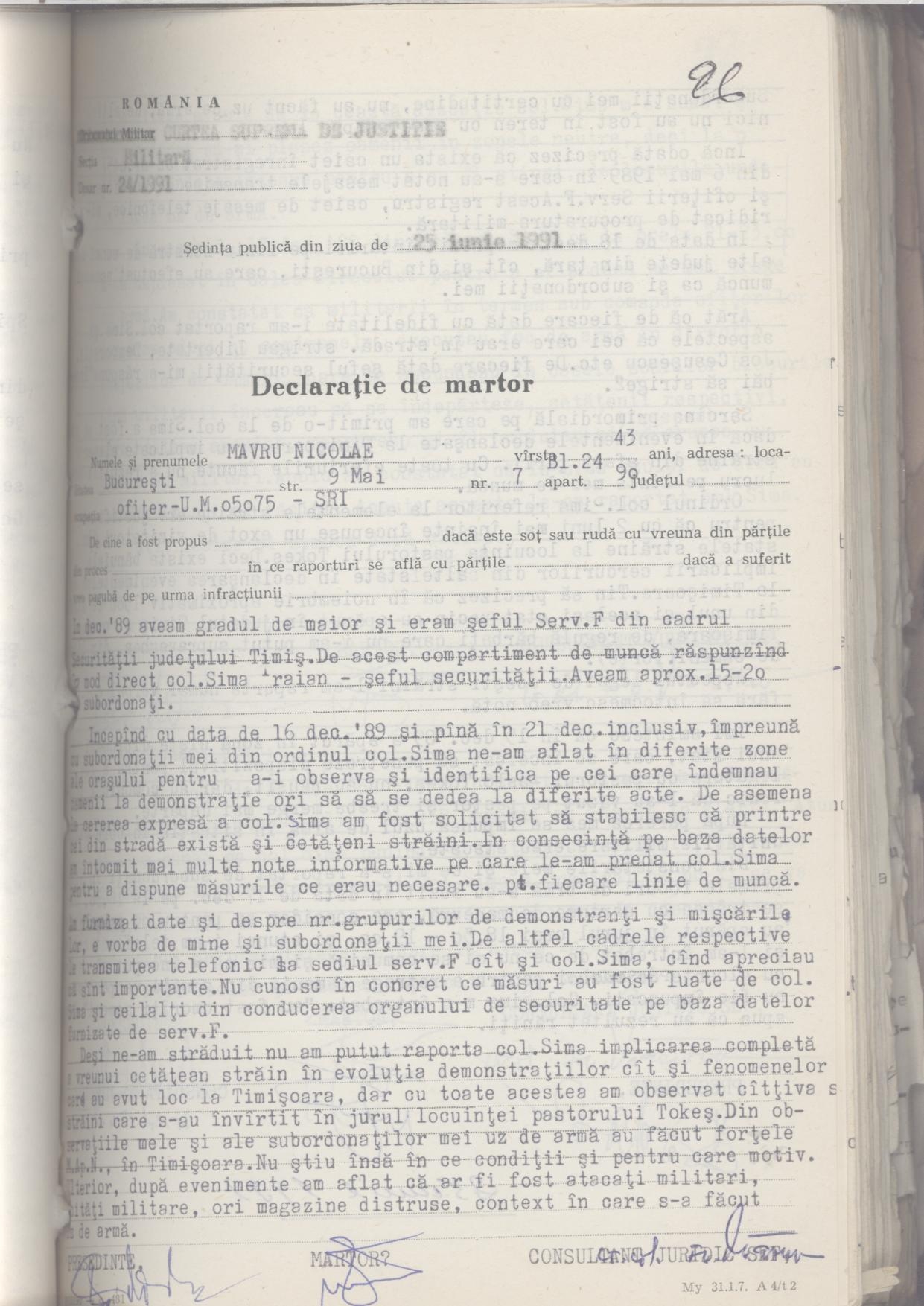
Niculae Mavru, fost sef al sectiei ‘Filaj si investigatie’ de la Securitatea Timis, declaratia din 13 ianuarie 1990:  …la ordinul col. Sima Traian, am primit…misiuni de a observa si sesiza aspecte din masa manifestantilor, din diferite zone ale orasului in sensul de a raporta daca sint straini (ceea ce nu prea au fost) care incita la dezordine, acte de violenta sau altfel de acte…

0331

25 iunie 1991

“Desi ne-am straduit nu am putut raporta col. Sima implicarea completa a vreunui cetatean strain in evolutia demonstratiilor cit si fenomenlor care au avut loc la Timisoara,..”

0173

“Sarcina primordiala pe care am primit-o de la col. Sima a fost daca in evenimentele declansate la Timisoara erau implicate elemente straine din afara tarii.  Cu toate eforturile facute nu a rezultat lucru pe linia mea de munca.”

0174

si mai tarziu, dupa potopul de “memorie recuperata”

(“recovered memory,” dupa spusele lui Ken Jowitt)

al fostilor securisti si militieni…

http://jurnalul.ro/campaniile-jurnalul/decembrie-89/secretele-revolutiei-de-la-timisoara-72088.html

Secretele Revolutiei de la Timisoara

02 Mar 2004 – 00:00

Nicolae Mavru, fostul sef al filajului de la Securitatea Timis, dezvaluie episoade incredibile din timpul evenimentelor de la Timisoara. In prima noapte a Revolutiei, 20% din cei arestati erau informatori. Interviu cu col. (r) Nicolae Mavru, fostul sef al sectiei “Filaj si investigatie” de la Timisoara.

  • Jurnalul National: Va propun sa incepem cu problema coloanelor de turisti.Nicolae Mavru: Au existat. Legenda lor era bisnita. Ei au intrat in tara cu legenda ca se duc in excursie in Bulgaria sau Iugoslavia, dar cand au ajuns in zona Arad-Timisoara, au schimbat legenda ca sa poata sa stationeze. La un moment dat s-au retras sarbii, bisnitarii obisnuiti, si au fost inlocuiti de polonezi in octombrie 1989. La inceputul lui decembrie au disparut brusc polonezii si au venit rusii, cam 2.000 de oameni, majoritatea barbati tineri, atletici. Particularitatea acestor grupuri de bisnitari rusi era ca nu aveau marfa.
  • Va intrerup aici o clipa. Exista in documentele oficiale, fie depozitii din procese, fie audieri la Comisiile senatoriale, o contradictie. In timp ce unii conducatori ai DSS insista pe existenta si implicarea acestor “turisti” in evenimentele din Timisoara ( Vlad, Ratiu), altii neaga importanta acestor grupuri (col. Pele, Nicolicioiu).Coloanele si grupurile sovietice au existat. Eu fac aceasta distinctie, pentru ca ele au avut calitatea de coloane pana au ajuns la noi in judet; aici au stationat. Noi iiobservam, mi se raporta verbal despre ei si despre ceea ce fac, pentru ca la un moment dat umplusera soseaua Arad-Timisoara. Vindeau tigari, cafea, imbracaminte, dar foarte slab, cantitati foarte mici de produse, scule… Ei treceau foarte des in Ungaria si Iugoslavia, ca sa aduca marfa, dar se intorceau cu marfa foarte putina.
  • Spuneati ca erau barbati tineri, atletici… Banuiesc ca de la dvs. a pornit descrierea aceasta, folosita apoi in toata literatura despre revolutie.Majoritatea acestor indivizi era basarabeana, vorbind stricat romaneste, dar printre ei erau si cate 4-5 care vorbeau numai ruseste sau nu vorbeau deloc, pentru ca mi-am pus oamenii sa se infiltreze, sa faca pe cumparatorii; iiintrebau ceva, dadeau din cap si faceau semn unuia care vorbea romaneste.
  • Au fost la vreun moment dat inclusi in categoria suspecti?Au fost observati, mi s-a raportat verbal cazul lor, comportamentul lor, iar eu l-am informat verbal pe colonelul Sima. Acesta mi-a raspuns: “N-avem timp sa ne ocupam de ei”. Eram sufocati de celelalte activitati, inclusiv de cazul Tokes.
  • Va pun o intrebare mai… delicata. Este posibil ca acei din conducerea Securitatii sa fi ignorat rolul acestor grupuri sovietice, amplasandu-le in categoria bisnitarilor care bantuiau oricum zona, fara sa intuiasca potentialul lor interventionist, iar apoi, dupa revolutie sa exagereze informatiile despre ele, pentru a ascunde lipsa de prevedere si, in ultima instanta, de profesionalism?N-am cum sa stiu asta. Asta se intampla sus, eu stiam ce se intampla jos. Dar, va repet, am informat si Sima mi-a spus ca nu avem timp de ei.
  • Bun, atunci va intreb altceva: jos, acolo, in strada, cand s-au declansat evenimentele, grupurile acestea de basarabeni si-au parasit locurile de bisnita si s-au implicat in violente?Este posibil, da. Au aparut acesti indivizi puternici, atletici, cam blonzi asa, care incitau copiii strazii: “Haideti, ma, spargeti, nu va fie frica!”. Scenele astea le-am surprins. Insa, neocupandu-ne de ei inainte, nedocumentandu-i, nu am avut cum sa stim precis ca provin din grupurile de bisnitari de pe soseaua Arad-Timisoara.
  • Adica n-ati putut spune: individul cutare care incita in dreptul magazinului x este acelasi cu individul care ieri vindea tigari la kilometrul y.Nu, dar din experienta mea de cunoastere a oamenilor, a suspectilor, pentru ca serviciul meu era de “filaj si investigatie”, acesti indivizi care incitau copiii strazii la spargeri si devastari proveneau de acolo, aveau o anumita tipologie pe care specialistul in filaj o recunoaste foarte bine. Eu va pot spune imediat dintr-un grup de oameni care este basarabean, fara ca acela sa deschida gura. Dar cand o deschide!
  • Domnule colonel, nu credeti ca este posibil ca Securitatea sa fi ratat operatiunea de identificare din timp a acestor diversionisti, astfel ca ei au reusit ceea ce in termeni militari se numeste “surprinderea”?Toate informatiile despre acesti diversionisti se gasesc in notele de filaj pe care le-am inaintat conducerii.
  • Este vorba de notele de filaj care au fost prezentate in instante cu ocazia proceselor de la Timisoara, apoi au disparut?Nu stiam de disparitia lor, dar ele au existat sigur.

Pentru cine, in realitate, a provocat si a facut distrugerea magazinelor la Timisoara, vedeti aici:  http://atomic-temporary-3899751.wpcomstaging.com/2013/02/22/dosarele-revolutiei-de-la-timisoara-tudor-postelnicu-unii-militari-de-la-trupele-de-securitate-ale-brigazii-timisoara-au-facut-unele-provocari-la-unele-magazine-si-vitrine-spargind-geamurile-sa-im/

Posted in decembrie 1989, raport final | Tagged: , , , , , | 7 Comments »

What can we learn from Dosarele Revolutiei de la Timisoara? (V)

Posted by romanianrevolutionofdecember1989 on December 27, 2012

[Documentary evidence in support of the publication entitled:  Bullets, Lies, and Videotape:  The Amazing, Disappearing Counter-Revolution of December 1989  ]

http://atomic-temporary-3899751.wpcomstaging.com/2012/12/16/what-can-we-learn-from-dosarele-revolutiei-de-la-timisoara-i/

http://atomic-temporary-3899751.wpcomstaging.com/2012/12/19/what-can-we-learn-from-dosarele-revolutiei-de-la-timisoara-ii/

http://atomic-temporary-3899751.wpcomstaging.com/2012/12/20/what-can-we-learn-from-dosarele-revolutie-de-la-timisoara-iii/

http://atomic-temporary-3899751.wpcomstaging.com/2012/12/21/what-can-we-learn-from-dosarele-revolutiei-de-la-timisoara-iv/

On 1 December 2012, Doru Teodor Maries and Asociatia 21 decembrie 1989 made images of many of the official files investigating the events of December 1989 in Timisoara available on the Internet at http://dosarelerevolutiei.ro/ .  Among the copies available are testimonies from victims of the repression of the communist regime of Nicolae Ceausescu, witnesses of the repression, relatives of the victims of the repression, and members of regime forces that either participated in the repression or were witnesses to it.  These documents allow researchers the ability to confirm or infirm claims made in the Romanian media or accounts published since December 1989.

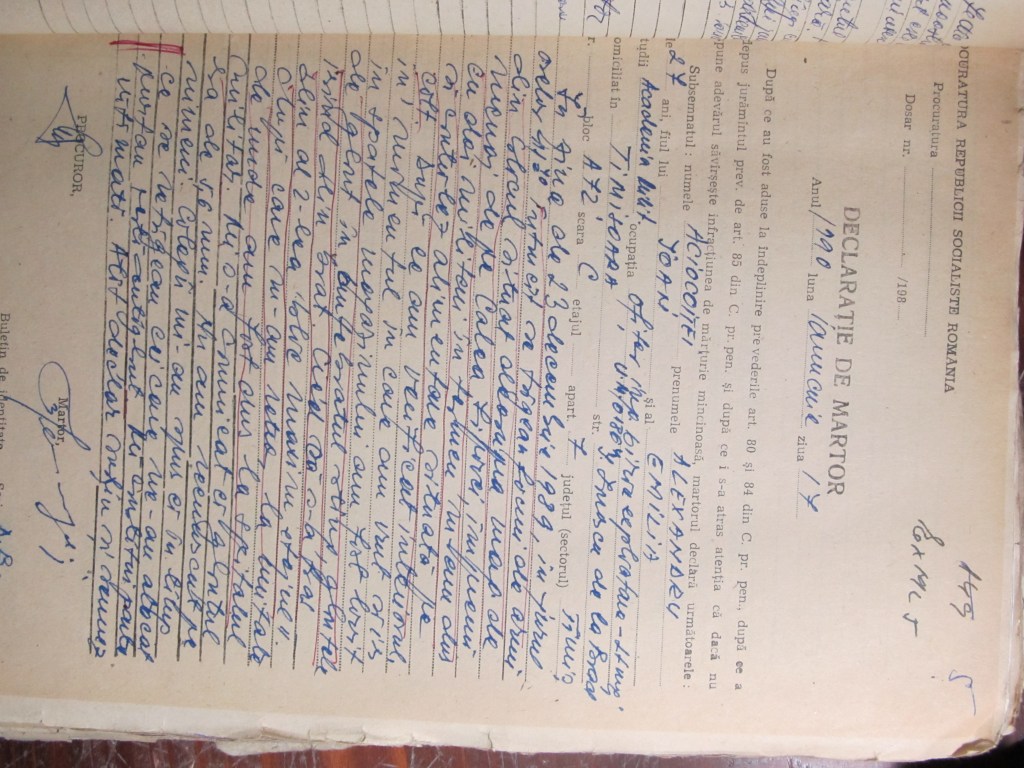
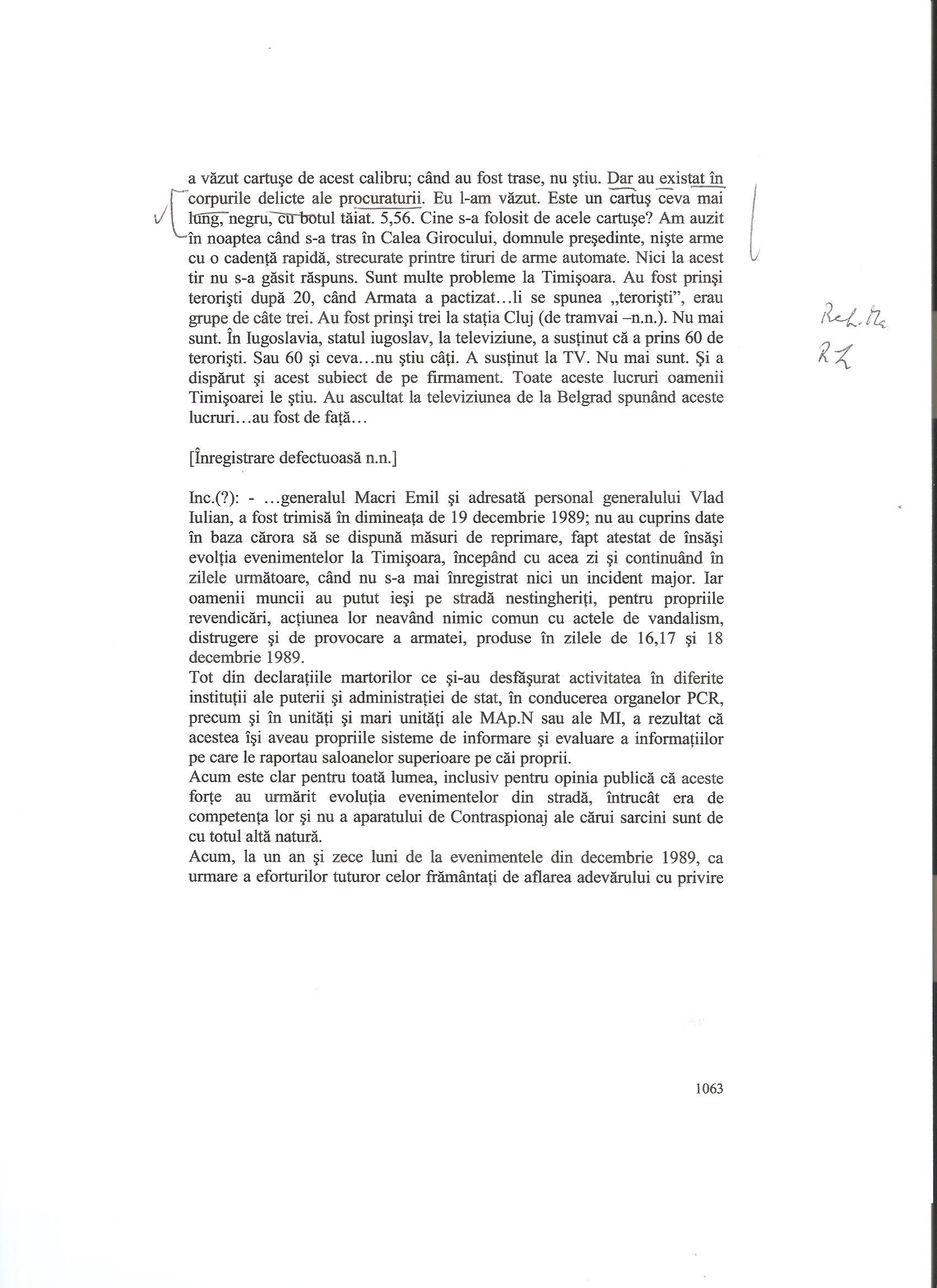
Alexandru Aciocoitei:  “…de unde am fost dus la spitalul militar.  Mi s-au comunicat ca glontul era de 5,6 mm….”

IMG_0010

This case had actually made it into the pages of the pro-Securitate weekly Europa and went over the head of interviewer Angela Bacescu:

(see Est/Vest no. 49, octombrie 1991 “Cit de pasnici erau demonstrantii?” Angela Bacescu with Col. (Cio?) Stan, sef de sectie M.Ap.N., will post if xerox located)

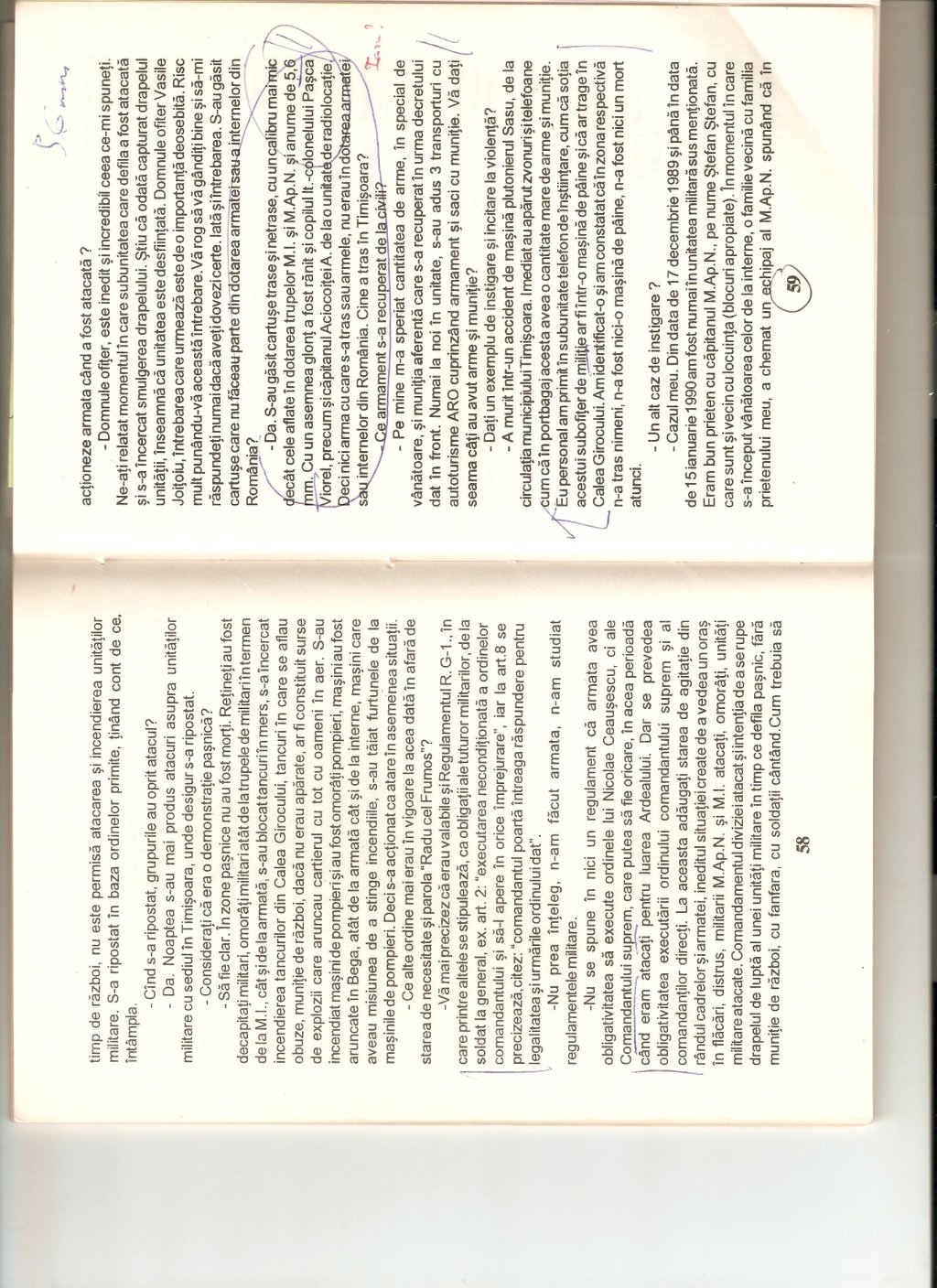
and from Romania 1989:  Din Nou in Calea Navalirilor Barbare, with Vasile Joitoiu, ofiter de contrainformatii militare, p. 59)

image0-001

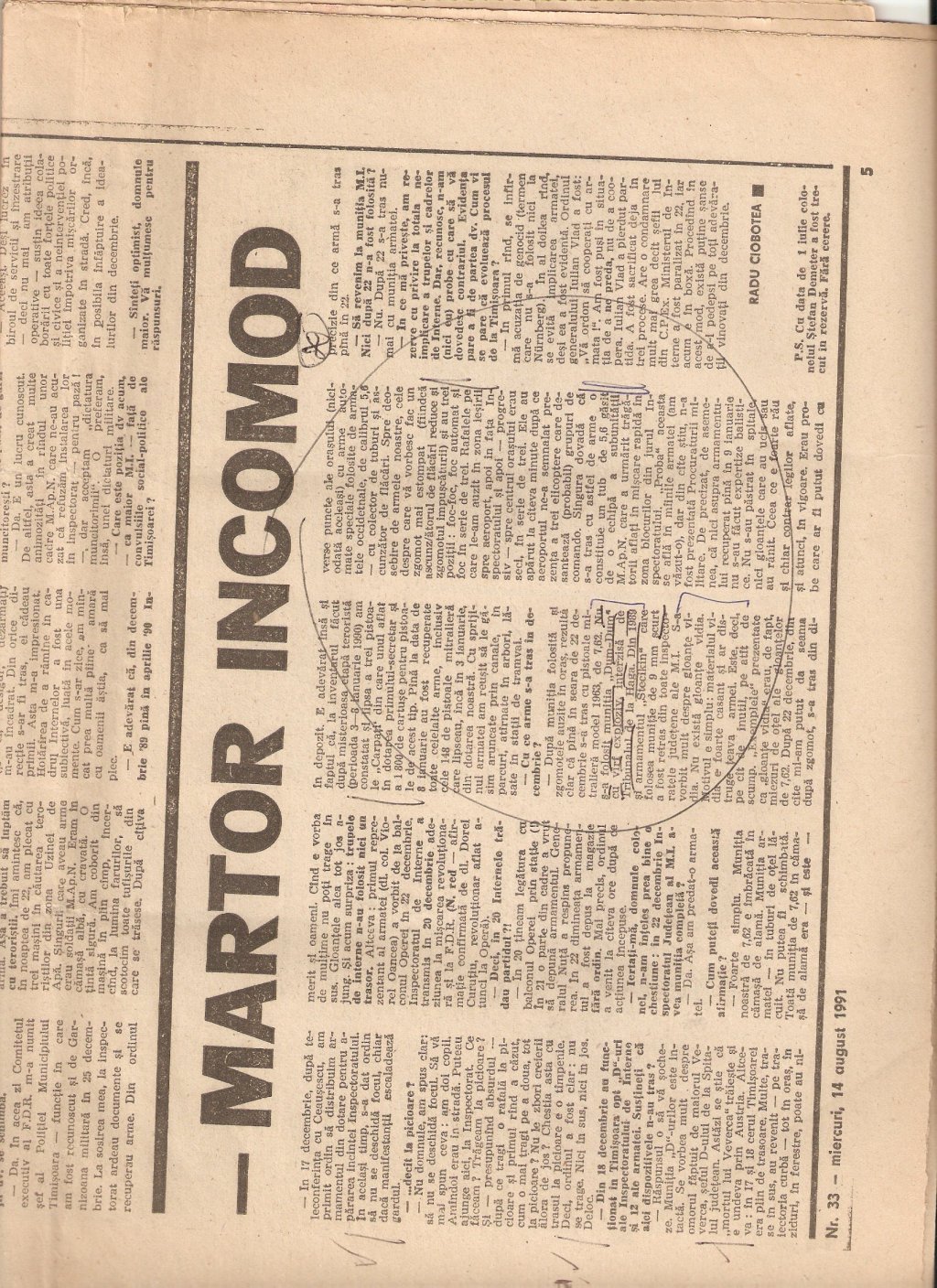
Stefan Demeter, Inspectoratul judetean Timis al M.I., sef al biroului de servicii si inzestrare, admitted coyly–in the typical fashion of Romanian authorities, admit only what is undeniable, deny everything else–“the single proof [after the airport alerted them that groups of commandos had disembarked from three helicopters in the Timisoara area] was a 5,6 [mm] shell found by a military [M.Ap.N.) subunit which followed the shooters in rapid succession through the blocs surrounding the [M.I., Interior Ministry] Inspectorate.  This piece of “evidence” is in the hands of the Army (I saw it)…”

image0

Radu Ciobotea, with Stefan Demeter, “Procesul celor 24.  M.I.–martor incomod,” Flacara, nr. 33, 14 august 1991, p. 5.

AS THE CASE OF CAPTAIN ACIOCOITEI DEMONSTRATES, THIS MAY HAVE BEEN THE ONLY REMAINS OF A 5,6 MM BULLET FOUND…BUT IT WAS NOT THE ONLY ONE USED…

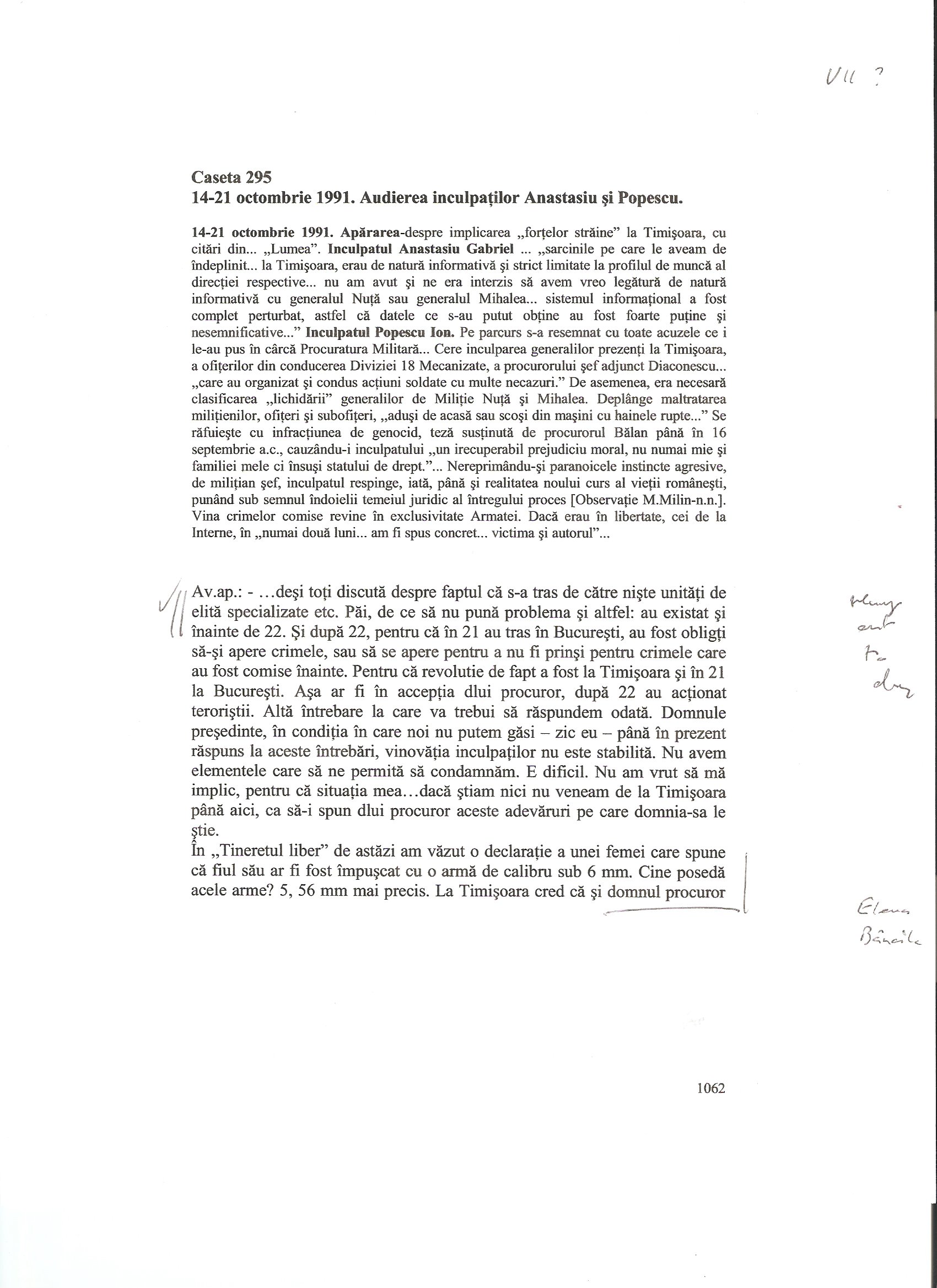
Indeed, such ammunition was discussed during the Timisoara trials as is demonstrated below:

http://www.banaterra.eu/romana/files/procesul_de_la_timisoara_volumul_VII_continut.pdf.  The following are from Volume VII.]

SIGNFICANTLY, IN A REGION CLOSE TO TIMISOARA, WEAPONS USING SUCH 5,6 MM MUNITIONS WERE CAPTURED AND CIVILIANS WERE ALSO KILLED WITH SUCH BULLETS.

Norbert Pongracz

Valentin Rosada

Nascut la 15 ianuarie 1971, unicul fiu al lui Norbert si al Ilenei Pongracz.

A cazut in noaptea de 23 decembrie 1989, ora 2,40 in unitatea (de radiolocatie) in care isi satisfacea stagiul militar. Un glont ucigas pornit din paduricea din apropiere (care ulterior s-a defrisat) in timp ce statea de vorba cu locotenentul sau i-a secerat pe amandoi. In total au fost ucise 9 persoane (ofiteri si militari in termen). S-a presupus ca ucigasii ar fi fost de la unitatea de rachete, dar arma cu care s-a tras a fost speciala, calibrul 5,62 fata de armamentul obisnuit de 7,62 mm.

Pe langa golul definitiv in sufletul lor, durerea cea mai mare a familiei Pongracz este ca nici acum nu s-a elucidat problema aceasta a ucigasilor fiului lor. Resita are declarati 16 morti in Revolutie, iar domnul Pongracz, cand a mers sa ridice trupul baiatului sau de la morga, a vazut circa 50 de cadavre.

Strada Gorunului a fost botezata dupa numele eroului Norbert Pongracz.

Sonetul sau de absolvent, dedicat lui Adrian Zamfirescu, contine urmatorul text: Sa traim din plin, soarele nu rasare de doua ori pe zi si viata nu ne este harazita decat o singura data? Cu stima si respect Norbi. Sub semnatura lui Norbi sta tiparit: La revedere, in prima sambata a lunii iulie 1999. El nu va putea veni la aceasta intalnire, dar va ramane pentru totdeauna in inimile noastre, intre eroii nostri.

Adolescent fiind, a trecut in randul nemuritorilor luptand cu arma in mana, pentru libertate, pentru prietenie, pentru ca in fapta aceasta este democratia – libertate si prietenie. Si pentru aceasta a fost si jertfa lui Norbert.

Suflet curat, fiu al unor parinti cinstiti si harnici, Norbert nu si-a dezmintit afirmatia: Viata nu ne este harazita decat o singura data. Avand constiinta acestui fapt, sacrificiul sau devine mai inalt, mai plin de intelesuri si durere decat insasi viata pe care o traim.

El nu a murit, traieste si va trai de-a pururi in sufletele parintilor sai, colegilor, camarazilor de lupta, in sufletele noastre.

Dumnezeu sa-l odihneasca in pace!

http://www.revolutialugojana.org/eroi

De vorba cu un fiu al Armatei Romane

– Vă rog să vă prezentaţi, domnule plutonier.
– Sânt plutonierul Coancă Gheorghe.
– Pentru prima dată v-am întâlnit în data de 20 decembrie 1989, în faţa Consiliului, împreună cu subunitatea dumneavoastră. Ce s-a întâmplat apoi ?
– Din 20 până în 25 decembrie 1989 am apărat oraşul Lugoj.
– Iar după aceea ?
– Consiliul Frontului Salvării Naţionale din Reşiţa a cerut întăriri din partea Lugojului şi o parte din subunităţile noastre s-au deplasat de urgenţă în ajutorul fraţilor din Reşiţa.
– Bănuiesc că a fost vorba de “terorişti” ?
– Nu, de securitatea civilă a statului.
– Unde se găseau ei ? În vreo unitate militară ?
– Erau dispersaţi în tot oraşul, în locuinţe, cazemate subterane şi la Liceul nr. 2, unde îşi transportau răniţii.
– În ce mod îşi desfăşurau atacul ?
– Atacul se deschidea la lăsarea serii şi înceta în jurul orei opt-nouă dimineaţa.
– Aţi reuşit să prindeţi câţiva ?
– La una din locuinţele de unde s-a tras, am reuşit să arestăm un maior de securitate, împreună cu cei doi fii ai săi (unul de 14 ani, iar celălalt de 20 ani, elev la şcoala militară de securitate), toţi trei foarte buni trăgători.
– Nu erau conştienţi de faptul că totul e pierdut ?
– Ba fa, dar … la întrebarea adresată de comandantul unităţii militare din Reşiţa : “Ce rost are vărsarea de sânge, situaţia oricum nu o puteţi întoarce ?”, răspunsul comandantului Securităţii civile, atunci arestat, a fost : “Puţin ne pasă !”.
– Care a fost atitudinea civililor ?
– Populaţia a manifestat o adevărată dragoste faţă de armată, gărzile patriotice participând activ la acţiunile de luptă.
– Aţi avut victime ?
– Din rândul gărzilor patriotice s-au înregistrat multe victime, din rândul subunităţii noastre nu s-a înregistrat nici o victimă.
– Când s-au predat securiştii şi ce armament au folosit ?
S-au predat în data de 29 decembrie 1989, dar am continuat să apărăm obiectivele până astăzi, 10 ianuarie, când ne-am întors la Lugoj. Armamentul lor era de provenienţă străină, super-uşor, de calibru 5,6 şi în cadenţă de tragere dublă. Gloanţele erau cu vârf retezat şi pastilă explosivă în cap.
– Care este acum cea mai mare dorinţă a dumneavoastră ?
– Să-mi revăd copilul, de doi ani şi jumătate. Să fac o baie fierbinte şi să-mi schimb cizmele că, din 17 decembrie până în 5 ianuarie 1990, am dormit îmbrăcat şi fără să-mi scot cizmele din picioare.
– Spuneţi-mi, s-a ridicat convocarea ?
– Nu, dar ni se permite să mergem zilnic, pentru câteva ore acasă.
– Aveţi un gând personal ?
– Sânt mândru, satisfăcut, că atât la Lugoj cât şi la Reşiţa, ca de altfel în întreaga ţară, Armata şi-a dovedit calmul, puterea de discernământ şi disciplina.

Reporter : Simion FLORIEAN

(Drapelul, nr. 7 – sâmbătă, 13 ianuarie 1990)

http://www.revolutialugojana.org/capitol-istoric/de-vorba-cu-un-fiu-al-armatei-romane.html

Episodul “Gloante Vidia” (sau “uite, si eu am o mostra…”) din martie-aprilie 1991…

Posted in decembrie 1989, raport final, Uncategorized | Tagged: , , , , , , , | 6 Comments »