O singura intrebare…modesta: aveau cumva uslasii vreo “acoperire” atunci cand erau “in teren”? Si daca aveau, care ar fi fost aceasta “acoperire”?!
Asistam la Ingroparea Revolutiei
Asistam la Ingroparea Revolutiei
Monica N. Marginean: Sa revenim la datele concrete ale regiei de care vorbeam anterior. Cum arata, de pilda, povestea atit de dezbatuta la procesul lui Nicu Ceausescu a cursei ROMBAC, daca o privim din perspectiva Comisiei de ancheta?
fostul procuror Marian Valer: In mod normal, cursa de avion Bucuresti-Sibiu trebuia sa decoleze de pe aeroportul Baneasa, la orele 17,10 folosindu-se pe acest traseu avioane marca Antonov. In dupa-amiaza zilei de 20 decembrie, insa, in jurul orelor 17, deci in apropierea orei prevazute pentru decolarea cursei obisnuite, pasagerii pentru Sibiu au fost invitati si dusi la Aeroportul Otopeni unde au fost imbarcati intr-un avion marca ROMBAC care a decolat in jurul orelor 18,30 si a aterizat pe aeroportul Sibiu in jur de ora 19. Fac precizarea ca in dupa-amiaza aceleiasi zile, cu aproape 2 ore inaintea decolarii acestei curse, a aterizat pe aeroportul Otopeni avionul prezidential cu care Ceausescu s-a reintors din Iran. Conform datelor furnizate de agentia TAROM Bucuresti, in avionul respectiv spre Sibiu au fost imbarcati 81 pasageri. In radiograma cursei sint consemnate domiciile doar la o parte din pasageri, cu mentiunea ca unele sint incomplete, lipsind fie localitatea, fie strada, fie numarul, iar la restul pasagerilor figureaza doar mentiunile ,rezervat’ sau Pasaport RSR. In urma investigatiilor efectuate, au putut fi identificati doar 44 de pasageri, majoritatea avind domiciliul in municipul si judetul Sibiu, stabilindu-se ca au fost persoane trimise in delegatie la foruri tutelare din capitala, sau studenti plecati in vacanta, iar citiva domiciliati in judetul Alba. Mentionez ca asupra acestor persoane nu planeaza nici un dubiu. Dubiile sint create insa in primul rind de faptul ca mai multi pasageri figureaza cu domiciliul in municipiul Bucuresti, dar in realitate nu domiciliaza la adresele consemnate, iar la unele adrese sint intreprinderi. Un alt element creator de dubii il constituie prezenta in avionul respectiv a unui inspector de la Departmentul Aviatiei Civile, cu numele de Nevrozeanu, care nu figureaza pe lista pasagerilor si cu privire la care s-a stabilit ca, in trecut, se deplasa cu avionul in cazuri speciale doar pe relatia Moscova, fiind un bun cunoscator al limbii ruse. Mai multi pasageri sustin ca in partea dreapta din fata a avionului au sesizat un grup de barbati, mai inalti, atletici, imbracati sportiv, multi dintre ei fiind blonzi, grup care li s-a parut suspect. Aceste afirmatii se coroboreaza cu faptul ca in zona respectiva a avionului nu a stat nici unul din pasagerii identificati. Mai mult, verificindu-se la hotelurile din municipiul Sibiu persoane care aveau numele celor 37 de persoane neidentificate, s-a constatat ca doar un pasager neidentificat care figureaza pe listele TAROM-ului cu domiciliul in municipiul Bucuresti, care nu exista la adresa respectiva din localitate, a fost cazat la hotelul Bulevard, dar in registrul de evidenta figureaza cu un alt domiciliu din Bucuresti. Ambele domicilii, si cei din diagrama TAROM si cel de la hotel sint false. Cu ocazia acelorasi verificari s-a constatat ca in perioada respectiva in hotelurile din Sibiu au fost cazati multi turisti sovietici, in special la Imparatul Romanilor, Continental, si Bulevard, situate in zona centrala a municipiului. Fac mentiunea ca din hotelurile respective s-a tras asupra manifestantilor si a armatei. Am omis sa precizez ca pe aeroportul Otopeni, in avionul ROMBAC au fost incarcate sute de colete identice ca format, dimensiuni si culoare, de marime apropriata unei genti diplomat, precum si ca, cu citeva minute inaintea decolarii cursei spre Sibiu, de pe acelasi aeroport au decolat curse ROMBAC spre Timisoara si Arad. Consider ca, in legatura cu pasagerii neidentificati, sint posibile doua versiuni, respectiv sa fie au fost luptatorii U.S.L.A. trimisi in sprijinul lui Nicu Ceausescu, fie au fost agenti sovietici trimisi sa actioneze in scopul rasturnarii regimului Ceausescu.
Monica N. Marginean: Ce alte demersuri a facut Comisia de ancheta pentru elucidarea misterului celor 37 de pasageri neidentificati?
Marian Valer: Am luat contact cu unul din loctiitorii comandamentului trupelor U.S.L.A. din capitala, caruia i-am solicitat sa-mi puna la dispozitie pe cei trei insotitori U.S.L.A. ai avionului ROMBAC. Loctiitorul mi-a spus ca acestia au fost audiati de un procuror militar si nu mai este de acord sa fie audiati inca o data.
Monica M. Maginean: “MARIAN VALER: Asistam la ingroparea Revolutiei,” Expres nr. 33, septembrie 1990, p. 2.
Nicu Silvestru, chief of the Sibiu County Militia, admitted in passing in a letter from prison that on the afternoon of 19 December in a crisis meeting, Ceausescu’s son announced that he was going to “call [his] specialists from Bucharest” to take care of any protests (“Baricada,” no. 45, 1990). Ceausescu’s Interior Minister, Tudor Postelnicu, admitted at his trial in January 1990 that Nicu had called him requesting “some troops” and he had informed Securitate Director General Iulian Vlad of the request (“Romania Libera,” 30 January 1990.)
The rewriting of the story of the Revolution, the “tourists,” and the “terrorists” was already in full swing, when in August 1990, Nicu wryly observed:
“…[T]he Military Prosecutor gave me two variants. In the first part of the inquest, they [the flight’s passengers] were from the Interior Ministry. Later, however, in the second half of the investigation, when the USLA and those from the Interior Ministry began, so-to-speak, to pass ‘into the shadows,’ — after which one no longer heard anything of them — they [the passengers] turned out to be simple citizens…” (interview with Nicu Ceausescu in “Zig-Zag,” no. 20, 21-27 August 1990).
An interesting–if slightly confused–discussion of the “tourists”/ USLA in Sibiu in December 1989!
Fac apel la oricine care a fost in seara de 21 spre 22 (ora 11,30-11,50) pe strada(actuala)Revolutiei, sau a vazut autoturismele parcate vis-sa vis de fosta Brutarie Nesciuc trei albe si una rosu inchis “Lada”. Va intreb daca cele 11 persoane imbracate cu scurta albastre tip jeans, pantaloni deschisi la culoare, doi cu caciula de blana, trei cu caciula de lana impletita de culoare inchisa, si restul cu capul gol care au intors autoturismele parcate din capatul strazii si incendierea acestora? Statura lor era atletica? Cine a mai vazut apoi aceste persoane (acest gen) in afara de Piatza Mare din 21 decembrie ora 11,30 cand l-au protejat pe domnul care a iesit in fatza scutierilor cu copilul ridicat pe maini? (in dreptul Casei Albastre)
Aceleasi persoane au fost si in data de 21 decembrie la ora 9 in fata intrarii in magazinul Dumbrava, cand au “jenat” fara nici o teama scutierii si politistii care incercau sa prinda persoanele care fugeau prin magazin…Mai apelez la locatarii Blocului de garsoniere “turn” din coltul Calea Dumbravii-Milea, sa ne trimita o informatie cu intamplarile din 23-25 de la etajul 7-8, cu persoanele in combinezon de culoare inchisa care au coborat pe partea dinspre magazin din balcon in balcon, inclusiv despre persoana decedata, daca are legatura cu acel incident.
O alta intrebare extrem de importanta: stie cineva cine a organizat “filtrele” de pe strazile Sibiului?
Va multumesc
O precizare: Autoturismele erau parcate pe str Dobrun inspre str. Berariei Era pe trotoarul brutariei particulare (Nescuc sau Cibu, nu mai stiu cum se chema)
Acesti emanati, aceste lichele, nu-si puteau face jocurile, acapararea puterii totale, precum si inaintasii lor Dej si Ceausescu, decat prin forta represiunii armate. Parte din armata a reactionat pasnic, datorita onor ofitzeri care au dovedit mai multa logica, parte din armata a jucat rolul de dusman al romanilor. La Sibiu, avem tot mai multe date care intaresc teoria ca Dragomir a fost teroristul Nr. 1 in acele zile, ajutat si de grupul USLA trimis de la Bucuresti la Sibiu, pentru protectia lui NC, si care s-au reantors la “locul faptei” dupa ce l-a pus pe Nicu in siguranta. Ei au fost aceia care au comis executiile din Piatza Mare in ziua de 21 decembrie ora 11,45 cu primele victime ucise sau ranite. Au fost repartizati in patru puncte ale pietii: In podul Casei Albastre, in podul actualei Primarii, in podul de deasupra Tunelului Generalului si in podul de deasupra magazinului Moda. De aici, au deschis foc inspre demonstranti. Au deschis foc si pe data de 22 decembrie inspre hotelul Imparatul Romanilor din acelasi pod de deasupra Tunelului Generalului care avea corespondent cu celelalte poduri dinspre magazinul Covorul. Aceste grupe ale USLA nu aveau insemne de grad sau arma, nu purtau boneta militara si aveau la dispozitie doua microbuze ale unitatii 01512 care i-a transportat in tot acest timp. Un grup al USLA era incepand din ziua de 21 decembrie ora 07 la sediul Judetenei de partid, ocupand garajul din curtea din sapate cu munitie si armament special. Se poate descoperi foarte repede, numele persoanelor care au fost trimise la SIBIU cu Rombacul in dupa-amiaza zilei de 20 decembrie, ca urmare a convorbirilor indelungate purtate de Nicu si Bucuresti, despre demonstratia anuntata pentru dimineata zilei de 21 decembrie de la Mag Dumbrava. In timpul convorbirii telefonice, in biroul lui Nicu se afla Traian Popsa, fostul director de la IJIM Sibiu, maiorul Dragomir, seful Garzilor judetene Pescaru, secretar al CJPCR Sibiu si Niculae Hurubean, prim secretar la Alba care se afla in trecere prin Sibiu. Aceste trupe USLA au purtat alternativ, combinezoane negre, uniforma militara sau haine civile…
Lovitura de stat cu spectatori, cum zice Cornel Dinu, a functionat atata timp cat au avut nevoie pentru a pune mana pe putere acesti derbedei bolsevici-kaghebisti
O enigmă securistă: “Turiştii” sovietici şi răsturnarea regimului Ceauşescu
Deşi am scris destul de mult în trecut despre enigma “turiştilor” (vezi, de pildă, Hall, R. A., 2002, “The Securitate Roots of a Modern Romanian Fairy Tale: The Press, the Former Securitate, and the Historiography of December 1989” [Rădăcinile securiste ale unui basm românesc modern: presa, fosta securitate şi istoriografia lui decembrie 1989], “Part 2: Tourists are Terrorists and Terrorists are Tourists with Guns” [Partea a 2-a: Turiştii sînt terorişti şi teroriştii sînt turişti înarmaţi], Radio Free Europe “East European Perspectives” [“Perspective est-europene”, radio Europa Liberă], Vol. 4, nr. 8), nu am discutat în mod formal rolul poveştilor străine despre răsturnarea lui Ceauşescu în istoriografia lui decembrie 1989, în particular legat de această problemă. În urma difuzării documentarului “Şah-mat” a lui Brandstatter în februarie 2004, invocarea de către Vladimir Bukovski a unui articol din 1994 a ziaristului John Simpson pe această problemă sugerează totuşi că e nevoie de o analiză mai amănunţită. Mai mult, după cum arată retrospectiva care a durat un an de zile din “Jurnalul Naţional” despre evenimentele din decembrie 1989, problema “turiştilor”, oarecum surprinzător pentru mine, a devenit centrală în dezbaterile despre revoluţie, astfel amplificîndu-se confuzia asupra evenimentelor din presa şi publicul din România. Desigur, conform tradiţiei, turiştii sovietici/ruşi au făcut figură proeminentă şi, într-un grad mai mic, turiştii unguri. Totuşi, şi stocul altor grupuri de turişti a crescut. De pildă, a fost mai puternic subliniat rolul turiştilor iugoslavi (mai exact, sîrbi) şi, apărînd parcă din senin, cel al turiştilor est germani/STASI! Principalele surse pentru aceste afirmaţii sînt, ca de obicei, foştii ofiţeri de securitate şi miliţie, cu niţel personal din serviciile de informaţii ale armatei aruncat în ciorbă pentru o bună măsură.
Forum străin, context românesc
Este greu de indicat cu exactitate prima menţiune a “turiştilor” şi a pretinsului lor rol în revoluţie, dar se pare că deşi sursa afirmaţiei era românească, publicaţia a fost străină. James F. Burke, al cărui nume este din nefericire neglijat de binecunoscutul şi consultatul document de pe internet “The December 1989 Revolt and the Romanian Coup d’Etat”, face o aluzie la “producătorul de film român” care a făcut pentru prima oară aceste afirmaţii (Burke, J. F., 1994, “The December 1989 Revolt and the Romanian Coup d‘etat”, la http://www.timisoara.com/timisoara/coup.html[lincul respectiv nu mai funcţionează; funcţiona în momentul în care domnul Hall şi-a publicat prima oară lucrarea]). Susţinerile apar într-un articol a lui Richard Bassett în “The Times” (Londra) din 2 martie 1990: “Domnul [Grigore] Corpăcescu nu are îndoieli că revoluţia a fost pusă în scenă cu grijă de ruşi – cum a fost cazul şi în Praga sau Berlinul de Est. Conform domnului Corpăcescu un grup de “turişti” sovietici, cu vize individuale, au ajuns în Timişoara cu două zile înaintea primei demonstraţii din faţa casei pastorului Tokes. Evidenţele poliţiei îi arată ajungînd la Bucureşti în 20 decembrie. În 24, două zile după ce Ceauşescu fugise cu elicopterul, ruşii dispăruseră. Nu există evidenţe ale poliţiei care să arate cum au părăsit ţara”.
Dar domnul Corpăcescu, interlocutorul lui Bassett, mai spune nişte lucruri ciudate. Basset nu este clar, dar se pare că Corpăcescu a sugerat că ministrul de interne postrevoluţionar Mihai Chiţac, care a fost implicat în evenimentele din Timişoara ca şeful trupelor chimice, cumva i-a întărîtat intenţionat pe demonstranţi împotriva regimului deoarece grenadele cu gaze lacrimogene pe care unitatea sa le-a aruncat n-au explodat – lipsa exploziei fiind cumva voită. Dar mai mult decît asta, Corpăcescu, care la vremea articolului filma o reconstituire a zborului lui Ceauşescu din 22 decembrie, folosind acelaşi elicopter şi pilot ca în evenimentul real, a făcut următoarea afirmaţie ciudată:
“Pilotul acestui elicopter îmi este un vechi prieten. Am mulţi prieteni în poliţie, Timişoara nu a început cu preotul ungur Laszlo Tokes [adică a fost cu grijă pusă în scenă de ruşi]“. (“The Times” (Londra), 2 martie 1990).
Pilotul elicopterului era Vasile Maluţan, un ofiţer al Direcţiei a 5-a a Securităţii. Ce fel de persoană ar fi la acea vreme, şi cît de credibilă poate fi o astfel de persoană, care este un vechi prieten cu pilotul şi “are mulţi prieteni în poliţie”? Şi ar fi fost un lucru poate ca două luni după revoluţie să vorbeşti despre prezenţa agenţilor străini “observînd” evenimentele din Timişoara, dar a tăgădui spontaneitatea demonstraţiilor şi a ponegri rolul lui Tokes este foarte suspect. Nu am fost în stare să găsesc informaţii suplimentare despre Corpăcescu, dar revelaţiile sale se întîmplă să îi slujească prietenii foarte bine, în special într-o perioadă în care perspectiva unor trimiteri în judecată şi a unor sentinţe cu puşcăria pentru participarea la represiunea din Timişoara şi din alte părţi în timpul revoluţiei, încă ameninţa mulţi membri ai miliţiei (poliţiei) şi securităţii.
Sorin Rosca Stanescu (fost informator pentru USLA) despre "turisti rusi" din decembrie 1989 (Romania Libera, 14 iunie 1990)
Directia V-a Securitatii despre "turisti rusi" (Democratia, septembrie 1990)
e cam nostim…Xeroxul acesta dateaza din toamna 1990 cand incepeam sa studiez limba romana la universitatea din indiana la bloomington (da, stiu, mai merge greu, nu e vina profesoarelor mele)…se pare ca biblioteca noastra a comandat revista aceasta “Democratia”–ca si in cazul, revista “Europa”–probabil pe baza de titlul “occidental”…habar n-aveau ca era vorba de reviste facute de fosti stalpi politici ai regimului ceausist si de fosti securisti.
Posted by romanianrevolutionofdecember1989 on December 26, 2010
(punct de vedere STRICT PERSONAL, va multumesc)
Dan Badea, “Secretele Revolutiei,” Expres, nr. 22 (7-13 iunie 1994), pp. 8-9
“Secretele Revolutiei” (Dan Badea, Expres, 7-13 iunie 1994)
from Orwellian…Positively Orwellian (2006)
Lt. Col. Aurel Dragomir, former commander of the “Nicolae Balcescu” Military Officers School in Sibiu, described in 1994 those killed as “terrorists” in Sibiu in December 1989:
…On the morning of 22 December…I was informed that on the rooftops there were some suspicious persons. I saw 2-3 people in black jumpsuits. The Militia told me that they weren’t their people. At noon there appeared 10 to 15 people in black jumpsuits who opened massive gunfire on the crowds and soldiers. I ordered them to respond with fire. I headed to the infirmary—the reserve command site, and col. Pircalabescu [head of the Patriotic Guards] called and asked me “why was there gunfire?” I told him we were being attacked. He told me to cease fire. Ilie Ceausescu [Ceausescu’s brother, and an Army General] told me to surrender. I slammed the telephone down. Then [Army General] Stanculescu called. I told him that we are under attack. Stanculescu said to me: ‘Defend yourselves!’….The attackers had on black jumpsuits under which they had on civilian clothes….Weapons and ammunition that weren’t in the arsenal of the Army were found, guns with silencers were found, that aren’t in the Army’s arsenal….After the events declarations given to the investigating commissions disappeared, notebooks filled with the recordings of officers on duty (ofiterii de serviciu), and a map that noted from which houses gunfire came. The dead who were in jumpsuits and had several layers of clothing were identified: they were cadre from the Sibiu Interior Ministry (Militia and Securitate)…. (“black jumpsuits” emphases and “weapons and ammunition…” emphasis added; rest in original)[57]
Armata Poporului, “Sub tirul incrucisat…(II)” interviu cu Aurel Dragomir, nr. 46, noiembrie 1990 p. 3.
Finally, in this context, the comments of a Codrut H. in July 1990 about what he and other civilians found when they occupied Securitate headquarters in Brasov on the night of 22 December: “What appeared suspicious to me was that the Securitate there appeared to have been prepared [for something]…. Out front of the building there was a white ARO [automobile] in which there were complete antiterrorist kits [emphasis added].” What else did the civilians find there?…combinezoane negre.[58]
Sibiu, 19-22 December 1989
In Sibiu, Siani-Davies tells us:
Controversy also continues to surround a commercial TAROM flight, which is alleged to have brought up to eighty USLA troops from Bucharest to Sibiu on December 20, 1989. It is not clear if the USLA forces were actually on the airplane, or, even if they were, what they actually did in Sibiu…[Serban] Sandulescu (c1996), 57-58…suggests they were not members of USLA but the DIA [Army’s Intelligence Unit].[151]
From the standpoint of Siani-Davies’ unsuspecting reader such a conclusion may seem not only credible, but judicious. But one of Siani-Davies’ habits—identified negatively by even those who praise the book—is his tendency to draw negative equivalencies: i.e. there is about as much evidence to support x as there is to support y, in order to disprove or discount both propositions. In a review, Doris Mironescu writes:
“Very common are claims such as the following: ‘Finding the proof to sustain such an explanation of the events [that the Army’s Intelligence arm, the DIA simulated the “terrorist diversion,” to permit the Front’s takeover and a possible Warsaw Pact invasion of the country] is as difficult as proving that special units of the securitate took up arms against the revolution’ (p. 154). Mutually contradictory hypotheses are invoked in order to negate each other, not so much because of the weight of the claims, but through the ideological similarity of both.”[152]
This tendency definitely affects Siani-Davies’ analysis of the “terrorists” and its accuracy. To begin with, in the very book (Sandulescu) invoked by Siani-Davies, the head of the DIA (Battalion 404 Buzau), Rear Admiral Stefan Dinu, is quoted as having told the Gabrielescu commission investigating the December events (of which Sandulescu was a member) that “we hardly had 80 fighters in this battalion.”[153] It is known that 41 of them were in Timisoara from the morning of 18 December and only returned to their home base in Buzau on 22 December.[154] This makes it highly unlikely that they were on the 20 December TAROM flight to Sibiu that is in question.[155]
Contrast this with the signs that exist pointing to the mystery passengers as having been from the Securitate/Interior Ministry, in particular the USLA. Nicu Silvestru, chief of the Sibiu County Militia, admitted in passing in a letter from prison that on the afternoon of 19 December 1989, in a crisis meeting, Nicolae Ceausescu’s son, Nicu, party head of Sibiu County, announced that he was going to “call [his] specialists from Bucharest” to take care of any protests.[156] Ceausescu’s Interior Minister, Tudor Postelnicu, admitted at his trial in January 1990 that Nicu had called him requesting “some troops” and he had informed Securitate Director General Iulian Vlad of the request.[157] If they were, indeed, DIA personnel, why would Nicu have called Postelnicu, and Postelnicu informed Vlad of the request—would such a request not have been relayed through the Defense Minister?
The first two military prosecutors for Sibiu, Anton Socaciu and Marian Valer, identified the passengers as USLA. Even Nicu Ceausescu admits that this was the accusation when he stated in August 1990:
“…[T]he Military Prosecutor gave me two variants. In the first part of the inquest, they [the flight’s passengers] were from the Interior Ministry. Later, however, in the second half of the investigation, when the USLA and those from the Interior Ministry began, so-to-speak, to pass ‘into the shadows,’ – after which one no longer heard anything of them – they [the passengers] turned out to be simple citizens…”[158]
Beginning, at least as early as August 1990, with the allusions of Major Mihai Floca, and later seemingly indirectly confirmed by former USLA officer Marian Romanescu, it was suggested that when USLA Commander Ardeleanu was confronted at the Defense Ministry on the night of 23/24 December 1989, Ardeleanu reportedly admitted that “30 were on guard at [various] embassies, and 80 had been dispatched to Sibiu with a Rombac [aircraft] from 20 December 1989 upon ‘orders from on-high’.”[159] Finally, and along these lines, we bring things full circle—and recall our “phantoms in black” again in the process—with the testimony of Army officer Hortopan to the same Serban Sandulescu at the Gabrielescu Commission hearings:
Sandulescu: About those dressed in black jumpsuits do you know anything, do you have any information about whom they belonged to?
Hortopan: On the contrary. These were the 80 uslasi sent by the MI [Interior Ministry], by General Vlad and Postelnicu to guard Nicolae Ceausescu [i.e. Nicu]. I make this claim because Colonel Ardelean[u] in front of General Militaru, and he probably told you about this problem, at which I was present when he reported, when General Militaru asked him how many men he had in total and how many were now present, where each of them was: out of which he said that 80 were in Sibiu based on an order from his commanders. Thus, it is natural that these are who they were.[160]
Bringing us up to the morning of 22 December 1989, and setting the stage for what was to come, Lt. Col. Aurel Dragomir told the Army daily in November 1990:
Dragomir: Events began to develop quickly on 22 December. In the morning some of the students posted in different parts of the town began to observe some suspect individuals in black jumpsuits on the roofs in the lights of the attics of several buildings.
Reporter: The same equipment as the USLAsi killed out front of the Defense Ministry…
Dragomir: And on the roof of the Militia building there were three or four similar individuals…[161]
Of course, the fact that these individuals were posted on the top of the Militia building on this morning, speaks volumes in itself about their affiliation. Indeed, in a written statement dated 28 January 1990, Ioan Scarlatescu, (Dir. Comm. Jud. Sibiu), admitted that he was asked by the Army on that morning if the unknown individuals “could be from the USLA?”[162]
Armata Romaniei, “N-am nimic de ascuns,” nr. 22 (233), 1-7 iunie 1994, p. 7.
În mijlocul scandalului, Nica Leon a înrebat ziariştii prezenţi care asistau râzând: “De ce a fugit Ceauşescu cu elicopterul? De ce nu s-a dus în subsol, în adăpostul antiatomic, unde avea telefoane şi tot ce vroia? Eu ştiu!”.
“Păi de ce nu îţi scrii memoriile, frate?!”, l-a luat peste picior din nou Cristian Iliescu.
Leon, însă, nu s-a lăsat perturbat de ironia fostului său coleg. “M-aţi pedepsit cu conspiraţia tăcerii”, le-a reproşat Leon ziariştilor.
CPUN-istul cu ochelari şi geacă neagră de piele a intervenit din nou: “Nica Leon vorbea cu «Granitul», adică cu Iulian Vlad, la Revoluţie”.
Cristian Iliescu a completat şi el, adresându-se lui Nica Leon: “La Revoluţie, tu l-ai chemat pe şeful Miliţiei Capitalei”.
intervalul 27:30-38:30 despre Lazarescu Florea si Nae Octavian (Directia V-a a Securitatii) si 46:30 Nica Leon
revista Timpul (redactor: Raoul Sorban), februarie-martie 1991…e vorba, se crede, de Maiorul Aurel David (Dir. V-a) [Marturie la dosarul “Teroristi”]
——————————————————————
min 41:45 despre armele Stecikin
pentru o perioada scurta in 1991 s-au interesat oameni in expertiza balistica…unul dintre ei a fost “Gh. Simionica” (revista “Strict Secret” ianuarie 1991)…de multi ani, fiindca n-a aparut mai mult in presa romaneasca, credeam ca era vorba de un “nom de plume”…dar recent am constatat ca intr-adevar e vorba de un om, avocatul Gheorghe Simionica, care a scris un manuscris foarte interesant–disponsibil, din pacate, incomplet, pe internetul…se pare ca n-a fost niciodata publicat…ce pacat!…si atat de tipic…
Posted by romanianrevolutionofdecember1989 on December 23, 2010
Octavian Balotă: Am mers la Universitate, lângă Intercontinental [pe 21 decembrie 1989]. Acolo era o descătuşare totală, toată lumea cânta, spunea ce simţea, în gura mare. Dansam “lambada” de fericire. Nici nu ştiu de unde venea muzica, dar cred că cineva adusese un radio ca să audă ce se transmitea şi la un moment dat a pus o casetă. Era o zi frumoasă, nu era deloc frig. Nu eram siguri ce se va întâmpla, dar era un moment pe care nu puteai să nu îl trăieşti.
Oamenii veneau cu cearşafuri şi scriau mesaje pe ele. Toate melodiile pe care le cântăm, toate scandările, cu “Jos Ceauşescu!”, erau scrise pe materiale. Eu făceam alpinism şi m-am urcat pe nişte schele la intrarea în pasajul subteran ca să agat cearşafurile.
Le tableau est noir, mais il est contrasté. Et au-delà des désolations, des découragements présents, certains signaux positifs doivent être dégagés. Pour mesurer, en effet, à la fois l’énorme mutation opérée et la détresse contemporaine ressentie, il faut revenir à la situation roumaine de décembre 1989. À cette époque, le pays était profondément isolé, épargné par le courant réformateur qui avait ébranlé la Hongrie, fermé et replié sur lui-même. La direction politique, crispée sur une vision révolutionnaire volontariste, conduisait un programme d’autarcie et de chauvinisme. Les dernières images de cette période auront été celles d’un dictateur âgé, inconscient de son impopularité, qui meurt sous les balles d’un peloton d’exécution réuni à la hâte, en chantant l’Internationale. De l’autre côté, s’exprime un immense espoir de libération et des foules de jeunes manifestent à Timisoara comme à Bucarest, en chantant ” Libertate “ et sur des airs de country music [nota mea: sic. ???] américaine , ” Don’t worry, be happy “. Le vécu des semaines qui suivirent les journées de décembre fut un mélange de fierté, de malaise et d’aspiration à la reconstruction. Il planait dans le même temps une honte très grande devant l’état des lieux, la réalité de la stagnation, de la pollution, de la misère, de l’enfance abandonnée et malade. Les Roumains avaient été trompés et s’étaient trompés sur eux-mêmes.
LA ROUMANIE ,ÉTAT DES LIEUX ET PERSPECTIVES, Madame Catherine DURANDIN, Professeur à l’Institut national des langues et civilisations orientales, responsable du Département de roumain (France)
Nopti lungi si triste acasa ma gandesc
Si pe voi acolo va zaresc
Sunt nopti pline de groaza pentru mine in razboi
Sunt nopti de basm acolo la voi
Doamne pentru ce o viata de cosmar?
Si pentru cine se moare in zadar?
Sunt nopti pline de groaza cand teama mi-e sa fiu
Sunt nopti de basm de care nu mai stiu
R:Doamne, vino Doamne
Sa vezi ce-a mai ramas din oameni
De ce nu incetati acest cumplit razboi?
De ce va ganditi numai la voi?
Si nici nu va pasa de mama care-si plange
Copilul sau ucis ce zace-n balti de sange
Si nici nu va pasa de cei ce nu mai sunt
De cei ce va acuza de-acolo dïn mormant
Posted by romanianrevolutionofdecember1989 on December 23, 2010
CA INTOTDEANU E VORBA DE UN PUNCT DE VEDERE STRICT PERSONAL BAZAT PE CERCETAREA MEA DIN ANII ’90 (MAI ALES ’94 SI ’97)
9 ianuarie 1990; 11-17 ianuarie 1990
“…In data de 09.01.1990, intre orele 21.55 si 23.14, pe ecranele complexului de dirijare a rachetelor de la una dintre subunitatiile subordonate au fost sesizate semnale provenind de la un numar de 12 aeronave neidentificate, care se deplasau la inaltimi cuprinse intre 300 si 1800 de metri, pe directia unei localitatii invecinate.
In ziua urmatoare, intre orele 03.00 si 04.15, au fost sesizate, din nou, semnale de la sase aeronave, dupa care–la fel–intre orele 17.00-18.00 si 21.30–acelasi tip de semnale, despre niste tinte aeriene evoluind la altitudini cuprinse intre 800-3000 de metri, pe aceeasi directie de deplasare ca si in ziua precedenta.
Apoi, parca pentru a intari rachetistilor convingerea ca nu poate fi vorba de nici o confuzie, a treia zi, pe 11 ianuarie, intre orele 04.00-05.00, au mai aparut, iarasi, semnale despre 7 aeronave neidentificate, avind in esenta aceleasi caracteristici de zbor. Ceea ce este curios e ca nici una dintre tinte nu a fost observata vizual si nici nu a facut sa se auda in zona respectiva zgomotului caracteristic de motor.
Dar si mai curios este ca, tot atunci, de la centrul de control radio din municipiul apropriat, a parvenit la unitate informatia ca, pe o anumita banda de frecventa, au fost interceptate semnale strainii, modulate in impuls, iar pe o alta frecventa se semnala un intens trafic radio intr-o limba araba sau turca.
In urma acestei informatii, comandantul unitatii a organizat cercetarea radio din mai multe zone, cu ajutorul unor mijloace de transmisiuni din inzestrare. Astfel, in data de 11.01.1990 intre orele 11.20 si 11.30 au fost receptionate, pe frecventa respectiva, convorbiri radio, in fonic [?] in limba engleza, in cadrul carora indicatul “122″ chema indicativele “49″, “38″, “89″, “11″, “82″, “44″, “38″, “84″, si le intreba “daca va simtiti bine”.
Din fragmentele de discutii s-a mai inteles ca se faceau referiri la explozivi, spital, medicamente, si raniti “pentru orele 16.00″. La orele 13,30, pe aceeasi frecventa, au fost din nou interceptate convorbiri in care era vorba de raniti si se cereau ajutoare. Emisiunile au fost receptionate pe fondul altor convorbiri, din care s-au detasat mai clar o voce feminina si un latrat de ciine. S-au facut iarasi referiri la ulterioarele convorbiri ca urmau sa aiba loc la orele 16.00, 19.00, 22.00 si, apoi, in ziua de 12.01.1990, la 09.10.
Stind de vorba cu unii cetateni din zona localitatii unde au fost sesizate acele tinte aeriene si unde fusese localizat straniul trafic radio interceptat, comandantul unitatii de aparare antiaeriana la care ne-am referit a aflat ca, in vecinatate, exista un drum forestier (nota noastra; localitatea respectiva se afla intr-o zona muntoasa), marginit de doua rinduri de sirma ghimpata, drum pe care nu se efectueaza [?], de fapt, transporturi forestiere. Nu de alta, dar si pentru ca, pina la Revolutie, drumul in cauza era interzis si se afla sub paza stricta a securitatii.
Tot acei cetateni au mai tinut sa-l informeze pe comandantul unitatii ca, nici dupa Revolutie, drumul respectiv nu a ramas chiar al nimanului, intrucit in zona respectiva au fost vazute persoane imbracate in uniforme de padurari despre care insa, nimeni de la ocolul silvic in raza cariua se afla acele locuri nu stia absolut nimic.
Cine sa fi fost oare acei “padurari” necunoscuti? Si cu ce “treburi” pe acolo? Poate tot…”
(Locotenent-colonel Alexandru Bodea, din serialul “Varianta la Invazia Extraterestrilor. Pe cine interpelam pentru uriasa si ultraperfectionata diversiune psihologica si radioelectronica prin care s-a urmarit paralizarea conducerii armatei in timpul Revolutiei?”
Armata Poporului, nr. 22 (“urmare din numarul 21″), mai 1990.)
COINCIDENTE. Chiar din acea seara de 22 decembrie 1989, cam pe la aceeasi ora, pe ecranele radarelor Armatei au inceput sa apara, deodata, o sumedenie de tinte. Concomitent, la sediul Comitetului Central rapaielile de arme automate au bagat groaza in cei din piata. Actorul Ion Caramitru striga: “Nu mai trageti!”. Conform logicii militare, apararea antiaeriana trebuia sa doboare tintele sau aviatia militara sa le intercepteze. “Apareau 20 de tinte simultan si aceasta se intampla, cu precadere, de-a lungul Dunarii, de-a lungul Prutului, al Tisei. Se crea impresia de invazie aeriana”, si-aminteste comandorul [Radu Borcea, in decembrie 1989, seful compartimentului de lupta electronica din Comandamentul Aviatiei Militare.]. In primele momente a aparut in comandament si ideea ca toate aceste actiuni erau lansate din fostele locuri de vanatoare ale lui Nicolae Ceausescu, unde, evident, aveau acces cei de la Securitate. [DA! Asa a fost…cititi mai sus, povestea lui Bodea!]
– A fost practicat razboiul electronic pe durata evenimentelor din decembrie 1989? Ce dovezi exista? (Romulus Cristea)
– Acest razboi electronic a fost deseori invocat ca un factor care a creat perturbari, confuzii. Prin acest razboi electronic s-ar fi simulat anumite tinte considerate initial elicoptere teroriste. Poate ca in realitate erau simple jocuri pe calculator sau mai stiu eu ce… Este insa clar ca nu avem victime ale razboiului electronic. Oameni macelariti au fost pe strada, la televiziunea publica, la CC-PCR, in jurul unitatilor militare, langa marile intreprinderi si unde nu au fost semnalate actiuni ale elicopterelor sau alte fenomene ale razboiului electronic.
—————————————————————————
despre tuneluri care nici n-au existat…
Tunelurile secrete ale mincinosilor
– Ani de zile s-a tot vorbit despre tunelurile secrete pline de teroristi care ieseau si ucideau oamenii de pe strada sau din diverse institutii… Exista vreo marturie credibila, vreun document? – Nu putem califica aceste informatii nici macar ca tinand de domeniul legendei. E o minciuna! O alta minciuna! Bucurestiul, ca de altfel toate marile orase, e brazdat subteran de tot felul de tuneluri, unele pentru canalizare, gospodarirea apei, electricitate si alte scopuri. De altfel, Capitala are in subteran tuneluri realizate in urma cu sute de ani. Aceste tuneluri nu au constituit adaposturi pentru teroristi. Recent, am participat la o reconstituire pe teren, la asemenea asa-zise tuneluri secrete folosite de teroristi. Era un simplu canal pentru distribuirea apei potabile. Deci am constatat ca a fost vorba de o minciuna.
Reportage sur le réseau souterrain de Bucarest, véritable ville parallèle créee par Ceausescu pour assurer sa défense et où se sont réfugiés les rebelles de la Securitate, la police secrète du régime, après la chute du dictateur. – Soldat roumain explorant un souterrain l’arme au poing. Soldat ouvrant une porte d’un coup de botte. GP Visage du soldat tendu par la peur de se trouver face à face avec un agent de la Securitate. Soldat prenant un ascenseur qui les ammène dans le bunker personnel du dictateur Ceausescu. Restes d’un repas sur la table. Réfrigérateur plein de viande. Soldat fouillant un agent de la Securitate qui vient d’être arrêté dans un tunnel du réseau souterrain. On examine ses papiers. GP Oranges découvertes sur lui, indice supplémentaire confirmant son appartenance à la Securitate. Soldat explorant un tunnel le long duquel s’écoule une rigole d’eau.
– Ani de zile s-a tot vorbit despre tunelurile secrete pline de teroristi care ieseau si ucideau oamenii de pe strada sau din diverse institutii… Exista vreo marturie credibila, vreun document?
– Nu putem califica aceste informatii nici macar ca tinand de domeniul legendei. E o minciuna! O alta minciuna! Bucurestiul, ca de altfel toate marile orase, e brazdat subteran de tot felul de tuneluri, unele pentru canalizare, gospodarirea apei, electricitate si alte scopuri. De altfel, Capitala are in subteran tuneluri realizate in urma cu sute de ani. Aceste tuneluri nu au constituit adaposturi pentru teroristi. Recent, am participat la o reconstituire pe teren, la asemenea asa-zise tuneluri secrete folosite de teroristi. Era un simplu canal pentru distribuirea apei potabile. Deci am constatat ca a fost vorba de o minciuna.
[sigur dle. Voinea…e normal pentru “tuneluri, unele pentru canalizare, gospodarirea apei, si electricitate” sa aiba frigidere pline de carne…]
si adevarul (nu ‘adevarul’ lui Grigore Cartianu…hai sa fim seriosi) este ca nici ziaristul Romulus Cristea nu prea crede in ceea ce povesteste dle. Voinea…cu o intarziere de numai doua zile el a publicat dezvaluirea aceasta…cine este mai credibil in privinta aceasta…arhitectul sau procuratorul militar?…
Arhitectul bucurestean Camil Roguski, fost angajat al Ministerului Afacerilor Externe, dar si la Unitatea de întretinere si decorare a palatelor prezidentiale din perioada ceausista a fost unul dintre putinii civili care au avut privilegiul sa vada si sa participe la cartografierea, la construirea si decorarea unor tuneluri secrete din mai multe localitati
Cum se „teleporta” Ceausescu
În perioada 1970-1975, Calea Victoriei a fost blocata. Se efectuau lucrari la un tunel care facea legatura între Comitetul Central, Muzeul de Arta si Sala Palatului. Arhitectul Roguski isi aminteste ca : „Era un tunel elegant, foarte bine realizat, cu toate dotarile necesare. Era astfel construit, cu sursa de apa proprie, încât în cazuri de urgenta, se putea ramâne la interior cel putin trei zile fara interventii exterioare. Ceusescu venea de la CC, direct în loja de la Sala Palatului, prin tunel, fara paza, lucru care îi contraria pe multi care nu îl vedeau traversând Calea Victoriei. La Revolutie, soldatii consemnati aici au început sa iasa la suprafata si au fost luati drept teroristi. Trebuie cunoscut faptul ca toate clsdirile catalogate strategice din Bucuresti aveau buncare antiatomice sau antiaeriene construite foarte bine (chiar placate cu placi de plumb)”. Buncare de acest gen exista la Ministerul Afacerilor Externe (folosit pâna prin anii 1950 ca depozit de valori, pentru decoratii nemtesti si românesti), Ministerul Apararii Na]ionale, Palatul Victoria, Palatul Cotroceni, fostul Comitet Central etc. La Casa Poporului au fost construite doar doua masive buncare antiatomice si exista o retea de legaturi prin tuneluri spre anumite zone. Arhitectul a refuzat sa ofere alte amanunte, argumentând ca „anumite persoane ar fi deranjate”, multe constituie secrete de stat dar, subliniind ca exista foarte multe legende, fara fundament, legate de aceasta constructie.
„Sub fostul CC exista mai multe cai de acces, la nivelul subsolului doi. In decembrie 1989, tunelul care era liber, accesat cu un lift personal ,si care ar fi trebuit sa-i asigure iesirea lui Ceusescu trecea pe sub CC, CC-UTC, Bdul Magheru, Intercontinental si facea legatura cu tunelurile tehnice de langa statia de metrou <<Universitate>>. Nu este un secret ca majoritatea statiilor de metrou au fost astfel construite încât sa poata fi folosite ca adaposturi antiatomice. Sub tunelul propriu – zis exista o retea de buncare si tuneluri mai mici, tehnice, care sunt ca un paienjenis sub Bucuresti. Prin aceste tuneluri se poate circula comod cu un anumit mijloc de transport electric. Se putea ajunge, urmând paralel traseul metroului, pâna la Palatul Primaverii unde exista un buncar central, de coordonare strategica . Din acest buncar, legatura era un tunel secret la care a lucrat, timp de trei ani, prin anii 80, o echipa de mineri de la Petrila. Legatura subterana ajungea la o amenajare de la Lacul Herastrau unde exista permanent o salupa rapida pregatita sa-l transporte pe un alt mal si unde astepta o masina cu destinatia Clinceni – aerodrom. Daca Ceausescu ajungea în subteranele de sub CC, avea posibilitea sa ajunga, foarte usor si rapid, în orice punct de la periferia Capitalei”, a precizat Roguski. Conform documentelor de arhiva si a marturiilor militarilor, de asigurarea securitatii la tunelurile din zona CC (adapost pentru conducerea PCR) se pare ca se ocupa direct, in acea perioada, generalul Ioan Geoana, seful Apararii Civile, tatal lui Mircea Geoana, actualul presedinte PSD.
Posted by romanianrevolutionofdecember1989 on December 22, 2010
An excerpt from
A chapter from my Ph.D. Dissertation at Indiana University: Richard Andrew Hall, Rewriting the Revolution: Authoritarian Regime-State Relations and the Triumph of Securitate Revisionism in Post-Ceausescu Romania (defended 16 December 1996). This is the original chapter as it appeared then and thus has not been revised in any form.
from Videograms of a Revolution (1992) by Andrei Ujica and Harun Farocki
The Role of the USLA in the Bucharest Repression of 21/22 December
Nicolae Ceausescu ended up shortening his speech and scurrying off the balcony of the CC building while regime forces attempted to clear Palace Square. Demonstrators merely took to other parts of the city center. Two major points of confrontation between demonstrators and regime forces developed along the wide Magheru boulevard: the Roman Square and the University Square (site of the hulking concrete monstrosity known as the Intercontinental Hotel). The latter would be the scene of major bloodshed on the night of 21/22 December. At least 50 demonstrators were killed, almost 500 were injured, and as many as 1,200 were jailed on this night in Bucharest alone.[82]
Petre Mihai Bacanu’s seminal month-long series (”Intercontinental 21/22″) exploring the events of University Square is as puzzling as it is enlightening. Bacanu began his series on 14 March 1990, shortly after the new Defense Minister, General Victor Stanculescu, had reversed the official version of the USLA’s actions during the December events.[83] On 15 March 1990, Bacanu began interviewing three employees of the Intercontinental Hotel. They described how, after the ill-fated rally broke up, “USLA troops dressed in civilian clothes” chased after the demonstrators, fired “petarde” at them, and beat them.[84] In the following day’s episode of the interview, the issue of the USLA was not raised except in an unusual postscript in which Bacanu added: “We must clarify that the USLA detachments did not fire a single shot, nor arrest a single person among the columns of demonstrators.”[85]
On 17 March 1990, Bacanu felt compelled to preface the third part of the interview with the following statement:
In the course of this episode, esteemed readers, there are again references to the USLA. We have incontrovertible proof that the USLA soldiers had only one mission, to defend the American embassy and the El Al Israeli airlines offices [both located next to the Intercontinental Hotel].[86]
The same three interviewees who had only two days earlier described the USLA in a repressive posture now came forth with highly incongruent descriptions of the rapport between the crowd and the USLA later on the afternoon of 21 December. According to one of the interviewees:
I saw the incident when a student climbed behind one of them [the USLA soldiers] and kissed him and then offered flowers to those from the USLA. I also witnessed the scene in which the USLA officers received the flowers and held them in their hands.[87]
By 24 March 1990, Bacanu was asking his interlocutors questions such as this: “I have heard that the USLA were served tea. It was something civilized: they were also cold. Are you convinced that they did nothing wrong against you?”[88] On 18 April 1990 a new interviewee recounted how one of the USLA men had begun crying at the sight of the aforementioned girl (who, according to the source, was from Timisoara) distributing flowers to the USLA.[89]
Such a portrayal of the USLA’s behavior and the crowd’s view of the USLA lies in stark contrast with Emilian David’s description (published on 12 January 1990) of events taking place simultaneously less than a mile away at the other end of Magheru boulevard at Roman Square:
3:45 p.m. We are attacked with brutality by the USLA troops. Women and young girls scream, men and boys try to put up whatever resistance they can. They beat us mercilessly…
5:30 p.m. We are attacked again with even greater fury by the USLA troops. The “paddywagons” are filled with people.[90]
Later, after being forced to flee from the Roman Square, David eventually made his to the other end of the boulevard at University Square. David describes the presence of a cordon of USLA troops equipped with shields and clubs at this location. When gunfire erupted towards midnight, David suggests that these USLA “beasts” were among the gunmen. “The dead and wounded littered the streets,” according to David. Paul Vinicius also recalls the arrival of these “special troops” just after midnight: “Who are these beasts who shoot? They are young, and judging by the way they talk amongst themselves, they appear drugged. They shoot in anything that moves.”[91]
The charges drawn up by the Military Prosecutor in the trial of the former CPEx members (dated 4 June 1990) reiterate such allegations. According to this document, between 9 and 10 p.m. on the evening of 21 December at University Square, “the forces of repression composed of USLA, Militia, and Securitate [i.e. uniformed] troops began to encircle the crowd of demonstrators, forcibly detaining some of them whom they beat brutally, many being killed.”[92] The same document cites a witness, Spiru Radet, according to whom, at midnight “USLA troops equipped with helmets, shields, and clubs” followed a tank through the barricade erected by the protesters.[93] The witness continues: “…one of the USLA soldiers, who had a machine gun in his hand, fired a volley of warning shots and then began to shoot into the demonstrators.”[94]
Additionally, the transcripts of communications among USLA and Militia units reveal that USLA “intervention units” were dispatched to a number of locations in the city center on this afternoon of 21 December.[95] USLA operatives refer to having “restored order” in Palace Square after the end of the rally, and to their mission to “block” access to the American Embassy and El Al Israel offices (rather than to “defend” them as Bacanu had suggested).[96] Their attitude towards the demonstrators attempting to force their way into the official meeting was hardly supportive: “These hooligans must be annihilated at once. They are not determined. They must be taken quickly. The rest are hesitating.”[97] The question is less whether the “flower” episodes happened at all, or happened as they have been described, but why it was these particular incidents, rather than the incidents revealing the USLA’s brutality actions, which garnered publicity in 1990.
Interestingly, almost four years later, in December 1993, Bacanu appeared to reconsider his earlier unquestioning claims about the role of the USLA on the basis of “new” information brought forth by Army soldiers who had been in University Square on the night of 21/22 December. According to Bacanu:
Very many officers talk about these “civilians” in long raincoats or sheepskin coats [cojoace], who arrested demonstrators from within the crowd and then beat them brutally….No one has been interested until now in these tens of “civilians” with hats who shot through the pockets of their clothes….For a time we gave credence to the claims of the USLA troops that they were not present in University Square. We have now entered into the possession of information which shows that 20 USLA officers, under the command of Colonel Florin Bejan, were located…among the demonstrators. [Emphasis added][98]
One of the Army officers told Bacanu that during the evening
…a Militia vehicle arrived from which tens of men–who appeared almost as if they were brothers, in that they were all solidly-built, dressed in leather jackets, with hats on their heads–disembarked….These individuals had “short barrel” weapons and were from the Interior Ministry….They positioned themselves behind the cordon of shieldbearers and then shot from the pockets of their clothes into the demonstrators and dragged demonstrators out of the crowd…[99]
But what Bacanu termed “new revelations” were hardly new. In mid-January 1990, several Army recruits and officers referred to the actions of these “civilians” in interviews with reporters of the Army daily.[100] According to soldier Rudolf Suster:
About fifteen to twenty (dressed in civilian clothes, but one could tell that they were well-trained) disembarked from a single truck and passed in front of the soldiers with shields and when the tanks broke through the barricade which was on fire, they fired. I saw the flashes in front of their raincoats.[101]
Soldier Tiberiu Florea described a similar scene:
I also saw them. They had long raincoats or overcoats and they had guns hidden under them and they opened fire. They were in front of us, they couldn’t hide themselves from us. They didn’t all fire at the same time…One fired, then the other would.[102]
Furthermore, at the trial of Nicolae’s brother, Nicolae Andruta Ceausescu (director of the Securitate’s Baneasa Academy) in April 1990, military witnesses testified that “after the salvo of warning shots were fired, in the uproar produced, from behind us we saw civilians who were firing–I observed the movement of their clothes–hidden weapons through the pockets of their clothes.”[103] Significantly, former USLA commander, Colonel Gheorghe Ardeleanu, confirmed in a court statement that on 21 December the USLA had “performed their duties in civilian dress.”[104]
As in Timisoara in the preceding days, it appears that the USLA were acting in Bucharest in accordance with Order 2600. In early 1990, opposition journalist Vasile Neagoe argued just this point in his discussion of the events of 21/22 December 1989. According to Neagoe, “because in the meetings convened by Ceausescu it had been established that terrorists were involved in the street [events],” the provisions regarding “anti-terrorist warfare” in Order 2600 had been put into operation.[105] Indeed, we will recall that during his televised address on the evening of 20 December, Ceausescu had specifically denounced what was going on in the country as “terrorist actions.” Order 2600–and not the whimsical decisions of various commanders, as Stoian suggests–explains the presence of the USLA at the rally on 21 December and in Roman and University Squares on the night of 21/22 December.
22 December 1989: What Forced the Ceausescus to Flee?
At midday on Friday, 22 December 1989, a large, overloaded helicopter lifted off from the roof of the Central Committee (CC) building and struggled to clear the grey Bucharest skyline. Moments later, demonstrators reached the roof of the CC building and began destroying the landing pad so as to ensure that no more helicopters could land. Below in Palace Square almost 100,000 people had gathered and were now singing deliriously to the tune of a widely-known English soccer hymn: “Ole! Ole! Ole! Ceausescu nu mai e!” (”Ole! Ole! Ole! Ceausescu is no more!”). The helicopter carried Nicolae and Elena Ceausescu on their final, convoluted journey out of Bucharest and brought to an abrupt and ignominious end Nicolae Ceausescu’s twenty-four year reign. After the violence of the previous night, the peaceful denouement to the confrontation between population and the Ceausescu regime came unexpectedly. Most observers figured that Ceausescu would rather have held out in the Central Committee building–”surrounded by mountains of cadavers,” as one person put it–than flee from power.[106] Thus, these observers have come to assume that the Securitate must have abandoned Ceausescu en masse.[107] Ilie Stoian summarizes the prevailing view when he states that “we are convinced that if the Securitate had not wished it so, no one would have penetrated the CC [building] and Ceausescu would not have fallen on this day.”[108]
Moreover, there has been widespread speculation that the leadership of the former Securitate must already by this time have come to some sort of understanding with the coup plotters who were to lead the National Salvation Front to power.[109] Such speculation is important for if the Securitateas institution abandoned Ceausescu and already had an agreement with the country’s new political leaders, then the “terrorists” who appeared after the evening of 22 December must either have been working on behalf of the National Salvation Front or have been an invention designed to legitimate the Front’s seizure of power.
Opposition sources have provided fodder for both conclusions. According to Liviu Valenas: “In Bucharest, it is certain that the Securitate had crossed over practically in corpore to the side of the plotters already from the night of 21/22 December 1989, probably around midnight.”[110] He speculates that General Vlad had already been engaging in dissident activity over the preceding days: “it appears that he [Securitate Director General Iulian Vlad] is the person who transmitted to Timisoara the orders…’that in Timisoara there will not be calm,’ ‘for the workers to go out into the street,’ and ‘for the Army to be withdrawn to barracks.’”[111] Ilie Stoian attempts to imply that during the evening of 21/22 December 1989, General Vlad was already attempting to distance himself from the other regime commanders. Stoian contrasts the actions of Defense Minister Milea–who remained among the group of party, Army, Securitate, and Militia officials who were coordinating the repression–and those of General Iulian Vlad who “stood alone on the sidewalk across from these [officials], a place from which he did not leave until the morning of 22 December and in which he remained quiet and did not attempt to make contact with anyone.”[112]
This allegation seems doubtful, however. In March 1990, a demonstrator alluded to Vlad’s role at University Square on the night of 21/22 December: “we were several hundred people then, when the sinister person who hid behind the codename ‘M-88′ gave the order for us to be massacred.”[113] In the transcript of communications among USLA and Militia personnel on 21 and 22 December, “88″ is indicated as General Vlad’s code.[114] Furthermore, as our discussion of the events in University Square revealed, Securitate forces were clearly involved–and in fact appear to have been the main component–in the brutal repression which took place on this night.
The sudden death of Defense Minister Vasile Milea just before 9:30 a.m. on 22 December 1989 was a critical moment in the evolution of events. The announcement on national television a little more than an hour later (10:50 a.m.) that “the traitor Milea has committed suicide” only seemed to hasten the fraternization already underway between Army recruits and the protesters heading for the city center. The official explanation of General Milea’s sudden death raised incredulity then and has continued to ever since. The title of an interview with one of Milea’s deputies sums up the details of Milea’s death which make the official “suicide” explanation questionable: “A curiosity: you shoot yourself in the heart, place the gun on the table, and then lie down on the sofa.”[115]
In 1995, Liviu Valenas publicized the claims of a former officer of the Securitate’s foreign intelligence branch (DIE)–now sharply critical of the Iliescu regime and SRI–regarding Milea’s death. According to this Securitate source, the Securitate was already serving the interests of the National Salvation Front by the morning of 22 December. He alleged that Milea was shot by the Securitate “on the orders of Ion Iliescu” and that this “smoothed the way for the success of a coup d’etat of KGB inspiration.”[116]
This allegation is highly suspect. Questioned at his summary trial on 25 December 1989 just prior to his execution, Nicolae Ceausescu maintained that Milea was a traitor because “he did not urge his unit to do their patriotic duty.”[117] Ceausescu had expanded in greater detail at the emergency CPEx meeting immediately following Milea’s death:
General Milea left from my office and two minutes later I was informed that he had shot himself. Taking into account his behavior during this entire period, it is clearly evident that he sabotaged the application of measures and worked in close coordination with foreigners…In the Capital, they did not apply a measure, they did not assign the specified units to the Capital, but used them elsewhere….The traitor Milea left from here and committed suicide. I told him to go issue the order to call military units and he committed suicide….[118]
According to Rady, Milea’s alleged insubordination was not merely in Ceausescu’s imagination:
When daybreak came, the extent of Milea’s disobedience became clear. The Central Committee Building was only lightly guarded and the streets leading up to it were inadequately protected. At the same time, the earliest reports began to come in from local party secretaries and securitate offices that the army was no longer taking any action to put down demonstrations in the provinces. Thus whereas the previous day, the army had shot down six demonstrators in Tirgu Mures, it had now assumed a passive position, simply guarding the party headquarters and leaving the streets to the crowds.[119]
Rady proposes that for this is the reason, Milea was summoned to Ceausescu’s office and instructed “to order the army to recommence active operations immediately and to open fire on such units as proved recalcitrant.”
Army sources suggest that after exiting the first emergency CPEx meeting of the morning (at approximately 8:30 a.m.), Milea gave the order that the Army units on the streets of Bucharest should mass around their equipment, ignore “provocations,” and refrain from opening fire.[120] To some extent, Milea was merely responding to the realities in the field, for already after 7 a.m. huge columns of workers from the IMGB and other major factories were on the march towards the city center. Overwhelmed commanders in the field were constantly inquiring of their superiors as to how they should proceed in light of the rapidly-changing situation. In some cases, they apparently received the order from mid-level commanders to mass around their equipment; in others, they apparently followed their own conscience. According to Army sources, the effect of the soldiers grouping around their equipment was de facto to break up the cordons of regime forces designed to prevent the forward progress of the demonstrators.[121] Milea’s order solidified the unhindered passage of the demonstrators all the way into Palace Square.
It remains unclear whether Milea was assassinated by the Securitate for this insubordination or did indeed commit suicide.[122] For example, one Army officer has admitted that (apparently after his showdown with Ceausescu) a very emotional Milea ordered him to give him his gun and then Milea slammed the door to his office and shot himself.[123] What is clear is that immediately following news of Milea’s death, the CPEx met in emergency session again. The transcript of the emergency CPEx meeting sometime after 9:30 a.m. offers some surprises.[124] While most CPEx members obediently answered Ceausescu’s appeal for them to fight to the bitter end, several members appeared to equivocate in the face of the now massive numbers of protesters. Gogu Radulescu argued: “Based on the information we have, columns of workers have headed towards the center and it is necessary to take measures in order to avoid a bloodbath.” Even Prime Minister Constantin Dascalescu admitted: “I have been and will be by your side until the end, but I believe that it is necessary to consider what will happen if we shoot into honest workers.”
The views of the CPEx members seem also to have been influenced by news that some Army soldiers had been “disarmed” by protesters. Ion Radu stated that “Minister Vlad says that there are still isolated, small groups of disarmed soldiers.” Significantly, in the absence of a representative from the Army at the meeting, it was Securitate Director Vlad (officially not even a CPEx member) who assured those gathered that “the Army will not allow itself to be disarmed.” In the end, it was decided that only if the demonstrators were armed or attacked would regime forces open fire. While the post-Ceausescu media has occasionally recorded Vlad as having responded to Ceausescu’s appeal to “fight to the end” with the phrase “like hell we will,” the stenogram quotes him as replying obediently “we will proceed as you have instructed.”[125]
In the wake of Milea’s death, Nicolae Ceausescu personally appointed General Victor Stanculescu–freshly-arrived from Timisoara and a notorious favorite of Elena’s–as Defense Minister. From a bureaucratic standpoint, the Army Chief of Staff, General Stefan Guse, should have legally succeeded Milea. But Guse was still in transit from Timisoara and in such cases Ceausescu’s word was always the final arbiter. According to Stanculescu, Milea had phoned him the previous night and told him that “problems” had developed and that he should return to Bucharest immediately.[126] In one of the most famous pieces of folklore concerning the December events, upon returning to Bucharest in the early morning hours of 22 December, Stanculescu–according to his own account–was so determined to avoid being further implicated in a repression similar to what he had been involved in in Timisoara that he arranged for a doctor to put his left leg in a cast.[127] Nevertheless, this did not prevent him from being appointed Defense Minister.
Between 9:30 a.m. (when Milea was found dead) and 10:45 a.m. (when Stanculescu arrived at the CC building), the Army was essentially without a commander-in-chief and officers continued to transmit Milea’s last order prior to his death, calling on the troops not to open fire.[128] After Stanculescu arrived at the CC building, at 10:45 a.m. he expanded Milea’s “Rondoul” order to include the return of all Army units to barracks.[129] At the same time, however–according to Air Force Commander, General Gheorghe Rus, immediately after the events–Stanculescu instructed him to dispatch three hundred parachutists, with helicopters and airplanes, ready to descend and engage in battle in Palace Square.[130] While on trial in 1990, CPEx member Manea Manescu confirmed that the initial plan had been to evacuate the entire CPEx from the CC building.[131]
Sauca is probably correct that Stanculescu realized that if he did not quickly find a way to get rid of the Ceausescus, he too might suffer Milea’s fate.[132] The choice for Stanculescu was simple: “either him [Nicolae] or us!” Stanculescu maintains that because the hallways of the CC building were teeming with well-armed guards and “windows could already be heard shattering at the entrance to the CC,” he took the decision to evacuate the Ceausescus by helicopter in order to avoid a bloodbath or the lynching of the first couple.[133] According to Lieutenant Colonel Ion Pomojnicu, one of the few Army officers in the building at the time, the Securitate inside were indeed “armed to the teeth” with machine guns and piles of ammunition and “determined to face anything.”[134]
Although the former Securitate contest the popular and “revolutionary” dimension of the December events, they routinely take credit for the fact that they did not open fire on demonstrators on the morning of 22 December 1989. For example, “a group of former Securitate officers” ask “a final question of all those ‘revolutionaries’ and ‘dissidents’ who attack the personnel of the former Securitate“: why if the officers of the Fifth Directorate located inside the CC building had 200,000 cartridges at their disposal did they not open fire?[135] General Vlad has gone to great lengths to detail the orders he gave to his subordinates on the morning of 22 December, instructing them not to open fire and to allow the peaceful entrance of demonstrators into the CC building and television station.[136]
Vlad’s statements are drawn into question, however, by the fact that they accompany claims that as early as 17 December 1989 he was disobeying Ceausescu’s orders and instructing his men in Timisoara not to open fire and to stay off the streets, and that on 18 December he issued such an order for the whole country.[137] The transcript of communications among USLA and Militia units does reveal that after 9:40 a.m. frequent references were made to a decision from “central headquarters” that regime forces were to open fire only if demonstrators attempted to penetrate regime buildings, in which case only warning shots were to be fired.[138] Yet the timing of this decision suggests that it was a reaction to the action–or rather, lack of action–of the Army which had allowed demonstrators to overwhelm the city center, and that it was in accordance with the decision taken at the second emergency CPEx meeting.
According to Army Lieutenant Colonel Ion Pomojnicu, the Securitate were fully-prepared to repress, but they were caught off-guard by the rapid development of events precipitated by the defection of the Army from the regime:
Generally-speaking, you know the withdrawal of the Army created great surprise. The moment the Army withdrew, the other forces fragmented and those forces belonging to the Interior Ministry fled. If this momentary disorganization of theirs had not intervened between 11 and 12 a.m. when it happened, it is possible that these Interior Ministry forces would have intervened. This moment of panic and disorientation favored the future evolution of events.[139]
Moreover, the evacuation of the Ceausescus from the CC building left them flat-footed:
…[The Securitate] fled as soon as their mission was finished; their mission was to defend this person, Ceausescu. If he had remained, they would have [opened fire]. I believe that for these people the flight of Ceausescu from the CC building eliminated the object they were supposed to defend in the building and would have defended indefinitely had he stayed….Don’t forget that there were similar forces not only inside the CC building. There were also troops barricaded in the headquarters of the Fifth Directorate and in the [National] Library. They did not come down from the top of the building until the helicopter had taken off….I am convinced that neither at the television station would anybody have penetrated inside if it had not been known that Ceausescu had fled. The flight of Ceausescu was vital to the unfolding of the Romanian Revolution.[140]
Further evidence that the Securitate were left in disarray by Ceausescu’s flight comes from Dr. Sergiu Tanasescu, one of the first people to enter the CC building:
…I must tell you those there were taken completely by surprise. We found half-finished coffees, abandoned cigarettes in the ashtrays….They were ripping off their epaulets, they had on shirts of one color and pants of another, trying to confuse us….At Entrance A there were many Securitate….who took advantage of the fact that they were dressed in civilian clothes and attempted to mix into the crowds….five in civilian clothes opened fire without any warning, even if it is true that they shot over the heads of the crowd…[141]
The Ceausescus on the Run
The situation in Palace Square evolved so quickly that in the end only one helicopter was able to land. Air Force Commander General Rus was forced to cancel the order for the parachutists and called the other helicopters back to base. Here was indeed a case where a slight change in timing might have had huge consequences. Had the demonstrators not made it to the roof of the CC building and set about destroying the landing pad–thus making it inoperable–Stanculescu would probably have boarded one of the other helicopters en route. The Army would have been far less likely to threaten to shoot down any of the helicopters knowing that the acting Defense Minister was aboard one of them.[142] The helicopter carrying the Ceausescus might then have made it to the heavily-fortified Boteni air force base. Had the commanders there obeyed the orders issued in person by the Supreme Commander (Ceausescu) “the situation would have become enormously complex.”[143]
But as things turned out, the protesters reached the roof of the CC building just as the Ceausescus were boarding the first helicopter–indeed, Ceausescu’s bodyguards from the Fifth Directorate had to hold back the demonstrators at gunpoint. Moreover, there were a host of eyewitnesses who distinctly heard Elena shout back to Stanculescu: “Victoras [a diminutive], take care of the children!” According to Brucan, Stanculescu was highly-aware of this fact, and realizing that Ceausescu was clearly finished, “with his characteristic elegance [he] made a sharp U-turn: ‘La stinga imprejur [About-Face]!’.”[144] Brucan suggests that he had complete confidence that from this moment, Stanculescu broke definitively with the Ceausescus and allied with the revolution.[145] Sauca states things more colorfully: “It is clear that from the moment when the helicopter lifted off from the roof of the CC, Victor Stanculescu no longer gave a damn for the lives of the Ceausescus and their clan.”[146]
Initially, it was assumed that the Ceausescus were headed for “an Arab country, presumably Libya, where they could count on their dollar deposit at Swiss banks.”[147] But, as Silviu Brucan writes: “our assumptions were wrong. No, Ceausescu was not a man to accept defeat so readily.”[148] After a short stopover at their Snagov villa–where Nicolae phoned frantically to find a safe haven within the country and where Elena packed four more bags of jewels, bathrobes, and towels to put aboard the already over-laden helicopter–they took off again headed for Tirgoviste (from which Nicolae had received the most encouraging reports). When the pilot of the helicopter, Lieutenant Colonel Vasile Malutan, informed Nicolae and Elena that the helicopter had been spotted on radar and could be shot down at any moment, the Ceausescus decided it was better to land.[149] Ceausescu’s Fifth Directorate bodyguards then flagged down a passing car at gunpoint and the first couple attempted to “hitch” their way to Tirgoviste. Their first lucky driver, doctor Nicolae Deca, has maintained that the Ceausescus “never thought for a moment of fleeing the country.”[150]
After nightfall, the Ceausescus ended up at the Inspectorate of the Militia and Securitate in Tirgoviste. According to Army Major Ion Tecu, in the preceding hours Militia men had held the couple in a nearby forest, apparently trying to decide what to do with them.[151] When they turned up unexpectedly at the Inspectorate, the head of the local Securitate, Colonel Gheorghe Dinu, agreed to turn the couple over to the Army detachment which had arrived to take control of the building. Brucan describes Dinu’s actions in the following quotation:
As was typical of the situation that fateful afternoon, the local Securitate commander could not make up his mind how to proceed. In the meantime, radio and television were signaling to the whole nation that the balance was tilting in favor of the revolution. The security officers started leaving the building, and very soon everybody was gone.[152]
Shortly after 6 p.m., the couple was transported to the Army garrison. Major Tecu states: “From 22 December at 6:20 p.m. until 25 December at 2:45 p.m., when the execution took place, [the Ceausescus] did not leave the perimeter of the barracks.”[153] Meanwhile, speaking from the balcony of the CC building in Bucharest, Ion Iliescu announced to a huge crowd that “the armed forces have been ordered to arrest Ceausescu. We have news that he has been captured near Tirgoviste and when this news is confirmed we will make it public…he will be arrested, and submitted to public justice!”[154] Not long after, the sporadic gunfire which had broken out after nightfall would become more sustained and erupt not only in Bucharest, but throughout the country. Phase two of the Revolution–the “terrorist” phase–had begun.
Conclusion
In two of the Eastern European countries with the most hardline regimes in the fall of 1989–East Germany and Czechoslovakia–the outbreak of unprecedented anti-regime demonstrations instigated and enabled officials within the party hierarchy to remove the hardline party leader (Erich Honnecker and Milos Jakes respectively). Moreover, after poorly-planned attempts by the security services to crush these demonstrations backfired and in fact catalyzed anti-regime sentiment, these institutions largely withdrew to the sidelines. The withdrawal of the state institutions of law and order from the aggressive defense of the party leadership and the communist regime allowed first for the removal of the hardline leadership and then for the collapse of the communist regime.
Anti-regime protest in Romania highlighted the basic differences in the institutional character of the Romanian regime even when compared to two such hardline regimes. Anti-regime protest in Romania could not precipitate Ceausescu’s removal from the position of general secretary by other party officials because the Romanian communist party had long since lost its corporate character. Instead, as we have seen, CPEx members obediently supported Ceausescu’s decision to suppress the Timisoara demonstrations. Moreover, the state security apparatus and the military participated in the aggressive and bloody defense of the regime in Timisoara. Significantly, even when given the perfect opportunity provided by Ceausescu’s two-day absence during his trip to Iran, senior party officials did not act to remove him as general secretary and neither the Securitate nor the Army launched a coup d’etat to end his rule.
The Romanian case supplies confirmation for the arguments of Theda Skocpol and Charles Tilly that it is the action or inaction of the state which plays a critical, catalytic, and often unintended role in making revolution possible.[155] The heavy-handed, absurd speeches of party activists dispatched to the Timisoara factories, the tactical withdrawal of Army troops to barracks in Timisoara, Ceausescu’s rambling televised tirade on the evening of 20 December, and his tremendously misguided idea of convoking a pro-regime rally on 21 December and then assuring live transmission of this event to the entire nation, all emboldened the population and made fundamental contributions to the eventual collapse of the regime.
Finally, contrary to most accounts, the Ceausescu regime appears to have fallen on 22 December 1989 not as the result of some conspiracy or Securitate magnanimity, but as the result of a sudden expansion of protest and the reasonably spontaneous decisions of mid-level field commanders who took the initiative when confronted with events which were fast out-pacing them. This forced the Army high command to first allow the protesters to pass unhindered to the city center and then for the Army to retreat to barracks. The Army’s slippery-slope towards defection put the Securitate in an unenviable and somewhat unanticipated (if not wholly unprepared for) position. The evidence seems to suggest that the Securitate was simply overtaken by events, by the protesters and by the Army’s behavior. The Romanian events thus confirm the importance accorded by D.E.H. Russell to the centrality of the Army’s defection in making revolution possible.[156]
Endnotes
[81].. Raportul Comisiei Senatoriale, “Cine a tras in noi, in 16-22?”
[82].. There were substantial numbers of dead and wounded in many other cities between the afternoon of 21 December and the morning of 22 December: especially in Cluj, Sibiu, Tirgu-Mures, and Cugir. For example, most of the 26 people killed and 105 injured in Cluj during the events were shot during this period.
[83].. It also followed on the heels of series by the editors of Tineretul Liber (Horia Alexandrescu) and Libertatea (Octavian Andronic) which had exonerated the USLA of wrongdoing in December.
[84].. Bacanu, “Intercontinental 21/22,” 15 March 1990, 1, 3.
[88].. Idem, 24 March 1990, 1. Bacanu’s interviewees responded by describing the “flower” episode yet again.
[89].. Idem, 24 April 1990, 1, 3. For an equally dubious revision of the USLA’s role in the December events see Horia Alexandrescu, “Adevarul despre USLA [The truth about the USLA],” Tineretul Liber, 4-15 March 1990. In episode three (7 March 1990, “Flori pentru ‘uslasi’ [Flowers for the USLA troops”) demonstrators shout at the USLA troops “and you also are dying of hunger!” and place flowers in the epaulets and helmets of the USLA troops. The USLA unit merely attempted to prevent “elements who had escaped the control of the revolutionaries” from approaching the American embassy and had allowed demonstrators to paint anti-Ceausescu slogans on nearby walls. According to Alexandrescu, the USLA had been withdrawn in their entirety from the zone at 9:30 p.m., thus before gunfire was opened.
<!–[if !supportFootnotes]–>[90].. Emilian David, “Dreptate si adevar pentru ziua intii [Justice and truth on the first day],” Libertatea, 12 January 1990, 1, 2. At least eight people were killed at Roman Square. As if to almost confirm Emilian David’s allegations, three days later, the USLA commander during the events, Colonel Gheorghe Ardeleanu, responded in Libertatea with a public denial of David’s description. See Colonel Gheorghe Ardeleanu, “Precizari,” Libertatea, 15 January 1990, 3.
[91].. Paul Vinicius, “Remember 21-23 decembrie ‘89: Revolutia minut cu minut,” Flacara, no. 51 (19 December 1990), 7.
[94].. Ibid. The witness himself was injured as a result of this gunfire and later transported to the hospital.
[95].. See “Dintre sute de catarge,” Libertatea, 27/29/30/31 January 1990.
[96].. “Dintre sute de catarge,” 31 January 1990, 2.
[97].. “Dintre sute de catarge,” 29 January 1990, 2.
[98].. Petre Mihai Bacanu, “Au evacuat ‘materialele.’ Stropite cu sange [The got rid of “the materials” Covered with blood],” Romania Libera, 28 December 1993, 10. The reference to these civilian gunmen dressed in “sheepskin coats” (cojoace) brings back into discussion one of the articles from Horia Alexandrescu’s March 1990 series (”Adevarul despre USLA” [The truth about the USLA]) in Tineretul Liber exonerating the USLA of any wrongdoing for their actions in December. The title of the 6 March 1990 article–”‘Ace’ pentru ‘cojoacele’ teroristilor,” [‘Pins’ for the ‘sheepskin coats’ of the terrorists]–appears to bear no connection whatsoever to the article, which has no mention of “sheepskin coats” and does not even refer to the role of the USLA in University Square (events discussed in a later episode). Yet this clue and a number of others–including Alexandrescu’s introduction of this article as a “calmant,” an apparent reference to the treatment given to the drugged USLA after the events–suggest that in spite of the fact that the text of the article clears the USLA, Alexandrescu is fully conscious of the USLA’s guilt.
[99].. “Seful represiunii: maiorul Amariucai” in Bacanu, “Au evacuat ‘materialele’.”
[100].. Colonel Gh. Vaduva et. al., “Nici o pata sa nu planeze pe onoarea Armatei! [Not a stain can be placed on the Army’s honor]” Armata Poporului, no. 3 (17 January 1990), 1-2.
[103].. Captain Mihai Margineanu, “Un ‘inger’ cu aripile murdare [An ‘angel’ with dirty wings],” Armata Poporului, no. 15 (11 April 1990), 5. The witness, Lieutenant Colonel Teodor Amariucai, appears to bear his own share of the guilt for the bloodshed on the night of 21/22 December.
[104].. Stefanescu, Istoria Serviciilor Secrete, 288. The former Securitate once again appear to transfer their actions onto others in their discussion of the events in University Square. According to “a group of former Securitate officers,” the “tourists” took advantage “of the sound of shots fired in the air and resorted as in Timisoara to shooting the demonstrators in the back to produce victims to ‘mobilize’ Bucharest’s citizens.” See A Group of Former Securitate Officers, “Asa va place revolutia!”
[105].. Vasile Neagoe, “Noaptea cea mai lunga [The longest night],” Expres, no. 14-15 (May 1990), 15.
[106].. Alexandru Sauca, K.G.B.-ul si Revolutia Romana (Bucharest: Editura Miracol, 1994), 80.
[107].. See, for example, Vladimir Tismaneanu, “The Quasi-Revolution and Its Discontents: Emerging Political Pluralism in Post-Ceausescu Romania,” East European Politics and Societies 7, no. 2 (Spring 1993): 328 (fn. 31 especially). According to Tismaneanu: “So far, however, the only certain elements are that the Securitate and the army switched allegiances and abandoned Ceausescu during the early hours of December 22, 1989…”
[108].. Stoian, Decembrie ‘89: Arta Diversiunii, 28.
[109].. See, for example, Tismaneanu, “The Quasi-Revolution”: 328 (fn. 31): “…generals Stanculescu, Guse, and Vlad acted like traditional praetorian guard chieftains in that they abandoned the losing tyrant and played a crucial role in the selection of his successor (the palace coup).”
[110].. Liviu Valenas, “Lovitura de palat din Romania,” Baricada, no. 26 (10 July 1990), 3.
[112].. Stoian, Decembrie ‘89: Arta Diversiunii, 24. Indeed, according to Stoian, Defense Minister Milea was the supreme commander of the repressive forces on this night. In December 1993, on the fourth anniversary of these events, the opposition daily edited by Horia Alexandrescu, Cronica Romana, reiterated the claim that Vlad distanced himself from the team supervising the repression (Cronica Romana, 21 December 1993, 3.).
[113].. Vasile Neagoe, “Noaptea cea mai lunga,” Expres, no. 8 (23-29 March 1990), 6.
[114].. See “Dintre sute de catarge,” Libertatea, 1 February 1990; 9 February 1990; 12 February 1990.
[115].. Captain Alexandru Barbu, interview by Horia Alexandrescu, “O curiozitate: te impusti in inima, asezi pistolul pe masa, apoi te intinzi pe canapea!” Tineretul Liber, 2 June 1990, 1-2.
[116].. Liviu Valenas, “Dosarele secrete ale neocomunismului din Romania [The secret files of Romanian neo-communism],” Romanul Liber XI, no. 8-9 (August-September 1995), 32. This appears to have originally been published in the opposition daily Evenimentul Zilei.
[117].. See FBIS-EEU-89-248, 28 December 1989, 63.
[119].. Rady, Romania in Turmoil, 103. Indeed, information elsewhere suggests that before 10 a.m. demonstrators had taken control of local government in Alba Iulia, Arad, and other important towns in Transylvania.
[120].. See the comments of Lieutenant Colonel Rafaelescu Alexandru in Ion D. Goia, “Chiar daca fugea, Ceausescu nu scapa! [Even if he was fleeing, Ceausescu was not escaping!],” Flacara, no. 5 (6-12 February 1991), 8-9.
[121].. Lieutenant Colonel Ion Cotirlea and Lieutenant Colonel Rafaelescu Alexandru in ibid.
[122].. Even Brucan is unsure. See Brucan, The Wasted Generation, 2.
[123].. See the comments of Army Major Engineer Tufan as recounted by Lieutenant Colonel Alexandru Andrei in Goia, “Chiar daca fugea,” 9.
[127].. Ibid. Hence, his satirical nickname in the Romanian media: “Ghipsulescu,” from the Romanian word “ghips” which means “cast.”
[128].. See the comments of Lieutenant Colonel Alexandru Andrei in Goia, “Chiar daca fugea,” 9.
[129].. Ibid. See also Stanculescu, interview by Ioan Buduca, 9. According to the First Senatorial Commission report on the events, at 10:45 a.m. he instructed all units in Bucharest and on the road to Bucharest to return to barracks, and at 12:15 a.m. the order was transmitted for all units throughout the country to return to barracks (see “Cine a tras in noi, in 16-22?” Romania Libera, 27 May 1992, 5).
[130].. Brucan, The Wasted Generation, 2-3. Interestingly, Brucan comments: “[Rus’] statement was recorded in early January 1990 when his memory of events was still fresh and before political conditions began to engender the inhibitions that later would prevent generals from making such forthright statements….”
[141].. Dr. Sergiu Tanasescu, interview by Ion K. Ion, “Dinca si Postelnicu au fost prinsi de pantera roz! [Dinca and Postelnicu were caught red-handed!],” Cuvintul, no. 7 (14 March 1990), 15.
[142].. Sauca suggests this idea in Sauca, KGB-ul si Revolutia, 82.
[144].. Silviu Brucan, Generatia Irosita (Bucharest: Editura Univers & Calistrat Hogas, 1992), 16. This discussion does not appear in the English version of his memoirs, The Wasted Generation.
[150].. Nicolae Deca, interview by Petre Mihai Bacanu, “Ceausescu nu s-a gindit sa fuga din tara,” Romania Libera, 23 December 1993, 15.
[151].. See Tecu’s comments in Ion D. Goia and Petre Barbu, “Ceausestii la Tirgoviste,” Flacara, no. 51 (19 December 1990), 9-10.
[152].. Brucan, The Wasted Generation, 5. Tecu confirms that between 2 and 5 p.m., the Securitate and Militia personnel began evacuating the Inspectorate building in Goia and Barbu, “Ceausestii la Tirgoviste,” 10.
[153].. Goia and Barbu, “Ceausestii la Tirgoviste,” 10.
[154].. Revolutia Romana in Direct (Bucharest, 1990), 85.
[155].. Theda Skocpol, States and Social Revolutions: A Comparative Analysis of France, Russia, and China (New York: Cambridge University Press, 1979); Charles Tilly, From Mobilization to Revolution (New York: Random House, 1978).
[156].. D.E.H. Russell, Rebellion, Revolution, and Armed Force (New York: Academic, 1974).
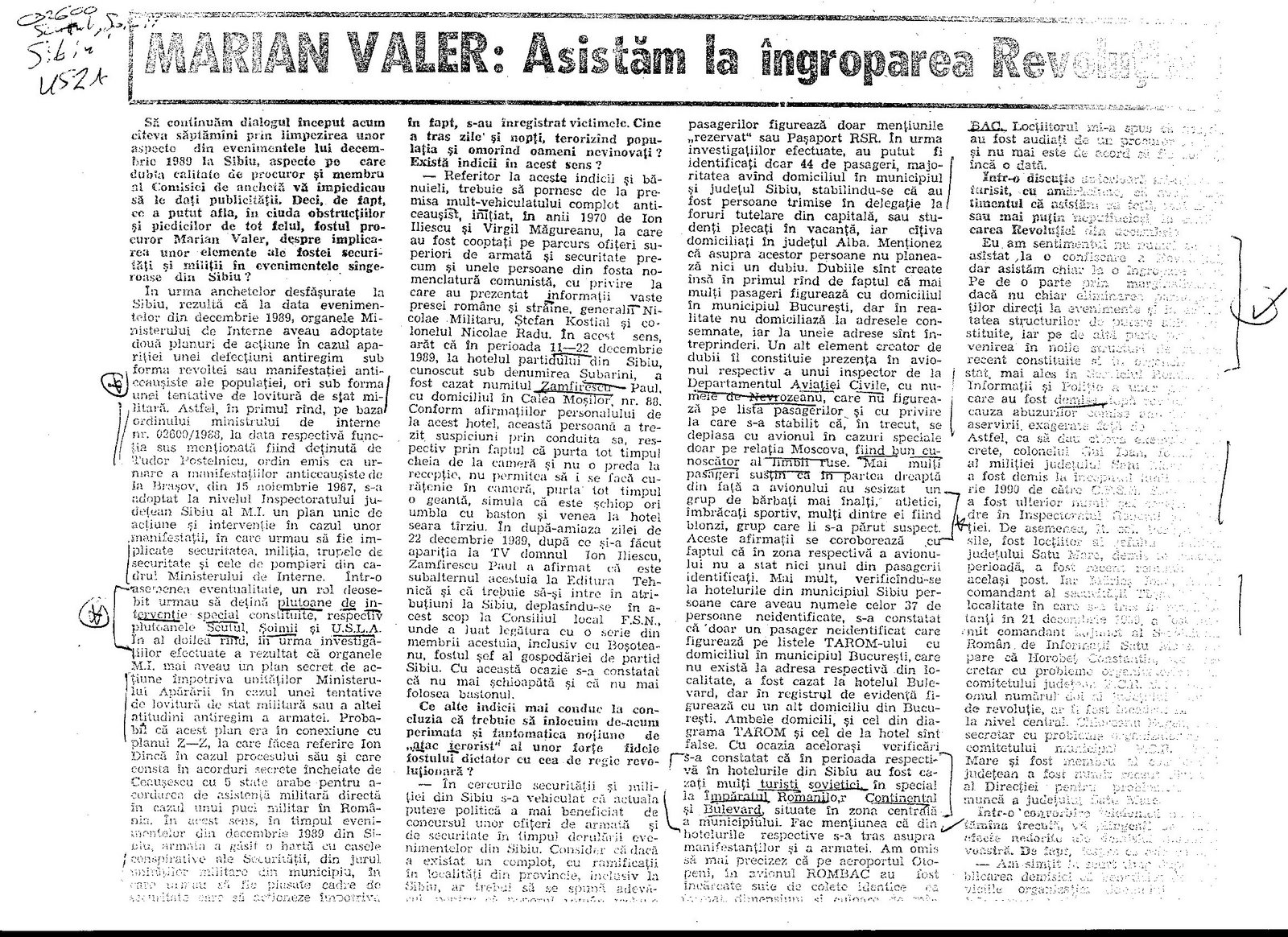
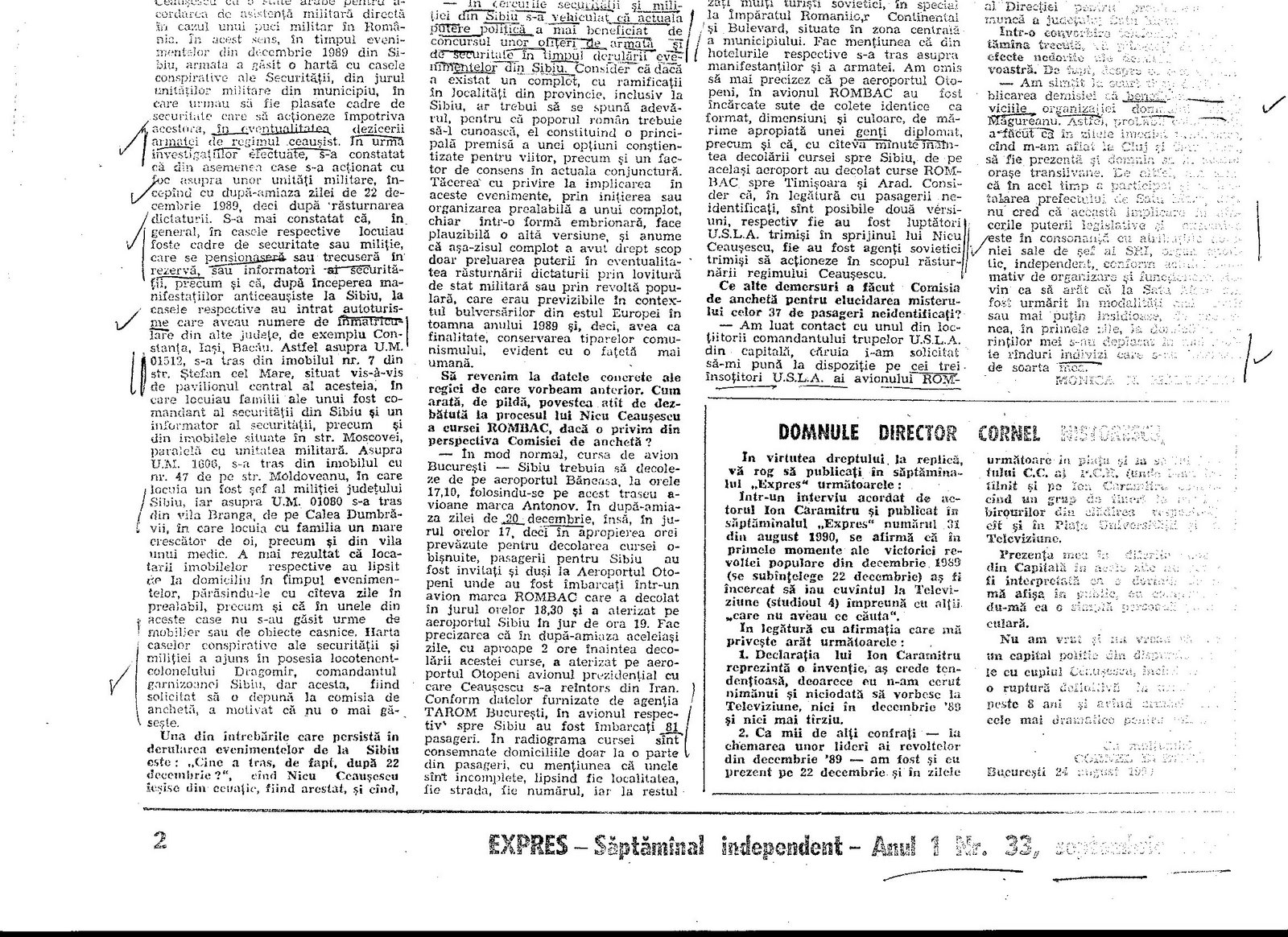 Asistam la Ingroparea Revolutiei
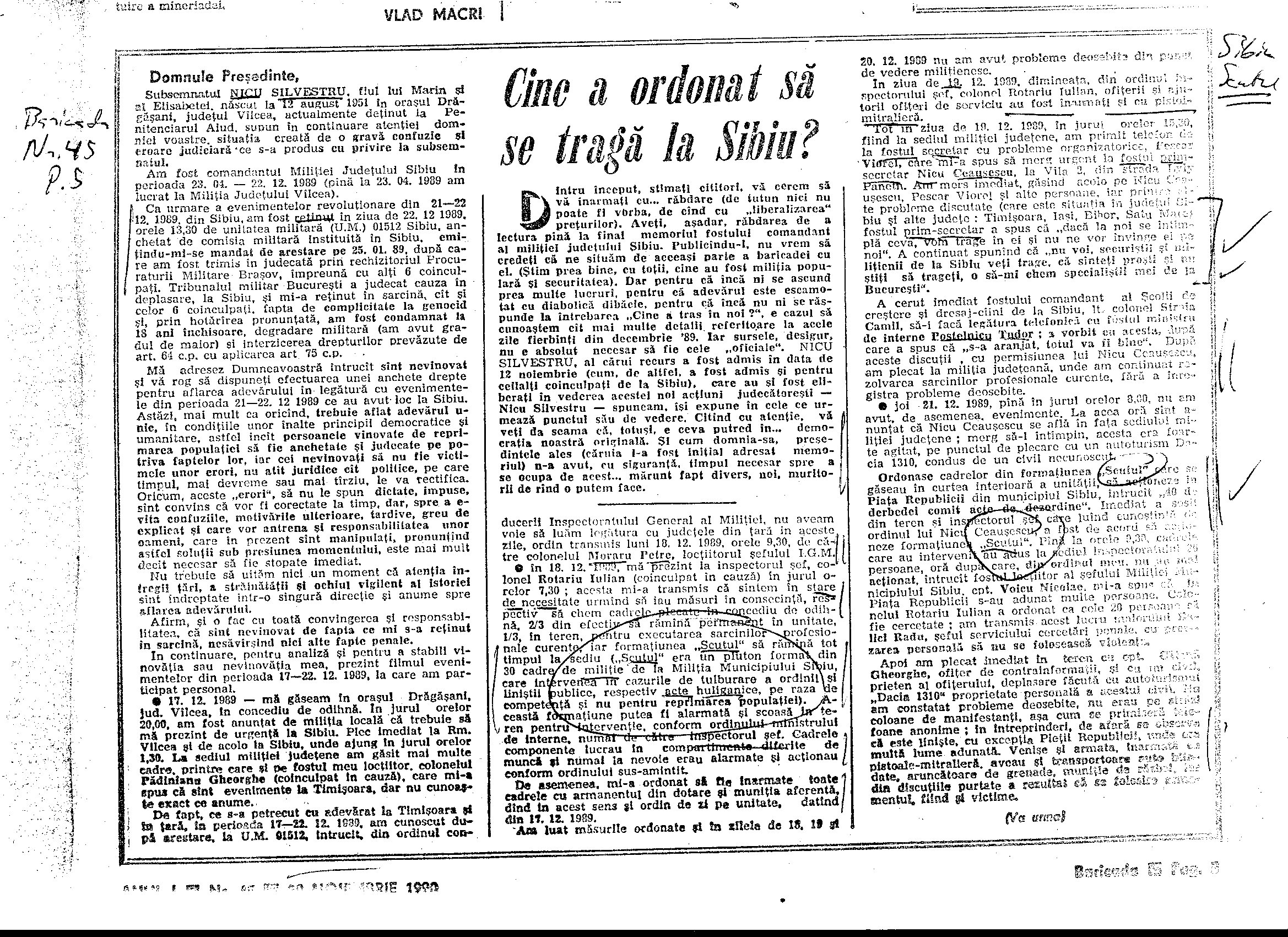
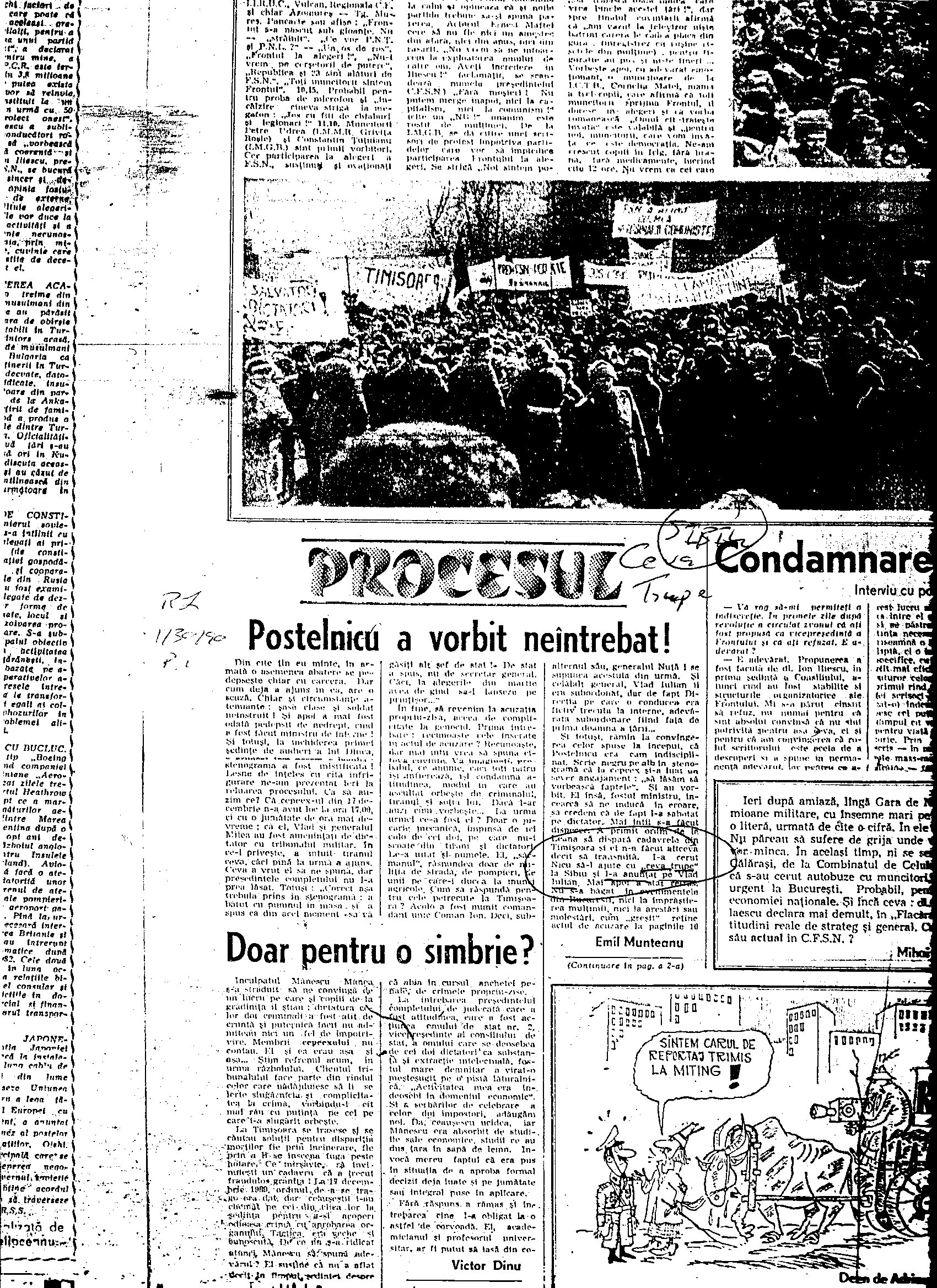
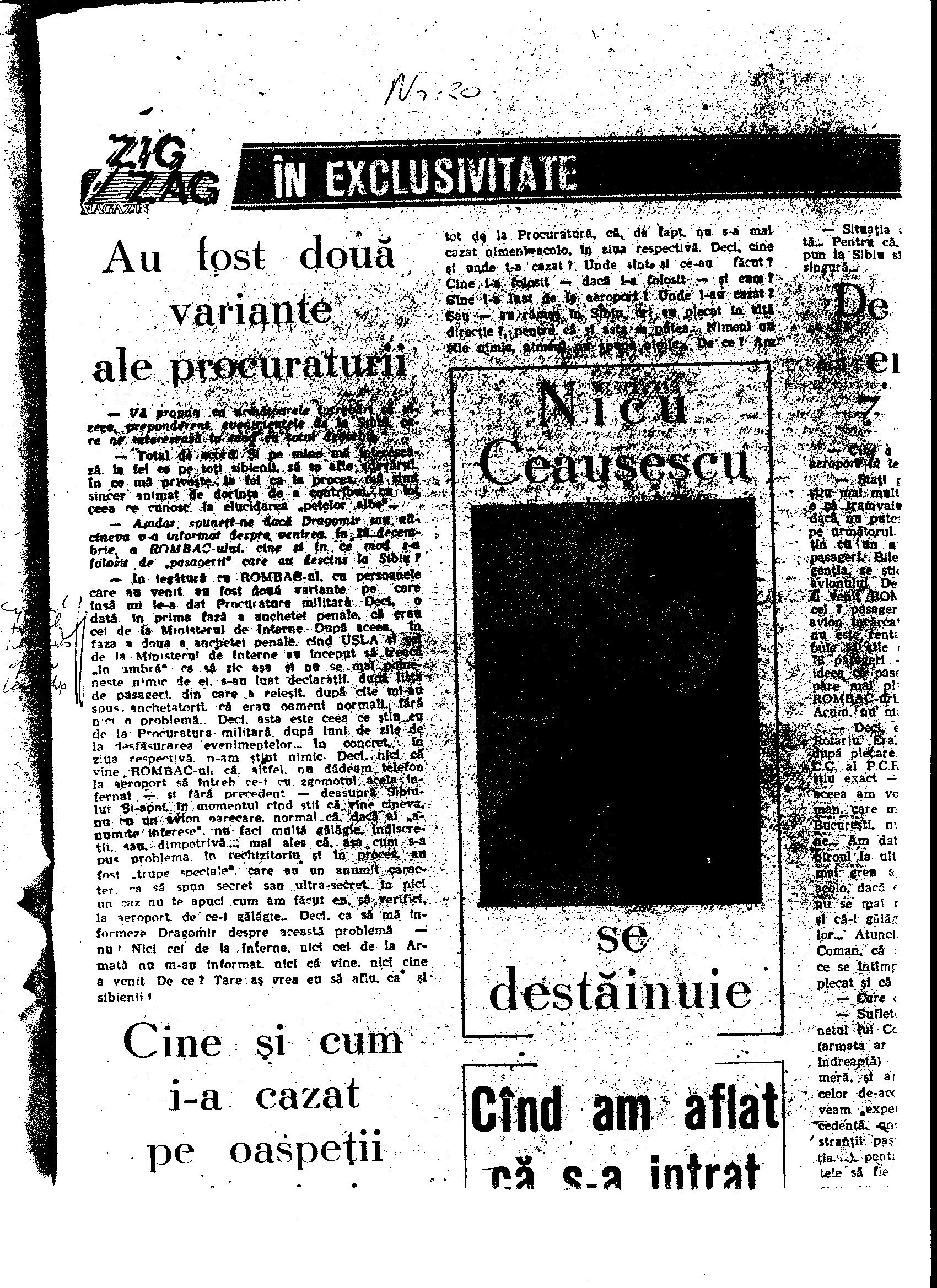
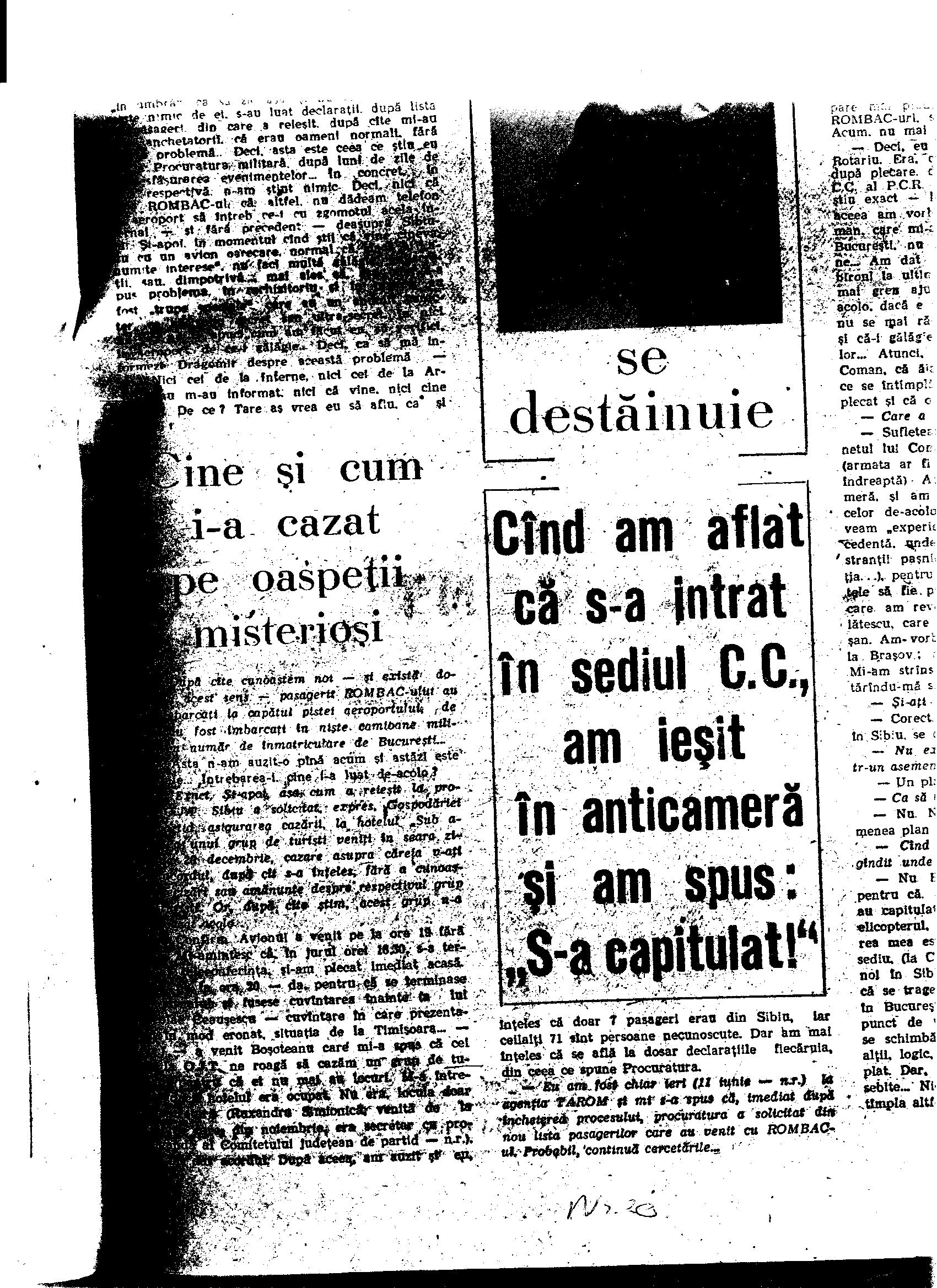

 Offline

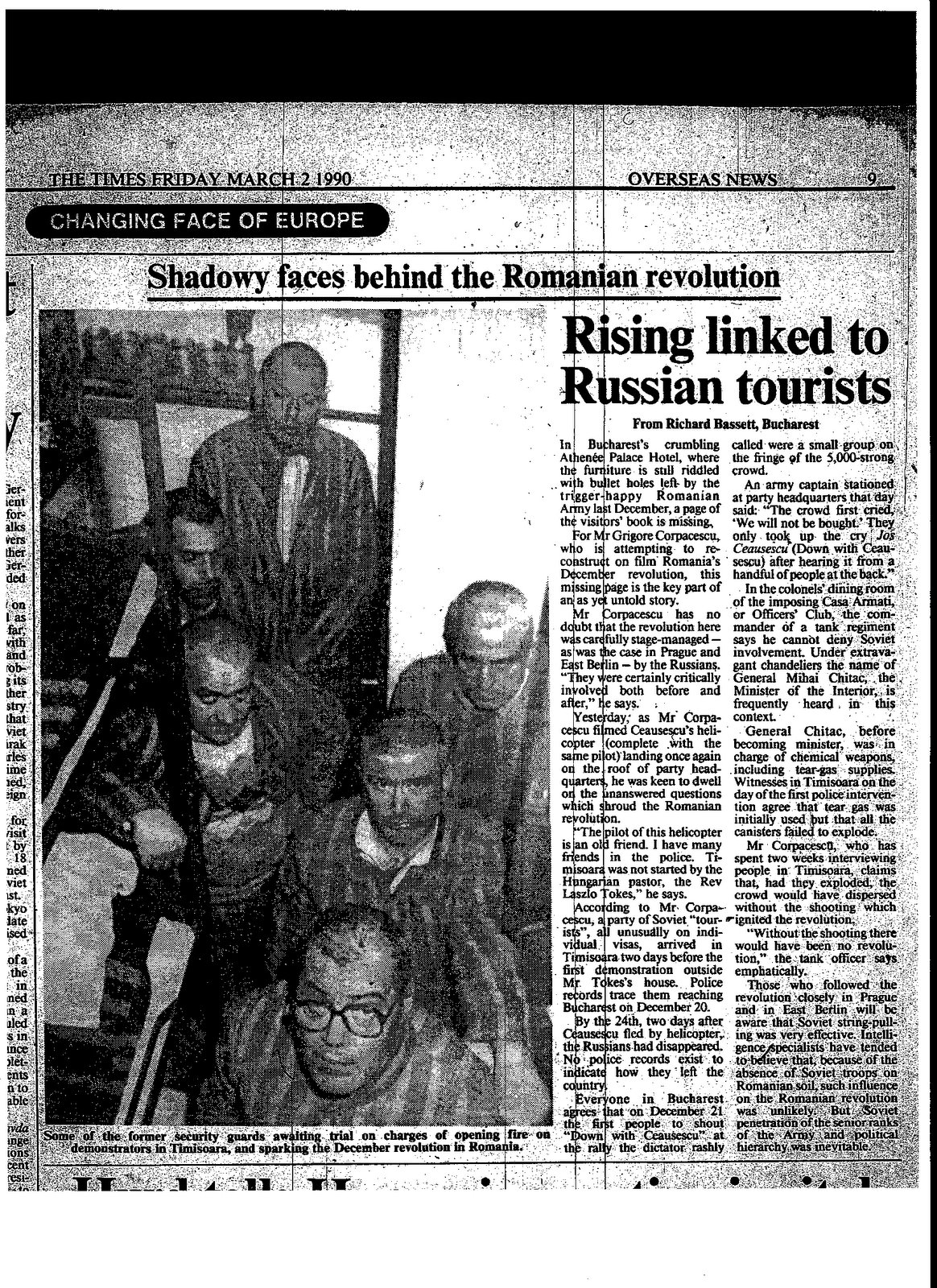
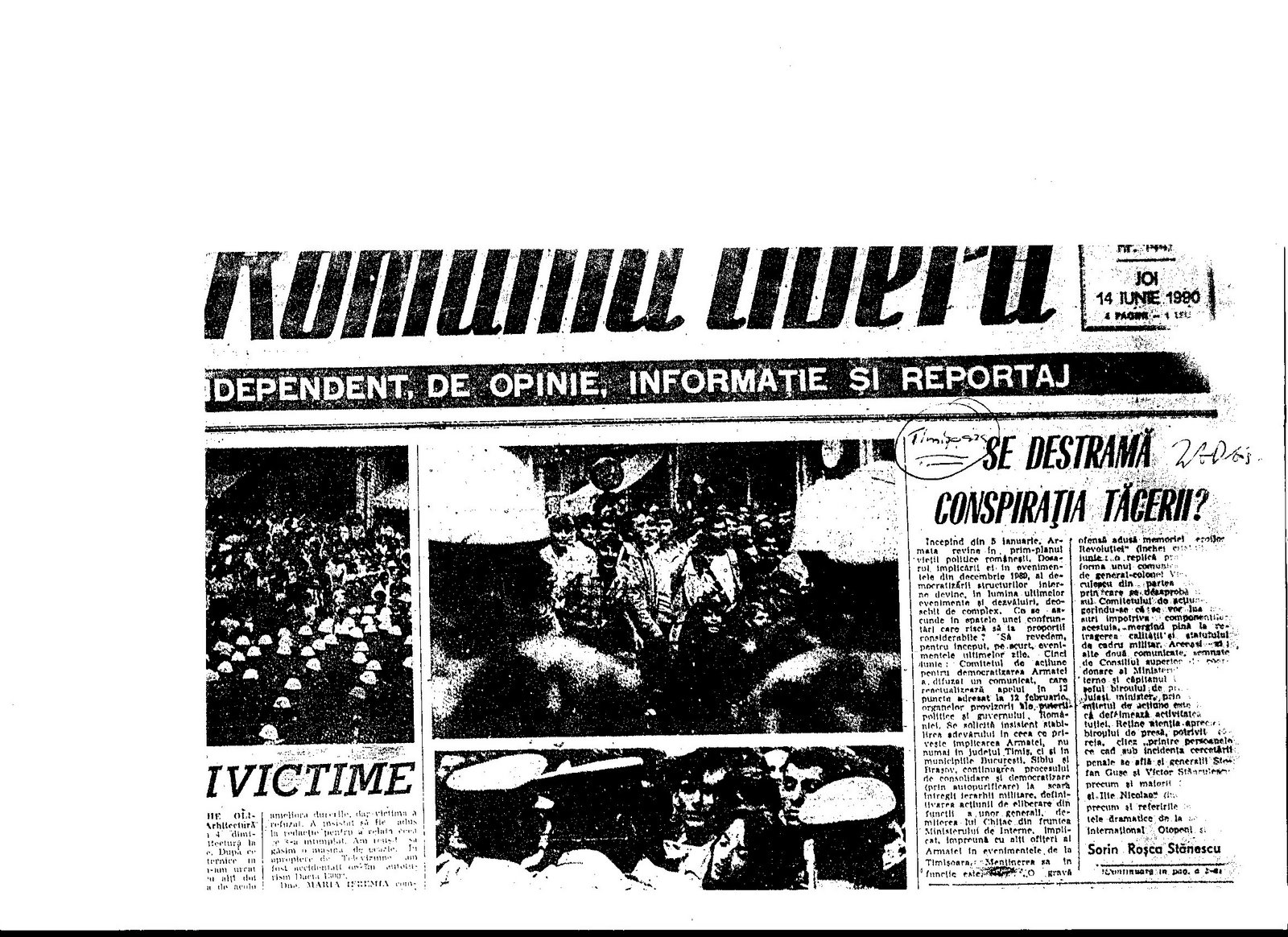
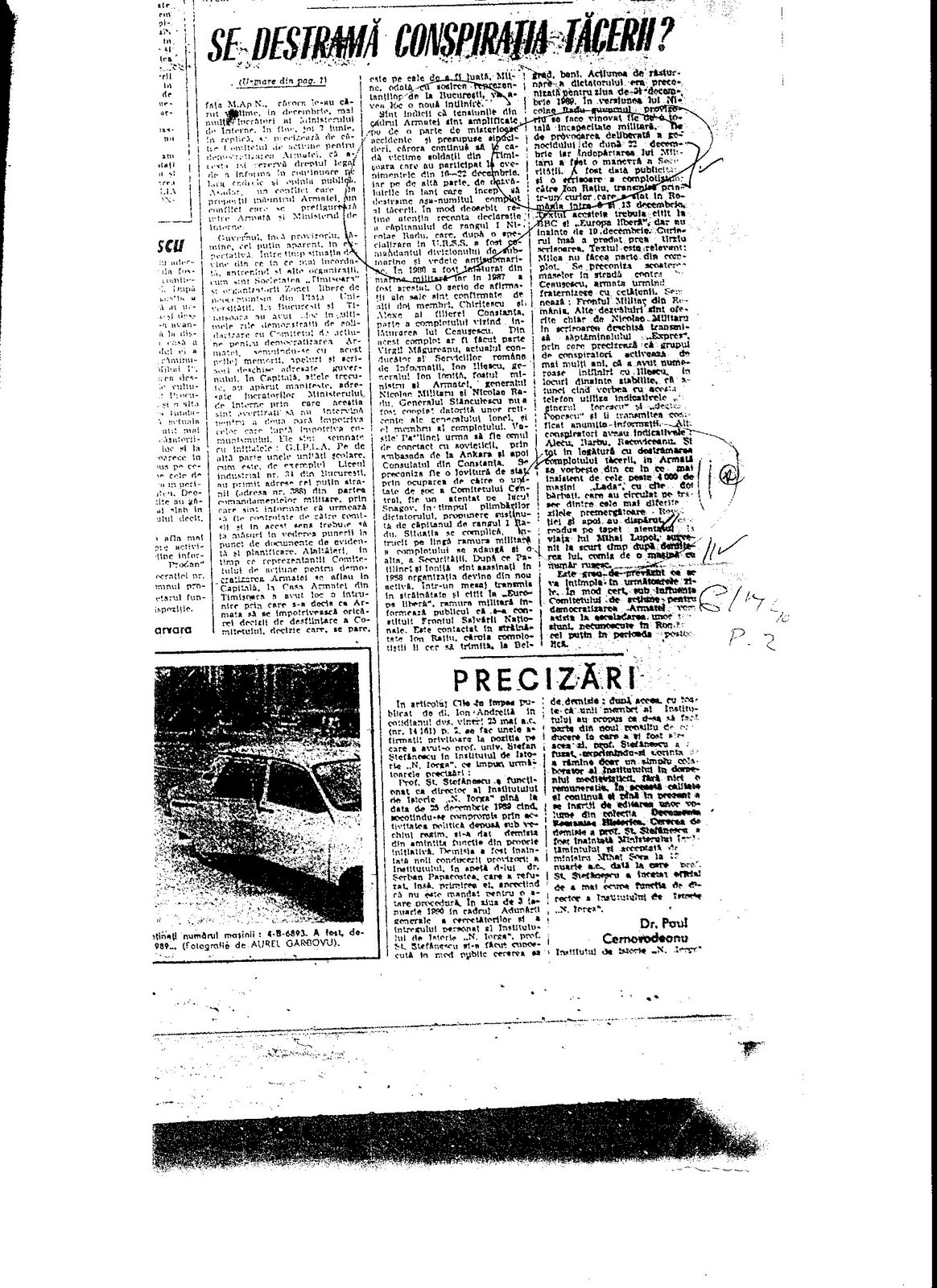
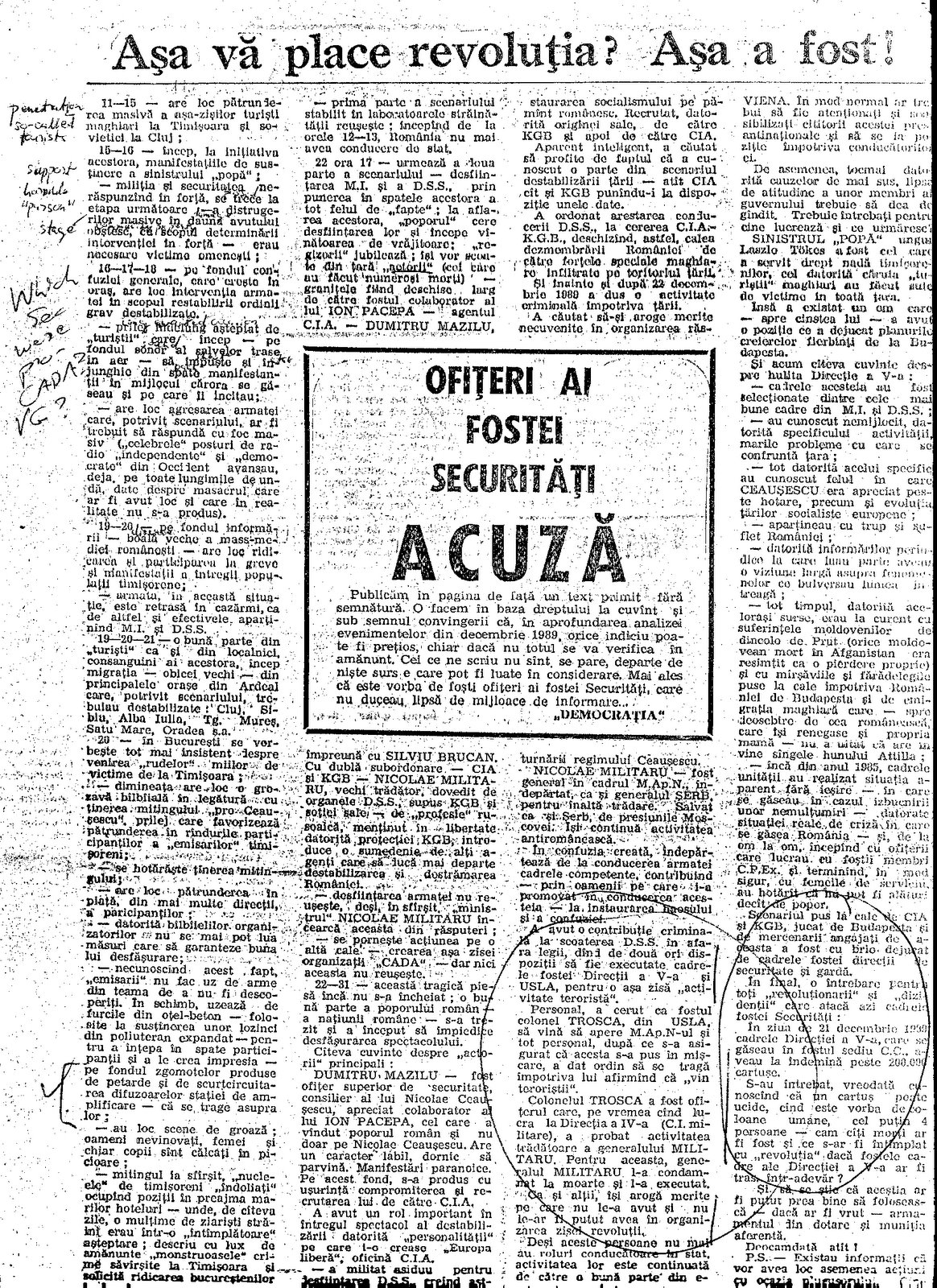

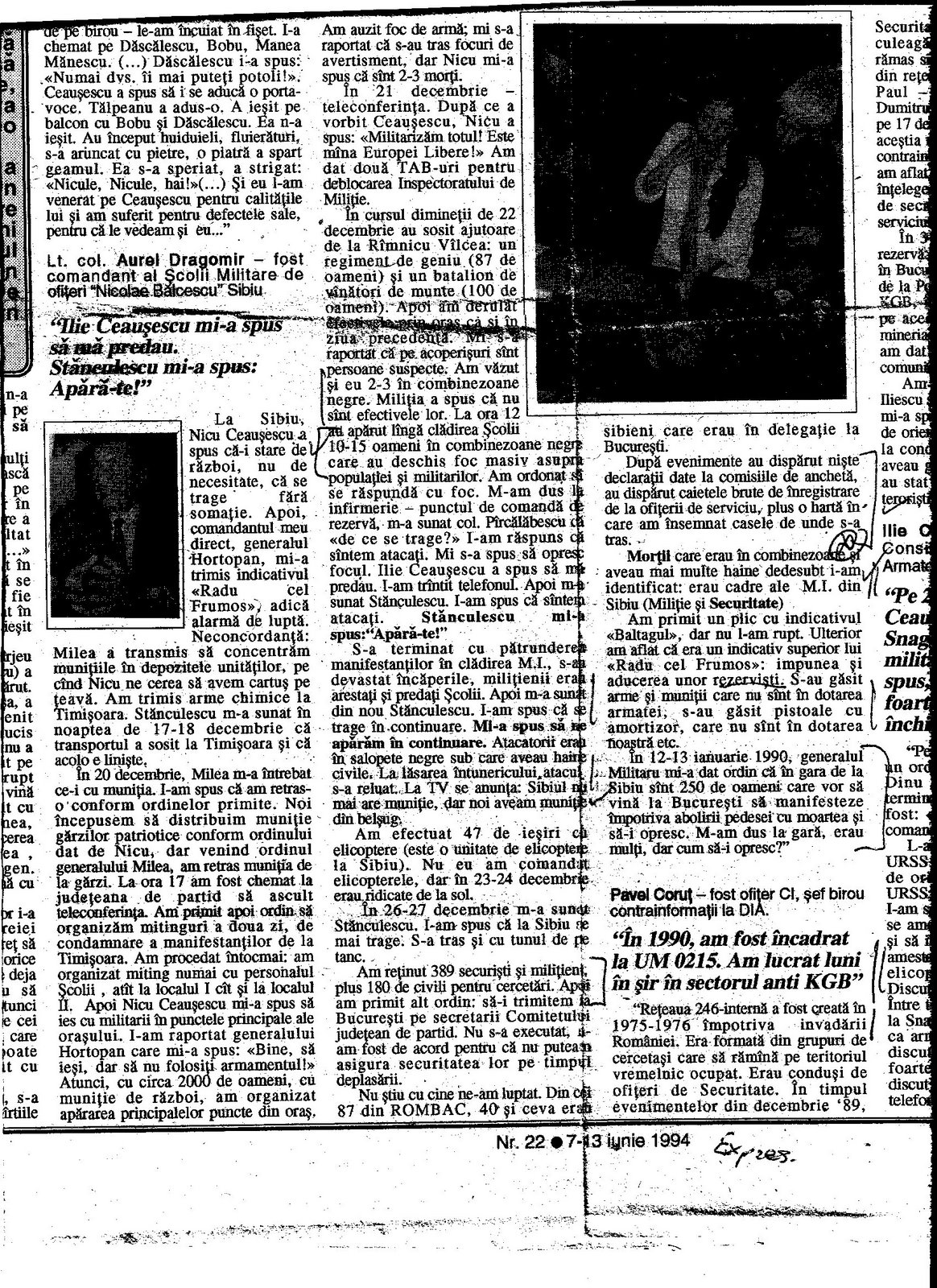
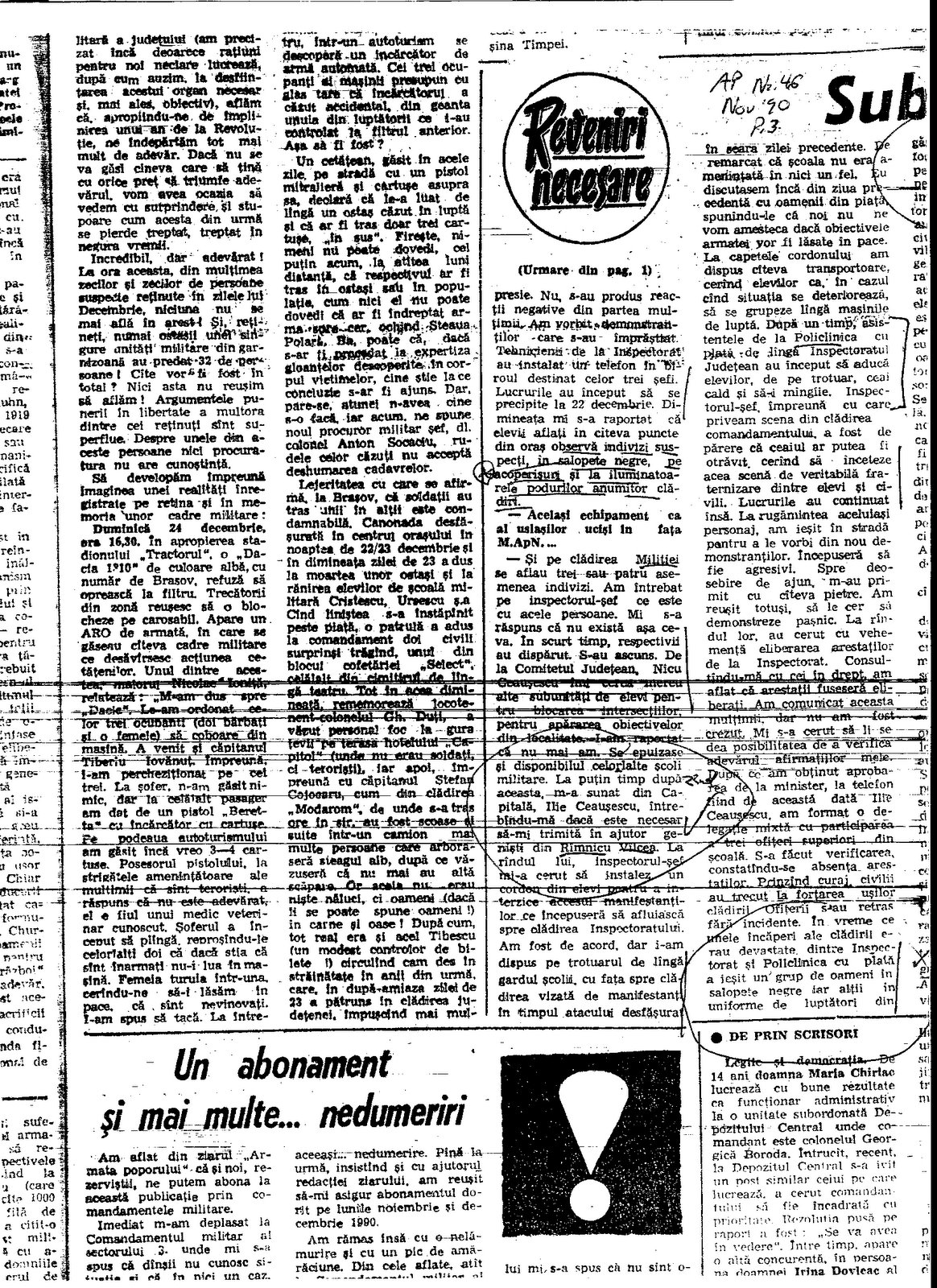
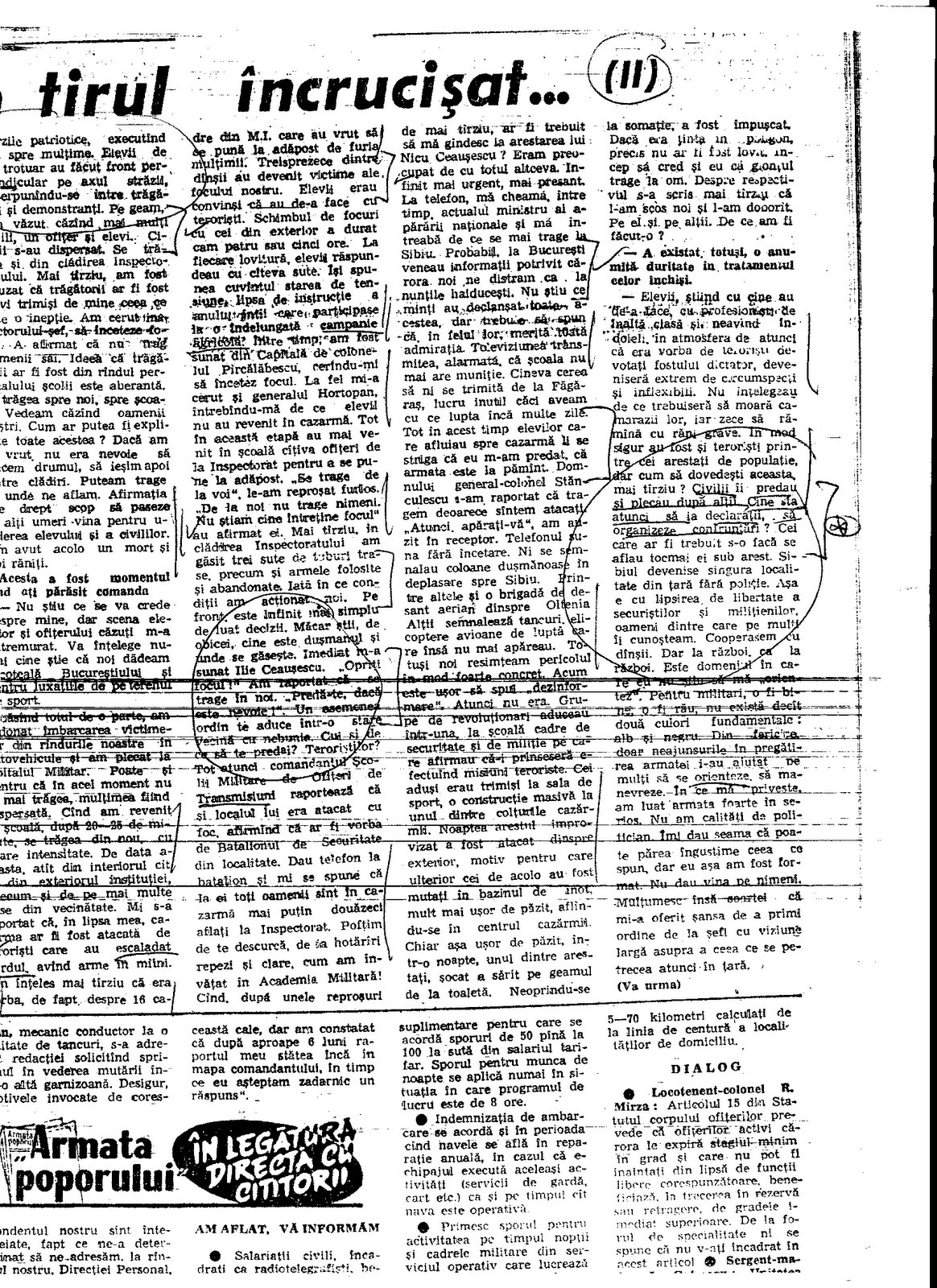

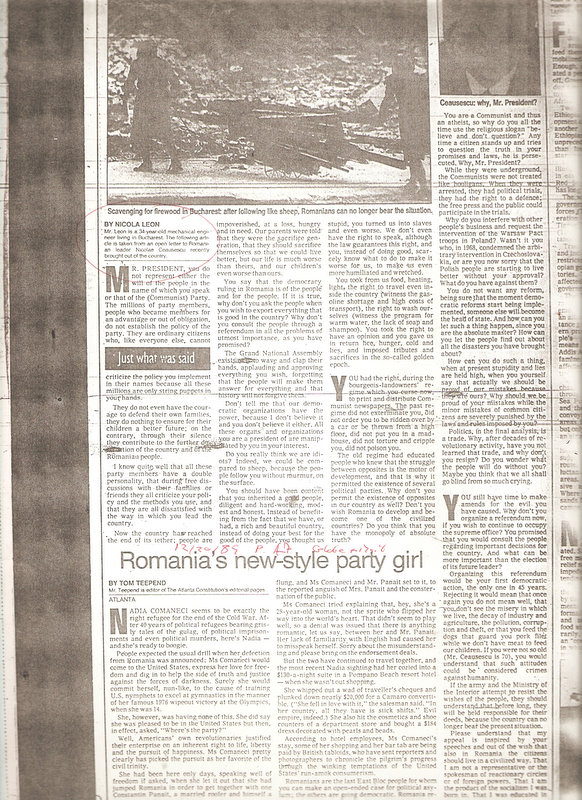
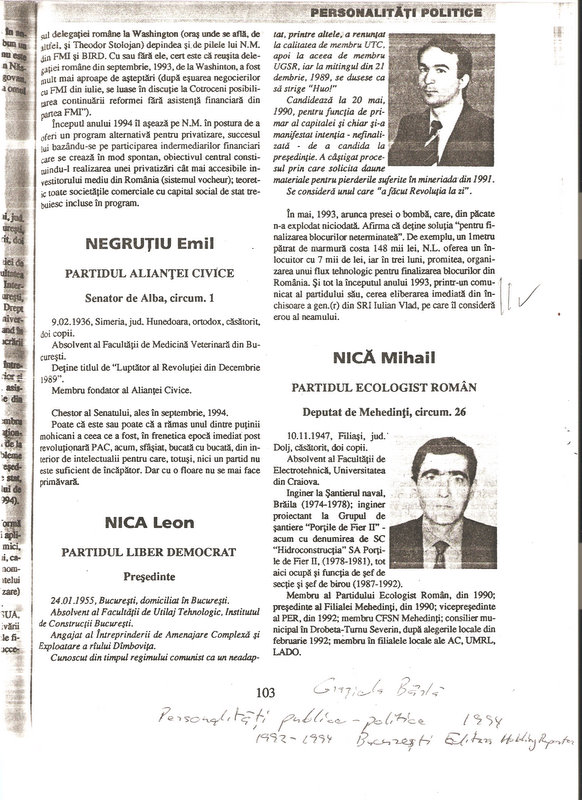
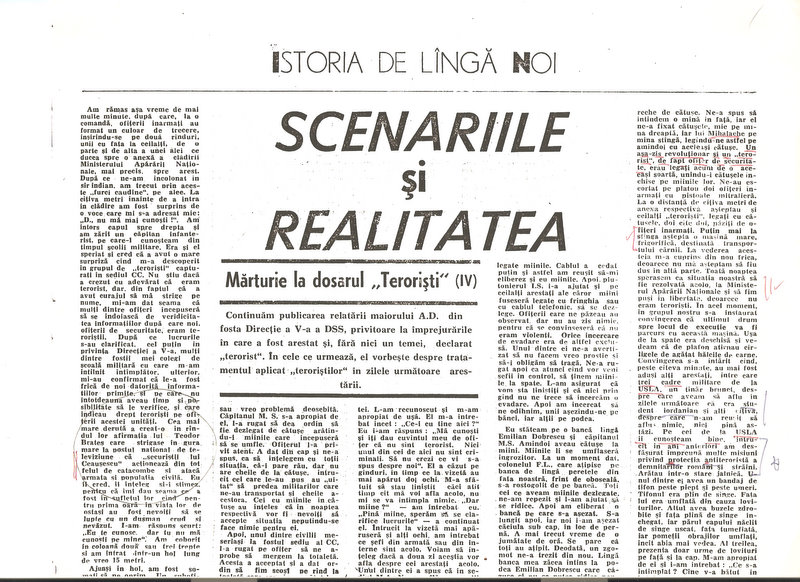
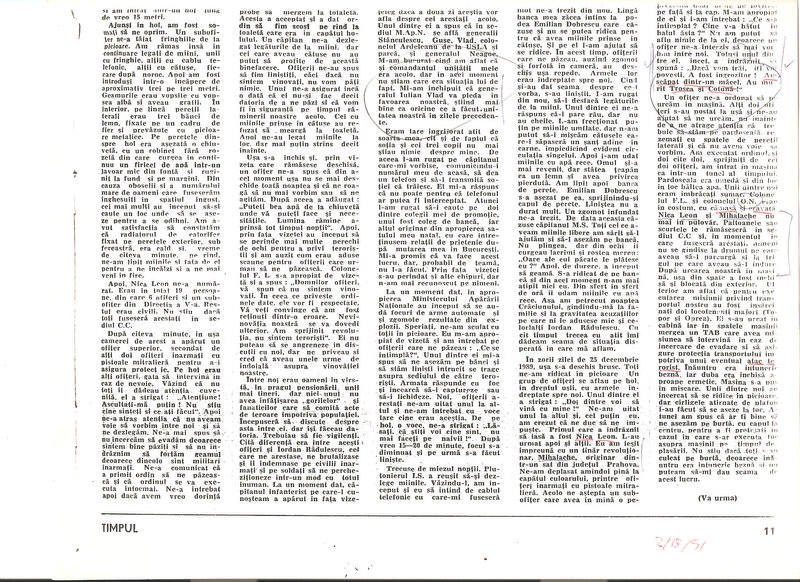
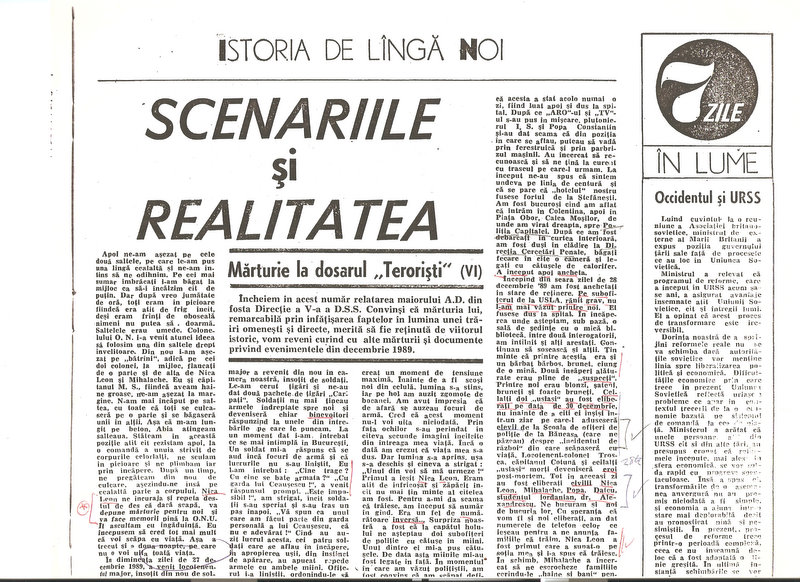
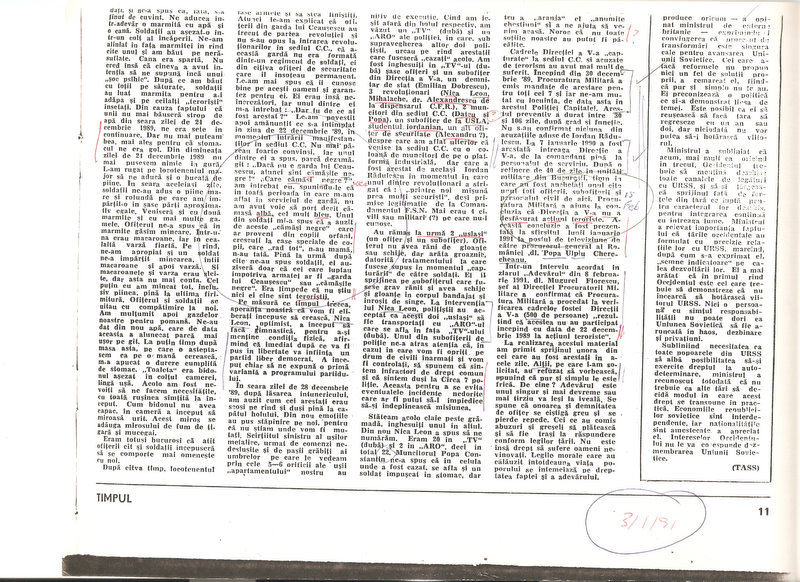
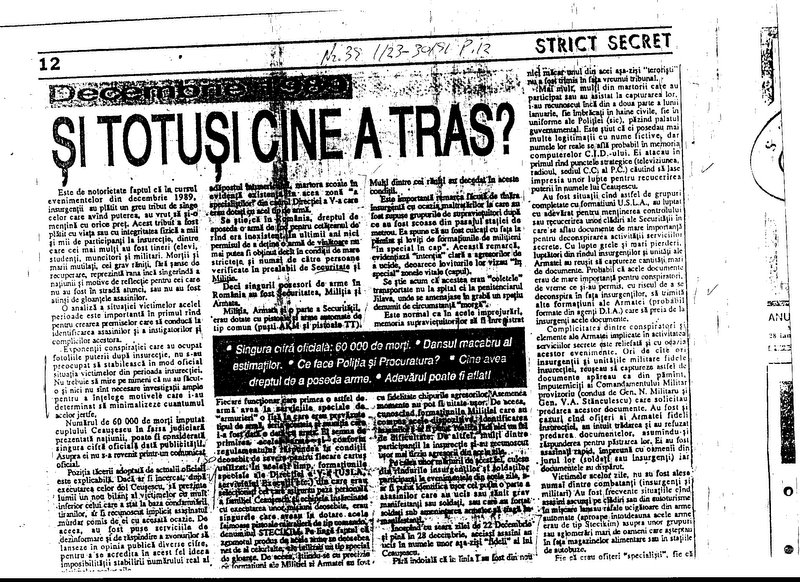
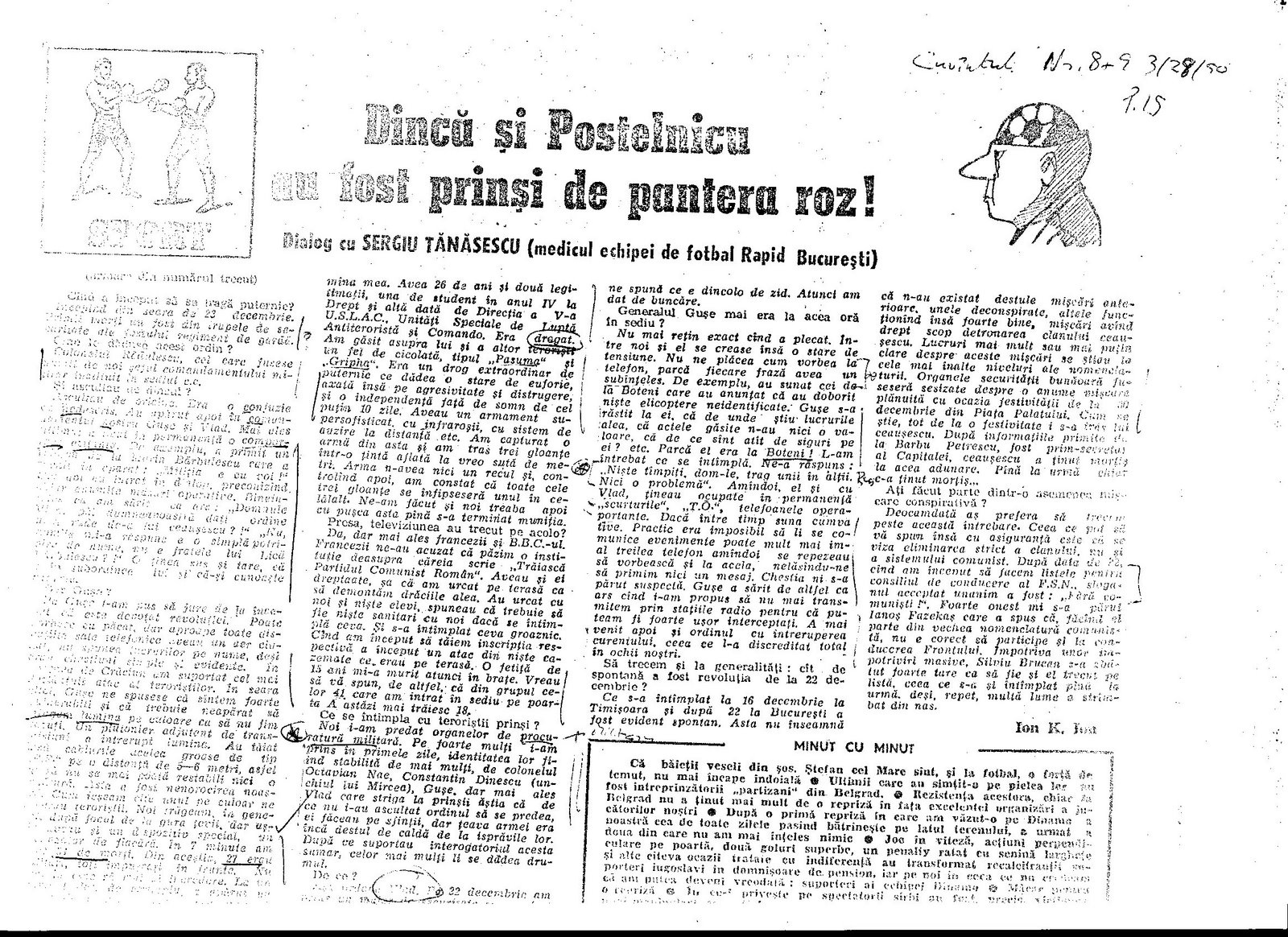
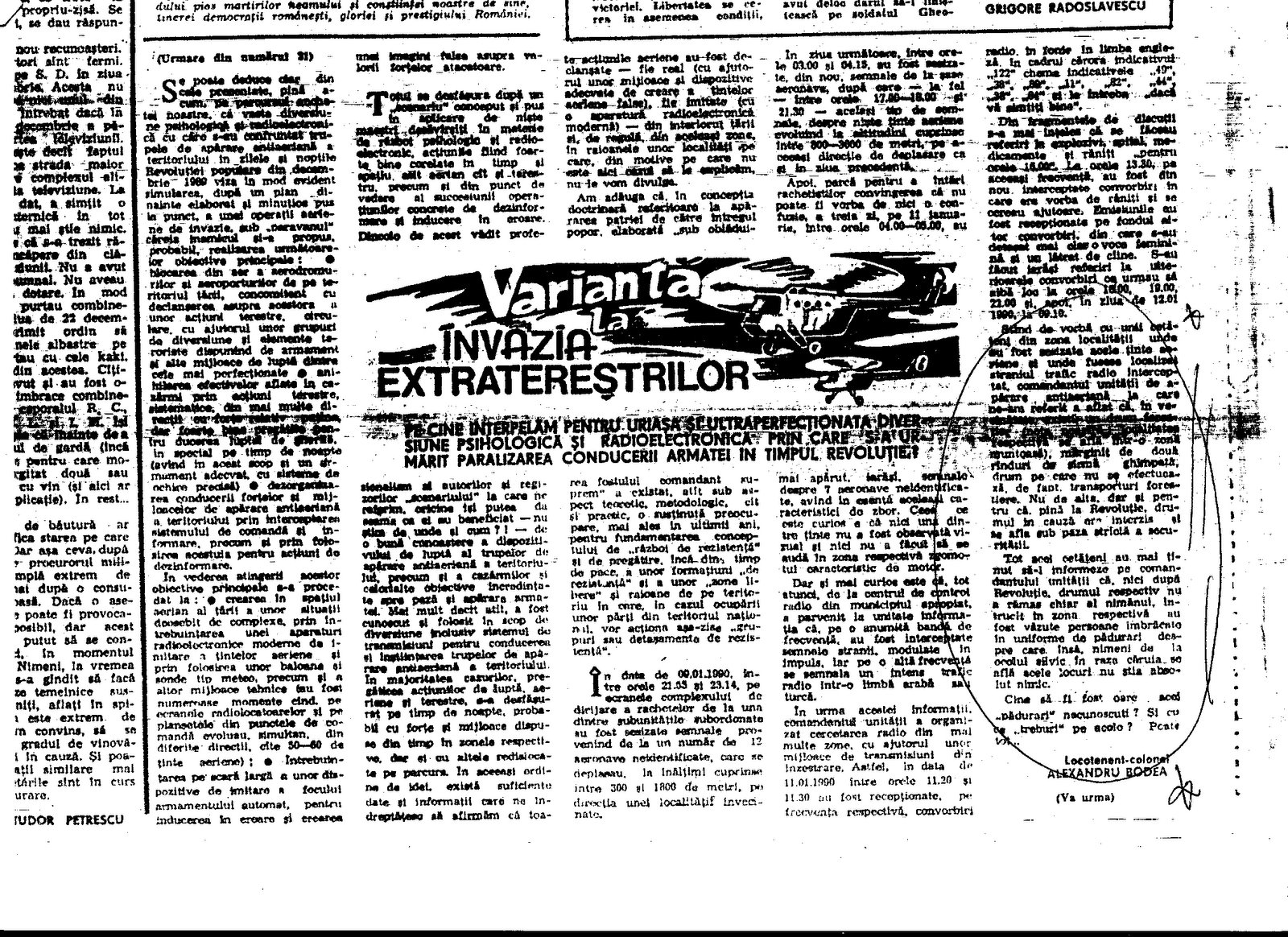
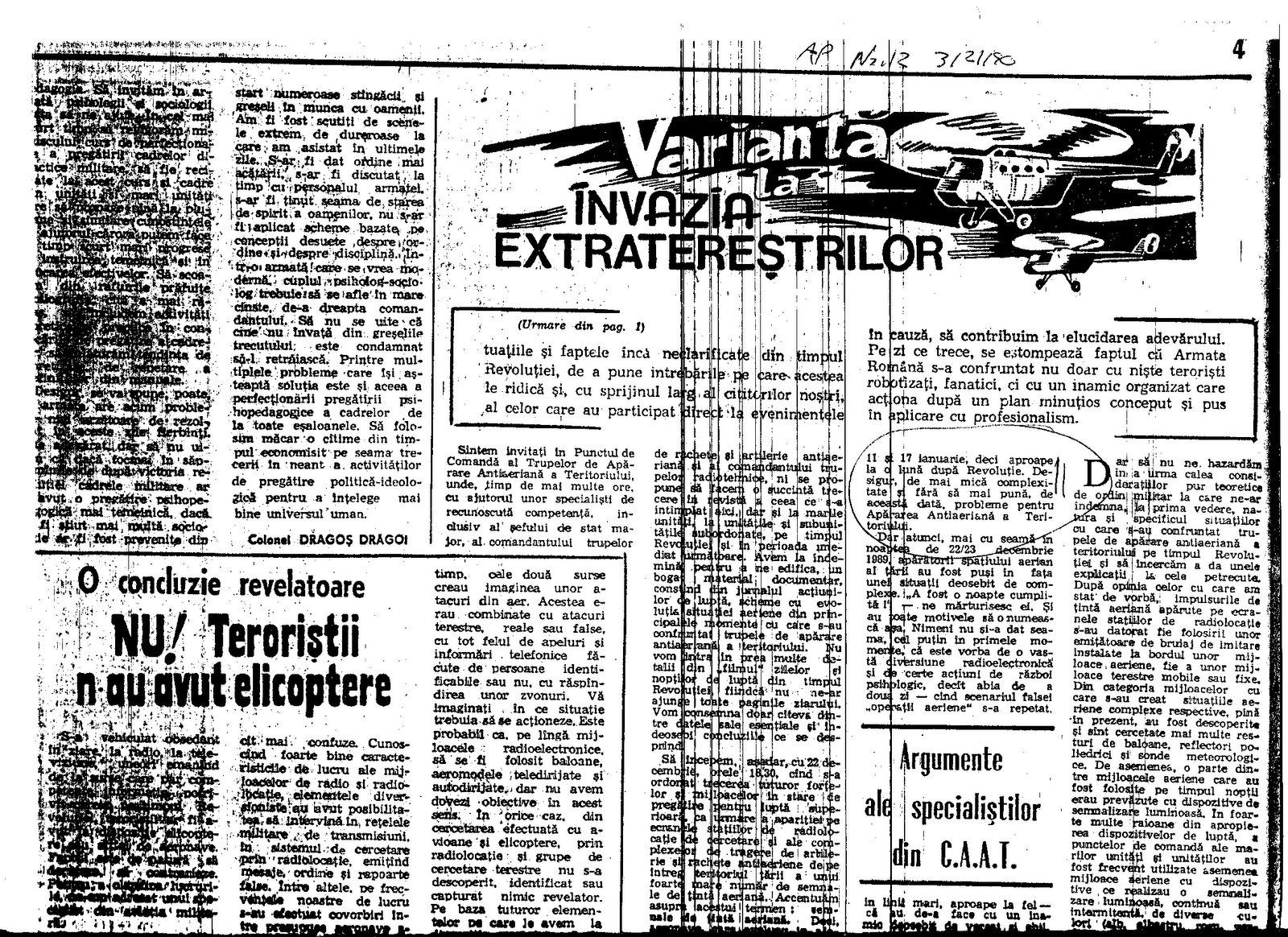
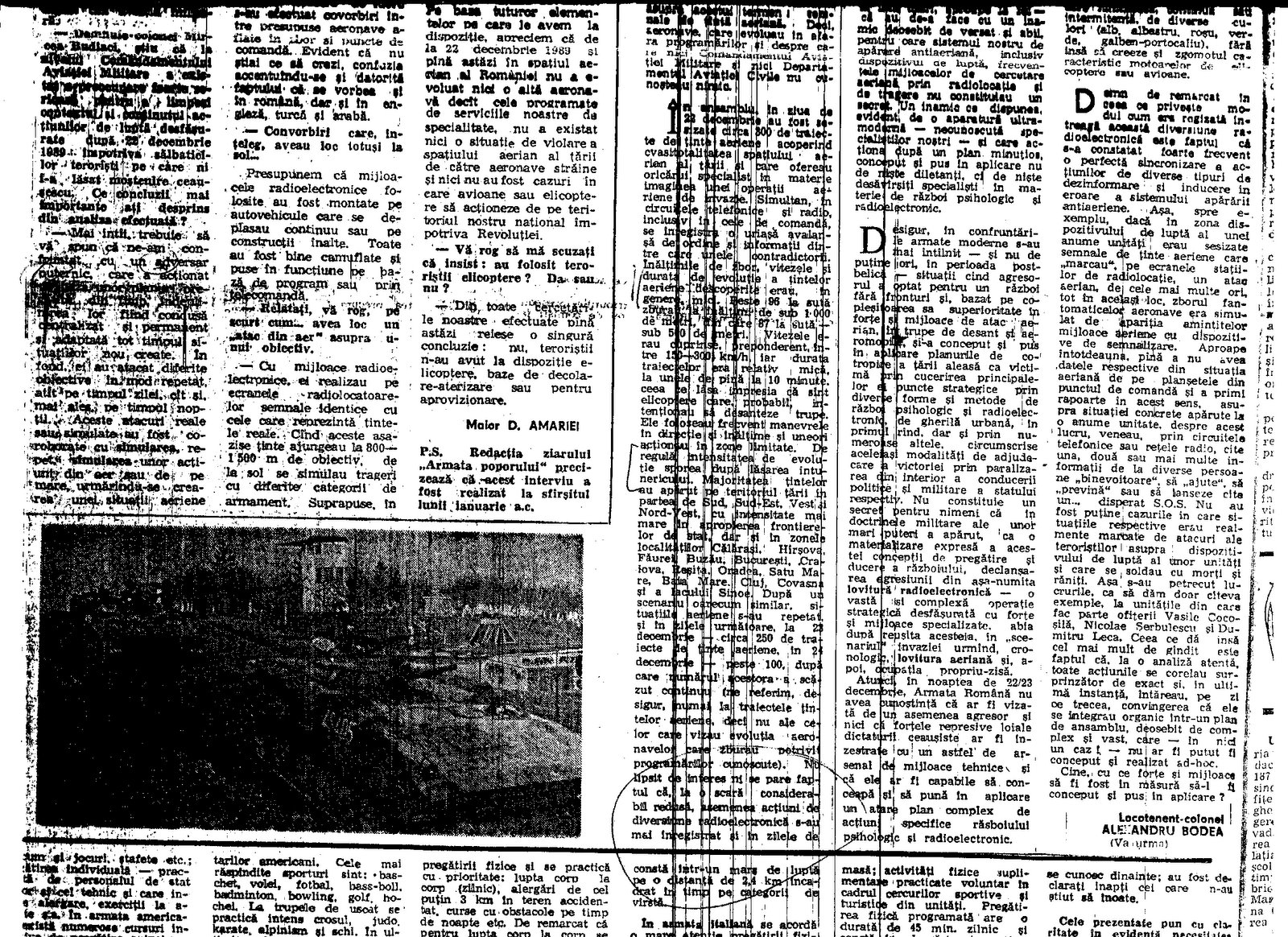
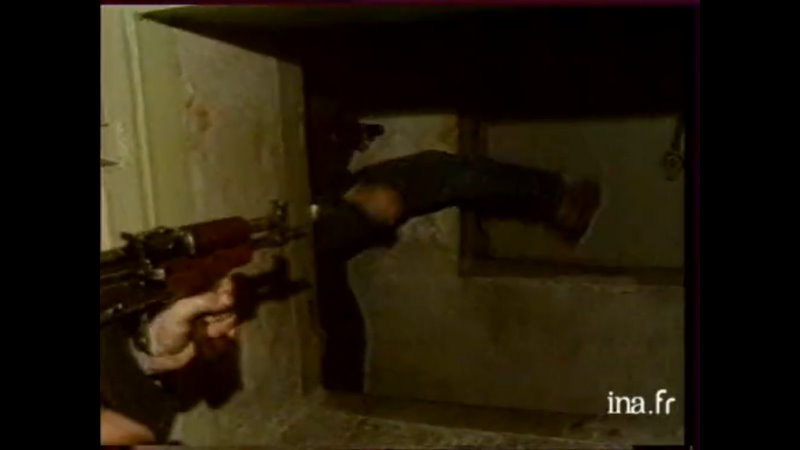


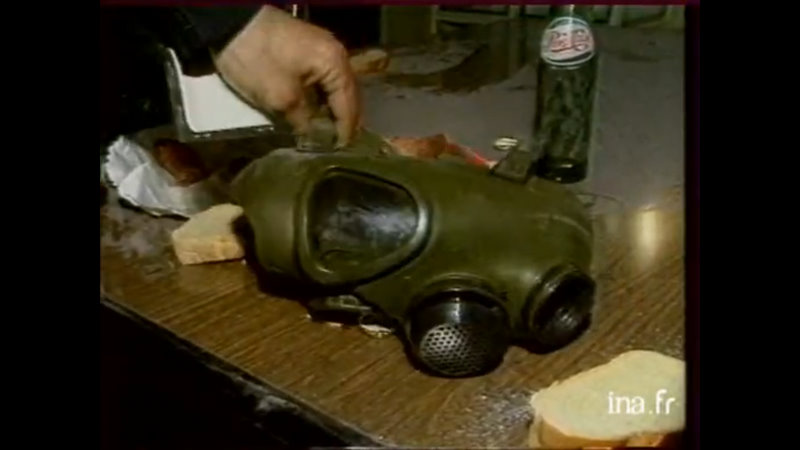
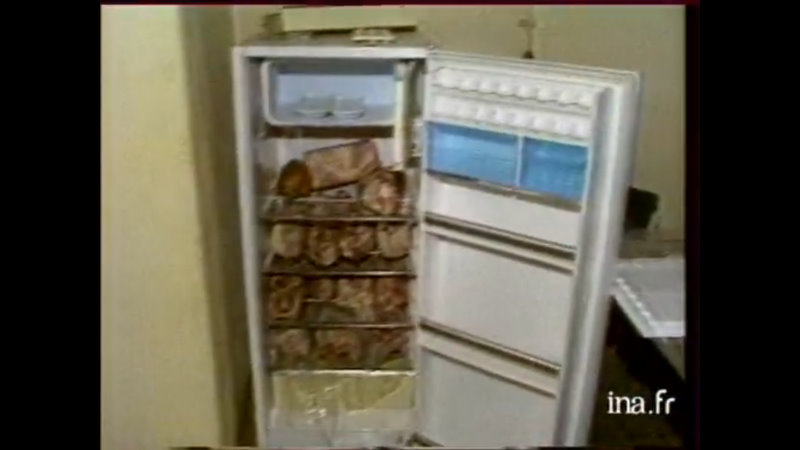
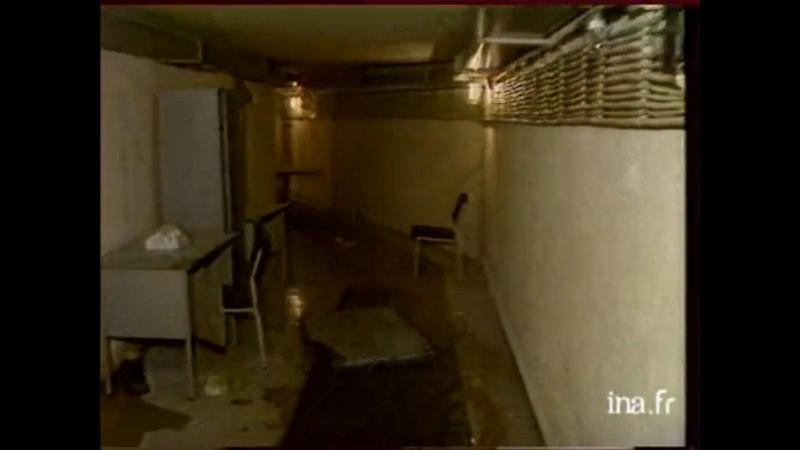
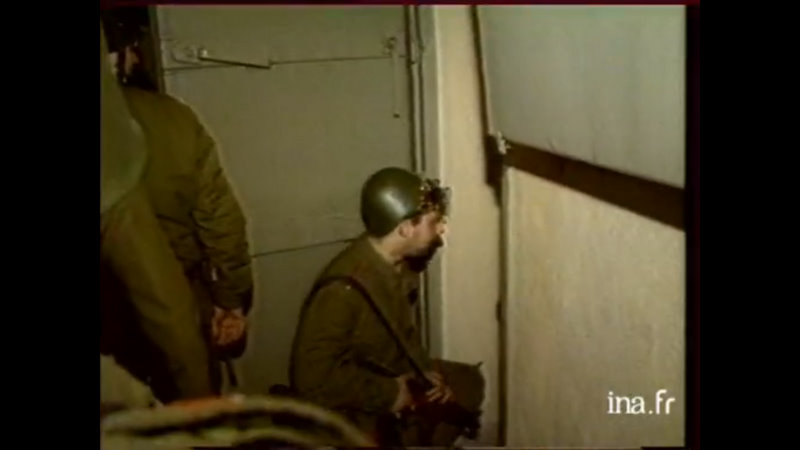
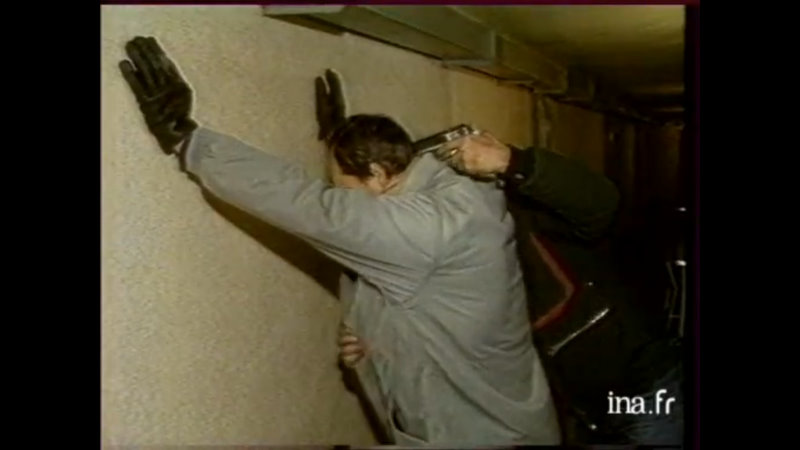
 The Archive of the Romanian Revolution of December 1989