Acesta sustine ca, dupa ce a fost deschis focul, lumea din piata s-a imprastiat. “Eu am ramas singur cuc in strada si mi-a zis: ‘Si pe mine ma impusca’. In momentul acela, am facut un pas sa ma trantesc si nu stiu de unde, din biserica sau de la geamurile acestea, pe mine m-a lovit cu cartusul ala nenorocit dum-dum. Mi-a facut o gaurica mica aici in picior sus si in momentul in care a explodat a fost ca si floarea soarelui. Era praf piciorul, dubla fractura de femur“, a mai spus barbatul. Nemeti sustine ca un strain l-a tras de pe strada si l-a dus intr-o curte, de unde a fost luat de o salvare. “Am fost operat si in cele din urma am ajuns in Austria, unde am stat aproape un an si am avut 16 interventii chirurgicale si transplant de os. Am vrut sa il gasesc pe cel care m-a salvat, dar nu am putut“, a mai spus revolutionarul.
Ajuns la 69 de ani, Nicolae Cristea Nemeti povesteste acum cu detasare ce s-a intamplat in urma cu 21 de ani in Cluj Napoca si de ce au iesit oamenii in strada pentru a striga “Libertate!”.
Nemeti isi aduce aminte ca si cum ar fi fost ieri cum, militarii condusi de capitanul Carp Dando, au deschis focul si revolutionarii au cazut secerati la pamant.
“A venit banditul ala, ca e un bandit ordinar, capitanul Carp Dando, s-a asezat in mijlocul strazii, si-a asezat un rand de militar in zona asta (n. red. Piata Unirii). Aia de langa mine nu erau toti militari. Eu am vazut oameni mai in varsta, erau oarecum drogati, nu erau militari. Nu stiu cine erau. In momentul in care a venit Calin Nemes si l-a intrabat ce cauta aici, capitanul Carp Dando a zis ‘Foc‘. In momentul acela a pus mana pe pistol si a inceput sa traga. L-am vazut pe Matis cum s-a intors intr-un picior si a cazut jos si a cazut si Ladiu, dar nu a fost lovit“, a rememorat Nemeti scena.
Acesta sustine ca, dupa ce a fost deschis focul, lumea din piata s-a imprastiat. “Eu am ramas singur cuc in strada si mi-a zis: ‘Si pe mine ma impusca’. In momentul acela, am facut un pas sa ma trantesc si nu stiu de unde, din biserica sau de la geamurile acestea, pe mine m-a lovit cu cartusul ala nenorocit dum-dum. Mi-a facut o gaurica mica aici in picior sus si in momentul in care a explodat a fost ca si floarea soarelui. Era praf piciorul, dubla fractura de femur“, a mai spus barbatul.
Nemeti sustine ca un strain l-a tras de pe strada si l-a dus intr-o curte, de unde a fost luat de o salvare. “Am fost operat si in cele din urma am ajuns in Austria, unde am stat aproape un an si am avut 16 interventii chirurgicale si transplant de os. Am vrut sa il gasesc pe cel care m-a salvat, dar nu am putut“, a mai spus revolutionarul.
In total, in Piata Libertatii si-au pierdut viata 14 persoane, dar capitanul Carp Dando, cel care a condus plutonul de reprimare, a scapat fara sa fie condamnat pentru aceste crime.
Revolutionarii din Cluj vor depune in luna ianuarie o plangere la CEDO si la Tribunalul de la Haga, pentru pedepsirea lui Carp Dando si a lui Florian Caba.
[Va rog, sa ascultati interviul cu dle Nemeti pe saitul acesta
In 2001, the deputy Militia chief for Cluj county, Vasile Pintea, admitted at a trial concerning the killing of demonstrators on 21 December 1989 in Cluj, that “…amid the street clashes in Piata Libertatii a special antiterrorist brigade of the Securitate was dispatched, although he didn’t specify if the soldiers from this platoon used their weapons.”[150] This then led the former commander of “Brigade 60” of the Securitate, Vasile Mihalache, who had moments earlier affirmed that the only people to fire in demonstrators in Cluj in December 1989 had been soldiers of the Defense Ministry, to suddenly recall that “…indeed, among the soldiers there had been these Securitate men, who were dressed in uniforms similar to those of the Defense Ministry cadre, although he denied they shot demonstrators.”
[150] A.A., “Un fost ofiter de Securitate acuza Armata de crimele din decembrie ’89,” Ziua, 16 January 2001, online edition. A soldier from the Someseni unit, Gheorghe Timis, spoke about what happened in a different square in Cluj, Piata Marasti, as follows: “…it was not possible that no one would die, because there was shooting from the balconies and blocs by Securitate cadre. When I heard the first use of a weapon, I recognized, from the whistle, that it wasn’t a caliber that we had in our arsenal. After this I saw a man on the asphalt, who had a hole in the top of his head, a sign that he had been shot from above, from the buildings, and not by the soldiers, as is always maintained,” A.A., “In procesul Cluj ’89, militarii pun mortii pe seama Securitatii,” Ziua, 2001, online edition.
—————————————————————-
se stie, din nenorocire ca securistii le-au profanat biserici in decembrie 1989
Preotul Ioan Botau, administratorul Catedralei: “Sorin Leia, a scos un tricolor si l-agita si striga Desteapta te romane! La ora 17,15 a fost ochit in cap de un lunetist si ucis….Fusese lovit de glont in urma obrazului si nu murise pe loc. Parintele Mituga a iesit si a chemat salvarea….Securisti camuflati au tras, care azi fac si pe eroii! S-a tras si in ziua de Craciun, s-a tras pina in 29 decembrie” (Grid Modorcea, “Dumnezeu citat ca martor in procesul de la Timisoara,” Expres Magazin 1991)
si
Iosif Costinas (vara 1991): “Recent, un fost ofiter de Securitate, actualmente angajat in SRI, a chemat doi vecini sa-i repare o teava din baie. S-a imbata apoi si le-a spus: ‘In 17 decembrie am tras din turnul Catedralei. Am tras si mai tirziu. Si acum daca vreau, pot sa trag.’ Cei doi au povestit intimplarea dar nu i-au pomenit numele. ‘Omerta’ functioneaza perfect.” (Laura Ganea, “La Timisoara se mai trage inca,” Tinerama, nr. 77 (iulie 1991), p. 3.)
Uşa de la Biserica Kretzulescu
Şi tot aici se regăseşte şi un drapel tricolor, din 22 decembrie 1989, pe care mai multe personalităţi de atunci au semnat şi şi-au scris gândurile: Ion Iliescu, Gelu Voican Voiculescu, Mihai Chiţac, Victor Athanasie Stănculescu, Petre Roman, Silviu Brucan. Muzeul deţine şi o copie după declaraţia scrisă şi citită de Ion Iliescu în seara zilei de 22 decembrie 1989. Nu lipseşte nici uşa de la Biserica Kretzulescu, care a fost ciuruită cu gloanţe pentru ca revoluţionarii să poată intra pentr a-i identiifica pe cei care trăgeau de aici. Într-o vitrină se află două arme „deosebite“. „Nici acest armament nu a fost în dotarea Armatei Române. Aici este o geantă cu o armă în interior. Mergând pe stradă tragi cu ea fără ca cineva să-şi dea seama că tragi din geantă. Şi tot aici se află o puşcă cu lunetă şi amortizor de zgomot Mosin-Nagant“.
dintre cei care au fost raniti cu gloante dum-dum, unii au fost trimiti in strainatate pentru tratament–iata cazul lui Radu Sofran
Trimis pentru tratament in strainatate…din cauza gloantelor DUM-DUM. Cazul Radu Sofran, 34, “sapte gloante au explodat in mine, gloante din acelea periculoase, dum-dum…” Tineretul Liber, 3 martie 1990
————————————————————
Gloante explozive (deci dum-dum) au fost folosite si in Piata Universitatii in noaptea de 21-22 decembrie…unde USLA si oameni lor alaturati au fost dislocati…
Cazul trist al lui Mioara Luiza Mircea
Bucuresti: noaptea 21/22 decembrie 1989
GLOANTE EXPLOZIVE (DUM-DUM)
POPTEAN Petre, născut în 27.12.1965, la Margău lângă Huedin, domiciliat în Bucureşti str. Carpaţi 54, a lucrat ca şofer la ITB. In 21 Decembrie s-a dus în oraş să-şi protejeze sora care ieşea de la serviciu. Amândoi au plecat pe Calea Victoriei şi au ajuns la Dalles, unde cu groază au asistat la strivirea Mioarei Mirea de către tancheta ce intrase în mulţime făcând să sară în sus capete, mâini şi picioare într-un vacarm asurzitor. Prin sângele ce băltea pe jos, Petre i-a strigat sorei că se duce să ridice răniţii. Pe când era aplecat, a fost lovit în abdomen şi şoldul stâng de cartuşe dum–dum care i-au provocat răni mari. Sora lui, Monica, a reuşit să oprească o salvare cu număr de Târgovişte, dar până la Spitalul 9 nu a mai rezistat. Aproape de ora 18 s-a stins Petre.
Spitalul Coltea (Cristian Calugar, “Cine a tras gloante explozive?” Flacara, 13 februarie 1991, p.9)
1. Nicolae Lucian, adus pe data de 21 decembrie 1989. Diagnostic: fractura cominutiva femur sting in treimea inferioara, cu leziune de artera si vena femurala si pierdere de substanta prin plaga impuscata.
2. Necunoscut, adus pe 22 decembrie, ora 1, decedat la ora 1.30. Diagnostic: hemoragie peritoneala cataclismica cu plage de vena porta, case splinice, zdrobire de pancreas prin plaga impuscata hipocondru sting. Plaga zdrobita de colon travers.
Bucuresti: noaptea 21/22 decembrie 1989
GLOANTE VIDIA (CRESTATE; calibru 5,45-5,65)
Ultima data a fost vazuta in viata la 21 decembrie, in jurul orei 23:00, in zona Intercontinental. Tot la Inter a murit si tanarul Lucretiu Mihai Gatlan, de 19 ani, impuscat probabil de la o distanta cuprinsa intre 20 si 100 de metri. Cristian Florea a fost impuscat in cap la 21 decembrie, in jurul orei 24:00, in zona restaurantului Dunarea. A fost lovit din spate, probabil de la o distanta de 10-30 de metri, cu un glontperforant, cu varful rotunjit.
Posted by romanianrevolutionofdecember1989 on December 21, 2010
An excerpt from
A chapter from my Ph.D. Dissertation at Indiana University: Richard Andrew Hall, Rewriting the Revolution: Authoritarian Regime-State Relations and the Triumph of Securitate Revisionism in Post-Ceausescu Romania (defended 16 December 1996). This is the original chapter as it appeared then and thus has not been revised in any form.
Ceausescu’s Fatal Mistake: The Pro-Regime Rally of 21 December
By the morning of Thursday, 21 December 1989, the regime was no longer master of the situation in Timisoara. Moreover, it was rapidly losing control in several nearby cities: Lugoj and Cugir. Nevertheless, the regime might have withstood these challenges had it not been for Nicolae Ceausescu’s insistence on convoking a mass rally and addressing his “adoring” subjects in person. It was Nicolae Ceausescu’s delusion of his own invincibility which ensured that the regime would be unable to reestablish control. Ceausescu’s inflammatory, rambling tirade on national television on Wednesday evening had signalled panic to those who watched it. If Ceausescu was so worked up, they concluded, something serious must have occurred in Timisoara. Following his televised address, Ceausescu decided to hold an open-air, pro-regime rally the following day in the sprawling square in front of the Central Committee building in the center of Bucharest. The event was to be carried live over Romanian radio and television.
Precisely because this mass rally turned out to be the deathknell for the Ceausescu regime speculation has surrounded who “goaded” Ceausescu into making such a colossally-misguided decision. In January 1993, the opposition daily Romania Libera suggested that “the meeting was organized at the suggestion of [CPEx member] Gogu Radulescu.”[31] The same article maintained that Radulescu had been followed during these days and was “observed transmitting something abroad,” thereby once again insinuating the role of foreign powers in the Romanian events.[32]
Yet it is doubtful that Nicolae Ceausescu required Radulescu’s encouragement to convoke such a rally. It seems highly likely that the idea was Ceausescu’s own brainchild and that as usual the docile members of the CPEx did not dare contradict him. It was a typically instinctive, rash, and overconfident reaction to crisis on Ceausescu’s part. Moreover, as we have seen, for Nicolae Ceausescu the events confronting him in December 1989 were a replay of August 1968: not only was socialism at stake, but Romania’s national sovereignty and independence. Thus, in this crucial moment, he would appeal not primarily to the party’s political interests, but to what were the core institutional interests of the Securitate. And he would rely on a trusted totalitarian, mobilizational technique: the “spontaneous” mass rally of support for the regime.
The pro-regime rally began at midday on Thursday, 21 December 1989 as such events always had. Almost 100,000 workers, hand-picked from Bucharest’s major factories, had been herded into the center of Bucharest to await Ceausescu’s address from the balcony of the Central Committee building. There were the customary “spontaneous” chants in support of the dictator and his policies, and obsequious introductions by party underlings. Ceausescu had been speaking for only a few minutes when an unidentifiable disruption in the crowd forced him to pause in mid-sentence. It was now that the folly of his insistence that his address be broadcast live by television and radio was realized. Before the television and radio relays could be interrupted, a national audience was able to hear high-pitched screams and shouts of “Down with Ceausescu!” “Murderer!” and “Timisoara, Timisoara!” Even worse, television cameras had captured Ceausescu’s stunned and confused facial expression. About three minutes later, after some semblance of order had been restored in the square, the live broadcast resumed. Ceausescu announced that just that morning the CPEx had approved an increase in the minimum salary and pensions![33] Ceausescu was able to finish his speech, although shouting and commotion could still be heard sporadically in the background.
It is impossible to know how much the image of a frightened Ceausescu, futilely motioning to the crowd to quiet down, influenced those who saw it. However, the scope and boldness of protest against the regime clearly intensified after the broadcast of the dictator’s previously-unimaginable moment of weakness. Anti-regime demonstrations spread throughout the major cities of Transylvania–Brasov, Sibiu, Cluj, and Tirgu Mures–on the afternoon of 21 December. It did not matter that a sufficient degree of order had been reestablished such that Ceausescu was indeed able to finish his speech or that Romanian television would rebroadcast the same speech later that evening with pro-Ceausescu chants dubbed-in over the commotion. Irreparable damage had been done.
Observers have argued that those brief, but seemingly interminable seconds during which the television camera broadcast Nicolae Ceausescu’s disbelief and helplessness live to an entire nation, constituted a sort of “singular psychological moment,” something akin to a rock shattering a mirror. What had prompted Ceausescu’s reaction? Initially, most accounts stressed how several people in the crowd had begun shouting anti-Ceausescu slogans.[34] Fearing they would be caught, they then rushed through the crowd. The other members of the crowd were frightened by this unexpected act of courage and themselves attempted to flee. The great commotion which viewers had heard before the transmission had been cut, was the sound of these people trying to force their way out of the square. Many later explanations have maintained, however, that these events were merely a response to the initial act of defiance: the setting-off of firecrackers (”petarde” in Romanian) by someone in the crowd. Only then did demonstrators take advantage of the confusion and anonymity of the moment to shout down Ceausescu. In both cases, the spontaneity of the catalytic event has been drawn into question.
Nica Leon: The Strange Tale of the “Hero” of the 21 December Rally
Because the interruption of Ceausescu’s speech proved such a turning point in the December events, it was natural that in early 1990 the newly-liberated media should try to find the person or persons responsible for “unleashing the Bucharest revolution.” In a series of interviews during March and April 1990, Petre Mihai Bacanu, senior editor of Romania Libera, introduced the nation to a group of factory workers whom he presented as the “heroes” of the 21 December rally.[35] Bacanu was widely-viewed both at home and abroad as the “conscience” of the journalistic profession (a journalist for Romania Libera before the events, he had been imprisoned between January and December 1989 for his involvement with two other people in an attempt to print an illegal underground newspaper) and his newspaper was the hub of the growing political and social opposition to the National Salvation Front regime.
Thanks in large part to Bacanu, one of these workers in particular, Nica Leon, was to become identified as the man who had dared to shout down Ceausescu.[36] Leon was presented as having yelled out “Long live Timisoara, down with the butcher, down with Ceausescu!” and “Timisoara, Timisoara” at the crucial moment during Ceausescu’s speech. Highly-respectable foreign sources such as Ratesh credit Leon by name with having disrupted the 21 December rally.[37]
In the months immediately following December 1989, Nica Leon certainly appeared every bit the hero. It turned out that on 20 December 1989, the day before his historic shout, the Toronto daily The Globe and Mail had printed an open letter by Nica Leon criticizing Ceausescu’s rule.[38] This fact seemed confirmation of the courage of his action on 21 December. During 1990, Leon was the president of a small political party, a founding member of the Romanian branch of Amnesty International, and a prominent critic of the Iliescu regime.[39] During the chaotic and violent events of 13-15 June 1990 which brought an end to the two-month occupation of University Square by demonstrators, he was arrested and over the following month and a half was the object of an eventually-successful campaign spearheaded by Romania Libera to gain his release. The opposition embraced him with open arms and he regularly appeared in interviews with the opposition press.
Yet in the ensuing years, the opposition clearly soured on Nica Leon and he broke with them in as definitive a manner as imaginable. By 1992, one opposition publication was describing Nica Leon as “at war with the whole world” and it was clear from the questions and comments of opposition journalists that they no longer held him in the high esteem they once had.[40] Ilie Stoian’s 1993 description of Leon’s role at the 21 December rally reflects this changed perception of Leon: “Just then Nica Leon took advantage of the protection offered by the uproar and yelled ‘Timisoara’…after which he ran away out of fear.”[41] Leon’s heroism had apparently become contingent upon his relationship with the opposition.
On the surface, Leon himself appeared to have undergone a striking metamorphosis: from being a fixture of the opposition to granting interviews to the press of the Ceausescu nostalgics. In early 1994, the very same Nica Leon could be found in the pages of Europa praising the Securitate and virtually lamenting the overthrow of Ceausescu which his actions had hastened.[42] He strenuously defended the actions of the Securitate Director, General Iulian Vlad, in December 1989 as honest and patriotic. How had a person the opposition had presented as a dissident for a decade prior to the December events, an unrelenting foe of the Securitate, and the hero of the 21 December rally come to this?
What is interesting about Leon is that his views on certain key issues about the December 1989 have remained remarkably consistent in spite of his flip-flop from one end of the political spectrum to the other. Leon’s defense of–and sympathy for–General Vlad was not something which had suddenly appeared after he crossed over to the Ceausist camp. It appears in the interviews he gave the opposition press in 1990.[43] Moreover, Leon strenuously denied the existence of any “terrorists” during the December events. In April 1990, he told Expres that “the terrorists were invented.”[44] In September 1990, Leon told Liviu Valenas and Daniela Rainov at Baricada that “Everything [in December 1989] was a grand diversion! THERE WEREN’T ANY TERRORISTS!” and that Vlad had been arrested because he possessed damaging information against the Front.[45]
In his interviews with Petre Mihai Bacanu at Romania Libera in April 1990, Nica Leon also mentioned several episodes which placed the Securitate and Militia in a surprisingly positive light. He maintained that during the showdown between protesters and regime forces in University Square on the afternoon of 21 December, he had spoken with a Militia sergeant major who had “wished us [the protesters] success.”[46] He also claimed that he had helped an injured Militia man to safety on this evening.[47] Leon chatted with the USLA troops at University Square and characterized their actions as follows:
…the USLA were blocking the street leading to the American Embassy and the Israeli airline company El Al. The USLA did not attack the crowd, but rather stood chatting with the demonstrators and explaining to them that they could not join them because they had an order to stay between the French Bank and the Intercontinental Hotel.[48]
As we shall see, other eyewitness accounts of these events challenge Leon’s portrayal of the USLA.
But clearly the most damaging fact about Nica Leon was the one Petre Mihai Bacanu neglected to inform his audience of: the hero of the Bucharest Revolution had been arrested as a “terrorist” on 24 December 1989. Leon had been discovered in the basement of the Central Committee building, attempting to transmit something through a radio-transmitting device belonging to the Securitate’s Fifth Directorate.[49] One might be inclined to believe that Leon had been the victim of a tragic misunderstanding were it not for a series of articles written by a former officer of the Fifth Directorate in the Ceausist publication Timpul during early 1991.[50] The former Securitate officer presented the saga of a group of those arrested as “terrorists” during the December events: among them, other officers of the Fifth Directorate, USLA members, a Jordanian student, and Nica Leon. Leon is credited with having sustained the morale of the other prisoners. According to the Fifth Directorate officer: “Nica Leon encouraged us and frequently repeated that if he escaped, he would testify for us all the way to the UN.”[51] Moreover, Leon is praised for having contacted the wives of the Fifth Directorate officers–to tell them that their husbands were still alive–after he was released on 30 December 1989. Other Securitate officers confirm Nica Leon’s presence among the arrestees.[52]
Even prior to Bacanu’s interview with Leon, there were indications that Leon was a less than completely credible source. In February 1990, Leon had given an interview to Democratia, the publication of one of Ceausescu’s most notorious former speechwriters, Eugen Florescu.[53] Surprisingly, since this was one of Leon’s first interviews since the events, there was no mention of his famous shout at the 21 December rally. In its issue of 9 March 1990, the popular Expres had made a coy reference to Leon’s arrest (while using a radio-transmitting device) in the CC building.[54] Moreover, at a meeting of the ruling Provisional Council of National Unity in early 1990, Front official Dan Iosif is said to have referred to Leon’s arrest and called him either a “securist” or “terrorist.”[55]
Nica Leon remains an enigma. It is difficult to say exactly what he was really up to on 21 December 1989. People in the crowd did indeed shout “Timisoara, Timisoara,” for it could be heard on the television broadcast. If Leon did shout it, was he the first to do so? If not, what was his motivation for shouting it? Was his shout a genuine act of individual courage at the time? Was he perhaps acting as a Securitate provocateur–someone who wished to infiltrate the protesters’ ranks–on 21 December 1989? As with other aspects of the December events, the historiography of what happened is as important as–if not more important than–what actually happened. In the case of Nica Leon, the historiography at the very least suggests a highly-manipulative portrayal of his actions in December 1989.
Who Threw the “petarde”?
Many sources have suggested that it was the explosion of a “petarde” (or firecracker) and a simultaneous commotion in the square which startled Ceausescu and made it possible for the demonstrators to yell the anti-Ceausescu slogans. Once again the discrepancy between the reporting on this incident and the reality of what appears to have happened is informative. The report of the first Senatorial commission investigating the December events (published in 1992) maintains that “while [Ceausescu] was speaking, an explosion was heard and caused substantial commotion. Shortly after this, the meeting disbanded in disorder.”[56] Stoian describes the “petarde” incident as follows:
…[then] Ceausescu took the floor. At that moment the thing which appears to us the most important event of this period occurred. It is not true that the crowd began to boo spontaneously. While Ceausescu was stumbling through a phrase up on the balcony, somewhere in the center of the Square, where there were mostly women, someone exploded a Christmas ‘petarde’ [o petarda de genul celor de Craciun]. The first reaction of these frightened women was to begin to scream. Then, all those around them began to boo.[57]
Romanians have occasionally referred to this as “the petarde of our happiness.”[58]
Part of the problem with the “petarde” scenario stems from the fact that there is no agreement upon who exploded it and no one has come forward to claim responsibility for this historic action. Nevertheless, many names have been put forward in connection with it.[59]Securitate sources clearly wish to suggest that the setting-off of this “petarde” and the causes of the commotion which ensued were part of a premeditated plan to disrupt the rally. Once again, they attempt to negate the spontaneity of the anti-Ceausescu uprising. A journalist for the Ceausist journal Democratia wrote in December 1990:
…It must be stressed that during this rally long-studied methods for the psychological manipulation of compact crowds–acoustic sounds with subliminal messages transmitted through the loudspeaker system (imitating the rumble of an earthquake, the noise of troops and tanks and gunfire); the movement of some groups through the square with the intention of dislocating the crowd; petardes–were applied.[60]
According to “a group of former Securitate officers,” the “tourists” and their domestic collaborators made their way from Timisoara to Bucharest and infiltrated the meeting. The “tourists” attempted to scare those in the crowd into believing that “they were under fire” by jabbing them in the back with “reinforced steel prongs…against the background of the noise of fire-crackers and the short-circuiting of the public address loudspeakers.”[61] Interestingly, this is how a former USLA officer has portrayed the event:
On 21 December 1989 I was taking part in the antiterrorist measures for the “goodbye” meeting. In the crowd, I identified and observed eight strange men: all were dressed approximately the same (knee-length woolen coats, hats), all were smoking at the same time, standing in a group. Some looked slavic, others asiatic. At a given moment, they took out from their pockets globe-shaped objects, lit them with their cigarettes, and threw them into the crowd; in the globes there were firecrackers which put the crowd to flight.[62]
The SRI’s 1994 report on the events suggests that the “powerful thunder claps” which were heard could have come from the detonation of a “petarde” and that the “sonic boom”-like sound which occurred came not from the crowd, but from the loudspeakers.[63] The panic among the crowd was caused by the transmission of high-pitched soundwaves (outside the range of human hearing) and by the fact that unidentified demonstrators were prodding the others with steel poles while shouting “Run away, they will kill us!” and “The tanks are coming!”[64]
Opposition accounts incorporate familiar elements. The influential journalist Cornel Nistorescu places the “petarde” incident in the context of a coup d’etat supported by a faction within the Securitate:
Simultaneously, at the meeting of 21 December, according to incontrovertible information, a Securitate officer launched the two petardes which provoked panic and unleashed the redemption of Bucharest’s citizens. Meanwhile, through the loudspeaker system controlled by the Securitate, boos and whistles were disseminated.[65]
Ecaterina Radoi of Zig-Zag suggests that the unbelievable panic which ensued was the result of the emission of sounds resembling the rumble of tanks and machine gun fire.[66]
But the “petarde” incident and the simultaneous commotion may have a simpler explanation. It is informative to look back upon how the disruption of the rally was reported by foreign correspondents in Bucharest just after it had taken place. Shortly after the rally disbanded, a Bulgarian correspondent related that the cause of the commotion had been the use of “tear gas grenades” by regime forces attempting to prevent demonstrators from entering the square and the ensuing panic this had unleashed among those who were already in the square.[67] The correspondent suggested that the demonstrators had originally gathered near the Roman Square on Magheru boulevard and numbered in the thousands by the time they reached Palace Square where the speech was taking place.
Similar reports come from the Yugoslav TANJUG correspondent who transmitted that demonstrators had gathered in the northwest corner of Palace Square near the Athenee Palace Hotel and that when they “tried to approach the official meeting, tear gas was thrown at them.”[68] According to the same correspondent, young men had begun to shout anti-Ceausescu slogans, were chased away by the Militia, and then proceeded through the side streets in order to get around to the other side of the meeting.[69] The Militia then used tear gas to prevent these demonstrators from joining the official meeting and it was after the “tear-gas bombs exploded that the live relay of radio and television was disrupted for several minutes.”[70]
Significantly, eyewitness accounts of the confrontations between regime forces and demonstrators on the afternoon and evening of 21 December refer to regime forces firing “petardes” at the demonstrators.[71] One eyewitness to the events in University Square on the afternoon of 21 December recounts that “the Securitate ran after them [the demonstrators] in groups and used ‘petardes’ and clubs against them.”[72] Moreover, Rady has observed that on the night of 21/22 December, the Securitate “[i]n a few places…detonated bombs in the hope of spreading panic.”[73]
Which forces would have used the “petardes” and tear-gas against the demonstrators? During his trial in early 1990, the Interior Minister at the time of the events, Tudor Postelnicu, stated that “the USLA were in charge of tear-gas” at the rally.[74] Stoian has noted the difference between the 21 December rally and past rallies in his typically colorful tone:
In the first place, how striking it was that if in the past at the meetings to which Bucharest’s citizens were all too well-accustomed, people were indifferent–indeed, some were even happy since they would get three or four hours of work off–now nobody was smiling. Almost everybody entered [the square] in an ill-omened silence. A completely new element was the verification of identity papers of most people on the streets on this occasion; those who did not belong to the groups of workers [chosen to participate] were politely made to exit the columns…After the Palace Square was full, something unexpected happened. If in the past, the ring of civilians (Securitate men, party activists) and Militia men [around the crowd at such an event] would not permit those bored of listening to Ceausescu’s idiocies to leave, this time things were completely the other way around….Anyone who wanted to leave could, but no one from outside the ring could enter the protected zone.[75]
Eyewitnesses have specifically identified the forces preventing their entrance into the square as “USLA troops.”[76]
The partial transcripts of communications among USLA and Militia units on 21 and 22 December in Bucharest were published in late January-early February 1990 in the daily Libertatea.[77] These transcripts suggest that even before the rally had begun, large groups of demonstrators had gathered at a number of the intersections leading onto Palace Square, were shouting anti-regime slogans, and were taxing the capacity of the regime forces to prevent them from entering the square.[78] The demonstrators apparently realized well the tremendous opportunity offered them by the live national broadcast of this rally. Thus, the impression left by most accounts–that it was a few, isolated, brave men, within a crowd of tens of thousands of automatons, who had dared to challenge Ceausescu–is simply romanticized. The actions of those prevented from entering the meeting probably emboldened those in the crowd to shout down Ceausescu.
The transcripts also show that on the order of Securitate Director General Vlad, the USLA used “gela” (the Securitate reference for “petardes”) against the demonstrators.[79] Ilie Stoian alleges that General Grigore Ghita, the commander of the Securitate’s uniformed troops, “violated his brief” when he incorporated units of the USLA, including a “geniu-chimic” unit (which would have been in charge of tear-gas), among the regime forces assigned to work the rally.[80] Yet such an action does seem in accordance with Interior Ministry Order No. 2600. Moreover, even the Senatorial commission’s report illustrates that the security for the rally of 21 December was left almost entirely in the hands of the Securitate, and that General Vlad’s deputy, General Gianu Bucurescu, was given personal charge of the rally.[81]
It appears then that a key factor contributing to the disruption of Ceausescu’s speech was the attempt by regime forces to hold off anti-Ceausescu demonstrators from entering Palace Square. This commotion and confusion so changed the complexion of the rally that those among the crowd handpicked to attend took advantage of the opportunity and suddenly switched from chanting pro-Ceausescu slogans to jeering and booing the dictator. It is possible that the “petarde” at the rally was launched by the Securitate, but it is unlikely it did so as an act of defiance against the dictator. The “petarde” may have been used to prevent protesters from entering the square or to disorient the crowd and mask the sound of the anti-Ceausescu slogans. The disruption of the rally may therefore have been far less “organized” than has commonly been presumed.
[31].. R.M., “Dezvaluiri [Revelations],” Romania Libera, 19 January 1993, 1. Radulescu died in 1994.
[32].. Ibid. Presumably that foreign power would have been the Soviet Union.
[33].. Nicolae was probably improvising. A tape of the rally broadcast on a Bucharest FM radio station in December 1993 recorded Elena yelling at her husband: “Promise them something! Promise them anything!”
[34].. Rates, Romania: The Entangled Revolution, 39; Rady, Romania in Turmoil, 100.
[35].. See the series “Intercontinental 21/22″ in Romania Libera, especially for 31 March 1990, 1 April 1990, 2 April 1990, 5 April 1990, and 6 April 1990. There is no reason to believe that those Bacanu presented did not actually shout down Ceausescu at the rally. The issue is the context in which Bacanu chose to present their actions.
[36].. Leon’s notoriety also apparently stemmed from his exposure in a well-known documentary series entitled “Noaptea Generalilor” [The Night of the Generals] which appeared on Romanian television during 1990. This television series was also produced by Petre Mihai Bacanu.
[37].. Ratesh, Romania: The Entangled Revolution, 39.
[38].. Nicola Leon, “You took away our rights and gave us lice and fear,” The Globe and Mail, 20 December 1989, A7. In spite of the slight difference in name, Nica Leon has claimed that this is his letter and there seems little reason to doubt that this is the case. Nicola Leon is described as a “34-year old mechanical engineer living in Bucharest,” details which generally fit with Nica Leon’s background. It is unclear when this open letter arrived at the newspaper.
[39].. See, for example, his comments in Sorin Rosca Stanescu, “Mai putine flori, mai multi participanti,” Romania Libera, 24 April 1990, 3.
[40].. Nica Leon, interview by editorial board, “Nica Leon in razboi cu toata lumea,” Flacara, no. 34 (26 August 1992), 4-5.
[42].. Nica Leon, interview by Angela Bacescu, Europa, March-April 1994, 2, 3. Bacescu introduced Leon as president of the Liberal Democratic Party and member of Amnesty International (!). Among the many dubious claims in this interview is the allegation that Elena Ceausescu had been plotting a coup d’etat against her husband set for 30 December 1989.
[43].. See, for example, Nica Leon, interview by Liviu Valenas and Daniela Rainov, “Lovitura de palat din Romania [The Palace Coup in Romania],” Baricada, no. 36 (18 September 1990), 3.
[44].. Rasvan Popescu, “Moda lui Jos,” Expres, no. 13 (27 April-3 May 1990), 2. For the significance of his denial of the existence of the “terrorists” see chapters seven and eight.
[49].. Leon proudly admits to this in Leon, interview, “Lovitura de palat.”
[50].. See the six-part series by Maiorul A.D. (apparently Major Aurel David, who was one of four Fifth Directorate officers tried and acquitted in March 1990) entitled “Scenariile si Realitatea. Marturie la dosarul ‘Teroristi’,” which appeared between January and March 1991 in Timpul. It is significant to note that when this series appeared Nica Leon was still a welcome member of the opposition.
[51].. Maiorul A.D., “Scenariile si Realitatea (VI),” Timpul, 1 March 1991, 11.
[52].. Bacescu, Din Nou in Calea, 161. USLA officer Romulus Garz refers to “officer David (one of four officers from Ceausescu’s guard)” and to the presence of Nica Leon among the prisoners he was held together with. Garz was arrested after the famous incident in front of the Defense Ministry on the night of 23/24 December–discussed in chapter seven.
[53].. See the interview with Nica Leon in Democratia, no. 4 (12 February 1990).
[55].. Valenas and Rainov did raise this issue with Leon in Leon, “Lovitura de palat.” However, they refused to challenge his answers and almost appeared to embrace them. While Leon was still aligned with the opposition, the regime-supportive press alleged that he had been a Securitate informer code-name “Nelutu.” The allegation appeared in the Ceausist Romania Mare, and the daily Azi, closely-linked to then Prime Minister Petre Roman, see Expres Magazin, no. 32 (13-20 August 1991), 2. Nica Leon himself–almost proudly–lists all the allegations launched against him (including that he was related to the Ceausescus) in Leon, “Nica Leon in razboi cu toata lumea,” Flacara, no. 34 (26 August 1992), 4. He avoids commenting on their validity, however.
[56].. Raportul Comisei Senatoriale pentru cercetarea evenimentelor din decembrie 1989, “Cine a tras in noi, in 16-22?” Romania Libera, 27 May 1992, 5.
[57].. Stoian, Decembrie ‘89: Arta Diversiunii, 23. It was only after this, Stoian maintains, that Nica Leon delivered his famous shout.
[59].. The suspects are legion: The dubious Nica Leon claims that a 60-year old man named Andrei Ilie, “who kissed Iliescu when he arrived at the CC [building on 22 December],” threw the petarde (Leon, interview, “Nica Leon in razboi.”). Opposition journalist A. Corneliu Giagim writes that the “author” of the petarde was Matei Ilie who had assembled it out of an aerosol can (A. Corneliu Giagim, “16-22, Cine-a tras in noi?!” Baricada, no. 49-50 (18 December 1990), 6.). In early 1990, Petre Mihai Bacanu confidentially stated that a young man named Adrian Constantin had thrown the petarde (Bacanu, “Intercontinental 21/22,” 31 March 1990, 1.). Whereas Bacanu had been able to interview Nica Leon and the young aviation mechanics who had started the chants against Ceausescu, he had been unable to track down Constantin to speak with him. Dan Iosif, the Front official who accused Leon of being a “terrorist,” has also been proposed as the source of the petarde (Expres Magazin, no. 30 (20-26 February 1991), 8.). There are likely others who have been credited with this act.
[60].. C. Maltese Martine Ui (possibly a pseudonym), “De la ‘Jos Ceausescu!’ am ajuns la ‘Jos Romania!’ Dubla Lovitura impotriva Romaniei” Democratia, no. 48 (December 1990), 3.
[61].. A Group of Former Securitate Officers, “Asa va place revolutia! Asa a fost!” Democratia, no. 36 (24-30 September 1990), 4. Also, see a translation of this article in FBIS-EEU-90-207, 25 October 1990, 50-53.
[62].. “S.V., reserve USLA officer” (perhaps Strat Vintila, based on other accounts), in Pavel Corut, Floarea de Argint (Bucharest: Editura Miracol, 1994), 171. In fact, the description of these men as wearing knee-length woolen coats and hats makes them sound suspiciously like the Securitate and the USLA themselves, as we shall see later.
[63].. “Fapte care trimit la o actiune premeditata a unor ‘actori’ din afara (II),” Curierul National, 10 July 1994, 2.
[64].. Ibid. Former deputy prime minister and senator, Gelu Voican Voiculescu, makes similar allegations. He claims that the explosion was caused by a “handcrafted petarde” (”o petarda artizanala”) made from an aerosol can. He too suggests that the panic was intensified by the “perhaps purposeful” malfunction of the loudspeaker system and the emission of a terrifying sound which resembled the “rumbling of tanks.” Voiculescu adds that “it is also possible…that there was a type of ‘acoustic bomb.’” Gelu Voican Voiculescu, interview by Neti Luchian and Val. Voiculescu, “‘Haosul nostru i-a paralizat (I),” Libertatea, 16 July 1991.
[65].. Cornel Nistorescu, “Complot sau conspiratie cu pretentii la putere? [Plot or conspiracy with pretensions to power]” Cuvintul, no. 20 (13 June 1990), 5.
[66].. Ecaterin Radoi, “Remember 15 decembrie 1989 – 20 mai 1990,” Zig-Zag, no. 190 (23-31 December 1993), 4-7.
[67].. Sofia Domestic Service, 1400 GMT 21 December 1989, in FBIS-EEU-89-244, 21 December 1989, 71.
[68].. Belgrade TANJUG Domestic Service, 1359 GMT 21 December 1989, in FBIS-EEU-89-245, 22 December 1989, 77.
[69].. Belgrade Domestic Service, 1410 GMT 21 December 1989, in FBIS-EEU-89-244, 21 December 1989, 70-71.
[74].. Emil Munteanu, “Postelnicu a vorbit neintrebat [Postelnicu spoke without being asked to],” Romania Libera, 30 January 1990, 3.
[75].. Stoian, Decembrie ‘89: Arta Diversiunii, 22. Stoian’s “spin” on this event, however, is that people were not allowed to enter the square because “something was being awaited,” thus insinuating that the disruption of the rally was organized in advance.
[76].. See the comments of Nistor Ruxandoiu in Gheorghe Ionita, “Culcati-i la pamint!” Adevarul de Duminica, 14 January 1990, 2.
[77].. Published in Libertatea between 27 January and 15 February 1990 under the heading “Dintre sute de…catarge! Revolutia ascultata prin statie [From…hundreds of “masts” (radio identification for USLA officers conducting surveillance) Scanning the Revolution].” Such recordings could have come from only one source: the former Securitate. Interestingly, with the exception of one episode (3 February 1990), all of these communications come from the afternoon of 21 December or morning of 22 December. There are no communications for the USLA from 3:30 p.m. 21 December until 8 a.m. 22 December–the period during which regime forces opened fire on the demonstrators.
[78].. “Dintre sute de catarge,” 27 January 1990; 29 January 1990.
[79].. “Dintre sute de catarge,” 30 January 1990, 2. An anonymous editor defines the meaning of “gela” as “petarde” at the close of this episode. Stefanescu confirms the use of “petardes” in his statement that the USLA commander, Colonel Gheorghe Ardeleanu, was seen at the Central Committee building shouting to a subordinate “Give me ‘Gela’…Give me ‘Gela’.” According to Stefanescu, ‘Gela’ was the name of a “petarde” used by the USLA in the repression of demonstrators. Paul Stefanescu, Istoria Serviciilor Secrete Romanesti (Bucharest: Editura Divers Press, 1994), 287.
[80].. Stoian, Decembrie ‘89: Arta Diversiunii, 21.
[81].. Raportul Comisiei Senatoriale, “Cine a tras in noi, in 16-22?”
In legatura cu “Dintre sute de catarge! Revolutia ascultata prin statie,” Libertatea, 27 ianuarie 1990 – 15 februarie 1990, citeva extrase au fost publicate de catre Romulus Cristea in Romania Libera pe data de 28 martie 2006, deci o confirmare in plus.[77].. Published in Libertatea between 27 January and 15 February 1990 under the heading “Dintre sute de…catarge! Revolutia ascultata prin statie [From…hundreds of “masts” (radio identification for USLA officers conducting surveillance) Scanning the Revolution].” Such recordings could have come from only one source: the former Securitate. Interestingly, with the exception of one episode (3 February 1990), all of these communications come from the afternoon of 21 December or morning of 22 December. There are no communications for the USLA from 3:30 p.m. 21 December until 8 a.m. 22 December–the period during which regime forces opened fire on the demonstrators.http://www.romanialibera.ro/a71726/huliganii-astia-trebuie-anihilati.htmlArhiva: Dovada crimelor din decembrie ‘89
“Huliganii astia trebuie anihilati”
Dezvaluiri – “Huliganii astia trebuie anihilati”
Romulus Cristea
Marti, 28 Martie 2006
Toate convorbirile din perioada 21-22 decembrie 1989 purtate de sefii Securitatii, Militiei, Armatei si conducerii de partid prin intermediul statiilor de transmisiuni radio au fost inregistrate pe banda audio si transcrise pe foile de interceptare-goniometrare. Ziarul “Romania libera” a intrat in posesia acestor documente, fragmentele cele mai relevante urmand sa fie publicate incepand cu acest numar. De asemenea, suntem si in posesia unor liste de coduri folosite in cadrul acestor transmisiuni radio.
Interceptarile si transcrierile
pe foile de goniometrare au fost efectuate de radiotelegrafisti si alti angajati de la Centrul de Control al Radiocomunicatiilor din Strada Oltenitei nr. 103, Bucuresti. Inregistrarile au fost facute din propria initiativa a unor salariati, care si-au asumat riscurile de rigoare, in acea perioada fiind interzisa ascultarea frecventelor alocate organelor de Militie si Securitate.
Comunicarea pe unde radio se realiza utilizand anumite coduri si indicative. Toate inregistrarile contin dovezi clare privind ordinele date de cei care conduceau Militia, Securitatea, Ministerul Apararii si PCR prin care se solicita reprimarea manifestatiei anticomuniste si anticeausiste. Inca din primele momente ale revoltei, cei care conduceau tara, serviciile de informatii si fortele de ordine au dat ordine de reprimare a manifestantilor. Cu toate ca periodic erau raportate catre sefi numeroase victime, morti, raniti, arestati ilegal, s-a considerat ca trebuie continuata represiunea pentru asigurarea ordinii, in spiritul cuvantarii lui Ceausescu, care ceruse “o riposta hotarata” impotriva celor care contestau “maretele realizari pentru faurirea societatii socialiste multilateral dezvoltate”.
Militienii imbracati in civil faceau agitatie
In ziua de 21 decembrie 1989, incepand cu ora 11, in piata din fata CC-PCR (actuala cladire a Ministerului Administratiei si Internelor din Piata Revolutiei) se desfasura un miting organizat de Comitetul Municipal de Partid, cu participarea cuplului Elena si Nicolae Ceausescu. Totul a luat o intorsatura neasteptata. Manifestatia de condamnare a “huliganilor” de la Timisoara s-a transformat intr-o revolta impotriva lui Ceausescu si a regimului comunist.
Va prezentam in cele ce urmeaza fragmente din interceptarile realizate in acea zi, incepand cu ora 11.
Intre orele 11-11.50 – Inspectoratul Militiei Bucuresti.
– Tovarasul Brinzei, va rog luati dvs. masuri, ca sa fie asa, organizatorice, si tot efectivul care nu este bagat in misiune si se gaseste in Universitate sa fie imbracati civil si in frunte cu dvs. Va deplasati urgent in separatiune 1 (dispozitiv – n.n.), dar in 5 momente imi comunicati prin acest sistem cati sunt nominal. Tabel nominal cu dansii.
– 2056 (Am inteles! – n.n.)
– Indiferent de la ce formatiune este, circa, cercetari, penale, judiciar etc.
– Multi sunt imbracati in uniforma. Se schimba in civil?
– Pai, care au sa se schimbe in civil, care nu, intr-o jumatate de ora sa se schimbe si deplasarea urgent la separatiune 1 si raman acolo pana primiti ordin de la mine.
– 2056.
Ora 11.55 – Consiliul Popular al Municipiului Bucuresti
– Bucur 9 sunt Bucur 1 (secretar al Comitetului Municipal de Partid – n.n.). Am primit ordin sa incepeti agitatia in piata.
“O forta mai dura un pic” impotriva demonstrantilor
Trebuie sa mentionam ca militienii imbracati in civil si care trebuiau “sa faca agitatie” erau trimisi pentru tinerea sub supraveghere a masei de oameni din fata CC-PCR, contribuind in acelasi timp la bunul mers al evenimentelor, prin aplauze sustinute si lozinci in favoarea lui Ceausescu. La mitingul lui Ceausescu erau adunati 105 mii de muncitori de la principalele uzine bucurestene. Insa in fata Hotelului Bucuresti, pe Calea Victoriei a aparut, chiar in timp ce vorbea Ceausescu, un grup de protestatari care scandau lozinci anticeausiste. In zona CC-ului s-a auzit apoi un vuiet peste care s-au suprapus alte zgomote, ca de explozii, venite dinspre Ateneu si – se pare – Biserica Kretzulescu. S-a produs panica, lumea a devenit agitata.
La acel moment, au fost interceptate urmatoarele convorbiri:
Ora 12.10
– 146, 475. Introdu civilii Oprea, fa agitatie. Mai, terminati cu joaca la statie, ca va ia dracu’. (Se aude o voce care scandeaza “Ceausescu PCR”).
– Mai, nu mai strigati in statie.
Ora 12.30 – USLA
– Tridentul, si pe Calea Victoriei, la Gioconda (un magazin de confectii – n.n.), iarasi este un grup care scandeaza lozinci.
– Tridentul, Catargul, sunt Catargul 5, la “Muzica”, aici in fata a izbucnit scandal. Pe Victoriei, spre posta. Scandeaza lozinci, dar nu intervine nimeni. Militia se uita doar la ei.
– Sunt Catargul 5. Au fost imprastiati pe Victoriei, spre Casa Centrala a Armatei.
De la Inspectoratul Militiei Bucuresti intervine cineva care comunica:
– Vezi ce poti. Pe care poti sa-i temporizezi, ca nu sunt multi. Trebuie o forta mai dura un pic.
– Toate fortele sa intervina sa-i imprastie!
Interesant este ca in zona Hotelului Bucuresti, chiar inainte de spargerea mitingului de la CC-PCR, persoane imbracate in costume de culoare kaki, cu cizme si fara insemne militare, au coborat dintr-un autocar si au luat la bataie, cu batele din dotare, persoanele aflate in zona, dupa care au aruncat cateva petarde si grenade lacrimogene. S-au facut primele retineri. Se banuieste ca exploziile auzite dinspre Ateneu si Biserica Kretzulescu ar fi fost ecoul acestor actiuni de la Hotelul Bucuresti.
USLA, deranjata de “huligani”
Orele 12.30-14; USLA:
– In zona Catargului 2 este liniste.
– La fel in zona Catargului 1 (dispozitiv USLA – n.n.)
– Sunt Catargul 3. Au mai ramas la “Gioconda” in fata. Vad ca s-au potolit.
Intervine un ofiter de la Inspectoratul Securitatii Municipiului Bucuresti:
– Mai, transmite la mine. Doua unitati de la Popa sa mearga la Calea Victoriei si doua sa vina la Onesti (actuala str. Dem I. Dobrescu). Imediat!
– Am trimis forte.
– Aici s-au concentrat, la Sala Dalles, colt cu Batistei.
– 2056.
In acelasi interval de timp (12-14), discutie intre “Tridentul” si “Catargul” de la USLA:
– Da, receptionez, sunt Catargul. Tridentul, confirma, te rog.
– Te retragi? Sunt forte de ordine care trebuie sa actioneze.
– Te retragi si supraveghezi.
– Supraveghezi si ma tineti la curent.
– Huliganii astia trebuie anihilati in primul rand. Nu sunt hotarati astia. Ar trebui sa-i ia repede. Restul sunt sovaitori.
– La Catargul 3, in fata Hotelului Bucuresti se scandeaza.
– Da, s-au luat masuri.
Zona Hotelului Bucuresti, pe Calea Victoriei, a fost locul unde a existat un prim grup de demonstranti care au inceput sa strige impotriva regimului ceausisto-comunist chiar cand se desfasura mitingul din fata CC-PCR.
Aici au fost primele persoane retinute si batute de fortele de ordine. Conform cercetarilor efectuate de procurorii militari, in zona respectiva a activat si un grup de persoane venite de la Timisoara. La un moment dat acestia, sustinuti de cativa bucuresteni, au reusit sa treaca prin barajul format de fortele de ordine si sa se indrepte apoi spre Piata Palatului. Incidentul a fost consemnat si in Raportul Comisiei Parlamentare de ancheta privind evenimentele din decembrie 1989.
Le-am gasit…“Dintre…sute de catarge! Revolutia ascultata prin statie,” Libertatea, 27 ianuarie 1990, p.2″INCEPIND DIN 21 DECEMBRIE 1989, ORA 11.00Intre 11,00-12,00 I.M.B.
–Tovarasul BRINZEI, va rog luati dv. acolo masuri, ca sa zic asa, organizatorice si tot efectivul care nu este bagat in misiune se se gaseste in unitate sa fie imediat imbracat “civil” si in frunte cu dv. va deplasati ugrent la Separatiune 1, dar in 5 momente imi comunicati prin acest sistem citi sint, normal. Tabel nominal cu dinsii.
–Am inteles !
–Indiferent de la formatiune este, circa cercetari penale, judiciar s.a.m.d.
–Multi sint imbracati in uniforma. Se schimba in civil?
–Pai, care au sa se schimbe in civil, care au intr-o jumatate de ora sa se schimbe si deplasarea urgent la Separatiune 1 si sa ramineti acolo pina primiti ordin de la mine.
–Am inteles !
11,55 C.P.M.B.–Bucur 9 sint Bucur 1 am primit telefon sa incepeti agitatia in piata (! –N.R.)
12,10–146475 Intr. civil.–Oprea fa agitatie. Mai, terminati cu joaca la statie ca va ia dracu!
(Se aude o voce care scandeaza “Ceausescu P.C.R.”).
–Mai, nu mai strigati in statie!
12,30 U.S.L.A.
–Ati receptionat Catargul, Tridentul?
–Tridentul, se pe Calea Victoriei, la Giocanda, iarasi este un grup care scandeaza lozinci.
–Tridentul, Catargul, sint Catargul 5, la Muzica, aici in fata, a izbucnit scandal. Pe Victoriei, spre Posta scandeaza lozinci dar nu intervine nimeni. Militia se uita doar la ei.
–Sint Catargul 5. Au fost indepartati pe Victoriei, spre C.C.A. incolo.
–Catargul, Catargul 2. Sus, aproape de Comitetul Central, se afla un cetatean. E de-al nostru sau nu este? Sus pe bloc,pe blocul de vizavi. Pe Boteanu, se afla sus de tot un cetatean.
–Tridentul si Catargul, sint Catargul 5. Continua sa fie la intersectia 13 Decembrie cu Victoriei, la Continental acolo, un grup mare care scandeaza.
–Catargul, sint Catargul 2. Deasupra magazinul Muzica, vizavi de C.I.D., se pare ca este o persoana acolo.
–Da este. E de-al nostru.
I.M.B.–Vezi ce poti. Pe care poti sa-i temperezi, ca nu sint multi. Trebuie o forta mai dura un pic.
–Toate fortele sa intervina sa-i imprastie.
12,00-14 U.S.L.A.–
In zona Catargul 2 este liniste.
–La fel in zona Catargului 1.
–Tridentul, sint Catargul 5. S-au indepartat pe Victoriei. Nu mai sint in aproprierea mea.
–Sint Catargul 3. Au ramas la Gioconda in fata. Vad ca s-au potolit.
I.S.M.B.–Mai, transmite la mine. Doua unitati de-ale lui Popa sa mearga la Calea Victoriei la…si doua sa vina la Onesti imediat.
–Am inteles!
U.S.L.A.–Tridentul, sint Catargul. Ai receptionat mesajul de la Catargul 3?
–Da, a fost receptionat.
–Catargul, sint Catargul 4. Va rog, repetati.
-D-ta ai probleme deosebite?
–Nu, deocamdata.
–Nici sa nu ai.
12,00-14 U.S.L.A.–Manifestantii de la Gioconda incearca sa sparga zidul de la militie.
–Sint Catargul 1.
–Situatia.
–Liniste aici la Catargul 1. Defluire in ordine.
–Sint Catargul 5.
–Situatia.
–Liniste.
–Da, bine, multumesc.
–La intersectia 13 Dec., Calea Victoriei este blocata de ai nostri. Nu mai e nici o problema acolo.
–Catargul 3, Tridentul.
–La Catargul 3 situatia este inca incordata. Se scandeaza si militienii nu pot sa-i imprastie.
–La Catargul 2, liniste. Defluire in liniste.
–Catargul, sint Catargul 4.
–Comunica.
–Publicul se retrage in liniste.
I.S.M.B.–Sala Dalles, (lociitor sef securitate municipului Bucuresti). In fata la Sala Dalles sa vina aici forte.
–Da, s-au trimis, draga, s-au trimis.
–Sa-i scoata de aici pe astia care instiga.
12,00-14 I.S.M.B.–Am trimis, am trimis forte.
(Continuare in numarul viitor)
“Dintre…sute de catarge! Revolutia ascultata prin statie,” Libertatea, 29 ianuarie 1990, p.2–Aici s-au concentrat, la Sala Dalles, colt cu Batistei.
–Am inteles !
12-14 U.S.L.A.–Ma receptionezi, sint Catargul. Tridentul confirma, te rog.
–Te retragi si supraveghezi.
–Supraveghezi si ma tineti la curent.
—Huliganii astia trebuie anihilati in primul rind. Nu sint hotariti astia. Ar trebui sa-i ia repede. Restul sint sovaitori.
–Tridentul, sint Catargul 5.
–Situatia.
–Liniste.
–La Catargul 3, in fata hotelului Bucuresti, se scandeaza.
–Da, s-au luat masuri.
–Catargul ? Tridentul. (nu raspunde).
–Catargul 1.
–La Catargul 1, liniste.
12,30-14 U.S.L.A.–Catargul 3. Tridentul. Situatia.
–Aceeasi. Se scandeaza si se string foarte multi.
–Circa 200. Daca impresureaza anexa si ii scoate din zona ii termina repede.
–Nu sint fortele de ordine acolo, d-le?
–Sint doar in fata, un aliniament si in spate nimic.
–Las’ ca vin acolo…
12,30-14 I.S.M.B.–(sefi servicii, birouri, securitatea municipului Bucuresti), (loctiitor seful Securitatii). Arunca cu niste portret. Probabil Doina Cornea. Invoca personalitati!
–Da, da…
–Sint vreo 5, care sint mai ai dracu’ si tipa.
–Fara incidente, pentru ca ii provocam mai mult.
–Am inteles. Imi pare rau ca de la hotel intercontinental ii filmeaza si de la noi nu vine nimeni sa-i filmeze.
–Sa-i identificam pe huliganii astia.
12,30-14 U.S.L.A.–Catargul 1, liniste, Atheneu.
–Catargul 2, liniste.
–La 3 s-a format o hora si cinta Hora Unirii.
I.M.B.–Aici la Steaua este retinut unul care, sustin tovarasii, ca a incitat sa dea foc.
–Catargul, au venit fortele speciale de interventie.
–Striga acum ca armata e cu ei.
–Hai ma, lasa-i in pace nu mai…
–Ar trebui sa vina mai repede sa-i ia odata de aici.
–Vine, stai linistit acolo.
U.S.L.A.–Tridentul, sint Catargul.
–Comunica, Catargul.
–Parte din demonstranti au luat-o in stinga, spre Luterana, marea majoritate, ceilalti au luat-o spre Cosmonautilor. In fata hotelului Bucuresti nu sint probleme deosebite. S-au imprastiat. In schimb, in spate, in dreptul Giocondei au inceput sa se adune pina la nivelului C.S.P.-ului.
–Cam citi sint?
–Aproximativ 100. Cei mai multi sint pasnici.
–Catargul, sint Catargul 4.
–Comunica.
–Se pare ca spre Cismigiu se aud scandari. Populatie multa.
–Deci Tridentul, ait receptionat ca la Cismigiu se pare ca s-a format din nou o grupare.
–La Catargul 2 e liniste.
–Catargul 4, raportez ca nu se mai aude nimic dinspre Cismigiu acum.
–La Catargul 3 e liniste.
–La Catargul 1 nimic deosebit, 2 nimic deosebit, la 3 se formeaza un dispozitiv cu virf inainte, care se lanseaza catre Luterana si se formeaza acum al doilea dispozitiv, probabil ca in spate. Nu am posibilitati de vedere.
I.S.M.B.–Pentru /2 sa vina la baza sau ce face?
–Da, sa vina urgent.
–Da, da, vine imediat.
–Putem trece cu escorta a doua si cu intiia?
–Nu se poate. Sint deplasati tocmai la Comonauti, restaurantul Gradinita.
–Pai, si-i indepartam.
–(Da, sau am inteles).
–Sint forte acuma?
–Da, sint.
–Sa-i indeparteze spre Romana incolo, dar cu grija sa n-o ia pe Dorobanti.
–Am inteles !
–Tridentul, sint Catargul.
–Comunicati.
–La intersectia Luterana cu Stirbei Voda (intreruperi repetati).
–Vad explozii la Union. Sint Catargul 2.
–Tridentul, sint Catargul 5. S-au auzit 4-5 explozii puternice!
–De la Union, de acolo s-au auzit. Le-am vazut si noi explozile, de aici la Catargul 2, de la Athenee Palace.
–Catargul 5, ai sa-mi comunici ceva?
–Catargul sint Catargul 5. Undeva spre Continental, nu am vizibilitate, se mai aude strigind asa, ca un ecou (…)
(Continuare in numarul viitor)
Posted by romanianrevolutionofdecember1989 on December 21, 2010
Punct de vedere strict personal: (daca vreti sa folositi informatii de pe saitul acesta, va rog sa luati legatura cu mine la hallria@comcast.net .
Va multumesc.)–RAH
DORU MARIES (13 iunie 1991, interviu luat de Angela Bacescu, revista Europa):
“Am citit aproape toate interviurile luate de dumneavoastra. Ati facut lumina prin interviul colectiv luat in penitenciarul din Timisoara prin care a fost demascata activitatea de tradare de tara a lui Laszlo Tokes.”
“Doamna Bacescu, dupa mirarea dumneavoastra ar rezulta ca Ceausescu ar fi avut dreptate: Agenturile straine…”
“Eu n-am sa-l regret niciodata pe Ceausescu. Singura calitate pe care i-o atribui este ca a fost UN MARE PATRIOT. A tinut la granite. Dar in schim ne-a tinut in frig, foame, teroare, iar nevasta sa ne ura efectiv.”
“Eu sustin ca martor ocular ca [securistii] nu au tras. Ba, mai mult, si-au lasat armele si munitia. Acum inteleg de ce. Probabil ca aveau informatii ca gogorita cu “teroristii” o sa fie pusa in spinarea lor. Au fost bine informati. Nu s-au implicat in conflict, nu au tras. Altfel ar fi fost razboi civil, se omora frate cu frate.”
TEODOR MARIES:
“In primul rind in timpul lui Ceausescu nu erau arestati. Spun acestea pentru ca triplul spion Silviu Brucan, tradatorul neamului romanesc, Laszlo Tokes, si altii sint liberi, si ei sint liberi si acum, inseamna ca atunci tradau tara pusi de catre cei care acum nu-i trag la raspundere cind s-a confirmat vinovatia lor. In timpul lui Ceausescu daca faceai greva foamei in trei zile venea procurorul militar si rezolva problema. Dar asta nu-l scuza cu nimic pe Ceausescu.”
———————————————————————–
Mircea Boaba, “Comoara lui Ali Baba,” Strict Secret, 26 martie – 1 aprilie 1991, sau ce s-a gasit in Cabinetul doi pe 22
“gloante incendiare, trasoare, perforante [vidia], explozive [dum-dum], numai din cele normale–nu”
In aceea camera am inceput sa stringem toate obietele de valoare gasite prin celelalte incaperi. Asa a luat nastere primul “tezaur” din C.C. Inauntru s-a incuiat nea Tarchila cu un pistol mitraliera si sint sigur ca ar fi fost in stare sa impuste pe oricine ar fi incercat sa deschida usa daca n-ar fi fost insotit de noi. Noroc ca nu a fost cazul. Intre timp ni se aduceau de peste tot arme si munitii.
Armele erau de toate felurile: pistolete Carpati, Beretta, Makarov, T.T., Stecikin, unele mici si plate cum nu mai vazusem niciodata, in tocuri de piele special construite cu compartimente aparte pentru box si cutit cu buton, adevarate pumnale cu lama foarte subtire si fina, lunga de 15-20 ce tisnea din miner (nu erau in nici un caz destinate pentru curatatul cartofilor la popota); pistoale mitraliera AKM cu pat de lemn sau cu pat rabatabil…mitraliera, pusti semiautomate cu luneta de tipul celei cu care ma fuduleam eu; mitraliere de campanie, un aruncator de grenade antitanc; grenade de mina, munitie de toate tipurile si calibrele, ce mai nu ne lipsea decit un tun, in rest aveam de toate.
Venit din cabinetul 1, Doru Haraga isi da cu parerea ca ar trebui sa le transportam intr-un colt al incaperii si pentru a le separa de restul camerei incercam sa delimitam spatiul cu o canapea. Lunga de 2 m nu se lasa umita din loc, parca era batuta in cuie, inciduati, am inceput sa mesterim ia ea. Am desfacut-o si am ramas perplecsi. In cabinetul 2, in camera de lucru a tovarasei de viata a celui mai iubit fiu, in lada unei canapele era un adevarat arsenal: 24 pistoale mitraliera cu pat rabatabil si teava scurta, 22 pistolete Carpati, 2 Stecikin, 4 carabine cu luneta, semiautomate, doua pusti mitraliera, grenade de mina si la fund lazi metalice cu munitie de lupta–gloante incendiare, trasoare, perforante, explozive, numai din cele normale–nu. Si deasupra trona ca o culme a ridicolului o prastie cu cracan si linga ea o cutie cu bile de rulment. Pe capacul interior al canapelei era o list cu denumirea “lada de armament si munitii nr. 2”. Urma inventarul si continua cu–raspunde plt. adj.–cutare, nu am retinut numele. Deci lada nr. 2. Dar unde este nr. 1? Citiva metri mai incolo–o canapea asemanatoare. Ne-am repezit asupra ei si am deschis-o. Continutul era identic, mai putin prastia. Puteam inarma un regiment. Oare de ce tinea “savanta” in cabinetul ei atita armament si munitie? Dar prastia? Asta chiar ca punea capac la toate!
Mircea Boaba, “Gloante, nestemate si singe. Ziua I: Comoara lui Ali Baba,” Strict Secret, nr. 48 26 martie – 1 aprilie 1991, pp. 4-5.
In timp ce urcam scara, vrind sa incarc carabinaa, am avut surpriza sa descopar ca gloantele din cele doua incarcatoare erau cu virful bont.
nr. 47 18-25 martie 1991, pp. 4-5.
Las automatul si ma duc in tezaur unde nea Tarchila tropala, nestiind ce se intimpla. Ii explic in doua cuvinte si iau dintr-o cutie lunga de lemn comoara care pentru mine avea atunci cea mai mare importanta. O pusca semiautomata nou-nouta, cu luneta de noapte in infrarosu cu baterii si petru incarcatoare cu gloante explozive.
nr. 50, 10-15 aprilie 1991, p. 4.
————————————————————————————
Sergiu Tanasescu (medicul echipei de fotbal Rapid Bucuresti) = S.T.
Ion K. Ion (ziarist, Cuvintul) = I.I.
I.I.: S-a vinturat prin presa ideea prezente unor teroristi straini…
S.T.: Imi veti ingadui sa nu ma priveasca aceasta problema ea tine de competenta
istoriei. De acord?
I.I.: O.K.
S.T.: Pe un terorist l-am prins chiar eu, mina mea. Avea 26 de ani si doua
legitimatii, una de student in anul IV la Drept si alta data de Directia a V-a
U.S.L.A.C. Unitati Speciale de Lupta Antiterorista si Comando. Era drogat. Am
gasit asupra lui si a altor teroristi un fel de cicolata, tipul “Pasuma” si
“Gripha”. Era un drog extraordinar de puternic ce dadea o stare de euforie,
axata insa pe agresivitate si distrugere, si o independenta fata de somn de cel
putin 10 zile. Aveau un armament supersofisticat, cu infrarosii, cu sistem de
auzire la distanta etc. Am capturat o arma din asta si am tras trei gloante
intr-o tinta aflata la vreo suta de metri. Arma n-avea nici un recul si,
controlind apoi, am constatat ca toate cele trei gloante se infipsesera unul in celalalt. Ne-am facut si
noi treaba apoi cu pusca asta pina s-a terminat munitia.
I.I. : Ce se intimpla cu teroristii prinsi?
S.T.: Noi i-am predat organelor de procuratura militara. Pe foarte multi i-am
prins in primele zile, identitatea lor fiind stabilita de mai multi, de
colonelul Octavian Nae, Constantin Dinescu (unchiul lui Mircea), Guse, dar mai
ales Vlad care strig la prinsii astia ca de ce nu i-au ascultat ordinul sa se
predea, ei faceau pe sfintii, dar teava armei era inca destul de calda de la
ispravile lor. Dupa ce suportau interogatoriul acesta sumar, celor mai multi li
se dadea drumul.
I.I.: De ce?
S.T. Asa ordona Vlad. Pe 22 decembrie am prins un maior de securitate care a
fost dezarmat si pus in libertate, a doua zi l-am prins din nou, i-am luat
armamentul si munitia si iarasi Vlad a garantat pentru el, numai ca a treia zi
l-am prins din nou. Ne-am enervat si atunci i-am arestat pe toti, inclusiv pe
Vlad si pe colonelul Nae, cu atit mai mult cu cit pe ultimul il surprinsese o fata de a noastra la subsol I,
unde era Termoficarea, transmitind nu stiu ce la un aparat de emisie-receptie.
I.I.: Cum si cind au fost descoperite buncarele?
S.T.: Destul de tirziu, in orice caz dupa 24 decembrie. Unele intimplator, cele
mai multe insa datorita insa a doi indivizi….
(Sergiu Tanasescu, cu Ion K. Ion, “Dinca si Postelnicu au fost prinsi de pantera
roz!” Cuvintul, nr. 9 29 martie 1990, p. 15.)
——————————————————————————–
Dan Badea: Cine erau cei pe care i-a impuscat Dan Iosif?
Ernest Maftei: USLA! Venisera sa ne ajute si a venit sa ne’mpuste, dom’le! Ce dracu’, nu stiu? Au venit sa ne ajute. La demisol erau niste oameni de ai nostri, ca acolo erau niste usi blindate ca nu stiu ce-i. Si unui o deschis o usa dina asta si umbla la becuri. Si nu-am speriat ca ce-o fi fost acolo. Atunci vine USLA sa ne ajute. Vin 15 insi si 4 colonel, dom’le. Da! Si cind se duc jos, i-au impuscat pe toti ai nostri. Doi dintre ai nostri acolo au fost omoriti, erau revolutionari, oameni necajiti care s-au dus acolo sa moara. Si atunci ne-am dat seama ca astia ne omoara. Dar apoi vin sus. Au avut si ei 3 morti. Si-atunci i-am inconjurat: “Dezbracarea!” Pai da’ ce dracu’ dom’le?
Dan Badea: Atunci i-au dezbracat?
Ernest Maftei: Pai dar cum dom’le? I-au impuscat pe loc! Pai dar ne impuscau ei pe noi…
Dan Badea: Dan Iosif a spus ca nu i-a impuscat pe cei 15 USLASI…
Ernest Maftei: Da’ nu te lua cu el! A fost necesar de i-a’mpuscat acolo! Dar nu-i voie sa zica, fiindca nu vrea sa se afle. nu-i voie din cauza ca acu’ne conduce Securitatea. Chiar aia care au tras in noi sint pe posturi de conducere. Asculta ce spun! Ca USLA, coloana a 5-a, a fost cu Ceausescu. Nu ne-ar fi omorit? Vai de mine!…
Dan Badea: Despre teroristi ce ne puteti spune?
Ernest Maftei: Atunci cind s-au deschis usile, d-a intrat toata lumea, atunci au existat si asa-zisii teroristi. Cu salopete, cu arme ascunse. … Au intrat printre nio. Se de-aia, incepind cu 11 noaptea [23 decembrie 1989], acolo a fost razboi civil….Fug astia repede sa-l prinda si atunci am descoperit ca in fostul CC, intre ziduri, se circula. Era un culoar. In zid. Pai cum? …
Dan Badea: Pe unde credeti ca veneau teroristii?
Ernest Maftei: Eu ma miram asa, la un moment dat: cum dom’le, se trage, trag o jumatate de ora in plin si pe urma stau? Si zic: ba, baieti, de unde dracu vin? Era pe 23, de-acuma. Zic: de unde vin si unde se duc? de unde iau astia arme si inca nu-i videm? Ce crezi? Mi-am adus aminte, eu fiind batrin, ca la vila asta, care e a artistilor acuma, linga Biserica Alba, c-a fost vila lu’ Lupeasca. Si de-acolo, Carol al II-lea a facut tunel pa sub pamint pina la palat, ca sa duca la el. Venea cu masina, ca sa nu se vada lumea. Si la palatul regal trageau tare. Pai acolo, la vila aia, a fost armament mult. Stai sa vezi ce se intimpla. Era 1 noaptea, pe 23. Zic: ma copii, mergeti voi cu mine? Si ajung pina in dreptul blocului aia, cu astia….
(Ernest Maftei cu Dan Badea, “‘Iliescu putea sa fie eroul neamului, dar a pierdut ocazia!’,” Expres, nr. 36 (85), 10-16 septembrie 1991, pp. 10-11.)
Posted by romanianrevolutionofdecember1989 on December 20, 2010
Poporul
si Dictatorul
An excerpt from
A chapter from my Ph.D. Dissertation at Indiana University: Richard Andrew Hall, Rewriting the Revolution: Authoritarian Regime-State Relations and the Triumph of Securitate Revisionism in Post-Ceausescu Romania (defended 16 December 1996). This is the original chapter as it appeared then and thus has not been revised in any form.
20 December 1989: The Protesters Conquer Timisoara
Nicolae Ceausescu returned from Iran on the afternoon of Wednesday, 20 December. Several hours later, he took to the airwaves to denounce the “terrorist actions” in Timisoara “organized and unleashed in close connection with reactionary, imperialist, irredentist, chauvinist circles, and foreign espionage services in various foreign countries.”[14] Yet at the very moment Ceausescu was announcing to a national television audience that a “state of emergency” had been declared in Timis county, control of Timisoara was rapidly slipping away from the regime. On the morning of 20 December, Army units had begun a withdrawal from Timisoara. As soldiers disappeared from the streets, reports suggest that the remaining Securitate and Militia men either followed their lead or were overwhelmed by the crowds.[15] By evening, as many as 100,000 people–almost a third of Timisoara’s population–had reportedly taken to the center of town in triumph. What had motivated such a sudden reversal of fortunes? Had Timisoara been abandoned to the protesters?
Prevented from taking to the streets on 18 December, resistance had moved to the factories. Ad hoc strike committees were formed at some of Timisoara’s most important plants on the Monday and Tuesday. Ironically, the regime’s totalitarian reflexes appear to have contributed to the development of these strikes. In a sense “unwilling to leave well enough alone,” on Monday morning party officials had been dispatched to various factories in order to clarify what had not happened in the town the night before. Adelina Elena of the Electrobanat factory (ELBA for short) suggests that prior to the arrival of the party official at her factory, many workers indeed did not fully realize the scope of the violence on the previous night.[16] According to Elena, the presentation of the party official was so absurd that it provoked a reaction entirely opposite to what the regime wished. The party official had argued that
…hooligans, fascists, and corrupt and retrograde elements had devastated Timisoara. We also learned about Laszlo Tokes, a religious fanatic who incited vagabonds to attack, steal, and set things on fire. They also attracted children into these actions. All were drunk, including the children and the women; they had gotten drunk with the liquor which had been stolen from the supermarkets which had been broken into. They attacked the county [party] building, but not to be worried: all of them had been captured. All of them.[17]
This was the reason, they were told, for why a “state of emergency” was now in effect (unofficially declared at this point) and all gatherings of more than three people had been banned. The workers were warned about “rumor-mongering.” Upon returning to their workplaces, Elena claims that workers were left with a lingering question: “Where had so many ‘fascists,’ ‘hooligans,’ and ‘drunks’ of all ages in Timisoara come from so suddenly?”
The following morning of Tuesday, 19 December, the mostly female workforce of the ELBA plant walked off the job. The regime’s response was to send 200 soldiers to the plant to “persuade” the women to return to work. Once again, the effect was the opposite of what was intended. The women began by chanting “We will not work under arms!” and ended up chanting “Down with Ceausescu!” A panicked mayor, Petre Mot, and county party secretary, Radu Balan, rushed to the scene. Unable to disperse the angry crowd, Balan began frantically scribbling in a notebook the requests of some of the women: “We want heat…We want chocolate for our children…socks, underwear, cocoa, and cotton.”[18] Army General Stefan Guse was summoned to rescue Mot and Balan and himself ended up being cornered by the women. Only when clashes ensued outside the plant–claiming several lives in what appears to have been an intentional diversion–were the officials able to take advantage of the chaos and escape.
Back at party headquarters, General Guse was reportedly chided and ridiculed for “having been frightened by a bunch of women,” but the ELBA episode apparently left a lasting impression upon the Army recruits and perhaps even some of their commanders. After the incident, regime forces evacuated the area around the ELBA plant and the employees took to the streets. As of the afternoon of 19 December, gunfire tapered off and later ceased completely. Army recruits had confronted not vandals or foreign terrorists in the dead of night, but a determined workforce of women who were expressing basic frustration at the absurd humiliations of everyday life in the late Ceausescu era–complaints which were hardly foreign to the army recruits themselves.
By the morning of Wednesday, 20 December, a general strike prevailed throughout Timisoara and only the bread factories were in operation.[19] A demonstration in solidarity with those who had lost relatives in the violence of the preceding days–and were now demanding the return of their dead–drew columns of workers to the city center. Army units allowed citizens to proceed unhindered. This was the first clear indication of support by the Army rank and file for the demonstrators’ cause. Soldiers reportedly refused to carry out their orders and some even joined in the demonstration.[20] The slogan “The Army is with us” resounded throughout the center of Timisoara. Soon after, the Army began to withdraw to barracks.
At the time, observers were tempted to interpret this decision as evidence that the military chain of command was disintegrating and mid-level officers were taking matters into their own hands. Moreover, the withdrawal was viewed as an unequivocal sign of support for the demonstrators’ cause. Army Major Viorel Oancea, who on 22 December was to become the first Army officer in Timisoara to declare publicly his allegiance to the Revolution, nevertheless denies the idea of a spontaneous retreat: “Evidently, it was an order, the army was not in a position to be taking independent decisions…Probably General Guse or Ion Coman [took this decision]…”[21] The Army’s high command was undoubtedly concerned about its ability to maintain its institutional coherence under these circumstances and the only way to prevent a further breakdown in control was to take the soldiers off the streets.[22] Regardless of how it was intended, however, the townspeople of Timisoara nevertheless interpreted the action of retiring troops to barracks as support for their cause.
Reports suggest that while the Army’s retreat was in progress, uniformed Securitate and Militia personnel also disappeared from the streets. Whether this was part of a coordinated retreat by regime forces or was precipitated by the Army’s withdrawal is unknown. During the afternoon of 20 December, negotiations began between the “Action Committee of the Romanian Democratic Front (FDR)” (which was an outgrowth of the various strike committees set up over the previous two days) and two representatives of the regime, Prime Minister Constantin Dascalescu and fellow CPEx member Emil Bobu. At the time, such actions by senior government representatives seemed to suggest that a rift was developing in the upper reaches of the regime’s hierarchy and that some politicians might be abandoning ship. Army General Victor Stanculescu, maintains, however, that Dascalescu and Bobu had been dispatched to Timisoara on Ceausescu’s direct orders.[23] Likewise, Rady argues that they were “acting on the president’s instructions and…only playing for time.”[24]
The talks dragged on for hours and Dascalescu and Bobu made only vague promises, claiming that the demonstrators’ major demands had to await Ceausescu’s return to the country. According to Rady, such stalling tactics had been employed during the Brasov events of November 1987: negotiations had been conducted with representatives of the protesters, but once the regime had reestablished control their recent negotiating partners were promptly arrested.[25] Ceausescu’s announcement of a “state of emergency” clearly indicated that he had not ceded control of Timisoara to the demonstrators.[26] It thus seems that the disappearance of uniformed Securitate and Militia men had been designed to defuse the tense climate and to lend credibility to the effort of the regime’s negotiating team. Once the demonstrators had left the streets for good, these officers were likely to reappear.
The suggestion that the regime was merely attempting to reestablish control by other means is strengthened by the case of Ioan (Dorel) Curutiu. Puspoki has argued that the Securitate infiltrated several officers (at least one man and one woman) into the leadership of the demonstrators with the aim of compromising and manipulating the other leaders.[27] Curutiu was one of the FDR representatives who negotiated with Dascalescu and Bobu.[28] Curutiu’s comments since the events have been highly questionable.[29] But it is where Curutiu landed after the events which truly raises suspicions: in 1990 he turned up in the Interior Ministry’s “department of service and armament” with the rank of major.[30]
[20].. Ibid.; Nestor Rates, Romania: The Entangled Revolution (New York: Praeger, 1991), 33-34.
[21].. Major Viorel Oancea, interview by Tudorel Urian, “Frica, din nou pe strazi [Fear on the streets once again],” Cuvintul, no. 4 (14 February 1990), 5, 11.
[22].. Other factors have also been suggested as having hastened the withdrawal: such as the threat of the strike committee at the “Solvent” petrochemical works to blow up the plant if the Army did not withdraw immediately. See Rady, Romania in Turmoil, 96-97.
[23].. General Victor Atanasie Stanculescu, interview by Ioan Buduca, Cuvintul, no. 8-9 (29 March 1990), 9.
[27].. F. Puspoki, “Piramida Umbrelor (III),” Orizont, no. 11 (16 March 1990), 4.
[28].. Radu Ciobotea, “Incredibil. La Timisoara–Militia inarma revolutionarii [Incredible. In Timisoara–the Militia was arming the revolutionaries],” Flacara, no. 33 (14 August 1991), 4-5.
[29].. He claims that on the afternoon of 20 December he was appointed “commander of the FDR’s revolutionary guards;” that the Militia sent a letter of recognition to the FDR; and that on 22 December the Militia supplied the revolutionaries with machine-guns and walkie-talkies.
Posted by romanianrevolutionofdecember1989 on December 19, 2010
(punct de vedere strict personal)
“Radu Balan ‘isi aminteste’ ca in 18 decembrie la ora 24:00 se indrepta spre IAEM si depasea un grup de zece masini sovietice oprite in 100 de metri de Spitalul Judetean (Rezulta ca in noaptea acea, sub privirile sovieticilor au fost incarcate cadavrele !)” (Radu Ciobotea, revista Flacara, 3 iulie 1991).
THE 1989 ROMANIAN REVOLUTION AS GEOPOLITICAL PARLOR GAME: BRANDSTATTER’S “CHECKMATE” DOCUMENTARY AND THE LATEST WAVE IN A SEA OF REVISIONISM
By Richard Andrew Hall
Disclaimer: This material has been reviewed by CIA. That review neither constitutes CIA authentication of information nor implies CIA endorsement of the author’s views. [Submitted for clearance February 2005; cleared without changes March 2005]
Please Note: This article is not to be cited, reproduced, translated, or used in any form without the acknowledgement and permission of the author.
A SECURITATE RIDDLE: SOVIET “TOURISTS” AND THE OVERTHROW OF THE CEAUSESCU REGIME
As I have written before, if it was obvious before 18 December, as these Ceausescu regime officials claim, that “Soviet tourists” were involved in the events in Timisoara, then why was it precisely “Soviet travelers coming home from shopping trips to Yugoslavia” who were the only group declared exempt from the ban on “tourism” announced on that day (see AFP, 19 December 1989 as cited in Hall 2002b)? In fact, an Agent France-Presse correspondent reported that two Romanian border guards on the Yugoslav frontier curtly told him: “Go back home, only Russians can get through”!!! The few official documents from the December events that have made their way into the public domain show the Romanian Ambassador to Moscow, Ion Bucur, appealing to the Soviets to honor the Romanian news blackout on events in Timisoara, but never once mentioning—let alone objecting to—the presence or behavior of “Soviet tourists” in Romania during these chaotic days of crisis for the Ceausescu regime (CWHIP, “New Evidence on the 1989 Crisis in Romania,” 2001). It truly strains the imagination to believe that the Romanian authorities were so “frightened” of committing a diplomatic incident with the Soviets that they would allow Soviet agents to roam the country virtually unhindered, allowing them to go anywhere and do anything they wanted.
A chapter from my Ph.D. Dissertation at Indiana University: Richard Andrew Hall, Rewriting the Revolution: Authoritarian Regime-State Relations and the Triumph of Securitate Revisionism in Post-Ceausescu Romania (defended 16 December 1996). This is the original chapter as it appeared then and thus has not been revised in any form.
18-19 December 1989: The Timisoara Crackdown in Ceausescu’s Absence
Considering the centrality of the “foreign tourist” scenario to Securitate-inspired accounts of the December events, it is interesting to note the actions taken by the Ceausescu regime on 18 December 1989. At the close of the emergency CPEx meeting on Sunday afternoon, Nicolae Ceausescu had announced:
I have ordered that all tourist activity be interrupted at once. Not one more foreign tourist will be allowed in, because they have all turned into agents of espionage….Not even those from the socialist countries will be allowed in, outside of [North] Korea, China, and Cuba. Because all the neighboring socialist countries are untrustworthy. Those sent from the neighboring socialist countries are sent as agents.[5]
On Monday, 18 December 1989, in typical Ceausist-style it was therefore announced that Romania would not accept any more tourists because of a “shortage of hotel rooms” and because “weather conditions” were “not suitable for tourism.”[6] Ironically, the only ones exempted from this ban were: “Soviet travellers coming home from shopping trips to Yugoslavia”(!)[7]
Thus, it is intriguing to see how former Securitate Colonel Filip Teodorescu tailors his characterization of Timisoara on 18 December to account for this change:
There were few foreigners in the hotels, the majority of them having fled the town after lunch [on 17 December] when the clashes began to break out. The interested parties remained. Our attention is drawn to the unjustifiably large number of Soviet tourists, be they by bus or car. Not all of them stayed in hotels. They either had left their buses, or stayed in their cars overnight. Border records indicate their points of entry as being through northern Transylvania. They all claimed they were in transit to Yugoslavia. The explanation was plausible, the Soviets being well-known for their shopping trips. Unfortunately, we did not have enough forces and the conditions did not allow us to monitor the activities of at least some of these “tourists.”[8]
Informational Note from the Romanian Embassy in Moscow
to the Ministry of Foreign Affairs (Bucharest)
21 December 1989, 8:00 am
Cde. Ion Stoian, Minister of Foreign Affairs,
Cde. Costantin Oancea, Deputy Foreign Minister,
DR1
During the evening of 20 December 1989, I was invited in audience at I. P. Aboimov,
Deputy Foreign Minister of USSR….
At I. P. Aboimov’s question, I described the events regarding the situation of pastor
László Tökes, as described in your memorandum, stressing that this information does not have an
official character. I presented, in no uncertain terms, the decision of [the government of] Romania
to reject any attempts at interference in the internal matters of Romania. I expressed the decision
[of the Romanian leadership] to take any necessary measures against disruptive and diversionary
actions perpetrated by reactionary, anti-Romanian circles, by foreign special services and
espionage agencies (servicii speciale si oficinele de spionaj staine). With regard to the issue of
tourists crossing the border in Romania, I said that I did not posses an official communication in
this regard. I suggested that some temporary measures were adopted due to the need to limit
access of certain groups of tourists [in the country]. [Those limitats were imposed] due to
difficulties in assuring their access to hotel rooms and other related essential conditions. Those
limitations do not apply to business travel or tourists transiting Romania. I reminded [I. P.
Aboimov] that the Soviet government had introduced at different times such limitations on travel
for Romanian tourists to certain regions [of the Soviet Union] (Grozny and Armenia), which
[had] provoked dissatisfaction.
4. The conversation took place in a calm, constructive atmosphere.
(ss) [Ambassador] Ion Bucur (CWHIP, “New Evidence on the 1989 Crisis in Romania,” 2001)]
This raises the question of why, if the Soviet tourists were the ones suspected from the first of being behind the unrest, it should have been exactly they who were given continued access into Romania? One of the most effective rejections of the “tourist” scenario came in 1991 from “a group of [Army] officers from the Timisoara garrison.” In an open letter, they proclaimed:
If they [the tourists] appeared suspect to the special forces of the Securitate and counter-military intelligence, why did they not attempt to keep them under surveillance? During this period, did the Securitate and the counter-intelligence officers not know how to do their jobs? Did they somehow forget why they were paid such weighty sums from the state budget?[9]
[Un Grup de Ofiteri din Garnizoana Timisoara, Romania Libera, 15 octombrie 1991
“4. Existenta unui mare numar de turisti straini, care s-au deplasat (cu autoturisme) spre Timisoara si prin Timisoara.
Cine au fost acei turisti? Turisti banuiti, si ei, de intentii destabalizatoare.
Daca fortelor speciale de securitate si contrainformatii militare li s-au parut suspecti, de ce nu s-au procedat la verificarea acestora? Oare in acel rastimp, securistii si contrainformatorii nu mai stiau sa-si faca meseria? Au uitat pentru ce erau platiti, din bugetul statului, cu bani grei?”
As we mentioned earlier, in an interesting psychological twist the former Securitate sometimes appear to attribute their own actions to others, especially the convenient phantom-like “foreign tourists.” Some of the Securitate’s arguments also appear to be based on the manipulation and perversion of real information which has been ripped from its context and placed in another one which suits the Securitate’s institutional interests better. For example, the comments of the Yugoslav News Agency (TANJUG) correspondent at the Vatin border post on 20 December 1989 may give us a hint as to where the idea of “foreign tourists travelling in convoys of cars” originated from:
People who spent a long time at this crossing point today say that the Romanian government is even accompanying private cars of tourists returning home via Romania. They usually wait until five or six of them assemble and then let them continue in convoys led by official Romanian cars.[10]
Finally, we will recall that the French journalists, Portocala and Weber, support their claims of “foreign intervention” by referencing the court statement of the Securitate’s “master spycatcher” (Colonel Filip Teodorescu) that during the events he arrested “foreign agents” in Timisoara. As it turns out, Teodorescu does indeed appear to have arrested “intelligence agents” at a major Timisoara factory. However, they were members of DIA, the Army’s intelligence unit, and not agents of foreign security services.[11]
Throughout Monday, house-to-house searches and arrests continued in Timisoara. Protesters attempted to gather again and began chanting the most tragic slogan of these days: “We want our dead!” Regime forces responded by opening fire again. At least seven people were killed and more than one hundred injured on 18 and 19 December alone. Securitate men are alleged to have shot some of the injured demonstrators in their hospital beds. This rumor seems to be confirmed by the observation of an Army soldier who witnessed the exhumation of twenty-seven bodies from the Timisoara “Paupers’ cemetery” in January 1990: some of the corpses bore clear signs of treated wounds.[12] Upon the orders of Elena Ceausescu, during the night of 18/19 December the Securitate and Militia removed the cadavers of forty dead protesters from the morgue of the county hospital and transported them to Bucharest where they were incinerated.[13] Just as on the night of 16/17 December when the regime had gone to absurd lengths to make it appear as if nothing unusual had happened the previous evening at the county party headquarters building–by repairing all the physical damage in the area–this incident reflected the belief that “where there are no identity papers and no bodies, there can be no dead.” The Orwellian reflexes of the regime never left it even in its greatest moment of crisis.
[5].. See Mircea Bunea, Praf in Ochi. Procesul Celor 24-1-2. (Bucharest: Editura Scripta, 1994), 34.
[6].. Belgrade Domestic Service, 1400 GMT 20 December 1989, in FBIS-EEU-89-243, 20 December 1989.
[7].. Agence France Presse, 19 December 1989, in FBIS-EEU-89-242, 19 December 1989.
[8].. Filip Teodorescu, Un Risc Asumat: Timisoara decembrie 1989 (Bucharest: Editura Viitorul Romanesc, 1992), 92.
[9].. Un grup de ofiteri din garnizoana Timisoara, “FRICA DE PROPRIUL POPOR… [Fear of your own people]” Romania Libera, 15 October 1991, 2a.
[10].. Belgrade TANJUG, 2137 GMT 20 December 1989, in FBIS-EEU-89-244, 21 December 1989, 80. Disinformation is frequently thought of as synonymous with the “big lie,” but indeed the most effective disinformation always contains a kernel of truth. Frequently, real facts are merely presented out of context. It is also intriguing to note the almost Freudian mirror-imaging quality of this disinformation–a characteristic common to totalitarian regimes. This is especially the case when it comes to the accusations of foreign powers being engaged in “terrorist actions”–an eerily accurate description of the Ceausescu regime’s own actions.
[11].. On this bizarre and slightly comical incident see “FRICA DE PROPRIUL POPOR” and Ilie Stoian, Decembrie ‘89: Arta Diversiunii. (Bucharest: Editura Colaj, 1993), 17-18. In spite of Teodorescu’s steadfast allegations regarding the role played by foreign agents, he admits that those he arrested were DIA officers (Teodorescu, Un Risc Asumat, 96). The circumstances surrounding this incident remain unclear; however, it may be an indication of the inter-institutional rivalry which permeated much of the December events.
[12].. Liviu Stefanut, interview by Dan Preisz, “Teroristii Timisoarei,” Romania Libera, 21 April 1994, 6. Although Securitate Colonel Teodorescu vehemently denies this allegation, his description of what went on during these days at the county hospital only serves to heighten such suspicion (Teodorescu, Un Risc Asumat, 87-89). Hospital staff maintain that the Securitate conducted brutal interrogations and that no medical staff were present, see the comments of Curpas Florica in Titus Suciu, Reportaj cu Sufletul la Gura [Reporting with Your Soul in Your Throat] (Timisoara: Editura Facla, 1990), 145.
———————————
In English and Romanian, see, for example, the following on the episode mentioned above
‘From the past we must take the fire, not the ashes!‘
Jean Jaures (1859-1914)
This article presents an analysis of an episode which had great reverberations in Romanian society during the revolution of December 1989. It is focused on the cremation at the Cenua Crematorium in Bucharest of 43 bodies belonging to people who were killed in Timioara on the 17 December 1989 during the riots against the Communist regime. The Romanian communist authorities aimed to delete the traces of the repression in Timioara. The explanation given to the families of the people cremated, namely that they had fled from communist Romania, also served this purpose. This incident reveals the ways in which politics and death merged in communist Romania, and it presents a typical case of what Douglas Davies calls the evil politics of cremation.
Regarding the following sentence from Chapter 6 (written in 1996), “This rumor seems to be confirmed by the observation of an Army soldier who witnessed the exhumation of twenty-seven bodies from the Timisoara “Paupers’ cemetery” in January 1990: some of the corpses bore clear signs of treated wounds.[12]
[12].. Liviu Stefanut, interview by Dan Preisz, “Teroristii Timisoarei,” Romania Libera, 21 April 1994, 6. Although Securitate Colonel Teodorescu vehemently denies this allegation, his description of what went on during these days at the county hospital only serves to heighten such suspicion (Teodorescu, Un Risc Asumat, 87-89). Hospital staff maintain that the Securitate conducted brutal interrogations and that no medical staff were present, see the comments of Curpas Florica in Titus Suciu, Reportaj cu Sufletul la Gura [Reporting with Your Soul in Your Throat] (Timisoara: Editura Facla, 1990), 145.
“In fata unitatii [UM 01864/I au fost 3 sau 4. Cei mai multi au fost impuscati la baricada, dupa ce s-a iesit din unitate. Nu s-a mai spus, pana acum, ca acesti 18 morti–intre care si o fetita de 10 ani–au fost ingropati, ca inca vreo cativa, cu excavatorul, in Cimitirul Saracilor, chiar pe Calea Lipovei, la o statie de troleibuze de unitate…Stiu ca au fost descoperiti pe 20 ianuarie, de noi, pentru ca s-a aflat ca au fost ingropati cu excavatorul. Si eu am asistat la dezgropare, la primii 17…Dupa aceea, nu am mai rezistat…Deja era o luna si patru zile de cand fusesera impuscati. 18 dintre ei au fost omorati la baricada din Calea Lipovei. Au fost mai multi ingropati, vreo 27, am impresia. Deci, au fost impuscati, dusi la doctor, operati, scoase gloantele, cusuti. S-ar putea ca unii dintre ei sa fi fost vii cand au fost scosi din spital, dusi acolo, ingropati, daca nu cumva ingropate de vii.”
It is unclear here whether Stefanut is conflating the two cemeteries, mixing elements of the two different events toegether or basing his knowledge of the events on more hearsay than he is willing to admit. Nevertheless, what he describes here, based on the date, is as Marius Mioc points out NOT the Paupers cemetery (cimitirul saracilor), but the Heroes cemetery (cimitirul eroilor).
Marius Mioc thus does us an important service in clarifying this confusion…because as is well-known the case of the Paupers’ cemetery with unearthed corpses that turned out to not have been from those who died as a result of the bloodshed became a cause celebre, particularly among those of a post-modernist bent. The terrible, tragic irony is that while publications such as Le Figaro and other French press were reporting in late January about the supposed “false massacre” in Timisoara–based on the Paupers’ cemetery incident–they were overlooking the real elements of the Timisoara massacre–the 15 January 1990 discovery of 10 bodies in the Heroes’ cemetery, including the tragic better-known cases of Luminita Botoc (age 14, shot on 17 December) and Sorin Leia (age 23, shot on 18 December).
A look at some of the most influential, or at least sensationalist literature (for example, Michel Castex), on the December 1989 events in Romania, reveals much discussion of the alleged “staged massacre that never happened” of the Paupers cemetery–referred to as “The Timisoara Syndrome” by some–is coupled with NO mention of the 15 January 1990 discovery of real victims of the December bloodshed in the Heroes cemetery.
Witness two classic cases:
Jean Baudrillard (trans. Chris Turner), The Illusion of the End (Cambridge, Polity Press, 1994), pp. 54-61 “The Timisoara massacre.”
p. 55 “It was not the dead that were the scandal, but the corpses being pressed into appearing before the television cameras, as in the past dead souls were pressed into appearance in the register of deaths.”
p. 60 “And yet there will, nonetheless, have been a kind of verdict in this Romanian affair, and the artificial heaps of corpses will have been of some use, all the same one might ask whether the Romanians, by the very excessiveness of this staged event and the simulacrum of their revolution, have not served as demistifyers of news and its guiding principle…Who can say what responsibility attaches to the televisual production of a false massacre (Timisoara), as compared with the perpetrating of a true massacre?”
Andrei Codrescu (well-known poet and National Public Radio commentator), The Hole in the Flag. A Romanian Exile’s Story of Return and Revolution (New York, William Morrow and Company, 1991), pp. 203-204 (in February 2005 in Jurnalul National, Vladimir Tismaneanu described Codrescu’s account unreservedly and memorably as “impeccably accurate”):
“The Romanian ‘Revolution’ was entirely televised, all those of us who believed for years with Gil Scott-Heron that ‘the revolution will not be televised’ were shaken by it. In truth, there were two revolutions: a real revolution that was not televised and that continues, particularly in Timisoara, and a studio revolution that fooled the entire world. Who could forget the piles of corpses stacked like cordwood in front of the Timisoara cathedral?…Or the image of the mother and child shot with a single bullet, lying in the arms of death? Watching these images in New Orleans via CNN, I was moved and enraged, along with millions of others in the world. We now know. The mass graves discovered in Timisoara and presented to the world as proof of the Hitlerite insanity of Securitate were in fact bodies dug out of a pauper’s cemetery with autopsy scars visible. Many of them were in an advanced state of decay…And the extraordinary picture of the mother and her baby killed with the same bullet, seen thousands of times on all the world’s TV screens, was a gross collage. A woman who had died of alcoholism had had an unrelated dead baby placed on her chest for video purposes. Someone made a neat bullet hole in both bodies.”
Marius Mioc brings us back to reality, however, explaining how desperation to find loved ones, and not some grand “staged” event, led to the frantic digging up of the graves on 22 December 1989 in the Paupers cemetery…and how some of those being sought were only discovered in the common grave dug up in the Heroes cemetery on 15 January 1990…
“Despre sute de cadavre filmate eu n-am auzit, am auzit de 2 filmări, una din 22 decembrie 1989 şi una din ianuarie 1990, fiecare cu vreo 10 cadavre. Că de la o filmare cu 10 cadavre unii ajung să-şi închipuie că au văzut sute sau mii de cadavre e problema lor şi a psihologilor.
Filmarea din 22 decembrie a fost cu cadavre dezgropate din cimitirul săracilor. Aceia nu erau morţi din revoluţie ci sărăntoci fără familie îngropaţi pe cheltuiala Primăriei. Familiile celor morţi în revoluţie, care nu găseau cadavrele celor dragi (fuseseră incinerate, dar nu se ştia asta pe atunci), în disperare au căutat pe unde le-a trecut prin minte, şi au dezgropat şi morţii de la cimitirul săracilor. S-a crezut atunci sincer că aceia sînt morţi din revoluţie.
În ianuarie 1990 s-a descoperit o altă groapă comună, la cimitirul eroilor, iar aceasta era într-adevăr cu morţi din revoluţie, îngropaţi cam prin 27 decembrie fiindcă nimeni nu-i revendica şi mirosea urît la morgă, nu mai puteau să-i ţină. Cazuri concrete sînt Sorin Leia http://timisoara.com/newmioc/11.htm sau Luminiţa Boţoc http://timisoara.com/newmioc/33.htm”
Here is the case of Luminita Botoc and her father: his fruitless search first on 22 December 1989 at the Paupers cemetery, and then tragically finding his dead daughter on 15 January 1990 at the Heroes cemetery:
nascuta in 16 aprilie 1976 la Timisoara, eleva, gasita in ianuarie 1990 in groapa comuna din cimitirul eroilor
Botoc Virgil (tata):
nascut in 1952 in comuna Focuri, sat Fintinele (jud. Iasi), cioplitor in marmura
In 17 decembrie pe la ora 19-19,30 am auzit o coloana de manifestanti care treceau prin fata blocului (str. Pomiculturii – n.n.) strigind “Jos Ceausescu!”, “Romani veniti cu noi!”, “Si voi sinteti romani!”.
Fetele Luminita, Cristina si Lacramioara au coborit. Luminita s-a dus cu manifestantii.
Dupa un timp am iesit pe balcon si am vazut ca s-au tras trei rachete rosii. I-am zis nevestei: “Ceva nu-i in regula! O sa se deschida focul!”. Peste 5-10 minute am auzit focuri de arma.
Am vazut ca Luminita nu se intoarce. M-am gindit ca a vazut ca se trage si a ramas la o prietena peste noapte.
Dimineata m-am dus in Calea Lipovei si m-am intilnit cu colegul Avadanei Stefan care mi-a povestit ca au fost morti. I-am zis ca si fata mea a fost printre manifestanti iar el mi-a spus ca printre morti se afla si o fata cu fis rosu, asa cum era imbracata Luminita. Avadanei mi-a spus ca toti ranitii si mortii au fost dusi la Clinicile Noi. Am plecat la Clinicile Noi. Acolo, autopsierul mi-a spus ca fata mea a fost moarta si a trimis-o la morga, la spitalul judetean.
A 2-a zi (19) am fost la spitalul judetean. Am mers la doctorul Dressler care s-a uitat in registre si a spus ca nu este nici un mort in morga. Am intrebat cum nu este nici un mort ca de la Clinicile Noi fata mea a fost adusa aicea. Un soldat in uniforma M.Ap.N., de vreo 18-19 ani, a venit cu arma asupra mea si a spus de ce fac galagie si sa plec imediat ca ma impusca.
In 20 sotia s-a dus cu o vecina la spital s-o caute pe Luminita. A vorbit cu un militian, i-a spus de fata. Militianul a dus-o in spital. Acolo erau trei domni imbracati in halate albe si cu arme la ei. Nevasta le-a dat datele fetei si o fotografie, iar domnii aceia i-au spus sa mearga acasa linistita, ca o sa ne anunte ei daca Luminita e ranita sau moarta.
In 22 dimineata la cimitirul saracilor s-au dezgropat niste morti. Am fost si eu acolo sa vad daca n-o gasesc pe Luminita. Aici era o groapa comuna, o alta groapa cu un singur mort si inca un mort in capela. Mortii fusesera ingropati dezbracati. Unii erau cusuti cu sirma, cel din capela avea si picioarele legate cu sirma. Am scos mortii, i-am pus pe niste cearsafuri.
O masina a trecut pe Calea Lipovei si anunta de la o statie de amplificare ca Ceausescu a fost prins.
La spitalul judetean n-am mai fost fiindca mi se spusese ca acolo nu mai sint morti si auzisem ca mortii de acolo au fost dusi la Bucuresti.
In 24 decembrie am fost la procuratura, am dat declaratii si fotografia fetei. Procurorul Balan mi-a spus ca are 60 de teroristi arestati si va cerceta daca recunoaste vreunul fotografia.
In 15 ianuarie iar am fost la tribunal si procurorul Balan mi-a spus ca pina acum nimeni n-a recunoscut-o pe fiica mea. Dupa ce am iesit de la tribunal, am aflat ca in cimitirul Eroilor s-a descoperit o noua groapa comuna. Am mers acolo. In groapa erau 11 morti, printre care si Luminita.
Posted by romanianrevolutionofdecember1989 on December 19, 2010
(punct de vedere strict personal)
An excerpt from
A chapter from my Ph.D. Dissertation at Indiana University: Richard Andrew Hall, Rewriting the Revolution: Authoritarian Regime-State Relations and the Triumph of Securitate Revisionism in Post-Ceausescu Romania (defended 16 December 1996). This is the original chapter as it appeared then and thus has not been revised in any form.
Dan Badea, “Transporturi Masive de Aur in Elvetia,” Expres nr. 23 (72) 11-17 June 1991, p. 16.
Ceausescu Departs for Iran
On Monday morning 18 December 1989, President Nicolae Ceausescu departed on a previously-scheduled state visit to Iran. He was the first head of state to pay an official visit to Tehran since the death of the Ayatollah Khomeini in June 1989.[1] By the time the presidential jet took off for Iran, Timisoara was under virtual military occupation by units of the Army, Securitate, and Militia. Ceausescu was apparently sufficiently satisfied by the news he was receiving on the status of the crackdown, that he judged it safe to leave the country. In his absence, the “Permanent Bureau of the Political Executive Committee (CPEx)” was left in charge. In effect, this meant that power resided with the First Deputy Prime Minister, his wife Elena–hardly a stranger to such power–and the Vice President of the country, Manea Manescu, who was married to Nicolae’s sister Maria.[2]
On the one hand, the fact that Ceausescu would leave the country in the midst of the most serious challenge ever to communist rule in Romania–fully aware of what had happened to his fellow communist leaders in the region earlier that fall–was a testament to how supremely overconfident and detached from reality he had become. On the other hand, Ceausescu’s absence from the country between 18 and 20 December for a period in excess of forty-eight hours provided regime elites with the perfect opportunity to oust him from power had they wanted to. Ceausescu would likely have been granted asylum by the Iranian regime. In theory it seems, had Ceausescu’s ouster been premeditated, this was the ideal moment to strike.
Most regime elites had a vivid memory of how Ceausescu’s absence from the country during the devastating earthquake of March 1977 had paralyzed the regime apparatus.[3] Moreover, having been threatened by Ceausescu at the emergency CPEx meeting of 17 December with removal from their posts and possible execution–and Ceausescu had been persuaded merely to defer, rather than to cancel this decision–Ceausescu’s commanders had a strong incentive to act fast. Instead, Ceausescu’s henchmen faithfully executed his orders and patiently awaited his return. This is a powerful argument against any suggestion that Ceausescu’s subordinates were scheming to replace him and had intentionally allowed the Timisoara unrest to elude their control.
Theories which maintain that Ceausescu was overthrown by a foreign-engineered coup d’etat also have trouble explaining why the plotters did not attempt to seize power during the period while Ceausescu was out of the country and then prevent him from returning to Romania. The Timisoara events had already assured that Ceausescu’s ouster would contain the popular dimension which was reputedly so central to this coup d’etat scenario. Furthermore, if the Timisoara protests had been instigated by foreign agents, why were these agents unable to “spread the revolution” to Bucharest (which remained surprisingly quiet) during these days?
In support of his contention that the December events were a Soviet-backed coup d’etat, Cornel Ivanciuc has cited the March 1994 comments of Igor Toporovski (director of the Moscow-based Institute for Russian and International Political Studies) which allege that the Soviet Politburo “…chose the moment when Ceausescu was in Teheran [to oust him] because otherwise the action would have been difficult to initiate.”[4] Yet the facts tell another story. Ceausescu was not driven from power at the most opportune moment–while he was in Iran–and the uprising in Timisoara did not spread outside of Timisoara until after Ceausescu’s return. These points cast doubt upon Toporovski’s claims.
[1].. Jack Anderson and Dale Van Atta, “Iran Embarrassed by Ceausescu Visit,” The Washington Post, 17 January 1990, E17.
[2].. Martyn Rady, Romania in Turmoil: A Contemporary History (New York: IB Tauris & Co Ltd., 1992), 94. For Manescu’s link to the Ceausescu family, see ibid., 52-53.
[3].. Indeed, the abortive military coup d’etat attempt planned for October 1984 while the Ceausescus were on a state visit to West Germany had been inspired by memories of the March 1977 experience. See Silviu Brucan, The Wasted Generation: Memories of the Romanian Journey from Capitalism to Socialism and Back (Boulder, CO: Westview Press, 1993), 131-134.
[4].. Cornel Ivanciuc, “Raporturile dintre Frontul Salvarii Nationale si KGB,” 22, no. 21 (24-30 May 1995), 11.
in relation to Ceausescu’s trip to Iran, from Orwellian…Positively Orwellian
In this regard, further claims related by former USLA Captain Marian Romanescu to Dan Badea, are to say the least intriguing:
Several days before the outbreak of the December events, the commander of the USLA forces—col. ARDELEANU GHEORGHE (his real name being BULA MOISE)—left for Iran, bringing with him a great many gifts; and a car’s load of maps, bags, pens, sacks, etc. What did Col. Ardeleanu need these for in Iran? What was the use of having the head of the USLA go? What did he negotiate with the Iranians before the arrival of Ceausescu [18-19 December]? Could he have contracted the bringing into the country of some shock troops, as they are called, to enforce the guard at the House of the Republic, the civic Center and the principal residences of the dictator? If not for that reason, why? Because it is known what followed…
On 22 December, col. Ardeleanu gave the order that 50 blank cover IDs, with the stamp of the Department of Civil Aviation, be released. The order is executed by Gradisteanu Aurel from the coordinating service of that department—a Securitate captain in reserve—and by lt. Col. SOMLEA ALEXANDRU, the latter receiving the IDs and putting them where they needed to be. It is known that the majority of USLA cadre work under the cover of being in the Militia. But who did these IDs cover in this situation? [emphases and capitalization in original]
PLECAŢI CU MULT ÎNAINTE
Contrar majorităţii “excursiilor” externe ale lui Ceauşescu, cea din Iran a fost foarte scurtă: a început la 18 decembrie 1989 şi s-a încheiat la 20. “Antemergătorii” au pornit însă la drum pe rând, cu mult înainte. Securiştii şi angajaţii MAE au plecat cu avionul, în primul “val”, la 9 decembrie, iar specialiştii în comerţ exterior la 12. Au făcut escală la Istanbul, de unde au ajuns la Teheran, tot pe calea aerului. Doar traseul ziaristului de la Agerpres a fost mai complicat. Plecat la 13 decembrie, el a trecut mai întâi pe la Moscova, unde a fost găzduit peste noapte la Ambasada României. La Teheran a ajuns abia a doua zi, la 14. În declaraţia sa, Ivanici nu a pomenit despre ciudatul ocol făcut pe la Moscova, într-o perioadă extrem de delicată pentru regimul comunist. Este drept că nici anchetatorii nu s-au arătat prea curioşi în privinţa acelui episod, despre care nu l-au întrebat absolut nimic.
VIAŢA DE SECURIST
Mihai Bucuci, Ioan Rotar şi Nicolae Florea, trei dintre “antemergătorii” delegaţiei oficiale, erau ofiţeri superiori de Securitate. Incluse în dosarul “T-Iran”, declaraţiile lor sunt interesante chiar şi acum, după atâţia ani de la prăbuşirea regimului comunist. Din ele aflăm, în premieră, cu ce se ocupau securiştii care pregăteau detaliile “tehnice” ale vizitelor externe la nivel înalt. Mihai Bucuci era colonel la UM 0666, iar de la el aflăm: “În toate cazurile am făcut parte din grupele pregătitoare care plecau în avans faţă de delegaţiile oficiale. Aceste grupe erau conduse de cadre cu funcţii importante: miniştri adjuncţi, secretari de stat sau şefi de unităţi. Activitatea grupei se baza pe un mandat scris, compus din 8-10 puncte. Concret, erau avute în vedere stabilirea şi organizarea măsurilor de pază la aeroport, la sosire şi la plecare, traseele de deplasare, reşedinţa şi obiectivele din program, dar şi asigurarea securităţii membrilor delegaţiei când se depuneau coroane de flori ori la vizitele în fabrici, uzine şi muzee”. Bucuci a plecat la 9 decembrie 1989 şi a ajuns la Teheran la 11, după o escală de o zi la Istanbul. Timp de o săptămână a pus la punct, cu organele de specialitate iraniene, paza delegaţiei oficiale. Pentru a evita orice manifestări ostile la adresa lui Ceauşescu, securiştii români au predat organelor locale de poliţie şi de siguranţă liste cu persoanele “periculoase”, de origine română sau străină, aflate în Iran ori în ţările vecine, liste întocmite “de unităţile centrale de Securitate”. Încercând poate să convingă că nu era un apropiat al Ceauşeştilor, Bucuci s-a plâns procurorilor: “Deşi am lucrat mult timp în UM 0666, care asigura paza fostului dictator, nu am fost agreat în reşedinţe, în apartamente sau birouri. Sarcinile «de intimitate» erau rezervate cadrelor din Serviciul 1”. În acelaşi timp, Bucuci a încercat să-i convingă pe procurori că nici nu prea era mare lucru să fii în slujba directă a lui Ceauşescu: “Serviciul 1 de la UM 0666 Bucureşti, care a asigurat securitatea lui N.C. şi a soţiei sale, era compus din 20 de ofiţeri cu vârste între 25 şi 55 de ani, care lucrau în ture, 24 cu 24. Salariile nu erau mult mai mari decât ale celorlalţi militari”. El a ţinut să menţioneze special că acei ofiţeri “trebuiau să aibă o condiţie fizică foarte bună, dar şi să joace bine volei, sport foarte agreat de Ceauşescu”. Aproape că îţi vine să le plângi de milă.
COMUNICAŢII “LA LIBER”
Securiştii care pregăteau vizitele oficiale răspundeau şi de legăturile telefonice cu ţara. În Iran această sarcină i-a revenit maiorului DSS Nicolae Florea, de la UM0695, specialist în telecomunicaţii. A ajuns la Teheran la 11 decembrie şi în câteva zile a pus pe roate întregul sistem de comunicaţii cu ţara. Era vorba despre telefon şi telex, precum releul tele-foto pentru Agerpres. Principalul “beneficiar” al muncii lui a fost chiar Ceauşescu. Cei care au stat în preajma preşedintelui afirmă că acesta a vorbit foarte mult cu Elena, pe care, în anumite perioade, a sunat-o şi din jumătate în jumătate de oră. În mod ciudat, convorbirile lui telefonice, la fel ca şi restul legăturilor cu ţara, nu au fost secretizate, fapt menţionat clar de fostul maior DSS Florea. Anchetatorii din 1990 nu au fost însă curioşi să afle de ce şi cine a avut interesul să nu codifice convorbirile lui Ceauşescu, făcând astfel accesibile toate ordinele date de el de la distanţă în acele zile tulburi.
DE CINE SE TEMEA CEAUŞESCU?
Această ciudăţenie tehnică nu a fost singura. În decembrie 1989, Ion Tâlpeanu era locotenent colonel în Serviciul l în Direcţia a V-a a Securităţii şi aghiotant prezidenţial. El relatează că delegaţia propriu-zisă, cea condusă de Ceauşescu, a plecat în Iran la 18 decembrie la ora 9:05 şi a ajuns la Teheran la ora 12:00. Ciudăţenia de care vorbeam a constat într-o adevărată premieră: în spaţiul aerian naţional şi al apelor teritoriale din Marea Neagră, avionul prezidenţial a fost escortat de patru avioane de vânătoare MIG 21, aparţinând flotei aeriene române. Aceleaşi măsuri de siguranţă neobişnuite s-au luat şi la 20 decembrie ’89, când, în jurul orei 15:00, aeronava prezidenţială a revenit acasă. De ce s-o fi considerat Ceauşescu vulnerabil atât timp cât a zburat “pe cerul patriei”? Nu vom şti niciodată.
TOVARĂŞI DE DRUM
Planificată cu mult înainte, această ultimă vizită oficială s-a înscris în tiparul celorlalte. Încă sigur pe el şi pe poziţia lui politică, probabil că lui Ceauşescu nici nu i-a trecut prin cap că, la 18 decembrie 1989, când pleca la Teheran, intrase în ultima lui săptămână de viaţă. Şi că peste doar câteva zile regimul comunist din România, pe care îl condusese 24 de ani, avea să se prăbuşească. În dimineaţa plecării, Ceauşescu a vorbit la reşedinţa din Primăverii cu generalii Iulian Vlad, Vasile Milea şi cu ministrul Tudor Postelnicu, veniţi la el rând pe rând. La întâlnirile cu ei, părea calm şi foarte liniştit. La ducere, Ceauşescu a discutat, în avion, în compartimentul de lucru, cu membrii delegaţiei: Ion Stoian, fost ministru de Externe, Constantin Mitea, consilier prezidenţial pe probleme de presă, secretarul personal Mihai Hârjeu, precum şi generalii Neagoe şi Iosif Rus.
Posted by romanianrevolutionofdecember1989 on December 18, 2010
Articolul “Citeva sfaturi pentru cei aflati in aceste zile la mare,” publicat in Scinteia Tineretului pe 18 decembrie 1989, inca este dezbatut dupa ani de zile…de exemplu, in cartea, Ion Costin Grigore, Cucuveaua cu pene rosii (1994, Editura Miracol):
—————————————
“Acel articol a fost un cosmar pentru mine. In 22 decembrie au aparut fluturasi in Bucuresti cu “sfaturile ” din “Scinteia Tineretului “. Cine avea xeroxuri in acea vreme?”, se intreaba Sorin Preda. Am fost anchetat de Ministerul Apararii Nationale pentru ca generalul Militaru a considerat sau i s-a sugerat ca articolul meu era un semnal si pentru teroristi. Articolul il scrisesem cu patru zile inainte de aparitie si avea o introducere in care explicam caracterul lui umoristic. Nu stiu de ce acea introducere a disparut.”
…Buna ziua. Imi pare rau sa spun asta dar nu cred nici cat negru sub unghie ceea ce declara dl. Sorin Preda legat de articolul referitor la “sfaturile” pentru cei aflati pe litoral “la plaja” pe 18 Decembrie 1989. Este absurd. Ar fi prea multe coincidente. Eu detin ziarul respectiv in intregime. La vremea aceea eram ofiter activ in Brasov si vreau sa va spun ca dupa aparitia articolului, imediat dupa teleconferinta tinuta de Ceausescu in 17.12.1989, evenimentele au inceput sa se desfasoare intocmai cum era “ordonat” in “sfaturile” aparute in Scinteia Tineretului din 18.12.1989. Daca doriti sa va dau si decodificarea articolului o fac bucuros.Cu stima,Mircea
Mircea Ferestrăuariu avea 25 de ani în decembrie 1989 şi era locotenent în cadrul Şcolii Militare de Ofiţeri Activi şi Artilerie Antiaeriană şi Radiolocaţii „Leontin Sălăjan” din Braşov. Îşi aminteşte clar cum s-a răspândit în unitatea militară zvonul că „e ceva” cu articolul din „Scînteia tineretului”, că ar fi un articol codat şi cum, după câteva zile, a apărut şi o decodare pe care mai toată lumea din unitate şi-o copia de pe o fiţuică. Mircea Ferestrăuariu are şi-acum decodarea, într-o cutie cu documente din casă. „Nu ştiu cum a intrat în şcoală decodarea, cine a adus-o, de unde, dar ea părea veridică. Iar la sfârşitul decodării scria că ea fusese făcută de un maior şi de un căpitan, maiorul Ioan Ardelean şi căpitanul Ioan Hendre. Numele nu-mi erau cunoscute, nu erau din unitatea noastră. Oricum, eu sunt absolut convins că articolul a fost un ordin codat către forţele de represiune care nu făceau parte din structurile militare. Cine se duce la mare în decembrie să facă plajă şi baie? E de neconceput ca la vremea respectivă să apară un astfel de articol şi nimeni să nu sesizeze că e ceva aberant”.
Pe Ceausescu l-a doborat “o gluma” * In ziarul UTC, in plina iarna apare textul “Sfaturi pentru cei aflati in aceste zile la mare” * La Timisoara era razboi civil, Armata tragea in populatie * Dupa 12 ani, un general din contraspionaj a trimis decriptarea textului la CSAT * Autorul sustine ca a scris un text umoristic
In data de 18 decembrie 1989, in timp ce in Timisoara era razboi civil, “Scanteia Tineretului” a publicat, in pagina 5, un text straniu, care nu avea nicio logica. Textul a facut valva la acea vreme, ca si in anii imediat urmatori Revolutiei. Erau sfaturi pentru cei ce se bronzau in acel moment, adica in mijlocul lunii decembrie, la mare. Textul a atras atentia imediat, in sensul ca semana cu un semnal incifrat pentru a se declansa ceva – dar pana azi contextul aparitiei sale nu a fost elucidat. A ramas ”o gluma”. In decembrie 2007, un general activ din contraspionajul romanesc a trimis decriptarea textului pentru a fi citita intr-o sedinta a Consiliului Suprem de Aparare a Tarii (CSAT). El era consilier in cadrul CSAT la acea vreme.
Textul din Scateia Tineretului:
”Citeva sfaturi pentru cei aflati in aceste zile la mare”
*Evitati expunerea intempestiva si prelungita la soare. E de preferat sa incepeti mai prudent, cu reprize scurte de 10-15 minute – cand pe-o parte, cand pe alta. Astfel, va veti asigura un bronzaj placut si uniform.
* Nu va avantati prea mult in larg. Oricum, in caz de pericol, nu strigati. Este inutil. Sansele ca prin apropuiere sa se afle vreo persoana dispusa a va asculta sunt minime.
* Profitati de binefacerile razelor ultraviolete. Dupa cum se stie, ele sunt mai active intre orele 5,30 si 7,30. Se recomanda cu precadere persoanelor mai debile.
* Daca sunteti o fire sentimentala si agreati apusurile soarelui, librariile de pe litoral va ofera un larg sortiment de vederi cu acest subiect.
* Si inca ceva – daca aceste <sfaturi> v-au pus pe ganduri si aveti deja anumite ezitari, gandindu-va sa renuntati in favoarea muntelui, inseamna ca nu iubiti in suficienta masura marea. (S.P.)”
Aceasta este decriptarea trimisa CSAT in 2007
1 – Declansati, pe neasteptate, planul ”Soare”. Incepeti prudent, cu operatiuni scurte, de 10-15 minute, simultan in mai multe zone, pana la acoperirea intregii tari.
2 – Nu depasiti obiectivele. Altfel sunteti in mare pericol si nu va va ajuta nimeni.
3 – Bazati-va pe sprijinul trupelor speciale care au rol activ intre orele 5,30 si 7,30 in scopul recuperarii ranitilor.
4 – Devastati librariile si distrugeti ”operele alese” (cartile lui Ceausescu – n.r.) pentrui instigare si intimidare.
5 – Pentru nehotarati: nu tradati scopul, daca va iubiti tara.
Autorul spune ca a fost o gluma
Autorul articolului, Sorin Preda, a declarat atat in fata anchetatorilor Ministerului Apararii cat si in presa, ca el a scris un text umoristic si atat. Adica cele cinci paragrafe, care au avut trimitere pe prima pagina, nu aveau nicio legatura cu Revolutia si a fost o simpla intamplare faptul ca au sunat atat de straniu in acele zile. Trebuie mentionat aici ca fisetul in care se pastrau manuscrisul si spaltul acestor ”sfaturi” a fost spart iar obiectele mai sus mentionate au disparut in timpul evenimentelor de dupa 22 decembrie 1989.
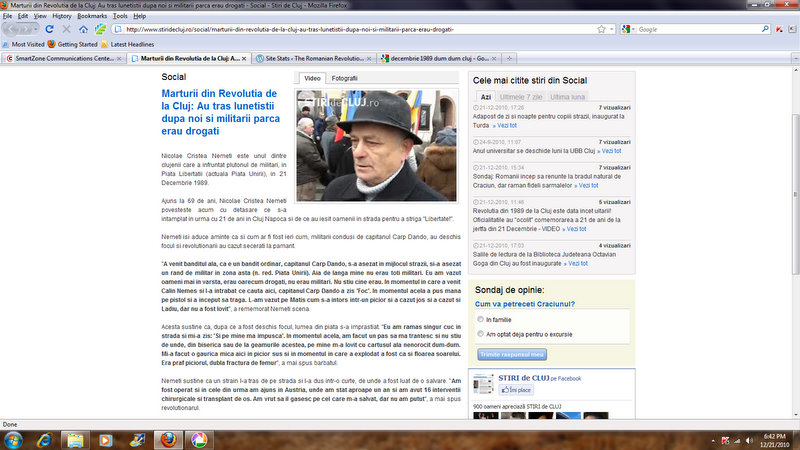
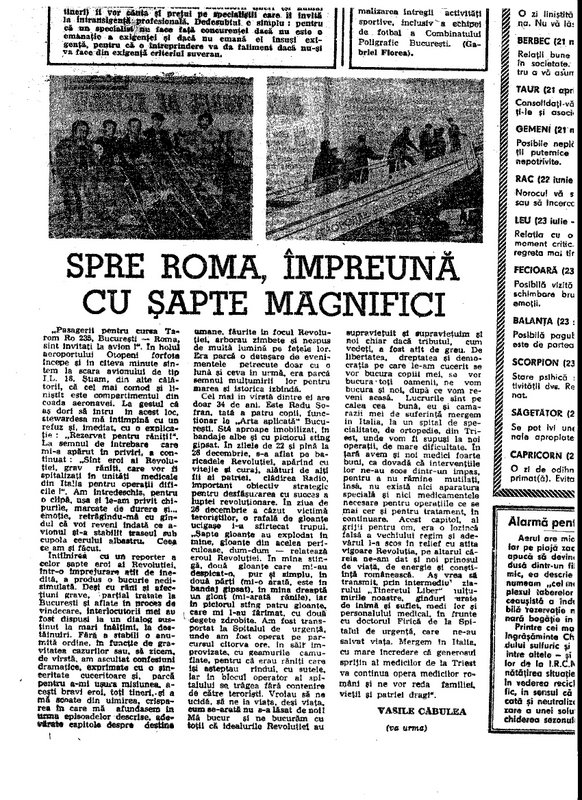
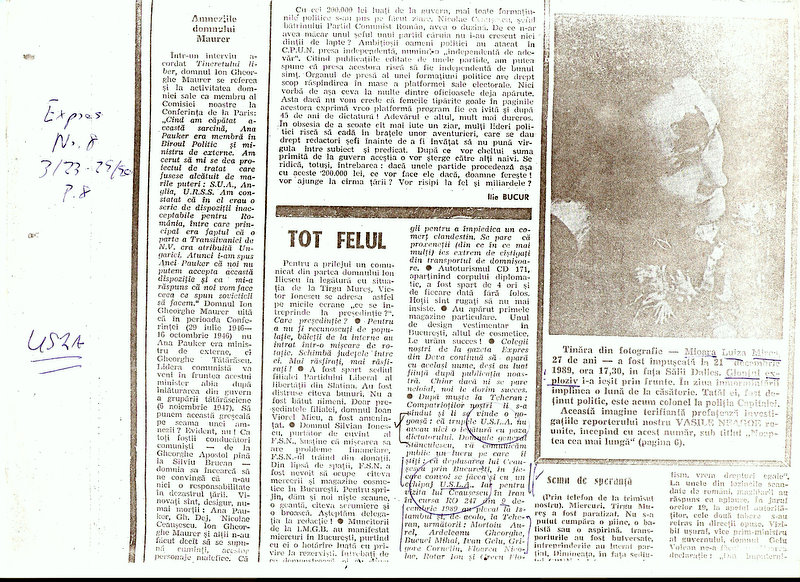
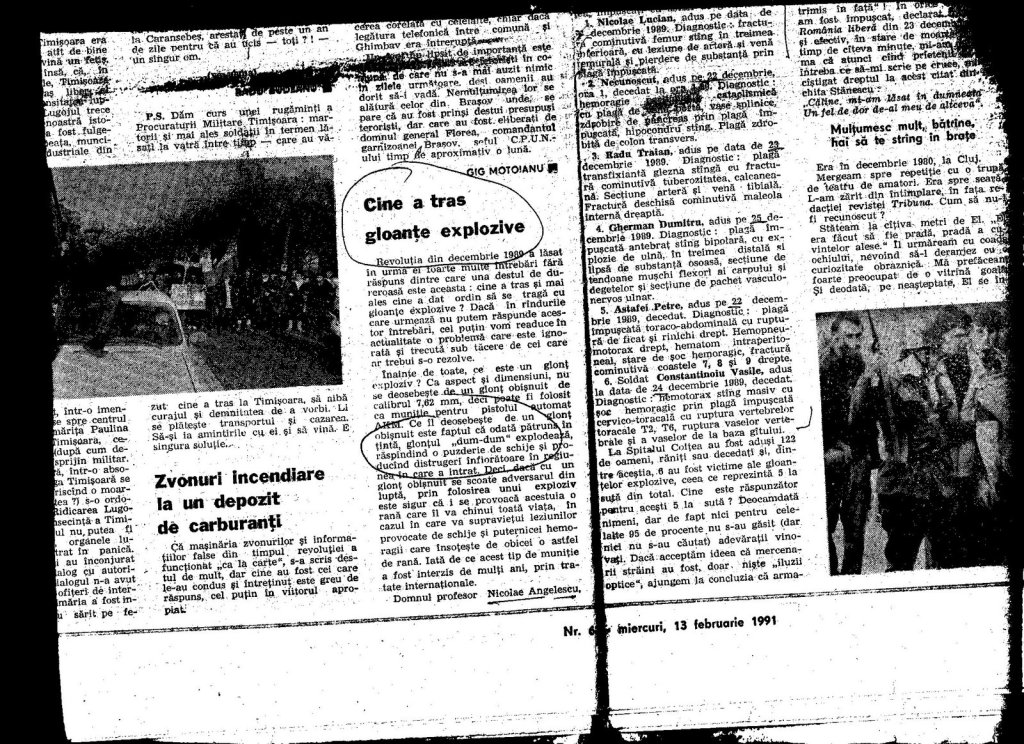
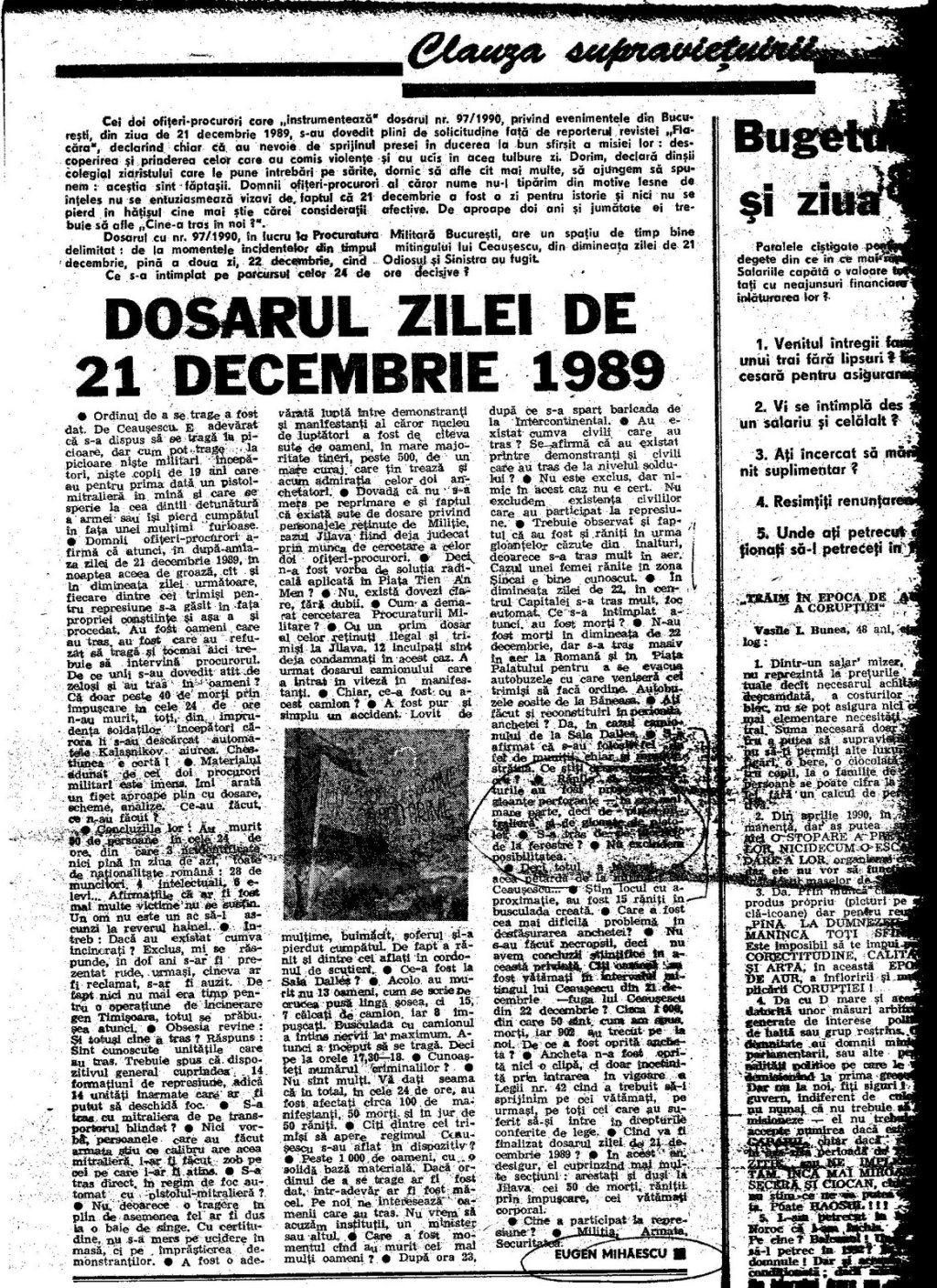
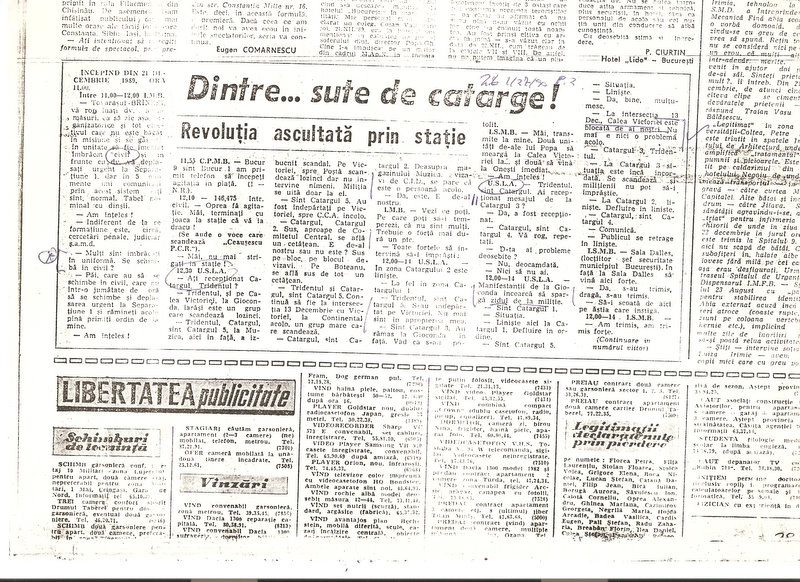
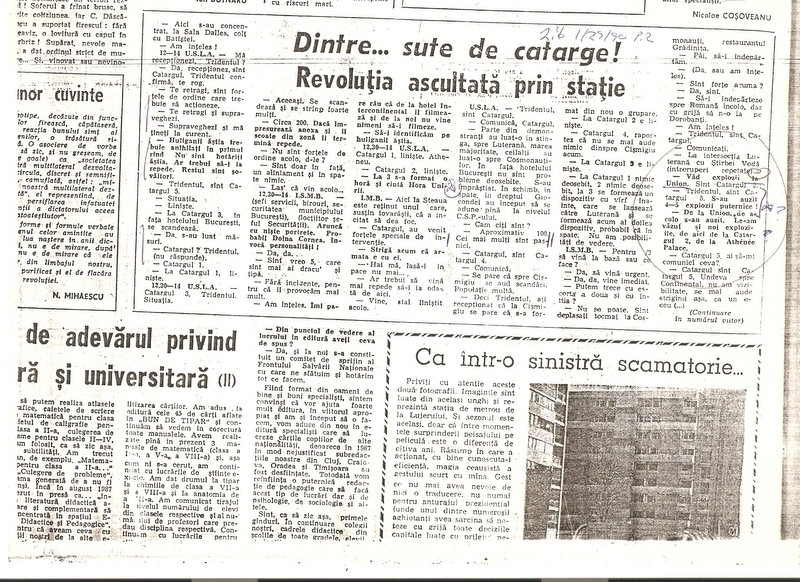
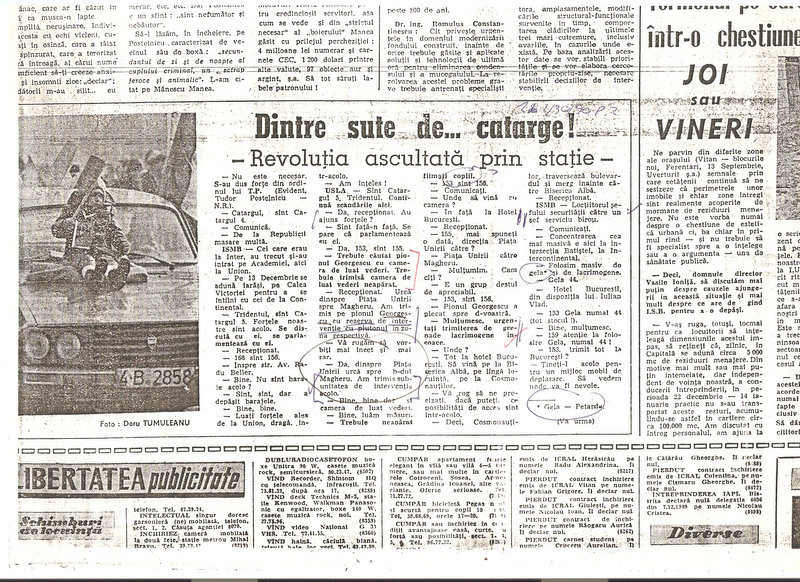
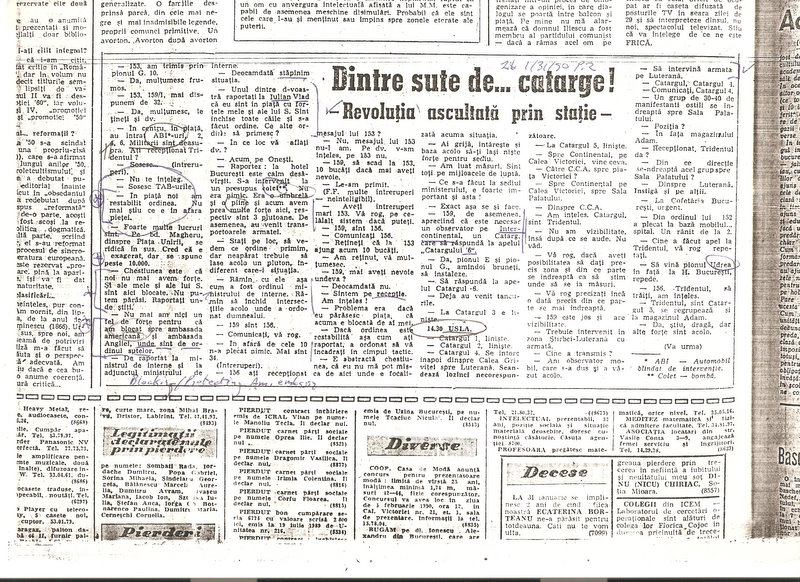
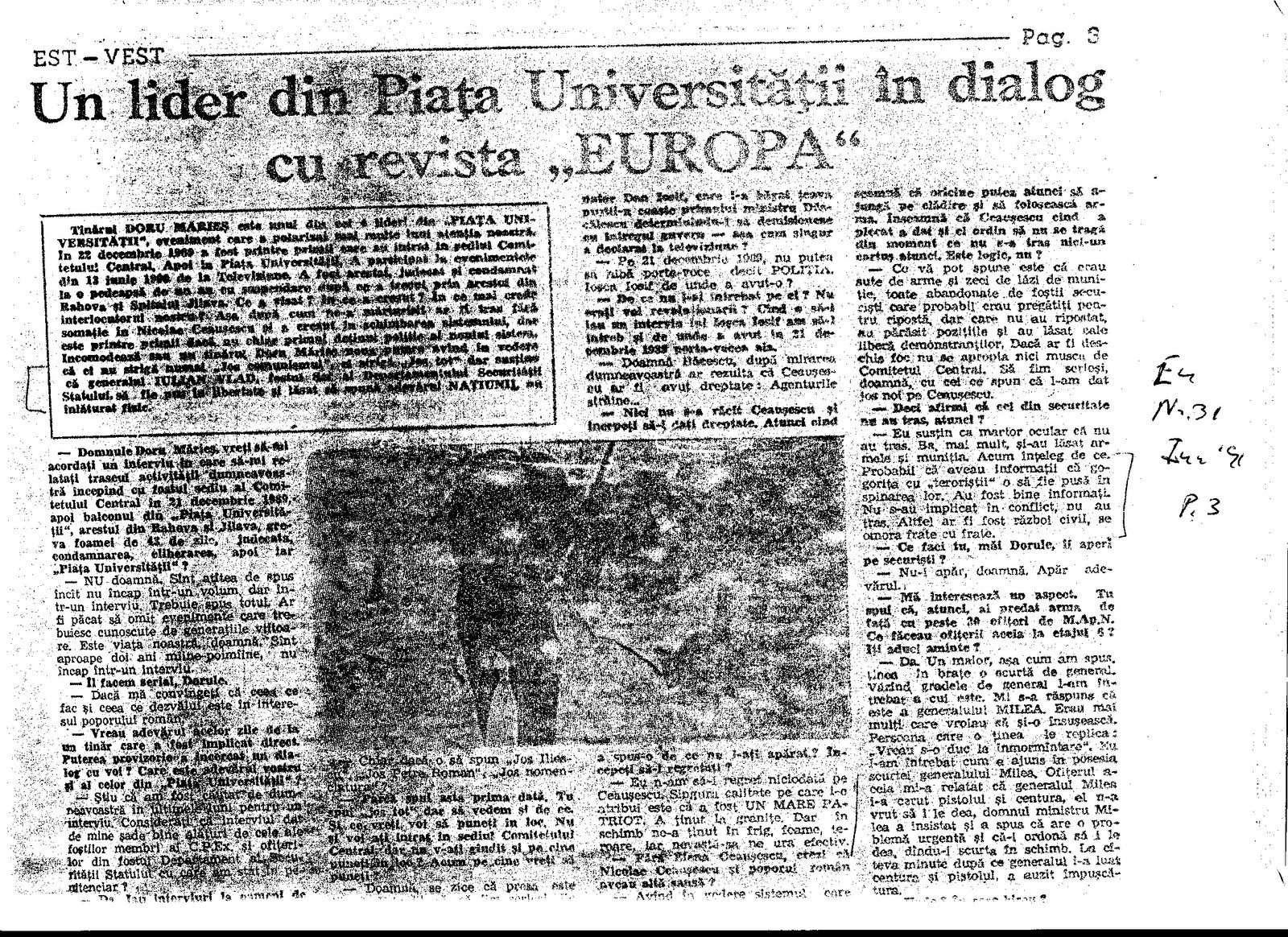
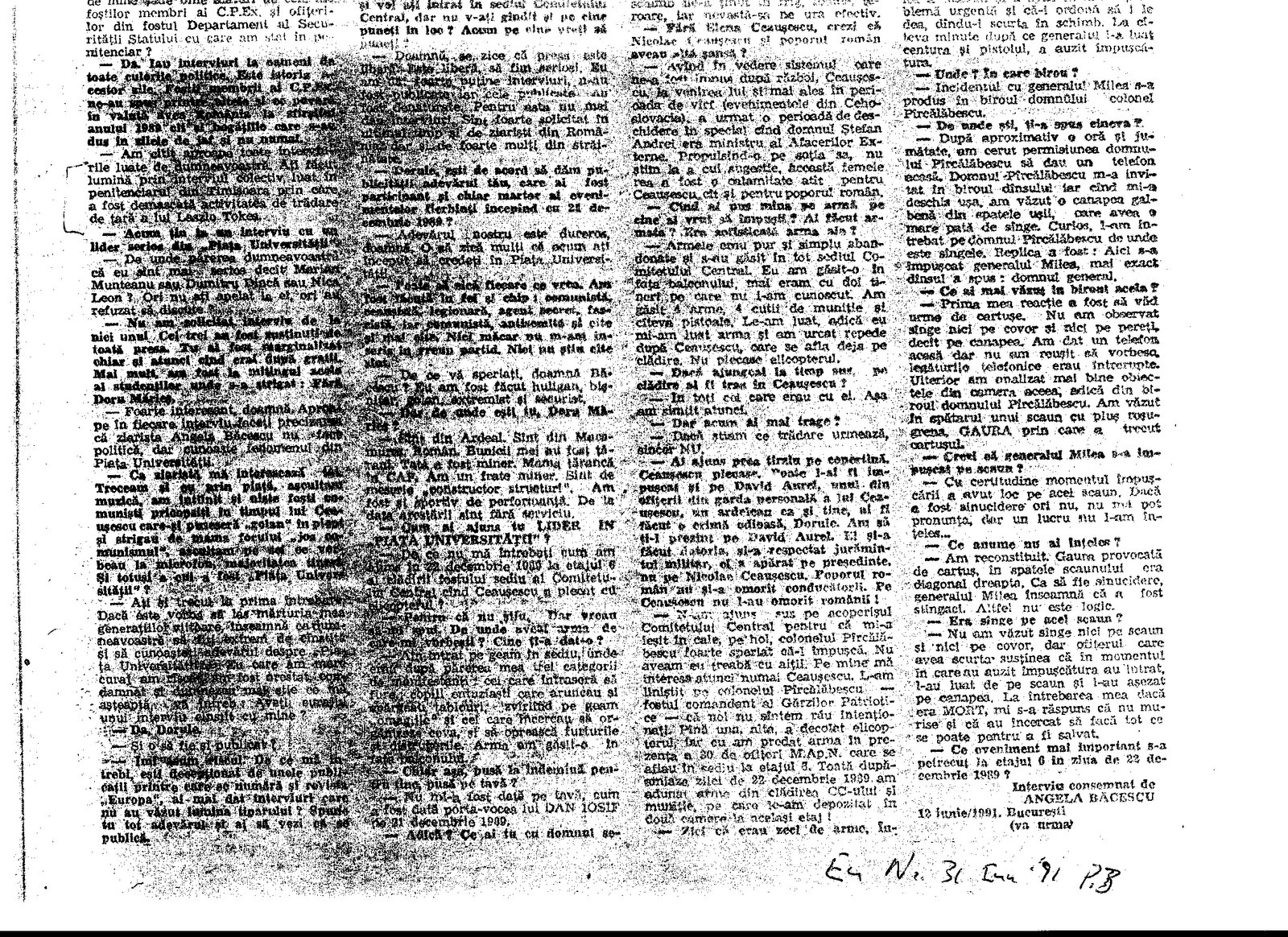
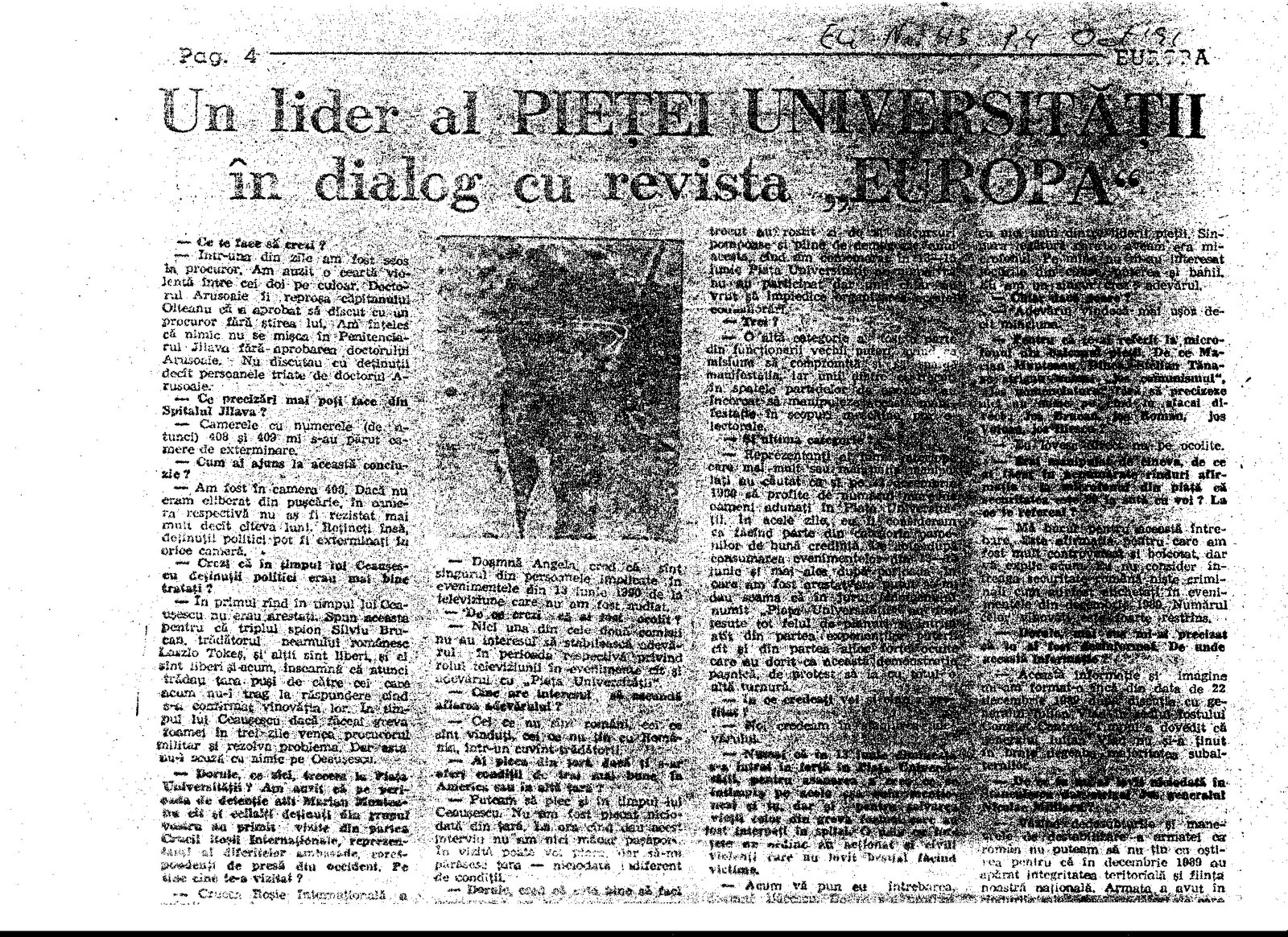
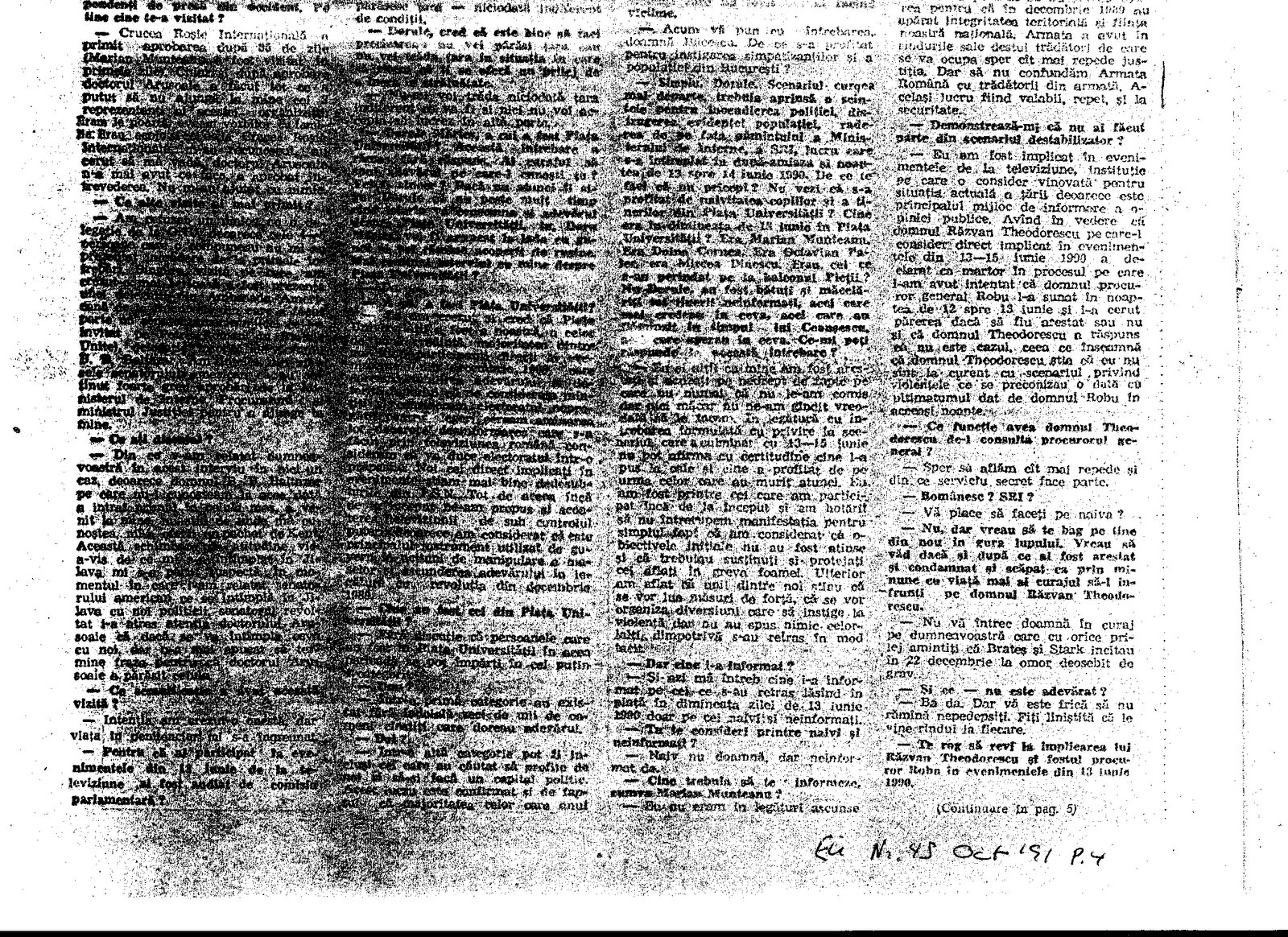


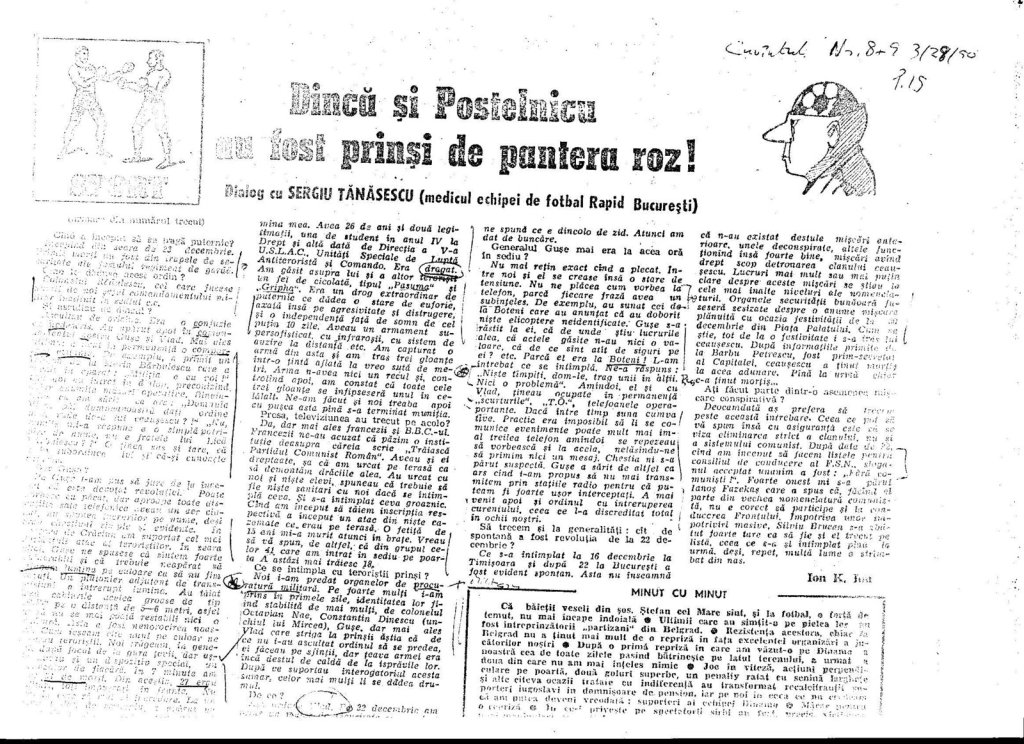
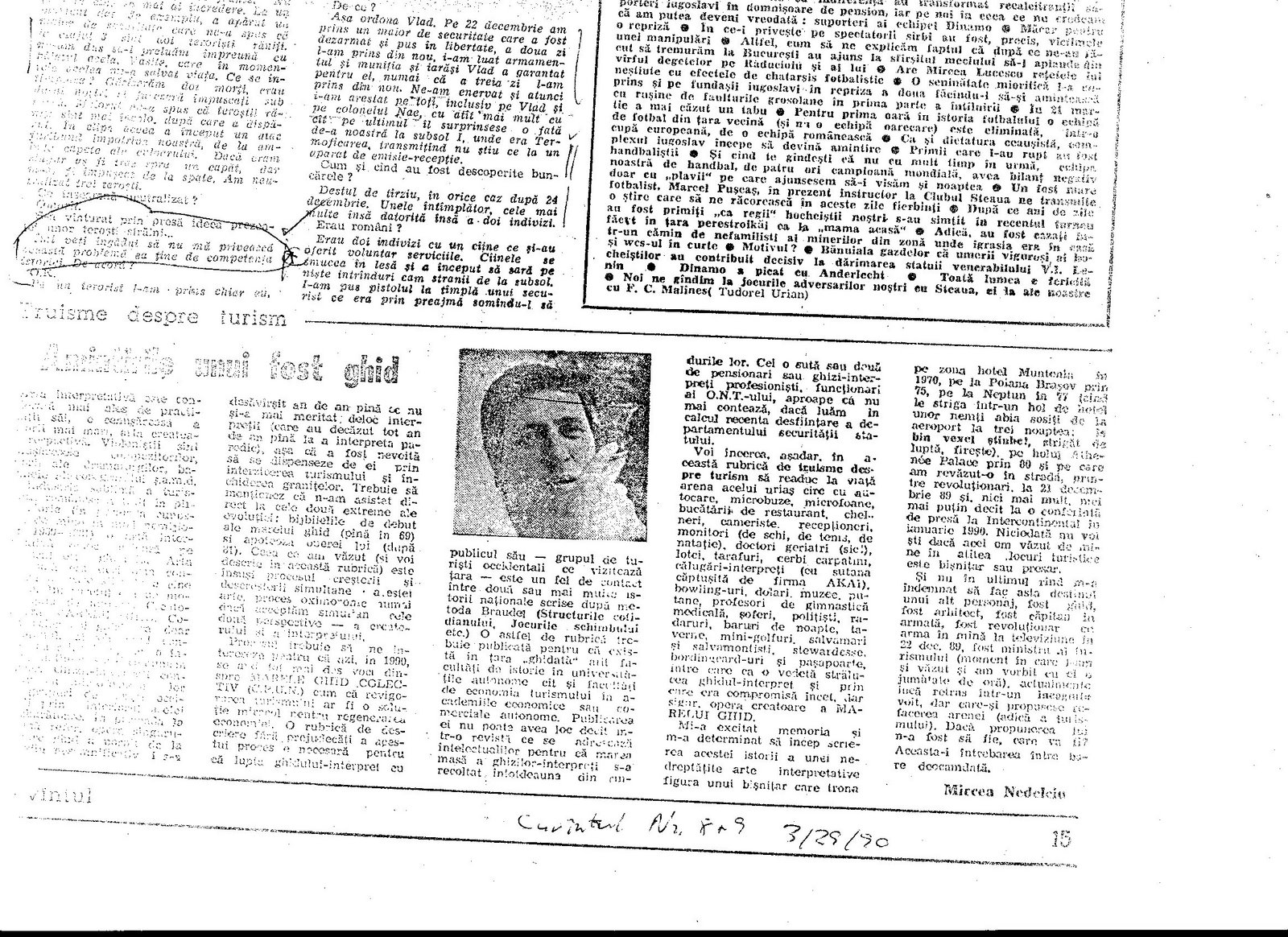


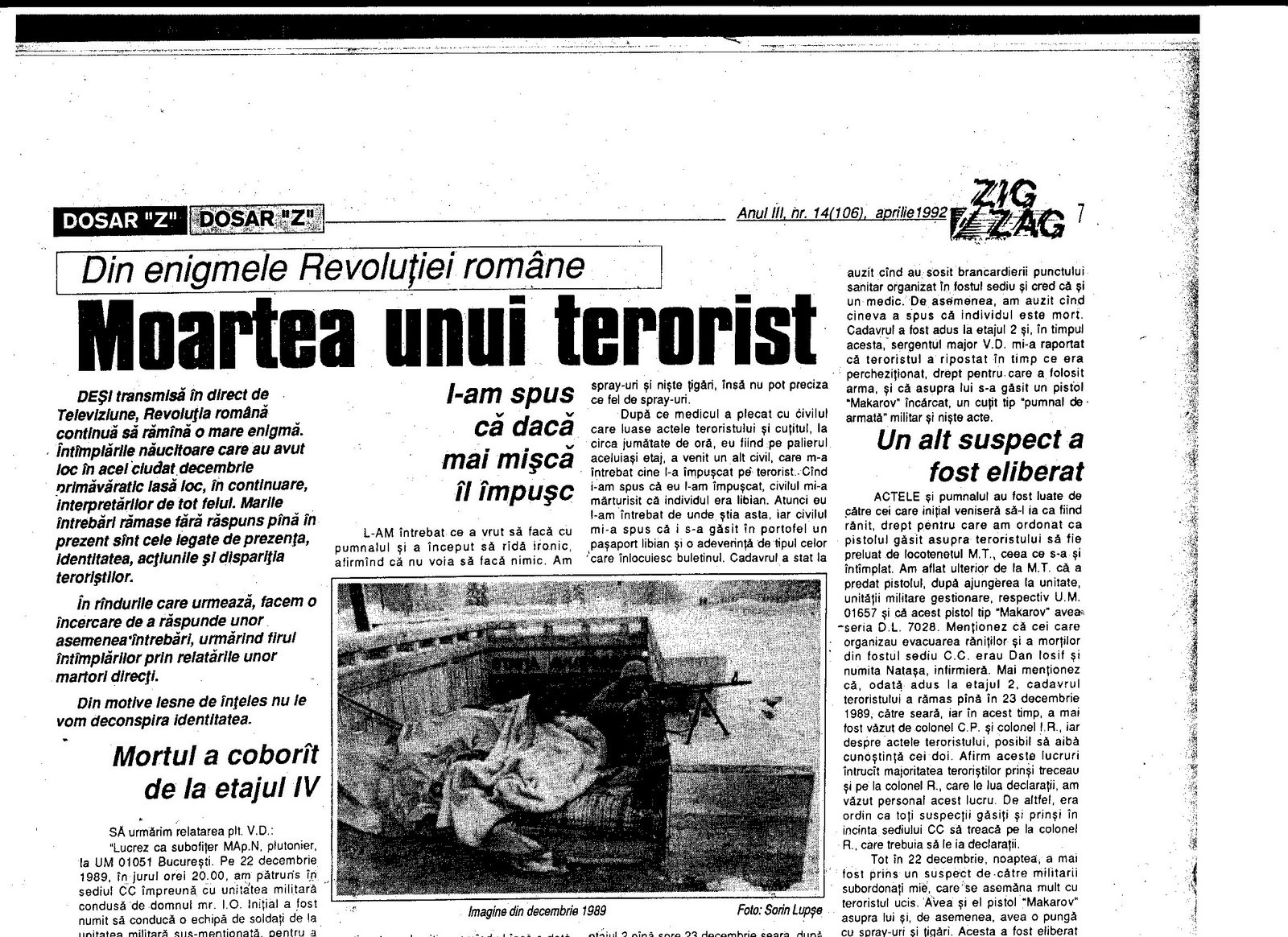
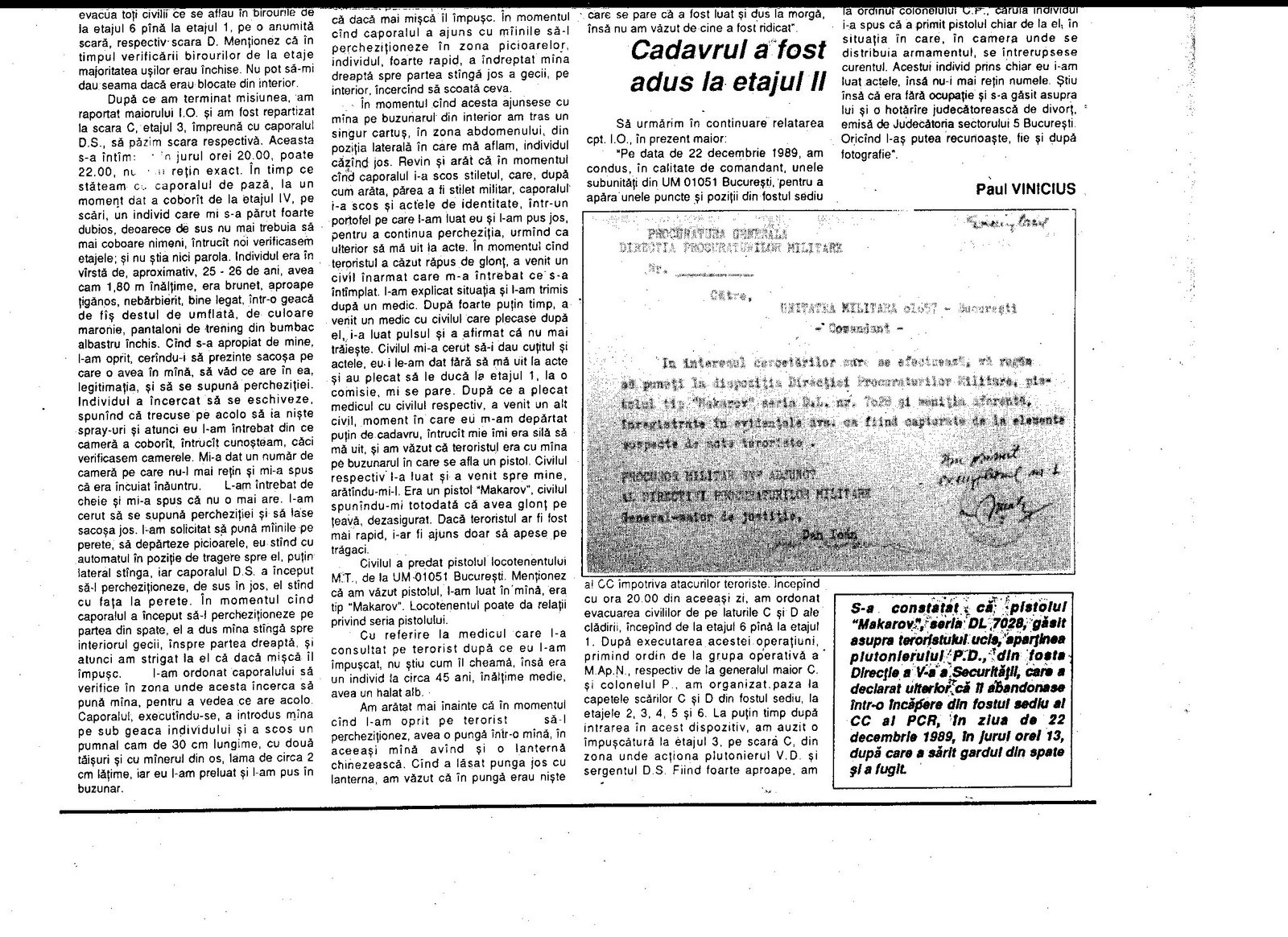
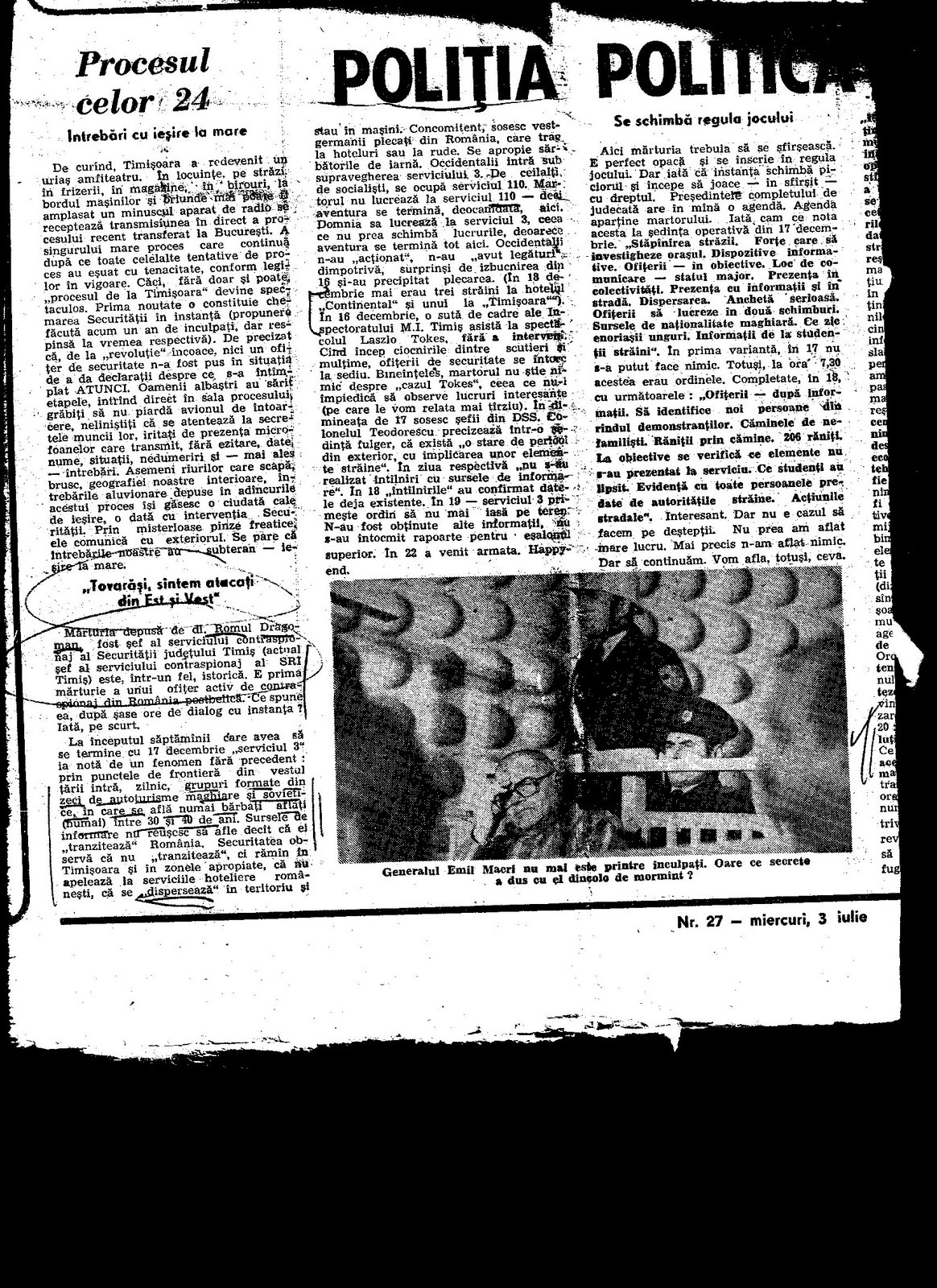

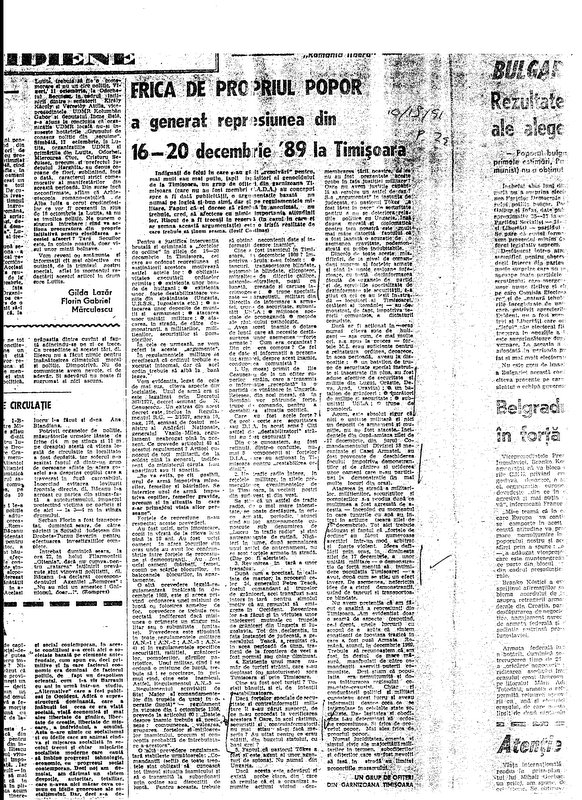
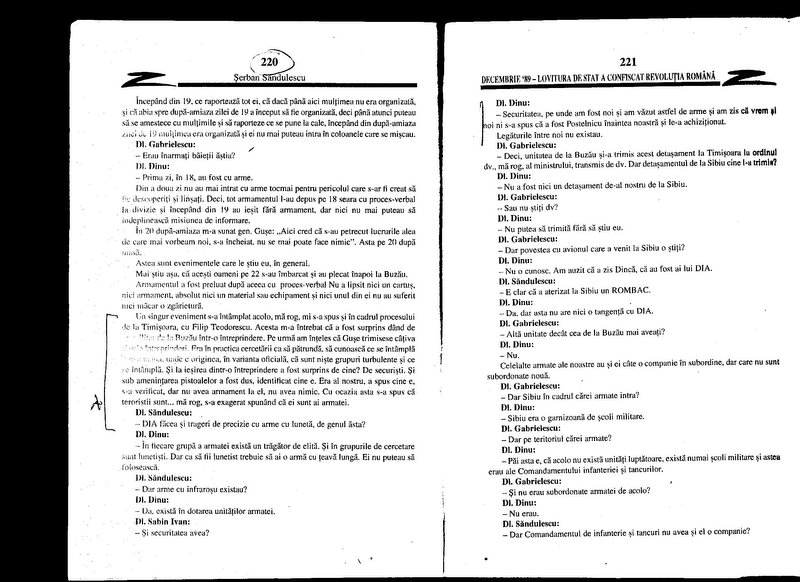
 a Crematorium in Bucharest of 43 bodies belonging to people who were killed in Timi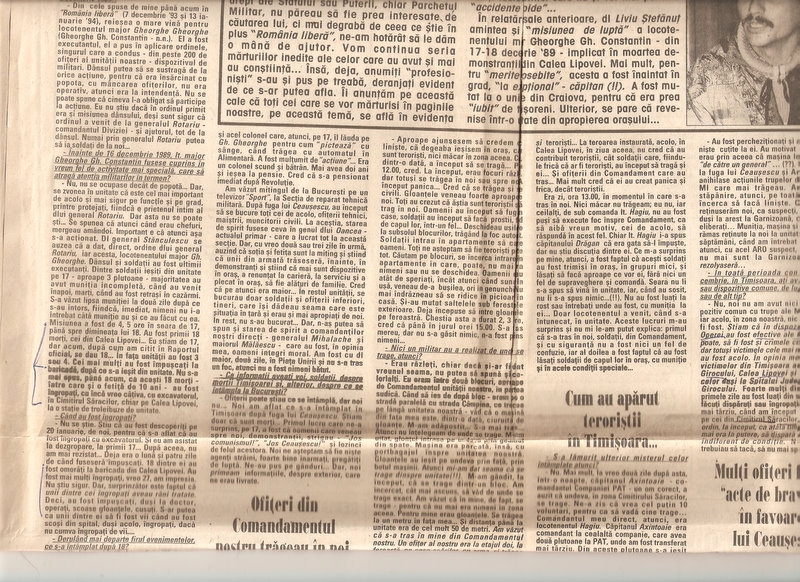
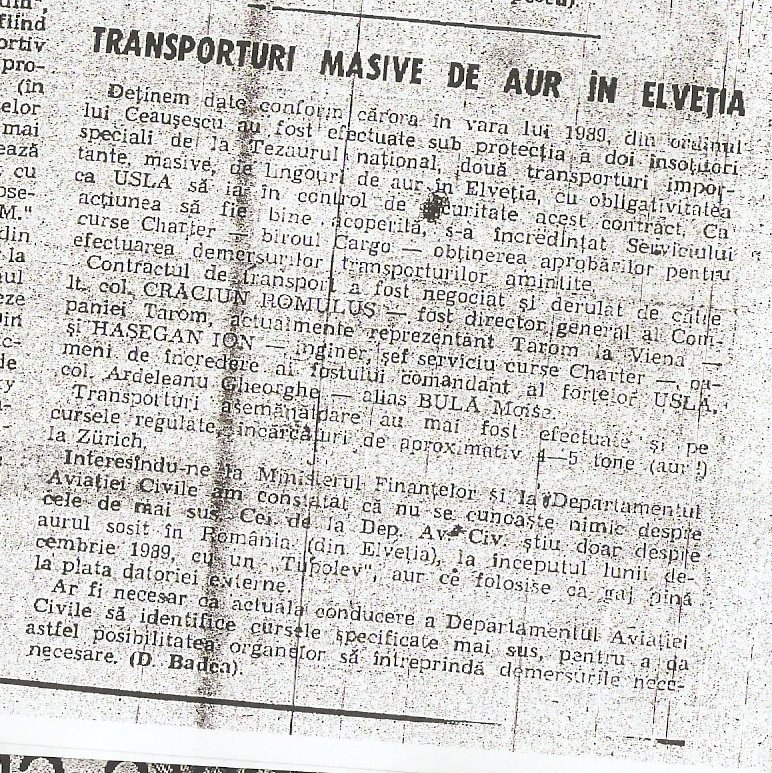
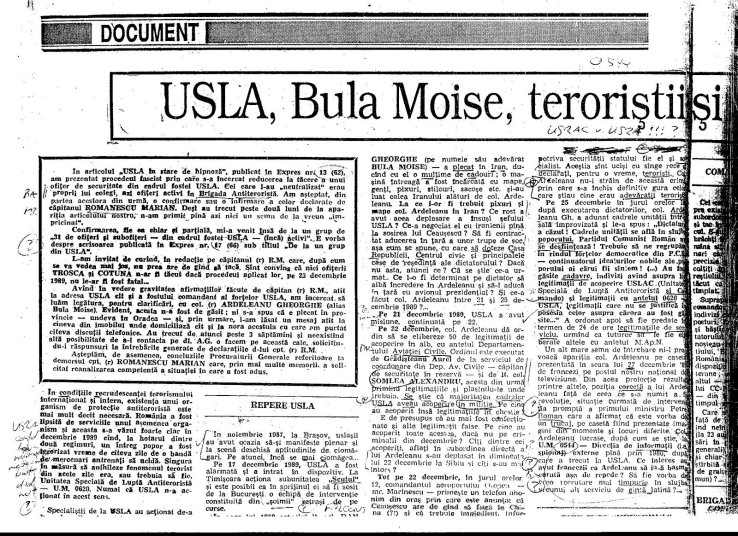
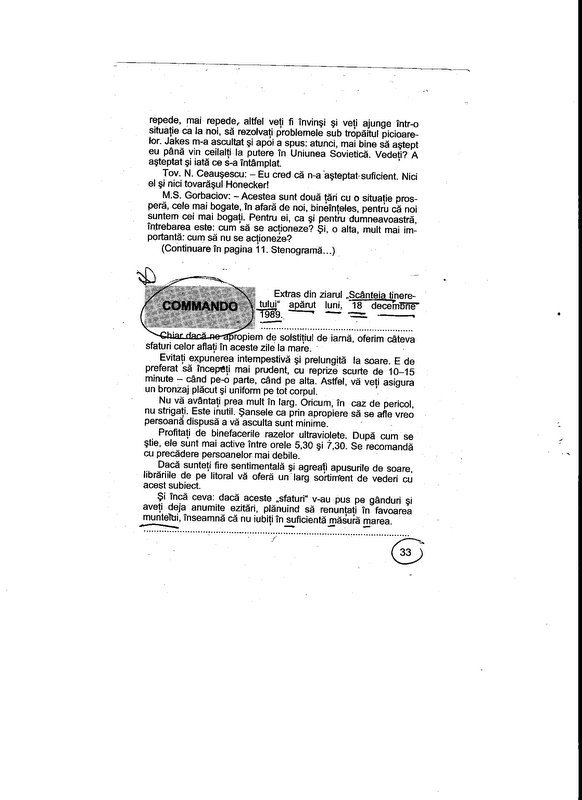

 The Archive of the Romanian Revolution of December 1989
