The Archive of the Romanian Revolution of December 1989

A Catch-22 December 1989, Groundhog-Day Production. Presenting the Personal Research & Scholarship of Richard Andrew Hall, Ph.D.

Archive for the ‘raport final’ Category

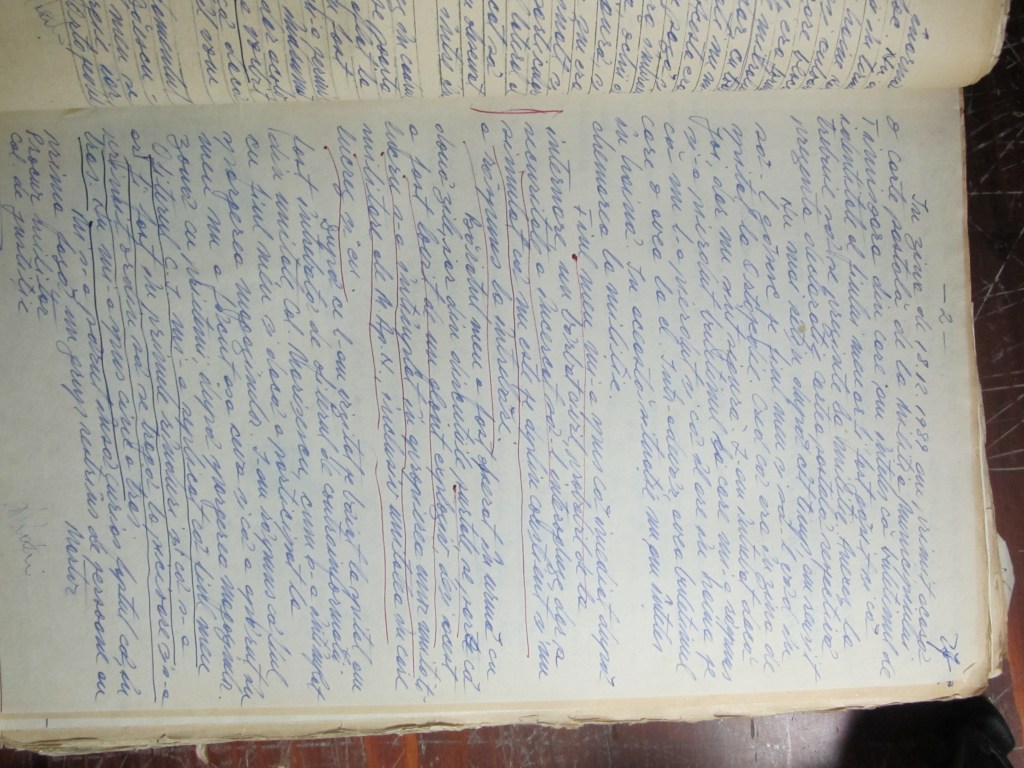
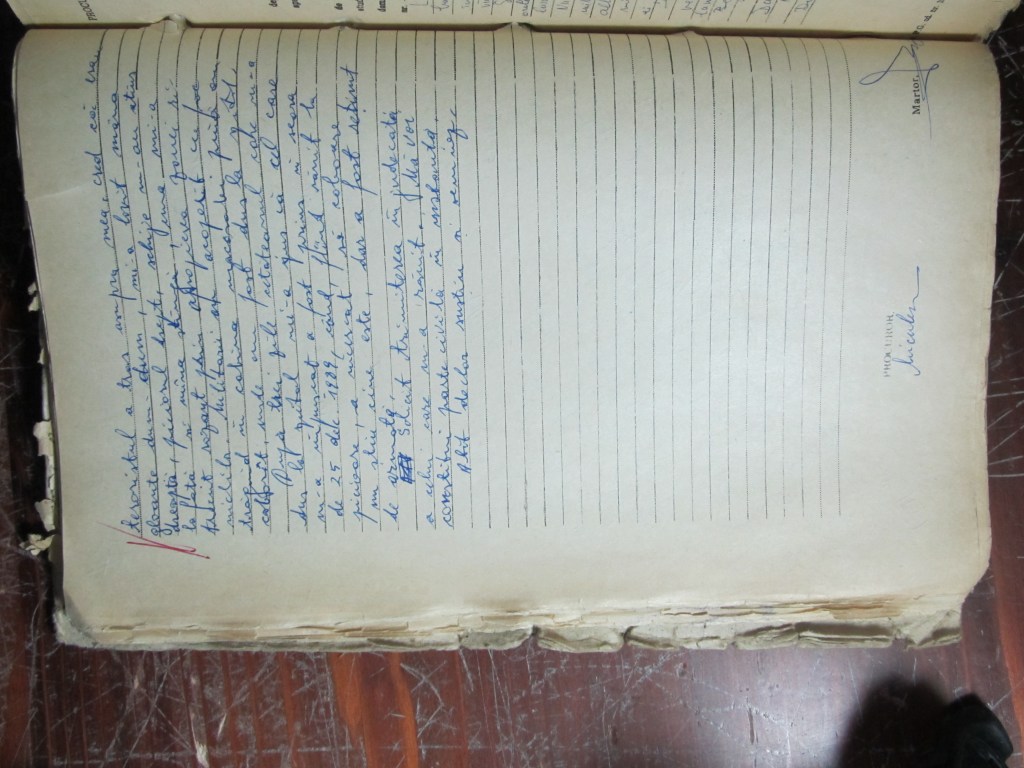
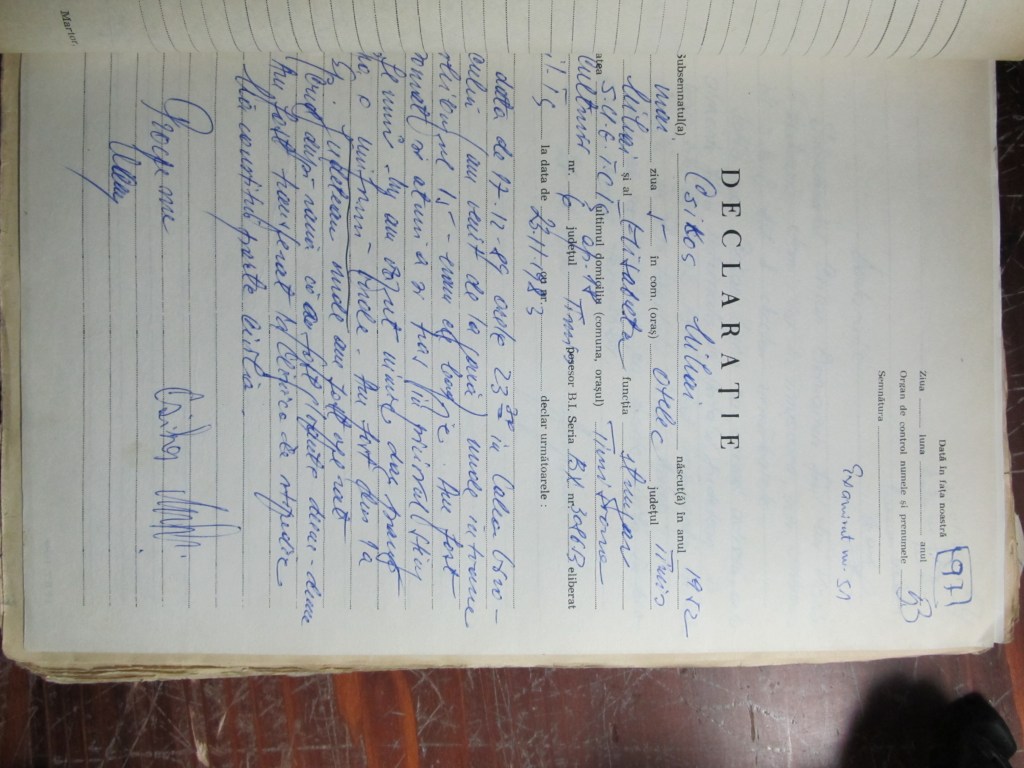
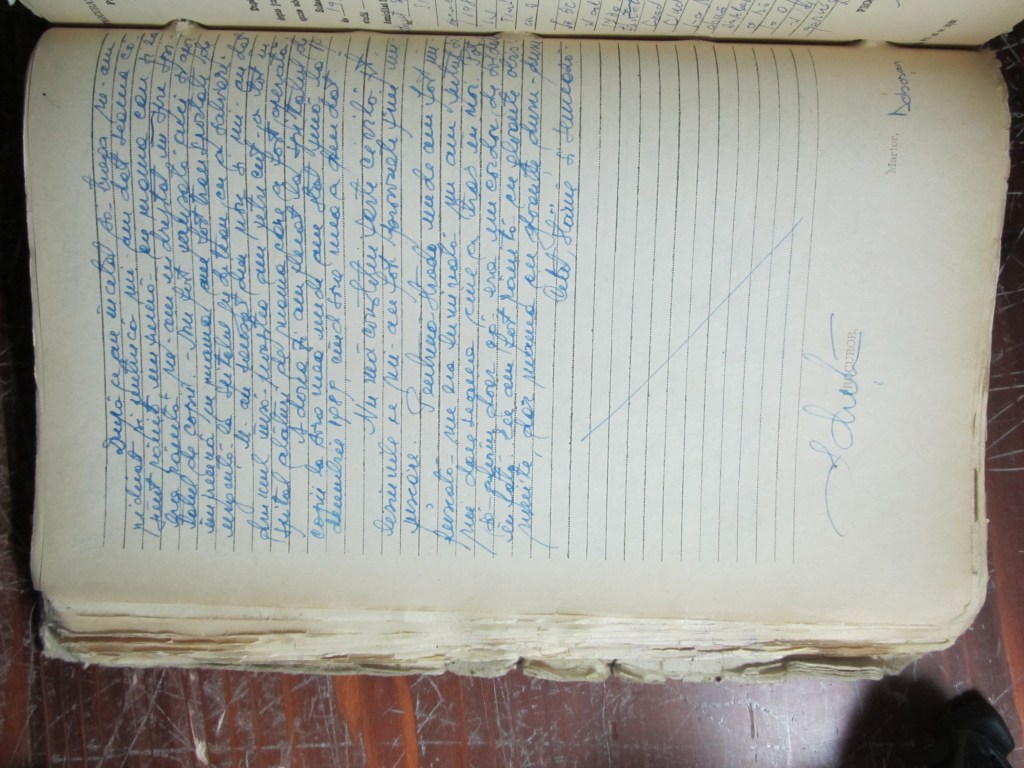
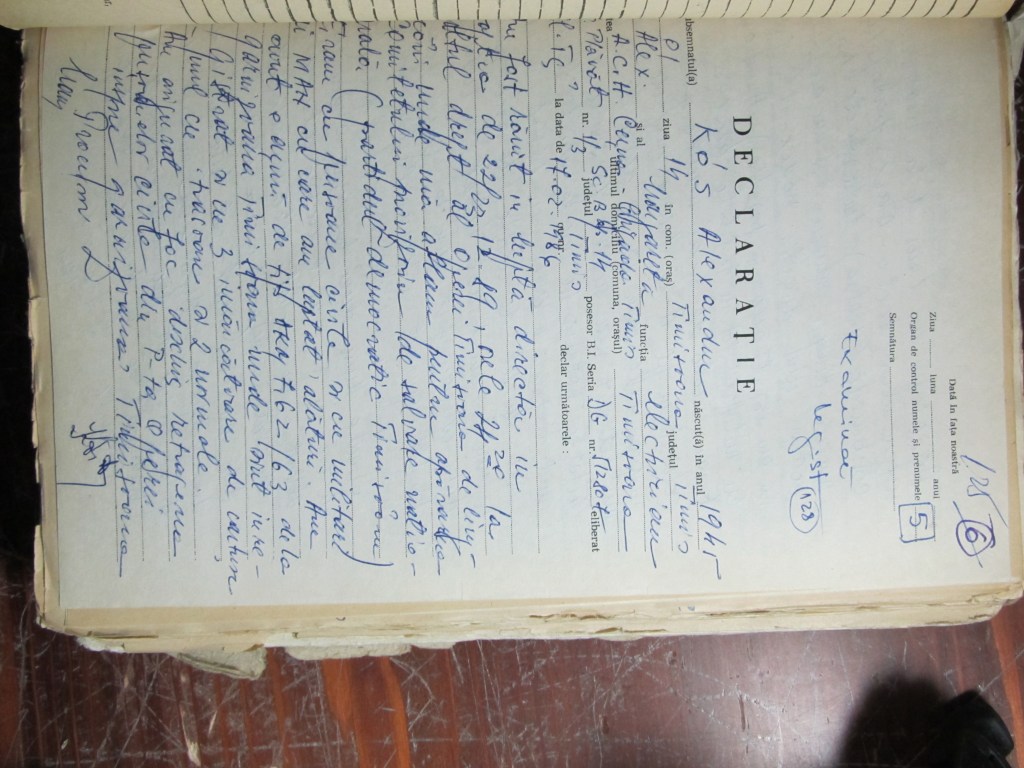
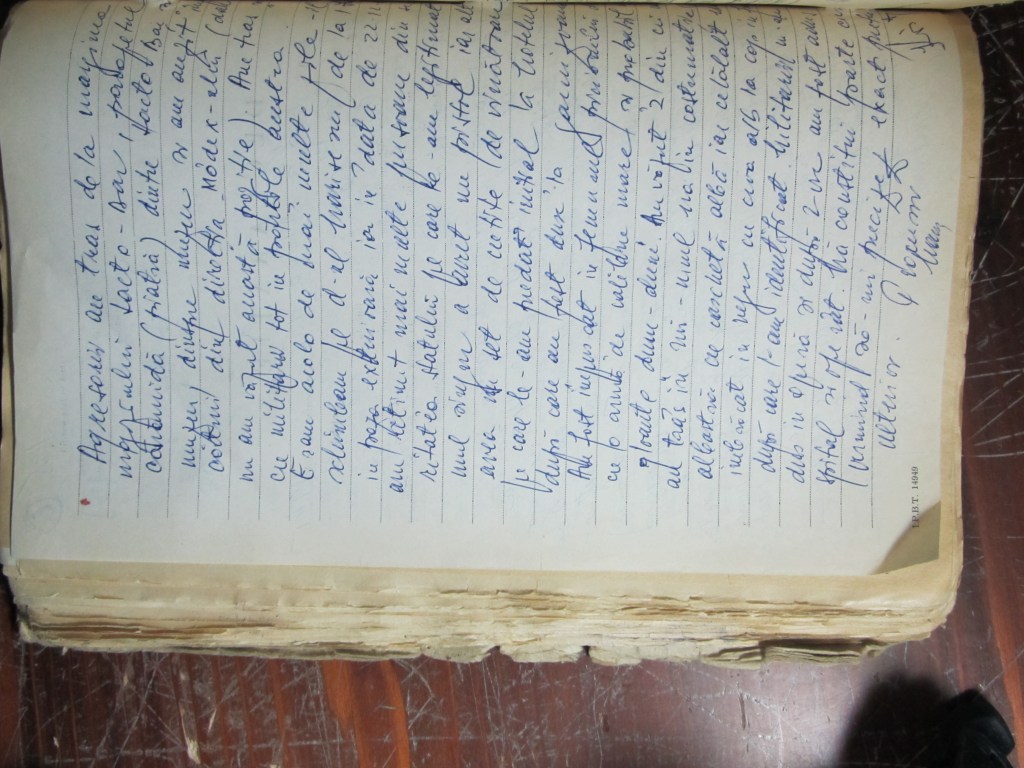
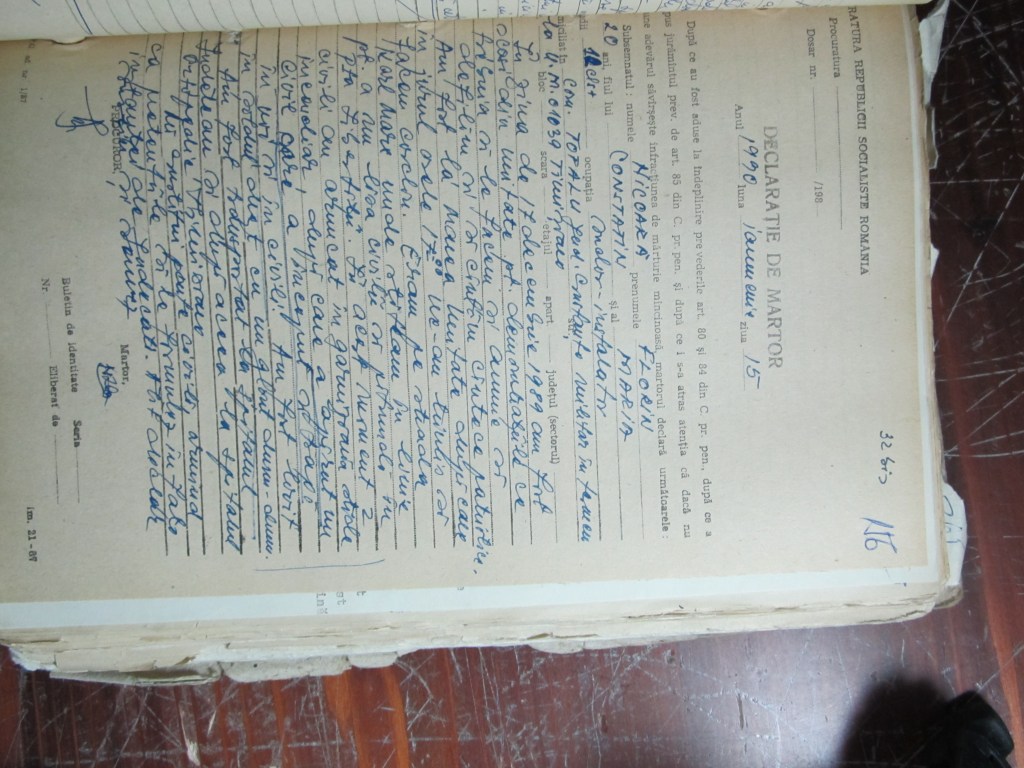
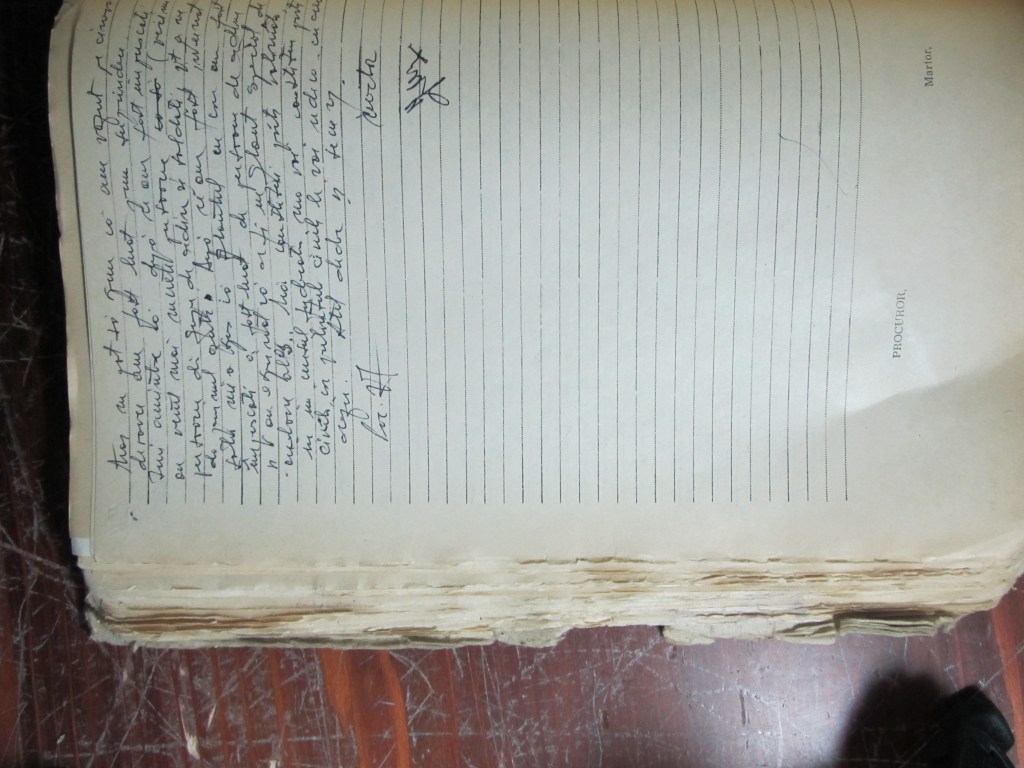
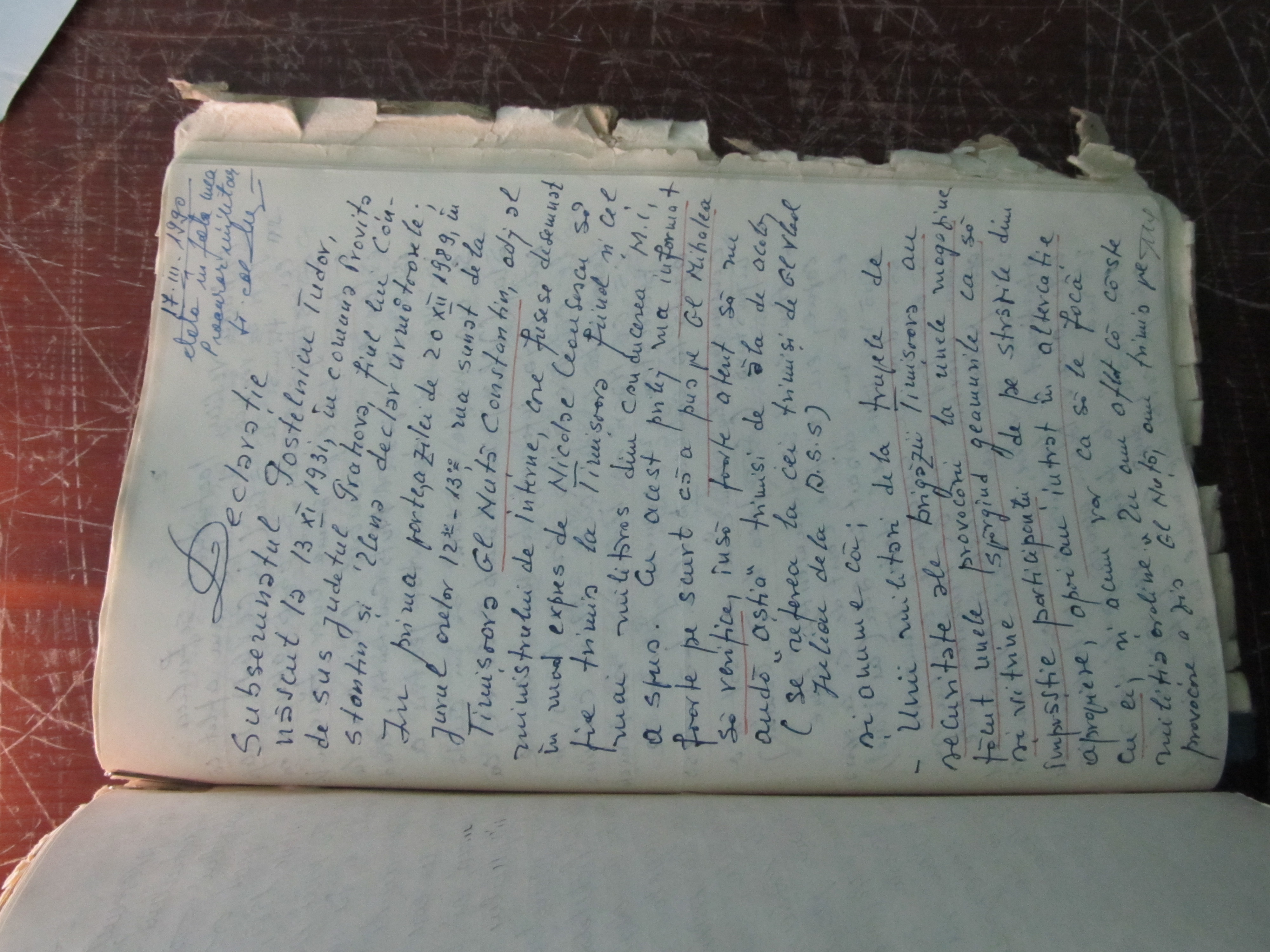
Dosarele Revolutiei de la Timisoara: Tudor Postelnicu “Unii militari de la trupele de securitate ale brigazii Timisoara au facut unele provocari la unele magazine si vitrine spargind geamurile sa imprastie participantii…” (17.III.1990)

Posted by romanianrevolutionofdecember1989 on March 15, 2013

IMG_2576

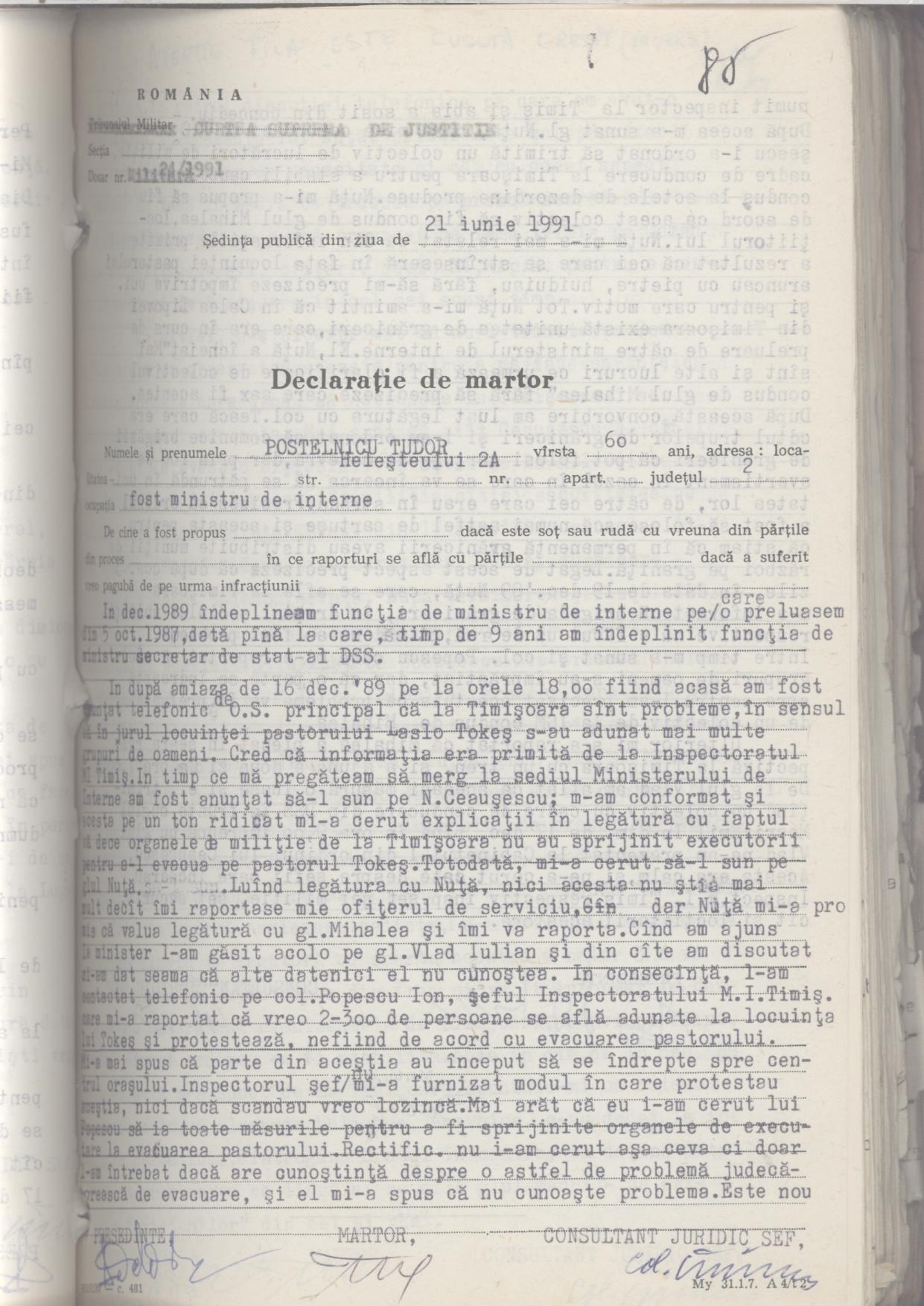
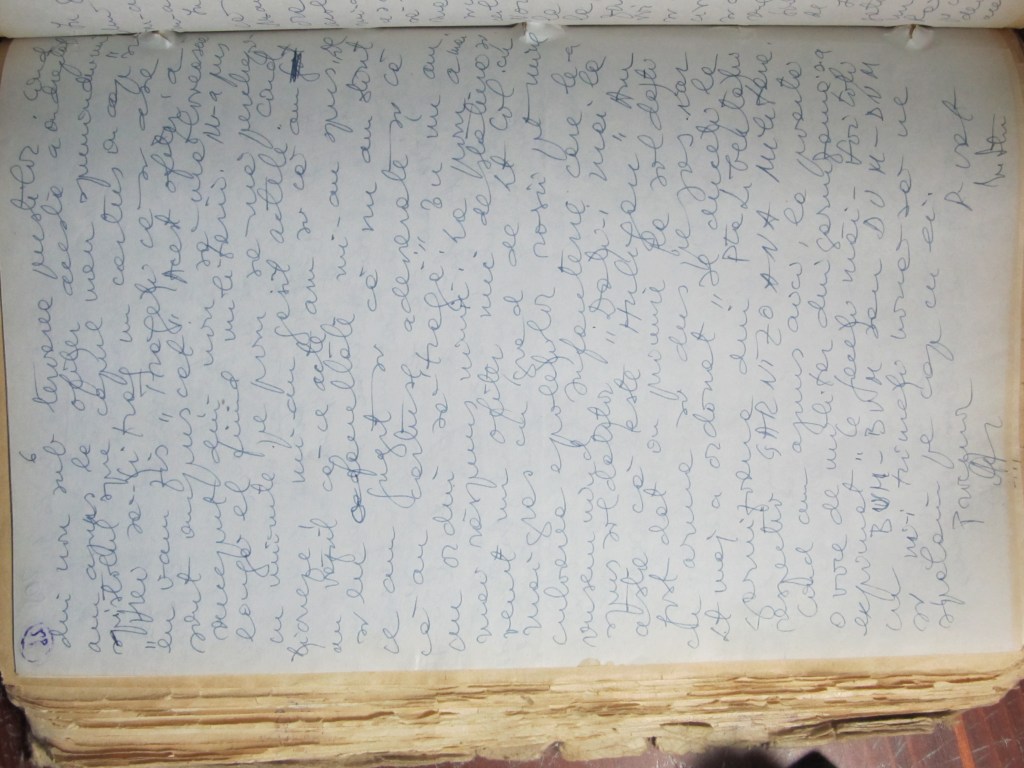
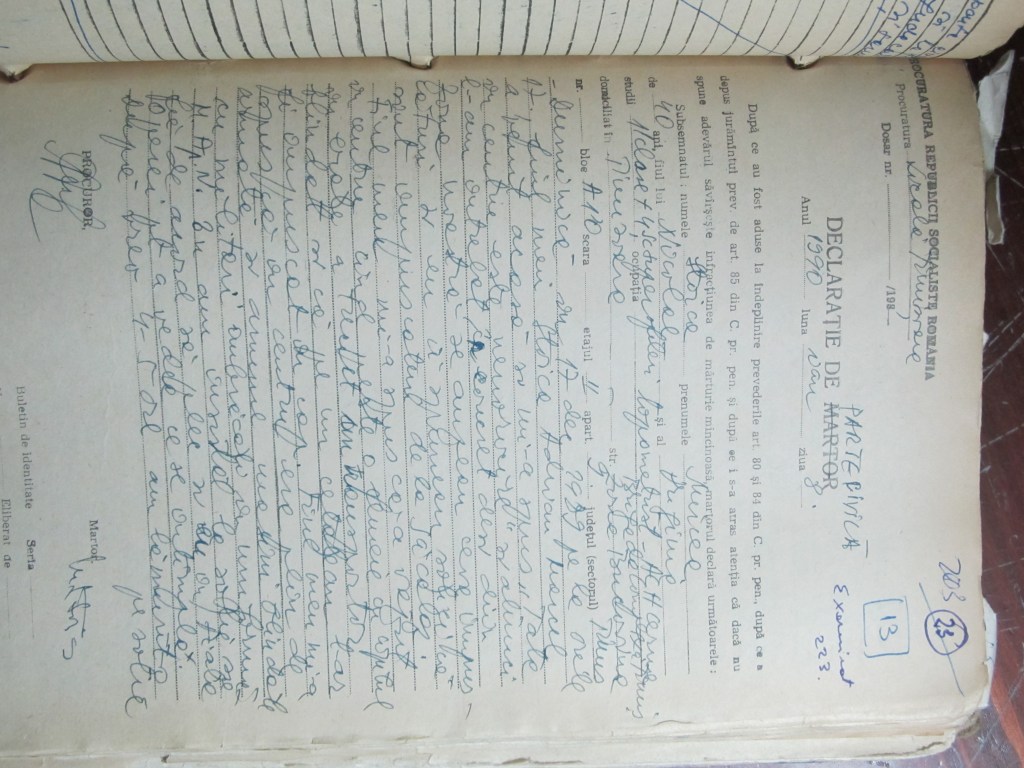
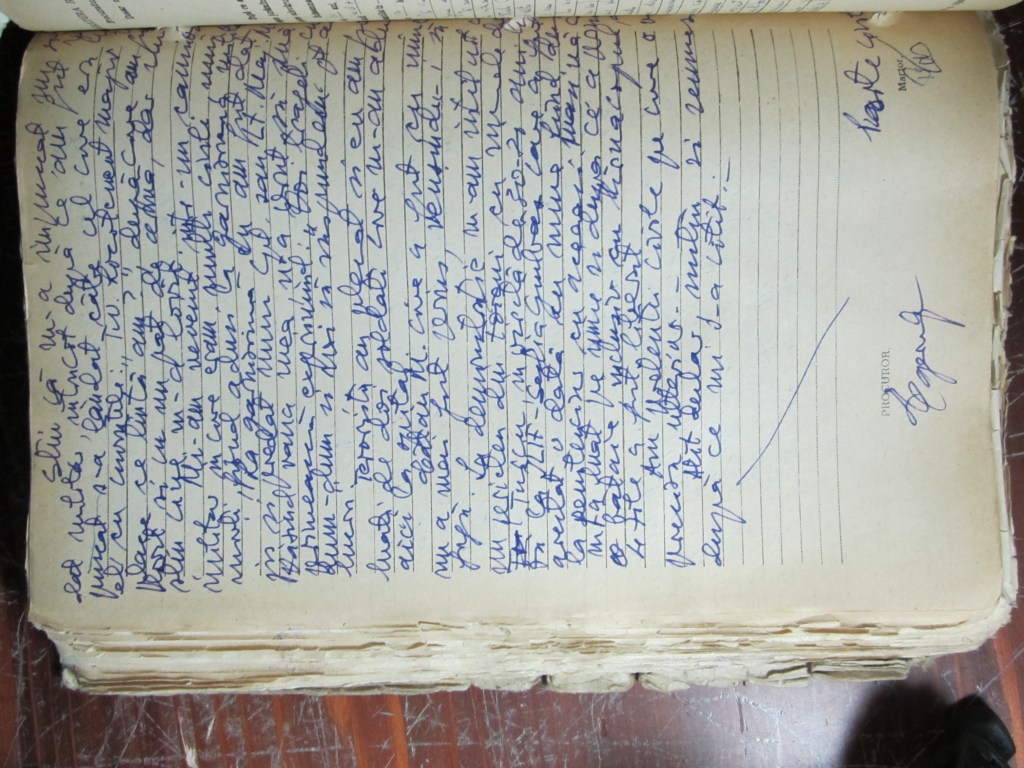
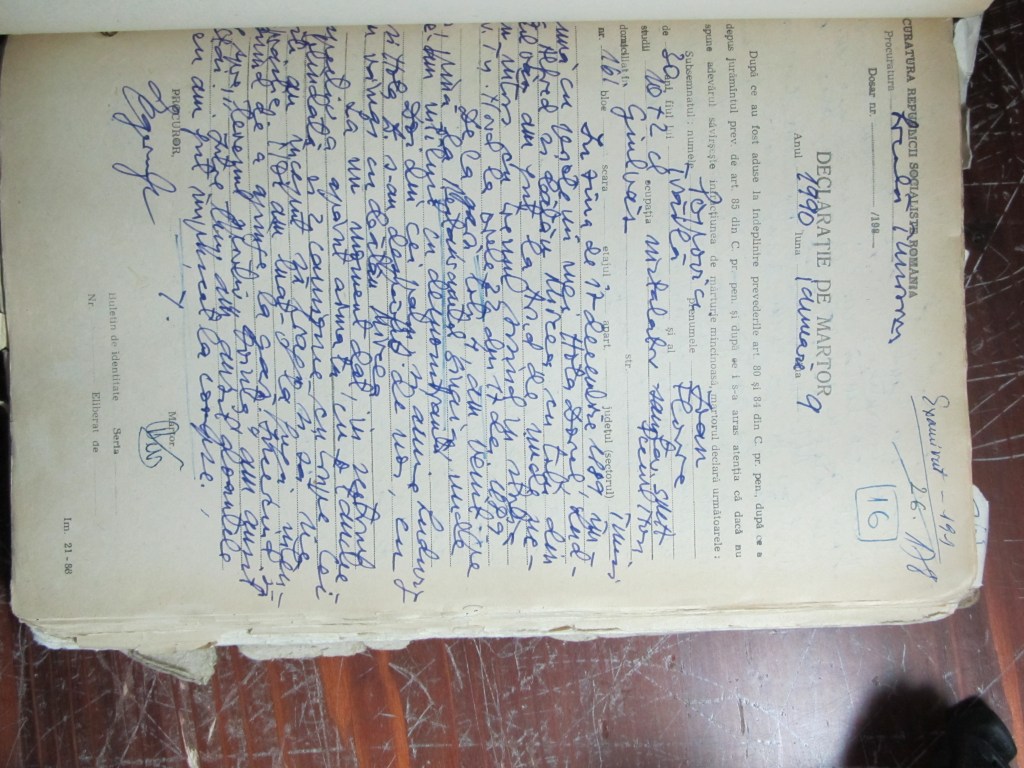
Tudor Postelnicu (Ministerul de Interne in decembrie 1989):  “Unii militari de la trupele de securitate ale brigazii Timisoara au facut unele provocari la unele magazine si vitrine spargind geamurile sa imprastie participantii de pe straziile din apropriere, apoi au intrat in altercatie cu ei, si acum (?) vor sa le faca militia ordine.  ‘Nu am aflat ca costa provocare a zis Gl. Nuta, am trimis pe …” (17.III.1990)  http://sensidev.com/fc/dosare%20de%20urmarire%20penala/dosar%20%20de%20urmarire%20penala%20volumul%2011/IMG_2576.JPG (Dosarul de Urmarire Penala, Vol. 11, IMG 2576)

Cateva observatii:

1) Postelnicu nu spune nimic despre asa-zisii “turisti sovietici” sau “turisti rusi” (o tema revizionista foarte populara) …nu spune ca ei au facut distrugerea…

2) In schimb, Postelnicu spune ca securistii au facut provocarile…dar atentie:  nu spune ca ei le-au facut sa intareasca demonstrantii, ci “sa imprastie participantii de pe straziile din apropriere…”

deci nu intr-un scop ca detonatorii a unei revolutii (alta tema revizionista foarte populara), ci ca o tactica din arsenalul represiunii!

3) Lipseste din nenorocire continuarea acestei marturii din paginile dosarele revolutiei de la timisoara la http://dosarelerevolutiei.ro/

————————————————————————————————————————————————————————————————————————-

An excerpt from Chapter 5 of my Ph.D. Dissertation at Indiana University: Richard Andrew Hall, Rewriting the Revolution: Authoritarian Regime-State Relations and the Triumph of Securitate Revisionism in Post-Ceausescu Romania (defended 16 December 1996). This is the original chapter as it appeared then and thus has not been revised in any form.

Chapter Five.  The Beginning of the End: Timisoara, 15-17 December 1989

The “Window Breakers”

The reportedly unusual scope of physical destruction which occurred in Timisoara, particularly on the afternoon and evening of 17 December 1989, has fueled revisionist arguments. Estimates of the damage during the Timisoara unrest are in the neighborhood of four to five billion lei (approximately forty to fifty million dollars at the time), a reasonably large sum given Romania’s standard of living at the time. A huge number of windows was broken and as many as 300 to 400 stores suffered some sort of damage, although relatively few were actually looted. On the evening of 17 December, stores, vehicles, and kiosks were burning in at least ten different areas of the city.[65]

Former Securitate officers clearly wish to link this destruction to the “foreign tourists” who were supposedly so ubiquitous in Timisoara during these days.[66] Perhaps somewhat surprisingly, former Securitate Director Iulian Vlad argued at his trial that

…the acts of vandalism, theft, destruction, arson… acts without precedent…could not have been the work [“opera”] of the faithful [apparently referring sarcastically to Tokes’ parishioners], nor the revolutionaries. They were produced by elements which wished to create a certain atmosphere of tension.[67]

“A group of former Securitate officers” wrote to the Ceausist Democratia in September 1990 that after the Militia and Securitate refused to respond to the demonstrations provoked by the “foreign tourists”: “they advance[d] to the next stage: the massive destruction of public property designed to provoke forcible interventions–human victims were needed.”[68]

Nevertheless, here is how one opposition journalist, Grid Modorcea, has described the strange character of Timisoara destruction:

For the first time in history, a revolution…was announced in a previously unknown and absolutely original manner, both literally and figuratively speaking: through the methodical breakage of thousands of windows. On 16 and 17 December 1989, Timisoara was the city of [glass] shards. Well-trained groups of athletes spread throughout the town, tactically, but energetically smashing to pieces hundreds of huge windows without apparently being interested in stealing from these stores…they were like mythical Magis coming to announce the end of one world and the beginning of another. And they gave it an apocalyptic quality: the sound produced by the breaking glass was infernal. The panic this caused was indescribable….Those who “executed” the windows did so with karate-like kicks while yelling “Liberty and Justice”!…The crowds of people who came out into the streets transformed spontaneously into columns of demonstrators, of authentic revolutionaries. The effect was therefore monumental: the breaking of the windows unleashed the popular revolt against the dictator.[69]

Modorcea is convinced that the Tokes case was “merely a pretext” and that “someone–perhaps those who planned the vandalizing of the windows–has an interest in preventing it from being known who broke the windows.” Although Modorcea maintains he is unsure who was responsible, he insists on observing that:

Only the Customs people know how many tourists there were. All were men and long-haired. Inside their cars they had canisters. This fits with the method of the breaking of the windows, with the Molotov cocktails, and the drums used as barricades–they were exactly of the same type….To what extent the new regime which came to power was implicated, we cannot say![70]

Many Timisoara protesters appear torn between wishing to rationalize the extensive destruction as the courageous response of an enraged, long-suffering population, and denying that the perpetrators could have come from among their ranks. Even those investigators attuned to the retroactive psychology of the protesters cannot help but admit that widespread destruction occurred and that it could not have been wholly spontaneous.[71] Furthermore, as Laszlo Tokes has observed in discussing the events at Piata Maria, manipulation and attempts to instigate the crowd to violence were constant features during these days.

Tokes maintains that Securitate provocateurs had tried to agitate the crowd by shouting things like, “Let’s break into the house. The Securitate are in there; they’re trying to kidnap Laszlo Tokes! Let’s rush them!” and by appealing for him to “Come down into the street and lead us!”[72] According to Tokes:

I was alarmed at the obvious provocation from individuals in the crowd clearly intent on making the situation uncontrollable….Later, thinking about the events of those two days, I realized that the authorities would have had a great deal to gain if the situation had become a riot.[73]

Mircea Balan questions whether the protesters would have set stores on fire which were located on the ground floor of the buildings in which the protesters themselves lived.[74] Moreover, he wonders how even the revolutionary fury of the crowd could drive protesters to break so many windows, particularly given the presence of repressive forces on the streets. It is what Balan has termed the “systematic devastation” of property which raises questions.

Eyewitness accounts recorded soon after the events–therefore at a time before the various plots and scenarios had permeated the popular imagination–support the hypothesis that the vandalism was organized. Moldovan Fica remarks:

I admit that I cannot escape a certain conclusion. All of this [destruction] was done by a group of about five or six individuals, whose calm demeanor and self-control continues to stay with me to this day. They did not run from the scene, they appeared as if they did not fear anything; I would say that, in fact, they were doing what was required of them, something which had been ordered directly of them![75]

Describing destruction in a different part of the city, Andras Vasile observed that

…four young men with shaved heads and wearing civilian clothes had sticks–I would term them special sticks–1.7 to 1.8 meters long, equipped with metal rings on the top of them. They were breaking the windows, but not taking anything, as if they only had something against the windows, something which they thus went about with great enjoyment…they were led by two individuals in leather jackets.[76]

Other eyewitnesses supply details which confirm the widespread character of the vandalism; its undeniably organized quality; the disinterest of its perpetrators in looting the stores; and the almost “drugged” nature of the perpetrators, who seemed unperturbed by the chaos and repression going on around them.[77]

Mircea Balan has little doubt who committed this “systematic destruction”:

Demonstrators might have thrown rocks in windows, but the destruction of the entire store was not their work…Nobody need believe that for such a thing foreign intervention was necessary, seeing as there were enough first-class specialists in destruction and demolition right here at home. The Securitate could not have been foreign to what happened, no matter how much it fiercely attempts to deny this today. They were professionals in the art of destruction. They needed a justification for the bloody repression.[78]

In March 1990, Puspoki had been willing to identify the culprits more specifically. According to Puspoki, as the demonstrators began to gather to prevent Tokes’ eviction:

The USLA’s Sabotage and Diversion team was readied to break store windows, to devastate and set fires–to create the conditions necessary for mass repression: the existence of disorder in the streets and theft on the part of the demonstrators.[79]

Securitate Major Radu Tinu’s observation that the commercial complex “in front of the county Militia building” (i.e. the Inspectorate in which both the Securitate and Militia offices were located) was one of only two such complexes in the whole city to remain intact during these days may also be an indication of the source of the destruction.[80]

It is possible then that to the extent that this destruction did indeed contain an organized component, it was designed by the regime to subvert and cast suspicion upon the intentions of the protesters and to create a pretext for repression. To the extent that an organized component did contribute to the destruction, it was far more likely to have been regime forces attempting to undermine the protests than foreign agents attempting to provoke an uprising against the regime.

[65].. See, for example, Grid Modorcea, “Spargerea Geamurilor [The Breaking of the Windows],” Expres Magazin, no. 49 (1991), 8-9; Mircea Bunea, “Eroii noi si vechi [New and old heroes],” Adevarul, 2 February 1991, in Bunea, Praf in Ochi, 448-449; Suciu, Reportaj cu Sufletul, 57-58.

[66].. See, for example, the comments of Radu Tinu, the deputy director of the Timis County Securitate, in Bacescu, Din Nou in Calea, 67-85.

[67].. Mircea Bunea, “Ipse Dixit,” Adevarul, 21 February 1991, in Bunea, Praf in Ochi, 463. Vlad’s determination to emphasize that these were “acts without precedent” makes one wonder if they were indeed without precedent.

[68].. A group of former Securitate officers, “Asa va place revolutia? Asa a fost! [You like the revolution? Here is how it was!],” Democratia, no. 36 (24-30 September 1990), 4. The lengthy defense by these officers of the Fifth Directorate in this letter suggests that they were members of this directorate.

[69].. Modorcea, “Spargerea Geamurilor,” 8.

[70].. Ibid.

[71].. Balan, “Masacrul.”

[72].. Tokes, With God, for the People, 153, 156.

[73].. Ibid., 156.

[74].. Balan, “Masacrul.”

[75].. Suciu, Reportaj cu Sufletul, 96.

[76].. Ibid, 118. The fact that the two persons supervising the destruction are described as having worn “leather jackets” strongly suggests they may have been Securitate men. Mihai Decean claims that on a train headed for Bucharest on 25 December (therefore after Ceausescu’s flight), he helped in the arrest of two USLA officers whom he describes as “athletic, with shaved heads, and wearing leather jackets.” See Laura Ganea, “La Timisoara se mai trage inca” Tinerama, no. 77 (July 1991), 3.

[77].. Ibid., 71, 122. Some of the eyewitnesses cited in Modorcea, “Spargerea Geamurilor,” say similar things; Modorcea, however, gives them a very different interpretation.

[78].. Balan, “Masacrul.”

[79].. Puspoki, “Piramida Umbrelor (III).”

[80].. Bacescu, Din Nou in Calea, 80.

The following was added some years later as a footnote to the section above in republications of this chapter.  Badea says here “many years later” Postelnicu admitted this, but as we can now see from the Timisoara files, he wrote it in his declaration/statement dated 17 March 1990.

(In connection with the “window breakers” we do know a little more today than we did then back in 1996.  Dan Badea wrote in 1999 Bunoaica and the Window Breakers that “Tudor Postelnicu, the Interior Minister at the time, was to declare many years later that the “breaking of the windows” was a mission executed by personnel from the 30th Securitate Brigade led by col. Ion Bunoaica).  Orele 20.00 – 21.00: Sint sparte toate vitrinele magazinelor de pe Bulevardul 6 Martie (Tudor Postelnicu, ministru de interne la acea vreme, avea sa declare multi ani mai tirziu ca “spargerea vitrinelor” a fost o misiune executata de militari ai Brigazii 30 Securitate condusa de col. Ion Bunoaica).

Other depictions of this event available online:

Conducerea partidului, alarmată, a trimis în Piaţa Maria, conform Ordinului 02600, numeroşi miliţieni şi trupe speciale, pentru a lichida manifestaţia care luase amploare. Circulaţia în zonă se întrerupsese. În Piaţa Maria au fost trimişi aproximativ 200 de activişti de partid, miliţieni şi numeroşi ofiţeri de securitate, îmbrăcaţi în haine civile. Au urmat ciocniri violente, mai ales după ce manifestanţii s-au încolonat şi au pornit spre sediul CJ PCR, strigând “Libertate”, “Vrem pâine”, “Vrem căldură”, “Azi la Timişoara, mâine în toată ţara”.
În acea seară echipe de miliţie dinainte pregătite au spart vitrinele magazinelor din centrul oraşului, pentru a avea argumente pentru o intervenţie în forţă. Desigur, multe vitrine au fost sparte şi de derbedei, asupra cărora s-au găsit bunuri furate. În acea noapte au fost arestate aproape 5-600 de cetăţeni. Ei au fost duşi la Penitenciarul oraşului, unde au fost bătuţi în mod bestial. În zilele care au urmat arestării au fost anchetaţi în vederea trimiterii lor în judecată. Bineînţeles, dacă Revoluţia n-ar fi reuşit.

“Azi la Timişoara”
Ivan Sabin

http://revista.memoria.ro/?location=view_article&id=371

Totuşi, se ştie că în acele zile fierbinţi din Timişoara au existat „personaje neidentificate” care au acţionat în mai multe zone ale oraşului. Am să amintesc aici doar două aspecte concrete cu privire la implicarea acestora în evenimentele din Timişoara. În zilele de 16 şi 17 decembrie au fost sparte aproape toate vitrinele magazinelor din zona centrală a oraşului. Sunt zeci de declaraţii ale revoluţionarilor care fac o descriere clară a celor care au spart acele geamuri. Au fost oameni bine îmbrăcaţi, robuşti şi tunşi scurt. Aceştia erau dotaţi cu nişte beţe speciale cu care printr-un gest scurt şi foarte bine exersat loveau vitrinele, după care plecau fără a încerca să sustragă ceva din magazine. Aceste persoane au fost văzute chiar şi de forţele de ordine desfăşurate în acea zonă, care în mod ciudat nu au luat măsuri împotriva lor, ci au acţionat împotriva manifestanţilor ce demonstrau împotriva regimului ceauşist. Un alt aspect relatat de mulţi timişoreni se referă mai ales la zilele de 17-19 decembrie, când, în rândul cordoanelor militare din diferite dispozitive amplasate în zonele importante ale oraşului, între soldaţi, erau intercalate persoane mai în vârstă, nebărbierite îmbrăcate doar parţial în uniforme militare, care nu făceau parte din acele unităţi militare.

Cine au fost acele „persoane neidentificate”? De ce s-a dorit în unele cercuri, cu insistenţă chiar, acreditarea ideii că oamenii au fost scoşi în stradă de agenţi străini? De ce, chiar şi după 20 de ani, se fac afirmaţii de genul: cadavrele celor arşi la Crematoriul „Cenuşa” erau ale unor agenţi străini? Nu voi căuta acum răspunsuri la aceste întrebări, dar, cu siguranţă, ele există.

Kali Adrian Matei

nascut in 30 iulie 1968 la Timisoara, muncitor la IJPIPS (1989), profesor de istorie la Liceul de informatica (1998), impuscat in spate

La Bijuterii concetatenii nostri tigani carau ce puteau. Numai la “Modex” nu era spart. Un grup de oameni se uitau cum niste indivizi bine instruiti spargeau geamurile de linga restaurantul Bulevard. Am rugat oamenii sa apere Modexul, pentru ca era clar ca spargatorii n-aveau nimic comun cu revolta.  30 septembrie 1995  http://timisoara.com/newmioc/4.htm

“În data de 14 decembrie, securitatea a spart toate gemurile din partea străzii principale, iar clădirea arăta ca o cetate asediată. Fostul primar al Timişorei, Petre Moţ l-a vizitat pe Tokes şi a ieşit la geam pentru a vorbi mulţimii. Moţ a cerut să se pună geamuri noi. Erau foarte multe maşini ale securiştilor. Întreaga stradă era ocupată. Se făcea filaj. Eu locuiam acolo, ba intram, ba ieşeam. Nu se vorbea încă revoluţie. Era o solidaritatea faţă de pastor”, declarat Iosif Kabai (foto), care locuieşte şi acum în clădirea bisericii reformate.

Citeste mai mult: adevarul.ro/locale/timisoara/16-decembrie-1989-ziua-timisoara-s-a-strigat-data-democratie-jos-comunismul-1_50bd3d887c42d5a663c8e01f/index.html

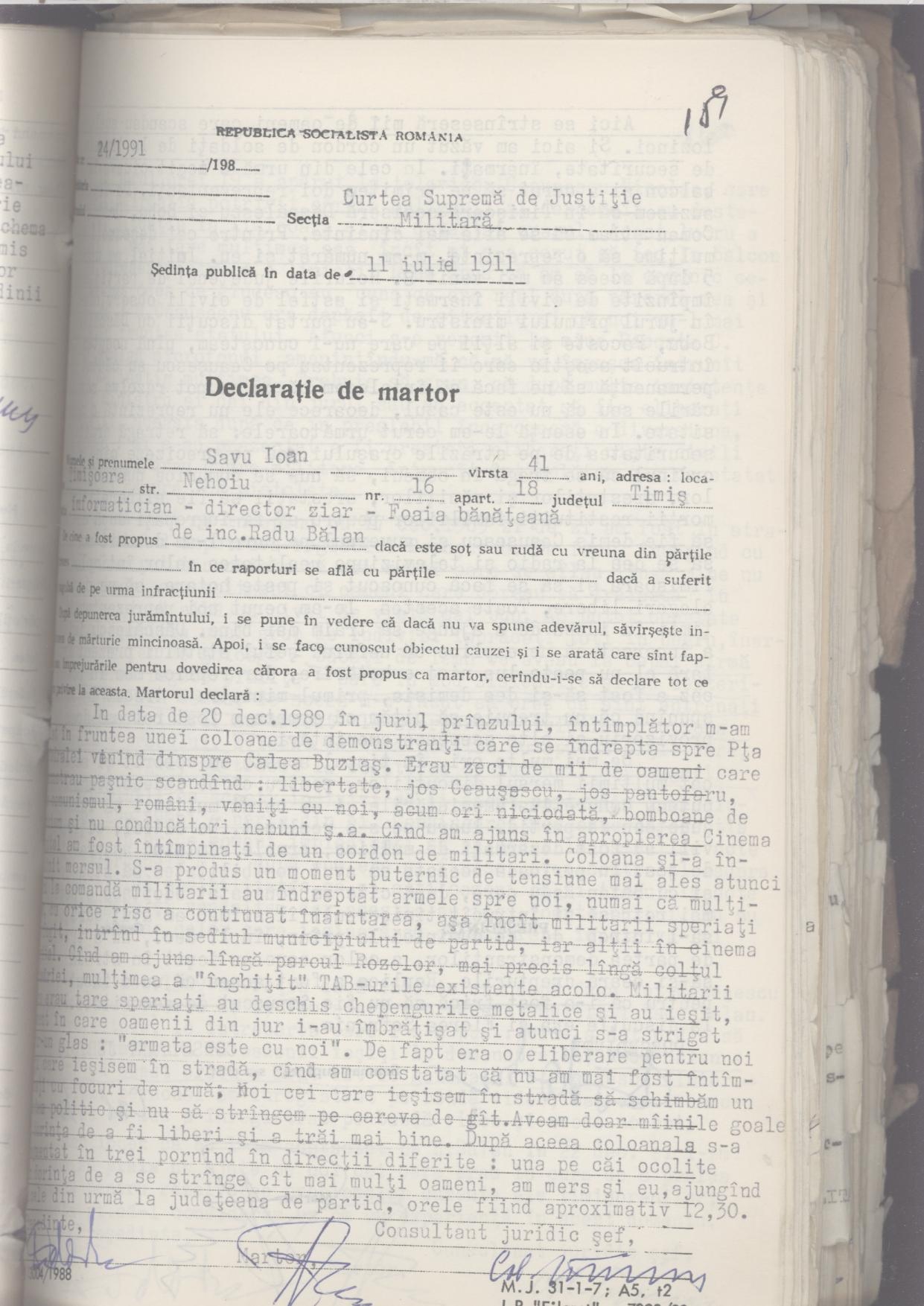
Ioan Savu discussed the windowbreakers as follows:
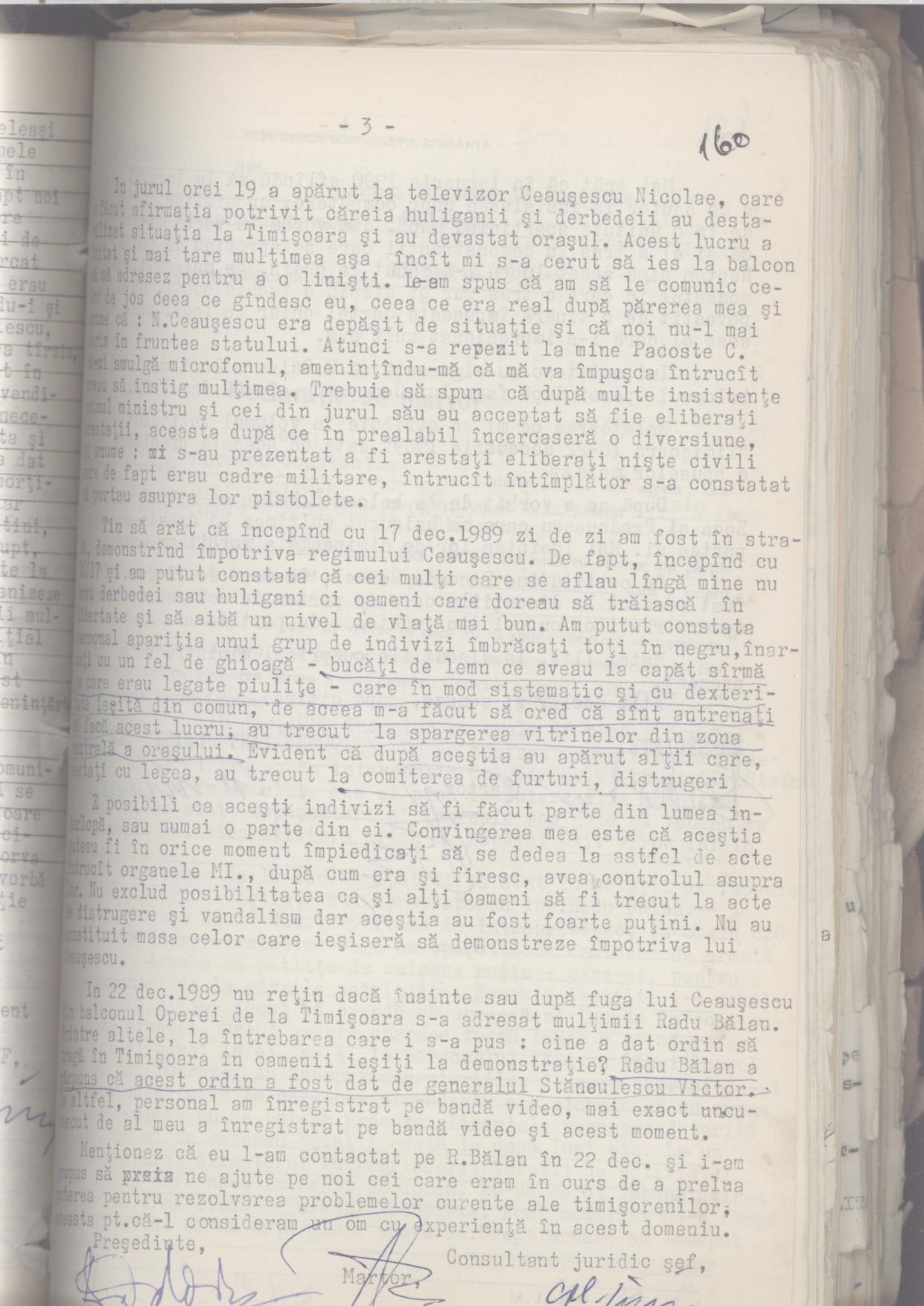
0282

0280

———————————-

Shattered Glass:  The Interior Ministry’s Self-Generated Pretext for the Repression of Demonstrators in Timisoara in December 1989

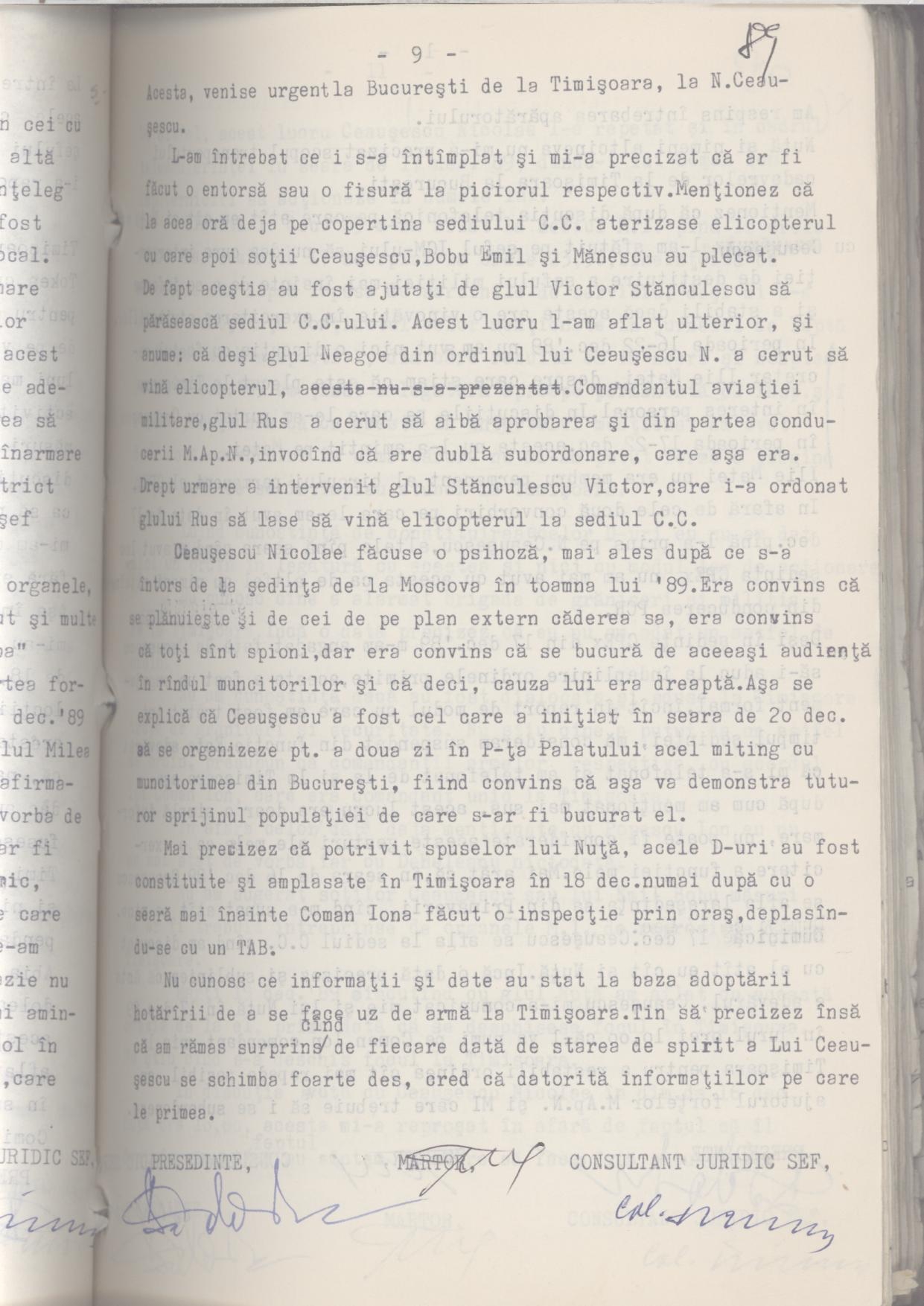
The significance of window-breaking as a justification for repression–something the Securitate would have realized–was outlined by Nicolae Ceausescu in his teleconference of 17 December 1989 as follows:

“Oricine intra intr-un Consiliu Popular, intr-un sediu de partid sau sparge un geam la un magazin trebuie sa primeasca riposta imediat.
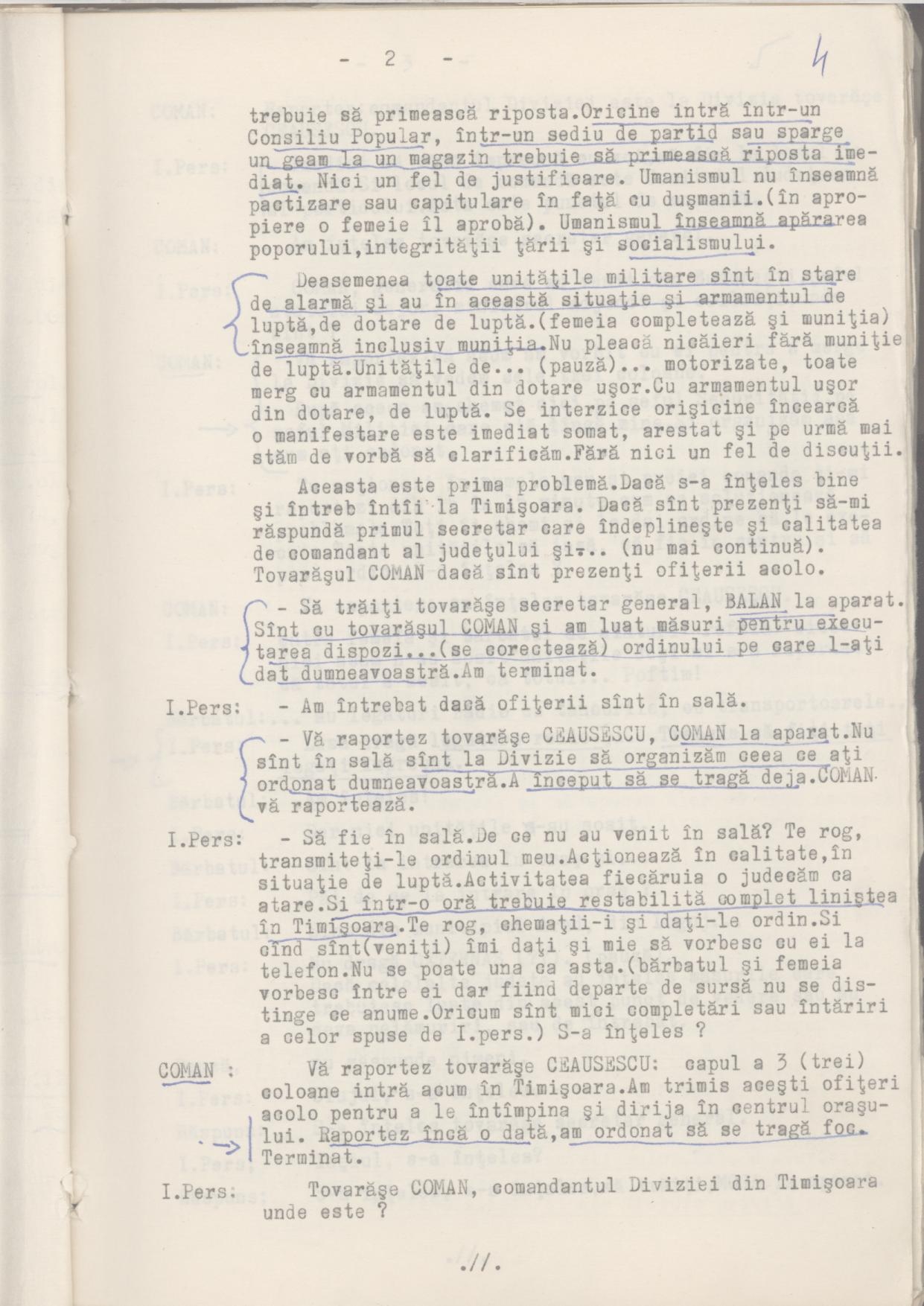
0007

Col. Ion Popescu (sef IGM)’s defense lawyer appealed to Legea 21 and Decretul 121 specifically as obligating Interior Ministry (M.I.–Militia and Securitate) forces to intervene in response to the breaking of windows of commercial units…
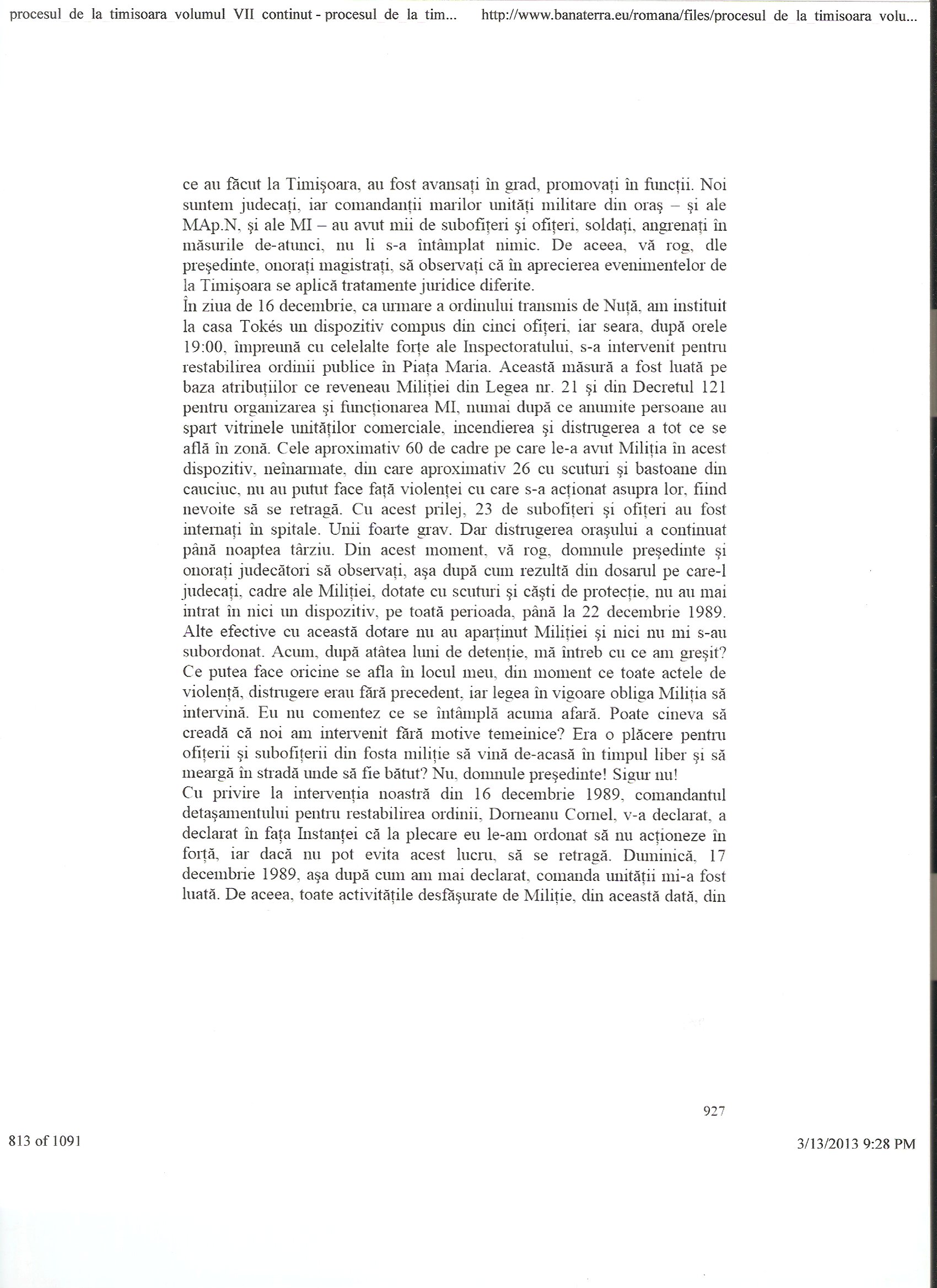
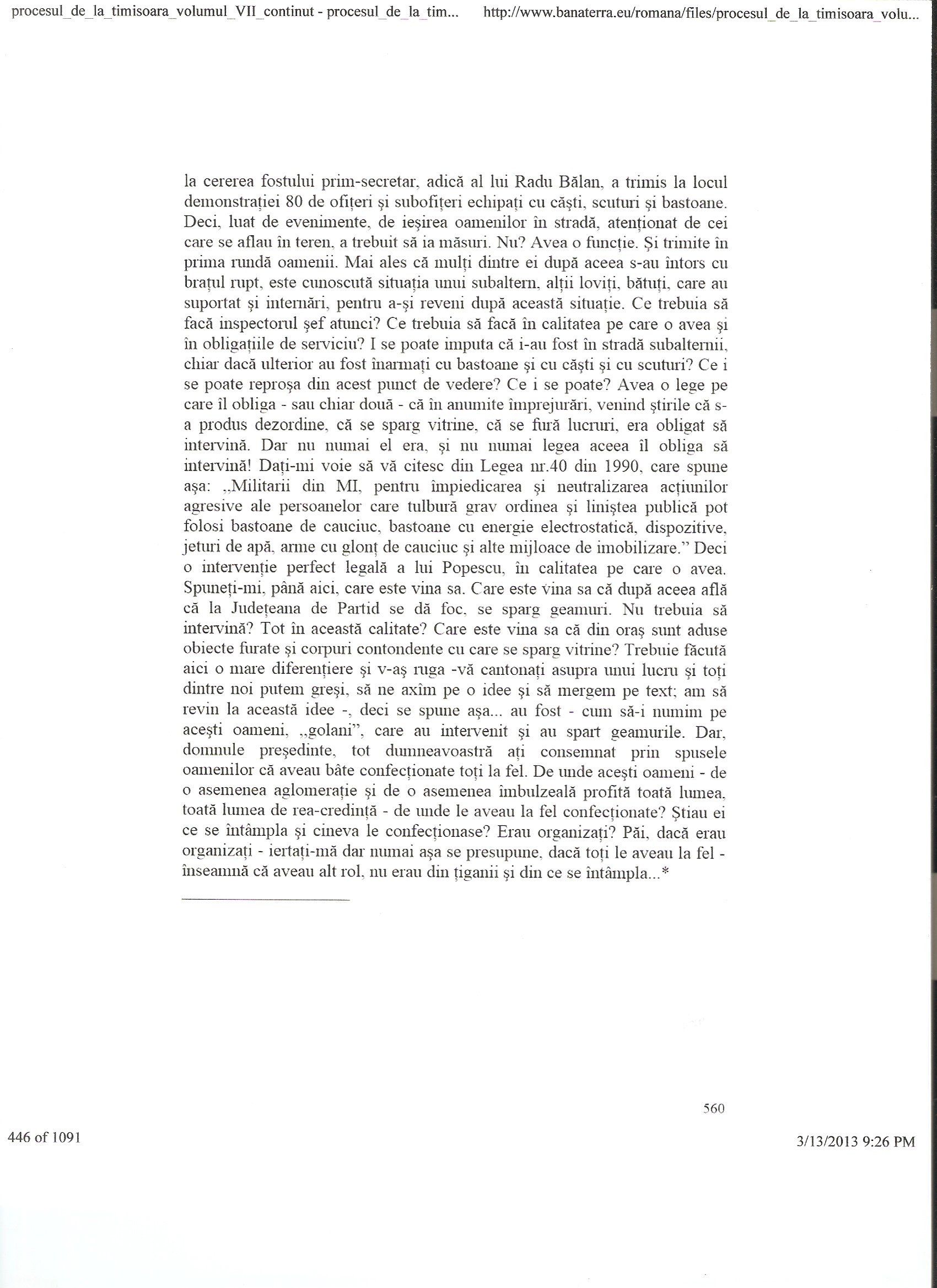
image0-001

image0

Thus, the breaking of windows, which according to Interior Minister was instigated and carried out in part by Securitate Brigade 30 under the command of Ion Bunoaica served a bureaucratic and legalistic function–a tactic not unknown in the annals of other totalitarian or authoritarian regimes…
Posted in decembrie 1989, raport final | Tagged: , , , , , | 5 Comments »

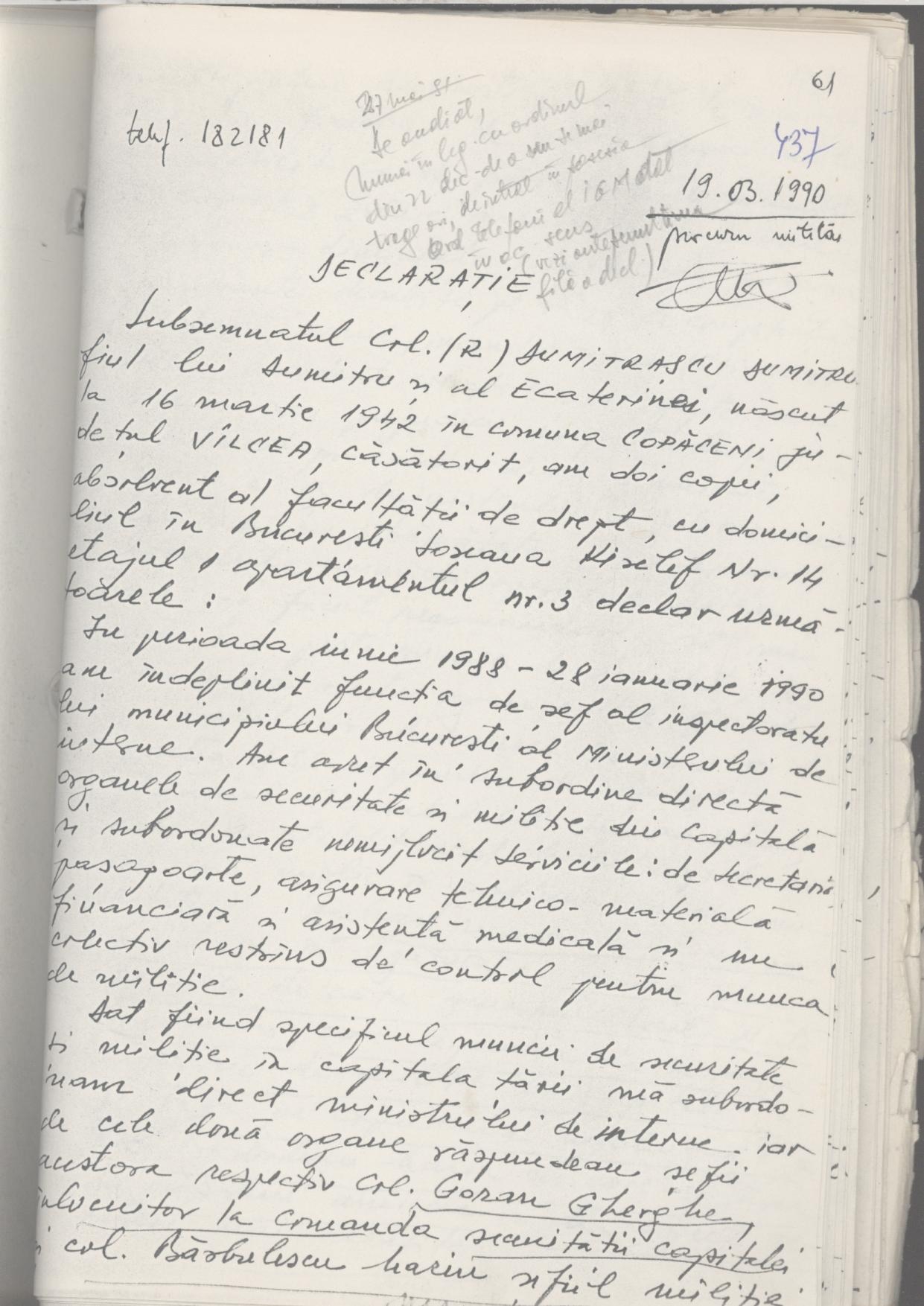
Cine a avut ideea organizării mitingului din 21 decembrie 1989?

Posted by romanianrevolutionofdecember1989 on March 12, 2013

0541

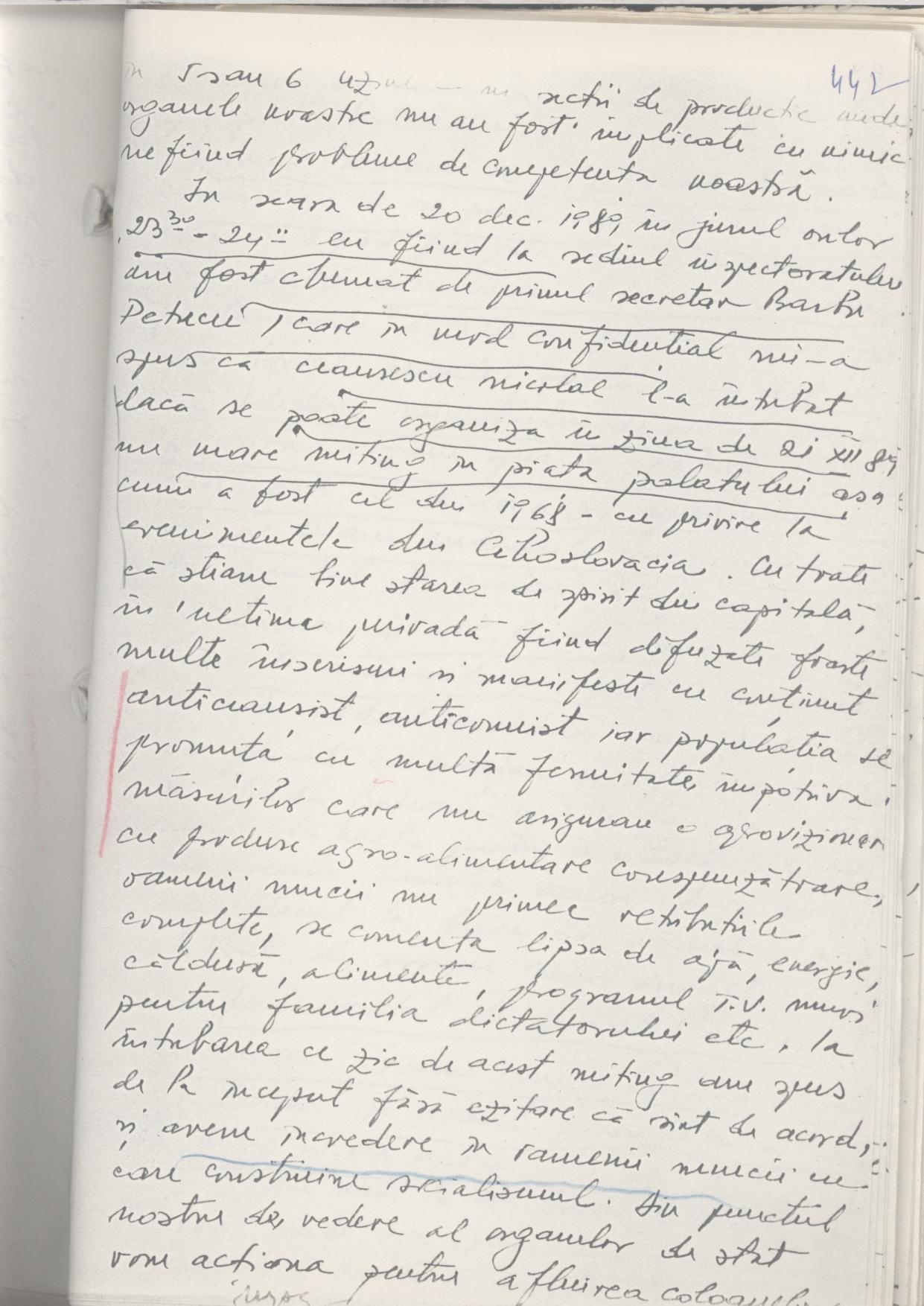
Col. Dumitru Dumitrascu, sef al Inspectoratului Muncipiului Bucuresti al Ministerului de Interne, Declaratie, 19 martie 1990

“In seara de 20 dec. 1989 in jurul orelor 23:30-24:00 eu fiind la inspectoratului am fost informat de primul secretar Barbu Petrescu, care in mod confidential mi-a spus ca ceausescu nicolae l-a intrebat daca se poate organiza in ziua de 21 XII 89 un mare miting in piata palatului asa cum a fost cel din 1968–cu privire la evenimentele din Cehoslovacia.”

0536

0160

Tudor Postelnicu, Ministrul de Interne, Declaratie, 21 iunie 1991

“Asa se explica ca Ceausescu a fost cel care a initiat in seara de 20 dec. sa se organizeze pt. a doua zi in P-ta Palatului acel miting cu muncitorimea din Bucuresti, fiind convins ca asa va demonstra tuturor sprijinul populatiei de care s-ar fi bucurat el.”

0152

An excerpt from

A chapter from my Ph.D. Dissertation at Indiana University: Richard Andrew Hall, Rewriting the Revolution: Authoritarian Regime-State Relations and the Triumph of Securitate Revisionism in Post-Ceausescu Romania (defended 16 December 1996). This is the original chapter as it appeared then and thus has not been revised in any form.

http://atomic-temporary-3899751.wpcomstaging.com/rewriting-the-revolution-1997-chapter-6-18-22-december-1989/ 

Ceausescu’s Fatal Mistake: The Pro-Regime Rally of 21 December

By the morning of Thursday, 21 December 1989, the regime was no longer master of the situation in Timisoara. Moreover, it was rapidly losing control in several nearby cities: Lugoj and Cugir. Nevertheless, the regime might have withstood these challenges had it not been for Nicolae Ceausescu’s insistence on convoking a mass rally and addressing his “adoring” subjects in person. It was Nicolae Ceausescu’s delusion of his own invincibility which ensured that the regime would be unable to reestablish control. Ceausescu’s inflammatory, rambling tirade on national television on Wednesday evening had signalled panic to those who watched it. If Ceausescu was so worked up, they concluded, something serious must have occurred in Timisoara. Following his televised address, Ceausescu decided to hold an open-air, pro-regime rally the following day in the sprawling square in front of the Central Committee building in the center of Bucharest. The event was to be carried live over Romanian radio and television.

Precisely because this mass rally turned out to be the deathknell for the Ceausescu regime speculation has surrounded who “goaded” Ceausescu into making such a colossally-misguided decision. In January 1993, the opposition daily Romania Libera suggested that “the meeting was organized at the suggestion of [CPEx member] Gogu Radulescu.”[31] The same article maintained that Radulescu had been followed during these days and was “observed transmitting something abroad,” thereby once again insinuating the role of foreign powers in the Romanian events.[32]

Yet it is doubtful that Nicolae Ceausescu required Radulescu’s encouragement to convoke such a rally. It seems highly likely that the idea was Ceausescu’s own brainchild and that as usual the docile members of the CPEx did not dare contradict him. It was a typically instinctive, rash, and overconfident reaction to crisis on Ceausescu’s part. Moreover, as we have seen, for Nicolae Ceausescu the events confronting him in December 1989 were a replay of August 1968: not only was socialism at stake, but Romania’s national sovereignty and independence. Thus, in this crucial moment, he would appeal not primarily to the party’s political interests, but to what were the core institutional interests of the Securitate. And he would rely on a trusted totalitarian, mobilizational technique: the “spontaneous” mass rally of support for the regime.

[31].. R.M., “Dezvaluiri [Revelations],” Romania Libera, 19 January 1993, 1. Radulescu died in 1994.

[32].. Ibid. Presumably that foreign power would have been the Soviet Union.

Posted in decembrie 1989, raport final | Tagged: , , , , , , | 2 Comments »

Liviu Dinulescu, cpt. la Serviciul de Pasapoarte al jud. Timis: “Precizez ca anterior declansarii evenimentelor de la Timisoara din datele ce le detineam serviciul nostru nu rezulta vreun amestec din exterior in zona judetului Timis.”

Posted by romanianrevolutionofdecember1989 on March 10, 2013

26 iunie 1991, Declaratia lui Liviu Dinulescu, cpt. la Serviciul de Pasapoarte al jud. Timis (in decembrie 1989, lt. maj. ofiter operativ Securitate judetean la Serv. III, care se ocupa de contraspionaj)

“Precizez ca anterior declansarii evenimentelor de la Timisoara din datele ce le detineam serviciul nostru nu rezulta vreun amestec din exterior in zona judetului Timis.”

0197

http://atomic-temporary-3899751.wpcomstaging.com/2013/03/06/secretele-revolutiei-de-la-timisoara-col-niculae-mavru-fost-sef-al-sectiei-filaj-si-investigatie-de-la-securitatea-timis/

http://atomic-temporary-3899751.wpcomstaging.com/2013/02/22/dosarele-revolutiei-de-la-timisoara-tudor-postelnicu-unii-militari-de-la-trupele-de-securitate-ale-brigazii-timisoara-au-facut-unele-provocari-la-unele-magazine-si-vitrine-spargind-geamurile-sa-im/

Posted in decembrie 1989, raport final | Tagged: , , | 4 Comments »

“Secretele Revolutiei de la Timisoara”: col. Niculae Mavru, fost sef al sectiei ‘Filaj si investigatie’ de la Securitatea Timis

Posted by romanianrevolutionofdecember1989 on March 6, 2013

Niculae Mavru, fost sef al sectiei ‘Filaj si investigatie’ de la Securitatea Timis, declaratia din 13 ianuarie 1990:  …la ordinul col. Sima Traian, am primit…misiuni de a observa si sesiza aspecte din masa manifestantilor, din diferite zone ale orasului in sensul de a raporta daca sint straini (ceea ce nu prea au fost) care incita la dezordine, acte de violenta sau altfel de acte…
0331

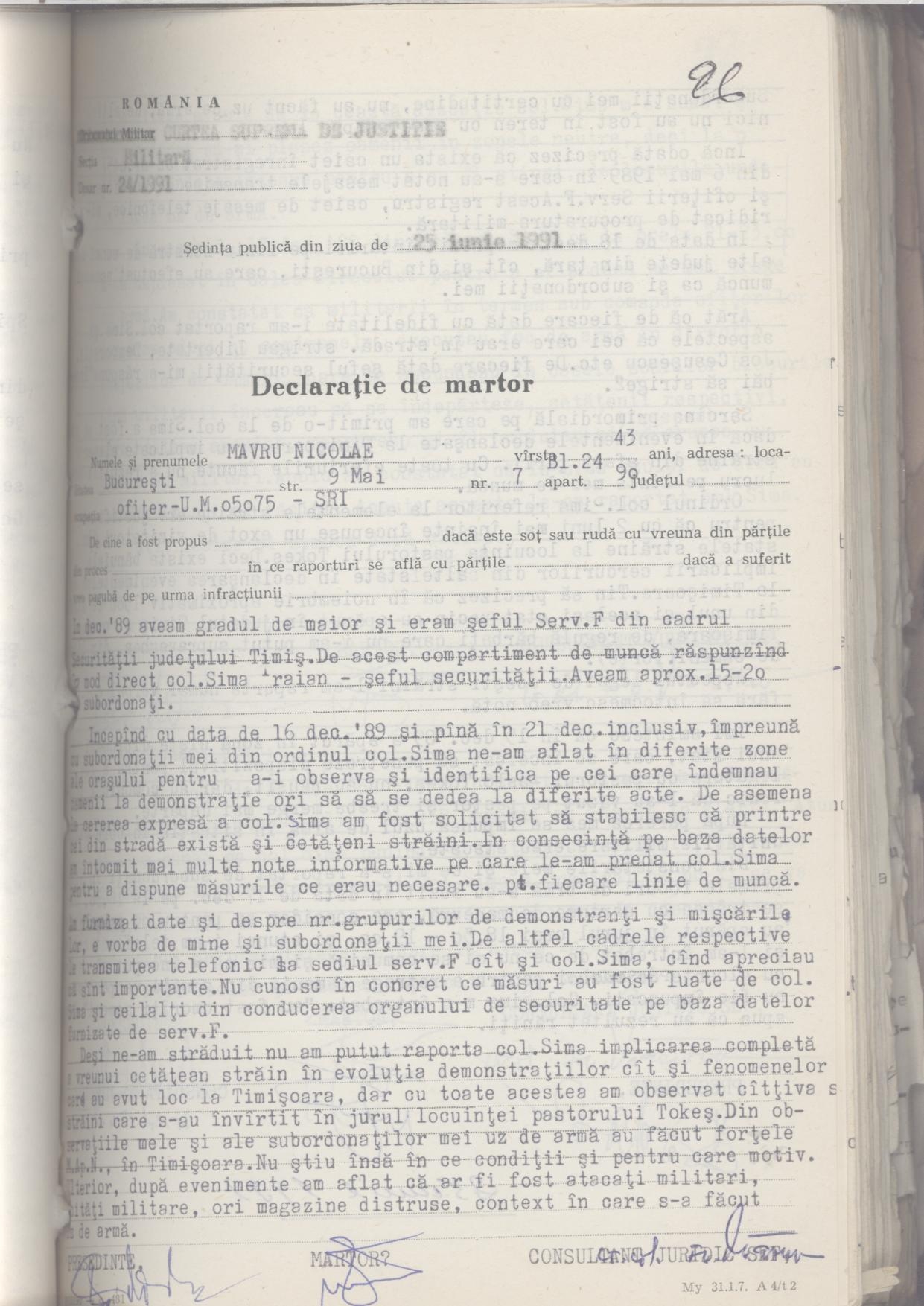
25 iunie 1991

“Desi ne-am straduit nu am putut raporta col. Sima implicarea completa a vreunui cetatean strain in evolutia demonstratiilor cit si fenomenlor care au avut loc la Timisoara,..”

0173

“Sarcina primordiala pe care am primit-o de la col. Sima a fost daca in evenimentele declansate la Timisoara erau implicate elemente straine din afara tarii.  Cu toate eforturile facute nu a rezultat lucru pe linia mea de munca.”

0174

si mai tarziu, dupa potopul de “memorie recuperata”

(“recovered memory,” dupa spusele lui Ken Jowitt)

al fostilor securisti si militieni…

http://jurnalul.ro/campaniile-jurnalul/decembrie-89/secretele-revolutiei-de-la-timisoara-72088.html

Secretele Revolutiei de la Timisoara

02 Mar 2004 – 00:00

Nicolae Mavru, fostul sef al filajului de la Securitatea Timis, dezvaluie episoade incredibile din timpul evenimentelor de la Timisoara. In prima noapte a Revolutiei, 20% din cei arestati erau informatori. Interviu cu col. (r) Nicolae Mavru, fostul sef al sectiei “Filaj si investigatie” de la Timisoara.

  • Jurnalul National: Va propun sa incepem cu problema coloanelor de turisti.Nicolae Mavru: Au existat. Legenda lor era bisnita. Ei au intrat in tara cu legenda ca se duc in excursie in Bulgaria sau Iugoslavia, dar cand au ajuns in zona Arad-Timisoara, au schimbat legenda ca sa poata sa stationeze. La un moment dat s-au retras sarbii, bisnitarii obisnuiti, si au fost inlocuiti de polonezi in octombrie 1989. La inceputul lui decembrie au disparut brusc polonezii si au venit rusii, cam 2.000 de oameni, majoritatea barbati tineri, atletici. Particularitatea acestor grupuri de bisnitari rusi era ca nu aveau marfa.
  • Va intrerup aici o clipa. Exista in documentele oficiale, fie depozitii din procese, fie audieri la Comisiile senatoriale, o contradictie. In timp ce unii conducatori ai DSS insista pe existenta si implicarea acestor “turisti” in evenimentele din Timisoara ( Vlad, Ratiu), altii neaga importanta acestor grupuri (col. Pele, Nicolicioiu).Coloanele si grupurile sovietice au existat. Eu fac aceasta distinctie, pentru ca ele au avut calitatea de coloane pana au ajuns la noi in judet; aici au stationat. Noi iiobservam, mi se raporta verbal despre ei si despre ceea ce fac, pentru ca la un moment dat umplusera soseaua Arad-Timisoara. Vindeau tigari, cafea, imbracaminte, dar foarte slab, cantitati foarte mici de produse, scule… Ei treceau foarte des in Ungaria si Iugoslavia, ca sa aduca marfa, dar se intorceau cu marfa foarte putina.
  • Spuneati ca erau barbati tineri, atletici… Banuiesc ca de la dvs. a pornit descrierea aceasta, folosita apoi in toata literatura despre revolutie.Majoritatea acestor indivizi era basarabeana, vorbind stricat romaneste, dar printre ei erau si cate 4-5 care vorbeau numai ruseste sau nu vorbeau deloc, pentru ca mi-am pus oamenii sa se infiltreze, sa faca pe cumparatorii; iiintrebau ceva, dadeau din cap si faceau semn unuia care vorbea romaneste.
  • Au fost la vreun moment dat inclusi in categoria suspecti?Au fost observati, mi s-a raportat verbal cazul lor, comportamentul lor, iar eu l-am informat verbal pe colonelul Sima. Acesta mi-a raspuns: “N-avem timp sa ne ocupam de ei”. Eram sufocati de celelalte activitati, inclusiv de cazul Tokes.
  • Va pun o intrebare mai… delicata. Este posibil ca acei din conducerea Securitatii sa fi ignorat rolul acestor grupuri sovietice, amplasandu-le in categoria bisnitarilor care bantuiau oricum zona, fara sa intuiasca potentialul lor interventionist, iar apoi, dupa revolutie sa exagereze informatiile despre ele, pentru a ascunde lipsa de prevedere si, in ultima instanta, de profesionalism?N-am cum sa stiu asta. Asta se intampla sus, eu stiam ce se intampla jos. Dar, va repet, am informat si Sima mi-a spus ca nu avem timp de ei.
  • Bun, atunci va intreb altceva: jos, acolo, in strada, cand s-au declansat evenimentele, grupurile acestea de basarabeni si-au parasit locurile de bisnita si s-au implicat in violente?Este posibil, da. Au aparut acesti indivizi puternici, atletici, cam blonzi asa, care incitau copiii strazii: “Haideti, ma, spargeti, nu va fie frica!”. Scenele astea le-am surprins. Insa, neocupandu-ne de ei inainte, nedocumentandu-i, nu am avut cum sa stim precis ca provin din grupurile de bisnitari de pe soseaua Arad-Timisoara.
  • Adica n-ati putut spune: individul cutare care incita in dreptul magazinului x este acelasi cu individul care ieri vindea tigari la kilometrul y.Nu, dar din experienta mea de cunoastere a oamenilor, a suspectilor, pentru ca serviciul meu era de “filaj si investigatie”, acesti indivizi care incitau copiii strazii la spargeri si devastari proveneau de acolo, aveau o anumita tipologie pe care specialistul in filaj o recunoaste foarte bine. Eu va pot spune imediat dintr-un grup de oameni care este basarabean, fara ca acela sa deschida gura. Dar cand o deschide!
  • Domnule colonel, nu credeti ca este posibil ca Securitatea sa fi ratat operatiunea de identificare din timp a acestor diversionisti, astfel ca ei au reusit ceea ce in termeni militari se numeste “surprinderea”?Toate informatiile despre acesti diversionisti se gasesc in notele de filaj pe care le-am inaintat conducerii.
  • Este vorba de notele de filaj care au fost prezentate in instante cu ocazia proceselor de la Timisoara, apoi au disparut?Nu stiam de disparitia lor, dar ele au existat sigur.

Pentru cine, in realitate, a provocat si a facut distrugerea magazinelor la Timisoara, vedeti aici:  http://atomic-temporary-3899751.wpcomstaging.com/2013/02/22/dosarele-revolutiei-de-la-timisoara-tudor-postelnicu-unii-militari-de-la-trupele-de-securitate-ale-brigazii-timisoara-au-facut-unele-provocari-la-unele-magazine-si-vitrine-spargind-geamurile-sa-im/

Posted in decembrie 1989, raport final | Tagged: , , , , , | 7 Comments »

Dosarele Revolutiei de la Timisoara: Cine a spus si cine spune adevarul despre decembrie 1989?

Posted by romanianrevolutionofdecember1989 on December 31, 2012

[Documentary evidence in support of the publication entitled:  Bullets, Lies, and Videotape:  The Amazing, Disappearing Counter-Revolution of December 1989  ]

On 1 December 2012, Doru Teodor Maries and Asociatia 21 decembrie 1989 made images of many of the official files investigating the events of December 1989 in Timisoara available on the Internet at http://dosarelerevolutiei.ro/ .  Among the copies available are testimonies from victims of the repression of the communist regime of Nicolae Ceausescu, witnesses of the repression, relatives of the victims of the repression, and members of regime forces that either participated in the repression or were witnesses to it.  These documents allow researchers the ability to confirm or infirm claims made in the Romanian media or accounts published since December 1989.

[VA ROG, DACA VRETI, AJUTATI-MA CU TRANSCIERILE ILIZIBILE!  VA MULTUMESC!!!]

Romulus Cristea (ziarist, Romania Libera, 22 decembrie 2005):  – Munitia speciala, gloantele cu cap vidia sau dum-dum, a provocat victime? Presa de la acea vreme a fost plina cu astfel de relatari…

General-magistrat Dan Voinea – Nu exista victime (persoane impuscate) nici de la gloantele cu cap vidia, nici de la dum-dum. Pe durata evenimentelor s-a folosit munitie de razboi, munitie normala care se gasea la vremea respectiva in dotarea Ministerului de Interne si a Ministerului Apararii Nationale. Confuzia si informatiile false au aparut de la faptul ca se foloseau calibre diferite si, deci, zgomotul produs era altfel perceput.  http://www.romanialibera.ro/opinii/interviuri/toti-alergau-dupa-un-inamic-invizibil-58783.html

Robert Buzatu “a fost lovit de un glont exploziv”

IMG_0045

imaginea 43
imaginea 44
imaginea 45
imaginea 46

Georgian Baran “[pe 25 decembrie 1989]…teroristul a tras asupra mea, cred ca erau gloante dum-dum, mi-a lovit…”

imaginea 61
imaginea 62

IMG_0062

Csikos I[?] “Cred dupa rana [?]  ca au fost gloante dum-dum”

IMG_0088

Dobosan “am fost ranit…cu gloante dum-dum”

imaginea 127
imaginea 128

IMG_0128

Alexandru Kos “[pe 23 decembrie 1989] am fost impuscat…cu o arma de calibru mare si probabil cu gloante dum-dum”

imaginea 207
imaginea 208

IMG_0207

IMG_0208

Florin Nicoara “Am fost lovit in soldul drept cu un glont dum-dum”

IMG_0257

Griga “civilii au fost impuscati cu gloante plate [?], care asa cum spuneau medicii cu rupt tesuturile”

imaginea 170
imaginea 171

IMG_0171

Andrei Jubea “glontul special de culoare alb”

imaginea 204
imaginea 205

IMG_0205

Iosif Cota “gloante crestati”

imaginea 90
imaginea 91

IMG_0091

http://atomic-temporary-3899751.wpcomstaging.com/2012/12/30/dosarele-revolutiei-de-la-timisoara-declaratia-lui-mircea-stoica-8-ianuarie-1990-40-ani-topometrist-impuscat-patru-luni-spitalizat-decedat/

Mircea Stoica (declaratie, 8 ian 1990):  “Cind am ajuns aici, la poarta o voce de militar din garnizoana s-a exprimat:  “Ce faceti mai — voi toti cu BUM-BUM sau DUM-DUM si ni-i trimiteti noua sa ne spalam pe cap cu ei.”


Mircea Stoica (declaration, 8 January 1990):  “When I got there, I heard a soldier’s voice from the garrison exclaim:  “What are you guys doing? You all with your BUM-BUM or DUM-DUM and then you send`em to us to solve the problem [almost impossible to solve]” <very angry, pissed off>

(my sincere thanks to Gigga Adrian Tudor for this transcription and translation of the quote!)

Popovici:  “Mi-am revenit intr-un camion militar in care eram multi civili unii morti fiind adusi la garnizoana militara.  La garnizoana eu am fost dat jos si predat unui cpt (capitan) sau unui lt.major (locotenent major). vazand rana mea n-a vrut sa ma primeasca exprimand: Voi trageti cu dum dum si noi sa raspundem pentru acest lucru.”  (my thanks to A.K. for this transcription)

Popovici:  “I came to in a military truck in which there were lots of civilians some dead being brought to the military garrison.  At the garrison I was taken down and surrendered to a captain or lt. major, who looking at my wound did not want to receive me, exclaiming:  You shoot with dum-dum bullets and we are held responsible for it.”

It doesn’t take a genius to recognize the important similarity between the testimonies of Mircea Stoica and Ioan Popovici:  both are party to/overhear military personnel referring to the 1) use of DUM-DUM bullets, 2) that those who are using them are clearly not fellow soldiers and instead likely M.I./Securitate personnel, and 3) the Army personnel are resentful of essentially being left to “hold the bag” for the results of the DUM-DUM munitions!

———————————————————————————————————————————

Stoica Mircea, 40 ani, topometrist, Bd. Republicii, impuscat mina si picior http://www.timisoara.com/mioc/REVT06~1.HTM

197. Partea vătămată Stoica Maria cere 500000 lei, lunar, contribuţie de întreţinere, motivînd că, în decembrie 1989, soţul ei, Mircea Stoica a fost împuşcat, patru luni spitalizat, a rămas handicapat (gradul II de invaliditate), apoi a decedat.  În dovedirea cererii, depune acte de spitalizare şi de stabilire a capacităţii de muncă, care atestă vătămarea, cauzele şi consecinţele ei. Mai depune: declaraţia împuşcatului, actul lui de deces, actul de căsătorie şi carnetul de muncă (vol. 6 p. 304; vol. 10 p. 58-60, 170, 245-250; vol. 14 p. 54-61; vol. 27 p. 179-207).

http://www.procesulcomunismului.com/marturii/fonduri/mmioc/curteasup/docs/0307pciv.htm

IMG_0335

“Cind am ajuns aici, la poarta o voce de militar din garnizoana s-a exprimat:  “Ce faceti mai — voi toti cu BUM-BUM sau DUM-DUM si ni-i trimiteti noua sa ne spalam pe cap cu ei.”

IMG_0330

intreaga declaratie e aici:

imaginea 330
imaginea 331
imaginea 332
imaginea 333
imaginea 334
imaginea 335
imaginea 336

in legatura cu declaratia aceasta, vezi si http://atomic-temporary-3899751.wpcomstaging.com/2012/12/02/dosarele-revolutiei-de-la-timisoara/ ,

Procesul de la Timisoara (II). Audierea partii civile Popovici Ion: “…Atata retin foarte bine minte, ca ofiterul a spus, cica: ‘Nu, voi trageti cu dum-dum-uri si dupa aia Armata raspunde.’”

Popovici:  “Mi-am revenit intr-un camion militar in care eram multi civili unii morti fiind adusi la garnizoana militara.  La garnizoana eu am fost dat jos si predat unui cpt (capitan) sau unui lt.major (locotenent major). vazand rana mea n-a vrut sa ma primeasca exprimand: Voi trageti cu dum dum si noi sa raspundem pentru acest lucru.”  (my thanks to A.K. for this transcription)

Popovici:  “I came to in a military truck in which there were lots of civilians some dead being brought to the military garrison.  At the garrison I was taken down and surrendered to a captain or lt. major, who looking at my wound did not want to receive me, exclaiming:  You shoot with dum-dum bullets and we are held responsible for it.”

available on this site http://www.banaterra.eu/romana/procesul-de-la-timisoara-1990-1991-vol-v ].  The following is from Volume V.]

Some excerpts: P.C.:  Ati dat o declaratie?   Po. I. :  Da  P.C.:  O mentineti?  Po. I. Da (p. 827) P.C.:  “Inteleg sa fiu audiat in cauza ca parte civila”, da?  V-as ruga sa faceti putin liniste!  “Mentin declaratia de la Procuratura si…” (p. 833)

Po. I.:  …Da [am fost ranit].  Si dupa aceea a venit unul dintre trei [civili mai in varsta] dupa mine, m-a tarat pana la masina si la masina, acolo, am luat o bataie…ca n-am putut doua saptamani nici sa mananc nimica.  M-a lovit cu patul de arma in falca si cu bocancii in cap.  Si m-au dus, m-au dus la Garnizoana.  La Garnizoana m-au aruncat din masina si a venit ofiterul de serviciu.  Au venit si acestia trei a spus lu’ ofiterul de serviciu, cica:  “Luati-l si duceti-l  la arest.”  Atata retin foarte bine minte, ca ofiterul a spus, cica:  “Nu, voi trageti cu dum-dum-uri si dupa aia Armata raspunde.  Voi omorati oameni si raspunde Armata dupa aceea.”  Asta tin minte precis.  Si de acolo mi-am dat seama ca nu poate sa fie soldati aceia. (p. 830)

IMG_0291

IMG_0290

Doru Sciadei

IMG_0932

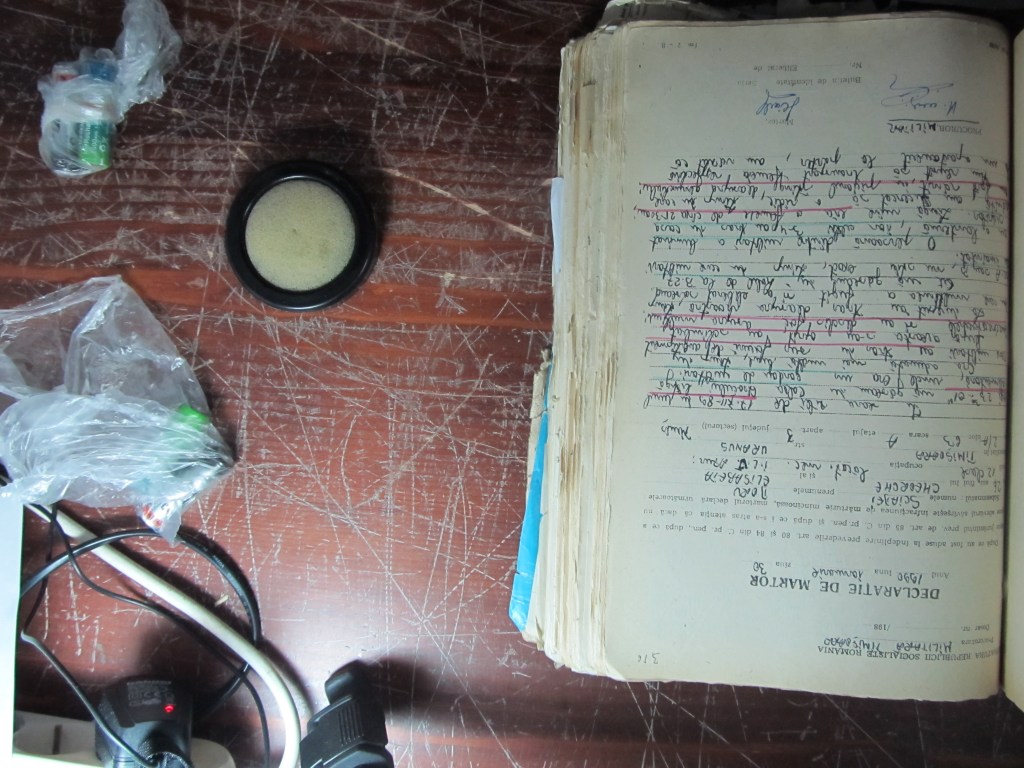
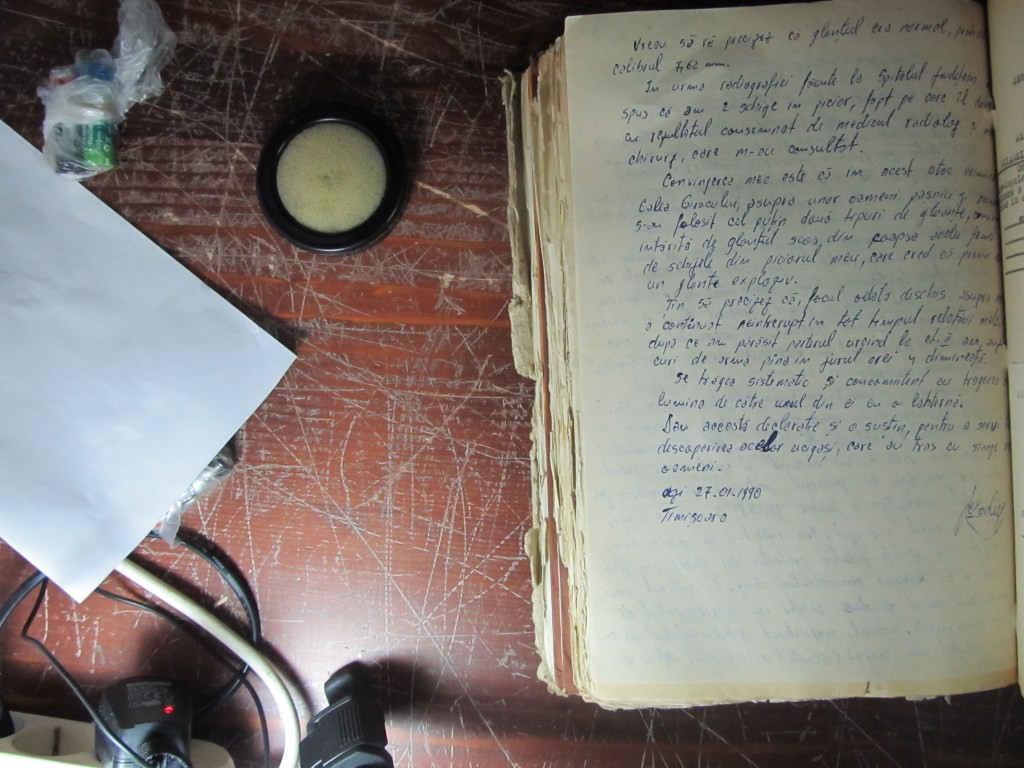
“In urma radiografiei facute la Spitalul Judetean au spus ca am 2 schije in picior…consemnat de medicul radiolog si chirurg, care m-au consultat.

Convingerea mea este ca in acest atac (pe ?) Calea Girocului, asupra unor oameni pasnici si (?) s-au folosit cel putin doua tipuri de gloante, convingerea intirita de glontul scos din coapsa (?) si schijele din piciorul meu, care cred ca provin de un glonte exploziv.

IMG_0929

Doina Gherasim glonte dum dum

IMG_0175

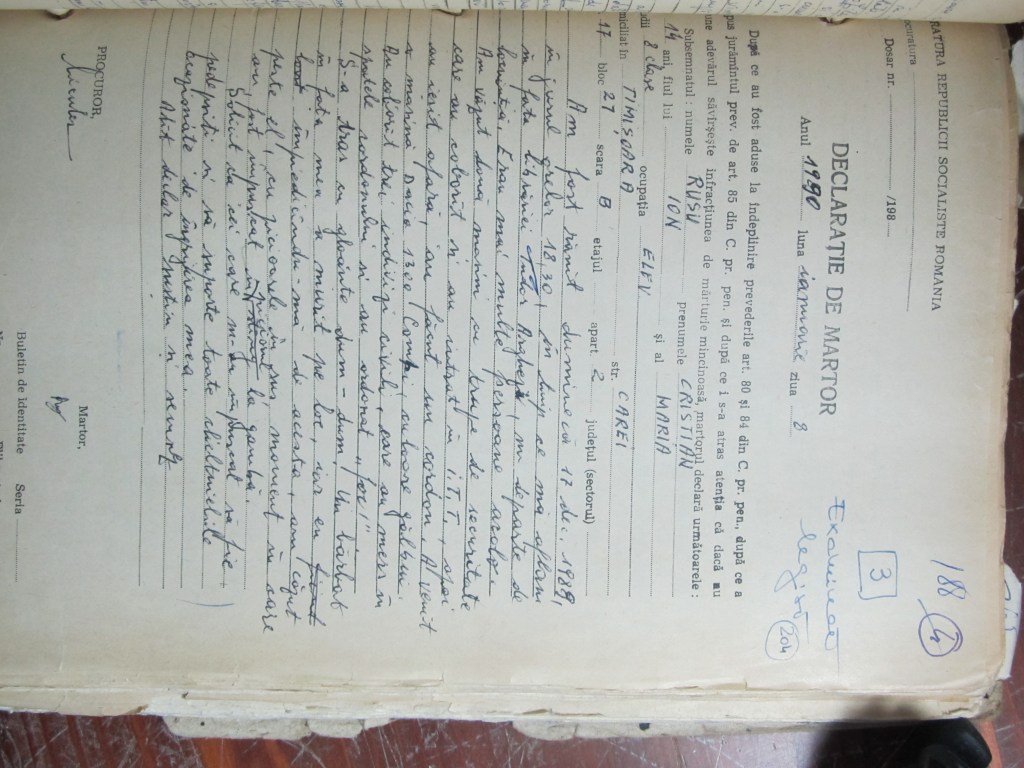
Cristian Rusu “S-a tras cu gloante dum-dum”

IMG_0305

SIX Doctors/Medical personnel from Timisoara alone have discussed the use of dum-dum bullets against demonstrators in Timisoara…

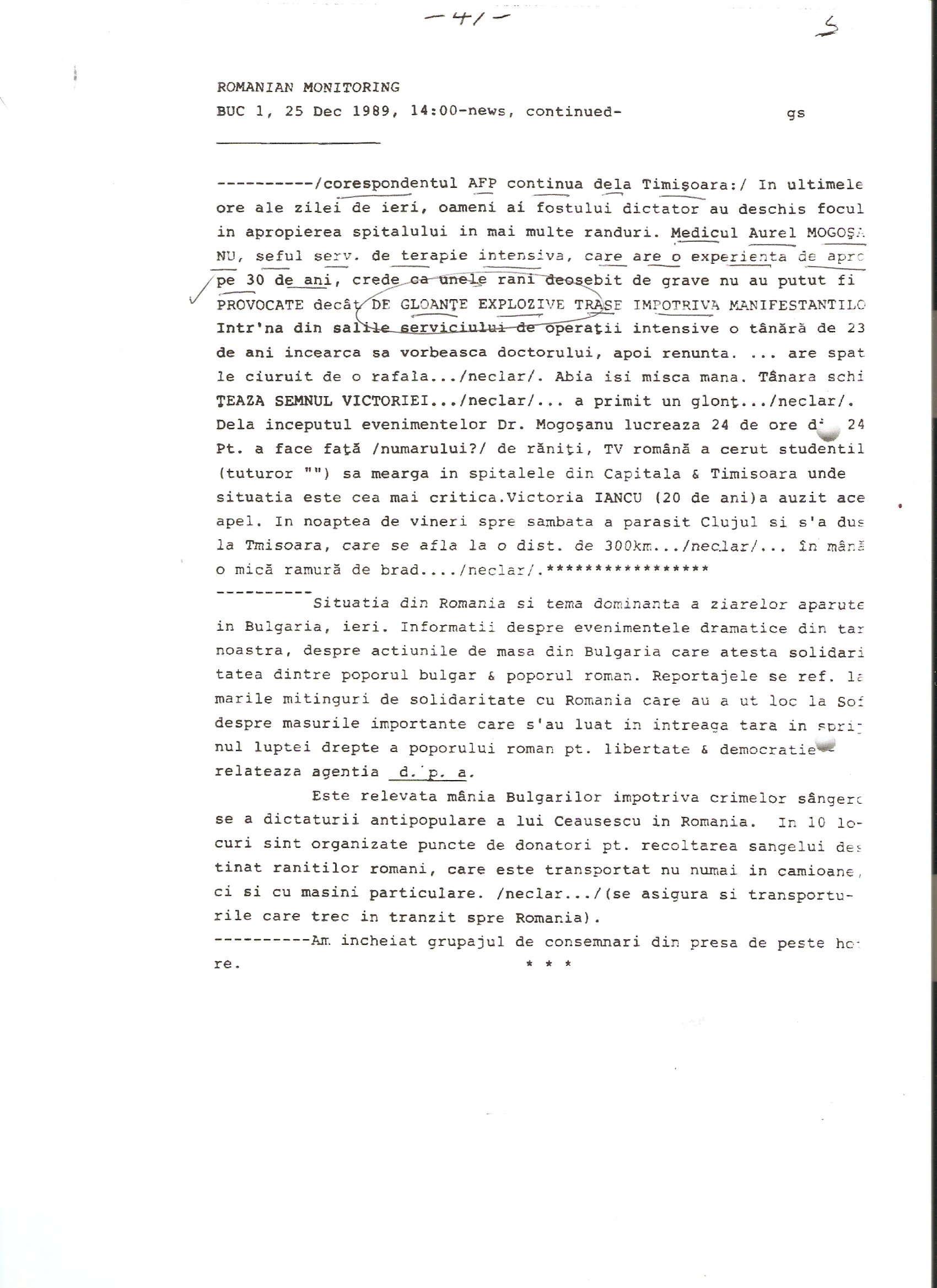
Doctors also reported on the wounds caused by explosive bullets (i.e. dum-dum bullets):  In this dispatch from Agence France Presse, relayed by Radio Free Europe on 25 December 1989, Dr. Aurel Mogosanu, a medic in the intensive care unit of a Timisoara hospital, says based on his thirty years of experience, some of the wounds could only have been CAUSED by EXPLOSIVE BULLETS SHOT AT THE PROTESTERS”

sursa (documentele Europa Libera disponsibile la):  http://media.hotnews.ro/media_server1/generic_file-2009-12-22-6754154-0-radio-bucuresti-25-dec-pdf.pdf (p. 49 of 82)

©AFP Général – Lundi 25 Décembre 1989 – 08:33 – Heure Paris (386 mots)
Roumanie, prev Nuit de Noel a l hopital central de Timisoara De l un des envoyes speciaux de l AFP, NICOLAS MILETITCH
   TIMISOARA (Roumanie) 25 dec – Devant l hopital central de Timisoara, dimanche soir, une quarantaine de camions remplis de medicaments et de produits alimentaires tout juste arrives, attendaient d etre decharges.
   ” L aide nous vient d un peu partout. Hongrie, RFA, Tchecoslovaquie, France, Yougoslavie, URSS, Bulgarie, Italie… ” , indique a l AFP l un des soldats qui gardent l hopital. Les militaires sont partout autour de l hopital, sur les toits, dans les cours et meme a l interieur.
   ” Des hommes de la Securitate ont tire pres de l hopital a plusieurs reprises, ces dernieres heures ” , explique le docteur Aurel Mogosianu, chef du service de soins intensifs, en donnant des ordres a un soldat qui passe, la mitraillette a l epaule, dans un couloir, entre les malades.
   Le Dr Mogosianu, qui a une trentaine d annees d experience, pense que certaines blessures particulierement horribles, n ont pu etre provoquees que par des balles explosives tirees contre les manifestants.
   Dans une salle de soins intensifs, une femme de 23 ans essaie de parler au docteur, puis renonce. ” C est un cas difficile. Elle a eu le dos transperce par une rafale ” , precise le Dr Mogosianu.
   En bougeant a peine la main, la jeune femme esquisse le ” V ” de la victoire pour dire ” au revoir ” . Un effort irrealisable pour son voisin qui a recu une balle dans le cou, impossible a extraire.
   Comme la plupart de ses collegues, le docteur travaille, a peu de choses pres, 24 heures sur 24 depuis le debut des evenements. Dans un coin, une infirmiere dort, ecroulee sur une chaise.
   Pour faire face a l afflux de blesses, la television de Bucarest a demande a tous les etudiants en medecine du pays de se rendre dans les hopitaux de la capitale et de Timisoara, ou la situation est la plus critique.
   Victor Jancu, 20 ans, a entendu cet appel. Dans la nuit de vendredi a samedi, il a quitte Cluj et reussi a rejoindre Timisoara, a plus de 300 kms de la, en arretant des camions.
   Quelques visiteurs arrivent a l hopital, portant a la main une petite branche de sapin : a Timisoara aussi, on voudrait feter Noel.
   nm/jga/vr.
Tous droits réservés : ©AFP Général
021851451DC1ED1D715E06849EA4C6E0F37C0C25ECE8D503

mai mult despre Dr. Aurel Mogosanu in decembrie 1989:  http://www.sorinbogdan.ro/2009/12/timisoara-18-decembrie-1989/.

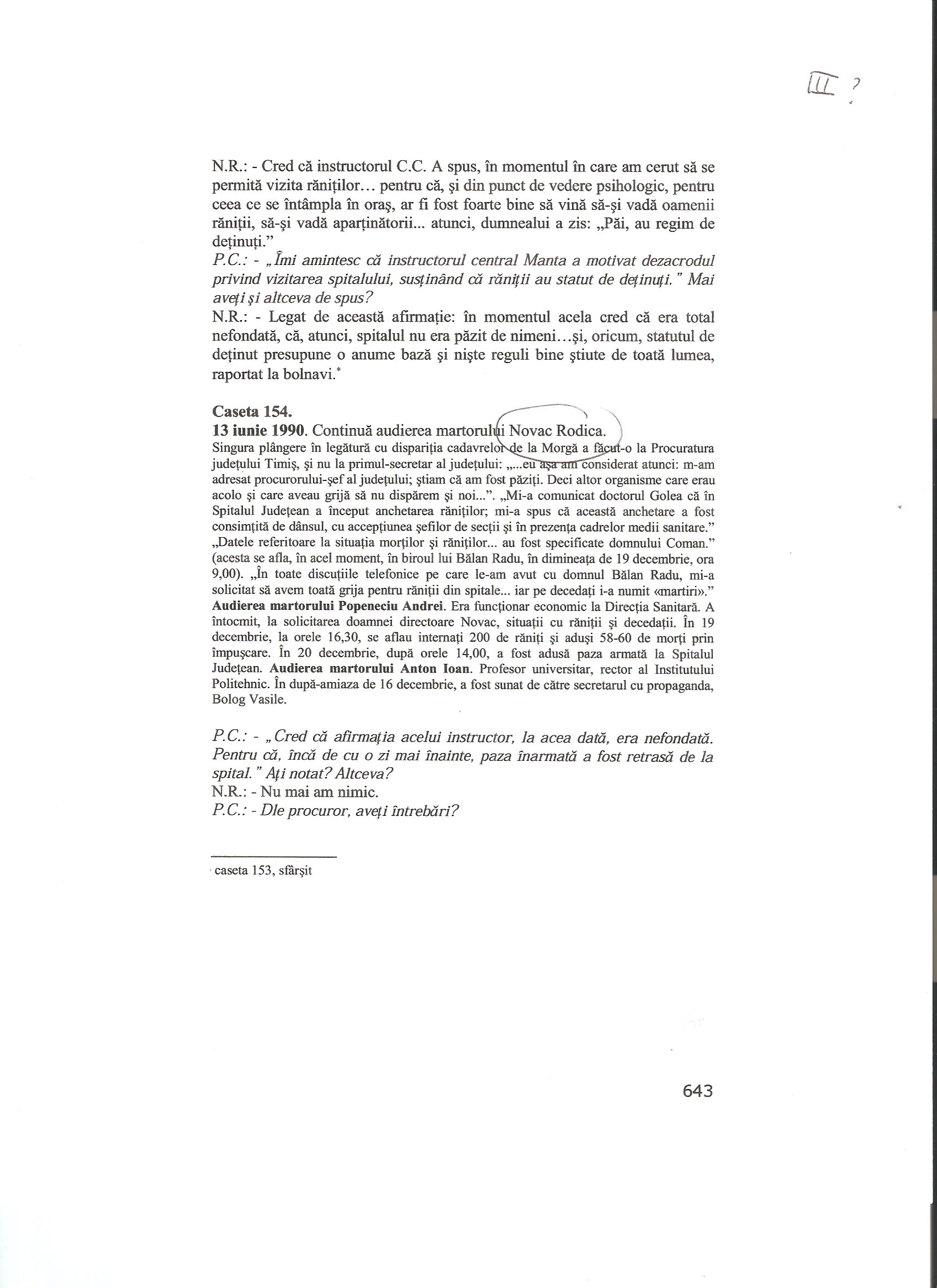
http://atomic-temporary-3899751.wpcomstaging.com/2011/09/30/procesul-de-la-timisoara-iii-audierea-martorului-rodica-novac-directorul-directiei-sanitare-timis-13-iunie-1990/

Rodica Novac’s claim is corroborated elsewhere by four other medical officials on call during the Timisoara repression.  First, in Romanian, by Dr. Atanasie Barzeanu, then in Hungarian by three doctors (Vladimir Fluture, Csaba Ungor, and Andras Goga) present and performing surgery in Timisoara hospitals from 17-19 december 1989 who recount separately their discovery of dum-dum exploding bullets among the bullets with which demonstrators arriving at the hospital had been shot.  december 1989: temesvari orvosok, dum-dum golyok, es a roman forradalom

Sava Florica, 33 de ani, vinzatoare la Loto-pronosport in cartierul Fabric, impuscata din mers, in Piata Traian

Barzeanu Atanasie, 65 anit, medic primar, doctor in stiinte, chirurg, Spitalul Judetean Timisoara

“…sintem deci in 18 decembrie…Pe la orele doua si patruzeci, cind inchideam o operatie–Sava Florica, 33 de ani, vinzatoare la Loto-pronosport in cartierul Fabric, impuscata din mers, in Piata Traian, dintr-un ARO, pacienta prezentindu-se o echimoza cu distrugerea tesuturilor (plaga in diametru de 15 centimetri), a tesuturilor din regiunea epigastrica, inclusiv a muschilor drepti abdominali, cu ruptura a colonului ascendent transvers si a jejuno-ileonului, fiind in stare de soc grav traumatic, hemoragic–, fara sa-mi poti explica nici macar acum cu ce fel de gloante a putut fi lovita, pentru ca nu am identificat nici orificiul de iesire si nici pe cel de intrare, a venit o asistenta de la Chirurgie I, care mi-a spus sa merg la domnul Ignat.”

Titus Suciu, Reportaj cu Sufletul la Gura, (Editura Facla 1990), pp. 133-134.

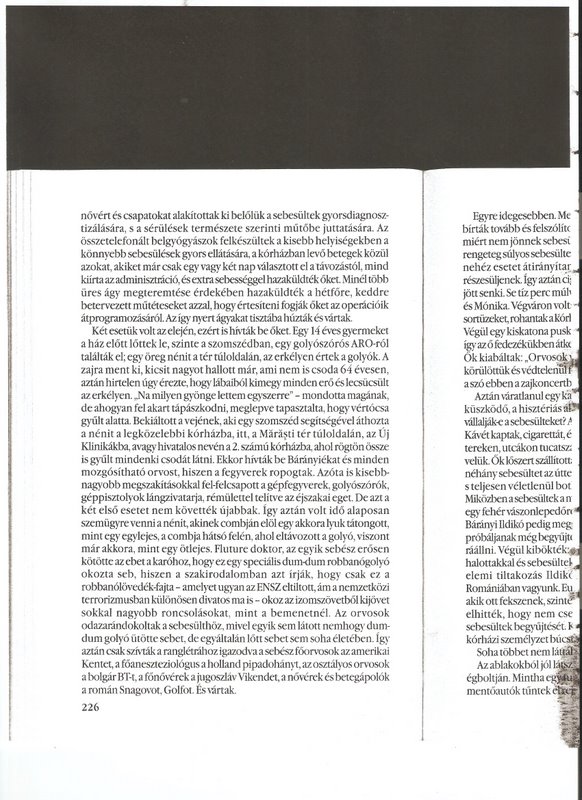
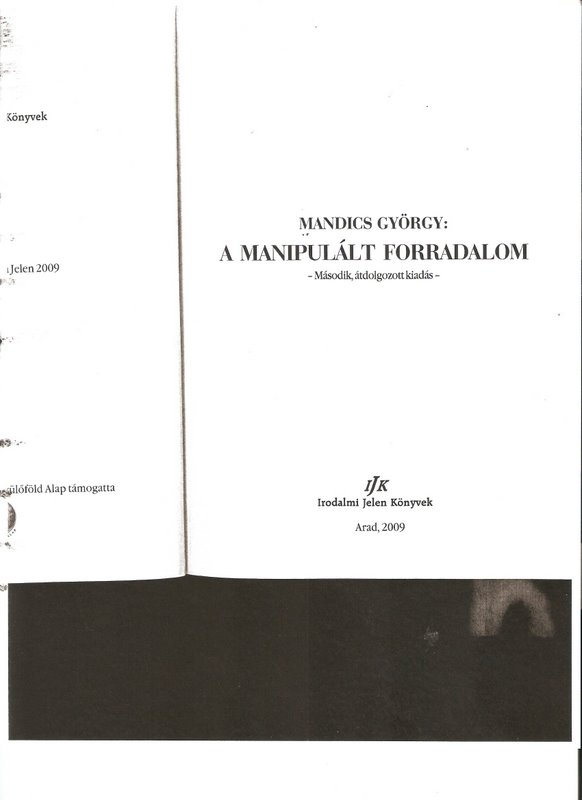
The following first appeared in Gyorgy Mandics’s Temesvari golgota (1991) pp. 348-349 and is reprinted in his A Manipulalt Forradalom (2009).  [My guess is this is also the source for the reference to dum dum bullets in the German language wikipedia entry for http://de.wikipedia.org/wiki/Rum%C3%A4nische_Revolution_1989 — Hans Vastag, György Mandics, Manfred Engelmann: Temeswar. Symbol der Freiheit. Wien 1992. ]

pp. 348-349

Ket esetuk volt az elejen.  Ezert is hivtak be oket.  Egy 14 eves gyermeket a haz elott lottek le, szinte a szomszedban, egy golyoszoros ARO-rol talaltak el; egy oreg nenit a ter tuloldalon, az erkelyen ertek a golyok.  A zarja ment ki, kicsit nagyott hallott mar, amire is csoda, 64 evesen, azt hirtelen ugy erezte, hogy labaibol kimegy minden ero es lecsusott az erholya.  Na milyen gyonge lettem egyszeruen–mondotta maganak. de ahogyan fel akart tapaszkodni meg lepve tapasztalt, hogy vertocsa gyult alatta.  Bekialtolt a vegenek aki egy szomszed segitsegevel athozta a nenit a legkozelebbi korhazba, itt a Marasti ter tuloldalan, az uj Klinikakba, avagy hivatalos neven a 2 szamu korhazba, ahol rogton osszecodult mindenki csodat latni.  Ekkor hivtak be Baranziekat es minden mozgositato orvost, hiszen a fegyverek ropogatak.  Azota is kisebb nagyobb megszakitasokkal, felfelecsapolt a gepfegyverek, golyoszorok, geppisztolyok langzivatarja, remulettel telitva az ejszaki eget.

p. 349

De azt a ket elso esett nem kovettek ujabbok.  Igz aztan volt ido alaposan szemugyre venni a nenit akinek combjan elol egz akkora lyuk tatongott mint egy egy lejes, a comba hatso felen ahol eltavotott a golyo, ott viszont mar akkora mint egy otlejes.  Fluture doktor, az egzik sebesz erosen kototte az ebet a korohoz, hogy ez egz specialis dum-dum robbanogolyo okozta seb, hiszen a szakirodalomban azt irjak, hogy csak ez a robbannolovedek-fajta-amelyet ugyan az ENSZ eltitott, am a nemzetkozi terrorizmusban kulonesen divatos ma is–okoz az izomszovetbol kijovet sokkal nagyobb roncsolasokat mint a bemenetnel.  Az orvosok odazarandokoltak a sebesulthoz, mivel egzik sem latott semhogy dum-dum golyo utotte sebet, de egyaltalan lott sebet sem soha eleteben.  Igz aztan csak szivtak a rangeletrahoz igazodva a sebesz foorvosok az amerikai Kentet, a foamnesztezialogus a holland pipadohanyt, az asztalyos orovosok a bolgar BT-t, a fonoverek a jugoslav Vikend-et, a noverek es helyapolok a roman Snagov-t, Golfot.  Es vartak.

(Note: it is unclear who the 64 yr. old described was…there are several individuals without ages listed as injured or dead during the events, but I think it more likely the age of the woman is incorrect)

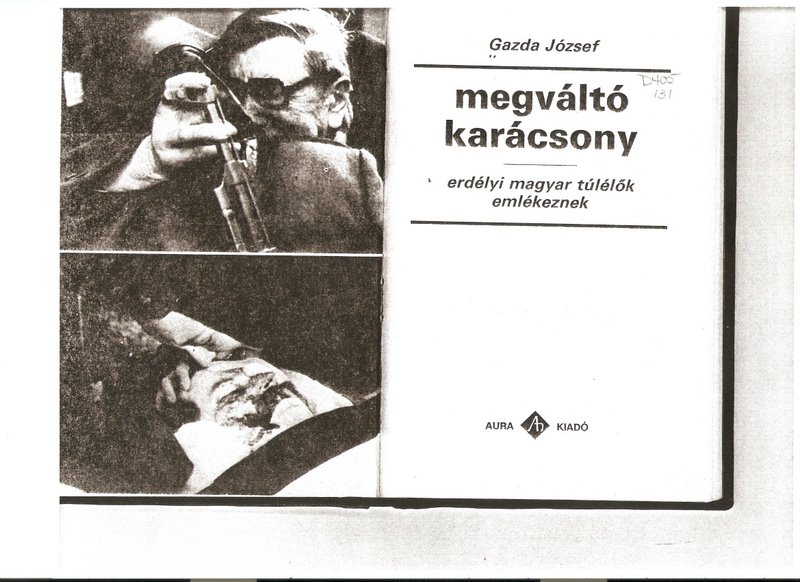
Jozsef Gazda Megvalto karacsonyErdelyi magyar tulelok emlekeznek. (1990)

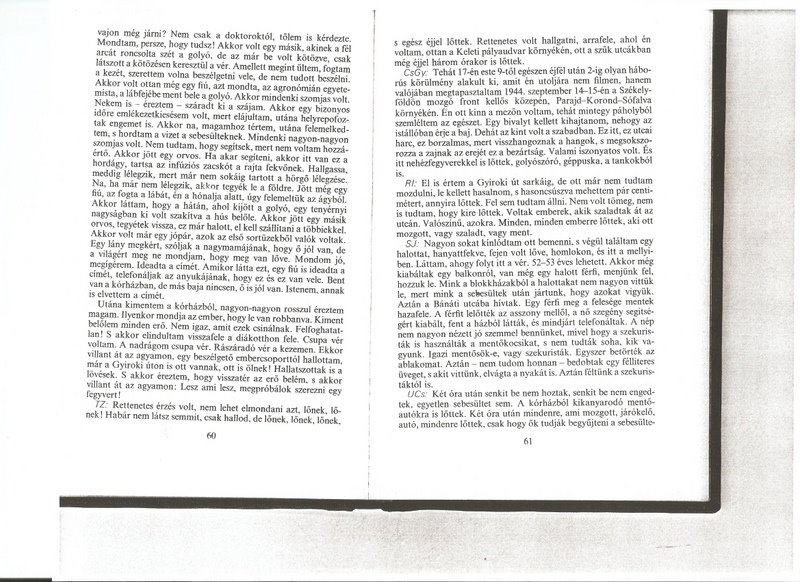
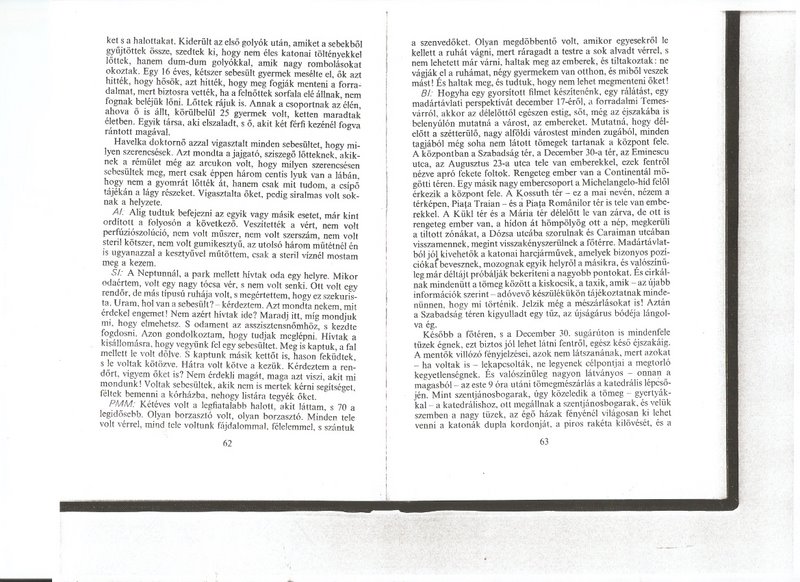
Ungor Csaba:  Ket ora utan senkit be nem hoztak, senkit be nem engedtek, egyetlen sebesult sem.  A korhazbol kikanyarado  mentoautokra is lottek.  Ket ora utan mindre, ami mozgott, jarokelo, auto, mindenre lottek, csak hogy ok tudjak begyujteni a sebesulteket s a halottakat.  Kiderult az elso golyok utan, amiket a sebekbol gyujottek ossze, szedtek ki, hogy nem eles katonai toltenyekkel lottek, hanem dum-dum golyokkal, amik nagy rombolasokat okoztak.  Egy 16 eves, ketszer sebesult gyermek meselte el, ok azt hittek, hogy hosok, azt hittek, hogy meg fogjak menteni a forradalmat, mert biztosra vettek, ha a felnottek sorfala ele allnak, nem fognak belejuk loni.  Lottek rajuk is.

Goga Andras:  A masodik izgalomkelto esemeny volt kedden delelott, hogy az osszes regiszterunk–mind a surgossegen, mind az osztalyon–, melyekre felirtuk a muteteinket, eltuntek, a mai napig sem talaltuk meg.  Bennuk voltak az ev osszes mutetei[***]…En aznap kettot operaltam.  Egy tuntetonek a bore alol vettem ki egy nagyon kulonleges golyok, nem is golyot, egy ilyen repeszdarabot, melyet a katonasag aztan megvizsgalt, s azt mondtak, nekik nincs tudmasuk, hogy ez mi lehet.  Egy masiknak pedig fejserulese volt, persze abban nem talaltam golyot, atment rajta.

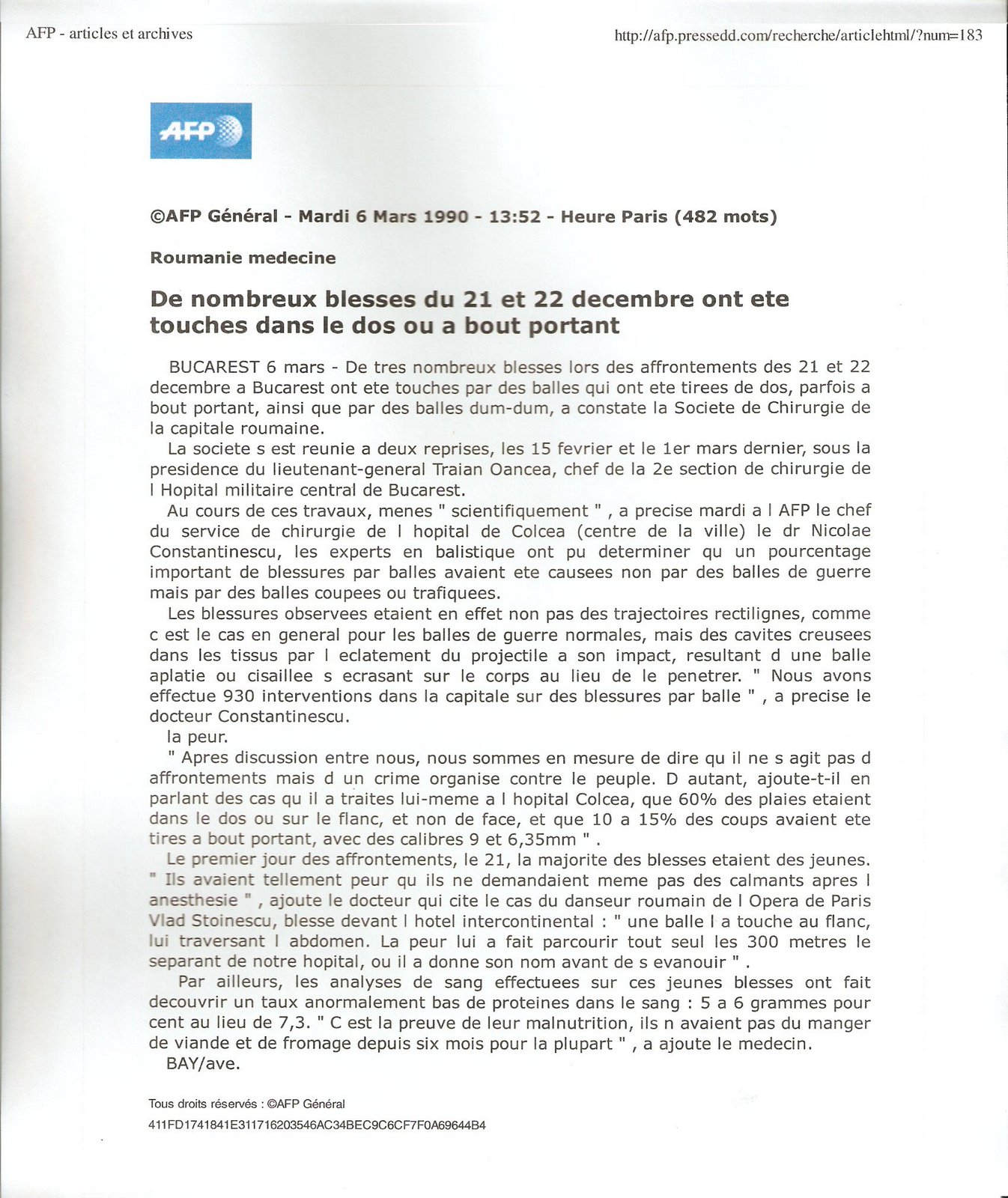
In early March 1990, AFP reported the declared findings of surgeons in Bucharest, attesting to the fact that many of those wounded on 21-22 December 1989 in Bucharest had been shot with exploding bullets, DUM-DUM bullets.  This is a critical article (and description of an event that I believe has gotten almost no coverage inside or outside Romania).  Lt. Gnl. Traian Oancea, chief of surgery in part of the Central Military Hospital in Bucharest, and Dr. Nicolae “Nae” Constantinescu, chief of surgery at the Coltea Hospital, discussed this at a meeting of the Society of Surgeons in Bucharest.

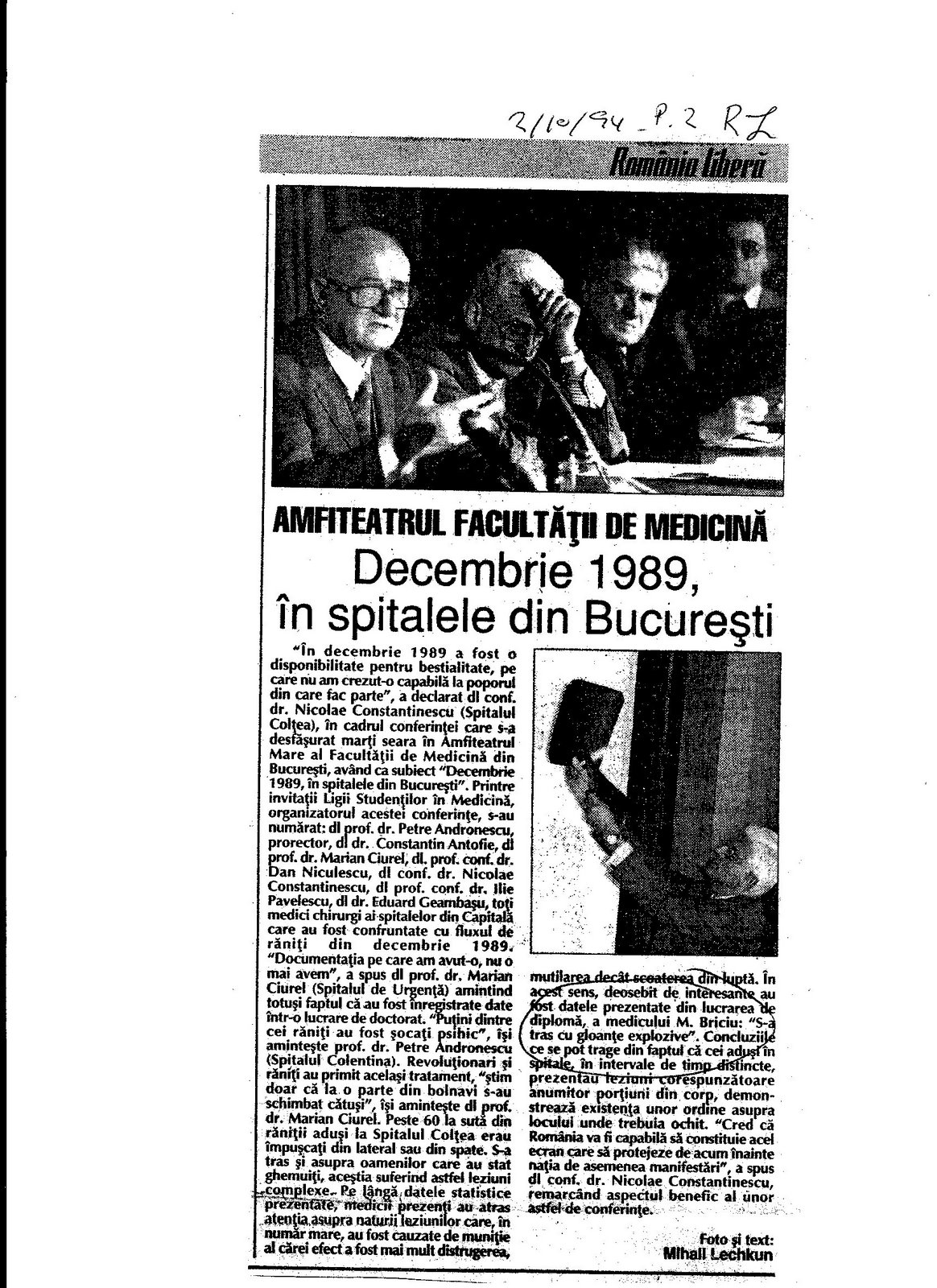
This was also discussed by Bucharest medical personnel at a 1994 conference:

AMFITEATRUL FACULTATII DE MEDICINA

“Decembrie 1989, in spitalele din Bucuresti”

Mihail Lechkun, Romania Libera, 10 februarie 1994, p. 2

“In decembrie 1989 a fost o disponsibilitate pentru bestialitate, pe care nu am crezut-o capabila la poporul care fac parte, ” a declarat dl. conf. dr. Nicolae Constantinescu (Spitalul Coltea), in cadrul conferintei care s-a desfasurat marti seara in Amfiteatrul Mare al Facultatii de Medicina din Bucurest, avand ca subiect “Decembrie 1989, in spitalele din Bucuresti”.  Printre invitatii Ligii Studentilor in Medicina, organizatorul acestei conferinte, s-au numarat:  dl. prof. dr. Petre Andronescu, prorector, dl. dr. Constantin Antofie, dl. prof. dr. Marian Ciurel, dl. prof. conf. dr. Dan Niculescu, dl. conf. dr. Nicolae Constantinescu, dl. prof. conf. dr. Ilie Pavelescu, dl. dr. Eduard Geambasu, toti medici chirurgi din Capitala care au fost confruntate cu fluxul de raniti din decembrie 1989.  “Documentatia pe care am avut-o, nu o mai avem,” a spus dl. prof. dr. Marian Ciurel (Spitalul de Urgenta) amintind totusi faptul ca au fost inregistrate date intr-o lucrare de doctorat.  “Putini dintre cei raniti au fost socati psihic,” isi aminteste prof. dr. Petre Andronescu (Spitalul Colentina).  Revolutionari si raniti au primit acelasi tratament, “stim doar ca la o parte din bolnavi s-au schimbat catusi” isi aminteste dl. prof. dr. Marian Ciurel.  Peste 60 la suta din ranitii adusi la Spitalul Coltea erau impuscati lateral sau din spate.  S-a tras si asupra oamenilor care au stat ghemuiti, acestia suferind astfel leziuni complexe.  Pe langa datele statistice prezentate, medicii prezenti au atras atentia asupra naturii leziunilor care, in numar mare, au fost cazate de munitie al carie efect a fost mai mult distrugerea, mutilarea decat scoaterea din lupta.  In acest sens, deosebit de interesante au fost datele prezentate din lucrarea de diploma, a medicului M. Briciu:  “S-a tras cu gloante explozive”. Concluziile ce se pot trage din faptul ca cei adusi in spitale, in intervale de timp distincte, prezentau leziuni corespunzatoare anumitor portiuni din corp, demonstreaza existenta unor ordine asupra locului unde trebuia ochit.  “Cred ca Romania va fi capabila sa constituie acel ecran care sa protejeze de acum inainte natia de asemenea manifestari,” a spus dl. conf. dr. Nicolae Constantinescu, remarcand aspectul benefic al unor astfel de conferinte.

NOR WERE THESE THE ONLY DOCTORS AND MEDICAL PERSONNEL–FOREIGN OR DOMESTIC–WHO ATTESTED TO THE USE OF DUM-DUM EXPLODING AND OTHER ATYPICAL, UNUSUAL MUNITIONS USED DURING THE EVENTS OF DECEMBER 1989

http://atomic-temporary-3899751.wpcomstaging.com/2011/08/08/doctors-and-dum-dum-bullets-in-romania-in-december-1989-i-dr-manuel-burzaco-medecins-sans-frontieres/

http://atomic-temporary-3899751.wpcomstaging.com/2011/08/10/doctors-and-dum-dum-bullets-in-romania-in-december-1989-ii-trimisi-in-strainatate-italia-franta-austria-anglia-si-germania-pentru-tratament/

http://atomic-temporary-3899751.wpcomstaging.com/2011/08/11/doctors-and-dum-dum-bullets-in-romania-in-december-1989-iii-ce-spun-medici-romani/

Posted in decembrie 1989, raport final, Uncategorized | Tagged: , , , , , | Leave a Comment »

Dosarele Revolutiei de la Timisoara: Declaratia lui Mircea Stoica (8 ianuarie 1990), 40 ani, topometrist, impuscat, patru luni spitalizat, decedat

Posted by romanianrevolutionofdecember1989 on December 30, 2012

[Documentary evidence in support of the publication entitled:  Bullets, Lies, and Videotape:  The Amazing, Disappearing Counter-Revolution of December 1989  ]

On 1 December 2012, Doru Teodor Maries and Asociatia 21 decembrie 1989 made images of many of the official files investigating the events of December 1989 in Timisoara available on the Internet at http://dosarelerevolutiei.ro/ .  Among the copies available are testimonies from victims of the repression of the communist regime of Nicolae Ceausescu, witnesses of the repression, relatives of the victims of the repression, and members of regime forces that either participated in the repression or were witnesses to it.  These documents allow researchers the ability to confirm or infirm claims made in the Romanian media or accounts published since December 1989.

Mircea Stoica (declaratie, 8 ian 1990):  “Cind am ajuns aici, la poarta o voce de militar din garnizoana s-a exprimat:  “Ce faceti mai — voi toti cu BUM-BUM sau DUM-DUM si ni-i trimiteti noua sa ne spalam pe cap cu ei.”

Mircea Stoica (declaration, 8 January 1990):  “When I got there, I heard a soldier’s voice from the garrison exclaim:  “What are you guys doing? You all with your BUM-BUM or DUM-DUM and then you send`em to us to solve the problem [almost impossible to solve]” <very angry, pissed off>

(my sincere thanks to Gigga Adrian Tudor for this transcription and translation of the quote!)

Popovici:  “Mi-am revenit intr-un camion militar in care eram multi civili unii morti fiind adusi la garnizoana militara.  La garnizoana eu am fost dat jos si predat unui cpt (capitan) sau unui lt.major (locotenent major). vazand rana mea n-a vrut sa ma primeasca exprimand: Voi trageti cu dum dum si noi sa raspundem pentru acest lucru.”  (my thanks to A.K. for this transcription)

Popovici:  “I came to in a military truck in which there were lots of civilians some dead being brought to the military garrison.  At the garrison I was taken down and surrendered to a captain or lt. major, who looking at my wound did not want to receive me, exclaiming:  You shoot with dum-dum bullets and we are held responsible for it.”

It doesn’t take a genius to recognize the important similarity between the testimonies of Mircea Stoica and Ioan Popovici:  both are party to/overhear military personnel referring to the 1) use of DUM-DUM bullets, 2) that those who are using them are clearly not fellow soldiers and instead likely M.I./Securitate personnel, and 3) the Army personnel are resentful of essentially being left to “hold the bag” for the results of the DUM-DUM munitions!

———————————————————————————————————————————

Stoica Mircea, 40 ani, topometrist, Bd. Republicii, impuscat mina si picior http://www.timisoara.com/mioc/REVT06~1.HTM

197. Partea vătămată Stoica Maria cere 500000 lei, lunar, contribuţie de întreţinere, motivînd că, în decembrie 1989, soţul ei, Mircea Stoica a fost împuşcat, patru luni spitalizat, a rămas handicapat (gradul II de invaliditate), apoi a decedat.  În dovedirea cererii, depune acte de spitalizare şi de stabilire a capacităţii de muncă, care atestă vătămarea, cauzele şi consecinţele ei. Mai depune: declaraţia împuşcatului, actul lui de deces, actul de căsătorie şi carnetul de muncă (vol. 6 p. 304; vol. 10 p. 58-60, 170, 245-250; vol. 14 p. 54-61; vol. 27 p. 179-207).

http://www.procesulcomunismului.com/marturii/fonduri/mmioc/curteasup/docs/0307pciv.htm

IMG_0335

“Cind am ajuns aici, la poarta o voce de militar din garnizoana s-a exprimat:  “Ce faceti mai — voi toti cu BUM-BUM sau DUM-DUM si ni-i trimiteti noua sa ne spalam pe cap cu ei.”

IMG_0330

intreaga declaratie e aici:

imaginea 330
imaginea 331
imaginea 332
imaginea 333
imaginea 334
imaginea 335
imaginea 336

in legatura cu declaratia aceasta, vezi si https://romanianrevolutionofdecember1989.wordpress.com/2012/12/02/dosarele-revolutiei-de-la-timisoara/ ,

Procesul de la Timisoara (II). Audierea partii civile Popovici Ion: “…Atata retin foarte bine minte, ca ofiterul a spus, cica: ‘Nu, voi trageti cu dum-dum-uri si dupa aia Armata raspunde.’”

Popovici:  “Mi-am revenit intr-un camion militar in care eram multi civili unii morti fiind adusi la garnizoana militara.  La garnizoana eu am fost dat jos si predat unui cpt (capitan) sau unui lt.major (locotenent major). vazand rana mea n-a vrut sa ma primeasca exprimand: Voi trageti cu dum dum si noi sa raspundem pentru acest lucru.”  (my thanks to A.K. for this transcription)

Popovici:  “I came to in a military truck in which there were lots of civilians some dead being brought to the military garrison.  At the garrison I was taken down and surrendered to a captain or lt. major, who looking at my wound did not want to receive me, exclaiming:  You shoot with dum-dum bullets and we are held responsible for it.”

available on this site http://www.banaterra.eu/romana/procesul-de-la-timisoara-1990-1991-vol-v ].  The following is from Volume V.]

Some excerpts: P.C.:  Ati dat o declaratie?   Po. I. :  Da  P.C.:  O mentineti?  Po. I. Da (p. 827) P.C.:  “Inteleg sa fiu audiat in cauza ca parte civila”, da?  V-as ruga sa faceti putin liniste!  “Mentin declaratia de la Procuratura si…” (p. 833)

Po. I.:  …Da [am fost ranit].  Si dupa aceea a venit unul dintre trei [civili mai in varsta] dupa mine, m-a tarat pana la masina si la masina, acolo, am luat o bataie…ca n-am putut doua saptamani nici sa mananc nimica.  M-a lovit cu patul de arma in falca si cu bocancii in cap.  Si m-au dus, m-au dus la Garnizoana.  La Garnizoana m-au aruncat din masina si a venit ofiterul de serviciu.  Au venit si acestia trei a spus lu’ ofiterul de serviciu, cica:  “Luati-l si duceti-l  la arest.”  Atata retin foarte bine minte, ca ofiterul a spus, cica:  “Nu, voi trageti cu dum-dum-uri si dupa aia Armata raspunde.  Voi omorati oameni si raspunde Armata dupa aceea.”  Asta tin minte precis.  Si de acolo mi-am dat seama ca nu poate sa fie soldati aceia. (p. 830)

IMG_0291

IMG_0290

Posted in decembrie 1989, raport final, Uncategorized | Tagged: | 8 Comments »

What can we learn from Dosarele Revolutiei de la Timisoara (VI)

Posted by romanianrevolutionofdecember1989 on December 28, 2012

[Documentary evidence in support of the publication entitled:  Bullets, Lies, and Videotape:  The Amazing, Disappearing Counter-Revolution of December 1989  ]

http://atomic-temporary-3899751.wpcomstaging.com/2012/12/16/what-can-we-learn-from-dosarele-revolutiei-de-la-timisoara-i/

http://atomic-temporary-3899751.wpcomstaging.com/2012/12/19/what-can-we-learn-from-dosarele-revolutiei-de-la-timisoara-ii/

http://atomic-temporary-3899751.wpcomstaging.com/2012/12/20/what-can-we-learn-from-dosarele-revolutie-de-la-timisoara-iii/

http://atomic-temporary-3899751.wpcomstaging.com/2012/12/21/what-can-we-learn-from-dosarele-revolutiei-de-la-timisoara-iv/

http://atomic-temporary-3899751.wpcomstaging.com/2012/12/27/what-can-we-learn-from-dosarele-revolutiei-de-la-timisoara-v/

On 1 December 2012, Doru Teodor Maries and Asociatia 21 decembrie 1989 made images of many of the official files investigating the events of December 1989 in Timisoara available on the Internet at http://dosarelerevolutiei.ro/ .  Among the copies available are testimonies from victims of the repression of the communist regime of Nicolae Ceausescu, witnesses of the repression, relatives of the victims of the repression, and members of regime forces that either participated in the repression or were witnesses to it.  These documents allow researchers the ability to confirm or infirm claims made in the Romanian media or accounts published since December 1989.

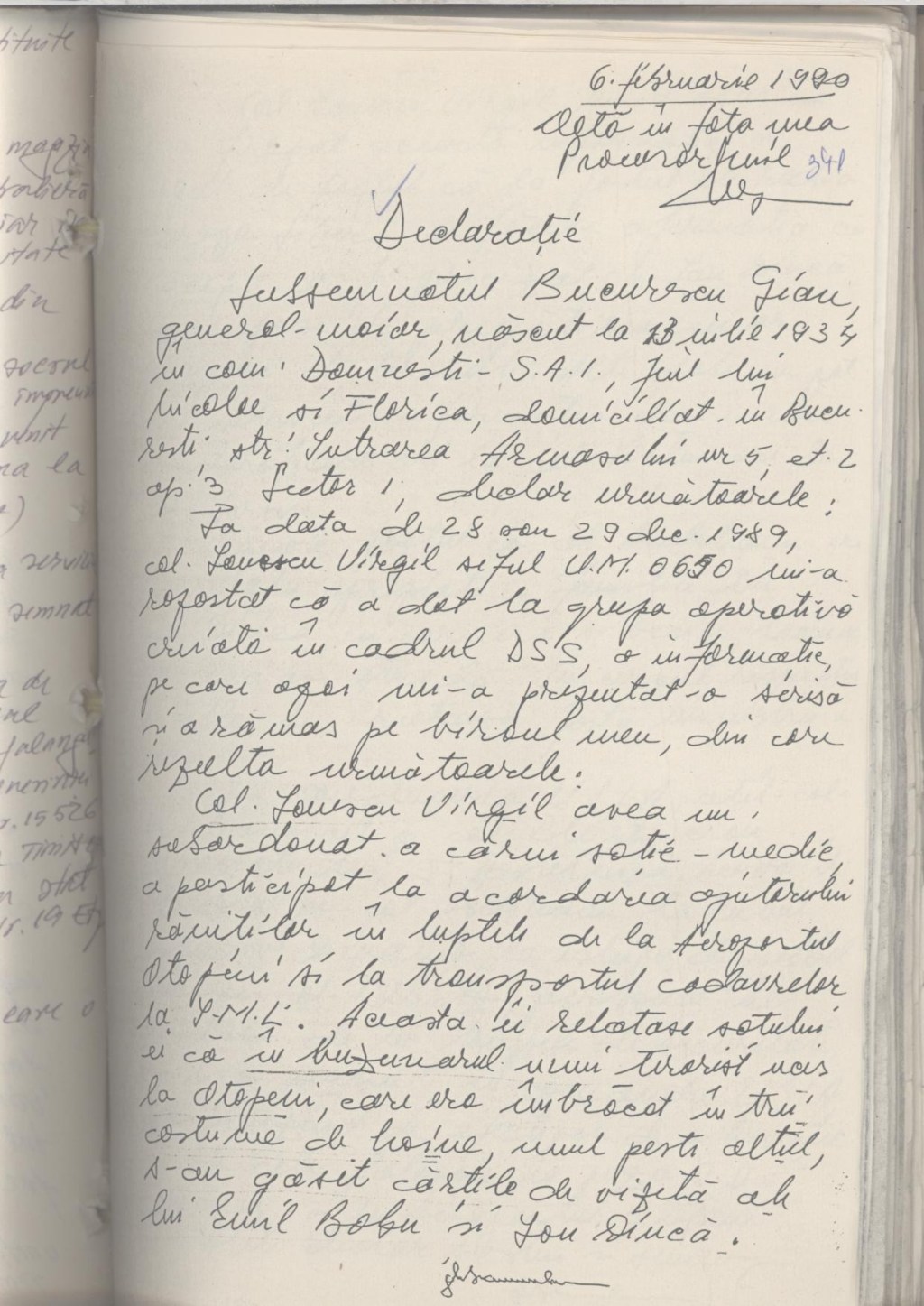
“BUSINESS CARDS” OF EMIL BOBU AND ION DINCA FOUND ON THE BODY OF A TERRORIST WEARING THREE PAIRS OF CLOTHES ONE ON TOP OF THE OTHER KILLED NEAR OTOPENI AND TRANSPORTED TO I.M.L.:  IF THE TERRORISTS DIDN’T EXIST HOW COULD ONE BE FOUND WITH THREE PAIRS OF CLOTHES ON HIM AND WITH THE BUSINESS CARDS OF NICOLAE CEAUSESCU’S HENCHMEN??? !!!

6 februarie 1990

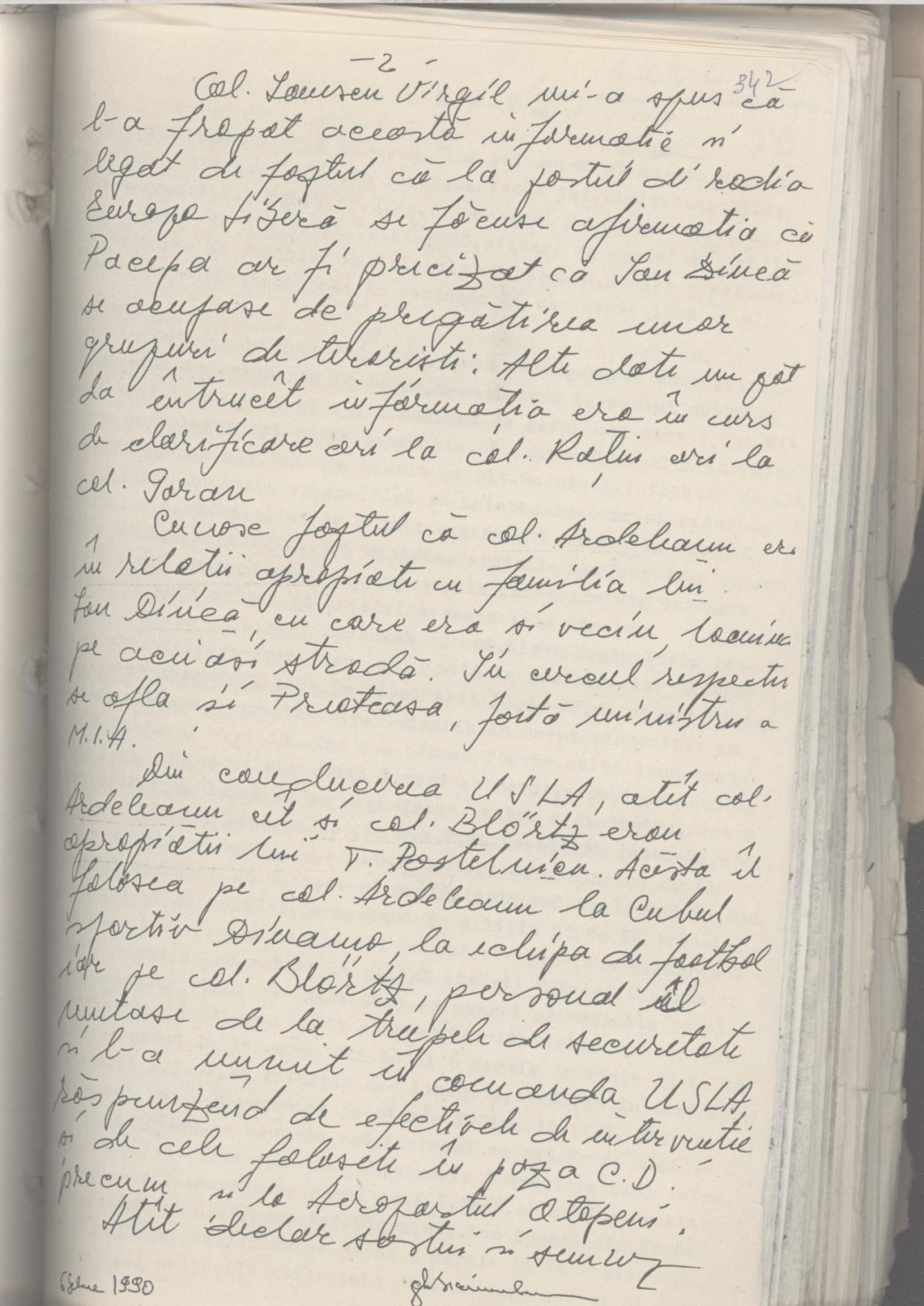
Declaratie.  Subsemnatul Bucurescu Giani, general-maior [D.S.S.]

0436

La data de 28 sau 29 decembrie 1989, col. Lovescu [?] Virgil seful U.M. 0650 mi-a raportat ca…

Col. Lovescu [?] Virgil avea un subordonat a carui sotie-medic a participat la acordarea ajutorului ranitilor in luptele de la Aeroport Otopeni si la transportarea cadavrelor la I.M.L.  Acestea ii relatase sotului ca in buzunarul unui terorist ucis la Otopeni, care era imbracat in trei costume de haine, unul peste altul, s-au gasit cartile de vizita ale lui Emil Bobu si Ion Dinca.

Col. L Virgil mi-a spus ca l-a frapat aceasta informatie si legat de faptul ca la postul de Radio Europa Libera se facuse afirmatie cu Pacepa ar fi precizat ca Ion Dinca se ocupase de pregatirea unor grupuri de teroristi.  Alte date nu pot da intrucit informatia era in curs de clarificare ori la Col. Ratiu [DSS Dir I] ori la Col. Goran [SMB]…

Cunosc [?] faptul ca col. Ardeleanu [sef USLA] era in relatii apropriate cu familia lui Ion Dinca…

Din conducerea USLA atit col. Ardeleanu cit si col Blortz [Bleort] erau apropriatii lui T. Postelnicu

0437

The three pairs of clothes worn one on top of the other–allowing them to adapt to changing situations–was common among those arrested as terrorists, as the following video shows:

About the dead terrorists transported to the IML and their fate thereafter…

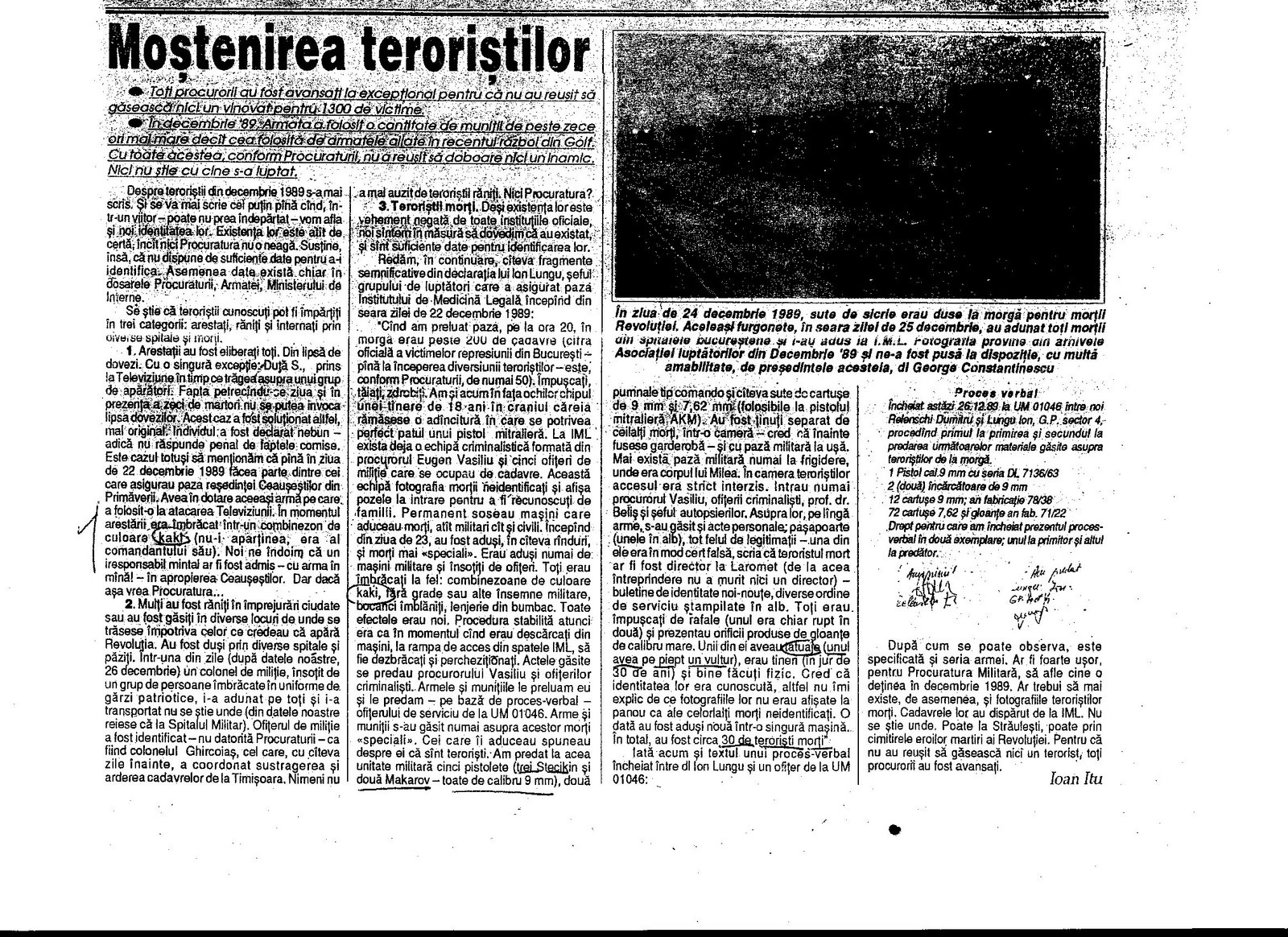
3.  Teroristii morti. Desi existenta lor este vehement negata de toate institutiile oficiale, noi sintem in masura sa dovedim ca au existat, si sint suficiente date pentru identificarea lor.

Redam, in continuare, citeva fragmente semnificative din declaratia lui Ion Lungu, seful grupului de luptatori care a asigurat paza Institutului de Medicina Legala incepind din seara zilei de 22 decembrie 1989:

“Cind am preluat paza, pe la ora 20, in morga erau peste 200 de cadavre (cifra oficiala a victimelor represiunii din Bucuresti–pina la inceperea diversiunii teroristilor–este, conform Procuraturii, de numai 50).  Impuscati, taiati, zdrobiti.  Am si acum in fata ochilor chipul unei tinere de 18 ani in craniul careia ramasese o adincitura in care se potrivea perfect patul unui pistol mitraliera.  La IML exista deja o echipa criminalistica formata din procurorul Eugen Vasiliu si cinci ofiteri de militie care se ocupau de cadavre.  Aceasta echipa fotografia mortii neidentificati si afisa pozele la intrare pentru a fi recunoscuti de familii.  Permanent soseau masini care aduceau morti, atit militari cit civili.  Incepind din ziua de 23, au fost adusi, in citeva rinduri, si morti mai ‘speciali’.  Erau adusi numai de masini militare si insotiti de ofiteri.  Toti erau imbracati la fel:  combinezoane de culoare kaki, fara grade sau alte insemne militare, bocanci imblaniti, lenjerie din bumbac.  Toate efectele erau noi.  Procedura stabilita atunci era ca in momentul cind erau descarcati din masini, la rampa de acces din spatele IML, sa fie dezbracati si perchezitionati.  Aceste gasite se predau procurorului Vasiliu si ofiterilor criminalisti.  Armele si munitiile le preluam eu si le predam–pe baza de proces verbal–ofiterului de serviciu de la UM 01046.  Arme si munitii s-au gasit numai asupra acestor morti ‘speciali’.  Cei care ii aduceau spuneau despre ei ca sint teroristi.  Am predat la acea unitate militara cinci pistolete (trei Stecikin si doua Makarov–toate de calibru 9 mm), doua pumnale tip comando si citeva sute de cartuse de 9 mm si 7,62 mm (folosibile la pistolul mitraliera AKM).  Au fost tinuti separat de ceilalti morti, intr-o camera–cred ca inainte fusese garderoba–si cu paza militara la usa.  Mai exista paza militara numai la frigidere, unde era corpul lui Milea.  in camera teroristilor accesul era strict interzis.  Intrau numai procurorul Vasiliu, ofiteri criminalisti, prof. dr. Belis si seful autopsierilor.  Asupra lor, pe linga arme, s-au gasit si acte personale, pasapoarte (unele in alb), tot felul de legitimatii–una din ele era in mod cert falsa, scria ca teroristul mort ar fi fost director la Laromet (de la acea intreprindere nu a murit nici un director)–buletine de identitate noi-noute, diverse ordine de serviciu stampilate in alb.  Toti erau impuscati de rafale (unul era chiar rupt in doua) si prezentau orificii produse de gloante de calibru mare.  Unii din ei aveau tatuaje (unul avea pe piept un vultur), erau tineri (in jur de 30 de ani) si bine facuti fizic.  Cred ca identitatea lor era cunoscuta, altfel nu imi explic de ce fotografiile lor nu erau afisate la panou ca ale celorlalti morti neidentificati.  O data au fost adusi noua intr-o singura masina.  In total, au fost circa 30 de teroristi morti.”

Iata acum si textul unui proces-verbal incheiat intre dl. Ion Lungu si un ofiter de la UM 01046:

Proces verbal

Incheiat astazi 26.12.89 la UM 01046 intre noi Relenschi Dumitru si Lungu Ion, G.P. sector 4,

procedind primul la primirea si secundul la predarea urmatoarelor materiale gasite asupra teroristilor de la morga.

1 Pistol cal. 9 mm cu seria DL 7163/63

2 (doua) incaracatoare de 9 mm

12 cartuse 9 mm; an fabricatie 78/38

72 cartuse 7,62 si gloante an fab. 71/22

Drept pentru care am incheiat prezentul proces-verbal in doua exemplare, unul la primitor si altul la predator:

(semnaturi)

Dupa cum se poate observa este specificata si seria armei.  Ar fi foarte usor, pentru Procuratura Militara, sa afle cine o detinea in decembrie 1989.  Ar trebui sa mai existe, de asemenea, si fotografiile teroristilor morti.  Cadavrele lor au disparut de la IML.  Nu se stie unde.  Poate la Straulesti, poate prin cimitirile eroilor martiri ai Revolutiei.  Pentru ca nu au reusit sa gaseasca nici un terorist, toti procurorii au fost avansati.

Ioan Itu, “Mostenirea teroristilor,” Tinerama, nr. 123 (9-15 aprilie 1993), p. 7.

——————————————————————————————————————————————————————————————————————————–

(English) From The Romanian Revolution for Dum-Dums

See the signed testimony to the contrary by Ion Lungu and Dumitru Refenschi dated 26 December 1989, reproduced in Ioan Itu, “Mostenirea teroristilor,” Tinerama, no. 123 (9-15 April 1993), p. 7. I translated the important parts of this document in Hall, “Orwellian…Positively Orwellian” http://homepage.mac.com/khallbobo/RichardHall/pubs/Voineaswar091706.html. Significantly, according to this document, Dr. Belis had access to the dead terrorists:

Dead Terrorists. Although their existence is vehemently denied by all official institutions, we are able to prove that they existed and have sufficient details to identify them.…We continue with some excerpts of the declaration of Ion Lungu, head of the group of fighters who guarded the ‘Institute of Legal Medicine’ [IML, the main Bucharest morgue], beginning from the evening of 22 December 1989:

“Starting from the 23rd, there were brought, in succession, more ‘special’ corpses. They were brought only by military vehicles and were accompanied by officers. They were all dressed the same: kaki uniforms, with or without military insignia, fur-lined boots, cotton underwear. All the clothes were new. The established procedure at that point was that when the bodies were unloaded from the trucks, at the ramp to the back of the IML, to be disrobed and inspected. The documents found were released to Prosecutor Vasiliu and criminology officers. The weapons and munitions we found and surrendered—on the basis of a verbal procedure—to the officer on duty from UM 01046. Weapons and ammunition were found only on those ‘special’ corpses. Those who brought them said that they were terrorists. I turned over to this military unit five pistols (three Stecikin and two Makarov—all 9 mm caliber), two commando daggers and hundreds of 9 mm and 7.62 mm cartridges (compatible with the AKM machine gun). They were held separately from the other corpses, in a room—I believe that it used to be the coatroom—with a guard at the door.…

Access to the room with the terrorists was strictly forbidden. Only Prosecutor Vasiliu, criminologist officers, Dr. Belis, and the chief of autopsies could enter. On top of them, next to the arms, there were personal documents, passports (some blank), all types of identity cards—one of them was clearly false, it stated that the dead terrorist was the director at Laromet (at that plant no director died)—identity cards that were brand new, different service stamps in white. All had been shot by rifles (one was severed in two) and showed evidence of gunshots of large caliber. Some had tattoos (they had vultures on their chests), were young (around 30 years old), and were solidly built. I believe that their identity was known, since otherwise I can’t explain why their photographs were attached to those of unidentified corpses. They were brought to us in a single truck. In all, there were around 30 dead terrorists. [The document is signed by Ion Lungu and Dumitru Refenschi on 26 December 1989]”


——————————————————————————————————————————–

Posted in decembrie 1989, raport final, Uncategorized | Tagged: , , , , , | 9 Comments »