Like the “water is poisoned” episode discussed in part III of this series, the claims of TV announcers regarding the threat posed to the Television building is a favorite for Romanians and Romanianists to lampoon:
Once again, Andrei Codrescu captures a widely and wildly popular view of TVR’s alleged role during the December 1989 events:
The Romanian revolution was a complex affair. It was a dramatic triumph that had the whole world for its audience, a world that keeps wondering long after the final curtain how much of what it saw was real. If I hadn’t lost my normally skeptical head to the euphoria of December, I would have questioned the single most evident source of news about the revolution: television. But it was precisely television that seduced me during my visit and made me lose sight of things I already knew….Imagine the shock and dismay of our newsmakers and our idealists–including myself–when most of these horrible events we saw with our own eyes on television turned out not to have happened at all. How could the grizzled, experienced Western journalists who are sworn to hard facts have missed the many clues and glaring contradictions that pointed to artifice? The astounding truth of the matter is that much of the glorious Romanian “revolution” was, in fact, a staged play, a revolution between quotation marks….But it couldn’t have been long after, however, the young revolutionaries (if that’s who they were) started becoming “responsible,” and the “spontaneous” provisional government showed up with its own TV script. The television station then became the headquarters of the new government, which, as far as most people were concerned, was born out of video like Venus out of the seashell. And hats must be off to the producers of the exceedingly realistic docu-drama of the strategic military center from where, in a charged atmosphere reminiscent of Reds or Dr. Zhivago, generals with telephones on both ears shouted orders at troops on vast invisible battlefields in every part of the country. Today I stand abashed by my naivete. Much of that Romanian “spontaneity” was as slick and scripted as a Hollywood movie. If I were in charge of the Emmys, I’d give one to the Romanian directors of December 1989.
As with the “poisoned water” episode, so too with the claimed threats against Television, including the idea that a bomb had been found and disarmed in the basement of the Television building (as can be seen in the above video)…no researcher has attempted to verify the veracity of the claim, until now!
Recently, however, several sources have been unearthed/come to light that clarify what happened. Here, Corneliu N. Vaida of Timisoara recounts how a Securitate member from Timisoara was convinced to call the Television Station in Bucharest to inform them that, as with many other highly strategic buildings in the country, TVR had been mined and an explosion could be set off. It appears that the announcement above about a bomb having been disarmed in the basement of the TVR building, was as a result of this information from Timisoara:
Securistul trădat pentru binele TVR
În seara zilei de 22 decembrie şi-a vizitat mama, care locuia pe bulevardul 6 Martie, unde a găsit în apartament un vecin. Era vorba de Gheorghe Toader, un căpitan în rezervă la Securitate, care se refugiase de frică sa nu fie asasinat.
Urmărind programul “Revoluţiei în direct”, de la TVR, au observat la un moment dat o persoana care ţinea în mână un obiect care semăna cu o tastatură.
“Văzând tastatura, securistul a scos o exclamaţie de teamă: <Vor sări toţi în aer acolo! TVR e obiectiv strategic şi este minat, ca în cazuri extreme să poată fi aruncat în aer, tastând un cod pe aşa un detonator!>. A spus că a lucrat la aşa ceva în Bucureşti într-o intreprindere specială. La isistenţele mele a acceptat până la urmă să scrie o declaraţie anonimă pe care am dus-o personal la armată”, a mai declarat Corneliu Vaida.
Ajuns la Garnizoana Timişoara, Vaida a arătat scrisoarea colonelului Zeca, comandantul garnizoanei. “Acesta a pus mâna pe un telefon şi a sunat imediat la Bucureşti la o structură a armatei căreia i-a relatat continutul declaraţiei, dupa care mi-a cerut sa dezvalui identitatea semnatarului argumentând că acesta mai cunoaşte informaţii care ar ajuta la evitarea de victime”, a adaugat Vaida.
Neavând ce face, a trebuit să meargă cu armata să îl predea pe secursitul din casa mamei. “Înspre dimineaţă am văzut la televizor cum a venit cineva şi a declarat că explozibilul cu care era minată televiziunea a fost dezamorsat”, a mai spus timişoreanul.
The event is also recounted by parachutists in this TVR video from 31 December 1989 that only recently appeared on the internet.
Parasutisti de la R. 64 Pst. Boteni la Televiziunea Romana in 31 decembrie 1989:
Lt. col. Ilie Croitoru, Mr. Chiranescu Ion, Cpt. Radulescu Aurelian, Cpt. Constantin Vlasceanu
Corneliu Vaida has been kind enough to share with me, the following additional confirmation of his actions in the document below:
For more about Corneliu Vaida during the Revolution in Timisoara in December 1989, see his interview with ITN correspondent Penny Marshall on 27 December 1989:
Ioan Itu, “Si ei au luptat in Revolutie. De partea cui?,” Tinerama, 10-16 septembrie 1993, p. 8.
Maior Tudor Petrescu, “Unde ne sint teroristii?” Armata Poporului, nr. 22, 30 mai 1990, p. 3. (S.D. = Silviu Dutu)
Aura Alexa Ioan (cu Adrian Popescu-Necsesti), “Teroristii Revolutiei au certificat de psihopati!” Tinerama, 8-14 octombrie 1996, p. 8
Valentin Gora: Au fost arestati oameni ai securitatii, teroristi. Astazi, nimeni nu stie ce s-a intimplat sa ce se intimpla in continuare cu ei. Dumneavoastra i-ati vazut? Ii cunoasteti?
Petre Constantin: Au fost arestati multi oameni, am mai spus-o, care aveau asupra lor arme de toate felurile, pe toti i-a preluat armata si nu stiu ce s-a intimplat mai departe cu ei. Adjunctul meu, Traian Puscasu, a fost injunghiat in noaptea de 23 spre 24 decembrie, pe hol, la etajul 11. Agresorul, locotenent-colonelul Vasiliu, il viza pe generalul Tudor sau pe mine. Eu am lipsit citeva miunte, generalul Tudor s-a ferit in momentul atacului si a fost lovit Puscasu. Totul se intimpla in usa biroului. Militarii au sarit si l-au imobilizat imediat.
Valentin Gora cu Petre Constantin, “Petre Constantin: Cind a dictat decretul de instalare ? de asediu pe intreg teritoriul tarii, in biroul lui Ceausescu se afla si Eugen Florescu,” Cuvintul, nr. 12, 18 aprilie 1990, pp. 4-5.
425. Parte vătămată Puşcaşu Traian (Televiziune-Vol. 110) Numitul Puşcaşu Traian, fiul lui Gheorghe şi Maria, născut la data de 01.03.1927, în Iaşi, domiciliat în Bucureşti (…) în noaptea de 22/23.12.1989, în timp ce se afla în incinta televiziunii, unde-şi desfăşura activitatea ca director adjunct al TVR, a fost înjunghiat în abdomen cu un cuţit de către lt. col. Vasiliu Cornel, care se afla în dispozitivul de pază al instituţiei respective. Conform raportului medico-legal nr. A1/3409/1990, numitul Puşcaşu Traian a prezentat la data de 24.12.1989 o plagă abdominală penetrantă cu interesarea splinei şi arterei epigastrice. Leziunea a putut fi produsă prin lovire cu corp tăietor-înţepător (posibil cuţit). A necesitat circa 25 zile de îngrijiri medicale. Leziunea i-a pus viaţa în pericol. Prin rezoluţia nr. 1411/P/1990, din data de 15.11.1990, Procuratura Militară Bucureşti a dispus neînceperea urmăririi penale faţă de lt. col. Vasiliu Constantin, sub aspectul infr. prev. de art. 20 rap. la art. 174 C.p., reţinându-se că, în urma expertizării sale psihiatrice, s-a stabilit că a acţionat fără discernământ.
Oh, how Romanians and Romanianists love to invoke or allude to this example! It precipitates laughter: ah the crude manipulation and naivete!
Predictably, this is a favorite of foreign sources on December 1989.
Romanian emigre Andrei Codrescu tells us in his November 1990 article in Harper’s (“Big Chills”) about the wild rumors of December 1989, that the water in Sibiu had allegedly been poisoned, but as he found out at his 25th anniversary high school reunion, he learned how all the rumors had been false: and the water in Sibiu, it was just fine! http://alina_stefanescu.typepad.com/files/big-chills-my-high-school-reunion-in-romania-by-andrei-codrescu-1.pdf
Peter Siani-Davies quotes BBC journalist John Simpson, who had heard similar stories concerning poisoned water during the Iranian revolution of 1979, as noting that “certain ideas appeal forcibly to the self-dramatizing mind of the revolutionary,” to which Siani-Davies adds:
“Indeed, in Romania the wild storytelling to a certain extent was just another consequence of the tumult of the revolution. However, the imagery may have served another purpose….Now, through the tales of horror, they [Romanians] were able to place the evil forces of that [Ceausescu] regime so far beyond the bounds of ‘normal’ society that they were effectively able to distance themselves from the demons of the past. There was also a sense in which it was necessary for the securitate to be so terrible: How else could the years of mute suffering under an enfeebled old tyrant such as Ceausescu be explained and condoned?” (Siani-Davies, The Romanian Revolution of December 1989, p. 160.)
Underlying all of these interpretations and explanations is the assumption that the water never was poisoned, that it was all a baseless rumor.
Surely, one assumes, the rumor has been run to ground…but the truth is, as with so many things about December 1989, it hasn’t…
In fact, there was a basis in reality for what Teodor Brates was saying on TV on the afternoon of 22 December 1989 as the following toxicology report by the Belgian Dr. Aubin Heyndrickx makes clear:
Romania
On December 21, 1989, people drinking from water tank #4 in Sibiu experienced headache, visual disturbances, loss of consciousness, vomiting, etc. These symptoms are all compatible with organophosphate poisoning. The analysis of the water (by gas chromatography) and the determination of the cholinesterase activity of the blood was done in the University of Cluj. The conclusion was that an organophosphate had been used. Atropine sulfate and toxogonin were advised.
As soon as the symptoms appeared among the population, water tank #4 was shut off, rinsed, and cleaned. The people received water from army trucks.
A few days later, there was a fight in Timisoara between the army and Securitate over the water tanks. Poisoning was feared, as had occurred in Sibiu. According to witnesses, the Securitate possesses “all possible chemical warfare agents.”
Toxicologist Aubin Heyndrickx supervised the chemical tests and interviewed the physicians at Central Hospital who treated the patients. From the tests and from the very high dose of atropine required to produce a response, he concluded that the tank was poisoned with sarin or VX (Report on the Humanitarian Mission to Romania, December 23-29, 1989, Laboratoria voor Toxicologie Criminalistiek, State University of Ghent).
Indeed, one can watch a brief discussion of the incident with Dr. Heyndrickx beginning at approximately the 40 second mark from an ITN broadcast of 27 December 1989
}T27128901   ROMANIA: SIBIU AFTER THE REVOLUTION: United Nations medical
27.12.89     relief team arrives in Sibiu with medical supplies and blood
TX           to treat the people who were injured during the fight against
             Securitate (secret police). Toxicologists have found evidence
             that the security police poisoned the water supply. Injured
             Securitate are being treated in hospitals alongside the people
             they shot.
}T27128901   ROMANIA: SIBIU AFTER THE REVOLUTION: United Nations medical
27.12.89     relief team arrives in Sibiu with medical supplies and blood
TX           to treat the ...
Duration: 00:01:44 |
Timecode – In: 00:00:00:00 Out: 00:01:44:00 |
Copyright: ITN / 3rd Party Copyright
I have found evidence of discussion of Heyndrickx and his toxicology report in the Hungarian press of the time, but significantly, to date, I have been unable to find discussion of it in the Romanian press!
Nepszabadsag, 30 December 1989, p. 3 citing a UPI dispatch, apparently P. Green, “French team confirms poison in water supply,” UPI, 29 December 1989.
Nagyszeben – ideggáz
Bukarest, 1989. december 29. péntek (UPI) – A Ceausescu-párti terrorosztagok ideggázt vegyítettek a romániai Nagyszeben víztárólóiba a forradalom első napjaiban – ezt egy francia-belga orvoscsoport egyik tagja mondotta el a UPI hírügynökség tudósítójának. Auvin Heyndrickx szerint a szennyezett ivóvíztól öten súlyos mérgezést szenvedtek.Mikor a felkelés vezetői felfedezték a szabotázst, azonnal
leengedték a mérgezett vizet a tárolóból – mondta a belga orvos, aki
az ,,Orvosok – határok nélkül,, nevű francia segélyszervezet
tagjaként utazott a városba. A toxikológus Heyndrickx
megállapította, hogy a vízkészletbe két súlyosan mérgező, folyékony
állapotú ideggázvegyületet öntöttek még december 20-án. Az orvos
elmondta azt is, hogy az eddig ismert öt sérült agykárosodást is
szenvedett a mérgektől. A megbetegedések ilyen viszonylag alacsony
számát a belga szakértő annnak tulajdonítja, hogy a víztárolóban a
mérgező anyagok szerencsére rendkívüli mértékben felhígultak.+++1989. december 29., péntek 07:57
It is thus with justification that in my dissertation in 1997 and in a reiteration of the dissertation views in 2007, I defended TVR personnel by pointing out the extent to which they went to intervene and inform the population when it was safe to drink the water again. (for a glimpse into the eternal “appreciation” I received for pointing out the latter, see http://atomic-temporary-3899751.wpcomstaging.com/raport-final-cpadcr-iiccmer-si-revolutia-din-1989/)
In their discussion of the Romanian transition, Linz and Stepan note the “[r]umors of deliberately poisoned water supplies, of 10,000, 60,000, even 100,000 dead, filled the news channels and streets” and conclude that “disinformation played an important role in the events.”[45] They have in mind, however, the idea that this disinformation was disseminated in order to help the Front seize power. This, of course, echoes the dominant view on this theme. As we saw in the preceding chapter, both Securitate and opposition sources maintain that disinformation pervaded the December events, and they uniformly attribute it to the Front and the Front’s supporters at television, and, in some cases, to foreign actors such as the Soviet Union.
Yet there has been very little effort to investigate the context in which particular rumors originated and the relationship between actual events and those rumors. Take, for example, this rumor alleging the poisoning of the water supply which is so frequently invoked by both domestic and foreigner observers. To what are they referring? Around 3 p.m. on the afternoon of 22 December–therefore approximately three hours after the Ceausescus had fled Bucharest–television commentator Teodor Brates began to issue periodic, sometimes frantic reports about fighting between the Army and the Securitate in the city of Sibiu and about rumors that the water supply had been poisoned by the Securitate. Here are some excerpts of what Brates said on television on that afternoon:
One moment, please…from Sibiu it has been communicated to us that the army no longer has ammunition and the Securitate troops continue to attack military units….We want to inform you that in Sibiu, military units are urgently requesting help…We are constantly receiving communications…of course, we do not have the possibility to verify their authenticity…but we ask for your attention…It is said that these enemy elements, the securisti, have poisoned the water in Sibiu, in Timisoara,…the water must be boiled before being consumed.[46]
[45].. Linz and Stepan, “The Effects of Totalitarianism-cum-Sultanism,” 345-346.
[46].. See the text of the transcript, Revolutia Romana in Direct (Bucharest: Televiziunea Romana, 1990), 47, 48, 51.
2007: Linked to the allegations of supposedly intentionally hyping the threat posed by the “terrorists” is the certitude with which many Romanians and Romanianists assert that TV personnel (especially Teodor Brates) intentionally spread rumors about the water being poisioned and the army running out of ammunition in Sibiu etc.–rumors that proved to be unsubstantiated. Here is what they likely remember:
“One moment, please…from Sibiu it has been communicated that the army no longer has ammunition and the Securitate troops continue to attack mili tary units….We want to inform you that in Sibiu, military units are urgently requesting help…We are constantly receiving communications…of course, we do not have the possibility to verify their authenticity…but we ask for your attention…It is said that the enemy elements, the securisti, have poisoned the water in Sibiu, in Timisoara…the water must be boiled before being consumed.” (from the transcript of 22 December 1989 in “Revolutia Romana in Direct” (Bucharest: 1990), pp. 47, 48, 51, quoted p. 324, Richard Andrew Hall, 1997, Ph.D. Dissertation, “Rewriting the Revolution: Authoritarian Regime-State Relations and the Triumph of Securitate Revisionism in Post-Ceausescu Romania”)
What they don’t remember is that Brates returned later to inform the audience a) when the fighting had ceased in Sibiu, b) when supplies of bottled water were on their way to Sibiu, and c) when the competent authorities verified that the water in Bucharest was safe to drink (“Revolutia Romana in Direct,” pp. 71, 72, 75, discussed p. 327 Hall, “Rewriting the Revolution”) This is there…in the transcript of what was said on Television…it is not a matter of a “difference of opinion” as the likes of Tismanenau and others in denial would have us believe. It is the old saw from American baseball: as the famous manager Casey Stengel used to say “You can look it up!” Once again: if your goal is “diversion,” intentional panic and manipulation, is it likely that you would return to the same subjects and say things designed to calm fears? Of course, not.
Myth 1: The “Timisoara Syndrome” or the “False Timisoara Grave (the Paupers Cemetery)/Massacre”
Myth 2: The water is posioned! (Apa este otravita!)
Myth 3: The Romanian Television building is in danger, danger of an explosion! (TVR e in pericol–Pericol de explozie!)
I will address two aspects of Myth no. 1 below: 1) the presumed intentionality of the digging up of corpses unrelated to the Timisoara repression (the Paupers Cemetery, 22 December 1989) with intent to disinform public opinion (domestic and foreign) and 2) that the ultimate false character of the Timisoara Paupers Cemetery episode is evidence of the absence of a true Timisoara massacre.
Let us mention some examples. The reports and horrifying images of the mass grave “discovered” in Timisoara are still a vivid memory; they came several days after the repression of the mid-December demonstrations against the reassignment of the ethnic Hungarian pastor Laszlo Tokes. The demonstrations were followed by riots, which gave the initial push to the Romanian “revolution.” The newspapers reported that 4,630 corpses had been discovered. Several months later, it was learned from doctors’ accounts that some thirty of the corpses shown “exhumed” by television around the world had been stolen from the city morgue and hospitals in the night of December 21–22. Disconcertingly, the “mass grave” may have been constituted after its discovery was announced the day before by East German and Hungarian press agencies. To this day, no one has been able to establish firmly who organized this staging, and precisely to what ends. As far as the purpose of the “grave” is concerned, several interpretations were put forth and supported: to bring about a revolt in the country; to raise the greatest possible indignation on the international level in order to make the leaders of the coup accepted and acclaimed; or to make the Securitate, which was blamed for the carnage, the incarnation of all the Ceausescu regime’s evils, in order to better clear the army and its leaders, who joined the side of the new government, or essentially constituted it. It was later learned that it was the army, and not the Securitate, which opened fire.
Andrei Codrescu, well-known poet and National Public Radio commentator, (The Hole in the Flag. A Romanian Exile’s Story of Return and Revolution (New York, William Morrow and Company, 1991, pp. 203-204) recounts the same incident in this memorable description:
“The Romanian ‘Revolution’ was entirely televised, all those of us who believed for years with Gil Scott-Heron that ‘the revolution will not be televised’ were shaken by it. In truth, there were two revolutions: a real revolution that was not televised and that continues, particularly in Timisoara, and a studio revolution that fooled the entire world. Who could forget the piles of corpses stacked like cordwood in front of the Timisoara cathedral?…Or the image of the mother and child shot with a single bullet, lying in the arms of death? Watching these images in New Orleans via CNN, I was moved and enraged, along with millions of others in the world. We now know. The mass graves discovered in Timisoara and presented to the world as proof of the Hitlerite insanity of Securitate were in fact bodies dug out of a pauper’s cemetery with autopsy scars visible. Many of them were in an advanced state of decay…And the extraordinary picture of the mother and her baby killed with the same bullet, seen thousands of times on all the world’s TV screens, was a gross collage. A woman who had died of alcoholism had had an unrelated dead baby placed on her chest for video purposes.“
In 1999, journalist John Sweeney recounted the incident in The Guardian as follows:
Eighteen bodies lay beneath an electricity pylon on white plastic sheets in the pauper’s cemetery, naked to the sky. The stink of the dead hung in the pre-dawn air; nearby were the graves from which they had been disinterred. The bodies were soiled by the dirt from the graves, their nudity obscene. On one woman’s stomach lay a perfectly formed foetus, its skin stained an unnatural purple, as if it had come from a jar. Thirty paces away lay the corpse of what looked like an old man, his feet bound by twisted wire: tortured? Nineteen corpses in all. It was Timisoara, Saturday, 23 December, 1989, and the news agencies were saying 4,000, 40,000, 60,000 dead. Where were the mass graves?
There was something strange – unsatisfactory – about the 19 bodies. Eight corpses had stitches in their stomachs, perhaps from autopsies; some of the rest were so badly decomposed the flesh had rotted from the bones. They did not look like they had been killed the previous Sunday, the flashpoint of the Romanian revolution.
Not 60,000 dead in Timisoara, but 19, and fishy at that. My reward for reporting this was a tiddly piece on page three. News desk lionhearts like big numbers from reporters sent to cover mass murder.
Barely 10 years earlier, despatched to Timisoara to view some old corpses dug up by the propaganda department of the new Rumanian regime, a journalist from the France 2 television channel had commented, “These pictures are here to prove that 4,630 people died at the hands of the secret police” (22 December 1989).
“Neroziile spuse atunci vor rămâne în antologia dezinformării. Unele erau minciuni sfruntate (povestea cu robineţii de aur), altele făcături ordinare (cadavrele din sceneta „mama şi copilul” nu aparţineau unor martiri ai Revoluţiei şi nici nu erau victime ale represiunii ceauşiste, ci zăceau de prin noiembrie în Cimitirul săracilor din Timişoara, fiind dezgropate doar pentru şedinţa foto-video).”
Finally, this episode has become immortalized in postmodernist literature, thanks to its invocation and development by Jean Baudrillard, as follows:
“The Timisoara Syndrome”
Jean Baudrillard (trans. Chris Turner), The Illusion of the End (Cambridge, Polity Press, 1994), pp. 54-61 “The Timisoara massacre.”
p. 55 “It was not the dead that were the scandal, but the corpses being pressed into appearing before the television cameras, as in the past dead souls were pressed into appearance in the register of deaths.”
p. 60 “And yet there will, nonetheless, have been a kind of verdict in this Romanian affair, and the artificial heaps of corpses will have been of some use, all the same one might ask whether the Romanians, by the very excessiveness of this staged event and the simulacrum of their revolution, have not served as demistifyers of news and its guiding principle…Who can say what responsibility attaches to the televisual production of a false massacre (Timisoara), as compared with the perpetrating of a true massacre?”
The idea about “some old corpses dug up by the propaganda department of the new Rumanian regime,” that Novi Sad TV journalists (presumably then, according to this conspiracy theory, Yugoslav agents), or, most ridiculous of all, Securitate agents themselves, were responsible for digging up and presenting the corpses from the Paupers’ cemetery (all views that have gained expression through the years) is simply WRONG.
How do we know? From what eyewitnesses have described. Here 30 yr. old Ion Gogoara described in Titus Suciu’s Raport cu Sufletul la Gura (1990) that the makeshift grave in the Paupers’ cemetery was found by kids, that when he got there there were about 30 people gathered placing candles, and that all this took place at about 10:30 or 11 am on the morning of 22 December 1989, thus before Ceausescu’s flight from power (but at a time when Timisoara was long already beyond the regime’s control).
Indeed, it was those missing loved ones who were the first to the Paupers Cemetery
Virgil Botoc told Marius Mioc in 1995 how, on 22 December 1989, he was searching frantically for his 13 year old daughter Luminita and how, he and others participated in the removal of the corpses and put them on some sheets. As Mioc has noted, precisely because many of those who had lost loved ones in the repression of the previous days did not know yet that many corpses had been transported from the hospitals and morgue to be incinerated, they looked frantically anywhere they could, including the Paupers’ cemetery.
Botoc Virgil (tatal lui Luminita Botoc) In 22 dimineata la cimitirul saracilor s-au dezgropat niste morti. Am fost si eu acolo sa vad daca n-o gasesc pe Luminita. Aici era o groapa comuna, o alta groapa cu un singur mort si inca un mort in capela. Mortii fusesera ingropati dezbracati. Unii erau cusuti cu sirma, cel din capela avea si picioarele legate cu sirma. Am scos mortii, i-am pus pe niste cearsafuri. http://timisoara.com/newmioc/33.htm
Marius Mioc: “Filmarea din 22 decembrie a fost cu cadavre dezgropate din cimitirul săracilor. Aceia nu erau morţi din revoluţie ci sărăntoci fără familie îngropaţi pe cheltuiala Primăriei. Familiile celor morţi în revoluţie, care nu găseau cadavrele celor dragi (fuseseră incinerate, dar nu se ştia asta pe atunci), în disperare au căutat pe unde le-a trecut prin minte, şi au dezgropat şi morţii de la cimitirul săracilor. S-a crezut atunci sincer că aceia sînt morţi din revoluţie.” http://piatauniversitatii.com/forum/viewtopic.php?t=974
So, we have our answer to the first part of Myth no. 1: The only intentionality of those who dug up the corpses in the Paupers Cemetery was that those looking for their loved ones were frantically searching everywhere and anywhere for traces of them. (That the Paupers Cemetery was then linked to, or interpreted through the lens of inflated and erroneous death tolls (for a discussion of these, please see the following, courtesy of William Totok, http://www.halbjahresschrift.homepage.t-online.de/neumann.htm) and the widespread view of the dictatorship of Nicolae Ceausescu as (late) communism in its highest stage, is ultimately a different story.)
Perhaps worst of all, while the Paupers cemetery on 22 December 1989 and the “Timisoara syndrome” have become part of an international literature on journalistic manipulation and/or error, those who invoke this example tend to be oblivious to the real mass grave of victims from the Timisoara uncovered in mid-January 1990 (including, Virgil Botoc’s 13 year old daughter Luminita)
FBIS (AFP 16 January 1990, lower right column):
Marius Mioc has detailed this episode extensively as follows:
“Renaşterea Bănăţeană” din 16 ianuarie 1990 despre groapa comună din cimitirul eroilor:
Al şaptelea fragment din filmul “Povestea Timişorii” realizat de Mihai Tatulici şi Virgil Tatomir şi difuzat în 1991 la TVR. În acest fragment am combinat 3 fragmente diferite din filmul original, pentru a avea un articol explicativ complet despre problema gropii comune din cimitirul eroilor din Timişoara. Deci există o oarecare abatere de la succesiunea din filmul domnilor Tatulici şi Tatomir, pe care am considerat-o necesară pentru a înlesni analiza problemei gropii comune a revoluţiei din Timişoara. La sfîrşitul serialului, cînd voi da şi playlistul complet, cei interesaţi vor putea vedea filmul aşa cum a fost el prezentat iniţial. La transcrierea înregistrării comentariile mele ulterioare sînt inserate în text cu litere cursive, între paranteze drepte.
Transcriere înregistrare:
00:00 Virgil Boţoc: În timpul ăsta a trecut o mulţime de oameni. Pur şi simplu nu i-am putut să-i văd cîţi or fost. Şi strigau diferite plancarde. Şi atuncea fata aia mai mare vine la maică-sa: “mămică, mergem şi noi”. “Nu mergi niciunde”. În timpul ăsta o trimis la mine fata că-i dau voie. Aia mică o luat fîşul de pe cuier şi o coborît jos. Şi atuncea îmi zice sora ei geamănă: “tăticule, Luminiţa o coborît jos”. Zic: “noi avem ceva de făcut”. Cînd ajung jos (neînţelegibil) plecase. Cînd am ajuns în Calea Lipovei, în spatele bisericii, s-or tras focuri de avertisment de la aviaţie, roşu, şi i-am zis lu’ nevastă-mea: “fii atent că se trage”. Zice “nu se trage”, şi atunci au început focuri. După care am văzut că fata n-o venit toată noaptea acasă. M-am dus în zonă, dimineaţă. În zonă, că acolo locuiesc, m-am întîlnit cu mulţi prieteni, şi m-am interesat. Din care m-am întîlnit şi cu prietenul ăsta, Avădanei, care a lucrat cu mine foarte mulţi ani. Şi-l întreb “mă Ştefane, s-o tras? Ce-i pe aicea?”. Că plouase, nu s-o cunoscut nici un semn, nimic. Zice “mă, s-o tras”. Ce, eu uite mi-o dispărut fata. Zice “cu ce-o fosta asta a ta îmbrăcată?”. “C-un fîş roşu, aşa”. Zice “uite aici o fost împuşcată mortal. Eu, zice, am luat-o, am pus-o pe bancă, şi banca o fost îngustă şi i-a legat mîinile cu o sfoară, cu ceva, ca să nu i se rupă mîinile”. Zice “du-te la Clinicile Noi”. Am fost la Clinicile Noi, am vorbit cu autopsierul, am mers cu fata geamănă, cu sora ei, îmbrăcată într-aceeaşi formă. Şi întreb pe autopsierul: “domnu’, nu vă supăraţi, o fost o fată adusă aicea?”. Zice “da”. “Şi dac-o vedeţi, o cunoaşteţi?”. Zice “da”. Zic “îi asta sau nu-i asta?”. Zice “cum Dumnezeu, astă fată o fost împuşcată în inimă”. Zic “nu, sora ei”. “Bă, dacă veneai cu juma’ de oră, o găseai aicea, da-i plecată [spitalul] judeţean”. Atunci m-am dus la morgă la judeţean, am întrebat, m-am întîlnit cu, adică, cu asistenta, asistenta mi-o spus “vorbeşti cu domnul doctor Dressler”. Domnul doctor Dressler o spus că nu este nici un mort în morgă şi nu lasă pe nimeni în morgă. În timpul ăsta vine domnul locotenent major Rosu, nu mai ştiu exact cum îi zice pentru că el a fost cu paşapoarte pentru plecare în străinătate. Şi am fost plecat în Libia. El pe mine, eu pe el l-am cunoscut, el pe mine nu m-a cunoscut. Şi mi-o pus arma la cap: “Ce faci mă aici scandal?”. Şi atuncea zic “domnu’ Rusu, dumneavoastră pe mine nu mă cunoaşteţi, dar eu pe dumneavoastră vă cunosc”. Şi atuncea o lăsat arma. Mai era un militar care citea o carte. În fine, era cu o carte în mînă, cam aşa ceva. A doua zi iară, a treia zi iară, nici un…, n-am putut să rezolv nimica.
02:43 Virgil Tatomir: S-a încercat să vi se dea un certificat de deces pe care scria că fata dumneavoastră ar fi suferit şi ar fi murit de hepatită?
02:52 Virgil Boţoc: Da. Da, şi atuncea, da, mi s-a eliberat aşa ceva, un certificat din ăsta, şi atuncea am fost nevoit să mă duc, să scot adeverinţă de la şcoală precum că fata mea n-o fost bolnavă şi nici nu ştiu unul din familia lu’ Boţoc, că asta a fost şi discuţie cu domnul doctor Dressler, că să-mi arăte cel puţin o internare a unui din familia lui Boţoc de diagnosticul de hepatită cronică, cum o scris acolo. N-am putut să dau nici de un rez…, n-am putut să aflu nimica.
03:20 Virgil Tatomir: Aţi apelat la sprijinul procuraturii?
03:22 Virgil Boţoc: Da. Am fost la domnul procuror [Romeo] Bălan, am dat declaraţii, am lăsat fotografii. O spus că să am răbdare, că sînt 61 de indivizi arestaţi şi sînt în anchetă. Şi atuncea poate o recunoaşte vreunul că-i dusă la Bucureşti la cremator[procurorul se referea la cadavrele furate din morga spitalului şi arse la crematoriul din Bucureşti (linc), între care bănuia că se află şi Luminiţa Boţoc]. Şi în 15 ianuarie cînd am fost ultima dată, o spus, dimineaţa, o spus că mai sînt 3 de anchetat şi să viu peste două sau trei zile. Şi cînd m-am dus la lucru am aflat că s-or dezgropat morţii în groapa comună (neînţelegibil). Şi atunci am fost şi mi-am recunoscut fata. Am ridicat-o de acolo, am îngropat-o creştineşte.
03:57 Virgil Tatomir: Vi s-a eliberat un nou certificat de deces.
03:59 Virgil Boţoc: Da, mi-a eliberat un nou certificat, moartă în revoluţie.
04:03 Comentariu Mihai Tatulici (pe fondul unor imagini filmate la ansamblul memorial din cimitirul eroilor din Timişoara consacrat victimelor revoluţiei): Virgil Boţoc şi-a pierdut fiica în 17 decembrie 1989. Ucisă pe stradă. A regăsit-o, a regăsit cadavrul ei, în ianuarie, în groapa comună. E printre cei fericiţi, care şi-au putut îngropa creştineşte copilul. Povestea aceasta este însă doar un crîmpei din trista şi dramatica istorie a morţilor Timişoarei. Tot aşa cum pentru morţi s-a ieşit în stradă, tot aşa trebuie să ţinem la aflarea adevărului. Virgil Boţoc îi face acum mormînt frumos fiicei sale. Cine nu respectă morţii, n-are nici un Dumnezeu. [aici se încheie prima parte din filmul prezentat, dar continui cu un fragment din a 2-a parte, legat tot de problema gropii comune]
05:04 Comentariu Mihai Tatulici (pe fondul unor imagini filmate în cimitir, la dezgroparea unor morţi): Sînt încă multe întrebări la care trebuie să răspundă justiţia, în ceea ce priveşte morţii Timişoarei. Aceste întrebări trebuie repede adresate unor oameni care încă sînt vii şi ştiu. Măcar pentru a linişti spiritele, pentru a risipi confuziile. Cum e cazul gropii comune din cimitirul săracilor. Gazetari nedocumentaţi şi persoane fără competenţele necesare au isterizat mulţimile prezentînd aici orori care nu se confirmă. Am avut ocazia să citim puncte de vedere ale unor medici legişti de talie internaţională. Trebuie analizate şi referinţele doctorului Dressler. Condamnarea publică fără argumente e la fel de păguboasă azi ca şi înainte de decembrie 1989. Aceste lucruri trebuie exact prezentate de procuratura militară Timişoara, care deţine informaţii exacte, tocmai pentru a le delimita de cele reale şi extrem de grave.
06:09 Virgil Tatomir: Timişoara continua să îşi caute cu înfrigurare morţii revoluţiei. O făcea şi cu speranţa că odată cu găsirea celor care nu ajunseseră la crematoriu, se va dezgropa şi adevărul. Această deshumare s-a efectuat în 15 ianuarie 1990 în cimitirul, în urma insistenţelor unui părinte îndurerat, Virgil Boţoc, carre îşi căuta fata şi cu care aţi făcut cunoştiinţă în episodul trecut. Cîteva lucruri se impun a fi aici accentuate, şi bune şi rele, pentru că s-a iscat multă vîlvă în jurul acestui caz. Înhumarea într-o groapă comună a unui număr de 9 cadavre s-a făcut destul de tîrziu, în 28 decembrie. S-a susţinut că morţii erau încă neidentificaţi pînă la acea dată. Dacă după victoria revoluţiei a recurge la o groapă comună rămîne o faptă de neacceptat, cel puţin din punct de vedere moral, trebuie spus că în baza datelor cunoscute pînă acum s-au însăilat şi erori. Între care unele aruncate intenţionat sau nu, direct sau indirect, pe seama doctorului Dressler [pe atunci, şeful laboratorului de medicină legală din Timişoara] şi a şefului administraţiei cimitirelor. Izvorîte din cunoaşterea incompletă a unor situaţii şi date, ele trebuie detaşate de adevăr.
07:37 Axente Bociort[pe atunci, şeful administraţiei cimitirelor din Timişoara]: Pe data de 27 decembrie 1989, am ridicat de la spitalul judeţean, din morgă, 11 cadavre între care 9 au fost neidentificate iar 2 identificate. Am ajuns la cimitirul eroilor. Aceste cadavre au fost depuse în capelă, urmînd ca în data de 28 cadavrele neidentificate să fie înhumate. Din lipsă de groapri, şi situaţia, întrucît se trăgea prin cimitir, nu am reuşit să facem groapa cu personalul existent şi s-a apelat la excavatoristul Miron Alexandru, care a săpat groapa comună, urmînd ca să se facă slujba religioasă de părintele Micu Constantin. Şi înhumarea celor 9 cadavre neidentificate s-a făcut în groapa comună respectivă.
08:49 Virgil Boţoc: Într-adevăr, erau 8 cadavre, din care 3 erau în sicrie şi retul în lăzi. Şi buldozeristul care-o săpat groapa era acolo mort, că l-or recunoscut părinţii. Erau din Suceava. După ce-o săpat groapa, că chiar aşa o fost, şi aia este martori, şi şeful cimitirului poa’ să spuie lucrul ăsta, a avut şi cheile de la buldozer pe piept. Şi a avut singura lovitură în partea stîngă, nu, în dreapta, a avut gaură în dreapta, aici [arată de fapt spre tîmpla stîngă].
09:19 Comentariu Mihai Tatulici: Respectînd durerea unui copil care şi-a pierdut un copil în revoluţie, trebuie totuşi să facem necesarele precizări: Domnul Boţoc nu are argumente că i s-ar fi eliberat un certificat de deces prin hepatită. Cu aceeaşi uşurinţă, preia şi alte zvonuri. Cum să afirmi, liniştit, că un om e mort, cînd el e viu? Chiar dacă la Timişoara s-a spus că în acea groapă se afla şi excavatoristul care a făcut-o. Cînd e mult folclor, rămîne puţin loc pentru adevăr.
09:49 Alexandru Miron (excavatorist): În data de 28 decembrie 1989 am fost solicitat să fac acest lucru în cimitirul eroilor. Să sap o groapă comună pentru înmormîntarea mai multor cadavre care erau, n-avea cine să le înmormînteze. Şi am fost solicitat şi am făcut lucrul acesta. După cum vedeţi, mă aflu aicea viu şi nevătămat, n-am avut nici o problemă, nimic absolut. Şi cam asta este situaţia.
10:27 Comentariu Virgil Tatomir: S-au făcut ulterior morminte îngrijite, iar arhitectul Alămureanu a conceput şi un monument pe măsură [monumentul eroilor revoluţiei din cimitirul eroilor, prezentat în filmare, este făcut după schiţele domnului Pompiliu Alămureanu, care după revoluţie a ocupat pentru scurt timp şi postul de primar al Timişorii]. Dar ele nu ţin încă loc de adevăr, ci numai de aducere aminte. Fiecare martor are adevărul lui. Cert e că din momentul în care s-a vărsat sînge, drumul era fără întoarcere. Mămăliga explodase!
The disjuncture, between the allegedly intentional presentation of a “false grave” connoting an allegedly “false massacre”–the widely-mediated, so-called “Timisoara Syndrome”–with the reality of a real mass grave of massacre victims found the next month but with little (domestic or foreign) mass media coverage, leads me here to propose the term, “The ‘Timisoara syndrome’ syndrome” or when a postmodernist conclusion is sufficiently intellectually-enticing that it creates its own reality–and thereby frames, discourages, and obscures any further search for reality.
Posted by romanianrevolutionofdecember1989 on December 21, 2013
Revisiting the Myths* of the Romanian Revolution. Part I: The Hegemony of Conspiratorial and Postmodernist Explanations
This is the theoretical introduction to a three part series (Parts II-IV) which will follow:
Myth 1: The “Timisoara Syndrome” or the “False Timisoara Grave (the Paupers Cemetery)/Massacre”
Myth 2: The water is posioned! (Apa este otravita!)
Myth 3: The Romanian Television building is in danger, danger of an explosion! (TVR e in pericol–Pericol de explozie!)
Two scholars of comparative political science, Juan Linz and Alfred Stepan, essentially captured what has been the dominant trend in studies of the overthrow of the communist regime of dictator Nicolae Ceausescu in December 1989 when they opined: “any primarily narrative account is necessarily unsatisfying, what we need, rather are studies of the dynamics of myth creation and the functions of disinformation–a deconstruction of the revolution itself” (Linz and Stepan, p. 346.).
In stating things in this manner, Linz and Stepan drew attention to the two primary trends in studies of December 1989, what I have chosen to call: 1) Conspiratorial (“studies of …the functions of disinformation”) and 2) Postmodernist (“studies of the dynamics of myth creation”). Both of these research trends developed as early as 1990 and have arguably dominated the field of study ever since.** I break them down here as follows:
1) Conspiratorial. These explanations attribute intentional actions to interested parties, ranging from foreign security services to domestic political officials and military officers. Disinformation, lies, and manipulation, rather than misunderstanding, dominate in these conspiratorial accounts. Such accounts are rife with an almost unbounded or unconstrained voluntarism and agency. The focus is heavily on the “supply-side” (producers) of myth. Examples of this approach include: Michel Castex, Radu Portocala (and Olivier Weber), and Andrei Codrescu.
2) Postmodernist. Postmodernism is premised on the a priori existence of pluralities. There isn’t a single Truth with a capital T, as conspiratorial accounts suggest; there are multiple “truths” with a little t and preferably quotation marks or italics. These explanations question the notion of singular, objective “truth” as suggested by conspiratorial accounts, and thus emphasize subjectivity. Individuals are less agents, than subjects, situationally-bounded and contextually-informed, in constructed realities, and hence likely to fall victim to and to produce misunderstandings. Although postmodernist accounts address both the supply and demand sides of myth creation, what sets it apart is probably the energy and time devoted to the focusing on the demand side, in other words on audience. Examples of this approach include: Katherine Verdery and Gail Kligman, Peter Siani-Davies, and Ruxandra Cesereanu (whose book is appropriately titled, December 1989: The Deconstruction of a Revolution, and who has associated articles posted to the site of the equally-appropriately named “Center for Imagination Studies,” for example, http://phantasma.ro/wp/?p=934&lang=en )
Linz and Stepan perhaps captured the essence of the postmodernist trend in analyzing Verdery and Kligman’s account of the events of 1989-1990: “...[Verdery and Kligman] have sifted through the supposed facts and evidence, and they know all the literature, but their concern is with the very terms by which the events in Romania were experienced, described, and understood: the miners, the demonstrators, the front, the revolution, neo-communism. This makes for a lot of italics, but is illuminating.” (Linz and Stepan, p. 346). An emblematic passage from Verdery and Kligman’s approach comes on page 139 (in Banac, ed.) of their article: “Indeed, we question the coherence and unity of all groups named in one or another interpretation–the “Army,” the “Securitate,” the “Front,” and so on. Such unifying labels are unsuited to describing groups with fuzzy boundaries, internal conflicts and fissures, and constantly changing coalitions.” Indeed, Verdery and Kligman make abundantly clear from the opening line of their November 1990 essay, that they are already jaded and frustrated by the question, “What ‘really happened’ in Romania in December 1989, when the twenty-five year rule of Nicolae Ceausescu was violently overthrown? (Banac, ed., p. 117). That they put “really happened” in quotation marks in itself foreshadows and tells much about their approach.
The differences between these the conspiratorialist and postmodernist perspectives can be seen in how they treat the three myths that form parts II – IV of this series. None of these three myths, I would argue, is central to the understanding of December 1989, but they are reasonably well-known among Romanians, Romanianists, and journalists and academics who study the region. The conspiratorial account suggests journalists and agents from the security services/communist party in Romania and perhaps from other East European countries intentionally fabricated the myths of a Timisoara mass grave of those killed in an alleged Timisoara massacre, of poisoned drinking water in Sibiu and elsewhere, and of the main television station in Bucharest being under attack and at risk of being blown up. The focus here is on perpetrators of the alleged fraud. By contrast, the postmodernist accounts explain these same myths by appealing to a host of more banal explanations–as are laid out at times explicitly and at times implicitly in, for example, the concluding chapter of Peter Siani-Davies’ 2005 volume on December 1989: including parachute and pack journalism, regime inculcated fear and hatred of the Ceausescus and the forces of repression, as well as Western anti-(national) communist othering/Balkan Orientalism (see, for example, the discussion of vampires, Dracula, and Ceausescu, pp. 282-284; for an analysis of these narrative frames with regard to Romania specifically see, for example, http://www.academia.edu/554879/Images_of_Hungarians_and_Romanians_in_Modern_American_Media_and_Popular_Culture Images of Hungarians and Romanians). The focus is thus almost less on those created the myths than on why the audience–especially the television one, in Romania, but also around the world–bought those myths.
It is intriguing to note that whereas conspiratorial explanations tend to be favored on the European Continent, among French and German journalists and academics, and particularly among Romanians themselves–as Verdery and Kligman memorably lay out in their 1990 account “‘the plot mentality’ characteristic of virtually every Romanian’s description of events before, during, and after December” (p. 119)–postmodernist explanations tend to be associated with US and UK academics, particularly from the social sciences, who are not Romanian emigres. (The most notable exception to this generalization is undoubtedly Ruxandra Cesereanu, whose accounts are highly postmodernist, but perhaps this is not so surprising considering that she is primarily a novelist and literary critic.) Indeed, one of the more interesting things to observe is how Romanian emigres in the US and UK academic systems will opt more for postmodernist explanations when in the “polite company” of fellow western social scientists, but will write and voice more conspiratorial accounts, although not always consciously, in Romania or with fellow Romanians. (Romanian emigres don’t want to look like fools–which is what they are likely to be viewed as, should they argue more conspiratorial accounts among their Western academic peers; but they also realize how out-of-hand postmodernist explanations, with their failure to assign agency or blame, will be rejected by fellow Romanians. Theirs is a difficult, but telling dilemma.) Suffice it to say, those who advocate conspiratorial accounts view postmodernist explanations as hopelessly naive and as the luxury of those removed from the events and their consequences, while those who advocate postmodernist accounts view conspiratorial explanations as a useful instinct gone awry, as deformed lenses, and not without a certain amount of intellectual condescension.
*The discussion of myth in the context of the Romanian transition of December 1989 is large. Among those who have used it, and who are not discussed above, are: Ciobanu, Deletant, Egry, Mungiu-Pippidi, Shafir, and Tismaneanu.
**My own 1999 EEPS article, Richard Andrew Hall, “The Uses of Absurdity: The Staged War Theory and the Romanian Revolution of December 1989,” East European Politics and Societies, vol 13, no. 3 (Fall 1999), pp. 501-542 ( https://romanianrevolutionofdecember1989.wordpress.com/the-uses-of-absurdity-romania-1989-1999/ ) reflects both these dominant trends, conspiratorial and postmodernist–having been encouraged by dissertation advisors and fellow graduate students, and my own perception at the time of the “professionally correct” thing to do, to focus on “why it happened?,” rather than “what happened?,” the latter single case study approach being what Charles King once quipped as akin to ‘professional suicide,’ the former being seen at least in theory as enhancing the case’s comparative character, lending itself to comparative analysis, and helping it “travel” better.
Select Bibliography
Castex, Michel. Un mensonge gros comme le siècle: Roumanie, histoire d’une manipulation (Paris: Albin Michel, 1990).
Cesereanu, Ruxandra. Decembrie ’89: Deconstructii unei revolutii (Iasi: Polirom, 2004).
Ciobanu, Monica. “The Myth Factory,” Transitions Online (19 December 2005).
Codrescu, Andrei. The Hole in the Flag. A Romanian Exile’s Story of Return and Revolution (New York: William Morrow and Company, 1991).
Deletant, Dennis. “Myth-Making and the Romanian Revolution,” Slavonic and East European Review, vol. 2, no. 3 (July 1994).
Linz, Juan J. and Alfred Stepan, “The Effects of Totalitarianism-cum-Sultanism on Democratic Transition: Romania,” in Problems of Democratic Transition and Consolidation: Southern Europe, South America, and Post-Communist Europe (Baltimore: The Johns Hopkins University Press, 1996), pp. 344-365.
Mungiu-Pippidi, Alina. “Doubtful Revolutions and Counter-Revolutions Deconstructed,” Journal of Southern Europe and the Balkans, vol. 8, no. 1 (April 2006), pp. 109-112.
Portocala, Radu. Autopsie du coup d’État roumain (Paris: Calmann-Lévy, 1990).
Portocala, Radu and Olivier Weber. “Les cinq actes d’une manipulation,” Le Point, 922, 21 May 1990.
Shafir, Michael. “Preparing for the Future by Revising the Past,” Radio Free Europe’s “Report on Eastern Europe,” Vol. 1, No. 41, (12 October 1990), pp. 29-42.
Siani-Davies, Peter. The Romanian Revolution of December 1989 (Ithaca: Cornell University Press, 2005).
Tismaneanu, Vladimir. Fantasies of Salvation: Democracy, Nationalism, and Myth in Post-Communist Europe (Princeton: Princeton University Press, 1998).
Verdery Katherine and Kligman Gail, “Romania after Ceausescu: Post-Communist Communism?” in Ivo Banac (ed.)., Eastern Europe in Revolution (Ithaca, NY: Cornell University Press, 1992), pp. 117-147.
A chapter from my Ph.D. Dissertation at Indiana University: Richard Andrew Hall, Rewriting the Revolution: Authoritarian Regime-State Relations and the Triumph of Securitate Revisionism in Post-Ceausescu Romania (defended 16 December 1996). This is the original chapter as it appeared then and thus has not been revised in any form.
Ceausescu’s Fatal Mistake: The Pro-Regime Rally of 21 December
It is informative to look back upon how the disruption of the rally was reported by foreign correspondents in Bucharest just after it had taken place. Shortly after the rally disbanded, a Bulgarian correspondent related that the cause of the commotion had been the use of “tear gas grenades” by regime forces attempting to prevent demonstrators from entering the square and the ensuing panic this had unleashed among those who were already in the square.[67] The correspondent suggested that the demonstrators had originally gathered near the Roman Square on Magheru boulevard and numbered in the thousands by the time they reached Palace Square where the speech was taking place.Similar reports come from the Yugoslav TANJUG correspondent who transmitted that demonstrators had gathered in the northwest corner of Palace Square near the Athenee Palace Hotel and that when they “tried to approach the official meeting, tear gas was thrown at them.”[68] According to the same correspondent, young men had begun to shout anti-Ceausescu slogans, were chased away by the Militia, and then proceeded through the side streets in order to get around to the other side of the meeting.[69] The Militia then used tear gas to prevent these demonstrators from joining the official meeting and it was after the “tear-gas bombs exploded that the live relay of radio and television was disrupted for several minutes.”[70]
Dar incidentul “petardei” şi tulburarea simultană ar putea avea o explicaţie mai simplă. Este folositor să revedem cum a fost raportată tulburarea mitingului de către corespondenţii de presă străini din Bucureşti, imediat după ce-a avut loc incidentul. Scurt timp după ce adunarea populară s-a destrămat, un ziarist bulgar a relatat că motivul tulburării a fost folosirea de grenade cu gaze lacrimogene de către forţele regimului pentru a împiedica demonstranţii să intre în piaţă şi panica pe care aceasta a dezlănţuit-o printre cei care erau deja în piaţă<Sofia Domestic Service, 1400 GMT 21 decembrie 1989, în FBIS-EEU-89-244, 21 decembrie 1989, pag. 71>. Ziaristul sugerează că demonstranţii s-au adunat iniţial lîngă Piaţa Romană pe bulevardul Magheru şi erau de ordinul miilor cînd au ajuns în Piaţa Palatului unde avea loc discursul [lui Ceauşescu].
Relatări similare vin de la ziaristrul agenţiei iugoslave Tanjug care a transmis că demonstranţii s-au adunat în colţul din nord-vest al Pieţii Palatului lîngă hotelul Athenee Palace, şi cînd “au încercat să se apropie de mitingul oficial, s-a aruncat cu grenade de gaz lacrimogen asupra lor”<Belgrade TANJUG Domestic Service, 1359 GMT 21 decembrie 1989, în FBIS-EEU-89-245, 22 decembrie 1989, pag. 77>. Conform aceluiaşi corespondent, bărbaţi tineri au început să strige lozinci anti-Ceauşescu şi cînd au fost alungaţi de miliţie au luat-o pe străzi laterale pentru a ajunge la o altă parte a mitingului<Belgrade Domestic Service, 1410 GMT 21 decembrie 1989, în FBIS-EEU-89-244, 21 decembrie 1989, pag. 70-71>. Miliţia a folosit atunci gaze lacrimogene pentru a-i împiedica pe aceşti demonstranţi să ajungă la mitingul oficial şi după ce “au explodat grenadele cu gaze lacrimogene, transmisia directă la radio şi televiziune a fost tulburată pentru cîteva minute”<Ibidem>.
Este semnificativ că şi martori oculari ai confruntărilor dintre forţele regimului şi demonstranţi din după-masa şi seara de 21 decembrie se referă la forţele regimului folosind “petarde” împotriva demonstranţilor<Băcanu, “Intercontinental 21/22”, România Liberă 15 martie 1990; 5 aprilie 1990; 19 aprilie 1990>. Un martor ocular al întîmplărilor din Piaţa Universităţii din 21 decembrie povesteşte că “Securitatea fugea după ei [demonstranţi] în grupuri şi folosea petarde şi bastoane contra lor”<Vezi comentariile lui Marcel Constantinescu în Băcanu, “Intercontinental 21/22”, România Liberă 15 martie 1990, pag. 3>. Mai mult, Rady a observat că în noaptea de 21/22 decembrie Securitatea “a detonat bombe în cîteva locuri cu speranţa că va răspîndi panica”<Rady, Romania in Turmoil, pag. 104>.
Care forţe ar fi putut folosi “petarde” şi grenade cu gaze lacrimogene împotriva demonstranţilor? În procesul său de la începutul lui 1990, ministrul de interne din perioada evenimentelor, Tudor Postelnicu, a afirmat că “USLA aveau grenade cu gaze lacrimogene” la miting<Emil Munteanu, “Postelnicu a vorbit neîntrebat”, România Liberă, 30 ianuarie 1990, pag. 3>.
BELGRADE, 21 dec (AFP – Des milliers de personnes manifestent a Bucarest dont le centre est bloque par d importantes forces militaires et policieres, a rapporte l agence Tanjug.
Le ” meeting de soutien ” au president Ceausescu s est transforme en une manifestation d hostilite au regime, a indique le correspondant de l agence yougoslave.
Des milliers de personnes scandent ” A bas Ceausescu ” et ” A bas les assassins ” .
Le nombre de manifestants ne cesse de croitre, a indique l agence yougoslave.
Selon le correspondant de l agence yougoslave, ces manifestations ont commence lors du meeting officiel lorsqu un groupe de jeunes a commence a temoigner son mecontement des le debut du discours de M. Ceausescu. La retransmission de ce discours a ete interrompue lorsque la police est intervenue au moyen de gaz lacrymogenes pour tenter d ecarter les jeunes gens. Le leader roumain a ete contraint de reduire la duree de son discours, ecrit l agence.
La manifestation hostile au regime Ceausescu continue a Bucarest, selon la radio bulgare – SOFIA 21 dec (300 WORDS).
La manifestation anti-gouvernementale continuait jeudi apres-midi a Bucarest ou des milliers de gens etaient toujours rassembles sur la place devant l hotel Intercontinental, selon des temoins oculaires cites par la radio bulgare.
Un char et quatre vehicules blindes sont stationnes a cet endroit. La milice n est pas intervenue contre les personnes rassemblees pres de l hotel alors que les miliciens avaient attaque quelques heures plus tot les gens qui scandaient des slogans hostiles au chef du parti et de l Etat roumains, Nicolae Ceausescu, lors de la manifestation initialement organisee en soutien au ” Conducator ” , a-t-on precise de meme source.
Les forces de l ordre avaient fait l usage de gaz lacrymogenes contre les manifestants qui avaient crie ” liberte ” et ” democratie ” lors du rassemblement qui s est transforme en manifestation hostile au regime, selon des employes de la compagnie bulgare Balkanair et l agence de voyage bulgare Balkantourist dont les bureaux sont a proximite de l hotel.
L intervention des forces de l ordre a provoque un mouvement de panique au meeting officiel et le reportage en direct a ete interrompue pour cinq minutes a la television, selon ces memes sources. Les manifestants criaient ” assassins ” , ” a bas Ceausescu ” et ” nous ne sommes pas des fascistes ” .
(Selon des informations anterieures donnees par les agences sovietique TASS et yougoslave Tanjug, la police et l armee ont ouvert le feu sur les manifestants dans le centre de Bucarest, faisant de nombreux blesses et probablement des morts, ont indique des temoins occulaires).
Par ailleurs a Sofia, le personnel de l agence de presse bulgare BTA a proteste jeudi contre ” les repressions sanglantes par lesquelles le regime de Ceausescu essaie de prolonger son agonie politique. ” Dans une declaration, BTA demande a l assemblee nationale, au Conseil d Etat et au gouvernement de Bulgarie de tout faire ” pour aider les Roumains et garantir le respect de leurs droits conformement a l acte final d Helsinki. “.
A chapter from my Ph.D. Dissertation at Indiana University: Richard Andrew Hall, Rewriting the Revolution: Authoritarian Regime-State Relations and the Triumph of Securitate Revisionism in Post-Ceausescu Romania (defended 16 December 1996). This is the original chapter as it appeared then and thus has not been revised in any form.
Ceausescu’s Fatal Mistake: The Pro-Regime Rally of 21 December
By the morning of Thursday, 21 December 1989, the regime was no longer master of the situation in Timisoara. Moreover, it was rapidly losing control in several nearby cities: Lugoj and Cugir. Nevertheless, the regime might have withstood these challenges had it not been for Nicolae Ceausescu’s insistence on convoking a mass rally and addressing his “adoring” subjects in person. It was Nicolae Ceausescu’s delusion of his own invincibility which ensured that the regime would be unable to reestablish control. Ceausescu’s inflammatory, rambling tirade on national television on Wednesday evening had signalled panic to those who watched it. If Ceausescu was so worked up, they concluded, something serious must have occurred in Timisoara. Following his televised address, Ceausescu decided to hold an open-air, pro-regime rally the following day in the sprawling square in front of the Central Committee building in the center of Bucharest. The event was to be carried live over Romanian radio and television.
Precisely because this mass rally turned out to be the deathknell for the Ceausescu regime speculation has surrounded who “goaded” Ceausescu into making such a colossally-misguided decision. In January 1993, the opposition daily Romania Libera suggested that “the meeting was organized at the suggestion of [CPEx member] Gogu Radulescu.”[31] The same article maintained that Radulescu had been followed during these days and was “observed transmitting something abroad,” thereby once again insinuating the role of foreign powers in the Romanian events.[32]
Yet it is doubtful that Nicolae Ceausescu required Radulescu’s encouragement to convoke such a rally. It seems highly likely that the idea was Ceausescu’s own brainchild and that as usual the docile members of the CPEx did not dare contradict him. It was a typically instinctive, rash, and overconfident reaction to crisis on Ceausescu’s part. Moreover, as we have seen, for Nicolae Ceausescu the events confronting him in December 1989 were a replay of August 1968: not only was socialism at stake, but Romania’s national sovereignty and independence. Thus, in this crucial moment, he would appeal not primarily to the party’s political interests, but to what were the core institutional interests of the Securitate. And he would rely on a trusted totalitarian, mobilizational technique: the “spontaneous” mass rally of support for the regime.
The pro-regime rally began at midday on Thursday, 21 December 1989 as such events always had. Almost 100,000 workers, hand-picked from Bucharest’s major factories, had been herded into the center of Bucharest to await Ceausescu’s address from the balcony of the Central Committee building. There were the customary “spontaneous” chants in support of the dictator and his policies, and obsequious introductions by party underlings. Ceausescu had been speaking for only a few minutes when an unidentifiable disruption in the crowd forced him to pause in mid-sentence. It was now that the folly of his insistence that his address be broadcast live by television and radio was realized. Before the television and radio relays could be interrupted, a national audience was able to hear high-pitched screams and shouts of “Down with Ceausescu!” “Murderer!” and “Timisoara, Timisoara!” Even worse, television cameras had captured Ceausescu’s stunned and confused facial expression. About three minutes later, after some semblance of order had been restored in the square, the live broadcast resumed. Ceausescu announced that just that morning the CPEx had approved an increase in the minimum salary and pensions![33] Ceausescu was able to finish his speech, although shouting and commotion could still be heard sporadically in the background.
It is impossible to know how much the image of a frightened Ceausescu, futilely motioning to the crowd to quiet down, influenced those who saw it. However, the scope and boldness of protest against the regime clearly intensified after the broadcast of the dictator’s previously-unimaginable moment of weakness. Anti-regime demonstrations spread throughout the major cities of Transylvania–Brasov, Sibiu, Cluj, and Tirgu Mures–on the afternoon of 21 December. It did not matter that a sufficient degree of order had been reestablished such that Ceausescu was indeed able to finish his speech or that Romanian television would rebroadcast the same speech later that evening with pro-Ceausescu chants dubbed-in over the commotion. Irreparable damage had been done.
Observers have argued that those brief, but seemingly interminable seconds during which the television camera broadcast Nicolae Ceausescu’s disbelief and helplessness live to an entire nation, constituted a sort of “singular psychological moment,” something akin to a rock shattering a mirror. What had prompted Ceausescu’s reaction? Initially, most accounts stressed how several people in the crowd had begun shouting anti-Ceausescu slogans.[34] Fearing they would be caught, they then rushed through the crowd. The other members of the crowd were frightened by this unexpected act of courage and themselves attempted to flee. The great commotion which viewers had heard before the transmission had been cut, was the sound of these people trying to force their way out of the square. Many later explanations have maintained, however, that these events were merely a response to the initial act of defiance: the setting-off of firecrackers (”petarde” in Romanian) by someone in the crowd. Only then did demonstrators take advantage of the confusion and anonymity of the moment to shout down Ceausescu. In both cases, the spontaneity of the catalytic event has been drawn into question.
Nica Leon: The Strange Tale of the “Hero” of the 21 December Rally
Because the interruption of Ceausescu’s speech proved such a turning point in the December events, it was natural that in early 1990 the newly-liberated media should try to find the person or persons responsible for “unleashing the Bucharest revolution.” In a series of interviews during March and April 1990, Petre Mihai Bacanu, senior editor of Romania Libera, introduced the nation to a group of factory workers whom he presented as the “heroes” of the 21 December rally.[35] Bacanu was widely-viewed both at home and abroad as the “conscience” of the journalistic profession (a journalist for Romania Libera before the events, he had been imprisoned between January and December 1989 for his involvement with two other people in an attempt to print an illegal underground newspaper) and his newspaper was the hub of the growing political and social opposition to the National Salvation Front regime.
Thanks in large part to Bacanu, one of these workers in particular, Nica Leon, was to become identified as the man who had dared to shout down Ceausescu.[36] Leon was presented as having yelled out “Long live Timisoara, down with the butcher, down with Ceausescu!” and “Timisoara, Timisoara” at the crucial moment during Ceausescu’s speech. Highly-respectable foreign sources such as Ratesh credit Leon by name with having disrupted the 21 December rally.[37]
In the months immediately following December 1989, Nica Leon certainly appeared every bit the hero. It turned out that on 20 December 1989, the day before his historic shout, the Toronto daily The Globe and Mail had printed an open letter by Nica Leon criticizing Ceausescu’s rule.[38] This fact seemed confirmation of the courage of his action on 21 December. During 1990, Leon was the president of a small political party, a founding member of the Romanian branch of Amnesty International, and a prominent critic of the Iliescu regime.[39] During the chaotic and violent events of 13-15 June 1990 which brought an end to the two-month occupation of University Square by demonstrators, he was arrested and over the following month and a half was the object of an eventually-successful campaign spearheaded by Romania Libera to gain his release. The opposition embraced him with open arms and he regularly appeared in interviews with the opposition press.
Yet in the ensuing years, the opposition clearly soured on Nica Leon and he broke with them in as definitive a manner as imaginable. By 1992, one opposition publication was describing Nica Leon as “at war with the whole world” and it was clear from the questions and comments of opposition journalists that they no longer held him in the high esteem they once had.[40] Ilie Stoian’s 1993 description of Leon’s role at the 21 December rally reflects this changed perception of Leon: “Just then Nica Leon took advantage of the protection offered by the uproar and yelled ‘Timisoara’…after which he ran away out of fear.”[41] Leon’s heroism had apparently become contingent upon his relationship with the opposition.
On the surface, Leon himself appeared to have undergone a striking metamorphosis: from being a fixture of the opposition to granting interviews to the press of the Ceausescu nostalgics. In early 1994, the very same Nica Leon could be found in the pages of Europa praising the Securitate and virtually lamenting the overthrow of Ceausescu which his actions had hastened.[42] He strenuously defended the actions of the Securitate Director, General Iulian Vlad, in December 1989 as honest and patriotic. How had a person the opposition had presented as a dissident for a decade prior to the December events, an unrelenting foe of the Securitate, and the hero of the 21 December rally come to this?
What is interesting about Leon is that his views on certain key issues about the December 1989 have remained remarkably consistent in spite of his flip-flop from one end of the political spectrum to the other. Leon’s defense of–and sympathy for–General Vlad was not something which had suddenly appeared after he crossed over to the Ceausist camp. It appears in the interviews he gave the opposition press in 1990.[43] Moreover, Leon strenuously denied the existence of any “terrorists” during the December events. In April 1990, he told Expres that “the terrorists were invented.”[44] In September 1990, Leon told Liviu Valenas and Daniela Rainov at Baricada that “Everything [in December 1989] was a grand diversion! THERE WEREN’T ANY TERRORISTS!” and that Vlad had been arrested because he possessed damaging information against the Front.[45]
In his interviews with Petre Mihai Bacanu at Romania Libera in April 1990, Nica Leon also mentioned several episodes which placed the Securitate and Militia in a surprisingly positive light. He maintained that during the showdown between protesters and regime forces in University Square on the afternoon of 21 December, he had spoken with a Militia sergeant major who had “wished us [the protesters] success.”[46] He also claimed that he had helped an injured Militia man to safety on this evening.[47] Leon chatted with the USLA troops at University Square and characterized their actions as follows:
…the USLA were blocking the street leading to the American Embassy and the Israeli airline company El Al. The USLA did not attack the crowd, but rather stood chatting with the demonstrators and explaining to them that they could not join them because they had an order to stay between the French Bank and the Intercontinental Hotel.[48]
As we shall see, other eyewitness accounts of these events challenge Leon’s portrayal of the USLA.
But clearly the most damaging fact about Nica Leon was the one Petre Mihai Bacanu neglected to inform his audience of: the hero of the Bucharest Revolution had been arrested as a “terrorist” on 24 December 1989. Leon had been discovered in the basement of the Central Committee building, attempting to transmit something through a radio-transmitting device belonging to the Securitate’s Fifth Directorate.[49] One might be inclined to believe that Leon had been the victim of a tragic misunderstanding were it not for a series of articles written by a former officer of the Fifth Directorate in the Ceausist publication Timpul during early 1991.[50] The former Securitate officer presented the saga of a group of those arrested as “terrorists” during the December events: among them, other officers of the Fifth Directorate, USLA members, a Jordanian student, and Nica Leon. Leon is credited with having sustained the morale of the other prisoners. According to the Fifth Directorate officer: “Nica Leon encouraged us and frequently repeated that if he escaped, he would testify for us all the way to the UN.”[51] Moreover, Leon is praised for having contacted the wives of the Fifth Directorate officers–to tell them that their husbands were still alive–after he was released on 30 December 1989. Other Securitate officers confirm Nica Leon’s presence among the arrestees.[52]
Even prior to Bacanu’s interview with Leon, there were indications that Leon was a less than completely credible source. In February 1990, Leon had given an interview to Democratia, the publication of one of Ceausescu’s most notorious former speechwriters, Eugen Florescu.[53] Surprisingly, since this was one of Leon’s first interviews since the events, there was no mention of his famous shout at the 21 December rally. In its issue of 9 March 1990, the popular Expres had made a coy reference to Leon’s arrest (while using a radio-transmitting device) in the CC building.[54] Moreover, at a meeting of the ruling Provisional Council of National Unity in early 1990, Front official Dan Iosif is said to have referred to Leon’s arrest and called him either a “securist” or “terrorist.”[55]
Nica Leon remains an enigma. It is difficult to say exactly what he was really up to on 21 December 1989. People in the crowd did indeed shout “Timisoara, Timisoara,” for it could be heard on the television broadcast. If Leon did shout it, was he the first to do so? If not, what was his motivation for shouting it? Was his shout a genuine act of individual courage at the time? Was he perhaps acting as a Securitate provocateur–someone who wished to infiltrate the protesters’ ranks–on 21 December 1989? As with other aspects of the December events, the historiography of what happened is as important as–if not more important than–what actually happened. In the case of Nica Leon, the historiography at the very least suggests a highly-manipulative portrayal of his actions in December 1989.
Who Threw the “petarde”?
Many sources have suggested that it was the explosion of a “petarde” (or firecracker) and a simultaneous commotion in the square which startled Ceausescu and made it possible for the demonstrators to yell the anti-Ceausescu slogans. Once again the discrepancy between the reporting on this incident and the reality of what appears to have happened is informative. The report of the first Senatorial commission investigating the December events (published in 1992) maintains that “while [Ceausescu] was speaking, an explosion was heard and caused substantial commotion. Shortly after this, the meeting disbanded in disorder.”[56] Stoian describes the “petarde” incident as follows:
…[then] Ceausescu took the floor. At that moment the thing which appears to us the most important event of this period occurred. It is not true that the crowd began to boo spontaneously. While Ceausescu was stumbling through a phrase up on the balcony, somewhere in the center of the Square, where there were mostly women, someone exploded a Christmas ‘petarde’ [o petarda de genul celor de Craciun]. The first reaction of these frightened women was to begin to scream. Then, all those around them began to boo.[57]
Romanians have occasionally referred to this as “the petarde of our happiness.”[58]
Part of the problem with the “petarde” scenario stems from the fact that there is no agreement upon who exploded it and no one has come forward to claim responsibility for this historic action. Nevertheless, many names have been put forward in connection with it.[59]Securitate sources clearly wish to suggest that the setting-off of this “petarde” and the causes of the commotion which ensued were part of a premeditated plan to disrupt the rally. Once again, they attempt to negate the spontaneity of the anti-Ceausescu uprising. A journalist for the Ceausist journal Democratia wrote in December 1990:
…It must be stressed that during this rally long-studied methods for the psychological manipulation of compact crowds–acoustic sounds with subliminal messages transmitted through the loudspeaker system (imitating the rumble of an earthquake, the noise of troops and tanks and gunfire); the movement of some groups through the square with the intention of dislocating the crowd; petardes–were applied.[60]
According to “a group of former Securitate officers,” the “tourists” and their domestic collaborators made their way from Timisoara to Bucharest and infiltrated the meeting. The “tourists” attempted to scare those in the crowd into believing that “they were under fire” by jabbing them in the back with “reinforced steel prongs…against the background of the noise of fire-crackers and the short-circuiting of the public address loudspeakers.”[61] Interestingly, this is how a former USLA officer has portrayed the event:
On 21 December 1989 I was taking part in the antiterrorist measures for the “goodbye” meeting. In the crowd, I identified and observed eight strange men: all were dressed approximately the same (knee-length woolen coats, hats), all were smoking at the same time, standing in a group. Some looked slavic, others asiatic. At a given moment, they took out from their pockets globe-shaped objects, lit them with their cigarettes, and threw them into the crowd; in the globes there were firecrackers which put the crowd to flight.[62]
The SRI’s 1994 report on the events suggests that the “powerful thunder claps” which were heard could have come from the detonation of a “petarde” and that the “sonic boom”-like sound which occurred came not from the crowd, but from the loudspeakers.[63] The panic among the crowd was caused by the transmission of high-pitched soundwaves (outside the range of human hearing) and by the fact that unidentified demonstrators were prodding the others with steel poles while shouting “Run away, they will kill us!” and “The tanks are coming!”[64]
Opposition accounts incorporate familiar elements. The influential journalist Cornel Nistorescu places the “petarde” incident in the context of a coup d’etat supported by a faction within the Securitate:
Simultaneously, at the meeting of 21 December, according to incontrovertible information, a Securitate officer launched the two petardes which provoked panic and unleashed the redemption of Bucharest’s citizens. Meanwhile, through the loudspeaker system controlled by the Securitate, boos and whistles were disseminated.[65]
Ecaterina Radoi of Zig-Zag suggests that the unbelievable panic which ensued was the result of the emission of sounds resembling the rumble of tanks and machine gun fire.[66]
But the “petarde” incident and the simultaneous commotion may have a simpler explanation. It is informative to look back upon how the disruption of the rally was reported by foreign correspondents in Bucharest just after it had taken place. Shortly after the rally disbanded, a Bulgarian correspondent related that the cause of the commotion had been the use of “tear gas grenades” by regime forces attempting to prevent demonstrators from entering the square and the ensuing panic this had unleashed among those who were already in the square.[67] The correspondent suggested that the demonstrators had originally gathered near the Roman Square on Magheru boulevard and numbered in the thousands by the time they reached Palace Square where the speech was taking place.
Similar reports come from the Yugoslav TANJUG correspondent who transmitted that demonstrators had gathered in the northwest corner of Palace Square near the Athenee Palace Hotel and that when they “tried to approach the official meeting, tear gas was thrown at them.”[68] According to the same correspondent, young men had begun to shout anti-Ceausescu slogans, were chased away by the Militia, and then proceeded through the side streets in order to get around to the other side of the meeting.[69] The Militia then used tear gas to prevent these demonstrators from joining the official meeting and it was after the “tear-gas bombs exploded that the live relay of radio and television was disrupted for several minutes.”[70]
Significantly, eyewitness accounts of the confrontations between regime forces and demonstrators on the afternoon and evening of 21 December refer to regime forces firing “petardes” at the demonstrators.[71] One eyewitness to the events in University Square on the afternoon of 21 December recounts that “the Securitate ran after them [the demonstrators] in groups and used ‘petardes’ and clubs against them.”[72] Moreover, Rady has observed that on the night of 21/22 December, the Securitate “[i]n a few places…detonated bombs in the hope of spreading panic.”[73]
Which forces would have used the “petardes” and tear-gas against the demonstrators? During his trial in early 1990, the Interior Minister at the time of the events, Tudor Postelnicu, stated that “the USLA were in charge of tear-gas” at the rally.[74] Stoian has noted the difference between the 21 December rally and past rallies in his typically colorful tone:
In the first place, how striking it was that if in the past at the meetings to which Bucharest’s citizens were all too well-accustomed, people were indifferent–indeed, some were even happy since they would get three or four hours of work off–now nobody was smiling. Almost everybody entered [the square] in an ill-omened silence. A completely new element was the verification of identity papers of most people on the streets on this occasion; those who did not belong to the groups of workers [chosen to participate] were politely made to exit the columns…After the Palace Square was full, something unexpected happened. If in the past, the ring of civilians (Securitate men, party activists) and Militia men [around the crowd at such an event] would not permit those bored of listening to Ceausescu’s idiocies to leave, this time things were completely the other way around….Anyone who wanted to leave could, but no one from outside the ring could enter the protected zone.[75]
Eyewitnesses have specifically identified the forces preventing their entrance into the square as “USLA troops.”[76]
The partial transcripts of communications among USLA and Militia units on 21 and 22 December in Bucharest were published in late January-early February 1990 in the daily Libertatea.[77] These transcripts suggest that even before the rally had begun, large groups of demonstrators had gathered at a number of the intersections leading onto Palace Square, were shouting anti-regime slogans, and were taxing the capacity of the regime forces to prevent them from entering the square.[78] The demonstrators apparently realized well the tremendous opportunity offered them by the live national broadcast of this rally. Thus, the impression left by most accounts–that it was a few, isolated, brave men, within a crowd of tens of thousands of automatons, who had dared to challenge Ceausescu–is simply romanticized. The actions of those prevented from entering the meeting probably emboldened those in the crowd to shout down Ceausescu.
The transcripts also show that on the order of Securitate Director General Vlad, the USLA used “gela” (the Securitate reference for “petardes”) against the demonstrators.[79] Ilie Stoian alleges that General Grigore Ghita, the commander of the Securitate’s uniformed troops, “violated his brief” when he incorporated units of the USLA, including a “geniu-chimic” unit (which would have been in charge of tear-gas), among the regime forces assigned to work the rally.[80] Yet such an action does seem in accordance with Interior Ministry Order No. 2600. Moreover, even the Senatorial commission’s report illustrates that the security for the rally of 21 December was left almost entirely in the hands of the Securitate, and that General Vlad’s deputy, General Gianu Bucurescu, was given personal charge of the rally.[81]
It appears then that a key factor contributing to the disruption of Ceausescu’s speech was the attempt by regime forces to hold off anti-Ceausescu demonstrators from entering Palace Square. This commotion and confusion so changed the complexion of the rally that those among the crowd handpicked to attend took advantage of the opportunity and suddenly switched from chanting pro-Ceausescu slogans to jeering and booing the dictator. It is possible that the “petarde” at the rally was launched by the Securitate, but it is unlikely it did so as an act of defiance against the dictator. The “petarde” may have been used to prevent protesters from entering the square or to disorient the crowd and mask the sound of the anti-Ceausescu slogans. The disruption of the rally may therefore have been far less “organized” than has commonly been presumed.
[31].. R.M., “Dezvaluiri [Revelations],” Romania Libera, 19 January 1993, 1. Radulescu died in 1994.
[32].. Ibid. Presumably that foreign power would have been the Soviet Union.
[33].. Nicolae was probably improvising. A tape of the rally broadcast on a Bucharest FM radio station in December 1993 recorded Elena yelling at her husband: “Promise them something! Promise them anything!”
[34].. Rates, Romania: The Entangled Revolution, 39; Rady, Romania in Turmoil, 100.
[35].. See the series “Intercontinental 21/22″ in Romania Libera, especially for 31 March 1990, 1 April 1990, 2 April 1990, 5 April 1990, and 6 April 1990. There is no reason to believe that those Bacanu presented did not actually shout down Ceausescu at the rally. The issue is the context in which Bacanu chose to present their actions.
[36].. Leon’s notoriety also apparently stemmed from his exposure in a well-known documentary series entitled “Noaptea Generalilor” [The Night of the Generals] which appeared on Romanian television during 1990. This television series was also produced by Petre Mihai Bacanu.
[37].. Ratesh, Romania: The Entangled Revolution, 39.
[38].. Nicola Leon, “You took away our rights and gave us lice and fear,” The Globe and Mail, 20 December 1989, A7. In spite of the slight difference in name, Nica Leon has claimed that this is his letter and there seems little reason to doubt that this is the case. Nicola Leon is described as a “34-year old mechanical engineer living in Bucharest,” details which generally fit with Nica Leon’s background. It is unclear when this open letter arrived at the newspaper.
[39].. See, for example, his comments in Sorin Rosca Stanescu, “Mai putine flori, mai multi participanti,” Romania Libera, 24 April 1990, 3.
[40].. Nica Leon, interview by editorial board, “Nica Leon in razboi cu toata lumea,” Flacara, no. 34 (26 August 1992), 4-5.
[42].. Nica Leon, interview by Angela Bacescu, Europa, March-April 1994, 2, 3. Bacescu introduced Leon as president of the Liberal Democratic Party and member of Amnesty International (!). Among the many dubious claims in this interview is the allegation that Elena Ceausescu had been plotting a coup d’etat against her husband set for 30 December 1989.
[43].. See, for example, Nica Leon, interview by Liviu Valenas and Daniela Rainov, “Lovitura de palat din Romania [The Palace Coup in Romania],” Baricada, no. 36 (18 September 1990), 3.
[44].. Rasvan Popescu, “Moda lui Jos,” Expres, no. 13 (27 April-3 May 1990), 2. For the significance of his denial of the existence of the “terrorists” see chapters seven and eight.
[49].. Leon proudly admits to this in Leon, interview, “Lovitura de palat.”
[50].. See the six-part series by Maiorul A.D. (apparently Major Aurel David, who was one of four Fifth Directorate officers tried and acquitted in March 1990) entitled “Scenariile si Realitatea. Marturie la dosarul ‘Teroristi’,” which appeared between January and March 1991 in Timpul. It is significant to note that when this series appeared Nica Leon was still a welcome member of the opposition.
[51].. Maiorul A.D., “Scenariile si Realitatea (VI),” Timpul, 1 March 1991, 11.
[52].. Bacescu, Din Nou in Calea, 161. USLA officer Romulus Garz refers to “officer David (one of four officers from Ceausescu’s guard)” and to the presence of Nica Leon among the prisoners he was held together with. Garz was arrested after the famous incident in front of the Defense Ministry on the night of 23/24 December–discussed in chapter seven.
[53].. See the interview with Nica Leon in Democratia, no. 4 (12 February 1990).
[55].. Valenas and Rainov did raise this issue with Leon in Leon, “Lovitura de palat.” However, they refused to challenge his answers and almost appeared to embrace them. While Leon was still aligned with the opposition, the regime-supportive press alleged that he had been a Securitate informer code-name “Nelutu.” The allegation appeared in the Ceausist Romania Mare, and the daily Azi, closely-linked to then Prime Minister Petre Roman, see Expres Magazin, no. 32 (13-20 August 1991), 2. Nica Leon himself–almost proudly–lists all the allegations launched against him (including that he was related to the Ceausescus) in Leon, “Nica Leon in razboi cu toata lumea,” Flacara, no. 34 (26 August 1992), 4. He avoids commenting on their validity, however.
[56].. Raportul Comisei Senatoriale pentru cercetarea evenimentelor din decembrie 1989, “Cine a tras in noi, in 16-22?” Romania Libera, 27 May 1992, 5.
[57].. Stoian, Decembrie ‘89: Arta Diversiunii, 23. It was only after this, Stoian maintains, that Nica Leon delivered his famous shout.
[59].. The suspects are legion: The dubious Nica Leon claims that a 60-year old man named Andrei Ilie, “who kissed Iliescu when he arrived at the CC [building on 22 December],” threw the petarde (Leon, interview, “Nica Leon in razboi.”). Opposition journalist A. Corneliu Giagim writes that the “author” of the petarde was Matei Ilie who had assembled it out of an aerosol can (A. Corneliu Giagim, “16-22, Cine-a tras in noi?!” Baricada, no. 49-50 (18 December 1990), 6.). In early 1990, Petre Mihai Bacanu confidentially stated that a young man named Adrian Constantin had thrown the petarde (Bacanu, “Intercontinental 21/22,” 31 March 1990, 1.). Whereas Bacanu had been able to interview Nica Leon and the young aviation mechanics who had started the chants against Ceausescu, he had been unable to track down Constantin to speak with him. Dan Iosif, the Front official who accused Leon of being a “terrorist,” has also been proposed as the source of the petarde (Expres Magazin, no. 30 (20-26 February 1991), 8.). There are likely others who have been credited with this act.
[60].. C. Maltese Martine Ui (possibly a pseudonym), “De la ‘Jos Ceausescu!’ am ajuns la ‘Jos Romania!’ Dubla Lovitura impotriva Romaniei” Democratia, no. 48 (December 1990), 3.
[61].. A Group of Former Securitate Officers, “Asa va place revolutia! Asa a fost!” Democratia, no. 36 (24-30 September 1990), 4. Also, see a translation of this article in FBIS-EEU-90-207, 25 October 1990, 50-53.
[62].. “S.V., reserve USLA officer” (perhaps Strat Vintila, based on other accounts), in Pavel Corut, Floarea de Argint (Bucharest: Editura Miracol, 1994), 171. In fact, the description of these men as wearing knee-length woolen coats and hats makes them sound suspiciously like the Securitate and the USLA themselves, as we shall see later.
[63].. “Fapte care trimit la o actiune premeditata a unor ‘actori’ din afara (II),” Curierul National, 10 July 1994, 2.
[64].. Ibid. Former deputy prime minister and senator, Gelu Voican Voiculescu, makes similar allegations. He claims that the explosion was caused by a “handcrafted petarde” (”o petarda artizanala”) made from an aerosol can. He too suggests that the panic was intensified by the “perhaps purposeful” malfunction of the loudspeaker system and the emission of a terrifying sound which resembled the “rumbling of tanks.” Voiculescu adds that “it is also possible…that there was a type of ‘acoustic bomb.’” Gelu Voican Voiculescu, interview by Neti Luchian and Val. Voiculescu, “‘Haosul nostru i-a paralizat (I),” Libertatea, 16 July 1991.
[65].. Cornel Nistorescu, “Complot sau conspiratie cu pretentii la putere? [Plot or conspiracy with pretensions to power]” Cuvintul, no. 20 (13 June 1990), 5.
[66].. Ecaterin Radoi, “Remember 15 decembrie 1989 – 20 mai 1990,” Zig-Zag, no. 190 (23-31 December 1993), 4-7.
[67].. Sofia Domestic Service, 1400 GMT 21 December 1989, in FBIS-EEU-89-244, 21 December 1989, 71.
[68].. Belgrade TANJUG Domestic Service, 1359 GMT 21 December 1989, in FBIS-EEU-89-245, 22 December 1989, 77.
[69].. Belgrade Domestic Service, 1410 GMT 21 December 1989, in FBIS-EEU-89-244, 21 December 1989, 70-71.
[74].. Emil Munteanu, “Postelnicu a vorbit neintrebat [Postelnicu spoke without being asked to],” Romania Libera, 30 January 1990, 3.
[75].. Stoian, Decembrie ‘89: Arta Diversiunii, 22. Stoian’s “spin” on this event, however, is that people were not allowed to enter the square because “something was being awaited,” thus insinuating that the disruption of the rally was organized in advance.
[76].. See the comments of Nistor Ruxandoiu in Gheorghe Ionita, “Culcati-i la pamint!” Adevarul de Duminica, 14 January 1990, 2.
[77].. Published in Libertatea between 27 January and 15 February 1990 under the heading “Dintre sute de…catarge! Revolutia ascultata prin statie [From…hundreds of “masts” (radio identification for USLA officers conducting surveillance) Scanning the Revolution].” Such recordings could have come from only one source: the former Securitate. Interestingly, with the exception of one episode (3 February 1990), all of these communications come from the afternoon of 21 December or morning of 22 December. There are no communications for the USLA from 3:30 p.m. 21 December until 8 a.m. 22 December–the period during which regime forces opened fire on the demonstrators.
[78].. “Dintre sute de catarge,” 27 January 1990; 29 January 1990.
[79].. “Dintre sute de catarge,” 30 January 1990, 2. An anonymous editor defines the meaning of “gela” as “petarde” at the close of this episode. Stefanescu confirms the use of “petardes” in his statement that the USLA commander, Colonel Gheorghe Ardeleanu, was seen at the Central Committee building shouting to a subordinate “Give me ‘Gela’…Give me ‘Gela’.” According to Stefanescu, ‘Gela’ was the name of a “petarde” used by the USLA in the repression of demonstrators. Paul Stefanescu, Istoria Serviciilor Secrete Romanesti (Bucharest: Editura Divers Press, 1994), 287.
[80].. Stoian, Decembrie ‘89: Arta Diversiunii, 21.
[81].. Raportul Comisiei Senatoriale, “Cine a tras in noi, in 16-22?”
Timisorenii au “stricat” mitingul din 21 decembrie
Marti, 15 decembrie 2009 Sursa:Romania LiberaAutor: Petre Mihai Bacanu
Mult timp nu s-a stiut cine a “stricat” mitingul lui Ceausescu din 21 decembrie 1989. Au aparut fel si fel de personaje care si-au arogat acest merit. Acum se stie ca acest fapt se datoreaza unor grupuri de timisoreni care s-au deplasat la Bucuresti. Satui de lupta, nu mai aveau frica si, practic, au fost nevoiti sa plece din Timisoara ca sa anunte ce se petrece acolo. La Timisoara se strigase “Lasilor, veniti cu noi!”, timisorenii avand impresia ca romanii ies greu la Revolutie. Suntem in posesia unor marturii despre implicarea timisorenilor in declansarea scanteii de la Bucuresti.
Acuza ca i-a fost ucis sotul la Timisoara ION ION, prelucrator prin aschiere IEI Bucuresti, 19 ani (in 1989): “In dimineata zilei de 21 decembrie 1989, o mare parte din lucratori se aflau la miting in Piata Palatului. Dupa un timp, am plecat si eu in oras. In timp ce ma deplasam pe Calea Victoriei spre Piata Palatului, sa fi fost ora 12.00, am vazut ca strada era blocata de un cordon de militieni in dreptul Hotelului Bucuresti.
M-am alaturat unui grup de civili care doreau sa treaca de acest cordon, incercand sa discutam cu cei din dispozitiv. O femeie din grupul nostru a strigat disperata, acuzand ca i-a fost ucis sotul la Timisoara. A fost retinuta de un militian. In momentul in care acesta a inceput s-o loveasca cu bastonul, au intervenit mai multi civili, creandu-se astfel un conflict deschis intre noi si militieni. In scurt timp a luat amploare, implicandu-se mai multi civili, iar din partea fortelor de ordine facandu-si aparitia un cordon de militari ai Armatei care s-au postat in fata militienilor si ne-au somat spunand ca vor face uz de arma.
Dupa un timp, au tras cu armele in plan vertical. S-a creat o ambuscada, noi, civilii, alergand in directia opusa acestora. In dreptul coltului din dreapta hotelului si-au facut aparitia trei camioane militare cu prelata, din care au coborat soldati cu casti albe cu vizeta si arme automate cu pat rabatabil. Ne-au blocat retragerea. Am fost imobilizat de patru soldati care m-au lovit cu patul armei in zona occipitala, apoi cu bocancii in toate partile corpului. Tot timpul eram filmati de la o fereastra a hotelului – etajul doi sau trei. A aparut in zona Postelnicu, care i-a spus unui civil care-l insotea sa ma impuste, insa a intervenit unul dintre soldatii care ma retinuse. Am fost dusi la Circa 1 Militie, batuti din nou, in final transferati la Jilava”.
Timisorenii s-au pierdut printre cei adusi la miting DUMITRU SMEDESCU, colonel, lucra la Serviciul asigurare tehnico-materiala si financiara la Militia Capitalei. Aflase despre evenimentele de la Timisoara de la colegii sai. In ziua de 21.12.1989, la ora 6.00, a primit un telefon sa se prezinte imediat la serviciu, deoarece urma sa aiba loc un miting in Piata Palatului. Era seful unui dispozitiv compus din 20 de ofiteri care au luat pozitie la aproximativ 270 metri de intrarea principala in CC, in apropierea actualei statui a lui Iuliu Maniu. De organizarea mitingului s-au ocupat cei de la Armata, colonelului Smedescu parandu-i-se curios, deoarece la alte mitinguri de organizare se ocupau cadre ale Securitatii si Militiei. Difuzoarele dispuse in Piata Palatului au fost aduse de cei de la Armata. Dispozitivul de comanda se afla amplasat in incinta Bibliotecii Universitare.
“In jurul orei 12.00, in timp ce Ceausescu facea referire la evenimentele de la Timisoara si la marirea salariilor, s-a auzit un zgomot puternic, iar lumea a intrat in panica. Initial, pentru mitingul ce urma sa inceapa la ora 8.00 au fost solicitate sa participe anumite persoane, in special membri de partid. Amanandu-se pentru ora 10.00, nu au mai fost doar persoanele selectate initial. In spatele Palatului Regal au sosit mai multi cetateni de la Timisoara, care s-au pierdut printre cei ce participau la miting si au inceput sa scandeze lozinci anticomuniste si anticeausiste.”
S-a creat agitatie in multime MIHAITA BALINT avea 19 ani in decembrie 1989 si era cioplitor la “Marmura”. La spargerea baricadei, in noaptea de 21 spre 22 decembrie, a fost impuscat in partea inferioara a tibiei piciorului drept. “Cand am ajuns in Piata Palatului, mai exact in apropiere de Biblioteca Universitara, am vazut un grup de 30-40 de tineri care spuneau ca sunt din Timisoara. Venisera dinspre strada stirbei Voda, au intrat in multime si au inceput sa scandeze lozinci anticeausiste si despre victoria revolutiei de la Timisoara. Imediat, mai multi participanti au inceput sa-l huiduie pe Ceausescu, creandu-se agitatie in multime. In momentul in care au inceput sa se auda tipete si lumea se indrepta spre caile de iesire, am plecat si eu din piata, deplasandu-ma pe strada Onesti pana in zona Intercontinental, unde credeam ca suntem protejati de prezenta reporterilor straini. Am ramas pana dupa distrugerea baricadei, cand am fost impuscat.”
Studenta din Timisoara si-a cautat prietenul la morga Spitalului Coltea MARIOARA TRONARU, lucratoare la bucataria Spitalului Coltea: “Pe 21 decembrie, in jurul orei 22.00, un tanar a fost impuscat in cap dupa ce s-a adapostit in curtea spitalului. Avea in jur de 20-23 de ani. Dupa aproximativ 30 de minute, o tanara cam de aceeasi varsta cu cel impuscat si care spunea ca este studenta la Timisoara a venit sa-l caute. Brancardierii au condus-o la morga, iar tanara l-a recunoscut pe cel decedat ca fiind prietenul ei, tot student la Timisoara. A declarat ca venisera mai multi din Timisoara pentru a-i mobiliza pe bucuresteni”.
Veneau din orasul inchis PETRE CAPRARU, lucrator la Directia de Telecomunicatii: “Pe 21 decembrie, pe la pranz, am plecat spre Spitalul Coltea, sa-i duc un pachet surorii mele, internata. Grupuri de cetateni speriati veneau dinspre Sala Dalles. Mi-au spus ca mitingul oficial a fost spart. Au inceput repede sa protesteze la indemnul unor cetateni din tara. Un tanar de vreo 30 de ani, inalt, spunea ca era din Timisoara si a venit special la Bucuresti cu mai multi care scapasera din orasul inchis. Sa ne spuna si noua ce se intampla cu ei la Timisoara si ca au fost maltratati. Acestia strigau: «Nu va fie frica, Ceausescu pica!» si «Jos tiranul!». Indemnau trecatorii sa se solidarizeze, sa nu plece, ca sa nu mai fie chemati ciomagarii de la Timisoara”.
Tanarul din Timisoara avea in mana o cutie ADRIAN UTALE lucra ca tehnolog productie la Combinatul Casa Scanteii. In dimineata zilei de 21 decembrie a fost scos, cu alti colegi, la ora 7.00, la mitingul din fata CC. “Din ora in ora ne aliniau in fata intrarii principale a Casei Scanteii si apoi reveneau la directia luata. In jurul orei 11.00 ne-am indreptat pe jos catre Sala Palatului. Pe la ora 11.40, in timp ce ne aflam in centrul pietei, spre Biblioteca si Athenee am vazut langa mine un tanar care ne-a zis ca era din Timisoara si avea in mana o cutie. Ne-a zis: «O sa vedeti ce o sa se intample». Mitingul a inceput in jurul orei 12.00. Dupa ceva timp, tanarul a declansat o mica explozie, probabil o petarda; in jurul orei 12.30 s-a auzit o bubuitura in centrul manifestatiei, ceea ce a dus la haos total.”
Coloana stransa de manifestanti era din Timisoara PETRU GIURA, strungar la IRA Grivita. Este victima a evenimentelor din decembrie: “Am ajuns la miting in tinuta civila, dupa ce in prealabil ni se spusese sa ne imbracam in cea a garzilor patriotice. Ne-au distribuit langa un sir de megafoane din care in timpul mitingului se auzeau aplauze inregistrate pe banda. In timpul discursului lui Ceusescu, cand s-a auzit o bubuitura, participantii la miting au fugit in toate directiile. Am luat-o spre strada Brezoianu. Am intalnit o coloana stransa de manifestanti, respectiv cate cinci in linie, care scandau lozinci anticeausiste. Acestia spuneau ca sunt de la Timisoara. Initial ne-am speriat si am fugit din calea lor, luand-o spre Romarta Copiilor. Am ramas insa la Intercontinental si am participat la toate evenimentele, pana am fost impuscat la Televiziune, pe 23 decembrie”.
“Nu cumva esti din Timisoara?” GHEORGHE POPA era in decembrie 1989 sef de birou desfacere la Intreprinderea Poligrafica “Luceafarul”: “Am fost chemati la serviciu la ora 5.00 pentru mitingul din 21 decembrie. Noi am ocupat pozitia din dreptul restaurantului «Cina». Un activist de partid l-a controlat in geanta pe un coleg de-al meu, dar avea la el o sticla cu ceai si paine prajita. Am intervenit spunand ca este bolnav de ulcer, dar activistul a chemat un militian, care mi-a luat legitimatia de serviciu pe motiv ca produc agitatie. In timpul discursului lui Ceausescu s-a auzit un zgomot puternic in sistemul de sonorizare. Cand manifestantii s-au raspandit in toate directiile, am plecat cu mai multi colegi spre Bd. Magheru. In zona Hotelului Nehoiu am fost opriti de militieni si legitimati. Cum mie imi fusese confiscata legitimatia si nu aveam nici un act de identitate la mine, militianul m-a intrebat: «Nu cumva esti din grupul de la Timisoara?». Mi-a aplicat cateva lovituri cu bastonul, dupa care m-a lasat sa plec”.
“Fratilor, la Timisoara va mor copiii si fratii!” IOAN PaUN lucra in decembrie 1989 ca laborant foto la Casa Scanteii: “La miting am fost pozitionati intre Palatul Regal si Biblioteca Universitara. Atmosfera era incordata. Am observat in coloana noastra multi civili pe care nu-i cunosteam. In timp ce Ceausescu se adresa multimii am vazut in apropierea noastra doi tineri care fluturau doua steaguri. Aveau accent ardelenesc. Unul dintre ei, de vreo 30 de ani, cu fata spre mine, a strigat: «Fratilor, la Timisoara va mor copiii si fratii!». Pe al doilea nu l-am vazut la fata. La scurt timp am auzit o bubuitura, o petarda, banuiesc, care a panicat multimea”.
Indemnau pasagerii sa li se alature STEFAN DIMA, medic stomatolog: “Lucram ca medic la Calmatuiul de Sus si faceam naveta cu trenul pana la Rosiori. Pe 21 decembrie am vazut, pe la 16.00, in zona Piata Romana, cum fortele de ordine incercau cu disperare sa disperseze grupurile de manifestanti. Dimineata am plecat la serviciu cu trenul Bucuresti-Timisoara. Acesta a oprit neasteptat intre statii, concomitent cu aceeasi cursa care venea dinspre Timisoara. Intre pasagerii celor doua trenuri oprite paralel au avut loc discutii referitoare la evenimentele de la Timisoara. In trenul Timisoara-Bucuresti erau multi pasageri imbracati in doliu, avand steaguri si banderole tricolore. Scandau lozinci anticeausiste si indemnau pasagerii din trenul in care ma aflam sa li se alature”.
“Am intrat in multime strigand: «Timisoara, Timisoara!»” LULCIUC CONSTANTIN, Timisoara: “In dupa-amiaza zilei de 20.12.1989, in timp ce ma aflam in filtrul ce se organizase langa gara din Timisoara, respectiv langa Militia TF, am fost chemati de Chira Vasile si Pantar Teodor, care mi-au spus sa ma deplasez in Piata Operei, deoarece, pe baza de voluntariat, se pleaca in Bucuresti, ca si in alte localitati – Brasov, Iasi, Sibiu, Ploiesti. Scopul principal era de a spune ce s-a intamplat in acele zile in Timisoara, dar si faptul ca se anuntase ca orasul Timisoara va deveni teren arabil, ca va fi exterminat. Am plecat aproximativ 30 de timisoreni, printre care Vasile Chira, Dumitru Pava, Teodor Pantar, Constantin Tataru, Dumitru Gherman, pentru a-i anunta si pe bucuresteni de cele intamplate la noi in oras. Am luat cu noi un steag cu stema decupata. Pe data de 21.12.1989, dimineata, in jurul orelor 6.30-7.00, am ajuns la Gara de Nord, ne-am deplasat pe jos, pe linia de tramvai, pana am ajuns in Parcul Cismigiu.
Ne-am continuat drumul pe jos pana in apropierea Bisericii Kretzulescu, unde am fost opriti de un cordon de militieni, deviindu-ne in partea stanga. Am incercat sa le explicam militienilor ca demonstram pasnic, dar intre noi si ei au intervenit divergente, moment in care steagul pe care noi il arborasem pe o creanga de copac ne-a fost luat, am fost imbranciti, moment in care am intrat in mijlocul multimii si am inceput sa strigam: «Timisoara, Timisoara!»”.
“Timisorenii ne explicau ca ei sunt liberi” MARIANA SCHICHT, secretara ASE: “Pe 21 decembrie ne uitam obligatoriu la televizor la serviciu. Dupa intreruperea emisiunii, cu mai multi colegi si studenti, am plecat in Piata, alaturandu-ne altor manifestanti. Doi insi inalti, imbracati in negru, au tras la foc automat spre noi. Ranitii au fost dusi la Coltea, iar mortii au ramas pe loc. In fata Salii Dalles, sapte-opt morti erau aranjati in cerc. Cand s-a spart baricada, am luat-o spre magazinul Unirea, dar a venit o duba a Militiei in care au fost urcati mai multi manifestanti. Am fost luata in acel grup, insa un ofiter de armata m-a tras jos, intrucat tipam cat ma tinea gura. Impreuna cu alti manifestanti am ramas pana dimineata pe strazi laturalnice. Printre acestia erau si din Timisoara si ne explicau ca ei sunt liberi si ca bucurestenii trebuie sa se uneasca pentru a-l da jos pe dictator.
In noaptea de 22.12.1989, pe cand ma aflam in sediul CC, la parter, am observat o fata de aproximativ 16 ani, slaba, cu parul tuns scurt, care incerca sa intre in sediul CC. Pe data de 23 decembrie, dimineata, am aflat de la colegii fetei, care erau veniti de la Timisoara, ca aceasta a fost impuscata mortal in timp ce incerca sa escaladeze balconul. Unuia dintre baieti i se spunea «Lerurduzel» si era suparat ca murisera multi timisoreni.”
Au dat tonul protestelor EUGENIU STAICU, electromecanic la MTTC: “La miting am ocupat zona din fata Hotelului Athenee Palace impreuna cu muncitorii din CFR care erau coordonati de secretarul de partid Teodor Carbunaru. Discursul lui Ceausescu a fost intrerupt de cateva ori de participantii la miting, care au inceput sa strige lozinci impotriva sa. Am aflat de la secretarul de partid Carbunaru ca un grup de tineri veniti de la Timisoara cu drapelul cu stema inlaturata a dat tonul acestor lozinci”.
Ei au scandat primii la Bucuresti: “Azi la Timisoara, maine in toata tara!” CONSTANTIN MEDREGA, maistru montaj la Intreprinderea de Avioane Baneasa: “Eram acasa la televizor cand s-a intrerupt transmisia mitingului din Piata. Cum cei trei copii ai nostri se aflau la miting, am plecat sa vedem ce se intampla acolo. La Universitate, grupuri de manifestanti scandau lozinci anticeausiste. In fata Hotelului Intercontinental, un grup de aproximativ zece persoane, care au spus ca sunt de la Timisoara, scandau: «Azi in Timisoara, maine in toata tara!». Faceau apel sa ne alaturam lor.”
Grupul scanda: “Timisoara, Timisoara!” TINCA CERNEA, casnica: “Pe data de 21 decembrie sotul meu a plecat in oras pentru a cumpara cadouri de Craciun . La Izvor a aflat ca urma sa se organizeze un miting in Piata Palatului si din proprie initiativa a mers acolo. Mi-a povestit ca in timpul mitingului a intalnit un grup de manifestanti care scandau: «Timisoara, Timisoara!». S-a alaturat acestui grup si au plecat spre Comitetul Central, insa fortele de ordine i-au impiedicat sa ajunga in acea zona. Au coborat pe Calea Victoriei pana la CCA. Fiind mai in varsta, sotul meu s-a oprit sa se odihneasca, fiind retinut de trei indivizi in civil. A fost tarat in restaurantul Bulevard, fiind dus apoi la subsol si legat de maini si de picioare, impreuna cu alti demonstranti. Iar au fost batuti. In final, au ajuns la Jilava, unde au avut acelasi tratament “.
“Sa povestim ce s-a intamplat la Timisoara” CONSTANTIN TaTARU, Timisoara: “Pe data de 20.12.1989 ma aflam in Piata Operei. Aparusera zvonurile cu exterminarea Timisoarei. Cineva din multime ne-a sugerat sa ne deplasam in tara, dar mai ales la Bucuresti, sa povestim ce s-a intamplat in acele zile in oras, pentru a-i mobiliza pe bucuresteni sa ni se alature. Din Timisoara am plecat cu o coada de matura pe care am arborat un steag cu stema decupata”.
O timisoreanca, cu buletinul in mana, se ruga de lume sa reziste SANDA MARIN, gestionara la un magazin din Bucuresti: “Cand am vazut la televizor cum s-a intrerupt transmisia la mitingul din Piata Palatului, am mers cu o colega in Piata Operetei, apoi in Piata Universitatii, unde tinerii demonstrau pe carosabil. Tinerii strigau lozinci anticeausiste. O tanara blonda a fost arestata de militieni. Am fost atacati si udati de fortele de represiune. Am vazut oameni cazand. Am vazut o femeie in jur de 50 de ani, cu buletinul in mana, care statea in genunchi pe carosabil si spunea ca a venit de la Timisoara, unde erau morti, si se ruga la lume sa reziste”.
“Interceptarile si transcrierile pe foile de goniometrare au fost efectuate de radiotelegrafisti si alti angajati de la Centrul de Control al Radiocomunicatiilor din Strada Oltenitei nr. 103, Bucuresti. Inregistrarile au fost facute din propria initiativa a unor salariati, care si-au asumat riscurile de rigoare, in acea perioada fiind interzisa ascultarea frecventelor alocate organelor de Militie si Securitate.” — Romulus Cristea http://www.romanialibera.ro/exclusiv-rl/investigatii/huliganii-astia-trebuie-anihilati-71726.html
“Dintre sute de catarge! Revolutia ascultata prin statie,” Libertatea, 27 ianuarie 1990 – 15 februarie 1990
“Dintre…sute de catarge! Revolutia ascultata prin statie,” Libertatea, 27 ianuarie 1990, p.2″INCEPIND DIN 21 DECEMBRIE 1989, ORA 11.00Intre 11,00-12,00 I.M.B.
–Tovarasul BRINZEI, va rog luati dv. acolo masuri, ca sa zic asa, organizatorice si tot efectivul care nu este bagat in misiune se se gaseste in unitate sa fie imediat imbracat “civil” si in frunte cu dv. va deplasati ugrent la Separatiune 1, dar in 5 momente imi comunicati prin acest sistem citi sint, normal. Tabel nominal cu dinsii.
–Am inteles !
–Indiferent de la formatiune este, circa cercetari penale, judiciar s.a.m.d.
–Multi sint imbracati in uniforma. Se schimba in civil?
–Pai, care au sa se schimbe in civil, care au intr-o jumatate de ora sa se schimbe si deplasarea urgent la Separatiune 1 si sa ramineti acolo pina primiti ordin de la mine.
–Am inteles !
11,55 C.P.M.B.–Bucur 9 sint Bucur 1 am primit telefon sa incepeti agitatia in piata (! –N.R.)
12,10–146475 Intr. civil.–Oprea fa agitatie. Mai, terminati cu joaca la statie ca va ia dracu!
(Se aude o voce care scandeaza “Ceausescu P.C.R.”).
–Mai, nu mai strigati in statie!
12,30 U.S.L.A.
–Ati receptionat Catargul, Tridentul?
–Tridentul, se pe Calea Victoriei, la Giocanda, iarasi este un grup care scandeaza lozinci.
–Tridentul, Catargul, sint Catargul 5, la Muzica, aici in fata, a izbucnit scandal. Pe Victoriei, spre Posta scandeaza lozinci dar nu intervine nimeni. Militia se uita doar la ei.
–Sint Catargul 5. Au fost indepartati pe Victoriei, spre C.C.A. incolo.
–Catargul, Catargul 2. Sus, aproape de Comitetul Central, se afla un cetatean. E de-al nostru sau nu este? Sus pe bloc,pe blocul de vizavi. Pe Boteanu, se afla sus de tot un cetatean.
–Tridentul si Catargul, sint Catargul 5. Continua sa fie la intersectia 13 Decembrie cu Victoriei, la Continental acolo, un grup mare care scandeaza.
–Catargul, sint Catargul 2. Deasupra magazinul Muzica, vizavi de C.I.D., se pare ca este o persoana acolo.
–Da este. E de-al nostru.
I.M.B.–Vezi ce poti. Pe care poti sa-i temperezi, ca nu sint multi. Trebuie o forta mai dura un pic.
–Toate fortele sa intervina sa-i imprastie.
12,00-14 U.S.L.A.–
In zona Catargul 2 este liniste.
–La fel in zona Catargului 1.
–Tridentul, sint Catargul 5. S-au indepartat pe Victoriei. Nu mai sint in aproprierea mea.
–Sint Catargul 3. Au ramas la Gioconda in fata. Vad ca s-au potolit.
I.S.M.B.–Mai, transmite la mine. Doua unitati de-ale lui Popa sa mearga la Calea Victoriei la…si doua sa vina la Onesti imediat.
–Am inteles!
U.S.L.A.–Tridentul, sint Catargul. Ai receptionat mesajul de la Catargul 3?
–Da, a fost receptionat.
–Catargul, sint Catargul 4. Va rog, repetati.
-D-ta ai probleme deosebite?
–Nu, deocamdata.
–Nici sa nu ai.
12,00-14 U.S.L.A.–Manifestantii de la Gioconda incearca sa sparga zidul de la militie.
–Sint Catargul 1.
–Situatia.
–Liniste aici la Catargul 1. Defluire in ordine.
–Sint Catargul 5.
–Situatia.
–Liniste.
–Da, bine, multumesc.
–La intersectia 13 Dec., Calea Victoriei este blocata de ai nostri. Nu mai e nici o problema acolo.
–Catargul 3, Tridentul.
–La Catargul 3 situatia este inca incordata. Se scandeaza si militienii nu pot sa-i imprastie.
–La Catargul 2, liniste. Defluire in liniste.
–Catargul, sint Catargul 4.
–Comunica.
–Publicul se retrage in liniste.
I.S.M.B.–Sala Dalles, (lociitor sef securitate municipului Bucuresti). In fata la Sala Dalles sa vina aici forte.
–Da, s-au trimis, draga, s-au trimis.
–Sa-i scoata de aici pe astia care instiga.
12,00-14 I.S.M.B.–Am trimis, am trimis forte.
(Continuare in numarul viitor)
“Dintre…sute de catarge! Revolutia ascultata prin statie,” Libertatea, 29 ianuarie 1990, p.2–Aici s-au concentrat, la Sala Dalles, colt cu Batistei.
–Am inteles !
12-14 U.S.L.A.–Ma receptionezi, sint Catargul. Tridentul confirma, te rog.
–Te retragi si supraveghezi.
–Supraveghezi si ma tineti la curent.
—Huliganii astia trebuie anihilati in primul rind. Nu sint hotariti astia. Ar trebui sa-i ia repede. Restul sint sovaitori.
–Tridentul, sint Catargul 5.
–Situatia.
–Liniste.
–La Catargul 3, in fata hotelului Bucuresti, se scandeaza.
–Da, s-au luat masuri.
–Catargul ? Tridentul. (nu raspunde).
–Catargul 1.
–La Catargul 1, liniste.
12,30-14 U.S.L.A.–Catargul 3. Tridentul. Situatia.
–Aceeasi. Se scandeaza si se string foarte multi.
–Circa 200. Daca impresureaza anexa si ii scoate din zona ii termina repede.
–Nu sint fortele de ordine acolo, d-le?
–Sint doar in fata, un aliniament si in spate nimic.
–Las’ ca vin acolo…
12,30-14 I.S.M.B.–(sefi servicii, birouri, securitatea municipului Bucuresti), (loctiitor seful Securitatii). Arunca cu niste portret. Probabil Doina Cornea. Invoca personalitati!
–Da, da…
–Sint vreo 5, care sint mai ai dracu’ si tipa.
–Fara incidente, pentru ca ii provocam mai mult.
–Am inteles. Imi pare rau ca de la hotel intercontinental ii filmeaza si de la noi nu vine nimeni sa-i filmeze.
–Sa-i identificam pe huliganii astia.
12,30-14 U.S.L.A.–Catargul 1, liniste, Atheneu.
–Catargul 2, liniste.
–La 3 s-a format o hora si cinta Hora Unirii.
I.M.B.–Aici la Steaua este retinut unul care, sustin tovarasii, ca a incitat sa dea foc.
–Catargul, au venit fortele speciale de interventie.
–Striga acum ca armata e cu ei.
–Hai ma, lasa-i in pace nu mai…
–Ar trebui sa vina mai repede sa-i ia odata de aici.
–Vine, stai linistit acolo.
U.S.L.A.–Tridentul, sint Catargul.
–Comunica, Catargul.
–Parte din demonstranti au luat-o in stinga, spre Luterana, marea majoritate, ceilalti au luat-o spre Cosmonautilor. In fata hotelului Bucuresti nu sint probleme deosebite. S-au imprastiat. In schimb, in spate, in dreptul Giocondei au inceput sa se adune pina la nivelului C.S.P.-ului.
–Cam citi sint?
–Aproximativ 100. Cei mai multi sint pasnici.
–Catargul, sint Catargul 4.
–Comunica.
–Se pare ca spre Cismigiu se aud scandari. Populatie multa.
–Deci Tridentul, ait receptionat ca la Cismigiu se pare ca s-a format din nou o grupare.
–La Catargul 2 e liniste.
–Catargul 4, raportez ca nu se mai aude nimic dinspre Cismigiu acum.
–La Catargul 3 e liniste.
–La Catargul 1 nimic deosebit, 2 nimic deosebit, la 3 se formeaza un dispozitiv cu virf inainte, care se lanseaza catre Luterana si se formeaza acum al doilea dispozitiv, probabil ca in spate. Nu am posibilitati de vedere.
I.S.M.B.–Pentru /2 sa vina la baza sau ce face?
–Da, sa vina urgent.
–Da, da, vine imediat.
–Putem trece cu escorta a doua si cu intiia?
–Nu se poate. Sint deplasati tocmai la Comonauti, restaurantul Gradinita.
–Pai, si-i indepartam.
–(Da, sau am inteles).
–Sint forte acuma?
–Da, sint.
–Sa-i indeparteze spre Romana incolo, dar cu grija sa n-o ia pe Dorobanti.
–Am inteles !
–Tridentul, sint Catargul.
–Comunicati.
–La intersectia Luterana cu Stirbei Voda (intreruperi repetati).
–Vad explozii la Union. Sint Catargul 2.
–Tridentul, sint Catargul 5. S-au auzit 4-5 explozii puternice!
–De la Union, de acolo s-au auzit. Le-am vazut si noi explozile, de aici la Catargul 2, de la Athenee Palace.
–Catargul 5, ai sa-mi comunici ceva?
–Catargul sint Catargul 5. Undeva spre Continental, nu am vizibilitate, se mai aude strigind asa, ca un ecou (…)
(Continuare in numarul viitor)
“Dintre…sute de catarge! Revolutia ascultata prin statie,” Libertatea, 27 ianuarie 1990, p.2″INCEPIND DIN 21 DECEMBRIE 1989, ORA 11.00Intre 11,00-12,00 I.M.B.
–Tovarasul BRINZEI, va rog luati dv. acolo masuri, ca sa zic asa, organizatorice si tot efectivul care nu este bagat in misiune se se gaseste in unitate sa fie imediat imbracat “civil” si in frunte cu dv. va deplasati ugrent la Separatiune 1, dar in 5 momente imi comunicati prin acest sistem citi sint, normal. Tabel nominal cu dinsii.
–Am inteles !
–Indiferent de la formatiune este, circa cercetari penale, judiciar s.a.m.d.
–Multi sint imbracati in uniforma. Se schimba in civil?
–Pai, care au sa se schimbe in civil, care au intr-o jumatate de ora sa se schimbe si deplasarea urgent la Separatiune 1 si sa ramineti acolo pina primiti ordin de la mine.
–Am inteles !
11,55 C.P.M.B.–Bucur 9 sint Bucur 1 am primit telefon sa incepeti agitatia in piata (! –N.R.)
12,10–146475 Intr. civil.–Oprea fa agitatie. Mai, terminati cu joaca la statie ca va ia dracu!
(Se aude o voce care scandeaza “Ceausescu P.C.R.”).
–Mai, nu mai strigati in statie!
12,30 U.S.L.A.
–Ati receptionat Catargul, Tridentul?
–Tridentul, se pe Calea Victoriei, la Giocanda, iarasi este un grup care scandeaza lozinci.
–Tridentul, Catargul, sint Catargul 5, la Muzica, aici in fata, a izbucnit scandal. Pe Victoriei, spre Posta scandeaza lozinci dar nu intervine nimeni. Militia se uita doar la ei.
–Sint Catargul 5. Au fost indepartati pe Victoriei, spre C.C.A. incolo.
–Catargul, Catargul 2. Sus, aproape de Comitetul Central, se afla un cetatean. E de-al nostru sau nu este? Sus pe bloc,pe blocul de vizavi. Pe Boteanu, se afla sus de tot un cetatean.
–Tridentul si Catargul, sint Catargul 5. Continua sa fie la intersectia 13 Decembrie cu Victoriei, la Continental acolo, un grup mare care scandeaza.
–Catargul, sint Catargul 2. Deasupra magazinul Muzica, vizavi de C.I.D., se pare ca este o persoana acolo.
–Da este. E de-al nostru.
I.M.B.–Vezi ce poti. Pe care poti sa-i temperezi, ca nu sint multi. Trebuie o forta mai dura un pic.
–Toate fortele sa intervina sa-i imprastie.
12,00-14 U.S.L.A.–
In zona Catargul 2 este liniste.
–La fel in zona Catargului 1.
–Tridentul, sint Catargul 5. S-au indepartat pe Victoriei. Nu mai sint in aproprierea mea.
–Sint Catargul 3. Au ramas la Gioconda in fata. Vad ca s-au potolit.
I.S.M.B.–Mai, transmite la mine. Doua unitati de-ale lui Popa sa mearga la Calea Victoriei la…si doua sa vina la Onesti imediat.
–Am inteles!
U.S.L.A.–Tridentul, sint Catargul. Ai receptionat mesajul de la Catargul 3?
–Da, a fost receptionat.
–Catargul, sint Catargul 4. Va rog, repetati.
-D-ta ai probleme deosebite?
–Nu, deocamdata.
–Nici sa nu ai.
12,00-14 U.S.L.A.–Manifestantii de la Gioconda incearca sa sparga zidul de la militie.
–Sint Catargul 1.
–Situatia.
–Liniste aici la Catargul 1. Defluire in ordine.
–Sint Catargul 5.
–Situatia.
–Liniste.
–Da, bine, multumesc.
–La intersectia 13 Dec., Calea Victoriei este blocata de ai nostri. Nu mai e nici o problema acolo.
–Catargul 3, Tridentul.
–La Catargul 3 situatia este inca incordata. Se scandeaza si militienii nu pot sa-i imprastie.
–La Catargul 2, liniste. Defluire in liniste.
–Catargul, sint Catargul 4.
–Comunica.
–Publicul se retrage in liniste.
I.S.M.B.–Sala Dalles, (lociitor sef securitate municipului Bucuresti). In fata la Sala Dalles sa vina aici forte.
–Da, s-au trimis, draga, s-au trimis.
–Sa-i scoata de aici pe astia care instiga.
12,00-14 I.S.M.B.–Am trimis, am trimis forte.
(Continuare in numarul viitor)
“Dintre…sute de catarge! Revolutia ascultata prin statie,” Libertatea, 29 ianuarie 1990, p.2–Aici s-au concentrat, la Sala Dalles, colt cu Batistei.
–Am inteles !
12-14 U.S.L.A.–Ma receptionezi, sint Catargul. Tridentul confirma, te rog.
–Te retragi si supraveghezi.
–Supraveghezi si ma tineti la curent.
—Huliganii astia trebuie anihilati in primul rind. Nu sint hotariti astia. Ar trebui sa-i ia repede. Restul sint sovaitori.
–Tridentul, sint Catargul 5.
–Situatia.
–Liniste.
–La Catargul 3, in fata hotelului Bucuresti, se scandeaza.
–Da, s-au luat masuri.
–Catargul ? Tridentul. (nu raspunde).
–Catargul 1.
–La Catargul 1, liniste.
12,30-14 U.S.L.A.–Catargul 3. Tridentul. Situatia.
–Aceeasi. Se scandeaza si se string foarte multi.
–Circa 200. Daca impresureaza anexa si ii scoate din zona ii termina repede.
–Nu sint fortele de ordine acolo, d-le?
–Sint doar in fata, un aliniament si in spate nimic.
–Las’ ca vin acolo…
12,30-14 I.S.M.B.–(sefi servicii, birouri, securitatea municipului Bucuresti), (loctiitor seful Securitatii). Arunca cu niste portret. Probabil Doina Cornea. Invoca personalitati!
–Da, da…
–Sint vreo 5, care sint mai ai dracu’ si tipa.
–Fara incidente, pentru ca ii provocam mai mult.
–Am inteles. Imi pare rau ca de la hotel intercontinental ii filmeaza si de la noi nu vine nimeni sa-i filmeze.
–Sa-i identificam pe huliganii astia.
12,30-14 U.S.L.A.–Catargul 1, liniste, Atheneu.
–Catargul 2, liniste.
–La 3 s-a format o hora si cinta Hora Unirii.
I.M.B.–Aici la Steaua este retinut unul care, sustin tovarasii, ca a incitat sa dea foc.
–Catargul, au venit fortele speciale de interventie.
–Striga acum ca armata e cu ei.
–Hai ma, lasa-i in pace nu mai…
–Ar trebui sa vina mai repede sa-i ia odata de aici.
–Vine, stai linistit acolo.
U.S.L.A.–Tridentul, sint Catargul.
–Comunica, Catargul.
–Parte din demonstranti au luat-o in stinga, spre Luterana, marea majoritate, ceilalti au luat-o spre Cosmonautilor. In fata hotelului Bucuresti nu sint probleme deosebite. S-au imprastiat. In schimb, in spate, in dreptul Giocondei au inceput sa se adune pina la nivelului C.S.P.-ului.
–Cam citi sint?
–Aproximativ 100. Cei mai multi sint pasnici.
–Catargul, sint Catargul 4.
–Comunica.
–Se pare ca spre Cismigiu se aud scandari. Populatie multa.
–Deci Tridentul, ait receptionat ca la Cismigiu se pare ca s-a format din nou o grupare.
–La Catargul 2 e liniste.
–Catargul 4, raportez ca nu se mai aude nimic dinspre Cismigiu acum.
–La Catargul 3 e liniste.
–La Catargul 1 nimic deosebit, 2 nimic deosebit, la 3 se formeaza un dispozitiv cu virf inainte, care se lanseaza catre Luterana si se formeaza acum al doilea dispozitiv, probabil ca in spate. Nu am posibilitati de vedere.
I.S.M.B.–Pentru /2 sa vina la baza sau ce face?
–Da, sa vina urgent.
–Da, da, vine imediat.
–Putem trece cu escorta a doua si cu intiia?
–Nu se poate. Sint deplasati tocmai la Comonauti, restaurantul Gradinita.
–Pai, si-i indepartam.
–(Da, sau am inteles).
–Sint forte acuma?
–Da, sint.
–Sa-i indeparteze spre Romana incolo, dar cu grija sa n-o ia pe Dorobanti.
–Am inteles !
–Tridentul, sint Catargul.
–Comunicati.
–La intersectia Luterana cu Stirbei Voda (intreruperi repetati).
–Vad explozii la Union. Sint Catargul 2.
–Tridentul, sint Catargul 5. S-au auzit 4-5 explozii puternice!
–De la Union, de acolo s-au auzit. Le-am vazut si noi explozile, de aici la Catargul 2, de la Athenee Palace.
–Catargul 5, ai sa-mi comunici ceva?
–Catargul sint Catargul 5. Undeva spre Continental, nu am vizibilitate, se mai aude strigind asa, ca un ecou (…)
(Continuare in numarul viitor)
Toate convorbirile din perioada 21-22 decembrie 1989 purtate de sefii Securitatii, Militiei, Armatei si conducerii de partid prin intermediul statiilor de transmisiuni radio au fost inregistrate pe banda audio si transcrise pe foile de interceptare-goniometrare. Ziarul “Romania libera” a intrat in posesia acestor documente, fragmentele cele mai relevante urmand sa fie publicate incepand cu acest numar. De asemenea, suntem si in posesia unor liste de coduri folosite in cadrul acestor transmisiuni radio.Interceptarile si transcrierile pe foile de goniometrare au fost efectuate de radiotelegrafisti si alti angajati de la Centrul de Control al Radiocomunicatiilor din Strada Oltenitei nr. 103, Bucuresti. Inregistrarile au fost facute din propria initiativa a unor salariati, care si-au asumat riscurile de rigoare, in acea perioada fiind interzisa ascultarea frecventelor alocate organelor de Militie si Securitate.
Comunicarea pe unde radio se realiza utilizand anumite coduri si indicative. Toate inregistrarile contin dovezi clare privind ordinele date de cei care conduceau Militia, Securitatea, Ministerul Apararii si PCR prin care se solicita reprimarea manifestatiei anticomuniste si anticeausiste. Inca din primele momente ale revoltei, cei care conduceau tara, serviciile de informatii si fortele de ordine au dat ordine de reprimare a manifestantilor. Cu toate ca periodic erau raportate catre sefi numeroase victime, morti, raniti, arestati ilegal, s-a considerat ca trebuie continuata represiunea pentru asigurarea ordinii, in spiritul cuvantarii lui Ceausescu, care ceruse “o riposta hotarata” impotriva celor care contestau “maretele realizari pentru faurirea societatii socialiste multilateral dezvoltate”.Militienii imbracati in civil faceau agitatieIn ziua de 21 decembrie 1989, incepand cu ora 11, in piata din fata CC-PCR (actuala cladire a Ministerului Administratiei si Internelor din Piata Revolutiei) se desfasura un miting organizat de Comitetul Municipal de Partid, cu participarea cuplului Elena si Nicolae Ceausescu. Totul a luat o intorsatura neasteptata. Manifestatia de condamnare a “huliganilor” de la Timisoara s-a transformat intr-o revolta impotriva lui Ceausescu si a regimului comunist.
Va prezentam in cele ce urmeaza fragmente din interceptarile realizate in acea zi, incepand cu ora 11.
Intre orele 11-11.50 – Inspectoratul Militiei Bucuresti.
– Tovarasul Brinzei, va rog luati dvs. masuri, ca sa fie asa, organizatorice, si tot efectivul care nu este bagat in misiune si se gaseste in Universitate sa fie imbracati civil si in frunte cu dvs. Va deplasati urgent in separatiune 1 (dispozitiv – n.n.), dar in 5 momente imi comunicati prin acest sistem cati sunt nominal. Tabel nominal cu dansii.
– 2056 (Am inteles! – n.n.)
– Indiferent de la ce formatiune este, circa, cercetari, penale, judiciar etc.
– Multi sunt imbracati in uniforma. Se schimba in civil?
– Pai, care au sa se schimbe in civil, care nu, intr-o jumatate de ora sa se schimbe si deplasarea urgent la separatiune 1 si raman acolo pana primiti ordin de la mine.
– 2056.
Ora 11.55 – Consiliul Popular al Municipiului Bucuresti
– Bucur 9 sunt Bucur 1 (secretar al Comitetului Municipal de Partid – n.n.). Am primit ordin sa incepeti agitatia in piata.”O forta mai dura un pic” impotriva demonstrantilorTrebuie sa mentionam ca militienii imbracati in civil si care trebuiau “sa faca agitatie” erau trimisi pentru tinerea sub supraveghere a masei de oameni din fata CC-PCR, contribuind in acelasi timp la bunul mers al evenimentelor, prin aplauze sustinute si lozinci in favoarea lui Ceausescu. La mitingul lui Ceausescu erau adunati 105 mii de muncitori de la principalele uzine bucurestene. Insa in fata Hotelului Bucuresti, pe Calea Victoriei a aparut, chiar in timp ce vorbea Ceausescu, un grup de protestatari care scandau lozinci anticeausiste. In zona CC-ului s-a auzit apoi un vuiet peste care s-au suprapus alte zgomote, ca de explozii, venite dinspre Ateneu si – se pare – Biserica Kretzulescu. S-a produs panica, lumea a devenit agitata.
La acel moment, au fost interceptate urmatoarele convorbiri:
Ora 12.10
– 146, 475. Introdu civilii Oprea, fa agitatie. Mai, terminati cu joaca la statie, ca va ia dracu’. (Se aude o voce care scandeaza “Ceausescu PCR”).
– Mai, nu mai strigati in statie.
Ora 12.30 – USLA
– Tridentul, si pe Calea Victoriei, la Gioconda (un magazin de confectii – n.n.), iarasi este un grup care scandeaza lozinci.
– Tridentul, Catargul, sunt Catargul 5, la “Muzica”, aici in fata a izbucnit scandal. Pe Victoriei, spre posta. Scandeaza lozinci, dar nu intervine nimeni. Militia se uita doar la ei.
– Sunt Catargul 5. Au fost imprastiati pe Victoriei, spre Casa Centrala a Armatei.
De la Inspectoratul Militiei Bucuresti intervine cineva care comunica:
– Vezi ce poti. Pe care poti sa-i temporizezi, ca nu sunt multi. Trebuie o forta mai dura un pic.
– Toate fortele sa intervina sa-i imprastie!
Interesant este ca in zona Hotelului Bucuresti, chiar inainte de spargerea mitingului de la CC-PCR, persoane imbracate in costume de culoare kaki, cu cizme si fara insemne militare, au coborat dintr-un autocar si au luat la bataie, cu batele din dotare, persoanele aflate in zona, dupa care au aruncat cateva petarde si grenade lacrimogene. S-au facut primele retineri. Se banuieste ca exploziile auzite dinspre Ateneu si Biserica Kretzulescu ar fi fost ecoul acestor actiuni de la Hotelul Bucuresti.USLA, deranjata de “huligani”Orele 12.30-14; USLA:
– In zona Catargului 2 este liniste.
– La fel in zona Catargului 1 (dispozitiv USLA – n.n.)
– Sunt Catargul 3. Au mai ramas la “Gioconda” in fata. Vad ca s-au potolit.
Intervine un ofiter de la Inspectoratul Securitatii Municipiului Bucuresti:
– Mai, transmite la mine. Doua unitati de la Popa sa mearga la Calea Victoriei si doua sa vina la Onesti (actuala str. Dem I. Dobrescu). Imediat!
– Am trimis forte.
– Aici s-au concentrat, la Sala Dalles, colt cu Batistei.
– 2056.
In acelasi interval de timp (12-14), discutie intre “Tridentul” si “Catargul” de la USLA:
– Da, receptionez, sunt Catargul. Tridentul, confirma, te rog.
– Te retragi? Sunt forte de ordine care trebuie sa actioneze.
– Te retragi si supraveghezi.
– Supraveghezi si ma tineti la curent.
– Huliganii astia trebuie anihilati in primul rand. Nu sunt hotarati astia. Ar trebui sa-i ia repede. Restul sunt sovaitori.
– La Catargul 3, in fata Hotelului Bucuresti se scandeaza.
– Da, s-au luat masuri.
Zona Hotelului Bucuresti, pe Calea Victoriei, a fost locul unde a existat un prim grup de demonstranti care au inceput sa strige impotriva regimului ceausisto-comunist chiar cand se desfasura mitingul din fata CC-PCR.
Aici au fost primele persoane retinute si batute de fortele de ordine. Conform cercetarilor efectuate de procurorii militari, in zona respectiva a activat si un grup de persoane venite de la Timisoara. La un moment dat acestia, sustinuti de cativa bucuresteni, au reusit sa treaca prin barajul format de fortele de ordine si sa se indrepte apoi spre Piata Palatului. Incidentul a fost consemnat si in Raportul Comisiei Parlamentare de ancheta privind evenimentele din decembrie 1989.
Col. Dumitru Dumitrascu, sef al Inspectoratului Muncipiului Bucuresti al Ministerului de Interne, Declaratie, 19 martie 1990
“In seara de 20 dec. 1989 in jurul orelor 23:30-24:00 eu fiind la inspectoratului am fost informat de primul secretar Barbu Petrescu, care in mod confidential mi-a spus ca ceausescu nicolae l-a intrebat daca se poate organiza in ziua de 21 XII 89 un mare miting in piata palatului asa cum a fost cel din 1968–cu privire la evenimentele din Cehoslovacia.”
Tudor Postelnicu, Ministrul de Interne, Declaratie, 21 iunie 1991
“Asa se explica ca Ceausescu a fost cel care a initiat in seara de 20 dec. sa se organizeze pt. a doua zi in P-ta Palatului acel miting cu muncitorimea din Bucuresti, fiind convins ca asa va demonstra tuturor sprijinul populatiei de care s-ar fi bucurat el.”
An excerpt from
A chapter from my Ph.D. Dissertation at Indiana University: Richard Andrew Hall, Rewriting the Revolution: Authoritarian Regime-State Relations and the Triumph of Securitate Revisionism in Post-Ceausescu Romania (defended 16 December 1996). This is the original chapter as it appeared then and thus has not been revised in any form.
Ceausescu’s Fatal Mistake: The Pro-Regime Rally of 21 December
By the morning of Thursday, 21 December 1989, the regime was no longer master of the situation in Timisoara. Moreover, it was rapidly losing control in several nearby cities: Lugoj and Cugir. Nevertheless, the regime might have withstood these challenges had it not been for Nicolae Ceausescu’s insistence on convoking a mass rally and addressing his “adoring” subjects in person. It was Nicolae Ceausescu’s delusion of his own invincibility which ensured that the regime would be unable to reestablish control. Ceausescu’s inflammatory, rambling tirade on national television on Wednesday evening had signalled panic to those who watched it. If Ceausescu was so worked up, they concluded, something serious must have occurred in Timisoara. Following his televised address, Ceausescu decided to hold an open-air, pro-regime rally the following day in the sprawling square in front of the Central Committee building in the center of Bucharest. The event was to be carried live over Romanian radio and television.
Precisely because this mass rally turned out to be the deathknell for the Ceausescu regime speculation has surrounded who “goaded” Ceausescu into making such a colossally-misguided decision. In January 1993, the opposition daily Romania Libera suggested that “the meeting was organized at the suggestion of [CPEx member] Gogu Radulescu.”[31] The same article maintained that Radulescu had been followed during these days and was “observed transmitting something abroad,” thereby once again insinuating the role of foreign powers in the Romanian events.[32]
Yet it is doubtful that Nicolae Ceausescu required Radulescu’s encouragement to convoke such a rally. It seems highly likely that the idea was Ceausescu’s own brainchild and that as usual the docile members of the CPEx did not dare contradict him. It was a typically instinctive, rash, and overconfident reaction to crisis on Ceausescu’s part. Moreover, as we have seen, for Nicolae Ceausescu the events confronting him in December 1989 were a replay of August 1968: not only was socialism at stake, but Romania’s national sovereignty and independence. Thus, in this crucial moment, he would appeal not primarily to the party’s political interests, but to what were the core institutional interests of the Securitate. And he would rely on a trusted totalitarian, mobilizational technique: the “spontaneous” mass rally of support for the regime.
[31].. R.M., “Dezvaluiri [Revelations],” Romania Libera, 19 January 1993, 1. Radulescu died in 1994.
[32].. Ibid. Presumably that foreign power would have been the Soviet Union.
in relation to Ceausescu’s trip to Iran, from Orwellian…Positively Orwellian (2006)
In this regard, further claims related by former USLA Captain Marian Romanescu to Dan Badea, are to say the least intriguing:
Several days before the outbreak of the December events, the commander of the USLA forces—col. ARDELEANU GHEORGHE (his real name being BULA MOISE)—left for Iran, bringing with him a great many gifts; and a car’s load of maps, bags, pens, sacks, etc. What did Col. Ardeleanu need these for in Iran? What was the use of having the head of the USLA go? What did he negotiate with the Iranians before the arrival of Ceausescu [18-19 December]? Could he have contracted the bringing into the country of some shock troops, as they are called, to enforce the guard at the House of the Republic, the civic Center and the principal residences of the dictator? If not for that reason, why? Because it is known what followed…
On 22 December, col. Ardeleanu gave the order that 50 blank cover IDs, with the stamp of the Department of Civil Aviation, be released. The order is executed by Gradisteanu Aurel from the coordinating service of that department—a Securitate captain in reserve—and by lt. Col. SOMLEA ALEXANDRU, the latter receiving the IDs and putting them where they needed to be. It is known that the majority of USLA cadre work under the cover of being in the Militia. But who did these IDs cover in this situation? [emphases and capitalization in original]
‘Deghizarea’ (IV),” Romania Libera, 19 martie 1992, p. 5a. Generalul Militaru: “Va sfatuiesc sa cercetati un detaliu privind vizita lui Ceausescu in Iran: colonelul Ardeleanu, seful de la USLA, i-a insotit la plecare. La intoarcere a venit cu o zi mai tirziu, aterizind cu un avion, incarcat cu persoane pe aeroportul Kogalniceanu. Pe de alta parte, in ziua de 29-30 decembrie, de pe aeroportul Baneasa s-au luat zborul mai multe avioane libiene. Cu oameni imbarcati.!”
[85] Marian Romanescu with Dan Badea, “USLA, Bula Moise, teroristii si Fratii Musulmani,” Expres, no. 26 (2-8 July 1991), p. 8. In no.8 (23-30 March 1990) Expres p. 8, Cornel Nistorescu wrote in “Tot Felul,”
“Our compatriots tried and are trying to sell a lie: that the USLA had no role in guarding the dictator. Mr. General Stanculescu, we communicate publicly to you something you know: that every time Ceausescu went out in Bucharest, in each convoy there was an USLA team. And for Ceausescu’s visit to Iran on flight RO 247 of 9 December to Istanbul and on to Tehran were the following: Mortoriu Aurel, Ardeleanu Gheorghe, Bucuci Mihai, Ivan Gelu, Grigore Corneliu, Floarea Nicolae, Rotar Ion and Grecu Florin. These weren’t diplomats and they weren’t going for a snack.”
Revista “Expres,” nr. 8 23-29 martie 1990, p. 8.
Marian Dumitrescu, “Cum au fost transportate 40 tone aur in Elvetia,” Romania Libera (?), 30 ianuarie 1990, p. 3.
Dan Badea, “Transporturi Masive de Aur in Elvetia,” Expres nr. 23 (72) 11-17 June 1991, p. 16.
Jack Anderson and Dale Van Atta, “Iran Embarrassed by Ceausescu Visit,” The Washington Post, 17 January 1990, E17. (syndicated copy above) WASHINGTON — Romanian despot Nicolae Ceausescu got some help last-minute help from a soul mate who is now embarrassed about coming to the aid of a loser. Iranian President Hashemi Rafsanjani tried to prop up Ceausescu by sending Iranian security goons to Romania to protect him. Ceausescu’s three-day visit to Iran while his troops massacred dissidents at home contributed to the foment that eventually overthrew him. Rafsanjani’s embrace of the Romanian dictator on that trip has not helped his stock with the Western diplomatic community. Iranian and Romanian sources and intelligence sources now tell us what went on behind the scenes when Ceausescu was in Iran. He flew to Tehran on Dec 18 while his troops were brutally putting down a riot in the Romanian city of Timisoara. The day before, Ceausescu’s secret police had used tanks and machine guns to open fire on crowds of demonstrators. Hundreds of men women and children were murdered. The battle continued while Ceausescu was being welcomed by an elated Rafsanjani. In his first six months as president of Iran, no other head of state had bothered to visit. The two men openly conferred about trade issues. Romania has been a major trading partner with Iran, and their business amounted to about $1.8 billion last year. Ceausescu had become so enamored of Iran, according to Romanian sources, that in November he secretly deposited millions of dollars in gold for safekeeping in Iranian banks. He mistrusted Western banks after seeing some of them freeze the ill-gotten gain of another opportunist Ferdinand Marcos. On the second day of his visit to Tehran, Ceausescu placed a wreath on the tomb of Ayatollah Khomeini. In doing so, he became the only head of state to kiss up to Khomeini after death. In retrospect, it was a kiss of death back home. That night, with word that the demonstrations were out of control in Romania, Ceausescu begged Rajsanjani for help. Rafsanjani supplied some of his most loyal Iranian bodyguards to protect Ceausescu on his return. The next day, Dec 20, a contingent of Iranian Pasdaran, the Revolutionary Guard, secretly flew to Bucharest. Two days later, when the Romanian army turned against Ceausescu’s security police. the despot knew it was over. He and his wife Elena fled Bucharest but were captured by peasants. Meanwhile, Timisoara was still a battleground where eyewitnesses to the shooting claimed the forces were not all Romanians. According to some witnesses, Iranians or Libyans were doing some of the shooting. Similar reports of Iranian and Libyan snipers came from the industrial city of Craiova. In a two-hour secret trial on Christmas Day, the Ceausescus were convicted of genocide of 60,000 Romanians and theft of more than billion. “You should have stayed in Iran where you had flown to, the prosecutor told them. “We do not stay abroad,” Elena Ceausescu said. “This is our home.” The two were executed by firing squad. Rafsanjani was fit to be tied. He was embarrassed about helping Ceausescu at the end because he feared it would jeopardize trade arrangements with the new Romanian government. Rafsanjani dismissed his ambassador to Romania for not telling him about the power of the anti-Ceausescu forces in time to spare Iran the humiliation of hosting a has-been.
Irán – Románia – fegyveres gárdisták
Bagdad, 1990. január 2. kedd (MTI/AFP)- A Modzsahedin Khalk (Népi Modzsahedin) elnevezésű iráni ellenzéki szervezet irodája Bagdadból közleményt juttatott el kedden az MTI-hez. Ebben a szervezet Iránból származó – pontosan meg nem nevezett – forrásokra hivatkozva közli: amikor Romániában kiéleződtek a belső harcok, december 20-án Rafszandzsani iráni elnök utasítására fegyveres gárdát (pasdaran) küldtek Bukarestbe a Ceausescu-rendszer védelmére.
A december 19-i romániai véres összecsapást követően
Rafszandzsani és Ceausescu december 19-én este Teheránban állapodott
meg abban, hogy a gárdistákat sürgősen átdobják – írja a Modzsahedin
Khalk közleménye. A bagdadi székhelyű szervezet a hír hitelességének
alátámasztására hét, Romániába küldött gárdistát név szerint is
megemlít: Morteza Hazveh, Szejed Reza Arai, Mohaved Tezar-Parto
Dezfuli, Masszud Orei, Szejed Ali-Aszgar Szadegi, Morteza Nikokar,
és M. Szalamati.Az AFP bagdadi irodájának jelentése szerint az iráni ellenzéki
szervezet azonos tartalmú közleményt juttatott el hozzájuk, s ezt a
francia hírügynökség kedden nyilvánosságra hozta.+++1990. január 2., kedd 13:37
Temoignages sur la presence de mercenaires etrangers en Roumanie
BUDAPEST 30 dec – La presence de mercenaires etrangers en Roumanie, notamment de differents pays arabes et de l Iran, est hors de doute, selon le correspondant de l agence hongroise MTI a Bucarest largement cite dans la presse hongroise samedi.
Toutefois, aucun ” mercenaire etranger ” n a jusqu a present ete identifie, presente a la television, ou interviewe a la radio.
” La participation d unites militaires etrangeres aux combats en Roumanie est un fait ” , selon le correspondant qui se refere aux temoignages de soldats roumains qui ont ” neutralise ” un groupe de 27 ” terroristes ” iraniens. Un des prisonniers a admis, selon le correspondant, que le commando ” etait venu directement de l Iran ” .
Il etait connu, selon le correspondant de MTI, que quelque 12.000 etudiants etaient inscrits aux differentes hautes ecoles et universites roumaines et que des ” camps ont existe en Roumanie pour l entrainement d unites speciales au compte de differents pays arabes ” . Un de ces camps etait situe a proximite de Bucarest, dans la ville de Snagov, mais il en existait d autres un peu partout dans le pays, precise le correspondant toujours en reference a des recits de soldats roumains.
Le correspondant de MTI revele egalement l existence d unites speciales de la Securitate nommees les ” Chemises Noirs ” qui fonctionnaient selon l exemple de la Loge P-2 (Loge maconnique clandestine italienne). Les plus hauts dirigeants roumains ont appartenu a cette loge clandestine dont notamment l ancien ministre de l Interieur, Tudor Postelnicu, un des chefs de la Securitate, le vice-premier ministre Ion Dinca et le fils du dictateur roumain dechu, Nicu Ceausescu. La Securitate etait divisee en 17 unites surveillant toute la Roumanie. Ses bases se trouvaient generalement dans des villas de luxe, precise le correspondant de MTI a Bucarest.
On Monday morning 18 December 1989, President Nicolae Ceausescu departed on a previously-scheduled state visit to Iran. He was the first head of state to pay an official visit to Tehran since the death of the Ayatollah Khomeini in June 1989.[1] By the time the presidential jet took off for Iran, Timisoara was under virtual military occupation by units of the Army, Securitate, and Militia. Ceausescu was apparently sufficiently satisfied by the news he was receiving on the status of the crackdown, that he judged it safe to leave the country. In his absence, the “Permanent Bureau of the Political Executive Committee (CPEx)” was left in charge. In effect, this meant that power resided with the First Deputy Prime Minister, his wife Elena–hardly a stranger to such power–and the Vice President of the country, Manea Manescu, who was married to Nicolae’s sister Maria.[2]
On the one hand, the fact that Ceausescu would leave the country in the midst of the most serious challenge ever to communist rule in Romania–fully aware of what had happened to his fellow communist leaders in the region earlier that fall–was a testament to how supremely overconfident and detached from reality he had become. On the other hand, Ceausescu’s absence from the country between 18 and 20 December for a period in excess of forty-eight hours provided regime elites with the perfect opportunity to oust him from power had they wanted to. Ceausescu would likely have been granted asylum by the Iranian regime. In theory it seems, had Ceausescu’s ouster been premeditated, this was the ideal moment to strike.
Most regime elites had a vivid memory of how Ceausescu’s absence from the country during the devastating earthquake of March 1977 had paralyzed the regime apparatus.[3] Moreover, having been threatened by Ceausescu at the emergency CPEx meeting of 17 December with removal from their posts and possible execution–and Ceausescu had been persuaded merely to defer, rather than to cancel this decision–Ceausescu’s commanders had a strong incentive to act fast. Instead, Ceausescu’s henchmen faithfully executed his orders and patiently awaited his return. This is a powerful argument against any suggestion that Ceausescu’s subordinates were scheming to replace him and had intentionally allowed the Timisoara unrest to elude their control.
Theories which maintain that Ceausescu was overthrown by a foreign-engineered coup d’etat also have trouble explaining why the plotters did not attempt to seize power during the period while Ceausescu was out of the country and then prevent him from returning to Romania. The Timisoara events had already assured that Ceausescu’s ouster would contain the popular dimension which was reputedly so central to this coup d’etat scenario. Furthermore, if the Timisoara protests had been instigated by foreign agents, why were these agents unable to “spread the revolution” to Bucharest (which remained surprisingly quiet) during these days?
In support of his contention that the December events were a Soviet-backed coup d’etat, Cornel Ivanciuc has cited the March 1994 comments of Igor Toporovski (director of the Moscow-based Institute for Russian and International Political Studies) which allege that the Soviet Politburo “…chose the moment when Ceausescu was in Teheran [to oust him] because otherwise the action would have been difficult to initiate.”[4] Yet the facts tell another story. Ceausescu was not driven from power at the most opportune moment–while he was in Iran–and the uprising in Timisoara did not spread outside of Timisoara until after Ceausescu’s return. These points cast doubt upon Toporovski’s claims.
[1].. Jack Anderson and Dale Van Atta, “Iran Embarrassed by Ceausescu Visit,” The Washington Post, 17 January 1990, E17.
[2].. Martyn Rady, Romania in Turmoil: A Contemporary History (New York: IB Tauris & Co Ltd., 1992), 94. For Manescu’s link to the Ceausescu family, see ibid., 52-53.
[3].. Indeed, the abortive military coup d’etat attempt planned for October 1984 while the Ceausescus were on a state visit to West Germany had been inspired by memories of the March 1977 experience. See Silviu Brucan, The Wasted Generation: Memories of the Romanian Journey from Capitalism to Socialism and Back (Boulder, CO: Westview Press, 1993), 131-134.
[4].. Cornel Ivanciuc, “Raporturile dintre Frontul Salvarii Nationale si KGB,” 22, no. 21 (24-30 May 1995), 11.
PLECAŢI CU MULT ÎNAINTE
Contrar majorităţii “excursiilor” externe ale lui Ceauşescu, cea din Iran a fost foarte scurtă: a început la 18 decembrie 1989 şi s-a încheiat la 20. “Antemergătorii” au pornit însă la drum pe rând, cu mult înainte. Securiştii şi angajaţii MAE au plecat cu avionul, în primul “val”, la 9 decembrie, iar specialiştii în comerţ exterior la 12. Au făcut escală la Istanbul, de unde au ajuns la Teheran, tot pe calea aerului. Doar traseul ziaristului de la Agerpres a fost mai complicat. Plecat la 13 decembrie, el a trecut mai întâi pe la Moscova, unde a fost găzduit peste noapte la Ambasada României. La Teheran a ajuns abia a doua zi, la 14. În declaraţia sa, Ivanici nu a pomenit despre ciudatul ocol făcut pe la Moscova, într-o perioadă extrem de delicată pentru regimul comunist. Este drept că nici anchetatorii nu s-au arătat prea curioşi în privinţa acelui episod, despre care nu l-au întrebat absolut nimic.
VIAŢA DE SECURIST
Mihai Bucuci, Ioan Rotar şi Nicolae Florea, trei dintre “antemergătorii” delegaţiei oficiale, erau ofiţeri superiori de Securitate. Incluse în dosarul “T-Iran”, declaraţiile lor sunt interesante chiar şi acum, după atâţia ani de la prăbuşirea regimului comunist. Din ele aflăm, în premieră, cu ce se ocupau securiştii care pregăteau detaliile “tehnice” ale vizitelor externe la nivel înalt. Mihai Bucuci era colonel la UM 0666, iar de la el aflăm: “În toate cazurile am făcut parte din grupele pregătitoare care plecau în avans faţă de delegaţiile oficiale. Aceste grupe erau conduse de cadre cu funcţii importante: miniştri adjuncţi, secretari de stat sau şefi de unităţi. Activitatea grupei se baza pe un mandat scris, compus din 8-10 puncte. Concret, erau avute în vedere stabilirea şi organizarea măsurilor de pază la aeroport, la sosire şi la plecare, traseele de deplasare, reşedinţa şi obiectivele din program, dar şi asigurarea securităţii membrilor delegaţiei când se depuneau coroane de flori ori la vizitele în fabrici, uzine şi muzee”. Bucuci a plecat la 9 decembrie 1989 şi a ajuns la Teheran la 11, după o escală de o zi la Istanbul. Timp de o săptămână a pus la punct, cu organele de specialitate iraniene, paza delegaţiei oficiale. Pentru a evita orice manifestări ostile la adresa lui Ceauşescu, securiştii români au predat organelor locale de poliţie şi de siguranţă liste cu persoanele “periculoase”, de origine română sau străină, aflate în Iran ori în ţările vecine, liste întocmite “de unităţile centrale de Securitate”. Încercând poate să convingă că nu era un apropiat al Ceauşeştilor, Bucuci s-a plâns procurorilor: “Deşi am lucrat mult timp în UM 0666, care asigura paza fostului dictator, nu am fost agreat în reşedinţe, în apartamente sau birouri. Sarcinile «de intimitate» erau rezervate cadrelor din Serviciul 1″. În acelaşi timp, Bucuci a încercat să-i convingă pe procurori că nici nu prea era mare lucru să fii în slujba directă a lui Ceauşescu: “Serviciul 1 de la UM 0666 Bucureşti, care a asigurat securitatea lui N.C. şi a soţiei sale, era compus din 20 de ofiţeri cu vârste între 25 şi 55 de ani, care lucrau în ture, 24 cu 24. Salariile nu erau mult mai mari decât ale celorlalţi militari”. El a ţinut să menţioneze special că acei ofiţeri “trebuiau să aibă o condiţie fizică foarte bună, dar şi să joace bine volei, sport foarte agreat de Ceauşescu”. Aproape că îţi vine să le plângi de milă.
COMUNICAŢII “LA LIBER”
Securiştii care pregăteau vizitele oficiale răspundeau şi de legăturile telefonice cu ţara. În Iran această sarcină i-a revenit maiorului DSS Nicolae Florea, de la UM0695, specialist în telecomunicaţii. A ajuns la Teheran la 11 decembrie şi în câteva zile a pus pe roate întregul sistem de comunicaţii cu ţara. Era vorba despre telefon şi telex, precum releul tele-foto pentru Agerpres. Principalul “beneficiar” al muncii lui a fost chiar Ceauşescu. Cei care au stat în preajma preşedintelui afirmă că acesta a vorbit foarte mult cu Elena, pe care, în anumite perioade, a sunat-o şi din jumătate în jumătate de oră. În mod ciudat, convorbirile lui telefonice, la fel ca şi restul legăturilor cu ţara, nu au fost secretizate, fapt menţionat clar de fostul maior DSS Florea. Anchetatorii din 1990 nu au fost însă curioşi să afle de ce şi cine a avut interesul să nu codifice convorbirile lui Ceauşescu, făcând astfel accesibile toate ordinele date de el de la distanţă în acele zile tulburi.
DE CINE SE TEMEA CEAUŞESCU?
Această ciudăţenie tehnică nu a fost singura. În decembrie 1989, Ion Tâlpeanu era locotenent colonel în Serviciul l în Direcţia a V-a a Securităţii şi aghiotant prezidenţial. El relatează că delegaţia propriu-zisă, cea condusă de Ceauşescu, a plecat în Iran la 18 decembrie la ora 9:05 şi a ajuns la Teheran la ora 12:00. Ciudăţenia de care vorbeam a constat într-o adevărată premieră: în spaţiul aerian naţional şi al apelor teritoriale din Marea Neagră, avionul prezidenţial a fost escortat de patru avioane de vânătoare MIG 21, aparţinând flotei aeriene române. Aceleaşi măsuri de siguranţă neobişnuite s-au luat şi la 20 decembrie ’89, când, în jurul orei 15:00, aeronava prezidenţială a revenit acasă. De ce s-o fi considerat Ceauşescu vulnerabil atât timp cât a zburat “pe cerul patriei”? Nu vom şti niciodată.
TOVARĂŞI DE DRUM
Planificată cu mult înainte, această ultimă vizită oficială s-a înscris în tiparul celorlalte. Încă sigur pe el şi pe poziţia lui politică, probabil că lui Ceauşescu nici nu i-a trecut prin cap că, la 18 decembrie 1989, când pleca la Teheran, intrase în ultima lui săptămână de viaţă. Şi că peste doar câteva zile regimul comunist din România, pe care îl condusese 24 de ani, avea să se prăbuşească. În dimineaţa plecării, Ceauşescu a vorbit la reşedinţa din Primăverii cu generalii Iulian Vlad, Vasile Milea şi cu ministrul Tudor Postelnicu, veniţi la el rând pe rând. La întâlnirile cu ei, părea calm şi foarte liniştit. La ducere, Ceauşescu a discutat, în avion, în compartimentul de lucru, cu membrii delegaţiei: Ion Stoian, fost ministru de Externe, Constantin Mitea, consilier prezidenţial pe probleme de presă, secretarul personal Mihai Hârjeu, precum şi generalii Neagoe şi Iosif Rus.
Ion Costin Grigore, Cucuveaua cu pene rosii (1994, Editura Miracol)
General Magistrat (r) Ioan Dan, Teroristii din ’89 (Lucman, 2012):
2. In luna ianuarie 1990 eram la Timisoara, cand un subaltern mi-a prezentat un articol intitulat “Cateva sfaturi pentru cei aflati in aceste zile la mare,” publicat in ziarul ‘Scanteia Tineretului’ din ziua de 18 decembrie 1989. Articolul–la care, de asemenea, m-a referit–se compune din 5 fraze sub forma de strofe, pe care le reproduc:
Cu toate incercarile de a fi convins de contrariu, am considerat si consider ca acest articol a constituit ordinul de lupta transmis structurilor acoperite ale Securitatii. Spun “ordin”, deoarece cuvantul “sfaturi” este pus intre ghilimele.
“Avem inca o declaratie, din atatea altele, care ne duce cu gandul la acel faimos articol din ziua de 18 decembrie 1989, publicat in “Scanteia Tineretului”, prin care se dadeau sfaturi la cei aflati in acele zile de decembrie la mare si faceau plaja, sa inceapa cu reprize scurte, de 10-15 minute, cand pe-o parte, cand pe alta.”
Iata mai jos:
Textul din Scateia Tineretului:”Citeva sfaturi pentru cei aflati in aceste zile la mare”*Evitati expunerea intempestiva si prelungita la soare. E de preferat sa incepeti mai prudent, cu reprize scurte de 10-15 minute – cand pe-o parte, cand pe alta. Astfel, va veti asigura un bronzaj placut si uniform.* Nu va avantati prea mult in larg. Oricum, in caz de pericol, nu strigati. Este inutil. Sansele ca prin apropuiere sa se afle vreo persoana dispusa a va asculta sunt minime.* Profitati de binefacerile razelor ultraviolete. Dupa cum se stie, ele sunt mai active intre orele 5,30 si 7,30. Se recomanda cu precadere persoanelor mai debile.* Daca sunteti o fire sentimentala si agreati apusurile soarelui, librariile de pe litoral va ofera un larg sortiment de vederi cu acest subiect.* Si inca ceva – daca aceste <sfaturi> v-au pus pe ganduri si aveti deja anumite ezitari, gandindu-va sa renuntati in favoarea muntelui, inseamna ca nu iubiti in suficienta masura marea. (S.P.)”Aceasta este decriptarea trimisa CSAT in 20071 – Declansati, pe neasteptate, planul ”Soare”. Incepeti prudent, cu operatiuni scurte, de 10-15 minute, simultan in mai multe zone, pana la acoperirea intregii tari.2 – Nu depasiti obiectivele. Altfel sunteti in mare pericol si nu va va ajuta nimeni.3 – Bazati-va pe sprijinul trupelor speciale care au rol activ intre orele 5,30 si 7,30 in scopul recuperarii ranitilor.4 – Devastati librariile si distrugeti ”operele alese” (cartile lui Ceausescu – n.r.) pentrui instigare si intimidare.
5 – Pentru nehotarati: nu tradati scopul, daca va iubiti tara.
—————————————
“Acel articol a fost un cosmar pentru mine. In 22 decembrie au aparut fluturasi in Bucuresti cu “sfaturile ” din “Scinteia Tineretului “. Cine avea xeroxuri in acea vreme?”, se intreaba Sorin Preda. Am fost anchetat de Ministerul Apararii Nationale pentru ca generalul Militaru a considerat sau i s-a sugerat ca articolul meu era un semnal si pentru teroristi. Articolul il scrisesem cu patru zile inainte de aparitie si avea o introducere in care explicam caracterul lui umoristic. Nu stiu de ce acea introducere a disparut.”
…Buna ziua. Imi pare rau sa spun asta dar nu cred nici cat negru sub unghie ceea ce declara dl. Sorin Preda legat de articolul referitor la “sfaturile” pentru cei aflati pe litoral “la plaja” pe 18 Decembrie 1989. Este absurd. Ar fi prea multe coincidente. Eu detin ziarul respectiv in intregime. La vremea aceea eram ofiter activ in Brasov si vreau sa va spun ca dupa aparitia articolului, imediat dupa teleconferinta tinuta de Ceausescu in 17.12.1989, evenimentele au inceput sa se desfasoare intocmai cum era “ordonat” in “sfaturile” aparute in Scinteia Tineretului din 18.12.1989. Daca doriti sa va dau si decodificarea articolului o fac bucuros.Cu stima,Mircea
Mircea Ferestrăuariu avea 25 de ani în decembrie 1989 şi era locotenent în cadrul Şcolii Militare de Ofiţeri Activi şi Artilerie Antiaeriană şi Radiolocaţii „Leontin Sălăjan” din Braşov. Îşi aminteşte clar cum s-a răspândit în unitatea militară zvonul că „e ceva” cu articolul din „Scînteia tineretului”, că ar fi un articol codat şi cum, după câteva zile, a apărut şi o decodare pe care mai toată lumea din unitate şi-o copia de pe o fiţuică. Mircea Ferestrăuariu are şi-acum decodarea, într-o cutie cu documente din casă. „Nu ştiu cum a intrat în şcoală decodarea, cine a adus-o, de unde, dar ea părea veridică. Iar la sfârşitul decodării scria că ea fusese făcută de un maior şi de un căpitan, maiorul Ioan Ardelean şi căpitanul Ioan Hendre. Numele nu-mi erau cunoscute, nu erau din unitatea noastră. Oricum, eu sunt absolut convins că articolul a fost un ordin codat către forţele de represiune care nu făceau parte din structurile militare. Cine se duce la mare în decembrie să facă plajă şi baie? E de neconceput ca la vremea respectivă să apară un astfel de articol şi nimeni să nu sesizeze că e ceva aberant”.
Sfaturi catre securisti in decembrie ’89Pe Ceausescu l-a doborat “o gluma” * In ziarul UTC, in plina iarna apare textul “Sfaturi pentru cei aflati in aceste zile la mare” * La Timisoara era razboi civil, Armata tragea in populatie * Dupa 12 ani, un general din contraspionaj a trimis decriptarea textului la CSAT * Autorul sustine ca a scris un text umoristicIn data de 18 decembrie 1989, in timp ce in Timisoara era razboi civil, “Scanteia Tineretului” a publicat, in pagina 5, un text straniu, care nu avea nicio logica. Textul a facut valva la acea vreme, ca si in anii imediat urmatori Revolutiei. Erau sfaturi pentru cei ce se bronzau in acel moment, adica in mijlocul lunii decembrie, la mare. Textul a atras atentia imediat, in sensul ca semana cu un semnal incifrat pentru a se declansa ceva – dar pana azi contextul aparitiei sale nu a fost elucidat. A ramas ”o gluma”. In decembrie 2007, un general activ din contraspionajul romanesc a trimis decriptarea textului pentru a fi citita intr-o sedinta a Consiliului Suprem de Aparare a Tarii (CSAT). El era consilier in cadrul CSAT la acea vreme.Textul din Scateia Tineretului:”Citeva sfaturi pentru cei aflati in aceste zile la mare”*Evitati expunerea intempestiva si prelungita la soare. E de preferat sa incepeti mai prudent, cu reprize scurte de 10-15 minute – cand pe-o parte, cand pe alta. Astfel, va veti asigura un bronzaj placut si uniform.* Nu va avantati prea mult in larg. Oricum, in caz de pericol, nu strigati. Este inutil. Sansele ca prin apropuiere sa se afle vreo persoana dispusa a va asculta sunt minime.* Profitati de binefacerile razelor ultraviolete. Dupa cum se stie, ele sunt mai active intre orele 5,30 si 7,30. Se recomanda cu precadere persoanelor mai debile.* Daca sunteti o fire sentimentala si agreati apusurile soarelui, librariile de pe litoral va ofera un larg sortiment de vederi cu acest subiect.* Si inca ceva – daca aceste <sfaturi> v-au pus pe ganduri si aveti deja anumite ezitari, gandindu-va sa renuntati in favoarea muntelui, inseamna ca nu iubiti in suficienta masura marea. (S.P.)”Aceasta este decriptarea trimisa CSAT in 20071 – Declansati, pe neasteptate, planul ”Soare”. Incepeti prudent, cu operatiuni scurte, de 10-15 minute, simultan in mai multe zone, pana la acoperirea intregii tari.2 – Nu depasiti obiectivele. Altfel sunteti in mare pericol si nu va va ajuta nimeni.3 – Bazati-va pe sprijinul trupelor speciale care au rol activ intre orele 5,30 si 7,30 in scopul recuperarii ranitilor.4 – Devastati librariile si distrugeti ”operele alese” (cartile lui Ceausescu – n.r.) pentrui instigare si intimidare.
5 – Pentru nehotarati: nu tradati scopul, daca va iubiti tara.
Autorul spune ca a fost o gluma
Autorul articolului, Sorin Preda, a declarat atat in fata anchetatorilor Ministerului Apararii cat si in presa, ca el a scris un text umoristic si atat. Adica cele cinci paragrafe, care au avut trimitere pe prima pagina, nu aveau nicio legatura cu Revolutia si a fost o simpla intamplare faptul ca au sunat atat de straniu in acele zile. Trebuie mentionat aici ca fisetul in care se pastrau manuscrisul si spaltul acestor ”sfaturi” a fost spart iar obiectele mai sus mentionate au disparut in timpul evenimentelor de dupa 22 decembrie 1989.
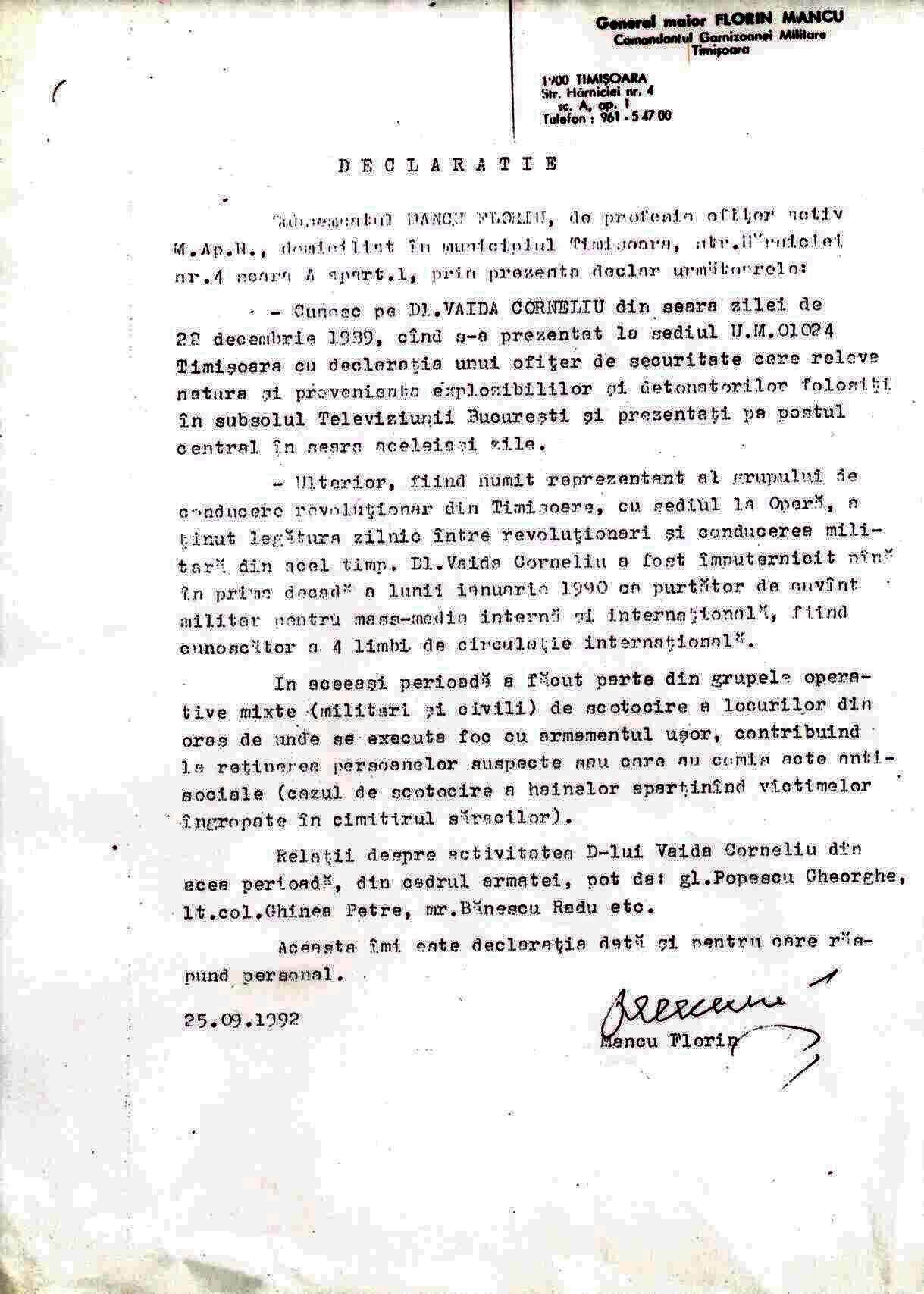
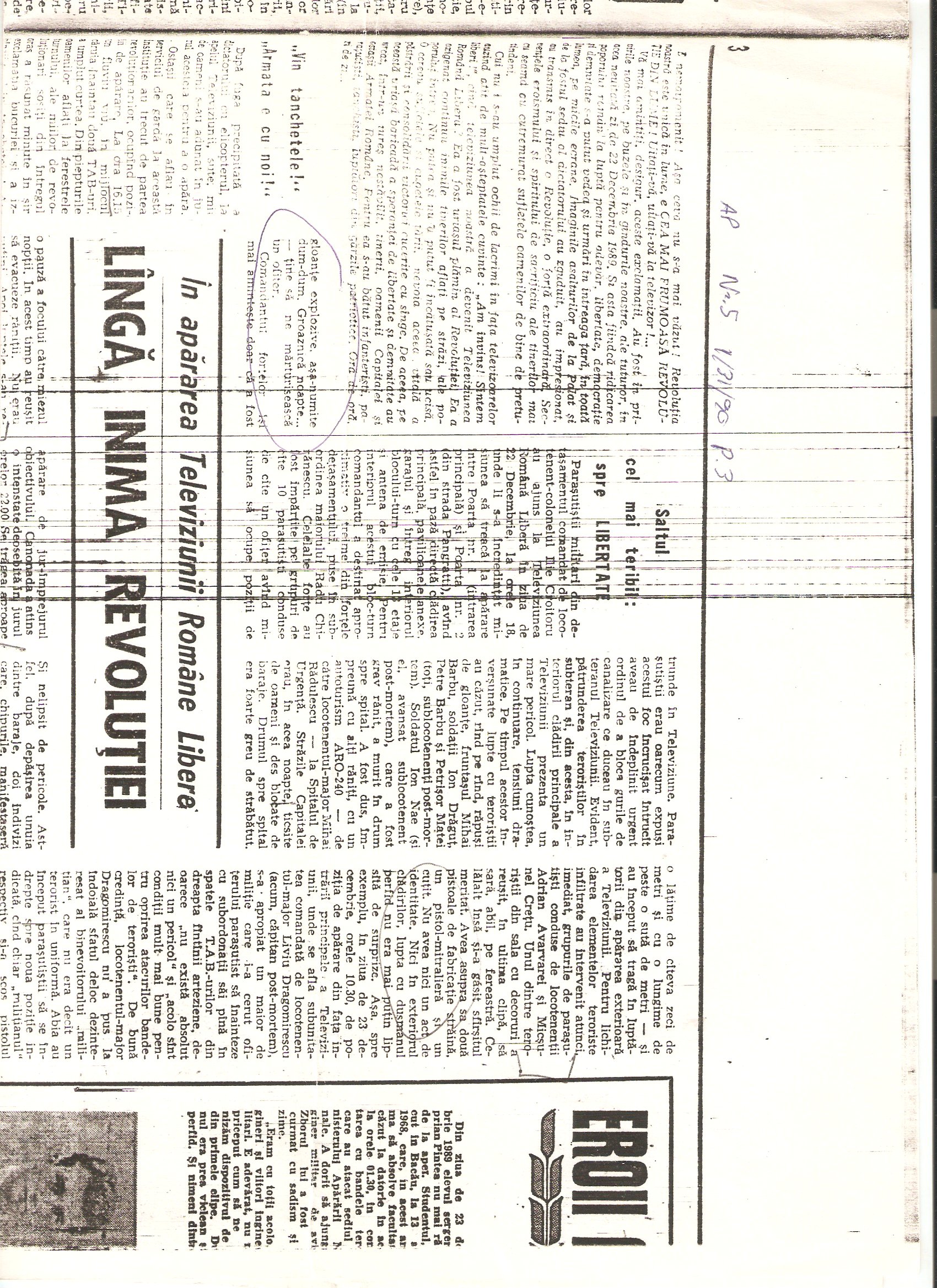
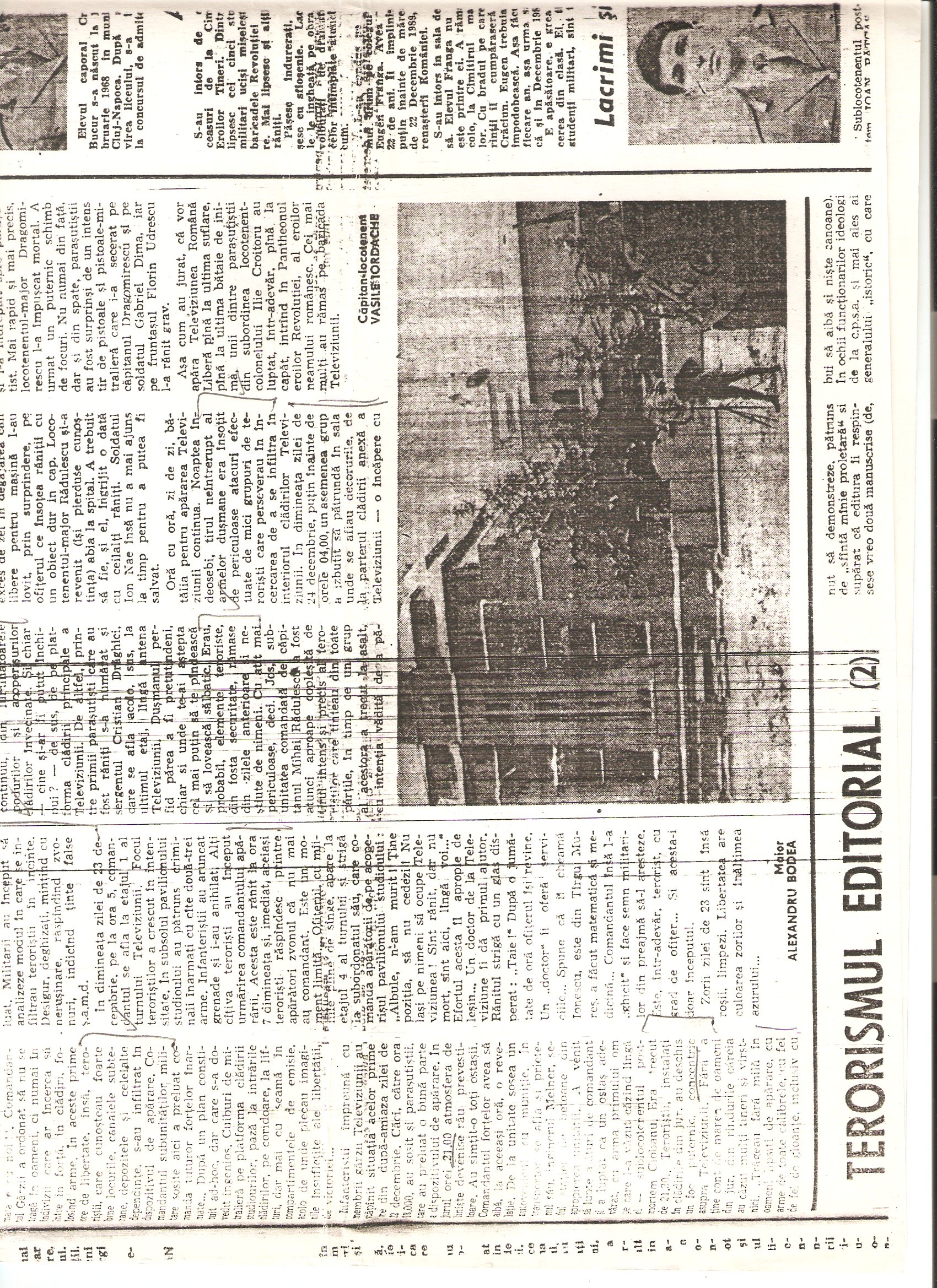
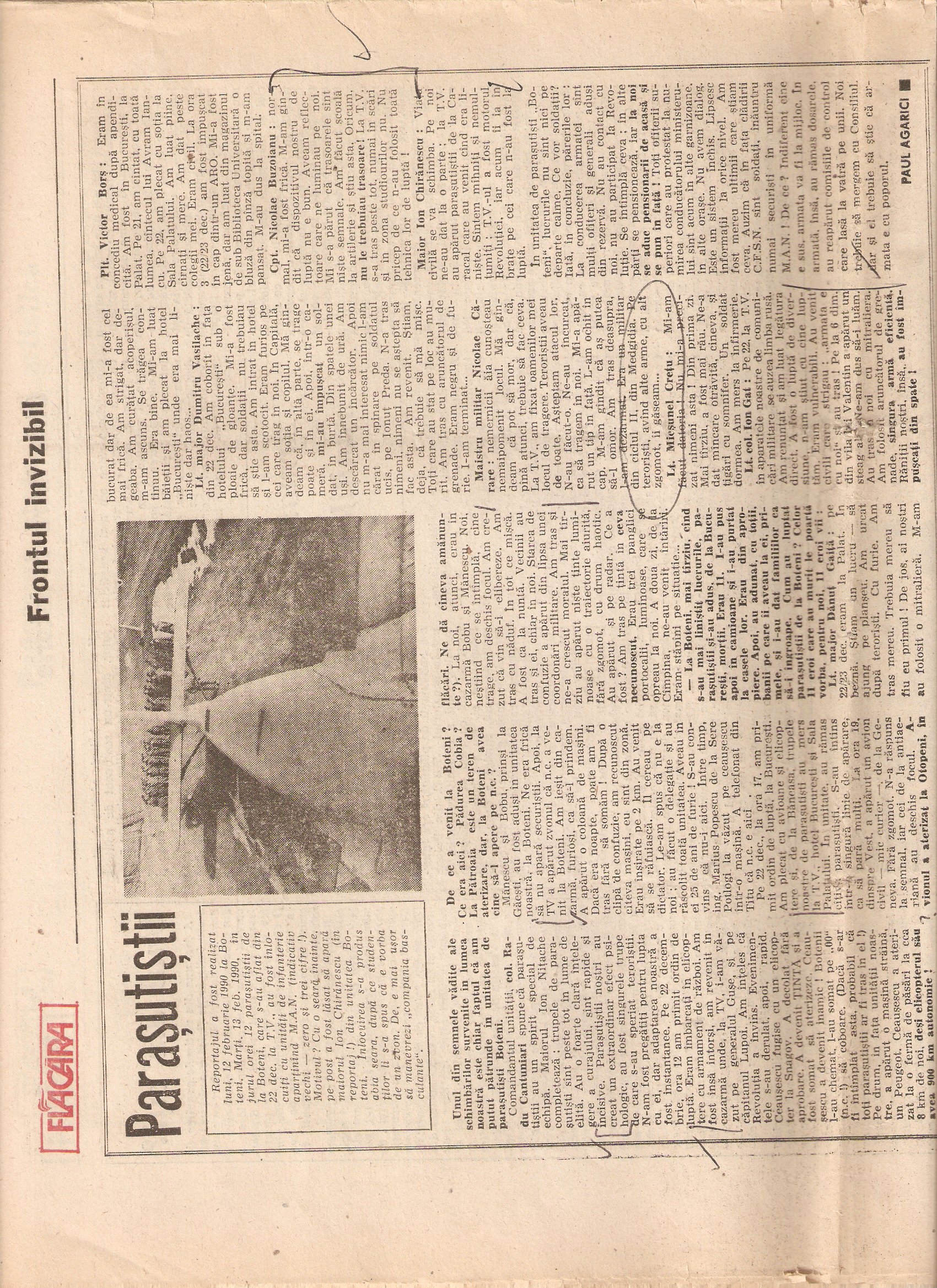
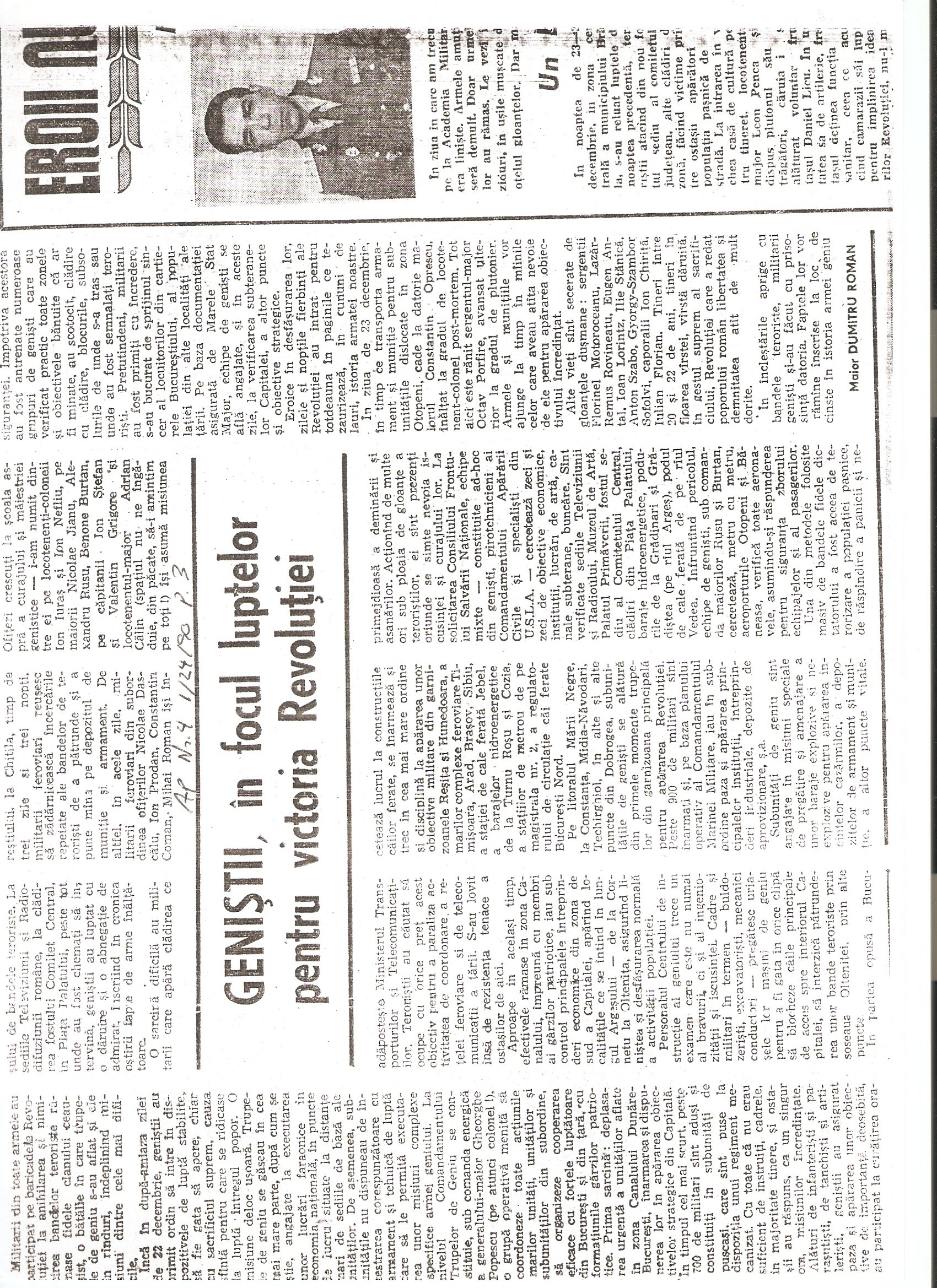
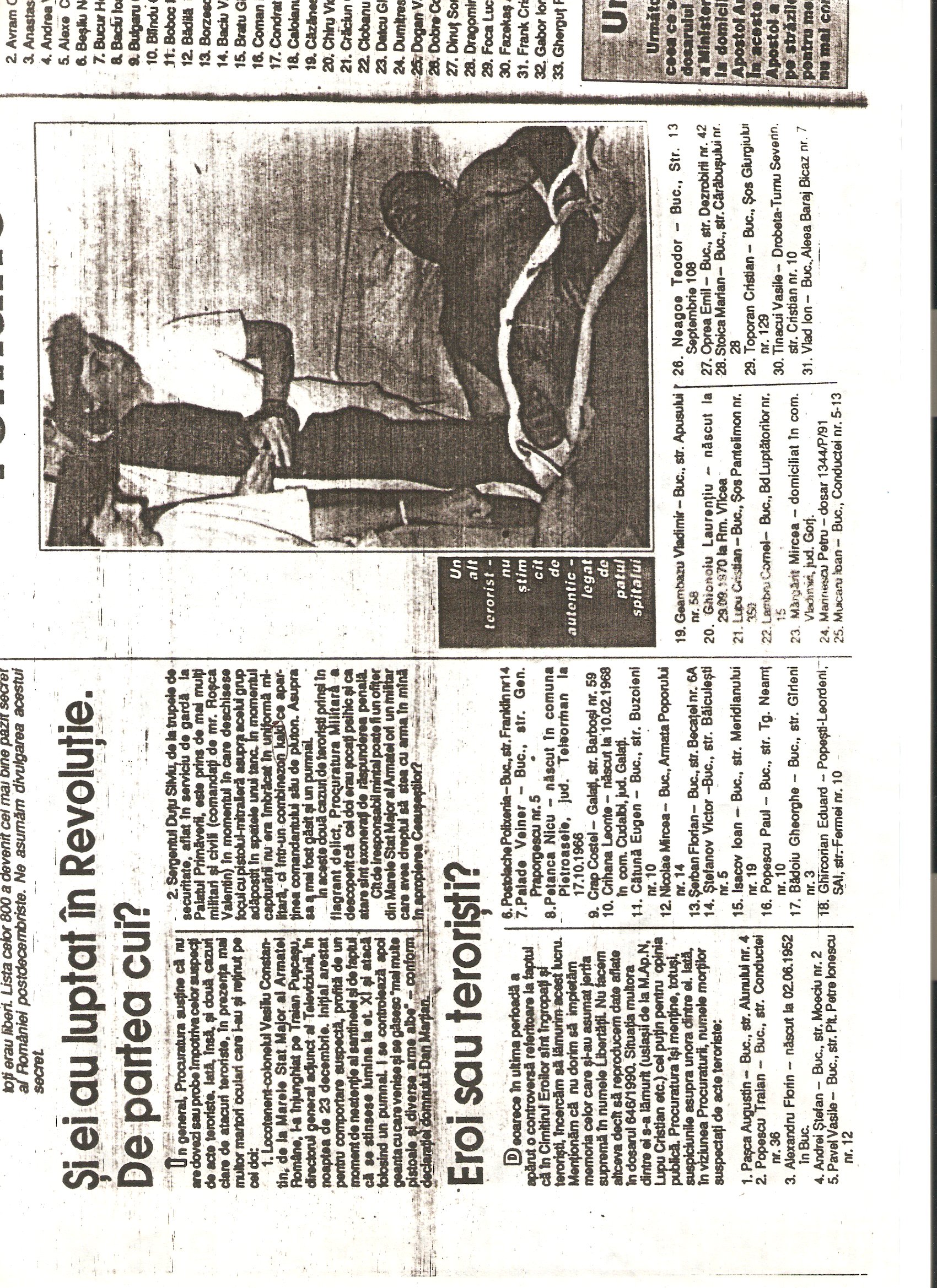
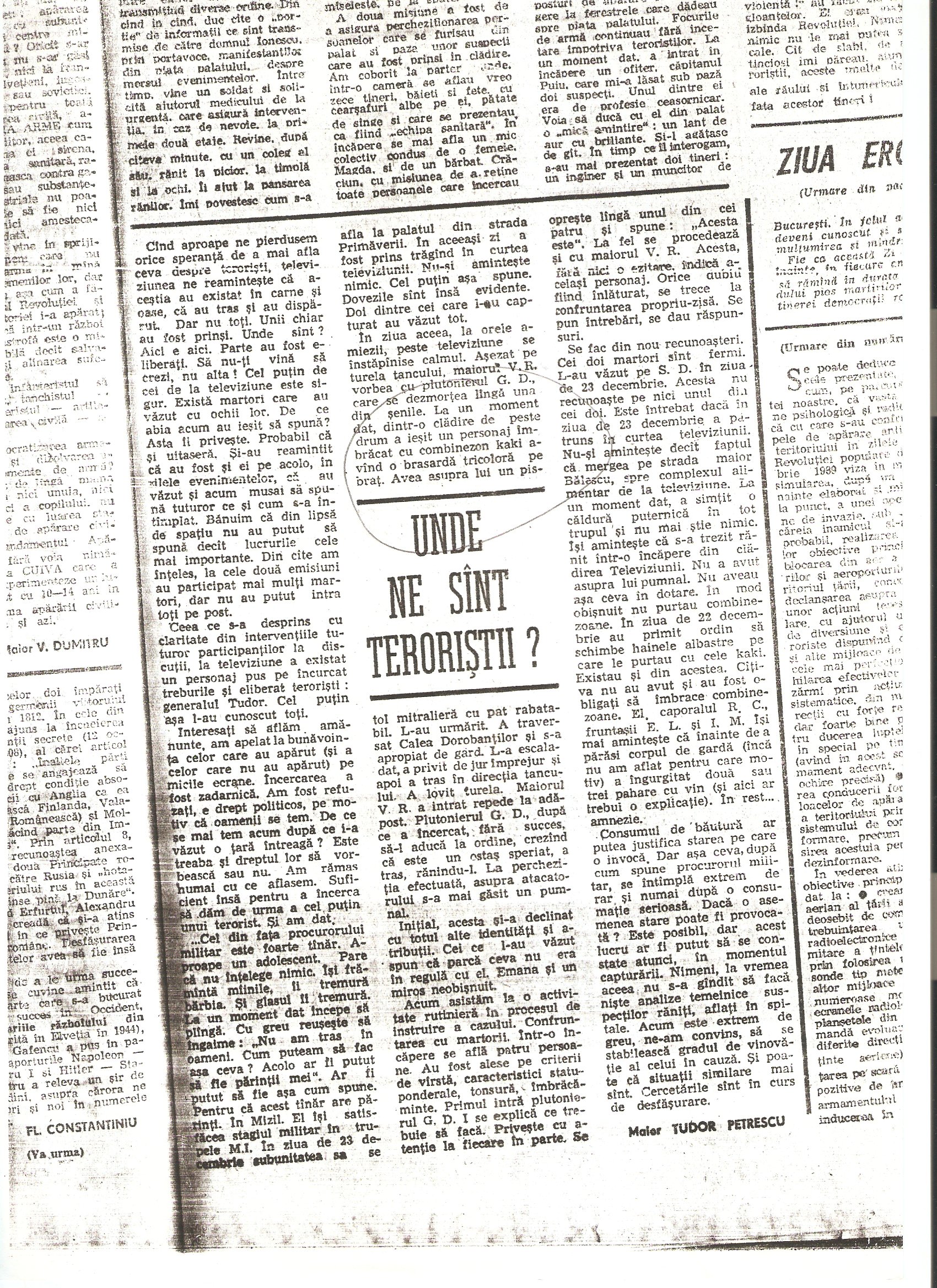
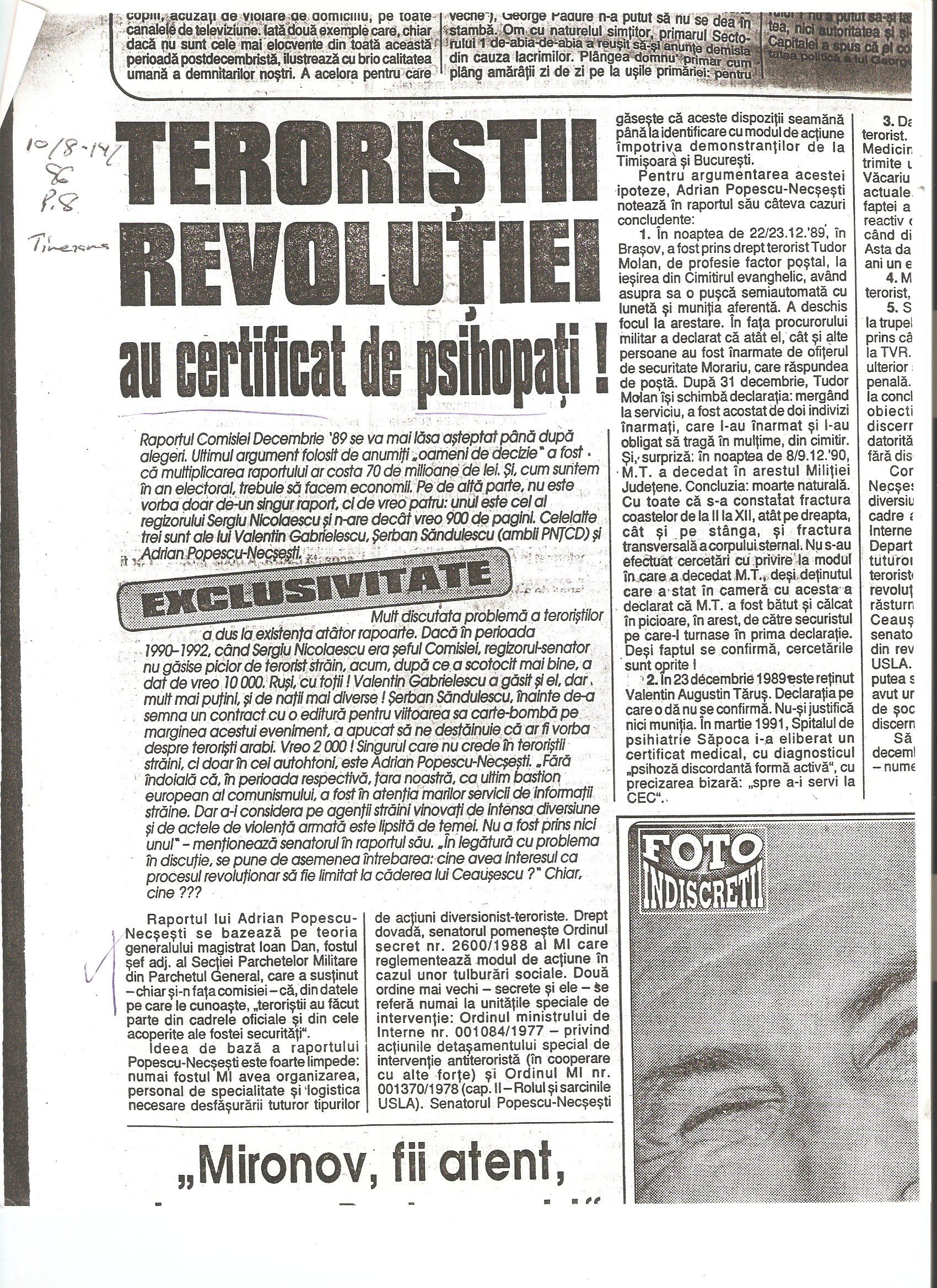
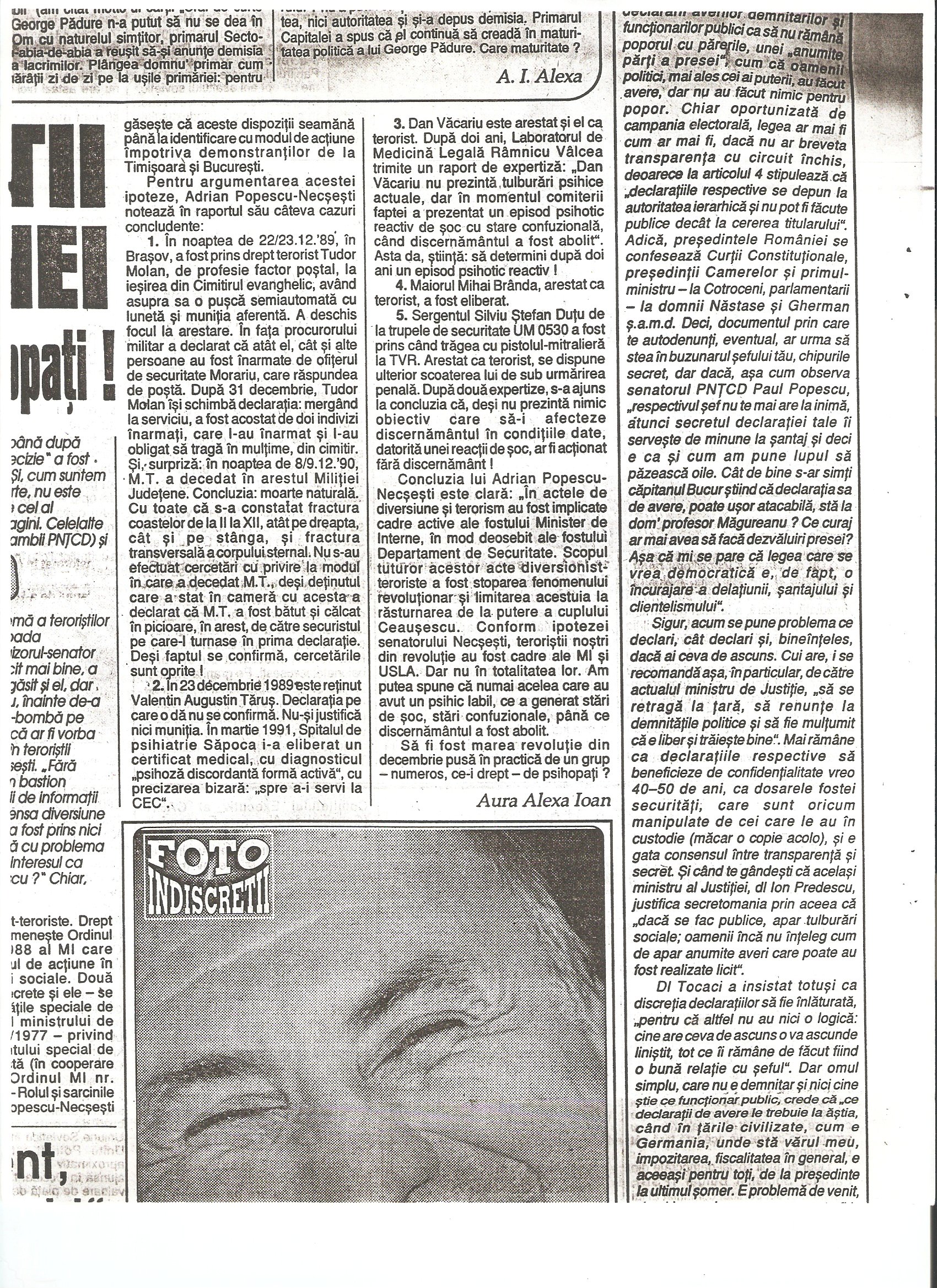
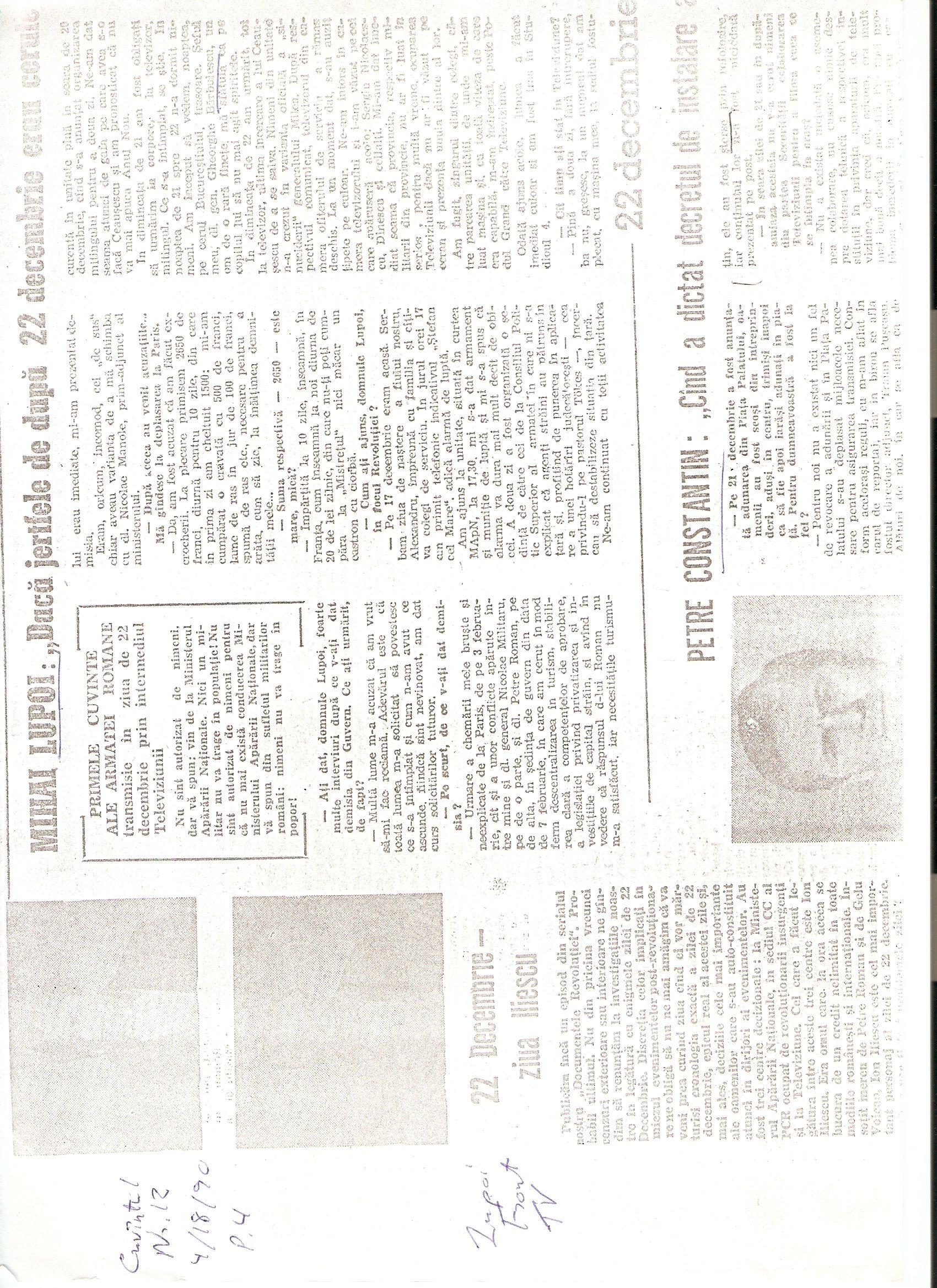
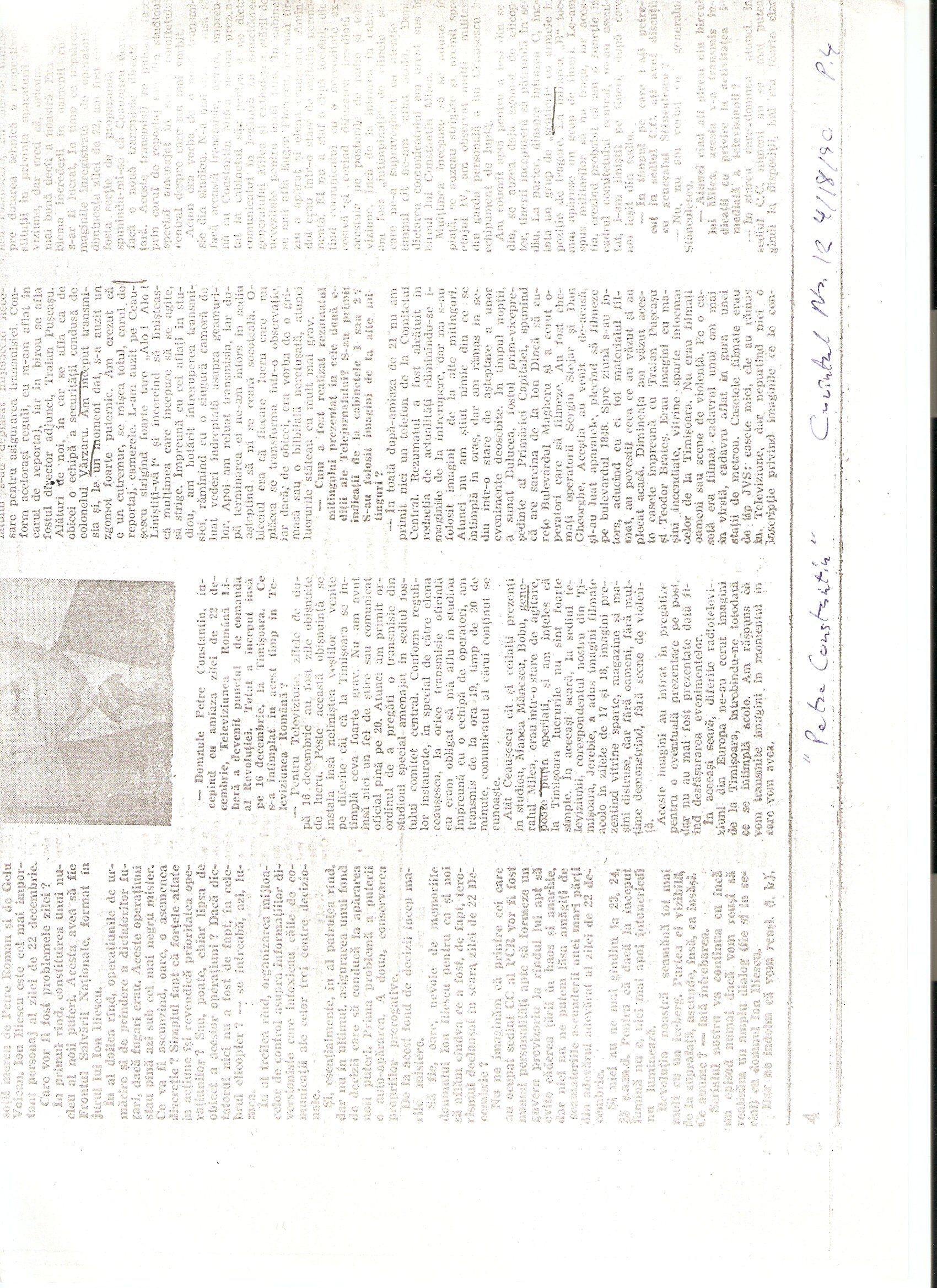
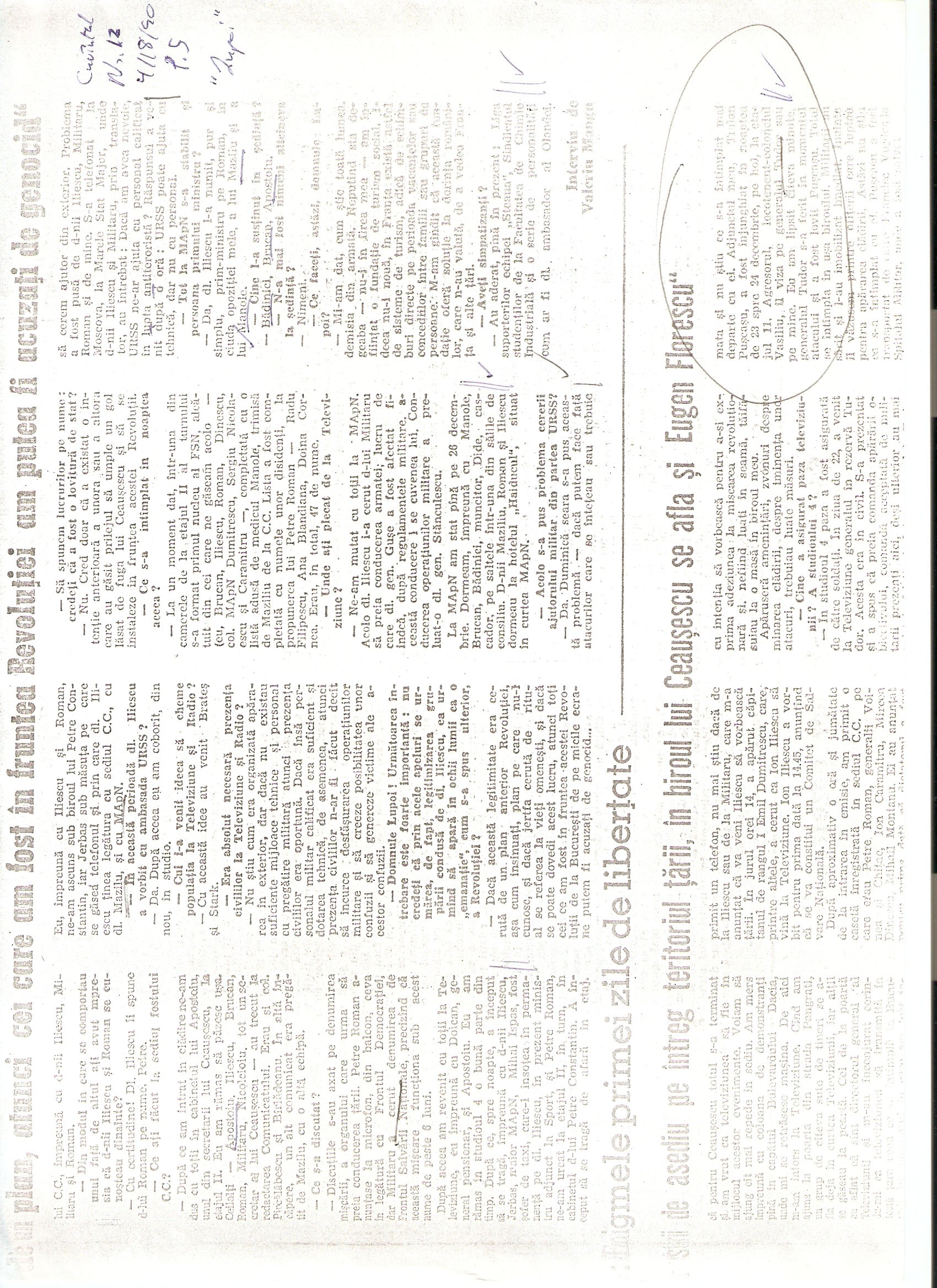
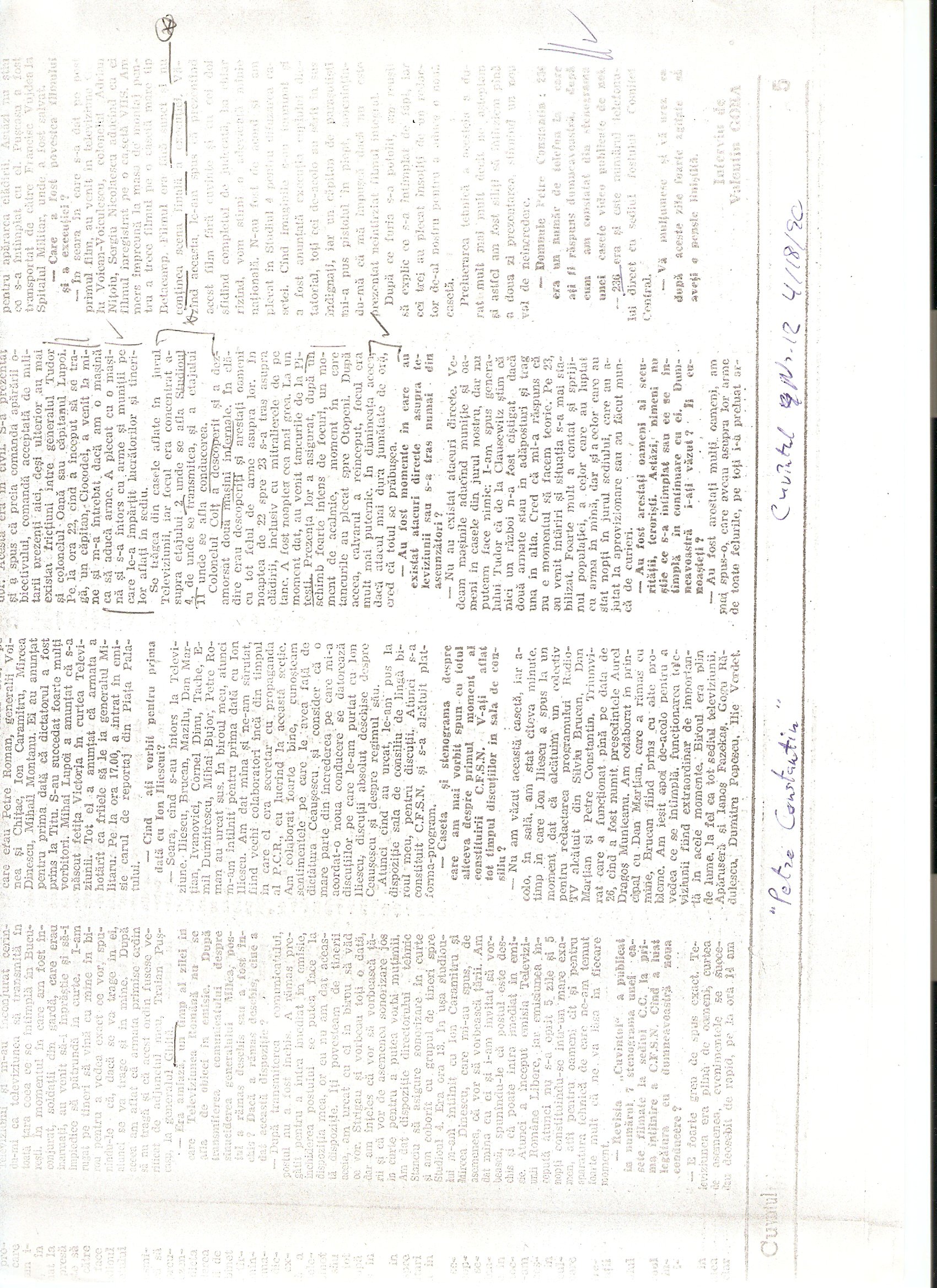
 Clip Ref: BSP271289002 0
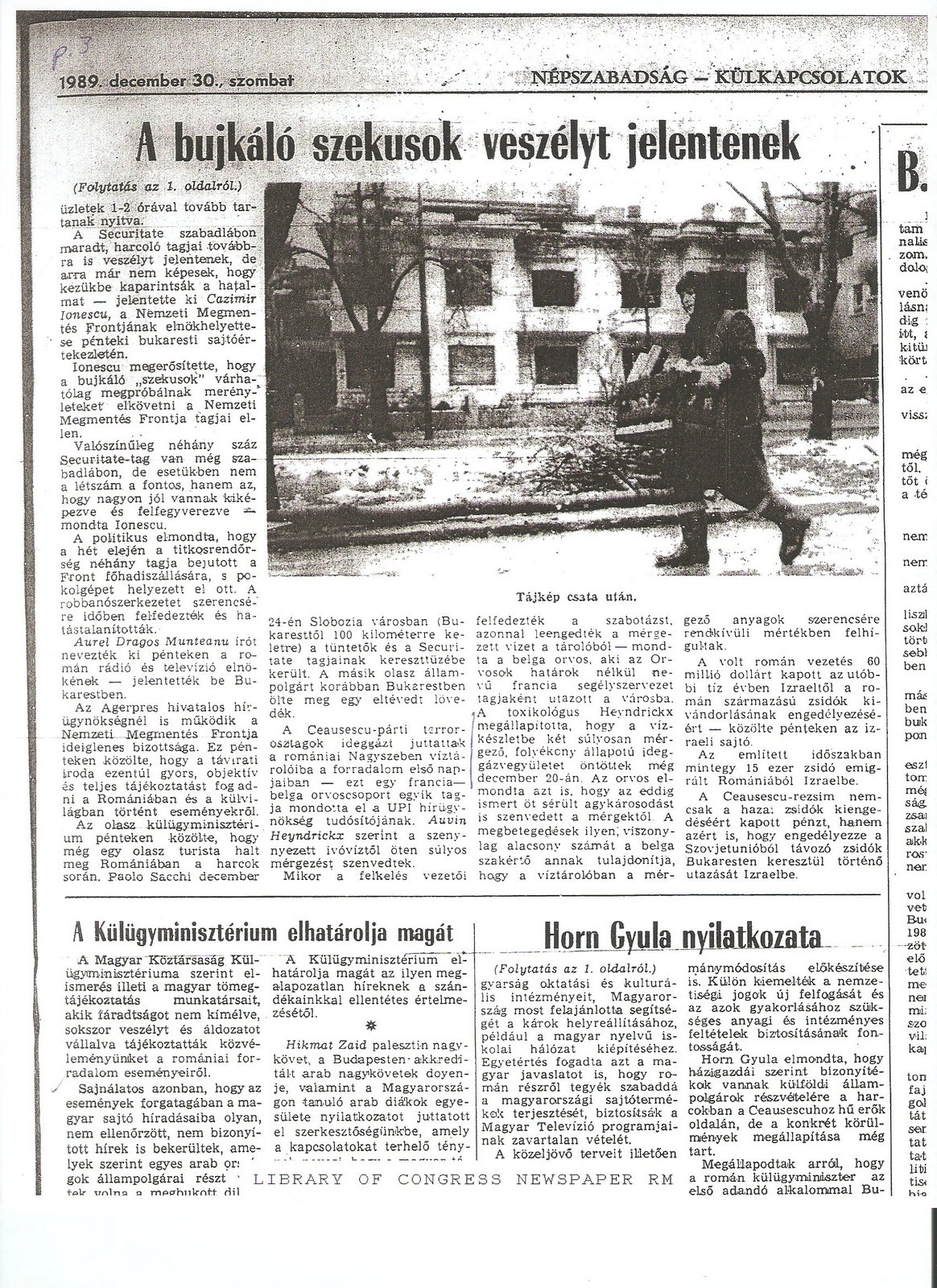


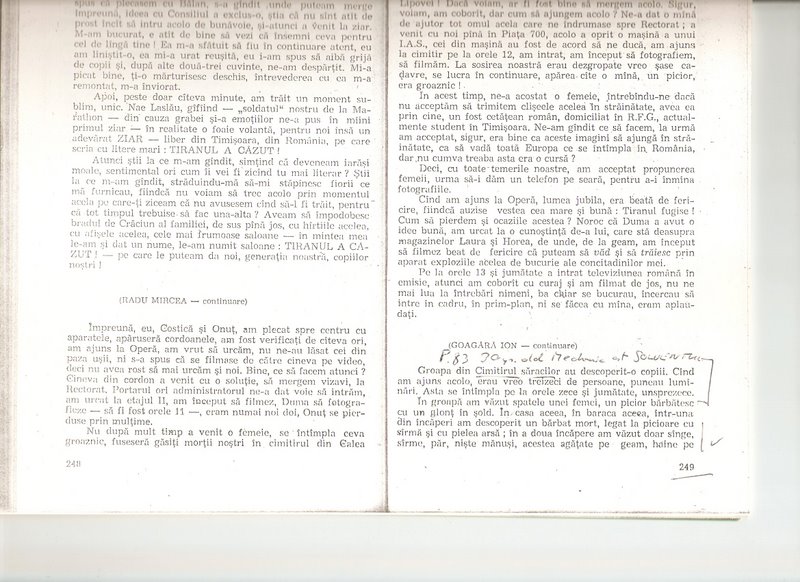

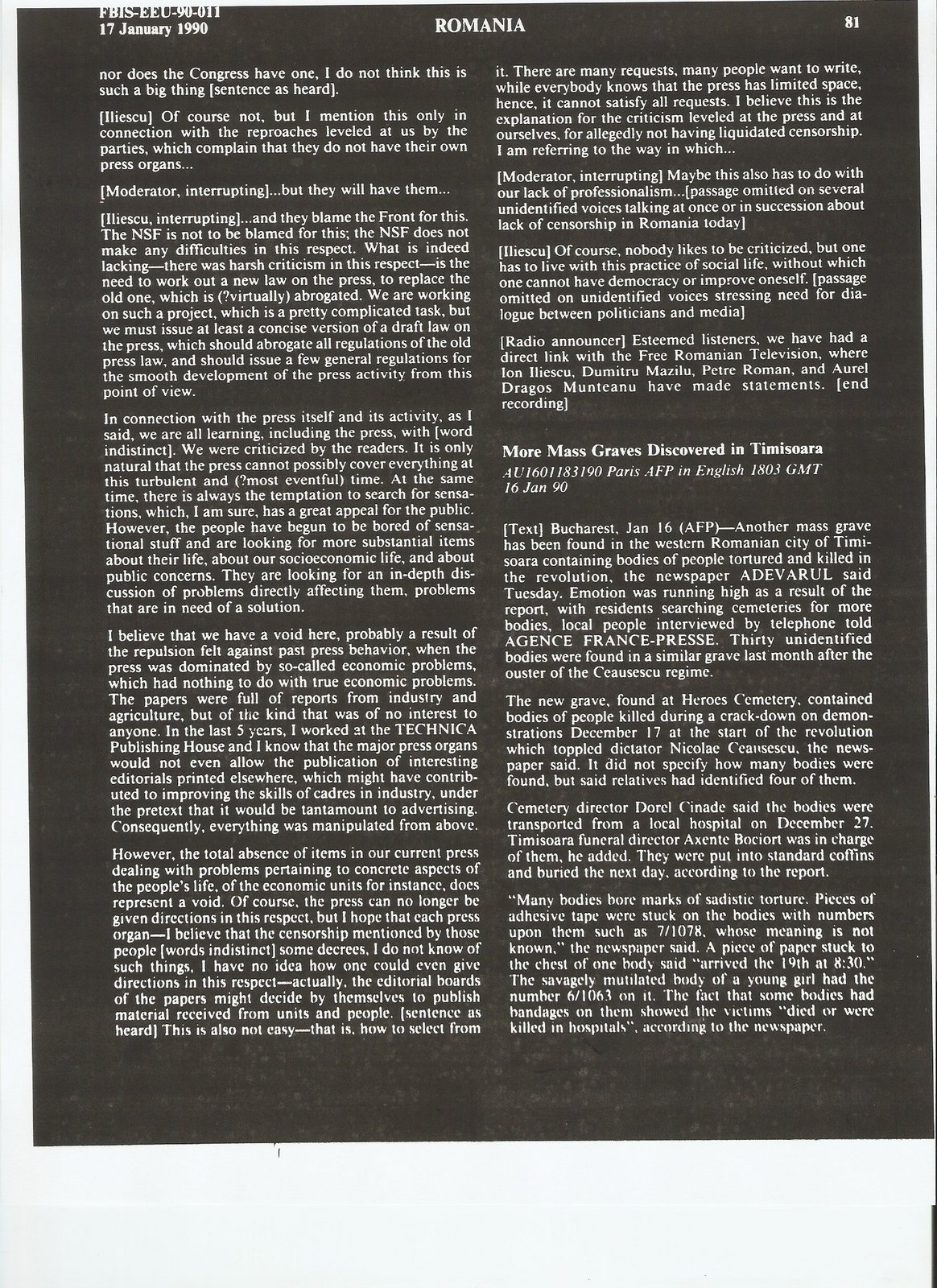


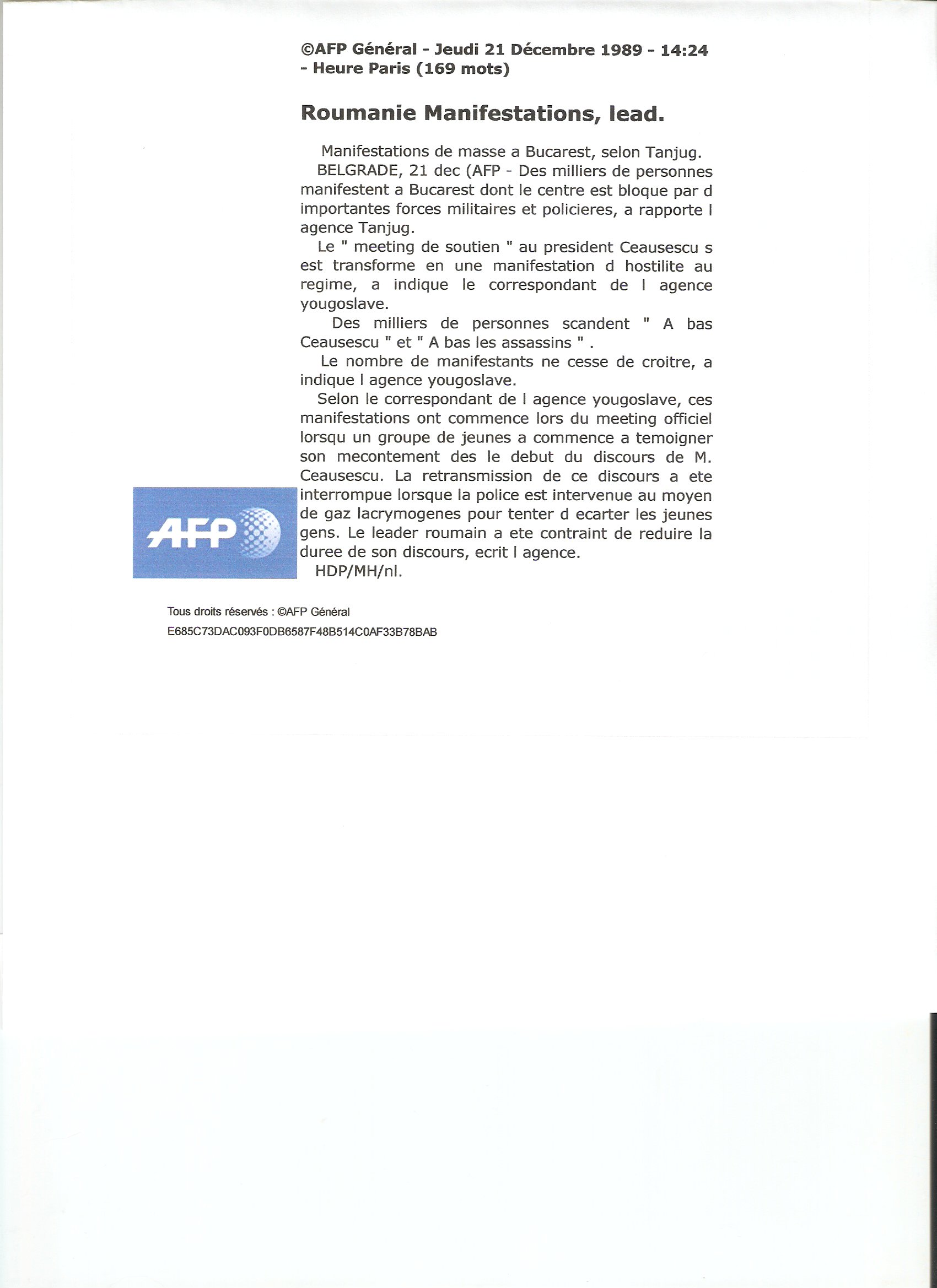
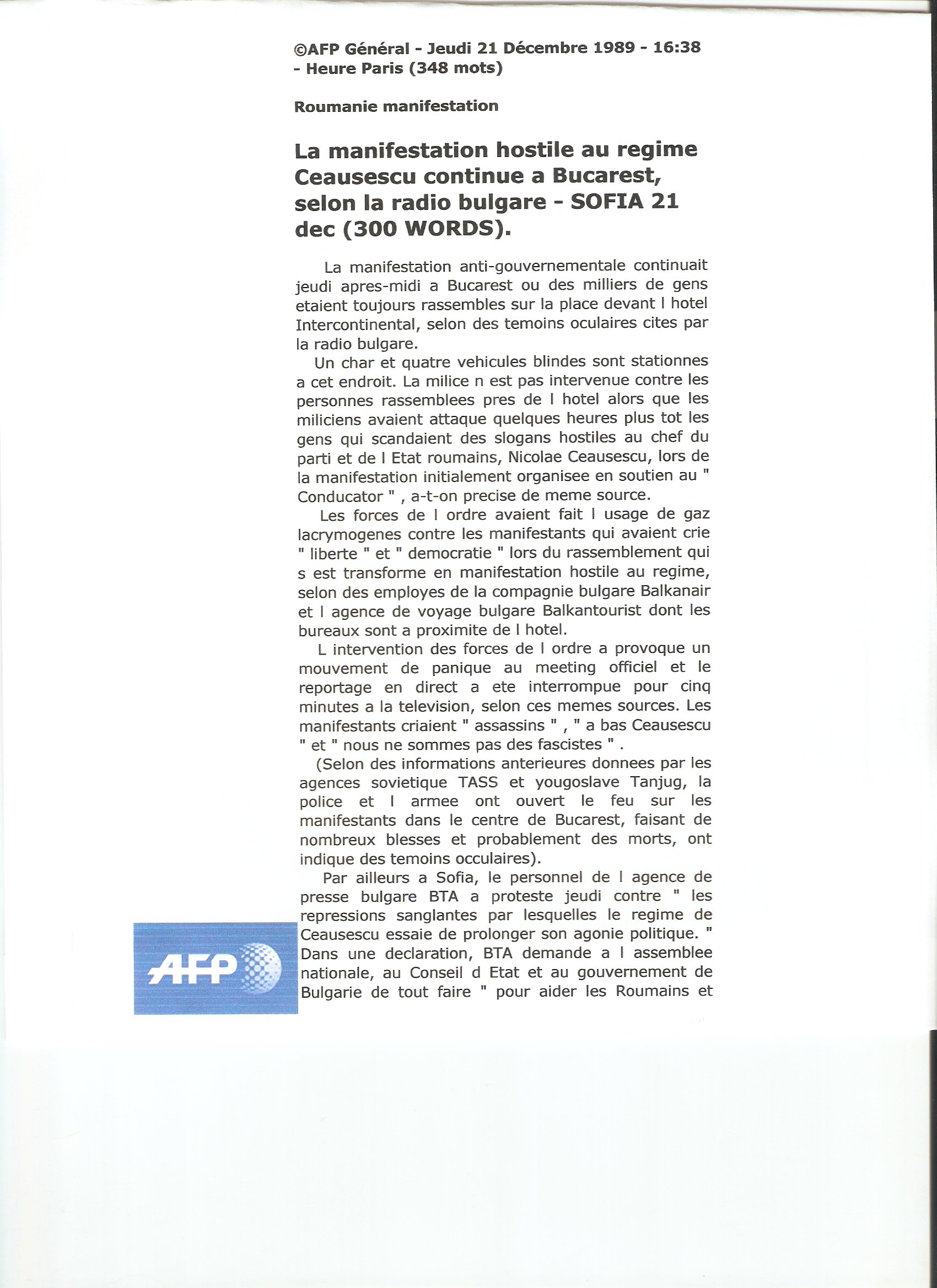

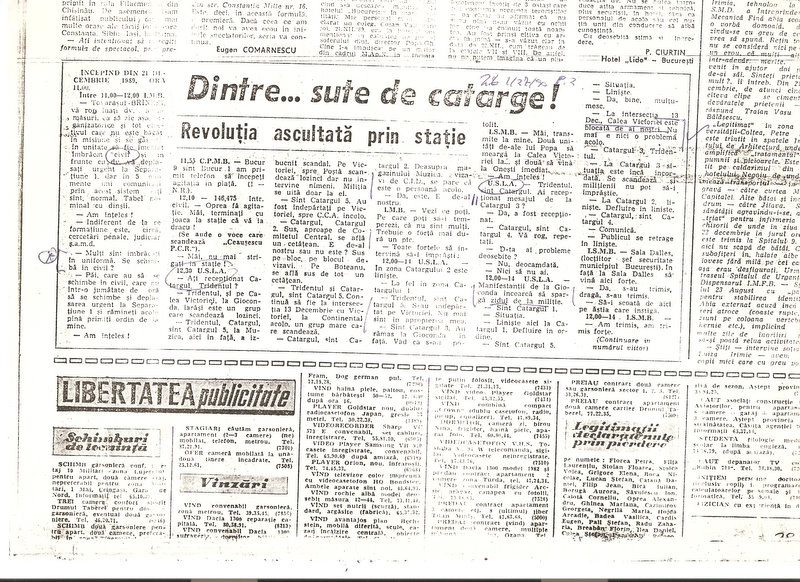
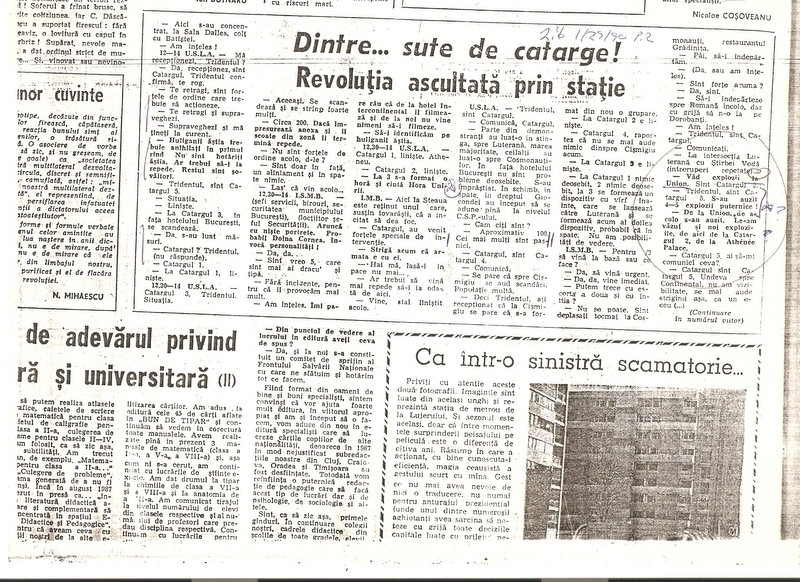
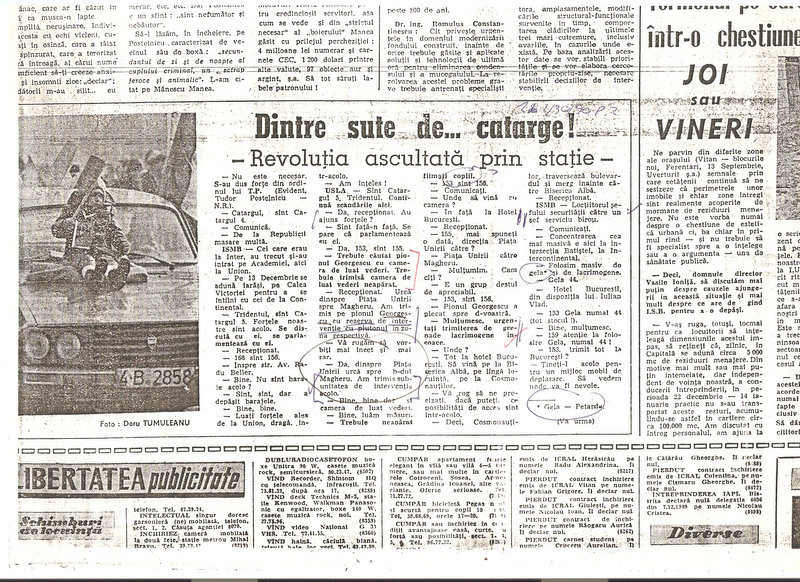
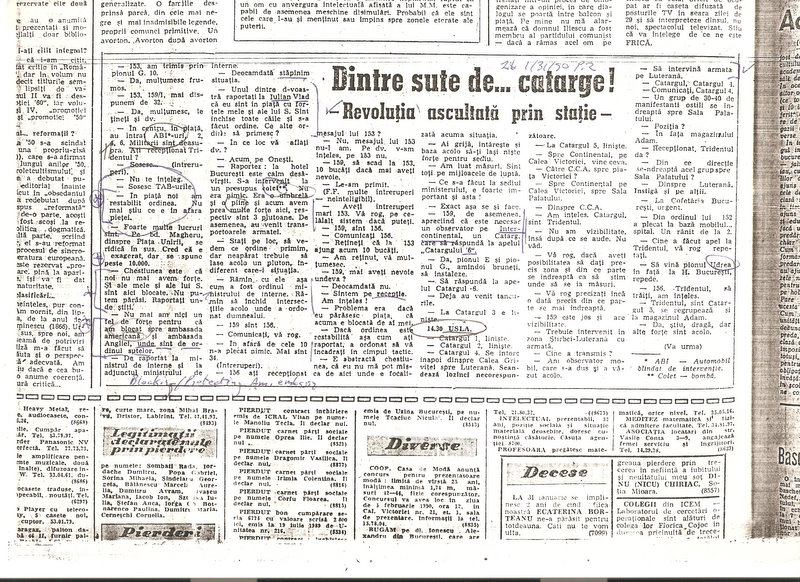


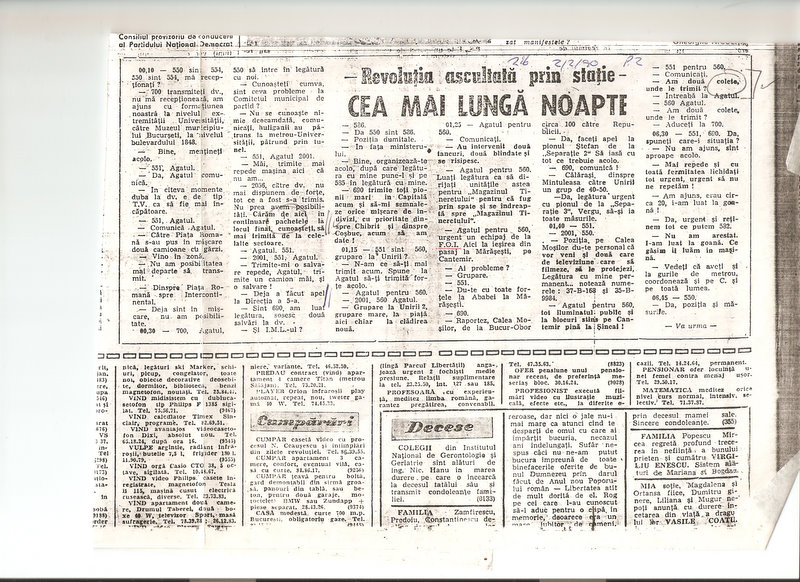
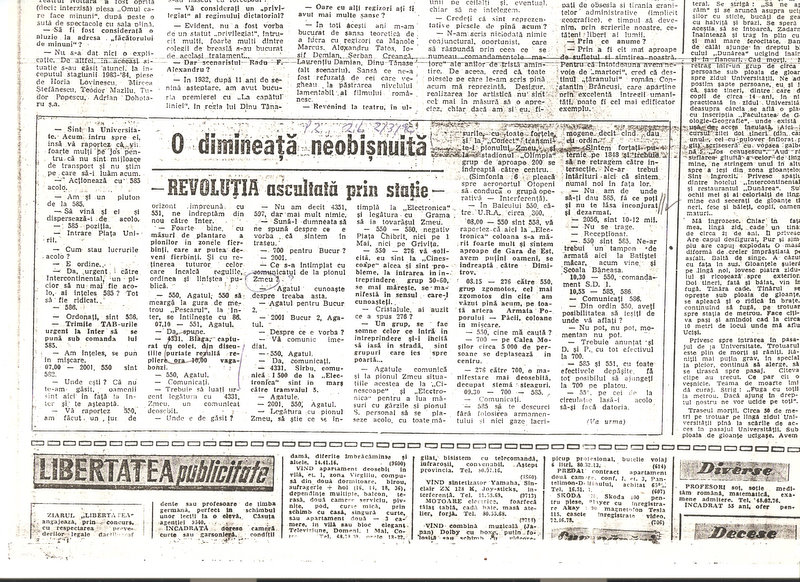
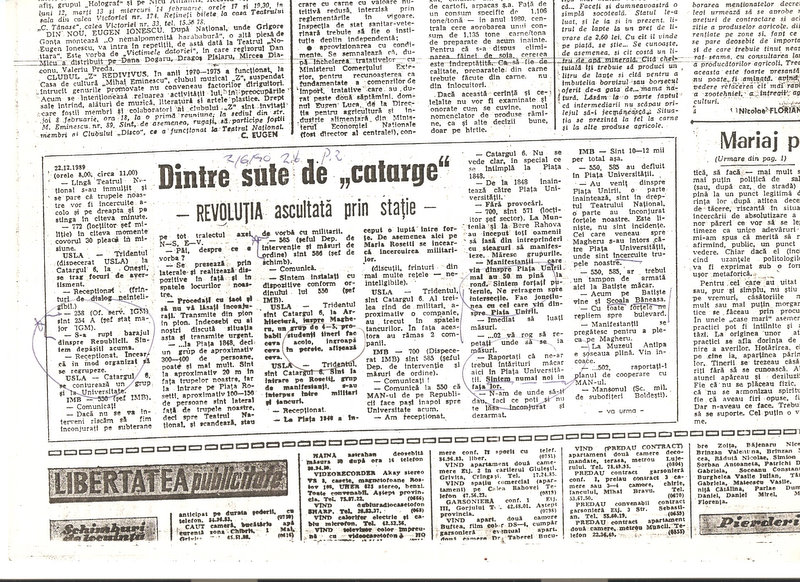
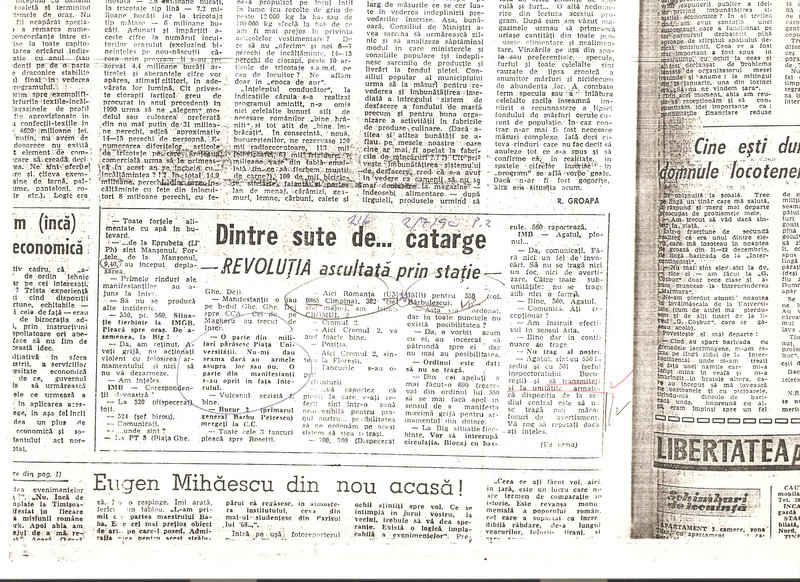
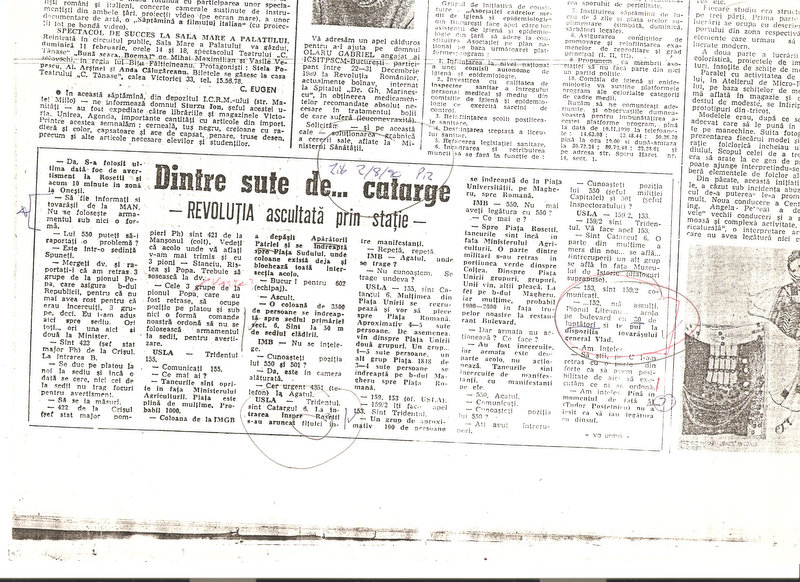
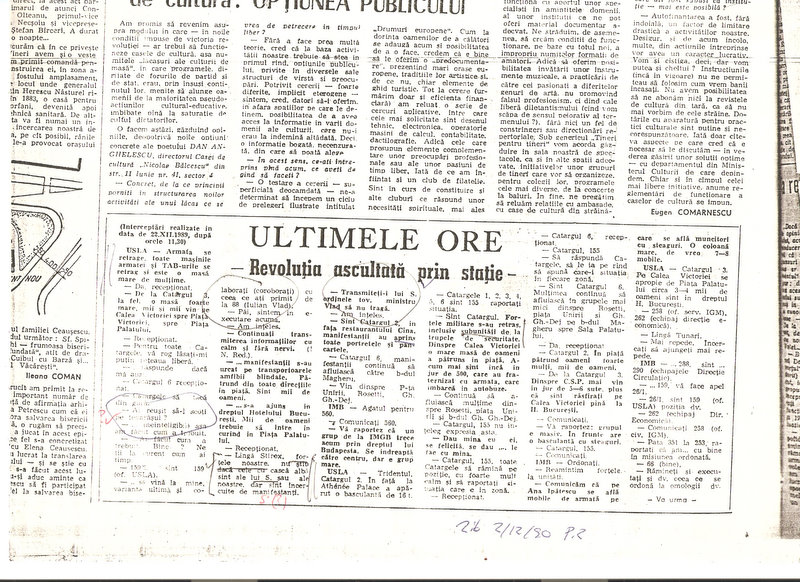
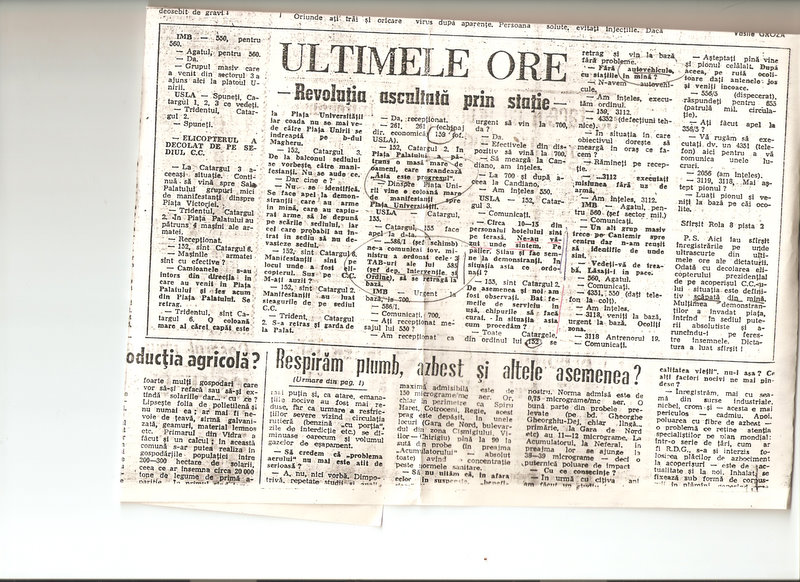


 0
0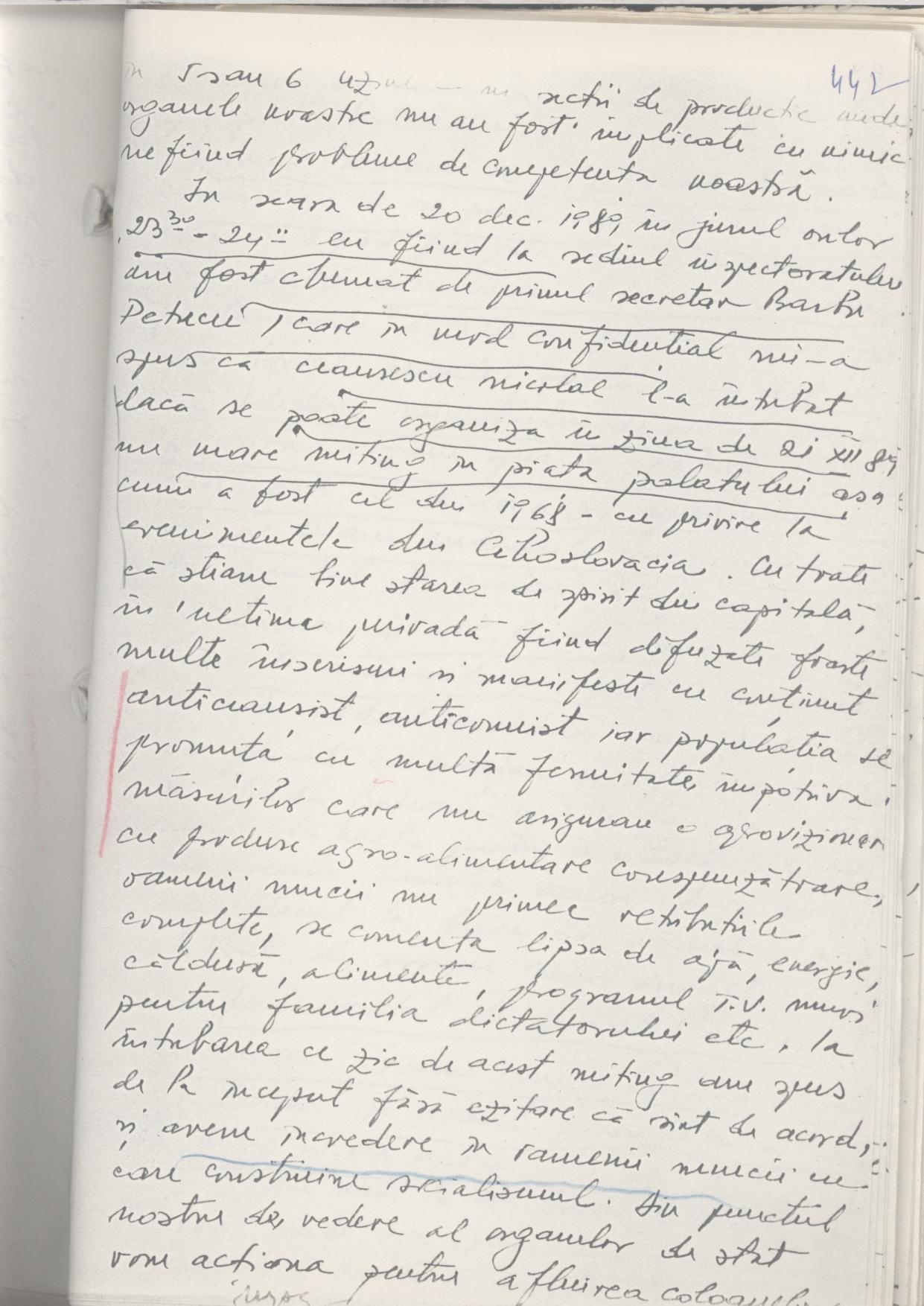
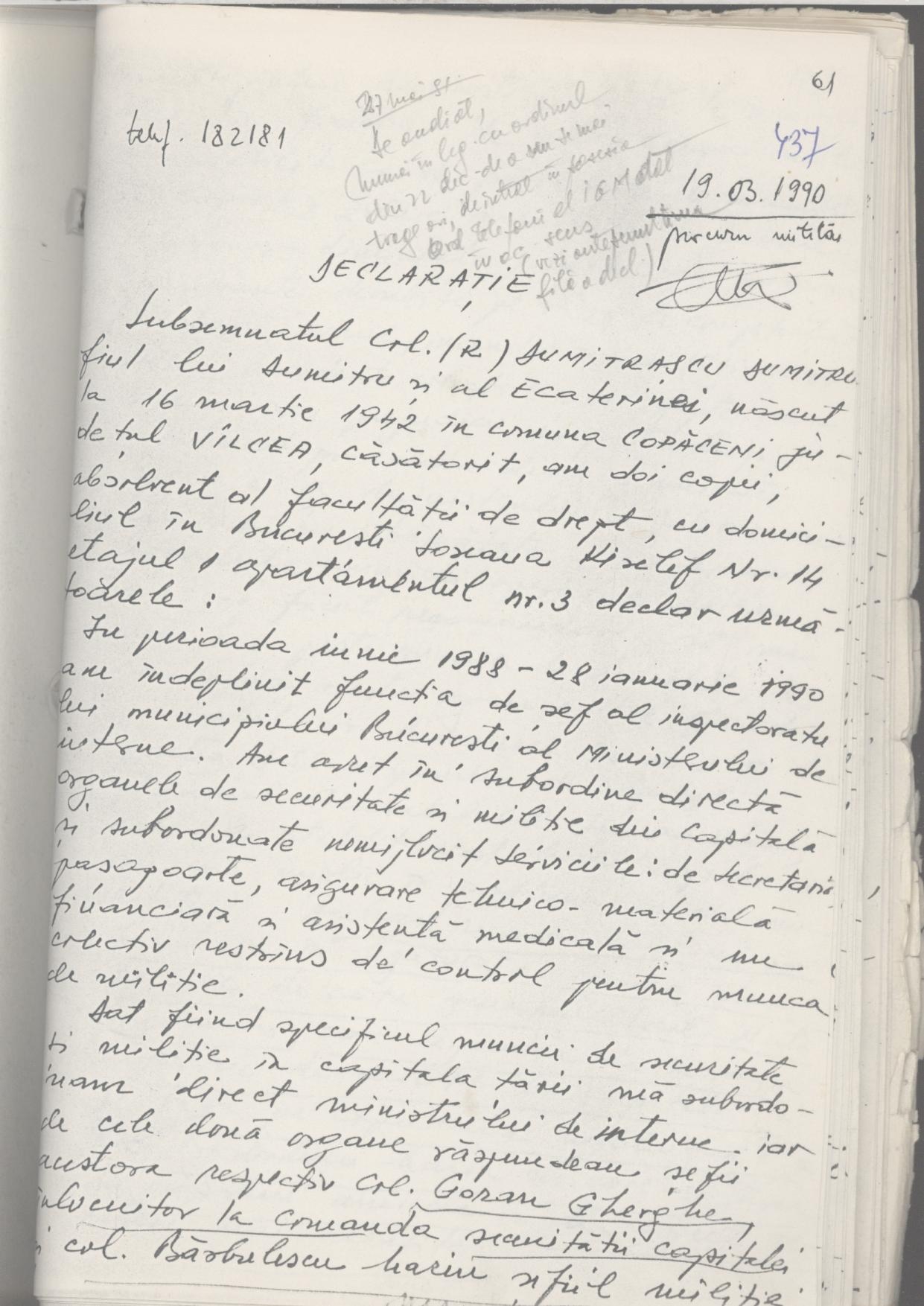
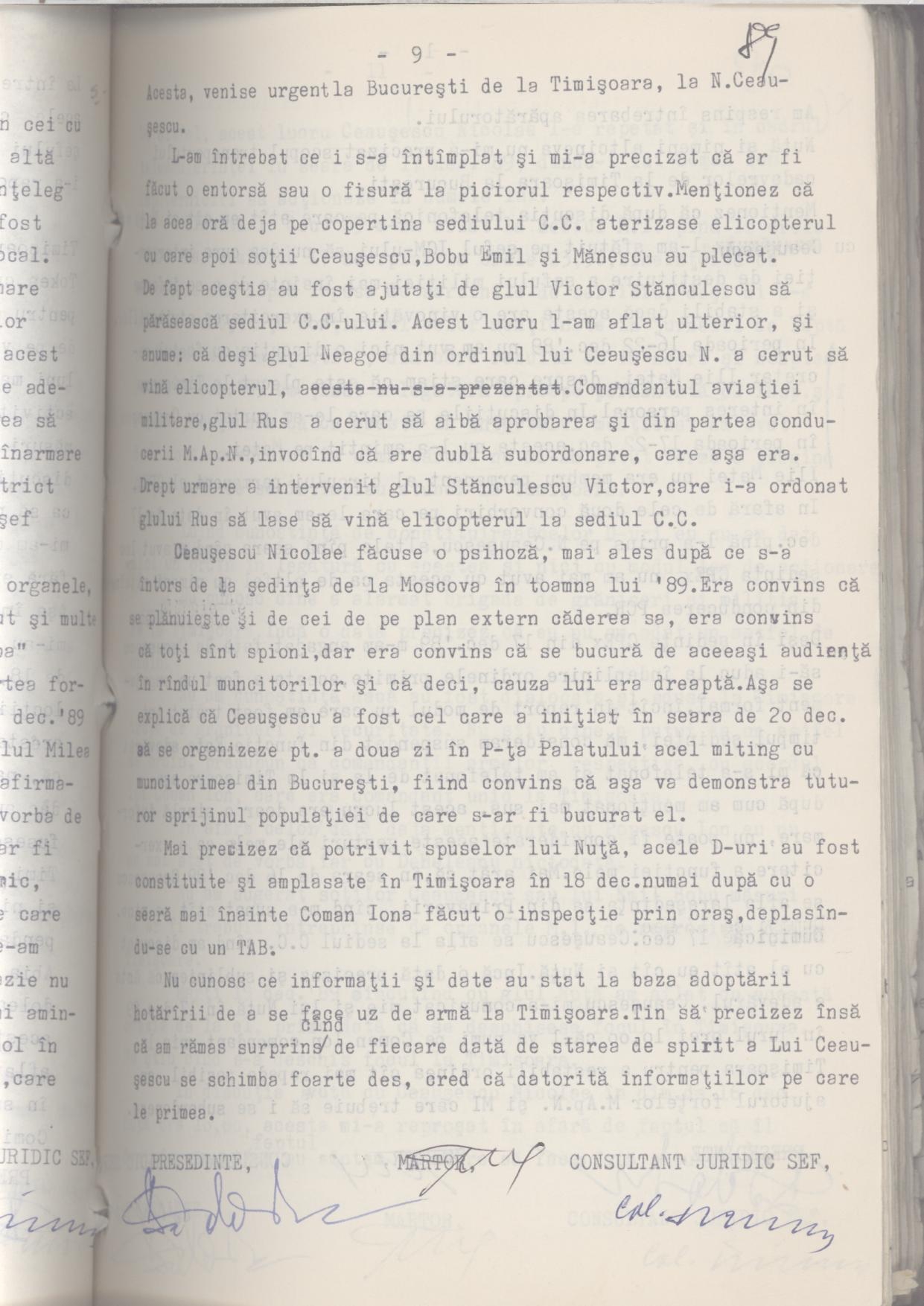
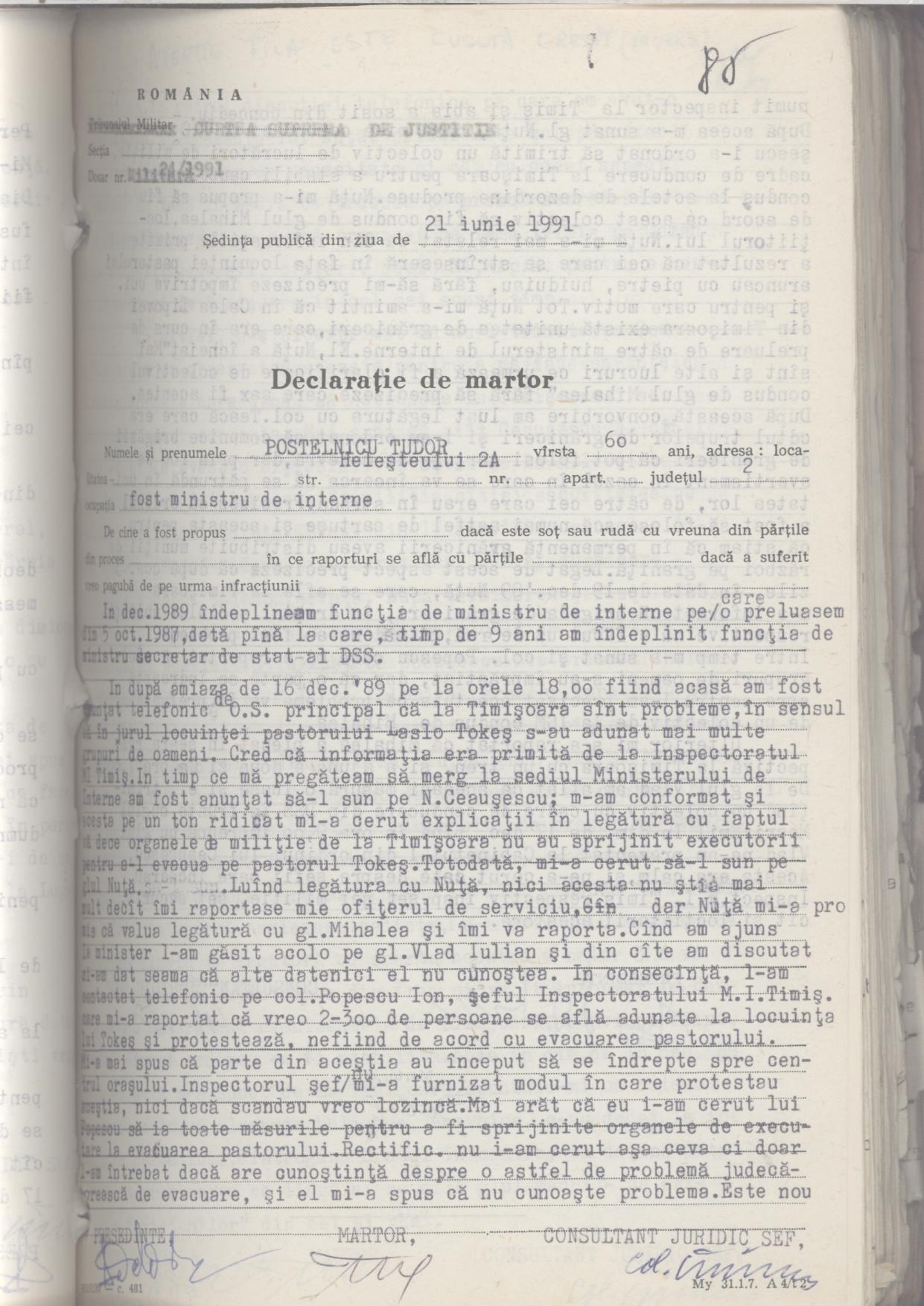



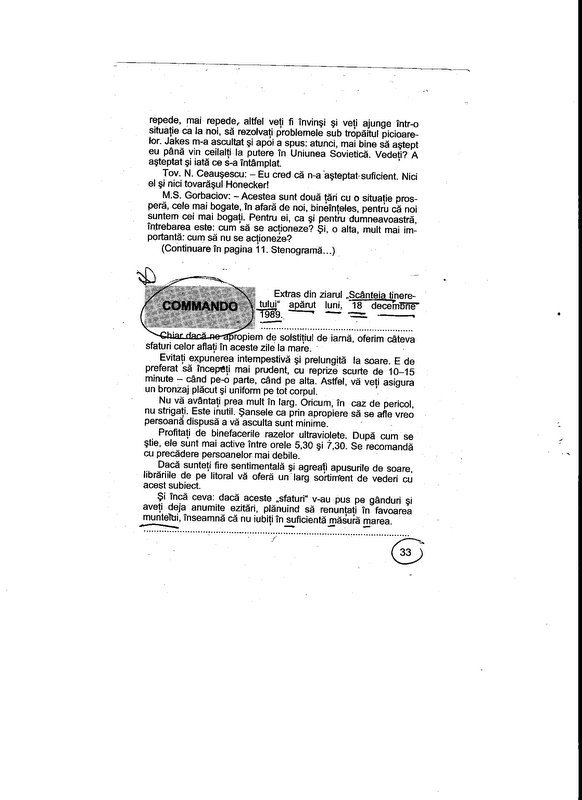
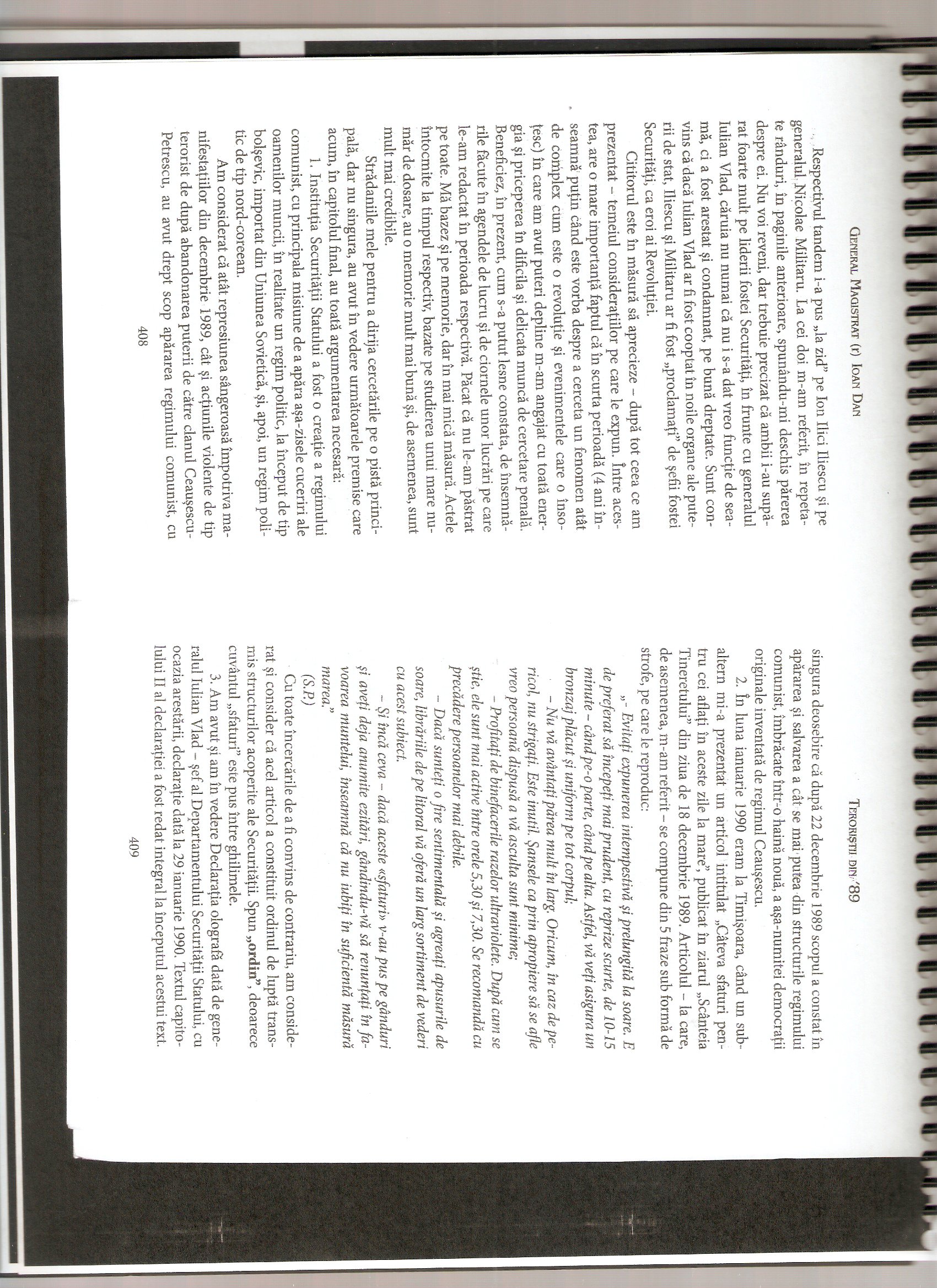
 The Archive of the Romanian Revolution of December 1989