The Archive of the Romanian Revolution of December 1989

A Catch-22 December 1989, Groundhog-Day Production. Presenting the Personal Research & Scholarship of Richard Andrew Hall, Ph.D.

Posts Tagged ‘teroristii decembrie 1989’

After the Ceausescus Were Executed: The Counter-Revolution is “Disappeared” (26 December 1989 – 24 January 1990)

Posted by romanianrevolutionofdecember1989 on July 7, 2013

http://atomic-temporary-3899751.wpcomstaging.com/december-1989-2009-bullets-lies-and-videotape/

Bullets, Lies, and Videotape:  The Amazing, Disappearing Romanian Counter-Revolution of December 1989[1] 

by Richard Andrew Hall, Ph.D. (published December 2009)

Standard Disclaimer:  All statements of fact, opinion, or analysis expressed are those of the author and do not reflect the official positions or views of the Central Intelligence Agency (CIA) or any other U.S. Government agency.  Nothing in the contents should be construed as asserting or implying U.S. Government authentication of information or CIA endorsement of the author’s views.  This material has been reviewed by CIA to prevent the disclosure of classified information.   I am an intelligence analyst for the Central Intelligence Agency.  I have been a CIA analyst since 2000.  Prior to that time, I had no association with CIA outside of the application process.

…In other words, a cover-up of a now failed attempt at counter-revolution—having been cut short by the execution of the Ceausescus, the object of their struggle—had begun.  In the days and weeks that were to follow, the Securitate, including people such as the seemingly ubiquitous Colonel Ghircoias discussed in the opening of this article would go about recovering those “terrorists” who were unlucky enough to be captured, injured, or killed.  By 24 January 1990, the “terrorists” of the Romanian Counter-Revolution of December 1989, no longer existed, so-to-speak, and the chances for justice and truth about what had happened in December 1989 would never recover.[53]

COLONEL GHIRCOIAS MAKES THE ROUNDS OF BUCHAREST’S HOSPITALS

Unofficially, we also know of Colonel Ghircoias’ exploits after the Ceausescu regime collapsed on 22 December 1989, exploits for which he was not charged at his trial and for which he has never been charged.  Of the 1,104 people killed and 3,352 people injured during the December 1989 bloodshed, 942 of them were killed and 2,251 wounded after Nicolae and Elena Ceausescu fled power on 22 December 1989.  At the time, personnel of the communist regime’s secret police—known as the Securitate—and allied foreign mercenaries fighting to restore the Ceausescu regime—collectively christened “the terrorists”—were thought to be the primary source behind the post-22 December bloodshed.

It was in this context, that doctors from Bucharest’s various main hospitals recall Colonel Ghircoias’ sudden, unannounced appearances during the last days of December 1989 and first days of January 1990.  Professor Andrei Firica of the Bucharest “Emergency Hospital” recounted in a 2004 media interview largely the same details he had conveyed to the press in the summer of 1990.  According to Firica, some 15 to 20 suspected terrorists had been interned at the “Emergency Hospital” in varying states of medical distress.  He says he made a small file of the medical situations of these patients.  A Militia colonel, whom he later was to see in [prisoner] stripes on TV as a defendant in the Timisoara trial—i.e. fairly clearly Ghircoias—came one day and counseled him to keep nosy foreign reporters away from the beds of the “terrorists,” stating ominously that “these were just terrorist suspects and he [Dr. Firica] didn’t want to wake up one day on trial for having defamed someone”!   The colonel later came and loaded the wounded terrorist suspects onto a bus and off they went.  Firica maintains the files he kept on the terrorist suspects “of course, disappeared.”  He noted, however, that he asked his son, who had studied theater and film at university, to film the terrorists tied down to the hospital beds, and he claims he gave copies of this cassette to the Procuracy.[4]

  • At the Emergency Hospital 13 suspected of being what we call terrorists were interned.  Among these a few were definitely foreign, even though all had Romanian papers.  Two clearly had ‘Mongoloid’ (‘Asiatic’) features (one stated that his mother was Romanian, while his father was from Laos), while four others were Arabs.  Nevertheless, they spoke Romanian very well.  Doctor Nicolae Staicovici, who worked a time in Egypt and who treated them for a time spoke with them.  At a moment, he formed a question in Arabic.  One of the injured responded to him perfectly.  All were well-built, one was a ‘mountain of a man.’  He said nothing, although he probably had terrible pains.  There were also two terrorists who were not wounded.  One arrived at night, under some pretext.  Those on guard suspecting him, immobilized him.  He had on three layers of clothing and several ids.  They tied him to the stretcher, but although he appeared rather frail, at a given moment he ripped the restraints off.  [Constantin Fugasin, “Unde ne sint teroristii?” Zig-Zag, 1990.]

[4]Professor Andrei Firica, interview by Florin Condurateanu, “Teroristii din Spitalul de Urgenta,” Jurnalul National, 9 March 2004, online edition, cited in Hall, “Orwellian…Positively Orwellian” http://homepage.mac.com/khallbobo/RichardHall/pubs/Voineaswar091706.html. For similar accounts, see Florin Mircea Corcoz si Mircea Aries, “Terorist ascuns in Apuseni?” Romania Libera, 21 August 1992, p. 1–“Colonelul Ghircoias, former director of the Securitate’s penal investigative unit, brought together the individuals accused of being terrorists and made them disappear”; Andreea Hasnas, “Reportajul unui film cu TERORISTI,” Expres, no. 10 (6-12 aprilie 1990), p. 5; Constantin Fugasin, “Unde ne sint teroristii?” Zig-Zag, 1990.

—————————————————————————————————————————————————————————————————————————————————

A Brief Timeline of the Counter-Revolutionary Coverup

26 December 1989

(Those who argue that there was no “other side” during the fighting of 22-25 December 1989–that the “terrorists” did not exist, that they were from the Army (in particular DIA), that it was all just “friendly fire,” misunderstanding, paranoia, fear, and suspicion (such post-modernist excess permeates the accounts of Peter Siani-Davies, Ruxandra Cesereanu , Adrian Cioflanca, to name a few of the more recent accounts, as well as reviews of films such as A Fost sau N-a Fost?/12:08 East of Bucharest)–have difficulty explaining how the Hungarian military maintains they were tracking Securitate radio transmitters/transmissions and relaying the information to the Romanian military leadership and that the operation of these Securitate transmitters dropped off in sync with the drop off in counter-revolutionary resistance posed by the Securitate…Then again they are not aware of this or most of the details/evidence presented for the period 26 December 1989 – 24 January 1990 below…) 

Colonel Gyorgy Keleti, head of the Hungarian People’s Army Press Department:  “…I would like to say that a progressive weakening of the Securitate has been experienced.  We ourselves can see this, because our radio searching and locating units which were in Hungary a few days ago were monitoring broadcasts from 31 Securitate radio centers–yesterday 19, and today only 5.  We of course put this data at the disposal of the Romanian military leadership.”

Ferenc Karpati:  “A Securitate erői ellen hosszú, küzdelmes harcot folytattak a hadsereg és a forradalom más erői. Felszámolásuk érdekében a Magyar Honvédség speciális képzettségu rádióbemérő egységeinek egy részét átcsoportosítottuk a román államhatár közelébe, s így sikerült rádióállomásaikat bemérni, álláshelyeiket pontosan meghatározni. Az adatok átadásával jelentősen elősegítettük a Securitate-bázisok felszámolását.”  KÁRPÁTI FERENC: A román forradalom és Magyarország, 1989. Egy volt miniszter emlékezése

1990. január 11., csütörtök 18:55


A Honvédelmi Minisztérium közleménye (4. rész) (OS)
A kezdeti időszakban, amikor a diktátorhoz hű Securitate a
forradalom vérbe fojtására jelentős erőket vetett be, a Magyar
Néphadsereg speciális képzettségű rádióbemérő alakulatainak egy
részét átcsoportosította a magyar-román államhatár közelébe a
Securitate rádióállomásainak bemérésére, helyeinek meghatározására.
Ezeknek az adatoknak az átadásával, az adók bemért földrajzi
helyeinek megjelölésével feltehetően segítséget nyújtott a Magyar
Néphadsereg a Securitate-bázisok felszámolásában, megsemmisítésében.
Szinte napról napra érzékelhető volt ezek számának csökkenése, ami a
magyar szakértők szerint arról tanúskodott, hogy a diktátorhoz hű
erők törzseit a román hadsereg folyamatosan számolja fel. Ezt
példázza, hogy a december 26-án nyilvánosságra hozottak szerint
24-én még 31, 25-én már 19 és 26-án csupán öt
Securitate-rádióközpont működését rögzítették és mérték be a magyar
rádiófelderítő és bemérő alegységek.

25-27 December 1989

Gheorghe Ratiu, head of the Securitate’s First Directorate, maintains that, on Director Vlad’s orders, between 25 and 27 December 1989 he was tasked with finding out the “truth” concerning the “foreign terrorists” reported to be in the hospitals and morgues; he had to resort to subterfuge to verify the situation, since Army personnel were denying him entrance.  (Gheorghe Ratiu, interview by Ilie Neacsu (episode 17), Europa, 7-22 March 1995, cited in Hall 1997, p. 366.)

Gheorghe Ratiu (fost sef al Directiei I a Securitatii):  “La ordinul generalului Vlad, in zilele de 25-27 decembrie 1989, am coordonat o investigatie in spitalele si morgile Capitalei pentru a stabili care este adevarul in legatura cu ‘teroristii straini’ despre care se tot relata la televiziune si in presa.  Toate unitatiile spitalicesti si morga de la Institutul Medico-Legal, fusesera preluate in paza de catre armata.  La inceput, ofiterilor trimisi de mine nu li s-a permis intrarea in nici unul din aceste obiective, cu toate ca, oficial, de la data de 23 decembrie devenisem seful Directiei de Infromatii Interne a Armatei.  Pentru a strapunge acest baraj instituit, de forte oculte, am apelat si am primit sprijinul procurorului general Popovici, a ministrului adjunct dr. Iacob de la Ministerul Sanatatii, si a generalului Vasile, inca sef al Directiei de contrainformatii militare.  Am format astfel, patru echipe conduse de cate un procuror si din care mai faceau parte, cate un ofiter de contrainformatii cu uniforma al legitimatii cu uniforma si legitimatie de la Ministerul Apararii  Nationale [!!!], un ofiter de la directia mea si un inspector de la Directia sanitara a Municipului Bucuresti.  Aceste echipe au reusit sa patrunda peste tot [!!!], mai putin la Spitalul Militar Central…Rezultatul a fost ca in tara murisera in acea perioada doar patru cetateni straini…Deci, nici un terorist strain [!!!]“

Gheorghe Ratiu, interviu luat de Ilie Neacsu, Europa, episoade XVII si XVIII, martie-aprilie 1995.

—————————————————————————————————————————————————————————————————————————————————-

28 December 1989

Constantin Catalin-Ceferistul:  “Pe 28 decembrie am predat patru cetateni de nationalitate araba.  Aveau pasaport, Republica Irak.” (Expres Magazin, nr. 22 (1991))

—————————————————————————————————————————————————————————————————————————————————-

30-31 December 1989

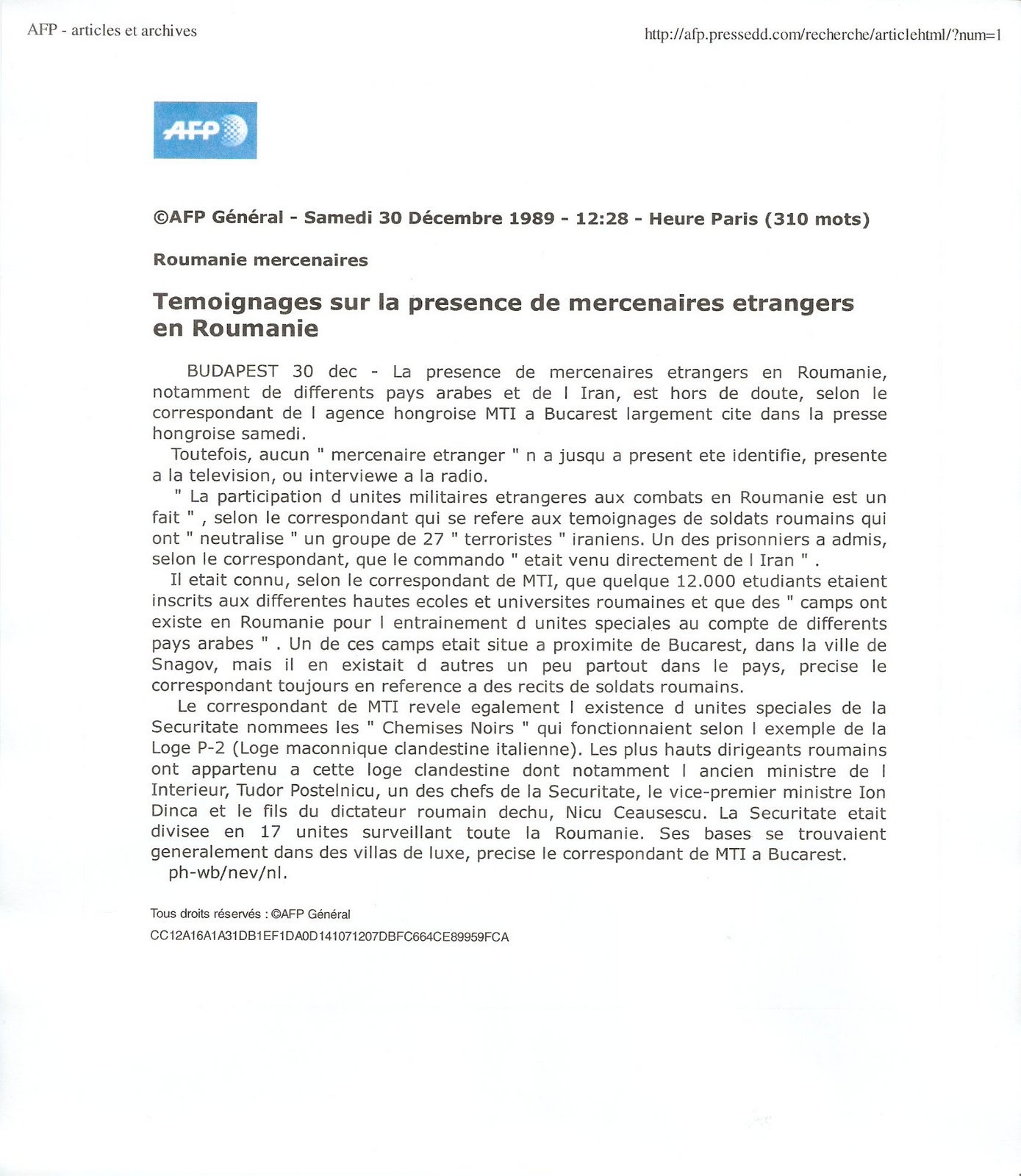
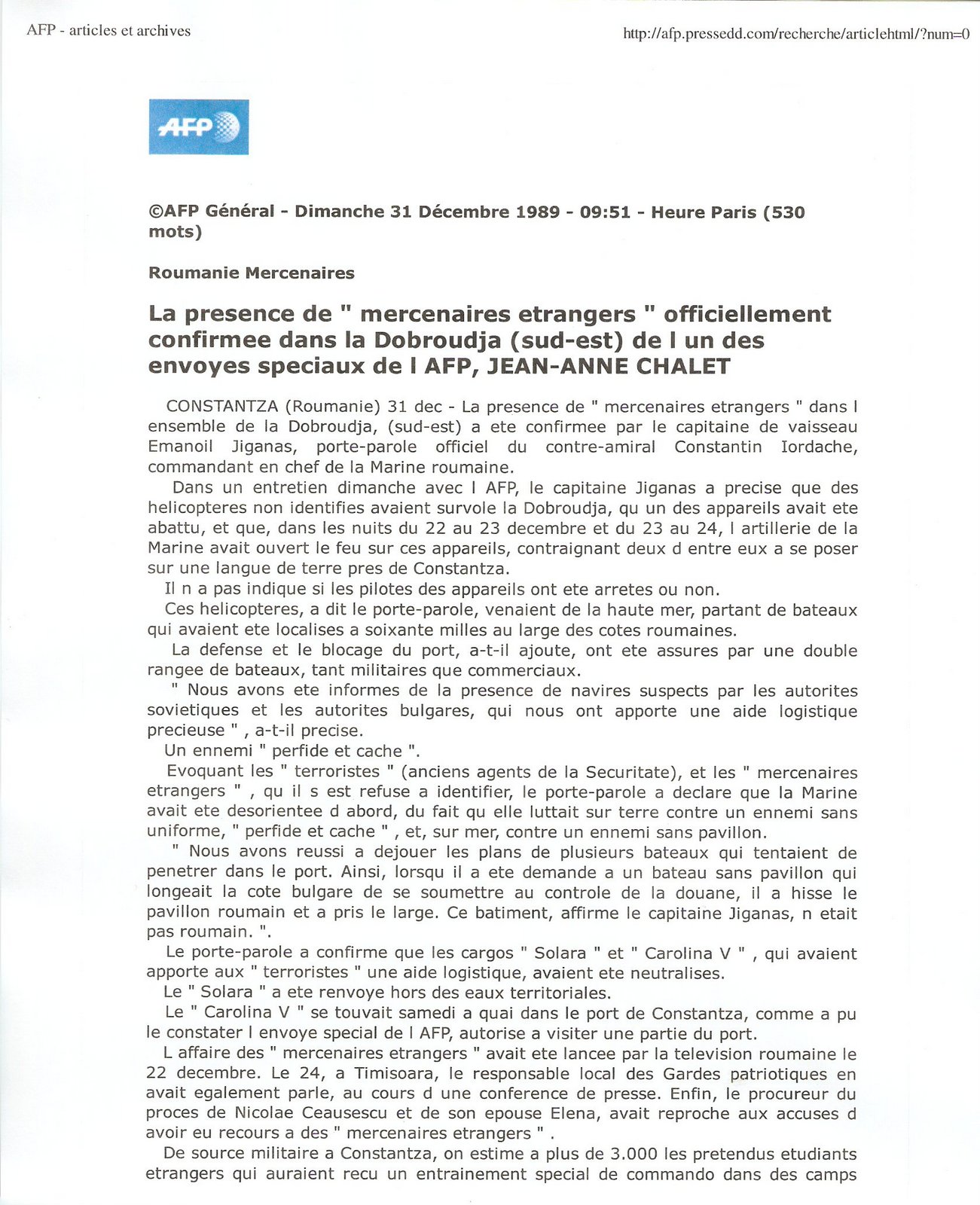
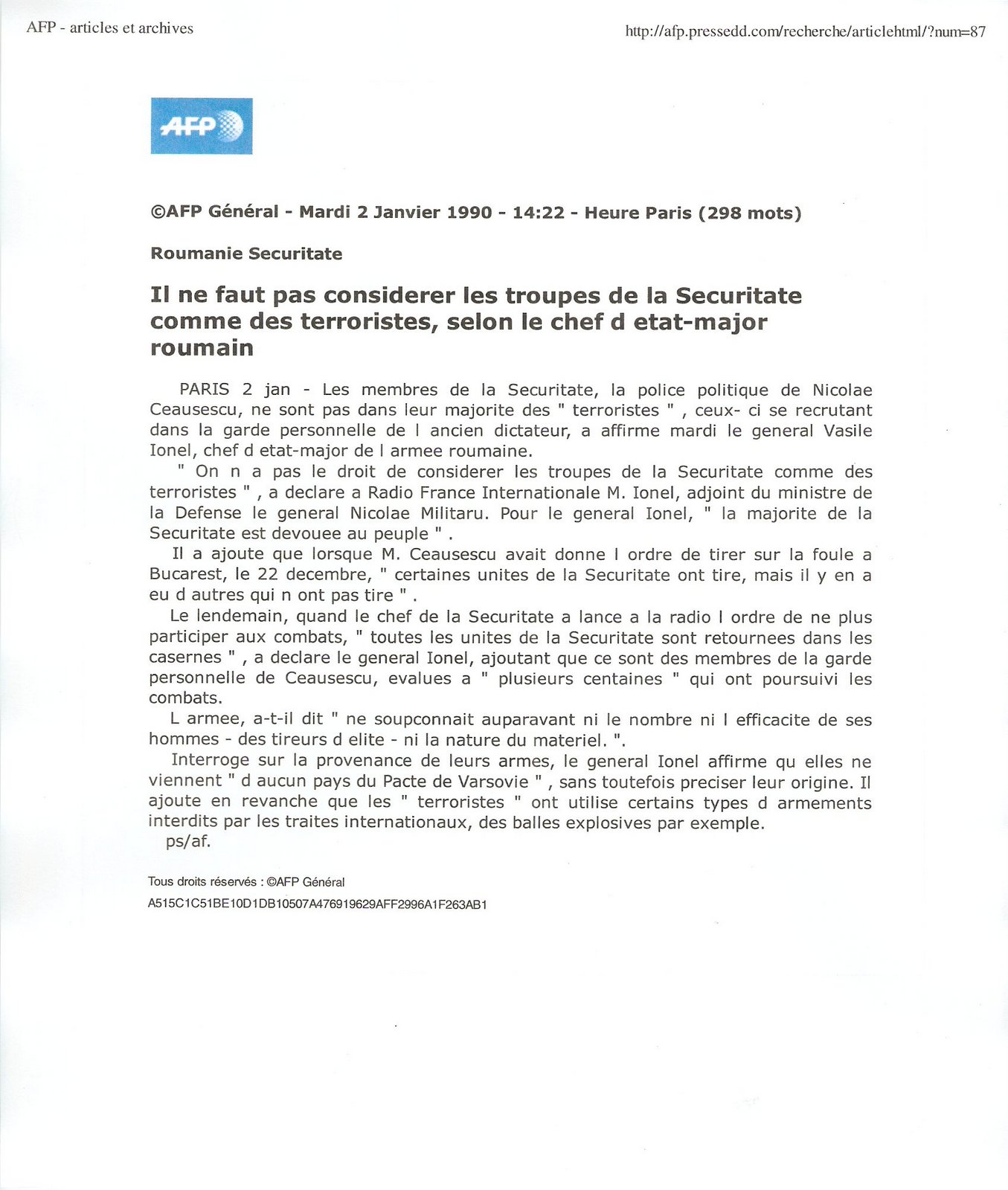
(To my pleasant surprise, I discovered the AFP (Agence France Presse) Archive online.  I finally dug into my pocket and purchased for approximately 3 euros an article the following articles.)

Anatomy of a Cover-up (or Constanta, we have a problem…):  In the waning days of December 1989 following the execution of Nicolae and Elena Ceausescu on Christmas Day, several high-ranking officials from Romania’s military and commercial navy stationed in and around Constanta recounted to foreign reporters details of what had happened off the Black Sea Coast during the previous week and a half…That they spoke out of turn and were entirely too honest could be surmised by the effort of Bucharest–and those directly charged with the overall governance and defense of the country–to deny the revelations out of Constanta.  It was the beginning of the cover-up of the Counter-Revolution of December 1989 and it was done precisely because of the involvement of foreign mercenaries in fighting side by side with elements of the Securitate who opposed the ouster of Nicolae Ceausescu.  (So, indeed, the cover-up was initiated by Romania’s new civil and military leaders to avoid international ramifications (the ultimate state function, regardless of regime, in a world of nation-states)…it would be continued by others.)

One wonders what would have happened had this series of reports been laid out in sequence and analyzed as a sequence.  There seems to have been more coverage of them (abroad) in the Budapest (see below), rather than Bucharest, press.  One of the few references in the literature on December 1989 is on page 66 of Nestor Ratesh’s Romania: The Entangled Revolution (1991), where Ratesh notes a (31 December 1989) Agence France Presse dispatch citing the office of naval commander Constantin Iordache on Soviet and Bulgarian information that helicopters were being launched by suspicious ships approximately 60 miles off the coast, as well as a later denial by other Romanian authorities of the existence of these helicopters.  As one can see below, the five AFP reports on the subject, from 30 and 31 December 1989, and 2 and 3 January 1990, are far more detailed, diverse, and damning than Ratesh’s allusion would suggest.
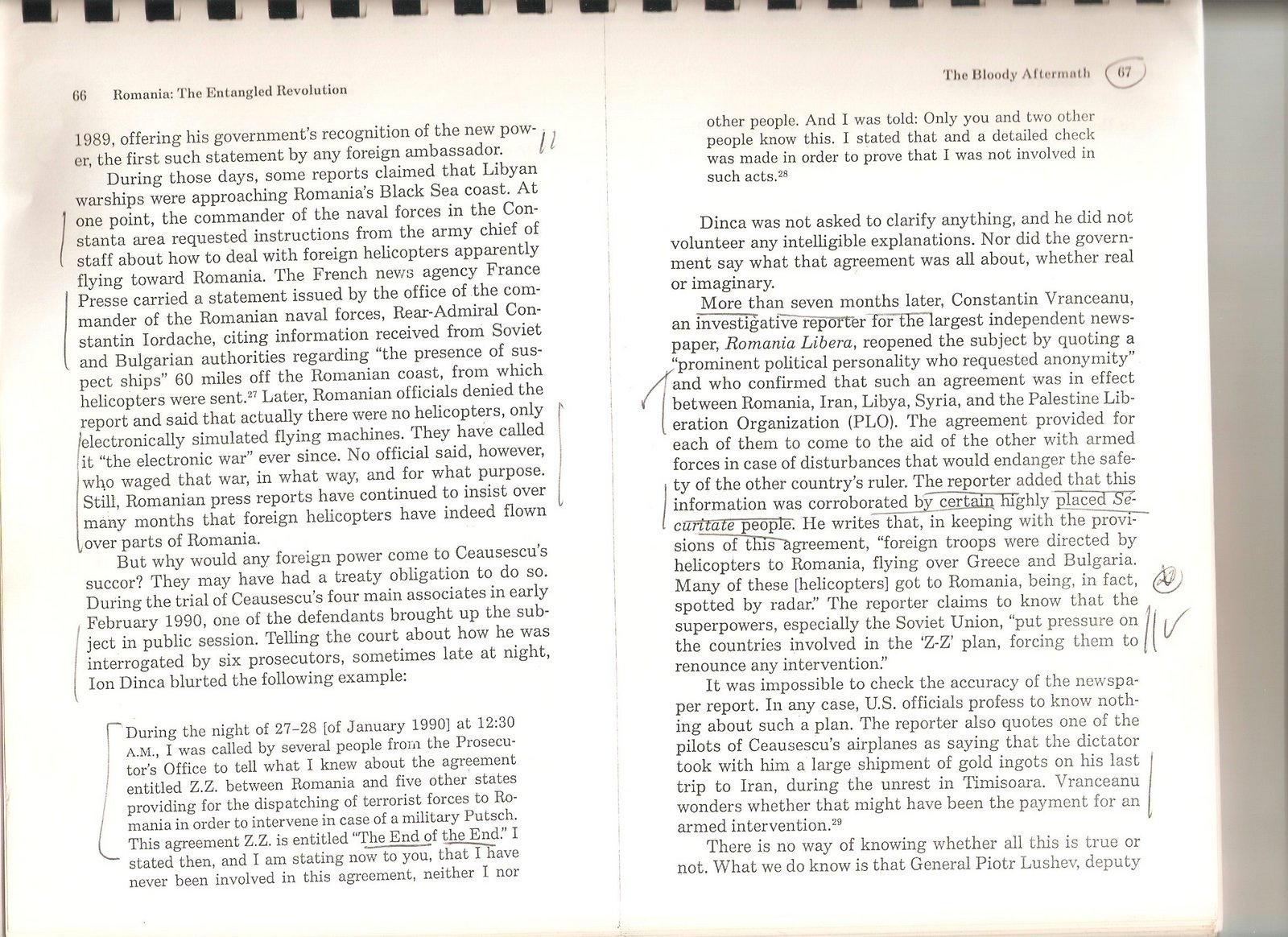
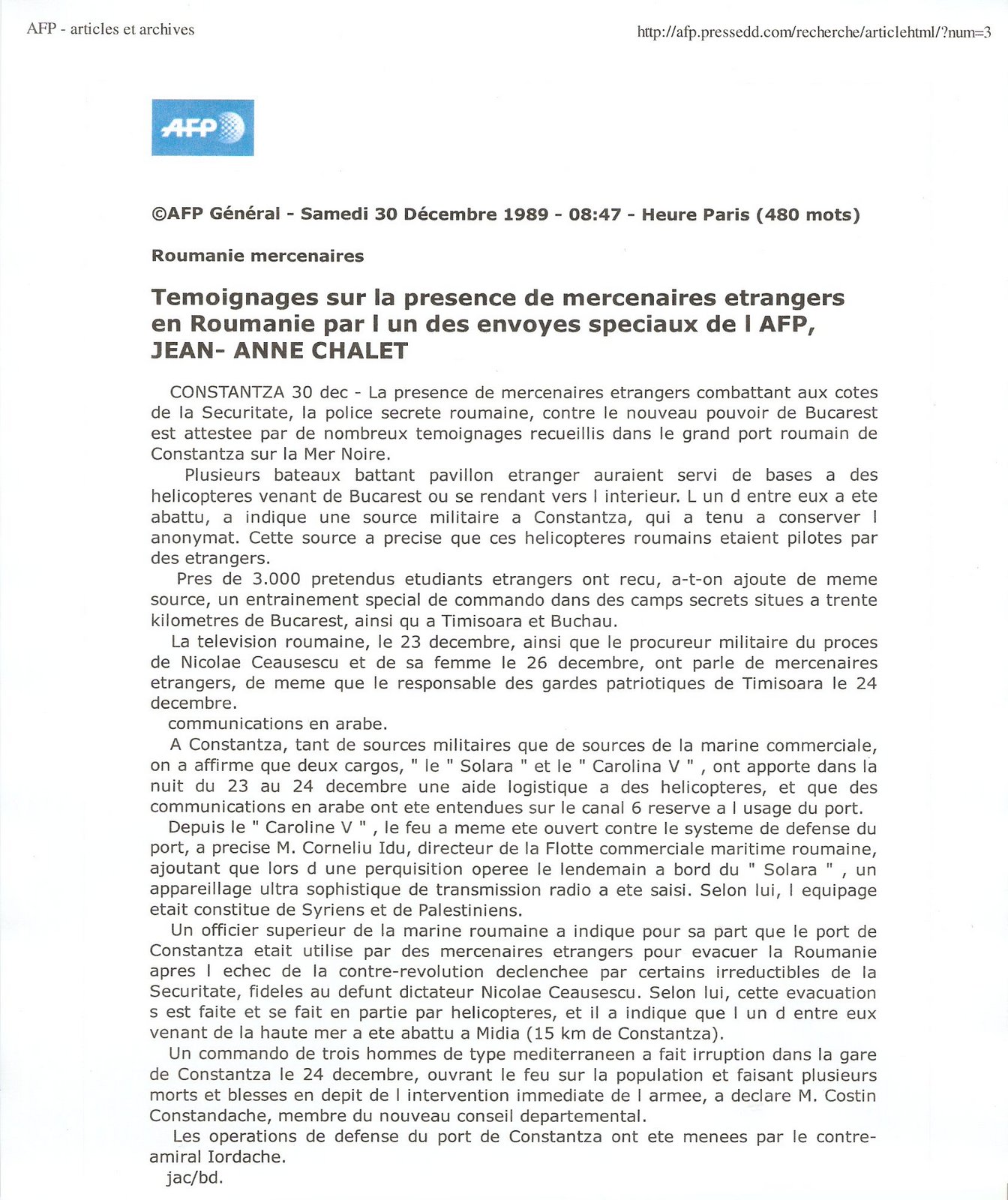
Note:  Not everything at this point had “disappeared”:  General Vasile Ionel confirmed that the terrorists had used foreign arms (arms not produced in Warsaw Pact countries, as he specified) and that they used munitions outlawed by international conventions, for example exploding DUM-DUM bullets (“balles explosives”).
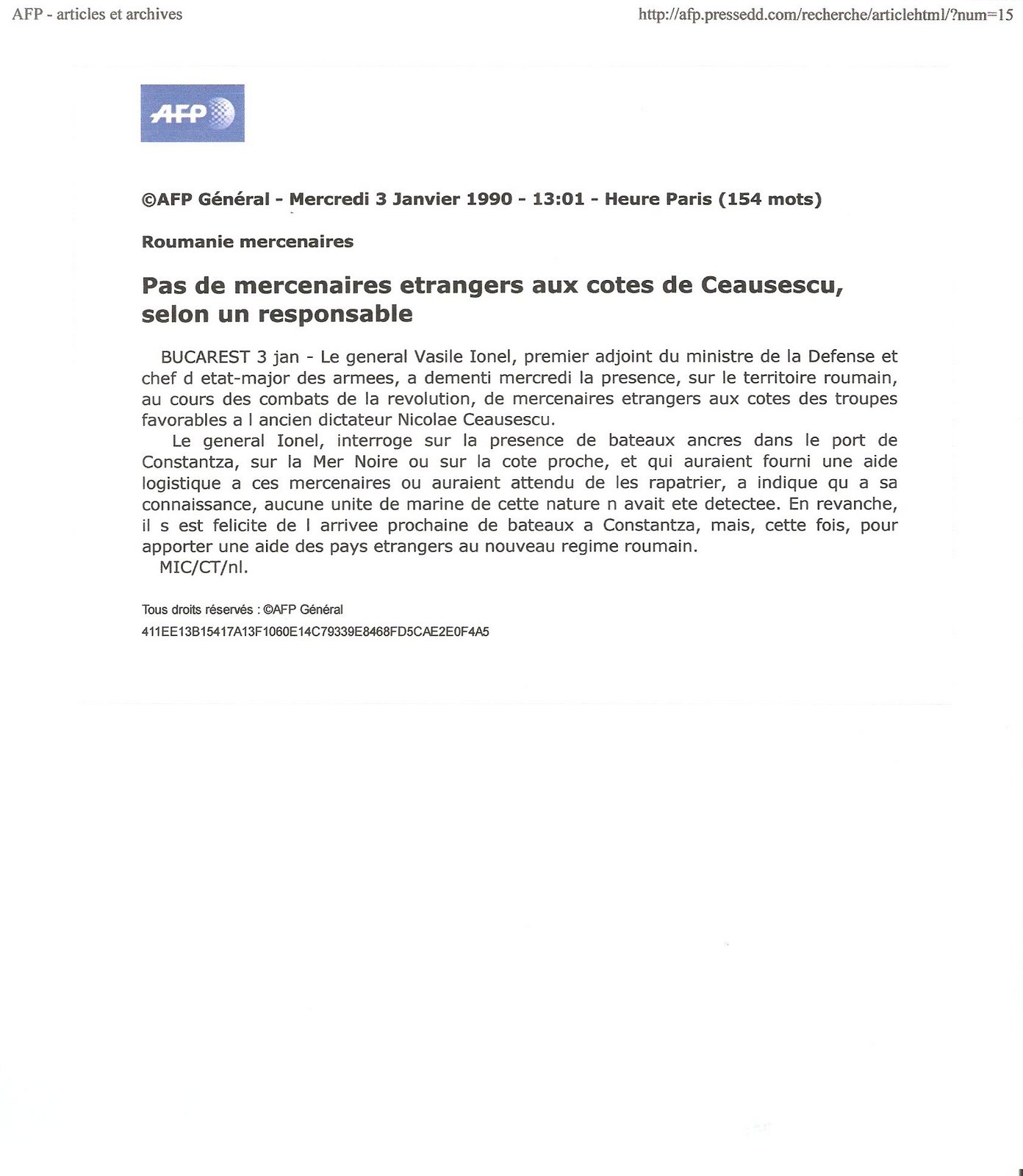
Talk about a clear example where the stupidities about Front and/or Army “disinformation” “inventing the terrorists” cannot explain behavior and fall apart miserably:  The case of the comments of military commanders on the Black Sea coast during the period 29-31 December 1989…and the reaction of senior military authorities in Bucharest who realized those revelations could cause international problems for Romania’s new leaders and thus needed to quash the truth as quickly as possible.
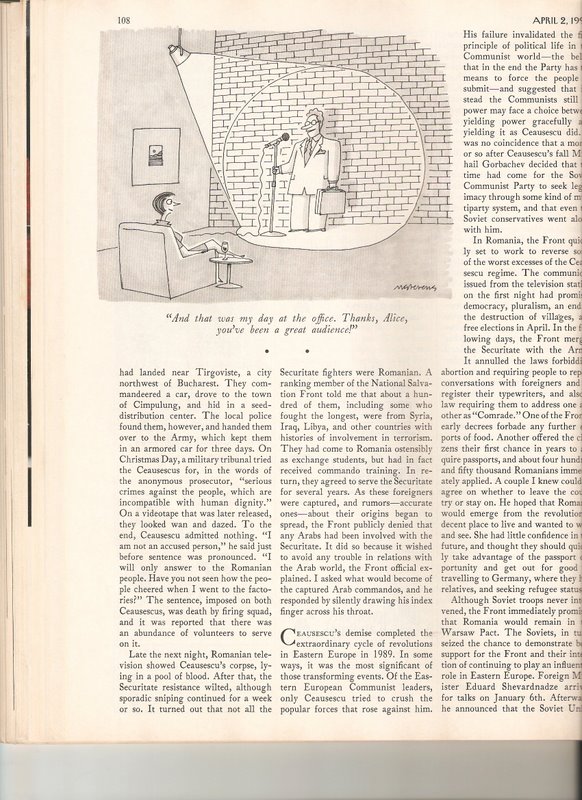
Robert Cullen, “Report from Romania:  Down with the Tyrant,” The New Yorker, 2 April 1990.

Late the next night, Romanian television showed Ceausescu’s corpse, lying in a pool of blood.  After that, the Securitate resistance wilted, although sporadic sniping continued for a week or so.  It turned out that not all of the Securitate fighters were Romanian.  A ranking member of the National Salvation Front told me that about a hundred of them, including some who fought the longest, were from Syria, Iraq, Libya, and other countries with histories of involvement in terrorism.  They had come to Romania ostensibly as exchange students, but had in fact received commando training.  In return, they agreed to serve the Securitate for several years.  As these foreigners were captured, and rumors–accurate ones–about their origins began to spread, the Front publicly denied that any Arabs had been involved with the Securitate.  It did so because it wished to avoid any trouble in relations with the Arab world, the Front official explained.  I asked what would become of the captured Arab commandos, and he responded by silently drawing his index finger across his throat.

—————————————————————————————————————————————————————————————————————————————————-

1-2 January 1990

Dr. Nicolae Constantinescu, chief surgeon at the Coltea Hospital, also was paid the honor of a visit by Colonel Ghircoias during these days:

I remember that on 1 or 2 January ’90 there appeared at the [Coltea] hospital a colonel from the Interior Ministry, who presented himself as Chircoias.  He maintained in violent enough language that he was the chief of I-don’t-know-what “criminalistic” department from the Directorate of State Security [ie. Securitate].  He asked that all of the extracted bullets be turned over to him.  Thus were turned over to him 40 bullets of diverse forms and dimensions, as well as munition fragments.[9]

[9] Dr. Professor Nicolae Constantinescu, interview by Romulus Cristea, “”Nici acum nu-mi dau seama cum am putut sa operez nonstop timp de trei zile,” Romania Libera, 20 December 2006, online edition.

Bucuresti, Spitalul Coltea:  “Pe data de 1 sau 2 ianuarie 1990 a aparut la spital un colonel Chircoias, de la Interne cred”

Prof. univ. dr. Nicolae (Nae) Constantinescu, membru al Academiei de Medicina si al Academiei Oamenilor de Stiinta. Medic chirug la Spitalul Coltea.

– Ce s-a intamplat cu cartusele extrase chirurgical din ranile pacientilor? Erau niste probe care ar fi putut lamuri anumite aspecte…
Pe data de 1 sau 2 ianuarie 1990 a aparut la spital un colonel Chircoias, de la Interne cred. Acest Chircoias a fost judecat si condamnat mai tarziu intr-un proces la Timisoara in legatura cu revolutia.

Chircoias, care sustinea sus si tare ca ar conduce nu stiu ce sectie criminalistica din Directia Securitatii Statului, a cerut gloantele extrase. Acestea, vreo 40 la numar, i-au fost date de un medic care era secretar de partid la IMF. Tin minte ca erau gloante de diverse forme, de diferite dimensiuni.

—————————————————————————————————————————————————————————————————————————————————-

7 January 1990

Ion Medoia, “Teroristi prinsi pe teritoriul Iugoslaviei,” Romania Libera, 10 ianuarie 1990.
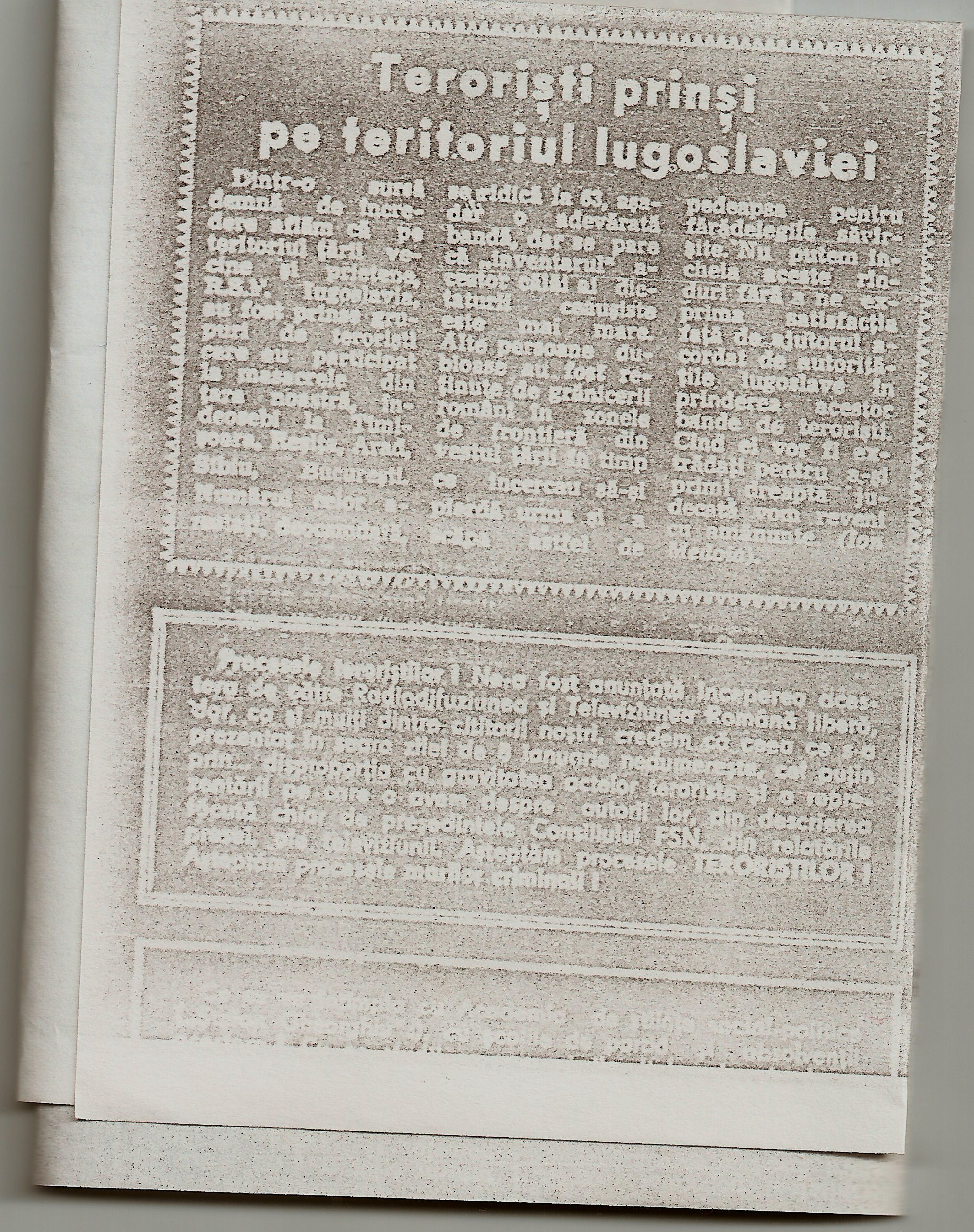
d. Stire de senzatie
Autoritatile iugoslave au arestat ieri 63 de teroristi, care au participat la masacrele de la Timisoara, Sibiu si Bucuresti. Cand vor fi predati inapoi, vom releva detalii semnificative.
(publicat in ziarul Renasterea banateana, Timisoara, 07.01.1990,pe prima pagina, fara titlu si nesemnat, dar incadrat in chenar)
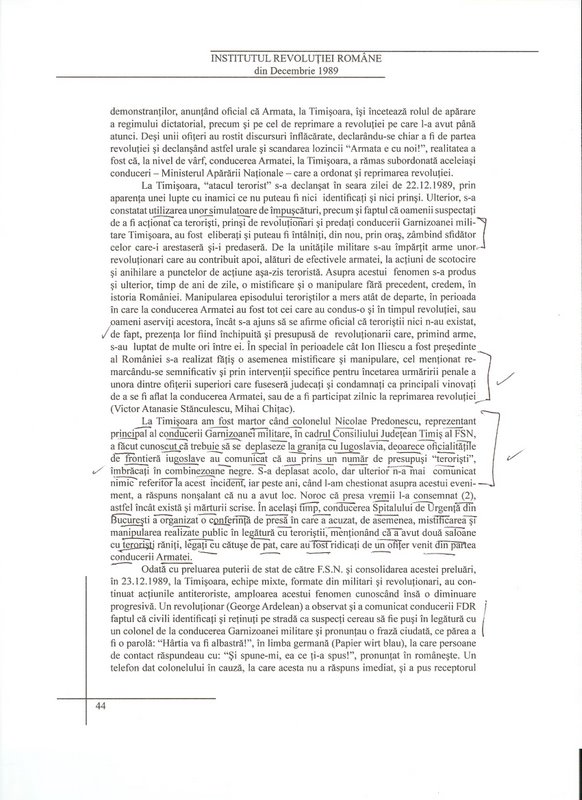
N.R. La vremea respectiva colonelul Nicolae Predonescu, reprezentant al conducerii Garnizoanei militare Timisoara la Consiliul judetean FSN Timis si totodata membru al respectivului Consiliu, a informat, inclusiv pe presedintele Consiliului judetean FSN Timis, Lorin Ioan Fortuna, ca va pleca, impreuna cu o delegatie militara, la solicitarea

http://lorin-fortuna.ro/reviste/politica_nationala/Trimestrul_1_din_2004/html/index.htm

—————————————————————————————————————————————————————————————————————————————————

9 January 1990

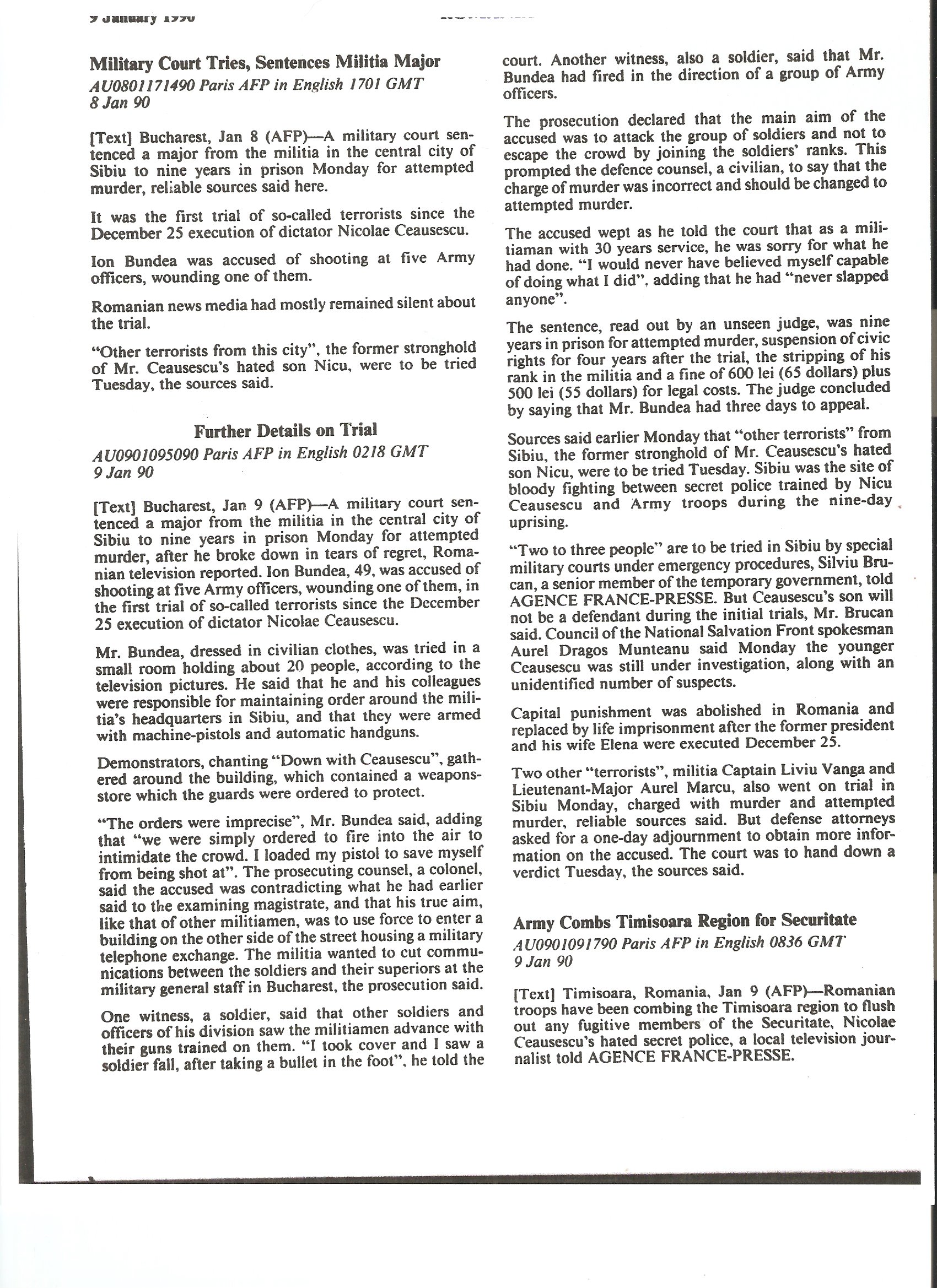
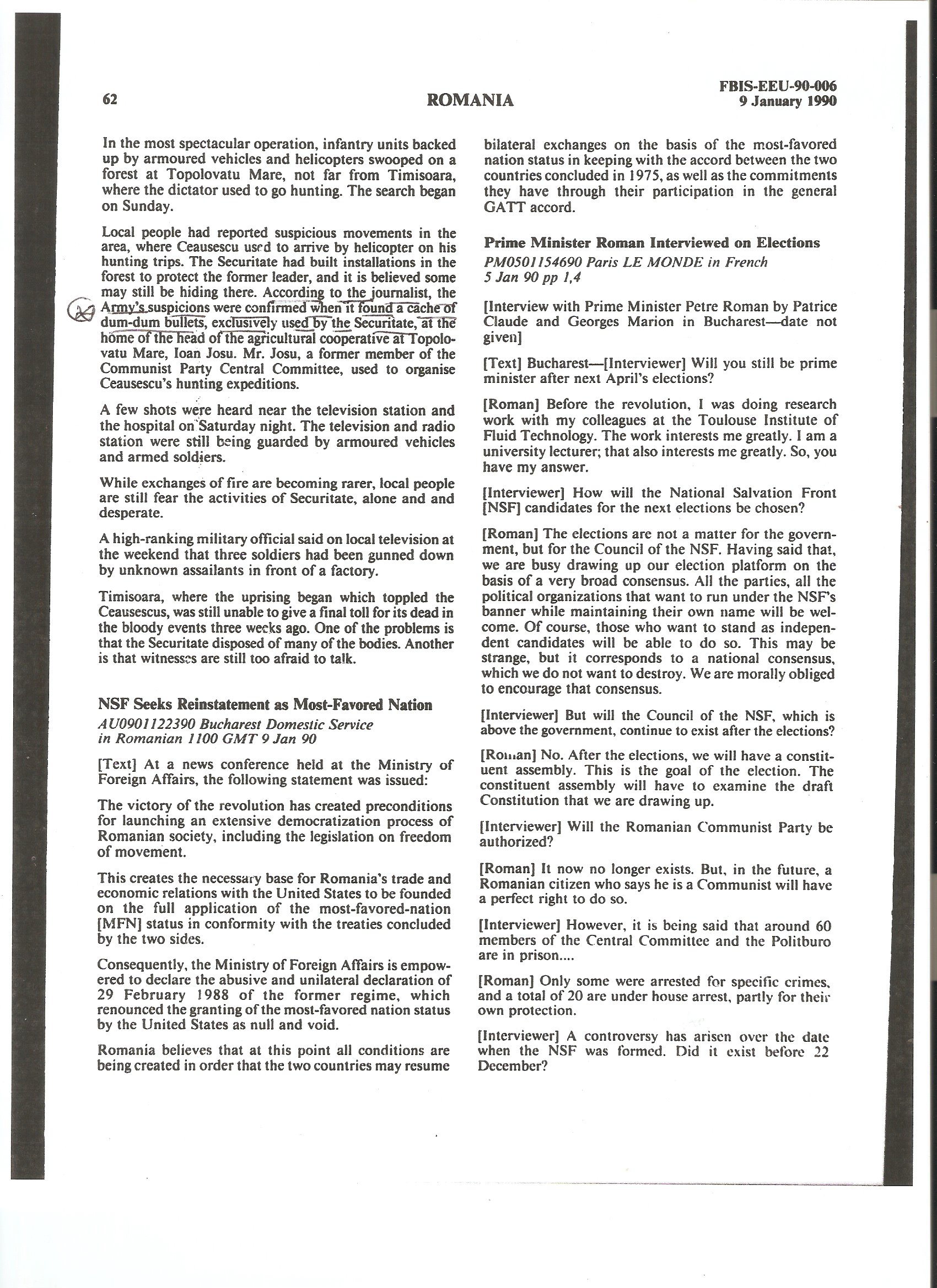
FBIS-EEU-90-006 9 January 1990 “Army Combs Timisoara Region for Securitate” Agence France Presse 9 January 1990, pp. 61-62

According to the journalist, the Army’s suspicions were confirmed when it found a cache of dum-dum bullets, exclusively used by the Securitate, at the home of the head of the agricultural cooperative at Topolovatu Mare, Ioan Josu [former member of the Communist Party Central Committee].
—————————————————————————————————————————————————————————————————————————————————

11 January 1990

Mai tirziu in 11 ianuarie [1990], cind toata lumea spunea iarasi ‘civili sa predea armele’ impreuna cu Cercel Doina Rebeca am intrat in buncarul subteran din CC si am mai prins inca opt insi.  Au tras–daca nu era Rebeca era a treia oara cind muream….

———————————————————————————————————–

9 January 1990; 11-17 January 1990

Lt. Col. Alexandru Bodea (no. 22 May 1990 Armata Poporului):On 9 January 1990, between the hours of 21:55 and 23:14, on the radar screens of the missile managers of one of the subordinate subunits there were detected signals coming from about 12 unidentified aircraft, that were deploying, at a height of 300 to 1800 meters, in the direction of a nearby locality.The following day, between the hours of 03:00 and 04:15 again were detected the signals of six airships, after which—the same—between 17:00-18:00 and 21:30—the same type of signals, several aerial targets hovering at altitudes between 300-3000 meters, in the same direction as the previous day.Then, as if to boost the belief of the missile officers that this was no accident, on the third day, 11 January, between the hours 0400-0500, again there appeared the signals of 7 unidentified aircraft, having essentially the same flight characteristics.  What is curious is that not a single one of these targets was observed visually and no characteristic engine sounds were heard in the respective locations.But even more curious is that, just then, from the central radio base of a nearby municipality, there arrived a communications unit that intercepted foreign signals on a particular bandwidth, in impulses, while on another frequency an intense traffic in Arabic or Turkish was noted.In light of this information, the commander of the unit organized a radio inspection of numerous areas, with the help of transmissions’ equipment.  Therefore, on 11 January 1990, between 1120 and 1130 on the respective frequency were received the code signs in English, 122 calling 49, 38, 89, 11, 82, 44, 38, 84, and asked if they “were doing well.”From the fragments of discussions it could be understood that they were making references to explosives, hospitals, medicines, and wounded “for the hours 1400.”  At 1330, on the same frequency, once again were intercepted conversations in which there was mention of wounded and requests for help.  The transmissions were received over this, in which a more feminine voice and a dog’s bark could be clearly heard.  References were made to the preceding conversations that were to follow at 1800, 1900, 2200, and then on 12 January 1990, at 0910.Chatting with some citizens from the local area where these targets and foreign radio traffic were intercepted, the commander of the anti-aircraft unit to whom we referred found out that nearby there exists a wooded road (author’s note: the locality is in a mountainous area), surrounded by two rows of barbed wire, a road on which in fact there is no lumber transport.  Not by chance, since before the Revolution, the road was off-limits and was under the strict guard of the Securitate.  [emphasis added]These same citizens further informed the unit’s commander, that after the Revolution, the road in question did not become a no-man’s land, remaining instead in the hands of people dressed as woodsmen but about whom those from the local lumber collective had no clue.Who could these unknown “woodsmen” be?  And what “affairs” did they have there?  Perhaps exactly…[article concludes]
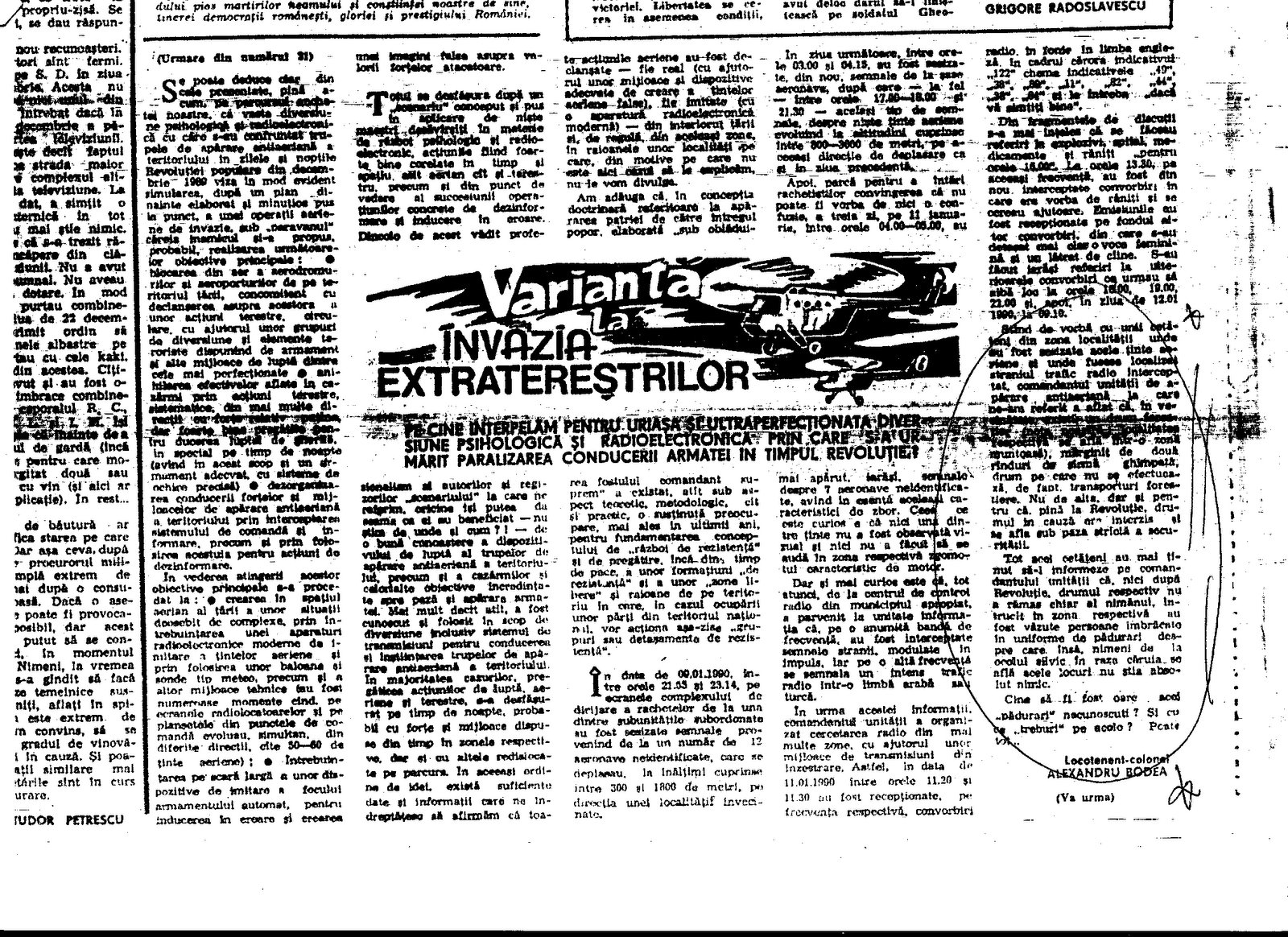
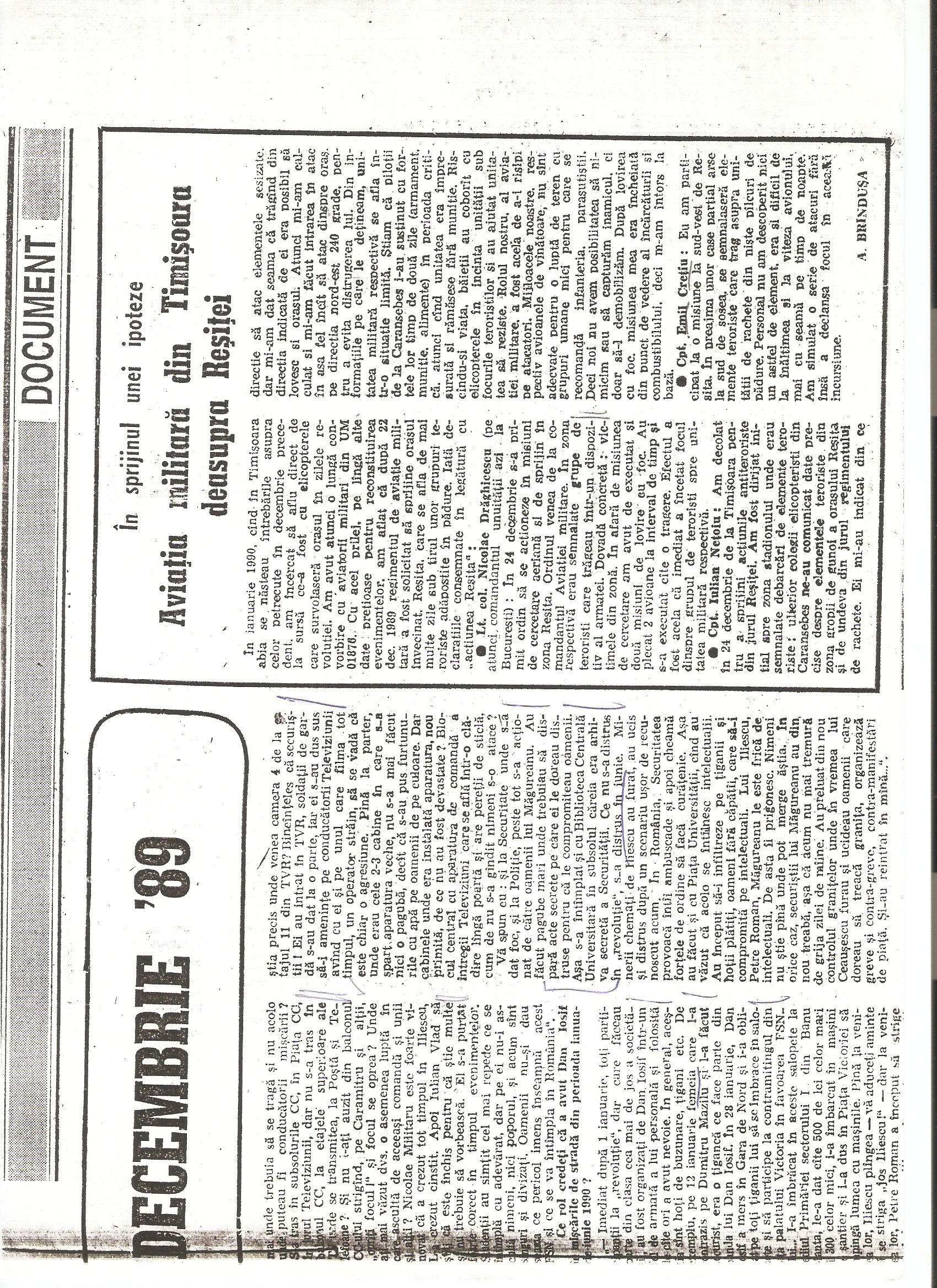
“…In data de 09.01.1990, intre orele 21.55 si 23.14, pe ecranele complexului de dirijare a rachetelor de la una dintre subunitatiile subordonate au fost sesizate semnale provenind de la un numar de 12 aeronave neidentificate, care se deplasau la inaltimi cuprinse intre 300 si 1800 de metri, pe directia unei localitatii invecinate.
In ziua urmatoare, intre orele 03.00 si 04.15, au fost sesizate, din nou, semnale de la sase aeronave, dupa care–la fel–intre orele 17.00-18.00 si 21.30–acelasi tip de semnale, despre niste tinte aeriene evoluind la altitudini cuprinse intre 800-3000 de metri, pe aceeasi directie de deplasare ca si in ziua precedenta.
Apoi, parca pentru a intari rachetistilor convingerea ca nu poate fi vorba de nici o confuzie, a treia zi, pe 11 ianuarie, intre orele 04.00-05.00, au mai aparut, iarasi, semnale despre 7 aeronave neidentificate, avind in esenta aceleasi caracteristici de zbor.  Ceea ce este curios e ca nici una dintre tinte nu a fost observata vizual si nici nu a facut sa se auda in zona respectiva zgomotului caracteristic de motor.
Dar si mai curios este ca, tot atunci, de la centrul de control radio din municipiul apropriat, a parvenit la unitate informatia ca, pe o anumita banda de frecventa, au fost interceptate semnale strainii, modulate in impuls, iar pe o alta frecventa se semnala un intens trafic radio intr-o limba araba sau turca.
In urma acestei informatii, comandantul unitatii a organizat cercetarea radio din mai multe zone, cu ajutorul unor mijloace de transmisiuni din inzestrare.  Astfel, in data de 11.01.1990 intre orele 11.20 si 11.30 au fost receptionate, pe frecventa respectiva, convorbiri radio, in fonic [?] in limba engleza, in cadrul carora indicatul “122″ chema indicativele “49″, “38″, “89″, “11″, “82″, “44″, “38″, “84″, si le intreba “daca va simtiti bine”.
Din fragmentele de discutii s-a mai inteles ca se faceau referiri la explozivi, spital, medicamente, si raniti “pentru orele 16.00″.  La orele 13,30, pe aceeasi frecventa, au fost din nou interceptate convorbiri in care era vorba de raniti si se cereau ajutoare.  Emisiunile au fost receptionate pe fondul altor convorbiri, din care s-au detasat mai clar o voce feminina si un latrat de ciine.  S-au facut iarasi referiri la ulterioarele convorbiri ca urmau sa aiba loc la orele 16.00, 19.00, 22.00 si, apoi, in ziua de 12.01.1990, la 09.10.
Stind de vorba cu unii cetateni din zona localitatii unde au fost sesizate acele tinte aeriene si unde fusese localizat straniul trafic radio interceptat, comandantul unitatii de aparare antiaeriana la care ne-am referit a aflat ca, in vecinatate, exista un drum forestier (nota noastra; localitatea respectiva se afla intr-o zona muntoasa), marginit de doua rinduri de sirma ghimpata, drum pe care nu se efectueaza [?], de fapt, transporturi forestiere.  Nu de alta, dar si pentru ca, pina la Revolutie, drumul in cauza era interzis si se afla sub paza stricta a securitatii.
Tot acei cetateni au mai tinut sa-l informeze pe comandantul unitatii ca, nici dupa Revolutie, drumul respectiv nu a ramas chiar al nimanului, intrucit in zona respectiva au fost vazute persoane imbracate in uniforme de padurari despre care insa, nimeni de la ocolul silvic in raza cariua se afla acele locuri nu stia absolut nimic.
Cine sa fi fost oare acei “padurari” necunoscuti?  Si cu ce “treburi” pe acolo?  Poate tot…”
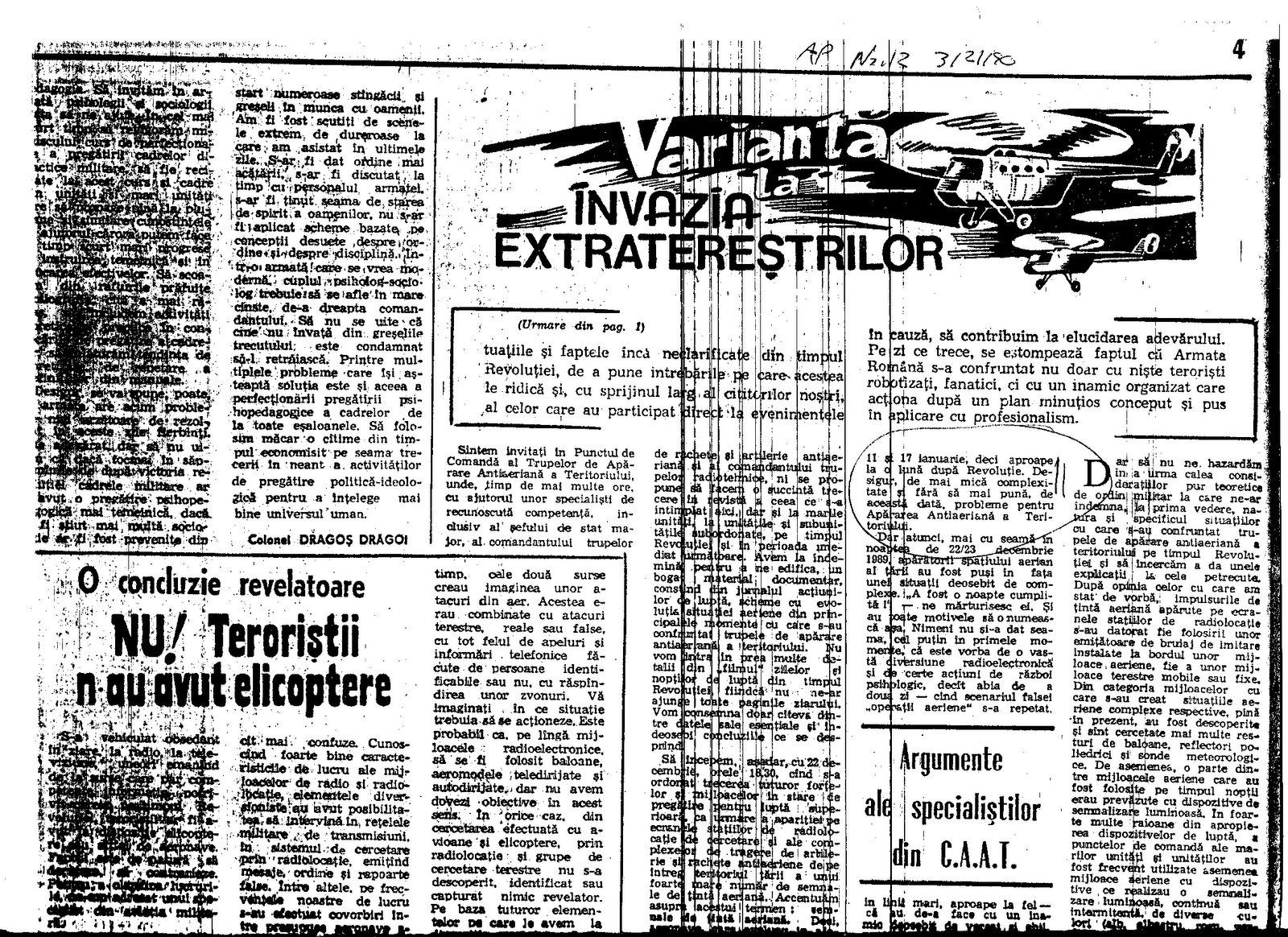
(Locotenent-colonel Alexandru Bodea, din serialul “Varianta la Invazia Extraterestrilor.  Pe cine interpelam pentru uriasa si ultraperfectionata diversiune psihologica si radioelectronica prin care s-a urmarit paralizarea conducerii armatei in timpul Revolutiei?”
Armata Poporului, nr. 22 (“urmare din numarul 21″), mai 1990.)

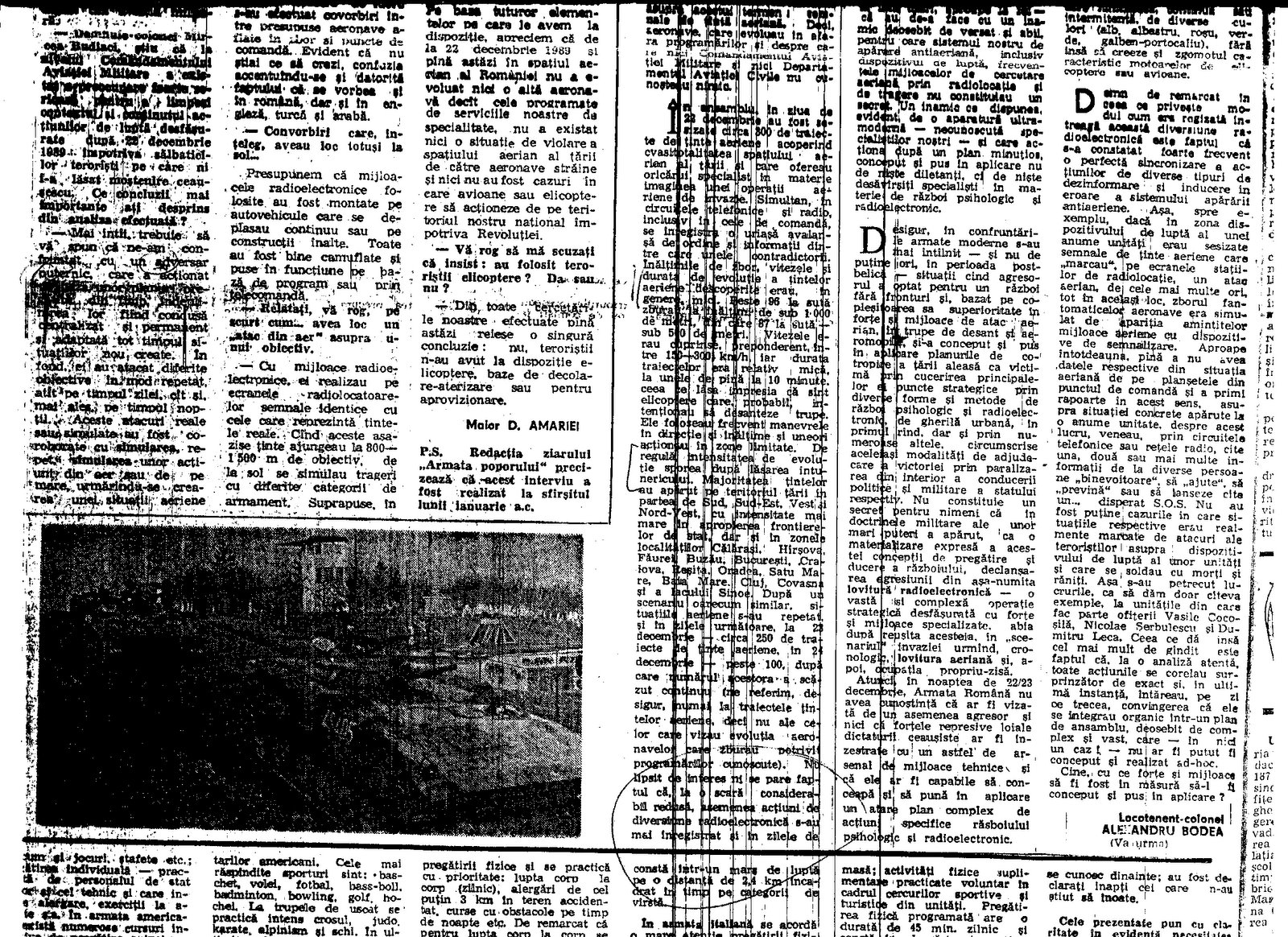
asemenea actiuni de diversiune radio-electronica s-au mai inregistrat si in zilele de 11 si 17 ianuarie, deci aproape la o luna dupa Revolutie…
—————————————————————————————————————————————————————————————————————————————————-

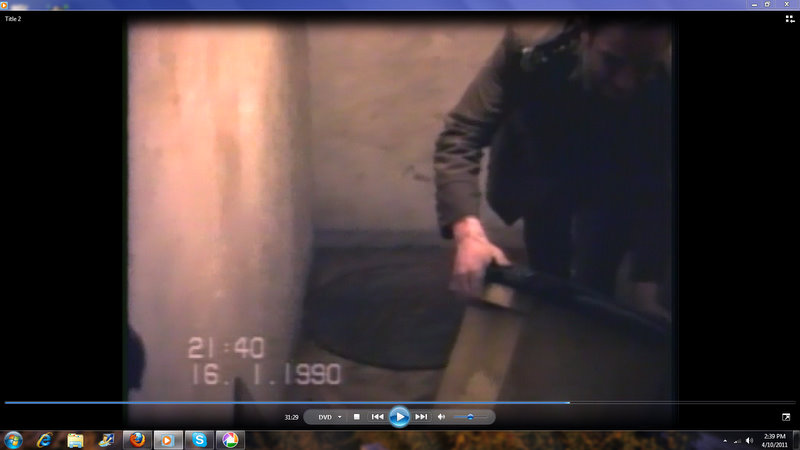
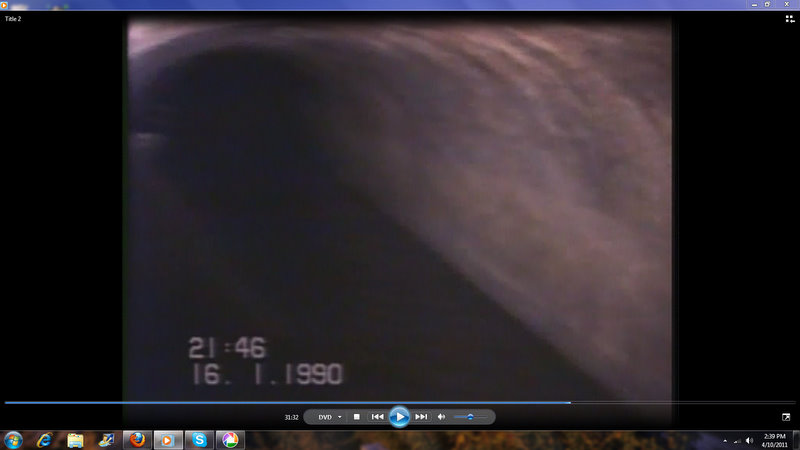
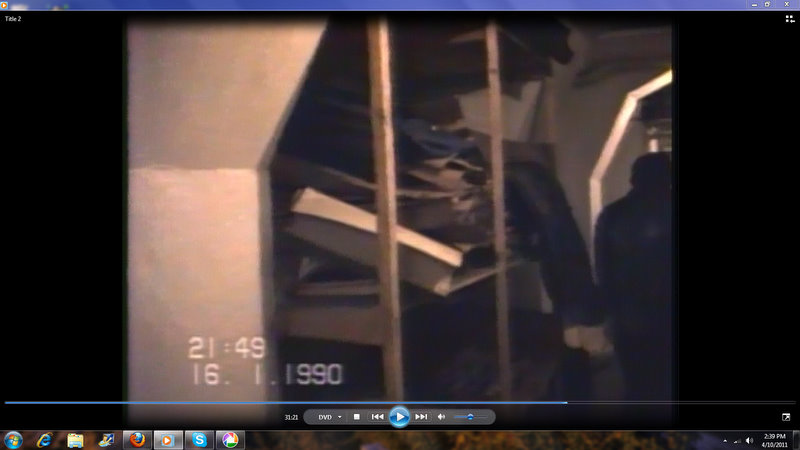
16 January 1990:  (Date of film procured by Ted Koppel and ABC News showing underground tunnels used by the “terrorists”)

Monday, March 5 (1990). 

Bucharest.  Among the many art forms that have atrophied during the past 45 years in Romania, is that of dissembling.  Confronted by questions they don’t like, a number of military officers and officials whom we encountered, simply lied.  Stupid lies; the kind that speak of a society in which no one ever dared to question an official pronouncement.

We had requested a tour of the complex of tunnels that radiate out from beneath the old Communist Party Central Committee building in Bucharest.  An army colonel escorted us along perhaps 50 yards of tunnel one level beneath the ground and the pronounced the tour over.  I asked to be shown the second and third levels, videotape of which had already been provided us by some local entrepreneurs.  “There is no second or third level,” said the colonel.  I assured him that I had videotape of one of his own subordinates, who had escorted us on this tour, lifting a toilet that concealed the entrance to a ladder down to the next level of tunnels.  The colonel went off to consult with his man.  When he came back he said, “my officer says he’s never seen you before.”  “True,” I replied, but then I’d never said he had, only that we were in possession of the videotape I’d described.  “There are no other tunnels,” said the colonel.

Ted Koppel, “Romanian Notebook.  The week Lenin got the hook.” The Washington Post, 13 March 1990, A25.

from 2 April 1990, ABC News Special.  The Koppel Report:  Death of a Dictator.
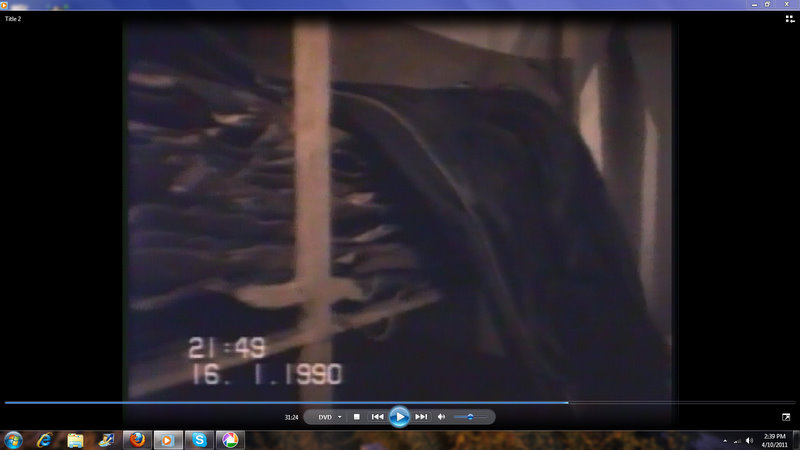

Dupa alti 20 de metri militarii au observat ca peretii tunelului au alta culoare, sunt mai noi si sunt acoperiti cu un fel de rasina sintetica. Dupa inca 10 metri culoarul se infunda. Chiar la capat se afla un piedestal din lemn pe care era asezat un capac de WC. Au ridicat capacul iar sub el au gasit un chepeng de fier. L-au ridicat si au gasit… un rau cu apa curata, care curge intr-o matca artificiala din beton. Are latimea de circa 1,5 metri si adancimea de aproximativ un metru. Raul se afla la aproximativ 12 metri sub platforma Pietei Revolutiei . Cele 16 barci erau folosite de fapt pentru acesta cale de navigatie.

from 2 April 1990, ABC News Special.  The Koppel Report:  Death of a Dictator.
—————————————————————————————————————————————————————————————————————————————————-

18 January 1990

On Thursday morning [18 January 1990], for example, a plainclothes officer of the pro-Ceausescu Securitate suddenly emerged from a manhole on Nicolae Balcescu Boulevard, the main north-south thoroughfare. He was immediately detained by passers-by, who were evidently aware that in recent weeks the Securitate forces had used a vast network of underground tunnels for hit-and-run attacks on the Rumanian Army units that joined the uprising.  In a short time, armed soldiers gathered at the manhole and brought out another 16 Securitate officers who had been living in the tunnels for nearly a month. Down the street that same day, four more Securitate officers turned themselves in to an army unit in front of the Plaza Building, saying they were starving.  This was revealed by two associates of Cristian Popisteanu, editor in chief of Magazin Istoric, who witnessed the incidents. But so far, no word of what happened has appeared in the Bucharest press or on television. [NYT 1/22/1990]

Upheaval in the East: Rumania; Rumanians Call for Freedom in Schools

By DAVID BINDER, Special to The New York Times
Published: January 22, 1990

BUCHAREST, Rumania, Jan. 21— Student leaders, addressing a crowd of about 3,000 of their classmates today, demanded far-reaching changes in the faculties of Bucharest University and other Rumanian institutions of higher learning.

The strongest demand, and the one cheered most loudly by the students, was for the ouster of professors most closely associated with the Communist dictatorship of the late Nicolae Ceausescu, particularly those working for the Securitate, or state security police.

”There are Securitate officers on the journalism faculty,” a student, Daniel Oghian, declared. He assailed Professor Radu Florian as a Ceausescu holdover whose advocacy of Communist ideology was particularly objectionable. Mr. Florian is a member of the Stefan Gheorgiu Academy, where Securitate officials were trained. The academy was grafted onto Bucharest University under the Ceausescu Government.

”Down with Florian!” the students chanted. ”Down with Stefan Gheorgiu! Depoliticize! Depoliticize!” ‘Militarized’ Classrooms Mihai Iliescu, a physics student, drew cheers when he declared that incompetent professors should be sent back to ”study their lessons over again” or be forced to resign. He also called for the ouster of the Ministry of Education’s inspector of universities.

Another speaker, from the Marine Sciences Institute in Constanta, said that his college had been ”militarized” and subjected to Securitate control under Mr. Ceausescu. Conditions were such that students were quartered 50 to a single room, he said, and buildings were unheated.

”Take it over!” the students shouted. ”Take it over!” It was the second rally in two weeks in the capital. The first was held at the Polytechnical Institute in western Bucharest. But this time the students gathered in University Square in the middle of the city under the auspices of a newly-formed Student League.

In passionate speeches commemorating classmates who were killed in the uprising that toppled the Ceausescu regime four weeks ago, the students said they wanted to create ”a new society” and ”a strong Rumania.”

”We speak from our hearts for those who were killed in the revolution,” said Mihai Gheorghiu, a third-year philosophy student. Dan Josif, another student, said, ”They fought with weapons, and we carried flowers.”

Government Is Silent on Protest

The students, many cradling lighted candles in their hands, bowed their heads in a minute of silence for their slain classmates, then raised their voices in four stanzas of the long-banned hymn ”Awake, Ye Rumanians,” which denounces ”barbarians and tyrants.”

There were no Government spokesmen at the rally. Nor was there any immediate reaction from the governing Council of National Salvation, although its President, Ion Iliescu, met with youth leaders today to discuss a future group for Rumanian young people to replace the Communist youth organization.

It has generally been impossible to obtain precise information about or reactions to daily events in Rumania from the Government, which closed its foreign press and telephone service on Saturday, even from its spokesman, although he holds periodic news conferences.

On Thursday morning, for example, a plainclothes officer of the pro-Ceausescu Securitate suddenly emerged from a manhole on Nicolae Balcescu Boulevard, the main north-south thoroughfare. He was immediately detained by passers-by, who were evidently aware that in recent weeks the Securitate forces had used a vast network of underground tunnels for hit-and-run attacks on the Rumanian Army units that joined the uprising.

In a short time, armed soldiers gathered at the manhole and brought out another 16 Securitate officers who had been living in the tunnels for nearly a month. Down the street that same day, four more Securitate officers turned themselves in to an army unit in front of the Plaza Building, saying they were starving.

This was revealed by two associates of Cristian Popisteanu, editor in chief of Magazin Istoric, who witnessed the incidents. But so far, no word of what happened has appeared in the Bucharest press or on television.

Photos: Students in Bucharest demonstrating yesterday for far-reaching changes at universities, including the ouster of faculty members the students say were supporters of the deposed dictator, Nicolae Ceausescu. (AP); A student at the rally mourning a relative killed in the revolution. (Reuters)

—————————————————————————————————————————————————————————————————————————————————-

24 January 1990

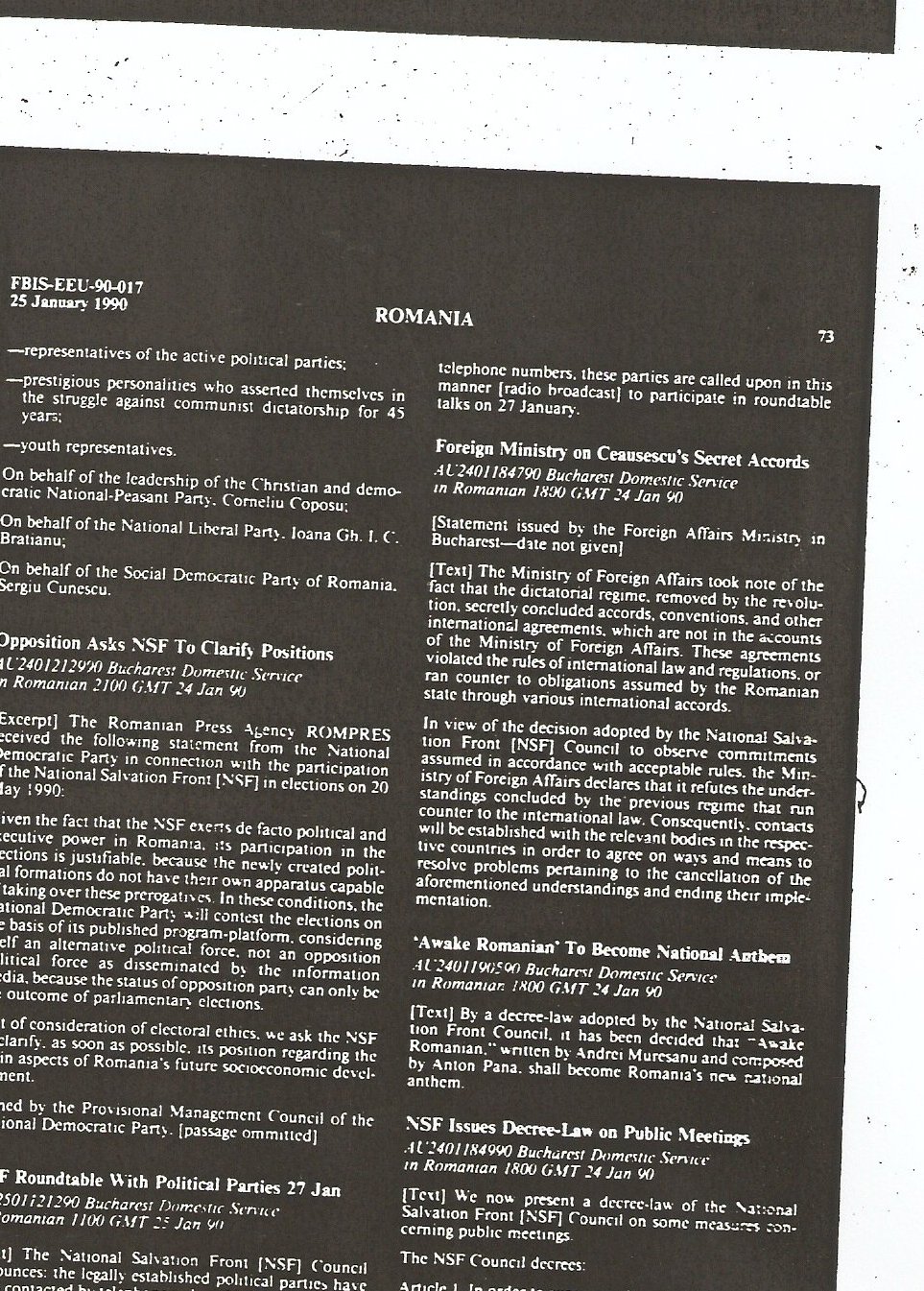
A cryptic message announcing the abrogation of unspecified secret accords with unspecified countries carried out by the Ceausescu regime, but not contained in the registries of the Foreign Ministry and in contravention of international law (in other words, Plan Z-Z, an accord with several Middle Eastern states, most importantly perhaps Qadhafi’s Libya)…24 January 1990 appears to have also been–not coincidentally–the last day “foreign terrorists” who had fought with the Securitate against Ceausescu’s downfall were exfiltrated from the country–reputedly following a threat to Romanian workers in Libya by Qadhafi if the remaining Arab mercenaries in Romanian custody were not allowed to leave the country…WHY OH WHY, WE ARE CONSTANTLY ASKED, DID ILIESCU, ROMAN, AND THE NATIONAL SALVATION FRONT NOT PUT THE “TERRORISTS” ON TRIAL:  HERE IS YOUR ANSWER, THEY WERE COMPLICIT IN ALLOWING THEM TO LEAVE THE COUNTRY AND THEREFORE LACKED A KEY ELEMENT OF THOSE RESPONSIBLE FOR THE DECEMBER BLOODSHED.  THE TRUTH ABOUT THE REVOLUTION WAS THUS COMPROMISED, BURIED ON THAT FATEFUL DAY OF 24 JANUARY 1990.
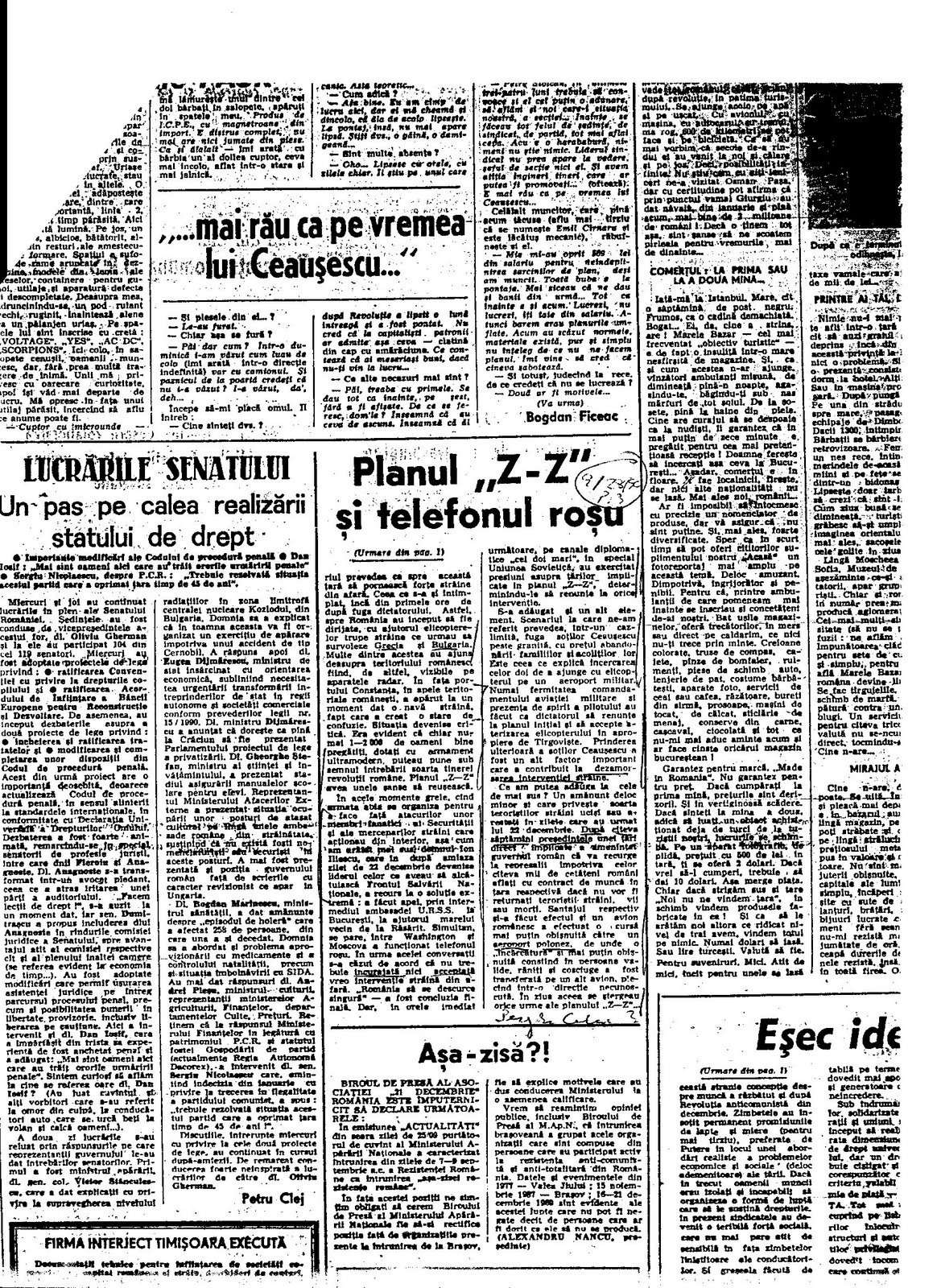
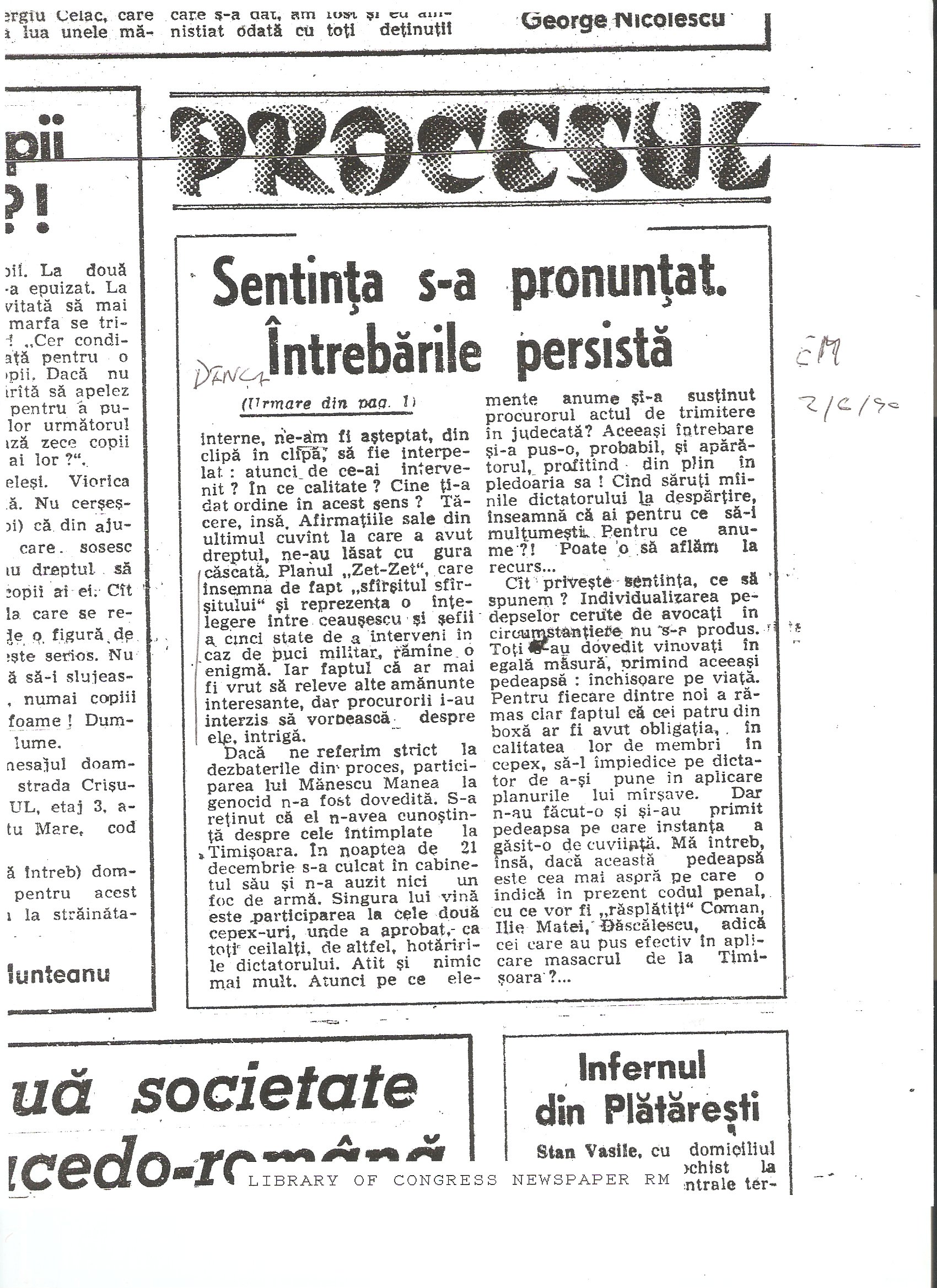
Constantin Vranceanu, “Planul Z-Z si telefonul rosu,” Romania Libera, 28 septembrie 1990.

Dupa citeva saptamini presedintele unei tari direct implicate a amenintat guvernul roman ca va recurge la represalii impotriva celor citeva mii de cetateni romani aflati cu contract de munca in tara respectiva daca nu vor fi returnati teroristii straini, vii sau morti.  Santajul respectiv si-a facut efectul si un avion romanesc a efectuat o cursa mai putin obisnuita catre un aeroport polonez, de unde o “incarcatura” mai putin obisnuita constind in persoane valide, raniti si cosciuge a fost transferata pe un alt avion, plecand intr-o directie necunoscuta.  In ziua aceea se stergeau orice urme ale planului “Z-Z”

24 ianuarie 1990

The End…of “The End of the End”
Posted in decembrie 1989, raport final | Tagged: , , | 2 Comments »

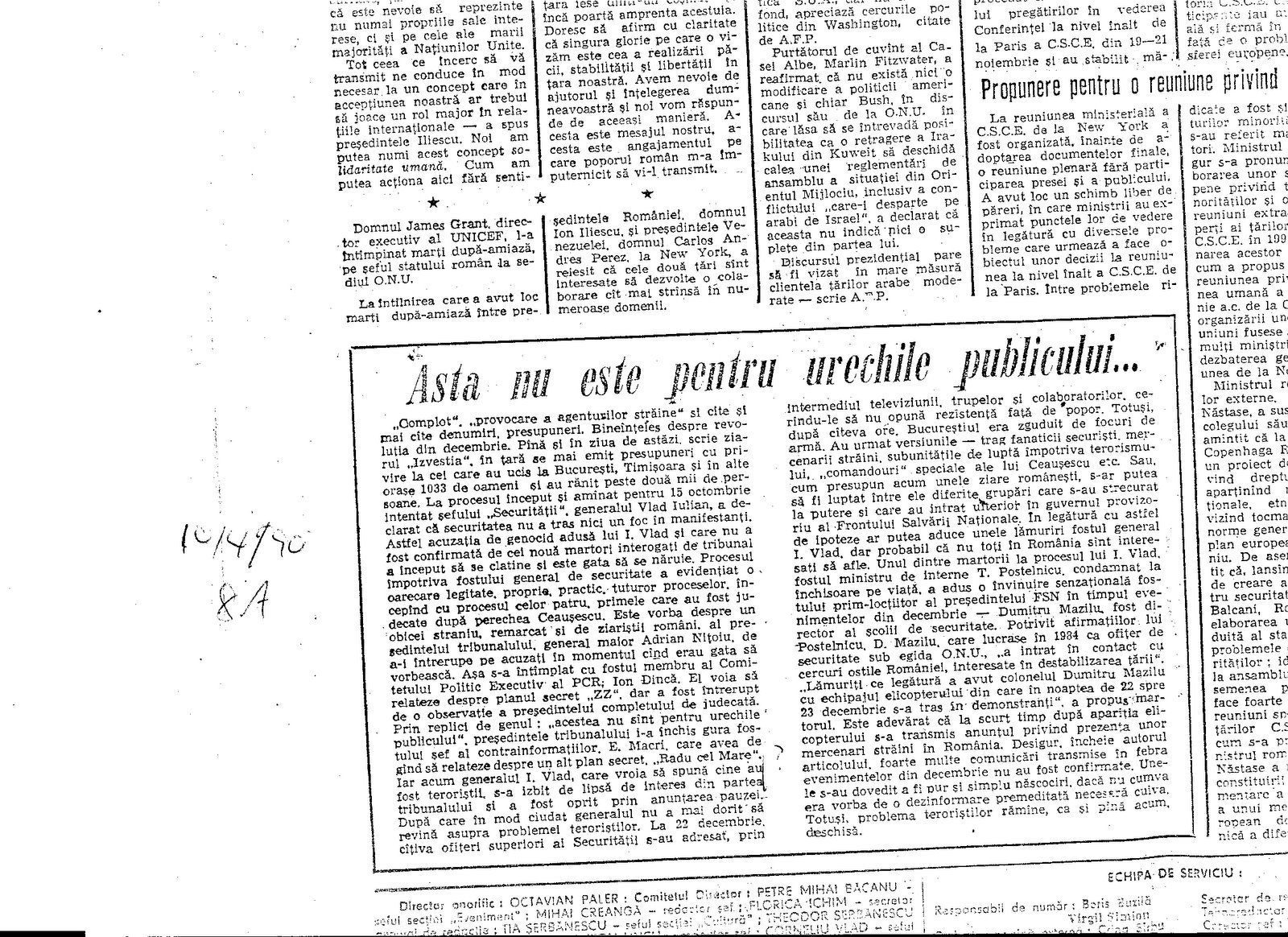
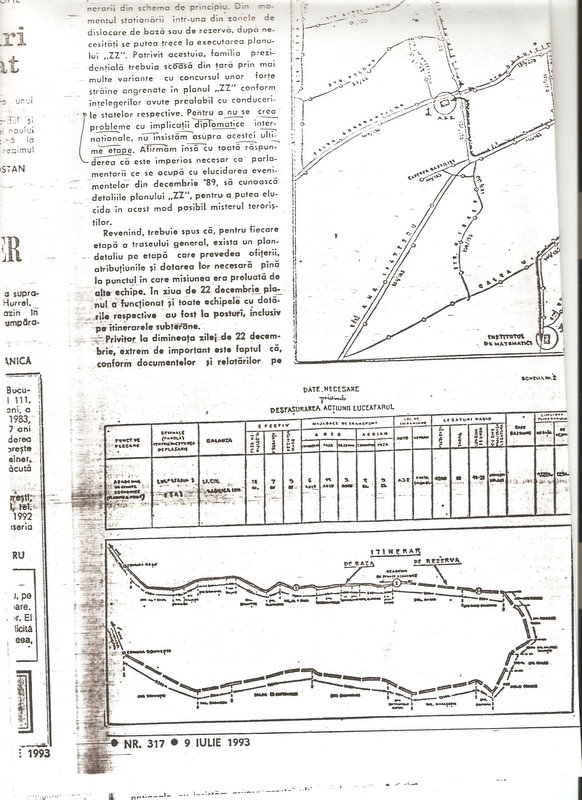
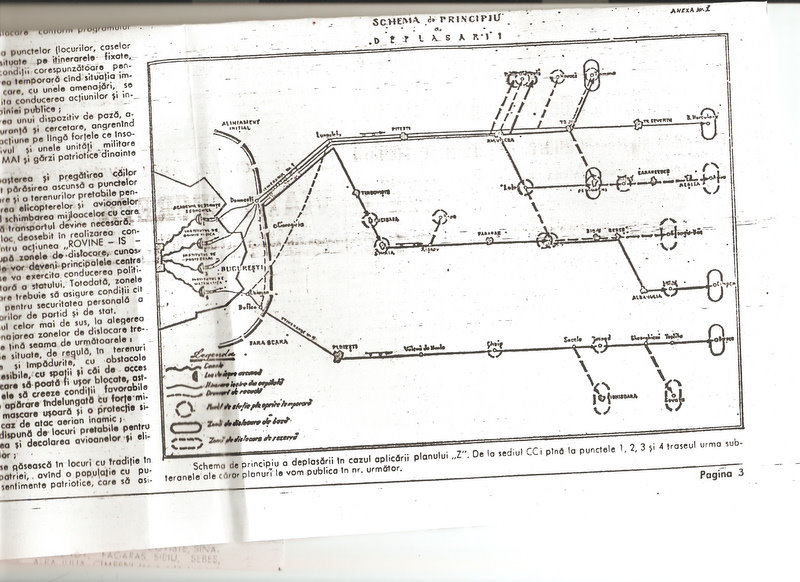
Planul Z-Z / Planul Zet-Zet in presa romana din anii nouazeci

Posted by romanianrevolutionofdecember1989 on May 11, 2013

image0

Romania Libera, 6 februarie 1990

image0-001

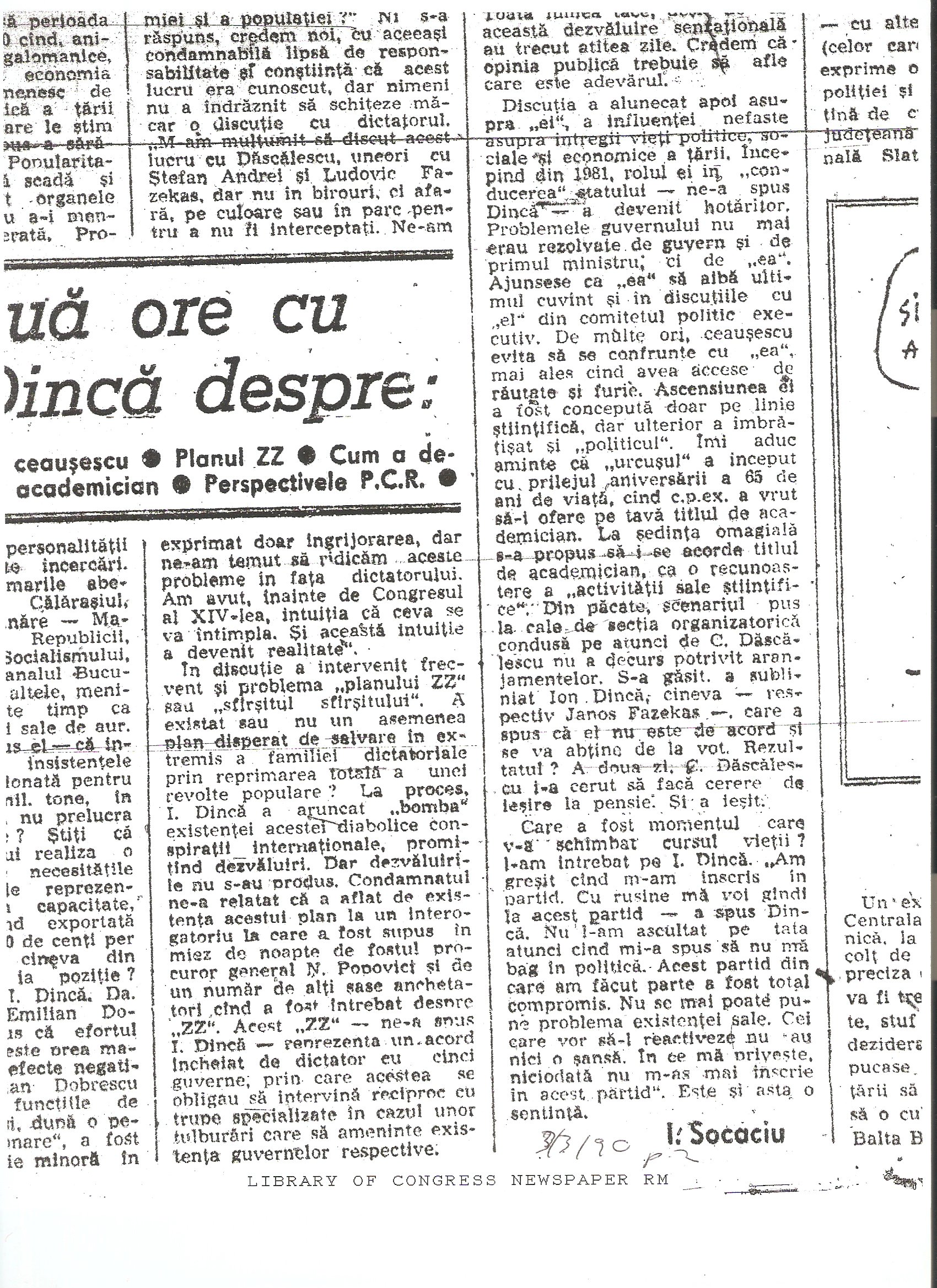
Romania Libera, 3 martie 1990

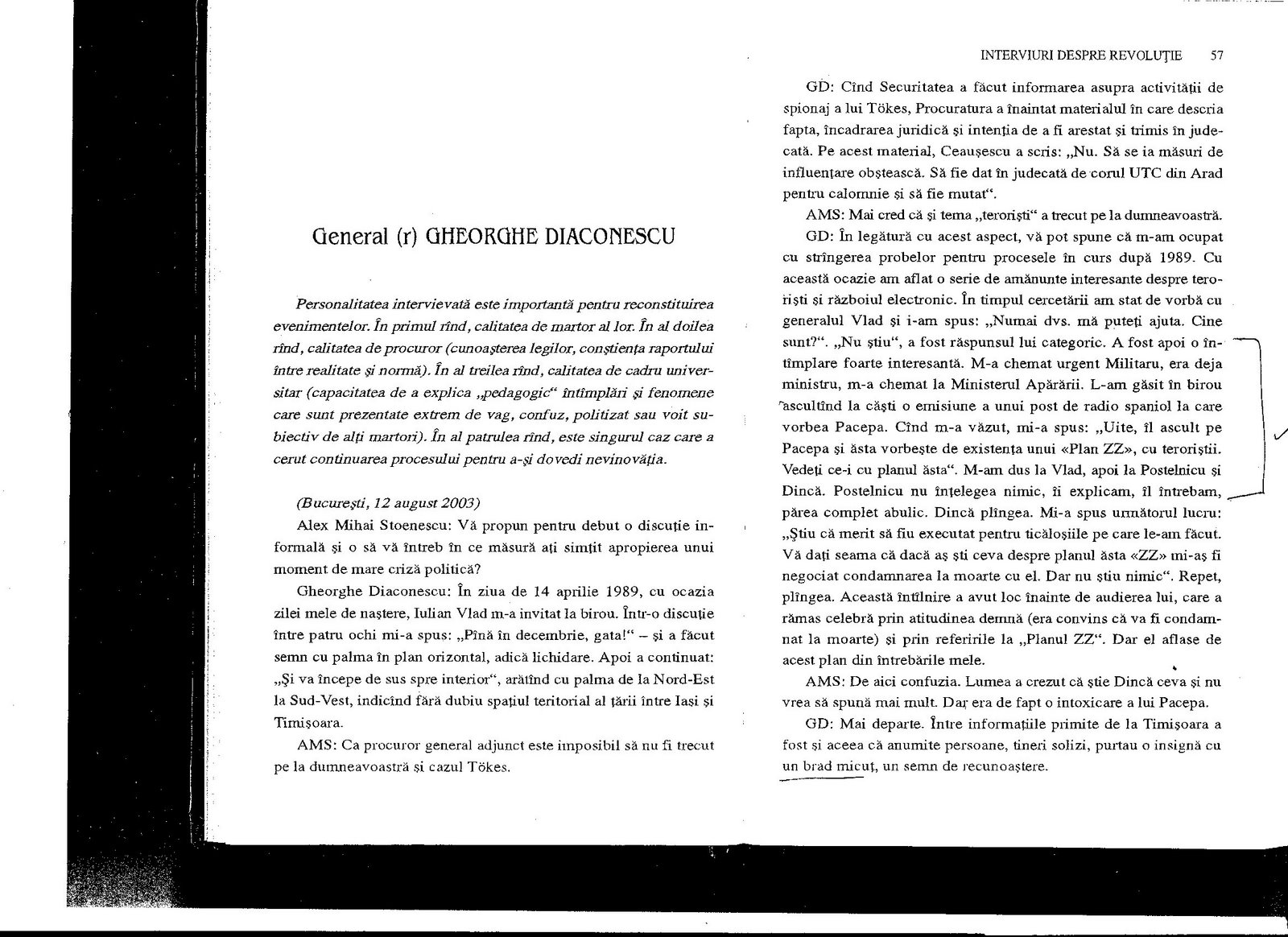
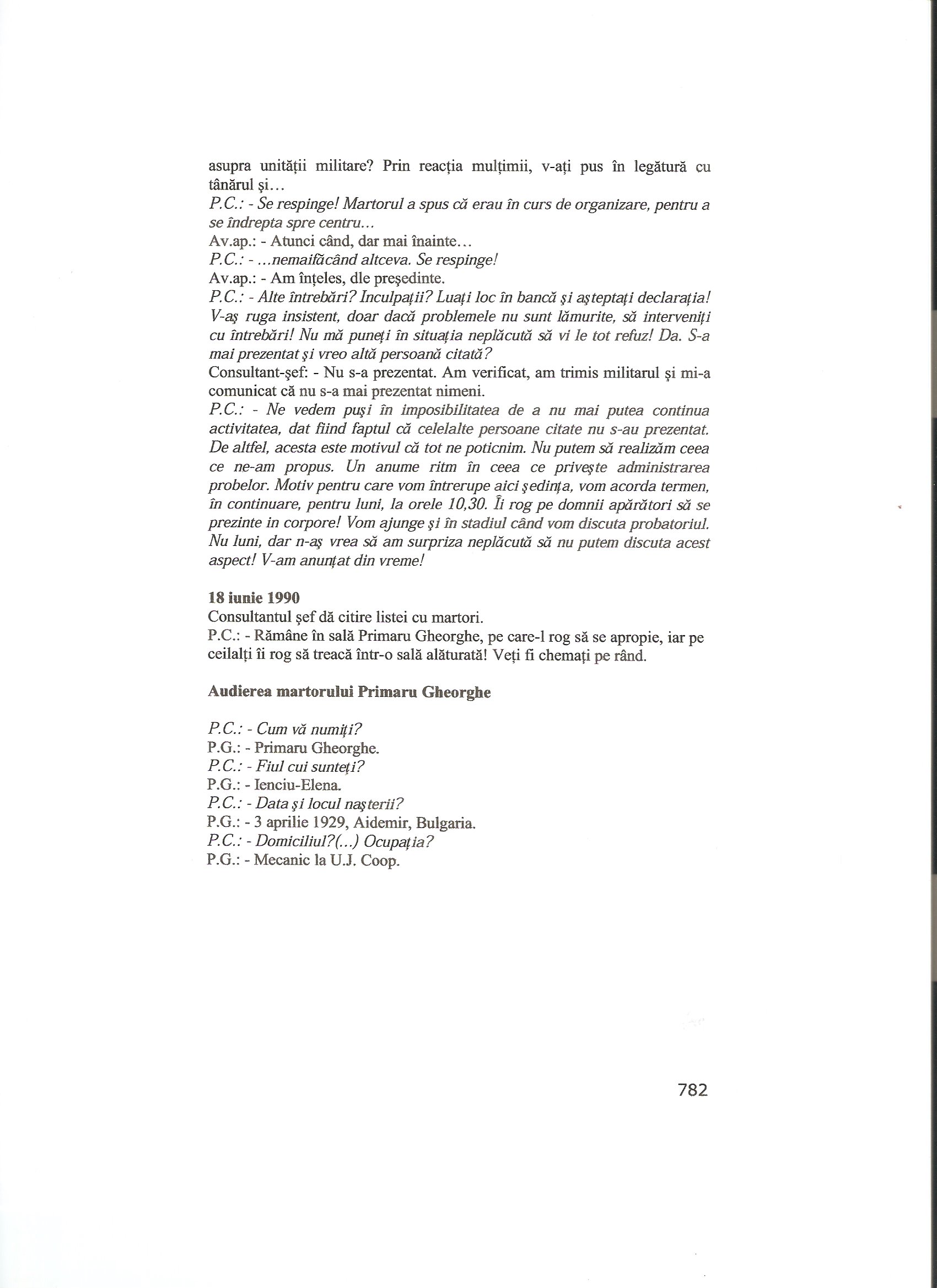
Nestor Ratesh quotes one of Ceausescu’s senior party henchman, Ion Dinca, as having stated at his trial in early February 1990:

“During the night of 27-28 [of January 1990] at 12:30 A.M., I was called by several people from the Prosecutor’s Office to tell what I knew about the agreement entitled Z.Z. between Romania and five other states providing for the dispatching of terrorist forces to Romania in order to intervene in case of a military Putsch.  This agreement Z.Z. is entitled ‘the End of the End.’  I stated then, and I am stating now to you, that I have never been involved in this agreement, neither I nor other people.  And I was told:  Only you and two other people know this.  I stated that and a detailed check was made in order to prove that I was not involved in such acts.”[95]

[95] Ratesh, Romania:  The Entangled Revolution, pp. 66-67, quoting Radio Bucharest, 2 February 1990.  I don’t think from the context given it is clear that this alleged incident took place in January 1990, as Ratesh assumes; the reference to 27-28 might have been a reference to December 1989.

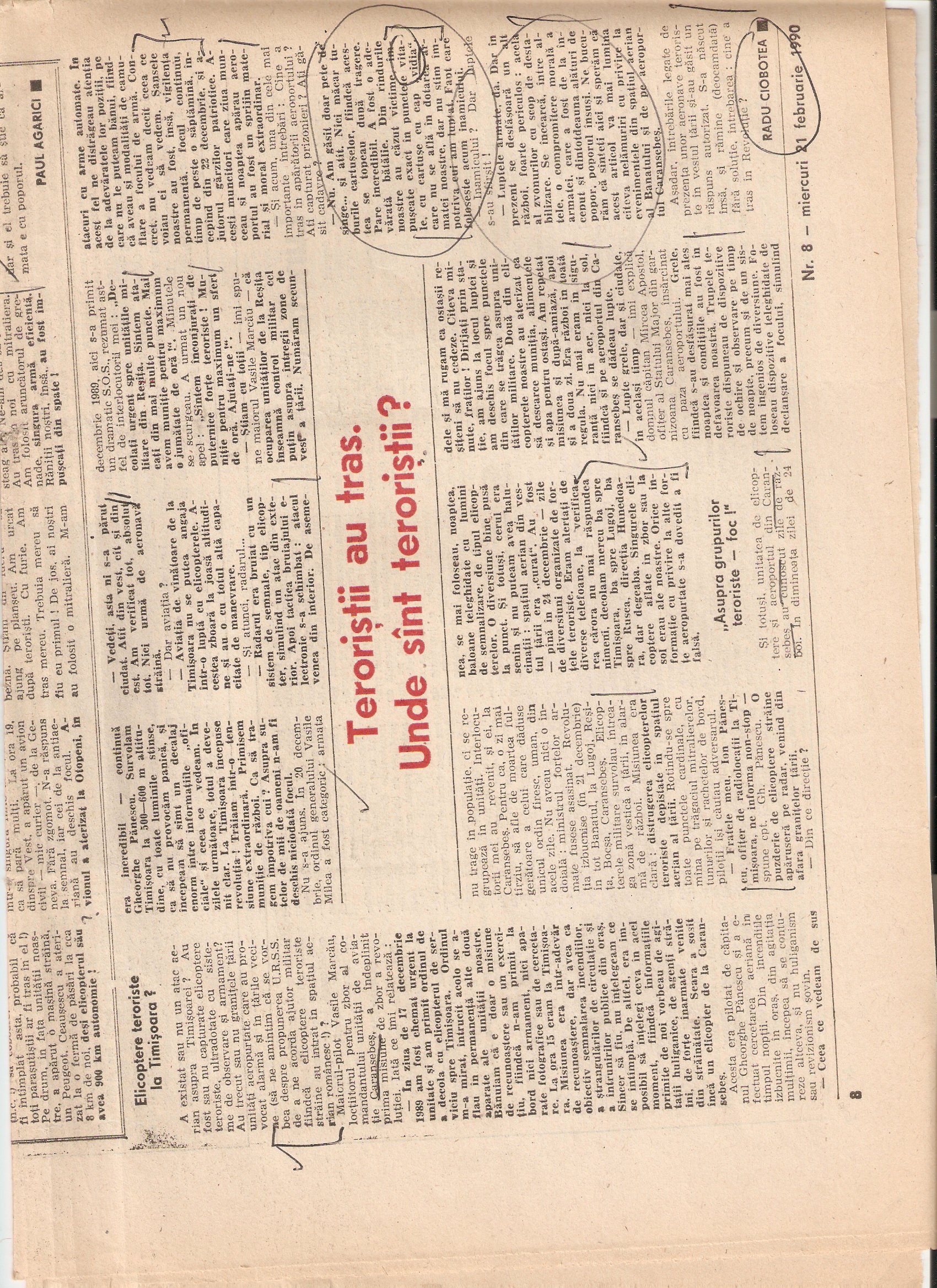
*Se pare ca episodul “gloante vidia” martie-aprilie 1991 avea un precedent in martie 1990 (Ioan Buduca, “Comunicati unitatilor sa anunte populatia ca armata nu va trage!” Cuvintul, nr. 8-9 (29 martie 1990), pp. 8-9)

“In biroul domnului ministru al Apararii Nationale, generalul Victor Stanculescu, am avut ocazia sa vad cinci gloante extrase din corpul unor victime ale revolutiei.  ‘Armata romana nu are asemenea gloante in dotare’ mi-a spus domnia sa.”

“Am intrebat cu o naivitate din care eu insumi nu puteam sa inteleg decit doua lucruri:  ori a tras securitatea, ori a tras populatia.  ‘Inseamna ca a fost pus in aplicare planul ‘Z/Z’?’  Domnul general a raspuns:  ‘Nu am auzit niciodata de acest plan ‘Z/Z’.’

Constantin Vranceanu, “Planul ,Z-Z’ si telefonul rosu,” Romania Libera, 28 September 1990, p. 3.

Mirel Curea, Evenimentul Zilei, nr. 317, 9 iulie 1993, p. 3

Posted in decembrie 1989, raport final | Tagged: , , , , , , , , , , , | 2 Comments »

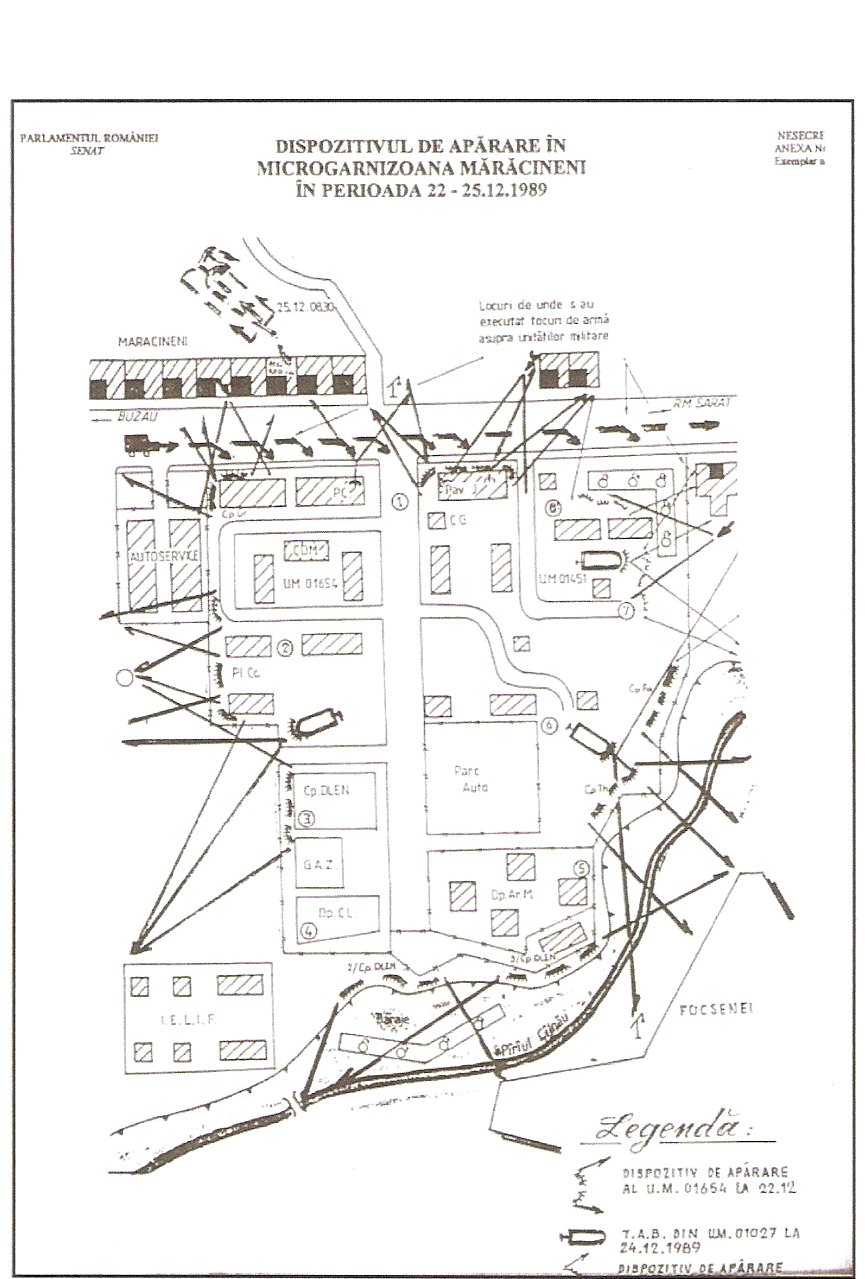
Comuna Maracineni in timpul Revolutiei

Posted by romanianrevolutionofdecember1989 on May 9, 2013

http://ro.wikipedia.org/wiki/Comuna_M%C4%83r%C4%83cineni,_Buz%C4%83uimage0

image0-001

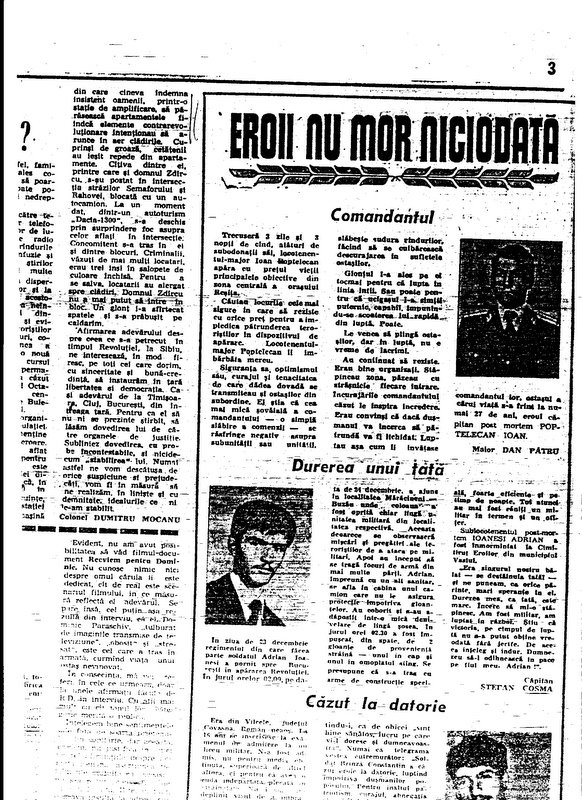
Ioanesi Adrian ( 548 )
Profesie: Soldat in termen la UM 01027 Piatra-Neamt, sublocotenent post-mortem
Data nasteri: 24.09.1969
Locul nasterii: Vaslui
Calitate: Erou Martir
Data mortii: 24 decembrie 1989
Locul mortii: Maracineni, Buzau
Cauza: Impuscat in inima si cap
Vinovati:
Observatii:

http://www.portalulrevolutiei.ro/index.php?menu=1&jud=53

“In jurul orei 02,30 a fost impuscat, din spate, de 2 gloante de provenienta straina–unul in cap si unul in omoplatul sting.  Se presupune ca s-a tras cu arme de constructie speciala, foarte eficiente si pe timp de noapte.” Armata Poporului, p. 3, nr. 41 (44) Octombrie 1990.

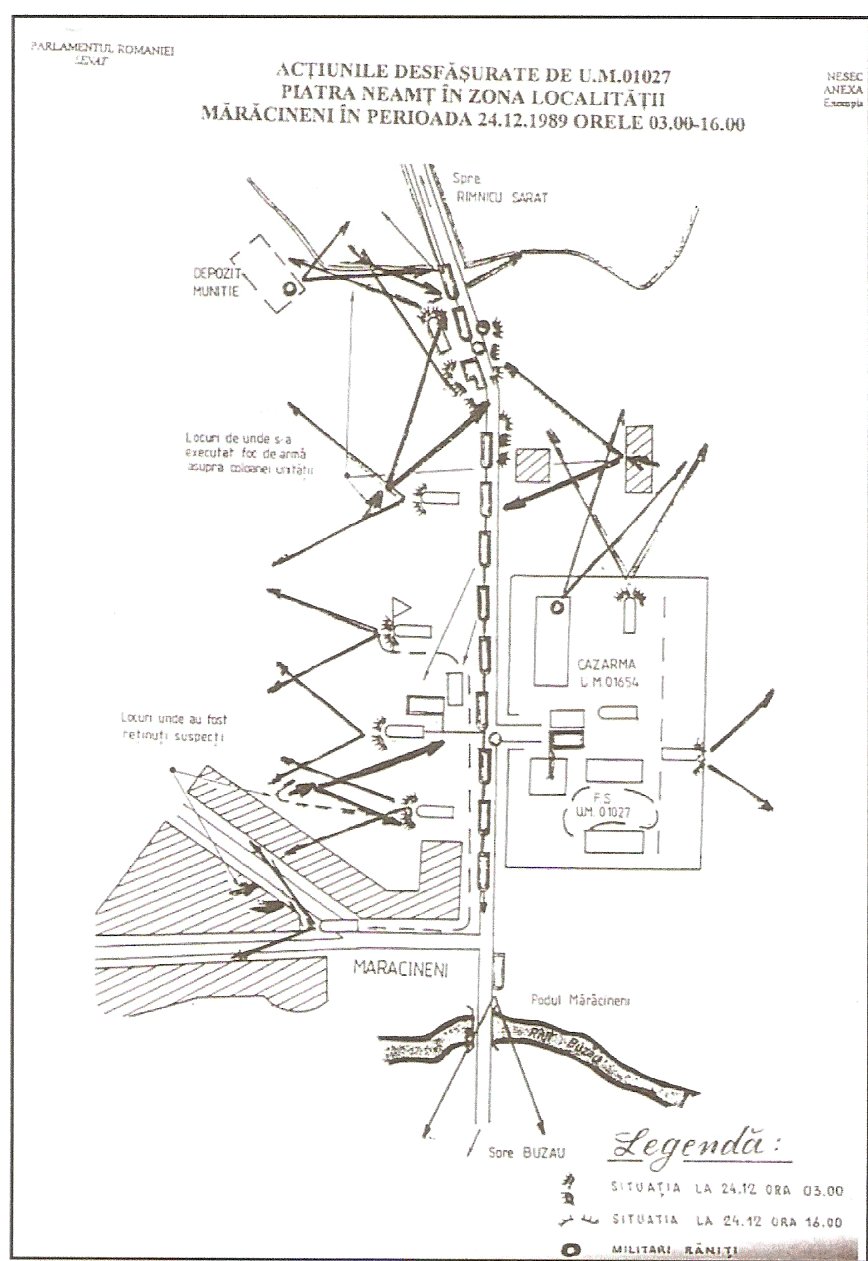
Cazul Maracineni

Another small group of people wearing “black jumpsuits” held a military convoy under fire near the city of Buzau. On the evening of 23 December 1989, a military convoy from Piatra Neamt en route to Bucharest reached the community of Maracineni near Buzau.  Members of the local military unit told the soldiers from Piatra Neamt that

image0-002

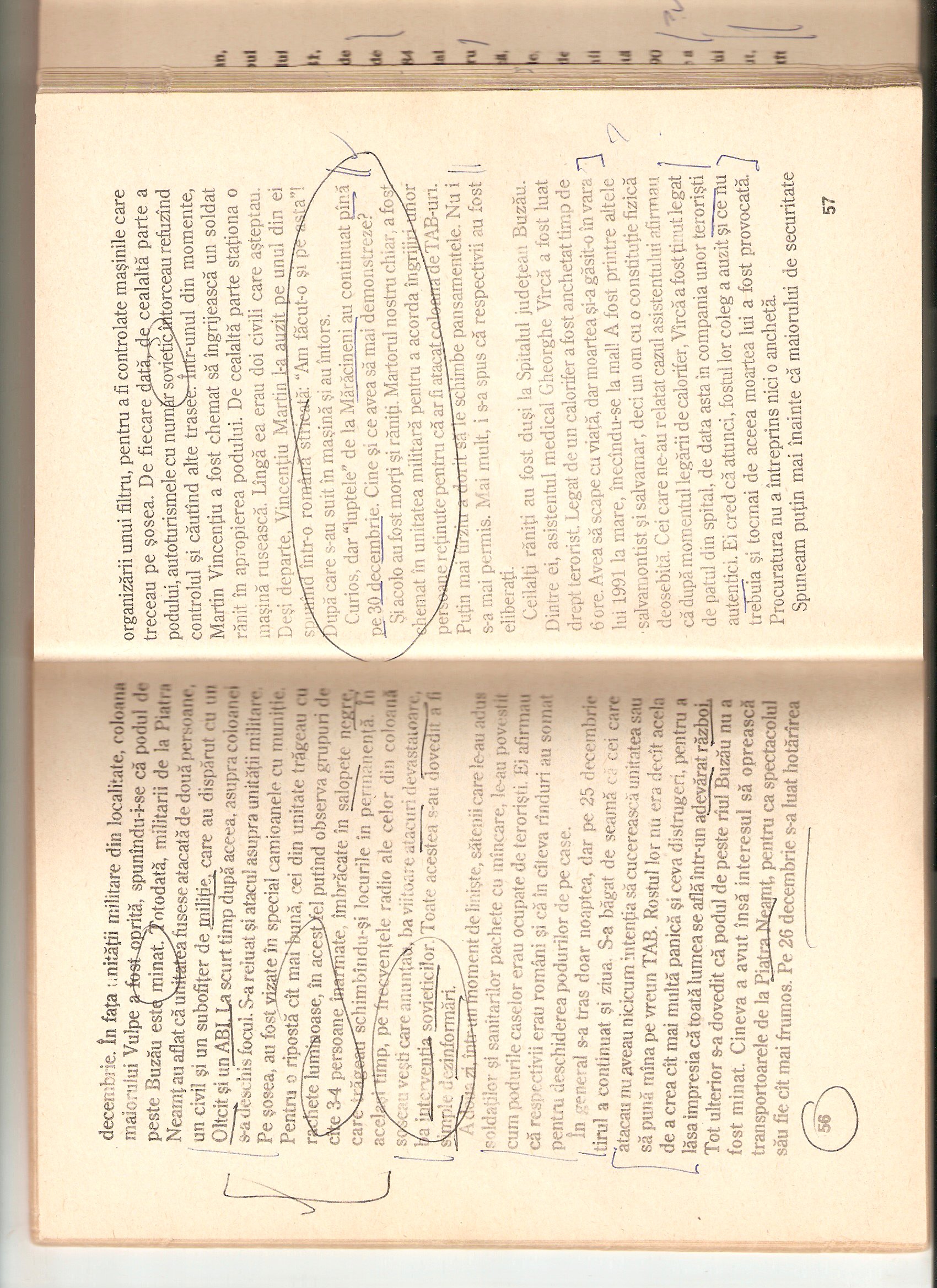
…the unit had been attacked by two people, a civilian and Militia NCO, who disappeared with an Oltcit [car] and an ABI vehicle [an armored transport used exclusively by the Securitate’s USLA].  Shortly after [being told] this, gunfire opened on the convoy.  And gunfire reopened on the local military unit….those from the unit fired back with ordinance that lit the sky, in this way enabling them to observe a group of 3-4 armed people, wearing black jumpsuits (“salopete negre”) who were shooting while constantly changing position.  At the same time, on the radio frequencies of the convoy, they received messages about coming devastating attacks, and even Soviet intervention.  All of these proved to be simple disinformation.  The next day, in a moment of calm, villagers brought the soldiers food, and related how the terrorists had occupied attics of their houses.  They said they [the occupiers] were Romanians and that in a few words they had ordered [the villagers] to let them into the attics of their houses….In general, they shot at night, but on 25 December the cannonade continued during the day…. Curiously, the ‘fighting’ in Maracineni continued until 30 December.  Who and for whom were they trying to impress? [emphasis added][55]

Indeed, there are three key aspects here:  1) this was not a heavily populated area, thereby undermining arguments about “operetta-like” fake warfare to impress the population, 2) it is difficult to explain this episode as the result of “misunderstandings” between units, and 3) the gunfire lasted well over a week, a fact that is difficult to ascribe to confusion.

Ilie Stoian, Arta Diversiunii, 1993, pp. 55-57.

http://www.romanialibera.ro/exclusiv-rl/campaniile-rl/exclusiv-cum-au-disparut-gloantele-de-la-revolutie-si-despre-mortii-in-salopete-negre-247874.html

http://atomic-temporary-3899751.wpcomstaging.com/2010/09/30/%E2%80%9Corwellian%E2%80%A6positively-orwellian%E2%80%9D-prosecutor-voinea%E2%80%99s-campaign-to-sanitize-the-romanian-revolution-of-december-1989-part-four-the-mysterious-men-in-black/

Posted in decembrie 1989, raport final | Tagged: , , , , | 1 Comment »

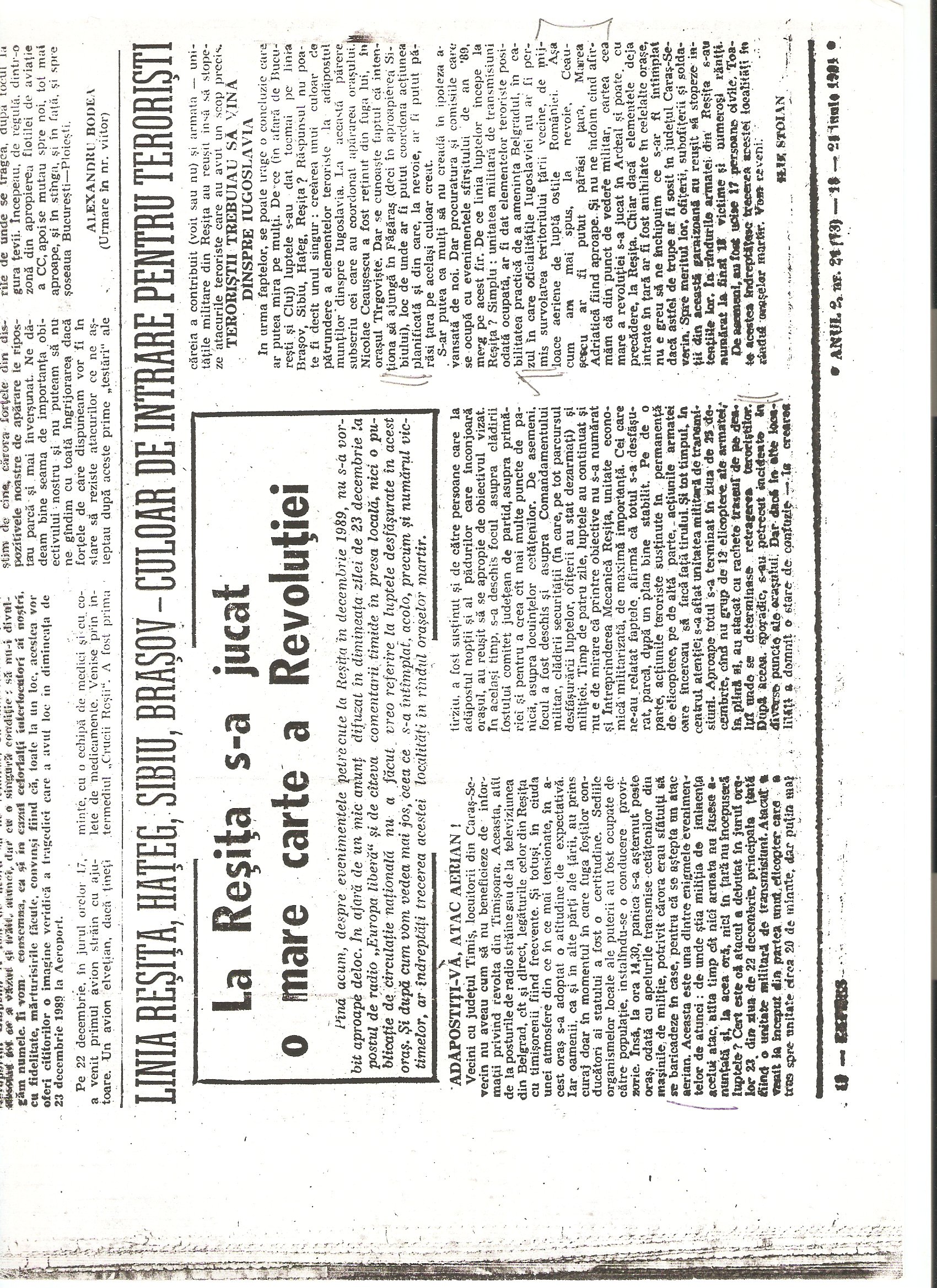
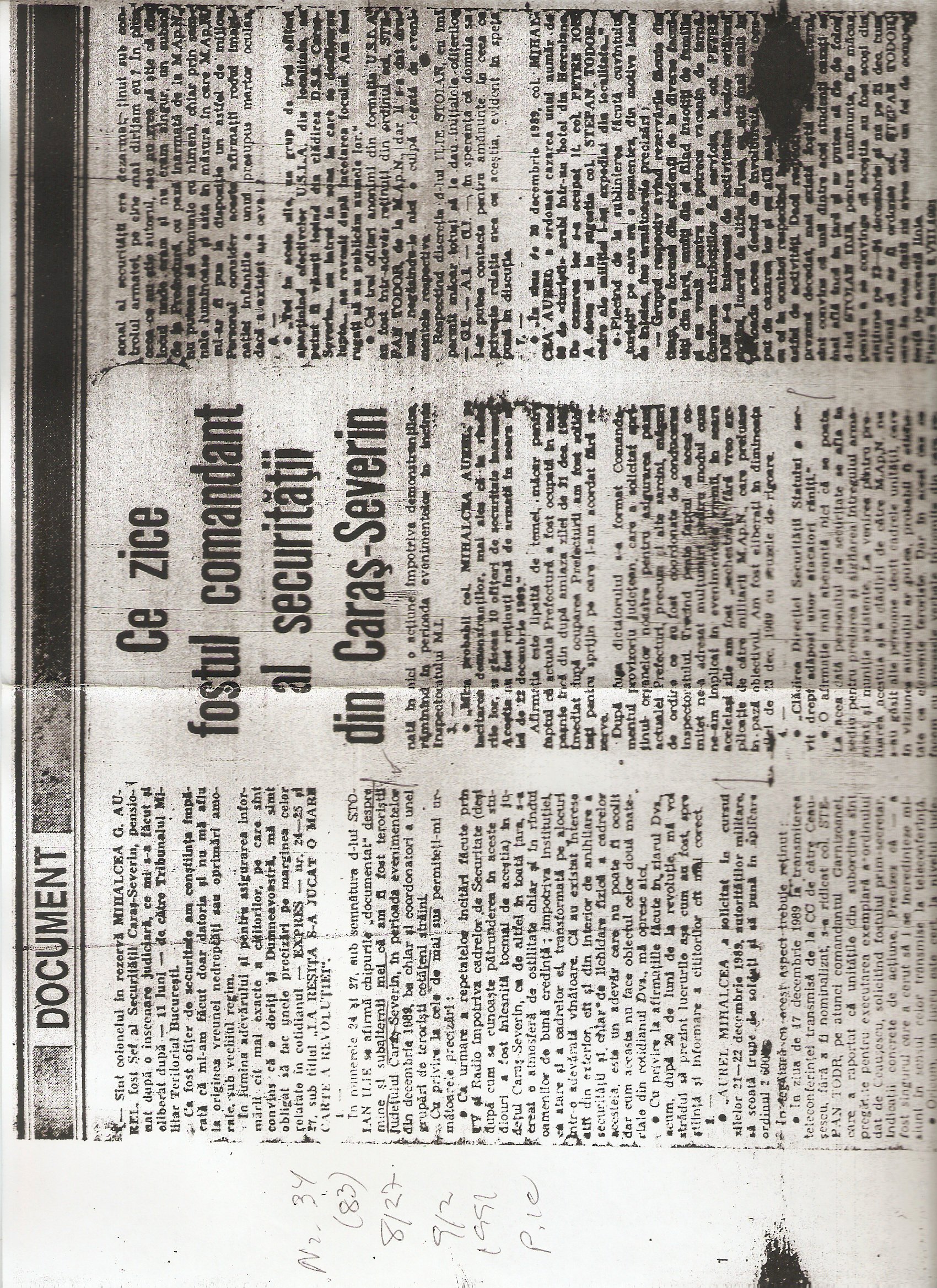
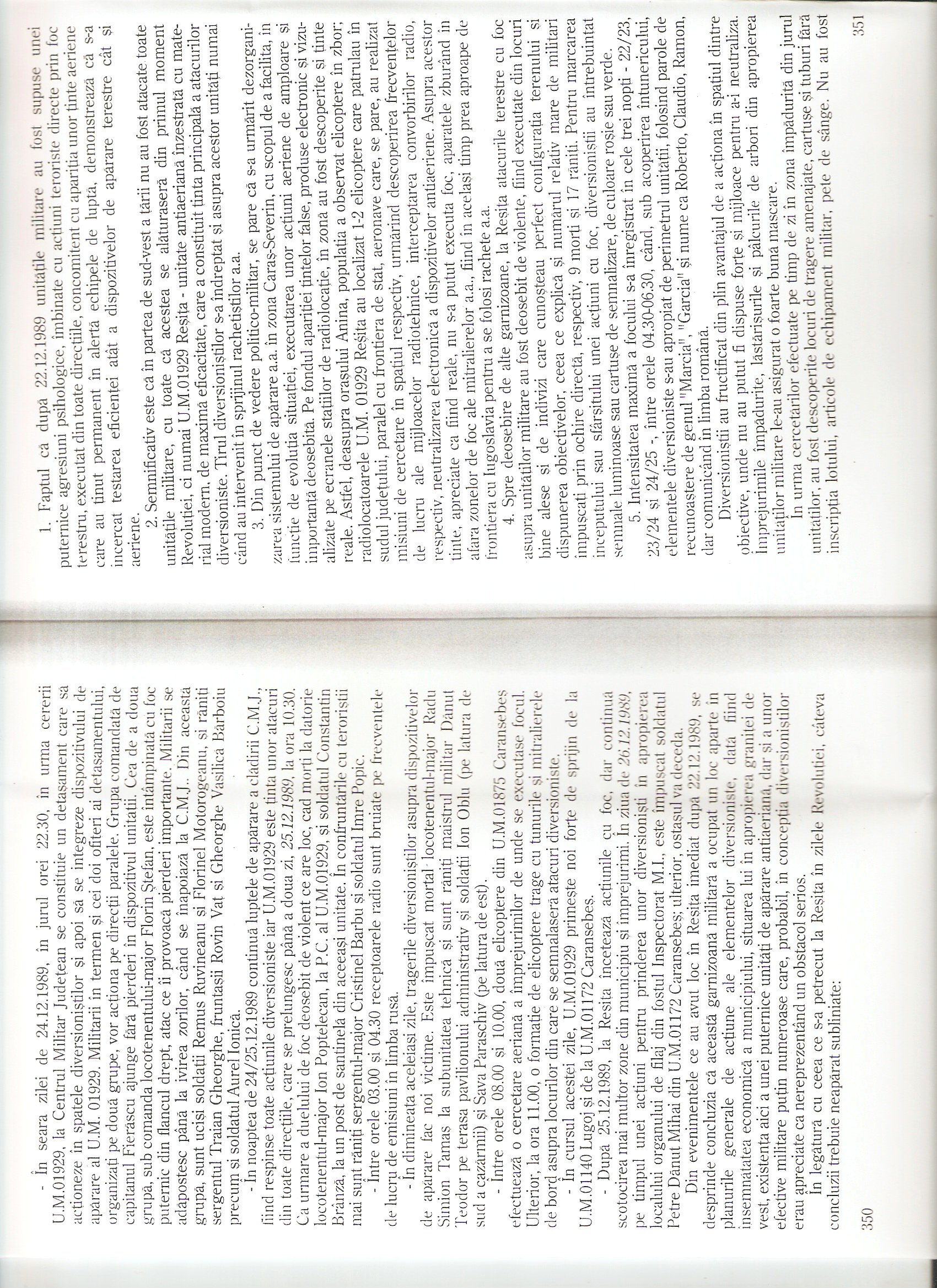
La Resita s-a jucat o mare carte a Revolutiei

Posted by romanianrevolutionofdecember1989 on May 5, 2013

 image0-001

Reşiţa a plătit şi ea cu sânge dorinţa de schimbare a regimului socialist. Capitala Banatului de munte a dat ca jertfă un număr de aproximativ 65 de morţi, toţi aceştia fiind victimele diversiunii securisto-teroriste aservite vechiului regim, în încercarea sa de a menţine teroarea asupra populaţiei din judeţul Caraş-Severin şi după evacuarea cuplului de dictatori în data de 22 Decembrie 1989.

http://www.memorialulrevolutiei.ro/index.php?page=evenimente/2012/vernisaj-reia

In Memoriam 1989

Un monument dedicat evenimentelor din Decembrie 1989 va fi ridicat în centrul municipiului Reşiţa, la cererea revoluţionarilor, dar şi a urmaşilor acestora.  În acest sens, primăria Reşiţa a lansat o competiţie la care se pot înscrie până în 15 mai, toţi artiştii plastici interesaţi. Cele mai bune trei proiecte vor fi premiate cu  cinci mii de lei, trei mii de lei şi respectiv două mii de lei. Câştigătorii vor fi anunţaţi în data de 30 mai. Monumentul se va numi “In Memoriam 1989” şi va fi amplasat pe locul actualei troiţe închinate eroilor Revoluţiei.

http://www.radio-resita.ro/in-memoriam-1989

http://www.resita.ro/eroi-ai-revolutiei

Eroi ai revolutiei

In decembrie 1989 am scapat de “domnia” Partidului Comunist si a “mult iubitului conducator”, Nicolae Ceausescu. In acea perioada, romanii satui sa indure o dictatura ajunsa la un prag maxim de acceptabilitate, au iesit in strada unul cate unul, pana s-au inmultit, formand o masa mult prea mare pentru a fi stapanita de Nicolae Ceausescu  si oamenii sai.

Tricolorul in timpul revolutieiPretul libertatii a fost scump. Pretul e imens, dramele prin care au trecut mii de familii in acea vreme nu au un pret anume, nu exista o alaturare de cuvinte agreabila. Pentru libertate s-au pierdut vieti. Vieti tinere, dornice de a descoperi viata in libertate, dar care nu au mai ajuns sa se bucure de ea. De libertate. Tineri si oameni in toata firea, din toate colturile tarii, au fost rapusi de gloantele si tancurile armatei. Sau de “teroristi” necunoscuti. Timisoara, Cluj, Iasi, Bucuresti, dar si in Resita, urmarile luptei pentru libertate se fac cunoscute si acum datorita memoriei celor care au disparut la revolutie.

Adam Livia, a fost o batrana din Resita care a plecat dintre cei vii in ziua de 25 decembrie 1989. Motivul este unul cat se poate de tragic. Un glont a penetrat fereastra apartamentului in care locuia si, din pacate, s-a oprit in corpul batranei.

Birbora Constantin pazea bazinele cu apa, era in timpul serviciului. Prins in valtoarea luptei, pe 14 decembrie 1989, acesta a fost impuscat mortal in zona capului. Final tragic a avut si Puraci Samfiu, unul din cei care au fost impuscati in fata sediului Militiei, decedand in urma ranilor provocate. Din pacate lista neagra nu se incheie doar cu aceste nume, ci si cu alte persoane care au sfarsit luptand pentru libertate, pentru dreptul a vorbi liber, de a munci unde si ce doreste. Pentru o viata mai buna.

De aceea, in memoria lor, le oferim o pagina, un loc de respect in amintirea lor, pe acest portal.

Nume si prenume Calitatea pentru care s-a acordat titlul Modul de acordare al titlului
1 Birbora Constantin Fost luptator garzi la S.C. U.C.M. Resita S.A. H.C.L. nr. 83 / 28.10.1993 Decernat post mortem
2 Ivan Marius Fost luptator garzi la Directia Judeteana de posta si telecomunicatii H.C.L. nr. 83 / 28.10.1993 Decernat post mortem
3 Lupea Ion Daniel Sublocotenent post mortem U.M.01929 H.C.L. nr. 83 / 28.10.1993 Decernat post mortem
4 Mihai Danut Sublocotenent post mortem U.M.01929 H.C.L. nr. 83 / 28.10.1993 Decernat post mortem
5 Motorgeanu Florinel Sublocotenent post mortem U.M.01929 H.C.L. nr. 83 / 28.10.1993 Decernat post mortem
6 Mircea Ioan Fost luptator garzi la S.C. U.C.M. Resita S.A. H.C.L. nr. 83 / 28.10.1993 Decernat post mortem
7 Poptelecan Ioan Capitan U.M.01929 H.C.L. nr. 83 / 28.10.1993 Decernat post mortem
8 Pongracz Norbert Sublocotenent U.M.01929 H.C.L. nr. 83 / 28.10.1993 Decernat post mortem
9 Ruvineantu Remus Lazar Sublocotenent U.M.01929 H.C.L. nr. 83 / 28.10.1993 Decernat post mortem
10 Raut Mihai Ovidiu Fost luptator garzi la S.C. U.C.M. Resita S.A. H.C.L. nr. 83 / 28.10.1993 Decernat post mortem
11 Smaranda Ion Capitan U.M.01929 H.C.L. nr. 83 / 28.10.1993 Decernat post mortem
12 Tamas Radu Simion Capitan U.M.01929 H.C.L. nr. 83 / 28.10.1993 Decernat post mortem
13 Talpeanu Mircea Fost angajat la Directia Judeteana de posta si telecomunicatii H.C.L. nr. 83 / 28.10.1993 Decernat post mortem
14 Adam Livia Victima a Revolutiei Române H.C.L. nr. 104/ 28.10.1993 Decernat post mortem
15 Branza Constantin Victima a Revolutiei Române H.C.L. nr. 104/ 28.10.1993 Decernat post mortem
16 Popa Valerian Victima a Revolutiei Române H.C.L. nr. 104/ 28.10.1993 Decernat post mortem
17 Presznovka Adam Ion Victima a Revolutiei Române H.C.L. nr. 104/ 28.10.1993 Decernat post mortem

 Lupea Ioan Daniel ( 255 )
Profesie: Soldat in termen la UM 01929 Resita
Data nasteri: 02.06.1970
Locul nasterii: Hunedoara
Calitate: Erou Martir
Data mortii: 24 decembrie 1989
Locul mortii: Resita, in dispozitivul de aparare al unitatii mil
Cauza: Impuscat pe 23 decembrie 1989 cu un glont dum-dum, care a intrat pe deasupra piciorului stang si a iesit pe sub mana stanga
Vinovati:

http://www.voxbanat.ro/divertisment/2090-militarii-de-la-unitatea-17-rachete-antiaeriene-semenic-impucai-cu-gloane-dum-dum

Militarii de la Unitatea 17 Rachete Antiaeriene Semenic, împuşcaţi cu gloanţe dum-dum

comemorare unitate1      Un moment solemn, dedicat Revoluţiei din Decembrie 1989, a avut loc, vineri, în curtea fostei garnizoane a Unităţii 17 Rachete Antiaeriene „Semenic” din Reşiţa.

      După trecerea în revistă a gărzii de onoare de către prefectul de Caraş-Severin, Silviu Hurduzeu, şi intonarea imnului de stat, a urmat o comemorare unitate2slujba religioasă, oficiată de către un sobor de preoţi, şi depunerea de coroane, la monumentul dedicat soldaţilor căzuţi în Revoluţia din Decembrie 1989, la Unitatea Militară 17 Rachete Antiaeriene Semenic.

      În fiecare an, în cazarma unităţii, eroii Revoluţiei sunt comemoraţi. Este un prilej pentru a reaminti, măcar comemorare unitate3câteva din momentele derulate începând cu data de 21 decembrie 1989, la Reşiţa.

      În acea seară, când manifestanţii erau deja adunaţi în faţa Comitetului Judeţean de partid din municipiu, s-a petrecut un lucru care a influenţat derularea evenimentelor.

comemorare unitate4      „Atunci, Regimentul 17 Rachete Antiaeriene Semenic a primit primit ordin să apere Comitetul Judeţean de partid. A fost, pentru prima oară, în calitatea mea de ofiţer al Armatei Române, cu o vechime de 25 de ani, în domeniu, când nu am spus: Am înţeles! Am adunat oamenii, le-am spus despre ce e vorba, care e misiunea regimentului. Atunci am luat decizia pe care mi-am asumat-o, de a nu scoate oamenii în stradă. Mi-am asumat decizia de a nu confrunta armata cu poporul, iar consecinţele nu s-au lăsat aşteptate. Dovadă, că în noaptea de 21 spre 22 decembrie, am fost atacaţi de profesionişti, care aveau în dotare arme care nu existau în Armata Română”, a declarat gen. (r.) Vasile Cocoşilă, comandant la acea vreme a Unităţii 17 Rachete Antiaeriene Semenic.

comemorare unitate      Unul dintre militarii care se aflau în punctul de control, sublocotenent post-mortem Daniel Lupea, a murit în noaptea de 23 spre 24 decembrie, după ce a fost împuşcat în stomac. Dacă glonţul era unul normal, Daniel Lupea ar fi trăit şi în ziua de astăzi, susţine gen. (r.) Vasile Cocoşilă.

comemorare unitate6      „Din păcate, a fost vorba de un glonţ dum-dum, care, în timpul impactului produce o explozie, iar lui Daniel Lupea i-au fost distruse toate organele interne. Asemenea gloanţe nu existau nici în dotarea Armatei Române, nici a gărzilor naţionale, nici a altor structuri naţionale de apărare. Au fost multe alte diversiuni, comemorare unitate5dar Armata, la Reşiţa, nu a reacţionat împotriva poporului. Şi susţin aceasta, în ciuda tuturor afirmaţiilor prin care se susţine contrariul”, a mai precizat fostul comandant al unităţii.

      După evenimentele din decembrie 1989, Reşiţa a fost declarat oraş martir. Aici şi-au pierdut viaţa, în timpul Revoluţiei, 25 de persoane.

http://www.7-zile.com/2008/12/25/1989-decembrie-caransebes-ii/

Zaharia Drăghiţă a supravieţuit mai multor tentive de asasinat. Prima dintre acestea a avut loc în 21 decembrie, la intrarea în Pipirig. A doua a fost atunci când – susţine acesta – le-a cerut celor din noua conducere a Primăriei să nu ridice receptoarele telefoanelor, şi tocmai el a încălcat consemnul. În momentul în care a fost întrebat ,,Zoli?”, şi a răspuns ,,Da!”, s-a şi tras asupra lui. Următoarea tentativă a avut loc în 24 decembrie, când a plecat la Reşiţa să aducă muniţie. La Kilometrul 8 s-a tras asupra lui, şi, odată ajuns în faţa Miliţiei Judeţene, s-a deschis iar focul, Zaharia Drăghiţă scăpând cu viaţă doar fiindcă s-a aruncat pe burtă. Glonţul era dum-dum, l-a găsit şoferul maşinii înfipt în banchetă, când au ajuns înapoi, la Caransebeş. ,,Tot acolo, la sediul Miliţiei Judeţene, un securist a împuşcat doi miliţieni, după care a fugit”, a mai spus Drăghiţă. După alte două săptămâni s-a tras asupra sa dintr-o Dacie roşie, despre care ulterior a aflat că era maşina comandantului Securităţii, Pârvu. Altă dată a scăpat ca prin urechile acului de o maşină care voia să-l calce în timp ce era pe trotuar, cu fetiţa nou-născută în cărucior…

http://atomic-temporary-3899751.wpcomstaging.com/2008/12/27/un-caz-nou-24-decembrie-1989-resita-si-un-glont-dum-dum/

image0-002

Norbert Pongracz

Valentin Rosada

Nascut la 15 ianuarie 1971, unicul fiu al lui Norbert si al Ilenei Pongracz.

A cazut in noaptea de 23 decembrie 1989, ora 2,40 in unitatea (de radiolocatie) in care isi satisfacea stagiul militar. Un glont ucigas pornit din paduricea din apropiere (care ulterior s-a defrisat) in timp ce statea de vorba cu locotenentul sau i-a secerat pe amandoi. In total au fost ucise 9 persoane (ofiteri si militari in termen). S-a presupus ca ucigasii ar fi fost de la unitatea de rachete, dar arma cu care s-a tras a fost speciala, calibrul 5,62 fata de armamentul obisnuit de 7,62 mm.

Pe langa golul definitiv in sufletul lor, durerea cea mai mare a familiei Pongracz este ca nici acum nu s-a elucidat problema aceasta a ucigasilor fiului lor. Resita are declarati 16 morti in Revolutie, iar domnul Pongracz, cand a mers sa ridice trupul baiatului sau de la morga, a vazut circa 50 de cadavre.

Strada Gorunului a fost botezata dupa numele eroului Norbert Pongracz.
Sonetul sau de absolvent, dedicat lui Adrian Zamfirescu, contine urmatorul text: Sa traim din plin, soarele nu rasare de doua ori pe zi si viata nu ne este harazita decat o singura data? Cu stima si respect Norbi. Sub semnatura lui Norbi sta tiparit: La revedere, in prima sambata a lunii iulie 1999. El nu va putea veni la aceasta intalnire, dar va ramane pentru totdeauna in inimile noastre, intre eroii nostri.

Adolescent fiind, a trecut in randul nemuritorilor luptand cu arma in mana, pentru libertate, pentru prietenie, pentru ca in fapta aceasta este democratia – libertate si prietenie. Si pentru aceasta a fost si jertfa lui Norbert.

Suflet curat, fiu al unor parinti cinstiti si harnici, Norbert nu si-a dezmintit afirmatia: Viata nu ne este harazita decat o singura data. Avand constiinta acestui fapt, sacrificiul sau devine mai inalt, mai plin de intelesuri si durere decat insasi viata pe care o traim.

El nu a murit, traieste si va trai de-a pururi in sufletele parintilor sai, colegilor, camarazilor de lupta, in sufletele noastre.

Dumnezeu sa-l odihneasca in pace!

http://www.revolutialugojana.org/eroi

– Vă rog să vă prezentaţi, domnule plutonier.
– Sânt plutonierul Coancă Gheorghe.
– Pentru prima dată v-am întâlnit în data de 20 decembrie 1989, în faţa Consiliului, împreună cu subunitatea dumneavoastră. Ce s-a întâmplat apoi ?
– Din 20 până în 25 decembrie 1989 am apărat oraşul Lugoj.
– Iar după aceea ?
– Consiliul Frontului Salvării Naţionale din Reşiţa a cerut întăriri din partea Lugojului şi o parte din subunităţile noastre s-au deplasat de urgenţă în ajutorul fraţilor din Reşiţa.
– Bănuiesc că a fost vorba de “terorişti” ?
– Nu, de securitatea civilă a statului.
– Unde se găseau ei ? În vreo unitate militară ?
– Erau dispersaţi în tot oraşul, în locuinţe, cazemate subterane şi la Liceul nr. 2, unde îşi transportau răniţii.
– În ce mod îşi desfăşurau atacul ?
– Atacul se deschidea la lăsarea serii şi înceta în jurul orei opt-nouă dimineaţa.
– Aţi reuşit să prindeţi câţiva ?
– La una din locuinţele de unde s-a tras, am reuşit să arestăm un maior de securitate, împreună cu cei doi fii ai săi (unul de 14 ani, iar celălalt de 20 ani, elev la şcoala militară de securitate), toţi trei foarte buni trăgători.
– Nu erau conştienţi de faptul că totul e pierdut ?
– Ba fa, dar … la întrebarea adresată de comandantul unităţii militare din Reşiţa : “Ce rost are vărsarea de sânge, situaţia oricum nu o puteţi întoarce ?”, răspunsul comandantului Securităţii civile, atunci arestat, a fost : “Puţin ne pasă !”.
– Care a fost atitudinea civililor ?
– Populaţia a manifestat o adevărată dragoste faţă de armată, gărzile patriotice participând activ la acţiunile de luptă.
– Aţi avut victime ?
– Din rândul gărzilor patriotice s-au înregistrat multe victime, din rândul subunităţii noastre nu s-a înregistrat nici o victimă.
Când s-au predat securiştii şi ce armament au folosit ?
– S-au predat în data de 29 decembrie 1989, dar am continuat să apărăm obiectivele până astăzi, 10 ianuarie, când ne-am întors la Lugoj. Armamentul lor era de provenienţă străină, super-uşor, de calibru 5,6 şi în cadenţă de tragere dublă. Gloanţele erau cu vârf retezat şi pastilă explosivă în cap.
– Care este acum cea mai mare dorinţă a dumneavoastră ?
– Să-mi revăd copilul, de doi ani şi jumătate. Să fac o baie fierbinte şi să-mi schimb cizmele că, din 17 decembrie până în 5 ianuarie 1990, am dormit îmbrăcat şi fără să-mi scot cizmele din picioare.
– Spuneţi-mi, s-a ridicat convocarea ?
– Nu, dar ni se permite să mergem zilnic, pentru câteva ore acasă.
– Aveţi un gând personal ?
– Sânt mândru, satisfăcut, că atât la Lugoj cât şi la Reşiţa, ca de altfel în întreaga ţară, Armata şi-a dovedit calmul, puterea de discernământ şi disciplina.

Reporter : Simion FLORIEAN

(Drapelul, nr. 7 – sâmbătă, 13 ianuarie 1990)

Adam Livia ( 21 )
Profesie: Pensionara
Data nasteri: 19.01.1924
Locul nasterii: Caras-Severin
Calitate: Erou Martir
Data mortii: 25 decembrie 1989
Locul mortii: Resita, Piata 1 Decembrie 1918, (in locuinta sa)
Cauza: Plaga impuscata a capului
Vinovati:
Observatii: Glontul penetrant a intrat prin fereastra apartamentulu

 image0-001

image0-004

image0-005

image0

image0


Posted in decembrie 1989 | Tagged: , , , , , , , , , , , , , , | 1 Comment »

What can we learn from Dosarele Revolutiei de la Timisoara ? (IV)

Posted by romanianrevolutionofdecember1989 on December 21, 2012

[Documentary evidence in support of the publication entitled:  Bullets, Lies, and Videotape:  The Amazing, Disappearing Counter-Revolution of December 1989  ]

http://atomic-temporary-3899751.wpcomstaging.com/2012/12/16/what-can-we-learn-from-dosarele-revolutiei-de-la-timisoara-i/

http://atomic-temporary-3899751.wpcomstaging.com/2012/12/19/what-can-we-learn-from-dosarele-revolutiei-de-la-timisoara-ii/

http://atomic-temporary-3899751.wpcomstaging.com/2012/12/20/what-can-we-learn-from-dosarele-revolutie-de-la-timisoara-iii/

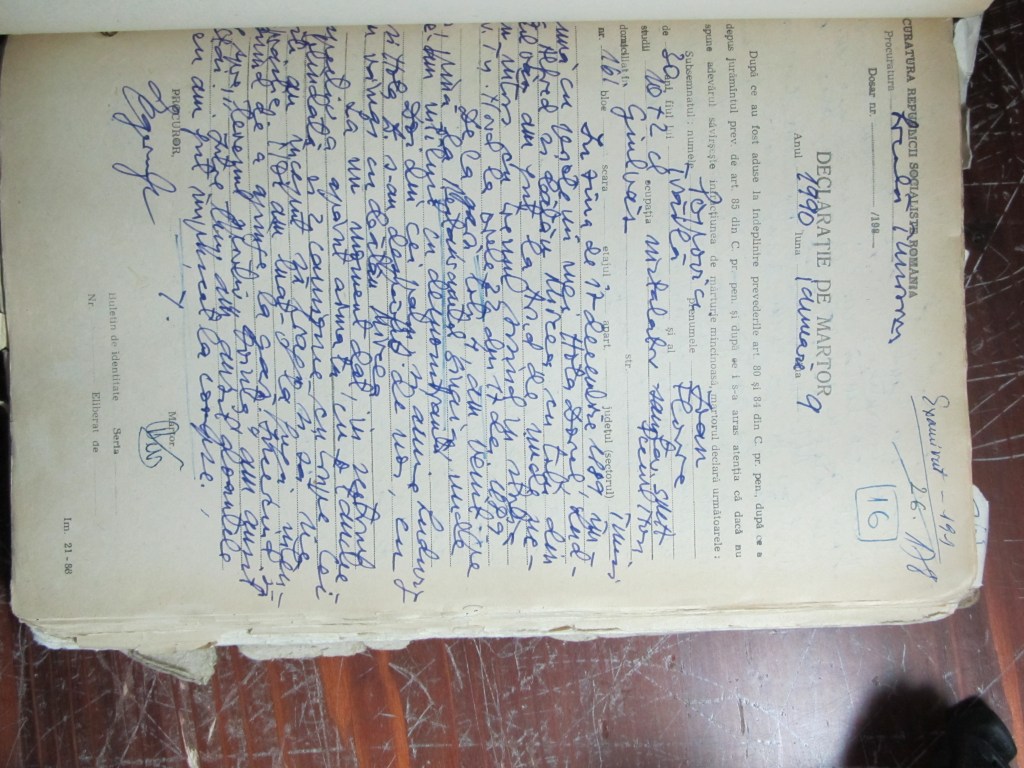
On 1 December 2012, Doru Teodor Maries and Asociatia 21 decembrie 1989 made images of many of the official files investigating the events of December 1989 in Timisoara available on the Internet at http://dosarelerevolutiei.ro/ .  Among the copies available are testimonies from victims of the repression of the communist regime of Nicolae Ceausescu, witnesses of the repression, relatives of the victims of the repression, and members of regime forces that either participated in the repression or were witnesses to it.  These documents allow researchers the ability to confirm or infirm claims made in the Romanian media or accounts published since December 1989.  [see Ioan Popovici’s testimony from the Timisoara files below]  Continued below, after a look at some of the accounts that have appeared on the Internet this year.

—————————————————————————————————————————————————————————————————————————————-

A VERY MOVING VIDEO TRIBUTE

Published on Dec 21, 2012

În revolutia din Brasov 22/23 Decembrie 1989, pe lângà cei ràpusi de gloante cu dublà explozie, a fost întreruptà si viata tânàrului Vasile Nedelcu, Sportiv de performantà, Student la a doua Facultate, Academia de Stiinte Economice Bucuresti.  [BRASOV 22/23 Decembrie 89 by Ilieanna Nedelcu]

Braşov. „Conducătorii erau de cealaltă parte a baricadei la Revoluţie!”

Publicat: Sa, 22 Dec 2012, 15:55

La 23 de ani de la momentul de graţie din 22 Decembrie 1989 – când „ne-am luat raţia de libertate” -, la Braşov, ceremonia de comemorare a Eroilor-Martiri ai Revoluţiei din 1989 a avut, parcă mai mult decât în alţi ani, aerul unei „bifări”. Nici măcar gestul prefectului Mihai Mohaci – revoluţionar fără diplomă, după cum a menţionat -, de a trece pe la mormintele eroilor şi a vorbi cu rudele înlăcrimate, nu a estompat această impresie. 

Nici membrii Asociaţiei Luptătorilor, Răniţilor şi Urmaşilor Eroilor (ALRUE) Braşov Decembrie 1989 – organizatoare, alături de Prefectura Braşov şi Garnizoana Braşov, a ceremonialului religios şi militar în cinstea celor care au înfruntat moartea pentru ca noi toţi să fim liberi – nu au fost atât de mulţi ca altădată. Oficialităţi judeţene şi locale, civile şi militare, şi foarte puţini braşoveni s-au adunat astăzi pentru a-i comemora pe eroi. Cei peste 100 de membri ALRUE, care au venit în marş de la sediul din Piaţa Sfatului şi, înainte de a ajunge la Cimitirul Eroilor, au depus coroane de flori şi la Troiţa ridicată în faţa clădirii Instituţiei Prefectului, pe locul măcelului din noaptea de 22 spre 23 decembrie.

„Nu ne confiscaţi Revoluţia!”

După intonarea Imnului Naţional, soborul de preoţi militari a oficiat o slujbă de pomenire, pentru cei care au trecut la veşnicie în zilele din Decembrie 1989. În alocuţiuni, membrii ALRUE, care purtau cu ei steaguri tricolore, dar şi două pancarte pe care scria: „Nu există Revoluţie fără revoluţionari!” şi „Nu ne confiscaţi Revoluţia din Decembrie 1989!”, au ţinut să-şi reverse nemulţumirea legată de faptul că şi anul viitor indemnizaţiile celor care au certificat de „luptător pentru Victoria Revoluţiei, remarcat prin fapte deosebite” rămân suspendate. Ei consideră că în felul acesta se neagă însăşi esenţa mişcării revoluţionare de acum 23 de ani. „Sunt foarte mulţi, chiar şi printre conducătorii ţării, care susţin că în 1989 în România nu a fost o Revoluţie îndreptată împotriva unui regim politic, ci doar o revoltă pornită nemulţumirile legate de nivelul de trai, ba chiar că ar fi fost o lovitură de stat. Probabil că ei erau atunci de cealaltă parte a baricadei!”, a acuzat Vasile Mardare, vicepreşedintele ALRUE Braşov.

„O zi tristă”

„Pentru mulţi dintre cei prezenţi la această comemorare este o zi de tristă amintire, o zi în care, în urmă cu 23 de ani, au pierdut pe cineva drag, care şi-a dat viaţa pentru libertatea noastră. Fără jertfa lor, însă, noi nu ne-am fi putut bucura de binefacerile democraţiei şi libertăţii. De aceea, nu trebuie să-i uităm niciodată, ci să le păstrăm amintirea cu respect şi recunoştinţă”, a afirmat, în discursul său, prefectul Mihai Mohaci.
În acordurile Imnului Eroilor, intonat de fanfara Academiei Forţelor Aeriene „Henri Coandă”, au fost depuse coroanele la Crucea-monument pe care sunt înscrise 69 de nume ale eroilor civili jertfiţi la Braşov acum 23 de ani, doar o parte dintre cei care au murit pentru libertate. Cei care au depus primii coroane au fost membrii Asociaţiei ALRUE şi ai Blocului Naţional al Revoluţionarilor – România 1989 (BNR ’89), marele absent fiind preşedintele Dorin Lazăr Maior, care, ca de obicei, au îngenuncheat şi au ţinut un moment de reculegere, urmaţi de cei ai reprezentanţilor Asociaţiei 21 Decembrie Braşov, de oficialităţile judeţene şi locale, de reprezentanţii autorităţilor civile şi militare, precum şi ai partidelor politice. Ceremonialul s­-a încheiat cu defilarea Gărzii de onoare formate din militarii Brigăzii 2 VM, ai Jandarmeriei şi ai ISU.

„S-a dus să lupte pentru fetiţa lui!”

După ceremonie, preotul Academiei Forţelor Aeriene, Constantin Ciobanu, a slujit pe la fiecare mormânt pe care erau coroane, lumânări aprinse, colivă şi vin, iar prefectul a ţinut şi el să treacă pentru a vorbi cu rudele eroilor, cărora fiecare comemorare le aduce lacrimile pe obraz. Pe lângă creştinescul „Dumnezeu să-i odihnească!”, Mohaci le-a spus oamenilor că a venit să le vorbească în virtutea funcţiei pe care o ocupă şi a faptului că a participat la Revoluţie, dar nu s-a dus să ceară diplomă: „Revoluţia nu s-a terminat în 22 decembrie, continuă şi astăzi. Mai avem multe de făcut, ca instituţii şi ca oameni, avem o datorie sacră faţă de cei care s-au jertfit”. Mama unuia dintre eroi, Valentin Nicu Banciu, ucis la 27 ani, a rememorat înlăcrimată: „Pe 22 a plecat de acasă, spunând că se duce să lupte pentru fetiţa lui! Acum ea este studentă în Bucureşti, noi am rămas cu un mormânt”.

200 de morţi, nici un vinovat

„Acum 23 de ani, pe 23 decembrie, chiar pe aceste locuri (Cimitirul Eroilor-Martiri, cuprins între Poştă, Prefectură, Teatru, dar şi porţiunea dintre Prefectură şi Modarom, Liceul Unirea – n.red) revoluţionarii au fost prinşi în mijlocul unui foc încrucişat. Atunci s-au înregistrat cei mai mulţi morţi şi răniţi. Vrem să spunem cu tărie că în 1989 în România a avut loc o revoluţie anticomunistă, împotriva dictaturii ceuşiste, pe care cei care îi erau fideli lui Ceauşescu au sperat s-o oprească, înăbuşind-o în sânge. S-a tras cu gloanţe dum-dum, care explodau după ce pătrundeau în corp, gloanţe interzise şi în război. La Braşov, din statisticile oficiale rezultă că au murit 87 de persoane, dar în mod real numărul morţilor de la Braşov se ridică la circa 200. Şi totuşi, nici un vinovat“, a mai spus Mardare.

Liliana JIGHIRA

http://www.mytex.ro/stiri-brasov/brasov-conducatorii-erau-de-cealalta-parte-a-baricadei-la-revolutie_337336.php

Militarii de la Unitatea 17 Rachete Antiaeriene Semenic, împuşcaţi cu gloanţe dum-dum

Vineri, 21 Decembrie 2012 18:34 Scris de Patricia Klauss

comemorare unitate1      Un moment solemn, dedicat Revoluţiei din Decembrie 1989, a avut loc, vineri, în curtea fostei garnizoane a Unităţii 17 Rachete Antiaeriene „Semenic” din Reşiţa.

După trecerea în revistă a gărzii de onoare de către prefectul de Caraş-Severin, Silviu Hurduzeu, şi intonarea imnului de stat, a urmat o comemorare unitate2slujba religioasă, oficiată de către un sobor de preoţi, şi depunerea de coroane, la monumentul dedicat soldaţilor căzuţi în Revoluţia din Decembrie 1989, la Unitatea Militară 17 Rachete Antiaeriene Semenic.

În fiecare an, în cazarma unităţii, eroii Revoluţiei sunt comemoraţi. Este un prilej pentru a reaminti, măcar comemorare unitate3câteva din momentele derulate începând cu data de 21 decembrie 1989, la Reşiţa.

În acea seară, când manifestanţii erau deja adunaţi în faţa Comitetului Judeţean de partid din municipiu, s-a petrecut un lucru care a influenţat derularea evenimentelor.

comemorare unitate4      „Atunci, Regimentul 17 Rachete Antiaeriene Semenic a primit primit ordin să apere Comitetul Judeţean de partid. A fost, pentru prima oară, în calitatea mea de ofiţer al Armatei Române, cu o vechime de 25 de ani, în domeniu, când nu am spus: Am înţeles! Am adunat oamenii, le-am spus despre ce e vorba, care e misiunea regimentului. Atunci am luat decizia pe care mi-am asumat-o, de a nu scoate oamenii în stradă. Mi-am asumat decizia de a nu confrunta armata cu poporul, iar consecinţele nu s-au lăsat aşteptate. Dovadă, că în noaptea de 21 spre 22 decembrie, am fost atacaţi de profesionişti, care aveau în dotare arme care nu existau în Armata Română”, a declarat gen. (r.) Vasile Cocoşilă, comandant la acea vreme a Unităţii 17 Rachete Antiaeriene Semenic.

comemorare unitate      Unul dintre militarii care se aflau în punctul de control, sublocotenent post-mortem Daniel Lupea, a murit în noaptea de 23 spre 24 decembrie, după ce a fost împuşcat în stomac. Dacă glonţul era unul normal, Daniel Lupea ar fi trăit şi în ziua de astăzi, susţine gen. (r.) Vasile Cocoşilă.

comemorare unitate6      „Din păcate, a fost vorba de un glonţ dum-dum, care, în timpul impactului produce o explozie, iar lui Daniel Lupea i-au fost distruse toate organele interne. Asemenea gloanţe nu existau nici în dotarea Armatei Române, nici a gărzilor naţionale, nici a altor structuri naţionale de apărare. Au fost multe alte diversiuni, comemorare unitate5dar Armata, la Reşiţa, nu a reacţionat împotriva poporului. Şi susţin aceasta, în ciuda tuturor afirmaţiilor prin care se susţine contrariul”, a mai precizat fostul comandant al unităţii.

După evenimentele din decembrie 1989, Reşiţa a fost declarat oraş martir. Aici şi-au pierdut viaţa, în timpul Revoluţiei, 25 de persoane.

http://www.voxbanat.ro/divertisment/2090-militarii-de-la-unitatea-17-rachete-antiaeriene-semenic-impucai-cu-gloane-dum-dum

—————————————————————————————————————————————————————————————————————————————————-

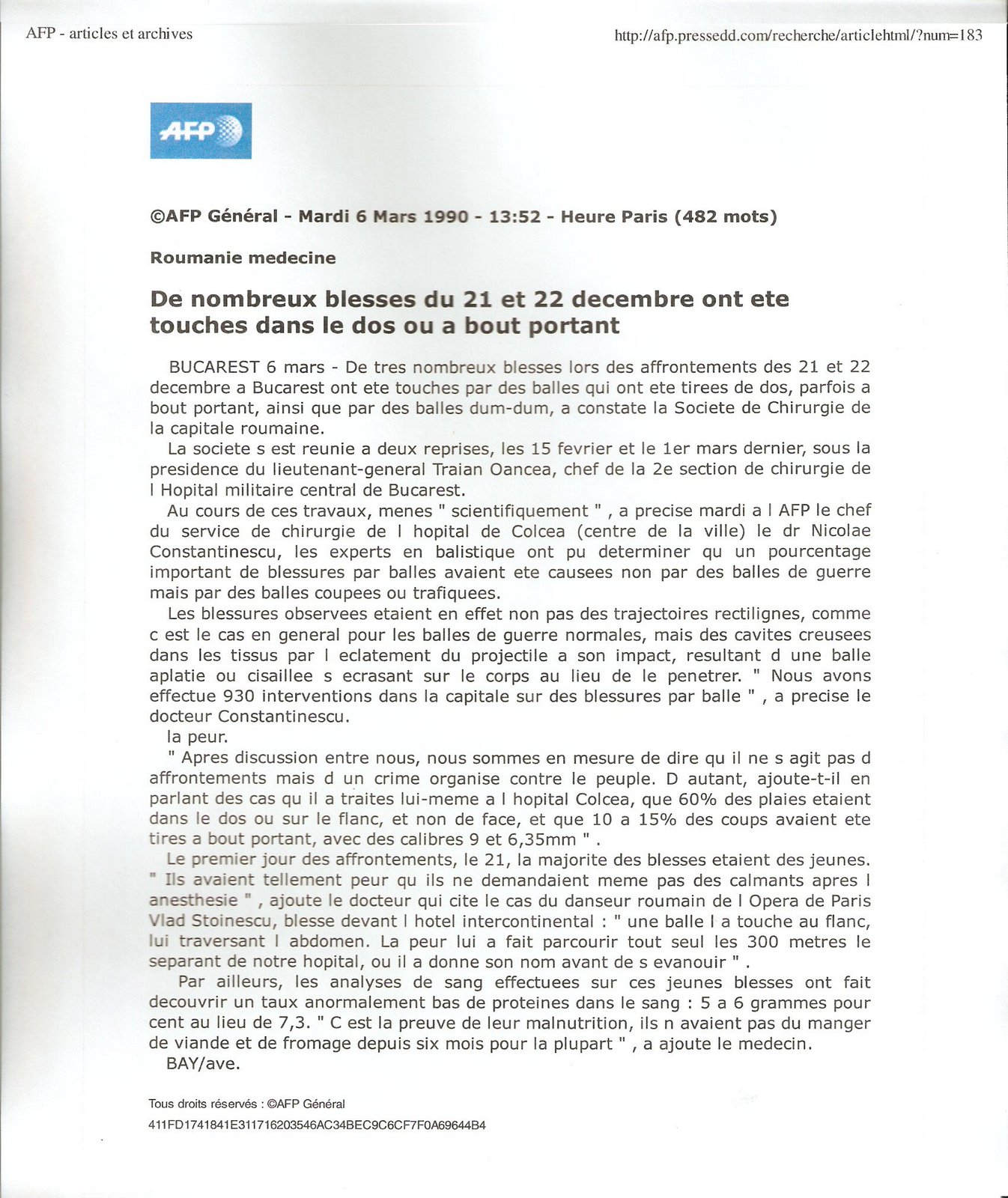
In early March 1990, AFP reported the declared findings of surgeons in Bucharest, attesting to the fact that many of those wounded on 21-22 December 1989 in Bucharest had been shot with exploding bullets, DUM-DUM bullets.  This is a critical article (and description of an event that I believe has gotten almost no coverage inside or outside Romania).  Lt. Gnl. Traian Oancea, chief of surgery in part of the Central Military Hospital in Bucharest, and Dr. Nicolae “Nae” Constantinescu, chief of surgery at the Coltea Hospital, discussed this at a meeting of the Society of Surgeons in Bucharest.

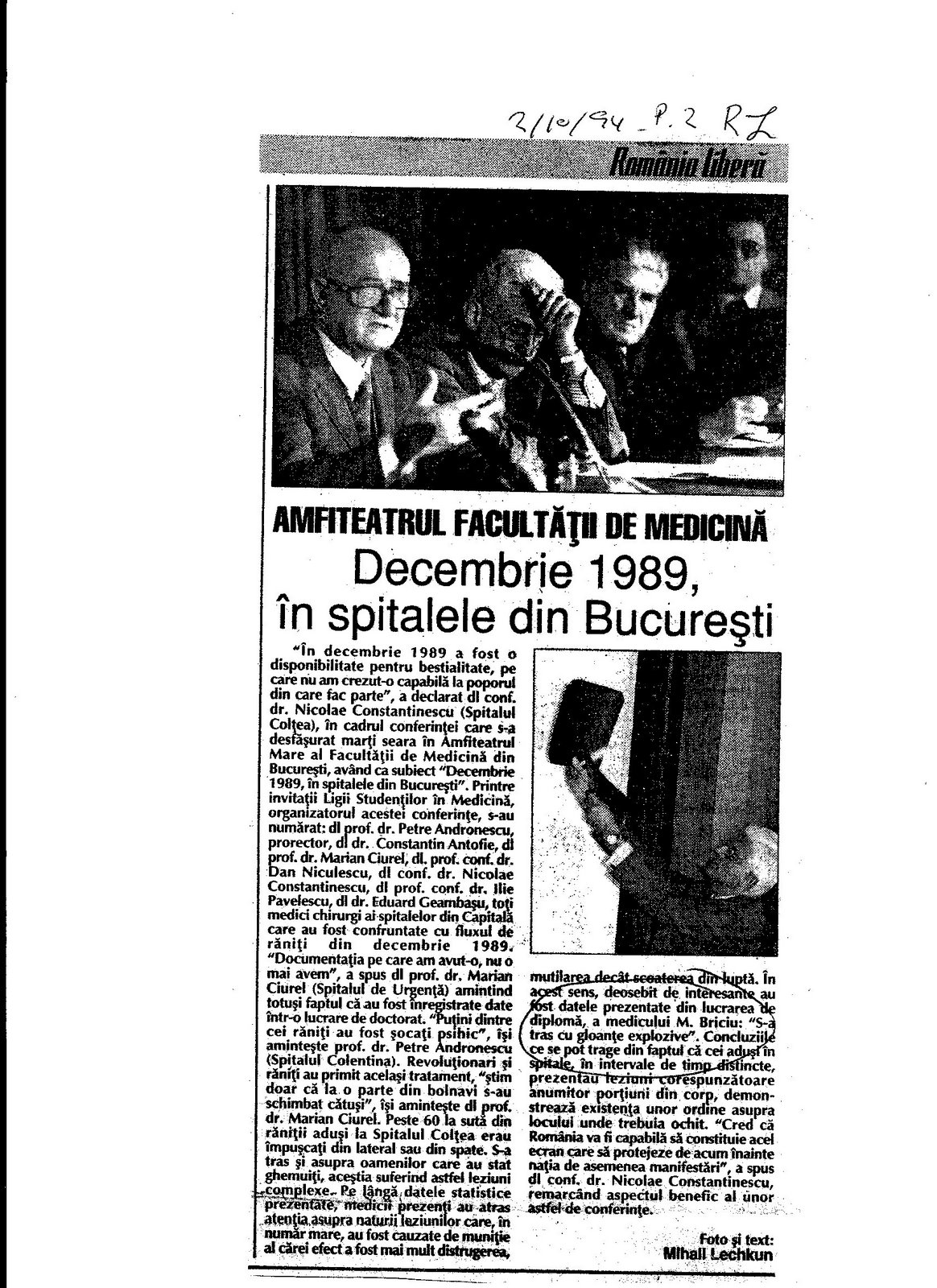
This was also discussed by Bucharest medical personnel at a 1994 conference:

AMFITEATRUL FACULTATII DE MEDICINA

“Decembrie 1989, in spitalele din Bucuresti”

Mihail Lechkun, Romania Libera, 10 februarie 1994, p. 2

“In decembrie 1989 a fost o disponsibilitate pentru bestialitate, pe care nu am crezut-o capabila la poporul care fac parte, ” a declarat dl. conf. dr. Nicolae Constantinescu (Spitalul Coltea), in cadrul conferintei care s-a desfasurat marti seara in Amfiteatrul Mare al Facultatii de Medicina din Bucurest, avand ca subiect “Decembrie 1989, in spitalele din Bucuresti”.  Printre invitatii Ligii Studentilor in Medicina, organizatorul acestei conferinte, s-au numarat:  dl. prof. dr. Petre Andronescu, prorector, dl. dr. Constantin Antofie, dl. prof. dr. Marian Ciurel, dl. prof. conf. dr. Dan Niculescu, dl. conf. dr. Nicolae Constantinescu, dl. prof. conf. dr. Ilie Pavelescu, dl. dr. Eduard Geambasu, toti medici chirurgi din Capitala care au fost confruntate cu fluxul de raniti din decembrie 1989.  “Documentatia pe care am avut-o, nu o mai avem,” a spus dl. prof. dr. Marian Ciurel (Spitalul de Urgenta) amintind totusi faptul ca au fost inregistrate date intr-o lucrare de doctorat.  “Putini dintre cei raniti au fost socati psihic,” isi aminteste prof. dr. Petre Andronescu (Spitalul Colentina).  Revolutionari si raniti au primit acelasi tratament, “stim doar ca la o parte din bolnavi s-au schimbat catusi” isi aminteste dl. prof. dr. Marian Ciurel.  Peste 60 la suta din ranitii adusi la Spitalul Coltea erau impuscati lateral sau din spate.  S-a tras si asupra oamenilor care au stat ghemuiti, acestia suferind astfel leziuni complexe.  Pe langa datele statistice prezentate, medicii prezenti au atras atentia asupra naturii leziunilor care, in numar mare, au fost cazate de munitie al carie efect a fost mai mult distrugerea, mutilarea decat scoaterea din lupta.  In acest sens, deosebit de interesante au fost datele prezentate din lucrarea de diploma, a medicului M. Briciu:  “S-a tras cu gloante explozive”. Concluziile ce se pot trage din faptul ca cei adusi in spitale, in intervale de timp distincte, prezentau leziuni corespunzatoare anumitor portiuni din corp, demonstreaza existenta unor ordine asupra locului unde trebuia ochit.  “Cred ca Romania va fi capabila sa constituie acel ecran care sa protejeze de acum inainte natia de asemenea manifestari,” a spus dl. conf. dr. Nicolae Constantinescu, remarcand aspectul benefic al unor astfel de conferinte.

NOR WERE THESE THE ONLY DOCTORS AND MEDICAL PERSONNEL–FOREIGN OR DOMESTIC–WHO ATTESTED TO THE USE OF DUM-DUM EXPLODING AND OTHER ATYPICAL, UNUSUAL MUNITIONS USED DURING THE EVENTS OF DECEMBER 1989

http://atomic-temporary-3899751.wpcomstaging.com/2011/08/08/doctors-and-dum-dum-bullets-in-romania-in-december-1989-i-dr-manuel-burzaco-medecins-sans-frontieres/

http://atomic-temporary-3899751.wpcomstaging.com/2011/08/10/doctors-and-dum-dum-bullets-in-romania-in-december-1989-ii-trimisi-in-strainatate-italia-franta-austria-anglia-si-germania-pentru-tratament/

http://atomic-temporary-3899751.wpcomstaging.com/2011/08/11/doctors-and-dum-dum-bullets-in-romania-in-december-1989-iii-ce-spun-medici-romani/

——————————————————————————————————————————————————————————————————————————————–

SO WHO THEN WOULD HAVE HAD, HAD ACCESS TO, AND FIRED DUM-DUM BULLETS, ESPECIALLY BEFORE 22 DECEMBER 1989 AND IN TIMISOARA?

PERHAPS THE ARMY, WE ARE TOLD.  PERHAPS.  ONLY PROBLEM IS THAT WE HAVE NO EVIDENCE WHATSOEVER THAT THE ARMY HAD OR USED THESE!

BY CONTRAST, WE HAVE EVIDENCE THAT THE SECURITATE POSSESSED AND USED DUM-DUM BULLETS–IT IS THUS THEY WHOM WE HAVE TO BELIEVE USED THEM!

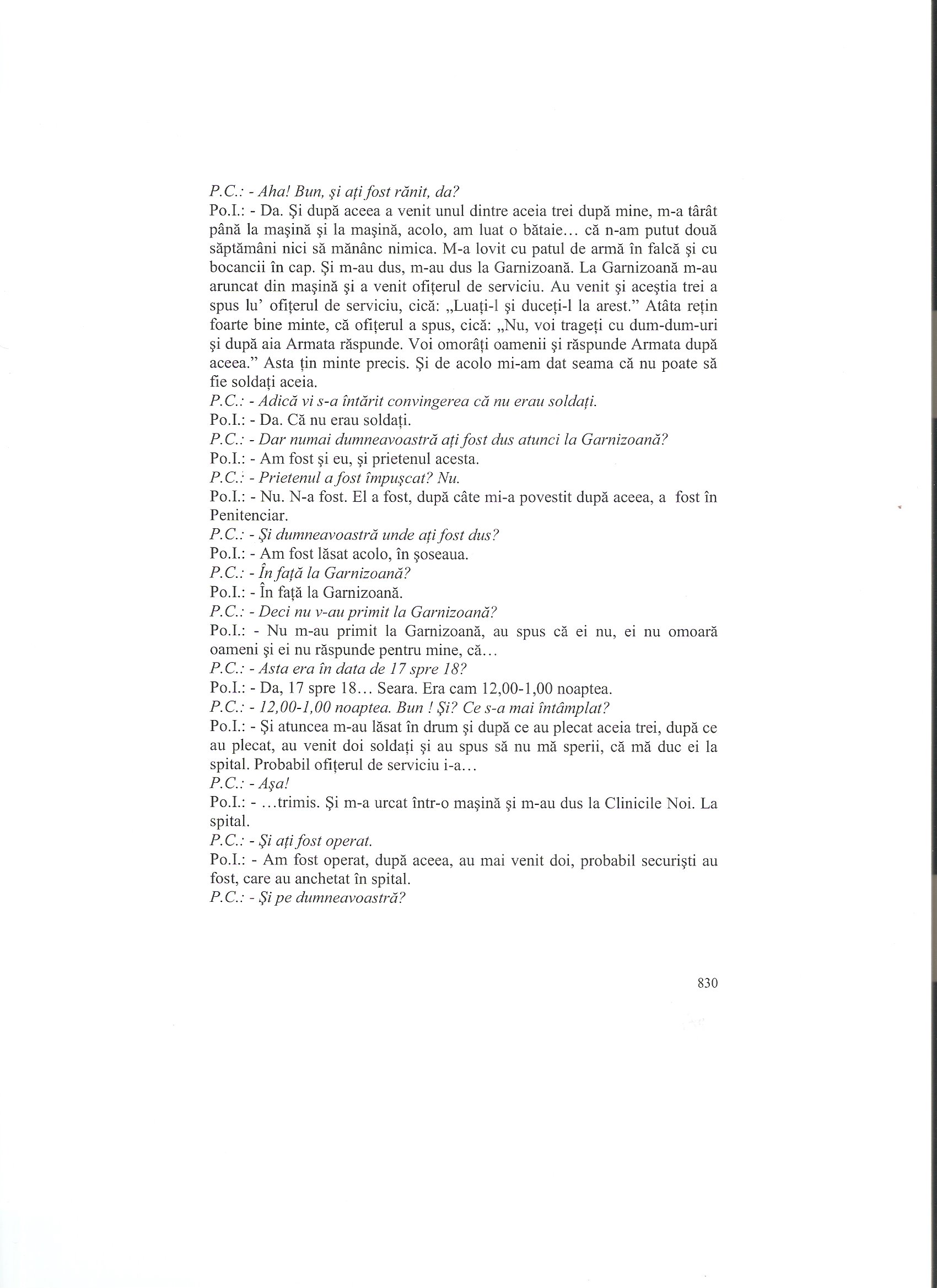
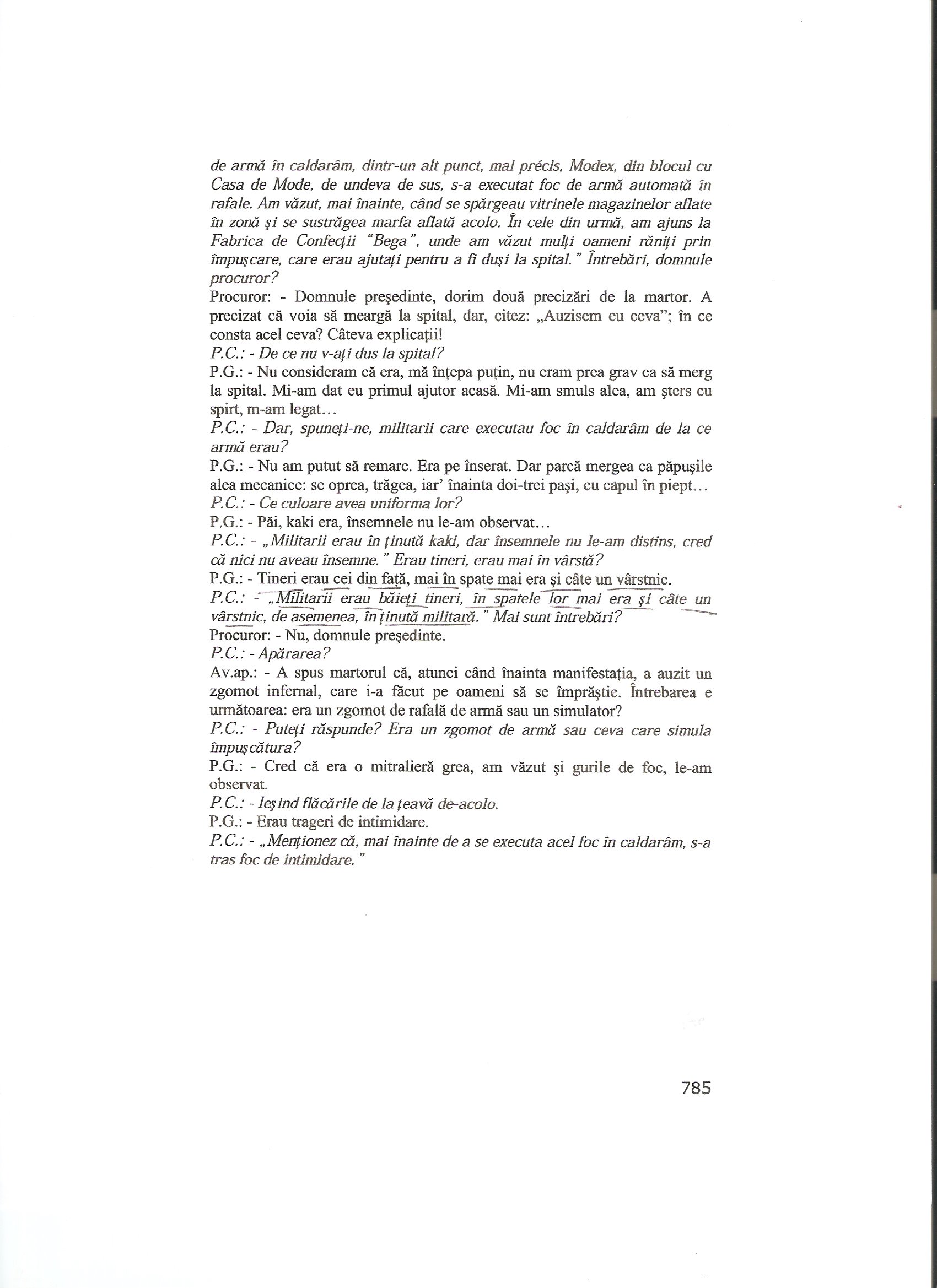
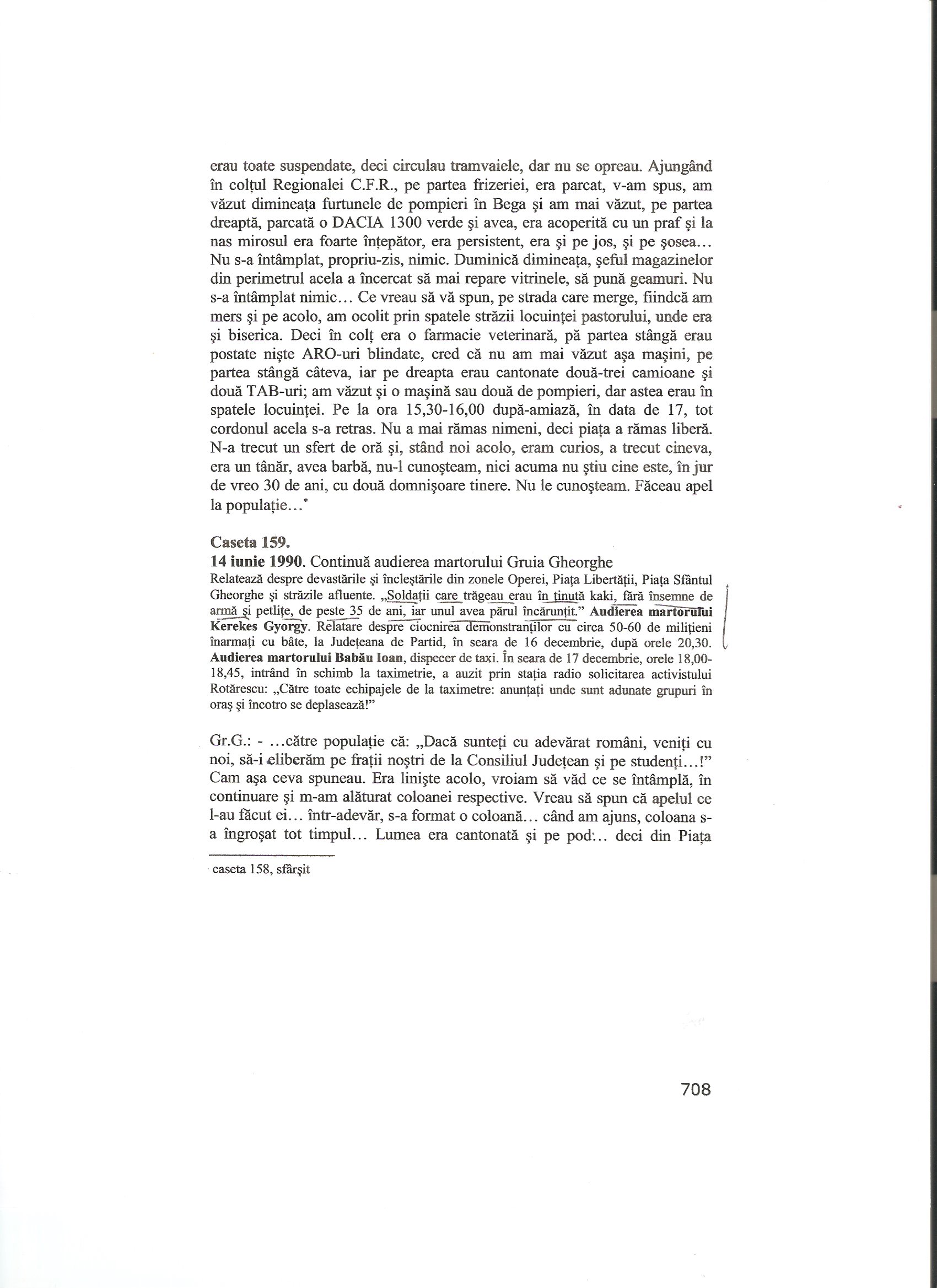
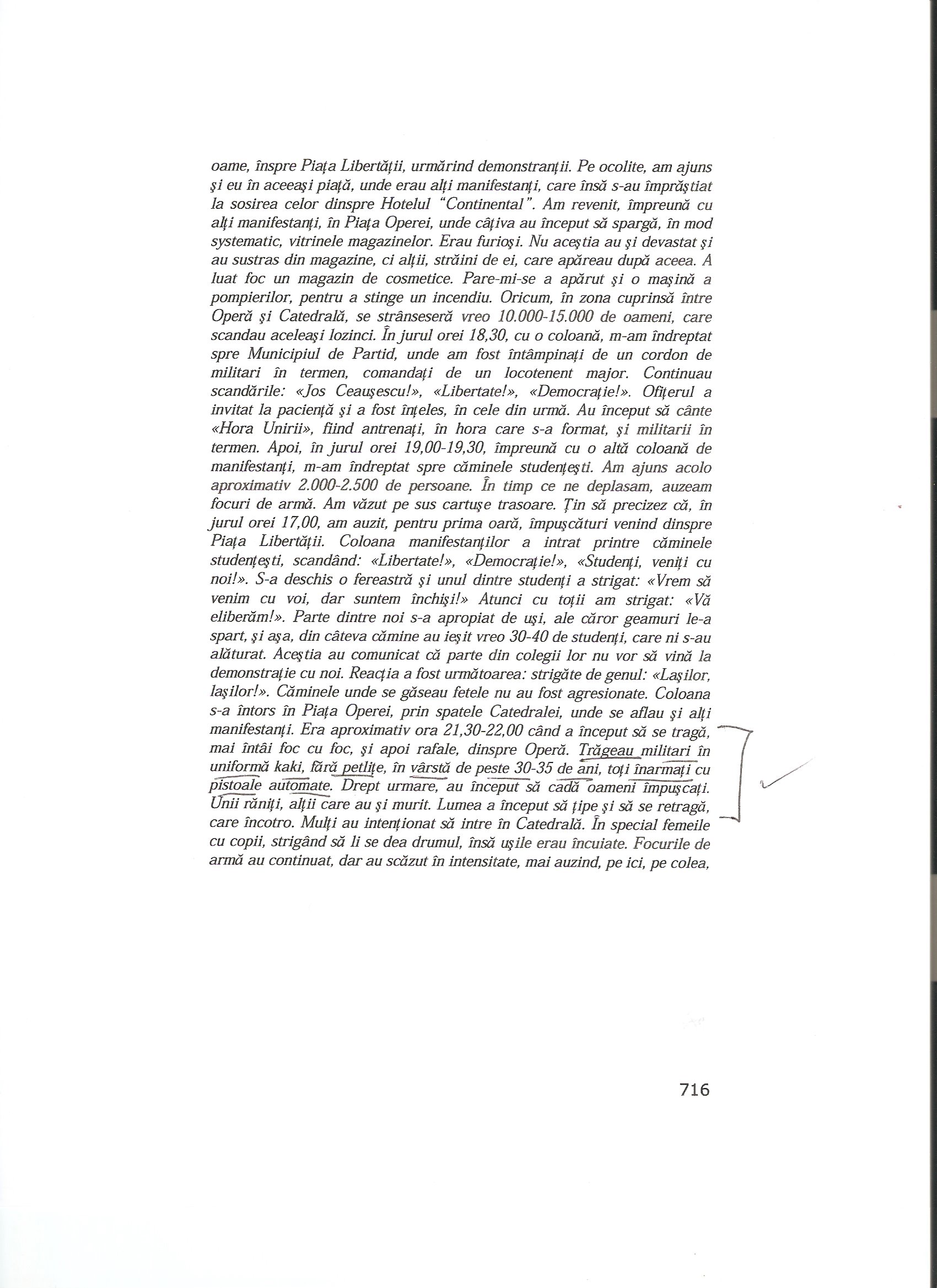
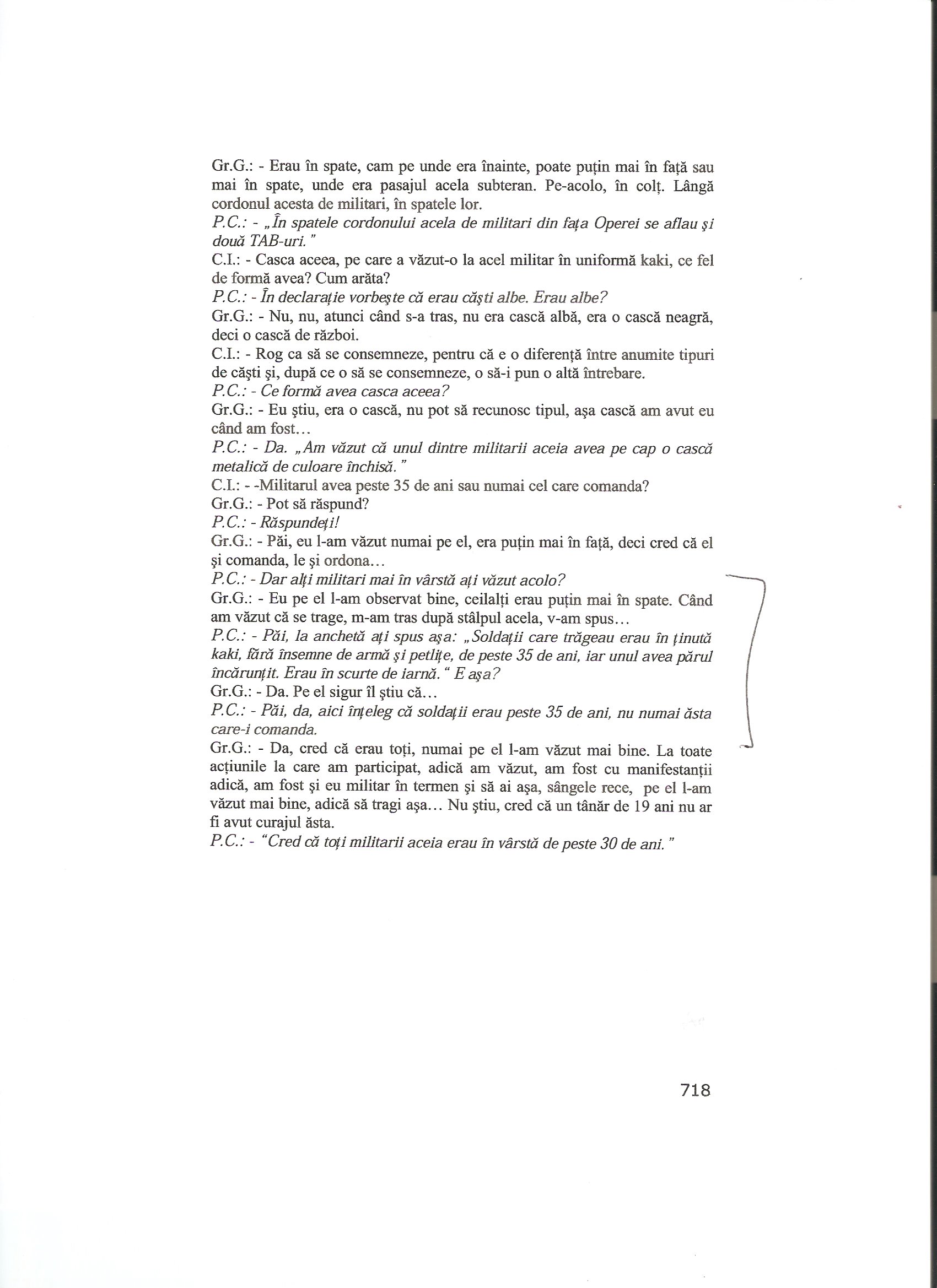
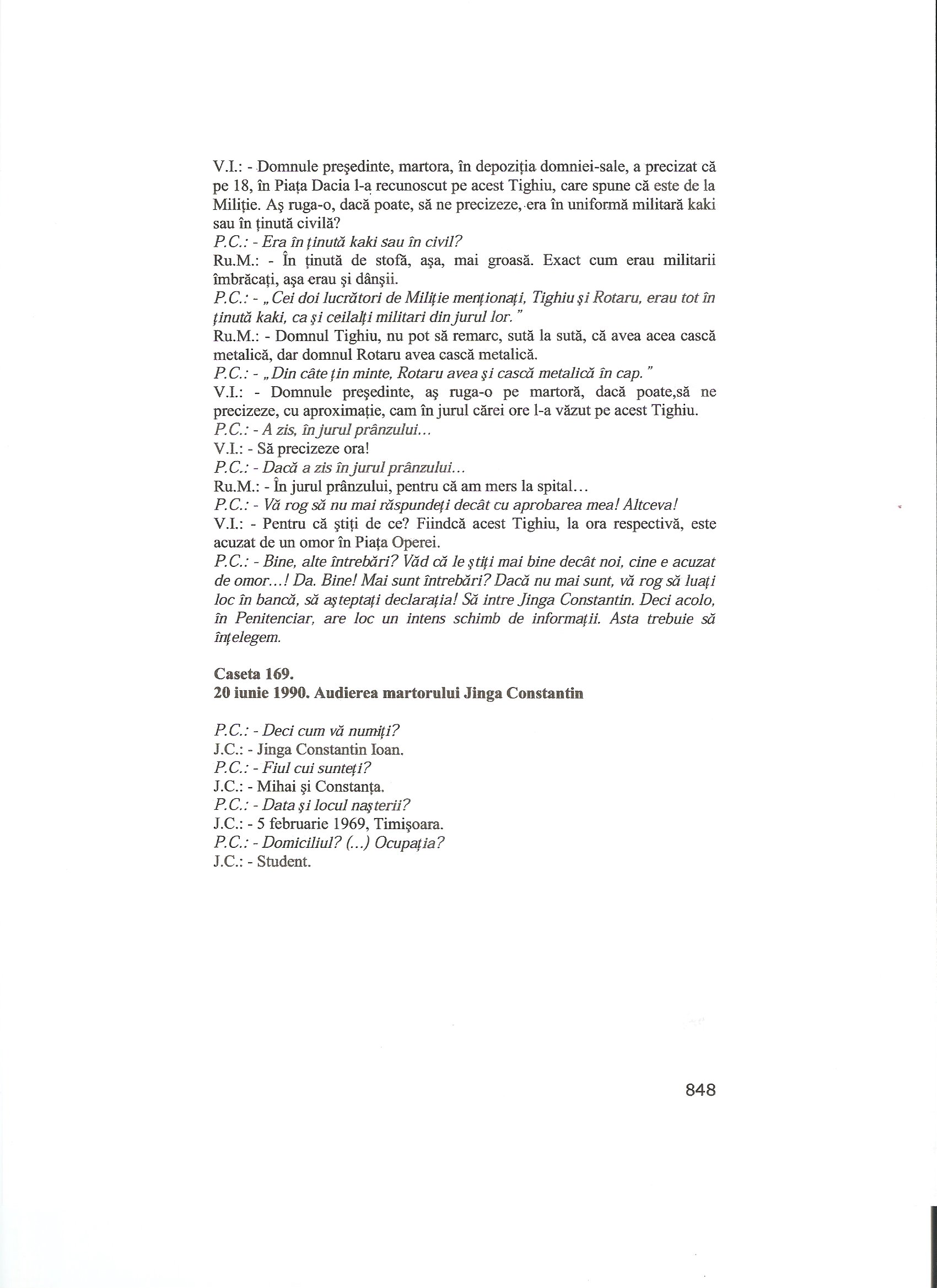
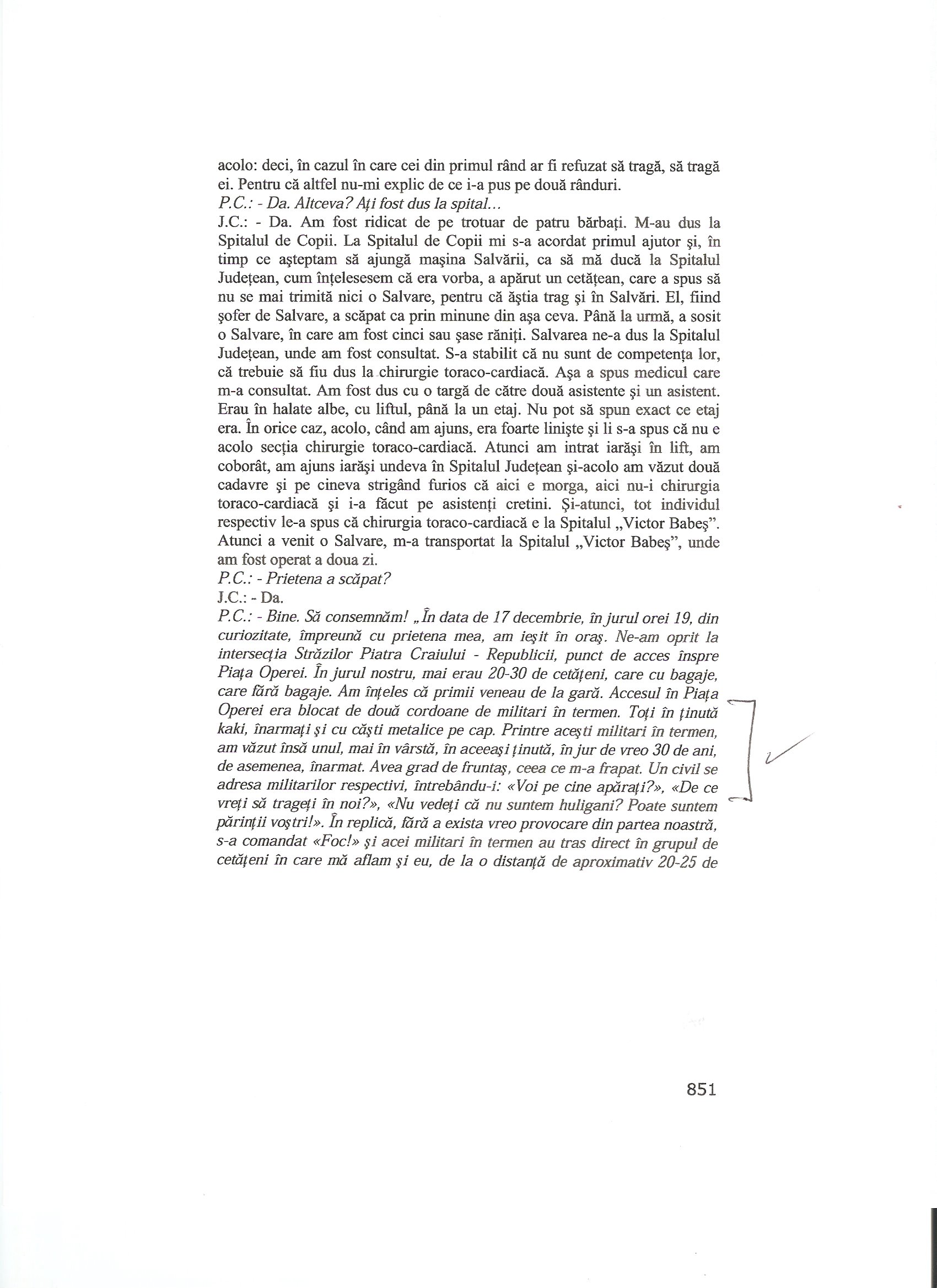
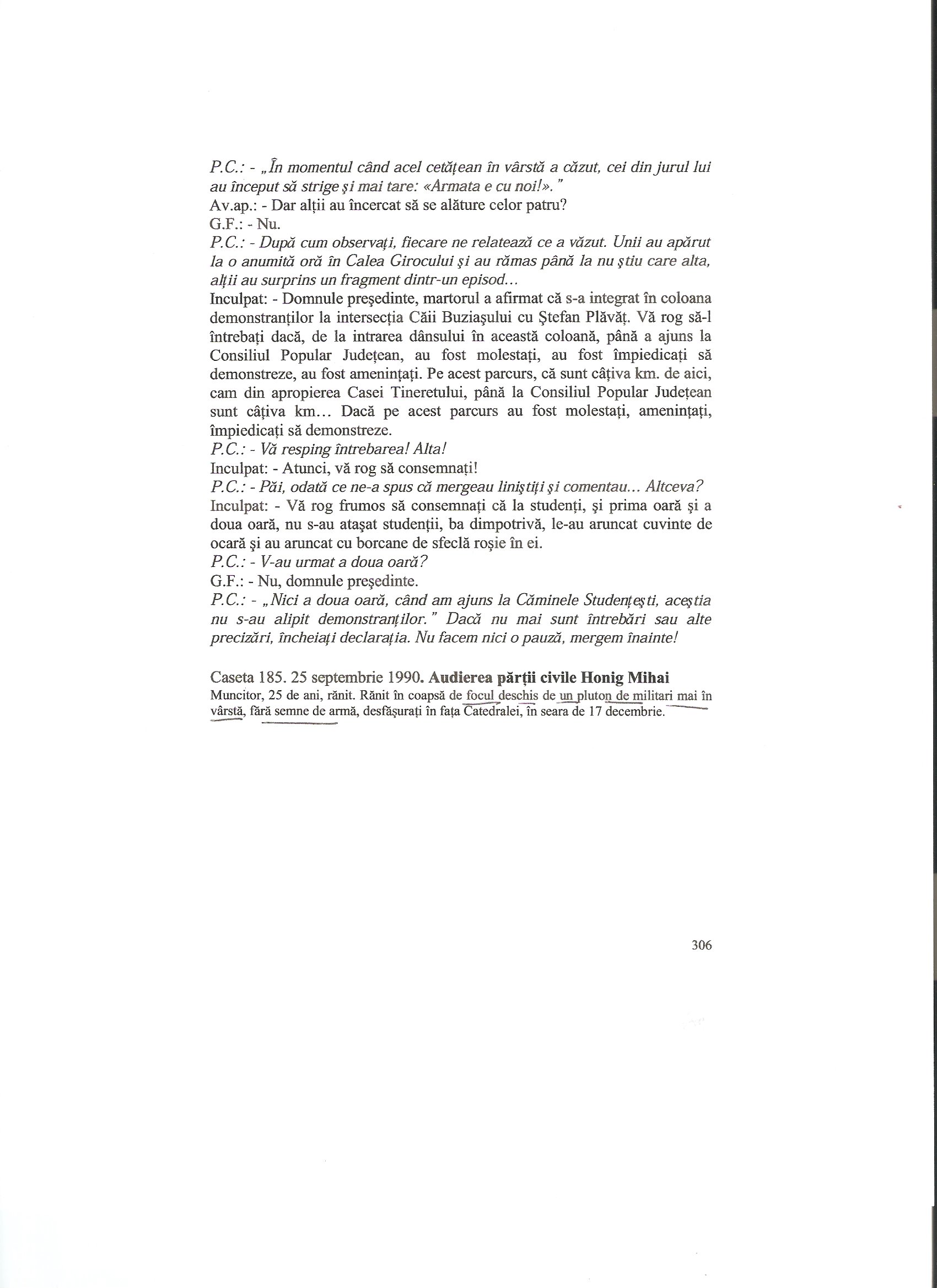
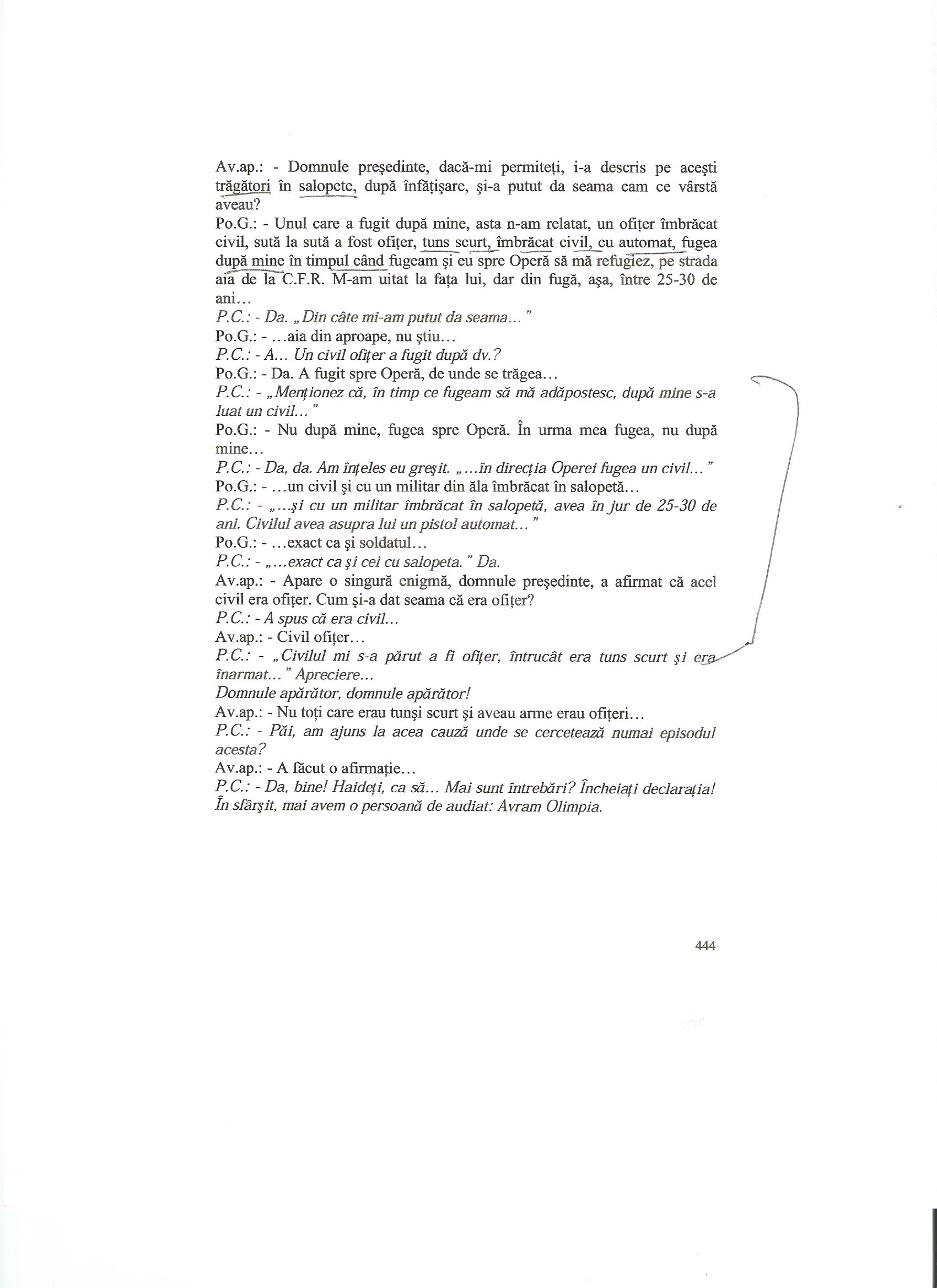
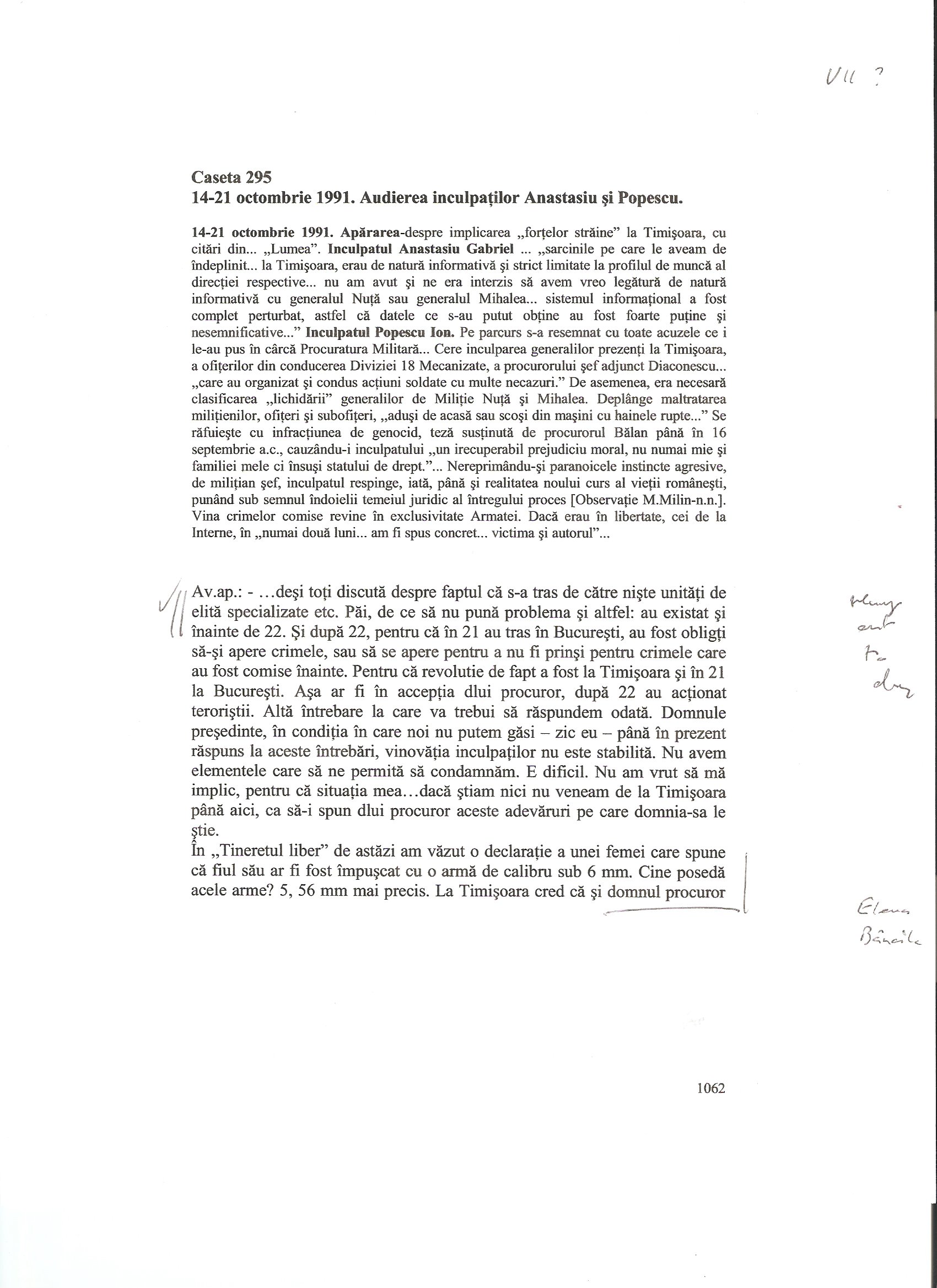
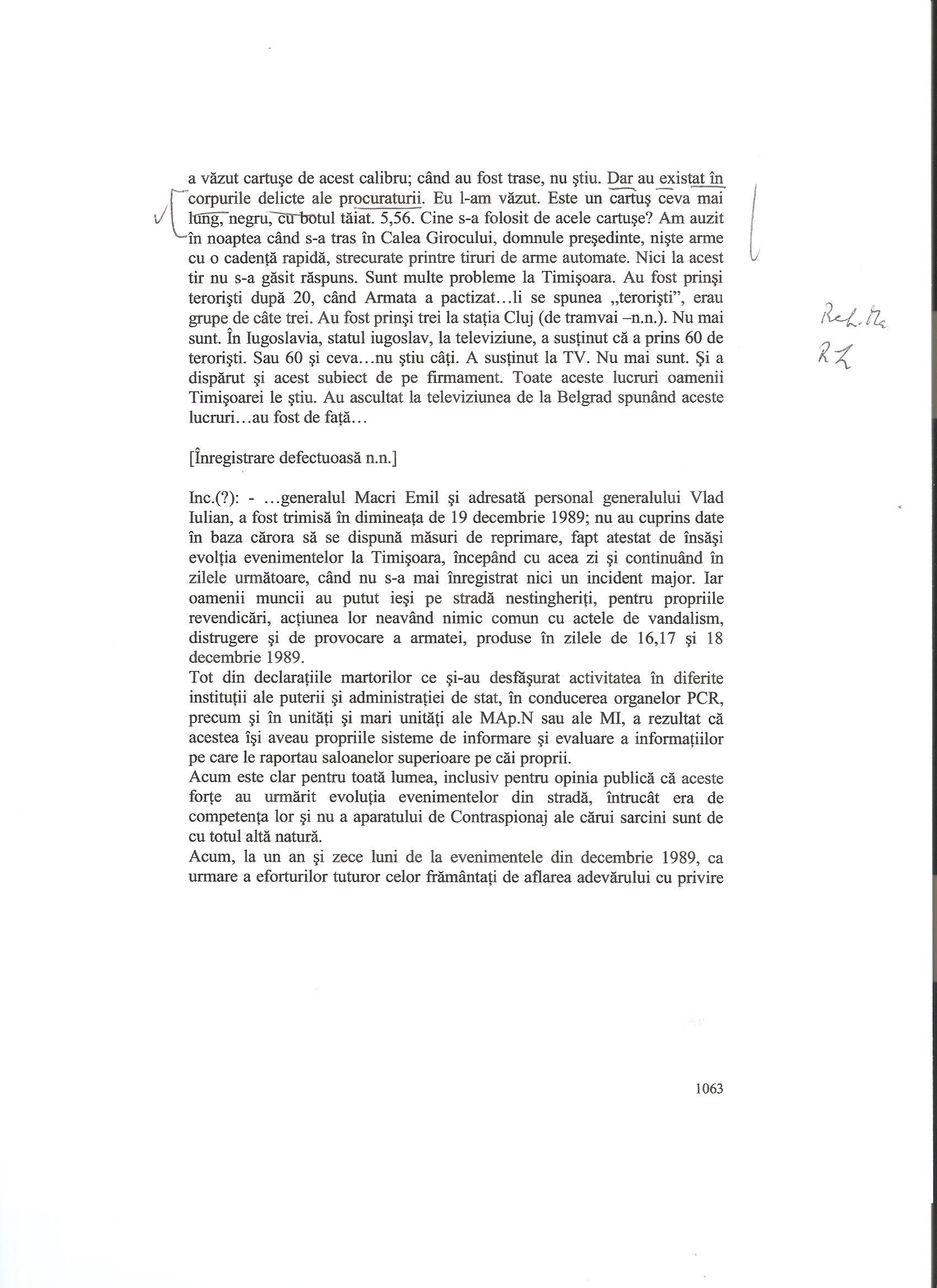
Procesul de la Timisoara (II). Audierea partii civile Popovici Ion: “…Atata retin foarte bine minte, ca ofiterul a spus, cica: ‘Nu, voi trageti cu dum-dum-uri si dupa aia Armata raspunde.’”

available on this site http://www.banaterra.eu/romana/procesul-de-la-timisoara-1990-1991-vol-v ].  The following is from Volume V.]

Some excerpts: P.C.:  Ati dat o declaratie?   Po. I. :  Da  P.C.:  O mentineti?  Po. I. Da (p. 827) P.C.:  “Inteleg sa fiu audiat in cauza ca parte civila”, da?  V-as ruga sa faceti putin liniste!  “Mentin declaratia de la Procuratura si…” (p. 833)

Po. I.:  …Da [am fost ranit].  Si dupa aceea a venit unul dintre trei [civili mai in varsta] dupa mine, m-a tarat pana la masina si la masina, acolo, am luat o bataie…ca n-am putut doua saptamani nici sa mananc nimica.  M-a lovit cu patul de arma in falca si cu bocancii in cap.  Si m-au dus, m-au dus la Garnizoana.  La Garnizoana m-au aruncat din masina si a venit ofiterul de serviciu.  Au venit si acestia trei a spus lu’ ofiterul de serviciu, cica:  “Luati-l si duceti-l  la arest.”  Atata retin foarte bine minte, ca ofiterul a spus, cica:  “Nu, voi trageti cu dum-dum-uri si dupa aia Armata raspunde.  Voi omorati oameni si raspunde Armata dupa aceea.”  Asta tin minte precis.  Si de acolo mi-am dat seama ca nu poate sa fie soldati aceia. (p. 830)

IMG_0291

IMG_0290

from Bullets, Lies, and Videotape: The Amazing, Disappearing Romanian Counter-Revolution of December 1989 (Part VII: Conclusion. Those Who Told Us the Truth) by Richard Andrew Hall (UPDATED with new xeroxes)

for Part I see PART I: His Name Was Ghircoias…Nicolae Ghircoias

for Part II see Part II: A Revolution, A Coup d\’etat, AND a Counter-Revolution

for Part III see Part III: Lost…during Investigation

for Part IV see Part IV: The Good Sergeant Schultz or They Know Nothing

for Part V see Part V: Seeing is Believing Videos One and Two

for Part VI see Part VI: Seeing is Believing, Videos 3 and 4

Bullets, Lies, and Videotape:

The Amazing, Disappearing Romanian Counter-Revolution of December 1989

by Richard Andrew Hall, Ph.D.

Standard Disclaimer:  All statements of fact, opinion, or analysis expressed are those of the author and do not reflect the official positions or views of the Central Intelligence Agency (CIA) or any other U.S. Government agency.  Nothing in the contents should be construed as asserting or implying U.S. Government authentication of information or CIA endorsement of the author’s views.  This material has been reviewed by CIA to prevent the disclosure of classified information.  [Submitted 19 November 2009; PRB approved 15 December 2009]

I am an intelligence analyst for the Central Intelligence Agency.  I have been a CIA analyst since 2000.  Prior to that time, I had no association with CIA outside of the application process.

Those Who Have Told Us the Truth[1]

As opposed to the aforementioned Vladimir Belis, Pavel Corut, and Dan Voinea, all of whom who have strenuously and repeatedly denied the existence and use in December 1989 of atypical munitions of dum-dum bullets and vidia bullets, there exist those who have told us of the existence and use of these in December 1989.[2] They are essentially, for lack of a better term, former Securitate whistleblowers, who have admitted the Securitate’s role in providing the “terrorists” who caused so much destruction, mayhem, and loss of life in those days.

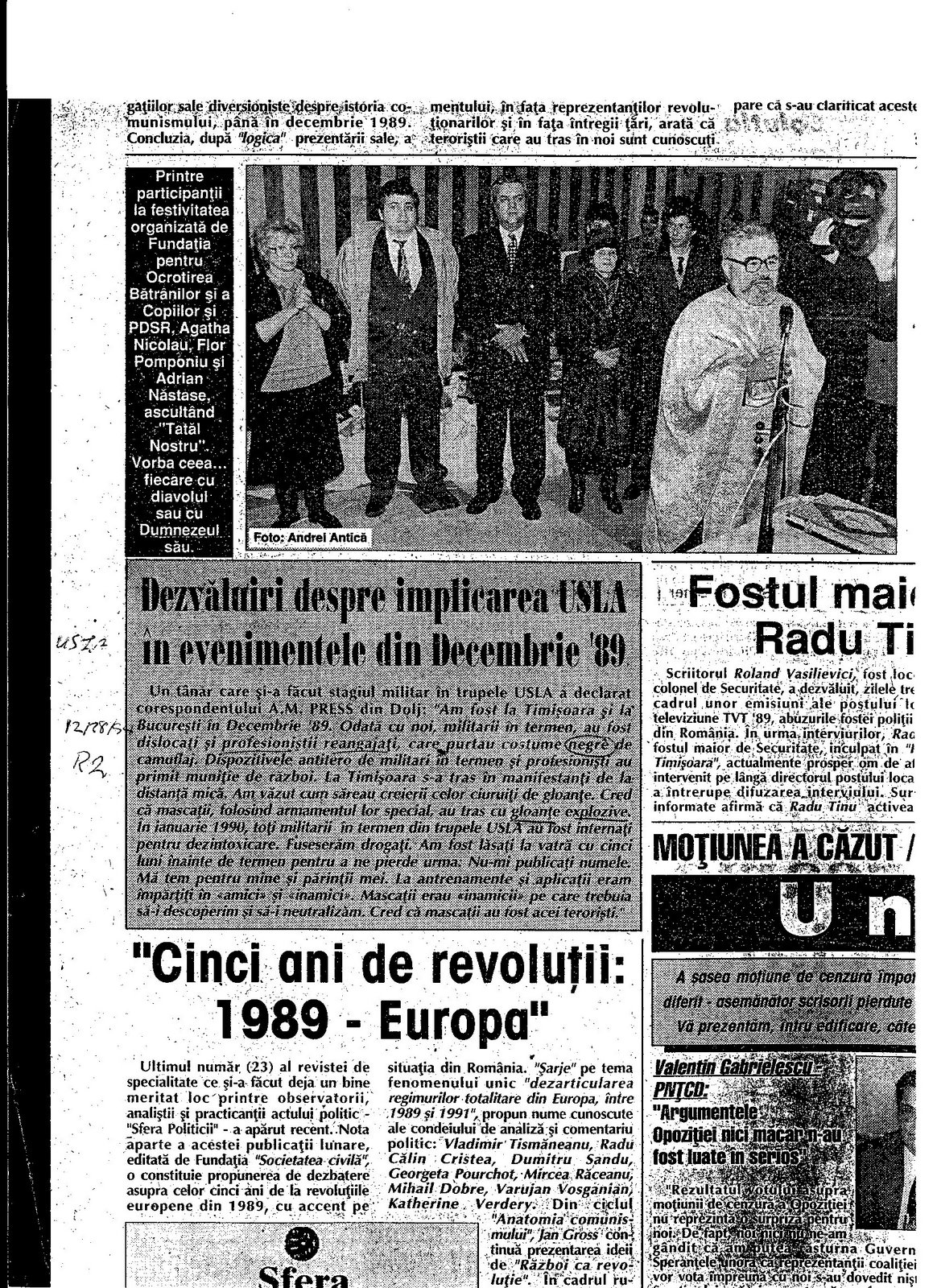
For years I have been essentially the sole researcher inside or outside the country familiar with and promoting the claims of 1) former Timisoara Securitate Directorate I officer Roland Vasilevici—who published his claims about December 1989 under the byline of Puspoki F. in the Timisoara political-cultural weekly Orizont in March 1990 and under the pseudonym “Romeo Vasiliu”—and 2) an anonymous USLA recruit who told his story to AM Press Dolj (published on the five year anniversary of the events in Romania Libera 28 December 1994…ironically (?) next to a story about how a former Securitate official attempted to interrupt a private television broadcast in which Roland Vasilevici was being interviewed in Timisoara about Libyan involvement in December 1989).

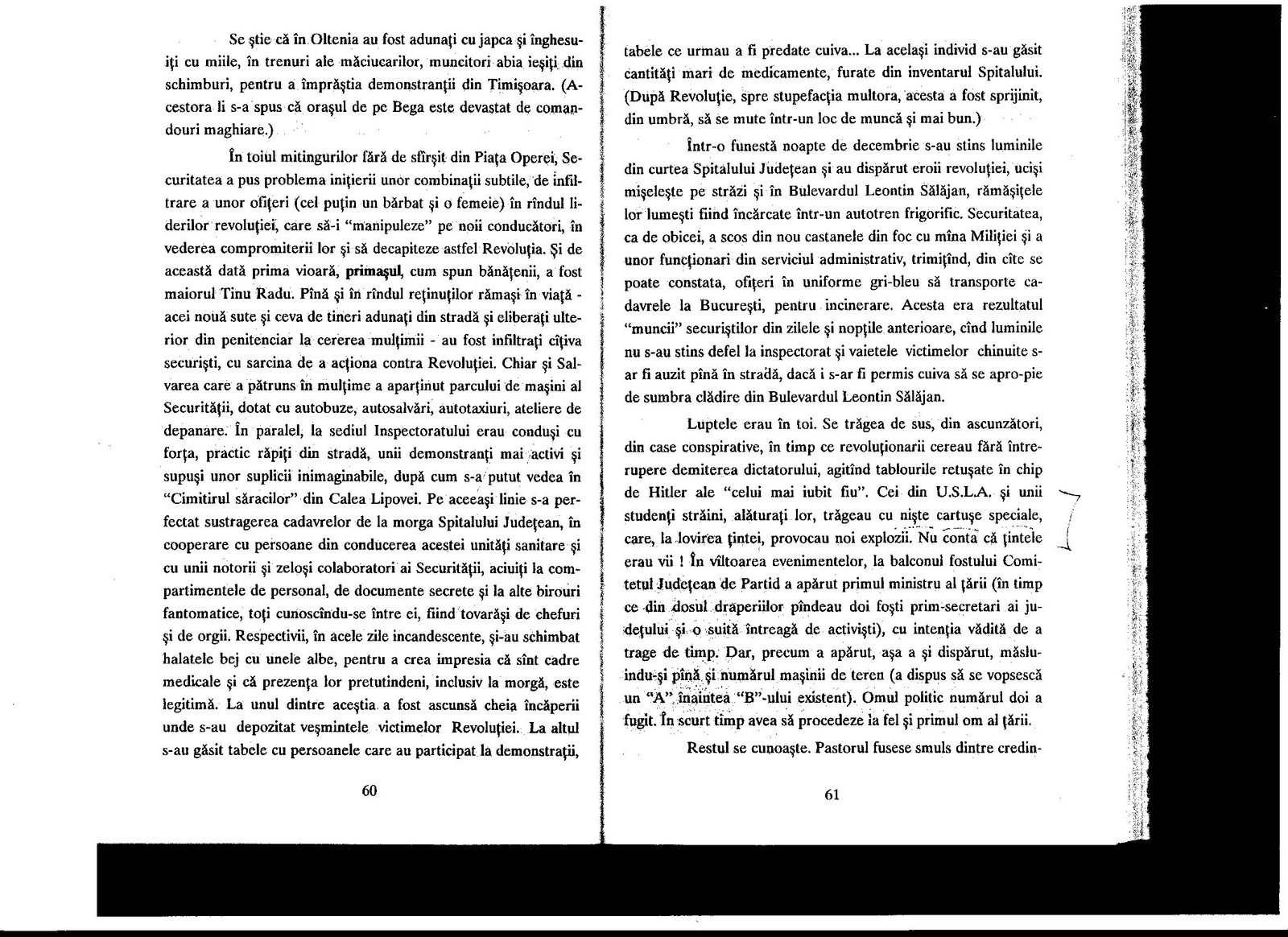
Vasilevici claimed in those March 1990 articles and in a 140 page book that followed—both the series and the book titled Pyramid of Shadows—that the USLA and Arab commandos were the “terrorists” of December 1989.  What is particularly noteworthy in light of the above discussion about “exploding [dum-dum] bullets” was his claim that the USLA and the foreign students who supplemented them “used special cartridgeswhich upon hitting their targets caused new explosions” [emphasis added]—in other words, exploding or dum-dum bullets.[3]

The anonymous USLA recruit stated separately, but similarly:

I was in Timisoara and Bucharest in December ’89.  In addition to us [USLA] draftees, recalled professionals, who wore black camouflage outfits, were dispatched.  Antiterrorist troop units and these professionals received live ammunition.  In Timisoara demonstrators were shot at short distances.  I saw how the skulls of those who were shot would explode. I believe the masked ones, using their own special weapons, shot with exploding bullets.  In January 1990, all the draftees from the USLA troops were put in detox.  We had been drugged.  We were discharged five months before our service was due to expire in order to lose any trace of us.  Don’t publish my name.  I fear for me and my parents.  When we trained and practiced we were separated into ‘friends’ and ‘enemies.’  The masked ones were the ‘enemies’ who we had to find and neutralize.  I believe the masked ones were the ‘terrorists’.[4] [emphases added]

As I have pointed out, despite the short shrift given these two revelations by Romanian media and Romanianists, one group has paid close attention:  the former Securitate.  That is not accidental.[5]

for full discussion of those who told us the truth (i.e. continuation of above), see discussion here:

Bullets, Lies, and Videotape: The Amazing, Disappearing Romanian Counter-Revolution of December 1989 (Part VII: Conclusion. Those Who Told Us the Truth) by Richard Andrew Hall (UPDATED with new xeroxes)

———————————————————————————————————————————————————————————————————————————————

©AFP Général – Mardi 6 Mars 1990 – 13:52 – Heure Paris (482 mots)

Roumanie medecine
De nombreux blesses du 21 et 22 decembre ont ete touches dans le dos ou a bout portant
   BUCAREST 6 mars – De tres nombreux blesses lors des affrontements des 21 et 22 decembre a Bucarest ont ete touches par des balles qui ont ete tirees de dos, parfois a bout portant, ainsi que par des balles dum-dum, a constate la Societe de Chirurgie de la capitale roumaine.
   La societe s est reunie a deux reprises, les 15 fevrier et le 1er mars dernier, sous la presidence du lieutenant-general Traian Oancea, chef de la 2e section de chirurgie de l Hopital militaire central de Bucarest.
   Au cours de ces travaux, menes ” scientifiquement ” , a precise mardi a l AFP le chef du service de chirurgie de l hopital de Colcea (centre de la ville) le dr Nicolae Constantinescu, les experts en balistique ont pu determiner qu un pourcentage important de blessures par balles avaient ete causees non par des balles de guerre mais par des balles coupees ou trafiquees.
   Les blessures observees etaient en effet non pas des trajectoires rectilignes, comme c est le cas en general pour les balles de guerre normales, mais des cavites creusees dans les tissus par l eclatement du projectile a son impact, resultant d une balle aplatie ou cisaillee s ecrasant sur le corps au lieu de le penetrer. ” Nous avons effectue 930 interventions dans la capitale sur des blessures par balle ” , a precise le docteur Constantinescu.
   la peur.
   ” Apres discussion entre nous, nous sommes en mesure de dire qu il ne s agit pas d affrontements mais d un crime organise contre le peuple. D autant, ajoute-t-il en parlant des cas qu il a traites lui-meme a l hopital Colcea, que 60% des plaies etaient dans le dos ou sur le flanc, et non de face, et que 10 a 15% des coups avaient ete tires a bout portant, avec des calibres 9 et 6,35mm ” .
   Le premier jour des affrontements, le 21, la majorite des blesses etaient des jeunes. ” Ils avaient tellement peur qu ils ne demandaient meme pas des calmants apres l anesthesie ” , ajoute le docteur qui cite le cas du danseur roumain de l Opera de Paris Vlad Stoinescu, blesse devant l hotel intercontinental : ” une balle l a touche au flanc, lui traversant l abdomen. La peur lui a fait parcourir tout seul les 300 metres le separant de notre hopital, ou il a donne son nom avant de s evanouir ” .
   Par ailleurs, les analyses de sang effectuees sur ces jeunes blesses ont fait decouvrir un taux anormalement bas de proteines dans le sang : 5 a 6 grammes pour cent au lieu de 7,3. ” C est la preuve de leur malnutrition, ils n avaient pas du manger de viande et de fromage depuis six mois pour la plupart ” , a ajoute le medecin.
   BAY/ave.
Tous droits réservés : ©AFP Général
411FD1741841E311716203546AC34BEC9C6CF7F0A69644B4

Posted in decembrie 1989, raport final, Uncategorized | Tagged: , , , , , , , | 7 Comments »

Procesul de la Timisoara (IX): Cine au fost cei “necunoscuti,” mai in varsta, care au tras inainte de 22 decembrie 1989? (2)

Posted by romanianrevolutionofdecember1989 on October 21, 2011

[as always, purely personal views based on purely personal research and publications over the past two decades]

Thanks to Miodrag Milin (and ASOCIAŢIA MEMORIALUL REVOLUŢIEI 16-22 DECEMBRIE 1989, TIMIŞOARA), the tapes of the Timisoara trials of 1990-1991 have been transcribed and made available to the public.  These transcripts are highly valuable for the researcher of the December 1989 Romanian Revolution.  To my knowledge, much of this information has never made it into the public domain, and much of the most important information has definitely not.

[Are these court documents available at the website of the IICCMER?  Or the website of Asociatia 21 decembrie 1989?  No!  Thankfully, however, they are available on this site: http://www.banaterra.eu/romana/files/procesul_de_la_timisoara_volumul_IV_cuprins_0.pdf and http://www.banaterra.eu/romana/procesul-de-la-timisoara-1990-1991-vol-v ]  The following are from Volumes IV and V.]

Procesul de la Timisoara (VI): Impuscati dintr-un ARO…Al cui apartinea ARO-ul?

Procesul de la Timisoara (VIII): Cine au fost cei “necunoscuti”, mai in varsta, care au tras inainte de 22 decembrie 1989?

Back in 1990, the suggestion that non-draftees were infiltrated and positioned among and more importantly behind soldiers was hardly a radical idea…and indeed those who admitted the Army’s role in the bloodshed also pointed to their presence.

This might shed light on the claim of Army Lieutenant Colonel Dumitru Damian in January 1990 that approximately every unit of…twenty soldiers was subordinated to a Securitate officer who would stand behind them and monitor them. These Securitate officers would give the order to shoot and threaten to shoot the soldiers on the spot if they refused the order to open fire.[92]

[92].. Lt. Col. Dumitru Damian and Major Viroel Oancea, interview by William Totok, Die Tageszeitung, 23 January 1990, in trans. Heinz Lahni, “Generalul m-a facut dobitoc,” Contrapunct, 2 March 1990, 11.

Rewriting the Revolution (1997): Chapter 5 Timisoara 15-17 December 1989

One of the few Securitate officers to deviate from the courtroom routine of steadfast denial of the institution’s involvement was Colonel Ion Bunoaica, the commander of the Securitate’s uniformed troops in Timisoara. Testifying as a witness in late 1990, Bunoaica eventually admitted both that his men had been armed during the Timisoara unrest and, suggestively, that they had taken up “battle formations” behind Army units which opened fire.[91]

[91].. Iosif Costinas, “Nu sinteti dumneavoastra colonelul Bunoaica? [Aren’t you colonel Bunoaica?],” Orizont, 2 November 1990, 5; idem, “Jur sa spun numai adevarul… [I swear to tell the whole truth],” Orizont, 9 November 1990, 5.

Internet posters claiming to have been in the military and on the streets of Timisoara in December 1989 have discussed the appearance of personnel in military uniforms who very clearly were not from the military (my thanks to Corneliu N. Vaida for bringing the following to my attention):

zainea

Am fost la Timisoara militar in termen in 89. In fata noastra la un moment dat a fost dizlocat un pluton cu militari in tinuta kaki, mai in varsta ca noi, la 30-35 de ani si care nu aveau petlite si nici insemne de arma. Ii intrebam de vorba si nu ne raspundeau ne ignorau… Au tras orizontal rafale de pistol automat… Noi pana atunci am tras in plan vertical. Cine erau acei “militari”?
Noi toti am banuit ca erau ofiteri din trupele de securitate imbracati in postav kaki nou de la stoc care mirosea a naftalina.
Dupa aceea toata revolutia am petrecut-o pe un bloc in fata unei mitraliere si cu un camarad cu care ma scimbam periodic. Am ramas de atunci bolnav cu “mijlocul” din cauza frigului pe care l-am suportat atunci pe acel nenorocit de bloc.
Dumnezeu sa-i ierte pe toti eroii revolutiei din 1989…

http://www.ligamilitarilor.ro/eroii-neamului/recunostinta-eroilor-revolutiei-din-%E2%80%9989-timisoara/

Rewriting the Revolution (1997): Chapter 5 Timisoara 15-17 December 1989

————————————————-

BELOW 10 TESTIMONIES WHICH DISCUSS THE ROLE OF THESE “UNIDENTIFIED CIVILIANS OR SOLDIERS” [LIKELY PLAINCLOTHES SECURITATE AND/OR MILITIA OFFICERS], IN SOME CASES STATIONED BEHIND RANK-AND-FILE SOLDIERS:  

Posted in decembrie 1989, raport final, Uncategorized | Tagged: , , , | 9 Comments »

Procesul de la Timisoara (VII): “La Timisoara cred ca si domnul procuror a vazut cartuse de acest calibru…Dar au existat in corpurile delicte ale procuraturii. Eu l-am vazut. Este un cartus ceva mai lung, negru, cu botul taiat. 5,56.”

Posted by romanianrevolutionofdecember1989 on October 19, 2011

[as always, purely personal views based on purely personal research and publications over the past two decades]

Thanks to Miodrag Milin (and ASOCIAŢIA MEMORIALUL REVOLUŢIEI 16-22 DECEMBRIE 1989, TIMIŞOARA), the tapes of the Timisoara trials of 1990-1991 have been transcribed and made available to the public.  These transcripts are highly valuable for the researcher of the December 1989 Romanian Revolution.  To my knowledge, much of this information has never made it into the public domain, and much of the most important information has definitely not.

[Are these court documents available at the website of the IICCMER?  Or the website of Asociatia 21 decembrie 1989?  No!  Thankfully, however, they are available on this site:  http://www.banaterra.eu/romana/files/procesul_de_la_timisoara_volumul_VII_continut.pdf.  The following are from Volume VII.]

Episodul “Gloante Vidia” (sau “uite, si eu am o mostra…”) din martie-aprilie 1991…

articolul din Tineretul Liber invocat era despre Bogdan Serban Stan, jucator de rugby, impuscat cu un glont “vidia 6 mm” (Elena Bancila, Trage lasule!, p. 94)

image-86

One of the particularly moving stories of the December events is that of Bogdan Serban Stan, 21 years old and one of three members of the under-22 Rapid Bucuresti rugby team who perished in the events.  Bogdan’s mother, Elena Bancila, was determined not to let the memory of her son be forgotten with his tragic death.  Bogdan had demonstrated on the night of 21-22 December in University Square and returned to fight at Television where on the night of 23 December at 3:50 am he was shot by an assailant in civilian clothes:  “The path of the ‘6 mm vidia’ cartridge blew a hole through his lung and ‘passed through’the T9 section of his spine, coming to a rest vertically in the bone marrow.”[45]

[45] Elena Bancila, Trage Lasule! (Bucuresti:  Editura Victor Frunza, 1990), pp. 65-66 (from Adevarul, 13 January 1990), and quote from pp. 94-95.  Bancila also claimed that a hospital nurse had told her some of those killed appeared to have been the victims of “exploding bullets” (see the series by Cristina Balint and Nicolae Tone in Tineretul Liber in September 1991, particularly part XI “Eu nu pot fi cumparata [I can’t be bought],” and part XII “Daca altfel nu se poate, voi cere deshumarea [If there is no other way, I’ll ask for his body to be exhumed], 22 and 24 September 1991 respectively).  In this series, the bullet that killed her son is referred to as “under 6 mm.”

from “ORWELLIAN…POSITIVELY ORWELLIAN:” PROSECUTOR VOINEA’S CAMPAIGN TO SANITIZE THE ROMANIAN REVOLUTION OF DECEMBER 1989 (Part III, A Fistful of Bullets: Unregistered, Atypical Munitions…)

Ion Medoia, “Teroristi prinsi pe teritoriul Iugoslaviei,” Romania Libera, 10 ianuarie 1990.

Posted in decembrie 1989, raport final, Uncategorized | Tagged: , , , , | 5 Comments »