Posted by romanianrevolutionofdecember1989 on December 22, 2025
My thanks to Silviu Sergiu for his questions and publication of a two part interview with me. Here are the links to the Romanian language versions of the interview. Below that are the English language answers I sent Silviu for the interviews
Categorizing what kind of event happened in December 1989
Without the protests, uprising, and conquering of local power in Timisoara from 15-21 December 1989, there may not have been an uprising in Bucharest on 21 December 1989 and the overthrow of Nicolae Ceausescu on 22 December. However, without the overthrow of Nicolae Ceausescu, the Ceausescu regime probably would have crushed the Timisoara revolt, just as it had done two years earlier in Brasov. It is important to note that Timisoara’s Frontul Democratic Roman (FDR) was the first revolutionary group to achieve power, albeit only in the Banat.
The uprising had to spread to the capital, and the armed institutions of the Ceausescu regime had to transfer their allegiance to an “alternative polity,” to use Charles Tilly’s term, for the revolution to succeed. This happened on the afternoon of 22 December 1989. Although there were other attempts to form a revolutionary government, only the Council of the National Salvation Front (CFSN) was able to secure the majority support of the armed institutions of the Ceausescu regime, precisely because it was made up of the communist nomenklatura. The CFSN possessed a huge structural advantage that other groups did not have, and it inevitably stunted the anti-communist evolution of the Revolution. The CFSN’s seizure of power was a direct product of the Ceausescu regime’s repression, because it had prevented the formation of civil society groups that could come to power, as happened in Czechoslovakia for instance.
The Importance of the Terrorists to Understanding December 1989 and Pitu’s “False Flag” and “Friendly Fire” Arguments
The key questions about December 1989—and even retired military prosecutor Catalin Ranco Pitu acknowledges this in his 2024 book—is did the terrorists exist and, if they did, who were they, what were their goals, and who did they report to? In other words, who bears responsibility for the almost 1,000 deaths and 3,000 injuries after 22 December? Pitu maintains that what happened after 22 December was a coup d’etat and that the Army—with the understanding and agreement of Ion Iliescu and the CFSN—engaged in a “false flag” operation. The “false flag” meant that the Army “invented” the “terrorists” through a massive disinformation campaign and blamed the Securitate by use of the phrase “securisti-teroristi.” The Securitate—and even the Ceausescus, Pitu maintains—were thus “victims” and “scapegoats” of the Army’s “false flag.” According to Pitu, there were no real terrorists and all those who died or were injured were the victims of “friendly fire” among the military, Patriotic Guards, and armed civilians. The military leadership, we are told, purposely disinformed and gave conflicting orders to their subordinates to spark this “friendly fire.”
Pitu is unable to tell us why, if this was a standing military plan, nobody involved in the operation of the plan leaked the details; why the CI-isti didn’t know about it and didn’t inform the Securitate leadership; and why nobody in the military—officers or recruits—or among civilians came forward during and immediately after December 1989 to counter the Army and CFSN’s claims of “Securitate terrorists?” Nobody was willing to say publicly that as bad as the Securitate were, they were not responsible for the violence and mayhem after 22 December. The idea that nobody spoke at the time about what is supposedly so obvious today—the “false flag” and the non-existence of the “terrorists”—should raise immediate doubts in those who listen to Pitu.
Pitu’s “Logic”
Pitu and his promoters keep on appealing to the supposed “logic” of their position. They point out that X was arrested or called a “terrorist” by the crowd, but the suspect proved in fact to be innocent. For example, they cite the famous case of Cristian Lupu in Bucharest. What they seem to fail to understand is that for their argument to be logically correct, they must prove that all 1,425 people officially arrested as “terrorists” were innocent. By contrast, it is far easier, as we do, to logically argue that the “terrorists” existed. All we have to do is to demonstrate that one or two of those 1,425 were “terrorists.” One or two cases of people being wrongly identified as “terrorists” is therefore not the same as one or two cases of people being “terrorists.” For the first outcome—”no terrorists”—the researcher must keep digging until they have examined all 1,425 cases and determined that all 1,425 suspects were in fact innocent. This is why it is so important to the former Securitate that the military prosecutors negate that even one terrorist existed: if even one existed, then there are likely to be other “terrorists” among the 1,425 who were detained. Ultimately, however, the truth of the Revolution File is not a matter of logic, but a matter of the details found in those documents.
This begs a basic question: what were the Securitate doing prior to December 1989? Wasn’t it their job—especially the CI-isti—to catch spies? The Securitate did not notice all these KGB or GRU agents or did not surveil, interrogate, or arrest them? Who prevented them from moving against these supposed agents? Pitu’s numbers are simply ridiculous, but no one has challenged him on this claim.
Similarly, regarding the alleged “Soviet tourists,” if the Securitate were so suspicious, why did they not monitor or expel them if they suspected them of being undercover agents? Typical of Pitu is that he muddies the water. He claims there is no proof of the involvement of “armed foreigners” in December 1989, but then accredits UM 0110 Securitate Deputy Vasile Lupu (“martorul L. V.”, Rechizitoriul, pp. 304-305) when he invokes what Lupu has said about the tourists. As far as I can see far from being Soviet undercover agents, the “tourists” were likely of three kinds: 1) Soviets driving to Yugoslavia to sell their LADAs and other cars and then returning home (this is why they came back with multiple men in the same car—because they had sold the other cars with which they arrived in Yugoslavia); 2) convoys of Soviet cars (actual tourists) attempting to escape the violence and return back home (near Brasov and Sibiu I believe this was the case); and 3) a form of cover (acoperire operativa) used by the Securitate to be able to move around unnoticed in the event of a Soviet invasion. The 2,000 or 10,000 or 40,000 or 65,000 Soviet “tourists”–all supposedly let into the country and not monitored by the Securitate—is PURE FANTASY. I have traced the origins of this myth to the former Securitate and their collaborators in the media in 1990-1991, notably including former informant Sorin Rosca Stanescu and former Directorate Five Securitate officers.
Dr. Mark Kramer, head of Harvard University’s Cold War Studies Project, has probably performed more research in the Soviet archives than anyone else. He has not found anything to substantiate the accusations of Soviet involvement in December 1989, let alone of a planned Soviet invasion. One has to understand how ridiculous it sounds to a specialist on the Soviet Union, like Dr. Kramer, that the Soviets would have accepted the loss of East Germany and Czechoslovakia in November 1989—especially given the 350,00 Soviet troops based in East Germany—and done nothing to reverse it, only to intervene in Romania, a country of much less geopolitical importance, in December 1989.
The hard truth is that in the Soviet mind, Romania was comparatively unimportant: the Soviets did not care about Romania. They did not have the resources–personnel, cars–to devote anything approaching such numbers and they did not have the incentives to waste such precious resources on Romania. This will be difficult for many Romanians to accept, but it is the truth.
The documents we possess
Andrei Ursu and I have possessed a copy of the Revolution File (Dosarul Revolutiei) since 2021. Pitu routinely ignores this by only focusing on our 2019 book Tragatori si Mistificatori, and not our 2022 book Caderea unui dictator, which uses documents from the Revolution File. When Pitu talks about what is in the Revolution File, we know what documents he ignores in the Indictment (Rechizitoriul), in his 2024 book, Ruperea blestemului, and in the many interviews he has given since retiring in 2023. Much of what Pitu says is false and is contradicted by documents in the Revolution File.
The tactics of the “terrorists”
The “terrorists” of December 1989 existed. The “terrorism” of December 1989 had three main components: 1) Disinformation, by telephone, the spreading of rumors in person, and the interception and intoxication of military communications; 2) Radio-electronic warfare to make it look as if Romania were being invaded and that the enemy was more numerous than they in fact were, as well as the jamming of military communications; and 3) Sporadic episodes of gunfire, especially at night, designed to frighten, confuse, panic, exhaust, and keep the military pinned down in their barracks and the population in their homes. The latter followed the guerrilla tactic of “harassment and intimidation,” or as some military officers detected, “hit and run” or “strike and disappear” operations.
The “terrorists’” affiliation and what they said
Another point of “logic” that Pitu and his promoters appeal to is their conviction that once the Ceausescus fled the CC building shortly after noon on 22 December, everyone concluded that Nicolae Ceausescu was finished and therefore everyone, including the Securitate, abandoned him. We are told that it “wouldn’t be logical” for any Securitate members to attempt to save him. Therefore, they conclude, no one tried to save the Ceausescus.
This is highly problematic, since it is a retrospective judgment based on knowing the outcome of the events and working backward from the events to assess the actions of those who took them. Like the previous “logic” they appeal to, if their “logic” is correct, then there should not be any case of the Securitate acknowledging the existence of the “terrorists” or any confrontations or verbal exchanges with the counterrevolutionaries.
The Revolution File contains occasional verbal exchanges between those on the side of the revolution and the counterrevolutionaries. For example, at the antiaircraft battalion in Resita and in the Romarta building in Bucharest, the terrorists called those on the side of the Revolution “traitors” who had “violated their military oath” and had “betrayed Conducatorul [i.e. Nicolae Ceausescu].” The Deputy Foreign Minister recounts in a January 1990 deposition how two Securitate Directorate Five officers who were firing from inside the Foreign Ministry Building (MAE) told him they were shooting because 1) they were well-reimbursed and 2) they had taken an oath to defend the Ceausescus. Senior officials of the Securitate Troop Command who had joined the Revolution also discussed these two Fifth Directorate officers. Commanders who dispatched Securitate Troop officers to disarm the Fifth Directorate officers warned that the two were dangerous. In fact, when the Securitate Troop officers arrived on 25 December to arrest the two Fifth Directorate officers, it turned out they had far more numerous forces under their command than was believed and that they initially refused to surrender their weapons. Thus, even those elements of the Securitate not participating on the side of the counterrevolution at the time acknowledged the existence of “terrorists” who would not submit to the Revolution. Additionally, those present at the interrogation of the head of Directorate Five, Marin Neagoe, say that he admitted the existence of “the terrorists,” that they would continue to fight as long as the Ceausescus remained alive, and the location from which they were being commanded.
It is unclear whether Securitate Director Iulian Vlad initiated or could have turned off the “terrorist” actions. What is clear is that he knew the details of the plan and could have told the revolutionaries and military about them. He did not. That he knew of the existence of the “terrorists” is clear: he told the Deputy Foreign Minister to be careful as the Securitate Directorate Five officers at the MAE would “wipe them out.” He yelled at the Securitate officers arrested in the CC building. Per Army General Ion Hortopan and a civilian (Sergiu Tanasescu), Vlad admonished them for not heeding his orders, but this may have just been a tactic to deceive the revolutionaries and cover up his role in directing them.
According to Hortopan, “Our troops arrested a number of terrorists who identified their Securitate unit (UM 672, 639, 0106, 0620) to which Securitate Director Vlad suggested they could be fanatics acting of their own accord.” What is significant here is that General Vlad realizes in this situation—when presented with the Securitate unit numbers from which the arrested terrorist suspects belonged—that he has few options. Elsewhere during these December days, he attempted to suggest that the shooting was the result of common criminals who had stolen arms, armed civilians who didn’t know how to shoot, or Hungarians.
The “terrorists” and the “Lupta de Rezistenta”
The “terrorists” were in fact the name given to a failed counterrevolution to save the Ceausescus that took the form of a guerrilla warfare “resistance struggle” (lupta de rezistenta). Its main and most important protagonists were culled from the Securitate.
Significantly, among the documents in the Revolution File, is a handwritten three-page “urgent message” dated 25 December from retired Securitate foreign intelligence officer Domitian Baltei to those overseeing the campaign against the “terrorists.” In it Baltei details the actions and locations of what he refers to as “the resisters,” in other words those involved in the lupta de rezistenta. He talks about the involvement of Securitate Directorate Five (Service for the Protection and Guarding of the Ceausescus) officers and reservists, the use of safe houses, and the secret Securitate telephone exchange where the Securitate intercepted and redirected phone calls. He used the term “resisters” interchangeably with the term “terrorists.” Baltei was no uninitiated neophyte, however. In the late 1960s he had overseen the creation of funding mechanisms for the “resisters” abroad and thus knew of the “lupta de rezistenta.”
The “lupta de rezistenta” was drawn up in the late 1960s initially to respond to an invasion and occupation of Romanian territory, in theory by NATO, but in actuality by the Soviet Union and its Warsaw Pact allies. Over time the plan was adapted to counter a potential military coup or popular revolt. However, its authors could never have conceived of and prepared for a popular revolt in which the military defected from the regime to the side of the people, as happened in December 1989. Like other so-called “stay-behind forces,” the “lupta de rezistenta” aimed at causing panic, mayhem, and confusion, with the goal of slowing the enemy’s advance and preventing the “occupying” government from functioning normally. In its initial stages then, it did not imagine the seizing of military and political objectives, because even if it had forces to conquer such objectives it was unlikely to have enough forces to hold such objectives. It was a plan for a battle that could take weeks or months, yet the compressed timeline of what happened in December, and the capture and holding of the Ceausescus, forced them to speed up the timeline and types of actions they engaged in, to include infiltration efforts and ambushes. Notably, preparations for what happened after 22 December 1989, began in some cases back to before the XIVth PCR Congress in November, and especially in the days preceding the 22nd.
It was in southern Romania, from the border with non-Warsaw Pact member Yugoslavia through the mountains in the center of the country to the Black Sea, where much of the most intense action took place in December 1989. The focus on the televised images of the CC or TVR misses the fact that it was in places, out of the domestic and international media spotlight, like Resita and Hateg, where you had real battles. Significantly, antiaircraft units were a particular objective of interest for the “terrorists.” They were subject to radioelectronic warfare, to terrestrial shooting, and to a wave of disinformation phone calls and intercepts or blocking of their communications. Antiaircraft units were targeted because the “terrorists” needed to secure the airspace in these more vulnerable points (the Yugoslav border; the Black Sea) to evacuate or infiltrate forces, and if they rescued the Ceausescus, to spirit them out of the country.
Iliescu’s responsibility
Because the “terrorists” existed and fought on behalf of Ceausescu, Ion Iliescu is not guilty of the crimes the Indictment alleges. This will be an unpopular answer for many Romanians, but it is the truth found in the files. Iliescu’s mistakes tended to be more of what he did not do, rather than what he did—sins of omission, rather than sins of commission. He was reluctant to execute the Ceausescus, even though the evidence was accumulating that as long as the Ceausescus remained alive, the chaos and death would continue. As head of the CFSN and then as President, his willingness to grant amnesties and his unwillingness to hold the Securitate accountable contributed to the burying of the truth about December 1989. Iliescu was really a transitional figure and thus had he accepted that role and walked away from power in 1990, his reputation would be far better today. Romanians like to think of the post-1989 political evolution of the country—seven years of rule by the successors of the Romanian Communist Party—as unique. They don’t have to look far to see that Romania’s political evolution was not. In Bulgaria, with a short-lived exception in 1991-1992, political power was dominated by the Bulgarian Socialist Party, the successor to the Bulgarian Communist Party. In Serbia, Slobodan Milosevic held power until 2000. And unlike Milosevic, who refused to stand down when he lost an election, Iliescu relinquished power peacefully in 1996 (after losing an election) and again in 2004 (when his mandate had expired). And during his second term (2000-2004) Romania continued to progress toward EU and NATO membership, with the latter actually being achieved during Iliescu’s Presidency.
What is missing and what should Romanian youth know about December 1989
Unfortunately, the Revolution File is incomplete. For example, we have noticed that in the cases of Sibiu, Braila, and Resita, many volumes are missing. We are sure that there are volumes missing in the case of other places too. We have learned the hard way that many files from the Revolution File were sent back to local procuracies under the pretense that they “did not contain information relevant to the investigations.” In fact, those few files we have recovered from a local procuracy show exactly the opposite and that they appear to have been sent back to local procuracies to bury them. Although prosecutors have closed the file examining the events of 15-22 December 1989, these files probably need to be reopened to properly assess responsibility for the bloodshed in Timisoara and elsewhere. Just as the military prosecutors can’t be trusted in what they say about what happened after 22 December, we believe that they can’t be trusted completely about what happened before 22 December.
Young people should know that Nicolae and Elena Ceausescu were not “victims” of the Revolution as Pitu has sought to suggest in relation to their trial and execution. They were responsible for the bloodshed and death, including after 22 December. Young Romanians need to know that they should be proud of how most Romanian citizens acted in December 1989. The Romanian Revolution of December 1989 should be seen as a heroic event that gained worldwide recognition.
The former Securitate has stolen the Revolution from Romanians, to make them believe foreign agents before and after 22 December played an important role, to believe that the events were more coup d’etat than popular revolt. Romanians need to reclaim the authenticity, spontaneity, and courage of the Revolution of December 1989 from the former Securitate.
PART II
Lack of progress in investigating the Revolution under Traian Băsescu
– Why do you think that during Traian Băsescu’s presidency no real progress was made in clarifying the events of December 1989?
–It wasn’t just Basescu’s presidency during which there was no real progress made in clarifying the events of December 1989. It was merely a continuation of what happened under Iliescu and Constantinescu and what would continue under Iohannis. From 1994, no institution of the Romanian state—especially not SRI or the Military Procuracy—had an interest in the truth about December 1989.
– What does the discussion between Laura Codruța Kovesi and Traian Băsescu reveal about Băsescu’s understanding of justice and the independence of investigations?
My interpretation of this famous incident from 9 September 2009 is that this was for show as the 20th anniversary of December 1989 approached. In Basescu’s populist manner, he made it look as if he was channeling public frustration and outrage against “the elites”—”the bureaucrats,” in this case the Prosecutor General—on camera. “Justice” was to blame, not Basescu. His twice-repeated phrase of “don’t confuse me with journalists” demonstrated a contempt for justice and the independence of investigations.
– How did the president’s attitude influence the relationship between Cotroceni and the General Prosecutor’s Office in the Revolution cases?
Despite what I said above, I don’t believe Basescu gave “indicatii pretioase” in the Revolution Case. Basescu didn’t tell Kovesi what to do, he just said “do it”—“resolve” the cases. He expected “Justice” to do what it always did in the Revolution File—which was cover up the truth.
– How do you interpret Băsescu’s temporary support for military prosecutor Dan Voinea and then his removal?
Dan Voinea’s dismissal by Basescu in March 2009 was based on a request from Kovesi in October 2008. Kovesi accused Voinea of “making mistakes that not even a novice would make” in the Revolution and Mineriade files. It was thus Kovesi who wanted Voinea to be gone, rather than Basescu, who merely signed off on Voinea’s dismissal.
– What can you tell us about Colonel Ion Baciu’s testimony that he knew Lt. Col. Voinea Dan because he worked in the State Security Department, criminal investigation division?
I have come to believe that Baciu was wrong when he referred to Dan Voinea in his deposition. He may have confused Voinea with another military prosecutor, possibly Mircea Levanovici, or Judge Coriolan Voinea. As far as I know, Dan Voinea did not work for the State Security Department, criminal investigation division.
– Do you believe that Băsescu truly sought to uncover the truth about the Revolution, or did he use the case for political purposes?
As I said above, Basescu, like those who came before him as president and those who came after him, was disinterested in the truth about December 1989. Basescu clearly has a Securitate background, but I don’t believe that is why the truth about December 1989 was not revealed during his presidency.
II. Dan Voinea, the Tismăneanu Report, and the construction of a false narrative
– What responsibility does Dan Voinea bear for the legal compromise of the Revolution files?
From what I have heard, Voinea was a terrible prosecutor. Sloppy and lazy enough to ask other people to write things for him. He may have become anti-communist, but he avoided the truth about the Securitate’s actions after 22 December in his investigations. Like any other Ceausescu era prosecutor, he knew the conclusion that the Securitate wanted to be drawn in any investigation. The role of the military procuracy was to confirm what the Securitate gave them. Moreover, Voinea has admitted that in December 1989 he personally released a terrorist suspect, a former colleague (Pana) from the unit in Dragasani where Voinea did his military service. He released Pana even though, like other terrorist suspects, Pana had the usual three layers of clothing (including a salopeta) and three identity cards.
– How did his error-ridden “investigations” come to form the basis of the chapter on December 1989 in the Tismăneanu Commission’s Final Report?
The Tismaneanu Commission’s Final Report was a rushed document, coming out 8 months after Tismaneanu was appointed Commission Chair. It looks as if the Revolution chapter was added at the last minute and was hurriedly written.
Apparently, Stelian Tanase wrote it. It includes 3 ½ pages verbatim from a 1996 chapter by Tismaneanu that is not cited. Tismaneanu says “what? You accuse me of plagiarizing my own work?” No, the issue is that in typical Romanian fashion, the author of the chapter chose to include the work of the Commission Chair, because the Commission Chair had given him the chapter to write. Tismaneanu will say, these were all collective decisions, and everyone had an equal role and everyone assumed the final product. However, one must be naïve if one actually thinks that the inclusion of 3 ½ pages of Tismaneanu’s work is not the result of typical patron-client relations in Romania. Moreover, Tismaneanu’s writings and understandings of December 1989 are very thin and he routinely repackages things he wrote in the 1990s, as if no one had come up with anything new since then and he is the authority on any political event over the past century. If the Final Report had been treated like what it was, a rushed first cut at recent Romanian history, that would have been one thing; but, instead, Tismaneanu treats it as if he were Moses coming down from Mount Sinai with the Ten Commandments, unerring and eternal. Only minimal “corrections” were made after the publication of the document.
– To what extent did the Report uncritically adopt the false narrative that the “terrorists” were an invention of Ion Iliescu?
An interview by Andrei Badin with Dan Voinea, in which Voinea denied the existence of the “terrorists,” served as the basis for that conclusion. It could have been anyone who conducted an interview with Dan Voinea. Just like how most of the Romanian media—and especially the so-called anticommunist intellectuals, “Basescu’s intellectuals”—just accept as truth what Catalin Ranco Pitu tells them, so it was with Dan Voinea. Voinea told them what they wanted to hear—there were no terrorists, Iliescu is guilty—and so they welcomed and promoted what Voinea said. These people believe that the idea that the “terrorists” existed is a “FSN-ist, Iliescu theory.” They fail to understand that the opposite of their theory is the former Securitate’s theory that the “securisti-teroristi” did not exist and the Securitate were scapegoated in December 1989. To begin with who is more credible? Iliescu and his associates? Or the former Securitate? These people do not understand that they are replicating the former Securitate’s theory. Tismaneanu likes to say that he doesn’t read what the Securitate says and thus he couldn’t be influenced by them, or he identifies the Securitate narrative solely with Pavel Corut’s discussion of “bubuli.” But like so many of his intellectual friends, he has not traced, as I have, the evolution of the former Securitate’s narrative and how it penetrated the anti-Iliescu media in the early 1990s and went mainstream.
– What facts did the Report ignore or distort in relation to the events of December 22–27?
Pretty much everything. It just took Voinea’s word as truth: that the “terrorists” didn’t exist and that they were “invented” by Iliescu and the CFSN.
– Why do you think the Commission’s chairman, Vladimir Tismăneanu, avoided confronting the declassified documents from the US, the UK, and Canada? What did those documents reveal?
He didn’t ignore them. Those documents had not been declassified and released yet when the Report was written, in 2006. They were only declassified and released in the 2010s. These documents reveal that the CIA, the State Department, and UK Foreign Affairs and Canadian intelligence believed in the existence of Securitate terrorists. Tismaneanu does ignore them now because he doesn’t want to know them, acknowledge them or analyze them, because they discredit his writings and the Final Report’s chapter on December 1989.
III. The Băsescu–Tismăneanu relationship and the symbolic manipulation of the “condemnation of communism”
– How do you explain the fact that Vladimir Tismăneanu constantly defended Traian Băsescu’s image, even after the CNSAS verdict?
Before Basescu named Tismaneanu to head the Commission, Tismaneanu was lukewarm about Basescu. But once Basescu named Tismaneanu, Tismaneanu became fiercely loyal. I mean, Tismaneanu says “When Basescu speaks, I don’t hear ‘Petrov’”—Basescu’s codename as an informer. To which my reaction is: of course, you don’t hear ‘Petrov,’ because you are in total denial and have supported Basescu in almost everything he has done over the past 19 years. Tismaneanu has built up a mythology—the exact kind of mythology he analyzes and accuses others of all the time—around Basescu. Of how Basescu was transformed and converted into this “anti-communist, anti-Securitate” true believer and how heroic Basescu was when he presented the Report to parliament on December 18, 2006—a date which Tismaneanu insists be marked in every year, although with each passing year he is able to get fewer and fewer clients to sing its praises.
One has to remember that Tismaneanu had lost many intellectual friends because of his book length interview with Ion Iliescu, while Iliescu was a sitting president, and their media tour on Marius Tuca’s show and elsewhere (2002-2004). Because Iliescu was still in office, this seemed like opportunism to many other anti-communist intellectuals. Tismaneanu was ostracized in the way that happens among Romanian intellectuals. He was so much ostracized that he would end up writing an op-ed for a year in Dan “Felix” Voiculescu’s Jurnalul National. Tismaneanu’s defense? It had not been proved legally yet that Felix had a Securitate past. One can still hear the laughter from Bucharest. Two years later he would be praising Basescu for revealing Voiculescu’s Securitate past, even though Basescu had accepted the support of Voiculescu’s party in the December 2004 elections.
Tismaneanu’s vulnerability in the wake of his book with sitting President Ion Iliescu made him a perfect mark for Traian Basescu. Basescu would be his savior, and indeed he was. Tismaneanu went from being isolated among Romanian intellectuals, to being the gatekeeper to inclusion on The Commission.
– What does the photo from the 2006 Police Academy ceremony, in which Băsescu appears alongside the former head of the Securitate, Iulian Vlad, reveal?
The photo, from 21 July 2006, in which Vlad stands one person behind and away from Basescu is very revealing. It shows just how unserious and insincere Basescu was about the Tismaneanu Commission and the condemnation of the Securitate. As President, Basescu could easily have insisted Vlad leave. He did not. He clearly did not see anything wrong with Vlad being at the ceremony and standing close to him. It sent the message that the former Securitate had nothing to fear, in practice, from the Tismaneanu Commission.
Tismaneanu has insisted that from April 2006 Basescu was “convinced of the necessity” of the Commission and that for Basescu “breaking with the communist past was inseparable from the breaking of the political, moral, and social vestiges of totalitarian despotism.” Tismaneanu so prized the Commission Chairmanship, which Basescu had given him, that it was necessary to build a myth about Basescu: the changed man who was convinced by the Commission’s amazing work to break with the past. If this was just a rhetorical, political act by Basescu then it would undermine the importance of the Commission and the Final Report, and consequently, Tismaneanu’s importance. Tismaneanu just ignored Basescu’s actual behavior and focused on Basescu’s rhetoric. Those were just words, not deeds. In actuality, the Commission had very little real impact—not unexpectedly, given the Basescu-Vlad photo. Needless to say, Tismaneanu has never addressed this, because it undermines the myth he created. To see the hypocrisy, imagine how Tismaneanu would have reacted if a similar photo of Vlad with Iliescu, Constantinescu, or Iohannis had surfaced.
– Could the Băsescu–Tismăneanu case be a “double game” in relation to the former Securitate – a rhetorical condemnation and a real continuity?
It isn’t Tismaneanu’s double game. Tismaneanu is genuinely anti-communist and anti-Securitate, although he strategically employs it, forgetting about it when it comes to allies, and activating it when it comes to opponents or critics.
Basescu, on the other hand, definitely played a double game. Others have played it since, but few as effectively as Basescu. As it was, had PM Tariceanu not awarded Marius Oprea ICCR in December 2005, I sincerely doubt there would have been a commission. The Commission was Basescu’s way of “one-upping” Tariceanu, with whom he was increasingly in conflict. Basescu was able to detract attention from his own Securitate past, by rhetorically criticizing communism and the Securitate. That may seem a contradiction, but for someone as much of a chameleon and cynic as Basescu, it made perfect sense. How better to distract from his own Securitate past than to rhetorically criticize the Securitate? And if people think Basescu’s connection to the Securitate was only during his student days, as they say in the United States, I have a bridge to sell you. There is enough evidence to believe that after his informer days, he worked for the local Constanta Securitate from 1979 to 1987, before becoming an undercover foreign intelligence officer (CIE) during his time in Anvers, Belgium, 1987 to 1989. In fact, the emphasis on his student days, is a good way to avoid the larger questions about his later connections. Moreover, he surrounded himself with and advanced in the early 1990s precisely because of his ties to former CIE officers.
– To what extent was the speech condemning communism on December 18, 2006, more of a political gesture than a moral one?
Tismaneanu always brings up how Iliescu called him a “scribbler” and condemned the report and how Vadim Tudor made a scandal in parliament when Basescu presented it, because of how they were presented in the Final Report. But Tismaneanu never recognizes what for Iliescu, Vadim Tudor, and others was the hypocrisy of precisely Basescu, who did well under communism and was through and through Securitate, condemning communism and the Securitate. They recognized Basescu’s speech for what it was: pure hypocrisy and window-dressing. They knew well that Basescu hadn’t changed, that for him this was all political theater. Only the convenient and selective blindness of Tismaneanu and others prevented them from seeing this and acknowledging it. That is why even today they can’t admit it. Because if they were to admit it, they would have to admit that Basescu tricked them or they themselves had been blind or opportunist. Far better to be honest: Basescu used them because it was politically convenient, but they effectively used Basescu to get a politician to formally condemn the old regime. But no, instead we get grandiose claims about how the Final Report was imperative because Romania was going to enter the European Union on 1 January 2007. Really? Hungary in 2004, and Bulgaria in 2007, both entered the European Union without any such commission or condemnation of the communist regime.
– How was the Final Report used as an instrument of legitimization and political capital for the Băsescu regime?
For Basescu it turned out to be a good bet. Many intellectuals “held their fire” and failed to criticize Basescu’s well-known corruption and penchant for extortion—which the anti-FSN press detailed in the 1990s, sometimes no doubt with SRI “intoxication” following the Iliescu-Roman split. But this did not mean the accusations were false. Basescu’s faults were already known while Basescu was mayor of Bucharest. I had one American academic tell me Basescu asked him straight out for a bribe during this time. Basescu wasn’t an authoritarian, but from what I have read and heard, he was a crook. Anybody who thinks, all those around Basescu were crooks, whether his brother Mircea, or his mistress Elena Udrea, but he was not, only fool themselves.
IV. The “Petrov” file and Băsescu’s links to the Securitate
– What impact did the 2019 court decision confirming Traian Băsescu’s collaboration with the Securitate have?
It merely confirmed what had long been known. It did not, however, address the more sensitive issues of Basescu’s relationship to the Constanta Securitate from 1979 to 1987, and his being an undercover CIE officer in Anvers from 1987 to 1989. I naively believed that by affirming Basescu’s informer status something good had been achieved; but it turns out it was just another example of the political use of the files. This was the “USL,” Iohannis payback against Basescu.
– How do you interpret the fact that the Fourth Directorate of Military Counterintelligence, with which he collaborated, was the same one involved in military surveillance and repression before 1989?
Anybody who thinks that the CI-sti were only interested in preventing recruitment by foreign intelligence services is naïve. They caused fear and they ruined the lives of soldiers. Speaking in general, I believe Dr. Mark Kramer, Director of the Cold War Studies Program at Harvard University, and who has special expertise in the study of the former Soviet Union, described military counter-intelligence officers as being some of the more “nasty” type of informers.
– How relevant is Băsescu’s professional biography (Navrom, Antwerp, Ministry of Transport) to understanding his relationship with the Securitate apparatus?
It is very important. You mention Ministry of Transport, thus after December 1989. It is well known that Basescu surrounded himself with and advanced politically because of his ties to the former Securitate, especially of CIE (see, for example, the case of Silvian Ionescu).
– What consequences does this collaboration have on the credibility of the Romanian state’s condemnation of communism?
The Final Report and the Romanian state’s condemnation of communism still have value, but nothing like its promoters want people to believe. Basescu’s actions and hypocrisy undermine its value.
– What was the role of protecting former Securitate officers in Băsescu’s entourage after 1989?
This seems to have been a practice of as we say, “you scratch my back, I’ll scratch yours.” PCR—pile, cunostiinte, si relatii—lasted well beyond December 1989. Who were those pile and cunostiinte in Basescu’s world—former Securitate officers, especially those in foreign intelligence (CIE/SIE).
V. Control over the public narrative
– How did the academic and media network formed around Tismăneanu and Băsescu influence the public representation of the Revolution?
Tismaneanu used his credibility in Western academia to legitimize Basescu. Like many others in the US and elsewhere, I believed Tismaneanu’s noble language about values for far longer than I should have. I had long decided that Tismaneanu knew very little about December 1989, but I still thought he was credible on other matters. I should have been suspicious of Tismaneanu when he published his book with Iliescu. I was skeptical when the English academic, Tom Gallagher, accused Tismaneanu of attempting to create patron-client networks inside and outside Romania, but he was exactly right. In truth, in the mid-2000s, most Western academics still believed anything that was not PSD and that claimed to be anti-communist was good and credible. Basescu shows how damaging such a narrative was. Those who came out in support of Basescu and wrote chapters in yet another Tismaneanu creation for a sitting president can’t be faulted; they simply did not know or question enough. Other Romanian intellectuals and some Western academics are far more sober today in their assessments of Basescu and Tismaneanu. The illusions are gone.
– Why was the debate about Băsescu’s collaboration with the Securitate avoided in Romanian and Western academic circles?
Tismaneanu’s influence and wishful thinking are among the notable factors. It is not true that it has been completely ignored. The Romanian-Canadian academic, Professor Lavinia Stan, has addressed the Basescu case and placed it in the larger issue of lustration at the Jena Cultures of History Forum in December 2-19. I encourage those interested to read that piece, which is available online.
– How much did this network contribute to blocking a real lustration in Romania?
I see it merely as a continuation of what came before it and what came after it—hopelessly political.
– What common interests linked the “anti-communist” intellectuals to the former president?
See the above discussion on the Commission and its Final Report.
VI. Moral and historical reassessment
– What should be revised today in the official interpretation of the Revolution and the years 2004–2014?
Most Romanians appear to recognize and have recognized the disjuncture between Basescu’s words and deeds. The illusions and propaganda about Basescu should end.
– How can the myth of Băsescu as a “reformist and anti-communist president” be deconstructed?
See the above discussion.
– Why do you think Romania failed to produce a truly independent commission for the truth about December 1989?
It has been in nobody’s interest. And as we have seen previous attempts have been hopelessly politicized. Moreover, the former Securitate are mafia-like. Fear and self-censorship thus have not died.
– What should be the role of the new generations of historians and journalists in correcting these falsifications?
Be an equal opportunity skeptic, especially regardless of the political orientation of the people and institutions being studied.
– What connection do you see between Băsescu’s past in the Securitate and the stagnation of the Revolution files?
As discussed above, ironically, I don’t think it had a meaningful effect, as demonstrated by the actions of other presidents without a Securitate past.
– How can public trust be restored in institutions that have been politically compromised in investigating the truth about 1989?
First, IRRD needs to be shut down. Unlike what many people think, its main problem is not its defense of Iliescu, but its defense of and unwillingness to challenge the former Securitate. There should be an incompatibility between serving on CNSAS—the institution charged with examining the files of the former Securitate—and any affiliation with SRI (including teaching at the SRI’s Intelligence Academy), the institutional successor the Securitate. This is a rather clear conflict of interest. The Revolution File should be taken away from the Military Procuracy and given to a new, independent body to study them and arrive at conclusions about them.
I know of no better metaphor for what has happened to research on the Romanian Revolution of December 1989 than Ted Koppel’s surreal experience in Bucharest in early 1990 recounted below.
from 2 April 1990, ABC News Special. The Koppel Report: Death of a Dictator.
Monday, March 5 (1990).
Bucharest. Among the many art forms that have atrophied during the past 45 years in Romania, is that of dissembling. Confronted by questions they don’t like, a number of military officers and officials whom we encountered, simply lied. Stupid lies; the kind that speak of a society in which no one ever dared to question an official pronouncement.
We had requested a tour of the complex of tunnels that radiate out from beneath the old Communist Party Central Committee building in Bucharest. An army colonel escorted us along perhaps 50 yards of tunnel one level beneath the ground and the pronounced the tour over. I asked to be shown the second and third levels, videotape of which had already been provided us by some local entrepreneurs. “There is no second or third level,” said the colonel. I assured him that I had videotape of one of his own subordinates, who had escorted us on this tour, lifting a toilet that concealed the entrance to a ladder down to the next level of tunnels. The colonel went off to consult with his man. When he came back he said, “my officer says he’s never seen you before.” “True,” I replied, but then I’d never said he had, only that we were in possession of the videotape I’d described. “There are no other tunnels,” said the colonel.
Ted Koppel, “Romanian Notebook. The week Lenin got the hook.” The Washington Post, 13 March 1990, A25.
Romania’s intellectuals and journalists–not to mention Romanianists abroad–repeat Voinea’s claim: “there were no unusual munitions, no explosive dum-dum bullets used in December 1989.”
DUM-DUM MUNITIONS OF THE SECURITATE’S ELITE SNIPERS (above)
Holland & Holland (London) magnum bullets found in Securitate V-a building
DOCTORS INSIDE AND OUTSIDE ROMANIA TREATING THE WOUNDED FROM THE DECEMBER 1989 BLOODSHED ATTESTED TO THE USE OF EXPLOSIVE DUM-DUM MUNITIONS:
1) Romanian doctors, including surgeons Lt. Gen. Traian Oancea (Military Hospital) and Nicolae Constantinescu (Coltea Hospital)
2) Dr. Manuel Burzaco (Medecins sans frontieres, “Doctors without Borders)
Even while the cover-up of what had happened just a few days earlier was beginning, not everything had “disappeared” yet…:
General Vasile Ionel confirmed that the terrorists had used foreign arms (arms not produced in Warsaw Pact countries, as he specified) and that they used munitions outlawed by international conventions, for example exploding DUM-DUM bullets (“balles explosives”).
Romania’s intellectuals and journalists–not to mention Romanianists abroad–repeat Voinea’s claim: “there were no terrorists and definitely no foreign terrorists in December 1989.”
Foto: Ion Laurenţiu Fotografia de mai sus este realizată de Ion Laurenţiu, în sediul CC -PCR, în noaptea de 23-24 decembrie 1989.
Former Securitate member and head of its successor agency, the Romanian Information Service (SRI) from 1990 to 1997 not only admits in this French documentary that Libyans and other “Arab insurgents,” including Palestinians, were trained at bases in Romania, but admits specifically that they were trained by the Securitate’s anti-terrorist unit, the USLA–just as former Securitate whistleblowers (including Roland Vasilevici and Marian Romanescu among others had told us)
The former military prosecutor, General Dan Voinea, claims there was nothing unusual about the tunnels beneath Bucharest in December 1989–just what you would normally find, tunnels for sewage, water supply, and electricity and thus they couldn’t have been used by the non-existent “terrorists”–and yet when told that videotape exists to the contrary Let’s Go to the Videotape! (III) (BBC1 December 1989) A Labyrinth of Lies
Romania’s intellectuals and journalists–not to mention Romanianists abroad–repeat Voinea’s claim: “there were no secret tunnels beneath Bucharest, just the normal tunnels you would find under any large city, and so they couldn’t have been used by the “terrorists” because the “terrorists” didn’t exist.”
So can you imagine what Romania’s intellectuals and journalists–not to mention Romanianists abroad–would say about the claims made in an article from 1990 talking about a secret underground river in one tunnel and inflatable boats—oh, what cheap disinformation put out by TVR, by Ion Iliescu and those who seized power, how ridiculous, how gullible, how manipulative…of course, since the beginning of time the strategy of those thirsting for power is to create an imaginary enemy, then say he operates at night and operates beneath the earth, the epitome of evil…so would go the “sophisticated” postmodern deconstruction of such a claim…without any apparent need to confirm whether or not there was any basis to this “rumor”…instead just eliminate it out of hand…
After all, what had Dan Voinea said about such things: He had inspected the tunnels himself and could assure people that what was in question was a simple canal for drinking water! He thus could state unambiguously that other claims are a lie.
– Ani de zile s-a tot vorbit despre tunelurile secrete pline de teroristi care ieseau si ucideau oamenii de pe strada sau din diverse institutii… Exista vreo marturie credibila, vreun document?
– Nu putem califica aceste informatii nici macar ca tinand de domeniul legendei. E o minciuna! O alta minciuna! Bucurestiul, ca de altfel toate marile orase, e brazdat subteran de tot felul de tuneluri, unele pentru canalizare, gospodarirea apei, electricitate si alte scopuri. De altfel, Capitala are in subteran tuneluri realizate in urma cu sute de ani. Aceste tuneluri nu au constituit adaposturi pentru teroristi. Recent, am participat la o reconstituire pe teren, la asemenea asa-zise tuneluri secrete folosite de teroristi. Era un simplu canal pentru distribuirea apei potabile. Deci am constatat ca a fost vorba de o minciuna.
—————————————————————————————————————————————-
Let us return to the revelations of the group that explored those tunnels in December 1989, however:
Cai de navigatie secrete sub Bucuresti
La 12 metri sub platoul Pietei Revolutiei exista o retea de catacombe prin care se circula cu barca
La 12 metri sub platoul Pietei Revolutiei exista o retea de catacombe prin care se circula cu barca. E vorba de culoare betonate, cu latimea de aproximativ doi metri, prin care curge un rau subteran adanc de un metru. Cu apa curata. Debitul raului secret e aproximat la 1,5 metri cubi pe secunda. La intrare, aceste cai navigabile care stabat Capitala sunt utilate cu barci pneumatice. Informatiile ne-au fost furnizate de Dan Falcan, seful sectiei de istorie a Muzeului Municipiului Bucuresti. Istoricul a cules toate datele existente despre catacombele Bucurestilor, mai vechi si mai noi, si le-a pus cap la cap pentru a-si face o imagine asupra istoriei orasului.
Capitala Romaniei are o traditie de secole in materie de tainite si coridoare secrete. Din datele pe care le detin istoricii, primele coridoare subterane demne de luat in seama au fost beciurile producatorilor de vinuri. Acestea aveau zeci de metri si erau atat de largi incat se circula cu carele. In secolul al XIX-lea au aparut edificiile care aveau tuneluri de refugiu, cum e tunelul care leaga Palatul Ghica Tei de Manastirea Plumbuita, lung de mai bine de un kilometru. In nordul Parcului Cismigiu, Biserica Schitu Magureanu e legata prin subterane de Palatul Cretzulescu .
Sub Palatul Golescu, situat langa stadionul Giulesti, a fost depistat un coridor subteran care da inspre lunca Dambovitei . Coridorul a fost folosit si de Tudor Vladimirescu. “De pe la 1826 ne-au ramas
cateva relatari care ne dau o imagine asupra catacombelor de sub capitala Tarii Romanesti. La acea vreme haiduceau in zona vestitii Tunsu si Grozea. Timp de multi ani, ei au bagat spaima in boierii din Bucuresti, in special in cei care aveau casele in zona actualei sosele Panduri. Ii calcau mereu, iar poterele nu puteau face nimic. Desi reuseau sa ii localizeze si sa-i incercuiasca, cand sa puna mana pe ei haiducii dispareau “intrand in pamant”, adica coborau in subteran. Astazi putem afirma ca sub aceasta sosea erau o multime de coridoare subterane, late de trei metri si inalte de doi metri. Dar toate datele acestea au palit atunci cand am intrat in contact cu alte informatii recente. Labirintul subteran vechi al orasului pare neinsemnat pe langa cel construit din ordinul lui Ceausescu. Datele mi-au parvenit de la militarii care au intrat in subteranele fostului Comitet Central, actualul Senat la Romaniei, respectiv de la maiorul Gheorghe Grigoras si capitanul Nicolae Grigoras, de la unitatea speciala de lupta antiterorista. Ei au intrat in aceste catacombe chiar pe 25 decembrie 1989, impreuna cu un grup de genisti si pirotehnisti”, explica muzeograful Dan Falcan.
Conform relatarii militarilor, la subsolul cladirii au gasit un tunel, nu prea lung, care coboara intr-un fel de cazarma. Opt camere cu paturi pliante. Din aceste camere pornesc mai multe culoare, unul ducand chiar pana la etajul II al cladirii. Pe un alt culoar se poate ajunge la un buncar mai larg, la 7 metri adancime. Se trece apoi de o usa blindata si se ajunge la un apartament spatios, la adancimea de 9 metri. Militarii au cautat apoi camera in care se afla sistemul de ventilatie si s-au trezit pe un nou culoar. Dupa ce au strabatut aproximativ 30 de metri au gasit o nisa cu o lada mare, in care erau 16 barci din cauciuc, cu pompe de umflare.
from 2 April 1990, ABC News Special. The Koppel Report: Death of a Dictator.
Dupa alti 20 de metri militarii au observat ca peretii tunelului au alta culoare, sunt mai noi si sunt acoperiti cu un fel de rasina sintetica. Dupa inca 10 metri culoarul se infunda. Chiar la capat se afla un piedestal din lemn pe care era asezat un capac de WC. Au ridicat capacul iar sub el au gasit un chepeng de fier. L-au ridicat si au gasit… un rau cu apa curata, care curge intr-o matca artificiala din beton. Are latimea de circa 1,5 metri si adancimea de aproximativ un metru. Raul se afla la aproximativ 12 metri sub platforma Pietei Revolutiei . Cele 16 barci erau folosite de fapt pentru acesta cale de navigatie.
from 2 April 1990, ABC News Special. The Koppel Report: Death of a Dictator.
Albia amenajata are pe lateral bare metalice facute pentru oprirea sau impulsionarea barcilor. “In opinia militarilor, raul secret duce catre un lacurile din afara orasului, in nord, si Dambovita, in sud-est” , subliniaza Falcan. Ofiterii au vorbit insa de existenta unui alt canal similar, la capatul unui alt tunel, precum si de un sistem de inundare a labirintului, pe sectiuni. In cazul in care un eventual fugar e urmarit, el poate inunda portiuni de tunel in spatele lui pentru a opri urmaritorii. A mai fost gasita o gura de iesire din labirint in curtea interioara a fostului CC, de unde, printr-o retea de canale, se poate intra in canalizarea orasului, de unde se poate iesi catre Dambovita. Reteaua are guri de iesire in Palatul Regal, Biserica Cretzulescu si magazinul Muzica. “In urma unor cercetari ulterioare a reiesit ca ramificatiile subterane au corespondenta cu circa 80 de obiective din Bucuresti, cum ar fi cladirea ASE, Casa Enescu, Opera Romana etc. Subliniez, relatari sunt ale unor ofiteri din cadrul armatei. Lucru foarte interesant, nimeni nu neaga existenta acestor cai de navigatie secrete, dar cand am incercat sa le exploram, nu ni s-a permis pe motiv ca… nu se poate”. Despre aceste galerii ale lui Ceausescu ne-a vorbit si Radulescu Dobrogea, presedintele asociatiei Ecocivica, fost inspector de mediu in Primaria Capitalei, omul care s-a ocupat multi ani de panza freatica a orasului. El sustine ca stie de aceste galerii ale lui Ceausescu si ca apa limpede care curge prin ele este panza freatica de sub oras.
Administratorii Senatului au vazut numai intrarea in catacombe
“Pot sa va spun ca am auzit despre aceste lucruri, dar nu le-am vazut. Exista o cale de comunicatie subterana care pleaca din Senat catre Piata Revolutiei, o cale care pleaca de la Palatul Regal catre Piata si inca una, tot din Palatul Regal, catre Biserica Cretzulescu. Intrarile in aceste cai de acces le-am vazut, dar unde se opresc, nu stiu, nu este treaba noastra sa cotrobaim pe acolo”, ne-a declarat inginer Constantin Bratu, directorul tehnic al administratiai cladirii Senatului Romaniei.
SorinGolea (Libertatea 2005)
——————————————————————————————————
Voinea’s conclusions have been enshrined, in fact sacralized, as the centerpiece of the Chapter on December 1989 of the Final Report of the Presidential Commission for the Study of the Communist Dictatorship in Romania, also known as the Tismaneanu commission after its chairman, Vladimir Tismaneanu, and they seem destined to serve as the primary source for the findings of the Institutul de Investigare a Crimelor Comunismului şi Memoria Exilului Românesc (IICCMER), also headed by Tismaneanu (http://www.evz.ro/detalii/stiri/nu-am-luat-locul-nimanui-este-o-viziune-total-falsa-888701.html.)
(Sorin Iliesiu, a member of the CPADCR who edited the chapter of the Raport Final entitled “Revolutia din 1989” (pp. 620-627) previously admitted the linkage between Voinea’s conclusions and the claims in that chapter: Justiţia română a dovedit diversiunea “teroriştii” şi nu a găsit nici un terorist printre morţi, răniţi sau arestaţi. D-l gen. Dan Voinea spune clar: “Teroriştii nu au existat. S-a minţit pentru a-i ascunde pe adevăraţii criminali”….Rechizitoriul Justiţiei române, spiritul acestora regăsindu-se în Raportul [Raport Final CPADCR]…http://www.acum.tv/articol/7423/)
Prin televiziune s-au făcut majoritatea diversiunilor, cea mai eficientă fiind reprezentată de „pericolul de moarte” omniprezent întruchipat de „teroriştii fideli dictatorului Ceauşescu”; acesta a fost arestat în 22 decembrie, într-o unitate militară din Târgovişte. Pericolul părea total credibil întrucât în perioada 22-27 decembrie au fost înregistraţi 942 de morţişi mii de răniţi. Majoritatea au fost ucişişi răniţi pe străzile din centrul capitaleişi al altor oraşe martirizate ca urmare a acestei diversiuni. Ulterior nu a fost acuzatşi judecat nici un terorist. (p. 625)
[42] According to Sorin Iliesiu, the filmmaker who claims to have edited the chapter on December 1989 in the so-called Tismaneanu Raport Final, the “spirit of Voinea’s findings can be found in the Chapter.” Indeed, the chapter includes snippets from an interview between Dan Voinea and Andrei Badin (Adevarul , December 2006). The “indefatigable” Voinea, as Tom Gallagher has referred to him, continues to be defended by Vladimir Tismaneanu who has expressed support for Voinea’s investigations “from both a juridic and historic viewpoint” (see the entries for 21 September 2009 at http://tismaneanu.wordpress.com), avoiding any mention of the reasons for Voinea’s dismissal from the Military Procuracy, mistakes that Prosecutor General Laura Codruta Kovesi says “one wouldn’t expect even from a beginner” (for more on this and background, see Hall 2008):
Ce îi reproşaţi, totuşi, lui Voinea? Punctual, ce greşeli a făcut în instrumentarea cauzelor?
Sunt foarte multe greşeli, o să menţionez însă doar câteva. Spre exemplu, s-a început urmărirea penală faţă de persoane decedate. Poate îmi explică dumnealui cum poţi să faci cercetări faţă de o persoană decedată! Apoi, s-a început urmărirea penală pentru fapte care nu erau prevăzute în Codul Penal. În plus
, deşi nu a fost desemnat să lucreze, spre exemplu, într-un dosar privind mineriada (repartizat unui alt procuror), domnul procuror Dan Voinea a luat dosarul, a început urmărirea penală, după care l-a restituit procurorului de caz. Vă imaginaţi cum ar fi dacă eu, ca procuror general, aş lua dosarul unui coleg din subordine, aş începe urmărirea penală după care i l-aş înapoia. Cam aşa ceva s-a întâmplat şi aici.
Mai mult, a început urmărirea penală într-o cauză, deşi, potrivit unei decizii a Înaltei Curţi de Casaţie şi Justiţie, era incompatibil să mai facă asta. E vorba despre dosarul 74/p/1998 (dosar în care Voinea l-a acuzat pe fostul preşedinte Ion Iliescu că, în iunie 1990, a determinat cu intenţie intervenţia în forţă a militarilor împotriva manifestanţilor din Capitală – n.r.).
Apoi au fost situaţii în care s-a început urmărirea penală prin acte scrise de mână, care nu au fost înregistrate în registrul special de începere a urmăririi penale. Aceste documente, spre exemplu, nu prevedeau în ce constau faptele comise de presupuşii învinuiţi, nu conţin datele personale ale acestora. De exemplu, avem rezoluţii de începere a urmăririi penale care-l privesc pe Radu Ion sau pe Gheorghe Dumitru, ori nu ştim cine este Gheorghe Dumitru, nu ştim cine este Radu Ion.
„Parchetul să-şi asume tergiversarea anchetelor”
Credeţi că, în cazul lui Voinea, au fost doar greşeli sau că a fost vorba de intenţie, ştiind că acuzaţii vor scăpa?
Nu cunosc motivele care au stat la baza acestor decizii şi, prin urmare, nu le pot comenta.
Poate fi vorba şi despre complexitatea acestor dosare?
Când ai asemenea dosare în lucru, nu faci astfel de greşeli, de începător. Eşti mult mai atent când ai cauze de o asemenea importanţă pentru societatea românească.
(for the videos, screen captures, and scans of newspaper and weekly articles, you must use the links above)
Bullets, Lies, and Videotape:
The Amazing, Disappearing Romanian Counter-Revolution of December 1989[1]
by Richard Andrew Hall, Ph.D.
Standard Disclaimer: All statements of fact, opinion, or analysis expressed are those of the author and do not reflect the official positions or views of the Central Intelligence Agency (CIA) or any other U.S. Government agency. Nothing in the contents should be construed as asserting or implying U.S. Government authentication of information or CIA endorsement of the author’s views. This material has been reviewed by CIA to prevent the disclosure of classified information. [Submitted 19 November 2009; cleared 15 December 2009]
I am an intelligence analyst for the Central Intelligence Agency. I have been a CIA analyst since 2000. Prior to that time, I had no association with CIA outside of the application process.
His name was Ghircoias…Nicolae Ghircoias.
And in Romania in December 1989 and January 1990, Nicolae Ghircoias was a very busy man.
We know, officially, of Nicolae Ghircoias’ actions in the last days leading up to the fall of the regime of communist dictator Nicolae Ceausescu on 22 December 1989, as a result of what he and others said at a trial later in January 1990. In bureaucratic parlance, Colonel Nicolae Ghircoias, was the Director of the Criminalistic Institute of the Militia’s [Police’s] General Inspectorate. In colloquial terms, in December 1989 it appears that this amounted to being something of a “cleaner,” or “fixer,” the kind of guy who could make unpleasant things—such as corpses—go away, without leaving a trace.
After regime forces opened fire on anti-regime protesters in the western city of Timisoara on 17 and 18 December 1989, Colonel Ghircoias was dispatched to recover the corpses of those with gunshot wounds from the city’s morgue. The unautopsied cadavers of 43 demonstrators were stolen from the morgue in the dead of night and then transported to the outskirts of the capital Bucharest by refrigerated truck , where they were cremated.[2] Ghircoias was also in charge of collecting and destroying the hospital records and any other incriminating material that might indicate not just the death, but also the life of those who had perished—the official explanation for the disappearance of these citizens was to be that they had fled the country, thus taking their documents with them. In other words, Colonel Nicolae Ghircoias’ job was primarily, it seems, the destruction of evidence.[3]
COLONEL GHIRCOIAS MAKES THE ROUNDS OF BUCHAREST’S HOSPITALS
Unofficially, we also know of Colonel Ghircoias’ exploits after the Ceausescu regime collapsed on 22 December 1989, exploits for which he was not charged at his trial and for which he has never been charged. Of the 1,104 people killed and 3,352 people injured during the December 1989 bloodshed, 942 of them were killed and 2,251 wounded afterNicolae and Elena Ceausescu fled power on 22 December 1989. At the time, personnel of the communist regime’s secret police—known as the Securitate—and allied foreign mercenaries fighting to restore the Ceausescu regime—collectively christened “the terrorists”—were thought to be the primary source behind the post-22 December bloodshed.
It was in this context, that doctors from Bucharest’s various main hospitals recall Colonel Ghircoias’ sudden, unannounced appearances during the last days of December 1989 and first days of January 1990. Professor Andrei Firica of the Bucharest “Emergency Hospital” recounted in a 2004 media interview largely the same details he had conveyed to the press in the summer of 1990. According to Firica, some 15 to 20 suspected terrorists had been interned at the “Emergency Hospital” in varying states of medical distress. He says he made a small file of the medical situations of these patients. A Militia colonel, whom he later was to see in [prisoner] stripes on TV as a defendant in the Timisoara trial—i.e. fairly clearly Ghircoias—came one day and counseled him to keep nosy foreign reporters away from the beds of the “terrorists,” stating ominously that “these were just terrorist suspects and he [Dr. Firica] didn’t want to wake up one day on trial for having defamed someone”! The colonel later came and loaded the wounded terrorist suspects onto a bus and off they went. Firica maintains the files he kept on the terrorist suspects “of course, disappeared.” He noted, however, that he asked his son, who had studied theater and film at university, to film the terrorists tied down to the hospital beds, and he claims he gave copies of this cassette to the Procuracy.[4]
[In viewing these photos, witness what Constantin Fugasin recounted in “Unde ne sint teroristii?” Zig-Zag, in 1990, based in part on an interview with Dr. Andrei Firica:
At the Emergency Hospital 13 suspected of being what we call terrorists were interned. Among these a few were definitely foreign, even though all had Romanian papers. Two clearly had ‘Mongoloid’ (‘Asiatic’) features (one stated that his mother was Romanian, while his father was from Laos), while four others were Arabs. Nevertheless, they spoke Romanian very well. Doctor Nicolae Staicovici, who worked a time in Egypt and who treated them for a time spoke with them. At a moment, he formed a question in Arabic. One of the injured responded to him perfectly. All were well-built, one was a ‘mountain of a man.’ He said nothing, although he probably had terrible pains. There were also two terrorists who were not wounded. One arrived at night, under some pretext. Those on guard suspecting him, immobilized him. He had on three layers of clothing and several ids. They tied him to the stretcher, but although he appeared rather frail, at a given moment he ripped the restraints off.[6]]
[Dr. Andrei Firica, 2004: From a diagnostic perspective, those who maintain that the terrorists didn’t exist are telling an outrageous lie…In the Emergency Hospital, people were brought who were shot with precision in the forehead, from behind, just a few yards in the crowd of demonstrators, such people who did this can only be called terrorists…[8]]
Dr. Nicolae Constantinescu, chief surgeon at the Coltea Hospital, also was paid the honor of a visit by Colonel Ghircoias during these days:
I remember that on 1 or 2 January ’90 there appeared at the [Coltea] hospital a colonel from the Interior Ministry, who presented himself as Chircoias. He maintained in violent enough language that he was the chief of I-don’t-know-what “criminalistic” department from the Directorate of State Security [ie. Securitate]. He asked that all of the extracted bullets be turned over to him. Thus were turned over to him 40 bullets of diverse forms and dimensions, as well as munition fragments.
To the question of whether he informed the Military Procuracy?
Of course, I announced the Prosecutor’s Office, and requested an investigation [of those shot in the revolution]. For example, when I showed them the apartment from where there were was shooting during the revolution, on the fourth floor of the ‘Luceafarul’ cinema, the prosecutors told me that they sought to verify it and uncovered that there was a Securitate ‘safehouse’ there and that was it.
In 1992, I signed along with other doctors, university professors, renowned surgeons, a memorandum [see page 5 for an article apparently linked to the memorandum] addressed to the Prosecutor General in which we requested an investigation regarding the wounded and dead by gunfire. Not having received any response, after six months I went there to ask what was going on. They told me they were working on it, and they showed me two or three requests and that was it. One of the prosecutors took me into the hallway and told me “I have a child, a wife, it is very complicated.” He asked me what I thought I was doing…I lit back into him, I told him I wasn’t just any kind of person to be blown off.
I showed him the x-rays of those who were shot, I showed him the bullets in the liver. The x-rays exist, they weren’t my invention, I didn’t just dream all this up to demand an investigation! I told them that there are some people who wish to find out the truth and they signed a memo to the Procuracy and they aren’t just anybody, but doctors with experience, experts in the field. In vain, we requested ballistics tests and other research, in vain we presented forms, documents, x-rays, studies. They did not want to undertake a serious investigation.[9]
Romania, December 1989: a Revolution, a Coup d’etat, AND a Counter-Revolution
This December marks twenty years since the implosion of the communist regimeof Dictator Nicolae Ceausescu. [10] It is well-known, but bears repeating: Romania not only came late in the wave of communist regime collapse in the East European members of the Warsaw Pact in the fall of 1989 (Poland, Hungary, the GDR, Czechoslovakia, Bulgaria), it came last—and inevitably that was significant.[11] Despite the more highly personalist (vs. corporate) nature of the Ceausescu regime, the higher level of fear and deprivation that characterized society, and the comparative insulation from the rest of the East European Warsaw Pact states, Romania could not escape the implications of the collapse of the other communist party-states.[12] Despite the differences, there simply were too many institutional and ideological similarities, or as is often most importantly the case, that is how members of both the state and society interpreted matters. “Going last” [in turn, in show] almost inevitably implies that the opportunities for mimicry, for opportunism, for simulation[13] on the one hand and dissimulation[14] on the other, are greater than for the predecessors…and, indeed, one can argue that some of what we saw in Romania in December 1989 reflects this.
Much of the debate about what happened in December 1989 has revolved around how to define those events…and their consequences.[15] [These can be analytically distinct categories and depending on how one defines things, solely by focusing on the events themselves or the consequences, or some combination thereof, will inevitably shape the answer one gets]. The primary fulcrum or axis of the definitional debate has been between whether December 1989 and its aftermath were/have been a revolution or a coup d’etat. But Romanian citizens and foreign observers have long since improvised linguistically to capture the hybrid and unclear nature of the events and their consequences. Perhaps the most neutral, cynical, and fatalistic is the common “evenimentele din decembrie 1989”—the events of December 1989—but it should also be pointed out that the former Securitate and Ceausescu nostalgics have also embraced, incorporated and promoted, such terminology. More innovative are terms such as rivolutie (an apparent invocation of or allusion to the famous Romanian satirist Ion Luca Caragiale’s 1880 play Conu Leonida fata cu reactiunea[16] , where he used the older colloquial spelling revulutie) or lovilutie (a term apparently coined by the humorists at Academia Catavencu, and combining the Romanian for coup d’etat, lovitura de stat, and the Romanian for revolution, revolutie).
The following characterization of what happened in December 1989 comes from an online poster, Florentin, who was stationed at the Targoviste barracks—the exact location where Nicolae and Elena Ceausescu would be summarily tried and executed on 25 December 1989. Although his definitions may be too economically-based for my taste—authoritarianism/dictatorship vs. democracy would be preferable—and the picture he presents may be oversimplified at points, the poster’s characterization shows that sometimes the unadorned straighttalk of the plainspoken citizen can cut to the chase better than many an academic tome:
I did my military service, in Targoviste, in fact in the barracks at which the Ceausescu couple were executed…It appears that a coup d’etat was organized and executed to its final step, the proof being how the President of the R.S.R. (Romanian Socialist Republic) died, but in parallel a revolution took place. Out of this situation has transpired all the confusion. As far as I know this might be a unique historical case, if I am not mistaken. People went into the streets, calling not just for the downfall of the president then, but for the change of the political regime, and that is what we call a revolution. This revolution triumphed, because today we have neither communism, nor even neocommunism with a human face. The European Union would not have accepted a communist state among its ranks. The organizers of the coup d’etat foresaw only the replacement of the dictator and the maintenance of a communist/neocommunist system, in which they did not succeed, although there are those who still hope that it would have succeeded. Some talk about the stealing of the revolution, but the reality is that we live in capitalism, even if what we have experienced in these years has been more an attempt at capitalism, orchestrated by an oligarchy with diverse interests…[17]
This is indeed the great and perhaps tragic irony of what happened in December 1989 in Romania: without the Revolution, the Coup might well have failed,[18] but without the Coup, neither would the Revolution have succeeded. The latter is particularly difficult for the rigidly ideological and politically partisan to accept; yet it is more than merely a talking point and legitimating alibi of the second-rung nomenklatura who seized power (although it is that too). The very atomization of Romanian society[19] that had been fueled and exploited by the Ceausescu regime explained why Romania came last in the wave of Fall 1989, but also why it was and would have been virtually impossible for genuine representatives of society—led by dissidents and protesters—to form an alternative governing body on 22 December whose decisions would have been accepted as sufficiently authoritative to be respected and implemented by the rump party-state bureaucracy, especially the armed forces and security and police structures. The chaos that would have ensued—with likely multiple alternative power centers, including geographically—would have likely led to a far greater death toll and could have enabled those still betting on the return of the Ceausescus to after a time reconquer power or seriously impede the functioning of any new government for an extended period.
The fact that the Revolution enabled the coup plotters to seize power, and that the coup enabled the Revolution to triumph should be identified as yet another version—one particular to the idiosyncracies of the Romanian communist regime—of what Linz and Stepan have identified as the costs or compromises of the transition from authoritarian rule. In Poland, for example, this meant that 65 percent of the Sejm was elected in non-competitive elections, but given co-equal authority with the Senate implying that “a body with nondemocratic origins was given an important role in the drafting of a democratic constitution”; in fact, Poland’s first completely competitive elections to both houses of Parliament occurred only in October 1991, fully two years after the formation of the first Solidarity government in August 1989.[20] In Romania, this meant that second-rung nomenklaturists—a displaced generation of elites eager to finally have their day in the sun—who to a large extent still harbored only Gorbachevian perestroikist views of the changes in the system as being necessary, were able to consolidate power following the elimination of the ruling Ceausescu couple.
The self-description by senior Front officials (Ion Iliescu) and media promoters (such as Darie Novaceanu in Adevarul) of the FSN (National Salvation Front) as the “emanation of the Revolution” does not seem justified. [21] It seems directly tied to two late January 1990 events—the decision of the Front’s leaders to run as a political party in the first post-Ceausescu elections and the contestation from the street of the Front’s leaders’ legitimacy to rule and to run in those elections. It also seems difficult to defend objectively as a legitimate description, since even according to their own accounts, senior Front officials had been in contact with one another and discussed overthrowing the Ceausescus prior to the Revolution, since there had existed no real competing non-Ceausescu regime alternative on 22 December 1989 (an argument they themselves make), and since they had clearly not been elected to office. Moreover, when senior former Front officials, Iliescu among them, point to their winning of two-thirds of the votes for the new parliament in May 1990 and Iliescu’s 85 percent vote for the presidency, the numbers in and of themselves—even beyond the by now pretty obvious and substantiated manipulation, surveillance, and intimidation of opposition parties, candidates, movements and civil society/non-governmental organizations that characterized the election campaign—are a red flag to the tainted and only partly free and fair character of those founding elections.
But if the FSN and Ion Iliescu cannot be accurately and legitimately described as the “emanation of the Revolution,” it also seems reasonable to suggest that the term “stolen revolution”[22] is somewhat unfair. The term “stolen revolution” inevitably suggests a central, identifiable, and sufficiently coherent ideological character of the revolution and the presence of an alternative non-Ceausescu, non-Front leadership that could have ensured the retreat of Ceausescu forces and been able to govern and administer the country in the days and weeks that followed. The absence of the latter was pretty clear on 22 December 1989—Iasi, Timisoara, and Arad among others, had local, authentic nuclei leading local movements (for example, the FDR, Frontul Democrat Roman), but no direct presence in Bucharest—and the so-called Dide and Verdet “22 minute” alternative governments were even more heavily compromised by former high-ranking communist dignitary inclusion than the FSN was (the one with the least, headed by Dumitru Mazilu, was rapidly overtaken and incorporated into the FSN).
As to the question of the ideological character of the revolt against Ceausescu, it is once again instructive to turn to what a direct participant, in this case in the Timisoara protests, has to say about it. Marius Mioc[23], who participated in the defense of Pastor Tokes’ residence and in the street demonstrations that grew out of it, was arrested, interrogated, and beaten from the 16th until his release with other detainees on the 22nd and who has written with longstanding hostility toward former Securitate and party officials, IIiescu, the FSN, and their successors, gives a refreshingly honest account of those demonstrations that is in stark contrast to the often hyperpoliticized, post-facto interpretations of December 1989 prefered by ideologues:
I don’t know if the 1989 revolution was as solidly anticommunist as is the fashion to say today. Among the declarations from the balcony of the Opera in Timisoara were some such as “we don’t want capitalism, we want democratic socialism,” and at the same time the names of some local PCR [communist] dignitaries were shouted. These things shouldn’t be generalized, they could have been tactical declarations, and there existed at the same time the slogans “Down with communism!” and flags with the [communist] emblem cut out, which implicitly signified a break from communism. [But] the Revolution did not have a clear ideological orientation, but rather demanded free elections and the right to free speech.[24]
Romania December 1989 was thus both revolution and coup, but its primary definitive characteristic was that of revolution, as outlined by “Florentin” and Marius Mioc above. To this must be added what is little talked about or acknowledged as such today: the counter-revolution of December 1989. Prior to 22 December 1989, the primary target of this repression was society, peaceful demonstrators—although the Army itself was both perpetrator of this repression but also the target of Securitate forces attempting to ensure their loyalty to the regime and their direct participation and culpabilization in the repression of demonstrators. After 22 December 1989, the primary target of this violence was the Army and civilians who had picked up weapons, rather than citizens at large. It is probably justified to say that in terms of tactics, after 22 December 1989, the actions of Ceausist forces were counter-coup in nature, contingencies prepared in the event of an Army defection and the possibility of foreign intervention in support of such a defection. However, precisely because of what occurred prior to 22 December 1989, the brutal, bloody repression of peaceful demonstrators, and because the success of the coup was necessary for the success of the revolution already underway, it is probably accurate to say that the Ceausescu regime’s actions as a whole constituted a counter-revolution. If indeed the plotters had not been able to effectively seize power after the Ceausescus fled on 22 December 1989 and Ceausescu or his direct acolytes had been able to recapture power, we would be talking of the success not of a counter-coup, but of the counter-revolution.
A key component of the counter-revolution of December 1989 concerns the, as they were christened at the time, so-called “terrorists,” those who were believed then to be fighting in defense of the Ceausescu couple. It is indeed true as Siani-Davies has written that the Revolution is about so much more than “the Front” and “the terrorists.”[25] True enough, but the outstanding and most vexing question about December 1989—one that resulted in 942 killed and 2,251 injured after 22 December 1989—is nevertheless the question of “the terrorists.” Finding out if they existed, who they were, and who they were defending remains the key unclarified question of December 1989 two decades later: that much is inescapable.
“LOST”…DURING INVESTIGATION: WHEN ABSENCE OF EVIDENCE IS NOT EVIDENCE OF ABSENCE.[26]
From early in 1990, those who participated in or were directly affected by the December 1989 events have attested to efforts to cover-up what happened. Significantly, and enhancing the credibility of these accusations, those who claim such things come from diverse backgrounds, different cities, and from across the post-Ceausescu political spectrum. Further enhancing their credibility, in many cases, they do not attempt to place these incidents into larger narratives about what happened in December 1989, but merely note it as a fact in relating their own personal experiences.
Let’s take the case of Simion Cherla, a participant in the December 1989 events in Timisoara. Here is how Radu Ciobotea recounted Cherla’s story in May 1991:
Simion Cherlea also arrives, agitated. He received a death threat, wrapped in a newspaper. Next to it, in his mailbox, a bullet cartridge was also found. To suggest to him that that is how he would end up if…
–If I talk. Or if I have a copy of the file that I removed on 22 December 1989 from the office of the head of the county Securitate. There was a map of the 8 Interior Ministry formations from Timisoara and “registry-journal of unique ordered operational activities.” I gave them to Constantin Grecu (since transferred to the reserves), who gave them to Colonel Zeca and General Gheorghe Popescu. These documents were of great use…in the Army’s fight against the terrorists.
–Do you know what the deal is with such formations?…When I looked at the map, my eyes glazed over. Their formations were for entire zones where 10 to 12 nests of gunfire were programmed to shoot at a precise hour and minute! Can you imagine! And I, because I was trying to help in the fight against the terrorists, I turned it over to them! So now I asked for it to be used at the trial. In the registry everything was written: who ordered, who executed the mission, the place, the hour, how long it last, the impact. Great, all these documents are now said to have disappeared. And I am threatened that I too will disappear like them.[27]
The discovery and then disappearances of such maps showing the placement and actions of Interior Ministry units—in particular, the Securitate—was recounted by others in the early 1990s.[28]
Nor, as we saw earlier from Dr. Nicolae Constantinescu’s testimony above, could one count on the military prosecutor’s office. Jean Constantinescu [no apparent relation], who was shot in the CC building on 23 December 1989, stated the following in a declaration he gave just last year (as recounted by the investigative journalist Romulus Cristea):
I had two encounters with representatives from the prosecutor’s office. The first prosecutor visited me at home, around two months after the events, he listened and noted my account, and as a conclusion, informally, he said something to me such as “we already know a good part of the shooters, they can be charged and pay civil damages, you can be part of the lawsuit and request appropriate damages.” After hesitating, I added such a request, at the end of my written declaration, which I signed….
The second prosecutor, who later came to head the institution [the procuracy], invited me after several months to the office near Rosetti Square. At the end of the conversation, he attempted to convince me that we shot amongst ourselves [ie there was no real enemy, no terrorists].[29]
The second prosecutor’s actions, according to Constantinescu’s recounting, are very familiar. Already in mid-January 1990, participants in the gunfights of Brasov were telling the press that important evidence was missing and that the former Securitate were attempting to change the story of December 1989:
Florin Crisbasan: Now the securisti are spreading their version: “You guys shot into one another like a bunch of idiots.”…About 100 people were arrested as terrorists, but now they tell us they no longer have them…documents are missing, they don’t know how or what type: a video cassette that I wished to access, with film from the events, can no longer be found….
Emil Ivascu: If they tell us that “we shot among ourselves,” how the hell do you explain the ammunition with which they [the terrorists] fired? A bullet would rip your foot apart. We saw for ourselves these type of arms. Could just average civilians have been in possession of these?[30]
In May 1991, Gheorghe Balasa and Radu Minea described in detail for journalist Dan Badea the atypical ammunitions they found in the headquarters of the Securitate’s Vth Directorate (charged with Ceausescu’s personal security) building, including dum-dum bullets and special bullets (apparently vidia bullets). They noted the civilians and soldiers who had witnessed this find, and mentioned that a certain Spiru Zeres had filmed the whole sequence, cassettes that were available for the military procuracy.[31]
Journalist and documentary-maker Maria Petrascu, who with her since deceased husband Marius, had for years investigated the Brasov events, also drew attention to the type of ammunition used in December 1989 when she recalled in 2007 that, “For a long time the Brasov Military Procuracy didn’t do anything, although they had evidence, statements, documents, photos and even the atypical bullets brought by the families of those killed or wounded.”[32] A soldier shot on 23 December 1989 in Buzau recently admitted that his doctors changed their declarations regarding the bullet with which he had been hit—identified by another soldier with whom he was interned as a ‘vidia’ bullet—to standard 7.62 mm ammunition.[33] In fall 2006, the daughter of a priest recalled:
In December ’89, after he arrived from Timisoara, my father stayed with me on Stefan Cel Mare Boulevard [in Bucharest]. We returned to our home, on the corner of Admiral Balescu and Rosenthal. I found the cupboard of the dresser pure and simple riddled with bullets, about 8 to 10 of them. Someone who knew about such things told me they were vidia bullets. They were brought to a commission, but I don’t know what happened to them.[34]
This echoes something that Army Colonel Ion Stoleru was saying back in 1992: that the “terrorists” had “weapons with silencers, with scopes, for shooting at night time (in ‘infrared’), bullets with a ‘vidia’ tip. Really modern weapons,” to which he added, significantly, “The civilian and military commissions haven’t followed through in investigating this…”[35]
And yet, amazingly—despite all these testimonies regarding the existence and use of atypical munitions, or perhaps better put, precisely because of them—as of August 1991, Rasvan Popescu could report that “of the thousands of projectiles shot against the revolutionaries during December 1989, the Prosecutor’s office has entered into the possession of…four bullets. A ridiculous harvest.”[36]
BANKING ON THE ABSENCE OF EVIDENCE…
If Rasvan Popescu’s account is correct, it is understandable why functionaries of the Ceausescu regime have long banked on an absence of evidence. For example, when asked if other than the standard 7.62 mm caliber weapons belonging to the Army were used in December 1989, Dr. Vladimir Belis, the head of the Institute of Forensic Medicine (IML) at the time, claims he doesn’t know and can’t say, because he claims no autopsies were ever performed—leading journalists to conclude that “therefore the tales of terrorists who shot with ‘dum-dum’ bullets, ‘bullets with vidia tips’ or bullets of large caliber, atypical for Romanian military units, will remain just stories that can neither be confirmed nor denied.”[37]
Former Securitate officer-turned journalist, novelist, and celebrity, Pavel Corut, has written alternatively derisively and sarcastically—well-nigh tauntingly—about the existence of such atypical ammunition and its use in December 1989:
“…Later I read fantastical and pathetic accounts according to which this [Army] officer died by being ‘hit by vidia and explosive [dum-dum] bullets.’ It isn’t the only case of a solider killed accidentally in warfare…”[38]
“Now we know that all the information…was false: there did not exist a special guard unit that pledged an oath of (legionary-like) fealty to the dictator, there did not exist snipers with infrared sighting systems, no one shot vidia bullets…”[39]
“Vidia bullets don’t exist anywhere in the world. And yet even the Army believed that the ‘Securitate-terrorists’ used vidia bullets….All this information was designed to create [the impression of] terrorists. To show the people and the whole world fanatical terrorists.”[40]
Last, but hardly least, military prosecutors with roots in the Ceausescu era, have assimilated or mirror such arguments. General Dan Voinea who headed the investigations from 1997-2001 and 2004-2008 said as much:
Romulus Cristea (journalist): “Did special ammunition, bullets with a vidia tip or dum-dum bullets, claim [any] victims? The press of the time was filled with such claims…”
Dan Voinea: There were no victims (people who were shot) from either vidia bullets or dum-dum bullets. During the entire period of the events war munitions were used, normal munitions that were found at the time in the arsenal of the Interior Ministry and the Defense Ministry. The confusion and false information were the product of the fact that different caliber weapons were used, and therefore, the resulting sound was perceived differently.[41][42] (Emphasis added)
The wonderful legalistic (alibi-bestowing) logic for Voinea and his colleagues then goes something like this: there exist victims requesting damages for injuries, loss of life, livelihood or property sustained during the violence of December 1989, their loss was real and deserves to be compensated by the Romanian state; but those initially considered guilty of causing much of this injury, loss of life, and damage and taken into custody in December 1989—the”terrorist” suspects—were released in January 1990, and so juridically there do not exist defendants; nor does there appear to still exist in the hands of the military procuracy much of the material evidence presented in 1990-1991—maps, videos, etc.—and, apparently, only four bullets; and no autopsies were officially performed on those shot in December 1989. So in essence, the only things left are the crimes themselves and the testimonies of those interviewed over the past two decades: no autopsy records, little material evidence, and the original suspects have gone missing…Conclusion: no atypical munitions existed, were used, or maimed or killed anybody, and there were no terrorists, everyone shot into everyone else in the chaos of the moment—or in other words, the exact argument which as we have seen has been with us since Florin Crisbasan and Emil Ivascu of Brasov related the former Securitate’s “line of reasoning” in mid-January 1990.
VIDEO KILLED THE DICTATOR…AND EXPLODES THE LIES OF HIS SUBORDINATES:
Four Videos in the Battle against Amnesia and Denial
For years, former Securitate and Militia personnel, and senior former communist party officials—in other words those most vested in the former Ceausescu regime and its legacy—have banked on the fact that the material evidence that could contradict their claims was absent, in fact did not and had never not existed. As a result of the odd twists, turns, and vagaries of post-Ceausescu politics—combining rigidly partisan political narratives with a remarkable permeability to the arguments and information of “the enemy of my enemy”—it is also the case, ironically, that many on the liberal, anti-communist side of political spectrum, have become vested in this assumption too. [43]
Before the advent in the mid and late 2000s of user-generated content video sites, much of what had been seen of the Revolution came from the studios and cameras of Romanian Television or foreign networks. The Internet and video sites such as Youtube, Daily Motion, and others have broken down the centralized control of other often individually-recorded images, ultimately challenging the sort of control over information exercised by a state agency such as, in this case, the military procuracy.
Video No. 1: Bucharest, Securitate Archives in the Central Committee Building, Dum-Dum and Vidia Bullets
In the first video (posted by Alexandru2006 at http://www.dailymotion.com/video/x7rojm_revolutia-romana-22-dec-1989-cd5_shortfilms) , the sequence from roughly 1:20 to 2:50 shows civilians in the bowels of the CC building in Bucharest—the focal point of the December events, from where Nicolae Ceausescu gave his famous “final speech” on 21 December and from which Front leaders addressed crowds on 22 December and after—showing the munitions found in the Archives of the PCR’s CC. The “dum-dum” bullets of “the elite shooters/commandos”—he mentions they are of West German manufacture—are identified for the camera, as are smaller, special bullets—which appear, based on other video, photos, and accounts, to be “vidia” bullets. [Following the two screen captures below is an article from 31 December 1989, “Cu ce trag teroristii?” (With What are the Terrorists Shooting), in which the journalist discusses having a West German-manufactured (RWS firm) “dum-dum” bullet in his hand, as well as the “unfortunately now-famous small bullets of 5,62 mm caliber” (vidia bullets).]
DUM-DUM MUNITIONS OF THE SECURITATE’S ELITE SNIPERS (above); VIDIA BULLETS (below)
Video No. 2: Bucharest, Piata Aviatorilor, near TVR (Romanian state Television) headquarters, Vidia Bullets
In the second video (posted by Alexandru2006 at http://www.dailymotion.com/video/x7rob0_revolutia-romana-22-dec1989-cd4_shortfilms), a civilian shows how the bullets shot by “the enemy”—i.e. “the terrorists”—are different than the standard ammunition (7.62 mm) he and the others are using. Based on other video, photos, and accounts, these appear to be “vidia” bullets—there are many testimonies from those who fought in the area near the TV station regarding these bullets. [Below the screen capture: a photo posted on the Internet by Alexandru Stepanian, that he claims is a photo of one of these vidia bullets]
Imaginea a glontului vidia de 5,6 mm, tras la poarta din Pangrati a sediului TVR, in 22-23 decembrie 1989, de tineri vlajgani, in blugi, prinsi, dar eliberati de tov. General Tudor, activat de tov. Ion Iliescu.
Video No. 3: Bucharest, Soft-nosed (“Dum-Dum”) Bullets Found in the Headquarters of the Securitate’s V-th Directorate
The third video was found by the blogger who goes by the handle “Claude 2.0” (Claude 2.0 Dupa 19 ani – Gloante dum-dum ? postare din 14 aprilie 2009). It shows people going through material including bullets found in the headquarters building of the Securitate’s Fifth Directorate (that charged with the personal protection of the Ceausescus). An article from March 1990 appended below has a senior arms specialist discussing his being summoned during these days to the zone around the CC building (where the Vth Directorate building was located), where he verified that “soft-nosed” bullets (known colloquially as “dum-dum”) were discovered (he then goes into detail about their properties). Discussion in the videotape about the box in which the bullets were discovered, as well as the comments of the arms specialist, suggest these were Kynoch-Magnum “soft-nosed” bullets—described in the article as “cartridges for [hunting] elephants.”
Video No. 4: Brasov, Morgue, Atypical (“Vidia”) Bullets
Video 4 comes from part 7 of Maria Petrascu’s 2005 documentary film “Revolutionary Brasov” (Brasovul Revolutionar PARTEA 7 http://www.youtube.com/watch?v=P9z4wLuma0Q). It shows both the small, atypical, [“vidia”] bullets with which civilians and soldiers were killed, as well as an unidentified doctor speaking on 23 January 1990 in which he states that four of six soldiers he had looked at had been shot with great precision in the forehead with such bullets (film is also shown of their gruesome injuries). Maria Petrascu has described elsewhere what she and her husband found on 29-30 December 1989 at the County Morgue:
Even the halls were filled with the dead, there were over 100. They didn’t have any place to put them all, we walked through pools of blood, we saw the cadavers of children, young people, adults, shot in the forehead, in the heart, in the feet and abdomen with brains and intestines having exploded, nightmarish scenes that I shall never forget. It was then that we decided we wouldn’t rest until we discovered who fired, because we had begun to understand that many of those killed had been shot by guns with infrared scopes, by some professionals.[44]
As opposed to the aforementioned Vladimir Belis, Pavel Corut, and Dan Voinea, all of whom who have strenuously and repeatedly denied the existence and use in December 1989 of atypical munitions of dum-dum bullets and vidia bullets, there exist those who have told us of the existence and use of these in December 1989.[46] They are essentially, for lack of a better term, former Securitate whistleblowers, who have admitted the Securitate’s role in providing the “terrorists” who caused so much destruction, mayhem, and loss of life in those days.
For years I have been essentially the sole researcher inside or outside the country familiar with and promoting the claims of 1) former Timisoara Securitate Directorate I officer Roland Vasilevici—who published his claims about December 1989 under the byline of Puspoki F. in the Timisoara political-cultural weekly Orizont in March 1990 and under the pseudonym “Romeo Vasiliu”—and 2) an anonymous USLA recruit who told his story to AM Press Dolj (published on the five year anniversary of the events in Romania Libera 28 December 1994…ironically (?) next to a story about how a former Securitate official attempted to interrupt a private television broadcast in which Roland Vasilevici was being interviewed in Timisoara about Libyan involvement in December 1989).
Vasilevici claimed in those March 1990 articles and in a 140 page book that followed—both the series and the book titled Pyramid of Shadows—that the USLA and Arab commandos were the “terrorists” of December 1989. What is particularly noteworthy in light of the above discussion about “exploding [dum-dum] bullets” was his claim that the USLA and the foreign students who supplemented them “used special cartridgeswhich upon hitting their targets caused new explosions” [emphasis added]—in other words, exploding or dum-dum bullets.[47]
The anonymous USLA recruit stated separately, but similarly:
I was in Timisoara and Bucharest in December ’89. In addition to us [USLA] draftees, recalled professionals, who wore black camouflage outfits, were dispatched. Antiterrorist troop units and these professionals received live ammunition. In Timisoara demonstrators were shot at short distances. I saw how the skulls of those who were shot would explode. I believe the masked ones, using their own special weapons, shot with exploding bullets. In January 1990, all the draftees from the USLA troops were put in detox. We had been drugged. We were discharged five months before our service was due to expire in order to lose any trace of us. Don’t publish my name. I fear for me and my parents. When we trained and practiced we were separated into ‘friends’ and ‘enemies.’ The masked ones were the ‘enemies’ who we had to find and neutralize. I believe the masked ones were the ‘terrorists’.[48] [emphases added]
As I have pointed out, despite the short shrift given these two revelations by Romanian media and Romanianists, one group has paid close attention: the former Securitate. That is not accidental.[49]
Those discussed as alternatively “commandos” or “professionals” appear to have been members of the so-called USLAC—Special Unit for Anti-terrorist and Commando Warfare. In 1991, Dan Badea summarized former USLA Captain Marian Romanescu’s description of the USLAC as follows:
THE USLAC COMMANDOS:
Those who had and have knowledge about the existence and activities of the shock troops subordinated directly to Ceausescu remained quiet and continue to do so out of fear or out of calculation. Much has been said about individuals in black jumpsuits, with tattoos on their left hand and chest, mercenary fanatics who acted at night, killing with precision and withdrawing when they were encircled to the underground tunnels of Bucharest. Much was said, then nobody said anything, as if nothing had ever happened.
Traversing the [Securitate’s] Fifth Directorate and the USLA, the USLAC commandos were made up of individuals who ‘worked’ undercover at different posts. Many were foreign students, doctoral students and thugs committed with heart and soul to the dictator. Many were Arabs who knew with precision the nooks and crannies of Bucharest, Brasov and other towns in Romania. For training these had at their disposal several underground centers of instruction: one was in an area near Brasov, while another—it appears—was right under the former headquarters of the PCR CC [communist party central committee building], a shooting range that was—discovered by accident by several revolutionaries during the events of December .”[50]
We also know from Romanescu and a second source that USLA commander Gheorghe Ardeleanu (Bula Moise) addressed his troops as follows:
“On 25 December at around 8 pm, after the execution of the dictators, Colonel Ardeleanu gathered the unit’s members into an improvised room and said to them:
‘The Dictatorship has fallen! The Unit’s members are in the service of the people. The Romanian Communist Party [PCR] is not disbanding! It is necessary for us to regroup in the democratic circles of the PCR—the inheritor of the noble ideas of the people of which we are a part!…Corpses were found, individuals with USLAC (Special Unit for Antiterrorist and Commando Warfare) identity cards and identifications with the 0620 stamp of the USLA, identity cards that they had no right to be in possession of when they were found…’ He instructed that the identity cards [of members of the unit] had to be turned in within 24 hours, at which time all of them would receive new ones with Defense Ministry markings.” [51][52]
In other words, a cover-up of a now failed attempt at counter-revolution—having been cut short by the execution of the Ceausescus, the object of their struggle—had begun. In the days and weeks that were to follow, the Securitate, including people such as the seemingly ubiquitous Colonel Ghircoias discussed in the opening of this article would go about recovering those “terrorists” who were unlucky enough to be captured, injured, or killed. By 24 January 1990, the “terrorists” of the Romanian Counter-Revolution of December 1989, no longer existed, so-to-speak, and the chances for justice and truth about what had happened in December 1989 would never recover.[53]
THE REVOLUTION WAS TELEVISED. THE COUNTER-REVOLUTION WAS VIDEOTAPED.
Poet, essayist, and NPR contributor Andrei Codrescu memorably turned Gil Scott Heron’s famous social commentary—“The Revolution Will Not Be Televised”—on its head, saying that contrary to what Heron’s song had led them to expect …in Romania, the revolution was televised! But if you read on or listen to Codrescu closely, it would be more accurate to say that he, like many Romanians and Romanianists, believes that what happened in December 1989 was a coup d’etat—he talks about the“staging of the revolution” and how the coup plotters “seized the means of projection”—and thus what he really seems to intend to say is that “the coup d’etat was televised.”[54]
On the other hand, Vladimir Tismaneanu is quoted as once having memorably said: ”The VCR killed Ceausescu even before his execution…It was the most important factor in terms of creating a mass consciousness.”[55] It is an important and insightful observation about the power of technology and the challenges it poses to centralized control, especially of the totalitarian state.
Ceausescu’s image and control was damaged by the video-player—to say nothing of, by live television, with the infamous “mirror-shattering” moment of 21 December 1989. However, as this paper has demonstrated, it is the video-recorder that has undone his final and unfortunately (ever)lasting “Christmas gift” to his Romanian subjects, and that has undone the lies of those—including certain past military prosecutors with roots in the communist era—bent on covering this up.
[1]For some of my previous publications on this topic, see Richard Andrew Hall:
Richard Andrew Hall, “Theories of Collective Action and Revolution: Evidence from the Romanian Transition of December 1989,” Europe-Asia Studies 2000, no. 6 (September 2000).
Richard Andrew Hall, “The Uses of Absurdity: The ‘Staged-War’ Theory and the Romanian Revolution of December 1989,” East European Politics and Societies vol 13, no. 3 (Fall 1999) (University of California Berkeley Press).
[2] For a good discussion of this in English, which explains how cremation practices were at odds with Romanian burial traditions, see the article entitled “The Red Mask of Death: The Evil Politics of Cremation in Romania 1989,” in the journal Mortality, no. 15 (1).
[4]Professor Andrei Firica, interview by Florin Condurateanu, “Teroristii din Spitalul de Urgenta,” Jurnalul National, 9 March 2004, online edition, cited in Hall, “Orwellian…Positively Orwellian” http://homepage.mac.com/khallbobo/RichardHall/pubs/Voineaswar091706.html. For similar accounts, see Florin Mircea Corcoz si Mircea Aries, “Terorist ascuns in Apuseni?” Romania Libera, 21 August 1992, p. 1–“Colonelul Ghircoias, former director of the Securitate’s penal investigative unit, brought together the individuals accused of being terrorists and made them disappear”; Andreea Hasnas, “Reportajul unui film cu TERORISTI,” Expres, no. 10 (6-12 aprilie 1990), p. 5; Constantin Fugasin, “Unde ne sint teroristii?” Zig-Zag, 1990.
[6] Significantly this video is in direct contradiction and contests the claims of the Sorin Iliesiu who maintains that “General Dan Voinea has said clearly: The terrorists did not exist. Those who seized power lied to protect the real criminals….The diversion of the ‘terrorists’ has been demonstrated by [the] Justice [System], not a single terrorist being found among the dead, wounded or arrested (Sorin Iliesiu, “18 ani de la masacrul care a deturnat revoluţia anticomunistă,” 21 December 2007, http://www.romanialibera.com/articole/articol.php?step=articol&id=6709). For a discussion, see Hall 2008.
[8] Professor Andrei Firica, interview by Florin Condurateanu, “Teroristii din Spitalul de Urgenta,” Jurnalul National, 9 March 2004, online edition.
[9] Dr. Professor Nicolae Constantinescu, interview by Romulus Cristea, “”Nici acum nu-mi dau seama cum am putut sa operez nonstop timp de trei zile,” Romania Libera, 20 December 2006, online edition.
[10]The hyperbolic and popular academic designation of the Ceausescu regime as Stalinist is not particularly helpful. Totalitarian yes, Stalinist no. Yes, Nicolae Ceausescu had a Stalinist-like personality cult, and yes he admired Stalin and his economic model, as he told interviewers as late as 1988, and we have been told ad nauseum since. But this was also a strange regime, which as I have written elsewhere was almost characterized by a policy of “no public statues [of Ceausescu] and no (or at least as few as possible) public martyrs [inside or even outside the party]”—the first at odds with the ubiquity of Nicoale and Elena Ceausescus’ media presence, the second characterized by the “rotation of cadres” policy whereby senior party officials could never build a fiefdom and were sometimes banished to the provinces, but almost were never eliminated physically, and by Ceausescus’ general reluctance to “spoil” his carefully created “image” abroad by openly eliminating high-profile dissidents (one of the reasons Pastor Tokes was harassed and intimidated, but still alive in December 1989) (see Richard Andrew Hall 2006, “Images of Hungarians and Romanians in Modern American Media and Popular Culture,” at http://homepage.mac.com/khallbobo/RichardHall/pubs/huroimages060207tk6.html). Ken Jowitt has characterized the organizational corruption and political routinization of the communist party as moving from the Stalinist era—whereby even being a high-level party official did not eliminate the fear or reality of imprisonment and death—to what he terms Khrushchev’s de facto maxim of “don’t kill the cadre” to Brezhnev’s of essentially “don’t fire the cadre” (see Ken Jowitt, New World Disorder: The Leninist Extinction, especially pp. 233-234, and chapter 4 “Neotraditionalism,” p. 142). The very fact that someone like Ion Iliescu could be around to seize power in December 1989 is fundamentally at odds with a Stalinist system: being “purged” meant that he fulfilled secondary roles in secondary places, Iasi, Timisoara, the Water Works, a Technical Editing House, but “purged” did not threaten and put an end to his existence, as it did for a Kirov, Bukharin, and sadly a cast of millions of poor public souls caught up in the ideological maelstorm. Charles King wrote in 2007 that “the Ceausescu era was the continuation of Stalinism by other means, substituting the insinuation of terror for its cruder variants and combining calculated cooptation with vicious attacks on any social actors who might represent a potential threat to the state” (Charles King, “Remembering Romanian Communism,” Slavic Review, vol. 66, no. 4 (Winter 2007), p. 720). But at a certain point, a sufficient difference in quantity and quality—in this case, of life, fear, imprisonment, and death—translates into a difference of regime-type, and we are left with unhelpful hyperbole. The level of fear to one’s personal existence in Ceausescu’s Romania—both inside and outside the party-state—simply was not credibly comparable to Stalin’s Soviet Union, or for that matter, even Dej’s Romania of the 1950s. In the end, Ceausescu’s Romania was “Stalinist in form [personality cult, emphasis on heavy industry], but Brezhnevian in content [“don’t fire the cadres”…merely rotate them…privileges, not prison sentences for the nomenklatura].”
[11] For a recent discussion of the “diffusion” or “demonstration” effect and regime change, see, for example, Valerie Bunce and Sharon Wolchik, “International Diffusion and Postcommunist Electoral Revolutions,”
Communist and Postcommunist Studies, vol. 39, no. 3 (September 2006), pp. 283304.
[13]For discussion of the term see Michael Shafir, Romania: Politics,Economics, and Society (Boulder,1985).
[14]For discussion of the term see Ken Jowitt, New World Disorder (University of California Berkely Press, 1992).
[15] For earlier discussions of this topic from a theoretical perspective , see, for example, Peter Siani-Davies, “Romanian Revolution of Coup d’etat?” Communist and Post-Communist Studies, vol. 29, no. 4 (December 1996), pp. 453-465; Stephen D. Roper, “The Romanian Revolution from a Theoretical Perspective,” Communist and Post-Communist Studies, vol. 27, no. 4 (December 1994), pp. 401-410; and Peter Siani-Davies, The Romanian Revolution of December 1989, (Ithaca, NY: Cornell University Press, 2005), pp. 1-52 ff, but especially (chapter 7) pp. 267-286. For a recent effort to deal with this question more broadly, see Timothy Garton Ash, “Velvet Revolution: The Prospects, The New York Review of Books,Volume 56, Number 19 (December 3, 2009) at http://www.nybooks.com/articles/23437. For a good comparison and analysis of public opinion polling performed in 2009 and 1999 about classifying what happened in December 1989, see Catalin Augustin Stoica in http://www.jurnalul.ro/stire-special/a-fost-revolutie-sau-lovitura-de-stat-527645.html.
[18]This is a point that was first made credibly by Michael Shafir in Michael Shafir, “Preparing for the Future by Revising the Past,” Radio Free Europe Report on Eastern Europe, vol. 1, no. 41 (12 October 1990). It becomes all the clearer, however, when we consider that the XIV PCR Congress from 20-24 November 1989 went off without the slightest attempt at dissidence within the congress hall—a potential opportunity thereby missed—and that the plotters failed to act during what would have seemed like the golden moment to put an end to the “Golden Era,” the almost 48 hours that Nicolae Ceausescu was out of the country in Iran between 18 and 20 December 1989, after regime forces had already been placed in the position of confronting peaceful demonstrators and after they opened fire in Timisoara. In other words, an anti-regime revolt was underway, and had the coup been so minutely prepared as critics allege, this would have been the perfect time to seize power, cut off the further anti-system evolution of protests, exile Ceausescu from the country, and cloak themselves in the legitimacy of a popular revolt. What is significant is that the plotters did not act at this moment. It took the almost complete collapse of state authority on the morning of 22 December 1989 for them to enter into action. This is also why characterizations of the Front as the ‘counterstrike of the party-state bureaucracy’ or the like is only so much partisan rubbish, since far from being premised as something in the event of a popular revolt or as a way to counter an uprising, the plotters had assumed—erroneously as it turned out—that Romanian society would not rise up against the dictator, and thus that only they could or had to act. It is true, however, that once having consolidated power, the plotters did try to slow, redirect, and even stifle the forward momentum of the revolution, and that the revolutionary push from below after December 1989 pushed them into reforms and measures opening politics and economics to competition that they probably would not have initiated on their own.
[19] I remain impressed here by something Linz and Stepan highlighted in 1996: according to a Radio Free Europe study, as of June 1989 Bulgaria had thirteen independent organizations, all of which had leaders whose names were publicly known, whereas in Romania there were only two independent organizations with bases inside the country, neither of which had publicly known leaders (Juan J. Linz and Alfred Stepan, Problems of Democratic Transition and Consolidation: Southern Europe, South America, and Post-Communist Europe, (Baltimore: The Johns Hopkins University Press, 1996), p. 352). For more discussion of this and related issues, see Hall 2000.
[20] The presidency was also an unelected communist holdover position until fall 1990. See Linz and Stepan, Problems of Democratic Transition and Consolidation: Southern Europe, South America, and Post-Communist Europe, pp. 267-274.
[21] For a discussion of the roots and origins of these terms, see Matei Calinescu and Vladimir Tismaneanu, “The 1989 Revolution and Romania’s Future,” Problems of Communism, vol. XL no. 1-2 (January-April 1991), p. 52, especially footnote no. 38.
[22] Stephen Kotkin associates the concept, accurately if incompletely, with Tom Gallagher and Vladimir Tismaneanu in Stephen Kotkin, Uncivil Society: 1989 and the Implosion of the Communist Establishment (Modern Library Chronicles, 2009), pp. 147-148 n. 1. Similar concepts have taken other names, such as “operetta war” (proposed but not necessarily accepted) by Nestor Ratesh, Romania: The Entangled Revolution (Praeger, 1991) or “staging of [the] revolution” [advocated] by Andrei Codrescu, The Hole in the Flag (Morrow and Company, 1991). Dumitru Mazilu’s 1991 book in Romanian was entitled precisely “The Stolen Revolution” [Revolutia Furata]. Charles King stated in 2007 that the CPADCR Report “repeats the common view (at least among western academics) of the revolution as being hijacked,” a term essentially equating to “stolen revolution,” but as Tismaneanu headed the commission and large sections of the Report’s chapter on December 1989 use previous writings by him (albeit without citing where they came from), it is hard to somehow treat the Report’s findings as independent of Tismaneanu’s identical view (for an earlier discussion of all this, see Hall 2008)
[25]Peter Siani-Davies, The Romanian Revolution of December 1989, (Ithaca, NY: Cornell University Press, 2005), p. 286.
[26] The origin of this phrase is apparently ascribed to the astronomer and scientist Carl Sagan, and only later became a favorite of former US Secretary of Defense Donald Rumsfeld.
[27] Radu Ciobotea, “Spitalul groazei nu are amintiri,” Flacara, nr. 19 (8 mai 1991), p. 4.
[28] See the sources listed in endnote 59, Hall 2006.
[35] Army Colonel Ion Stoleru with Mihai Galatanu, “Din Celebra Galerie a Teroristilor,” Expres, no. 151 (22-28 December 1992), p. 4, and “Am vazut trei morti suspecti cu fata intoarsa spre caldarim,” Flacara, no. 29 (22 July 1992), p. 7. Cited in Hall, 2008.
[36] Rasvan Popescu, “Patru gloante dintr-o tragedie,” Expres, nr. 32 (81) 13-19 August 1991, p. 10 (?).
[38] Paul Cernescu (aka Pavel Corut), “Cine a tras in noi?” Expres Magazin, nr. 66 (43) 30 October-5 November 1991, p. 12. Paul Cernescu is Pavel Corut’s acknowledged alias. During his journalistic career at Ion Cristoiu’s Expres Magazin, he began by writing under this pseudonym.
[39] Paul Cernescu (aka Pavel Corut), “Cine a tras in noi?” Expres Magazin, nr. 65 (42) 23-29 October 1991, p. 12.
[40] Pavel Corut, Fulgerul Albastru (Bucuresti: Editura Miracol, 1993), p. 177. For background in English on Corut, see Michael Shafir, “Best Selling Spy Novels Seek To Rehabilitate Romanian ‘Securitate,’” in Radio Free Europe/Radio Liberty Research Report, Vol. 2, no. 45, pp. 14-18.
“La cele de mai sus va trebui să adăugăm fabulaţiile cu privire la celebrele “gloanţe-widia”. Prin lansarea acestei aberaţii, cei mai de seamă reprezentanţi ai Armatei s-au compromis lamentabil. Ceea ce prezentau în emisiuni tv ori în paginile unor ziare ca fiind teribilele instrumente ale morţii, nu erau nimic altceva decât miezurile din oţel care intrau în alcătuirea internă a proiectilului cal. 7,62 mm-scurt destinat armelor tip AKM. Tot aşa aveau să fie făcute speculaţii asupra folosirii muniţiei explozive (de tip dum-dum), de către persoane care erau fie străine de efectele povocate asupra corpului uman de proiectile cu diverse energii cinetice (la momentul străpungerii), ori de fragmente din proiectile dezmembrate la un anterior impact cu un corp dur, fie de cei angajaţi într-o reală acţiune de dezinformare….”
[42] According to Sorin Iliesiu, the filmmaker who claims to have edited the chapter on December 1989 in the so-called Tismaneanu Raport Final, the “spirit of Voinea’s findings can be found in the Chapter.” Indeed, the chapter includes snippets from an interview between Dan Voinea and Andrei Badin (Adevarul , December 2006). The “indefatigable” Voinea, as Tom Gallagher has referred to him, continues to be defended by Vladimir Tismaneanu who has expressed support for Voinea’s investigations “from both a juridic and historic viewpoint” (see the entries for 21 September 2009 at http://tismaneanu.wordpress.com), avoiding any mention of the reasons for Voinea’s dismissal from the Military Procuracy, mistakes that Prosecutor General Laura Codruta Kovesi says “one wouldn’t expect even from a beginner” (for more on this and background, see Hall 2008):
Ce îi reproşaţi, totuşi, lui Voinea? Punctual, ce greşeli a făcut în instrumentarea cauzelor?
Sunt foarte multe greşeli, o să menţionez însă doar câteva. Spre exemplu, s-a început urmărirea penală faţă de persoane decedate. Poate îmi explică dumnealui cum poţi să faci cercetări faţă de o persoană decedată! Apoi, s-a început urmărirea penală pentru fapte care nu erau prevăzute în Codul Penal. În plus
, deşi nu a fost desemnat să lucreze, spre exemplu, într-un dosar privind mineriada (repartizat unui alt procuror), domnul procuror Dan Voinea a luat dosarul, a început urmărirea penală, după care l-a restituit procurorului de caz. Vă imaginaţi cum ar fi dacă eu, ca procuror general, aş lua dosarul unui coleg din subordine, aş începe urmărirea penală după care i l-aş înapoia. Cam aşa ceva s-a întâmplat şi aici.
Mai mult, a început urmărirea penală într-o cauză, deşi, potrivit unei decizii a Înaltei Curţi de Casaţie şi Justiţie, era incompatibil să mai facă asta. E vorba despre dosarul 74/p/1998 (dosar în care Voinea l-a acuzat pe fostul preşedinte Ion Iliescu că, în iunie 1990, a determinat cu intenţie intervenţia în forţă a militarilor împotriva manifestanţilor din Capitală – n.r.).
Apoi au fost situaţii în care s-a început urmărirea penală prin acte scrise de mână, care nu au fost înregistrate în registrul special de începere a urmăririi penale. Aceste documente, spre exemplu, nu prevedeau în ce constau faptele comise de presupuşii învinuiţi, nu conţin datele personale ale acestora. De exemplu, avem rezoluţii de începere a urmăririi penale care-l privesc pe Radu Ion sau pe Gheorghe Dumitru, ori nu ştim cine este Gheorghe Dumitru, nu ştim cine este Radu Ion.
„Parchetul să-şi asume tergiversarea anchetelor”
Credeţi că, în cazul lui Voinea, au fost doar greşeli sau că a fost vorba de intenţie, ştiind că acuzaţii vor scăpa?
Nu cunosc motivele care au stat la baza acestor decizii şi, prin urmare, nu le pot comenta.
Poate fi vorba şi despre complexitatea acestor dosare?
Când ai asemenea dosare în lucru, nu faci astfel de greşeli, de începător. Eşti mult mai atent când ai cauze de o asemenea importanţă pentru societatea românească.
[45] This section borrows heavily from Hall 2008 and Hall 2006.
[46] In addition to these videos, I have thus far accumulated 45 mentions/claims of use of dum-dum and/or vidia bullets in December 1989. These include the testimonies of doctors who treated the wounded, but also military officers—not just recruits—who are familiar with ballistics. Separately, I also have accumulated 36 mentions/claims of people who were either killed or wounded by such atypical munitions during the events. Significantly, these include people killed or wounded prior to 22 December 1989 as well as after, and they are from multiple cities and a variety of locations for both periods—suggesting not accident, but a well-executed plan by the repressive forces of the Ceausescu regime, the Securitate and their foreign mercenary allies. See Hall 2008 for some of these.
[47] Puspoki F., “Piramida Umbrelor (III),” Orizont (Timisoara), no. 11 (16 March 1990) p.4, and Roland Vasilevici, Piramida Umbrelor (Timisoara: Editura de Vest, 1991), p. 61.
[48] “Dezvaluiri despre implicarea USLA in evenimentele din decembrie ’89,” Romania Libera, 28 December 1994, p.3.
[50] Captain Marian Romanescu, with Dan Badea, “USLA, Bula Moise, teroristii si ‘Fratii Musulmani’,” Expres (2-8 July 1991), pp. 8-9.
[51] Captain Marian Romanescu, with Dan Badea, “USLA, Bula Moise, teroristii si ‘Fratii Musulmani’,” Expres (2-8 July 1991), pp. 8-9.
[52] What evidence do we have that the “USLAC”—a reference attributed to Ardeleanu, discussed by Romanescu, and alluded to by Vasilevici (“commandos,” he specified the involvement of Arabs in his book) and the anonymous recruit (the “professionals in black camouflage”)—in fact existed? To me, the most convincing evidence comes from the comments of Dr. Sergiu Tanasescu, the medical trainer of the Rapid Bucharest soccer team, who was directly involved in the fighting at the Central Committee building. One has to realize that until his comments in March 1990, the very acronym “USLAC” and its extension does not appear to have appeared in the Romanian media—and has very rarely appeared since. Here is what he said:
Ion K. Ion (reporter at the weekly Cuvintul): The idea that there were foreign terrorists has been circulating in the press.
Sergiu Tanasescu (trainer for the Bucharest Rapid soccer club): I ask that you be so kind as to not ask me about the problem because it is a historical issue. Are we in agreement?
I.I.: O.K.
Tanasescu: I caught a terrorist myself, with my own hands. He was 26 years old and had two ID cards, one of a student in the fourth year of Law School, and another one of Directorate V-a U.S.L.A.C. Special Unit for Antiterrorist and Commando Warfare [emphasis added]. He was drugged. I found on him a type of chocolate, “Pasuma” and “Gripha” brands. It was an extraordinarily powerful drug that gave a state of euphoria encouraging aggression and destruction, and an ability to go without sleep for ten days. He had a supersophisticated weapon, with nightsights [i.e. lunetisti], with a system for long-distance sound…
Ion K. Ion: What happened to those terrorists who were caught?
S.T.: We surrendered them to organs of the military prosecutor. We caught many in the first days, their identity being confirmed by many, by Colonel Octavian Nae [Dir. V-a], Constantin Dinescu (Mircea’s uncle), [Army Chief of Staff, General] Guse, but especially by [Securitate Director] Vlad who shouted at those caught why they didn’t listen to his order to surrender, they would pretend to be innocent, but the gun barrels of their weapons were still warm from their exploits. After they would undergo this summary interrogation, most of them were released.
I.I.: Why?
S.T.: Because that’s what Vlad ordered. On 22 December we caught a Securitate major who was disarmed and let go, only to capture him again the next day, when we took his weapon and ammo and again Vlad vouched for him, only to capture him on the third day yet again. We got annoyed and then arrested all of them, including Vlad and Colonel Nae, especially after a girl of ours on the first basement floor where the heating system is located found him transmitting I don’t know what on a walkie-talkie.
I.I.: When and how were the bunkers discovered?
S.T.: Pretty late in the game, in any case only after 24 December. Some by accident, most thanks to two individuals [with a dog].
Sergiu Tanasescu, interview by Ion K. Ion, “Dinca si Postelnicu au fost prinsi de pantera roz!” Cuvintul, no. 8-9, 28 March 1990, 15. From Hall, 2006.
[53] For some of the discussion of how the problem was made to “go away,” see Hall 2006 and the section “Foreign Involvement.”
[54] Andrei Codrescu, The Hole in the Flag (Morrow and Company, 1991). For a discussion of this Codrescu’s sources and arguments, including his allegations of a Yalta-Malta conspiracy, see Hall 2005.
We also know from Romanescu and a second source that USLA commander Gheorghe Ardeleanu (Bula Moise) addressed his troops as follows:
S-a vorbi mult in perioada crimelor din Decembrie ’89 despre gloante speciale cu care erau ucisi tineri si virstnici, gloante care–zice-se nu se aflau in dotarea unitatilor noastre militare. S-a vorbit mult pina s-a tacut si dupa ce s-a facut suficient s-a redeschis discutia de la “nu exista asa ceva!” Gloante speciale n-au existat!–s-au grabit sa spuna mai marii nostri. Dovezi!–cerea Elena Ceausescu intr-o anume situatie. Dovezi!–cere procurorul general M.U.P. Cherecheanu. Dovezi!–se alatura domnul general A. Stanculescu.
Pentru a cauta dovezi este nevoie de putina munca pe care organele in drept nu sint dispuse a o efectua. Se platesc lefuri grase ca sa se taca mai mult decit sa se faca. Bunaoara, la citeva saptamini dupa ce am predat Procuraturii dosarul cu furturile din C.C., procurorul care preluase ancheta de la subsemnatul, intrebat fiind daca a avansat cu ceva, mi-a spus ca nu si ca sa-l sprijin eu ca…Altfel spus, noi scriem–noi rezolvam. Va trebui pina la urma sa cerem adoptarea unei legi prin care sa ni se subordeneze Politia (sau S.R.I.-ul) ca sa-i spunem noi ce si cum sa faca. Pina atunci insa, ne vom limita la dovezi-marturii pe care oamenii le dau, le semneaza si raspund pentru ele.
Consemnam mai jos doua astfel de marturii despre gloante speciale dar si despre altele, marturii ale unor revolutionari din Decembrie ’89…
“UN ASTFEL DE CARTUS AVEA IN VIRF O PITRA ALBA, TRASPARENTA”
BALASA GHEORGHE: Sint foarte intrigat de interviul acordat de dl. general Stanculescu ziarului “Tineretul Liber”, interviu in care acesta ocoleste adevarul.
Din Directia a V-a, din depozitul de munitie, au fost scoase pe 23-24 decembrie 1989 cartuse DUM-DUM, cartuse speciale care nu se potriveau la nici o arma din dotarea M.Ap.N. S-au gasit trei-patru cutii cu astfel de cartuse. Gloantele speciale, erau lungi de 5-6 cm si putin mai groasa decit un creion. Un astfel de cartus avea in virf o piatra alba, transparenta. Toate aceste cartuse i le-am prezentat personal, spre a fi filmate, d-lui Spiru Zeres. Toate cartusele speciale, in afara de DUM-DUM era de provenienta RFG-ista. Din Directia a V-a au fost predate U.M. 01305. Capitan doctor Panait, care a spus ca pina atunci nu vazuse astel de munitie, maior Puiu si captian Visinescu stiu de ele.
In fostul sediu C.C. P.C.R., toti cei impuscati in noaptea de 23 spre 24 decembrie ’89 au fost impuscati cu gloante speciale. Un glont care trece prin zid e absurd sa-l cauti in trupul celui impuscat. Dar s-au mai gaist si altele in Directia a V-a, si anume:
–armele de vinatoare ale lui Ceausescu. Erau vreo 5 arme unicat cu infrarosii:
–pistoale de salon cu teava lunga pentru antrenament;
–generator de inalta frecventa pentru tortura;
–statii de emisie-receptie;
–aparatura de foto de ultimul tip;
–dosarul de pregatire al celor de la USLA. Era un dosar de aproximativ 25 cm grosime si cit am stat acolo, sa pazesc, am rasfoit aproape jumatate din el;
–dosarul cu toate tunelurile de sub Bucuresti, cu iesiri si evacuari din cladiri importante, cum sint: C.C., Cotroceni, Casa Poporului, Primaverii (cu vilele din imprejurimi si insula din lac). Pe aceste scheme se arata exact sistemul de comunicare intre ele;
–buletine de identitate cu biletul inauntru pe care scria: “disparut in timpul anchetei”;
–casetele cu toate filmele facute cu vizitele lui Ceausescu;
–trei fisete cam de 1 m fiecare, pline cu pasapoarte. De exemplu erau trei pasapoarte cu aceeasi fotografie dar cu nume diferite;
–un dosar in care erau trecute diverse persoane aflate sub supravegherea anumitor ofiteri USLA.
–Impreuna cu mine, in cladirea CC PCR–corp. B. au mai fost si cunosc acestea urmatorii: ing. Minea Radu, Catalin Constantin, Varban Viorel, Catalin Crosu, Costel Ciuhad, Neagu George, Stoica Florin, maior Puiu si capitan Visinescu–de la regimentul de garda, capitan doctor Panait de la U.M. 01305 Bucuresti. Toate cele gasite au fost filmate de catre Spiru Zeres, iar apoi predate si transportate la U.M. 01305 Bucuresti pe 23 si 24 decembrie 1989.
“S-AU GASIT LAZI INTREGI, CONTININD DE LA GLOANTE SPECIALE, PINA LA GLOANTE DE VINATOARE”
Ing. MINEA RADU (cel care s-a ocupat de primirea pazirea si predarea celor gasite in Directia a V-a):
“S-au adus din Directia a V-a in incaperea aleasa de noi la parterul C.C.-ului, urmatoarele:
–extrem de multa munitie, lazi intregi de la gloante speciale pina la gloante de vinatoare sovietice, occidentale;
–foarte multe pasapoarte, pasapoarte diplomatice, pasapoarte in alb, legitimatii de serviciu. Printre legitimatii am gasit-o pe cea a lui ADALBERT COMANESCU–seful de Stat Major al generalului Neagoe. Legitimatia asta era formata din trei parti. Functie de situatie se arata pe partea corespunzatoare, datele din interior fiind codificate: era intr-un plastic albastru, special, cred ca era magnetic, iar fotografia era color;
–o multime de lazi pe care nu le-am desfacut;
–documente secrete carate cu paturile. Printre ele erau programate de actiune pentru situatii deosebite, cu nume de cod de calculator, pentru pregatirea ofiterilor de securitate. Erau de exemplu, moduri de actiune pentru dispersarea si anihilarea grupurilor mici. Mai erau moduri de actiune in intreprinderi fara ca ofiterii respectivi sa se deconspire. La sfirsitulul unor astfel de documente era o lista cu cursanti si cu semnaturile lor. In foarte multe din listele astea preponderenta era feminina: circa trei sferturi erau femei. Din ce-am citit despre dispersarea grupurilor mari, se recomanda ca niciodata sa nu se incerce direct aceasta, ci, mai intii, sa se desfasoare actiuni pentru spargerea lor in grupuri mai mici si acestea sa se anihileze separat;
–o ladita cu obiecte de valoare (farfurii de argint masiv, grele, foarte vechi, datind de prin 1700);
–gheme intregi de sirma de platina pentru filigran;
–un stilou dozimetru, de care multi s-au speriat; era de provenienta sovietica, nichelat si gradat in multiroentgen;
–codor pentru transmisiii U.K.V. Despre acesta s-a spus la TV ca ar fi o bomba pentru a arunca in aer subsolul. S-a aflat, de fapt, de ce nu interceptam noi ceea ce transmiteau ei prin statii. Aceasta fiindca se lucra pe o frecventa putin deasupra frecventei acordate si cu aceste codoare-decodoare se lucra pentru a transmite-receptiona. Daca nu le aveati si intrai intimplator pe frecventa, nu intelegeai nimic;
–masina de codat, cu calculatoare afisate pe ea. Masina asta am predat-o cu multa grija armatei, a fost pusa numai ea intr-un TAB si transportata l adapost pe 24 decembrie 1989;
–pustile de vinatoare ale lui Ceausescu. Cineva mi-a spus ca o pusca de acel tip valora cit trei Mercedes-uri. Si acestea, impachetate separat in paturi, au fost predate armatei;
–niste truse pistoale foarte ciudate;
–seturi intregi de fiole cu substante neoparalizante, de productie occidentala;
–in sala de mese de la subsolul C.C.-ului s-au gasit doua caiete, gen condici cu numele ofiterilor de securitate care luau masa acolo;
–o lista tiparita cu intreprinderile din Bucuresti, care continea in plus numerele de telefon si camerele unde puteau fi gasiti ofiterii de securitate din intreprinderile respective. Toate acestea au fost predate actualuli maior Puiu si unui locotenent-colonel:
–agende ale fostilor demitari in care erau trecute numele si numerele de telefon ale femeilor cu care aveau legaturi amoroase. In dreptul unor astfel de nume era trecut si ce le dadusera acestora in schimb: pantofi, fustele de piele, haine, caciuli de blana etc. Intr-o dimineata l-am surprins pe Varban Viorel sunind la o astfel de femeie si incercind sa o santajeze….
Cu toate cite s-au gasit exista caseta video facuta de dl. Spiru Zeres inainte de a le fi predat armatei.
Sint in cele doua declaratii de mai sus, suficiente elemente pentru o ancheta a Politiei sau Procuraturii. Adresele celor doi nu trebuie neaparat publicate. Acestea deoarece, din cite stim, toti cei care au pus piciorul in fostul sediu C.C. au…dosare gata facute.
[Dan Badea, “GLOANTE SPECIALE SAU CE S-A MAI GASIT IN CLADIREA DIRECTIEI A V-A,” Expres, 16-22 aprilie 1991]
(PERHAPS) ONLY IN ROMANIA!: Twenty Years Later Romanianists and Romanians Continue to Deny the Existence of Atypical Munitions in December 1989…Even Though Clear Video Evidence Exists to Confirm Their Presence!
DUM-DUM MUNITIONS OF THE SECURITATE’S ELITE SNIPERS (above); VIDIA BULLETS (below)
Holland & Holland (London) magnum bullets found in Securitate V-a building
VIDIA bullets (Bucuresti, zona TVR) below– individual demonstrates how much smaller they are than Army’s standard 7,62 mm munitions
Penny Marshall, ITN correspondent: “This is one of the thousands of bullets that’s been handed in or found on the streets here in Timisoara.
To the Army it’s confirmation that they’ve been dealing with a specially-trained force…because it’s the type of bullet they’ve never seen before.”
Soldier speaking to Ms. Marshall: “these are bullets…”
It is significant. Vaeni, in a confused intervention, shows a bullet which he says he was given by a soldier on a tank which he and other civilians rode out from the center…one can only imagine that since the soldier gave him the bullet as evidence that as Vaeni says “others shot,” that this was not in the Army’s arsenal (otherwise it does not make a lot of sense). So it is important to note, the whole discussion of the bullets used by non-Army forces (Securitate and Militia) began before the “terrorists” ever opened fire and in fact was specifically in discussion to bullets with which demonstrators had been shot the night before in Piata Universitatii (University Square).
Needless to say, the producer of this film (Sange pe Catifea, Cornel Mihalache) is unaware of the significance of this brief scene and doesn’t draw attention to it.
from TVR film “Sange pe catifea” (6b) between 10:00 and 10:30
Some excerpts: P.C.: Ati dat o declaratie? Po. I. : Da P.C.: O mentineti? Po. I. Da (p. 827) P.C.: “Inteleg sa fiu audiat in cauza ca parte civila”, da? V-as ruga sa faceti putin liniste! “Mentin declaratia de la Procuratura si…” (p. 833)
Po. I.: …Da [am fost ranit]. Si dupa aceea a venit unul dintre trei [civili mai in varsta] dupa mine, m-a tarat pana la masina si la masina, acolo, am luat o bataie…ca n-am putut doua saptamani nici sa mananc nimica. M-a lovit cu patul de arma in falca si cu bocancii in cap. Si m-au dus, m-au dus la Garnizoana. La Garnizoana m-au aruncat din masina si a venit ofiterul de serviciu. Au venit si acestia trei a spus lu’ ofiterul de serviciu, cica: “Luati-l si duceti-l la arest.” Atata retin foarte bine minte, ca ofiterul a spus, cica: “Nu, voi trageti cu dum-dum-uri si dupa aia Armata raspunde. Voi omorati oameni si raspunde Armata dupa aceea.” Asta tin minte precis. Si de acolo mi-am dat seama ca nu poate sa fie soldati aceia. (p. 830)
Uzina Sadu-Gorj, august-septembrie 1989,
comanda de fabricatie a gloantelor explozive DUM-DUM
Referitor la existenta cartuselor explozive si perforante, dupa unele informatii rezulta ca in perioada august-septembrie 1989 la uzinele Sadu-Gorj s-a primit o comanda de executare a unor asemenea cartuse explozive. Comanda a fost ordonata de Conducerea Superioara de partid si executata sub supravegherea stricta a unor ofiteri din fosta Securitate.
Asa cum s-a mai spus, asupra populatiei, dar si asupra militarilor MApN teroristii au folosit cartuse cu glont exploziv. Cartusele respective de fabricarea carora fostul director al uzinei Constantin Hoart–actualmente deputat PSM Gorj–si ing. Constantin Filip nu sunt straini, au fost realizate sub legenda, potrivit careia, acestea urmai a fi folosite de Nicolae Ceausescu in cadrul partidelor de vanatoare.
Consider ca lt. col. Gridan fost ofiter de Contrainformatii pentru Uzina Sadu–actualmente pensionar ar putea confirma fabricarea unor asemenea cartuse si probabil si unele indicii cu privire la beneficiar. Daca intr-adevar aceste cartuse au fost fabricate in Romania atunci este limpede ca o mare parte din teroristii din decembrie 1989 au fost autohtoni, iar organele de securitate nu sunt straine de acest lucru.
—————————————————————————————
Dr. Manuel Burzaco from “Doctors without Borders” was part of a team of doctors from that group who visited hospitals in Bucharest, Ploiesti, Brasov, Buzau and Braila in late December 1989 and early January 1990. This report from the Madrid daily El Pais touches upon the women and children gravely injured by the exploding “dum dum bullets used by the Securitate.”
Radu Anton Roman, “Batalia pentru Bucuresti,” Romania Literara, anul 23, nr. 3, 18 ianuarie 1990, pp. 14-15.
“Aveau un armament foarte divers. Gloante 5, 6, N.A.T.O. lungi, cu cap de otel de foarte mare viteza si forta de penetratie ce provoaca dezastre anatomice. Cartuse explozive Dum-Dum care n-au fost folosite impotriva oamenilor decit de fascisti in 1941 la Odessa. Dar si ei au renuntat, cind rusii le-au raspuns cu acelasi calibru. Lunete cu infrarosii, amortizor de zgomot si obturator de flacara la gura tevii.”
“In biroul domnului ministru al Apararii Nationale, generalul Victor Stanculescu, am avut ocazia sa vad cinci gloante extrase din corpul unor victime ale revolutiei. ‘Armata romana nu are asemenea gloante in dotare’ mi-a spus domnia sa.”
“Am intrebat cu o naivitate din care eu insumi nu puteam sa inteleg decit doua lucruri: ori a tras securitatea, ori a tras populatia. ‘Inseamna ca a fost pus in aplicare planul ‘Z/Z’?’ Domnul general a raspuns: ‘Nu am auzit niciodata de acest plan ‘Z/Z’.’
(To my pleasant surprise, I discovered the AFP (Agence France Presse) Archive online. I finally dug into my pocket and purchased for approximately 3 euros an article the following articles.)
Anatomy of a Cover-up (or Constanta, we have a problem…): In the waning days of December 1989 following the execution of Nicolae and Elena Ceausescu on Christmas Day, several high-ranking officials from Romania’s military and commercial navy stationed in and around Constanta recounted to foreign reporters details of what had happened off the Black Sea Coast during the previous week and a half…That they spoke out of turn and were entirely too honest could be surmised by the effort of Bucharest–and those directly charged with the overall governance and defense of the country–to deny the revelations out of Constanta. It was the beginning of the cover-up of the Counter-Revolution of December 1989 and it was done precisely because of the involvement of foreign mercenaries in fighting side by side with elements of the Securitate who opposed the ouster of Nicolae Ceausescu. (So, indeed, the cover-up was initiated by Romania’s new civil and military leaders to avoid international ramifications (the ultimate state function, regardless of regime, in a world of nation-states)…it would be continued by others.)
One wonders what would have happened had this series of reports been laid out in sequence and analyzed as a sequence. There seems to have been more coverage of them (abroad) in the Budapest (see below), rather than Bucharest, press. One of the few references in the literature on December 1989 is on page 66 of Nestor Ratesh’s Romania: The Entangled Revolution (1991), where Ratesh notes a (31 December 1989) Agence France Presse dispatch citing the office of naval commander Constantin Iordache on Soviet and Bulgarian information that helicopters were being launched by suspicious ships approximately 60 miles off the coast, as well as a later denial by other Romanian authorities of the existence of these helicopters. As one can see below, the five AFP reports on the subject, from 30 and 31 December 1989, and 2 and 3 January 1990, are far more detailed, diverse, and damning than Ratesh’s allusion would suggest.
The Lushev quote cited above comes from Jean Paul Mari, “Le Coup d’Etat qui n’a jamais eu lieu,” Nouvel Observateur, 17-23 mai 1990.
Note: Not everything at this point had “disappeared”: General Vasile Ionel confirmed that the terrorists had used foreign arms (arms not produced in Warsaw Pact countries, as he specified) and that they used munitions outlawed by international conventions, for example exploding DUM-DUM bullets (“balles explosives”).
Talk about a clear example where the stupidities about Front and/or Army “disinformation” “inventing the terrorists” cannot explain behavior and fall apart miserably: The case of the comments of military commanders on the Black Sea coast during the period 29-31 December 1989…and the reaction of senior military authorities in Bucharest who realized those revelations could cause international problems for Romania’s new leaders and thus needed to quash the truth as quickly as possible.
Neither the terrorists (who didn’t exist) nor the secret underground tunnels (which the non-existent terrorists did not use), nor the radio-electronic war conducted against the Romanian Army (which also officially did not exist) ended with the execution of Nicolae Ceausescu and Elena Ceausescu on 25 December 1989…as the following make clear: the remnants of the failed Ceausist counterrevolution continued well into the third week of January 1990–something long since forgotten…
On Thursday morning [18 January 1990], for example, a plainclothes officer of the pro-Ceausescu Securitate suddenly emerged from a manhole on Nicolae Balcescu Boulevard, the main north-south thoroughfare. He was immediately detained by passers-by, who were evidently aware that in recent weeks the Securitate forces had used a vast network of underground tunnels for hit-and-run attacks on the Rumanian Army units that joined the uprising. In a short time, armed soldiers gathered at the manhole and brought out another 16 Securitate officers who had been living in the tunnels for nearly a month. Down the street that same day, four more Securitate officers turned themselves in to an army unit in front of the Plaza Building, saying they were starving. This was revealed by two associates of Cristian Popisteanu, editor in chief of Magazin Istoric, who witnessed the incidents. But so far, no word of what happened has appeared in the Bucharest press or on television. [NYT 1/22/1990]
d. Stire de senzatie
Autoritatile iugoslave au arestat ieri 63 de teroristi, care au participat la masacrele de la Timisoara, Sibiu si
Bucuresti. Cand vor fi predati inapoi, vom releva detalii semnificative.
(publicat in ziarul Renasterea banateana, Timisoara, 07.01.1990,pe prima pagina, fara titlu si nesemnat, dar incadrat in chenar)
N.R. La vremea respectiva colonelul Nicolae Predonescu, reprezentant al conducerii Garnizoanei militare Timisoara la Consiliul judetean FSN Timis si totodata membru al respectivului Consiliu, a informat, inclusiv pe presedintele Consiliului judetean FSN Timis, Lorin Ioan Fortuna, ca va pleca, impreuna cu o delegatie militara, la solicitarea
Ion Medoia, “Teroristi prinsi pe teritoriul Iugoslaviei,” Romania Libera, 10 ianuarie 1990.
Mai tirziu in 11 ianuarie [1990], cind toata lumea spunea iarasi ‘civili sa predea armele’ impreuna cu Cercel Doina Rebeca am intrat in buncarul subteran din CC si am mai prins inca opt insi. Au tras–daca nu era Rebeca era a treia oara cind muream….
FBIS-EEU-90-006 9 January 1990 “Army Combs Timisoara Region for Securitate” Agence France Presse 9 January 1990, pp. 61-62
According to the journalist, the Army’s suspicions were confirmed when it found a cache of dum-dum bullets, exclusively used by the Securitate, at the home of the head of the agricultural cooperative at Topolovatu Mare, Ioan Josu [former member of the Communist Party Central Committee].
Upheaval in the East: Rumania; Rumanians Call for Freedom in Schools
By DAVID BINDER, Special to The New York Times
Published: January 22, 1990
BUCHAREST, Rumania, Jan. 21— Student leaders, addressing a crowd of about 3,000 of their classmates today, demanded far-reaching changes in the faculties of Bucharest University and other Rumanian institutions of higher learning.
The strongest demand, and the one cheered most loudly by the students, was for the ouster of professors most closely associated with the Communist dictatorship of the late Nicolae Ceausescu, particularly those working for the Securitate, or state security police.
”There are Securitate officers on the journalism faculty,” a student, Daniel Oghian, declared. He assailed Professor Radu Florian as a Ceausescu holdover whose advocacy of Communist ideology was particularly objectionable. Mr. Florian is a member of the Stefan Gheorgiu Academy, where Securitate officials were trained. The academy was grafted onto Bucharest University under the Ceausescu Government.
”Down with Florian!” the students chanted. ”Down with Stefan Gheorgiu! Depoliticize! Depoliticize!” ‘Militarized’ Classrooms Mihai Iliescu, a physics student, drew cheers when he declared that incompetent professors should be sent back to ”study their lessons over again” or be forced to resign. He also called for the ouster of the Ministry of Education’s inspector of universities.
Another speaker, from the Marine Sciences Institute in Constanta, said that his college had been ”militarized” and subjected to Securitate control under Mr. Ceausescu. Conditions were such that students were quartered 50 to a single room, he said, and buildings were unheated.
”Take it over!” the students shouted. ”Take it over!” It was the second rally in two weeks in the capital. The first was held at the Polytechnical Institute in western Bucharest. But this time the students gathered in University Square in the middle of the city under the auspices of a newly-formed Student League.
In passionate speeches commemorating classmates who were killed in the uprising that toppled the Ceausescu regime four weeks ago, the students said they wanted to create ”a new society” and ”a strong Rumania.”
”We speak from our hearts for those who were killed in the revolution,” said Mihai Gheorghiu, a third-year philosophy student. Dan Josif, another student, said, ”They fought with weapons, and we carried flowers.”
Government Is Silent on Protest
The students, many cradling lighted candles in their hands, bowed their heads in a minute of silence for their slain classmates, then raised their voices in four stanzas of the long-banned hymn ”Awake, Ye Rumanians,” which denounces ”barbarians and tyrants.”
There were no Government spokesmen at the rally. Nor was there any immediate reaction from the governing Council of National Salvation, although its President, Ion Iliescu, met with youth leaders today to discuss a future group for Rumanian young people to replace the Communist youth organization.
It has generally been impossible to obtain precise information about or reactions to daily events in Rumania from the Government, which closed its foreign press and telephone service on Saturday, even from its spokesman, although he holds periodic news conferences.
On Thursday morning, for example, a plainclothes officer of the pro-Ceausescu Securitate suddenly emerged from a manhole on Nicolae Balcescu Boulevard, the main north-south thoroughfare. He was immediately detained by passers-by, who were evidently aware that in recent weeks the Securitate forces had used a vast network of underground tunnels for hit-and-run attacks on the Rumanian Army units that joined the uprising.
In a short time, armed soldiers gathered at the manhole and brought out another 16 Securitate officers who had been living in the tunnels for nearly a month. Down the street that same day, four more Securitate officers turned themselves in to an army unit in front of the Plaza Building, saying they were starving.
This was revealed by two associates of Cristian Popisteanu, editor in chief of Magazin Istoric, who witnessed the incidents. But so far, no word of what happened has appeared in the Bucharest press or on television.
Photos: Students in Bucharest demonstrating yesterday for far-reaching changes at universities, including the ouster of faculty members the students say were supporters of the deposed dictator, Nicolae Ceausescu. (AP); A student at the rally mourning a relative killed in the revolution. (Reuters)
———————————————————————————————————–
“…In data de 09.01.1990, intre orele 21.55 si 23.14, pe ecranele complexului de dirijare a rachetelor de la una dintre subunitatiile subordonate au fost sesizate semnale provenind de la un numar de 12 aeronave neidentificate, care se deplasau la inaltimi cuprinse intre 300 si 1800 de metri, pe directia unei localitatii invecinate.
In ziua urmatoare, intre orele 03.00 si 04.15, au fost sesizate, din nou, semnale de la sase aeronave, dupa care–la fel–intre orele 17.00-18.00 si 21.30–acelasi tip de semnale, despre niste tinte aeriene evoluind la altitudini cuprinse intre 800-3000 de metri, pe aceeasi directie de deplasare ca si in ziua precedenta.
Apoi, parca pentru a intari rachetistilor convingerea ca nu poate fi vorba de nici o confuzie, a treia zi, pe 11 ianuarie, intre orele 04.00-05.00, au mai aparut, iarasi, semnale despre 7 aeronave neidentificate, avind in esenta aceleasi caracteristici de zbor. Ceea ce este curios e ca nici una dintre tinte nu a fost observata vizual si nici nu a facut sa se auda in zona respectiva zgomotului caracteristic de motor.
Dar si mai curios este ca, tot atunci, de la centrul de control radio din municipiul apropriat, a parvenit la unitate informatia ca, pe o anumita banda de frecventa, au fost interceptate semnale strainii, modulate in impuls, iar pe o alta frecventa se semnala un intens trafic radio intr-o limba araba sau turca.
In urma acestei informatii, comandantul unitatii a organizat cercetarea radio din mai multe zone, cu ajutorul unor mijloace de transmisiuni din inzestrare. Astfel, in data de 11.01.1990 intre orele 11.20 si 11.30 au fost receptionate, pe frecventa respectiva, convorbiri radio, in fonic [?] in limba engleza, in cadrul carora indicatul “122″ chema indicativele “49″, “38″, “89″, “11″, “82″, “44″, “38″, “84″, si le intreba “daca va simtiti bine”.
Din fragmentele de discutii s-a mai inteles ca se faceau referiri la explozivi, spital, medicamente, si raniti “pentru orele 16.00″. La orele 13,30, pe aceeasi frecventa, au fost din nou interceptate convorbiri in care era vorba de raniti si se cereau ajutoare. Emisiunile au fost receptionate pe fondul altor convorbiri, din care s-au detasat mai clar o voce feminina si un latrat de ciine. S-au facut iarasi referiri la ulterioarele convorbiri ca urmau sa aiba loc la orele 16.00, 19.00, 22.00 si, apoi, in ziua de 12.01.1990, la 09.10.
Stind de vorba cu unii cetateni din zona localitatii unde au fost sesizate acele tinte aeriene si unde fusese localizat straniul trafic radio interceptat, comandantul unitatii de aparare antiaeriana la care ne-am referit a aflat ca, in vecinatate, exista un drum forestier (nota noastra; localitatea respectiva se afla intr-o zona muntoasa), marginit de doua rinduri de sirma ghimpata, drum pe care nu se efectueaza [?], de fapt, transporturi forestiere. Nu de alta, dar si pentru ca, pina la Revolutie, drumul in cauza era interzis si se afla sub paza stricta a securitatii.
Tot acei cetateni au mai tinut sa-l informeze pe comandantul unitatii ca, nici dupa Revolutie, drumul respectiv nu a ramas chiar al nimanului, intrucit in zona respectiva au fost vazute persoane imbracate in uniforme de padurari despre care insa, nimeni de la ocolul silvic in raza cariua se afla acele locuri nu stia absolut nimic.
Cine sa fi fost oare acei “padurari” necunoscuti? Si cu ce “treburi” pe acolo? Poate tot…”
(Locotenent-colonel Alexandru Bodea, din serialul “Varianta la Invazia Extraterestrilor. Pe cine interpelam pentru uriasa si ultraperfectionata diversiune psihologica si radioelectronica prin care s-a urmarit paralizarea conducerii armatei in timpul Revolutiei?”
Armata Poporului, nr. 22 (“urmare din numarul 21″), mai 1990.)
asemenea actiuni de diversiune radio-electronica s-au mai inregistrat si in zilele de 11 si 17 ianuarie, deci aproape la o luna dupa Revolutie…
In other words, the vast majority of research on December 1989 remains above ground, on the surface, in fact superficial, never delving to go underground, instead, accepting the reassuring “rationale” and “logical” myths embraced and legitimized by the prevailing consensus.

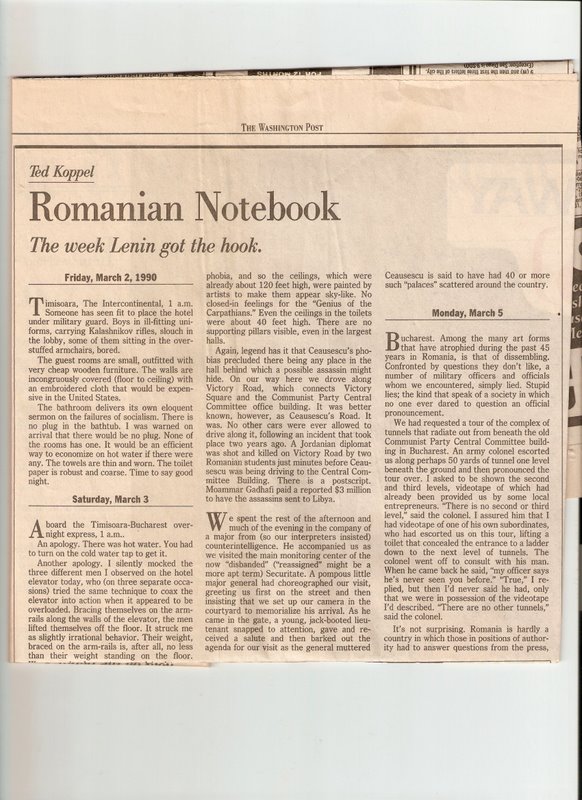
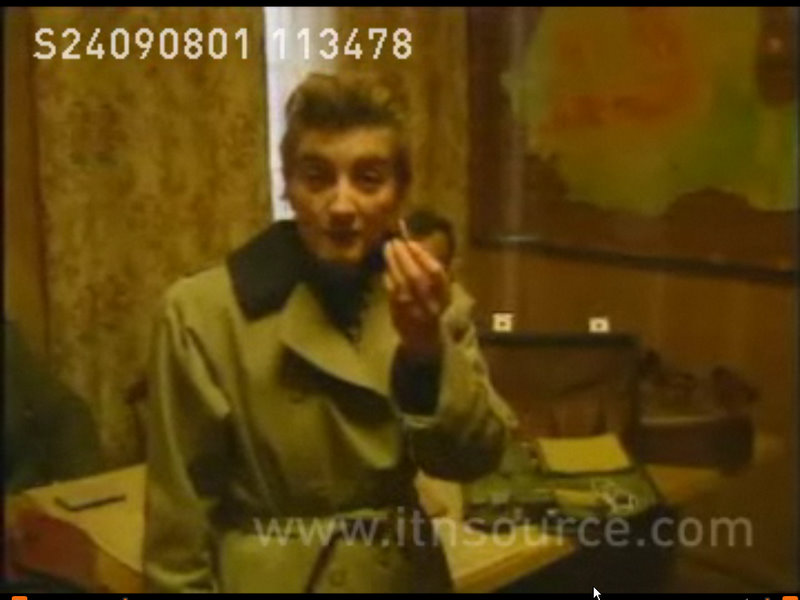
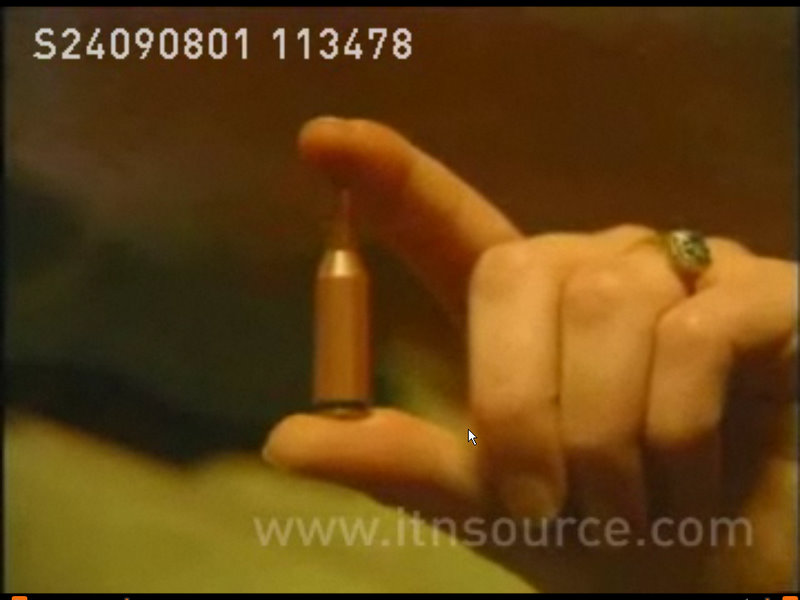


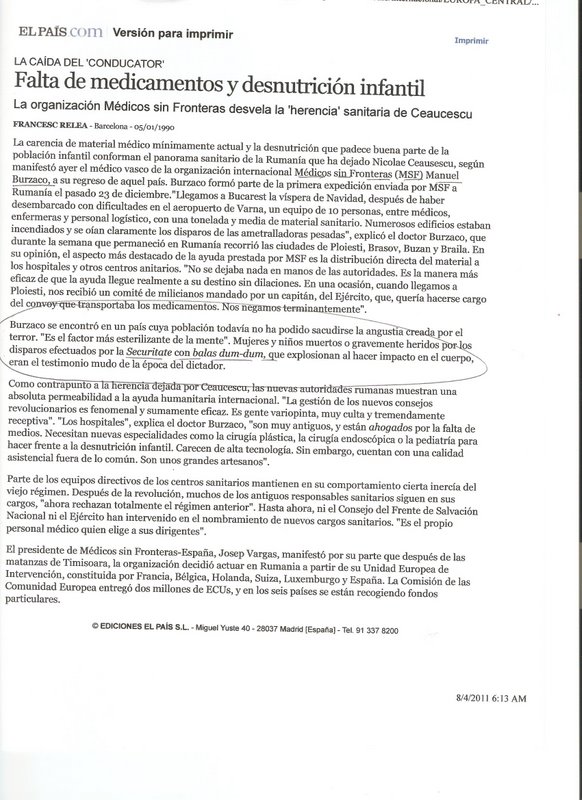
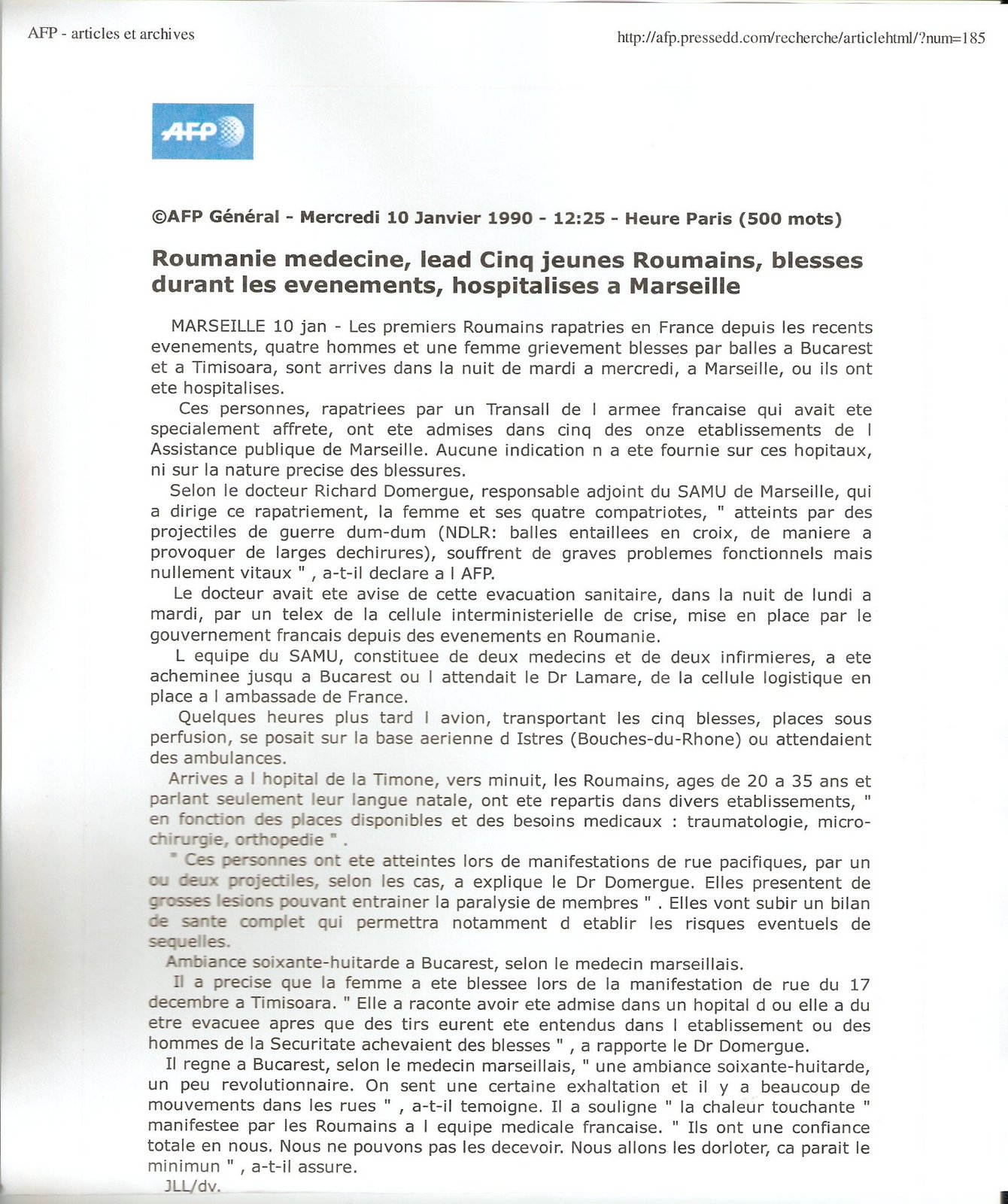
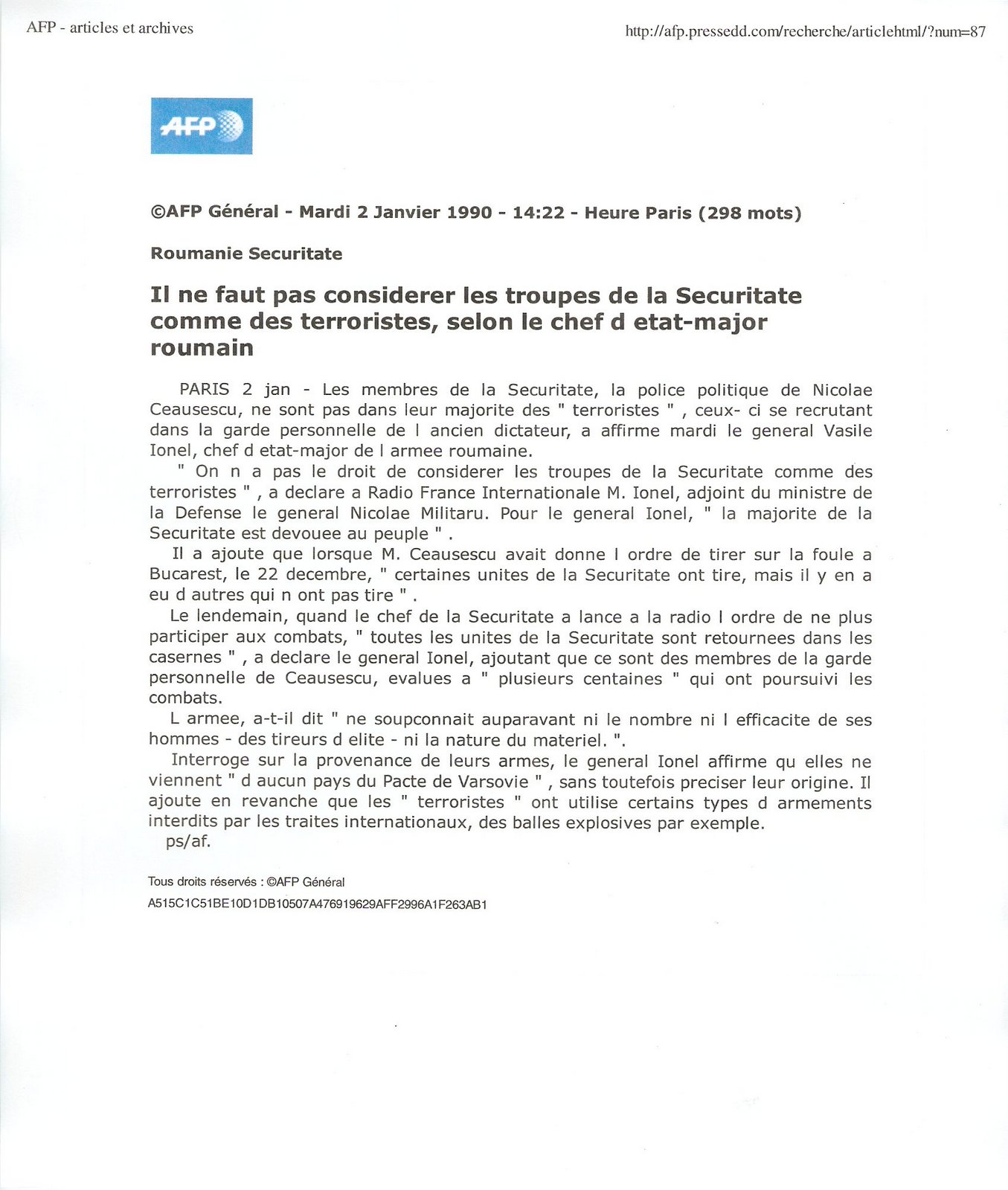
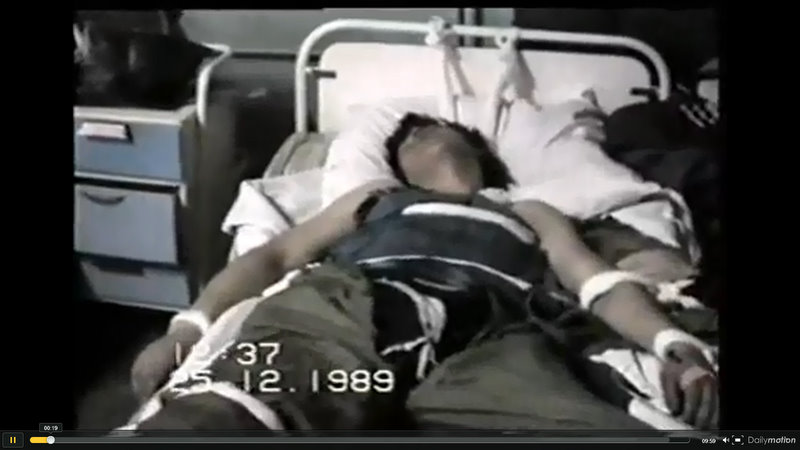
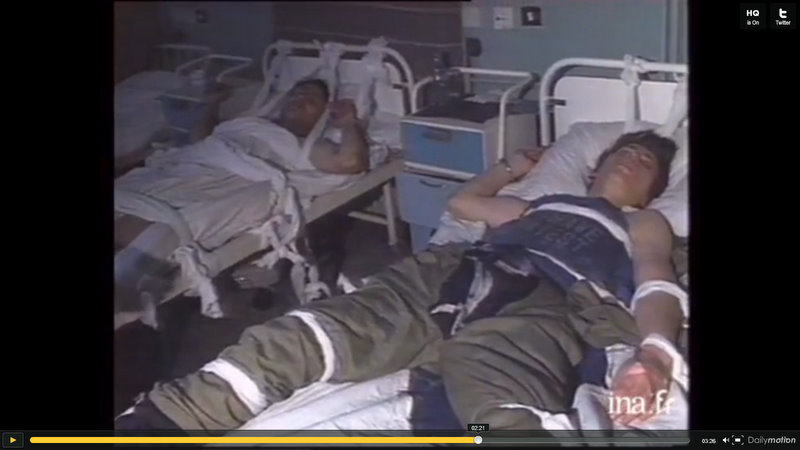

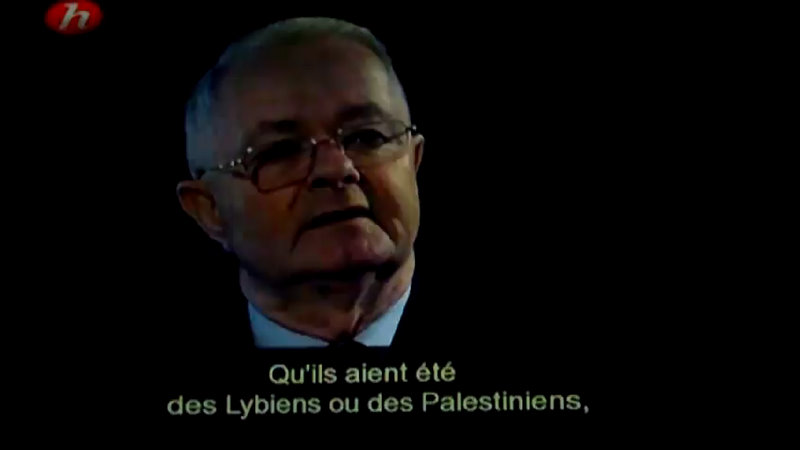
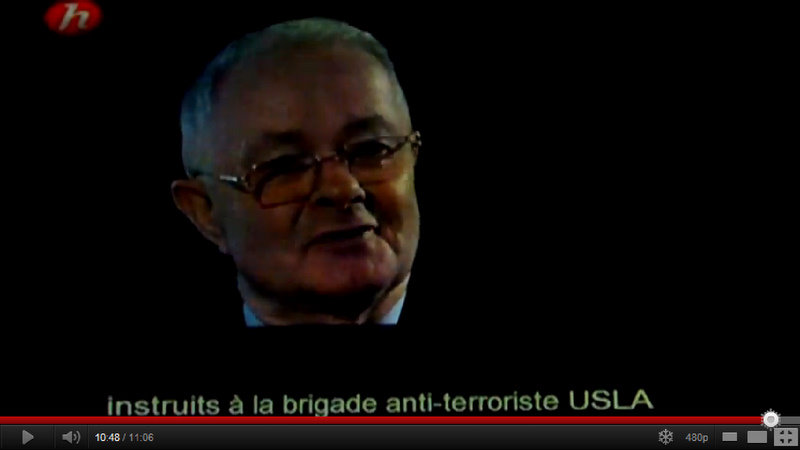


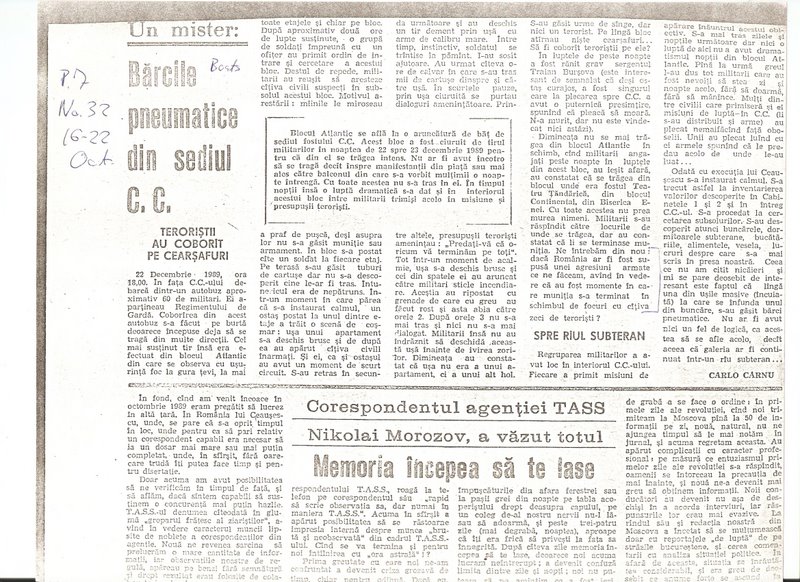
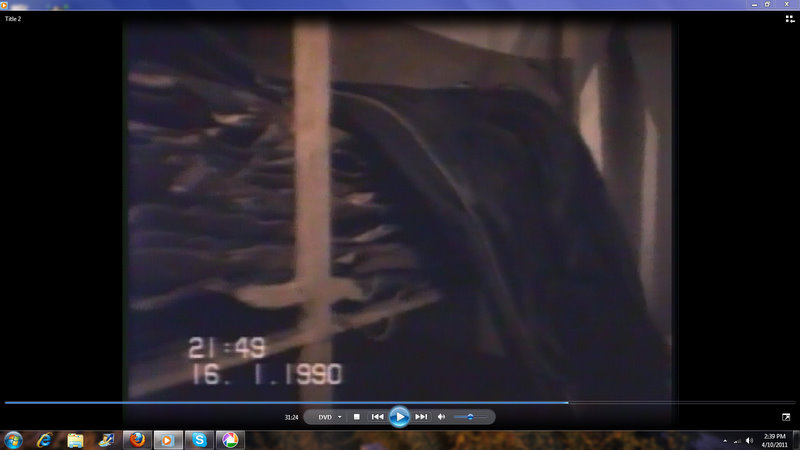
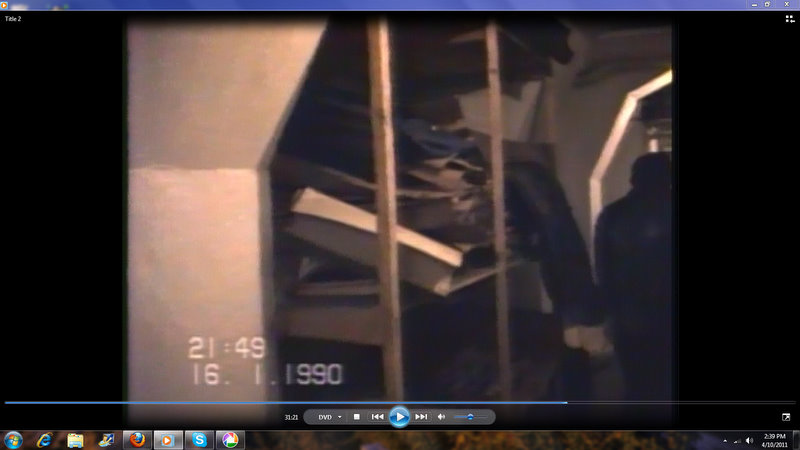
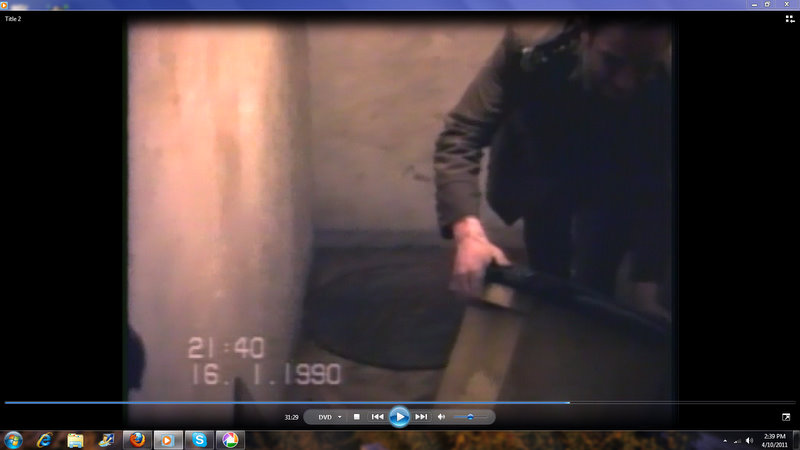

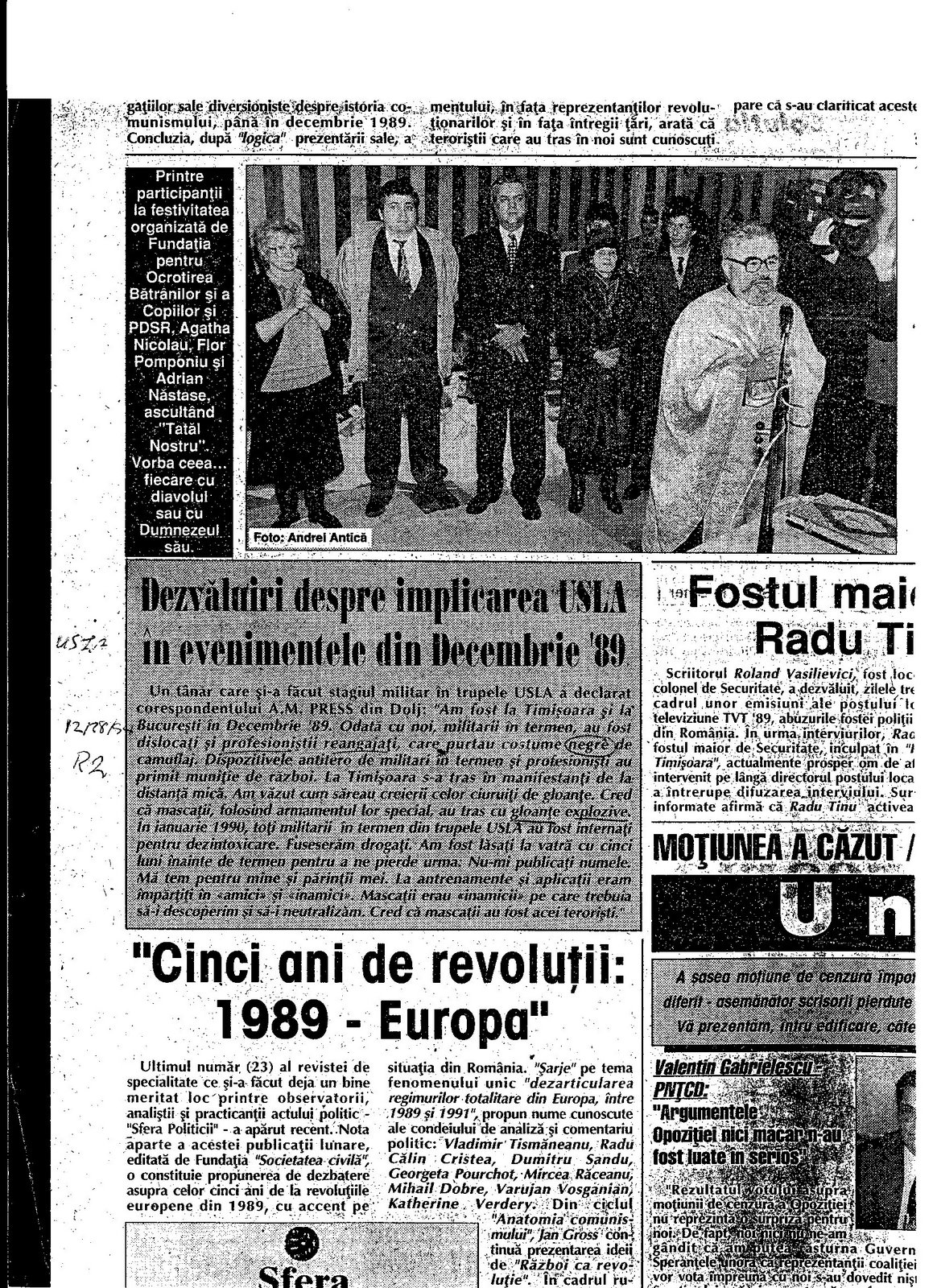


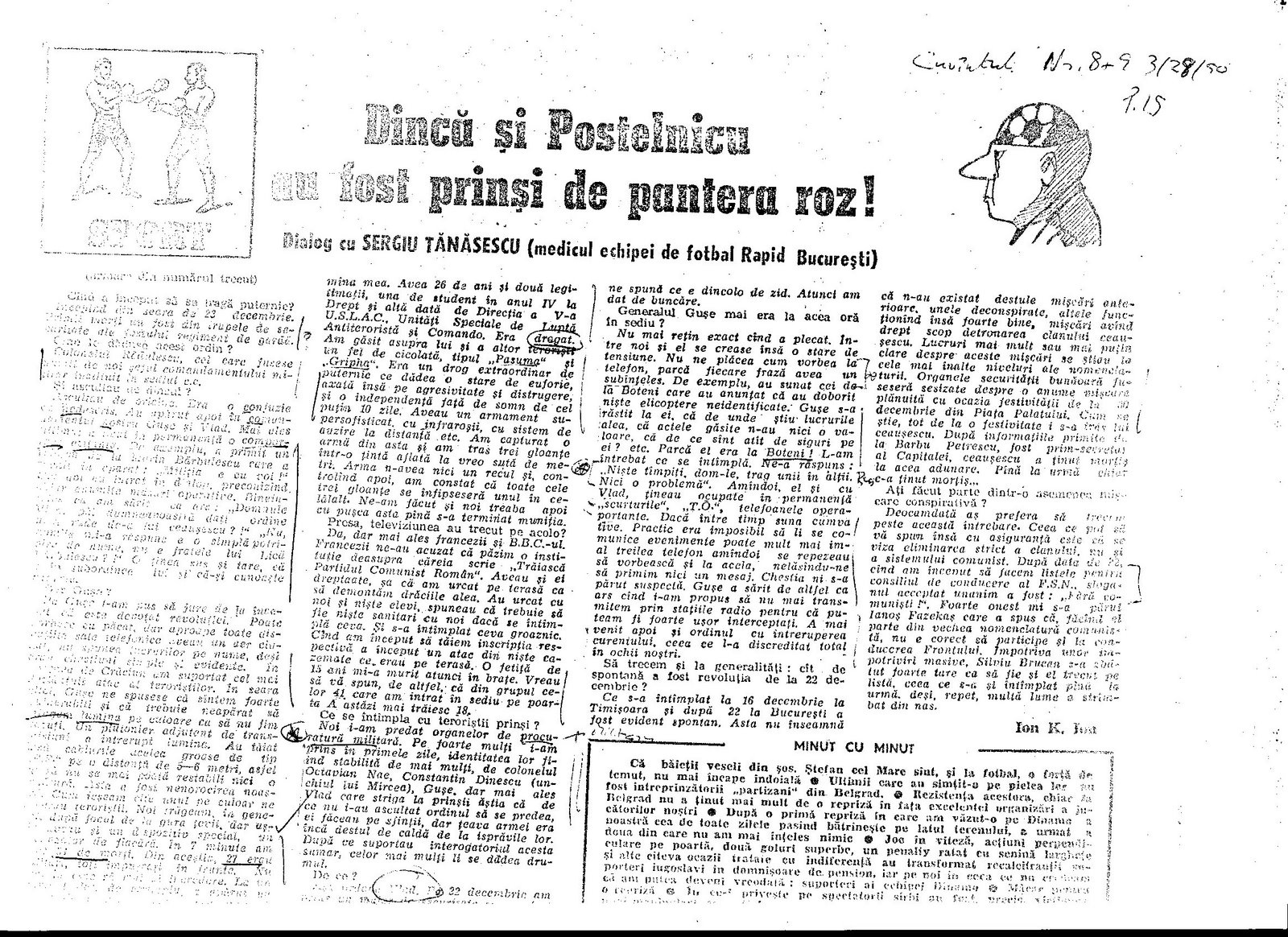


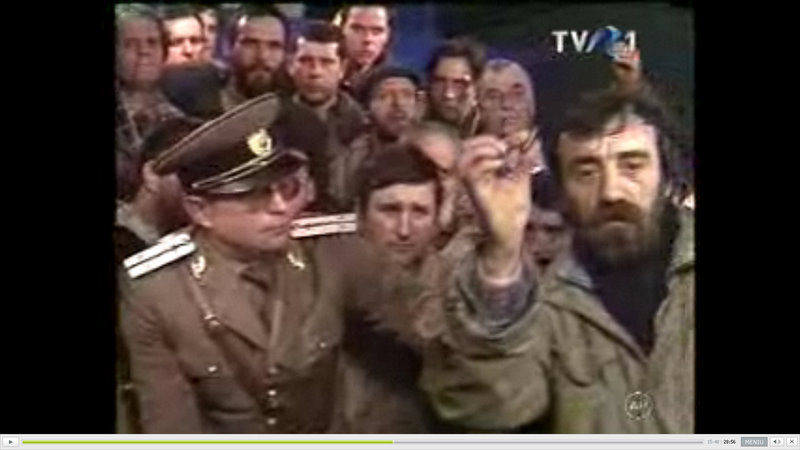
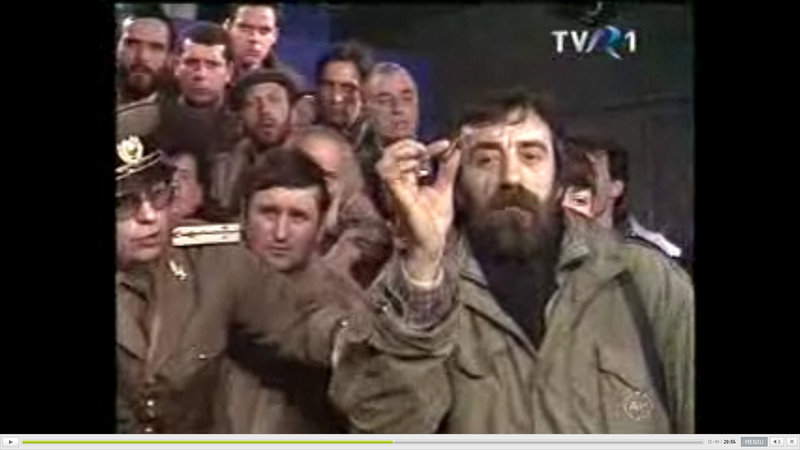


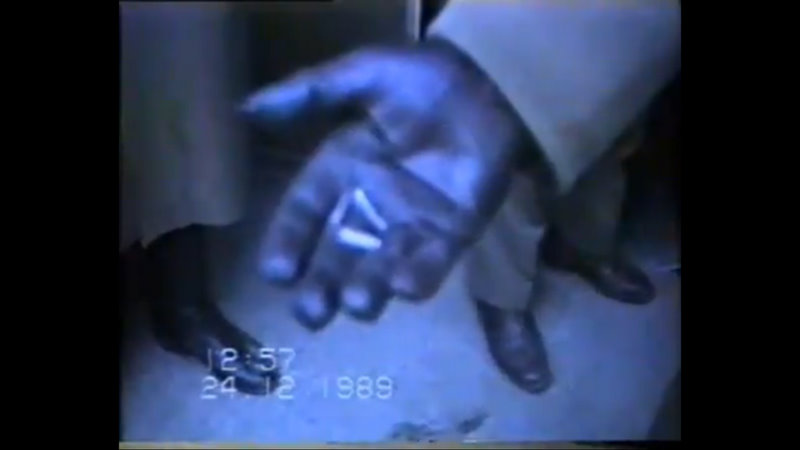
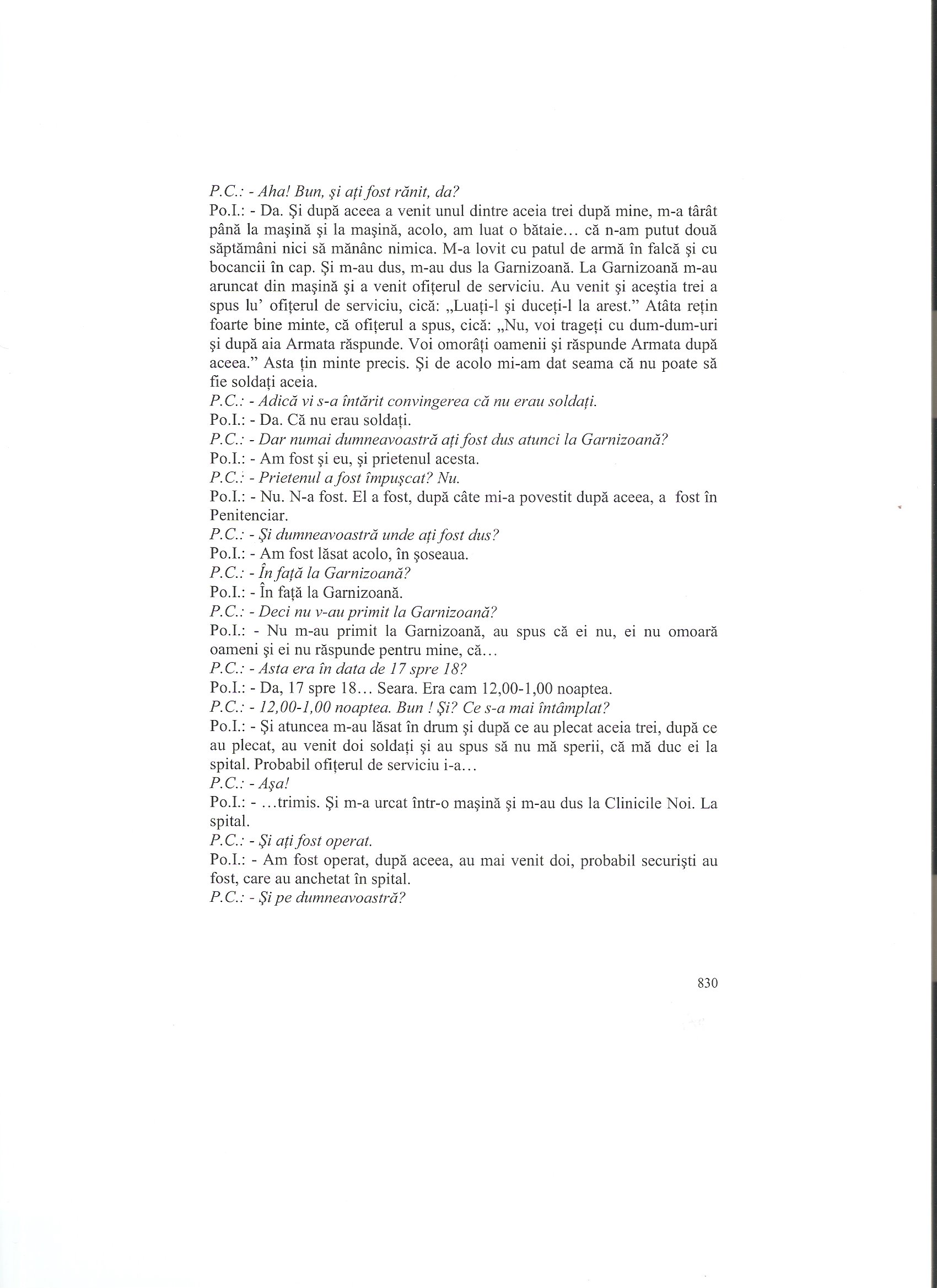
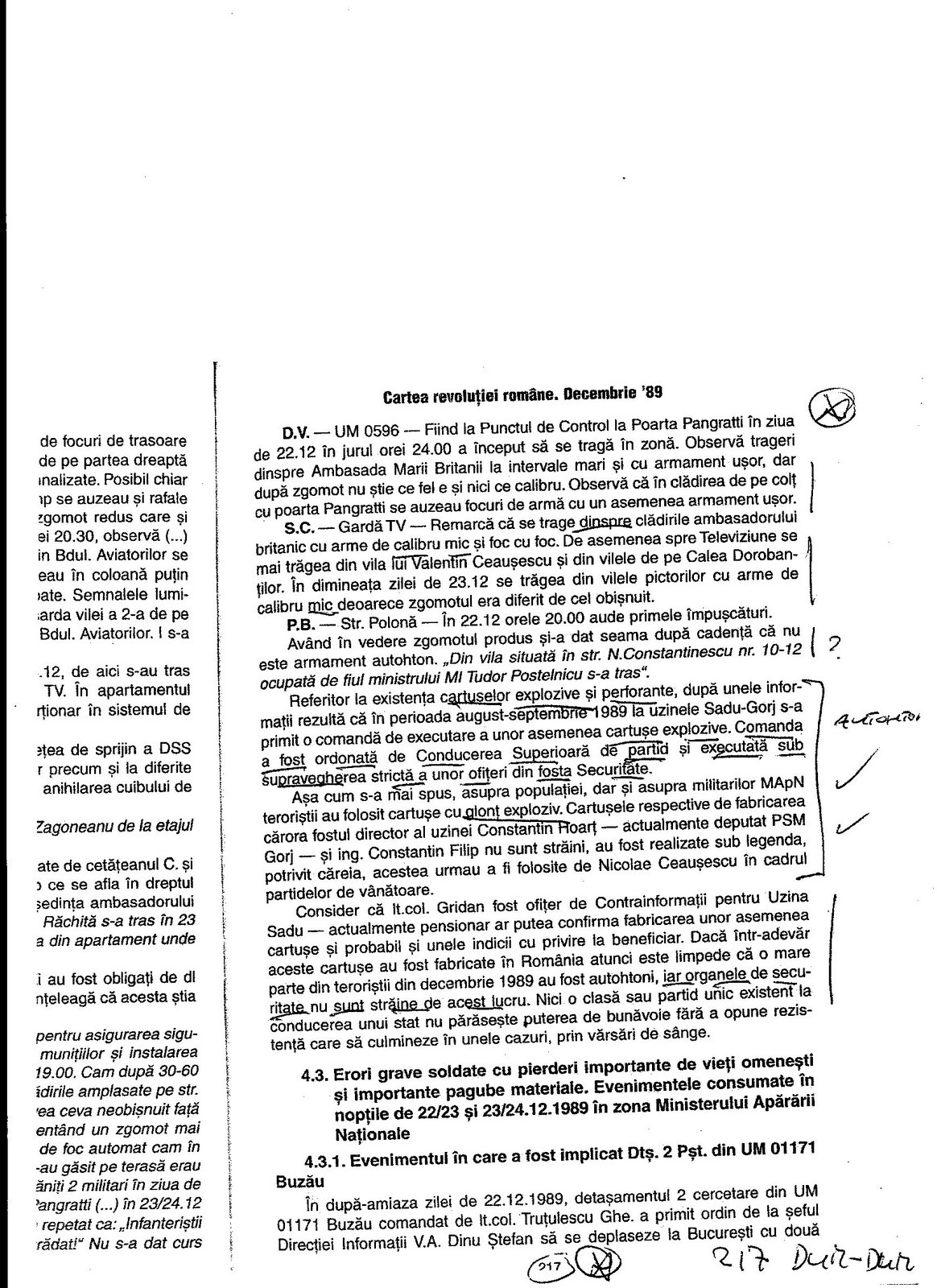
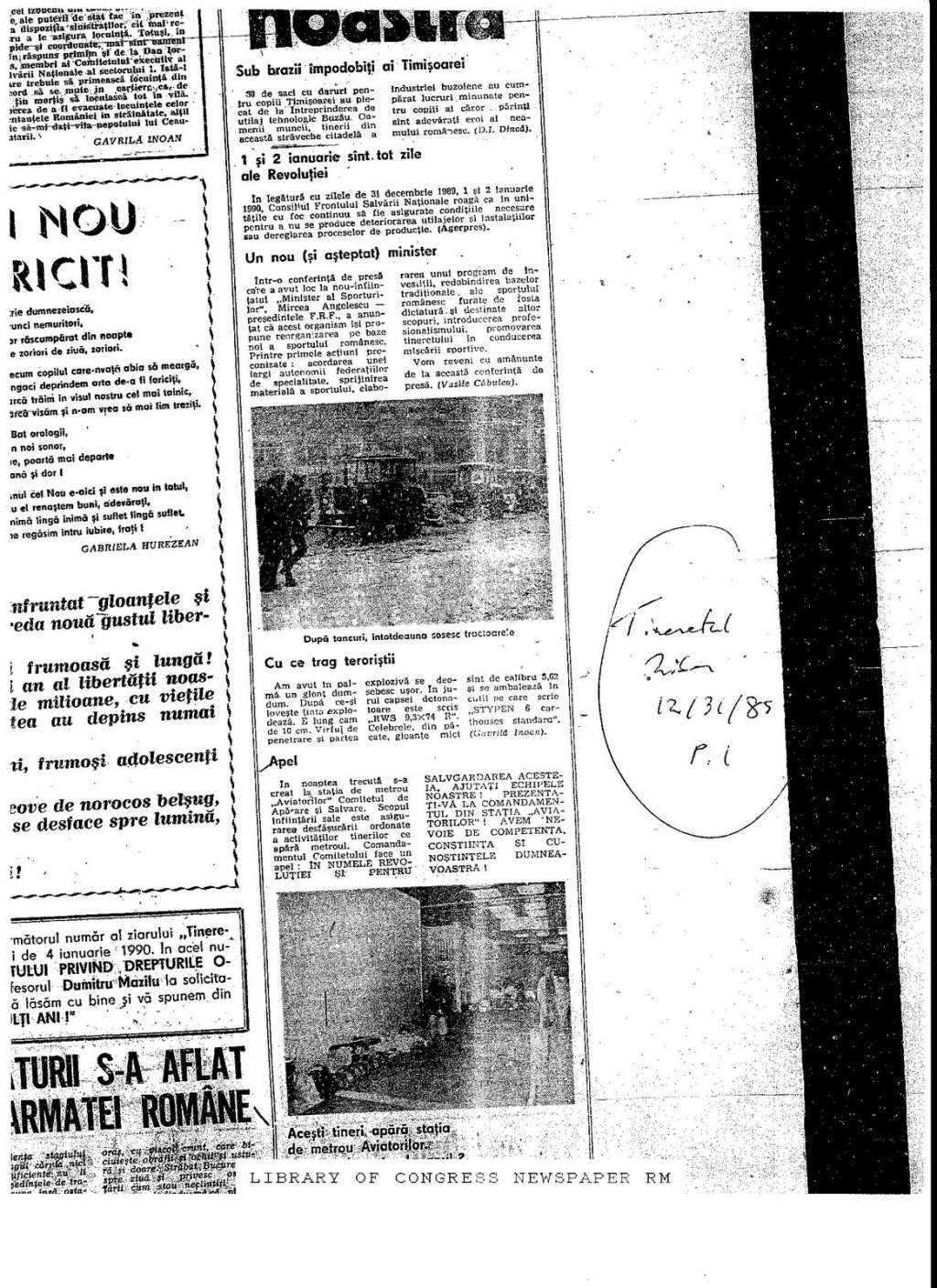
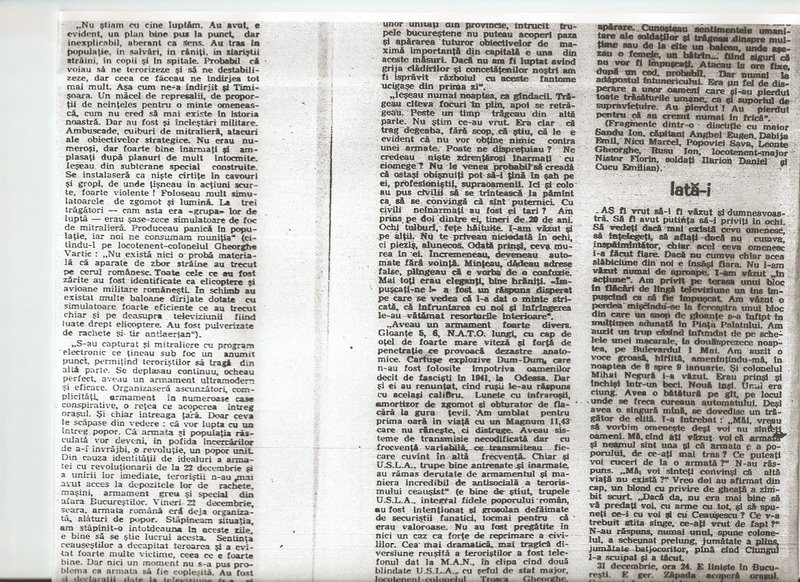


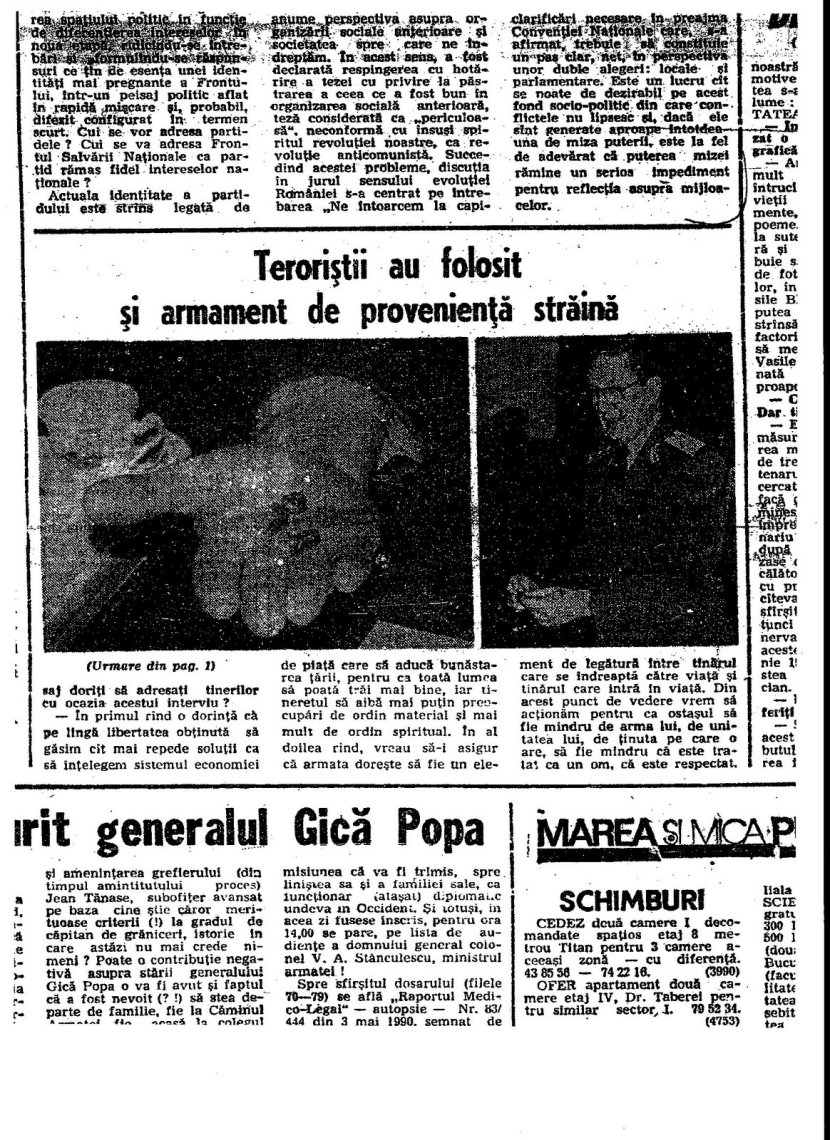

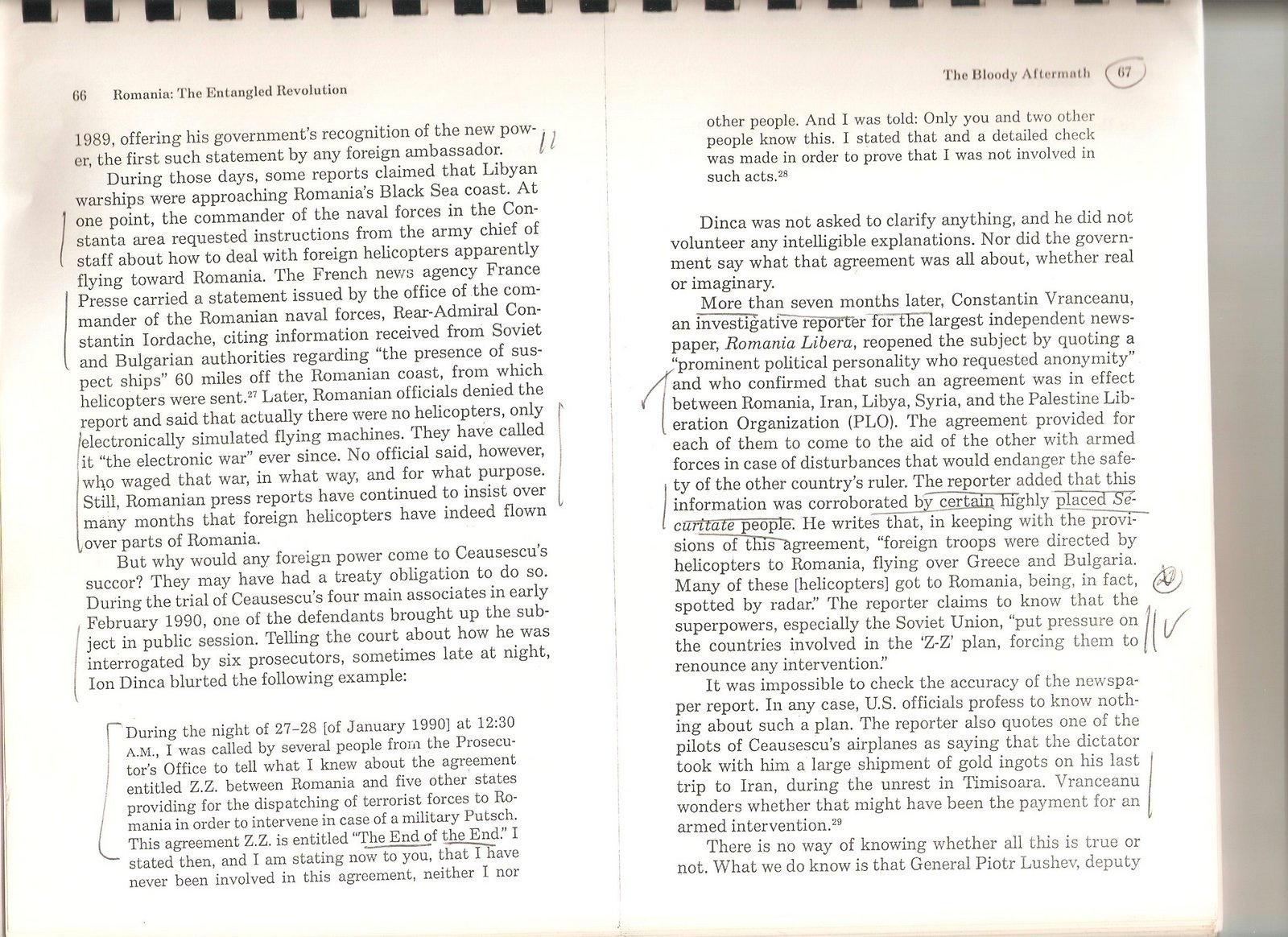
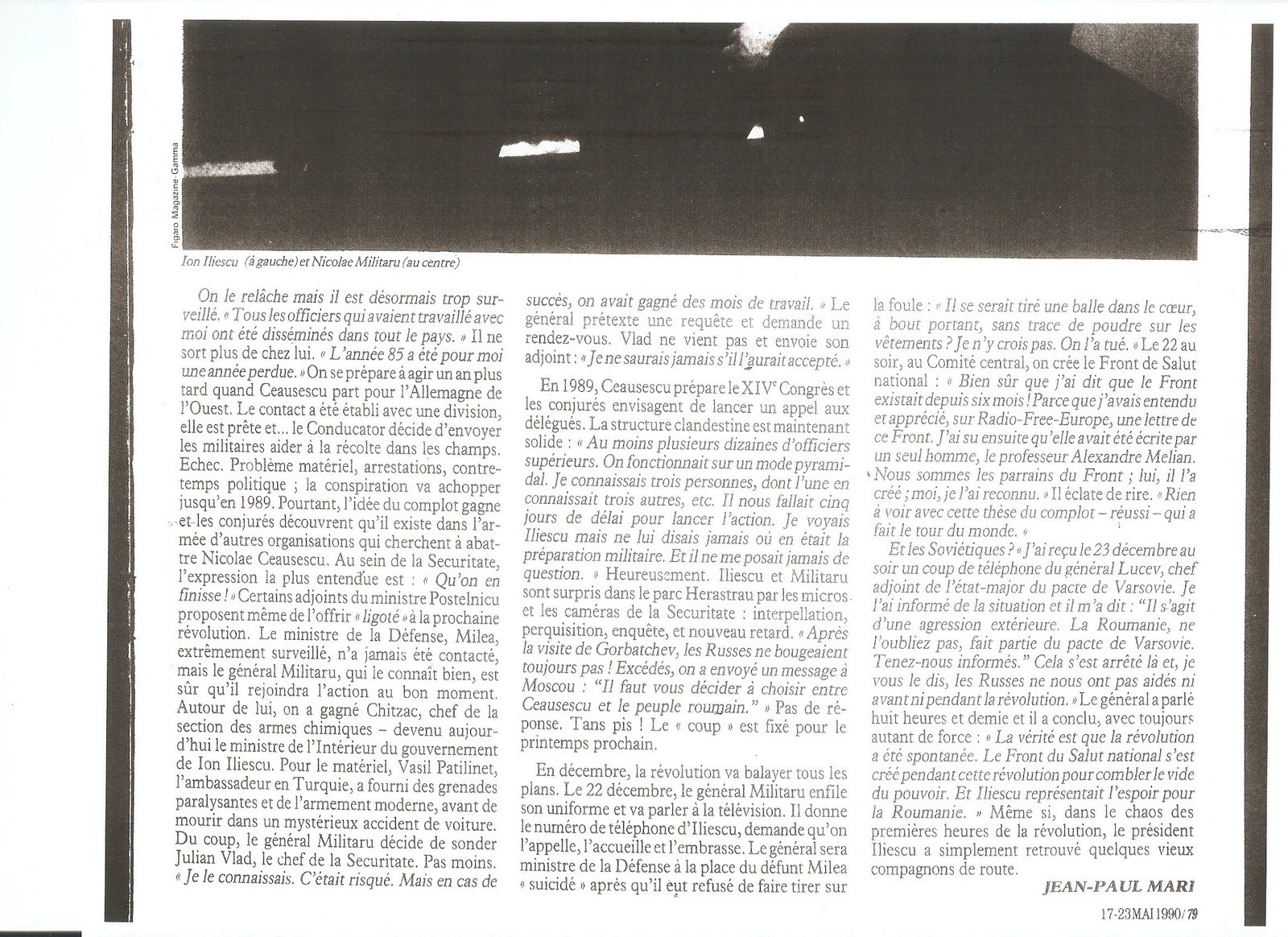
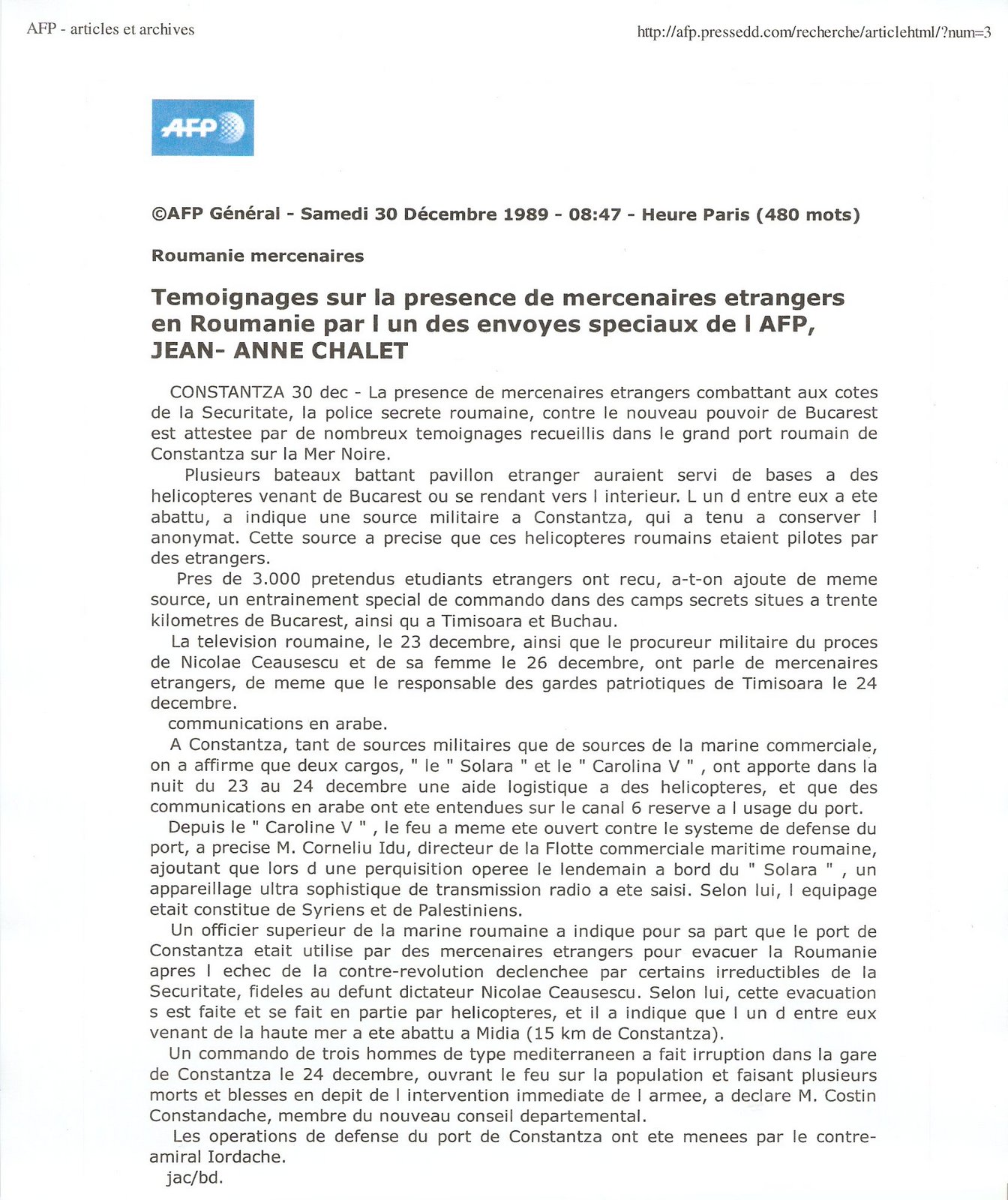
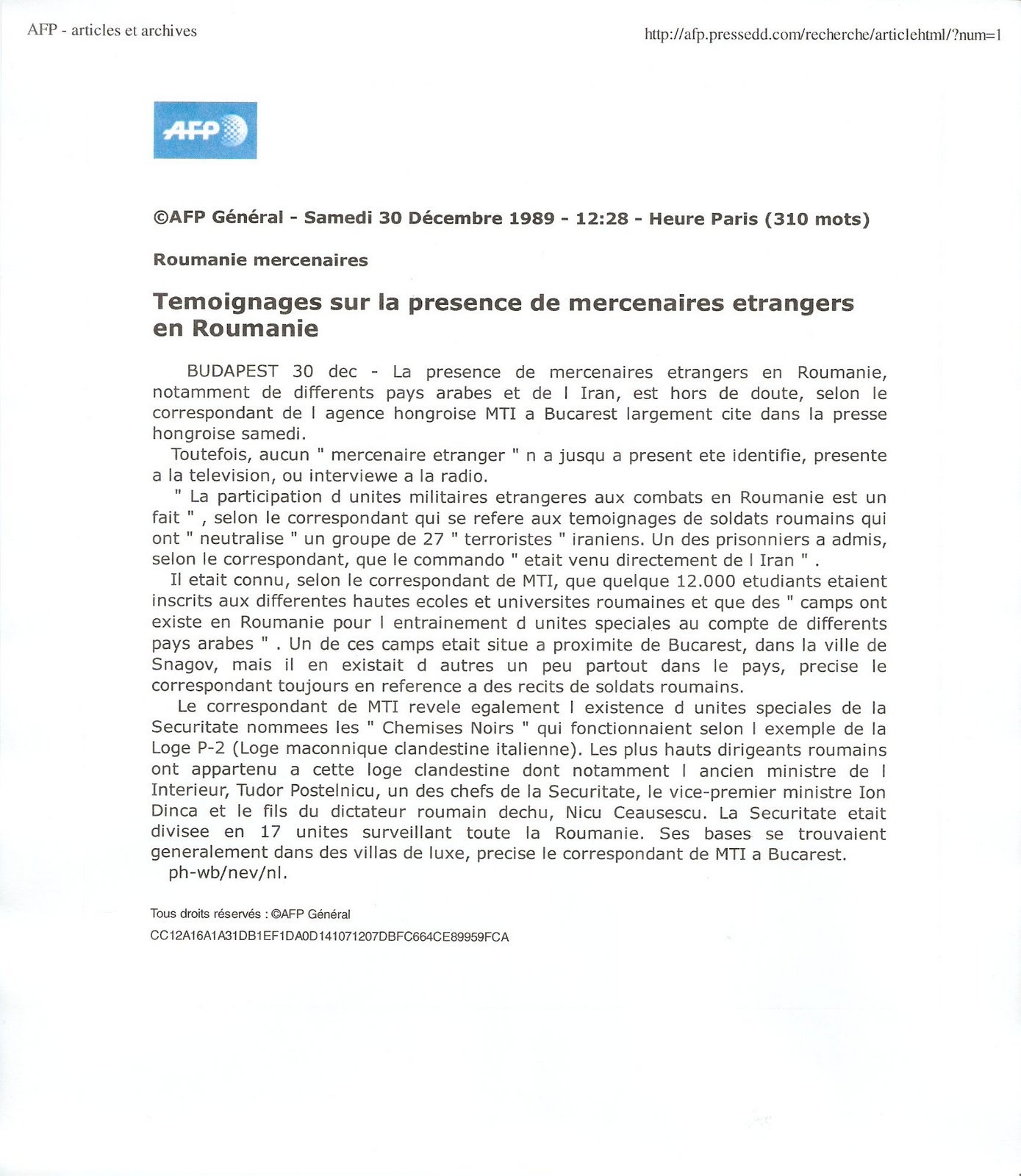
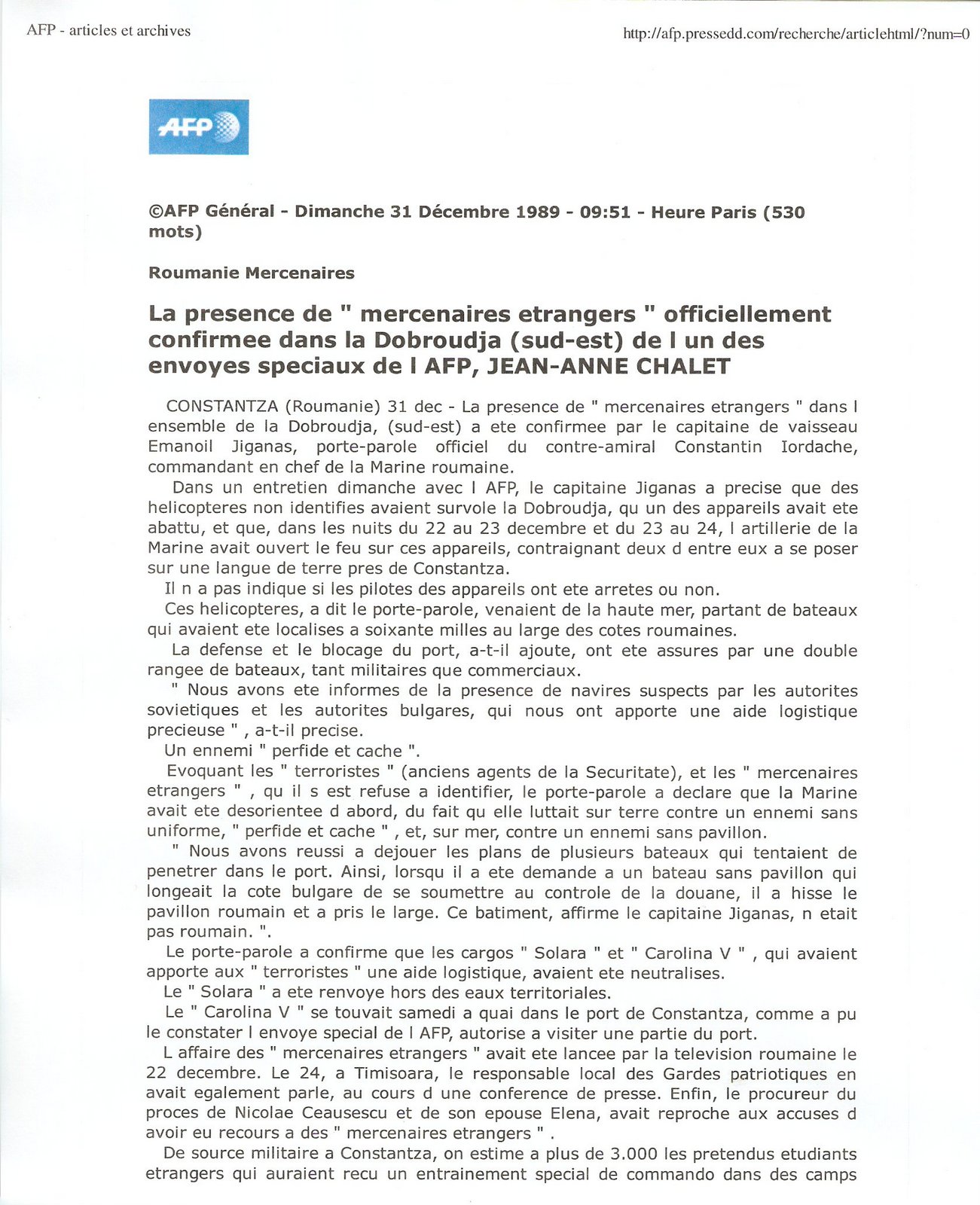

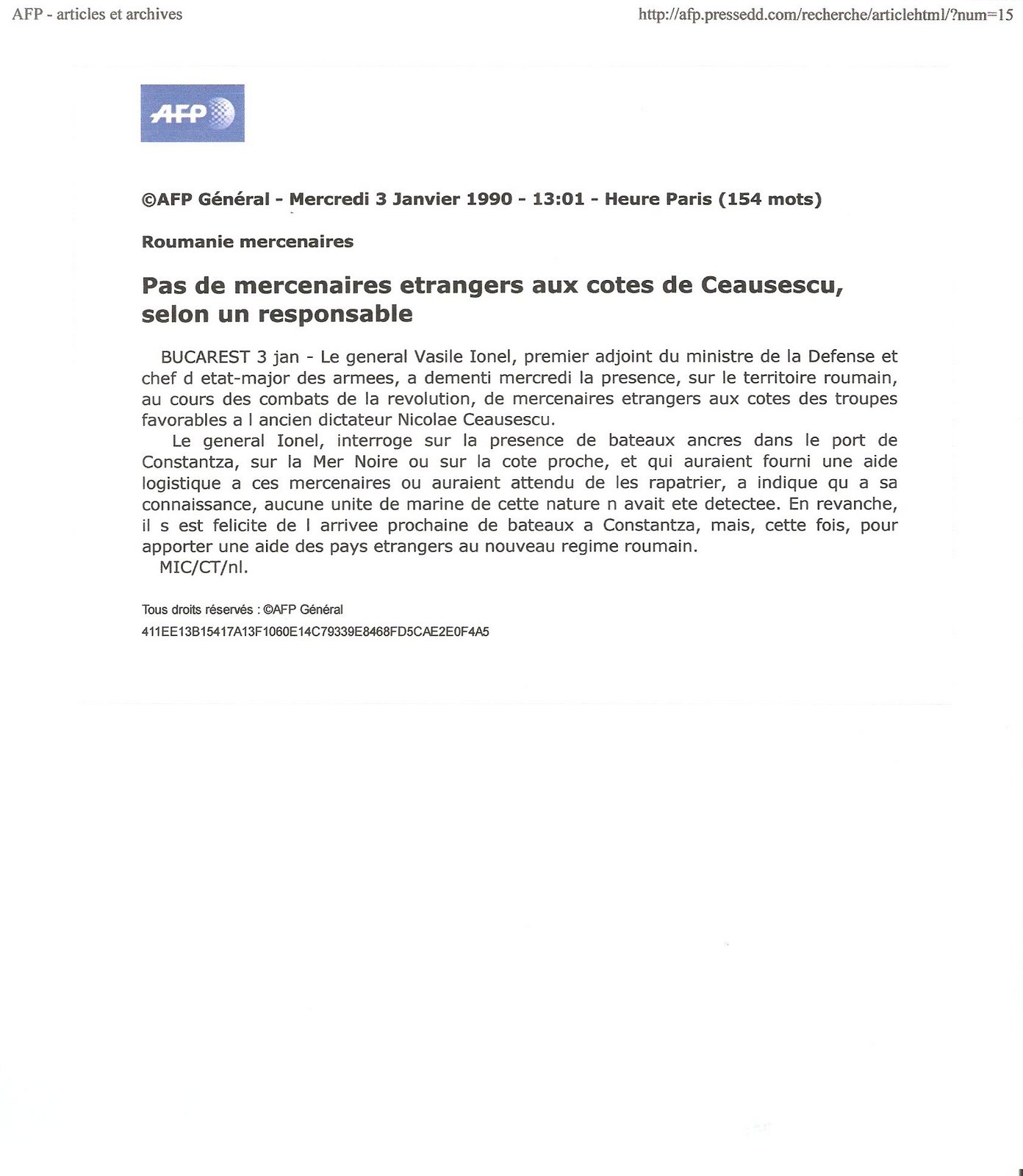
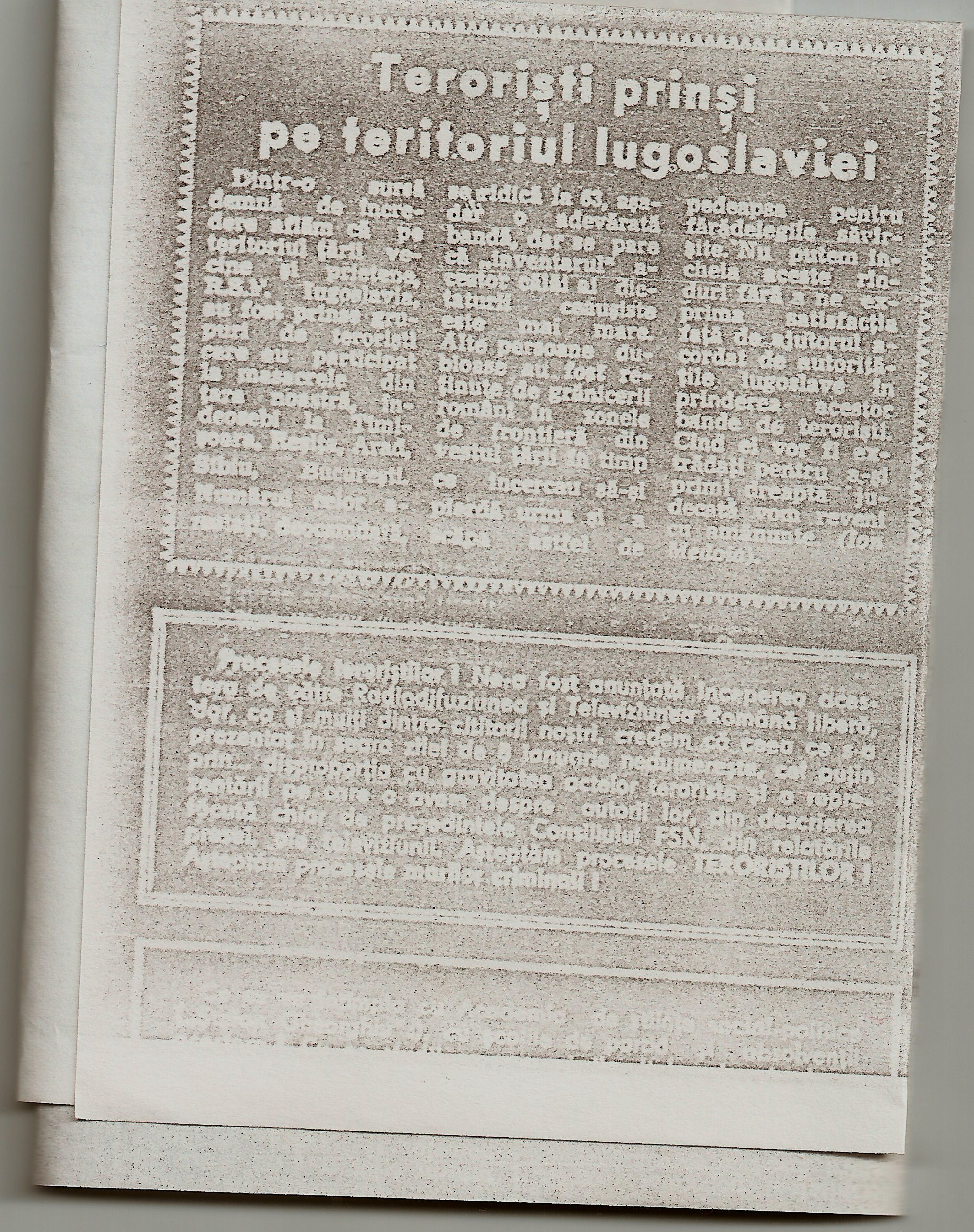
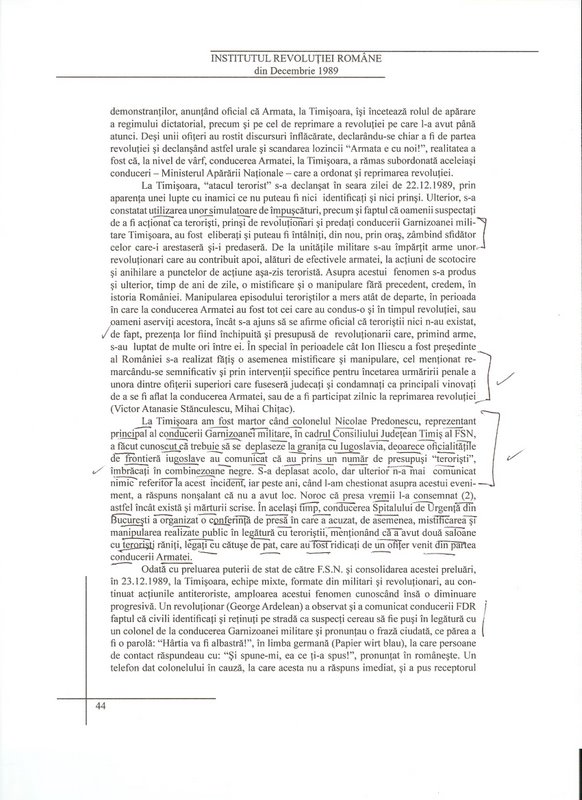


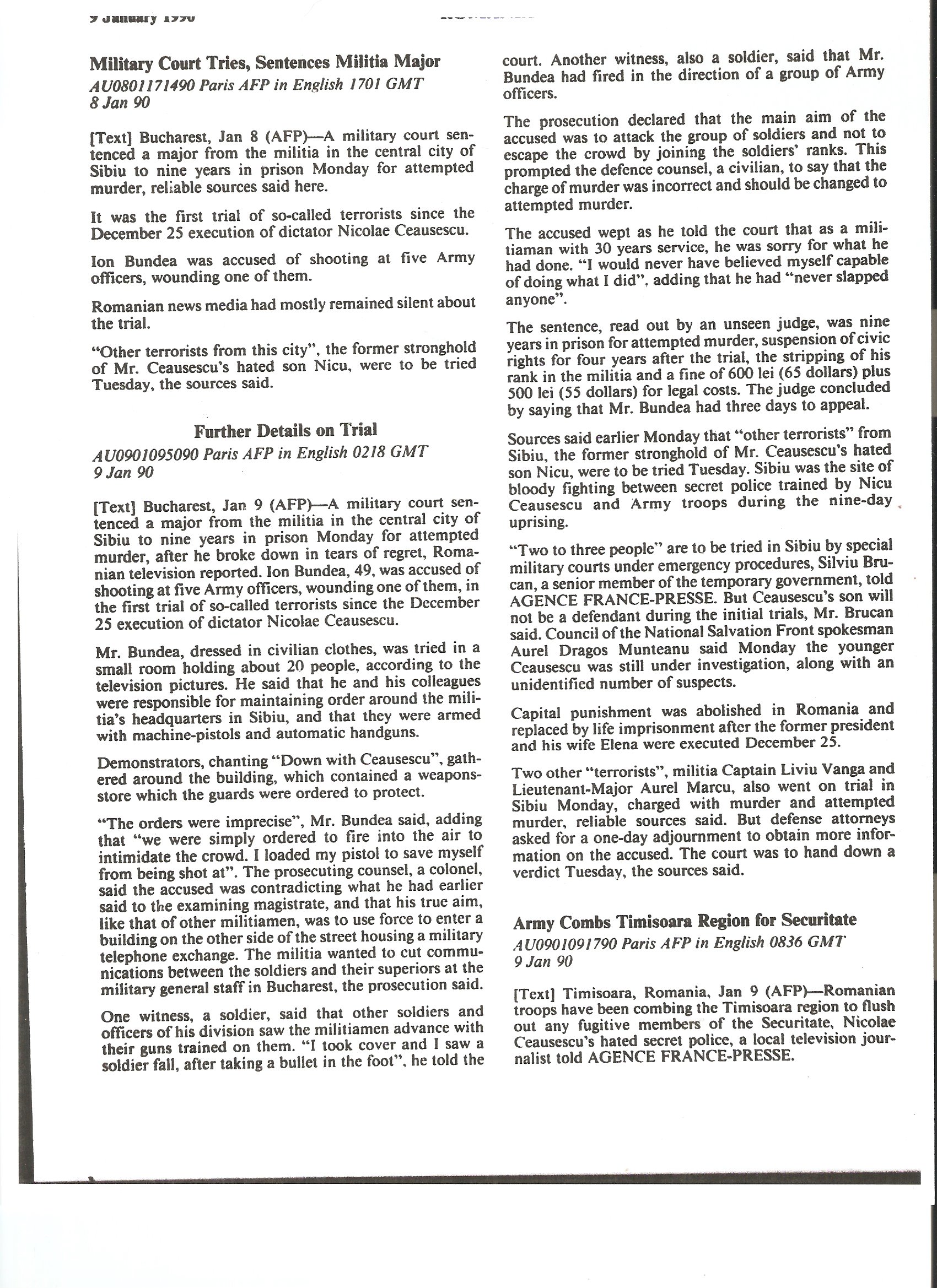
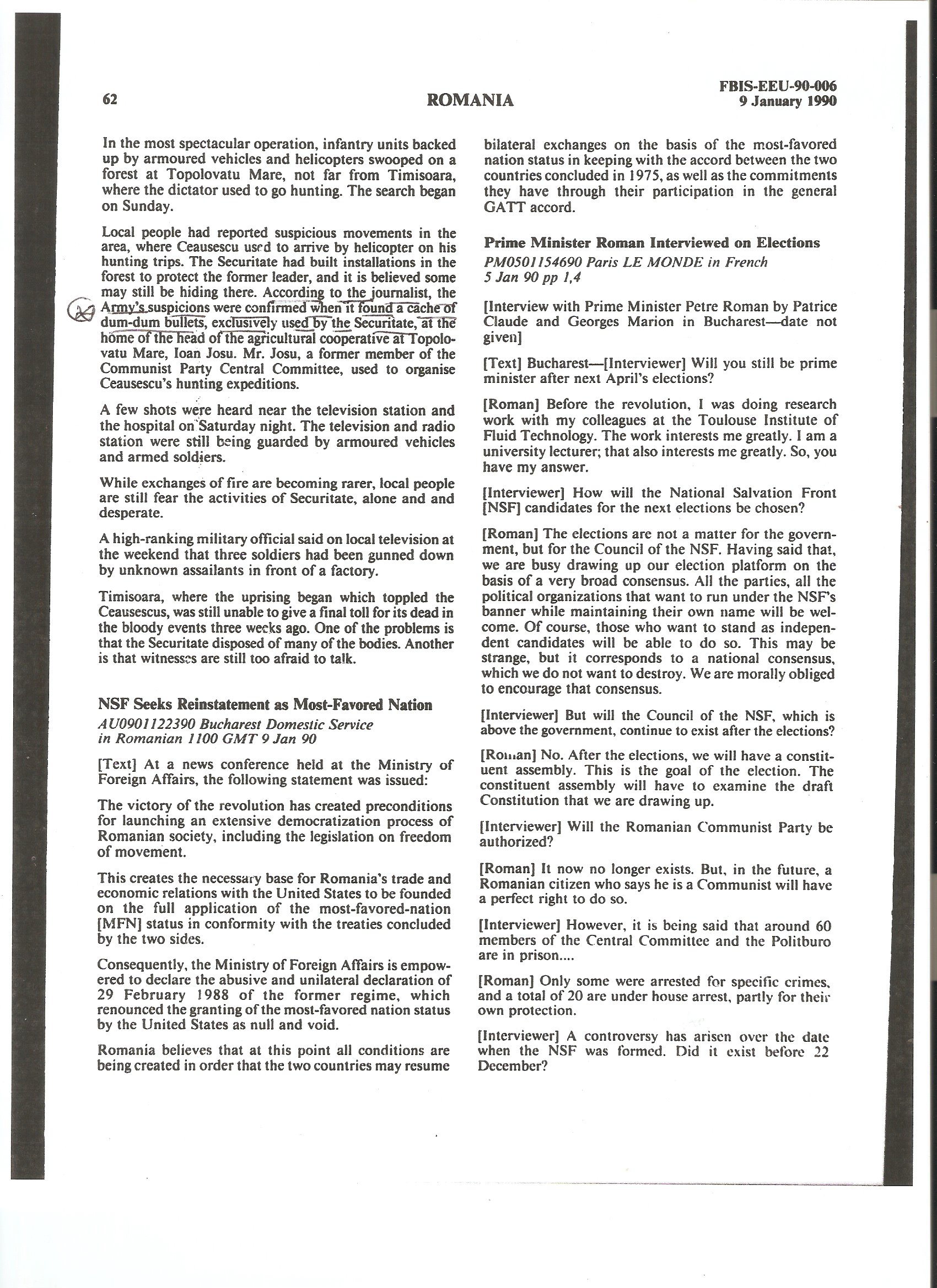
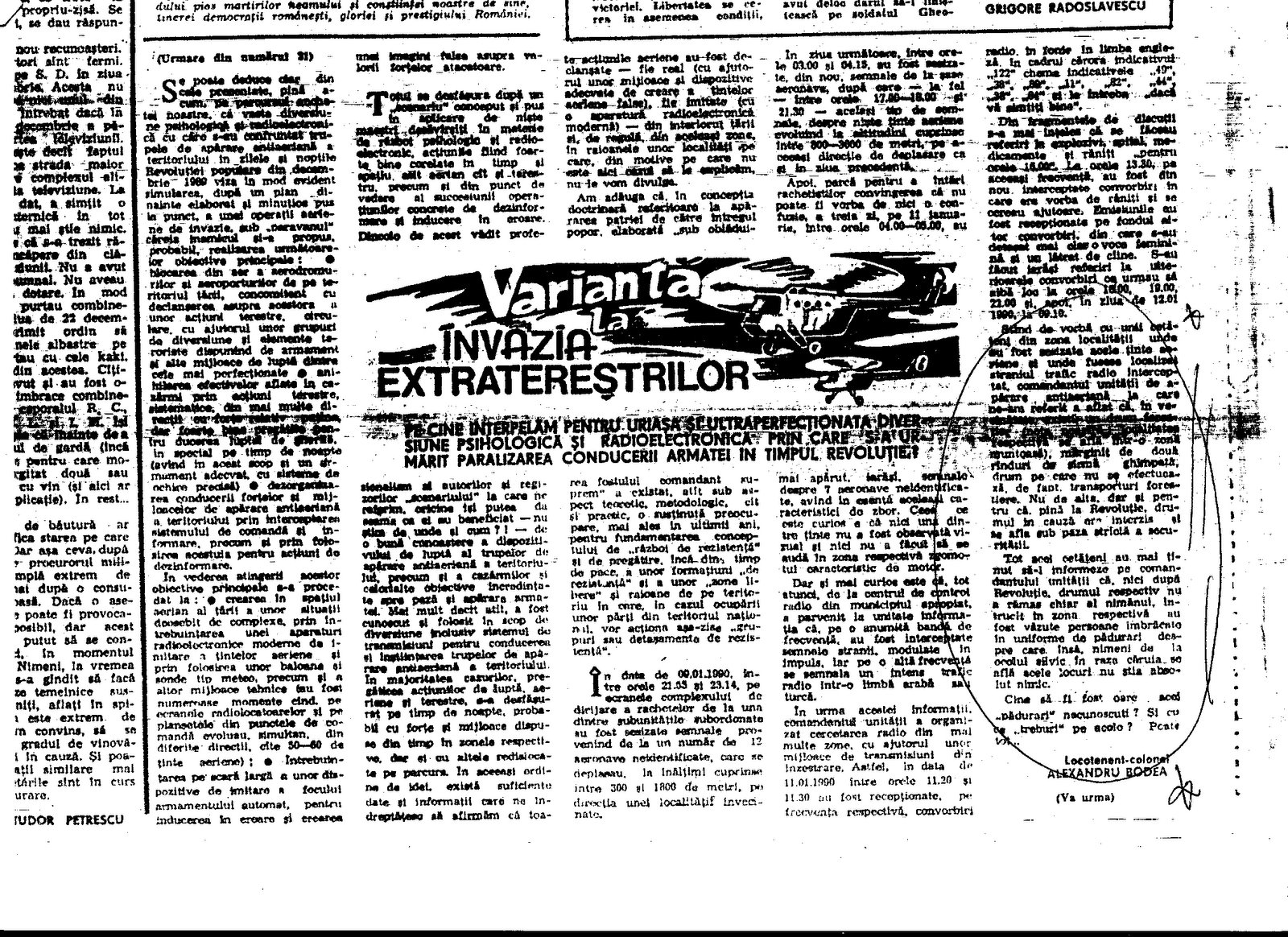
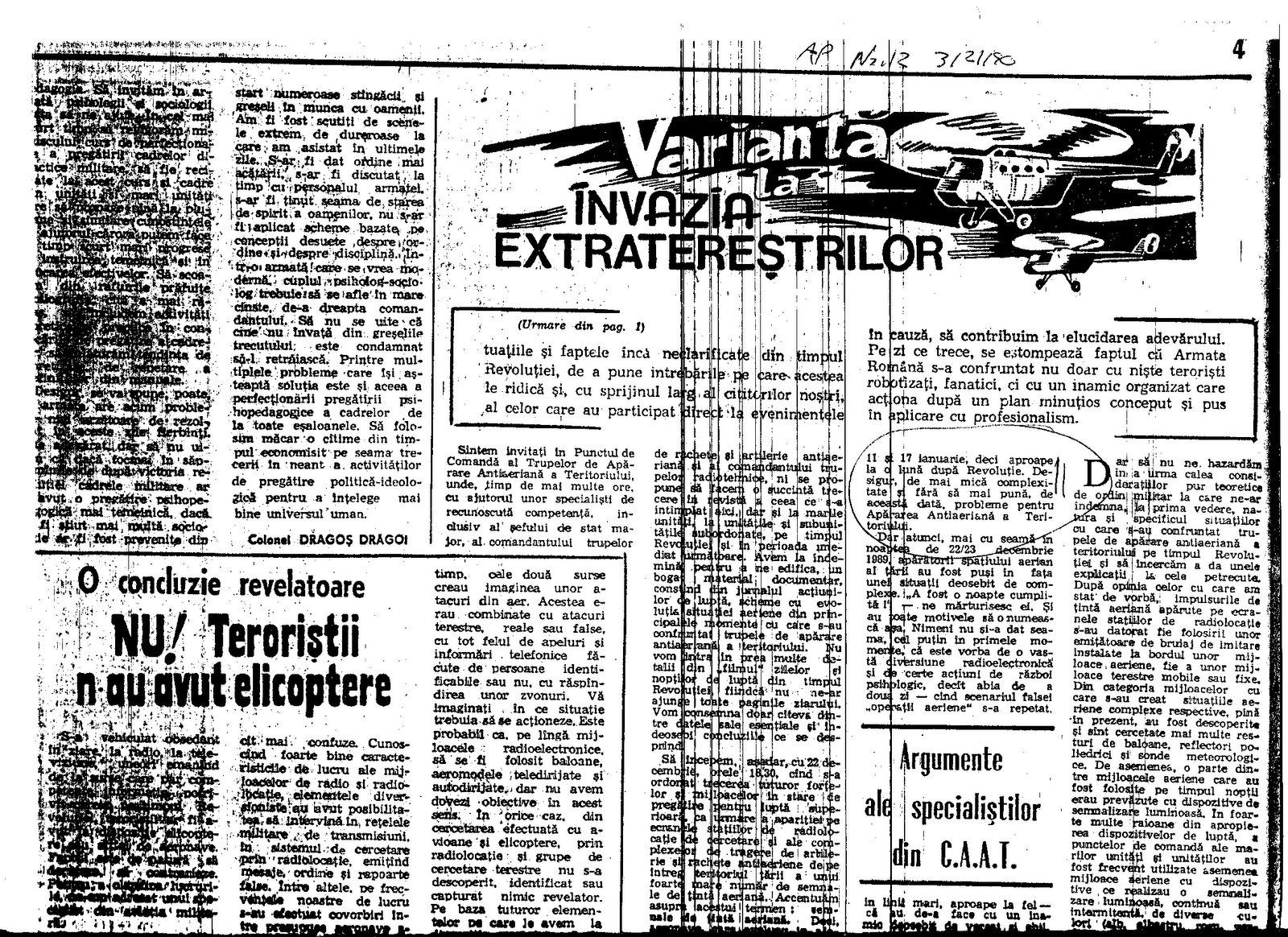
 The Archive of the Romanian Revolution of December 1989