The Archive of the Romanian Revolution of December 1989

A Catch-22 December 1989, Groundhog-Day Production. Presenting the Personal Research & Scholarship of Richard Andrew Hall, Ph.D.

Archive for December, 2013

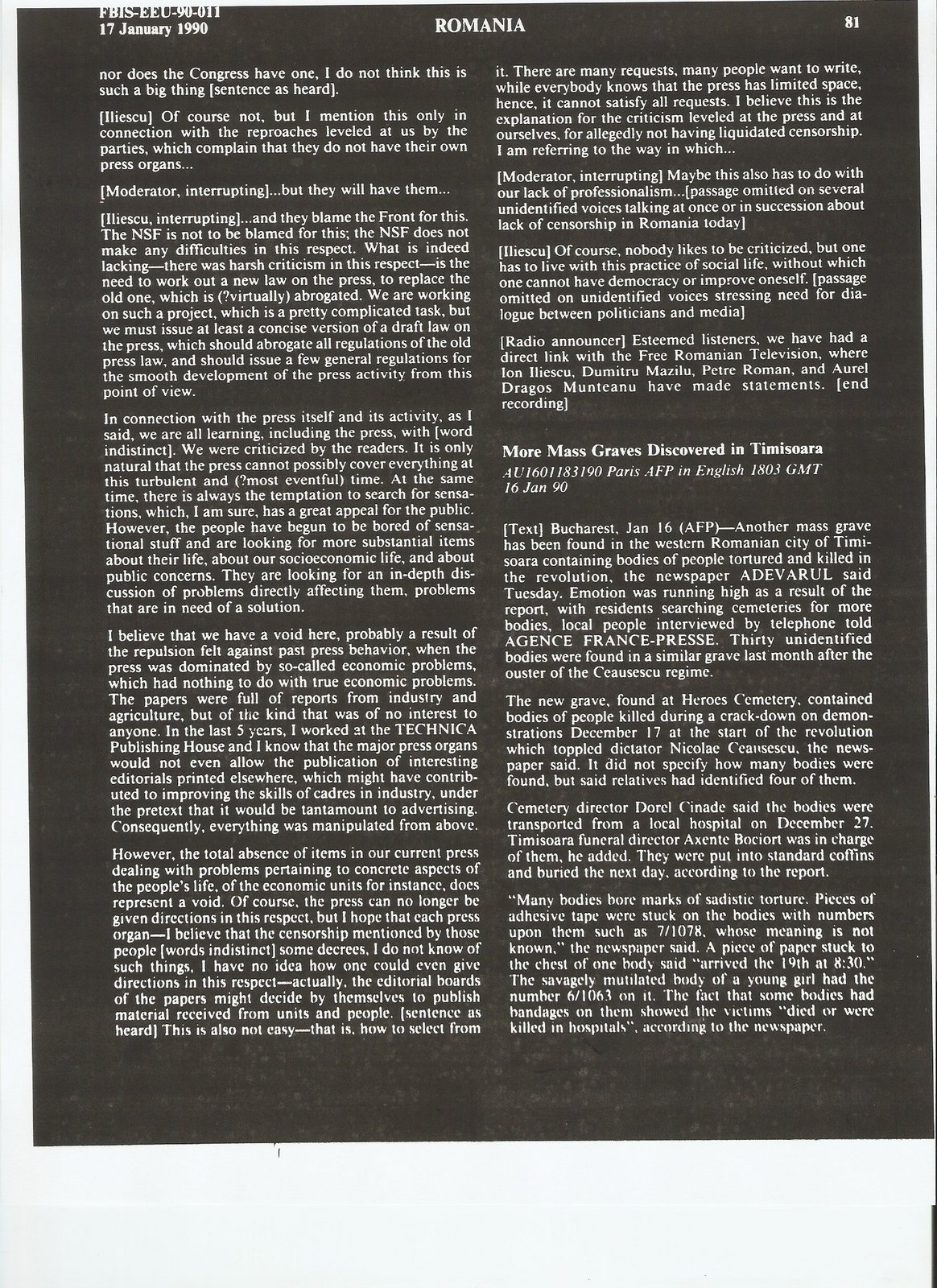
The Historiography of the Romanian Revolution: the Uses of Absurdity and the Triumph of Securitate Revisionism

Posted by romanianrevolutionofdecember1989 on December 31, 2013

(strictly personal viewpoint based on research and publications in academia from September 1990 to September 2000)

Not for nothing, as I like to say, did I include the phrase, “the Triumph of Securitate Revisionism” in my dissertation title (Richard Andrew Hall, Rewriting the Revolution: Authoritarian Regime-State Relations and the Triumph of Securitate Revisionism in Post-Ceausescu Romania (defended 16 December 1996, Department of Political Science, Indiana University, Bloomington IN, Ph.D. in Political Science awarded February 1997).

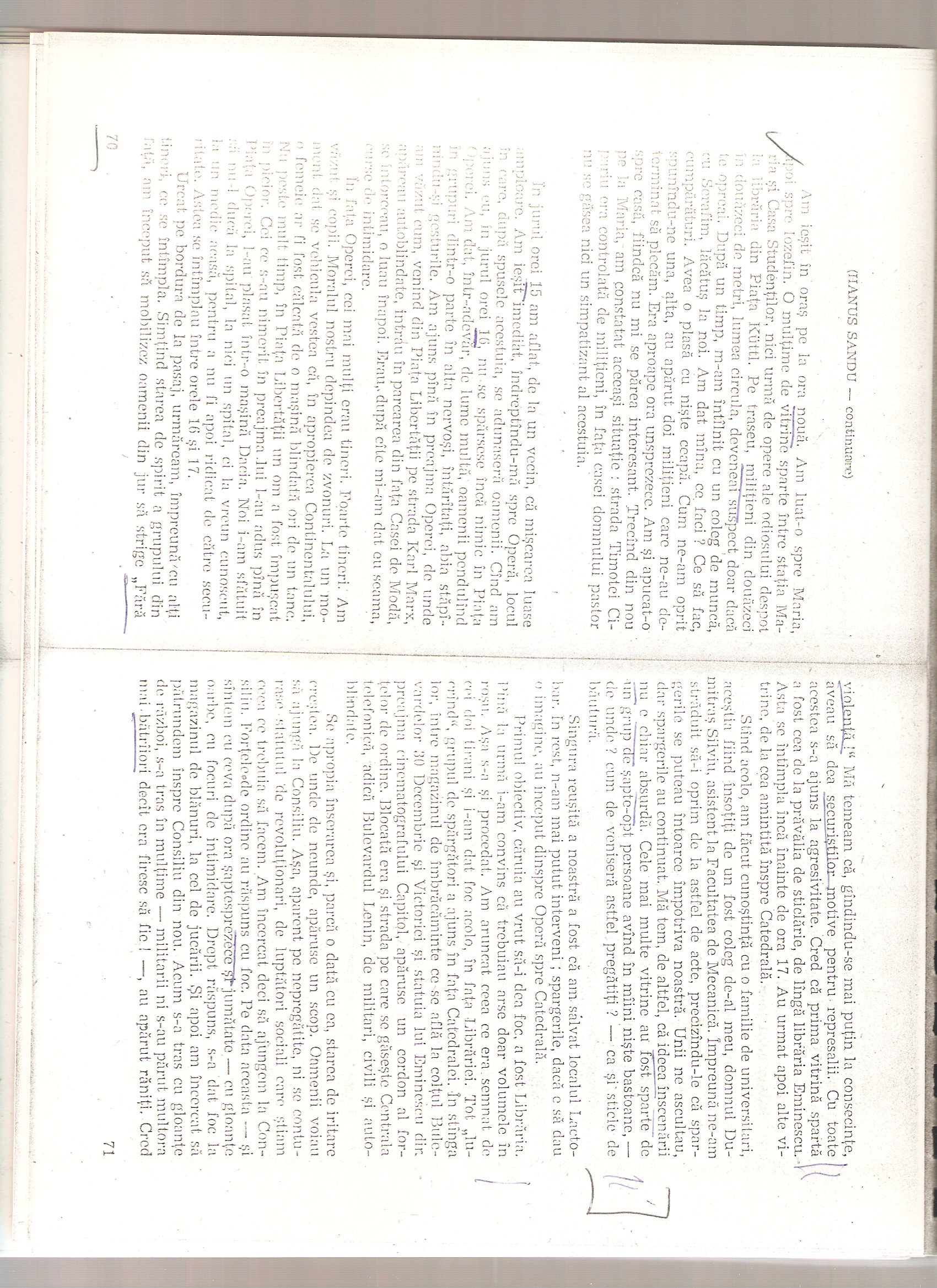
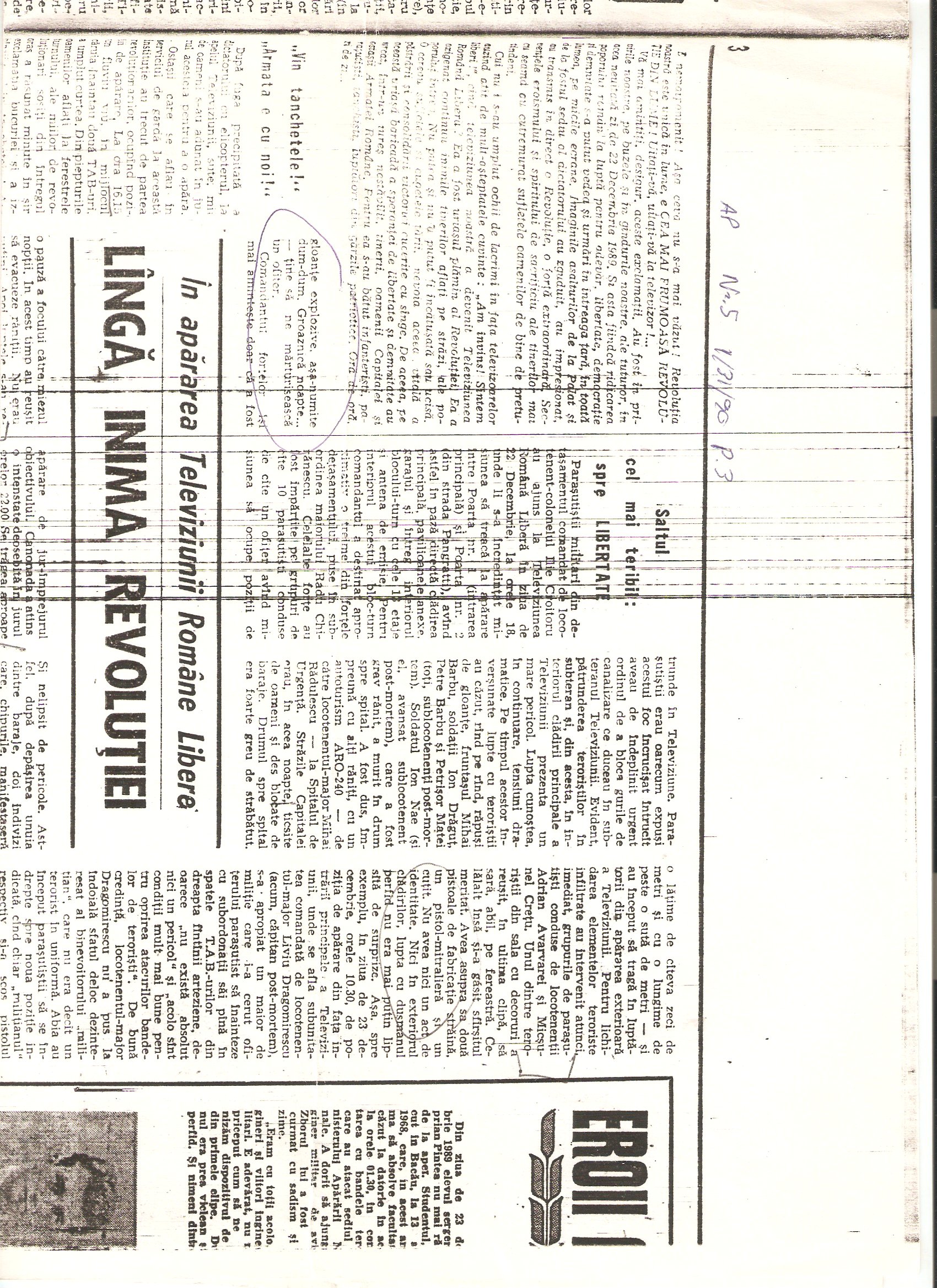
Although my 1999 article in East European Politics and Societies (Richard Andrew Hall, “The Uses of Absurdity: the Staged War Theory and the Romanian Revolution of December 1989,” East European Politics and Societies, September 1999, vol. 13, 3:  pp. 501-542.) focused heavily on the “consumption” or “demand-side” of how Securitate revisionism came to be integrated, paralleled, and accepted in the Romanian media and body politic, I also discussed the content, role, and intentions of Securitate disinformation as disseminated by former Securitate personnel and collaborators in shaping the historiography of the Romanian Revolution of December 1989.  Here is an excerpt:
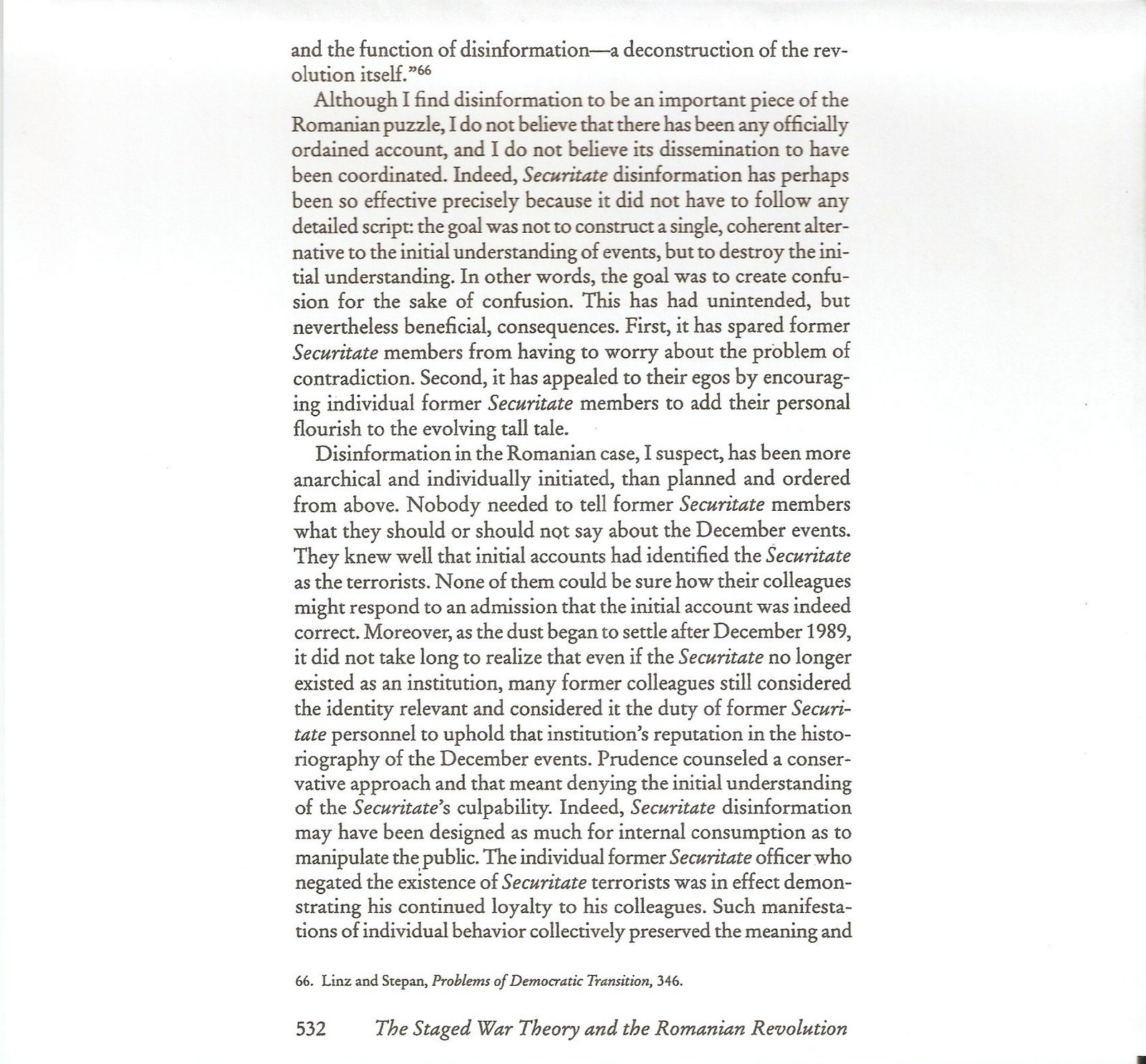
image0-001

…Securitate disinformation has perhaps been so effective precisely because it did not have to follow any detailed script:  the goal was not to construct a single, coherent alternative to the initial understanding of events, but to destroy the initial understanding.  In other words, the goal was to create confusion for the sake of confusion.  This has had unintended, but nevertheless beneficial, consequences.  First, it has spared former Securitate members from having to worry about the problem of contradiction.  Second, it has appealed to their egos by encouraging individual former Securitate members to add their personal flourish to the evolving tall tale.

Disinformation in the Romanian case, I suspect, has been more anarchical and individually initiated, than planned and ordered from above.  Nobody needed to tell former Securitate members what they should or should not say about the December events.  They knew well that initial accounts had identified the Securitate as the terrorists.  None of them could be sure how their colleagues might respond to an admission that the initial account was indeed correct.  Moreover, as the dust began to settle after December 1989, it did not take long to realize that even if the Securitate no longer existed as an institution, many former colleagues considered the identity relevant and considered it the duty of former Securitate personnel to uphold the institution’s reputation in the historiography of the December events.  Prudence counseled a conservative approach and that meant denying the initial understanding of the Securitate’s culpability.  Indeed, Securitate disinformation may have been designed as much for internal consumption as to manipulate the public.  The individual former Securitate officer who negated the existence of Securitate terrorists was in effect demonstrating his continued loyalty to his colleagues.  Such manifestations of individual behavior collectively preserved the meaning and relevance of the Securitate’s identity beyond the institution’s official death.

Little did I think, of course, that two decades on, the direct influence of the former Securitate on the historiography of December 1989 should be so strong, so obvious, and yet go so-unchallenged in the Romanian media.  What follows is the “harvest” from this year’s anniversary’s crop of articles on December 1989.  I will present links to those articles first, briefly identifying the persons involved, and then post links to my research refuting their claims where appropriate (virtually all necessary features are covered in the first two deconstructions, as former Securitate revisionism is nothing if not repetitive…) and including a preview of some documents, photos, articles from that research.

1) Adevărul

Cristian Troncotă, Alex Mihai Stoenescu, Filip Teodorescu (Grigore Cartianu)

http://adevarul.ro/cultura/istorie/adevarul-live-ora1300-cine-a-tras-22-grigore-cartianu-1_52b023b6c7b855ff56c613cf/index.html

http://adevarul.ro/cultura/istorie/cine-fost-teroristiii-cine-a-tras-22-grigore-cartianu-8_52b02b7ec7b855ff56c64a04/index.html

Grigore Cartianu moderează o nouă emisiune Adevărul Live despre evenimentele sângeroase din decembrie 1989. Dezbaterea îşi propune să ofere răspunsuri convingătoare unor întrebări dureroase: Cine au fost „teroriştii“? Cine-a tras în noi după 22? De ce au fost lichidaţi soţii Ceauşescu în ziua de Crăciun? În studioul Adevărul Live se află trei invitaţi de mare greutate: istoricii Cristian Troncotă şi Alex Mihai Stoenescu, precum şi Filip Teodorescu, unul dintre „aşii“ contraspionajului din decembrie 1989.Troncotă is the editor-in-chief of Revista Vitralii Lumini si Umbre, a mouthpiece for former Securitate officers,  http://www.acmrr-sri.ro/categorii/19/revista-vitralii–lumini-si-umbre.html

Alex Mihai Stoenescu has been publicly identified as former Securitate collaborator and is known for research and publications exonerating the former Securitate

Filip Teodorescu is a former Securitate officer

Cartianu has been promoted for his writings on December 1989 by the following: Joi, 16 decembrie, 11.30h dezbatere publica la IICCMER: Armand Gosu, Raluca Grosescu, Grigore Cartianu, Mihail Neamtu

http://tismaneanu.wordpress.com/2010/07/21/deshumarea-lui-ceausescu-un-pas-spre-adevar/

http://www.movingimagesource.us/articles/how-was-ceausescu-possible-20110929

2) Evenimentul Zilei

Marian Ştef, Securitate officer in Timisoara in December 1989

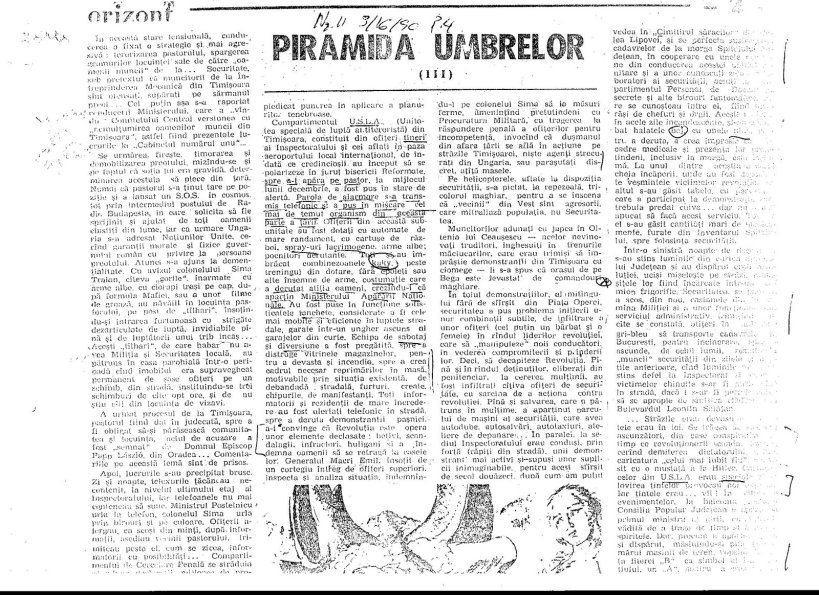
Când a început Procesul Revoluţiei, Ştef a ajuns martor al apărării. “Am încercat să povestesc despre “combinezoanele negre” , adică despre agenţii KGB care au făcut atmosferă la Revoluţie. Nu m-au lăsat. În seara de 16 decembrie, aproape de biserica lui Tokes, undeva între orele 19 şi 20, i-am văzut
prima dată pe agenţi. Erau opt, îmbrăcaţi în negru. Spărgeau vitrinele la Librăria Mihail Sadoveanu şi îi îndemnau şi pe puştanii de stradă să facă la fel. Mi-a sărit în faţă vocea lor: vorbeau româneşte, dar suna diferit. Aveau accent străin. Peste trei zile, am reîntâlnit  combinezoanele negre  pe podul de la Elba, când a fost incendiat un tractor. Erau 12. Instigau oamenii. Au introdus elemente de teroare în rândul oamenilor”, îşi aminteşte fostul ofiţer de contraspionaj economic.

Ion Mihai Pacepa, former head of Foreign Intelligence until his defection in 1978

http://www.evz.ro/detalii/stiri/pacepa-nicolae-ceausescu-a-fost-executat-pentru-a-i-se-inchide-gura-1074110/pagina-comentarii/1.html#comentarii

background on the connections of Pacepa’s interviewer:  http://blog.itmorar.ro/un-traseist-de-opinie-andrei-badin/

Pacepa’s interview was also broadcast by the B1 station and its details relayed by the daily Cotidianul

http://www.cotidianul.ro/pacepa-despre-executia-lui-ceausescu-229030/

3) Cotidianul

Aurel I. Rogojan, chief deputy to General Iulian Vlad, the Securitate Director in December 1989

Part 3 of a 5 part series:  http://www.cotidianul.ro/evenimentele-din-decembrie-1989-intre-sperantele-unora-si-deziluziile-altora-iii-228956/

4) Curentul

General Maior Victor Nicolciou, head of the Securitate’s so-called anti-KGB and Warsaw Pact counterespionage

http://www.curentul.ro/2013/index.php/2013122094848/Decembrie-1989-marturii-si-documente/Fostul-sef-al-unitatii-anti-KGB-si-turistii-din-decembrie-1989.html

1) Grigore Cartianu

http://adevarul.ro/cultura/istorie/adevarul-live-ora1300-cine-a-tras-22-grigore-cartianu-1_52b023b6c7b855ff56c613cf/index.html

at minute 35, Troncota claims the “terrorists” were an “invention”:
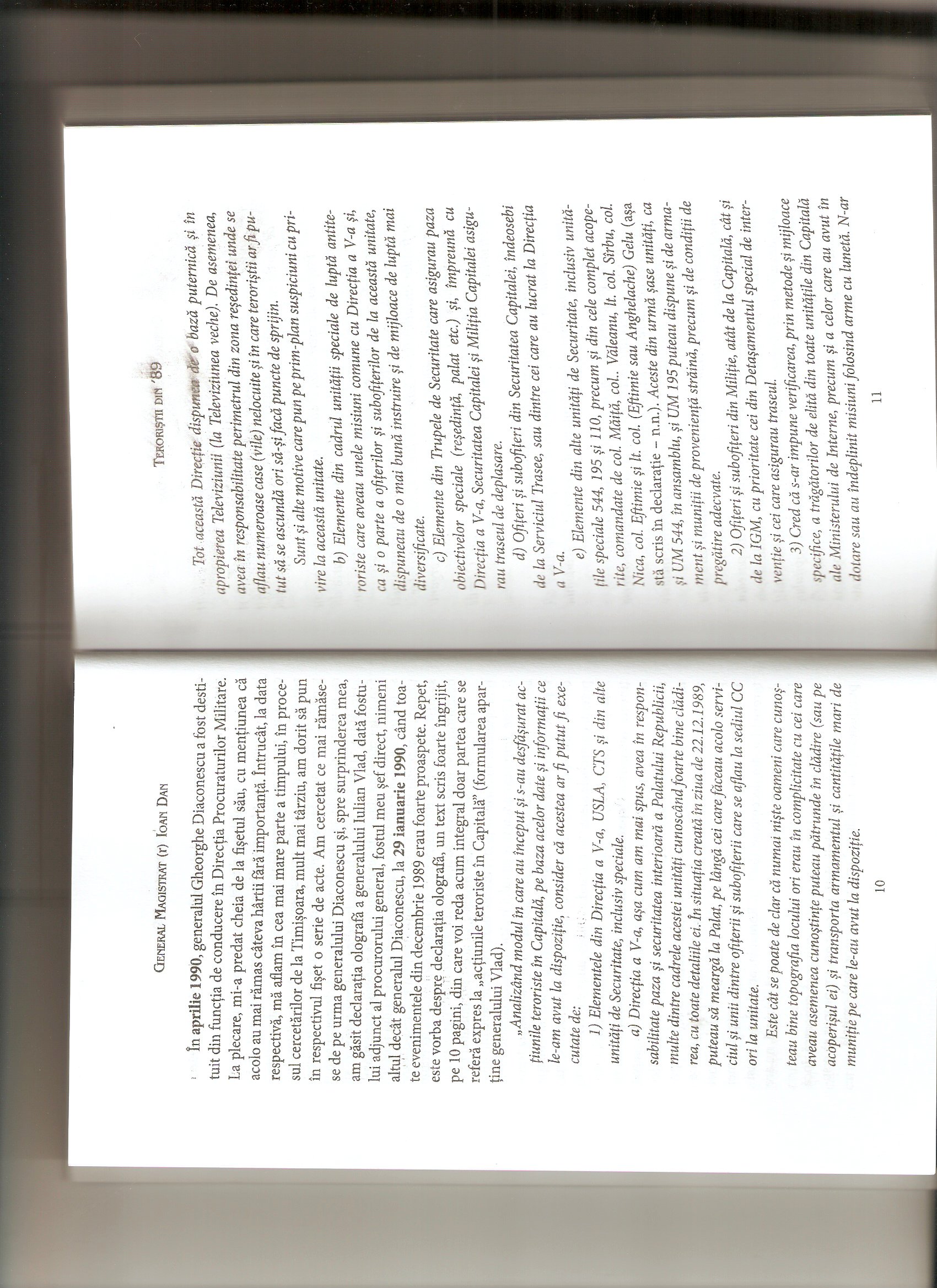
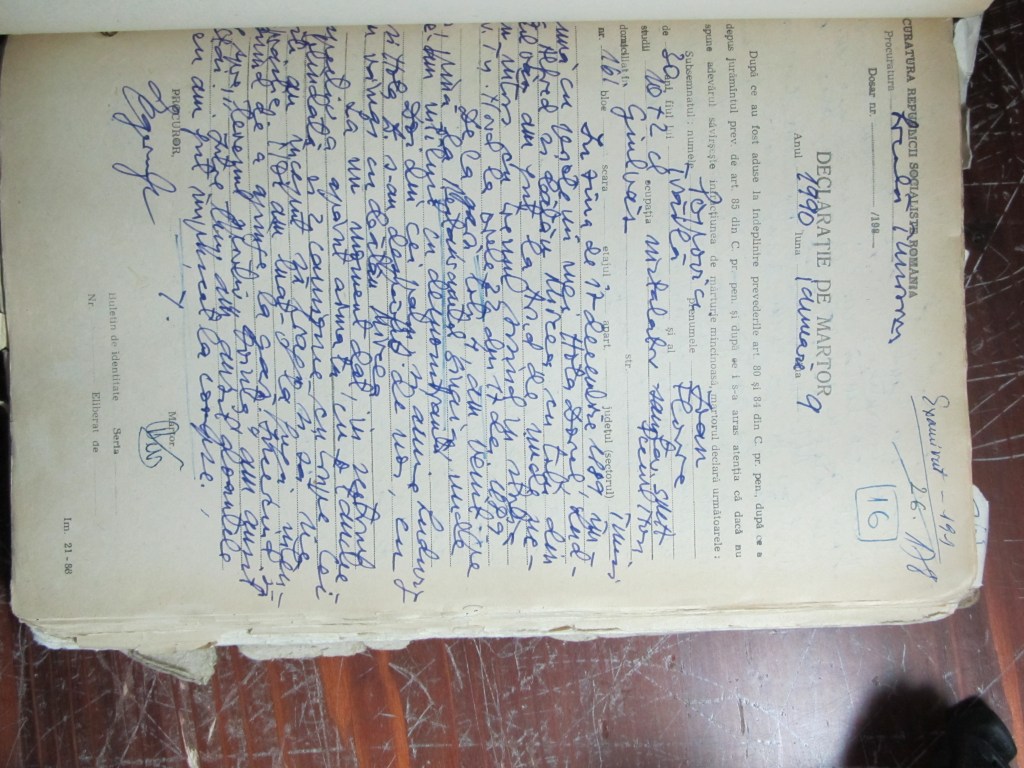
http://atomic-temporary-3899751.wpcomstaging.com/text-of-securitate-general-iulian-vlads-29-january-1990-declaration-identifying-the-terrorists/

Declaratia lui Iulian Vlad, 29 ianuarie 1990, nepublicat de presa romana timp de mai bine de 23 de ani!!!

image0-001

image0

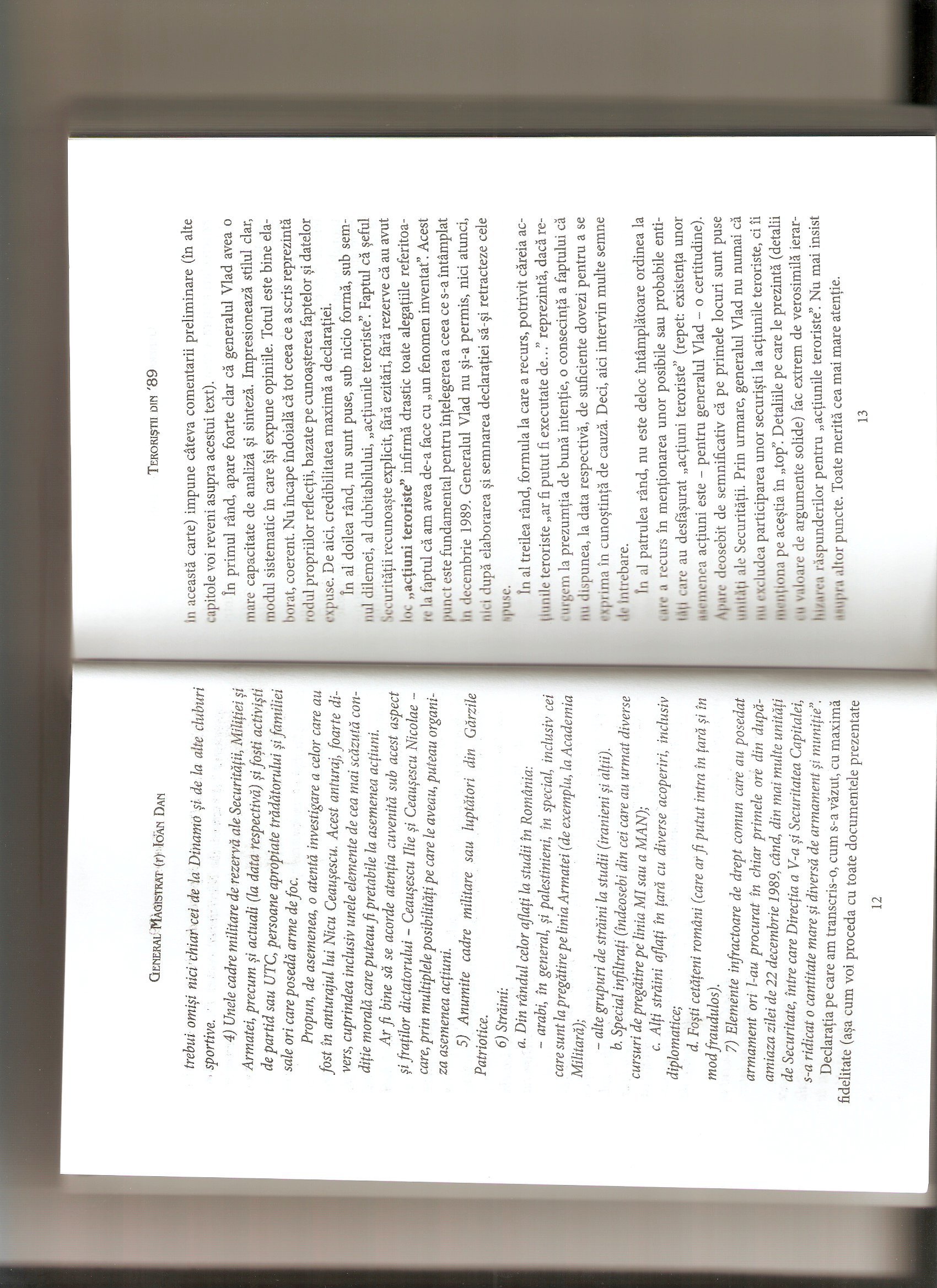
General Magistrat (r) Ioan Dan, Teroristii din ’89 (Lucman, 2012).

at minute 51, there is a discussion that “Soviet tourists” were the “terrorists”:

Generalul Emil Macri (seful Dir. II-a Securitatii, Contrainformatii Economice),

Declaratie 2 ianuarie 1990:

“Rezumind sintetic informatiile obtinute ele nu au pus in evidenta nici lideri si nici amestecul vreunei puteri straine in producerea evenimentelor de la Timisoara.  Raportarea acestor date la esalonul superior respectivi generalului I. Vlad a produs iritare si chiar suparare…”

IMG_1219

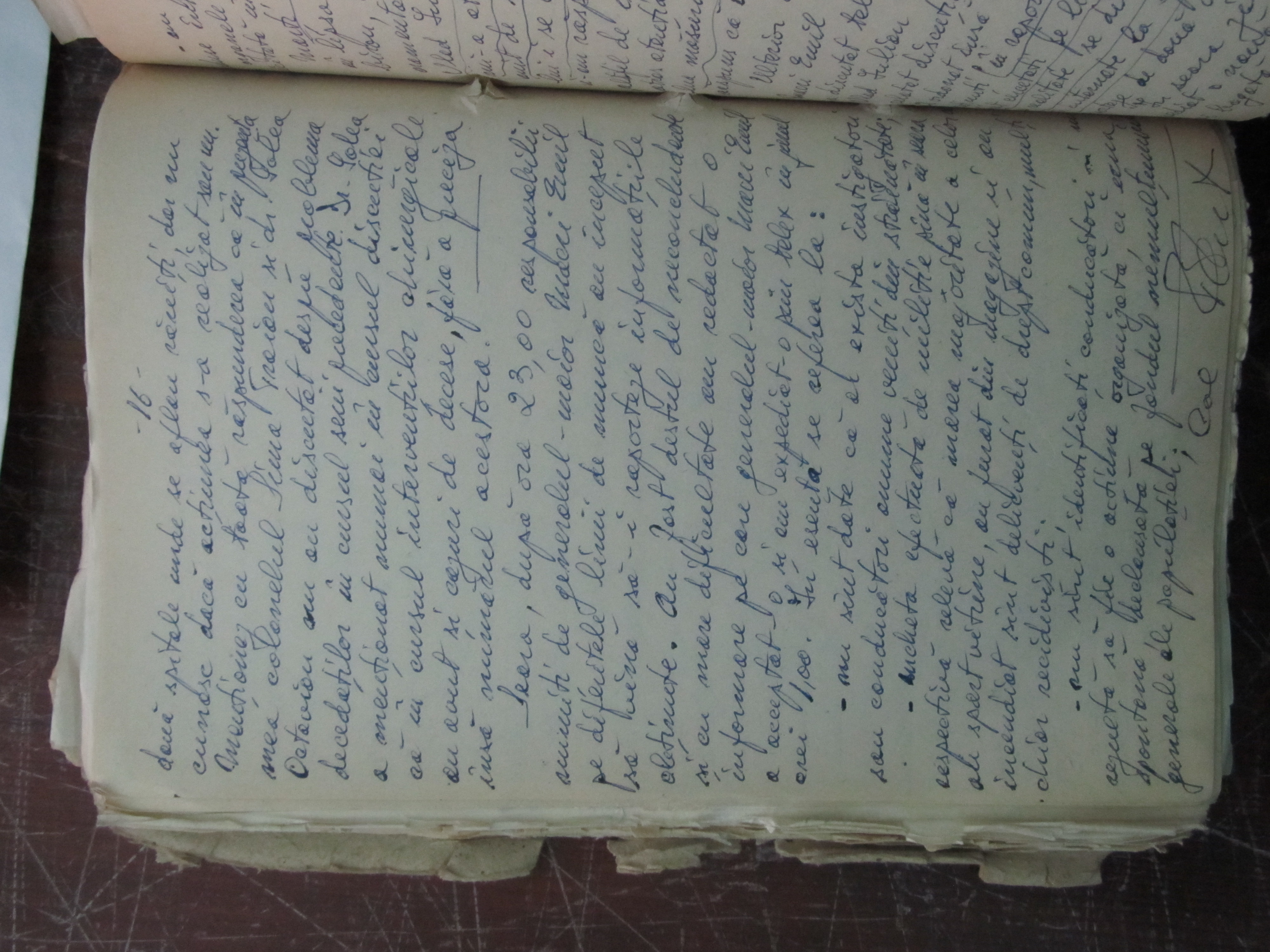
Filip Teodorescu (adj. sef. Dir III Contraspionaj D.S.S.), Declaratie, 12 ianaurie 1990: 

Seara [luni, 18 decembrie 1989], dupa 23:00, responsabili (anumiti ?) de generalul-maior Macri Emil pe diferitele linii de munca au inceput sa vina sa-i raporteze informatiile obtinute.  Au fost destul de neconcludente si cu mare dificultate am redat o informare pe care generalul-maior Macri Emil a acceptat-o si am expediat-o prin telex in jurul orei 01:00 [marti, 19 decembrie 1989.  In esenta se refera la:

–nu sint date ca ar exista instigatori sau conducatori anume veniti din strainatate…
IMG_1453

The Last Report of the Securitate (DSS) to Nicoale Ceausescu

Please note:  no mention whatsoever of the alleged role played by “Russian tourists” or “Soviet tourists” in allegedly fomenting the Timisoara uprising
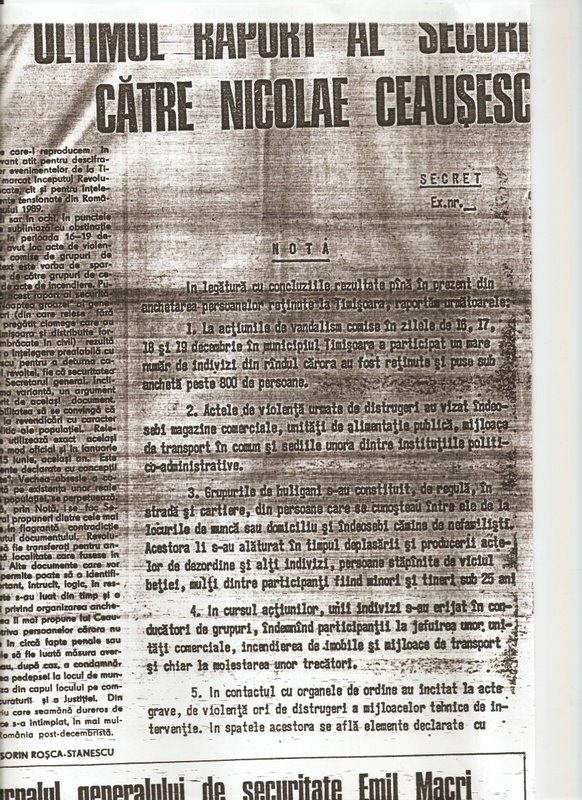
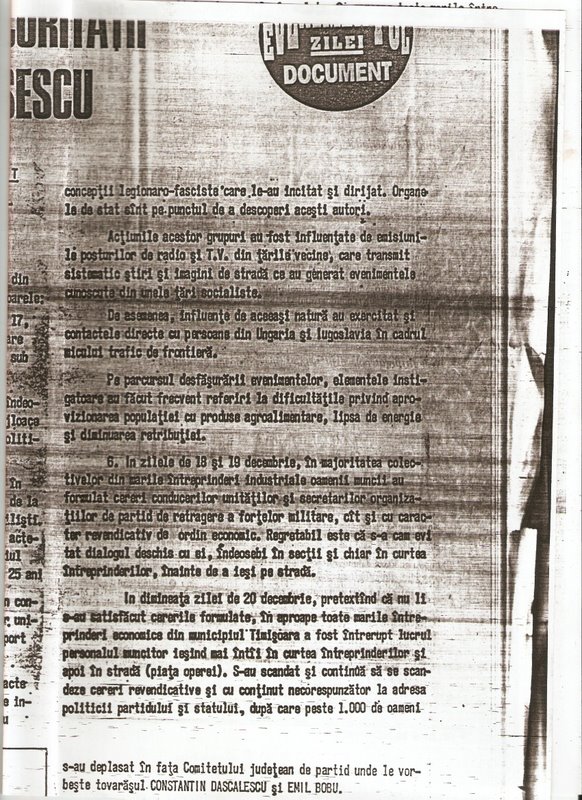
published in Evenimentul Zilei, 28 iulie 1992, p. 3.

at minute 64, discussion that the “terrorists” were from the Army’s special DIA unit, a favorite, longstanding myth invented and spread by members of the former Securitate:
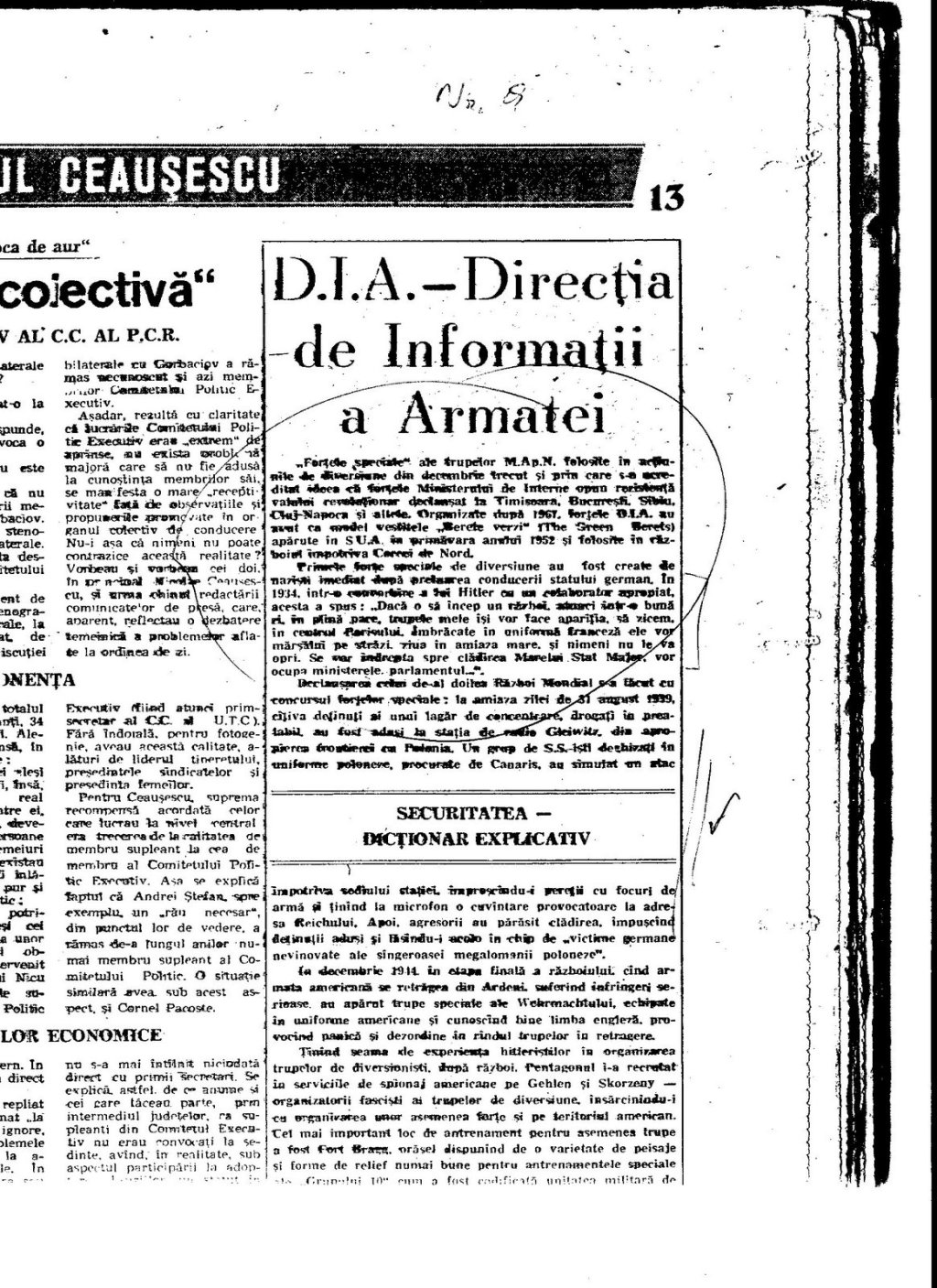
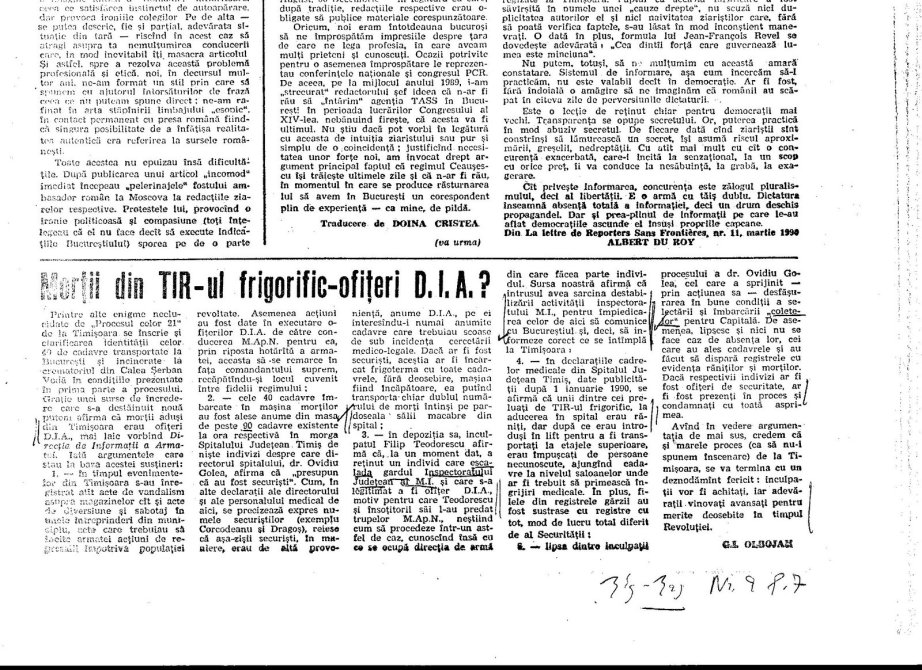
image-61image-62

Expres Magazin, 9 ianuarie 1992

image-24

at minute 69, blaming Teodor Brates at TVR for intentionally creating panic about the “terrorists”:

http://atomic-temporary-3899751.wpcomstaging.com/2013/12/22/revisiting-the-myths-of-the-revolution-part-iii-the-water-is-poisoned-apa-este-otravita-dr-heyndrickxs-toxicology-report/

http://atomic-temporary-3899751.wpcomstaging.com/2013/12/22/revisiting-the-myths-of-the-revolution-part-iv-the-romanian-television-building-is-in-danger-bomba-in-subsolul-televiziunii/

Romania

On December 21, 1989, people drinking from water tank #4 in Sibiu experienced headache, visual disturbances, loss of consciousness, vomiting, etc.  These symptoms are all compatible with organophosphate poisoning.  The analysis of the water (by gas chromatography) and the determination of the cholinesterase activity of the blood was done in the University of Cluj.  The conclusion was that an organophosphate had been used.  Atropine sulfate and toxogonin were advised.

As soon as the symptoms appeared among the population, water tank #4 was shut off, rinsed, and cleaned.  The people received water from army trucks.

A few days later, there was a fight in Timisoara between the army and Securitate over the water tanks.  Poisoning was feared, as had occurred in Sibiu.  According to witnesses, the Securitate possesses “all possible chemical warfare agents.”

Toxicologist Aubin Heyndrickx supervised the chemical tests and interviewed the physicians at Central Hospital who treated the patients.  From the tests and from the very high dose of atropine required to produce a response, he concluded that the tank was poisoned with sarin or VX (Report on the Humanitarian Mission to Romania, December 23-29, 1989, Laboratoria voor Toxicologie Criminalistiek, State University of Ghent).

http://www.physiciansforcivildefense.org/cdp/jan90.htm

Indeed, one can watch a brief discussion of the incident with Dr. Heyndrickx beginning at approximately the 40 second mark from an ITN broadcast of 27 December 1989

http://www.itnsource.com/en/shotlist//ITN/1989/12/27/BSP271289002/?s=romania+sibiu+after+the+revolution+27+1989&st=0&pn=1

ROMANIA: SIBIU AFTER THE REVOLUTION:

}T27128901   ROMANIA: SIBIU AFTER THE REVOLUTION: United Nations medical
27.12.89     relief team arrives in Sibiu with medical supplies and blood
TX           to treat the people who were injured during the fight against
             Securitate (secret police). Toxicologists have found evidence
             that the security police poisoned the water supply. Injured
             Securitate are being treated in hospitals alongside the people
             they shot.
Clip Ref: BSP271289002 0

Clip 1of1

}T27128901   ROMANIA: SIBIU AFTER THE REVOLUTION: United Nations medical
27.12.89     relief team arrives in Sibiu with medical supplies and blood
TX           to treat the ...
  • Duration: 00:01:44 |
  • Timecode – In: 00:00:00:00  Out: 00:01:44:00 |
  • Copyright: ITN / 3rd Party Copyright

Corneliu Vaida has been kind enough to share with me, the following additional confirmation of his actions in the document below:
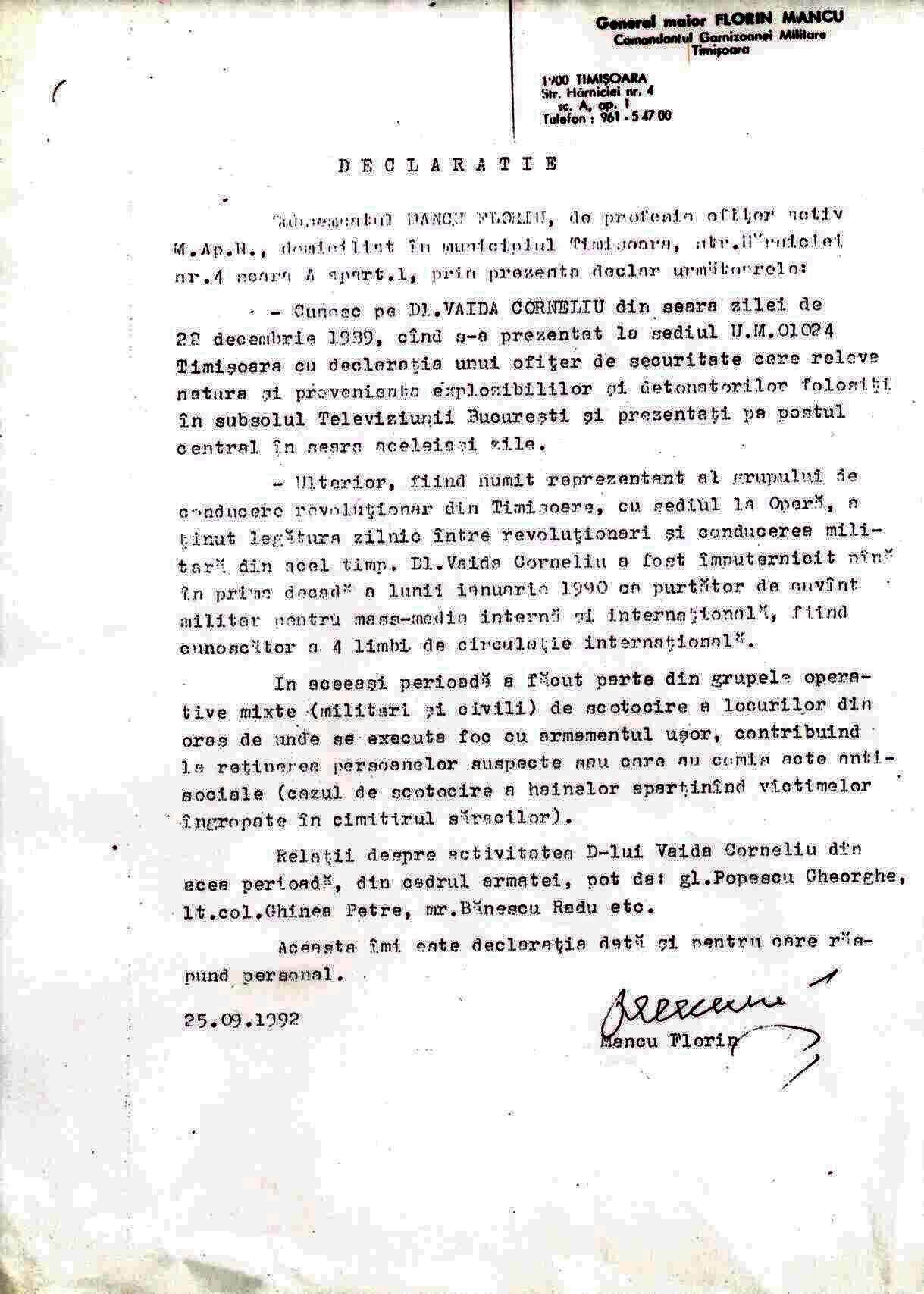
HP0010

For more about Corneliu Vaida during the Revolution in Timisoara in December 1989, see his interview with ITN correspondent Penny Marshall on 27 December 1989:

http://atomic-temporary-3899751.wpcomstaging.com/2011/05/11/lets-go-to-the-videotape-i-to-the-army-its-confirmation-that-theyve-been-dealing-with-a-specially-trained-force-because-its-the-type-of-bullet-theyve-never-seen-before-itn-uk-telev/

Corneliu Vaida Timisoara December 1989

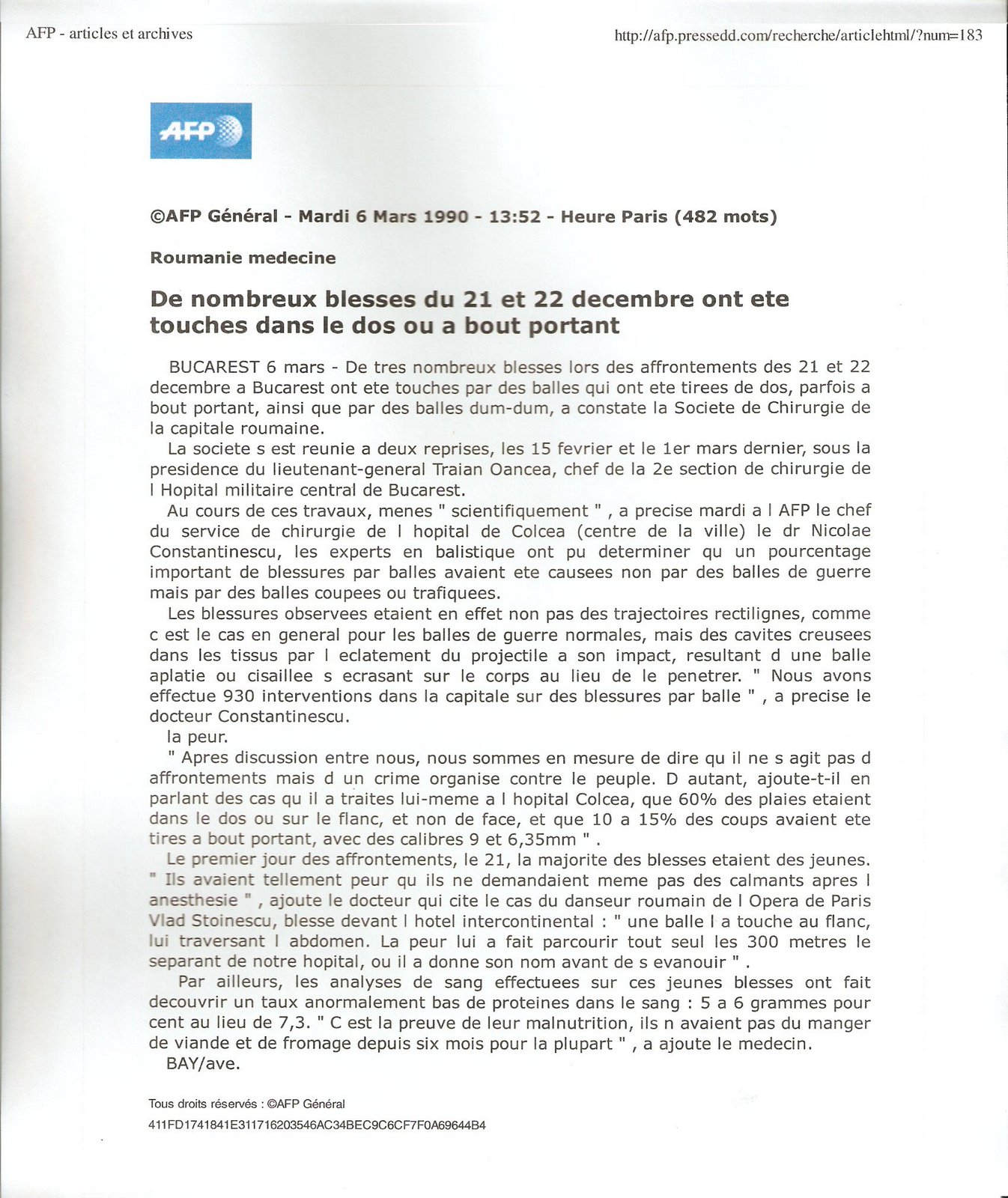
In early March 1990, AFP reported the declared findings of surgeons in Bucharest, attesting to the fact that many of those wounded on 21-22 December 1989 in Bucharest had been shot with exploding bullets, DUM-DUM bullets.  This is a critical article (and description of an event that I believe has gotten almost no coverage inside or outside Romania).  Lt. Gnl. Traian Oancea, chief of surgery in part of the Central Military Hospital in Bucharest, and Dr. Nicolae “Nae” Constantinescu, chief of surgery at the Coltea Hospital, discussed this at a meeting of the Society of Surgeons in Bucharest.
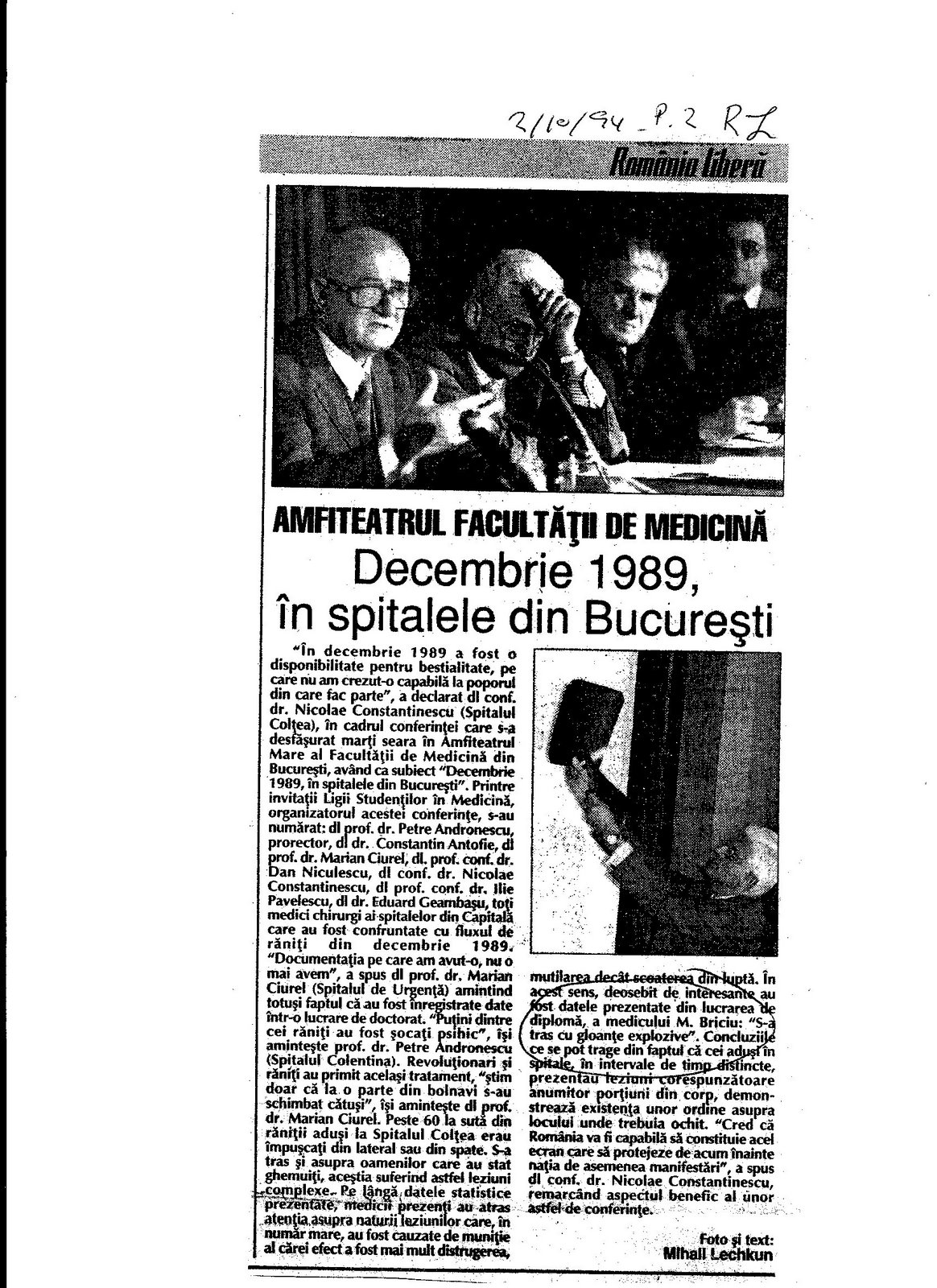
This was also discussed by Bucharest medical personnel at a 1994 conference:

AMFITEATRUL FACULTATII DE MEDICINA

“Decembrie 1989, in spitalele din Bucuresti”

Mihail Lechkun, Romania Libera, 10 februarie 1994, p. 2

“In decembrie 1989 a fost o disponsibilitate pentru bestialitate, pe care nu am crezut-o capabila la poporul care fac parte, ” a declarat dl. conf. dr. Nicolae Constantinescu (Spitalul Coltea), in cadrul conferintei care s-a desfasurat marti seara in Amfiteatrul Mare al Facultatii de Medicina din Bucurest, avand ca subiect “Decembrie 1989, in spitalele din Bucuresti”.  Printre invitatii Ligii Studentilor in Medicina, organizatorul acestei conferinte, s-au numarat:  dl. prof. dr. Petre Andronescu, prorector, dl. dr. Constantin Antofie, dl. prof. dr. Marian Ciurel, dl. prof. conf. dr. Dan Niculescu, dl. conf. dr. Nicolae Constantinescu, dl. prof. conf. dr. Ilie Pavelescu, dl. dr. Eduard Geambasu, toti medici chirurgi din Capitala care au fost confruntate cu fluxul de raniti din decembrie 1989.  “Documentatia pe care am avut-o, nu o mai avem,” a spus dl. prof. dr. Marian Ciurel (Spitalul de Urgenta) amintind totusi faptul ca au fost inregistrate date intr-o lucrare de doctorat.  “Putini dintre cei raniti au fost socati psihic,” isi aminteste prof. dr. Petre Andronescu (Spitalul Colentina).  Revolutionari si raniti au primit acelasi tratament, “stim doar ca la o parte din bolnavi s-au schimbat catusi” isi aminteste dl. prof. dr. Marian Ciurel.  Peste 60 la suta din ranitii adusi la Spitalul Coltea erau impuscati lateral sau din spate.  S-a tras si asupra oamenilor care au stat ghemuiti, acestia suferind astfel leziuni complexe.  Pe langa datele statistice prezentate, medicii prezenti au atras atentia asupra naturii leziunilor care, in numar mare, au fost cazate de munitie al carie efect a fost mai mult distrugerea, mutilarea decat scoaterea din lupta.  In acest sens, deosebit de interesante au fost datele prezentate din lucrarea de diploma, a medicului M. Briciu:  “S-a tras cu gloante explozive”. Concluziile ce se pot trage din faptul ca cei adusi in spitale, in intervale de timp distincte, prezentau leziuni corespunzatoare anumitor portiuni din corp, demonstreaza existenta unor ordine asupra locului unde trebuia ochit.  “Cred ca Romania va fi capabila sa constituie acel ecran care sa protejeze de acum inainte natia de asemenea manifestari,” a spus dl. conf. dr. Nicolae Constantinescu, remarcand aspectul benefic al unor astfel de conferinte.
NOR WERE THESE THE ONLY DOCTORS AND MEDICAL PERSONNEL–FOREIGN OR DOMESTIC–WHO ATTESTED TO THE USE OF DUM-DUM EXPLODING AND OTHER ATYPICAL, UNUSUAL MUNITIONS USED DURING THE EVENTS OF DECEMBER 1989

http://atomic-temporary-3899751.wpcomstaging.com/2011/08/08/doctors-and-dum-dum-bullets-in-romania-in-december-1989-i-dr-manuel-burzaco-medecins-sans-frontieres/

http://atomic-temporary-3899751.wpcomstaging.com/2011/08/10/doctors-and-dum-dum-bullets-in-romania-in-december-1989-ii-trimisi-in-strainatate-italia-franta-austria-anglia-si-germania-pentru-tratament/

http://atomic-temporary-3899751.wpcomstaging.com/2011/08/11/doctors-and-dum-dum-bullets-in-romania-in-december-1989-iii-ce-spun-medici-romani/

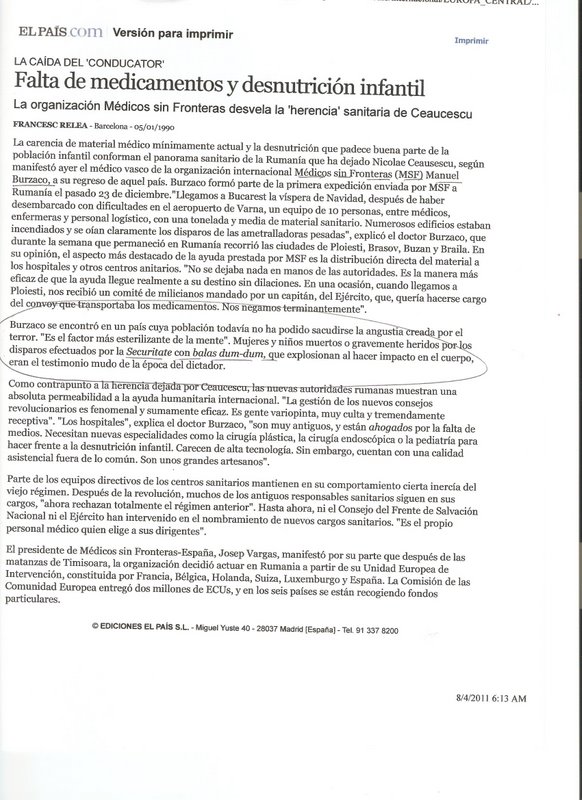
Dr. Manuel Burzaco from “Doctors without Borders” was part of a team of doctors from that group who visited hospitals in Bucharest, Ploiesti, Brasov, Buzau and Braila in late December 1989 and early January 1990.  This report from the Madrid daily El Pais touches upon the women and children gravely injured by the exploding “dum dum bullets used by the Securitate.”
Other reports from Bucharest and Timisoara hospitals during the events:

“At Bucharest’s main emergency hospital, doctors said that Securitate snipers, apparently using infra-red telescopic sights and exploding dum-dum bullets, had been firing throughout Saturday night and they shot many civilians, with bullets striking foreheads and hearts.  The morgue at the hospital was stacked with 90 bodies at noon today, almost all of them civilians dead of gunshot wounds.”

Blaine Harden, “In Bucharest, Tears and Prayers for the Fallen,” The Washington Post, 25 December 1989, p. A1; A40.
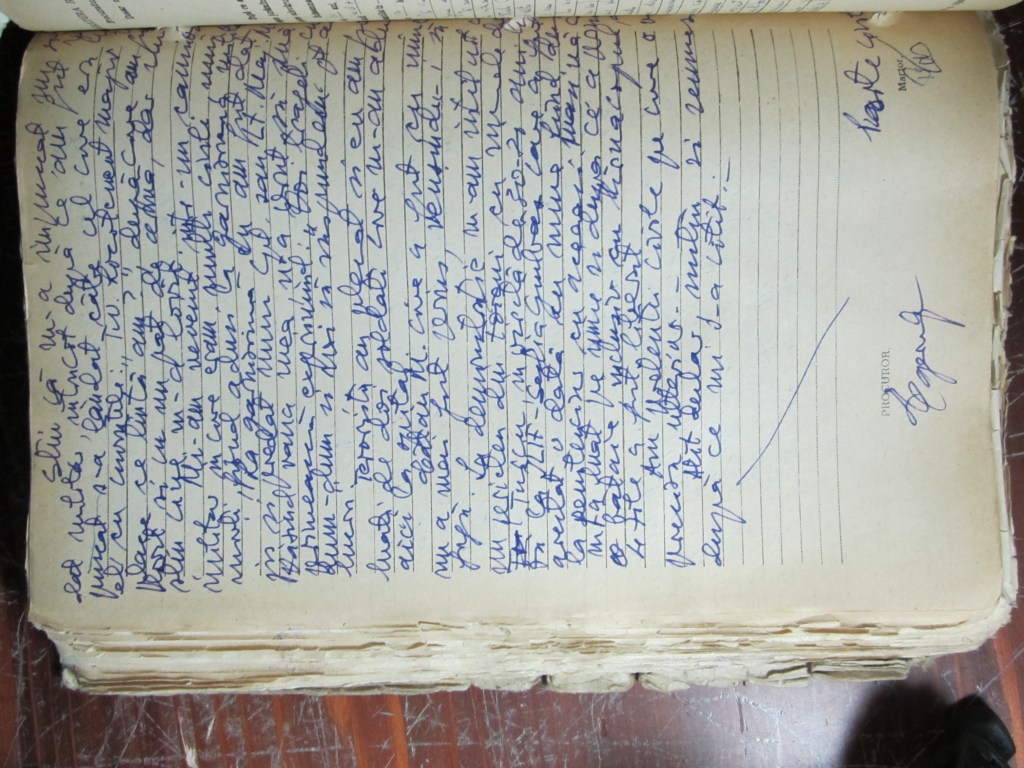
Procesul de la Timisoara (II). Audierea partii civile Popovici Ion: “…Atata retin foarte bine minte, ca ofiterul a spus, cica: ‘Nu, voi trageti cu dum-dum-uri si dupa aia Armata raspunde.’”

Popovici:  “Mi-am revenit intr-un camion militar in care eram multi civili unii morti fiind adusi la garnizoana militara.  La garnizoana eu am fost dat jos si predat unui cpt (capitan) sau unui lt.major (locotenent major). vazand rana mea n-a vrut sa ma primeasca exprimand: Voi trageti cu dum dum si noi sa raspundem pentru acest lucru.”  (my thanks to A.K. for this transcription)

Popovici:  “I came to in a military truck in which there were lots of civilians some dead being brought to the military garrison.  At the garrison I was taken down and surrendered to a captain or lt. major, who looking at my wound did not want to receive me, exclaiming:  You shoot with dum-dum bullets and we are held responsible for it.”

available on this site http://www.banaterra.eu/romana/procesul-de-la-timisoara-1990-1991-vol-v ].  The following is from Volume V.]

Some excerpts: P.C.:  Ati dat o declaratie?   Po. I. :  Da  P.C.:  O mentineti?  Po. I. Da (p. 827) P.C.:  “Inteleg sa fiu audiat in cauza ca parte civila”, da?  V-as ruga sa faceti putin liniste!  “Mentin declaratia de la Procuratura si…” (p. 833)

Po. I.:  …Da [am fost ranit].  Si dupa aceea a venit unul dintre trei [civili mai in varsta] dupa mine, m-a tarat pana la masina si la masina, acolo, am luat o bataie…ca n-am putut doua saptamani nici sa mananc nimica.  M-a lovit cu patul de arma in falca si cu bocancii in cap.  Si m-au dus, m-au dus la Garnizoana.  La Garnizoana m-au aruncat din masina si a venit ofiterul de serviciu.  Au venit si acestia trei a spus lu’ ofiterul de serviciu, cica:  “Luati-l si duceti-l  la arest.”  Atata retin foarte bine minte, ca ofiterul a spus, cica:  “Nu, voi trageti cu dum-dum-uri si dupa aia Armata raspunde.  Voi omorati oameni si raspunde Armata dupa aceea.”  Asta tin minte precis.  Si de acolo mi-am dat seama ca nu poate sa fie soldati aceia. (p. 830)
IMG_0291

IMG_0290

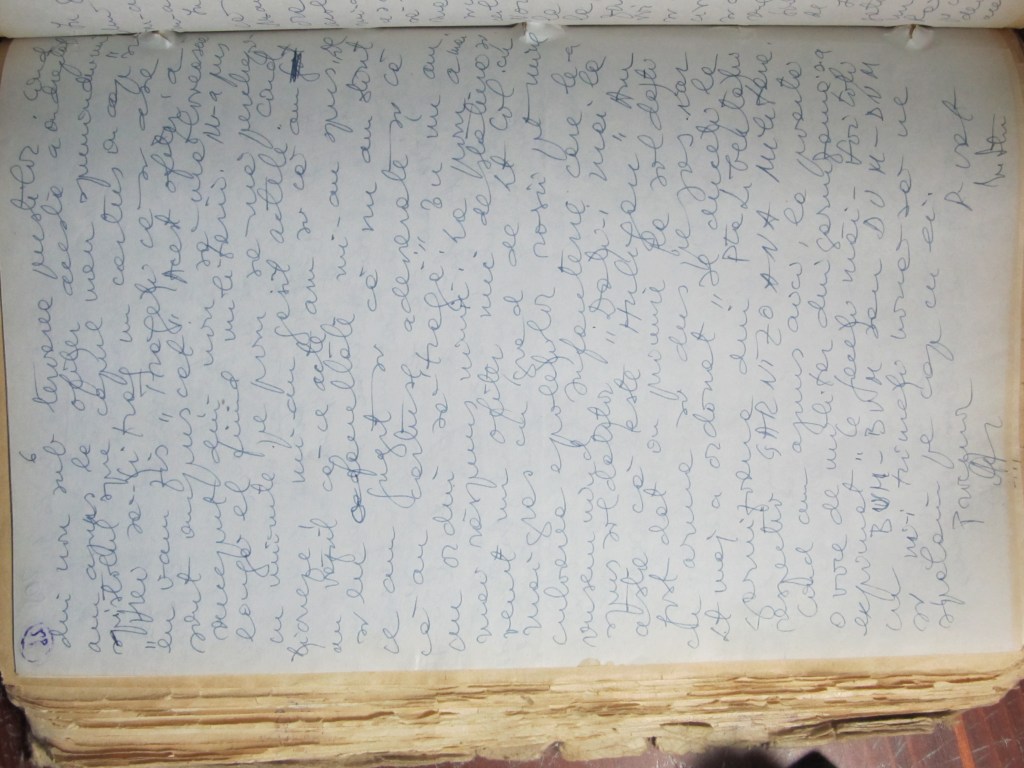
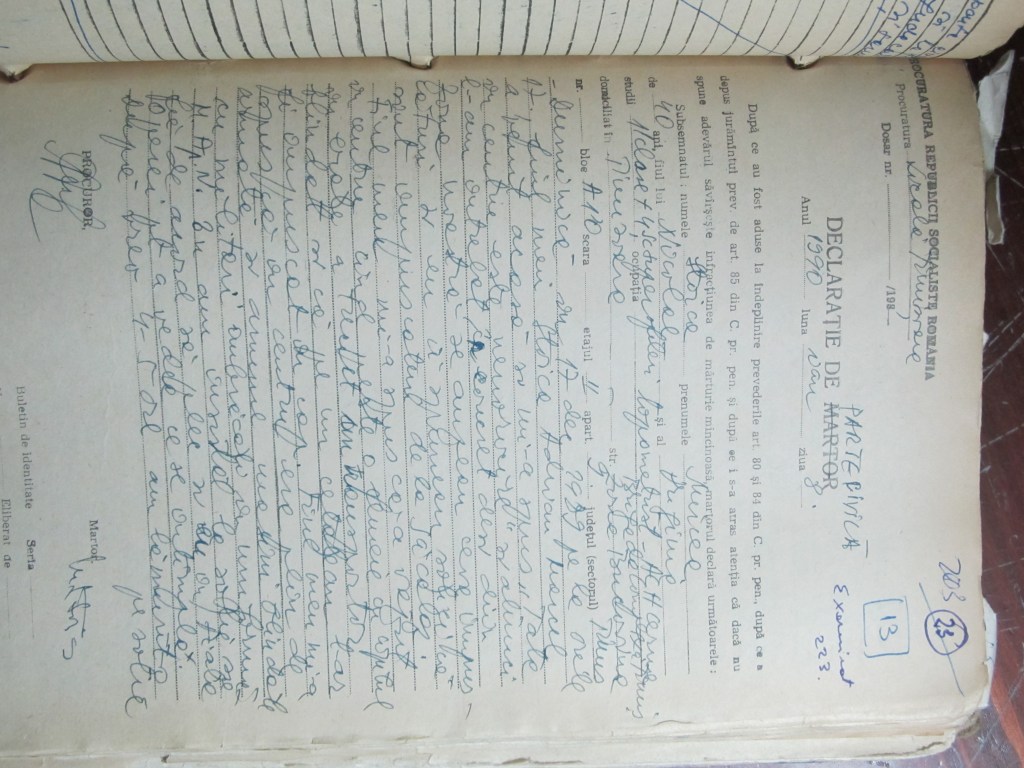
Mircea Stoica (declaratie, 8 ian 1990):  “Cind am ajuns aici, la poarta o voce de militar din garnizoana s-a exprimat:  “Ce faceti mai — voi toti cu BUM-BUM sau DUM-DUM si ni-i trimiteti noua sa ne spalam pe cap cu ei.”

 Mircea Stoica (declaration, 8 January 1990):  “When I got there, I heard a soldier’s voice from the garrison exclaim:  “What are you guys doing? You all with your BUM-BUM or DUM-DUM and then you send`em to us to solve the problem [almost impossible to solve]” <very angry, pissed off>

(my sincere thanks to Gigga Adrian Tudor for this transcription and translation of the quote!)
IMG_0335

“Cind am ajuns aici, la poarta o voce de militar din garnizoana s-a exprimat:  “Ce faceti mai — voi toti cu BUM-BUM sau DUM-DUM si ni-i trimiteti noua sa ne spalam pe cap cu ei.”
IMG_0330

at minute 89, claimed “inventions” about the secret tunnels underneath the Central Committee building and elsewhere

http://atomic-temporary-3899751.wpcomstaging.com/2012/11/28/post-ceausescu-romania-confronted-by-questions-they-dont-like-a-number-of-military-officers-and-officials-whom-we-encountered-simply-lied-stupid-lies-the-kind-that-speak-of-a-society/

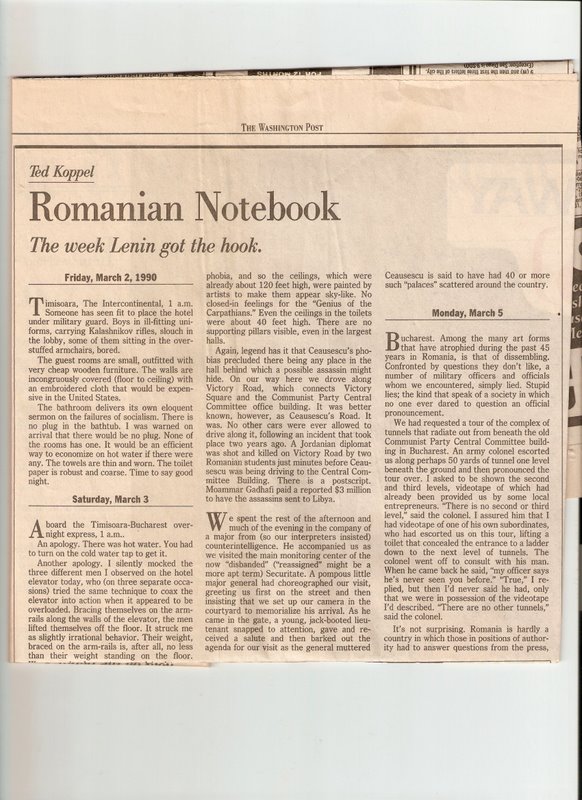
I know of no better metaphor for what has happened to research on the Romanian Revolution of December 1989 than Ted Koppel’s surreal experience in Bucharest in early 1990 recounted below.

from 2 April 1990, ABC News Special.  The Koppel Report:  Death of a Dictator.

Monday, March 5 (1990). 

Bucharest.  Among the many art forms that have atrophied during the past 45 years in Romania, is that of dissembling.  Confronted by questions they don’t like, a number of military officers and officials whom we encountered, simply lied.  Stupid lies; the kind that speak of a society in which no one ever dared to question an official pronouncement.

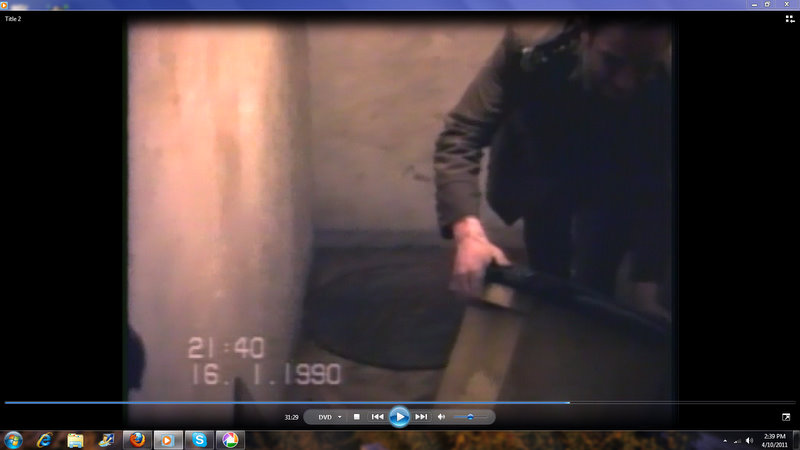
We had requested a tour of the complex of tunnels that radiate out from beneath the old Communist Party Central Committee building in Bucharest.  An army colonel escorted us along perhaps 50 yards of tunnel one level beneath the ground and the pronounced the tour over.  I asked to be shown the second and third levels, videotape of which had already been provided us by some local entrepreneurs.  “There is no second or third level,” said the colonel.  I assured him that I had videotape of one of his own subordinates, who had escorted us on this tour, lifting a toilet that concealed the entrance to a ladder down to the next level of tunnels.  The colonel went off to consult with his man.  When he came back he said, “my officer says he’s never seen you before.”  “True,” I replied, but then I’d never said he had, only that we were in possession of the videotape I’d described.  “There are no other tunnels,” said the colonel.

Ted Koppel, “Romanian Notebook.  The week Lenin got the hook.” The Washington Post, 13 March 1990, A25.

Dupa alti 20 de metri militarii au observat ca peretii tunelului au alta culoare, sunt mai noi si sunt acoperiti cu un fel de rasina sintetica. Dupa inca 10 metri culoarul se infunda. Chiar la capat se afla un piedestal din lemn pe care era asezat un capac de WC. Au ridicat capacul iar sub el au gasit un chepeng de fier. L-au ridicat si au gasit… un rau cu apa curata, care curge intr-o matca artificiala din beton. Are latimea de circa 1,5 metri si adancimea de aproximativ un metru. Raul se afla la aproximativ 12 metri sub platforma Pietei Revolutiei . Cele 16 barci erau folosite de fapt pentru acesta cale de navigatie.

from 2 April 1990, ABC News Special.  The Koppel Report:  Death of a Dictator.
 

2) Evenimentul Zilei

See among others:

http://atomic-temporary-3899751.wpcomstaging.com/2013/12/27/revizionism-securist-despre-spargerea-vitrinelor-la-timisoara-si-cateva-adevaruri-incomode-pentru-securisti-revizionisti/

http://atomic-temporary-3899751.wpcomstaging.com/2013/12/17/dosarele-revolutiei-de-la-timisoara-si-procesul-de-la-timisoara-cateva-documente/

http://atomic-temporary-3899751.wpcomstaging.com/2013/12/16/dosarele-revolutiei-de-la-timisoara-tudor-postelnicu-unii-militari-de-la-trupele-de-securitate-ale-brigazii-timisoara-au-facut-unele-provocari-la-unele-magazine-si-vitrine-spargind-geamurile/

http://atomic-temporary-3899751.wpcomstaging.com/2013/07/07/after-the-ceausescus-were-executed-the-counter-revolution-is-disappeared-26-december-1989-24-january-1990/

I will leave the rest to some of the commenters to former Securitate officer Marian Stef’s claims on the Evenimentul Zilei site:

25 December, 11:19. Adevarul combinezoanelor

Nu stiu ce fel de “ofiter de Securitate ai fost (probabil,o lichea ca toti ceilalti!) si cum dracu ai ajuns SRI-st (alt gen de lichea!),dar imi aduc aminte cum toate lichelele din militie si securitate,spuneau in decembrie 1989 si 1990 ca ei sunt ‘militari”.niste NENOROCITI care au ajuns dupa aia sa spuna ca MILITARII sunt vinovati pentru asasinatele de la revolutie.Voi,cei din militie,securitate,DGIa sunteti calaii si principalii vinovati pentru acele crime!voi sunteti cei in “combinezoane negre” care ati ASASINAT nevinovati!”Combinezonul” era semnul distinctiv si de recunoastere intre voi,criminalilor! ….Iti spune toate astea,un militar adevarat (nu de la militie,Securitate sau din structurile informative si represive!)!

25 December, 11:45. Vom fi ce am fost

Securitatea romana avea o anumita calitate care o punea mai presus decat multe servicii mari de informatii din lume. Acest lucru a fost confirmat de aceste mari servicii de securitate care au recunoscut ca la acest capitol Secu era mult mai tare ca ei. Si anume la: DEZINFORMARE
Dezinformare a fost inainte de ’89, a fost imediat dupa ’89, si este si acum poate mai tare ca oricand.
Posted in decembrie 1989, raport final | Tagged: , , , , , , , , | Leave a Comment »

Revizionism securist despre spargerea vitrinelor la Timisoara si cateva adevaruri incomode pentru securisti-revizionisti

Posted by romanianrevolutionofdecember1989 on December 27, 2013

(as always, a strictly personal point of view, based on research dating back to the 1990s and my dissertation defended at Indiana University in December 1996…not for nothing did I include in the title of my dissertation “the Triumph of Securitate Revisionism”!!!; punct de vedere strict personal, ca intotdeauna)

Iata, ce scrie Evenimentul Zilei, un ziar, despre care se spune, ca este mai putin influentat de interesele fostilor securisti…

Marian Ştef, fost securist din Timișoara

”Nu m-au lăsat, la Proces, să vorbesc despre agenții KGB”

Când a început Procesul Revoluţiei, Ştef a ajuns martor al apărării. “Am încercat să povestesc despre “combinezoanele negre” , adică despre agenţii KGB care au făcut atmosferă la Revoluţie. Nu m-au lăsat. În seara de 16 decembrie, aproape de biserica lui Tokes, undeva între orele 19 şi 20, i-am văzut 
prima dată pe agenţi. Erau opt, îmbrăcaţi în negru. Spărgeau vitrinele la Librăria Mihail Sadoveanu şi îi îndemnau şi pe puştanii de stradă să facă la fel. Mi-a sărit în faţă vocea lor: vorbeau româneşte, dar suna diferit. Aveau accent străin. Peste trei zile, am reîntâlnit  combinezoanele negre  pe podul de la Elba, când a fost incendiat un tractor. Erau 12. Instigau oamenii. Au introdus elemente de teroare în rândul oamenilor”, îşi aminteşte fostul ofiţer de contraspionaj economic. A condus singur, jumătate de an, SRI. Dacă la Revoluţie a fost trecut în rezervă, odată cu toate cadrele din fosta Securitate, la scurt timp după înfiinţarea SRI, în august 1990, s-a angajat în structură. Avea gradul de locotenent major. A avut o evoluţie interesantă. Patru ani mai târziu a fost numai prim adjunct al şefului SRI, funcţie pe care a deţinut-o opt ani. Şase luni din această perioadă a condus singur serviciul. S-a pensionat în 2006. 

Citiţi mai mult: Destăinuirile unui fost SECURIST din Timișoara: Revoluția a fost animată cu agenți KGB – EVZ Special > EVZ.ro http://www.evz.ro/detalii/stiri/povestea-securistului-de-bine-revolutia-a-fost-animata-cu-agenti-kgb-1073612.html#ixzz2odWHnsHx 
EVZ.ro

De ce nu cred in ceea ce spune fostul securist

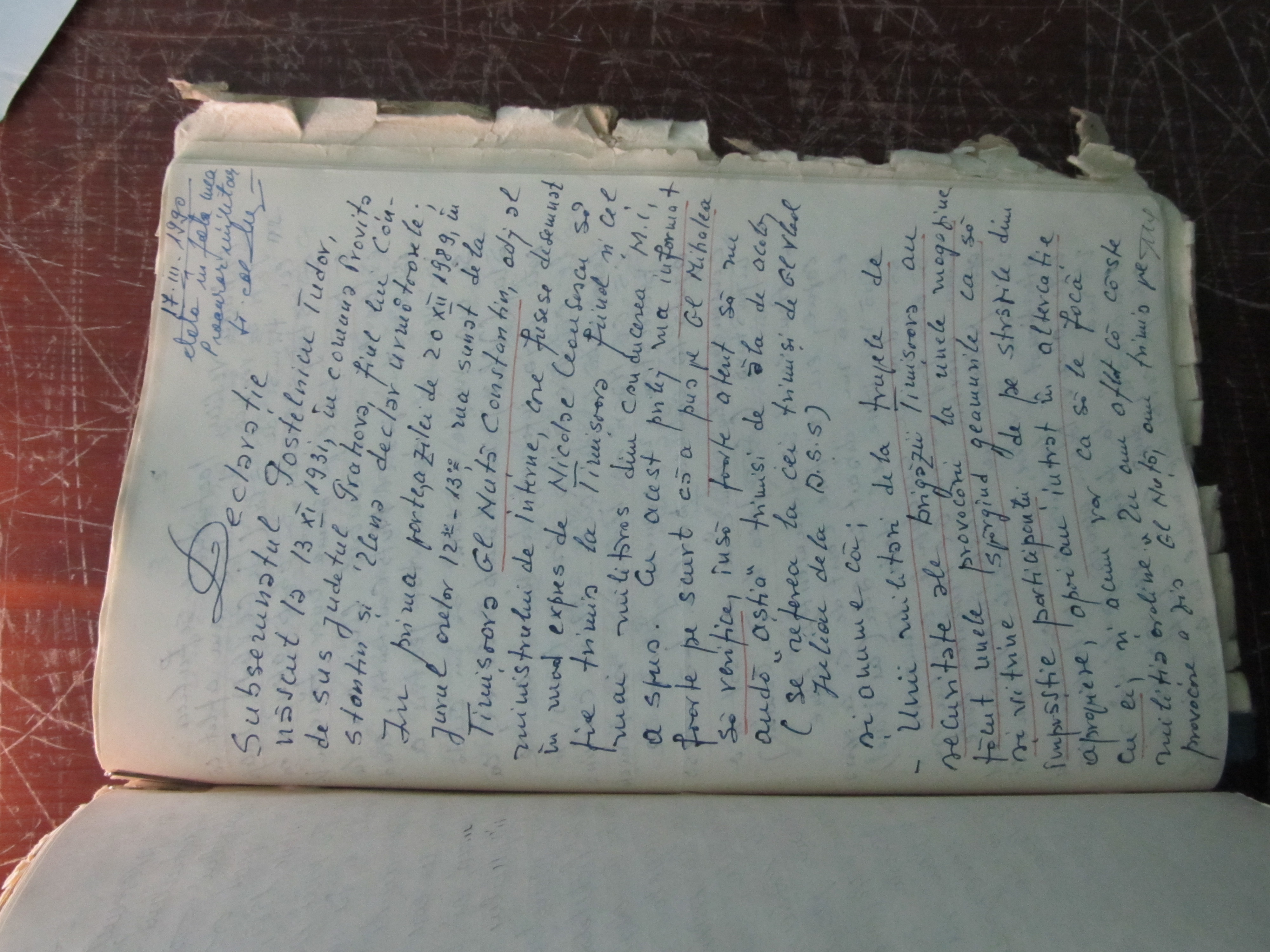
1) Marturia olografica lui Tudor Postelnicu din 17 martie 1990

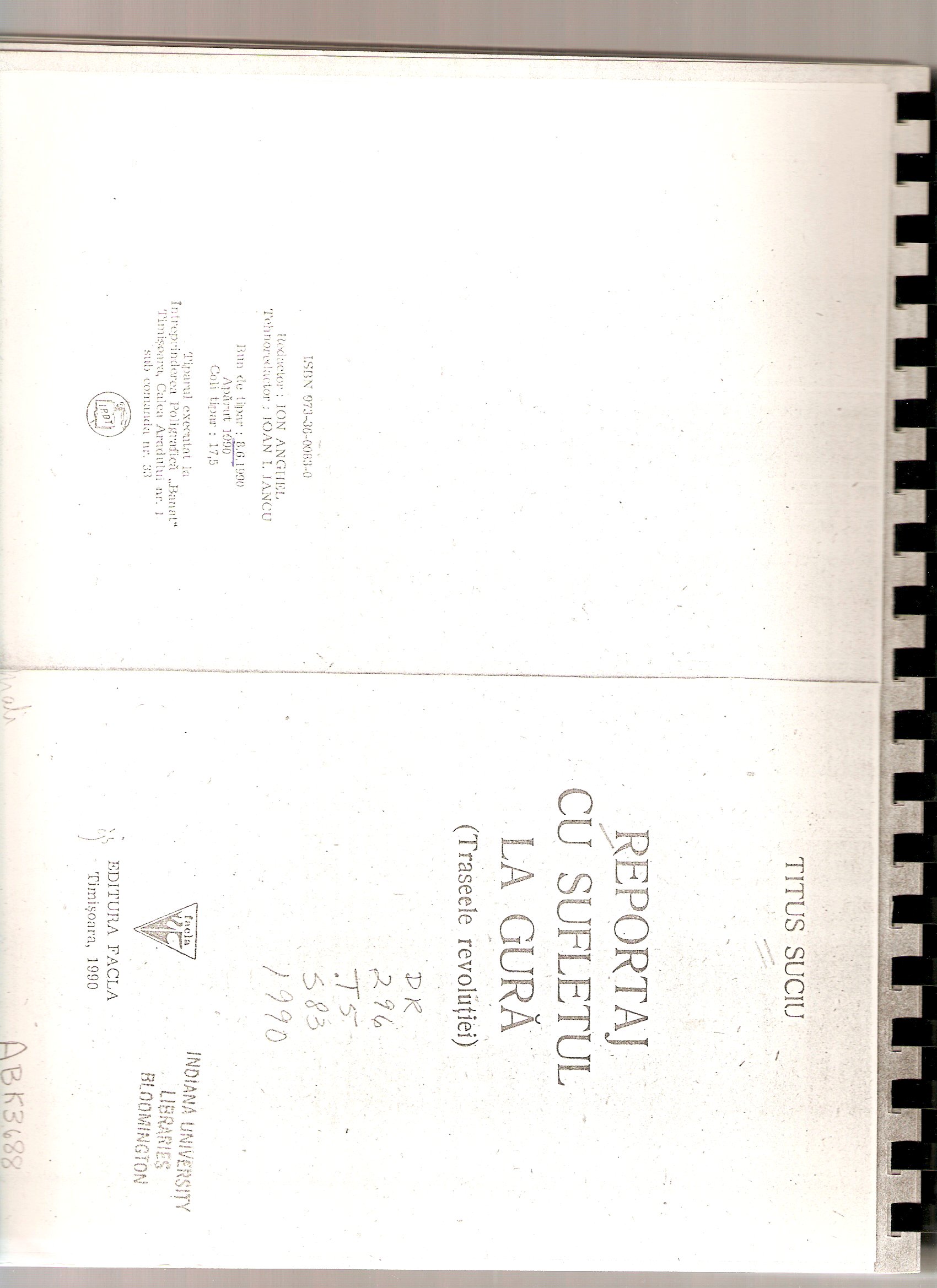
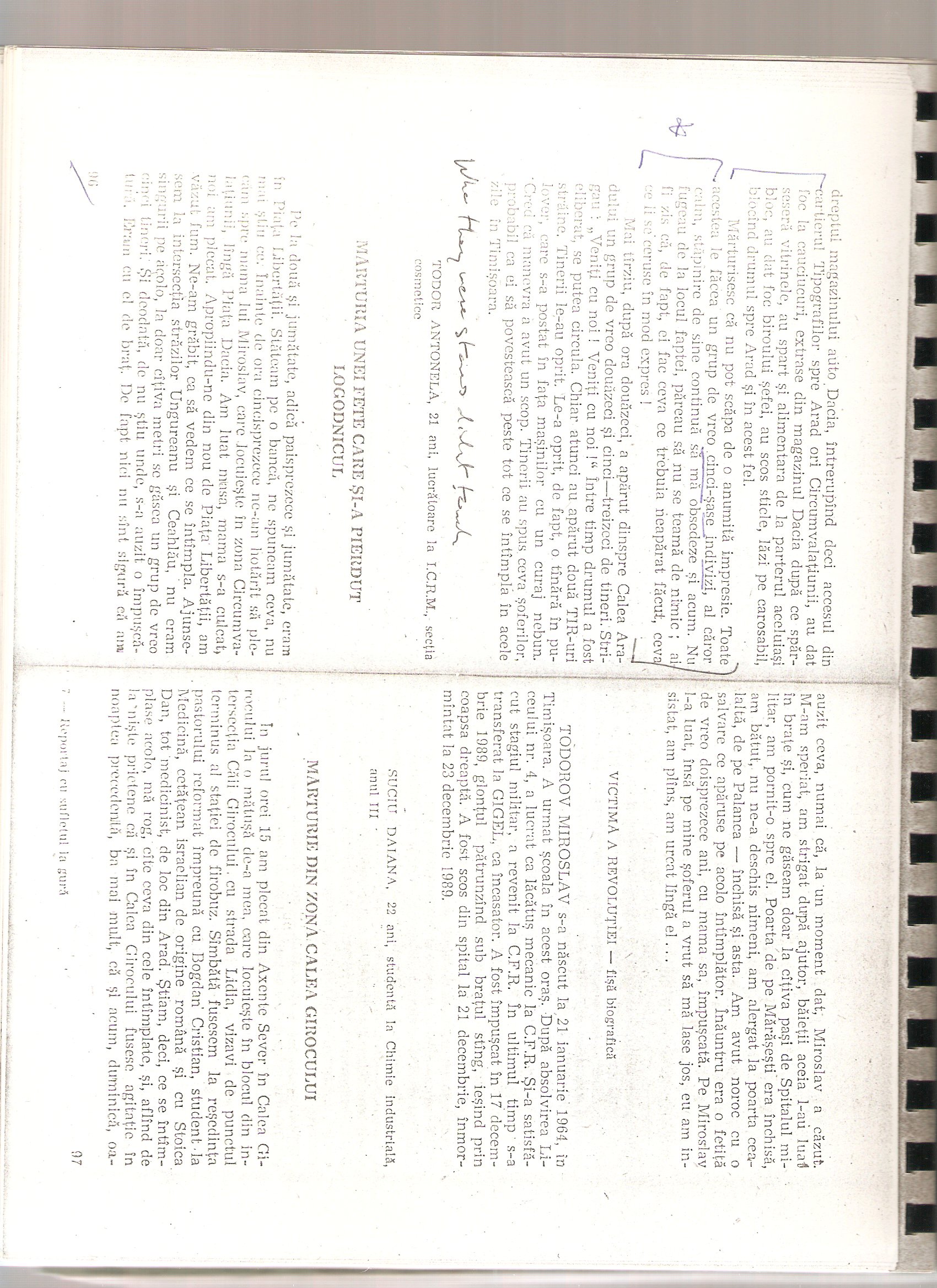
2) Martori oculari din cartea lui Titus Suciu, Reportaj cu sufletul la Gura (Timisoara, 1990)

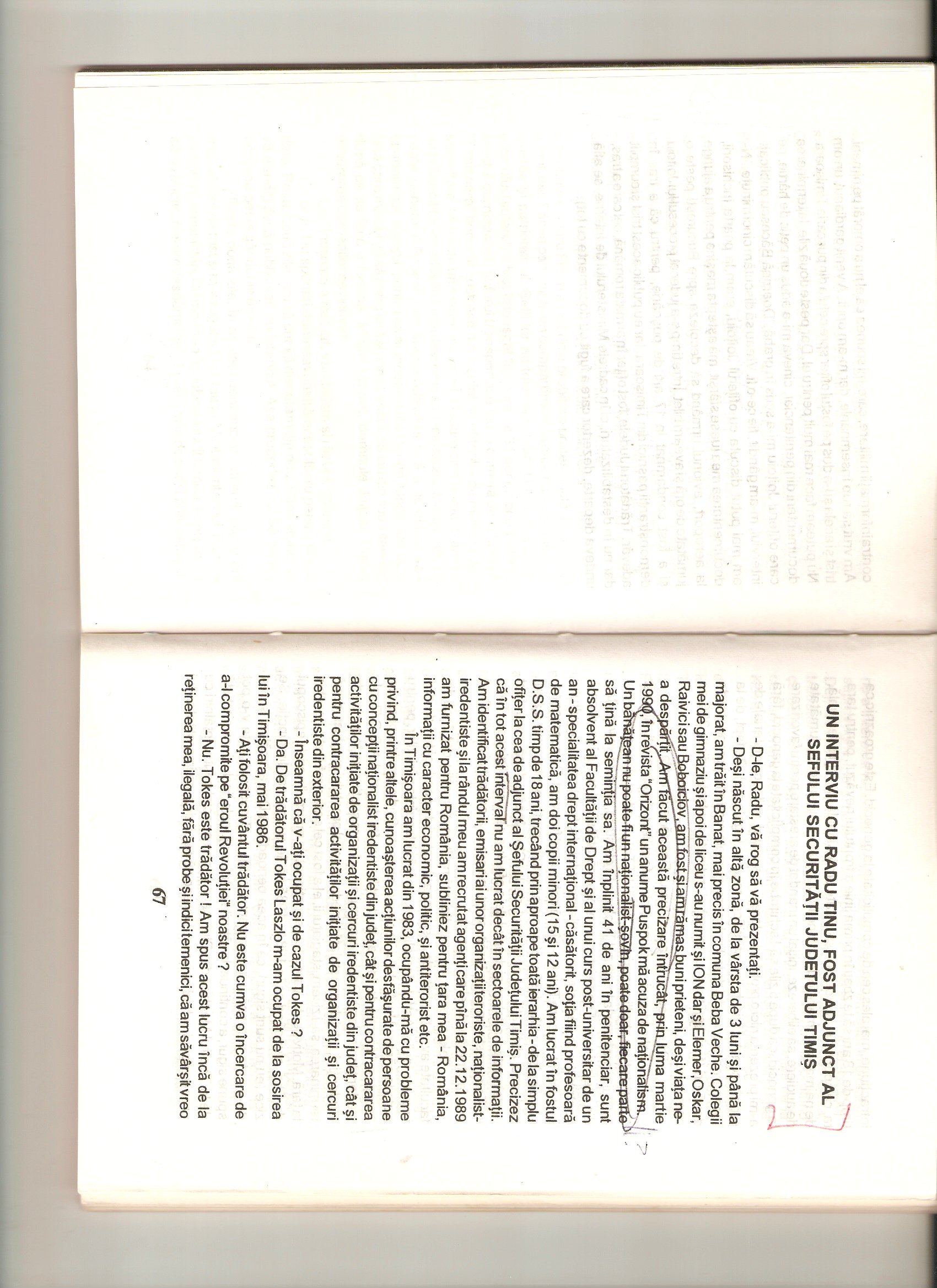
3) Un detaliu “scapat” dintr-un interviu intre Radu Tinu, fost securist din Timisoara, si Angela Bacescu in 1991

1)

IMG_2576

Tudor Postelnicu (Ministerul de Interne in decembrie 1989):  “Unii militari de la trupele de securitate ale brigazii Timisoara au facut unele provocari la unele magazine si vitrine spargind geamurile sa imprastie participantii de pe straziile din apropriere, apoi au intrat in altercatie cu ei, si acum (?) vor sa le faca militia ordine.  ‘Nu am aflat ca costa provocare a zis Gl. Nuta, am trimis pe …” (17.III.1990)  http://sensidev.com/fc/dosare%20de%20urmarire%20penala/dosar%20%20de%20urmarire%20penala%20volumul%2011/IMG_2576.JPG (Dosarul de Urmarire Penala, Vol. 11, IMG 2576)

Cateva observatii:

a) Postelnicu nu spune nimic despre asa-zisii “turisti sovietici” sau “turisti rusi” (o tema revizionista foarte populara) …nu spune ca ei au facut distrugerea…

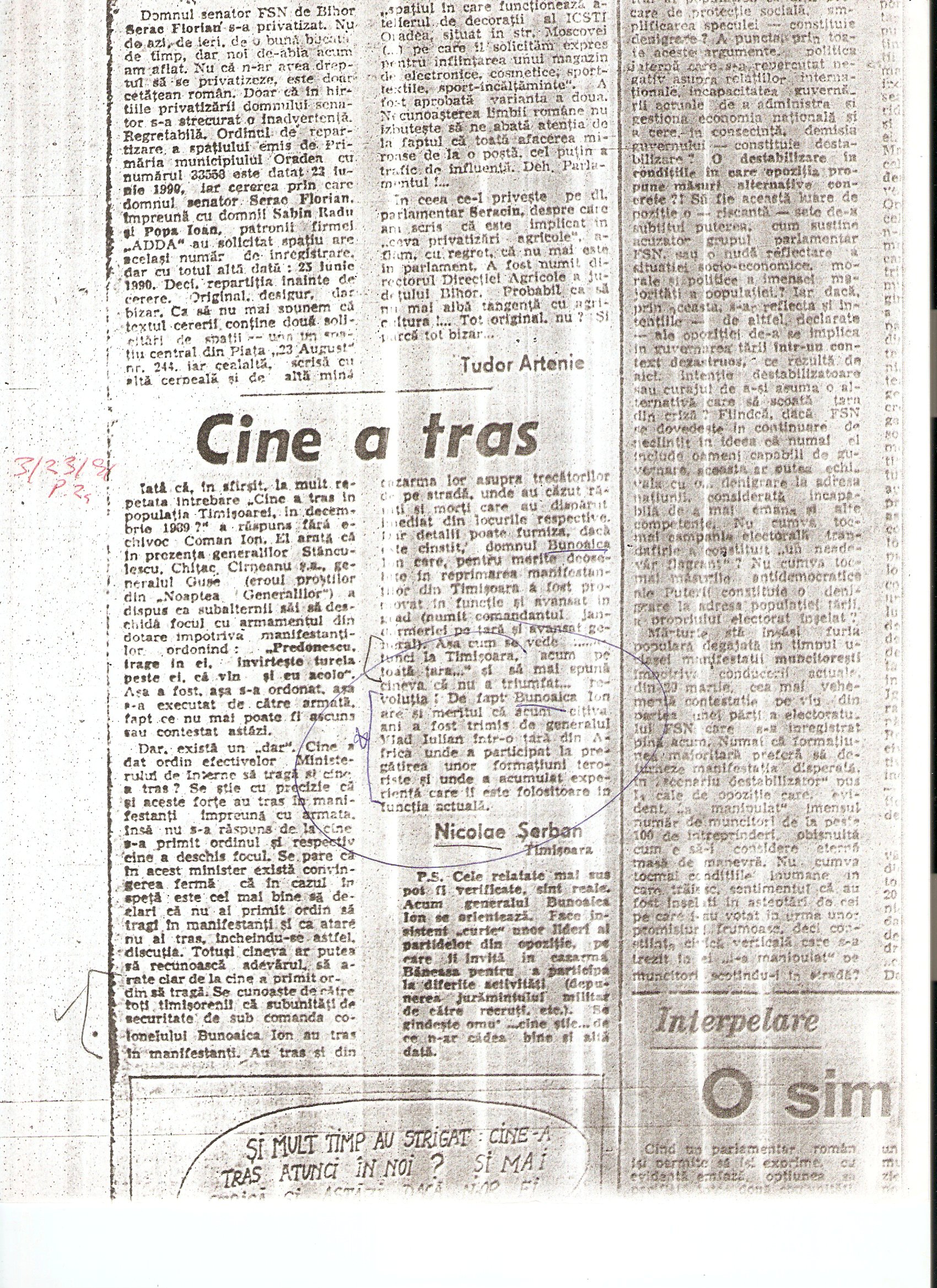
b) In schimb, Postelnicu spune ca securistii au facut provocarile…dar atentie:  nu spune ca ei le-au facut sa intareasca demonstrantii, ci “sa imprastie participantii de pe straziile din apropriere…”

deci nu intr-un scop ca detonatorii a unei revolutii (alta tema revizionista foarte populara), ci ca o tactica din arsenalul represiunii!

Nicolae Serban, “Cine a tras?” Romania Libera, 23 martie 1991, p. 2a.

image0

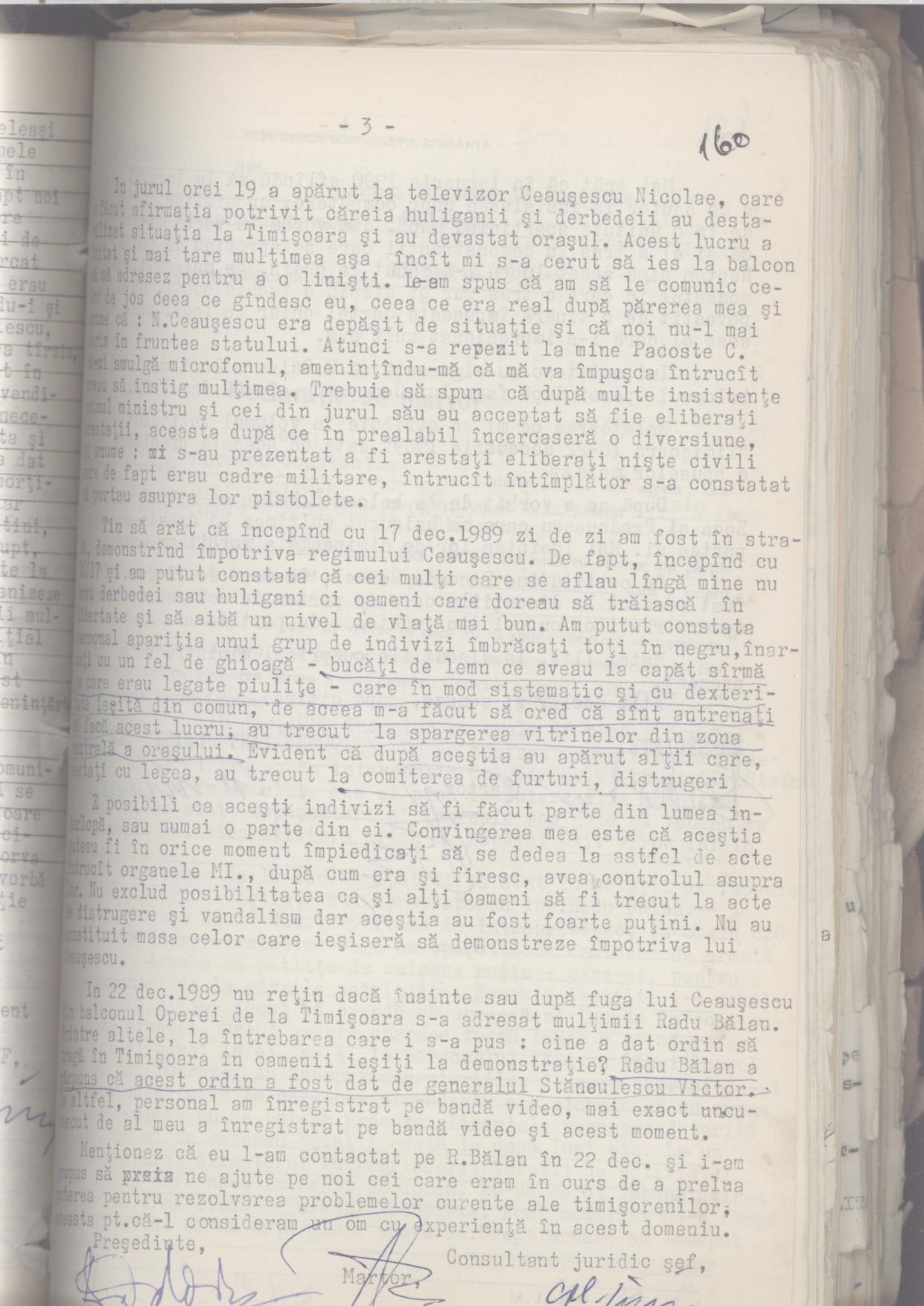
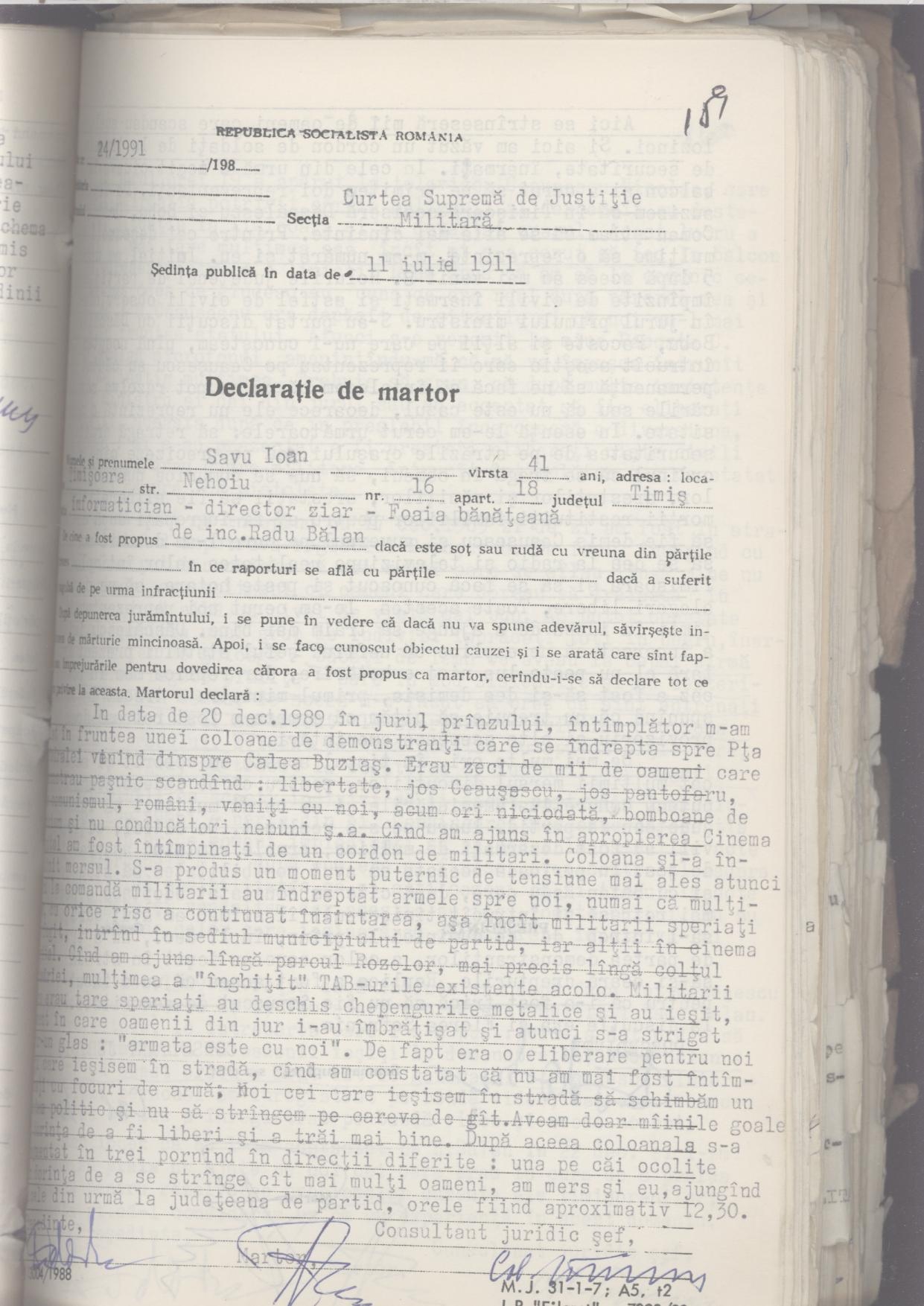
2) Ioan Savu, declaratie, 11 iulie 1991

Ioan Savu discussed the windowbreakers as follows:

0282

0280

An excerpt from Chapter 5 of my Ph.D. Dissertation at Indiana University: Richard Andrew Hall, Rewriting the Revolution: Authoritarian Regime-State Relations and the Triumph of Securitate Revisionism in Post-Ceausescu Romania (defended 16 December 1996). This is the original chapter as it appeared then and thus has not been revised in any form.

Chapter Five.  The Beginning of the End: Timisoara, 15-17 December 1989

The “Window Breakers”

The reportedly unusual scope of physical destruction which occurred in Timisoara, particularly on the afternoon and evening of 17 December 1989, has fueled revisionist arguments. Estimates of the damage during the Timisoara unrest are in the neighborhood of four to five billion lei (approximately forty to fifty million dollars at the time), a reasonably large sum given Romania’s standard of living at the time. A huge number of windows was broken and as many as 300 to 400 stores suffered some sort of damage, although relatively few were actually looted. On the evening of 17 December, stores, vehicles, and kiosks were burning in at least ten different areas of the city.[65]
Former Securitate officers clearly wish to link this destruction to the “foreign tourists” who were supposedly so ubiquitous in Timisoara during these days.[66] Perhaps somewhat surprisingly, former Securitate Director Iulian Vlad argued at his trial that

…the acts of vandalism, theft, destruction, arson… acts without precedent…could not have been the work [“opera”] of the faithful [apparently referring sarcastically to Tokes’ parishioners], nor the revolutionaries. They were produced by elements which wished to create a certain atmosphere of tension.[67]
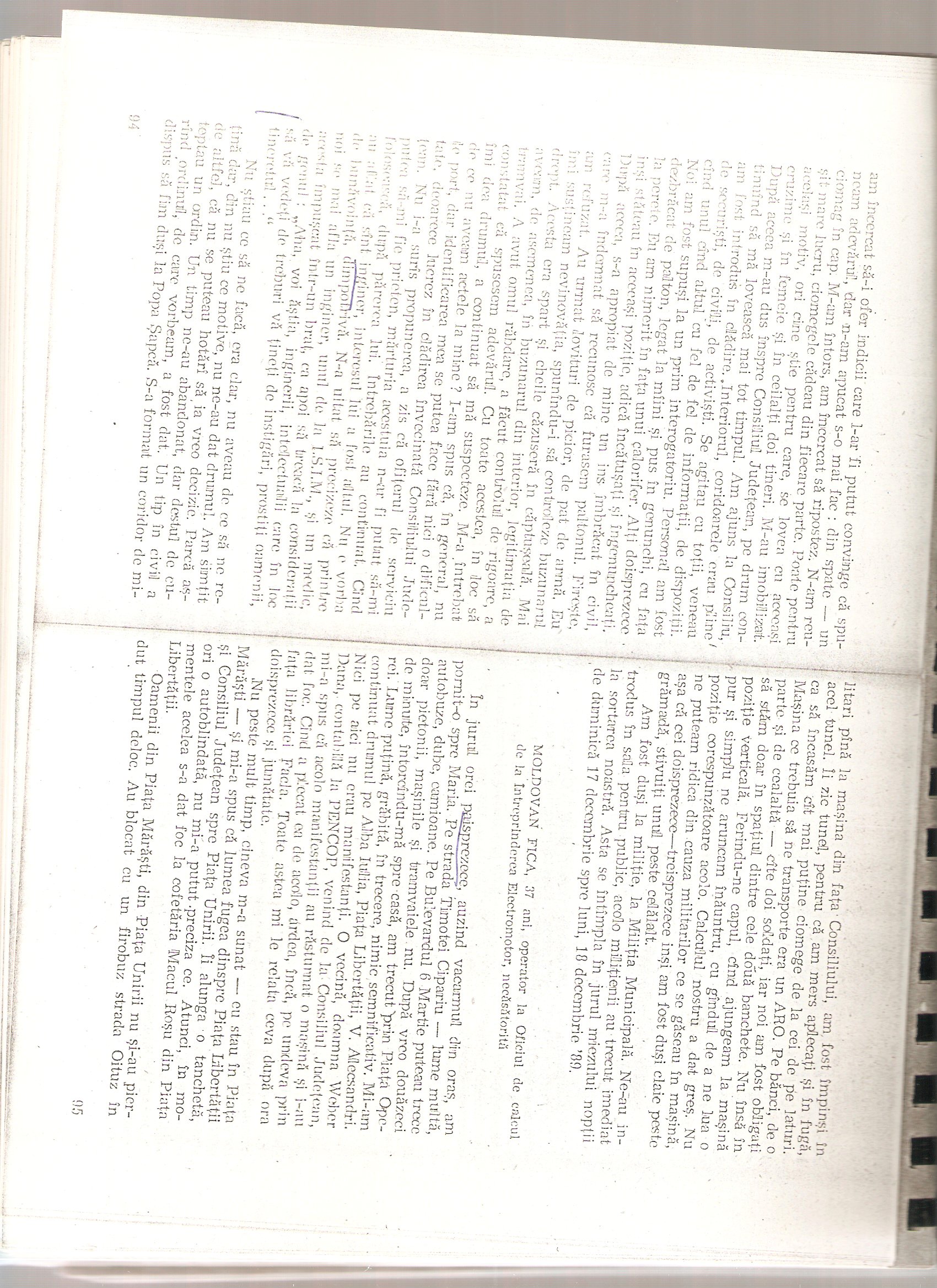
Eyewitness accounts recorded soon after the events–therefore at a time before the various plots and scenarios had permeated the popular imagination–support the hypothesis that the vandalism was organized. Moldovan Fica remarks:

I admit that I cannot escape a certain conclusion. All of this [destruction] was done by a group of about five or six individuals, whose calm demeanor and self-control continues to stay with me to this day. They did not run from the scene, they appeared as if they did not fear anything; I would say that, in fact, they were doing what was required of them, something which had been ordered directly of them![75]

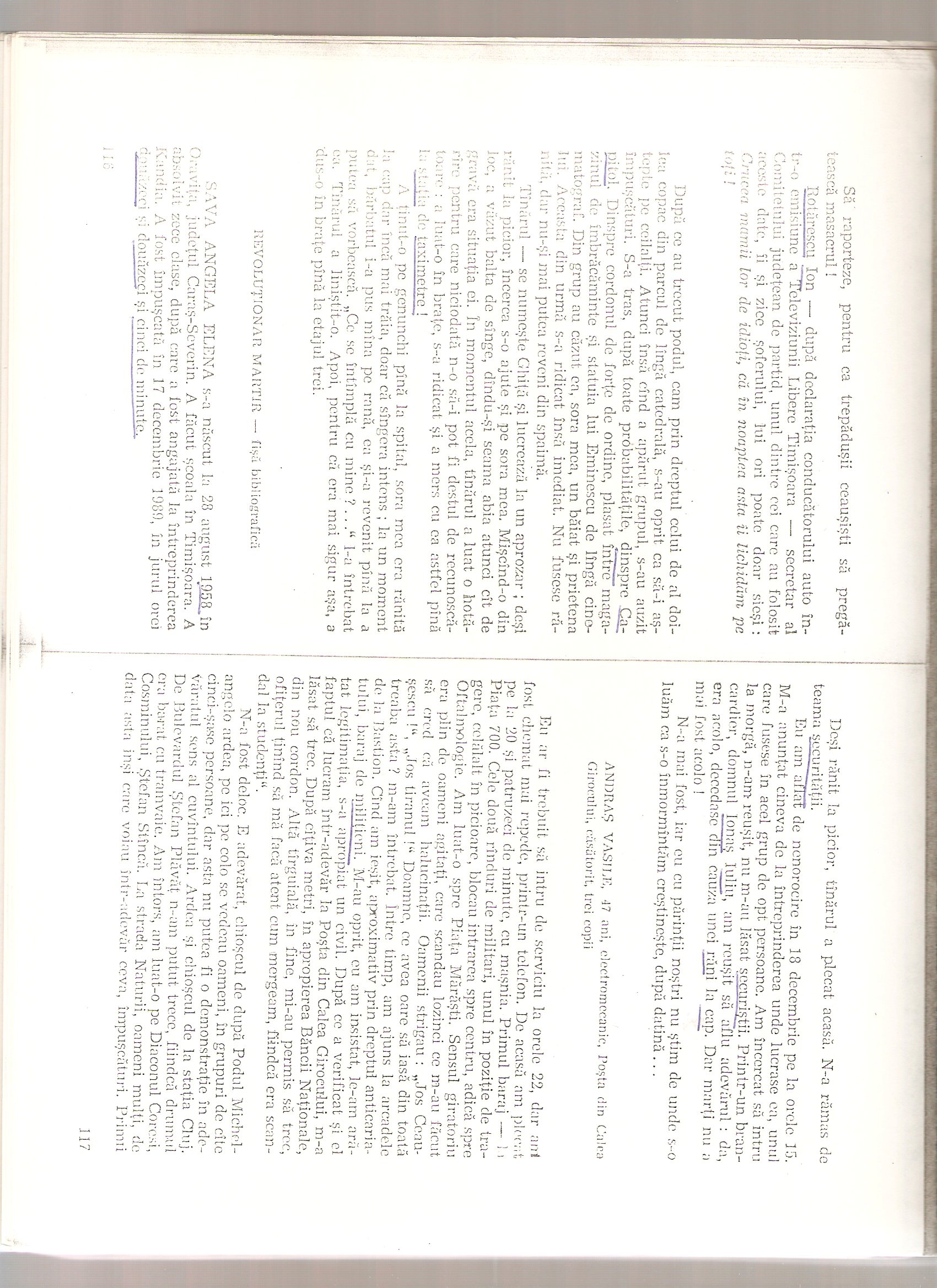
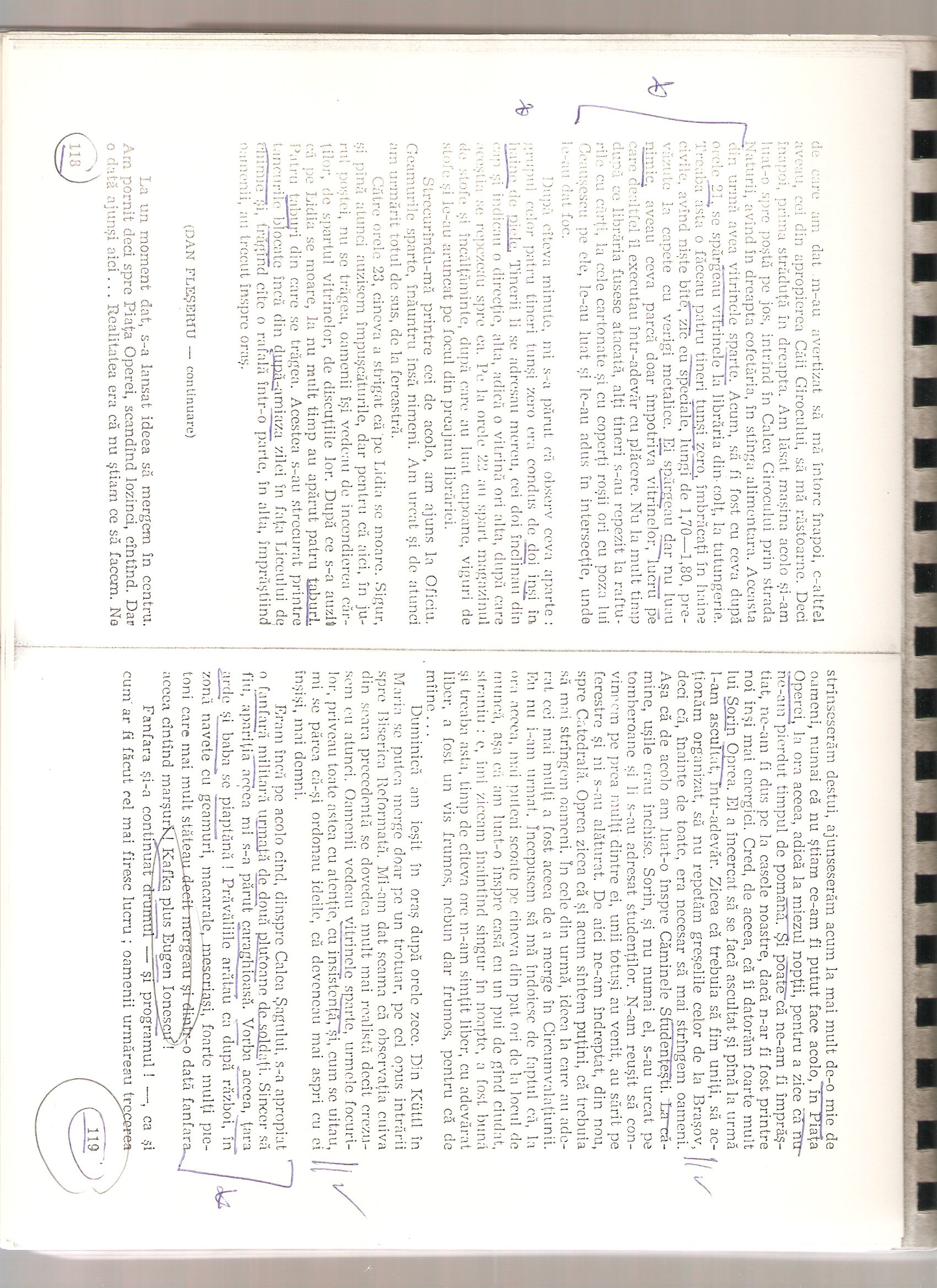
Describing destruction in a different part of the city, Andras Vasile observed that

…four young men with shaved heads and wearing civilian clothes had sticks–I would term them special sticks–1.7 to 1.8 meters long, equipped with metal rings on the top of them. They were breaking the windows, but not taking anything, as if they only had something against the windows, something which they thus went about with great enjoyment…they were led by two individuals in leather jackets.[76]

Other eyewitnesses supply details which confirm the widespread character of the vandalism; its undeniably organized quality; the disinterest of its perpetrators in looting the stores; and the almost “drugged” nature of the perpetrators, who seemed unperturbed by the chaos and repression going on around them.[77]

http://atomic-temporary-3899751.wpcomstaging.com/rewriting-the-revolution-1997/

image0-005

Moldovan Fica (martor ocular)

image0-001

image0

Andras Vasile (martor ocular)

image0-003

image0-002

image0-004

3) Radu Tinu cu Angela Bacescu…

The reportedly unusual scope of physical destruction which occurred in Timisoara, particularly on the afternoon and evening of 17 December 1989, has fueled revisionist arguments. Estimates of the damage during the Timisoara unrest are in the neighborhood of four to five billion lei (approximately forty to fifty million dollars at the time), a reasonably large sum given Romania’s standard of living at the time. A huge number of windows was broken and as many as 300 to 400 stores suffered some sort of damage, although relatively few were actually looted. On the evening of 17 December, stores, vehicles, and kiosks were burning in at least ten different areas of the city.[65]

Former Securitate officers clearly wish to link this destruction to the “foreign tourists” who were supposedly so ubiquitous in Timisoara during these days.[66] Perhaps somewhat surprisingly, former Securitate Director Iulian Vlad argued at his trial that

…the acts of vandalism, theft, destruction, arson… acts without precedent…could not have been the work [“opera”] of the faithful [apparently referring sarcastically to Tokes’ parishioners], nor the revolutionaries. They were produced by elements which wished to create a certain atmosphere of tension.[67]

image0-006

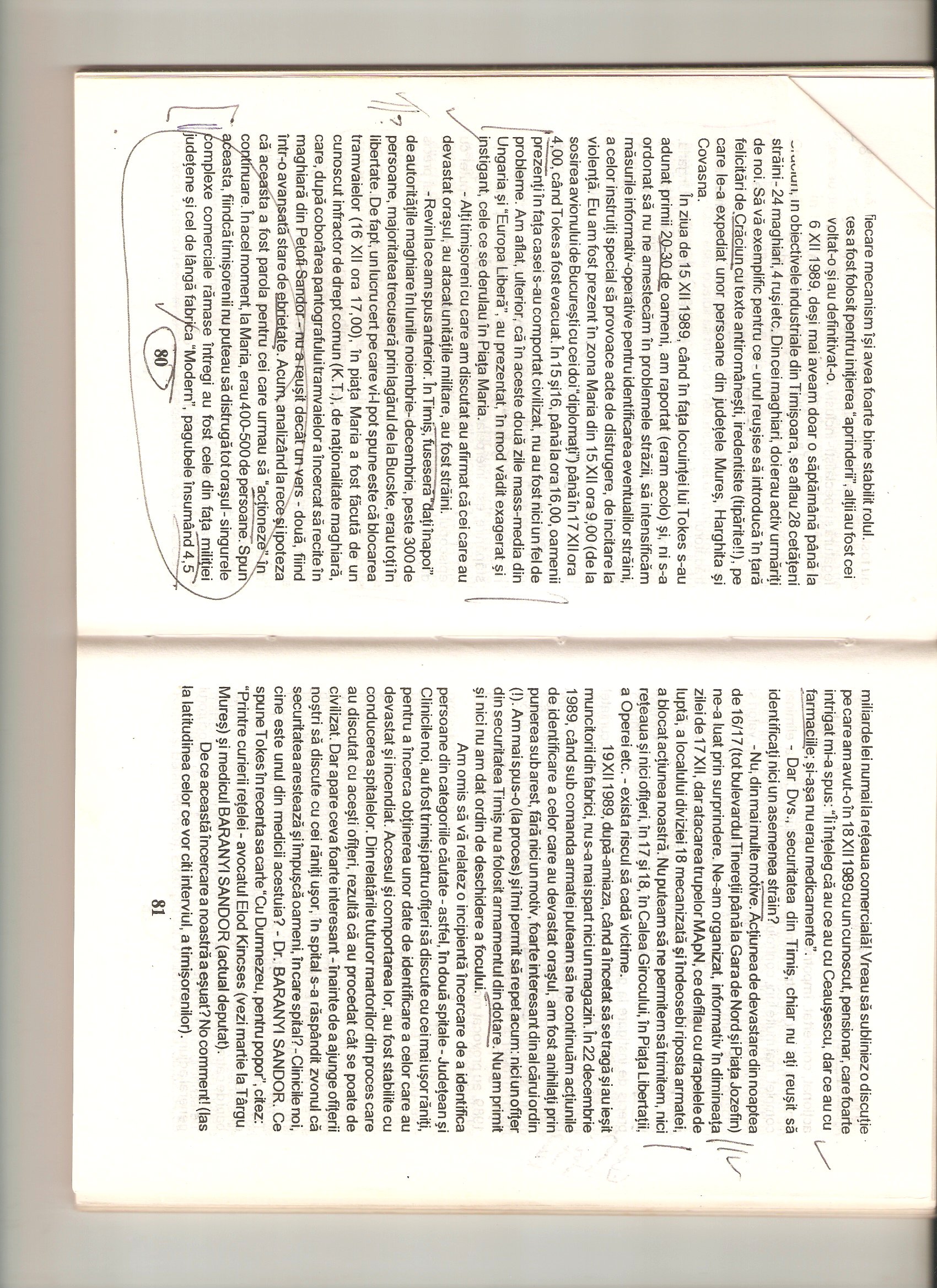
RADU TINU:…SINGURLE COMPLEXE COMERCIALE RAMASE INTREGI AU FOST CELE DIN FATA MILITIEI JUDETENE SI CEL DE LANGA FABRICA “MODERN”…

image0-007

image0-008

Posted in decembrie 1989 | Tagged: , , , , , , , , , , , | 1 Comment »

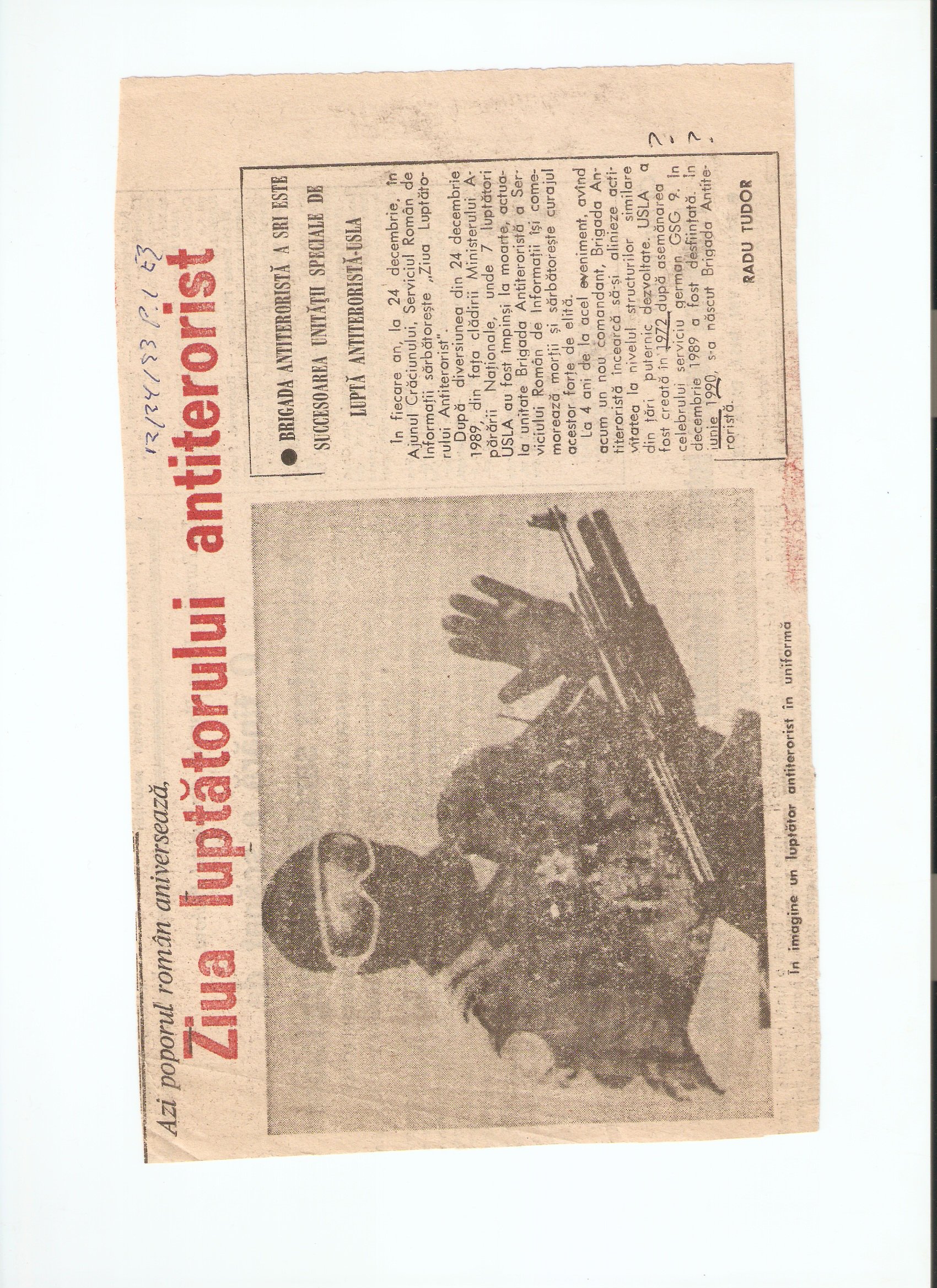
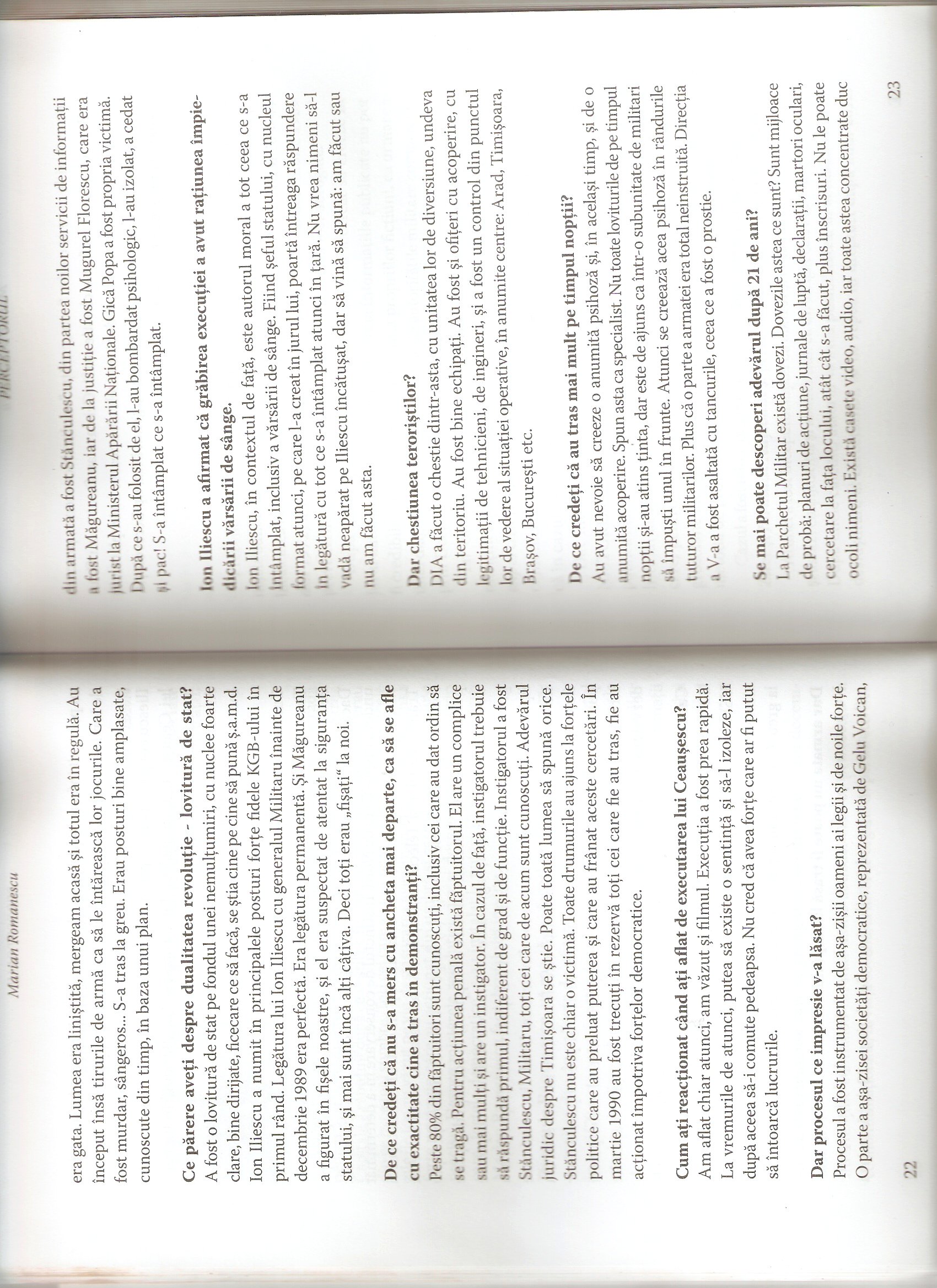
Cine a tras dupa 22? Cine au fost teroristii? Inca o dovada de adevar: ce lipseste din cartea lui Marian Romanescu (fost USLAs)?

Posted by romanianrevolutionofdecember1989 on December 22, 2013

(punct de vedere strict personal, va multumesc)

http://atomic-temporary-3899751.wpcomstaging.com/2011/04/08/bullets-lies-and-videotape-the-amazing-disappearing-romanian-counter-revolution-of-december-1989-part-vii-conclusion-those-who-told-us-the-truth-by-richard-andrew-hall-3/

cu 20 de ani…in urma…am fost in Romania…cu o bursa IIE-Fulbright…rasfoind presa bucuresteana… (Evenimentul Zilei, 24 decembrie 1993, p. 1)

image0-002

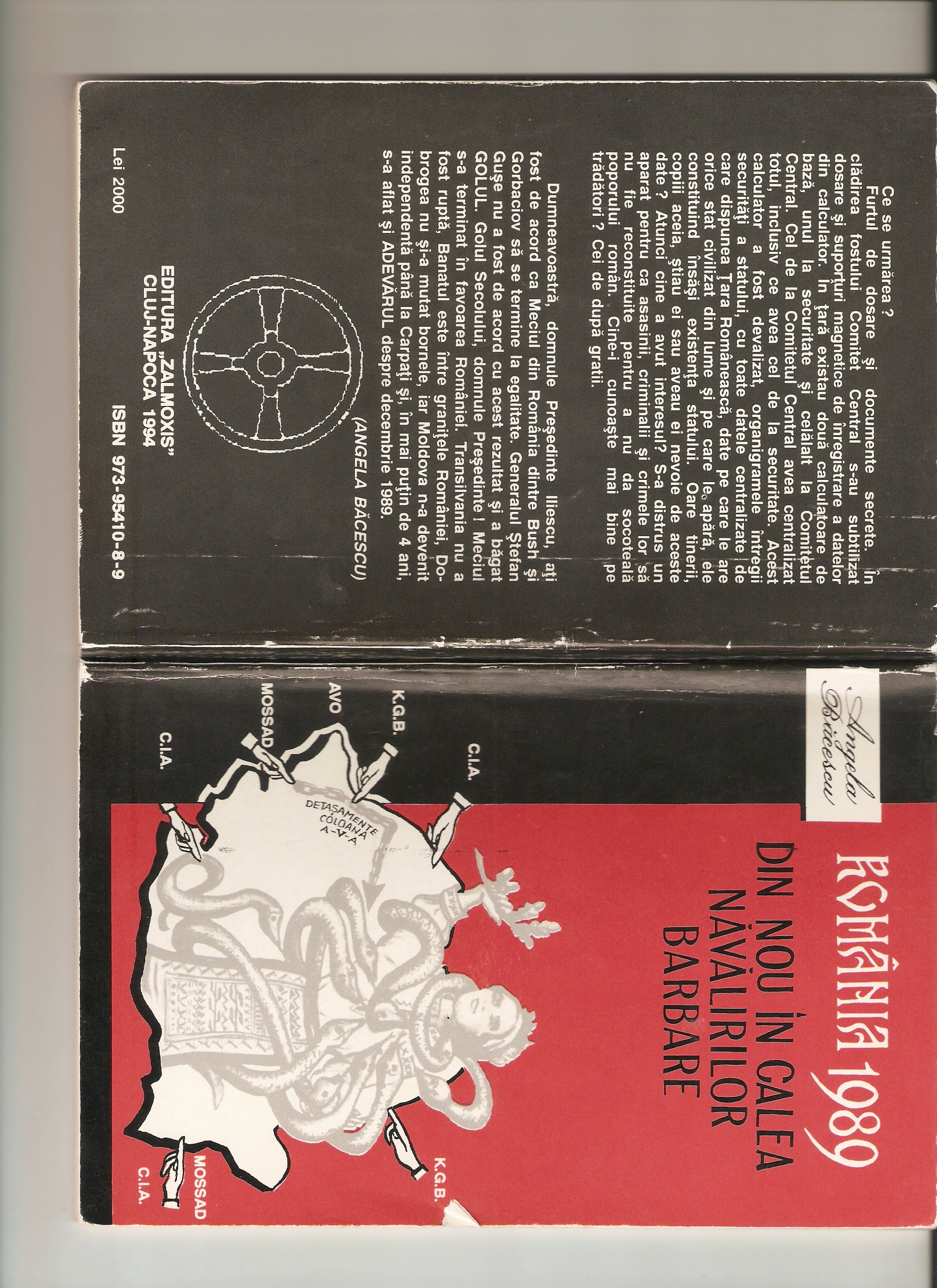
In cartea lui, USLA in stare de hipnoza.  Enigmele Revolutiei (2010), fost uslas Marian Romanescu spune ca teroristii din decembrie 1989 ar fi fost cadre din unitatea a armatei romane, DIA (pagina 23, la mijlocul) !  Deci, cu alte cuvinte:  teoria revizionista preferata a fostilor securisti! (http://atomic-temporary-3899751.wpcomstaging.com/2009/12/20/nicolae-plesita-si-gheorghe-ratiu-despre-decembrie-1989-teza-pretuita-a-securistilor-dia-e-de-vina/ ; http://atomic-temporary-3899751.wpcomstaging.com/2009/12/20/radaciniile-securiste-ale-tezei-dia-despre-decembrie-1989/ ; http://atomic-temporary-3899751.wpcomstaging.com/2009/12/20/dezinformare-securista-despre-decembrie-1989-in-actiune-zig-zag-anul-1990-angela-bacescu-teroristii-n-au-fost-securisti-nici-n-au-existat-teroristi-gheorghe-ionescu-olbojan-teroristii-au-2/)  Foarte interesant, fiindca la acelas timp in intreaga carte lipsesc cu desavarsire orice referire la existenta sau rolul lui USLAC (Unitatea Speciala de Lupta Antiterorista si Comando), deci informatiile despre care el a povestit in revista Expres in 1991.  Ce s-a intimplat?  Daca era o greseala atunci sau o dezinformare de ce sa nu vorbeasca acum despre aspectul acesta?  Problema este mult mai mare:  a fost adevarul atunci, dar este un adevar foarte neconvenabil pentru multi si e mai bine sa uitam…ca si cum teroristii n-ar fi existat deloc.

Bullets, Lies, and Videotape: The Amazing, Disappearing Romanian Counter-Revolution of December 1989 by Richard Andrew Hall, Ph.D.

Standard Disclaimer:  All statements of fact, opinion, or analysis expressed are those of the author and do not reflect the official positions or views of the Central Intelligence Agency (CIA) or any other U.S. Government agency.  Nothing in the contents should be construed as asserting or implying U.S. Government authentication of information or CIA endorsement of the author’s views.  This material has been reviewed by CIA to prevent the disclosure of classified information.  [Submitted 19 November 2009; PRB approved 15 December 2009]

I am an intelligence analyst for the Central Intelligence Agency.  I have been a CIA analyst since 2000.  Prior to that time, I had no association with CIA outside of the application process.

Those Who Have Told Us the Truth [1]

As opposed to the aforementioned Vladimir Belis, Pavel Corut, and Dan Voinea, all of whom who have strenuously and repeatedly denied the existence and use in December 1989 of atypical munitions of dum-dum bullets and vidia bullets, there exist those who have told us of the existence and use of these in December 1989.[2] They are essentially, for lack of a better term, former Securitate whistleblowers, who have admitted the Securitate’s role in providing the “terrorists” who caused so much destruction, mayhem, and loss of life in those days…

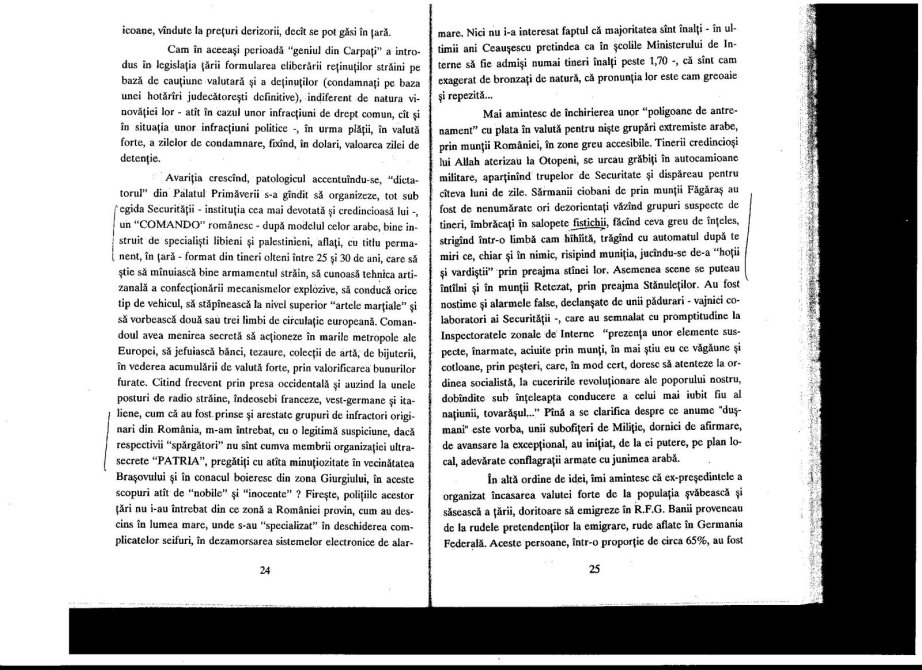
Those discussed as alternatively “commandos” or “professionals” appear to have been members of the so-called USLAC—Special Unit for Anti-terrorist and Commando Warfare.  In 1991, Dan Badea summarized former USLA Captain Marian Romanescu’s description of the USLAC as follows:

THE USLAC COMMANDOS:

Those who had and have knowledge about the existence and activities of the shock troops subordinated directly to Ceausescu remained quiet and continue to do so out of fear or out of calculation.  Much has been said about individuals in black jumpsuits, with tattoos on their left hand and chest, mercenary fanatics who acted at night, killing with precision and withdrawing when they were encircled to the underground tunnels of Bucharest.  Much was said, then nobody said anything, as if nothing had ever happened.

Traversing the [Securitate’s] Fifth Directorate and the USLA, the USLAC commandos were made up of individuals who ‘worked’ undercover at different posts.  Many were foreign students, doctoral students and thugs committed with heart and soul to the dictator.  Many were Arabs who knew with precision the nooks and crannies of Bucharest, Brasov and other towns in Romania.  For training these had at their disposal several underground centers of instruction:  one was in an area near Brasov, while another—it appears—was right under the former headquarters of the PCR CC [communist party central committee building], a shooting range that was—discovered by accident by several revolutionaries during the events of December .”[6]

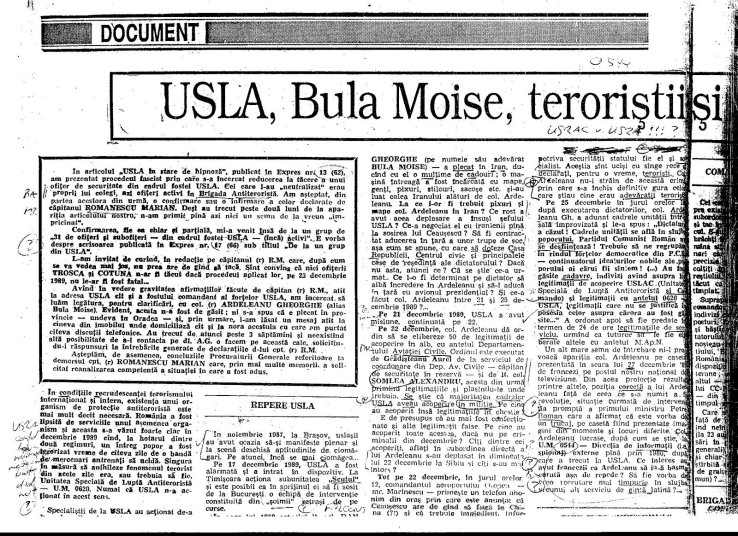
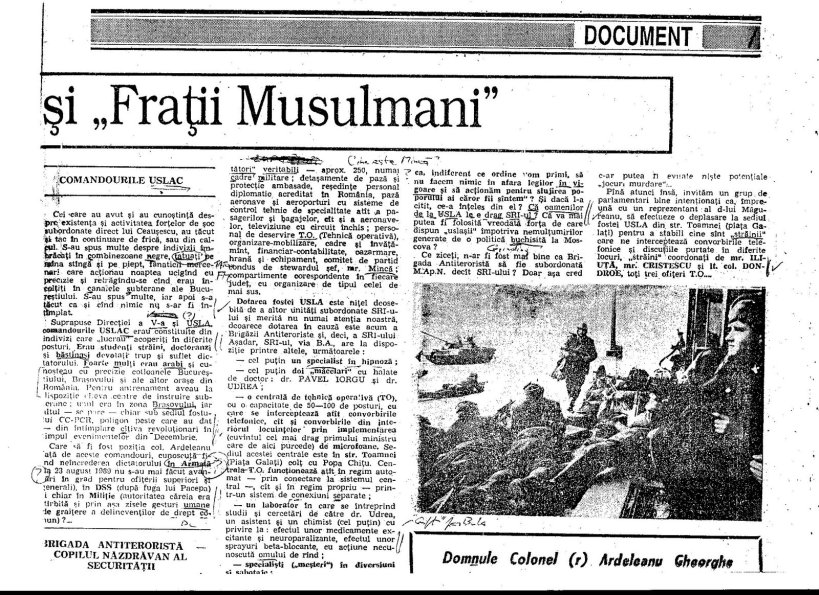
http://atomic-temporary-3899751.wpcomstaging.com/2009/12/10/decembrie-1989-usla-bula-moise-teroristii-si-fratii-musulmani-dan-badea-marian-romanescu-expres-iulie-1991/

image0

We also know from Romanescu and a second source that USLA commander Gheorghe Ardeleanu (Bula Moise) addressed his troops as follows:

“On 25 December at around 8 pm, after the execution of the dictators, Colonel Ardeleanu gathered the unit’s members into an improvised room and said to them:

‘The Dictatorship has fallen!  The Unit’s members are in the service of the people.  The Romanian Communist Party [PCR] is not disbanding!  It is necessary for us to regroup in the democratic circles of the PCR—the inheritor of the noble ideas of the people of which we are a part!…Corpses were found, individuals with USLAC (Special Unit for Antiterrorist and Commando Warfare) identity cards and identifications with the 0620 stamp of the USLA, identity cards that they had no right to be in possession of when they were found…’  He instructed that the identity cards [of members of the unit] had to be turned in within 24 hours, at which time all of them would receive new ones with Defense Ministry markings.” [7] [8]

In other words, a cover-up of a now failed attempt at counter-revolution—having been cut short by the execution of the Ceausescus, the object of their struggle—had begun.  In the days and weeks that were to follow, the Securitate, including people such as the seemingly ubiquitous Colonel Ghircoias discussed in the opening of this article would go about recovering those “terrorists” who were unlucky enough to be captured, injured, or killed.  By 24 January 1990, the “terrorists” of the Romanian Counter-Revolution of December 1989, no longer existed, so-to-speak, and the chances for justice and truth about what had happened in December 1989 would never recover.[9]

http://atomic-temporary-3899751.wpcomstaging.com/2009/12/12/u-s-l-a-in-stare-de-hipnoza-dan-badea-expres-1991/

http://atomic-temporary-3899751.wpcomstaging.com/2009/12/10/decembrie-1989-usla-bula-moise-teroristii-si-fratii-musulmani-dan-badea-marian-romanescu-expres-iulie-1991/

Sediul U.S.L.A , pe 25 decembrie 1989 in jurul orelor 18…

Pe 25 decembrie in jurul orelor 18, dupa executarea dictatorilor, col. Ardeleanu Gh. a adunat cadrele unitatii intr-o sala
improvizata si le-a spus: “Dictatura a cazut! Cadrele unitatii se afla in slujba
poporului. Partidul Comunist Roman nu se desfiinteaza! Trebuie sa ne regrupam in
rindul fortelor democratice din P.C.R.–continuatorul idealurilor nobile ale
poporului ai carui fii sintem ! (…) Au fost gasite cadavre, indivizi avind
asupra lor legitimatii de acoperire USLAC (Unitatea Speciala de Lupta
Antiterorista si Comando) si legitimatii cu antetul 0620–USLA, legitimatii care
nu se justifica in posesia celor asupra carora au fost gasite…” A ordonat apoi
sa fie predate in termen de 24 de ore legitmatiile de serviciu, urmind ca
tuturor sa le fie eliberate altele cu antetul M.Ap.N.

(capitanul Romanescu Marian, cu Dan Badea, “USLA, Bula Moise, teroristii si
‘Fratii Musulmani’,” Expres nr. 26 (75), 2-8 iulie 1991, 8-9)

image-15

(Capitanul Romanescu Marian (fost cadru USLA) si Dan Badea, “USLA, Bula Moise, teroristii, si ‘Fratii Musulmani’,” Expres nr. 26 (75), 2-8 iulie 1991, pp. 8-9)

COMANDOURILE USLAC

Cei care au avut si au cunostinta despre existenta si activitatea fortelor de soc subordonate direct lui Ceausescu, au tacut si tac in continuare de frica, sau din calcul.  S-au spus multe despre indivizii imbracati in combinezoane negre, tatuati pe mina stinga si pe piept, fanaticii mercenari care actionau noaptea ucigind cu precizie si retragindu-se cind erau incoltiti in canalele subterane ale Bucurestiului.  S-au spus multe, iar apoi au tacut ca si cind nimic nu s-ar fi intimplat.

Suprapuse Directiei a V-a si USLA comandourile USLAC erau constituite din indivizi care “lucrau” acoperiti in diferite posturi. Erau studenti straini, doctoranzi si bastinasi devotati trup si suflet dictatorului.  Foarte multi erau arabi si cunosteau cu precizie cotloanele Bucurestiului, Brasovului si ale altor orase din Romania.  Pentru antrenament aveau la dispozitie citeva centre de instruire subterane:  unul era in zona Brasovului, iar altul–se pare–chiar sub sediul fostului CC-PCR, poligon care au dat–din intimplare citiva revolutionari in timpul evenimentelor din Decembrie.

image-13

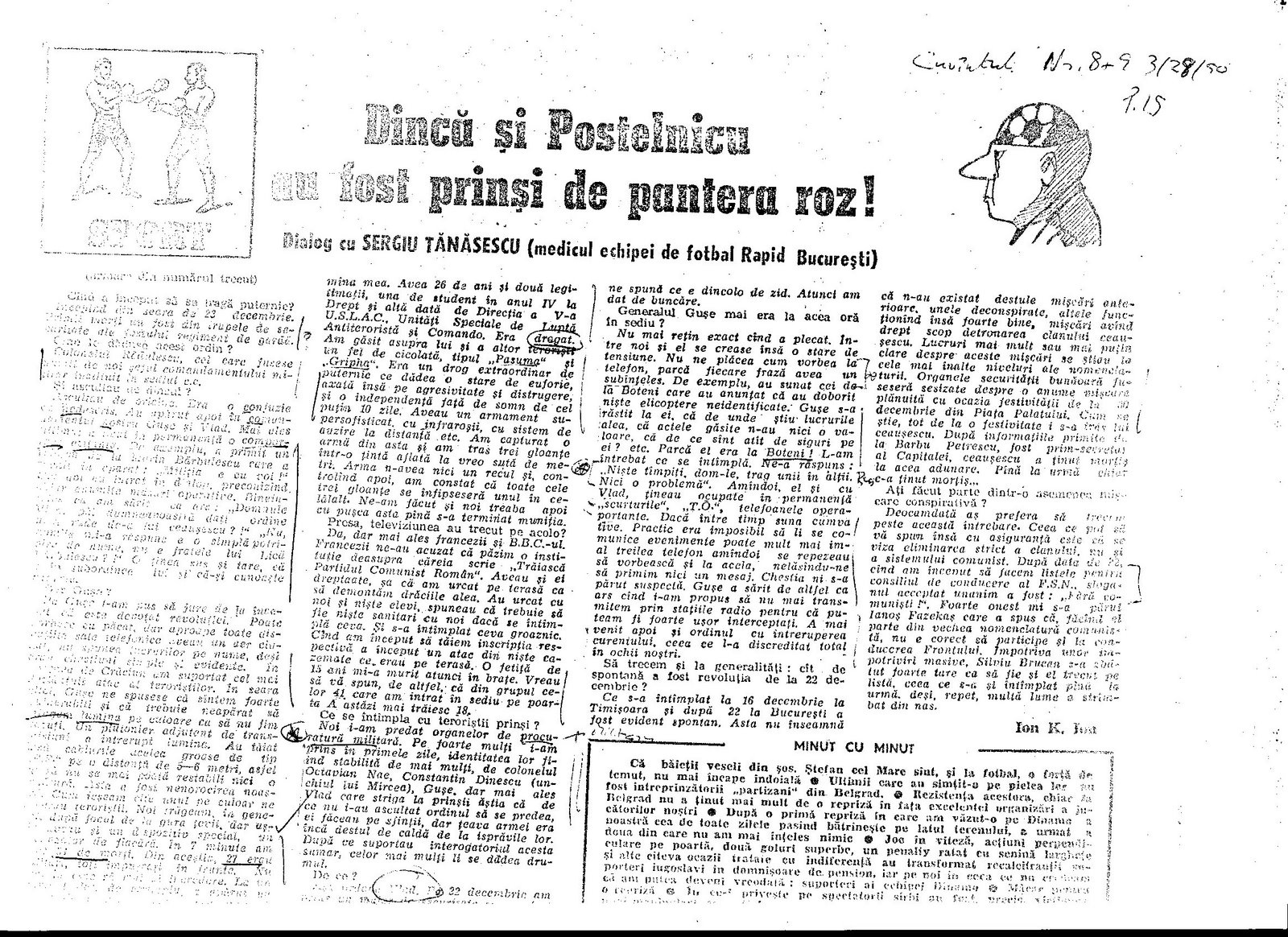
I.I.: S-a vinturat prin presa ideea prezente unor teroristi straini…

S.T.: Imi veti ingadui sa nu ma priveasca aceasta problema ea tine de competenta
istoriei. De acord?

I.I.: O.K.

S.T.: Pe un terorist l-am prins chiar eu, mina mea. Avea 26 de ani si doua
legitimatii, una de student in anul IV la Drept si alta data de Directia a V-a
U.S.L.A.C. Unitati Speciale de Lupta Antiterorista si Comando. Era drogat. Am
gasit asupra lui si a altor teroristi un fel de cicolata, tipul “Pasuma” si
“Gripha”. Era un drog extraordinar de puternic ce dadea o stare de euforie,
axata insa pe agresivitate si distrugere, si o independenta fata de somn de cel
putin 10 zile. Aveau un armament supersofisticat, cu infrarosii, cu sistem de
auzire la distanta etc. Am capturat o arma din asta si am tras trei gloante
intr-o tinta aflata la vreo suta de metri. Arma n-avea nici un recul si,
controlind apoi, am constatat ca toate cele trei gloante se infipsesera unul in celalalt. Ne-am facut si
noi treaba apoi cu pusca asta pina s-a terminat munitia.

I.I. : Ce se intimpla cu teroristii prinsi?

S.T.: Noi i-am predat organelor de procuratura militara. Pe foarte multi i-am
prins in primele zile, identitatea lor fiind stabilita de mai multi, de
colonelul Octavian Nae, Constantin Dinescu (unchiul lui Mircea), Guse, dar mai
ales Vlad care strig la prinsii astia ca de ce nu i-au ascultat ordinul sa se
predea, ei faceau pe sfintii, dar teava armei era inca destul de calda de la
ispravile lor. Dupa ce suportau interogatoriul acesta sumar, celor mai multi li
se dadea drumul.

I.I.: De ce?

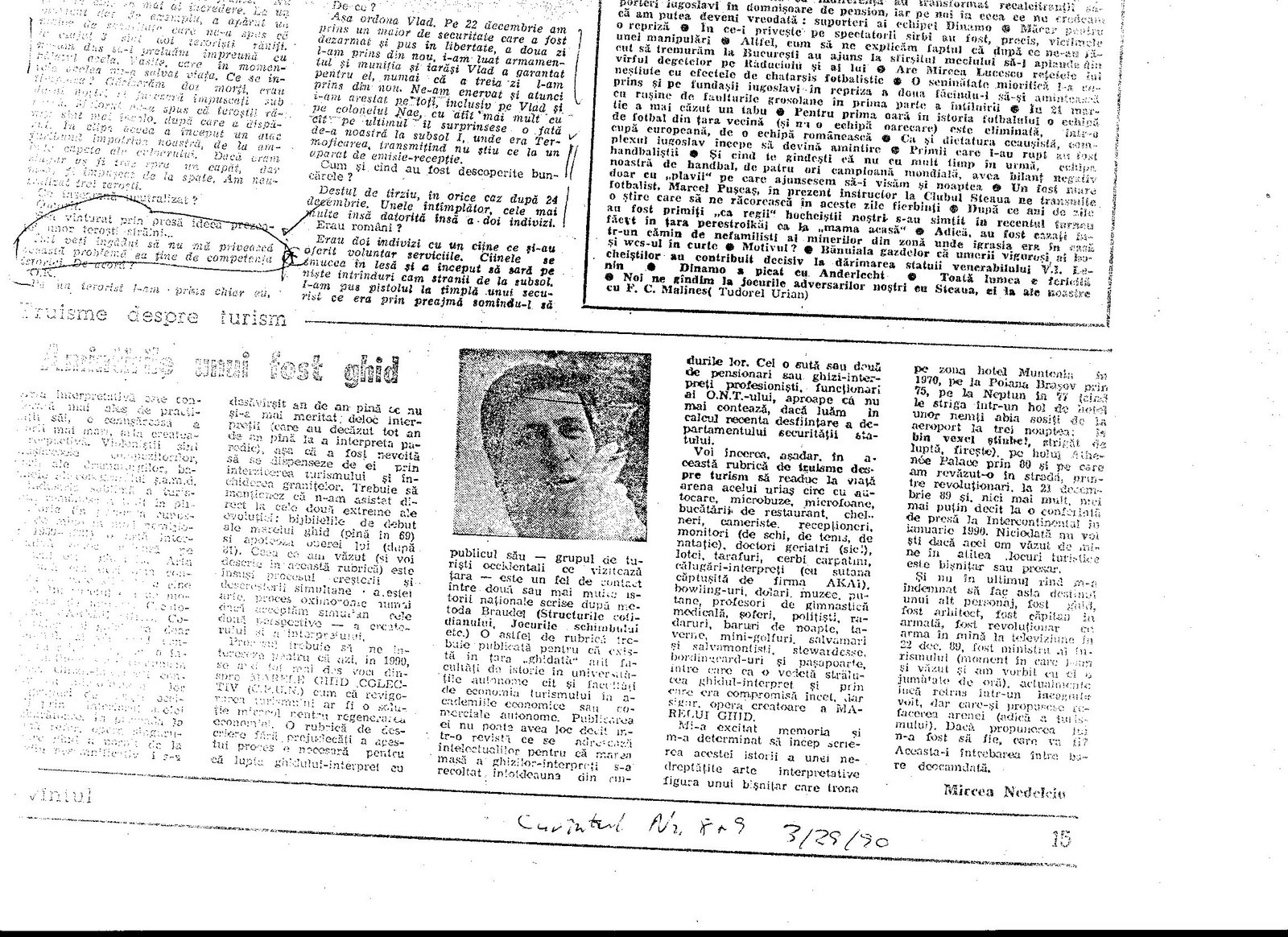
S.T. Asa ordona Vlad. Pe 22 decembrie am prins un maior de securitate care a
fost dezarmat si pus in libertate, a doua zi l-am prins din nou, i-am luat
armamentul si munitia si iarasi Vlad a garantat pentru el, numai ca a treia zi
l-am prins din nou. Ne-am enervat si atunci i-am arestat pe toti, inclusiv pe
Vlad si pe colonelul Nae, cu atit mai mult cu cit pe ultimul il surprinsese o fata de a noastra la subsol I,
unde era Termoficarea, transmitind nu stiu ce la un aparat de emisie-receptie.

I.I.: Cum si cind au fost descoperite buncarele?

S.T.: Destul de tirziu, in orice caz dupa 24 decembrie. Unele intimplator, cele
mai multe insa datorita insa a doi indivizi….

(Sergiu Tanasescu, cu Ion K. Ion, “Dinca si Postelnicu au fost prinsi de pantera
roz!” Cuvintul, nr. 9 29 martie 1990, p. 15.)

0436

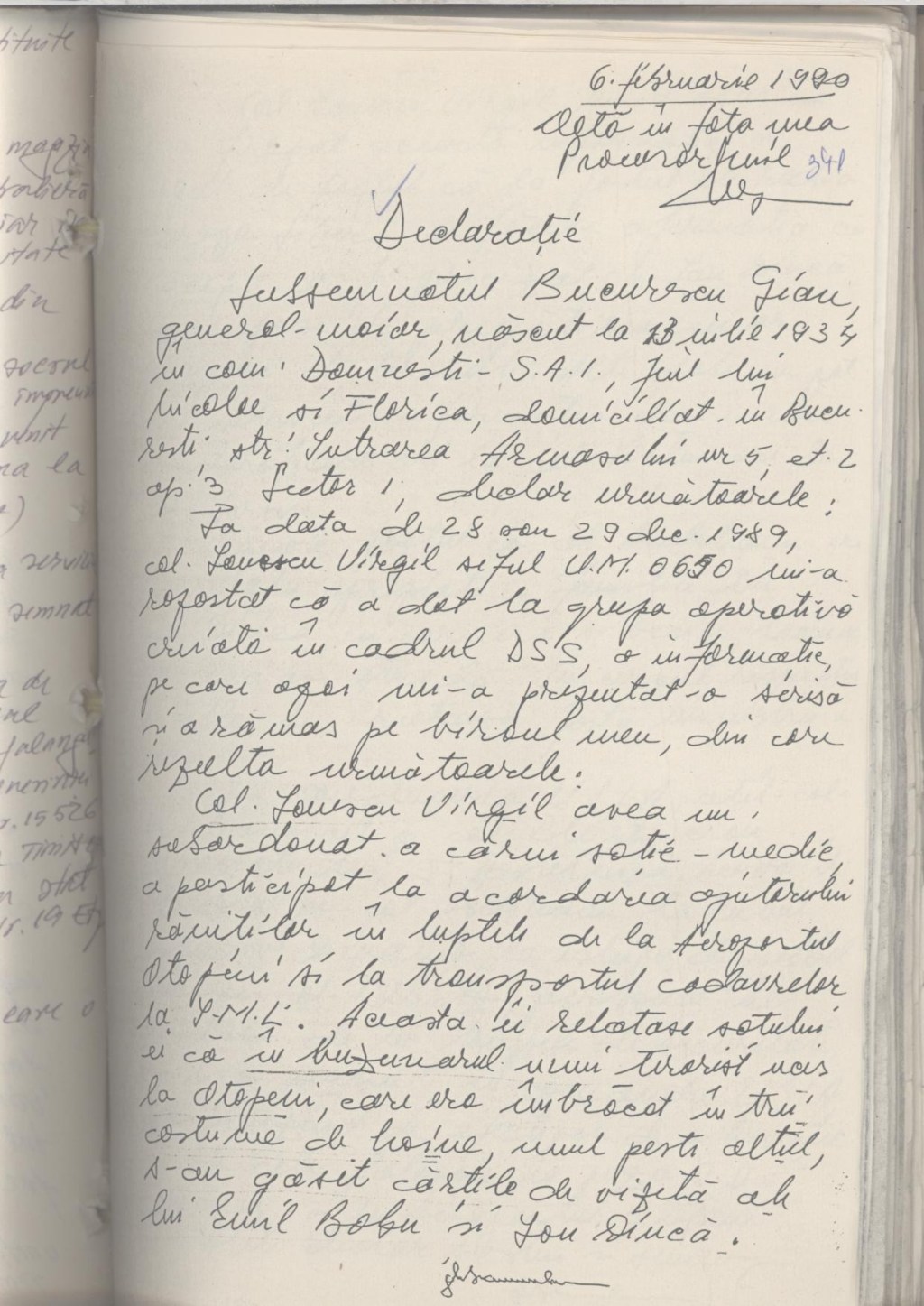
6 februarie 1990

Declaratie.  Subsemnatul Bucurescu Giani, general-maior [D.S.S.]

La data de 28 sau 29 decembrie 1989, col. Lovescu [?] Virgil seful U.M. 0650 mi-a raportat ca…

Col. Lovescu [?] Virgil avea un subordonat a carui sotie-medic a participat la acordarea ajutorului ranitilor in luptele de la Aeroport Otopeni si la transportarea cadavrelor la I.M.L.  Acestea ii relatase sotului ca in buzunarul unui terorist ucis la Otopeni, care era imbracat in trei costume de haine, unul peste altul, s-au gasit cartile de vizita ale lui Emil Bobu si Ion Dinca.

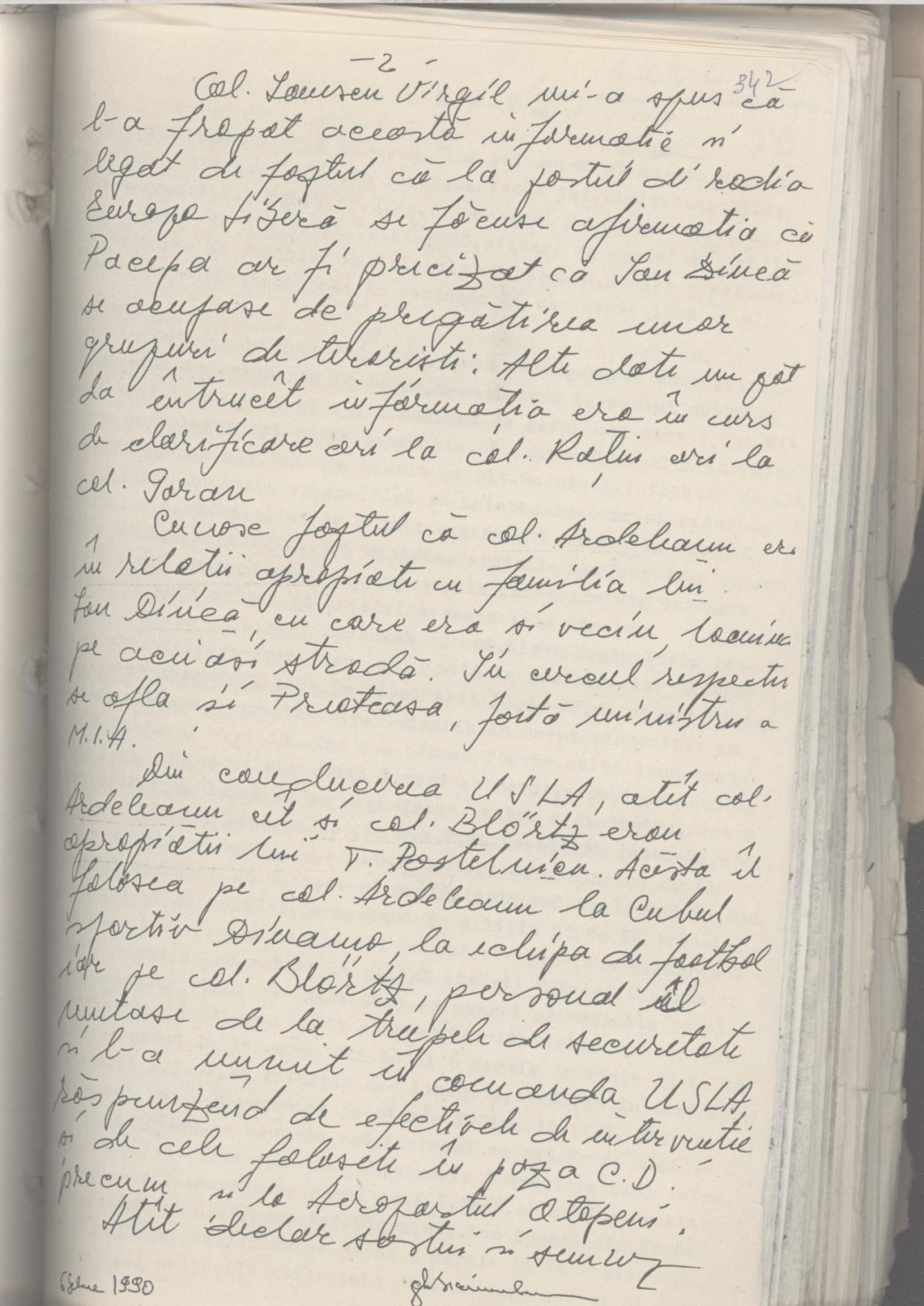
Col. L Virgil mi-a spus ca l-a frapat aceasta informatie si legat de faptul ca la postul de Radio Europa Libera se facuse afirmatie cu Pacepa ar fi precizat ca Ion Dinca se ocupase de pregatirea unor grupuri de teroristi.  Alte date nu pot da intrucit informatia era in curs de clarificare ori la Col. Ratiu [DSS Dir I] ori la Col. Goran [SMB]…

Cunosc [?] faptul ca col. Ardeleanu [sef USLA] era in relatii apropriate cu familia lui Ion Dinca…

Din conducerea USLA atit col. Ardeleanu cit si col Blortz [Bleort] erau apropriatii lui T. Postelnicu

0437

http://atomic-temporary-3899751.wpcomstaging.com/2012/12/28/what-can-we-learn-from-dosarele-revolutiei-de-la-timisoara-vi/

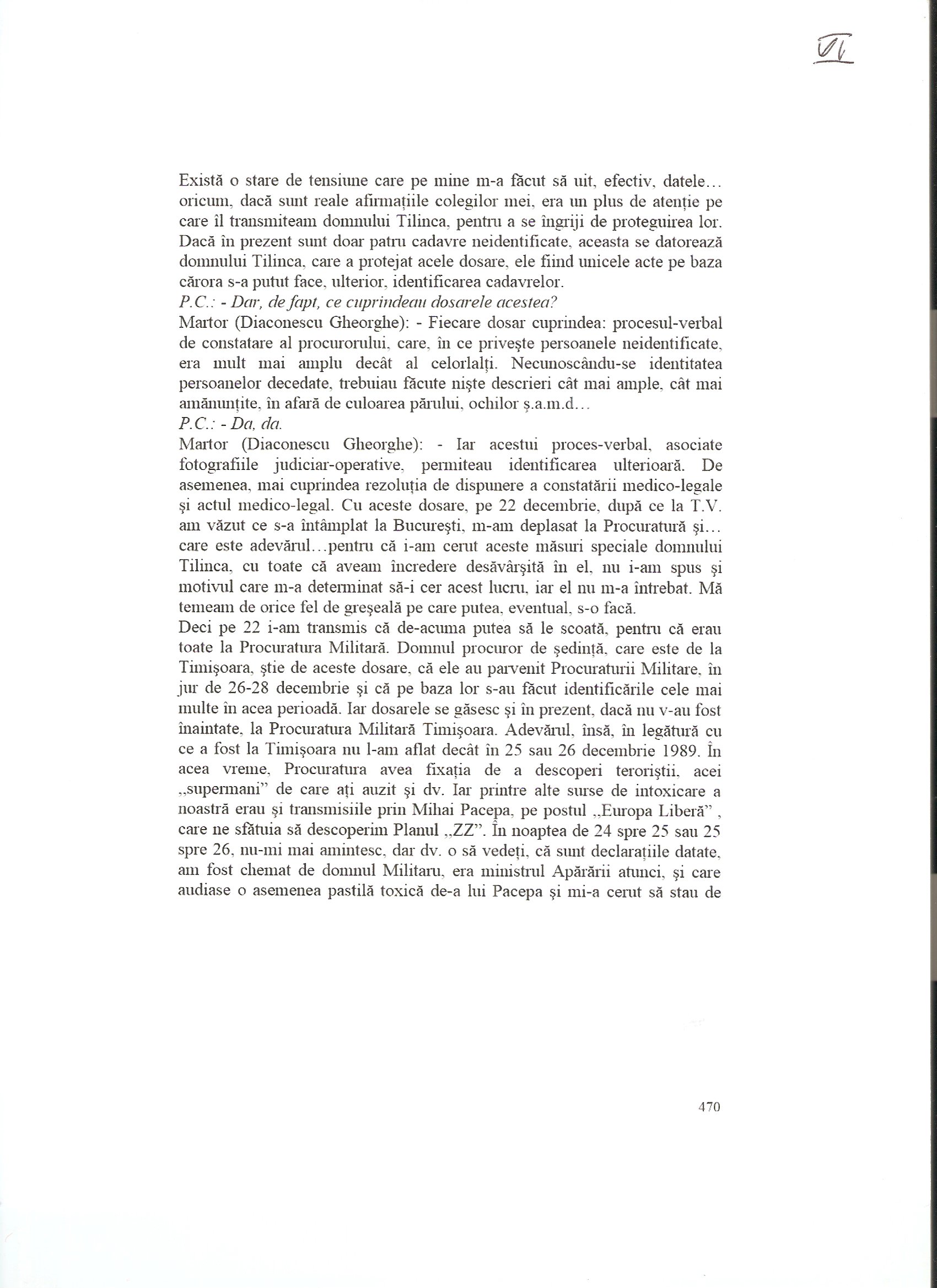
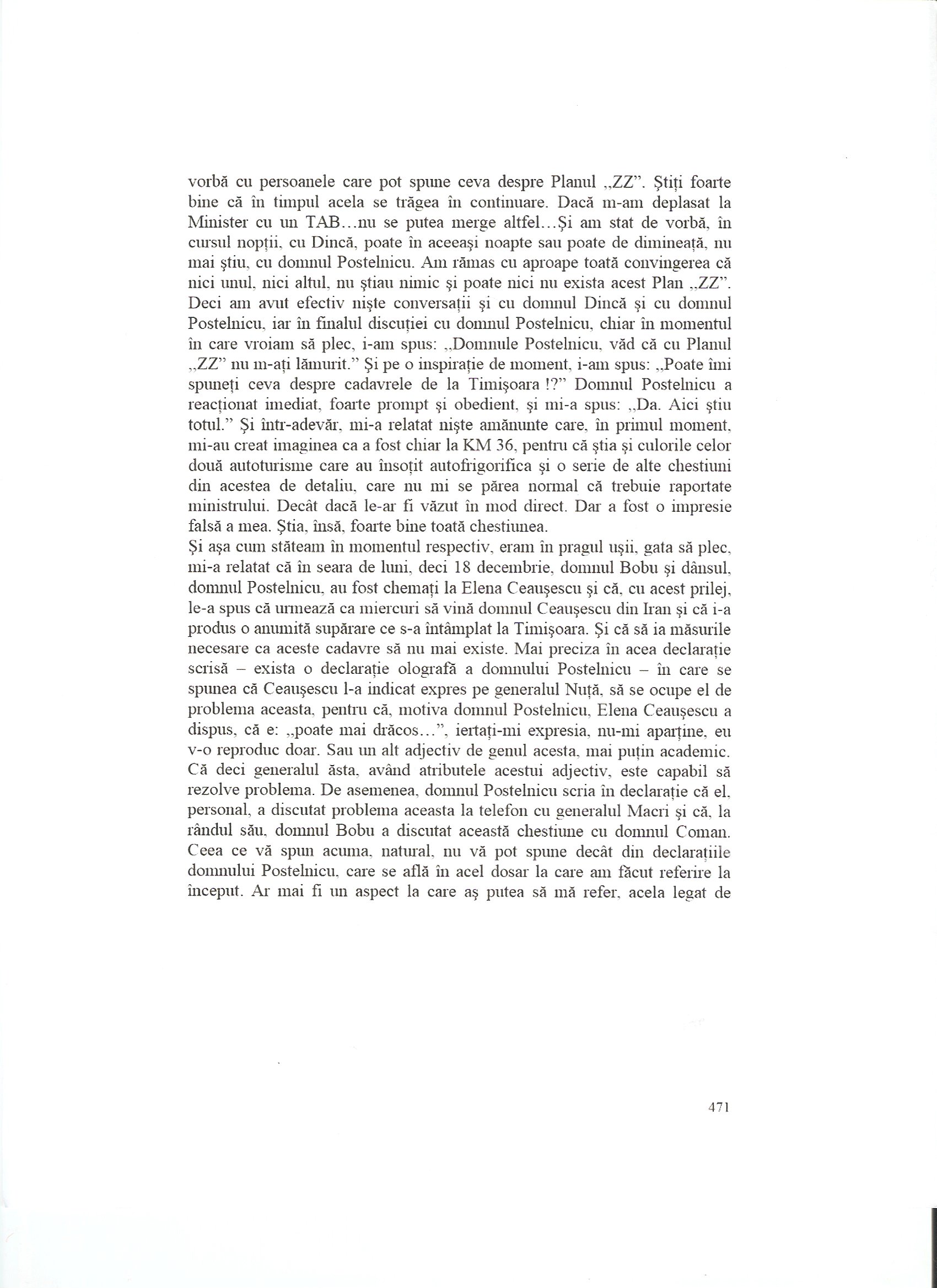
We have two different accounts from Gheorghe Diaconescu, which roughly match:

http://www.banaterra.eu/romana/files/procesul_de_la_timisoara_volumul_VI_continut.pdf

image0

image0-001

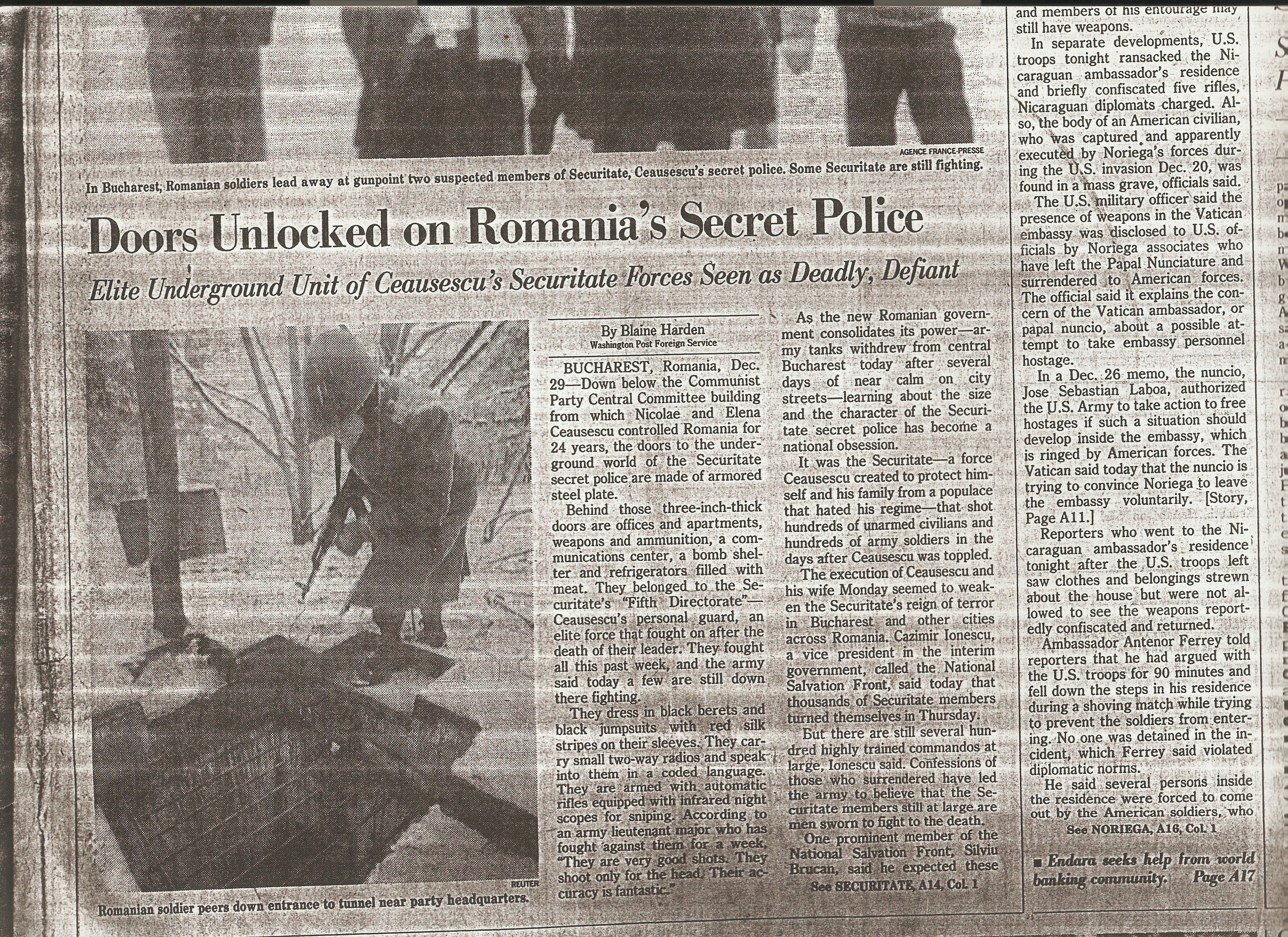
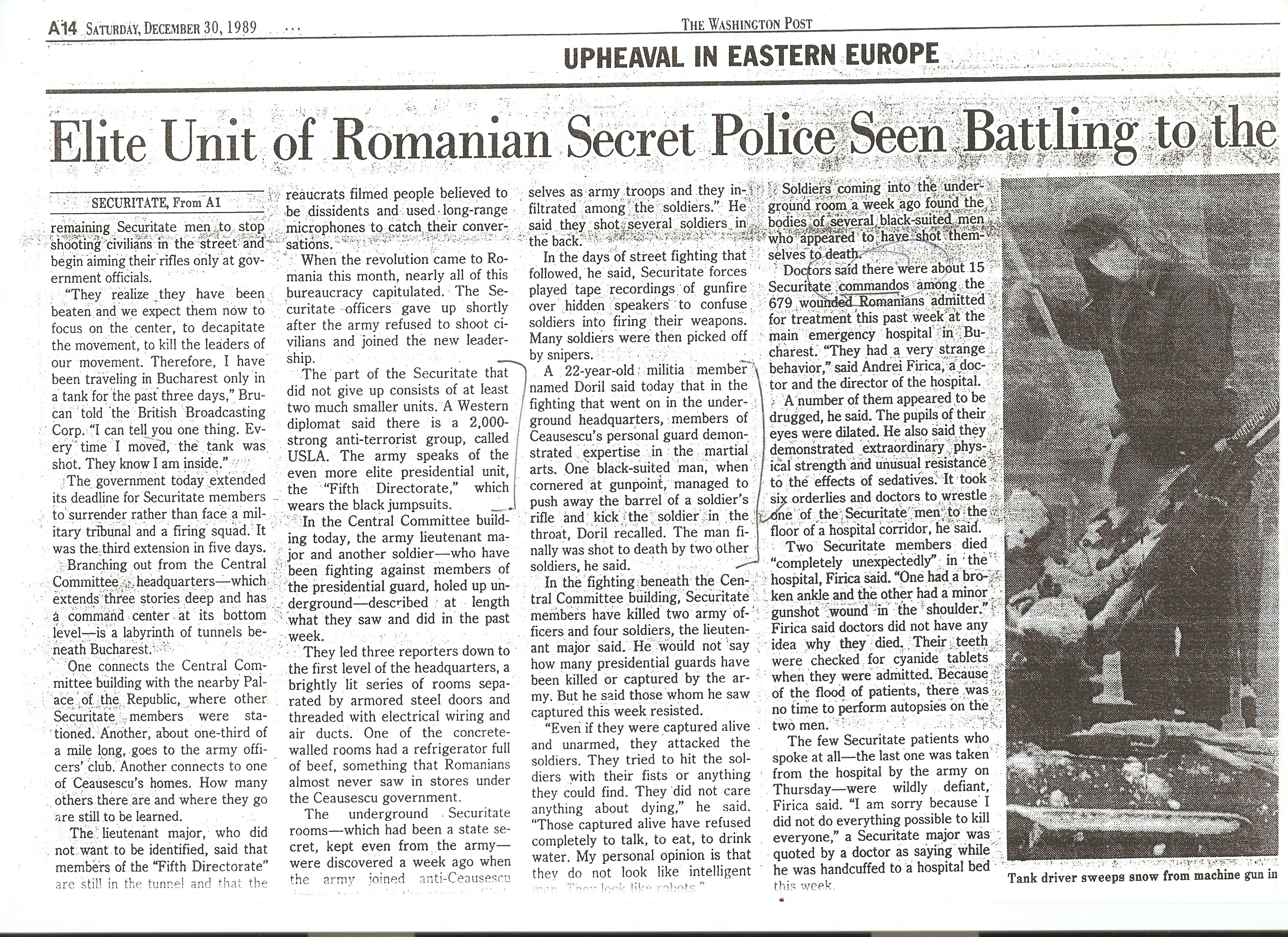
“They dress in black berets and black jumpsuits [combinezoane negre, salopete negre] with red silk stripes on their sleeves.  They carry small two-way radios and speak into them in coded language.  They are equipped with automatic rifles with infrared nightscopes for sniping.”


http://atomic-temporary-3899751.wpcomstaging.com/2010/11/19/les-souterrains-de-bucarest-ja2-20h-27121989-01min55s/

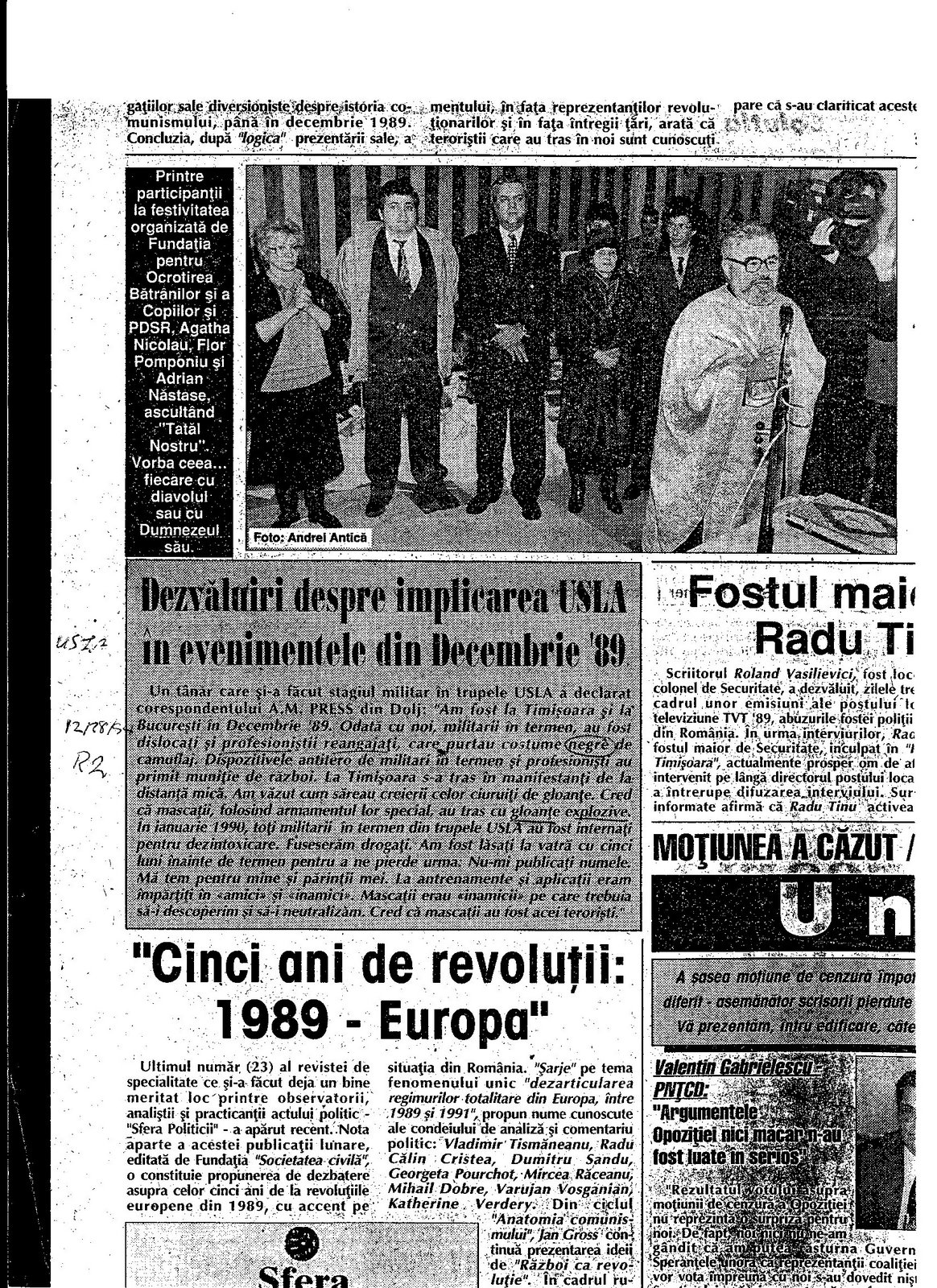
Dezvaluiri despre implicarea USLA in evenimentele din Decembrie ‘89

Un tanar care si-a facut stagiul militar in trupele USLA a declarat
corespondentului A.M. PRESS din Dolj: “Am fost la Timisoara si la Bucuresti in
Decembrie ‘89. Odata cu noi, militarii in termen, au fost dislocati si
profesionistii reangajati, care purau costume negre de camuflaj. Dispozitivele
antitero de militari in termen si profesionisti au primit munitie de razboi. La
Timisoara s-a tras in manifestanti de la distanta mica. Am vazut
cum sareau creierii celor ciuruiti de gloante. Cred ca mascatii, folosind armamentul lor special, au tras cu
gloante explozive.
In ianuarie 1990, toti militarii in termen din trupele USLA
au fost internati pentru dezintoxicare. Fusesaram drogati. Am fost lasati la
vatra cu cinci luni inainte de termen pentru a ne pierde urma. Nu-mi publicati
numele. Ma tem pentru mine si parintii mei. La antranamente si aplicatii eram
impartiti in “amici” si “inamici.” Mascatii erau “inamicii” pe care trebuia sa-i
descoperim si sa-i neutralizam. Cred ca mascatii au
fost acei teroristi.”

(Romania Libera, 28 Decembrie 1994, p. 3)

image-18image-17image-16image-15

image-4image-9

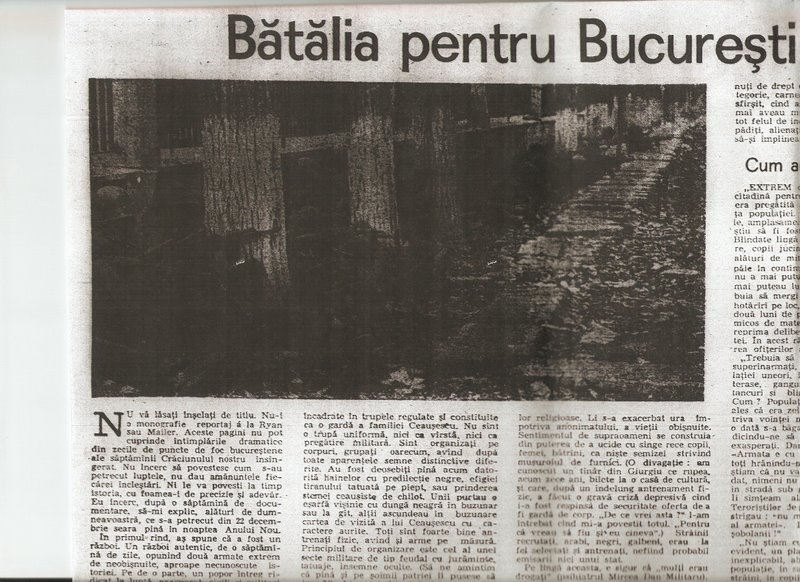
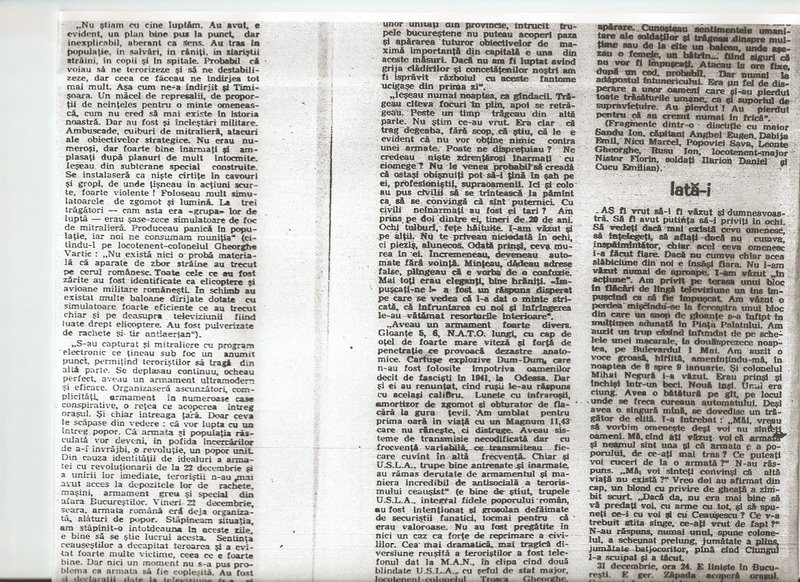
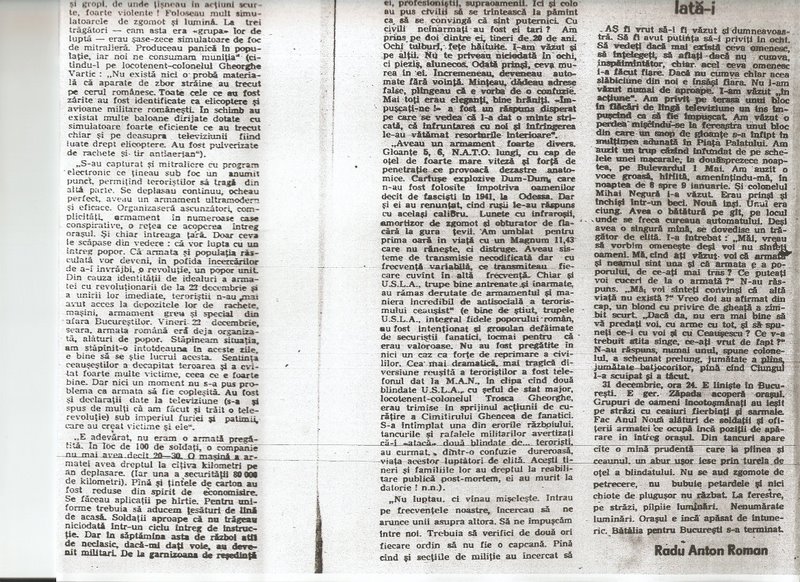
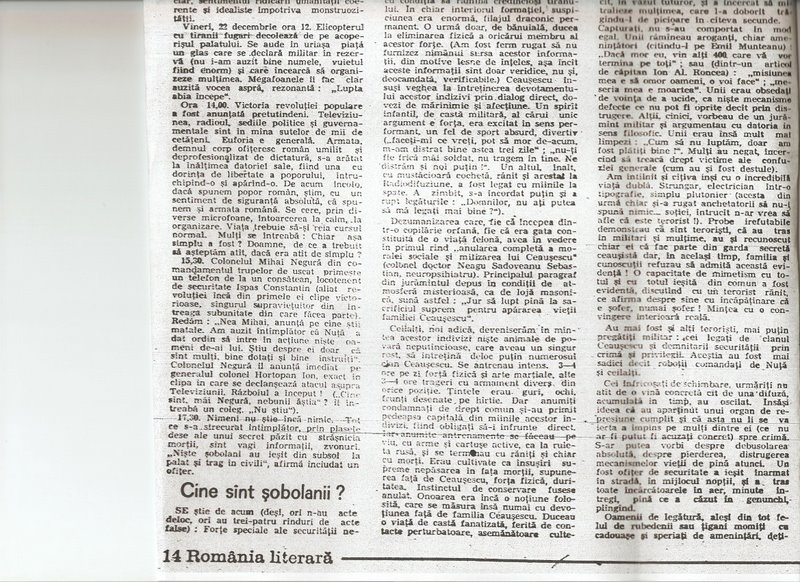
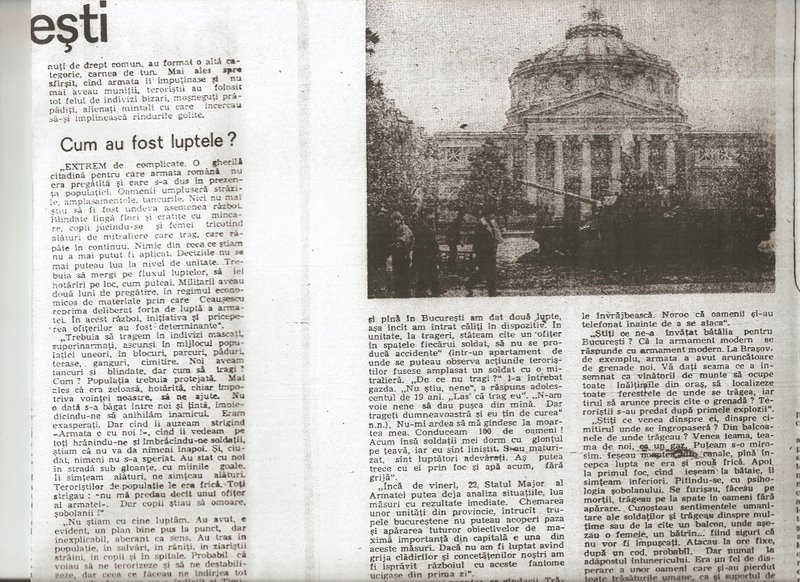
Radu Anton Roman, “Batalia pentru Bucuresti” Romania Literara, anul 23, nr. 3, 18 ianuarie 1990, pp. 14-15.

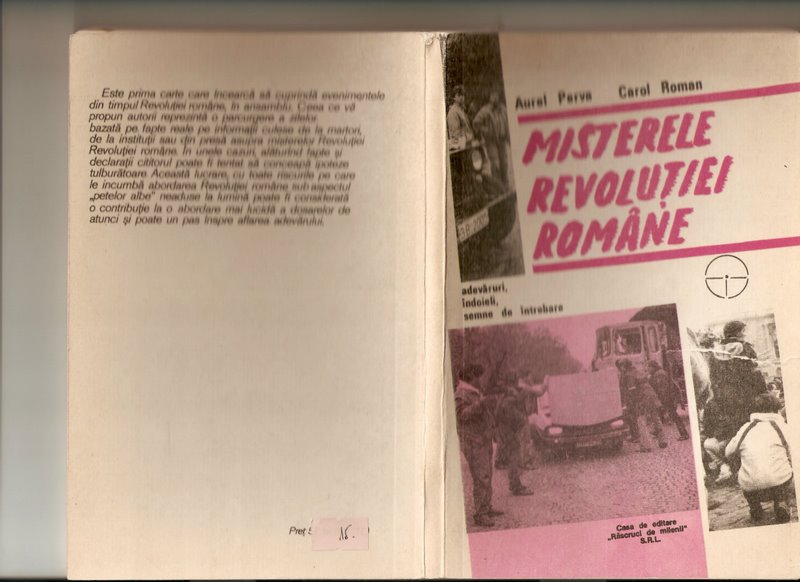
There’s much to be said about this article.  My apologies for it’s quality:  it was xeroxed from the Library of Congress’s microfilm collection and then scanned in.  I wish I could say I came across this by myself, as I have so much of what I have found on the Romanian Revolution of December 1989.  Instead, I found reference to it in Aurel Perva and Carol Roman’s 1991 book, Misterele Revolutiei Romane (see below).

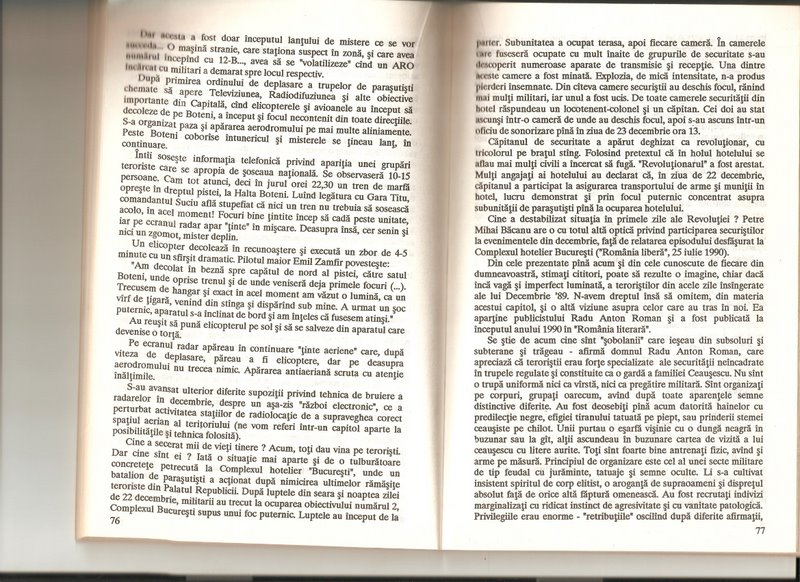
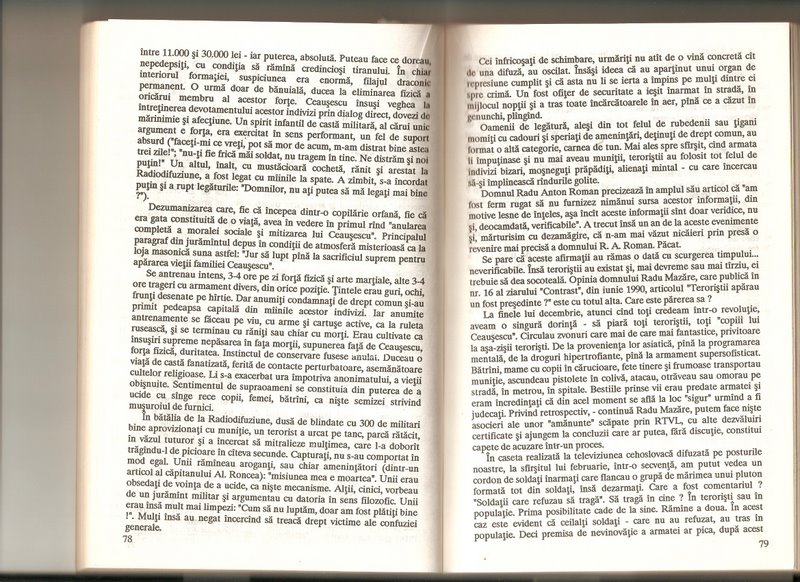
“Aveau un armament foarte divers.  Gloante 5, 6, N.A.T.O. lungi, cu cap de otel de foarte mare viteza si forta de penetratie ce provoaca dezastre anatomice.  Cartuse explozive Dum-Dum care n-au fost folosite impotriva oamenilor decit de fascisti in 1941 la Odessa.  Dar si ei au renuntat, cind rusii le-au raspuns cu acelasi calibru.  Lunete cu infrarosii, amortizor de zgomot si obturator de flacara la gura tevii.”

Posted in decembrie 1989, raport final | Tagged: , , , , | 5 Comments »

Revisiting the Myths of the Revolution. Part IV: The Romanian Television building is in danger! (Bomba in subsolul Televiziunii!)

Posted by romanianrevolutionofdecember1989 on December 22, 2013

Myth 3:  The Romanian Television building is in danger, danger of an explosion!   (TVR e in pericol–Pericol de explozie!)

This is part IV of a four part series.  For parts I, II, and III see

http://atomic-temporary-3899751.wpcomstaging.com/2013/12/21/revisiting-the-myths-of-the-romanian-revolution-part-i-the-hegemony-of-conspiratorial-and-postmodernist-explanations/

Myth 1:  The “Timisoara Syndrome” or the “False Timisoara Grave (the Paupers Cemetery)/Massacre” http://atomic-temporary-3899751.wpcomstaging.com/2013/12/21/revisiting-the-myths-of-the-revolution-part-ii-the-timisoara-syndrome-or-the-false-timisoara-grave-the-paupers-cemeterymassacre/

Myth 2:  The water is posioned!  (Apa este otravita!) http://atomic-temporary-3899751.wpcomstaging.com/2013/12/22/revisiting-the-myths-of-the-revolution-part-iii-the-water-is-poisoned-apa-este-otravita-dr-heyndrickxs-toxicology-report/

Myth 3:  The Romanian Television building is in danger, danger of an explosion!   (TVR e in pericol–Pericol de explozie!)

——————————————————————————————————————————————————————————————————————————–

Like the “water is poisoned” episode discussed in part III of this series, the claims of TV announcers regarding the threat posed to the Television building is a favorite for Romanians and Romanianists to lampoon:

Once again, Andrei Codrescu captures a widely and wildly popular view of TVR’s alleged role during the December 1989 events:

The Romanian revolution was a complex affair. It was a dramatic triumph that had the whole world for its audience, a world that keeps wondering long after the final curtain how much of what it saw was real. If I hadn’t lost my normally skeptical head to the euphoria of December, I would have questioned the single most evident source of news about the revolution: television. But it was precisely television that seduced me during my visit and made me lose sight of things I already knew….Imagine the shock and dismay of our newsmakers and our idealists–including myself–when most of these horrible events we saw with our own eyes on television turned out not to have happened at all. How could the grizzled, experienced Western journalists who are sworn to hard facts have missed the many clues and glaring contradictions that pointed to artifice? The astounding truth of the matter is that much of the glorious Romanian “revolution” was, in fact, a staged play, a revolution between quotation marks….But it couldn’t have been long after, however, the young revolutionaries (if that’s who they were) started becoming “responsible,” and the “spontaneous” provisional government showed up with its own TV script. The television station then became the headquarters of the new government, which, as far as most people were concerned, was born out of video like Venus out of the seashell. And hats must be off to the producers of the exceedingly realistic docu-drama of the strategic military center from where, in a charged atmosphere reminiscent of Reds or Dr. Zhivago, generals with telephones on both ears shouted orders at troops on vast invisible battlefields in every part of the country. Today I stand abashed by my naivete. Much of that Romanian “spontaneity” was as slick and scripted as a Hollywood movie. If I were in charge of the Emmys, I’d give one to the Romanian directors of December 1989. 

SOURCE: The Hole in the Flag: A Romanian Exile’s Story of Return and Revolution (Avon Books, 1991), by Andrei Codrescu, pp. 204-206. excerpted from http://faroutliers.wordpress.com/2004/12/06/the-romanian-revolution-was-televised/

—————————————————————————————————————————————————————————————————————————

As with the “poisoned water” episode, so too with the claimed threats against Television, including the idea that a bomb had been found and disarmed in the basement of the Television building (as can be seen in the above video)…no researcher has attempted to verify the veracity of the claim, until now!

Recently, however, several sources have been unearthed/come to light that clarify what happened.  Here, Corneliu N. Vaida of Timisoara recounts how a Securitate member from Timisoara was convinced to call the Television Station in Bucharest to inform them that, as with many other highly strategic buildings in the country, TVR had been mined and an explosion could be set off.  It appears that the announcement above about a bomb having been disarmed in the basement of the TVR building, was as a result of this information from Timisoara:

Securistul trădat pentru binele TVR

În seara zilei de 22 decembrie şi-a vizitat mama, care locuia pe bulevardul 6 Martie, unde a găsit în apartament un vecin. Era vorba de Gheorghe Toader, un căpitan în rezervă la Securitate, care se refugiase de frică sa nu fie asasinat.

Urmărind programul “Revoluţiei în direct”, de la TVR, au observat la un moment dat o persoana care ţinea în mână un obiect care semăna cu o tastatură.

“Văzând tastatura, securistul a scos o exclamaţie de teamă: <Vor sări toţi în aer acolo! TVR e obiectiv strategic şi este minat, ca în cazuri extreme să poată fi aruncat în aer, tastând un cod pe aşa un detonator!>. A spus că a lucrat la aşa ceva în Bucureşti într-o intreprindere specială. La isistenţele mele a acceptat până la urmă să scrie o declaraţie anonimă pe care am dus-o personal la armată”, a mai declarat Corneliu Vaida.

Ajuns la Garnizoana Timişoara, Vaida a arătat scrisoarea colonelului Zeca, comandantul garnizoanei. “Acesta a pus mâna pe un telefon şi a sunat imediat la Bucureşti la o structură a armatei căreia i-a relatat continutul declaraţiei, dupa care mi-a cerut sa dezvalui identitatea semnatarului argumentând că acesta mai cunoaşte informaţii care ar ajuta la evitarea de victime”, a adaugat Vaida.

Neavând ce face, a trebuit să meargă cu armata să îl predea pe secursitul din casa mamei. “Înspre dimineaţă am văzut la televizor cum a venit cineva şi a declarat că explozibilul cu care era minată televiziunea a fost dezamorsat”, a mai spus timişoreanul.

http://adevarul.ro/locale/timisoara/foto-corneliu-vaida-purtator-cuvant-revolutiei-timisoara-s-au-luptat-grupari-securitate-armata-1_510985f54b62ed5875bbb81f/index.html

The event is also recounted by parachutists in this TVR video from 31 December 1989 that only recently appeared on the internet.

Parasutisti de la R. 64 Pst. Boteni la Televiziunea Romana in 31 decembrie 1989:
Lt. col. Ilie Croitoru, Mr. Chiranescu Ion, Cpt. Radulescu Aurelian, Cpt. Constantin Vlasceanu

Corneliu Vaida has been kind enough to share with me, the following additional confirmation of his actions in the document below:

HP0010

For more about Corneliu Vaida during the Revolution in Timisoara in December 1989, see his interview with ITN correspondent Penny Marshall on 27 December 1989:

http://atomic-temporary-3899751.wpcomstaging.com/2011/05/11/lets-go-to-the-videotape-i-to-the-army-its-confirmation-that-theyve-been-dealing-with-a-specially-trained-force-because-its-the-type-of-bullet-theyve-never-seen-before-itn-uk-telev/

Corneliu Vaida Timisoara December 1989

More on what transpired in and around the Television Station below:

image0

image0-001

image0-003

image0-002

Related posts:

http://atomic-temporary-3899751.wpcomstaging.com/2013/08/25/tvr-chirurgi-si-reportaje-despre-gloante-explozive-dum-dum/

http://atomic-temporary-3899751.wpcomstaging.com/2013/12/10/vina-de-neiertat-a-tvr-a-contribuit-decisiv-la-victoria-revolutiei-iv/

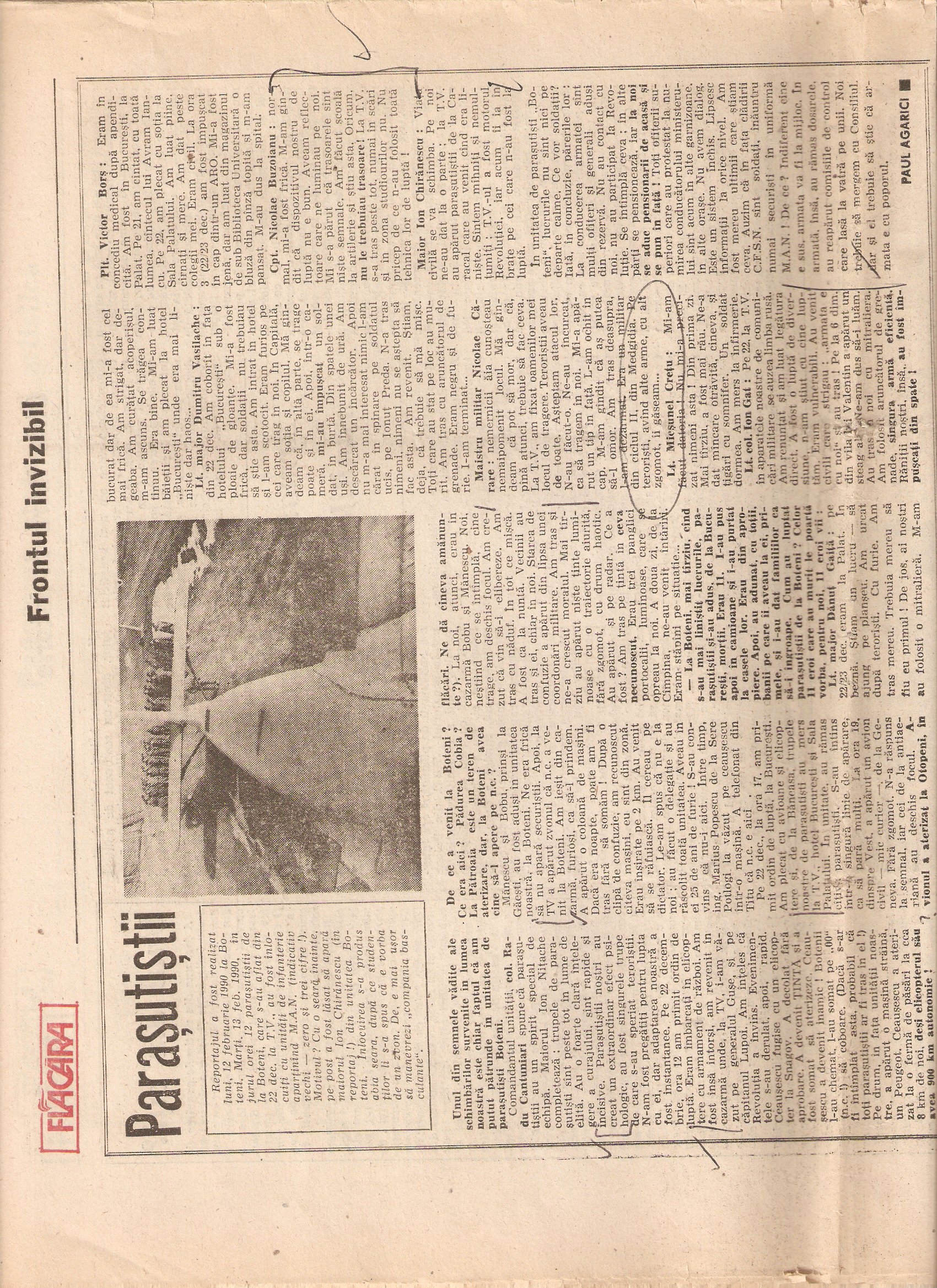
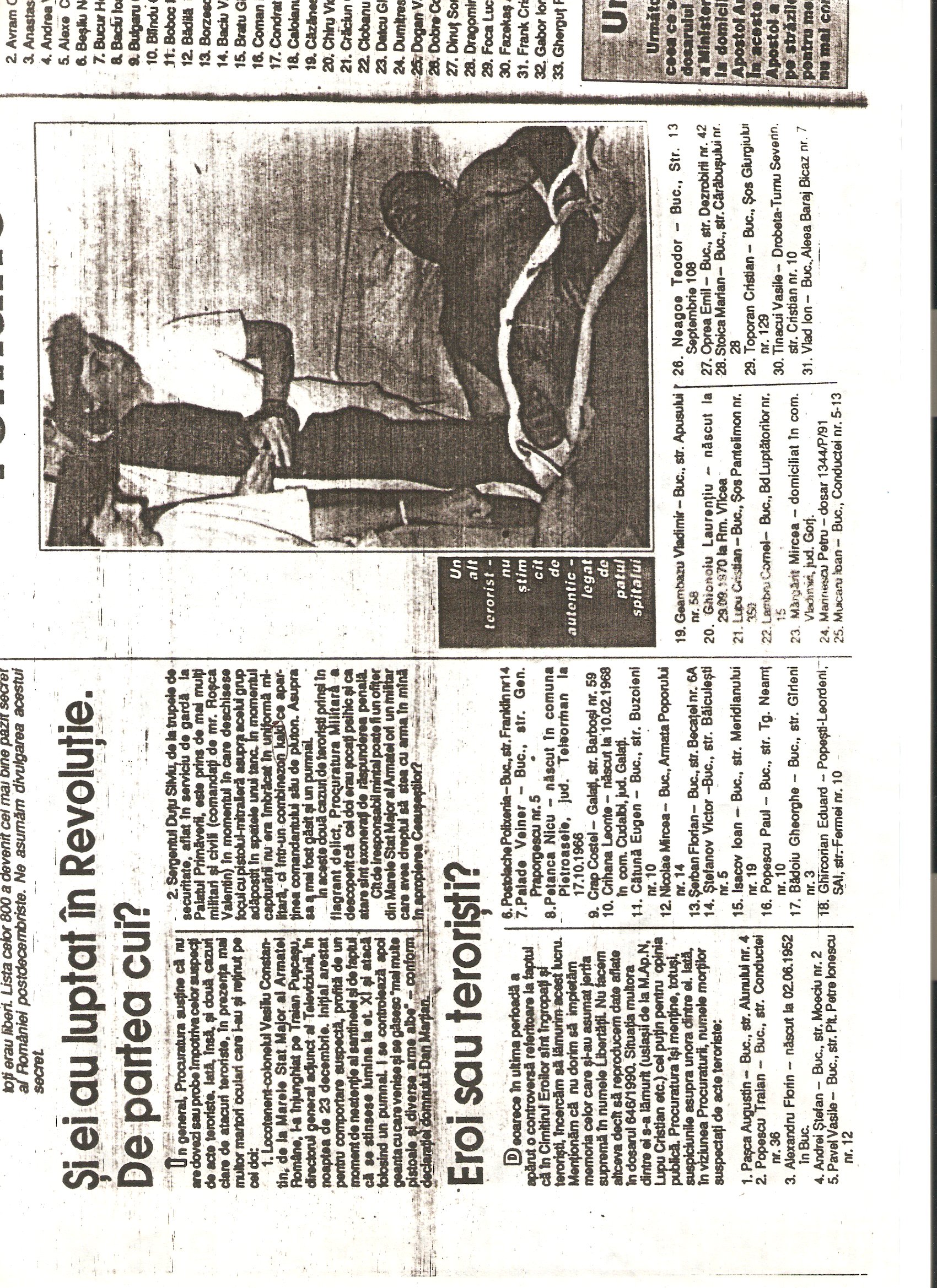
image0

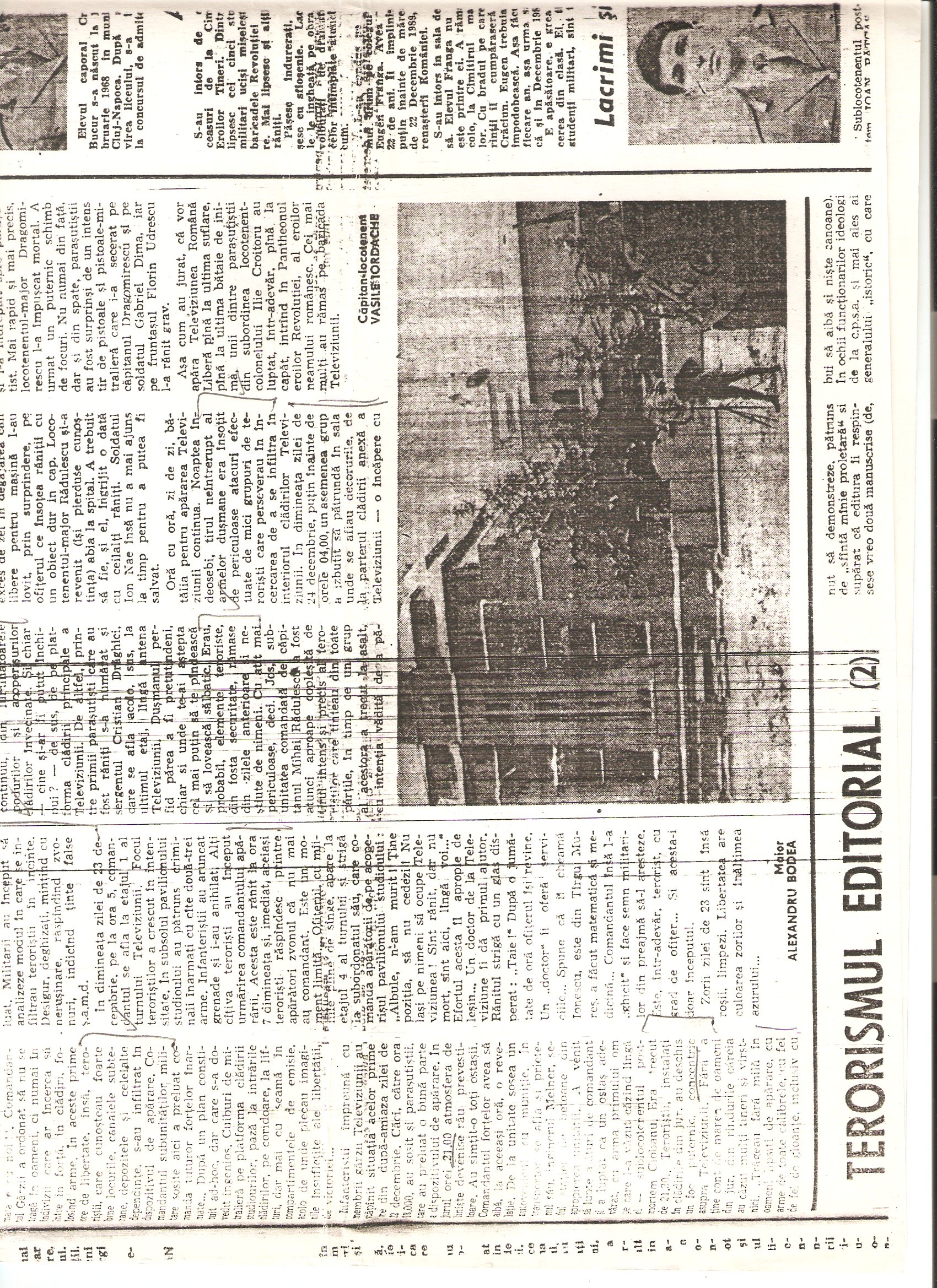
Ioan Itu, “Si ei au luptat in Revolutie.  De partea cui?,” Tinerama, 10-16 septembrie 1993, p. 8.

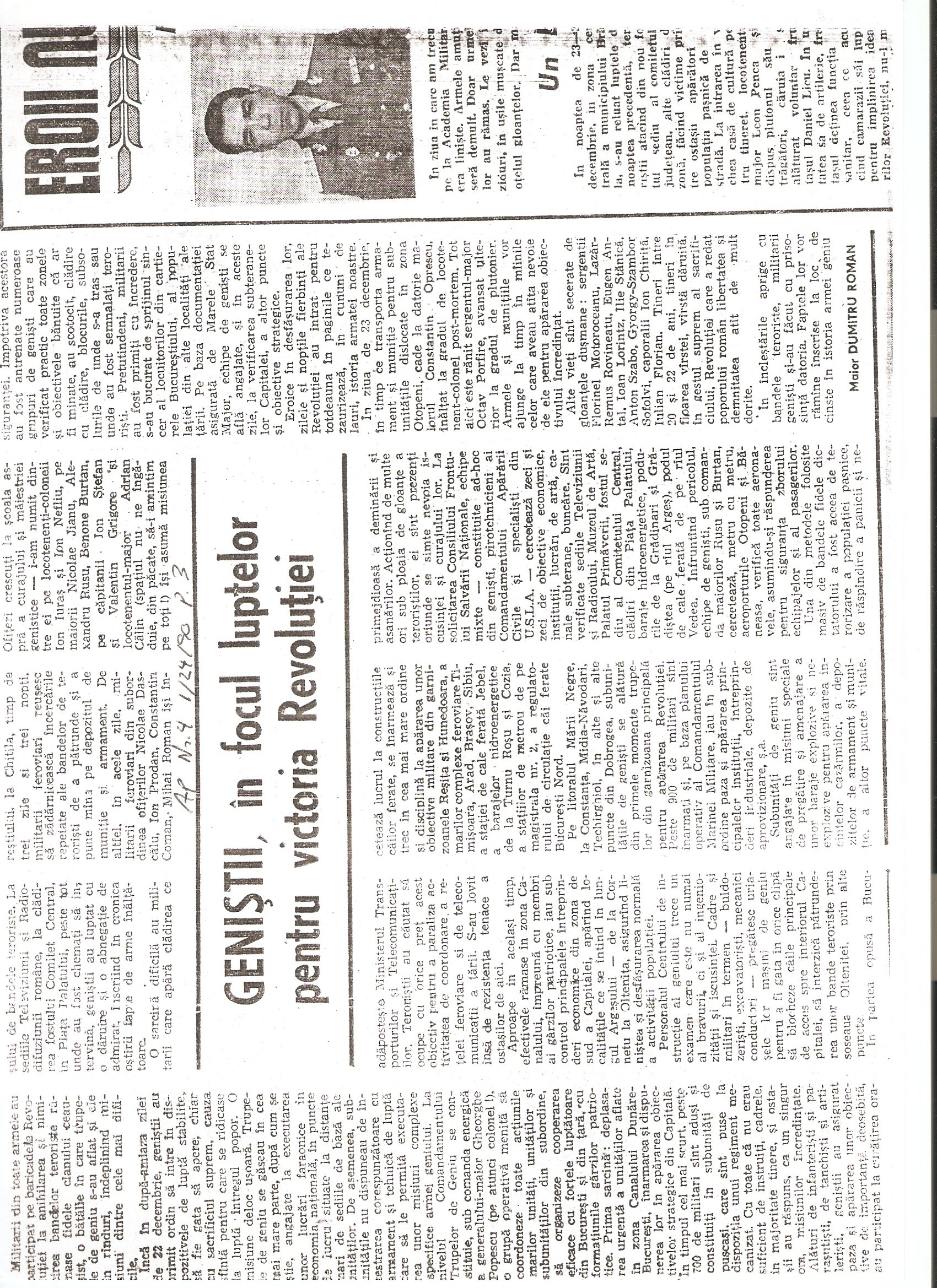
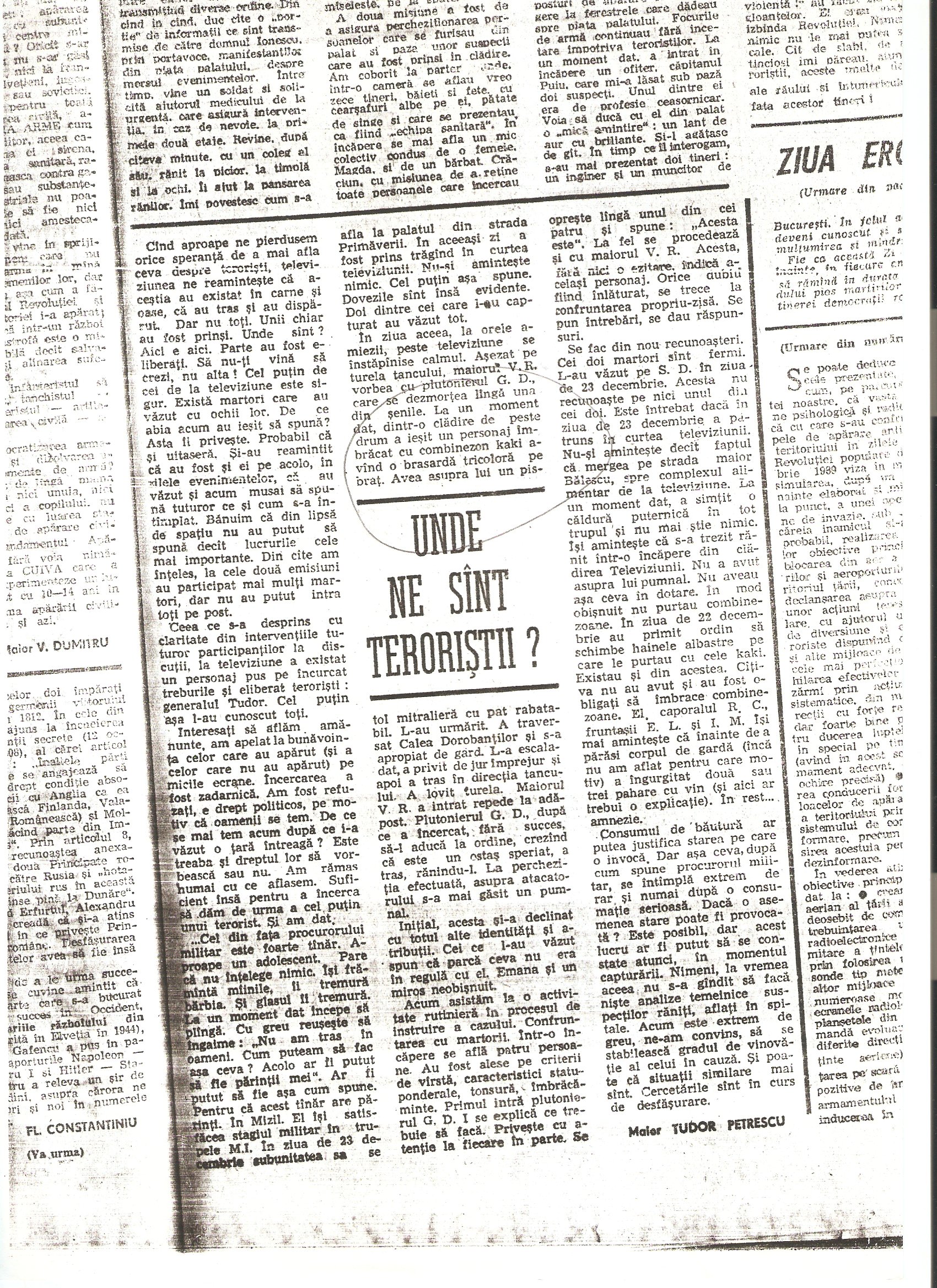
image0-001

Maior Tudor Petrescu, “Unde ne sint teroristii?” Armata Poporului, nr. 22, 30 mai 1990, p. 3.  (S.D. = Silviu Dutu)

image0-002

image0-003

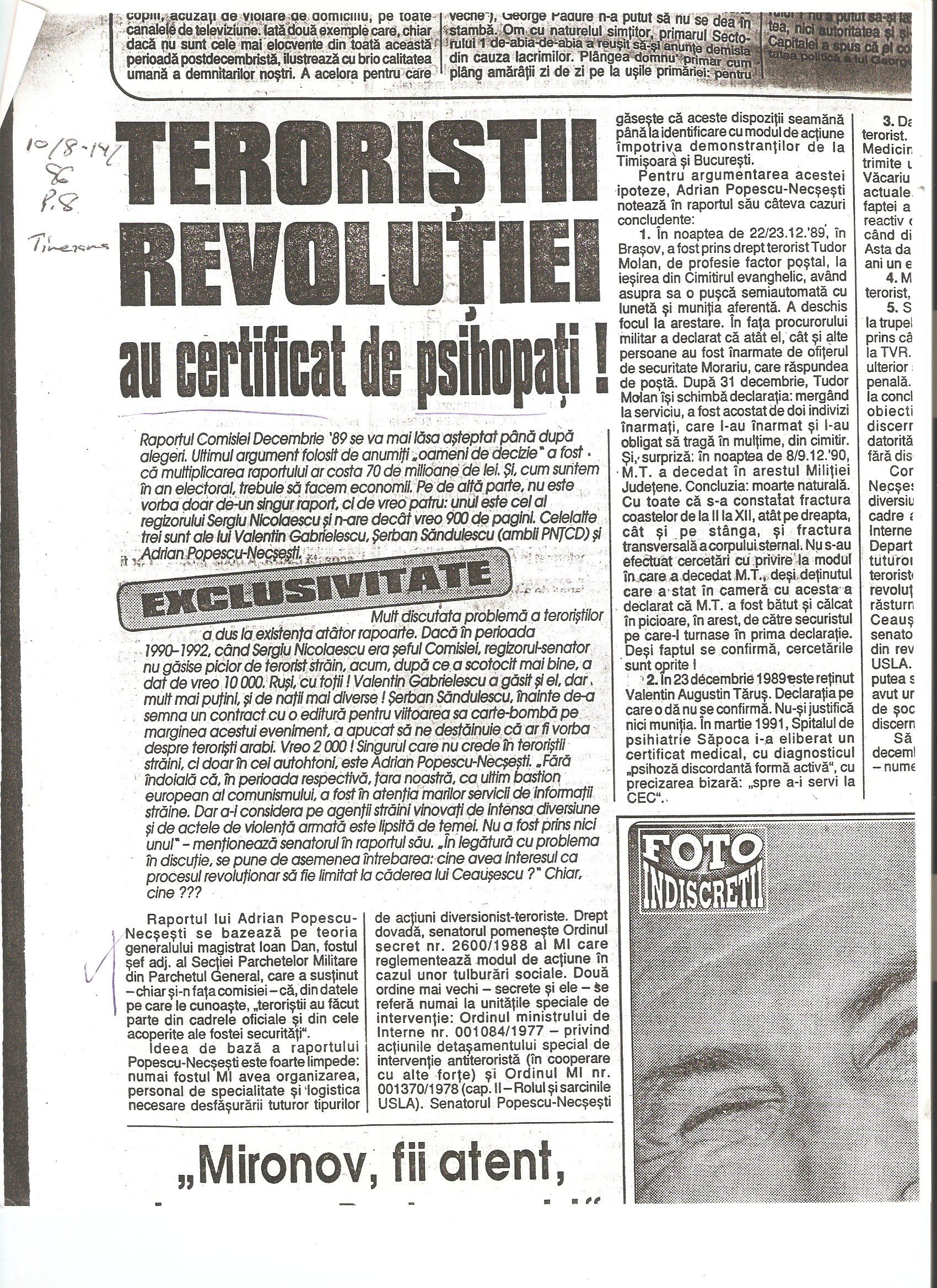
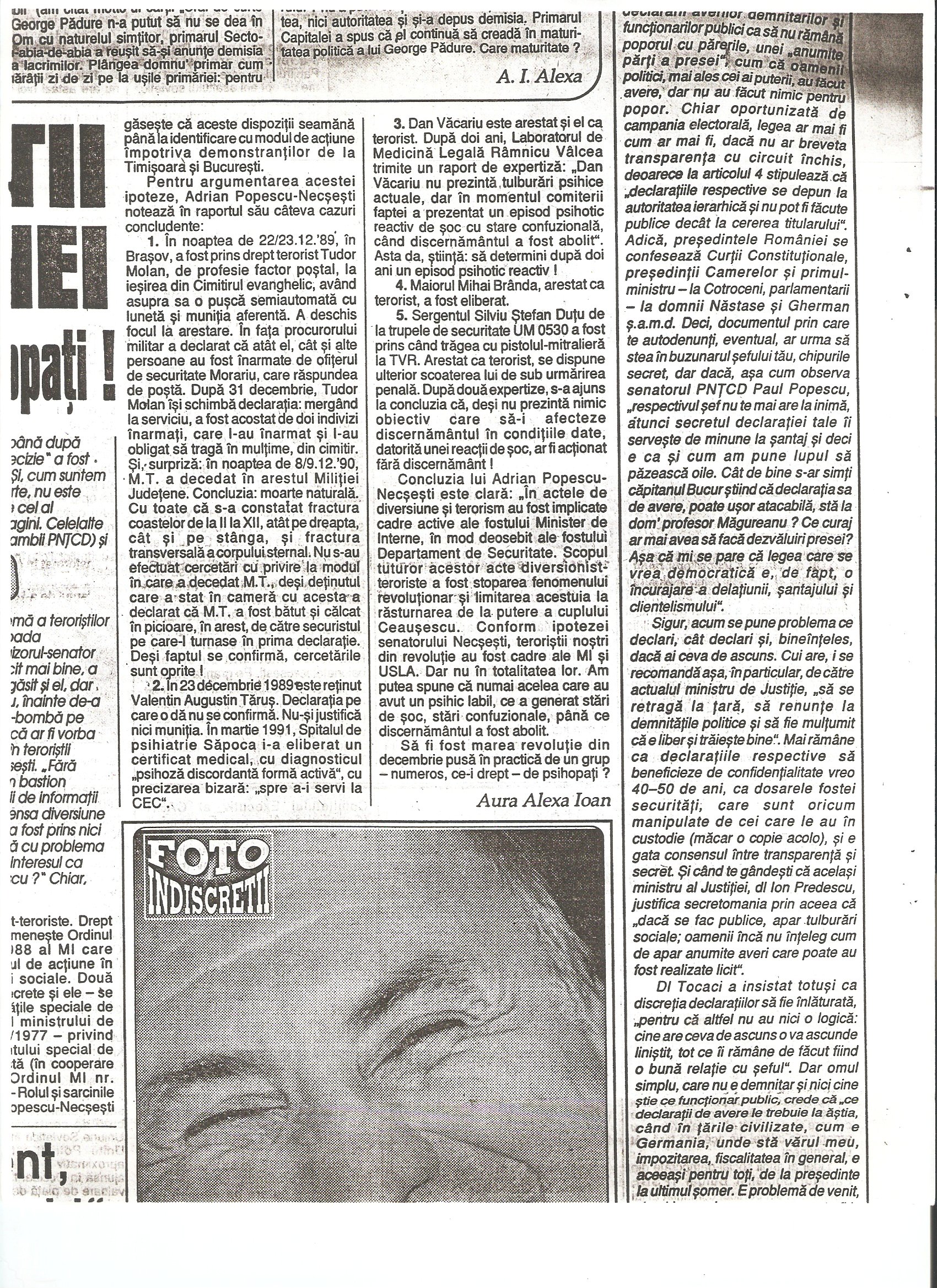
Aura Alexa Ioan (cu Adrian Popescu-Necsesti), “Teroristii Revolutiei au certificat de psihopati!” Tinerama, 8-14 octombrie 1996, p. 8

image0

image0-001

image0-002

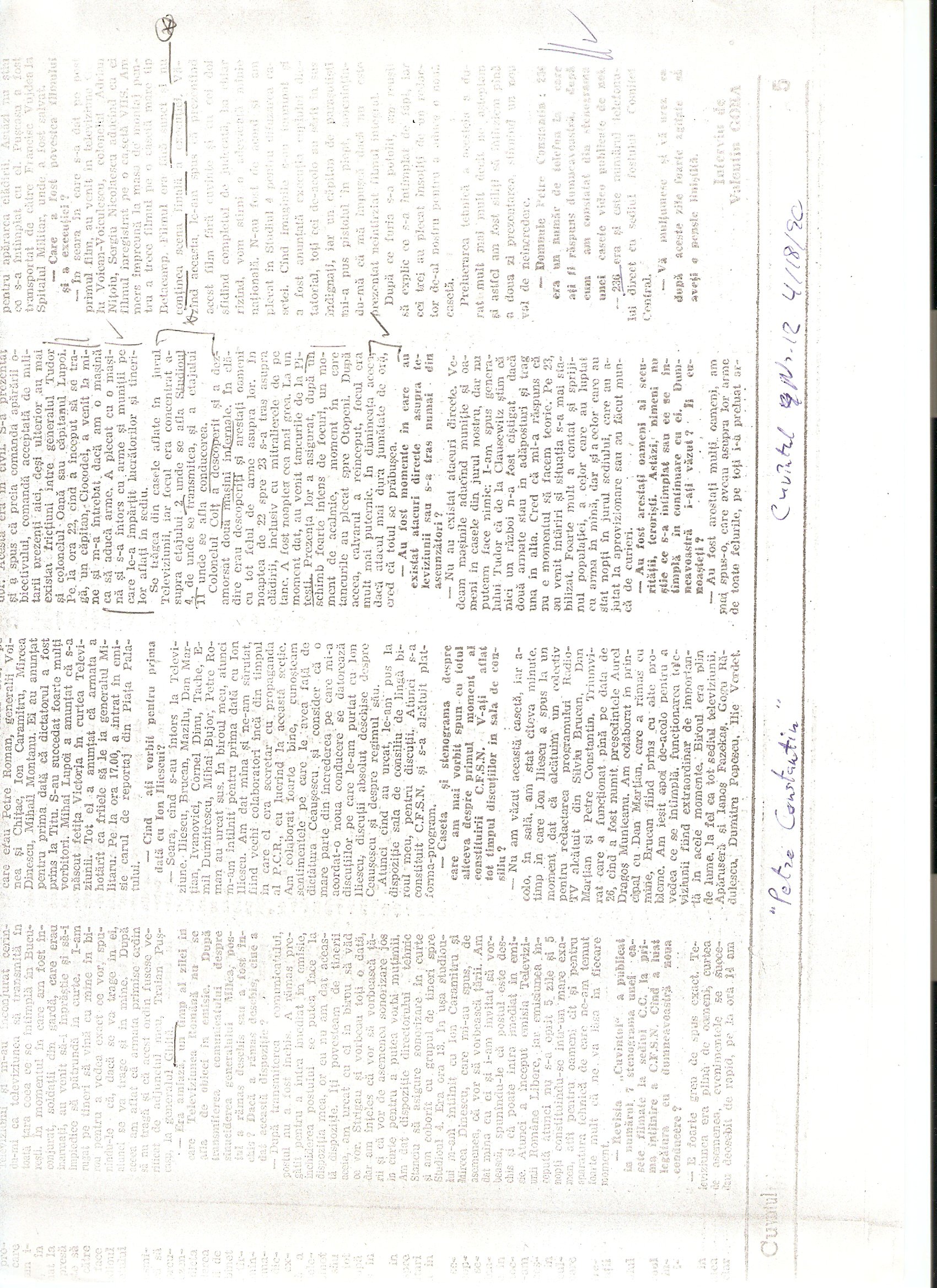
Valentin Gora:  Au fost arestati oameni ai securitatii, teroristi.  Astazi, nimeni nu stie ce s-a intimplat sa ce se intimpla in continuare cu ei.  Dumneavoastra i-ati vazut?  Ii cunoasteti?

Petre Constantin:  Au fost arestati multi oameni, am mai spus-o, care aveau asupra lor arme de toate felurile, pe toti i-a preluat armata si nu stiu ce s-a intimplat mai departe cu ei.  Adjunctul meu, Traian Puscasu, a fost injunghiat in noaptea de 23 spre 24 decembrie, pe hol, la etajul 11.  Agresorul, locotenent-colonelul Vasiliu, il viza pe generalul Tudor sau pe mine.  Eu am lipsit citeva miunte, generalul Tudor s-a ferit in momentul atacului si a fost lovit Puscasu.  Totul se intimpla in usa biroului.  Militarii au sarit si l-au imobilizat imediat.

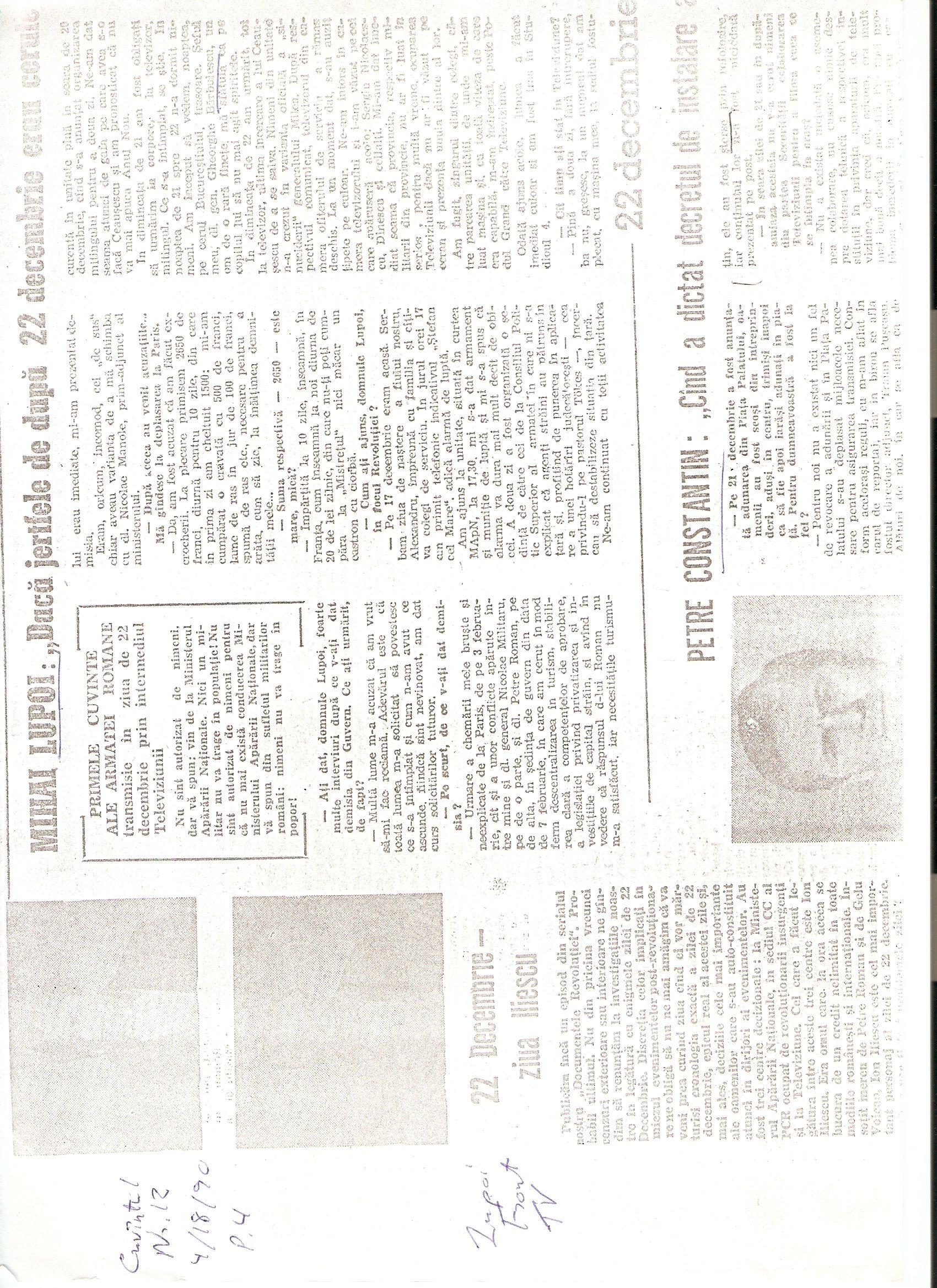
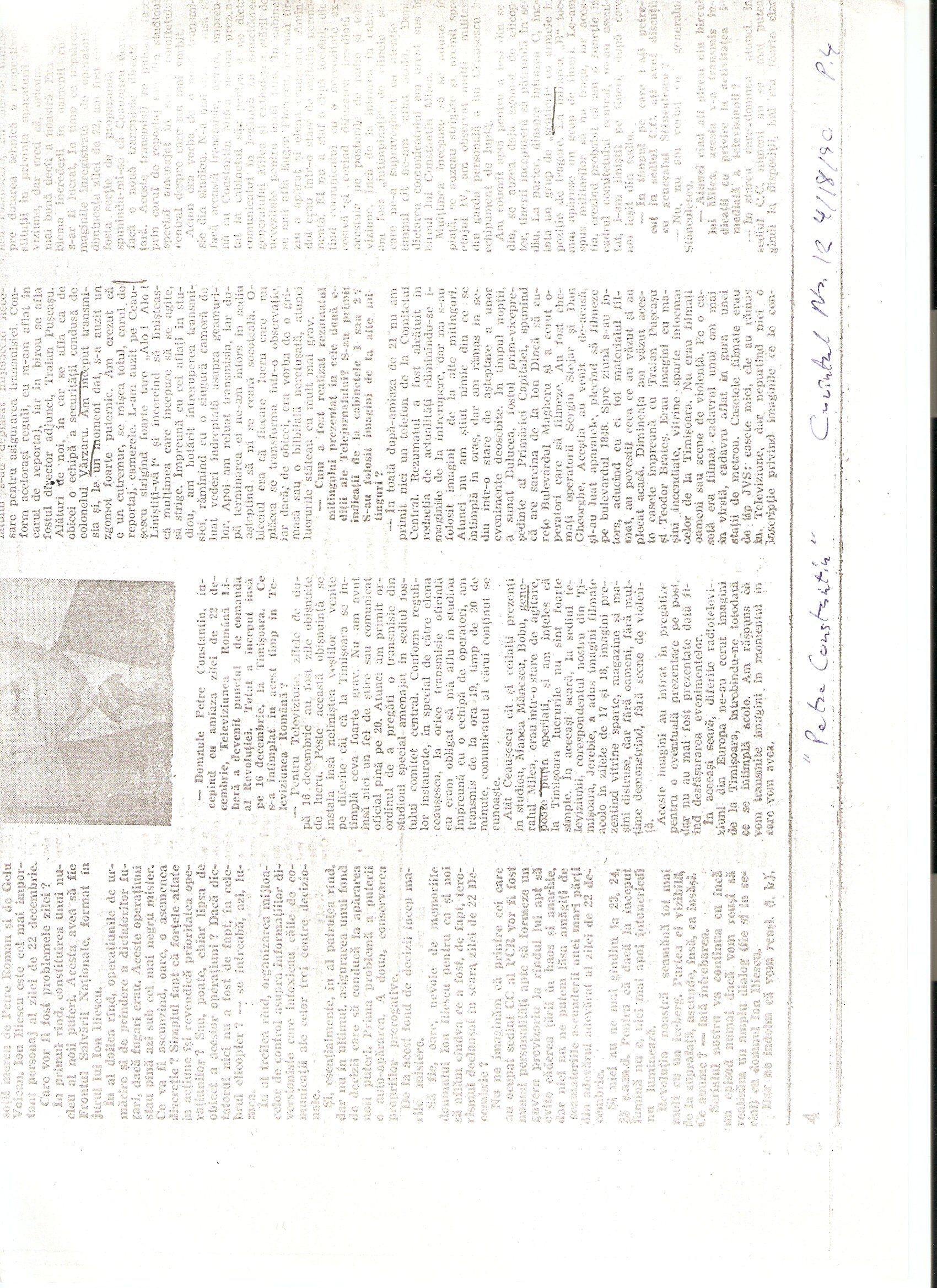
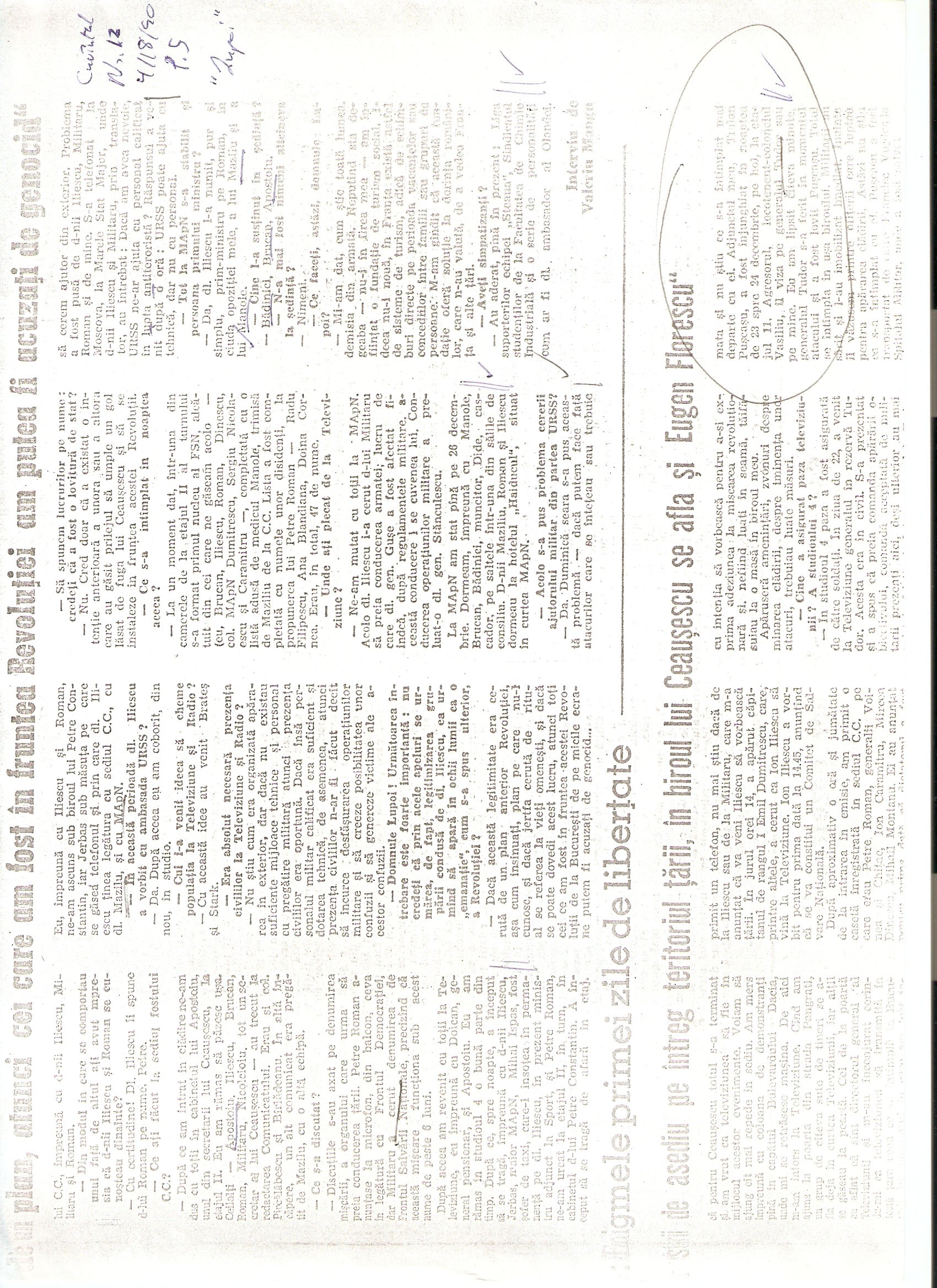
Valentin Gora cu Petre Constantin, “Petre Constantin:  Cind a dictat decretul de instalare ? de asediu pe intreg teritoriul tarii, in biroul lui Ceausescu se afla si Eugen Florescu,” Cuvintul, nr. 12, 18 aprilie 1990, pp. 4-5.

image0-003

http://mariusmioc.wordpress.com/2013/11/13/cercetarile-parchetului-in-dosarul-revolutiei-37-bucuresti-televiziune-raniti-si-ucisi-5/

425. Parte vătămată Puşcaşu Traian (Televiziune-Vol. 110)
Numitul Puşcaşu Traian, fiul lui Gheorghe şi Maria, născut la data de 01.03.1927, în Iaşi, domiciliat în Bucureşti (…) în noaptea de 22/23.12.1989, în timp ce se afla în incinta televiziunii, unde-şi desfăşura activitatea ca director adjunct al TVR, a fost înjunghiat în abdomen cu un cuţit de către lt. col. Vasiliu Cornel, care se afla în dispozitivul de pază al instituţiei respective.
Conform raportului medico-legal nr. A1/3409/1990, numitul Puşcaşu Traian a prezentat la data de 24.12.1989 o plagă abdominală penetrantă cu interesarea splinei şi arterei epigastrice. Leziunea a putut fi produsă prin lovire cu corp tăietor-înţepător (posibil cuţit). A necesitat circa 25 zile de îngrijiri medicale. Leziunea i-a pus viaţa în pericol.
Prin rezoluţia nr. 1411/P/1990, din data de 15.11.1990, Procuratura Militară Bucureşti a dispus neînceperea urmăririi penale faţă de lt. col. Vasiliu Constantin, sub aspectul infr. prev. de art. 20 rap. la art. 174 C.p., reţinându-se că, în urma expertizării sale psihiatrice, s-a stabilit că a acţionat fără discernământ.

Posted in decembrie 1989, raport final | Tagged: , , , , | 1 Comment »

Revisiting the Myths of the Revolution. Part III: The water is poisoned! (Apa este otravita!)…(Dr. Heyndrickx’s Toxicology Report)

Posted by romanianrevolutionofdecember1989 on December 22, 2013

Myth No. 2:  The water is poisoned! (Apa este otravita!)

This is part III of a four part series.  For parts I and II, see

http://atomic-temporary-3899751.wpcomstaging.com/2013/12/21/revisiting-the-myths-of-the-romanian-revolution-part-i-the-hegemony-of-conspiratorial-and-postmodernist-explanations/).

Myth 1:  The “Timisoara Syndrome” or the “False Timisoara Grave (the Paupers Cemetery)/Massacre” http://atomic-temporary-3899751.wpcomstaging.com/2013/12/21/revisiting-the-myths-of-the-revolution-part-ii-the-timisoara-syndrome-or-the-false-timisoara-grave-the-paupers-cemeterymassacre/

Myth 2:  The water is posioned!  (Apa este otravita!)

Myth 3:  The Romanian Television building is in danger, danger of an explosion!   (TVR e in pericol–Pericol de explozie!)

——————————————————————————————————————————————————————————————————————————–

Oh, how Romanians and Romanianists love to invoke or allude to this example!  It precipitates laughter:  ah the crude manipulation and naivete!

Predictably, this is a favorite of foreign sources on December 1989.

Romanian emigre Andrei Codrescu tells us in his November 1990 article in Harper’s (“Big Chills”) about the wild rumors of December 1989, that the water in Sibiu had allegedly been poisoned, but as he found out at his 25th anniversary high school reunion, he learned how all the rumors had been false: and the water in Sibiu, it was just fine!  http://alina_stefanescu.typepad.com/files/big-chills-my-high-school-reunion-in-romania-by-andrei-codrescu-1.pdf

Peter Siani-Davies quotes BBC journalist John Simpson, who had heard similar stories concerning poisoned water during the Iranian revolution of 1979, as noting that “certain ideas appeal forcibly  to the self-dramatizing mind of the revolutionary,” to which Siani-Davies adds:

“Indeed, in Romania the wild storytelling to a certain extent was just another consequence of the tumult of the revolution.  However, the imagery may have served another purpose….Now, through the tales of horror, they [Romanians] were able to place the evil forces of that [Ceausescu] regime so far beyond the bounds of ‘normal’ society that they were effectively able to distance themselves from the demons of the past.  There was also a sense in which it was necessary for the securitate to be so terrible:  How else could the years of mute suffering under an enfeebled old tyrant such as Ceausescu be explained and condoned?”   (Siani-Davies, The Romanian Revolution of December 1989, p. 160.)

——————————————————————————————————————————————————————————————————————————–

Underlying all of these interpretations and explanations is the assumption that the water never was poisoned, that it was all a baseless rumor.

Surely, one assumes, the rumor has been run to ground…but the truth is, as with so many things about December 1989, it hasn’t…

In fact, there was a basis in reality for what Teodor Brates was saying on TV on the afternoon of 22 December 1989 as the following toxicology report by the Belgian Dr. Aubin Heyndrickx makes clear:

Romania

On December 21, 1989, people drinking from water tank #4 in Sibiu experienced headache, visual disturbances, loss of consciousness, vomiting, etc.  These symptoms are all compatible with organophosphate poisoning.  The analysis of the water (by gas chromatography) and the determination of the cholinesterase activity of the blood was done in the University of Cluj.  The conclusion was that an organophosphate had been used.  Atropine sulfate and toxogonin were advised.

As soon as the symptoms appeared among the population, water tank #4 was shut off, rinsed, and cleaned.  The people received water from army trucks.

A few days later, there was a fight in Timisoara between the army and Securitate over the water tanks.  Poisoning was feared, as had occurred in Sibiu.  According to witnesses, the Securitate possesses “all possible chemical warfare agents.”

Toxicologist Aubin Heyndrickx supervised the chemical tests and interviewed the physicians at Central Hospital who treated the patients.  From the tests and from the very high dose of atropine required to produce a response, he concluded that the tank was poisoned with sarin or VX (Report on the Humanitarian Mission to Romania, December 23-29, 1989, Laboratoria voor Toxicologie Criminalistiek, State University of Ghent).

http://www.physiciansforcivildefense.org/cdp/jan90.htm

Indeed, one can watch a brief discussion of the incident with Dr. Heyndrickx beginning at approximately the 40 second mark from an ITN broadcast of 27 December 1989

http://www.itnsource.com/en/shotlist//ITN/1989/12/27/BSP271289002/?s=romania+sibiu+after+the+revolution+27+1989&st=0&pn=1

ROMANIA: SIBIU AFTER THE REVOLUTION:

}T27128901   ROMANIA: SIBIU AFTER THE REVOLUTION: United Nations medical
27.12.89     relief team arrives in Sibiu with medical supplies and blood
TX           to treat the people who were injured during the fight against
             Securitate (secret police). Toxicologists have found evidence
             that the security police poisoned the water supply. Injured
             Securitate are being treated in hospitals alongside the people
             they shot.
Clip Ref: BSP271289002 0

Clip 1of1

}T27128901   ROMANIA: SIBIU AFTER THE REVOLUTION: United Nations medical
27.12.89     relief team arrives in Sibiu with medical supplies and blood
TX           to treat the ...
  • Duration: 00:01:44 |
  • Timecode – In: 00:00:00:00  Out: 00:01:44:00 |
  • Copyright: ITN / 3rd Party Copyright

I have found evidence of discussion of Heyndrickx and his toxicology report in the Hungarian press of the time, but significantly, to date, I have been unable to find discussion of it in the Romanian press!

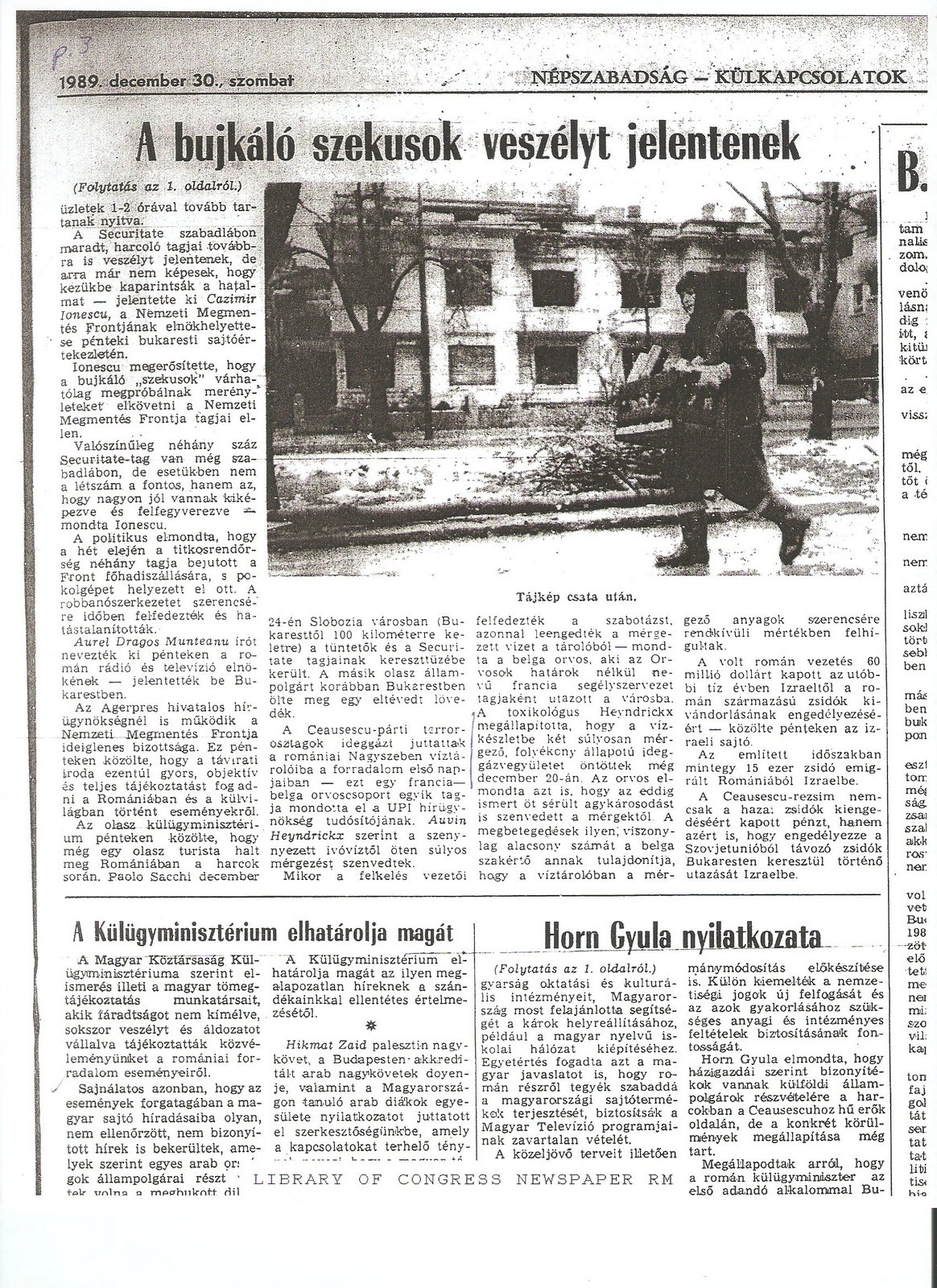
Nepszabadsag, 30 December 1989, p. 3 citing a UPI dispatch, apparently P. Green, “French team confirms poison in water supply,” UPI, 29 December 1989.


Nagyszeben – ideggáz

Bukarest, 1989. december 29. péntek (UPI) – A Ceausescu-párti terrorosztagok ideggázt vegyítettek a romániai Nagyszeben víztárólóiba a forradalom első napjaiban – ezt egy francia-belga orvoscsoport egyik tagja mondotta el a UPI hírügynökség tudósítójának. Auvin Heyndrickx szerint a szennyezett ivóvíztól öten súlyos mérgezést szenvedtek.Mikor a felkelés vezetői felfedezték a szabotázst, azonnal
leengedték a mérgezett vizet a tárolóból – mondta a belga orvos, aki
az ,,Orvosok – határok nélkül,, nevű francia segélyszervezet
tagjaként utazott a városba. A toxikológus Heyndrickx
megállapította, hogy a vízkészletbe két súlyosan mérgező, folyékony
állapotú ideggázvegyületet öntöttek még december 20-án. Az orvos
elmondta azt is, hogy az eddig ismert öt sérült agykárosodást is
szenvedett a mérgektől. A megbetegedések ilyen viszonylag alacsony
számát a belga szakértő annnak tulajdonítja, hogy a víztárolóban a
mérgező anyagok szerencsére rendkívüli mértékben felhígultak.+++1989. december 29., péntek 07:57

http://rendszervaltas.mti.hu/Pages/News.aspx?se=1&wo=nagyszeben&sd=19890101&ed=19901231&sp=0&ni=230929&ty=1

http://www.rsis.edu.sg/cens/publications/reports/RSIS_Food%20Defence_170209.pdf See citations in fn#59 page 10.

———————————————————————————————————————————————————————————————————————————

It is thus with justification that in my dissertation in 1997 and in a reiteration of the dissertation views in 2007, I defended TVR personnel by pointing out the extent to which they went to intervene and inform the population when it was safe to drink the water again.  (for a glimpse into the eternal “appreciation” I received for pointing out the latter, see http://atomic-temporary-3899751.wpcomstaging.com/raport-final-cpadcr-iiccmer-si-revolutia-din-1989/)

Excerpt from http://atomic-temporary-3899751.wpcomstaging.com/rewriting-the-revolution-1997-chapter-8-unsolving-december/

In their discussion of the Romanian transition, Linz and Stepan note the “[r]umors of deliberately poisoned water supplies, of 10,000, 60,000, even 100,000 dead, filled the news channels and streets” and conclude that “disinformation played an important role in the events.”[45] They have in mind, however, the idea that this disinformation was disseminated in order to help the Front seize power. This, of course, echoes the dominant view on this theme. As we saw in the preceding chapter, both Securitate and opposition sources maintain that disinformation pervaded the December events, and they uniformly attribute it to the Front and the Front’s supporters at television, and, in some cases, to foreign actors such as the Soviet Union.

Yet there has been very little effort to investigate the context in which particular rumors originated and the relationship between actual events and those rumors. Take, for example, this rumor alleging the poisoning of the water supply which is so frequently invoked by both domestic and foreigner observers. To what are they referring? Around 3 p.m. on the afternoon of 22 December–therefore approximately three hours after the Ceausescus had fled Bucharest–television commentator Teodor Brates began to issue periodic, sometimes frantic reports about fighting between the Army and the Securitate in the city of Sibiu and about rumors that the water supply had been poisoned by the Securitate. Here are some excerpts of what Brates said on television on that afternoon:

One moment, please…from Sibiu it has been communicated to us that the army no longer has ammunition and the Securitate troops continue to attack military units….We want to inform you that in Sibiu, military units are urgently requesting help…We are constantly receiving communications…of course, we do not have the possibility to verify their authenticity…but we ask for your attention…It is said that these enemy elements, the securisti, have poisoned the water in Sibiu, in Timisoara,…the water must be boiled before being consumed.[46]

[45].. Linz and Stepan, “The Effects of Totalitarianism-cum-Sultanism,” 345-346.

[46].. See the text of the transcript, Revolutia Romana in Direct (Bucharest: Televiziunea Romana, 1990), 47, 48, 51.

2007:  Linked to the allegations of supposedly intentionally hyping the threat posed by the “terrorists” is the certitude with which many Romanians and Romanianists assert that TV personnel (especially Teodor Brates) intentionally spread rumors about the water being poisioned and the army running out of ammunition in Sibiu etc.–rumors that proved to be unsubstantiated. Here is what they likely remember:

“One moment, please…from Sibiu it has been communicated that the army no longer has ammunition and the Securitate troops continue to attack mili tary units….We want to inform you that in Sibiu, military units are urgently requesting help…We are constantly receiving communications…of course, we do not have the possibility to verify their authenticity…but we ask for your attention…It is said that the enemy elements, the securisti, have poisoned the water in Sibiu, in Timisoara…the water must be boiled before being consumed.” (from the transcript of 22 December 1989 in “Revolutia Romana in Direct” (Bucharest: 1990), pp. 47, 48, 51, quoted p. 324, Richard Andrew Hall, 1997, Ph.D. Dissertation, “Rewriting the Revolution: Authoritarian Regime-State Relations and the Triumph of Securitate Revisionism in Post-Ceausescu Romania”)

What they don’t remember is that Brates returned later to inform the audience a) when the fighting had ceased in Sibiu, b) when supplies of bottled water were on their way to Sibiu, and c) when the competent authorities verified that the water in Bucharest was safe to drink (“Revolutia Romana in Direct,” pp. 71, 72, 75, discussed p. 327 Hall, “Rewriting the Revolution”) This is there…in the transcript of what was said on Television…it is not a matter of a “difference of opinion” as the likes of Tismanenau and others in denial would have us believe. It is the old saw from American baseball: as the famous manager Casey Stengel used to say “You can look it up!” Once again: if your goal is “diversion,” intentional panic and manipulation, is it likely that you would return to the same subjects and say things designed to calm fears? Of course, not.

http://atomic-temporary-3899751.wpcomstaging.com/raport-final-cpadcr-iiccmer-si-revolutia-din-1989/

Posted in decembrie 1989, raport final | Tagged: , , , , , , , , , , | 2 Comments »

Revisiting the Myths of the Revolution. Part II: The “Timisoara Syndrome” or the “False Timisoara Grave (the Paupers Cemetery)/Massacre”

Posted by romanianrevolutionofdecember1989 on December 21, 2013

Myth No. 1:  The “Timisoara Syndrome”…The “False/Fake Timisoara Massacre”…”Madonna and Child”

Of the three myths that I am exploring in this series, conspiratorial explanations tend to outweigh postmodernist explanations perhaps most heavily in the coverage of this first myth (for part I of this series, see http://atomic-temporary-3899751.wpcomstaging.com/2013/12/21/revisiting-the-myths-of-the-romanian-revolution-part-i-the-hegemony-of-conspiratorial-and-postmodernist-explanations/ ).

Myth 1:  The “Timisoara Syndrome” or the “False Timisoara Grave (the Paupers Cemetery)/Massacre”

Myth 2:  The water is posioned!  (Apa este otravita!)

Myth 3:  The Romanian Television building is in danger, danger of an explosion!   (TVR e in pericol–Pericol de explozie!)

I will address two aspects of Myth no. 1 below:  1) the presumed intentionality of the digging up of corpses unrelated to the Timisoara repression (the Paupers Cemetery, 22 December 1989) with intent to disinform public opinion (domestic and foreign) and 2) that the ultimate false character of the Timisoara Paupers Cemetery episode is evidence of the absence of a true Timisoara massacre.

————————————————————————————————————————————————————————————————————————-

Jacques Levesque in The Enigma of 1989 (1997, University of California Press, p. 195, online at http://publishing.cdlib.org/ucpressebooks/view?docId=ft4q2nb3h6;chunk.id=0;doc.view=print) captures quite well popular conspiratorial explanations of the “fake grave,” and “false massacre” it was supposedly used to suggest, in the following passage:

Let us mention some examples. The reports and horrifying images of the mass grave “discovered” in Timisoara are still a vivid memory; they came several days after the repression of the mid-December demonstrations against the reassignment of the ethnic Hungarian pastor Laszlo Tokes. The demonstrations were followed by riots, which gave the initial push to the Romanian “revolution.” The newspapers reported that 4,630 corpses had been discovered. Several months later, it was learned from doctors’ accounts that some thirty of the corpses shown “exhumed” by television around the world had been stolen from the city morgue and hospitals in the night of December 21–22. Disconcertingly, the “mass grave” may have been constituted after its discovery was announced the day before by East German and Hungarian press agencies. To this day, no one has been able to establish firmly who organized this staging, and precisely to what ends. As far as the purpose of the “grave” is concerned, several interpretations were put forth and supported: to bring about a revolt in the country; to raise the greatest possible indignation on the international level in order to make the leaders of the coup accepted and acclaimed; or to make the Securitate, which was blamed for the carnage, the incarnation of all the Ceausescu regime’s evils, in order to better clear the army and its leaders, who joined the side of the new government, or essentially constituted it. It was later learned that it was the army, and not the Securitate, which opened fire.

Andrei Codrescu, well-known poet and National Public Radio commentator, (The Hole in the Flag. A Romanian Exile’s Story of Return and Revolution (New York, William Morrow and Company, 1991, pp. 203-204) recounts the same incident in this memorable description:

“The Romanian ‘Revolution’ was entirely televised, all those of us who believed for years with Gil Scott-Heron that ‘the revolution will not be televised’ were shaken by it. In truth, there were two revolutions: a real revolution that was not televised and that continues, particularly in Timisoara, and a studio revolution that fooled the entire world. Who could forget the piles of corpses stacked like cordwood in front of the Timisoara cathedral?…Or the image of the mother and child shot with a single bullet, lying in the arms of death? Watching these images in New Orleans via CNN, I was moved and enraged, along with millions of others in the world. We now know. The mass graves discovered in Timisoara and presented to the world as proof of the Hitlerite insanity of Securitate were in fact bodies dug out of a pauper’s cemetery with autopsy scars visible. Many of them were in an advanced state of decay…And the extraordinary picture of the mother and her baby killed with the same bullet, seen thousands of times on all the world’s TV screens, was a gross collage. A woman who had died of alcoholism had had an unrelated dead baby placed on her chest for video purposes.

In 1999, journalist John Sweeney recounted the incident in The Guardian as follows:

http://www.guardian.co.uk/world/1999/nov/07/johnsweeney.theobserver

Millions dead, but who’s counting?

The truths that exist behind press reporting

Eighteen bodies lay beneath an electricity pylon on white plastic sheets in the pauper’s cemetery, naked to the sky. The stink of the dead hung in the pre-dawn air; nearby were the graves from which they had been disinterred. The bodies were soiled by the dirt from the graves, their nudity obscene. On one woman’s stomach lay a perfectly formed foetus, its skin stained an unnatural purple, as if it had come from a jar. Thirty paces away lay the corpse of what looked like an old man, his feet bound by twisted wire: tortured? Nineteen corpses in all. It was Timisoara, Saturday, 23 December, 1989, and the news agencies were saying 4,000, 40,000, 60,000 dead. Where were the mass graves?

There was something strange – unsatisfactory – about the 19 bodies. Eight corpses had stitches in their stomachs, perhaps from autopsies; some of the rest were so badly decomposed the flesh had rotted from the bones. They did not look like they had been killed the previous Sunday, the flashpoint of the Romanian revolution.

Not 60,000 dead in Timisoara, but 19, and fishy at that. My reward for reporting this was a tiddly piece on page three. News desk lionhearts like big numbers from reporters sent to cover mass murder.

Le Monde in March 2000 (http://webcache.googleusercontent.com/search?q=cache:cswQZh6E7W0J:mondediplo.com/2000/03/07kospress+syndrome+timisoara+halimi&cd=3&hl=en&ct=clnk&gl=us) commented:

Barely 10 years earlier, despatched to Timisoara to view some old corpses dug up by the propaganda department of the new Rumanian regime, a journalist from the France 2 television channel had commented, “These pictures are here to prove that 4,630 people died at the hands of the secret police” (22 December 1989).

Nor, even in Romania, has this incident lost its utility as a touchstone for mendacity, as the following article by Grigore Cartianu from August 2011 (http://adevarul.ro/news/societate/certificatul-rebel-1_50a7b8a27c42d5a66369f0b1/index.html) demonstrates:

“Neroziile spuse atunci vor rămâne în antologia dezinformării. Unele erau minciuni sfruntate (povestea cu robineţii de aur), altele făcături ordinare (cadavrele din sceneta „mama şi copilul” nu aparţineau unor martiri ai Revoluţiei şi nici nu erau victime ale represiunii ceauşiste, ci zăceau de prin noiembrie în Cimitirul săracilor din Timişoara, fiind dezgropate doar pentru şedinţa foto-video).” 

(Who is Grigore Cartianu?  No less than Vladimir Tismaneanu, the dean of communist and post-communist Romanian studies in the United States, has exalted in both English and Romanian, Grigore Cartianu’s investigations of the December 1989 events–see http://www.movingimagesource.us/articles/how-was-ceausescu-possible-20110929 and http://tismaneanu.wordpress.com/2010/07/21/deshumarea-lui-ceausescu-un-pas-spre-adevar/  “Este un lucru demonstrat cu prisosinta si de onesta ancheta jurnalistica a lui Grigore Cartianu (publicata sub titlul de carte: “Sfârşitul Ceauşeştilor”).” )

Finally, this episode has become immortalized in postmodernist literature, thanks to its invocation and development by Jean Baudrillard, as follows:

“The Timisoara Syndrome”

Jean Baudrillard (trans. Chris Turner), The Illusion of the End (Cambridge, Polity Press, 1994), pp. 54-61 “The Timisoara massacre.”

p. 55 “It was not the dead that were the scandal, but the corpses being pressed into appearing before the television cameras, as in the past dead souls were pressed into appearance in the register of deaths.”

p. 60 “And yet there will, nonetheless, have been a kind of verdict in this Romanian affair, and the artificial heaps of corpses will have been of some use, all the same one might ask whether the Romanians, by the very excessiveness of this staged event and the simulacrum of their revolution, have not served as demistifyers of news and its guiding principle…Who can say what responsibility attaches to the televisual production of a false massacre (Timisoara), as compared with the perpetrating of a true massacre?”

———————————————————————————————————————————————————————————————————————–

The idea about “some old corpses dug up by the propaganda department of the new Rumanian regime,” that Novi Sad TV journalists (presumably then, according to this conspiracy theory, Yugoslav agents), or, most ridiculous of all, Securitate agents themselves, were responsible for digging up and presenting the corpses from the Paupers’ cemetery (all views that have gained expression through the years) is simply WRONG.

How do we know?  From what eyewitnesses have described.  Here 30 yr. old Ion Gogoara described in Titus Suciu’s Raport cu Sufletul la Gura (1990) that the makeshift grave in the Paupers’ cemetery was found by kids, that when he got there there were about 30 people gathered placing candles, and that all this took place at about 10:30 or 11 am on the morning of 22 December 1989, thus before Ceausescu’s flight from power (but at a time when Timisoara was long already beyond the regime’s control).

Indeed, it was those missing loved ones who were the first to the Paupers Cemetery

Virgil Botoc told Marius Mioc in 1995 how, on 22 December 1989, he was searching frantically for his 13 year old daughter Luminita and how, he and others participated in the removal of the corpses and put them on some sheets.  As Mioc has noted, precisely because many of those who had lost loved ones in the repression of the previous days did not know yet that many corpses had been transported from the hospitals and morgue to be incinerated, they looked frantically anywhere they could, including the Paupers’ cemetery.

Botoc Virgil (tatal lui Luminita Botoc) In 22 dimineata la cimitirul saracilor s-au dezgropat niste morti. Am fost si eu acolo sa vad daca n-o gasesc pe Luminita. Aici era o groapa comuna, o alta groapa cu un singur mort si inca un mort in capela. Mortii fusesera ingropati dezbracati. Unii erau cusuti cu sirma, cel din capela avea si picioarele legate cu sirma. Am scos mortii, i-am pus pe niste cearsafuri.  http://timisoara.com/newmioc/33.htm

Marius Mioc: “Filmarea din 22 decembrie a fost cu cadavre dezgropate din cimitirul săracilor. Aceia nu erau morţi din revoluţie ci sărăntoci fără familie îngropaţi pe cheltuiala Primăriei. Familiile celor morţi în revoluţie, care nu găseau cadavrele celor dragi (fuseseră incinerate, dar nu se ştia asta pe atunci), în disperare au căutat pe unde le-a trecut prin minte, şi au dezgropat şi morţii de la cimitirul săracilor. S-a crezut atunci sincer că aceia sînt morţi din revoluţie.” http://piatauniversitatii.com/forum/viewtopic.php?t=974

So, we have our answer to the first part of Myth no. 1:  The only intentionality of those who dug up the corpses in the Paupers Cemetery was that those looking for their loved ones were frantically searching everywhere and anywhere for traces of them.  (That the Paupers Cemetery was then linked to, or interpreted through the lens of inflated and erroneous death tolls (for a discussion of these, please see the following, courtesy of William Totok, http://www.halbjahresschrift.homepage.t-online.de/neumann.htm) and the widespread view of the dictatorship of Nicolae Ceausescu as (late) communism in its highest stage, is ultimately a different story.)

————————————————————————————————————————————————————————————————————————-

Perhaps worst of all, while the Paupers cemetery on 22 December 1989 and the “Timisoara syndrome” have become part of an international literature on journalistic manipulation and/or error, those who invoke this example tend to be oblivious to the real mass grave of victims from the Timisoara uncovered in mid-January 1990 (including, Virgil Botoc’s 13 year old daughter Luminita)

FBIS (AFP 16 January 1990, lower right column):

Marius Mioc has detailed this episode extensively as follows:

“Renaşterea Bănăţeană” din 16 ianuarie 1990 despre groapa comună din cimitirul eroilor:

http://www.youtube.com/watch?v=_AuwsQFuKLw

Groapa comună din cimitirul eroilor descoperită în ianuarie 1990

Tatulici & Tatomir – Povestea Timişorii (7). Groapa comună din cimitirul eroilor octombrie 28, 2010

Rate This

Al şaptelea fragment din filmul “Povestea Timişorii” realizat de Mihai Tatulici şi Virgil Tatomir şi difuzat în 1991 la TVR. În acest fragment am combinat 3 fragmente diferite din filmul original, pentru a avea un articol explicativ complet despre problema gropii comune din cimitirul eroilor din Timişoara. Deci există o oarecare abatere de la succesiunea din filmul domnilor Tatulici şi Tatomir, pe care am considerat-o necesară pentru a înlesni analiza problemei gropii comune a revoluţiei din Timişoara. La sfîrşitul serialului, cînd voi da şi playlistul complet, cei interesaţi vor putea vedea filmul aşa cum a fost el prezentat iniţial. La transcrierea înregistrării comentariile mele ulterioare sînt inserate în text cu litere cursive, între paranteze drepte.

Vezi şi primele 6 fragmente prezentate pe acest blog:
15 decembrie 1989
16 decembrie 1989
În jurul lui Tokes
Dezvoltarea mişcării revoluţionare în 16 decembrie 1989
Lupte între manifestanţi şi forţele de ordine
Calea Lipovei şi Girocului, 17 decembrie 1989

Transcriere înregistrare:
00:00 Virgil Boţoc: În timpul ăsta a trecut o mulţime de oameni. Pur şi simplu nu i-am putut să-i văd cîţi or fost. Şi strigau diferite plancarde. Şi atuncea fata aia mai mare vine la maică-sa: “mămică, mergem şi noi”. “Nu mergi niciunde”. În timpul ăsta o trimis la mine fata că-i dau voie. Aia mică o luat fîşul de pe cuier şi o coborît jos. Şi atuncea îmi zice sora ei geamănă: “tăticule, Luminiţa o coborît jos”. Zic: “noi avem ceva de făcut”. Cînd ajung jos (neînţelegibil) plecase. Cînd am ajuns în Calea Lipovei, în spatele bisericii, s-or tras focuri de avertisment de la aviaţie, roşu, şi i-am zis lu’ nevastă-mea: “fii atent că se trage”. Zice “nu se trage”, şi atunci au început focuri. După care am văzut că fata n-o venit toată noaptea acasă. M-am dus în zonă, dimineaţă. În zonă, că acolo locuiesc, m-am întîlnit cu mulţi prieteni, şi m-am interesat. Din care m-am întîlnit şi cu prietenul ăsta, Avădanei, care a lucrat cu mine foarte mulţi ani. Şi-l întreb “mă Ştefane, s-o tras? Ce-i pe aicea?”. Că plouase, nu s-o cunoscut nici un semn, nimic. Zice “mă, s-o tras”. Ce, eu uite mi-o dispărut fata. Zice “cu ce-o fosta asta a ta îmbrăcată?”. “C-un fîş roşu, aşa”. Zice “uite aici o fost împuşcată mortal. Eu, zice, am luat-o, am pus-o pe bancă, şi banca o fost îngustă şi i-a legat mîinile cu o sfoară, cu ceva, ca să nu i se rupă mîinile”. Zice “du-te la Clinicile Noi”. Am fost la Clinicile Noi, am vorbit cu autopsierul, am mers cu fata geamănă, cu sora ei, îmbrăcată într-aceeaşi formă. Şi întreb pe autopsierul: “domnu’, nu vă supăraţi, o fost o fată adusă aicea?”. Zice “da”. “Şi dac-o vedeţi, o cunoaşteţi?”. Zice “da”. Zic “îi asta sau nu-i asta?”. Zice “cum Dumnezeu, astă fată o fost împuşcată în inimă”. Zic “nu, sora ei”. “Bă, dacă veneai cu juma’ de oră, o găseai aicea, da-i plecată [spitalul] judeţean”. Atunci m-am dus la morgă la judeţean, am întrebat, m-am întîlnit cu, adică, cu asistenta, asistenta mi-o spus “vorbeşti cu domnul doctor Dressler”. Domnul doctor Dressler o spus că nu este nici un mort în morgă şi nu lasă pe nimeni în morgă. În timpul ăsta vine domnul locotenent major Rosu, nu mai ştiu exact cum îi zice pentru că el a fost cu paşapoarte pentru plecare în străinătate. Şi am fost plecat în Libia. El pe mine, eu pe el l-am cunoscut, el pe mine nu m-a cunoscut. Şi mi-o pus arma la cap: “Ce faci mă aici scandal?”. Şi atuncea zic “domnu’ Rusu, dumneavoastră pe mine nu mă cunoaşteţi, dar eu pe dumneavoastră vă cunosc”. Şi atuncea o lăsat arma. Mai era un militar care citea o carte. În fine, era cu o carte în mînă, cam aşa ceva. A doua zi iară, a treia zi iară, nici un…, n-am putut să rezolv nimica.
02:43 Virgil Tatomir: S-a încercat să vi se dea un certificat de deces pe care scria că fata dumneavoastră ar fi suferit şi ar fi murit de hepatită?
02:52 Virgil Boţoc: Da. Da, şi atuncea, da, mi s-a eliberat aşa ceva, un certificat din ăsta, şi atuncea am fost nevoit să mă duc, să scot adeverinţă de la şcoală precum că fata mea n-o fost bolnavă şi nici nu ştiu unul din familia lu’ Boţoc, că asta a fost şi discuţie cu domnul doctor Dressler, că să-mi arăte cel puţin o internare a unui din familia lui Boţoc de diagnosticul de hepatită cronică, cum o scris acolo. N-am putut să dau nici de un rez…, n-am putut să aflu nimica.
03:20 Virgil Tatomir: Aţi apelat la sprijinul procuraturii?
03:22 Virgil Boţoc: Da. Am fost la domnul procuror [Romeo] Bălan, am dat declaraţii, am lăsat fotografii. O spus că să am răbdare, că sînt 61 de indivizi arestaţi şi sînt în anchetă. Şi atuncea poate o recunoaşte vreunul că-i dusă la Bucureşti la cremator[procurorul se referea la cadavrele furate din morga spitalului şi arse la crematoriul din Bucureşti (linc), între care bănuia că se află şi Luminiţa Boţoc]. Şi în 15 ianuarie cînd am fost ultima dată, o spus, dimineaţa, o spus că mai sînt 3 de anchetat şi să viu peste două sau trei zile. Şi cînd m-am dus la lucru am aflat că s-or dezgropat morţii în groapa comună (neînţelegibil). Şi atunci am fost şi mi-am recunoscut fata. Am ridicat-o de acolo, am îngropat-o creştineşte.
03:57 Virgil Tatomir: Vi s-a eliberat un nou certificat de deces.
03:59 Virgil Boţoc: Da, mi-a eliberat un nou certificat, moartă în revoluţie.
04:03 Comentariu Mihai Tatulici (pe fondul unor imagini filmate la ansamblul memorial din cimitirul eroilor din Timişoara consacrat victimelor revoluţiei): Virgil Boţoc şi-a pierdut fiica în 17 decembrie 1989. Ucisă pe stradă. A regăsit-o, a regăsit cadavrul ei, în ianuarie, în groapa comună. E printre cei fericiţi, care şi-au putut îngropa creştineşte copilul. Povestea aceasta este însă doar un crîmpei din trista şi dramatica istorie a morţilor Timişoarei. Tot aşa cum pentru morţi s-a ieşit în stradă, tot aşa trebuie să ţinem la aflarea adevărului. Virgil Boţoc îi face acum mormînt frumos fiicei sale. Cine nu respectă morţii, n-are nici un Dumnezeu. [aici se încheie prima parte din filmul prezentat, dar continui cu un fragment din a 2-a parte, legat tot de problema gropii comune]
05:04 Comentariu Mihai Tatulici (pe fondul unor imagini filmate în cimitir, la dezgroparea unor morţi): Sînt încă multe întrebări la care trebuie să răspundă justiţia, în ceea ce priveşte morţii Timişoarei. Aceste întrebări trebuie repede adresate unor oameni care încă sînt vii şi ştiu. Măcar pentru a linişti spiritele, pentru a risipi confuziile. Cum e cazul gropii comune din cimitirul săracilor. Gazetari nedocumentaţi şi persoane fără competenţele necesare au isterizat mulţimile prezentînd aici orori care nu se confirmă. Am avut ocazia să citim puncte de vedere ale unor medici legişti de talie internaţională. Trebuie analizate şi referinţele doctorului Dressler. Condamnarea publică fără argumente e la fel de păguboasă azi ca şi înainte de decembrie 1989. Aceste lucruri trebuie exact prezentate de procuratura militară Timişoara, care deţine informaţii exacte, tocmai pentru a le delimita de cele reale şi extrem de grave.
06:09 Virgil Tatomir: Timişoara continua să îşi caute cu înfrigurare morţii revoluţiei. O făcea şi cu speranţa că odată cu găsirea celor care nu ajunseseră la crematoriu, se va dezgropa şi adevărul. Această deshumare s-a efectuat în 15 ianuarie 1990 în cimitirul, în urma insistenţelor unui părinte îndurerat, Virgil Boţoc, carre îşi căuta fata şi cu care aţi făcut cunoştiinţă în episodul trecut. Cîteva lucruri se impun a fi aici accentuate, şi bune şi rele, pentru că s-a iscat multă vîlvă în jurul acestui caz. Înhumarea într-o groapă comună a unui număr de 9 cadavre s-a făcut destul de tîrziu, în 28 decembrie. S-a susţinut că morţii erau încă neidentificaţi pînă la acea dată. Dacă după victoria revoluţiei a recurge la o groapă comună rămîne o faptă de neacceptat, cel puţin din punct de vedere moral, trebuie spus că în baza datelor cunoscute pînă acum s-au însăilat şi erori. Între care unele aruncate intenţionat sau nu, direct sau indirect, pe seama doctorului Dressler [pe atunci, şeful laboratorului de medicină legală din Timişoara] şi a şefului administraţiei cimitirelor. Izvorîte din cunoaşterea incompletă a unor situaţii şi date, ele trebuie detaşate de adevăr.
07:37 Axente Bociort [pe atunci, şeful administraţiei cimitirelor din Timişoara]: Pe data de 27 decembrie 1989, am ridicat de la spitalul judeţean, din morgă, 11 cadavre între care 9 au fost neidentificate iar 2 identificate. Am ajuns la cimitirul eroilor. Aceste cadavre au fost depuse în capelă, urmînd ca în data de 28 cadavrele neidentificate să fie înhumate. Din lipsă de groapri, şi situaţia, întrucît se trăgea prin cimitir, nu am reuşit să facem groapa cu personalul existent şi s-a apelat la excavatoristul Miron Alexandru, care a săpat groapa comună, urmînd ca să se facă slujba religioasă de părintele Micu Constantin. Şi înhumarea celor 9 cadavre neidentificate s-a făcut în groapa comună respectivă.
08:49 Virgil Boţoc: Într-adevăr, erau 8 cadavre, din care 3 erau în sicrie şi retul în lăzi. Şi buldozeristul care-o săpat groapa era acolo mort, că l-or recunoscut părinţii. Erau din Suceava. După ce-o săpat groapa, că chiar aşa o fost, şi aia este martori, şi şeful cimitirului poa’ să spuie lucrul ăsta, a avut şi cheile de la buldozer pe piept. Şi a avut singura lovitură în partea stîngă, nu, în dreapta, a avut gaură în dreapta, aici [arată de fapt spre tîmpla stîngă].
09:19 Comentariu Mihai Tatulici: Respectînd durerea unui copil care şi-a pierdut un copil în revoluţie, trebuie totuşi să facem necesarele precizări: Domnul Boţoc nu are argumente că i s-ar fi eliberat un certificat de deces prin hepatită. Cu aceeaşi uşurinţă, preia şi alte zvonuri. Cum să afirmi, liniştit, că un om e mort, cînd el e viu? Chiar dacă la Timişoara s-a spus că în acea groapă se afla şi excavatoristul care a făcut-o. Cînd e mult folclor, rămîne puţin loc pentru adevăr.
09:49 Alexandru Miron (excavatorist): În data de 28 decembrie 1989 am fost solicitat să fac acest lucru în cimitirul eroilor. Să sap o groapă comună pentru înmormîntarea mai multor cadavre care erau, n-avea cine să le înmormînteze. Şi am fost solicitat şi am făcut lucrul acesta. După cum vedeţi, mă aflu aicea viu şi nevătămat, n-am avut nici o problemă, nimic absolut. Şi cam asta este situaţia.
10:27 Comentariu Virgil Tatomir: S-au făcut ulterior morminte îngrijite, iar arhitectul Alămureanu a conceput şi un monument pe măsură [monumentul eroilor revoluţiei din cimitirul eroilor, prezentat în filmare, este făcut după schiţele domnului Pompiliu Alămureanu, care după revoluţie a ocupat pentru scurt timp şi postul de primar al Timişorii]. Dar ele nu ţin încă loc de adevăr, ci numai de aducere aminte. Fiecare martor are adevărul lui. Cert e că din momentul în care s-a vărsat sînge, drumul era fără întoarcere. Mămăliga explodase!

———————————————————————————————————————————————————————————————————————

The disjuncture, between the allegedly intentional presentation of a “false grave” connoting an allegedly “false massacre”–the widely-mediated, so-called “Timisoara Syndrome”–with the reality of a real mass grave of massacre victims found the next month but with little (domestic or foreign) mass media coverage, leads me here to propose the term, “The ‘Timisoara syndrome’ syndrome” or when a postmodernist conclusion is sufficiently intellectually-enticing that it creates its own reality–and thereby frames, discourages, and obscures any further search for reality.

Posted in decembrie 1989, raport final | Tagged: , , , , | 2 Comments »

Revisiting the Myths of the Romanian Revolution. Part I: The Hegemony of Conspiratorial and Postmodernist Explanations

Posted by romanianrevolutionofdecember1989 on December 21, 2013

Revisiting the Myths* of the Romanian Revolution.  Part I:  The Hegemony of Conspiratorial and Postmodernist Explanations

This is the theoretical introduction to a three part series (Parts II-IV) which will follow:

Myth 1:  The “Timisoara Syndrome” or the “False Timisoara Grave (the Paupers Cemetery)/Massacre”

Myth 2:  The water is posioned!  (Apa este otravita!)

Myth 3:  The Romanian Television building is in danger, danger of an explosion!   (TVR e in pericol–Pericol de explozie!)

Two scholars of comparative political science, Juan Linz and Alfred Stepan, essentially captured what has been the dominant trend in studies of the overthrow of the communist regime of dictator Nicolae Ceausescu in December 1989 when they opined:  “any primarily narrative account is necessarily unsatisfying, what we need, rather are studies of the dynamics of myth creation and the functions of disinformation–a deconstruction of the revolution itself” (Linz and Stepan, p. 346.).

In stating things in this manner, Linz and Stepan drew attention to the two primary trends in studies of December 1989, what I have chosen to call:  1) Conspiratorial (“studies of …the functions of disinformation”) and 2) Postmodernist (“studies of the dynamics of myth creation”).  Both of these research trends developed as early as 1990 and have arguably dominated the field of study ever since.**  I break them down here as follows:

1) Conspiratorial.  These explanations attribute intentional actions to interested parties, ranging from foreign security services to domestic political officials and military officers.  Disinformation, lies, and manipulation, rather than misunderstanding, dominate in these conspiratorial accounts.  Such accounts are rife with an almost unbounded or unconstrained voluntarism and agency.  The focus is heavily on the “supply-side” (producers) of myth.  Examples of this approach include:  Michel Castex, Radu Portocala (and Olivier Weber), and Andrei Codrescu.

2) Postmodernist.  Postmodernism is premised on the a priori existence of pluralities.  There isn’t a single Truth with a capital T, as conspiratorial accounts suggest; there are multiple “truths” with a little t and preferably quotation marks or italics.   These explanations question the notion of singular, objective “truth” as suggested by conspiratorial accounts, and thus emphasize subjectivity.  Individuals are less agents, than subjects, situationally-bounded and contextually-informed, in constructed realities, and hence likely to fall victim to and to produce misunderstandings.  Although postmodernist accounts address both the supply and demand sides of myth creation, what sets it apart is probably the energy and time devoted to the focusing on the demand side, in other words on audience.  Examples of this approach include:  Katherine Verdery and Gail Kligman, Peter Siani-Davies, and Ruxandra Cesereanu (whose book is appropriately titled, December 1989:  The Deconstruction of a Revolution, and who has associated articles posted to the site of the equally-appropriately named “Center for Imagination Studies,” for example, http://phantasma.ro/wp/?p=934&lang=en )

Linz and Stepan perhaps captured the essence of the postmodernist trend in analyzing Verdery and Kligman’s account of the events of 1989-1990: “...[Verdery and Kligman] have sifted through the supposed facts and evidence, and they know all the literature, but their concern is with the very terms by which the events in Romania were experienced, described, and understood:  the miners, the demonstrators, the front, the revolution, neo-communism.  This makes for a lot of italics, but is illuminating.” (Linz and Stepan, p. 346).  An emblematic passage from Verdery and Kligman’s approach comes on page 139 (in Banac, ed.) of their article:  “Indeed, we question the coherence and unity of all groups named in one or another interpretation–the “Army,” the “Securitate,” the “Front,” and so on.  Such unifying labels are unsuited to describing groups with fuzzy boundaries, internal conflicts and fissures, and constantly changing coalitions.”  Indeed, Verdery and Kligman make abundantly clear from the opening line of their November 1990 essay, that they are already jaded and frustrated by the question, “What ‘really happened’ in Romania in December 1989, when the twenty-five year rule of Nicolae Ceausescu was violently overthrown? (Banac, ed., p. 117).  That they put “really happened” in quotation marks in itself foreshadows and tells much about their approach.

The differences between these the conspiratorialist and postmodernist perspectives can be seen in how they treat the three myths that form parts II – IV of this series.  None of these three myths, I would argue, is central to the understanding of December 1989, but they are reasonably well-known among Romanians, Romanianists, and journalists and academics who study the region.  The conspiratorial account suggests journalists and agents from the security services/communist party in Romania and perhaps from other East European countries intentionally fabricated the myths of a Timisoara mass grave of those killed in an alleged Timisoara massacre, of poisoned drinking water in Sibiu and elsewhere, and of the main television station in Bucharest being under attack and at risk of being blown up.  The focus here is on perpetrators of the alleged fraud.   By contrast, the postmodernist accounts explain these same myths by appealing to a host of more banal explanations–as are laid out at times explicitly and at times implicitly in, for example, the concluding chapter of Peter Siani-Davies’ 2005 volume on December 1989:  including parachute and pack journalism, regime inculcated fear and hatred of the Ceausescus and the forces of repression, as well as Western anti-(national) communist othering/Balkan Orientalism (see, for example, the discussion of vampires, Dracula, and Ceausescu, pp. 282-284; for an analysis of these narrative frames with regard to Romania specifically see, for example,  http://www.academia.edu/554879/Images_of_Hungarians_and_Romanians_in_Modern_American_Media_and_Popular_Culture Images of Hungarians and Romanians).  The focus is thus almost less on those created the myths than on why the audience–especially the television one, in Romania, but also around the world–bought those myths.

It is intriguing to note that whereas conspiratorial explanations tend to be favored on the European Continent, among French and German journalists and academics, and particularly among Romanians themselves–as Verdery and Kligman memorably lay out in their 1990 account “‘the plot mentality’ characteristic of virtually every Romanian’s description of events before, during, and after December” (p. 119)–postmodernist explanations tend to be associated with US and UK academics, particularly from the social sciences, who are not Romanian emigres.  (The most notable exception to this generalization is undoubtedly Ruxandra Cesereanu, whose accounts are highly postmodernist, but perhaps this is not so surprising considering that she is primarily a novelist and literary critic.)  Indeed, one of the more interesting things to observe is how Romanian emigres in the US and UK academic systems will opt more for postmodernist explanations when in the “polite company” of fellow western social scientists, but will write and voice more conspiratorial accounts, although not always consciously, in Romania or with fellow Romanians.  (Romanian emigres don’t want to look like fools–which is what they are likely to be viewed as, should they argue more conspiratorial accounts among their Western academic peers; but they also realize how out-of-hand postmodernist explanations, with their failure to assign agency or blame, will be rejected by fellow Romanians.  Theirs is a difficult, but telling dilemma.) Suffice it to say, those who advocate conspiratorial accounts view postmodernist explanations as hopelessly naive and as the luxury of those removed from the events and their consequences, while those who advocate postmodernist accounts view conspiratorial explanations as a useful instinct gone awry, as deformed lenses, and not without a certain amount of intellectual condescension.

*The discussion of myth in the context of the Romanian transition of December 1989 is large.  Among those who have used it, and who are not discussed above, are:  Ciobanu, Deletant, Egry, Mungiu-Pippidi, Shafir, and Tismaneanu.

**My own 1999 EEPS article, Richard Andrew Hall, “The Uses of Absurdity:  The Staged War Theory and the Romanian Revolution of December 1989,” East European Politics and Societies, vol 13, no. 3 (Fall 1999), pp. 501-542 ( https://romanianrevolutionofdecember1989.wordpress.com/the-uses-of-absurdity-romania-1989-1999/ ) reflects both these dominant trends, conspiratorial and postmodernist–having been encouraged by dissertation advisors and fellow graduate students, and my own perception at the time of the “professionally correct” thing to do, to focus on “why it happened?,” rather than “what happened?,” the latter single case study approach being what Charles King once quipped as akin to ‘professional suicide,’ the former being seen at least in theory as enhancing the case’s comparative character, lending itself to comparative analysis, and helping it “travel” better.

Select Bibliography

Castex, Michel.  Un mensonge gros comme le siècle: Roumanie, histoire d’une manipulation (Paris: Albin Michel, 1990).

Cesereanu, Ruxandra.  Decembrie ’89:  Deconstructii unei revolutii (Iasi:  Polirom, 2004).

Ciobanu, Monica.  “The Myth Factory,” Transitions Online (19 December 2005).

Codrescu, Andrei.  The Hole in the Flag. A Romanian Exile’s Story of Return and Revolution (New York:  William Morrow and Company, 1991).

Deletant, Dennis.  “Myth-Making and the Romanian Revolution,” Slavonic and East European Review, vol. 2, no. 3 (July 1994).

Egry, Gabor.  H-Net Review of Siani-Davies (November 2011), https://www.h-net.org/reviews/showrev.php?id=25906.

Linz, Juan J. and Alfred Stepan, “The Effects of Totalitarianism-cum-Sultanism on Democratic Transition:  Romania,” in Problems of Democratic Transition and Consolidation:  Southern Europe, South America, and Post-Communist Europe (Baltimore:  The Johns Hopkins University Press, 1996), pp. 344-365.

Mungiu-Pippidi, Alina.  “Doubtful Revolutions and Counter-Revolutions Deconstructed,” Journal of Southern Europe and the Balkans, vol. 8, no. 1 (April 2006), pp. 109-112.

Portocala, Radu.  Autopsie du coup d’État roumain (Paris: Calmann-Lévy, 1990).

Portocala, Radu and Olivier Weber.  “Les cinq actes d’une manipulation,” Le Point, 922, 21 May 1990.

Shafir, Michael.  “Preparing for the Future by Revising the Past,” Radio Free Europe’s “Report on Eastern Europe,” Vol. 1, No. 41, (12 October 1990), pp. 29-42.

Siani-Davies, Peter.  The Romanian Revolution of December 1989 (Ithaca:  Cornell University Press, 2005).

Tismaneanu, Vladimir.  Fantasies of Salvation:  Democracy, Nationalism, and Myth in Post-Communist Europe (Princeton:  Princeton University Press, 1998).

Verdery Katherine and Kligman Gail, “Romania after Ceausescu:  Post-Communist Communism?” in Ivo Banac (ed.)., Eastern Europe in Revolution (Ithaca, NY:  Cornell University Press, 1992), pp. 117-147.

Posted in decembrie 1989, raport final | Tagged: , , , , | 3 Comments »