The Archive of the Romanian Revolution of December 1989

A Catch-22 December 1989, Groundhog-Day Production. Presenting the Personal Research & Scholarship of Richard Andrew Hall, Ph.D.

Bullets, Lies, and Videotape: The Amazing, Disappearing Romanian Counter-Revolution of December 1989 (Part II: “A Revolution, a Coup d’Etat, AND a Counter-Revolution”) by Richard Andrew Hall

Posted by romanianrevolutionofdecember1989 on October 21, 2010

for Part I see  PART I: His Name Was Ghircoias…Nicolae Ghircoias

Bullets, Lies, and Videotape:

The Amazing, Disappearing Romanian Counter-Revolution of December 1989

by Richard Andrew Hall, Ph.D.

Standard Disclaimer:  All statements of fact, opinion, or analysis expressed are those of the author and do not reflect the official positions or views of the Central Intelligence Agency (CIA) or any other U.S. Government agency.  Nothing in the contents should be construed as asserting or implying U.S. Government authentication of information or CIA endorsement of the author’s views.  This material has been reviewed by CIA to prevent the disclosure of classified information.  [Submitted 19 November 2009; PRB approved 15 December 1989]

I am an intelligence analyst for the Central Intelligence Agency.  I have been a CIA analyst since 2000.  Prior to that time, I had no association with CIA outside of the application process.

Romania, December 1989:   a Revolution, a Coup d’etat, AND a Counter-Revolution

This December marks twenty years since the implosion of the communist regimeof Dictator Nicolae Ceausescu. [10] It is well-known, but bears repeating:  Romania not only came late in the wave of communist regime collapse in the East European members of the Warsaw Pact in the fall of 1989 (Poland, Hungary, the GDR, Czechoslovakia, Bulgaria), it came last—and inevitably that was significant.[11] Despite the more highly personalist (vs. corporate) nature of the Ceausescu regime, the higher level of fear and deprivation that characterized society, and the comparative insulation from the rest of the East European Warsaw Pact states, Romania could not escape the implications of the collapse of the other communist party-states.[12] Despite the differences, there simply were too many institutional and ideological similarities, or as is often most importantly the case, that is how members of both the state and society interpreted matters.   “Going last” [in turn, in show] almost inevitably implies that the opportunities for mimicry, for opportunism, for simulation[13] on the one hand and dissimulation[14] on the other, are greater than for the predecessors…and, indeed, one can argue that some of what we saw in Romania in December 1989 reflects this.

Much of the debate about what happened in December 1989 has revolved around how to define those events…and their consequences.[15] [These can be analytically distinct categories and depending on how one defines things, solely by focusing on the events themselves or the consequences, or some combination thereof, will inevitably shape the answer one gets].  The primary fulcrum or axis of the definitional debate has been between whether December 1989 and its aftermath were/have been a revolution or a coup d’etat.  But Romanian citizens and foreign observers have long since improvised linguistically to capture the hybrid and unclear nature of the events and their consequences.  Perhaps the most neutral, cynical, and fatalistic is the common “evenimentele din decembrie 1989”—the events of December 1989—but it should also be pointed out that the former Securitate and Ceausescu nostalgics have also embraced, incorporated and promoted, such terminology.  More innovative are terms such as rivolutie (an apparent invocation of or allusion to the famous Romanian satirist Ion Luca Caragiale’s 1880 play Conu Leonida fata cu reactiunea[16] , where he used the older colloquial spelling revulutie) or lovilutie (a term apparently coined by the humorists at Academia Catavencu, and combining the Romanian for coup d’etat, lovitura de stat, and the Romanian for revolution, revolutie).

The following characterization of what happened in December 1989 comes from an online poster, Florentin, who was stationed at the Targoviste barracks—the exact location where Nicolae and Elena Ceausescu would be summarily tried and executed on 25 December 1989.  Although his definitions may be too economically-based for my taste—authoritarianism/dictatorship vs. democracy would be preferable—and the picture he presents may be oversimplified at points, the poster’s characterization shows that sometimes the unadorned straighttalk of the plainspoken citizen can cut to the chase better than many an academic tome:

I did my military service, in Targoviste, in fact in the barracks at which the Ceausescu couple were executed…It appears that a coup d’etat was organized and executed to its final step, the proof being how the President of the R.S.R. (Romanian Socialist Republic) died, but in parallel a revolution took place.  Out of this situation has transpired all the confusion.   As far as I know this might be a unique historical case, if I am not mistaken.  People went into the streets, calling not just for the downfall of the president then, but for the change of the political regime, and that is what we call a revolution. This revolution triumphed, because today we have neither communism, nor even neocommunism with a human face.  The European Union would not have accepted a communist state among its ranks.  The organizers of the coup d’etat foresaw only the replacement of the dictator and the maintenance of a communist/neocommunist system, in which they did not succeed, although there are those who still hope that it would have succeeded.  Some talk about the stealing of the revolution, but the reality is that we live in capitalism, even if what we have experienced in these years has been more an attempt at capitalism, orchestrated by an oligarchy with diverse interests…[17]

This is indeed the great and perhaps tragic irony of what happened in December 1989 in Romania:  without the Revolution, the Coup might well have failed,[18] but without the Coup, neither would the Revolution have succeeded.   The latter is particularly difficult for the rigidly ideological and politically partisan to accept; yet it is more than merely a talking point and legitimating alibi of the second-rung nomenklatura who seized power (although it is that too).  The very atomization of Romanian society[19] that had been fueled and exploited by the Ceausescu regime explained why Romania came last in the wave of Fall 1989, but also why it was and would have been virtually impossible for genuine representatives of society—led by dissidents and protesters—to form an alternative governing body on 22 December whose decisions would have been accepted as sufficiently authoritative to be respected and implemented by the rump party-state bureaucracy, especially the armed forces and security and police structures.  The chaos that would have ensued—with likely multiple alternative power centers, including geographically—would have likely led to a far greater death toll and could have enabled those still betting on the return of the Ceausescus to after a time reconquer power or seriously impede the functioning of any new government for an extended period.

The fact that the Revolution enabled the coup plotters to seize power, and that the coup enabled the Revolution to triumph should be identified as yet another version—one particular to the idiosyncracies of the Romanian communist regime—of what Linz and Stepan have identified as the costs or compromises of the transition from authoritarian rule.  In Poland, for example, this meant that 65 percent of the Sejm was elected in non-competitive elections, but given co-equal authority with the Senate implying that “a body with nondemocratic origins was given an important role in the drafting of a democratic constitution”; in fact, Poland’s first completely competitive elections to both houses of Parliament occurred only in October 1991, fully two years after the formation of the first Solidarity government in August 1989.[20] In Romania, this meant that second-rung nomenklaturists—a displaced generation of elites eager to finally have their day in the sun—who to a large extent still harbored only Gorbachevian perestroikist views of the changes in the system as being necessary, were able to consolidate power following the elimination of the ruling Ceausescu couple.

The self-description by senior Front officials (Ion Iliescu) and media promoters (such as Darie Novaceanu in Adevarul) of the FSN (National Salvation Front) as the “emanation of the Revolution” does not seem justified. [21] It seems directly tied to two late January 1990 events—the decision of the Front’s leaders to run as a political party in the first post-Ceausescu elections and the contestation from the street of the Front’s leaders’ legitimacy to rule and to run in those elections.  It also seems difficult to defend objectively as a legitimate description, since even according to their own accounts, senior Front officials had been in contact with one another and discussed overthrowing the Ceausescus prior to the Revolution, since there had existed no real competing non-Ceausescu regime alternative on 22 December 1989 (an argument they themselves make), and since they had clearly not been elected to office.   Moreover, when senior former Front officials, Iliescu among them, point to their winning of two-thirds of the votes for the new parliament in May 1990 and Iliescu’s 85 percent vote for the presidency, the numbers in and of themselves—even beyond the by now pretty obvious and substantiated manipulation, surveillance, and intimidation of opposition parties, candidates, movements and civil society/non-governmental organizations that characterized the election campaign—are a red flag to the tainted and only partly free and fair character of those founding elections.

But if the FSN and Ion Iliescu cannot be accurately and legitimately described as the “emanation of the Revolution,” it also seems reasonable to suggest that the term “stolen revolution”[22] is somewhat unfair.  The term “stolen revolution” inevitably suggests a central, identifiable, and sufficiently coherent ideological character of the revolution and the presence of an alternative non-Ceausescu, non-Front leadership that could have ensured the retreat of Ceausescu forces and been able to govern and administer the country in the days and weeks that followed.  The absence of the latter was pretty clear on 22 December 1989—Iasi, Timisoara, and Arad among others, had local, authentic nuclei leading local movements (for example, the FDR, Frontul Democrat Roman), but no direct presence in Bucharest—and the so-called Dide and Verdet “22 minute” alternative governments were even more heavily compromised by former high-ranking communist dignitary inclusion than the FSN was (the one with the least, headed by Dumitru Mazilu, was rapidly overtaken and incorporated into the FSN).

As to the question of the ideological character of the revolt against Ceausescu, it is once again instructive to turn to what a direct participant, in this case in the Timisoara protests, has to say about it.  Marius Mioc[23], who participated in the defense of Pastor Tokes’ residence and in the street demonstrations that grew out of it, was arrested, interrogated, and beaten from the 16th until his release with other detainees on the 22nd and who has written with longstanding hostility toward former Securitate and party officials, IIiescu, the FSN, and their successors, gives a refreshingly honest account of those demonstrations that is in stark contrast to the often hyperpoliticized, post-facto interpretations of December 1989 prefered by ideologues:

I don’t know if the 1989 revolution was as solidly anticommunist as is the fashion to say today.  Among the declarations from the balcony of the Opera in Timisoara were some such as “we don’t want capitalism, we want democratic socialism,” and at the same time the names of some local PCR [communist] dignitaries were shouted.  These things shouldn’t be generalized, they could have been tactical declarations, and there existed at the same time the slogans “Down with communism!” and flags with the [communist] emblem cut out, which implicitly signified a break from communism.  [But] the Revolution did not have a clear ideological orientation, but rather demanded free elections and the right to free speech.[24]

Romania December 1989 was thus both revolution and coup, but its primary definitive characteristic was that of revolution, as outlined by “Florentin” and Marius Mioc above.  To this must be added what is little talked about or acknowledged as such today:  the counter-revolution of December 1989.  Prior to 22 December 1989, the primary target of this repression was society, peaceful demonstrators—although the Army itself was both perpetrator of this repression but also the target of Securitate forces attempting to ensure their loyalty to the regime and their direct participation and culpabilization in the repression of demonstrators.  After 22 December 1989, the primary target of this violence was the Army and civilians who had picked up weapons, rather than citizens at large.  It is probably justified to say that in terms of tactics, after 22 December 1989, the actions of Ceausist forces were counter-coup in nature, contingencies prepared in the event of an Army defection and the possibility of foreign intervention in support of such a defection.  However, precisely because of what occurred prior to 22 December 1989, the brutal, bloody repression of peaceful demonstrators, and because the success of the coup was necessary for the success of the revolution already underway, it is probably accurate to say that the Ceausescu regime’s actions as a whole constituted a counter-revolution.  If indeed the plotters had not been able to effectively seize power after the Ceausescus fled on 22 December 1989 and Ceausescu or his direct acolytes had been able to recapture power, we would be talking of the success not of a counter-coup, but of the counter-revolution.

A key component of the counter-revolution of December 1989 concerns the, as they were christened at the time, so-called “terrorists,” those who were believed then to be fighting in defense of the Ceausescu couple.  It is indeed true as Siani-Davies has written that the Revolution is about so much more than “the Front” and “the terrorists.”[25] True enough, but the outstanding and most vexing question about December 1989—one that resulted in 942 killed and 2,251 injured after 22 December 1989—is nevertheless the question of “the terrorists.”  Finding out if they existed, who they were, and who they were defending remains the key unclarified question of December 1989 two decades later:  that much is inescapable.

[10]The hyperbolic and popular academic designation of the Ceausescu regime as Stalinist is not particularly helpful.  Totalitarian yes, Stalinist no.  Yes, Nicolae Ceausescu had a Stalinist-like personality cult, and yes he admired Stalin and his economic model, as he told interviewers as late as 1988, and we have been told ad nauseum since.  But this was also a strange regime, which as I have written elsewhere was almost characterized by a policy of “no public statues [of Ceausescu] and no (or at least as few as possible) public martyrs [inside or even outside the party]”—the first at odds with the ubiquity of Nicoale and Elena Ceausescus’ media presence, the second characterized by the “rotation of cadres” policy whereby senior party officials could never build a fiefdom and were sometimes banished to the provinces, but almost were never eliminated physically, and by Ceausescus’ general reluctance to “spoil” his carefully created “image” abroad by openly eliminating high-profile dissidents (one of the reasons Pastor Tokes was harassed and intimidated, but still alive in December 1989)  (see Richard Andrew Hall 2006, “Images of Hungarians and Romanians in Modern American Media and Popular Culture,” at http://homepage.mac.com/khallbobo/RichardHall/pubs/huroimages060207tk6.html). Ken Jowitt has characterized the organizational corruption and political routinization of the communist party as moving from the Stalinist era—whereby even being a high-level party official did not eliminate the fear or reality of imprisonment and death—to what he terms Khrushchev’s de facto maxim of “don’t kill the cadre” to Brezhnev’s of essentially “don’t fire the cadre” (see Ken Jowitt, New World Disorder:  The Leninist Extinction, especially pp. 233-234, and chapter 4 “Neotraditionalism,” p. 142).   The very fact that someone like Ion Iliescu could be around to seize power in December 1989 is fundamentally at odds with a Stalinist system:  being “purged” meant that he fulfilled secondary roles in secondary places, Iasi, Timisoara, the Water Works, a Technical Editing House, but “purged” did not threaten and put an end to his existence, as it did for a Kirov, Bukharin, and sadly a cast of millions of poor public souls caught up in the ideological maelstorm.  Charles King wrote in 2007 that “the Ceausescu era was the continuation of Stalinism by other means, substituting the insinuation of terror for its cruder variants and combining calculated cooptation with vicious attacks on any social actors who might represent a potential threat to the state” (Charles King, “Remembering Romanian Communism,” Slavic Review, vol. 66, no. 4 (Winter 2007), p. 720).  But at a certain point, a sufficient difference in quantity and quality—in this case, of life, fear, imprisonment, and death—translates into a difference of regime-type, and we are left with unhelpful hyperbole.  The level of fear to one’s personal existence in Ceausescu’s Romania—both inside and outside the party-state—simply was not credibly comparable to Stalin’s Soviet Union, or for that matter, even Dej’s Romania of the 1950s.  In the end, Ceausescu’s Romania was “Stalinist in form [personality cult, emphasis on heavy industry], but Brezhnevian in content [“don’t fire the cadres”…merely rotate them…privileges, not prison sentences for the nomenklatura].”

[11] For a recent discussion of the “diffusion” or “demonstration” effect and regime change, see, for example, Valerie Bunce and Sharon Wolchik, “International Diffusion and Postcommunist Electoral Revolutions,”

Communist and Postcommunist Studies, vol. 39, no. 3 (September 2006), pp. 283­304.

[12] For more discussion, see Hall 2000.

[13]For discussion of the term see Michael Shafir, Romania:  Politics, Economics, and Society (Boulder, 1985).

[14]For discussion of the term see Ken  Jowitt, New World Disorder (University of California Berkely Press, 1992).

[15] For earlier discussions of this topic from a theoretical perspective , see, for example, Peter Siani-Davies, “Romanian Revolution of Coup d’etat?” Communist and Post-Communist Studies, vol. 29, no. 4 (December 1996), pp. 453-465; Stephen D. Roper, “The Romanian Revolution from a Theoretical Perspective,” Communist and Post-Communist Studies, vol. 27, no. 4 (December 1994), pp. 401-410; and Peter Siani-Davies, The Romanian Revolution of December 1989, (Ithaca, NY:  Cornell University Press, 2005), pp. 1-52 ff, but especially (chapter 7) pp. 267-286.  For a recent effort to deal with this question more broadly, see Timothy Garton Ash, “Velvet Revolution:  The Prospects, The New York Review of Books, Volume 56, Number 19 (December 3, 2009) at http://www.nybooks.com/articles/23437. For a good comparison and analysis of public opinion polling performed in 2009 and 1999 about classifying what happened in December 1989, see Catalin Augustin Stoica in http://www.jurnalul.ro/stire-special/a-fost-revolutie-sau-lovitura-de-stat-527645.html.

[16] http://ro.wikisource.org/wiki/Conu_Leonida_fa%C5%A3%C4%83_cu_reac%C5%A3iunea

[17] Entry from forum at http://www.gds.ro/Opinii/2007-12-20/Revolutia:+majoratul+rusinii!

[18]This is a point that was first made credibly by Michael Shafir in Michael Shafir, “Preparing for the Future by Revising the Past,” Radio Free Europe Report on Eastern Europe, vol. 1, no. 41 (12 October 1990).  It becomes all the clearer, however, when we consider that the XIV PCR Congress from 20-24 November 1989 went off without the slightest attempt at dissidence within the congress hall—a potential opportunity thereby missed—and that the plotters failed to act during what would have seemed like the golden moment to put an end to the “Golden Era,” the almost 48 hours that Nicolae Ceausescu was out of the country in Iran between 18 and 20 December 1989, after regime forces had already been placed in the position of confronting peaceful demonstrators and after they opened fire in Timisoara.  In other words, an anti-regime revolt was underway, and had the coup been so minutely prepared as critics allege, this would have been the perfect time to seize power, cut off the further anti-system evolution of protests, exile Ceausescu from the country, and cloak themselves in the legitimacy of a popular revolt.  What is significant is that the plotters did not act at this moment.  It took the almost complete collapse of state authority on the morning of 22 December 1989 for them to enter into action.  This is also why characterizations of the Front as the ‘counterstrike of the party-state bureaucracy’ or the like is only so much partisan rubbish, since far from being premised as something in the event of a popular revolt or as a way to counter an uprising, the plotters had assumed—erroneously as it turned out—that Romanian society would not rise up against the dictator, and thus that only they could or had to act.  It is true, however, that once having consolidated power, the plotters did try to slow, redirect, and even stifle the forward momentum of the revolution, and that the revolutionary push from below after December 1989 pushed them into reforms and measures opening politics and economics to competition that they probably would not have initiated on their own.

[19] I remain impressed here by something Linz and Stepan highlighted in 1996:  according to a Radio Free Europe study, as of June 1989 Bulgaria had thirteen independent organizations, all of which had leaders whose names were publicly known, whereas in Romania there were only two independent organizations with bases inside the country, neither of which had publicly known leaders (Juan J. Linz and Alfred Stepan, Problems of Democratic Transition and Consolidation: Southern Europe, South America, and Post-Communist Europe, (Baltimore: The Johns Hopkins University Press, 1996), p. 352).  For more discussion of this and related issues, see Hall 2000.

[20] The presidency was also an unelected communist holdover position until fall 1990.  See Linz and Stepan, Problems of Democratic Transition and Consolidation: Southern Europe, South America, and Post-Communist Europe, pp. 267-274.

[21] For a discussion of the roots and origins of these terms, see Matei Calinescu and Vladimir Tismaneanu, “The 1989 Revolution and Romania’s Future,” Problems of Communism, vol. XL no. 1-2 (January-April 1991), p. 52, especially footnote no. 38.

[22] Stephen Kotkin associates the concept, accurately if incompletely, with Tom Gallagher and Vladimir Tismaneanu in Stephen Kotkin, Uncivil Society:  1989 and the Implosion of the Communist Establishment (Modern Library Chronicles, 2009), pp. 147-148 n. 1.  Similar concepts have taken other names, such as “operetta war” (proposed but not necessarily accepted) by Nestor Ratesh, Romania:  The Entangled Revolution (Praeger, 1991) or “staging of [the] revolution” [advocated] by Andrei Codrescu, The Hole in the Flag (Morrow and Company, 1991).  Dumitru Mazilu’s 1991 book in Romanian was entitled precisely “The Stolen Revolution” [Revolutia Furata].  Charles King stated in 2007 that the CPADCR Report “repeats the common view (at least among western academics) of the revolution as being hijacked,” a term essentially equating to “stolen revolution,” but as Tismaneanu headed the commission and large sections of the Report’s chapter on December 1989 use previous writings by him (albeit without citing where they came from), it is hard to somehow treat the Report’s findings as independent of Tismaneanu’s identical view (for an earlier discussion of all this, see Hall 2008)

[23] Mioc does not talk a great deal about his personal story:  here is one of those few examples, http://www.timisoara.com/newmioc/5.htm.

[24] Quoted from http://mariusmioc.wordpress.com/2009/09/29/o-diferentiere-necesara-comunisti-si-criminali-comunisti/#more-4973

[25]Peter Siani-Davies, The Romanian Revolution of December 1989, (Ithaca, NY:  Cornell University Press, 2005), p. 286.

Posted in raport final, Uncategorized | 1 Comment »

Bullets, Lies, and Videotape: The Amazing, Disappearing Romanian Counter-Revolution of December 1989 (Part I: “His name was Ghircoias…Nicolae Ghircoias”) by Richard Andrew Hall

Posted by romanianrevolutionofdecember1989 on October 20, 2010

Bullets, Lies, and Videotape:

The Amazing, Disappearing Romanian Counter-Revolution of December 1989[1]

by Richard Andrew Hall, Ph.D.

Standard Disclaimer:  All statements of fact, opinion, or analysis expressed are those of the author and do not reflect the official positions or views of the Central Intelligence Agency (CIA) or any other U.S. Government agency.  Nothing in the contents should be construed as asserting or implying U.S. Government authentication of information or CIA endorsement of the author’s views.  This material has been reviewed by CIA to prevent the disclosure of classified information. [Submitted 19 November 2009; PRB approved 15 December 2009]

I am an intelligence analyst for the Central Intelligence Agency.  I have been a CIA analyst since 2000.  Prior to that time, I had no association with CIA outside of the application process.

Part I

His name was Ghircoias…Nicolae Ghircoias.

And in Romania in December 1989 and January 1990, Nicolae Ghircoias was a very busy man.

We know, officially, of Nicolae Ghircoias’ actions in the last days leading up to the fall of the regime of communist dictator Nicolae Ceausescu on 22 December 1989, as a result of what he and others said at a trial later in January 1990.  In bureaucratic parlance, Colonel Nicolae Ghircoias, was the Director of the Criminalistic Institute of the Militia’s [Police’s] General Inspectorate.   In colloquial terms, in December 1989 it appears that this amounted to being something of a “cleaner,” or “fixer,” the kind of guy who could make unpleasant things—such as corpses—go away, without leaving a trace.

After regime forces opened fire on anti-regime protesters in the western city of Timisoara on 17 and 18 December 1989, Colonel Ghircoias was dispatched to recover the corpses of those with gunshot wounds from the city’s morgue.  The unautopsied cadavers of 43 demonstrators were stolen from the morgue in the dead of night and then transported to the outskirts of the capital Bucharest by refrigerated truck, where they were cremated.[2] Ghircoias was also in charge of collecting and destroying the hospital records and any other incriminating material that might indicate not just the death, but also the life of those who had perished—the official explanation for the disappearance of these citizens was to be that they had fled the country, thus taking their documents with them.  In other words, Colonel Nicolae Ghircoias’ job was primarily, it seems, the destruction of evidence.[3]

COLONEL GHIRCOIAS MAKES THE ROUNDS OF BUCHAREST’S HOSPITALS

Unofficially, we also know of Colonel Ghircoias’ exploits after the Ceausescu regime collapsed on 22 December 1989, exploits for which he was not charged at his trial and for which he has never been charged.  Of the 1,104 people killed and 3,352 people injured during the December 1989 bloodshed, 942 of them were killed and 2,251 wounded after Nicolae and Elena Ceausescu fled power on 22 December 1989.  At the time, personnel of the communist regime’s secret police—known as the Securitate—and allied foreign mercenaries fighting to restore the Ceausescu regime—collectively christened “the terrorists”—were thought to be the primary source behind the post-22 December bloodshed.

It was in this context, that doctors from Bucharest’s various main hospitals recall Colonel Ghircoias’ sudden, unannounced appearances during the last days of December 1989 and first days of January 1990.  Professor Andrei Firica of the Bucharest “Emergency Hospital” recounted in a 2004 media interview largely the same details he had conveyed to the press in the summer of 1990.  According to Firica, some 15 to 20 suspected terrorists had been interned at the “Emergency Hospital” in varying states of medical distress.  He says he made a small file of the medical situations of these patients.  A Militia colonel, whom he later was to see in [prisoner] stripes on TV as a defendant in the Timisoara trial—i.e. fairly clearly Ghircoias—came one day and counseled him to keep nosy foreign reporters away from the beds of the “terrorists,” stating ominously that “these were just terrorist suspects and he [Dr. Firica] didn’t want to wake up one day on trial for having defamed someone”!   The colonel later came and loaded the wounded terrorist suspects onto a bus and off they went.  Firica maintains the files he kept on the terrorist suspects “of course, disappeared.”  He noted, however, that he asked his son, who had studied theater and film at university, to film the terrorists tied down to the hospital beds, and he claims he gave copies of this cassette to the Procuracy.[4]

[5]

[In viewing these photos, witness what Constantin Fugasin recounted in “Unde ne sint teroristii?” Zig-Zag, in 1990, based in part on an interview with Dr. Andrei Firica:

At the Emergency Hospital 13 suspected of being what we call terrorists were interned.  Among these a few were definitely foreign, even though all had Romanian papers.  Two clearly had ‘Mongoloid’ (‘Asiatic’) features (one stated that his mother was Romanian, while his father was from Laos), while four others were Arabs.  Nevertheless, they spoke Romanian very well.  Doctor Nicolae Staicovici, who worked a time in Egypt and who treated them for a time spoke with them.  At a moment, he formed a question in Arabic.  One of the injured responded to him perfectly.  All were well-built, one was a ‘mountain of a man.’  He said nothing, although he probably had terrible pains.  There were also two terrorists who were not wounded.  One arrived at night, under some pretext.  Those on guard suspecting him, immobilized him.  He had on three layers of clothing and several ids.  They tied him to the stretcher, but although he appeared rather frail, at a given moment he ripped the restraints off.[6]]

[7]

[Dr. Andrei Firica, 2004:  From a diagnostic perspective, those who maintain that the terrorists didn’t exist are telling an outrageous lie…In the Emergency Hospital, people were brought who were shot with precision in the forehead, from behind, just a few yards in the crowd of demonstrators, such people who did this can only be called terrorists…[8]]


Dr. Nicolae Constantinescu, chief surgeon at the Coltea Hospital, also was paid the honor of a visit by Colonel Ghircoias during these days:

I remember that on 1 or 2 January ’90 there appeared at the [Coltea] hospital a colonel from the Interior Ministry, who presented himself as Chircoias.  He maintained in violent enough language that he was the chief of I-don’t-know-what “criminalistic” department from the Directorate of State Security [ie. Securitate].  He asked that all of the extracted bullets be turned over to him.  Thus were turned over to him 40 bullets of diverse forms and dimensions, as well as munition fragments.

To the question of whether he informed the Military Procuracy?

Of course, I announced the Prosecutor’s Office, and requested an investigation [of those shot in the revolution].  For example, when I showed them the apartment from where there were was shooting during the revolution, on the fourth floor of the ‘Luceafarul’ cinema, the prosecutors told me that they sought to verify it and uncovered that there was a Securitate ‘safehouse’ there and that was it.

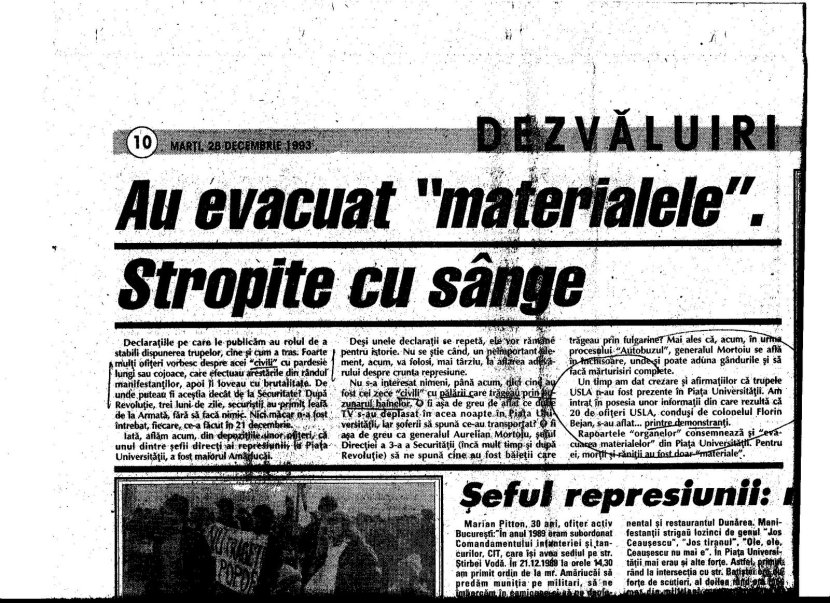
In 1992, I signed along with other doctors, university professors, renowned surgeons, a memorandum [see page 5 (below) for an article apparently linked to the memorandum] addressed to the Prosecutor General in which we requested an investigation regarding the wounded and dead by gunfire.  Not having received any response, after six months I went there to ask what was going on.  They told me they were working on it, and they showed me two or three requests and that was it.  One of the prosecutors took me into the hallway and told me “I have a child, a wife, it is very complicated.”  He asked me what I thought I was doing…I lit back into him, I told him I wasn’t just any kind of person to be blown off.

I showed him the x-rays of those who were shot, I showed him the bullets in the liver.  The x-rays exist, they weren’t my invention, I didn’t just dream all this up to demand an investigation!  I told them that there are some people who wish to find out the truth and they signed a memo to the Procuracy and they aren’t just anybody, but doctors with experience, experts in the field.  In vain, we requested ballistics tests and other research, in vain we presented forms, documents, x-rays, studies.  They did not want to undertake a serious investigation.[9]

[1]For some of my previous publications on this topic, see Richard Andrew Hall:

Hall 2008 http://homepage.mac.com/khallbobo/RichardHall/pubs/romrevfordumdums042108tk.html,

Hall 2006 http://homepage.mac.com/khallbobo/RichardHall/pubs/Voineaswar091706.html,

Hall 2005 http://homepage.mac.com/khallbobo/RichardHall/pubs/checkmate040405.html,

Hall 2004 http://homepage.mac.com/khallbobo/RichardHall/pubs/doublespeak%20romania%203-2004.html,

Hall 2002 http://homepage.mac.com/khallbobo/RichardHall/pubs/romania%20securitate%205-2002.html,

Richard Andrew Hall, “Theories of Collective Action and Revolution:  Evidence from the Romanian Transition of December 1989,” Europe-Asia Studies 2000, no. 6 (September 2000).

Richard Andrew Hall, “The Uses of Absurdity:  The ‘Staged-War’ Theory and the Romanian Revolution of December 1989,” East European Politics and Societies vol 13, no. 3 (Fall 1999) (University of California Berkeley Press).

[2] For a good discussion of this in English, which explains how cremation practices were  at odds with Romanian burial traditions, see the article entitled “The Red Mask of Death:  The Evil Politics of Cremation in Romania 1989,” in the journal Mortality, no. 15 (1).

[3]For more information online, see, for example, http://ro.wikipedia.org/wiki/Nicolae_Ghircoia%C5%9F, http://ro.wikipedia.org/wiki/Opera%C5%A3iunea_Trandafirul, http://www.romanialibera.ro/a51078/cine-a-organizat-furtul-cadavrelor-din-morga-spitalului-judetean.html, http://www.timisoara.com/newmioc/53.htm, http://www.timisoara.com/newmioc/67.htm. Even the 1994 SRI report admits that confusion surrounding the identity of those who were cremated stems from Ghircoias’ burning—after the flight of the Ceausescus on 22 December—of all relevant documents he had seized from the Timisoara county hospital http://www.ceausescu.org/ceausescu_texts/revolution/raportul_sri11.htm.  Thus, it seems appropriate to say Ghircoias’ job involved making things disappear…

[4]Professor Andrei Firica, interview by Florin Condurateanu, “Teroristii din Spitalul de Urgenta,” Jurnalul National, 9 March 2004, online edition, cited in Hall, “Orwellian…Positively Orwellian” http://homepage.mac.com/khallbobo/RichardHall/pubs/Voineaswar091706.html. For similar accounts, see Florin Mircea Corcoz si Mircea Aries, “Terorist ascuns in Apuseni?” Romania Libera, 21 August 1992, p. 1–“Colonelul Ghircoias, former director of the Securitate’s penal investigative unit, brought together the individuals accused of being terrorists and made them disappear”; Andreea Hasnas, “Reportajul unui film cu TERORISTI,” Expres, no. 10 (6-12 aprilie 1990), p. 5; Constantin Fugasin, “Unde ne sint teroristii?” Zig-Zag, 1990.

[5] Screen capture from http://www.dailymotion.com/video/x7rp6b_revolutia-romana-2225-dec1989-part_shortfilms posted by Alexandru2006.

[6] Significantly this video is in direct contradiction and contests the claims of the Sorin Iliesiu who maintains that “General Dan Voinea has said clearly:  The terrorists did not exist.  Those who seized power lied to protect the real criminals….The diversion of the ‘terrorists’ has been demonstrated by [the] Justice [System], not a single terrorist being found among the dead, wounded or arrested  (Sorin Iliesiu, “18 ani de la masacrul care a deturnat revoluţia anticomunistă,” 21 December 2007, http://www.romanialibera.com/articole/articol.php?step=articol&id=6709).  For a discussion, see Hall 2008.

[7] Screen capture from http://www.dailymotion.com/video/x7rp6b_revolutia-romana-2225-dec1989-part_shortfilms posted by Alexandru2006.

[8] Professor Andrei Firica, interview by Florin Condurateanu, “Teroristii din Spitalul de Urgenta,” Jurnalul National, 9 March 2004, online edition.

[9] Dr. Professor Nicolae Constantinescu, interview by Romulus Cristea, “”Nici acum nu-mi dau seama cum am putut sa operez nonstop timp de trei zile,” Romania Libera, 20 December 2006, online edition.


Posted in raport final | Tagged: , , , , , , , , , , , , , , , , , , , , , , , , | 33 Comments »

The Romanian Revolution Was Videotaped, Not Televised: Videograms of a Revolution (1992)

Posted by romanianrevolutionofdecember1989 on October 19, 2010

Further evidence that the Romanian Revolution of December 1989–or at least many of its most important moments and details–was videotaped, more so than televised (as Andrei Codrescu once suggested)–now available, at least for the time being, online:  the film, “Videograms of a Revolution.”  I had forgotten how extraordinary this documentary by Andrei Ujica and Harun Farocki, released on 1 January 1992, really is.  Its use of videotape, its smooth transitions and editing, its sparse commentary, its brilliant minimalism and simplicity bringing the full force of the emotions of the moment to bear…

PALPITANT!

Farcau Mariana Rodica (misidentified in the film as Rodica Marcau)

nascuta in 9 ianuarie 1962 la Supur (jud. Satu Mare), lucratoare comerciala la ICSMA (1989), acum pensionata cu grad 2 de invaliditate, impuscata in umarul drept si spate…La podul Decebal, intre pod si parc, erau militari in uniforma verde. Printre ei si unii mai in virsta, imbracati civil. In spate se vedea si un camion. Cind ne-am aproiat de ei, strigind “Armata e cu noi!” si alte lozinci, ne-am pomenit cu o ploaie de gloante (fara somatie). In momentul acela am simtit o durere puternica si am cazut. Fusesem atinsa de doua gloante (unul exploziv). Am facut pipi pe mine si am vazut parca niste stele si oameni luind-o la fuga. Dupa ce rafalele au incetat cei care se aruncasera la pamint s-au ridicat si unii plecau. Am strigat: “Luati-ma si pe mine!”. Cineva a zis: “Uite, asta nu-i moarta! Hai s-o luam!”. Altul zice: “Bine, dar e grea!”. M-au legat cu fularul si vorbeau intre ei sa aduca o masina. Eu am scos cheile de la masina si le-am dat, spunind ca am masina in parcarea de la Termal (unde o dusesem intre timp). Apoi mi-am pierdut cunostiinta si m-am trezit la spital.

excerpted from http://www.timisoara.com/mioc/REVT02~1.HTM

One can only be impressed and awestruck at the basic decency and human spirit of the demonstrators “fara violenta”…”without violence”

The Flight of the Ceausescus…more so 12:09 East of Bucharest than 12:08 East of Bucharest according to the videotape…

Another blow to rigid conspiracy theorists:  when they originally cut to the CC when Iliescu was to speak there were technical difficulties and when they did reestablish a good connection, Mazilu not Iliescu was broadcast

The telephone discussions of Vlad and Guse are to say the least…interesting…also, later Postelnicu appears to be drunk…

Reflecting the time at which this film was assembled and appeared the DIA hypothesis sneaks in in the first minute…I have discussed on this site the role of Securitate revisionism in giving birth to and fueling this hypothesis in 1990 and 1991.

Nicolae Camarasescu, Securitate V-a, the guy the Romanian press likes to identify as arrested as a “terrorist” in December 1989, then leading the miners in the rampage on 14-15 June 1990 in Bucharest…yet all the time maintaining the Securitate terrorists didn’t exist…in other words, elemental of the internal contradictions of so many media discussions on December 1989

Posted in Uncategorized | 2 Comments »

Probing Romania’s Cryptic Revolution, Colin Woodard, 18 December 2009

Posted by romanianrevolutionofdecember1989 on October 19, 2010

Peter Siani-Davies, one of my chief competitors in researching the history of December 1989, was kind and upstanding enough to recommend me as a dissenting viewpoint to his own views in an interview with the longtime journalist of central and eastern Europe, Colin Woodard.  Now that, friends, is scholarly professionalism–and in stark contrast to the transparently bloodyminded and, in some cases, unambiguously cowardly, refusal of many Romanianists to acknowledge or engage my research (the absolute lowest was Vladimir Tismaneanu’s loyal surrogates, Sorin Iliesiu and (at the time) Andrei Badin, who, in October 2007 knowingly and tendentiously lied to the Romanian public about where I work, rather than acknowledge it (talk about denial, fear of the truth, and “image” protection!).  Anyway, here is what Colin Woodard wrote about my article “The Romanian Revolution for Dum-Dums” and the research I have presented, as well as the full article below.  My thanks to both Peter Siani-Davies and Colin Woodard.

Some disagree. Independent researcher Richard Andrew Hall points to substantial evidence that shadowy anti-revolutionary forces were involved in the intense fighting in the days after Ceausescu’s flight. Hall has posted research papers pointing out widespread accounts of people being injured or killed by dum-dum bullets, which are designed to shatter inside the body to maximize organ damage and are outlawed under the Geneva Conventions. Ordinary army and police units did not stock such ammo.

“Let us hope that on the twentieth anniversary of the Revolution we may be able to read serious investigations of the ballistics evidence, rather than be subjected to the false and jaded refrain [that] such things did not exist,” Mr. Hall concluded.


http://www.globalpost.com/passport/foreign-desk/091218/probing-romanias-cryptic-revolution

Foreign Desk

Probing Romania’s cryptic revolution

Colin Woodard  |  December 18, 2009
Among Warsaw Bloc countries, Romania’s revolution was uniquely brutal. Twenty years later, scholars still debate whether the worst bloodshed was caused by revolutionaries fighting each other by mistake.

A child feeds pigeons in Victoriei Square, a hot-spot of Romania’s 1989 anti-communist revolt in Timisoara, 340 miles west of Bucharest. (Photo by Bogdan Cristel/Reuters.)

There was nothing velvet about Romania’s revolution, which broke out 20 years ago this week.

While their neighbors tossed aside hard-line regimes with little or no bloodshed, 1,104 Romanians were killed and 3,352 injured in clashes between various combinations of protestors, soldiers, secret police, and groups of shadowy figures described as “terrorists” whose identity and existence has been debated ever since. Eastern Europe’s other communist leaders had either led their country’s revolutions or had been eased into retirement; Romanian dictator Nicolae Ceausescu and his wife Elena were executed in the courtyard of a rural military garrison.

And while the Romanian Revolution put an end to Europe’s last Stalinist dictatorship – complete with acute food shortages, omnipotent secret police, and a cult of personality – it replaced it with a group of men who had been a part of the regime and were not eager to see its inner workings exposed to the public, scholars, or the courts.

“You cannot live a lie, it’s not healthy,” says Zoe Petre, a historian at the University of Bucharest, who says few have been held accountable for murders and other crimes from the Ceausescu era because the guilty have remained powerful and influential. “They are afraid of the precedents and they are doing whatever they can to block any kind of criminal action.”

Twenty years on, many of the mysteries surrounding the 1989 Revolution have been solved, but scholars remain divided on whether the big truths have been revealed or remain hidden in the shadows. “What happened in Romania’s Revolution depends on who you talk to,” says Peter Siani-Davies, author of a widely respected history of the event. “I believe we know more or less what happened, but it doesn’t persuade everybody.”

Romania was different in 1989. The other countries in the Soviet’s East European empire had replaced the total terror of hard-line Stalinist regimes of the 1950s with more moderate dictatorships of one sort or another. Romanian Communists retained theirs to the bitter end.

Ceausescu built a cult of personality modeled on that of North Korea’s Kim Il Sung backed by the securitate, a secret police force believed to have Orwellian omnipresence. Convinced that Romania’s national greatness would grow in direct proportion with its population size, he had banned abortion and birth control, clogging horrific state orphanages with unwanted babies. Villages were bulldozed and their residents consolidated in shoddy housing blocks in an effort to create a “rural proletariat.”

In the 1980s — having spent millions razing much of historic Bucharest to build his 3.8 million square foot palace — Ceausescu had became obsessed with paying off his foreign debts. To do so, he slashed imports and sharply increased exports without regard to domestic needs. By 1989, Romanians were shivering in apartments and workplaces that were only heated for a few hours a day. Electricity was severely rationed, elevators and many electric appliances were banned, and people stood in long lines for pig’s feet and other low quality foodstuffs in a country with oil fields and a massive agricultural sector.

The people’s putsch

Scholars generally agree on what transpired during the first phase of the Romanian Revolution, which started in the provincial city of Timisoara, near the Hungarian and Yugoslav borders, on December 17, 1989. Residents — who watched the Velvet Revolution and the fall of the Berlin Wall via foreign television broadcasts — took to the streets, sacked government buildings, and overwhelmed army detachments that tried to suppress them.

“It started as an uprising of normal people — students, professors, workers. It was not a conspiracy at all,” says Ms. Petre, who helped train a new generation of scholars who are probing recently opened archives. “They weren’t organized in any way before the revolution and had to organize on the spot.”

Petre says it’s also become clear that the Timisoara protestors fanned out by train, bus, and cars in an organized way to Bucharest and other Romanian cities, sparking demonstrations and deadly clashes in many of them on Dec. 21. “They knew that if Timisoara stayed isolated, sooner or later they would be crushed,” she says. “They had to spread the word.”

Ceausescu grossly misjudged the situation, calling a mass rally on Dec. 21 in front of the Communist Party Central Committee Building in Bucharest, where he addressed the nation on live television. The crowd booed him and, after the police tried to intervene, the city erupted into street fighting that raged through the night. The next morning, Ceausescu tried to address the crowds again. They threw stones and rushed the building.

Ceausescu and his wife escaped in an overloaded helicopter, lifting off from the roof of the Central Committee at 12:08 p.m. Their pilot ultimately ditched the couple and their two bodyguards on a country road, claiming they were about to be shot down. (His military superiors had switched allegiances and radioed the pilot that he was on his own.) Two presidential carjackings later, the Ceausescus reached a rural army garrison, whose officers shortly received orders to arrest them.

At 3 p.m., a group of once-prominent Communist officials gathered in the Central Committee building and announced the formation of a provisional government. Led by Ion Iliescu — a former Central Committee member — the group included men who had served as Ceausescu’s foreign ministers, armed forces minister, his official interpreter, and the commander of his police school. Backed by elements of the army, they promised free elections while espousing reform communism.

“These second echelon Communist Party leaders staged a coup d’etat during a popular revolt in the streets,” says Lavinia Stan, a Romania expert at St. Francis Xavier University in Antigonish, Nova Scotia. “Power passed to second-echelon Communist Party leaders who presented themselves as Gorbachev-style reformers because there was no real non-Communist opposition in Romania.”

The enemy is us?

Experts remain divided on what happened after this change in power, when over 85 percent of the Revolution’s deaths occurred.

That night, fighting intensified, with pitched battles at the defense ministry, television headquarters, airports and other strategic locations in the capital. At the time, protestors and army units loyal to the new government believed they were fighting pro-regime “terrorists.”

Many researchers now believe these “terrorists” never existed. “It came down to a mess and muddle in which these forces were running around looking for enemies and they ended up shooting each other,” says Mr. Siani-Davies. “Once darkness came they started distributing guns to a lot of teenagers; teens are likely to shoot, especially if someone fires on them.”

“The evidence is overwhelming that [revolutionaries] either mistakenly or deliberately shot at one another,” says Ms. Petre. “Nobody found any evidence of the terrorists.”

Some disagree. Independent researcher Richard Andrew Hall points to substantial evidence that shadowy anti-revolutionary forces were involved in the intense fighting in the days after Ceausescu’s flight. Hall has posted research papers pointing out widespread accounts of people being injured or killed by dum-dum bullets, which are designed to shatter inside the body to maximize organ damage and are outlawed under the Geneva Conventions. Ordinary army and police units did not stock such ammo.

“Let us hope that on the twentieth anniversary of the Revolution we may be able to read serious investigations of the ballistics evidence, rather than be subjected to the false and jaded refrain [that] such things did not exist,” Mr. Hall concluded.

(Hall’s current employer — the U.S. Central Intelligence Agency — has allowed him to publish his personal research, but does not permit him to give interviews.)

The National Salvation Front won the May 1990 parliamentary elections and Iliescu was elected president in a landslide. Over the following decade, former securitate officials became major businessmen and political figures and efforts to bring individuals to justice for Communist-era crimes were systematically blocked, according to the final report of an official presidential commission released in 2006.

“Secret police files are now available to ordinary Romanians, but the access came too late,” says Ms. Stan, who notes some Communist-era archives remain closed. “It’s not like in East Germany, where you had close to a million requests to see files in the first years after they were opened. In Romania the total is 30,000….People just lost interest.”

Posted in raport final, Uncategorized | Leave a Comment »

The Romanian Revolution for Dum-Dums (Part IV) by Richard Andrew Hall

Posted by romanianrevolutionofdecember1989 on October 17, 2010

Si totusi…se stie [And nevertheless…it is known]

It took over three years into my research on the Revolution—and physically being in the Library of the Romanian Academy—before I came to the realization: oh yeah, that’s a good idea, yeah, I should systematically compare what the former Securitate have to say about December 1989 and compare it with what others are saying. It took a maddening additional half year before I came to the conclusion: oh yeah, and how about what the Army has to say? It may seem ridiculous—and it is in some ways indefensible from the perspective of performing historical research—but you have to understand how Romanian émigrés dominated early investigations of the Revolution, and how they divided the post-communist Romania media into the pro-regime (untrustworthy) press and the opposition (trustworthy) press, and the influence this “research frame” and methodology had at the time upon younger researchers such as myself.[28]

A more systematic mind probably would have come to these revelations long before I did. Instead, it took the accidental, simultaneous ordering of issues from 1990 and 1991 of the vigorous anti-Iliescu regime university publication NU (Cluj), the similarly oppositional Zig-Zag (Bucharest), and the former Securitate mouthpiece Europa to discover this. There I found Radu Nicolae making his way among diametrically opposed publications, saying the same things about December 1989. And it mattered: the source for example of Radu Portocala’s claim that there were “no terrorists” in December 1989 was Radu Nicolae. But more important still, was the discovery of Angela Bacescu revising the Defense Ministry incident, exonerating the USLA, and claiming there were no Securitate terrorists in Sibiu (only victims) in Zig-Zag…only to show up months later in Romania Mare and Europa months later writing the same stuff, and in the case of the Sibiu article republishing it verbatim. Nor was Bacescu alone among the former Securitate at Zig-Zag: she was for example joined by Gheorghe Ionescu Olbojan, the first to pen revisionist articles about the Army’s DIA unit.[29]

But without a broader comparative framework and approach to the Romanian media, all of this eluded the highly partisan Romanian émigré writers on the events. Nestor Ratesh alone among this group did seem puzzled and bothered by the similarity of Romania Libera Petre Mihai Bacanu’s conclusions on the V-th Directorate and those of Bacescu (he only alluded to her dubious reputation, however, and did not name her.) But Bacanu was fallible: memorably, but also upstandingly, in December 1993, he admitted based on what he claimed were new revelations, that his previous three and a half years of exonerating the USLA had been in vain since they were erroneous: they had after all played a significant role in the repression and killing of demonstrators on the night of 21-22 December 1989 in University Square. That alone should have precipitated a rethinking about assumptions and approaches to investigating the December 1989 events and particularly the role of the Securitate and the USLA, but it did not, and has not to this day…

Romanians and Romanianists like to indulge in the reassuring myth that the “schools” of research on the Revolution were separate from the beginning—that the defining feature was the political orientation of the author and whether he or she viewed the events of December 1989 as a revolution or coup d’etat. To the extent they are willing to admit that discussions of the “terrorists” cross-pollinated and became intertwined across the borders of the political spectrum, they assume that this must have happened later, after views had become consolidated.[30] But such a view is simply ahistorical and wishful-thinking. It is simply impossible to defend honestly when you have Angela Bacescu who “showed up with lots of documents and didn’t need any money” and wrote her revisionist tracts in the oppositional Zig-Zag, when she and Olbojan were the first ones to voice theses that later became staples of the anti-Iliescu opposition—long after they had left its press.

It is indicative that Romanians still have yet to confront this methodological flaw that one of the few studies in the country to read Securitate and Army sources in addition to journalist and participant accounts, still failed to address the key similarities across the political spectrum regarding the existence and identity of the “terrorists.” Smaranda Vultur wrote in a review of Ruxandra Cesereanu’s (otherwise, groundbreaking in comparison to what had appeared before it in Romanian in book form) Decembrie ’89. Deconstructia unei revolutii (Iasi: Polirom 2004):

Beyond this, I would underscore however a deficit that results directly from the choice of the author to classify her sources based on how the source defines the events: as a revolution, a plot, or a hybrid of the two. Because of this one will thus find, contained in the same chapter, Securitate people and political analysts, revolutionaries and politicians of the old and new regimes, and journalists.[31]

In other words, my exact indictment of the approach inside and outside Romania to the study of the Revolution, and the reason why people are simply unable to acknowledge the similarity and even identicality of views of the “terrorists.”

After the aforementioned realizations in 1993-1994 about the need to be more comparative and systematic in investigating accounts of the Revolution, it took yet another two maddening years before I started to realize the significance of the ballistics evidence. It thus came comparatively late in the dissertation process. My timing was fortuitous, however. I wrote a short article in November 1996 that was published in two different forms in 22 and Sfera Politicii in December 1996—the mood in Romania was euphoric as seven years of the Iliescu regime had just come to an end through the ballot box. [32] True, it didn’t spark debate and loosen some lips as I had hoped, but it made my visit to Bucharest the following June —especially my interviews on one particular day with a journalist at Cotidianul and, several hours later, a member of the Gabrielescu Parliamentary Commission investigating the events (Adrian Popescu-Necsesti)—memorable to say the least….[link to article from December 1996 https://romanianrevolutionofdecember1989.wordpress.com/2010/10/07/richard-andrew-hall-decembrie-1989-dupa-7-ani-sfera-politicii-nr-441996/ ]

Of course, not then, or even since, has anybody who has investigated the December 1989 events inside or outside Romania systematically attempted to replicate, test, or expand upon my earlier findings—other than myself. As I have noted elsewhere,[33] in Peter Siani-Davies’ otherwise excellent The Romanian Revolution of December 1989 he devotes essentially a paragraph to the ballistics’ topic in a 300 plus page book—and it is only in the context of addressing my own earlier research. Monica Ciobanu could thus not be more wrong in her declaration that Peter Siani-Davies’ 2005 volume had disproven the “myth of Securitate terrorists.”[34] Siani-Davies has nothing to say about dum-dum/vidia/exploding ammunition: hence why he does not believe in Securitate terrorists!

Since then, I have written on Securitate revisionism, “the terrorists,” and the ballistics evidence of Romanian Revolution of December 1989, in the words of one critic who seems unable to call things by their name “voluminously, although never exhaustively, elsewhere”—publishing in 1999, 2000, 2002, 2004, 2005, and 2006. [35] Now, more than a decade after those original ballistics’ articles, I return here putting things together I should preferably have put together long before…

The high stakes of what was at play in late December 1989 become all the clearer here. Nicolae Ceausescu’s successors faced not only the dilemma of having foreign citizens arrested for firing at and killing in cold blood Romanian citizens[36], but members of a Romanian state institution—the Securitate—in addition to those foreign citizens, had injured, maimed, and killed Romanian citizens using munitions that were outlawed by international conventions to which Romania was a party. Thus, beyond the culpability of an institution that was key to the ability of the nomenklaturists who had seized power to continue in power—i.e. the Securitate—and who undoubtedly had compromising information on those leaders, the new potentates were faced with a problem of international dimensions and proportions.

Dan Badea’s April 1991 article with which I opened this paper concluded thusly:

There are in these two declarations above[–those of Gheorghe Balasa and Radu Minea–] sufficient elements for an investigation by the Police or Prosecutor’s Office. [Dan Badea, “Gloante speciale sau ce s-a mai gasit in cladirea Directiei a V-a,” Expres, 16-22 April 1991]

That, of course, never appears to have happened. I hope that the information I have supplied above—significantly, much of it new, much of it from the Internet in recent years—should at the very least encourage Romanians and Romanianists to reopen and reexamine the ballistics evidence. Let us hope that on the twentieth anniversary of the Revolution, we may be able to read serious investigations of the ballistics evidence, rather than be subjected to the false and jaded refrain… such things did not exist!


[28] I refer here to, for example, the works of Vladimir Tismaneanu, Matei Calinescu, Andrei Codrescu, Anneli Ute Gabanyi, Radu Portocala, and Nestor Ratesh. Some, like Tismaneanu in a 1993 article in EEPS, “The Quasi-Revolution and its Discontents,” were more explicit about this rather rigid dichotomous approach to the Romanian media, but it also comes through clearly in the sourcing, citations, and footnotes/endnotes of the others. (It continues to haunt the historiography of post-communist Romania, as works such as Tom Gallagher’s aforementioned Modern Romania make clear). To say the least, the issue of ballistics evidence essentially goes unanalyzed in these accounts. Moreover, although as we have seen, these authors have no problem affixing their names to petitions and the like, none of them has published any research on the December 1989 events since the early 1990s. It should tell you something that they continue to rely on and repeat the accounts they wrote in 1990 and 1991…as if nothing had been discovered or written since. In that way, it is almost fitting that the Report of the PCADCR reproduced Tismaneanu’s 1997 Dawisha and Parrott chapter in some places verbatim, down to failing to even change verb tenses when it states that certain questions “remain to be clarified.” I deconstructed the methodological faults in source selection in these émigré accounts in “The Romanian Revolution as Geopolitical Parlor Game” at http://homepage.mac.com/khallbobo/RichardHall/pubs/checkmate040405.html.

[29] For earlier discussions of all of this, see Richard Andrew Hall, “The Uses of Absurdity: The Staged-War Theory of the Romanian Revolution of December 1989,” East European Politics and Societies, vol. 13, no. 3, and Richard Andrew Hall, “The Securitate Roots of a Modern Romanian Fairy Tale,” Radio Free Europe East European Perspectives, April-May 2002, three part series, available at http://homepage.mac.com/khallbobo/RichardHall/pubs/romania%20securitate%205-2002.html.

[30] In “The Romanian Revolution as Geopolitical Parlor Game,” I demonstrated how even the so-called French and German schools (really the schools of Romanian émigrés in those countries) in 1990 were not and could not be independent from accounts in Romania, and that the accounts fed into and reinforced one another. It is simply intellectual myth—and an all too convenient one—to argue the antisceptic separation of these accounts as independent.

[31] Smaranda Vultur, “Revolutia recitita,” 22 no. 787 (9-15 April 2005) online at http://www.revista22.ro.

[32] Richard Andrew Hall, trans. Adrian Bobeica, “Ce demonstreaza probele balistice dupa sapte ani?” 22, no. 51 (17-23 December 1996), p. 10, and Richard Andrew Hall, trans. Corina Ileana Pop, “Dupa 7 ani,” Sfera Politicii no. 44 (1996), pp. 61-63.

[33] See my discussion in “Orwellian…Positively Orwellian,” at http://homepage.mac.com/khallbobo/RichardHall/pubs/Voineaswar091706.html.

[34] Monica Ciobanu’s review of Siani-Davies The Romanian Revolution of December 1989 and Tom Gallagher’s Modern Romania: Theft of a Nation is entitled “The Myth Factory” (found at http://www.tol.cz).

[35] Charles King, “Remembering Romanian Communism,” Slavic Review, Winter 2007, p 719. In King’s short article, he does not hesitate to make occasionally gratuitous citations for things he did not need to cite. Yet in discussing December 1989 and using the term “elsewhere”—which usually prefaces a description of “where else” one might find these things—there are no citations. “Although never exhaustively” is itself a gratuitous choice of words and far from accidental: in my last work on December 1989, I made light of how ridiculous it was for Daniel Chirot to claim that Peter Siani-Davies’ The Romanian Revolution of December 1989, an otherwise excellent work, was “near definitive” when so much was missing from Siani-Davies’ discussion—notably, for our purposes here, the question of dum-dum/vidia/exploding munitions. One could indeed be left with the impression that King intends to deliver a put-down, that some fellow Romanianists will no doubt catch, but yet deny the broader audience references to what he alludes and simultaneously protect his image from having delivered such a “palma” as the Romanians would say. It would appear that at least for readers of this paper, his goals won’t go completely fulfilled.

[36] See my discussion in “Orwellian…Positively Orwellian,” at http://homepage.mac.com/khallbobo/RichardHall/pubs/Voineaswar091706.html.

Posted in raport final | Leave a Comment »

The Romanian Revolution for Dum-Dums (Part III) by Richard Andrew Hall

Posted by romanianrevolutionofdecember1989 on October 13, 2010

Ammunition…Consistent with the Confessions of Former Securitate Whistleblowers

And so, who was it, who has told us about “exploding bullets” and “special cartridges” like this, and who has it been said possessed them in December 1989?


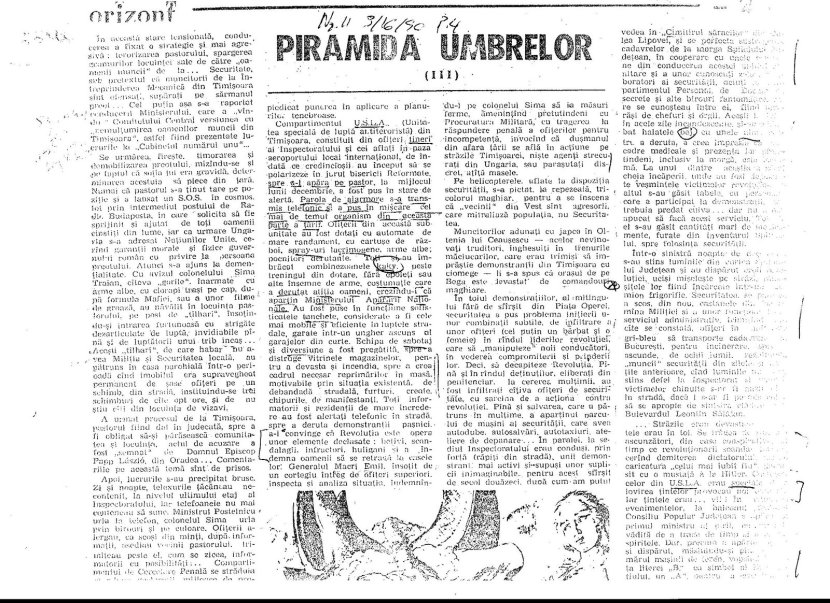
For years I have been essentially the sole researcher inside or outside the country familiar with and promoting the claims of 1) former Timisoara Securitate Directorate I officer Roland Vasilevici—who published his claims about December 1989 under the byline of Puspoki F. in the Timisoara political-cultural weekly Orizont in March 1990 and under the pseudonym “Romeo Vasiliu”—and 2) an anonymous USLA recruit who told his story to AM Press Dolj (published on the five year anniversary of the events in Romania Libera 28 December 1994…ironically (?) next to a story about how a former Securitate official attempted to interrupt a private television broadcast in which Roland Vasilevici was being interviewed in Timisoara about Libyan involvement in December 1989).

Vasilevici claimed in those March 1990 articles and in a 140 page book that followed—both the series and the book titled Pyramid of Shadows—that the USLA and Arab commandos were the “terrorists” of December 1989. What is particularly noteworthy in light of the above discussion about “exploding bullets” was his claim that the USLA and the foreign students who supplemented them “used special cartridges which upon hitting their targets caused new explosions.”[25]

The anonymous USLA recruit stated separately, but similarly:

I was in Timisoara and Bucharest in December ’89. In addition to us [USLA] draftees, recalled professionals, who wore black camouflage outfits, were dispatched. Antiterrorist troop units and these professionals received live ammunition. In Timisoara demonstrators were shot at short distances. I saw how the skulls of those who were shot would explode. I believe the masked ones, using their own special weapons, shot with exploding bullets. In January 1990, all the draftees from the USLA troops were put in detox. We had been drugged. We were discharged five months before our service was due to expire in order to lose any trace of us. Don’t publish my name. I fear for me and my parents. When we trained and practiced we were separated into ‘friends’ and ‘enemies.’ The masked ones were the ‘enemies’ who we had to find and neutralize. I believe the masked ones were the ‘terrorists’. [emphases added]

As I have pointed out, despite the short shrift given these two revelations by Romanian media and Romanianists, one group has paid close attention: the former Securitate. That is not accidental. [26]

With the advent of the Internet, unverifiable bulletin board postings also pop up. On 23 December 2003, under the name of “kodiak,” the following appeared:

In ’89 I was a major in the USLA…and I know enough things that it would be better I didn’t know…15, 16, 20, 30 years will pass and nothing will be known beyond what you need and have permission to know…” (http://www.cafeneaua.com)[27]

Clearly, the legal constraints of security oaths and fear continue to cast a long shadow, long after the events of December 1989.

[25] Puspoki F., “Piramida Umbrelor (III),” Orizont (Timisoara), no. 11 (16 March 1990) p.4, and Roland Vasilevici, Piramida Umbrelor (Timisoara: Editura de Vest, 1991), p. 61.

[26] For the discussion of the former Securitate response to those who have violated the code of silence, see Hall, “Orwellian…Positively Orwellian,” http://homepage.mac.com/khallbobo/RichardHall/pubs/Voineaswar091706.html.

Posted in Uncategorized | Leave a Comment »

The Romanian Revolution for Dum-Dums (Part II) by Richard Andrew Hall

Posted by romanianrevolutionofdecember1989 on October 11, 2010

[clearly, since this was written in April 2008, my understanding of the differences between dum-dum and vidia munitions has evolved]

D’oh…Dum-Dum…(Tweedle) Dumb and (Tweedle) Dumber: Dum-Dum=Vidia

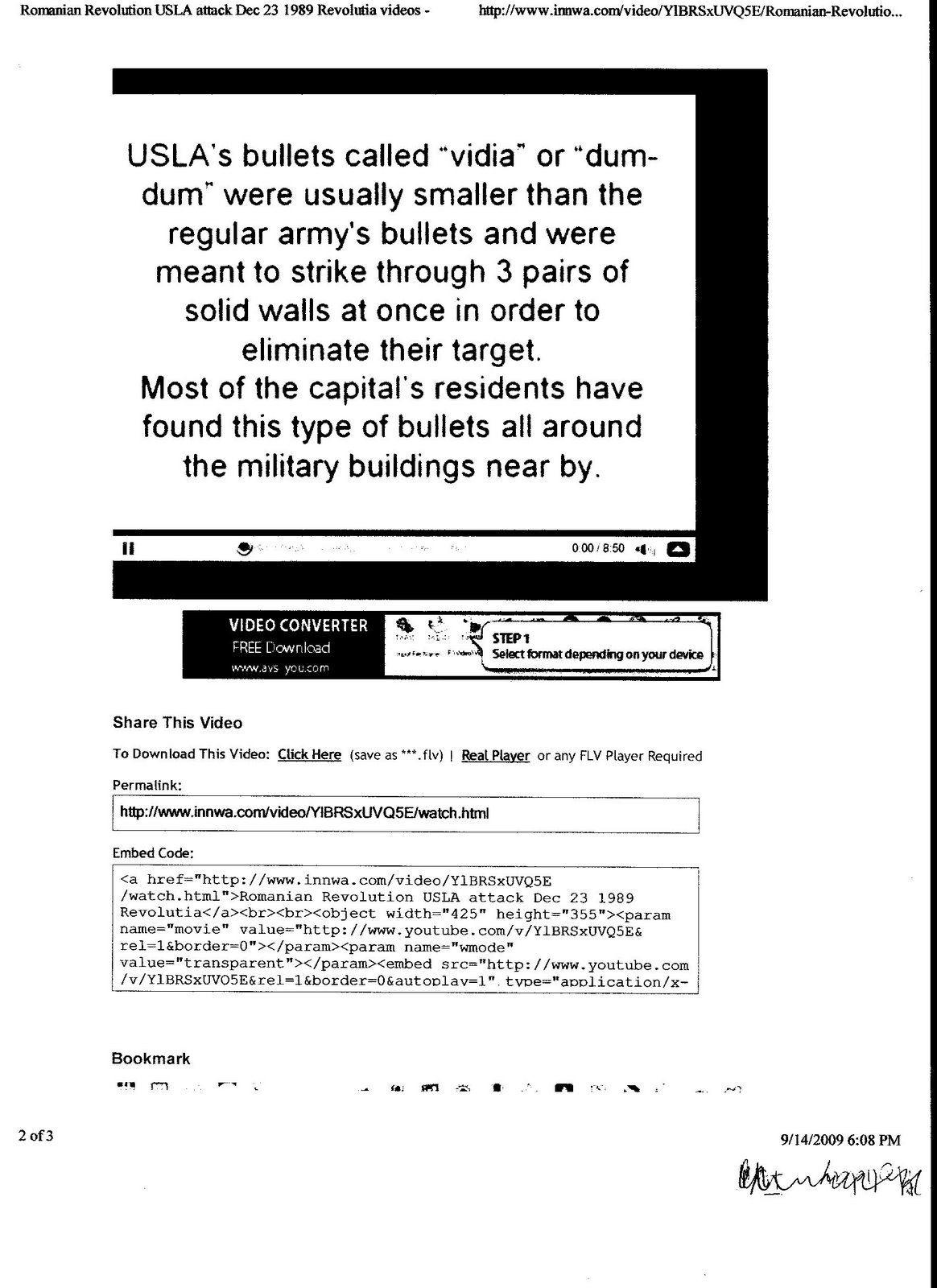
When I first viewed the youtube video “Romanian Revolution USLA attack Dec 23 1989 Revolutia” (http://www.youtube.com/watch?v=YlBRSxUVQ5E ), what struck me was: here, finally, after a decade and a half of almost unopposed revisionist denial, here was someone who claims to have been an eyewitness and has photos and details of the incident, and who maintains the now almost heretical idea that the Securitate’s “Special Unit for Anti-terrorist Warfare”(USLA for short) had indeed attempted to attack the heavily-guarded Defense Ministry Headquarters on Drumul Taberei in Bucharest on the night of 23-24 December 1989! But, in fact as we shall see, although important, that is actually not the most important thing about the one and only youtube video posted by “destituirea.”

For me the transcript of the USLA unit claiming to have witnessed army units attacking their own ministry and thus the supposed reason that the USLA men who witnessed it “had to be silenced by being killed”—a transcript leaked to the press in 1993 and which led scholars such as Denis Deletant and Peter Siani-Davies to consider this “case closed” essentially—was always highly problematic. It supplied what was said, but, if we are to believe the words of the USLA Commander Gheorghe Ardeleanu, speaking to the notorious Securitate cheerleader Angela Bacescu, it did not supply the much needed context: Ardeleanu claimed that he had been placed under arrest and that it was he who chose the names of the USLA officers who were to report to the Defense Ministry. The USLA units thus came in a situation in which those who had taken control of the country were in the Defense Ministry holding their commander under arrest.[16]

But more importantly, the transcript could not explain a) the lack of any corroboration since of these supposed Army units attacking the Defense Ministry on the night of 23-24 December 1989—truly hard to believe, given all the young recruits and given their comparative willingness to talk to the media after all these years, in comparison to the former Securitate, and b) the claims in summer 1990 by the Army cadre who had been involved in the firefight with the USLA and the interviews of civilians in the surrounding blocs of flats who had lived through the fighting in December 1989 and related what they had seen.[17] The interviewees had detailed the suspicious actions of the USLA convoy and made it clear that they came with less-than-friendly intentions.

Now, here, 17 years after those famous articles by Mihai Floca and Victor Stoica is a video supporting the claim that the USLA units attempted to force their way into the Defense Ministry. The photos of the inside of the USLA ABI vehicles and of the dead USLA men (wearing black jumpsuits underneath Army clothing) are perhaps the most extensive and detailed seen to date, and the anonymous poster plays coy as to where he got them from (he claims he does not want to reveal the source—something which, given the sensitivity of the issue, I am not surprised by).

But, as I mentioned previously, it is actually not the confirmation of this understanding of the Defense Ministry incident that is the most significant thing about this youtube video. It is at the 2:01-2:05 of 8:50 mark of this silent video that the poster makes the following interesting and critical insight/claim…

USLA’s bullets were called “vidia” or “dum-dum” were usually smaller than the regular army’s bullets…Most of the capital’s residents have found this type of bullets all around the military buildings near by. (at 2:01 of 8:50)[18]

And thus, it becomes clear that the discussion of “vidia” bullets and “dum-dum” bullets is interchangeable (or at least is treated as such)! (Hence, perhaps why Romulus Cristea asked his question of General Voinea as he did in December 2005: “Did special ammunition, bullets with a vidia tip or dum-dum bullets, claim [any] victims? The press of the time was filled with such claims…”) “Vidia” translates as “grooved,” and thus describes the modified feature of the bullets which makes them so lethal, thereby making the treatment of vidia and dumdum as de facto synonyms understandable.

This is critical because as I have previously written in detail, citing interviews and reminiscences in the Romanian press…vidia bullets showed up across the country in December 1989. In “Orwellian…Positively Orwellian: Prosecutor Voinea’s Campaign to Sanitize the Romanian Revolution of December 1989” (http://homepage.mac.com/khallbobo/RichardHall/pubs/Voineaswar091706.html) I detail examples of vidia bullets showing up across the country—Brasov, Sibiu, Bucharest (multiple locations), Braila, Caransebes, Craiova, and Hunedoara—as recounted by civilians and Army personnel, at various times since the events—not just during or right after. Such wide dispersion of the use of officially non-existent munitions is critical too because it infirms the notion that somehow demonstrators or the Army put their hands on such “free floating weapons” and used them during the December 1989 events—that it would have happened in one or two places could be explained, but that the same thing would happen in so many geographic centers is scarcely plausible.

Recall from our earlier extract from Prosecutor Dan Voinea’s December 2005 interview, his unambiguous denial of the use of vidia munitions. Nevertheless, significantly, since that interview we continue to find people who remember what they remember and they remember the use of vidia munitions. I have found yet more references. Alexandru Stepanian, who writes under the motto “Dreptate si Onoare! (Justice and Honor!),” not only claims to still have a vidia bullet from 22-23 December 1989 in the area around the TV Station in Bucharest, but he has placed a photo of it on the portalulrevolutiei website.[19] In fall 2006, the daughter of a priest recalled:

In December ’89, after he arrived from Timisoara, my father stayed with me on Stefan Cel Mare Boulevard. When we returned to our home, on the corner of Admiral Balescu and Rosenthal. I found the cupboard of the dresser pure and simple riddled with bullets, about 8 to 10 of them. Someone who knew about such things told me they were vidia bullets. They were brought to a commission, but I don’t know what happened to them.[20]

In 2007 a book entitled The Tales of the Terrorists was published in Galati. In one section, a Eugen Stoleriu recounts his dispatch to Bucharest as a military recruit during the events and how for the first time in his life he came across vidia bullets that were shot at him.[21]

Another apparent synonym for “vidia” is “crestata” or “notched.” I take it that the reference is to the same type of munitions because the damage caused to those wounded by them was equally catastrophic. In December 2007, Alexandru Tudor, a soccer official famous apparently for his stern, unsmiling demeanor, who was shot on 23 December 1989 around 10 am in the area of Piata Aviatorilor near the TV studio, recounted the episode that ended his career:

They brought me to Colentina Hospital and there I had the great fortune of two great doctors. If they had operated on me, they would have to amputate both my legs beneath the knee, but instead they left the bullets in there 12 days. Their explanation was that the bullets were too close to arteries, and since they were gloante crestate (notched bullets), it was very dangerous. After they were removed, I kept the bullets, I have them at home. I was on crutches for six months, I went through therapy, but I had to give up soccer.[22]

Also on the 18th anniversary of the Revolution, a frustrated poster to another site asked pointedly:

Who in Romania in 1989 had 5.5 mm caliber NATO-type munition, that in addition was “notched”—something outlawed by the Geneva Convention, while it is known that the Romanian Army had only the caliber used by Warsaw Pact nations for their weapons, that is to say 7,62 mm….At that time even the Olympic speed shooting champion, Sorin Babii, expressed his surprise….I had in my hand several samples of this cartridge: small, black, with a spiral on the top, or with 4 cuts (those who know a little bit about ballistics and medical forensics can attest to the devastating role caused by these modifications). I await a response to my questions…perhaps someone will be willing to break the silence. I thank you in advance. [emphases added][23]

In other words, the existence of crestate/vidia/dum-dum bullets is known, and not everyone has so blithely forgotten their existence.

A Dum-Dum by Any Other Name: Gloante explosive (exploding bullets), gloante speciale (special bullets)

Crestate, vidia, dum-dum…by now we know: these are very dangerous munitions…

In the field of firearms, an expanding bullet is a bullet designed to expand on impact. Such bullets are often known as Dum-dum or dumdum bullets. There are several types of dum-dum designs. Two popular designs are the hollow point (made during the manufacturing phase) and X-ing made usually by the user by making two notches perpendicular to each other on the tip of the bullet, commonly with a knife. The effect is that the bullet deforms and sometimes fragments upon impact due to the indentations. This creates a larger wound channel or channels with greater blood loss and trauma.

The hollow-point bullet, and the soft-nosed bullet, are sometimes also referred to as the dum-dum, so named after the British arsenal at Dum-Dum, near Calcutta, India, where it is said that jacketed, expanding bullets were first developed. This term is rare among shooters, but can still be found in use, usually in the news media and sensational popular fiction. Recreational shooters sometimes refer to hollow points as “JHPs”, from the common manufacturer’s abbreviation for “Jacketed Hollow Point”.

To be most correct, the term “Dum Dum Bullet” refers only to soft point bullets, not to hollow points, though it is very common for it to be mistakenly used this way.

The Hague Convention of 1899, Declaration III, prohibits the use in warfare of bullets which easily expand or flatten in the body, and was an expansion of the Declaration of St Petersburg in 1868, which banned exploding projectiles of less than 400 grams. These treaties limited the use of “explosive” bullets in military use, defining illegal rounds as a jacketed bullet with an exposed lead tip (and, by implication, a jacketed base).[24]

Thus, under the synonym for dumdum/vidia/crestate bullets of “exploding bullets,” we find the following on the Internet:

On the evening of 27 December 1989, Eugen Maresi, 20 years old, a military draftee, was sent to organize a checkpoint on soseaua Chitilei, at the entrance to Bucharest….A group of 25 soldiers came under fire from the belltower of a church. Eugen was the first shot…. “The doctors told me my only child was shot with (gloante explosive) exploding bullets. The fragments shattered all of his internal organs,” says Dumitru Maresi, the father of the [Drobeta Turnu] Severin hero. http://2003.informatia.ro/Article42788.phtml

and

Gheorghe Nicolosu, was shot in the leg…After he was operated on, it was established that the bullet with which he was shot did not figure in [the arsenal of] the Romanian Army. Nicolosu was operated on in Hunedoara, then arrived in Italy, where he underwent another surgery…In the same area, on Lipscani, Cristea Valeria, 36 years old, was shot in the stomach by ammunition that did not belong to the army. He died a few hours later, the doctors trying to save his life, but the glontul exploziv (exploding bullet) perforated his intestines. Another youngster, 18 year old Ion Gherasim was shot in the back at the entrance to UM 01933 by munition that did not belong to the army. (Emphases added) http://www.replicahd.ro/images/replica216/special2.htm

Once again, we are speaking here of far-flung locations across the country—Chitila (Bucharest) and Hunedoara—which makes the idea of accident and “free floating weapons” unlikely.

[16] I have examined the incident in detail several times, for the references to other works, see Richard Andrew Hall, “The Romanian Revolution as Geopolitical Parlor Game,” http://homepage.mac.com/khallbobo/RichardHall/pubs/checkmate040405.pdf, and Hall, “Orwellian…Positively Orwellian,” http://homepage.mac.com/khallbobo/RichardHall/pubs/Voineaswar091706.html.

[17] Once again, see “The Romanian Revolution as Geopolitical Parlor Game,” http://homepage.mac.com/khallbobo/RichardHall/pubs/checkmate040405.pdf, and “Orwellian…Positively Orwellian,” http://homepage.mac.com/khallbobo/RichardHall/pubs/Voineaswar091706.html. The critical articles were authored by Mihai Floca and Victor Stoica, who interviewed the Army cadre who had been involved in the incident and the residents of the surrounding apartment blocs who survived the fighting of those days.

[18] destituirea “Romanian Revolution USLA attack Dec 23 1989 Revolutia,” http://www.youtube.com/watch?v=YlBRSxUVQ5E

[19] For the photo see http://www.portalulrevolutiei.ro/documente/glont.htm; for one of his posts see http://www.portalulrevolutiei.ro/index.php?menu=6&pg=forum_thread.php&lnk=1&pagina=39. I cannot verify that this is indeed a “vidia” munition.

[20] Christian Levant, “Dacă tata nu-l salva pe Tokes, dacă nu salva biserici, tot se întâmpla ceva,” Adevarul, 30 September 2006, online at http://www.adevarul.ro/articole/dac-x103-tata-nu-l-salva-pe-tokes-dac-x103-nu-salva-biserici-tot-se-nt-mpla-ceva/200090.

[21] Cezar-Vladimir Rogoz, Povestirile teroristilor amintiri preluate si prelucrate de Cezar-Vladimir Rogoz, (Alma Print Galati 2007), p. 297, available online at http://www.bvau.ro/docs/e-books/2007/Rogoz,%20Cezar-Vladimir/povestirile_teroristilor.pdf.

[22]“A invatat sa zambeasca, [He learned how to smile],” http://marianmanescu.wordpress.com/2007/12/21/a-invatat-sa-zambeasca.

Posted in raport final, Uncategorized | 1 Comment »