The Archive of the Romanian Revolution of December 1989

A Catch-22 December 1989, Groundhog-Day Production. Presenting the Personal Research & Scholarship of Richard Andrew Hall, Ph.D.

Posts Tagged ‘securitatea decembrie 1989’

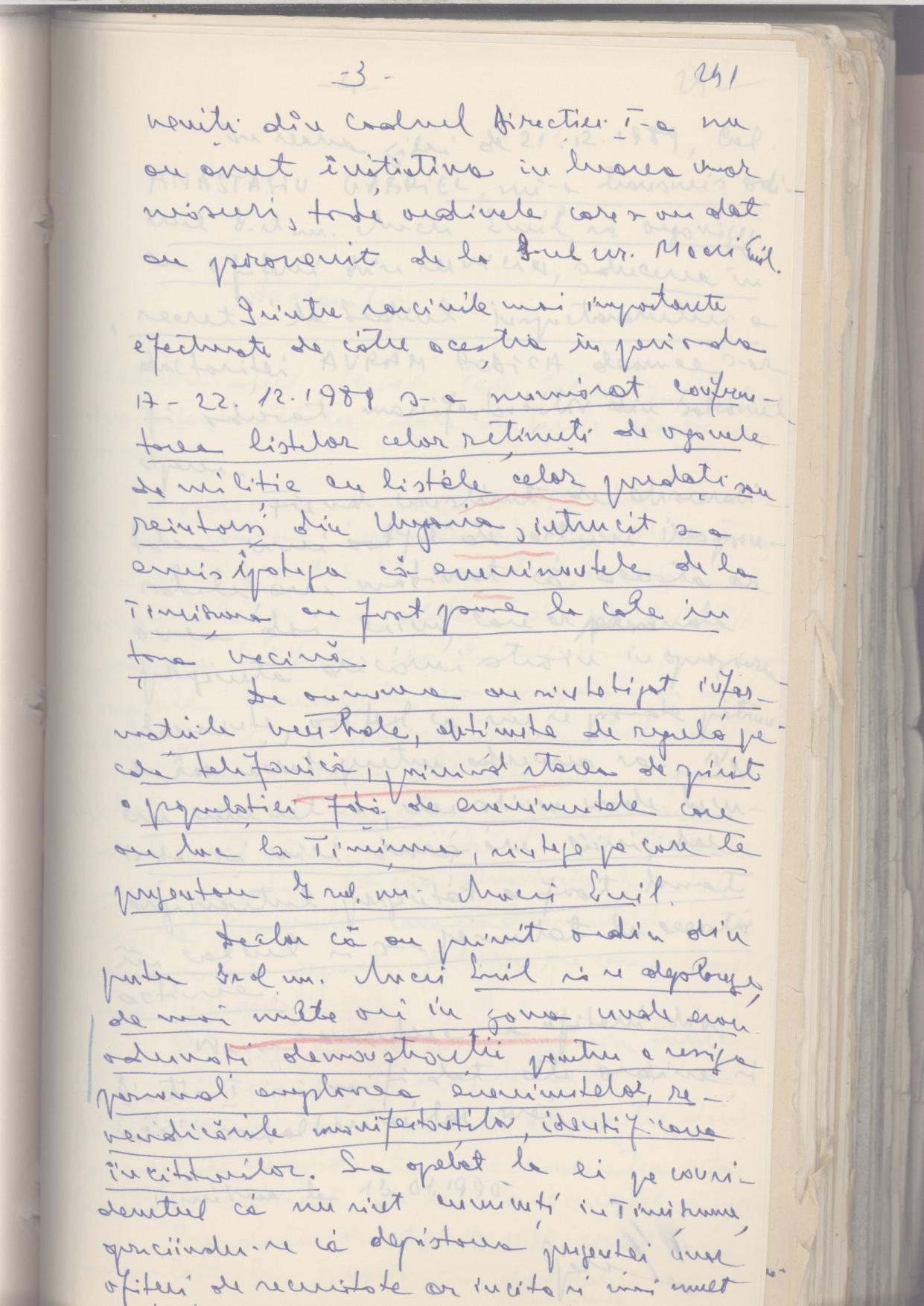
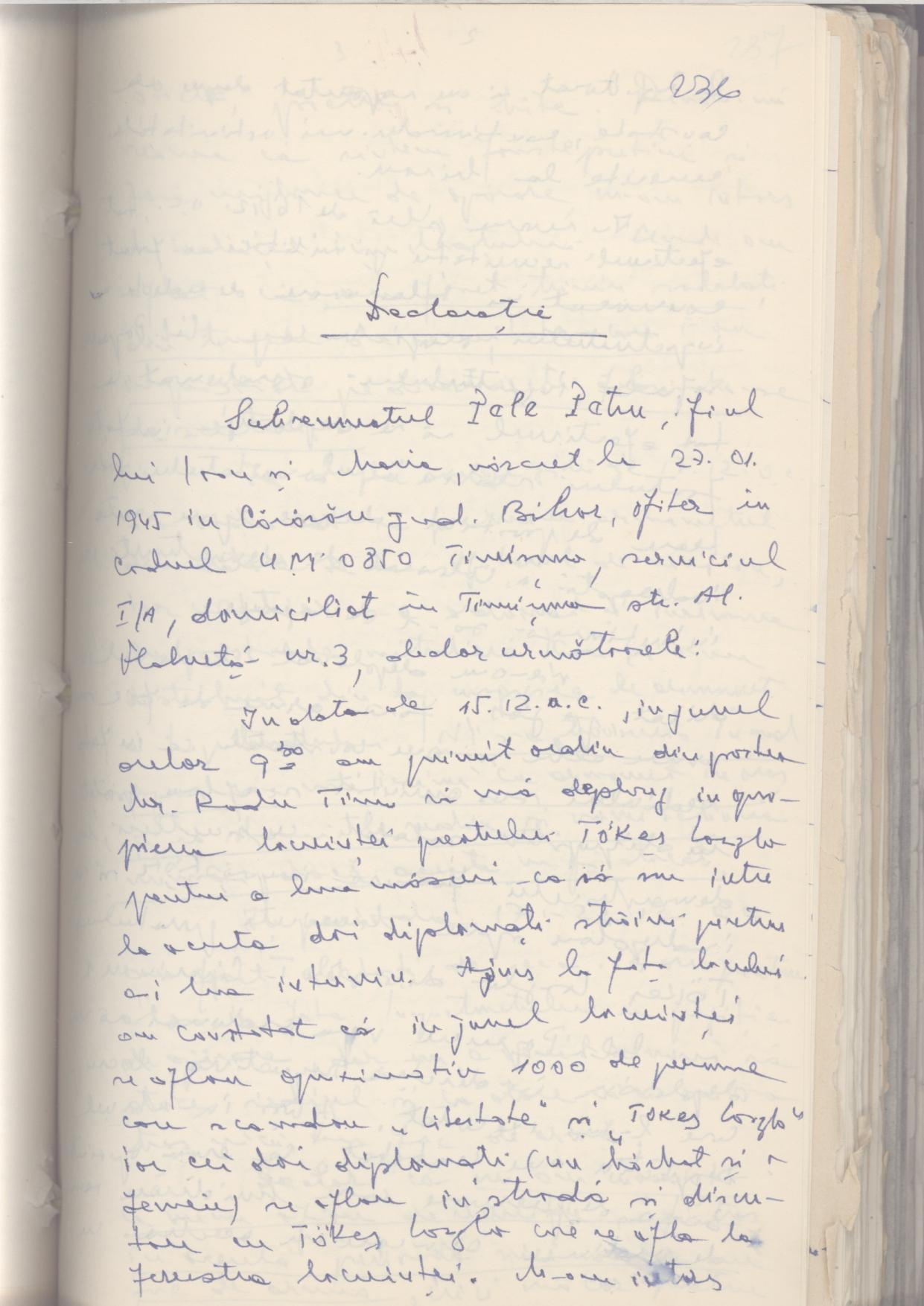
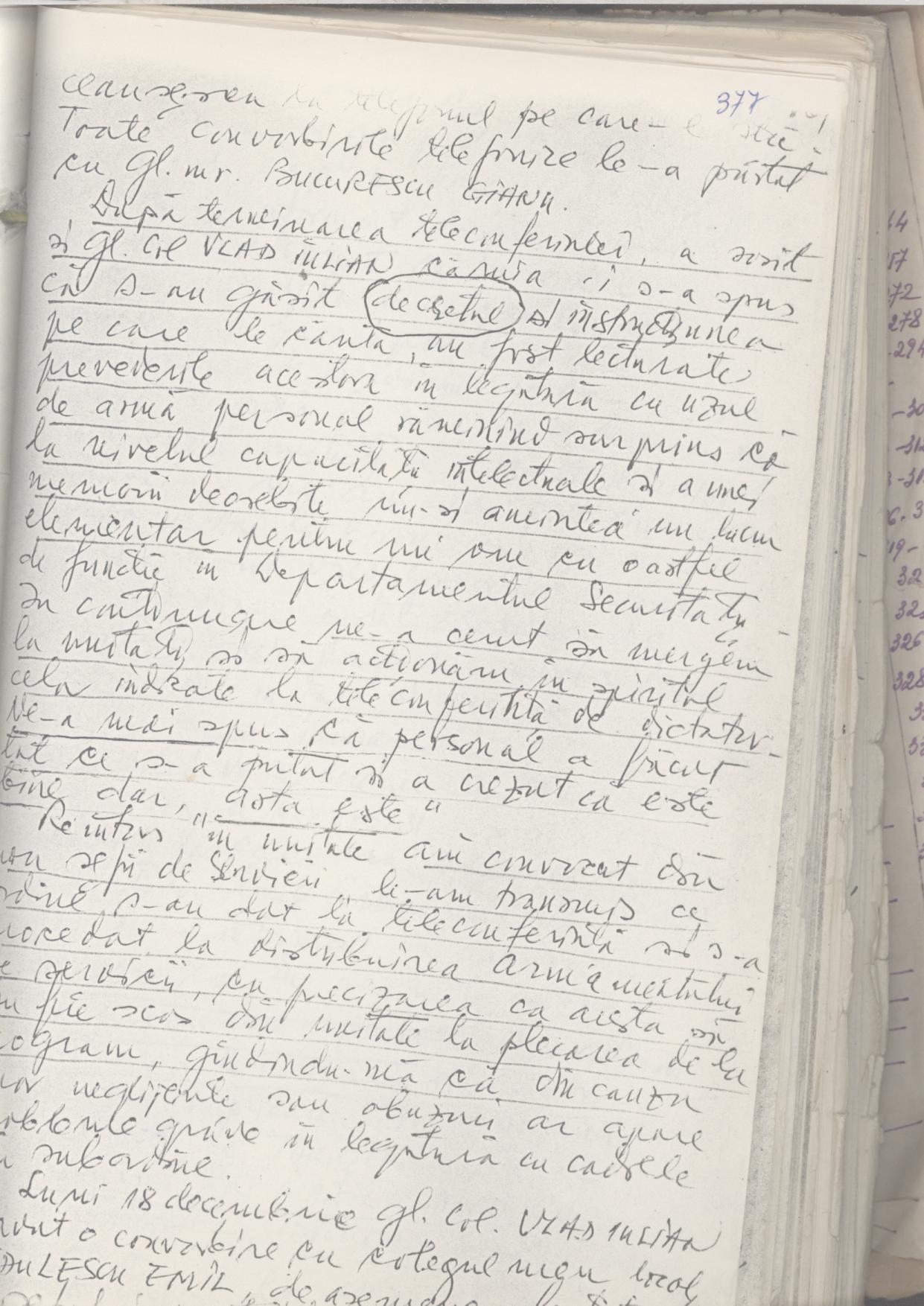
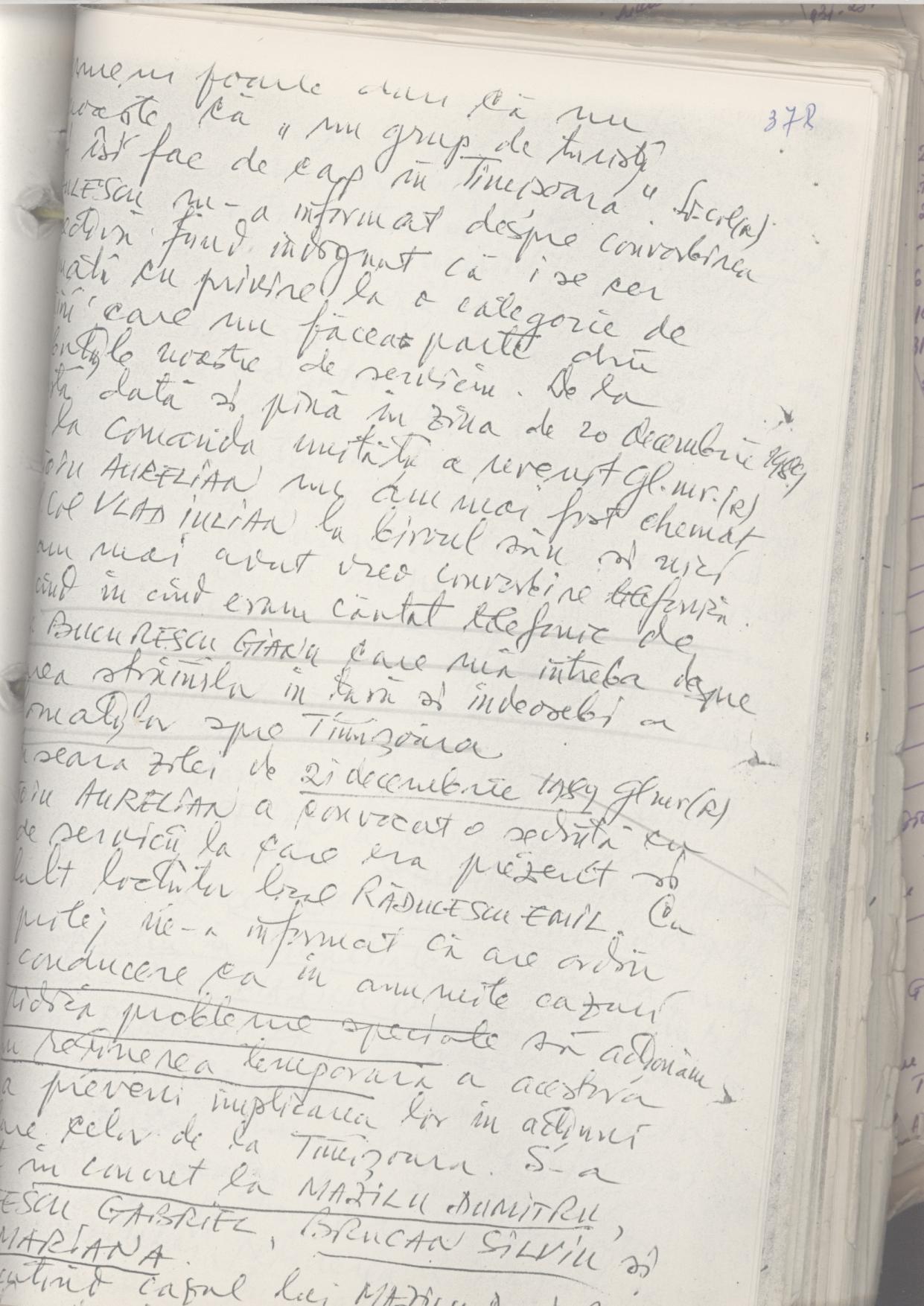
Dosarele Revolutiei de la Timisoara si Procesul de la Timisoara: Cateva Documente

Posted by romanianrevolutionofdecember1989 on December 17, 2013

[Documentary evidence in support of the publication entitled:  Bullets, Lies, and Videotape:  The Amazing, Disappearing Counter-Revolution of December 1989  ]

postat de Marius Mioc la Youtube, pagina lui (de o mare valoare) la http://mariusmioc.wordpress.com/

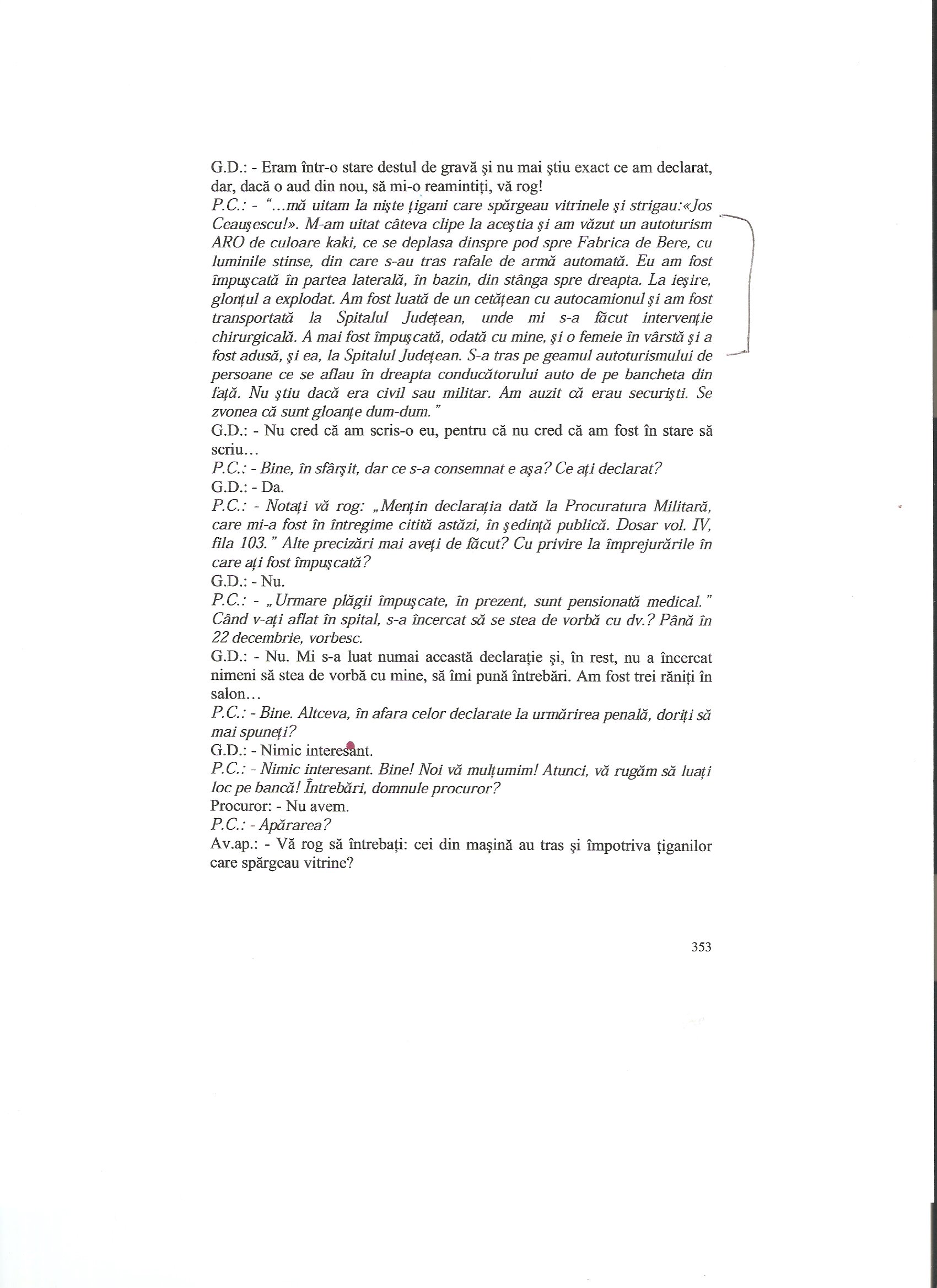
Procesul de la Timisoara (II). Audierea partii civile Popovici Ion: “…Atata retin foarte bine minte, ca ofiterul a spus, cica: ‘Nu, voi trageti cu dum-dum-uri si dupa aia Armata raspunde.’”

available on this site http://www.banaterra.eu/romana/procesul-de-la-timisoara-1990-1991-vol-v ].  The following is from Volume V.]

Some excerpts: P.C.:  Ati dat o declaratie?   Po. I. :  Da  P.C.:  O mentineti?  Po. I. Da (p. 827) P.C.:  “Inteleg sa fiu audiat in cauza ca parte civila”, da?  V-as ruga sa faceti putin liniste!  “Mentin declaratia de la Procuratura si…” (p. 833)

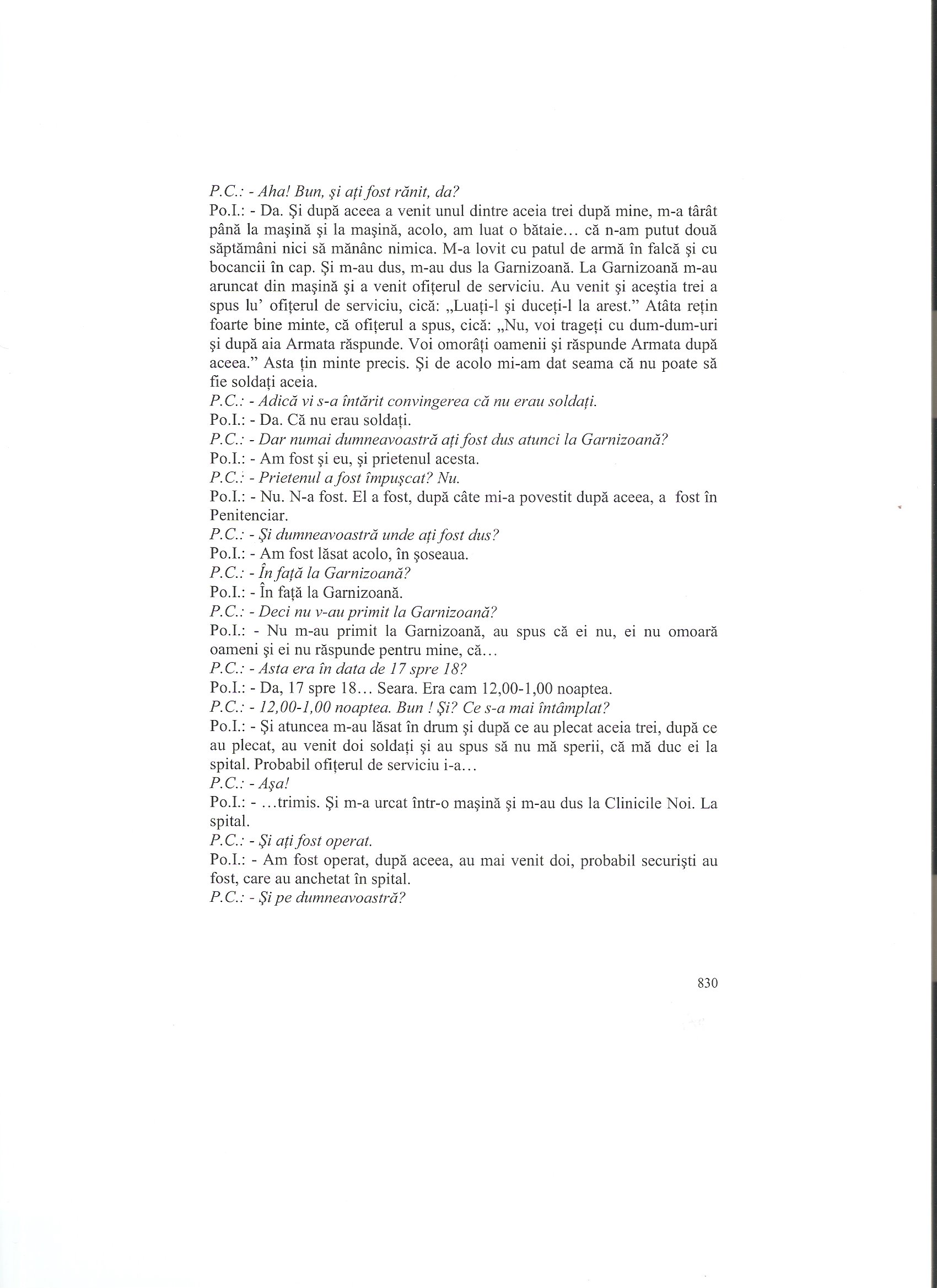
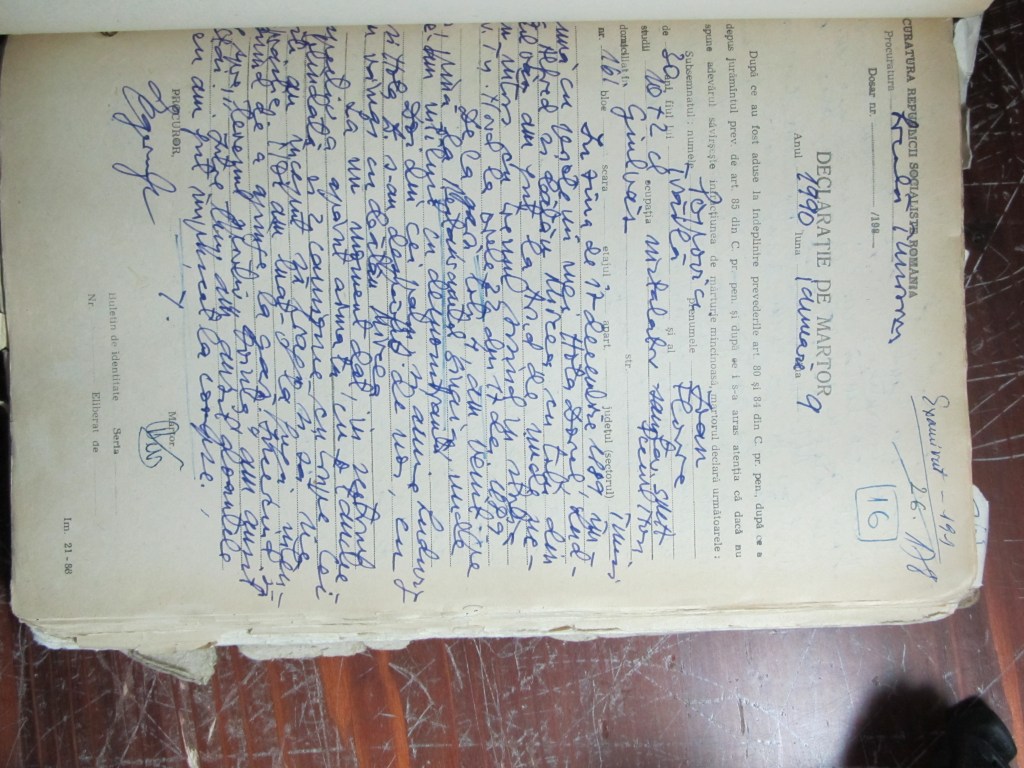
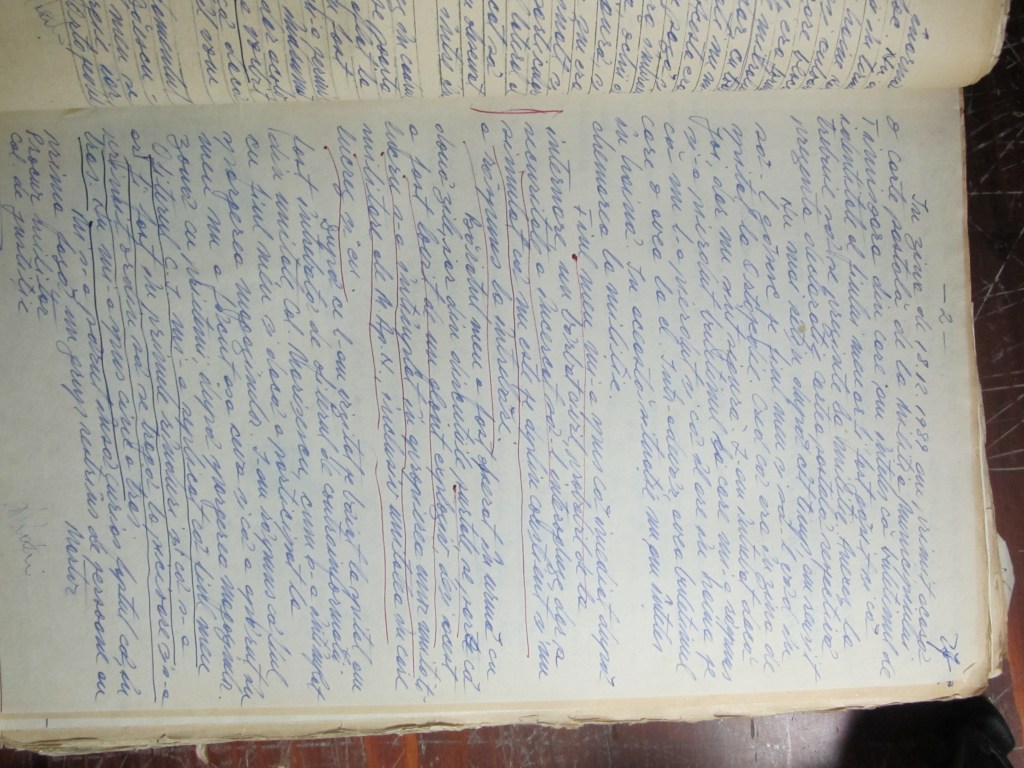
Po. I.:  …Da [am fost ranit].  Si dupa aceea a venit unul dintre trei [civili mai in varsta] dupa mine, m-a tarat pana la masina si la masina, acolo, am luat o bataie…ca n-am putut doua saptamani nici sa mananc nimica.  M-a lovit cu patul de arma in falca si cu bocancii in cap.  Si m-au dus, m-au dus la Garnizoana.  La Garnizoana m-au aruncat din masina si a venit ofiterul de serviciu.  Au venit si acestia trei a spus lu’ ofiterul de serviciu, cica:  “Luati-l si duceti-l  la arest.”  Atata retin foarte bine minte, ca ofiterul a spus, cica:  “Nu, voi trageti cu dum-dum-uri si dupa aia Armata raspunde.  Voi omorati oameni si raspunde Armata dupa aceea.”  Asta tin minte precis.  Si de acolo mi-am dat seama ca nu poate sa fie soldati aceia. (p. 830)

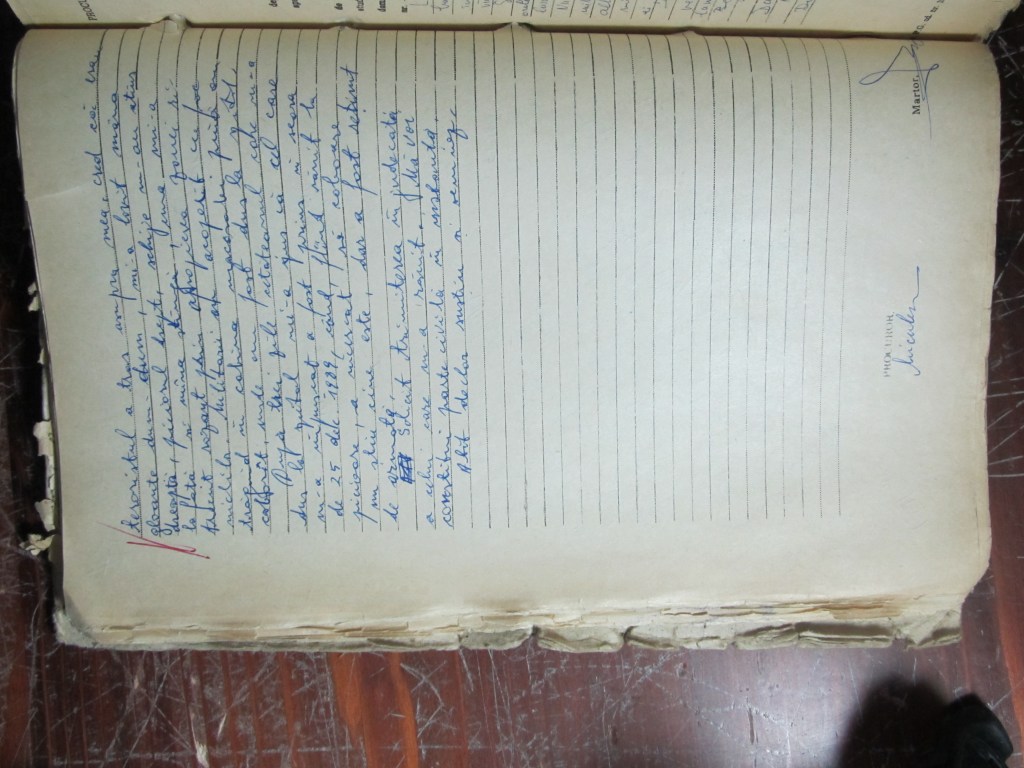
IMG_0291

IMG_0290

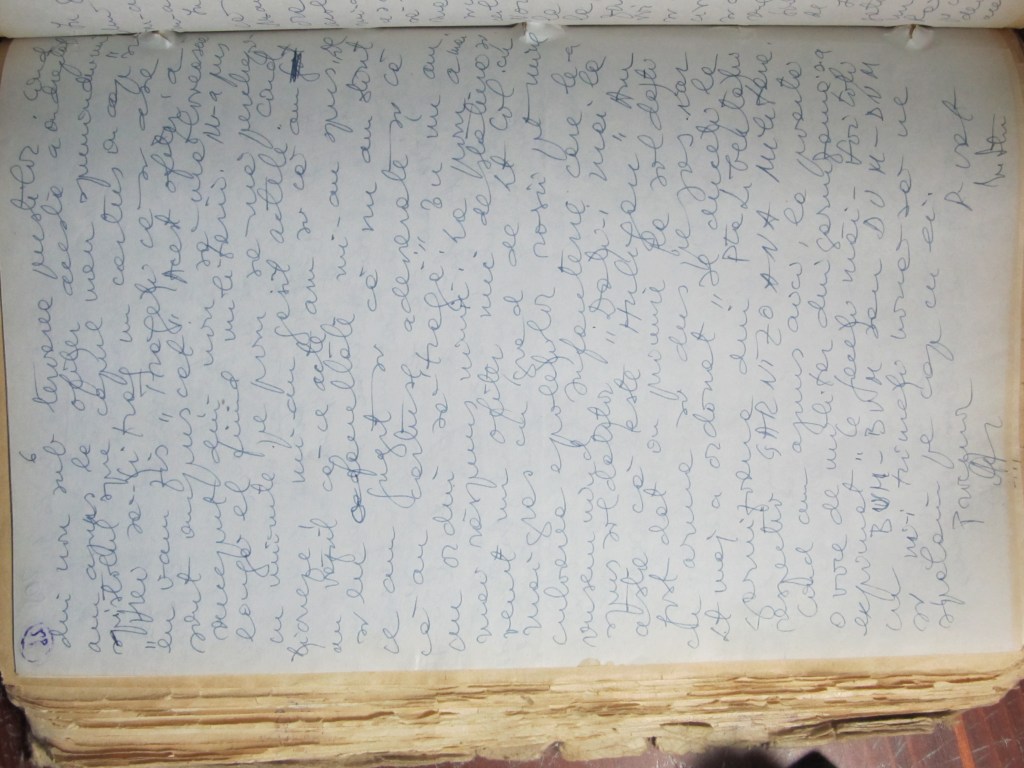
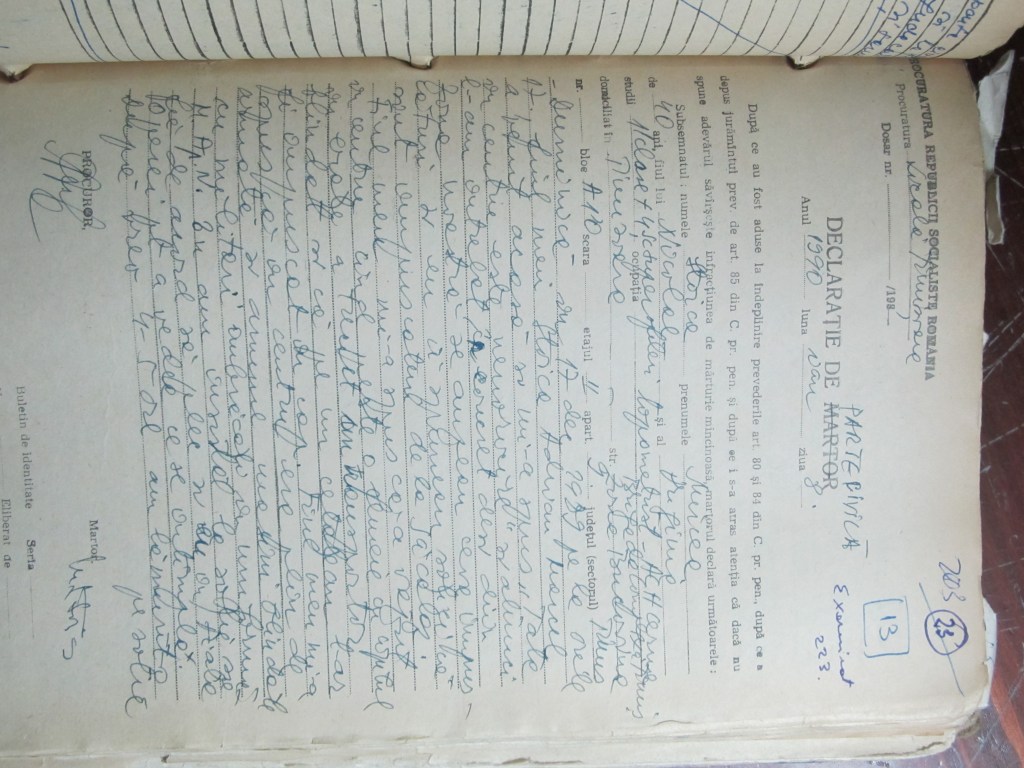
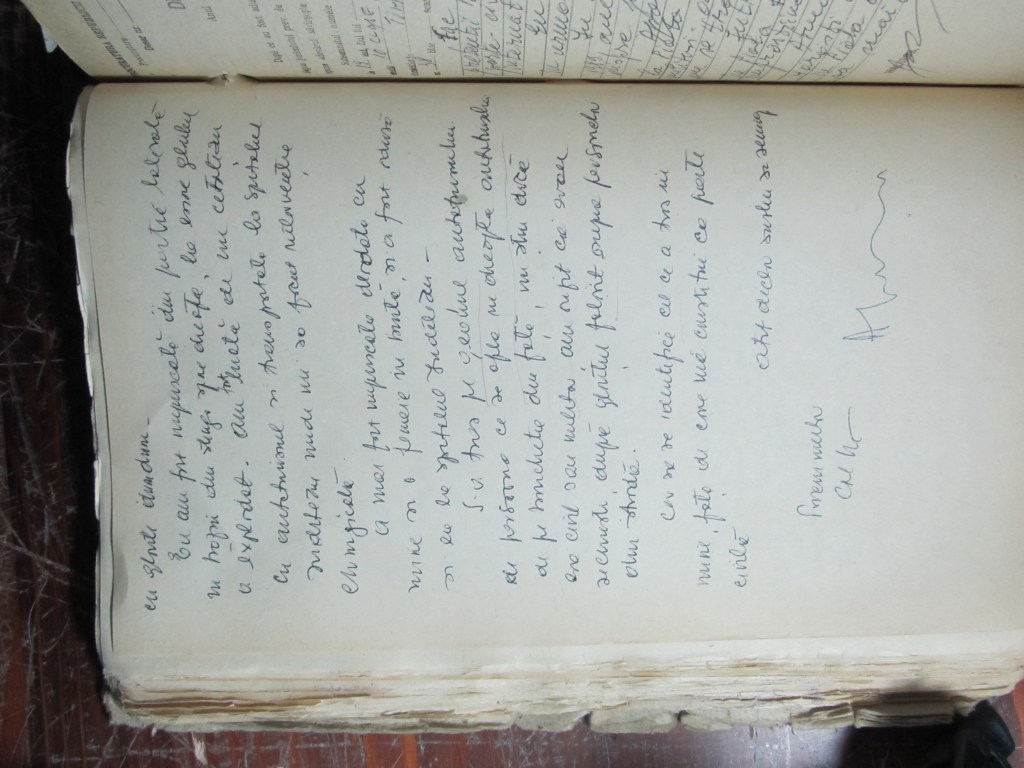
Mircea Stoica (declaratie, 8 ian 1990):  “Cind am ajuns aici, la poarta o voce de militar din garnizoana s-a exprimat:  “Ce faceti mai — voi toti cu BUM-BUM sau DUM-DUM si ni-i trimiteti noua sa ne spalam pe cap cu ei.”

Mircea Stoica (declaration, 8 January 1990):  “When I got there, I heard a soldier’s voice from the garrison exclaim:  “What are you guys doing? You all with your BUM-BUM or DUM-DUM and then you send`em to us to solve the problem [almost impossible to solve]” <very angry, pissed off>

(my sincere thanks to Gigga Adrian Tudor for this transcription and translation of the quote!)

Popovici:  “Mi-am revenit intr-un camion militar in care eram multi civili unii morti fiind adusi la garnizoana militara.  La garnizoana eu am fost dat jos si predat unui cpt (capitan) sau unui lt.major (locotenent major). vazand rana mea n-a vrut sa ma primeasca exprimand: Voi trageti cu dum dum si noi sa raspundem pentru acest lucru.”  (my thanks to A.K. for this transcription)

Popovici:  “I came to in a military truck in which there were lots of civilians some dead being brought to the military garrison.  At the garrison I was taken down and surrendered to a captain or lt. major, who looking at my wound did not want to receive me, exclaiming:  You shoot with dum-dum bullets and we are held responsible for it.”

It doesn’t take a genius to recognize the important similarity between the testimonies of Mircea Stoica and Ioan Popovici:  both are party to/overhear military personnel referring to the 1) use of DUM-DUM bullets, 2) that those who are using them are clearly not fellow soldiers and instead likely M.I./Securitate personnel, and 3) the Army personnel are resentful of essentially being left to “hold the bag” for the results of the DUM-DUM munitions!

———————————————————————————————————————————

Stoica Mircea, 40 ani, topometrist, Bd. Republicii, impuscat mina si picior http://www.timisoara.com/mioc/REVT06~1.HTM

197. Partea vătămată Stoica Maria cere 500000 lei, lunar, contribuţie de întreţinere, motivînd că, în decembrie 1989, soţul ei, Mircea Stoica a fost împuşcat, patru luni spitalizat, a rămas handicapat (gradul II de invaliditate), apoi a decedat.  În dovedirea cererii, depune acte de spitalizare şi de stabilire a capacităţii de muncă, care atestă vătămarea, cauzele şi consecinţele ei. Mai depune: declaraţia împuşcatului, actul lui de deces, actul de căsătorie şi carnetul de muncă (vol. 6 p. 304; vol. 10 p. 58-60, 170, 245-250; vol. 14 p. 54-61; vol. 27 p. 179-207).

http://www.procesulcomunismului.com/marturii/fonduri/mmioc/curteasup/docs/0307pciv.htm

IMG_0335

“Cind am ajuns aici, la poarta o voce de militar din garnizoana s-a exprimat:  “Ce faceti mai — voi toti cu BUM-BUM sau DUM-DUM si ni-i trimiteti noua sa ne spalam pe cap cu ei.”

IMG_0330

intreaga declaratie e aici:

imaginea 330
imaginea 331
imaginea 332
imaginea 333
imaginea 334
imaginea 335
imaginea 336

Doina Gherasim

IMG_0175

IMG_0305

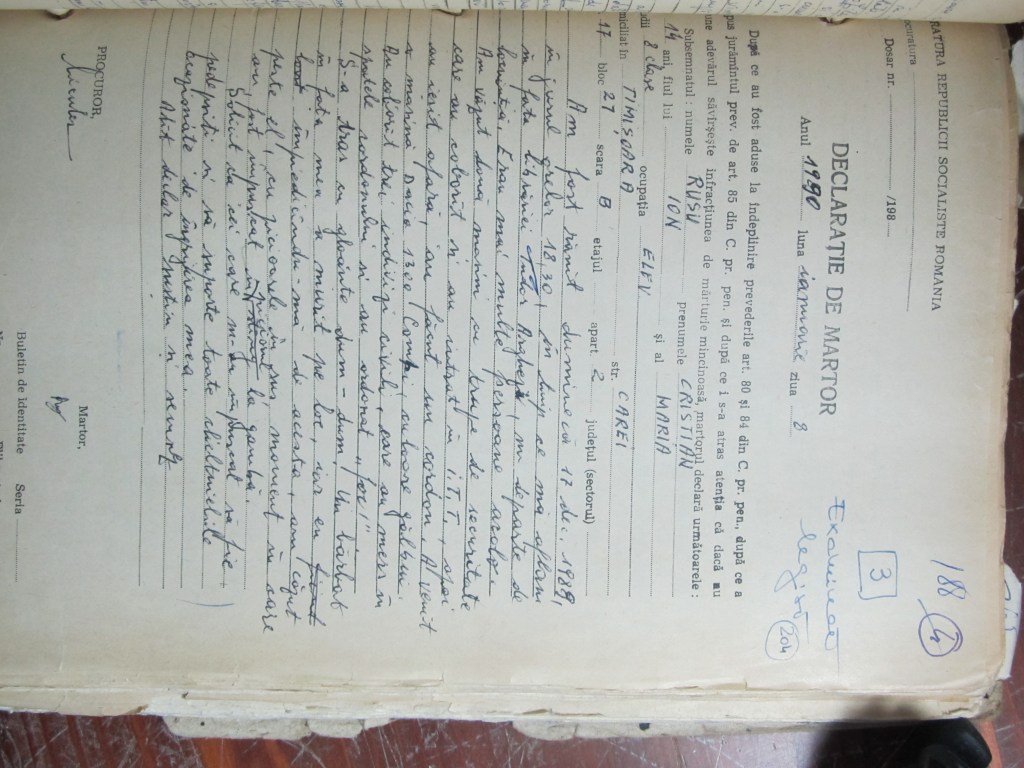
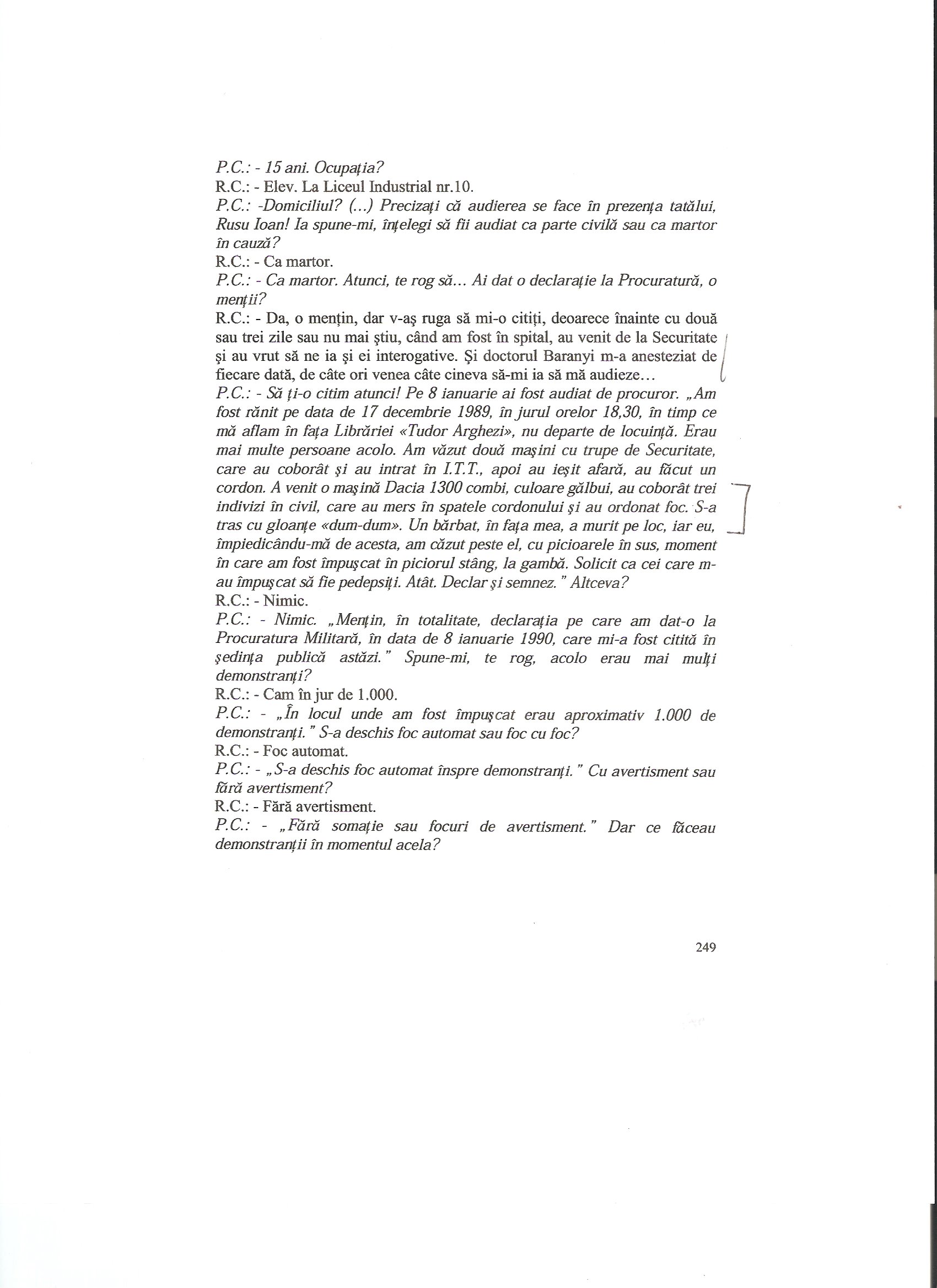
Cristian Rusu:  Pe 8 ianuarie audiat de procuror:  …A venit o masina Dacia 1300 combi, culoare glabui, au coborat trei indivizi in civil, care au mers in spatele cordonului si au ordonat foc.  S-a tras cu gloante “dum-dum.”

http://atomic-temporary-3899751.wpcomstaging.com/2012/12/16/what-can-we-learn-from-dosarele-revolutiei-de-la-timisoara-i/

For example, in a 7 September 1995 interview, Dorina Aparaschivei told Marius Mioc about how her husband, Valentin Aparaschivei, was shot to death on 17 December 1989 in Timisoara ( “A luminat cu o lanterna si apoi a tras” http://www.timisoara.com/mioc/REVT04~1.HTM ).  Among the details, she notes, “Cind militarii au ajuns in fata blocului unul dintre ei, mai batrin si cu mustata, a luminat cu o lanterna puternica si apoi a tras mai multe focuri spre noi. Sotul a fost impuscat in piept si a cazut pe spate.”

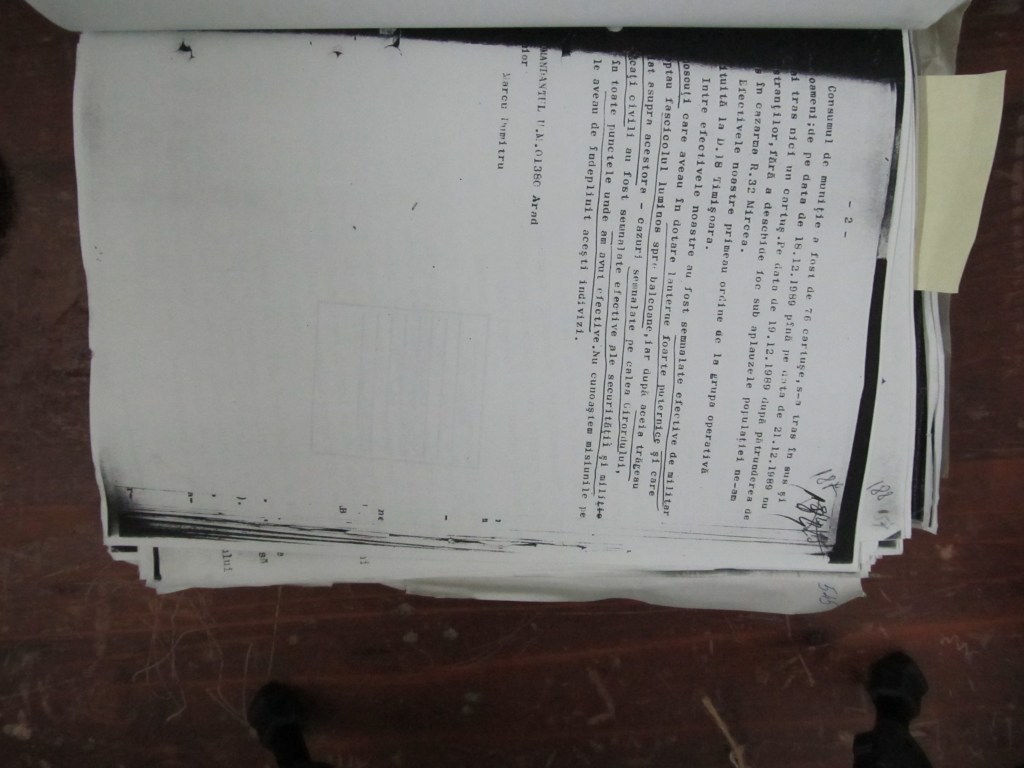
Thanks to the publication of Dosarele Revolutiei de la Timisoara, we can now confirm that was reported in the media in July 2008 is indeed the actual quote of Dumitru Marcu, commander of U.M. 01380 Arad, as recorded in his report dated 4 January 1990.  In this report, Marcu spoke of unidentified personnel infiltrated among the personnel of his military unit who used powerful flashlights (lanterns/lamps), and he suggests that these may have been Securitate/Militie personnel.

IMG_3084

Un alt raport de Informare al Ministerului Apărării Naţionale, întocmit de comandantul Marcu Dumitru din Arad, arată că acesta a semnalat “efective militare necunoscute” printre militarii săi.

“Între efectivele noastre au fost semnalate efective de militari necunoscuţi care aveau în dotare lanterne foarte puternice şi care îndreptau fascicolul luminos spre balcoane, iar după aceea trăgeau asupra acestora – cazuri semnalate pe calea Girocului – îmbrăcaţi civili. Au fost semnalate efective ale Securităţii şi Miliţie în toate punctele unde am avut efective. Nu cunoaştem misiunile pe care le aveau de îndeplinit aceşti indivizi”, raporta comandantul.

http://www.mediafax.ro/social/jurnalul-de-lupta-al-revolutiei-de-la-timisoara-desecretizat-galerie-foto-2767638

Comandantul unitatii militare din Arad, martor al evenimentelor, a raportat ca “printre militarii care au actionat pe Calea Girocului s-au strecurat si persoane necunoscute, in uniforma, care aveau lanterne foarte puternice cu care luminau balcoanele blocurilor din apropiere, dupa care trageau asupra lor”.

http://www.hotnews.ro/stiri-esential-3506099-jurnalul-revolutiei-timisoara-fost-desecretizat-securitatea-tras-manifestanti.htm

Internet posters claiming to have been in the military and on the streets of Timisoara in December 1989 have discussed the appearance of personnel in military uniforms who very clearly were not from the military (my thanks to Corneliu N. Vaida for bringing the following to my attention):

zainea

Am fost la Timisoara militar in termen in 89. In fata noastra la un moment dat a fost dizlocat un pluton cu militari in tinuta kaki, mai in varsta ca noi, la 30-35 de ani si care nu aveau petlite si nici insemne de arma. Ii intrebam de vorba si nu ne raspundeau ne ignorau… Au tras orizontal rafale de pistol automat… Noi pana atunci am tras in plan vertical. Cine erau acei “militari”?
Noi toti am banuit ca erau ofiteri din trupele de securitate imbracati in postav kaki nou de la stoc care mirosea a naftalina.
Dupa aceea toata revolutia am petrecut-o pe un bloc in fata unei mitraliere si cu un camarad cu care ma scimbam periodic. Am ramas de atunci bolnav cu “mijlocul” din cauza frigului pe care l-am suportat atunci pe acel nenorocit de bloc.
Dumnezeu sa-i ierte pe toti eroii revolutiei din 1989…

http://www.ligamilitarilor.ro/eroii-neamului/recunostinta-eroilor-revolutiei-din-%E2%80%9989-timisoara/

———————————————————————————————————————————————————————————————————————————-

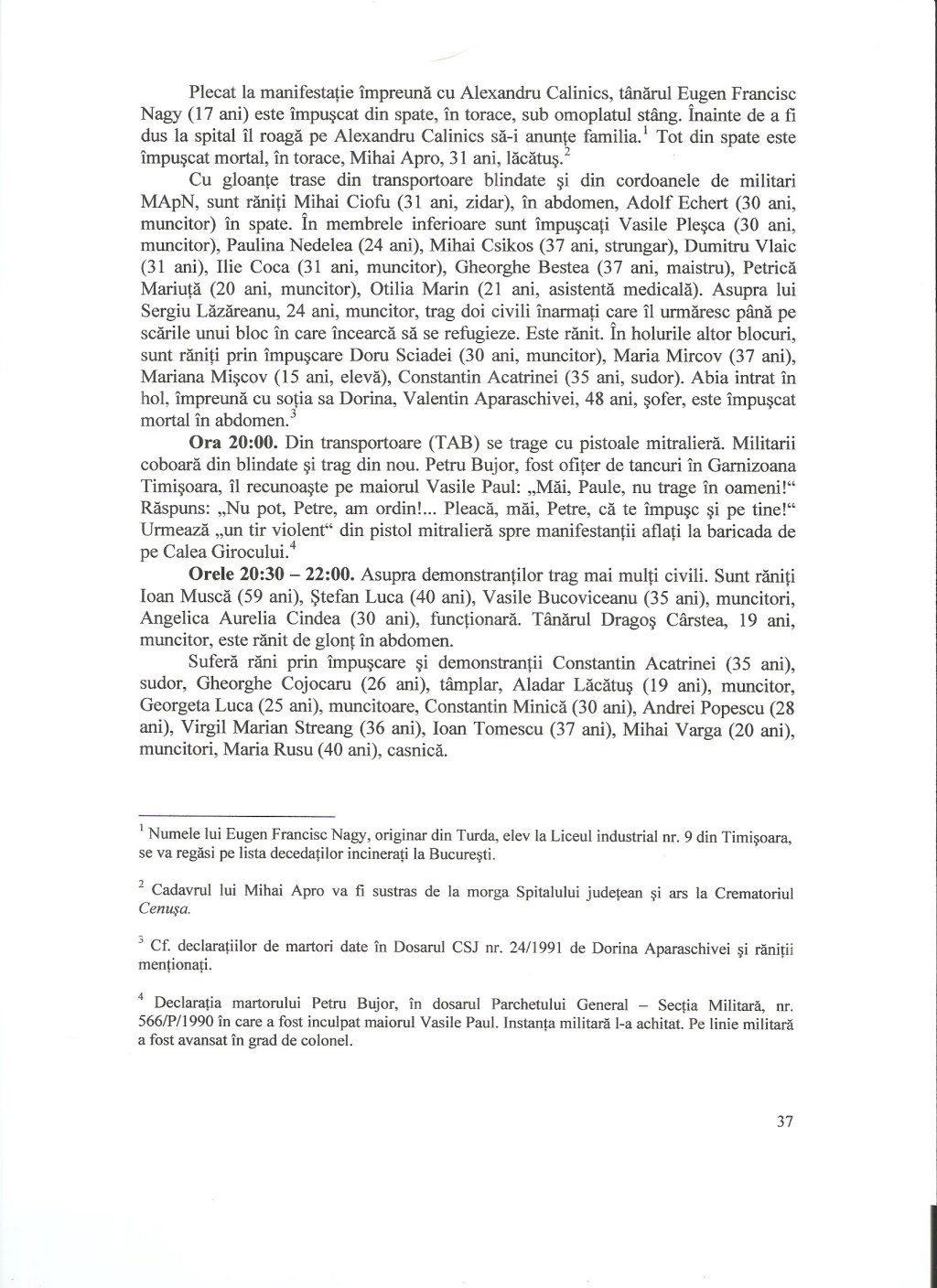
Injured (shot) in the same location (Calea Girocului) at the same time–as Valentin Aparaschivei–was Doru Sciadei

image0

see page 37 http://www.scribd.com/doc/87420446/Revolutia-de-La-Timisoara

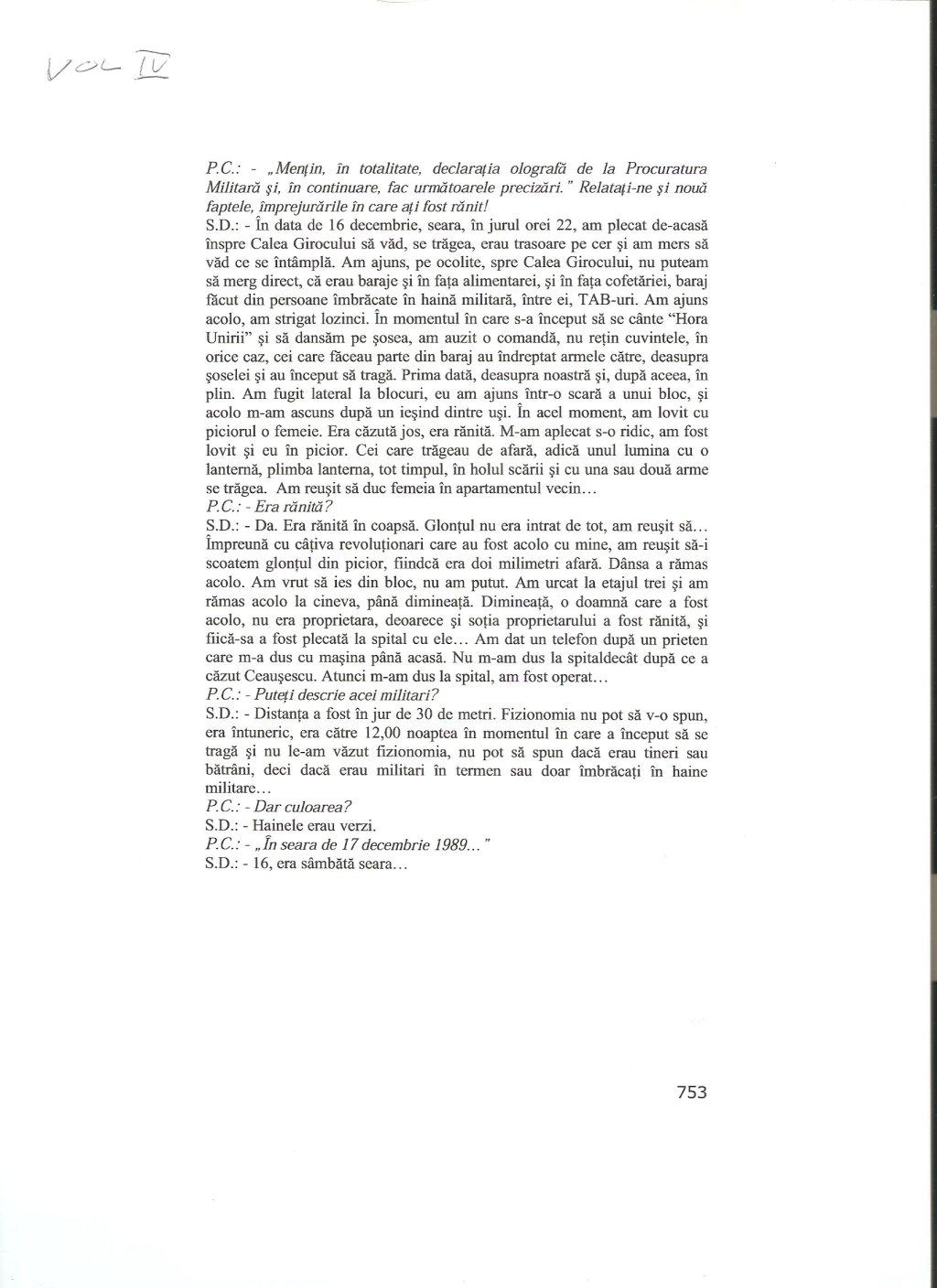
Doru Sciadei also mentions the central role played by the “lantern” carriers.  He testified in court on 15 June 1990:  “Cei care trageau de afara, adica unul lumina cu o lanterna, plimba lanterna, tot timpul, in holul scarii si cu una sau doua arme se tragea.”

http://www.banaterra.eu/romana/files/procesul_de_la_timisoara_volumul_IV_cuprins_0.pdf

image0-001

More, next time, about the “lantern” carriers and those who shot Valentin Aparaschivei and Doru Sciadei, from Dosarele Revolutiei de la Timisoara…

To be continued…

http://atomic-temporary-3899751.wpcomstaging.com/2012/12/19/what-can-we-learn-from-dosarele-revolutiei-de-la-timisoara-ii/

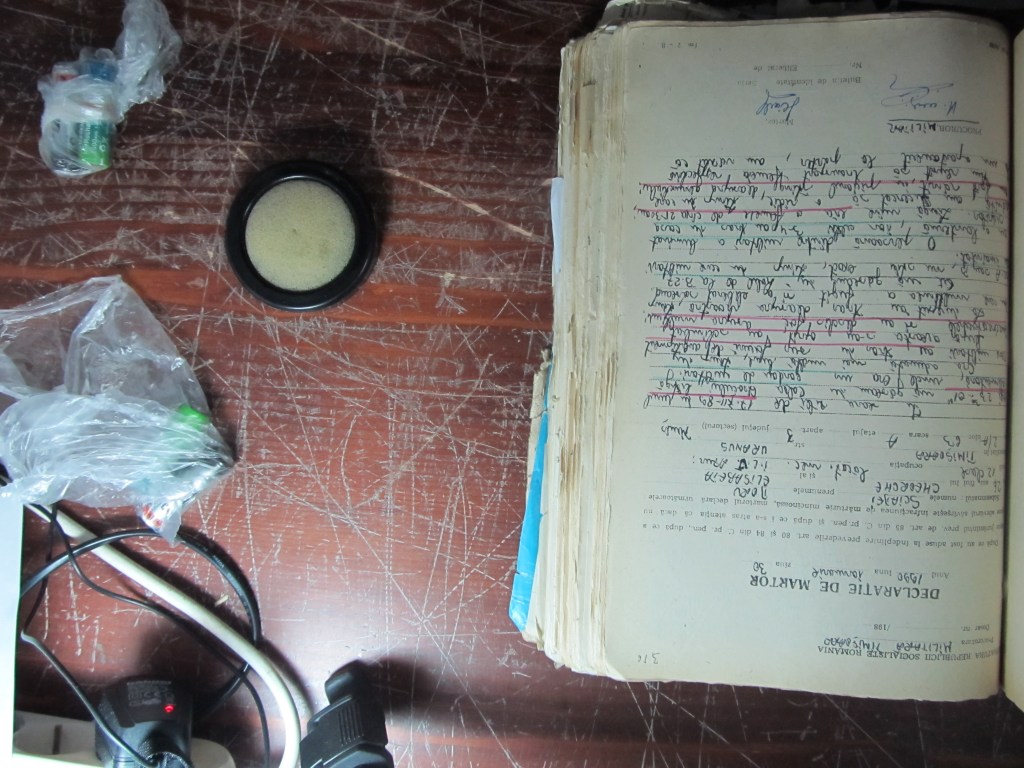
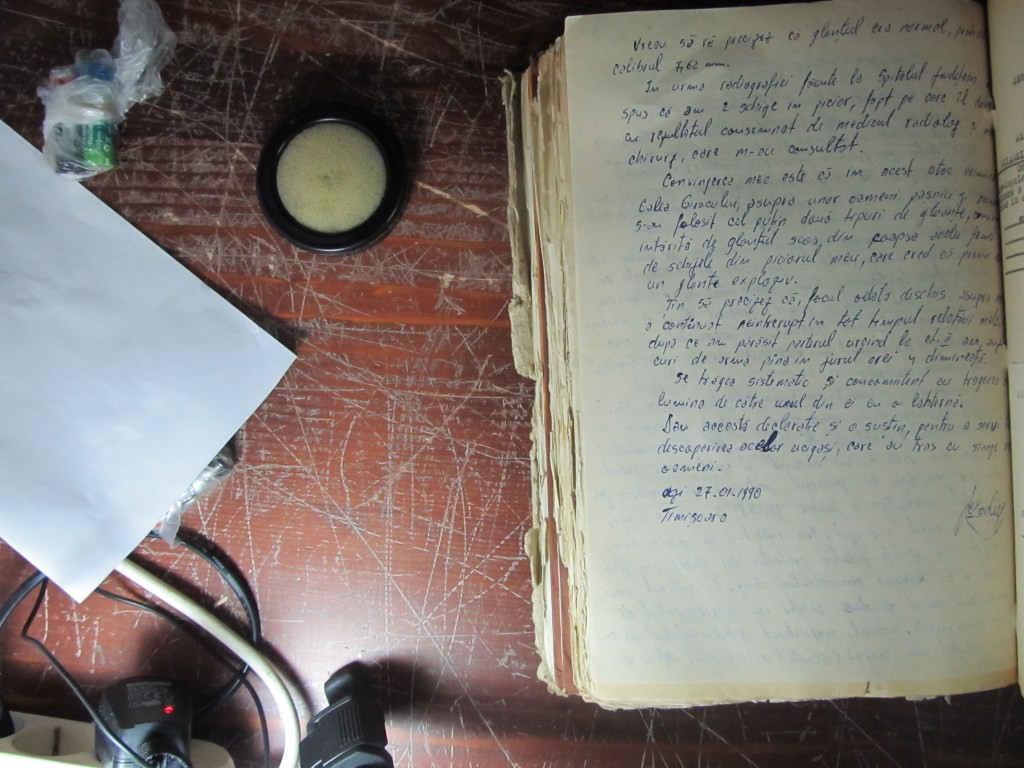
Doru Sciadei’s statement, 27 January 1990

“O persoana dintre militari a luminat cu o lanterna, iar altii 3-4 p(ersoane?) au tras (d)in casa (scarilor)”  [pagina 1 e greu de citit]

IMG_0932

“In urma radiografiei facute la Spitalul Judetean au spus ca am 2 schije in picior…consemnat de medicul radiolog si chirurg, care m-au consultat.

Convingerea mea este ca in acest atac (pe ?) Calea Girocului, asupra unor oameni pasnici si (?) s-au folosit cel putin doua tipuri de gloante, convingerea intirita de glontul scos din coapsa (?) si schijele din piciorul meu, care cred ca provin de un glonte exploziv.

…Se trage sistematic si concomitent cu tragerea de lumina de catre unul din ei cu o lanterna.”

IMG_0929

Doru Sciadei’s recollections are similar to those of Dorina Aparaschivei, whose husband, Valentin, was shot at the same location on Calea Girocului in Timisoara on 17 December 1989:

http://adevarul.ro/locale/timisoara/decembrie-89-manifestantii-ucisi-s-au-refugiat-casa-scarilor-1_50ad7b6a7c42d5a66395fbe7/index.html

Pe 17 decembrie 1989, duminică seara, toată Calea Girocului a fost cuprinsă de febra revoltei. Mii de locuitori au ieşit pe stradă să îşi arate nemulţumirea faţă de sistem. Pe fondul izbucnirii conflictelor între manifestanţi şi soldaţi, s-a format un grup de 40 de militari sub comanda lt.col. Constantin Caraivan, care aveau misiunea de a restabili ordinea. „În jurul orei 23, când au început să tragă, am decis să ne retragem spre casă. Am fost şi noi la baricade. Soţul meu spunea că se trage cu gloanţe de cauciuc, voia să mă liniştească”, a spus Dorina Aparaschivei.

Ca în filmele de acţiune

Cordoanele de militari înaintau pe de o parte şi de alta a trotuarului, iar în mijloc se deplasa un tanc. „Noi ne-am băgat în scara de bloc unde erau peste 20 de persoane. Valentin era de mână cu cei doi copii, care aveau 12 şi 15 ani. La un moment dat am văzut o lumină puternică, moment în care au început să tragă”, a mai adăugat femeia. Au fost cinci gloanţe trimise către casa scării, iar unul dintre ele a trecut prin geam şi l-a nimerit în piept pe Valentin Aparaschivei. În acel moment, un bătrân a ieşit în genunchi şi a strigat „Măi militarilor, de ce aţi împuşcat un om nevinovat?”. I s-a răspuns: „Bagă capul că te împuşc şi pe tine!”.

Salvarea a sosit în scurt timp, însă medicii nu au putut să mai facă nimic. „Avea o gaură mare în piept, cât o gură de pahar. Se spunea că erau gloanţe explozibile. L-am dus în casă cu pătura şi l-am pregătit pentru înmormântare. A doua zi au venit patru oameni în albastru, cu un sicriu şi l-au luat”, a mai povestit Dorina Aparaschivei. [my emphasis inserted in this sentence]

Criminali cu lanterne

În aceea seară şi în noaptea care a urmat, în zonă au acţionat pe lângă militari persoane necunoscute, care aveau în dotare lanterne foarte puternice. Îndreptau fasciculul luminos către balcoane şi scări, după care trăgeau. Au acţionat de asemenea, şi securişti şi miliţieni în civil. Pe toată Calea Girocului, de la intersecţia cu strada Albac până la intersecţia cu Liviu Rebreanu au fost 11 victime prin împuşcare şi 26 de răniţi.

To be continued…

http://atomic-temporary-3899751.wpcomstaging.com/2012/12/20/what-can-we-learn-from-dosarele-revolutie-de-la-timisoara-iii/

12+ Testimonies from Victims or Relatives of Victims of Dum-Dum Bullets on 17-18 December 1989.

Followed by 6 Medical Personnel Who Treated the Victims Attest to the Use of Dum-Dum Bullets

Cases available on the Internet mentioning the wounding or killing of demonstrators with dum-dum explosive bullets on 17-18 December 1989.  There are more than a dozen in all, many of whom we have seen were testified about during the Timisoara trials.

from Adevarul http://www.adevarul.ro/locale/timisoara/DECEMBRIE_-89-_Si-a_pierdut_iubita_si_piciorul_stang_0_173982752.html author Stefan Both

Danut Gavra with his two daughters in the Heroes’ Cemetery in December 2009

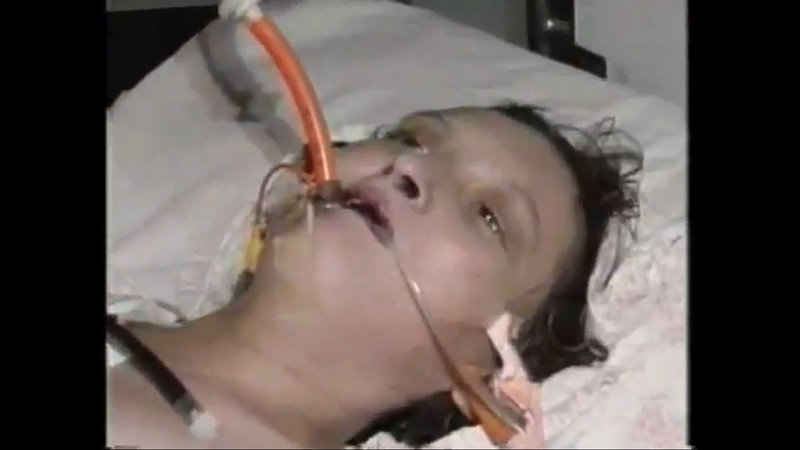
Irish Television (RTE) captured what were apparently the last hours of Florica Sava’s  tragic end.  Warning:  the scene from 11:00 to 11:30 is graphic and unsettling.

posted by mikenork

http://www.youtube.com/watch?v=c3A6IiaOWhs

Brendan O’Brien (reporter):  “Florica Sava, a 33 year old mother of two young sons, was shot from a car with a dum-dum bullet.  It caused massive internal injuries.  Doctors said she had just hours to live.”

http://atomic-temporary-3899751.wpcomstaging.com/2011/05/11/lets-go-to-the-videotape-i-to-the-army-its-confirmation-that-theyve-been-dealing-with-a-specially-trained-force-because-its-the-type-of-bullet-theyve-never-seen-before-itn-uk-telev/

Procesul de la Timisoara (V): Martorii Cristian Rusu, Daniela Lengyel, si Aurica Rusu (mama lui Marius Ciopec)

Procesul de la Timisoara (IV): Martorii Adrian Kali, Ioan Musca, Traian Orban, si Alexandru Koos

Procesul de la Timisoara (II). Audierea partii civile Popovici Ion: “…Atata retin foarte bine minte, ca ofiterul a spus, cica: ‘Nu, voi trageti cu dum-dum-uri si dupa aia Armata raspunde.’”

Procesul de la Timisoara (I): Missed Press Opportunities. The testimonies of Margaret Cacoceanu and Doina Gherasim (25-26 September 1990)

SIX Doctors/Medical personnel from Timisoara alone have discussed the use of dum-dum bullets against demonstrators in Timisoara…

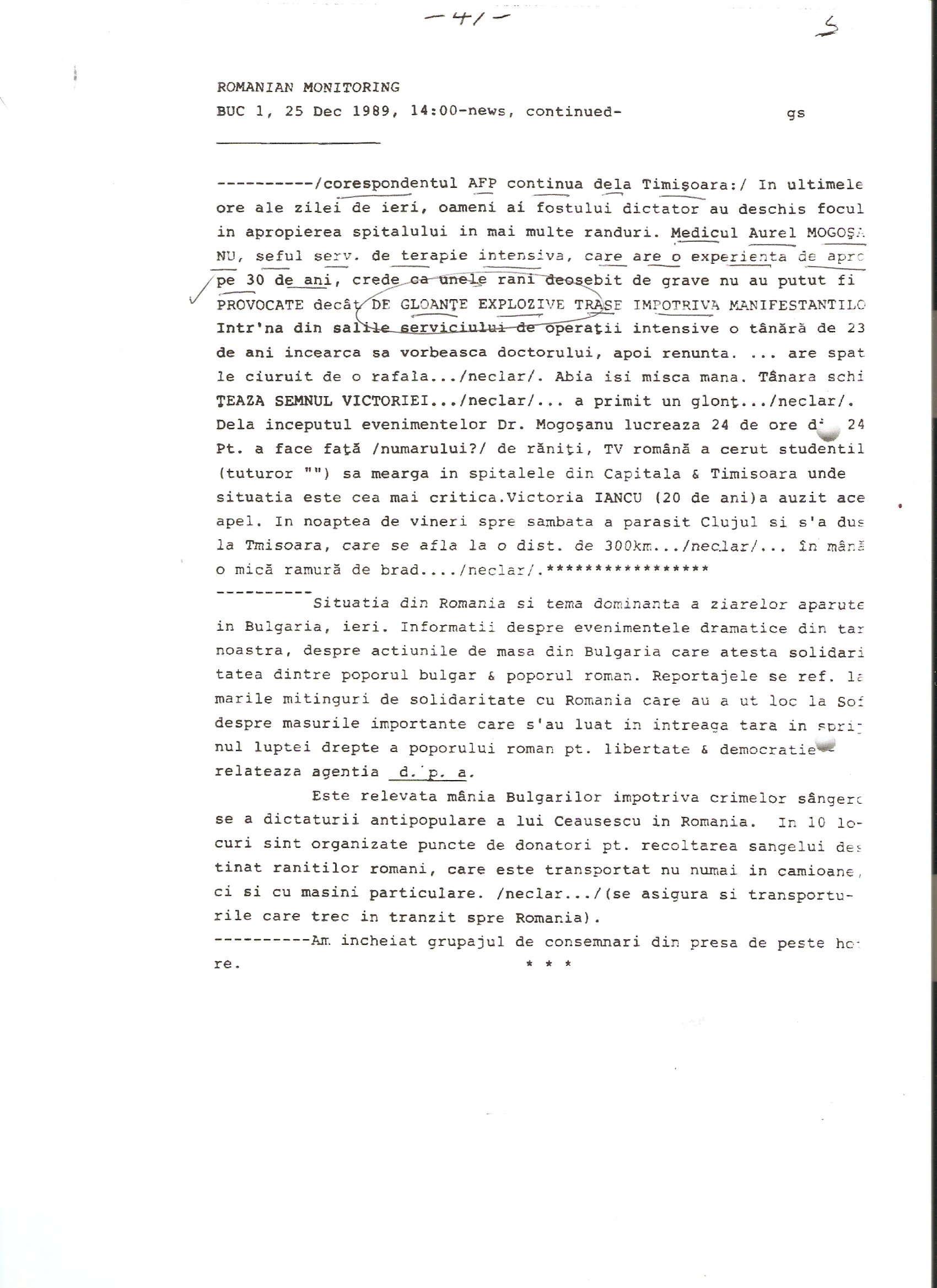
Doctors also reported on the wounds caused by explosive bullets (i.e. dum-dum bullets):  In this dispatch from Agence France Presse, relayed by Radio Free Europe on 25 December 1989, Dr. Aurel Mogosanu, a medic in the intensive care unit of a Timisoara hospital, says based on his thirty years of experience, some of the wounds could only have been CAUSED by EXPLOSIVE BULLETS SHOT AT THE PROTESTERS”

sursa (documentele Europa Libera disponsibile la):  http://media.hotnews.ro/media_server1/generic_file-2009-12-22-6754154-0-radio-bucuresti-25-dec-pdf.pdf (p. 49 of 82)

©AFP Général – Lundi 25 Décembre 1989 – 08:33 – Heure Paris (386 mots)
Roumanie, prev Nuit de Noel a l hopital central de Timisoara De l un des envoyes speciaux de l AFP, NICOLAS MILETITCH
   TIMISOARA (Roumanie) 25 dec – Devant l hopital central de Timisoara, dimanche soir, une quarantaine de camions remplis de medicaments et de produits alimentaires tout juste arrives, attendaient d etre decharges.
   ” L aide nous vient d un peu partout. Hongrie, RFA, Tchecoslovaquie, France, Yougoslavie, URSS, Bulgarie, Italie… ” , indique a l AFP l un des soldats qui gardent l hopital. Les militaires sont partout autour de l hopital, sur les toits, dans les cours et meme a l interieur.
   ” Des hommes de la Securitate ont tire pres de l hopital a plusieurs reprises, ces dernieres heures ” , explique le docteur Aurel Mogosianu, chef du service de soins intensifs, en donnant des ordres a un soldat qui passe, la mitraillette a l epaule, dans un couloir, entre les malades.
   Le Dr Mogosianu, qui a une trentaine d annees d experience, pense que certaines blessures particulierement horribles, n ont pu etre provoquees que par des balles explosives tirees contre les manifestants.
   Dans une salle de soins intensifs, une femme de 23 ans essaie de parler au docteur, puis renonce. ” C est un cas difficile. Elle a eu le dos transperce par une rafale ” , precise le Dr Mogosianu.
   En bougeant a peine la main, la jeune femme esquisse le ” V ” de la victoire pour dire ” au revoir ” . Un effort irrealisable pour son voisin qui a recu une balle dans le cou, impossible a extraire.
   Comme la plupart de ses collegues, le docteur travaille, a peu de choses pres, 24 heures sur 24 depuis le debut des evenements. Dans un coin, une infirmiere dort, ecroulee sur une chaise.
   Pour faire face a l afflux de blesses, la television de Bucarest a demande a tous les etudiants en medecine du pays de se rendre dans les hopitaux de la capitale et de Timisoara, ou la situation est la plus critique.
   Victor Jancu, 20 ans, a entendu cet appel. Dans la nuit de vendredi a samedi, il a quitte Cluj et reussi a rejoindre Timisoara, a plus de 300 kms de la, en arretant des camions.
   Quelques visiteurs arrivent a l hopital, portant a la main une petite branche de sapin : a Timisoara aussi, on voudrait feter Noel.
   nm/jga/vr.
Tous droits réservés : ©AFP Général
021851451DC1ED1D715E06849EA4C6E0F37C0C25ECE8D503

mai mult despre Dr. Aurel Mogosanu in decembrie 1989:  http://www.sorinbogdan.ro/2009/12/timisoara-18-decembrie-1989/.

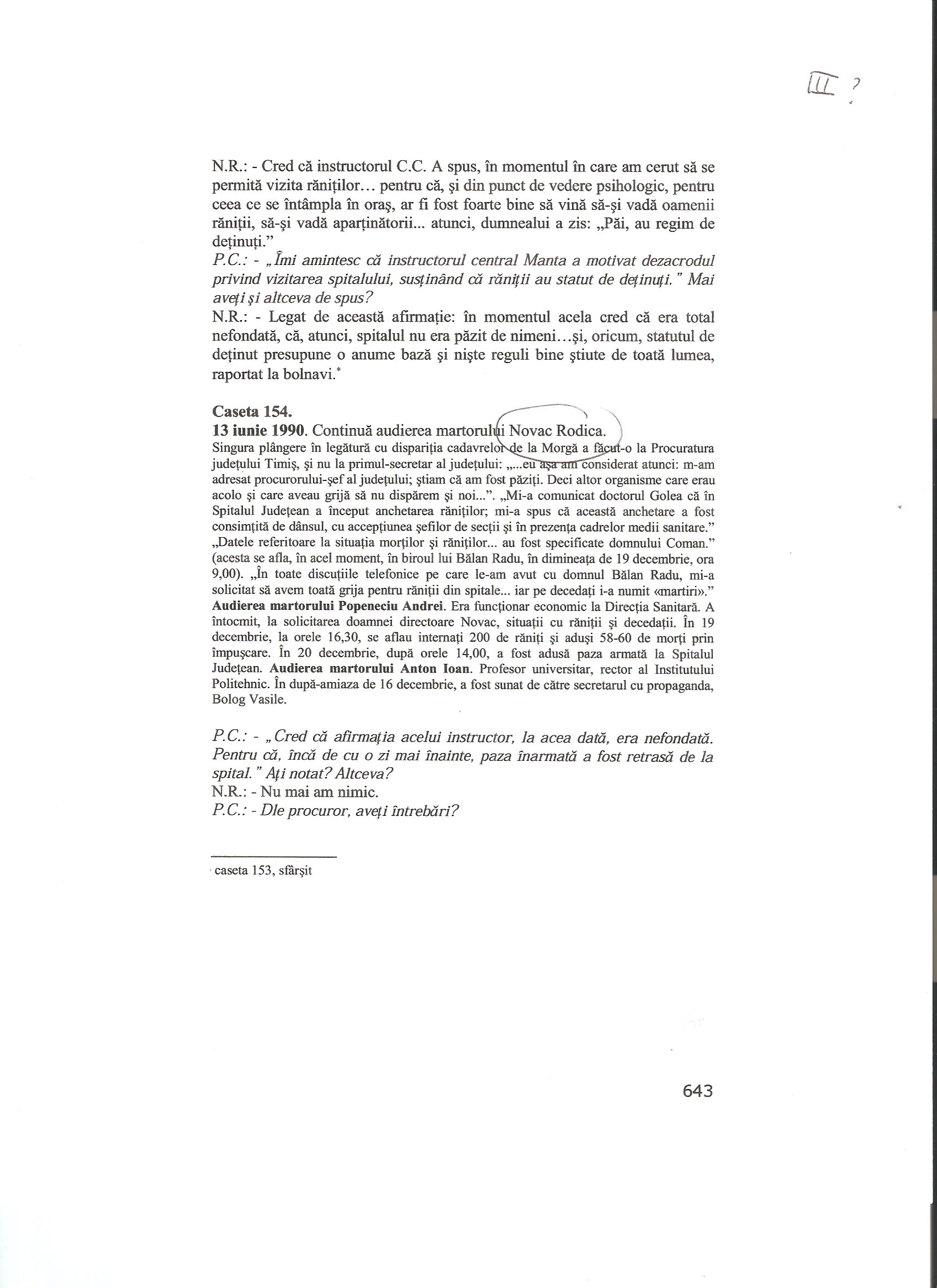
http://atomic-temporary-3899751.wpcomstaging.com/2011/09/30/procesul-de-la-timisoara-iii-audierea-martorului-rodica-novac-directorul-directiei-sanitare-timis-13-iunie-1990/

Rodica Novac’s claim is corroborated elsewhere by four other medical officials on call during the Timisoara repression.  First, in Romanian, by Dr. Atanasie Barzeanu, then in Hungarian by three doctors (Vladimir Fluture, Csaba Ungor, and Andras Goga) present and performing surgery in Timisoara hospitals from 17-19 december 1989 who recount separately their discovery of dum-dum exploding bullets among the bullets with which demonstrators arriving at the hospital had been shot.  december 1989: temesvari orvosok, dum-dum golyok, es a roman forradalom

Sava Florica, 33 de ani, vinzatoare la Loto-pronosport in cartierul Fabric, impuscata din mers, in Piata Traian

Barzeanu Atanasie, 65 anit, medic primar, doctor in stiinte, chirurg, Spitalul Judetean Timisoara

“…sintem deci in 18 decembrie…Pe la orele doua si patruzeci, cind inchideam o operatie–Sava Florica, 33 de ani, vinzatoare la Loto-pronosport in cartierul Fabric, impuscata din mers, in Piata Traian, dintr-un ARO, pacienta prezentindu-se o echimoza cu distrugerea tesuturilor (plaga in diametru de 15 centimetri), a tesuturilor din regiunea epigastrica, inclusiv a muschilor drepti abdominali, cu ruptura a colonului ascendent transvers si a jejuno-ileonului, fiind in stare de soc grav traumatic, hemoragic–, fara sa-mi poti explica nici macar acum cu ce fel de gloante a putut fi lovita, pentru ca nu am identificat nici orificiul de iesire si nici pe cel de intrare, a venit o asistenta de la Chirurgie I, care mi-a spus sa merg la domnul Ignat.”

Titus Suciu, Reportaj cu Sufletul la Gura, (Editura Facla 1990), pp. 133-134.

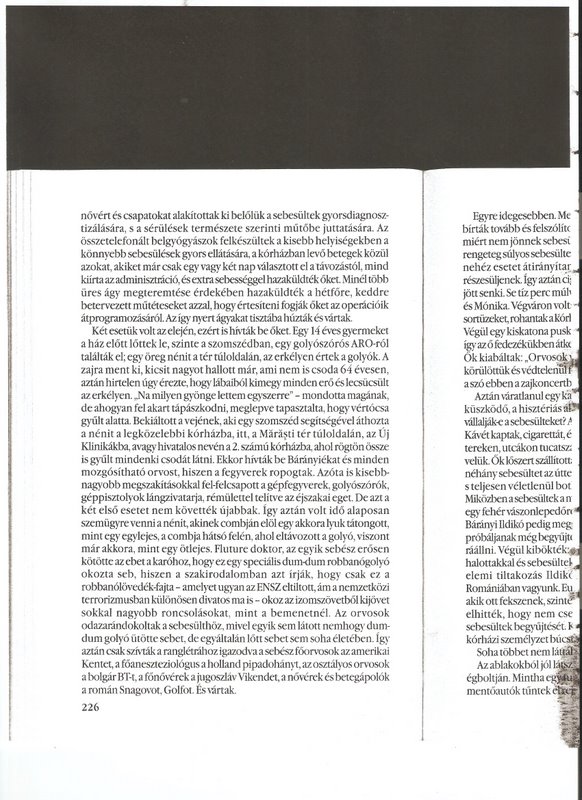
The following first appeared in Gyorgy Mandics’s Temesvari golgota (1991) pp. 348-349 and is reprinted in his A Manipulalt Forradalom (2009).  [My guess is this is also the source for the reference to dum dum bullets in the German language wikipedia entry for http://de.wikipedia.org/wiki/Rum%C3%A4nische_Revolution_1989 — Hans Vastag, György Mandics, Manfred Engelmann: Temeswar. Symbol der Freiheit. Wien 1992. ]

pp. 348-349

Ket esetuk volt az elejen.  Ezert is hivtak be oket.  Egy 14 eves gyermeket a haz elott lottek le, szinte a szomszedban, egy golyoszoros ARO-rol talaltak el; egy oreg nenit a ter tuloldalon, az erkelyen ertek a golyok.  A zarja ment ki, kicsit nagyott hallott mar, amire is csoda, 64 evesen, azt hirtelen ugy erezte, hogy labaibol kimegy minden ero es lecsusott az erholya.  Na milyen gyonge lettem egyszeruen–mondotta maganak. de ahogyan fel akart tapaszkodni meg lepve tapasztalt, hogy vertocsa gyult alatta.  Bekialtolt a vegenek aki egy szomszed segitsegevel athozta a nenit a legkozelebbi korhazba, itt a Marasti ter tuloldalan, az uj Klinikakba, avagy hivatalos neven a 2 szamu korhazba, ahol rogton osszecodult mindenki csodat latni.  Ekkor hivtak be Baranziekat es minden mozgositato orvost, hiszen a fegyverek ropogatak.  Azota is kisebb nagyobb megszakitasokkal, felfelecsapolt a gepfegyverek, golyoszorok, geppisztolyok langzivatarja, remulettel telitva az ejszaki eget.

p. 349

De azt a ket elso esett nem kovettek ujabbok.  Igz aztan volt ido alaposan szemugyre venni a nenit akinek combjan elol egz akkora lyuk tatongott mint egy egy lejes, a comba hatso felen ahol eltavotott a golyo, ott viszont mar akkora mint egy otlejes.  Fluture doktor, az egzik sebesz erosen kototte az ebet a korohoz, hogy ez egz specialis dum-dum robbanogolyo okozta seb, hiszen a szakirodalomban azt irjak, hogy csak ez a robbannolovedek-fajta-amelyet ugyan az ENSZ eltitott, am a nemzetkozi terrorizmusban kulonesen divatos ma is–okoz az izomszovetbol kijovet sokkal nagyobb roncsolasokat mint a bemenetnel.  Az orvosok odazarandokoltak a sebesulthoz, mivel egzik sem latott semhogy dum-dum golyo utotte sebet, de egyaltalan lott sebet sem soha eleteben.  Igz aztan csak szivtak a rangeletrahoz igazodva a sebesz foorvosok az amerikai Kentet, a foamnesztezialogus a holland pipadohanyt, az asztalyos orovosok a bolgar BT-t, a fonoverek a jugoslav Vikend-et, a noverek es helyapolok a roman Snagov-t, Golfot.  Es vartak.

(Note: it is unclear who the 64 yr. old described was…there are several individuals without ages listed as injured or dead during the events, but I think it more likely the age of the woman is incorrect)

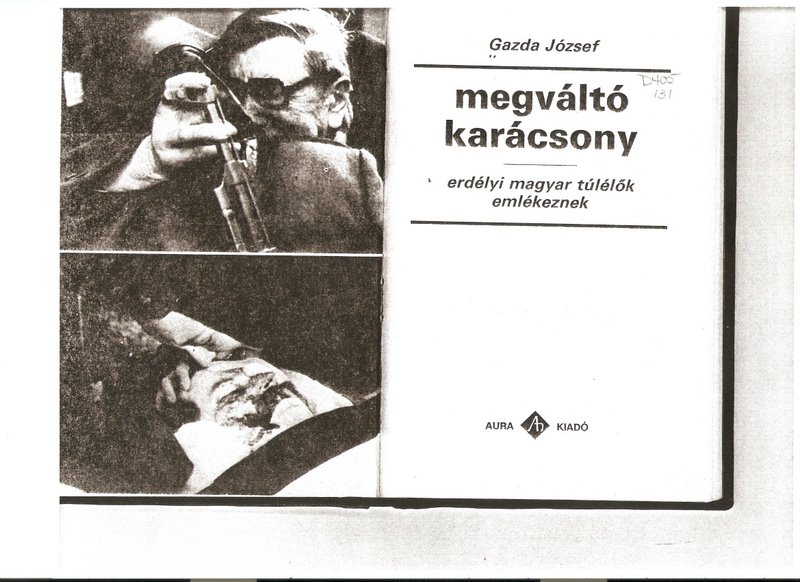
Jozsef Gazda Megvalto karacsonyErdelyi magyar tulelok emlekeznek. (1990)

Ungor Csaba:  Ket ora utan senkit be nem hoztak, senkit be nem engedtek, egyetlen sebesult sem.  A korhazbol kikanyarado  mentoautokra is lottek.  Ket ora utan mindre, ami mozgott, jarokelo, auto, mindenre lottek, csak hogy ok tudjak begyujteni a sebesulteket s a halottakat.  Kiderult az elso golyok utan, amiket a sebekbol gyujottek ossze, szedtek ki, hogy nem eles katonai toltenyekkel lottek, hanem dum-dum golyokkal, amik nagy rombolasokat okoztak.  Egy 16 eves, ketszer sebesult gyermek meselte el, ok azt hittek, hogy hosok, azt hittek, hogy meg fogjak menteni a forradalmat, mert biztosra vettek, ha a felnottek sorfala ele allnak, nem fognak belejuk loni.  Lottek rajuk is.

Goga Andras:  A masodik izgalomkelto esemeny volt kedden delelott, hogy az osszes regiszterunk–mind a surgossegen, mind az osztalyon–, melyekre felirtuk a muteteinket, eltuntek, a mai napig sem talaltuk meg.  Bennuk voltak az ev osszes mutetei[***]…En aznap kettot operaltam.  Egy tuntetonek a bore alol vettem ki egy nagyon kulonleges golyok, nem is golyot, egy ilyen repeszdarabot, melyet a katonasag aztan megvizsgalt, s azt mondtak, nekik nincs tudmasuk, hogy ez mi lehet.  Egy masiknak pedig fejserulese volt, persze abban nem talaltam golyot, atment rajta.

Romulus Cristea (ziarist, Romania Libera, 22 decembrie 2005):  – Munitia speciala, gloantele cu cap vidia sau dum-dum, a provocat victime? Presa de la acea vreme a fost plina cu astfel de relatari…

General-magistrat Dan Voinea – Nu exista victime (persoane impuscate) nici de la gloantele cu cap vidia, nici de la dum-dum. Pe durata evenimentelor s-a folosit munitie de razboi, munitie normala care se gasea la vremea respectiva in dotarea Ministerului de Interne si a Ministerului Apararii Nationale. Confuzia si informatiile false au aparut de la faptul ca se foloseau calibre diferite si, deci, zgomotul produs era altfel perceput.  http://www.romanialibera.ro/opinii/interviuri/toti-alergau-dupa-un-inamic-invizibil-58783.html

Robert Buzatu “a fost lovit de un glont exploziv”

IMG_0045

imaginea 43
imaginea 44
imaginea 45
imaginea 46

Georgian Baran “[pe 25 decembrie 1989]…teroristul a tras asupra mea, cred ca erau gloante dum-dum, mi-a lovit…”

imaginea 61
imaginea 62

IMG_0062

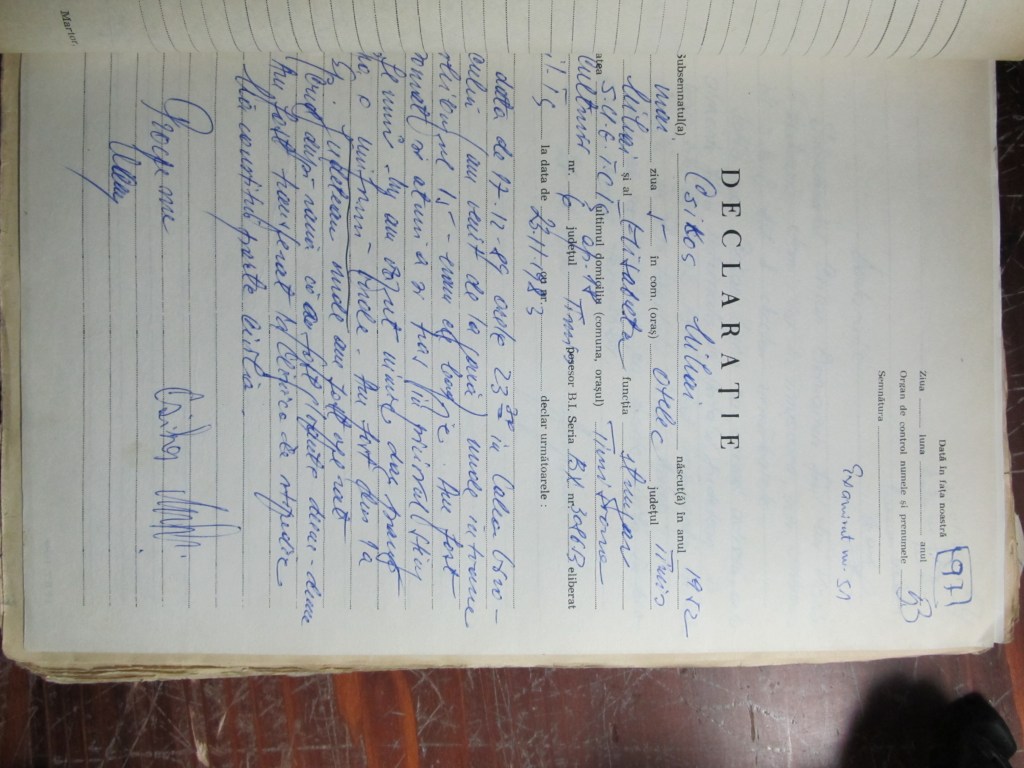
Csikos I[?] “Cred dupa rana [?]  ca au fost gloante dum-dum”

IMG_0088

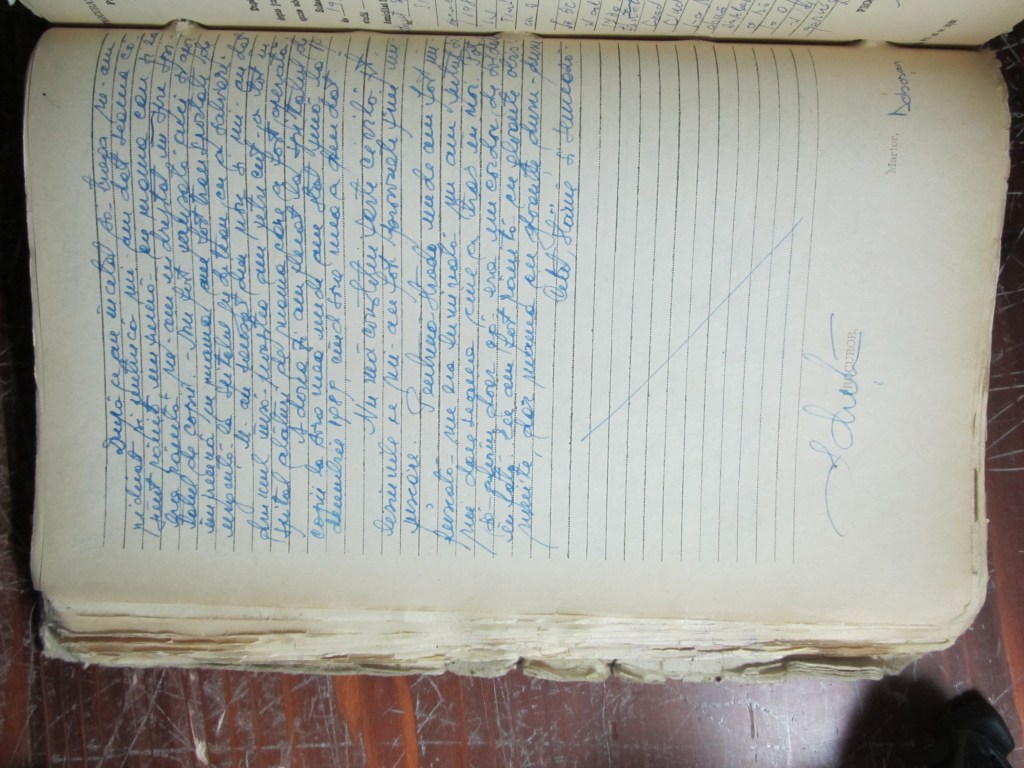
Dobosan “am fost ranit…cu gloante dum-dum”

imaginea 127
imaginea 128

IMG_0128

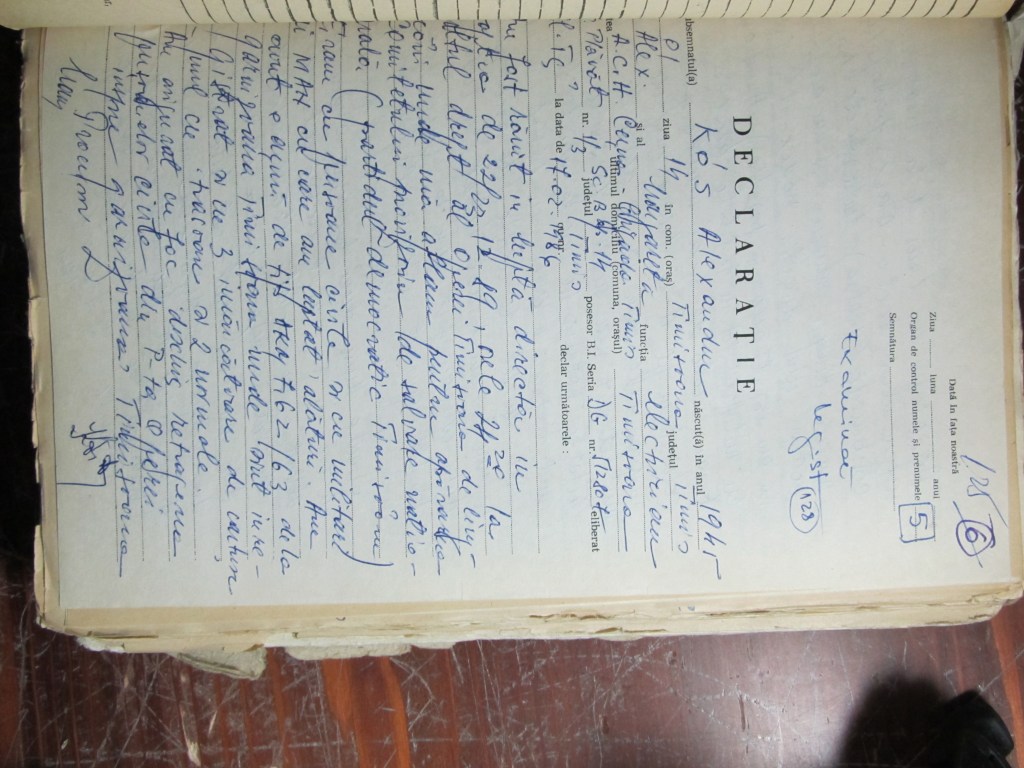
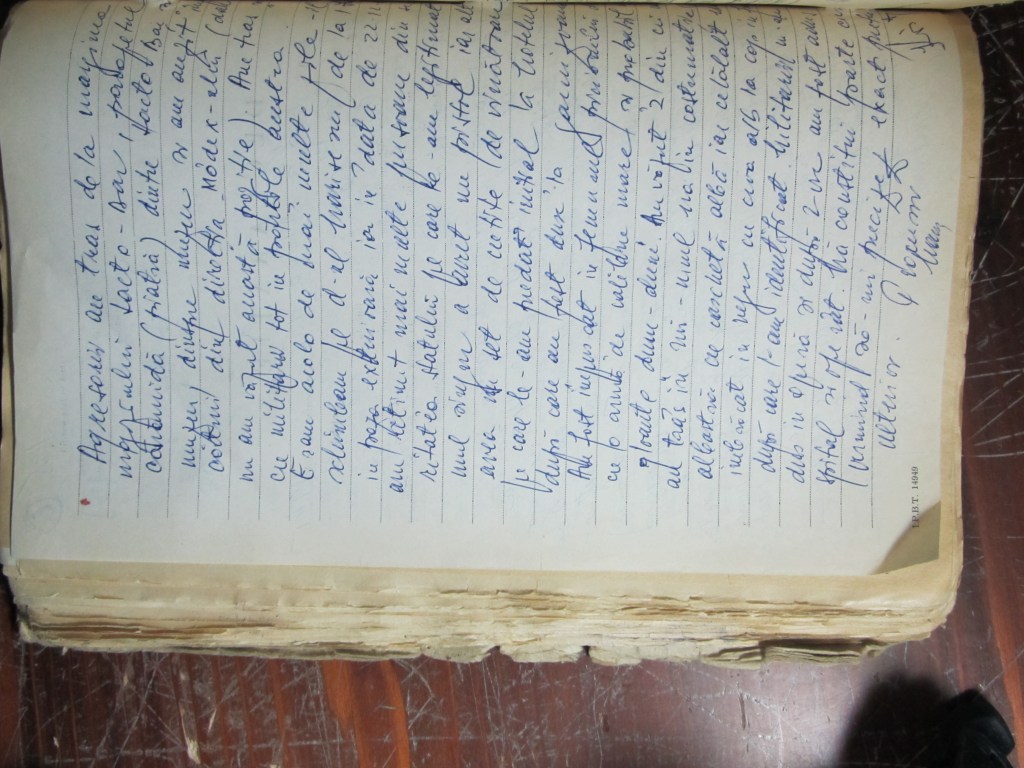
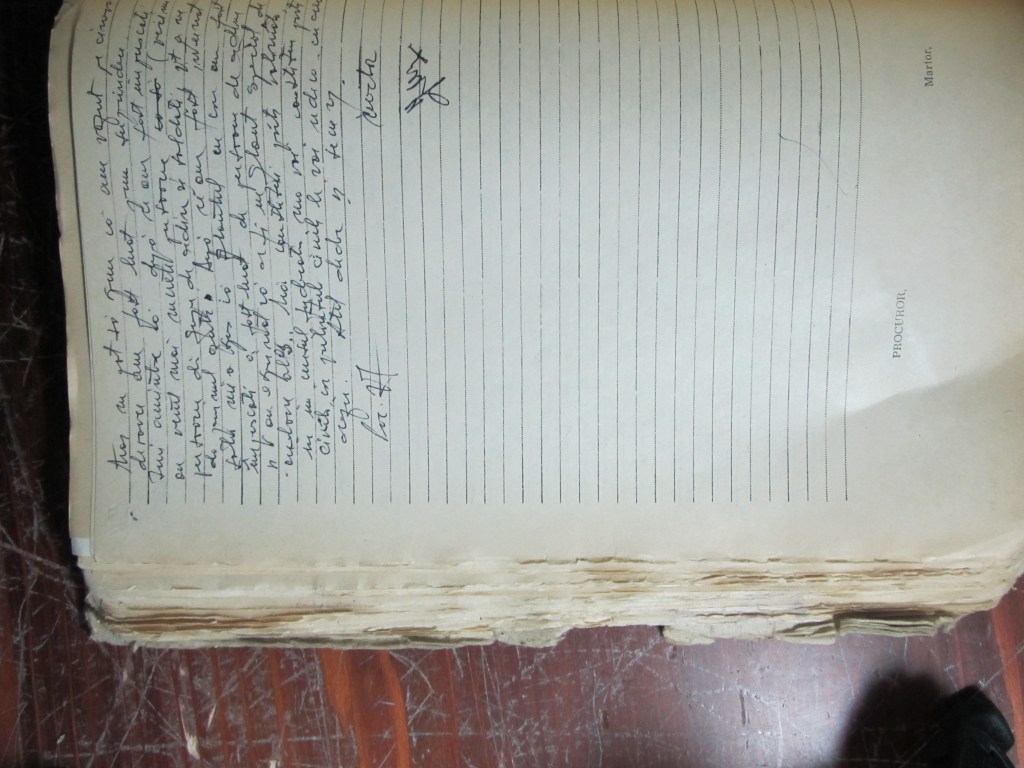
Alexandru Kos “[pe 23 decembrie 1989] am fost impuscat…cu o arma de calibru mare si probabil cu gloante dum-dum”

imaginea 207
imaginea 208

IMG_0207

IMG_0208

Florin Nicoara “Am fost lovit in soldul drept cu un glont dum-dum”

IMG_0257

Griga “civilii au fost impuscati cu gloante plate [?], care asa cum spuneau medicii cu rupt tesuturile”

imaginea 170
imaginea 171

IMG_0171

Andrei Jubea “glontul special de culoare alb”

imaginea 204
imaginea 205

IMG_0205

Iosif Cota “gloante crestati”

imaginea 90
imaginea 91

IMG_0091

http://atomic-temporary-3899751.wpcomstaging.com/2012/12/30/dosarele-revolutiei-de-la-timisoara-declaratia-lui-mircea-stoica-8-ianuarie-1990-40-ani-topometrist-impuscat-patru-luni-spitalizat-decedat/

Mircea Stoica (declaratie, 8 ian 1990):  “Cind am ajuns aici, la poarta o voce de militar din garnizoana s-a exprimat:  “Ce faceti mai — voi toti cu BUM-BUM sau DUM-DUM si ni-i trimiteti noua sa ne spalam pe cap cu ei.”


Mircea Stoica (declaration, 8 January 1990):  “When I got there, I heard a soldier’s voice from the garrison exclaim:  “What are you guys doing? You all with your BUM-BUM or DUM-DUM and then you send`em to us to solve the problem [almost impossible to solve]” <very angry, pissed off>

(my sincere thanks to Gigga Adrian Tudor for this transcription and translation of the quote!)

Popovici:  “Mi-am revenit intr-un camion militar in care eram multi civili unii morti fiind adusi la garnizoana militara.  La garnizoana eu am fost dat jos si predat unui cpt (capitan) sau unui lt.major (locotenent major). vazand rana mea n-a vrut sa ma primeasca exprimand: Voi trageti cu dum dum si noi sa raspundem pentru acest lucru.”  (my thanks to A.K. for this transcription)

Popovici:  “I came to in a military truck in which there were lots of civilians some dead being brought to the military garrison.  At the garrison I was taken down and surrendered to a captain or lt. major, who looking at my wound did not want to receive me, exclaiming:  You shoot with dum-dum bullets and we are held responsible for it.”

It doesn’t take a genius to recognize the important similarity between the testimonies of Mircea Stoica and Ioan Popovici:  both are party to/overhear military personnel referring to the 1) use of DUM-DUM bullets, 2) that those who are using them are clearly not fellow soldiers and instead likely M.I./Securitate personnel, and 3) the Army personnel are resentful of essentially being left to “hold the bag” for the results of the DUM-DUM munitions!

———————————————————————————————————————————

Stoica Mircea, 40 ani, topometrist, Bd. Republicii, impuscat mina si picior http://www.timisoara.com/mioc/REVT06~1.HTM

197. Partea vătămată Stoica Maria cere 500000 lei, lunar, contribuţie de întreţinere, motivînd că, în decembrie 1989, soţul ei, Mircea Stoica a fost împuşcat, patru luni spitalizat, a rămas handicapat (gradul II de invaliditate), apoi a decedat.  În dovedirea cererii, depune acte de spitalizare şi de stabilire a capacităţii de muncă, care atestă vătămarea, cauzele şi consecinţele ei. Mai depune: declaraţia împuşcatului, actul lui de deces, actul de căsătorie şi carnetul de muncă (vol. 6 p. 304; vol. 10 p. 58-60, 170, 245-250; vol. 14 p. 54-61; vol. 27 p. 179-207).

http://www.procesulcomunismului.com/marturii/fonduri/mmioc/curteasup/docs/0307pciv.htm

IMG_0335

“Cind am ajuns aici, la poarta o voce de militar din garnizoana s-a exprimat:  “Ce faceti mai — voi toti cu BUM-BUM sau DUM-DUM si ni-i trimiteti noua sa ne spalam pe cap cu ei.”

IMG_0330

intreaga declaratie e aici:

imaginea 330
imaginea 331
imaginea 332
imaginea 333
imaginea 334
imaginea 335
imaginea 336

in legatura cu declaratia aceasta, vezi si http://atomic-temporary-3899751.wpcomstaging.com/2012/12/02/dosarele-revolutiei-de-la-timisoara/ ,

Procesul de la Timisoara (II). Audierea partii civile Popovici Ion: “…Atata retin foarte bine minte, ca ofiterul a spus, cica: ‘Nu, voi trageti cu dum-dum-uri si dupa aia Armata raspunde.’”

Popovici:  “Mi-am revenit intr-un camion militar in care eram multi civili unii morti fiind adusi la garnizoana militara.  La garnizoana eu am fost dat jos si predat unui cpt (capitan) sau unui lt.major (locotenent major). vazand rana mea n-a vrut sa ma primeasca exprimand: Voi trageti cu dum dum si noi sa raspundem pentru acest lucru.”  (my thanks to A.K. for this transcription)

Popovici:  “I came to in a military truck in which there were lots of civilians some dead being brought to the military garrison.  At the garrison I was taken down and surrendered to a captain or lt. major, who looking at my wound did not want to receive me, exclaiming:  You shoot with dum-dum bullets and we are held responsible for it.”

available on this site http://www.banaterra.eu/romana/procesul-de-la-timisoara-1990-1991-vol-v ].  The following is from Volume V.]

Some excerpts: P.C.:  Ati dat o declaratie?   Po. I. :  Da  P.C.:  O mentineti?  Po. I. Da (p. 827) P.C.:  “Inteleg sa fiu audiat in cauza ca parte civila”, da?  V-as ruga sa faceti putin liniste!  “Mentin declaratia de la Procuratura si…” (p. 833)

Po. I.:  …Da [am fost ranit].  Si dupa aceea a venit unul dintre trei [civili mai in varsta] dupa mine, m-a tarat pana la masina si la masina, acolo, am luat o bataie…ca n-am putut doua saptamani nici sa mananc nimica.  M-a lovit cu patul de arma in falca si cu bocancii in cap.  Si m-au dus, m-au dus la Garnizoana.  La Garnizoana m-au aruncat din masina si a venit ofiterul de serviciu.  Au venit si acestia trei a spus lu’ ofiterul de serviciu, cica:  “Luati-l si duceti-l  la arest.”  Atata retin foarte bine minte, ca ofiterul a spus, cica:  “Nu, voi trageti cu dum-dum-uri si dupa aia Armata raspunde.  Voi omorati oameni si raspunde Armata dupa aceea.”  Asta tin minte precis.  Si de acolo mi-am dat seama ca nu poate sa fie soldati aceia. (p. 830)

IMG_0291

IMG_0290

Doru Sciadei

IMG_0932

“In urma radiografiei facute la Spitalul Judetean au spus ca am 2 schije in picior…consemnat de medicul radiolog si chirurg, care m-au consultat.

Convingerea mea este ca in acest atac (pe ?) Calea Girocului, asupra unor oameni pasnici si (?) s-au folosit cel putin doua tipuri de gloante, convingerea intirita de glontul scos din coapsa (?) si schijele din piciorul meu, care cred ca provin de un glonte exploziv.

IMG_0929

Doina Gherasim glonte dum dum

IMG_0175

Cristian Rusu “S-a tras cu gloante dum-dum”

IMG_0305

Procesul de la Timisoara (XII): Timisoara, the key to the Revolution then; the key now to the truth about the Counter-revolution

Procesul de la Timisoara (XI): Dupa 22 decembrie–teroristii. Martorii Alexandru Koos, Ion Flocioiu, si Herlea Floarea

Procesul de la Timisoara (X): Gloante explozive (dum-dum) dupa 22 decembrie 1989

Procesul de la Timisoara (IX): Cine au fost cei “necunoscuti,” mai in varsta, care au tras inainte de 22 decembrie 1989? (2)

Procesul de la Timisoara (VIII): Cine au fost cei “necunoscuti”, mai in varsta, care au tras inainte de 22 decembrie 1989?

Procesul de la Timisoara (VII): “La Timisoara cred ca si domnul procuror a vazut cartuse de acest calibru…Dar au existat in corpurile delicte ale procuraturii. Eu l-am vazut. Este un cartus ceva mai lung, negru, cu botul taiat. 5,56.”

Procesul de la Timisoara (VI): Impuscati dintr-un ARO…Al cui apartinea ARO-ul?

Procesul de la Timisoara (V): Martorii Cristian Rusu, Daniela Lengyel, si Aurica Rusu (mama lui Marius Ciopec)

Procesul de la Timisoara (IV): Martorii Adrian Kali, Ioan Musca, Traian Orban, si Alexandru Koos

Procesul de la Timisoara (III): Audierea martorului Rodica Novac, directorul Direcţiei Sanitare Timiş (13 iunie 1990)

Procesul de la Timisoara (II). Audierea partii civile Popovici Ion: “…Atata retin foarte bine minte, ca ofiterul a spus, cica: ‘Nu, voi trageti cu dum-dum-uri si dupa aia Armata raspunde.’”

Procesul de la Timisoara (I): Missed Press Opportunities. The testimonies of Margaret Cacoceanu and Doina Gherasim (25-26 September 1990)

http://www.banaterra.eu/romana/search/node/%22procesul%20de%20la%20timisoara%22
Procesul de la Timişoara (1990-1991) – Vol. V
 ASOCIAŢIA MEMORIALUL REVOLUŢIEI  16-22 DECEMBRIE 1989, TIMIŞOARA     Editor: Miodrag Milin Timişoara, 2009   Ataşament Mărime procesul_de_la_timisoara_volumul_V_final.pdf 4 …Articol – dbaiski – 24 Iul 2009 – 16:03 – 0 comentarii – 1 fişier ataşat
Procesul de la Timişoara (1990-1991) – Vol. IV
 ASOCIAŢIA MEMORIALUL REVOLUŢIEI  16-22 DECEMBRIE 1989, TIMIŞOARA     Editor: Miodrag Milin Timişoara, 2009   Ataşament Mărime procesul_de_la_timisoara_volumul_IV_prefata.pdf …Articol – dbaiski – 24 Iul 2009 – 16:02 – 0 comentarii – 3 fişiere ataşate
Procesul de la Timişoara (1990-1991) – Vol. III
ASOCIAŢIA MEMORIALUL REVOLUŢIEI  16-22 DECEMBRIE 1989, TIMIŞOARA   Editor: Miodrag Milin Timişoara, 2009 Ataşament Mărime procesul_de_la_timisoara_volumul_III_prefata.pdf 126.6 KB proc …Articol – banaticus – 24 Iul 2009 – 16:01 – 0 comentarii – 4 fişiere ataşate
Procesul de la Timişoara (1990-1991) – Vol. I, II
ASOCIAŢIA MEMORIALUL REVOLUŢIEI  16-22 DECEMBRIE 1989, TIMIŞOARA   Editor: Miodrag Milin Timişoara, 2009 Ataşament Mărime prefata.pdf 199.39 KB procesul_de_la_timisoara_volumul_I.pdf …Articol – banaticus – 24 Iul 2009 – 16:00 – 0 comentarii – 3 fişiere ataşate
Procesul de la Timişoara (1990-1991) – Vol. VII
 Postul teritorial de Radio Timişoara Asociaţia ALTAR 1989, Timişoara Editor: Miodrag Milin Ataşament Mărime procesul_de_la_timisoara_volumul_VII_nota_asupra_editiei.pdf 68.46 KB procesu …Articol – dbaiski – 20 Mai 2009 – 17:06 – 0 comentarii – 3 fişiere ataşate
Procesul de la Timişoara (1990-1991) – Vol. VI
  ASOCIAŢIA MEMORIALUL REVOLUŢIEI  16-22 DECEMBRIE 1989, TIMIŞOARA   Editor: Miodrag Milin Timişoara, 2009 Ataşament Mărime procesul_de_la_timisoara_volumul_VI_nota_asupra_editiei …Articol – dbaiski – 20 Mai 2009 – 16:51 – 0 comentarii – 2 fişiere ataşateMuch of this has now been reposted or reproduced here:dosarelerevolutiei.ro

Posted in decembrie 1989, raport final | Tagged: , , , , , , , | 4 Comments »

Marea Diversiune: Securitatea a fost “Alba ca zapada”, iar criminalii s-au gasit exclusiv in randurile Armatei romane, KGB-ului, ale altor agenturi straine (II)

Posted by romanianrevolutionofdecember1989 on November 5, 2013

(strictly personal research and views, as always)

http://atomic-temporary-3899751.wpcomstaging.com/2013/10/29/marea-diversiune-securitatea-a-fost-alba-ca-zapada-iar-criminalii-s-au-gasit-exclusiv-in-randurile-armatei-romane-kgb-ului-ale-altor-agenturi-straine-i/

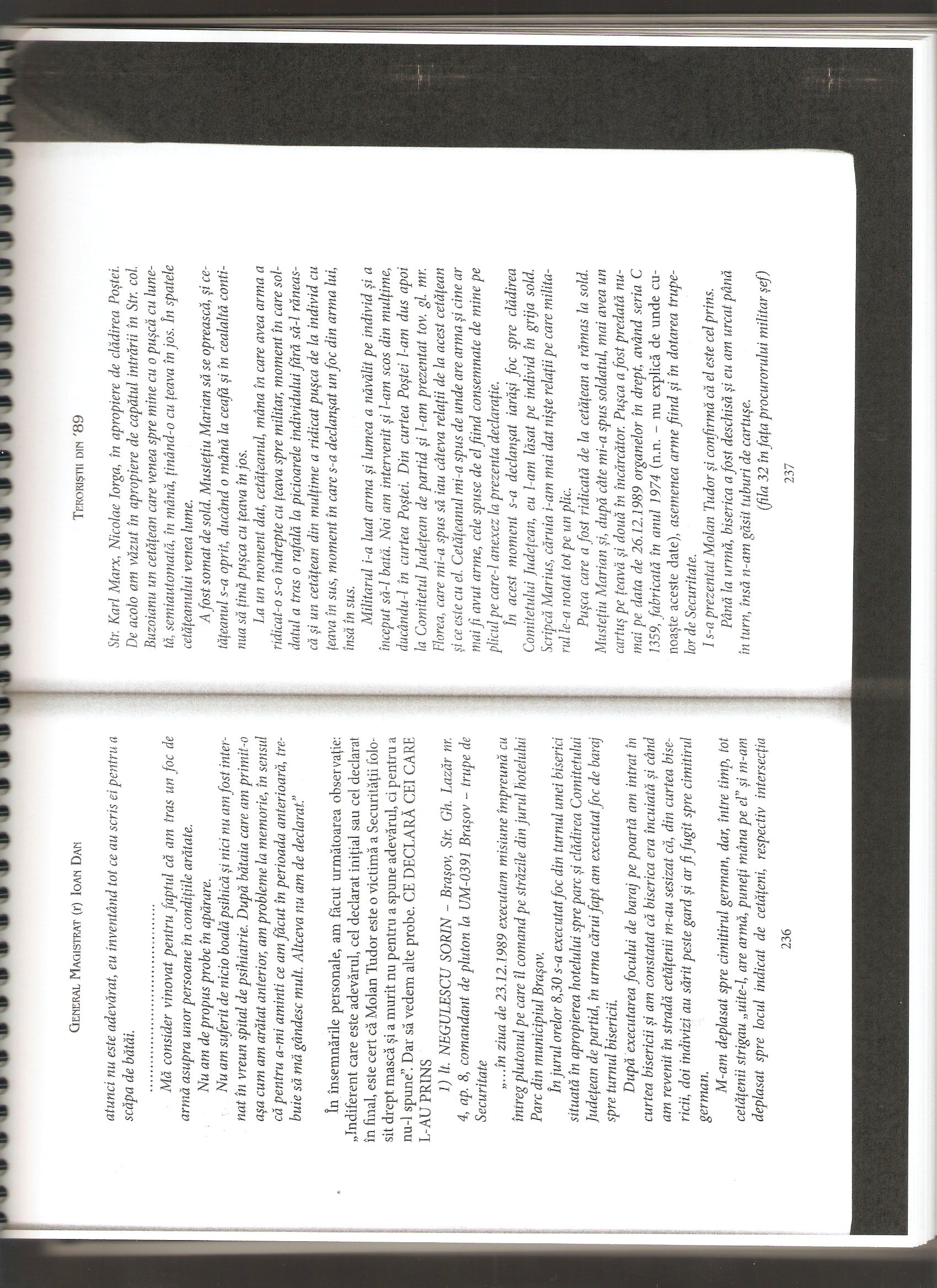
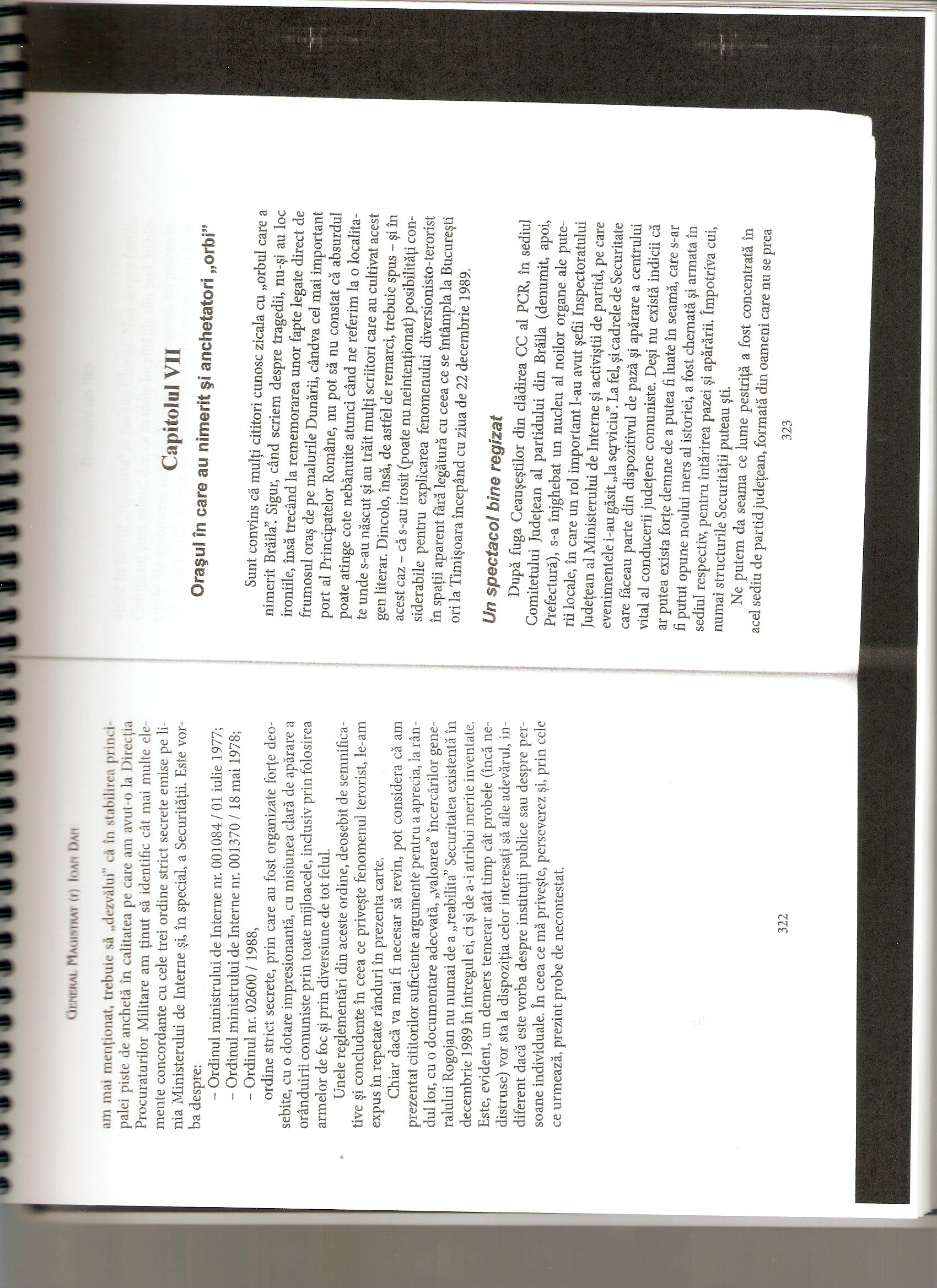
General Magistrat (r) Ioan Dan, Teroristii din ’89 (Lucman, 2012) despre Cazul Tudor Molan (Brasov), extrase…

image0

DOSAR 301/P/1989 P.M. Brasov

Civ. MOLAN TUDOR (factor postal)…in dimineata de 23 decembrie 1989…a fost prins in aproprierea Cimitirului Evanghelic aflat in zona centrala a municipiului Brasov, avand asupra sa o pusca semiautomata cu luneta

image0-001

CE DECLARA CE CARE L-AU PRINS:

lt. NEGULESCU SORIN…in apropriere de cladire Postei. De acolo am vazut in apropriere de capatul intrarii in Str. col. Buzoianu un cetatean care venea spre mine cu o pusca cu luneta, semiautomata, in mana, tinind-o cu teava in jos…Pusca a fost predata numai pe data de 26.12.1989 organelor de drept, avand seria C 1359, fabricata in anul 1974 (n.n. nu explica de unde cunoaste aceste date), asemenea arme fiind in si in dotarea trupelor de Securitate. I s-a prezentat Molan Tudor si confirma ca el este cel prins.

image0-002

Sold. Mustetiu Marian…in arma se afla un cartus pe teava si doua in incarcator, tip perforant incendiare care produc raniri grave. Arma era o pusca semiautomata cu luneta care este si in dotarea trupelor de Securitate si am predat-o numai in ziua de 26.12.1989 celor in drept prin lt. col. Filip din unitatea noastra.  Fac precizare ca noi pentru misiune nu am avut distribuite asemenea arme, ci numai pistoale automate….I s-a prezentat Molan T. si l-a recunoscut ca individul in cauza.

image0-003

Frt. SCRIPCA MARIUS EDUARD…Acolo cetateanul a declarat verbal de unde a primit pusca si ce persoane mai aveau arme, cele spuse de el fiind consemnate de ofiter pe un plic.  Intre timp, ofiterul a plecat din camera si am ramas cu cu individual care a continuat sa-mi spuna ce persoane mai aveau arme si de la cine le-au primit, precum si locul de intalnire ce-l aveau cu niste arabi…I s-a prezentat Molan T. si l-a recunoscut. (28.12.1989 in fata procurorului militar sef)

image0-004

image0-005

image0-006

image0-007

“2) Fiind vorba despre acte de teroare si despre decesul celui suspect in arestul Militiei, urmarirea penala trebuie sa fie efectuata exclusiv de catre procurorul militar.  In realitate, activitatea procurorului militar a fost sporadica si de slaba calitate.  Este clar din amplele probe aflate la dosar ca cercetarile au fost dirijate din umbra, de Securitate, in mod vadit, in scopul falsificarea realitatii.”

image0-008

image0-009

Posted in decembrie 1989, raport final | Tagged: , , , , , | 1 Comment »

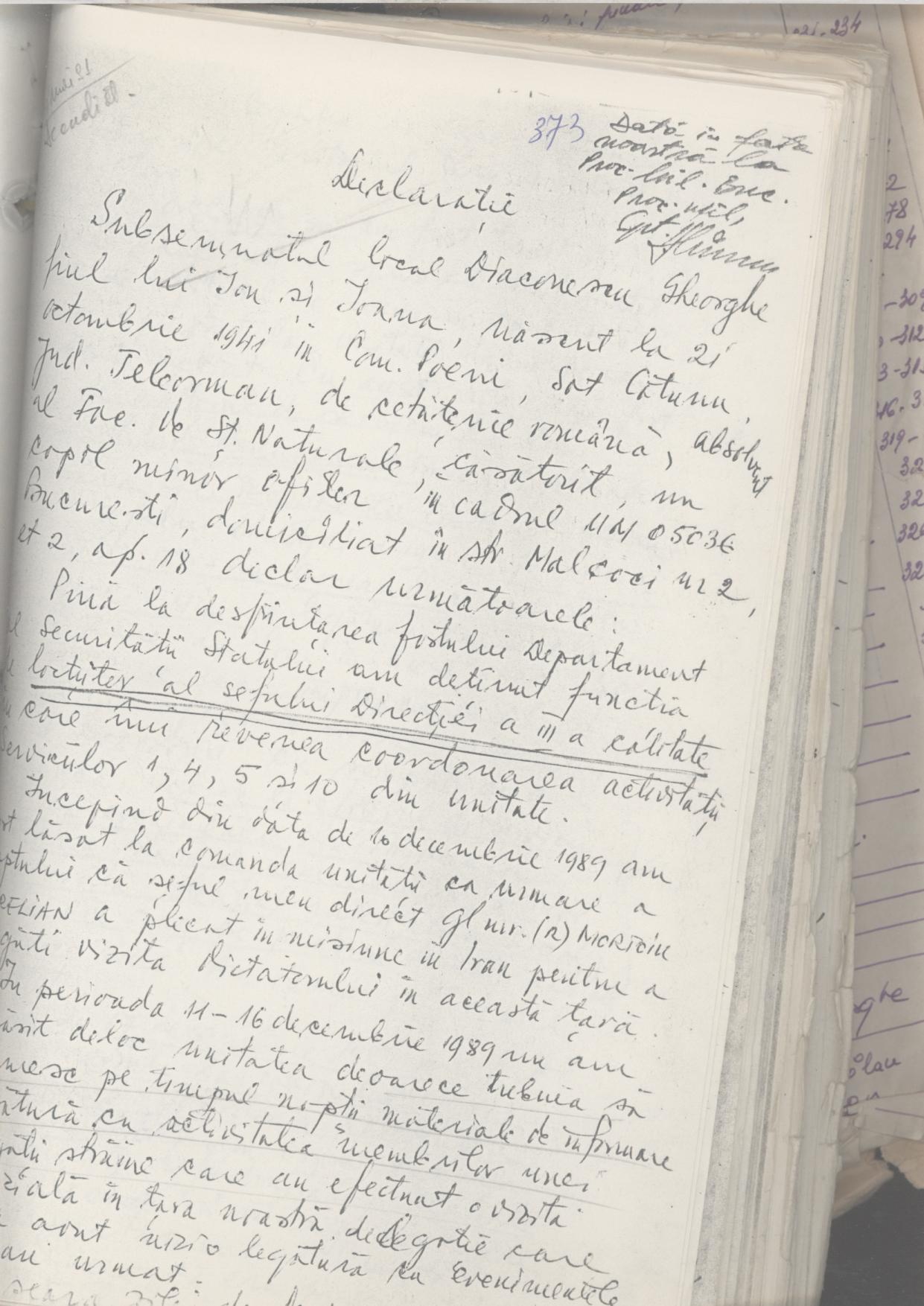
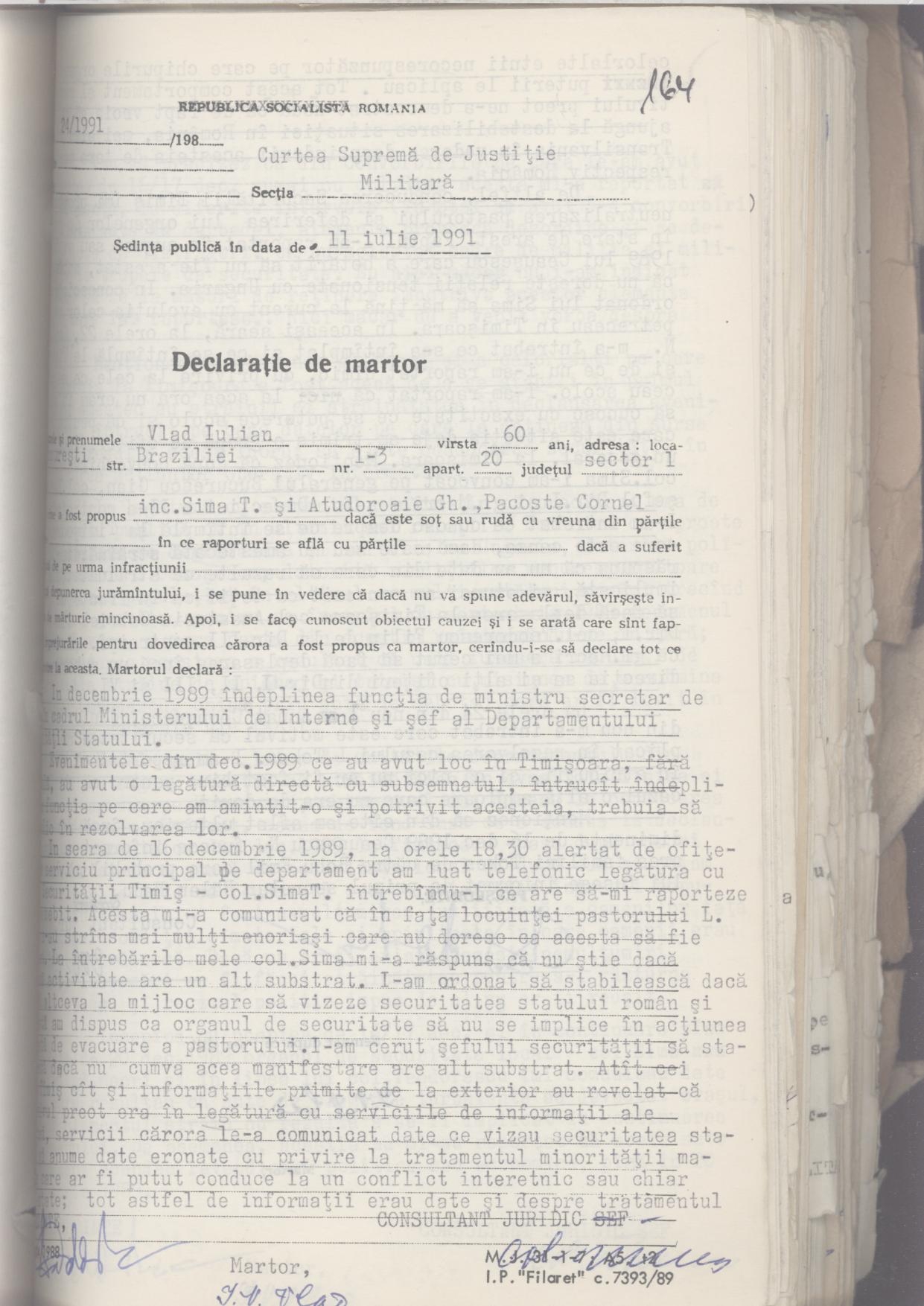
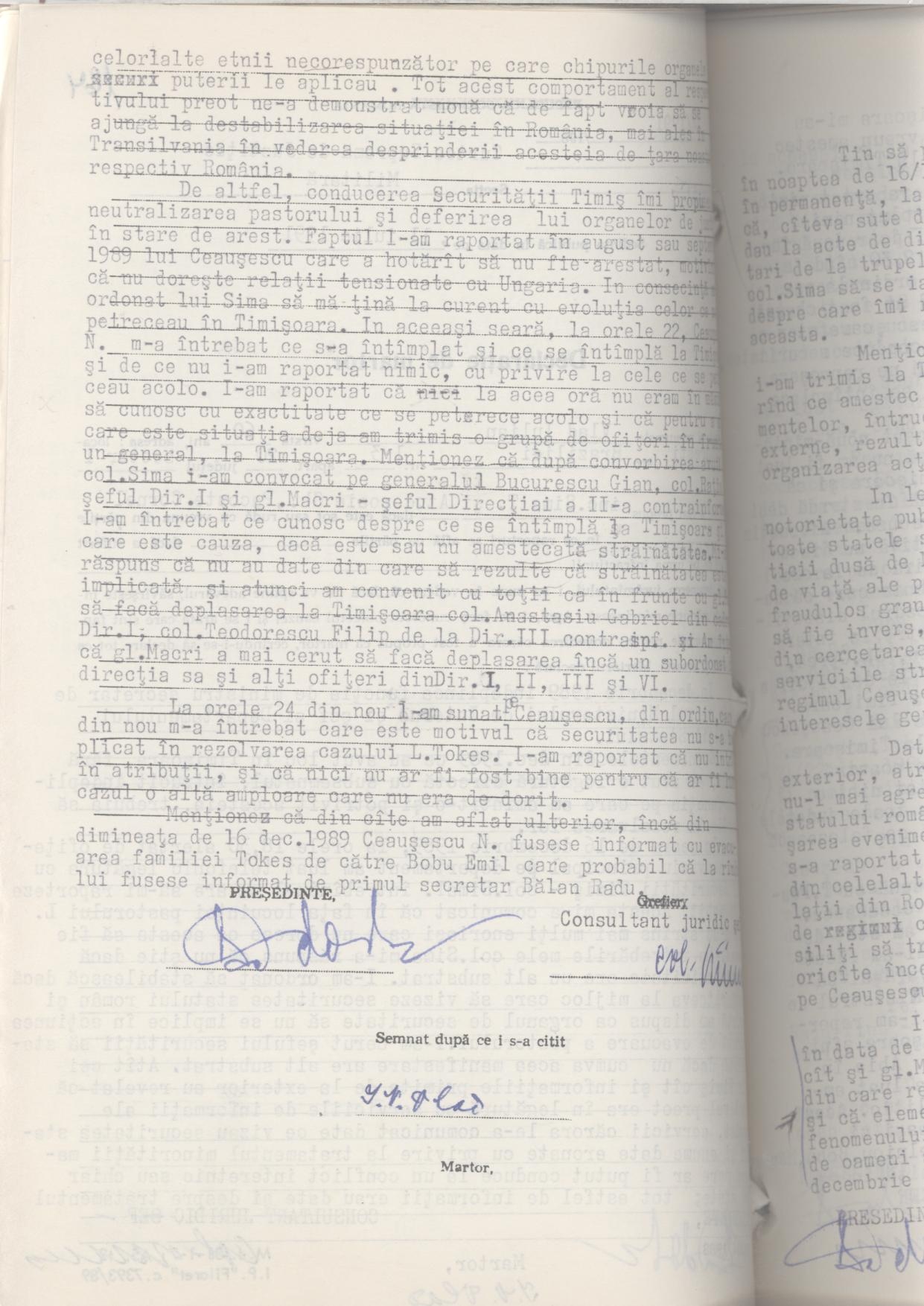
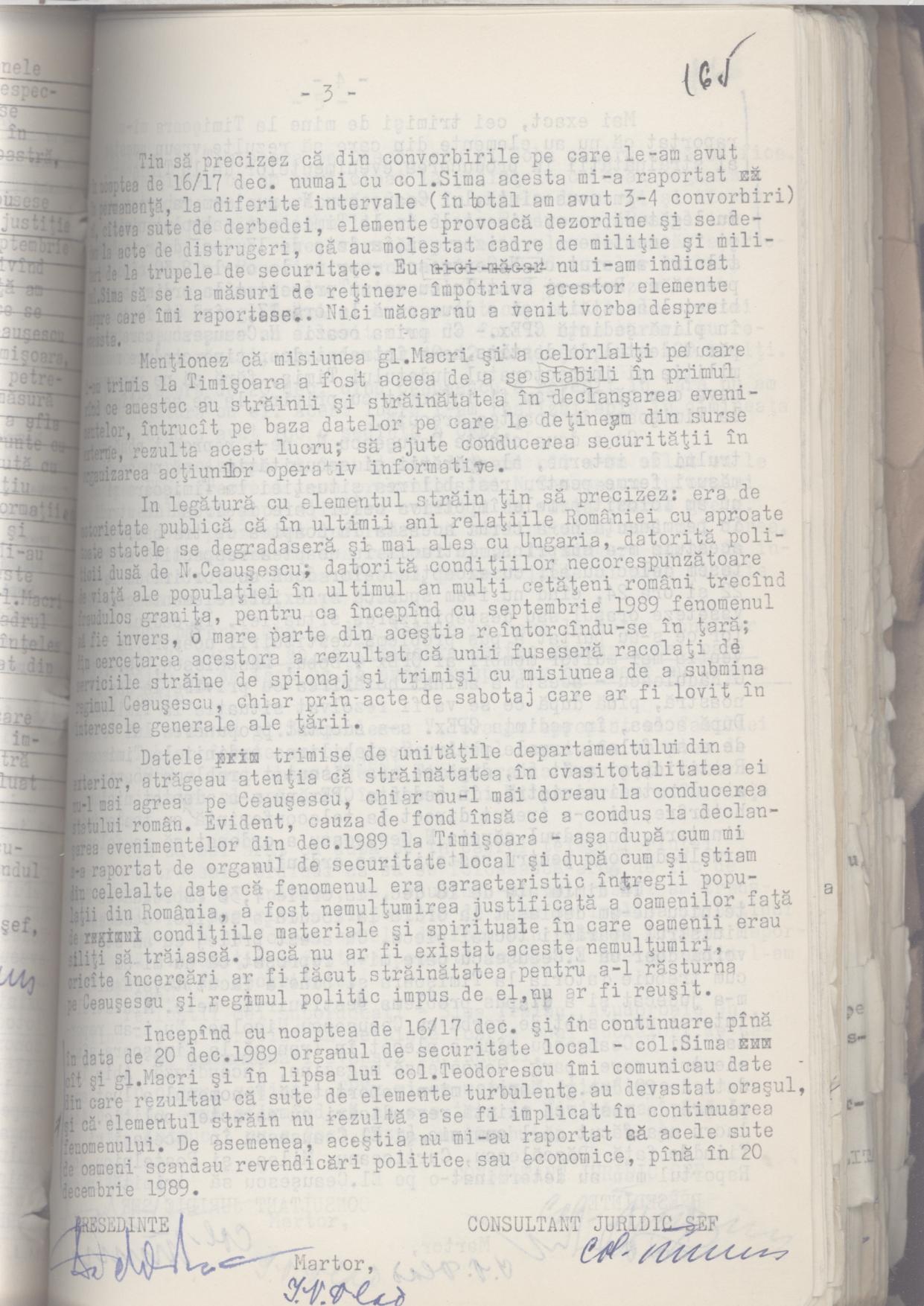
Declaratia Generalului Ion Hortopan: cum a vazut Armata “colaborarea” generalului Iulian Vlad

Posted by romanianrevolutionofdecember1989 on October 4, 2013

image0-010

Declaratia generalului colonel I. Hortopan, 16.02.1990 (din cate cunosc, pana publicarea cartii lui Dan Ioan, timp de 22 de ani, aceasta declaratie n-a aparut in presa romana)

“Actiunile teroristilor au crescut in intensitate in ziua de 23 decembrie si in seara zilei, la o analiza a Consilului Frontului Salvarii Nationale, Vlad a fost intrebat cine sunt cei care trag asupra Armatei si populatiei, la care acesta — in scopul de ne induce in eroare — a raspuns ca manifestantii patrunzand in anumite obiective importante, printre ei fiind si elemente rauvoitoare, fosti puscariasi de drept comun, au pus mana pe arme, s-au constituit in grupuri si trag asupra noastra.  In timpul actiunii, trupele noastre au prins un numar de teroristi care faceau din unitatile de Securitate, au cerut cuvantul si au prezentat numarul unitatilor din care faceau parte (UM-0672F, UM-0639, UM-0106, UM-0620), la care Vlad, tot pentru inducere in eroare, a afirmat ca acestia s-ar putea sa fie fanatici, care, chipurile, ar actiona pe cont propriu.”

image0-011

image0-012

image0-013

Posted in decembrie 1989, raport final | Tagged: , , , , , , , , , | 2 Comments »

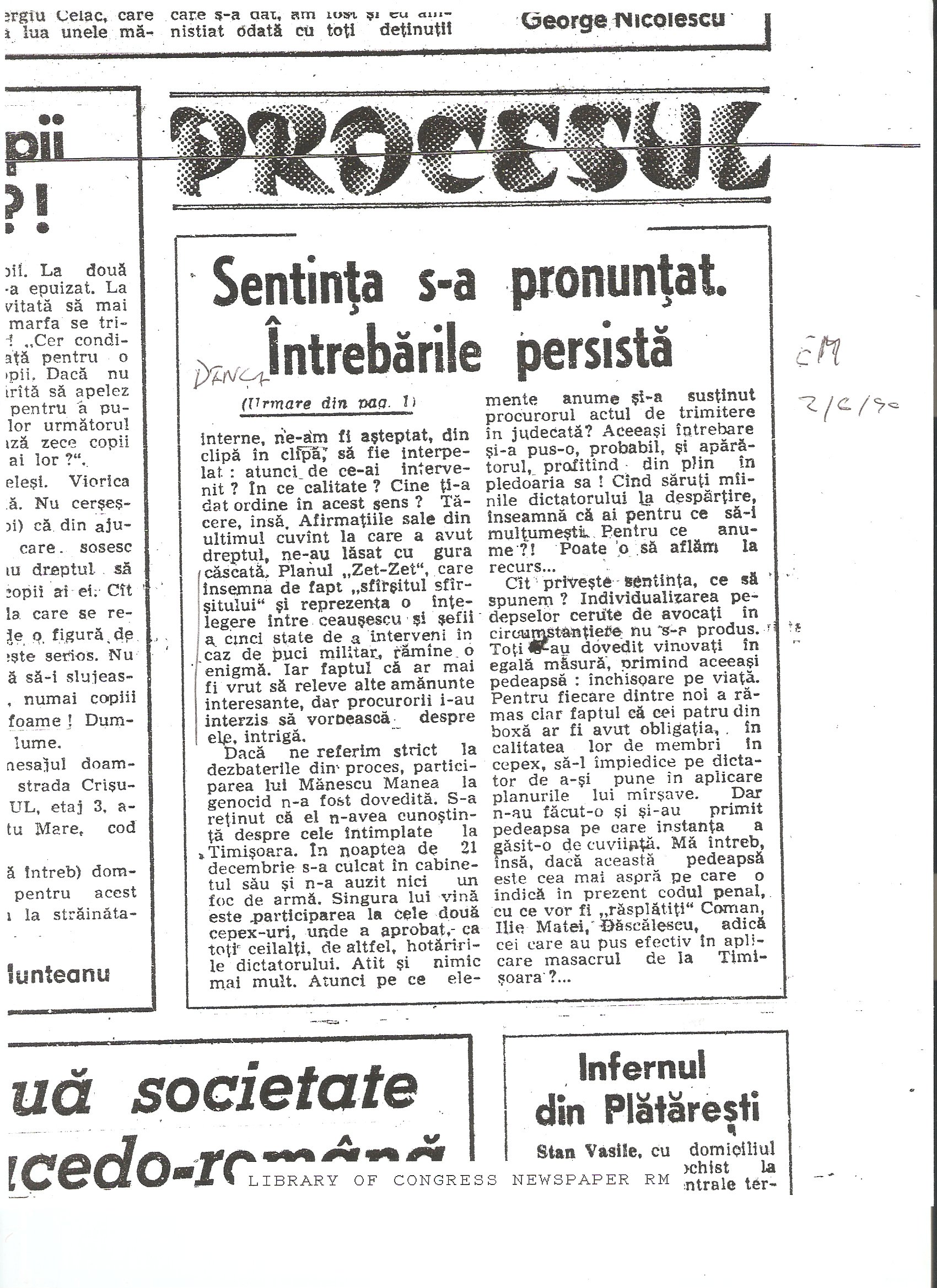
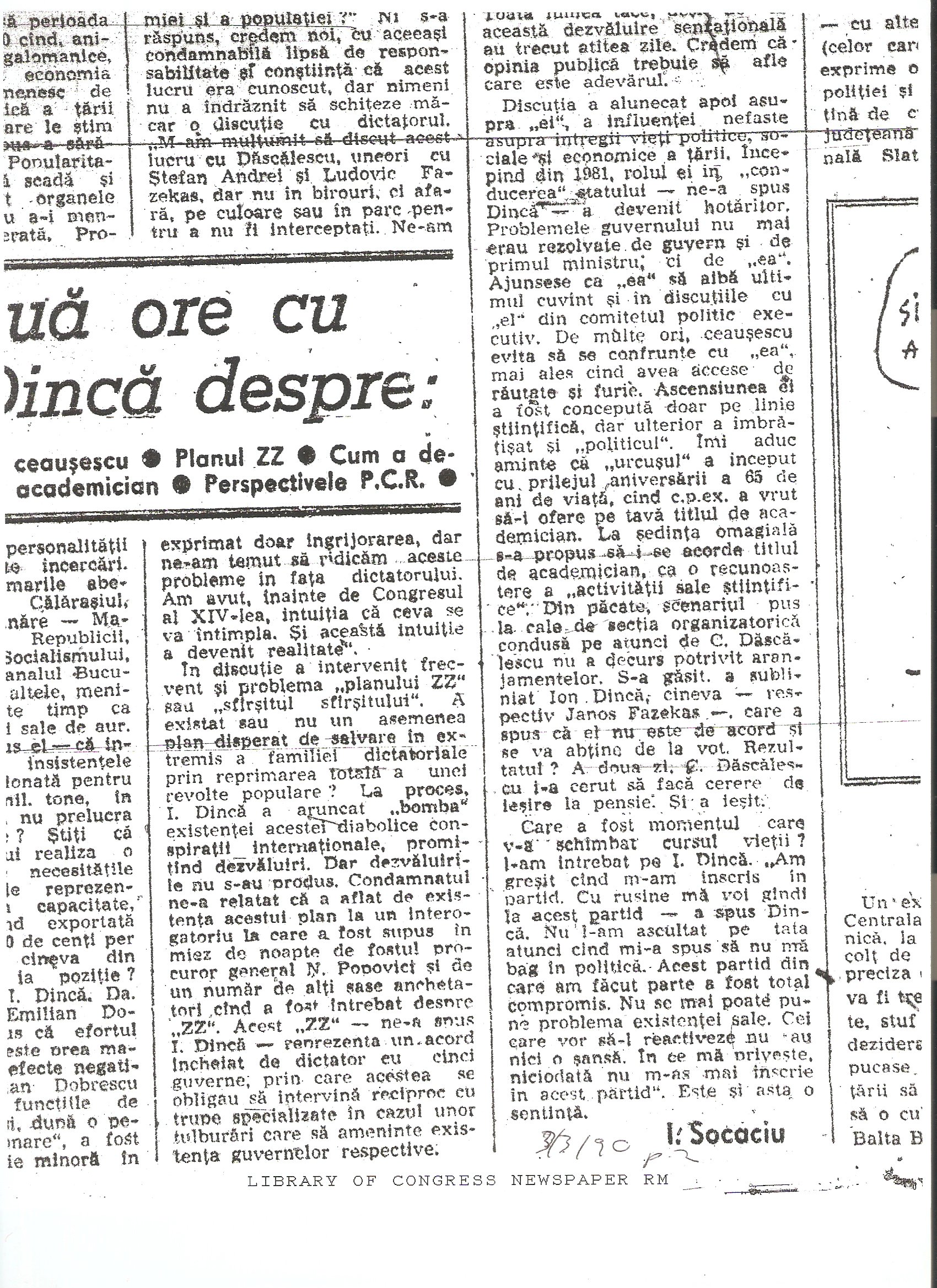
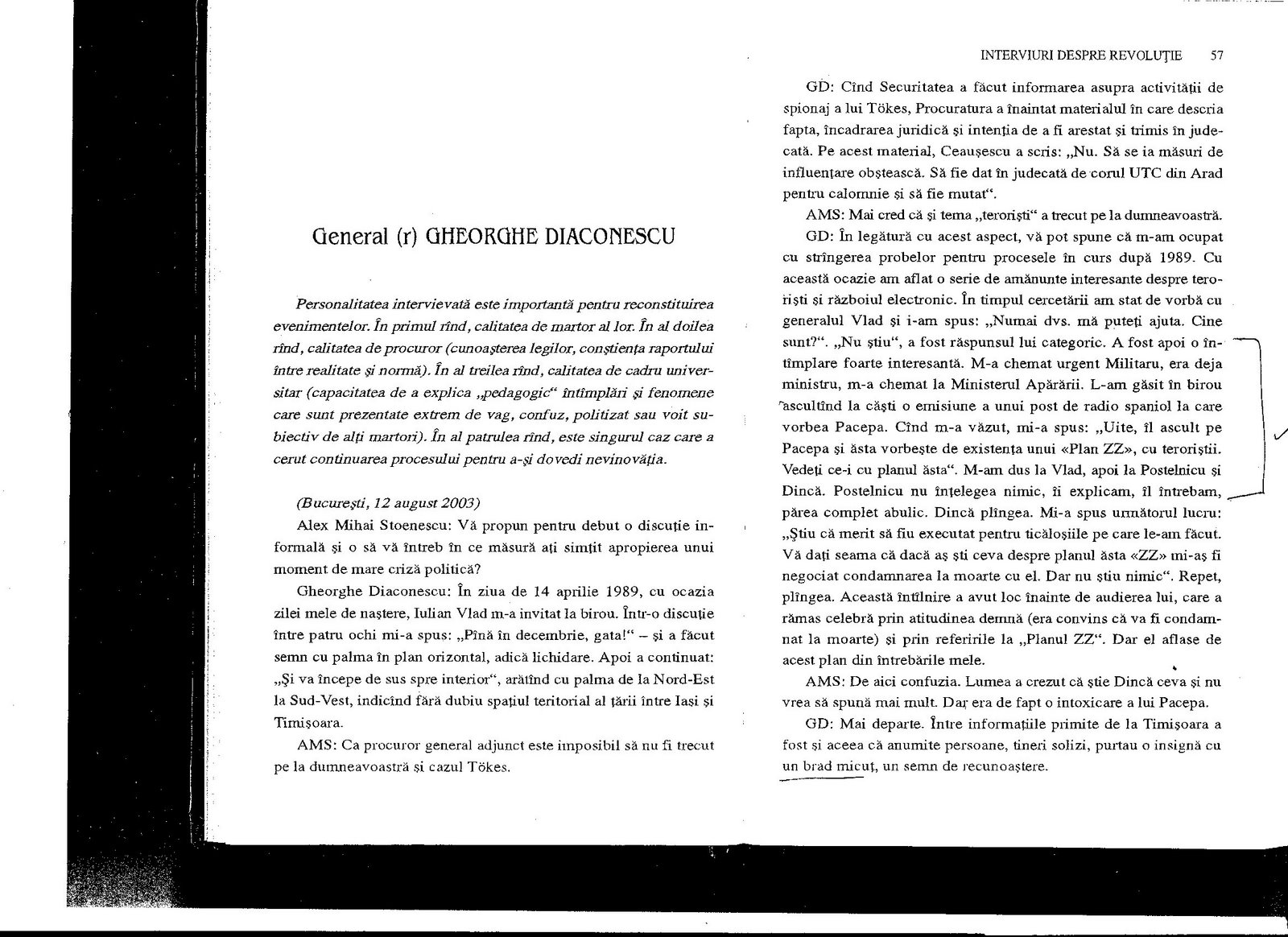
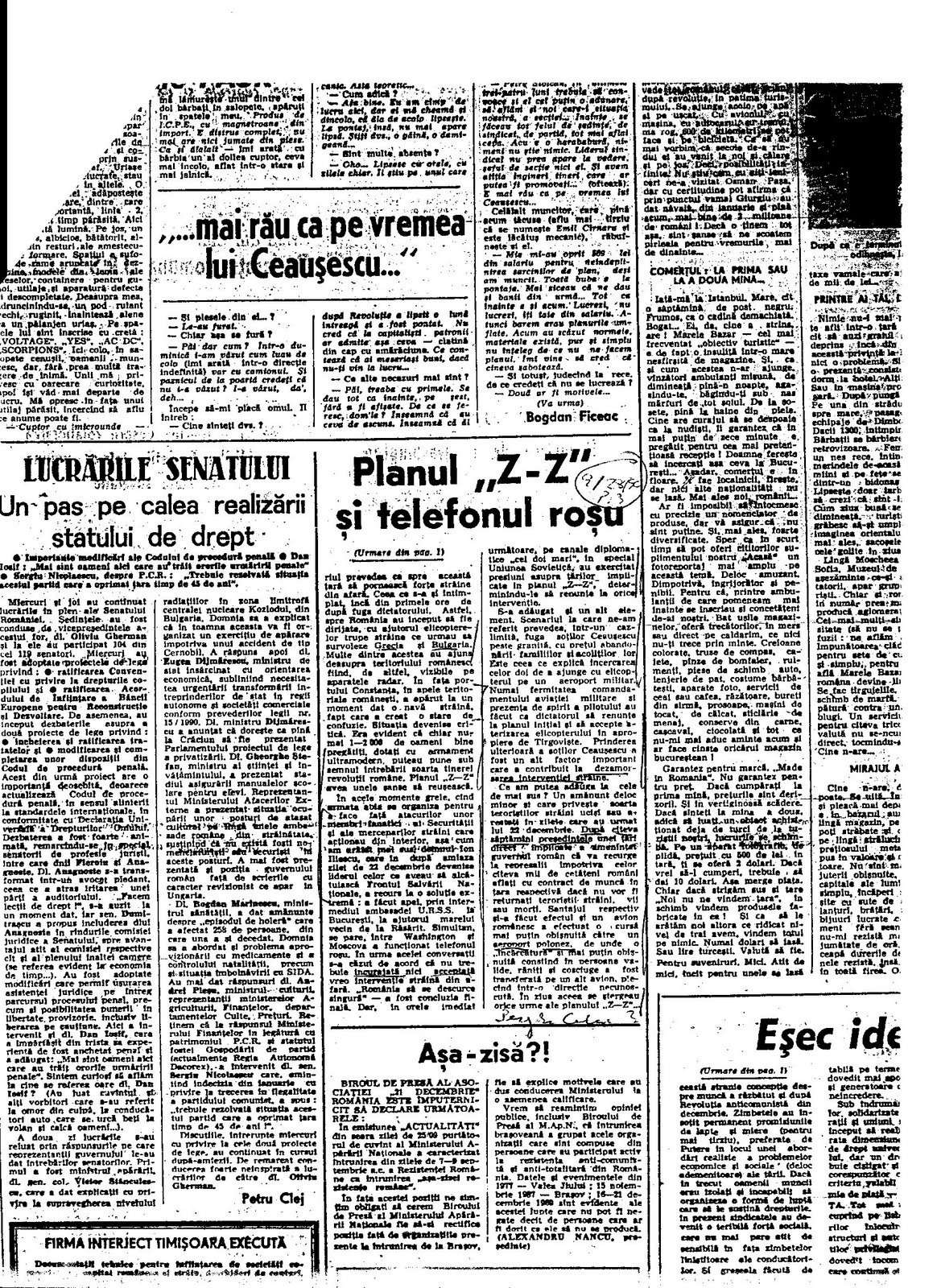
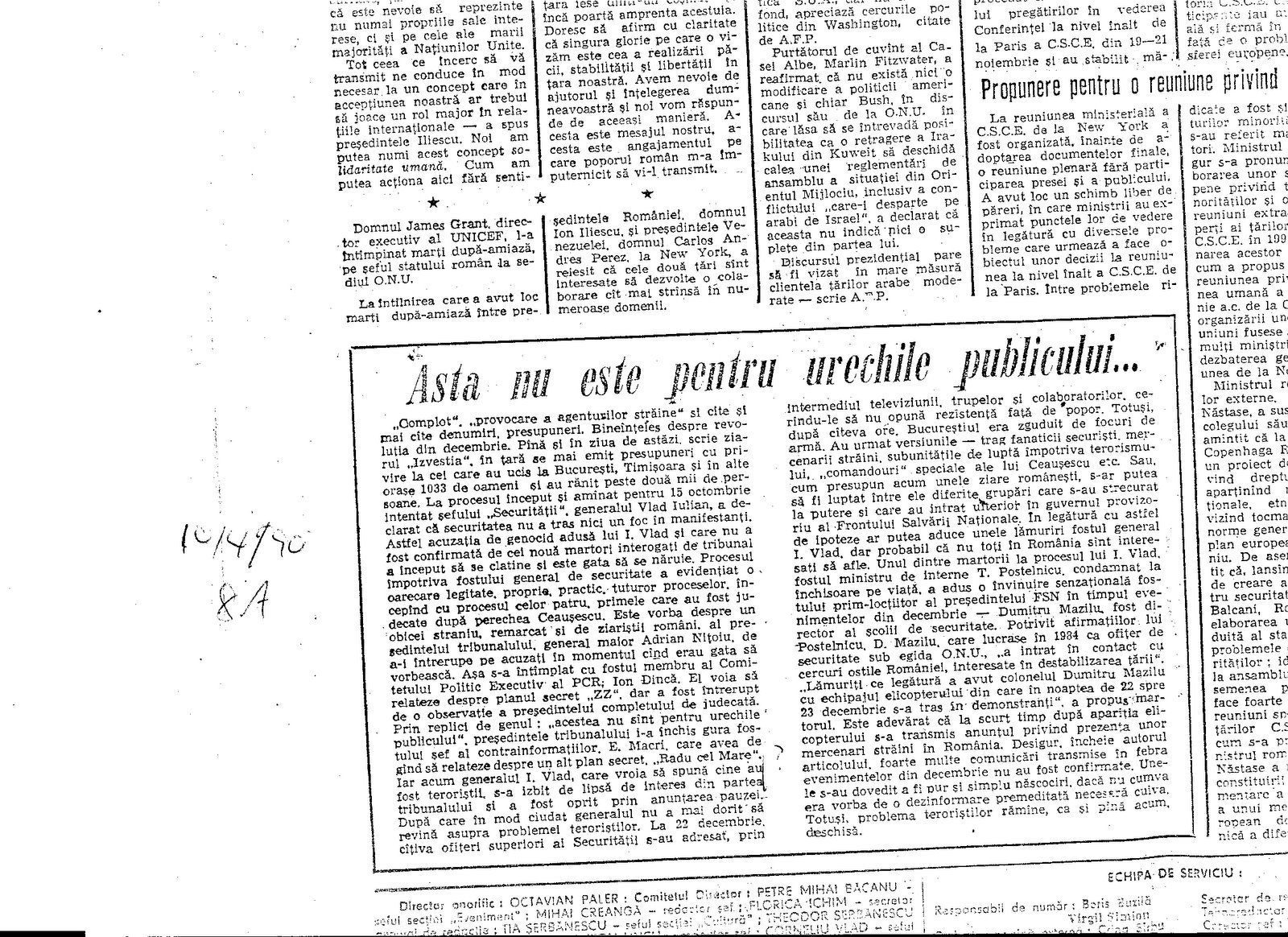
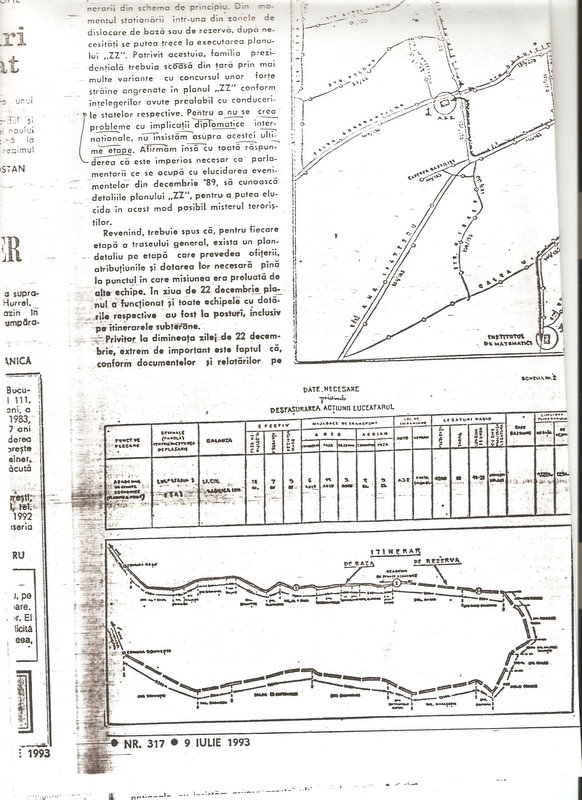
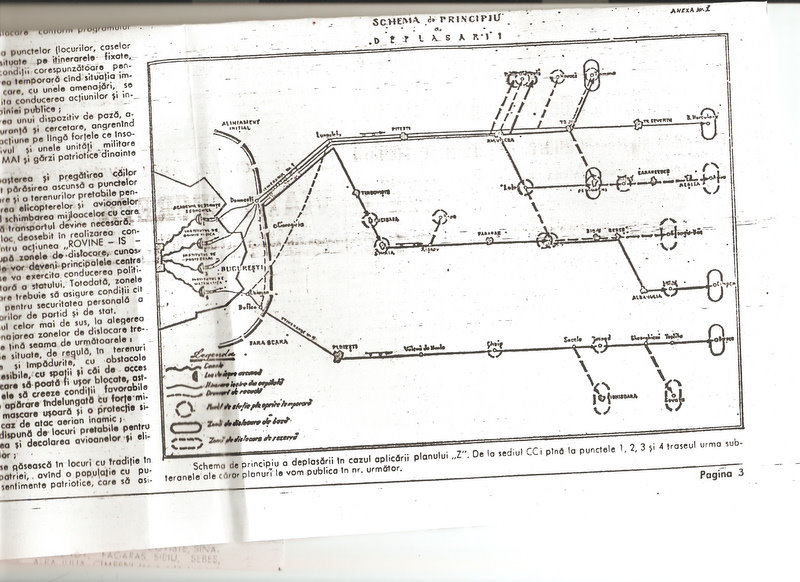
Planul Z-Z / Planul Zet-Zet in presa romana din anii nouazeci

Posted by romanianrevolutionofdecember1989 on May 11, 2013

image0

Romania Libera, 6 februarie 1990

image0-001

Romania Libera, 3 martie 1990

Nestor Ratesh quotes one of Ceausescu’s senior party henchman, Ion Dinca, as having stated at his trial in early February 1990:

“During the night of 27-28 [of January 1990] at 12:30 A.M., I was called by several people from the Prosecutor’s Office to tell what I knew about the agreement entitled Z.Z. between Romania and five other states providing for the dispatching of terrorist forces to Romania in order to intervene in case of a military Putsch.  This agreement Z.Z. is entitled ‘the End of the End.’  I stated then, and I am stating now to you, that I have never been involved in this agreement, neither I nor other people.  And I was told:  Only you and two other people know this.  I stated that and a detailed check was made in order to prove that I was not involved in such acts.”[95]

[95] Ratesh, Romania:  The Entangled Revolution, pp. 66-67, quoting Radio Bucharest, 2 February 1990.  I don’t think from the context given it is clear that this alleged incident took place in January 1990, as Ratesh assumes; the reference to 27-28 might have been a reference to December 1989.

*Se pare ca episodul “gloante vidia” martie-aprilie 1991 avea un precedent in martie 1990 (Ioan Buduca, “Comunicati unitatilor sa anunte populatia ca armata nu va trage!” Cuvintul, nr. 8-9 (29 martie 1990), pp. 8-9)

“In biroul domnului ministru al Apararii Nationale, generalul Victor Stanculescu, am avut ocazia sa vad cinci gloante extrase din corpul unor victime ale revolutiei.  ‘Armata romana nu are asemenea gloante in dotare’ mi-a spus domnia sa.”

“Am intrebat cu o naivitate din care eu insumi nu puteam sa inteleg decit doua lucruri:  ori a tras securitatea, ori a tras populatia.  ‘Inseamna ca a fost pus in aplicare planul ‘Z/Z’?’  Domnul general a raspuns:  ‘Nu am auzit niciodata de acest plan ‘Z/Z’.’

Constantin Vranceanu, “Planul ,Z-Z’ si telefonul rosu,” Romania Libera, 28 September 1990, p. 3.

Mirel Curea, Evenimentul Zilei, nr. 317, 9 iulie 1993, p. 3

Posted in decembrie 1989, raport final | Tagged: , , , , , , , , , , , | 2 Comments »

The Securitate’s “Recovered Memories” about Timisoara

Posted by romanianrevolutionofdecember1989 on April 25, 2013

The declarations of senior Securitate officers Filip Teodorescu, Emil Macri, Liviu Dinulescu, and Nicolae Mavru from late December 1989/early 1990

http://atomic-temporary-3899751.wpcomstaging.com/2013/03/17/filip-teodorescu-adj-sef-dir-iii-contraspionaj-d-s-s-nu-sint-date-ca-ar-exista-instigatori-sau-conducatori-anume-veniti-din-strainatate/

http://atomic-temporary-3899751.wpcomstaging.com/2013/03/16/emil-macri-rezumind-sintetic-informatiile-obtinute-ele-nu-au-pus-in-evidenta-nici-lideri-si-nici-amestecul-vreunei-puteri-straine-in-producerea-evenimentelor-de-la-timisoara/

http://atomic-temporary-3899751.wpcomstaging.com/2013/03/10/liviu-dinulescu-cpt-la-serviciul-de-pasapoarte-al-jud-timis-precizez-ca-anterior-declansarii-evenimentelor-de-la-timisoara-din-datele-ce-le-detineam-serviciul-nostru-nu-rezulta-vreun-amestec-di/

http://atomic-temporary-3899751.wpcomstaging.com/2013/03/06/secretele-revolutiei-de-la-timisoara-col-niculae-mavru-fost-sef-al-sectiei-filaj-si-investigatie-de-la-securitatea-timis/

http://atomic-temporary-3899751.wpcomstaging.com/ultimul-raport-al-securitatii-catre-nicolae-ceausescu/

Below some of my discussion of the Securitate’s “recovered memory”

through the years (1996, 2002, 2005)
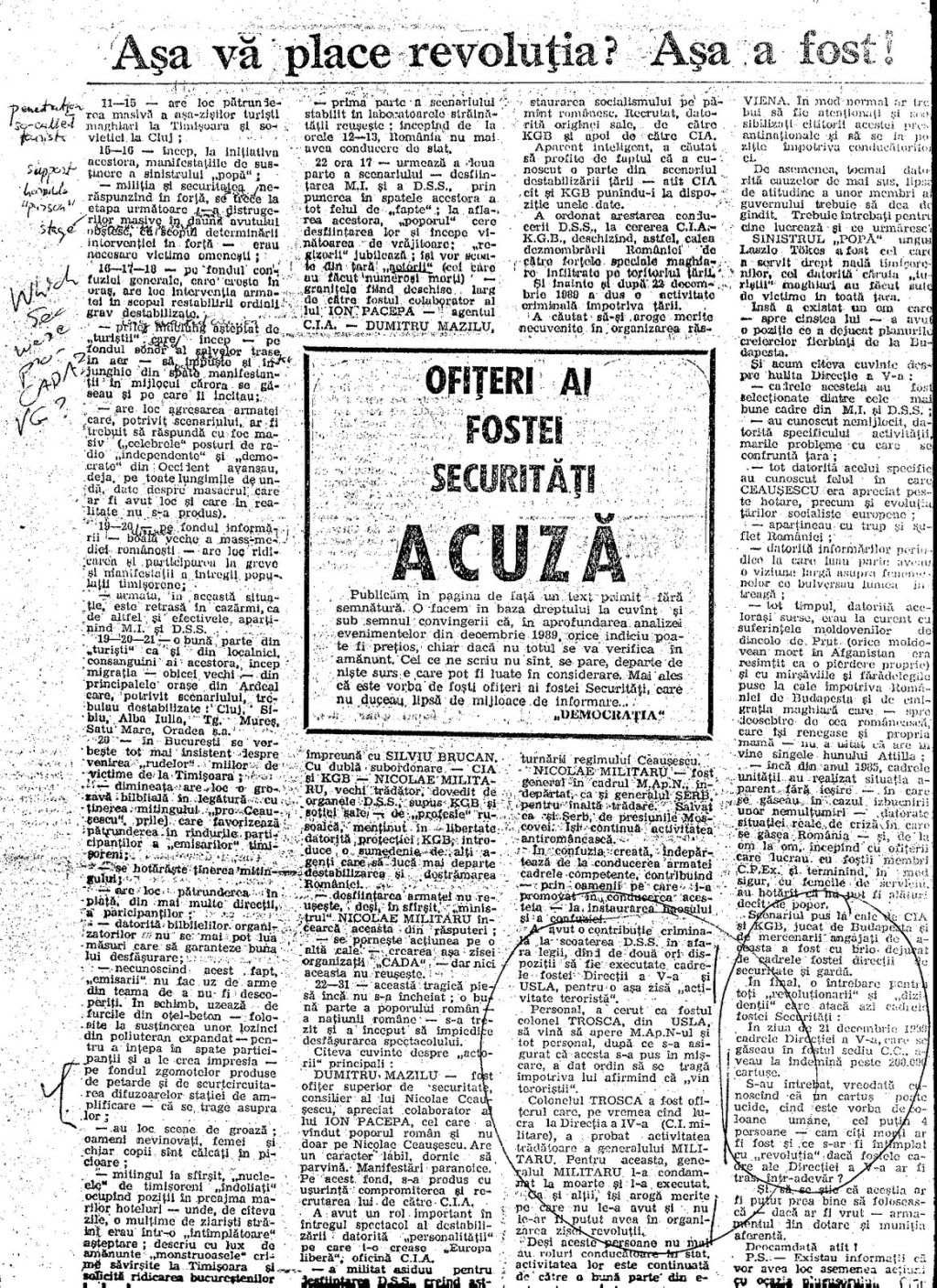
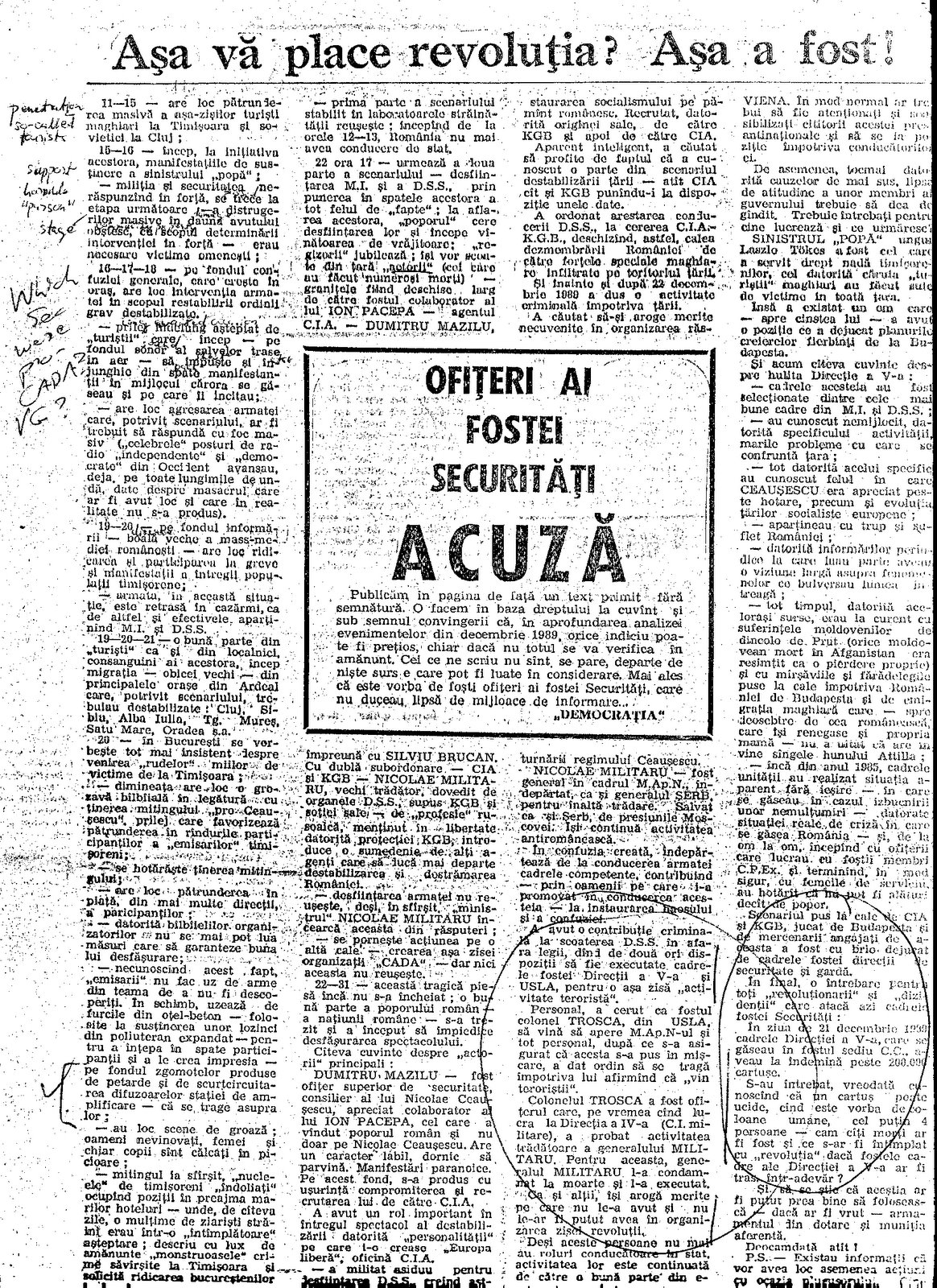
“Asa va place revolutia?  Asa a fost!” Democratia, septembrie 1990, din partea fostilor ofiteri din Directia V-a a Securitatii.

Raportul SRI, publicat in Adevarul, 13 iulie 1994.
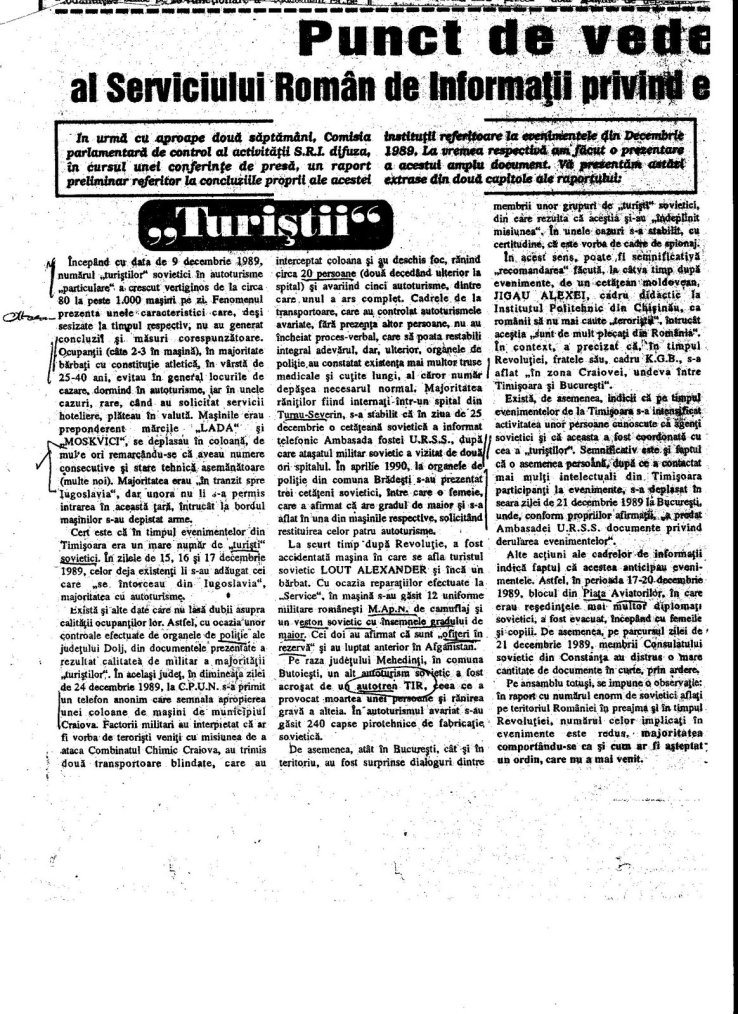
image-81

THE 1989 ROMANIAN REVOLUTION AS GEOPOLITICAL PARLOR GAME:  BRANDSTATTER’S “CHECKMATE” DOCUMENTARY AND THE LATEST WAVE IN A SEA OF REVISIONISM

By Richard Andrew Hall

Disclaimer:  This material has been reviewed by CIA.  That review neither constitutes CIA authentification of information nor implies CIA endorsement of the author’s views.

Please Note:  This article is not to be cited, reproduced, translated, or used in any form without the acknowledgement and permission of the author.

Part 3:  Ruse

A SECURITATE RIDDLE:  SOVIET “TOURISTS” AND THE OVERTHROW OF THE CEAUSESCU REGIME

Although I have written a good deal on the “tourist” conundrum in the past (see, for example, Hall 2002), I have not formally addressed the role of foreign histories of Ceausescu’s overthrow in the historiography of December 1989, particularly in regard to this topic.  In the wake of the broadcast of Brandstatter’s “Checkmate” documentary in February 2004, Vladimir Bukovski’s invocation of journalist John Simpson’s 1994 article on the topic (discussed in Part 2 of this series) suggests, however, that it needs to be broached in greater detail.  Moreover, as the year-long look-back at the December 1989 events in “Jurnalul National” shows, the “tourist” question—somewhat surprisingly to me—has become more and more central to arguments about the Revolution, thereby amplifying what is already tremendous confusion over the events in the Romanian press and public.  Of course, as has traditionally been the case, the Soviet/Russian tourists figure prominently, and, to a lesser extent, the Hungarian tourists.  However, the stock of other tourist groups has also gone up.  For example, the role of Yugoslav (specifically Serb) tourists has found a greater emphasis, and, seemingly out of nowhere, so have East German/STASI tourists!  The principal sources for all of these allegations are, as usual, former Securitate and Militia officers, with some military (intelligence) personnel thrown in for good measure.

FOREIGN FORUM, ROMANIAN CONTEXT

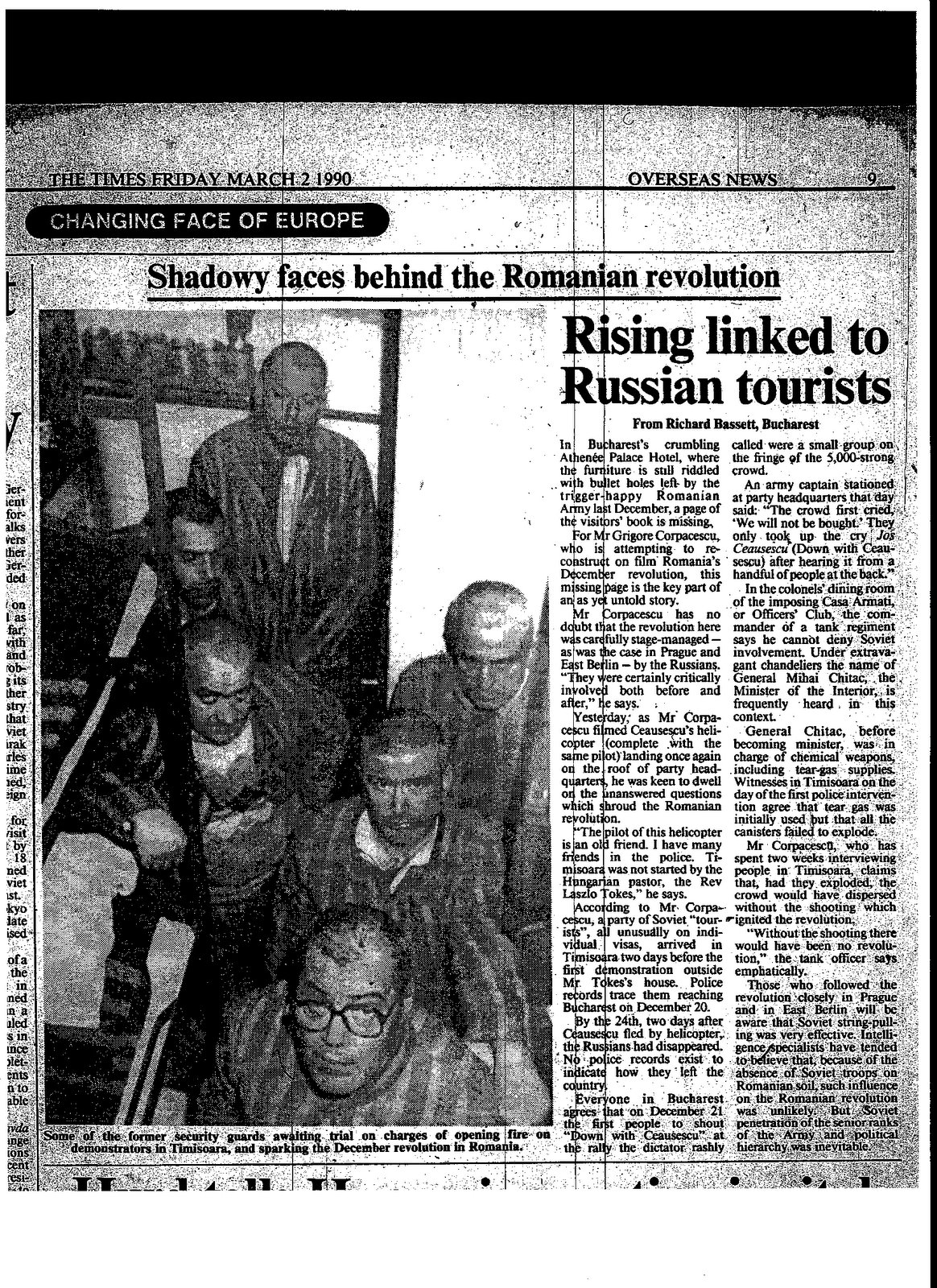
It is difficult to pinpoint the exact first mention of “the tourists” and their alleged role in the Revolution, but it appears that although the source of the claim was Romanian, the publication was foreign.  James F. Burke, whose name is unfortunately left off the well-researched and widely-consulted web document “The December 1989 Revolt and the Romanian Coup d‘etat,” alludes to the “Romanian filmmaker” who first made these allegations (Burke, 1994).  The claims are contained in an article by Richard Bassett in the 2 March 1990 edition of “The Times (London).”  According to Bassett,

“Mr. [Grigore] Corpacescu has no doubt that the revolution here was carefully stage-managed—as was the case in Prague and East Berlin—by the Russians…According to Mr. Corpacescu a party of Soviet ‘tourists,’ all usually on individual visas, arrived in Timisoara two days before the first demonstration outside Mr. [i.e. Pastor] Tokes’ house.  Police records trace them reaching Bucharest on December 20.  By the 24th, two days after Ceausescu fled by helicopter, the Russians had disappeared.  No police records exist to indicate how they left the country. (“The Times (London),” 2 March 1990)

But Bassett’s interlocutor, Mr. Corpacescu, says some strange things.  Bassett is not clear but it appears that Corpacescu suggests that the post-Revolution Interior Minister Mihai Chitac, who was involved in the Timisoara events as head of the army’s chemical troops, somehow purposely coaxed the demonstrations against the regime because the tear-gas cannisters his unit fired failed to explode—the failure somehow an intended outcome.  But beyond this, Corpacescu, who is at the time of the article filming the recreation of Ceausescu’s flight on the 22nd—using the same helicopter and pilot involved in the actual event—makes the following curious statement:

“The pilot of this helicopter is an old friend.  I have many friends in the police, Timisoara was not started by the Hungarian pastor, the Reverend Laszlo Tokes [i.e. it was carefully stage-managed…by the Russians].” (“The Times (London),” 2 March 1990)

The pilot of the helicopter was in fact Vasile Malutan, an officer of the Securitate’s V-a Directorate.  What kind of a person would it have been at that time—and how credible could that person have been–who has the pilot as an old friend and “many friends in the police?”  And it would have been one thing perhaps two months after the revolution to talk about the presence of foreign agents “observing” events in Timisoara, but to deny the spontaneity of the demonstrations and denigrate Tokes’ role at this juncture is highly suspicious.  I have been unable to unearth additional information on Mr. Corpacescu, but his revelations just happen to serve his friends extremely well—particularly at at time when the prospect of trials and jail time, for participation in the repression in Timisoara and elsewhere during the Revolution, still faced many former Securitate and Militia [i.e. police] members.

THE FORMER SECURITATE AND MILITIA REMINISCE ABOUT THE SOVIET “TOURISTS”

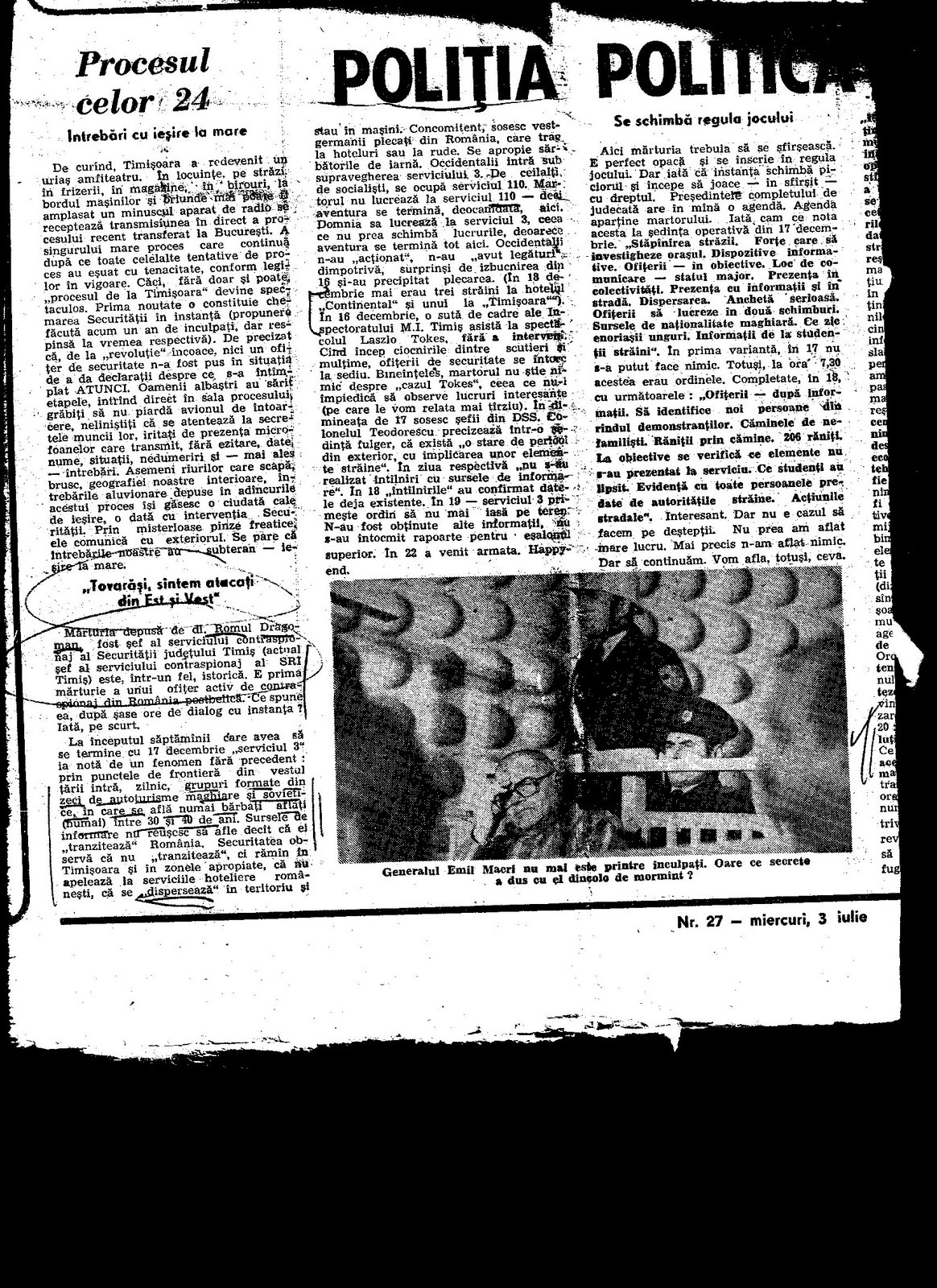
A week after “The Times” article, the chief of the Securitate’s Counter-espionage Directorate, Colonel Filip Teodorescu, mentioned at his trial for his role in the Ceausescu regime’s crackdown in Timisoara that he had in fact detained “foreign agents” during the events there (“Romania Libera,” 9 March 1990).  In his 1992 book, he developed further on this theme, specifically focusing on the role of “Soviet tourists:”

“There were few foreigners in the hotels, the majority of them having fled the town after lunch [on 17 December] when the clashes began to break out. The interested parties remained. Our attention is drawn to the unjustifiably large number of Soviet tourists, be they by bus or car. Not all of them stayed in hotels. They either had left their buses or stayed in their cars overnight. Border records indicate their points of entry as being through northern Transylvania. They all claimed they were in transit to Yugoslavia. The explanation was plausible, the Soviets being well-known for their shopping trips. Unfortunately, we did not have enough forces and the conditions did not allow us to monitor the activities of at least some of these ‘tourists’” (Teodorescu, 1992, p. 92).

Reporting in July 1991 on the trial involving many of those involved in the Timisoara repression, Radu Ciobotea noted with what was probably an apt amount of skepticism and cynicism, what was telling in the confessions of those on trial:

Is the End of Amnesia Approaching?…

Without question, something is happening with this trial.  The Securitate doesn’t say, but it suggests.  It let’s small details ‘slip out.’…Increasingly worthy of interest are the reactions of those on trial….Traian Sima (the former head of the county’s Securitate) testifies happily that, finally, the Securitate has been accepted at the trial, after having been rejected by Justice.  Filip Teodorescu utters the magic word ‘diplomats’ and, suddenly, the witness discovers the key to the drawer with surpise and declares, after five hours of amnesia, that in Timisoara, there appeared in the days in question, foreign spies under the cover of being journalists and diplomats, that in a conversation intercepted by a mobile Securitate surveillance unit Tokes was reported as  ‘well,’ and that all these (and other) counterespionage actions that can’t be made public to the mass media can be revealed behind closed doors to the judge….[Timis County party boss] Radu Balan ‘remembers’ that on 18 December at midnight when he was heading toward IAEM, he passed a group of ten soviet cars stopped 100 meters from the county hospital. (It turns out that in this night, in the sight of the Soviets, the corpses were loaded!).” [emphasis in the original] (Flacara, no. 27, 1991, p. 9).

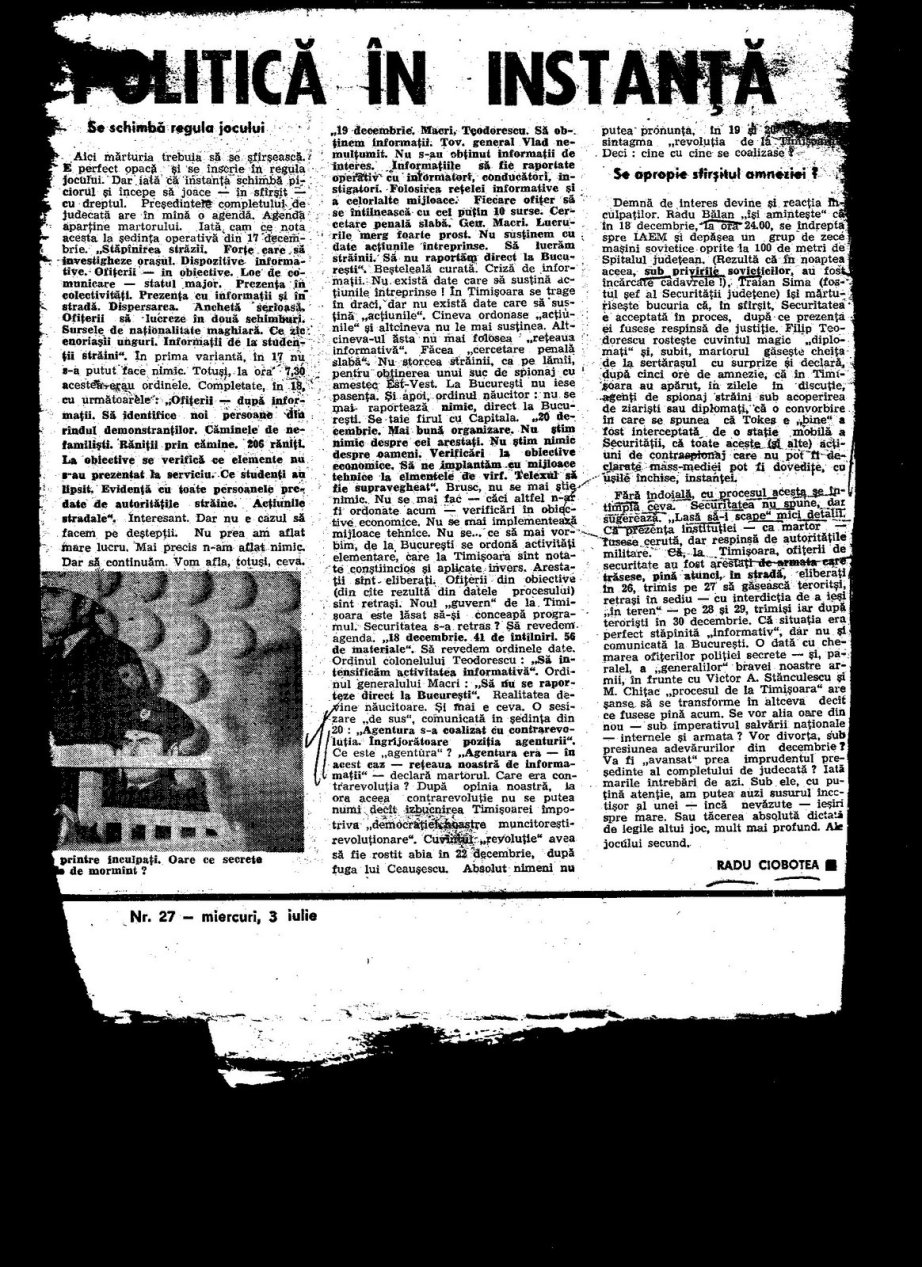
The reference to the corpses being loaded is to an operation by the Militia and Securitate on the night of 18-19 December 1989, in which the cadavers of 40 people killed during the repression of anti-regime protesters were secretly transported from Timisoara’s main hospital to Bucharest for cremation (reputedly on Elena Ceausescu’s personal order).

Finally, as yet another of many possible examples, we have the recollections of Bucharest Militia Captain Ionel Bejan, which apparently appeared in print for the first time only in 2004, in a book by Alex Mihai Stoenescu (excerpted in “Jurnalul National,” 7 December 2004).  According to Bejan, around 2 AM on the night of 21-22 December, not far from University Plaza, where at that moment regime forces were firing their way through a barricade set up by protesters (48 were killed that night, 604 wounded, and 684 arrested), he spotted two LADA automobiles with Soviet plates and two men and a woman studying a map and pointing to different locations among the surrounding buildings.  Bejan recalled:

“One thing’s for sure, and that is that although they looked like tourists, they didn’t behave like tourists who had just arrived in town or were lost, especially as close by there were compact groups of demonstrators, while from armored personnel carriers there was intense warning fire and a helicopter hovered overhead with lights ablaze.  I don’t know what kind of tourist tours somewhere in such conditions. They left the impression that they were sure of themselves, they didn’t need any directions, proof which was that they didn’t ask us anything even though we were nearby and, being uniformed Militia, were in the position to give them any directions they needed.  One thing’s for sure when I returned to that location in January 1990…the buildings displayed visible signs of bullet holes…[emphasis added]” (“Jurnalul National,” 7 December 2004)

STRANGE “TOURISTS”…STRANGER STILL, THE REACTIONS OF THE AUTHORITIES

We can agree with Ionel Bejan in one respect.  One thing is for sure:  these were some very strange tourists.  (They give a whole new meaning to the term, “adventure tourism.”)  As curious as the “Soviet tourists” themselves is how little the Romanian authorities who claim to have seen them did to stop them—or even try to collect more information about them.  Why is it that no official questioned the enigmatic “Soviet tourists” or asked them to leave the area when, as Radu Balan claims, he saw ten LADAs outside the Timis county hospital at 1 AM in the morning the night the cadavers of protesters were being loaded onto a truck for cremation?  Or, as Ionel Bejan claims, he spotted several of them in the center of Bucharest at 2 AM, when the area was essentially a warzone of regime repression?  The regime had closed the borders to virtually all other foreigners, tourists or otherwise, it was trying to prevent any word of the repression from reaching the outside world, and yet Romanian authorities were not concerned about these “tourists” taking pictures or relaying what they were seeing?!

As I have written before, if it was obvious before 18 December, as these Ceausescu regime officials claim, that “Soviet tourists” were involved in the events in Timisoara, then why was it precisely “Soviet travelers coming home from shopping trips to Yugoslavia” who were the only group declared exempt from the ban on “tourism” announced on that day (see AFP, 19 December 1989 as cited in Hall 2002b)?  In fact, an Agent France-Presse correspondent reported that two Romanian border guards on the Yugoslav frontier curtly told him:  “Go back home, only Russians can get through”!!!  The few official documents from the December events that have made their way into the public domain show the Romanian Ambassador to Moscow, Ion Bucur, appealing to the Soviets to honor the Romanian news blackout on events in Timisoara, but never once mentioning—let alone objecting to—the presence or behavior of “Soviet tourists” in Romania during these chaotic days of crisis for the Ceausescu regime (CWHIP, “New Evidence on the 1989 Crisis in Romania,” 2001).  It truly strains the imagination to believe that the Romanian authorities were so “frightened” of committing a diplomatic incident with the Soviets that they would allow Soviet agents to roam the country virtually unhindered, allowing them to go anywhere and do anything they wanted.

BUT WAIT, THERE’S MORE…A “SOVIET TOURIST” ENCORE IN 1990

Add to all of this (!), the allegations that the “Soviet tourists” were seen again on the streets during major crises in 1990, such as the ethnic clashes between Romanians and Hungarians in Tirgu Mures in March 1990 (for evidence of the reach of the allegation of KGB manipulation via the “tourist” mechanism both in December 1989 AND in March 1990, see Emil Hurezeanu, “Cotidianul,” 23 December 1999; according to Hurezeanu, “It appears they didn’t leave the country until 1991, following a visit by [SRI Director] Virgil Magureanu to Moscow”!).  Then there is the famous April 1991 interview of an alleged KGB officer—who spoke flawless Romania and was in Romania during the December 1989 events—who the interviewer, the vigorous anti-Iliescu foe, Sorin Rosca Stanescu, claimed to have just stumbled into in Paris.  Of all the reporters who could have stumbled into a KGB officer present in Romania during the Revolution—the only such case I know of—it was Rosca Stanescu, who, it turned out later, had been an informer for the Securitate until the mid-1980s—but not just for anybody, but for the USLA.  Intererstingly, although the article appeared on the non-descript page 8 of the primary opposition daily at the time (“Romania Libera”), the aforementioned Filip Teodorescu and Radu Balan invoked it in support of their contentions regarding the the “tourists” (for a discussion of this, see Hall 2002).  Even more suprising, or not, depending on your point of view, in his April 1991 article, Stanescu attempted to tie together December 1989 with December 1990 (!):

“As you will recall, persistent rumors have circulated about the existence on Romanian soil [in December 1989] of over 2,000 Lada automobiles with Soviet tags and two men in each car. Similar massive infiltrations were witnessed in December 1990, too, with the outbreak of a wave of strikes and demonstrations. What were the KGB doing in Romania?” (emphasis added) (“Romania Libera,” 18 April 1991)
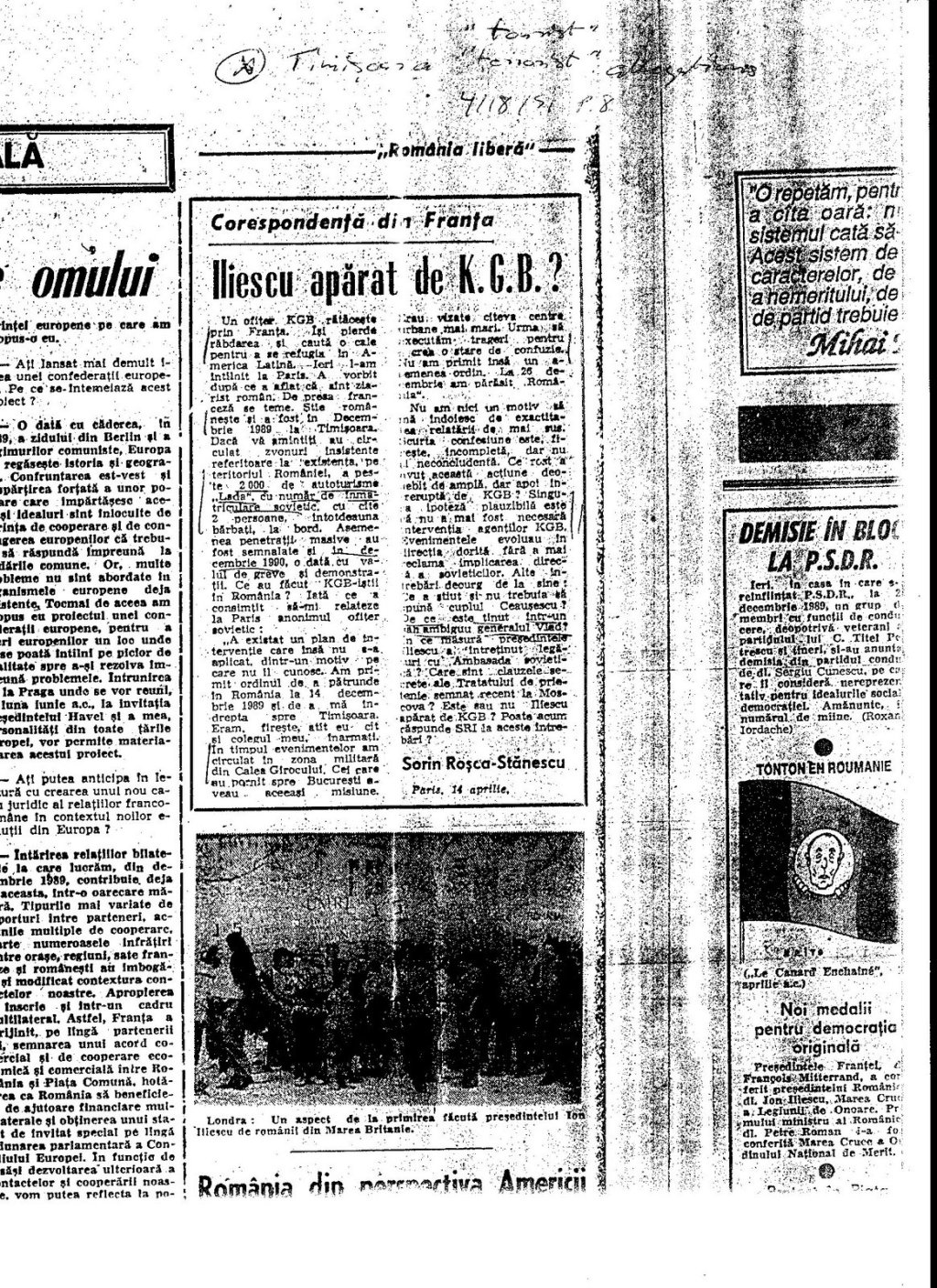
image-72

Indeed, what were they doing in Romania?  But, more aptly:

WHO COULD THEY HAVE BEEN?

Some other recollections and comments may offer clues to the answer to this vexing question.  For example, the Caransebes Militia Chief claims he helped a group of “Soviet tourists” coming from Timisoara on the night of 20-21 December when one of their cars—as usual, “it was part of a convoy of 20 cars, all of the same make and with 3-4 passengers per car”—went off the road (from “Europa,” no. 20, 1991, see the discussion in Hall 2002b).  According to Teodorescu, the “tourists” greeted the militia chief with the phrase “What the hell?  We are colleagues; you have to help us” (Teodorescu, 1992, p. 93).  The militia chief opines that despite their Soviet passports, “to this day, I don’t really know where they were from.”

Nicu Ceausescu, Nicolae’s son and most likely heir and party secretary in Sibiu at the time of the Revolution, claimed that he also had to deal with enigmatic “tourists” during these historic days (the following several paragraphs borrow heavily from Hall 2002b).  From his prison cell in 1990, Nicu recounted how on the night of 20 December 1989, a top party official came to inform him that the State Tourist Agency was requesting that he — the party secretary for Sibiu! — “find lodgings for a group of tourists who did not have accommodation” He kindly obliged and made the appropriate arrangements (interview with Nicu Ceausescu in “Zig-Zag,”, no. 20, 21-27 August 1990).

Interestingly, in the same interview Nicu discusses the “tourists” for which he was asked to find accommodations in the context of a group of mysterious passengers who had arrived by plane from Bucharest on the evening of 20 December 1989. We know that in the period immediately following these events, the then-military prosecutor, Anton Socaciu, had alleged that these passengers from Bucharest were members of the Securitate’s elite USLA unit (Special Unit for Antiterrorist Warfare) and were responsible for much of the bloodshed that occurred in Sibiu during the December events.  Nicu Silvestru, chief of the Sibiu County Militia, admitted in passing in a letter from prison that on the afternoon of 19 December in a crisis meeting, Ceausescu’s son announced that he was going to “call [his] specialists from Bucharest” to take care of any protests (“Baricada,” no. 45, 1990).  Ceausescu’s Interior Minister, Tudor Postelnicu, admitted at his trial in January 1990 that Nicu had called him requesting “some troops” and he had informed Securitate Director General Iulian Vlad of the request (“Romania Libera,” 30 January 1990.)

The rewriting of the story of the Revolution, the “tourists,” and the “terrorists” was already in full swing, when in August 1990, Nicu wryly observed:

“…[T]he Military Prosecutor gave me two variants. In the first part of the inquest, they [the flight’s passengers] were from the Interior Ministry. Later, however, in the second half of the investigation, when the USLA and those from the Interior Ministry began, so-to-speak, to pass ‘into the shadows,’ — after which one no longer heard anything of them — they [the passengers] turned out to be simple citizens…” (interview with Nicu Ceausescu in “Zig-Zag,” no. 20, 21-27 August 1990).

The impact of this “reconsideration” by the authorities could be seen in the comments of Socaciu’s successor as military prosecutor in charge of the Sibiu case, Marian Valer (see Hall 1997, pp. 314-315). Valer commented in September 1990 that investigations yielded the fact that there were 37 unidentified passengers on board the 20 December flight from Bucharest and that many of the other passengers maintained that “on the right side of the plane there had been a group of tall, athletic men, dressed in sporting attire, many of them blond, who had raised their suspicions.”  The USLA, which were responsible for airport security and had “air marshals” on all flights (three in this case), refused to discuss the identity of these passengers with Valer.  While investigations revealed that during this time there “were many Soviet tourists staying in Sibiu’s hotels,” they also established that “military units were fired upon from Securitate safehouses located around these units as of the afternoon of 22 December, after the overthrow of the Ceausescu regime.” He thus carefully concludes:

“As far as the unidentified passengers are concerned, there are two possible variants: Either they were USLA fighters sent to defend Nicu Ceausescu, or they were Soviet agents sent to act with the intent of overthrowing the Ceausescu regime” (“Expres,” no. 33, September 1990).

Clearly, one of these hypotheses is a lot more plauisble than the other…As I wrote in December 1996, partly based on the statements of the Military Prosecutor Marian Valer who stepped down from investigating the Sibiu events in fall 1990, citing duress:  “thus as the USLA began to disappear from the historiography and therefore history of the Revolution, so the Soviet tourists began to enter it.” (Hall, 1996)….

SOURCES

“Baricada (Bucharest),” 1990.

Burke, J. F., 1994, “The December 1989 Revolt and the Romanian Coup d‘etat,” at http://www.timisoara.com/timisoara/coup.html.

Ciobotea, R., 1991, “Politia Politica in Instanta [The Political Police on Trial],” “Flacara,” 3 July.

“Cotidianul” (Bucharest), 1999, web edition, http://www.cotidianul.ro.

CWIHP (Cold War International History Project), 2001, “New Evidence on the 1989 Crisis in Romania,” (ed. Mircea Munteanu), at http://wwics.si.edu/topics/pubs/e-dossier5.

Corut, P., 1994, Cantecul Nemuririi [Song of the Undying] (Bucharest:  Editura Miracol).

Deletant, D., 1995, Ceausescu and the Securitate:  Coercion and Dissent, 1965-1989 (Armonk, NY:  M.E. Sharpe).

“Evenimentul zilei” (Bucharest), 1999, web edition, http://www.evenimentulzilei.ro.

“Europa (Bucharest),” 1990, 1991.

Hall, R.A., 1996, “Ce demonstreaza probele balistice dupa sapte ani? [Seven Years After:  What Does the Ballistics’ Evidence Tell Us]” trans. Bobeica, A., in “22 (Bucharest),” 17-23 December.

Hall, R. A. 1997, “Rewriting the Revolution: Authoritarian Regime-State Relations and the Triumph of Securitate Revisionism in Post-Ceausescu Romania,” (Ph.D. Dissertation, Indiana University).

Hall, R. A., 1999, “The Uses of Absurdity: The Staged War Theory and the Romanian Revolution of December 1989,” in “East European Politics and Societies,” Vol. 13, no.3, pp. 501-542.

Hall, R. A., 2002, “Part 2:  Tourists are Terrorists and Terrorists are Tourists with Guns,” “The Securitate Roots of a Modern Romanian Fairy Tale:  The Press, the Former Securitate, and the Historiography of December 1989,” Radio Free Europe “East European Perspectives,” Vol. 4, no 8.

“Jurnalul National,” (Bucharest), 2004, web edition, http://www.jurnalul.ro.

“New York Times,” 1989.

“Romania Libera,” 1990.

Teodorescu, F., 1992, Un Risc Asumat: Timisoara, decembrie 1989, [An Assumed Risk: Timisoara, December 1989] (Bucharest: Editura Viitorul Romanesc).

“The Times (London),” 1990.

“Zig-Zag” (Bucharest), 1990.

————————————————————–

cleared March 2002

RFE/RL Reports Print Version E-mail this page to a friend

17 April 2002, Volume  4, Number  8

THE SECURITATE ROOTS OF A MODERN ROMANIAN FAIRY TALE: THE PRESS, THE FORMER SECURITATE, AND THE HISTORIOGRAPHY OF DECEMBER 1989

By Richard Andrew Hall

Part 2: ‘Tourists Are Terrorists and Terrorists are Tourists with Guns…’ *
The distance traveled by Securitate disinformation on the December 1989 events can be breathtaking. Bubbling up through the springs of popular rumor and speculation, it flows into the tributaries of the media as peripheral subplots to other stories and eventually wends its way — carried upon the waves of consensus and credibility that flow from its acceptance among prominent Romanian journalists and intellectuals — into the writings of Western journalists, analysts, and academics. Popular myths, which either have their origins in disinformation disseminated by the former Securitate, or which originated in the conspiratorial musings of the populace but proved propitious for the former secret police and thus were appropriated, nurtured, and reinjected into popular discourse, are today routinely repeated both inside and outside Romania. Frequently, this dissemination occurs without the faintest concern over, or knowledge of, the myth’s etymology or much thought given to the broader context and how it plays into the issue of the Securitate’s institutional culpability.

Take, for example, the “tourist” myth — perhaps the former Securitate’s most fanciful and enduring piece of disinformation. This myth suggests that in December 1989, Soviet, Hungarian, and other foreign agents posing as “tourists” instigated and/or nurtured anti-Ceausescu demonstrations in Timisoara, Bucharest, and elsewhere, and/or were responsible for the “terrorist” violence after 22 December that claimed over 900 victims, or almost 90 percent of those killed during the Revolution. The implication of such allegations is clear: It questions the spontaneity — and hence, inevitably, to a certain degree, the legitimacy — of the anti-Ceausescu demonstrations and the overthrow of the Ceausescu regime; it raises doubt about the popular legitimacy of those who seized power during the events; and it suggests that those who seized power lied about who was responsible for the terrorist violence and may ultimately have themselves been responsible for the bloodshed.

A robust exegesis of the “tourist” hypothesis was outlined on the eve of the 10th anniversary of the December 1989 events in the pages of the daily “Ziua” by Vladimir Alexe. Alexe has been a vigorous critic of Ion Iliescu and the former communists of the National Salvation Front (FSN) who took power in December 1989, maintaining that they overthrew Ceausescu in a Soviet-sponsored coup d’etat:

“The outbreak of the December events was preceded by an odd fact characteristic of the last 10 years. After 10 December 1989, an unprecedented number of Soviet ‘tourists’ entered the country. Whole convoys of Lada automobiles, with approximately four athletic men per car, were observed at the borders with the Moldovan Socialist Republic, Bulgaria, and Hungary. A detail worthy of mention: The Soviet ‘tourists’ entered Romania without passports, which suggests the complicity of higher-ups. According to the statistics, an estimated 67,000 Soviet ‘tourists’ entered Romania in December 1989″ (“Ziua”, 24 December 1999).

It is worth noting that Alexe considers elsewhere in this series of articles from December 1999 that the Russian “tourists” were an omnipresent, critical, and catalytic factor in the collapse of communism throughout ALL of Eastern Europe in December 1989.

Nor has the “tourist” hypothesis been confined strictly to the realm of investigative journalism. Serban Sandulescu, a bitter critic of Ion Iliescu and the former communists who seized power in December 1989, led the third parliamentary commission to investigate the December 1989 events as a Senator for the National Peasant Party Christian Democratic (PNTCD). In 1996, he published the findings of his commission as a book titled “December ’89: The Coup d’Etat That Abducted The Romanian Revolution.” He commented on the “tourists” as follows:

“From the data we have obtained and tabulated it appears that we are talking somewhere in the neighborhood of 5,000-6,000 ‘tourists’…. Soviet agents [who] came under the cover of being ‘tourists’ either in large organized groups that came by coach, or in smaller groups of 3-4 people that fanned out in Lada and Moskvich automobiles. They covered the whole country, being seen in all the important cities in the country. They contributed to the stoking of the internal revolutionary process, supervising its unfolding, and they fought [during the so-called ‘terrorist’ phase after 22 December]…” (Sandulescu, 1996, pp. 35, 45).

DECEMBER 1989: NICOLAE CEAUSESCU INITIATES THE ‘TOURIST’ MYTH
Not surprisingly, the “tourist” myth originated with none other than Nicolae Ceausescu. This myth inevitably implies illegitimate and cynical “foreign intervention,” and Ceausescu used it to make sense of what were — probably genuinely, for him — the unimaginable and surreal antiregime protests which began in Timisoara on 15 December 1989.

In an emergency meeting of the Romanian equivalent of the politburo (CPEX) on the afternoon of Sunday, 17 December 1989 — the afternoon on which regime forces were to open fire on the anti-Ceausescu demonstrators in Timisoara, killing scores and wounding hundreds — Ceausescu alleged that foreign interference and manipulation were behind the protests:

“Everything that has happened and is happening in Germany, in Czechoslovakia, and in Bulgaria now, and in the past in Poland and Hungary, are things organized by the Soviet Union with American and Western help” (cited in Bunea, 1994, p. 34).

That Ceausescu saw “tourists” specifically playing a nefarious role in stimulating the Timisoara protests is made clear by his order at the close of this emergency meeting:

“I have ordered that all tourist activity be interrupted at once. Not one more foreign tourist will be allowed in, because they have all turned into agents of espionage…. Not even those from the socialist countries will be allowed in, with the exception of [North] Korea, China, and Cuba. Because all the neighboring socialist countries are untrustworthy. Those sent from the neighboring socialist countries are sent as agents” (cited in Bunea, 1994, p. 34).

A CHRONOLOGY OF THE ‘TOURISTS’ ITINERARY AND ACTIVITIES ACCORDING TO TOP SECURITATE AND PARTY OFFICIALS IN THE IMMEDIATE AFTERMATH OF DECEMBER 1989
Filip Teodorescu, who as head of the Securitate’s Counterespionage Directorate (Directorate III) had been dispatched to Timisoara and was later arrested for his role in the repression there, maintained in March 1990 at his trial that he detained “foreign agents” during the Timisoara events (“Romania libera,” 9 March 1990). In a book that appeared in 1992, Teodorescu described as follows the events in Timisoara on Monday, 18 December — that is, after the bloody regime repression of anti-Ceausescu demonstrators the night before:

“There were few foreigners in the hotels, the majority of them having fled the town after lunch [on 17 December] when the clashes began to break out. The interested parties remained. Our attention is drawn to the unjustifiably large number of Soviet tourists, be they by bus or car. Not all of them stayed in hotels. They either had left their buses or stayed in their cars overnight. Border records indicate their points of entry as being through northern Transylvania. They all claimed they were in transit to Yugoslavia. The explanation was plausible, the Soviets being well-known for their shopping trips. Unfortunately, we did not have enough forces and the conditions did not allow us to monitor the activities of at least some of these ‘tourists’” (Teodorescu, 1992, p. 92).

Teodorescu appears here to be attempting to account for the fact that on Monday, 18 December 1989 — presumably as a consequence of Ceausescu’s tirade the afternoon before about the malicious intent of virtually all “tourists” — Romania announced, in typically Orwellian fashion, that it would not accept any more tourists because of a “shortage of hotel rooms” and because “weather conditions are not suitable for tourism” (Belgrade Domestic Service, 20 December 1989). Ironically, the only ones exempted from this ban were “Soviet travelers coming home from shopping trips to Yugoslavia” (!) (AFP, 19 December 1989).

Radu Balan, former Timis County party boss, picks up the story from there. While serving a prison sentence for his complicity in the Timisoara repression, in 1991 Balan told one of Ceausescu’s most famous “court poets,” Adrian Paunescu, that on the night of 18-19 December — during which in reality some 40 cadavers were secretly transported from Timisoara’s main hospital to Bucharest for cremation (reputedly on Elena Ceausescu’s personal order) — he too witnessed the role of these “foreign agents”:

“We had been receiving information, in daily bulletins, from the Securitate, that far more people were returning from Yugoslavia and Hungary than were going there and about the presence of Lada automobiles filled with Soviets. I saw them at the border and the border posts, and the cars were full. I wanted to know where and what they were eating and how they were crossing the border and going through cities and everywhere. More telling, on the night of 18-19 December, when I was at a fire at the I.A.M. factory, in front of the county hospital, I spotted 11 white ‘Lada’ automobiles at 1 a.m. in the morning. They pretended to ask me the road to Buzias.The 11 white Ladas had Soviet plates, not Romanian ones, and were in front of the hospital” (“Totusi iubirea,” no. 43, 24-31 October 1991).

Nicu Ceausescu, Nicolae’s son and most likely heir and party secretary in Sibiu at the time of the Revolution, claimed that he also had to deal with enigmatic “tourists” during these historic days. From his prison cell in 1990, Nicu recounted how on the night of 20 December 1989, a top party official came to inform him that the State Tourist Agency was requesting that he — the party secretary for Sibiu! — “find lodgings for a group of tourists who did not have accommodation.” He kindly obliged and made the appropriate arrangements (interview with Nicu Ceausescu in “Zig-Zag,”, no. 20, 21-27 August 1990).

Nor was Gheorghe Roset, head of the Militia in the city of Caransebes at the time of the Revolution, able to elude a visit from the “tourists” during these days. Writing from his prison cell in January 1991, he recounted:

“Stationed on the night of 20-21 December 1989 at headquarters, I received the order to issue an authorization for repairs for a Lada automobile that had overturned in Soceni, in Caras-Severin county, an order that was approved by the chief of the county Militia with the clarification that the passengers of this car were military personnel from the USSR. I was more than a little surprised when this car arrived in Caransebes and I saw that it was part of a convoy of 20 cars, all of the same make and with 3-4 passengers per car. Lengthy discussions with the person who had requested the authorization confirmed for me the accident and the fact that this convoy of cars was coming from Timisoara, on its way to Bucharest, as well as the fact that these were colleagues of ours from the country in question. He presented a passport in order to receive the documents he had requested, although not even today can I say with certainty that he belonged to this or that country. A short time after the convoy left on its way, it was reported to me that five of the cars had headed in the direction of Hateg, while the more numerous group headed for Bucharest” (“Europa,” no. 20, March 1991).

A September 1990 open letter authored by “some officers of the former Securitate” — most likely from the Fifth Directorate charged with guarding Ceausescu and the rest of the Romanian communist leadership — and addressed to the xenophobic, neo-Ceausist weekly “Democratia” (which was edited by Eugen Florescu, one of Ceausescu’s chief propagandists and speechwriters), sought to summarize the entire record of the “tourists” wanderings and activities in December 1989 as follows:

“11-15 [December] — a massive penetration of so-called Hungarian tourists takes place in Timisoara and Soviet tourists in Cluj;

15-16 [December] — upon the initiative of these groups, protests of support for the sinister ‘Priest [Father Laszlo Tokes of Timisoara]‘ break out;

16-17-18 [December] — in the midst of the general state of confusion building in the city, the army intervenes to reestablish order;

– this provides a long-awaited opportunity for the ‘tourists’ to start — in the midst of warning shots in the air — to shoot and stab in the back the demonstrators among whom they are located and whom they have incited;…

19-20-21 — a good part of the ‘tourists’ and their brethren among the locals begin to migrate — an old habit — from the main cities of Transylvania, according to plan, in order to destabilize: Cluj, Sibiu, Alba Iulia, Targu Mures, Satu Mare, Oradea, etc.” (“Democratia,” no. 36, 24-30 September 1990).

The authors of this chronology then maintain that this scene was replicated in Bucharest on 21 December, causing the famous disruption of Ceausescu’s speech and the death of civilians in University Square that evening.

Not to be out-done, Cluj Securitate chief Ion Serbanoiu claimed in a 1991 interview that, as of 21 December 1989, there were over 800 Russian and Hungarian tourists, mostly driving almost brand-new Lada automobiles (but also Dacia and Wartburg cars), in the city (interview with Angela Bacescu in “Europa,” no. 55, December 1991). In February 1991 during his trial, former Securitate Director General Iulian Vlad, not surprisingly, also spoke of “massive groups of Soviet tourists…the majority were men…deploy[ing] in a coordinated manner in a convoy of brand-new Lada automobiles” (see Bunea, 1994, pp. 460-461), while the infamous Pavel Corut has written of “the infiltration on Romanian territory of groups of Soviet commandos (“Spetsnaz”) under the cover of being tourists” (Corut, 1994).

REBUTTING THE ‘TOURIST’ MYTH
I vividly recall early on in my research of the December 1989 events being told emphatically, and not for the last time, by a journalist at the Cluj weekly “Nu” — a publication staunchly critical of the Iliescu regime — that the guest lists of Romanian hotels for December 1989 were nowhere to be found because they contained the secrets of the Revolution. Certainly, this rumor has intersected with the “tourist” myth and has been used as confirmation of the latter.

Significantly, Marius Mioc has sought to investigate the reality of this matter in Timisoara (Mioc, 2000). The numbers provided to the 17 December Timisoara Association (which Mioc heads) by all of Timisoara’s hotels and by the State Tourist Agency for Timisoara lay bare two of the key components upon which the “tourist” myth has relied: a) that the records of the December 1989 manifests do not exist, and b) that there was an unusually dramatic increase in the number of foreign tourists staying in Romanian hotels during this period. In fact, the opposite proves to be true, the number of foreign tourists — and specifically those from other “socialist” countries — declined in December 1989 both in comparison to the previous December and in comparison to November 1989!

Of course, as we have seen, proponents of the “tourist” myth have also suggested that many of the alleged foreign agents posing as tourists “avoided staying in hotels.” But this still raises the question of why the Securitate allowed them into the country in the first place and why they then seemed unable to follow their movements and prevent their activities. A 1991 open letter by “a group of [Romanian Army] officers from the Timisoara garrison” perhaps provides the best riposte to the dubious logic underlying the “tourist” hypothesis:

“If they [the tourists] appeared suspect to the special forces of the Securitate and military counterintelligence, why did they not attempt to keep them under surveillance? During this period, did the Securitate and the counterintelligence officers not know how to do their jobs? Did they somehow forget why they were paid such weighty sums from the state budget?” (“Romania libera,” 15 October 1991).

One must also ask: If it was precisely Soviet tourists who were most suspected at the time of being up to no good in the country, then why was it precisely they who were the sole group among “tourists” in the country at the time to be permitted to stay and go about their business unhindered?

HOW THE ‘TOURISTS’ ENTRY INTO THE HISTORIOGRAPHY OF DECEMBER 1989 PARALLELS THE EXIT OF THE SECURITATE
In commenting in August 1990 upon how the details of the state’s case against him had changed since early in the year, Nicolae Ceausescu’s son, Nicu, ironically highlighted how Securitate forces had begun to fade away from the historiography of the December 1989 events. In the August 1990 interview from his prison cell with Ion Cristoiu’s “Zig-Zag” (mentioned above), Nicu discusses the “tourists” for which he was asked to find accommodations in the context of a group of mysterious passengers who had arrived by plane from Bucharest on the evening of 20 December 1989. We know that in the period immediately following these events, the then-military prosecutor, Anton Socaciu, had alleged that these passengers from Bucharest were members of the Securitate’s elite USLA unit (Special Unit for Antiterrorist Warfare) and were responsible for much of the bloodshed that occurred in Sibiu during the December events (for a discussion, see Hall, 1996). In August 1990, however, Nicu wryly observed:

“…[T]he Military Prosecutor gave me two variants. In the first part of the inquest, they [the flight’s passengers] were from the Interior Ministry. Later, however, in the second half of the investigation, when the USLA and those from the Interior Ministry began, so-to-speak, to pass ‘into the shadows,’ — after which one no longer heard anything of them — they [the passengers] turned out to be simple citizens…” (interview with Nicu Ceausescu in “Zig-Zag,” no. 20, 21-27 August 1990).

The impact of this “reconsideration” by the authorities could be seen in the comments of Socaciu’s successor as military prosecutor in charge of the Sibiu case, Marian Valer (see Hall 1997a, pp. 314-315). Valer commented in September 1990 that investigations yielded the fact that there were 37 unidentified passengers on board the 20 December flight from Bucharest and that many of the other passengers maintained that “on the right side of the plane there had been a group of tall, athletic men, dressed in sporting attire, many of them blond, who had raised their suspicions.” While investigations revealed that during this time there “were many Soviet tourists staying in Sibiu’s hotels,” they also established that “military units were fired upon from Securitate safehouses located around these units as of the afternoon of 22 December, after the overturning of the Ceausescu regime.” He thus carefully concludes:

“As far as the unidentified passengers are concerned, there are two possible variants: Either they were USLA fighters sent to defend Nicu Ceausescu, or they were Soviet agents sent to act with the intent of overthrowing the Ceausescu regime” (“Expres,” no. 33, September 1990).

Thus, as the “tourists” began to enter the historiography of the December 1989 events, so the Securitate — specifically the USLA — began to disappear.

HOW THE ‘TOURIST’ MYTH NEVERTHELESS GAINED MAINSTREAM CREDIBILITY AND ACCEPTANCE
How, then, did the “tourist” myth gain credibility and acceptance in the Romanian press, given its rather obvious pedigree in the remnants of the Ceausescu regime, especially among former high-ranking Securitate officers and others most in need of an alibi/diversion to save their careers and avoid the possibility of going to jail? Although the reference to “tourists” during the December events probably entered the lexicon of mainstream reporting on the Revolution as early as April 1990 — not insignificantly, first in the pages of Ion Cristoiu’s weekly “Zig-Zag,” it appears — it was in particular journalist Sorin Rosca Stanescu who gave the theme legitimacy in the mainstream press.

Without specifying the term “tourists” — but clearly speaking in the same vein — Stanescu was probably the first to articulate the thesis most precisely and to tie the Soviet angle to it. In June 1990 in a piece entitled “Is The Conspiracy of Silence Breaking Down?” in the sharply anti-government daily “Romania libera,” Stanescu wrote:

“And still in connection with the breaking down of the conspiracy of silence, in the army there is more and more insistent talk about the over 4,000 Lada cars with two men per car that traveled many different roads in the days before the Revolution and then disappeared” (“Romania libera,” 14 June 1990).
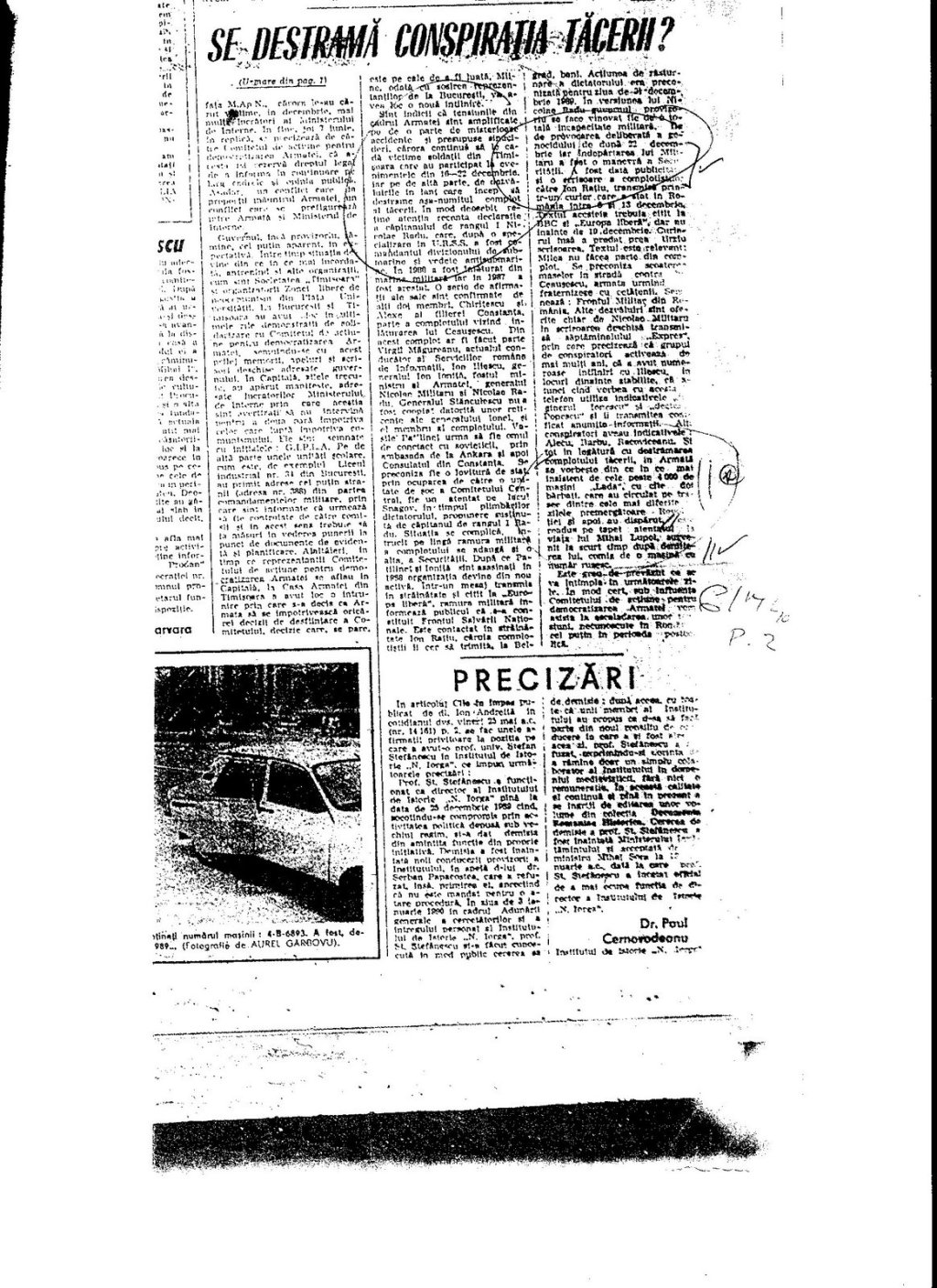
image-74

image-73

Stanescu’s article was vigorously anti-FSN and anti-Iliescu and left little doubt that this thesis was part of the “unofficial” history of the December events, injurious to the new leaders, and something they did not wish to see published or wish to clarify.

But it was Stanescu’s April 1991 article in “Romania libera,” entitled “Is Iliescu Being Protected By The KGB?,” that truly gave impetus to the “tourist” thesis. Stanescu wrote:

“A KGB officer wanders in France. He is losing his patience and searching for a way to get to Latin America. Yesterday I met him in Paris. He talked to me after finding out that I was a Romanian journalist. He fears the French press. He knows Romanian and was in Timisoara in December 1989. As you will recall, persistent rumors have circulated about the existence on Romanian soil of over 2,000 Lada automobiles with Soviet tags and two men in each car. Similar massive infiltrations were witnessed in December 1990, too, with the outbreak of a wave of strikes and demonstrations. What were the KGB doing in Romania? Witness what the anonymous Soviet officer related to me in Paris:

‘There existed an intervention plan that for whatever reason was not activated. I received the order to enter Romania on 14 December and to head for Timisoara. Myself and my colleague were armed. During the events, we circulated in the military zone around Calea Girocului [Giriocul Road]. Those who headed toward Bucharest had the same mission. Several larger cities were targeted. We were to open fire in order to create a state of confusion. I never, however, received such an order. I left Romania on 26 December.’

I don’t have any reason to suspect the validity of these revelations. This short confession is naturally incomplete, but not inconclusive. What purpose would this elaborate, but aborted, KGB plan have had? The only plausible explanation is that it wasn’t necessary for KGB agents to intervene. The events were unfolding in the desired direction without need for the direct intervention of the Soviets. But this leads to other questions: What did the Ceausescu couple know, but were not allowed to say [prior to their hurried execution]? Why is Securitate General Vlad being held in limbo? To what degree has President Iliescu maintained ties to the Soviets? What are the secret clauses of the Friendship Treaty recently signed in Moscow? Is Iliescu being protected by the KGB or not? Perhaps the SRI [the Securitate’s institutional successor, the Romanian Information Service] would like to respond to these questions?”

Stanescu’s April 1991 article did not go unnoticed — despite its nondescript placement on page eight — and has since received recognition and praise from what might seem unexpected corners. For example, previously-discussed former Securitate Colonel Filip Teodorescu cited extensive excerpts from Stanescu’s article in his 1992 book on the December events, and he added cryptically:

“Moreover, I don’t have any reason to suspect that the journalist Sorin Rosca Stanescu would have invented a story in order to come to the aid of those accused, by the courts or by public opinion, for the results of the tragic events of December 1989″ (Teodorescu, 1992, pp. 92-94).

Radu Balan, former Timis County party secretary, imprisoned for his role in the December events, has also invoked Stanescu’s April 1991 article as proof of his revisionist view that “tourists” rather than “non-existent ‘terrorists’” were to blame for the December 1989 bloodshed:

“…[W]hile at Jilava [the jail where he was imprisoned at the time of the interview, in October 1991], I read ‘Romania libera’ from 18 April. And Rosca Stanescu writes from Paris that a KGB agent who deserted the KGB and is in transit to the U.S. stated that on 18 December [1989] he had the mission to create panic on Calea Girocului [a thoroughfare in Timisoara]. What is more, on the 18th, these 11 cars were at the top of Calea Girocului, where I saw them. I was dumbfounded, I tell you. I didn’t tell anybody. Please study ‘Romania libera,’ the last page, from 18 April 1991″ (“Totusi iubirea,” no. 43, 24-31 October1991).

In this regard, it would be irresponsible to totally discount the relevance of Rosca Stanescu’s past. Since December 1989, Stanescu has undeniably been a vigorous critic of, and made damaging revelations about, the Securitate’s institutional heir, the SRI, and the Iliescu regime, and he has frequently written ill of the former Securitate and the Ceausescu regime. Nevertheless, in 1992 it was leaked to the press — and Rosca Stanescu himself confirmed — that from the mid-1970s to the mid-1980s he was an informer for the Securitate (for a discussion, see Hall, 1997b, pp. 111-113). What was significant, however, was precisely for which branch of the Securitate Rosca Stanescu had been an informer: the USLA.

THE ‘TOURISTS’ MYTH TRAVELS WESTWARD
Almost inevitably, the “tourist” thesis has made its way into Western academic literature. For example, in a book lauded by experts (see for example, Professor Archie Brown’s review in “Slavic Review,” Winter 1998), Jacques Levesque invokes as “rare evidence” that the Soviets were responsible for igniting and fanning the flames of the Timisoara uprising the following:

“…testimony of an imprisoned Securitate colonel who was freed in 1991 [he is referring to the aforementioned Filip Teodorescu]. He writes that the Securitate had noted the arrival of ‘numerous false Soviet tourists’ in Timisoara in early December, coming from Soviet Moldova. He also reports that a convoy of several Lada cars, with Soviet license plates and containing three to four men each, had refused to stop at a police checkpoint in Craiova. After the Romanian police opened fire and killed several men, he claims that the Soviet authorities recovered the bodies without issuing an official protest. To the extent that this information is absolutely correct, it would tend to prove the presence of Soviet agents in Romania (which no one doubts), without, however, indicating to us their exact role in the events” (Levesque, 1997, p. 197).

Levesque seems generally unaware of or concerned with the problematic nature of the source of this “rare evidence” and thus never really considers the possibility that the Securitate colonel is engaging in disinformation. This is indicative of how upside-down the understanding of the December 1989 events has become in the post-Ceausescu era — and of the influence of the far-reaching and generally unchallenged revisionism of the events within Romania itself — that Western writers invoking the thesis seem to accept the claims at face value, never even enunciating any doubt about why the Securitate source in question might seek to make such an argument.

* A memorable phrase from Andrei Codrescu’s PBS special “Road Scholar” of the early 1990s.

(Richard Andrew Hall received his Ph.D. in Political Science from Indiana University in 1997. He currently works and lives in northern Virginia. Comments can be directed to him at hallria@msn.com.)

SOURCES

AFP, 19 December 1989, in FBIS-EEU-89-242, 19 December 1989.

Belgrade Domestic Service, 1400 GMT 20 December 1989, in FBIS-EEU-89-243, 20 December 1989.

Brown, A., 1998, “Review of Jacques Levesque, The Enigma of 1989: The USSR and the Liberation of Eastern Europe,” in “Slavic Review,” Vol. 57, no. 4 (Winter), pp. 882-883.

Bunea, M., 1994, Praf in ochi: Procesul celor 24-1-2 [Mud in the Eyes: The Trial of the 24-1-2], (Bucharest: Editura Scripta).

Court, P., 1994, Cantecul Nemuririi [Song of Immortality], (Bucharest: Editura Miracol).

“Democratia” (Bucharest), 1990.

“Europa,” (Bucharest), 1991

“Expres,” (Bucharest), 1990.

Hall, R. A., 1996, “Ce demonstreaza probele balistice dupa 7 ani?” [Seven Years Later What Does the Ballistic Evidence Tell Us?] in “22″ (Bucharest), 17-23 December.

Hall, R. A. 1997a, “Rewriting the Revolution: Authoritarian Regime-State Relations and the Triumph of Securitate Revisionism in Post-Ceausescu Romania,” (Ph.D. Dissertation, Indiana University).

Hall, R. A., 1997b, “The Dynamics of Media Independence in Post-Ceausescu Romania,” in O’Neil, P. H. (ed.) Post-Communism and the Media in Eastern Europe, (Portland, OR: Frank Cass), pp. 102-123.

Levesque, J., 1997, The Enigma of 1989: The USSR and the Liberation of Eastern Europe, (Berkeley: University of California Press).

Mioc, Marius, 2000, “Turisti straini in timpul revolutiei,” [Foreign Tourists During the Revolution] timisoara.com/newmioc/54.htm.

“Romania libera” (Bucharest), 1990-91.

Sandulescu, S., 1996, Decembrie ’89: Lovitura de Stat a Confiscat Revolutia Romana [December ’89: The Coup d’tat Abducted the Romanian Revolution], (Bucharest: Editura Omega Press Investment).

Teodorescu, F., 1992, Un Risc Asumat: Timisoara, decembrie 1989, [An Assumed Risk: Timisoara, December 1989] (Bucharest: Editura Viitorul Romanesc).

“Totusi iubirea” (Bucharest), 1991.

“Ziua” (Bucharest), 1999.

“Zig-Zag” (Bucharest), 1990.

Compiled by Michael Shafir

—————————————————————————-

Rewriting the Revolution (1997): Chapter 5 Timisoara 15-17 December 1989

A chapter from my Ph.D. Dissertation at Indiana University: Richard Andrew Hall, Rewriting the Revolution: Authoritarian Regime-State Relations and the Triumph of Securitate Revisionism in Post-Ceausescu Romania (defended 16 December 1996). This is the original chapter as it appeared then and thus has not been revised in any form.

Chapter Five

“Yalta-Malta” and the Theme of Foreign Intervention in the Timisoara Uprising

At an emergency CPEx meeting on the afternoon of 17 December 1989, Nicolae Ceausescu sought to make sense out of the news from Timisoara by attempting to fit it in with what had happened elsewhere in Eastern Europe thus far that fall:

Everything which has happened and is happening in Germany, in Czechoslovakia, and in Bulgaria now and in the past in Poland and Hungary are things organized by the Soviet Union with American and Western help. It is necessary to be very clear in this matter, what has happened in the last three countries–in the GDR, in Czechoslovakia, and Bulgaria, were coups d’etat organized by the dregs of society with foreign help.[1]

Ceausescu was giving voice to what would later become known as the “Yalta-Malta” theory. Significantly, the idea that the Soviet Union and, to different degrees of complicity, the United States and the West, played a pivotal role in the December 1989 events pervades the vast majority of accounts about December 1989 in post-Ceausescu Romania, regardless of the part of the ideological spectrum from which they come.

The theory suggests that after having first been sold out to Stalin and the Soviet Union at Yalta, in early December 1989 American President George Bush sold Romania out to Mikhail Gorbachev during their summit in Malta. The convenient rhyme of the two sites of Romania’s alleged betrayal have become a shorthand for Romania’s fate at the hands of the Russians and other traditional enemies (especially the Hungarians and Jews). To be sure, similar versions of this theory have cropped up throughout post-communist Eastern Europe among those disappointed with the pace and character of change in their country since 1989.[2] The different versions share the belief that Mikhail Gorbachev and the Soviet KGB engineered the sudden, region-wide collapse of communism in 1989. Their successors in Russia have been able to maintain behind-the-scenes control in Eastern Europe in the post-communist era by means of hidden influence and the help of collaborators within those countries. “Yalta-Malta” has become the mantra of those who seem to have experienced Eastern Europe’s el desencanto most deeply.[3]

Although one can probably find adherents to the Yalta-Malta theory in every East European country–particularly since the “Return of the Left” through the ballot box–there is little doubt that the theory finds its widest and most convinced audience–both at elite and mass levels–in Romania.[4] This is because, as we have seen, the suggestion that the Soviet Union and the KGB were attempting to undermine the regime leadership and infringe upon national sovereignty was not an ad hoc slogan in Romania in 1989, as it was in East Germany, Czechoslovakia, and Bulgaria where aging political leaderships hinted at such arguments in a last-ditch effort to save their positions. Such appeals had far greater resonance in Romania in December 1989–particularly within the regime–because they had been tenets of the Romanian regime’s ideology for well over two decades. And they have had a lingering popularity in the post-Ceausescu era for that same reason. It is the uniquely antagonistic character of the relationship between the Securitate and the KGB during the Ceausescu era (discussed in chapter four), and the genuine, scarcely-veiled animosity between Ceausescu and Gorbachev, which give the Yalta-Malta scenario a plausibility and credibility (however spurious) in Romania it cannot find elsewhere in Eastern Europe.

Western analysts have frequently caricatured the views of the former Securitate towards the Ceausescu era by suggesting that they uniformly look back favorably and nostalgically upon it. In fact, many of them now openly criticize Nicolae Ceausescu’s misguided policies, erratic behavior, and harsh rule.[5] Clearly, much of this is post facto judgement. The deceased Ceausescu serves as a convenient scapegoat for all that went wrong during his rule and by blaming him they can absolve themselves. Nevertheless, regardless of how they now view Nicolae Ceausescu, almost every former Securitate officer challenges the spontaneity of the Timisoara protests and suggests that the catalyst for the unrest came from outside Romania’s borders. Thus, they argue, even if Nicolae Ceausescu had brought the country to the point of profound crisis, this “foreign intervention” converted the Timisoara events primarily into a matter of national security.

It is interesting to recall Nicolae Ceausescu’s own interpretation of the Timisoara events during a rambling, scarcely coherent teleconference on 20 December 1989:

…all of these grave incidents in Timisoara were organized and directed by revanchist, revisionist circles, by foreign espionage services, with the clear intention of provoking disorder, of destabilizing the situation in Romania, of acting in order to eliminate the independence and territorial integrity of Romania….It is necessary to attract the attention of everyone, not only of the communists [emphasis added], but everyone to the shameful…campaign… unleashed right now by different circles, beginning with Budapest, convincingly demonstrates that…, including the declarations of the president of the United States, who declared that he had discussed the problems of Romania with Gorbachev at Malta…[6]

In their discussion of the December events, the former Securitate have expanded upon Ceausescu’s allegations of “foreign intervention.”

In February 1991, while on trial for his part in ordering the repression of demonstrators in December 1989, the former director of the Securitate, General Iulian Vlad, proposed two principal groups of suspects for the Timisoara unrest.[7] He described the first group as Romanian citizens (the majority of whom were presumably of Hungarian ethnicity) who had fled to Hungary, passed through refugee camps, and been sent back to Romania with a mission to engage in “destabilizing acts.” According to Vlad, “only able-bodied males” were sent back. The second group of suspects were large groups of so-called Soviet “tourists.” Here is Vlad’s depiction of this second group:

Halfway through December 1989 massive groups of Soviet tourists began to enter the country. They entered coming directly from the USSR or from Yugoslavia or Hungary. The majority were men and–in a coordinated fashion–they deployed in a convoy of brand-new “LADA” automobiles. During the night of 16-17 December ‘89 such a column attempted to enter Timisoara. Some of these cars were forced to make a detour around the town, others managed to enter it…[8]

Pavel Corut, a former high-ranking Securitate counter-military intelligence officer who has written dozens of novels seeking to rehabilitate the reputation of the former Securitate, has written of “the infiltration on Romanian territory of groups of Soviet commandos (Spetsnaz) under the cover of being tourists. It is noteworthy that December is not a tourist month and nevertheless the number of Soviet tourists grew greatly.”[9]

In 1994, the Securitate’s official institutional heir, the Romanian Information Service (or SRI), declared in a report on the December events:

In addition to gathering information, some Soviet agents from among our ranks received the mission to make propaganda for “changes,” even at the risk of being found out. Actions at direct incitement [of the population] were also initiated by Soviet “tourists,” whose number had grown in the preceding period and had taken on exceptional proportions by the end of 1989.

Beginning on 9 December 1989, the number of Soviet “tourists” in “private” vehicles grew from around 80 to 1,000 cars a day. This phenomenon, although realized at the time, did not lead to the necessary conclusions and measures. The occupants (two to three per car), athletic men between 25 and 40 years in the majority, avoided lodging facilities, sleeping in their cars…The cars were mostly of a “LADA” and “MOSKOVICI” make, deployed in a convoy, and had consecutively-numbered license plates and similar new equipment. The majority were “in transit towards Yugoslavia”…

It is certain that during the Timisoara events there was a large number

of Soviet “tourists.” During 15, 16, and 17 December 1989, to these already in the country were added those “returning from Yugoslavia,” the majority by car.[10]

But the reach of this theory extends well beyond the former Securitate and their cheerleaders in the Ceausist nostalgic press. The head of the first Senatorial commission investigating the December events, film director Sergiu Nicolaescu–a key figure in the newly-formed National Salvation Front during the events of 22-25 December 1989 and a legislator of the ruling Front after 1989–described the catalyst of the December events to a journalist in December 1993 as follows:

By chance, everything began in Timisoara. It could have begun elsewhere since many places were prepared. It is known that in Iasi something was being prepared, and also in Brasov and Bucharest. There was clearly foreign intervention….For example, the intervention of the Russians in Romania. A year before in 1988 about 30,000 Russians came. A year later in 1989, in December, the number doubled. Thus, it reached 67,000. It is known that there were at least 1,000 automobiles in which there were two to three men between the ages of 30 and 40 years old, at a maximum 45 years old. It is very interesting to observe that, only a few months earlier, the Securitate had ordered that for those from socialist countries crossing the border, it was no longer necessary to note their license plate number or how many people were on board.[11]

Asked who in the Securitate gave the order to no longer record this information, Nicolaescu insinuated that they were Soviet “moles” who had been placed there “4, 5, 10, and even 30 years earlier.”[12]

The theory has also found its way into the opposition media. Cornel Ivanciuc, who in 1995 wrote one of the most influential exposes to date on the former Securitate for the weekly 22, maintains that the Soviets achieved their aims in December 1989 by means of the so-called “tourist-incursionists, whose activity during the revolution was identical to those of the Spetsnaz special troops for reconnaissance and diversion of the GRU [Soviet military intelligence].”[13] Two months after General Vlad’s 1991 court statement, Sorin Rosca Stanescu, one of the most prominent journalist critics of the Iliescu regime and the SRI, presented an interview in the leading opposition daily Romania Libera with an anonymous KGB officer residing in Paris who outlined a familiar scenario.[14] The KGB officer claimed that he had entered Romania on 14 December with others as part of a KGB plan to open fire and create confusion. He had been in Timisoara during the events, but suggested he never received the anticipated order to open fire and left the country on 26 December. Rosca Stanescu, however, made sure to remind his audience of “the insistent rumors which have been circulating referring to the existence on Romanian territory of 2,000 “LADA” automobiles with Soviet tags and two men inside each car…”[15] Stanescu closed by asking his readers: “What did the Ceausescu couple know but were unable to say? Why is general Vlad held in this ambiguous chess game?…Is Iliescu protected by the KGB?”

Stanescu’s intentions are further drawn into question by the fact that this particular article has been cited positively by former Securitate officers in their writings. Colonel Filip Teodorescu of the Securitate’s Counter-espionage Directorate, the second highest-ranking Securitate officer in Timisoara during the repression and sentenced to prison for his role in those events, cites extensively and favorably from this very article by Stanescu in a book on the December events.[16] Pavel Corut also invokes Rosca Stanescu’s interview in support his arguments.[17] Moreover, Rosca Stanescu’s questionable comments make the issue of his (revealed and acknowledged) past collaboration with the Securitate’s USLA unit between 1975 and 1985 relevant.[18]

Securitate accounts also routinely insinuate that foreign diplomats who came to Timisoara ostensibly to “monitor the situation” there, and foreign radio stations such as Radio Free Europe, Voice of America, the BBC, and Deutsche Welle which transmitted information about Timisoara developments, contributed directly and intentionally to the unrest.[19] For example, the former deputy director of the Timis county Securitate, Major Radu Tinu, highlights the allegedly suspicious role played by representatives of the American and British embassies who came to Timisoara on 15 December 1989 and transmitted back to Bucharest that “everything is in order, we have seen him,” apparently referring to pastor Tokes.[20]

Similar elements also creep into some opposition accounts. Ilie Stoian, a journalist for Expres and then Tinerama, ranks among those who have written most extensively about the December events. Stoian argues for a “Yalta-Malta” interpretation of the December events.[21] In discussing the Timisoara events, he notes the presence of Hungarians who were filming the events from their “LADA” automobiles and the expulsion of Russians across the Yugoslav border by the Securitate–thus insinuating that they were somehow implicated in the unrest.[22] According to Stoian:

…the December revolution was prepared in advance. In order to make things even clearer, we draw your attention to the fact that prior to the date fixed by the authorities for the evacuation of pastor Tokes from the parochial residence, in almost every evening Voice of America and Radio Free Europe would broadcast long pieces about this personage. Moreover, inside the country, foreign diplomats began to fuss….[23]

Finally, Stoian asks:

Wasn’t the presence of foreign diplomats somehow to verify if everything “was in order,” as was said during a telephone conversation intercepted on 15 December? Weren’t they somehow doing more than just supervising and reporting on these events to their superiors? We think the answer is yes.[24]

[1].. See the stenogram from the emergency CPEx meeting of 17 December 1989 in Mircea Bunea, Praf in ochi. Procesul celor 24-1-2. (Bucharest: Editura Scripta, 1994), 34.

[2].. Tina Rosenberg, The Haunted Land. Facing Europe’s Ghosts after Communism (New York: Random House, 1995), 109-117, 235. Rosenberg suggests the theory’s popularity in Poland and especially in the former Czechoslovakia.

[3].. Huntington discusses the concept of el desencanto (the characteristic disillusionment or disenchantment which sets in after the transition) in Samuel P. Huntington, The Third Wave. Democratization in the Late Twentieth Century (Norman, OK: University of Oklahoma Press, 1993), 255-256.

[4].. By contrast, Rosenberg clearly suggests that those who buy into the Yalta-Malta conspiracy theory elsewhere in Eastern Europe are a distinct minority in political circles and marginal figures in the post-communist era.

[5].. This has come through, for example, in the novels and articles of the well-known, former high-ranking military counter-intelligence officer, Pavel Corut, and in the comments of the former head of the First Directorate (Internal Affairs), Colonel Gheorghe Ratiu, in an extended interview during 1994 and 1995 with the Ceausist weekly Europa.

[6].. See the transcript in Bunea, Praf in Ochi, 47. Ceausescu goes on to link the US invasion of Panama which was taking place at this time to a general offensive by the superpowers to eliminate the sovereignty of independent states. The fact that Ceausescu appeals “not only to the communists” suggests his attempt to play on a non-ideological Romanian nationalism.

[7].. See Vlad’s testimony in Mircea Bunea, “Da sau Ba?” Adevarul, 16 February 1991, in Bunea, Praf in Ochi, 460-461.

[8].. Ibid.

[9].. Pavel Corut, Cantecul Nemuririi [The Song of Immortality] (Bucharest: Editura Miracol, 1994), 165.

[10].. See the excerpts of the SRI’s preliminary report on the December events in “Dispozitivul informativ si de diversiune sovietic a fost conectat la toate fazele evenimentelor (III) [Soviet information and diversion teams were connected to all phases of the events],” Curierul National, 11 July 1994, 2a.

[11].. Sergiu Nicolaescu, interview by Ion Cristoiu, “Moartea lui Milea, Momentul Crucial al Caderii,” Expres Magazin, no. 48 (8-15 December 1993), 31.

[12].. Ibid.

[13].. Cornel Ivanciuc, “Raporturile dintre Frontul Salvarii Nationale si KGB [The Relations between the National Salvation Front and the KGB],” 22, no. 21 (24-30 May 1995), 11.

[14].. Sorin Rosca Stanescu, “Iliescu aparat de K.G.B.? [Iliescu defended by the KGB]” Romania Libera, 18 April 1991, 8.

[15].. Ibid. Rosca Stanescu had in fact already floated this theory. In June 1990, he wrote: “…in the Army, more and more insistently there is talk of the over 4,000 ‘LADA’ automobiles with two men per car, which travelled by various routes in the days preceding the Revolution and then disappeared…” (Sorin Rosca Stanescu, “Se destrama conspiratia tacerii? [Is the conspiracy of silence unravelling?]” Romania Libera, 14 June 1990, 2a). At that time it could be argued that Rosca Stanescu was unaware of the Securitate account. It is difficult to say the same of his comment in April 1991.

[16].. Filip Teodorescu, Un Risc Asumat: Timisoara, decembrie 1989 (Bucharest: Editura Viitorul Romanesc, 1992), 93-94. Curiously, Teodorescu adds: “Besides, I have no reason to suspect that the journalist Sorin Rosca Stanescu would have invented a story in order to come to the defense of those accused by the judicial system and public opinion of the tragic consequences of the December 1989 events.”

[17].. Although Corut does not mention Stanescu by name as does Teodorescu, the references are unambiguous. See Pavel Corut, Floarea de Argint [The Silver Flower] (Bucharest: Editura Miracol, 1994), 173; idem, Fulgerul Albastru [Blue Lightning] (Bucharest: Editura Miracol, 1993), 211.

[18].. In April 1992, documents were leaked (presumably by regime sources) to the media and foreign embassies showing that Stanescu had been an informer for the Securitate’s elite anti-terrorist unit (the USLA) between 1975 and 1985. Stanescu admitted that the charges were true. Although released from Romania Libera in June 1992, he was picked up elsewhere in the opposition press, returned to Romania Libera the following year, and eventually became editor of an opposition daily owned by the trust which runs Romania Libera. Prominent opposition figures have steadfastly defended him as a victim of the Iliescu regime, and in spite of his past, his writings have largely gone unscrutinized. On Stanescu’s case, see Sorin Rosca Stanescu, “Securea lui Magureanu,” Romania Libera, 17 April 1992, 1, 3 (the article which personally attacked the SRI’s Director Virgil Magureanu and appears to have prompted the release of Stanescu’s file); Anton Uncu, “Opriti-l pe Arturo Ui,” Romania Libera, 30 April 1992, 1, 3; Rosca Stanescu, “Sint H-15,” Romania Libera, 9 May 1992, 5; idem, interview by Andreea Pora, “‘H-15′ in slujba patriei,” 22, no. 120 (15-21 May 1992), 13; “Catre SRI,” Romania Libera, 9 June 1992, 1; “Goodbye Magureanu,” The Economist, no. 2212 (18 June 1992) in Tinerama, no. 85 (10-17 July 1992), 3.

[19].. See, for example, the comments of the deputy director of the Timis county Securitate, Major Radu Tinu, in Angela Bacescu, Din Nou in Calea Navalirilor Barbare [Once again in the path of barbaric invaders] (Cluj-Napoca: Editura “Zalmoxis,” 1994), 72-74. This book consists of articles and interviews which appeared in the Ceausist weekly Europa between 1990 and 1994.

[20].. Ibid., 73.

[21].. Ilie Stoian, Decembrie ‘89: Arta diversiunii. (Bucharest: Editura Colaj, 1993), 7-10. This book is a collection of articles he wrote while at Expres between 1991 and 1993.

[22].. Ibid., 11.

[23].. Ibid.

[24].. Ibid., 12.
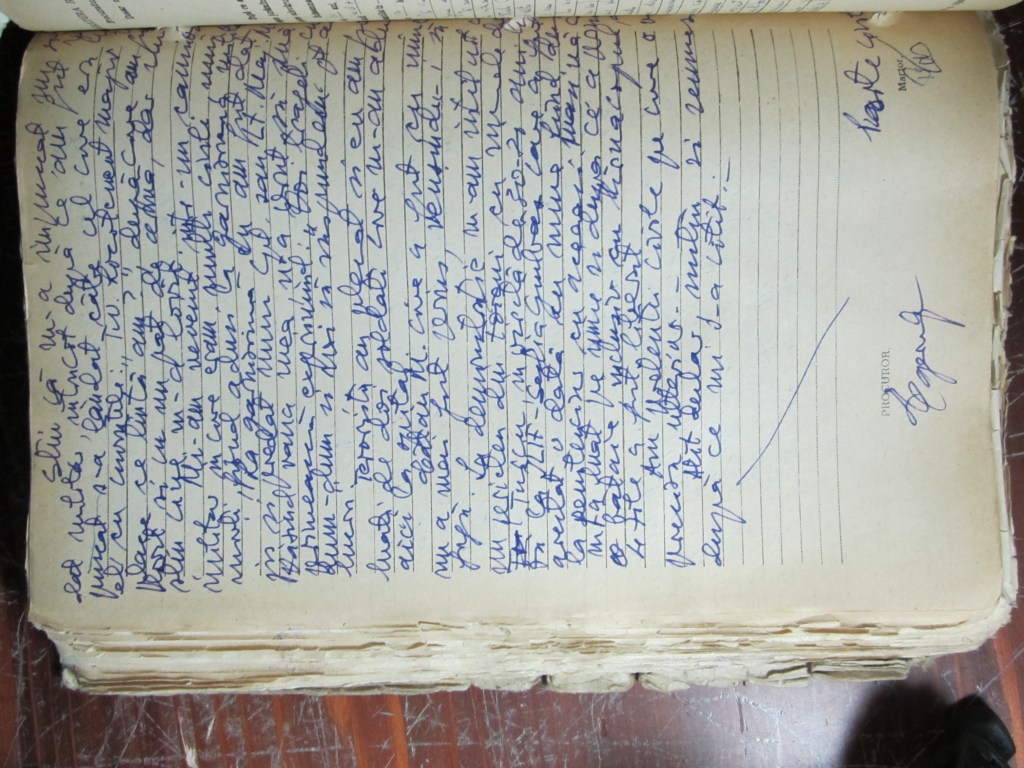
Posted in decembrie 1989, raport final | Tagged: , , , , | Leave a Comment »

O indicatie pretioasa de pe malurile Dimbovitei: implicarea strainilor in evenimentele de la Timisoara, paranoia lui Nicolae Ceausescu sau ‘confirmarea’ lui Iulian Vlad?

Posted by romanianrevolutionofdecember1989 on March 17, 2013

[ca intotdeauna, un punct de vedere strict personal, va multumesc]

Ipoteza/intrebare:  Acum, gratie Dosarelor Revolutiei de la Timisoara http://dosarelerevolutiei.ro/ e destul de clar ca ideea implicarii strainilor in evenimentele de la Timisoara era o “ipoteza” sau mai bine zis “inidicatie pretioasa” de pe malurile Dimbovitei–o ipoteza neconfirmata, nu numai de securisti din judetul Timis, dar chiar de ofiteri DSS trimisi de Generalul Iulian Vlad cu sarcina specifica de a depista asa zisa agentura straina.
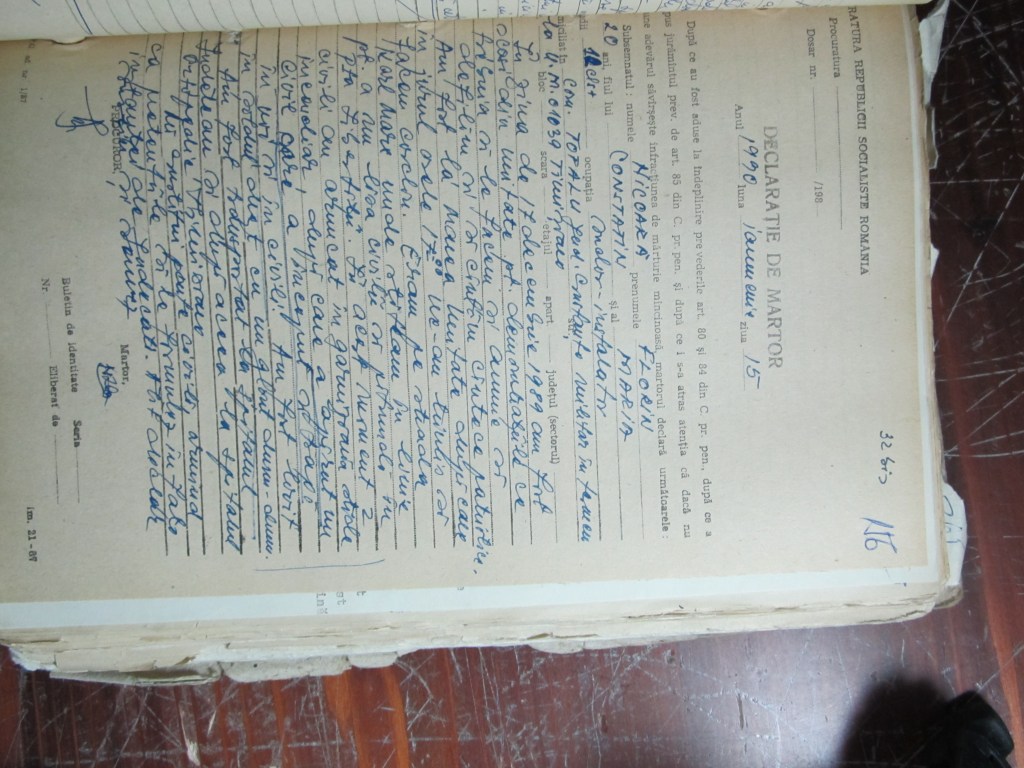
Ramane totusi o intrebare nerezolvata mi-se pare:  ideea ca straini au stat la baza evenimentelor de la Timisoara a inceput cu Nicolae Ceauescu, sau a fost livrat de Iulian Vlad, care cunoaste foarte bine starea mentala a Conducatorului, si asa a alimentat paranoia lui Nicolae Ceausescu?

http://atomic-temporary-3899751.wpcomstaging.com/2013/03/17/filip-teodorescu-adj-sef-dir-iii-contraspionaj-d-s-s-nu-sint-date-ca-ar-exista-instigatori-sau-conducatori-anume-veniti-din-strainatate/

http://atomic-temporary-3899751.wpcomstaging.com/2013/03/16/emil-macri-rezumind-sintetic-informatiile-obtinute-ele-nu-au-pus-in-evidenta-nici-lideri-si-nici-amestecul-vreunei-puteri-straine-in-producerea-evenimentelor-de-la-timisoara/

http://atomic-temporary-3899751.wpcomstaging.com/2013/03/15/dosarele-revolutiei-de-la-timisoara-tudor-postelnicu-unii-militari-de-la-trupele-de-securitate-ale-brigazii-timisoara-au-facut-unele-provocari-la-unele-magazine-si-vitrine-spargind-geamurile-sa-im/

Mai jos, declaratiile lui Petre Pele, Tudor Postelnicu, Gheorghe Diaconescu, si Iulian Vlad

Excerpt from Chapter 5 of my Ph.D. Dissertation at Indiana University: Richard Andrew Hall, Rewriting the Revolution: Authoritarian Regime-State Relations and the Triumph of Securitate Revisionism in Post-Ceausescu Romania (defended 16 December 1996). This is the original chapter as it appeared then and thus have not been revised in any form.

http://atomic-temporary-3899751.wpcomstaging.com/rewriting-the-revolution-1997/

A Review of the Evidence

Although at first glance the regime’s treatment of Pastor Tokes seems strange and even illogical, within the context of the workings of the Ceausescu regime and the regime’s strategy for dealing with dissent it makes perfect sense. There is simply no convincing evidence to believe that the Securitate–or a faction within it–purposely dragged its feet in enforcing Pastor Tokes’ eviction, or was attempting to spark a demonstration in the hopes of precipitating Ceausescu’s fall. The regime’s decision to evict Tokes was not a last-minute decision. Moreover, the regime exerted tremendous and sometimes brutal pressure to silence Tokes in the months preceding this deadline. Interestingly, according to high-ranking members of the former Securitate, Nicolae Ceausescu’s unwillingness to approve the more definitive measures requested by the Securitate allowed the Tokes case to drag on without resolution (see below). The Tokes case suggests the bureaucratic and byzantine mentalities of the Ceausescu regime, and the clash between a dictator’s instructions and how the institutions charged with defending him interpret their mission.

The suggestion that the Securitate treated Tokes gently prior to his eviction is simply incorrect. On 2 November 1989, four masked men burst through the locked doors of the parochial residence, wielding knives and screaming in a fury. Tokes was slashed on the forehead before his church bodyguards could come to his rescue, causing the four to flee. The numerous Securitate men posted out front of the building had done nothing to intervene in spite of calls for help. Puspoki suggests that these “Mafia-like thugs,” who attacked as if from “an Incan tribe,” were some of Colonel Sima’s “gorillas,” sent to deliver a clear message to Tokes that he should leave immediately.[40] The view of the former Securitate–as expounded by Colonel Sima’s senior deputy, Major Radu Tinu–insinuates a “tourist”-like scenario. According to Tinu, the incident was clearly a “set-up” designed to draw sympathy to Tokes’ cause since the assailants fled away in a car with West German tags.[41] Not for the last time, the Securitate thus appears to attempt to attribute its own actions to foreign agents.

A week after the mysterious attack by the masked intruders, all of the windows of the parochial residence and nearby buildings were smashed. Interestingly, the report drawn up for Bucharest by the Timisoara Securitate attempted to argue that “workers” from the Timisoara Mechanical Enterprise, offended by pastor Tokes’ behavior, had broken the windows. According to Puspoki, the use of a propaganda-like description was not accidental: the local Securitate was trying to present the incident as evidence of “the dissatisfaction of the working people of Timisoara” in the hope that it would finally prompt Ceausescu into approving definitive measures against Tokes.[42]

Was Ceausescu responsible for the fact that the Tokes case dragged on without resolution? Support for such a conclusion comes from the comments of Securitate officers Colonel Filip Teodorescu and Major Radu Tinu. Teodorescu was dispatched to Timisoara with sixty other Securitate information officers in order to “verify” the request of the local Securitate that proceedings for treason be initiated against Tokes.[43] Teodorescu laments:

Unfortunately, as in other situations…Nicolae Ceausescu did not agree because he didn’t want to further muddy relations with Hungary. Moreover, groundlessly, he hoped to avoid the criticisms of “Western democracies” by taking administrative measures against the pastor through the Reformed Church to which [Tokes] belonged.[44]

Major Radu Tinu suggests that Ceausescu’s approval was necessary in the case of Securitate arrests and that the local Securitate remained “stupefied” that after having worked so long and hard in gathering information with which to charge Tokes with the crime of treason, Ceausescu rejected the request.[45] Tinu speculates that Ceausescu “did not want to create problems at the international level.”

Because former Securitate officers rarely pass up the opportunity to absolve themselves of blame, and it would appear both easier and more advantageous to blame the deceased Ceausescu for being too unyielding in the Tokes affair, these allegations seem plausible. Thus, it would appear that because Nicolae Ceausescu was skittish of further damaging Romania’s already deteriorating relations with the international community, and the Tokes case was a high-profile one, he refrained from approving visible, definitive action against the pastor. The Securitate‘s attempt to goad Ceausescu to bolder action would appear to confirm Ghita Ionescu’s suggestion that where the security apparatus comes to dominate regime affairs it attempts to impose its institutional prerogatives upon political superiors. Ceausescu and the Securitate appear then to have had sometimes conflicting views over how to resolve the Tokes affair in the quickest and most efficient fashion.

By December 1989, a huge group of Securitate officers were working on the Tokes case: the entire branch of the First Directorate for Timis county, the special division charged with combatting Hungarian espionage, high-ranking members of the First Directorate and Independent Service “D” (responsible for disinformation) from Bucharest, and members of the division charged with “Surveillance and Investigation.”[46] Puspoki describes Timisoara at this late hour as follows:

Day and night, the telex machines on the top floor of the [County Militia] “Inspectorate” incessantly banged out communications, while the telephones never stopped ringing. Minister Postelnicu yelled on the phone, Colonel Sima yelled through the offices and the hallways. The officers ran, as if out of their minds, after information, besieged neighbors of the pastor, and dispatched in his direction–what they call–”informers with possibilities.”[47]

Yet the case lingered on. On Sunday, 10 December 1989, Pastor Tokes announced to his congregation that he had received a rejection of his most recent appeal: the regime would make good on its threat to evict him on Friday, 15 December. He termed this an “illegal act” and suggested that the authorities would probably use force since he would not go willingly. He appealed for people to come and attend as “peaceful witnesses.”[48] They came.

[40].. Puspoki, “Piramida Umbrelor (III),” Orizont, no. 11 (16 March 1990), 4.

[41].. Bacescu, Din Nou in Calea, 78.

[42].. Puspoki, “Piramida Umbrelor (III).”

[43].. Teodorescu, Un Risc Asumat, 45-46.

[44].. Ibid., 90.

[45].. Bacescu, Din Nou in Calea, 78.

[46].. Puspoki, “Piramida Umbrelor (II).”

[47].. Ibid.

[48].. Tokes, With God, for the People, 1-4.

————————————————————————————————

Tudor Postelnicu:  “Ceausescu Nicolae facuse o psihoza, mai ales dupa ce s-a intors de la sedinta de la Moscova in toamna lui ’89.  Era convins ca se planuieste si de cei de pe plan extern caderea sa, era convins ca toti sint spioni…”

0160

Petru Pele (Dir I, DSS). Declaratie, 16 ianuarie 1990:  “Printre sarciniile mai importante efectuate de catre acestia in  perioada 17-22.12.1989 s-a numerat (?) constituierea (?) listelor celor retinuti de organele militie cu listele celor predati sau reintorsi din Ungaria, intrucit s-a emis ipoteza ca evenimentele de la Timisoara au fost puse la cale in tara vecina…”

0299

0291

Gheorghe Diaconescu, Declaratie 31 decembrie 1989

“Luni 18 decembrie gl. col.  VLAD IULIAN a avut o convorbire cu colegul meu (local?) RADULESCU EMIL …

0476

Vlad Iulian (continuarea, declaratia lui Gheorghe Diaconescu) “?… foarte dur (?) ca nu (?) ca ‘un grup de turisti isi fac de cap in Timisoara'”

0477

0472

Tocmai Iulian Vlad, el insusi, recunoaste ne-implicarea strainilor in evenimentele de la Timisoara, aici…

0289

0290

Incepind cu noaptea de 16/17 dec. si in continuare pina in data de 20 dec. 1989 organul de securitate local col. Sima cit si gl. Macri si in lipsa lui col. Teodorescu imi comunicau date din care rezulta ca sute de elemente turbulente au devastat orasul, si ca elementul strain nu rezulta a se fi implicate in continuarea fenomenului.”

0291

“Mai exact, cei trimis de mine la Timisoara mi-au raportat ca nu au elemente din care sa rezulte vreum amestec al strainatatii in producerea evenimentelor de la Timisoara.”

0292

Posted in decembrie 1989 | Tagged: , , , , , , , , , | 1 Comment »

9 cazuri dintr-o tragedie: soldati si civili impuscati cu gloante dum-dum (aka gloante explozive) dupa 22 decembrie 1989 in Bucuresti (dovezi disponsibile pe Internetul)

Posted by romanianrevolutionofdecember1989 on December 21, 2009

Filoti Claudiu ( 172 )
Profesie: Locotenent major la UM 01171 Buzau, capitan post-mortem
Data nasteri: 30.07.1964
Locul nasterii: Vaslui
Calitate: Erou Martir
Data mortii: 22 decembrie 1989
Locul mortii: Bucuresti, zona MApN
Cauza: Impuscat in torace cu gloante dum-dum
Vinovati:
Observatii:
:
Lupea Ioan Daniel ( 255 )
Profesie: Soldat in termen la UM 01929 Resita
Data nasteri: 02.06.1970
Locul nasterii: Hunedoara
Calitate: Erou Martir
Data mortii: 24 decembrie 1989
Locul mortii: Resita, in dispozitivul de aparare al unitatii mil
Cauza: Impuscat pe 23 decembrie 1989 cu un glont dum-dum, care a intrat pe deasupra piciorului stang si a iesit pe sub mana stanga
Vinovati:
Observatii:

1) Claudiu Filoti

2) Daniel Ioan Lupea

MANESCU Dan, născut în 25.03.1964, student la Facultatea de Transporturi, s-a alăturat tineretului încă din 21 decembrie şi a participat la manifestaţiile din centrul oraşului. Vineri dimineaţa a plecat cu fratele la manifestaţie şi s-a întors după fuga tiranului. S-a schimbat şi de data aceasta a plecat fără întoarcere, deoarece în seara de 22/23 decembrie, un glonţ dum-dum i-a perforat stomacul, în Piaţa Palatului. Dus la Spitalul de urgenţă n-a mai putut fi salvat.

3) Dan Manescu Piata Palatului

BUTIRI Florin, s-a născut în Joia Mare, la 11 aprilie 1969, locuia la Bucureşti pe Aleea Posada 8, bl.31 şi era angajat la întreprinderea Metrou Bucureşti. Făcea sport de performanţă fiind rugbist. în 22 decembrie a participat la manifestaţia de la Dalles. în 23 decembrie a plecat să apere Radiodifuziunea de pe str. Nuferilor, în timp ce salva nişte bătrâni din blocul incendiat, a fost împuşcat. Dus la Spitalul Militar din cauza unei plăgi de la şold, făcută de un cartuş dum-dum, a trebuit să i se amputeze un picior. Stomacul, de asemenea, i-a fost răvăşit de un alt glonţ. în cursul zilei de 26 decembrie 1989 a murit.

4) Florin Butiri

Mustafa Petre (627)

  • Data nasterii: 22.01.1948
  • Locul nasterii: Bucuresti
  • Profesia: Pensionar, fost muncitor la IPS Starea civila: Casatorit, patru copii
  • Data mortii: 22 decembrie 1989
  • Cauza mortii: Impuscat cu gloante dum-dum in abdomen si injunghiat in spate cu baioneta
  • Locul mortii: Bucuresti, zona Antiaeriana
  • Calitate: Erou Martir
  • 5) Petre Mustafa

    Banea Florea (30)

  • Data nasterii: 09.11.1952
  • Locul nasterii: Axintele, Ialomita
  • Profesia: Tipograf la Combinatul Poligrafic Starea civila: Casatorit, doi copii
  • Data mortii: 25 decembrie 1989
  • Cauza mortii: Impuscat in umar cu un glont dum-dum
  • Locul mortii: Bucuresti, in timp ce apara centrala termica a intreprinderii
  • Calitate: Erou Martir
  • 6) Florea Banea

    La Drobeta Turnu Severin nu se comemoreaza Eroii Revolutiei

    Viata lui Eugen Mares a fost curmata de gloantele din Decembrie 1989

    Evenimentde Florin LOBDA
    (citeste alte articole de acelasi autor »)

    Autoritatile din Mehedinti nu si-au adus aminte de Eroii Revolutiei din Decembrie 1989. Luni, cind s-au implinit 13 ani de la moartea sublocotenentului Eugen Mares, singurul erou din Drobeta Turnu Severin strapuns de gloante in Capitala, la bustul sau de pe strada Walter Maracineanu nu au aprins luminari decit parintii si citiva vecini.

    In seara de 23 decembrie 1989, Eugen Mares, de 20 de ani, militar in termen, a fost trimis sa organizeze un filtru rutier pe soseaua Chitilei, la intrarea in Bucuresti. Acasa, la Drobeta Turnu Severin, parintii il asteptau sa petreaca impreuna Sarbatorile de iarna. N-a mai apucat insa sa se intoarca. Asupra celor 25 de soldati, printre care se afla si Eugen, s-a abatut o ploaie de gloante, dintr-o directie ramasa necunoscuta.
    „A fost singurul dintre camarazii sai care a fost lovit. Colegii lui l-au tras din strada si i-au acordat primul ajutor. Daca nu erau ei, murea acolo. S-au luptat si medicii cu moartea, dar n-au reusit sa-l salveze. A fost impuscat cu gloante explozive, iar schijele i-au spart organele. Rafala a pornit din turla unei biserici. Au fost doi tragatori, care aveau echipament cu infrarosu, pentru vederea pe timp de noapte, dar n-am aflat cine erau“, povesteste Dumitru Mares, tatal tinarului erou severinean.

    7) Eugen Mares

    Jean Constantinescu:  Un snop de gloanţe cu împrăştiere de numai vreo zece centimetri, neaşteptat de mică faţă de distanţa de la care se trase, găurise fularul si pardesiul, razant faţă de pieptul meu. Un singur glonţ exploziv îmi secţionase antebraţul drept strapungînd mîneca hainelor.

    Conţinutul scrisorii era următorul: „Dacă mai interesează pe cineva, aş putea descrie evenimente şi împrejurări interesante la care am fost martor. Mărturisesc că intervenţia mea de acum este un pic interesată: una din fotografiile postate de către d-voastră, probabil preluată din albumul editurii Denoel, mă prezintă alături de două doamne. Una din ele, aceea puţin mai vârstnică, sau poate ambele, mi-au salvat atunci viaţa şi, în ciuda unor eforturi, nu am reuşit până acum să le identific. Aţi putea să mă ajutaţi în vreun fel?”. Ca să fie mai clar, dl Constantinescu se referea la o fotografie surprinsă în fostul Comitet Central PCR care înfăţişa o persoană grav rănită prin împuşcare, plină de sânge, stând culcată pe o canapea. De-o parte şi de alta a rănitului, două femei.

    Jean Constantinescu, ranit prin impuscare, in sediul CC-PCR
    Jean Constantinescu, rănit prin împuşcare, în sediul CC-PCR

    Declaraţia dlui Jean Constantinescu dată în faţa procurorilor militari, în legătură cu evenimentele din 22 decembrie 2008:

    Declaraţie privind împrejurările în care am participat şi am fost rănit în fostul CC al PCR, la Revoluţia din 22 decembrie 1989
    Subsemnatul Jean Constantinescu, născut în data de 5 martie 1946 în comuna Stoeneşti judeţul Argeş, legitimat cu CI seria RR nr. 4188xx, CNP XXXX, domiciliat în str. Ioan Caragea – Vodă nr.xx, sectorul 1, Bucureşti, declar următoarele:
    In ziua de 22 decembrie 1989 la orele 14:00 – 14:15, m-am reîntors acasă, în strada Semilunei din cartierul Armenească, de la manifestaţiile de stradă. Soţia şi vecina de apartament mi-au relatat despre invitaţia lansată la TV de către domnul Ion Iliescu unor categorii de specialişti, inclusiv din domeniul energiei, de a veni la orele 17 la sediul fostului CC. Mi-am amintit de prelegerea domniei sale de prin anii 1987-88 la o conferinţă de la Politehnica din Bucureşti. M-am gîndit ca în împrejurarile acelea, menţinerea în funcţiune a sistemului energiei electrice, adus deja într-o stare critică, putea fi o problemă pentru succesul Revoluţiei, iar experienţa mea ar putea fi de folos. Condusesem laboratorul de cercetari Sisteme Electroenergetice al Institutului de Cercetări şi Modernizări Energetice (Icemenerg), soluţiile mele erau în folosire curentă la Dispecerul Energetic National, aveam şi un doctorat în conducerea, reglarea şi dezvoltarea sistemului electroenergetic naţional.

    Jean Constantinescu; Foto: Mediafax/Ziarul Financiar
    Jean Constantinescu; Foto: Mediafax/Ziarul Financiar

    Am reuşit să intru în sediu pe la intrarea de S-E, între orele 14:30 – 15:00, cu oarecare greutate şi riscuri. Clădirea părea în stare de asediu iar în jurul ei se formase un „no-man’s land”. Nimeni nu ştia de dl Iliescu şi nici de întilnirea de la orele 17, au mai venit cîteva persoane, am fost duşi succesiv în mai multe încăperi, la etaje diferite, pentru ca în final să ne strîngem într-o sală de şedinţe cu o masă ovală, la etajul IV, din aripa stîngă a clădirii, în faţa palatului regal. Pe la orele 17:30 se adunaseră 40-50 persoane, în mare parte necunoscute mie. In timp ce se primeau mesaje ameninţătoare, despre apa otrăvită etc., încercam să-mi dau seama cine sînt specialiştii din jurul meu. Devenisem oarecum bănuitor observînd că nu primeam răspunsuri concrete şi, mai ales, după ce am văzut că în sală intrau personalitaţi ale vechiului regim, ca de pildă, Corneliu Mănescu şi un fost ministru al energiei. Se circulase o listă pentru identificarea persoanelor şi specialităţilor, primisem hîrtie şi creion, aşteptam sosirea domnului Iliescu. In încăpere funcţiona un televizor iar pe cele două ferestre deschise spre piaţă ajungeau la noi frînturi din cuvîntările de la balconul clădirii.
    Cu totul pe neaşteptate, pe la orele 17:45, atmosfera destul de destinsă a fost brusc curmată de împuşcături de foc automat, care mie mi s-a parut intens. Am fost atunci sigur că ricoşează gloanţe printre noi. Ulterior, privind din stradă clădirea, m-au mirat puţinele urme de gloanţe din jurul ferestrelor şi am ajuns la înţelegerea că răpăiala aceea intensă a fost în mare parte simulată. [Am mai realizat că tragerile au debutat atunci cînd mulţimea devenise nemulţumită de ce auzea şi vedea la balcon]. După un moment de derută, cineva a fost rugat să stingă lumina şi sala s-a golit în grabă prin cele doua uşi către coridorul dinspre curtea interioară. Cred ca am fost singurul rămas în întunericul din încapere. Mi-am aruncat în grabă pe umeri fularul şi un pardesiu larg, şi m-am aşezat lateral lîngă una din cele două fereastre deschise, cu mîna dreaptă spre Piaţă, încercînd să disting trăgătorii şi mai ales ce se întîmpla în Piaţa plină de oameni, de unde răbufnise un vuiet amplu.
    După a doua sau a treia apariţie la marginea ferestrei, nu îndeajuns de precaute, deşi mă aflam în întuneric, am fost doborît de o lovitură puternică. Foarte probabil, s-a tras cu armă automată cu vizare în infraroşu şi am fost, dacă nu întîiul, oricum între primii răniţi după fuga Ceauşeştilor. Socul a fost atît de puternic încît la început am crezut că am fost lovit în piept, mortal. Dezmeticindu-mă puţin, mi-am dat seama că durerea venea din braţul drept şi că acesta fusese practic secţionat la nivelul antebraţului. M-am tîrît cu greutate pînă la una din uşi şi am reuşit s-o deschid. Pe culoar, o mulţime înghesuită de oameni privea paralizată şi cu stupoare la mine, aflat pe jos. I-am rugat să-mi foloseacă cravata drept garou, a făcut acest lucru o femeie. Ea m-a întrebat dacă poate încredinţa unei persoane cunoscute porthartul militar în care ţinem actele personale. Am zărit pe d-l Emilian Dobrescu, fost preşedinte de CSP şi atunci ministru secretar de stat la CNST, unde ajunsesem şi eu, prin jocul întîmplarii, detaşat de către institut. Se pare că acesta nu a dorit să-l ia. 5-6 zile mai tîrziu, soţia mea a făcut eforturi disperate pentru a-mi recupera actul de identitate şi a mă salva dintr-o situaţie delicată la spital, despre care voi mai vorbi. Cîteva acte, printre care şi buletinul de identitate, au fost găsite într-o magazie inundată din cladirea ocupată de revoluţionari.
    Am rămas în clădire pînă spre miezul nopţii, pansat rudimentar de mai multe ori, transportat de colo pînă colo, cu sprijin esenţial din partea acelei doamne, de la început şi pînă la ieşirea din clădire. Nu am reuşit să-i cunosc numele nici pîna astăzi, deşi apare într-o fotografie din volumul LIBERTATE ROUMANIE al editurii Dënoel din Franţa (martie 1990), la pagina 33 – jos, care mă arată pe o canapea, pe unul din culoare. Fotografia mi-a fost semnalată întîmplator, şase luni mai tîrziu. Mi-am pierdut de cîteva ori cunoştinţa, garoul şi apoi pansamentele sumare nu opreau pierderea de sînge. După o astfel de reanimare, pornisem la drum, mă mai sprijinea o a doua fată, şi ea apare în fotografie, trebuia sa coborîm de la etaul I la parter pentru a forţa ieşirea din clădire. Scara monumentală dinspre palatul regal era supusă unui foc intens si nu am fost lăsaţi să deschidem uşa de la ieşire. Holul de la parter părea să fie în foc deschis, mulţi tineri trăgeau de lîngă noi, din spatele fiecarui stîlp al holului. M-au dus într-o cameră de la parter (subsol?) plină cu răniţi. Eram întins pe jos, un tînăr mi-a schimbat bandajul, mi-am piedut din nou cunoştinţa. M-am trezit între răniţi grav şi morţi, am facut efortul să ies din cameră, m-am tîrît din nou spre holul de la intrarea principală, m-am aşezat pe una din numeroasele lăzi de muniţie împrăştiate peste tot. Uşa de la intrare continua să fie sub asediu iar eu aşteptam un moment mai liniştit pentru a ieşi. Am văzut cum sîngele curge nestingherit pe lîngă pansament, mi-am pierdut din nou cunoştinţa, m-am regăsit în camera cu oamenii răniţi întinşi pe jos, apoi nu ştiu ce s-a mai întîmplat. Spre miezul nopţii am fost trezit de doamna din fotografie, să-mi spună că mă aşteaptă un taxi. In timp ce ieşeam am mai putut să observ flăcările care mistuiau clădirea dintre sediul CC si Biblioteca Universitară, acoperişul bibliotecii şi, de asemenea, tirul îndreptat de armată asupra clădirilor incendiate.
    La spitalul de urgenţă Floreasca m-am mai înviorat, m-au înregistrat, am comunicat telefonul unui unchi din cartier (acum decedat), acesta a venit curînd însoţit de soţia sa, am schimbat cîteva cuvinte încercînd să-i liniştesc, pe ei şi mai ales pe soţia mea şi pe cei doi baieţi ai mei. Am fost dus pe unul din culoarele spitalului, lăsat şi uitat pe un scaun mobil. M-a găsit leşinat, în jurul orei 4 din 23.12.1989, dr. ortoped Pavel (acum decedat), ieşit se pare la o ţigară din sala de operaţie. M-a luat în sală şi operat imediat, fără pregătire specială. In aceste condiţii, la cîteva zile am fost din nou operat, deoarece rana insuficient curăţată se infectase. In muşchii antebraţului drept mai port numeroase fragmente metalice. Am împărţit o rezervă cu dl. Dumitru Stănescu, rănit grav în şold în timp ce încerca să pună drapelul găurit pe palatul regal. Nopţile, spitalul parea să fie atacat şi apărat cu disperare. Am mai fost cercetat de către un comitet ad-hoc care identifica răniţii. Porthartul cu actele personale nu era de găsit deşi soţia înfrunta riscuri mari prin preajma fostului CC. A putut totuşi să-mi aducă mai întîi o adeverinţă semnată de Iordan Rădulescu, ştampilată rudimentar. Buletinul a fost găsit după 8 – 10 zile.

    Biletul de ieşire din spital, cu nr. E10 21627, din 13.01.1990, menţioneză diagnosticul “Plagă prin împuşcare transfixiantă antebraţ drept cu fractură cominutivă 1/3 prox. a cucubitusului – ameliorată” şi observaţia “Rănit în timpul Revoluţiei”. Văzîndu-mi hainele, mi-am dat seama cît de norocos am fost. Un snop de gloanţe cu împrăştiere de numai vreo zece centimetri, neaşteptat de mică faţă de distanţa de la care se trase, găurise fularul si pardesiul, razant faţă de pieptul meu. Un singur glonţ exploziv îmi secţionase antebraţul drept strapungînd mîneca hainelor.

    După vindecare, nu am cautat foloase politice sau materiale. Am beneficiat totuşi un numar de ani de scutirea legală de impozit pe salariu. Am primit Certificatul nr. 396 / 05 August 1991 şi Brevetul nr. 110 / 1991 de Luptător pentru Victoria Revoluţiei Române din Decembrie 1989 potrivit Legii 42 / 2004 (confirmate acum prin Certificatul de luptător rănit nr. 00222). Am avut două întîlniri cu reprezentanţii parchetului. Primul procuror m-a vizitat acasă, la circa două luni de la evenimente, a ascultat şi notat cu atenţie relatarea mea şi, ca o concluzie personală, informală, mi-a spus ceva de genul „cunoaştem deja mare parte dintre trăgători, aceştia sînt în măsură să plăteasca şi daune civile, puteţi să vă declaraţi parte civilă şi să solicitaţi daune consistente”. După o ezitare, am adăugat şi o astfel de pretenţie, la sfîrşitul scurtei declaraţii scrise, pe care am semnat-o. Al doilea procuror, ajuns mai tîrziu să conducă instituţia, m-a invitat după cîteva luni la parchetul situat pe lîngă Piaţa Rosetti. La sfîrşitul convorbirii, acesta încerca să mă convingă că ne-am împuşcat între noi.
    Cred că viaţa a demonstrat buna mea credinţă de atunci, adică încercarea mai puţin obişnuită de a susţine Revoluţia. De atunci, am primit însărcinări importante în sectorul energiei electrice, fără sprijin politic şi complicităţi, şi mai ales, fără să fac vreo referire la participarea mea în Revoluţie. Am fost pe rînd: şef serviciu programare operaţională la Dispecerul Energetic Naţional, consilier al preşedintelui Renel abia înfiinţat, coordonator al Comitetului de Strategie şi Reformă al Renel, care a elaborat programul de restructurare a sectorului energiei electrice, de două ori director general al Icemenerg, de două ori preşedinte al ANRE (pe care am şi înfiinţat-o), director general al Transelectrica (pe care am înfiinţat-o) iar acum, după pensionarea fără voie din martie 2005, înainte de limita de vîrstă, sînt preşedintele neremunerat al asociaţiei Institutul Român al Energiei (IRE), care reprezintă România la Eurelectric, asociaţia europeană a industriei energiei electrice. Din septembrie 2005 şi pînă în august 2007, am mai fost consultant-coordonator al Programului USAID de asistenţă a României în domeniul Energiei (REP 3). In prezent, sînt consultant pe prioade scurte de timp în programul USAID de asistenţă acordată ţărilor din Europa de Sud-Est în domeniul energiei electrice.
    Jean Constantinescu
    17 iulie 2008.

    8) Jean Constantinescu Romulus Cristea

    9) Asociatia 21 decembrie Cristi Onofrei dum-dum

    carmen
    maestru

    Joined: 27 Nov 2008
    Posts: 515
    Location: Bucuresti

    PostPosted: Sun Mar 22, 2009 8:30 pm    Post subject: Reply with quote

    Memoriul soţiei
    Subsemnata Onofrei Mihaela vaduva lui Onofrei Savel Cristi, aduc in fata dumneavoastra acest memoriu de cauza foarte grava, pe care a suferit-o sotul meu din 23 decembrie 1989 si pana a murit in data de 17 septembrie 2005.
    Povestea sotului meu este lunga si trista. Aceasta a inceput in seara zilei de 23 decembrie 1989 cand a participat impreuna cu mai multi colegi la asa zisa Revolutie Romana din Bucuresti sa salveze raniti si sa adune cadavre de pe strazile capitalei. In seara de 24 decembrie 1989 in fata hotelului Bucuresti a fost impuscat cu o arma automata de la etajul al II-lea al hotelului. Cele 8 gloante speciale de tip dum-dum, au fost trase de catre asa zisii teroristi transformandu-l intr-o masa de carne sangeranda. Cristi Onofrei a fost transportat la Spitalul de Copii Grigore Alexandrescu unde a suportat prima interventie chirurgicala. In certificatul de expertiza medicala, doctorita Rodica Botezatu consemna: ,,Plagi prin impuscare gamba dreapta, cu sectionarea arterei tibiale posterioare, plaga fesiera dreapta cu retentie de gloante de tip ,,dum–dum”, ramanand cu infirmitate fizica permanenta prin lipsa de masa musculara. Dar aceasta nu a fost prima operatie suportata. Din decembrie 1989 si pana in februarie 1990, a fost spitalizat si operat de 11 ori in Spitalul Grigore Alexandrescu, pe o perioada indelungata de 4 ani de zile, a necesitat 9 operatii in Germania apoi dupa anul 1990 si pina in ziua care a murit in 2005, a fost internat de nenumarate ori in spitalele din Bucuresti, cat si in Galati.
    Fiind internat in spital, Cristi a incercat sa-si i-a viata de 3 ori pentru ca nu mai suporta durerile si boala. In total 3 tentative de sinucidere, la care se adauga si cele doua morti clinice. In 1990 a fost externat din Germania in Romania la cererea Ministerului Sanatatii, sa revina in tara, promitandu-i plecarea in Anglia pentru un nou transplant de muschi si dezintoxificare de morfina. Intoarcerea acasa nu i-a adus nimic nou in ceea ce priveste starea sanatatii, dimpotriva, se agravase si mai serios. Drumurile la Ministerul Sanatatii, l-au obosit si mai mult, iar neputinta medicilor de ai efectua un transplant de muschi i-a retezat toate sperantele de supravietuire. Devenise un obiect purtat din usa in usa. Oasele i-au intrat in putrefactie si, in luna septembrie 1990 a fost nevoit sa mearga din nou in Germania, pentru amputarea degetelor de la piciorul drept, in spitalul Medichine Hosculle din Hanover.
    In Galati orasul in care a locuit, a avut inaintea plecarii un apartament in cartierul I.C Frim, bloc S, ap.41. et 1 si o casa, care dupa plecarea lui in strainatate i s-au luat aceste drepturi abuziv, de catre stat. Revenind in 1994 in tara, nu a benificiat de nici o casa si nici un drept al legii 42/1990.
    In anul 1995 ca semn de recunostinta si cu mare fast primaria orasului Galati i-au eliberat o diploma de cetatean de onoare al orasului,si i s-a dat o hala de 800 mp in care sa stea cu familia. Acolo era o mizerie de neinchipuit, nu exista curent electric, caldura, apa curenta si platea lunar 120.000 lei vechi chirie, din pensia de invaliditate, care era in acel moment de numai 159.000 de lei vechi. Aproape un an si sase luni, am dormit pe cateva cauciucuri (anvelope) de tractor si masina acoperite cu placaje din lemn, improvizand un pat, noaptea stateam cu randul sa bagam lemne in foc, sa nu se stinga, iar injectiile cu morfina pe care i le faceam eu, pentru ca nu a beneficiat de ingrijire medicala, le faceam la lumina lumanarii. In frig, bolnav mereu flamand, Cristi a ajuns la 60 kg fata de 120 kg, cat avea la intoarcerea din Germania.
    In anul 1995 Societatea Drepturilor Omului din Galati, a facut un apel umanitar, pentru Cristi,de care noi nu am stiut nimic, cerand ajutor atat in lei cat si in valuta, ajutor de care a beneficiat aceasta societate. Noi nu am primit nici un ban din acest ajutor umanitar. Vazand articole aparute in ziarul Viata Libera, din Galati, am fost sa vedem care este situatia acestui ajutor cerut de aceasta societate, dar am fost dati afara. Doamna Cristina Dumitrascu directoarea acestei societati, ii promisese sotului meu ca va expedia o scrisoare la Helsinki pentru a-i obtine drepturile . Atunci am apelat la Televiziunea din Galati – TV Conisat, mergand impreuna cu acestia la societate, insa aceasta doamna nu a mai recunoscut promisiunea de a ne a ajuta spunand ca,, nu este nebuna sa faca asa ceva’’, ba mai mult am fost jigniti, facandu-ne cersetori..Mentionez ca aceasta societate in urma apelului facut in numele sotului meu, a incasat sume imense de valuta si lei.
    In septembrie 1996, am mers la domnul primar Eugen Durbaca si am cerut urgentarea actelor spunandu-i ca Cristi e foarte grav, si a ajuns la un tratament de 4 injectii cu morfina, la un interval de 3 ore, rugandu-l sa ne ajute. Fiind singurul caz la Galati, unicat si primul erou ranit al Galatiului, domnul primar de fata cu alte persoane, spunea ca acest caz va fi rezolvat urgent, dar cand intram la el lucrurile luau alta intorsatura.
    Pensia de invaliditate era intotdeauna prea mica, pentru a acoperi costul medicamentelor pentu o luna. Dependent de morfina si foltral trebuia sa platim bani grei, pentru alinarea suferintelor provocate de gloante. Era agitat tot timpul, din cauza durerilor, venele erau necrozate de la morfina, injectiile incepusem sa i le fac in venisoarele de la degetele mainilor si picioarelor. In desele momente de agonie, cand nu avea doza de foltral, sotul meu tipa si se tanguia de durere. Nu manca nimic, iar medicamentele aproape ca nu-si faceau efectul. Intotdeauna era mahnit, pentru ca aici in Romania, nu era ajutat de nimeni, nici chiar de catre medici. De ce eram nevoite eu si mama lui, sa intervenim, sa trecem prin clipe de umilinta, rugandu-ne sa ne ajute, de vreme ce era un drept al lui?
    A fost internat la doctor Bacalbasa, la spitalul judetean Galati, terapie intensiva, si chiar dumnealui i-a zis, si poate nici in gluma n-ar fi trebuit ,,MAI TERORISTULE’’ apoi cadrele sanitare de acolo au zis ca cei care se interneaza acolo sunt niste drogati.
    Eu ajungand la capatul puterilor, alergand toata ziua dupa medicamente, nedormind noaptea, a trebuit sa abandonez facultatea de medicina pe care o urmam, viata sotului meu fiind mai importanta, dar acest sacrificiu nu mi-a fost de nici un folos.
    Disperarea ne-a purtat peste tot, si nu ni s-a deschis nici o usa, cu toate ca am fost la domnul Petre Roman care cunoaste cazul personal, la domnul General Costache Liviu din Guvern, la domnul General Radulescu de la Fundatia Revolutionarilor 22 decembrie 1989, la domnul Mihnea Constantin din Senat, la domnul Dan Iosif, care toti ne-au indrumat, catre Ministerul Sanatatii, acolo avand aceleasi rezultate negative.
    Ultima speranta care ii ramasese, pentru a reveni la o viata normala, era o operatie de transplant de maduva, care se facea doar in Australia. Tot acolo ar fi trebuit sa i sa faca si dezintoxificarea, filtrarea sangelui, necesare pentru ca dupa spusele medicilor ,,au gresit, lasandu-i in vezica corpi straini’’, fapt pentru care ii agravase si mai mult suferinta. S-au intocmit 2-3 dosare la Ministerul Sanatatii pentru plecarea lui in Australia, insa aceste dosare au disparut ramanand doar promisiunile.
    Alergand din usa in usa, situatia se agrava, Cristi a mers in fata Guvernului Romaniei cerand ajutor, amenintand ca in caz contrar, isi va da foc in fata sediului. Dar si de data aceasta a fost mintit, si nu i s-a permis sa plece din tara.
    Desi era ,,Erou Ranit Grav in Revolutia din 1989’’, si in conditii foarte grave de sanatate a trebuit sa faca greva foamei timp de doua saptamani in fata cladirii Guvernului, pentru a primi o casa de protocol in care sa locuiasca, si aceasta in comun cu fratele lui, sotia si cei trei copii. In primele luni, am dormit pe jos, intr-o camera goala, pana cand niste oameni cu suflet ne-au ajutat cu cele necesare unei locuinte. Stateam 8 persoane in doua camere, Cristi avand gradul 1 de invaliditate, soacra mea, bolnava de turbeculoza, scuipind zilnic sange (a decedat pe 7 decembrie 2004) si fetita mea, care vedea toata suferinta tatalui, toti 4 intr-o camera, iar familia fratelui , in cealalta camera. Tot din mila semenilor si a bisericii, am trait pana cand corpul lui Cristi nu a mai rezistat chinului si a decedat si el dupa nici un an de la moartea mamei lui.
    Aceasta a fost soarta sotului meu, soarta unui tanar, care nu a apucat sa se bucure, de viata, de o familie, de fetita lui care a ramas fara tata la varsta de doar 3 ani. Si toate acestea, in timp ce alti revolutionari, se bucura si in prezent de scutiri de taxe si impozite, au case, afaceri si conturi in banci, fara sa aiba macar o simpla zgarietura ca dovada a participarii lor la acele evenimente. Cristian nu a primit nimic, decat 8 gloante dum – dum, si in rest doar vorbe goale. Si care a fost rasplata sacrificiului pe care l-a facut? 15 ani de grea suferinta, foame, frig, de umilinte, la o varsta la care alti tineri se bucura din plin de viata. Atat isi dorea de la viata, o casa si o ultima operatie care i-ar fi putut da speranta sa traiasca, dar i-a fost luata si asta.

    In prezent, eu, vaduva lui Onofrei Savel-Cristi am fost nevoita sa las copilul meu in Romania in ingrijirea mamei mele pentru a merge in strainatate, in Italia, sa muncesc in speranta ca voi reusi sa agonisesc acei bani de care am nevoie sa cumpar o casa si sa pot trai linistita impreuna cu fetita mea in varsta de 7 ani.
    Dupa 3 ani de la moartea sotului meu nu beneficiez de Certificatul de Urmas, dosarul fiind depus la Guvernul Romaniei de 2 ani, deci nu am nici un drept din urma sotul meu.
    Va rog din suflet sa analizati cazul meu, pe care nu l-am putut rezolva sub nici o forma, de a beneficia de legea 42/1990, de a avea o casa, in baza actelor ce le vom da Dvs. ca dovada a adevarului ce se ascunde de ani de zile.
    Mentionez faptul ca acesta este numai un mic memoriu, iar realitatea este mult mai mare si dureroasa.

    Posted in raport final, Uncategorized | Tagged: , , , , , , , , , , , | 2 Comments »