The Archive of the Romanian Revolution of December 1989

A Catch-22 December 1989, Groundhog-Day Production. Presenting the Personal Research & Scholarship of Richard Andrew Hall, Ph.D.

25 for the 25th Anniversary of the Romanian Revolution: #12 Ceausescu’s Fatal Mistake: A Pro-Regime Rally, Televised Live

Posted by romanianrevolutionofdecember1989 on December 21, 2014

(purely personal views, based on two decades of prior research and publications)

http://atomic-temporary-3899751.wpcomstaging.com/2013/03/12/cine-a-avut-ideea-organizarii-mitingului-din-21-decembrie-1989/

An excerpt from

A chapter from my Ph.D. Dissertation at Indiana University: Richard Andrew Hall, Rewriting the Revolution: Authoritarian Regime-State Relations and the Triumph of Securitate Revisionism in Post-Ceausescu Romania (defended 16 December 1996). This is the original chapter as it appeared then and thus has not been revised in any form.

Ceausescu’s Fatal Mistake: The Pro-Regime Rally of 21 December

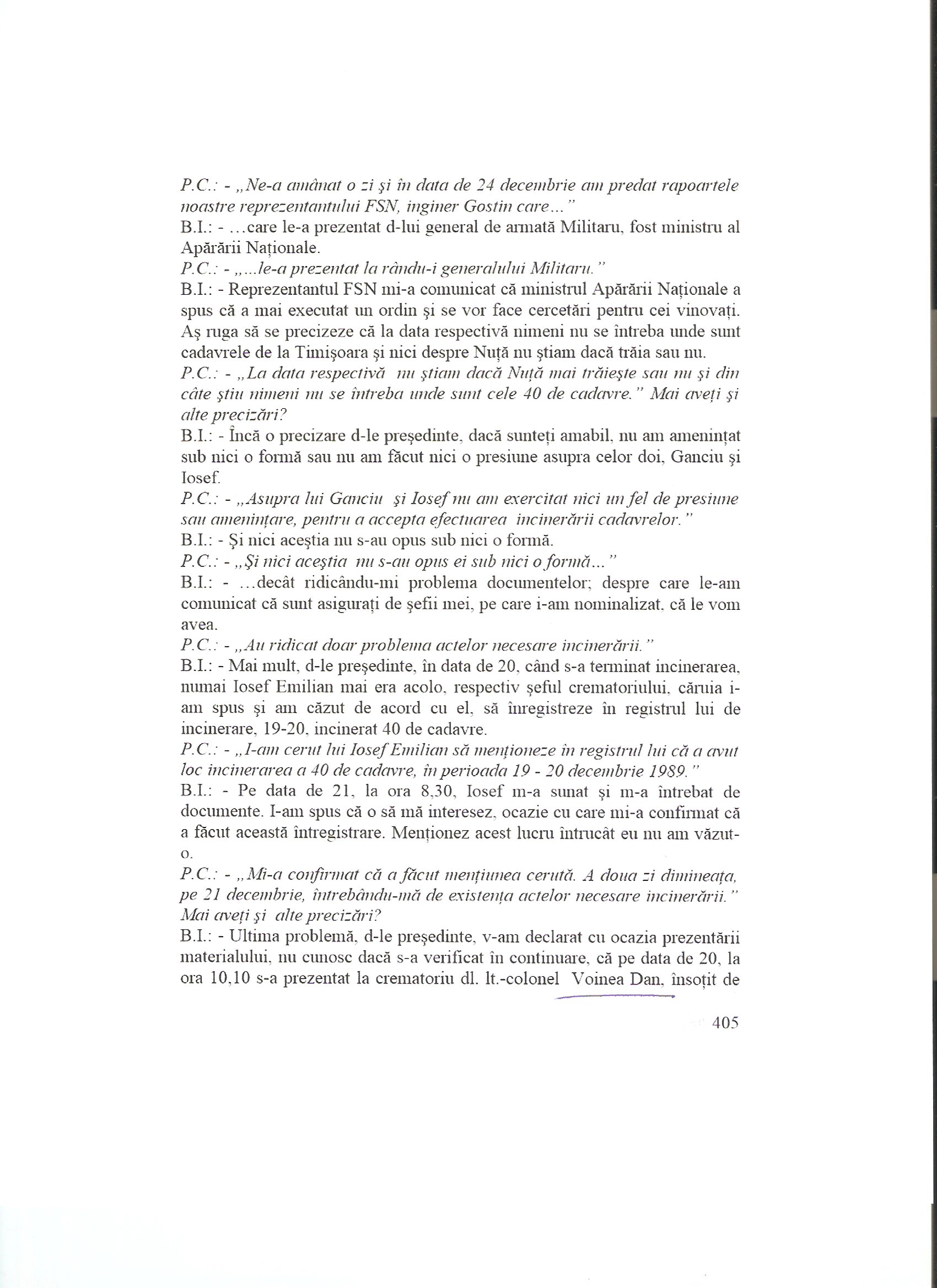
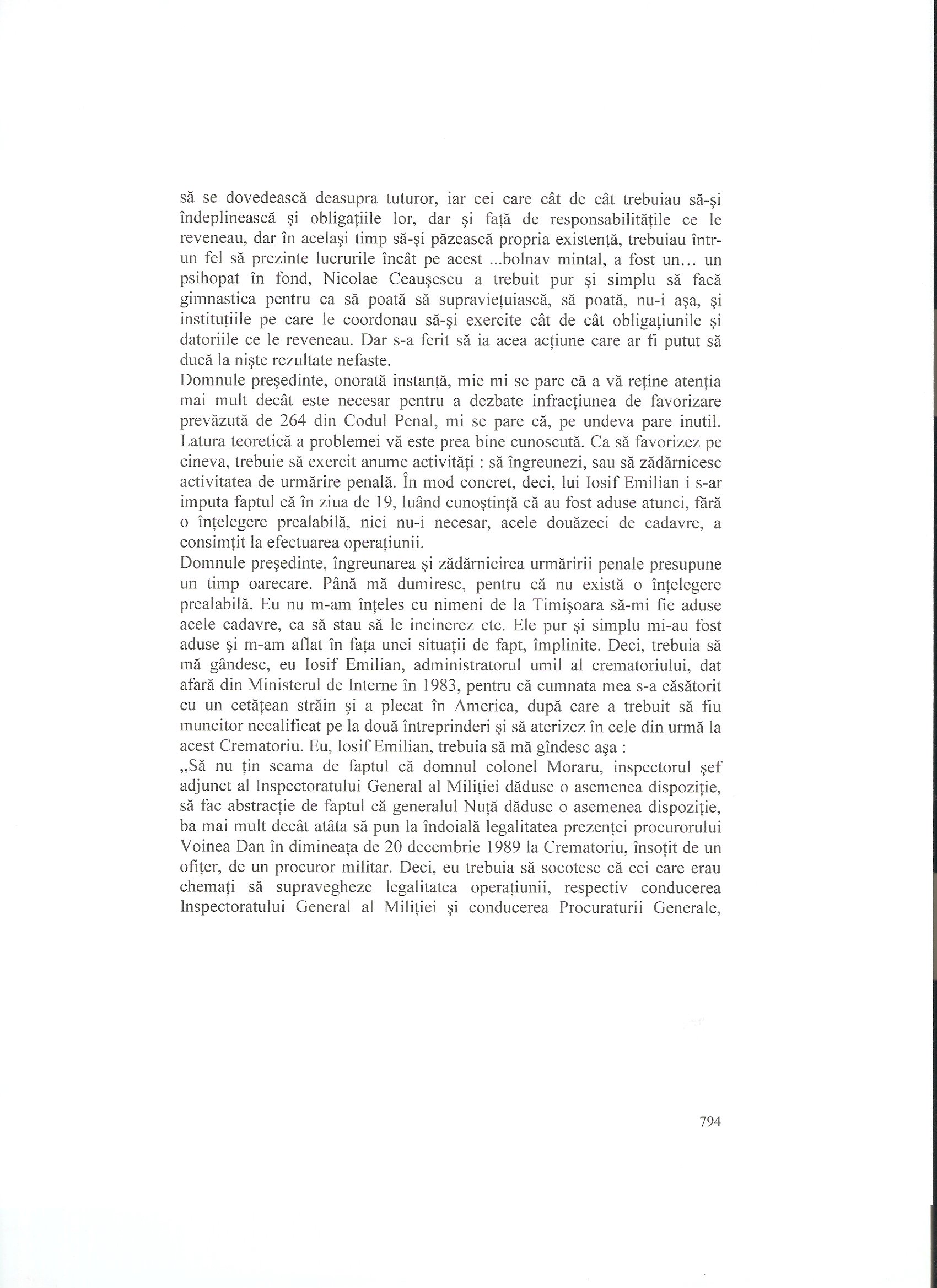
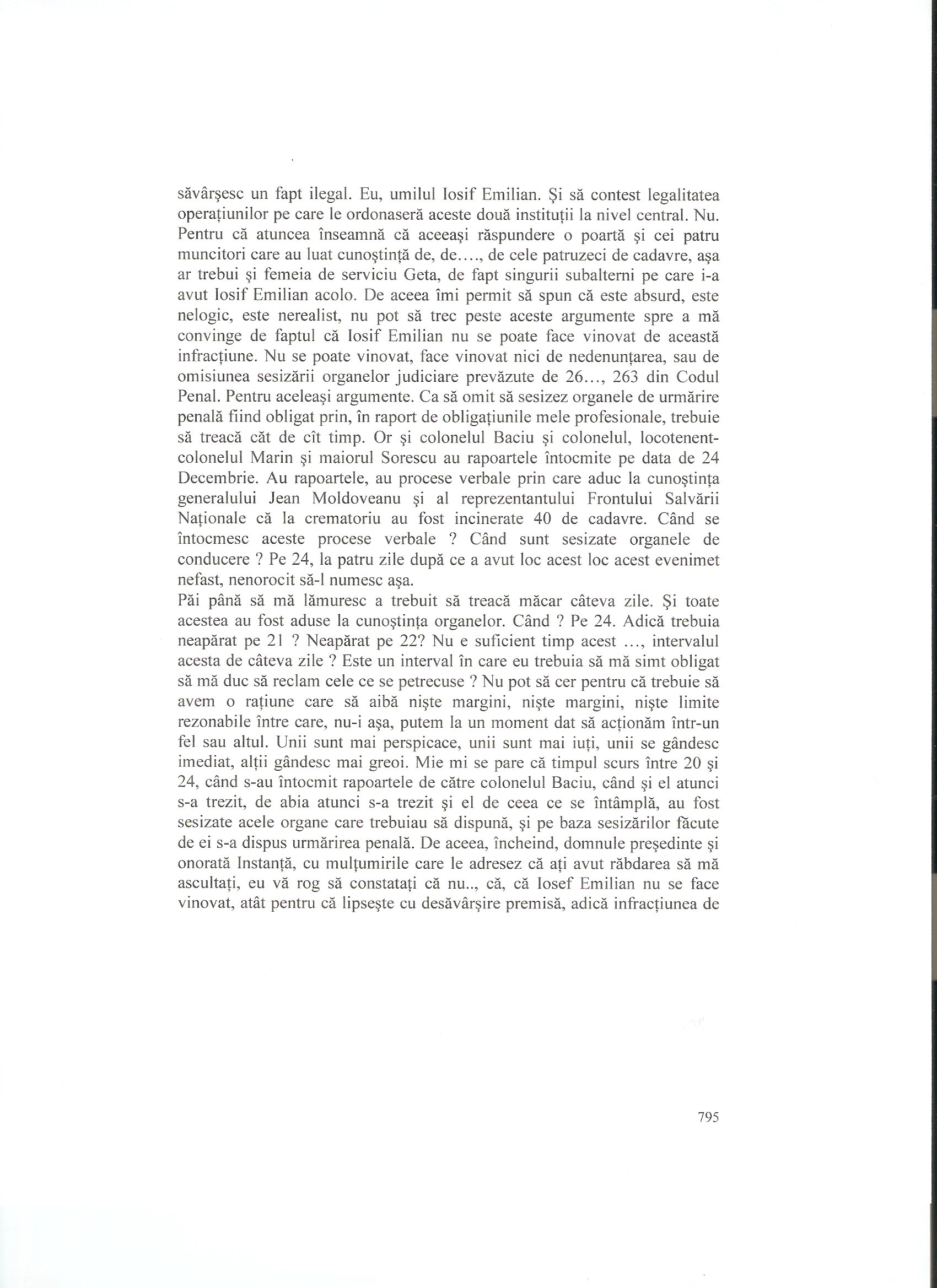
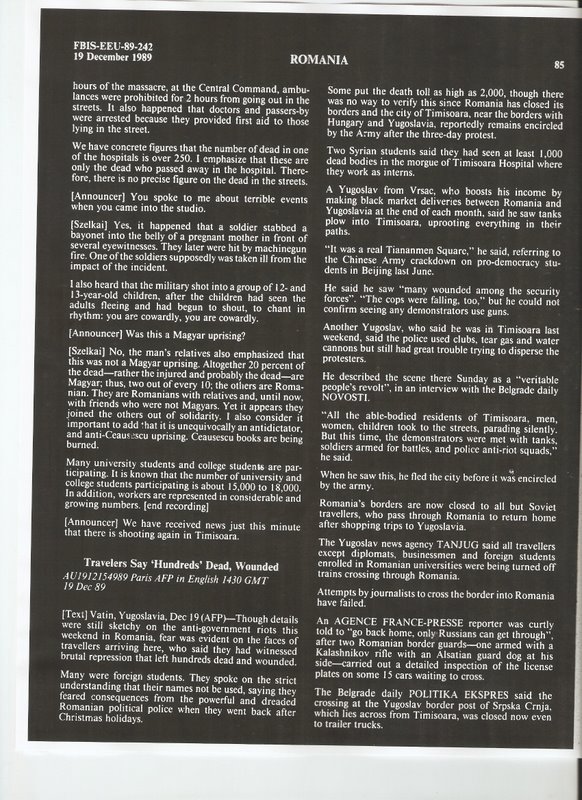
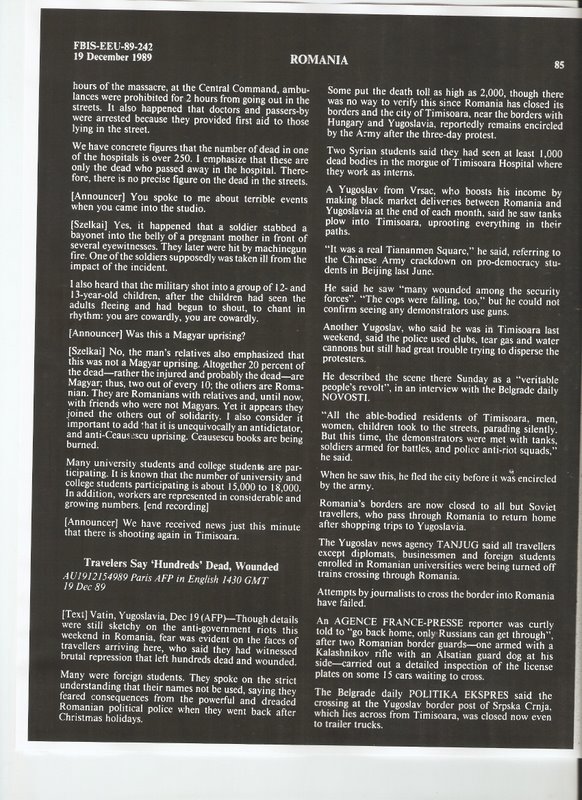
It is informative to look back upon how the disruption of the rally was reported by foreign correspondents in Bucharest just after it had taken place. Shortly after the rally disbanded, a Bulgarian correspondent related that the cause of the commotion had been the use of “tear gas grenades” by regime forces attempting to prevent demonstrators from entering the square and the ensuing panic this had unleashed among those who were already in the square.[67] The correspondent suggested that the demonstrators had originally gathered near the Roman Square on Magheru boulevard and numbered in the thousands by the time they reached Palace Square where the speech was taking place.Similar reports come from the Yugoslav TANJUG correspondent who transmitted that demonstrators had gathered in the northwest corner of Palace Square near the Athenee Palace Hotel and that when they “tried to approach the official meeting, tear gas was thrown at them.”[68] According to the same correspondent, young men had begun to shout anti-Ceausescu slogans, were chased away by the Militia, and then proceeded through the side streets in order to get around to the other side of the meeting.[69] The Militia then used tear gas to prevent these demonstrators from joining the official meeting and it was after the “tear-gas bombs exploded that the live relay of radio and television was disrupted for several minutes.”[70]

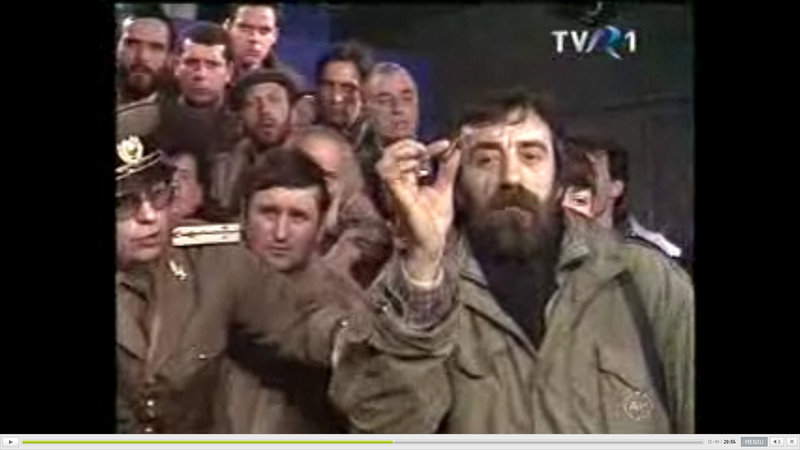
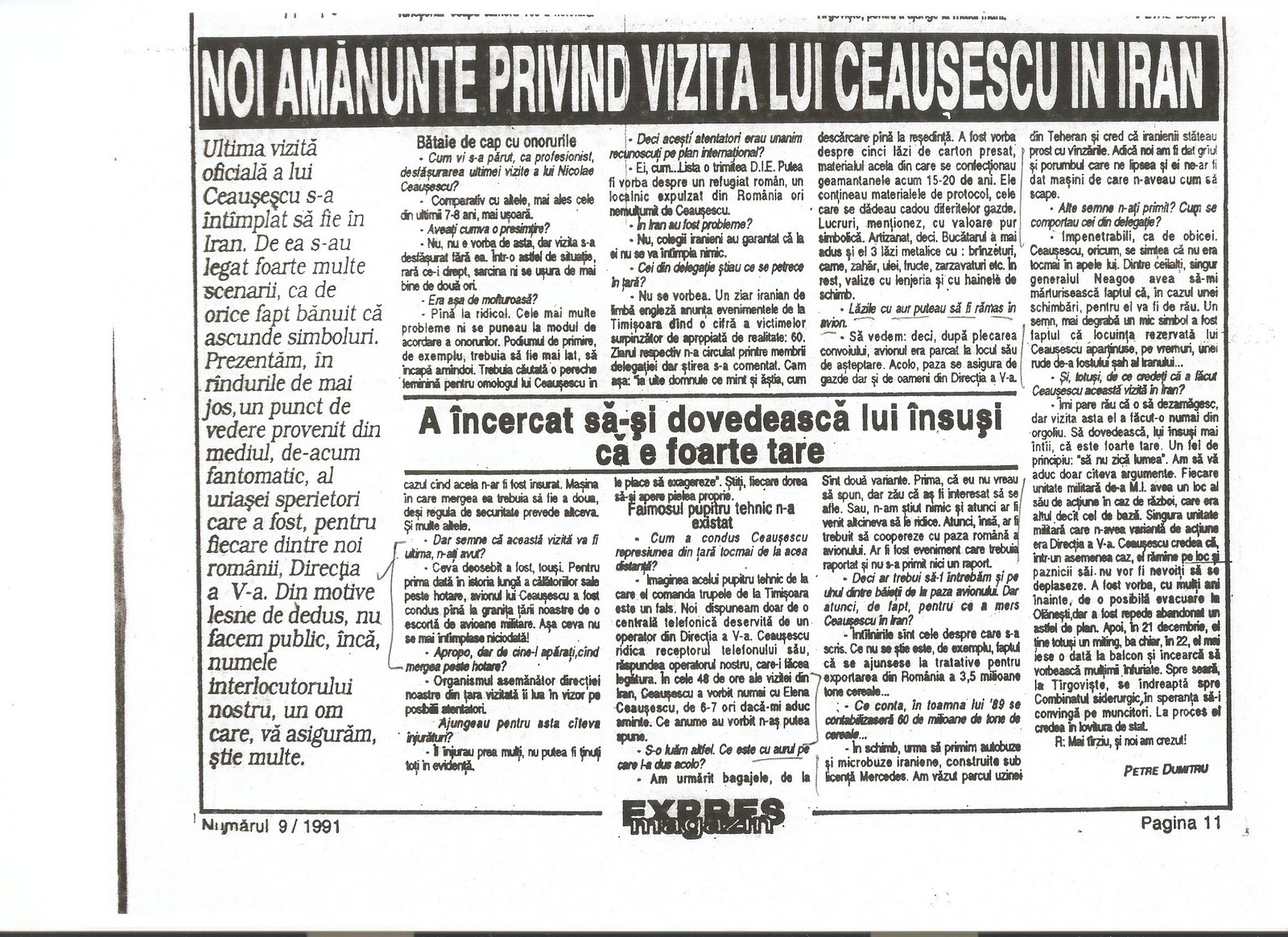
image0

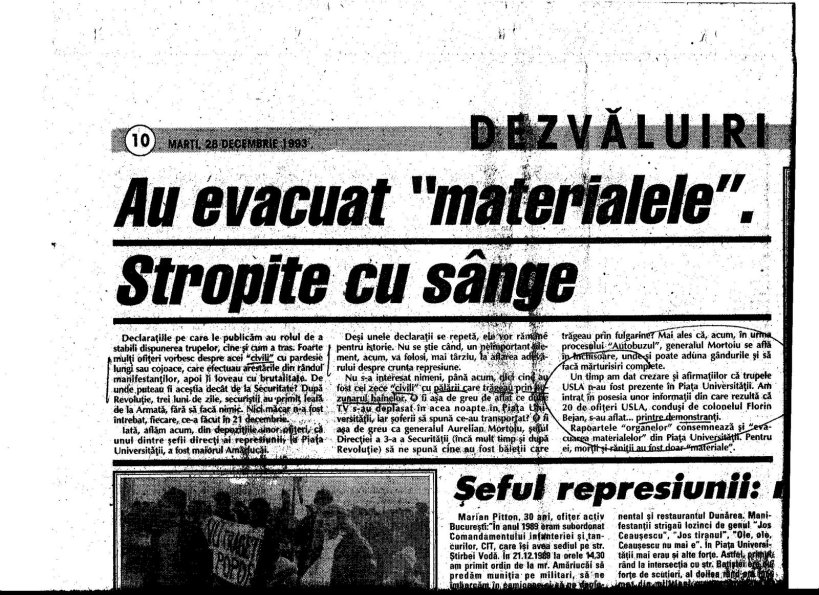
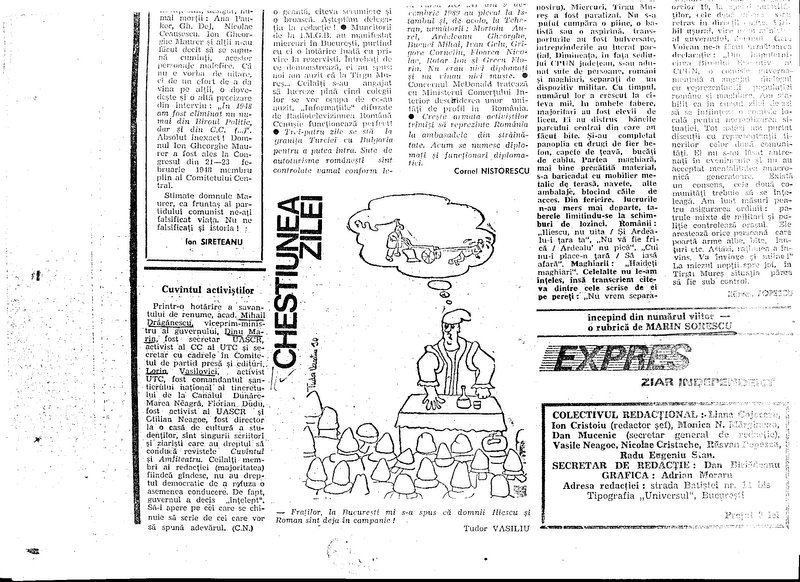
image0-001

http://mariusmioc.wordpress.com/2013/06/28/cercetarile-parchetului-in-dosarul-revolutiei-11-bucuresti-busculada-de-la-mitingul-lui-ceausescu/

http://mariusmioc.wordpress.com/2009/01/13/rich-andrew-hall-rescrierea-istoriei-revolutiei-triumful-revizionismului-securist-in-romania-5-cine-a-aruncat-petarda/

Dar incidentul “petardei” şi tulburarea simultană ar putea avea o explicaţie mai simplă. Este folositor să revedem cum a fost raportată tulburarea mitingului de către corespondenţii de presă străini din Bucureşti, imediat după ce-a avut loc incidentul. Scurt timp după ce adunarea populară s-a destrămat, un ziarist bulgar a relatat că motivul tulburării a fost folosirea de grenade cu gaze lacrimogene de către forţele regimului pentru a împiedica demonstranţii să intre în piaţă şi panica pe care aceasta a dezlănţuit-o printre cei care erau deja în piaţă<Sofia Domestic Service, 1400 GMT 21 decembrie 1989, în FBIS-EEU-89-244, 21 decembrie 1989, pag. 71>. Ziaristul sugerează că demonstranţii s-au adunat iniţial lîngă Piaţa Romană pe bulevardul Magheru şi erau de ordinul miilor cînd au ajuns în Piaţa Palatului unde avea loc discursul [lui Ceauşescu].

Relatări similare vin de la ziaristrul agenţiei iugoslave Tanjug care a transmis că demonstranţii s-au adunat în colţul din nord-vest al Pieţii Palatului lîngă hotelul Athenee Palace, şi cînd “au încercat să se apropie de mitingul oficial, s-a aruncat cu grenade de gaz lacrimogen asupra lor”<Belgrade TANJUG Domestic Service, 1359 GMT 21 decembrie 1989, în FBIS-EEU-89-245, 22 decembrie 1989, pag. 77>. Conform aceluiaşi corespondent, bărbaţi tineri au început să strige lozinci anti-Ceauşescu şi cînd au fost alungaţi de miliţie au luat-o pe străzi laterale pentru a ajunge la o altă parte a mitingului<Belgrade Domestic Service, 1410 GMT 21 decembrie 1989, în FBIS-EEU-89-244, 21 decembrie 1989, pag. 70-71>. Miliţia a folosit atunci gaze lacrimogene pentru a-i împiedica pe aceşti demonstranţi să ajungă la mitingul oficial şi după ce “au explodat grenadele cu gaze lacrimogene, transmisia directă la radio şi televiziune a fost tulburată pentru cîteva minute”<Ibidem>.

Este semnificativ că şi martori oculari ai confruntărilor dintre forţele regimului şi demonstranţi din după-masa şi seara de 21 decembrie se referă la forţele regimului folosind “petarde” împotriva demonstranţilor<Băcanu, “Intercontinental 21/22”, România Liberă 15 martie 1990; 5 aprilie 1990; 19 aprilie 1990>. Un martor ocular al întîmplărilor din Piaţa Universităţii din 21 decembrie povesteşte că “Securitatea fugea după ei [demonstranţi] în grupuri şi folosea petarde şi bastoane contra lor”<Vezi comentariile lui Marcel Constantinescu în Băcanu, “Intercontinental 21/22”, România Liberă 15 martie 1990, pag. 3>. Mai mult, Rady a observat că în noaptea de 21/22 decembrie Securitatea “a detonat bombe în cîteva locuri cu speranţa că va răspîndi panica”<Rady, Romania in Turmoil, pag. 104>.

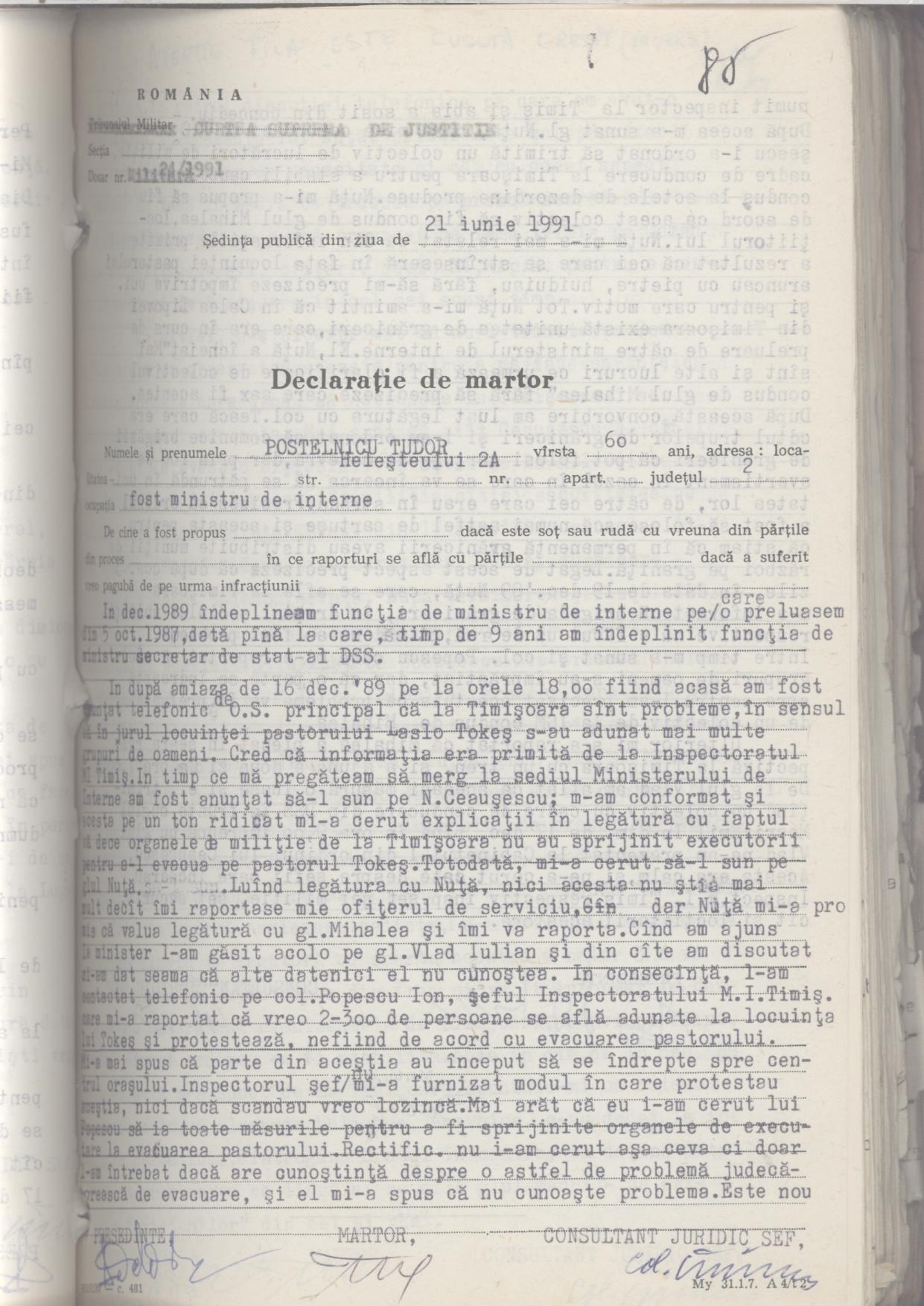
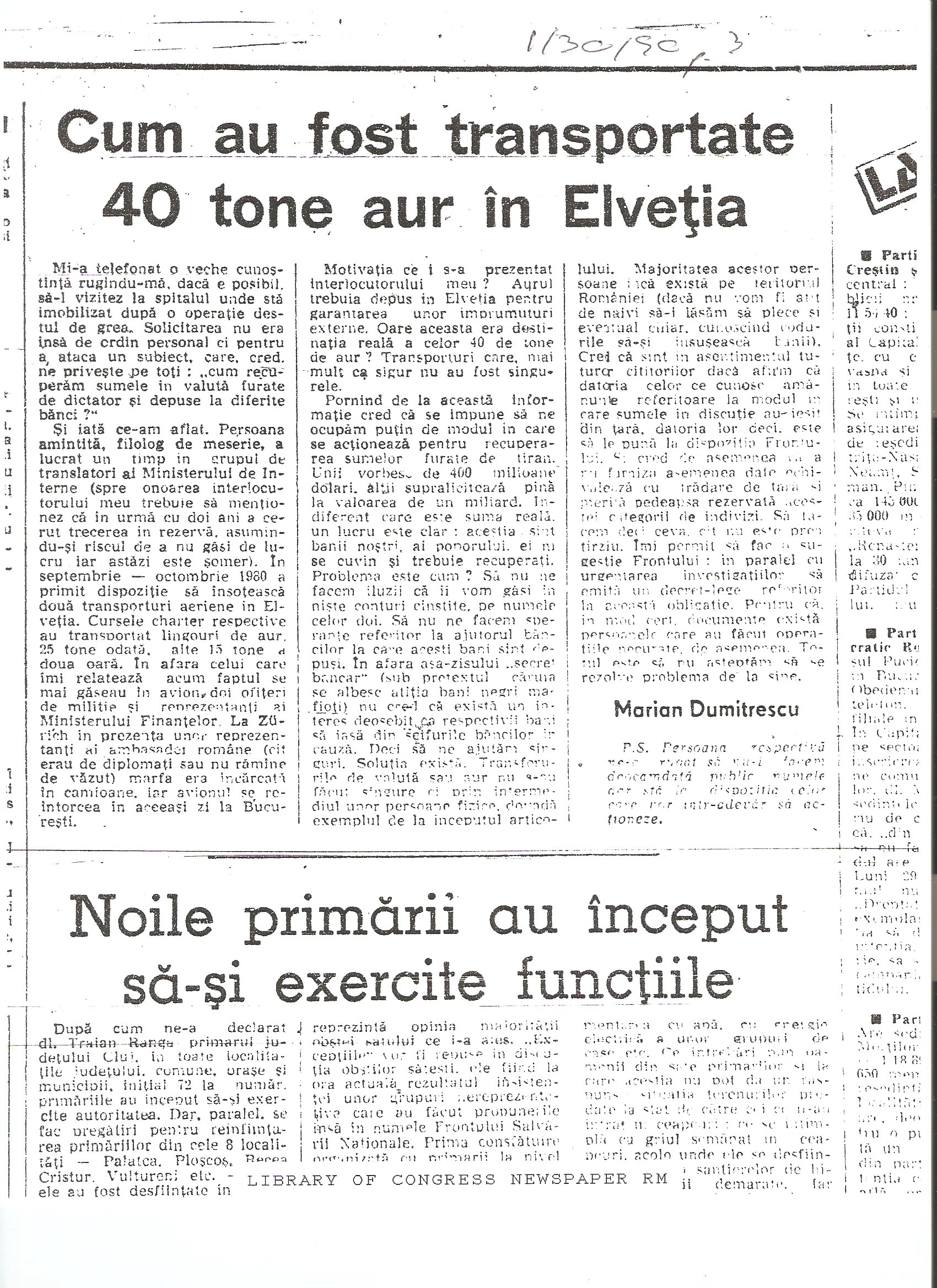
Care forţe ar fi putut folosi “petarde” şi grenade cu gaze lacrimogene împotriva demonstranţilor? În procesul său de la începutul lui 1990, ministrul de interne din perioada evenimentelor, Tudor Postelnicu, a afirmat că “USLA aveau grenade cu gaze lacrimogene” la miting<Emil Munteanu, “Postelnicu a vorbit neîntrebat”, România Liberă, 30 ianuarie 1990, pag. 3>.

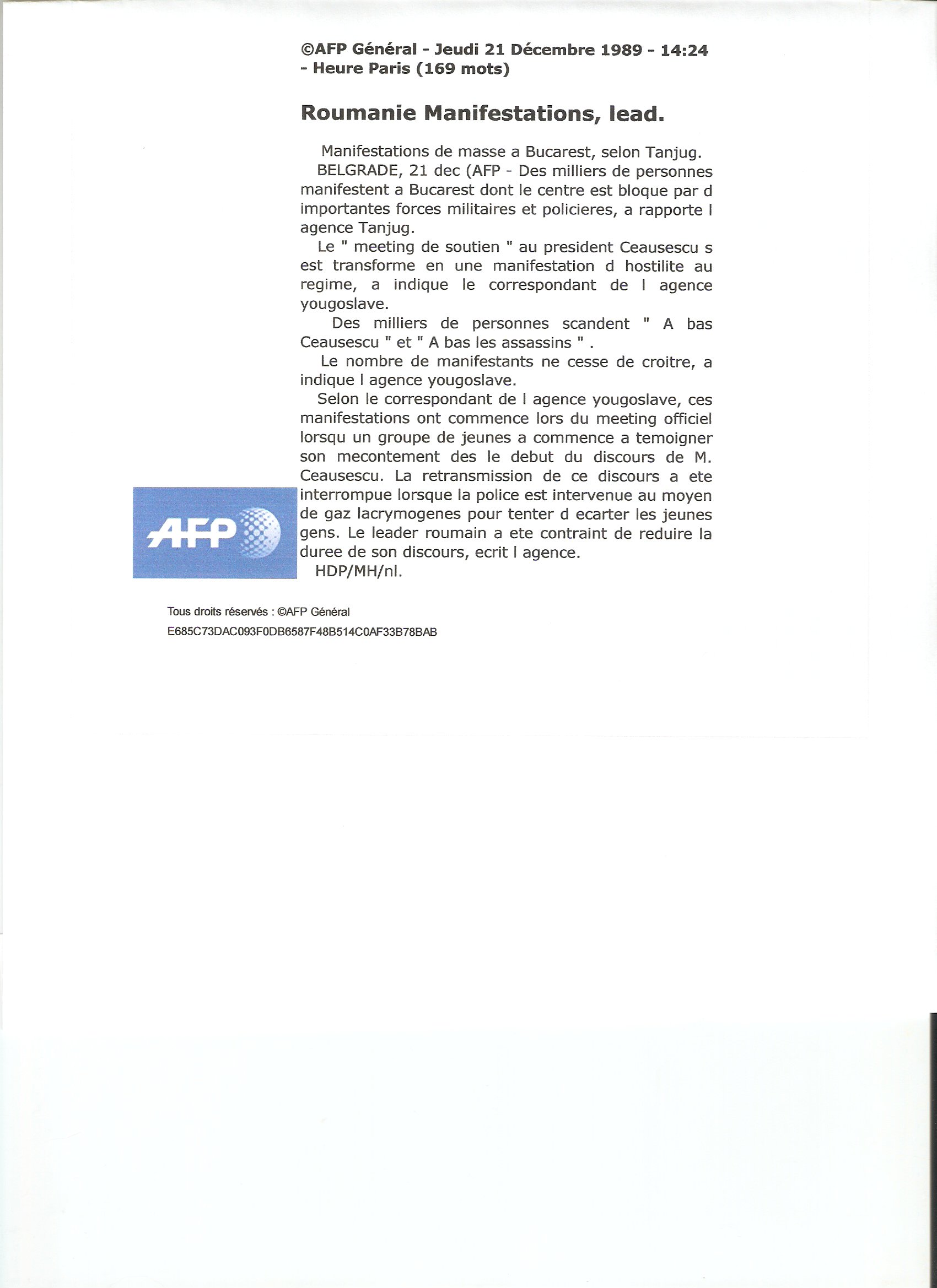
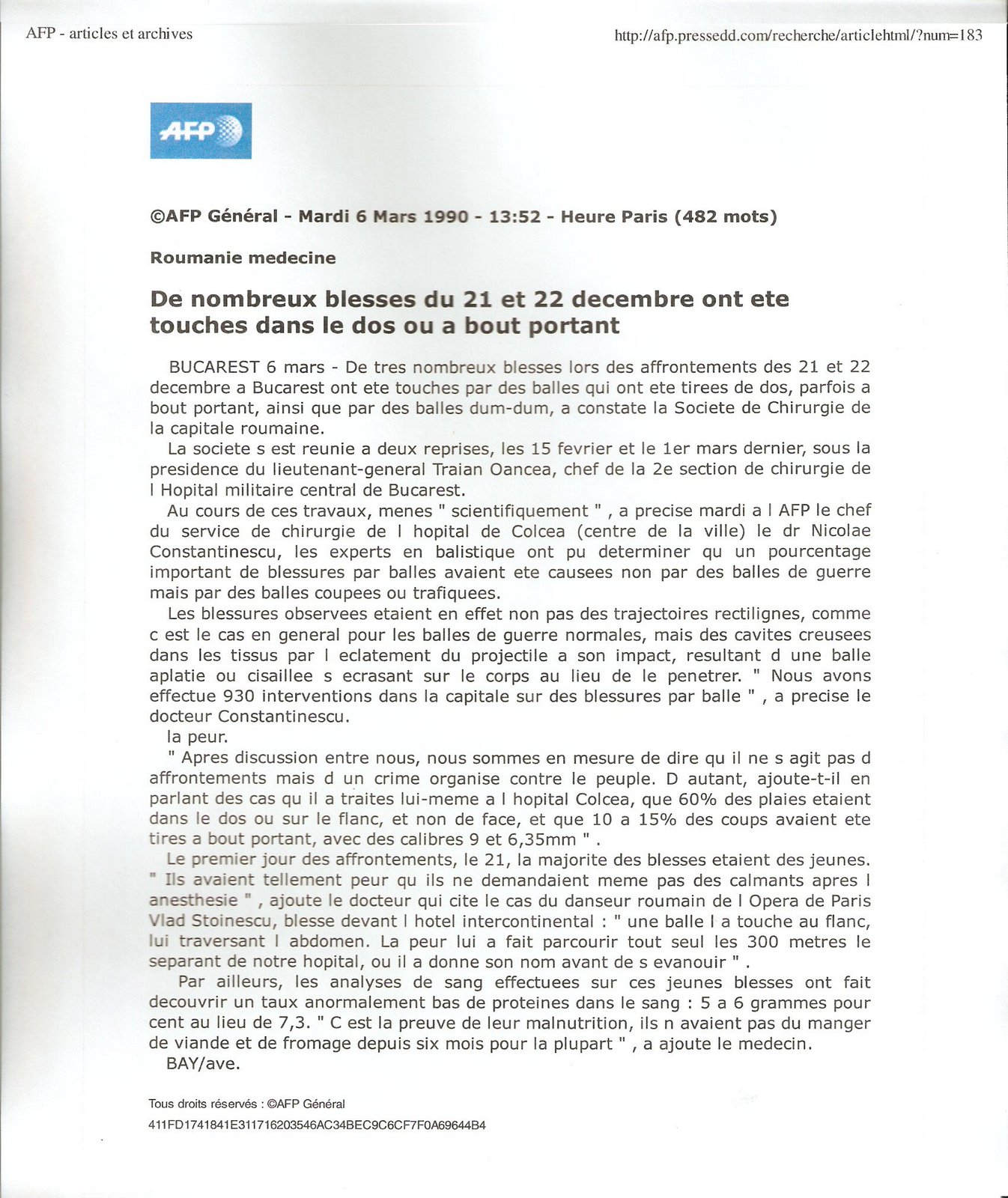
©AFP Général – Jeudi 21 Décembre 1989 – 14:24 – Heure Paris (169 mots)
Roumanie Manifestations, lead.
    Manifestations de masse a Bucarest, selon Tanjug.
   BELGRADE, 21 dec (AFP – Des milliers de personnes manifestent a Bucarest dont le centre est bloque par d importantes forces militaires et policieres, a rapporte l agence Tanjug.
   Le ” meeting de soutien ” au president Ceausescu s est transforme en une manifestation d hostilite au regime, a indique le correspondant de l agence yougoslave.
   Des milliers de personnes scandent ” A bas Ceausescu ” et ” A bas les assassins ” .
   Le nombre de manifestants ne cesse de croitre, a indique l agence yougoslave.
   Selon le correspondant de l agence yougoslave, ces manifestations ont commence lors du meeting officiel lorsqu un groupe de jeunes a commence a temoigner son mecontement des le debut du discours de M. Ceausescu. La retransmission de ce discours a ete interrompue lorsque la police est intervenue au moyen de gaz lacrymogenes pour tenter d ecarter les jeunes gens. Le leader roumain a ete contraint de reduire la duree de son discours, ecrit l agence.
   HDP/MH/nl.
Tous droits réservés : ©AFP Général
E685C73DAC093F0DB6587F48B514C0AF33B78BAB
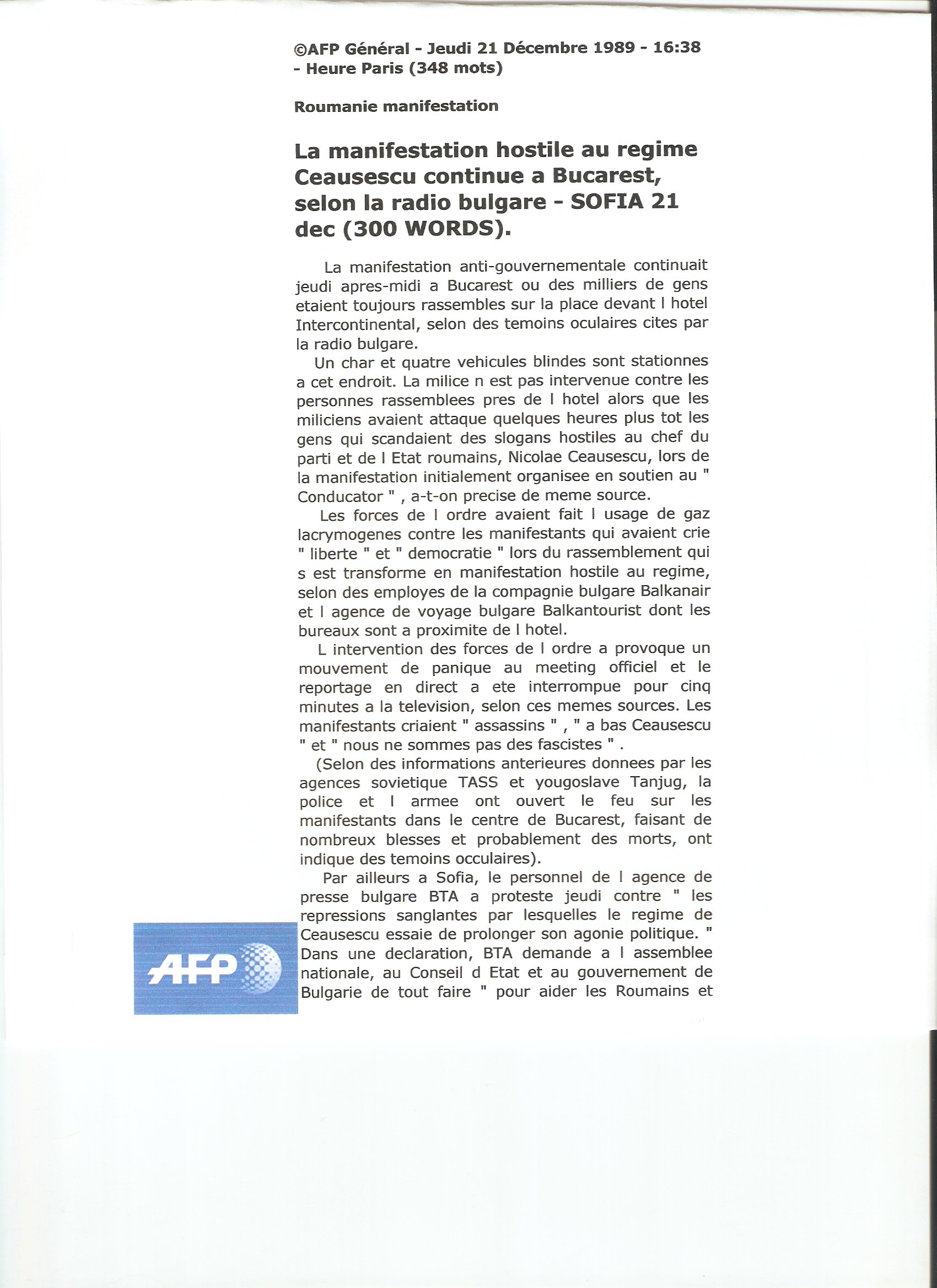
©AFP Général – Jeudi 21 Décembre 1989 – 16:38 – Heure Paris (348 mots)

Roumanie manifestation
La manifestation hostile au regime Ceausescu continue a Bucarest, selon la radio bulgare – SOFIA 21 dec (300 WORDS).
    La manifestation anti-gouvernementale continuait jeudi apres-midi a Bucarest ou des milliers de gens etaient toujours rassembles sur la place devant l hotel Intercontinental, selon des temoins oculaires cites par la radio bulgare.
   Un char et quatre vehicules blindes sont stationnes a cet endroit. La milice n est pas intervenue contre les personnes rassemblees pres de l hotel alors que les miliciens avaient attaque quelques heures plus tot les gens qui scandaient des slogans hostiles au chef du parti et de l Etat roumains, Nicolae Ceausescu, lors de la manifestation initialement organisee en soutien au ” Conducator ” , a-t-on precise de meme source.
   Les forces de l ordre avaient fait l usage de gaz lacrymogenes contre les manifestants qui avaient crie ” liberte ” et ” democratie ” lors du rassemblement qui s est transforme en manifestation hostile au regime, selon des employes de la compagnie bulgare Balkanair et l agence de voyage bulgare Balkantourist dont les bureaux sont a proximite de l hotel.
   L intervention des forces de l ordre a provoque un mouvement de panique au meeting officiel et le reportage en direct a ete interrompue pour cinq minutes a la television, selon ces memes sources. Les manifestants criaient ” assassins ” , ” a bas Ceausescu ” et ” nous ne sommes pas des fascistes ” .
   (Selon des informations anterieures donnees par les agences sovietique TASS et yougoslave Tanjug, la police et l armee ont ouvert le feu sur les manifestants dans le centre de Bucarest, faisant de nombreux blesses et probablement des morts, ont indique des temoins occulaires).
   Par ailleurs a Sofia, le personnel de l agence de presse bulgare BTA a proteste jeudi contre ” les repressions sanglantes par lesquelles le regime de Ceausescu essaie de prolonger son agonie politique. ” Dans une declaration, BTA demande a l assemblee nationale, au Conseil d Etat et au gouvernement de Bulgarie de tout faire ” pour aider les Roumains et garantir le respect de leurs droits conformement a l acte final d Helsinki. “.
   VS-STZ/jlb.
Tous droits réservés : ©AFP Général
4D05E2193CD5C0123E441166CFAE1FBCD3CACFD4

An excerpt from

A chapter from my Ph.D. Dissertation at Indiana University: Richard Andrew Hall, Rewriting the Revolution: Authoritarian Regime-State Relations and the Triumph of Securitate Revisionism in Post-Ceausescu Romania (defended 16 December 1996). This is the original chapter as it appeared then and thus has not been revised in any form.

Ceausescu’s Fatal Mistake: The Pro-Regime Rally of 21 December


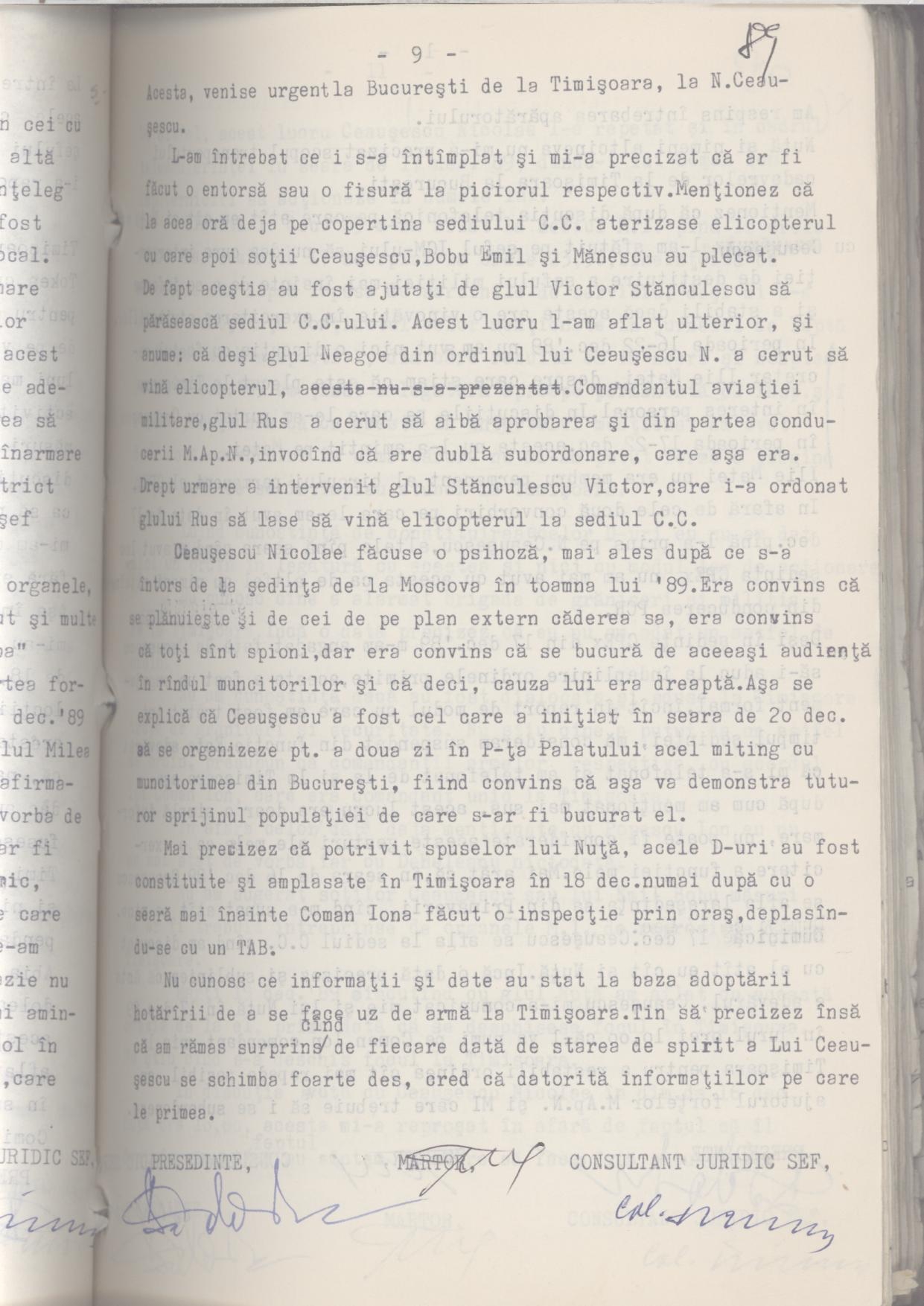
By the morning of Thursday, 21 December 1989, the regime was no longer master of the situation in Timisoara. Moreover, it was rapidly losing control in several nearby cities: Lugoj and Cugir. Nevertheless, the regime might have withstood these challenges had it not been for Nicolae Ceausescu’s insistence on convoking a mass rally and addressing his “adoring” subjects in person. It was Nicolae Ceausescu’s delusion of his own invincibility which ensured that the regime would be unable to reestablish control. Ceausescu’s inflammatory, rambling tirade on national television on Wednesday evening had signalled panic to those who watched it. If Ceausescu was so worked up, they concluded, something serious must have occurred in Timisoara. Following his televised address, Ceausescu decided to hold an open-air, pro-regime rally the following day in the sprawling square in front of the Central Committee building in the center of Bucharest. The event was to be carried live over Romanian radio and television.

Precisely because this mass rally turned out to be the deathknell for the Ceausescu regime speculation has surrounded who “goaded” Ceausescu into making such a colossally-misguided decision. In January 1993, the opposition daily Romania Libera suggested that “the meeting was organized at the suggestion of [CPEx member] Gogu Radulescu.”[31] The same article maintained that Radulescu had been followed during these days and was “observed transmitting something abroad,” thereby once again insinuating the role of foreign powers in the Romanian events.[32]

Yet it is doubtful that Nicolae Ceausescu required Radulescu’s encouragement to convoke such a rally. It seems highly likely that the idea was Ceausescu’s own brainchild and that as usual the docile members of the CPEx did not dare contradict him. It was a typically instinctive, rash, and overconfident reaction to crisis on Ceausescu’s part. Moreover, as we have seen, for Nicolae Ceausescu the events confronting him in December 1989 were a replay of August 1968: not only was socialism at stake, but Romania’s national sovereignty and independence. Thus, in this crucial moment, he would appeal not primarily to the party’s political interests, but to what were the core institutional interests of the Securitate. And he would rely on a trusted totalitarian, mobilizational technique: the “spontaneous” mass rally of support for the regime.

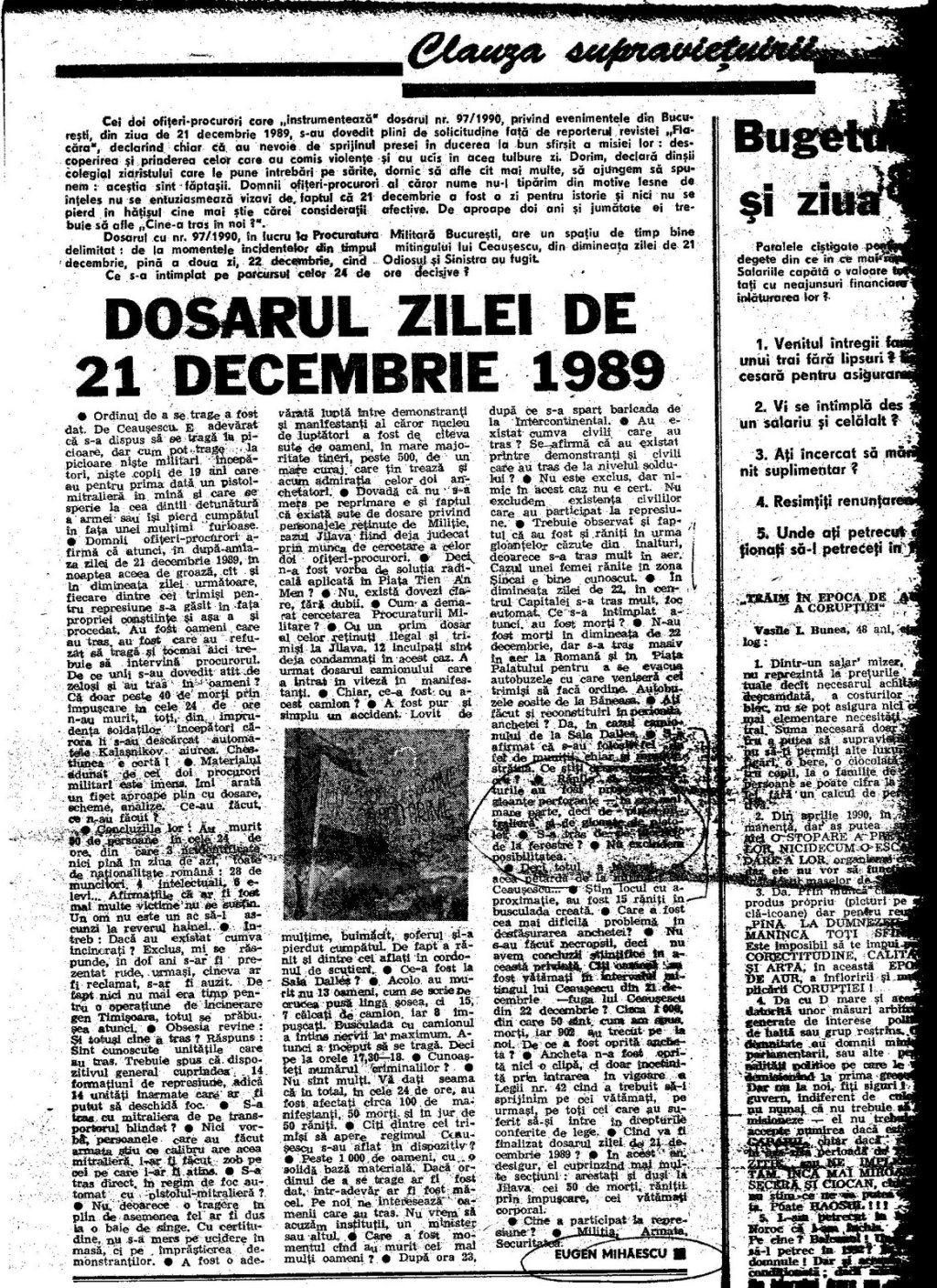
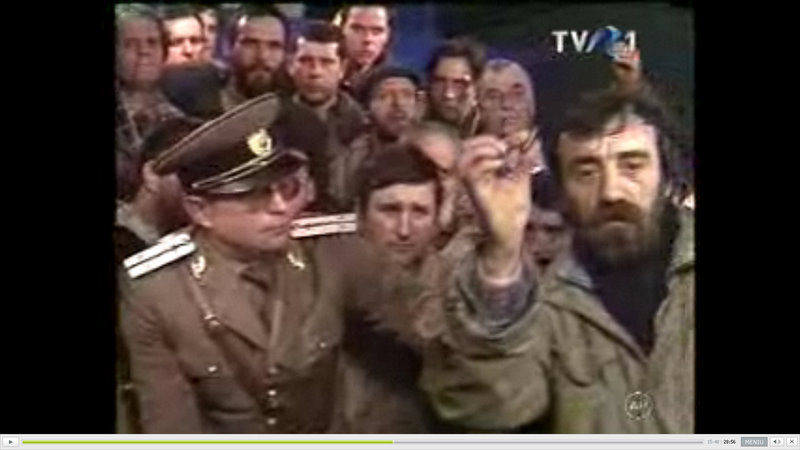
The pro-regime rally began at midday on Thursday, 21 December 1989 as such events always had. Almost 100,000 workers, hand-picked from Bucharest’s major factories, had been herded into the center of Bucharest to await Ceausescu’s address from the balcony of the Central Committee building. There were the customary “spontaneous” chants in support of the dictator and his policies, and obsequious introductions by party underlings. Ceausescu had been speaking for only a few minutes when an unidentifiable disruption in the crowd forced him to pause in mid-sentence. It was now that the folly of his insistence that his address be broadcast live by television and radio was realized. Before the television and radio relays could be interrupted, a national audience was able to hear high-pitched screams and shouts of “Down with Ceausescu!” “Murderer!” and “Timisoara, Timisoara!” Even worse, television cameras had captured Ceausescu’s stunned and confused facial expression. About three minutes later, after some semblance of order had been restored in the square, the live broadcast resumed. Ceausescu announced that just that morning the CPEx had approved an increase in the minimum salary and pensions![33] Ceausescu was able to finish his speech, although shouting and commotion could still be heard sporadically in the background.

It is impossible to know how much the image of a frightened Ceausescu, futilely motioning to the crowd to quiet down, influenced those who saw it. However, the scope and boldness of protest against the regime clearly intensified after the broadcast of the dictator’s previously-unimaginable moment of weakness. Anti-regime demonstrations spread throughout the major cities of Transylvania–Brasov, Sibiu, Cluj, and Tirgu Mures–on the afternoon of 21 December. It did not matter that a sufficient degree of order had been reestablished such that Ceausescu was indeed able to finish his speech or that Romanian television would rebroadcast the same speech later that evening with pro-Ceausescu chants dubbed-in over the commotion. Irreparable damage had been done.

Observers have argued that those brief, but seemingly interminable seconds during which the television camera broadcast Nicolae Ceausescu’s disbelief and helplessness live to an entire nation, constituted a sort of “singular psychological moment,” something akin to a rock shattering a mirror. What had prompted Ceausescu’s reaction? Initially, most accounts stressed how several people in the crowd had begun shouting anti-Ceausescu slogans.[34] Fearing they would be caught, they then rushed through the crowd. The other members of the crowd were frightened by this unexpected act of courage and themselves attempted to flee. The great commotion which viewers had heard before the transmission had been cut, was the sound of these people trying to force their way out of the square. Many later explanations have maintained, however, that these events were merely a response to the initial act of defiance: the setting-off of firecrackers (”petarde” in Romanian) by someone in the crowd. Only then did demonstrators take advantage of the confusion and anonymity of the moment to shout down Ceausescu. In both cases, the spontaneity of the catalytic event has been drawn into question.

Nica Leon: The Strange Tale of the “Hero” of the 21 December Rally

Because the interruption of Ceausescu’s speech proved such a turning point in the December events, it was natural that in early 1990 the newly-liberated media should try to find the person or persons responsible for “unleashing the Bucharest revolution.” In a series of interviews during March and April 1990, Petre Mihai Bacanu, senior editor of Romania Libera, introduced the nation to a group of factory workers whom he presented as the “heroes” of the 21 December rally.[35] Bacanu was widely-viewed both at home and abroad as the “conscience” of the journalistic profession (a journalist for Romania Libera before the events, he had been imprisoned between January and December 1989 for his involvement with two other people in an attempt to print an illegal underground newspaper) and his newspaper was the hub of the growing political and social opposition to the National Salvation Front regime.

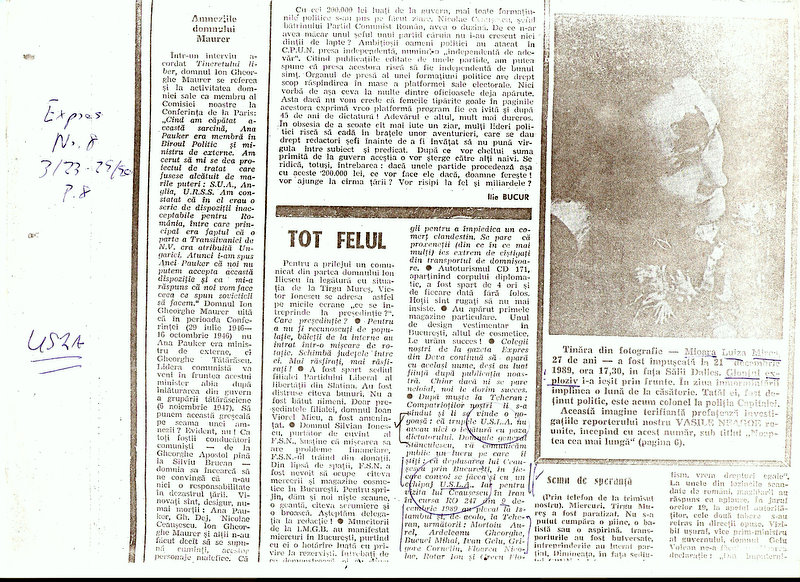
Thanks in large part to Bacanu, one of these workers in particular, Nica Leon, was to become identified as the man who had dared to shout down Ceausescu.[36] Leon was presented as having yelled out “Long live Timisoara, down with the butcher, down with Ceausescu!” and “Timisoara, Timisoara” at the crucial moment during Ceausescu’s speech. Highly-respectable foreign sources such as Ratesh credit Leon by name with having disrupted the 21 December rally.[37]

In the months immediately following December 1989, Nica Leon certainly appeared every bit the hero. It turned out that on 20 December 1989, the day before his historic shout, the Toronto daily The Globe and Mail had printed an open letter by Nica Leon criticizing Ceausescu’s rule.[38] This fact seemed confirmation of the courage of his action on 21 December. During 1990, Leon was the president of a small political party, a founding member of the Romanian branch of Amnesty International, and a prominent critic of the Iliescu regime.[39] During the chaotic and violent events of 13-15 June 1990 which brought an end to the two-month occupation of University Square by demonstrators, he was arrested and over the following month and a half was the object of an eventually-successful campaign spearheaded by Romania Libera to gain his release. The opposition embraced him with open arms and he regularly appeared in interviews with the opposition press.

Yet in the ensuing years, the opposition clearly soured on Nica Leon and he broke with them in as definitive a manner as imaginable. By 1992, one opposition publication was describing Nica Leon as “at war with the whole world” and it was clear from the questions and comments of opposition journalists that they no longer held him in the high esteem they once had.[40] Ilie Stoian’s 1993 description of Leon’s role at the 21 December rally reflects this changed perception of Leon: “Just then Nica Leon took advantage of the protection offered by the uproar and yelled ‘Timisoara’…after which he ran away out of fear.”[41] Leon’s heroism had apparently become contingent upon his relationship with the opposition.

On the surface, Leon himself appeared to have undergone a striking metamorphosis: from being a fixture of the opposition to granting interviews to the press of the Ceausescu nostalgics. In early 1994, the very same Nica Leon could be found in the pages of Europa praising the Securitate and virtually lamenting the overthrow of Ceausescu which his actions had hastened.[42] He strenuously defended the actions of the Securitate Director, General Iulian Vlad, in December 1989 as honest and patriotic. How had a person the opposition had presented as a dissident for a decade prior to the December events, an unrelenting foe of the Securitate, and the hero of the 21 December rally come to this?

What is interesting about Leon is that his views on certain key issues about the December 1989 have remained remarkably consistent in spite of his flip-flop from one end of the political spectrum to the other. Leon’s defense of–and sympathy for–General Vlad was not something which had suddenly appeared after he crossed over to the Ceausist camp. It appears in the interviews he gave the opposition press in 1990.[43] Moreover, Leon strenuously denied the existence of any “terrorists” during the December events. In April 1990, he told Expres that “the terrorists were invented.”[44] In September 1990, Leon told Liviu Valenas and Daniela Rainov at Baricada that “Everything [in December 1989] was a grand diversion! THERE WEREN’T ANY TERRORISTS!” and that Vlad had been arrested because he possessed damaging information against the Front.[45]

In his interviews with Petre Mihai Bacanu at Romania Libera in April 1990, Nica Leon also mentioned several episodes which placed the Securitate and Militia in a surprisingly positive light. He maintained that during the showdown between protesters and regime forces in University Square on the afternoon of 21 December, he had spoken with a Militia sergeant major who had “wished us [the protesters] success.”[46] He also claimed that he had helped an injured Militia man to safety on this evening.[47] Leon chatted with the USLA troops at University Square and characterized their actions as follows:

…the USLA were blocking the street leading to the American Embassy and the Israeli airline company El Al. The USLA did not attack the crowd, but rather stood chatting with the demonstrators and explaining to them that they could not join them because they had an order to stay between the French Bank and the Intercontinental Hotel.[48]

As we shall see, other eyewitness accounts of these events challenge Leon’s portrayal of the USLA.

But clearly the most damaging fact about Nica Leon was the one Petre Mihai Bacanu neglected to inform his audience of: the hero of the Bucharest Revolution had been arrested as a “terrorist” on 24 December 1989. Leon had been discovered in the basement of the Central Committee building, attempting to transmit something through a radio-transmitting device belonging to the Securitate’s Fifth Directorate.[49] One might be inclined to believe that Leon had been the victim of a tragic misunderstanding were it not for a series of articles written by a former officer of the Fifth Directorate in the Ceausist publication Timpul during early 1991.[50] The former Securitate officer presented the saga of a group of those arrested as “terrorists” during the December events: among them, other officers of the Fifth Directorate, USLA members, a Jordanian student, and Nica Leon. Leon is credited with having sustained the morale of the other prisoners. According to the Fifth Directorate officer: “Nica Leon encouraged us and frequently repeated that if he escaped, he would testify for us all the way to the UN.”[51] Moreover, Leon is praised for having contacted the wives of the Fifth Directorate officers–to tell them that their husbands were still alive–after he was released on 30 December 1989. Other Securitate officers confirm Nica Leon’s presence among the arrestees.[52]

Even prior to Bacanu’s interview with Leon, there were indications that Leon was a less than completely credible source. In February 1990, Leon had given an interview to Democratia, the publication of one of Ceausescu’s most notorious former speechwriters, Eugen Florescu.[53] Surprisingly, since this was one of Leon’s first interviews since the events, there was no mention of his famous shout at the 21 December rally. In its issue of 9 March 1990, the popular Expres had made a coy reference to Leon’s arrest (while using a radio-transmitting device) in the CC building.[54] Moreover, at a meeting of the ruling Provisional Council of National Unity in early 1990, Front official Dan Iosif is said to have referred to Leon’s arrest and called him either a “securist” or “terrorist.”[55]

Nica Leon remains an enigma. It is difficult to say exactly what he was really up to on 21 December 1989. People in the crowd did indeed shout “Timisoara, Timisoara,” for it could be heard on the television broadcast. If Leon did shout it, was he the first to do so? If not, what was his motivation for shouting it? Was his shout a genuine act of individual courage at the time? Was he perhaps acting as a Securitate provocateur–someone who wished to infiltrate the protesters’ ranks–on 21 December 1989? As with other aspects of the December events, the historiography of what happened is as important as–if not more important than–what actually happened. In the case of Nica Leon, the historiography at the very least suggests a highly-manipulative portrayal of his actions in December 1989.

Who Threw the “petarde”?

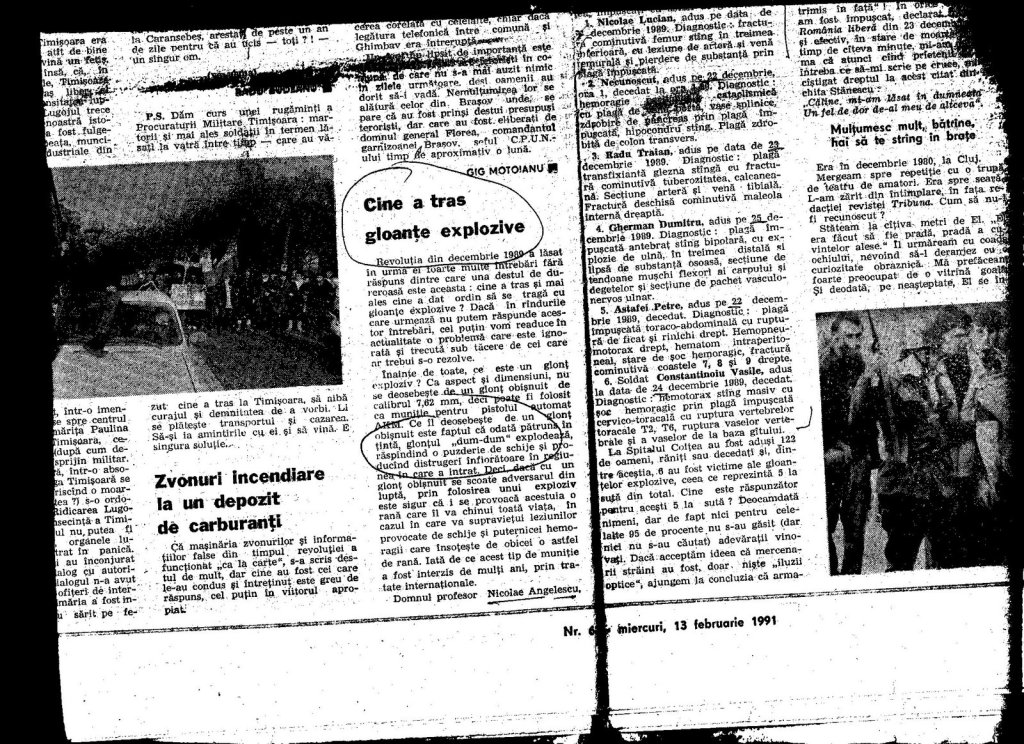
Many sources have suggested that it was the explosion of a “petarde” (or firecracker) and a simultaneous commotion in the square which startled Ceausescu and made it possible for the demonstrators to yell the anti-Ceausescu slogans. Once again the discrepancy between the reporting on this incident and the reality of what appears to have happened is informative. The report of the first Senatorial commission investigating the December events (published in 1992) maintains that “while [Ceausescu] was speaking, an explosion was heard and caused substantial commotion. Shortly after this, the meeting disbanded in disorder.”[56] Stoian describes the “petarde” incident as follows:

…[then] Ceausescu took the floor. At that moment the thing which appears to us the most important event of this period occurred. It is not true that the crowd began to boo spontaneously. While Ceausescu was stumbling through a phrase up on the balcony, somewhere in the center of the Square, where there were mostly women, someone exploded a Christmas ‘petarde’ [o petarda de genul celor de Craciun]. The first reaction of these frightened women was to begin to scream. Then, all those around them began to boo.[57]

Romanians have occasionally referred to this as “the petarde of our happiness.”[58]

Part of the problem with the “petarde” scenario stems from the fact that there is no agreement upon who exploded it and no one has come forward to claim responsibility for this historic action. Nevertheless, many names have been put forward in connection with it.[59] Securitate sources clearly wish to suggest that the setting-off of this “petarde” and the causes of the commotion which ensued were part of a premeditated plan to disrupt the rally. Once again, they attempt to negate the spontaneity of the anti-Ceausescu uprising. A journalist for the Ceausist journal Democratia wrote in December 1990:

…It must be stressed that during this rally long-studied methods for the psychological manipulation of compact crowds–acoustic sounds with subliminal messages transmitted through the loudspeaker system (imitating the rumble of an earthquake, the noise of troops and tanks and gunfire); the movement of some groups through the square with the intention of dislocating the crowd; petardes–were applied.[60]

According to “a group of former Securitate officers,” the “tourists” and their domestic collaborators made their way from Timisoara to Bucharest and infiltrated the meeting. The “tourists” attempted to scare those in the crowd into believing that “they were under fire” by jabbing them in the back with “reinforced steel prongs…against the background of the noise of fire-crackers and the short-circuiting of the public address loudspeakers.”[61] Interestingly, this is how a former USLA officer has portrayed the event:

On 21 December 1989 I was taking part in the antiterrorist measures for the “goodbye” meeting. In the crowd, I identified and observed eight strange men: all were dressed approximately the same (knee-length woolen coats, hats), all were smoking at the same time, standing in a group. Some looked slavic, others asiatic. At a given moment, they took out from their pockets globe-shaped objects, lit them with their cigarettes, and threw them into the crowd; in the globes there were firecrackers which put the crowd to flight.[62]

The SRI’s 1994 report on the events suggests that the “powerful thunder claps” which were heard could have come from the detonation of a “petarde” and that the “sonic boom”-like sound which occurred came not from the crowd, but from the loudspeakers.[63] The panic among the crowd was caused by the transmission of high-pitched soundwaves (outside the range of human hearing) and by the fact that unidentified demonstrators were prodding the others with steel poles while shouting “Run away, they will kill us!” and “The tanks are coming!”[64]

Opposition accounts incorporate familiar elements. The influential journalist Cornel Nistorescu places the “petarde” incident in the context of a coup d’etat supported by a faction within the Securitate:

Simultaneously, at the meeting of 21 December, according to incontrovertible information, a Securitate officer launched the two petardes which provoked panic and unleashed the redemption of Bucharest’s citizens. Meanwhile, through the loudspeaker system controlled by the Securitate, boos and whistles were disseminated.[65]

Ecaterina Radoi of Zig-Zag suggests that the unbelievable panic which ensued was the result of the emission of sounds resembling the rumble of tanks and machine gun fire.[66]

But the “petarde” incident and the simultaneous commotion may have a simpler explanation. It is informative to look back upon how the disruption of the rally was reported by foreign correspondents in Bucharest just after it had taken place. Shortly after the rally disbanded, a Bulgarian correspondent related that the cause of the commotion had been the use of “tear gas grenades” by regime forces attempting to prevent demonstrators from entering the square and the ensuing panic this had unleashed among those who were already in the square.[67] The correspondent suggested that the demonstrators had originally gathered near the Roman Square on Magheru boulevard and numbered in the thousands by the time they reached Palace Square where the speech was taking place.

Similar reports come from the Yugoslav TANJUG correspondent who transmitted that demonstrators had gathered in the northwest corner of Palace Square near the Athenee Palace Hotel and that when they “tried to approach the official meeting, tear gas was thrown at them.”[68] According to the same correspondent, young men had begun to shout anti-Ceausescu slogans, were chased away by the Militia, and then proceeded through the side streets in order to get around to the other side of the meeting.[69] The Militia then used tear gas to prevent these demonstrators from joining the official meeting and it was after the “tear-gas bombs exploded that the live relay of radio and television was disrupted for several minutes.”[70]

Significantly, eyewitness accounts of the confrontations between regime forces and demonstrators on the afternoon and evening of 21 December refer to regime forces firing “petardes” at the demonstrators.[71] One eyewitness to the events in University Square on the afternoon of 21 December recounts that “the Securitate ran after them [the demonstrators] in groups and used ‘petardes’ and clubs against them.”[72] Moreover, Rady has observed that on the night of 21/22 December, the Securitate “[i]n a few places…detonated bombs in the hope of spreading panic.”[73]

Which forces would have used the “petardes” and tear-gas against the demonstrators? During his trial in early 1990, the Interior Minister at the time of the events, Tudor Postelnicu, stated that “the USLA were in charge of tear-gas” at the rally.[74] Stoian has noted the difference between the 21 December rally and past rallies in his typically colorful tone:

In the first place, how striking it was that if in the past at the meetings to which Bucharest’s citizens were all too well-accustomed, people were indifferent–indeed, some were even happy since they would get three or four hours of work off–now nobody was smiling. Almost everybody entered [the square] in an ill-omened silence. A completely new element was the verification of identity papers of most people on the streets on this occasion; those who did not belong to the groups of workers [chosen to participate] were politely made to exit the columns…After the Palace Square was full, something unexpected happened. If in the past, the ring of civilians (Securitate men, party activists) and Militia men [around the crowd at such an event] would not permit those bored of listening to Ceausescu’s idiocies to leave, this time things were completely the other way around….Anyone who wanted to leave could, but no one from outside the ring could enter the protected zone.[75]

Eyewitnesses have specifically identified the forces preventing their entrance into the square as “USLA troops.”[76]

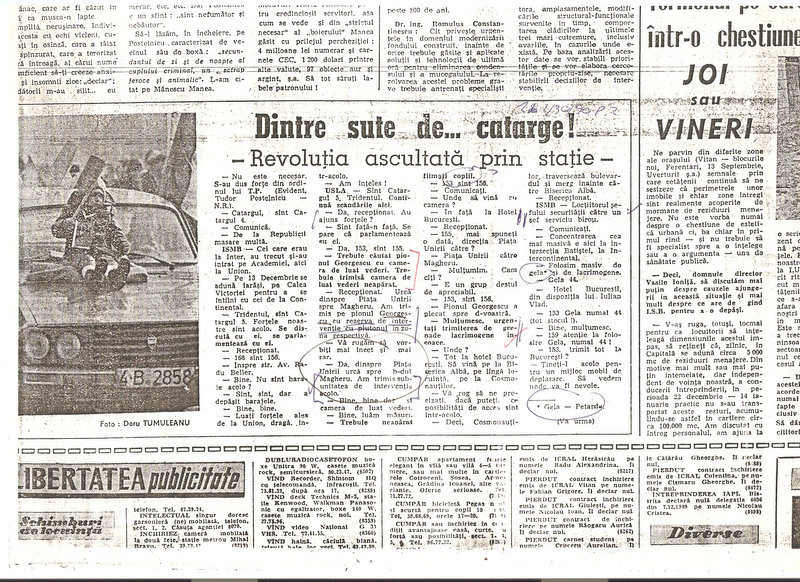
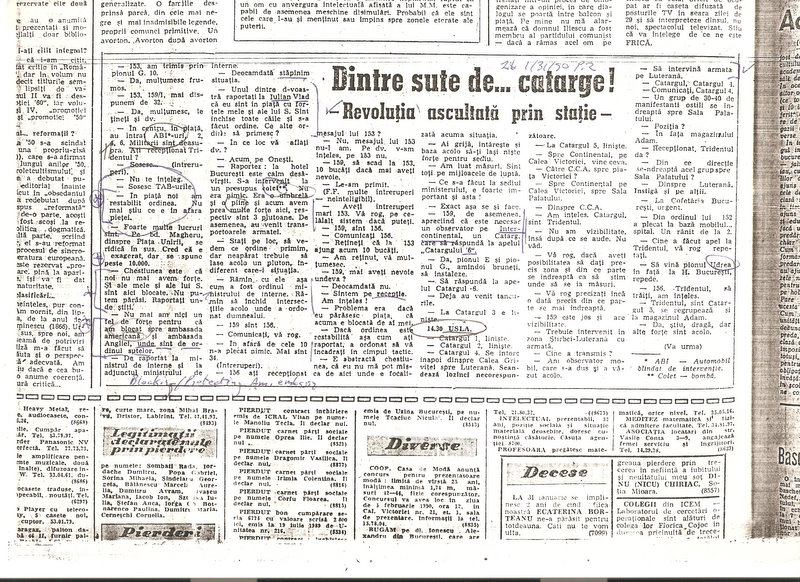
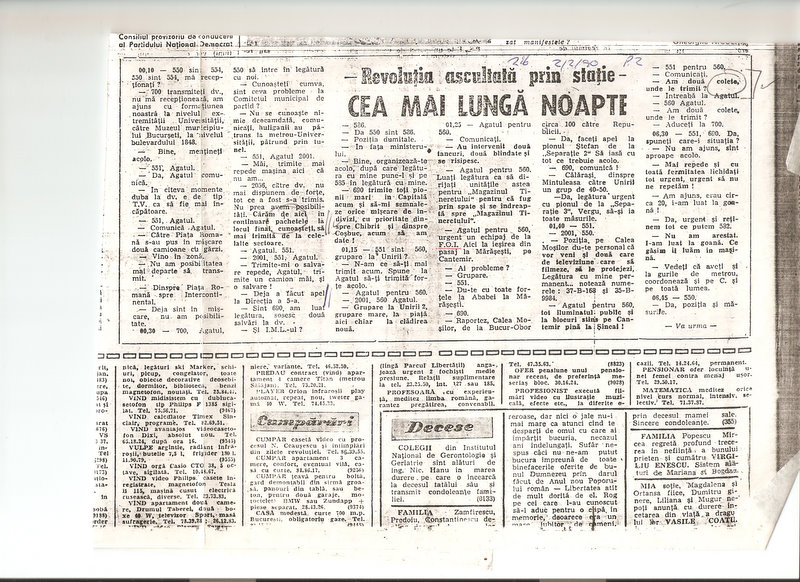
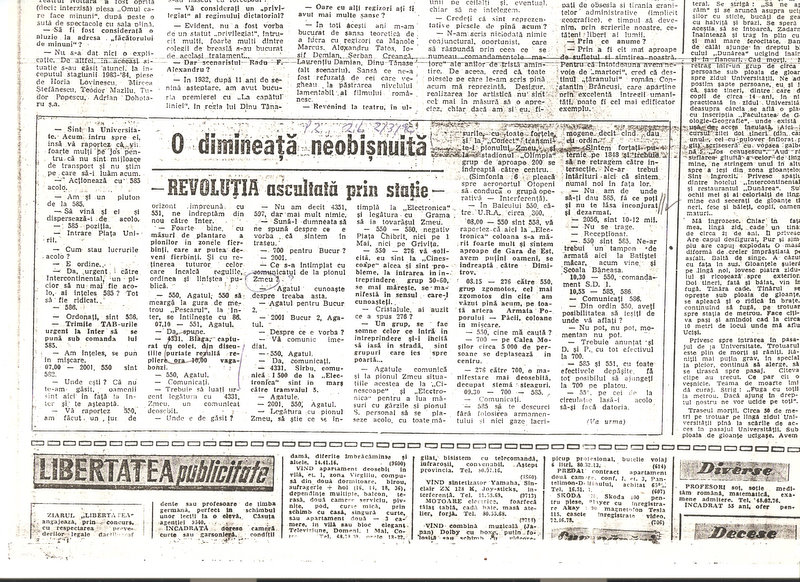
The partial transcripts of communications among USLA and Militia units on 21 and 22 December in Bucharest were published in late January-early February 1990 in the daily Libertatea.[77] These transcripts suggest that even before the rally had begun, large groups of demonstrators had gathered at a number of the intersections leading onto Palace Square, were shouting anti-regime slogans, and were taxing the capacity of the regime forces to prevent them from entering the square.[78] The demonstrators apparently realized well the tremendous opportunity offered them by the live national broadcast of this rally. Thus, the impression left by most accounts–that it was a few, isolated, brave men, within a crowd of tens of thousands of automatons, who had dared to challenge Ceausescu–is simply romanticized. The actions of those prevented from entering the meeting probably emboldened those in the crowd to shout down Ceausescu.

The transcripts also show that on the order of Securitate Director General Vlad, the USLA used “gela” (the Securitate reference for “petardes”) against the demonstrators.[79] Ilie Stoian alleges that General Grigore Ghita, the commander of the Securitate’s uniformed troops, “violated his brief” when he incorporated units of the USLA, including a “geniu-chimic” unit (which would have been in charge of tear-gas), among the regime forces assigned to work the rally.[80] Yet such an action does seem in accordance with Interior Ministry Order No. 2600. Moreover, even the Senatorial commission’s report illustrates that the security for the rally of 21 December was left almost entirely in the hands of the Securitate, and that General Vlad’s deputy, General Gianu Bucurescu, was given personal charge of the rally.[81]

It appears then that a key factor contributing to the disruption of Ceausescu’s speech was the attempt by regime forces to hold off anti-Ceausescu demonstrators from entering Palace Square. This commotion and confusion so changed the complexion of the rally that those among the crowd handpicked to attend took advantage of the opportunity and suddenly switched from chanting pro-Ceausescu slogans to jeering and booing the dictator. It is possible that the “petarde” at the rally was launched by the Securitate, but it is unlikely it did so as an act of defiance against the dictator. The “petarde” may have been used to prevent protesters from entering the square or to disorient the crowd and mask the sound of the anti-Ceausescu slogans. The disruption of the rally may therefore have been far less “organized” than has commonly been presumed.

[31].. R.M., “Dezvaluiri [Revelations],” Romania Libera, 19 January 1993, 1. Radulescu died in 1994.

[32].. Ibid. Presumably that foreign power would have been the Soviet Union.

[33].. Nicolae was probably improvising. A tape of the rally broadcast on a Bucharest FM radio station in December 1993 recorded Elena yelling at her husband: “Promise them something! Promise them anything!”

[34].. Rates, Romania: The Entangled Revolution, 39; Rady, Romania in Turmoil, 100.

[35].. See the series “Intercontinental 21/22″ in Romania Libera, especially for 31 March 1990, 1 April 1990, 2 April 1990, 5 April 1990, and 6 April 1990. There is no reason to believe that those Bacanu presented did not actually shout down Ceausescu at the rally. The issue is the context in which Bacanu chose to present their actions.

[36].. Leon’s notoriety also apparently stemmed from his exposure in a well-known documentary series entitled “Noaptea Generalilor” [The Night of the Generals] which appeared on Romanian television during 1990. This television series was also produced by Petre Mihai Bacanu.

[37].. Ratesh, Romania: The Entangled Revolution, 39.

[38].. Nicola Leon, “You took away our rights and gave us lice and fear,” The Globe and Mail, 20 December 1989, A7. In spite of the slight difference in name, Nica Leon has claimed that this is his letter and there seems little reason to doubt that this is the case. Nicola Leon is described as a “34-year old mechanical engineer living in Bucharest,” details which generally fit with Nica Leon’s background. It is unclear when this open letter arrived at the newspaper.

[39].. See, for example, his comments in Sorin Rosca Stanescu, “Mai putine flori, mai multi participanti,” Romania Libera, 24 April 1990, 3.

[40].. Nica Leon, interview by editorial board, “Nica Leon in razboi cu toata lumea,” Flacara, no. 34 (26 August 1992), 4-5.

[41].. Stoian, Decembrie ‘89, 23.

[42].. Nica Leon, interview by Angela Bacescu, Europa, March-April 1994, 2, 3. Bacescu introduced Leon as president of the Liberal Democratic Party and member of Amnesty International (!). Among the many dubious claims in this interview is the allegation that Elena Ceausescu had been plotting a coup d’etat against her husband set for 30 December 1989.

[43].. See, for example, Nica Leon, interview by Liviu Valenas and Daniela Rainov, “Lovitura de palat din Romania [The Palace Coup in Romania],” Baricada, no. 36 (18 September 1990), 3.

[44].. Rasvan Popescu, “Moda lui Jos,” Expres, no. 13 (27 April-3 May 1990), 2. For the significance of his denial of the existence of the “terrorists” see chapters seven and eight.

[45].. Leon, interview, “Lovitura de Palat.”

[46].. Bacanu, “Intercontinental 21/22,” 5 April 1990, 3.

[47].. Bacanu, “Intercontinental 21/22,” 6 April 1990.

[48].. Ibid.

[49].. Leon proudly admits to this in Leon, interview, “Lovitura de palat.”

[50].. See the six-part series by Maiorul A.D. (apparently Major Aurel David, who was one of four Fifth Directorate officers tried and acquitted in March 1990) entitled “Scenariile si Realitatea. Marturie la dosarul ‘Teroristi’,” which appeared between January and March 1991 in Timpul. It is significant to note that when this series appeared Nica Leon was still a welcome member of the opposition.

[51].. Maiorul A.D., “Scenariile si Realitatea (VI),” Timpul, 1 March 1991, 11.

[52].. Bacescu, Din Nou in Calea, 161. USLA officer Romulus Garz refers to “officer David (one of four officers from Ceausescu’s guard)” and to the presence of Nica Leon among the prisoners he was held together with. Garz was arrested after the famous incident in front of the Defense Ministry on the night of 23/24 December–discussed in chapter seven.

[53].. See the interview with Nica Leon in Democratia, no. 4 (12 February 1990).

[54].. See Expres, 9 March 1990, 8.

[55].. Valenas and Rainov did raise this issue with Leon in Leon, “Lovitura de palat.” However, they refused to challenge his answers and almost appeared to embrace them. While Leon was still aligned with the opposition, the regime-supportive press alleged that he had been a Securitate informer code-name “Nelutu.” The allegation appeared in the Ceausist Romania Mare, and the daily Azi, closely-linked to then Prime Minister Petre Roman, see Expres Magazin, no. 32 (13-20 August 1991), 2. Nica Leon himself–almost proudly–lists all the allegations launched against him (including that he was related to the Ceausescus) in Leon, “Nica Leon in razboi cu toata lumea,” Flacara, no. 34 (26 August 1992), 4. He avoids commenting on their validity, however.

[56].. Raportul Comisei Senatoriale pentru cercetarea evenimentelor din decembrie 1989, “Cine a tras in noi, in 16-22?” Romania Libera, 27 May 1992, 5.

[57].. Stoian, Decembrie ‘89: Arta Diversiunii, 23. It was only after this, Stoian maintains, that Nica Leon delivered his famous shout.

[58].. Tudorel Urian, “Cabala Teroristilor,” Cuvintul, no. 20 (13 June 1990), 4.

[59].. The suspects are legion: The dubious Nica Leon claims that a 60-year old man named Andrei Ilie, “who kissed Iliescu when he arrived at the CC [building on 22 December],” threw the petarde (Leon, interview, “Nica Leon in razboi.”). Opposition journalist A. Corneliu Giagim writes that the “author” of the petarde was Matei Ilie who had assembled it out of an aerosol can (A. Corneliu Giagim, “16-22, Cine-a tras in noi?!” Baricada, no. 49-50 (18 December 1990), 6.). In early 1990, Petre Mihai Bacanu confidentially stated that a young man named Adrian Constantin had thrown the petarde (Bacanu, “Intercontinental 21/22,” 31 March 1990, 1.). Whereas Bacanu had been able to interview Nica Leon and the young aviation mechanics who had started the chants against Ceausescu, he had been unable to track down Constantin to speak with him. Dan Iosif, the Front official who accused Leon of being a “terrorist,” has also been proposed as the source of the petarde (Expres Magazin, no. 30 (20-26 February 1991), 8.). There are likely others who have been credited with this act.

[60].. C. Maltese Martine Ui (possibly a pseudonym), “De la ‘Jos Ceausescu!’ am ajuns la ‘Jos Romania!’ Dubla Lovitura impotriva Romaniei” Democratia, no. 48 (December 1990), 3.

[61].. A Group of Former Securitate Officers, “Asa va place revolutia! Asa a fost!” Democratia, no. 36 (24-30 September 1990), 4. Also, see a translation of this article in FBIS-EEU-90-207, 25 October 1990, 50-53.

[62].. “S.V., reserve USLA officer” (perhaps Strat Vintila, based on other accounts), in Pavel Corut, Floarea de Argint (Bucharest: Editura Miracol, 1994), 171. In fact, the description of these men as wearing knee-length woolen coats and hats makes them sound suspiciously like the Securitate and the USLA themselves, as we shall see later.

[63].. “Fapte care trimit la o actiune premeditata a unor ‘actori’ din afara (II),” Curierul National, 10 July 1994, 2.

[64].. Ibid. Former deputy prime minister and senator, Gelu Voican Voiculescu, makes similar allegations. He claims that the explosion was caused by a “handcrafted petarde” (”o petarda artizanala”) made from an aerosol can. He too suggests that the panic was intensified by the “perhaps purposeful” malfunction of the loudspeaker system and the emission of a terrifying sound which resembled the “rumbling of tanks.” Voiculescu adds that “it is also possible…that there was a type of ‘acoustic bomb.’” Gelu Voican Voiculescu, interview by Neti Luchian and Val. Voiculescu, “‘Haosul nostru i-a paralizat (I),” Libertatea, 16 July 1991.

[65].. Cornel Nistorescu, “Complot sau conspiratie cu pretentii la putere? [Plot or conspiracy with pretensions to power]” Cuvintul, no. 20 (13 June 1990), 5.

[66].. Ecaterin Radoi, “Remember 15 decembrie 1989 – 20 mai 1990,” Zig-Zag, no. 190 (23-31 December 1993), 4-7.

[67].. Sofia Domestic Service, 1400 GMT 21 December 1989, in FBIS-EEU-89-244, 21 December 1989, 71.

[68].. Belgrade TANJUG Domestic Service, 1359 GMT 21 December 1989, in FBIS-EEU-89-245, 22 December 1989, 77.

[69].. Belgrade Domestic Service, 1410 GMT 21 December 1989, in FBIS-EEU-89-244, 21 December 1989, 70-71.

[70].. Ibid.

[71].. See accounts in Bacanu, “Intercontinental 21/22,” 15 March 1990; 5 April 1990; 19 April 1990.

[72].. See the comments of Marcel Constantinescu in Bacanu, “Intercontinental 21/22,” 15 March 1990, 3.

[73].. Rady, Romania in Turmoil, 104.

[74].. Emil Munteanu, “Postelnicu a vorbit neintrebat [Postelnicu spoke without being asked to],” Romania Libera, 30 January 1990, 3.

[75].. Stoian, Decembrie ‘89: Arta Diversiunii, 22. Stoian’s “spin” on this event, however, is that people were not allowed to enter the square because “something was being awaited,” thus insinuating that the disruption of the rally was organized in advance.

[76].. See the comments of Nistor Ruxandoiu in Gheorghe Ionita, “Culcati-i la pamint!” Adevarul de Duminica, 14 January 1990, 2.

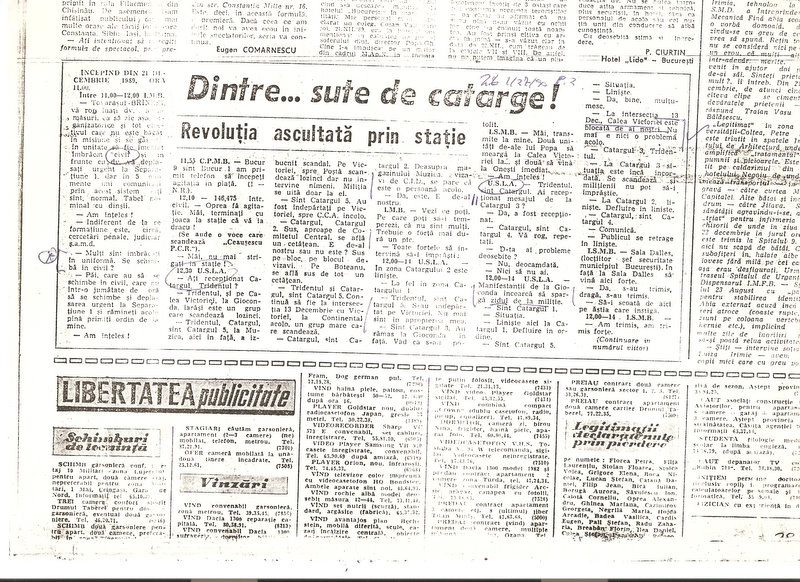
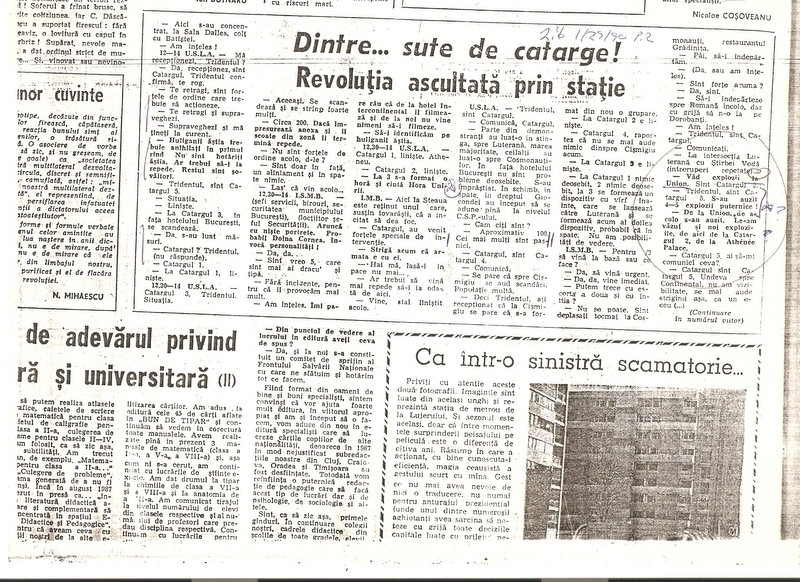
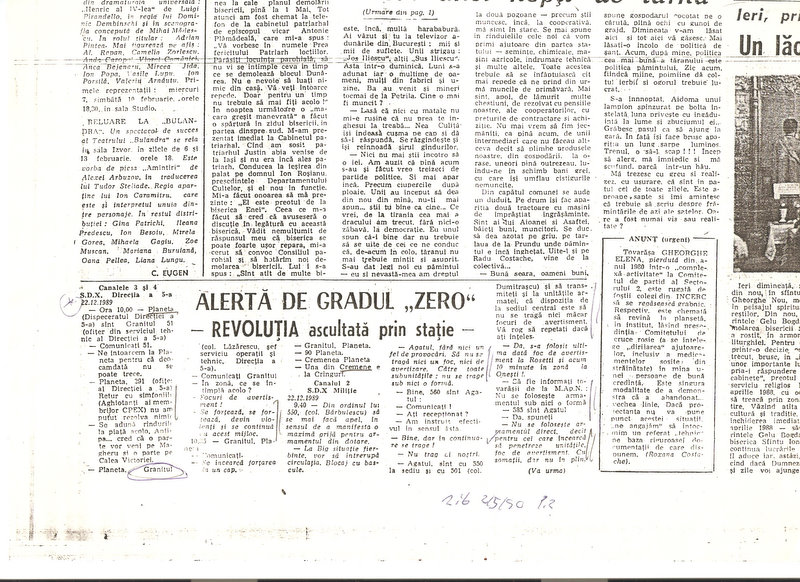
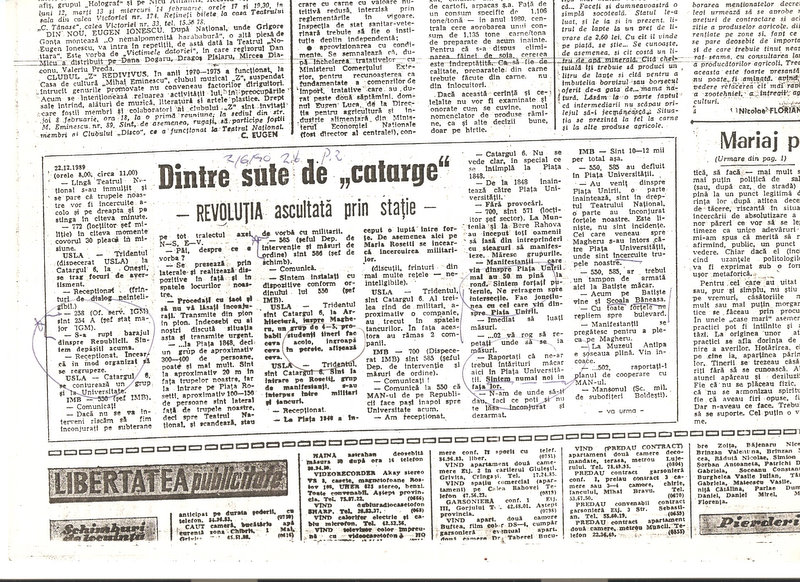
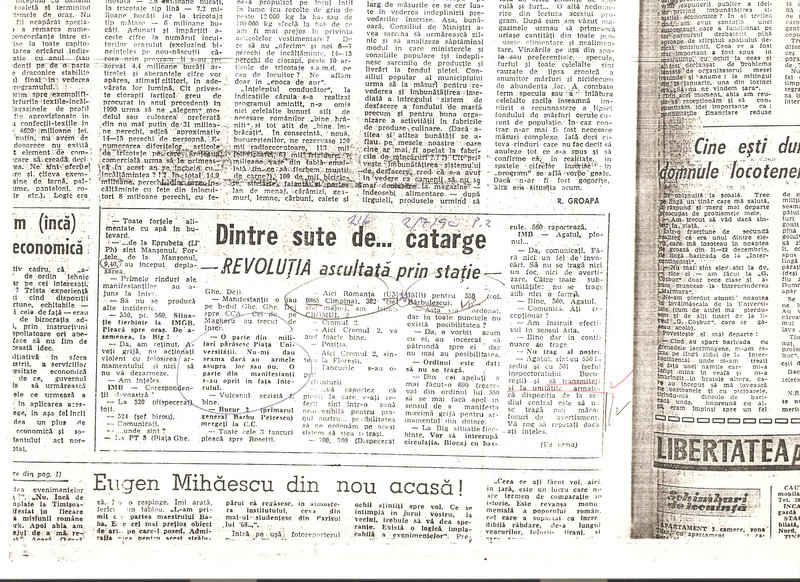
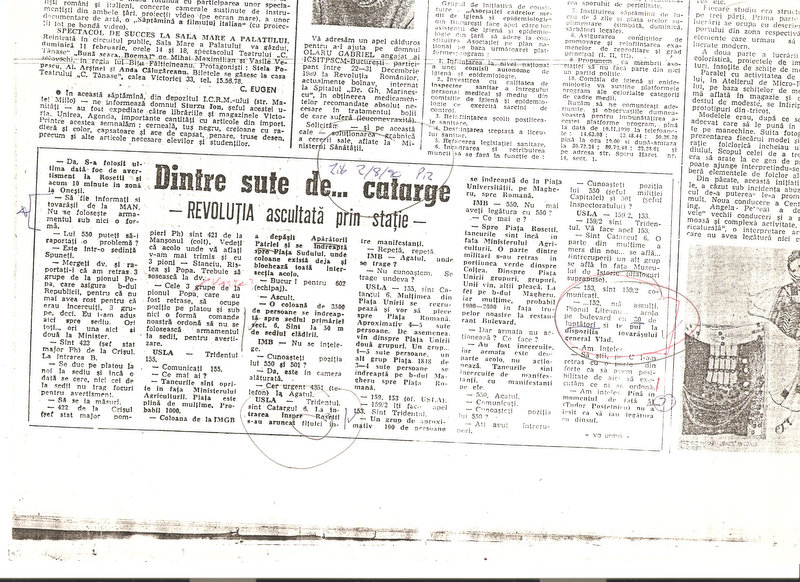
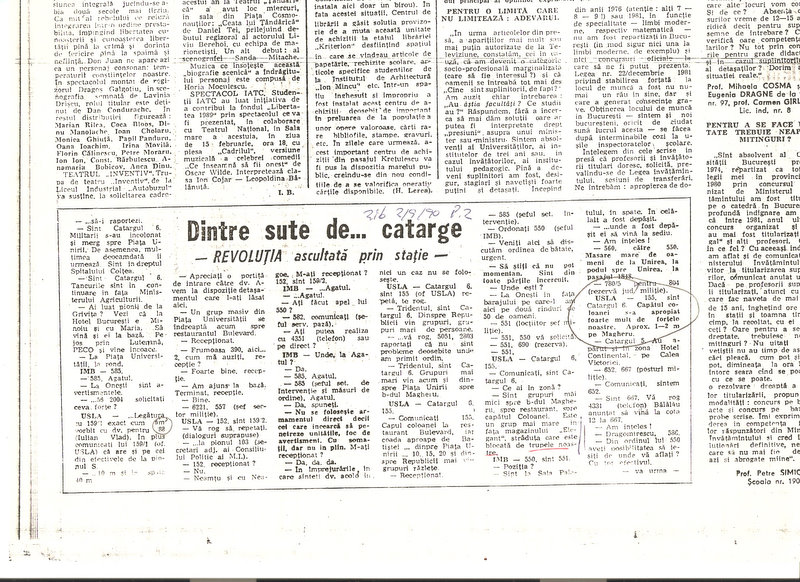
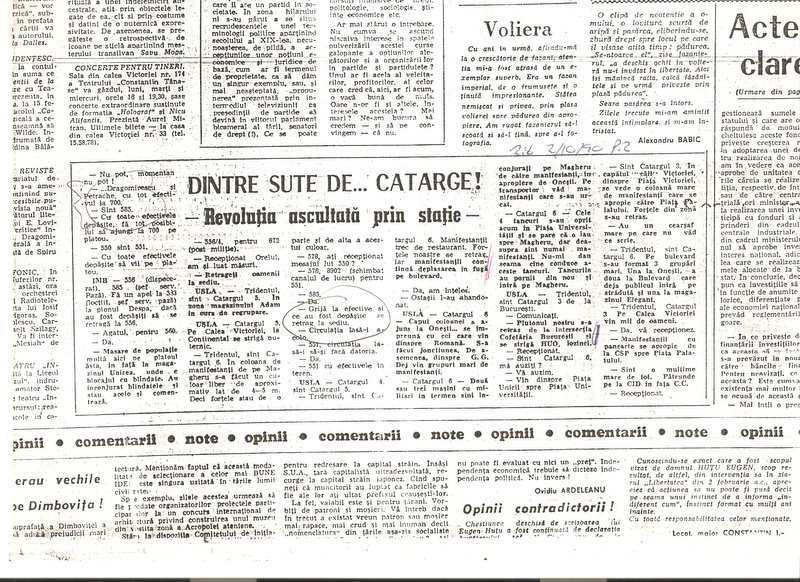
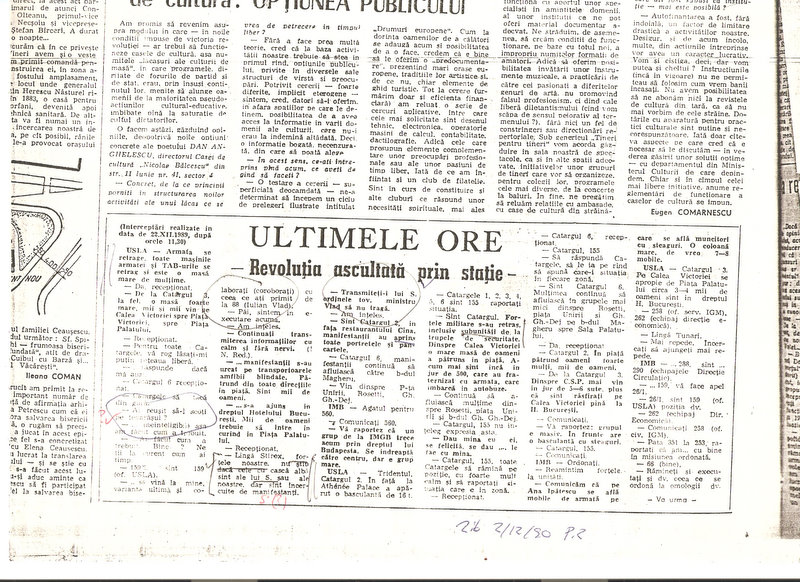
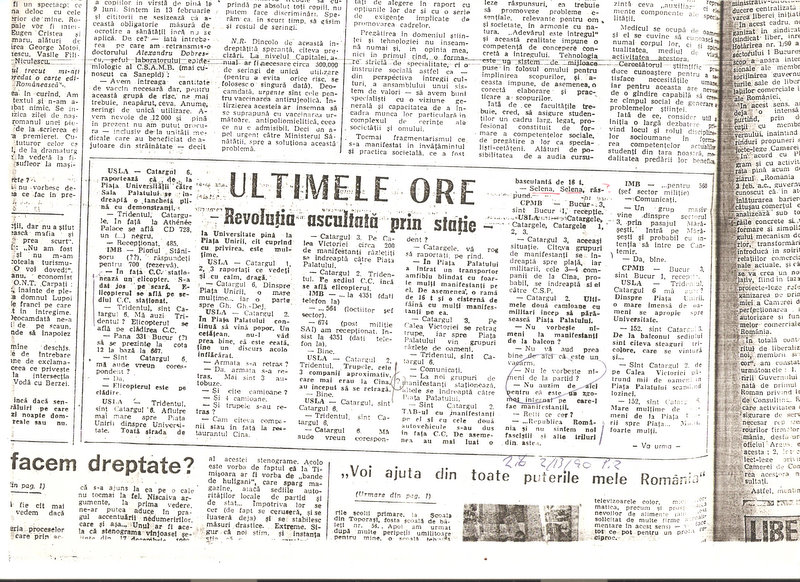
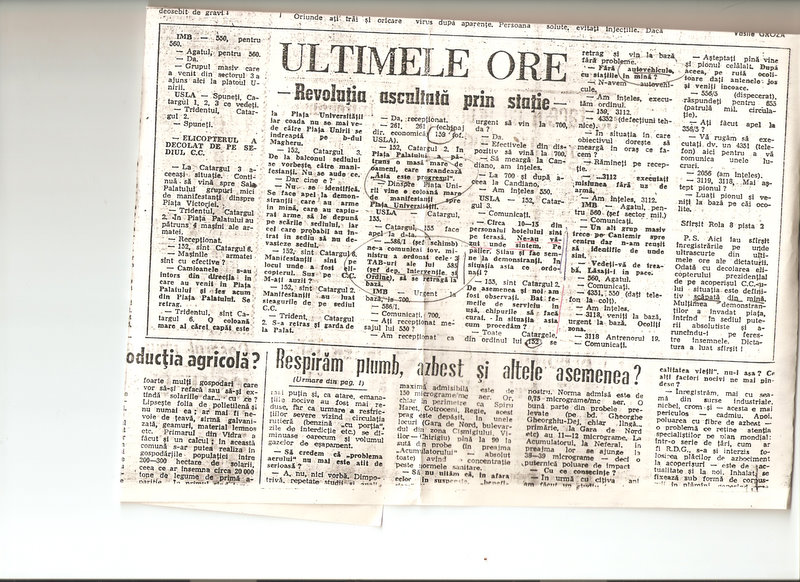
[77].. Published in Libertatea between 27 January and 15 February 1990 under the heading “Dintre sute de…catarge! Revolutia ascultata prin statie [From…hundreds of “masts” (radio identification for USLA officers conducting surveillance) Scanning the Revolution].” Such recordings could have come from only one source: the former Securitate. Interestingly, with the exception of one episode (3 February 1990), all of these communications come from the afternoon of 21 December or morning of 22 December. There are no communications for the USLA from 3:30 p.m. 21 December until 8 a.m. 22 December–the period during which regime forces opened fire on the demonstrators.

[78].. “Dintre sute de catarge,” 27 January 1990; 29 January 1990.

[79].. “Dintre sute de catarge,” 30 January 1990, 2. An anonymous editor defines the meaning of “gela” as “petarde” at the close of this episode. Stefanescu confirms the use of “petardes” in his statement that the USLA commander, Colonel Gheorghe Ardeleanu, was seen at the Central Committee building shouting to a subordinate “Give me ‘Gela’…Give me ‘Gela’.” According to Stefanescu, ‘Gela’ was the name of a “petarde” used by the USLA in the repression of demonstrators. Paul Stefanescu, Istoria Serviciilor Secrete Romanesti (Bucharest: Editura Divers Press, 1994), 287.

[80].. Stoian, Decembrie ‘89: Arta Diversiunii, 21.

[81].. Raportul Comisiei Senatoriale, “Cine a tras in noi, in 16-22?”

Timisorenii au “stricat” mitingul din 21 decembrie
Marti, 15 decembrie 2009 Sursa: Romania Libera Autor: Petre Mihai Bacanu

Mult timp nu s-a stiut cine a “stricat” mitingul lui Ceausescu din 21 decembrie 1989. Au aparut fel si fel de personaje care si-au arogat acest merit. Acum se stie ca acest fapt se datoreaza unor grupuri de timisoreni care s-au deplasat la Bucuresti. Satui de lupta, nu mai aveau frica si, practic, au fost nevoiti sa plece din Timisoara ca sa anunte ce se petrece acolo. La Timisoara se strigase “Lasilor, veniti cu noi!”, timisorenii avand impresia ca romanii ies greu la Revolutie. Suntem in posesia unor
marturii despre implicarea timisorenilor in declansarea scanteii de la Bucuresti.

Acuza ca i-a fost ucis sotul la Timisoara
ION ION, prelucrator prin aschiere IEI Bucuresti, 19 ani (in 1989): “In dimineata zilei de 21 decembrie 1989, o mare parte din lucratori se aflau la miting in Piata Palatului. Dupa un timp, am plecat si eu in oras. In timp ce ma deplasam pe Calea Victoriei spre Piata Palatului, sa fi fost ora 12.00, am vazut ca strada era blocata de un cordon de militieni in dreptul Hotelului Bucuresti.


M-am alaturat unui grup de civili care doreau sa treaca de acest cordon, incercand sa discutam cu cei din dispozitiv. O femeie din grupul nostru a strigat disperata, acuzand ca i-a fost ucis sotul la Timisoara. A fost retinuta de un militian. In momentul in care acesta a inceput s-o loveasca cu bastonul, au intervenit mai multi civili, creandu-se astfel un conflict deschis intre noi si militieni. In scurt timp a luat amploare, implicandu-se mai multi civili, iar din partea fortelor de ordine facandu-si aparitia un cordon de militari ai Armatei care s-au postat in fata militienilor si ne-au somat spunand ca vor face uz de arma.


Dupa un timp, au tras cu armele in plan vertical. S-a creat o ambuscada, noi, civilii, alergand in directia opusa acestora. In dreptul coltului din dreapta hotelului si-au facut aparitia trei camioane militare cu prelata, din care au coborat soldati cu casti albe cu vizeta si arme automate cu pat rabatabil. Ne-au blocat retragerea. Am fost imobilizat de patru soldati care m-au lovit cu patul armei in zona occipitala, apoi cu bocancii in toate partile corpului. Tot timpul eram filmati de la o fereastra a hotelului – etajul doi sau trei. A aparut in zona Postelnicu, care i-a spus unui civil care-l insotea sa ma impuste, insa a intervenit unul dintre soldatii care ma retinuse. Am fost dusi la Circa 1 Militie, batuti din nou, in final transferati la Jilava”.

Timisorenii s-au pierdut printre cei adusi la miting
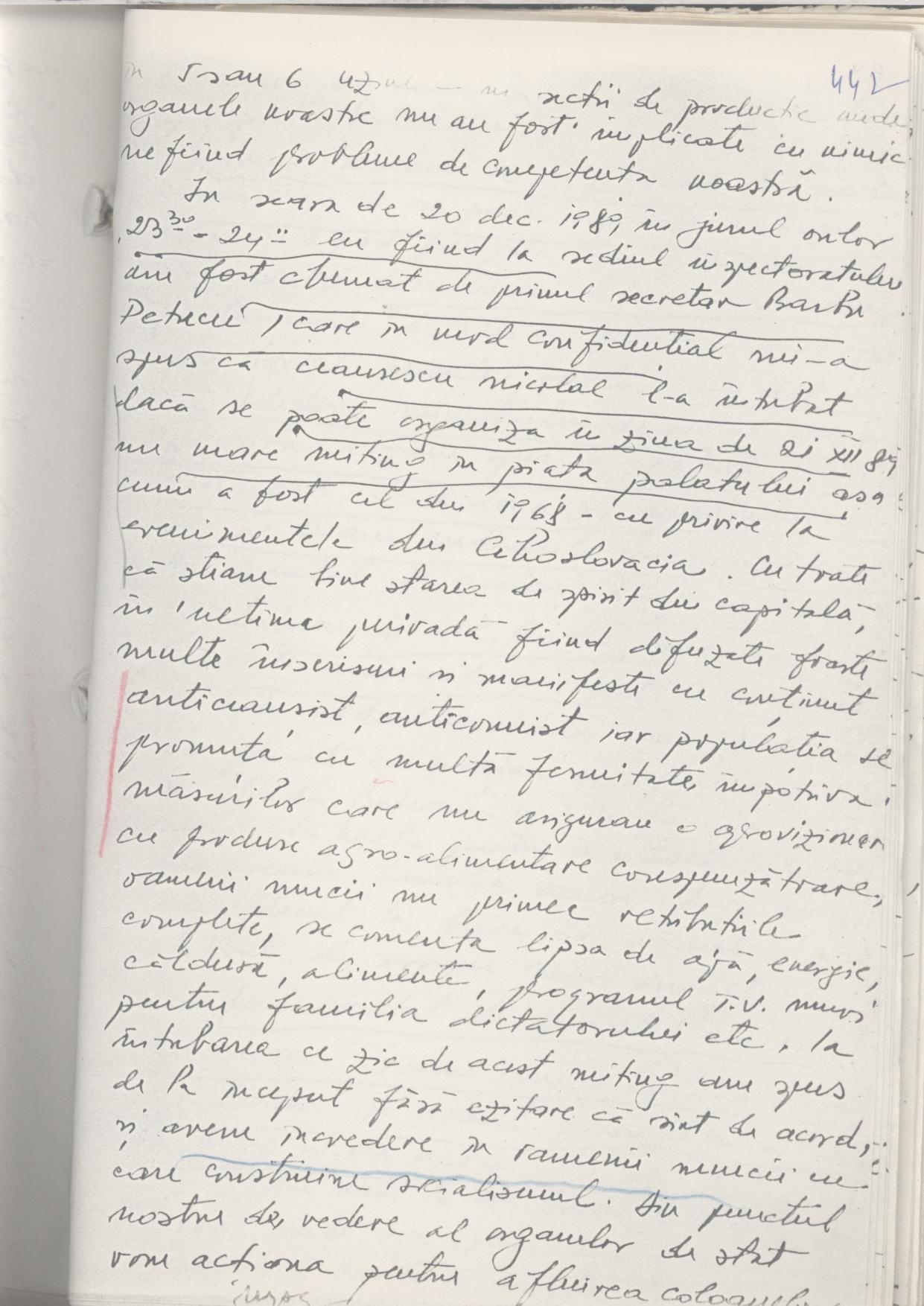
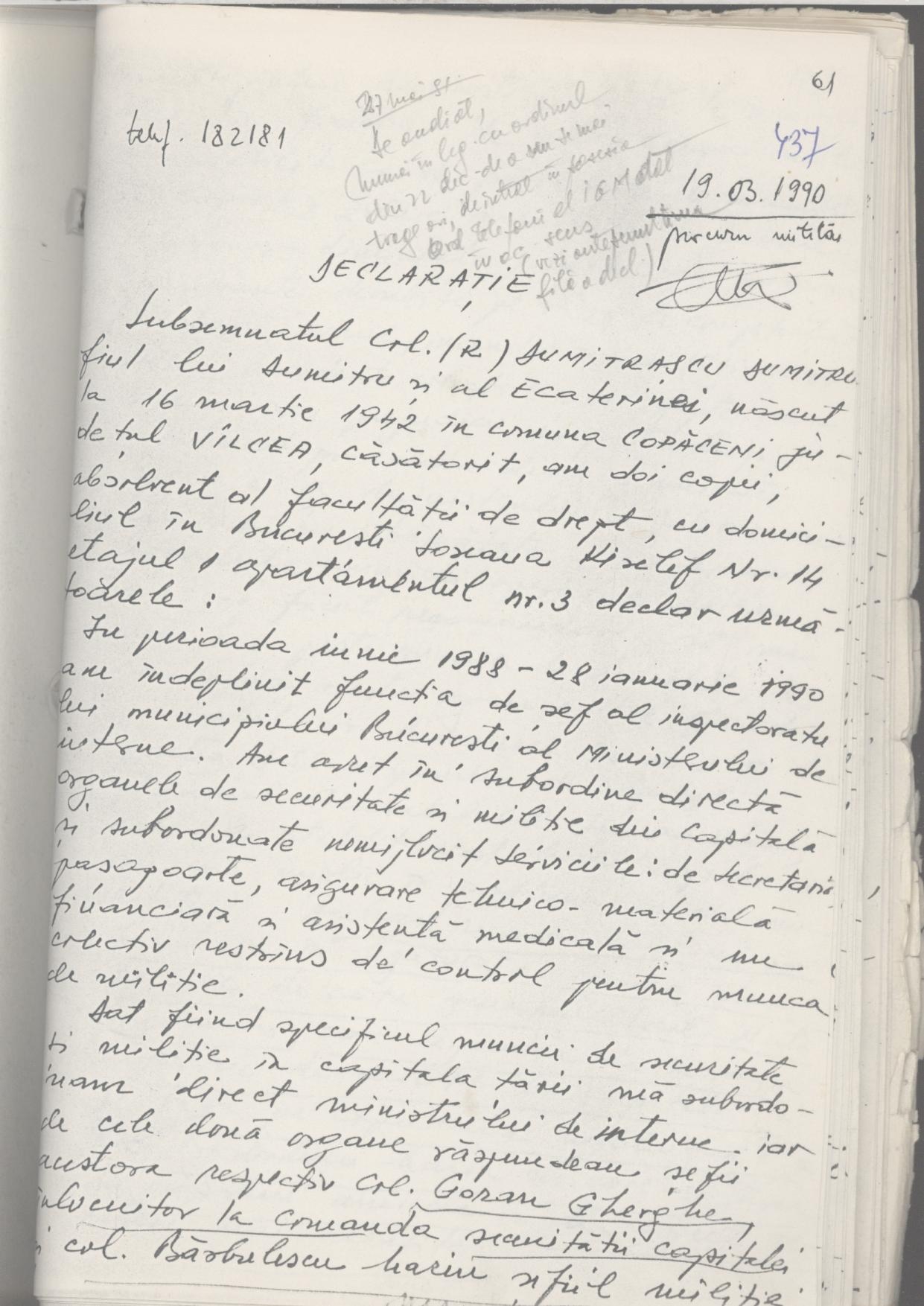
DUMITRU SMEDESCU, colonel, lucra la Serviciul asigurare tehnico-materiala si financiara la Militia Capitalei. Aflase despre evenimentele de la Timisoara de la colegii sai. In ziua de 21.12.1989, la ora 6.00, a primit un telefon sa se prezinte imediat la serviciu, deoarece urma sa aiba loc un miting in Piata Palatului. Era seful unui dispozitiv compus din 20 de ofiteri care au luat pozitie la aproximativ 270 metri de intrarea principala in CC, in apropierea actualei statui a lui Iuliu Maniu. De organizarea mitingului s-au ocupat cei de la Armata, colonelului Smedescu parandu-i-se curios, deoarece la alte mitinguri de organizare se ocupau cadre ale Securitatii si Militiei. Difuzoarele dispuse in Piata Palatului au fost aduse de cei de la Armata. Dispozitivul de comanda se afla amplasat in incinta Bibliotecii Universitare.


“In jurul orei 12.00, in timp ce Ceausescu facea referire la evenimentele de la Timisoara si la marirea salariilor, s-a auzit un zgomot puternic, iar lumea a intrat in panica. Initial, pentru mitingul ce urma sa inceapa la ora 8.00 au fost solicitate sa participe anumite persoane, in special membri de partid. Amanandu-se pentru ora 10.00, nu au mai fost doar persoanele selectate initial. In spatele Palatului Regal au sosit mai multi cetateni de la Timisoara, care s-au pierdut printre cei ce participau la miting si au inceput sa scandeze lozinci anticomuniste si anticeausiste.”


S-a creat agitatie in multime
MIHAITA BALINT avea 19 ani in decembrie 1989 si era cioplitor la “Marmura”. La spargerea baricadei, in noaptea de 21 spre 22 decembrie, a fost impuscat in partea inferioara a tibiei piciorului drept.
“Cand am ajuns in Piata Palatului, mai exact in apropiere de Biblioteca Universitara, am vazut un grup de 30-40 de tineri care spuneau ca sunt din Timisoara. Venisera dinspre strada stirbei Voda, au intrat in multime si au inceput sa scandeze lozinci anticeausiste si despre victoria revolutiei de la Timisoara. Imediat, mai multi participanti au inceput sa-l huiduie pe Ceausescu, creandu-se agitatie in multime. In momentul in care au inceput sa se auda tipete si lumea se indrepta spre caile de iesire, am plecat si eu din piata, deplasandu-ma pe strada Onesti pana in zona Intercontinental, unde credeam ca suntem protejati de prezenta reporterilor straini. Am ramas pana dupa distrugerea baricadei, cand am fost impuscat.”

Studenta din Timisoara si-a cautat prietenul la morga Spitalului Coltea
MARIOARA TRONARU, lucratoare la bucataria Spitalului Coltea: “Pe 21 decembrie, in jurul orei 22.00, un tanar a fost impuscat in cap dupa ce s-a adapostit in curtea spitalului. Avea in jur de 20-23 de ani. Dupa aproximativ 30 de minute, o tanara cam de aceeasi varsta cu cel impuscat si care spunea ca este studenta la Timisoara a venit sa-l caute. Brancardierii au condus-o la morga, iar tanara l-a recunoscut pe cel decedat ca fiind prietenul ei, tot student la Timisoara. A declarat ca venisera mai multi din Timisoara pentru a-i mobiliza pe bucuresteni”.

Veneau din orasul inchis
PETRE CAPRARU, lucrator la Directia de Telecomunicatii: “Pe 21 decembrie, pe la pranz, am plecat spre Spitalul Coltea, sa-i duc un pachet surorii mele, internata. Grupuri de cetateni speriati veneau dinspre Sala Dalles. Mi-au spus ca mitingul oficial a fost spart. Au inceput repede sa protesteze la indemnul unor cetateni din tara. Un tanar de vreo 30 de ani, inalt, spunea ca era din Timisoara si a venit special la Bucuresti cu mai multi care scapasera din orasul inchis. Sa ne spuna si noua ce se intampla cu ei la Timisoara si ca au fost maltratati. Acestia strigau: «Nu va fie frica, Ceausescu pica!» si «Jos tiranul!». Indemnau trecatorii sa se solidarizeze, sa nu plece, ca sa nu mai fie chemati ciomagarii de la Timisoara”.

Tanarul din Timisoara avea in mana o cutie
ADRIAN UTALE lucra ca tehnolog productie la Combinatul Casa Scanteii. In dimineata zilei de 21 decembrie a fost scos, cu alti colegi, la ora 7.00, la mitingul din fata CC.
“Din ora in ora ne aliniau in fata intrarii principale a Casei Scanteii si apoi reveneau la directia luata. In jurul orei 11.00 ne-am indreptat pe jos catre Sala Palatului. Pe la ora 11.40, in timp ce ne aflam in centrul pietei, spre Biblioteca si Athenee am vazut langa mine un tanar care ne-a zis ca era din Timisoara si avea in mana o cutie. Ne-a zis: «O sa vedeti ce o sa se intample». Mitingul a inceput in jurul orei 12.00. Dupa ceva timp, tanarul a declansat o mica explozie, probabil o petarda; in jurul orei 12.30 s-a auzit o bubuitura in centrul manifestatiei, ceea ce a dus la haos total.”


Coloana stransa de manifestanti era din Timisoara
PETRU GIURA, strungar la IRA Grivita. Este victima a evenimentelor din decembrie: “Am ajuns la miting in tinuta civila, dupa ce in prealabil ni se spusese sa ne imbracam in cea a garzilor patriotice. Ne-au distribuit langa un sir de megafoane din care in timpul mitingului se auzeau aplauze inregistrate pe banda. In timpul discursului lui Ceusescu, cand s-a auzit o bubuitura, participantii la miting au fugit in toate directiile. Am luat-o spre strada Brezoianu. Am intalnit o coloana stransa de manifestanti, respectiv cate cinci in linie, care scandau lozinci anticeausiste. Acestia spuneau ca sunt de la Timisoara. Initial ne-am speriat si am fugit din calea lor, luand-o spre Romarta Copiilor. Am ramas insa la Intercontinental si am participat la toate evenimentele, pana am fost impuscat la Televiziune, pe 23 decembrie”.

“Nu cumva esti din Timisoara?”
GHEORGHE POPA era in decembrie 1989 sef de birou desfacere la Intreprinderea Poligrafica “Luceafarul”: “Am fost chemati la serviciu la ora 5.00 pentru mitingul din 21 decembrie. Noi am ocupat pozitia din dreptul restaurantului «Cina». Un activist de partid l-a controlat in geanta pe un coleg de-al meu, dar avea la el o sticla cu ceai si paine prajita. Am intervenit spunand ca este bolnav de ulcer, dar activistul a chemat un militian, care mi-a luat legitimatia de serviciu pe motiv ca produc agitatie. In timpul discursului lui Ceausescu s-a auzit un zgomot puternic in sistemul de sonorizare. Cand manifestantii s-au raspandit in toate directiile, am plecat cu mai multi colegi spre Bd. Magheru. In zona Hotelului Nehoiu am fost opriti de militieni si legitimati. Cum mie imi fusese confiscata legitimatia si nu aveam nici un act de identitate la mine, militianul m-a intrebat: «Nu cumva esti din grupul de la Timisoara?». Mi-a aplicat cateva lovituri cu bastonul, dupa care m-a lasat sa plec”.

“Fratilor, la Timisoara va mor copiii si fratii!”
IOAN PaUN lucra in decembrie 1989 ca laborant foto la Casa Scanteii: “La miting am fost pozitionati intre Palatul Regal si Biblioteca Universitara. Atmosfera era incordata. Am observat in coloana noastra multi civili pe care nu-i cunosteam. In timp ce Ceausescu se adresa multimii am vazut in apropierea noastra doi tineri care fluturau doua steaguri. Aveau accent ardelenesc. Unul dintre ei, de vreo 30 de ani, cu fata spre mine, a strigat: «Fratilor, la Timisoara va mor copiii si fratii!». Pe al doilea nu l-am vazut la fata. La scurt timp am auzit o bubuitura, o petarda, banuiesc, care a panicat multimea”.

Indemnau pasagerii sa li se alature
STEFAN DIMA, medic stomatolog: “Lucram ca medic la Calmatuiul de Sus si faceam naveta cu trenul pana la Rosiori. Pe 21 decembrie am vazut, pe la 16.00, in zona Piata Romana, cum fortele de ordine incercau cu disperare sa disperseze grupurile de manifestanti. Dimineata am plecat la serviciu cu trenul Bucuresti-Timisoara. Acesta a oprit neasteptat intre statii, concomitent cu aceeasi cursa care venea dinspre Timisoara. Intre pasagerii celor doua trenuri oprite paralel au avut loc discutii referitoare la evenimentele de la Timisoara. In trenul Timisoara-Bucuresti erau multi pasageri imbracati in doliu, avand steaguri si banderole tricolore. Scandau lozinci anticeausiste si indemnau pasagerii din trenul in care ma aflam sa li se alature”.

“Am intrat in multime strigand: «Timisoara, Timisoara!»”
LULCIUC CONSTANTIN, Timisoara: “In dupa-amiaza zilei de 20.12.1989, in timp ce ma aflam in filtrul ce se organizase langa gara din Timisoara, respectiv langa Militia TF, am fost chemati de Chira Vasile si Pantar Teodor, care mi-au spus sa ma deplasez in Piata Operei, deoarece, pe baza de voluntariat, se pleaca in Bucuresti, ca si in alte localitati – Brasov, Iasi, Sibiu, Ploiesti. Scopul principal era de a spune ce s-a intamplat in acele zile in Timisoara, dar si faptul ca se anuntase ca orasul Timisoara va deveni teren arabil, ca va fi exterminat. Am plecat aproximativ 30 de timisoreni, printre care Vasile Chira, Dumitru Pava, Teodor Pantar, Constantin Tataru, Dumitru Gherman, pentru a-i anunta si pe bucuresteni de cele intamplate la noi in oras. Am luat cu noi un steag cu stema decupata. Pe data de 21.12.1989, dimineata, in jurul orelor 6.30-7.00, am ajuns la Gara de Nord, ne-am deplasat pe jos, pe linia de tramvai, pana am ajuns in Parcul Cismigiu.


Ne-am continuat drumul pe jos pana in apropierea Bisericii Kretzulescu, unde am fost opriti de un cordon de militieni, deviindu-ne in partea stanga. Am incercat sa le explicam militienilor ca demonstram pasnic, dar intre noi si ei au intervenit divergente, moment in care steagul pe care noi il arborasem pe o creanga de copac ne-a fost luat, am fost imbranciti, moment in care am intrat in mijlocul multimii si am inceput sa strigam: «Timisoara, Timisoara!»”.

“Timisorenii ne explicau ca ei sunt liberi”
MARIANA SCHICHT, secretara ASE: “Pe 21 decembrie ne uitam obligatoriu la televizor la serviciu. Dupa intreruperea emisiunii, cu mai multi colegi si studenti, am plecat in Piata, alaturandu-ne altor manifestanti. Doi insi inalti, imbracati in negru, au tras la foc automat spre noi. Ranitii au fost dusi la Coltea, iar mortii au ramas pe loc. In fata Salii Dalles, sapte-opt morti erau aranjati in cerc. Cand s-a spart baricada, am luat-o spre magazinul Unirea, dar a venit o duba a Militiei in care au fost urcati mai multi manifestanti. Am fost luata in acel grup, insa un ofiter de armata m-a tras jos, intrucat tipam cat ma tinea gura. Impreuna cu alti manifestanti am ramas pana dimineata pe strazi laturalnice. Printre acestia erau si din Timisoara si ne explicau ca ei sunt liberi si ca bucurestenii trebuie sa se uneasca pentru a-l da jos pe dictator.

In noaptea de 22.12.1989, pe cand ma aflam in sediul CC, la parter, am observat o fata de aproximativ 16 ani, slaba, cu parul tuns scurt, care incerca sa intre in sediul CC. Pe data de 23 decembrie, dimineata, am aflat de la colegii fetei, care erau veniti de la Timisoara, ca aceasta a fost impuscata mortal in timp ce incerca sa escaladeze balconul. Unuia dintre baieti i se spunea «Lerurduzel» si era suparat ca murisera multi timisoreni.”

Au dat tonul protestelor
EUGENIU STAICU, electromecanic la MTTC: “La miting am ocupat zona din fata Hotelului Athenee Palace impreuna cu muncitorii din CFR care erau coordonati de secretarul de partid Teodor Carbunaru. Discursul lui Ceausescu a fost intrerupt de cateva ori de participantii la miting, care au inceput sa strige lozinci impotriva sa. Am aflat de la secretarul de partid Carbunaru ca un grup de tineri veniti de la Timisoara cu drapelul cu stema inlaturata a dat tonul acestor lozinci”.

Ei au scandat primii la Bucuresti: “Azi la Timisoara, maine in toata tara!”
CONSTANTIN MEDREGA, maistru montaj la Intreprinderea de Avioane Baneasa: “Eram acasa la televizor cand s-a intrerupt transmisia mitingului din Piata. Cum cei trei copii ai nostri se aflau la miting, am plecat sa vedem ce se intampla acolo. La Universitate, grupuri de manifestanti scandau lozinci anticeausiste. In fata Hotelului Intercontinental, un grup de aproximativ zece persoane, care au spus ca sunt de la Timisoara, scandau: «Azi in Timisoara, maine in toata tara!». Faceau apel sa ne alaturam lor.”

Grupul scanda: “Timisoara, Timisoara!”
TINCA CERNEA, casnica: “Pe data de 21 decembrie sotul meu a plecat in oras pentru a cumpara cadouri de Craciun
. La Izvor a aflat ca urma sa se organizeze un miting in Piata Palatului si din proprie initiativa a mers acolo. Mi-a povestit ca in timpul mitingului a intalnit un grup de manifestanti care scandau: «Timisoara, Timisoara!». S-a alaturat acestui grup si au plecat spre Comitetul Central, insa fortele de ordine i-au impiedicat sa ajunga in acea zona. Au coborat pe Calea Victoriei pana la CCA. Fiind mai in varsta, sotul meu s-a oprit sa se odihneasca, fiind retinut de trei indivizi in civil. A fost tarat in restaurantul Bulevard, fiind dus apoi la subsol si legat de maini si de picioare, impreuna cu alti demonstranti. Iar au fost batuti. In final, au ajuns la Jilava, unde au avut acelasi tratament
“.

“Sa povestim ce s-a intamplat la Timisoara”
CONSTANTIN TaTARU, Timisoara: “Pe data de 20.12.1989 ma aflam in Piata Operei. Aparusera zvonurile cu exterminarea Timisoarei. Cineva din multime ne-a sugerat sa ne deplasam in tara, dar mai ales la Bucuresti, sa povestim ce s-a intamplat in acele zile in oras, pentru a-i mobiliza pe bucuresteni sa ni se alature. Din Timisoara am plecat cu o coada de matura pe care am arborat un steag cu stema decupata”.

O timisoreanca, cu buletinul in mana, se ruga de lume sa reziste
SANDA MARIN, gestionara la un magazin din Bucuresti: “Cand am vazut la televizor cum s-a intrerupt transmisia la mitingul din Piata Palatului, am mers cu o colega in Piata Operetei, apoi in Piata Universitatii, unde tinerii demonstrau pe carosabil. Tinerii strigau lozinci anticeausiste. O tanara blonda a fost arestata de militieni. Am fost atacati si udati de fortele de represiune. Am vazut oameni cazand. Am vazut o femeie in jur de 50 de ani, cu buletinul in mana, care statea in genunchi pe carosabil si spunea ca a venit de la Timisoara, unde erau morti, si se ruga la lume sa reziste”.

Un video postat de catre tioluciano pe youtube

http://atomic-temporary-3899751.wpcomstaging.com/rewriting-the-revolution-1997-chapter-6-18-22-december-1989/

“Interceptarile si transcrierile pe foile de goniometrare au fost efectuate de radiotelegrafisti si alti angajati de la Centrul de Control al Radiocomunicatiilor din Strada Oltenitei nr. 103, Bucuresti. Inregistrarile au fost facute din propria initiativa a unor salariati, care si-au asumat riscurile de rigoare, in acea perioada fiind interzisa ascultarea frecventelor alocate organelor de Militie si Securitate.” — Romulus Cristea http://www.romanialibera.ro/exclusiv-rl/investigatii/huliganii-astia-trebuie-anihilati-71726.html

“Dintre sute de catarge! Revolutia ascultata prin statie,” Libertatea, 27 ianuarie 1990 – 15 februarie 1990

  1. “Dintre…sute de catarge! Revolutia ascultata prin statie,” Libertatea, 27 ianuarie 1990, p.2″INCEPIND DIN 21 DECEMBRIE 1989, ORA 11.00Intre 11,00-12,00 I.M.B.
    –Tovarasul BRINZEI, va rog luati dv. acolo masuri, ca sa zic asa, organizatorice si tot efectivul care nu este bagat in misiune se se gaseste in unitate sa fie imediat imbracat “civil” si in frunte cu dv. va deplasati ugrent la Separatiune 1, dar in 5 momente imi comunicati prin acest sistem citi sint, normal. Tabel nominal cu dinsii.
    –Am inteles !
    –Indiferent de la formatiune este, circa cercetari penale, judiciar s.a.m.d.
    –Multi sint imbracati in uniforma. Se schimba in civil?
    –Pai, care au sa se schimbe in civil, care au intr-o jumatate de ora sa se schimbe si deplasarea urgent la Separatiune 1 si sa ramineti acolo pina primiti ordin de la mine.
    –Am inteles !
    11,55 C.P.M.B.–Bucur 9 sint Bucur 1 am primit telefon sa incepeti agitatia in piata (! –N.R.)
    12,10–146475 Intr. civil.–Oprea fa agitatie. Mai, terminati cu joaca la statie ca va ia dracu!
    (Se aude o voce care scandeaza “Ceausescu P.C.R.”).
    –Mai, nu mai strigati in statie!
    12,30 U.S.L.A.
    –Ati receptionat Catargul, Tridentul?
    –Tridentul, se pe Calea Victoriei, la Giocanda, iarasi este un grup care scandeaza lozinci.
    –Tridentul, Catargul, sint Catargul 5, la Muzica, aici in fata, a izbucnit scandal. Pe Victoriei, spre Posta scandeaza lozinci dar nu intervine nimeni. Militia se uita doar la ei.
    –Sint Catargul 5. Au fost indepartati pe Victoriei, spre C.C.A. incolo.
    –Catargul, Catargul 2. Sus, aproape de Comitetul Central, se afla un cetatean. E de-al nostru sau nu este? Sus pe bloc,pe blocul de vizavi. Pe Boteanu, se afla sus de tot un cetatean.
    –Tridentul si Catargul, sint Catargul 5. Continua sa fie la intersectia 13 Decembrie cu Victoriei, la Continental acolo, un grup mare care scandeaza.
    –Catargul, sint Catargul 2. Deasupra magazinul Muzica, vizavi de C.I.D., se pare ca este o persoana acolo.
    –Da este. E de-al nostru.
    I.M.B.–Vezi ce poti. Pe care poti sa-i temperezi, ca nu sint multi. Trebuie o forta mai dura un pic.
    –Toate fortele sa intervina sa-i imprastie.
    12,00-14 U.S.L.A.–
    In zona Catargul 2 este liniste.
    –La fel in zona Catargului 1.
    –Tridentul, sint Catargul 5. S-au indepartat pe Victoriei. Nu mai sint in aproprierea mea.
    –Sint Catargul 3. Au ramas la Gioconda in fata. Vad ca s-au potolit.
    I.S.M.B.–Mai, transmite la mine. Doua unitati de-ale lui Popa sa mearga la Calea Victoriei la…si doua sa vina la Onesti imediat.
    –Am inteles!
    U.S.L.A.–Tridentul, sint Catargul. Ai receptionat mesajul de la Catargul 3?
    –Da, a fost receptionat.
    –Catargul, sint Catargul 4. Va rog, repetati.
    -D-ta ai probleme deosebite?
    –Nu, deocamdata.
    –Nici sa nu ai.
    12,00-14 U.S.L.A.–Manifestantii de la Gioconda incearca sa sparga zidul de la militie.
    –Sint Catargul 1.
    –Situatia.
    –Liniste aici la Catargul 1. Defluire in ordine.
    –Sint Catargul 5.
    –Situatia.
    –Liniste.
    –Da, bine, multumesc.
    –La intersectia 13 Dec., Calea Victoriei este blocata de ai nostri. Nu mai e nici o problema acolo.
    –Catargul 3, Tridentul.
    –La Catargul 3 situatia este inca incordata. Se scandeaza si militienii nu pot sa-i imprastie.
    –La Catargul 2, liniste. Defluire in liniste.
    –Catargul, sint Catargul 4.
    –Comunica.
    –Publicul se retrage in liniste.
    I.S.M.B.–Sala Dalles, (lociitor sef securitate municipului Bucuresti). In fata la Sala Dalles sa vina aici forte.
    –Da, s-au trimis, draga, s-au trimis.
    –Sa-i scoata de aici pe astia care instiga.
    12,00-14 I.S.M.B.–Am trimis, am trimis forte.
    (Continuare in numarul viitor)
  2. “Dintre…sute de catarge! Revolutia ascultata prin statie,” Libertatea, 29 ianuarie 1990, p.2–Aici s-au concentrat, la Sala Dalles, colt cu Batistei.
    –Am inteles !
    12-14 U.S.L.A.–Ma receptionezi, sint Catargul. Tridentul confirma, te rog.
    –Te retragi si supraveghezi.
    –Supraveghezi si ma tineti la curent.
    —Huliganii astia trebuie anihilati in primul rind. Nu sint hotariti astia. Ar trebui sa-i ia repede. Restul sint sovaitori.
    –Tridentul, sint Catargul 5.
    –Situatia.
    –Liniste.
    –La Catargul 3, in fata hotelului Bucuresti, se scandeaza.
    –Da, s-au luat masuri.
    –Catargul ? Tridentul. (nu raspunde).
    –Catargul 1.
    –La Catargul 1, liniste.
    12,30-14 U.S.L.A.–Catargul 3. Tridentul. Situatia.
    –Aceeasi. Se scandeaza si se string foarte multi.
    –Circa 200. Daca impresureaza anexa si ii scoate din zona ii termina repede.
    –Nu sint fortele de ordine acolo, d-le?
    –Sint doar in fata, un aliniament si in spate nimic.
    –Las’ ca vin acolo…
    12,30-14 I.S.M.B.–(sefi servicii, birouri, securitatea municipului Bucuresti), (loctiitor seful Securitatii). Arunca cu niste portret. Probabil Doina Cornea. Invoca personalitati!
    –Da, da…
    –Sint vreo 5, care sint mai ai dracu’ si tipa.
    –Fara incidente, pentru ca ii provocam mai mult.
    –Am inteles. Imi pare rau ca de la hotel intercontinental ii filmeaza si de la noi nu vine nimeni sa-i filmeze.
    –Sa-i identificam pe huliganii astia.
    12,30-14 U.S.L.A.–Catargul 1, liniste, Atheneu.
    –Catargul 2, liniste.
    –La 3 s-a format o hora si cinta Hora Unirii.
    I.M.B.–Aici la Steaua este retinut unul care, sustin tovarasii, ca a incitat sa dea foc.
    –Catargul, au venit fortele speciale de interventie.
    –Striga acum ca armata e cu ei.
    –Hai ma, lasa-i in pace nu mai…
    –Ar trebui sa vina mai repede sa-i ia odata de aici.
    –Vine, stai linistit acolo.
    U.S.L.A.–Tridentul, sint Catargul.
    –Comunica, Catargul.
    –Parte din demonstranti au luat-o in stinga, spre Luterana, marea majoritate, ceilalti au luat-o spre Cosmonautilor. In fata hotelului Bucuresti nu sint probleme deosebite. S-au imprastiat. In schimb, in spate, in dreptul Giocondei au inceput sa se adune pina la nivelului C.S.P.-ului.
    –Cam citi sint?
    –Aproximativ 100. Cei mai multi sint pasnici.
    –Catargul, sint Catargul 4.
    –Comunica.
    –Se pare ca spre Cismigiu se aud scandari. Populatie multa.
    –Deci Tridentul, ait receptionat ca la Cismigiu se pare ca s-a format din nou o grupare.
    –La Catargul 2 e liniste.
    –Catargul 4, raportez ca nu se mai aude nimic dinspre Cismigiu acum.
    –La Catargul 3 e liniste.
    –La Catargul 1 nimic deosebit, 2 nimic deosebit, la 3 se formeaza un dispozitiv cu virf inainte, care se lanseaza catre Luterana si se formeaza acum al doilea dispozitiv, probabil ca in spate. Nu am posibilitati de vedere.
    I.S.M.B.–Pentru /2 sa vina la baza sau ce face?
    –Da, sa vina urgent.
    –Da, da, vine imediat.
    –Putem trece cu escorta a doua si cu intiia?
    –Nu se poate. Sint deplasati tocmai la Comonauti, restaurantul Gradinita.
    –Pai, si-i indepartam.
    –(Da, sau am inteles).
    –Sint forte acuma?
    –Da, sint.
    –Sa-i indeparteze spre Romana incolo, dar cu grija sa n-o ia pe Dorobanti.
    –Am inteles !
    –Tridentul, sint Catargul.
    –Comunicati.
    –La intersectia Luterana cu Stirbei Voda (intreruperi repetati).
    –Vad explozii la Union. Sint Catargul 2.
    –Tridentul, sint Catargul 5. S-au auzit 4-5 explozii puternice!
    –De la Union, de acolo s-au auzit. Le-am vazut si noi explozile, de aici la Catargul 2, de la Athenee Palace.
    –Catargul 5, ai sa-mi comunici ceva?
    –Catargul sint Catargul 5. Undeva spre Continental, nu am vizibilitate, se mai aude strigind asa, ca un ecou (…)
    (Continuare in numarul viitor)

  1. “Dintre…sute de catarge! Revolutia ascultata prin statie,” Libertatea, 27 ianuarie 1990, p.2″INCEPIND DIN 21 DECEMBRIE 1989, ORA 11.00Intre 11,00-12,00 I.M.B.
    –Tovarasul BRINZEI, va rog luati dv. acolo masuri, ca sa zic asa, organizatorice si tot efectivul care nu este bagat in misiune se se gaseste in unitate sa fie imediat imbracat “civil” si in frunte cu dv. va deplasati ugrent la Separatiune 1, dar in 5 momente imi comunicati prin acest sistem citi sint, normal. Tabel nominal cu dinsii.
    –Am inteles !
    –Indiferent de la formatiune este, circa cercetari penale, judiciar s.a.m.d.
    –Multi sint imbracati in uniforma. Se schimba in civil?
    –Pai, care au sa se schimbe in civil, care au intr-o jumatate de ora sa se schimbe si deplasarea urgent la Separatiune 1 si sa ramineti acolo pina primiti ordin de la mine.
    –Am inteles !
    11,55 C.P.M.B.–Bucur 9 sint Bucur 1 am primit telefon sa incepeti agitatia in piata (! –N.R.)
    12,10–146475 Intr. civil.–Oprea fa agitatie. Mai, terminati cu joaca la statie ca va ia dracu!
    (Se aude o voce care scandeaza “Ceausescu P.C.R.”).
    –Mai, nu mai strigati in statie!
    12,30 U.S.L.A.
    –Ati receptionat Catargul, Tridentul?
    –Tridentul, se pe Calea Victoriei, la Giocanda, iarasi este un grup care scandeaza lozinci.
    –Tridentul, Catargul, sint Catargul 5, la Muzica, aici in fata, a izbucnit scandal. Pe Victoriei, spre Posta scandeaza lozinci dar nu intervine nimeni. Militia se uita doar la ei.
    –Sint Catargul 5. Au fost indepartati pe Victoriei, spre C.C.A. incolo.
    –Catargul, Catargul 2. Sus, aproape de Comitetul Central, se afla un cetatean. E de-al nostru sau nu este? Sus pe bloc,pe blocul de vizavi. Pe Boteanu, se afla sus de tot un cetatean.
    –Tridentul si Catargul, sint Catargul 5. Continua sa fie la intersectia 13 Decembrie cu Victoriei, la Continental acolo, un grup mare care scandeaza.
    –Catargul, sint Catargul 2. Deasupra magazinul Muzica, vizavi de C.I.D., se pare ca este o persoana acolo.
    –Da este. E de-al nostru.
    I.M.B.–Vezi ce poti. Pe care poti sa-i temperezi, ca nu sint multi. Trebuie o forta mai dura un pic.
    –Toate fortele sa intervina sa-i imprastie.
    12,00-14 U.S.L.A.–
    In zona Catargul 2 este liniste.
    –La fel in zona Catargului 1.
    –Tridentul, sint Catargul 5. S-au indepartat pe Victoriei. Nu mai sint in aproprierea mea.
    –Sint Catargul 3. Au ramas la Gioconda in fata. Vad ca s-au potolit.
    I.S.M.B.–Mai, transmite la mine. Doua unitati de-ale lui Popa sa mearga la Calea Victoriei la…si doua sa vina la Onesti imediat.
    –Am inteles!
    U.S.L.A.–Tridentul, sint Catargul. Ai receptionat mesajul de la Catargul 3?
    –Da, a fost receptionat.
    –Catargul, sint Catargul 4. Va rog, repetati.
    -D-ta ai probleme deosebite?
    –Nu, deocamdata.
    –Nici sa nu ai.
    12,00-14 U.S.L.A.–Manifestantii de la Gioconda incearca sa sparga zidul de la militie.
    –Sint Catargul 1.
    –Situatia.
    –Liniste aici la Catargul 1. Defluire in ordine.
    –Sint Catargul 5.
    –Situatia.
    –Liniste.
    –Da, bine, multumesc.
    –La intersectia 13 Dec., Calea Victoriei este blocata de ai nostri. Nu mai e nici o problema acolo.
    –Catargul 3, Tridentul.
    –La Catargul 3 situatia este inca incordata. Se scandeaza si militienii nu pot sa-i imprastie.
    –La Catargul 2, liniste. Defluire in liniste.
    –Catargul, sint Catargul 4.
    –Comunica.
    –Publicul se retrage in liniste.
    I.S.M.B.–Sala Dalles, (lociitor sef securitate municipului Bucuresti). In fata la Sala Dalles sa vina aici forte.
    –Da, s-au trimis, draga, s-au trimis.
    –Sa-i scoata de aici pe astia care instiga.
    12,00-14 I.S.M.B.–Am trimis, am trimis forte.
    (Continuare in numarul viitor)
  2. “Dintre…sute de catarge! Revolutia ascultata prin statie,” Libertatea, 29 ianuarie 1990, p.2–Aici s-au concentrat, la Sala Dalles, colt cu Batistei.
    –Am inteles !
    12-14 U.S.L.A.–Ma receptionezi, sint Catargul. Tridentul confirma, te rog.
    –Te retragi si supraveghezi.
    –Supraveghezi si ma tineti la curent.
    —Huliganii astia trebuie anihilati in primul rind. Nu sint hotariti astia. Ar trebui sa-i ia repede. Restul sint sovaitori.
    –Tridentul, sint Catargul 5.
    –Situatia.
    –Liniste.
    –La Catargul 3, in fata hotelului Bucuresti, se scandeaza.
    –Da, s-au luat masuri.
    –Catargul ? Tridentul. (nu raspunde).
    –Catargul 1.
    –La Catargul 1, liniste.
    12,30-14 U.S.L.A.–Catargul 3. Tridentul. Situatia.
    –Aceeasi. Se scandeaza si se string foarte multi.
    –Circa 200. Daca impresureaza anexa si ii scoate din zona ii termina repede.
    –Nu sint fortele de ordine acolo, d-le?
    –Sint doar in fata, un aliniament si in spate nimic.
    –Las’ ca vin acolo…
    12,30-14 I.S.M.B.–(sefi servicii, birouri, securitatea municipului Bucuresti), (loctiitor seful Securitatii). Arunca cu niste portret. Probabil Doina Cornea. Invoca personalitati!
    –Da, da…
    –Sint vreo 5, care sint mai ai dracu’ si tipa.
    –Fara incidente, pentru ca ii provocam mai mult.
    –Am inteles. Imi pare rau ca de la hotel intercontinental ii filmeaza si de la noi nu vine nimeni sa-i filmeze.
    –Sa-i identificam pe huliganii astia.
    12,30-14 U.S.L.A.–Catargul 1, liniste, Atheneu.
    –Catargul 2, liniste.
    –La 3 s-a format o hora si cinta Hora Unirii.
    I.M.B.–Aici la Steaua este retinut unul care, sustin tovarasii, ca a incitat sa dea foc.
    –Catargul, au venit fortele speciale de interventie.
    –Striga acum ca armata e cu ei.
    –Hai ma, lasa-i in pace nu mai…
    –Ar trebui sa vina mai repede sa-i ia odata de aici.
    –Vine, stai linistit acolo.
    U.S.L.A.–Tridentul, sint Catargul.
    –Comunica, Catargul.
    –Parte din demonstranti au luat-o in stinga, spre Luterana, marea majoritate, ceilalti au luat-o spre Cosmonautilor. In fata hotelului Bucuresti nu sint probleme deosebite. S-au imprastiat. In schimb, in spate, in dreptul Giocondei au inceput sa se adune pina la nivelului C.S.P.-ului.
    –Cam citi sint?
    –Aproximativ 100. Cei mai multi sint pasnici.
    –Catargul, sint Catargul 4.
    –Comunica.
    –Se pare ca spre Cismigiu se aud scandari. Populatie multa.
    –Deci Tridentul, ait receptionat ca la Cismigiu se pare ca s-a format din nou o grupare.
    –La Catargul 2 e liniste.
    –Catargul 4, raportez ca nu se mai aude nimic dinspre Cismigiu acum.
    –La Catargul 3 e liniste.
    –La Catargul 1 nimic deosebit, 2 nimic deosebit, la 3 se formeaza un dispozitiv cu virf inainte, care se lanseaza catre Luterana si se formeaza acum al doilea dispozitiv, probabil ca in spate. Nu am posibilitati de vedere.
    I.S.M.B.–Pentru /2 sa vina la baza sau ce face?
    –Da, sa vina urgent.
    –Da, da, vine imediat.
    –Putem trece cu escorta a doua si cu intiia?
    –Nu se poate. Sint deplasati tocmai la Comonauti, restaurantul Gradinita.
    –Pai, si-i indepartam.
    –(Da, sau am inteles).
    –Sint forte acuma?
    –Da, sint.
    –Sa-i indeparteze spre Romana incolo, dar cu grija sa n-o ia pe Dorobanti.
    –Am inteles !
    –Tridentul, sint Catargul.
    –Comunicati.
    –La intersectia Luterana cu Stirbei Voda (intreruperi repetati).
    –Vad explozii la Union. Sint Catargul 2.
    –Tridentul, sint Catargul 5. S-au auzit 4-5 explozii puternice!
    –De la Union, de acolo s-au auzit. Le-am vazut si noi explozile, de aici la Catargul 2, de la Athenee Palace.
    –Catargul 5, ai sa-mi comunici ceva?
    –Catargul sint Catargul 5. Undeva spre Continental, nu am vizibilitate, se mai aude strigind asa, ca un ecou (…)
    (Continuare in numarul viitor)

despre “Granitul” cititi si povestea lui Nicu Leon aici… http://atomic-temporary-3899751.wpcomstaging.com/2010/12/24/cc-ul-in-zilele-fierbinte-decembrie-1989/

Dovada crimelor din decembrie ’89
“Huliganii astia trebuie anihilati”
28 Martie 2006
“Huliganii astia trebuie anihilati”
149 VIZUALIZARI | COMENTARII  0

Toate convorbirile din perioada 21-22 decembrie 1989 purtate de sefii Securitatii, Militiei, Armatei si conducerii de partid prin intermediul statiilor de transmisiuni radio au fost inregistrate pe banda audio si transcrise pe foile de interceptare-goniometrare. Ziarul “Romania libera” a intrat in posesia acestor documente, fragmentele cele mai relevante urmand sa fie publicate incepand cu acest numar. De asemenea, suntem si in posesia unor liste de coduri folosite in cadrul acestor transmisiuni radio.Interceptarile si transcrierile pe foile de goniometrare au fost efectuate de radiotelegrafisti si alti angajati de la Centrul de Control al Radiocomunicatiilor din Strada Oltenitei nr. 103, Bucuresti. Inregistrarile au fost facute din propria initiativa a unor salariati, care si-au asumat riscurile de rigoare, in acea perioada fiind interzisa ascultarea frecventelor alocate organelor de Militie si Securitate.
Comunicarea pe unde radio se realiza utilizand anumite coduri si indicative. Toate inregistrarile contin dovezi clare privind ordinele date de cei care conduceau Militia, Securitatea, Ministerul Apararii si PCR prin care se solicita reprimarea manifestatiei anticomuniste si anticeausiste. Inca din primele momente ale revoltei, cei care conduceau tara, serviciile de informatii si fortele de ordine au dat ordine de reprimare a manifestantilor. Cu toate ca periodic erau raportate catre sefi numeroase victime, morti, raniti, arestati ilegal, s-a considerat ca trebuie continuata represiunea pentru asigurarea ordinii, in spiritul cuvantarii lui Ceausescu, care ceruse “o riposta hotarata” impotriva celor care contestau “maretele realizari pentru faurirea societatii socialiste multilateral dezvoltate”.Militienii imbracati in civil faceau agitatieIn ziua de 21 decembrie 1989, incepand cu ora 11, in piata din fata CC-PCR (actuala cladire a Ministerului Administratiei si Internelor din Piata Revolutiei) se desfasura un miting organizat de Comitetul Municipal de Partid, cu participarea cuplului Elena si Nicolae Ceausescu. Totul a luat o intorsatura neasteptata. Manifestatia de condamnare a “huliganilor” de la Timisoara s-a transformat intr-o revolta impotriva lui Ceausescu si a regimului comunist.
Va prezentam in cele ce urmeaza fragmente din interceptarile realizate in acea zi, incepand cu ora 11.
Intre orele 11-11.50 – Inspectoratul Militiei Bucuresti.
– Tovarasul Brinzei, va rog luati dvs. masuri, ca sa fie asa, organizatorice, si tot efectivul care nu este bagat in misiune si se gaseste in Universitate sa fie imbracati civil si in frunte cu dvs. Va deplasati urgent in separatiune 1 (dispozitiv – n.n.), dar in 5 momente imi comunicati prin acest sistem cati sunt nominal. Tabel nominal cu dansii.
– 2056 (Am inteles! – n.n.)
– Indiferent de la ce formatiune este, circa, cercetari, penale, judiciar etc.
– Multi sunt imbracati in uniforma. Se schimba in civil?
– Pai, care au sa se schimbe in civil, care nu, intr-o jumatate de ora sa se schimbe si deplasarea urgent la separatiune 1 si raman acolo pana primiti ordin de la mine.
– 2056.
Ora 11.55 – Consiliul Popular al Municipiului Bucuresti
– Bucur 9 sunt Bucur 1 (secretar al Comitetului Municipal de Partid – n.n.). Am primit ordin sa incepeti agitatia in piata.”O forta mai dura un pic” impotriva demonstrantilorTrebuie sa mentionam ca militienii imbracati in civil si care trebuiau “sa faca agitatie” erau trimisi pentru tinerea sub supraveghere a masei de oameni din fata CC-PCR, contribuind in acelasi timp la bunul mers al evenimentelor, prin aplauze sustinute si lozinci in favoarea lui Ceausescu. La mitingul lui Ceausescu erau adunati 105 mii de muncitori de la principalele uzine bucurestene. Insa in fata Hotelului Bucuresti, pe Calea Victoriei a aparut, chiar in timp ce vorbea Ceausescu, un grup de protestatari care scandau lozinci anticeausiste. In zona CC-ului s-a auzit apoi un vuiet peste care s-au suprapus alte zgomote, ca de explozii, venite dinspre Ateneu si – se pare – Biserica Kretzulescu. S-a produs panica, lumea a devenit agitata.
La acel moment, au fost interceptate urmatoarele convorbiri:
Ora 12.10
– 146, 475. Introdu civilii Oprea, fa agitatie. Mai, terminati cu joaca la statie, ca va ia dracu’. (Se aude o voce care scandeaza “Ceausescu PCR”).
– Mai, nu mai strigati in statie.
Ora 12.30 – USLA
– Tridentul, si pe Calea Victoriei, la Gioconda (un magazin de confectii – n.n.), iarasi este un grup care scandeaza lozinci.
– Tridentul, Catargul, sunt Catargul 5, la “Muzica”, aici in fata a izbucnit scandal. Pe Victoriei, spre posta. Scandeaza lozinci, dar nu intervine nimeni. Militia se uita doar la ei.
– Sunt Catargul 5. Au fost imprastiati pe Victoriei, spre Casa Centrala a Armatei.
De la Inspectoratul Militiei Bucuresti intervine cineva care comunica:
– Vezi ce poti. Pe care poti sa-i temporizezi, ca nu sunt multi. Trebuie o forta mai dura un pic.
– Toate fortele sa intervina sa-i imprastie!
Interesant este ca in zona Hotelului Bucuresti, chiar inainte de spargerea mitingului de la CC-PCR, persoane imbracate in costume de culoare kaki, cu cizme si fara insemne militare, au coborat dintr-un autocar si au luat la bataie, cu batele din dotare, persoanele aflate in zona, dupa care au aruncat cateva petarde si grenade lacrimogene. S-au facut primele retineri. Se banuieste ca exploziile auzite dinspre Ateneu si Biserica Kretzulescu ar fi fost ecoul acestor actiuni de la Hotelul Bucuresti.USLA, deranjata de “huligani”Orele 12.30-14; USLA:
– In zona Catargului 2 este liniste.
– La fel in zona Catargului 1 (dispozitiv USLA – n.n.)
– Sunt Catargul 3. Au mai ramas la “Gioconda” in fata. Vad ca s-au potolit.
Intervine un ofiter de la Inspectoratul Securitatii Municipiului Bucuresti:
– Mai, transmite la mine. Doua unitati de la Popa sa mearga la Calea Victoriei si doua sa vina la Onesti (actuala str. Dem I. Dobrescu). Imediat!
– Am trimis forte.
– Aici s-au concentrat, la Sala Dalles, colt cu Batistei.
– 2056.
In acelasi interval de timp (12-14), discutie intre “Tridentul” si “Catargul” de la USLA:
– Da, receptionez, sunt Catargul. Tridentul, confirma, te rog.
– Te retragi? Sunt forte de ordine care trebuie sa actioneze.
– Te retragi si supraveghezi.
– Supraveghezi si ma tineti la curent.
– Huliganii astia trebuie anihilati in primul rand. Nu sunt hotarati astia. Ar trebui sa-i ia repede. Restul sunt sovaitori.
– La Catargul 3, in fata Hotelului Bucuresti se scandeaza.
– Da, s-au luat masuri.
Zona Hotelului Bucuresti, pe Calea Victoriei, a fost locul unde a existat un prim grup de demonstranti care au inceput sa strige impotriva regimului ceausisto-comunist chiar cand se desfasura mitingul din fata CC-PCR.
Aici au fost primele persoane retinute si batute de fortele de ordine. Conform cercetarilor efectuate de procurorii militari, in zona respectiva a activat si un grup de persoane venite de la Timisoara. La un moment dat acestia, sustinuti de cativa bucuresteni, au reusit sa treaca prin barajul format de fortele de ordine si sa se indrepte apoi spre Piata Palatului. Incidentul a fost consemnat si in Raportul Comisiei Parlamentare de ancheta privind evenimentele din decembrie 1989.
0541

Col. Dumitru Dumitrascu, sef al Inspectoratului Muncipiului Bucuresti al Ministerului de Interne, Declaratie, 19 martie 1990

“In seara de 20 dec. 1989 in jurul orelor 23:30-24:00 eu fiind la inspectoratului am fost informat de primul secretar Barbu Petrescu, care in mod confidential mi-a spus ca ceausescu nicolae l-a intrebat daca se poate organiza in ziua de 21 XII 89 un mare miting in piata palatului asa cum a fost cel din 1968–cu privire la evenimentele din Cehoslovacia.”

0536

0160

Tudor Postelnicu, Ministrul de Interne, Declaratie, 21 iunie 1991

“Asa se explica ca Ceausescu a fost cel care a initiat in seara de 20 dec. sa se organizeze pt. a doua zi in P-ta Palatului acel miting cu muncitorimea din Bucuresti, fiind convins ca asa va demonstra tuturor sprijinul populatiei de care s-ar fi bucurat el.”

0152

An excerpt from

A chapter from my Ph.D. Dissertation at Indiana University: Richard Andrew Hall, Rewriting the Revolution: Authoritarian Regime-State Relations and the Triumph of Securitate Revisionism in Post-Ceausescu Romania (defended 16 December 1996). This is the original chapter as it appeared then and thus has not been revised in any form.

http://atomic-temporary-3899751.wpcomstaging.com/rewriting-the-revolution-1997-chapter-6-18-22-december-1989/ 

Ceausescu’s Fatal Mistake: The Pro-Regime Rally of 21 December

By the morning of Thursday, 21 December 1989, the regime was no longer master of the situation in Timisoara. Moreover, it was rapidly losing control in several nearby cities: Lugoj and Cugir. Nevertheless, the regime might have withstood these challenges had it not been for Nicolae Ceausescu’s insistence on convoking a mass rally and addressing his “adoring” subjects in person. It was Nicolae Ceausescu’s delusion of his own invincibility which ensured that the regime would be unable to reestablish control. Ceausescu’s inflammatory, rambling tirade on national television on Wednesday evening had signalled panic to those who watched it. If Ceausescu was so worked up, they concluded, something serious must have occurred in Timisoara. Following his televised address, Ceausescu decided to hold an open-air, pro-regime rally the following day in the sprawling square in front of the Central Committee building in the center of Bucharest. The event was to be carried live over Romanian radio and television.

Precisely because this mass rally turned out to be the deathknell for the Ceausescu regime speculation has surrounded who “goaded” Ceausescu into making such a colossally-misguided decision. In January 1993, the opposition daily Romania Libera suggested that “the meeting was organized at the suggestion of [CPEx member] Gogu Radulescu.”[31] The same article maintained that Radulescu had been followed during these days and was “observed transmitting something abroad,” thereby once again insinuating the role of foreign powers in the Romanian events.[32]

Yet it is doubtful that Nicolae Ceausescu required Radulescu’s encouragement to convoke such a rally. It seems highly likely that the idea was Ceausescu’s own brainchild and that as usual the docile members of the CPEx did not dare contradict him. It was a typically instinctive, rash, and overconfident reaction to crisis on Ceausescu’s part. Moreover, as we have seen, for Nicolae Ceausescu the events confronting him in December 1989 were a replay of August 1968: not only was socialism at stake, but Romania’s national sovereignty and independence. Thus, in this crucial moment, he would appeal not primarily to the party’s political interests, but to what were the core institutional interests of the Securitate. And he would rely on a trusted totalitarian, mobilizational technique: the “spontaneous” mass rally of support for the regime.

[31].. R.M., “Dezvaluiri [Revelations],” Romania Libera, 19 January 1993, 1. Radulescu died in 1994.

[32].. Ibid. Presumably that foreign power would have been the Soviet Union.

25 for the 25th Anniversary of the Romanian Revolution: #1 The Securitate Deny Foreign Instigation of the Timisoara Uprising

25 for the 25th Anniversary of the Romanian Revolution: #2 Shattered Glass: Securitate Vandalism to Justify Timisoara Crackdown

25 for the 25th Anniversary of the Romanian Revolution: #3 “Anti-terrorism” and Regime Repression

25 for the 25th Anniversary of the Romanian Revolution: #4 Timisoara Demonstrators Injured and Killed by Dum-Dum Bullets

25 for the 25th Anniversary of the Romanian Revolution: #5 Timisoara (Podul Decebal) Evidence Suggests only the Securitate Had Dum-Dum Bullets

25 for the 25th Anniversary of the Romanian Revoluion: #6 The Securitate Sends a Coded-Message to Its Undercovers in the Field (“Citeva sfaturi pentru cei aflati in aceste zile la mare,” Scinteia Tineretului, 18 December 1989)

25 for the 25th Anniversary of the Romanian Revolution: #7 Nicolae Ceausescu Leaves on a Less-than-spontaneous Trip to Iran (18 December 1989)

25 for the 25th Anniversary of the Romanian Revolution: #8 Romania closes its borders to almost all foreigners…except Russian tourists returning from shopping trips to Yugoslavia (18-19 December 1989)

25 for the 25th Anniversary of the Romanian Revolution: #9 Ceausescu Regime Officials Involved before 22 December in Covering up Timisoara Repression…Remain Active after 22 December

25 for the 25th Anniversary of the Romanian Revolution: #10 The Protesters Conquer Timisoara as the Army Withdraws to Maintain Institutional Command and Control

25 for the 25th Anniversary of the Romanian Revolution: #11 Ceausescu Returns from Iran…and Apparently Not Empty-Handed

Posted in decembrie 1989, raport final | Tagged: , , , , , , , , | 2 Comments »

25 for the 25th Anniversary of the Romanian Revolution: #11 Ceausescu Returns from Iran…and Apparently Not Empty-Handed

Posted by romanianrevolutionofdecember1989 on December 20, 2014

(Purely personal views as always, based on over two decades of research and publications inside and outside Romania)

2014 marks the 25th anniversary of the collapse of communism in central and eastern Europe–Poland, Hungary, East Germany, Czechoslovakia, Bulgaria, and Romania.  This series looks at 25 things I have learned about the events of the Romanian Revolution of December 1989.  The numbering is not designed to assign importance, but rather–to the extent possible–to progress chronologically through those events.

http://atomic-temporary-3899751.wpcomstaging.com/2014/12/18/25-for-the-25th-anniversary-of-the-romanian-revolution-7-nicolae-ceausescu-leaves-on-a-less-than-spontaneous-trip-to-iran-18-december-1989/

in relation to Ceausescu’s trip to Iran, from Orwellian…Positively Orwellian (2006)

In this regard, further claims related by former USLA Captain Marian Romanescu to Dan Badea, are to say the least intriguing:

Several days before the outbreak of the December events, the commander of the USLA forces—col. ARDELEANU GHEORGHE (his real name being BULA MOISE)—left for Iran, bringing with him a great many gifts; and a car’s load of maps, bags, pens, sacks, etc. What did Col. Ardeleanu need these for in Iran? What was the use of having the head of the USLA go? What did he negotiate with the Iranians before the arrival of Ceausescu [18-19 December]? Could he have contracted the bringing into the country of some shock troops, as they are called, to enforce the guard at the House of the Republic, the civic Center and the principal residences of the dictator [RAH Observation:  this is very specific and phrased in a question…a tactic for relaying information while not directly violating a security oath]? If not for that reason, why? Because it is known what followed…

On 22 December, col. Ardeleanu gave the order that 50 blank cover IDs, with the stamp of the Department of Civil Aviation, be released. The order is executed by Gradisteanu Aurel from the coordinating service of that department—a Securitate captain in reserve—and by lt. Col. SOMLEA ALEXANDRU, the latter receiving the IDs and putting them where they needed to be. It is known that the majority of USLA cadre work under the cover of being in the Militia. But who did these IDs cover in this situation? [emphases and capitalization in original]

‘Deghizarea’ (IV),” Romania Libera, 19 martie 1992, p. 5a.  Generalul Militaru: “Va sfatuiesc sa cercetati un detaliu privind vizita lui Ceausescu in Iran:  colonelul Ardeleanu, seful de la USLA, i-a insotit la plecare.  La intoarcere a venit cu o zi mai tirziu, aterizind cu un avion, incarcat cu persoane pe aeroportul Kogalniceanu.  Pe de alta parte, in ziua de 29-30 decembrie, de pe aeroportul Baneasa s-au luat zborul mai multe avioane libiene.  Cu oameni imbarcati.!”

Cuvintul, nr. 51 decembrie 1991

image0-001

My thanks to journalist Harvey Morris for his clarification of the above:

It all comes back to me now. I was at the main hacks’ hotel for a while and then also stayed at National (who knows in what room!) The telex was from Maryann Bird, colleague at the Independent foreign desk in London. The Rajavi group refers to the opposition People’s Mujahedin of Iran, an anti-government group that always was, and still is, propagandising against the Tehran regime. Which doesn’t mean they weren’t on to something in this case.
I now have a vague recollection of the message but can’t imagine I did much to follow it up, considering everything else going on. I certainly never established the presence of any Iranian revolutionary guards who, even had they been there on Dec 20, probably would have headed off as soon as Ceaucescu overthrown. My gut instinct would be it was Mujahedin propaganda, pegged to good Iranian relations with Ceaucescu.

Cuvintul, nr. 52-53 decembrie 1991

image0-003

http://atomic-temporary-3899751.wpcomstaging.com/2014/10/01/the-dutch-nurse-sister-roza-thinks-mr-beres-who-was-shot-in-the-foot-on-the-night-of-22-december-1989-in-brasov-was-hit-by-a-hollow-nosed-dum-dum-bullet-because-of-the-nature-of-the-wound-harvey/

http://atomic-temporary-3899751.wpcomstaging.com/2014/10/04/sorin-said-that-on-the-eve-of-the-revolution-people-in-civilian-clothes-and-carrying-heavy-bags-began-arriving-at-the-hotel-parc-in-arad-from-bucharest-we-knew-they-were-police-and-that-they-w/

http://atomic-temporary-3899751.wpcomstaging.com/2014/10/05/sorin-said-that-on-the-eve-of-the-revolution-people-in-civilian-clothes-and-carrying-heavy-bags-began-arriving-at-the-hotel-parc-in-arad-from-bucharest-we-knew-they-were-police-and-that-they-w-2/

Jack Anderson and Dale Van Atta, “Iran Embarrassed by Ceausescu Visit,” The Washington Post, 17 January 1990, E17. (syndicated copy above) WASHINGTON — Romanian despot Nicolae Ceausescu got some help last-minute help from a soul mate who is now embarrassed about coming to the aid of a loser.  Iranian President Hashemi Rafsanjani tried to prop up Ceausescu by sending Iranian security goons to Romania to protect him.  Ceausescu’s three-day visit to Iran while his troops massacred dissidents at home contributed to the foment that eventually overthrew him.  Rafsanjani’s embrace of the Romanian dictator on that trip has not helped his stock with the Western diplomatic community. Iranian and Romanian sources and intelligence sources now tell us what went on behind the scenes when Ceausescu was in Iran. He flew to Tehran on Dec 18 while his troops were brutally putting down a riot in the Romanian city of Timisoara. The day before, Ceausescu’s secret police had used tanks and machine guns to open fire on crowds of demonstrators. Hundreds of men women and children were murdered. The battle continued while Ceausescu was being welcomed by an elated Rafsanjani. In his first six months as president of Iran, no other head of state had bothered to visit. The two men openly conferred about trade issues. Romania has been a major trading partner with Iran, and their business amounted to about $1.8 billion last year.  Ceausescu had become so enamored of Iran, according to Romanian sources, that in November he secretly deposited millions of dollars in gold for safekeeping in Iranian banks. He mistrusted Western banks after seeing some of them freeze the ill-gotten gain of another opportunist Ferdinand Marcos. On the second day of his visit to Tehran, Ceausescu placed a wreath on the tomb of Ayatollah Khomeini. In doing so, he became the only head of state to kiss up to Khomeini after death.  In retrospect, it was a kiss of death back home.  That night, with word that the demonstrations were out of control in Romania, Ceausescu begged Rajsanjani for help.  Rafsanjani supplied some of his most loyal Iranian bodyguards to protect Ceausescu on his return.  The next day, Dec 20, a contingent of Iranian Pasdaran, the Revolutionary Guard, secretly flew to Bucharest. Two days later, when the Romanian army turned against Ceausescu’s security police. the despot knew it was over.  He and his wife Elena fled Bucharest but were captured by peasants. Meanwhile, Timisoara was still a battleground where eyewitnesses to the shooting claimed the forces were not all Romanians.  According to some witnesses, Iranians or Libyans were doing some of the shooting. Similar reports of Iranian and Libyan snipers came from the industrial city of Craiova. In a two-hour secret trial on Christmas Day, the Ceausescus were convicted of genocide of 60,000 Romanians and theft of more than billion. “You should have stayed in Iran where you had flown to, the prosecutor told them. “We do not stay abroad,” Elena Ceausescu said. “This is our home.” The two were executed by firing squad. Rafsanjani was fit to be tied. He was embarrassed about helping Ceausescu at the end because he feared it would jeopardize trade arrangements with the new Romanian government. Rafsanjani dismissed his ambassador to Romania for not telling him about the power of the anti-Ceausescu forces in time to spare Iran the humiliation of hosting a has-been.


Irán – Románia – fegyveres gárdisták

Bagdad, 1990. január 2. kedd (MTI/AFP)- A Modzsahedin Khalk (Népi Modzsahedin) elnevezésű iráni ellenzéki szervezet irodája Bagdadból közleményt juttatott el kedden az MTI-hez. Ebben a szervezet Iránból származó – pontosan meg nem nevezett – forrásokra hivatkozva közli: amikor Romániában kiéleződtek a belső harcok, december 20-án Rafszandzsani iráni elnök utasítására fegyveres gárdát (pasdaran) küldtek Bukarestbe a Ceausescu-rendszer védelmére.
A december 19-i romániai véres összecsapást követően
Rafszandzsani és Ceausescu december 19-én este Teheránban állapodott
meg abban, hogy a gárdistákat sürgősen átdobják – írja a Modzsahedin
Khalk közleménye. A bagdadi székhelyű szervezet a hír hitelességének
alátámasztására hét, Romániába küldött gárdistát név szerint is
megemlít: Morteza Hazveh, Szejed Reza Arai, Mohaved Tezar-Parto
Dezfuli, Masszud Orei, Szejed Ali-Aszgar Szadegi, Morteza Nikokar,
és M. Szalamati.
Az AFP bagdadi irodájának jelentése szerint az iráni ellenzéki
szervezet azonos tartalmú közleményt juttatott el hozzájuk, s ezt a
francia hírügynökség kedden nyilvánosságra hozta.+++1990. január 2., kedd 13:37

http://rendszervaltas.mti.hu/Pages/News.aspx?se=1&wo=pasdaran&sd=19890101&ed=19901231&sp=0&ni=231602&ty=1

©AFP Général – Samedi 30 Décembre 1989 – 12:28 – Heure Paris (310 mots)

Roumanie mercenaires
Temoignages sur la presence de mercenaires etrangers en Roumanie
   BUDAPEST 30 dec – La presence de mercenaires etrangers en Roumanie, notamment de differents pays arabes et de l Iran, est hors de doute, selon le correspondant de l agence hongroise MTI a Bucarest largement cite dans la presse hongroise samedi.
   Toutefois, aucun ” mercenaire etranger ” n a jusqu a present ete identifie, presente a la television, ou interviewe a la radio.
   ” La participation d unites militaires etrangeres aux combats en Roumanie est un fait ” , selon le correspondant qui se refere aux temoignages de soldats roumains qui ont ” neutralise ” un groupe de 27 ” terroristes ” iraniens. Un des prisonniers a admis, selon le correspondant, que le commando ” etait venu directement de l Iran ” .
   Il etait connu, selon le correspondant de MTI, que quelque 12.000 etudiants etaient inscrits aux differentes hautes ecoles et universites roumaines et que des ” camps ont existe en Roumanie pour l entrainement d unites speciales au compte de differents pays arabes ” . Un de ces camps etait situe a proximite de Bucarest, dans la ville de Snagov, mais il en existait d autres un peu partout dans le pays, precise le correspondant toujours en reference a des recits de soldats roumains.
   Le correspondant de MTI revele egalement l existence d unites speciales de la Securitate nommees les ” Chemises Noirs ” qui fonctionnaient selon l exemple de la Loge P-2 (Loge maconnique clandestine italienne). Les plus hauts dirigeants roumains ont appartenu a cette loge clandestine dont notamment l ancien ministre de l Interieur, Tudor Postelnicu, un des chefs de la Securitate, le vice-premier ministre Ion Dinca et le fils du dictateur roumain dechu, Nicu Ceausescu. La Securitate etait divisee en 17 unites surveillant toute la Roumanie. Ses bases se trouvaient generalement dans des villas de luxe, precise le correspondant de MTI a Bucarest.
   ph-wb/nev/nl.
Tous droits réservés : ©AFP Général
CC12A16A1A31DB1EF1DA0D141071207DBFC664CE89959FCA

An excerpt from

A chapter from my Ph.D. Dissertation at Indiana University: Richard Andrew Hall, Rewriting the Revolution: Authoritarian Regime-State Relations and the Triumph of Securitate Revisionism in Post-Ceausescu Romania (defended 16 December 1996). This is the original chapter as it appeared then and thus has not been revised in any form.  (traducere in limba romana:  http://mariusmioc.wordpress.com/2009/01/05/rich-andrew-hall-rescrierea-istoriei-revolutiei-triumful-revizionismului-securist-in-romania-1-ceausescu-pleaca-in-iran/ si traducerea de catre marius mioc)

Ceausescu Departs for Iran

On Monday morning 18 December 1989, President Nicolae Ceausescu departed on a previously-scheduled state visit to Iran. He was the first head of state to pay an official visit to Tehran since the death of the Ayatollah Khomeini in June 1989.[1] By the time the presidential jet took off for Iran, Timisoara was under virtual military occupation by units of the Army, Securitate, and Militia. Ceausescu was apparently sufficiently satisfied by the news he was receiving on the status of the crackdown, that he judged it safe to leave the country. In his absence, the “Permanent Bureau of the Political Executive Committee (CPEx)” was left in charge. In effect, this meant that power resided with the First Deputy Prime Minister, his wife Elena–hardly a stranger to such power–and the Vice President of the country, Manea Manescu, who was married to Nicolae’s sister Maria.[2]

On the one hand, the fact that Ceausescu would leave the country in the midst of the most serious challenge ever to communist rule in Romania–fully aware of what had happened to his fellow communist leaders in the region earlier that fall–was a testament to how supremely overconfident and detached from reality he had become. On the other hand, Ceausescu’s absence from the country between 18 and 20 December for a period in excess of forty-eight hours provided regime elites with the perfect opportunity to oust him from power had they wanted to. Ceausescu would likely have been granted asylum by the Iranian regime. In theory it seems, had Ceausescu’s ouster been premeditated, this was the ideal moment to strike.

Most regime elites had a vivid memory of how Ceausescu’s absence from the country during the devastating earthquake of March 1977 had paralyzed the regime apparatus.[3] Moreover, having been threatened by Ceausescu at the emergency CPEx meeting of 17 December with removal from their posts and possible execution–and Ceausescu had been persuaded merely to defer, rather than to cancel this decision–Ceausescu’s commanders had a strong incentive to act fast. Instead, Ceausescu’s henchmen faithfully executed his orders and patiently awaited his return. This is a powerful argument against any suggestion that Ceausescu’s subordinates were scheming to replace him and had intentionally allowed the Timisoara unrest to elude their control.

Theories which maintain that Ceausescu was overthrown by a foreign-engineered coup d’etat also have trouble explaining why the plotters did not attempt to seize power during the period while Ceausescu was out of the country and then prevent him from returning to Romania. The Timisoara events had already assured that Ceausescu’s ouster would contain the popular dimension which was reputedly so central to this coup d’etat scenario. Furthermore, if the Timisoara protests had been instigated by foreign agents, why were these agents unable to “spread the revolution” to Bucharest (which remained surprisingly quiet) during these days?

In support of his contention that the December events were a Soviet-backed coup d’etat, Cornel Ivanciuc has cited the March 1994 comments of Igor Toporovski (director of the Moscow-based Institute for Russian and International Political Studies) which allege that the Soviet Politburo “…chose the moment when Ceausescu was in Teheran [to oust him] because otherwise the action would have been difficult to initiate.”[4] Yet the facts tell another story. Ceausescu was not driven from power at the most opportune moment–while he was in Iran–and the uprising in Timisoara did not spread outside of Timisoara until after Ceausescu’s return. These points cast doubt upon Toporovski’s claims.

[mai mult despre Ivanciuc…http://atomic-temporary-3899751.wpcomstaging.com/2010/12/17/timisoara-si-mostenitorii-revizionismul-securist/]

[1].. Jack Anderson and Dale Van Atta, “Iran Embarrassed by Ceausescu Visit,” The Washington Post, 17 January 1990, E17.

[2].. Martyn Rady, Romania in Turmoil: A Contemporary History (New York: IB Tauris & Co Ltd., 1992), 94. For Manescu’s link to the Ceausescu family, see ibid., 52-53.

[3].. Indeed, the abortive military coup d’etat attempt planned for October 1984 while the Ceausescus were on a state visit to West Germany had been inspired by memories of the March 1977 experience. See Silviu Brucan, The Wasted Generation: Memories of the Romanian Journey from Capitalism to Socialism and Back (Boulder, CO: Westview Press, 1993), 131-134.

[4].. Cornel Ivanciuc, “Raporturile dintre Frontul Salvarii Nationale si KGB,” 22, no. 21 (24-30 May 1995), 11.

http://www.jurnalul.ro/campaniile-jurnalul/jurnalul-national/ultima-excursie-in-iran-a-lui-nicolae-ceausescu-527641.html (Vasile Surcel)

PLECAŢI CU MULT ÎNAINTE
Contrar majorităţii “excursiilor” externe ale lui Ceauşescu, cea din Iran a fost foarte scurtă: a început la 18 decembrie 1989 şi s-a încheiat la 20. “Antemergătorii” au pornit însă la drum pe rând, cu mult înainte. Securiştii şi angajaţii MAE au plecat cu avionul, în primul “val”, la 9 decembrie, iar specialiştii în comerţ exterior la 12. Au făcut escală la Istanbul, de unde au ajuns la Teheran, tot pe calea aerului. Doar traseul ziaristului de la Agerpres a fost mai complicat. Plecat la 13 decembrie, el a trecut mai întâi pe la Moscova, unde a fost găzduit peste noapte la Ambasada României. La Teheran a ajuns abia a doua zi, la 14. În declaraţia sa, Ivanici nu a pomenit despre ciudatul ocol făcut pe la Moscova, într-o perioadă extrem de delicată pentru regimul comunist. Este drept că nici anchetatorii nu s-au arătat prea curioşi în privinţa acelui episod, despre care nu l-au întrebat absolut nimic.

VIAŢA DE SECURIST
Mihai Bucuci, Ioan Rotar şi Nicolae Florea, trei dintre “antemergătorii” delegaţiei oficiale, erau ofiţeri superiori de Securitate. Incluse în dosarul “T-Iran”, declaraţiile lor sunt interesante chiar şi acum, după atâţia ani de la prăbuşirea regimului comunist. Din ele aflăm, în premieră, cu ce se ocupau securiştii care pregăteau detaliile “tehnice” ale vizitelor externe la nivel înalt. Mihai Bucuci era colonel la UM 0666, iar de la el aflăm: “În toate cazurile am făcut parte din grupele pregătitoare care plecau în avans faţă de delegaţiile oficiale. Aceste grupe erau conduse de cadre cu funcţii importante: miniştri adjuncţi, secretari de stat sau şefi de unităţi. Activitatea grupei se baza pe un mandat scris, compus din 8-10 puncte. Concret, erau avute în vedere stabilirea şi organizarea măsurilor de pază la aeroport, la sosire şi la plecare, traseele de deplasare, reşedinţa şi obiectivele din program, dar şi asigurarea securităţii membrilor delegaţiei când se depuneau coroane de flori ori la vizitele în fabrici, uzine şi muzee”. Bucuci a plecat la 9 decembrie 1989 şi a ajuns la Teheran la 11, după o escală de o zi la Istanbul. Timp de o săptămână a pus la punct, cu organele de specialitate iraniene, paza delegaţiei oficiale. Pentru a evita orice manifestări ostile la adresa lui Ceauşescu, securiştii români au predat organelor locale de poliţie şi de siguranţă liste cu persoanele “periculoase”, de origine română sau străină, aflate în Iran ori în ţările vecine, liste întocmite “de unităţile centrale de Securitate”. Încercând poate să convingă că nu era un apropiat al Ceauşeştilor, Bucuci s-a plâns procurorilor: “Deşi am lucrat mult timp în UM 0666, care asigura paza fostului dictator, nu am fost agreat în reşedinţe, în apartamente sau birouri. Sarcinile «de intimitate» erau rezervate cadrelor din Serviciul 1″. În acelaşi timp, Bucuci a încercat să-i convingă pe procurori că nici nu prea era mare lucru să fii în slujba directă a lui Ceauşescu: “Serviciul 1 de la UM 0666 Bucureşti, care a asigurat securitatea lui N.C. şi a soţiei sale, era compus din 20 de ofiţeri cu vârste între 25 şi 55 de ani, care lucrau în ture, 24 cu 24. Salariile nu erau mult mai mari decât ale celorlalţi militari”. El a ţinut să menţioneze special că acei ofiţeri “trebuiau să aibă o condiţie fizică foarte bună, dar şi să joace bine volei, sport foarte agreat de Ceauşescu”. Aproape că îţi vine să le plângi de milă.

COMUNICAŢII “LA LIBER”
Securiştii care pregăteau vizitele oficiale răspundeau şi de legăturile telefonice cu ţara. În Iran această sarcină i-a revenit maiorului DSS Nicolae Florea, de la UM0695, specialist în telecomunicaţii. A ajuns la Teheran la 11 decembrie şi în câteva zile a pus pe roate întregul sistem de comunicaţii cu ţara. Era vorba despre telefon şi telex, precum releul tele-foto pentru Agerpres. Principalul “beneficiar” al muncii lui a fost chiar Ceauşescu. Cei care au stat în preajma preşedintelui afirmă că acesta a vorbit foarte mult cu Elena, pe care, în anumite perioade, a sunat-o şi din jumătate în jumătate de oră. În mod ciudat, convorbirile lui telefonice, la fel ca şi restul legăturilor cu ţara, nu au fost secretizate, fapt menţionat clar de fostul maior DSS Florea. Anchetatorii din 1990 nu au fost însă curioşi să afle de ce şi cine a avut interesul să nu codifice convorbirile lui Ceauşescu, făcând astfel accesibile toate ordinele date de el de la distanţă în acele zile tulburi.

DE CINE SE TEMEA CEAUŞESCU?
Această ciudăţenie tehnică nu a fost singura. În decembrie 1989, Ion Tâlpeanu era locotenent colonel în Serviciul l în Direcţia a V-a a Securităţii şi aghiotant prezidenţial. El relatează că delegaţia propriu-zisă, cea condusă de Ceauşescu, a plecat în Iran la 18 decembrie la ora 9:05 şi a ajuns la Teheran la ora 12:00. Ciudăţenia de care vorbeam a constat într-o adevărată premieră: în spaţiul aerian naţional şi al apelor teritoriale din Marea Neagră, avionul prezidenţial a fost escortat de patru avioane de vânătoare MIG 21, aparţinând flotei aeriene române. Aceleaşi măsuri de siguranţă neobişnuite s-au luat şi la 20 decembrie ’89, când, în jurul orei 15:00, aeronava prezidenţială a revenit acasă. De ce s-o fi considerat Ceauşescu vulnerabil atât timp cât a zburat “pe cerul patriei”? Nu vom şti niciodată.

TOVARĂŞI DE DRUM
Planificată cu mult înainte, această ultimă vizită oficială s-a înscris în tiparul celorlalte. Încă sigur pe el şi pe poziţia lui politică, probabil că lui Ceauşescu nici nu i-a trecut prin cap că, la 18 decembrie 1989, când pleca la Teheran, intrase în ultima lui săptămână de viaţă. Şi că peste doar câteva zile regimul comunist din România, pe care îl condusese 24 de ani, avea să se prăbuşească. În dimineaţa plecării, Ceauşescu a vorbit la reşedinţa din Primăverii cu generalii Iulian Vlad, Vasile Milea şi cu ministrul Tudor Postelnicu, veniţi la el rând pe rând. La întâlnirile cu ei, părea calm şi foarte liniştit. La ducere, Ceauşescu a discutat, în avion, în compartimentul de lucru, cu membrii delegaţiei: Ion Stoian, fost ministru de Externe, Constantin Mitea, consilier prezidenţial pe probleme de presă, secretarul personal Mihai Hârjeu, precum şi generalii Neagoe şi Iosif Rus.

25 for the 25th Anniversary of the Romanian Revolution: #1 The Securitate Deny Foreign Instigation of the Timisoara Uprising

25 for the 25th Anniversary of the Romanian Revolution: #2 Shattered Glass: Securitate Vandalism to Justify Timisoara Crackdown

25 for the 25th Anniversary of the Romanian Revolution: #3 “Anti-terrorism” and Regime Repression

25 for the 25th Anniversary of the Romanian Revolution: #4 Timisoara Demonstrators Injured and Killed by Dum-Dum Bullets

25 for the 25th Anniversary of the Romanian Revolution: #5 Timisoara (Podul Decebal) Evidence Suggests only the Securitate Had Dum-Dum Bullets

25 for the 25th Anniversary of the Romanian Revoluion: #6 The Securitate Sends a Coded-Message to Its Undercovers in the Field (“Citeva sfaturi pentru cei aflati in aceste zile la mare,” Scinteia Tineretului, 18 December 1989)

25 for the 25th Anniversary of the Romanian Revolution: #7 Nicolae Ceausescu Leaves on a Less-than-spontaneous Trip to Iran (18 December 1989)

25 for the 25th Anniversary of the Romanian Revolution: #8 Romania closes its borders to almost all foreigners…except Russian tourists returning from shopping trips to Yugoslavia (18-19 December 1989)

25 for the 25th Anniversary of the Romanian Revolution: #9 Ceausescu Regime Officials Involved before 22 December in Covering up Timisoara Repression…Remain Active after 22 December

25 for the 25th Anniversary of the Romanian Revolution: #10 The Protesters Conquer Timisoara as the Army Withdraws to Maintain Institutional Command and Control

Posted in decembrie 1989, raport final | Tagged: , , , , , , , , , , | 2 Comments »

25 for the 25th Anniversary of the Romanian Revolution: #10 The Protesters Conquer Timisoara as the Army Withdraws to Maintain Institutional Command and Control

Posted by romanianrevolutionofdecember1989 on December 20, 2014

TIMISOARA – Decembrie 1989 posted by Tino Pagno Published on Dec 13, 2014

Radio “Europa libera” – Radiojurnalul zilei de 20 decembrie 1989

http://mariusmioc.wordpress.com/2008/08/24/timisoara-20-decembrie-1989-primele-cuvintari-din-balconul-operei/

http://mariusmioc.wordpress.com/2008/08/24/timisoara-20-decembrie-1989-nu-vrem-sa-avem-capitalismul-vrem-un-socialism-democratic/

http://mariusmioc.wordpress.com/2008/08/26/timisoara-21-decembrie-1989-proclamatia-fdr/

http://mariusmioc.wordpress.com/2008/08/24/timisoara-20-decembrie-1989-comitetul-fdr-zvonuri-intreaga-tara-s-a-ridicat-s-ar-putea-ca-miscarea-sa-fie-controlata-de-securitate-ordinele-generalului-stanculescu/

http://mariusmioc.wordpress.com/2011/12/12/timisoara-oras-liber-in-20-decembrie-1989-mit-sau-realitate/

https://i0.wp.com/upload.wikimedia.org/wikipedia/ro/a/a0/Manifest_revolutie_1989.jpg

The withdrawal on Wednesday 20 December 1989 of the Army from Timisoara–military units that had until that point participated in the repression and fired on and killed and wounded demonstrators–was not spontaneous and appears to have been dictated more by a desire to maintain institutional command and control than as a statement of clear support for the Timisoara protesters…

http://atomic-temporary-3899751.wpcomstaging.com/2011/10/21/procesul-de-la-timisoara-ix-cine-au-fost-cei-necunoscuti-mai-in-varsta-care-au-tras-inainte-de-22-decembrie-1989-2/

Back in 1990, the suggestion that non-draftees were infiltrated and positioned among and more importantly behind soldiers was hardly a radical idea…and indeed those who admitted the Army’s role in the bloodshed also pointed to their presence.  This might shed light on the claim of Army Lieutenant Colonel Dumitru Damian in January 1990 that approximately every unit of…twenty soldiers was subordinated to a Securitate officer who would stand behind them and monitor them. These Securitate officers would give the order to shoot and threaten to shoot the soldiers on the spot if they refused the order to open fire.[92]

[92].. Lt. Col. Dumitru Damian and Major Viroel Oancea, interview by William Totok, Die Tageszeitung, 23 January 1990, in trans. Heinz Lahni, “Generalul m-a facut dobitoc,” Contrapunct, 2 March 1990, 11.

http://atomic-temporary-3899751.wpcomstaging.com/theories-of-collective-action-and-revolution-2000/

An excerpt from

A chapter from my Ph.D. Dissertation at Indiana University: Richard Andrew Hall, Rewriting the Revolution: Authoritarian Regime-State Relations and the Triumph of Securitate Revisionism in Post-Ceausescu Romania (defended 16 December 1996). This is the original chapter as it appeared then and thus has not been revised in any form.

20 December 1989: The Protesters Conquer Timisoara

Nicolae Ceausescu returned from Iran on the afternoon of Wednesday, 20 December. Several hours later, he took to the airwaves to denounce the “terrorist actions” in Timisoara “organized and unleashed in close connection with reactionary, imperialist, irredentist, chauvinist circles, and foreign espionage services in various foreign countries.”[14] Yet at the very moment Ceausescu was announcing to a national television audience that a “state of emergency” had been declared in Timis county, control of Timisoara was rapidly slipping away from the regime. On the morning of 20 December, Army units had begun a withdrawal from Timisoara. As soldiers disappeared from the streets, reports suggest that the remaining Securitate and Militia men either followed their lead or were overwhelmed by the crowds.[15] By evening, as many as 100,000 people–almost a third of Timisoara’s population–had reportedly taken to the center of town in triumph. What had motivated such a sudden reversal of fortunes? Had Timisoara been abandoned to the protesters?

Prevented from taking to the streets on 18 December, resistance had moved to the factories. Ad hoc strike committees were formed at some of Timisoara’s most important plants on the Monday and Tuesday. Ironically, the regime’s totalitarian reflexes appear to have contributed to the development of these strikes. In a sense “unwilling to leave well enough alone,” on Monday morning party officials had been dispatched to various factories in order to clarify what had not happened in the town the night before. Adelina Elena of the Electrobanat factory (ELBA for short) suggests that prior to the arrival of the party official at her factory, many workers indeed did not fully realize the scope of the violence on the previous night.[16] According to Elena, the presentation of the party official was so absurd that it provoked a reaction entirely opposite to what the regime wished. The party official had argued that

…hooligans, fascists, and corrupt and retrograde elements had devastated Timisoara. We also learned about Laszlo Tokes, a religious fanatic who incited vagabonds to attack, steal, and set things on fire. They also attracted children into these actions. All were drunk, including the children and the women; they had gotten drunk with the liquor which had been stolen from the supermarkets which had been broken into. They attacked the county [party] building, but not to be worried: all of them had been captured. All of them.[17]

This was the reason, they were told, for why a “state of emergency” was now in effect (unofficially declared at this point) and all gatherings of more than three people had been banned. The workers were warned about “rumor-mongering.” Upon returning to their workplaces, Elena claims that workers were left with a lingering question: “Where had so many ‘fascists,’ ‘hooligans,’ and ‘drunks’ of all ages in Timisoara come from so suddenly?”

The following morning of Tuesday, 19 December, the mostly female workforce of the ELBA plant walked off the job. The regime’s response was to send 200 soldiers to the plant to “persuade” the women to return to work. Once again, the effect was the opposite of what was intended. The women began by chanting “We will not work under arms!” and ended up chanting “Down with Ceausescu!” A panicked mayor, Petre Mot, and county party secretary, Radu Balan, rushed to the scene. Unable to disperse the angry crowd, Balan began frantically scribbling in a notebook the requests of some of the women: “We want heat…We want chocolate for our children…socks, underwear, cocoa, and cotton.”[18] Army General Stefan Guse was summoned to rescue Mot and Balan and himself ended up being cornered by the women. Only when clashes ensued outside the plant–claiming several lives in what appears to have been an intentional diversion–were the officials able to take advantage of the chaos and escape.

Back at party headquarters, General Guse was reportedly chided and ridiculed for “having been frightened by a bunch of women,” but the ELBA episode apparently left a lasting impression upon the Army recruits and perhaps even some of their commanders. After the incident, regime forces evacuated the area around the ELBA plant and the employees took to the streets. As of the afternoon of 19 December, gunfire tapered off and later ceased completely. Army recruits had confronted not vandals or foreign terrorists in the dead of night, but a determined workforce of women who were expressing basic frustration at the absurd humiliations of everyday life in the late Ceausescu era–complaints which were hardly foreign to the army recruits themselves.

By the morning of Wednesday, 20 December, a general strike prevailed throughout Timisoara and only the bread factories were in operation.[19] A demonstration in solidarity with those who had lost relatives in the violence of the preceding days–and were now demanding the return of their dead–drew columns of workers to the city center. Army units allowed citizens to proceed unhindered. This was the first clear indication of support by the Army rank and file for the demonstrators’ cause. Soldiers reportedly refused to carry out their orders and some even joined in the demonstration.[20] The slogan “The Army is with us” resounded throughout the center of Timisoara. Soon after, the Army began to withdraw to barracks.

At the time, observers were tempted to interpret this decision as evidence that the military chain of command was disintegrating and mid-level officers were taking matters into their own hands. Moreover, the withdrawal was viewed as an unequivocal sign of support for the demonstrators’ cause. Army Major Viorel Oancea, who on 22 December was to become the first Army officer in Timisoara to declare publicly his allegiance to the Revolution, nevertheless denies the idea of a spontaneous retreat: “Evidently, it was an order, the army was not in a position to be taking independent decisions…Probably General Guse or Ion Coman [took this decision]…”[21] The Army’s high command was undoubtedly concerned about its ability to maintain its institutional coherence under these circumstances and the only way to prevent a further breakdown in control was to take the soldiers off the streets.[22] Regardless of how it was intended, however, the townspeople of Timisoara nevertheless interpreted the action of retiring troops to barracks as support for their cause.

Reports suggest that while the Army’s retreat was in progress, uniformed Securitate and Militia personnel also disappeared from the streets. Whether this was part of a coordinated retreat by regime forces or was precipitated by the Army’s withdrawal is unknown. During the afternoon of 20 December, negotiations began between the “Action Committee of the Romanian Democratic Front (FDR)” (which was an outgrowth of the various strike committees set up over the previous two days) and two representatives of the regime, Prime Minister Constantin Dascalescu and fellow CPEx member Emil Bobu. At the time, such actions by senior government representatives seemed to suggest that a rift was developing in the upper reaches of the regime’s hierarchy and that some politicians might be abandoning ship. Army General Victor Stanculescu, maintains, however, that Dascalescu and Bobu had been dispatched to Timisoara on Ceausescu’s direct orders.[23] Likewise, Rady argues that they were “acting on the president’s instructions and…only playing for time.”[24]

The talks dragged on for hours and Dascalescu and Bobu made only vague promises, claiming that the demonstrators’ major demands had to await Ceausescu’s return to the country. According to Rady, such stalling tactics had been employed during the Brasov events of November 1987: negotiations had been conducted with representatives of the protesters, but once the regime had reestablished control their recent negotiating partners were promptly arrested.[25] Ceausescu’s announcement of a “state of emergency” clearly indicated that he had not ceded control of Timisoara to the demonstrators.[26] It thus seems that the disappearance of uniformed Securitate and Militia men had been designed to defuse the tense climate and to lend credibility to the effort of the regime’s negotiating team. Once the demonstrators had left the streets for good, these officers were likely to reappear.

The suggestion that the regime was merely attempting to reestablish control by other means is strengthened by the case of Ioan (Dorel) Curutiu. Puspoki has argued that the Securitate infiltrated several officers (at least one man and one woman) into the leadership of the demonstrators with the aim of compromising and manipulating the other leaders.[27] Curutiu was one of the FDR representatives who negotiated with Dascalescu and Bobu.[28] Curutiu’s comments since the events have been highly questionable.[29] But it is where Curutiu landed after the events which truly raises suspicions: in 1990 he turned up in the Interior Ministry’s “department of service and armament” with the rank of major.[30]

[14].. Quoted in Rady, Romania in Turmoil, 97.

[15].. Budapest Domestic Service, 2115 GMT 20 December 1989, in FBIS-EEU-89-244, 21 December 1989.

[16].. Adelina Elena, “Martor ocular. Fata in Fata,” Orizont, 6 January 1990, 5.

[17].. Ibid.

[18].. Ibid.

[19].. Rady, Romania in Turmoil, 96.

[20].. Ibid.; Nestor Rates, Romania: The Entangled Revolution (New York: Praeger, 1991), 33-34.

[21].. Major Viorel Oancea, interview by Tudorel Urian, “Frica, din nou pe strazi [Fear on the streets once again],” Cuvintul, no. 4 (14 February 1990), 5, 11.

[22].. Other factors have also been suggested as having hastened the withdrawal: such as the threat of the strike committee at the “Solvent” petrochemical works to blow up the plant if the Army did not withdraw immediately. See Rady, Romania in Turmoil, 96-97.

[23].. General Victor Atanasie Stanculescu, interview by Ioan Buduca, Cuvintul, no. 8-9 (29 March 1990), 9.

[24].. Rady, Romania in Turmoil, 97.

[25].. Ibid.

[26].. Ibid., 97-98.

[27].. F. Puspoki, “Piramida Umbrelor (III),” Orizont, no. 11 (16 March 1990), 4.

[28].. Radu Ciobotea, “Incredibil. La Timisoara–Militia inarma revolutionarii [Incredible. In Timisoara–the Militia was arming the revolutionaries],” Flacara, no. 33 (14 August 1991), 4-5.

[29].. He claims that on the afternoon of 20 December he was appointed “commander of the FDR’s revolutionary guards;” that the Militia sent a letter of recognition to the FDR; and that on 22 December the Militia supplied the revolutionaries with machine-guns and walkie-talkies.

[30].. Ibid.

Various associated links:

http://mariusmioc.wordpress.com/2009/09/07/sorin-oprea-despre-16-decembrie-89/
http://www.memorialulrevolutiei.ro/index.php?page=revista-on-line/memorial-4/decembrie-1989

http://www.memorialulrevolutiei.ro/index.php?page=revista-on-line/memorial-9/catedrala-din-timioara&quot; http://www.memorialulrevolutiei.ro/index.php?page=revista-on-line/memorial-9/catedrala-din-timioara”/

http://articles.latimes.com/1989-12-23/news/mn-540_1_mass-graves&quot

http://articles.latimes.com/1989-12-23/news/mn-540_1_mass-graves”/

20 decembrie 1989: TIMISOARA – PRIMUL ORAS LIBER

Scris de Stiri de Timisoara | Publicat in 20.12.2013 18:11 | Publicat in LOCAL | Tipareste pagina

• Ora 1,00. Generalul Iulian Topliceanu raporteaza generalului Vasile Milea ca Armata 4 se afla in faza de finalizare a masurilor pentru ,,ridicarea capacitatii de lupta”, lucrandu-se ,,24 de ore din 24”. Spre dimineata, ministrul Apararii Nationale revine cu precizarea ,,sa se actioneze la cererea primilor-secretari si a reprezentantilor Comitetului Politic Executiv pentru evitarea distrugerii edificiilor”, dar numai cu aprobarea sa.
• Orele 7,00-12,30. Timisoara este in greva generala. Muncitorii de la Intreprinderea Optica, de la Electrotimis, A.E.M., I.M.T., F.A.E.M, Spumatim, Electromotor, 13 Decembrie, I.R.A., Fabrica Banatul, Fabrica de Autoturisme, Cooperativa Progresul, Azur, Ambalajul metalic, Guban etc. incep sa se indrepte in mod masiv, organizat, grupati pe intreprinderi si in cadrul acestora pe ateliere, cu banderole albe pe brat, spre centrul orasului, scandand ,,Jos Ceausescu!”, ,,Libertate!”, Jos comunismul!”, ,,Fara violenta!”, ,,Nu suntem huligani!”, ,,Ceausescu si sotia ne-au distrus copilaria!”, ,,Armata e cu noi!”. De pe frontispicii sunt desprinse inscriptiile comuniste222. In unele zone sunt puse in functiune alarmele aeriene.
• Militarii se mai afla pe strazi (in unele locuri – Küttl – se striga ,,Sa plece armata!”, ,,Asasinilor!”), in dispozitive, dar nu mai reactioneaza.
,,La intersectia Bulevardului Victoria cu strada Onesti – releva Aurelian David Mihut – undeva in stanga pe directia noastra de mers, stationau trei T.A.B.-uri cu motoarele pornite. Ne asteptam ca din moment in moment sa traga in noi. Eram in primele randuri. Vazand ca acele care de lupta nu au intentia sa se retraga, cativa insi le-am ocolit in lateral si ne-am urcat pe ele. Am infipt batul unui tricolor cu stema decupata in teava mitralierei de bord si am batut in chepengul inchis, tragand in sus de manere. Capacul s-a ridicat si am vazut niste figuri speriate de militari in termen. I-am linistit spunand ca suntem fratii lor. Le-am cerut sa iasa afara. Spaima lor s-a transformat in bucurie insotita de lacrimi atunci cand ne-am imbratisat. A fost cel mai impresionant moment pe care l-am trait vreodata in viata mea. O euforie generala, oamenii isi ofereau biscuiti, paine, tigari, chiar si bani… Ne-am indreptat apoi spre Opera, insotiti de T.A.B.-ul respectiv. Era primul semn ca armata e cu noi”223.
• In fata Consulatului iugoslav, manifestantii cer sa fie filmati si fotografiati si scandeaza ,,Iugoslavia!”, ,,Iugoslavia!”, ,,Sarbii sunt cu noi!”, ,,Noi nu suntem fascisti si huligani!”. Viceconsulul Slobodan Kreckovic le raspunde: ,,Aceasta este o problema interna romaneasca, iar poporul roman este capabil sa-si rezolve problemele sale”224.
• Din fata Primariei, militarii se retrag pe Bulevardul Victoriei.
• La Catedrala se scandeaza: ,,Exista Dumnezeu! Exista Dumnezeu!”, ,,Sa se traga clopotul!”, ,,Dumnezeu este cu noi!”.
• Spre cladirea Operei, dinspre piata, se indreapta o mare masa de revolutionari.
Detasamentul de militari, comandat de maiorul Vasile Paul, asezat in lant de tragatori in apropierea cladirii someaza, in zadar, multimea sa se opreasca, facand cunoscut ca au ordin sa traga. Din multime, Claudiu Iordache se desface la piept si se adreseaza militarilor cu cuvintele: ,,Trageti! Trageti in mine!”. Soldatii ezita si apoi se retrag treptat225.
• Multimea scandeaza: ,,Armata e cu noi!”, ,,Noi suntem poporul!”, ,,Voi pe cine aparati?”, ,,Libertate! Libertate!”, ,,Sa fie judecat pentru mortii din Banat! Sa fie judecat aicea in Banat!”, ,,Fara violenta!”, ,,Si noi suntem romani!”. Soldatii continua sa se retraga spre zidul Operei.
• Ioan Lorin Fortuna desface pancartele pregatite anterior pe care scrisese ,,Unde ne sunt mortii!”, ,,Jos Ceausescu!”, ,,Asta-i Timisoara! – Unde este tara?” si le ofera cetatenilor din jur.
• Multimea ingenuncheaza si rosteste ,,Tatal Nostru!” (indemnati sa faca acelasi lucru, militarii raman in picioare, dar incep sa se retraga; unii iau pozitie de drepti)226.
• Un grup de manifestanti, printre care Ioan Lorin Fortuna, Claudiu Iordache, Ioan Chis, Stefan Ivan, Sorin Iordachescu s.a., se indreapta spre intrarea principala a Operei, fara a li se mai opune rezistenta227. Patrund in cladire prin doua intrari separate si apar in balcon.
• Alte coloane ajung in fata Comitetului Judetean de Partid, unde scandeaza ,,Armata e cu noi!” si ofera militarilor paine, apa si flori228.
• Ora 11. Cu aprobarea generalului Vasile Milea, generalul Stefan Gusa repeta ordinul de interzicere totala a uzului de arma si de a se permite manifestantilor din Timisoara sa se deplaseze pe arterele principale ale orasului. Pana la ora 12,00, militarii sunt retrasi, cu mici exceptii, din centrul orasului.
• Generalul Borsics L., seful Marelui Stat Major al armatei ungare, intreaba, la telefon229, pe generalul Nicolae Eftimescu, prim-loctiitor al sefului Marelui Stat Major si sef al Directiei Operatii, daca ,,sunt reale zvonurile privind trecerea armatei romane la capacitatea de lupta ridicata si folosirea acesteia cu tancuri si T.A.B.- uri impotriva poporului”.
I s-a raspuns ca au fost luate masuri de ridicare a capacitatii de lupta a armatei romane ca urmare a ,,unor incidente provocate la Timisoara de huligani si rauvoitori, care au atacat sediile oficiale si obiective militare”, ca romanii nu au ,,nici un fel de pretentii teritoriale impotriva nimanui”, ca nu intentioneaza sa atace pe nimeni, dar ca se vor apara daca vor fi atacati, ca stirile transmise de agentiile straine (inclusiv de cele maghiare) privind concentrarea armatei romane la granita nu corespund realitatii si ca trupele desfasoara activitati de pregatire de lupta in garnizoanele in care sunt dislocate230.
• Generalul Ilie Ceausescu soseste la Arad si prezinta in fata cadrelor militare din UM 01380 situatia de la Timisoara. Cu acel prilej, seful Consiliului Politic Superior al Armatei cere directorilor de intreprinderi ,,sa organizeze adunari de condamnare a huliganilor, iredentistilor si fascistilor din Timisoara”, sa sporeasca vigilenta, deoarece era posibil ca si la Arad sa se pregateasca ,,ceva asemanator”.
• In Cluj-Napoca se raspandesc fluturasi cu urmatorul continut: ,,Romani, a sosit timpul sa fim liberi!”, ,,Jos Ceausescu!”, ,,Jos comunismul!”.
Oamenii se aduna in grupuri, dispersate de patrulele de Militie, care cer: ,,Circulati, va rog!”231
• Ziua. Ion Stoian, ministrul de Externe, invita pe ambasadorii statelor participante la Tratatul de la Varsovia si pe ambasadorii tarilor membre C.A.E.R. si le cere, ,,cu fermitate”, ca statele pe care le re-prezinta ,,sa nu intervina in desfasurarea evenimentelor din Romania si sa nu sustina o eventuala patrundere a trupelor sovietice in Romania”.
• Organele de informatii militare fac cunoscut ca in sud-vestul Marii Negre, forte maritime bulgare executa, in cooperare cu Flota sovietica din zona, activitati de pregatire de lupta.
• Orele 12,30… Balconul Operei devine centrul Revolutiei timisorene232.
La propunerea lui Ioan Lorin Fortuna se constituie un Comitet de initiativa al revolutionarilor233 si Frontul Democrat(ic) Roman234, ca organizatie politica menita ,,a realiza un dialog cu guvernul, in scopul democratizarii tarii”235. Profitand de faptul ca acolo se afla instalata o statie de amplificare, pregatita (dupa unele surse) pentru prim-ministrul Constantin Dascalescu, sosit intre timp la Timisoara, Ioan Lorin Fortuna solicita multimii si intreprinderilor sa se mobilizeze, sa-si desemneze delegati care sa-i reprezinte in Frontul Democratic Roman., sa declanseze greva generala. Apoi, dupa constituirea Biroului Executiv al Frontului Democrat(ic) Roman236, primii lideri ai revolutiei timisorene isi exprima la microfon opiniile237. Incepe Ioan Lorin Fortuna: ,,Stimati concetateni, in acest moment ia nastere prima formatiune politica de opozitie fata de dictatura ceausista. Fiti mandri ca, impreuna cu noi, veti instaura un regim democratic, printr-o lupta din care excludem violenta”. Claudiu Iordache face apel la solidaritate: ,,Singura solutie este sa ramanem impreuna”. Nicolae Badilescu releva semnificatia europeana a momentului: ,,Prin modul civilizat, prin daruirea dovedita de fiecare dintre voi in refuzul de-a mai trai sub teroarea dictaturii ceausiste, ne-am asigurat intrarea in Europa. Suntem in sfarsit europeni”. Mai vorbesc: Ioan Chis, Maria Traistaru s.a.
• Multimea scandeaza ,,Jos Ceausescu!”, ,,Nu plecam!”, ,,Noi nu plecam de aici!”, ,,Azi in Timisoara, maine-n toata tara!”, ,,Armata e cu noi!”.
• In acest timp, aradenii manifesteaza si ei tacut, in grupuri, in piete si pe strazi si constituie si ei Frontul Democratic Roman.
• Ora 12,40. Generalul Nicolae Eftimescu solicita generalului Borsics L. sa-i explice sensul declaratiei facute de presedintele interimar al Republicii Ungare, Szurös, la 19 decembrie, conform careia ,,autoritatile maghiare vor sprijini actiunea ca Ardealul sa devina regiune autonoma”.
Oficialul militar de la Budapesta raspunde ca armata ungara nu are nici un fel de amestec in aceasta problema si ca, personal, nu-si poate explica declaratia presedintelui.
La intrebarea referitoare la apelul Forumului Democratic Maghiar adresat tuturor etnicilor unguri din afara teritoriului national ca la 22 decembrie sa arboreze drapele negre in memoria victimelor de la Timisoara, generalul maghiar a replicat ca nu poate da nici un raspuns.
A adaugat ca armata ungara isi desfasoara instructia in garnizoanele de baza si ca se pregateste pentru intampinarea sarbatorilor de iarna238.
• La Timisoara, generalul Stefan Gusa ordona retragerea efectivelor militare si a tehnicii de lupta in cazarmi, masura fiind aprobata de ministrul Apararii Nationale, generalul Vasile Milea. In oras raman doar mici subunitati pentru paza depozitelor si obiectivelor economice importante.
• Ora 14,30. La Timisoara soseste, cu un avion special, Constantin Dascalescu, primul-ministru, insotit de Emil Bobu si de trei ministri.
Constatand situatia din oras, acesta se adreseaza lui Ion Coman: ,,Unde e Armata? De ce nu ne apara? Ati scapat situatia de sub control!”. In fata intrebarilor incriminatoare, Ion Coman spune adevarul: ,,Timisoara este in mainile timisorenilor!”.
• Orele 14,00…. In fata Comitetului Judetean de Partid Timis, manifestantii scandeaza ,,Libertate!”, ,,Armata e cu noi!” etc. si incearca un dialog cu Radu Balan. Ion Marcu, infasurat cu un cearsaf alb pe care scria ,,Libertate!”, ,,Democratie!” si ,,Jos Ceausescu!”, mobilizeaza multimea, care scandeaza lozinci impotriva lui Ceausescu. Spre surprinderea multimii, un activist anunta ca primul-ministru este dispus sa primeasca o delegatie din trei persoane. Dupa un moment de confuzie, se constituie un grup mai mare de demonstranti care sunt lasati sa patrunda in sala de sedinta unde intra in dialog cu Nicolae Dascalescu. Membrii grupului nu se cunosteau intre ei. Pentru siguranta (spre a nu fi arestati), o parte dintre manifestanti au intrat intr-un dispozitiv de paza a cladirii, pentru a proteja pe reprezentantii lor de la negocieri. Acestia se constituie intr-un Comitet Cetatenesc, intocmesc o lista cu numele lor pentru a fi facuta publica. Pe lista au fost inscrisi: Ioan Savu, Ioan Marcu, Petre Borosoiu, Sorin Oprea, Virgil Socaciu, Mircea Muresan, Dan Carp, Petre Petrisor, Nicolae Vartan, Mihai Badele, Adela Sabaila, Corneliu Pop, Valentin Vinter s.a.)239. Constantin Dascalescu ii ia ,,tare”: ,,Ce vreti ? Ce vreti, tovarasilor, cu adunatura asta de afara?. Unii sunt intimidati. Ioan Savu se retrage intr-o parte a camerei si pune pe hartie cateva deziderate pe care le prezinta apoi primului-ministru pe care il intreaba: ,,Cine a dat ordin sa se traga in manifestanti ? Care e numarul mortilor si ranitilor? Unde sunt mortii nostri, pentru a-i ingropa dupa datini, crestineste? ”. Surprins si incercand sa traga de timp, Constantin Dascalescu incearca sa evite raspunsurile aratand ca fiind sosit de cateva ore in Timisoara nu cunoaste situatia si nu poate raspunde imediat. Apoi bate cu pumnul in masa si ameninta cu moartea prin impuscare (la fel ca ceilalti activisti de partid din incapere). Curajos, Ioan Savu pluseaza: ,,Domnule prim-ministru, mi-ati inteles colegii in mod gresit. Noi nu vrem revendicari marunte, nu acceptam concesii de conjunctura. Adica discutia noastra poate incepe cu urmatoarele doua puncte : 1. demisia guvernului actual. 2. Demiterea lui Ceausescu”.
Ingrozit, Constantin Dascalescu il intrerupe si exclama: ,,Esti nebun!”. Ioan Savu este insa de neoprit si continua (chiar daca era intrerupt in permanenta de primul-ministru): 3. Constituirea unui guvern al salvarii nationale. 4. Sa se comunice numarul mortilor si al ranitilor. 5. Sa se elibereze detinutii. 6 Sa ni se redea mortii pentru a-i inmormanta. 7 Sa se asigure transmisia in direct, la radio si televiziune, a evenimentelor din oras. 8. Sa se comunice Consulatului iugoslav o lista a membrilor comitetului cetatenesc, ca si a doleantelor lor etc.”. In final, Constantin Dascalescu ameninta din nou: ,,Te fac raspunzator de tot ce se va intampla. Daca cei de jos vor intra, soldatii din cladire vor trage, asta e ordinul, si de toate nenorocirile ce vor urma vei raspunde dumneata. E clar?”. Fara efect insa deoarece Ioan Savu se adreseaza multimii de pe balconul cladirii si este ovationat. Apoi revine in sala si spune: ,,Domnilor, incercati sa realizati dimensiunea exacta a situatiei ? Ii auziti ?… Doriti un dezastru ? Va asumati responsabilitatea nenorocirilor ce s-ar putea produce daca nu intrati in dialog cu noi?… Ceea ce facem noi e treaba serioasa, de aceea va rog sa notati, sa treceti totul pe hartie. Luati un pix, un creion si notati revendicarile noastre punct cu punct. Va rog!”. Vrand-nevrand, primul-ministru incepe sa noteze apoi se retrage pentru deliberare cu apropiatii. Revine si ameninta din nou.
Ca si Ioan Savu, de altfel: ,,Dar orice ati face, domnule Dascalescu, sa stiti ca e degeaba, fiindca puterea, cu toate trupele dumneavoastra si din cladire si de afara, e in mainile miilor de demonstranti de jos!”240.
• Intre timp, conducatorii revolutionarilor din balconul Operei sunt invitati de conducatorii revolutionarilor de la Judeteana de Partid, sa participe la tratative cu delegatia guvernamentala condusa de Constantin Dascalescu. Este trimis Nicolae Badilescu, cu o lista minimala de revendicari (demiterea lui Nicolae Ceausescu, eliberarea imediata a celor arestati, restituirea mortilor etc.), insotit de cateva sute de persoane. In sediul Comitetului Judetean de Partid, Nicolae Badilescu replica si el lui Nicolae Dascalescu: ,,Pentru noi, presedintele Nicolae Ceausescu nu mai exista”. Apoi revine la Opera, unde informeaza despre esecul misiunii, cere multimii sa ramana peste noapte ,,pe aceasta Campie a Libertatii noastre” si cheama, pentru a doua zi, la greva generala. Seara se constituie o alta delegatie (Ioan Lorin Fortuna, Claudiu Iordache, Nicolae Badilescu, Mihaela Munteanu s.a.), care, insotita de cateva sute de manifestanti, se deplaseaza din nou, intre orele 17,00-18,00, la Comitetul Judetean de Partid, fiind primiti cu urale de catre manifestantii din zona. In alte locuri din oras se scandeaza: ,,Jos criminalul!”, ,,Jos ticalosul!”, ,,Ceausescu spanzurat, aici in Banat!”, ,,Jos cu pantofarul!”.
Concomitent, din balconul Judetenei de Partid, Petre Borosoiu scandeaza: ,,Jos Ceausescu!”, ,,Jos guvernul!”. In schimb, Constantin Dascalescu este huiduit.
• Revolutionarii cer, printr-un document cu valoare de Proclamatie, demisia lui Nicolae Ceausescu si a guvernului, alegeri libere, infiintarea ,,unui centru de ancheta pentru lamurirea ordinii de la Timisoara”, tragerea la ,,raspundere penala a celor vinovati”, eliberarea detinutilor politici, stabilirea celor care au dat ordin sa se traga la Timisoara, restituirea celor care au fost ucisi catre familiile indoliate pentru ,,a fi ingropati crestineste”, informarea opiniei publice de catre Nicolae Ceausescu (la Televiziune) despre ,,situatia reala de la Timisoara”, libertatea presei, libertatea Radioului si Televiziunii, reforma invatamantului etc.241
• Revendicarile, transcrise de Ioan Savu, sunt prezentate multimii de catre Petre Petrisor.
• Pentru a fi siguri ca lumea le va cunoaste doleantele, in caz de represiune dura din partea autoritatilor romane, revolutionarii intocmesc o lista cu revendicarile si cu numele liderilor, care este dusa la Consulatul iugoslav (la fel procedasera si conducatorii revolutionarilor din balconul Operei).
• Intre timp, multimea scandeaza lozinci anticeausiste si antidictatoriale: ,,Jos Ceausescu!”, ,,Jos analfabeta!”, ,,Vrem paine pentru copii!”, ,,Libertate!”, ,,Pentru mortii din Banat, cine-i vinovat?”, ,,Ceausescu si sotia nu au loc in Romania!”, ,,Pana la Craciun sa scapam de-acest nebun!”, ,,Dati-ne detinutii!” etc.
• Se aprind lumanari.
• Dintre toate revendicarile, prim-ministrul242 informeaza la telefon pe Nicolae Ceausescu doar despre restituirea mortilor si eliberarea celor arestati243. Seful statului aproba, astfel incat, la ora 18,00, sunt eliberati o parte dintre cei arestati, care se deplaseaza in Piata Operei, fiind primiti cu caldura de catre manifestanti.
• Dupa retragerea lui Constantin Dascalescu, Emil Bobu si Ilie Matei in cabinetul primului-secretar pentru audierea teleconferintei lui Nicolae Ceausescu, de la ora 19,00 (ascultata si de manifestantii din fata Judetenei de Partid prin cuplarea microfoanelor la difuzoare), delegatia revolutionarilor (inclusiv cei de la Opera) continua discutia cu Radu Balan, Cornel Pacoste si alti activisti de partid. Constatand ca reprezentantii puterii erau ,,tot la cheremul lui Nicolae Ceausescu”, Ioan Lorin Fortuna invita revolutionarii de la Judeteana de Partid sa mearga la Opera, care ,,fiind lacas de cultura, oferea o protectie mai sigura si se diminua riscul represiunii”244. Revolutionarii de la Judeteana raman insa pe loc. Cei de la Opera pleaca, insotiti de circa 2 000 de oameni.
Noaptea tarziu, conducatorii revolutionarilor de la Comitetul Judetean de Partid au fost evacuati cu forta din cladire, deplasandu-se si ei la Opera.
• Ora 14,40. Se vorbeste despre intoarcerea lui Nicolae Ceausescu.
• Dupa-amiaza. In Cluj-Napoca se raspandesc manifeste antidictatoriale, pe ziduri se scriu, cu creta si vopsea, lozinci cu acelasi caracter: ,,Jos Ceausescu!”, ,,Vrem paine, carne, caldura!”; in unitatile economice se discuta despre iesirea in strada pentru a se manifesta in sprijinul Timisoarei.
• La Comandamentul Armatei 4, generalul Ilie Ceausescu face o informare despre evenimentele de la Timisoara, precizand ca acolo se desfasoara o actiune diversionista si terorista, organizata de autoritatile de la Budapesta, cu sprijin american, sovietic si occidental, avand ca scop declansarea unui conflict armat si anexarea Transilvaniei de catre Ungaria245.
• Cu acelasi prilej, secretarul Consiliului Politic Superior al Armatei ii cere lui Ioachim Moga sa organizeze adunari ale oamenilor muncii (pe sectii, schimburi si ateliere) in cadrul carora sa se ia atitudine fata de evenimentele de la Timisoara. La cererea primului-secretar de partid, statul major al Armatei 4 intocmeste un plan de actiune a unitatilor militare (10% din efective) in vederea participarii la ,,apararea ordinii publice”, alaturi de trupele de Securitate si de Militie.
• La Varsovia, incepand cu ora 15,15, in fata Ambasadei romane, circa 300 de persoane scandeaza lozinci cu caracter anticomunist, condamna represiunile de la Timisoara, pun lumanari in memoria victimelor, sparg geamurile cladirii si arunca vopsea pe zidurile cladirii, dau foc la instalatia electrica de la intrare (la interfon si sonerie), arunca pietre, sticle, afise si manifeste in curtea ambasadei, cer guvernului polonez sa intrerupa relatiile economice cu Romania etc246.
• Ora 18,00. La Bucuresti, in cadrul unei teleconferinte cu activul de partid din judete, Nicolae Ceausescu apreciaza ca evenimentele de la Timisoara ,,au fost organizate si dirijate de cercurile revansarde, revizioniste, de serviciile de spionaj straine, cu scopul clar de a provoca dezordine, de a destabiliza situatia din Romania, de a actiona in directia lichidarii independentei si integritatii teritoriale a Romaniei”247, cere sa se organizeze in intreprinderi adunari in care ,,sa se adopte motiuni de condamnare a acelora care s-au pus in slujba strainatatii, a cercurilor straine”, sa se constituie grupe speciale de aparare a ordinii in intreprinderi si institutii, precizeaza ca ,,armata trebuie sa inteleaga bine ca ea are astazi marea raspundere, in fata poporului, de a apara si respinge orice actiuni care sunt impotriva independentei, suveranitatii si integritatii teritoriale, a linistii, a constructiei socialiste in tara noastra”248.
• Ora 19,00. Continuand sa aprecieze ca evenimentele de la Timisoara erau consecinta actiunilor grupurilor antinationale si teroriste puse in slujba agenturilor straine, Nicolae Ceausescu rosteste la Radio si Televiziune o cuvantare, apreciind ca evenimentele de la Timisoara, in special cele din seara zilei de 17 decembrie, au avut un ,,caracter terorist”, fiind ,,organizate si declansate in stransa legatura cu cercurile reactionare, imperialiste, iredentiste, soviniste si cu serviciile de spionaj din diferite tari straine” in scopul de ,,a provoca dezordinea in vederea destabilizarii situatiei politice, economice, de a crea conditiile dezmembrarii teritoriale a Romaniei, distrugerii independentei si suveranitatii patriei noastre socialiste”, de ,,a opri cursul dezvoltarii socialiste a Romaniei”. Dupa ce a evidentiat rolul Armatei, care ,,si-a indeplinit pe deplin datoria fata de patrie, fata de popor, fata de cuceririle socialismului”, Nicolae Ceausescu s-a adresat ,,tuturor cetatenilor patriei – fara deosebire de nationalitate – cu chemarea de a da dovada de o intelegere deplina a situatiei grave care s-a creat prin actiunile teroriste de la Timisoara si de a actiona, in deplina unitate si solidaritate, pentru apararea socialismului, de a face totul pentru a nu se permite sa se repete asemenea stari de lucruri”. Apoi se angajeaza sa actioneze ,,in orice imprejurari in interesul poporului, pentru bunastarea si fericirea sa, in interesul constructiei socialiste, a independentei si suveranitatii tarii”249.
• Ora 19,20. La Lugoj, in timp ce o coloana de manifestanti se deplasa spre platforma industriala a orasului, un militar din UM 01140 din oras a deschis foc automat (fara ordin) impuscand mortal doua persoane (Valentin Rosada si Darie Brocea, care au devenit ,,un simbol al libertatii pentru lugojeni”250) si ranind alte doua (Nicolae Simion Stoica si Nicolae Mircea Bejan)251.
• Ora 20,00. Nicolae Ceausescu cheama pe insarcinatul de afaceri sovietic in Romania si acuza Uniunea Sovietica si celelalte state membre ale Tratatului de la Varsovia ca au coordonat activitatile indreptate impotriva Romaniei252.
• Ora 20,30. Nicolae Ceausescu semneaza decretul prezidential cu privire la instituirea Starii de Necesitate pe intreg teritoriul judetului Timis, prin care ,,toate unitatile armatei, Ministerului de Interne si formatiunilor garzilor patriotice sunt puse in stare de alarma”. Concomitent, se interzic ,,orice intruniri publice, precum si circulatia in grupuri mai mari de cinci persoane” (cu exceptia persoanelor care lucrau in schimbul de noapte, a fost interzisa circulatia pe timpul noptii incepand cu ora 23) etc.253. Apoi ordona constituirea unor detasamente de luptatori ai garzilor patriotice din judetele Dolj, Olt si Valcea (circa 25 000 de oameni), inarmati cu bate pentru a fi trimisi la Timisoara in vederea reprimarii demonstrantilor254 si cere lui Barbu Petrescu sa organizeze pentru a doua zi un miting in Bucuresti la care sa participe 100000 de ,,oameni ai muncii”, care sa condamne evenimentele de la Timisoara.
• Orele 21,00. Revenita in centrul orasului, coloana de manifestanti lugojeni se indreapta spre sediul Comitetului municipal de partid, unde Petrica Balint forteaza usa dupa care circa 50 de manifestanti patrund inauntru produc pagube si alunga activistii de partid. In jurul orei 22,30, o parte din manifestanti se indrepta spre sediul Militiei, unde sunt primiti cu foc. In orele urmatoare, aflati intr-o mare stare de surescitare, manifestantii (si nu numai) au executat numeroase spargeri de magazine si devastari in oras (pana spre orele 2 noaptea), inclusiv la primarie.
In final, organele de forta ale statului au intervenit si au arestat circa 50 de persoane255.
• Ora 23,00. Intra in vigoare decretul privind instituirea starii de necesitate pe intreg teritoriul judetului Timis.
• Din ordinul lui Nicolae Ceausescu, Ion Coman256 numeste pe generalul Victor Stanculescu in functia de comandant militar al Timisoarei (functie neprevazuta in regulamente) si-i cere sa citeasca din balconul Comitetului Judetean de Partid decretul de instituire a starii de necesitate.
Victor Stanculescu se eschiveaza si se interneaza in spital, invocand o criza biliara. Intr-un asemenea context, decretul este citit de catre generalul Mihai Chitac257.
• Noaptea. In Piata Operei din Timisoara raman doar cateva sute de persoane258. Din balcon, Petre Borosoiu le cere: ,,Romani, adunativa!”, ,,Avem nevoie de voi!”, ,,Nu trebuie sa dati dovada de lasitate in aceasta noapte!”. Pe pancarte se poate citi: ,,Europa e cu noi!”, ,,Traiasca perestroika”(o lozinca insolita, nicaieri repetata in Timisoara sau in alta parte), ,,Fara violenta!”. Conducatorii revolutionarilor timisoreni asteapta reactia autoritatilor259. Unii dintre membrii Biroului Executiv al Frontului Democrat(ic) Roman coboara in Piata Operei si raman impreuna cu tinerii, care aprinsesera un foc in jurul caruia se creeaza ,,o atmosfera tinereasca, plina de optimism, foarte tonica – dupa cum isi aminteste Lorin Fortuna. Se canta, se spuneau glume”.
Cu toate ca ordinul de capturare a conducatorilor revolutionarilor fusese dat, cei care trebuiau sa-l execute au taraganat indeplinirea misiunii.
• Reactii externe:
François Mitterand, presedintele Frantei, aflat in vizita in R.D.G., declara la Televiziune: ,,Nu e un regim ideologic. E un regim personal, familial, care nu are nici un motiv sa subziste. Sunt convins ca zilele acestui regim, intr-o Europa aflata in plina evolutie, sunt numarate. Dar cu ce pret? In concluzie, condamn acest regim!”260.
Laurent Fabius, presedintele Adunarii Nationale din Franta, isi exprima convingerea ca ,,libertatea poporului roman va invinge”. Deputatii pastreaza un minut de reculegere in semn de protest fata de reprimarea demonstrantilor de la Timisoara.
Michel Rocard, prim-ministrul francez, afirma in fata Adunarii Nationale: ,,Vreau sa exprim sentimentele de oroare si de indignare pe care acest regim mi le inspira si ni le inspira tuturor. Poporul roman are dreptul, ca toate celelalte, la democratie, la libertate si la respectul drepturilor sale! Franta intreaga si Adunarea Nationala sunt solidare cu poporul roman oprimat! Regimul lui Ceausescu nu va putea sa continue sa-si bata joc de Europa si de drepturile cele mai elementare ale omului. Soarta rezervata acestor dictatori e cea a tuturor regimurilor nefaste de acest tip. Va cadea! Si cu cat mai curand, cu atat mai bine!”261.
Robert Besson, deputat in Adunarea Nationala Franceza, isi exprima convingerea ca ,, regimul Ceausescu va sfarsi prin a cadea, caci Victoria unui popor, in lupta pentru dreptate, este ineluctabila.”
Edouard Balladur, fost ministru al Economiei si Finantelor, declara si el in Adunarea Nationala franceza: ,,La ora cand miscarea pentru libertate castiga teren in Europa intreaga, trebuie sa fim plini de speranta de a reconstitui unitatea morala in jurul acelorasi valori ale civilizatiei.
Europenii au imperioasa datorie de a nu ramane pasivi. Trebuie sa actionam (…). Este indispensabil ca guvernele Europei sa studieze impreuna modalitatile de constrangere a guvernului roman de a inceta represiunea sangeroasa pe care o intreprinde. Romanii, ca si celelalte popoare ale Europei Centrale si Orientale, au dreptul sa spere la o soarta mai libera si mai dreapta. Nu trebuie sa ne resemnam cu pasivitate la o situatie care ne pare ineluctabila pentru ca suntem timizi si pentru ca ne lasam invinsi, toate guvernele din Occident, de altfel, prin tergiversari diplomatice. In momentul in care Presedintele Republicii Franceze intreprinde un voiaj in Germania de Est, guvernul trebuie sa considere ca Frantei i se acorda ocazia de a lua initiativa de a invita guvernele din Europa sa se uneasca. Astfel, Franta va arata intrun mod stralucit, si in acelasi timp concret, ca nu se dezintereseaza de soarta acestui popor nefericit. Ea ar trebui sa ramana, in felul acesta, fidela mesajului ei bisecular pentru respectarea drepturilor omului”262.
Delegatiile celor 16 state membre N.A.T.O. condamna ,,brutala represiune exercitata de autoritatile romane impotriva drepturilor inalienabile si libertatilor fundamentale ale poporului roman”263.
William Waldgrave, ministrul adjunct de Externe al Marii Britanii, declara la B.B.C.: ,,Informarea corecta si cuprinzatoare a cetatenilor romani are o importanta imensa. Numai asa le vom putea dovedi romanilor ca opinia publica mondiala urmareste comportamentul regimului de la Bucuresti si numai asa vom putea arata ca, dupa parerea noastra, zilele regimului sunt numarate si ca in curand persecutiile pe care oamenii le-au suferit se vor sfarsi”264.
Eduard Sevardnadze apreciaza – intr-o scrisoare adresata lui M.S. Gorbaciov – ca informatiile referitoare la evenimentele din Romania sunt ,,adesea contradictorii si nu permit formarea unei imagini reale”, incercarile sovietice de a obtine ,,versiunea oficiala a Bucurestiului” neducand la ,,nici un rezultat”. Intr-un asemenea context, I.P. Aboimov, adjunctul ministrului Afacerilor Externe cere ambasadorului roman Ion Bucur sa prezinte ,,o informare despre situatia reala existenta, pentru orientarea partii sovietice”. ,,Pravda” isi informeaza cititorii ca pe strazile Bucurestilor au aparut patrule mixte, de militie si garzi patriotice.
La randu-le, ,,Sovetskaia Rassia”, ,,Selskaia Jizni”, ,,Sotialisticeskogo Industria” publica articole referitoare la ,,incordarea” si ,,dezordinile” din Romania.
Franz Vranitzky, cancelarul Austriei, anunta planul de restrangere a relatiilor economice cu Romania.
Alois Mock, ministrul de Externe al Austriei, declara pentru ziarul ,,Times”: ,,Calcarea brutala in picioare a celor mai elementare drepturi ale omului in Romania a creat o stare periculoasa pentru pacea Europei”265.
Toshiki Kaifu, primul-ministru al Japoniei, isi exprima profunda ingrijorare in legatura cu situatia din Romania. Presa japoneza condamna si ea utilizarea armelor impotriva populatiei pasnice.
Dennis Decincini si Stan Hoyer, congresmeni americani, membri ai Comitetului Helsinki – organism al Congresului S.U.A. – apreciaza printr-o declaratie comuna ca guvernul roman ,,recurgand la violenta, nu face decat sa sublinieze, o data in plus, falimentul propriilor sale idealuri, care se dovedesc foarte indepartate de aspiratiile poporului roman. Spre deosebire de miselia unui regim care se ascunde in spatele tunurilor cu apa si al armelor de foc, oamenii ce au protestat la Timisoara au dovedit curaj si convingerea ca vor apuca ziua in care sa vada Romania rupand si ea trecutul ei stalinist, alaturandu-se unei Europe renascute si bazate pe principiile respectarii drepturilor umane”266.
Eugen Ionesco declara lui Radu Portocala, corespondentul de la Paris al postului de radio ,,Vocea Americii”: ,,Sunt ingrozit. Eu cred ca a pierdut partida Ceausescu! Si-a dat seama ca Romania nu-l iubeste si atunci e un fel de razbunare odioasa; se razbuna pe lumea intreaga!”.
Intrebat daca are un mesaj catre poporul roman, cunoscutul dramaturg adauga: ,,Da! O sa biruiasca, cu tot greul si cu toate sacrificiile, si cred ca pana la urma o sa fie bine, o sa fie bine!”267.
Patrik Boyer, membru al Parlamentului Federal Canadian si consilier al ministrului de Externe al Canadei, condamna represiunea din Romania: ,,Iar acum, la aflarea stirilor din Romania, suntem coplesiti de brutalitatea cu care autoritatile au reactionat impotriva demonstrantilor, respingand sangeros orice revendicari asemanatoare acelora care se manifesta in intreaga Europa de Rasarit. Este simptomatic pentru regimul de la Bucuresti ca nu a permis difuzarea nici unei stiri despre evenimentele care s-au petrecut in ultimele zile in Romania… In toate aspectele vietii intelegem ca este vorba de un regim care, acum, recurge la forta militara pentru a-si mentine dominatia asupra poporului care nu se deosebeste prin nimic de alte popoare din Europa Rasariteana si care a simtit ca i-a ajuns cutitul la os si ca a sosit timpul sa rastoarne regimul opresiv”268.
Wiliam Armstrong, senator de Colorado, declara: ,,Sunt de-a dreptul ingrozit de modul in care a reactionat regimul Ceausescu, ca de altfel modul in care a reactionat la aproape orice incercare a poporului roman de a-si revendica libertati religioase, libertatea de exprimare si libertatea de circulatie. Este o intensificare a represiunii, este o practica sistematica perpetuata de regimul Ceausescu, aproape un sindrom, care, personal, mi se pare revoltator si ofensator la adresa constiintei publice internationale”269.
Eugen Mihaescu declara prin telefon, de la New York, postului de radio ,,Vocea Americii”: ,,Este o crima nemaipomenita, vuieste toata Europa si cred ca pana la urma va iesi adevarul la lumina! Eu sunt mandru ca in sangele meu curge si o parte din sangele ardelean si totdeauna Ardealul a fost fruntea!”.
Radu Campeanu, presedintele Asociatiei Fostilor Detinuti Politici din Romania cu sediul la Paris, transmite poporului roman un mesaj, prin radio ,,Europa Libera”: ,,Represiunea sangeroasa de la Timisoara a zguduit constiinta romanilor din tara si strainatate! Toti se inclina in fata sacrificiului celor care au murit pentru libertatea si demnitatea poporului roman. Jertfa lor a intrat de pe acum in istorie si cu siguranta ca ea nu va ramane inutila… Lumea intreaga a condamnat represiunea de la Timisoara si pe cel in numele caruia ea s-a facut! Noi, romanii din strainatate, nu vom inceta sa cerem guvernelor occidentale izolarea politica si diplomatica a lui Ceausescu, ca si boicotarea economica a regimului sau! Vom face tot ce ne sta in putinta pentru a mari presiunea internationala asupra actualului regim de la Bucuresti! Compatriotii nostri din tara sa stie ca suntem nu numai cu sufletul alaturi de ei, dar ca nu vom precupeti nici un efort ca sa-i ajutam oricand si oricum, pentru a contribui impreuna la eliberarea Romaniei de sub jugul unei tiranii fara precedent in istoria noastra”270.
Christopher Smidt, congresman de Colorado, acuza, se declara optimist si ofera ajutor: ,,Cred ca este inca o dovada a modului in care Ceausescu foloseste trupele de soc, asa cum era practica in anii nazismului sau in perioada stalinista. Sper ca poporul Romaniei este constient de faptul ca lumea libera si reformatorii din Uniunea Sovietica si din tarile est-europene se solidarizeaza cu aspiratiile si revendicarile lor legitime pentru libertate deplina, pentru a trai in pace si a-si realiza propria fericire. Poporul american si delegatia S.U.A. la O.N.U. isi manifesta sprijinul pentru poporul Romaniei, un sentiment impartasit si de ceilalti delegati O.N.U. Cetatenii Romaniei nu sunt uitati! Sunt alaturi de ei in aceste momente de grea cumpana”271.
Frank Woolf, deputat de Virginia, apreciaza: ceea ce se intampla acum in Romania este absolut o marsavie, mai ales acum cand vantul libertatii se face simtit in intreaga Europa Rasariteana, in Polonia, in Ungaria si in Berlinul de Est, unde zidul Berlinului a cazut! Este revoltator ca regimul de la Bucuresti, condus de Nicolae Ceausescu, sa faca ceea ce a facut! Consider ca guvernantii romani, in frunte cu Nicolae Ceausescu, trebuie sa fie aspru condamnati de lumea occidentala. Cred ca este de datoria Uniunii Sovietice si a lumii libere sa condamne actiunile regimului de la Bucuresti si sa se asigure ca poporul Romaniei va beneficia de drepturile fundamentale ale omului: libertatea de adunare si de organizare, libertatea presei si libertatea de a-si exprima convingerile religioase. Sunt convins ca administratia Bush va impune sanctiuni economice impotriva regimului Ceausescu si ca, in primul rand, va interzice toate importurile de produse alimentare”272
Adrian Niculescu face cunoscut urmatoarele, prin intermediul radioului ,,Europa Libera”: ,,Emotia este imensa si continua sa creasca aici, in Italia, in aceeasi masura si-n acelasi ritm cu indignarea si revolta cea mai crescuta fata de atrocitatile de neconceput mintii omenesti si incredibile ale lui Ceausescu »273.
Radio Belgrad informeaza, la ora 16,00, ca Prezidiul Comitetului Central al Uniunii Comunistilor din Iugoslavia a exprimat ,,profunda ingrijorare fata de situatia aparuta in Romania si a condamnat represaliile sangeroase”. Cu acelasi prilej a decis intreruperea legaturilor cu Partidul Comunist Roman, retragandu-i si invitatia de a participa la cel de-al XIV-lea Congres extraordinar al U.C.I.

222 Rememorand evenimentele, Nicolae Badilescu consemneaza: ,,Bucuria era imensa: aveai impresia ca intreg orasul se scurge pe strazi intr-un suvoi de oameni nemaiintalnit pana atunci” (Miodrag Milin, Timisoara, 15-21 decembrie 89, p. 97).
223 Miodrag Milin, Timisoara in Revolutie si dupa, p. 99.
224 Idem, Timisoara, 15-21 decembrie 89, p. 119.
225 Miodrag Milin conchide: ,,A fost, poate, momentul psihologic de maxima tensiune al Revolutiei” (Timisoara in Revolutie si dupa, p. 209).
226 Aurelian David Mihut consemneaza: ,,Era, cred, un moment al revelatiei comune care facea sa ne atingem cugetele, sa simtim ca suntem oameni, indiferent de care parte a baricadei ne-am fi pus soarta. Era clipa fasta pentru iertare si pentru impacare” (Miodrag Milin, Timisoara in Revolutie si dupa, p. 100).
227 Rememorand evenimentele, Ioan Lorin Fortuna consemneaza: ,,Imi era deosebit de clar ca multimea trebuia organizata. Trebuia constituit un comitet de initiativa, care sa coordoneze multimea, sa faca apel la intreprinderi si sa reprezinte nucleul viitoarei organizatii politice. Era momentul cel mai prielnic transformarii revoltei in revolutie si nu trebuia pierdut” (Miodrag Milin, Timisoara in Revolutie si dupa, p. 106-107).
228 Relevand atmosfera acelei zile, Claudiu Iordache avea sa afirme: ,,Ziua de 20 este o capodopera a spontaneitatii. Deci nu putem cauta merite. Cautam oameni inspirati sau mai putin inspirati; mai putin inhibati sau mai mult inhibati” (Miodrag Milin, Timisoara in Revolutie si dupa, p. 91).
229 A tradus locotenent-colonelul Gheorghe Lungu.
230 Constantin Sava, Constantin Monac, Revolutia romana din Decembrie 1989, p. 216- 217.
231 Iosif Zagrean, Revolutionarii clujeni: mit sau realitate?”, Editura EIKON, Cluj- Napoca, 2005.
232 Lorin Fortuna, Semnificatia zilei de 20 Decembrie 1989, in „Caietele Revolutiei“, nr. 5/2006
233 Format din Ioan Lorin Fortuna, Ioan Chis, Claudiu Iordache, Nicolae Badilescu, Mihaela Traistaru, Traian Vraneantu, Traian Trofin, Mihaela Munteanu, Adriana Jebeleanu, Stefan Ivan, Alexandru Ciura, Adrian Sanda s.a (,,Caietele Revolutiei”, nr. 2/2005, p. 11).
234 Referindu-se la ideea constituirii F.D.R., Ioan Lorin Fortuna avea sa declare: ,,Denumirea mi-a venit spontan, dar in continuarea unor ganduri care ma framantau de la inceputul insurectiei, de-a gasi calea pentru formarea unei organizatii politice de masa, indispensabila intr-o astfel de actiune, si care sa preia conducerea revoltei, sa o organizeze si sa reprezinte un factor decizional, capabil sa sustina un dialog cu guvernul si sa devina eventual o grupare care sa concentreze opozitia din intreaga tara, deci ceva similar cu ce se intampla in intregul Est. Aceasta organizatie o vedeam ca pe un forum, un front, o alianta care, angrenand mase importante de oameni, sa forteze guvernul sa apuce pe calea democratizarii tarii. Nu intrezaream inca (nu vedeam posibil) o ruptura violenta cu trecutul, de genul revolutiei, ci doar o trecere oarecum pasnica spre democratie, cum s-a petrecut si in alte tari din vecinatate” (Miodrag Milin, Timisoara in revolutie si dupa, p. 105-106).
235 Pe larg, Ioan Lorin Fortuna, Frontul Democratic Roman, Timisoara, Editura Artpress, 2008, passim. Rememorand acele momente, Ioan Lorin Fortuna consemneaza: ,,Consider ca acum a luat de fapt nastere (fara a fi numit inca FDR – Frontul Democrat Roman. Era in jur de ora 13,00, miercuri, 20 decembrie 1989” (Miodrag Milin, Timisoara in Revolutie si dupa, p. 110).
236 Initial, din Biroul Executiv al F.D.R. au facut parte Ioan Lorin Fortuna, Claudiu Iordache, Ioan Chis, Nicolae Badilescu, Maria Traistaru; structura a fost largita apoi, dupa sosirea revolutionarilor de la Comitetul Judetean de Partid, cu Ioan Marcu si Cornel Eustatiu. Referindu-se la relatiile dintre membrii Biroului Executiv, Ioan Lorin Fortuna avea sa releve: ,,Totusi, solutia n-a avut efectul scontat; atat cei doi inclusi, cat si o parte din ceilalti (Ion Savu, Sorin Oprea, Petru Borosoiu, Florin Marton…) au actionat in continuare pe linia unei destabilizari menite sa inlature din conducere grupul de la Opera si sa-l inlocuiasca” (Miodrag Milin, Timisoara in Revolutie si dupa, p. 111). Ulterior, componenta Biroului Executiv al FDR s-a schimbat de mai multe ori. Apoi, s-a mai constituit Comitetul F.D.R. (la inceput din 70 de membri, apoi din 100). Nicolae Badilescu va relata peste timp despre neintelegerile aparute chiar intre membrii conducerii revolutionarilor din balconul Operei (Miodrag Milin, op. cit., p. 119-120).
237 Claudiu Iordache, Balconul Operei, in „Caietele Revolutiei“, nr. 5/2006.
238 Constantin Sava, Constantin Monac, Revolutia Romana din Decembrie 1989…, p. 217.
239 ,,Caietele revolutiei”, nr. 2/2005, p. 10. La scurt timp, intre unii membri ai Comitetului Cetatenesc si Biroul Executiv al Frontului Democratic Roman au aparut divergente care s-au acutizat in perioada urmatoare.
240 Descrierea acestui episod important este prezentata in diferite variante de cei prezenti la negocieri (vezi si Alexandru Osca, Revolutia…,p. 151-152, 353).
241 ,,Caietele Revolutiei” nr. 2/2005, p. 9.
242 Caracterizat astfel de Nicolae Badilescu: ,,Obraznic, plin de sine, parfumat, spreiat, imbracat impecabil” (Miodrag Milin, Timisoara in Revolutie si dupa, p. 118)
243 Ioan Scurtu, Revolutia Romana din decembrie 1989 in context international, p. 206.
244 Miodrag Milin, Timisoara in Revolutie si dupa, p. 116.
245 Sergiu Nicolaescu, Lupta pentru putere. Decembrie 1989, p. 296.
246 In informarea facuta Ministerului Afacerilor Externe, ambasadorul Ion Tesu apreciaza ca manifestantii reprezentau ,,organizatii si grupari radicale si extremiste (Confederatia Poloniei independente – KPN, Federatia anarhista, Partidul Socialist Polonez, Partidul Socialist Polonez – Revolutia Democratica, Partidul independent al Verzilor, NZS – Asociatia independenta a studentilor), precum si reprezentanti ai conducerii «Solidaritatii»”, ca in zona se aflau fotoreporteri polonezi si straini, echipe de filmare si autoturisme ale ambasadei S.U.A. la Varsovia.
247 In continuare, Nicolae Ceausescu se refera la activitatea ,,cercurilor” si ”gruparilor” de la Budapesta care ,,au intensificat actiunile lor antinationale”, la ,,declaratiile” presedintelui S.U.A., care ,,a discutat de problema Romaniei cu Gorbaciov”. Acesta din urma, chiar daca ,,nu a zis nimic…inseamna ca l-a aprobat”.
248 Constantin Sava, Constantin Monac, Revolutia Romana din Decembrie 1989…, p. 176-178.
249 Constantin Sava, Constantin Monac, Revolutia Romana din Decembrie 1989 p. 179-184; vezi si ,,Caietele Revolutiei”, nr. 2/2005, p. 9-15.
250 Nicolae Toma, 20 decembrie 1989. Lugojul. Al doilea oras liber, p. 26.
251 Sinteza …, p. 63.
252 Ioan Scurtu, Revolutia romana din Decembrie 1989 in context international, p. 205.
253 ,,Caietele Revolutiei”, nr. 2/2005, p. 16-17. Dupa unele marturii, noaptea tarziu, la plecarea din cladirea Comitetului Central, Nicolae Ceausescu ar fi declarat, mai mult pentru sine: ,,Am sa le arat eu celor de la Timisoara!”.
254 Afland despre acest lucru, generalul Vasile Milea spune colonelului Corneliu Parcalabescu: ,,Garzile patriotice sunt din muncitori, cei cu care lupta sunt tot muncitori” (Sergiu Nicolaescu, Lupta pentru putere. Decembrie 1989, p. 117).
255 Nicolae Toma, op. cit., p. 28.
256 Anterior, Ion Coman informase pe Nicolae Ceausescu ca la Timisoara nu putea fi aplicat decretul referitor la starea de necesitate, deoarece pe strazi se aflau zeci de mii de oameni.
257 Armata romana in Revolutia din Decembrie 1989…, p. 72.
258 ,,Pe masura ce noaptea inainta – avea sa-si aminteasca Ioan Lorin Fortuna – numarul celor ramasi in Piata Operei scadea vizibil. Faptul a inceput sa ne ingrijoreze. Atunci am inceput sa facem apel la microfon ca multimea sa ramana alaturi de noi; numai astfel puteam reusi” (Miodrag Milin, Timisoara in Revolutie si dupa, p. 121).
259 Peste cativa ani, Claudiu Iordache avea sa consemneze: ,,Rezistenta balconului insemna podium, insemna primii care risca, primii care pierd, primii care nu vor
pierde. Daca balconul cadea in 20, ar fi insemnat o indelunga cadere” (Miodrag Milin, Timisoara n Revolutie si dupa, p. 91).
260 E un inceput in tot sfarsitul…, p. 400.
261 Ibidem, p. 400.
262 Ibidem, p. 402.
263 Ibidem, p. 425.
264 Ibidem, p. 385.
265 Ibidem, p. 389.
266 Ibidem, p. 435.
267 Ibidem, p. 344-345.
268 Ibidem, p. 391-392.
269 Ibidem, p. 436.
270 Ibidem, p. 356.
271 Ibidem, p. 437.
272 Ibidem.
273 Ibidem, p. 418.

sursa: Revolutia din decembrie 1989. Cronologie de Dr. ALESANDRU DUTU

Posted in decembrie 1989, raport final | Tagged: , | 3 Comments »

25 for the 25th Anniversary of the Romanian Revolution: #9 Ceausescu Regime Officials Involved before 22 December in Covering up Timisoara Repression…Remain Active after 22 December

Posted by romanianrevolutionofdecember1989 on December 20, 2014

(Purely personal views as always, based on over two decades of research and publications inside and outside Romania)

2014 marks the 25th anniversary of the collapse of communism in central and eastern Europe–Poland, Hungary, East Germany, Czechoslovakia, Bulgaria, and Romania.  This series looks at 25 things I have learned about the events of the Romanian Revolution of December 1989.  The numbering is not designed to assign importance, but rather–to the extent possible–to progress chronologically through those events.

Significance:  Among those Ceausescu regime officials who were involved in the elimination of evidence of regime repression in Timisoara–and of the bodies of murdered Timisoara demonstrators–there are those whose names and roles are relatively well-known (Nicolae Ghircoias)…and those whose names and roles are lesser known (Dan Voinea).  Interestingly, a number of these officials found themselves in a position after 22 December 1989 where they could continue to cover up the role of Securitate and Militia units in December 1989, in Timisoara, Bucharest, and elsewhere.

The Case of Nicolae Ghircoias…before and after 22 December 1989

http://atomic-temporary-3899751.wpcomstaging.com/2014/07/26/nicolae-ghircoias-colonel-de-militie-director-al-institutului-de-criminalistica-din-inspectoratul-general-al-militiei-igm-decembrie-1989-ianuarie-1990/

image0-001

Confirm afirmatiilor medicului chirurg Nicolae Constantinescu, sus-numitul Tripon Cornel a fost ranit prin impuscare in zona hotel Negoiu din Bucuresti.  Medicii de spitalul Coltea au solicitat Procuraturii instrumentarea acestor cazuri.  Colonel Ghircoias, fost sef al directiei cercetari penale a Securitatii, i-a adunat pe toti indivizii care erau acuzati ca sint teroristii, facindu-i disparuti.

image0-003

Florin Mircea Corcoz si Mircea Aries, “Terorist ascuns in Apuseni?” Romania Libera , 21 august 1992, p. 1, p. 3.

for confirmation suggesting Cornel Tripon’s arrest under suspicion of being a “terrorist” (28 December 1989, Hotel Negoiu, Bucuresti) during the December 1989 events, see http://www.danbadea.net/wp-content/uploads/2009/12/img036.jpg ; for confirmation that Ghircoias himself was (later) (re-) arrested, see http://www.danbadea.net/wp-content/uploads/2009/12/img043.jpg .

for the suggestion that Tripon’s status as a member of the Militie was merely a cover mechanism see,

“La internarea in spital, militianul Cornel Tripon a prezentat un buletin pe care avea trecuta ca adresa de domiciliu str. Academiei 24. Aceeasi adresa de domiciliu (fictiv) era trecuta in buletinul mai multor ofiteri de la UM 0666. Militianul ranit a fost ridicat chiar a doua zi din spital si transportat, se pare, la o unitate spitaliceasca a Ministerului de Interne.”

from Romulus Cristea, 20 decembrie 2006, http://www.romanialibera.ro/special/reportaje/salvarile-nu-erau-pentru-raniti–80867

Bullets, Lies, and Videotape:

The Amazing, Disappearing Romanian Counter-Revolution of December 1989[1]

by Richard Andrew Hall, Ph.D.

Standard Disclaimer:  All statements of fact, opinion, or analysis expressed are those of the author and do not reflect the official positions or views of the Central Intelligence Agency (CIA) or any other U.S. Government agency.  Nothing in the contents should be construed as asserting or implying U.S. Government authentication of information or CIA endorsement of the author’s views.  This material has been reviewed by CIA to prevent the disclosure of classified information.

I am an intelligence analyst for the Central Intelligence Agency.  I have been a CIA analyst since 2000.  Prior to that time, I had no association with CIA outside of the application process. [Submitted 19 November 2009; PRB approved 15 December 2009]

Part I

His name was Ghircoias…Nicolae Ghircoias.

And in Romania in December 1989 and January 1990, Nicolae Ghircoias was a very busy man.

We know, officially, of Nicolae Ghircoias’ actions in the last days leading up to the fall of the regime of communist dictator Nicolae Ceausescu on 22 December 1989, as a result of what he and others said at a trial later in January 1990.  In bureaucratic parlance, Colonel Nicolae Ghircoias, was the Director of the Criminalistic Institute of the Militia’s [Police’s] General Inspectorate.   In colloquial terms, in December 1989 it appears that this amounted to being something of a “cleaner,” or “fixer,” the kind of guy who could make unpleasant things—such as corpses—go away, without leaving a trace.

After regime forces opened fire on anti-regime protesters in the western city of Timisoara on 17 and 18 December 1989, Colonel Ghircoias was dispatched to recover the corpses of those with gunshot wounds from the city’s morgue.  The unautopsied cadavers of 43 demonstrators were stolen from the morgue in the dead of night and then transported to the outskirts of the capital Bucharest by refrigerated truck, where they were cremated.[2] Ghircoias was also in charge of collecting and destroying the hospital records and any other incriminating material that might indicate not just the death, but also the life of those who had perished—the official explanation for the disappearance of these citizens was to be that they had fled the country, thus taking their documents with them.  In other words, Colonel Nicolae Ghircoias’ job was primarily, it seems, the destruction of evidence.[3]

[For a discussion of Ghircoias’s activities in Timisoara before 22 December, please see the following:

and in the journal Mortality, no. 15 (1) 2010, Marius Rotar, “The Red Mask of Death:  The Evil Politics of Cremation in Romania in December 1989.”  pp. 1- 17.]

COLONEL GHIRCOIAS MAKES THE ROUNDS OF BUCHAREST’S HOSPITALS

Unofficially, we also know of Colonel Ghircoias’ exploits after the Ceausescu regime collapsed on 22 December 1989, exploits for which he was not charged at his trial and for which he has never been charged.  Of the 1,104 people killed and 3,352 people injured during the December 1989 bloodshed, 942 of them were killed and 2,251 wounded after Nicolae and Elena Ceausescu fled power on 22 December 1989.  At the time, personnel of the communist regime’s secret police—known as the Securitate—and allied foreign mercenaries fighting to restore the Ceausescu regime—collectively christened “the terrorists”—were thought to be the primary source behind the post-22 December bloodshed.

It was in this context, that doctors from Bucharest’s various main hospitals recall Colonel Ghircoias’ sudden, unannounced appearances during the last days of December 1989 and first days of January 1990.  Professor Andrei Firica of the Bucharest “Emergency Hospital” recounted in a 2004 media interview largely the same details he had conveyed to the press in the summer of 1990.  According to Firica, some 15 to 20 suspected terrorists had been interned at the “Emergency Hospital” in varying states of medical distress.  He says he made a small file of the medical situations of these patients.  A Militia colonel, whom he later was to see in [prisoner] stripes on TV as a defendant in the Timisoara trial—i.e. fairly clearly Ghircoias—came one day and counseled him to keep nosy foreign reporters away from the beds of the “terrorists,” stating ominously that “these were just terrorist suspects and he [Dr. Firica] didn’t want to wake up one day on trial for having defamed someone”!   The colonel later came and loaded the wounded terrorist suspects onto a bus and off they went.  Firica maintains the files he kept on the terrorist suspects “of course, disappeared.”  He noted, however, that he asked his son, who had studied theater and film at university, to film the terrorists tied down to the hospital beds, and he claims he gave copies of this cassette to the Procuracy.[4]

[5]

[In viewing these photos, witness what Constantin Fugasin recounted in “Unde ne sint teroristii?” Zig-Zag, in 1990, based in part on an interview with Dr. Andrei Firica:

At the Emergency Hospital 13 suspected of being what we call terrorists were interned.  Among these a few were definitely foreign, even though all had Romanian papers.  Two clearly had ‘Mongoloid’ (‘Asiatic’) features (one stated that his mother was Romanian, while his father was from Laos), while four others were Arabs.  Nevertheless, they spoke Romanian very well.  Doctor Nicolae Staicovici, who worked a time in Egypt and who treated them for a time spoke with them.  At a moment, he formed a question in Arabic.  One of the injured responded to him perfectly.  All were well-built, one was a ‘mountain of a man.’  He said nothing, although he probably had terrible pains.  There were also two terrorists who were not wounded.  One arrived at night, under some pretext.  Those on guard suspecting him, immobilized him.  He had on three layers of clothing and several ids.  They tied him to the stretcher, but although he appeared rather frail, at a given moment he ripped the restraints off.[6]]

[7]

[Dr. Andrei Firica, 2004:  From a diagnostic perspective, those who maintain that the terrorists didn’t exist are telling an outrageous lie…In the Emergency Hospital, people were brought who were shot with precision in the forehead, from behind, just a few yards in the crowd of demonstrators, such people who did this can only be called terrorists…[8]]


Dr. Nicolae Constantinescu, chief surgeon at the Coltea Hospital, also was paid the honor of a visit by Colonel Ghircoias during these days:

I remember that on 1 or 2 January ’90 there appeared at the [Coltea] hospital a colonel from the Interior Ministry, who presented himself as Chircoias.  He maintained in violent enough language that he was the chief of I-don’t-know-what “criminalistic” department from the Directorate of State Security [ie. Securitate].  He asked that all of the extracted bullets be turned over to him.  Thus were turned over to him 40 bullets of diverse forms and dimensions, as well as munition fragments.

To the question of whether he informed the Military Procuracy?

Of course, I announced the Prosecutor’s Office, and requested an investigation [of those shot in the revolution].  For example, when I showed them the apartment from where there were was shooting during the revolution, on the fourth floor of the ‘Luceafarul’ cinema, the prosecutors told me that they sought to verify it and uncovered that there was a Securitate ‘safehouse’ there and that was it.

In 1992, I signed along with other doctors, university professors, renowned surgeons, a memorandum [see page 5 (below) for an article apparently linked to the memorandum] addressed to the Prosecutor General in which we requested an investigation regarding the wounded and dead by gunfire.  Not having received any response, after six months I went there to ask what was going on.  They told me they were working on it, and they showed me two or three requests and that was it.  One of the prosecutors took me into the hallway and told me “I have a child, a wife, it is very complicated.”  He asked me what I thought I was doing…I lit back into him, I told him I wasn’t just any kind of person to be blown off.

I showed him the x-rays of those who were shot, I showed him the bullets in the liver.  The x-rays exist, they weren’t my invention, I didn’t just dream all this up to demand an investigation!  I told them that there are some people who wish to find out the truth and they signed a memo to the Procuracy and they aren’t just anybody, but doctors with experience, experts in the field.  In vain, we requested ballistics tests and other research, in vain we presented forms, documents, x-rays, studies.  They did not want to undertake a serious investigation.[9]

(English) Cited in The Romanian Revolution for Dum-Dums

Dr. Nicolae Constantinescu, surgeon at Coltea Hospital: “I remember that on 1 or 2 January ’90 there appeared at the [Coltea] hospital a colonel from the Interior Ministry, who presented himself as Chircoias. He maintained in violent enough language that he was the chief of a department from the Directorate of State Security [ie. Securitate]. He asked that all of the extracted bullets be turned over to him. Thus were turned over to him 40 bullets of diverse forms and dimensions, as well as munition fragments. I didn’t hear anything back from Chircoias or any expert. Those who made the evidence disappear neglected the fact that there still exist x-rays and other military documents that I put at the disposition of the [Military] Prosecutor.”

( http://www.romanialibera.ro/a113826/revolutia-5-000-de-victime-nici-un-vinovat.html)

Bucuresti, Spitalul Coltea:  “Pe data de 1 sau 2 ianuarie 1990 a aparut la spital un colonel Chircoias, de la Interne cred”

Prof. univ. dr. Nicolae (Nae) Constantinescu, membru al Academiei de Medicina si al Academiei Oamenilor de Stiinta. Medic chirug la Spitalul Coltea.

Dosarele revolutiei -  "Nici acum nu-mi dau seama cum am putut sa operez nonstop timp de trei zile"

– Ce s-a intamplat cu cartusele extrase chirurgical din ranile pacientilor? Erau niste probe care ar fi putut lamuri anumite aspecte…
Pe data de 1 sau 2 ianuarie 1990 a aparut la spital un colonel Chircoias, de la Interne cred. Acest Chircoias a fost judecat si condamnat mai tarziu intr-un proces la Timisoara in legatura cu revolutia.

Chircoias, care sustinea sus si tare ca ar conduce nu stiu ce sectie criminalistica din Directia Securitatii Statului, a cerut gloantele extrase. Acestea, vreo 40 la numar, i-au fost date de un medic care era secretar de partid la IMF. Tin minte ca erau gloante de diverse forme, de diferite dimensiuni.

Procurori timorati

– Ati sesizat Parchetul Militar? Ati cerut sa se faca o ancheta in legatura cu cei impuscati la revolutie?
– Bineinteles, am anuntat Parchetul, am cerut o ancheta. De exemplu, cand le-am aratat apartamentul de unde s-a tras la revolutie, de la etajul 4, de la cinematograful “Luceafarul”, procurorii mi-au zis ca au facut verificarile si au depistat ca acolo era o locuinta conspirativa a Securitatii si atat. In anul 1992 am semnat alaturi de alti medici, profesori universitari, chirurgi de renume, un memoriu pe care l-am adresat Parchetului General si prin care am solicitat sa se faca o ancheta cu privire la ranitii si mortii prin impuscare. Neprimind nici un raspuns, dupa sase luni m-am dus la Parchet sa intreb ce se intampla. Mi s-a raspuns ca se lucreaza, mi-au aratat doua-trei avize puse pe colturile cererii si atat. Unul dintre procurori m-a luat cu el pe un coridor si mi-a spus ca “are copil, are nevasta, e foarte complicat…”. Ma intreba pe mine ce sa mai faca… Am izbucnit, le-am spus ca nu sunt un om care sa fie, asa, aburit cu una, cu doua. Le-am aratat radiografiile celor impuscati, le-am aratat gloante in ficat. Radiografiile existau, nu erau inventiile mele, nu mi se nazarise asa, dintr-o data sa cer ancheta! Le-am spus ca niste oameni doresc sa afle adevarul si ca cei care au semnat memoriul catre Parchet nu sunt niste persoane oarecare, ci medici cu experienta, somitati in materie. Degeaba am solicitat expertize balistice sau alte cercetari, degeaba am prezentat acte, documente, radiografii, lucrari. Nu se dorea sa se faca o ancheta serioasa.

extras din articolul lui Romulus Cristea
Miercuri, 20 Decembrie 2006 Romania Libera

Nici acum nu-mi dau seama cum am putut sa operez nonstop timp de trei zile

Screen Capture of a registry presented by Dr. Nicolae Nae Constantinescu in TVR documentary by Toma Roman Jr. mentioning an atypical bullet with cap (varf) retezat extracted from a patient on 23 December 1989 and later “collected” by Ghircoias.

Origin 7272014 112744 AM

In early March 1990, Agence France Presse reported the declared findings of surgeons in Bucharest, attesting to the fact that many of those wounded on 21-22 December 1989 in Bucharest had been shot with exploding bullets, DUM-DUM bullets.  [Significantly, a slew of military prosecutors, among them General Dan Voinea, General Romeo Balan, and General Teodor Ungureanu have attempted to deceive Romanians in the years since by denying or avoiding mention of the existence and use of DUM-DUM munitions in December 1989.]

Lt. Gnl. Traian Oancea, chief of surgery in part of the Central Military Hospital in Bucharest, and Dr. Nicolae “Nae” Constantinescu, chief of surgery at the Coltea Hospital, discussed this at a meeting of the Society of Surgeons in Bucharest.


©AFP Général – Mardi 6 Mars 1990 – 13:52 – Heure Paris (482 mots)

Roumanie medecine
De nombreux blesses du 21 et 22 decembre ont ete touches dans le dos ou a bout portant
   BUCAREST 6 mars – De tres nombreux blesses lors des affrontements des 21 et 22 decembre a Bucarest ont ete touches par des balles qui ont ete tirees de dos, parfois a bout portant, ainsi que par des balles dum-dum, a constate la Societe de Chirurgie de la capitale roumaine.
   La societe s est reunie a deux reprises, les 15 fevrier et le 1er mars dernier, sous la presidence du lieutenant-general Traian Oancea, chef de la 2e section de chirurgie de l Hopital militaire central de Bucarest.
   Au cours de ces travaux, menes ” scientifiquement ” , a precise mardi a l AFP le chef du service de chirurgie de l hopital de Colcea (centre de la ville) le dr Nicolae Constantinescu, les experts en balistique ont pu determiner qu un pourcentage important de blessures par balles avaient ete causees non par des balles de guerre mais par des balles coupees ou trafiquees.
   Les blessures observees etaient en effet non pas des trajectoires rectilignes, comme c est le cas en general pour les balles de guerre normales, mais des cavites creusees dans les tissus par l eclatement du projectile a son impact, resultant d une balle aplatie ou cisaillee s ecrasant sur le corps au lieu de le penetrer. ” Nous avons effectue 930 interventions dans la capitale sur des blessures par balle ” , a precise le docteur Constantinescu.
   la peur.
   ” Apres discussion entre nous, nous sommes en mesure de dire qu il ne s agit pas d affrontements mais d un crime organise contre le peuple. D autant, ajoute-t-il en parlant des cas qu il a traites lui-meme a l hopital Colcea, que 60% des plaies etaient dans le dos ou sur le flanc, et non de face, et que 10 a 15% des coups avaient ete tires a bout portant, avec des calibres 9 et 6,35mm ” .
   Le premier jour des affrontements, le 21, la majorite des blesses etaient des jeunes. ” Ils avaient tellement peur qu ils ne demandaient meme pas des calmants apres l anesthesie ” , ajoute le docteur qui cite le cas du danseur roumain de l Opera de Paris Vlad Stoinescu, blesse devant l hotel intercontinental : ” une balle l a touche au flanc, lui traversant l abdomen. La peur lui a fait parcourir tout seul les 300 metres le separant de notre hopital, ou il a donne son nom avant de s evanouir ” .
   Par ailleurs, les analyses de sang effectuees sur ces jeunes blesses ont fait decouvrir un taux anormalement bas de proteines dans le sang : 5 a 6 grammes pour cent au lieu de 7,3. ” C est la preuve de leur malnutrition, ils n avaient pas du manger de viande et de fromage depuis six mois pour la plupart ” , a ajoute le medecin.
   BAY/ave.
Tous droits réservés : ©AFP Général
411FD1741841E311716203546AC34BEC9C6CF7F0A69644B4


[1]For some of my previous publications on this topic, see Richard Andrew Hall:

Hall 2008 http://homepage.mac.com/khallbobo/RichardHall/pubs/romrevfordumdums042108tk.html,

Hall 2006 http://homepage.mac.com/khallbobo/RichardHall/pubs/Voineaswar091706.html,

Hall 2005 http://homepage.mac.com/khallbobo/RichardHall/pubs/checkmate040405.html,

Hall 2004 http://homepage.mac.com/khallbobo/RichardHall/pubs/doublespeak%20romania%203-2004.html,

Hall 2002 http://homepage.mac.com/khallbobo/RichardHall/pubs/romania%20securitate%205-2002.html,

Richard Andrew Hall, “Theories of Collective Action and Revolution:  Evidence from the Romanian Transition of December 1989,” Europe-Asia Studies 2000, no. 6 (September 2000).

Richard Andrew Hall, “The Uses of Absurdity:  The ‘Staged-War’ Theory and the Romanian Revolution of December 1989,” East European Politics and Societies vol 13, no. 3 (Fall 1999) (University of California Berkeley Press).

[2] For a good discussion of this in English, which explains how cremation practices were  at odds with Romanian burial traditions, see the article entitled “The Red Mask of Death:  The Evil Politics of Cremation in Romania 1989,” in the journal Mortality, no. 15 (1).

[3]For more information online, see, for example, http://ro.wikipedia.org/wiki/Nicolae_Ghircoia%C5%9F, http://ro.wikipedia.org/wiki/Opera%C5%A3iunea_Trandafirul, http://www.romanialibera.ro/a51078/cine-a-organizat-furtul-cadavrelor-din-morga-spitalului-judetean.html, http://www.timisoara.com/newmioc/53.htm, http://www.timisoara.com/newmioc/67.htm. Even the 1994 SRI report admits that confusion surrounding the identity of those who were cremated stems from Ghircoias’ burning—after the flight of the Ceausescus on 22 December—of all relevant documents he had seized from the Timisoara county hospital http://www.ceausescu.org/ceausescu_texts/revolution/raportul_sri11.htm.  Thus, it seems appropriate to say Ghircoias’ job involved making things disappear…

[4]Professor Andrei Firica, interview by Florin Condurateanu, “Teroristii din Spitalul de Urgenta,” Jurnalul National, 9 March 2004, online edition, cited in Hall, “Orwellian…Positively Orwellian” http://homepage.mac.com/khallbobo/RichardHall/pubs/Voineaswar091706.html. For similar accounts, see Florin Mircea Corcoz si Mircea Aries, “Terorist ascuns in Apuseni?” Romania Libera, 21 August 1992, p. 1–“Colonelul Ghircoias, former director of the Securitate’s penal investigative unit, brought together the individuals accused of being terrorists and made them disappear”; Andreea Hasnas, “Reportajul unui film cu TERORISTI,” Expres, no. 10 (6-12 aprilie 1990), p. 5; Constantin Fugasin, “Unde ne sint teroristii?” Zig-Zag, 1990.

[5] Screen capture from http://www.dailymotion.com/video/x7rp6b_revolutia-romana-2225-dec1989-part_shortfilms posted by Alexandru2006.

[6] Significantly this video is in direct contradiction and contests the claims of the Sorin Iliesiu who maintains that “General Dan Voinea has said clearly:  The terrorists did not exist.  Those who seized power lied to protect the real criminals….The diversion of the ‘terrorists’ has been demonstrated by [the] Justice [System], not a single terrorist being found among the dead, wounded or arrested  (Sorin Iliesiu, “18 ani de la masacrul care a deturnat revoluţia anticomunistă,” 21 December 2007, http://www.romanialibera.com/articole/articol.php?step=articol&id=6709).  For a discussion, see Hall 2008.

[7] Screen capture from http://www.dailymotion.com/video/x7rp6b_revolutia-romana-2225-dec1989-part_shortfilms posted by Alexandru2006.

[8] Professor Andrei Firica, interview by Florin Condurateanu, “Teroristii din Spitalul de Urgenta,” Jurnalul National, 9 March 2004, online edition.

[9] Dr. Professor Nicolae Constantinescu, interview by Romulus Cristea, “”Nici acum nu-mi dau seama cum am putut sa operez nonstop timp de trei zile,” Romania Libera, 20 December 2006, online edition.

——————————————————————————————————————————————————————————————————

What evidence was Ghircoias so interested in collecting from the hospitals?

No researcher has previously attempted to track and aggregate the discussion of atypical ammunition, to include exploding dum-dum bullets, that were used in the maiming and killing of demonstrators in Romania in December 1989.  Here we talk about their use prior to the flight from power of Nicolae and Elena Ceausescu at 12:09 on 22 December 1989.  Romanian prosecutors, mostly notably former military prosecutor General Dan Voinea, have refused to acknowledge the existence and use of dum-dum bullets in December 1989–and yet the documents of the military procuracy itself contradict them.  (Voinea’s “findings” are invoked as the basis for the chapter about December 1989 in the so-called Tismaneanu Commission Final Report).  Below, evidence from the testimonies of demonstrators, next of kin, and doctors in Timisoara.

Timisoara Decembrie 1989 / Timisoara December 1989, regia/directed by – Ovidiu Bose Pastina, , imaginea/camera – Doru Segal, Sahiafilm 1991

Fullscreen capture 1182014 81626 AM

Who has given evidence that exploding dum-dum bullets were used in the killing and maiming of people in Timisoara before and/or after 22 December 1989:

1) Doctors and medical personnel who operated on and/or treated, and/or saw those who died or were wounded

2) Military personnel, who were in the streets in these days, including military officers

3) Relatives of the dead and wounded, some of whom were in the streets themselves, in sworn declarations  for the Military Prosecutor immediately after the December 1989 events or in sworn testimony in the so-called Timisoara Trial of 1990-1991

4) People who were wounded in December 1989, some of whom were sent abroad for follow-up treatment and who were told by those foreign doctors what type of bullet they believed they had been shot with, in sworn declarations  for the Military Prosecutor immediately after the December 1989 events or in sworn testimony in the so-called Timisoara Trial of 1990-1991.

5) Civilians who overheard during 17-19 December the discussion among regime forces of the use of such bullets

6) A former Securitate officer who went public after 1989 (Roland Vasilevici) and an unnamed former USLA recruit

http://atomic-temporary-3899751.wpcomstaging.com/2014/11/08/this-many-people-cant-be-wrong-the-six-categories-of-people-who-attest-to-the-use-of-exploding-dum-dum-bullets-in-timisoara-in-december-1989/

Ora 23.00: La morga Spitalului Judetean, sub comanda colonelului Ghircoias, incepe operatiunea de sustragere a cadavrelor. Au fost ridicate 43 de cadavre cu acordul conducerii spitalului si al procurorului general adjunct Gheorghe Diaconescu. Toate cadavrele fusesera “incizate” pentru a li se extrage gloantele. Au fost transportate apoi la Bucuresti, cu o autoizoterma, pentru a fi incinerate.

Dan Badea 1991 evz.ro Ceausescu ultimele zile 21 decembrie 1999


In nopţile dramatice ale lui Decembrie 1989, medicii de la spitalele din Bucureşti au extras sute de gloanţe din trupurile demonstranţilor care manifestau împotriva regimului totalitar din România. Firesc ar fi fost ca aceste probe şi dovezi ale represiunii sângeroase să fie preluate cu un proces verbal şi folosite pentru identificarea celor care au tras în ţintele umane.

Din nefericire aceste probe delicte au dispărut. Toate mărturiile medicilor, dar şi ale celor care au studiat fenomenul îl incriminează pe colonelul Nicolae Ghircoiaş, cel care a colindat prin spitalele din Capitală şi a preluat gloanţele extrase din răniţi sau morţi, devenite ulterior de negăsit.

De altfel, colonelul Ghircoiaş fusese însărcinat să facă dispărute şi cadavrele manifestanţilor ucişi la Timişoara după 16 decembrie 1989.

Toatei corpurile delicte au fost adunate si inventariate la Institutul de criminalistica din Bucuresti. Procurorii militari au venit si le-au luat. Au fost duse pe strada Alexandru Sahia, unde era sediul Procuraturii. Voinea care acum se face ca nu stie avea biroul acolo. Alo, se aude!?

Prancea Paul marți, 5 august 2014 at 23:41 http://romuluscristea.wordpress.com/2014/07/31/la-tvr-gloantele-disparute/
Scor impresionant din 1990: Col. Ghircoias 40 de gloante … Procuratura 4 gloante !

Posted by romanianrevolutionofdecember1989 on September 20, 2009

Aceasta situatie imposibila ridicola in care din mii de cartuse trase impotriva demonstrantilor, organele de cercetare recolteaza patru gloante , este consecinta logica a ingroparii mortilor fara autopsie. — Rasvan Popescu, Expres, “Patru Gloante dintr-o Tragedia,” toamna 1990.

Cum iese destul de clar din informatia despre cum a funcionat IML Mina Minovici in decembrie 1989–sub doctorului Vladimir Belis– IML Mina Minovici in decembrie 1989 institituile oficiale au fost compromise de la bun inceput in cautarea adevarului despre decembrie 1989… oficial n-au facut nici o autopsie !  deci oficial nu se stie cine a tras … si ca un rezultat trebuie sa avem incredere se pare cam exclusiv  in…marturii martorilor care vorbesc in anumite cazuri…dupa 15 de ani  (si deloc nesemnificativ dupa un potop al dezinformarii)!

Cit de grava a fost (si mai este) situatia?…la numai un singur spital bucurestean col. Ghircoias “de la Interne” a racolat 40 de gloante…fapt destul de interesant… fiindca in toamna 1990 la Procuratura…mai erau numai 4 gloante din tragedia din decembrie ’89 !  Ce credeti?…ca gloantele racolate de catre col. Ghircoias au sosit la Procuratura…sau au ramas mult acolo? !

VA CER SCUZE AICI DAR CAM ASA A FOST LA BIBLIOTECA ACADEMIEI ROMANE IN ANUL 1994…O SINGURA MASINA XEROX…SI CUM PUTETI OBSERVA USOR…N-A FOST INTR-O STARE PREA BUNA…Atentie la cazulului Tirgu Mures din 21 decembrie 1989:  un glont de 9 mm “tras probabil dintr-o arma de vinatoare” (numai securisti si militieni au avut la ei pusti de 9 mm in decembrie 1989).  In aceste alte trei cazuri in care au ramas gloante de identificare, doua din Timisoara, unul din Cluj, se pare ca e vorba de gloante de 7,62 mm, deci nu e deloc clar cine le-au tras, ori securisti si militieni, ori militari…probabil militari din armata.

image-16

image-15


http://www.banaterra.eu/biblioteca/sites/default/files/suciu_titus_revolutia_pe_intelesul_detractorilor.pdf

Procesul de la Timisoara (III): Audierea martorului Rodica Novac, directorul Direcţiei Sanitare Timiş (13 iunie 1990)

Posted by romanianrevolutionofdecember1989 on September 30, 2011

[as always, purely personal views based on purely personal research and publications over the past two decades]

Thanks to Miodrag Milin (and ASOCIAŢIA MEMORIALUL REVOLUŢIEI 16-22 DECEMBRIE 1989, TIMIŞOARA), the tapes of the Timisoara trials of 1990-1991 have been transcribed and made available to the public.  These transcripts are highly valuable for the researcher of the December 1989 Romanian Revolution.  To my knowledge, much of this information has never made it into the public domain, and much of the most important information has definitely not.

Below, the witness Rodica Novac states that in the Morgue “there were several horror scenes, even for a medic such as myself…it will remain a nightmarish memory, the wounds of these explosive bullets [gloante explozive] have remained with me in particular…” (p. 653)

When reading the courtroom testimony below, keep in mind here the unambiguous rejection by military prosecutor Dan Voinea of the use of dum-dum bullets in December 1989:

Dan Voinea:  There were no victims (people who were shot) from either vidia bullets or dum-dum bullets.  During the entire period of the events war munitions were used, normal munitions that were found at the time in the arsenal of the Interior Ministry and the Defense Ministry.  The confusion and false information were the product of the fact that different caliber weapons were used, and therefore, the resulting sound was perceived differently. (General Dan Voinea, interview by Romulus Cristea, “Toti alergau dupa un inamic invizibil,” Romania Libera, 22 December 2005, online edition.)

[Are these court documents available at the website of the IICCMER?  Or the website of Asociatia 21 decembrie 1989?  No!  Thankfully, however, they are available on this site http://www.banaterra.eu/romana/files/procesul_de_la_timisoara_volumul_IV_cuprins_0.pdf ].  The following is from Volume IV.]

Rodica Novac’s claim is corroborated elsewhere by four other medical officials on call during the Timisoara repression.  First, in Romanian, by Dr. Atanasie Barzeanu, then in Hungarian by three doctors (Vladimir Fluture, Csaba Ungor, and Andras Goga) present and performing surgery in Timisoara hospitals from 17-19 december 1989 who recount separately their discovery of dum-dum exploding bullets among the bullets with which demonstrators arriving at the hospital had been shot.  december 1989: temesvari orvosok, dum-dum golyok, es a roman forradalom


http://ro.wikipedia.org/wiki/Opera%C8%9Biunea_Trandafirul

Operațiunea Trandafirul

De la Wikipedia, enciclopedia liberă

Operațiunea Trandafirul, devenită apoi Acțiunea Vama, s-a desfășurat în zilele de 18 și 20 decembrie 1989, în cadrul acțiunilor de reprimarea a revoluției din decembrie 1989.

43 de cadavre ale celor împușcați mortal la demonstrațiile din Timișoara în zilele de 16 și 18 decembrie, dar și ale unor răniți executați în Spitalul Județean Timiș (SJT), au fost ridicate de la morga acestui spital și transportate la București, unde au fost incinerate în Crematoriul Cenușa.

Scopul era ștergerea urmelor masacrului de la Timișoara. Dispariția cadavrelor urma să fie explicată susținând că persoanele respective au părăsit fraudulos țara, fugind în statele vecine.

Persoane implicate

Ordinul a venit din partea Elenei Ceaușescu, care era tot timpul în contact direct cu soțul ei aflat în vizită oficială în Iran. Din conducerea superioară de partid și de stat au mai contribuit Tudor Postelnicu și Emil Bobu.

Conducătorii operațiunii:

Alți ofițerii superiori de Securitate și Miliție implicați erau:

  • Filip Teodorescu, locțiitor al șefului Direcției contraspionaj din DSS,
  • Traian Sima, șef al Securității Timiș,
  • Nicolae Ghircoiaș, director al Institutului de Criminalistică al IGM, cu sediul la București,
  • Ion Deheleanu, șef al Miliției județene Timiș,
  • locotenent-colonel Ion Corpodeanu, locțiitor al șefului Miliției Județene Timiș,
  • Ion Baciu, șef al Direcției Economice din IGM,
  • col. Petre Moraru[1], locțiitor al șefului IGM,
  • col. Tudor Stănică (a fost de față la emiterea ordinelor, dar nu a participat personal în acțiune),
  • Un rol important a avut și medicul chirurg, general de Securitate Mircea Octavian Ignat, care lucra la SJT.

Din dispoziția procurorului general al RSR Nicolae Popovici, au fost trimiși la Timișoara adjunctul procurorului general Gheorghe Diaconescu. (A mai fost detașat și procurorul Ovidius Păun, dar el nu a mai ajuns în oraș.) Din partea Direcției Sanitare județene a fost implicată dr. Rodica Novac.

Pentru ridicarea cadavrelor și încărcarea lor în autovehicul, Ion Corpodeanu i-a desemnat pe ofiterii și subofițerii de miliție: mr. Gheorghe Avram, mr. Iosif Veverca, cpt. Laurențiu Preda, cpt. Tiberiu Grui, cpt. Eugen Mișea și lt. major Eugen Peptan.

Colonelul Nicolae Ghircoiaș avea sarcina să coordoneze activitatea de selectare a cadavrelor în morga spitalului județean din Timișoara, întrucât el vizitase spitalul și mai înainte și avea informații despre cauzele morții. Scopul era selectarea cadavrelor celor care au participat la acțiunile de protest de cele ale bolnavilor care au murit din cauze patologice. După îmbarcarea celor 43 de cadavre, așezate în saci de plastic, în mașina autofrigorifică, colonelul Ghircoiaș a organizat și desăvârșit și furtul și distrugerea evidențelor compromițătoare ale spitalului.[2]

Conform planului, cadrele Miliției din Timișoara implicate in acțiune nu trebuiau să cunoască ordinul că morții transportați la București vor fi incinerați.

Unul dintre participanții la acțiunea Vama, maiorul de miliție Dumitru Sorescu, a fost înaintat după Revoluție la gradul de general și numit chestorul șef al Poliției române.[3]

Operațiunea „Trandafirul”

În seara zilei de 17 decembrie, col. Corpodeanu a fost chemat de gen. Nuță, care i-a ordonat să se ocupe de transportul unor cadavre împușcate de la morga Spitalului Județean Timiș, devenită neîncăpătoare, la Institutul Medico-Legal (IML) din București. La ora aceea erau 56 de cadavre în morgă și, deși alimentarea cu curent electric nu era întreruptă, se afirma că nu funcționează camerele frigorifice.

Col. Deheleanu, șeful lui Corpodeanu, a ordonat formarea unei echipe de la secția judiciară a Miliției județene, de supravegherea îndeplinirii ordinului urmând să se ocupe col. Ghircoiaș.

Cronologia evenimenelor din zilele de 18-19 decembrie în Timișoara

Ora 8:00: procurorul-șef adjunct Gheorghe Diaconescu era prezent la Direcția Sanitară, la dr. Rodica Novac, împreună cu col. Ghircoiaș.
Ora 9:00: În zona spitalului și în curtea acestuia a fost desfășurat un întreg dispozitiv de apărare format din securiști și milițieni sub comanda mr. Veverca și mr. Dragoș. În același timp, s-a interzis orice vizită în spital, fiind permisă numai intrarea personalului medico-sanitar pe bază de legitimație.
Ora 10:00: au sosit și generalii Nuță și Mihalea.
În urma vizitei la spital, procurorul general adjunct Gh. Diaconescu cere col. Ghircoiaș să trimită la SJT echipa pentru operațiunea de verificare a celor decedați.
Ora 14:00: autopsierul Traian Bodonea aduce la morgă saci de nailon.
Ora 17:00: procurorul Diaconescu se prezintă la Direcția Sanitară.
Ora 18:00: doctorul Ovidiu Sorin Golea, directorul Spitalului Județean, este vizitat de col. Sima Traian și col. Ghircoiaș.
Ora 19:00: Gen. Nuță vorbește la telefon cu col. Petre Moraru și cu col. Ion Baciu (care se aflau la București), și le ordonă să ia măsurile necesare pentru paza unui transport de la Timișoara la București. În termeni codificați, era vorba de „primirea unui camion de la Timișoara cu diferite colete sosite din străinătate ca ajutoare, și care trebuie distruse la București, la Vama Antrepozite”. Col. Ion Baciu se deplasează, tot din ordinul gen. Nuță, la procurorul general Nicolae Popovici, care îl aștepta, și l-a primit imediat, spunându-i că l-a sunat gen. Nuță și i-a cerut să-l sprijine în distrugerea unor colete ce urmau a fi trimise de la Timișoara.
Ora 19:00: dr. Golea a ridicat cheia de la morgă. Pe geamurile saloanelor sau camerelor spitalului cu orientare spre intrarea morgii au fost așezate pături, pentru a bloca vizibilitatea din interior.
Ora 23:00: la cererea col. Ghircoiaș și col. Corpodeanu, dr. Golea deschide morga. Cinci ofițeri de miliție conduși de col. Ghircoiaș, medicii legiști (prof. dr. Traian Crișan și conf. dr. Milan Dressler) și procurorii civili încep identificarea și selectarea cadavrelor. Cele selectate sunt introduse în saci de plastic.
Ora 23:30: Începând cu această oră circulația bolnavilor prin spital era totalmente interzisă.
Dorel Cioacă, șofer pe autoizoterma 21-TM-2701, angajat al Complexului de Creștere și Îngrășare a Porcilor COMTIM, este convocat din dispoziția inginerului Dan Rotariu, la sediul Miliției județene, unde căpitanul Valentin Ciucă[4] îl invită în birou, și îi spune că poate să doarmă până la noi ordine.
Ora 0:45: În jurul acestei ore, din ordinul lt. col. Corpodeanu, au fost îndepărtate din fața intrării și din curtea spitalului trupele, astfel autoizoterma (la volanul căreia era cpt. Valentin Ciucă) a putut intra până la ușa morgii. A mai sosit și o Dacia 1310 albă (nr. 1-TM-236, condusă de șoferul șefului Miliției Județene, plut. adj. Alexandru Kocic), în care erau doi milițieni de la Inspectoratul Județean Timiș.
Ora 1:00: luminile din curtea spitalului au fost stinse, pentru ca bolnavii din spital să nu poată observa acțiunea.
Ora 1:30: cei șase ofițeri desemnați de Corpodeanu – Iosif Veverca, Gheorghe Avram, Eugen Mișea, Laurențiu Preda, Tiberiu Grui și Eugen Peptan – au început încărcarea în autoizotermă a cadavrelor (denumite în continuare „colete”) indicate de Ghircoiaș.
Ora 4:15: A luat sfârșit operațiunea de îmbarcare a cadavrelor în autoizotermă, care părăsește curtea spitalului, însoțită de autoturismul Dacia amintit mai sus. Luminile din curtea spitalului au fost aprinse din nou, iar trupele ce asigurau dispozitivul de apărare și-au reluat pozițiile inițiale.
De la Spitalul Județean Timiș sunt ridicate registrele de consultații, de internări, procesele-verbale de constatare a decesului și fișele de mișcare ale bolnavilor, împachetate în două colete și predate col. Ghircoiaș. Ulterior, unele registre au fost înapoiate, din ele lipsind însă anumite file.
Ora 5:20: șoferul Dorel Cioacă, care dormea în biroul căpitanului Ciucă, este trezit.
Ora 5:45: autoizoterma pornește spre București pe ruta SibiuRâmnicu VâlceaPitești, fiind escortată de Dacia albă.[5]
Cele două autovehicule au fost așteptate la km 36 de pe autostrada București-Pitești de o echipă de ofițeri condusă de Ion Baciu. Din momentul preluării transportului, operațiunea primea indicativul „Acțiunea Vama”.

Acțiunea „Vama”

Conform ordinului gen. Nuță, autoizoterma cu „colete” a fost preluată pe 19 decembrie, la km 36, de o echipă condusă de col. Baciu și formată din lt.-col. Petre Marin, mr. Dumitru Sorescu[6], Teodor Bagu, Marin Șerban și subofițerii Valerică Gorgarea și Florin Stanciu. Această echipă a schimbat-o pe cea veche, din Timișoara, subofițerul Florin Stanciu preluând conducerea autoizotermei. Cei de la Timișoara și-au continuat drumul cu Dacia albă, și au fost cazați la hotelurile Astoria și Cerna, unde căpitanul Dan Fediuc le-a rezervat câte o cameră cu două paturi. Înainte de plecarea de la km 36, numerele de înmatriculare, atât al Daciei albă cât și al autoizotermei, au fost înlocuite cu număre de înmatriculare de București, primite de la Direcția Circulație (al cărei șef nu a fost inițiat în acțiune).

În jurul orei 17 autoizoterma și echipa de însoțitori din București au ajuns la crematoriul „Cenușa” din București, unde au fost primite de Gheorghe Ganciu, director al Administrației Cimitirelor din București (cu sediul la Cimitirul Belu),[7] colonel de Securitate în rezervă, fost subordonat al gen. Macri, și de administratorul Crematoriului Cenușa, Iosef Emilian Zamfir, care era de asemenea ofițer de Securitate trecut în rezervă.

Ei au întrerupt alte operații de incinerare care erau în curs, și au început incinerarea cadavrelor sosite de la Timișoara. Pentru reușita acțiunii, celor 5 fochiști[8] le-a fost dat câte un plic cu 2000 de lei, și aceștia au început lucrul imediat, fără obiecțiuni. Col. Moraru a trimis 6 ofițeri pentru asigurarea pazei.

În jurul orei 18:00 fost începută descărcarea cadavrelor, incinerarea începând aproape imediat și continuând toată noaptea. Ultimul cadavru a fost descărcat pe 20 decembrie în jurul orei 4:00, și atunci autoizoterma a părăsit crematoriul. Incinerarea a fost finalizată în jurul orei 8:30.

În jurul orei 10:00 col. Baciu a raportat col. Moraru încheierea acțiunii, care l-a trimis la crematoriu pe șoferul Nuțu Dorel Marian cu o autodubă, în care au fost încărcate cele 4 tomberoane cu cenușă și transportate pe raza localității Popești-Leordeni, Ilfov, unde conținutul lor a fost deversat într-o gură de canal.

După Revoluție, col. Baciu, lt.col. Petre Marin și mr. Dumitru Sorescu au făcut câte un raport despre acțiunea desfășurată de ei[9], și aceste rapoarte au fost prezentate în seara zilei de 24 decembrie inginerului Marian Gostin, reprezentantul CFSN, care se afla la IGM, apoi predate ministrului apărării naționale, gen. Nicolae Militaru.

Numele morților

În momentul operațiunii, la morga SJT se aflau 56 de cadavre, din care au fost sustrase 43. Din acestea 8 erau neidentificate, dar după Revoluție s-a reușit stabilirea identității a 4 dintre ele.

Lista morților:[10]

  1. Andrei Maria (muncitoare UMT, împușcată în SJT)
  2. Apró Mihai (lăcătuș auto)
  3. Balogh Pavel
  4. Balmus Vasile
  5. Bărbat Lepa
  6. Banciu Leontina (muncitoare la AEM)
  7. Belehuz Ioan
  8. Belici Radian
  9. Caceu (Kacsó?) Margareta (muncitoare la Institutul Politehnic)[11]
  10. Choroși (Kőrösi?) Alexandru
  11. Cruceru Gheorghe
  12. Carpin Dănuț
  13. Csizmarik Ladislau
  14. Ciobanu Constantin
  15. Wittman Petru
  16. Nagy Eugen
  17. Ferkel Șuteu Alexandru
  18. Florian Antoniu Tiberiu
  19. Gîrjoabă Dumitru Constantin (electrician, împușcat în SJT)[12]
  20. Hațegan Petru
  21. Iosub Constantin
  22. Iotcovici Gheorghe Nuțu
  23. Ewinger Slobodanca
  24. Ianoș Paris
  25. Luca Rodica (muncitoare la Coop. „Încălțămintea”)
  26. Lăcătuș Nicolae
  27. Munteanu Nicolae Ovidiu
  28. Miron Ioan (pensionar CFR, împușcat în SJT)
  29. Motohon Silviu
  30. Mardare Adrian
  31. Otelita Aurel
  32. Opre Gogu
  33. Osman Dumitru
  34. Radu Constantin
  35. Sporer Rudolf Herman
  36. Stanciu Ioan
  37. Sava Angela Elena
  38. Zăbulică Constantin
  39. Zornek Otto
  40. cadavru neidentificat
  41. cadavru neidentificat
  42. cadavru neidentificat
  43. cadavru neidentificat

Note

  1. ^ S-a sinucis în arest, la 31 ianuarie 1990.
  2. ^ România Liberă: Cine a organizat furtul cadavrelor din morga Spitalului Judetean?, 19 decembrie 2005.
  3. ^ Vezi știrea apărută în Jurnalul Național din 17 ianuarie 2005, și preluată de Hotnews.
  4. ^ El va însoți autoizoterma până la km 36, apoi va ajunge în București.
  5. ^ Șoferul său de schimb era cpt. Valentin Ciucă, care a rămas în cabină.
  6. ^ Mr. Dumitru Sorescu, ajuns chestor principal, a fost numit mai târziu șeful Inspectoratului General al Poliției Române. Vezi știrea din Jurnalul Național din 17 ianuarie 2005, preluată de Hotnews.ro.
  7. ^ Gheorghe Ganciu a fost asistat de subalternul său, Ciupagea Grigorie.
  8. ^ Întrucât la crematoriul Cenușa nu erau decât 3 fochiști – Mihai Mititelu, Ștefan Nicolae Bocioagă și Grigor Cîmpean -, doi muncitori – Gheorghe Zîmbroianu și Gheorghe Iordan – au fost trimiși de la alte două cimitire din București.
  9. ^ Col. Baciu pretinde că pe 22 decembrie și-a trimis raportul col. Moraru, dar acesta nu l-a primit.
  10. ^ Lista a fost publicată în Jurnalul National, 28 septembrie 2004, articol preluat de Hotnews.ro, dar ortografia numelor s-ar putea să conțină greșeli.
  11. ^ Împreună cu Caceu Margareta a fost împușcată și sora ei, Caceu Mariana Silvia, dar corpul ei nu a fost ars.
  12. ^ Vezi articolul din JN, preluat de Hotnews.

Surse

  • Gen. de brigada Gheorghe Florea, col. Ion Constantin, gen de brigada Marin Lazăr, col. Vasile Lepăduși, prof. Vladimir Alexandrescu și coordonator generalul de divizie Ion Pițulescu: „Șase zile care au zguduit România. Ministerul de Interne, decembrie 1989. Pledoarie pentru istorie”, vol. I., București, 1995.

Lectură suplimentară

  • Un risc asumat: Timișoara, decembrie 1989, Filip Teodorescu, Editura Viitorul Românesc, 1992
  • Timișoara în arhivele “Europei Libere”, Radio Free Europe, Editura Fundația Academia Civică, 1999

http://www.procesulcomunismului.com/marturii/fonduri/mmioc/curteasup/docs/0215cada.htm#_ftnref2

http://atomic-temporary-3899751.wpcomstaging.com/2010/12/17/timisoara-17-decembrie/

In English and Romanian, see, for example, the following on the episode mentioned above

The mask of the red death: The evil politics of cremation in Romania in December 1989

Marius Rotar

Mortality: Promoting the interdisciplinary study of death and dying, 1469-9885, Volume 15, Issue 1, 2010, Pages 1 – 17
http://www.informaworld.com/smpp/content~db=all~content=a919672850

From the past we must take the fire, not the ashes!Jean Jaures (1859-1914)This article presents an analysis of an episode which had great reverberations in Romanian society during the revolution of December 1989. It is focused on the cremation at the Cenuscedila Crematorium in Bucharest of 43 bodies belonging to people who were killed in Timiscediloara on the 17 December 1989 during the riots against the Communist regime. The Romanian communist authorities aimed to delete the traces of the repression in Timiscediloara. The explanation given to the families of the people cremated, namely that they had fled from communist Romania, also served this purpose. This incident reveals the ways in which politics and death merged in communist Romania, and it presents a typical case of what Douglas Davies calls the evil politics of cremation.
Keywords: communism; revolution; cremation; scandals

http://mariusmioc.wordpress.com/2010/09/15/a-inceput-constructia-bisericii-popesti-leordeni/#more-8198
http://mariusmioc.wordpress.com/2010/12/08/tatulici-tatomir-povestea-timisorii-13-furtul-cadavrelor/

—————————————————————————————————————————————————————————————————–

Less well-known and certainly never acknowledged is the presence of military prosecutor Dan Voinea at the Popesti-Leordeni crematorium near Bucharest on the morning of 20 December 1989.  It has always been something of a mystery–and Voinea’s explanation of the timeline, how he learned of the incineration of demonstrators, etc. has always raised suspicions–why Voinea learned of this and came to investigate this.  It remains unclear why?  Although Baciu clearly had a motive to lie about Voinea, his claim not only that he saw Voinea on the morning of 20 December 1989–and attempted at his trial to address Voinea about it–but that he recognized Voinea precisely because of his previous Securitate service (a sort of unnecessary, stupid giveaway if he were lying), remains plausible.  In that case, it would explain how Voinea “knew” so early and so well about this issue.  I don’t know how to interpret Voinea’s behavior.  Did he feel guilty for his role and attempt to make the best of his presence there?  Did he realize that if he didn’t take control of this investigation that he would eventually be implicated and in a position of much less power to defend himself?  Some combination of both?  What is known, is that Voinea has been less than truthful about many things since, especially about the existence and use of internationally-sanctioned exploding dum-dum bullets…

http://atomic-temporary-3899751.wpcomstaging.com/2013/06/15/oh-what-a-tangled-web-we-weave-secretele-din-crematoriul-cenusa/

http://atomic-temporary-3899751.wpcomstaging.com/2013/12/20/colonel-ion-baciu-pe-20-12-89-la-orele-1010-la-crematoriu-a-venit-lt-col-voinea-danpe-care-l-cunosc-intrucit-inaintea-lucrat-la-departmentul-securitatii-statului-directia-cercetar/

http://www.tvrplus.ro/editie-memorial-90-279224

(my notes of this film below)
19 dec 1991
2:15 Voinea, 20 dec incinerated; 12 january 1990 came there; Muitu Dorel, 4 tomberoanele (not fully truthful)
4:41 Operatiunea Coletele
5:00 clinica nr.1
6:00 from Postelnicu, 23 decembrie
7:22 Postelnicu v. El si Ea tradator, tradatoara?
9:10 Elena in charge
9:16 DIA Buzau involved
10:40 Diaconescu, on orders, not involved of course
11:11 10 of them where were shot, in the hospital?
11:54 Doru Gjraba (?) 12 witnessed things, only shot in foot at Catedrala, dr. Ignat
12:15 lucrator la morga Spitalul Judetean (before or after 22?)
14:00 2 with comsa si necherila two days later ?
15:20 Iosif Emilian (hurried there to cover up his own role? back to the scene of the crime, accidental “hero”)
17:00 Mititelele
20:45 56 corpses (3 not from), Gh. Diaconescu
21:19 Dressler
21:38 ages
23:23 Baciu, still in function after 22, even though sent to trial with Iosif, Ganciu/Bogdanciu?
24:50 Macri, coletele to Ganciu, send me 40
25:18 Ghircoias
26:00 Popovici may not have been informed, Coman and Stanculescu were informed
27:17 Km 36
29:15 Nuta request for new expertiza to be done
(Crematoriu Rotar)
33:40 partial autopsies to remove bullets, bullets missing
34:30 Alexandru Grama
35:00 fas negru
35:30 (tortures…made light re cimitirul saracilor mistakes)
36:30 Hotel Astoria near Gara de Nord
36:50 Led by Col. Baciu
37:45 went with criminalist (date of Baciu’s declaration)
40:00 Iosif Costinas (Freiburg…Slatina cu alti morti, 18-19 decembrie)
41:43 arma Calibru mic (paznici) CAP Freiburg
43:25 gen. napalm
45:00 Iliescu to blame…
46:19 Diaconescu advanced, in charge of investigations (and Voinea)

Colonel Ion Baciu: Pe 20.12.89 la orele 1010 la crematoriu a venit Lt. Col Voinea Dan…pe care-l cunosc intrucit inainte…a lucrat la Departmentul Securitatii Statului, directia cercetari penale.

Posted by romanianrevolutionofdecember1989 on December 20, 2013

[documentary evidence in support of the publication entitled:  Bullets, Lies, and Videotape:  The Amazing, Disappearing Counter-Revolution of December 1989,

strictly personal research, not for reproduction without prior author authorization]

unfortunately, the link is no longer operable here http://dosarelerevolutiei.ro/volumul-203/

luckily, Claude 2.0 http://claude02.blogspot.com/2013/06/a-fost-oare-folosit-virf-impins-mai.html saved an image from my own initial post of this!

23.01.1990 Declaratie:  Colonel Ion Baciu, șef al Direcției Economice din IGM,

(my thanks to researcher Mircea Munteanu, formerly of the CWIHP at the Woodrow Wilson Center, for helping me with the following transcription)

Pe 20.12.89 la orele 1010 la crematoriu a venit Lt. Col. Voinea Dan [[proc mil — procuror militar]] din D.P.M., pe care-l cunosc intrucit inainte de activare, a lucrat la Departmentul Securitatii Statului, directia cercetari penale.

Era imbracat civil, insotit de un procuror militar in uniforma.  Au discutat cu o femeie, Geta, nu-i stiu numele care i-a spus:  “[[Bine]] ca ati venit.  Toata noaptea au ars aici si [[oamenilor]] le este teama.”  Nu am auzit alte vorbe.  Au discutat cu aceia femeie [[ca. –circa]] 15 minute dupa care au plecat.

Cred ca au fost trimisi acolo fie de Popovici, fie de Diaconescu, pentru a vedea cum decurge incinerarea.

Solicit sa fie audiati Popovici Nicolae, fost procuror general, Diaconescu Gh, adjunctul acestuia si cei doi procurori militari…

image0

image0-001

from Ion Baciu’s hearing 12 March 1990 http://www.banaterra.eu/romana/files/procesul_de_la_timisoara_volumul_II.pdf

Baciu’s courtroom testimony (no reference made to his 23 January 1990 handwritten testimony above) was discussed by Vasile Surcel in the following article:

http://www.curentul.ro/2012/index.php/2012122081426/Actualitate/Ion-Baciu-in-procesul-Timisoara-procurorul-Dan-Voinea-a-verificat-personal-pe-20-decembrie-1989-incinerarea-mortilor-la-Crematoriul-Cenusa.html

Iosif Emilian’s lawyer (in September 1991) indeed suggested the involvement of the Prosecutor General in giving the cremations legal cover/legitimacy, hence explaining the presence of Dan Voinea and his colleague at Crematoriul Cenusa on 20 December 1989 (he also references Geta on p. 725).  This is from the seventh volume of “Procesul de la Timisoara” available on the banaterra site.

image0-001

image0


http://atomic-temporary-3899751.wpcomstaging.com/2010/12/26/decembrie-1989-cc-ul-si-sibiu-dan-voinea-corneliu-pircalabescu-si-ilie-ceausescu-v-aurel-dragomir-si-victor-stanculescu/http://atomic-temporary-3899751.wpcomstaging.com/2013/05/21/orwellian-positively-orwellian-prosecutor-voineas-uncritical-reception-by-romanianists/

But my use of the term “Orwellian” in the title of this paper is not only designed to capture Voinea’s uncanny ability to make definitive statements that are demonstrably wrong, to argue that black is white and white is black—from his denial of the use of gunfire simulators in December 1989, to his claim that the only “lunetisti” who acted after 22 December were from the Army, to his denial of the existence of weapons and (especially “vidia”) bullets not in the arsenal of the Army, to his denial of the existence of “terrorists,” to his denial that any military unit was attacked during the events, to his denial of the role of foreigners in the events….

I use the term “Orwellian” here as much to describe the ease with which he has gotten and gets away with errors, misunderstandings, and falsehoods that could easily be challenged, if not combated by his interlocutors in the Romanian media and intelligentsia.  For it is the fact that he has been able and is able to get away with all this that is truly “Orwellian” and that is indeed a tragedy for Romania’s citizens.  The tragedy is thus less the predictable “supply side” of the post-authoritarian lie, than the enthusiastic consumption and appetite for it.  This is why I believe, accurately I would argue, that “December 1989” long ago became more about post-Ceausescu Romania than about what happened in December 1989.

http://atomic-temporary-3899751.wpcomstaging.com/2010/10/05/%E2%80%9Corwellian%E2%80%A6positively-orwellian%E2%80%9D-prosecutor-voinea%E2%80%99s-campaign-to-sanitize-the-romanian-revolution-of-december-1989-part-9-orwellian-sanitywont-get-fooled-again/

25 for the 25th Anniversary of the Romanian Revolution: #1 The Securitate Deny Foreign Instigation of the Timisoara Uprising

25 for the 25th Anniversary of the Romanian Revolution: #2 Shattered Glass: Securitate Vandalism to Justify Timisoara Crackdown

25 for the 25th Anniversary of the Romanian Revolution: #3 “Anti-terrorism” and Regime Repression

25 for the 25th Anniversary of the Romanian Revolution: #4 Timisoara Demonstrators Injured and Killed by Dum-Dum Bullets

25 for the 25th Anniversary of the Romanian Revolution: #5 Timisoara (Podul Decebal) Evidence Suggests only the Securitate Had Dum-Dum Bullets

25 for the 25th Anniversary of the Romanian Revoluion: #6 The Securitate Sends a Coded-Message to Its Undercovers in the Field (“Citeva sfaturi pentru cei aflati in aceste zile la mare,” Scinteia Tineretului, 18 December 1989)

25 for the 25th Anniversary of the Romanian Revolution: #7 Nicolae Ceausescu Leaves on a Less-than-spontaneous Trip to Iran (18 December 1989)

25 for the 25th Anniversary of the Romanian Revolution: #8 Romania closes its borders to almost all foreigners…except Russian tourists returning from shopping trips to Yugoslavia (18-19 December 1989)


Posted in decembrie 1989, raport final | Tagged: , , , , , , , , , , , , , , , , , , , , , , , , , , , , , , , , , , , , , , , , , | 4 Comments »

25 for the 25th Anniversary of the Romanian Revolution: #8 Romania closes its borders to almost all foreigners…except Russian tourists returning from shopping trips to Yugoslavia (18-19 December 1989)

Posted by romanianrevolutionofdecember1989 on December 19, 2014

(Purely personal views as always, based on over two decades of research and publications inside and outside Romania)

2014 marks the 25th anniversary of the collapse of communism in central and eastern Europe–Poland, Hungary, East Germany, Czechoslovakia, Bulgaria, and Romania.  This series looks at 25 things I have learned about the events of the Romanian Revolution of December 1989.  The numbering is not designed to assign importance, but rather–to the extent possible–to progress chronologically through those events.

Significance:  During the meeting of the equivalent of the Politburo of the Romanian Communist Party on the afternoon of 17 December 1989, Nicolae Ceausescu announced:  “I have ordered that all tourist activity be interrupted at once. Not one more foreign tourist will be allowed in, because they have all turned into agents of espionage….Not even those from the socialist countries will be allowed in, outside of [North] Korea, China, and Cuba. Because all the neighboring socialist countries are untrustworthy. Those sent from the neighboring socialist countries are sent as agents.”  On 18 December 1989, in the aftermath of the bloodbath of regime repression that had transpired in Timisoara the night before, it was officially announced–in typical Ceausist- (and undeniably Orwellian) style–that Romania would not accept any more tourists because of a “shortage of hotel rooms” and because “weather conditions” were “not suitable for tourism.”  Only it turned out in practice one group of tourists from a neighboring communist state were exempted from this requirement:  Soviet tourists returning home from shopping trips in Yugoslavia…

image0

FBIS-EEU-89-242 (19 December 1989), p. 85.  Paris AFP in English 1430 GMT 19 December 1989.

Vatin, Yugoslavia, Dec. 19 (AFP)

Romania’s borders are now closed to all but Soviet travellers, who pass through Romania to return home after shopping trips to Yugoslavia….

An AGENCE FRANCE PRESSE reporter was curtly told to “go back home, only Russians can get through,” after two Romanian border guards–one armed with a Kalashnikov rifle with an Alsatian guard dog at his side–carried out a detailed inspection of the license plates on some 15 cars waiting to cross.

I have been using this source since back in the 1990s when I wrote my dissertation (defended December 1996) at Indiana University (Bloomington), but I still get a kick out of it when I come across it–particularly in light of the seemingly never-ending, snowballing revisionism which alleges that the Timisoara uprising was sparked by “Soviet tourists” or “Russian tourists,” etc.

http://atomic-temporary-3899751.wpcomstaging.com/2013/03/28/yugoslavia-romania-border-19-december-1989-an-agence-france-presse-reporter-was-curtly-told-to-go-back-home-only-russians-can-get-through/


An excerpt from

A chapter from my Ph.D. Dissertation at Indiana University: Richard Andrew Hall, Rewriting the Revolution: Authoritarian Regime-State Relations and the Triumph of Securitate Revisionism in Post-Ceausescu Romania (defended 16 December 1996). This is the original chapter as it appeared then [minus the xeroxes] and thus has not been revised in any form.

http://atomic-temporary-3899751.wpcomstaging.com/rewriting-the-revolution-1997-chapter-6-18-22-december-1989/ (traducere de catre Marius Mioc 18-19 decembrie 1989 )

18-19 December 1989: The Timisoara Crackdown in Ceausescu’s Absence

Considering the centrality of the “foreign tourist” scenario to Securitate-inspired accounts of the December events, it is interesting to note the actions taken by the Ceausescu regime on 18 December 1989. At the close of the emergency CPEx meeting on Sunday afternoon, Nicolae Ceausescu had announced:

I have ordered that all tourist activity be interrupted at once. Not one more foreign tourist will be allowed in, because they have all turned into agents of espionage….Not even those from the socialist countries will be allowed in, outside of [North] Korea, China, and Cuba. Because all the neighboring socialist countries are untrustworthy. Those sent from the neighboring socialist countries are sent as agents.[5]

[from Mircea Bunea, Praf in ochi:  Procesul celor 24-1-2 (Editura Scripta, 1994), p. 34.]

image0-001

On Monday, 18 December 1989, in typical Ceausist-style it was therefore announced that Romania would not accept any more tourists because of a “shortage of hotel rooms” and because “weather conditions” were “not suitable for tourism.”[6] Ironically, the only ones exempted from this ban were: “Soviet travellers coming home from shopping trips to Yugoslavia”(!)[7]

Thus, it is intriguing to see how former Securitate Colonel Filip Teodorescu tailors his characterization of Timisoara on 18 December to account for this change:

There were few foreigners in the hotels, the majority of them having fled the town after lunch [on 17 December] when the clashes began to break out. The interested parties remained. Our attention is drawn to the unjustifiably large number of Soviet tourists, be they by bus or car. Not all of them stayed in hotels. They either had left their buses, or stayed in their cars overnight. Border records indicate their points of entry as being through northern Transylvania. They all claimed they were in transit to Yugoslavia. The explanation was plausible, the Soviets being well-known for their shopping trips. Unfortunately, we did not have enough forces and the conditions did not allow us to monitor the activities of at least some of these “tourists.”[8]

[from Filip Teodorescu, Un Risc Asumat, 1992, p. 92]

image-68

This raises the question of why, if the Soviet tourists were the ones suspected from the first of being behind the unrest, it should have been exactly they who were given continued access into Romania? One of the most effective rejections of the “tourist” scenario came in 1991 from “a group of [Army] officers from the Timisoara garrison.” In an open letter, they proclaimed:

If they [the tourists] appeared suspect to the special forces of the Securitate and counter-military intelligence, why did they not attempt to keep them under surveillance? During this period, did the Securitate and the counter-intelligence officers not know how to do their jobs? Did they somehow forget why they were paid such weighty sums from the state budget?[9]

[Un Grup de Ofiteri din Garnizoana Timisoara, Romania Libera, 15 octombrie 1991
“4.  Existenta unui mare numar de turisti straini, care s-au deplasat (cu autoturisme) spre Timisoara si prin Timisoara.
Cine au fost acei turisti?  Turisti banuiti, si ei, de intentii destabalizatoare.
Daca fortelor speciale de securitate si contrainformatii militare li s-au parut suspecti, de ce nu s-au procedat la verificarea acestora?  Oare in acel rastimp, securistii si contrainformatorii nu mai stiau sa-si faca meseria?  Au uitat pentru ce erau platiti, din bugetul statului, cu bani grei?”]

As we mentioned earlier, in an interesting psychological twist the former Securitate sometimes appear to attribute their own actions to others, especially the convenient phantom-like “foreign tourists.” Some of the Securitate‘s arguments also appear to be based on the manipulation and perversion of real information which has been ripped from its context and placed in another one which suits the Securitate‘s institutional interests better. For example, the comments of the Yugoslav News Agency (TANJUG) correspondent at the Vatin border post on 20 December 1989 may give us a hint as to where the idea of “foreign tourists travelling in convoys of cars” originated from:

People who spent a long time at this crossing point today say that the Romanian government is even accompanying private cars of tourists returning home via Romania. They usually wait until five or six of them assemble and then let them continue in convoys led by official Romanian cars.[10]

[5].. See Mircea Bunea, Praf in Ochi. Procesul Celor 24-1-2. (Bucharest: Editura Scripta, 1994), 34.

[6].. Belgrade Domestic Service, 1400 GMT 20 December 1989, in FBIS-EEU-89-243, 20 December 1989.

[7].. Agence France Presse, 19 December 1989, in FBIS-EEU-89-242, 19 December 1989.

[8].. Filip Teodorescu, Un Risc Asumat: Timisoara decembrie 1989 (Bucharest: Editura Viitorul Romanesc, 1992), 92.

[9].. Un grup de ofiteri din garnizoana Timisoara, “FRICA DE PROPRIUL POPOR… [Fear of your own people]” Romania Libera, 15 October 1991, 2a.

[10].. Belgrade TANJUG, 2137 GMT 20 December 1989, in FBIS-EEU-89-244, 21 December 1989, 80. Disinformation is frequently thought of as synonymous with the “big lie,” but indeed the most effective disinformation always contains a kernel of truth. Frequently, real facts are merely presented out of context. It is also intriguing to note the almost Freudian mirror-imaging quality of this disinformation–a characteristic common to totalitarian regimes. This is especially the case when it comes to the accusations of foreign powers being engaged in “terrorist actions”–an eerily accurate description of the Ceausescu regime’s own actions.

—————————————-

In combination with the following declarations from late December 1989 and early 1990 by senior officials of the former Securitate, dispatched to find evidence of Nicolae Ceausescu’s (/General Iulian Vlad’s) theory of what was transpiring in Timisoara, but who found no evidence of such involvement, this should be a body blow to the revisionist “recovered memory” regarding “Russian/Soviet tourists” in the Timisoara uprising.

http://atomic-temporary-3899751.wpcomstaging.com/2014/08/23/nicolae-ceausescus-paranoia-as-a-theory-for-explaining-december-1989/

http://atomic-temporary-3899751.wpcomstaging.com/2013/03/17/filip-teodorescu-adj-sef-dir-iii-contraspionaj-d-s-s-nu-sint-date-ca-ar-exista-instigatori-sau-conducatori-anume-veniti-din-strainatate/

http://atomic-temporary-3899751.wpcomstaging.com/2013/03/16/emil-macri-rezumind-sintetic-informatiile-obtinute-ele-nu-au-pus-in-evidenta-nici-lideri-si-nici-amestecul-vreunei-puteri-straine-in-producerea-evenimentelor-de-la-timisoara/

http://atomic-temporary-3899751.wpcomstaging.com/2013/03/10/liviu-dinulescu-cpt-la-serviciul-de-pasapoarte-al-jud-timis-precizez-ca-anterior-declansarii-evenimentelor-de-la-timisoara-din-datele-ce-le-detineam-serviciul-nostru-nu-rezulta-vreun-amestec-di/

http://atomic-temporary-3899751.wpcomstaging.com/2013/03/06/secretele-revolutiei-de-la-timisoara-col-niculae-mavru-fost-sef-al-sectiei-filaj-si-investigatie-de-la-securitatea-timis/

http://atomic-temporary-3899751.wpcomstaging.com/ultimul-raport-al-securitatii-catre-nicolae-ceausescu/


25 for the 25th Anniversary of the Romanian Revolution: #1 The Securitate Deny Foreign Instigation of the Timisoara Uprising

25 for the 25th Anniversary of the Romanian Revolution: #2 Shattered Glass: Securitate Vandalism to Justify Timisoara Crackdown

25 for the 25th Anniversary of the Romanian Revolution: #3 “Anti-terrorism” and Regime Repression

25 for the 25th Anniversary of the Romanian Revolution: #4 Timisoara Demonstrators Injured and Killed by Dum-Dum Bullets

25 for the 25th Anniversary of the Romanian Revolution: #5 Timisoara (Podul Decebal) Evidence Suggests only the Securitate Had Dum-Dum Bullets

25 for the 25th Anniversary of the Romanian Revoluion: #6 The Securitate Sends a Coded-Message to Its Undercovers in the Field (“Citeva sfaturi pentru cei aflati in aceste zile la mare,” Scinteia Tineretului, 18 December 1989)

25 for the 25th Anniversary of the Romanian Revolution: #7 Nicolae Ceausescu Leaves on a Less-than-spontaneous Trip to Iran (18 December 1989)

Posted in decembrie 1989, raport final | Tagged: , , , , , , , , , , , , , , , , | 6 Comments »

25 for the 25th Anniversary of the Romanian Revolution: #7 Nicolae Ceausescu Leaves on a Less-than-spontaneous Trip to Iran (18 December 1989)

Posted by romanianrevolutionofdecember1989 on December 18, 2014

(Purely personal views as always, based on over two decades of research and publications inside and outside Romania)

2014 marks the 25th anniversary of the collapse of communism in central and eastern Europe–Poland, Hungary, East Germany, Czechoslovakia, Bulgaria, and Romania.  This series looks at 25 things I have learned about the events of the Romanian Revolution of December 1989.  The numbering is not designed to assign importance, but rather–to the extent possible–to progress chronologically through those events.

Significance:  On Monday 18 December 1989, the morning after the bloodbath in Timisoara, Nicolae Ceausescu left on a state visit to Iran.  On the one hand, some observers have jumped to the conclusion that this was a spontaneous, last-ditch effort by the dictator to seek the moral support of a friendly regime for the crackdown and perhaps to ask for military reinforcements or materiel.  As it turns out, Nicolae Ceausescu did not go to Iran as the result of a snap decision.  Instead, high-level Securitate and regime personnel had gone ahead to prepare for Ceausescu’s arrival, as early as 9 December 1989 (a fact we have known since March 1990, see article from Expres below)–therefore, a full week prior to the outbreak of the uprising against Ceausescu’s regime in Timisoara.  It is possible that Ceausescu brought gold for his hosts with him on this trip.

http://www.youtube.com/watch?v=pE14_P3Q9sA

http://www.ina.fr/video/CAG03010187

below a previously unposted article

image0-001

An excerpt from

A chapter from my Ph.D. Dissertation at Indiana University: Richard Andrew Hall, Rewriting the Revolution: Authoritarian Regime-State Relations and the Triumph of Securitate Revisionism in Post-Ceausescu Romania (defended 16 December 1996). This is the original chapter as it appeared then and thus has not been revised in any form.  (traducere in limba romana:  http://mariusmioc.wordpress.com/2009/01/05/rich-andrew-hall-rescrierea-istoriei-revolutiei-triumful-revizionismului-securist-in-romania-1-ceausescu-pleaca-in-iran/ si traducerea de catre marius mioc)

Ceausescu Departs for Iran

On Monday morning 18 December 1989, President Nicolae Ceausescu departed on a previously-scheduled state visit to Iran. He was the first head of state to pay an official visit to Tehran since the death of the Ayatollah Khomeini in June 1989.[1] By the time the presidential jet took off for Iran, Timisoara was under virtual military occupation by units of the Army, Securitate, and Militia. Ceausescu was apparently sufficiently satisfied by the news he was receiving on the status of the crackdown, that he judged it safe to leave the country. In his absence, the “Permanent Bureau of the Political Executive Committee (CPEx)” was left in charge. In effect, this meant that power resided with the First Deputy Prime Minister, his wife Elena–hardly a stranger to such power–and the Vice President of the country, Manea Manescu, who was married to Nicolae’s sister Maria.[2]

On the one hand, the fact that Ceausescu would leave the country in the midst of the most serious challenge ever to communist rule in Romania–fully aware of what had happened to his fellow communist leaders in the region earlier that fall–was a testament to how supremely overconfident and detached from reality he had become. On the other hand, Ceausescu’s absence from the country between 18 and 20 December for a period in excess of forty-eight hours provided regime elites with the perfect opportunity to oust him from power had they wanted to. Ceausescu would likely have been granted asylum by the Iranian regime. In theory it seems, had Ceausescu’s ouster been premeditated, this was the ideal moment to strike.

Most regime elites had a vivid memory of how Ceausescu’s absence from the country during the devastating earthquake of March 1977 had paralyzed the regime apparatus.[3] Moreover, having been threatened by Ceausescu at the emergency CPEx meeting of 17 December with removal from their posts and possible execution–and Ceausescu had been persuaded merely to defer, rather than to cancel this decision–Ceausescu’s commanders had a strong incentive to act fast. Instead, Ceausescu’s henchmen faithfully executed his orders and patiently awaited his return. This is a powerful argument against any suggestion that Ceausescu’s subordinates were scheming to replace him and had intentionally allowed the Timisoara unrest to elude their control.

Theories which maintain that Ceausescu was overthrown by a foreign-engineered coup d’etat also have trouble explaining why the plotters did not attempt to seize power during the period while Ceausescu was out of the country and then prevent him from returning to Romania. The Timisoara events had already assured that Ceausescu’s ouster would contain the popular dimension which was reputedly so central to this coup d’etat scenario. Furthermore, if the Timisoara protests had been instigated by foreign agents, why were these agents unable to “spread the revolution” to Bucharest (which remained surprisingly quiet) during these days?

In support of his contention that the December events were a Soviet-backed coup d’etat, Cornel Ivanciuc has cited the March 1994 comments of Igor Toporovski (director of the Moscow-based Institute for Russian and International Political Studies) which allege that the Soviet Politburo “…chose the moment when Ceausescu was in Teheran [to oust him] because otherwise the action would have been difficult to initiate.”[4] Yet the facts tell another story. Ceausescu was not driven from power at the most opportune moment–while he was in Iran–and the uprising in Timisoara did not spread outside of Timisoara until after Ceausescu’s return. These points cast doubt upon Toporovski’s claims.

[mai mult despre Ivanciuc…http://atomic-temporary-3899751.wpcomstaging.com/2010/12/17/timisoara-si-mostenitorii-revizionismul-securist/]

[1].. Jack Anderson and Dale Van Atta, “Iran Embarrassed by Ceausescu Visit,” The Washington Post, 17 January 1990, E17.

[2].. Martyn Rady, Romania in Turmoil: A Contemporary History (New York: IB Tauris & Co Ltd., 1992), 94. For Manescu’s link to the Ceausescu family, see ibid., 52-53.

[3].. Indeed, the abortive military coup d’etat attempt planned for October 1984 while the Ceausescus were on a state visit to West Germany had been inspired by memories of the March 1977 experience. See Silviu Brucan, The Wasted Generation: Memories of the Romanian Journey from Capitalism to Socialism and Back (Boulder, CO: Westview Press, 1993), 131-134.

[4].. Cornel Ivanciuc, “Raporturile dintre Frontul Salvarii Nationale si KGB,” 22, no. 21 (24-30 May 1995), 11.

in relation to Ceausescu’s trip to Iran, from Orwellian…Positively Orwellian (2006) http://atomic-temporary-3899751.wpcomstaging.com/2010/10/03/%E2%80%9Corwellian%E2%80%A6positively-orwellian%E2%80%9D-prosecutor-voinea%E2%80%99s-campaign-to-sanitize-the-romanian-revolution-of-december-1989-part-seven-foreign-involvement/

[85] …In no.8 (23-30 March 1990) Expres p. 8, Cornel Nistorescu wrote in “Tot Felul,”

“Our compatriots tried and are trying to sell a lie:  that the USLA had no role in guarding the dictator.  Mr. General Stanculescu, we communicate publicly to you something you know:  that every time Ceausescu went out in Bucharest, in each convoy there was an USLA team.  And for Ceausescu’s visit to Iran on flight RO 247 of 9 December to Istanbul and on to Teheran were the following:  Mortoriu Aurel, Ardeleanu Gheorghe, Bucuci Mihai, Ivan Gelu, Grigore Corneliu, Floarea Nicolae, Rotar Ion and Grecu Florin.  These weren’t diplomats and they weren’t going for a snack.”

Revista “Expres,” nr. 8 23-29 martie 1990, p. 8.

for further details on UM 0666 Directia V-a of the Securitate and some of the personalities listed above and below (Mihai Bucuci et. al.) see

http://www.procesulcomunismului.com/marturii/fonduri/rev89/simionica/manuscris/

Atentie, in special, la USLA, Stetikin/Stecikin, si “seviciu 150 Directia V-a a Securitatii”…

http://www.procesulcomunismului.com/marturii/fonduri/rev89/simionica/manuscris/docs/cap2.htm

http://www.procesulcomunismului.com/marturii/fonduri/rev89/simionica/manuscris/docs/cap3_1.htm

http://www.procesulcomunismului.com/marturii/fonduri/rev89/simionica/manuscris/docs/cap3_4.htm

http://www.jurnalul.ro/campaniile-jurnalul/jurnalul-national/ultima-excursie-in-iran-a-lui-nicolae-ceausescu-527641.html (Vasile Surcel)

PLECAŢI CU MULT ÎNAINTE
Contrar majorităţii “excursiilor” externe ale lui Ceauşescu, cea din Iran a fost foarte scurtă: a început la 18 decembrie 1989 şi s-a încheiat la 20. “Antemergătorii” au pornit însă la drum pe rând, cu mult înainte. Securiştii şi angajaţii MAE au plecat cu avionul, în primul “val”, la 9 decembrie, iar specialiştii în comerţ exterior la 12. Au făcut escală la Istanbul, de unde au ajuns la Teheran, tot pe calea aerului. Doar traseul ziaristului de la Agerpres a fost mai complicat. Plecat la 13 decembrie, el a trecut mai întâi pe la Moscova, unde a fost găzduit peste noapte la Ambasada României. La Teheran a ajuns abia a doua zi, la 14. În declaraţia sa, Ivanici nu a pomenit despre ciudatul ocol făcut pe la Moscova, într-o perioadă extrem de delicată pentru regimul comunist. Este drept că nici anchetatorii nu s-au arătat prea curioşi în privinţa acelui episod, despre care nu l-au întrebat absolut nimic.

VIAŢA DE SECURIST
Mihai Bucuci, Ioan Rotar şi Nicolae Florea, trei dintre “antemergătorii” delegaţiei oficiale, erau ofiţeri superiori de Securitate. Incluse în dosarul “T-Iran”, declaraţiile lor sunt interesante chiar şi acum, după atâţia ani de la prăbuşirea regimului comunist. Din ele aflăm, în premieră, cu ce se ocupau securiştii care pregăteau detaliile “tehnice” ale vizitelor externe la nivel înalt. Mihai Bucuci era colonel la UM 0666, iar de la el aflăm: “În toate cazurile am făcut parte din grupele pregătitoare care plecau în avans faţă de delegaţiile oficiale. Aceste grupe erau conduse de cadre cu funcţii importante: miniştri adjuncţi, secretari de stat sau şefi de unităţi. Activitatea grupei se baza pe un mandat scris, compus din 8-10 puncte. Concret, erau avute în vedere stabilirea şi organizarea măsurilor de pază la aeroport, la sosire şi la plecare, traseele de deplasare, reşedinţa şi obiectivele din program, dar şi asigurarea securităţii membrilor delegaţiei când se depuneau coroane de flori ori la vizitele în fabrici, uzine şi muzee”. Bucuci a plecat la 9 decembrie 1989 şi a ajuns la Teheran la 11, după o escală de o zi la Istanbul. Timp de o săptămână a pus la punct, cu organele de specialitate iraniene, paza delegaţiei oficiale. Pentru a evita orice manifestări ostile la adresa lui Ceauşescu, securiştii români au predat organelor locale de poliţie şi de siguranţă liste cu persoanele “periculoase”, de origine română sau străină, aflate în Iran ori în ţările vecine, liste întocmite “de unităţile centrale de Securitate”. Încercând poate să convingă că nu era un apropiat al Ceauşeştilor, Bucuci s-a plâns procurorilor: “Deşi am lucrat mult timp în UM 0666, care asigura paza fostului dictator, nu am fost agreat în reşedinţe, în apartamente sau birouri. Sarcinile «de intimitate» erau rezervate cadrelor din Serviciul 1″. În acelaşi timp, Bucuci a încercat să-i convingă pe procurori că nici nu prea era mare lucru să fii în slujba directă a lui Ceauşescu: “Serviciul 1 de la UM 0666 Bucureşti, care a asigurat securitatea lui N.C. şi a soţiei sale, era compus din 20 de ofiţeri cu vârste între 25 şi 55 de ani, care lucrau în ture, 24 cu 24. Salariile nu erau mult mai mari decât ale celorlalţi militari”. El a ţinut să menţioneze special că acei ofiţeri “trebuiau să aibă o condiţie fizică foarte bună, dar şi să joace bine volei, sport foarte agreat de Ceauşescu”. Aproape că îţi vine să le plângi de milă.

COMUNICAŢII “LA LIBER”
Securiştii care pregăteau vizitele oficiale răspundeau şi de legăturile telefonice cu ţara. În Iran această sarcină i-a revenit maiorului DSS Nicolae Florea, de la UM0695, specialist în telecomunicaţii. A ajuns la Teheran la 11 decembrie şi în câteva zile a pus pe roate întregul sistem de comunicaţii cu ţara. Era vorba despre telefon şi telex, precum releul tele-foto pentru Agerpres. Principalul “beneficiar” al muncii lui a fost chiar Ceauşescu. Cei care au stat în preajma preşedintelui afirmă că acesta a vorbit foarte mult cu Elena, pe care, în anumite perioade, a sunat-o şi din jumătate în jumătate de oră. În mod ciudat, convorbirile lui telefonice, la fel ca şi restul legăturilor cu ţara, nu au fost secretizate, fapt menţionat clar de fostul maior DSS Florea. Anchetatorii din 1990 nu au fost însă curioşi să afle de ce şi cine a avut interesul să nu codifice convorbirile lui Ceauşescu, făcând astfel accesibile toate ordinele date de el de la distanţă în acele zile tulburi.

DE CINE SE TEMEA CEAUŞESCU?
Această ciudăţenie tehnică nu a fost singura. În decembrie 1989, Ion Tâlpeanu era locotenent colonel în Serviciul l în Direcţia a V-a a Securităţii şi aghiotant prezidenţial. El relatează că delegaţia propriu-zisă, cea condusă de Ceauşescu, a plecat în Iran la 18 decembrie la ora 9:05 şi a ajuns la Teheran la ora 12:00. Ciudăţenia de care vorbeam a constat într-o adevărată premieră: în spaţiul aerian naţional şi al apelor teritoriale din Marea Neagră, avionul prezidenţial a fost escortat de patru avioane de vânătoare MIG 21, aparţinând flotei aeriene române. Aceleaşi măsuri de siguranţă neobişnuite s-au luat şi la 20 decembrie ’89, când, în jurul orei 15:00, aeronava prezidenţială a revenit acasă. De ce s-o fi considerat Ceauşescu vulnerabil atât timp cât a zburat “pe cerul patriei”? Nu vom şti niciodată.

TOVARĂŞI DE DRUM
Planificată cu mult înainte, această ultimă vizită oficială s-a înscris în tiparul celorlalte. Încă sigur pe el şi pe poziţia lui politică, probabil că lui Ceauşescu nici nu i-a trecut prin cap că, la 18 decembrie 1989, când pleca la Teheran, intrase în ultima lui săptămână de viaţă. Şi că peste doar câteva zile regimul comunist din România, pe care îl condusese 24 de ani, avea să se prăbuşească. În dimineaţa plecării, Ceauşescu a vorbit la reşedinţa din Primăverii cu generalii Iulian Vlad, Vasile Milea şi cu ministrul Tudor Postelnicu, veniţi la el rând pe rând. La întâlnirile cu ei, părea calm şi foarte liniştit. La ducere, Ceauşescu a discutat, în avion, în compartimentul de lucru, cu membrii delegaţiei: Ion Stoian, fost ministru de Externe, Constantin Mitea, consilier prezidenţial pe probleme de presă, secretarul personal Mihai Hârjeu, precum şi generalii Neagoe şi Iosif Rus.

Jack Anderson and Dale Van Atta reported in mid-January 1990–in article that referenced “Iranian and Romanian sources and intelligence sources,”–that “Ceausescu had become so enamored of Iran, according to Romanian sources, that in November he secretly deposited millions of dollars in gold for safekeeping in Iranian banks.”

Jack Anderson and Dale Van Atta, “Iran Embarrassed by Ceausescu Visit,” The Washington Post, 17 January 1990, E17. (syndicated copy above) WASHINGTON — Romanian despot Nicolae Ceausescu got some help last-minute help from a soul mate who is now embarrassed about coming to the aid of a loser.  Iranian President Hashemi Rafsanjani tried to prop up Ceausescu by sending Iranian security goons to Romania to protect him.  Ceausescu’s three-day visit to Iran while his troops massacred dissidents at home contributed to the foment that eventually overthrew him.  Rafsanjani’s embrace of the Romanian dictator on that trip has not helped his stock with the Western diplomatic community. Iranian and Romanian sources and intelligence sources now tell us what went on behind the scenes when Ceausescu was in Iran. He flew to Tehran on Dec 18 while his troops were brutally putting down a riot in the Romanian city of Timisoara. The day before, Ceausescu’s secret police had used tanks and machine guns to open fire on crowds of demonstrators. Hundreds of men women and children were murdered. The battle continued while Ceausescu was being welcomed by an elated Rafsanjani. In his first six months as president of Iran, no other head of state had bothered to visit. The two men openly conferred about trade issues. Romania has been a major trading partner with Iran, and their business amounted to about $1.8 billion last year.  Ceausescu had become so enamored of Iran, according to Romanian sources, that in November he secretly deposited millions of dollars in gold for safekeeping in Iranian banks. He mistrusted Western banks after seeing some of them freeze the ill-gotten gain of another opportunist Ferdinand Marcos. On the second day of his visit to Tehran, Ceausescu placed a wreath on the tomb of Ayatollah Khomeini. In doing so, he became the only head of state to kiss up to Khomeini after death.  In retrospect, it was a kiss of death back home.  That night, with word that the demonstrations were out of control in Romania, Ceausescu begged Rajsanjani for help.  Rafsanjani supplied some of his most loyal Iranian bodyguards to protect Ceausescu on his return.  The next day, Dec 20, a contingent of Iranian Pasdaran, the Revolutionary Guard, secretly flew to Bucharest. Two days later, when the Romanian army turned against Ceausescu’s security police. the despot knew it was over.  He and his wife Elena fled Bucharest but were captured by peasants. Meanwhile, Timisoara was still a battleground where eyewitnesses to the shooting claimed the forces were not all Romanians.  According to some witnesses, Iranians or Libyans were doing some of the shooting. Similar reports of Iranian and Libyan snipers came from the industrial city of Craiova. In a two-hour secret trial on Christmas Day, the Ceausescus were convicted of genocide of 60,000 Romanians and theft of more than billion. “You should have stayed in Iran where you had flown to, the prosecutor told them. “We do not stay abroad,” Elena Ceausescu said. “This is our home.” The two were executed by firing squad. Rafsanjani was fit to be tied. He was embarrassed about helping Ceausescu at the end because he feared it would jeopardize trade arrangements with the new Romanian government. Rafsanjani dismissed his ambassador to Romania for not telling him about the power of the anti-Ceausescu forces in time to spare Iran the humiliation of hosting a has-been.

Petre Dumitru (cu un ofiter din Directia V-a), “Noi amanunte privind vizita lui Ceausescu in Iran,” Expres Magazin, nr. 9 (1991), p. 11.

image0-001

Articles suggesting that Ceausescu had been sending gold to Switzerland for safekeeping, prior to the outbreak of the December 1989 events.


image0

Marian Dumitrescu, “Cum au fost transportate 40 tone aur in Elvetia,” Romania Libera (?), 30 ianuarie 1990, p. 3.

Dan Badea reported later in the summer of 1991 about Ceausescu’s efforts in the summer of 1989 to have the USLA move some of his gold to Switzerland.

Dan Badea, “Transporturi Masive de Aur in Elvetia,” Expres nr. 23 (72) 11-17 June 1991, p. 16.

25 for the 25th Anniversary of the Romanian Revolution: #1 The Securitate Deny Foreign Instigation of the Timisoara Uprising

25 for the 25th Anniversary of the Romanian Revolution: #2 Shattered Glass: Securitate Vandalism to Justify Timisoara Crackdown

25 for the 25th Anniversary of the Romanian Revolution: #3 “Anti-terrorism” and Regime Repression

25 for the 25th Anniversary of the Romanian Revolution: #4 Timisoara Demonstrators Injured and Killed by Dum-Dum Bullets

25 for the 25th Anniversary of the Romanian Revolution: #5 Timisoara (Podul Decebal) Evidence Suggests only the Securitate Had Dum-Dum Bullets

25 for the 25th Anniversary of the Romanian Revoluion: #6 The Securitate Sends a Coded-Message to Its Undercovers in the Field (“Citeva sfaturi pentru cei aflati in aceste zile la mare,” Scinteia Tineretului, 18 December 1989)

Posted in decembrie 1989, raport final | Tagged: , , , , , , , , , , , , , | 5 Comments »

25 for the 25th Anniversary of the Romanian Revoluion: #6 The Securitate Sends a Coded-Message to Its Undercovers in the Field (“Citeva sfaturi pentru cei aflati in aceste zile la mare,” Scinteia Tineretului, 18 December 1989)

Posted by romanianrevolutionofdecember1989 on December 18, 2014

(Purely personal views as always, based on over two decades of research and publications inside and outside Romania)

2014 marks the 25th anniversary of the collapse of communism in central and eastern Europe–Poland, Hungary, East Germany, Czechoslovakia, Bulgaria, and Romania.  This series looks at 25 things I have learned about the events of the Romanian Revolution of December 1989.  The numbering is not designed to assign importance, but rather–to the extent possible–to progress chronologically through those events.

Significance:   The morning after the bloodbath in Timisoara, a by-any-standard bizarre article entitled “Some [very specific] advice for those who find themselves at the ocean these days,” was published in the official central organ, Scinteia Tineretului.  From the beginning the explanation that this was a joke–who in the dead of December would be vacationing at the beach in these days?–as the claimed author of this article later maintained was implausible.  The morning after the Timisoara massacre, when the Ceausescu regime was across the board in a high-state of alert, when the regime was desperately attempting to cover up that anything was wrong, on that morning the author and the editors decided this would be a good time for a joke about summer vacations?  Highly unlikely, and downright suicidal under such circumstances.  Of somewhat greater plausibility is the suggestion that the article was either an effort to communicate to would-be protesters about how to carefully assemble, or that this was the coded message of some KGB/GRU mole to Russian agents in the country.  Neither of these stands up very well either.  Everybody knew then as now, but especially in those tense days, that the Securitate controlled what got published and it is hard to see either of these scenarios playing out.  Another more plausible scenario is that it was from the Romanian military, a DIA message.  However, given the relationship between DIA and the Securitate at that time–not good–it is hard to see that happening.  Moreover, what is most significant, and what would seem to confirm the most likely scenario that it was a Securitate coded-message to undercovers in the field in light of what had happened in Timisoara, is that we now know the Romanian military was trying to divine the meaning of the message during December 1989 and January 1990.  Most significant in this regard are the revelations/interpretations below by General Dan Ioan.

Photo from http://www.agentia.org/anchete/decriptarea-textului-din-scanteia-tineretului-321.html
“Citeva sfaturi pentru cei aflati in aceste zile la mare,” Scinteia Tineretului, 18 decembrie 1989
Photo from “Decriptarea textului din Scanteia Tineretului,” Luni, 28 decembrie 2009 11:51 by Mihaela G.

http://www.agentia.org/anchete/decriptarea-textului-din-scanteia-tineretului-321.html

Aceasta este decriptarea trimisa CSAT in 2007 – Declansati, pe neasteptate, planul ”Soare”. Incepeti prudent, cu operatiuni scurte, de 10-15 minute, simultan in mai multe zone, pana la acoperirea intregii tari.2 – Nu depasiti obiectivele. Altfel sunteti in mare pericol si nu va va ajuta nimeni.3 – Bazati-va pe sprijinul trupelor speciale care au rol activ intre orele 5,30 si 7,30 in scopul recuperarii ranitilor.4 – Devastati librariile si distrugeti ”operele alese” (cartile lui Ceausescu – n.r.) pentru instigare si intimidare.5 – Pentru nehotarati: nu tradati scopul, daca va iubiti tara.

Securitate General Iulian Vlad’s Declaration of 29 January 1990 identifying the “terrorists”:  http://atomic-temporary-3899751.wpcomstaging.com/2013/11/20/when-a-truth-commission-misses-crucial-evidence-the-romanian-cpadcr-final-report-and-securitate-general-iulian-vlads-declaration/

“Acel articol a fost un cosmar pentru mine. In 22 decembrie au aparut fluturasi in Bucuresti cu “sfaturile ” din “Scinteia Tineretului “. Cine avea xeroxuri in acea vreme?”, se intreaba Sorin Preda. Am fost anchetat de Ministerul Apararii Nationale pentru ca generalul Militaru a considerat sau i s-a sugerat ca articolul meu era un semnal si pentru teroristi. Articolul il scrisesem cu patru zile inainte de aparitie si avea o introducere in care explicam caracterul lui umoristic. Nu stiu de ce acea introducere a disparut.”
 
…Buna ziua. Imi pare rau sa spun asta dar nu cred nici cat negru sub unghie ceea ce declara dl. Sorin Preda legat de articolul referitor la “sfaturile” pentru cei aflati pe litoral “la plaja” pe 18 Decembrie 1989. Este absurd. Ar fi prea multe coincidente. Eu detin ziarul respectiv in intregime. La vremea aceea eram ofiter activ in Brasov si vreau sa va spun ca dupa aparitia articolului, imediat dupa teleconferinta tinuta de Ceausescu in 17.12.1989, evenimentele au inceput sa se desfasoare intocmai cum era “ordonat” in “sfaturile” aparute in Scinteia Tineretului din 18.12.1989. Daca doriti sa va dau si decodificarea articolului o fac bucuros.Cu stima,Mircea
——————————————————————————
Mircea Ferestrăuariu avea 25 de ani în decembrie 1989 şi era locotenent în cadrul Şcolii Militare de Ofiţeri Activi şi Artilerie Antiaeriană şi Radiolocaţii „Leontin Sălăjan” din Braşov. Îşi aminteşte clar cum s-a răspândit în unitatea militară zvonul că „e ceva” cu articolul din „Scînteia tineretului”, că ar fi un articol codat şi cum, după câteva zile, a apărut şi o decodare pe care mai toată lumea din unitate şi-o copia de pe o fiţuică.  Mircea Ferestrăuariu are şi-acum decodarea, într-o cutie cu documente din casă. „Nu ştiu cum a intrat în şcoală decodarea, cine a adus-o, de unde, dar ea părea veridică. Iar la sfârşitul decodării scria că ea fusese făcută de un maior şi de un căpitan, maiorul Ioan Ardelean şi căpitanul Ioan Hendre. Numele nu-mi erau cunoscute, nu erau din unitatea noastră.  Oricum, eu sunt absolut convins că articolul a fost un ordin codat către forţele de represiune care nu făceau parte din structurile militare. Cine se duce la mare în decembrie să facă plajă şi baie? E de neconceput ca la vremea respectivă să apară un astfel de articol şi nimeni să nu sesizeze că e ceva aberant”.

General Magistrat (r) Ioan Dan, Teroristii din ’89 (Lucman, 2012):

In luna ianuarie 1990 eram la Timisoara, cand un subaltern mi-a prezentat un articol intitulat “Cateva sfaturi pentru cei aflati in aceste zile la mare,” publicat in ziarul ‘Scanteia Tineretului’ din ziua de 18 decembrie 1989.  Articolul–la care, de asemenea, m-a referit–se compune din 5  fraze sub forma de strofe, pe care le reproduc:

image0-001

Cu toate incercarile de a fi convins de contrariu, am considerat si consider ca acest articol a constituit ordinul de lupta transmis structurilor acoperite ale Securitatii.  Spun “ordin”, deoarece cuvantul “sfaturi” este pus intre ghilimele.

image0

“Avem inca o declaratie, din atatea altele, care ne duce cu gandul la acel faimos articol din ziua de 18 decembrie 1989, publicat in “Scanteia Tineretului”, prin care se dadeau sfaturi la cei aflati in acele zile de decembrie la mare si faceau plaja, sa inceapa cu reprize scurte, de 10-15 minute, cand pe-o parte, cand pe alta.”

image0-001

p. 309 In aceaste ordine de idei…

Ion Costin Grigore, Cucuveaua cu pene rosii (1994, Editura Miracol)


Textul din Scateia Tineretului:”Citeva sfaturi pentru cei aflati in aceste zile la mare”*Evitati expunerea intempestiva si prelungita la soare. E de preferat sa incepeti mai prudent, cu reprize scurte de 10-15 minute – cand pe-o parte, cand pe alta. Astfel, va veti asigura un bronzaj placut si uniform.* Nu va avantati prea mult in larg. Oricum, in caz de pericol, nu strigati. Este inutil. Sansele ca prin apropuiere sa se afle vreo persoana dispusa a va asculta sunt minime.* Profitati de binefacerile razelor ultraviolete. Dupa cum se stie, ele sunt mai active intre orele 5,30 si 7,30. Se recomanda cu precadere persoanelor mai debile.* Daca sunteti o fire sentimentala si agreati apusurile soarelui, librariile de pe litoral va ofera un larg sortiment de vederi cu acest subiect.* Si inca ceva – daca aceste <sfaturi> v-au pus pe ganduri si aveti deja anumite ezitari, gandindu-va sa renuntati in favoarea muntelui, inseamna ca nu iubiti in suficienta masura marea. (S.P.)”Aceasta este decriptarea trimisa CSAT in 20071 – Declansati, pe neasteptate, planul ”Soare”. Incepeti prudent, cu operatiuni scurte, de 10-15 minute, simultan in mai multe zone, pana la acoperirea intregii tari.2 – Nu depasiti obiectivele. Altfel sunteti in mare pericol si nu va va ajuta nimeni.3 – Bazati-va pe sprijinul trupelor speciale care au rol activ intre orele 5,30 si 7,30 in scopul recuperarii ranitilor.4 – Devastati librariile si distrugeti ”operele alese” (cartile lui Ceausescu – n.r.) pentrui instigare si intimidare.5 – Pentru nehotarati: nu tradati scopul, daca va iubiti tara.
—————————————
“Acel articol a fost un cosmar pentru mine. In 22 decembrie au aparut fluturasi in Bucuresti cu “sfaturile ” din “Scinteia Tineretului “. Cine avea xeroxuri in acea vreme?”, se intreaba Sorin Preda. Am fost anchetat de Ministerul Apararii Nationale pentru ca generalul Militaru a considerat sau i s-a sugerat ca articolul meu era un semnal si pentru teroristi. Articolul il scrisesem cu patru zile inainte de aparitie si avea o introducere in care explicam caracterul lui umoristic. Nu stiu de ce acea introducere a disparut.”
…Buna ziua. Imi pare rau sa spun asta dar nu cred nici cat negru sub unghie ceea ce declara dl. Sorin Preda legat de articolul referitor la “sfaturile” pentru cei aflati pe litoral “la plaja” pe 18 Decembrie 1989. Este absurd. Ar fi prea multe coincidente. Eu detin ziarul respectiv in intregime. La vremea aceea eram ofiter activ in Brasov si vreau sa va spun ca dupa aparitia articolului, imediat dupa teleconferinta tinuta de Ceausescu in 17.12.1989, evenimentele au inceput sa se desfasoare intocmai cum era “ordonat” in “sfaturile” aparute in Scinteia Tineretului din 18.12.1989. Daca doriti sa va dau si decodificarea articolului o fac bucuros.Cu stima,Mircea
——————————————————————————
Mircea Ferestrăuariu avea 25 de ani în decembrie 1989 şi era locotenent în cadrul Şcolii Militare de Ofiţeri Activi şi Artilerie Antiaeriană şi Radiolocaţii „Leontin Sălăjan” din Braşov. Îşi aminteşte clar cum s-a răspândit în unitatea militară zvonul că „e ceva” cu articolul din „Scînteia tineretului”, că ar fi un articol codat şi cum, după câteva zile, a apărut şi o decodare pe care mai toată lumea din unitate şi-o copia de pe o fiţuică.  Mircea Ferestrăuariu are şi-acum decodarea, într-o cutie cu documente din casă. „Nu ştiu cum a intrat în şcoală decodarea, cine a adus-o, de unde, dar ea părea veridică. Iar la sfârşitul decodării scria că ea fusese făcută de un maior şi de un căpitan, maiorul Ioan Ardelean şi căpitanul Ioan Hendre. Numele nu-mi erau cunoscute, nu erau din unitatea noastră.  Oricum, eu sunt absolut convins că articolul a fost un ordin codat către forţele de represiune care nu făceau parte din structurile militare. Cine se duce la mare în decembrie să facă plajă şi baie? E de neconceput ca la vremea respectivă să apară un astfel de articol şi nimeni să nu sesizeze că e ceva aberant”.
—————————————————————-
Photo from “Decriptarea textului din Scanteia Tineretului,” Luni, 28 decembrie 2009 11:51 by Mihaela G.
Photo from http://www.agentia.org/anchete/decriptarea-textului-din-scanteia-tineretului-321.html

Decriptarea textului din Scanteia Tineretului

  • Luni, 28 decembrie 2009 11:51
  • |
  • 2309 vizualizari
  • |
  • Anchete
Sfaturi catre securisti in decembrie ’89Pe Ceausescu l-a doborat “o gluma” * In ziarul UTC, in plina iarna apare textul “Sfaturi pentru cei aflati in aceste zile la mare” * La Timisoara era razboi civil, Armata tragea in populatie * Dupa 12 ani, un general din contraspionaj a trimis decriptarea textului la CSAT * Autorul sustine ca a scris un text umoristicIn data de 18 decembrie 1989, in timp ce in Timisoara era razboi civil, “Scanteia Tineretului” a publicat, in pagina 5, un text straniu, care nu avea nicio logica. Textul a facut valva la acea vreme, ca si in anii imediat urmatori Revolutiei. Erau sfaturi pentru cei ce se bronzau in acel moment, adica in mijlocul lunii decembrie, la mare. Textul a atras atentia imediat, in sensul ca semana cu un semnal incifrat pentru a se declansa ceva – dar pana azi contextul aparitiei sale nu a fost elucidat. A ramas ”o gluma”. In decembrie 2007, un general activ din contraspionajul romanesc a trimis decriptarea textului pentru a fi citita intr-o sedinta a Consiliului Suprem de Aparare a Tarii (CSAT). El era consilier in cadrul CSAT la acea vreme.
Textul din Scateia Tineretului:”Citeva sfaturi pentru cei aflati in aceste zile la mare”*Evitati expunerea intempestiva si prelungita la soare. E de preferat sa incepeti mai prudent, cu reprize scurte de 10-15 minute – cand pe-o parte, cand pe alta. Astfel, va veti asigura un bronzaj placut si uniform.* Nu va avantati prea mult in larg. Oricum, in caz de pericol, nu strigati. Este inutil. Sansele ca prin apropuiere sa se afle vreo persoana dispusa a va asculta sunt minime.* Profitati de binefacerile razelor ultraviolete. Dupa cum se stie, ele sunt mai active intre orele 5,30 si 7,30. Se recomanda cu precadere persoanelor mai debile.* Daca sunteti o fire sentimentala si agreati apusurile soarelui, librariile de pe litoral va ofera un larg sortiment de vederi cu acest subiect.* Si inca ceva – daca aceste <sfaturi> v-au pus pe ganduri si aveti deja anumite ezitari, gandindu-va sa renuntati in favoarea muntelui, inseamna ca nu iubiti in suficienta masura marea. (S.P.)”

Aceasta este decriptarea trimisa CSAT in 2007 – Declansati, pe neasteptate, planul ”Soare”. Incepeti prudent, cu operatiuni scurte, de 10-15 minute, simultan in mai multe zone, pana la acoperirea intregii tari.2 – Nu depasiti obiectivele. Altfel sunteti in mare pericol si nu va va ajuta nimeni.3 – Bazati-va pe sprijinul trupelor speciale care au rol activ intre orele 5,30 si 7,30 in scopul recuperarii ranitilor.4 – Devastati librariile si distrugeti ”operele alese” (cartile lui Ceausescu – n.r.) pentru instigare si intimidare.5 – Pentru nehotarati: nu tradati scopul, daca va iubiti tara.

Autorul spune ca a fost o glumaAutorul articolului, Sorin Preda, a declarat atat in fata anchetatorilor Ministerului Apararii cat si in presa, ca el a scris un text umoristic si atat. Adica cele cinci paragrafe, care au avut trimitere pe prima pagina, nu aveau nicio legatura cu Revolutia si a fost o simpla intamplare faptul ca au sunat atat de straniu in acele zile. Trebuie mentionat aici ca fisetul in care se pastrau manuscrisul si spaltul acestor ”sfaturi” a fost spart iar obiectele mai sus mentionate au disparut in timpul evenimentelor de dupa 22 decembrie 1989.Mihaela G.

Posted in decembrie 1989, raport final | Tagged: , , , , , , , , , | 6 Comments »