The Archive of the Romanian Revolution of December 1989

A Catch-22 December 1989, Groundhog-Day Production. Presenting the Personal Research & Scholarship of Richard Andrew Hall, Ph.D.

Archive for the ‘raport final’ Category

Redux: The Romanian Revolution as Geopolitical Parlor Game. (VIDEO) “Ceausescu – Friderikusz – A Szólás Szabadsága”

Posted by romanianrevolutionofdecember1989 on August 16, 2014

To my pleasant and true surprise!  The Hungarian Television program from 29 February 2004 I cited in my 2005 article, “The Romanian Revolution as Geopolitical Parlor Game” is now available on Youtube (in Hungarian):

Hungarian Television began scrutinizing the film in its “Thursday Evening” program, but the more important examination of the film was on Sunday, 29 February 2004, when MTV (Magyar Televizio) broadcast a program entitled “Secret Revolution (Titkos Forradalom)?” According to the host, Sandor Friderikusz, “days later [after the first showing of the documentary] the film was still enthralling Hungarians and foreigners.”  But it was clearly Nemeth’s claim that was driving everything—and ended up serving as the gateway to a more wideranging deconstruction of the film.

Brandstatter had been scheduled to appear on the progam, Friderikusz stated, but after having promised for a week to participate, at the last minute pulled out without giving a reason.  Friderikusz decided to contact those interviewed in the film to verify their statements on camera.  A pattern soon began to emerge:  Brandstatter had conducted long, in some cases hours-long, interviews, but had only placed short, frequently out-of-context clips in the final product.  Moreover, according to her interlocutors, she had come to the interviews with her mind firmly made up about what had happened in December 1989.

The first interviewee who was sought out, was Milton Bearden, who participated by phone from his home in New Hampshire.  Bearden, the former Chief of Operations for the Soviet Union and Eastern Europe, was not amused by Brandstatter’s documentary.  His admonition to Brandstatter, that she should be careful in her pursuit of the idea that the Romanian Revolution was the work of foreign security services, was the only excerpt of what he maintained was a two and a half hour interview.  [Romanian Army General Victor Stanculescu maintains that although in the film he only has a few words, the interview with Brandstatter lasted four hours (“Clipa,” 11 March 2004).]

Bearden was emphatic in declaring that “the CIA in no way directed or precipitated the revolution” and rejected Brandstatter’s contention that the Revolution was the work of foreign security services as “completely untrue.”  Asked if he thought Brandstatter had forced her case, Bearden responded:  “I don’t want to cause Brandstatter difficulty, but she [came] already convinced of the truth of her theory.”  His admonition for her to “be careful,” appears to have been a reference to how she was approaching the topic analytically—not that this pursuit was endangering her life or well-being.

Bearden considered the allegations of a central Hungarian role ridiculous.  He noted that in 1989, the Hungarian political scene was dominated by two principal issues:  the reburial of Imre Nagy and the opening of its western frontier with Austria.  To his credit as a journalist, Friderikusz challenged Bearden on two points:  1) perhaps other personnel within the CIA might have been involved in an operation against Romania of the variety alleged in the film of which Bearden was unaware, and 2) if there had been a CIA role, would it not be natural that Bearden should deny a CIA role?  Bearden claimed it was out of the question that an operation of this type could have taken place without his knowledge, and he acknowledged the suspicion with which his denials might be received but reiterated emphatically that Brandstatter’s claims were groundless.

Next, Friderikusz interviewed Ferenc Karpati, Hungarian Defense Minister at the time of the Revolution, and Laszlo Borsics, Hungarian Chief of Staff at the time.  Karpati and Borsics denied any preparation for, or provision of, arms during the Revolution, and stated that they did not believe something such as the alleged CIA training of agents provocateurs to overthrow Ceausescu could have been launched from Hungary.  Although there was some discussion in political circles of sending in Hungary’s anti-terrorist brigades and armed volunteers, Karpati opined, “luckily we rejected it.”  In fact, the officials claimed they only made offers of arms and munitions after Ceausescu’s overthrow and that these had been rejected by the Romanian military, who only accepted medical supplies.  Friderikusz pushed Karpati on the question of “which party or political faction” was advocating intervention, but Karpati declined to say, stating that he had already made it public years before in an article in the “Historia” magazine. [In the throes of the 1994 Hungarian parliamentary election campaign, however, the leader of the former communist party (MSzP), Gyula Horn, accused the deceased former Prime Minister Jozsef Antall and then current foreign minister Geza Jeszensky of the Hungarian Democratic Forum (MDF) as having asked in the days of the Revolution to be permitted to create volunteer detachments to intervene in Romania, but that the request was rejected.  Jeszensky denied Horn’s claim, saying that the MDF had asked Horn, who was foreign minister in December 1989, to request NATO intervention and had never proposed the idea of volunteer detachments. (see Dorin Suciu, “Si totusi in ’89 Ungaria pregatea o interventie armata in Romania,” Adevarul, 26 April 1994).]

In what was emerging as a clear pattern, Karpati claimed that a year earlier Brandstatter had conducted a two hour (unfilmed) “pre”-interview with him—none of which ever saw the light of day.  Thus, when she asked to send a film crew, he declined when she did not respond to his questions of the content of the film.  Challenged about Nemeth’s claim of Hungarian and CIA direct involvement in the Revolution, Borsics opined that Nemeth’s words “may have been taken out of context…and I certainly have no knowledge of such things.”  Borsics also highlighted some basic factual inaccuracies in the account purported in the Brandstatter film—such as the Bicske “training camp” being 40 km from the Austrian border, when in fact it is 40 km from Budapest and at least 150 km from the Austrian border.

Friderikusz followed up once again with Karpati, inquiring how it was possible that Nemeth’s account, at least as it appeared in the film, could be so different from his and Borsics’?  “Was it possible,” he asked, “that only he [Nemeth] was privy” to these secrets?  Karpati responded emphatically:

“All I can say, is that during those days, every hour we were updating the Prime Minister, frequently we sat a his desk, marking on a map every move that was taking place in Romania, we spoke about troop movements, we talked about everything, and I believe that he would have heard everything from us first.”

Finally, Friderikusz spoke to Sandor Aradi, the Hungarian military attache in Bucharest during the Revolution, who denied Brandstatter’s thesis, claimed the film was full of doubletalk, and affirmed that the Romanian Revolution was first and foremost the work of the Romanian people, especially the Romanian youth. “Without a doubt,” Aradi claimed, it was unthinkable that he could have held such a position and not had some information on the secret operations Nemeth had alleged.

https://romanianrevolutionofdecember1989.wordpress.com/2010/09/22/the-1989-romanian-revolution-as-geopolitical-parlor-game-brandstatter%E2%80%99s-%E2%80%9Ccheckmate%E2%80%9D-documentary-and-the-latest-wave-in-a-sea-of-revisionism-part-two/

THE 1989 ROMANIAN REVOLUTION AS GEOPOLITICAL PARLOR GAME:  BRANDSTATTER’S “CHECKMATE” DOCUMENTARY AND THE LATEST WAVE IN A SEA OF REVISIONISM

By Richard Andrew Hall

Disclaimer:  This material has been reviewed by CIA.  That review neither constitutes CIA authentification of information nor implies CIA endorsement of the author’s views.

Please Note:  This article is not to be cited, reproduced, translated, or used in any form without the acknowledgement and permission of the author.

Part 2: CHECKMATE:  “A thrilling documentary that may destroy your confidence in the mass media…”*

With much fanfare “Checkmate” finally debuted on the Franco-German TV Arte channel on Wednesday, 25 February 2004.  Brandstatter’s film is more formidable than many accounts alleging a primary foreign role in the December 1989 events.  Indeed, it is impressive in some ways:  Brandstatter obviously did a lot of leg-work and preparation for her documentary.  She filmed and conducted research in Romania, Hungary, Germany, Austria, France, and the United States, and spoke to other relevant figures in Great Britain, Bulgaria, and Norway.  Among those whose interviews appear in the film are:  former President Ion Iliescu, analyst Stelian Tanase, dissident Laszlo Tokes, Army General Victor Stanculescu, dissident Doina Cornea, Securitate Colonel Gheorghe Ratiu, Army General Dan Voinea, NSC official Robert Hutchings, Congressman Christopher Smith, and former CIA officers Milton Bearden, Charles Cogan, and Robert Baer (“Jurnalul National,” 24 February 2004).

Brandstatter’s thesis in the film is that Nicolae Ceausescu was overthrown in December 1989 by the CIA, in conjunction with the intelligence services of some of its NATO allies, and of the Hungarians in the East bloc.  To be sure, she says, the Soviets had their fingers in the pie, thanks to the presence of the ubiquitous Russian “tourists” (i.e. intelligence agents, more about this below), but theirs was not the decisive role.  Thankfully, Brandstatter does at least acknowledge the independent role played by the courage of the long-suffering average Romanian citizen—although not sufficiently in the view of critics—and does not suggest that all was merely smoke and mirrors in December 1989 (“Jurnalul National,” 24 February 2004).

What evidence does Brandstatter marshal in support of her theory?  A key sequence in the film begins with Miklos Nemeth, Hungarian Prime Minister in December 1989, who admits that Hungary supplied the Romanians with “a lot of important aid, including guns and ammunition,” and that Hungary attempted to recruit officials in key institutions of the Ceausescu regime who were “in a position to help the regime’s victims.”  Brandstatter believes that General Victor Stanculescu was one of those high-ranking Romanian officials who the Hungarians allegedly recruited—although Stanculescu denies this in the film and claims that although he sympathized with regime opponents, he had no ties to them (Magyar Televizio,“Titkos Forradalom?” 29 February 2004).

Next, a Securitate colonel in 1989, Gheorghe Ratiu—in fact, head of the First Directorate, the one most identified by Romanian citizens as the “political police”—declares the Securitate was in possession of information that in (West) Germany (Zehndorf), Austria (Traiskirchen), and Hungary (Bicske), there were training camps where guerilla warfare was being instructed by “American trainers.”  The trainees were taught how to “foment unrest and a national uprising.”  Then, in one of what is perhaps the film’s most unexpected moments, Nemeth appears to confirm the allegations from Ratiu’s interview:  “In the south of Germany and in Austria and in other countries, the Germans and Americans were training the required people” (Magyar Televizio, “Titkos Forradalom?” 29 February 2004).

Brandstatter asks, “Was this possible in Romania at that time?”  Dominique Fonveille, the former French intelligence officer who appeared in the February 2003 Durandin televison expose discussed in Part 1 of this series, reveals in the Brandstatter film:  “Yes, one could enter from neighboring countries, and there were also training camps in Hungary and Germany.  It is certain that these people had to be infiltrated in at the given moment.  You have to understand, however, that it was not possible to infiltrate hundreds of people, nor even for that matter dozens.”  Charles Cogan, described as “head of the CIA’s Paris Station in 1989” is seen stating:  “Either the CIA was active in these camps or was training the trainers.”  In his interview, Robert Baer, a former CIA officer, elaborates, “It is likely that they [the trainers] would have told these people, here is an M-16, here is how to load it, here is how to secure it, here is how you shoot with it and here is how you kill someone with it.  Here is how you activate a plastic explosive, etc.” (Magyar Televizio, “Titkos Forradalom?” 29 February 2004).

Finally, Brandstatter interviews Milton Bearden, presented as “Director of CIA’s East European [operations].”  Bearden declares:

“It is said that these were CIA camps.  We have to make a distinction here.  Almost everything is attributed to the CIA.  I don’t know what these people told you, [and] I don’t deny it in its entirety, but I would advise you to be careful…” (Magyar Televizio, “Titkos Forradalom?” 29 February 2004).

Of course, because Brandstatter’s thesis is that the Revolution was essentially “made in the USA,” sparked and manipulated by American-trained agents, it is not surprising that she promotes the ideas of her interlocutors that the bloodshed and victims of December were intentional—part of a plan to stoke popular outrage against the Ceausescu regime and then to legitimate the leadership that replaced him.  Once again she invokes the words of former Securitate Colonel Gheorghe Ratiu of the First Directorate.  According to Ratiu, the lesson learned by the “producers” of the December 1989 Revolution from the Brasov workers’ riots of November 1987 was that “if there aren’t any corpses, the people won’t revolt sufficiently [in order to overthrow the regime]” (Jurnalul National, 27 February 2004).  Therefore, he suggests that the bloodshed, in the week that preceded the Ceausescus’ flight from power on 22 December 1989, was intended to accomplish just this end.

The French security official, Dominique Fonveille, apparently speaking mostly in reference to the post-22 December bloodshed, argues that the gunfire and chaos that dominated the next few days was deliberate, designed to create a state of insecurity that would in turn create support for the new leaders.  Victims were thus necessary for the credibility of the Revolution, in his view.  Finally, Brandstatter presents an interview with the former Romanian Military Prosecutor, General Dan Voinea, who, on the 10th anniversary of the Revolution, had declared the findings of the investigation into the question of the so-called “terrorists”—the term used to describe those held responsible for 942 deaths (nearly 90% of the overall number of 1,104 people who died in the course of the Revolution) in the immediate hours and days following the flight of the Ceausescus.  According to Voinea—who, it is important to point out, was himself one of the people involved in the trial of the Ceausescus that was justified officially as having been necessary to put an end to the “terrorist” violence:

“After 22 December 1989, there existed a huge diversion, in the sense that the notion of terrorists who were attacking the population were invented.  After investigating the question, it was determined that these terrorists did not in reality exist.” (“Jurnalul National,” 27 February 2004).

DOMESTIC AND FOREIGN REACTIONS TO THE “CHECKMATE” DOCUMENTARY

Reviews of Brandstatter’s film were positive and it certainly fascinated its viewers.  A rare note of skepticism, but also acceptance of the film’s thesis on foreign involvement, was Dominique Dhombres’ review in “Le Monde” on 26 February 2004.  Yes, he wrote, the CIA, the KGB, and perhaps even the French secret services were involved, but Brandstatter still underplayed the role of Romania’s citizens “who were not [just] marionettes.”  He concluded, “Brandstatter’s display is sedcutive, but like the execution of the Ceausescus…[her conclusions are] a little hasty.”

Somewhat surprisingly perhaps, some Romanian commentators not known for their support of the Western-engineered variant of the conspiracy theory of December 1989 have argued that Brandstatter’s arguments deserve serious consideration.  Using the research strategy of “qui bono”—a strategy which Brandstatter admits also drove her analysis of the December 1989 events—Cornel Nistorescu, editor of the mass daily “Evenimentul Zilei [Event of the Day],” concludes:  Hungary was also interested in Ceausescu’s fall (it’s European integration would have been an unsolvable problem if Ceausescu had continued to exist across its Eastern border); also interested were France, Germany, and the United States” (“Evenimentul Zilei,” 28 February 2004).

Some of the other commentary on Brandstatter’s film is equally interesting.  In a statement published by “Jurnalul National [The National Journal]” on 25 February 2004, Radu Tinu declared:  “It is regrettable that the facts I presented, five years ago, have become interesting only now, when the West releases them…We Romanians did not make the Revolution, but rather danced to the music of other intelligence services.  Tap-dancing for the CIA and ‘kalinka’ for the KGB.”  Tinu differs with Brandstatter, however, over for whom Stanculescu was spying; according to Tinu, he was working for the English, not the Hungarians as Brandstatter insinuates.  The name Radu Tinu may be familiar to Romania watchers:  he was the Deputy Chief of the Timis County Securitate that was involved in the bloody repression of demonstrators in Timisoara in December 1989.**

In a 3 March 2004 editorial entitled “The Romanian Revolution at the Intersection of CIA and KGB Streets,” the senior editor of “Jurnalul National,” Marius Tuca, accepted the rejection of some of Brandstatter’s claims—relayed by journalists at his own paper—and then summarizing the contradiction and timeless conspiratorial view at the center of many Romanian responses wrote:  “…there exists one certainty in all this debate:  the Revolution was founded by the Romanian people.  What remains to be learned is if someone put it in train and especially WHO! (emphasis in original].”

One of the more interesting reactions to the film came from Sergiu Nicolaescu, a film director who found himself at the center of the December events and who chaired a parliamentary commission investigating those events in the early and mid-1990s.  Nicolaescu alleged that the film was “a dirty trick financed by the Hungarians, because they are the only ones interested in making people believe that the Romanian Revolution was made by someone other than Romanians…[and, furthermore] the interviews were conducted in Hungarian not Romanian” (“Jurnalul National,” 28 February 2004).

HUNGARIAN INTERVENTION…IN THE [HISTORIOGRAPHY OF THE] ROMANIAN REVOLUTION

Had it not been for the surprising claims of former Hungarian Prime Minister Miklos Nemeth in “Checkmate,” it is doubtful the Hungarians would have paid much attention to the film.  But Nemeth’s comments suddenly converted what otherwise would have been a “foreign story” into one that “hit home,” so-to-speak. Those who think that such narcissism is the province of individuals—or as a good number of American academics seem to think, a quintessentially American condition—have probably never witnessed media coverage in other countries of an overseas catastrophe or sporting event, in which co-nationals are the be-all and end-all of coverage.

Until investigations by Hungarian Television to substantiate Nemeth’s claims in “Checkmate,” the Hungarian population had been informed primarily by translated dispatches of “Jurnalul National,” related by Hungarian correspondents in Bucharest, that were not subject to further scrutiny.  The daily “Magyar Hirlap” presented on 26 February the revelations of Securitate officers Ratiu and Tinu as confirming the thesis that Ceausescu had been overthrown by foreign intelligence services—who had set up training centers, including in Hungary as Nemeth maintained.  That the statements by former Securitate officials—even if in support of the argument of a former top Hungarian official—could be taken at face-value is perhaps evidence of how far we have come even in Hungary from December 1989—such statements would have been subject to far more, almost knee-jerk scrutiny in the early 1990s.  The idea that the Hungarian media was just dying to deny Brandstatter’s allegations thus does not really wash.

Hungarian Television began scrutinizing the film in its “Thursday Evening” program, but the more important examination of the film was on Sunday, 29 February 2004, when MTV (Magyar Televizio) broadcast a program entitled “Secret Revolution (Titkos Forradalom)?” According to the host, Sandor Friderikusz, “days later [after the first showing of the documentary] the film was still enthralling Hungarians and foreigners.”  But it was clearly Nemeth’s claim that was driving everything—and ended up serving as the gateway to a more wideranging deconstruction of the film.

Brandstatter had been scheduled to appear on the progam, Friderikusz stated, but after having promised for a week to participate, at the last minute pulled out without giving a reason.  Friderikusz decided to contact those interviewed in the film to verify their statements on camera.  A pattern soon began to emerge:  Brandstatter had conducted long, in some cases hours-long, interviews, but had only placed short, frequently out-of-context clips in the final product.  Moreover, according to her interlocutors, she had come to the interviews with her mind firmly made up about what had happened in December 1989.

The first interviewee who was sought out, was Milton Bearden, who participated by phone from his home in New Hampshire.  Bearden, the former Chief of Operations for the Soviet Union and Eastern Europe, was not amused by Brandstatter’s documentary.  His admonition to Brandstatter, that she should be careful in her pursuit of the idea that the Romanian Revolution was the work of foreign security services, was the only excerpt of what he maintained was a two and a half hour interview.  [Romanian Army General Victor Stanculescu maintains that although in the film he only has a few words, the interview with Brandstatter lasted four hours (“Clipa,” 11 March 2004).]

Bearden was emphatic in declaring that “the CIA in no way directed or precipitated the revolution” and rejected Brandstatter’s contention that the Revolution was the work of foreign security services as “completely untrue.”  Asked if he thought Brandstatter had forced her case, Bearden responded:  “I don’t want to cause Brandstatter difficulty, but she [came] already convinced of the truth of her theory.”  His admonition for her to “be careful,” appears to have been a reference to how she was approaching the topic analytically—not that this pursuit was endangering her life or well-being.

Bearden considered the allegations of a central Hungarian role ridiculous.  He noted that in 1989, the Hungarian political scene was dominated by two principal issues:  the reburial of Imre Nagy and the opening of its western frontier with Austria.  To his credit as a journalist, Friderikusz challenged Bearden on two points:  1) perhaps other personnel within the CIA might have been involved in an operation against Romania of the variety alleged in the film of which Bearden was unaware, and 2) if there had been a CIA role, would it not be natural that Bearden should deny a CIA role?  Bearden claimed it was out of the question that an operation of this type could have taken place without his knowledge, and he acknowledged the suspicion with which his denials might be received but reiterated emphatically that Brandstatter’s claims were groundless.

Next, Friderikusz interviewed Ferenc Karpati, Hungarian Defense Minister at the time of the Revolution, and Laszlo Borsics, Hungarian Chief of Staff at the time.  Karpati and Borsics denied any preparation for, or provision of, arms during the Revolution, and stated that they did not believe something such as the alleged CIA training of agents provocateurs to overthrow Ceausescu could have been launched from Hungary.  Although there was some discussion in political circles of sending in Hungary’s anti-terrorist brigades and armed volunteers, Karpati opined, “luckily we rejected it.”  In fact, the officials claimed they only made offers of arms and munitions after Ceausescu’s overthrow and that these had been rejected by the Romanian military, who only accepted medical supplies.  Friderikusz pushed Karpati on the question of “which party or political faction” was advocating intervention, but Karpati declined to say, stating that he had already made it public years before in an article in the “Historia” magazine. [In the throes of the 1994 Hungarian parliamentary election campaign, however, the leader of the former communist party (MSzP), Gyula Horn, accused the deceased former Prime Minister Jozsef Antall and then current foreign minister Geza Jeszensky of the Hungarian Democratic Forum (MDF) as having asked in the days of the Revolution to be permitted to create volunteer detachments to intervene in Romania, but that the request was rejected.  Jeszensky denied Horn’s claim, saying that the MDF had asked Horn, who was foreign minister in December 1989, to request NATO intervention and had never proposed the idea of volunteer detachments. (see Dorin Suciu, “Si totusi in ’89 Ungaria pregatea o interventie armata in Romania,” Adevarul, 26 April 1994).]

In what was emerging as a clear pattern, Karpati claimed that a year earlier Brandstatter had conducted a two hour (unfilmed) “pre”-interview with him—none of which ever saw the light of day.  Thus, when she asked to send a film crew, he declined when she did not respond to his questions of the content of the film.  Challenged about Nemeth’s claim of Hungarian and CIA direct involvement in the Revolution, Borsics opined that Nemeth’s words “may have been taken out of context…and I certainly have no knowledge of such things.”  Borsics also highlighted some basic factual inaccuracies in the account purported in the Brandstatter film—such as the Bicske “training camp” being 40 km from the Austrian border, when in fact it is 40 km from Budapest and at least 150 km from the Austrian border.

Friderikusz followed up once again with Karpati, inquiring how it was possible that Nemeth’s account, at least as it appeared in the film, could be so different from his and Borsics’?  “Was it possible,” he asked, “that only he [Nemeth] was privy” to these secrets?  Karpati responded emphatically:

“All I can say, is that during those days, every hour we were updating the Prime Minister, frequently we sat a his desk, marking on a map every move that was taking place in Romania, we spoke about troop movements, we talked about everything, and I believe that he would have heard everything from us first.”

Finally, Friderikusz spoke to Sandor Aradi, the Hungarian military attache in Bucharest during the Revolution, who denied Brandstatter’s thesis, claimed the film was full of doubletalk, and affirmed that the Romanian Revolution was first and foremost the work of the Romanian people, especially the Romanian youth. “Without a doubt,” Aradi claimed, it was unthinkable that he could have held such a position and not had some information on the secret operations Nemeth had alleged.

Even at the political level, Nemeth’s claims were rejected by other senior politicians from the time.  A separate MTV 1 program conducted an interview with Imre Pozsgay, who claimed no knowledge of Nemeth’s allegations and that Nemeth had discussed nothing of the sort (Magyar Televizio b, 2004).  “If I didn’t know about [the secret operations], then that means very, very few could have known,” he stated,

“…sure the West and Moscow tried to apply pressure to Ceausescu, but a revolution, a societal uprising, a rebellion, that the security services could pull off such a thing…such a thing has never happened in the history of the world [!].”

Thus, besides Romanian figures who disputed their characterization and/or presentation in the film and the manner in which Brandstatter produced it, we have here at least five other key officials from the time, not only rejecting Brandstatter’s thesis, but expressing dismay and disgust at how Brandstatter put the Revolution in “Checkmate”—Bearden, Karpati, Borsics, Aradi, and Pozsgay.

WAIT A MINUTE!  HADN’T IT JUST BEEN AGREED THAT THE KGB DID IT?

Among those asked by “Jurnalul National” to comment on the Brandstatter documentary was former Soviet-era Russian dissident Vladimir Bukovski.  Bukovski did not challenge Brandstatter’s account, maintaining that he had not had access to the sources available to Brandstatter—thereby leaving open the possibility of a CIA role in Ceausescu’s overthrow.  At first glance, this was somewhat surprising, as Bukovski has long argued that the December 1989 events in Romania were the work of the US and CIA’s principal adversary, the KGB.  However, it is not so surprising when one realizes the primary role Bukovski gives to foreign forces in bringing about Ceausescu’s overthrow, and his corresponding neglect of the internal dynamics of the Revolution inside Romania.

Bukovski’s comments while visiting Romania in November 2003—that the KGB orchestrated the events of Ceausescu’s overthrow—meant that the Romanian press had a field day on the 14th anniversary of the Revolution.  As usual when it comes to the KGB thesis, it was Editor-in-Chief Sorin Rosca Stanescu’s daily “Ziua” that gave Bukovski’s comments publicity, although dailies such as “Evenimentul Zilei,” “Romania Libera,” and others soon chimed in. “Case closed,” many editorialists, intellectuals, and politicians hastened to pronounce. Bukovski’s comments were interpreted as gospel precisely by those who have for years accepted and promoted this theory and who recognize its utility in contemporary Romanian political debates.  Bukovski’s credibility is enhanced by his stature and integrity as a former Soviet dissident, and by his post-1991 access to Soviet archives and publication of the documents he was able to surreptitiously photocopy.  But two critical points have to be made with regard to Bukovski’s claim about Romania’s December 1989 events.  First, he alleges that the collapse of communist rule throughout Eastern Europe—including the fall of the Berlin Wall—were part of an elaborate KGB plot, hatched beginning from 1988.  Second, he first made such allegations well-before he got access to those Soviet archives.

In a study dating from the late 1990s, the Romanian author Vladimir Alexe, who endorses a similar viewpoint on Romania’s December 1989 events, quoted Bukovski’s comments in 1990 on the collapse of communism in Eastern Europe, as follows:

“Never has the role of the KGB inside the country [the USSR] or abroad been so important.  The Soviet secret services are the ones that watched the overthrow of Ceausescu in Romania, launched the ‘velvet revolution’ in Czechoslovakia, [and] that took measures to overthrow Erich Honecker in East Germany, producing especially favorable circumstances for the destruction of the Berlin Wall  (“L’Empire du moindre mal,” Libre Journal, Paris, nr. 1, sept-oct, 1990, p. 30).” (see Vladimir Alexe, “KGB si revolutiile din Europa de Est” in Ziua, 19 November 1999 and 20 December 1999)

In the wake of Bukovski’s “bombshell” in November 2003, at least one Romanian commentator attempted to legitimize the credibility of Bukovski’s  claims by appealing to the fact that the documents substantiating Bukovski’s claims are “on the Internet, anybody can access them.”  It is true that Bukovski has published Soviet archival documents on the Internet, including from the period 1988 to 1991—however, none of them are about the December 1989 events in Romania (http://psi.ece.jhu.edu/~kaplan/IRUSS/BUK/GBARC/pdfs/sovter75/sovter75-e.html).  Indeed, given the amazing antennae of the Romanian press for anything that substantiates their beliefs on this matter—and their deafness to anything that challenges those beliefs—one would expect that did such documents exist they would have been reproduced in the Romanian press by now.

Following Brandstatter’s film, Bukovski returned again to the Romanian press scene in the summer of 2004 in a series of interviews in “Ziua.”  Although the daily typically hyped Bukovski’s comments—one could click on a file on their internet site devoted exclusively to “The Bukovski Scandal”—to make it appear that Bukovski had made stunning, new, and unassailable revelations, and Bukovski offered to provide documentary evidence for his views, he provided neither documentary evidence nor any new details—already, virtually non-existent—to his account.

As mentioned above, in commenting on what he referred to as the “Checkmate documentary,” Bukovski stated that he did not challenge Brandstatter’s account, since he had not had access to the sources available to her.  However, he did seek to strengthen support for his own argument of the events as predominantly a KGB coup by invoking the writings of the BBC reporter, John Simpson (“Jurnalul National,” 2 March 2004?).  Simpson’s writings have been invoked by others who have sought to evaluate accounts of the Revolution.  For example, Krishna Kumar writes in his 2001 book reexamining 1989 in the region, that John Simpson had brought new, sensational revelations to the table in a 1994 “Independent (London)” article (Kumar, 2001).  But the basis of Simpson’s 1994 article is the report released by the Romanian Information Service (SRI) that alleges Russian and other East bloc “tourists” played a seminal role in sparking the Revolution.  (Despite questioning other aspects of the SRI’s contentions, Deletant unfortunately appears to accept this claim at face value—without recognizing how it contradicts and ultimately negates his other arguments on the events (see Deletant ,1999, pp. 171-172).)  That the SRI is the Securitate’s formal institutional successor, and incorporated many of the personnel, structures, and culture of the Securitate, hardly lends the argument credibility.  Moreover, one has to ask if Bukovski supposedly knows so much about the KGB role in the Romanian Revolution from his access to Soviet archival sources, how is it that he does not know about what would appear to be a key detail—the role of Russian and East bloc “tourists” in sparking Ceausescu’s overthrow?

*From the television guide description of Newsletter MARS 2004/1 on the Internet.

**Marius Mioc, a direct participant in the Timisoara uprising and a researcher who has written some of the most detailed and insightful analysis on the events of December 1989, was sufficiently incensed with “revelations” that suggest that the events of Timisoara were stage-managed by foreign forces and that defended or denied the role of regime forces in repressing demonstrators that he published a newspaper devoted to the subject (Mioc 2004).

SOURCES

“Clipa On-line,” 2004, web edition, http://www.clipa.com.

Deletant, D., 1999, Romania Under Communist Rule (Portland, OR:  Center for Romanian Studies).

“Evenimentul Zilei,” (Bucharest), 2004, web edition, http://www.evenimentulzilei.ro.

“The Independent,” (London), 1994.

“Jurnalul National,” (Bucharest), 2004, web edition, http://www.jurnalul.ro.

Kumar, K., 2001, 1989:  Revolutionary Ideas and Ideals (Minneapolis:  University of Minnesota Press).

“Le Monde,” 2004, web edition, http://www.lemonde.fr.

“Magyar Hirlap,” 2004, web edition, http://www.magyarhirlap.hu.

Mioc, M., 2004. “Revolutia din Timisoara si minciunile de Marius Tuca [The Timisoara Revolution and the Lies of Marius Tuca (editor of Jurnalul National),” (Timisoara), March.

MTV 1 (Magyar Televizio 1), 2004.  “Csutortok este [Thursday Evening],” 26 February at http://www.icenter.hu.

MTV 1 (Magyar Televizio 1), 2004.  “Titkos Forradalom?  [Secret Revolution?],” 29 February at http://www.asolasszabadsaga.hu.

“Ziua” (Bucharest), 1999, 2003, 2004, web edition, http://www.ziua.ro.


for the whole series see:  https://romanianrevolutionofdecember1989.wordpress.com/2009/07/25/the-1989-romanian-revolution-as-geopolitical-parlor-game-brandstatter%E2%80%99s-%E2%80%9Ccheckmate%E2%80%9D-documentary-and-the-latest-wave-in-a-sea-of-revisionism/

Posted in decembrie 1989, raport final | Tagged: , , , , , , , , | Leave a Comment »

Fara indoiala…se intimpla ceva. Securitatea nu spune dar sugereaza. “Lasa sa-i scape” mici detalii.

Posted by romanianrevolutionofdecember1989 on August 15, 2014

(purely personal views–to suggest otherwise is to misrepresent me–based on two decades of prior research and publications, not for unauthorized reproduction, thank you)

“Without a doubt…something is going on.  The Securitate doesn’t say but it suggests.  It allows small details to leak out.”

In the seemingly endless discussions of the alleged role of large numbers of Soviet agents (using the cover of being tourists) in the December 1989 overthrow of Nicolae Ceausescu’s communist dictatorship, I am inevitably reminded of this July 1991 quote from Radu Ciobotea that I used in my 2005 article “The Romanian Revolution as Geopolitical Parlor Game.”

(For a recent example, 12 August, of the reappearance of such a claim see: http://cultural.bzi.ro/25-000-de-spioni-kgb-au-stapanit-romania-aproape-un-an-18070 )

from THE 1989 ROMANIAN REVOLUTION AS GEOPOLITICAL PARLOR GAME: BRANDSTATTER’S “CHECKMATE” DOCUMENTARY AND THE LATEST WAVE IN A SEA OF REVISIONISM, Part III (cleared in March 2005)

Reporting in July 1991 on the trial involving many of those involved in the Timisoara repression, Radu Ciobotea noted with what was probably an apt amount of skepticism and cynicism, what was telling in the confessions of those on trial:

Is the End of Amnesia Approaching?…

Without question, something is happening with this trial.  The Securitate doesn’t say, but it suggests.  It let’s small details ‘slip out.’…Increasingly worthy of interest are the reactions of those on trial….Traian Sima (the former head of the county’s Securitate) testifies happily that, finally, the Securitate has been accepted at the trial, after having been rejected by Justice.  Filip Teodorescu utters the magic word ‘diplomats’ and, suddenly, the witness discovers the key to the drawer with surpise and declares, after five hours of amnesia, that in Timisoara, there appeared in the days in question, foreign spies under the cover of being journalists and diplomats, that in a conversation intercepted by a mobile Securitate surveillance unit Tokes was reported as  ‘well,’ and that all these (and other) counterespionage actions that can’t be made public to the mass media can be revealed behind closed doors to the judge….[Timis County party boss] Radu Balan ‘remembers’ that on 18 December at midnight when he was heading toward IAEM, he passed a group of ten soviet cars stopped 100 meters from the county hospital. (It turns out that in this night, in the sight of the Soviets, the corpses were loaded!).” [emphasis in the original] (Flacara, no. 27, 1991, p. 9).

So what is the substance of the most recent popular iteration of the so-called “Soviet tourist” hypothesis as outlined in the 12 August article above?  It is actually from a 23 December 2012 article in the daily Libertatea under the bombastic headline, “25.000 de spioni KGB au stăpânit România aproape un an! Ceauşescu a fost detronat de o armată secretă sovietică, care a stat în ţara noastră în perioada decembrie 1989 – octombrie 1990” (http://www.libertatea.ro/detalii/articol/25-000-de-spioni-kgb-au-stapanit-romania-aproape-un-an-428106.html#ixzz3APp0Eq5v)

“La expunerea clară, concisă a lui Caraman (Mihai Caraman – n.r.), directorul Centralei de Informaţii Externe, am cerut sovieticilor să-şi retragă comandourile. Era vorba despre aproximativ 25.000 – 30.000 de oameni. S-au retras ca urmare a faptului că Gorbaciov modificase strategia şi spusese că URSS nu mai este jandarm în această zonă”. Declaraţia îi aparţine lui Petre Roman, fostul premier al României în perioada decembrie 1989 – septembrie 1991 şi a fost inclusă într-o carte a istoricului Alex Mihai Stoenescu.

In the same article, Larry L. Watt’s 2010 volume Fereşte-mă, Doamne, de prieteni (the English version entitled With Friends Like These) is invoked.  In the English version, Watts wrote on page 16, with a footnote on page 26:

“It is suggestive that more than 25,000 of the 37,000 “extra” Soviet tourists that deemed Romania a desirable place to visit or transit in the two weeks prior to its revolution in December 1989 chose not to leave until almost a year later, in October 1990, after the Romanian government formally insisted on their departure.90”

90. “Ceauşescu protested the sudden influx of Soviet ‘tourists’ to Moscow at the time, none of whom stayed in hotels. See e.g. Mircea Munteanu, New Evidence on the 1989 Crisis in Romania, e-Dossier no. 5, Washington D.C., Woodrow Wilson International Center for Scholars, December 2001, pp. 3-11, CWIHP. The Romanian Senate’s investigation into the events of December 1989 disclosed the extraordinary jump in Soviet ‘tourists’ from 30,000 in 1988 to 67,000 in 1989 as recorded in customs and border statistics, as well as the unexplained delay in their departure. Mention of this glaring anomaly was qualified as unwarranted “conspiracy theory.” See e.g. Depostion of Petre Roman, Transcript no. 90/8.03.1994, Romanian Senate Archive, Bucharest, pp. 44-45. According to ex-Prime Minister Roman, 30,000 Russians ‘tourists’ remained in Romania for almost a year, until officially requested to leave in October 1990. Allegedly, Caraman’s Foreign Intelligence Service (SIE) informed Roman about them only at that time. However, since at least March, Romanian TV had broadcast news stories of the Russian encampments.”]

Marius Mioc reproduced the Romanian version of the passages as follows (Răstălmăcirile lui Larry Watts şi răstălmăcirile altora despre Larry Watts):

Cel mai important fragment din cartea lui Larry Watts care se referă la revoluţie îl găsim la pagina 55, şi este următorul:

Este sugestiv faptul că peste 25000 din cei 37000 de turişti sovietici care au considerat România locul preferat pentru vizite sau tranzit, în cele două săptămînă anterioare revoluţiei din decembrie 1989, au ales să nu mai plece timp de aproape un an, pînă în octombrie 1990, după ce guvernul român le-a cerut oficial şi insistent să părăsească ţara.

Aici se face trimitere la o notă de subsol în care se scrie:

Ceauşescu a protestat împotriva afluxului brusc de turişti de la Moscova, din care nici unul nu stătea la vreun hotel. Vezi Mircea Munteanu, New Evidence on the 1989 Crisis in Romania, e-Dossier nr. 5, Washington D.C., Woodrow Wilson International Center for Scholars, decembrie 2001, pp. 3-11, CWIHP. Ancheta Senatului României asupra evenimentelor din 1989 menţionează un salt de la 30000 turişti sovietici în 1988 la 67000 în 1989, precum şi o întîrziere inexplicabilă în plecarea acestora. Vezi Depoziţia lui Petre Roman, transcript nr. 90/8.03.1994, Arhiva Senatului României, pp. 44-45. Conform prim-ministrului Petre Roman, 30000 de turişti ruşi au rămas în România peste un an, pînă cînd li s-a cerut oficial să plece, în octombrie 1990. Conform lui Roman, şeful SIE, Caraman, l-a informat numai la acea dată despre aceştia. Totuşi încă din martie televiziunea română relata despre taberele sovietice.

But, as it turns out, Watts’ claim is neither new, nor his own.  It indeed appears to belong to Alex Mihai Stoenescu.  Stoenescu wrote the following in a 2004 volume which I found online here, although unfortunately without the endnotes,  http://hot24.weebly.com/uploads/5/2/3/8/5238782/alex_mihai_stoenescu_-_istoria_loviturilor_de_stat_in_romania_vol_4-1.pdf)

...Asadar, coloanele de „turisti” sovietici se prezentau ca fiind în tranzit spre sau din Iugoslavia, dar nu fãceau tranzitul. Ei au rãmas pe teritoriul României în preajma marilor orase pentru a interveni în cazul esecului diversiunilor care trebuiau sã provoace cãderea lui Ceausescu. Au fost pur si simplu dati afarã din tarã abia în octombrie 1990 de cãtre priniul-ministru Petre Roman: „A mai fost un moment foarte delicat, în octombrie 1990, cînd în tarã se aflau 30 000 de rusi! Cu masinile lor! Eu, cînd am aflat de a-ceasta, în calitate de prim-ministru, de la organul competent, adicã S.I. Externe, am fãcut mare tãrãboi si, mã rog, pînã la urmã am reactionat, au fost scosi din tarã. A mai fost o miscare foarte ciudatã înainte de 19 martie 1990 la Tîrgu-Mures”395. într-o discutie particularã, Petre Roman i-a confirmat autorului cã identitatea acestor „turisti” ca luptãtori ai fortelor speciale sovietice fusese deplin documentatã de SIE. Ce fel de tranzit era acela în care 30 000 de turisti (probabil cã nu toti erau luptãtori ai fortelor speciale sovietice, dar ei ofereau acoperirea) rãmîn pe teritoriul unui stat, prin care se presupune cã trec în maximum 48 de ore, si rãmîn un an de zile! (pp. 189-190)

I have through some searching been able to find the sources for Stoenescu’s claim:  Arhiva Senatului României, Stenograma nr.90/8 martie 1994, Audiere Petre Roman, pp.44-45.
http://internationalfreemedia.wordpress.com/2013/01/14/relatiile-romano-americane-de-la-razboiul-absurd-la-fratia-in-nato/#_ftn7 .  The claim from Stoenescu’s 2004 volume appears to have made its way into the press beginning in 2006 in Evenimentul Zilei, ironically (?) on the eve of the presentation to parliament of the Report by the Presidential Commission for the Analysis of the Communist Dictatorship in Romania (CPADCR) on 18 December 2006, despite the fact that Evenimentul Zilei was/is supposedly the hub of opposition to communist and Securitate revisionism in Romania! (it must be, since Vladimir Tismaneanu, head of the CPADCR, published op-eds there at the time and still does!):  http://www.evz.ro/operatiunea-kgb-decembrie-1989-423201.html.

In other words, Watts’ claim is recycled and originates with Alex Mihai Stoenescu.  Watts likes to point out that because Petre Roman was a former Prime Minister and was testifying under oath to a parliamentary committee, and because Roman claims he received the information from the then head of foreign intelligence that this enhances the credibility of the claim (see his comment on the post Mostenirea Clandestina).  Marius Mioc’s observation thus seems appropriate in light of such an interpretation:

Ceilalţi – Comisia Senatorială “Decembrie 1989″, Alex Mihai Stoenescu, Larry Watts, Grigore Cartianu, Sorin Golea – nu fac decît să repete cele spuse de Petre Roman. Remarc că Comisia Senatorială “Decembrie 1989″ n-a făcut nici minima verificare de a-l contacta şi pe Mihai Caraman, pentru a vedea dacă acesta confirmă spusele lui Petre Roman. Despre căutarea unor documente în arhivele Guvernului României sau ale Ministerului Afacerilor Externe care să ateste cererea făcută către sovietici de a-şi retrage agenţii nici nu mai vorbesc.

(from Răstălmăcirile lui Larry Watts şi răstălmăcirile altora despre Larry Watts)

Moreover, what is the background of the people making such allegations or to whom such allegations are ascribed?  Mihai Caraman was a long-time member of the Securitate’s Foreign Intelligence organization, named the CIE in its latter days.  Thus, Petre Roman’s source for this information is a former high-ranking Securitate official.  As I have argued consistently and repeatedly for over two decades in publications, for the purposes of investigating December 1989 three questions are relevant when it comes to what former Securitate personnel argue:

1) Does what they argue absolve the Securitate as an institution of wrongdoing in December 1989–wrongdoing that can be proved as having been committed by Securitate personnel?

2) Is what they argue similar to what other former Securitate personnel argue and can therefore be interpreted as an institutional view?

3) What was their personal relationship with the Securitate:  did they work for the institution?  Were they informers or collaborators of the institution during the communist era?

For example, Mihai Caraman, the alleged source of former PM Petre Roman’s claim was a longtime member of the Securitate’s foreign intelligence organization, and his claim about the alleged presence and role of numerous Soviet agents in the overthrow has been enunciated by numerous other former Securitate personnel (whether internal or external) from 1990 onward, as this site has demonstrated on numerous occasions.

Likewise, Alex Mihai Stoenescu, who first drew attention to the 1994 Petre Roman statement, has been defintively declared by CNSAS as having collaborated with the Securitate in the 1980s (see http://activenews.ro/decizie-definitiva-iccj-istoricul-alex-mihai-stoenescu-colaborat-cu-fosta-securitate_1829506.html or http://www.avocatura.com/stire/10316/istoricul-alex-mihai-stoenescu-verdict-irevocabil-de-colaborator-al-securitatii.html)

Finally, it has to be stressed that, besides sounding absurd–even if we ignore Petre Roman’s supposed earlier clarification to Stoenescu, according to Stoenescu, that all 30,000 of these Soviet tourists were members of Soviet special forces and estimate “conservatively” that “only” 10 percent were actual Soviet agents, that still leaves 3,000 Soviet agents (an incredible devotion of man power) traversing Romania not in Romanian Dacias so as to not draw attention but instead supposedly in Ladas and Moskovici!!!–THERE IS NO RECORD OF A SINGLE “SOVIET TOURIST” HAVING BEEN ARRESTED UPON SUSPICION OF INVOLVEMENT, LET ALONE ARMED INVOLVEMENT, IN THE UPHEAVAL THAT OVERTURNED THE REGIME OF NICOLAE CEAUSESCU BEFORE OR AFTER 22 DECEMBER 1989!  (And specifically with regard to the beginnings of the uprising in Timisoara, Securitate officials themselves, in the immediate aftermath of the events, confessed that despite being tasked from Bucharest to supply evidence of alleged foreign tourist involvement in the demonstrations and riots against Nicolae Ceausescu and his regime, they were unable to do so! See 25 for 2014: 25 Things You Should Know about the Romanian Revolution on the 25th Anniversary of the Fall of Nicolae Ceausescu’s Communist Regime: #1 The Securitate Deny Foreign Instigation of the Timisoara Uprising)

This then is why as Radu Ciobotea wrote, “The Securitate doesn’t say but it suggests.  It allows small details to leak out.”–precisely because it has no tactical proof of Soviet tourist responsibility for the December 1989 events, its former personnel must appeal to broad, structural, and unverifiable claims, such as the overall number of Soviet tourists in 1989, to suggest that by the mere presence of so many Soviet tourists they must have been involved.


Posted in decembrie 1989, raport final | Tagged: , , , , , , , , , , , , , , , , , , , , , | 1 Comment »

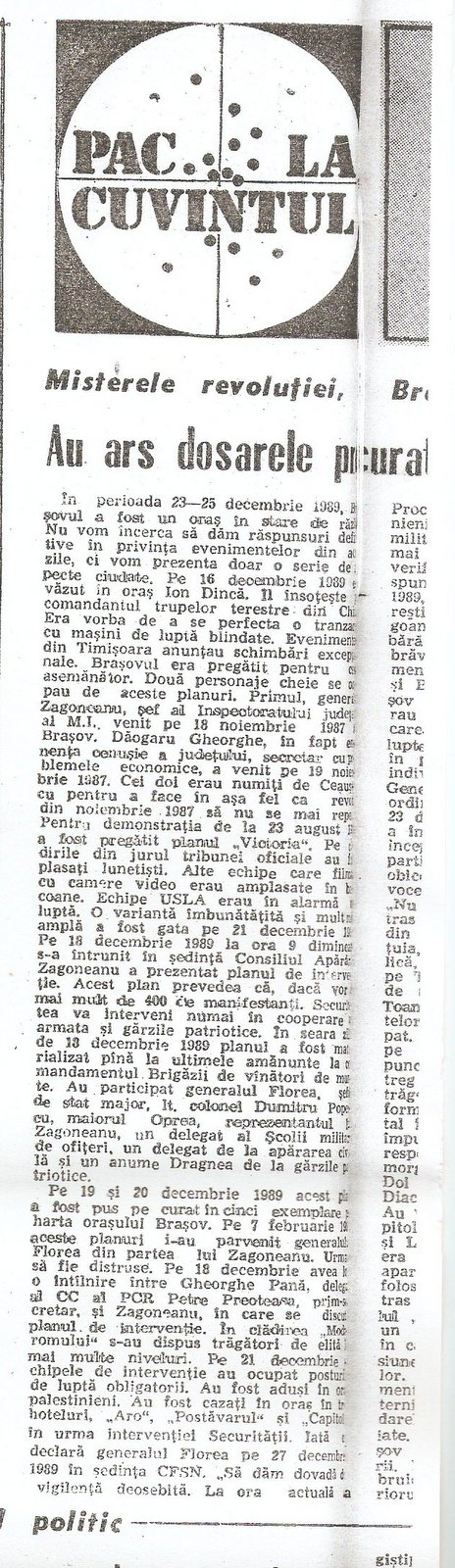
“Misterele revolutiei, la Brasov. Au ars dosarele procuraturii despre evenimentele din decembrie.” Romulus Nicolae, Cuvintul nr. 32 august 1991

Posted by romanianrevolutionofdecember1989 on August 9, 2014

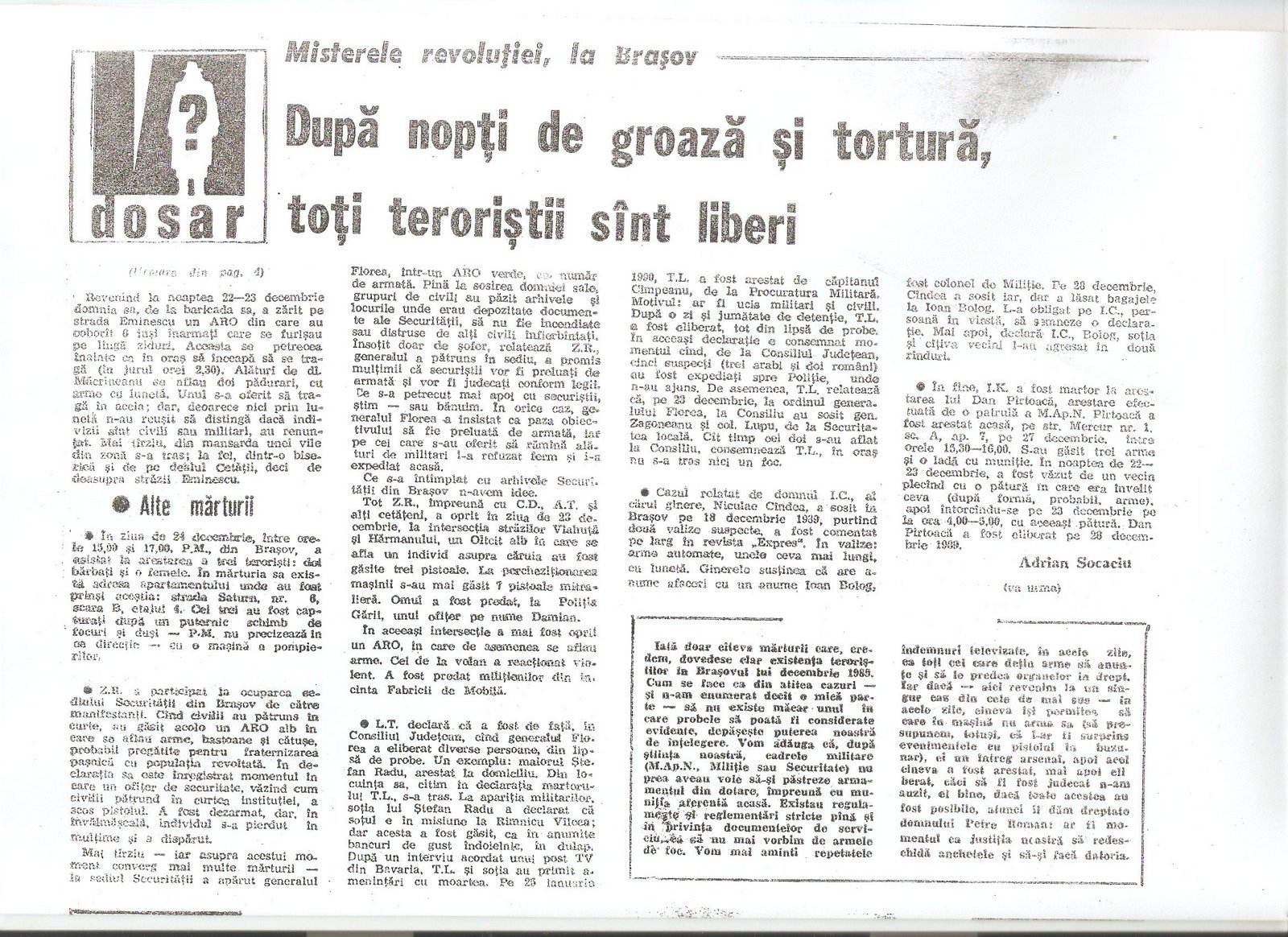
“Misterele revolutiei, la Brasov. Dupa nopti de groaza si tortura, toti teroristii sint liberi.” Adrian Socaciu, Cuvintul, nr. 1-2 ianuarie 1991image0-005

In perioada 23-25 decembrie 1989, Brasovul a fost un oras in stare de razboi.  Nu vom incerca sa dam raspunsuri definitive in privinta evenimentelor din acele zile, ci vom prezenta doar o serie de aspecte ciudate.  Pe 16 decembrie 1989 este vazut in oras Ion Dinca.  Il insoseste comandantul trupelor terestre din China.  Era vorba de a se perfecta o tranzactie cu masini de lupta blindate.  Evenimentele din Timisoara anuntau schimbari exceptionale.  Brasovul era pregatit pentru ceva asemanator.  Doua personaje cheie se ocupau de aceste planuri.  Primul, generalul Zagoneanu, sef al Inspectoratului judetean al M.I., venit pe 19 noiembrie 1987 la Brasov.  Daogaru Gheorghe, in fapt eminenta cenusie a judetului, secretar cu problemele economice, a venit pe 19 noiembrie 1987.  Cei doi erau numiti de Ceausescu pentru a face in asa fel ca revolta din noiembrie 1987 sa nu se mai repete.  Pentru demonstratia de la 23 august 1989 a fost pregatit planul “Victoria”.  Pe cladirile din jurul tribunei oficiale au fost plasati lunetisti.  Alte echipe care filmau cu camere video erau amplasate in balcoane.  Echipe USLA erau in alarma de lupta.  O varianta imbunatatita si mult mai ampla a fost gata pe 21 decembrie 1989.  Pe 18 decembrie 1989 la ora 9 dimineata s-a intrunit in sedinta Consilul Apararii.  Zagoneanu a prezentat planul de interventie.  Acest plan prevedea ca, daca vor fi mai mult de 400 de manifestanti, Securitatea va interveni numai la cooperare cu armata si garzile patriotice.  In seara de 18 decembrie 1989 planul a fost materializat pina la ultimele amanunte la comandamentul Brigazii de vinatori de munte.  Au participat generalul Florea, sef de stat major, lt. colonel Dumitru Popescu, maiorul Oprea, reprezentantul si Zagoneanu, un delegat al Scolii militare de ofiteri, un delegat de la apararea civila si un anume Dragnea de la garzile patriotice.

Pe 19 si 20 decembrie 1989 acest plan a fost pus pe curat in cinci exemplare pe harta orasului Brasov.  Pe 7 februarie 1990 aceste planuri i-au parvenit generalului Florea din partea lui Zagoneanu.  Urmau sa fie distruse.  Pe 18 decembrie avea loc o intilnire intre Gheorghe Pana, delegat al CC al PCR Petre Preoteasa, prim-secretar, si Zagoneanu, in care se discuta planul de interventie.  In cladirea “Modaromului” s-au dispus tragatori de elita la mai multe niveluri.  Pe 21 decembrie echicpele de interventie au ocupat posturile de lupta obligatorii.  Au fost adusi in oras palestinieni.  Au fost cazati in oras in trei hoteluri, “Aro”, “Postavarul” si “Capitol”, in urma interventiei Securitatii.  Iata ce declara generalul Florea pe 27 decembrie 1989 in sedinta CFSN.  “Sa dam dovada de vigilenta deosebita.  La ora actuala la Procuratura sint retinuti libieni si palestinieni care sint interogati de procurorul militar sef Centiu Ioan, dar trebuie sa mai cautam si altii.”  Exista si se poate verifica stenograma sedintei.  Ce dorea sa spuna generalul Florea?  Pe 25 decembrie 1989, noaptea, au fost expediati la Bucuresti cetateni straini (arabi) in doua vagoane speciale.  Se vorbeste despre o tabara de antrenament pentru arabi la Dumbravita Birsei.  O alta tabara de antrenament pentru arabi se afla intre Fagaras si Brasov, la poalele muntilor.  Prin Brasov circula uneori un autobuz pe care erau niste incriptii in limba araba.  Implicarea unor indivizi de origine araba in lupte este certa….


image0-007

In luna iunie, anul trecut [1990], s-a deplasat la Brasov domnul general Nicolae Constantin Spiroiu insotit de cinci ofiteri.  Au contactat grupul “Opinia” si alte persoane pentru a alfa cine ancheteaza evenimentele din decembrie 1989.  La sediul grupului “Opinia” domnul general Spiroiu a discutat mai bine de cinci ore cu Adrian Moruzi, Viorel Boeru, Viorel Nitescu, Alexandru Popescu si Katarina Peter.

Pe 14 iunie 1990 seara, generalul Spiroiu l-a sunat pe Adrian Moruzi interesindu-se ce se intimpla la Brasov.  S-a procedat la o deshumare a mortilor din decembrie 1989.  Totul s-a facut cu participarea Procuraturii care a prelevat gloantele ucigase.  S-au gasit in special gloante de calibrul 5,6 mm care nu sint in dotarea armatei.  Recent la sediul Procuraturii din Brasov s-a produs un incendiu devastator.  Au ars mai multe documente legate de Revolutie.  Incendiul a fost atit de puternic incit s-a calcinat peretii.  Ar fi interesant de aflat ce material inflamabil a putut produce o astfel de putere calorica.  –Romulus Nicolae

Posted in decembrie 1989, raport final | Tagged: , , , , , , , , , , , , , , , , , , , , , | 5 Comments »

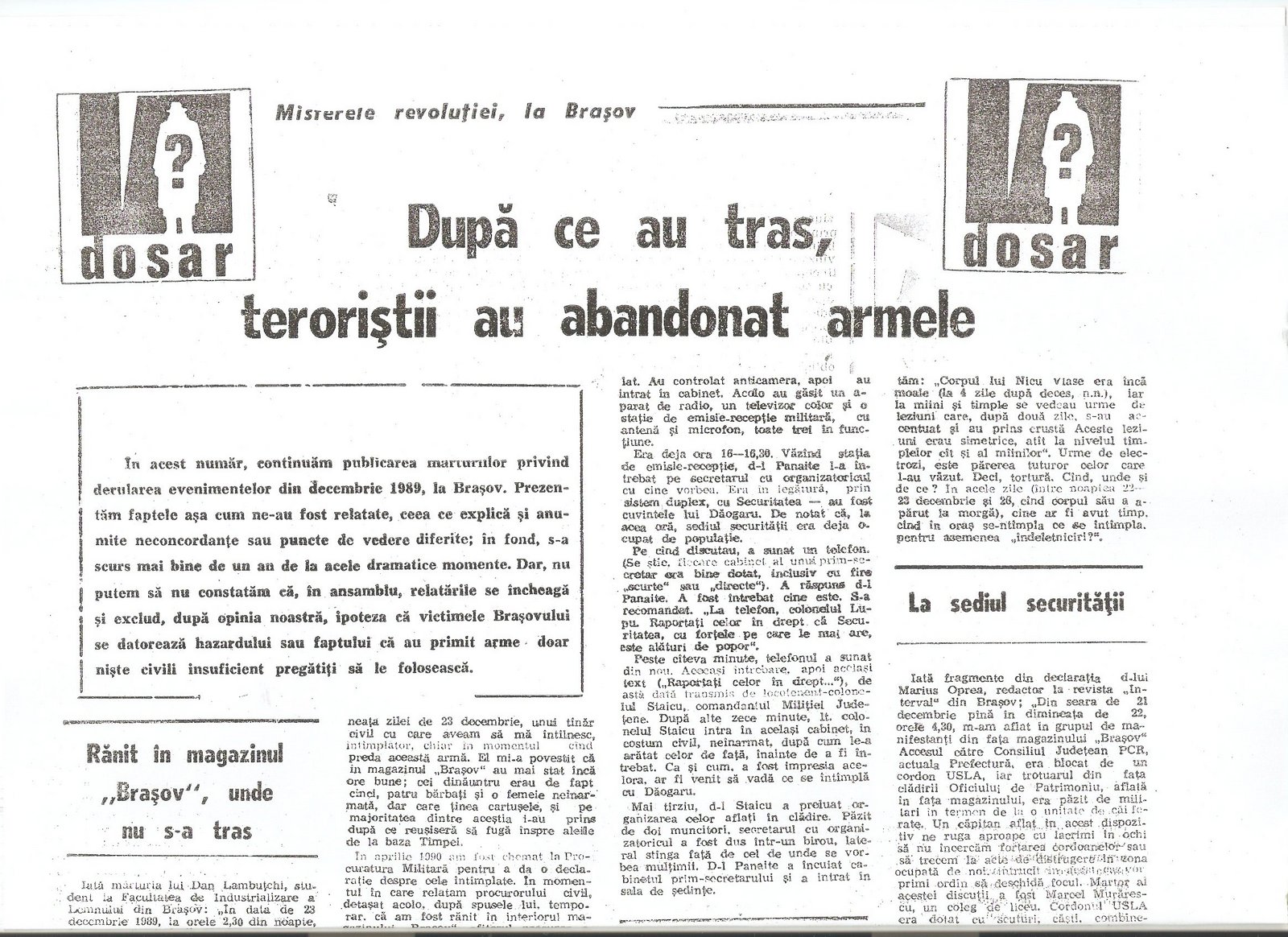
“Misterele revolutiei, la Brasov. Dupa ce au tras, teroristii au abandonat armele.” Adrian Socaciu, nr. 4 ianuarie 1991

Posted by romanianrevolutionofdecember1989 on August 6, 2014

“Misterele revolutiei, la Brasov. Dupa nopti de groaza si tortura, toti teroristii sint liberi.” Adrian Socaciu, Cuvintul, nr. 1-2 ianuarie 1991

image0-001

image0-003


Posted in decembrie 1989, raport final | Tagged: , , , , , , , | 1 Comment »

“Misterele revolutiei, la Brasov. Dupa nopti de groaza si tortura, toti teroristii sint liberi.” Adrian Socaciu, Cuvintul, nr. 1-2 ianuarie 1991

Posted by romanianrevolutionofdecember1989 on August 2, 2014

image0-001

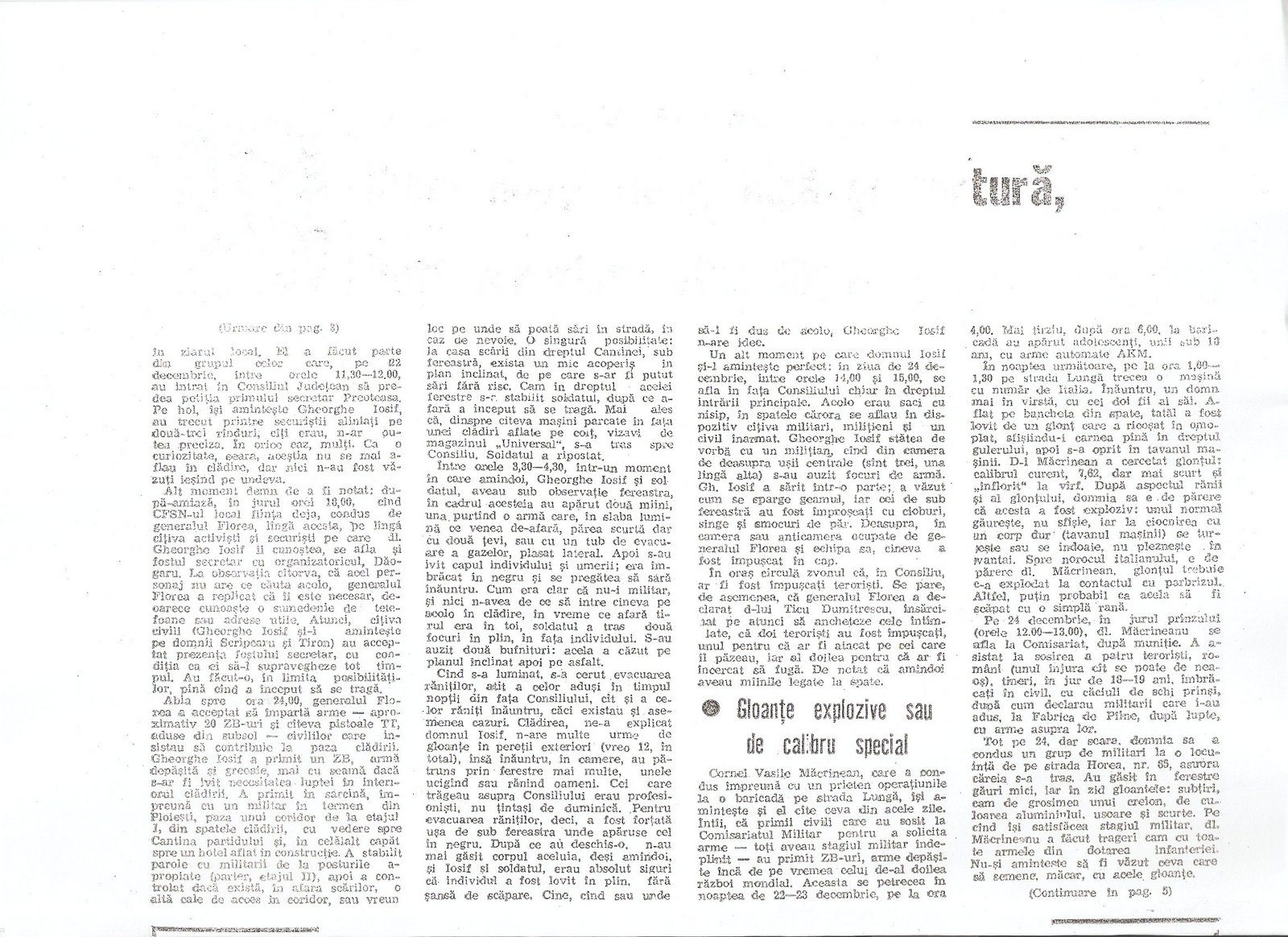
Afirmatia ca in decembrie 1989 brasovenii ar fi tras unii in altii este atribuita de numerosi localnici generalului Florea:  se pare ca, intre timp, a intrat in folclorul local.  Dovedeste un umor macabru, in ton cu lozinca scandata prin Piata Universitatii:  21-22, noi am tras in noi!.  In realitate, afirmatia ar vrea sa insemne, de fapt, ca in orasul de sub Timpa n-au existat teroristi.  Cei 68 (cifra oficiala) sau peste o suta de morti, militari si civili, in majoritatea tineri, ar fi victima confuzilor sau a imprecisiei coordonari a operatiunilor.  Fireste, in asemena momente sint posibile si astfel de nefericite greseli.  S-au petrecut, si la Brasov, si prin alte parti.  Dar brasovenii nu se indoiesc ca, in orasul lor, cei pe care ne-am obisnuit sa-i numim teroristi au existat, au actionat dupa un plan dinainte pus la punct, au actionat in locuri bine alese, cu vizibilitate spre zonele cheie ale orasului.  Au existat acele arme speciale pe care unii le-au vazut, iar altii pastreaza si acum gloante inexistente in dotarea armatei romane, de calibru special, cu cap vidia sau exploziv.  In rindurile care urmeaza, vom incerca sa prezentam marturii ale unor localnici implicati in evenimente.  In jur de doua sute de persoane suspecte, unele capturate in lupta, cu arma asupra lor, au fost predate la fostul Consilu Judetean, la Politie, la Comisariat, la unele unitatii militare.  Nici macar unul nu a ajuns in fata instantei–sau daca totusi vor fi fost cazuri, au fost eliberati din lipsa de probe.  In Brasov, nimeni n-a fost condamnat pentru moartea atitor tineri si schilodirea altora.  Unii din cei contactati se tem inca, nu-s siguri ca fosta securitate a disparut cu adevarat….

image0-003

Intre orele 3,30-4,30, intr-un moment in care amindoi, Gheorghe Iosif si soldatul, aveau sub observatie fereastra, in cadrul aceasta au aparut doua miini, una purtind o arma care, in slaba lumina ce venea de-afara, parea scurta dar cu doua tevi, sau cu un tub de evacuare a gazelor, plasat lateral.  Apoi s-au ivit capul individului si umerii; era imbracat in negru si se pregatea sa sara inauntru.  Cum era clar ca nu-i militar si n-avea de ce sa intre cineva pe acolo in cladire, in vreme ce afara tirul era in toi, soldatul a tras doua focuri in plin, in fata individului….

Gloante explozive sau de calibru special

Cornel Vasile Macrinean, care a condus impreuna cu un prieten operatiunile la o baricada pe strada Lunga, isi aminteste si el cite ceva din acele zile.  Intii, ca primii civili care au sosit la Comisariatul Militar pentru a solicita arme–toti aveau stagiul militar indeplinit–au primit ZB-uri, arme depasite inca de pe vremea celui de-al doilea razboi mondial.  Aceasta se petrecea in noaptea de 22-23 decembrie, pe la ora 4,00.  Mai tirziu, dupa ora 6,00, la baricada au aparut adolescenti, unii sub 18 ani, cu arme automate AKM.

In noaptea urmatoare, pe la ora 1,00-1,30 pe strada Lunga trecea o masina cu numar de Italia.  Inauntru, un domn mai in virsta, cu cei doi fii ai sai.  Aflat pe bancheta din spate, tatal a fost lovit de un glont care a ricosat in omoplat, sfisiindu-i carnea pina in dreptul gulerului, apoi s-a oprit in tavanul masinii. D-l Macrinean a cercetat glontul:  calibrul curent 7,62, dar mai scurt si “inflorit” la virf.  Dupa aspectul ranii si al glontului, domnia sa e de parere ca acesta a fost exploziv:  unul normal gaureste, nu sfisie, iar la ciocnirea cu un corp dur (tavanul masinii) se tur*este (?) sau se indoaie, nu plezneste in *vantai (?).  Spre norocul italianului, e de parere dl. Macrinean, glontul c-a explodat la contactul cu parbrizul.  Altfel, putin probabil ca acela sa fi scapat cu o simpla rana.

Pe 24 decembrie, in jurul prinzului (orele 12.00-13.00), dl Macrineanu se afla la Comisariat, dupa munitie.  A asistat la sosirea a patru teroristi, romani (unul injura cit se poate de neaos), tineri, in jur de 18-19 ani, imbracat in civil, cu caciuli de schi prinsi, dupa cum declarau militarii care i-au adus, la Fabrica de Piine, dupa lupte, cu arme asupra lor.

Tot pe 24, dar seara, domnia sa a condus un grup de militari la o locuinta de pe strada Horea, nr. 65, asupra careia s-a tras.  Au gasit in ferestre gauri mici, iar in zid gloantele:  subtiri, cam de grosimea unui creion, de culoarea aluminiului, usoare si scurte.  Pe cind isi satisfacea stagiul militar, dl. Macrineanu a facut trageri cam cu toate armele din dotarea infanteriei.  Nu-si aminteste sa fi vazut ceva care sa semene, macar, cu acele gloante.

image0-006

In aceeasi declaratie e consemnat momentul cind, de la Consilul Judetean, cinci suspecti (trei arabi si doi romani) au fost expediati spre Politie, unde n-au ajuns.

Posted in decembrie 1989, raport final | Tagged: , , , , , , | 4 Comments »

Nicolae Ghircoiaș, Colonel de Miliție, Director al Institutului de Criminalistică din Inspectoratul General al Miliției (IGM), decembrie 1989 – ianuarie 1990

Posted by romanianrevolutionofdecember1989 on July 26, 2014

(strictly personal view, as always, based on over two decades or prior research and publications, thank you)

image0-001

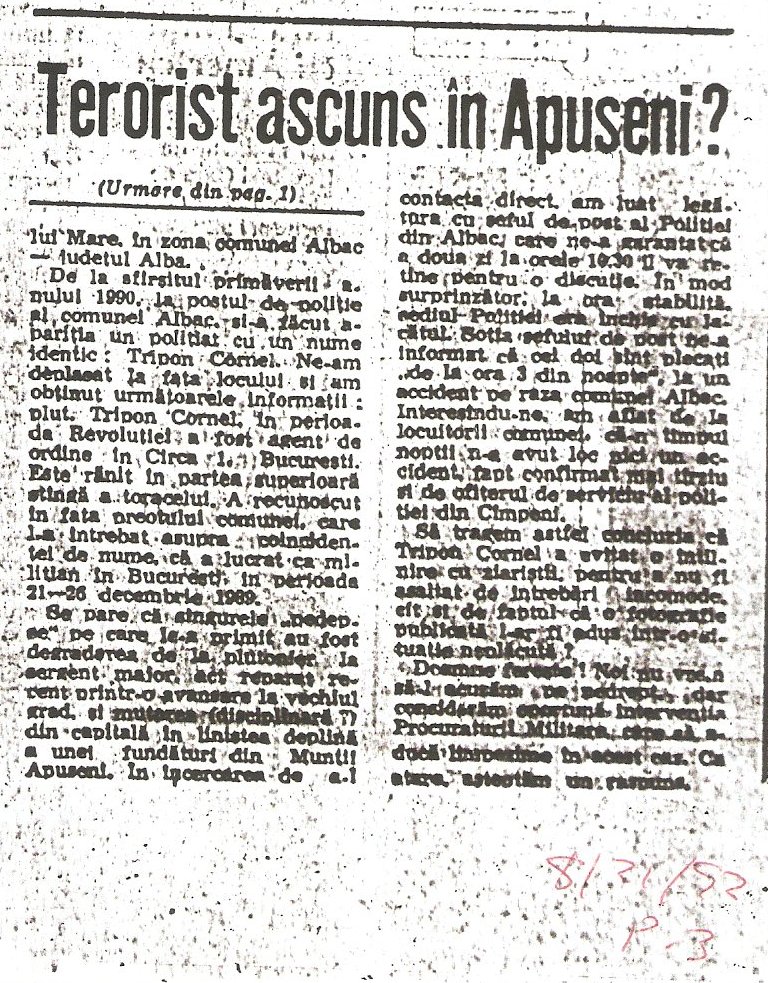
Confirm afirmatiilor medicului chirurg Nicolae Constantinescu, sus-numitul Tripon Cornel a fost ranit prin impuscare in zona hotel Negoiu din Bucuresti.  Medicii de spitalul Coltea au solicitat Procuraturii instrumentarea acestor cazuri.  Colonel Ghircoias, fost sef al directiei cercetari penale a Securitatii, i-a adunat pe toti indivizii care erau acuzati ca sint teroristii, facindu-i disparuti.

image0-003

Florin Mircea Corcoz si Mircea Aries, “Terorist ascuns in Apuseni?” Romania Libera , 21 august 1992, p. 1, p. 3.

for confirmation suggesting Cornel Tripon’s arrest under suspicion of being a “terrorist” (28 December 1989, Hotel Negoiu, Bucuresti) during the December 1989 events, see http://www.danbadea.net/wp-content/uploads/2009/12/img036.jpg ; for confirmation that Ghircoias himself was (later) (re-) arrested, see http://www.danbadea.net/wp-content/uploads/2009/12/img043.jpg .

for the suggestion that Tripon’s status as a member of the Militie was merely a cover mechanism see,

“La internarea in spital, militianul Cornel Tripon a prezentat un buletin pe care avea trecuta ca adresa de domiciliu str. Academiei 24. Aceeasi adresa de domiciliu (fictiv) era trecuta in buletinul mai multor ofiteri de la UM 0666. Militianul ranit a fost ridicat chiar a doua zi din spital si transportat, se pare, la o unitate spitaliceasca a Ministerului de Interne.”

from Romulus Cristea, 20 decembrie 2006, http://www.romanialibera.ro/special/reportaje/salvarile-nu-erau-pentru-raniti–80867

——————————————-

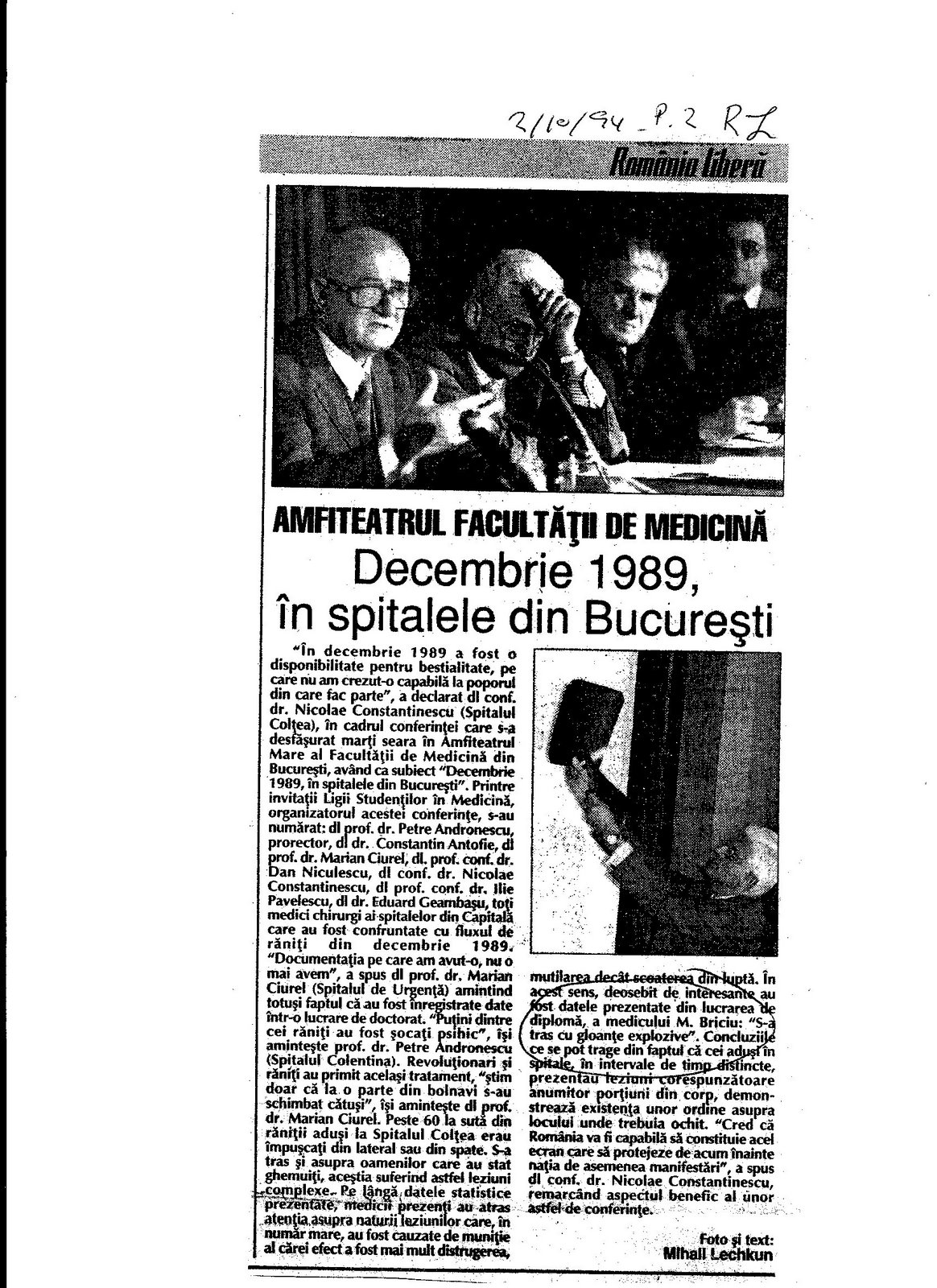
 elsewhere Dr. Nicolae Nae Constantinescu, chief surgeon at the Coltea Hospital, recounted Chircoias (sic Ghircoias)’s arrival and actions on 1-2 January 1990.

(English) Cited in The Romanian Revolution for Dum-Dums

Dr. Nicolae Constantinescu, surgeon at Coltea Hospital: “I remember that on 1 or 2 January ’90 there appeared at the [Coltea] hospital a colonel from the Interior Ministry, who presented himself as Chircoias. He maintained in violent enough language that he was the chief of a department from the Directorate of State Security [ie. Securitate]. He asked that all of the extracted bullets be turned over to him. Thus were turned over to him 40 bullets of diverse forms and dimensions, as well as munition fragments. I didn’t hear anything back from Chircoias or any expert. Those who made the evidence disappear neglected the fact that there still exist x-rays and other military documents that I put at the disposition of the [Military] Prosecutor.”

( http://www.romanialibera.ro/a113826/revolutia-5-000-de-victime-nici-un-vinovat.html)

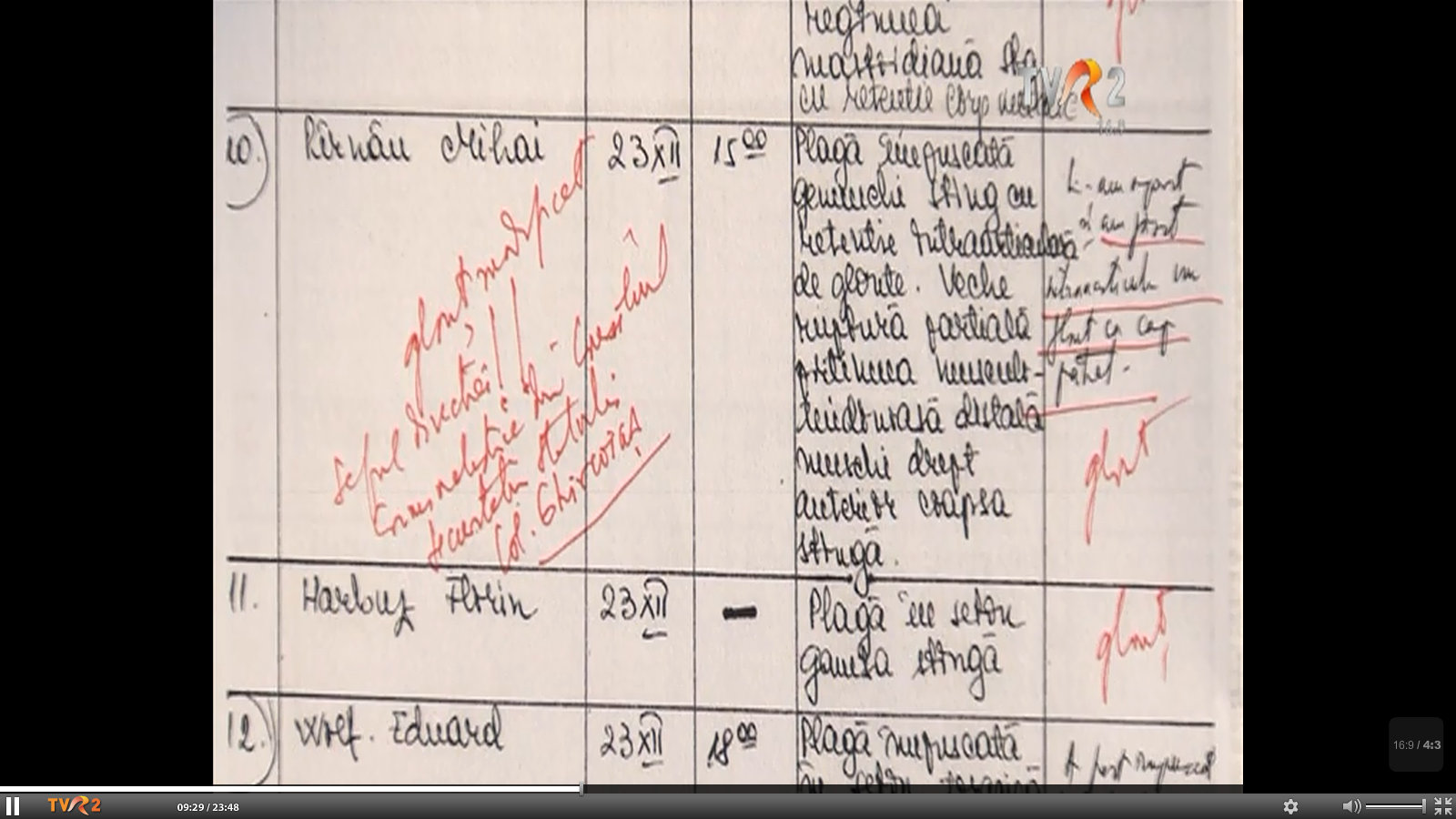
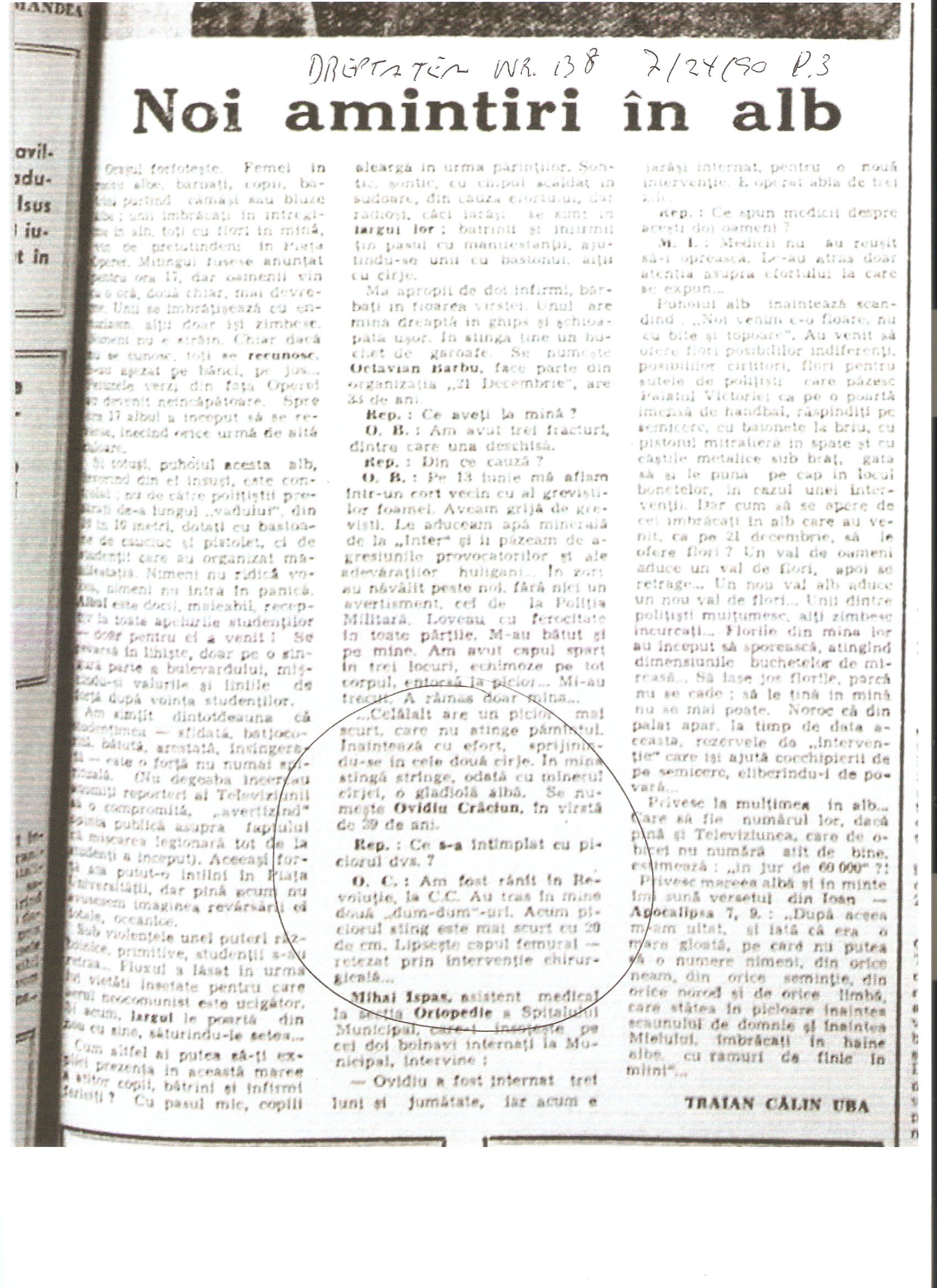
Screen Capture of a registry presented by Dr. Nicolae Nae Constantinescu in TVR documentary by Toma Roman Jr. mentioning an atypical bullet with cap (varf) retezat extracted from a patient on 23 December 1989 and later “collected” by Ghircoias.

Origin 7272014 112744 AM


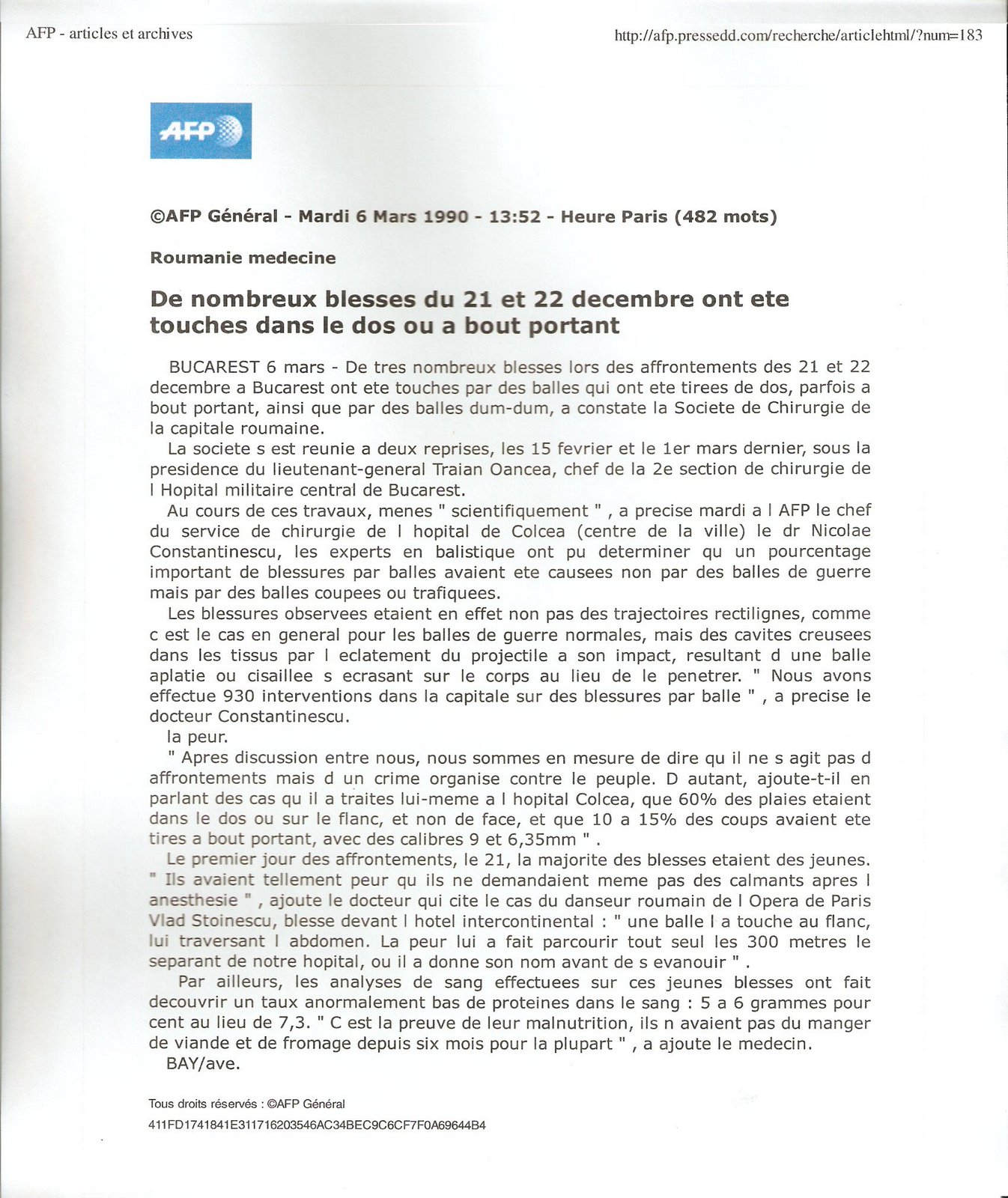
In early March 1990, Agence France Presse reported the declared findings of surgeons in Bucharest, attesting to the fact that many of those wounded on 21-22 December 1989 in Bucharest had been shot with exploding bullets, DUM-DUM bullets.  [Significantly, a slew of military prosecutors, among them General Dan Voinea, General Romeo Balan, and General Teodor Ungureanu have attempted to deceive Romanians in the years since by denying or avoiding mention of the existence and use of DUM-DUM munitions in December 1989.]

Lt. Gnl. Traian Oancea, chief of surgery in part of the Central Military Hospital in Bucharest, and Dr. Nicolae “Nae” Constantinescu, chief of surgery at the Coltea Hospital, discussed this at a meeting of the Society of Surgeons in Bucharest.


©AFP Général – Mardi 6 Mars 1990 – 13:52 – Heure Paris (482 mots)

Roumanie medecine
De nombreux blesses du 21 et 22 decembre ont ete touches dans le dos ou a bout portant
   BUCAREST 6 mars – De tres nombreux blesses lors des affrontements des 21 et 22 decembre a Bucarest ont ete touches par des balles qui ont ete tirees de dos, parfois a bout portant, ainsi que par des balles dum-dum, a constate la Societe de Chirurgie de la capitale roumaine.
   La societe s est reunie a deux reprises, les 15 fevrier et le 1er mars dernier, sous la presidence du lieutenant-general Traian Oancea, chef de la 2e section de chirurgie de l Hopital militaire central de Bucarest.
   Au cours de ces travaux, menes ” scientifiquement ” , a precise mardi a l AFP le chef du service de chirurgie de l hopital de Colcea (centre de la ville) le dr Nicolae Constantinescu, les experts en balistique ont pu determiner qu un pourcentage important de blessures par balles avaient ete causees non par des balles de guerre mais par des balles coupees ou trafiquees.
   Les blessures observees etaient en effet non pas des trajectoires rectilignes, comme c est le cas en general pour les balles de guerre normales, mais des cavites creusees dans les tissus par l eclatement du projectile a son impact, resultant d une balle aplatie ou cisaillee s ecrasant sur le corps au lieu de le penetrer. ” Nous avons effectue 930 interventions dans la capitale sur des blessures par balle ” , a precise le docteur Constantinescu.
   la peur.
   ” Apres discussion entre nous, nous sommes en mesure de dire qu il ne s agit pas d affrontements mais d un crime organise contre le peuple. D autant, ajoute-t-il en parlant des cas qu il a traites lui-meme a l hopital Colcea, que 60% des plaies etaient dans le dos ou sur le flanc, et non de face, et que 10 a 15% des coups avaient ete tires a bout portant, avec des calibres 9 et 6,35mm ” .
   Le premier jour des affrontements, le 21, la majorite des blesses etaient des jeunes. ” Ils avaient tellement peur qu ils ne demandaient meme pas des calmants apres l anesthesie ” , ajoute le docteur qui cite le cas du danseur roumain de l Opera de Paris Vlad Stoinescu, blesse devant l hotel intercontinental : ” une balle l a touche au flanc, lui traversant l abdomen. La peur lui a fait parcourir tout seul les 300 metres le separant de notre hopital, ou il a donne son nom avant de s evanouir ” .
   Par ailleurs, les analyses de sang effectuees sur ces jeunes blesses ont fait decouvrir un taux anormalement bas de proteines dans le sang : 5 a 6 grammes pour cent au lieu de 7,3. ” C est la preuve de leur malnutrition, ils n avaient pas du manger de viande et de fromage depuis six mois pour la plupart ” , a ajoute le medecin.
   BAY/ave.
Tous droits réservés : ©AFP Général
411FD1741841E311716203546AC34BEC9C6CF7F0A69644B4

Bucuresti, Spitalul Coltea:  “Pe data de 1 sau 2 ianuarie 1990 a aparut la spital un colonel Chircoias, de la Interne cred”

Prof. univ. dr. Nicolae (Nae) Constantinescu, membru al Academiei de Medicina si al Academiei Oamenilor de Stiinta. Medic chirug la Spitalul Coltea.Dosarele revolutiei -  "Nici acum nu-mi dau seama cum am putut sa operez nonstop timp de trei zile"

– Ce s-a intamplat cu cartusele extrase chirurgical din ranile pacientilor? Erau niste probe care ar fi putut lamuri anumite aspecte…
Pe data de 1 sau 2 ianuarie 1990 a aparut la spital un colonel Chircoias, de la Interne cred. Acest Chircoias a fost judecat si condamnat mai tarziu intr-un proces la Timisoara in legatura cu revolutia.

Chircoias, care sustinea sus si tare ca ar conduce nu stiu ce sectie criminalistica din Directia Securitatii Statului, a cerut gloantele extrase. Acestea, vreo 40 la numar, i-au fost date de un medic care era secretar de partid la IMF. Tin minte ca erau gloante de diverse forme, de diferite dimensiuni.

Procurori timorati

– Ati sesizat Parchetul Militar? Ati cerut sa se faca o ancheta in legatura cu cei impuscati la revolutie?
– Bineinteles, am anuntat Parchetul, am cerut o ancheta. De exemplu, cand le-am aratat apartamentul de unde s-a tras la revolutie, de la etajul 4, de la cinematograful “Luceafarul”, procurorii mi-au zis ca au facut verificarile si au depistat ca acolo era o locuinta conspirativa a Securitatii si atat. In anul 1992 am semnat alaturi de alti medici, profesori universitari, chirurgi de renume, un memoriu pe care l-am adresat Parchetului General si prin care am solicitat sa se faca o ancheta cu privire la ranitii si mortii prin impuscare. Neprimind nici un raspuns, dupa sase luni m-am dus la Parchet sa intreb ce se intampla. Mi s-a raspuns ca se lucreaza, mi-au aratat doua-trei avize puse pe colturile cererii si atat. Unul dintre procurori m-a luat cu el pe un coridor si mi-a spus ca “are copil, are nevasta, e foarte complicat…”. Ma intreba pe mine ce sa mai faca… Am izbucnit, le-am spus ca nu sunt un om care sa fie, asa, aburit cu una, cu doua. Le-am aratat radiografiile celor impuscati, le-am aratat gloante in ficat. Radiografiile existau, nu erau inventiile mele, nu mi se nazarise asa, dintr-o data sa cer ancheta! Le-am spus ca niste oameni doresc sa afle adevarul si ca cei care au semnat memoriul catre Parchet nu sunt niste persoane oarecare, ci medici cu experienta, somitati in materie. Degeaba am solicitat expertize balistice sau alte cercetari, degeaba am prezentat acte, documente, radiografii, lucrari. Nu se dorea sa se faca o ancheta serioasa.

extras din articolul lui Romulus Cristea
Miercuri, 20 Decembrie 2006 Romania Libera

Nici acum nu-mi dau seama cum am putut sa operez nonstop timp de trei zile

http://www.romanialibera.ro/special/reportaje/–nici-acum-nu-mi-dau-seama-cum-am-putut-sa-operez-nonstop-timp-de-trei-zile—80869

http://www.romanialibera.ro/aldine/history/dosarul-revolutia-1989-142100

—————————————————-

For a discussion of Ghircoias’s activities in Timisoara before 22 December, please see the following:

and in the journal Mortality, no. 15 (1) 2010, Marius Rotar, “The Red Mask of Death:  The Evil Politics of Cremation in Romania in December 1989.”  pp. 1- 17.

—————————————————-

discussion in one of my previous publications:

Bullets, Lies, and Videotape:

The Amazing, Disappearing Romanian Counter-Revolution of December 1989[1]

by Richard Andrew Hall, Ph.D.

Standard Disclaimer:  All statements of fact, opinion, or analysis expressed are those of the author and do not reflect the official positions or views of the Central Intelligence Agency (CIA) or any other U.S. Government agency.  Nothing in the contents should be construed as asserting or implying U.S. Government authentication of information or CIA endorsement of the author’s views.  This material has been reviewed by CIA to prevent the disclosure of classified information. [Submitted 19 November 2009; PRB approved 15 December 2009]

I am an intelligence analyst for the Central Intelligence Agency.  I have been a CIA analyst since 2000.  Prior to that time, I had no association with CIA outside of the application process.

Part I

His name was Ghircoias…Nicolae Ghircoias.

And in Romania in December 1989 and January 1990, Nicolae Ghircoias was a very busy man.

We know, officially, of Nicolae Ghircoias’ actions in the last days leading up to the fall of the regime of communist dictator Nicolae Ceausescu on 22 December 1989, as a result of what he and others said at a trial later in January 1990.  In bureaucratic parlance, Colonel Nicolae Ghircoias, was the Director of the Criminalistic Institute of the Militia’s [Police’s] General Inspectorate.   In colloquial terms, in December 1989 it appears that this amounted to being something of a “cleaner,” or “fixer,” the kind of guy who could make unpleasant things—such as corpses—go away, without leaving a trace.

After regime forces opened fire on anti-regime protesters in the western city of Timisoara on 17 and 18 December 1989, Colonel Ghircoias was dispatched to recover the corpses of those with gunshot wounds from the city’s morgue.  The unautopsied cadavers of 43 demonstrators were stolen from the morgue in the dead of night and then transported to the outskirts of the capital Bucharest by refrigerated truck, where they were cremated.[2] Ghircoias was also in charge of collecting and destroying the hospital records and any other incriminating material that might indicate not just the death, but also the life of those who had perished—the official explanation for the disappearance of these citizens was to be that they had fled the country, thus taking their documents with them.  In other words, Colonel Nicolae Ghircoias’ job was primarily, it seems, the destruction of evidence.[3]

COLONEL GHIRCOIAS MAKES THE ROUNDS OF BUCHAREST’S HOSPITALS

Unofficially, we also know of Colonel Ghircoias’ exploits after the Ceausescu regime collapsed on 22 December 1989, exploits for which he was not charged at his trial and for which he has never been charged.  Of the 1,104 people killed and 3,352 people injured during the December 1989 bloodshed, 942 of them were killed and 2,251 wounded after Nicolae and Elena Ceausescu fled power on 22 December 1989.  At the time, personnel of the communist regime’s secret police—known as the Securitate—and allied foreign mercenaries fighting to restore the Ceausescu regime—collectively christened “the terrorists”—were thought to be the primary source behind the post-22 December bloodshed.

It was in this context, that doctors from Bucharest’s various main hospitals recall Colonel Ghircoias’ sudden, unannounced appearances during the last days of December 1989 and first days of January 1990.  Professor Andrei Firica of the Bucharest “Emergency Hospital” recounted in a 2004 media interview largely the same details he had conveyed to the press in the summer of 1990.  According to Firica, some 15 to 20 suspected terrorists had been interned at the “Emergency Hospital” in varying states of medical distress.  He says he made a small file of the medical situations of these patients.  A Militia colonel, whom he later was to see in [prisoner] stripes on TV as a defendant in the Timisoara trial—i.e. fairly clearly Ghircoias—came one day and counseled him to keep nosy foreign reporters away from the beds of the “terrorists,” stating ominously that “these were just terrorist suspects and he [Dr. Firica] didn’t want to wake up one day on trial for having defamed someone”!   The colonel later came and loaded the wounded terrorist suspects onto a bus and off they went.  Firica maintains the files he kept on the terrorist suspects “of course, disappeared.”  He noted, however, that he asked his son, who had studied theater and film at university, to film the terrorists tied down to the hospital beds, and he claims he gave copies of this cassette to the Procuracy.[4]

[5]

[In viewing these photos, witness what Constantin Fugasin recounted in “Unde ne sint teroristii?” Zig-Zag, in 1990, based in part on an interview with Dr. Andrei Firica:

At the Emergency Hospital 13 suspected of being what we call terrorists were interned.  Among these a few were definitely foreign, even though all had Romanian papers.  Two clearly had ‘Mongoloid’ (‘Asiatic’) features (one stated that his mother was Romanian, while his father was from Laos), while four others were Arabs.  Nevertheless, they spoke Romanian very well.  Doctor Nicolae Staicovici, who worked a time in Egypt and who treated them for a time spoke with them.  At a moment, he formed a question in Arabic.  One of the injured responded to him perfectly.  All were well-built, one was a ‘mountain of a man.’  He said nothing, although he probably had terrible pains.  There were also two terrorists who were not wounded.  One arrived at night, under some pretext.  Those on guard suspecting him, immobilized him.  He had on three layers of clothing and several ids.  They tied him to the stretcher, but although he appeared rather frail, at a given moment he ripped the restraints off.[6]]

[7]

[Dr. Andrei Firica, 2004:  From a diagnostic perspective, those who maintain that the terrorists didn’t exist are telling an outrageous lie…In the Emergency Hospital, people were brought who were shot with precision in the forehead, from behind, just a few yards in the crowd of demonstrators, such people who did this can only be called terrorists…[8]]


Dr. Nicolae Constantinescu, chief surgeon at the Coltea Hospital, also was paid the honor of a visit by Colonel Ghircoias during these days:

I remember that on 1 or 2 January ’90 there appeared at the [Coltea] hospital a colonel from the Interior Ministry, who presented himself as Chircoias.  He maintained in violent enough language that he was the chief of I-don’t-know-what “criminalistic” department from the Directorate of State Security [ie. Securitate].  He asked that all of the extracted bullets be turned over to him.  Thus were turned over to him 40 bullets of diverse forms and dimensions, as well as munition fragments.

To the question of whether he informed the Military Procuracy?

Of course, I announced the Prosecutor’s Office, and requested an investigation [of those shot in the revolution].  For example, when I showed them the apartment from where there were was shooting during the revolution, on the fourth floor of the ‘Luceafarul’ cinema, the prosecutors told me that they sought to verify it and uncovered that there was a Securitate ‘safehouse’ there and that was it.

In 1992, I signed along with other doctors, university professors, renowned surgeons, a memorandum [see page 5 (below) for an article apparently linked to the memorandum] addressed to the Prosecutor General in which we requested an investigation regarding the wounded and dead by gunfire.  Not having received any response, after six months I went there to ask what was going on.  They told me they were working on it, and they showed me two or three requests and that was it.  One of the prosecutors took me into the hallway and told me “I have a child, a wife, it is very complicated.”  He asked me what I thought I was doing…I lit back into him, I told him I wasn’t just any kind of person to be blown off.

I showed him the x-rays of those who were shot, I showed him the bullets in the liver.  The x-rays exist, they weren’t my invention, I didn’t just dream all this up to demand an investigation!  I told them that there are some people who wish to find out the truth and they signed a memo to the Procuracy and they aren’t just anybody, but doctors with experience, experts in the field.  In vain, we requested ballistics tests and other research, in vain we presented forms, documents, x-rays, studies.  They did not want to undertake a serious investigation.[9]

[1]For some of my previous publications on this topic, see Richard Andrew Hall:

Hall 2008 http://homepage.mac.com/khallbobo/RichardHall/pubs/romrevfordumdums042108tk.html,

Hall 2006 http://homepage.mac.com/khallbobo/RichardHall/pubs/Voineaswar091706.html,

Hall 2005 http://homepage.mac.com/khallbobo/RichardHall/pubs/checkmate040405.html,

Hall 2004 http://homepage.mac.com/khallbobo/RichardHall/pubs/doublespeak%20romania%203-2004.html,

Hall 2002 http://homepage.mac.com/khallbobo/RichardHall/pubs/romania%20securitate%205-2002.html,

Richard Andrew Hall, “Theories of Collective Action and Revolution:  Evidence from the Romanian Transition of December 1989,” Europe-Asia Studies 2000, no. 6 (September 2000).

Richard Andrew Hall, “The Uses of Absurdity:  The ‘Staged-War’ Theory and the Romanian Revolution of December 1989,” East European Politics and Societies vol 13, no. 3 (Fall 1999) (University of California Berkeley Press).

[2] For a good discussion of this in English, which explains how cremation practices were  at odds with Romanian burial traditions, see the article entitled “The Red Mask of Death:  The Evil Politics of Cremation in Romania 1989,” in the journal Mortality, no. 15 (1).

[3]For more information online, see, for example, http://ro.wikipedia.org/wiki/Nicolae_Ghircoia%C5%9F, http://ro.wikipedia.org/wiki/Opera%C5%A3iunea_Trandafirul, http://www.romanialibera.ro/a51078/cine-a-organizat-furtul-cadavrelor-din-morga-spitalului-judetean.html, http://www.timisoara.com/newmioc/53.htm, http://www.timisoara.com/newmioc/67.htm. Even the 1994 SRI report admits that confusion surrounding the identity of those who were cremated stems from Ghircoias’ burning—after the flight of the Ceausescus on 22 December—of all relevant documents he had seized from the Timisoara county hospital http://www.ceausescu.org/ceausescu_texts/revolution/raportul_sri11.htm.  Thus, it seems appropriate to say Ghircoias’ job involved making things disappear…

[4]Professor Andrei Firica, interview by Florin Condurateanu, “Teroristii din Spitalul de Urgenta,” Jurnalul National, 9 March 2004, online edition, cited in Hall, “Orwellian…Positively Orwellian” http://homepage.mac.com/khallbobo/RichardHall/pubs/Voineaswar091706.html. For similar accounts, see Florin Mircea Corcoz si Mircea Aries, “Terorist ascuns in Apuseni?” Romania Libera, 21 August 1992, p. 1–“Colonelul Ghircoias, former director of the Securitate’s penal investigative unit, brought together the individuals accused of being terrorists and made them disappear”; Andreea Hasnas, “Reportajul unui film cu TERORISTI,” Expres, no. 10 (6-12 aprilie 1990), p. 5; Constantin Fugasin, “Unde ne sint teroristii?” Zig-Zag, 1990.

[5] Screen capture from http://www.dailymotion.com/video/x7rp6b_revolutia-romana-2225-dec1989-part_shortfilms posted by Alexandru2006.

[6] Significantly this video is in direct contradiction and contests the claims of the Sorin Iliesiu who maintains that “General Dan Voinea has said clearly:  The terrorists did not exist.  Those who seized power lied to protect the real criminals….The diversion of the ‘terrorists’ has been demonstrated by [the] Justice [System], not a single terrorist being found among the dead, wounded or arrested  (Sorin Iliesiu, “18 ani de la masacrul care a deturnat revoluţia anticomunistă,” 21 December 2007, http://www.romanialibera.com/articole/articol.php?step=articol&id=6709).  For a discussion, see Hall 2008.

[7] Screen capture from http://www.dailymotion.com/video/x7rp6b_revolutia-romana-2225-dec1989-part_shortfilms posted by Alexandru2006.

[8] Professor Andrei Firica, interview by Florin Condurateanu, “Teroristii din Spitalul de Urgenta,” Jurnalul National, 9 March 2004, online edition.

[9] Dr. Professor Nicolae Constantinescu, interview by Romulus Cristea, “”Nici acum nu-mi dau seama cum am putut sa operez nonstop timp de trei zile,” Romania Libera, 20 December 2006, online edition.


Posted in decembrie 1989, raport final | Tagged: , , , , , , , | 2 Comments »

Before the Narratives of December 1989 Consolidated: Looking through the First 200 Issues of the PNTCD’s “Dreptatea” Newspaper

Posted by romanianrevolutionofdecember1989 on June 14, 2014

(purely personal views as always, based on two decades of prior research and publications)

Thanks to the Fundatia Corneliu Coposu site at http://www.corneliu-coposu.ro/sectiune/index.php/239-ziarul-dreptatea/ copies of the PNTCD’s daily Dreptatea from the early 1990s are available to the public.  I have looked through the first 200 editions, from early February 1990 to early October 1990.  Many fascinating aspects of Romanian politics and life jump out at the reader.  For our purposes here, the most interesting aspect is the details that make their way into articles about December 1989.  This was at a time when, although beginning to consolidate, narratives of December 1989 remained somewhat fluid, focusing on what happened and less on how it did or did not fit into competing narratives.  It would not be long before these competing narratives would become not just descriptions of what had happened but increasingly political and ideological lenses to view and interpret what had happened–thus leading to the exclusion, knowingly or unknowingly, of details that contradicted or did not “fit” the narrative in question.  New theories and even new memories or perhaps better put, lapses in memory or amnesia, would displace earlier memories and details.

It is therefore almost surreal to read the details of December 1989 in the pages of the National Christian-Democratic Peasant Party’s daily Dreptatea, a party and a paper whose opposition to the National Salvation Front and the former communist nomenklatura, was unquestionable at the time and comes through clearly in the pages of this publication–including when it was not published for several days in June 1990 because miners at the behest of the Front’s leaders devastated the offices of the party and the daily….And yet, in articles about December 1989, journalists relayed details which today their political and ideological heirs consistently deny or seek to explain away or wouldn’t be caught dead including in any article about December 1989.  Most importantly, that the terrorists of December 1989 existed, that their core was provided by the Securitate and included Arabs from countries friendly to the dictatorial communist regime of Nicolae Ceausescu, and that the terrorists possessed and used atypical and highly destructive munitions that no other forces in Romania possessed:  in particular, exploding DUM-DUM bullets that are outlawed by an international convention of which Romania was a signatory.

image0-011

Niculae Lucian, 30 ani, 21 decembrie 1989, Intercontinental (Bucuresti), piciorul distrus de gloantele dum-dum (also mentioned in http://atomic-temporary-3899751.wpcomstaging.com/2014/05/18/surgeons-from-bucharests-main-hospitals-discuss-their-experiences-in-december-1989-lt-gnl-traian-oancea-dr-nicolae-nae-constantinescu-dr-dan-gavriliu-dr-nicolae-angelescu/)

G.L. [Gilda Lazar], “Pentru un erou al Revolutiei,” Dreptatea, nr. 52 (6 aprilie 1990), p. 2.

Click to access dreptatea-nr52-1990-0406.pdf

image0-001

Aurelian Lazu, “REMEMBER,” Dreptatea, nr. 96 (1 iunie 1990), p. 2.

Click to access dreptatea-nr96-1990-0601.pdf

image0-015

soldat Eugen Mardare, glont dum-dum s-a explodat in abdomen

Raluca Gabriel Mocanu, “Eroii Tragici,” Dreptatea, nr. 100 (6 iunie 1990), p. 4.

Click to access dreptatea-nr100-1990-0606.pdf

image0-005

Ovidiu Craciun, doua dum-dum-uri

Traian Calin Uba, “Noi amintiri in alb,” Dreptatea, nr. 138 (24 iulie 1990), p. 3. 

Click to access dreptatea-nr138-1990-0724.pdf

image0-003

Ilie Costache, “Accident? [despre cazul avionului TAROM AN-24 prabusit pe 28 decembrie 1989], Dreptatea, nr. 36 (17 martie 1990), p. 3.

Click to access dreptatea-nr138-1990-0724.pdf

http://atomic-temporary-3899751.wpcomstaging.com/2014/01/10/nicolae-ceausescu-securitatea-libieni-cincufagarasbrasov-si-revolutia-romana/


image0-013

gloantele cu virful taiat

Odette Hanganu si Remus Agatinei, “Si Braila e oras martir.  Cind se va afla adevarul?,” Dreptatea, nr. 69 (28 aprilie 1990), p. 4.

Click to access dreptatea-nr69-1990-0428.pdf

http://atomic-temporary-3899751.wpcomstaging.com/2010/09/29/%E2%80%9Corwellian%E2%80%A6positively-orwellian%E2%80%9D-prosecutor-voinea%E2%80%99s-campaign-to-sanitize-the-romanian-revolution-of-december-1989-part-iii-a-fistful-of-bullets-unregistered-atyp/


image0-008

gloante cu cap vidia

Tudor Barbu, “Trei momente din decembrie si semnele lor de intrebare,” Dreptatea, nr. 36 (17 martie 1990), p. 3.

Click to access dreptatea-nr36-1990-0317.pdf

http://atomic-temporary-3899751.wpcomstaging.com/2013/12/06/vina-de-neiertat-a-tvr-a-contribuit-decisiv-la-victoria-revolutiei-iii/

http://atomic-temporary-3899751.wpcomstaging.com/2013/08/25/tvr-chirurgi-si-reportaje-despre-gloante-explozive-dum-dum/


image0-017

Sibiu, ROMBAC, 80 de specialisti din capitala

Cristina Mladin, “Inexactitati,” Dreptatea, nr. 101 (7 iunie 1990), p. 3.

Click to access dreptatea-nr101-1990-0607.pdf

http://atomic-temporary-3899751.wpcomstaging.com/2013/08/16/final-boarding-call-for-taroms-special-rombac-service-from-bucuresti-to-sibiu-would-the-large-party-of-suspicious-soviet-tourists-please-report-to-the-gate-immediately-iv/


Posted in decembrie 1989, raport final | Tagged: , , , , , , , , , , , , | 1 Comment »