The Archive of the Romanian Revolution of December 1989

A Catch-22 December 1989, Groundhog-Day Production. Presenting the Personal Research & Scholarship of Richard Andrew Hall, Ph.D.

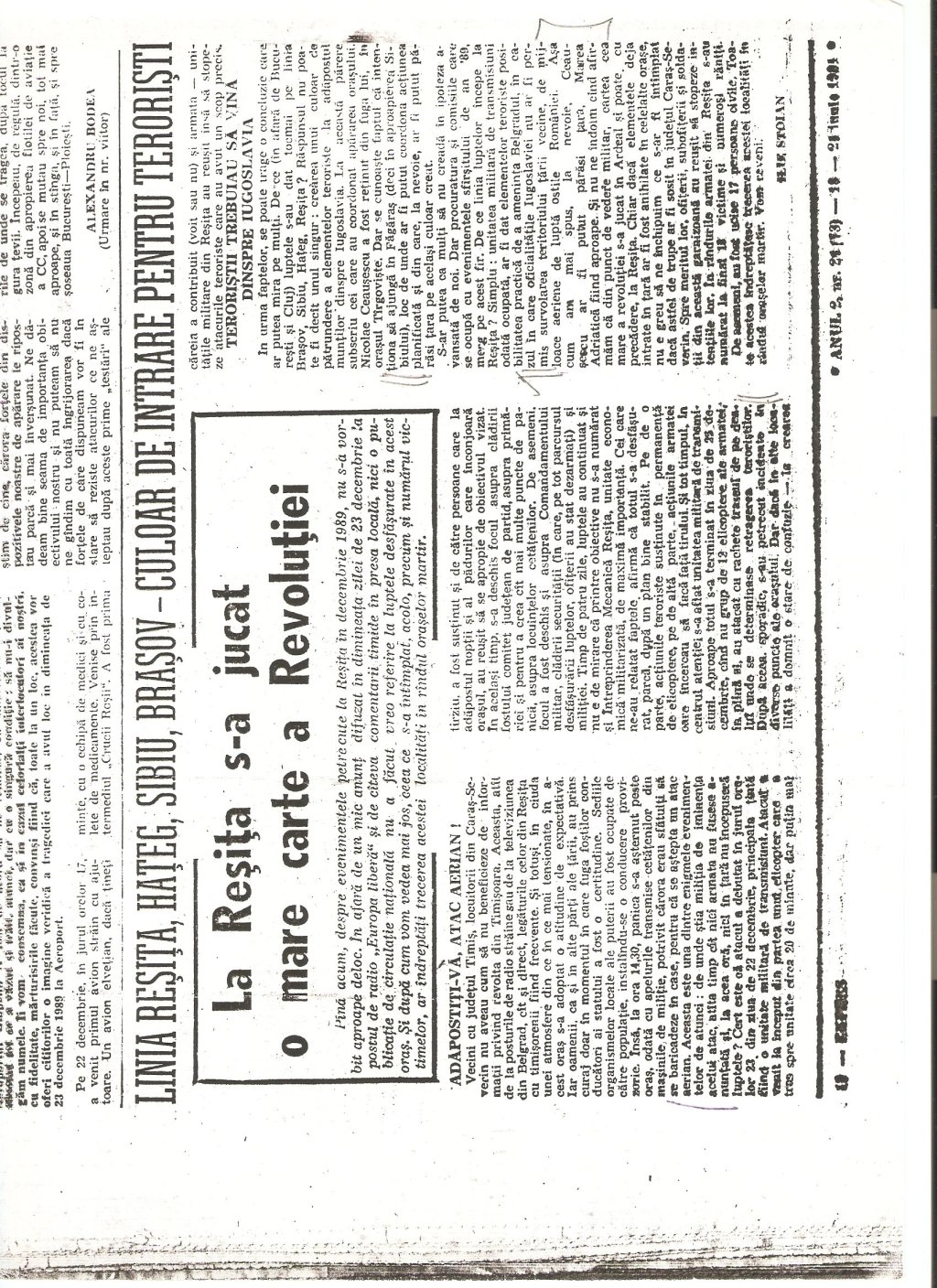
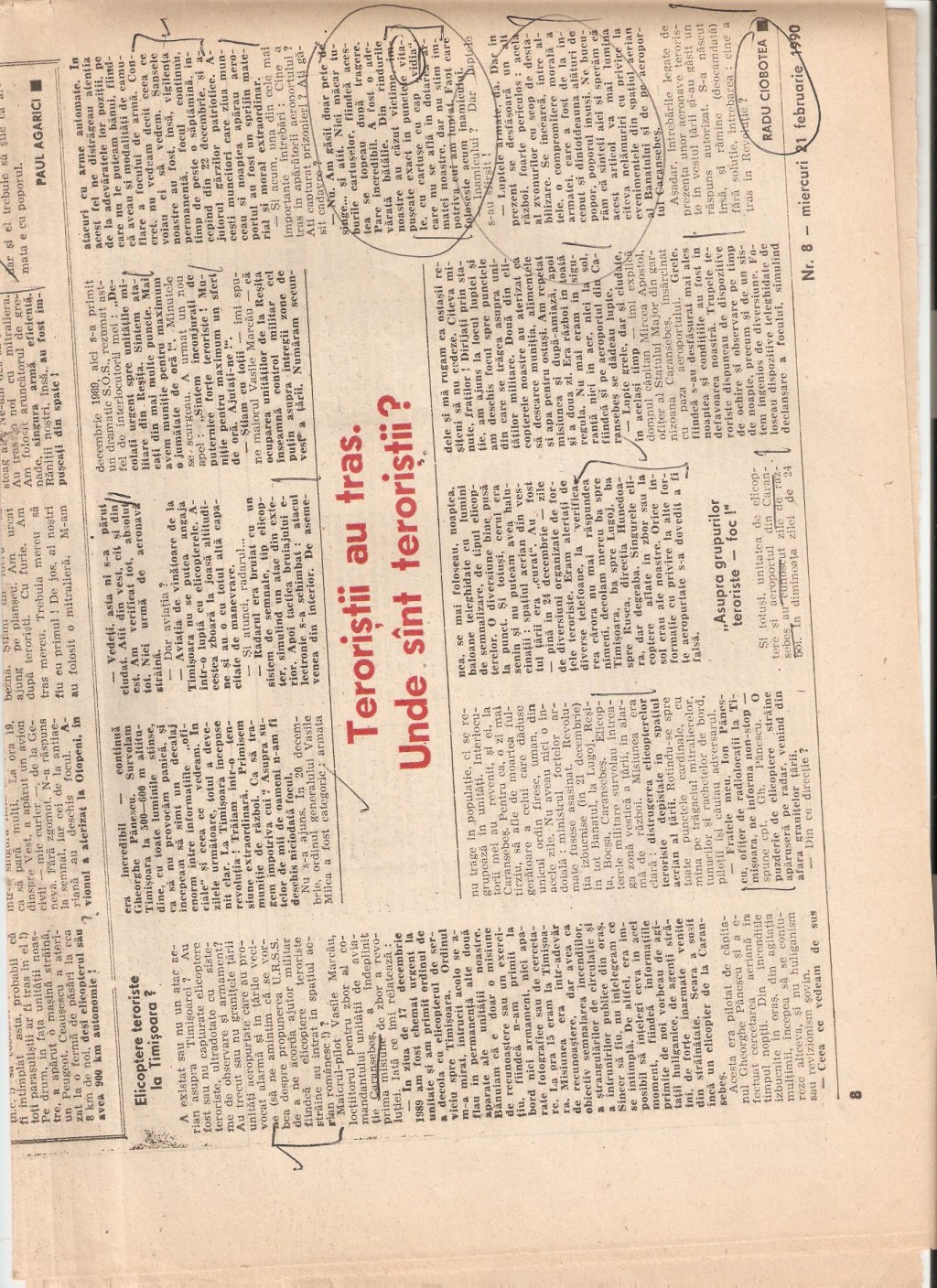
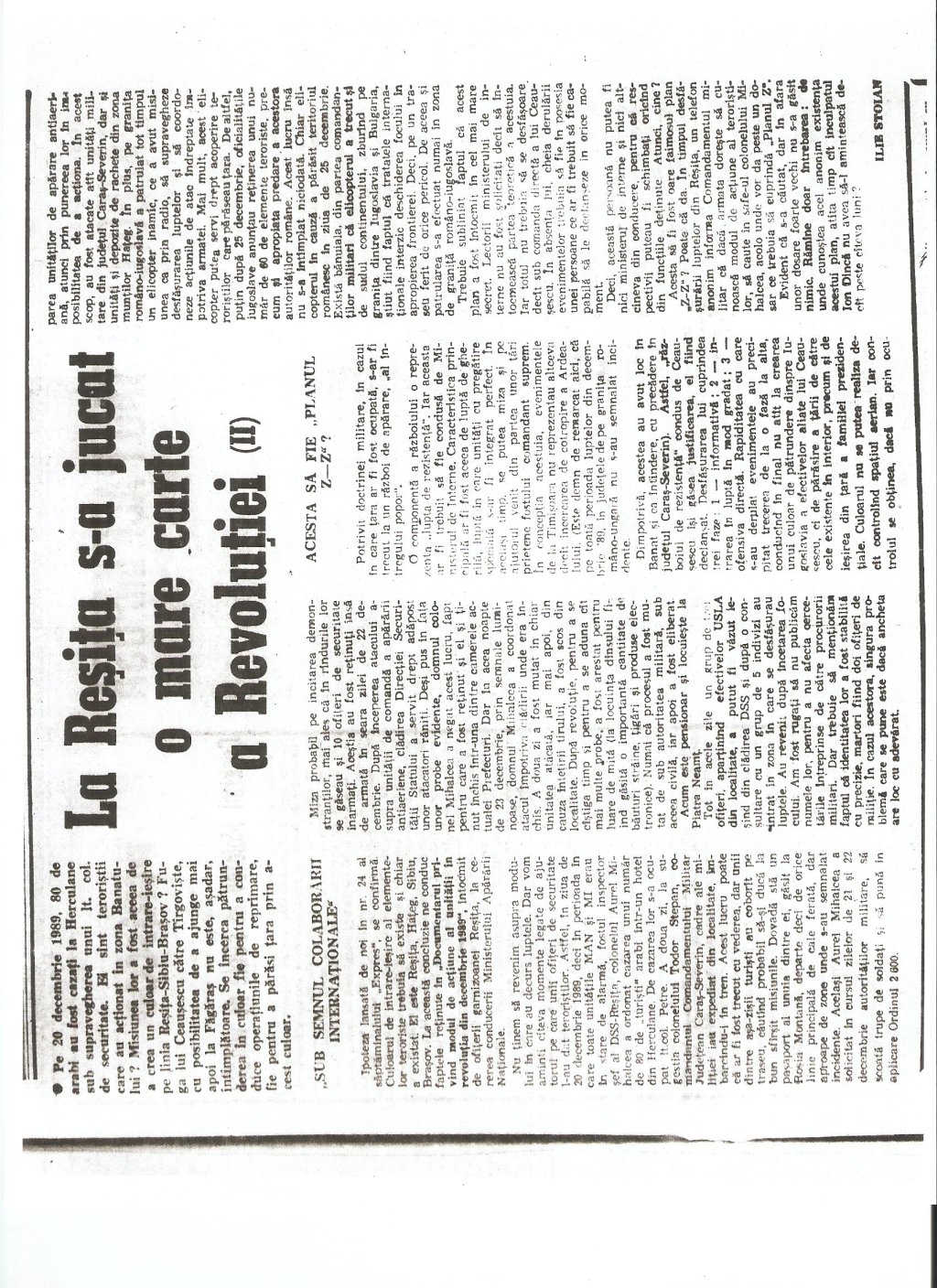
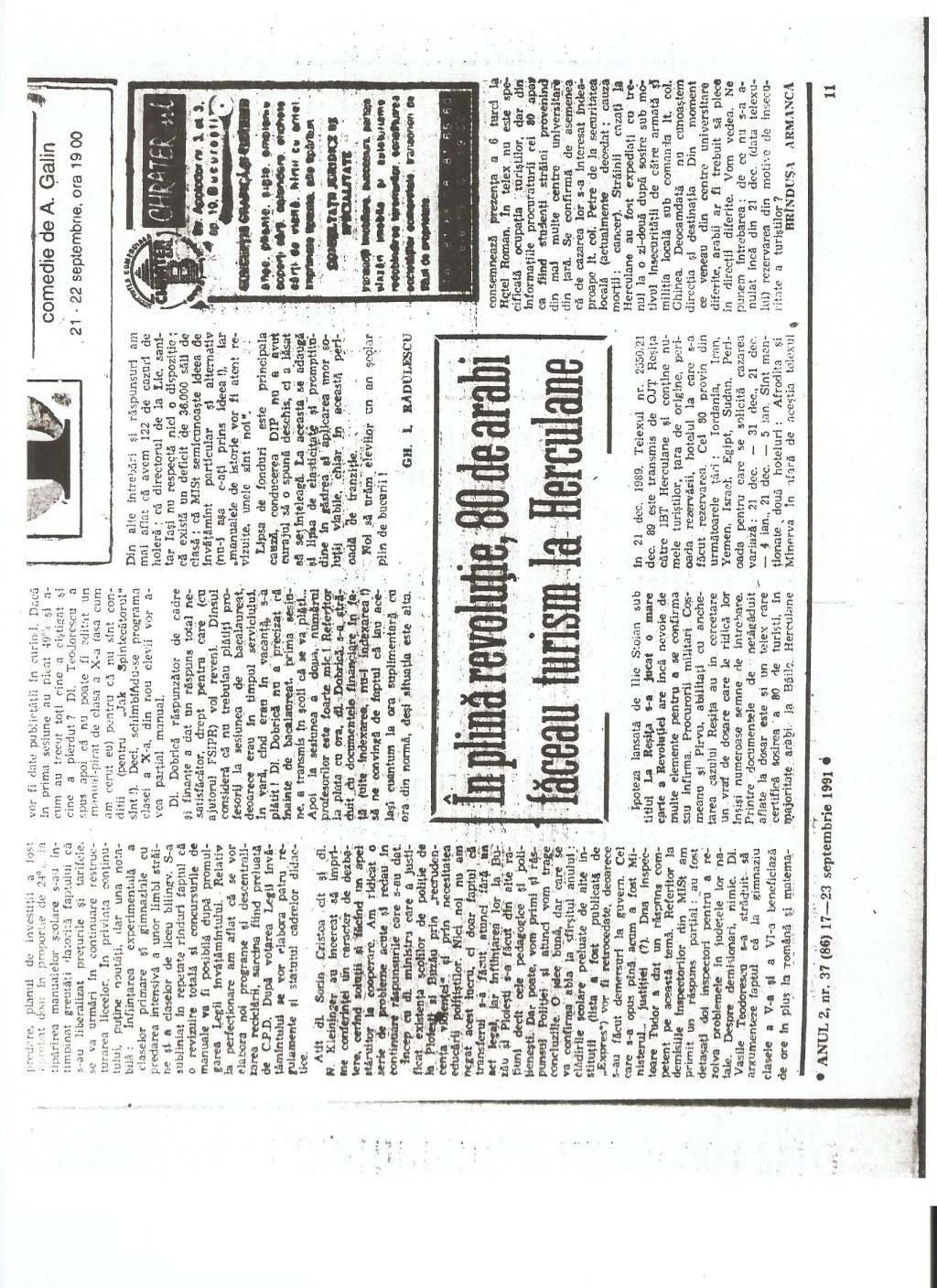
Final Boarding Call for TAROM’s special ROMBAC service from Bucuresti to Sibiu: Would the large party of suspicious “Soviet tourists” please report to the gate immediately! (IV)

Posted by romanianrevolutionofdecember1989 on August 16, 2013

Part I :  Just how absurd is the Soviet tourist scenario?! http://atomic-temporary-3899751.wpcomstaging.com/2013/08/10/final-boarding-call-for-taroms-special-rombac-service-from-bucuresti-to-sibiu-would-the-large-party-of-suspicious-soviet-tourists-please-report-to-the-gate-immediately-i/

Part II:  Senior Securitate officials sent to Timisoara cannot find the “foreign tourists” Nicolae Ceausescu and Iulian Vlad claim are behind the unrest.  http://atomic-temporary-3899751.wpcomstaging.com/2013/08/11/final-boarding-call-for-taroms-special-rombac-service-from-bucuresti-to-sibiu-would-the-large-party-of-suspicious-soviet-tourists-please-report-to-the-gate-immediately-ii/

Part III:  The Ceausescu regime bans new Soviet travellers to the country…but allows those “in transit,” already in Romania, to stay…and apparently, despite supposedly having great suspicions of their actions, do nothing to stop them… http://atomic-temporary-3899751.wpcomstaging.com/2013/08/14/final-boarding-call-for-taroms-special-rombac-service-from-bucuresti-to-sibiu-would-the-large-party-of-suspicious-soviet-tourists-please-report-to-the-gate-immediately-ii-2/

I hope to develop this, part IV, at another time…for now, some previously related content in reference to the famous ROMBAC flight of 20 December 1989 from Bucuresti (Otopeni) to Sibiu:

http://atomic-temporary-3899751.wpcomstaging.com/ultimul-raport-al-securitatii-catre-nicolae-ceausescu/

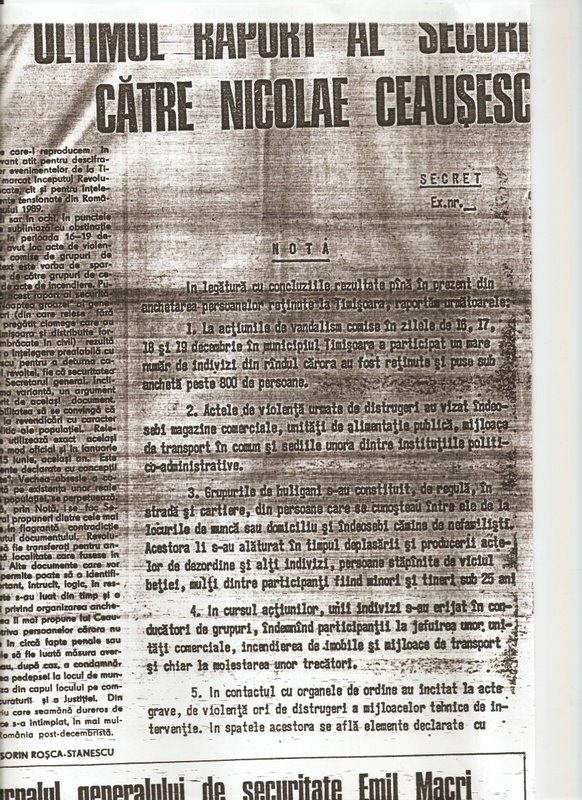
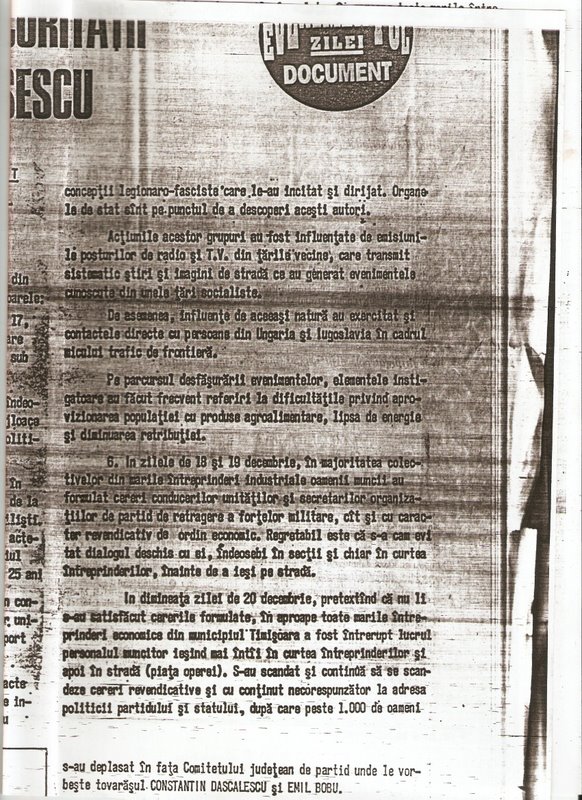
The Securitate’s last report to Nicolae Ceausescu:

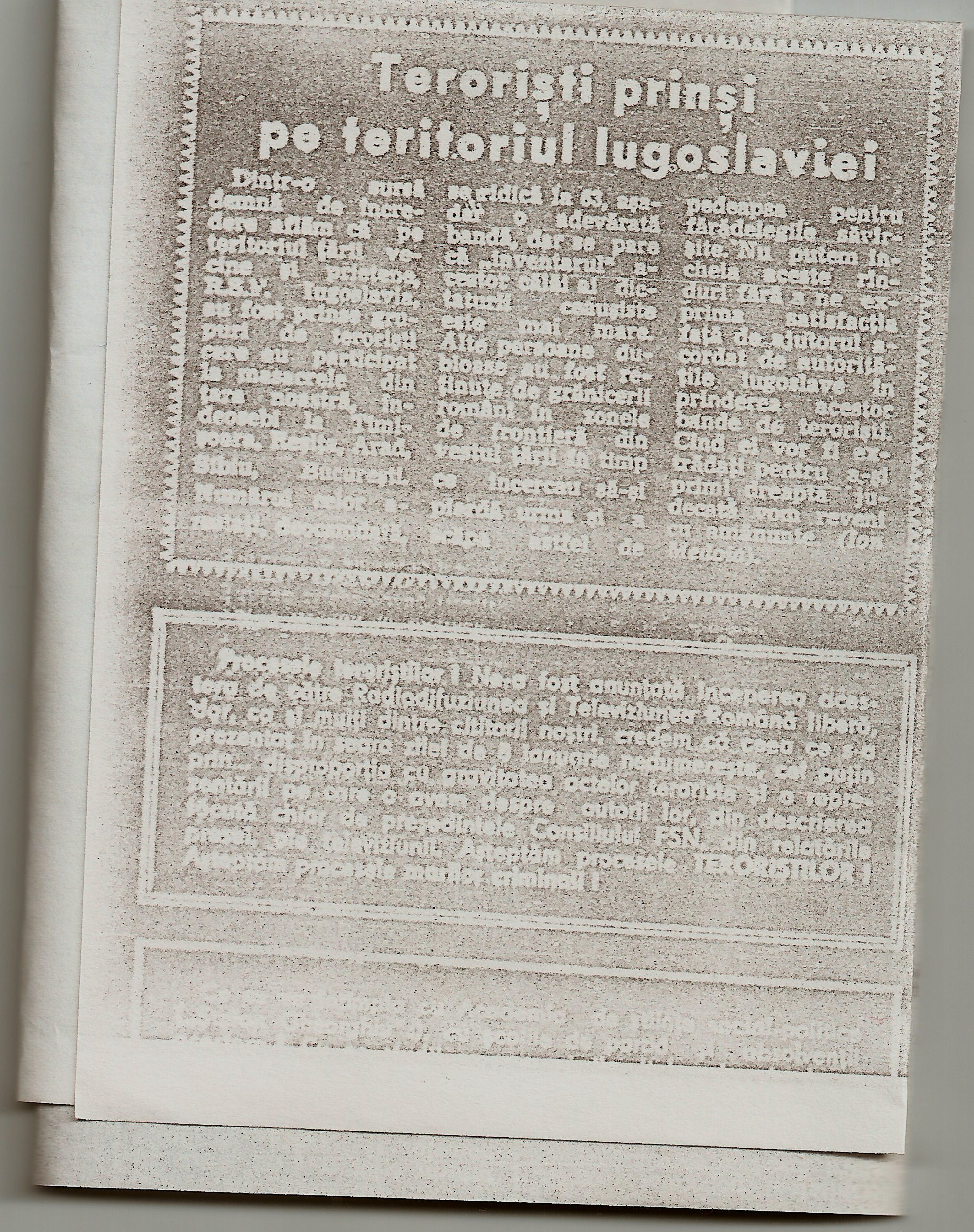
Please note:  no mention whatsoever of the alleged role played by “Russian tourists” or “Soviet tourists” in allegedly fomenting the Timisoara uprising, or of their supposed presence on the ROMBAC of 20 December 1989

published in Evenimentul Zilei, 28 iulie 1992, p. 3.

http://atomic-temporary-3899751.wpcomstaging.com/2009/10/04/decembrie-89-citeva-indoieli-stirnite-de-un-articol-din-revista-22-cazul-ivanciuc-si-teza-turistilor-sovietici/

http://atomic-temporary-3899751.wpcomstaging.com/2009/03/26/a-ruse-by-any-other-name-general-stanculescu-the-soviet-tourists-and-december-1989/

THE 1989 ROMANIAN REVOLUTION AS GEOPOLITICAL PARLOR GAME: BRANDSTATTER’S “CHECKMATE” DOCUMENTARY AND THE LATEST WAVE IN A SEA OF REVISIONISM

By Richard Andrew Hall

Disclaimer: This material has been reviewed by CIA. That review neither constitutes CIA authentification of information nor implies CIA endorsement of the author’s views.

Part 3: Ruse

A SECURITATE RIDDLE: SOVIET “TOURISTS” AND THE OVERTHROW OF THE CEAUSESCU REGIME

Although I have written a good deal on the “tourist” conundrum in the past (see, for example, Hall 2002), I have not formally addressed the role of foreign histories of Ceausescu’s overthrow in the historiography of December 1989, particularly in regard to this topic. In the wake of the broadcast of Brandstatter’s “Checkmate” documentary in February 2004, Vladimir Bukovski’s invocation of journalist John Simpson’s 1994 article on the topic (discussed in Part 2 of this series) suggests, however, that it needs to be broached in greater detail. Moreover, as the year-long look-back at the December 1989 events in “Jurnalul National” shows, the “tourist” question—somewhat surprisingly to me—has become more and more central to arguments about the Revolution, thereby amplifying what is already tremendous confusion over the events in the Romanian press and public. Of course, as has traditionally been the case, the Soviet/Russian tourists figure prominently, and, to a lesser extent, the Hungarian tourists. However, the stock of other tourist groups has also gone up. For example, the role of Yugoslav (specifically Serb) tourists has found a greater emphasis, and, seemingly out of nowhere, so have East German/STASI tourists! The principal sources for all of these allegations are, as usual, former Securitate and Militia officers, with some military (intelligence) personnel thrown in for good measure.

FOREIGN FORUM, ROMANIAN CONTEXT

It is difficult to pinpoint the exact first mention of “the tourists” and their alleged role in the Revolution, but it appears that although the source of the claim was Romanian, the publication was foreign. James F. Burke, whose name is unfortunately left off the well-researched and widely-consulted web document “The December 1989 Revolt and the Romanian Coup d‘etat,” alludes to the “Romanian filmmaker” who first made these allegations (Burke, 1994). The claims are contained in an article by Richard Bassett in the 2 March 1990 edition of “The Times (London).” According to Bassett,

“Mr. [Grigore] Corpacescu has no doubt that the revolution here was carefully stage-managed—as was the case in Prague and East Berlin—by the Russians…According to Mr. Corpacescu a party of Soviet ‘tourists,’ all usually on individual visas, arrived in Timisoara two days before the first demonstration outside Mr. [i.e. Pastor] Tokes’ house. Police records trace them reaching Bucharest on December 20. By the 24th, two days after Ceausescu fled by helicopter, the Russians had disappeared. No police records exist to indicate how they left the country. (“The Times (London),” 2 March 1990)

But Bassett’s interlocutor, Mr. Corpacescu, says some strange things. Bassett is not clear but it appears that Corpacescu suggests that the post-Revolution Interior Minister Mihai Chitac, who was involved in the Timisoara events as head of the army’s chemical troops, somehow purposely coaxed the demonstrations against the regime because the tear-gas cannisters his unit fired failed to explode—the failure somehow an intended outcome. But beyond this, Corpacescu, who is at the time of the article filming the recreation of Ceausescu’s flight on the 22nd—using the same helicopter and pilot involved in the actual event—makes the following curious statement:

“The pilot of this helicopter is an old friend. I have many friends in the police, Timisoara was not started by the Hungarian pastor, the Reverend Laszlo Tokes [i.e. it was carefully stage-managed…by the Russians].” (“The Times (London),” 2 March 1990)

The pilot of the helicopter was in fact Vasile Malutan, an officer of the Securitate’s V-a Directorate. What kind of a person would it have been at that time—and how credible could that person have been–who has the pilot as an old friend and “many friends in the police?” And it would have been one thing perhaps two months after the revolution to talk about the presence of foreign agents “observing” events in Timisoara, but to deny the spontaneity of the demonstrations and denigrate Tokes’ role at this juncture is highly suspicious. I have been unable to unearth additional information on Mr. Corpacescu, but his revelations just happen to serve his friends extremely well—particularly at at time when the prospect of trials and jail time, for participation in the repression in Timisoara and elsewhere during the Revolution, still faced many former Securitate and Militia [i.e. police] members.

THE FORMER SECURITATE AND MILITIA REMINISCE ABOUT THE SOVIET “TOURISTS”

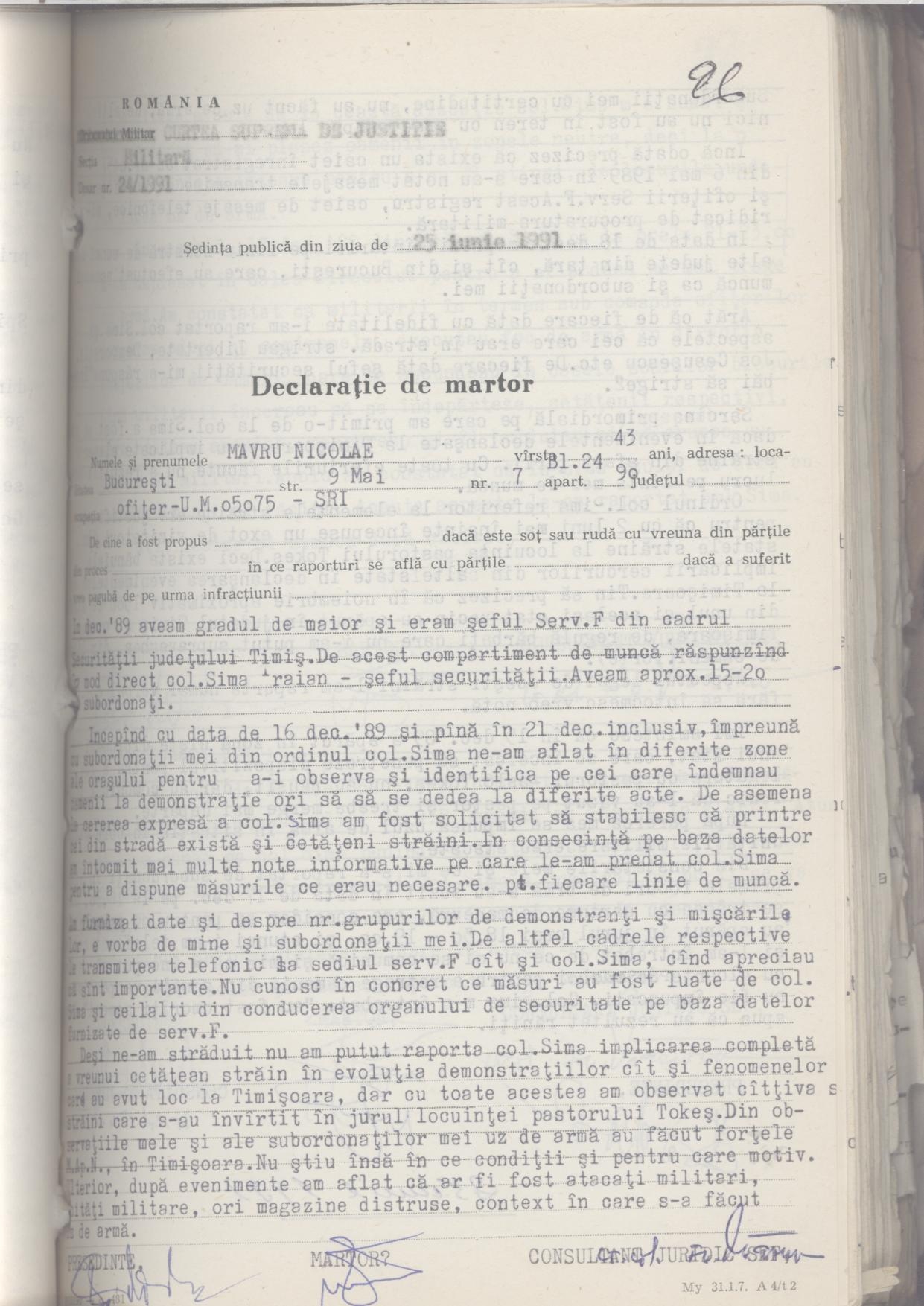
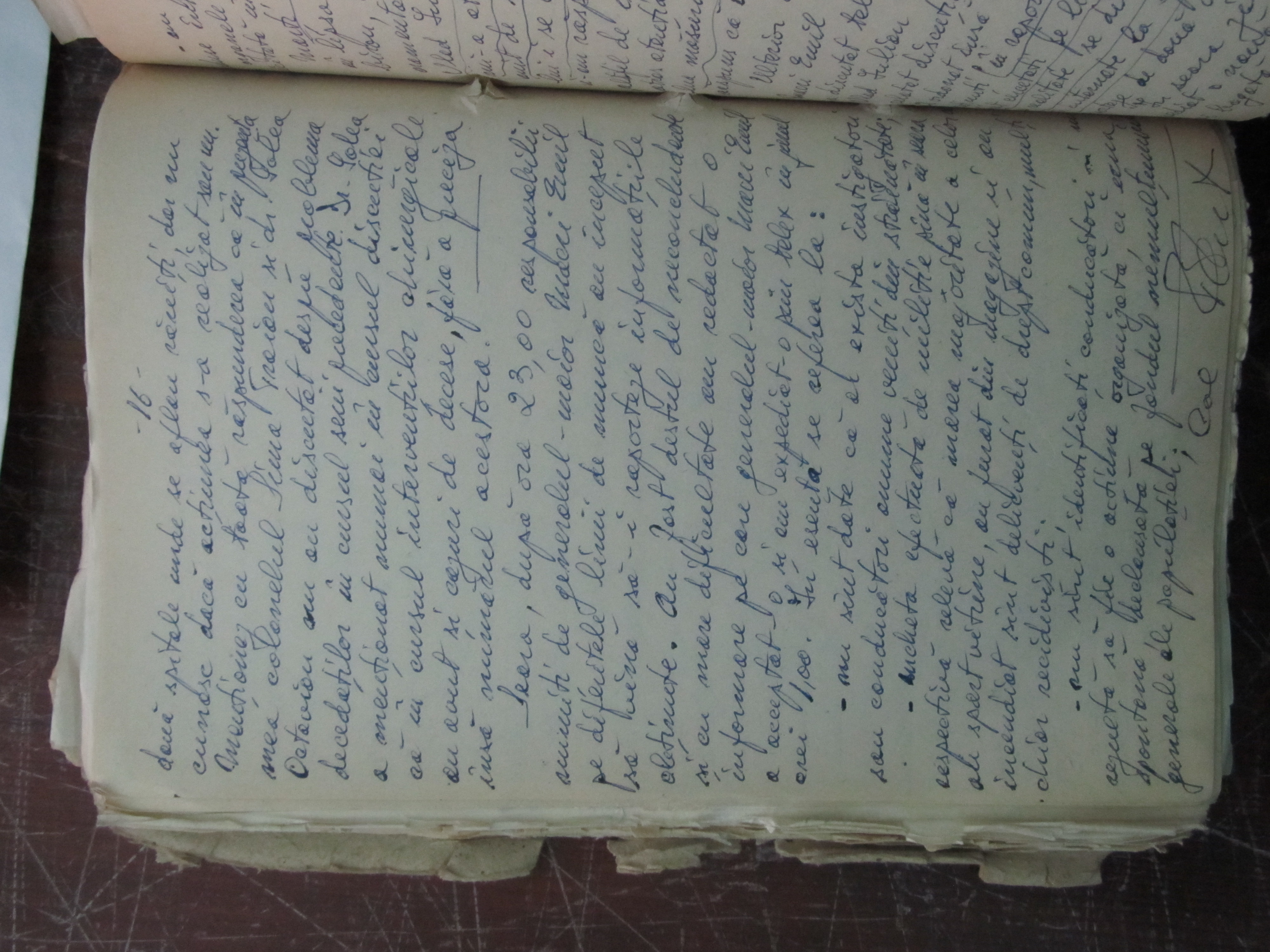
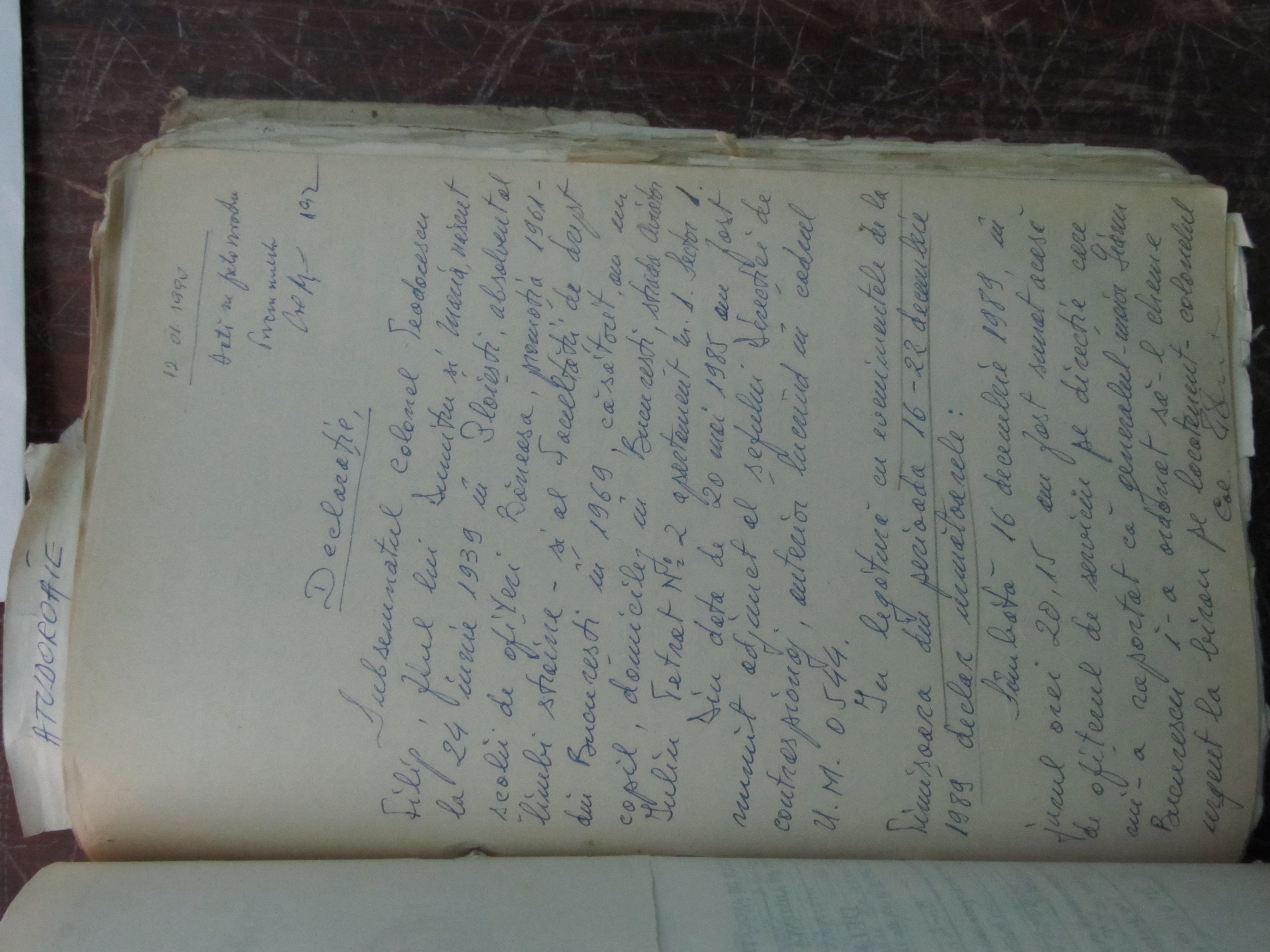
A week after “The Times” article, the chief of the Securitate’s Counter-espionage Directorate, Colonel Filip Teodorescu, mentioned at his trial for his role in the Ceausescu regime’s crackdown in Timisoara that he had in fact detained “foreign agents” during the events there (“Romania Libera,” 9 March 1990). In his 1992 book, he developed further on this theme, specifically focusing on the role of “Soviet tourists:”

“There were few foreigners in the hotels, the majority of them having fled the town after lunch [on 17 December] when the clashes began to break out. The interested parties remained. Our attention is drawn to the unjustifiably large number of Soviet tourists, be they by bus or car. Not all of them stayed in hotels. They either had left their buses or stayed in their cars overnight. Border records indicate their points of entry as being through northern Transylvania. They all claimed they were in transit to Yugoslavia. The explanation was plausible, the Soviets being well-known for their shopping trips. Unfortunately, we did not have enough forces and the conditions did not allow us to monitor the activities of at least some of these ‘tourists’” (Teodorescu, 1992, p. 92).

Reporting in July 1991 on the trial involving many of those involved in the Timisoara repression, Radu Ciobotea noted with what was probably an apt amount of skepticism and cynicism, what was telling in the confessions of those on trial:

Is the End of Amnesia Approaching?…

Without question, something is happening with this trial. The Securitate doesn’t say, but it suggests. It let’s small details ‘slip out.’…Increasingly worthy of interest are the reactions of those on trial….Traian Sima (the former head of the county’s Securitate) testifies happily that, finally, the Securitate has been accepted at the trial, after having been rejected by Justice. Filip Teodorescu utters the magic word ‘diplomats’ and, suddenly, the witness discovers the key to the drawer with surpise and declares, after five hours of amnesia, that in Timisoara, there appeared in the days in question, foreign spies under the cover of being journalists and diplomats, that in a conversation intercepted by a mobile Securitate surveillance unit Tokes was reported as ‘well,’ and that all these (and other) counterespionage actions that can’t be made public to the mass media can be revealed behind closed doors to the judge….[Timis County party boss] Radu Balan ‘remembers’ that on 18 December at midnight when he was heading toward IAEM, he passed a group of ten soviet cars stopped 100 meters from the county hospital. (It turns out that in this night, in the sight of the Soviets, the corpses were loaded!).” [emphasis in the original] (Flacara, no. 27, 1991, p. 9).

The reference to the corpses being loaded is to an operation by the Militia and Securitate on the night of 18-19 December 1989, in which the cadavers of 40 people killed during the repression of anti-regime protesters were secretly transported from Timisoara’s main hospital to Bucharest for cremation (reputedly on Elena Ceausescu’s personal order).

Finally, as yet another of many possible examples, we have the recollections of Bucharest Militia Captain Ionel Bejan, which apparently appeared in print for the first time only in 2004, in a book by Alex Mihai Stoenescu (excerpted in “Jurnalul National,” 7 December 2004). According to Bejan, around 2 AM on the night of 21-22 December, not far from University Plaza, where at that moment regime forces were firing their way through a barricade set up by protesters (48 were killed that night, 604 wounded, and 684 arrested), he spotted two LADA automobiles with Soviet plates and two men and a woman studying a map and pointing to different locations among the surrounding buildings. Bejan recalled:

“One thing’s for sure, and that is that although they looked like tourists, they didn’t behave like tourists who had just arrived in town or were lost, especially as close by there were compact groups of demonstrators, while from armored personnel carriers there was intense warning fire and a helicopter hovered overhead with lights ablaze. I don’t know what kind of tourist tours somewhere in such conditions. They left the impression that they were sure of themselves, they didn’t need any directions, proof which was that they didn’t ask us anything even though we were nearby and, being uniformed Militia, were in the position to give them any directions they needed. One thing’s for sure when I returned to that location in January 1990…the buildings displayed visible signs of bullet holes…[emphasis added]” (“Jurnalul National,” 7 December 2004)

STRANGE “TOURISTS”…STRANGER STILL, THE REACTIONS OF THE AUTHORITIES

We can agree with Ionel Bejan in one respect. One thing is for sure: these were some very strange tourists. (They give a whole new meaning to the term, “adventure tourism.”) As curious as the “Soviet tourists” themselves is how little the Romanian authorities who claim to have seen them did to stop them—or even try to collect more information about them. Why is it that no official questioned the enigmatic “Soviet tourists” or asked them to leave the area when, as Radu Balan claims, he saw ten LADAs outside the Timis county hospital at 1 AM in the morning the night the cadavers of protesters were being loaded onto a truck for cremation? Or, as Ionel Bejan claims, he spotted several of them in the center of Bucharest at 2 AM, when the area was essentially a warzone of regime repression? The regime had closed the borders to virtually all other foreigners, tourists or otherwise, it was trying to prevent any word of the repression from reaching the outside world, and yet Romanian authorities were not concerned about these “tourists” taking pictures or relaying what they were seeing?!

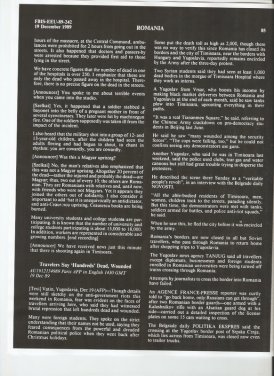
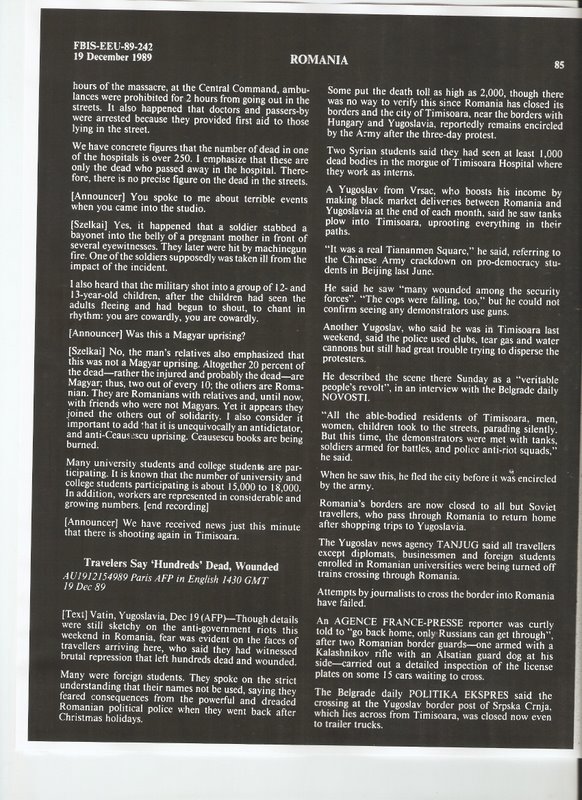
As I have written before, if it was obvious before 18 December, as these Ceausescu regime officials claim, that “Soviet tourists” were involved in the events in Timisoara, then why was it precisely “Soviet travelers coming home from shopping trips to Yugoslavia” who were the only group declared exempt from the ban on “tourism” announced on that day (see AFP, 19 December 1989 as cited in Hall 2002b)? In fact, an Agent France-Presse correspondent reported that two Romanian border guards on the Yugoslav frontier curtly told him: “Go back home, only Russians can get through”!!! The few official documents from the December events that have made their way into the public domain show the Romanian Ambassador to Moscow, Ion Bucur, appealing to the Soviets to honor the Romanian news blackout on events in Timisoara, but never once mentioning—let alone objecting to—the presence or behavior of “Soviet tourists” in Romania during these chaotic days of crisis for the Ceausescu regime (CWHIP, “New Evidence on the 1989 Crisis in Romania,” 2001). It truly strains the imagination to believe that the Romanian authorities were so “frightened” of committing a diplomatic incident with the Soviets that they would allow Soviet agents to roam the country virtually unhindered, allowing them to go anywhere and do anything they wanted.

BUT WAIT, THERE’S MORE…A “SOVIET TOURIST” ENCORE IN 1990

Add to all of this (!), the allegations that the “Soviet tourists” were seen again on the streets during major crises in 1990, such as the ethnic clashes between Romanians and Hungarians in Tirgu Mures in March 1990 (for evidence of the reach of the allegation of KGB manipulation via the “tourist” mechanism both in December 1989 AND in March 1990, see Emil Hurezeanu, “Cotidianul,” 23 December 1999; according to Hurezeanu, “It appears they didn’t leave the country until 1991, following a visit by [SRI Director] Virgil Magureanu to Moscow”!). Then there is the famous April 1991 interview of an alleged KGB officer—who spoke flawless Romania and was in Romania during the December 1989 events—who the interviewer, the vigorous anti-Iliescu foe, Sorin Rosca Stanescu, claimed to have just stumbled into in Paris. Of all the reporters who could have stumbled into a KGB officer present in Romania during the Revolution—the only such case I know of—it was Rosca Stanescu, who, it turned out later, had been an informer for the Securitate until the mid-1980s—but not just for anybody, but for the USLA. Intererstingly, although the article appeared on the non-descript page 8 of the primary opposition daily at the time (“Romania Libera”), the aforementioned Filip Teodorescu and Radu Balan invoked it in support of their contentions regarding the the “tourists” (for a discussion of this, see Hall 2002). Even more suprising, or not, depending on your point of view, in his April 1991 article, Stanescu attempted to tie together December 1989 with December 1990 (!):

“As you will recall, persistent rumors have circulated about the existence on Romanian soil [in December 1989] of over 2,000 Lada automobiles with Soviet tags and two men in each car. Similar massive infiltrations were witnessed in December 1990, too, with the outbreak of a wave of strikes and demonstrations. What were the KGB doing in Romania?” (emphasis added) (“Romania Libera,” 18 April 1991)

Indeed, what were they doing in Romania? But, more aptly:

WHO COULD THEY HAVE BEEN?

Some other recollections and comments may offer clues to the answer to this vexing question. For example, the Caransebes Militia Chief claims he helped a group of “Soviet tourists” coming from Timisoara on the night of 20-21 December when one of their cars—as usual, “it was part of a convoy of 20 cars, all of the same make and with 3-4 passengers per car”—went off the road (from “Europa,” no. 20, 1991, see the discussion in Hall 2002b). According to Teodorescu, the “tourists” greeted the militia chief with the phrase “What the hell? We are colleagues; you have to help us” (Teodorescu, 1992, p. 93). The militia chief opines that despite their Soviet passports, “to this day, I don’t really know where they were from.”

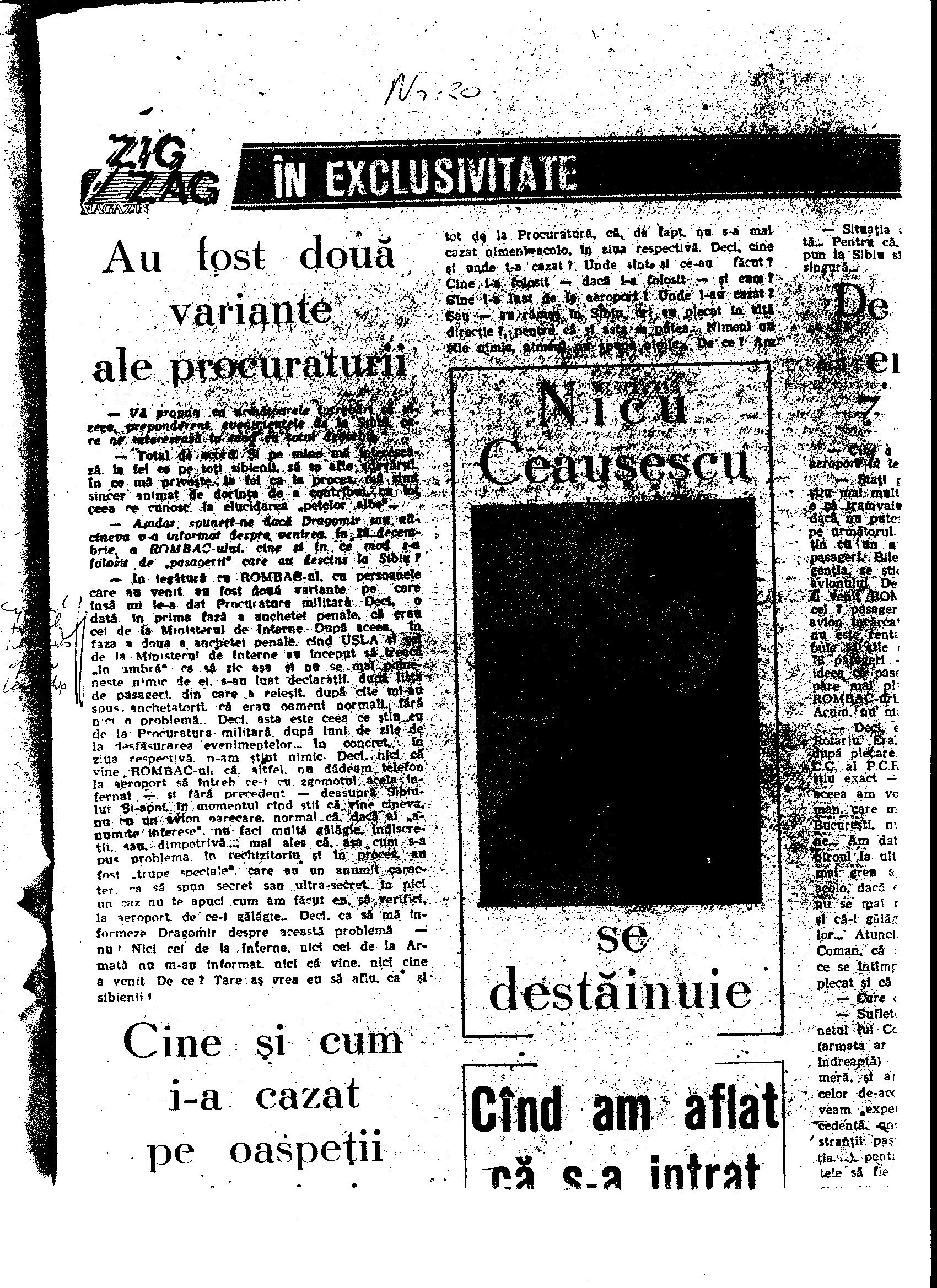
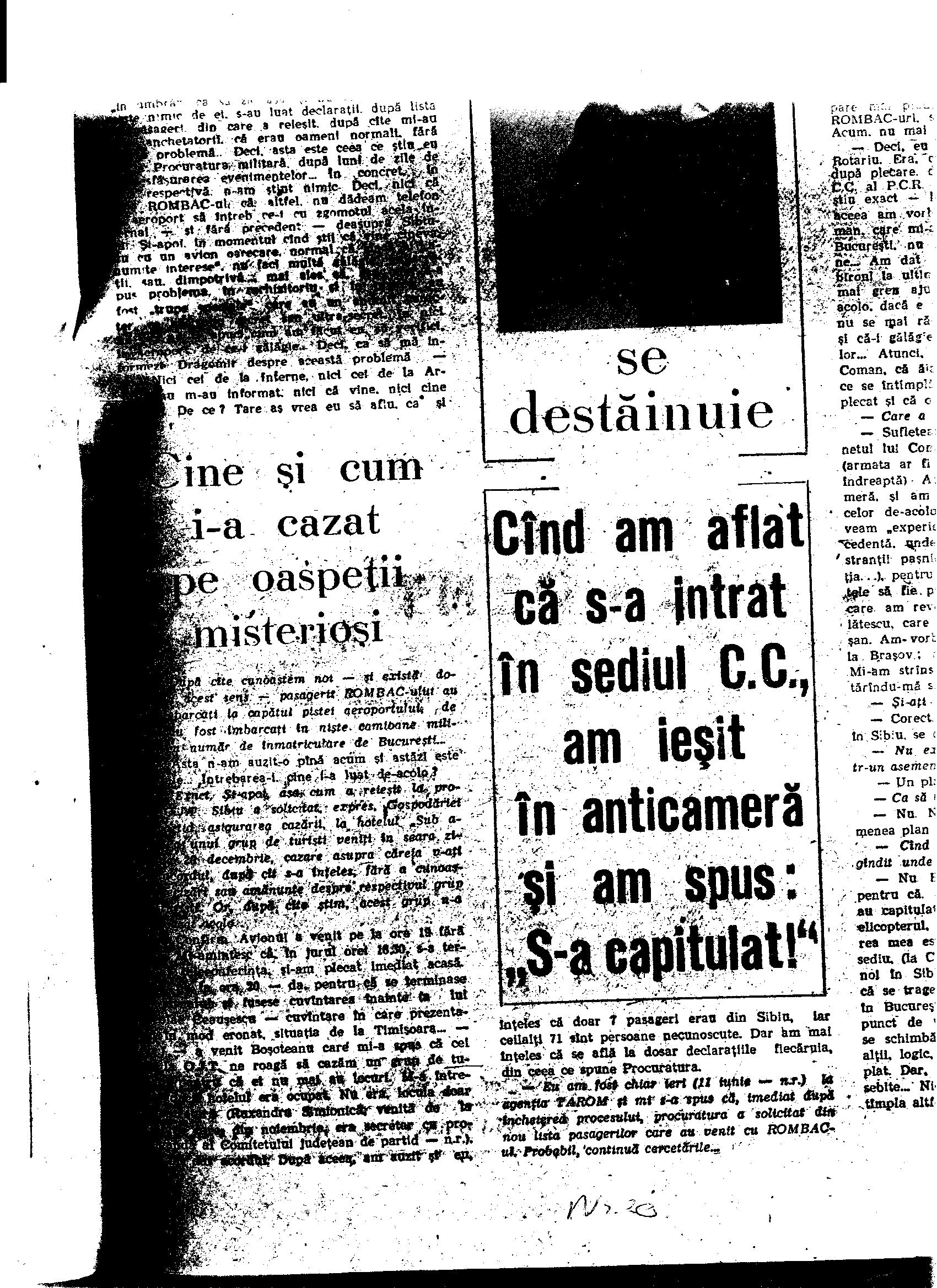
Nicu Ceausescu, Nicolae’s son and most likely heir and party secretary in Sibiu at the time of the Revolution, claimed that he also had to deal with enigmatic “tourists” during these historic days (the following several paragraphs borrow heavily from Hall 2002b). From his prison cell in 1990, Nicu recounted how on the night of 20 December 1989, a top party official came to inform him that the State Tourist Agency was requesting that he — the party secretary for Sibiu! — “find lodgings for a group of tourists who did not have accommodation” He kindly obliged and made the appropriate arrangements (interview with Nicu Ceausescu in “Zig-Zag,”, no. 20, 21-27 August 1990).

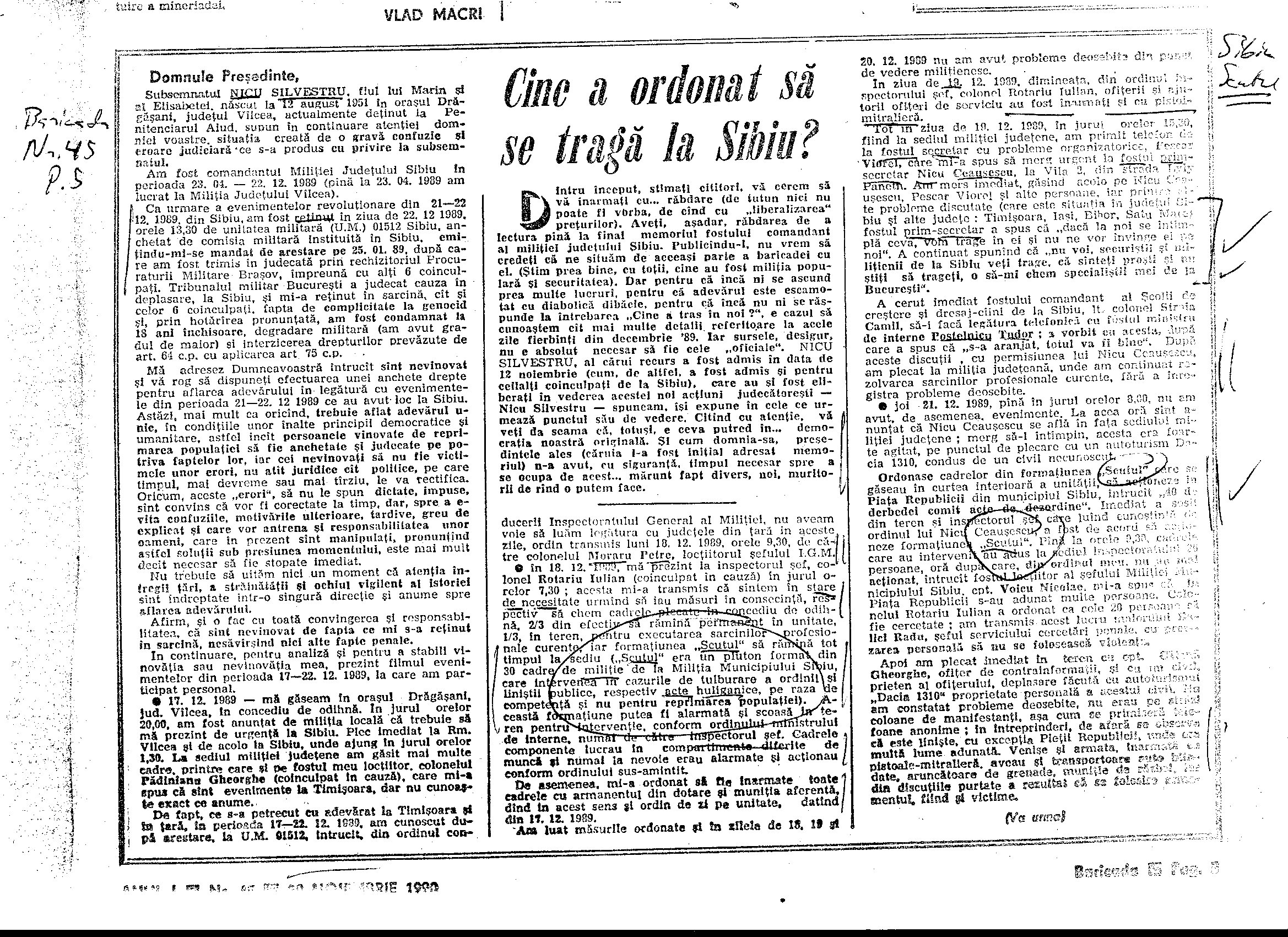
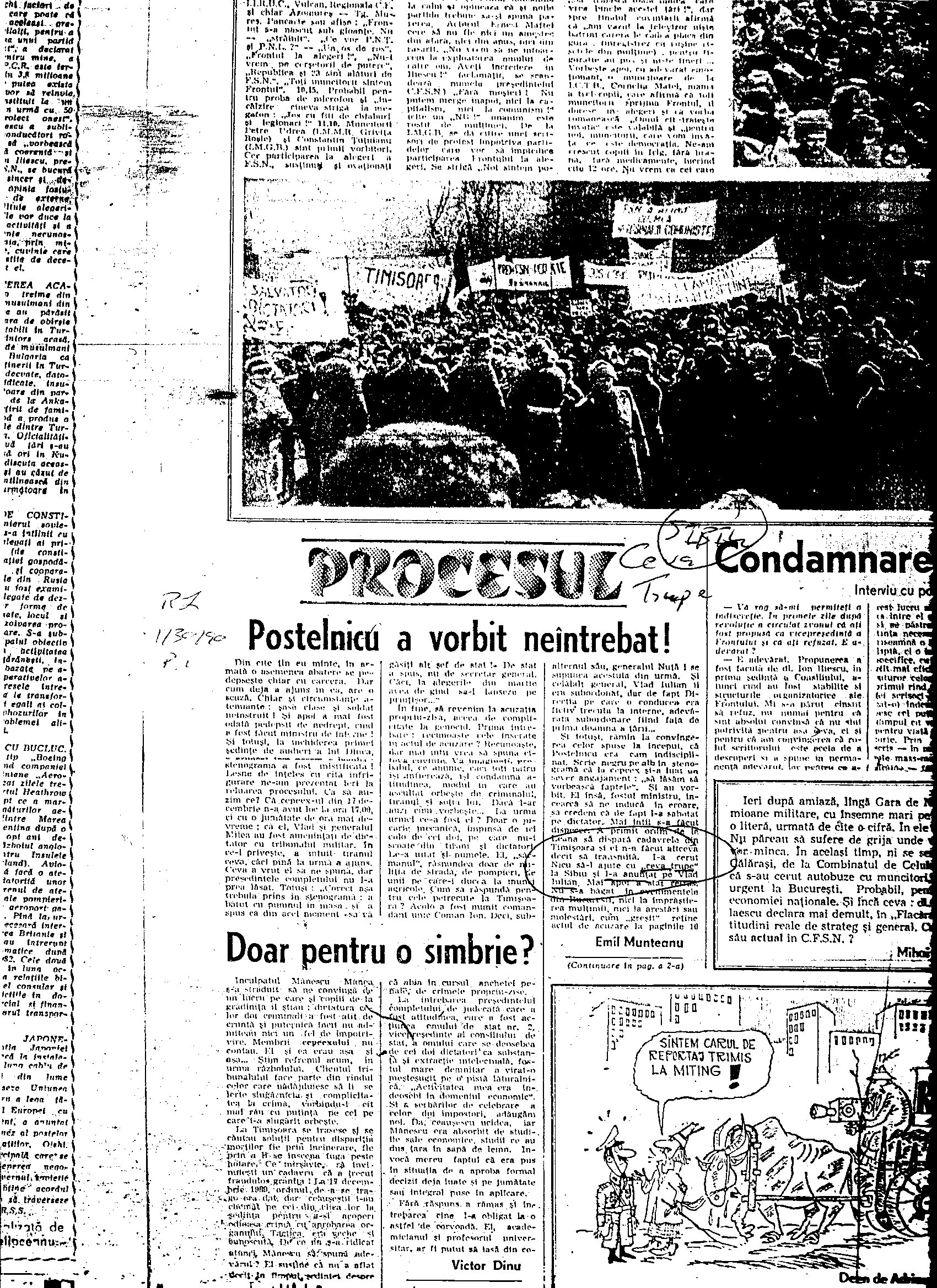
Interestingly, in the same interview Nicu discusses the “tourists” for which he was asked to find accommodations in the context of a group of mysterious passengers who had arrived by plane from Bucharest on the evening of 20 December 1989. We know that in the period immediately following these events, the then-military prosecutor, Anton Socaciu, had alleged that these passengers from Bucharest were members of the Securitate’s elite USLA unit (Special Unit for Antiterrorist Warfare) and were responsible for much of the bloodshed that occurred in Sibiu during the December events. Nicu Silvestru, chief of the Sibiu County Militia, admitted in passing in a letter from prison that on the afternoon of 19 December in a crisis meeting, Ceausescu’s son announced that he was going to “call [his] specialists from Bucharest” to take care of any protests (“Baricada,” no. 45, 1990). Ceausescu’s Interior Minister, Tudor Postelnicu, admitted at his trial in January 1990 that Nicu had called him requesting “some troops” and he had informed Securitate Director General Iulian Vlad of the request (“Romania Libera,” 30 January 1990.)

The rewriting of the story of the Revolution, the “tourists,” and the “terrorists” was already in full swing, when in August 1990, Nicu wryly observed:

“…[T]he Military Prosecutor gave me two variants. In the first part of the inquest, they [the flight’s passengers] were from the Interior Ministry. Later, however, in the second half of the investigation, when the USLA and those from the Interior Ministry began, so-to-speak, to pass ‘into the shadows,’ — after which one no longer heard anything of them — they [the passengers] turned out to be simple citizens…” (interview with Nicu Ceausescu in “Zig-Zag,” no. 20, 21-27 August 1990).

The impact of this “reconsideration” by the authorities could be seen in the comments of Socaciu’s successor as military prosecutor in charge of the Sibiu case, Marian Valer (see Hall 1997, pp. 314-315). Valer commented in September 1990 that investigations yielded the fact that there were 37 unidentified passengers on board the 20 December flight from Bucharest and that many of the other passengers maintained that “on the right side of the plane there had been a group of tall, athletic men, dressed in sporting attire, many of them blond, who had raised their suspicions.” The USLA, which were responsible for airport security and had “air marshals” on all flights (three in this case), refused to discuss the identity of these passengers with Valer. While investigations revealed that during this time there “were many Soviet tourists staying in Sibiu’s hotels,” they also established that “military units were fired upon from Securitate safehouses located around these units as of the afternoon of 22 December, after the overthrow of the Ceausescu regime.” He thus carefully concludes:

“As far as the unidentified passengers are concerned, there are two possible variants: Either they were USLA fighters sent to defend Nicu Ceausescu, or they were Soviet agents sent to act with the intent of overthrowing the Ceausescu regime” (“Expres,” no. 33, September 1990).

Clearly, one of these hypotheses is a lot more plauisble than the other…As I wrote in December 1996, partly based on the statements of the Military Prosecutor Marian Valer who stepped down from investigating the Sibiu events in fall 1990, citing duress: “thus as the USLA began to disappear from the historiography and therefore history of the Revolution, so the Soviet tourists began to enter it.” (Hall, 1996).

“ORWELLIAN…POSITIVELY ORWELLIAN:”

PROSECUTOR VOINEA’S CAMPAIGN TO SANITIZE

THE ROMANIAN REVOLUTION OF DECEMBER 1989

by Richard Andrew Hall

Disclaimer: All statements of fact, opinion, or analysis expressed are those of the author and do not reflect the official positions or views of the Central Intelligence Agency (CIA) or any other U.S. Government agency. Nothing in the contents should be construed as asserting or implying U.S. Government authentication of information or CIA endorsement of the author’s views. This material has been reviewed by CIA to prevent the disclosure of classified information.

Sibiu, 19-22 December 1989

In Sibiu, Siani-Davies tells us:

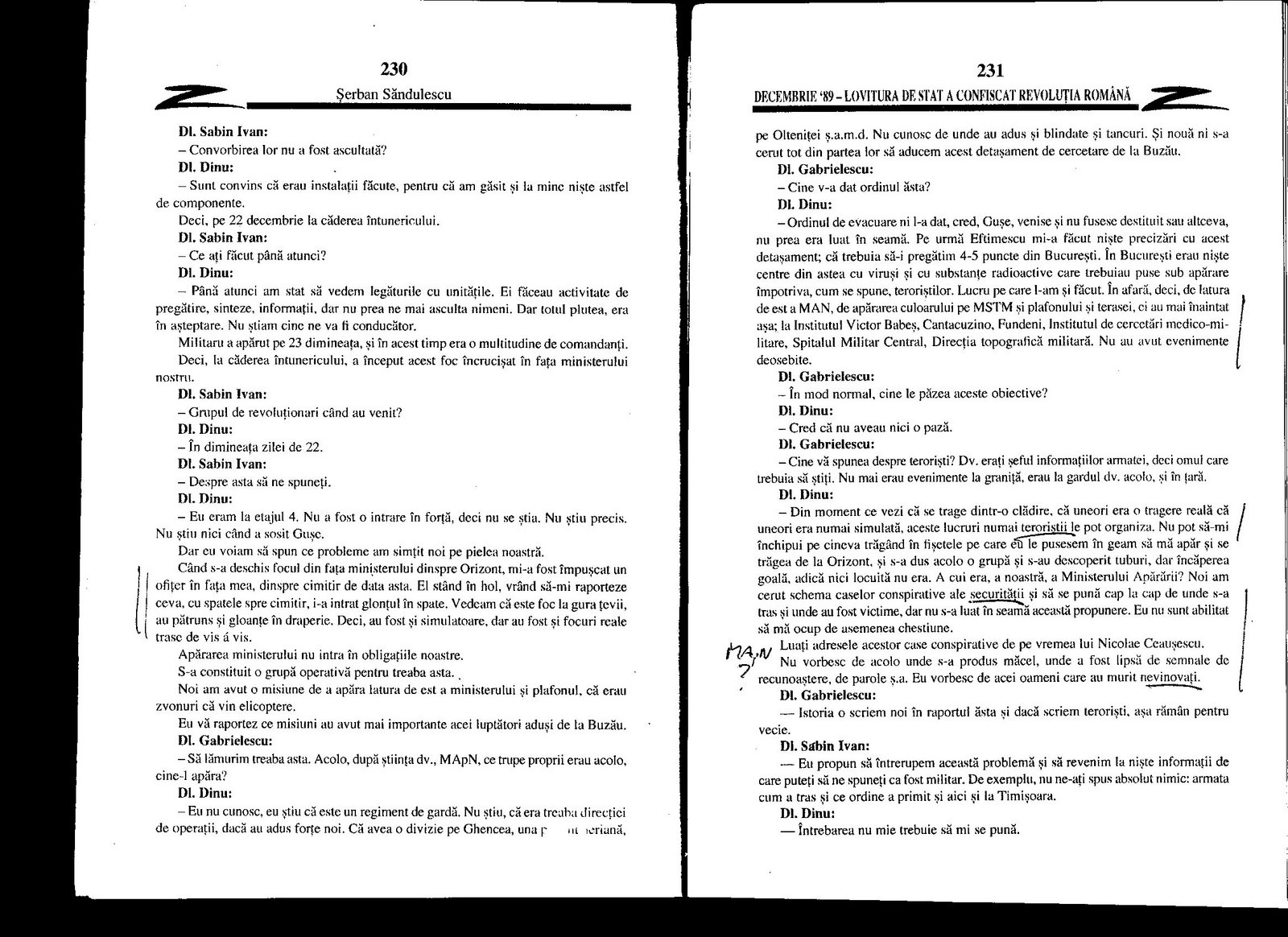
Controversy also continues to surround a commercial TAROM flight, which is alleged to have brought up to eighty USLA troops from Bucharest to Sibiu on December 20, 1989. It is not clear if the USLA forces were actually on the airplane, or, even if they were, what they actually did in Sibiu…[Serban] Sandulescu (c1996), 57-58…suggests they were not members of USLA but the DIA [Army’s Intelligence Unit].[151]

From the standpoint of Siani-Davies’ unsuspecting reader such a conclusion may seem not only credible, but judicious. But one of Siani-Davies’ habits—identified negatively by even those who praise the book—is his tendency to draw negative equivalencies: i.e. there is about as much evidence to support x as there is to support y, in order to disprove or discount both propositions. In a review, Doris Mironescu writes:

“Very common are claims such as the following: ‘Finding the proof to sustain such an explanation of the events [that the Army’s Intelligence arm, the DIA simulated the “terrorist diversion,” to permit the Front’s takeover and a possible Warsaw Pact invasion of the country] is as difficult as proving that special units of the securitate took up arms against the revolution’ (p. 154). Mutually contradictory hypotheses are invoked in order to negate each other, not so much because of the weight of the claims, but through the ideological similarity of both.”[152]

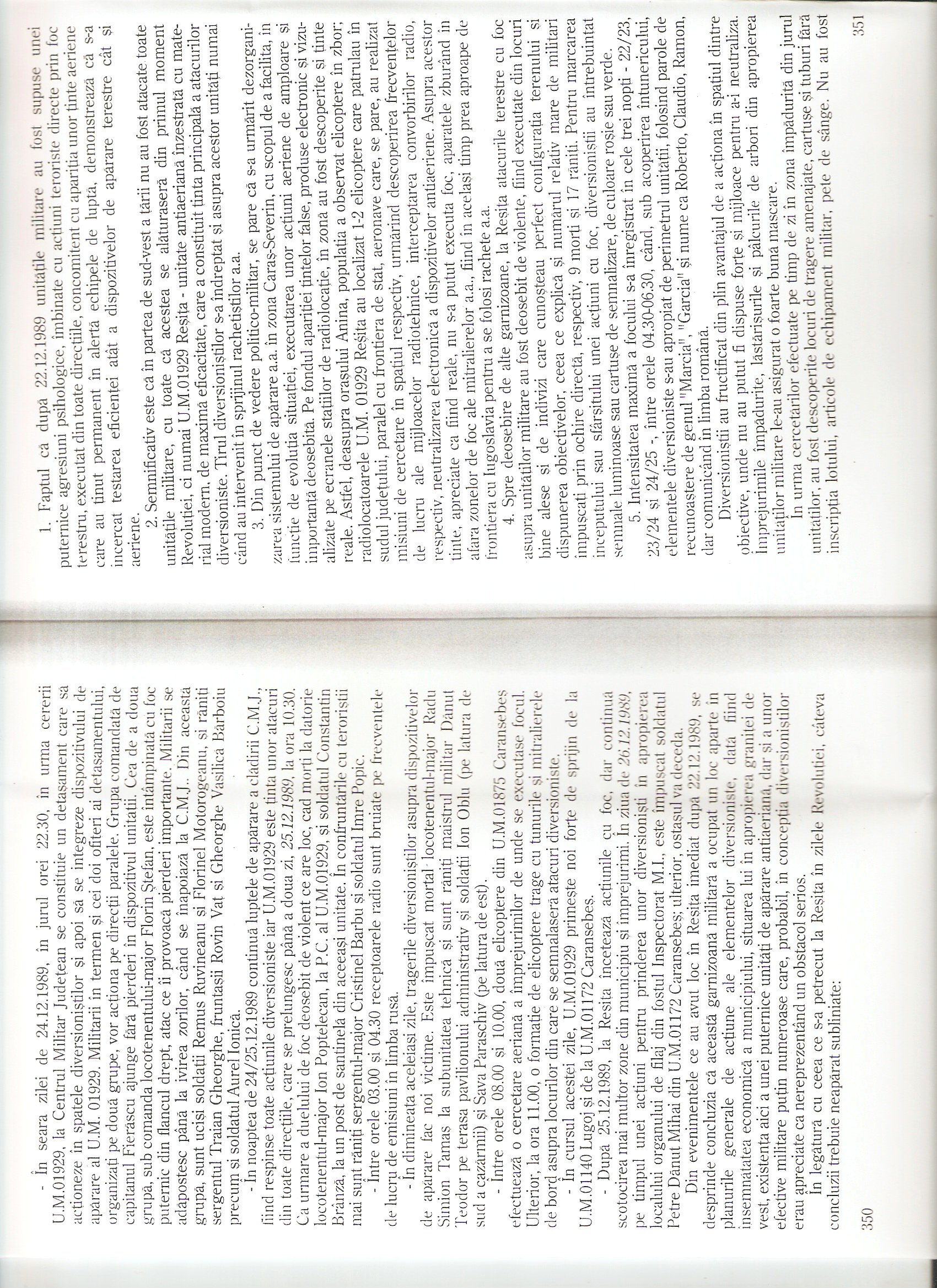
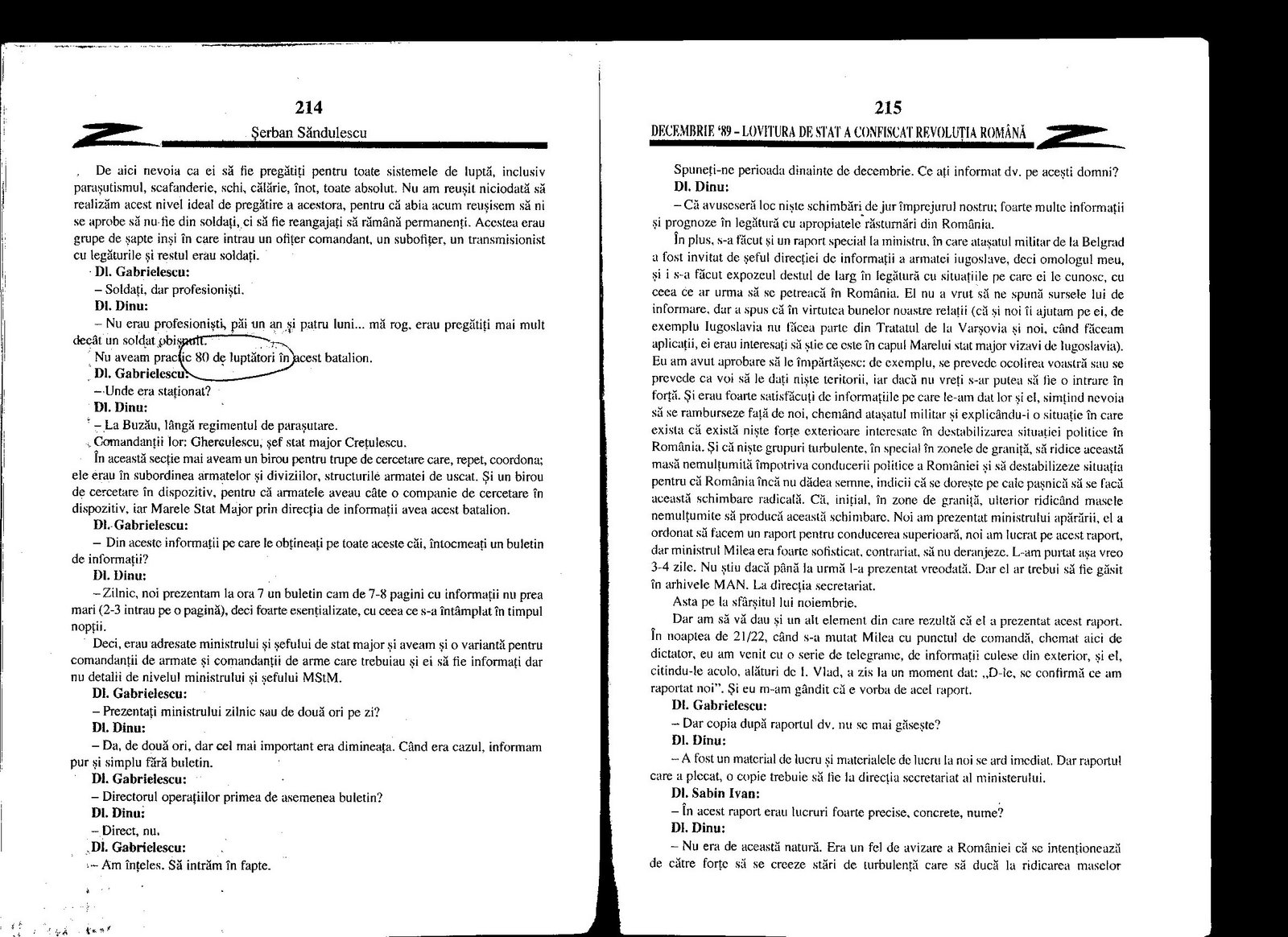
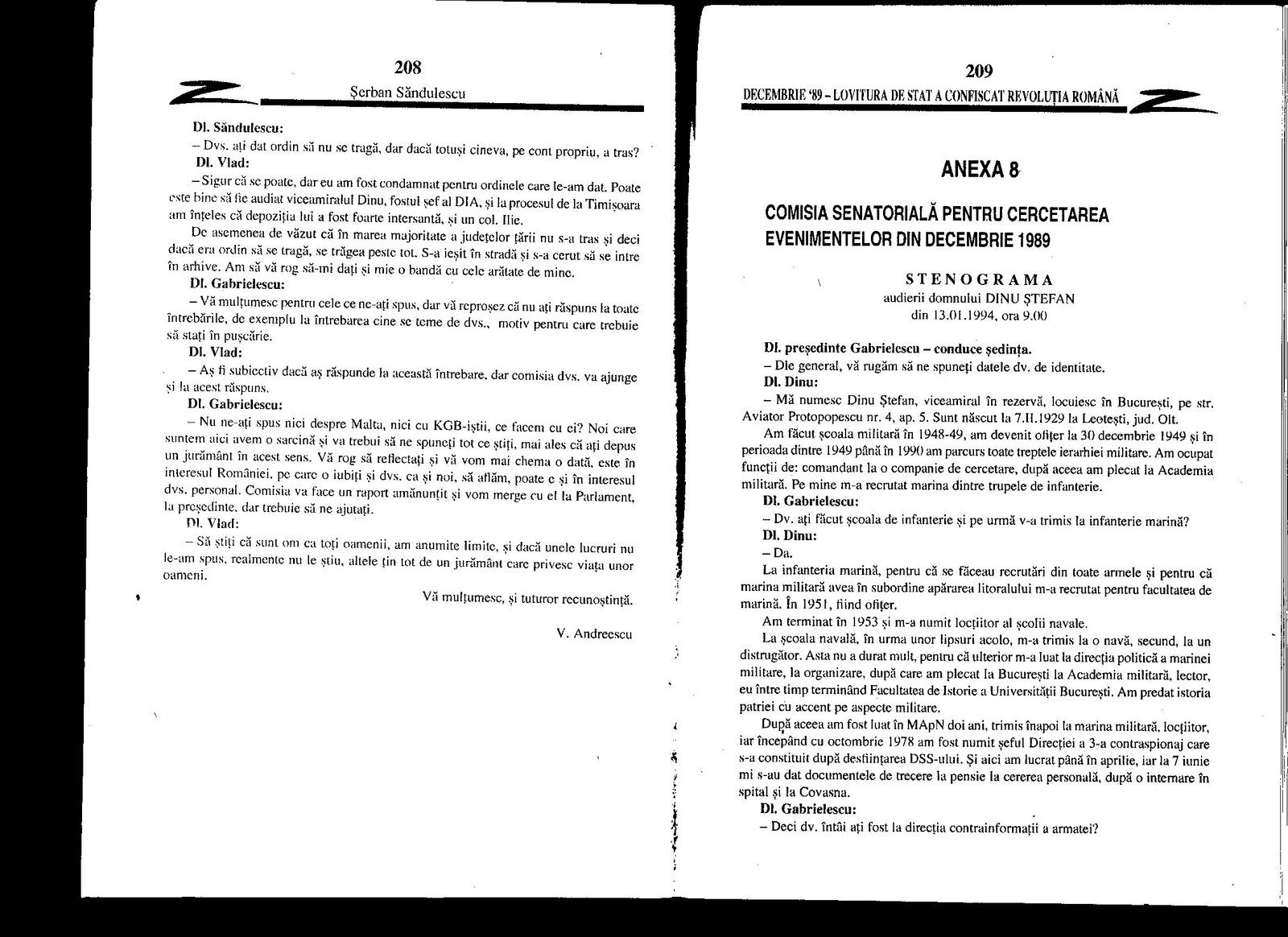
This tendency definitely affects Siani-Davies’ analysis of the “terrorists” and its accuracy. To begin with, in the very book (Sandulescu) invoked by Siani-Davies, the head of the DIA (Battalion 404 Buzau), Rear Admiral Stefan Dinu, is quoted as having told the Gabrielescu commission investigating the December events (of which Sandulescu was a member) that “we hardly had 80 fighters in this battalion.”[153] It is known that 41 of them were in Timisoara from the morning of 18 December and only returned to their home base in Buzau on 22 December.[154] This makes it highly unlikely that they were on the 20 December TAROM flight to Sibiu that is in question.[155]

http://atomic-temporary-3899751.wpcomstaging.com/2009/12/18/hai-sa-ne-punem-capul-in-ghips/

in decembrie 1989, “temuta” unitate DIA Batalionul 404…avea…80 de luptatori!

Contrast this with the signs that exist pointing to the mystery passengers as having been from the Securitate/Interior Ministry, in particular the USLA. Nicu Silvestru, chief of the Sibiu County Militia, admitted in passing in a letter from prison that on the afternoon of 19 December 1989, in a crisis meeting, Nicolae Ceausescu’s son, Nicu, party head of Sibiu County, announced that he was going to “call [his] specialists from Bucharest” to take care of any protests.[156] Ceausescu’s Interior Minister, Tudor Postelnicu, admitted at his trial in January 1990 that Nicu had called him requesting “some troops” and he had informed Securitate Director General Iulian Vlad of the request.[157] If they were, indeed, DIA personnel, why would Nicu have called Postelnicu, and Postelnicu informed Vlad of the request—would such a request not have been relayed through the Defense Minister?

The first two military prosecutors for Sibiu, Anton Socaciu and Marian Valer, identified the passengers as USLA. Even Nicu Ceausescu admits that this was the accusation when he stated in August 1990:

“…[T]he Military Prosecutor gave me two variants. In the first part of the inquest, they [the flight’s passengers] were from the Interior Ministry. Later, however, in the second half of the investigation, when the USLA and those from the Interior Ministry began, so-to-speak, to pass ‘into the shadows,’ – after which one no longer heard anything of them – they [the passengers] turned out to be simple citizens…”[158]

Beginning, at least as early as August 1990, with the allusions of Major Mihai Floca, and later seemingly indirectly confirmed by former USLA officer Marian Romanescu, it was suggested that when USLA Commander Ardeleanu was confronted at the Defense Ministry on the night of 23/24 December 1989, Ardeleanu reportedly admitted that “30 were on guard at [various] embassies, and 80 had been dispatched to Sibiu with a Rombac [aircraft] from 20 December 1989 upon ‘orders from on-high’.”[159] Finally, and along these lines, we bring things full circle—and recall our “phantoms in black” again in the process—with the testimony of Army officer Hortopan to the same Serban Sandulescu at the Gabrielescu Commission hearings:

Sandulescu: About those dressed in black jumpsuits do you know anything, do you have any information about whom they belonged to?

Hortopan: On the contrary. These were the 80 uslasi sent by the MI [Interior Ministry], by General Vlad and Postelnicu to guard Nicolae Ceausescu [i.e. Nicu]. I make this claim because Colonel Ardelean[u] in front of General Militaru, and he probably told you about this problem, at which I was present when he reported, when General Militaru asked him how many men he had in total and how many were now present, where each of them was: out of which he said that 80 were in Sibiu based on an order from his commanders. Thus, it is natural that these are who they were.[160]

Bringing us up to the morning of 22 December 1989, and setting the stage for what was to come, Lt. Col. Aurel Dragomir told the Army daily in November 1990:

Dragomir: Events began to develop quickly on 22 December. In the morning some of the students posted in different parts of the town began to observe some suspect individuals in black jumpsuits on the roofs in the lights of the attics of several buildings.

Reporter: The same equipment as the USLAsi killed out front of the Defense Ministry…

Dragomir: And on the roof of the Militia building there were three or four similar individuals…[161]

Of course, the fact that these individuals were posted on the top of the Militia building on this morning, speaks volumes in itself about their affiliation. Indeed, in a written statement dated 28 January 1990, Ioan Scarlatescu, (Dir. Comm. Jud. Sibiu), admitted that he was asked by the Army on that morning if the unknown individuals “could be from the USLA?”[162]

[151] Siani-Davies, 2005, p. 152, fn. no. 32.

[152] Doris Mironescu, “Revolutia româna, asa cum (probabil) a fost,” Timpul no. 1 (January 2006), at http://www.romaniaculturala.ro.

[153] Serban Sandulescu, Lovitura de Stat a Confiscat Revolutia Romana (Bucharest: Omega, 1996), p. 214. Sandulescu’s book was marketed and printed by Sorin Rosca Stanescu’s Ziua press. Rosca Stanescu was a former USLA informer between the mid-1970s and mid-1980s. Who was Sandulescu’s chief counselor on these matters? Stefan Radoi, a former USLA officer in the early 1980s! These are the type of people who, of course, believe the passengers were DIA and not USLA! See my discussion of this whole fiasco in “The Securitate Roots of a Modern Romanian Fairy Tale,” RFE “East European Perspectives” 4-6/2002, online.

[154] See Dinu’s testimony in Sandulescu, Lovitura de Stat, p. 220. Also see the claims of another senior DIA officer Remus Ghergulescu in Jurnalul National, March 2004, online edition.

[155] Speaking even more broadly, Army parachutists (whether from Buzau, Caracal, Campia Turzii, or Boteni) were in Timisoara, Caransebes, and Television, Piata Palatului and the Otopeni Airport in Bucharest during the December events, but that clearly leaves many places where there were “terrorist actions”—including Sibiu—without them, decreasing their likelihood as plausible suspects. See Catalin Tintareanu, “Sarbatoare la Scoala de Aplicatie pentru Parasutisti ‘General Grigore Bastan,” Opinia (Buzau), 10 June 2005, online edition.

[156] Nicu Silvestru, “Cine a ordonat sa se traga la Sibiu?” Baricada, no. 45, 1990, p.5.

[157] Emil Munteanu, “Postelnicu a vorbit neintrebat,” Romania Libera, 30 January 1990, p. 1

[158] Interview with Nicu Ceausescu in Zig-Zag, no. 20, 21-27 August 1990.

[159] Adevarul, 29 August 1990. Also, Romanescu with Badea “U.S.L.A, Bula Moise…” 1991.

[160] “Virgil Magureanu sustine ca revolta din 1989 a fost sprijinita din interiorul sistemului,” Gardianul, 12 November 2005, online edition.

[161] Lt. Col. Aurel Dragomir, interview by Colonel Dragos Dragoi, “Sub tirul incrucisat al acuzatiilor (II),” Armata Poporului, no. 46 (November 1990), p. 3. Remus Ghergulescu specified USLA appearance as follows: “Over their black jumpsuits (‘combinezoanele negre’) in which they were dressed they had kaki vests. This was normal. They were equipped with the jumpsuits as “war gear,” while the vests were “city wear.’” (Colonel Remus Ghergulescu, interview with Razvan Belciuganu, “Teroristii au iesit din haos,” Jurnalul National, 29 November 2004, online edition.)

[162] See Evenimentul Zilei, 25 November 1992, p. 3.

RFE/RL Reports Print Version E-mail this page to a friend

17 April 2002, Volume  4, Number  8

THE SECURITATE ROOTS OF A MODERN ROMANIAN FAIRY TALE: THE PRESS, THE FORMER SECURITATE, AND THE HISTORIOGRAPHY OF DECEMBER 1989

By Richard Andrew Hall

Part 2: ‘Tourists Are Terrorists and Terrorists are Tourists with Guns…’ *
The distance traveled by Securitate disinformation on the December 1989 events can be breathtaking. Bubbling up through the springs of popular rumor and speculation, it flows into the tributaries of the media as peripheral subplots to other stories and eventually wends its way — carried upon the waves of consensus and credibility that flow from its acceptance among prominent Romanian journalists and intellectuals — into the writings of Western journalists, analysts, and academics. Popular myths, which either have their origins in disinformation disseminated by the former Securitate, or which originated in the conspiratorial musings of the populace but proved propitious for the former secret police and thus were appropriated, nurtured, and reinjected into popular discourse, are today routinely repeated both inside and outside Romania. Frequently, this dissemination occurs without the faintest concern over, or knowledge of, the myth’s etymology or much thought given to the broader context and how it plays into the issue of the Securitate’s institutional culpability.

Take, for example, the “tourist” myth — perhaps the former Securitate’s most fanciful and enduring piece of disinformation. This myth suggests that in December 1989, Soviet, Hungarian, and other foreign agents posing as “tourists” instigated and/or nurtured anti-Ceausescu demonstrations in Timisoara, Bucharest, and elsewhere, and/or were responsible for the “terrorist” violence after 22 December that claimed over 900 victims, or almost 90 percent of those killed during the Revolution. The implication of such allegations is clear: It questions the spontaneity — and hence, inevitably, to a certain degree, the legitimacy — of the anti-Ceausescu demonstrations and the overthrow of the Ceausescu regime; it raises doubt about the popular legitimacy of those who seized power during the events; and it suggests that those who seized power lied about who was responsible for the terrorist violence and may ultimately have themselves been responsible for the bloodshed.

A robust exegesis of the “tourist” hypothesis was outlined on the eve of the 10th anniversary of the December 1989 events in the pages of the daily “Ziua” by Vladimir Alexe. Alexe has been a vigorous critic of Ion Iliescu and the former communists of the National Salvation Front (FSN) who took power in December 1989, maintaining that they overthrew Ceausescu in a Soviet-sponsored coup d’etat:

“The outbreak of the December events was preceded by an odd fact characteristic of the last 10 years. After 10 December 1989, an unprecedented number of Soviet ‘tourists’ entered the country. Whole convoys of Lada automobiles, with approximately four athletic men per car, were observed at the borders with the Moldovan Socialist Republic, Bulgaria, and Hungary. A detail worthy of mention: The Soviet ‘tourists’ entered Romania without passports, which suggests the complicity of higher-ups. According to the statistics, an estimated 67,000 Soviet ‘tourists’ entered Romania in December 1989″ (“Ziua”, 24 December 1999).

It is worth noting that Alexe considers elsewhere in this series of articles from December 1999 that the Russian “tourists” were an omnipresent, critical, and catalytic factor in the collapse of communism throughout ALL of Eastern Europe in December 1989.

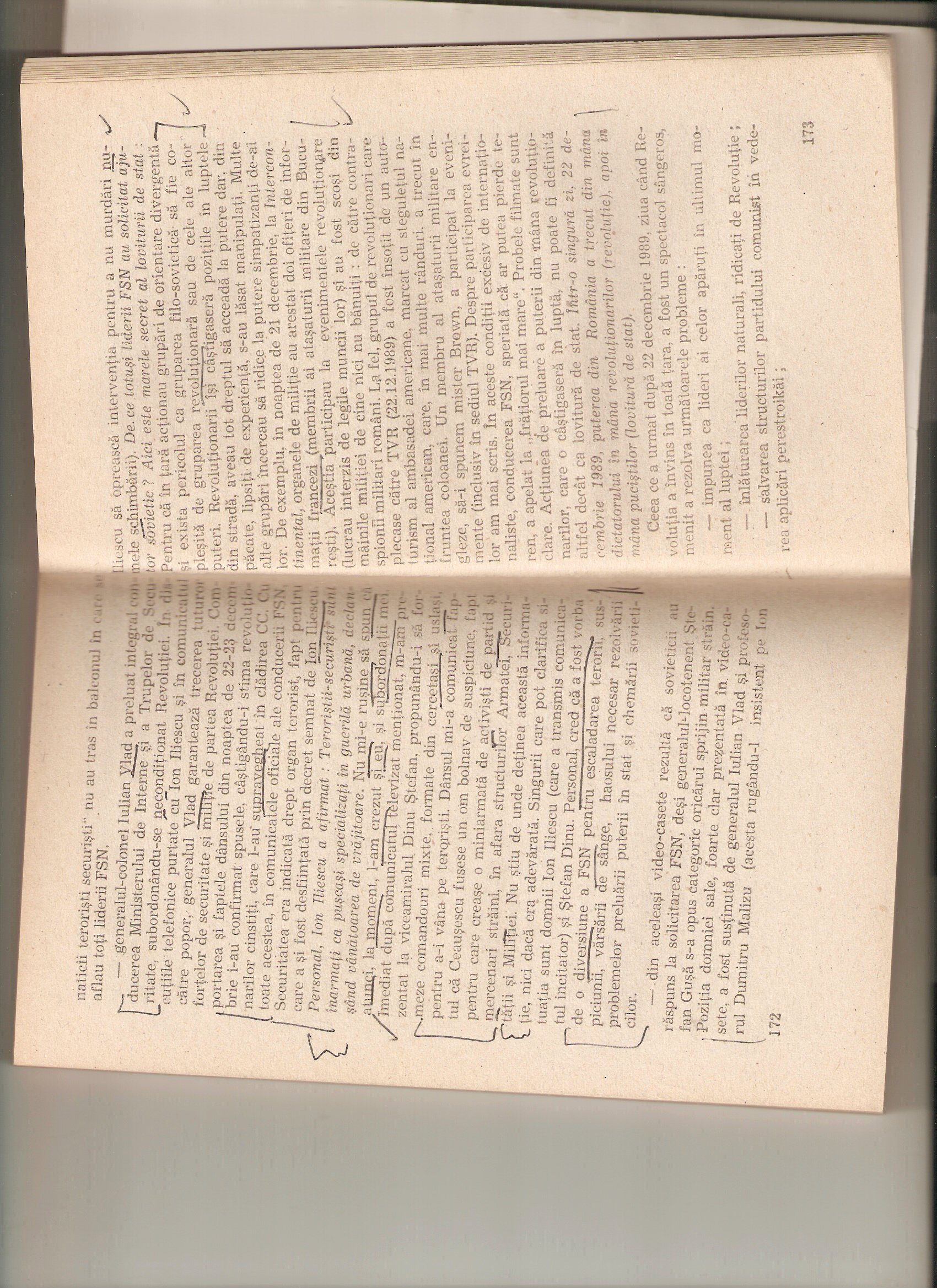
Nor has the “tourist” hypothesis been confined strictly to the realm of investigative journalism. Serban Sandulescu, a bitter critic of Ion Iliescu and the former communists who seized power in December 1989, led the third parliamentary commission to investigate the December 1989 events as a Senator for the National Peasant Party Christian Democratic (PNTCD). In 1996, he published the findings of his commission as a book titled “December ’89: The Coup d’Etat That Abducted The Romanian Revolution.” He commented on the “tourists” as follows:

“From the data we have obtained and tabulated it appears that we are talking somewhere in the neighborhood of 5,000-6,000 ‘tourists’…. Soviet agents [who] came under the cover of being ‘tourists’ either in large organized groups that came by coach, or in smaller groups of 3-4 people that fanned out in Lada and Moskvich automobiles. They covered the whole country, being seen in all the important cities in the country. They contributed to the stoking of the internal revolutionary process, supervising its unfolding, and they fought [during the so-called ‘terrorist’ phase after 22 December]…” (Sandulescu, 1996, pp. 35, 45).

DECEMBER 1989: NICOLAE CEAUSESCU INITIATES THE ‘TOURIST’ MYTH
Not surprisingly, the “tourist” myth originated with none other than Nicolae Ceausescu. This myth inevitably implies illegitimate and cynical “foreign intervention,” and Ceausescu used it to make sense of what were — probably genuinely, for him — the unimaginable and surreal antiregime protests which began in Timisoara on 15 December 1989.

In an emergency meeting of the Romanian equivalent of the politburo (CPEX) on the afternoon of Sunday, 17 December 1989 — the afternoon on which regime forces were to open fire on the anti-Ceausescu demonstrators in Timisoara, killing scores and wounding hundreds — Ceausescu alleged that foreign interference and manipulation were behind the protests:

“Everything that has happened and is happening in Germany, in Czechoslovakia, and in Bulgaria now, and in the past in Poland and Hungary, are things organized by the Soviet Union with American and Western help” (cited in Bunea, 1994, p. 34).

That Ceausescu saw “tourists” specifically playing a nefarious role in stimulating the Timisoara protests is made clear by his order at the close of this emergency meeting:

“I have ordered that all tourist activity be interrupted at once. Not one more foreign tourist will be allowed in, because they have all turned into agents of espionage…. Not even those from the socialist countries will be allowed in, with the exception of [North] Korea, China, and Cuba. Because all the neighboring socialist countries are untrustworthy. Those sent from the neighboring socialist countries are sent as agents” (cited in Bunea, 1994, p. 34).

A CHRONOLOGY OF THE ‘TOURISTS’ ITINERARY AND ACTIVITIES ACCORDING TO TOP SECURITATE AND PARTY OFFICIALS IN THE IMMEDIATE AFTERMATH OF DECEMBER 1989
Filip Teodorescu, who as head of the Securitate’s Counterespionage Directorate (Directorate III) had been dispatched to Timisoara and was later arrested for his role in the repression there, maintained in March 1990 at his trial that he detained “foreign agents” during the Timisoara events (“Romania libera,” 9 March 1990). In a book that appeared in 1992, Teodorescu described as follows the events in Timisoara on Monday, 18 December — that is, after the bloody regime repression of anti-Ceausescu demonstrators the night before:

“There were few foreigners in the hotels, the majority of them having fled the town after lunch [on 17 December] when the clashes began to break out. The interested parties remained. Our attention is drawn to the unjustifiably large number of Soviet tourists, be they by bus or car. Not all of them stayed in hotels. They either had left their buses or stayed in their cars overnight. Border records indicate their points of entry as being through northern Transylvania. They all claimed they were in transit to Yugoslavia. The explanation was plausible, the Soviets being well-known for their shopping trips. Unfortunately, we did not have enough forces and the conditions did not allow us to monitor the activities of at least some of these ‘tourists’” (Teodorescu, 1992, p. 92).

Teodorescu appears here to be attempting to account for the fact that on Monday, 18 December 1989 — presumably as a consequence of Ceausescu’s tirade the afternoon before about the malicious intent of virtually all “tourists” — Romania announced, in typically Orwellian fashion, that it would not accept any more tourists because of a “shortage of hotel rooms” and because “weather conditions are not suitable for tourism” (Belgrade Domestic Service, 20 December 1989). Ironically, the only ones exempted from this ban were “Soviet travelers coming home from shopping trips to Yugoslavia” (!) (AFP, 19 December 1989).

Radu Balan, former Timis County party boss, picks up the story from there. While serving a prison sentence for his complicity in the Timisoara repression, in 1991 Balan told one of Ceausescu’s most famous “court poets,” Adrian Paunescu, that on the night of 18-19 December — during which in reality some 40 cadavers were secretly transported from Timisoara’s main hospital to Bucharest for cremation (reputedly on Elena Ceausescu’s personal order) — he too witnessed the role of these “foreign agents”:

“We had been receiving information, in daily bulletins, from the Securitate, that far more people were returning from Yugoslavia and Hungary than were going there and about the presence of Lada automobiles filled with Soviets. I saw them at the border and the border posts, and the cars were full. I wanted to know where and what they were eating and how they were crossing the border and going through cities and everywhere. More telling, on the night of 18-19 December, when I was at a fire at the I.A.M. factory, in front of the county hospital, I spotted 11 white ‘Lada’ automobiles at 1 a.m. in the morning. They pretended to ask me the road to Buzias.The 11 white Ladas had Soviet plates, not Romanian ones, and were in front of the hospital” (“Totusi iubirea,” no. 43, 24-31 October 1991).

Nicu Ceausescu, Nicolae’s son and most likely heir and party secretary in Sibiu at the time of the Revolution, claimed that he also had to deal with enigmatic “tourists” during these historic days. From his prison cell in 1990, Nicu recounted how on the night of 20 December 1989, a top party official came to inform him that the State Tourist Agency was requesting that he — the party secretary for Sibiu! — “find lodgings for a group of tourists who did not have accommodation.” He kindly obliged and made the appropriate arrangements (interview with Nicu Ceausescu in “Zig-Zag,”, no. 20, 21-27 August 1990).

Nor was Gheorghe Roset, head of the Militia in the city of Caransebes at the time of the Revolution, able to elude a visit from the “tourists” during these days. Writing from his prison cell in January 1991, he recounted:

“Stationed on the night of 20-21 December 1989 at headquarters, I received the order to issue an authorization for repairs for a Lada automobile that had overturned in Soceni, in Caras-Severin county, an order that was approved by the chief of the county Militia with the clarification that the passengers of this car were military personnel from the USSR. I was more than a little surprised when this car arrived in Caransebes and I saw that it was part of a convoy of 20 cars, all of the same make and with 3-4 passengers per car. Lengthy discussions with the person who had requested the authorization confirmed for me the accident and the fact that this convoy of cars was coming from Timisoara, on its way to Bucharest, as well as the fact that these were colleagues of ours from the country in question. He presented a passport in order to receive the documents he had requested, although not even today can I say with certainty that he belonged to this or that country. A short time after the convoy left on its way, it was reported to me that five of the cars had headed in the direction of Hateg, while the more numerous group headed for Bucharest” (“Europa,” no. 20, March 1991).

A September 1990 open letter authored by “some officers of the former Securitate” — most likely from the Fifth Directorate charged with guarding Ceausescu and the rest of the Romanian communist leadership — and addressed to the xenophobic, neo-Ceausist weekly “Democratia” (which was edited by Eugen Florescu, one of Ceausescu’s chief propagandists and speechwriters), sought to summarize the entire record of the “tourists” wanderings and activities in December 1989 as follows:

“11-15 [December] — a massive penetration of so-called Hungarian tourists takes place in Timisoara and Soviet tourists in Cluj;

15-16 [December] — upon the initiative of these groups, protests of support for the sinister ‘Priest [Father Laszlo Tokes of Timisoara]‘ break out;

16-17-18 [December] — in the midst of the general state of confusion building in the city, the army intervenes to reestablish order;

– this provides a long-awaited opportunity for the ‘tourists’ to start — in the midst of warning shots in the air — to shoot and stab in the back the demonstrators among whom they are located and whom they have incited;…

19-20-21 — a good part of the ‘tourists’ and their brethren among the locals begin to migrate — an old habit — from the main cities of Transylvania, according to plan, in order to destabilize: Cluj, Sibiu, Alba Iulia, Targu Mures, Satu Mare, Oradea, etc.” (“Democratia,” no. 36, 24-30 September 1990).

The authors of this chronology then maintain that this scene was replicated in Bucharest on 21 December, causing the famous disruption of Ceausescu’s speech and the death of civilians in University Square that evening.

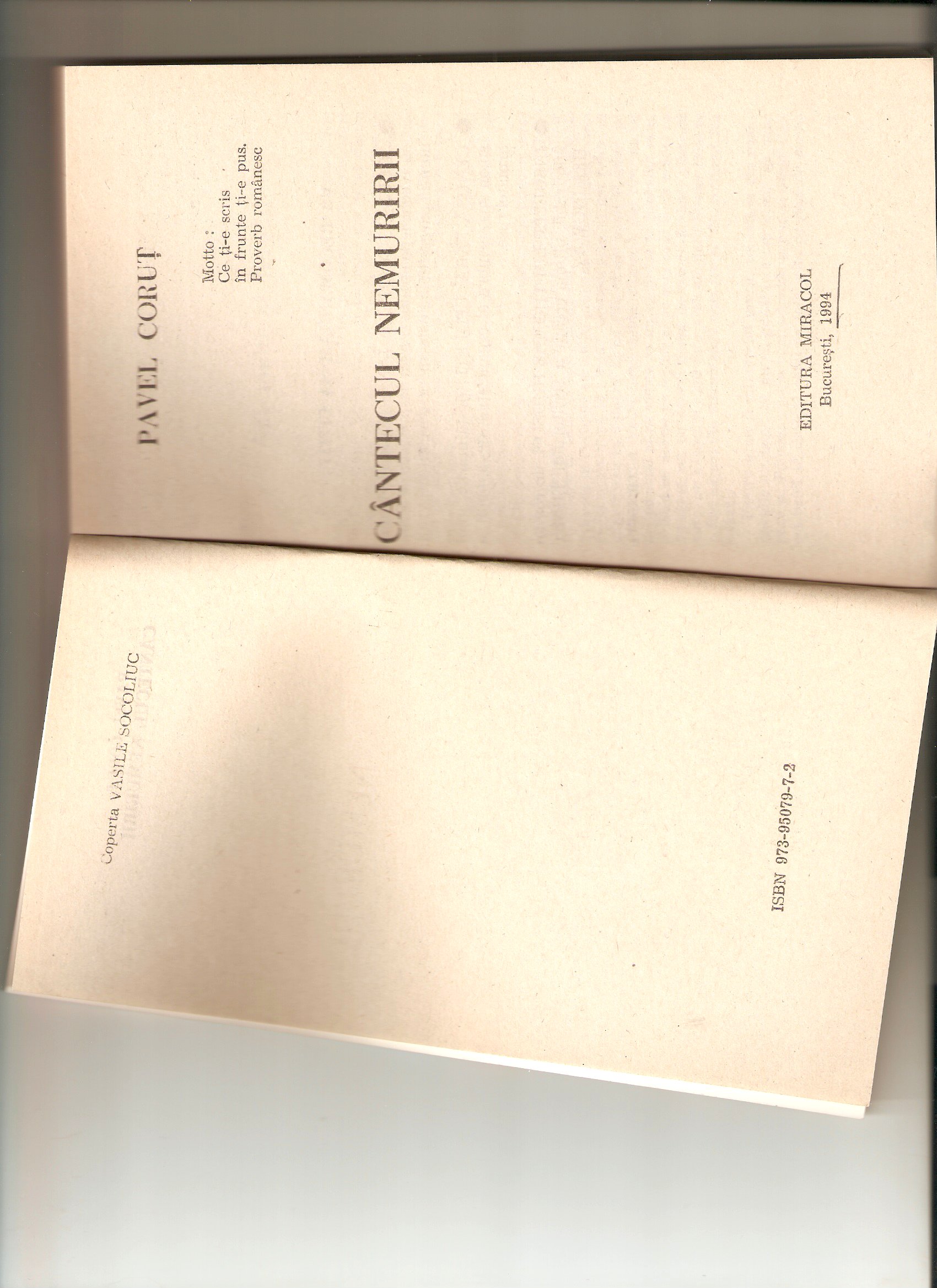
Not to be out-done, Cluj Securitate chief Ion Serbanoiu claimed in a 1991 interview that, as of 21 December 1989, there were over 800 Russian and Hungarian tourists, mostly driving almost brand-new Lada automobiles (but also Dacia and Wartburg cars), in the city (interview with Angela Bacescu in “Europa,” no. 55, December 1991). In February 1991 during his trial, former Securitate Director General Iulian Vlad, not surprisingly, also spoke of “massive groups of Soviet tourists…the majority were men…deploy[ing] in a coordinated manner in a convoy of brand-new Lada automobiles” (see Bunea, 1994, pp. 460-461), while the infamous Pavel Corut has written of “the infiltration on Romanian territory of groups of Soviet commandos (“Spetsnaz”) under the cover of being tourists” (Corut, 1994).

REBUTTING THE ‘TOURIST’ MYTH
I vividly recall early on in my research of the December 1989 events being told emphatically, and not for the last time, by a journalist at the Cluj weekly “Nu” — a publication staunchly critical of the Iliescu regime — that the guest lists of Romanian hotels for December 1989 were nowhere to be found because they contained the secrets of the Revolution. Certainly, this rumor has intersected with the “tourist” myth and has been used as confirmation of the latter.

Significantly, Marius Mioc has sought to investigate the reality of this matter in Timisoara (Mioc, 2000). The numbers provided to the 17 December Timisoara Association (which Mioc heads) by all of Timisoara’s hotels and by the State Tourist Agency for Timisoara lay bare two of the key components upon which the “tourist” myth has relied: a) that the records of the December 1989 manifests do not exist, and b) that there was an unusually dramatic increase in the number of foreign tourists staying in Romanian hotels during this period. In fact, the opposite proves to be true, the number of foreign tourists — and specifically those from other “socialist” countries — declined in December 1989 both in comparison to the previous December and in comparison to November 1989!

Of course, as we have seen, proponents of the “tourist” myth have also suggested that many of the alleged foreign agents posing as tourists “avoided staying in hotels.” But this still raises the question of why the Securitate allowed them into the country in the first place and why they then seemed unable to follow their movements and prevent their activities. A 1991 open letter by “a group of [Romanian Army] officers from the Timisoara garrison” perhaps provides the best riposte to the dubious logic underlying the “tourist” hypothesis:

“If they [the tourists] appeared suspect to the special forces of the Securitate and military counterintelligence, why did they not attempt to keep them under surveillance? During this period, did the Securitate and the counterintelligence officers not know how to do their jobs? Did they somehow forget why they were paid such weighty sums from the state budget?” (“Romania libera,” 15 October 1991).

One must also ask: If it was precisely Soviet tourists who were most suspected at the time of being up to no good in the country, then why was it precisely they who were the sole group among “tourists” in the country at the time to be permitted to stay and go about their business unhindered?

HOW THE ‘TOURISTS’ ENTRY INTO THE HISTORIOGRAPHY OF DECEMBER 1989 PARALLELS THE EXIT OF THE SECURITATE
In commenting in August 1990 upon how the details of the state’s case against him had changed since early in the year, Nicolae Ceausescu’s son, Nicu, ironically highlighted how Securitate forces had begun to fade away from the historiography of the December 1989 events. In the August 1990 interview from his prison cell with Ion Cristoiu’s “Zig-Zag” (mentioned above), Nicu discusses the “tourists” for which he was asked to find accommodations in the context of a group of mysterious passengers who had arrived by plane from Bucharest on the evening of 20 December 1989. We know that in the period immediately following these events, the then-military prosecutor, Anton Socaciu, had alleged that these passengers from Bucharest were members of the Securitate’s elite USLA unit (Special Unit for Antiterrorist Warfare) and were responsible for much of the bloodshed that occurred in Sibiu during the December events (for a discussion, see Hall, 1996). In August 1990, however, Nicu wryly observed:

“…[T]he Military Prosecutor gave me two variants. In the first part of the inquest, they [the flight’s passengers] were from the Interior Ministry. Later, however, in the second half of the investigation, when the USLA and those from the Interior Ministry began, so-to-speak, to pass ‘into the shadows,’ — after which one no longer heard anything of them — they [the passengers] turned out to be simple citizens…” (interview with Nicu Ceausescu in “Zig-Zag,” no. 20, 21-27 August 1990).

The impact of this “reconsideration” by the authorities could be seen in the comments of Socaciu’s successor as military prosecutor in charge of the Sibiu case, Marian Valer (see Hall 1997a, pp. 314-315). Valer commented in September 1990 that investigations yielded the fact that there were 37 unidentified passengers on board the 20 December flight from Bucharest and that many of the other passengers maintained that “on the right side of the plane there had been a group of tall, athletic men, dressed in sporting attire, many of them blond, who had raised their suspicions.” While investigations revealed that during this time there “were many Soviet tourists staying in Sibiu’s hotels,” they also established that “military units were fired upon from Securitate safehouses located around these units as of the afternoon of 22 December, after the overturning of the Ceausescu regime.” He thus carefully concludes:

“As far as the unidentified passengers are concerned, there are two possible variants: Either they were USLA fighters sent to defend Nicu Ceausescu, or they were Soviet agents sent to act with the intent of overthrowing the Ceausescu regime” (“Expres,” no. 33, September 1990).

Thus, as the “tourists” began to enter the historiography of the December 1989 events, so the Securitate — specifically the USLA — began to disappear.

HOW THE ‘TOURIST’ MYTH NEVERTHELESS GAINED MAINSTREAM CREDIBILITY AND ACCEPTANCE
How, then, did the “tourist” myth gain credibility and acceptance in the Romanian press, given its rather obvious pedigree in the remnants of the Ceausescu regime, especially among former high-ranking Securitate officers and others most in need of an alibi/diversion to save their careers and avoid the possibility of going to jail? Although the reference to “tourists” during the December events probably entered the lexicon of mainstream reporting on the Revolution as early as April 1990 — not insignificantly, first in the pages of Ion Cristoiu’s weekly “Zig-Zag,” it appears — it was in particular journalist Sorin Rosca Stanescu who gave the theme legitimacy in the mainstream press.

Without specifying the term “tourists” — but clearly speaking in the same vein — Stanescu was probably the first to articulate the thesis most precisely and to tie the Soviet angle to it. In June 1990 in a piece entitled “Is The Conspiracy of Silence Breaking Down?” in the sharply anti-government daily “Romania libera,” Stanescu wrote:

“And still in connection with the breaking down of the conspiracy of silence, in the army there is more and more insistent talk about the over 4,000 Lada cars with two men per car that traveled many different roads in the days before the Revolution and then disappeared” (“Romania libera,” 14 June 1990).

Stanescu’s article was vigorously anti-FSN and anti-Iliescu and left little doubt that this thesis was part of the “unofficial” history of the December events, injurious to the new leaders, and something they did not wish to see published or wish to clarify.

But it was Stanescu’s April 1991 article in “Romania libera,” entitled “Is Iliescu Being Protected By The KGB?,” that truly gave impetus to the “tourist” thesis. Stanescu wrote:

“A KGB officer wanders in France. He is losing his patience and searching for a way to get to Latin America. Yesterday I met him in Paris. He talked to me after finding out that I was a Romanian journalist. He fears the French press. He knows Romanian and was in Timisoara in December 1989. As you will recall, persistent rumors have circulated about the existence on Romanian soil of over 2,000 Lada automobiles with Soviet tags and two men in each car. Similar massive infiltrations were witnessed in December 1990, too, with the outbreak of a wave of strikes and demonstrations. What were the KGB doing in Romania? Witness what the anonymous Soviet officer related to me in Paris:

‘There existed an intervention plan that for whatever reason was not activated. I received the order to enter Romania on 14 December and to head for Timisoara. Myself and my colleague were armed. During the events, we circulated in the military zone around Calea Girocului [Giriocul Road]. Those who headed toward Bucharest had the same mission. Several larger cities were targeted. We were to open fire in order to create a state of confusion. I never, however, received such an order. I left Romania on 26 December.’

I don’t have any reason to suspect the validity of these revelations. This short confession is naturally incomplete, but not inconclusive. What purpose would this elaborate, but aborted, KGB plan have had? The only plausible explanation is that it wasn’t necessary for KGB agents to intervene. The events were unfolding in the desired direction without need for the direct intervention of the Soviets. But this leads to other questions: What did the Ceausescu couple know, but were not allowed to say [prior to their hurried execution]? Why is Securitate General Vlad being held in limbo? To what degree has President Iliescu maintained ties to the Soviets? What are the secret clauses of the Friendship Treaty recently signed in Moscow? Is Iliescu being protected by the KGB or not? Perhaps the SRI [the Securitate’s institutional successor, the Romanian Information Service] would like to respond to these questions?”

Stanescu’s April 1991 article did not go unnoticed — despite its nondescript placement on page eight — and has since received recognition and praise from what might seem unexpected corners. For example, previously-discussed former Securitate Colonel Filip Teodorescu cited extensive excerpts from Stanescu’s article in his 1992 book on the December events, and he added cryptically:

“Moreover, I don’t have any reason to suspect that the journalist Sorin Rosca Stanescu would have invented a story in order to come to the aid of those accused, by the courts or by public opinion, for the results of the tragic events of December 1989″ (Teodorescu, 1992, pp. 92-94).

Radu Balan, former Timis County party secretary, imprisoned for his role in the December events, has also invoked Stanescu’s April 1991 article as proof of his revisionist view that “tourists” rather than “non-existent ‘terrorists’” were to blame for the December 1989 bloodshed:

“…[W]hile at Jilava [the jail where he was imprisoned at the time of the interview, in October 1991], I read ‘Romania libera’ from 18 April. And Rosca Stanescu writes from Paris that a KGB agent who deserted the KGB and is in transit to the U.S. stated that on 18 December [1989] he had the mission to create panic on Calea Girocului [a thoroughfare in Timisoara]. What is more, on the 18th, these 11 cars were at the top of Calea Girocului, where I saw them. I was dumbfounded, I tell you. I didn’t tell anybody. Please study ‘Romania libera,’ the last page, from 18 April 1991″ (“Totusi iubirea,” no. 43, 24-31 October1991).

In this regard, it would be irresponsible to totally discount the relevance of Rosca Stanescu’s past. Since December 1989, Stanescu has undeniably been a vigorous critic of, and made damaging revelations about, the Securitate’s institutional heir, the SRI, and the Iliescu regime, and he has frequently written ill of the former Securitate and the Ceausescu regime. Nevertheless, in 1992 it was leaked to the press — and Rosca Stanescu himself confirmed — that from the mid-1970s to the mid-1980s he was an informer for the Securitate (for a discussion, see Hall, 1997b, pp. 111-113). What was significant, however, was precisely for which branch of the Securitate Rosca Stanescu had been an informer: the USLA.

THE ‘TOURISTS’ MYTH TRAVELS WESTWARD
Almost inevitably, the “tourist” thesis has made its way into Western academic literature. For example, in a book lauded by experts (see for example, Professor Archie Brown’s review in “Slavic Review,” Winter 1998), Jacques Levesque invokes as “rare evidence” that the Soviets were responsible for igniting and fanning the flames of the Timisoara uprising the following:

“…testimony of an imprisoned Securitate colonel who was freed in 1991 [he is referring to the aforementioned Filip Teodorescu]. He writes that the Securitate had noted the arrival of ‘numerous false Soviet tourists’ in Timisoara in early December, coming from Soviet Moldova. He also reports that a convoy of several Lada cars, with Soviet license plates and containing three to four men each, had refused to stop at a police checkpoint in Craiova. After the Romanian police opened fire and killed several men, he claims that the Soviet authorities recovered the bodies without issuing an official protest. To the extent that this information is absolutely correct, it would tend to prove the presence of Soviet agents in Romania (which no one doubts), without, however, indicating to us their exact role in the events” (Levesque, 1997, p. 197).

Levesque seems generally unaware of or concerned with the problematic nature of the source of this “rare evidence” and thus never really considers the possibility that the Securitate colonel is engaging in disinformation. This is indicative of how upside-down the understanding of the December 1989 events has become in the post-Ceausescu era — and of the influence of the far-reaching and generally unchallenged revisionism of the events within Romania itself — that Western writers invoking the thesis seem to accept the claims at face value, never even enunciating any doubt about why the Securitate source in question might seek to make such an argument.

* A memorable phrase from Andrei Codrescu’s PBS special “Road Scholar” of the early 1990s.

(Richard Andrew Hall received his Ph.D. in Political Science from Indiana University in 1997. He currently works and lives in northern Virginia. Comments can be directed to him at hallria@msn.com.)

SOURCES

AFP, 19 December 1989, in FBIS-EEU-89-242, 19 December 1989.

Belgrade Domestic Service, 1400 GMT 20 December 1989, in FBIS-EEU-89-243, 20 December 1989.

Brown, A., 1998, “Review of Jacques Levesque, The Enigma of 1989: The USSR and the Liberation of Eastern Europe,” in “Slavic Review,” Vol. 57, no. 4 (Winter), pp. 882-883.

Bunea, M., 1994, Praf in ochi: Procesul celor 24-1-2 [Mud in the Eyes: The Trial of the 24-1-2], (Bucharest: Editura Scripta).

Court, P., 1994, Cantecul Nemuririi [Song of Immortality], (Bucharest: Editura Miracol).

“Democratia” (Bucharest), 1990.

“Europa,” (Bucharest), 1991

“Expres,” (Bucharest), 1990.

Hall, R. A., 1996, “Ce demonstreaza probele balistice dupa 7 ani?” [Seven Years Later What Does the Ballistic Evidence Tell Us?] in “22″ (Bucharest), 17-23 December.

Hall, R. A. 1997a, “Rewriting the Revolution: Authoritarian Regime-State Relations and the Triumph of Securitate Revisionism in Post-Ceausescu Romania,” (Ph.D. Dissertation, Indiana University).

Hall, R. A., 1997b, “The Dynamics of Media Independence in Post-Ceausescu Romania,” in O’Neil, P. H. (ed.) Post-Communism and the Media in Eastern Europe, (Portland, OR: Frank Cass), pp. 102-123.

Levesque, J., 1997, The Enigma of 1989: The USSR and the Liberation of Eastern Europe, (Berkeley: University of California Press).

Mioc, Marius, 2000, “Turisti straini in timpul revolutiei,” [Foreign Tourists During the Revolution] timisoara.com/newmioc/54.htm.

“Romania libera” (Bucharest), 1990-91.

Sandulescu, S., 1996, Decembrie ’89: Lovitura de Stat a Confiscat Revolutia Romana [December ’89: The Coup d’tat Abducted the Romanian Revolution], (Bucharest: Editura Omega Press Investment).

Teodorescu, F., 1992, Un Risc Asumat: Timisoara, decembrie 1989, [An Assumed Risk: Timisoara, December 1989] (Bucharest: Editura Viitorul Romanesc).

“Totusi iubirea” (Bucharest), 1991.

“Ziua” (Bucharest), 1999.

“Zig-Zag” (Bucharest), 1990.

Compiled by Michael Shafir

http://atomic-temporary-3899751.wpcomstaging.com/2010/04/15/sibiu-decembrie-1989-faimoasa-geanta-diplomat-si-tragatorii-din-poduri/

http://atomic-temporary-3899751.wpcomstaging.com/2010/12/30/decembrie-1989-turistii-si-sovietici/

Am scris despre “misterul” acesta de multe ori intre 1996 si 2005…

——————————————————————————————————————–
O singura intrebare…modesta:  aveau cumva uslasii vreo “acoperire” atunci cand erau “in teren”?  Si daca aveau, care ar fi fost aceasta “acoperire”?!
 
Asistam la Ingroparea Revolutiei

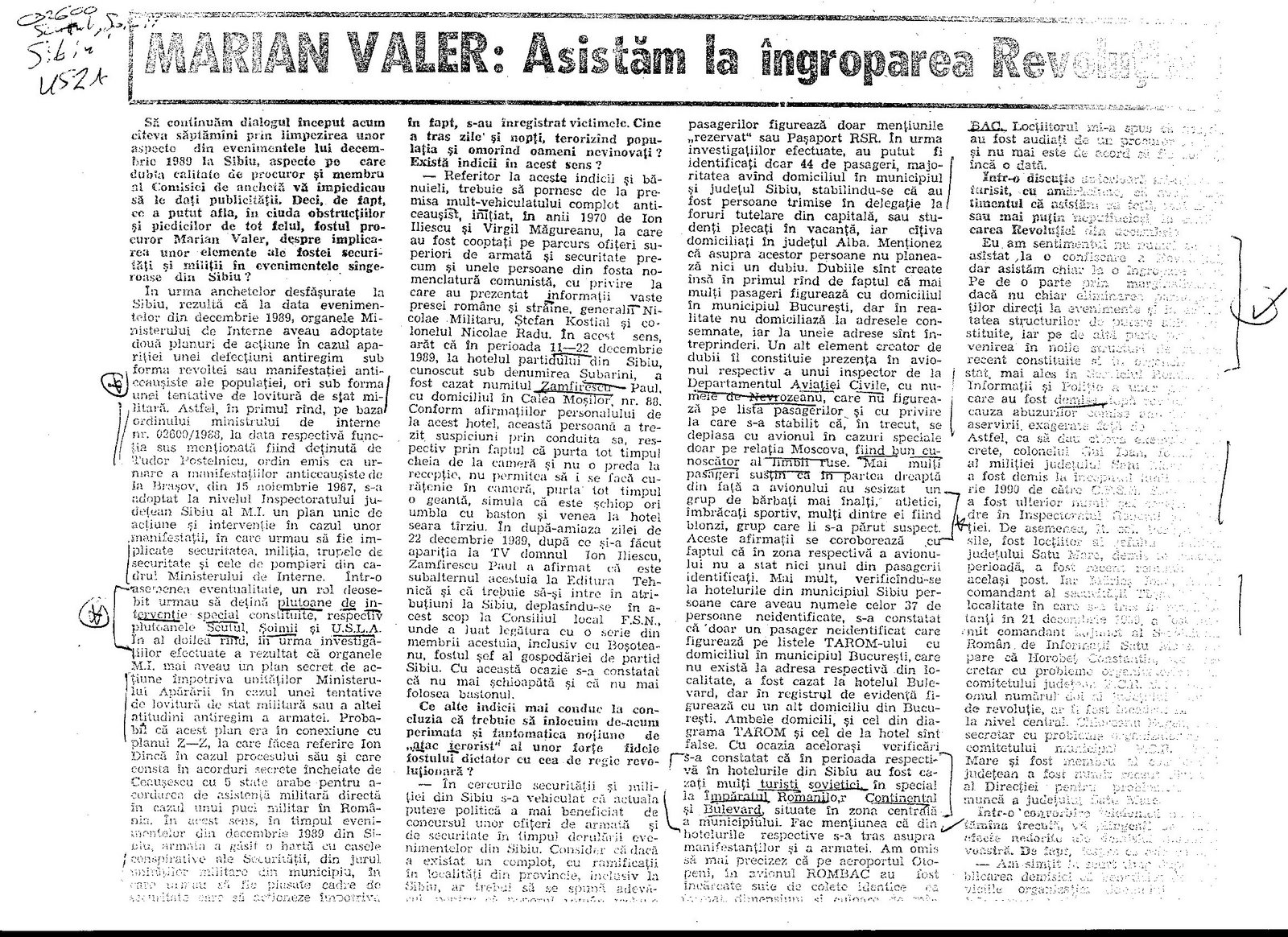
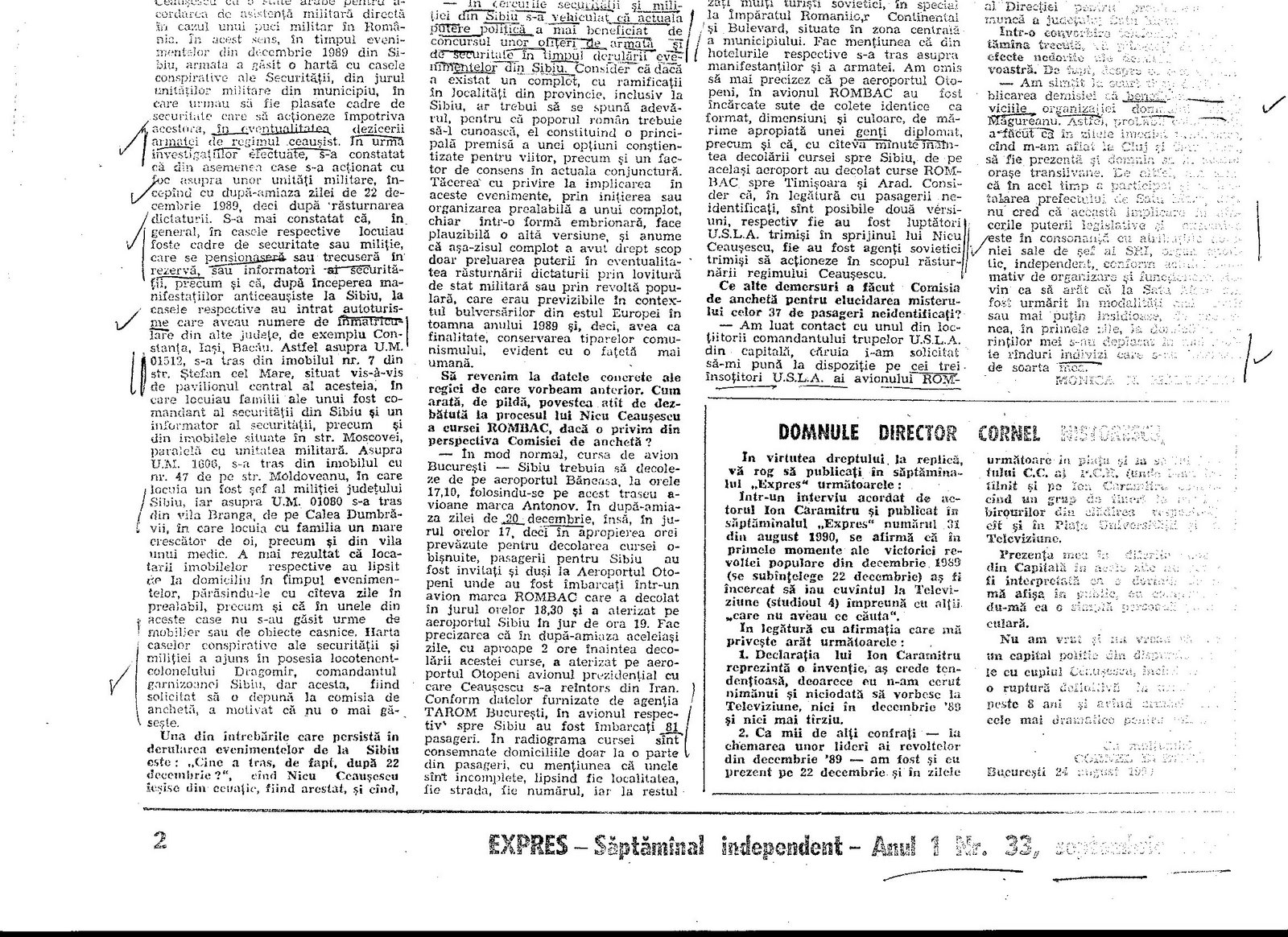
Monica N. Marginean:  Sa revenim la datele concrete ale regiei de care vorbeam anterior.  Cum arata, de pilda, povestea atit de dezbatuta la procesul lui Nicu Ceausescu a cursei ROMBAC, daca o privim din perspectiva Comisiei de ancheta?

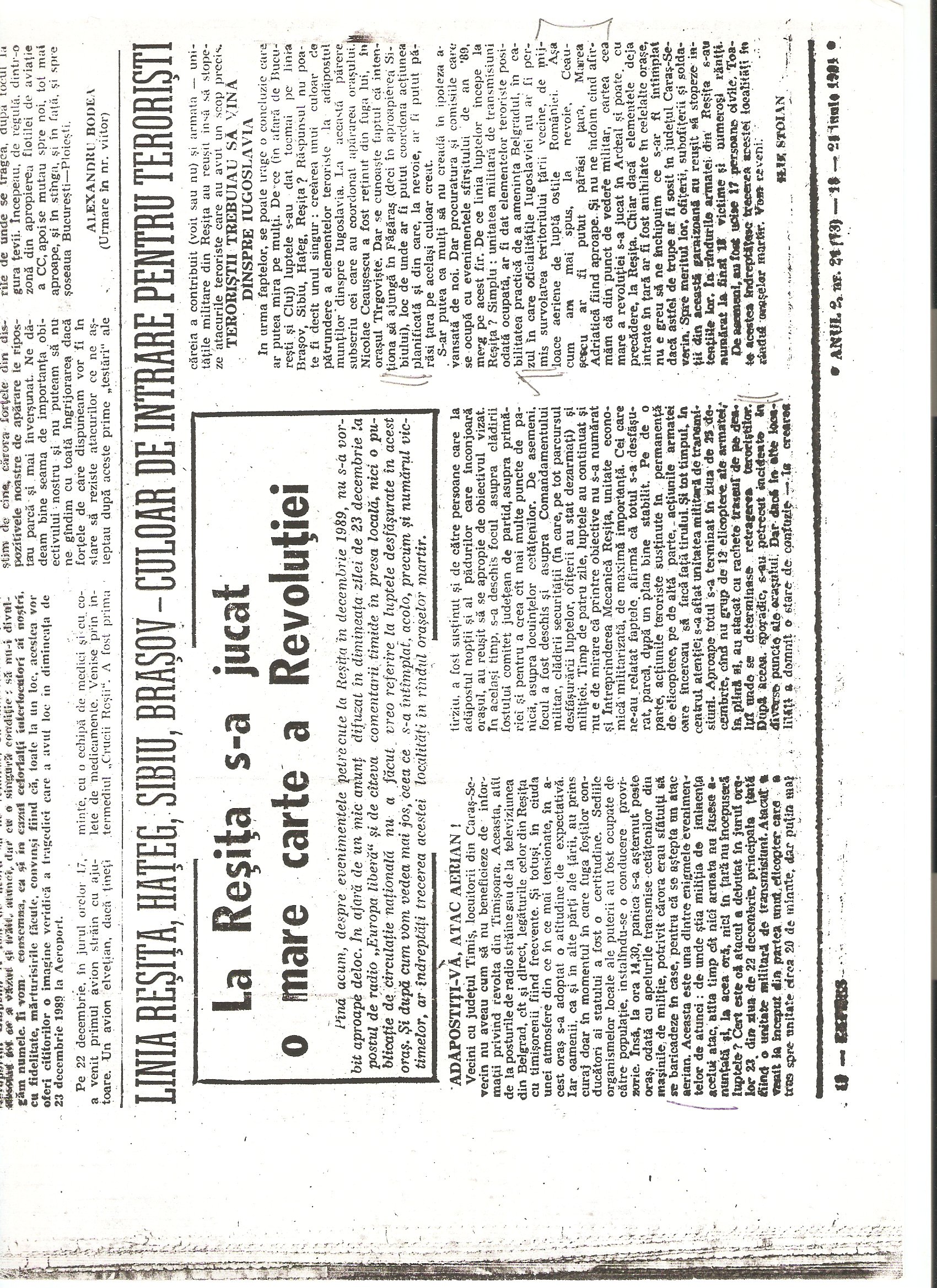
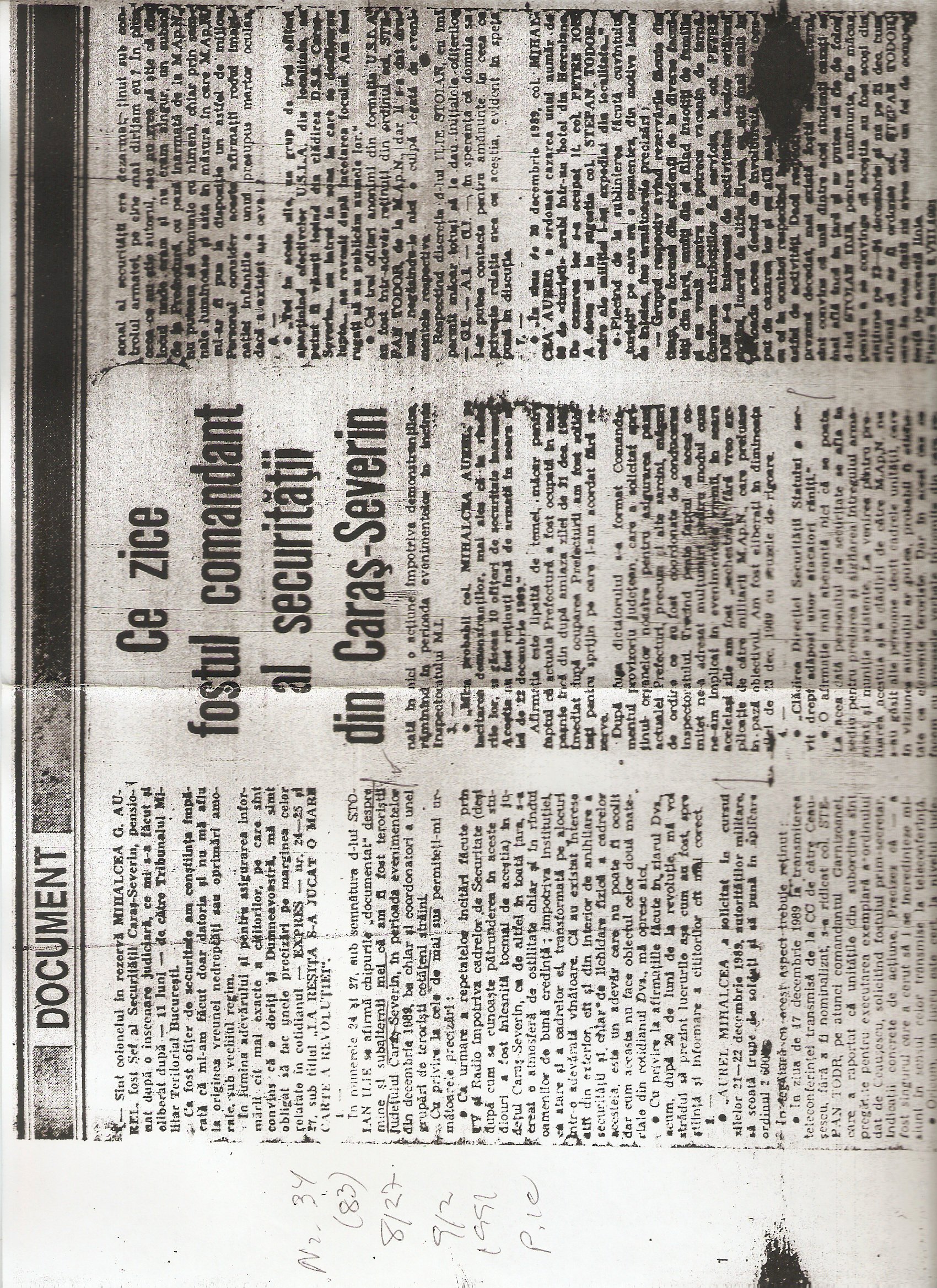
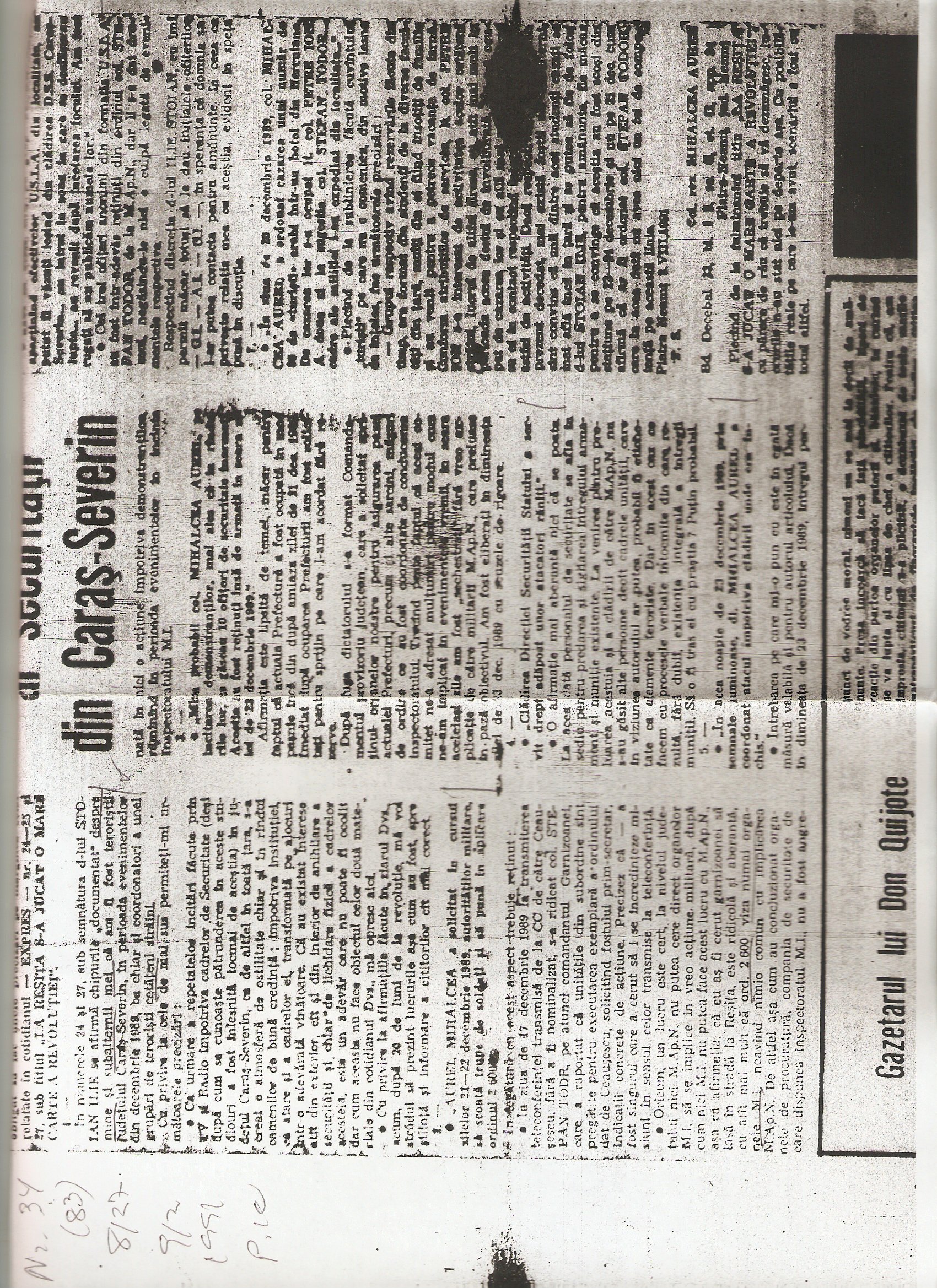
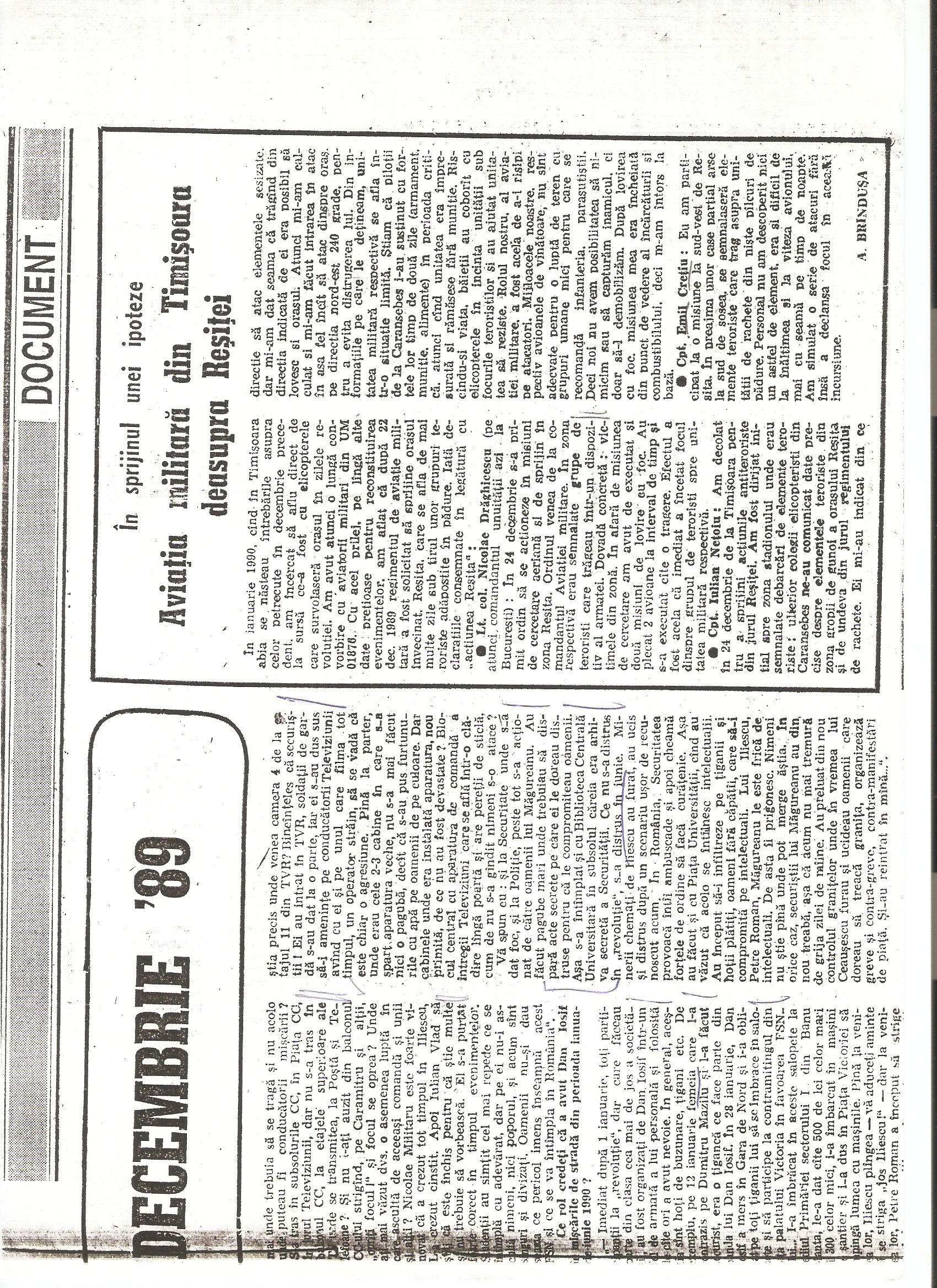
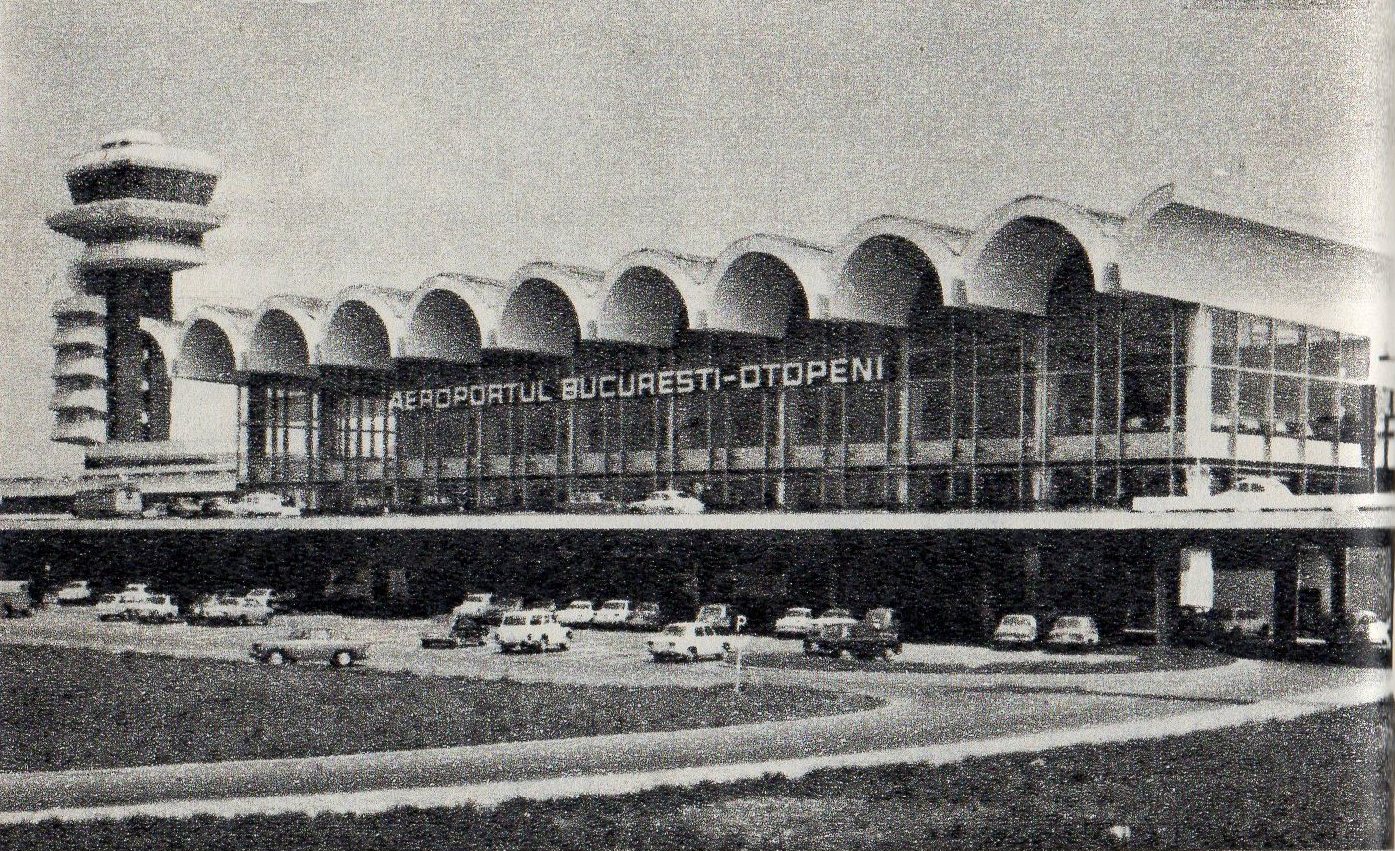
fostul procuror Marian Valer:  In mod normal, cursa de avion Bucuresti-Sibiu trebuia sa decoleze de pe aeroportul Baneasa, la orele 17,10 folosindu-se pe acest traseu avioane marca Antonov.  In dupa-amiaza zilei de 20 decembrie, insa, in jurul orelor 17, deci in apropierea orei prevazute pentru decolarea cursei obisnuite, pasagerii pentru Sibiu au fost invitati si dusi la Aeroportul Otopeni unde au fost imbarcati intr-un avion marca ROMBAC care a decolat in jurul orelor 18,30 si a aterizat pe aeroportul Sibiu in jur de ora 19.  Fac precizarea ca in dupa-amiaza aceleiasi zile, cu aproape 2 ore inaintea decolarii acestei curse, a aterizat pe aeroportul Otopeni avionul prezidential cu care Ceausescu s-a reintors din Iran. Conform datelor furnizate de agentia TAROM Bucuresti, in avionul respectiv spre Sibiu au fost imbarcati 81 pasageri.  In radiograma cursei sint consemnate domiciile doar la o parte din pasageri, cu mentiunea ca unele sint incomplete, lipsind fie localitatea, fie strada, fie numarul, iar la restul pasagerilor figureaza doar mentiunile ,rezervat’ sau Pasaport RSR.  In urma investigatiilor efectuate, au putut fi identificati doar 44 de pasageri, majoritatea avind domiciliul in municipul si judetul Sibiu, stabilindu-se ca au fost persoane trimise in delegatie la foruri tutelare din capitala, sau studenti plecati in vacanta, iar citiva domiciliati in judetul Alba.  Mentionez ca asupra acestor persoane nu planeaza nici un dubiu.  Dubiile sint create insa in primul rind de faptul ca mai multi pasageri figureaza cu domiciliul in municipiul Bucuresti, dar in realitate nu domiciliaza la adresele consemnate, iar la unele adrese sint intreprinderi.  Un alt element creator de dubii il constituie prezenta in avionul respectiv a unui inspector de la Departmentul Aviatiei Civile, cu numele de Nevrozeanu, care nu figureaza pe lista pasagerilor si cu privire la care s-a stabilit ca, in trecut, se deplasa cu avionul in cazuri speciale doar pe relatia Moscova, fiind un bun cunoscator al limbii ruse.  Mai multi pasageri sustin ca in partea dreapta din fata a avionului au sesizat un grup de barbati, mai inalti, atletici, imbracati sportiv, multi dintre ei fiind blonzi, grup care li s-a parut suspect.  Aceste afirmatii se coroboreaza cu faptul ca in zona respectiva a avionului nu a stat nici unul din pasagerii identificati.  Mai mult, verificindu-se la hotelurile din municipiul Sibiu persoane care aveau numele celor 37 de persoane neidentificate, s-a constatat ca doar un pasager neidentificat care figureaza pe listele TAROM-ului cu domiciliul in municipiul Bucuresti, care nu exista la adresa respectiva din localitate, a fost cazat la hotelul Bulevard, dar in registrul de evidenta figureaza cu un alt domiciliu din Bucuresti.  Ambele domicilii, si cei din diagrama TAROM si cel de la hotel sint false.  Cu ocazia acelorasi verificari s-a constatat ca in perioada respectiva in hotelurile din Sibiu au fost cazati multi turisti sovietici, in special la Imparatul Romanilor, Continental, si Bulevard, situate in zona centrala a municipiului.  Fac mentiunea ca din hotelurile respective s-a tras asupra manifestantilor si a armatei. Am omis sa precizez ca pe aeroportul Otopeni, in avionul ROMBAC au fost incarcate sute de colete identice ca format, dimensiuni si culoare, de marime apropriata unei genti diplomat, precum si ca, cu citeva minute inaintea decolarii cursei spre Sibiu, de pe acelasi aeroport au decolat curse ROMBAC spre Timisoara si Arad.  Consider ca, in legatura cu pasagerii neidentificati, sint posibile doua versiuni, respectiv sa fie au fost luptatorii U.S.L.A. trimisi in sprijinul lui Nicu Ceausescu, fie au fost agenti sovietici trimisi sa actioneze in scopul rasturnarii regimului Ceausescu.

Monica N. Marginean:  Ce alte demersuri a facut Comisia de ancheta pentru elucidarea misterului celor 37 de pasageri neidentificati?

Marian Valer:  Am luat contact cu unul din loctiitorii comandamentului trupelor U.S.L.A. din capitala, caruia i-am solicitat sa-mi puna la dispozitie pe cei trei insotitori U.S.L.A. ai avionului ROMBAC.  Loctiitorul mi-a spus ca acestia au fost audiati de un procuror militar si nu mai este de acord sa fie audiati inca o data.

Monica M. Maginean:  “MARIAN VALER:  Asistam la ingroparea Revolutiei,” Expres nr. 33, septembrie 1990, p. 2.


Nicu Silvestru, chief of the Sibiu County Militia, admitted in passing in a letter from prison that on the afternoon of 19 December in a crisis meeting, Ceausescu’s son announced that he was going to “call [his] specialists from Bucharest” to take care of any protests (“Baricada,” no. 45, 1990).  Ceausescu’s Interior Minister, Tudor Postelnicu, admitted at his trial in January 1990 that Nicu had called him requesting “some troops” and he had informed Securitate Director General Iulian Vlad of the request (“Romania Libera,” 30 January 1990.)

The rewriting of the story of the Revolution, the “tourists,” and the “terrorists” was already in full swing, when in August 1990, Nicu wryly observed:

“…[T]he Military Prosecutor gave me two variants. In the first part of the inquest, they [the flight’s passengers] were from the Interior Ministry. Later, however, in the second half of the investigation, when the USLA and those from the Interior Ministry began, so-to-speak, to pass ‘into the shadows,’ — after which one no longer heard anything of them — they [the passengers] turned out to be simple citizens…” (interview with Nicu Ceausescu in “Zig-Zag,” no. 20, 21-27 August 1990).

An interesting–if slightly confused–discussion of the “tourists”/ USLA in Sibiu in December 1989!

http://portalulrevolutiei.ro/forum/index.php?topic=3.615

Re: @ REVOLUTIA SIBIU 1989 @
« Reply #615 on: March 08, 2010, 15:31:24 PM »

Fac apel la oricine care a fost in seara de 21 spre 22 (ora 11,30-11,50) pe strada(actuala)Revolutiei, sau a vazut autoturismele parcate vis-sa vis de fosta Brutarie Nesciuc trei albe si una rosu inchis “Lada”. Va intreb daca cele 11 persoane imbracate cu scurta albastre tip jeans,  pantaloni deschisi la culoare, doi cu caciula de blana, trei cu caciula de lana impletita de culoare inchisa, si restul cu capul gol care au intors autoturismele parcate din capatul strazii si incendierea acestora? Statura lor era atletica? Cine a mai vazut apoi aceste persoane (acest gen) in afara de Piatza Mare din 21 decembrie ora 11,30 cand l-au protejat pe domnul care a iesit in fatza scutierilor cu copilul ridicat pe maini? (in dreptul Casei Albastre)
Aceleasi persoane au fost si in data de 21 decembrie la ora 9 in fata intrarii in magazinul Dumbrava, cand au “jenat” fara nici o teama scutierii si politistii care incercau sa prinda persoanele care fugeau prin magazin…Mai apelez la locatarii Blocului de garsoniere “turn” din coltul Calea Dumbravii-Milea, sa ne trimita o informatie cu intamplarile din 23-25 de la etajul 7-8, cu persoanele in combinezon de culoare inchisa care au coborat pe partea dinspre magazin din balcon in balcon, inclusiv despre persoana decedata, daca are legatura cu acel incident.O alta intrebare extrem de importanta: stie cineva cine a organizat “filtrele” de pe strazile Sibiului?Va multumesc
O precizare: Autoturismele erau parcate pe str Dobrun inspre str. Berariei Era pe trotoarul brutariei particulare (Nescuc sau Cibu, nu mai stiu cum se chema)

Re: @ REVOLUTIA SIBIU 1989 @
« Reply #623 on: March 11, 2010, 14:16:55 PM »

Acesti emanati, aceste lichele, nu-si puteau face jocurile, acapararea puterii totale, precum si inaintasii lor Dej si Ceausescu, decat prin forta represiunii armate. Parte din armata a reactionat pasnic, datorita onor ofitzeri care au dovedit mai multa logica, parte din armata a jucat rolul de dusman al romanilor. La Sibiu, avem tot mai multe date care intaresc teoria ca Dragomir a fost teroristul Nr. 1 in acele zile, ajutat si de grupul USLA trimis de la Bucuresti la Sibiu, pentru protectia lui NC, si care s-au reantors la “locul faptei” dupa ce l-a pus pe Nicu in siguranta. Ei au fost aceia care au comis executiile din Piatza Mare in ziua de 21 decembrie ora 11,45 cu primele victime ucise sau ranite. Au fost repartizati in patru puncte ale pietii: In podul Casei Albastre, in podul actualei Primarii, in podul de deasupra Tunelului Generalului si in podul de deasupra magazinului Moda. De aici, au deschis foc inspre demonstranti. Au deschis foc si pe data de 22 decembrie inspre hotelul Imparatul Romanilor din acelasi pod de deasupra Tunelului Generalului care avea corespondent cu celelalte poduri dinspre magazinul Covorul. Aceste grupe ale USLA nu aveau insemne de grad sau arma, nu purtau boneta militara si aveau la dispozitie doua microbuze ale unitatii 01512 care i-a transportat in tot acest timp. Un grup al USLA era incepand din ziua de 21 decembrie ora 07 la sediul Judetenei de partid, ocupand garajul din curtea din sapate cu munitie si armament special. Se poate descoperi foarte repede, numele persoanelor care au fost trimise la SIBIU cu Rombacul in dupa-amiaza zilei de 20 decembrie, ca urmare a convorbirilor indelungate purtate de Nicu si Bucuresti, despre demonstratia anuntata pentru dimineata zilei de 21 decembrie de la Mag Dumbrava. In timpul convorbirii telefonice, in biroul lui Nicu se afla Traian Popsa, fostul director de la IJIM Sibiu, maiorul Dragomir, seful Garzilor judetene Pescaru, secretar al CJPCR Sibiu si Niculae Hurubean, prim secretar la Alba care se afla in trecere prin Sibiu. Aceste trupe USLA au purtat alternativ, combinezoane negre, uniforma militara sau haine civile…
Lovitura de stat cu spectatori, cum zice Cornel Dinu, a functionat atata timp cat au avut nevoie pentru a pune mana pe putere acesti derbedei bolsevici-kaghebisti

Posted in decembrie 1989 | Tagged: , , , , , , , , , , , , , , , , | 5 Comments »

Final Boarding Call for TAROM’s special ROMBAC service from Bucuresti to Sibiu: Would the large party of suspicious “Soviet tourists” please report to the gate immediately! (III)

Posted by romanianrevolutionofdecember1989 on August 14, 2013

image0

http://atomic-temporary-3899751.wpcomstaging.com/a-response-to-watts-ii-preliminary/

PARTS 1 AND 2

http://atomic-temporary-3899751.wpcomstaging.com/2013/08/11/final-boarding-call-for-taroms-special-rombac-service-from-bucuresti-to-sibiu-would-the-large-party-of-suspicious-soviet-tourists-please-report-to-the-gate-immediately-ii/

 http://atomic-temporary-3899751.wpcomstaging.com/2013/08/10/final-boarding-call-for-taroms-special-rombac-service-from-bucuresti-to-sibiu-would-the-large-party-of-suspicious-soviet-tourists-please-report-to-the-gate-immediately-i/

In the last episode, I discussed how high-level local and national Securitate officers were unable to find a foreign role in the Timisoara unrest, even though Nicolae Ceausescu and Securitate Director Iulian Vlad explicitly instructed them to find such a link (indicatii pretioase from top to bottom).

http://atomic-temporary-3899751.wpcomstaging.com/2013/04/29/high-time-to-unpack-already-why-the-restless-journey-of-the-soviet-tourists-of-the-romanian-revolution-should-come-to-an-end/

Larry Watts maintains that “Ceausescu protested the sudden influx of Soviet “tourists” to Moscow at the time, none of whom stayed in hotels.  See e.g. Mircea Munteanu, New Evidence on the 1989 Crisis in Romania, e-Dossier no. 5, Washington D.C., Woodrow Wilson International Center for Scholars, December 2001, pp. 3-11, CWIHP.” (With Friends Like These, 2010, p. 26 (endnote #26)

Let us look, however, at how Mircea Munteanu himself characterized these documents:

The following documents show the attempts of the Romanian regime to maintain secrecy

on the events taking place in Romania— even with regard to its increasingly estranged Soviet ally.

From restricting the access of Russian tourists in Romania beginning with 18 December (footnote 4)

(Document No. 1) to the demands made by the Romanian embassy in Moscow to the Soviet

leadership to prevent the Soviet media from publishing news reports about “alleged events”

taking place in Timisoara, Cluj and, later, Bucharest (Documents Nos. 4 and 5), Bucharest sought

to limit the damage to the regime’s image of stability. Afraid that information about the events

taking place in Romania would tarnish Ceausescu’s image of “a world leader,” the Foreign

Ministry instructed the Romanian embassies not to respond to any questions concerning the

“alleged” events and demanded that all actions taken by the Romanian government were

legitimate by virtue of its sovereignty. (Document No. 2).

The documents also present a picture of a regime grasping at straws, accusing even

former allies of conspiracy, and believing that isolation would insure its survival. Ceausescu’s

longstanding hysteria about the machinations of “foreign espionage agencies” — and his growing

mistrust towards Soviet leader Mikhail Gorbachev— reached new heights in his accusation that

turmoil in Romania was used by the Warsaw Pact to oust him (Ceausescu) from office, a

suggestion that struck Aboimov as utter “insanity.” (Documents Nos. 5 and 7). Quite the

contrary, the US-Soviet conversations suggest, was actually the case.

footnote #4:

There were persistent rumors, during and after the 1989 events in Romania that the Soviet KGB sent numerous agents in Romania in December 1989. Some accounts accused the KGB of attempting to destabilize the regime while others accused them of attempting to shore it up. Likely both accounts are somewhat exaggerated. While it is clear that the KGB was interested in obtaining information about the events, it is unlikely that it attempted to interfere, either way in the unfolding of the events. It is more likely that the closing of the borders both with the USSR but also with Hungary and Yugoslavia, is likely that stranded numerous transistors on Romanian territory.

e-Dossier No. 5 New Evidence on the 1989 Crisis in Romania Documents Translated and Introduced by Mircea Munteanu

http://www.wilsoncenter.org/sites/default/files/e-dossier5.pdf

Significantly, then, there is no mention of “Ceausescu protesting a sudden influx Soviet “tourists” to Moscow at the time.”  Instead, as Munteanu discusses, the access of Soviet citizens to Romania was restricted beginning 18 December 1989–Munteanu speculates, in part to “maintain secrecy on the events taking place in Romania,” and in part because of Ceausescu’s longstanding hysteria about the machinations of “foreign espionage agencies” (that this was Ceausescu’s suspicion and mindset is clear; that it had a genuine basis in reality is not–as even his leading Securitate officers dispatched to Timisoara were to admit (http://atomic-temporary-3899751.wpcomstaging.com/2013/04/29/high-time-to-unpack-already-why-the-restless-journey-of-the-soviet-tourists-of-the-romanian-revolution-should-come-to-an-end/)

It is also worth looking at exactly what is written in the documents from this E-dossier.  Here is an important excerpt from Romania’s Ambassador to Moscow, Ion Bucur:

I presented, in no uncertain terms, the decision of [the government of] Romania
to reject any attempts at interference in the internal matters of Romania. I expressed the decision
[of the Romanian leadership] to take any necessary measures against disruptive and diversionary
actions perpetrated by reactionary, anti-Romanian circles, by foreign special services and
espionage agencies (servicii speciale si oficinele de spionaj staine). With regard to the issue of
tourists crossing the border in Romania, I said that I did not posses an official communication in
this regard. I suggested that some temporary measures were adopted due to the need to limit
access of certain groups of tourists [in the country]. [Those limitats were imposed] due to
difficulties in assuring their access to hotel rooms and other related essential conditions. Those
limitations do not apply to business travel or tourists transiting Romania. I reminded [I. P.
Aboimov] that the Soviet government had introduced at different times such limitations on travel
for Romanian tourists to certain regions [of the Soviet Union] (Grozny and Armenia), which
[had] provoked dissatisfaction.
Document 4
Informational Note from the Romanian Embassy in Moscow
to the Ministry of Foreign Affairs (Bucharest)
21 December 1989, 8:00 am

—————————————————————————————————————

The critical passage of Ion Bucur’s dispatch above is probably the following:  “I suggested that some temporary measures were adopted due to the need to limit access of certain groups of tourists [in the country]. [Those limitats were imposed] due to difficulties in assuring their access to hotel rooms and other related essential conditions. Those limitations do not apply to business travel or tourists transiting Romania.”

I have written on this subject several times in the past, for example here http://www.rferl.org/content/article/1342503.html

DECEMBER 1989: NICOLAE CEAUSESCU INITIATES THE ‘TOURIST’ MYTH 
Not surprisingly, the “tourist” myth originated with none other than Nicolae Ceausescu. This myth inevitably implies illegitimate and cynical “foreign intervention,” and Ceausescu used it to make sense of what were — probably genuinely, for him — the unimaginable and surreal antiregime protests which began in Timisoara on 15 December 1989. 

In an emergency meeting of the Romanian equivalent of the politburo (CPEX) on the afternoon of Sunday, 17 December 1989 — the afternoon on which regime forces were to open fire on the anti-Ceausescu demonstrators in Timisoara, killing scores and wounding hundreds — Ceausescu alleged that foreign interference and manipulation were behind the protests: 

“Everything that has happened and is happening in Germany, in Czechoslovakia, and in Bulgaria now, and in the past in Poland and Hungary, are things organized by the Soviet Union with American and Western help” (cited in Bunea, 1994, p. 34). 

That Ceausescu saw “tourists” specifically playing a nefarious role in stimulating the Timisoara protests is made clear by his order at the close of this emergency meeting: 

“I have ordered that all tourist activity be interrupted at once. Not one more foreign tourist will be allowed in, because they have all turned into agents of espionage…. Not even those from the socialist countries will be allowed in, with the exception of [North] Korea, China, and Cuba. Because all the neighboring socialist countries are untrustworthy. Those sent from the neighboring socialist countries are sent as agents” (cited in Bunea, 1994, p. 34).

A CHRONOLOGY OF THE ‘TOURISTS’ ITINERARY AND ACTIVITIES ACCORDING TO TOP SECURITATE AND PARTY OFFICIALS IN THE IMMEDIATE AFTERMATH OF DECEMBER 1989 
Filip Teodorescu, who as head of the Securitate’s Counterespionage Directorate (Directorate III) had been dispatched to Timisoara and was later arrested for his role in the repression there, maintained in March 1990 at his trial that he detained “foreign agents” during the Timisoara events (“Romania libera,” 9 March 1990). In a book that appeared in 1992, Teodorescu described as follows the events in Timisoara on Monday, 18 December — that is, after the bloody regime repression of anti-Ceausescu demonstrators the night before: 

“There were few foreigners in the hotels, the majority of them having fled the town after lunch [on 17 December] when the clashes began to break out. The interested parties remained. Our attention is drawn to the unjustifiably large number of Soviet tourists, be they by bus or car. Not all of them stayed in hotels. They either had left their buses or stayed in their cars overnight. Border records indicate their points of entry as being through northern Transylvania. They all claimed they were in transit to Yugoslavia. The explanation was plausible, the Soviets being well-known for their shopping trips. Unfortunately, we did not have enough forces and the conditions did not allow us to monitor the activities of at least some of these ‘tourists'” (Teodorescu, 1992, p. 92). 

Teodorescu appears here to be attempting to account for the fact that on Monday, 18 December 1989 — presumably as a consequence of Ceausescu’s tirade the afternoon before about the malicious intent of virtually all “tourists” — Romania announced, in typically Orwellian fashion, that it would not accept any more tourists because of a “shortage of hotel rooms” and because “weather conditions are not suitable for tourism” (Belgrade Domestic Service, 20 December 1989). Ironically, the only ones exempted from this ban were “Soviet travelers coming home from shopping trips to Yugoslavia” (!) (AFP, 19 December 1989)…

One must also ask: If it was precisely Soviet tourists who were most suspected at the time of being up to no good in the country, then why was it precisely they who were the sole group among “tourists” in the country at the time to be permitted to stay and go about their business unhindered?

Bucur’s statement was corroborated by press reporting at the time:

FBIS-EEU-89-242 (19 December 1989), p. 85.  Paris AFP in English 1430 GMT 19 December 1989.

Vatin, Yugoslavia, Dec. 19 (AFP)

Romania’s borders are now closed to all but Soviet travellers, who pass through Romania to return home after shopping trips to Yugoslavia….

An AGENCE FRANCE PRESSE reporter was curtly told to “go back home, only Russians can get through,” after two Romanian border guards–one armed with a Kalashnikov rifle with an Alsatian guard dog at his side–carried out a detailed inspection of the license plates on some 15 cars waiting to cross.

http://atomic-temporary-3899751.wpcomstaging.com/2013/03/28/yugoslavia-romania-border-19-december-1989-an-agence-france-presse-reporter-was-curtly-told-to-go-back-home-only-russians-can-get-through/

I have been using this source since back in the 1990s when I wrote my dissertation (defended December 1996) at Indiana University (Bloomington), but I still get a kick out of it when I come across it–particularly in light of the seemingly never-ending, snowballing revisionism which alleges that the Timisoara uprising was sparked by “Soviet tourists” or “Russian tourists,” etc.

18-19 December 1989: The Timisoara Crackdown in Ceausescu’s Absence

Considering the centrality of the “foreign tourist” scenario to Securitate-inspired accounts of the December events, it is interesting to note the actions taken by the Ceausescu regime on 18 December 1989. At the close of the emergency CPEx meeting on Sunday afternoon, Nicolae Ceausescu had announced:

I have ordered that all tourist activity be interrupted at once. Not one more foreign tourist will be allowed in, because they have all turned into agents of espionage….Not even those from the socialist countries will be allowed in, outside of [North] Korea, China, and Cuba. Because all the neighboring socialist countries are untrustworthy. Those sent from the neighboring socialist countries are sent as agents.[5]

On Monday, 18 December 1989, in typical Ceausist-style it was therefore announced that Romania would not accept any more tourists because of a “shortage of hotel rooms” and because “weather conditions” were “not suitable for tourism.”[6] Ironically, the only ones exempted from this ban were: “Soviet travellers coming home from shopping trips to Yugoslavia”(!)[7]

excerpt from http://atomic-temporary-3899751.wpcomstaging.com/rewriting-the-revolution-1997-chapter-6-18-22-december-1989/

Therefore, not only were Securitate officers unable to find a foreign hand behind the Timisoara unrest, but the Ceausescu regime which blocked the entrance of new Soviet citizens into the country and supposedly had suspicions about those “in transit” through the country, appear to have done nothing to expel or stop the very people they suspected.

Posted in decembrie 1989 | Tagged: , , , , , , , | 2 Comments »

Final Boarding Call for TAROM’s special ROMBAC service from Bucuresti to Sibiu: Would the large party of suspicious “Soviet tourists” please report to the gate immediately! (II)

Posted by romanianrevolutionofdecember1989 on August 11, 2013

[not for reproduction without prior author permission; based on multiple publications from earlier research]

Part I http://atomic-temporary-3899751.wpcomstaging.com/2013/08/10/final-boarding-call-for-taroms-special-rombac-service-from-bucuresti-to-sibiu-would-the-large-party-of-suspicious-soviet-tourists-please-report-to-the-gate-immediately-i/

As I alluded to in Part I, the suggestion that dozens of Soviet agents posing as “Soviet tourists” flew unperturbed on a special TAROM ROMBAC flight from Bucuresti Otopeni to Sibiu, the fiefdom of Nicolae Ceausescu’s son, Nicu, on Wednesday 20 December 1989, begs even more basic questions:  how the heck did they get into the country, travel to the capital, and to the capital’s airport in the first place, let alone gain entrance to the airport, pass through security (supposedly with guns in their luggage!), and board the plane?

After all, those who posit a role for the Soviet tourists in the December 1989 events frequently claim that the Soviet tourists were present and involved in the Timisoara unrest of 15-19 December 1989.  A brief search just from just the past few years reveals the (Ro)mania about the “Soviet tourists” in December 1989 has hardly abated:

http://www.historia.ro/exclusiv_web/general/articol/invazia-sovietica-trebuia-sa-inceapa-constanta

http://www.libertatea.ro/detalii/articol/25-000-de-spioni-kgb-au-stapanit-romania-aproape-un-an-428106.html

(invokes Larry Watts claim, which recycles an older claim by Petre Roman from 1994, from With Friends Like These (English edition), p. 26 Footnote #90 )

http://www.exploziv-news.ro/lovitura-de-stat-1989/729-un-american-acuza-lovitura-de-stat-din-decembrie-1989-orchestrata-de-moscova-miza-impiedicarea-unirii-romaniei-cu-basarabia-cotropirea-ardealului-de-catre-ungaria-si-distrugerea-unitatilor-romanesti-anti-kgb.html

http://www.bookiseala.ro/grigore-cartianu-crimele-revolutiei/38586.html

http://www.adevarulshop.ro/crimele-revolutiei-sangeroasa-diversiune-a-kgb-istilor-din-fsn.html

(the last two are Grigore Cartianu’s writings; Cartianu was promoted by Vladimir Tismaneanu and IICCMER here ”).”http://tismaneanu.wordpress.com/2010/07/21/deshumarea-lui-ceausescu-un-pas-spre-adevar/ “ and  http://tismaneanu.wordpress.com/2010/12/15/joi-11-30h-dezbatere-publica-la-iiccmer-armand-gosu-raluca-grosescu-grigore-cartianu-mihail-neamtu/)

http://www.agero-stuttgart.de/REVISTA-AGERO/COMENTARII/Rolul%20turistilor%20straini%20in%20lovitura%20de%20stat%20de%20Brudascu.htm

http://www.evz.ro/detalii/stiri/operatiunea-kgb-decembrie-1989-423201.html

THE FOLLOWING SHOULD, IN A PERFECT WORLD, DEMOLISH THE THESIS ABOUT THE ALLEGED ROLE OF SOVIET TOURISTS IN SPARKING THE TIMISOARA UPRISING!

http://atomic-temporary-3899751.wpcomstaging.com/2013/04/29/high-time-to-unpack-already-why-the-restless-journey-of-the-soviet-tourists-of-the-romanian-revolution-should-come-to-an-end/

The Timisoara files about December 1989 are now publicly available (when the link works!) on the Internet at http://dosarelerevolutiei.ro/.  What they show is that Securitate, Militia, and other regime officials from Timis County were asked by Bucharest–communicated via the person of Securitate Director, General Iulian Vlad–to investigate the role of foreign elements, specifically tourists, in the Timisoara protests of mid-December 1989.  But they were not the only ones.  General Vlad tasked senior Securitate officials from Bucharest sent to Timisoara to report back to him on this very topic alleging external involvement and manipulation of the Timisoara demonstrations.  What remains unclear is how much of this tasking was General Vlad communicating his own “hypothesis” or how much of it was he relaying Nicolae Ceausescu’s “theory” about what was going on.  This much is clear:  neither those stationed in Timis County, nor those officials sent from Bucharest could find evidence of a foreign hand in the Timisoara uprising, despite being asked to investigate exactly this aspect.  How do we know this?  From their own written confessions immediately after the December 1989 events.  (Below are four of them:  Nicolae Mavru, Liviu Dinulescu, Emil Macri, and Filip Teodorescu.)

Niculae Mavru, fost sef al sectiei ‘Filaj si investigatie’ de la Securitatea Timis, declaratia din 13 ianuarie 1990:  …la ordinul col. Sima Traian, am primit…misiuni de a observa si sesiza aspecte din masa manifestantilor, din diferite zone ale orasului in sensul de a raporta daca sint straini (ceea ce nu prea au fost) care incita la dezordine, acte de violenta sau altfel de acte…

0331

25 iunie 1991

“Desi ne-am straduit nu am putut raporta col. Sima implicarea completa a vreunui cetatean strain in evolutia demonstratiilor cit si fenomenlor care au avut loc la Timisoara,..”

0173

“Sarcina primordiala pe care am primit-o de la col. Sima a fost daca in evenimentele declansate la Timisoara erau implicate elemente straine din afara tarii.  Cu toate eforturile facute nu a rezultat lucru pe linia mea de munca.”

0174

26 iunie 1991, Declaratia lui Liviu Dinulescu, cpt. la Serviciul de Pasapoarte al jud. Timis (in decembrie 1989, lt. maj. ofiter operativ Securitate judetean la Serv. III, care se ocupa de contraspionaj)

“Precizez ca anterior declansarii evenimentelor de la Timisoara din datele ce le detineam serviciul nostru nu rezulta vreun amestec din exterior in zona judetului Timis.”

0197

Generalul Emil Macri (seful Dir. II-a Securitatii, Contrainformatii Economice),

Declaratie 2 ianuarie 1990:

“Rezumind sintetic informatiile obtinute ele nu au pus in evidenta nici lideri si nici amestecul vreunei puteri straine in producerea evenimentelor de la Timisoara.  Raportarea acestor date la esalonul superior respectivi generalului I. Vlad a produs iritare si chiar suparare…”

IMG_1219

IMG_1215

Filip Teodorescu (adj. sef. Dir III Contraspionaj D.S.S.), Declaratie, 12 ianaurie 1990: 

Seara [luni, 18 decembrie 1989], dupa 23:00, responsabili (anumiti ?) de generalul-maior Macri Emil pe diferitele linii de munca au inceput sa vina sa-i raporteze informatiile obtinute.  Au fost destul de neconcludente si cu mare dificultate am redat o informare pe care generalul-maior Macri Emil a acceptat-o si am expediat-o prin telex in jurul orei 01:00 [marti, 19 decembrie 1989.  In esenta se refera la:

–nu sint date ca ar exista instigatori sau conducatori anume veniti din strainatate…

IMG_1453

IMG_1438

Posted in decembrie 1989 | Tagged: , , , , , , , , , , , , , | 4 Comments »

Final Boarding Call for TAROM’s special ROMBAC service from Bucuresti to Sibiu: Would the large party of suspicious “Soviet tourists” please report to the gate immediately! (I)

Posted by romanianrevolutionofdecember1989 on August 10, 2013

“Thus, as the “tourists” began to enter the historiography of the December 1989 events, so the Securitate — specifically the USLA — began to disappear.”

http://www.rferl.org/content/article/1342503.html

https://romanianrevolutionofdecember1989.wordpress.com/2010/09/22/the-1989-romanian-revolution-as-geopolitical-parlor-game-brandstatter%E2%80%99s-%E2%80%9Ccheckmate%E2%80%9D-documentary-and-the-latest-wave-in-a-sea-of-revisionism-part-iii/

From the outside, it might seem to be obvious disinformation or misinformation:

In the dead of winter, a dictatorship has closed its borders with its neighbors. The dictator believes that protests against his rule are the work of foreign agents.  Therefore, the dictator declares all citizens of surrounding countries to be spies and bans their entry into his country for the foreseeable future.
Yet several days later, with a serious uprising against the dictatorship underway in the country, what are described as, several dozen, conspicuous, tall, athletic young men from a large neighboring country arrive at the airport in the country’s capital with lots of bags of various sizes…and they board a plane, a larger one than is usually used, in order to assure they can fit on the flight (how thoughtful of the country’s national airline).  Their destination?  The city where the dictator’s son is in charge.
Nobody, not the airport staff, not the country’s national airline staff in this police state, thinks to make a phone call, to question the presence of this large number of foreign tourists.  Not when the tourists are going through airport security, not when the tourists are lining up to check their bags in and receive their boarding passes.   Nope, they get their boarding passes and when they get to the plane, nobody stops them from boarding.
No, the large group of suspicious tourists makes their flight.  And nobody at the receiving airport in the city controlled by the dictator’s son seems to have any questions when they land there.  It is then alleged that these athletic young men, with their bags of various sizes, containing presumably guns, participated in the violence in the city of the dictator’s son over the next few days, and when they were finished, they left the city and eventually the country, without anybody really noticing, let alone attempting to stop them.
And, of course, none of this even explains how did they get to the capital’s airport or even enter the country in the first place, without anybody in this police state detecting them or intervening?
For the outsider, it must sound like a bad joke then.  And yet the informational/narrative space about December 1989 in Romania is so amazingly confused and contaminated, that many people believe just the fantastical, magical scenario outlined above.  And many of these are reasonably smart people with good heads on their shoulders…

Posted in decembrie 1989 | Tagged: , , , , , , , , , | 4 Comments »

The Blues Brothers. Oh, we got both kinds of music here: Country AND Western!

Posted by romanianrevolutionofdecember1989 on August 3, 2013

The ideologues would have us believe that it is all about the post-Ceausescu world view and politics of individuals of the former communist regime.  Bureaucratic/Institutional interests across world views and politics are thus ignored.  For example, only protochronists, Ceausescu nostalgics would allege that December 1989 was a Soviet plot.  Back in 2005, I took a look at the supposedly diametrically opposed claims of Ion Mihai Pacepa and Pavel Corut on December 1989.  As, one can see, stripped of all the philosophical rhetoric, their views are completely different and should in no case be compared with or considered similar to one another…

image0

Ion Mihai Pacepa in Evenimentul Zilei, 29 aprilie 1993.

from http://atomic-temporary-3899751.wpcomstaging.com/2010/09/22/the-1989-romanian-revolution-as-geopolitical-parlor-game-brandstatter%E2%80%99s-%E2%80%9Ccheckmate%E2%80%9D-documentary-and-the-latest-wave-in-a-sea-of-revisionism-part-iii/

translated version in Romanian by Marius Mioc available at http://mariusmioc.wordpress.com/2009/11/07/rich-hall-brandstatter-15/

RED HERRINGS:  THE CHRONICLES OF A FORMER COMMUNIST SPY CHIEF’S VIEWS ON DECEMBER 1989

Inevitably, too, in the wake of the Brandstatter film the Romanian media dragged out its old warhorse for such occassions, the former Director of communist Romania’s Foreign Intelligence Service, General Ion Mihai Pacepa, the man whose defection in 1978 led to his being sentenced to death in abstentia and whose sensational revelations about Ceausescu’s repressive and profligate rule helped erode the myth of Ceausescu in the West.  Pacepa’s break from Ceausescu and the communist regime, and his stinging criticism of the administrations of President Ion Iliescu for their incorporation of and reliance upon former Securitate personnel, have led Pacepa to be lionized in the West and to be highly-respected and thoroughly-trusted among Romania’s intellectual and media elites.

In the wake of Brandstatter’s film, and, indirectly, in support of Bukovski’s allegations, Pacepa’s claims about December 1989 were once again invoked.  Thus, for example, excerpts of an August 2000 interview on the Hungarian Duna TV channel (rebroadcast on Duna TV two nights before the debut of the Brandstatter film) were published (“Jurnalul National,” 26 February 2004).  In the interview, Pacepa maintained that there were no so-called “terrorists” during the Revolution—that the “terrorist” phenomenon was all a pretext used by the party-state officials who ousted Ceausescu to legitimate a Soviet intervention:

“Interviewer:  What exactly was the essence of the the ‘Dnestr’ Plan?

Pacepa:  It was necessary to find a motive [to justify] the Soviet intervention, if the coup was to succeed by itself.  Therefore it is very easy to understand.  On 22 [sic. 23] December 1989, at 2 pm in the afternoon, Romanian Television announced:  “The National Salvation Front has requested Soviet help because unidentified foreign terrorists are attacking Romania.”  Already on this day, Iliescu declared that the Ceausescu couple had been arrested and a trial would be held, only for Television to announce [later] that their trial and execution had taken place.” (“Confessions of a Spy Chief” in “Jurnalul National,” 26 February 2004)

Since the early 1990s, Pacepa has maintained that the events of December 1989 were part of a well-scripted Soviet plan—the so-called “Dnestr Plan”—to remove Ceausescu (for a summary, see Deletant, 1995, pp. 89-90).  According to Pacepa, the Soviet plan was a response to the 1969 visit of US President Richard Nixon to Bucharest.  Pacepa claims that Iliescu had been designated Ceausescu’s replacement in accordance with this plan as early as 1971!  Dennis Deletant cautions with regard to Pacepa’s account:

“Pacepa’s use of the term ‘Front for National Salvation’ smacks too much of an attempt to compromise the more recent Front for National Salvation, set up after the 1989 revolution, by suggesting that the seeds of it had been sown some twenty years earlier by Moscow.  It is difficult to believe that such a name could have been chosen so many years earlier.” (Deletant, 1995, p. 90)

Pacepa’s claims are even more questionable than Deletant’s moderate skepticism suggests.  As I wrote in 1997:

“Moreover, it is intriguing to note that Pacepa revealed these details [i.e. those of the ‘Dnestr’ plan] only after the December 1989 events (in his 1993 book ‘The Inheritance of the Kremlin’).  Although in ‘Red Horizons’ (his 1988 detail-filled, “tell-all” book on the Ceausescus and the Securitate) he mentioned cases in which alleged Soviet agents (including Army General Nicolae Militaru…) were caught, he did not mention anything about the so-called ‘Operation Dnestr’.” (Hall, 1997, p. 117).

Pacepa had no problem in “Red Horizons” revealing alleged Soviet agents in Romania and alleged secret plans by which Ceausescu’s fabled “independence from Moscow” was all a Moscow-created ruse, yet he somehow did not feel the need or desire to outline Moscow’s plan for further increasing their control over Romania through “Operation Dnestr?”  This is hard to believe.

…By 1993—and as we have seen from the quote from the 2000 interview, continuing long after that, to the present day—Pacepa was claiming that there had been no “terrorists,” that it was all just a pretext by the KGB agents who seized power from Ceausescu (Iliescu, Militaru, Brucan, etc.) for justifying Soviet military intervention (see, for example, his comments in “Evenimentul Zilei,” 10 April 1993; 29 April 1993).  The Ceausescus had been shot KGB-style to prevent them from revealing to the Romanian people and the world that the coup-plotters were KGB agents, according to Pacepa.  One must ask:  if Pacepa possessed this knowledge prior to December 1989—and he claims that the plan originated in 1969—and therefore had suspicions that the “terrorist” phase was merely a diversion designed to serve as a pretext for Soviet intervention, then why did he say what he said, and why did he not reveal his knowledge and voice his concerns before, during, or immediately after December 1989?

Finally, there is the problem of the similarity of Pacepa’s arguments on the Revolution with those of other former Securitate officers.  True, they hate Pacepa and Pacepa hates them equally.  But take, for example, the following quote:

“The coup d’état which ‘recovered the Revolution’…brought to power the FSN [the National Salvation Front] crew…[which] initiated the criminal scenario with Securitate-terrorists in order to spill blood and justify the assumption of power by people who had no business proclaiming themselves to be revolutionaries…[I]t was a diversion of the FSN in order to escalate the terror, suspicion, blood-letting, [and] chaos necessary to resolve the problem of taking state power and calling the Soviets.”

The source of this quote is not Pacepa, but the well-known “protochronist,” “national communist” former Securitate officer Pavel Corut (Corut, 1994, “Cantecul Nemuririi [Song of the Undying]” (Bucharest:  Editura Miracol, 1994), pp. 170, 172, quoted in Hall, 1997, p. 257).  The point is, as the accusations of Pacepa discussed at the beginning of this section demonstrate, Pacepa’s claims are identical to what Corut’s alleges.  By forcing an analytical, but also partisan ideological distinction by dividing protoWesterners from protochronists, as if the two were night-and-day and so easily identifiable, critical similarities such as this one—which demands attention and analysis precisely because it is unexpected—are ignored.

03 Mar 2004 – 00:00

“M-am mirat cat de repede au reusit agentii serviciilor secrete sovietice sa preia puterea politica dupa Ceausescu”
Celebrul dezertor roman Ion Mihai Pacepa este convins de implicarea sovieticilor in Revolutia din Romania. Intr-un interviu pentru un post de televiziune ungar, el afirma ca Nicolae Ceausescu a fost impuscat in stil KGB.

Si eu m-am mirat cat de repede au reusit agentii serviciilor secrete sovietice sa preia puterea politica dupa Ceausescu. Indata ce s-au prezentat imaginile cu Ceausescu fugind cu elicopterul, la televiziune a aparut generalul pensionar Militaru si s-a autoproclamat comandat suprem al armatei. Acest general Militaru este acela caruia, in 1978, microfoanele UM 920A i-au inregistrat convorbirea avuta la intalnirea cu un informator sovietic, atunci cand Moscova ar fi dorit sa-l includa in asa-numitul program “Dnester”. La cateva luni dupa raportul privind cele inregistrate am parasit Romania si mult timp nu am stiut daca a fost racolat. Da, Mihai Lupoi, primarul Bucurestiului, care a emigrat in Elvetia, a facut o declaratie in 1990 potrivit careia Militaru a devenit agent sovietic. Ca dovada este documentul Corbu din dosarul Securitatii. La scurt timp am fost din nou consternat. A aparut Ion Ilici Iliescu, fost secretar de partid, lider comunist pregatit la Moscova. Tatal sau l-a idolatrizat pe Lenin, motiv pentru care i-a dat fiului sau numele Ilici. Acesta este acelasi Iliescu care, tot cu ajutorul microfoanelor UM 920A, a inceput sa fie supravegheat, in 1972, datorita unor legaturi secrete la Moscova. Iliescu si Gorbaciov au invatat impreuna la facultate.

Care este esenta proiectului “Dnester”?

Sa se gaseasca un motiv pentru implicarea sovieticilor, daca puciul nu reuseste de la sine. Asa este mult mai usor de inteles. In 22 decembrie 1989, la ora doua dupa-amiaza, TVR a informat: “FSN a cerut ajutorul URSS pe motivul ca teroristi straini neidentificati au atacat Romania”. Inca in aceea zi, Iliescu a declarat ca au fost arestati sotii Ceausescu si procesul va fi deschis, cu toate ca televiziunea a informat doar despre faptul ca procesul si executia lor au avut loc.

A fost impuscat in stil KGB

Nu vi s-au parut mult prea pripite?

Se poate. Noii lideri au dorit sa ingroape secrete. Am motive serioase sa cred ca Ceausescu a fost executat pentru ca el stia cel mai bine ca Ion Ilici Iliescu si generalul Nicolae Militaru, precum si alti noi lideri erau agenti de legatura cu servicul de informatii sovietic, cu KGB. Sunt destul de neclare imaginile pe caseta, doua cadavre culcate pe spate care nu au urme de rana nici la nivelul pieptului, nici la fata, dar ale caror tample sunt intr-o balta de sange. KGB obisnuia sa-i impuste in cap, din spate, pe condamnati. Acesta este stilul KGB. Acestea au fost primele ganduri care mi-au trecut prin minte cand am vazut corpurile neinsufletite ale celor doi lideri draconici, cei care, spre nenorocul meu, mi-au condus cea mai mare parte din viata.

image0

image0-001

image0-002

Posted in decembrie 1989 | Tagged: , , , , , , , , | 1 Comment »

After the Ceausescus Were Executed: The Counter-Revolution is “Disappeared” (26 December 1989 – 24 January 1990)

Posted by romanianrevolutionofdecember1989 on July 7, 2013

http://atomic-temporary-3899751.wpcomstaging.com/december-1989-2009-bullets-lies-and-videotape/

Bullets, Lies, and Videotape:  The Amazing, Disappearing Romanian Counter-Revolution of December 1989[1] 

by Richard Andrew Hall, Ph.D. (published December 2009)

Standard Disclaimer:  All statements of fact, opinion, or analysis expressed are those of the author and do not reflect the official positions or views of the Central Intelligence Agency (CIA) or any other U.S. Government agency.  Nothing in the contents should be construed as asserting or implying U.S. Government authentication of information or CIA endorsement of the author’s views.  This material has been reviewed by CIA to prevent the disclosure of classified information.   I am an intelligence analyst for the Central Intelligence Agency.  I have been a CIA analyst since 2000.  Prior to that time, I had no association with CIA outside of the application process.

…In other words, a cover-up of a now failed attempt at counter-revolution—having been cut short by the execution of the Ceausescus, the object of their struggle—had begun.  In the days and weeks that were to follow, the Securitate, including people such as the seemingly ubiquitous Colonel Ghircoias discussed in the opening of this article would go about recovering those “terrorists” who were unlucky enough to be captured, injured, or killed.  By 24 January 1990, the “terrorists” of the Romanian Counter-Revolution of December 1989, no longer existed, so-to-speak, and the chances for justice and truth about what had happened in December 1989 would never recover.[53]

COLONEL GHIRCOIAS MAKES THE ROUNDS OF BUCHAREST’S HOSPITALS

Unofficially, we also know of Colonel Ghircoias’ exploits after the Ceausescu regime collapsed on 22 December 1989, exploits for which he was not charged at his trial and for which he has never been charged.  Of the 1,104 people killed and 3,352 people injured during the December 1989 bloodshed, 942 of them were killed and 2,251 wounded after Nicolae and Elena Ceausescu fled power on 22 December 1989.  At the time, personnel of the communist regime’s secret police—known as the Securitate—and allied foreign mercenaries fighting to restore the Ceausescu regime—collectively christened “the terrorists”—were thought to be the primary source behind the post-22 December bloodshed.

It was in this context, that doctors from Bucharest’s various main hospitals recall Colonel Ghircoias’ sudden, unannounced appearances during the last days of December 1989 and first days of January 1990.  Professor Andrei Firica of the Bucharest “Emergency Hospital” recounted in a 2004 media interview largely the same details he had conveyed to the press in the summer of 1990.  According to Firica, some 15 to 20 suspected terrorists had been interned at the “Emergency Hospital” in varying states of medical distress.  He says he made a small file of the medical situations of these patients.  A Militia colonel, whom he later was to see in [prisoner] stripes on TV as a defendant in the Timisoara trial—i.e. fairly clearly Ghircoias—came one day and counseled him to keep nosy foreign reporters away from the beds of the “terrorists,” stating ominously that “these were just terrorist suspects and he [Dr. Firica] didn’t want to wake up one day on trial for having defamed someone”!   The colonel later came and loaded the wounded terrorist suspects onto a bus and off they went.  Firica maintains the files he kept on the terrorist suspects “of course, disappeared.”  He noted, however, that he asked his son, who had studied theater and film at university, to film the terrorists tied down to the hospital beds, and he claims he gave copies of this cassette to the Procuracy.[4]

  • At the Emergency Hospital 13 suspected of being what we call terrorists were interned.  Among these a few were definitely foreign, even though all had Romanian papers.  Two clearly had ‘Mongoloid’ (‘Asiatic’) features (one stated that his mother was Romanian, while his father was from Laos), while four others were Arabs.  Nevertheless, they spoke Romanian very well.  Doctor Nicolae Staicovici, who worked a time in Egypt and who treated them for a time spoke with them.  At a moment, he formed a question in Arabic.  One of the injured responded to him perfectly.  All were well-built, one was a ‘mountain of a man.’  He said nothing, although he probably had terrible pains.  There were also two terrorists who were not wounded.  One arrived at night, under some pretext.  Those on guard suspecting him, immobilized him.  He had on three layers of clothing and several ids.  They tied him to the stretcher, but although he appeared rather frail, at a given moment he ripped the restraints off.  [Constantin Fugasin, “Unde ne sint teroristii?” Zig-Zag, 1990.]

[4]Professor Andrei Firica, interview by Florin Condurateanu, “Teroristii din Spitalul de Urgenta,” Jurnalul National, 9 March 2004, online edition, cited in Hall, “Orwellian…Positively Orwellian” http://homepage.mac.com/khallbobo/RichardHall/pubs/Voineaswar091706.html. For similar accounts, see Florin Mircea Corcoz si Mircea Aries, “Terorist ascuns in Apuseni?” Romania Libera, 21 August 1992, p. 1–“Colonelul Ghircoias, former director of the Securitate’s penal investigative unit, brought together the individuals accused of being terrorists and made them disappear”; Andreea Hasnas, “Reportajul unui film cu TERORISTI,” Expres, no. 10 (6-12 aprilie 1990), p. 5; Constantin Fugasin, “Unde ne sint teroristii?” Zig-Zag, 1990.

—————————————————————————————————————————————————————————————————————————————————

A Brief Timeline of the Counter-Revolutionary Coverup

26 December 1989

(Those who argue that there was no “other side” during the fighting of 22-25 December 1989–that the “terrorists” did not exist, that they were from the Army (in particular DIA), that it was all just “friendly fire,” misunderstanding, paranoia, fear, and suspicion (such post-modernist excess permeates the accounts of Peter Siani-Davies, Ruxandra Cesereanu , Adrian Cioflanca, to name a few of the more recent accounts, as well as reviews of films such as A Fost sau N-a Fost?/12:08 East of Bucharest)–have difficulty explaining how the Hungarian military maintains they were tracking Securitate radio transmitters/transmissions and relaying the information to the Romanian military leadership and that the operation of these Securitate transmitters dropped off in sync with the drop off in counter-revolutionary resistance posed by the Securitate…Then again they are not aware of this or most of the details/evidence presented for the period 26 December 1989 – 24 January 1990 below…) 

Colonel Gyorgy Keleti, head of the Hungarian People’s Army Press Department:  “…I would like to say that a progressive weakening of the Securitate has been experienced.  We ourselves can see this, because our radio searching and locating units which were in Hungary a few days ago were monitoring broadcasts from 31 Securitate radio centers–yesterday 19, and today only 5.  We of course put this data at the disposal of the Romanian military leadership.”

Ferenc Karpati:  “A Securitate erői ellen hosszú, küzdelmes harcot folytattak a hadsereg és a forradalom más erői. Felszámolásuk érdekében a Magyar Honvédség speciális képzettségu rádióbemérő egységeinek egy részét átcsoportosítottuk a román államhatár közelébe, s így sikerült rádióállomásaikat bemérni, álláshelyeiket pontosan meghatározni. Az adatok átadásával jelentősen elősegítettük a Securitate-bázisok felszámolását.”  KÁRPÁTI FERENC: A román forradalom és Magyarország, 1989. Egy volt miniszter emlékezése

1990. január 11., csütörtök 18:55


A Honvédelmi Minisztérium közleménye (4. rész) (OS)
A kezdeti időszakban, amikor a diktátorhoz hű Securitate a
forradalom vérbe fojtására jelentős erőket vetett be, a Magyar
Néphadsereg speciális képzettségű rádióbemérő alakulatainak egy
részét átcsoportosította a magyar-román államhatár közelébe a
Securitate rádióállomásainak bemérésére, helyeinek meghatározására.
Ezeknek az adatoknak az átadásával, az adók bemért földrajzi
helyeinek megjelölésével feltehetően segítséget nyújtott a Magyar
Néphadsereg a Securitate-bázisok felszámolásában, megsemmisítésében.
Szinte napról napra érzékelhető volt ezek számának csökkenése, ami a
magyar szakértők szerint arról tanúskodott, hogy a diktátorhoz hű
erők törzseit a román hadsereg folyamatosan számolja fel. Ezt
példázza, hogy a december 26-án nyilvánosságra hozottak szerint
24-én még 31, 25-én már 19 és 26-án csupán öt
Securitate-rádióközpont működését rögzítették és mérték be a magyar
rádiófelderítő és bemérő alegységek.

25-27 December 1989

Gheorghe Ratiu, head of the Securitate’s First Directorate, maintains that, on Director Vlad’s orders, between 25 and 27 December 1989 he was tasked with finding out the “truth” concerning the “foreign terrorists” reported to be in the hospitals and morgues; he had to resort to subterfuge to verify the situation, since Army personnel were denying him entrance.  (Gheorghe Ratiu, interview by Ilie Neacsu (episode 17), Europa, 7-22 March 1995, cited in Hall 1997, p. 366.)

Gheorghe Ratiu (fost sef al Directiei I a Securitatii):  “La ordinul generalului Vlad, in zilele de 25-27 decembrie 1989, am coordonat o investigatie in spitalele si morgile Capitalei pentru a stabili care este adevarul in legatura cu ‘teroristii straini’ despre care se tot relata la televiziune si in presa.  Toate unitatiile spitalicesti si morga de la Institutul Medico-Legal, fusesera preluate in paza de catre armata.  La inceput, ofiterilor trimisi de mine nu li s-a permis intrarea in nici unul din aceste obiective, cu toate ca, oficial, de la data de 23 decembrie devenisem seful Directiei de Infromatii Interne a Armatei.  Pentru a strapunge acest baraj instituit, de forte oculte, am apelat si am primit sprijinul procurorului general Popovici, a ministrului adjunct dr. Iacob de la Ministerul Sanatatii, si a generalului Vasile, inca sef al Directiei de contrainformatii militare.  Am format astfel, patru echipe conduse de cate un procuror si din care mai faceau parte, cate un ofiter de contrainformatii cu uniforma al legitimatii cu uniforma si legitimatie de la Ministerul Apararii  Nationale [!!!], un ofiter de la directia mea si un inspector de la Directia sanitara a Municipului Bucuresti.  Aceste echipe au reusit sa patrunda peste tot [!!!], mai putin la Spitalul Militar Central…Rezultatul a fost ca in tara murisera in acea perioada doar patru cetateni straini…Deci, nici un terorist strain [!!!]“

Gheorghe Ratiu, interviu luat de Ilie Neacsu, Europa, episoade XVII si XVIII, martie-aprilie 1995.

—————————————————————————————————————————————————————————————————————————————————-

28 December 1989

Constantin Catalin-Ceferistul:  “Pe 28 decembrie am predat patru cetateni de nationalitate araba.  Aveau pasaport, Republica Irak.” (Expres Magazin, nr. 22 (1991))

—————————————————————————————————————————————————————————————————————————————————-

30-31 December 1989

(To my pleasant surprise, I discovered the AFP (Agence France Presse) Archive online.  I finally dug into my pocket and purchased for approximately 3 euros an article the following articles.)

Anatomy of a Cover-up (or Constanta, we have a problem…):  In the waning days of December 1989 following the execution of Nicolae and Elena Ceausescu on Christmas Day, several high-ranking officials from Romania’s military and commercial navy stationed in and around Constanta recounted to foreign reporters details of what had happened off the Black Sea Coast during the previous week and a half…That they spoke out of turn and were entirely too honest could be surmised by the effort of Bucharest–and those directly charged with the overall governance and defense of the country–to deny the revelations out of Constanta.  It was the beginning of the cover-up of the Counter-Revolution of December 1989 and it was done precisely because of the involvement of foreign mercenaries in fighting side by side with elements of the Securitate who opposed the ouster of Nicolae Ceausescu.  (So, indeed, the cover-up was initiated by Romania’s new civil and military leaders to avoid international ramifications (the ultimate state function, regardless of regime, in a world of nation-states)…it would be continued by others.)

One wonders what would have happened had this series of reports been laid out in sequence and analyzed as a sequence.  There seems to have been more coverage of them (abroad) in the Budapest (see below), rather than Bucharest, press.  One of the few references in the literature on December 1989 is on page 66 of Nestor Ratesh’s Romania: The Entangled Revolution (1991), where Ratesh notes a (31 December 1989) Agence France Presse dispatch citing the office of naval commander Constantin Iordache on Soviet and Bulgarian information that helicopters were being launched by suspicious ships approximately 60 miles off the coast, as well as a later denial by other Romanian authorities of the existence of these helicopters.  As one can see below, the five AFP reports on the subject, from 30 and 31 December 1989, and 2 and 3 January 1990, are far more detailed, diverse, and damning than Ratesh’s allusion would suggest.

Note:  Not everything at this point had “disappeared”:  General Vasile Ionel confirmed that the terrorists had used foreign arms (arms not produced in Warsaw Pact countries, as he specified) and that they used munitions outlawed by international conventions, for example exploding DUM-DUM bullets (“balles explosives”).

Talk about a clear example where the stupidities about Front and/or Army “disinformation” “inventing the terrorists” cannot explain behavior and fall apart miserably:  The case of the comments of military commanders on the Black Sea coast during the period 29-31 December 1989…and the reaction of senior military authorities in Bucharest who realized those revelations could cause international problems for Romania’s new leaders and thus needed to quash the truth as quickly as possible.

Robert Cullen, “Report from Romania:  Down with the Tyrant,” The New Yorker, 2 April 1990.

Late the next night, Romanian television showed Ceausescu’s corpse, lying in a pool of blood.  After that, the Securitate resistance wilted, although sporadic sniping continued for a week or so.  It turned out that not all of the Securitate fighters were Romanian.  A ranking member of the National Salvation Front told me that about a hundred of them, including some who fought the longest, were from Syria, Iraq, Libya, and other countries with histories of involvement in terrorism.  They had come to Romania ostensibly as exchange students, but had in fact received commando training.  In return, they agreed to serve the Securitate for several years.  As these foreigners were captured, and rumors–accurate ones–about their origins began to spread, the Front publicly denied that any Arabs had been involved with the Securitate.  It did so because it wished to avoid any trouble in relations with the Arab world, the Front official explained.  I asked what would become of the captured Arab commandos, and he responded by silently drawing his index finger across his throat.

—————————————————————————————————————————————————————————————————————————————————-

1-2 January 1990

Dr. Nicolae Constantinescu, chief surgeon at the Coltea Hospital, also was paid the honor of a visit by Colonel Ghircoias during these days:

I remember that on 1 or 2 January ’90 there appeared at the [Coltea] hospital a colonel from the Interior Ministry, who presented himself as Chircoias.  He maintained in violent enough language that he was the chief of I-don’t-know-what “criminalistic” department from the Directorate of State Security [ie. Securitate].  He asked that all of the extracted bullets be turned over to him.  Thus were turned over to him 40 bullets of diverse forms and dimensions, as well as munition fragments.[9]

[9] Dr. Professor Nicolae Constantinescu, interview by Romulus Cristea, “”Nici acum nu-mi dau seama cum am putut sa operez nonstop timp de trei zile,” Romania Libera, 20 December 2006, online edition.

Bucuresti, Spitalul Coltea:  “Pe data de 1 sau 2 ianuarie 1990 a aparut la spital un colonel Chircoias, de la Interne cred”

Prof. univ. dr. Nicolae (Nae) Constantinescu, membru al Academiei de Medicina si al Academiei Oamenilor de Stiinta. Medic chirug la Spitalul Coltea.

– Ce s-a intamplat cu cartusele extrase chirurgical din ranile pacientilor? Erau niste probe care ar fi putut lamuri anumite aspecte…
Pe data de 1 sau 2 ianuarie 1990 a aparut la spital un colonel Chircoias, de la Interne cred. Acest Chircoias a fost judecat si condamnat mai tarziu intr-un proces la Timisoara in legatura cu revolutia.

Chircoias, care sustinea sus si tare ca ar conduce nu stiu ce sectie criminalistica din Directia Securitatii Statului, a cerut gloantele extrase. Acestea, vreo 40 la numar, i-au fost date de un medic care era secretar de partid la IMF. Tin minte ca erau gloante de diverse forme, de diferite dimensiuni.

—————————————————————————————————————————————————————————————————————————————————-

7 January 1990

Ion Medoia, “Teroristi prinsi pe teritoriul Iugoslaviei,” Romania Libera, 10 ianuarie 1990.

d. Stire de senzatie
Autoritatile iugoslave au arestat ieri 63 de teroristi, care au participat la masacrele de la Timisoara, Sibiu si Bucuresti. Cand vor fi predati inapoi, vom releva detalii semnificative.
(publicat in ziarul Renasterea banateana, Timisoara, 07.01.1990,pe prima pagina, fara titlu si nesemnat, dar incadrat in chenar)
N.R. La vremea respectiva colonelul Nicolae Predonescu, reprezentant al conducerii Garnizoanei militare Timisoara la Consiliul judetean FSN Timis si totodata membru al respectivului Consiliu, a informat, inclusiv pe presedintele Consiliului judetean FSN Timis, Lorin Ioan Fortuna, ca va pleca, impreuna cu o delegatie militara, la solicitarea

http://lorin-fortuna.ro/reviste/politica_nationala/Trimestrul_1_din_2004/html/index.htm


—————————————————————————————————————————————————————————————————————————————————

9 January 1990

FBIS-EEU-90-006 9 January 1990 “Army Combs Timisoara Region for Securitate” Agence France Presse 9 January 1990, pp. 61-62

According to the journalist, the Army’s suspicions were confirmed when it found a cache of dum-dum bullets, exclusively used by the Securitate, at the home of the head of the agricultural cooperative at Topolovatu Mare, Ioan Josu [former member of the Communist Party Central Committee].

—————————————————————————————————————————————————————————————————————————————————

11 January 1990

Mai tirziu in 11 ianuarie [1990], cind toata lumea spunea iarasi ‘civili sa predea armele’ impreuna cu Cercel Doina Rebeca am intrat in buncarul subteran din CC si am mai prins inca opt insi.  Au tras–daca nu era Rebeca era a treia oara cind muream….

———————————————————————————————————–

9 January 1990; 11-17 January 1990

Lt. Col. Alexandru Bodea (no. 22 May 1990 Armata Poporului):On 9 January 1990, between the hours of 21:55 and 23:14, on the radar screens of the missile managers of one of the subordinate subunits there were detected signals coming from about 12 unidentified aircraft, that were deploying, at a height of 300 to 1800 meters, in the direction of a nearby locality.The following day, between the hours of 03:00 and 04:15 again were detected the signals of six airships, after which—the same—between 17:00-18:00 and 21:30—the same type of signals, several aerial targets hovering at altitudes between 300-3000 meters, in the same direction as the previous day.Then, as if to boost the belief of the missile officers that this was no accident, on the third day, 11 January, between the hours 0400-0500, again there appeared the signals of 7 unidentified aircraft, having essentially the same flight characteristics.  What is curious is that not a single one of these targets was observed visually and no characteristic engine sounds were heard in the respective locations.But even more curious is that, just then, from the central radio base of a nearby municipality, there arrived a communications unit that intercepted foreign signals on a particular bandwidth, in impulses, while on another frequency an intense traffic in Arabic or Turkish was noted.In light of this information, the commander of the unit organized a radio inspection of numerous areas, with the help of transmissions’ equipment.  Therefore, on 11 January 1990, between 1120 and 1130 on the respective frequency were received the code signs in English, 122 calling 49, 38, 89, 11, 82, 44, 38, 84, and asked if they “were doing well.”From the fragments of discussions it could be understood that they were making references to explosives, hospitals, medicines, and wounded “for the hours 1400.”  At 1330, on the same frequency, once again were intercepted conversations in which there was mention of wounded and requests for help.  The transmissions were received over this, in which a more feminine voice and a dog’s bark could be clearly heard.  References were made to the preceding conversations that were to follow at 1800, 1900, 2200, and then on 12 January 1990, at 0910.Chatting with some citizens from the local area where these targets and foreign radio traffic were intercepted, the commander of the anti-aircraft unit to whom we referred found out that nearby there exists a wooded road (author’s note: the locality is in a mountainous area), surrounded by two rows of barbed wire, a road on which in fact there is no lumber transport.  Not by chance, since before the Revolution, the road was off-limits and was under the strict guard of the Securitate.  [emphasis added]These same citizens further informed the unit’s commander, that after the Revolution, the road in question did not become a no-man’s land, remaining instead in the hands of people dressed as woodsmen but about whom those from the local lumber collective had no clue.Who could these unknown “woodsmen” be?  And what “affairs” did they have there?  Perhaps exactly…[article concludes]

“…In data de 09.01.1990, intre orele 21.55 si 23.14, pe ecranele complexului de dirijare a rachetelor de la una dintre subunitatiile subordonate au fost sesizate semnale provenind de la un numar de 12 aeronave neidentificate, care se deplasau la inaltimi cuprinse intre 300 si 1800 de metri, pe directia unei localitatii invecinate.
In ziua urmatoare, intre orele 03.00 si 04.15, au fost sesizate, din nou, semnale de la sase aeronave, dupa care–la fel–intre orele 17.00-18.00 si 21.30–acelasi tip de semnale, despre niste tinte aeriene evoluind la altitudini cuprinse intre 800-3000 de metri, pe aceeasi directie de deplasare ca si in ziua precedenta.
Apoi, parca pentru a intari rachetistilor convingerea ca nu poate fi vorba de nici o confuzie, a treia zi, pe 11 ianuarie, intre orele 04.00-05.00, au mai aparut, iarasi, semnale despre 7 aeronave neidentificate, avind in esenta aceleasi caracteristici de zbor.  Ceea ce este curios e ca nici una dintre tinte nu a fost observata vizual si nici nu a facut sa se auda in zona respectiva zgomotului caracteristic de motor.
Dar si mai curios este ca, tot atunci, de la centrul de control radio din municipiul apropriat, a parvenit la unitate informatia ca, pe o anumita banda de frecventa, au fost interceptate semnale strainii, modulate in impuls, iar pe o alta frecventa se semnala un intens trafic radio intr-o limba araba sau turca.
In urma acestei informatii, comandantul unitatii a organizat cercetarea radio din mai multe zone, cu ajutorul unor mijloace de transmisiuni din inzestrare.  Astfel, in data de 11.01.1990 intre orele 11.20 si 11.30 au fost receptionate, pe frecventa respectiva, convorbiri radio, in fonic [?] in limba engleza, in cadrul carora indicatul “122″ chema indicativele “49″, “38″, “89″, “11″, “82″, “44″, “38″, “84″, si le intreba “daca va simtiti bine”.
Din fragmentele de discutii s-a mai inteles ca se faceau referiri la explozivi, spital, medicamente, si raniti “pentru orele 16.00″.  La orele 13,30, pe aceeasi frecventa, au fost din nou interceptate convorbiri in care era vorba de raniti si se cereau ajutoare.  Emisiunile au fost receptionate pe fondul altor convorbiri, din care s-au detasat mai clar o voce feminina si un latrat de ciine.  S-au facut iarasi referiri la ulterioarele convorbiri ca urmau sa aiba loc la orele 16.00, 19.00, 22.00 si, apoi, in ziua de 12.01.1990, la 09.10.
Stind de vorba cu unii cetateni din zona localitatii unde au fost sesizate acele tinte aeriene si unde fusese localizat straniul trafic radio interceptat, comandantul unitatii de aparare antiaeriana la care ne-am referit a aflat ca, in vecinatate, exista un drum forestier (nota noastra; localitatea respectiva se afla intr-o zona muntoasa), marginit de doua rinduri de sirma ghimpata, drum pe care nu se efectueaza [?], de fapt, transporturi forestiere.  Nu de alta, dar si pentru ca, pina la Revolutie, drumul in cauza era interzis si se afla sub paza stricta a securitatii.
Tot acei cetateni au mai tinut sa-l informeze pe comandantul unitatii ca, nici dupa Revolutie, drumul respectiv nu a ramas chiar al nimanului, intrucit in zona respectiva au fost vazute persoane imbracate in uniforme de padurari despre care insa, nimeni de la ocolul silvic in raza cariua se afla acele locuri nu stia absolut nimic.
Cine sa fi fost oare acei “padurari” necunoscuti?  Si cu ce “treburi” pe acolo?  Poate tot…”
(Locotenent-colonel Alexandru Bodea, din serialul “Varianta la Invazia Extraterestrilor.  Pe cine interpelam pentru uriasa si ultraperfectionata diversiune psihologica si radioelectronica prin care s-a urmarit paralizarea conducerii armatei in timpul Revolutiei?”
Armata Poporului, nr. 22 (“urmare din numarul 21″), mai 1990.)

asemenea actiuni de diversiune radio-electronica s-au mai inregistrat si in zilele de 11 si 17 ianuarie, deci aproape la o luna dupa Revolutie…

—————————————————————————————————————————————————————————————————————————————————-

16 January 1990:  (Date of film procured by Ted Koppel and ABC News showing underground tunnels used by the “terrorists”)

Monday, March 5 (1990). 

Bucharest.  Among the many art forms that have atrophied during the past 45 years in Romania, is that of dissembling.  Confronted by questions they don’t like, a number of military officers and officials whom we encountered, simply lied.  Stupid lies; the kind that speak of a society in which no one ever dared to question an official pronouncement.

We had requested a tour of the complex of tunnels that radiate out from beneath the old Communist Party Central Committee building in Bucharest.  An army colonel escorted us along perhaps 50 yards of tunnel one level beneath the ground and the pronounced the tour over.  I asked to be shown the second and third levels, videotape of which had already been provided us by some local entrepreneurs.  “There is no second or third level,” said the colonel.  I assured him that I had videotape of one of his own subordinates, who had escorted us on this tour, lifting a toilet that concealed the entrance to a ladder down to the next level of tunnels.  The colonel went off to consult with his man.  When he came back he said, “my officer says he’s never seen you before.”  “True,” I replied, but then I’d never said he had, only that we were in possession of the videotape I’d described.  “There are no other tunnels,” said the colonel.

Ted Koppel, “Romanian Notebook.  The week Lenin got the hook.” The Washington Post, 13 March 1990, A25.

from 2 April 1990, ABC News Special.  The Koppel Report:  Death of a Dictator.


Dupa alti 20 de metri militarii au observat ca peretii tunelului au alta culoare, sunt mai noi si sunt acoperiti cu un fel de rasina sintetica. Dupa inca 10 metri culoarul se infunda. Chiar la capat se afla un piedestal din lemn pe care era asezat un capac de WC. Au ridicat capacul iar sub el au gasit un chepeng de fier. L-au ridicat si au gasit… un rau cu apa curata, care curge intr-o matca artificiala din beton. Are latimea de circa 1,5 metri si adancimea de aproximativ un metru. Raul se afla la aproximativ 12 metri sub platforma Pietei Revolutiei . Cele 16 barci erau folosite de fapt pentru acesta cale de navigatie.

from 2 April 1990, ABC News Special.  The Koppel Report:  Death of a Dictator.

—————————————————————————————————————————————————————————————————————————————————-

18 January 1990

On Thursday morning [18 January 1990], for example, a plainclothes officer of the pro-Ceausescu Securitate suddenly emerged from a manhole on Nicolae Balcescu Boulevard, the main north-south thoroughfare. He was immediately detained by passers-by, who were evidently aware that in recent weeks the Securitate forces had used a vast network of underground tunnels for hit-and-run attacks on the Rumanian Army units that joined the uprising.  In a short time, armed soldiers gathered at the manhole and brought out another 16 Securitate officers who had been living in the tunnels for nearly a month. Down the street that same day, four more Securitate officers turned themselves in to an army unit in front of the Plaza Building, saying they were starving.  This was revealed by two associates of Cristian Popisteanu, editor in chief of Magazin Istoric, who witnessed the incidents. But so far, no word of what happened has appeared in the Bucharest press or on television. [NYT 1/22/1990]

Upheaval in the East: Rumania; Rumanians Call for Freedom in Schools

By DAVID BINDER, Special to The New York Times
Published: January 22, 1990

BUCHAREST, Rumania, Jan. 21— Student leaders, addressing a crowd of about 3,000 of their classmates today, demanded far-reaching changes in the faculties of Bucharest University and other Rumanian institutions of higher learning.

The strongest demand, and the one cheered most loudly by the students, was for the ouster of professors most closely associated with the Communist dictatorship of the late Nicolae Ceausescu, particularly those working for the Securitate, or state security police.

”There are Securitate officers on the journalism faculty,” a student, Daniel Oghian, declared. He assailed Professor Radu Florian as a Ceausescu holdover whose advocacy of Communist ideology was particularly objectionable. Mr. Florian is a member of the Stefan Gheorgiu Academy, where Securitate officials were trained. The academy was grafted onto Bucharest University under the Ceausescu Government.

”Down with Florian!” the students chanted. ”Down with Stefan Gheorgiu! Depoliticize! Depoliticize!” ‘Militarized’ Classrooms Mihai Iliescu, a physics student, drew cheers when he declared that incompetent professors should be sent back to ”study their lessons over again” or be forced to resign. He also called for the ouster of the Ministry of Education’s inspector of universities.

Another speaker, from the Marine Sciences Institute in Constanta, said that his college had been ”militarized” and subjected to Securitate control under Mr. Ceausescu. Conditions were such that students were quartered 50 to a single room, he said, and buildings were unheated.

”Take it over!” the students shouted. ”Take it over!” It was the second rally in two weeks in the capital. The first was held at the Polytechnical Institute in western Bucharest. But this time the students gathered in University Square in the middle of the city under the auspices of a newly-formed Student League.

In passionate speeches commemorating classmates who were killed in the uprising that toppled the Ceausescu regime four weeks ago, the students said they wanted to create ”a new society” and ”a strong Rumania.”

”We speak from our hearts for those who were killed in the revolution,” said Mihai Gheorghiu, a third-year philosophy student. Dan Josif, another student, said, ”They fought with weapons, and we carried flowers.”

Government Is Silent on Protest

The students, many cradling lighted candles in their hands, bowed their heads in a minute of silence for their slain classmates, then raised their voices in four stanzas of the long-banned hymn ”Awake, Ye Rumanians,” which denounces ”barbarians and tyrants.”

There were no Government spokesmen at the rally. Nor was there any immediate reaction from the governing Council of National Salvation, although its President, Ion Iliescu, met with youth leaders today to discuss a future group for Rumanian young people to replace the Communist youth organization.

It has generally been impossible to obtain precise information about or reactions to daily events in Rumania from the Government, which closed its foreign press and telephone service on Saturday, even from its spokesman, although he holds periodic news conferences.

On Thursday morning, for example, a plainclothes officer of the pro-Ceausescu Securitate suddenly emerged from a manhole on Nicolae Balcescu Boulevard, the main north-south thoroughfare. He was immediately detained by passers-by, who were evidently aware that in recent weeks the Securitate forces had used a vast network of underground tunnels for hit-and-run attacks on the Rumanian Army units that joined the uprising.

In a short time, armed soldiers gathered at the manhole and brought out another 16 Securitate officers who had been living in the tunnels for nearly a month. Down the street that same day, four more Securitate officers turned themselves in to an army unit in front of the Plaza Building, saying they were starving.

This was revealed by two associates of Cristian Popisteanu, editor in chief of Magazin Istoric, who witnessed the incidents. But so far, no word of what happened has appeared in the Bucharest press or on television.

Photos: Students in Bucharest demonstrating yesterday for far-reaching changes at universities, including the ouster of faculty members the students say were supporters of the deposed dictator, Nicolae Ceausescu. (AP); A student at the rally mourning a relative killed in the revolution. (Reuters)

—————————————————————————————————————————————————————————————————————————————————-

24 January 1990

A cryptic message announcing the abrogation of unspecified secret accords with unspecified countries carried out by the Ceausescu regime, but not contained in the registries of the Foreign Ministry and in contravention of international law (in other words, Plan Z-Z, an accord with several Middle Eastern states, most importantly perhaps Qadhafi’s Libya)…24 January 1990 appears to have also been–not coincidentally–the last day “foreign terrorists” who had fought with the Securitate against Ceausescu’s downfall were exfiltrated from the country–reputedly following a threat to Romanian workers in Libya by Qadhafi if the remaining Arab mercenaries in Romanian custody were not allowed to leave the country…WHY OH WHY, WE ARE CONSTANTLY ASKED, DID ILIESCU, ROMAN, AND THE NATIONAL SALVATION FRONT NOT PUT THE “TERRORISTS” ON TRIAL:  HERE IS YOUR ANSWER, THEY WERE COMPLICIT IN ALLOWING THEM TO LEAVE THE COUNTRY AND THEREFORE LACKED A KEY ELEMENT OF THOSE RESPONSIBLE FOR THE DECEMBER BLOODSHED.  THE TRUTH ABOUT THE REVOLUTION WAS THUS COMPROMISED, BURIED ON THAT FATEFUL DAY OF 24 JANUARY 1990.

Constantin Vranceanu, “Planul Z-Z si telefonul rosu,” Romania Libera, 28 septembrie 1990.

Dupa citeva saptamini presedintele unei tari direct implicate a amenintat guvernul roman ca va recurge la represalii impotriva celor citeva mii de cetateni romani aflati cu contract de munca in tara respectiva daca nu vor fi returnati teroristii straini, vii sau morti.  Santajul respectiv si-a facut efectul si un avion romanesc a efectuat o cursa mai putin obisnuita catre un aeroport polonez, de unde o “incarcatura” mai putin obisnuita constind in persoane valide, raniti si cosciuge a fost transferata pe un alt avion, plecand intr-o directie necunoscuta.  In ziua aceea se stergeau orice urme ale planului “Z-Z”

24 ianuarie 1990

The End…of “The End of the End”

Posted in decembrie 1989, raport final | Tagged: , , | 2 Comments »

In legatura cu busculada de la mitingul lui Ceausescu…

Posted by romanianrevolutionofdecember1989 on July 4, 2013

http://atomic-temporary-3899751.wpcomstaging.com/2013/03/12/cine-a-avut-ideea-organizarii-mitingului-din-21-decembrie-1989/

image0

image0-001

http://mariusmioc.wordpress.com/2013/06/28/cercetarile-parchetului-in-dosarul-revolutiei-11-bucuresti-busculada-de-la-mitingul-lui-ceausescu/

http://mariusmioc.wordpress.com/2009/01/13/rich-andrew-hall-rescrierea-istoriei-revolutiei-triumful-revizionismului-securist-in-romania-5-cine-a-aruncat-petarda/

Dar incidentul “petardei” şi tulburarea simultană ar putea avea o explicaţie mai simplă. Este folositor să revedem cum a fost raportată tulburarea mitingului de către corespondenţii de presă străini din Bucureşti, imediat după ce-a avut loc incidentul. Scurt timp după ce adunarea populară s-a destrămat, un ziarist bulgar a relatat că motivul tulburării a fost folosirea de grenade cu gaze lacrimogene de către forţele regimului pentru a împiedica demonstranţii să intre în piaţă şi panica pe care aceasta a dezlănţuit-o printre cei care erau deja în piaţă<Sofia Domestic Service, 1400 GMT 21 decembrie 1989, în FBIS-EEU-89-244, 21 decembrie 1989, pag. 71>. Ziaristul sugerează că demonstranţii s-au adunat iniţial lîngă Piaţa Romană pe bulevardul Magheru şi erau de ordinul miilor cînd au ajuns în Piaţa Palatului unde avea loc discursul [lui Ceauşescu].

Relatări similare vin de la ziaristrul agenţiei iugoslave Tanjug care a transmis că demonstranţii s-au adunat în colţul din nord-vest al Pieţii Palatului lîngă hotelul Athenee Palace, şi cînd “au încercat să se apropie de mitingul oficial, s-a aruncat cu grenade de gaz lacrimogen asupra lor”<Belgrade TANJUG Domestic Service, 1359 GMT 21 decembrie 1989, în FBIS-EEU-89-245, 22 decembrie 1989, pag. 77>. Conform aceluiaşi corespondent, bărbaţi tineri au început să strige lozinci anti-Ceauşescu şi cînd au fost alungaţi de miliţie au luat-o pe străzi laterale pentru a ajunge la o altă parte a mitingului<Belgrade Domestic Service, 1410 GMT 21 decembrie 1989, în FBIS-EEU-89-244, 21 decembrie 1989, pag. 70-71>. Miliţia a folosit atunci gaze lacrimogene pentru a-i împiedica pe aceşti demonstranţi să ajungă la mitingul oficial şi după ce “au explodat grenadele cu gaze lacrimogene, transmisia directă la radio şi televiziune a fost tulburată pentru cîteva minute”<Ibidem>.

Este semnificativ că şi martori oculari ai confruntărilor dintre forţele regimului şi demonstranţi din după-masa şi seara de 21 decembrie se referă la forţele regimului folosind “petarde” împotriva demonstranţilor<Băcanu, “Intercontinental 21/22”, România Liberă 15 martie 1990; 5 aprilie 1990; 19 aprilie 1990>. Un martor ocular al întîmplărilor din Piaţa Universităţii din 21 decembrie povesteşte că “Securitatea fugea după ei [demonstranţi] în grupuri şi folosea petarde şi bastoane contra lor”<Vezi comentariile lui Marcel Constantinescu în Băcanu, “Intercontinental 21/22”, România Liberă 15 martie 1990, pag. 3>. Mai mult, Rady a observat că în noaptea de 21/22 decembrie Securitatea “a detonat bombe în cîteva locuri cu speranţa că va răspîndi panica”<Rady, Romania in Turmoil, pag. 104>.

Care forţe ar fi putut folosi “petarde” şi grenade cu gaze lacrimogene împotriva demonstranţilor? În procesul său de la începutul lui 1990, ministrul de interne din perioada evenimentelor, Tudor Postelnicu, a afirmat că “USLA aveau grenade cu gaze lacrimogene” la miting<Emil Munteanu, “Postelnicu a vorbit neîntrebat”, România Liberă, 30 ianuarie 1990, pag. 3>.

©AFP Général – Jeudi 21 Décembre 1989 – 14:24 – Heure Paris (169 mots)
Roumanie Manifestations, lead.
    Manifestations de masse a Bucarest, selon Tanjug.
   BELGRADE, 21 dec (AFP – Des milliers de personnes manifestent a Bucarest dont le centre est bloque par d importantes forces militaires et policieres, a rapporte l agence Tanjug.
   Le ” meeting de soutien ” au president Ceausescu s est transforme en une manifestation d hostilite au regime, a indique le correspondant de l agence yougoslave.
   Des milliers de personnes scandent ” A bas Ceausescu ” et ” A bas les assassins ” .
   Le nombre de manifestants ne cesse de croitre, a indique l agence yougoslave.
   Selon le correspondant de l agence yougoslave, ces manifestations ont commence lors du meeting officiel lorsqu un groupe de jeunes a commence a temoigner son mecontement des le debut du discours de M. Ceausescu. La retransmission de ce discours a ete interrompue lorsque la police est intervenue au moyen de gaz lacrymogenes pour tenter d ecarter les jeunes gens. Le leader roumain a ete contraint de reduire la duree de son discours, ecrit l agence.
   HDP/MH/nl.
Tous droits réservés : ©AFP Général
E685C73DAC093F0DB6587F48B514C0AF33B78BAB
©AFP Général – Jeudi 21 Décembre 1989 – 16:38 – Heure Paris (348 mots)

Roumanie manifestation
La manifestation hostile au regime Ceausescu continue a Bucarest, selon la radio bulgare – SOFIA 21 dec (300 WORDS).
    La manifestation anti-gouvernementale continuait jeudi apres-midi a Bucarest ou des milliers de gens etaient toujours rassembles sur la place devant l hotel Intercontinental, selon des temoins oculaires cites par la radio bulgare.
   Un char et quatre vehicules blindes sont stationnes a cet endroit. La milice n est pas intervenue contre les personnes rassemblees pres de l hotel alors que les miliciens avaient attaque quelques heures plus tot les gens qui scandaient des slogans hostiles au chef du parti et de l Etat roumains, Nicolae Ceausescu, lors de la manifestation initialement organisee en soutien au ” Conducator ” , a-t-on precise de meme source.
   Les forces de l ordre avaient fait l usage de gaz lacrymogenes contre les manifestants qui avaient crie ” liberte ” et ” democratie ” lors du rassemblement qui s est transforme en manifestation hostile au regime, selon des employes de la compagnie bulgare Balkanair et l agence de voyage bulgare Balkantourist dont les bureaux sont a proximite de l hotel.
   L intervention des forces de l ordre a provoque un mouvement de panique au meeting officiel et le reportage en direct a ete interrompue pour cinq minutes a la television, selon ces memes sources. Les manifestants criaient ” assassins ” , ” a bas Ceausescu ” et ” nous ne sommes pas des fascistes ” .
   (Selon des informations anterieures donnees par les agences sovietique TASS et yougoslave Tanjug, la police et l armee ont ouvert le feu sur les manifestants dans le centre de Bucarest, faisant de nombreux blesses et probablement des morts, ont indique des temoins occulaires).
   Par ailleurs a Sofia, le personnel de l agence de presse bulgare BTA a proteste jeudi contre ” les repressions sanglantes par lesquelles le regime de Ceausescu essaie de prolonger son agonie politique. ” Dans une declaration, BTA demande a l assemblee nationale, au Conseil d Etat et au gouvernement de Bulgarie de tout faire ” pour aider les Roumains et garantir le respect de leurs droits conformement a l acte final d Helsinki. “.
   VS-STZ/jlb.
Tous droits réservés : ©AFP Général
4D05E2193CD5C0123E441166CFAE1FBCD3CACFD4

An excerpt from

A chapter from my Ph.D. Dissertation at Indiana University: Richard Andrew Hall, Rewriting the Revolution: Authoritarian Regime-State Relations and the Triumph of Securitate Revisionism in Post-Ceausescu Romania (defended 16 December 1996). This is the original chapter as it appeared then and thus has not been revised in any form.

Ceausescu’s Fatal Mistake: The Pro-Regime Rally of 21 December


By the morning of Thursday, 21 December 1989, the regime was no longer master of the situation in Timisoara. Moreover, it was rapidly losing control in several nearby cities: Lugoj and Cugir. Nevertheless, the regime might have withstood these challenges had it not been for Nicolae Ceausescu’s insistence on convoking a mass rally and addressing his “adoring” subjects in person. It was Nicolae Ceausescu’s delusion of his own invincibility which ensured that the regime would be unable to reestablish control. Ceausescu’s inflammatory, rambling tirade on national television on Wednesday evening had signalled panic to those who watched it. If Ceausescu was so worked up, they concluded, something serious must have occurred in Timisoara. Following his televised address, Ceausescu decided to hold an open-air, pro-regime rally the following day in the sprawling square in front of the Central Committee building in the center of Bucharest. The event was to be carried live over Romanian radio and television.

Precisely because this mass rally turned out to be the deathknell for the Ceausescu regime speculation has surrounded who “goaded” Ceausescu into making such a colossally-misguided decision. In January 1993, the opposition daily Romania Libera suggested that “the meeting was organized at the suggestion of [CPEx member] Gogu Radulescu.”[31] The same article maintained that Radulescu had been followed during these days and was “observed transmitting something abroad,” thereby once again insinuating the role of foreign powers in the Romanian events.[32]

Yet it is doubtful that Nicolae Ceausescu required Radulescu’s encouragement to convoke such a rally. It seems highly likely that the idea was Ceausescu’s own brainchild and that as usual the docile members of the CPEx did not dare contradict him. It was a typically instinctive, rash, and overconfident reaction to crisis on Ceausescu’s part. Moreover, as we have seen, for Nicolae Ceausescu the events confronting him in December 1989 were a replay of August 1968: not only was socialism at stake, but Romania’s national sovereignty and independence. Thus, in this crucial moment, he would appeal not primarily to the party’s political interests, but to what were the core institutional interests of the Securitate. And he would rely on a trusted totalitarian, mobilizational technique: the “spontaneous” mass rally of support for the regime.

The pro-regime rally began at midday on Thursday, 21 December 1989 as such events always had. Almost 100,000 workers, hand-picked from Bucharest’s major factories, had been herded into the center of Bucharest to await Ceausescu’s address from the balcony of the Central Committee building. There were the customary “spontaneous” chants in support of the dictator and his policies, and obsequious introductions by party underlings. Ceausescu had been speaking for only a few minutes when an unidentifiable disruption in the crowd forced him to pause in mid-sentence. It was now that the folly of his insistence that his address be broadcast live by television and radio was realized. Before the television and radio relays could be interrupted, a national audience was able to hear high-pitched screams and shouts of “Down with Ceausescu!” “Murderer!” and “Timisoara, Timisoara!” Even worse, television cameras had captured Ceausescu’s stunned and confused facial expression. About three minutes later, after some semblance of order had been restored in the square, the live broadcast resumed. Ceausescu announced that just that morning the CPEx had approved an increase in the minimum salary and pensions![33] Ceausescu was able to finish his speech, although shouting and commotion could still be heard sporadically in the background.

It is impossible to know how much the image of a frightened Ceausescu, futilely motioning to the crowd to quiet down, influenced those who saw it. However, the scope and boldness of protest against the regime clearly intensified after the broadcast of the dictator’s previously-unimaginable moment of weakness. Anti-regime demonstrations spread throughout the major cities of Transylvania–Brasov, Sibiu, Cluj, and Tirgu Mures–on the afternoon of 21 December. It did not matter that a sufficient degree of order had been reestablished such that Ceausescu was indeed able to finish his speech or that Romanian television would rebroadcast the same speech later that evening with pro-Ceausescu chants dubbed-in over the commotion. Irreparable damage had been done.

Observers have argued that those brief, but seemingly interminable seconds during which the television camera broadcast Nicolae Ceausescu’s disbelief and helplessness live to an entire nation, constituted a sort of “singular psychological moment,” something akin to a rock shattering a mirror. What had prompted Ceausescu’s reaction? Initially, most accounts stressed how several people in the crowd had begun shouting anti-Ceausescu slogans.[34] Fearing they would be caught, they then rushed through the crowd. The other members of the crowd were frightened by this unexpected act of courage and themselves attempted to flee. The great commotion which viewers had heard before the transmission had been cut, was the sound of these people trying to force their way out of the square. Many later explanations have maintained, however, that these events were merely a response to the initial act of defiance: the setting-off of firecrackers (”petarde” in Romanian) by someone in the crowd. Only then did demonstrators take advantage of the confusion and anonymity of the moment to shout down Ceausescu. In both cases, the spontaneity of the catalytic event has been drawn into question.

Nica Leon: The Strange Tale of the “Hero” of the 21 December Rally

Because the interruption of Ceausescu’s speech proved such a turning point in the December events, it was natural that in early 1990 the newly-liberated media should try to find the person or persons responsible for “unleashing the Bucharest revolution.” In a series of interviews during March and April 1990, Petre Mihai Bacanu, senior editor of Romania Libera, introduced the nation to a group of factory workers whom he presented as the “heroes” of the 21 December rally.[35] Bacanu was widely-viewed both at home and abroad as the “conscience” of the journalistic profession (a journalist for Romania Libera before the events, he had been imprisoned between January and December 1989 for his involvement with two other people in an attempt to print an illegal underground newspaper) and his newspaper was the hub of the growing political and social opposition to the National Salvation Front regime.

Thanks in large part to Bacanu, one of these workers in particular, Nica Leon, was to become identified as the man who had dared to shout down Ceausescu.[36] Leon was presented as having yelled out “Long live Timisoara, down with the butcher, down with Ceausescu!” and “Timisoara, Timisoara” at the crucial moment during Ceausescu’s speech. Highly-respectable foreign sources such as Ratesh credit Leon by name with having disrupted the 21 December rally.[37]

In the months immediately following December 1989, Nica Leon certainly appeared every bit the hero. It turned out that on 20 December 1989, the day before his historic shout, the Toronto daily The Globe and Mail had printed an open letter by Nica Leon criticizing Ceausescu’s rule.[38] This fact seemed confirmation of the courage of his action on 21 December. During 1990, Leon was the president of a small political party, a founding member of the Romanian branch of Amnesty International, and a prominent critic of the Iliescu regime.[39] During the chaotic and violent events of 13-15 June 1990 which brought an end to the two-month occupation of University Square by demonstrators, he was arrested and over the following month and a half was the object of an eventually-successful campaign spearheaded by Romania Libera to gain his release. The opposition embraced him with open arms and he regularly appeared in interviews with the opposition press.

Yet in the ensuing years, the opposition clearly soured on Nica Leon and he broke with them in as definitive a manner as imaginable. By 1992, one opposition publication was describing Nica Leon as “at war with the whole world” and it was clear from the questions and comments of opposition journalists that they no longer held him in the high esteem they once had.[40] Ilie Stoian’s 1993 description of Leon’s role at the 21 December rally reflects this changed perception of Leon: “Just then Nica Leon took advantage of the protection offered by the uproar and yelled ‘Timisoara’…after which he ran away out of fear.”[41] Leon’s heroism had apparently become contingent upon his relationship with the opposition.

On the surface, Leon himself appeared to have undergone a striking metamorphosis: from being a fixture of the opposition to granting interviews to the press of the Ceausescu nostalgics. In early 1994, the very same Nica Leon could be found in the pages of Europa praising the Securitate and virtually lamenting the overthrow of Ceausescu which his actions had hastened.[42] He strenuously defended the actions of the Securitate Director, General Iulian Vlad, in December 1989 as honest and patriotic. How had a person the opposition had presented as a dissident for a decade prior to the December events, an unrelenting foe of the Securitate, and the hero of the 21 December rally come to this?

What is interesting about Leon is that his views on certain key issues about the December 1989 have remained remarkably consistent in spite of his flip-flop from one end of the political spectrum to the other. Leon’s defense of–and sympathy for–General Vlad was not something which had suddenly appeared after he crossed over to the Ceausist camp. It appears in the interviews he gave the opposition press in 1990.[43] Moreover, Leon strenuously denied the existence of any “terrorists” during the December events. In April 1990, he told Expres that “the terrorists were invented.”[44] In September 1990, Leon told Liviu Valenas and Daniela Rainov at Baricada that “Everything [in December 1989] was a grand diversion! THERE WEREN’T ANY TERRORISTS!” and that Vlad had been arrested because he possessed damaging information against the Front.[45]

In his interviews with Petre Mihai Bacanu at Romania Libera in April 1990, Nica Leon also mentioned several episodes which placed the Securitate and Militia in a surprisingly positive light. He maintained that during the showdown between protesters and regime forces in University Square on the afternoon of 21 December, he had spoken with a Militia sergeant major who had “wished us [the protesters] success.”[46] He also claimed that he had helped an injured Militia man to safety on this evening.[47] Leon chatted with the USLA troops at University Square and characterized their actions as follows:

…the USLA were blocking the street leading to the American Embassy and the Israeli airline company El Al. The USLA did not attack the crowd, but rather stood chatting with the demonstrators and explaining to them that they could not join them because they had an order to stay between the French Bank and the Intercontinental Hotel.[48]

As we shall see, other eyewitness accounts of these events challenge Leon’s portrayal of the USLA.

But clearly the most damaging fact about Nica Leon was the one Petre Mihai Bacanu neglected to inform his audience of: the hero of the Bucharest Revolution had been arrested as a “terrorist” on 24 December 1989. Leon had been discovered in the basement of the Central Committee building, attempting to transmit something through a radio-transmitting device belonging to the Securitate’s Fifth Directorate.[49] One might be inclined to believe that Leon had been the victim of a tragic misunderstanding were it not for a series of articles written by a former officer of the Fifth Directorate in the Ceausist publication Timpul during early 1991.[50] The former Securitate officer presented the saga of a group of those arrested as “terrorists” during the December events: among them, other officers of the Fifth Directorate, USLA members, a Jordanian student, and Nica Leon. Leon is credited with having sustained the morale of the other prisoners. According to the Fifth Directorate officer: “Nica Leon encouraged us and frequently repeated that if he escaped, he would testify for us all the way to the UN.”[51] Moreover, Leon is praised for having contacted the wives of the Fifth Directorate officers–to tell them that their husbands were still alive–after he was released on 30 December 1989. Other Securitate officers confirm Nica Leon’s presence among the arrestees.[52]

Even prior to Bacanu’s interview with Leon, there were indications that Leon was a less than completely credible source. In February 1990, Leon had given an interview to Democratia, the publication of one of Ceausescu’s most notorious former speechwriters, Eugen Florescu.[53] Surprisingly, since this was one of Leon’s first interviews since the events, there was no mention of his famous shout at the 21 December rally. In its issue of 9 March 1990, the popular Expres had made a coy reference to Leon’s arrest (while using a radio-transmitting device) in the CC building.[54] Moreover, at a meeting of the ruling Provisional Council of National Unity in early 1990, Front official Dan Iosif is said to have referred to Leon’s arrest and called him either a “securist” or “terrorist.”[55]

Nica Leon remains an enigma. It is difficult to say exactly what he was really up to on 21 December 1989. People in the crowd did indeed shout “Timisoara, Timisoara,” for it could be heard on the television broadcast. If Leon did shout it, was he the first to do so? If not, what was his motivation for shouting it? Was his shout a genuine act of individual courage at the time? Was he perhaps acting as a Securitate provocateur–someone who wished to infiltrate the protesters’ ranks–on 21 December 1989? As with other aspects of the December events, the historiography of what happened is as important as–if not more important than–what actually happened. In the case of Nica Leon, the historiography at the very least suggests a highly-manipulative portrayal of his actions in December 1989.

Who Threw the “petarde”?

Many sources have suggested that it was the explosion of a “petarde” (or firecracker) and a simultaneous commotion in the square which startled Ceausescu and made it possible for the demonstrators to yell the anti-Ceausescu slogans. Once again the discrepancy between the reporting on this incident and the reality of what appears to have happened is informative. The report of the first Senatorial commission investigating the December events (published in 1992) maintains that “while [Ceausescu] was speaking, an explosion was heard and caused substantial commotion. Shortly after this, the meeting disbanded in disorder.”[56] Stoian describes the “petarde” incident as follows:

…[then] Ceausescu took the floor. At that moment the thing which appears to us the most important event of this period occurred. It is not true that the crowd began to boo spontaneously. While Ceausescu was stumbling through a phrase up on the balcony, somewhere in the center of the Square, where there were mostly women, someone exploded a Christmas ‘petarde’ [o petarda de genul celor de Craciun]. The first reaction of these frightened women was to begin to scream. Then, all those around them began to boo.[57]

Romanians have occasionally referred to this as “the petarde of our happiness.”[58]

Part of the problem with the “petarde” scenario stems from the fact that there is no agreement upon who exploded it and no one has come forward to claim responsibility for this historic action. Nevertheless, many names have been put forward in connection with it.[59] Securitate sources clearly wish to suggest that the setting-off of this “petarde” and the causes of the commotion which ensued were part of a premeditated plan to disrupt the rally. Once again, they attempt to negate the spontaneity of the anti-Ceausescu uprising. A journalist for the Ceausist journal Democratia wrote in December 1990:

…It must be stressed that during this rally long-studied methods for the psychological manipulation of compact crowds–acoustic sounds with subliminal messages transmitted through the loudspeaker system (imitating the rumble of an earthquake, the noise of troops and tanks and gunfire); the movement of some groups through the square with the intention of dislocating the crowd; petardes–were applied.[60]

According to “a group of former Securitate officers,” the “tourists” and their domestic collaborators made their way from Timisoara to Bucharest and infiltrated the meeting. The “tourists” attempted to scare those in the crowd into believing that “they were under fire” by jabbing them in the back with “reinforced steel prongs…against the background of the noise of fire-crackers and the short-circuiting of the public address loudspeakers.”[61] Interestingly, this is how a former USLA officer has portrayed the event:

On 21 December 1989 I was taking part in the antiterrorist measures for the “goodbye” meeting. In the crowd, I identified and observed eight strange men: all were dressed approximately the same (knee-length woolen coats, hats), all were smoking at the same time, standing in a group. Some looked slavic, others asiatic. At a given moment, they took out from their pockets globe-shaped objects, lit them with their cigarettes, and threw them into the crowd; in the globes there were firecrackers which put the crowd to flight.[62]

The SRI’s 1994 report on the events suggests that the “powerful thunder claps” which were heard could have come from the detonation of a “petarde” and that the “sonic boom”-like sound which occurred came not from the crowd, but from the loudspeakers.[63] The panic among the crowd was caused by the transmission of high-pitched soundwaves (outside the range of human hearing) and by the fact that unidentified demonstrators were prodding the others with steel poles while shouting “Run away, they will kill us!” and “The tanks are coming!”[64]

Opposition accounts incorporate familiar elements. The influential journalist Cornel Nistorescu places the “petarde” incident in the context of a coup d’etat supported by a faction within the Securitate:

Simultaneously, at the meeting of 21 December, according to incontrovertible information, a Securitate officer launched the two petardes which provoked panic and unleashed the redemption of Bucharest’s citizens. Meanwhile, through the loudspeaker system controlled by the Securitate, boos and whistles were disseminated.[65]

Ecaterina Radoi of Zig-Zag suggests that the unbelievable panic which ensued was the result of the emission of sounds resembling the rumble of tanks and machine gun fire.[66]

But the “petarde” incident and the simultaneous commotion may have a simpler explanation. It is informative to look back upon how the disruption of the rally was reported by foreign correspondents in Bucharest just after it had taken place. Shortly after the rally disbanded, a Bulgarian correspondent related that the cause of the commotion had been the use of “tear gas grenades” by regime forces attempting to prevent demonstrators from entering the square and the ensuing panic this had unleashed among those who were already in the square.[67] The correspondent suggested that the demonstrators had originally gathered near the Roman Square on Magheru boulevard and numbered in the thousands by the time they reached Palace Square where the speech was taking place.

Similar reports come from the Yugoslav TANJUG correspondent who transmitted that demonstrators had gathered in the northwest corner of Palace Square near the Athenee Palace Hotel and that when they “tried to approach the official meeting, tear gas was thrown at them.”[68] According to the same correspondent, young men had begun to shout anti-Ceausescu slogans, were chased away by the Militia, and then proceeded through the side streets in order to get around to the other side of the meeting.[69] The Militia then used tear gas to prevent these demonstrators from joining the official meeting and it was after the “tear-gas bombs exploded that the live relay of radio and television was disrupted for several minutes.”[70]

Significantly, eyewitness accounts of the confrontations between regime forces and demonstrators on the afternoon and evening of 21 December refer to regime forces firing “petardes” at the demonstrators.[71] One eyewitness to the events in University Square on the afternoon of 21 December recounts that “the Securitate ran after them [the demonstrators] in groups and used ‘petardes’ and clubs against them.”[72] Moreover, Rady has observed that on the night of 21/22 December, the Securitate “[i]n a few places…detonated bombs in the hope of spreading panic.”[73]

Which forces would have used the “petardes” and tear-gas against the demonstrators? During his trial in early 1990, the Interior Minister at the time of the events, Tudor Postelnicu, stated that “the USLA were in charge of tear-gas” at the rally.[74] Stoian has noted the difference between the 21 December rally and past rallies in his typically colorful tone:

In the first place, how striking it was that if in the past at the meetings to which Bucharest’s citizens were all too well-accustomed, people were indifferent–indeed, some were even happy since they would get three or four hours of work off–now nobody was smiling. Almost everybody entered [the square] in an ill-omened silence. A completely new element was the verification of identity papers of most people on the streets on this occasion; those who did not belong to the groups of workers [chosen to participate] were politely made to exit the columns…After the Palace Square was full, something unexpected happened. If in the past, the ring of civilians (Securitate men, party activists) and Militia men [around the crowd at such an event] would not permit those bored of listening to Ceausescu’s idiocies to leave, this time things were completely the other way around….Anyone who wanted to leave could, but no one from outside the ring could enter the protected zone.[75]

Eyewitnesses have specifically identified the forces preventing their entrance into the square as “USLA troops.”[76]

The partial transcripts of communications among USLA and Militia units on 21 and 22 December in Bucharest were published in late January-early February 1990 in the daily Libertatea.[77] These transcripts suggest that even before the rally had begun, large groups of demonstrators had gathered at a number of the intersections leading onto Palace Square, were shouting anti-regime slogans, and were taxing the capacity of the regime forces to prevent them from entering the square.[78] The demonstrators apparently realized well the tremendous opportunity offered them by the live national broadcast of this rally. Thus, the impression left by most accounts–that it was a few, isolated, brave men, within a crowd of tens of thousands of automatons, who had dared to challenge Ceausescu–is simply romanticized. The actions of those prevented from entering the meeting probably emboldened those in the crowd to shout down Ceausescu.

The transcripts also show that on the order of Securitate Director General Vlad, the USLA used “gela” (the Securitate reference for “petardes”) against the demonstrators.[79] Ilie Stoian alleges that General Grigore Ghita, the commander of the Securitate’s uniformed troops, “violated his brief” when he incorporated units of the USLA, including a “geniu-chimic” unit (which would have been in charge of tear-gas), among the regime forces assigned to work the rally.[80] Yet such an action does seem in accordance with Interior Ministry Order No. 2600. Moreover, even the Senatorial commission’s report illustrates that the security for the rally of 21 December was left almost entirely in the hands of the Securitate, and that General Vlad’s deputy, General Gianu Bucurescu, was given personal charge of the rally.[81]

It appears then that a key factor contributing to the disruption of Ceausescu’s speech was the attempt by regime forces to hold off anti-Ceausescu demonstrators from entering Palace Square. This commotion and confusion so changed the complexion of the rally that those among the crowd handpicked to attend took advantage of the opportunity and suddenly switched from chanting pro-Ceausescu slogans to jeering and booing the dictator. It is possible that the “petarde” at the rally was launched by the Securitate, but it is unlikely it did so as an act of defiance against the dictator. The “petarde” may have been used to prevent protesters from entering the square or to disorient the crowd and mask the sound of the anti-Ceausescu slogans. The disruption of the rally may therefore have been far less “organized” than has commonly been presumed.

[31].. R.M., “Dezvaluiri [Revelations],” Romania Libera, 19 January 1993, 1. Radulescu died in 1994.

[32].. Ibid. Presumably that foreign power would have been the Soviet Union.

[33].. Nicolae was probably improvising. A tape of the rally broadcast on a Bucharest FM radio station in December 1993 recorded Elena yelling at her husband: “Promise them something! Promise them anything!”

[34].. Rates, Romania: The Entangled Revolution, 39; Rady, Romania in Turmoil, 100.

[35].. See the series “Intercontinental 21/22″ in Romania Libera, especially for 31 March 1990, 1 April 1990, 2 April 1990, 5 April 1990, and 6 April 1990. There is no reason to believe that those Bacanu presented did not actually shout down Ceausescu at the rally. The issue is the context in which Bacanu chose to present their actions.

[36].. Leon’s notoriety also apparently stemmed from his exposure in a well-known documentary series entitled “Noaptea Generalilor” [The Night of the Generals] which appeared on Romanian television during 1990. This television series was also produced by Petre Mihai Bacanu.

[37].. Ratesh, Romania: The Entangled Revolution, 39.

[38].. Nicola Leon, “You took away our rights and gave us lice and fear,” The Globe and Mail, 20 December 1989, A7. In spite of the slight difference in name, Nica Leon has claimed that this is his letter and there seems little reason to doubt that this is the case. Nicola Leon is described as a “34-year old mechanical engineer living in Bucharest,” details which generally fit with Nica Leon’s background. It is unclear when this open letter arrived at the newspaper.

[39].. See, for example, his comments in Sorin Rosca Stanescu, “Mai putine flori, mai multi participanti,” Romania Libera, 24 April 1990, 3.

[40].. Nica Leon, interview by editorial board, “Nica Leon in razboi cu toata lumea,” Flacara, no. 34 (26 August 1992), 4-5.

[41].. Stoian, Decembrie ‘89, 23.

[42].. Nica Leon, interview by Angela Bacescu, Europa, March-April 1994, 2, 3. Bacescu introduced Leon as president of the Liberal Democratic Party and member of Amnesty International (!). Among the many dubious claims in this interview is the allegation that Elena Ceausescu had been plotting a coup d’etat against her husband set for 30 December 1989.

[43].. See, for example, Nica Leon, interview by Liviu Valenas and Daniela Rainov, “Lovitura de palat din Romania [The Palace Coup in Romania],” Baricada, no. 36 (18 September 1990), 3.

[44].. Rasvan Popescu, “Moda lui Jos,” Expres, no. 13 (27 April-3 May 1990), 2. For the significance of his denial of the existence of the “terrorists” see chapters seven and eight.

[45].. Leon, interview, “Lovitura de Palat.”

[46].. Bacanu, “Intercontinental 21/22,” 5 April 1990, 3.

[47].. Bacanu, “Intercontinental 21/22,” 6 April 1990.

[48].. Ibid.

[49].. Leon proudly admits to this in Leon, interview, “Lovitura de palat.”

[50].. See the six-part series by Maiorul A.D. (apparently Major Aurel David, who was one of four Fifth Directorate officers tried and acquitted in March 1990) entitled “Scenariile si Realitatea. Marturie la dosarul ‘Teroristi’,” which appeared between January and March 1991 in Timpul. It is significant to note that when this series appeared Nica Leon was still a welcome member of the opposition.

[51].. Maiorul A.D., “Scenariile si Realitatea (VI),” Timpul, 1 March 1991, 11.

[52].. Bacescu, Din Nou in Calea, 161. USLA officer Romulus Garz refers to “officer David (one of four officers from Ceausescu’s guard)” and to the presence of Nica Leon among the prisoners he was held together with. Garz was arrested after the famous incident in front of the Defense Ministry on the night of 23/24 December–discussed in chapter seven.

[53].. See the interview with Nica Leon in Democratia, no. 4 (12 February 1990).

[54].. See Expres, 9 March 1990, 8.

[55].. Valenas and Rainov did raise this issue with Leon in Leon, “Lovitura de palat.” However, they refused to challenge his answers and almost appeared to embrace them. While Leon was still aligned with the opposition, the regime-supportive press alleged that he had been a Securitate informer code-name “Nelutu.” The allegation appeared in the Ceausist Romania Mare, and the daily Azi, closely-linked to then Prime Minister Petre Roman, see Expres Magazin, no. 32 (13-20 August 1991), 2. Nica Leon himself–almost proudly–lists all the allegations launched against him (including that he was related to the Ceausescus) in Leon, “Nica Leon in razboi cu toata lumea,” Flacara, no. 34 (26 August 1992), 4. He avoids commenting on their validity, however.

[56].. Raportul Comisei Senatoriale pentru cercetarea evenimentelor din decembrie 1989, “Cine a tras in noi, in 16-22?” Romania Libera, 27 May 1992, 5.

[57].. Stoian, Decembrie ‘89: Arta Diversiunii, 23. It was only after this, Stoian maintains, that Nica Leon delivered his famous shout.

[58].. Tudorel Urian, “Cabala Teroristilor,” Cuvintul, no. 20 (13 June 1990), 4.

[59].. The suspects are legion: The dubious Nica Leon claims that a 60-year old man named Andrei Ilie, “who kissed Iliescu when he arrived at the CC [building on 22 December],” threw the petarde (Leon, interview, “Nica Leon in razboi.”). Opposition journalist A. Corneliu Giagim writes that the “author” of the petarde was Matei Ilie who had assembled it out of an aerosol can (A. Corneliu Giagim, “16-22, Cine-a tras in noi?!” Baricada, no. 49-50 (18 December 1990), 6.). In early 1990, Petre Mihai Bacanu confidentially stated that a young man named Adrian Constantin had thrown the petarde (Bacanu, “Intercontinental 21/22,” 31 March 1990, 1.). Whereas Bacanu had been able to interview Nica Leon and the young aviation mechanics who had started the chants against Ceausescu, he had been unable to track down Constantin to speak with him. Dan Iosif, the Front official who accused Leon of being a “terrorist,” has also been proposed as the source of the petarde (Expres Magazin, no. 30 (20-26 February 1991), 8.). There are likely others who have been credited with this act.

[60].. C. Maltese Martine Ui (possibly a pseudonym), “De la ‘Jos Ceausescu!’ am ajuns la ‘Jos Romania!’ Dubla Lovitura impotriva Romaniei” Democratia, no. 48 (December 1990), 3.

[61].. A Group of Former Securitate Officers, “Asa va place revolutia! Asa a fost!” Democratia, no. 36 (24-30 September 1990), 4. Also, see a translation of this article in FBIS-EEU-90-207, 25 October 1990, 50-53.

[62].. “S.V., reserve USLA officer” (perhaps Strat Vintila, based on other accounts), in Pavel Corut, Floarea de Argint (Bucharest: Editura Miracol, 1994), 171. In fact, the description of these men as wearing knee-length woolen coats and hats makes them sound suspiciously like the Securitate and the USLA themselves, as we shall see later.

[63].. “Fapte care trimit la o actiune premeditata a unor ‘actori’ din afara (II),” Curierul National, 10 July 1994, 2.

[64].. Ibid. Former deputy prime minister and senator, Gelu Voican Voiculescu, makes similar allegations. He claims that the explosion was caused by a “handcrafted petarde” (”o petarda artizanala”) made from an aerosol can. He too suggests that the panic was intensified by the “perhaps purposeful” malfunction of the loudspeaker system and the emission of a terrifying sound which resembled the “rumbling of tanks.” Voiculescu adds that “it is also possible…that there was a type of ‘acoustic bomb.’” Gelu Voican Voiculescu, interview by Neti Luchian and Val. Voiculescu, “‘Haosul nostru i-a paralizat (I),” Libertatea, 16 July 1991.

[65].. Cornel Nistorescu, “Complot sau conspiratie cu pretentii la putere? [Plot or conspiracy with pretensions to power]” Cuvintul, no. 20 (13 June 1990), 5.

[66].. Ecaterin Radoi, “Remember 15 decembrie 1989 – 20 mai 1990,” Zig-Zag, no. 190 (23-31 December 1993), 4-7.

[67].. Sofia Domestic Service, 1400 GMT 21 December 1989, in FBIS-EEU-89-244, 21 December 1989, 71.

[68].. Belgrade TANJUG Domestic Service, 1359 GMT 21 December 1989, in FBIS-EEU-89-245, 22 December 1989, 77.

[69].. Belgrade Domestic Service, 1410 GMT 21 December 1989, in FBIS-EEU-89-244, 21 December 1989, 70-71.

[70].. Ibid.

[71].. See accounts in Bacanu, “Intercontinental 21/22,” 15 March 1990; 5 April 1990; 19 April 1990.

[72].. See the comments of Marcel Constantinescu in Bacanu, “Intercontinental 21/22,” 15 March 1990, 3.

[73].. Rady, Romania in Turmoil, 104.

[74].. Emil Munteanu, “Postelnicu a vorbit neintrebat [Postelnicu spoke without being asked to],” Romania Libera, 30 January 1990, 3.

[75].. Stoian, Decembrie ‘89: Arta Diversiunii, 22. Stoian’s “spin” on this event, however, is that people were not allowed to enter the square because “something was being awaited,” thus insinuating that the disruption of the rally was organized in advance.

[76].. See the comments of Nistor Ruxandoiu in Gheorghe Ionita, “Culcati-i la pamint!” Adevarul de Duminica, 14 January 1990, 2.

[77].. Published in Libertatea between 27 January and 15 February 1990 under the heading “Dintre sute de…catarge! Revolutia ascultata prin statie [From…hundreds of “masts” (radio identification for USLA officers conducting surveillance) Scanning the Revolution].” Such recordings could have come from only one source: the former Securitate. Interestingly, with the exception of one episode (3 February 1990), all of these communications come from the afternoon of 21 December or morning of 22 December. There are no communications for the USLA from 3:30 p.m. 21 December until 8 a.m. 22 December–the period during which regime forces opened fire on the demonstrators.

[78].. “Dintre sute de catarge,” 27 January 1990; 29 January 1990.

[79].. “Dintre sute de catarge,” 30 January 1990, 2. An anonymous editor defines the meaning of “gela” as “petarde” at the close of this episode. Stefanescu confirms the use of “petardes” in his statement that the USLA commander, Colonel Gheorghe Ardeleanu, was seen at the Central Committee building shouting to a subordinate “Give me ‘Gela’…Give me ‘Gela’.” According to Stefanescu, ‘Gela’ was the name of a “petarde” used by the USLA in the repression of demonstrators. Paul Stefanescu, Istoria Serviciilor Secrete Romanesti (Bucharest: Editura Divers Press, 1994), 287.

[80].. Stoian, Decembrie ‘89: Arta Diversiunii, 21.

[81].. Raportul Comisiei Senatoriale, “Cine a tras in noi, in 16-22?”

Timisorenii au “stricat” mitingul din 21 decembrie
Marti, 15 decembrie 2009 Sursa: Romania Libera Autor: Petre Mihai Bacanu

 Mult timp nu s-a stiut cine a “stricat” mitingul lui Ceausescu din 21 decembrie 1989. Au aparut fel si fel de personaje care si-au arogat acest merit. Acum se stie ca acest fapt se datoreaza unor grupuri de timisoreni care s-au deplasat la Bucuresti. Satui de lupta, nu mai aveau frica si, practic, au fost nevoiti sa plece din Timisoara ca sa anunte ce se petrece acolo. La Timisoara se strigase “Lasilor, veniti cu noi!”, timisorenii avand impresia ca romanii ies greu la Revolutie. Suntem in posesia unor
marturii despre implicarea timisorenilor in declansarea scanteii de la Bucuresti.

Acuza ca i-a fost ucis sotul la Timisoara
ION ION, prelucrator prin aschiere IEI Bucuresti, 19 ani (in 1989): “In dimineata zilei de 21 decembrie 1989, o mare parte din lucratori se aflau la miting in Piata Palatului. Dupa un timp, am plecat si eu in oras. In timp ce ma deplasam pe Calea Victoriei spre Piata Palatului, sa fi fost ora 12.00, am vazut ca strada era blocata de un cordon de militieni in dreptul Hotelului Bucuresti.


M-am alaturat unui grup de civili care doreau sa treaca de acest cordon, incercand sa discutam cu cei din dispozitiv. O femeie din grupul nostru a strigat disperata, acuzand ca i-a fost ucis sotul la Timisoara. A fost retinuta de un militian. In momentul in care acesta a inceput s-o loveasca cu bastonul, au intervenit mai multi civili, creandu-se astfel un conflict deschis intre noi si militieni. In scurt timp a luat amploare, implicandu-se mai multi civili, iar din partea fortelor de ordine facandu-si aparitia un cordon de militari ai Armatei care s-au postat in fata militienilor si ne-au somat spunand ca vor face uz de arma.


Dupa un timp, au tras cu armele in plan vertical. S-a creat o ambuscada, noi, civilii, alergand in directia opusa acestora. In dreptul coltului din dreapta hotelului si-au facut aparitia trei camioane militare cu prelata, din care au coborat soldati cu casti albe cu vizeta si arme automate cu pat rabatabil. Ne-au blocat retragerea. Am fost imobilizat de patru soldati care m-au lovit cu patul armei in zona occipitala, apoi cu bocancii in toate partile corpului. Tot timpul eram filmati de la o fereastra a hotelului – etajul doi sau trei. A aparut in zona Postelnicu, care i-a spus unui civil care-l insotea sa ma impuste, insa a intervenit unul dintre soldatii care ma retinuse. Am fost dusi la Circa 1 Militie, batuti din nou, in final transferati la Jilava”.

Timisorenii s-au pierdut printre cei adusi la miting
DUMITRU SMEDESCU, colonel, lucra la Serviciul asigurare tehnico-materiala si financiara la Militia Capitalei. Aflase despre evenimentele de la Timisoara de la colegii sai. In ziua de 21.12.1989, la ora 6.00, a primit un telefon sa se prezinte imediat la serviciu, deoarece urma sa aiba loc un miting in Piata Palatului. Era seful unui dispozitiv compus din 20 de ofiteri care au luat pozitie la aproximativ 270 metri de intrarea principala in CC, in apropierea actualei statui a lui Iuliu Maniu. De organizarea mitingului s-au ocupat cei de la Armata, colonelului Smedescu parandu-i-se curios, deoarece la alte mitinguri de organizare se ocupau cadre ale Securitatii si Militiei. Difuzoarele dispuse in Piata Palatului au fost aduse de cei de la Armata. Dispozitivul de comanda se afla amplasat in incinta Bibliotecii Universitare.


“In jurul orei 12.00, in timp ce Ceausescu facea referire la evenimentele de la Timisoara si la marirea salariilor, s-a auzit un zgomot puternic, iar lumea a intrat in panica. Initial, pentru mitingul ce urma sa inceapa la ora 8.00 au fost solicitate sa participe anumite persoane, in special membri de partid. Amanandu-se pentru ora 10.00, nu au mai fost doar persoanele selectate initial. In spatele Palatului Regal au sosit mai multi cetateni de la Timisoara, care s-au pierdut printre cei ce participau la miting si au inceput sa scandeze lozinci anticomuniste si anticeausiste.”


S-a creat agitatie in multime
MIHAITA BALINT avea 19 ani in decembrie 1989 si era cioplitor la “Marmura”. La spargerea baricadei, in noaptea de 21 spre 22 decembrie, a fost impuscat in partea inferioara a tibiei piciorului drept.
“Cand am ajuns in Piata Palatului, mai exact in apropiere de Biblioteca Universitara, am vazut un grup de 30-40 de tineri care spuneau ca sunt din Timisoara. Venisera dinspre strada stirbei Voda, au intrat in multime si au inceput sa scandeze lozinci anticeausiste si despre victoria revolutiei de la Timisoara. Imediat, mai multi participanti au inceput sa-l huiduie pe Ceausescu, creandu-se agitatie in multime. In momentul in care au inceput sa se auda tipete si lumea se indrepta spre caile de iesire, am plecat si eu din piata, deplasandu-ma pe strada Onesti pana in zona Intercontinental, unde credeam ca suntem protejati de prezenta reporterilor straini. Am ramas pana dupa distrugerea baricadei, cand am fost impuscat.”

Studenta din Timisoara si-a cautat prietenul la morga Spitalului Coltea
MARIOARA TRONARU, lucratoare la bucataria Spitalului Coltea: “Pe 21 decembrie, in jurul orei 22.00, un tanar a fost impuscat in cap dupa ce s-a adapostit in curtea spitalului. Avea in jur de 20-23 de ani. Dupa aproximativ 30 de minute, o tanara cam de aceeasi varsta cu cel impuscat si care spunea ca este studenta la Timisoara a venit sa-l caute. Brancardierii au condus-o la morga, iar tanara l-a recunoscut pe cel decedat ca fiind prietenul ei, tot student la Timisoara. A declarat ca venisera mai multi din Timisoara pentru a-i mobiliza pe bucuresteni”.

Veneau din orasul inchis
PETRE CAPRARU, lucrator la Directia de Telecomunicatii: “Pe 21 decembrie, pe la pranz, am plecat spre Spitalul Coltea, sa-i duc un pachet surorii mele, internata. Grupuri de cetateni speriati veneau dinspre Sala Dalles. Mi-au spus ca mitingul oficial a fost spart. Au inceput repede sa protesteze la indemnul unor cetateni din tara. Un tanar de vreo 30 de ani, inalt, spunea ca era din Timisoara si a venit special la Bucuresti cu mai multi care scapasera din orasul inchis. Sa ne spuna si noua ce se intampla cu ei la Timisoara si ca au fost maltratati. Acestia strigau: «Nu va fie frica, Ceausescu pica!» si «Jos tiranul!». Indemnau trecatorii sa se solidarizeze, sa nu plece, ca sa nu mai fie chemati ciomagarii de la Timisoara”.

Tanarul din Timisoara avea in mana o cutie
ADRIAN UTALE lucra ca tehnolog productie la Combinatul Casa Scanteii. In dimineata zilei de 21 decembrie a fost scos, cu alti colegi, la ora 7.00, la mitingul din fata CC.
“Din ora in ora ne aliniau in fata intrarii principale a Casei Scanteii si apoi reveneau la directia luata. In jurul orei 11.00 ne-am indreptat pe jos catre Sala Palatului. Pe la ora 11.40, in timp ce ne aflam in centrul pietei, spre Biblioteca si Athenee am vazut langa mine un tanar care ne-a zis ca era din Timisoara si avea in mana o cutie. Ne-a zis: «O sa vedeti ce o sa se intample». Mitingul a inceput in jurul orei 12.00. Dupa ceva timp, tanarul a declansat o mica explozie, probabil o petarda; in jurul orei 12.30 s-a auzit o bubuitura in centrul manifestatiei, ceea ce a dus la haos total.”


Coloana stransa de manifestanti era din Timisoara
PETRU GIURA, strungar la IRA Grivita. Este victima a evenimentelor din decembrie: “Am ajuns la miting in tinuta civila, dupa ce in prealabil ni se spusese sa ne imbracam in cea a garzilor patriotice. Ne-au distribuit langa un sir de megafoane din care in timpul mitingului se auzeau aplauze inregistrate pe banda. In timpul discursului lui Ceusescu, cand s-a auzit o bubuitura, participantii la miting au fugit in toate directiile. Am luat-o spre strada Brezoianu. Am intalnit o coloana stransa de manifestanti, respectiv cate cinci in linie, care scandau lozinci anticeausiste. Acestia spuneau ca sunt de la Timisoara. Initial ne-am speriat si am fugit din calea lor, luand-o spre Romarta Copiilor. Am ramas insa la Intercontinental si am participat la toate evenimentele, pana am fost impuscat la Televiziune, pe 23 decembrie”.

“Nu cumva esti din Timisoara?”
GHEORGHE POPA era in decembrie 1989 sef de birou desfacere la Intreprinderea Poligrafica “Luceafarul”: “Am fost chemati la serviciu la ora 5.00 pentru mitingul din 21 decembrie. Noi am ocupat pozitia din dreptul restaurantului «Cina». Un activist de partid l-a controlat in geanta pe un coleg de-al meu, dar avea la el o sticla cu ceai si paine prajita. Am intervenit spunand ca este bolnav de ulcer, dar activistul a chemat un militian, care mi-a luat legitimatia de serviciu pe motiv ca produc agitatie. In timpul discursului lui Ceausescu s-a auzit un zgomot puternic in sistemul de sonorizare. Cand manifestantii s-au raspandit in toate directiile, am plecat cu mai multi colegi spre Bd. Magheru. In zona Hotelului Nehoiu am fost opriti de militieni si legitimati. Cum mie imi fusese confiscata legitimatia si nu aveam nici un act de identitate la mine, militianul m-a intrebat: «Nu cumva esti din grupul de la Timisoara?». Mi-a aplicat cateva lovituri cu bastonul, dupa care m-a lasat sa plec”.

“Fratilor, la Timisoara va mor copiii si fratii!”
IOAN PaUN lucra in decembrie 1989 ca laborant foto la Casa Scanteii: “La miting am fost pozitionati intre Palatul Regal si Biblioteca Universitara. Atmosfera era incordata. Am observat in coloana noastra multi civili pe care nu-i cunosteam. In timp ce Ceausescu se adresa multimii am vazut in apropierea noastra doi tineri care fluturau doua steaguri. Aveau accent ardelenesc. Unul dintre ei, de vreo 30 de ani, cu fata spre mine, a strigat: «Fratilor, la Timisoara va mor copiii si fratii!». Pe al doilea nu l-am vazut la fata. La scurt timp am auzit o bubuitura, o petarda, banuiesc, care a panicat multimea”.

Indemnau pasagerii sa li se alature
STEFAN DIMA, medic stomatolog: “Lucram ca medic la Calmatuiul de Sus si faceam naveta cu trenul pana la Rosiori. Pe 21 decembrie am vazut, pe la 16.00, in zona Piata Romana, cum fortele de ordine incercau cu disperare sa disperseze grupurile de manifestanti. Dimineata am plecat la serviciu cu trenul Bucuresti-Timisoara. Acesta a oprit neasteptat intre statii, concomitent cu aceeasi cursa care venea dinspre Timisoara. Intre pasagerii celor doua trenuri oprite paralel au avut loc discutii referitoare la evenimentele de la Timisoara. In trenul Timisoara-Bucuresti erau multi pasageri imbracati in doliu, avand steaguri si banderole tricolore. Scandau lozinci anticeausiste si indemnau pasagerii din trenul in care ma aflam sa li se alature”.

“Am intrat in multime strigand: «Timisoara, Timisoara!»”
LULCIUC CONSTANTIN, Timisoara: “In dupa-amiaza zilei de 20.12.1989, in timp ce ma aflam in filtrul ce se organizase langa gara din Timisoara, respectiv langa Militia TF, am fost chemati de Chira Vasile si Pantar Teodor, care mi-au spus sa ma deplasez in Piata Operei, deoarece, pe baza de voluntariat, se pleaca in Bucuresti, ca si in alte localitati – Brasov, Iasi, Sibiu, Ploiesti. Scopul principal era de a spune ce s-a intamplat in acele zile in Timisoara, dar si faptul ca se anuntase ca orasul Timisoara va deveni teren arabil, ca va fi exterminat. Am plecat aproximativ 30 de timisoreni, printre care Vasile Chira, Dumitru Pava, Teodor Pantar, Constantin Tataru, Dumitru Gherman, pentru a-i anunta si pe bucuresteni de cele intamplate la noi in oras. Am luat cu noi un steag cu stema decupata. Pe data de 21.12.1989, dimineata, in jurul orelor 6.30-7.00, am ajuns la Gara de Nord, ne-am deplasat pe jos, pe linia de tramvai, pana am ajuns in Parcul Cismigiu.


Ne-am continuat drumul pe jos pana in apropierea Bisericii Kretzulescu, unde am fost opriti de un cordon de militieni, deviindu-ne in partea stanga. Am incercat sa le explicam militienilor ca demonstram pasnic, dar intre noi si ei au intervenit divergente, moment in care steagul pe care noi il arborasem pe o creanga de copac ne-a fost luat, am fost imbranciti, moment in care am intrat in mijlocul multimii si am inceput sa strigam: «Timisoara, Timisoara!»”.

“Timisorenii ne explicau ca ei sunt liberi”
MARIANA SCHICHT, secretara ASE: “Pe 21 decembrie ne uitam obligatoriu la televizor la serviciu. Dupa intreruperea emisiunii, cu mai multi colegi si studenti, am plecat in Piata, alaturandu-ne altor manifestanti. Doi insi inalti, imbracati in negru, au tras la foc automat spre noi. Ranitii au fost dusi la Coltea, iar mortii au ramas pe loc. In fata Salii Dalles, sapte-opt morti erau aranjati in cerc. Cand s-a spart baricada, am luat-o spre magazinul Unirea, dar a venit o duba a Militiei in care au fost urcati mai multi manifestanti. Am fost luata in acel grup, insa un ofiter de armata m-a tras jos, intrucat tipam cat ma tinea gura. Impreuna cu alti manifestanti am ramas pana dimineata pe strazi laturalnice. Printre acestia erau si din Timisoara si ne explicau ca ei sunt liberi si ca bucurestenii trebuie sa se uneasca pentru a-l da jos pe dictator.

In noaptea de 22.12.1989, pe cand ma aflam in sediul CC, la parter, am observat o fata de aproximativ 16 ani, slaba, cu parul tuns scurt, care incerca sa intre in sediul CC. Pe data de 23 decembrie, dimineata, am aflat de la colegii fetei, care erau veniti de la Timisoara, ca aceasta a fost impuscata mortal in timp ce incerca sa escaladeze balconul. Unuia dintre baieti i se spunea «Lerurduzel» si era suparat ca murisera multi timisoreni.”

Au dat tonul protestelor
EUGENIU STAICU, electromecanic la MTTC: “La miting am ocupat zona din fata Hotelului Athenee Palace impreuna cu muncitorii din CFR care erau coordonati de secretarul de partid Teodor Carbunaru. Discursul lui Ceausescu a fost intrerupt de cateva ori de participantii la miting, care au inceput sa strige lozinci impotriva sa. Am aflat de la secretarul de partid Carbunaru ca un grup de tineri veniti de la Timisoara cu drapelul cu stema inlaturata a dat tonul acestor lozinci”.

Ei au scandat primii la Bucuresti: “Azi la Timisoara, maine in toata tara!”
CONSTANTIN MEDREGA, maistru montaj la Intreprinderea de Avioane Baneasa: “Eram acasa la televizor cand s-a intrerupt transmisia mitingului din Piata. Cum cei trei copii ai nostri se aflau la miting, am plecat sa vedem ce se intampla acolo. La Universitate, grupuri de manifestanti scandau lozinci anticeausiste. In fata Hotelului Intercontinental, un grup de aproximativ zece persoane, care au spus ca sunt de la Timisoara, scandau: «Azi in Timisoara, maine in toata tara!». Faceau apel sa ne alaturam lor.”

Grupul scanda: “Timisoara, Timisoara!”
TINCA CERNEA, casnica: “Pe data de 21 decembrie sotul meu a plecat in oras pentru a cumpara cadouri de Craciun
. La Izvor a aflat ca urma sa se organizeze un miting in Piata Palatului si din proprie initiativa a mers acolo. Mi-a povestit ca in timpul mitingului a intalnit un grup de manifestanti care scandau: «Timisoara, Timisoara!». S-a alaturat acestui grup si au plecat spre Comitetul Central, insa fortele de ordine i-au impiedicat sa ajunga in acea zona. Au coborat pe Calea Victoriei pana la CCA. Fiind mai in varsta, sotul meu s-a oprit sa se odihneasca, fiind retinut de trei indivizi in civil. A fost tarat in restaurantul Bulevard, fiind dus apoi la subsol si legat de maini si de picioare, impreuna cu alti demonstranti. Iar au fost batuti. In final, au ajuns la Jilava, unde au avut acelasi tratament
“.

“Sa povestim ce s-a intamplat la Timisoara”
CONSTANTIN TaTARU, Timisoara: “Pe data de 20.12.1989 ma aflam in Piata Operei. Aparusera zvonurile cu exterminarea Timisoarei. Cineva din multime ne-a sugerat sa ne deplasam in tara, dar mai ales la Bucuresti, sa povestim ce s-a intamplat in acele zile in oras, pentru a-i mobiliza pe bucuresteni sa ni se alature. Din Timisoara am plecat cu o coada de matura pe care am arborat un steag cu stema decupata”.

O timisoreanca, cu buletinul in mana, se ruga de lume sa reziste
SANDA MARIN, gestionara la un magazin din Bucuresti: “Cand am vazut la televizor cum s-a intrerupt transmisia la mitingul din Piata Palatului, am mers cu o colega in Piata Operetei, apoi in Piata Universitatii, unde tinerii demonstrau pe carosabil. Tinerii strigau lozinci anticeausiste. O tanara blonda a fost arestata de militieni. Am fost atacati si udati de fortele de represiune. Am vazut oameni cazand. Am vazut o femeie in jur de 50 de ani, cu buletinul in mana, care statea in genunchi pe carosabil si spunea ca a venit de la Timisoara, unde erau morti, si se ruga la lume sa reziste”.

Un video postat de catre tioluciano pe youtube

http://atomic-temporary-3899751.wpcomstaging.com/rewriting-the-revolution-1997-chapter-6-18-22-december-1989/

“Interceptarile si transcrierile pe foile de goniometrare au fost efectuate de radiotelegrafisti si alti angajati de la Centrul de Control al Radiocomunicatiilor din Strada Oltenitei nr. 103, Bucuresti. Inregistrarile au fost facute din propria initiativa a unor salariati, care si-au asumat riscurile de rigoare, in acea perioada fiind interzisa ascultarea frecventelor alocate organelor de Militie si Securitate.” — Romulus Cristea http://www.romanialibera.ro/exclusiv-rl/investigatii/huliganii-astia-trebuie-anihilati-71726.html

“Dintre sute de catarge! Revolutia ascultata prin statie,” Libertatea, 27 ianuarie 1990 – 15 februarie 1990

  1. “Dintre…sute de catarge! Revolutia ascultata prin statie,” Libertatea, 27 ianuarie 1990, p.2″INCEPIND DIN 21 DECEMBRIE 1989, ORA 11.00Intre 11,00-12,00 I.M.B.
    –Tovarasul BRINZEI, va rog luati dv. acolo masuri, ca sa zic asa, organizatorice si tot efectivul care nu este bagat in misiune se se gaseste in unitate sa fie imediat imbracat “civil” si in frunte cu dv. va deplasati ugrent la Separatiune 1, dar in 5 momente imi comunicati prin acest sistem citi sint, normal. Tabel nominal cu dinsii.
    –Am inteles !
    –Indiferent de la formatiune este, circa cercetari penale, judiciar s.a.m.d.
    –Multi sint imbracati in uniforma. Se schimba in civil?
    –Pai, care au sa se schimbe in civil, care au intr-o jumatate de ora sa se schimbe si deplasarea urgent la Separatiune 1 si sa ramineti acolo pina primiti ordin de la mine.
    –Am inteles !
    11,55 C.P.M.B.–Bucur 9 sint Bucur 1 am primit telefon sa incepeti agitatia in piata (! –N.R.)
    12,10–146475 Intr. civil.–Oprea fa agitatie. Mai, terminati cu joaca la statie ca va ia dracu!
    (Se aude o voce care scandeaza “Ceausescu P.C.R.”).
    –Mai, nu mai strigati in statie!
    12,30 U.S.L.A.
    –Ati receptionat Catargul, Tridentul?
    –Tridentul, se pe Calea Victoriei, la Giocanda, iarasi este un grup care scandeaza lozinci.
    –Tridentul, Catargul, sint Catargul 5, la Muzica, aici in fata, a izbucnit scandal. Pe Victoriei, spre Posta scandeaza lozinci dar nu intervine nimeni. Militia se uita doar la ei.
    –Sint Catargul 5. Au fost indepartati pe Victoriei, spre C.C.A. incolo.
    –Catargul, Catargul 2. Sus, aproape de Comitetul Central, se afla un cetatean. E de-al nostru sau nu este? Sus pe bloc,pe blocul de vizavi. Pe Boteanu, se afla sus de tot un cetatean.
    –Tridentul si Catargul, sint Catargul 5. Continua sa fie la intersectia 13 Decembrie cu Victoriei, la Continental acolo, un grup mare care scandeaza.
    –Catargul, sint Catargul 2. Deasupra magazinul Muzica, vizavi de C.I.D., se pare ca este o persoana acolo.
    –Da este. E de-al nostru.
    I.M.B.–Vezi ce poti. Pe care poti sa-i temperezi, ca nu sint multi. Trebuie o forta mai dura un pic.
    –Toate fortele sa intervina sa-i imprastie.
    12,00-14 U.S.L.A.–
    In zona Catargul 2 este liniste.
    –La fel in zona Catargului 1.
    –Tridentul, sint Catargul 5. S-au indepartat pe Victoriei. Nu mai sint in aproprierea mea.
    –Sint Catargul 3. Au ramas la Gioconda in fata. Vad ca s-au potolit.
    I.S.M.B.–Mai, transmite la mine. Doua unitati de-ale lui Popa sa mearga la Calea Victoriei la…si doua sa vina la Onesti imediat.
    –Am inteles!
    U.S.L.A.–Tridentul, sint Catargul. Ai receptionat mesajul de la Catargul 3?
    –Da, a fost receptionat.
    –Catargul, sint Catargul 4. Va rog, repetati.
    -D-ta ai probleme deosebite?
    –Nu, deocamdata.
    –Nici sa nu ai.
    12,00-14 U.S.L.A.–Manifestantii de la Gioconda incearca sa sparga zidul de la militie.
    –Sint Catargul 1.
    –Situatia.
    –Liniste aici la Catargul 1. Defluire in ordine.
    –Sint Catargul 5.
    –Situatia.
    –Liniste.
    –Da, bine, multumesc.
    –La intersectia 13 Dec., Calea Victoriei este blocata de ai nostri. Nu mai e nici o problema acolo.
    –Catargul 3, Tridentul.
    –La Catargul 3 situatia este inca incordata. Se scandeaza si militienii nu pot sa-i imprastie.
    –La Catargul 2, liniste. Defluire in liniste.
    –Catargul, sint Catargul 4.
    –Comunica.
    –Publicul se retrage in liniste.
    I.S.M.B.–Sala Dalles, (lociitor sef securitate municipului Bucuresti). In fata la Sala Dalles sa vina aici forte.
    –Da, s-au trimis, draga, s-au trimis.
    –Sa-i scoata de aici pe astia care instiga.
    12,00-14 I.S.M.B.–Am trimis, am trimis forte.
    (Continuare in numarul viitor)
  2. “Dintre…sute de catarge! Revolutia ascultata prin statie,” Libertatea, 29 ianuarie 1990, p.2–Aici s-au concentrat, la Sala Dalles, colt cu Batistei.
    –Am inteles !
    12-14 U.S.L.A.–Ma receptionezi, sint Catargul. Tridentul confirma, te rog.
    –Te retragi si supraveghezi.
    –Supraveghezi si ma tineti la curent.
    —Huliganii astia trebuie anihilati in primul rind. Nu sint hotariti astia. Ar trebui sa-i ia repede. Restul sint sovaitori.
    –Tridentul, sint Catargul 5.
    –Situatia.
    –Liniste.
    –La Catargul 3, in fata hotelului Bucuresti, se scandeaza.
    –Da, s-au luat masuri.
    –Catargul ? Tridentul. (nu raspunde).
    –Catargul 1.
    –La Catargul 1, liniste.
    12,30-14 U.S.L.A.–Catargul 3. Tridentul. Situatia.
    –Aceeasi. Se scandeaza si se string foarte multi.
    –Circa 200. Daca impresureaza anexa si ii scoate din zona ii termina repede.
    –Nu sint fortele de ordine acolo, d-le?
    –Sint doar in fata, un aliniament si in spate nimic.
    –Las’ ca vin acolo…
    12,30-14 I.S.M.B.–(sefi servicii, birouri, securitatea municipului Bucuresti), (loctiitor seful Securitatii). Arunca cu niste portret. Probabil Doina Cornea. Invoca personalitati!
    –Da, da…
    –Sint vreo 5, care sint mai ai dracu’ si tipa.
    –Fara incidente, pentru ca ii provocam mai mult.
    –Am inteles. Imi pare rau ca de la hotel intercontinental ii filmeaza si de la noi nu vine nimeni sa-i filmeze.
    –Sa-i identificam pe huliganii astia.
    12,30-14 U.S.L.A.–Catargul 1, liniste, Atheneu.
    –Catargul 2, liniste.
    –La 3 s-a format o hora si cinta Hora Unirii.
    I.M.B.–Aici la Steaua este retinut unul care, sustin tovarasii, ca a incitat sa dea foc.
    –Catargul, au venit fortele speciale de interventie.
    –Striga acum ca armata e cu ei.
    –Hai ma, lasa-i in pace nu mai…
    –Ar trebui sa vina mai repede sa-i ia odata de aici.
    –Vine, stai linistit acolo.
    U.S.L.A.–Tridentul, sint Catargul.
    –Comunica, Catargul.
    –Parte din demonstranti au luat-o in stinga, spre Luterana, marea majoritate, ceilalti au luat-o spre Cosmonautilor. In fata hotelului Bucuresti nu sint probleme deosebite. S-au imprastiat. In schimb, in spate, in dreptul Giocondei au inceput sa se adune pina la nivelului C.S.P.-ului.
    –Cam citi sint?
    –Aproximativ 100. Cei mai multi sint pasnici.
    –Catargul, sint Catargul 4.
    –Comunica.
    –Se pare ca spre Cismigiu se aud scandari. Populatie multa.
    –Deci Tridentul, ait receptionat ca la Cismigiu se pare ca s-a format din nou o grupare.
    –La Catargul 2 e liniste.
    –Catargul 4, raportez ca nu se mai aude nimic dinspre Cismigiu acum.
    –La Catargul 3 e liniste.
    –La Catargul 1 nimic deosebit, 2 nimic deosebit, la 3 se formeaza un dispozitiv cu virf inainte, care se lanseaza catre Luterana si se formeaza acum al doilea dispozitiv, probabil ca in spate. Nu am posibilitati de vedere.
    I.S.M.B.–Pentru /2 sa vina la baza sau ce face?
    –Da, sa vina urgent.
    –Da, da, vine imediat.
    –Putem trece cu escorta a doua si cu intiia?
    –Nu se poate. Sint deplasati tocmai la Comonauti, restaurantul Gradinita.
    –Pai, si-i indepartam.
    –(Da, sau am inteles).
    –Sint forte acuma?
    –Da, sint.
    –Sa-i indeparteze spre Romana incolo, dar cu grija sa n-o ia pe Dorobanti.
    –Am inteles !
    –Tridentul, sint Catargul.
    –Comunicati.
    –La intersectia Luterana cu Stirbei Voda (intreruperi repetati).
    –Vad explozii la Union. Sint Catargul 2.
    –Tridentul, sint Catargul 5. S-au auzit 4-5 explozii puternice!
    –De la Union, de acolo s-au auzit. Le-am vazut si noi explozile, de aici la Catargul 2, de la Athenee Palace.
    –Catargul 5, ai sa-mi comunici ceva?
    –Catargul sint Catargul 5. Undeva spre Continental, nu am vizibilitate, se mai aude strigind asa, ca un ecou (…)
    (Continuare in numarul viitor)

  1. “Dintre…sute de catarge! Revolutia ascultata prin statie,” Libertatea, 27 ianuarie 1990, p.2″INCEPIND DIN 21 DECEMBRIE 1989, ORA 11.00Intre 11,00-12,00 I.M.B.
    –Tovarasul BRINZEI, va rog luati dv. acolo masuri, ca sa zic asa, organizatorice si tot efectivul care nu este bagat in misiune se se gaseste in unitate sa fie imediat imbracat “civil” si in frunte cu dv. va deplasati ugrent la Separatiune 1, dar in 5 momente imi comunicati prin acest sistem citi sint, normal. Tabel nominal cu dinsii.
    –Am inteles !
    –Indiferent de la formatiune este, circa cercetari penale, judiciar s.a.m.d.
    –Multi sint imbracati in uniforma. Se schimba in civil?
    –Pai, care au sa se schimbe in civil, care au intr-o jumatate de ora sa se schimbe si deplasarea urgent la Separatiune 1 si sa ramineti acolo pina primiti ordin de la mine.
    –Am inteles !
    11,55 C.P.M.B.–Bucur 9 sint Bucur 1 am primit telefon sa incepeti agitatia in piata (! –N.R.)
    12,10–146475 Intr. civil.–Oprea fa agitatie. Mai, terminati cu joaca la statie ca va ia dracu!
    (Se aude o voce care scandeaza “Ceausescu P.C.R.”).
    –Mai, nu mai strigati in statie!
    12,30 U.S.L.A.
    –Ati receptionat Catargul, Tridentul?
    –Tridentul, se pe Calea Victoriei, la Giocanda, iarasi este un grup care scandeaza lozinci.
    –Tridentul, Catargul, sint Catargul 5, la Muzica, aici in fata, a izbucnit scandal. Pe Victoriei, spre Posta scandeaza lozinci dar nu intervine nimeni. Militia se uita doar la ei.
    –Sint Catargul 5. Au fost indepartati pe Victoriei, spre C.C.A. incolo.
    –Catargul, Catargul 2. Sus, aproape de Comitetul Central, se afla un cetatean. E de-al nostru sau nu este? Sus pe bloc,pe blocul de vizavi. Pe Boteanu, se afla sus de tot un cetatean.
    –Tridentul si Catargul, sint Catargul 5. Continua sa fie la intersectia 13 Decembrie cu Victoriei, la Continental acolo, un grup mare care scandeaza.
    –Catargul, sint Catargul 2. Deasupra magazinul Muzica, vizavi de C.I.D., se pare ca este o persoana acolo.
    –Da este. E de-al nostru.
    I.M.B.–Vezi ce poti. Pe care poti sa-i temperezi, ca nu sint multi. Trebuie o forta mai dura un pic.
    –Toate fortele sa intervina sa-i imprastie.
    12,00-14 U.S.L.A.–
    In zona Catargul 2 este liniste.
    –La fel in zona Catargului 1.
    –Tridentul, sint Catargul 5. S-au indepartat pe Victoriei. Nu mai sint in aproprierea mea.
    –Sint Catargul 3. Au ramas la Gioconda in fata. Vad ca s-au potolit.
    I.S.M.B.–Mai, transmite la mine. Doua unitati de-ale lui Popa sa mearga la Calea Victoriei la…si doua sa vina la Onesti imediat.
    –Am inteles!
    U.S.L.A.–Tridentul, sint Catargul. Ai receptionat mesajul de la Catargul 3?
    –Da, a fost receptionat.
    –Catargul, sint Catargul 4. Va rog, repetati.
    -D-ta ai probleme deosebite?
    –Nu, deocamdata.
    –Nici sa nu ai.
    12,00-14 U.S.L.A.–Manifestantii de la Gioconda incearca sa sparga zidul de la militie.
    –Sint Catargul 1.
    –Situatia.
    –Liniste aici la Catargul 1. Defluire in ordine.
    –Sint Catargul 5.
    –Situatia.
    –Liniste.
    –Da, bine, multumesc.
    –La intersectia 13 Dec., Calea Victoriei este blocata de ai nostri. Nu mai e nici o problema acolo.
    –Catargul 3, Tridentul.
    –La Catargul 3 situatia este inca incordata. Se scandeaza si militienii nu pot sa-i imprastie.
    –La Catargul 2, liniste. Defluire in liniste.
    –Catargul, sint Catargul 4.
    –Comunica.
    –Publicul se retrage in liniste.
    I.S.M.B.–Sala Dalles, (lociitor sef securitate municipului Bucuresti). In fata la Sala Dalles sa vina aici forte.
    –Da, s-au trimis, draga, s-au trimis.
    –Sa-i scoata de aici pe astia care instiga.
    12,00-14 I.S.M.B.–Am trimis, am trimis forte.
    (Continuare in numarul viitor)
  2. “Dintre…sute de catarge! Revolutia ascultata prin statie,” Libertatea, 29 ianuarie 1990, p.2–Aici s-au concentrat, la Sala Dalles, colt cu Batistei.
    –Am inteles !
    12-14 U.S.L.A.–Ma receptionezi, sint Catargul. Tridentul confirma, te rog.
    –Te retragi si supraveghezi.
    –Supraveghezi si ma tineti la curent.
    —Huliganii astia trebuie anihilati in primul rind. Nu sint hotariti astia. Ar trebui sa-i ia repede. Restul sint sovaitori.
    –Tridentul, sint Catargul 5.
    –Situatia.
    –Liniste.
    –La Catargul 3, in fata hotelului Bucuresti, se scandeaza.
    –Da, s-au luat masuri.
    –Catargul ? Tridentul. (nu raspunde).
    –Catargul 1.
    –La Catargul 1, liniste.
    12,30-14 U.S.L.A.–Catargul 3. Tridentul. Situatia.
    –Aceeasi. Se scandeaza si se string foarte multi.
    –Circa 200. Daca impresureaza anexa si ii scoate din zona ii termina repede.
    –Nu sint fortele de ordine acolo, d-le?
    –Sint doar in fata, un aliniament si in spate nimic.
    –Las’ ca vin acolo…
    12,30-14 I.S.M.B.–(sefi servicii, birouri, securitatea municipului Bucuresti), (loctiitor seful Securitatii). Arunca cu niste portret. Probabil Doina Cornea. Invoca personalitati!
    –Da, da…
    –Sint vreo 5, care sint mai ai dracu’ si tipa.
    –Fara incidente, pentru ca ii provocam mai mult.
    –Am inteles. Imi pare rau ca de la hotel intercontinental ii filmeaza si de la noi nu vine nimeni sa-i filmeze.
    –Sa-i identificam pe huliganii astia.
    12,30-14 U.S.L.A.–Catargul 1, liniste, Atheneu.
    –Catargul 2, liniste.
    –La 3 s-a format o hora si cinta Hora Unirii.
    I.M.B.–Aici la Steaua este retinut unul care, sustin tovarasii, ca a incitat sa dea foc.
    –Catargul, au venit fortele speciale de interventie.
    –Striga acum ca armata e cu ei.
    –Hai ma, lasa-i in pace nu mai…
    –Ar trebui sa vina mai repede sa-i ia odata de aici.
    –Vine, stai linistit acolo.
    U.S.L.A.–Tridentul, sint Catargul.
    –Comunica, Catargul.
    –Parte din demonstranti au luat-o in stinga, spre Luterana, marea majoritate, ceilalti au luat-o spre Cosmonautilor. In fata hotelului Bucuresti nu sint probleme deosebite. S-au imprastiat. In schimb, in spate, in dreptul Giocondei au inceput sa se adune pina la nivelului C.S.P.-ului.
    –Cam citi sint?
    –Aproximativ 100. Cei mai multi sint pasnici.
    –Catargul, sint Catargul 4.
    –Comunica.
    –Se pare ca spre Cismigiu se aud scandari. Populatie multa.
    –Deci Tridentul, ait receptionat ca la Cismigiu se pare ca s-a format din nou o grupare.
    –La Catargul 2 e liniste.
    –Catargul 4, raportez ca nu se mai aude nimic dinspre Cismigiu acum.
    –La Catargul 3 e liniste.
    –La Catargul 1 nimic deosebit, 2 nimic deosebit, la 3 se formeaza un dispozitiv cu virf inainte, care se lanseaza catre Luterana si se formeaza acum al doilea dispozitiv, probabil ca in spate. Nu am posibilitati de vedere.
    I.S.M.B.–Pentru /2 sa vina la baza sau ce face?
    –Da, sa vina urgent.
    –Da, da, vine imediat.
    –Putem trece cu escorta a doua si cu intiia?
    –Nu se poate. Sint deplasati tocmai la Comonauti, restaurantul Gradinita.
    –Pai, si-i indepartam.
    –(Da, sau am inteles).
    –Sint forte acuma?
    –Da, sint.
    –Sa-i indeparteze spre Romana incolo, dar cu grija sa n-o ia pe Dorobanti.
    –Am inteles !
    –Tridentul, sint Catargul.
    –Comunicati.
    –La intersectia Luterana cu Stirbei Voda (intreruperi repetati).
    –Vad explozii la Union. Sint Catargul 2.
    –Tridentul, sint Catargul 5. S-au auzit 4-5 explozii puternice!
    –De la Union, de acolo s-au auzit. Le-am vazut si noi explozile, de aici la Catargul 2, de la Athenee Palace.
    –Catargul 5, ai sa-mi comunici ceva?
    –Catargul sint Catargul 5. Undeva spre Continental, nu am vizibilitate, se mai aude strigind asa, ca un ecou (…)
    (Continuare in numarul viitor)

despre “Granitul” cititi si povestea lui Nicu Leon aici… http://atomic-temporary-3899751.wpcomstaging.com/2010/12/24/cc-ul-in-zilele-fierbinte-decembrie-1989/

Dovada crimelor din decembrie ’89
“Huliganii astia trebuie anihilati”
28 Martie 2006
“Huliganii astia trebuie anihilati”
149 VIZUALIZARI | COMENTARII  0

Toate convorbirile din perioada 21-22 decembrie 1989 purtate de sefii Securitatii, Militiei, Armatei si conducerii de partid prin intermediul statiilor de transmisiuni radio au fost inregistrate pe banda audio si transcrise pe foile de interceptare-goniometrare. Ziarul “Romania libera” a intrat in posesia acestor documente, fragmentele cele mai relevante urmand sa fie publicate incepand cu acest numar. De asemenea, suntem si in posesia unor liste de coduri folosite in cadrul acestor transmisiuni radio.Interceptarile si transcrierile pe foile de goniometrare au fost efectuate de radiotelegrafisti si alti angajati de la Centrul de Control al Radiocomunicatiilor din Strada Oltenitei nr. 103, Bucuresti. Inregistrarile au fost facute din propria initiativa a unor salariati, care si-au asumat riscurile de rigoare, in acea perioada fiind interzisa ascultarea frecventelor alocate organelor de Militie si Securitate.
Comunicarea pe unde radio se realiza utilizand anumite coduri si indicative. Toate inregistrarile contin dovezi clare privind ordinele date de cei care conduceau Militia, Securitatea, Ministerul Apararii si PCR prin care se solicita reprimarea manifestatiei anticomuniste si anticeausiste. Inca din primele momente ale revoltei, cei care conduceau tara, serviciile de informatii si fortele de ordine au dat ordine de reprimare a manifestantilor. Cu toate ca periodic erau raportate catre sefi numeroase victime, morti, raniti, arestati ilegal, s-a considerat ca trebuie continuata represiunea pentru asigurarea ordinii, in spiritul cuvantarii lui Ceausescu, care ceruse “o riposta hotarata” impotriva celor care contestau “maretele realizari pentru faurirea societatii socialiste multilateral dezvoltate”.Militienii imbracati in civil faceau agitatieIn ziua de 21 decembrie 1989, incepand cu ora 11, in piata din fata CC-PCR (actuala cladire a Ministerului Administratiei si Internelor din Piata Revolutiei) se desfasura un miting organizat de Comitetul Municipal de Partid, cu participarea cuplului Elena si Nicolae Ceausescu. Totul a luat o intorsatura neasteptata. Manifestatia de condamnare a “huliganilor” de la Timisoara s-a transformat intr-o revolta impotriva lui Ceausescu si a regimului comunist.
Va prezentam in cele ce urmeaza fragmente din interceptarile realizate in acea zi, incepand cu ora 11.
Intre orele 11-11.50 – Inspectoratul Militiei Bucuresti.
– Tovarasul Brinzei, va rog luati dvs. masuri, ca sa fie asa, organizatorice, si tot efectivul care nu este bagat in misiune si se gaseste in Universitate sa fie imbracati civil si in frunte cu dvs. Va deplasati urgent in separatiune 1 (dispozitiv – n.n.), dar in 5 momente imi comunicati prin acest sistem cati sunt nominal. Tabel nominal cu dansii.
– 2056 (Am inteles! – n.n.)
– Indiferent de la ce formatiune este, circa, cercetari, penale, judiciar etc.
– Multi sunt imbracati in uniforma. Se schimba in civil?
– Pai, care au sa se schimbe in civil, care nu, intr-o jumatate de ora sa se schimbe si deplasarea urgent la separatiune 1 si raman acolo pana primiti ordin de la mine.
– 2056.
Ora 11.55 – Consiliul Popular al Municipiului Bucuresti
– Bucur 9 sunt Bucur 1 (secretar al Comitetului Municipal de Partid – n.n.). Am primit ordin sa incepeti agitatia in piata.”O forta mai dura un pic” impotriva demonstrantilorTrebuie sa mentionam ca militienii imbracati in civil si care trebuiau “sa faca agitatie” erau trimisi pentru tinerea sub supraveghere a masei de oameni din fata CC-PCR, contribuind in acelasi timp la bunul mers al evenimentelor, prin aplauze sustinute si lozinci in favoarea lui Ceausescu. La mitingul lui Ceausescu erau adunati 105 mii de muncitori de la principalele uzine bucurestene. Insa in fata Hotelului Bucuresti, pe Calea Victoriei a aparut, chiar in timp ce vorbea Ceausescu, un grup de protestatari care scandau lozinci anticeausiste. In zona CC-ului s-a auzit apoi un vuiet peste care s-au suprapus alte zgomote, ca de explozii, venite dinspre Ateneu si – se pare – Biserica Kretzulescu. S-a produs panica, lumea a devenit agitata.
La acel moment, au fost interceptate urmatoarele convorbiri:
Ora 12.10
– 146, 475. Introdu civilii Oprea, fa agitatie. Mai, terminati cu joaca la statie, ca va ia dracu’. (Se aude o voce care scandeaza “Ceausescu PCR”).
– Mai, nu mai strigati in statie.
Ora 12.30 – USLA
– Tridentul, si pe Calea Victoriei, la Gioconda (un magazin de confectii – n.n.), iarasi este un grup care scandeaza lozinci.
– Tridentul, Catargul, sunt Catargul 5, la “Muzica”, aici in fata a izbucnit scandal. Pe Victoriei, spre posta. Scandeaza lozinci, dar nu intervine nimeni. Militia se uita doar la ei.
– Sunt Catargul 5. Au fost imprastiati pe Victoriei, spre Casa Centrala a Armatei.
De la Inspectoratul Militiei Bucuresti intervine cineva care comunica:
– Vezi ce poti. Pe care poti sa-i temporizezi, ca nu sunt multi. Trebuie o forta mai dura un pic.
– Toate fortele sa intervina sa-i imprastie!
Interesant este ca in zona Hotelului Bucuresti, chiar inainte de spargerea mitingului de la CC-PCR, persoane imbracate in costume de culoare kaki, cu cizme si fara insemne militare, au coborat dintr-un autocar si au luat la bataie, cu batele din dotare, persoanele aflate in zona, dupa care au aruncat cateva petarde si grenade lacrimogene. S-au facut primele retineri. Se banuieste ca exploziile auzite dinspre Ateneu si Biserica Kretzulescu ar fi fost ecoul acestor actiuni de la Hotelul Bucuresti.USLA, deranjata de “huligani”Orele 12.30-14; USLA:
– In zona Catargului 2 este liniste.
– La fel in zona Catargului 1 (dispozitiv USLA – n.n.)
– Sunt Catargul 3. Au mai ramas la “Gioconda” in fata. Vad ca s-au potolit.
Intervine un ofiter de la Inspectoratul Securitatii Municipiului Bucuresti:
– Mai, transmite la mine. Doua unitati de la Popa sa mearga la Calea Victoriei si doua sa vina la Onesti (actuala str. Dem I. Dobrescu). Imediat!
– Am trimis forte.
– Aici s-au concentrat, la Sala Dalles, colt cu Batistei.
– 2056.
In acelasi interval de timp (12-14), discutie intre “Tridentul” si “Catargul” de la USLA:
– Da, receptionez, sunt Catargul. Tridentul, confirma, te rog.
– Te retragi? Sunt forte de ordine care trebuie sa actioneze.
– Te retragi si supraveghezi.
– Supraveghezi si ma tineti la curent.
– Huliganii astia trebuie anihilati in primul rand. Nu sunt hotarati astia. Ar trebui sa-i ia repede. Restul sunt sovaitori.
– La Catargul 3, in fata Hotelului Bucuresti se scandeaza.
– Da, s-au luat masuri.
Zona Hotelului Bucuresti, pe Calea Victoriei, a fost locul unde a existat un prim grup de demonstranti care au inceput sa strige impotriva regimului ceausisto-comunist chiar cand se desfasura mitingul din fata CC-PCR.
Aici au fost primele persoane retinute si batute de fortele de ordine. Conform cercetarilor efectuate de procurorii militari, in zona respectiva a activat si un grup de persoane venite de la Timisoara. La un moment dat acestia, sustinuti de cativa bucuresteni, au reusit sa treaca prin barajul format de fortele de ordine si sa se indrepte apoi spre Piata Palatului. Incidentul a fost consemnat si in Raportul Comisiei Parlamentare de ancheta privind evenimentele din decembrie 1989.
0541

Col. Dumitru Dumitrascu, sef al Inspectoratului Muncipiului Bucuresti al Ministerului de Interne, Declaratie, 19 martie 1990

“In seara de 20 dec. 1989 in jurul orelor 23:30-24:00 eu fiind la inspectoratului am fost informat de primul secretar Barbu Petrescu, care in mod confidential mi-a spus ca ceausescu nicolae l-a intrebat daca se poate organiza in ziua de 21 XII 89 un mare miting in piata palatului asa cum a fost cel din 1968–cu privire la evenimentele din Cehoslovacia.”

0536

0160

Tudor Postelnicu, Ministrul de Interne, Declaratie, 21 iunie 1991

“Asa se explica ca Ceausescu a fost cel care a initiat in seara de 20 dec. sa se organizeze pt. a doua zi in P-ta Palatului acel miting cu muncitorimea din Bucuresti, fiind convins ca asa va demonstra tuturor sprijinul populatiei de care s-ar fi bucurat el.”

0152

An excerpt from

A chapter from my Ph.D. Dissertation at Indiana University: Richard Andrew Hall, Rewriting the Revolution: Authoritarian Regime-State Relations and the Triumph of Securitate Revisionism in Post-Ceausescu Romania (defended 16 December 1996). This is the original chapter as it appeared then and thus has not been revised in any form.

http://atomic-temporary-3899751.wpcomstaging.com/rewriting-the-revolution-1997-chapter-6-18-22-december-1989/ 

Ceausescu’s Fatal Mistake: The Pro-Regime Rally of 21 December

By the morning of Thursday, 21 December 1989, the regime was no longer master of the situation in Timisoara. Moreover, it was rapidly losing control in several nearby cities: Lugoj and Cugir. Nevertheless, the regime might have withstood these challenges had it not been for Nicolae Ceausescu’s insistence on convoking a mass rally and addressing his “adoring” subjects in person. It was Nicolae Ceausescu’s delusion of his own invincibility which ensured that the regime would be unable to reestablish control. Ceausescu’s inflammatory, rambling tirade on national television on Wednesday evening had signalled panic to those who watched it. If Ceausescu was so worked up, they concluded, something serious must have occurred in Timisoara. Following his televised address, Ceausescu decided to hold an open-air, pro-regime rally the following day in the sprawling square in front of the Central Committee building in the center of Bucharest. The event was to be carried live over Romanian radio and television.

Precisely because this mass rally turned out to be the deathknell for the Ceausescu regime speculation has surrounded who “goaded” Ceausescu into making such a colossally-misguided decision. In January 1993, the opposition daily Romania Libera suggested that “the meeting was organized at the suggestion of [CPEx member] Gogu Radulescu.”[31] The same article maintained that Radulescu had been followed during these days and was “observed transmitting something abroad,” thereby once again insinuating the role of foreign powers in the Romanian events.[32]

Yet it is doubtful that Nicolae Ceausescu required Radulescu’s encouragement to convoke such a rally. It seems highly likely that the idea was Ceausescu’s own brainchild and that as usual the docile members of the CPEx did not dare contradict him. It was a typically instinctive, rash, and overconfident reaction to crisis on Ceausescu’s part. Moreover, as we have seen, for Nicolae Ceausescu the events confronting him in December 1989 were a replay of August 1968: not only was socialism at stake, but Romania’s national sovereignty and independence. Thus, in this crucial moment, he would appeal not primarily to the party’s political interests, but to what were the core institutional interests of the Securitate. And he would rely on a trusted totalitarian, mobilizational technique: the “spontaneous” mass rally of support for the regime.

[31].. R.M., “Dezvaluiri [Revelations],” Romania Libera, 19 January 1993, 1. Radulescu died in 1994.

[32].. Ibid. Presumably that foreign power would have been the Soviet Union.

Posted in decembrie 1989 | Tagged: , , , , , , , , | 1 Comment »