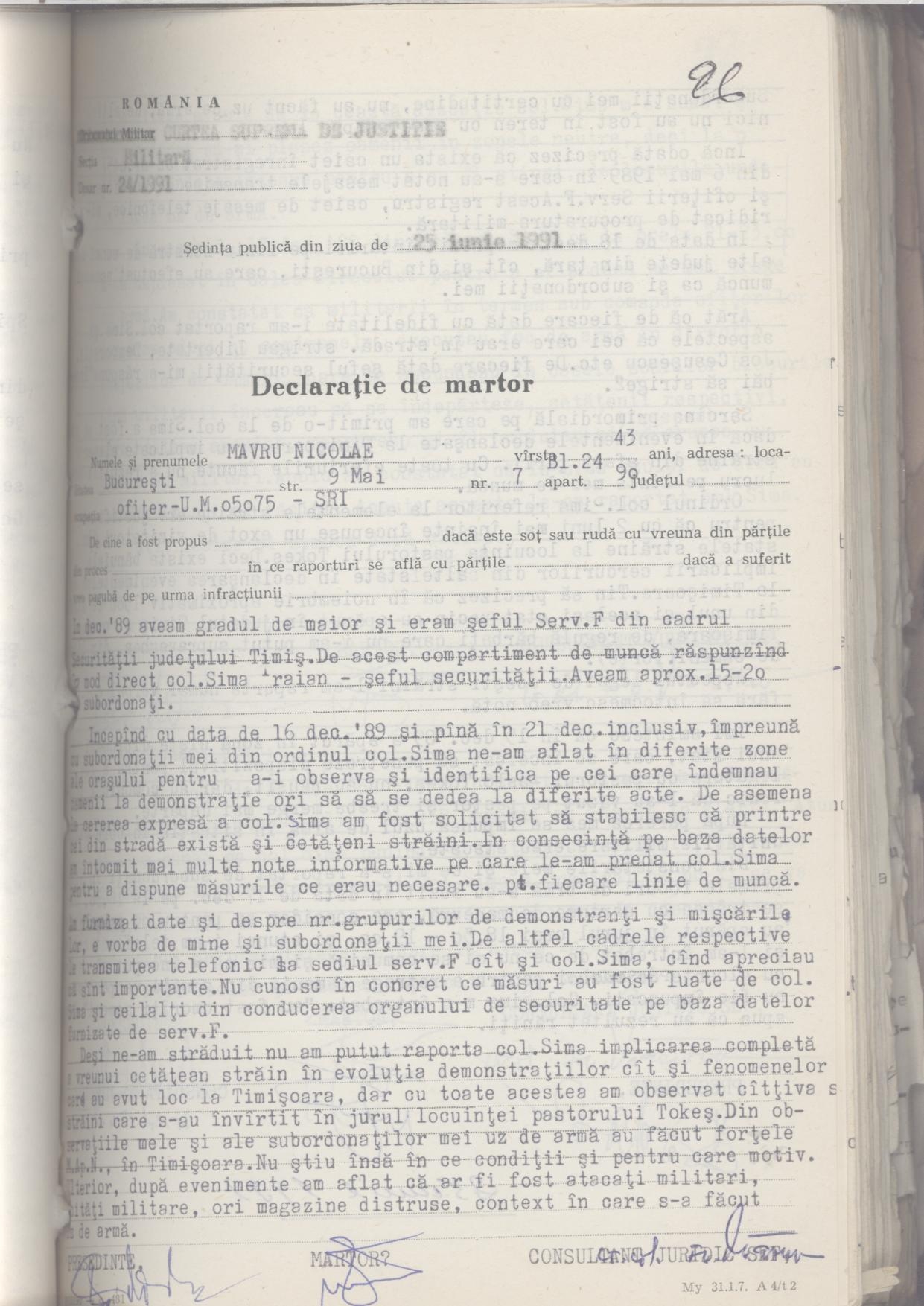
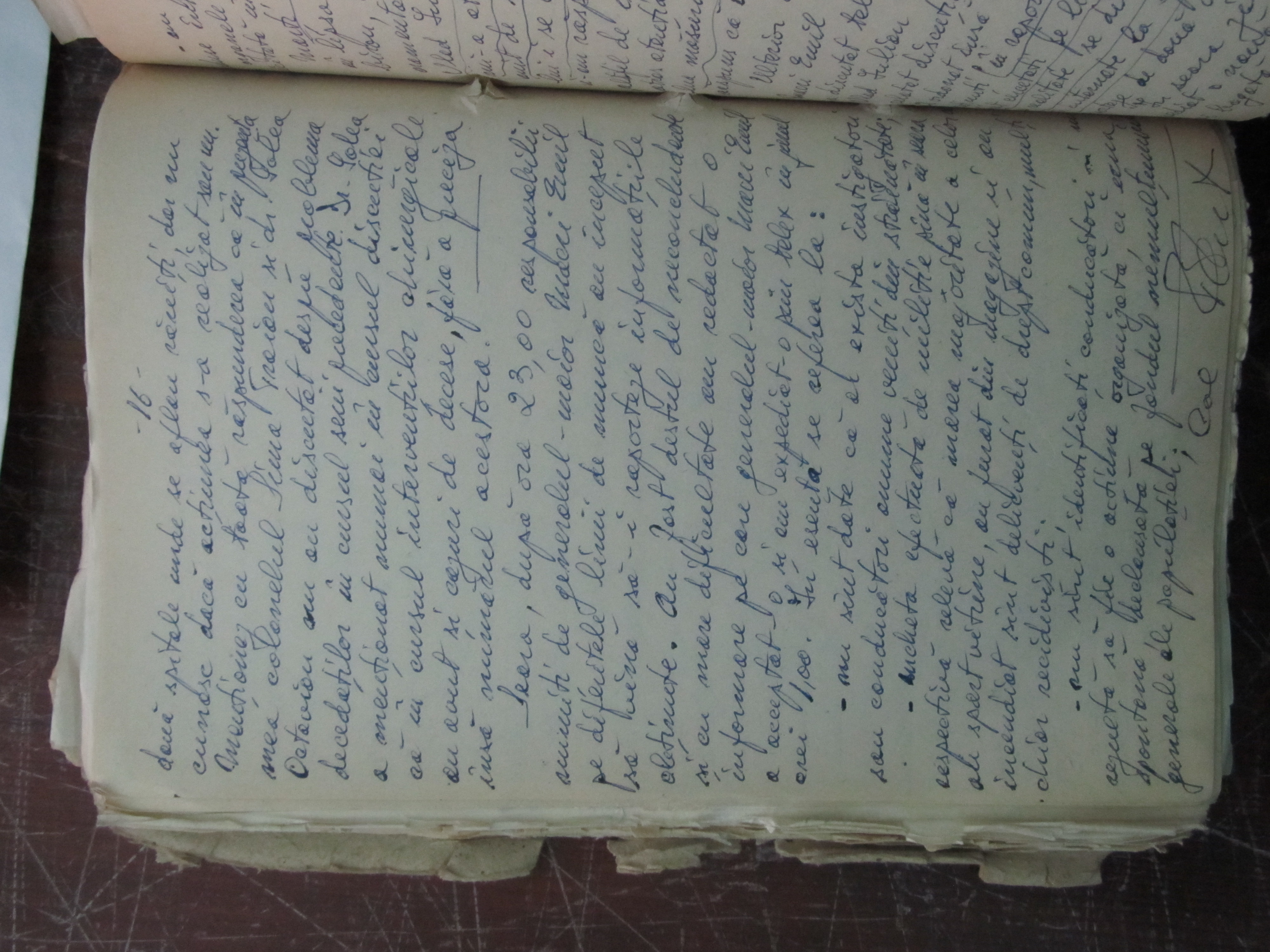
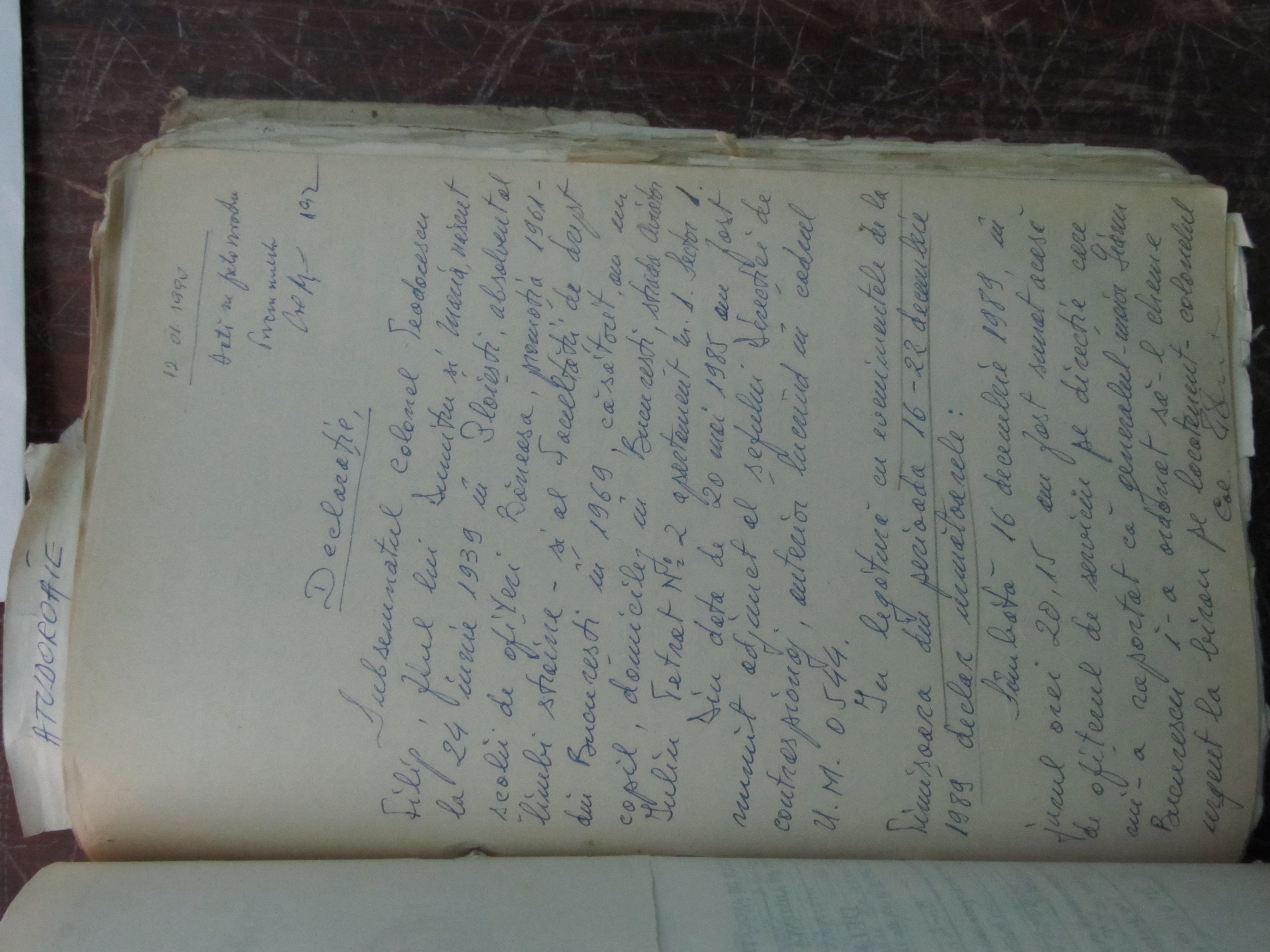
The declarations of senior Securitate officers Filip Teodorescu, Emil Macri, Liviu Dinulescu, and Nicolae Mavru from late December 1989/early 1990
http://atomic-temporary-3899751.wpcomstaging.com/2013/03/17/filip-teodorescu-adj-sef-dir-iii-contraspionaj-d-s-s-nu-sint-date-ca-ar-exista-instigatori-sau-conducatori-anume-veniti-din-strainatate/
http://atomic-temporary-3899751.wpcomstaging.com/2013/03/16/emil-macri-rezumind-sintetic-informatiile-obtinute-ele-nu-au-pus-in-evidenta-nici-lideri-si-nici-amestecul-vreunei-puteri-straine-in-producerea-evenimentelor-de-la-timisoara/
http://atomic-temporary-3899751.wpcomstaging.com/2013/03/10/liviu-dinulescu-cpt-la-serviciul-de-pasapoarte-al-jud-timis-precizez-ca-anterior-declansarii-evenimentelor-de-la-timisoara-din-datele-ce-le-detineam-serviciul-nostru-nu-rezulta-vreun-amestec-di/
http://atomic-temporary-3899751.wpcomstaging.com/2013/03/06/secretele-revolutiei-de-la-timisoara-col-niculae-mavru-fost-sef-al-sectiei-filaj-si-investigatie-de-la-securitatea-timis/
http://atomic-temporary-3899751.wpcomstaging.com/ultimul-raport-al-securitatii-catre-nicolae-ceausescu/
Below some of my discussion of the Securitate’s “recovered memory”
through the years (1996, 2002, 2005)
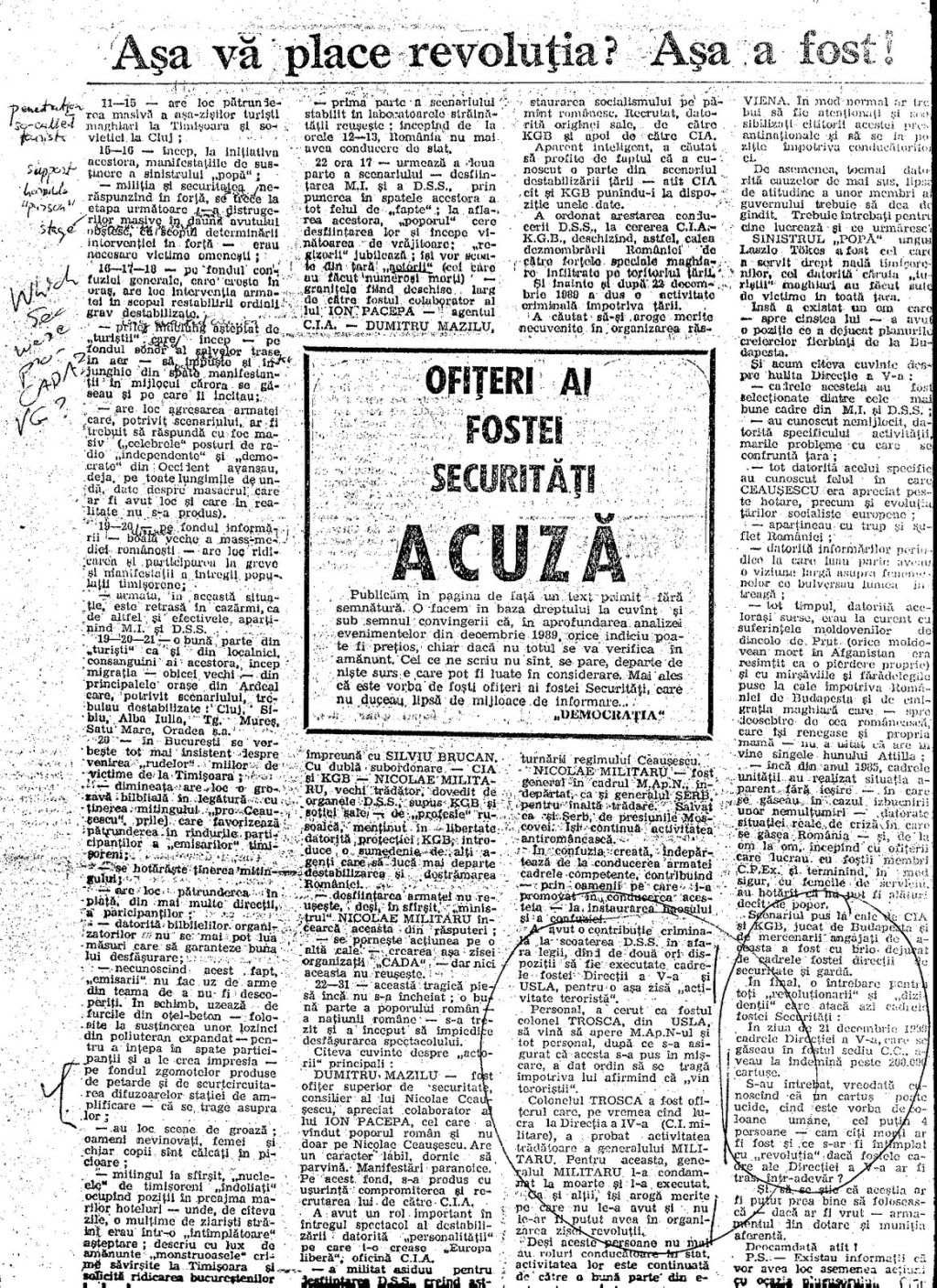
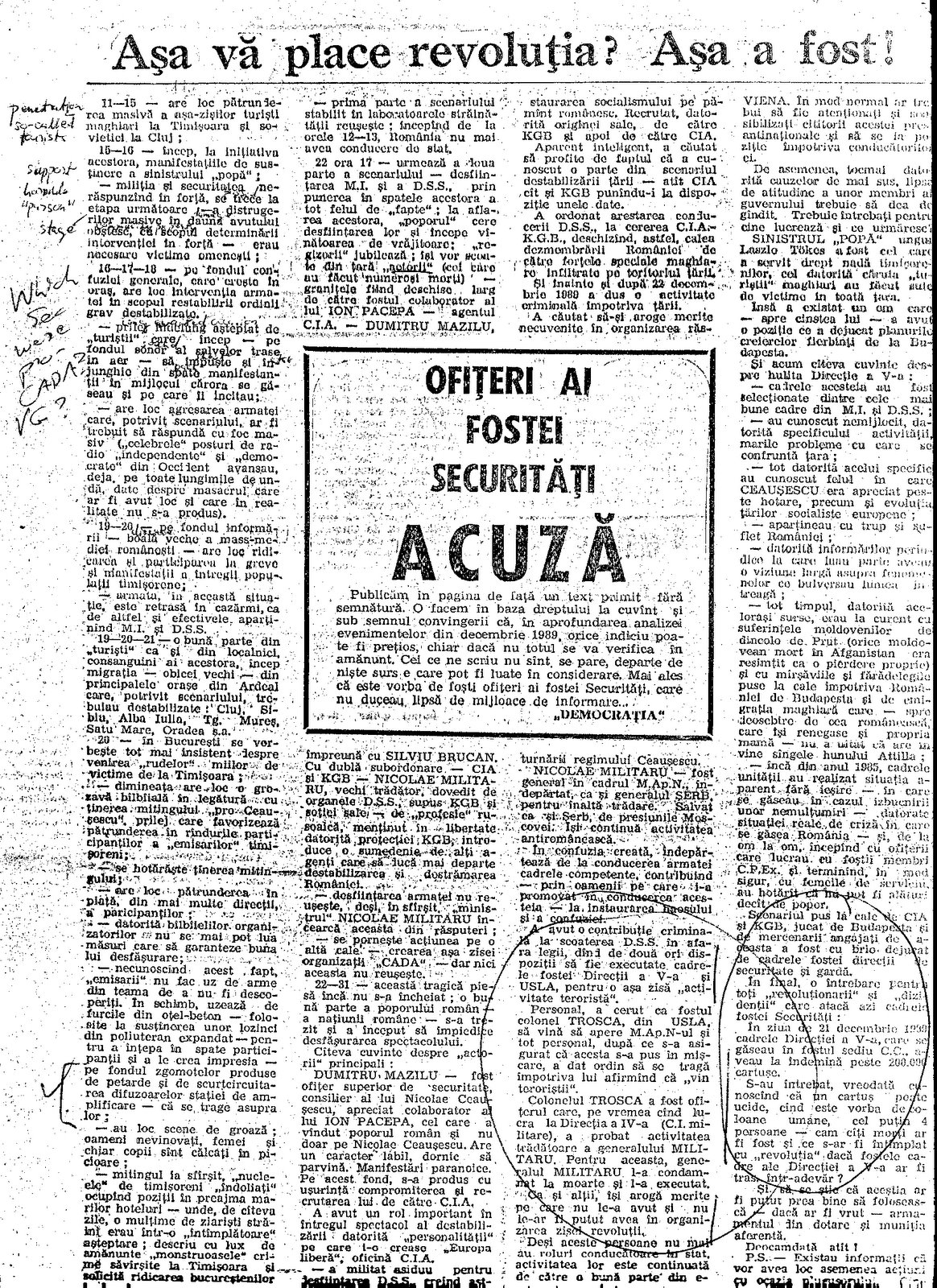
“Asa va place revolutia? Asa a fost!” Democratia, septembrie 1990, din partea fostilor ofiteri din Directia V-a a Securitatii.
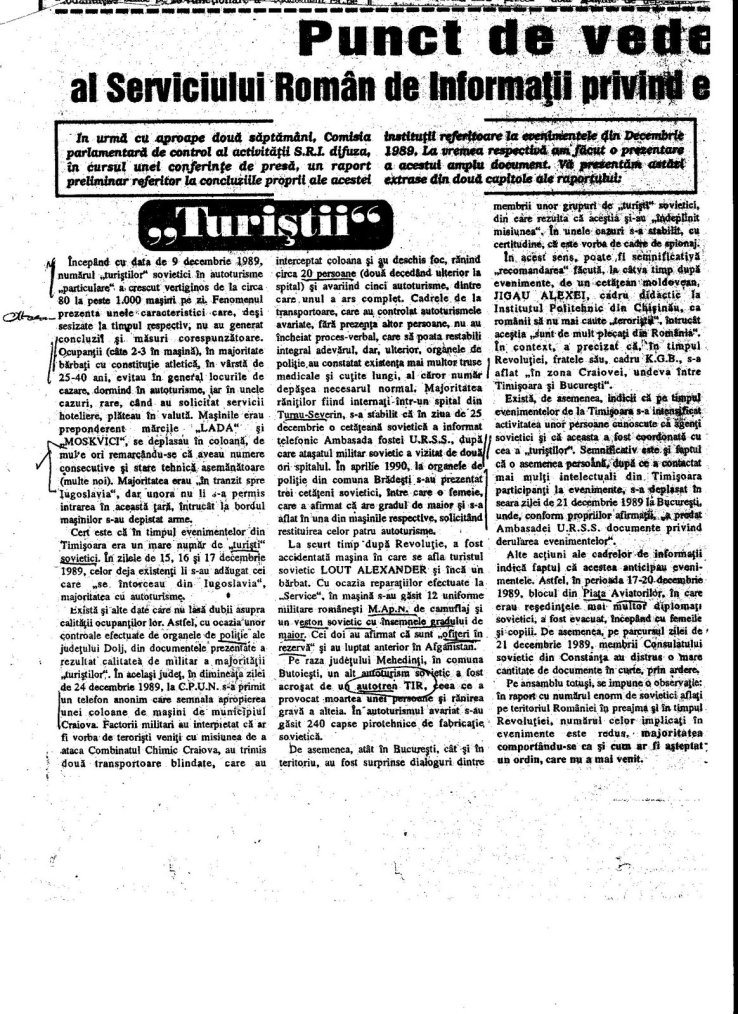
Raportul SRI, publicat in Adevarul, 13 iulie 1994.
THE 1989 ROMANIAN REVOLUTION AS GEOPOLITICAL PARLOR GAME: BRANDSTATTER’S “CHECKMATE” DOCUMENTARY AND THE LATEST WAVE IN A SEA OF REVISIONISM
By Richard Andrew Hall
Disclaimer: This material has been reviewed by CIA. That review neither constitutes CIA authentification of information nor implies CIA endorsement of the author’s views.
Please Note: This article is not to be cited, reproduced, translated, or used in any form without the acknowledgement and permission of the author.
Part 3: Ruse
A SECURITATE RIDDLE: SOVIET “TOURISTS” AND THE OVERTHROW OF THE CEAUSESCU REGIME
Although I have written a good deal on the “tourist” conundrum in the past (see, for example, Hall 2002), I have not formally addressed the role of foreign histories of Ceausescu’s overthrow in the historiography of December 1989, particularly in regard to this topic. In the wake of the broadcast of Brandstatter’s “Checkmate” documentary in February 2004, Vladimir Bukovski’s invocation of journalist John Simpson’s 1994 article on the topic (discussed in Part 2 of this series) suggests, however, that it needs to be broached in greater detail. Moreover, as the year-long look-back at the December 1989 events in “Jurnalul National” shows, the “tourist” question—somewhat surprisingly to me—has become more and more central to arguments about the Revolution, thereby amplifying what is already tremendous confusion over the events in the Romanian press and public. Of course, as has traditionally been the case, the Soviet/Russian tourists figure prominently, and, to a lesser extent, the Hungarian tourists. However, the stock of other tourist groups has also gone up. For example, the role of Yugoslav (specifically Serb) tourists has found a greater emphasis, and, seemingly out of nowhere, so have East German/STASI tourists! The principal sources for all of these allegations are, as usual, former Securitate and Militia officers, with some military (intelligence) personnel thrown in for good measure.
FOREIGN FORUM, ROMANIAN CONTEXT
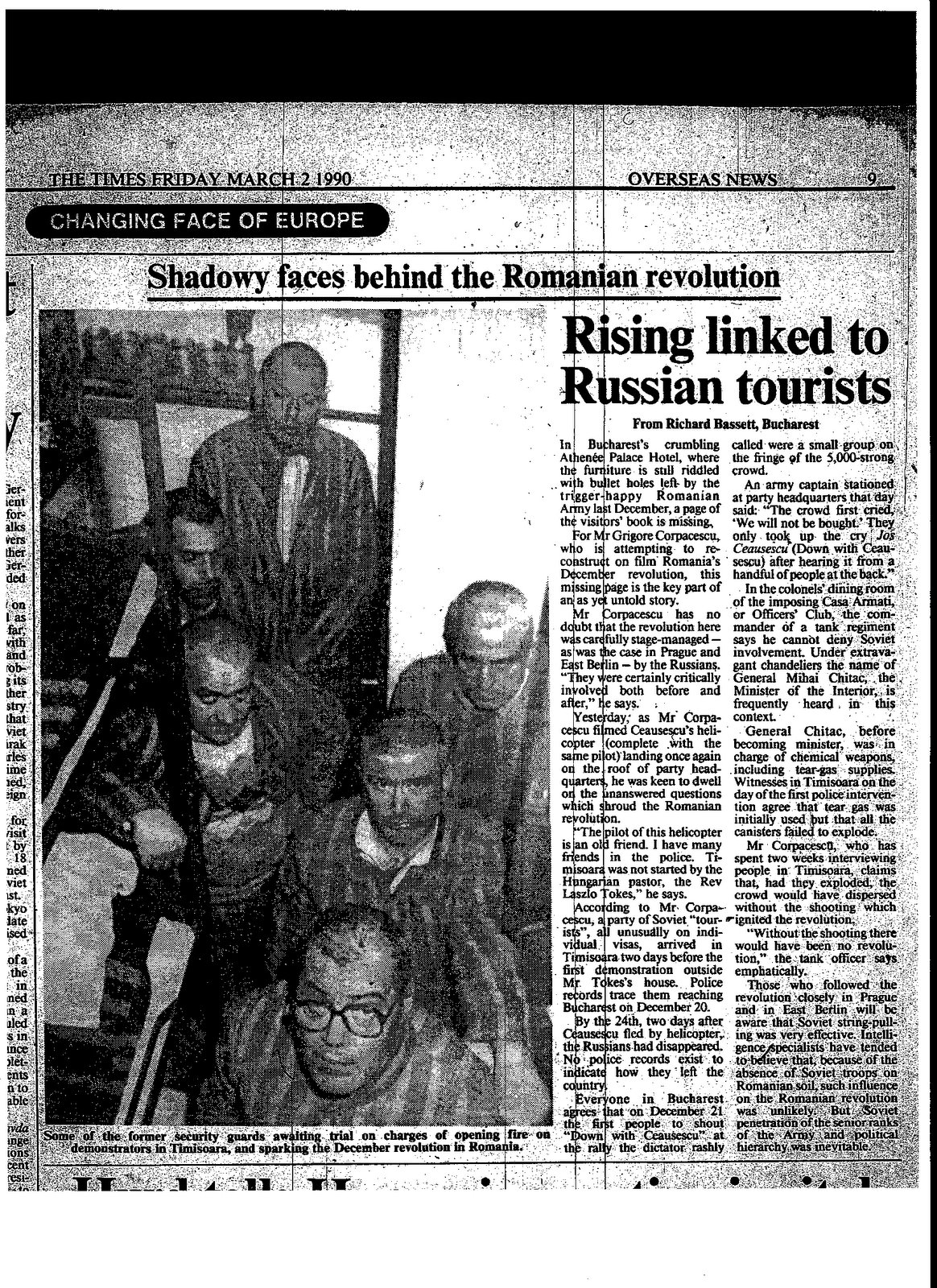
It is difficult to pinpoint the exact first mention of “the tourists” and their alleged role in the Revolution, but it appears that although the source of the claim was Romanian, the publication was foreign. James F. Burke, whose name is unfortunately left off the well-researched and widely-consulted web document “The December 1989 Revolt and the Romanian Coup d‘etat,” alludes to the “Romanian filmmaker” who first made these allegations (Burke, 1994). The claims are contained in an article by Richard Bassett in the 2 March 1990 edition of “The Times (London).” According to Bassett,
“Mr. [Grigore] Corpacescu has no doubt that the revolution here was carefully stage-managed—as was the case in Prague and East Berlin—by the Russians…According to Mr. Corpacescu a party of Soviet ‘tourists,’ all usually on individual visas, arrived in Timisoara two days before the first demonstration outside Mr. [i.e. Pastor] Tokes’ house. Police records trace them reaching Bucharest on December 20. By the 24th, two days after Ceausescu fled by helicopter, the Russians had disappeared. No police records exist to indicate how they left the country. (“The Times (London),” 2 March 1990)

But Bassett’s interlocutor, Mr. Corpacescu, says some strange things. Bassett is not clear but it appears that Corpacescu suggests that the post-Revolution Interior Minister Mihai Chitac, who was involved in the Timisoara events as head of the army’s chemical troops, somehow purposely coaxed the demonstrations against the regime because the tear-gas cannisters his unit fired failed to explode—the failure somehow an intended outcome. But beyond this, Corpacescu, who is at the time of the article filming the recreation of Ceausescu’s flight on the 22nd—using the same helicopter and pilot involved in the actual event—makes the following curious statement:
“The pilot of this helicopter is an old friend. I have many friends in the police, Timisoara was not started by the Hungarian pastor, the Reverend Laszlo Tokes [i.e. it was carefully stage-managed…by the Russians].” (“The Times (London),” 2 March 1990)
The pilot of the helicopter was in fact Vasile Malutan, an officer of the Securitate’s V-a Directorate. What kind of a person would it have been at that time—and how credible could that person have been–who has the pilot as an old friend and “many friends in the police?” And it would have been one thing perhaps two months after the revolution to talk about the presence of foreign agents “observing” events in Timisoara, but to deny the spontaneity of the demonstrations and denigrate Tokes’ role at this juncture is highly suspicious. I have been unable to unearth additional information on Mr. Corpacescu, but his revelations just happen to serve his friends extremely well—particularly at at time when the prospect of trials and jail time, for participation in the repression in Timisoara and elsewhere during the Revolution, still faced many former Securitate and Militia [i.e. police] members.
THE FORMER SECURITATE AND MILITIA REMINISCE ABOUT THE SOVIET “TOURISTS”
A week after “The Times” article, the chief of the Securitate’s Counter-espionage Directorate, Colonel Filip Teodorescu, mentioned at his trial for his role in the Ceausescu regime’s crackdown in Timisoara that he had in fact detained “foreign agents” during the events there (“Romania Libera,” 9 March 1990). In his 1992 book, he developed further on this theme, specifically focusing on the role of “Soviet tourists:”
“There were few foreigners in the hotels, the majority of them having fled the town after lunch [on 17 December] when the clashes began to break out. The interested parties remained. Our attention is drawn to the unjustifiably large number of Soviet tourists, be they by bus or car. Not all of them stayed in hotels. They either had left their buses or stayed in their cars overnight. Border records indicate their points of entry as being through northern Transylvania. They all claimed they were in transit to Yugoslavia. The explanation was plausible, the Soviets being well-known for their shopping trips. Unfortunately, we did not have enough forces and the conditions did not allow us to monitor the activities of at least some of these ‘tourists’” (Teodorescu, 1992, p. 92).
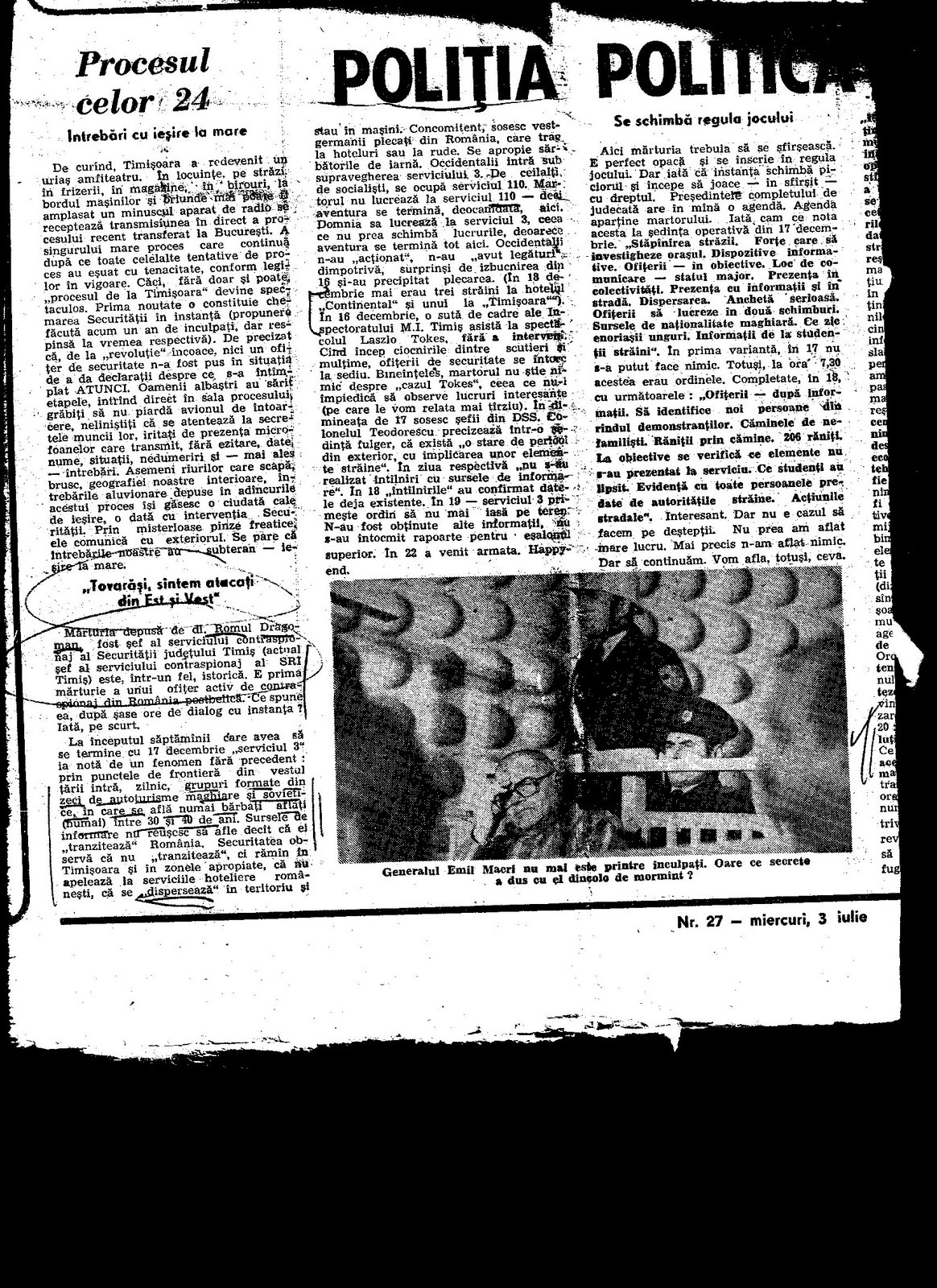
Reporting in July 1991 on the trial involving many of those involved in the Timisoara repression, Radu Ciobotea noted with what was probably an apt amount of skepticism and cynicism, what was telling in the confessions of those on trial:
“Is the End of Amnesia Approaching?…
Without question, something is happening with this trial. The Securitate doesn’t say, but it suggests. It let’s small details ‘slip out.’…Increasingly worthy of interest are the reactions of those on trial….Traian Sima (the former head of the county’s Securitate) testifies happily that, finally, the Securitate has been accepted at the trial, after having been rejected by Justice. Filip Teodorescu utters the magic word ‘diplomats’ and, suddenly, the witness discovers the key to the drawer with surpise and declares, after five hours of amnesia, that in Timisoara, there appeared in the days in question, foreign spies under the cover of being journalists and diplomats, that in a conversation intercepted by a mobile Securitate surveillance unit Tokes was reported as ‘well,’ and that all these (and other) counterespionage actions that can’t be made public to the mass media can be revealed behind closed doors to the judge….[Timis County party boss] Radu Balan ‘remembers’ that on 18 December at midnight when he was heading toward IAEM, he passed a group of ten soviet cars stopped 100 meters from the county hospital. (It turns out that in this night, in the sight of the Soviets, the corpses were loaded!).” [emphasis in the original] (Flacara, no. 27, 1991, p. 9).

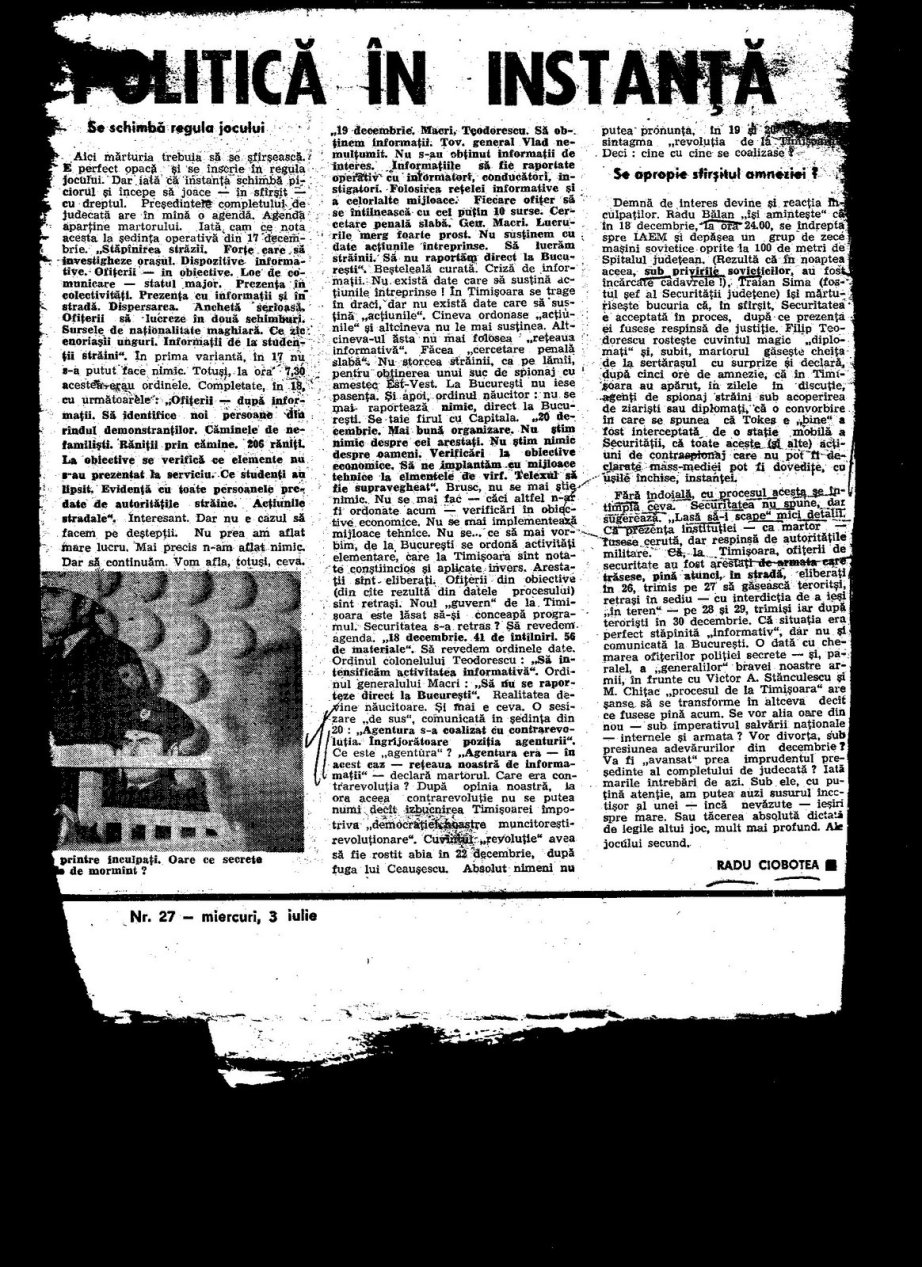
The reference to the corpses being loaded is to an operation by the Militia and Securitate on the night of 18-19 December 1989, in which the cadavers of 40 people killed during the repression of anti-regime protesters were secretly transported from Timisoara’s main hospital to Bucharest for cremation (reputedly on Elena Ceausescu’s personal order).
Finally, as yet another of many possible examples, we have the recollections of Bucharest Militia Captain Ionel Bejan, which apparently appeared in print for the first time only in 2004, in a book by Alex Mihai Stoenescu (excerpted in “Jurnalul National,” 7 December 2004). According to Bejan, around 2 AM on the night of 21-22 December, not far from University Plaza, where at that moment regime forces were firing their way through a barricade set up by protesters (48 were killed that night, 604 wounded, and 684 arrested), he spotted two LADA automobiles with Soviet plates and two men and a woman studying a map and pointing to different locations among the surrounding buildings. Bejan recalled:
“One thing’s for sure, and that is that although they looked like tourists, they didn’t behave like tourists who had just arrived in town or were lost, especially as close by there were compact groups of demonstrators, while from armored personnel carriers there was intense warning fire and a helicopter hovered overhead with lights ablaze. I don’t know what kind of tourist tours somewhere in such conditions. They left the impression that they were sure of themselves, they didn’t need any directions, proof which was that they didn’t ask us anything even though we were nearby and, being uniformed Militia, were in the position to give them any directions they needed. One thing’s for sure when I returned to that location in January 1990…the buildings displayed visible signs of bullet holes…[emphasis added]” (“Jurnalul National,” 7 December 2004)
STRANGE “TOURISTS”…STRANGER STILL, THE REACTIONS OF THE AUTHORITIES
We can agree with Ionel Bejan in one respect. One thing is for sure: these were some very strange tourists. (They give a whole new meaning to the term, “adventure tourism.”) As curious as the “Soviet tourists” themselves is how little the Romanian authorities who claim to have seen them did to stop them—or even try to collect more information about them. Why is it that no official questioned the enigmatic “Soviet tourists” or asked them to leave the area when, as Radu Balan claims, he saw ten LADAs outside the Timis county hospital at 1 AM in the morning the night the cadavers of protesters were being loaded onto a truck for cremation? Or, as Ionel Bejan claims, he spotted several of them in the center of Bucharest at 2 AM, when the area was essentially a warzone of regime repression? The regime had closed the borders to virtually all other foreigners, tourists or otherwise, it was trying to prevent any word of the repression from reaching the outside world, and yet Romanian authorities were not concerned about these “tourists” taking pictures or relaying what they were seeing?!
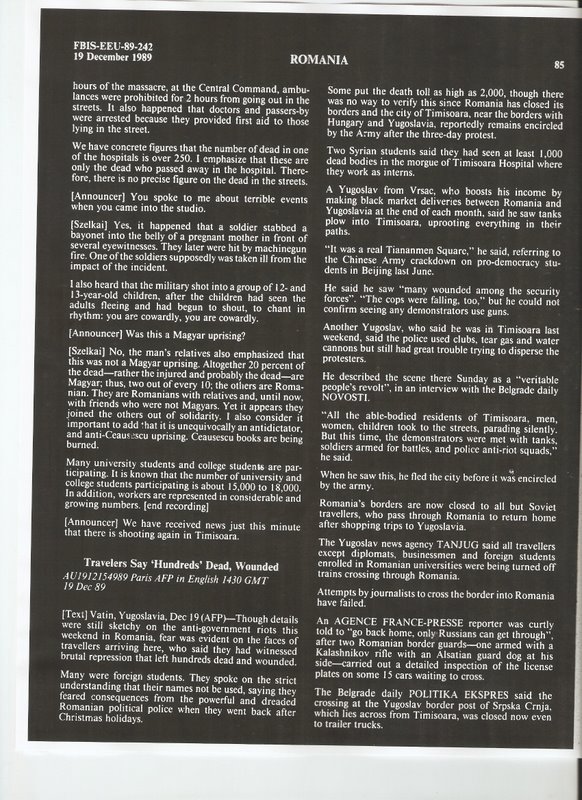
As I have written before, if it was obvious before 18 December, as these Ceausescu regime officials claim, that “Soviet tourists” were involved in the events in Timisoara, then why was it precisely “Soviet travelers coming home from shopping trips to Yugoslavia” who were the only group declared exempt from the ban on “tourism” announced on that day (see AFP, 19 December 1989 as cited in Hall 2002b)? In fact, an Agent France-Presse correspondent reported that two Romanian border guards on the Yugoslav frontier curtly told him: “Go back home, only Russians can get through”!!! The few official documents from the December events that have made their way into the public domain show the Romanian Ambassador to Moscow, Ion Bucur, appealing to the Soviets to honor the Romanian news blackout on events in Timisoara, but never once mentioning—let alone objecting to—the presence or behavior of “Soviet tourists” in Romania during these chaotic days of crisis for the Ceausescu regime (CWHIP, “New Evidence on the 1989 Crisis in Romania,” 2001). It truly strains the imagination to believe that the Romanian authorities were so “frightened” of committing a diplomatic incident with the Soviets that they would allow Soviet agents to roam the country virtually unhindered, allowing them to go anywhere and do anything they wanted.
BUT WAIT, THERE’S MORE…A “SOVIET TOURIST” ENCORE IN 1990
Add to all of this (!), the allegations that the “Soviet tourists” were seen again on the streets during major crises in 1990, such as the ethnic clashes between Romanians and Hungarians in Tirgu Mures in March 1990 (for evidence of the reach of the allegation of KGB manipulation via the “tourist” mechanism both in December 1989 AND in March 1990, see Emil Hurezeanu, “Cotidianul,” 23 December 1999; according to Hurezeanu, “It appears they didn’t leave the country until 1991, following a visit by [SRI Director] Virgil Magureanu to Moscow”!). Then there is the famous April 1991 interview of an alleged KGB officer—who spoke flawless Romania and was in Romania during the December 1989 events—who the interviewer, the vigorous anti-Iliescu foe, Sorin Rosca Stanescu, claimed to have just stumbled into in Paris. Of all the reporters who could have stumbled into a KGB officer present in Romania during the Revolution—the only such case I know of—it was Rosca Stanescu, who, it turned out later, had been an informer for the Securitate until the mid-1980s—but not just for anybody, but for the USLA. Intererstingly, although the article appeared on the non-descript page 8 of the primary opposition daily at the time (“Romania Libera”), the aforementioned Filip Teodorescu and Radu Balan invoked it in support of their contentions regarding the the “tourists” (for a discussion of this, see Hall 2002). Even more suprising, or not, depending on your point of view, in his April 1991 article, Stanescu attempted to tie together December 1989 with December 1990 (!):
“As you will recall, persistent rumors have circulated about the existence on Romanian soil [in December 1989] of over 2,000 Lada automobiles with Soviet tags and two men in each car. Similar massive infiltrations were witnessed in December 1990, too, with the outbreak of a wave of strikes and demonstrations. What were the KGB doing in Romania?” (emphasis added) (“Romania Libera,” 18 April 1991)
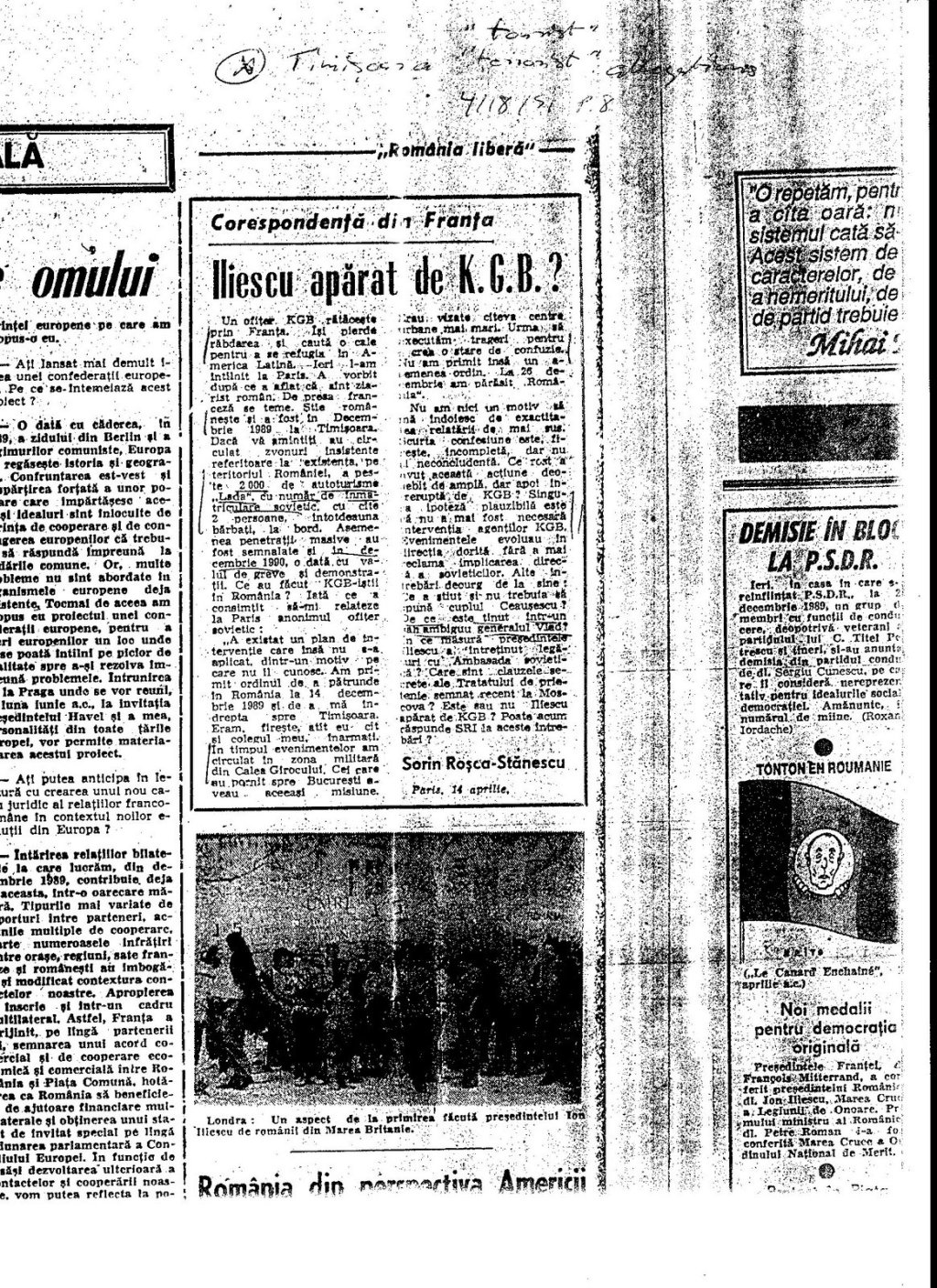
Indeed, what were they doing in Romania? But, more aptly:
WHO COULD THEY HAVE BEEN?
Some other recollections and comments may offer clues to the answer to this vexing question. For example, the Caransebes Militia Chief claims he helped a group of “Soviet tourists” coming from Timisoara on the night of 20-21 December when one of their cars—as usual, “it was part of a convoy of 20 cars, all of the same make and with 3-4 passengers per car”—went off the road (from “Europa,” no. 20, 1991, see the discussion in Hall 2002b). According to Teodorescu, the “tourists” greeted the militia chief with the phrase “What the hell? We are colleagues; you have to help us” (Teodorescu, 1992, p. 93). The militia chief opines that despite their Soviet passports, “to this day, I don’t really know where they were from.”
Nicu Ceausescu, Nicolae’s son and most likely heir and party secretary in Sibiu at the time of the Revolution, claimed that he also had to deal with enigmatic “tourists” during these historic days (the following several paragraphs borrow heavily from Hall 2002b). From his prison cell in 1990, Nicu recounted how on the night of 20 December 1989, a top party official came to inform him that the State Tourist Agency was requesting that he — the party secretary for Sibiu! — “find lodgings for a group of tourists who did not have accommodation” He kindly obliged and made the appropriate arrangements (interview with Nicu Ceausescu in “Zig-Zag,”, no. 20, 21-27 August 1990).
Interestingly, in the same interview Nicu discusses the “tourists” for which he was asked to find accommodations in the context of a group of mysterious passengers who had arrived by plane from Bucharest on the evening of 20 December 1989. We know that in the period immediately following these events, the then-military prosecutor, Anton Socaciu, had alleged that these passengers from Bucharest were members of the Securitate’s elite USLA unit (Special Unit for Antiterrorist Warfare) and were responsible for much of the bloodshed that occurred in Sibiu during the December events. Nicu Silvestru, chief of the Sibiu County Militia, admitted in passing in a letter from prison that on the afternoon of 19 December in a crisis meeting, Ceausescu’s son announced that he was going to “call [his] specialists from Bucharest” to take care of any protests (“Baricada,” no. 45, 1990). Ceausescu’s Interior Minister, Tudor Postelnicu, admitted at his trial in January 1990 that Nicu had called him requesting “some troops” and he had informed Securitate Director General Iulian Vlad of the request (“Romania Libera,” 30 January 1990.)
The rewriting of the story of the Revolution, the “tourists,” and the “terrorists” was already in full swing, when in August 1990, Nicu wryly observed:
“…[T]he Military Prosecutor gave me two variants. In the first part of the inquest, they [the flight’s passengers] were from the Interior Ministry. Later, however, in the second half of the investigation, when the USLA and those from the Interior Ministry began, so-to-speak, to pass ‘into the shadows,’ — after which one no longer heard anything of them — they [the passengers] turned out to be simple citizens…” (interview with Nicu Ceausescu in “Zig-Zag,” no. 20, 21-27 August 1990).
The impact of this “reconsideration” by the authorities could be seen in the comments of Socaciu’s successor as military prosecutor in charge of the Sibiu case, Marian Valer (see Hall 1997, pp. 314-315). Valer commented in September 1990 that investigations yielded the fact that there were 37 unidentified passengers on board the 20 December flight from Bucharest and that many of the other passengers maintained that “on the right side of the plane there had been a group of tall, athletic men, dressed in sporting attire, many of them blond, who had raised their suspicions.” The USLA, which were responsible for airport security and had “air marshals” on all flights (three in this case), refused to discuss the identity of these passengers with Valer. While investigations revealed that during this time there “were many Soviet tourists staying in Sibiu’s hotels,” they also established that “military units were fired upon from Securitate safehouses located around these units as of the afternoon of 22 December, after the overthrow of the Ceausescu regime.” He thus carefully concludes:
“As far as the unidentified passengers are concerned, there are two possible variants: Either they were USLA fighters sent to defend Nicu Ceausescu, or they were Soviet agents sent to act with the intent of overthrowing the Ceausescu regime” (“Expres,” no. 33, September 1990).
Clearly, one of these hypotheses is a lot more plauisble than the other…As I wrote in December 1996, partly based on the statements of the Military Prosecutor Marian Valer who stepped down from investigating the Sibiu events in fall 1990, citing duress: “thus as the USLA began to disappear from the historiography and therefore history of the Revolution, so the Soviet tourists began to enter it.” (Hall, 1996)….
SOURCES
“Baricada (Bucharest),” 1990.
Burke, J. F., 1994, “The December 1989 Revolt and the Romanian Coup d‘etat,” at http://www.timisoara.com/timisoara/coup.html.
Ciobotea, R., 1991, “Politia Politica in Instanta [The Political Police on Trial],” “Flacara,” 3 July.
“Cotidianul” (Bucharest), 1999, web edition, http://www.cotidianul.ro.
CWIHP (Cold War International History Project), 2001, “New Evidence on the 1989 Crisis in Romania,” (ed. Mircea Munteanu), at http://wwics.si.edu/topics/pubs/e-dossier5.
Corut, P., 1994, Cantecul Nemuririi [Song of the Undying] (Bucharest: Editura Miracol).
Deletant, D., 1995, Ceausescu and the Securitate: Coercion and Dissent, 1965-1989 (Armonk, NY: M.E. Sharpe).
“Evenimentul zilei” (Bucharest), 1999, web edition, http://www.evenimentulzilei.ro.
“Europa (Bucharest),” 1990, 1991.
Hall, R.A., 1996, “Ce demonstreaza probele balistice dupa sapte ani? [Seven Years After: What Does the Ballistics’ Evidence Tell Us]” trans. Bobeica, A., in “22 (Bucharest),” 17-23 December.
Hall, R. A. 1997, “Rewriting the Revolution: Authoritarian Regime-State Relations and the Triumph of Securitate Revisionism in Post-Ceausescu Romania,” (Ph.D. Dissertation, Indiana University).
Hall, R. A., 1999, “The Uses of Absurdity: The Staged War Theory and the Romanian Revolution of December 1989,” in “East European Politics and Societies,” Vol. 13, no.3, pp. 501-542.
Hall, R. A., 2002, “Part 2: Tourists are Terrorists and Terrorists are Tourists with Guns,” “The Securitate Roots of a Modern Romanian Fairy Tale: The Press, the Former Securitate, and the Historiography of December 1989,” Radio Free Europe “East European Perspectives,” Vol. 4, no 8.
“Jurnalul National,” (Bucharest), 2004, web edition, http://www.jurnalul.ro.
“New York Times,” 1989.
“Romania Libera,” 1990.
Teodorescu, F., 1992, Un Risc Asumat: Timisoara, decembrie 1989, [An Assumed Risk: Timisoara, December 1989] (Bucharest: Editura Viitorul Romanesc).
“The Times (London),” 1990.
“Zig-Zag” (Bucharest), 1990.
————————————————————–
cleared March 2002
RFE/RL Reports Print Version E-mail this page to a friend
17 April 2002, Volume 4, Number 8
THE SECURITATE ROOTS OF A MODERN ROMANIAN FAIRY TALE: THE PRESS, THE FORMER SECURITATE, AND THE HISTORIOGRAPHY OF DECEMBER 1989
By Richard Andrew Hall
Part 2: ‘Tourists Are Terrorists and Terrorists are Tourists with Guns…’ *
The distance traveled by Securitate disinformation on the December 1989 events can be breathtaking. Bubbling up through the springs of popular rumor and speculation, it flows into the tributaries of the media as peripheral subplots to other stories and eventually wends its way — carried upon the waves of consensus and credibility that flow from its acceptance among prominent Romanian journalists and intellectuals — into the writings of Western journalists, analysts, and academics. Popular myths, which either have their origins in disinformation disseminated by the former Securitate, or which originated in the conspiratorial musings of the populace but proved propitious for the former secret police and thus were appropriated, nurtured, and reinjected into popular discourse, are today routinely repeated both inside and outside Romania. Frequently, this dissemination occurs without the faintest concern over, or knowledge of, the myth’s etymology or much thought given to the broader context and how it plays into the issue of the Securitate’s institutional culpability.
Take, for example, the “tourist” myth — perhaps the former Securitate’s most fanciful and enduring piece of disinformation. This myth suggests that in December 1989, Soviet, Hungarian, and other foreign agents posing as “tourists” instigated and/or nurtured anti-Ceausescu demonstrations in Timisoara, Bucharest, and elsewhere, and/or were responsible for the “terrorist” violence after 22 December that claimed over 900 victims, or almost 90 percent of those killed during the Revolution. The implication of such allegations is clear: It questions the spontaneity — and hence, inevitably, to a certain degree, the legitimacy — of the anti-Ceausescu demonstrations and the overthrow of the Ceausescu regime; it raises doubt about the popular legitimacy of those who seized power during the events; and it suggests that those who seized power lied about who was responsible for the terrorist violence and may ultimately have themselves been responsible for the bloodshed.
A robust exegesis of the “tourist” hypothesis was outlined on the eve of the 10th anniversary of the December 1989 events in the pages of the daily “Ziua” by Vladimir Alexe. Alexe has been a vigorous critic of Ion Iliescu and the former communists of the National Salvation Front (FSN) who took power in December 1989, maintaining that they overthrew Ceausescu in a Soviet-sponsored coup d’etat:
“The outbreak of the December events was preceded by an odd fact characteristic of the last 10 years. After 10 December 1989, an unprecedented number of Soviet ‘tourists’ entered the country. Whole convoys of Lada automobiles, with approximately four athletic men per car, were observed at the borders with the Moldovan Socialist Republic, Bulgaria, and Hungary. A detail worthy of mention: The Soviet ‘tourists’ entered Romania without passports, which suggests the complicity of higher-ups. According to the statistics, an estimated 67,000 Soviet ‘tourists’ entered Romania in December 1989″ (“Ziua”, 24 December 1999).
It is worth noting that Alexe considers elsewhere in this series of articles from December 1999 that the Russian “tourists” were an omnipresent, critical, and catalytic factor in the collapse of communism throughout ALL of Eastern Europe in December 1989.
Nor has the “tourist” hypothesis been confined strictly to the realm of investigative journalism. Serban Sandulescu, a bitter critic of Ion Iliescu and the former communists who seized power in December 1989, led the third parliamentary commission to investigate the December 1989 events as a Senator for the National Peasant Party Christian Democratic (PNTCD). In 1996, he published the findings of his commission as a book titled “December ’89: The Coup d’Etat That Abducted The Romanian Revolution.” He commented on the “tourists” as follows:
“From the data we have obtained and tabulated it appears that we are talking somewhere in the neighborhood of 5,000-6,000 ‘tourists’…. Soviet agents [who] came under the cover of being ‘tourists’ either in large organized groups that came by coach, or in smaller groups of 3-4 people that fanned out in Lada and Moskvich automobiles. They covered the whole country, being seen in all the important cities in the country. They contributed to the stoking of the internal revolutionary process, supervising its unfolding, and they fought [during the so-called ‘terrorist’ phase after 22 December]…” (Sandulescu, 1996, pp. 35, 45).
DECEMBER 1989: NICOLAE CEAUSESCU INITIATES THE ‘TOURIST’ MYTH
Not surprisingly, the “tourist” myth originated with none other than Nicolae Ceausescu. This myth inevitably implies illegitimate and cynical “foreign intervention,” and Ceausescu used it to make sense of what were — probably genuinely, for him — the unimaginable and surreal antiregime protests which began in Timisoara on 15 December 1989.
In an emergency meeting of the Romanian equivalent of the politburo (CPEX) on the afternoon of Sunday, 17 December 1989 — the afternoon on which regime forces were to open fire on the anti-Ceausescu demonstrators in Timisoara, killing scores and wounding hundreds — Ceausescu alleged that foreign interference and manipulation were behind the protests:
“Everything that has happened and is happening in Germany, in Czechoslovakia, and in Bulgaria now, and in the past in Poland and Hungary, are things organized by the Soviet Union with American and Western help” (cited in Bunea, 1994, p. 34).
That Ceausescu saw “tourists” specifically playing a nefarious role in stimulating the Timisoara protests is made clear by his order at the close of this emergency meeting:
“I have ordered that all tourist activity be interrupted at once. Not one more foreign tourist will be allowed in, because they have all turned into agents of espionage…. Not even those from the socialist countries will be allowed in, with the exception of [North] Korea, China, and Cuba. Because all the neighboring socialist countries are untrustworthy. Those sent from the neighboring socialist countries are sent as agents” (cited in Bunea, 1994, p. 34).
A CHRONOLOGY OF THE ‘TOURISTS’ ITINERARY AND ACTIVITIES ACCORDING TO TOP SECURITATE AND PARTY OFFICIALS IN THE IMMEDIATE AFTERMATH OF DECEMBER 1989
Filip Teodorescu, who as head of the Securitate’s Counterespionage Directorate (Directorate III) had been dispatched to Timisoara and was later arrested for his role in the repression there, maintained in March 1990 at his trial that he detained “foreign agents” during the Timisoara events (“Romania libera,” 9 March 1990). In a book that appeared in 1992, Teodorescu described as follows the events in Timisoara on Monday, 18 December — that is, after the bloody regime repression of anti-Ceausescu demonstrators the night before:
“There were few foreigners in the hotels, the majority of them having fled the town after lunch [on 17 December] when the clashes began to break out. The interested parties remained. Our attention is drawn to the unjustifiably large number of Soviet tourists, be they by bus or car. Not all of them stayed in hotels. They either had left their buses or stayed in their cars overnight. Border records indicate their points of entry as being through northern Transylvania. They all claimed they were in transit to Yugoslavia. The explanation was plausible, the Soviets being well-known for their shopping trips. Unfortunately, we did not have enough forces and the conditions did not allow us to monitor the activities of at least some of these ‘tourists’” (Teodorescu, 1992, p. 92).
Teodorescu appears here to be attempting to account for the fact that on Monday, 18 December 1989 — presumably as a consequence of Ceausescu’s tirade the afternoon before about the malicious intent of virtually all “tourists” — Romania announced, in typically Orwellian fashion, that it would not accept any more tourists because of a “shortage of hotel rooms” and because “weather conditions are not suitable for tourism” (Belgrade Domestic Service, 20 December 1989). Ironically, the only ones exempted from this ban were “Soviet travelers coming home from shopping trips to Yugoslavia” (!) (AFP, 19 December 1989).
Radu Balan, former Timis County party boss, picks up the story from there. While serving a prison sentence for his complicity in the Timisoara repression, in 1991 Balan told one of Ceausescu’s most famous “court poets,” Adrian Paunescu, that on the night of 18-19 December — during which in reality some 40 cadavers were secretly transported from Timisoara’s main hospital to Bucharest for cremation (reputedly on Elena Ceausescu’s personal order) — he too witnessed the role of these “foreign agents”:
“We had been receiving information, in daily bulletins, from the Securitate, that far more people were returning from Yugoslavia and Hungary than were going there and about the presence of Lada automobiles filled with Soviets. I saw them at the border and the border posts, and the cars were full. I wanted to know where and what they were eating and how they were crossing the border and going through cities and everywhere. More telling, on the night of 18-19 December, when I was at a fire at the I.A.M. factory, in front of the county hospital, I spotted 11 white ‘Lada’ automobiles at 1 a.m. in the morning. They pretended to ask me the road to Buzias.The 11 white Ladas had Soviet plates, not Romanian ones, and were in front of the hospital” (“Totusi iubirea,” no. 43, 24-31 October 1991).
Nicu Ceausescu, Nicolae’s son and most likely heir and party secretary in Sibiu at the time of the Revolution, claimed that he also had to deal with enigmatic “tourists” during these historic days. From his prison cell in 1990, Nicu recounted how on the night of 20 December 1989, a top party official came to inform him that the State Tourist Agency was requesting that he — the party secretary for Sibiu! — “find lodgings for a group of tourists who did not have accommodation.” He kindly obliged and made the appropriate arrangements (interview with Nicu Ceausescu in “Zig-Zag,”, no. 20, 21-27 August 1990).
Nor was Gheorghe Roset, head of the Militia in the city of Caransebes at the time of the Revolution, able to elude a visit from the “tourists” during these days. Writing from his prison cell in January 1991, he recounted:
“Stationed on the night of 20-21 December 1989 at headquarters, I received the order to issue an authorization for repairs for a Lada automobile that had overturned in Soceni, in Caras-Severin county, an order that was approved by the chief of the county Militia with the clarification that the passengers of this car were military personnel from the USSR. I was more than a little surprised when this car arrived in Caransebes and I saw that it was part of a convoy of 20 cars, all of the same make and with 3-4 passengers per car. Lengthy discussions with the person who had requested the authorization confirmed for me the accident and the fact that this convoy of cars was coming from Timisoara, on its way to Bucharest, as well as the fact that these were colleagues of ours from the country in question. He presented a passport in order to receive the documents he had requested, although not even today can I say with certainty that he belonged to this or that country. A short time after the convoy left on its way, it was reported to me that five of the cars had headed in the direction of Hateg, while the more numerous group headed for Bucharest” (“Europa,” no. 20, March 1991).
A September 1990 open letter authored by “some officers of the former Securitate” — most likely from the Fifth Directorate charged with guarding Ceausescu and the rest of the Romanian communist leadership — and addressed to the xenophobic, neo-Ceausist weekly “Democratia” (which was edited by Eugen Florescu, one of Ceausescu’s chief propagandists and speechwriters), sought to summarize the entire record of the “tourists” wanderings and activities in December 1989 as follows:
“11-15 [December] — a massive penetration of so-called Hungarian tourists takes place in Timisoara and Soviet tourists in Cluj;
15-16 [December] — upon the initiative of these groups, protests of support for the sinister ‘Priest [Father Laszlo Tokes of Timisoara]‘ break out;
16-17-18 [December] — in the midst of the general state of confusion building in the city, the army intervenes to reestablish order;
– this provides a long-awaited opportunity for the ‘tourists’ to start — in the midst of warning shots in the air — to shoot and stab in the back the demonstrators among whom they are located and whom they have incited;…
19-20-21 — a good part of the ‘tourists’ and their brethren among the locals begin to migrate — an old habit — from the main cities of Transylvania, according to plan, in order to destabilize: Cluj, Sibiu, Alba Iulia, Targu Mures, Satu Mare, Oradea, etc.” (“Democratia,” no. 36, 24-30 September 1990).
The authors of this chronology then maintain that this scene was replicated in Bucharest on 21 December, causing the famous disruption of Ceausescu’s speech and the death of civilians in University Square that evening.
Not to be out-done, Cluj Securitate chief Ion Serbanoiu claimed in a 1991 interview that, as of 21 December 1989, there were over 800 Russian and Hungarian tourists, mostly driving almost brand-new Lada automobiles (but also Dacia and Wartburg cars), in the city (interview with Angela Bacescu in “Europa,” no. 55, December 1991). In February 1991 during his trial, former Securitate Director General Iulian Vlad, not surprisingly, also spoke of “massive groups of Soviet tourists…the majority were men…deploy[ing] in a coordinated manner in a convoy of brand-new Lada automobiles” (see Bunea, 1994, pp. 460-461), while the infamous Pavel Corut has written of “the infiltration on Romanian territory of groups of Soviet commandos (“Spetsnaz”) under the cover of being tourists” (Corut, 1994).
REBUTTING THE ‘TOURIST’ MYTH
I vividly recall early on in my research of the December 1989 events being told emphatically, and not for the last time, by a journalist at the Cluj weekly “Nu” — a publication staunchly critical of the Iliescu regime — that the guest lists of Romanian hotels for December 1989 were nowhere to be found because they contained the secrets of the Revolution. Certainly, this rumor has intersected with the “tourist” myth and has been used as confirmation of the latter.
Significantly, Marius Mioc has sought to investigate the reality of this matter in Timisoara (Mioc, 2000). The numbers provided to the 17 December Timisoara Association (which Mioc heads) by all of Timisoara’s hotels and by the State Tourist Agency for Timisoara lay bare two of the key components upon which the “tourist” myth has relied: a) that the records of the December 1989 manifests do not exist, and b) that there was an unusually dramatic increase in the number of foreign tourists staying in Romanian hotels during this period. In fact, the opposite proves to be true, the number of foreign tourists — and specifically those from other “socialist” countries — declined in December 1989 both in comparison to the previous December and in comparison to November 1989!
Of course, as we have seen, proponents of the “tourist” myth have also suggested that many of the alleged foreign agents posing as tourists “avoided staying in hotels.” But this still raises the question of why the Securitate allowed them into the country in the first place and why they then seemed unable to follow their movements and prevent their activities. A 1991 open letter by “a group of [Romanian Army] officers from the Timisoara garrison” perhaps provides the best riposte to the dubious logic underlying the “tourist” hypothesis:
“If they [the tourists] appeared suspect to the special forces of the Securitate and military counterintelligence, why did they not attempt to keep them under surveillance? During this period, did the Securitate and the counterintelligence officers not know how to do their jobs? Did they somehow forget why they were paid such weighty sums from the state budget?” (“Romania libera,” 15 October 1991).
One must also ask: If it was precisely Soviet tourists who were most suspected at the time of being up to no good in the country, then why was it precisely they who were the sole group among “tourists” in the country at the time to be permitted to stay and go about their business unhindered?
HOW THE ‘TOURISTS’ ENTRY INTO THE HISTORIOGRAPHY OF DECEMBER 1989 PARALLELS THE EXIT OF THE SECURITATE
In commenting in August 1990 upon how the details of the state’s case against him had changed since early in the year, Nicolae Ceausescu’s son, Nicu, ironically highlighted how Securitate forces had begun to fade away from the historiography of the December 1989 events. In the August 1990 interview from his prison cell with Ion Cristoiu’s “Zig-Zag” (mentioned above), Nicu discusses the “tourists” for which he was asked to find accommodations in the context of a group of mysterious passengers who had arrived by plane from Bucharest on the evening of 20 December 1989. We know that in the period immediately following these events, the then-military prosecutor, Anton Socaciu, had alleged that these passengers from Bucharest were members of the Securitate’s elite USLA unit (Special Unit for Antiterrorist Warfare) and were responsible for much of the bloodshed that occurred in Sibiu during the December events (for a discussion, see Hall, 1996). In August 1990, however, Nicu wryly observed:
“…[T]he Military Prosecutor gave me two variants. In the first part of the inquest, they [the flight’s passengers] were from the Interior Ministry. Later, however, in the second half of the investigation, when the USLA and those from the Interior Ministry began, so-to-speak, to pass ‘into the shadows,’ — after which one no longer heard anything of them — they [the passengers] turned out to be simple citizens…” (interview with Nicu Ceausescu in “Zig-Zag,” no. 20, 21-27 August 1990).
The impact of this “reconsideration” by the authorities could be seen in the comments of Socaciu’s successor as military prosecutor in charge of the Sibiu case, Marian Valer (see Hall 1997a, pp. 314-315). Valer commented in September 1990 that investigations yielded the fact that there were 37 unidentified passengers on board the 20 December flight from Bucharest and that many of the other passengers maintained that “on the right side of the plane there had been a group of tall, athletic men, dressed in sporting attire, many of them blond, who had raised their suspicions.” While investigations revealed that during this time there “were many Soviet tourists staying in Sibiu’s hotels,” they also established that “military units were fired upon from Securitate safehouses located around these units as of the afternoon of 22 December, after the overturning of the Ceausescu regime.” He thus carefully concludes:
“As far as the unidentified passengers are concerned, there are two possible variants: Either they were USLA fighters sent to defend Nicu Ceausescu, or they were Soviet agents sent to act with the intent of overthrowing the Ceausescu regime” (“Expres,” no. 33, September 1990).
Thus, as the “tourists” began to enter the historiography of the December 1989 events, so the Securitate — specifically the USLA — began to disappear.
HOW THE ‘TOURIST’ MYTH NEVERTHELESS GAINED MAINSTREAM CREDIBILITY AND ACCEPTANCE
How, then, did the “tourist” myth gain credibility and acceptance in the Romanian press, given its rather obvious pedigree in the remnants of the Ceausescu regime, especially among former high-ranking Securitate officers and others most in need of an alibi/diversion to save their careers and avoid the possibility of going to jail? Although the reference to “tourists” during the December events probably entered the lexicon of mainstream reporting on the Revolution as early as April 1990 — not insignificantly, first in the pages of Ion Cristoiu’s weekly “Zig-Zag,” it appears — it was in particular journalist Sorin Rosca Stanescu who gave the theme legitimacy in the mainstream press.
Without specifying the term “tourists” — but clearly speaking in the same vein — Stanescu was probably the first to articulate the thesis most precisely and to tie the Soviet angle to it. In June 1990 in a piece entitled “Is The Conspiracy of Silence Breaking Down?” in the sharply anti-government daily “Romania libera,” Stanescu wrote:
“And still in connection with the breaking down of the conspiracy of silence, in the army there is more and more insistent talk about the over 4,000 Lada cars with two men per car that traveled many different roads in the days before the Revolution and then disappeared” (“Romania libera,” 14 June 1990).
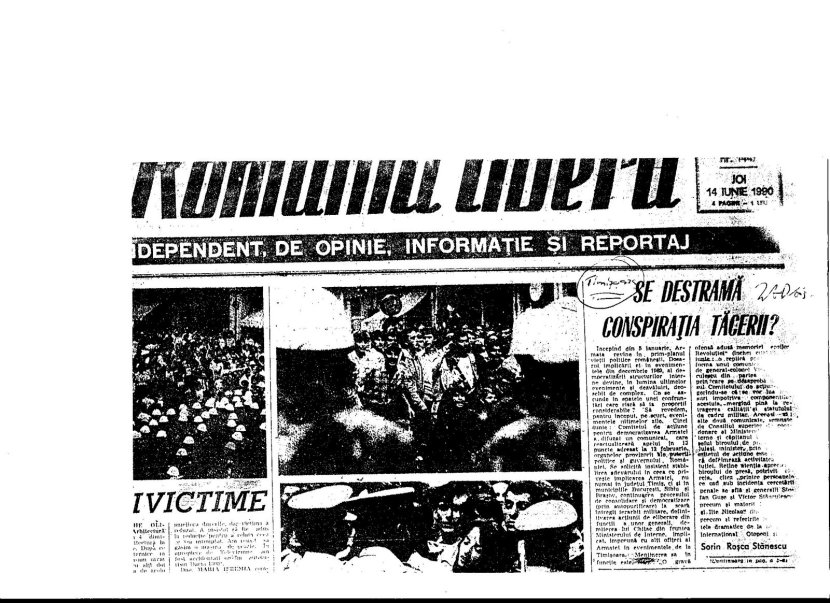
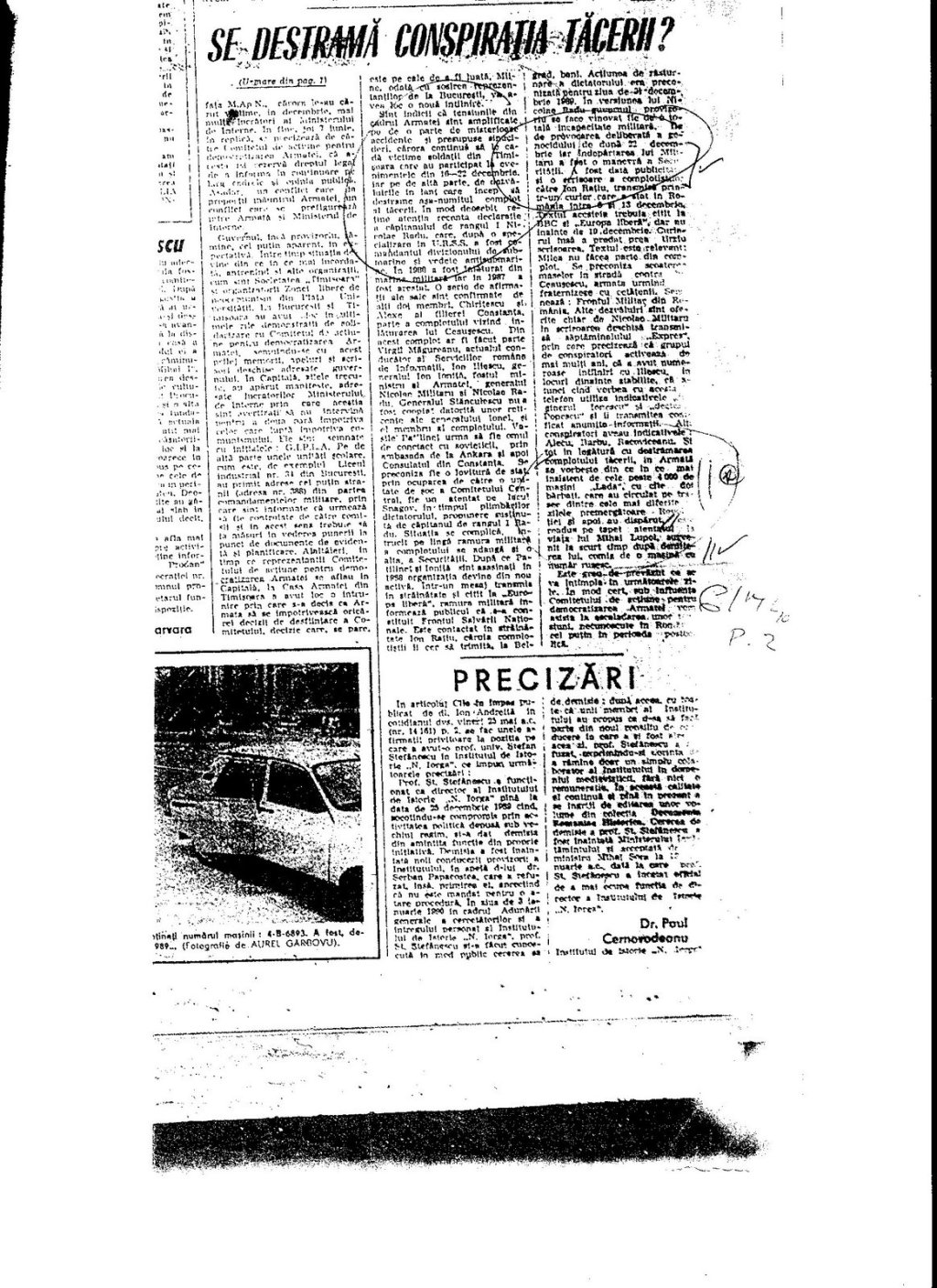
Stanescu’s article was vigorously anti-FSN and anti-Iliescu and left little doubt that this thesis was part of the “unofficial” history of the December events, injurious to the new leaders, and something they did not wish to see published or wish to clarify.
But it was Stanescu’s April 1991 article in “Romania libera,” entitled “Is Iliescu Being Protected By The KGB?,” that truly gave impetus to the “tourist” thesis. Stanescu wrote:
“A KGB officer wanders in France. He is losing his patience and searching for a way to get to Latin America. Yesterday I met him in Paris. He talked to me after finding out that I was a Romanian journalist. He fears the French press. He knows Romanian and was in Timisoara in December 1989. As you will recall, persistent rumors have circulated about the existence on Romanian soil of over 2,000 Lada automobiles with Soviet tags and two men in each car. Similar massive infiltrations were witnessed in December 1990, too, with the outbreak of a wave of strikes and demonstrations. What were the KGB doing in Romania? Witness what the anonymous Soviet officer related to me in Paris:
‘There existed an intervention plan that for whatever reason was not activated. I received the order to enter Romania on 14 December and to head for Timisoara. Myself and my colleague were armed. During the events, we circulated in the military zone around Calea Girocului [Giriocul Road]. Those who headed toward Bucharest had the same mission. Several larger cities were targeted. We were to open fire in order to create a state of confusion. I never, however, received such an order. I left Romania on 26 December.’
I don’t have any reason to suspect the validity of these revelations. This short confession is naturally incomplete, but not inconclusive. What purpose would this elaborate, but aborted, KGB plan have had? The only plausible explanation is that it wasn’t necessary for KGB agents to intervene. The events were unfolding in the desired direction without need for the direct intervention of the Soviets. But this leads to other questions: What did the Ceausescu couple know, but were not allowed to say [prior to their hurried execution]? Why is Securitate General Vlad being held in limbo? To what degree has President Iliescu maintained ties to the Soviets? What are the secret clauses of the Friendship Treaty recently signed in Moscow? Is Iliescu being protected by the KGB or not? Perhaps the SRI [the Securitate’s institutional successor, the Romanian Information Service] would like to respond to these questions?”
Stanescu’s April 1991 article did not go unnoticed — despite its nondescript placement on page eight — and has since received recognition and praise from what might seem unexpected corners. For example, previously-discussed former Securitate Colonel Filip Teodorescu cited extensive excerpts from Stanescu’s article in his 1992 book on the December events, and he added cryptically:
“Moreover, I don’t have any reason to suspect that the journalist Sorin Rosca Stanescu would have invented a story in order to come to the aid of those accused, by the courts or by public opinion, for the results of the tragic events of December 1989″ (Teodorescu, 1992, pp. 92-94).
Radu Balan, former Timis County party secretary, imprisoned for his role in the December events, has also invoked Stanescu’s April 1991 article as proof of his revisionist view that “tourists” rather than “non-existent ‘terrorists’” were to blame for the December 1989 bloodshed:
“…[W]hile at Jilava [the jail where he was imprisoned at the time of the interview, in October 1991], I read ‘Romania libera’ from 18 April. And Rosca Stanescu writes from Paris that a KGB agent who deserted the KGB and is in transit to the U.S. stated that on 18 December [1989] he had the mission to create panic on Calea Girocului [a thoroughfare in Timisoara]. What is more, on the 18th, these 11 cars were at the top of Calea Girocului, where I saw them. I was dumbfounded, I tell you. I didn’t tell anybody. Please study ‘Romania libera,’ the last page, from 18 April 1991″ (“Totusi iubirea,” no. 43, 24-31 October1991).
In this regard, it would be irresponsible to totally discount the relevance of Rosca Stanescu’s past. Since December 1989, Stanescu has undeniably been a vigorous critic of, and made damaging revelations about, the Securitate’s institutional heir, the SRI, and the Iliescu regime, and he has frequently written ill of the former Securitate and the Ceausescu regime. Nevertheless, in 1992 it was leaked to the press — and Rosca Stanescu himself confirmed — that from the mid-1970s to the mid-1980s he was an informer for the Securitate (for a discussion, see Hall, 1997b, pp. 111-113). What was significant, however, was precisely for which branch of the Securitate Rosca Stanescu had been an informer: the USLA.
THE ‘TOURISTS’ MYTH TRAVELS WESTWARD
Almost inevitably, the “tourist” thesis has made its way into Western academic literature. For example, in a book lauded by experts (see for example, Professor Archie Brown’s review in “Slavic Review,” Winter 1998), Jacques Levesque invokes as “rare evidence” that the Soviets were responsible for igniting and fanning the flames of the Timisoara uprising the following:
“…testimony of an imprisoned Securitate colonel who was freed in 1991 [he is referring to the aforementioned Filip Teodorescu]. He writes that the Securitate had noted the arrival of ‘numerous false Soviet tourists’ in Timisoara in early December, coming from Soviet Moldova. He also reports that a convoy of several Lada cars, with Soviet license plates and containing three to four men each, had refused to stop at a police checkpoint in Craiova. After the Romanian police opened fire and killed several men, he claims that the Soviet authorities recovered the bodies without issuing an official protest. To the extent that this information is absolutely correct, it would tend to prove the presence of Soviet agents in Romania (which no one doubts), without, however, indicating to us their exact role in the events” (Levesque, 1997, p. 197).
Levesque seems generally unaware of or concerned with the problematic nature of the source of this “rare evidence” and thus never really considers the possibility that the Securitate colonel is engaging in disinformation. This is indicative of how upside-down the understanding of the December 1989 events has become in the post-Ceausescu era — and of the influence of the far-reaching and generally unchallenged revisionism of the events within Romania itself — that Western writers invoking the thesis seem to accept the claims at face value, never even enunciating any doubt about why the Securitate source in question might seek to make such an argument.
* A memorable phrase from Andrei Codrescu’s PBS special “Road Scholar” of the early 1990s.
(Richard Andrew Hall received his Ph.D. in Political Science from Indiana University in 1997. He currently works and lives in northern Virginia. Comments can be directed to him at hallria@msn.com.)
SOURCES
AFP, 19 December 1989, in FBIS-EEU-89-242, 19 December 1989.
Belgrade Domestic Service, 1400 GMT 20 December 1989, in FBIS-EEU-89-243, 20 December 1989.
Brown, A., 1998, “Review of Jacques Levesque, The Enigma of 1989: The USSR and the Liberation of Eastern Europe,” in “Slavic Review,” Vol. 57, no. 4 (Winter), pp. 882-883.
Bunea, M., 1994, Praf in ochi: Procesul celor 24-1-2 [Mud in the Eyes: The Trial of the 24-1-2], (Bucharest: Editura Scripta).
Court, P., 1994, Cantecul Nemuririi [Song of Immortality], (Bucharest: Editura Miracol).
“Democratia” (Bucharest), 1990.
“Europa,” (Bucharest), 1991
“Expres,” (Bucharest), 1990.
Hall, R. A., 1996, “Ce demonstreaza probele balistice dupa 7 ani?” [Seven Years Later What Does the Ballistic Evidence Tell Us?] in “22″ (Bucharest), 17-23 December.
Hall, R. A. 1997a, “Rewriting the Revolution: Authoritarian Regime-State Relations and the Triumph of Securitate Revisionism in Post-Ceausescu Romania,” (Ph.D. Dissertation, Indiana University).
Hall, R. A., 1997b, “The Dynamics of Media Independence in Post-Ceausescu Romania,” in O’Neil, P. H. (ed.) Post-Communism and the Media in Eastern Europe, (Portland, OR: Frank Cass), pp. 102-123.
Levesque, J., 1997, The Enigma of 1989: The USSR and the Liberation of Eastern Europe, (Berkeley: University of California Press).
Mioc, Marius, 2000, “Turisti straini in timpul revolutiei,” [Foreign Tourists During the Revolution] timisoara.com/newmioc/54.htm.
“Romania libera” (Bucharest), 1990-91.
Sandulescu, S., 1996, Decembrie ’89: Lovitura de Stat a Confiscat Revolutia Romana [December ’89: The Coup d’tat Abducted the Romanian Revolution], (Bucharest: Editura Omega Press Investment).
Teodorescu, F., 1992, Un Risc Asumat: Timisoara, decembrie 1989, [An Assumed Risk: Timisoara, December 1989] (Bucharest: Editura Viitorul Romanesc).
“Totusi iubirea” (Bucharest), 1991.
“Ziua” (Bucharest), 1999.
“Zig-Zag” (Bucharest), 1990.
Compiled by Michael Shafir
—————————————————————————-
Rewriting the Revolution (1997): Chapter 5 Timisoara 15-17 December 1989
A chapter from my Ph.D. Dissertation at Indiana University: Richard Andrew Hall, Rewriting the Revolution: Authoritarian Regime-State Relations and the Triumph of Securitate Revisionism in Post-Ceausescu Romania (defended 16 December 1996). This is the original chapter as it appeared then and thus has not been revised in any form.
Chapter Five
…
“Yalta-Malta” and the Theme of Foreign Intervention in the Timisoara Uprising
At an emergency CPEx meeting on the afternoon of 17 December 1989, Nicolae Ceausescu sought to make sense out of the news from Timisoara by attempting to fit it in with what had happened elsewhere in Eastern Europe thus far that fall:
Everything which has happened and is happening in Germany, in Czechoslovakia, and in Bulgaria now and in the past in Poland and Hungary are things organized by the Soviet Union with American and Western help. It is necessary to be very clear in this matter, what has happened in the last three countries–in the GDR, in Czechoslovakia, and Bulgaria, were coups d’etat organized by the dregs of society with foreign help.[1]
Ceausescu was giving voice to what would later become known as the “Yalta-Malta” theory. Significantly, the idea that the Soviet Union and, to different degrees of complicity, the United States and the West, played a pivotal role in the December 1989 events pervades the vast majority of accounts about December 1989 in post-Ceausescu Romania, regardless of the part of the ideological spectrum from which they come.
The theory suggests that after having first been sold out to Stalin and the Soviet Union at Yalta, in early December 1989 American President George Bush sold Romania out to Mikhail Gorbachev during their summit in Malta. The convenient rhyme of the two sites of Romania’s alleged betrayal have become a shorthand for Romania’s fate at the hands of the Russians and other traditional enemies (especially the Hungarians and Jews). To be sure, similar versions of this theory have cropped up throughout post-communist Eastern Europe among those disappointed with the pace and character of change in their country since 1989.[2] The different versions share the belief that Mikhail Gorbachev and the Soviet KGB engineered the sudden, region-wide collapse of communism in 1989. Their successors in Russia have been able to maintain behind-the-scenes control in Eastern Europe in the post-communist era by means of hidden influence and the help of collaborators within those countries. “Yalta-Malta” has become the mantra of those who seem to have experienced Eastern Europe’s el desencanto most deeply.[3]
Although one can probably find adherents to the Yalta-Malta theory in every East European country–particularly since the “Return of the Left” through the ballot box–there is little doubt that the theory finds its widest and most convinced audience–both at elite and mass levels–in Romania.[4] This is because, as we have seen, the suggestion that the Soviet Union and the KGB were attempting to undermine the regime leadership and infringe upon national sovereignty was not an ad hoc slogan in Romania in 1989, as it was in East Germany, Czechoslovakia, and Bulgaria where aging political leaderships hinted at such arguments in a last-ditch effort to save their positions. Such appeals had far greater resonance in Romania in December 1989–particularly within the regime–because they had been tenets of the Romanian regime’s ideology for well over two decades. And they have had a lingering popularity in the post-Ceausescu era for that same reason. It is the uniquely antagonistic character of the relationship between the Securitate and the KGB during the Ceausescu era (discussed in chapter four), and the genuine, scarcely-veiled animosity between Ceausescu and Gorbachev, which give the Yalta-Malta scenario a plausibility and credibility (however spurious) in Romania it cannot find elsewhere in Eastern Europe.
Western analysts have frequently caricatured the views of the former Securitate towards the Ceausescu era by suggesting that they uniformly look back favorably and nostalgically upon it. In fact, many of them now openly criticize Nicolae Ceausescu’s misguided policies, erratic behavior, and harsh rule.[5] Clearly, much of this is post facto judgement. The deceased Ceausescu serves as a convenient scapegoat for all that went wrong during his rule and by blaming him they can absolve themselves. Nevertheless, regardless of how they now view Nicolae Ceausescu, almost every former Securitate officer challenges the spontaneity of the Timisoara protests and suggests that the catalyst for the unrest came from outside Romania’s borders. Thus, they argue, even if Nicolae Ceausescu had brought the country to the point of profound crisis, this “foreign intervention” converted the Timisoara events primarily into a matter of national security.
It is interesting to recall Nicolae Ceausescu’s own interpretation of the Timisoara events during a rambling, scarcely coherent teleconference on 20 December 1989:
…all of these grave incidents in Timisoara were organized and directed by revanchist, revisionist circles, by foreign espionage services, with the clear intention of provoking disorder, of destabilizing the situation in Romania, of acting in order to eliminate the independence and territorial integrity of Romania….It is necessary to attract the attention of everyone, not only of the communists [emphasis added], but everyone to the shameful…campaign… unleashed right now by different circles, beginning with Budapest, convincingly demonstrates that…, including the declarations of the president of the United States, who declared that he had discussed the problems of Romania with Gorbachev at Malta…[6]
In their discussion of the December events, the former Securitate have expanded upon Ceausescu’s allegations of “foreign intervention.”
In February 1991, while on trial for his part in ordering the repression of demonstrators in December 1989, the former director of the Securitate, General Iulian Vlad, proposed two principal groups of suspects for the Timisoara unrest.[7] He described the first group as Romanian citizens (the majority of whom were presumably of Hungarian ethnicity) who had fled to Hungary, passed through refugee camps, and been sent back to Romania with a mission to engage in “destabilizing acts.” According to Vlad, “only able-bodied males” were sent back. The second group of suspects were large groups of so-called Soviet “tourists.” Here is Vlad’s depiction of this second group:
Halfway through December 1989 massive groups of Soviet tourists began to enter the country. They entered coming directly from the USSR or from Yugoslavia or Hungary. The majority were men and–in a coordinated fashion–they deployed in a convoy of brand-new “LADA” automobiles. During the night of 16-17 December ‘89 such a column attempted to enter Timisoara. Some of these cars were forced to make a detour around the town, others managed to enter it…[8]
Pavel Corut, a former high-ranking Securitate counter-military intelligence officer who has written dozens of novels seeking to rehabilitate the reputation of the former Securitate, has written of “the infiltration on Romanian territory of groups of Soviet commandos (Spetsnaz) under the cover of being tourists. It is noteworthy that December is not a tourist month and nevertheless the number of Soviet tourists grew greatly.”[9]
In 1994, the Securitate’s official institutional heir, the Romanian Information Service (or SRI), declared in a report on the December events:
In addition to gathering information, some Soviet agents from among our ranks received the mission to make propaganda for “changes,” even at the risk of being found out. Actions at direct incitement [of the population] were also initiated by Soviet “tourists,” whose number had grown in the preceding period and had taken on exceptional proportions by the end of 1989.
Beginning on 9 December 1989, the number of Soviet “tourists” in “private” vehicles grew from around 80 to 1,000 cars a day. This phenomenon, although realized at the time, did not lead to the necessary conclusions and measures. The occupants (two to three per car), athletic men between 25 and 40 years in the majority, avoided lodging facilities, sleeping in their cars…The cars were mostly of a “LADA” and “MOSKOVICI” make, deployed in a convoy, and had consecutively-numbered license plates and similar new equipment. The majority were “in transit towards Yugoslavia”…
It is certain that during the Timisoara events there was a large number
of Soviet “tourists.” During 15, 16, and 17 December 1989, to these already in the country were added those “returning from Yugoslavia,” the majority by car.[10]
But the reach of this theory extends well beyond the former Securitate and their cheerleaders in the Ceausist nostalgic press. The head of the first Senatorial commission investigating the December events, film director Sergiu Nicolaescu–a key figure in the newly-formed National Salvation Front during the events of 22-25 December 1989 and a legislator of the ruling Front after 1989–described the catalyst of the December events to a journalist in December 1993 as follows:
By chance, everything began in Timisoara. It could have begun elsewhere since many places were prepared. It is known that in Iasi something was being prepared, and also in Brasov and Bucharest. There was clearly foreign intervention….For example, the intervention of the Russians in Romania. A year before in 1988 about 30,000 Russians came. A year later in 1989, in December, the number doubled. Thus, it reached 67,000. It is known that there were at least 1,000 automobiles in which there were two to three men between the ages of 30 and 40 years old, at a maximum 45 years old. It is very interesting to observe that, only a few months earlier, the Securitate had ordered that for those from socialist countries crossing the border, it was no longer necessary to note their license plate number or how many people were on board.[11]
Asked who in the Securitate gave the order to no longer record this information, Nicolaescu insinuated that they were Soviet “moles” who had been placed there “4, 5, 10, and even 30 years earlier.”[12]
The theory has also found its way into the opposition media. Cornel Ivanciuc, who in 1995 wrote one of the most influential exposes to date on the former Securitate for the weekly 22, maintains that the Soviets achieved their aims in December 1989 by means of the so-called “tourist-incursionists, whose activity during the revolution was identical to those of the Spetsnaz special troops for reconnaissance and diversion of the GRU [Soviet military intelligence].”[13] Two months after General Vlad’s 1991 court statement, Sorin Rosca Stanescu, one of the most prominent journalist critics of the Iliescu regime and the SRI, presented an interview in the leading opposition daily Romania Libera with an anonymous KGB officer residing in Paris who outlined a familiar scenario.[14] The KGB officer claimed that he had entered Romania on 14 December with others as part of a KGB plan to open fire and create confusion. He had been in Timisoara during the events, but suggested he never received the anticipated order to open fire and left the country on 26 December. Rosca Stanescu, however, made sure to remind his audience of “the insistent rumors which have been circulating referring to the existence on Romanian territory of 2,000 “LADA” automobiles with Soviet tags and two men inside each car…”[15] Stanescu closed by asking his readers: “What did the Ceausescu couple know but were unable to say? Why is general Vlad held in this ambiguous chess game?…Is Iliescu protected by the KGB?”
Stanescu’s intentions are further drawn into question by the fact that this particular article has been cited positively by former Securitate officers in their writings. Colonel Filip Teodorescu of the Securitate’s Counter-espionage Directorate, the second highest-ranking Securitate officer in Timisoara during the repression and sentenced to prison for his role in those events, cites extensively and favorably from this very article by Stanescu in a book on the December events.[16] Pavel Corut also invokes Rosca Stanescu’s interview in support his arguments.[17] Moreover, Rosca Stanescu’s questionable comments make the issue of his (revealed and acknowledged) past collaboration with the Securitate’s USLA unit between 1975 and 1985 relevant.[18]
Securitate accounts also routinely insinuate that foreign diplomats who came to Timisoara ostensibly to “monitor the situation” there, and foreign radio stations such as Radio Free Europe, Voice of America, the BBC, and Deutsche Welle which transmitted information about Timisoara developments, contributed directly and intentionally to the unrest.[19] For example, the former deputy director of the Timis county Securitate, Major Radu Tinu, highlights the allegedly suspicious role played by representatives of the American and British embassies who came to Timisoara on 15 December 1989 and transmitted back to Bucharest that “everything is in order, we have seen him,” apparently referring to pastor Tokes.[20]
Similar elements also creep into some opposition accounts. Ilie Stoian, a journalist for Expres and then Tinerama, ranks among those who have written most extensively about the December events. Stoian argues for a “Yalta-Malta” interpretation of the December events.[21] In discussing the Timisoara events, he notes the presence of Hungarians who were filming the events from their “LADA” automobiles and the expulsion of Russians across the Yugoslav border by the Securitate–thus insinuating that they were somehow implicated in the unrest.[22] According to Stoian:
…the December revolution was prepared in advance. In order to make things even clearer, we draw your attention to the fact that prior to the date fixed by the authorities for the evacuation of pastor Tokes from the parochial residence, in almost every evening Voice of America and Radio Free Europe would broadcast long pieces about this personage. Moreover, inside the country, foreign diplomats began to fuss….[23]
Finally, Stoian asks:
Wasn’t the presence of foreign diplomats somehow to verify if everything “was in order,” as was said during a telephone conversation intercepted on 15 December? Weren’t they somehow doing more than just supervising and reporting on these events to their superiors? We think the answer is yes.[24]
[1].. See the stenogram from the emergency CPEx meeting of 17 December 1989 in Mircea Bunea, Praf in ochi. Procesul celor 24-1-2. (Bucharest: Editura Scripta, 1994), 34.
[2].. Tina Rosenberg, The Haunted Land. Facing Europe’s Ghosts after Communism (New York: Random House, 1995), 109-117, 235. Rosenberg suggests the theory’s popularity in Poland and especially in the former Czechoslovakia.
[3].. Huntington discusses the concept of el desencanto (the characteristic disillusionment or disenchantment which sets in after the transition) in Samuel P. Huntington, The Third Wave. Democratization in the Late Twentieth Century (Norman, OK: University of Oklahoma Press, 1993), 255-256.
[4].. By contrast, Rosenberg clearly suggests that those who buy into the Yalta-Malta conspiracy theory elsewhere in Eastern Europe are a distinct minority in political circles and marginal figures in the post-communist era.
[5].. This has come through, for example, in the novels and articles of the well-known, former high-ranking military counter-intelligence officer, Pavel Corut, and in the comments of the former head of the First Directorate (Internal Affairs), Colonel Gheorghe Ratiu, in an extended interview during 1994 and 1995 with the Ceausist weekly Europa.
[6].. See the transcript in Bunea, Praf in Ochi, 47. Ceausescu goes on to link the US invasion of Panama which was taking place at this time to a general offensive by the superpowers to eliminate the sovereignty of independent states. The fact that Ceausescu appeals “not only to the communists” suggests his attempt to play on a non-ideological Romanian nationalism.
[7].. See Vlad’s testimony in Mircea Bunea, “Da sau Ba?” Adevarul, 16 February 1991, in Bunea, Praf in Ochi, 460-461.
[8].. Ibid.
[9].. Pavel Corut, Cantecul Nemuririi [The Song of Immortality] (Bucharest: Editura Miracol, 1994), 165.
[10].. See the excerpts of the SRI’s preliminary report on the December events in “Dispozitivul informativ si de diversiune sovietic a fost conectat la toate fazele evenimentelor (III) [Soviet information and diversion teams were connected to all phases of the events],” Curierul National, 11 July 1994, 2a.
[11].. Sergiu Nicolaescu, interview by Ion Cristoiu, “Moartea lui Milea, Momentul Crucial al Caderii,” Expres Magazin, no. 48 (8-15 December 1993), 31.
[12].. Ibid.
[13].. Cornel Ivanciuc, “Raporturile dintre Frontul Salvarii Nationale si KGB [The Relations between the National Salvation Front and the KGB],” 22, no. 21 (24-30 May 1995), 11.
[14].. Sorin Rosca Stanescu, “Iliescu aparat de K.G.B.? [Iliescu defended by the KGB]” Romania Libera, 18 April 1991, 8.
[15].. Ibid. Rosca Stanescu had in fact already floated this theory. In June 1990, he wrote: “…in the Army, more and more insistently there is talk of the over 4,000 ‘LADA’ automobiles with two men per car, which travelled by various routes in the days preceding the Revolution and then disappeared…” (Sorin Rosca Stanescu, “Se destrama conspiratia tacerii? [Is the conspiracy of silence unravelling?]” Romania Libera, 14 June 1990, 2a). At that time it could be argued that Rosca Stanescu was unaware of the Securitate account. It is difficult to say the same of his comment in April 1991.
[16].. Filip Teodorescu, Un Risc Asumat: Timisoara, decembrie 1989 (Bucharest: Editura Viitorul Romanesc, 1992), 93-94. Curiously, Teodorescu adds: “Besides, I have no reason to suspect that the journalist Sorin Rosca Stanescu would have invented a story in order to come to the defense of those accused by the judicial system and public opinion of the tragic consequences of the December 1989 events.”
[17].. Although Corut does not mention Stanescu by name as does Teodorescu, the references are unambiguous. See Pavel Corut, Floarea de Argint [The Silver Flower] (Bucharest: Editura Miracol, 1994), 173; idem, Fulgerul Albastru [Blue Lightning] (Bucharest: Editura Miracol, 1993), 211.
[18].. In April 1992, documents were leaked (presumably by regime sources) to the media and foreign embassies showing that Stanescu had been an informer for the Securitate’s elite anti-terrorist unit (the USLA) between 1975 and 1985. Stanescu admitted that the charges were true. Although released from Romania Libera in June 1992, he was picked up elsewhere in the opposition press, returned to Romania Libera the following year, and eventually became editor of an opposition daily owned by the trust which runs Romania Libera. Prominent opposition figures have steadfastly defended him as a victim of the Iliescu regime, and in spite of his past, his writings have largely gone unscrutinized. On Stanescu’s case, see Sorin Rosca Stanescu, “Securea lui Magureanu,” Romania Libera, 17 April 1992, 1, 3 (the article which personally attacked the SRI’s Director Virgil Magureanu and appears to have prompted the release of Stanescu’s file); Anton Uncu, “Opriti-l pe Arturo Ui,” Romania Libera, 30 April 1992, 1, 3; Rosca Stanescu, “Sint H-15,” Romania Libera, 9 May 1992, 5; idem, interview by Andreea Pora, “‘H-15′ in slujba patriei,” 22, no. 120 (15-21 May 1992), 13; “Catre SRI,” Romania Libera, 9 June 1992, 1; “Goodbye Magureanu,” The Economist, no. 2212 (18 June 1992) in Tinerama, no. 85 (10-17 July 1992), 3.
[19].. See, for example, the comments of the deputy director of the Timis county Securitate, Major Radu Tinu, in Angela Bacescu, Din Nou in Calea Navalirilor Barbare [Once again in the path of barbaric invaders] (Cluj-Napoca: Editura “Zalmoxis,” 1994), 72-74. This book consists of articles and interviews which appeared in the Ceausist weekly Europa between 1990 and 1994.
[20].. Ibid., 73.
[21].. Ilie Stoian, Decembrie ‘89: Arta diversiunii. (Bucharest: Editura Colaj, 1993), 7-10. This book is a collection of articles he wrote while at Expres between 1991 and 1993.
[22].. Ibid., 11.
[23].. Ibid.
[24].. Ibid., 12.




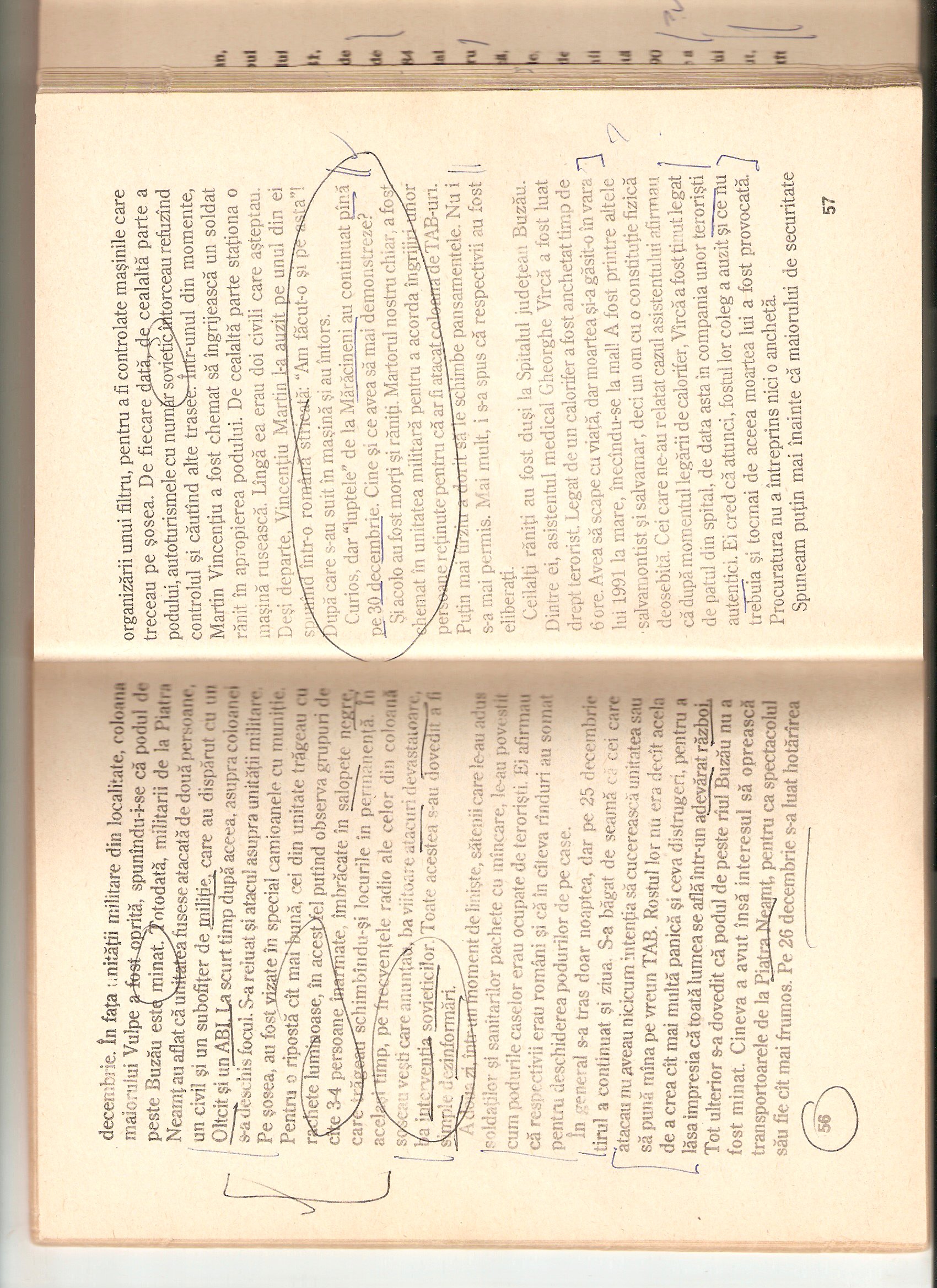
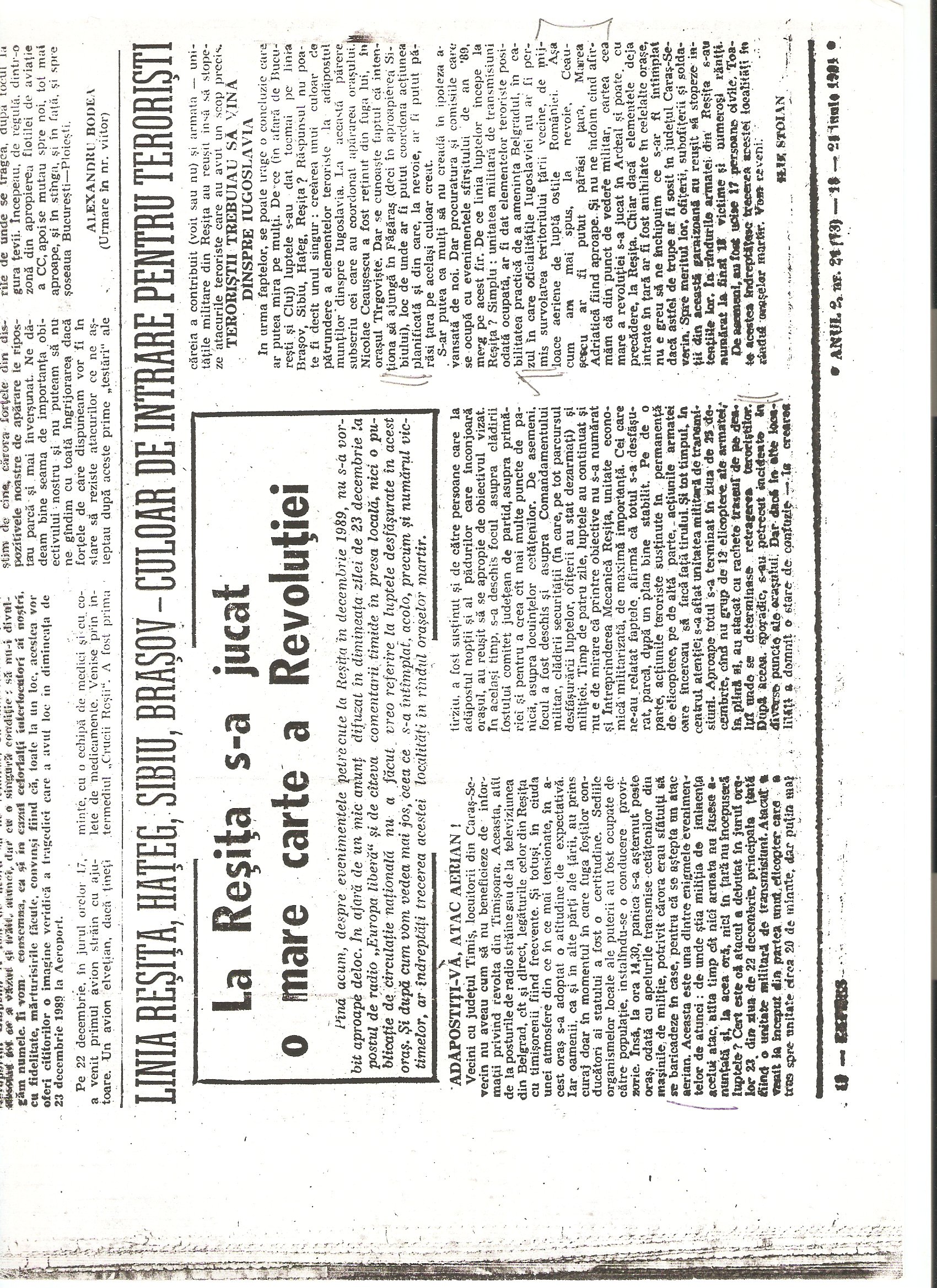
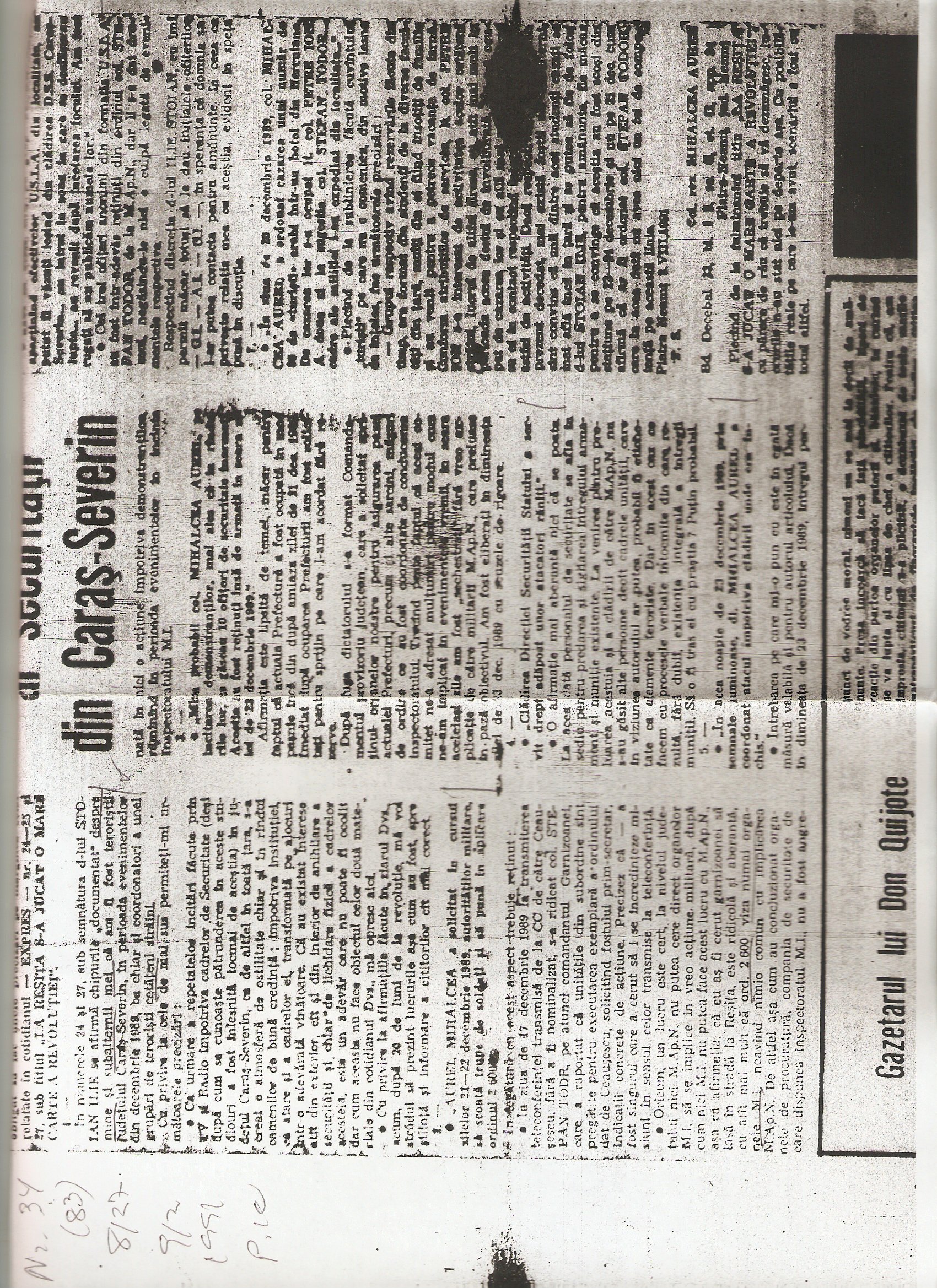
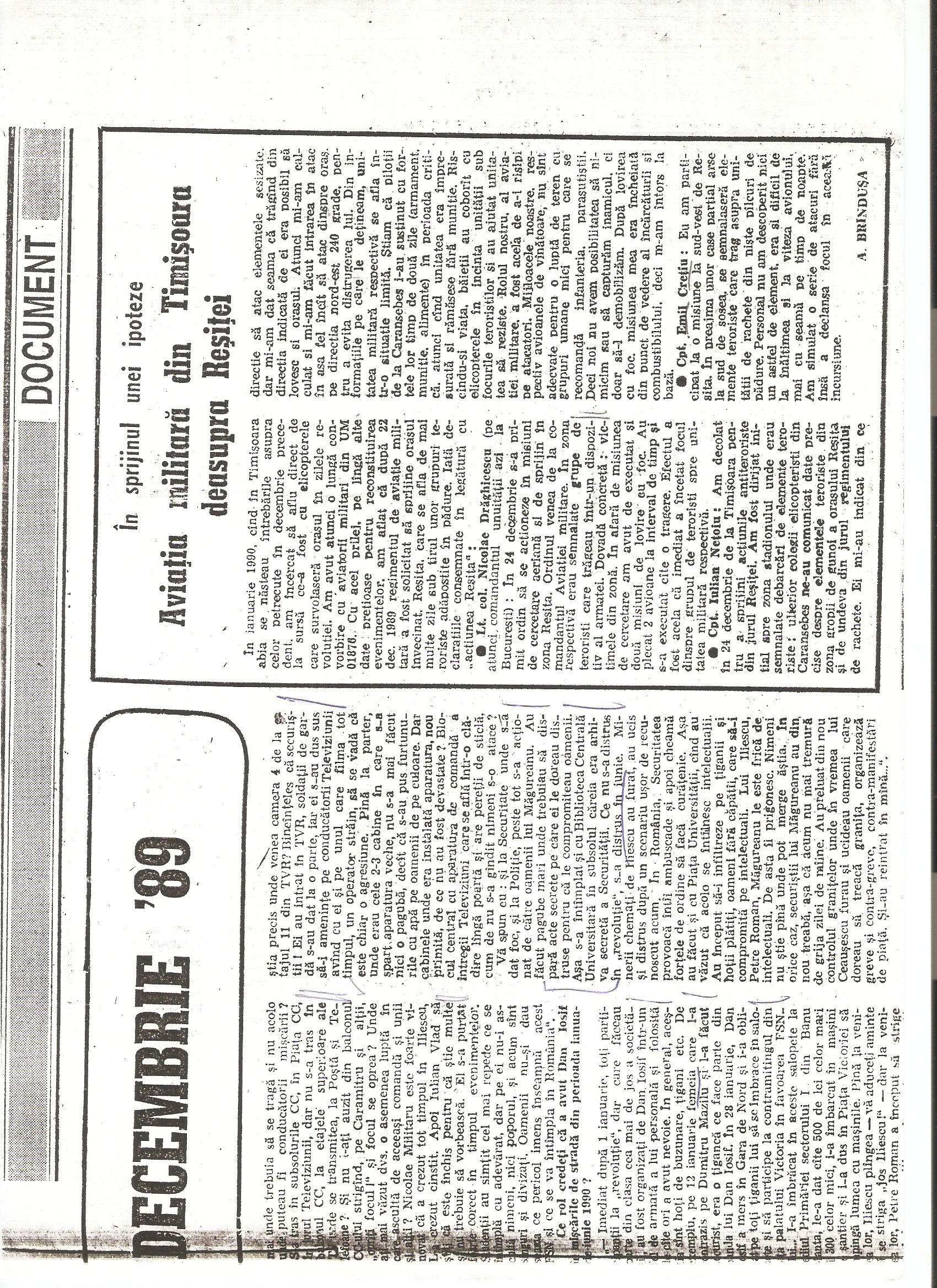
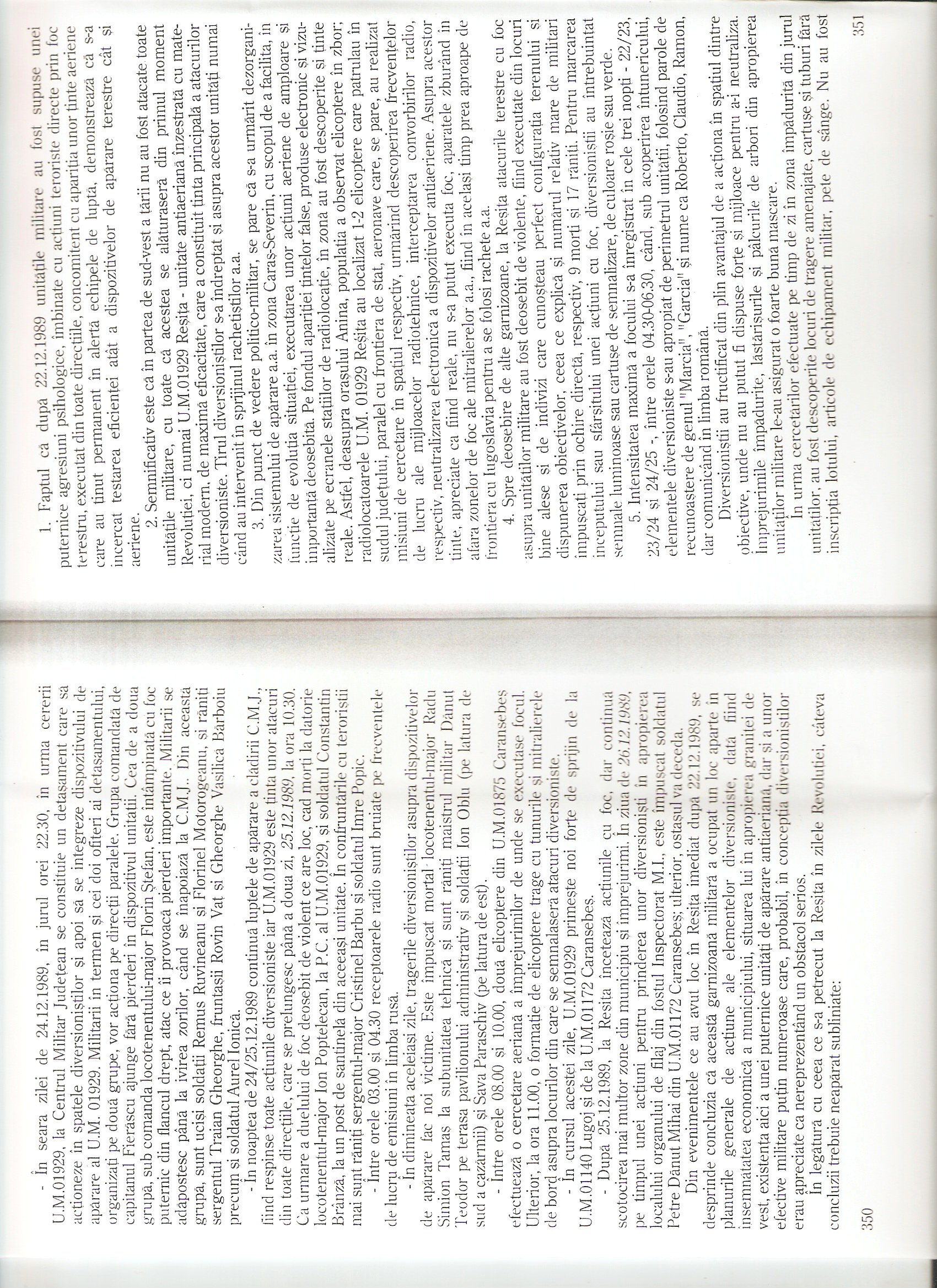
 Pretul libertatii a fost scump. Pretul e imens, dramele prin care au trecut mii de familii in acea vreme nu au un pret anume, nu exista o alaturare de cuvinte agreabila. Pentru libertate s-au pierdut vieti. Vieti tinere, dornice de a descoperi viata in libertate, dar care nu au mai ajuns sa se bucure de ea. De libertate. Tineri si oameni in toata firea, din toate colturile tarii, au fost rapusi de gloantele si tancurile armatei. Sau de “teroristi” necunoscuti. Timisoara, Cluj, Iasi, Bucuresti, dar si in Resita, urmarile luptei pentru libertate se fac cunoscute si acum datorita memoriei celor care au disparut la revolutie.










 The Archive of the Romanian Revolution of December 1989
Revisiting the Myths of the Revolution: “Romania’s TV Revolution had only one side…everyone had been on it.”
Posted by romanianrevolutionofdecember1989 on April 20, 2013
Previous material on the same general topic (strictly personal views as always):
Revisiting the Myths* of the Romanian Revolution. Part I: The Hegemony of Conspiratorial and Postmodernist Explanations http://atomic-temporary-3899751.wpcomstaging.com/revisiting-the-myths-of-the-romanian-revolution-part-i-the-hegemony-of-conspiratorial-and-postmodernist-explanations/
Myth 1: The “Timisoara Syndrome” or the “False Timisoara Grave (the Paupers Cemetery)/Massacre” http://atomic-temporary-3899751.wpcomstaging.com/revisiting-the-myths-of-the-revolution-part-ii-the-timisoara-syndrome-or-the-false-timisoara-grave-the-paupers-cemeterymassacre/
Myth 2: The water is posioned! (Apa este otravita!) http://atomic-temporary-3899751.wpcomstaging.com/revisiting-the-myths-of-the-revolution-part-iii-the-water-is-poisoned-apa-este-otravita-dr-heyndrickxs-toxicology-report/
Myth 3: The Romanian Television building is in danger, danger of an explosion! (TVR e in pericol–Pericol de explozie!) http://atomic-temporary-3899751.wpcomstaging.com/revisiting-the-myths-of-the-revolution-part-iv-the-romanian-television-building-is-in-danger-bomba-in-subsolul-televiziunii/
“Romania’s TV Revolution had only one side…everyone had been on it.”
So told us Andrei Codrescu in a Harper’s Magazine article–“Big Chills: My High School Reunion in Romania,” an apparent play on the 1983 reunion film, The Big Chill–published in November 1990 (see the link below for an online version). Codrescu’s article is unintentionally a tour de force in relaying to English-language readers Securitate (the Romanian secret police of the communist era) disinformation regarding their role in December 1989. I was, ironically, myself in the same city, Sibiu, during the same month (mid-late July 1990), and heard many of the same details and arguments from Romanians that Codrescu recounts in the article. Of course, I have learned an awful lot since then…
https://docs.google.com/viewer?a=v&q=cache:R0rgBuN52mUJ:alina_stefanescu.typepad.com/files/big-chills-my-high-school-reunion-in-romania-by-andrei-codrescu-1.pdf+romania+big+chills+codrescu+one+side&hl=en&gl=us&pid=bl&srcid=ADGEESgdk_7CPbEjBWbb_Qu0X-f8DTaCv4LzfLkp32-9uQ0FM5IQBPrp55QzDOlUlRa8ATqFHD_zuf5-Duji83oZsMIOxFtpCGqm1v1-MUq52PRv6HSrazFkl6oYCZeVKT6N24DvX_by&sig=AHIEtbT7nr99RVabjfFfuNQpOD5okuapCA
There are many ways to disprove the myth that “Romania’s TV Revolution had only one side…everyone had been on it.” I choose here one that has gone unmentioned inside Romania and in the English-language literature on December 1989–and one of which so few people appear to be aware: the statements of senior military officials of a neighboring country attesting to the fact that Romania’s TV Revolution did not have only one side, but had an adversary, Securitate forces. In fact, the Hungarian military relayed to the Romanian military the locations of Securitate transmitters, allowing the Romanian military to neutralize those facilities.
(26 December 1989 1730 GMT Budapest Domestic Service in Hungarian,FBIS-EEU-89-247, p. 39)
Colonel Gyorgy Keleti, head of the Hungarian People’s Army Press Department:
“…I would like to say that a progressive weakening of the Securitate has been experienced. We ourselves can see this, because our radio searching and locating units which were in Hungary a few days ago were monitoring broadcasts from 31 Securitate radio centers–yesterday 19, and today only 5. We of course put this data at the disposal of the Romanian military leadership.”
The Hungarian Defense Ministry repeated this claim in a statement released on 11 January 1990:
1990. január 11., csütörtök 18:55
A Honvédelmi Minisztérium közleménye (4. rész) (OS)
forradalom vérbe fojtására jelentős erőket vetett be, a Magyar
Néphadsereg speciális képzettségű rádióbemérő alakulatainak egy
részét átcsoportosította a magyar-román államhatár közelébe a
Securitate rádióállomásainak bemérésére, helyeinek meghatározására.
Ezeknek az adatoknak az átadásával, az adók bemért földrajzi
helyeinek megjelölésével feltehetően segítséget nyújtott a Magyar
Néphadsereg a Securitate-bázisok felszámolásában, megsemmisítésében.
Szinte napról napra érzékelhető volt ezek számának csökkenése, ami a
magyar szakértők szerint arról tanúskodott, hogy a diktátorhoz hű
erők törzseit a román hadsereg folyamatosan számolja fel. Ezt
példázza, hogy a december 26-án nyilvánosságra hozottak szerint
24-én még 31, 25-én már 19 és 26-án csupán öt
Securitate-rádióközpont működését rögzítették és mérték be a magyar
rádiófelderítő és bemérő alegységek.
and Ferenc Karpati, Hungarian Defense Minister at the time of the Romanian Revolution of December 1989, maintained this claim in an article published in Historia in 2000:
Ferenc Karpati: “A Securitate erői ellen hosszú, küzdelmes harcot folytattak a hadsereg és a forradalom más erői. Felszámolásuk érdekében a Magyar Honvédség speciális képzettségu rádióbemérő egységeinek egy részét átcsoportosítottuk a román államhatár közelébe, s így sikerült rádióállomásaikat bemérni, álláshelyeiket pontosan meghatározni. Az adatok átadásával jelentősen elősegítettük a Securitate-bázisok felszámolását.” KÁRPÁTI FERENC: A román forradalom és Magyarország, 1989. Egy volt miniszter emlékezése
Posted in decembrie 1989, raport final | Tagged: andrei codrescu, December 1989 Romania, decembrie 1989 mituri, decembrie 1989 teroristii, Harper's Magazine 1990, myths romania, nicolae ceausescu december 1989, NPR Commentator, Richard Andrew Hall, Richard Hall Romania, romania december 1989, romania myths, romanian revolution myths, teroristi decembrie 1989 | Leave a Comment »