Posted by romanianrevolutionofdecember1989 on September 1, 2014
(purely personal views based on over two decades of research and publications)
THE FLIGHT OF THE CEAUSESCUS, FROM MULTIPLE ANGLES, POSTED BY TheALK1970
Nicolae Deca cu Petre Mihai Bacanu, “Ceausescu nu s-a gandit sa fuga din tara,” Romania Libera, 23 decembrie 1993, p. 15.
“Nicolae Ceausescu nu s-a gandit nici o clipa sa fuga din tara, pentru ca elicopterul avea suficient combustibil sa ajunga in Irak sau Iran, locuri care, cred eu, i-ar fi asigurat viata.”
from the 1993 documentary, The Last Day, by Arnaud Hamelin
Why did Ceausescu not intend to flee the country? Why did he tell Nicolae Deca that he planned to “organize the resistance” in Tirgoviste?
What “organized resistance” would Nicolae Ceausescu have had in mind?
Tirgoviste was one alternate in a longstanding plan…
Mirel Curea, Evenimentul Zilei, nr. 317, 9 iulie 1993, p. 3
Ted Koppel’s ABC News special Death of a Dictator (April 1990) has a good deal of discussion of Nicolae Ceausescu’s famous watch (ceasul lui Ceausescu), which allegedly had a radio-transmitter beacon in it…hence his continuous checking of his watch (as the first speaker below explained, looking at his watch and looking at the sky and looking back again, as if he was waiting for someone or something)…it lasted all the way up through his trial.
The time turned out to be: the final minutes of his dictatorial regime and life…
Important details of the Ceausescus’ capture, holding, trial, and execution can be found in the following:
Gelu Voican Voiculescu claims that he prevailed upon Ion Iliescu to consider the immediate execution of Nicolae and Elena Ceausescu only after the attacks of 23/24 December 1989, with the memorable phrase: “Sir, do you want to end up like Allende?” (cited in this following article from 2000: http://atomic-temporary-3899751.wpcomstaging.com/theories-of-collective-action-and-revolution-2000/ , see page 1088).
The effort on the night of 24/25 December 1989, to keep Nicolae Ceausescu alive, so that he could be tried and executed, continues to be a matter of dispute:
from Bacescu 1994 above, and Sandulescu 1996 below:
Viorel Domenico Ceausescu la Targoviste (1999) below
Captain Gheorge Bobric’s recounting of Securitate Col. Dinu’s comment, according to which “…notice, those are ABIs [Securitate USLA vehicles]…in ten minutes, firing will begin…The terrorists and anti-terrorists are trained according to the same principles and rules, they go through the same training.” p. 157
Ceausestii la Tirgoviste, Flacara no. 51 (19 decembrie 1990), pp. 8-10.
Below, a copy printed from a microfiche machine in late 1990/early 1991 at Indiana University (Bloomington)’s Main Library. It contains an excerpt long since forgotten from the trail of Ceausescus, especially among those who deny the idea of Securitate terrorists and mercenaries loyal to Nicolae Ceausescu who fought on after 22 December 1989. Below it, in Romanian, what Adrian Paunescu’s Totusi Iubirea in May 1991- June 1992 under the title “Adevarata stenograma a procesului Nicolae Ceausescu – Elena Ceausescu” (xeroxed spring 1997 Babes-Bolyai University Library, Cluj, Romania)
Prosecutor: But those who shot at the young people were security men, the terrorists.
Elena Ceausescu: The terrorists are from the Securitate.
Prosecutor: The terrorists are from the Securitate?
Elena Ceausescu: Yes.
Adrian Paunescu’s Totusi Iubirea in May 1991- June 1992 under the title “Adevarata stenograma a procesului Nicolae Ceausescu – Elena Ceausescu.”
the actual conversation per this version is somewhat more nuanced than the translation above (which lacks the original Romanian)
Presed (Prosecutor): Dar la Bucuresti, in tinerii care au murit, cine a tras, peste care au trecut tanchetele Securitatii? A unei parti… [“tanchetele Securitatii, a unei parti…” this may be a reference to the ABIs of the USLA and/or a mistake/intentional mischaracterization of the concomitant participation of Army tanks in the Bucharest repression of 21/22 December 1989]
E.C. (Elena Ceausescu): Pai, da, tero…
(N.C. (Nicolae Ceausescu) il face semn sa taca) (Nicolae Ceausescu signals her to be quiet) [this is very revealing…clearly, Elena was stumbling into saying more than she should and Nicolae wanted to cut her off)
Presed: Teroristi? Teroristi?
E.C. Teroristii se spun ca sint, pe aicea vorbeau oamenii, ca sint al Securitatii?
Presed: Teroristii sint ai Securitatii?
E.C. Asa se vorbea.
Acuz: Si Securitatea nu era a comandamentului suprem?
That the terrorists were affiliated with the Securitate was recognized by Securitate General Iulian Vlad in his declaration of 29 January 1990, which can be found here:
Posted by romanianrevolutionofdecember1989 on August 23, 2014
(Purely personal views, based on two decades of prior research and publications, thank you)
[Described by the poster, spartacvs dacicvs, as follows: toate celelalte postari au in jur de 6 minute,semn ca sunt “taiate”,aceasta inregistrare este de aproape 21 minute si este UNICA pe youtube.com se poate auzi clar cum Ceausescu administreaza criza evenimentelor de la Timisoara si exista si stenograma.]
Tov. Nicolae Ceausescu:
Am dat, de altfel, indicatia sa se intrerupa orice activitate de turism. Nu trebuie sa mai vina niciun turist din strainatate, pentru ca toti s-au transformat in agenti de spionaj. De asemenea, sa se intrerupa micul trafic de frontiera imediat. Am dat ordin la Ministerul de Interne, dar trebuie chemati si cei de la turism imediat, iar locurile neocupate sa fie date la cetateni romani. Nici din tarile socialiste sa nu mai vina, in afara de Coreea, de China si din Cuba. Pentru ca toate tarile socialiste vecine nu prezinta incredere. Cei din tarile socialiste vecine sunt trimisi ca agenti. Intrerupem orice activitate de turism. La toate judetele se va declara stare de alarma. Unitatile militare, ale Ministerului de Interne, ale Securitatii sunt in stare de alarma. Sa dam la teleconferinta indicatia ca sa se ia toate masurile fata de orice incercare, pentru ca trebuie sa aparam independenta patriei si a socialismului impotriva oricaruia, indiferent cine este. Acestea sunt problemele care se pun acum. Am impresia ca nu s-au inteles la Congres lucrurile care trebuie. Hotararile nu au fost de parada. Toti trebuie sa stie ca suntem in stare de razboi. Tot ce s-a intamplat si se intampla in Germania, Cehoslovacia si Bulgaria acum, si in trecut in Polonia si Ungaria, sunt lucruri organizate de Uniunea Sovietica, cu sprijinul american si al Occidentului. Trebuie sa fie foarte clar acest lucru, iar ceea ce s-a intamplat in ultimile trei tari – R.D. Germana, Cehoslovacia, Bulgaria – au fost lovituri de stat organizate si cu sprijinul plevei societatii. Pleava societatii cu sprijin strain. In acest fel trebuie intelese lucrurile. Nu se pot judeca altfel. Este clar, tovarasi, sunteti de acord?
[xerox below from Mircea Bunea, Praf in ochi: Procesul celor 24-1-2 (Editura Scripta, 1994), p. 34.]
In other words, as of the evening of 17 December 1989, Nicolae Ceausescu had ordered not just that Soviet tourists, but that all tourists, from East and West–excluding, of course, the select group of reliable countries from his perspective, North Korea, China, and Cuba–be prevented from entering the country, because, in his view, they had all become espionage agents. Such a blanket ban on foreign tourists speaks to Nicolae Ceausescu’s fears and even paranoia, rather than as an accurate reflection of reality.
Nevertheless, a series of Romanian and foreign analysts, including Alex Mihai Stoenescu, Cristian Troncota, and Larry L. Watts, somehow interpret the closure of Romanian borders to Soviet tourists as some sort of proof or verification of theories that Soviet agents posing as tourists were involved in the unrest of 15-17 December 1989 in Timisoara.
Larry L. Watt’s 2010 volume Fereşte-mă, Doamne, de prieteni (the English version entitled With Friends Like These) is invoked. In the English version, Watts wrote on page 16, with a footnote on page 26:
“It is suggestive that more than 25,000 of the 37,000 “extra” Soviet tourists that deemed Romania a desirable place to visit or transit in the two weeks prior to its revolution in December 1989 chose not to leave until almost a year later, in October 1990, after the Romanian government formally insisted on their departure.90”
90. “Ceauşescu protested the sudden influx of Soviet ‘tourists’ to Moscow at the time, none of whom stayed in hotels. See e.g. Mircea Munteanu, New Evidence on the 1989 Crisis in Romania, e-Dossier no. 5, Washington D.C., Woodrow Wilson International Center for Scholars, December 2001, pp. 3-11, CWIHP. The Romanian Senate’s investigation into the events of December 1989 disclosed the extraordinary jump in Soviet ‘tourists’ from 30,000 in 1988 to 67,000 in 1989 as recorded in customs and border statistics, as well as the unexplained delay in their departure. Mention of this glaring anomaly was qualified as unwarranted “conspiracy theory.” See e.g. Depostion of Petre Roman, Transcript no. 90/8.03.1994, Romanian Senate Archive, Bucharest, pp. 44-45. According to ex-Prime Minister Roman, 30,000 Russians ‘tourists’ remained in Romania for almost a year, until officially requested to leave in October 1990. Allegedly, Caraman’s Foreign Intelligence Service (SIE) informed Roman about them only at that time. However, since at least March, Romanian TV had broadcast news stories of the Russian encampments.”]
Cel mai important fragment din cartea lui Larry Watts care se referă la revoluţie îl găsim la pagina 55, şi este următorul:
Este sugestiv faptul că peste 25000 din cei 37000 de turişti sovietici care au considerat România locul preferat pentru vizite sau tranzit, în cele două săptămînă anterioare revoluţiei din decembrie 1989, au ales să nu mai plece timp de aproape un an, pînă în octombrie 1990, după ce guvernul român le-a cerut oficial şi insistent să părăsească ţara.
Aici se face trimitere la o notă de subsol în care se scrie:
Ceauşescu a protestat împotriva afluxului brusc de turişti de la Moscova, din care nici unul nu stătea la vreun hotel. Vezi Mircea Munteanu, New Evidence on the 1989 Crisis in Romania, e-Dossier nr. 5, Washington D.C., Woodrow Wilson International Center for Scholars, decembrie 2001, pp. 3-11, CWIHP. Ancheta Senatului României asupra evenimentelor din 1989 menţionează un salt de la 30000 turişti sovietici în 1988 la 67000 în 1989, precum şi o întîrziere inexplicabilă în plecarea acestora. Vezi Depoziţia lui Petre Roman, transcript nr. 90/8.03.1994, Arhiva Senatului României, pp. 44-45. Conform prim-ministrului Petre Roman, 30000 de turişti ruşi au rămas în România peste un an, pînă cînd li s-a cerut oficial să plece, în octombrie 1990. Conform lui Roman, şeful SIE, Caraman, l-a informat numai la acea dată despre aceştia. Totuşi încă din martie televiziunea română relata despre taberele sovietice.
For additional discussion on the original sources upon which Watts’ claims are based and their credibility see the following:
The following declarations from http://dosarelerevolutiei.ro/ suggest strongly the flow of information during these days: it wasn’t officials or officers on the ground in Timisoara telling Bucharest that foreign, especially Soviet, tourists were involved in the Timisoara unrest, but rather Bucharest emitting Nicolae Ceausescu’s paranoia and directing those in the field to find proof to substantiate Ceausescu’s paranoia. As the documents below make clear: even though they were dispatched and tasked with this specific order, they still were unable to find evidence of a foreign hand in the events and reported back accordingly despite realizing how unwanted such an answer was. In other words, the foreign tourist–Soviet tourist–theory has its roots not in the reality of the time, but in Nicolae Ceausescu’s mind!
Tudor Postelnicu: “Ceausescu Nicolae facuse o psihoza, mai ales dupa ce s-a intors de la sedinta de la Moscova in toamna lui ’89. Era convins ca se planuieste si de cei de pe plan extern caderea sa, era convins ca toti sint spioni…”
Petru Pele (Dir I, DSS). Declaratie, 16 ianuarie 1990: “Printre sarciniile mai importante efectuate de catre acestia in perioada 17-22.12.1989 s-a numerat (?) constituierea (?) listelor celor retinuti de organele militie cu listele celor predati sau reintorsi din Ungaria, intrucit s-a emis ipoteza ca evenimentele de la Timisoara au fost puse la cale in tara vecina…”
Gheorghe Diaconescu, Declaratie 31 decembrie 1989
“Luni 18 decembrie gl. col. VLAD IULIAN a avut o convorbire cu colegul meu (local?) RADULESCU EMIL …
Vlad Iulian (continuarea, declaratia lui Gheorghe Diaconescu) “?… foarte dur (?) ca nu (?) ca ‘un grup de turisti isi fac de cap in Timisoara’”
Tocmai Iulian Vlad, el insusi, recunoaste ne-implicarea strainilor in evenimentele de la Timisoara, aici…
“Incepind cu noaptea de 16/17 dec. si in continuare pina in data de 20 dec. 1989 organul de securitate local col. Sima cit si gl. Macri si in lipsa lui col. Teodorescu imi comunicau date din care rezulta ca sute de elemente turbulente au devastat orasul, si ca elementul strain nu rezulta a se fi implicate in continuarea fenomenului.”
“Mai exact, cei trimis de mine la Timisoara mi-au raportat ca nu au elemente din care sa rezulte vreum amestec al strainatatii in producerea evenimentelor de la Timisoara.”
—————————————————————————————————-
Reports back from the field, denying foreign involvement in the Timisoara unrest!
The Timisoara files about December 1989 are now publicly available (when the link works!) on the Internet at http://dosarelerevolutiei.ro/. What they show is that Securitate, Militia, and other regime officials from Timis County were asked by Bucharest–communicated via the person of Securitate Director, General Iulian Vlad–to investigate the role of foreign elements, specifically tourists, in the Timisoara protests of mid-December 1989. But they were not the only ones. General Vlad tasked senior Securitate officials from Bucharest sent to Timisoara to report back to him on this very topic alleging external involvement and manipulation of the Timisoara demonstrations. What remains unclear is how much of this tasking was General Vlad communicating his own “hypothesis” or how much of it was he relaying Nicolae Ceausescu’s “theory” about what was going on. This much is clear: neither those stationed in Timis County, nor those officials sent from Bucharest could find evidence of a foreign hand in the Timisoara uprising, despite being asked to investigate exactly this aspect. How do we know this? From their own written confessions immediately after the December 1989 events. (Below are four of them: Nicolae Mavru, Liviu Dinulescu, Emil Macri, and Filip Teodorescu.)
Niculae Mavru, fost sef al sectiei ‘Filaj si investigatie’ de la Securitatea Timis, declaratia din 13 ianuarie 1990: …la ordinul col. Sima Traian, am primit…misiuni de a observa si sesiza aspecte din masa manifestantilor, din diferite zone ale orasului in sensul de a raporta daca sint straini (ceea ce nu prea au fost) care incita la dezordine, acte de violenta sau altfel de acte… 25 iunie 1991 “Desi ne-am straduit nu am putut raporta col. Sima implicarea completa a vreunui cetatean strain in evolutia demonstratiilor cit si fenomenlor care au avut loc la Timisoara,..”
“Sarcina primordiala pe care am primit-o de la col. Sima a fost daca in evenimentele declansate la Timisoara erau implicate elemente straine din afara tarii. Cu toate eforturile facute nu a rezultat lucru pe linia mea de munca.”
26 iunie 1991, Declaratia lui Liviu Dinulescu, cpt. la Serviciul de Pasapoarte al jud. Timis (in decembrie 1989, lt. maj. ofiter operativ Securitate judetean la Serv. III, care se ocupa de contraspionaj)
“Precizez ca anterior declansarii evenimentelor de la Timisoara din datele ce le detineam serviciul nostru nu rezulta vreun amestec din exterior in zona judetului Timis.”
Generalul Emil Macri (seful Dir. II-a Securitatii, Contrainformatii Economice),
Declaratie 2 ianuarie 1990:
“Rezumind sintetic informatiile obtinute ele nu au pus in evidenta nici lideri si nici amestecul vreunei puteri straine in producerea evenimentelor de la Timisoara. Raportarea acestor date la esalonul superior respectivi generalului I. Vlad a produs iritare si chiar suparare…”
Filip Teodorescu (adj. sef. Dir III Contraspionaj D.S.S.), Declaratie, 12 ianaurie 1990: Seara [luni, 18 decembrie 1989], dupa 23:00, responsabili (anumiti ?) de generalul-maior Macri Emil pe diferitele linii de munca au inceput sa vina sa-i raporteze informatiile obtinute. Au fost destul de neconcludente si cu mare dificultate am redat o informare pe care generalul-maior Macri Emil a acceptat-o si am expediat-o prin telex in jurul orei 01:00 [marti, 19 decembrie 1989. In esenta se refera la:–nu sint date ca ar exista instigatori sau conducatori anume veniti din strainatate…
Posted by romanianrevolutionofdecember1989 on April 13, 2014
(Purely personal views as always, based on over two decades of research and publications inside and outside Romania)
2014 marks the 25th anniversary of the collapse of communism in central and eastern Europe–Poland, Hungary, East Germany, Czechoslovakia, Bulgaria, and Romania. This (likely aperiodic) series looks at 25 things I have learned about the events of the Romanian Revolution of December 1989. The numbering is not designed to assign importance, but rather–to the extent possible–to progress chronologically through those events.
However, they suddenly are willing to countenance their use where demonstrators maintain they were shot by the Army. But they fail to ask the critical question of what forces were present among those involved in firing on demonstrators and what evidence exists that the institution in question had access to and possessed such munitions? The evidence is pretty clear: even where demonstrators zealously maintain they were shot “by the Army,” Securitate forces were also present, and whereas there are multiple indications that the Securitate possessed and used such ammunition, there exists NOT a SINGLE piece of evidence that the Army did. Until those who maintain this point of view can marshal evidence demonstrating that the Army possessed and used DUM-DUM bullets, logically one can only assume that it was the Securitate who possessed and used these vicious munitions. To illustrate this, let us look at the tragedy at Podul Decebal in Timisoara on 17 December 1989.
(Dan Gavra has not doubt: his foot was blown off by a double-explosion bullet, a DUM-DUM bullet. Indeed, in this interview with Radio Timisoara Vocea Evangheliei, from approximately min. 20:45 he explains exactly why)
We know that at least four people and probably more were wounded or killed with exploding DUM-DUM bullets at Podul Decebal on 17 December 1989, including Ţînţaru Teodor Octavian (http://asociatia17decembrie1989timisoara.wordpress.com/in-memoriam/ “Octavian suferise o operaţie laborioasă condusă de Dr. Lazăr Fulger. Din cauza gloanţelor explozive i-au fost distruse un rinichi, jumătate din ficat şi artera femurală. Nu a supravieţuit pentru că nu erau rezerve de sânge pentru transfuzie.”) and Banciu Leontina http://www.memorialulrevolutiei.ro/index.php?page=revista-on-line/memorial-4/masacrul-de-la-pod-i ” Pe certificatul medical de constatate a decesului soţiei scrie: plagă împuşcată torace, glonţ exploziv. Deci a explodat în inimă glonţul, iar Procuratura Militară, după declaraţiile care au fost, care le-am dat eu, mi-a dat alt certificat care zice că a fost în coloana de manifestanţi de la Podul Decebal din Timişoara şi a fost împuşcată în seara din 17 Decembrie.”)
Gavra continued:
D.G.: – Am rămas în picioare. Când am vrut să fug, a început, din nou, rafala. Iar am rămas în picioare. Iar s-a oprit. Şi atunci am vrut să fug. Şi-atunci a venit un cartuş, deci am luat-o spre stânga, direct din faţă a venit… deci eu am fost în mijloc, chiar în mijlocul şoselei. Când am vrut să fac stânga, a venit un cartuş şi m-a lovit în picior. Şi am zburat vreo doi, trei metri în aer. Am căzut pe marginea, pe pământ acolo, într-o baltă, într-o urmă de TAB, cred că acolo întorsese TAB-ul sau cine ştie, că eram parcă într-un tranşeu. Aşa am simţit, când am căzut jos, încă o rafală razantă cu pământul. Doar atât am apucat, să-mi pun mâinile după cap. Şi, când am vrut să mă ridic de acolo, din noroi – spun de noroi, pentru că am văzut că tot eram plin de noroi – nu mai reuşeam să-mi ridic piciorul. Piciorul meu parcă era bătut cu un ţăruş în pământ. Piciorul meu a dispărut de la genunchi şi până la talpă, pe o distanţă de douăzeci şi ceva de centimetri. A dispărut tibia, peroneul, tot. Au tras cu cartuşe cu dublă explozie. http://www.memorialulrevolutiei.ro/index.php?page=revista-on-line/memorial-5/masacrul-de-la-pod-ii
Gavra has detailed whom he believes was involved in his wounding (and the death of his girlfriend at the time, 21 year old Ewinger Slobodanca) in the following interview. His focus is on Army personnel who opened fire, commanded by Major Gheorghe Badea:
„Plutonul de execuţie era de la unitatea unde am făcut eu armata”
D.G.: – La Podul Decebal era un pluton de execuţie, o unitate militară… ironia sorţii, chiar cu câtva timp înainte fusesem concentrat la unitatea aceea militară.
L.K.: – Care unitate ?
D.G.: – 01185 de pe Chişodei. Era sub comanda maiorului Badea Gheorghe acel pluton. Ne-am apropiat de ei şi strigam: „Nu vă impacientaţi! Fără violenţă!”. Diferite lucruri. Şi ne-am apropiat la vreo 30 de metri de ei. Fără somaţie, fără nimic, s-a tras în plin în noi.
L.K.: – Până unde aţi ajuns? Până la colţ cu…
D.G.: – La vreo 30 de metri… Ei erau dispuşi în felul următor: un rând în genunchi, un rând în picioare. Între Parc şi Bega. Pe şoseaua aceea. La o distanţă de vreo cinci, zece metri de pod. Noi ne-am apropiat de ei, am zis 30 de metri, dar poate mai aproape, pentru că-i vedeam şi puteam să avem un dialog. De fapt, numai noi strigam: „Fără violenţă!”.
L.K.: – Erau luminile încă?
D.G.: – Nu. Nu erau. Şi s-a tras în plin în noi.
L.K.: – Aţi fost somaţi?
D.G.: – Nu, eu atâta mi s-a părut, că cel din dreapta plutonului fuma şi, când a aruncat ţigara, a început şi focul, dar poate-i doar închipuirea mea, n-a fost nicio somaţie, nici…
L.K: – Aţi văzut nişte siluete, practic? Un TAB aţi văzut? Erau în dispozitiv?
G.D.: – Nu. Erau… deci am spus că a fost o grupă. Vreo patru de tragere în genunchi şi vreo şase, şapte în picioare. Unii spun că au fost mai mulţi, dar eu cam aşa îmi aduc aminte. Pentru că eram chiar în faţă, am rămas, la un moment dat, toţi au fugit, au căzut, au murit, au fost răniţi. Eu am rămas în picioare, pentru că m-am şocat. Nu-mi venea să cred că se întâmplă. Patru bucăţi mi-au trecut, mi-au şuierat pe la urechea dreaptă. Am vrut să mă pun şi eu jos, au bătut în piatră cartuşele. Realmente nu mai ştiam ce să fac! Mă gândeam: acuma o să mor. Şi, când am simţit o ezitare între rafale, pentru că a fost o rafală… Eu am rămas şocat. S-a oprit.
„Am zburat vreo trei metri şi am căzut într-o baltă”
D.G.: – Am rămas în picioare. Când am vrut să fug, a început, din nou, rafala. Iar am rămas în picioare. Iar s-a oprit. Şi atunci am vrut să fug. Şi-atunci a venit un cartuş, deci am luat-o spre stânga, direct din faţă a venit… deci eu am fost în mijloc, chiar în mijlocul şoselei. Când am vrut să fac stânga, a venit un cartuş şi m-a lovit în picior. Şi am zburat vreo doi, trei metri în aer. Am căzut pe marginea, pe pământ acolo, într-o baltă, într-o urmă de TAB, cred că acolo întorsese TAB-ul sau cine ştie, că eram parcă într-un tranşeu. Aşa am simţit, când am căzut jos, încă o rafală razantă cu pământul. Doar atât am apucat, să-mi pun mâinile după cap. Şi, când am vrut să mă ridic de acolo, din noroi – spun de noroi, pentru că am văzut că tot eram plin de noroi – nu mai reuşeam să-mi ridic piciorul. Piciorul meu parcă era bătut cu un ţăruş în pământ. Piciorul meu a dispărut de la genunchi şi până la talpă, pe o distanţă de douăzeci şi ceva de centimetri. A dispărut tibia, peroneul, tot. Au tras cu cartuşe cu dublă explozie.
D.G: – Doar praf în ochi. Pentru că nu doar ei au fost cei arestaţi. Pentru că maiorul Badea Gheorghe, cel care a tras în noi, ulterior, din ordin prezidenţial al tovarăşului Ion Iliescu, a fost avansat de la gradul de maior sau ce-o fost la gradul de locotenent-colonel.
Even more convinced that he was shot by a DUM-DUM bullet shot by the Army is Adrian Kali. Significantly, Kali talks about being shot by two distinct bullets, one a normal munition and one a DUM-DUM bullet, demonstrating that doctors and others involved in these events were able to distinguish between different types of munitions used.
Rănit în Revoluţie, cu gloanţe adevărate
Deşi este proprietarul celei mai numeroase armate paşnice din România, Adrian Kali a fost împuşcat de două ori. Întâi cu un glonte exploziv, aşa-numitele dum-dum, apoi cu un glonte de 7,62. Asta s-a întâmplat în timpul Revoluţiei din 1989, în 17 decembrie, pe Podul Decebal.
BUT DOES THE CONVICTION OR FOCUS OF THESE PARTICIPANTS THAT THEY WERE “SHOT WITH DUM-DUM BULLETS FIRED BY THE ARMY” HOLD UPON FURTHER ANALYSIS. DO THEY ACTUALLY KNOW THE MAKE-UP OF THE UNITS THAT FIRED AT THEM? THE ANSWER IS NO: BECAUSE THESE UNITS WERE MADE UP NOT ONLY OF ARMY PERSONNEL BUT…ALSO OF SECURITATE PERSONNEL AS WE LEARN FROM NICOLAE DURBAC BELOW:
(Anexa 3)
“ COMISIA GUVERNAMENTALĂ
JUDEŢUL TIMIŞ
REFERAT
(luna mai 1990)
Din datele culese până în prezent de Comisia Guvernamentală, instituită la nivelul judeţului Timiş, a reieşit că în zona podului Decebal, din Timişoara, în seara zilei de 17. 12 1989, s-a deschis foc împotriva demonstranţilor şi au rezultat mai mulţi morţi şi răniţi. În urma verificărilor făcute, s-au stabilit următoarele :
Din cadrul M.U., (Divizia 18 Mecanizată Timişoara, n.a.), în după amiaza zilei de 17.12 1989, în zona podului Decebal s-au dispus, în cordoane, militari de la U.M. 01185, de la U.M. 01008, ambele din Timişoara. În zonă erau dis-puşi, de asemenea, şi militari de la Brigada de securitate Timişoara.
Aceste forţe au avut misiunea de a împiedica acce-sul demonstranţilor spre Comitetul judeţean al P.C.R. Timiş. În jurul orelor 19.30-20.00, cordonul de militari, dispus în partea dreaptă a podului, a deschis focul de armă împotriva unei coloane de demonstranţi care se deplasa pe strada Splaiul Galaţi, dinspre Complexul studenţesc spre podul De-cebal.
Din audierile militarilor aflaţi în zonă, rezultă că dis-pozitivul care a deschis focul de armă era format din militari de la U.M. 01185 Timişoara, sub comanda căpitanului Ba-dea Gheorghe şi din militarii de la Brigada de securitate, sub comanda locotentului major Zepa Anbrozie. Acest aspect rezultă din declaraţiile locotenent-colonelului Andrei Ilie, ale maiorului Dragomir Marin, ambii din cadrul U.M. 01008 Timi-şoara, ale maiorului Ghibea Dorel, din U.M. 01115 Timi-şoara şi ale căpitanului Lăzăroiu Ioan de la U.M. 01024 Timişoara, filele 30-33 şi 3-12. Din declaraţiile locotenentului major Zepa Anbrozie şi ale soldaţilor Brâncoveanu Gheor-ghe şi Ţibocu Iulian, toţi din cadrul Brigăzii de securitate, reiese că ordinul de a se deschide foc spre demonstranţi a fost dat de căpitanul Badea Gheorghe.
Fiind audiat căpitanul Badea Gheorghe şi alte cadre de la U.M. 01185 Timişoara, rezultă că au deschis numai foc de avertisment, în plan vertical, însă, la faţa locului, s-au înregistrat morţi şi răniţi. Totodată, acesta susţine că s-a deschis focul din altă direcţie, aspect care este infirmat de declaraţiile date de maiorul Dima Viorel, din aceeaşi unitate, fila 28, de căpitanul Lăzăroiu Ioan, de la divizie, de căpitanul Ghibea Dorel, de la U.M. 01115, filele 3-12, precum şi de declaraţia numitului Bindeleu Gelu, persoană prezentă în rândul demonstranţilor, fila 1-2.
Faţă de cele mai sus, Comisia Guvernamentală pro-pune cercetarea penală, de către Procuratura Militară Timi-şoara, a căpitanului Badea Gheorghe.
So then the question becomes one of who would have possessed and used DUM-DUM bullets in Timisoara on 17 December 1989. For one thing, we can almost automatically eliminate two hypotheses: Peter Siani-Davies hypothesis used to cast doubt on the use of atypical munitions after 22 December 1989–i.e. that the revolutionaries/civilians could have themselves taken possession of the munitions and weapons of regime forces and used them–since it is clear from the events at Podul Decebal that the only ones who fired were from the regime forces. Secondly, as part 1 of this series demonstrated, the Securitate themselves in their declarations immediately after the events denied the presence and involvement in the demonstrations of foreign agents, most notably the so-called “Soviet/Russian tourists.”
So what is the evidence that the Army would have possessed and used DUM-DUM bullets on 17 December 1989 in Timisoara? The answer is essentially NONE. In more than two decades, not a single Army officer or even draftee has come forward and alleged/admitted that a) the Army had them, b) that those munitions were distributed to them, and c) that they fired them against demonstrators. This is in stark contrast to the case of the Securitate, where we have demonstrators overhearing the Army complaining about being left out to dry so-to-speak by the Securitate who was using these munitions (see below). But moreoever, we have the claims of former Securitate whistleblowers, multiple cases, admitting that they had these munitions and used them. Any logical, evidentiary based analysis of December 1989 then can only conclude that it was the Securitate who had and used these munitions.
The testimonies of the demonstrators Ion Popovici (9 January 1990) and Marin Stoica (8 January 1990) show that they overheard the discussion of the use of Dum-Dum bullets between soldiers and Interior Ministry personnel.
Popovici: “Mi-am revenit intr-un camion militar in care eram multi civili unii morti fiind adusi la garnizoana militara. La garnizoana eu am fost dat jos si predat unui cpt (capitan) sau unui lt.major (locotenent major). vazand rana mea n-a vrut sa ma primeasca exprimand: Voi trageti cu dum dum si noi sa raspundem pentru acest lucru.” (my thanks to A.K. for this transcription)
Popovici: “I came to in a military truck in which there were lots of civilians some dead being brought to the military garrison. At the garrison I was taken down and surrendered to a captain or lt. major, who looking at my wound did not want to receive me, exclaiming: You shoot with dum-dum bullets and we are held responsible for it.”
Mircea Stoica (declaratie, 8 ian 1990): “Cind am ajuns aici, la poarta o voce de militar din garnizoana s-a exprimat: “Ce faceti mai — voi toti cu BUM-BUM sau DUM-DUM si ni-i trimiteti noua sa ne spalam pe cap cu ei.”
Mircea Stoica (declaration, 8 January 1990): “When I got there, I heard a soldier’s voice from the garrison exclaim: “What are you guys doing? You all with your BUM-BUM or DUM-DUM and then you send`em to us to solve the problem [almost impossible to solve]” <very angry, pissed off> (my sincere thanks to Gigga Adrian Tudor for this transcription and translation of the quote!)
Some excerpts: P.C.: Ati dat o declaratie? Po. I. : Da P.C.: O mentineti? Po. I. Da (p. 827) P.C.: “Inteleg sa fiu audiat in cauza ca parte civila”, da? V-as ruga sa faceti putin liniste! “Mentin declaratia de la Procuratura si…” (p. 833)
Po. I.: …Da [am fost ranit]. Si dupa aceea a venit unul dintre trei [civili mai in varsta] dupa mine, m-a tarat pana la masina si la masina, acolo, am luat o bataie…ca n-am putut doua saptamani nici sa mananc nimica. M-a lovit cu patul de arma in falca si cu bocancii in cap. Si m-au dus, m-au dus la Garnizoana. La Garnizoana m-au aruncat din masina si a venit ofiterul de serviciu. Au venit si acestia trei a spus lu’ ofiterul de serviciu, cica: “Luati-l si duceti-l la arest.” Atata retin foarte bine minte, ca ofiterul a spus, cica: “Nu, voi trageti cu dum-dum-uri si dupa aia Armata raspunde. Voi omorati oameni si raspunde Armata dupa aceea.” Asta tin minte precis. Si de acolo mi-am dat seama ca nu poate sa fie soldati aceia. (p. 830)
Mircea Stoica (declaratie, 8 ian 1990): “Cind am ajuns aici, la poarta o voce de militar din garnizoana s-a exprimat: “Ce faceti mai — voi toti cu BUM-BUM sau DUM-DUM si ni-i trimiteti noua sa ne spalam pe cap cu ei.”
Mircea Stoica (declaration, 8 January 1990): “When I got there, I heard a soldier’s voice from the garrison exclaim: “What are you guys doing? You all with your BUM-BUM or DUM-DUM and then you send`em to us to solve the problem [almost impossible to solve]” <very angry, pissed off>
(my sincere thanks to Gigga Adrian Tudor for this transcription and translation of the quote!)
197. Partea vătămată Stoica Maria cere 500000 lei, lunar, contribuţie de întreţinere, motivînd că, în decembrie 1989, soţul ei, Mircea Stoica a fost împuşcat, patru luni spitalizat, a rămas handicapat (gradul II de invaliditate), apoi a decedat. În dovedirea cererii, depune acte de spitalizare şi de stabilire a capacităţii de muncă, care atestă vătămarea, cauzele şi consecinţele ei. Mai depune: declaraţia împuşcatului, actul lui de deces, actul de căsătorie şi carnetul de muncă (vol. 6 p. 304; vol. 10 p. 58-60, 170, 245-250; vol. 14 p. 54-61; vol. 27 p. 179-207).
“Cind am ajuns aici, la poarta o voce de militar din garnizoana s-a exprimat: “Ce faceti mai — voi toti cu BUM-BUM sau DUM-DUM si ni-i trimiteti noua sa ne spalam pe cap cu ei.”
It doesn’t take a genius to recognize the important similarity between the testimonies of Mircea Stoica and Ioan Popovici: both are party to/overhear military personnel referring to the 1) use of DUM-DUM bullets, 2) that those who are using them are clearly not fellow soldiers and instead likely M.I./Securitate personnel, and 3) the Army personnel are resentful of essentially being left to “hold the bag” for the results of the DUM-DUM munitions!
Uzina Sadu-Gorj, august-septembrie 1989,
comanda de fabricatie a gloantelor explozive DUM-DUM
Referitor la existenta cartuselor explozive si perforante, dupa unele informatii rezulta ca in perioada august-septembrie 1989 la uzinele Sadu-Gorj s-a primit o comanda de executare a unor asemenea cartuse explozive. Comanda a fost ordonata de Conducerea Superioara de partid si executata sub supravegherea stricta a unor ofiteri din fosta Securitate.
Asa cum s-a mai spus, asupra populatiei, dar si asupra militarilor MApN teroristii au folosit cartuse cu glont exploziv. Cartusele respective de fabricarea carora fostul director al uzinei Constantin Hoart–actualmente deputat PSM Gorj–si ing. Constantin Filip nu sunt straini, au fost realizate sub legenda, potrivit careia, acestea urmai a fi folosite de Nicolae Ceausescu in cadrul partidelor de vanatoare.
Consider ca lt. col. Gridan fost ofiter de Contrainformatii pentru Uzina Sadu–actualmente pensionar ar putea confirma fabricarea unor asemenea cartuse si probabil si unele indicii cu privire la beneficiar. Daca intr-adevar aceste cartuse au fost fabricate in Romania atunci este limpede ca o mare parte din teroristii din decembrie 1989 au fost autohtoni, iar organele de securitate nu sunt straine de acest lucru.
The Amazing, Disappearing Romanian Counter-Revolution of December 1989
by Richard Andrew Hall, Ph.D.
Standard Disclaimer: All statements of fact, opinion, or analysis expressed are those of the author and do not reflect the official positions or views of the Central Intelligence Agency (CIA) or any other U.S. Government agency. Nothing in the contents should be construed as asserting or implying U.S. Government authentication of information or CIA endorsement of the author’s views. This material has been reviewed by CIA to prevent the disclosure of classified information. [Submitted 19 November 2009; PRB approved 15 December 2009]
I am an intelligence analyst for the Central Intelligence Agency. I have been a CIA analyst since 2000. Prior to that time, I had no association with CIA outside of the application process.
As opposed to the aforementioned Vladimir Belis, Pavel Corut, and Dan Voinea, all of whom who have strenuously and repeatedly denied the existence and use in December 1989 of atypical munitions of dum-dum bullets and vidia bullets, there exist those who have told us of the existence and use of these in December 1989.[2] They are essentially, for lack of a better term, former Securitate whistleblowers, who have admitted the Securitate’s role in providing the “terrorists” who caused so much destruction, mayhem, and loss of life in those days.
For years I have been essentially the sole researcher inside or outside the country familiar with and promoting the claims of 1) former Timisoara Securitate Directorate I officer Roland Vasilevici—who published his claims about December 1989 under the byline of Puspoki F. in the Timisoara political-cultural weekly Orizont in March 1990 and under the pseudonym “Romeo Vasiliu”—and 2) an anonymous USLA recruit who told his story to AM Press Dolj (published on the five year anniversary of the events in Romania Libera 28 December 1994…ironically (?) next to a story about how a former Securitate official attempted to interrupt a private television broadcast in which Roland Vasilevici was being interviewed in Timisoara about Libyan involvement in December 1989).
Vasilevici claimed in those March 1990 articles and in a 140 page book that followed—both the series and the book titled Pyramid of Shadows—that the USLA and Arab commandos were the “terrorists” of December 1989. What is particularly noteworthy in light of the above discussion about “exploding [dum-dum] bullets” was his claim that the USLA and the foreign students who supplemented them “used special cartridgeswhich upon hitting their targets caused new explosions” [emphasis added]—in other words, exploding or dum-dum bullets.[3]
The anonymous USLA recruit stated separately, but similarly:
I was in Timisoara and Bucharest in December ’89. In addition to us [USLA] draftees, recalled professionals, who wore black camouflage outfits, were dispatched. Antiterrorist troop units and these professionals received live ammunition. In Timisoara demonstrators were shot at short distances. I saw how the skulls of those who were shot would explode. I believe the masked ones, using their own special weapons, shot with exploding bullets. In January 1990, all the draftees from the USLA troops were put in detox. We had been drugged. We were discharged five months before our service was due to expire in order to lose any trace of us. Don’t publish my name. I fear for me and my parents. When we trained and practiced we were separated into ‘friends’ and ‘enemies.’ The masked ones were the ‘enemies’ who we had to find and neutralize. I believe the masked ones were the ‘terrorists’.[4] [emphases added]
Dezvaluiri despre implicarea USLA in evenimentele din Decembrie ‘89
Un tanar care si-a facut stagiul militar in trupele USLA a declarat
corespondentului A.M. PRESS din Dolj: “Am fost la Timisoara si la Bucuresti in Decembrie ‘89. Odata cu noi, militarii in termen, au fost dislocati si profesionistii reangajati, care purau costume negre de camuflaj. Dispozitivele antitero de militari in termen si profesionisti au primit munitie de razboi. La
Timisoara s-a tras in manifestanti de la distanta mica. Am vazut cum sareau creierii celor ciuruiti de gloante. Cred ca mascatii, folosind armamentul lor special, au tras cu
gloante explozive. In ianuarie 1990, toti militarii in termen din trupele USLA
au fost internati pentru dezintoxicare. Fusesaram drogati. Am fost lasati la
vatra cu cinci luni inainte de termen pentru a ne pierde urma. Nu-mi publicati
numele. Ma tem pentru mine si parintii mei. La antranamente si aplicatii eram
impartiti in “amici” si “inamici.” Mascatii erau “inamicii” pe care trebuia sa-i
descoperim si sa-i neutralizam. Cred ca mascatii au
fost acei teroristi.”
(Romania Libera, 28 Decembrie 1994, p. 3)
As I have pointed out, despite the short shrift given these two revelations by Romanian media and Romanianists, one group has paid close attention: the former Securitate. That is not accidental.[5]
for full discussion of those who told us the truth (i.e. continuation of above), see discussion here:
Bucharest: Stanculescu’s unexpected revelation prompted a participant in the Revolution to challenge Stanculescu’s claim to ignorance as to the source of the bullets. Ironically, while this challenge suggests Stanculescu may have being playing coy and not telling everything he knew, it does not contradict Stanculescu’s claim that the ammunition was not the Army’s, but rather buttresses it:
Balasa Gheorghe: I am very intrigued by the interview given by General Stanculescu to the newspaper ‘Tineretul Liber,’ an interview in which he avoids the truth.
From [Securitate] Directorate V-a, from the weapons depot, on 23-24 December 1989, DUM-DUM cartridges, special cartridges that did not fit any arm in the arsenal of the Defense Ministry were retrieved. Three or four boxes with these kinds of cartridges were found. The special bullets were 5-6 cm. in length and less thick than a pencil. Such a cartridge had a white stone tip that was transparent. All of these cartridges I personally presented to be filmed by Mr. Spiru Zeres. All the special cartridges, other than the DUM-DUM [ones] were of West German [FRG] make. From Directorate V-a we brought these to the former CC building, and on 23-24 December ’89 they were surrendered to U.M. 01305. Captain Dr. Panait, who told us that he had never seen such ammunition before, Major Puiu and Captain Visinescu know about [what was turned over].
In the former CC of the PCR, all of those shot on the night of 23-24 December ’89 were shot with special bullets. It is absurd to search for the bullet in a corpse that can penetrate a wall….[44]
S-a vorbi mult in perioada crimelor din Decembrie ’89 despre gloante speciale cu care erau ucisi tineri si virstnici, gloante care–zice-se nu se aflau in dotarea unitatilor noastre militare. S-a vorbit mult pina s-a tacut si dupa ce s-a facut suficient s-a redeschis discutia de la “nu exista asa ceva!” Gloante speciale n-au existat!–s-au grabit sa spuna mai marii nostri. Dovezi!–cerea Elena Ceausescu intr-o anume situatie. Dovezi!–cere procurorul general M.U.P. Cherecheanu. Dovezi!–se alatura domnul general A. Stanculescu.
Pentru a cauta dovezi este nevoie de putina munca pe care organele in drept nu sint dispuse a o efectua. Se platesc lefuri grase ca sa se taca mai mult decit sa se faca. Bunaoara, la citeva saptamini dupa ce am predat Procuraturii dosarul cu furturile din C.C., procurorul care preluase ancheta de la subsemnatul, intrebat fiind daca a avansat cu ceva, mi-a spus ca nu si ca sa-l sprijin eu ca…Altfel spus, noi scriem–noi rezolvam. Va trebui pina la urma sa cerem adoptarea unei legi prin care sa ni se subordeneze Politia (sau S.R.I.-ul) ca sa-i spunem noi ce si cum sa faca. Pina atunci insa, ne vom limita la dovezi-marturii pe care oamenii le dau, le semneaza si raspund pentru ele.
Consemnam mai jos doua astfel de marturii despre gloante speciale dar si despre altele, marturii ale unor revolutionari din Decembrie ’89…
“UN ASTFEL DE CARTUS AVEA IN VIRF O PITRA ALBA, TRASPARENTA”
BALASA GHEORGHE: Sint foarte intrigat de interviul acordat de dl. general Stanculescu ziarului “Tineretul Liber”, interviu in care acesta ocoleste adevarul.
Din Directia a V-a, din depozitul de munitie, au fost scoase pe 23-24 decembrie 1989 cartuse DUM-DUM, cartuse speciale care nu se potriveau la nici o arma din dotarea M.Ap.N. S-au gasit trei-patru cutii cu astfel de cartuse. Gloantele speciale, erau lungi de 5-6 cm si putin mai groasa decit un creion. Un astfel de cartus avea in virf o piatra alba, transparenta. Toate aceste cartuse i le-am prezentat personal, spre a fi filmate, d-lui Spiru Zeres. Toate cartusele speciale, in afara de DUM-DUM era de provenienta RFG-ista. Din Directia a V-a au fost predate U.M. 01305. Capitan doctor Panait, care a spus ca pina atunci nu vazuse astel de munitie, maior Puiu si captian Visinescu stiu de ele.
In fostul sediu C.C. P.C.R., toti cei impuscati in noaptea de 23 spre 24 decembrie ’89 au fost impuscati cu gloante speciale. Un glont care trece prin zid e absurd sa-l cauti in trupul celui impuscat. Dar s-au mai gaist si altele in Directia a V-a, si anume:
–armele de vinatoare ale lui Ceausescu. Erau vreo 5 arme unicat cu infrarosii:
–pistoale de salon cu teava lunga pentru antrenament;
–generator de inalta frecventa pentru tortura;
–statii de emisie-receptie;
–aparatura de foto de ultimul tip;
–dosarul de pregatire al celor de la USLA. Era un dosar de aproximativ 25 cm grosime si cit am stat acolo, sa pazesc, am rasfoit aproape jumatate din el;
–dosarul cu toate tunelurile de sub Bucuresti, cu iesiri si evacuari din cladiri importante, cum sint: C.C., Cotroceni, Casa Poporului, Primaverii (cu vilele din imprejurimi si insula din lac). Pe aceste scheme se arata exact sistemul de comunicare intre ele;
–buletine de identitate cu biletul inauntru pe care scria: “disparut in timpul anchetei”;
–casetele cu toate filmele facute cu vizitele lui Ceausescu;
–trei fisete cam de 1 m fiecare, pline cu pasapoarte. De exemplu erau trei pasapoarte cu aceeasi fotografie dar cu nume diferite;
–un dosar in care erau trecute diverse persoane aflate sub supravegherea anumitor ofiteri USLA.
–Impreuna cu mine, in cladirea CC PCR–corp. B. au mai fost si cunosc acestea urmatorii: ing. Minea Radu, Catalin Constantin, Varban Viorel, Catalin Crosu, Costel Ciuhad, Neagu George, Stoica Florin, maior Puiu si capitan Visinescu–de la regimentul de garda, capitan doctor Panait de la U.M. 01305 Bucuresti. Toate cele gasite au fost filmate de catre Spiru Zeres, iar apoi predate si transportate la U.M. 01305 Bucuresti pe 23 si 24 decembrie 1989.
“S-AU GASIT LAZI INTREGI, CONTININD DE LA GLOANTE SPECIALE, PINA LA GLOANTE DE VINATOARE”
Ing. MINEA RADU (cel care s-a ocupat de primirea pazirea si predarea celor gasite in Directia a V-a):
“S-au adus din Directia a V-a in incaperea aleasa de noi la parterul C.C.-ului, urmatoarele:
–extrem de multa munitie, lazi intregi de la gloante speciale pina la gloante de vinatoare sovietice, occidentale;
–foarte multe pasapoarte, pasapoarte diplomatice, pasapoarte in alb, legitimatii de serviciu. Printre legitimatii am gasit-o pe cea a lui ADALBERT COMANESCU–seful de Stat Major al generalului Neagoe. Legitimatia asta era formata din trei parti. Functie de situatie se arata pe partea corespunzatoare, datele din interior fiind codificate: era intr-un plastic albastru, special, cred ca era magnetic, iar fotografia era color;
–o multime de lazi pe care nu le-am desfacut;
–documente secrete carate cu paturile. Printre ele erau programate de actiune pentru situatii deosebite, cu nume de cod de calculator, pentru pregatirea ofiterilor de securitate. Erau de exemplu, moduri de actiune pentru dispersarea si anihilarea grupurilor mici. Mai erau moduri de actiune in intreprinderi fara ca ofiterii respectivi sa se deconspire. La sfirsitulul unor astfel de documente era o lista cu cursanti si cu semnaturile lor. In foarte multe din listele astea preponderenta era feminina: circa trei sferturi erau femei. Din ce-am citit despre dispersarea grupurilor mari, se recomanda ca niciodata sa nu se incerce direct aceasta, ci, mai intii, sa se desfasoare actiuni pentru spargerea lor in grupuri mai mici si acestea sa se anihileze separat;
–o ladita cu obiecte de valoare (farfurii de argint masiv, grele, foarte vechi, datind de prin 1700);
–gheme intregi de sirma de platina pentru filigran;
–un stilou dozimetru, de care multi s-au speriat; era de provenienta sovietica, nichelat si gradat in multiroentgen;
–codor pentru transmisiii U.K.V. Despre acesta s-a spus la TV ca ar fi o bomba pentru a arunca in aer subsolul. S-a aflat, de fapt, de ce nu interceptam noi ceea ce transmiteau ei prin statii. Aceasta fiindca se lucra pe o frecventa putin deasupra frecventei acordate si cu aceste codoare-decodoare se lucra pentru a transmite-receptiona. Daca nu le aveati si intrai intimplator pe frecventa, nu intelegeai nimic;
–masina de codat, cu calculatoare afisate pe ea. Masina asta am predat-o cu multa grija armatei, a fost pusa numai ea intr-un TAB si transportata l adapost pe 24 decembrie 1989;
–pustile de vinatoare ale lui Ceausescu. Cineva mi-a spus ca o pusca de acel tip valora cit trei Mercedes-uri. Si acestea, impachetate separat in paturi, au fost predate armatei;
–niste truse pistoale foarte ciudate;
–seturi intregi de fiole cu substante neoparalizante, de productie occidentala;
–in sala de mese de la subsolul C.C.-ului s-au gasit doua caiete, gen condici cu numele ofiterilor de securitate care luau masa acolo;
–o lista tiparita cu intreprinderile din Bucuresti, care continea in plus numerele de telefon si camerele unde puteau fi gasiti ofiterii de securitate din intreprinderile respective. Toate acestea au fost predate actualuli maior Puiu si unui locotenent-colonel:
–agende ale fostilor demitari in care erau trecute numele si numerele de telefon ale femeilor cu care aveau legaturi amoroase. In dreptul unor astfel de nume era trecut si ce le dadusera acestora in schimb: pantofi, fustele de piele, haine, caciuli de blana etc. Intr-o dimineata l-am surprins pe Varban Viorel sunind la o astfel de femeie si incercind sa o santajeze….
Cu toate cite s-au gasit exista caseta video facuta de dl. Spiru Zeres inainte de a le fi predat armatei.
Sint in cele doua declaratii de mai sus, suficiente elemente pentru o ancheta a Politiei sau Procuraturii. Adresele celor doi nu trebuie neaparat publicate. Acestea deoarece, din cite stim, toti cei care au pus piciorul in fostul sediu C.C. au…dosare gata facute.
[Dan Badea, “GLOANTE SPECIALE SAU CE S-A MAI GASIT IN CLADIREA DIRECTIEI A V-A,” Expres, 16-22 aprilie 1991]
FBIS-EEU-90-006 9 January 1990 “Army Combs Timisoara Region for Securitate” Agence France Presse 9 January 1990, pp. 61-62
According to the journalist, the Army’s suspicions were confirmed when it found a cache of dum-dum bullets, exclusively used by the Securitate, at the home of the head of the agricultural cooperative at Topolovatu Mare, Ioan Josu [former member of the Communist Party Central Committee].
In early March 1990, AFP reported the declared findings of surgeons in Bucharest, attesting to the fact that many of those wounded on 21-22 December 1989 in Bucharest had been shot with exploding bullets, DUM-DUM bullets. This is a critical article (and description of an event that I believe has gotten almost no coverage inside or outside Romania). Lt. Gnl. Traian Oancea, chief of surgery in part of the Central Military Hospital in Bucharest, and Dr. Nicolae “Nae” Constantinescu, chief of surgery at the Coltea Hospital, discussed this at a meeting of the Society of Surgeons in Bucharest.
Posted by romanianrevolutionofdecember1989 on March 2, 2014
(Purely personal views as always, based on over two decades of research and publications inside and outside Romania)
2014 marks the 25th anniversary of the collapse of communism in central and eastern Europe–Poland, Hungary, East Germany, Czechoslovakia, Bulgaria, and Romania. This (likely aperiodic) series looks at 25 things I have learned about the events of the Romanian Revolution of December 1989. The numbering is not designed to assign importance, but rather–to the extent possible–to progress chronologically through those events.
Significance: No researcher has previously attempted to track and aggregate the discussion of atypical ammunition, to include exploding dum-dum bullets, that were used in the maiming and killing of demonstrators in Romania in December 1989. Here we talk about their use prior to the flight from power of Nicolae and Elena Ceausescu at 12:09 on 22 December 1989. Romanian prosecutors, mostly notably former military prosecutor General Dan Voinea, have refused to acknowledge the existence and use of dum-dum bullets in December 1989–and yet the documents of the military procuracy itself contradict them. (Voinea’s “findings” are invoked as the basis for the chapter about December 1989 in the so-called Tismaneanu Commission Final Report). Below, evidence from the testimonies of demonstrators, next of kin, and doctors in Timisoara.
An excellent documentary from 1991 posted to the internet by Florin Iepan only recently and seen rarely if at all since its showing in 1991. There is much interesting information in this film. (The film may have to be rewound to its beginning.) The sequence beginning at 50:20 has doctors/medical staff talking about the destruction of internal organs among the wounded brought to the hospital and at 51:02-51:06 the doctor mentions the use of “explosive bullets.” (Scroll down for testimonies by doctors and medical staff about the use of explosive bullets by the repressive forces.)
Timisoara Decembrie 1989 / Timisoara December 1989,
regia/directed by – Ovidiu Bose Pastina
imaginea/camera – Doru Segal
Sahiafilm 1991
—————————————————————————————————————-
This post has four sections, as follows:
1) The testimonies of the demonstrators Ion Popovici (9 January 1990) and Marin Stoica (8 January 1990) show that they overheard the discussion of the use of Dum-Dum bullets between soldiers and Interior Ministry personnel.
2) 7 Declarations and/or courtroom testimony about demonstrators injured or killed by dum-dum bullets: Doina Gherasim, Cristian Rusu, Robert Buzatu, M. Csikos, Dobosan, Florin Nicoara, and Doru Sciadei.
3) 10 other testimonies from Victims or Relatives of Victims of Dum-Dum Bullets on 17-18 December 1989: Valentin Aparashivei, Ioan Musca, Danut Gavra, Octavian Tintaru, Adrian Kali, Mariana Rodica Farcau, Leontina Banciu, Vasile Avram, Marius Ciopec, and Florica Sava.
4) 6 Doctors/Medical personnel from Timisoara alone have discussed the use of dum-dum bullets against demonstrators in Timisoara…: Dr. Aurel Mogosanu, Dr. Atanasie Barzeanu, Rodica Novac, Dr. Fluture, Csaba Ungor, Goga Andras.
After reading these four sections, it should be pretty clear that anyone who denies the use of exploding dum-dum bullets in Timisoara is either uninformed, lying, or so in denial that they cannot bring themselves to admit reality. This many people are simply not wrong…
————————————————————————————————————-
1) The testimonies of the demonstrators Ion Popovici (9 January 1990) and Marin Stoica (8 January 1990) show that they overheard the discussion of the use of Dum-Dum bullets between soldiers and Interior Ministry personnel.
Popovici: “Mi-am revenit intr-un camion militar in care eram multi civili unii morti fiind adusi la garnizoana militara. La garnizoana eu am fost dat jos si predat unui cpt (capitan) sau unui lt.major (locotenent major). vazand rana mea n-a vrut sa ma primeasca exprimand: Voi trageti cu dum dum si noi sa raspundem pentru acest lucru.” (my thanks to A.K. for this transcription)
Popovici: “I came to in a military truck in which there were lots of civilians some dead being brought to the military garrison. At the garrison I was taken down and surrendered to a captain or lt. major, who looking at my wound did not want to receive me, exclaiming: You shoot with dum-dum bullets and we are held responsible for it.”
Mircea Stoica (declaratie, 8 ian 1990): “Cind am ajuns aici, la poarta o voce de militar din garnizoana s-a exprimat: “Ce faceti mai — voi toti cu BUM-BUM sau DUM-DUM si ni-i trimiteti noua sa ne spalam pe cap cu ei.”
Mircea Stoica (declaration, 8 January 1990): “When I got there, I heard a soldier’s voice from the garrison exclaim: “What are you guys doing? You all with your BUM-BUM or DUM-DUM and then you send`em to us to solve the problem [almost impossible to solve]” <very angry, pissed off> (my sincere thanks to Gigga Adrian Tudor for this transcription and translation of the quote!)
Some excerpts: P.C.: Ati dat o declaratie? Po. I. : Da P.C.: O mentineti? Po. I. Da (p. 827) P.C.: “Inteleg sa fiu audiat in cauza ca parte civila”, da? V-as ruga sa faceti putin liniste! “Mentin declaratia de la Procuratura si…” (p. 833)
Po. I.: …Da [am fost ranit]. Si dupa aceea a venit unul dintre trei [civili mai in varsta] dupa mine, m-a tarat pana la masina si la masina, acolo, am luat o bataie…ca n-am putut doua saptamani nici sa mananc nimica. M-a lovit cu patul de arma in falca si cu bocancii in cap. Si m-au dus, m-au dus la Garnizoana. La Garnizoana m-au aruncat din masina si a venit ofiterul de serviciu. Au venit si acestia trei a spus lu’ ofiterul de serviciu, cica: “Luati-l si duceti-l la arest.” Atata retin foarte bine minte, ca ofiterul a spus, cica: “Nu, voi trageti cu dum-dum-uri si dupa aia Armata raspunde. Voi omorati oameni si raspunde Armata dupa aceea.” Asta tin minte precis. Si de acolo mi-am dat seama ca nu poate sa fie soldati aceia. (p. 830)
Mircea Stoica (declaratie, 8 ian 1990): “Cind am ajuns aici, la poarta o voce de militar din garnizoana s-a exprimat: “Ce faceti mai — voi toti cu BUM-BUM sau DUM-DUM si ni-i trimiteti noua sa ne spalam pe cap cu ei.”
Mircea Stoica (declaration, 8 January 1990): “When I got there, I heard a soldier’s voice from the garrison exclaim: “What are you guys doing? You all with your BUM-BUM or DUM-DUM and then you send`em to us to solve the problem [almost impossible to solve]” <very angry, pissed off>
(my sincere thanks to Gigga Adrian Tudor for this transcription and translation of the quote!)
197. Partea vătămată Stoica Maria cere 500000 lei, lunar, contribuţie de întreţinere, motivînd că, în decembrie 1989, soţul ei, Mircea Stoica a fost împuşcat, patru luni spitalizat, a rămas handicapat (gradul II de invaliditate), apoi a decedat. În dovedirea cererii, depune acte de spitalizare şi de stabilire a capacităţii de muncă, care atestă vătămarea, cauzele şi consecinţele ei. Mai depune: declaraţia împuşcatului, actul lui de deces, actul de căsătorie şi carnetul de muncă (vol. 6 p. 304; vol. 10 p. 58-60, 170, 245-250; vol. 14 p. 54-61; vol. 27 p. 179-207).
“Cind am ajuns aici, la poarta o voce de militar din garnizoana s-a exprimat: “Ce faceti mai — voi toti cu BUM-BUM sau DUM-DUM si ni-i trimiteti noua sa ne spalam pe cap cu ei.”
It doesn’t take a genius to recognize the important similarity between the testimonies of Mircea Stoica and Ioan Popovici: both are party to/overhear military personnel referring to the 1) use of DUM-DUM bullets, 2) that those who are using them are clearly not fellow soldiers and instead likely M.I./Securitate personnel, and 3) the Army personnel are resentful of essentially being left to “hold the bag” for the results of the DUM-DUM munitions!
———————————————————————————————————————————
2) Declarations and/or courtroom testimony about demonstrators injured or killed by dum-dum bullets: Doina Gherasim, Cristian Rusu, Robert Buzatu, M. Csikos, Dobosan, Florin Nicoara, Doru Sciadei, and Valentin Aparaschivei.
Doina Gherasim
Cristian Rusu: Pe 8 ianuarie audiat de procuror: …A venit o masina Dacia 1300 combi, culoare glabui, au coborat trei indivizi in civil, care au mers in spatele cordonului si au ordonat foc. S-a tras cu gloante “dum-dum.”
“In urma radiografiei facute la Spitalul Judetean au spus ca am 2 schije in picior…consemnat de medicul radiolog si chirurg, care m-au consultat.
Convingerea mea este ca in acest atac (pe ?) Calea Girocului, asupra unor oameni pasnici si (?) s-au folosit cel putin doua tipuri de gloante, convingerea intirita de glontul scos din coapsa (?) si schijele din piciorul meu, care cred ca provin de un glonte exploziv.
…Se trage sistematic si concomitent cu tragerea de lumina de catre unul din ei cu o lanterna.”
3) Other testimonies from Victims or Relatives of Victims of Dum-Dum Bullets on 17-18 December 1989: Valentin Aparashivei, Ioan Musca, Danut Gavra, Octavian Tintaru, Adrian Kali, Mariana Rodica Farcau, Leontina Banciu, Vasile Avram, Marius Ciopec, and Florica Sava.
Followed by 6 Medical Personnel Who Treated the Victims Attest to the Use of Dum-Dum Bullets
Cases available on the Internet mentioning the wounding or killing of demonstrators with dum-dum explosive bullets on 17-18 December 1989. There are more than a dozen in all, many of whom we have seen were testified about during the Timisoara trials.
Doru Sciadei’s recollections are similar to those of Dorina Aparaschivei, whose husband, Valentin, was shot at the same location on Calea Girocului in Timisoara on 17 December 1989:
Pe 17 decembrie 1989, duminică seara, toată Calea Girocului a fost cuprinsă de febra revoltei. Mii de locuitori au ieşit pe stradă să îşi arate nemulţumirea faţă de sistem. Pe fondul izbucnirii conflictelor între manifestanţi şi soldaţi, s-a format un grup de 40 de militari sub comanda lt.col. Constantin Caraivan, care aveau misiunea de a restabili ordinea. „În jurul orei 23, când au început să tragă, am decis să ne retragem spre casă. Am fost şi noi la baricade. Soţul meu spunea că se trage cu gloanţe de cauciuc, voia să mă liniştească”, a spus Dorina Aparaschivei.
Ca în filmele de acţiune
Cordoanele de militari înaintau pe de o parte şi de alta a trotuarului, iar în mijloc se deplasa un tanc. „Noi ne-am băgat în scara de bloc unde erau peste 20 de persoane. Valentin era de mână cu cei doi copii, care aveau 12 şi 15 ani. La un moment dat am văzut o lumină puternică, moment în care au început să tragă”, a mai adăugat femeia. Au fost cinci gloanţe trimise către casa scării, iar unul dintre ele a trecut prin geam şi l-a nimerit în piept pe Valentin Aparaschivei. În acel moment, un bătrân a ieşit în genunchi şi a strigat „Măi militarilor, de ce aţi împuşcat un om nevinovat?”. I s-a răspuns: „Bagă capul că te împuşc şi pe tine!”.
Salvarea a sosit în scurt timp, însă medicii nu au putut să mai facă nimic. „Avea o gaură mare în piept, cât o gură de pahar. Se spunea că erau gloanţe explozibile. L-am dus în casă cu pătura şi l-am pregătit pentru înmormântare. A doua zi au venit patru oameni în albastru, cu un sicriu şi l-au luat”, a mai povestit Dorina Aparaschivei. [my emphasis inserted in this sentence]
Criminali cu lanterne
În aceea seară şi în noaptea care a urmat, în zonă au acţionat pe lângă militari persoane necunoscute, care aveau în dotare lanterne foarte puternice. Îndreptau fasciculul luminos către balcoane şi scări, după care trăgeau. Au acţionat de asemenea, şi securişti şi miliţieni în civil. Pe toată Calea Girocului, de la intersecţia cu strada Albac până la intersecţia cu Liviu Rebreanu au fost 11 victime prin împuşcare şi 26 de răniţi.
Danut Gavra with his two daughters in the Heroes’ Cemetery in December 2009
Irish Television (RTE) captured what were apparently the last hours of Florica Sava’s tragic end. Warning: the scene from 11:00 to 11:30 is graphic and unsettling.
Brendan O’Brien (reporter): “Florica Sava, a 33 year old mother of two young sons, was shot from a car with a dum-dum bullet. It caused massive internal injuries. Doctors said she had just hours to live.”
4) SIX Doctors/Medical personnel from Timisoara alone have discussed the use of dum-dum bullets against demonstrators in Timisoara…: Dr. Aurel Mogosanu, Dr. Atanasie Barzeanu, Rodica Novac, Dr. Fluture, Csaba Ungor, Goga Andras
Doctors also reported on the wounds caused by explosive bullets (i.e. dum-dum bullets): In this dispatch from Agence France Presse, relayed by Radio Free Europe on 25 December 1989, Dr. Aurel Mogosanu, a medic in the intensive care unit of a Timisoara hospital, says based on his thirty years of experience, some of the wounds could only have been CAUSED by EXPLOSIVE BULLETS SHOT AT THE PROTESTERS”
Roumanie, prev Nuit de Noel a l hopital central de Timisoara De l un des envoyes speciaux de l AFP, NICOLAS MILETITCH
TIMISOARA (Roumanie) 25 dec – Devant l hopital central de Timisoara, dimanche soir, une quarantaine de camions remplis de medicaments et de produits alimentaires tout juste arrives, attendaient d etre decharges.
” L aide nous vient d un peu partout. Hongrie, RFA, Tchecoslovaquie, France, Yougoslavie, URSS, Bulgarie, Italie… ” , indique a l AFP l un des soldats qui gardent l hopital. Les militaires sont partout autour de l hopital, sur les toits, dans les cours et meme a l interieur.
” Des hommes de la Securitate ont tire pres de l hopital a plusieurs reprises, ces dernieres heures ” , explique le docteur Aurel Mogosianu, chef du service de soins intensifs, en donnant des ordres a un soldat qui passe, la mitraillette a l epaule, dans un couloir, entre les malades.
Le Dr Mogosianu, qui a une trentaine d annees d experience, pense que certaines blessures particulierement horribles, n ont pu etre provoquees que par des balles explosives tirees contre les manifestants.
Dans une salle de soins intensifs, une femme de 23 ans essaie de parler au docteur, puis renonce. ” C est un cas difficile. Elle a eu le dos transperce par une rafale ” , precise le Dr Mogosianu.
En bougeant a peine la main, la jeune femme esquisse le ” V ” de la victoire pour dire ” au revoir ” . Un effort irrealisable pour son voisin qui a recu une balle dans le cou, impossible a extraire.
Comme la plupart de ses collegues, le docteur travaille, a peu de choses pres, 24 heures sur 24 depuis le debut des evenements. Dans un coin, une infirmiere dort, ecroulee sur une chaise.
Pour faire face a l afflux de blesses, la television de Bucarest a demande a tous les etudiants en medecine du pays de se rendre dans les hopitaux de la capitale et de Timisoara, ou la situation est la plus critique.
Victor Jancu, 20 ans, a entendu cet appel. Dans la nuit de vendredi a samedi, il a quitte Cluj et reussi a rejoindre Timisoara, a plus de 300 kms de la, en arretant des camions.
Quelques visiteurs arrivent a l hopital, portant a la main une petite branche de sapin : a Timisoara aussi, on voudrait feter Noel.
Rodica Novac’s claim is corroborated elsewhere by four other medical officials on call during the Timisoara repression. First, in Romanian, by Dr. Atanasie Barzeanu, then in Hungarian by three doctors (Vladimir Fluture, Csaba Ungor, and Andras Goga) present and performing surgery in Timisoara hospitals from 17-19 december 1989 who recount separately their discovery of dum-dum exploding bullets among the bullets with which demonstrators arriving at the hospital had been shot. december 1989: temesvari orvosok, dum-dum golyok, es a roman forradalom
Sava Florica, 33 de ani, vinzatoare la Loto-pronosport in cartierul Fabric, impuscata din mers, in Piata Traian
Barzeanu Atanasie, 65 anit, medic primar, doctor in stiinte, chirurg, Spitalul Judetean Timisoara
“…sintem deci in 18 decembrie…Pe la orele doua si patruzeci, cind inchideam o operatie–Sava Florica, 33 de ani, vinzatoare la Loto-pronosport in cartierul Fabric, impuscata din mers, in Piata Traian, dintr-un ARO, pacienta prezentindu-se o echimoza cu distrugerea tesuturilor (plaga in diametru de 15 centimetri), a tesuturilor din regiunea epigastrica, inclusiv a muschilor drepti abdominali, cu ruptura a colonului ascendent transvers si a jejuno-ileonului, fiind in stare de soc grav traumatic, hemoragic–, fara sa-mi poti explica nici macar acum cu ce fel de gloante a putut fi lovita, pentru ca nu am identificat nici orificiul de iesire si nici pe cel de intrare, a venit o asistenta de la Chirurgie I, care mi-a spus sa merg la domnul Ignat.”
Titus Suciu, Reportaj cu Sufletul la Gura, (Editura Facla 1990), pp. 133-134.
The following first appeared in Gyorgy Mandics’s Temesvari golgota (1991) pp. 348-349 and is reprinted in his A Manipulalt Forradalom (2009). [My guess is this is also the source for the reference to dum dum bullets in the German language wikipedia entry for http://de.wikipedia.org/wiki/Rum%C3%A4nische_Revolution_1989 — Hans Vastag, György Mandics, Manfred Engelmann: Temeswar. Symbol der Freiheit. Wien 1992. ]
pp. 348-349
Ket esetuk volt az elejen. Ezert is hivtak be oket. Egy 14 eves gyermeket a haz elott lottek le, szinte a szomszedban, egy golyoszoros ARO-rol talaltak el; egy oreg nenit a ter tuloldalon, az erkelyen ertek a golyok. A zarja ment ki, kicsit nagyott hallott mar, amire is csoda, 64 evesen, azt hirtelen ugy erezte, hogy labaibol kimegy minden ero es lecsusott az erholya. Na milyen gyonge lettem egyszeruen–mondotta maganak. de ahogyan fel akart tapaszkodni meg lepve tapasztalt, hogy vertocsa gyult alatta. Bekialtolt a vegenek aki egy szomszed segitsegevel athozta a nenit a legkozelebbi korhazba, itt a Marasti ter tuloldalan, az uj Klinikakba, avagy hivatalos neven a 2 szamu korhazba, ahol rogton osszecodult mindenki csodat latni. Ekkor hivtak be Baranziekat es minden mozgositato orvost, hiszen a fegyverek ropogatak. Azota is kisebb nagyobb megszakitasokkal, felfelecsapolt a gepfegyverek, golyoszorok, geppisztolyok langzivatarja, remulettel telitva az ejszaki eget.
p. 349
De azt a ket elso esett nem kovettek ujabbok. Igz aztan volt ido alaposan szemugyre venni a nenit akinek combjan elol egz akkora lyuk tatongott mint egy egy lejes, a comba hatso felen ahol eltavotott a golyo, ott viszont mar akkora mint egy otlejes. Fluture doktor, az egzik sebesz erosen kototte az ebet a korohoz, hogy ez egz specialis dum-dum robbanogolyo okozta seb, hiszen a szakirodalomban azt irjak, hogy csak ez a robbannolovedek-fajta-amelyet ugyan az ENSZ eltitott, am a nemzetkozi terrorizmusban kulonesen divatos ma is–okoz az izomszovetbol kijovet sokkal nagyobb roncsolasokat mint a bemenetnel. Az orvosok odazarandokoltak a sebesulthoz, mivel egzik sem latott semhogy dum-dum golyo utotte sebet, de egyaltalan lott sebet sem soha eleteben. Igz aztan csak szivtak a rangeletrahoz igazodva a sebesz foorvosok az amerikai Kentet, a foamnesztezialogus a holland pipadohanyt, az asztalyos orovosok a bolgar BT-t, a fonoverek a jugoslav Vikend-et, a noverek es helyapolok a roman Snagov-t, Golfot. Es vartak.
(Note: it is unclear who the 64 yr. old described was…there are several individuals without ages listed as injured or dead during the events, but I think it more likely the age of the woman is incorrect)
Jozsef Gazda Megvalto karacsony. Erdelyi magyar tulelok emlekeznek. (1990)
Ungor Csaba: Ket ora utan senkit be nem hoztak, senkit be nem engedtek, egyetlen sebesult sem. A korhazbol kikanyarado mentoautokra is lottek. Ket ora utan mindre, ami mozgott, jarokelo, auto, mindenre lottek, csak hogy ok tudjak begyujteni a sebesulteket s a halottakat. Kiderult az elso golyok utan, amiket a sebekbol gyujottek ossze, szedtek ki, hogy nem eles katonai toltenyekkel lottek, hanem dum-dum golyokkal, amik nagy rombolasokat okoztak. Egy 16 eves, ketszer sebesult gyermek meselte el, ok azt hittek, hogy hosok, azt hittek, hogy meg fogjak menteni a forradalmat, mert biztosra vettek, ha a felnottek sorfala ele allnak, nem fognak belejuk loni. Lottek rajuk is.
Goga Andras: A masodik izgalomkelto esemeny volt kedden delelott, hogy az osszes regiszterunk–mind a surgossegen, mind az osztalyon–, melyekre felirtuk a muteteinket, eltuntek, a mai napig sem talaltuk meg. Bennuk voltak az ev osszes mutetei[***]…En aznap kettot operaltam. Egy tuntetonek a bore alol vettem ki egy nagyon kulonleges golyok, nem is golyot, egy ilyen repeszdarabot, melyet a katonasag aztan megvizsgalt, s azt mondtak, nekik nincs tudmasuk, hogy ez mi lehet. Egy masiknak pedig fejserulese volt, persze abban nem talaltam golyot, atment rajta.
Posted by romanianrevolutionofdecember1989 on February 13, 2014
(Purely personal views as always, based on over two decades of research and publications inside and outside Romania)
2014 marks the 25th anniversary of the collapse of communism in central and eastern Europe–Poland, Hungary, East Germany, Czechoslovakia, Bulgaria, and Romania. This (likely aperiodic) series looks at 25 things I have learned about the events of the Romanian Revolution of December 1989. The numbering is not designed to assign importance, but rather–to the extent possible–to progress chronologically through those events.
Significance: I have essentially been the only researcher who has consistently advocated this understanding. Most others–including Peter Siani-Davies–tended to dismiss it. Now we have documentary evidence that it took place.
An excellent documentary from 1991 posted to the internet by Florin Iepan only recently and seen rarely if at all since its showing in 1991. There is much interesting information in this film. (The film seems to start at min. 19:00 and has to be rewound to its beginning.) Here, I will focus on the claim beginning at approximately min. 17:40 that the destruction of Timisoara shops and storefronts was organized and a pretext to justify–including legally–the repression by the Ceausescu regime of Timisoara demonstrators. Interior Minister Tudor Postelnicu’s declaration of 17 March 1990 confirms this claim and the observations of eyewitnesses.
Timisoara Decembrie 1989 / Timisoara December 1989,
regia/directed by – Ovidiu Bose Pastina
imaginea/camera – Doru Segal
Sahiafilm 1991
Tudor Postelnicu (Ministerul de Interne in decembrie 1989): “Unii militari de la trupele de securitate ale brigazii Timisoara au facut unele provocari la unele magazine si vitrine spargind geamurile sa imprastie participantii de pe straziile din apropriere, apoi au intrat in altercatie cu ei, si acum (?) vor sa le faca militia ordine. ‘Nu am aflat ca costa provocare a zis Gl. Nuta, am trimis pe …” (17.III.1990)
Before we move on here, it is worth noting how this destruction was covered in Peter Siani-Davies’ 2005 volume The Romanian Revolution of December 1989. As I have written on many occasions, Siani-Davies’ volume is wonderfully-written and is excellent, but the claim by Daniel Chirot that is a “near-definitive” account is far off the mark. One of the negative characteristics of Siani-Davies’ work is the use of “filler” rational choice, cui bono arguments where he concludes there is not enough information to make a valid judgment. The problem is the question is never one of “what was possible?” “what makes ‘sense’?” but rather what did happen?
Thus, for example in the case of the destruction of Timisoara Siani-Davies argues that there was already enough of a basis for the regime to crackdown, therefore why would they need to create a pretext for cracking down: “Given the seriousness of the situation and the fact that shots had already been fired elsewhere, the security forces hardly needed to produce a further ‘excuse’ for the massacre which was to follow.” (p. 68)
Back to exploring more of the evidence…
An excerpt from Chapter 5 of my Ph.D. Dissertation at Indiana University: Richard Andrew Hall, Rewriting the Revolution: Authoritarian Regime-State Relations and the Triumph of Securitate Revisionism in Post-Ceausescu Romania (defended 16 December 1996). This is the original chapter as it appeared then and thus has not been revised in any form.
Chapter Five. The Beginning of the End: Timisoara, 15-17 December 1989
…
The “Window Breakers”
The reportedly unusual scope of physical destruction which occurred in Timisoara, particularly on the afternoon and evening of 17 December 1989, has fueled revisionist arguments. Estimates of the damage during the Timisoara unrest are in the neighborhood of four to five billion lei (approximately forty to fifty million dollars at the time), a reasonably large sum given Romania’s standard of living at the time. A huge number of windows was broken and as many as 300 to 400 stores suffered some sort of damage, although relatively few were actually looted. On the evening of 17 December, stores, vehicles, and kiosks were burning in at least ten different areas of the city.[65]
Former Securitate officers clearly wish to link this destruction to the “foreign tourists” who were supposedly so ubiquitous in Timisoara during these days.[66] Perhaps somewhat surprisingly, former Securitate Director Iulian Vlad argued at his trial that
…the acts of vandalism, theft, destruction, arson… acts without precedent…could not have been the work [“opera”] of the faithful [apparently referring sarcastically to Tokes’ parishioners], nor the revolutionaries. They were produced by elements which wished to create a certain atmosphere of tension.[67]
Eyewitness accounts recorded soon after the events–therefore at a time before the various plots and scenarios had permeated the popular imagination–support the hypothesis that the vandalism was organized. Moldovan Fica remarks:
I admit that I cannot escape a certain conclusion. All of this [destruction] was done by a group of about five or six individuals, whose calm demeanor and self-control continues to stay with me to this day. They did not run from the scene, they appeared as if they did not fear anything; I would say that, in fact, they were doing what was required of them, something which had been ordered directly of them![75]
Describing destruction in a different part of the city, Andras Vasile observed that
…four young men with shaved heads and wearing civilian clothes had sticks–I would term them special sticks–1.7 to 1.8 meters long, equipped with metal rings on the top of them. They were breaking the windows, but not taking anything, as if they only had something against the windows, something which they thus went about with great enjoyment…they were led by two individuals in leather jackets.[76]
Other eyewitnesses supply details which confirm the widespread character of the vandalism; its undeniably organized quality; the disinterest of its perpetrators in looting the stores; and the almost “drugged” nature of the perpetrators, who seemed unperturbed by the chaos and repression going on around them.[77]
Ioan Savu discussed the windowbreakers as follows:
———————————-
Other depictions of this event available online:
Conducerea partidului, alarmată, a trimis în Piaţa Maria, conform Ordinului 02600, numeroşi miliţieni şi trupe speciale, pentru a lichida manifestaţia care luase amploare. Circulaţia în zonă se întrerupsese. În Piaţa Maria au fost trimişi aproximativ 200 de activişti de partid, miliţieni şi numeroşi ofiţeri de securitate, îmbrăcaţi în haine civile. Au urmat ciocniri violente, mai ales după ce manifestanţii s-au încolonat şi au pornit spre sediul CJ PCR, strigând “Libertate”, “Vrem pâine”, “Vrem căldură”, “Azi la Timişoara, mâine în toată ţara”.
În acea seară echipe de miliţie dinainte pregătite au spart vitrinele magazinelor din centrul oraşului, pentru a avea argumente pentru o intervenţie în forţă. Desigur, multe vitrine au fost sparte şi de derbedei, asupra cărora s-au găsit bunuri furate. În acea noapte au fost arestate aproape 5-600 de cetăţeni. Ei au fost duşi la Penitenciarul oraşului, unde au fost bătuţi în mod bestial. În zilele care au urmat arestării au fost anchetaţi în vederea trimiterii lor în judecată. Bineînţeles, dacă Revoluţia n-ar fi reuşit.
Totuşi, se ştie că în acele zile fierbinţi din Timişoara au existat „personaje neidentificate” care au acţionat în mai multe zone ale oraşului. Am să amintesc aici doar două aspecte concrete cu privire la implicarea acestora în evenimentele din Timişoara. În zilele de 16 şi 17 decembrie au fost sparte aproape toate vitrinele magazinelor din zona centrală a oraşului. Sunt zeci de declaraţii ale revoluţionarilor care fac o descriere clară a celor care au spart acele geamuri. Au fost oameni bine îmbrăcaţi, robuşti şi tunşi scurt. Aceştia erau dotaţi cu nişte beţe speciale cu care printr-un gest scurt şi foarte bine exersat loveau vitrinele, după care plecau fără a încerca să sustragă ceva din magazine. Aceste persoane au fost văzute chiar şi de forţele de ordine desfăşurate în acea zonă, care în mod ciudat nu au luat măsuri împotriva lor, ci au acţionat împotriva manifestanţilor ce demonstrau împotriva regimului ceauşist. Un alt aspect relatat de mulţi timişoreni se referă mai ales la zilele de 17-19 decembrie, când, în rândul cordoanelor militare din diferite dispozitive amplasate în zonele importante ale oraşului, între soldaţi, erau intercalate persoane mai în vârstă, nebărbierite îmbrăcate doar parţial în uniforme militare, care nu făceau parte din acele unităţi militare.
Cine au fost acele „persoane neidentificate”? De ce s-a dorit în unele cercuri, cu insistenţă chiar, acreditarea ideii că oamenii au fost scoşi în stradă de agenţi străini? De ce, chiar şi după 20 de ani, se fac afirmaţii de genul: cadavrele celor arşi la Crematoriul „Cenuşa” erau ale unor agenţi străini? Nu voi căuta acum răspunsuri la aceste întrebări, dar, cu siguranţă, ele există.
nascut in 30 iulie 1968 la Timisoara, muncitor la IJPIPS (1989), profesor de istorie la Liceul de informatica (1998), impuscat in spate
La Bijuterii concetatenii nostri tigani carau ce puteau. Numai la “Modex” nu era spart. Un grup de oameni se uitau cum niste indivizi bine instruiti spargeau geamurile de linga restaurantul Bulevard. Am rugat oamenii sa apere Modexul, pentru ca era clar ca spargatorii n-aveau nimic comun cu revolta. 30 septembrie 1995http://timisoara.com/newmioc/4.htm
“În data de 14 decembrie, securitatea a spart toate gemurile din partea străzii principale, iar clădirea arăta ca o cetate asediată. Fostul primar al Timişorei, Petre Moţ l-a vizitat pe Tokes şi a ieşit la geam pentru a vorbi mulţimii. Moţ a cerut să se pună geamuri noi. Erau foarte multe maşini ale securiştilor. Întreaga stradă era ocupată. Se făcea filaj. Eu locuiam acolo, ba intram, ba ieşeam. Nu se vorbea încă revoluţie. Era o solidaritatea faţă de pastor”, declarat Iosif Kabai (foto), care locuieşte şi acum în clădirea bisericii reformate.Citeste mai mult: adevarul.ro/locale/timisoara/16-decembrie-1989-ziua-timisoara-s-a-strigat-data-democratie-jos-comunismul-1_50bd3d887c42d5a663c8e01f/index.html
Radu Tinu cu Angela Bacescu…
The reportedly unusual scope of physical destruction which occurred in Timisoara, particularly on the afternoon and evening of 17 December 1989, has fueled revisionist arguments. Estimates of the damage during the Timisoara unrest are in the neighborhood of four to five billion lei (approximately forty to fifty million dollars at the time), a reasonably large sum given Romania’s standard of living at the time. A huge number of windows was broken and as many as 300 to 400 stores suffered some sort of damage, although relatively few were actually looted. On the evening of 17 December, stores, vehicles, and kiosks were burning in at least ten different areas of the city.[65]
Former Securitate officers clearly wish to link this destruction to the “foreign tourists” who were supposedly so ubiquitous in Timisoara during these days.[66] Perhaps somewhat surprisingly, former Securitate Director Iulian Vlad argued at his trial that
…the acts of vandalism, theft, destruction, arson… acts without precedent…could not have been the work [“opera”] of the faithful [apparently referring sarcastically to Tokes’ parishioners], nor the revolutionaries. They were produced by elements which wished to create a certain atmosphere of tension.[67]
RADU TINU:…SINGURLE COMPLEXE COMERCIALE RAMASE INTREGI AU FOST CELE DIN FATA MILITIEI JUDETENE SI CEL DE LANGA FABRICA “MODERN”…
The significance of window-breaking as a justification for repression–something the Securitate would have realized–was outlined by Nicolae Ceausescu in his teleconference of 17 December 1989 as follows:
“Oricine intra intr-un Consiliu Popular, intr-un sediu de partid sau sparge un geam la un magazin trebuie sa primeasca riposta imediat.
Col. Ion Popescu (sef IGM)’s defense lawyer appealed to Legea 21 and Decretul 121 specifically as obligating Interior Ministry (M.I.–Militia and Securitate) forces to intervene in response to the breaking of windows of commercial units…
Thus, the breaking of windows, which according to Interior Minister was instigated and carried out in part by Securitate Brigade 30 under the command of Ion Bunoaica served a bureaucratic and legalistic function–a tactic not unknown in the annals of other totalitarian or authoritarian regimes…
———————————–
An excerpt from Chapter 5 of my Ph.D. Dissertation at Indiana University: Richard Andrew Hall, Rewriting the Revolution: Authoritarian Regime-State Relations and the Triumph of Securitate Revisionism in Post-Ceausescu Romania (defended 16 December 1996). This is the original chapter as it appeared then and thus has not been revised in any form.
Chapter Five. The Beginning of the End: Timisoara, 15-17 December 1989
…
The “Window Breakers”
The reportedly unusual scope of physical destruction which occurred in Timisoara, particularly on the afternoon and evening of 17 December 1989, has fueled revisionist arguments. Estimates of the damage during the Timisoara unrest are in the neighborhood of four to five billion lei (approximately forty to fifty million dollars at the time), a reasonably large sum given Romania’s standard of living at the time. A huge number of windows was broken and as many as 300 to 400 stores suffered some sort of damage, although relatively few were actually looted. On the evening of 17 December, stores, vehicles, and kiosks were burning in at least ten different areas of the city.[65]
Former Securitate officers clearly wish to link this destruction to the “foreign tourists” who were supposedly so ubiquitous in Timisoara during these days.[66] Perhaps somewhat surprisingly, former Securitate Director Iulian Vlad argued at his trial that
…the acts of vandalism, theft, destruction, arson… acts without precedent…could not have been the work [“opera”] of the faithful [apparently referring sarcastically to Tokes’ parishioners], nor the revolutionaries. They were produced by elements which wished to create a certain atmosphere of tension.[67]
“A group of former Securitate officers” wrote to the Ceausist Democratia in September 1990 that after the Militia and Securitate refused to respond to the demonstrations provoked by the “foreign tourists”: “they advance[d] to the next stage: the massive destruction of public property designed to provoke forcible interventions–human victims were needed.”[68]
Nevertheless, here is how one opposition journalist, Grid Modorcea, has described the strange character of Timisoara destruction:
For the first time in history, a revolution…was announced in a previously unknown and absolutely original manner, both literally and figuratively speaking: through the methodical breakage of thousands of windows. On 16 and 17 December 1989, Timisoara was the city of [glass] shards. Well-trained groups of athletes spread throughout the town, tactically, but energetically smashing to pieces hundreds of huge windows without apparently being interested in stealing from these stores…they were like mythical Magis coming to announce the end of one world and the beginning of another. And they gave it an apocalyptic quality: the sound produced by the breaking glass was infernal. The panic this caused was indescribable….Those who “executed” the windows did so with karate-like kicks while yelling “Liberty and Justice”!…The crowds of people who came out into the streets transformed spontaneously into columns of demonstrators, of authentic revolutionaries. The effect was therefore monumental: the breaking of the windows unleashed the popular revolt against the dictator.[69]
Modorcea is convinced that the Tokes case was “merely a pretext” and that “someone–perhaps those who planned the vandalizing of the windows–has an interest in preventing it from being known who broke the windows.” Although Modorcea maintains he is unsure who was responsible, he insists on observing that:
Only the Customs people know how many tourists there were. All were men and long-haired. Inside their cars they had canisters. This fits with the method of the breaking of the windows, with the Molotov cocktails, and the drums used as barricades–they were exactly of the same type….To what extent the new regime which came to power was implicated, we cannot say![70]
Many Timisoara protesters appear torn between wishing to rationalize the extensive destruction as the courageous response of an enraged, long-suffering population, and denying that the perpetrators could have come from among their ranks. Even those investigators attuned to the retroactive psychology of the protesters cannot help but admit that widespread destruction occurred and that it could not have been wholly spontaneous.[71] Furthermore, as Laszlo Tokes has observed in discussing the events at Piata Maria, manipulation and attempts to instigate the crowd to violence were constant features during these days.
Tokes maintains that Securitate provocateurs had tried to agitate the crowd by shouting things like, “Let’s break into the house. The Securitate are in there; they’re trying to kidnap Laszlo Tokes! Let’s rush them!” and by appealing for him to “Come down into the street and lead us!”[72] According to Tokes:
I was alarmed at the obvious provocation from individuals in the crowd clearly intent on making the situation uncontrollable….Later, thinking about the events of those two days, I realized that the authorities would have had a great deal to gain if the situation had become a riot.[73]
Mircea Balan questions whether the protesters would have set stores on fire which were located on the ground floor of the buildings in which the protesters themselves lived.[74] Moreover, he wonders how even the revolutionary fury of the crowd could drive protesters to break so many windows, particularly given the presence of repressive forces on the streets. It is what Balan has termed the “systematic devastation” of property which raises questions.
Eyewitness accounts recorded soon after the events–therefore at a time before the various plots and scenarios had permeated the popular imagination–support the hypothesis that the vandalism was organized. Moldovan Fica remarks:
I admit that I cannot escape a certain conclusion. All of this [destruction] was done by a group of about five or six individuals, whose calm demeanor and self-control continues to stay with me to this day. They did not run from the scene, they appeared as if they did not fear anything; I would say that, in fact, they were doing what was required of them, something which had been ordered directly of them![75]
Describing destruction in a different part of the city, Andras Vasile observed that
…four young men with shaved heads and wearing civilian clothes had sticks–I would term them special sticks–1.7 to 1.8 meters long, equipped with metal rings on the top of them. They were breaking the windows, but not taking anything, as if they only had something against the windows, something which they thus went about with great enjoyment…they were led by two individuals in leather jackets.[76]
Other eyewitnesses supply details which confirm the widespread character of the vandalism; its undeniably organized quality; the disinterest of its perpetrators in looting the stores; and the almost “drugged” nature of the perpetrators, who seemed unperturbed by the chaos and repression going on around them.[77]
Mircea Balan has little doubt who committed this “systematic destruction”:
Demonstrators might have thrown rocks in windows, but the destruction of the entire store was not their work…Nobody need believe that for such a thing foreign intervention was necessary, seeing as there were enough first-class specialists in destruction and demolition right here at home. The Securitate could not have been foreign to what happened, no matter how much it fiercely attempts to deny this today. They were professionals in the art of destruction. They needed a justification for the bloody repression.[78]
In March 1990, Puspoki had been willing to identify the culprits more specifically. According to Puspoki, as the demonstrators began to gather to prevent Tokes’ eviction:
The USLA’s Sabotage and Diversion team was readied to break store windows, to devastate and set fires–to create the conditions necessary for mass repression: the existence of disorder in the streets and theft on the part of the demonstrators.[79]
Securitate Major Radu Tinu’s observation that the commercial complex “in front of the county Militia building” (i.e. the Inspectorate in which both the Securitate and Militia offices were located) was one of only two such complexes in the whole city to remain intact during these days may also be an indication of the source of the destruction.[80]
It is possible then that to the extent that this destruction did indeed contain an organized component, it was designed by the regime to subvert and cast suspicion upon the intentions of the protesters and to create a pretext for repression. To the extent that an organized component did contribute to the destruction, it was far more likely to have been regime forces attempting to undermine the protests than foreign agents attempting to provoke an uprising against the regime.
[65].. See, for example, Grid Modorcea, “Spargerea Geamurilor [The Breaking of the Windows],” Expres Magazin, no. 49 (1991), 8-9; Mircea Bunea, “Eroii noi si vechi [New and old heroes],” Adevarul, 2 February 1991, in Bunea, Praf in Ochi, 448-449; Suciu, Reportaj cu Sufletul, 57-58.
[66].. See, for example, the comments of Radu Tinu, the deputy director of the Timis County Securitate, in Bacescu, Din Nou in Calea, 67-85.
[67].. Mircea Bunea, “Ipse Dixit,” Adevarul, 21 February 1991, in Bunea, Praf in Ochi, 463. Vlad’s determination to emphasize that these were “acts without precedent” makes one wonder if they were indeed without precedent.
[68].. A group of former Securitate officers, “Asa va place revolutia? Asa a fost! [You like the revolution? Here is how it was!],” Democratia, no. 36 (24-30 September 1990), 4. The lengthy defense by these officers of the Fifth Directorate in this letter suggests that they were members of this directorate.
[76].. Ibid, 118. The fact that the two persons supervising the destruction are described as having worn “leather jackets” strongly suggests they may have been Securitate men. Mihai Decean claims that on a train headed for Bucharest on 25 December (therefore after Ceausescu’s flight), he helped in the arrest of two USLA officers whom he describes as “athletic, with shaved heads, and wearing leather jackets.” See Laura Ganea, “La Timisoara se mai trage inca” Tinerama, no. 77 (July 1991), 3.
[77].. Ibid., 71, 122. Some of the eyewitnesses cited in Modorcea, “Spargerea Geamurilor,” say similar things; Modorcea, however, gives them a very different interpretation.
The following was added some years later as a footnote to the section above in republications of this chapter. Badea says here “many years later” Postelnicu admitted this, but as we can now see from the Timisoara files, he wrote it in his declaration/statement dated 17 March 1990.
(In connection with the “window breakers” we do know a little more today than we did then back in 1996. Dan Badea wrote in 1999 Bunoaica and the Window Breakers that “Tudor Postelnicu, the Interior Minister at the time, was to declare many years later that the “breaking of the windows” was a mission executed by personnel from the 30th Securitate Brigade led by col. Ion Bunoaica). Orele 20.00 – 21.00: Sint sparte toate vitrinele magazinelor de pe Bulevardul 6 Martie (Tudor Postelnicu, ministru de interne la acea vreme, avea sa declare multi ani mai tirziu ca “spargerea vitrinelor” a fost o misiune executata de militari ai Brigazii 30 Securitate condusa de col. Ion Bunoaica).
What do previous studies tell us about the Soviets sending in agents posing as “tourists” prior to or during a military action or invasion against another country?
Mark Kramer has detailed Soviet use of “tourist” cover in the following CWIHP Bulletin article (Fall 1993, “The Prague Spring and the Soviet Invasion of Czechoslovakia: New Interpretations (Second of two parts),. What is important to take away from this? The Soviets posed as WESTERN tourists. They did not pose as…”Soviet tourists”!!!…
Indeed, what Larry Watts seems to miss in his exposition of claimed incidents of Soviet use of “tourist” cover in the context of planned/actual invasion is that in none of the examples do Soviet agents pose as…”Soviet tourists”…Why? Because it is a relatively poor cover story that doesn’t give much deniability that they were Soviets. If you are trying to conceal your Soviet links, you would most likely pose as some kind of other tourist, not as a Soviet tourist…
Why then, in December 1989, in Romania, are we to believe, that the Soviets would have abandoned precedent and posed as…”Soviet tourists”…driving around in Soviet automobiles (more easily identifiable in Romania than other Soviet bloc states because of the domestic production of and dominance of the market by Dacia vehicles) with Soviet tags/license plates, and apparently carrying Soviet passports? Doesn’t sound particularly intelligent, does it? Instead, such things would draw attention to you and would mint you as…Soviets!
2014 marks the 25th anniversary of the collapse of communism in central and eastern Europe–Poland, Hungary, East Germany, Czechoslovakia, Bulgaria, and Romania. This (likely aperiodic) series looks at 25 things I have learned about the events of the Romanian Revolution of December 1989. The numbering is not designed to assign importance, but rather–to the extent possible–to progress chronologically through those events.
Significance: Until the documents below were made publicly available and I unearthed the following, we had to rely primarily on arguments emphasizing the Securitate roots of these claims and/or about the implausibility and often absurdity of these claims. We now have documentary evidence that in the immediate wake of December 1989 not even the Securitate believed in the claims they would make so frequently later on.
The Timisoara files about December 1989 are now publicly available (when the link works!) on the Internet at http://dosarelerevolutiei.ro/. What they show is that Securitate, Militia, and other regime officials from Timis County were asked by Bucharest–communicated via the person of Securitate Director, General Iulian Vlad–to investigate the role of foreign elements, specifically tourists, in the Timisoara protests of mid-December 1989. But they were not the only ones. General Vlad tasked senior Securitate officials from Bucharest sent to Timisoara to report back to him on this very topic alleging external involvement and manipulation of the Timisoara demonstrations. What remains unclear is how much of this tasking was General Vlad communicating his own “hypothesis” or how much of it was he relaying Nicolae Ceausescu’s “theory” about what was going on. This much is clear: neither those stationed in Timis County, nor those officials sent from Bucharest could find evidence of a foreign hand in the Timisoara uprising, despite being asked to investigate exactly this aspect. How do we know this? From their own written confessions immediately after the December 1989 events. (Below are four of them: Nicolae Mavru, Liviu Dinulescu, Emil Macri, and Filip Teodorescu.)
Niculae Mavru, fost sef al sectiei ‘Filaj si investigatie’ de la Securitatea Timis, declaratia din 13 ianuarie 1990: …la ordinul col. Sima Traian, am primit…misiuni de a observa si sesiza aspecte din masa manifestantilor, din diferite zone ale orasului in sensul de a raporta daca sint straini (ceea ce nu prea au fost) care incita la dezordine, acte de violenta sau altfel de acte… 25 iunie 1991 “Desi ne-am straduit nu am putut raporta col. Sima implicarea completa a vreunui cetatean strain in evolutia demonstratiilor cit si fenomenlor care au avut loc la Timisoara,..”
“Sarcina primordiala pe care am primit-o de la col. Sima a fost daca in evenimentele declansate la Timisoara erau implicate elemente straine din afara tarii. Cu toate eforturile facute nu a rezultat lucru pe linia mea de munca.”
26 iunie 1991, Declaratia lui Liviu Dinulescu, cpt. la Serviciul de Pasapoarte al jud. Timis (in decembrie 1989, lt. maj. ofiter operativ Securitate judetean la Serv. III, care se ocupa de contraspionaj)
“Precizez ca anterior declansarii evenimentelor de la Timisoara din datele ce le detineam serviciul nostru nu rezulta vreun amestec din exterior in zona judetului Timis.”
Generalul Emil Macri (seful Dir. II-a Securitatii, Contrainformatii Economice),
Declaratie 2 ianuarie 1990:
“Rezumind sintetic informatiile obtinute ele nu au pus in evidenta nici lideri si nici amestecul vreunei puteri straine in producerea evenimentelor de la Timisoara. Raportarea acestor date la esalonul superior respectivi generalului I. Vlad a produs iritare si chiar suparare…”
Filip Teodorescu (adj. sef. Dir III Contraspionaj D.S.S.), Declaratie, 12 ianaurie 1990: Seara [luni, 18 decembrie 1989], dupa 23:00, responsabili (anumiti ?) de generalul-maior Macri Emil pe diferitele linii de munca au inceput sa vina sa-i raporteze informatiile obtinute. Au fost destul de neconcludente si cu mare dificultate am redat o informare pe care generalul-maior Macri Emil a acceptat-o si am expediat-o prin telex in jurul orei 01:00 [marti, 19 decembrie 1989. In esenta se refera la:–nu sint date ca ar exista instigatori sau conducatori anume veniti din strainatate…http://atomic-temporary-3899751.wpcomstaging.com/2013/04/29/high-time-to-unpack-already-why-the-restless-journey-of-the-soviet-tourists-of-the-romanian-revolution-should-come-to-an-end/
Mai jos, declaratiile lui Petre Pele, Tudor Postelnicu, Gheorghe Diaconescu, si Iulian Vlad Excerpt from Chapter 5 of my Ph.D. Dissertation at Indiana University: Richard Andrew Hall, Rewriting the Revolution: Authoritarian Regime-State Relations and the Triumph of Securitate Revisionism in Post-Ceausescu Romania (defended 16 December 1996). This is the original chapter as it appeared then and thus have not been revised in any form. http://atomic-temporary-3899751.wpcomstaging.com/rewriting-the-revolution-1997/
A Review of the Evidence
Although at first glance the regime’s treatment of Pastor Tokes seems strange and even illogical, within the context of the workings of the Ceausescu regime and the regime’s strategy for dealing with dissent it makes perfect sense. There is simply no convincing evidence to believe that the Securitate–or a faction within it–purposely dragged its feet in enforcing Pastor Tokes’ eviction, or was attempting to spark a demonstration in the hopes of precipitating Ceausescu’s fall. The regime’s decision to evict Tokes was not a last-minute decision. Moreover, the regime exerted tremendous and sometimes brutal pressure to silence Tokes in the months preceding this deadline. Interestingly, according to high-ranking members of the former Securitate, Nicolae Ceausescu’s unwillingness to approve the more definitive measures requested by the Securitate allowed the Tokes case to drag on without resolution (see below). The Tokes case suggests the bureaucratic and byzantine mentalities of the Ceausescu regime, and the clash between a dictator’s instructions and how the institutions charged with defending him interpret their mission. … The suggestion that the Securitate treated Tokes gently prior to his eviction is simply incorrect. On 2 November 1989, four masked men burst through the locked doors of the parochial residence, wielding knives and screaming in a fury. Tokes was slashed on the forehead before his church bodyguards could come to his rescue, causing the four to flee. The numerous Securitate men posted out front of the building had done nothing to intervene in spite of calls for help. Puspoki suggests that these “Mafia-like thugs,” who attacked as if from “an Incan tribe,” were some of Colonel Sima’s “gorillas,” sent to deliver a clear message to Tokes that he should leave immediately.[40] The view of the former Securitate–as expounded by Colonel Sima’s senior deputy, Major Radu Tinu–insinuates a “tourist”-like scenario. According to Tinu, the incident was clearly a “set-up” designed to draw sympathy to Tokes’ cause since the assailants fled away in a car with West German tags.[41] Not for the last time, the Securitate thus appears to attempt to attribute its own actions to foreign agents. A week after the mysterious attack by the masked intruders, all of the windows of the parochial residence and nearby buildings were smashed. Interestingly, the report drawn up for Bucharest by the Timisoara Securitate attempted to argue that “workers” from the Timisoara Mechanical Enterprise, offended by pastor Tokes’ behavior, had broken the windows. According to Puspoki, the use of a propaganda-like description was not accidental: the local Securitate was trying to present the incident as evidence of “the dissatisfaction of the working people of Timisoara” in the hope that it would finally prompt Ceausescu into approving definitive measures against Tokes.[42] Was Ceausescu responsible for the fact that the Tokes case dragged on without resolution? Support for such a conclusion comes from the comments of Securitate officers Colonel Filip Teodorescu and Major Radu Tinu. Teodorescu was dispatched to Timisoara with sixty other Securitate information officers in order to “verify” the request of the local Securitate that proceedings for treason be initiated against Tokes.[43] Teodorescu laments: Unfortunately, as in other situations…Nicolae Ceausescu did not agree because he didn’t want to further muddy relations with Hungary. Moreover, groundlessly, he hoped to avoid the criticisms of “Western democracies” by taking administrative measures against the pastor through the Reformed Church to which [Tokes] belonged.[44] Major Radu Tinu suggests that Ceausescu’s approval was necessary in the case of Securitate arrests and that the local Securitate remained “stupefied” that after having worked so long and hard in gathering information with which to charge Tokes with the crime of treason, Ceausescu rejected the request.[45] Tinu speculates that Ceausescu “did not want to create problems at the international level.” Because former Securitate officers rarely pass up the opportunity to absolve themselves of blame, and it would appear both easier and more advantageous to blame the deceased Ceausescu for being too unyielding in the Tokes affair, these allegations seem plausible. Thus, it would appear that because Nicolae Ceausescu was skittish of further damaging Romania’s already deteriorating relations with the international community, and the Tokes case was a high-profile one, he refrained from approving visible, definitive action against the pastor. The Securitate‘s attempt to goad Ceausescu to bolder action would appear to confirm Ghita Ionescu’s suggestion that where the security apparatus comes to dominate regime affairs it attempts to impose its institutional prerogatives upon political superiors. Ceausescu and the Securitate appear then to have had sometimes conflicting views over how to resolve the Tokes affair in the quickest and most efficient fashion. By December 1989, a huge group of Securitate officers were working on the Tokes case: the entire branch of the First Directorate for Timis county, the special division charged with combatting Hungarian espionage, high-ranking members of the First Directorate and Independent Service “D” (responsible for disinformation) from Bucharest, and members of the division charged with “Surveillance and Investigation.”[46] Puspoki describes Timisoara at this late hour as follows: Day and night, the telex machines on the top floor of the [County Militia] “Inspectorate” incessantly banged out communications, while the telephones never stopped ringing. Minister Postelnicu yelled on the phone, Colonel Sima yelled through the offices and the hallways. The officers ran, as if out of their minds, after information, besieged neighbors of the pastor, and dispatched in his direction–what they call–”informers with possibilities.”[47] Yet the case lingered on. On Sunday, 10 December 1989, Pastor Tokes announced to his congregation that he had received a rejection of his most recent appeal: the regime would make good on its threat to evict him on Friday, 15 December. He termed this an “illegal act” and suggested that the authorities would probably use force since he would not go willingly. He appealed for people to come and attend as “peaceful witnesses.”[48] They came.
[48].. Tokes, With God, for the People, 1-4. ————————————————————————————————
Tudor Postelnicu: “Ceausescu Nicolae facuse o psihoza, mai ales dupa ce s-a intors de la sedinta de la Moscova in toamna lui ’89. Era convins ca se planuieste si de cei de pe plan extern caderea sa, era convins ca toti sint spioni…” Petru Pele (Dir I, DSS). Declaratie, 16 ianuarie 1990: “Printre sarciniile mai importante efectuate de catre acestia in perioada 17-22.12.1989 s-a numerat (?) constituierea (?) listelor celor retinuti de organele militie cu listele celor predati sau reintorsi din Ungaria, intrucit s-a emis ipoteza ca evenimentele de la Timisoara au fost puse la cale in tara vecina…” Gheorghe Diaconescu, Declaratie 31 decembrie 1989 “Luni 18 decembrie gl. col. VLAD IULIAN a avut o convorbire cu colegul meu (local?) RADULESCU EMIL … Vlad Iulian (continuarea, declaratia lui Gheorghe Diaconescu) “?… foarte dur (?) ca nu (?) ca ‘un grup de turisti isi fac de cap in Timisoara’” Tocmai Iulian Vlad, el insusi, recunoaste ne-implicarea strainilor in evenimentele de la Timisoara, aici… “Incepind cu noaptea de 16/17 dec. si in continuare pina in data de 20 dec. 1989 organul de securitate local col. Sima cit si gl. Macri si in lipsa lui col. Teodorescu imi comunicau date din care rezulta ca sute de elemente turbulente au devastat orasul, si ca elementul strain nu rezulta a se fi implicate in continuarea fenomenului.” “Mai exact, cei trimis de mine la Timisoara mi-au raportat ca nu au elemente din care sa rezulte vreum amestec al strainatatii in producerea evenimentelor de la Timisoara.”http://atomic-temporary-3899751.wpcomstaging.com/2013/03/17/o-indicatie-pretioasa-de-pe-malurile-dimbovitei-implicarea-strainilor-in-evenimentele-de-la-timisoara-paranoia-lui-nicolae-ceausescu-sau-confirmarea-lui-iulian-vlad/
All this is important to keep in mind when coming across claims about the alleged role of these tourists in the overthrow of the communist regime of Nicolae Ceausescu: none of the authors purporting such claims have addressed the documents above. Among the authors who allege such a role and whose work is available on the Internet are the following:
Some excerpts: P.C.: Ati dat o declaratie? Po. I. : Da P.C.: O mentineti? Po. I. Da (p. 827) P.C.: “Inteleg sa fiu audiat in cauza ca parte civila”, da? V-as ruga sa faceti putin liniste! “Mentin declaratia de la Procuratura si…” (p. 833)
Po. I.: …Da [am fost ranit]. Si dupa aceea a venit unul dintre trei [civili mai in varsta] dupa mine, m-a tarat pana la masina si la masina, acolo, am luat o bataie…ca n-am putut doua saptamani nici sa mananc nimica. M-a lovit cu patul de arma in falca si cu bocancii in cap. Si m-au dus, m-au dus la Garnizoana. La Garnizoana m-au aruncat din masina si a venit ofiterul de serviciu. Au venit si acestia trei a spus lu’ ofiterul de serviciu, cica: “Luati-l si duceti-l la arest.” Atata retin foarte bine minte, ca ofiterul a spus, cica: “Nu, voi trageti cu dum-dum-uri si dupa aia Armata raspunde. Voi omorati oameni si raspunde Armata dupa aceea.” Asta tin minte precis. Si de acolo mi-am dat seama ca nu poate sa fie soldati aceia. (p. 830)
Mircea Stoica (declaratie, 8 ian 1990): “Cind am ajuns aici, la poarta o voce de militar din garnizoana s-a exprimat: “Ce faceti mai — voi toti cu BUM-BUM sau DUM-DUM si ni-i trimiteti noua sa ne spalam pe cap cu ei.”
Mircea Stoica (declaration, 8 January 1990): “When I got there, I heard a soldier’s voice from the garrison exclaim: “What are you guys doing? You all with your BUM-BUM or DUM-DUM and then you send`em to us to solve the problem [almost impossible to solve]” <very angry, pissed off>
(my sincere thanks to Gigga Adrian Tudor for this transcription and translation of the quote!)
Popovici: “Mi-am revenit intr-un camion militar in care eram multi civili unii morti fiind adusi la garnizoana militara. La garnizoana eu am fost dat jos si predat unui cpt (capitan) sau unui lt.major (locotenent major). vazand rana mea n-a vrut sa ma primeasca exprimand: Voi trageti cu dum dum si noi sa raspundem pentru acest lucru.” (my thanks to A.K. for this transcription)
Popovici: “I came to in a military truck in which there were lots of civilians some dead being brought to the military garrison. At the garrison I was taken down and surrendered to a captain or lt. major, who looking at my wound did not want to receive me, exclaiming: You shoot with dum-dum bullets and we are held responsible for it.”
It doesn’t take a genius to recognize the important similarity between the testimonies of Mircea Stoica and Ioan Popovici: both are party to/overhear military personnel referring to the 1) use of DUM-DUM bullets, 2) that those who are using them are clearly not fellow soldiers and instead likely M.I./Securitate personnel, and 3) the Army personnel are resentful of essentially being left to “hold the bag” for the results of the DUM-DUM munitions!
197. Partea vătămată Stoica Maria cere 500000 lei, lunar, contribuţie de întreţinere, motivînd că, în decembrie 1989, soţul ei, Mircea Stoica a fost împuşcat, patru luni spitalizat, a rămas handicapat (gradul II de invaliditate), apoi a decedat. În dovedirea cererii, depune acte de spitalizare şi de stabilire a capacităţii de muncă, care atestă vătămarea, cauzele şi consecinţele ei. Mai depune: declaraţia împuşcatului, actul lui de deces, actul de căsătorie şi carnetul de muncă (vol. 6 p. 304; vol. 10 p. 58-60, 170, 245-250; vol. 14 p. 54-61; vol. 27 p. 179-207).
“Cind am ajuns aici, la poarta o voce de militar din garnizoana s-a exprimat: “Ce faceti mai — voi toti cu BUM-BUM sau DUM-DUM si ni-i trimiteti noua sa ne spalam pe cap cu ei.”
Cristian Rusu: Pe 8 ianuarie audiat de procuror: …A venit o masina Dacia 1300 combi, culoare glabui, au coborat trei indivizi in civil, care au mers in spatele cordonului si au ordonat foc. S-a tras cu gloante “dum-dum.”
For example, in a 7 September 1995 interview, Dorina Aparaschivei told Marius Mioc about how her husband, Valentin Aparaschivei, was shot to death on 17 December 1989 in Timisoara ( “A luminat cu o lanterna si apoi a tras” http://www.timisoara.com/mioc/REVT04~1.HTM ). Among the details, she notes, “Cind militarii au ajuns in fata blocului unul dintre ei, mai batrin si cu mustata, a luminat cu o lanterna puternica si apoi a tras mai multe focuri spre noi. Sotul a fost impuscat in piept si a cazut pe spate.”
Thanks to the publication of Dosarele Revolutiei de la Timisoara, we can now confirm that was reported in the media in July 2008 is indeed the actual quote of Dumitru Marcu, commander of U.M. 01380 Arad, as recorded in his report dated 4 January 1990. In this report, Marcu spoke of unidentified personnel infiltrated among the personnel of his military unit who used powerful flashlights (lanterns/lamps), and he suggests that these may have been Securitate/Militie personnel.
Un alt raport de Informare al Ministerului Apărării Naţionale, întocmit de comandantul Marcu Dumitru din Arad, arată că acesta a semnalat “efective militare necunoscute” printre militarii săi.
“Între efectivele noastre au fost semnalate efective de militari necunoscuţi care aveau în dotare lanterne foarte puternice şi care îndreptau fascicolul luminos spre balcoane, iar după aceea trăgeau asupra acestora – cazuri semnalate pe calea Girocului – îmbrăcaţi civili. Au fost semnalate efective ale Securităţii şi Miliţie în toate punctele unde am avut efective. Nu cunoaştem misiunile pe care le aveau de îndeplinit aceşti indivizi”, raporta comandantul.
Comandantul unitatii militare din Arad, martor al evenimentelor, a raportat ca “printre militarii care au actionat pe Calea Girocului s-au strecurat si persoane necunoscute, in uniforma, care aveau lanterne foarte puternice cu care luminau balcoanele blocurilor din apropiere, dupa care trageau asupra lor”.
Internet posters claiming to have been in the military and on the streets of Timisoara in December 1989 have discussed the appearance of personnel in military uniforms who very clearly were not from the military (my thanks to Corneliu N. Vaida for bringing the following to my attention):
Am fost la Timisoara militar in termen in 89. In fata noastra la un moment dat a fost dizlocat un pluton cu militari in tinuta kaki, mai in varsta ca noi, la 30-35 de ani si care nu aveau petlite si nici insemne de arma. Ii intrebam de vorba si nu ne raspundeau ne ignorau… Au tras orizontal rafale de pistol automat… Noi pana atunci am tras in plan vertical. Cine erau acei “militari”?
Noi toti am banuit ca erau ofiteri din trupele de securitate imbracati in postav kaki nou de la stoc care mirosea a naftalina.
Dupa aceea toata revolutia am petrecut-o pe un bloc in fata unei mitraliere si cu un camarad cu care ma scimbam periodic. Am ramas de atunci bolnav cu “mijlocul” din cauza frigului pe care l-am suportat atunci pe acel nenorocit de bloc.
Dumnezeu sa-i ierte pe toti eroii revolutiei din 1989…
Doru Sciadei also mentions the central role played by the “lantern” carriers. He testified in court on 15 June 1990: “Cei care trageau de afara, adica unul lumina cu o lanterna, plimba lanterna, tot timpul, in holul scarii si cu una sau doua arme se tragea.”
“O persoana dintre militari a luminat cu o lanterna, iar altii 3-4 p(ersoane?) au tras (d)in casa (scarilor)” [pagina 1 e greu de citit]
“In urma radiografiei facute la Spitalul Judetean au spus ca am 2 schije in picior…consemnat de medicul radiolog si chirurg, care m-au consultat.
Convingerea mea este ca in acest atac (pe ?) Calea Girocului, asupra unor oameni pasnici si (?) s-au folosit cel putin doua tipuri de gloante, convingerea intirita de glontul scos din coapsa (?) si schijele din piciorul meu, care cred ca provin de un glonte exploziv.
…Se trage sistematic si concomitent cu tragerea de lumina de catre unul din ei cu o lanterna.”
Doru Sciadei’s recollections are similar to those of Dorina Aparaschivei, whose husband, Valentin, was shot at the same location on Calea Girocului in Timisoara on 17 December 1989:
Pe 17 decembrie 1989, duminică seara, toată Calea Girocului a fost cuprinsă de febra revoltei. Mii de locuitori au ieşit pe stradă să îşi arate nemulţumirea faţă de sistem. Pe fondul izbucnirii conflictelor între manifestanţi şi soldaţi, s-a format un grup de 40 de militari sub comanda lt.col. Constantin Caraivan, care aveau misiunea de a restabili ordinea. „În jurul orei 23, când au început să tragă, am decis să ne retragem spre casă. Am fost şi noi la baricade. Soţul meu spunea că se trage cu gloanţe de cauciuc, voia să mă liniştească”, a spus Dorina Aparaschivei.
Ca în filmele de acţiune
Cordoanele de militari înaintau pe de o parte şi de alta a trotuarului, iar în mijloc se deplasa un tanc. „Noi ne-am băgat în scara de bloc unde erau peste 20 de persoane. Valentin era de mână cu cei doi copii, care aveau 12 şi 15 ani. La un moment dat am văzut o lumină puternică, moment în care au început să tragă”, a mai adăugat femeia. Au fost cinci gloanţe trimise către casa scării, iar unul dintre ele a trecut prin geam şi l-a nimerit în piept pe Valentin Aparaschivei. În acel moment, un bătrân a ieşit în genunchi şi a strigat „Măi militarilor, de ce aţi împuşcat un om nevinovat?”. I s-a răspuns: „Bagă capul că te împuşc şi pe tine!”.
Salvarea a sosit în scurt timp, însă medicii nu au putut să mai facă nimic. „Avea o gaură mare în piept, cât o gură de pahar. Se spunea că erau gloanţe explozibile. L-am dus în casă cu pătura şi l-am pregătit pentru înmormântare. A doua zi au venit patru oameni în albastru, cu un sicriu şi l-au luat”, a mai povestit Dorina Aparaschivei. [my emphasis inserted in this sentence]
Criminali cu lanterne
În aceea seară şi în noaptea care a urmat, în zonă au acţionat pe lângă militari persoane necunoscute, care aveau în dotare lanterne foarte puternice. Îndreptau fasciculul luminos către balcoane şi scări, după care trăgeau. Au acţionat de asemenea, şi securişti şi miliţieni în civil. Pe toată Calea Girocului, de la intersecţia cu strada Albac până la intersecţia cu Liviu Rebreanu au fost 11 victime prin împuşcare şi 26 de răniţi.
12+ Testimonies from Victims or Relatives of Victims of Dum-Dum Bullets on 17-18 December 1989.
Followed by 6 Medical Personnel Who Treated the Victims Attest to the Use of Dum-Dum Bullets
Cases available on the Internet mentioning the wounding or killing of demonstrators with dum-dum explosive bullets on 17-18 December 1989. There are more than a dozen in all, many of whom we have seen were testified about during the Timisoara trials.
Danut Gavra with his two daughters in the Heroes’ Cemetery in December 2009
Irish Television (RTE) captured what were apparently the last hours of Florica Sava’s tragic end. Warning: the scene from 11:00 to 11:30 is graphic and unsettling.
Brendan O’Brien (reporter): “Florica Sava, a 33 year old mother of two young sons, was shot from a car with a dum-dum bullet. It caused massive internal injuries. Doctors said she had just hours to live.”
SIX Doctors/Medical personnel from Timisoara alone have discussed the use of dum-dum bullets against demonstrators in Timisoara…
Doctors also reported on the wounds caused by explosive bullets (i.e. dum-dum bullets): In this dispatch from Agence France Presse, relayed by Radio Free Europe on 25 December 1989, Dr. Aurel Mogosanu, a medic in the intensive care unit of a Timisoara hospital, says based on his thirty years of experience, some of the wounds could only have been CAUSED by EXPLOSIVE BULLETS SHOT AT THE PROTESTERS”
Roumanie, prev Nuit de Noel a l hopital central de Timisoara De l un des envoyes speciaux de l AFP, NICOLAS MILETITCH
TIMISOARA (Roumanie) 25 dec – Devant l hopital central de Timisoara, dimanche soir, une quarantaine de camions remplis de medicaments et de produits alimentaires tout juste arrives, attendaient d etre decharges.
” L aide nous vient d un peu partout. Hongrie, RFA, Tchecoslovaquie, France, Yougoslavie, URSS, Bulgarie, Italie… ” , indique a l AFP l un des soldats qui gardent l hopital. Les militaires sont partout autour de l hopital, sur les toits, dans les cours et meme a l interieur.
” Des hommes de la Securitate ont tire pres de l hopital a plusieurs reprises, ces dernieres heures ” , explique le docteur Aurel Mogosianu, chef du service de soins intensifs, en donnant des ordres a un soldat qui passe, la mitraillette a l epaule, dans un couloir, entre les malades.
Le Dr Mogosianu, qui a une trentaine d annees d experience, pense que certaines blessures particulierement horribles, n ont pu etre provoquees que par des balles explosives tirees contre les manifestants.
Dans une salle de soins intensifs, une femme de 23 ans essaie de parler au docteur, puis renonce. ” C est un cas difficile. Elle a eu le dos transperce par une rafale ” , precise le Dr Mogosianu.
En bougeant a peine la main, la jeune femme esquisse le ” V ” de la victoire pour dire ” au revoir ” . Un effort irrealisable pour son voisin qui a recu une balle dans le cou, impossible a extraire.
Comme la plupart de ses collegues, le docteur travaille, a peu de choses pres, 24 heures sur 24 depuis le debut des evenements. Dans un coin, une infirmiere dort, ecroulee sur une chaise.
Pour faire face a l afflux de blesses, la television de Bucarest a demande a tous les etudiants en medecine du pays de se rendre dans les hopitaux de la capitale et de Timisoara, ou la situation est la plus critique.
Victor Jancu, 20 ans, a entendu cet appel. Dans la nuit de vendredi a samedi, il a quitte Cluj et reussi a rejoindre Timisoara, a plus de 300 kms de la, en arretant des camions.
Quelques visiteurs arrivent a l hopital, portant a la main une petite branche de sapin : a Timisoara aussi, on voudrait feter Noel.
Rodica Novac’s claim is corroborated elsewhere by four other medical officials on call during the Timisoara repression. First, in Romanian, by Dr. Atanasie Barzeanu, then in Hungarian by three doctors (Vladimir Fluture, Csaba Ungor, and Andras Goga) present and performing surgery in Timisoara hospitals from 17-19 december 1989 who recount separately their discovery of dum-dum exploding bullets among the bullets with which demonstrators arriving at the hospital had been shot. december 1989: temesvari orvosok, dum-dum golyok, es a roman forradalom
Sava Florica, 33 de ani, vinzatoare la Loto-pronosport in cartierul Fabric, impuscata din mers, in Piata Traian
Barzeanu Atanasie, 65 anit, medic primar, doctor in stiinte, chirurg, Spitalul Judetean Timisoara
“…sintem deci in 18 decembrie…Pe la orele doua si patruzeci, cind inchideam o operatie–Sava Florica, 33 de ani, vinzatoare la Loto-pronosport in cartierul Fabric, impuscata din mers, in Piata Traian, dintr-un ARO, pacienta prezentindu-se o echimoza cu distrugerea tesuturilor (plaga in diametru de 15 centimetri), a tesuturilor din regiunea epigastrica, inclusiv a muschilor drepti abdominali, cu ruptura a colonului ascendent transvers si a jejuno-ileonului, fiind in stare de soc grav traumatic, hemoragic–, fara sa-mi poti explica nici macar acum cu ce fel de gloante a putut fi lovita, pentru ca nu am identificat nici orificiul de iesire si nici pe cel de intrare, a venit o asistenta de la Chirurgie I, care mi-a spus sa merg la domnul Ignat.”
Titus Suciu, Reportaj cu Sufletul la Gura, (Editura Facla 1990), pp. 133-134.
The following first appeared in Gyorgy Mandics’s Temesvari golgota (1991) pp. 348-349 and is reprinted in his A Manipulalt Forradalom (2009). [My guess is this is also the source for the reference to dum dum bullets in the German language wikipedia entry for http://de.wikipedia.org/wiki/Rum%C3%A4nische_Revolution_1989 — Hans Vastag, György Mandics, Manfred Engelmann: Temeswar. Symbol der Freiheit. Wien 1992. ]
pp. 348-349
Ket esetuk volt az elejen. Ezert is hivtak be oket. Egy 14 eves gyermeket a haz elott lottek le, szinte a szomszedban, egy golyoszoros ARO-rol talaltak el; egy oreg nenit a ter tuloldalon, az erkelyen ertek a golyok. A zarja ment ki, kicsit nagyott hallott mar, amire is csoda, 64 evesen, azt hirtelen ugy erezte, hogy labaibol kimegy minden ero es lecsusott az erholya. Na milyen gyonge lettem egyszeruen–mondotta maganak. de ahogyan fel akart tapaszkodni meg lepve tapasztalt, hogy vertocsa gyult alatta. Bekialtolt a vegenek aki egy szomszed segitsegevel athozta a nenit a legkozelebbi korhazba, itt a Marasti ter tuloldalan, az uj Klinikakba, avagy hivatalos neven a 2 szamu korhazba, ahol rogton osszecodult mindenki csodat latni. Ekkor hivtak be Baranziekat es minden mozgositato orvost, hiszen a fegyverek ropogatak. Azota is kisebb nagyobb megszakitasokkal, felfelecsapolt a gepfegyverek, golyoszorok, geppisztolyok langzivatarja, remulettel telitva az ejszaki eget.
p. 349
De azt a ket elso esett nem kovettek ujabbok. Igz aztan volt ido alaposan szemugyre venni a nenit akinek combjan elol egz akkora lyuk tatongott mint egy egy lejes, a comba hatso felen ahol eltavotott a golyo, ott viszont mar akkora mint egy otlejes. Fluture doktor, az egzik sebesz erosen kototte az ebet a korohoz, hogy ez egz specialis dum-dum robbanogolyo okozta seb, hiszen a szakirodalomban azt irjak, hogy csak ez a robbannolovedek-fajta-amelyet ugyan az ENSZ eltitott, am a nemzetkozi terrorizmusban kulonesen divatos ma is–okoz az izomszovetbol kijovet sokkal nagyobb roncsolasokat mint a bemenetnel. Az orvosok odazarandokoltak a sebesulthoz, mivel egzik sem latott semhogy dum-dum golyo utotte sebet, de egyaltalan lott sebet sem soha eleteben. Igz aztan csak szivtak a rangeletrahoz igazodva a sebesz foorvosok az amerikai Kentet, a foamnesztezialogus a holland pipadohanyt, az asztalyos orovosok a bolgar BT-t, a fonoverek a jugoslav Vikend-et, a noverek es helyapolok a roman Snagov-t, Golfot. Es vartak.
(Note: it is unclear who the 64 yr. old described was…there are several individuals without ages listed as injured or dead during the events, but I think it more likely the age of the woman is incorrect)
Jozsef Gazda Megvalto karacsony. Erdelyi magyar tulelok emlekeznek. (1990)
Ungor Csaba: Ket ora utan senkit be nem hoztak, senkit be nem engedtek, egyetlen sebesult sem. A korhazbol kikanyarado mentoautokra is lottek. Ket ora utan mindre, ami mozgott, jarokelo, auto, mindenre lottek, csak hogy ok tudjak begyujteni a sebesulteket s a halottakat. Kiderult az elso golyok utan, amiket a sebekbol gyujottek ossze, szedtek ki, hogy nem eles katonai toltenyekkel lottek, hanem dum-dum golyokkal, amik nagy rombolasokat okoztak. Egy 16 eves, ketszer sebesult gyermek meselte el, ok azt hittek, hogy hosok, azt hittek, hogy meg fogjak menteni a forradalmat, mert biztosra vettek, ha a felnottek sorfala ele allnak, nem fognak belejuk loni. Lottek rajuk is.
Goga Andras: A masodik izgalomkelto esemeny volt kedden delelott, hogy az osszes regiszterunk–mind a surgossegen, mind az osztalyon–, melyekre felirtuk a muteteinket, eltuntek, a mai napig sem talaltuk meg. Bennuk voltak az ev osszes mutetei[***]…En aznap kettot operaltam. Egy tuntetonek a bore alol vettem ki egy nagyon kulonleges golyok, nem is golyot, egy ilyen repeszdarabot, melyet a katonasag aztan megvizsgalt, s azt mondtak, nekik nincs tudmasuk, hogy ez mi lehet. Egy masiknak pedig fejserulese volt, persze abban nem talaltam golyot, atment rajta.
Romulus Cristea (ziarist, Romania Libera, 22 decembrie 2005): – Munitia speciala, gloantele cu cap vidia sau dum-dum, a provocat victime? Presa de la acea vreme a fost plina cu astfel de relatari…
General-magistrat Dan Voinea – Nu exista victime (persoane impuscate) nici de la gloantele cu cap vidia, nici de la dum-dum.Pe durata evenimentelor s-a folosit munitie de razboi, munitie normala care se gasea la vremea respectiva in dotarea Ministerului de Interne si a Ministerului Apararii Nationale. Confuzia si informatiile false au aparut de la faptul ca se foloseau calibre diferite si, deci, zgomotul produs era altfel perceput. http://www.romanialibera.ro/opinii/interviuri/toti-alergau-dupa-un-inamic-invizibil-58783.html
Mircea Stoica (declaratie, 8 ian 1990): “Cind am ajuns aici, la poarta o voce de militar din garnizoana s-a exprimat: “Ce faceti mai — voi toti cu BUM-BUM sau DUM-DUM si ni-i trimiteti noua sa ne spalam pe cap cu ei.”
Mircea Stoica (declaration, 8 January 1990): “When I got there, I heard a soldier’s voice from the garrison exclaim: “What are you guys doing? You all with your BUM-BUM or DUM-DUM and then you send`em to us to solve the problem [almost impossible to solve]” <very angry, pissed off>
(my sincere thanks to Gigga Adrian Tudor for this transcription and translation of the quote!)
Popovici: “Mi-am revenit intr-un camion militar in care eram multi civili unii morti fiind adusi la garnizoana militara. La garnizoana eu am fost dat jos si predat unui cpt (capitan) sau unui lt.major (locotenent major). vazand rana mea n-a vrut sa ma primeasca exprimand: Voi trageti cu dum dum si noi sa raspundem pentru acest lucru.” (my thanks to A.K. for this transcription)
Popovici: “I came to in a military truck in which there were lots of civilians some dead being brought to the military garrison. At the garrison I was taken down and surrendered to a captain or lt. major, who looking at my wound did not want to receive me, exclaiming: You shoot with dum-dum bullets and we are held responsible for it.”
It doesn’t take a genius to recognize the important similarity between the testimonies of Mircea Stoica and Ioan Popovici: both are party to/overhear military personnel referring to the 1) use of DUM-DUM bullets, 2) that those who are using them are clearly not fellow soldiers and instead likely M.I./Securitate personnel, and 3) the Army personnel are resentful of essentially being left to “hold the bag” for the results of the DUM-DUM munitions!
197. Partea vătămată Stoica Maria cere 500000 lei, lunar, contribuţie de întreţinere, motivînd că, în decembrie 1989, soţul ei, Mircea Stoica a fost împuşcat, patru luni spitalizat, a rămas handicapat (gradul II de invaliditate), apoi a decedat. În dovedirea cererii, depune acte de spitalizare şi de stabilire a capacităţii de muncă, care atestă vătămarea, cauzele şi consecinţele ei. Mai depune: declaraţia împuşcatului, actul lui de deces, actul de căsătorie şi carnetul de muncă (vol. 6 p. 304; vol. 10 p. 58-60, 170, 245-250; vol. 14 p. 54-61; vol. 27 p. 179-207).
“Cind am ajuns aici, la poarta o voce de militar din garnizoana s-a exprimat: “Ce faceti mai — voi toti cu BUM-BUM sau DUM-DUM si ni-i trimiteti noua sa ne spalam pe cap cu ei.”
Popovici: “Mi-am revenit intr-un camion militar in care eram multi civili unii morti fiind adusi la garnizoana militara. La garnizoana eu am fost dat jos si predat unui cpt (capitan) sau unui lt.major (locotenent major). vazand rana mea n-a vrut sa ma primeasca exprimand: Voi trageti cu dum dum si noi sa raspundem pentru acest lucru.” (my thanks to A.K. for this transcription)
Popovici: “I came to in a military truck in which there were lots of civilians some dead being brought to the military garrison. At the garrison I was taken down and surrendered to a captain or lt. major, who looking at my wound did not want to receive me, exclaiming: You shoot with dum-dum bullets and we are held responsible for it.”
Some excerpts: P.C.: Ati dat o declaratie? Po. I. : Da P.C.: O mentineti? Po. I. Da (p. 827) P.C.: “Inteleg sa fiu audiat in cauza ca parte civila”, da? V-as ruga sa faceti putin liniste! “Mentin declaratia de la Procuratura si…” (p. 833)
Po. I.: …Da [am fost ranit]. Si dupa aceea a venit unul dintre trei [civili mai in varsta] dupa mine, m-a tarat pana la masina si la masina, acolo, am luat o bataie…ca n-am putut doua saptamani nici sa mananc nimica. M-a lovit cu patul de arma in falca si cu bocancii in cap. Si m-au dus, m-au dus la Garnizoana. La Garnizoana m-au aruncat din masina si a venit ofiterul de serviciu. Au venit si acestia trei a spus lu’ ofiterul de serviciu, cica: “Luati-l si duceti-l la arest.” Atata retin foarte bine minte, ca ofiterul a spus, cica: “Nu, voi trageti cu dum-dum-uri si dupa aia Armata raspunde. Voi omorati oameni si raspunde Armata dupa aceea.” Asta tin minte precis. Si de acolo mi-am dat seama ca nu poate sa fie soldati aceia. (p. 830)
Doru Sciadei
“In urma radiografiei facute la Spitalul Judetean au spus ca am 2 schije in picior…consemnat de medicul radiolog si chirurg, care m-au consultat.
Convingerea mea este ca in acest atac (pe ?) Calea Girocului, asupra unor oameni pasnici si (?) s-au folosit cel putin doua tipuri de gloante, convingerea intirita de glontul scos din coapsa (?) si schijele din piciorul meu, care cred ca provin de un glonte exploziv.
ASOCIAŢIA MEMORIALUL REVOLUŢIEI 16-22 DECEMBRIE 1989, TIMIŞOARA Editor: Miodrag Milin Timişoara, 2009 Ataşament Mărime procesul_de_la_timisoara_volumul_VI_nota_asupra_editiei …Articol – dbaiski – 20 Mai 2009 – 16:51 – 0 comentarii – 2 fişiere ataşateMuch of this has now been reposted or reproduced here:dosarelerevolutiei.ro
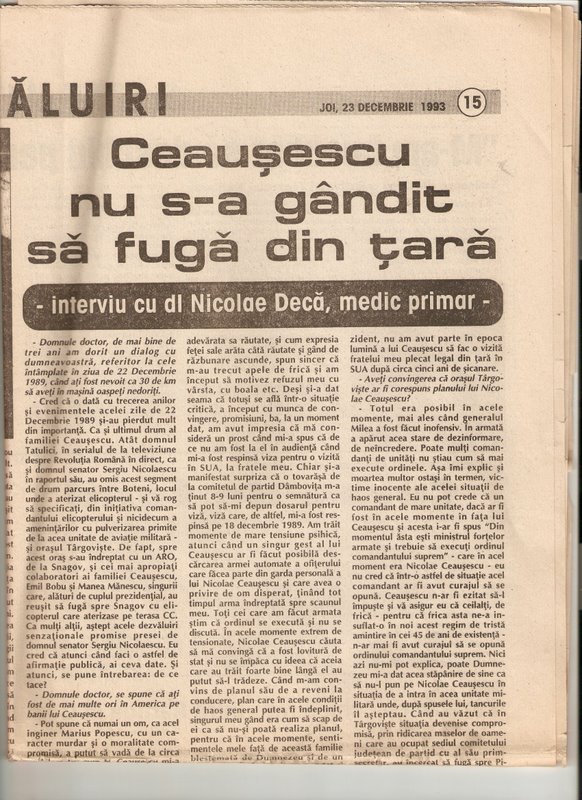

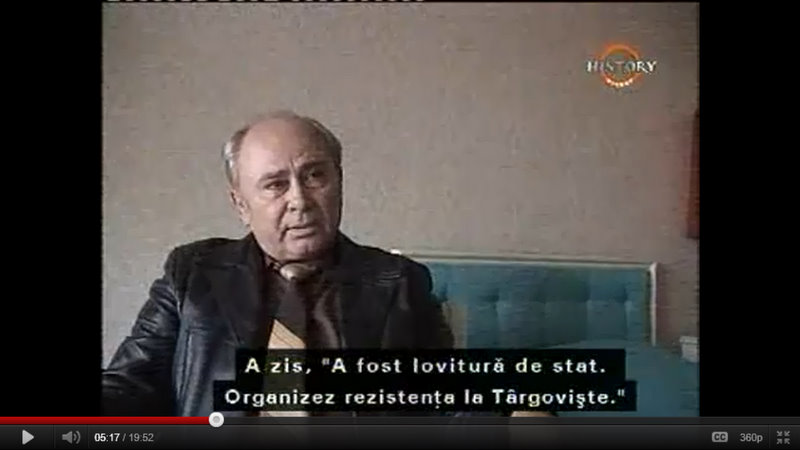


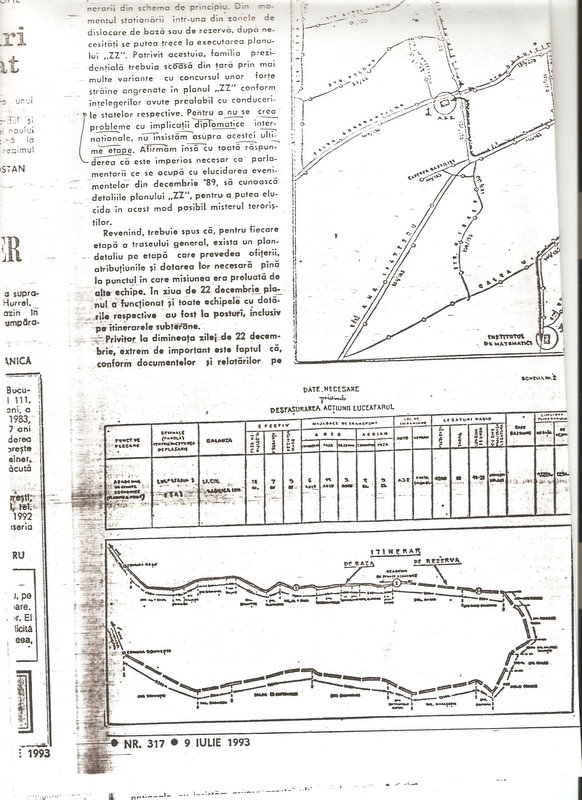
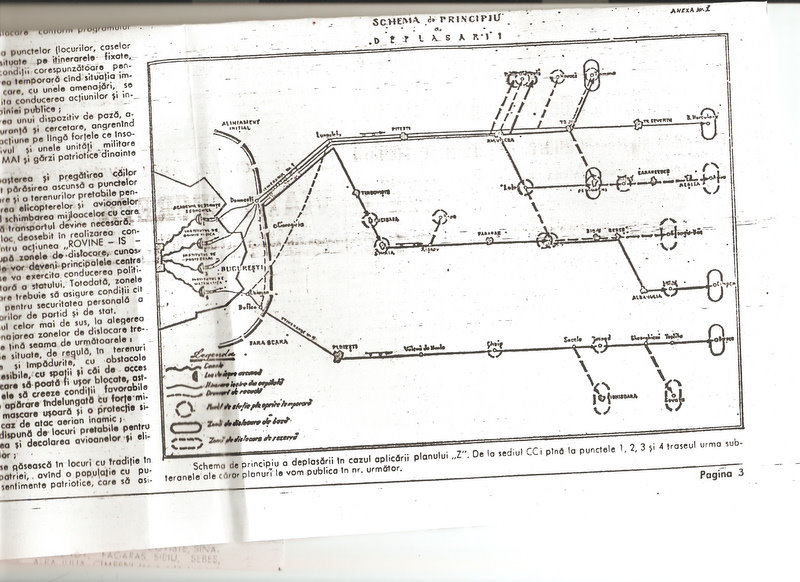
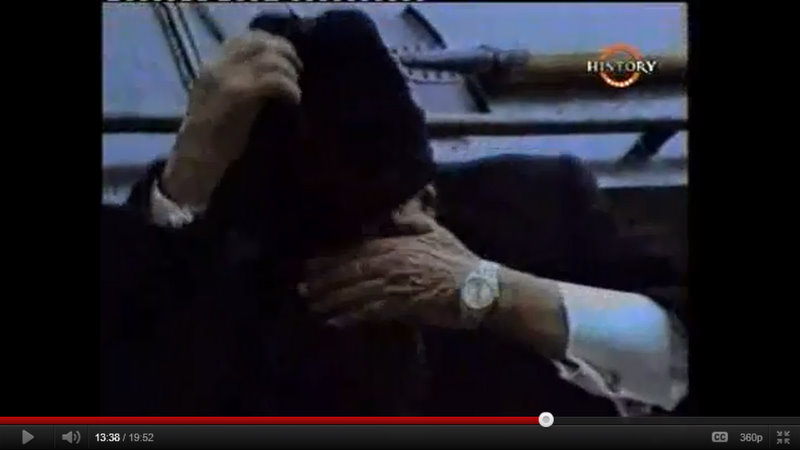

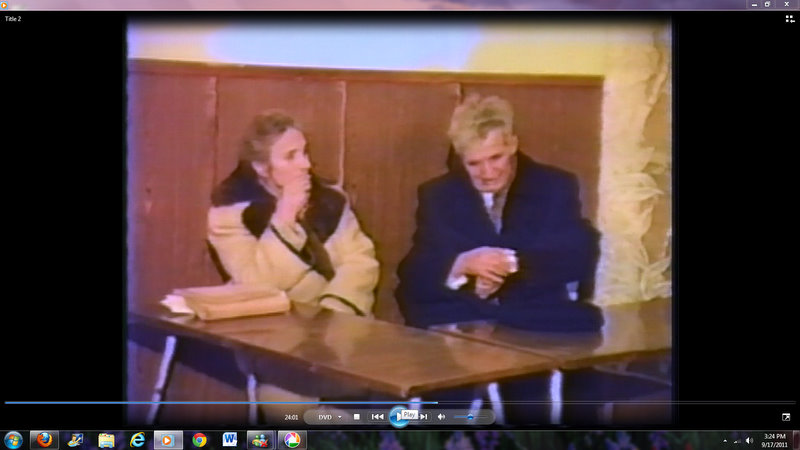
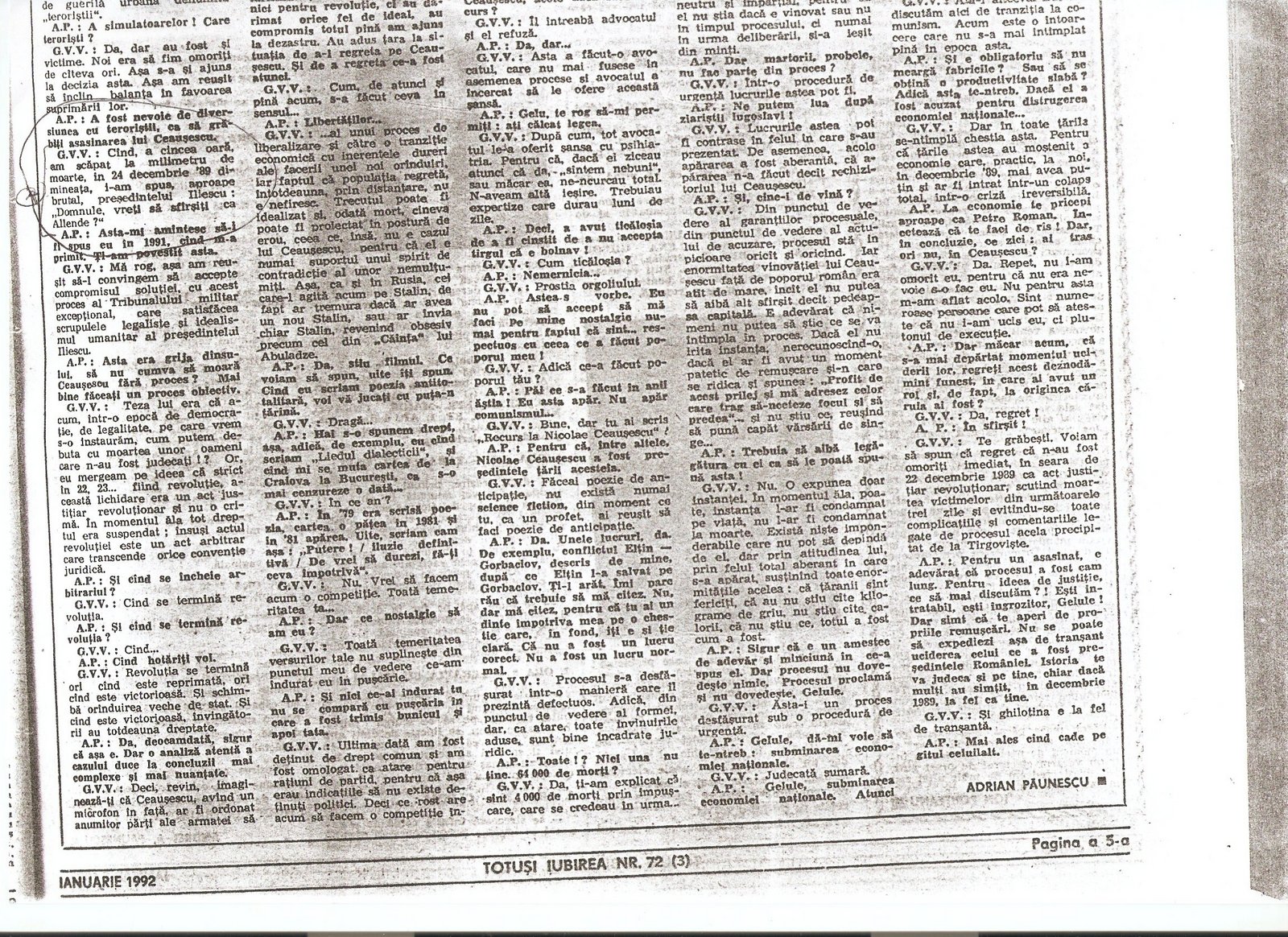

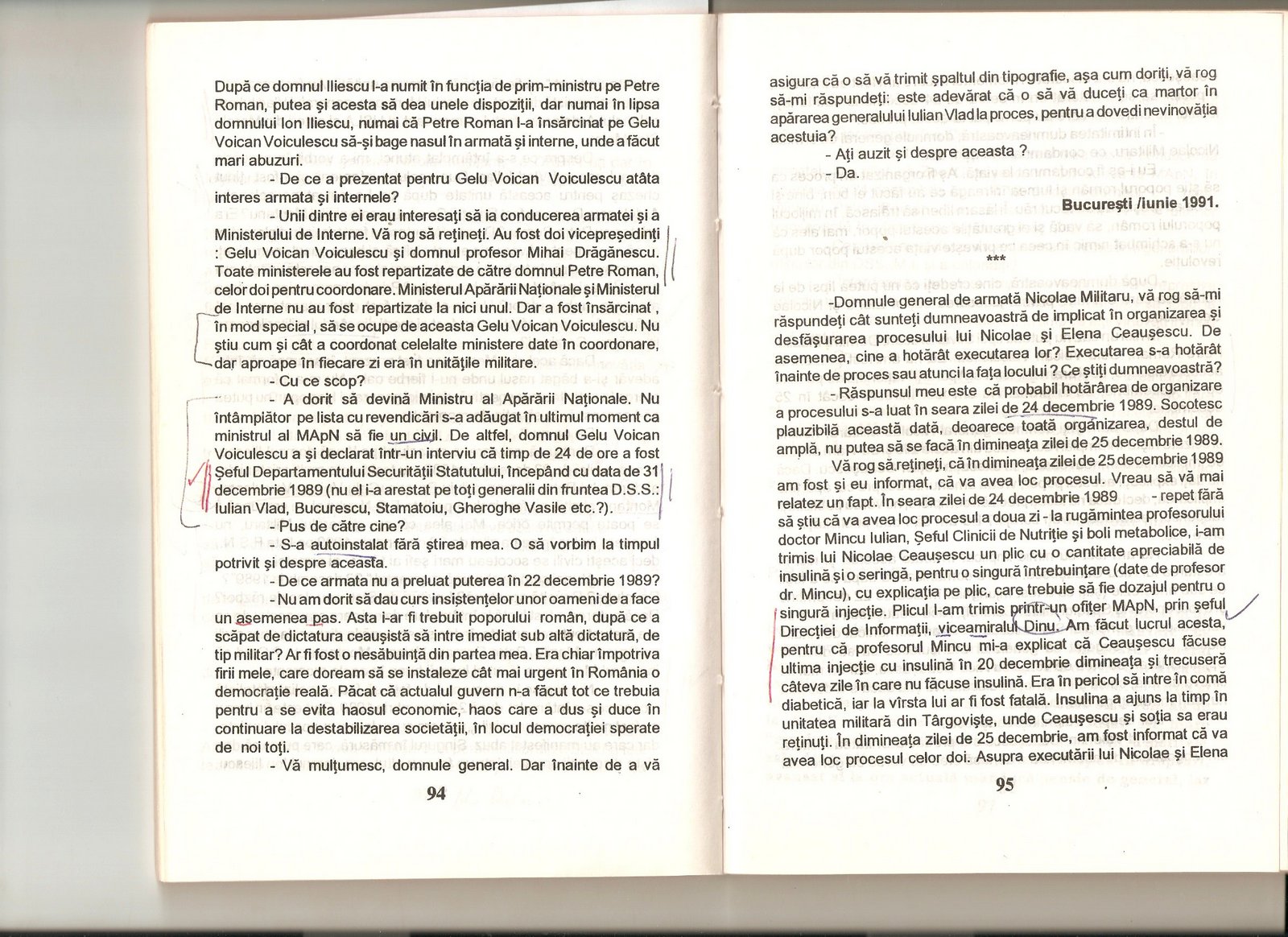
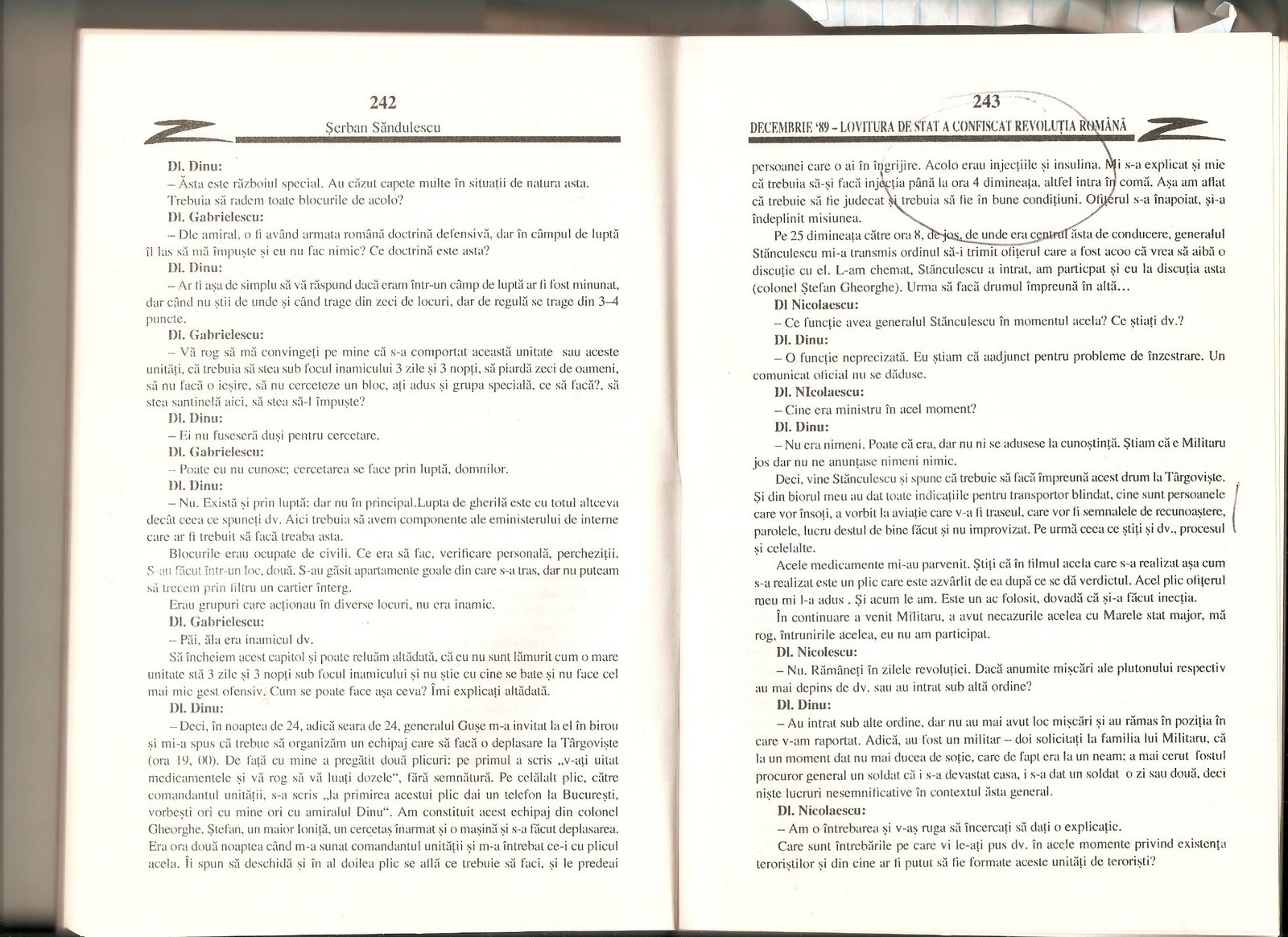
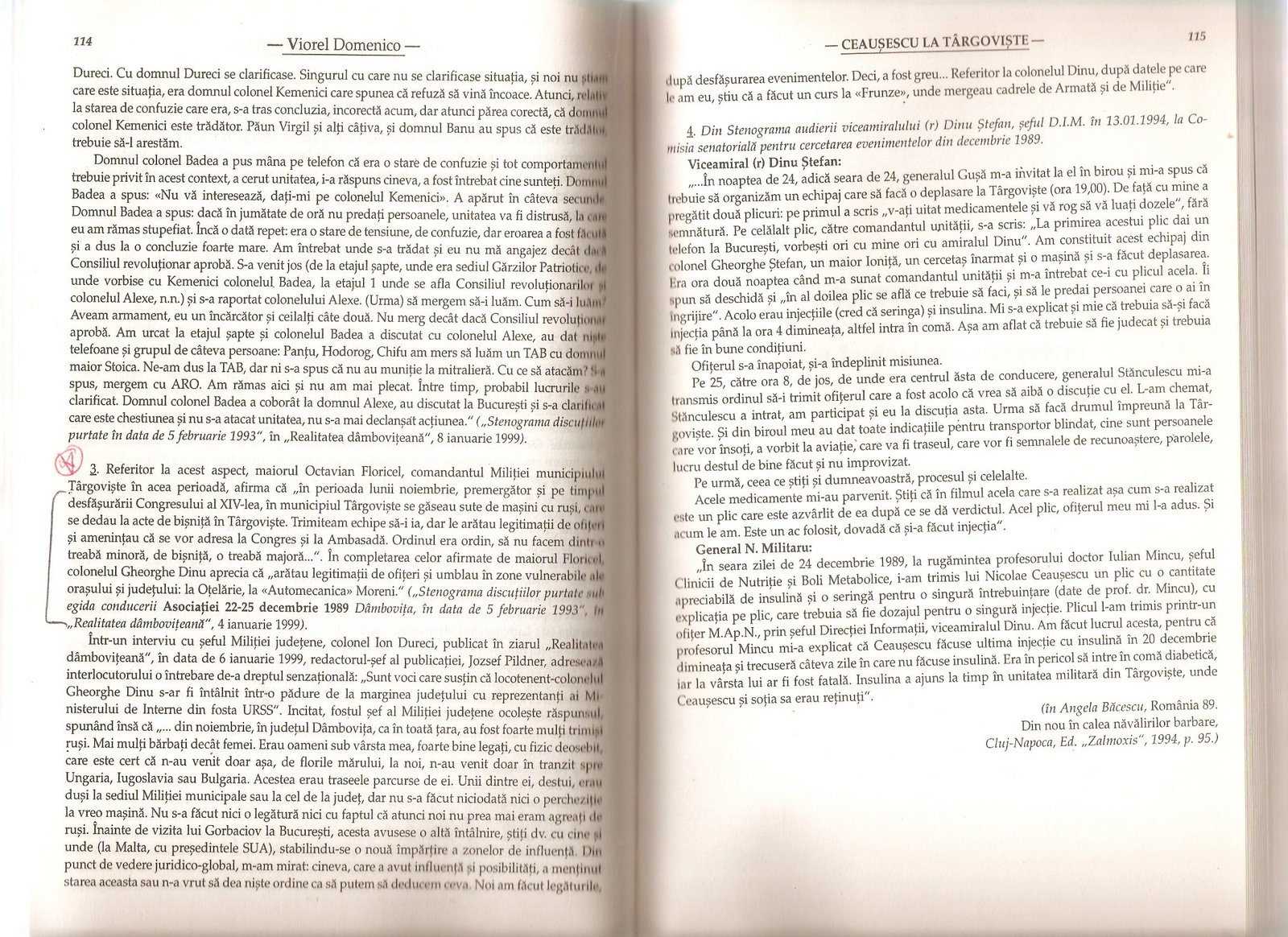
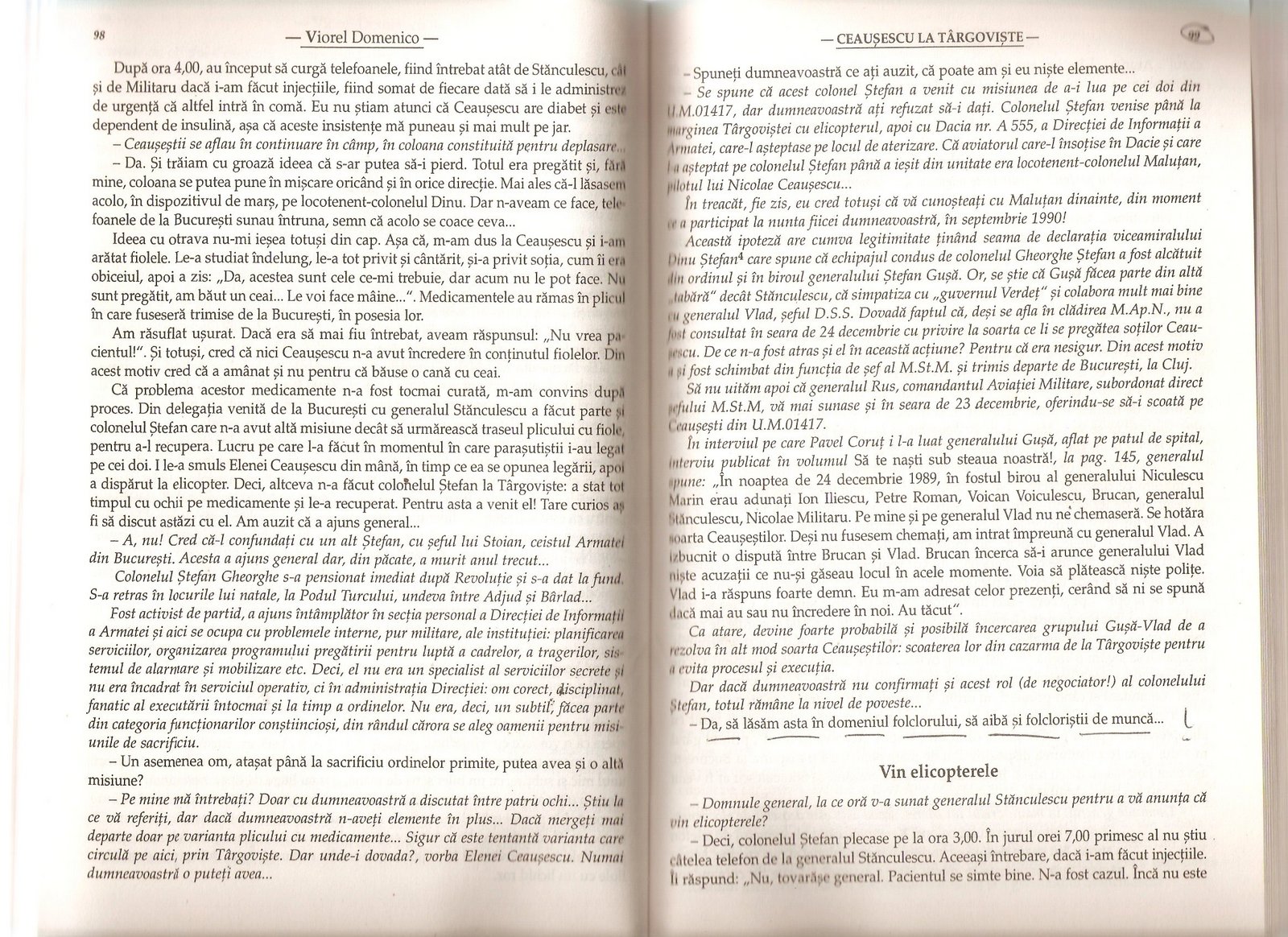
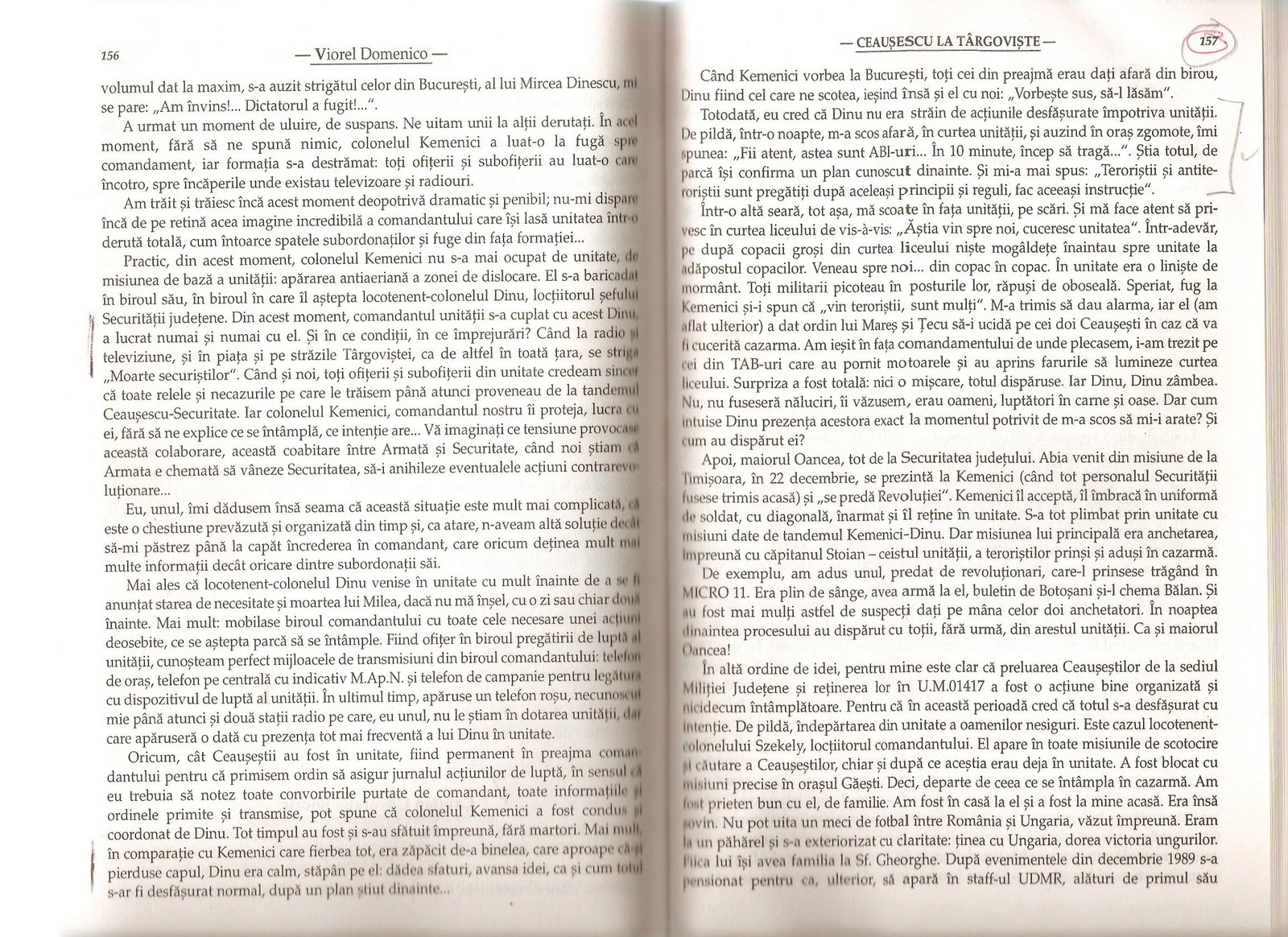
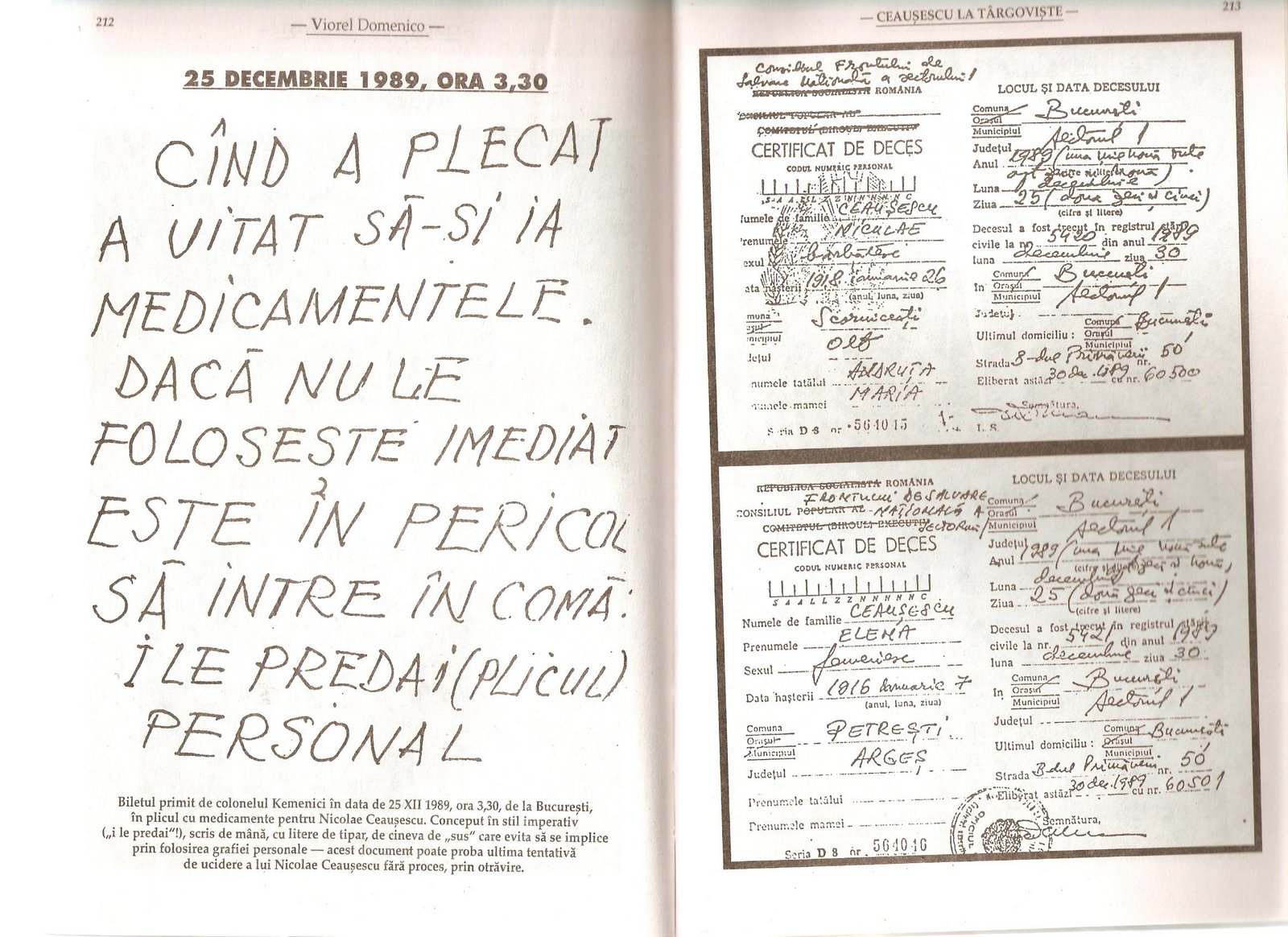
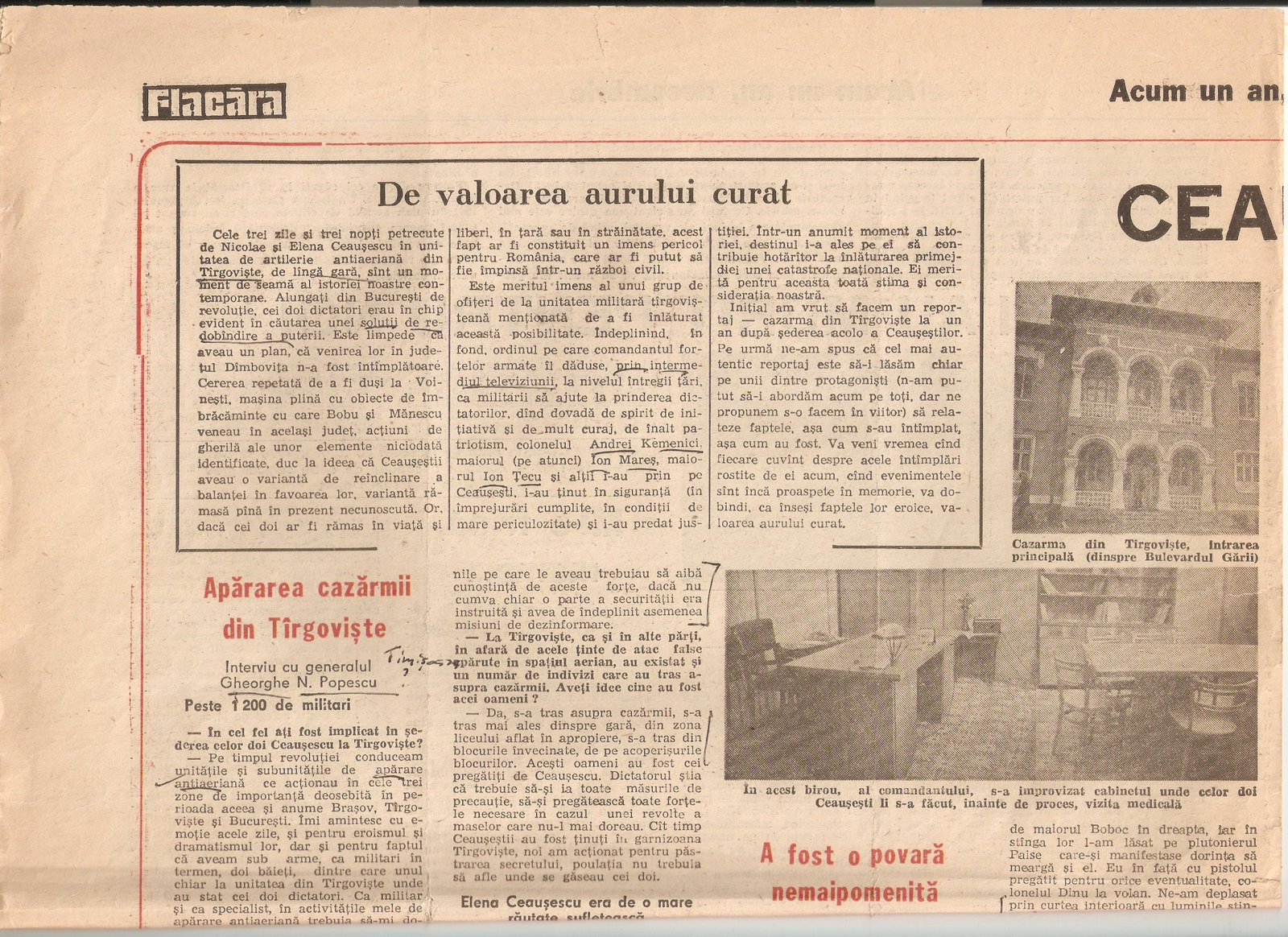
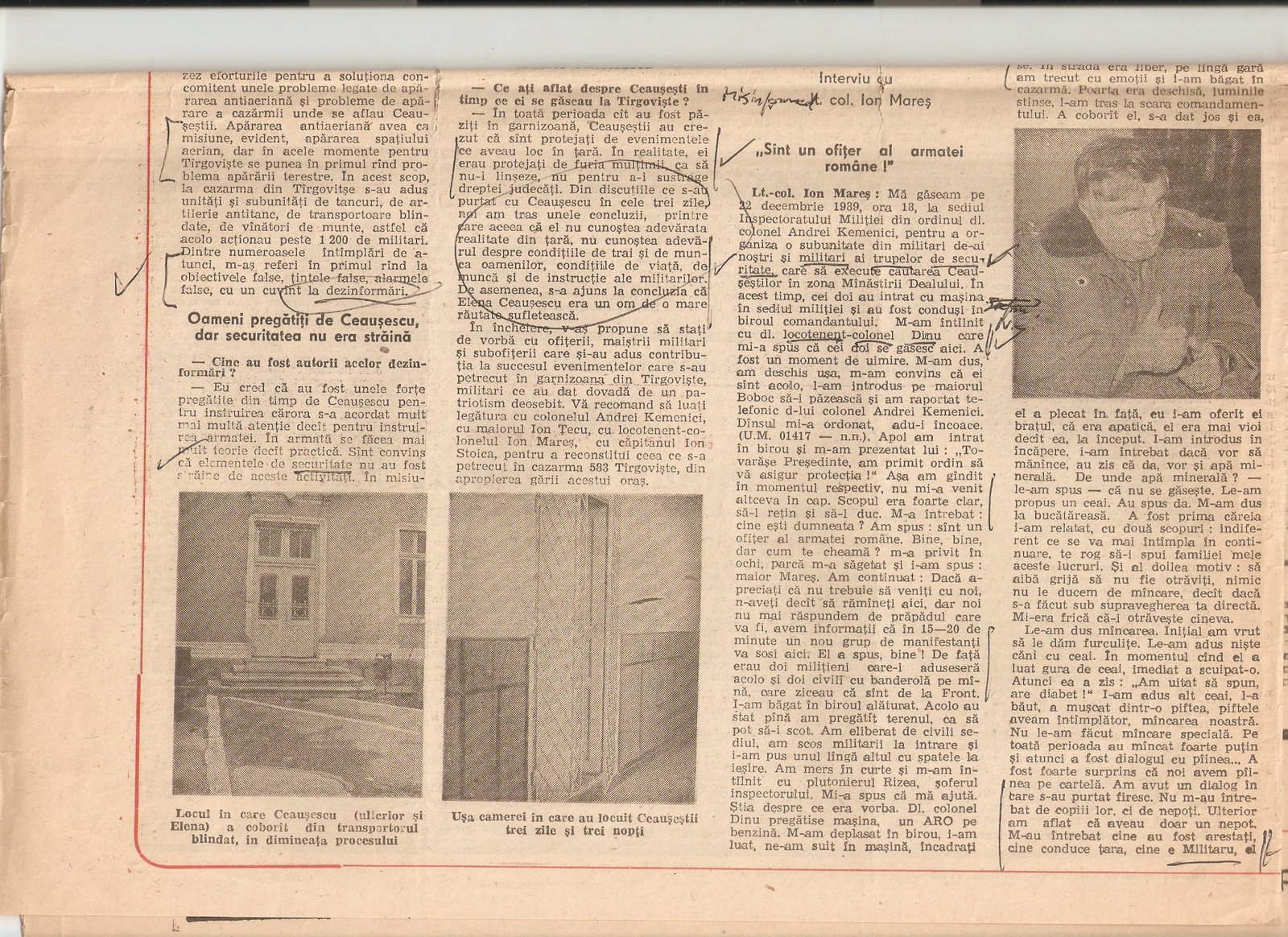

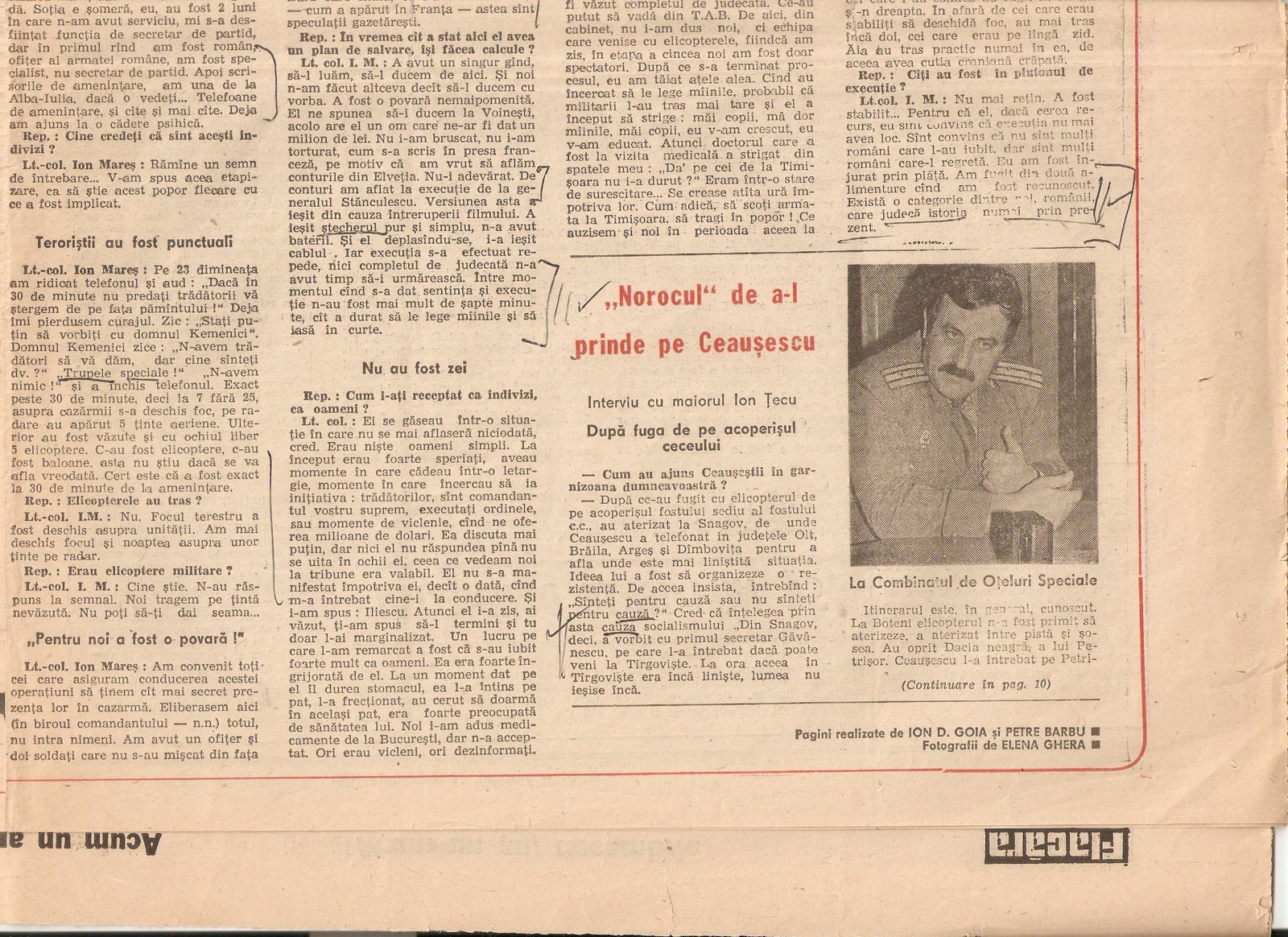
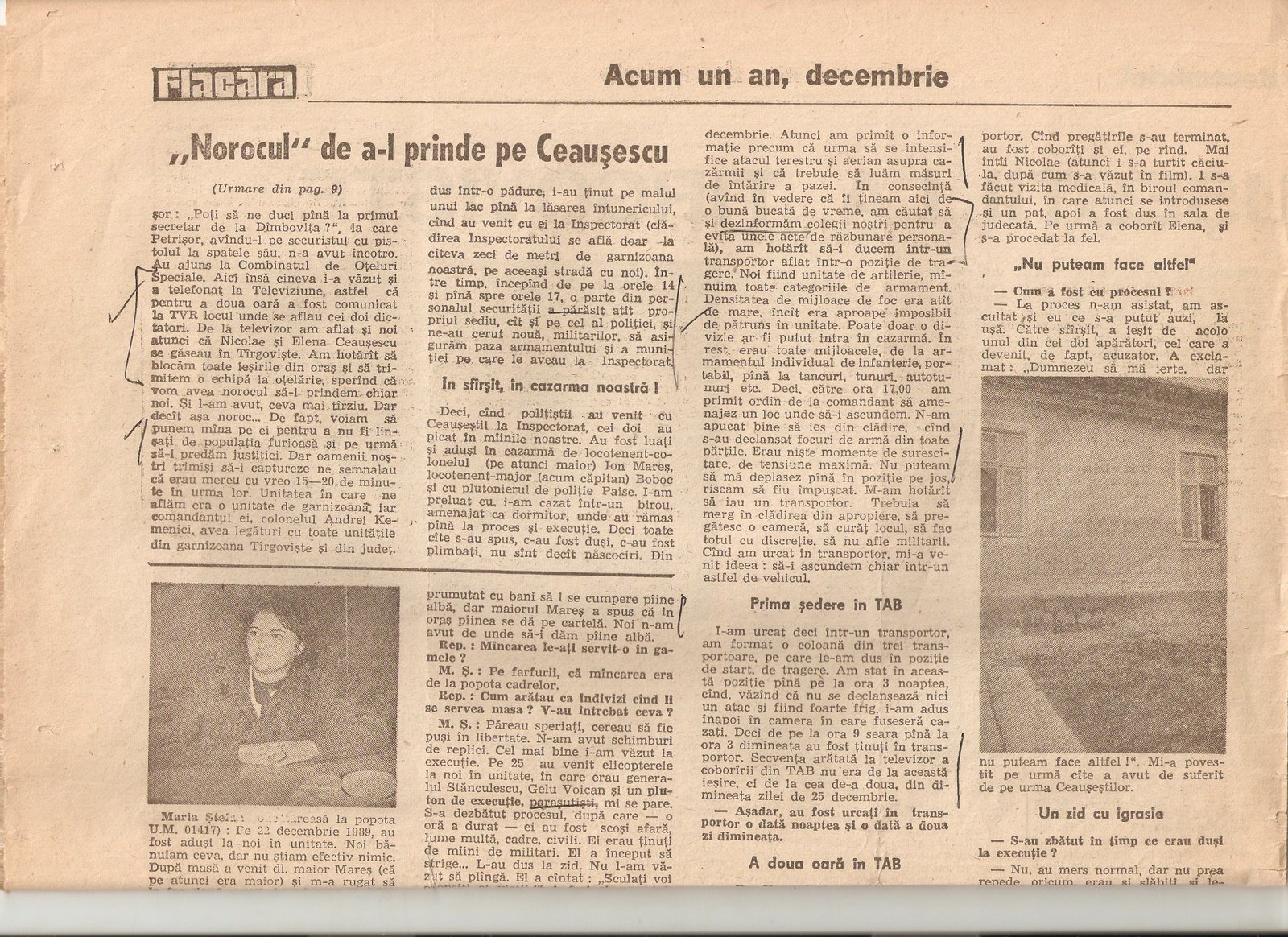
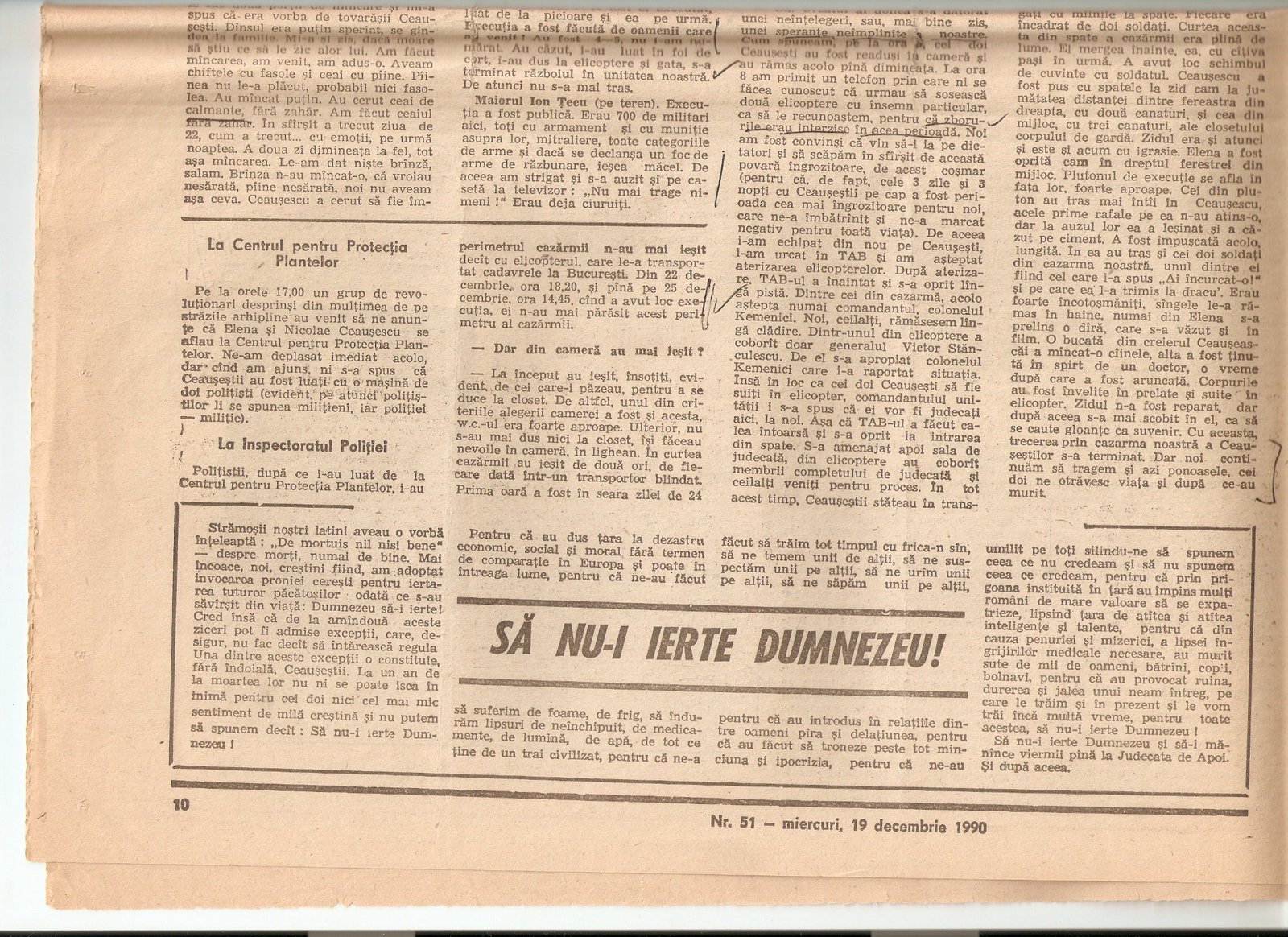

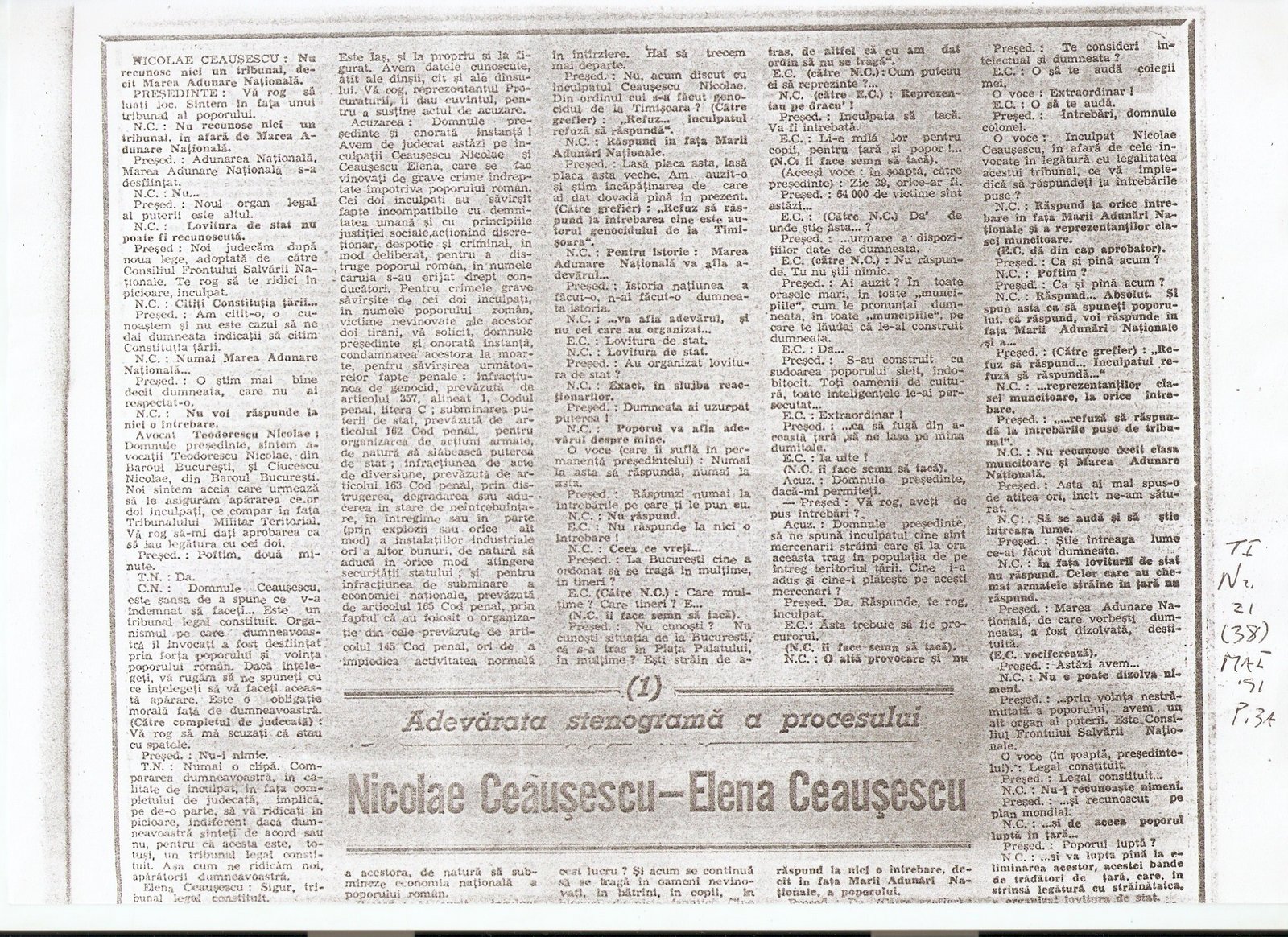
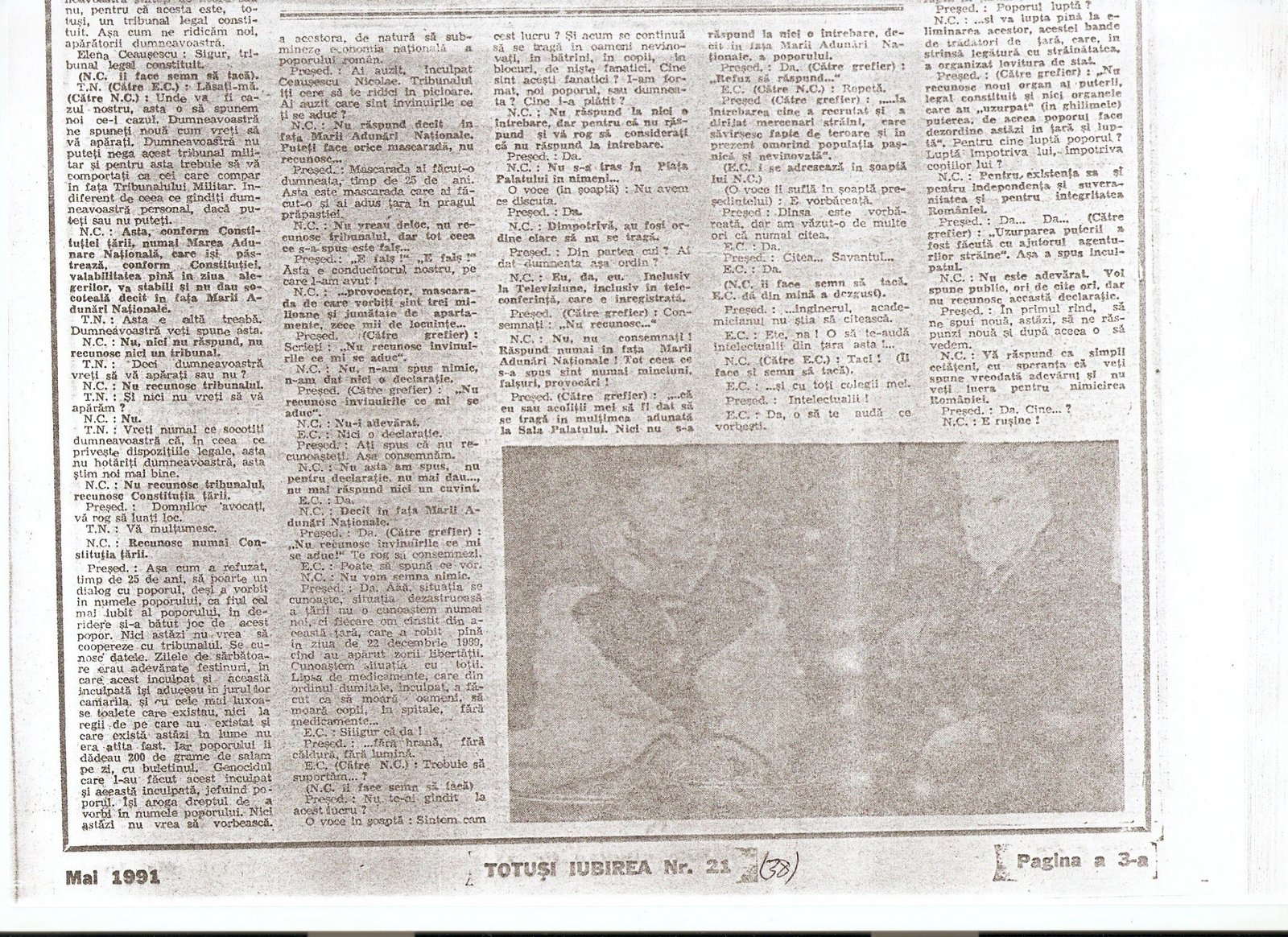
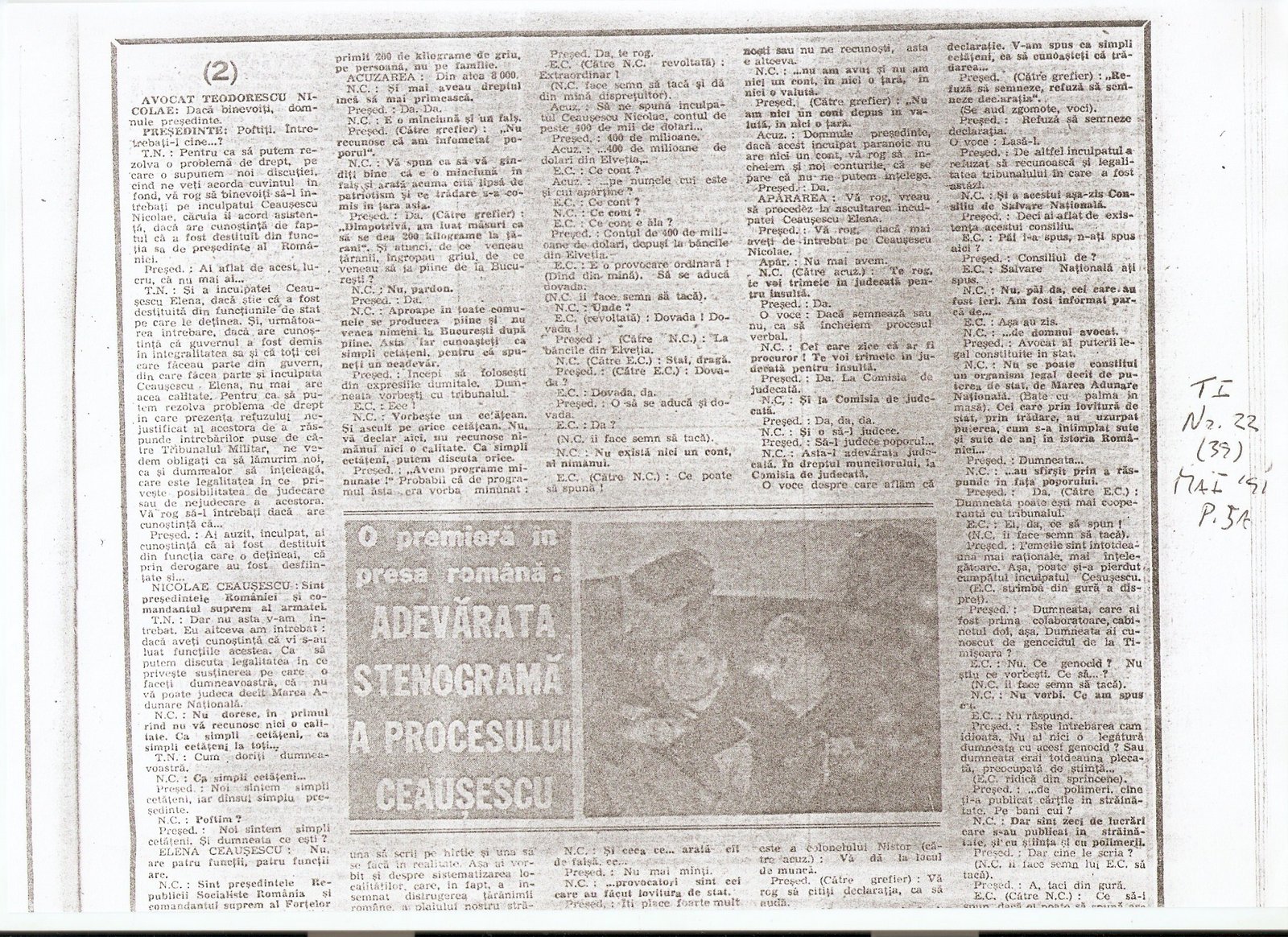
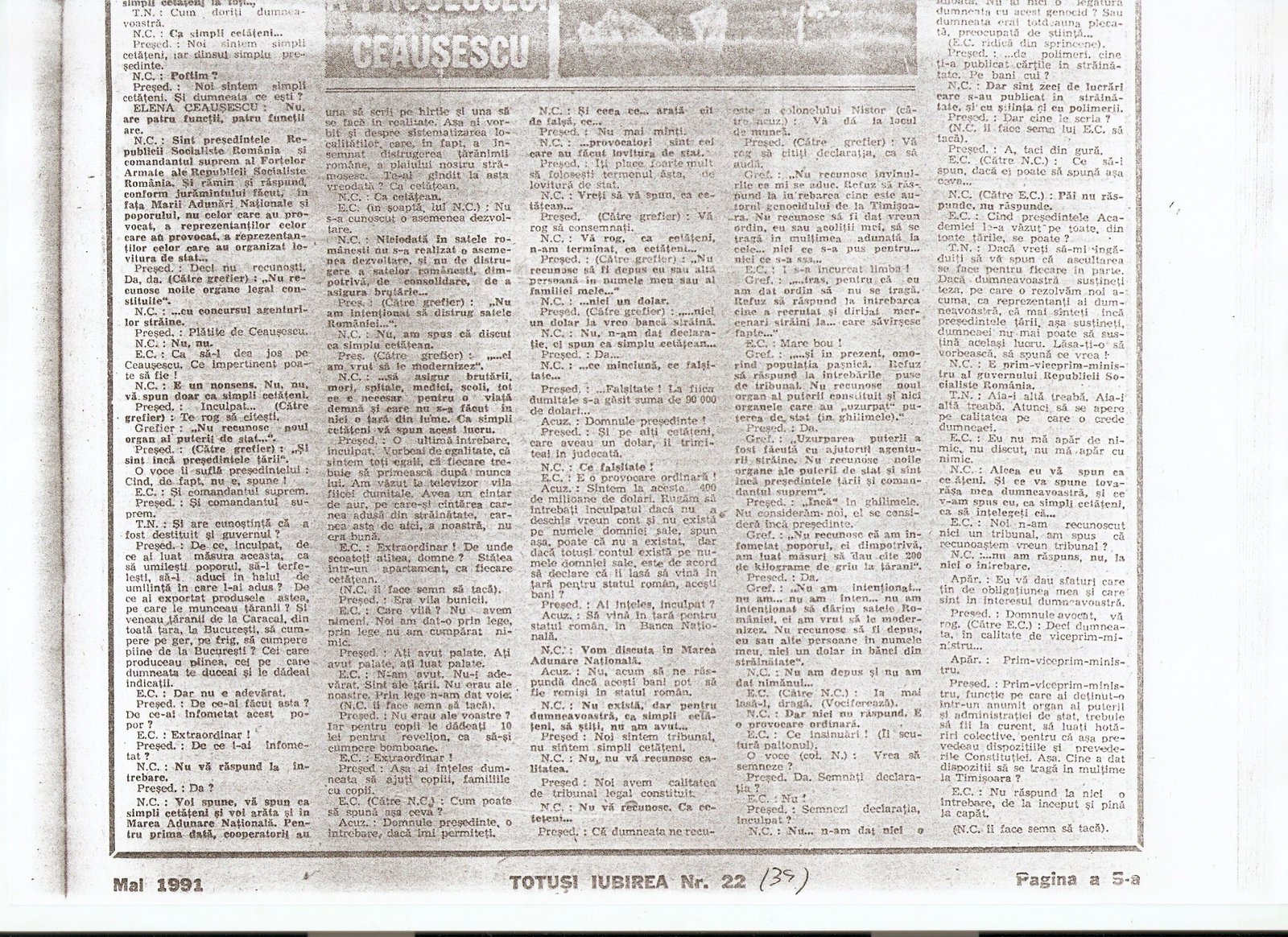
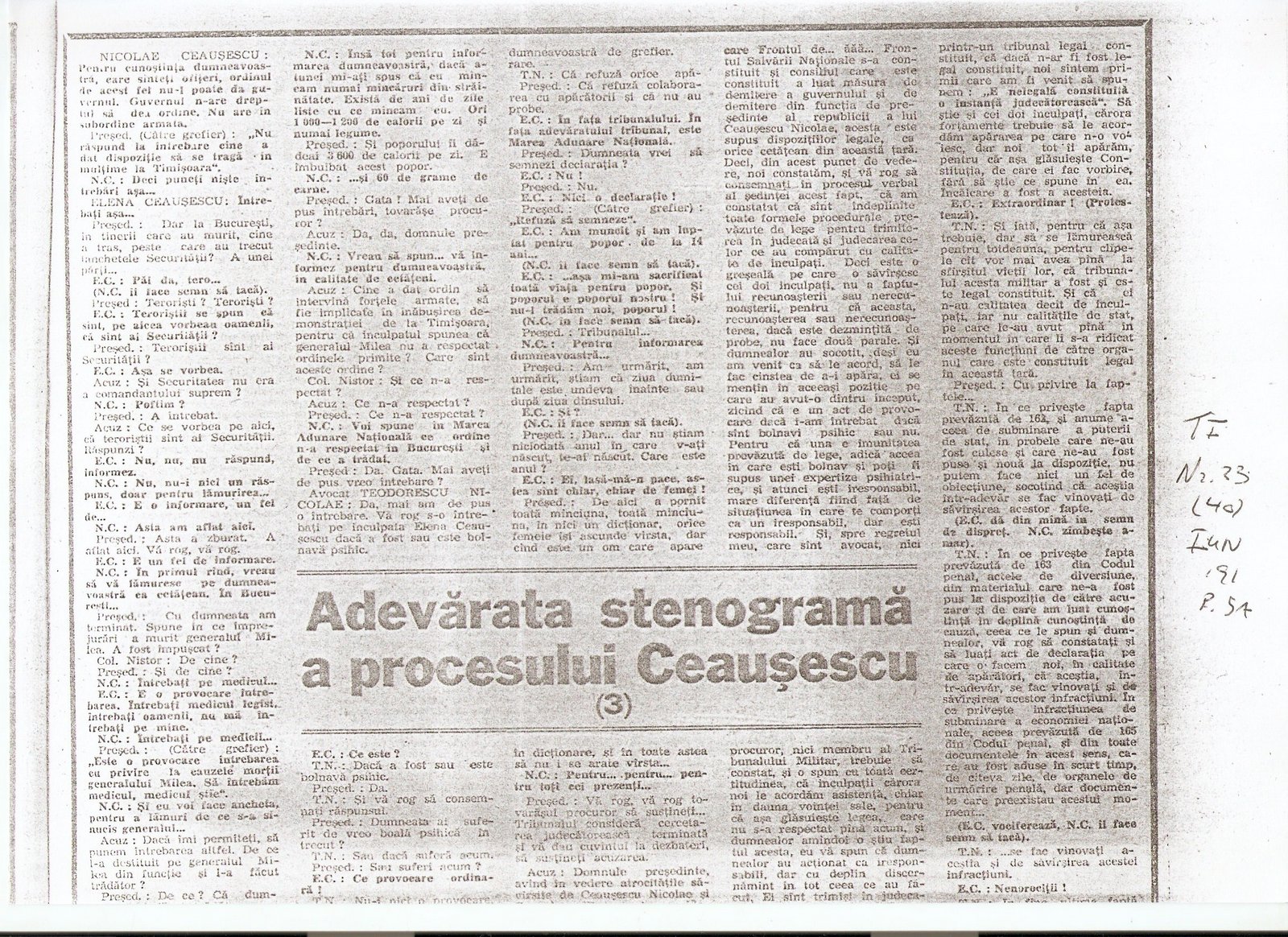

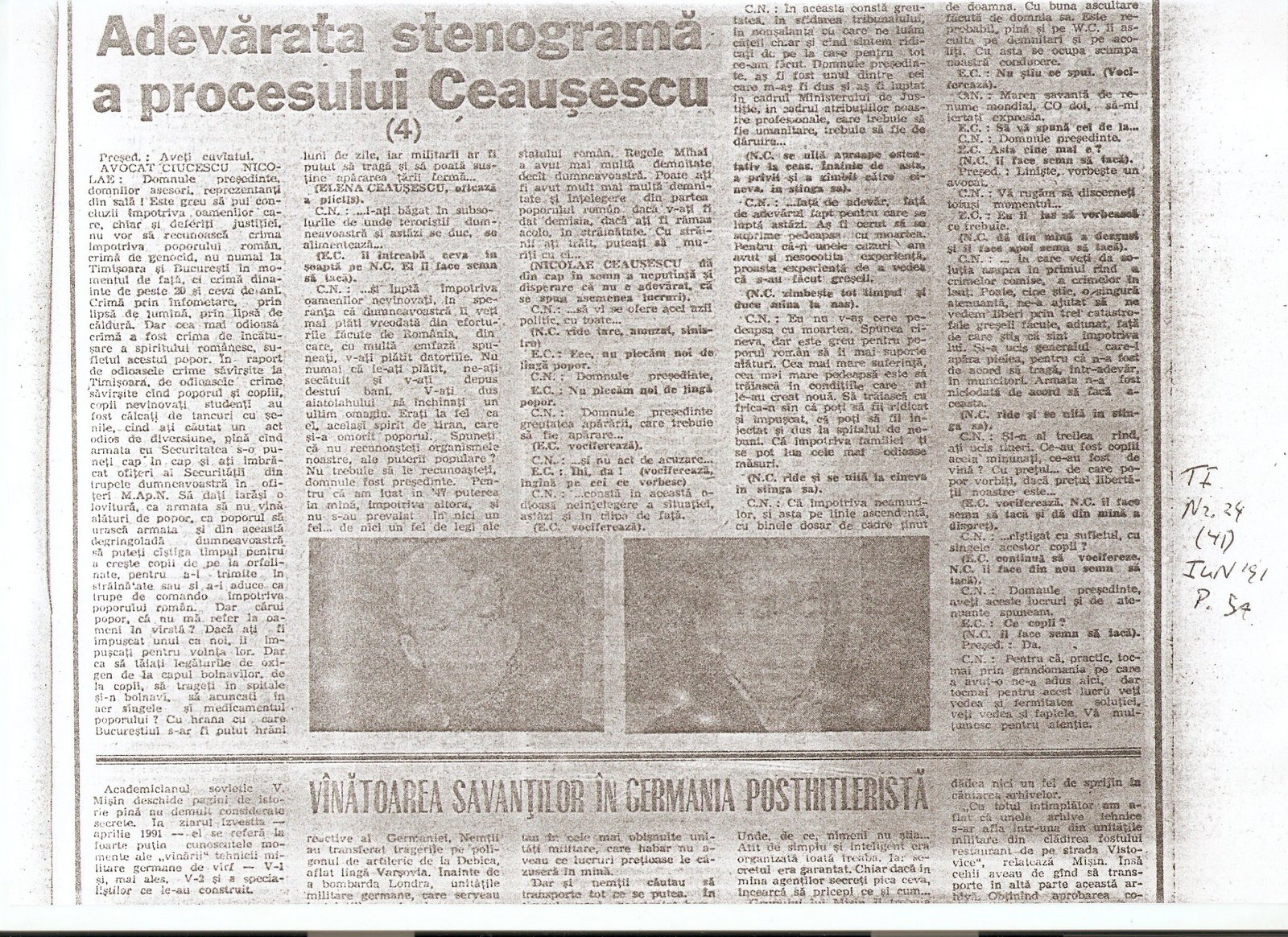
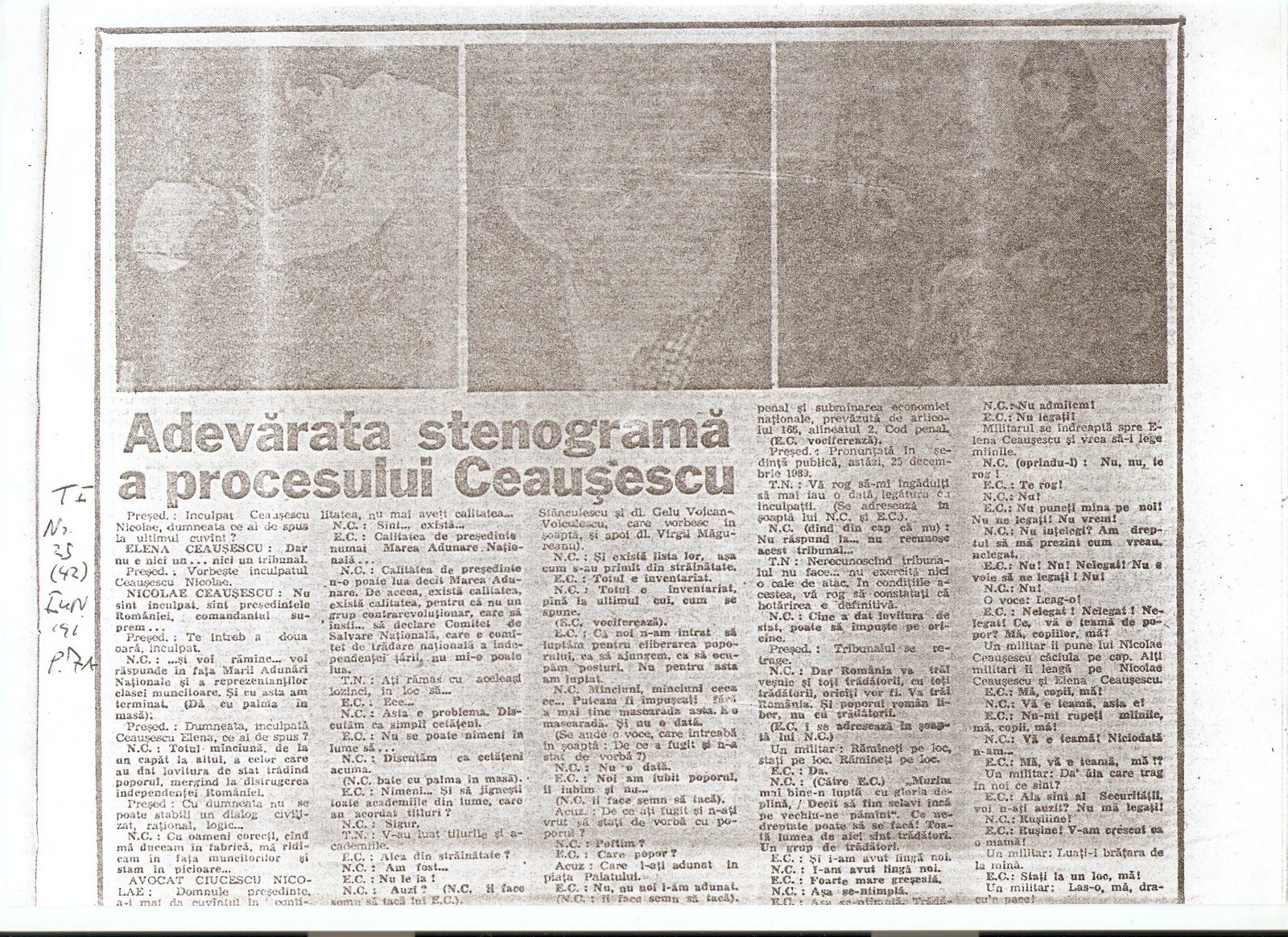
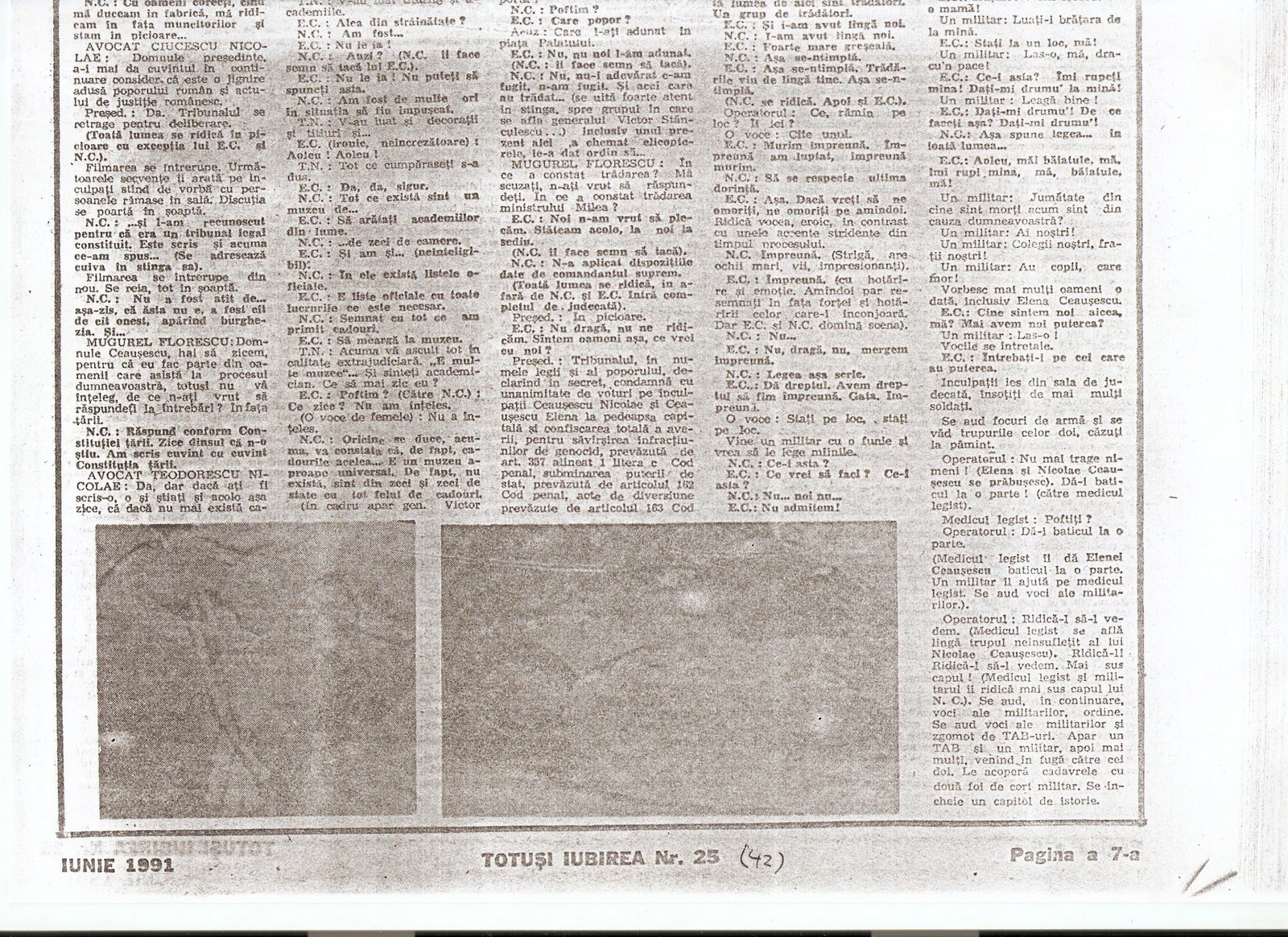
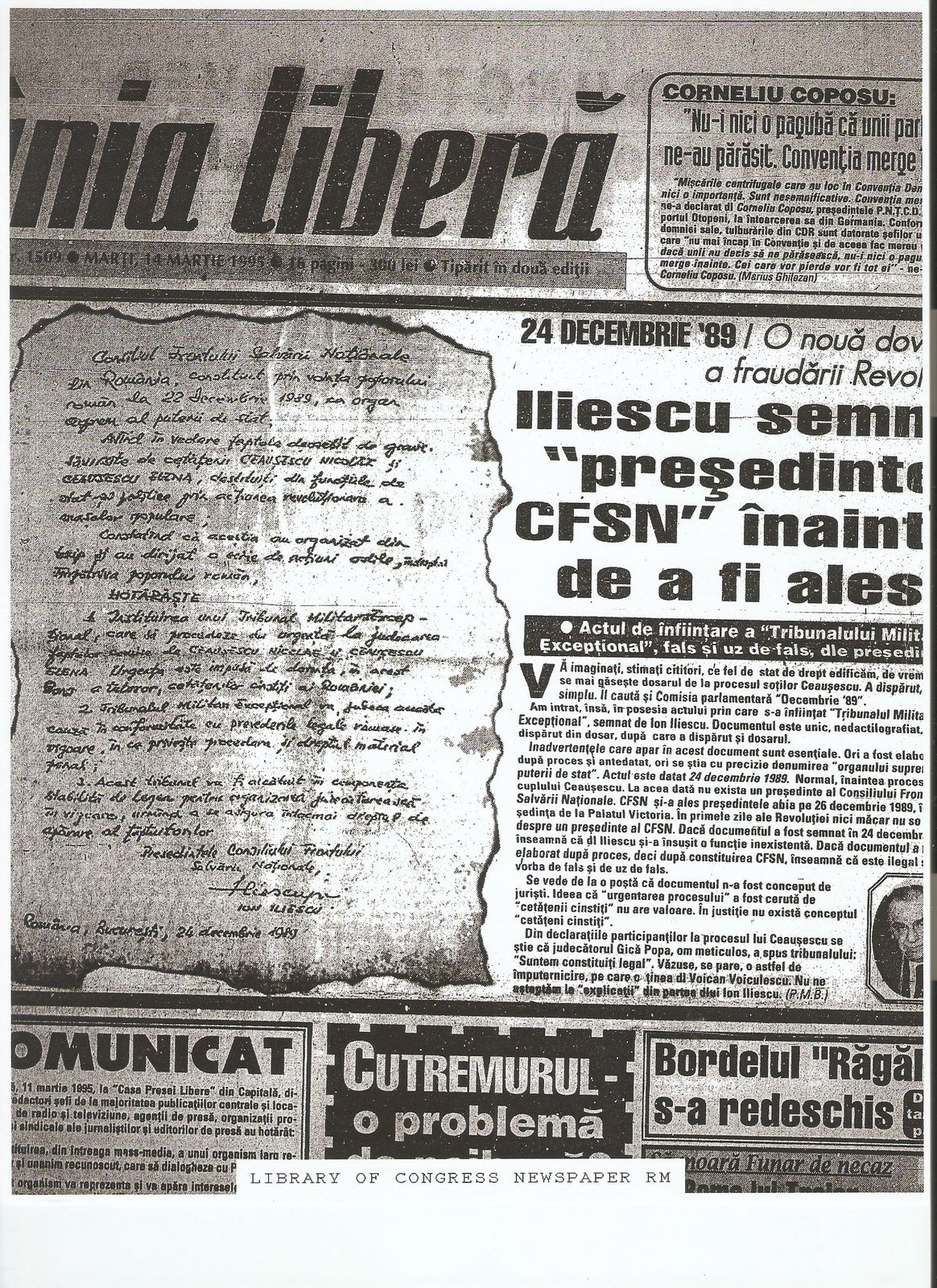
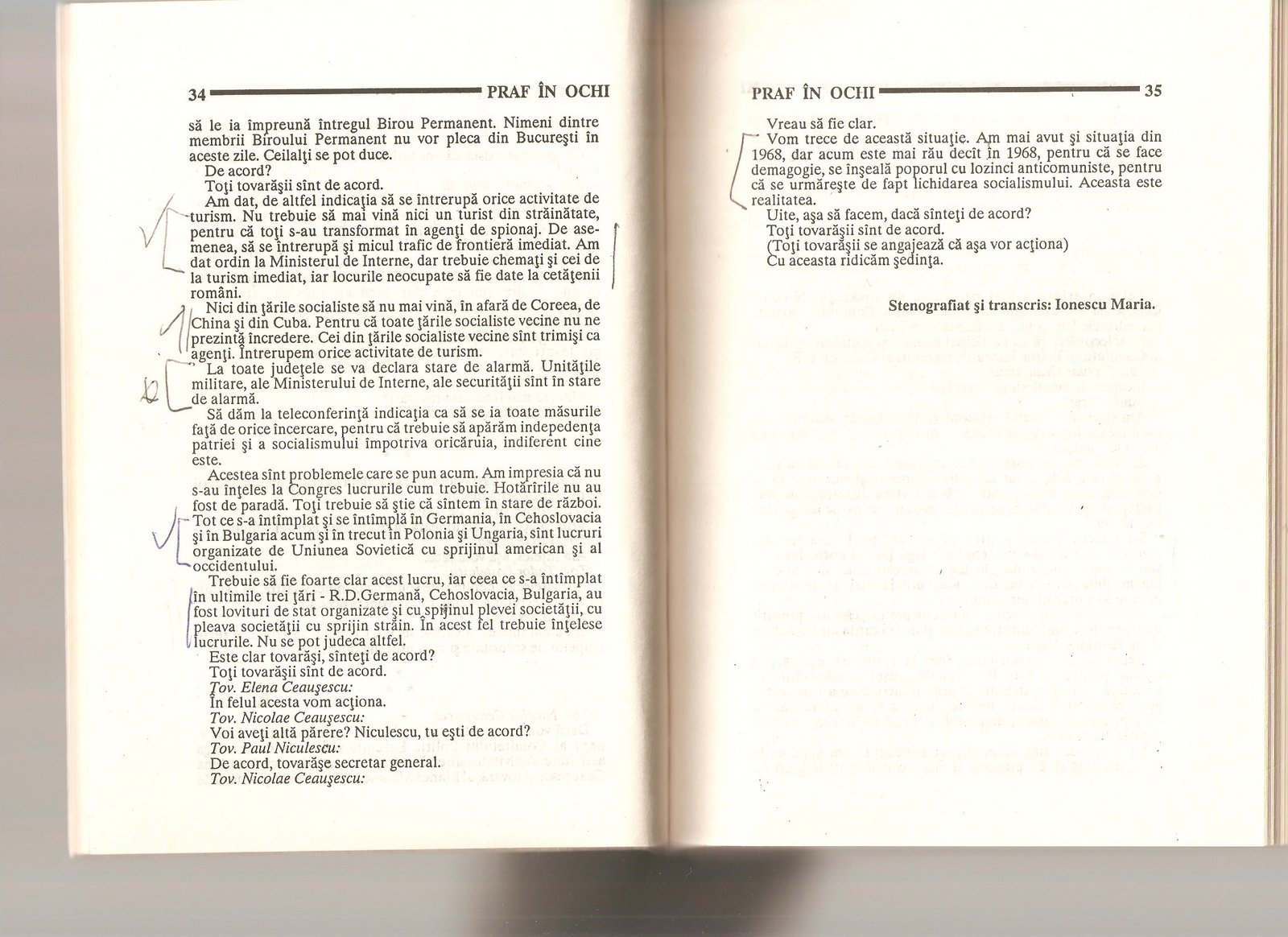
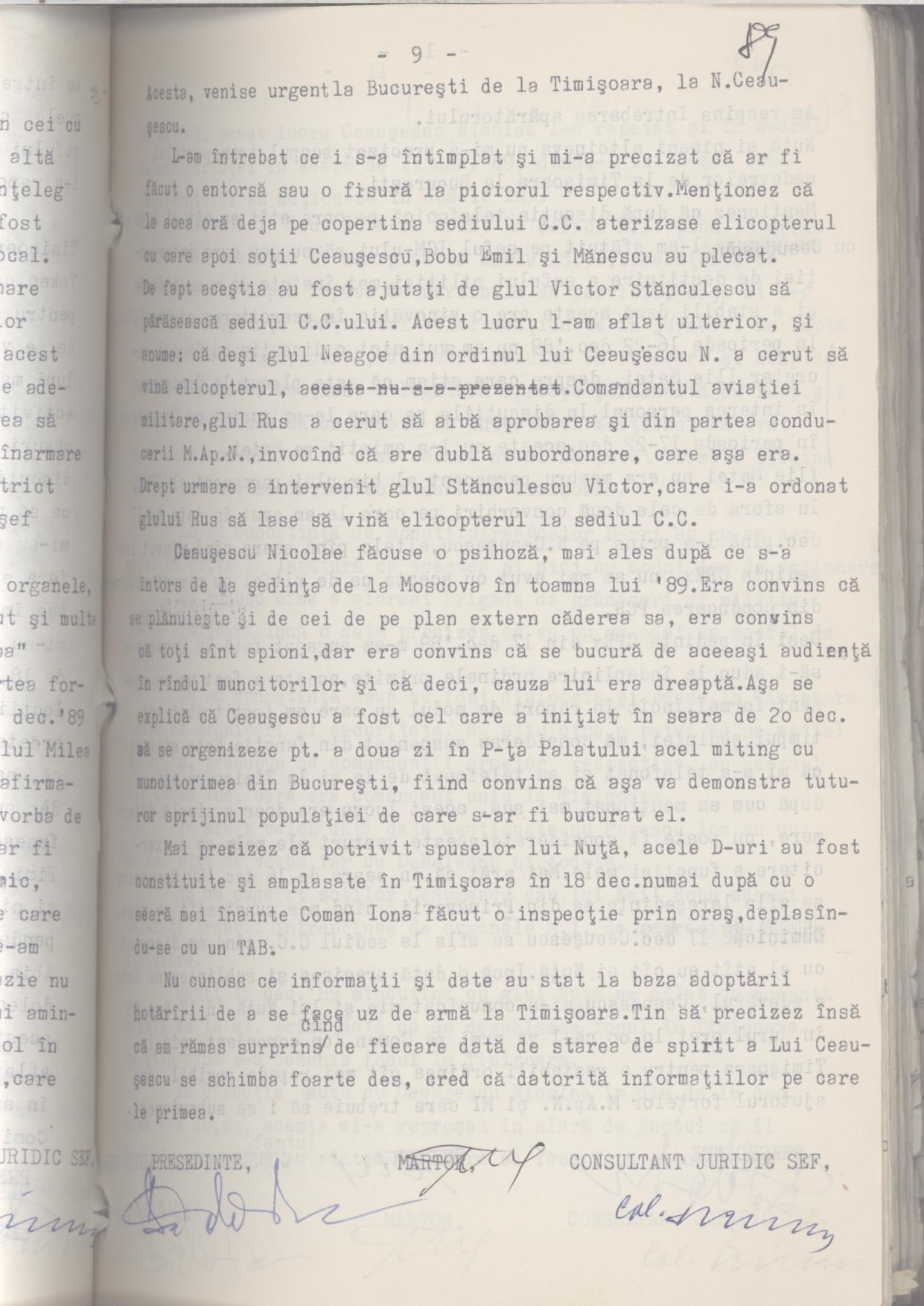
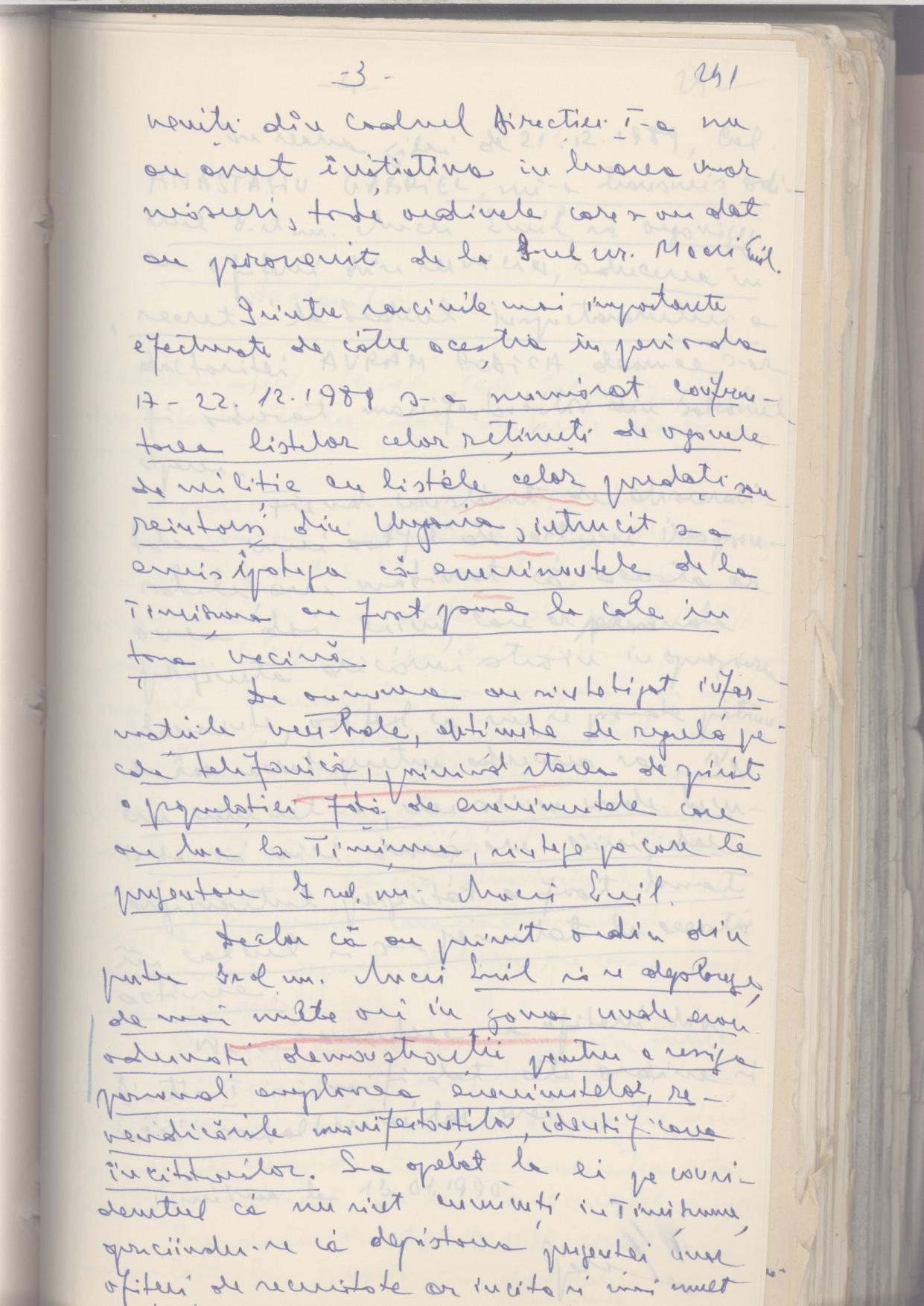
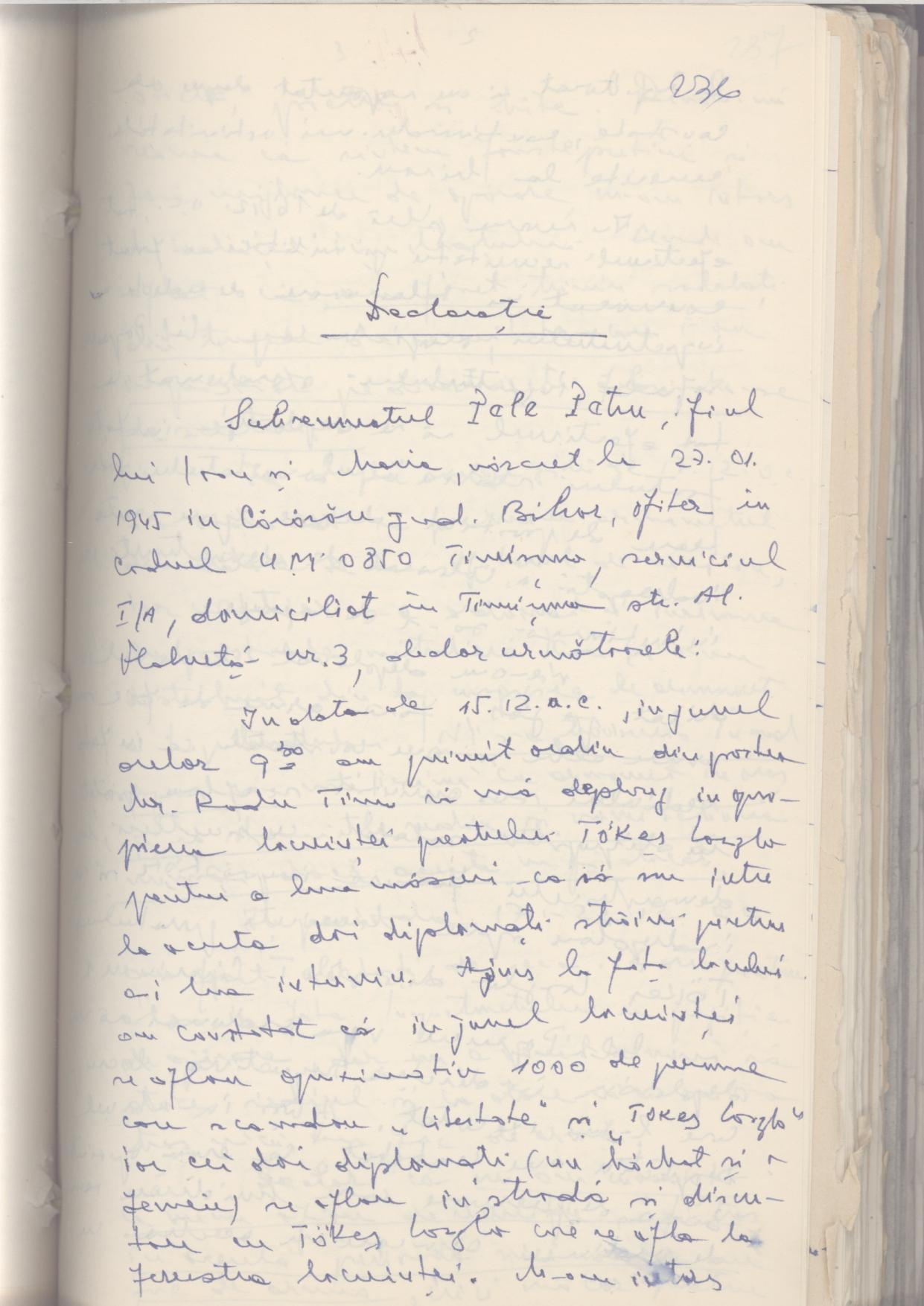
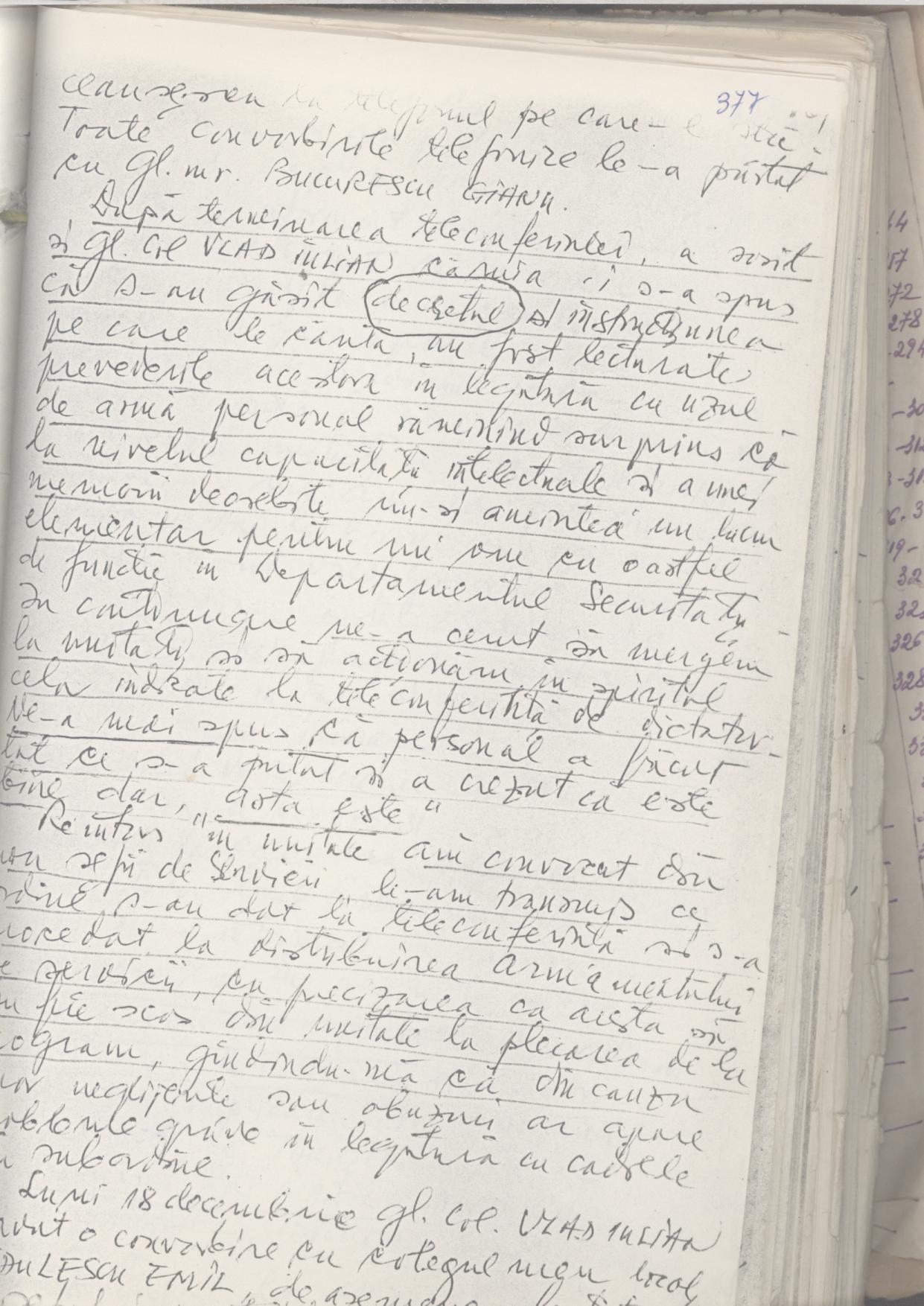
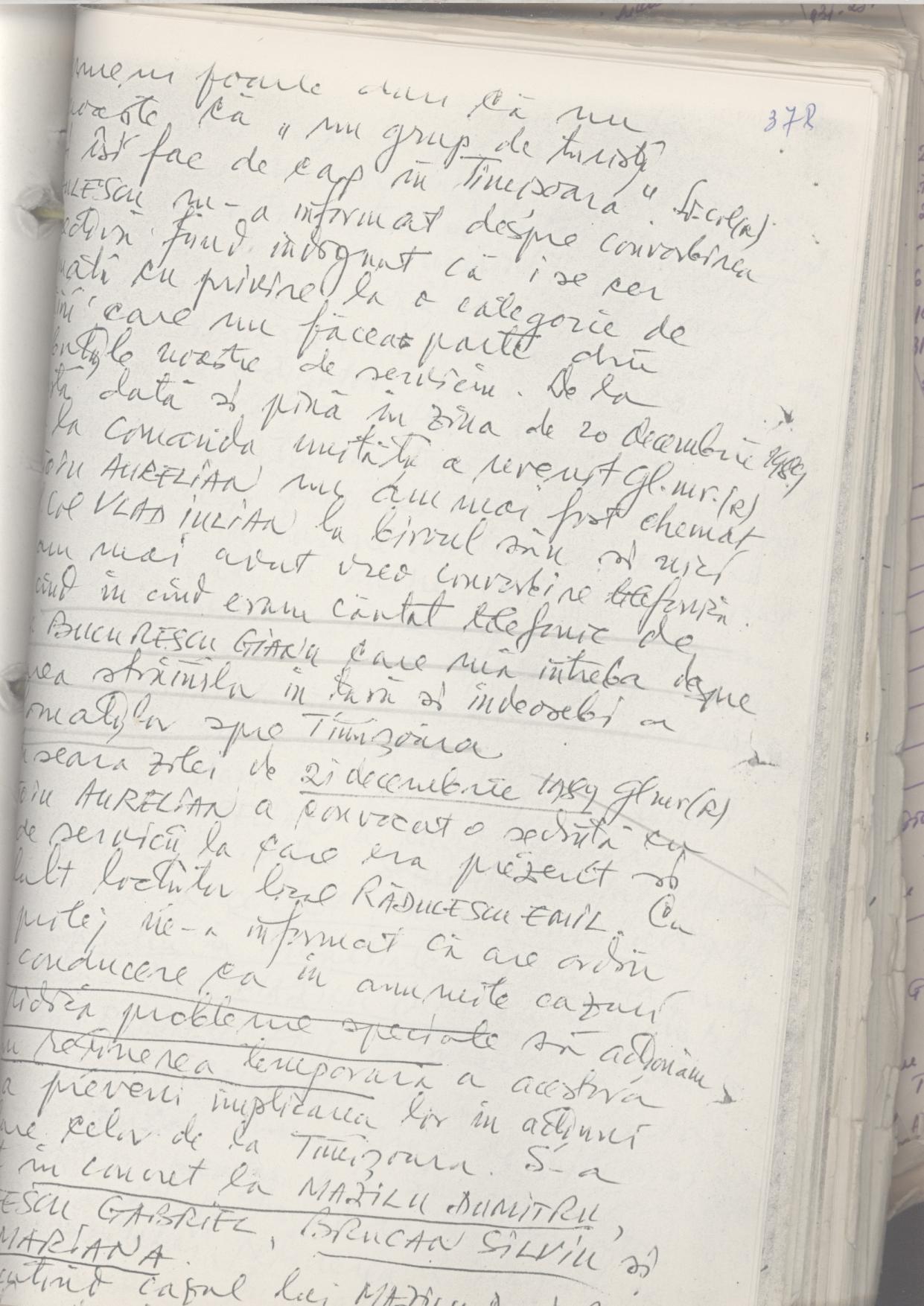
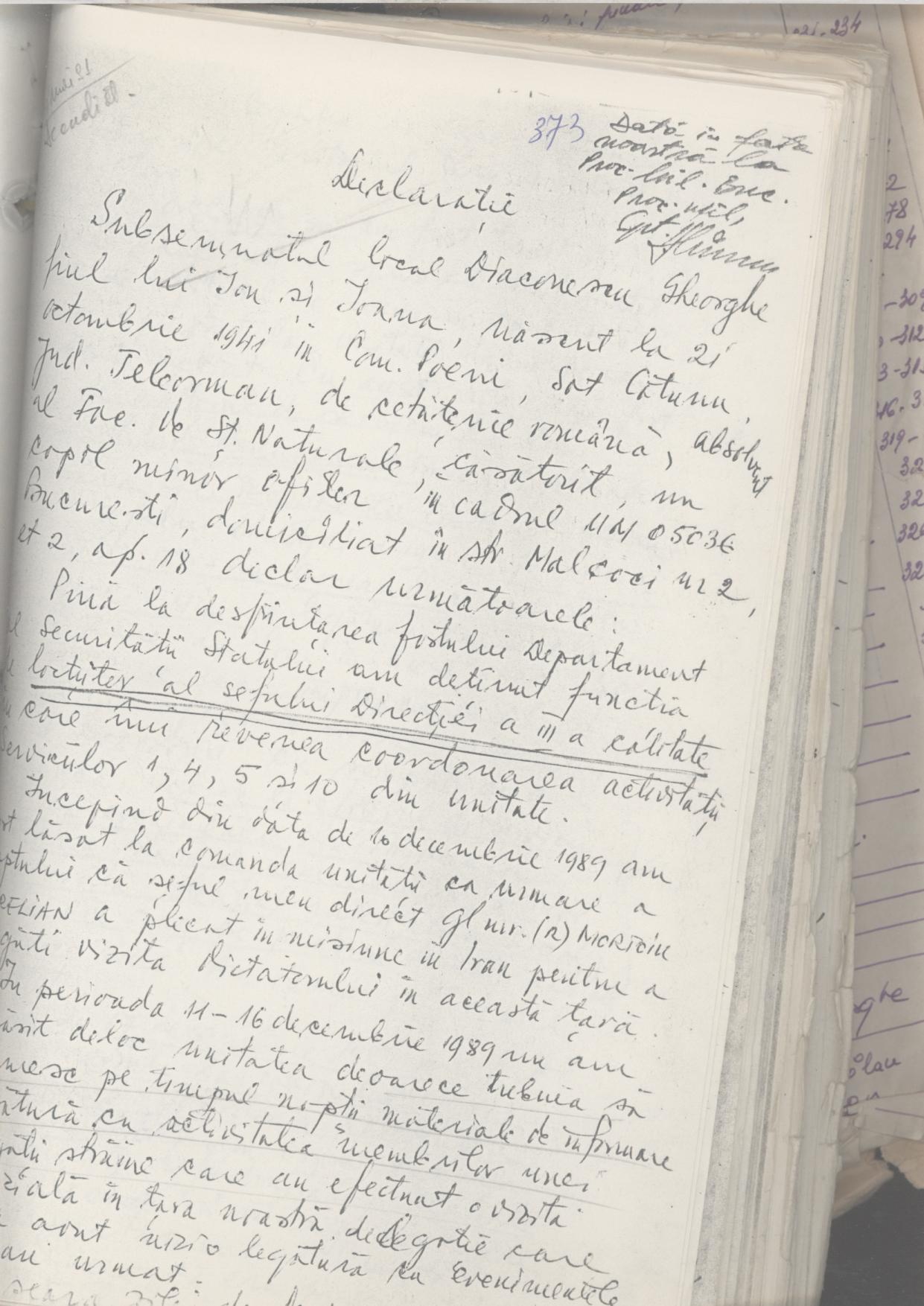
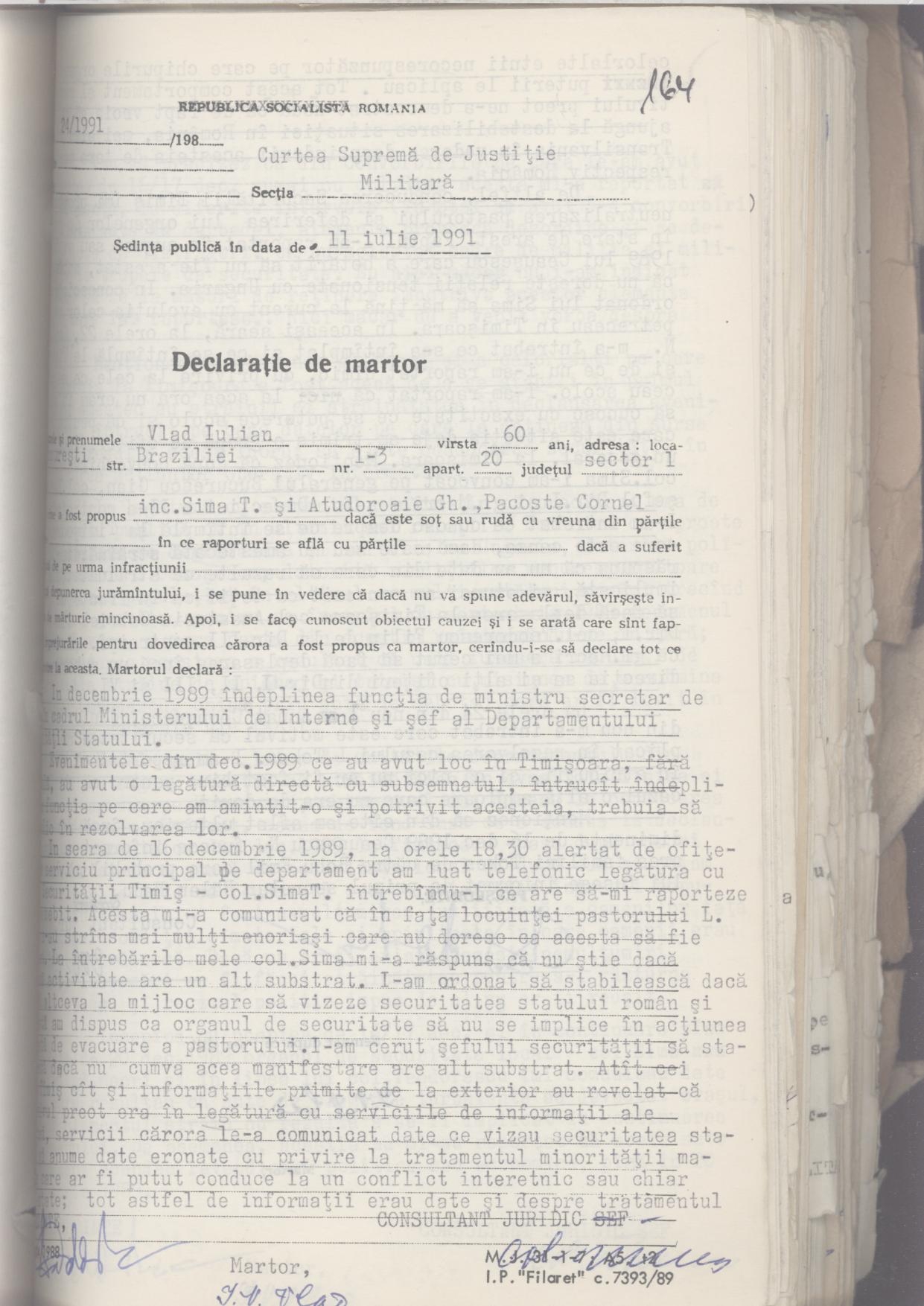
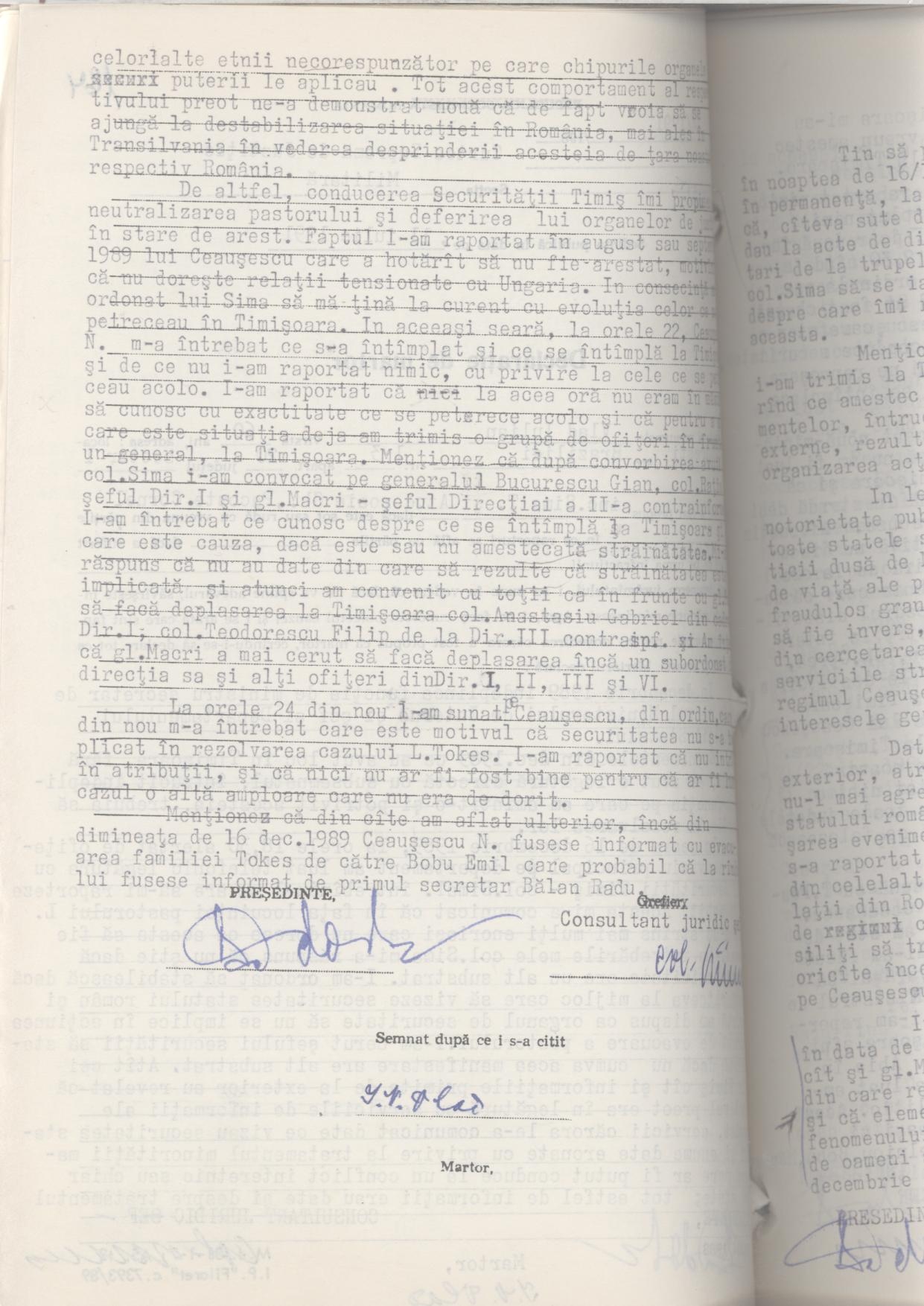
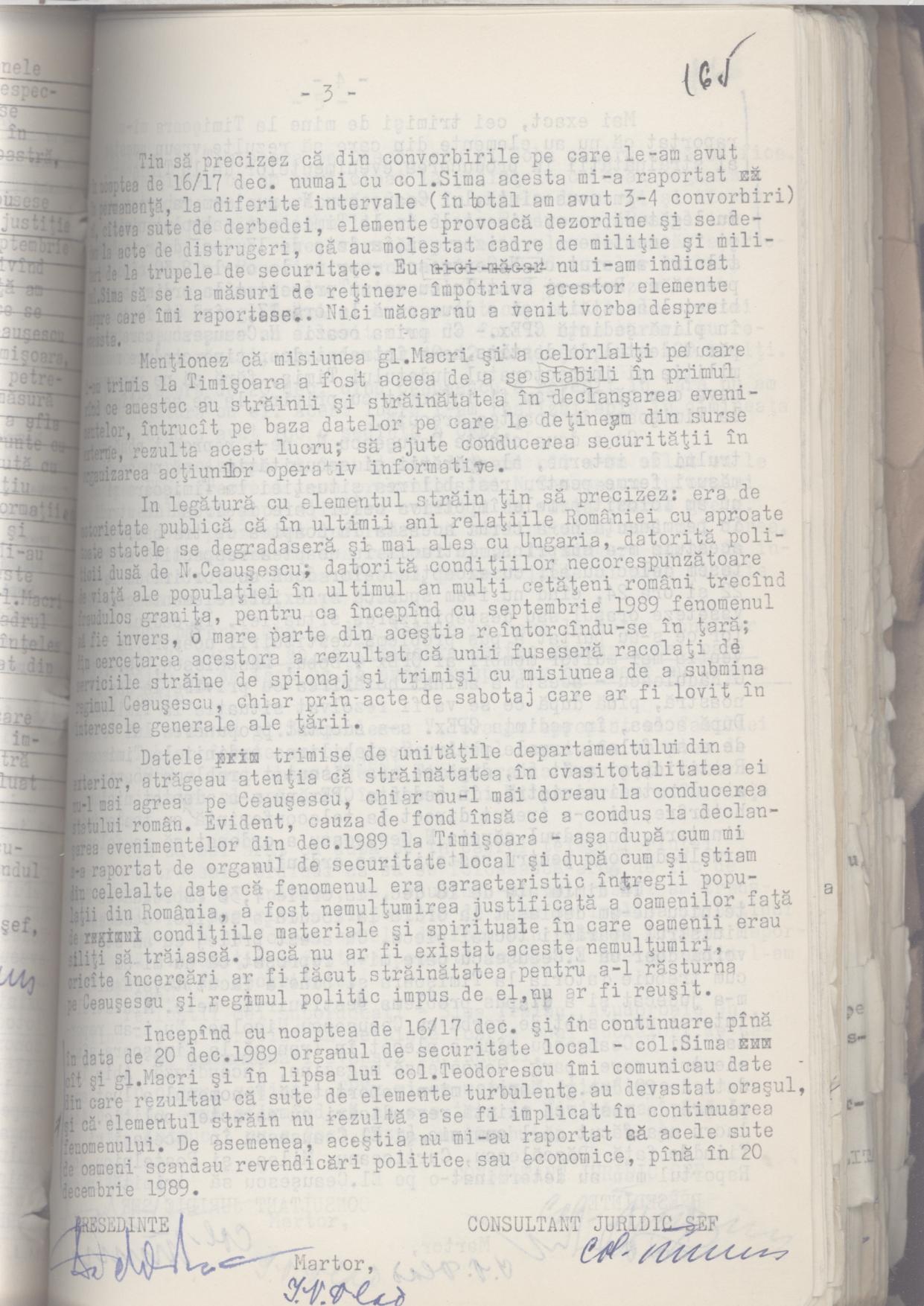
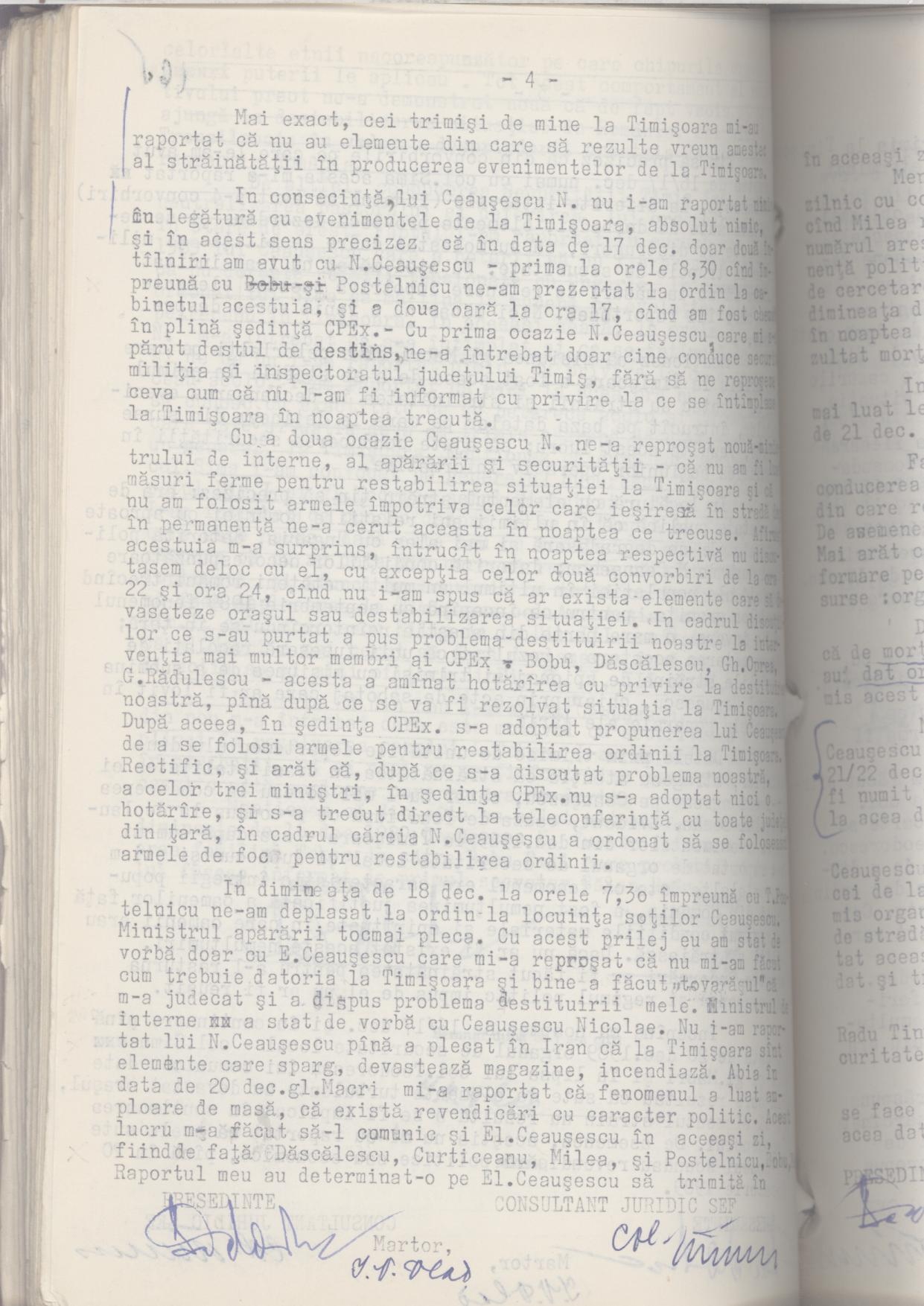

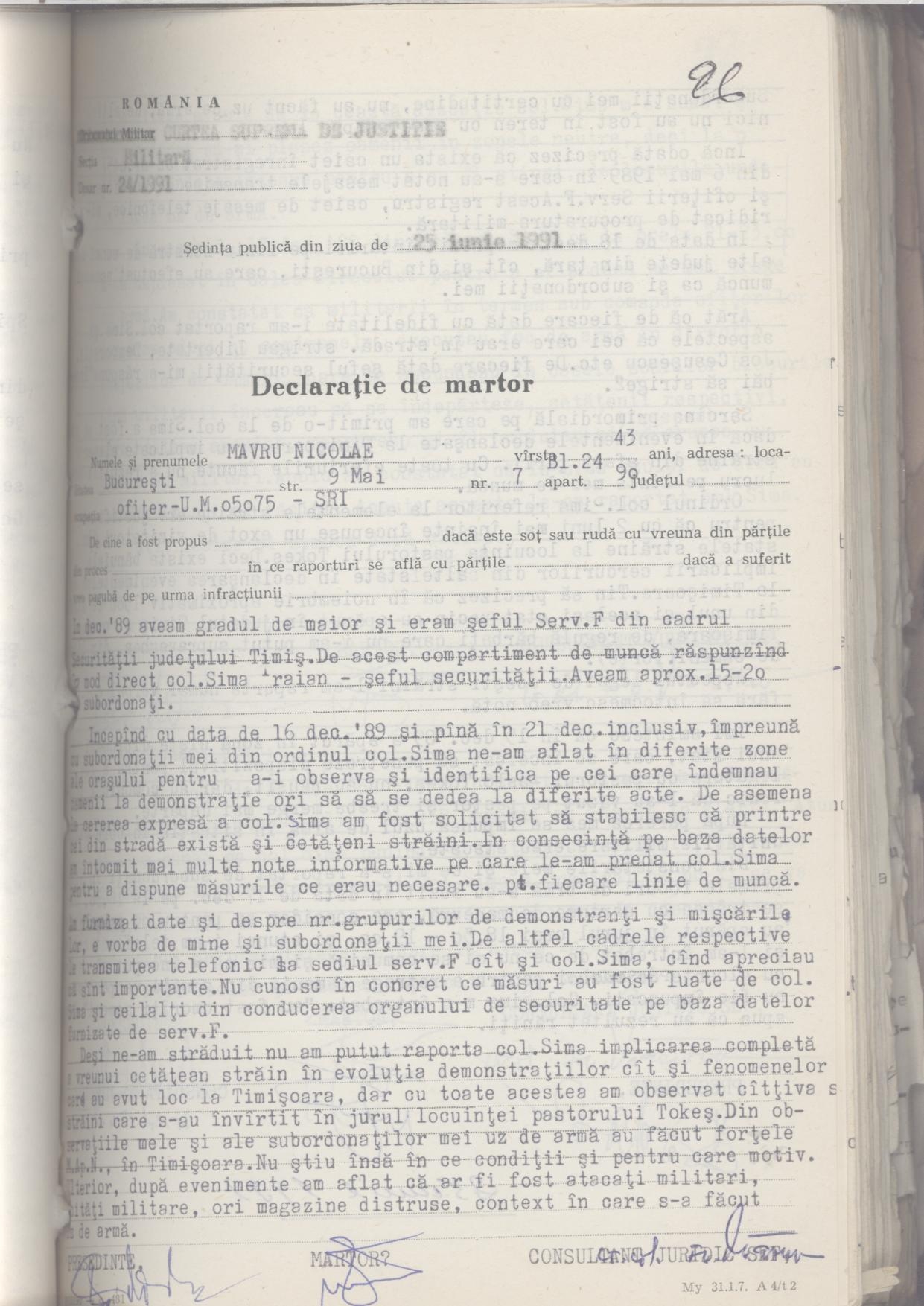


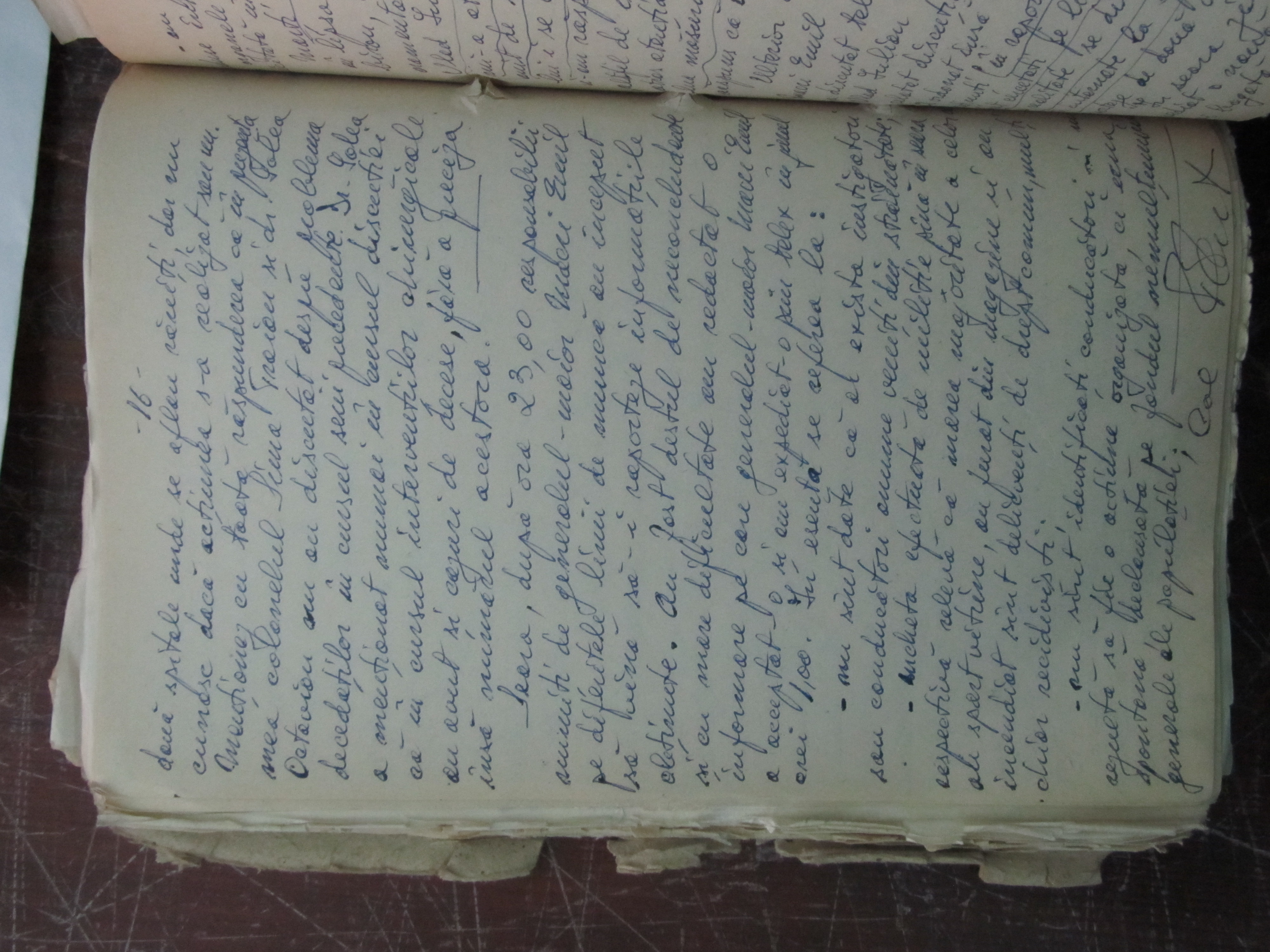
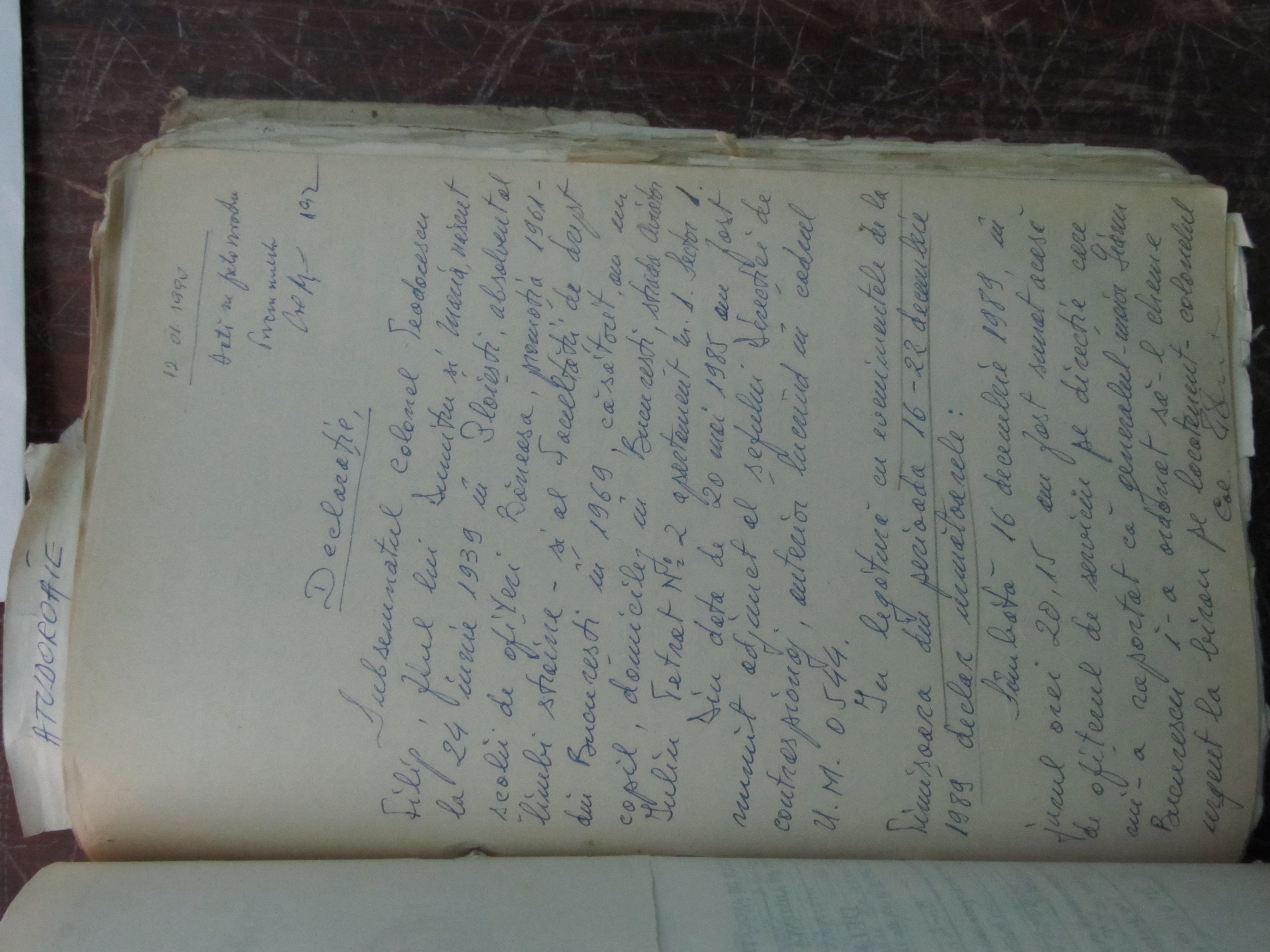
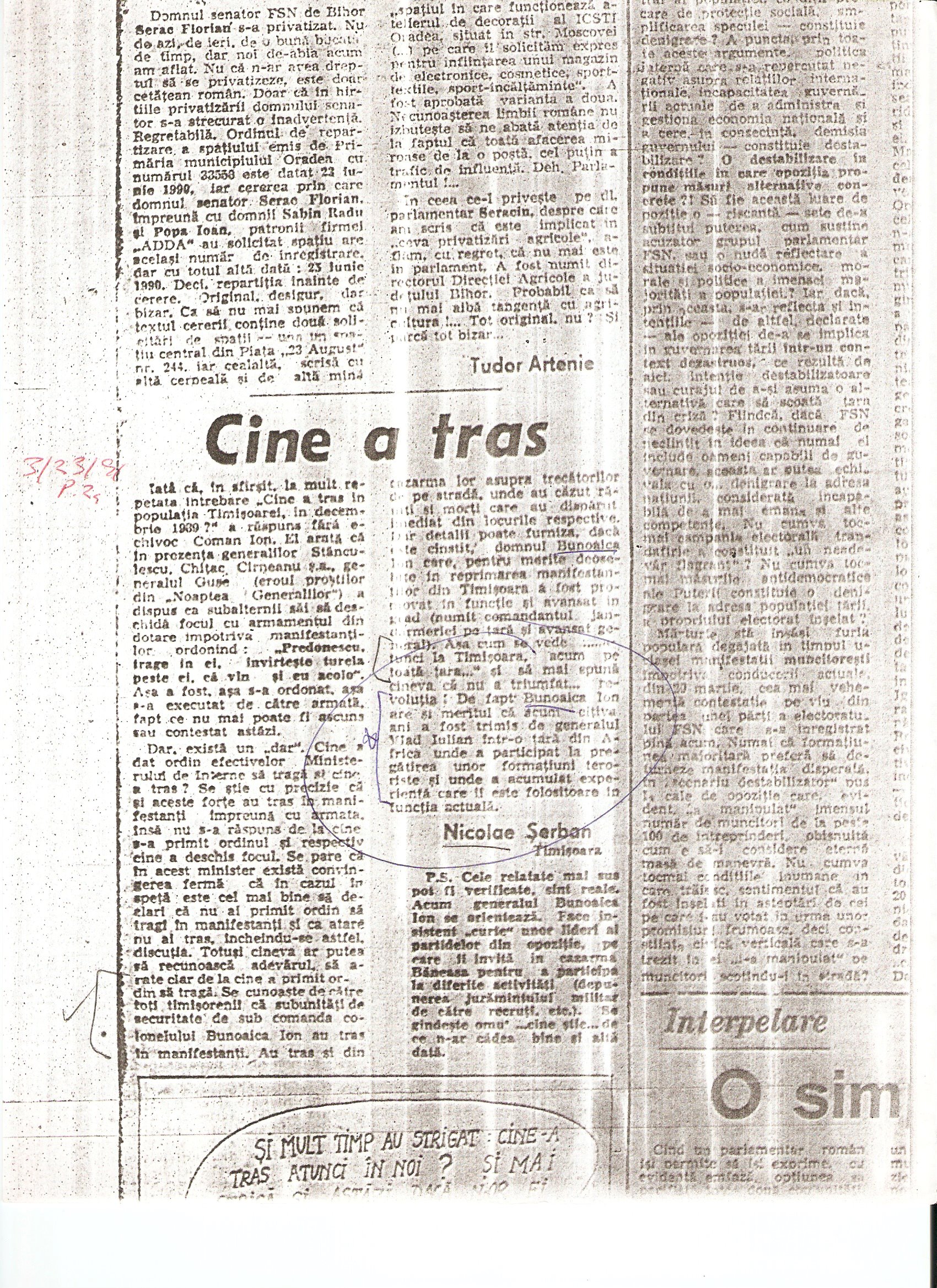
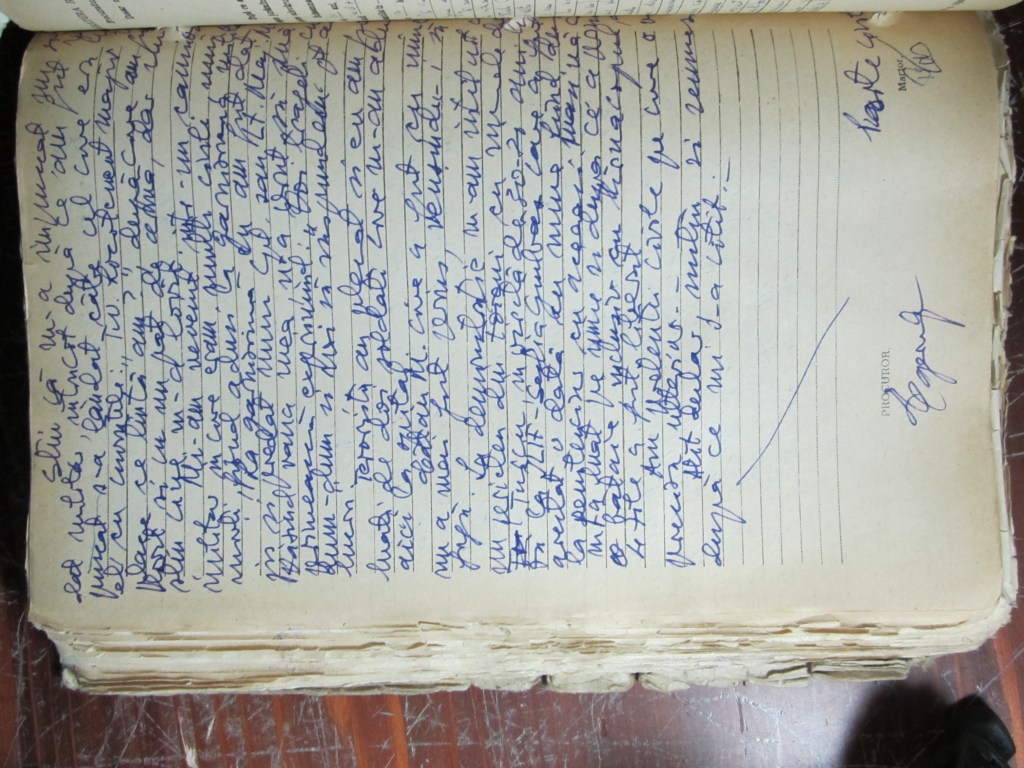
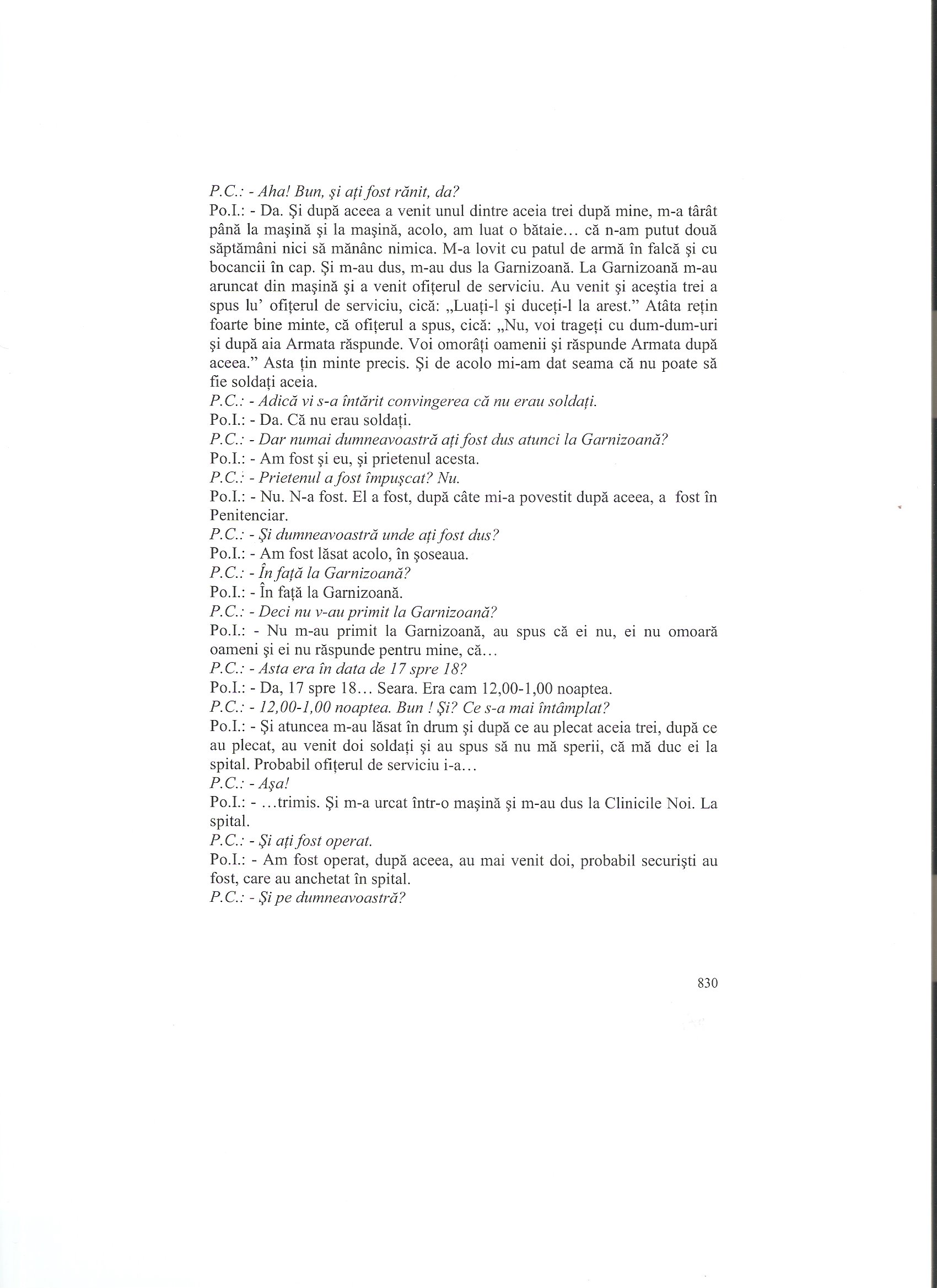
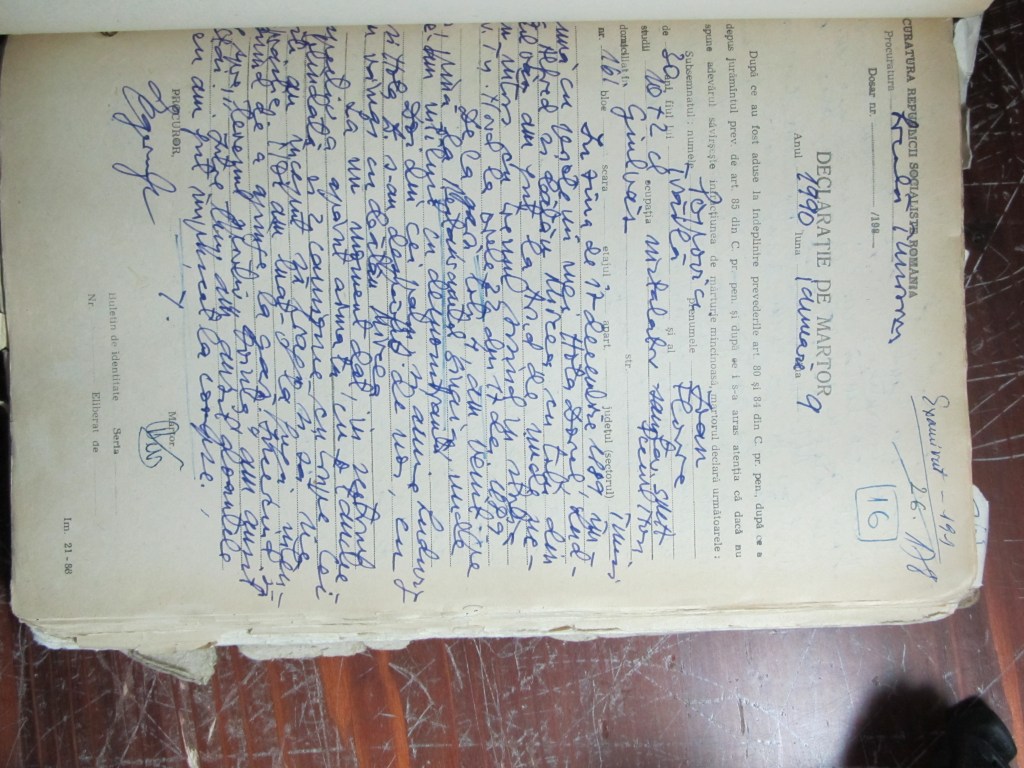
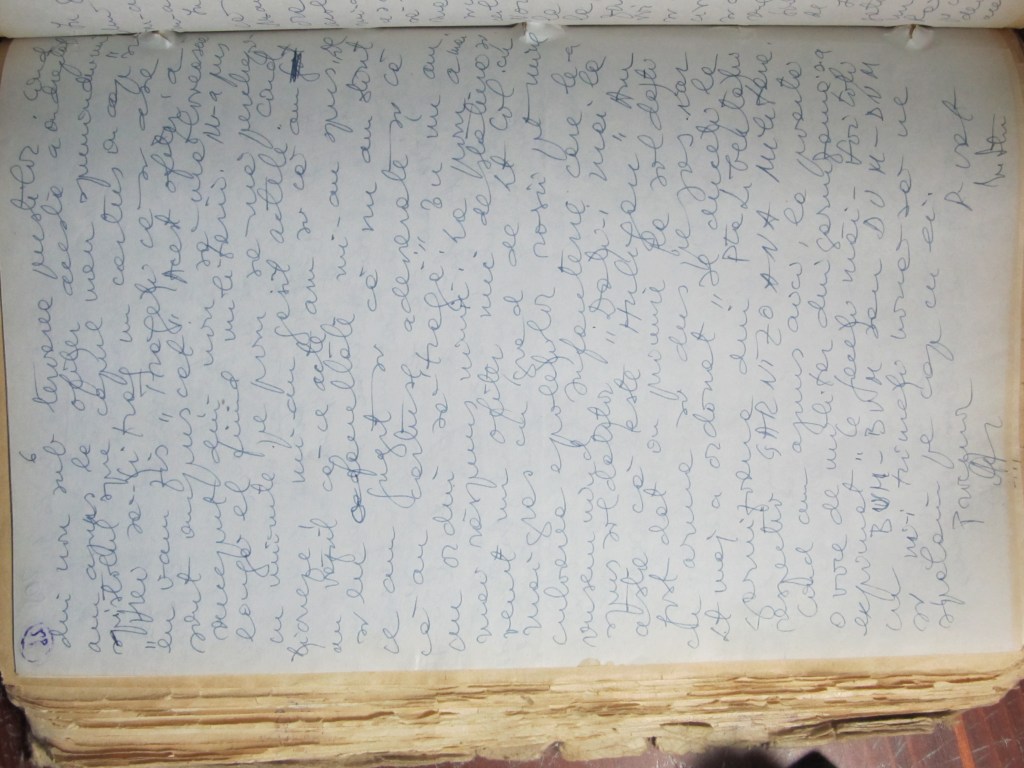
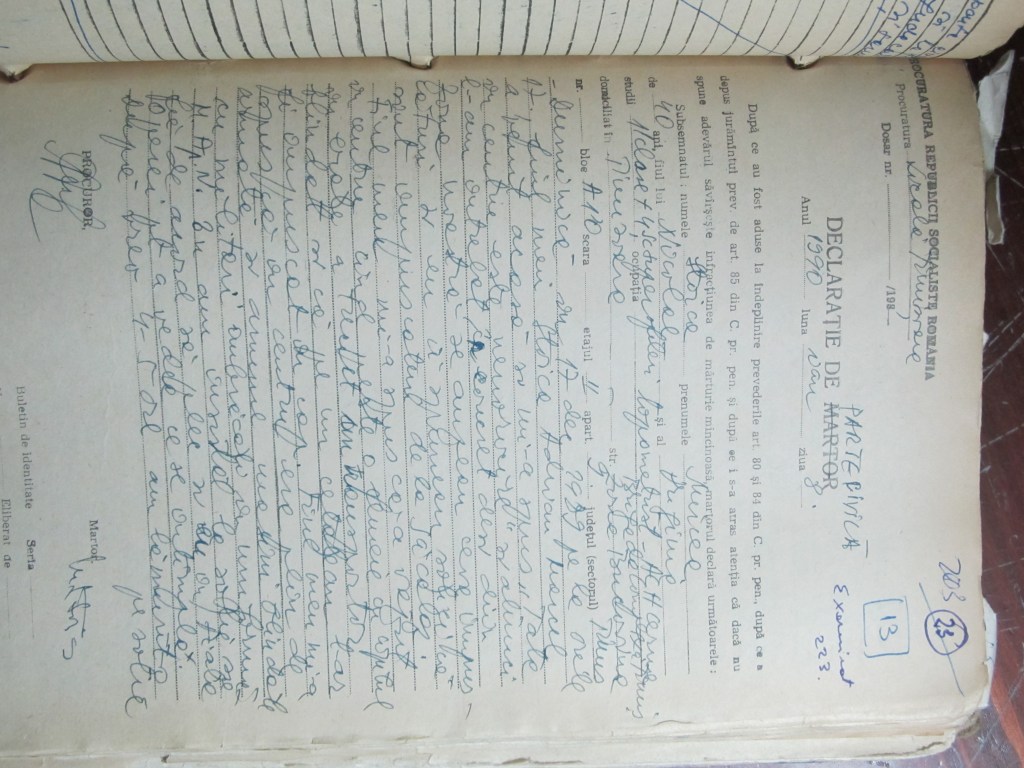
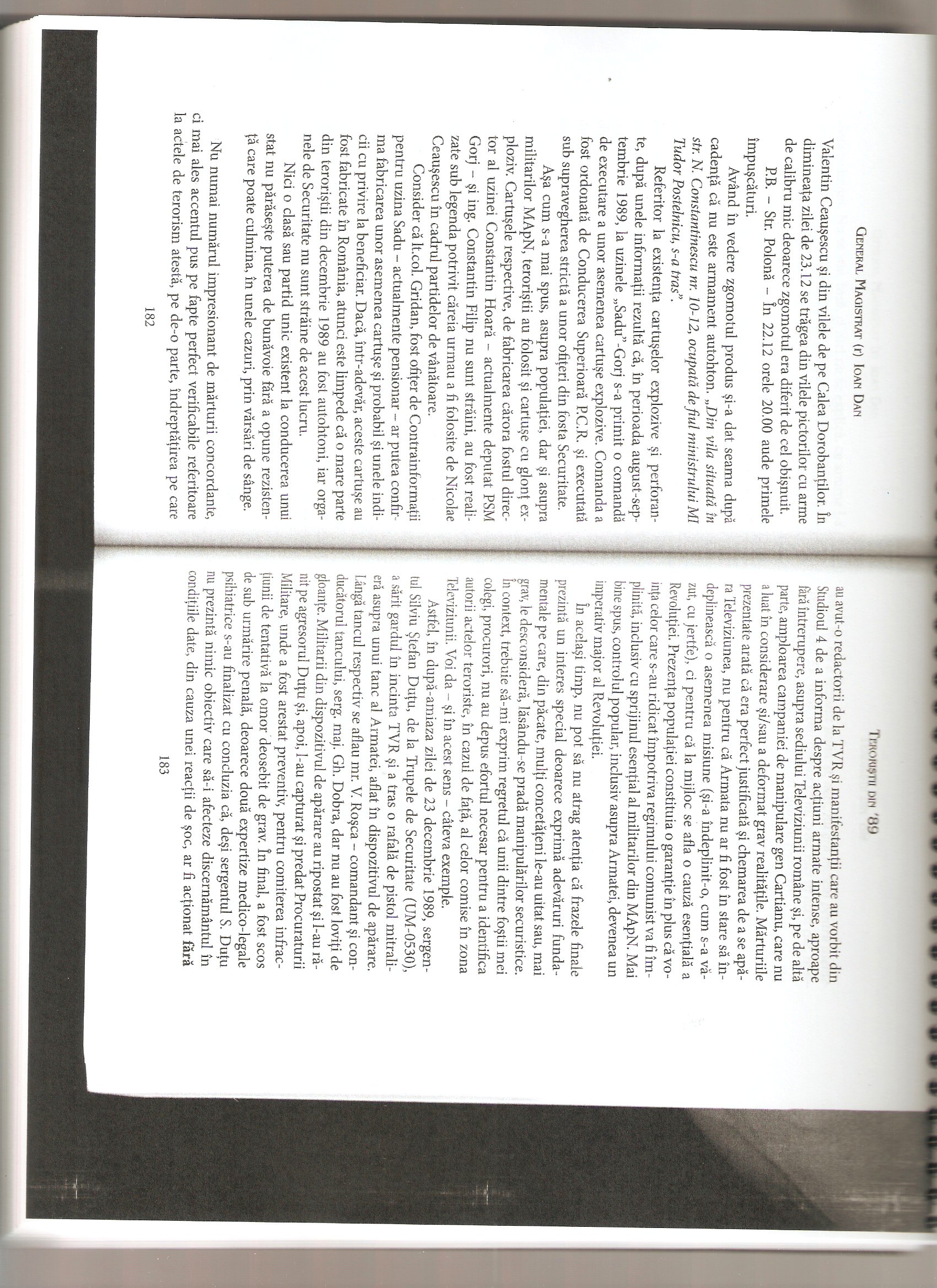
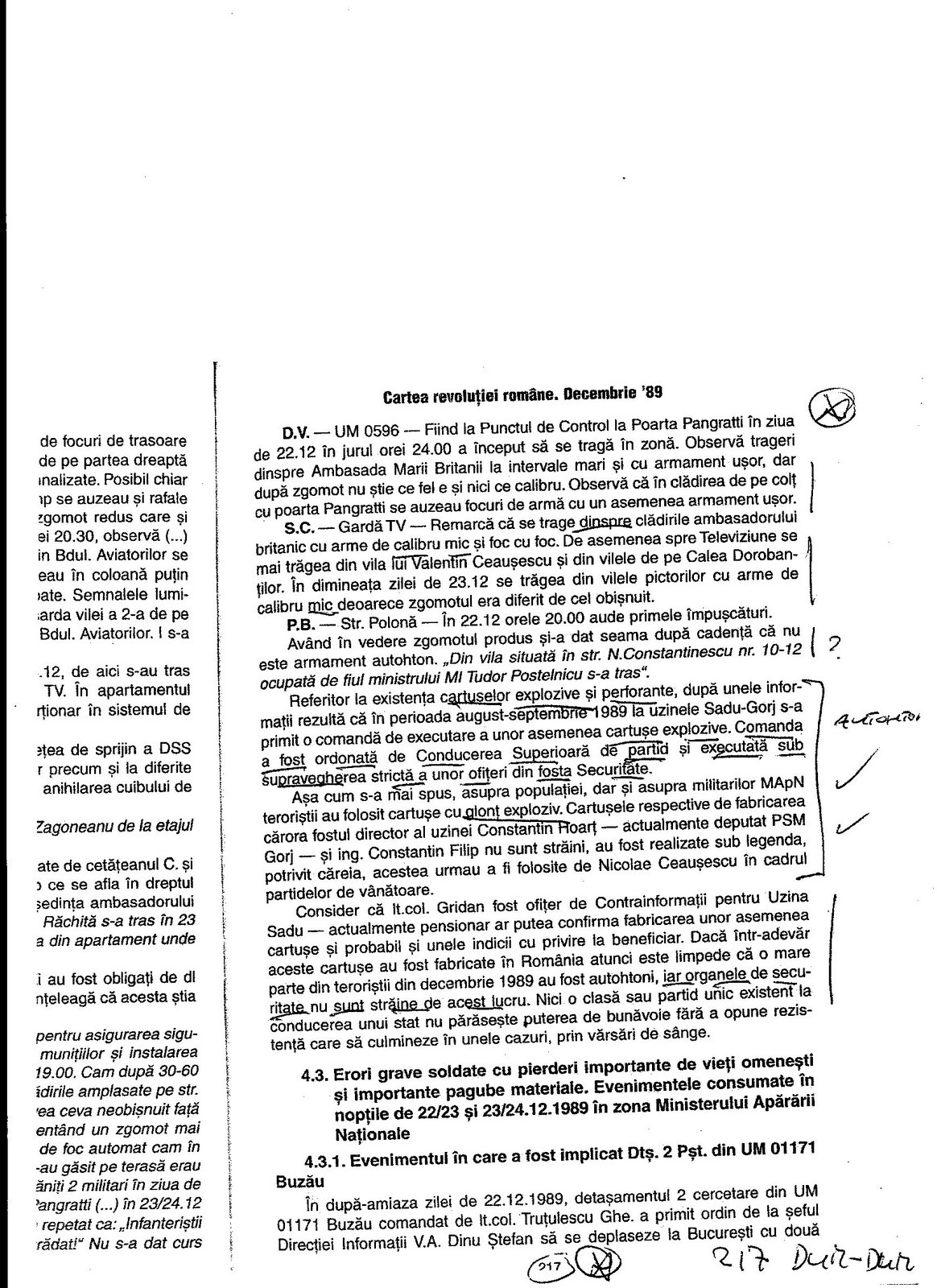

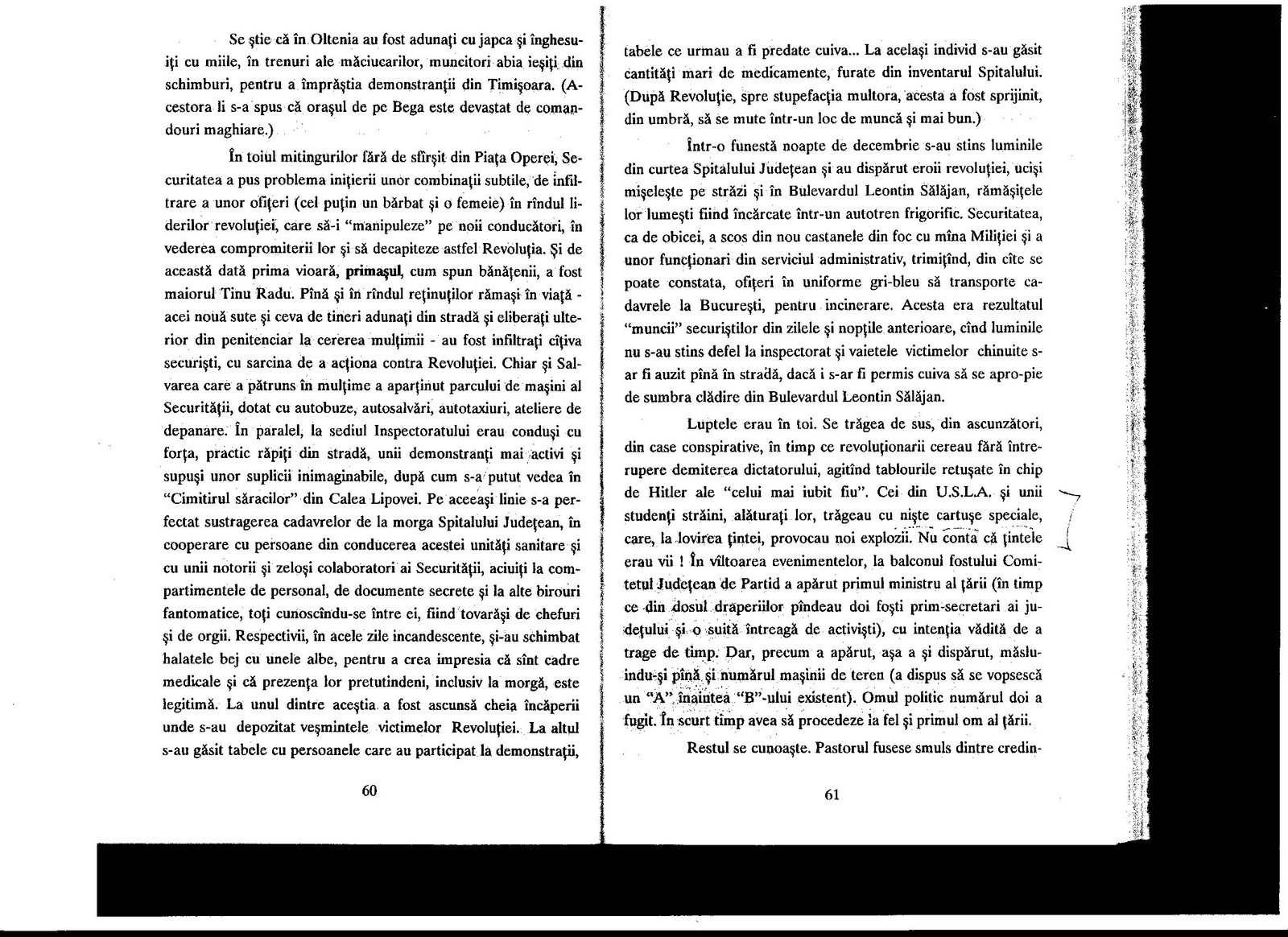
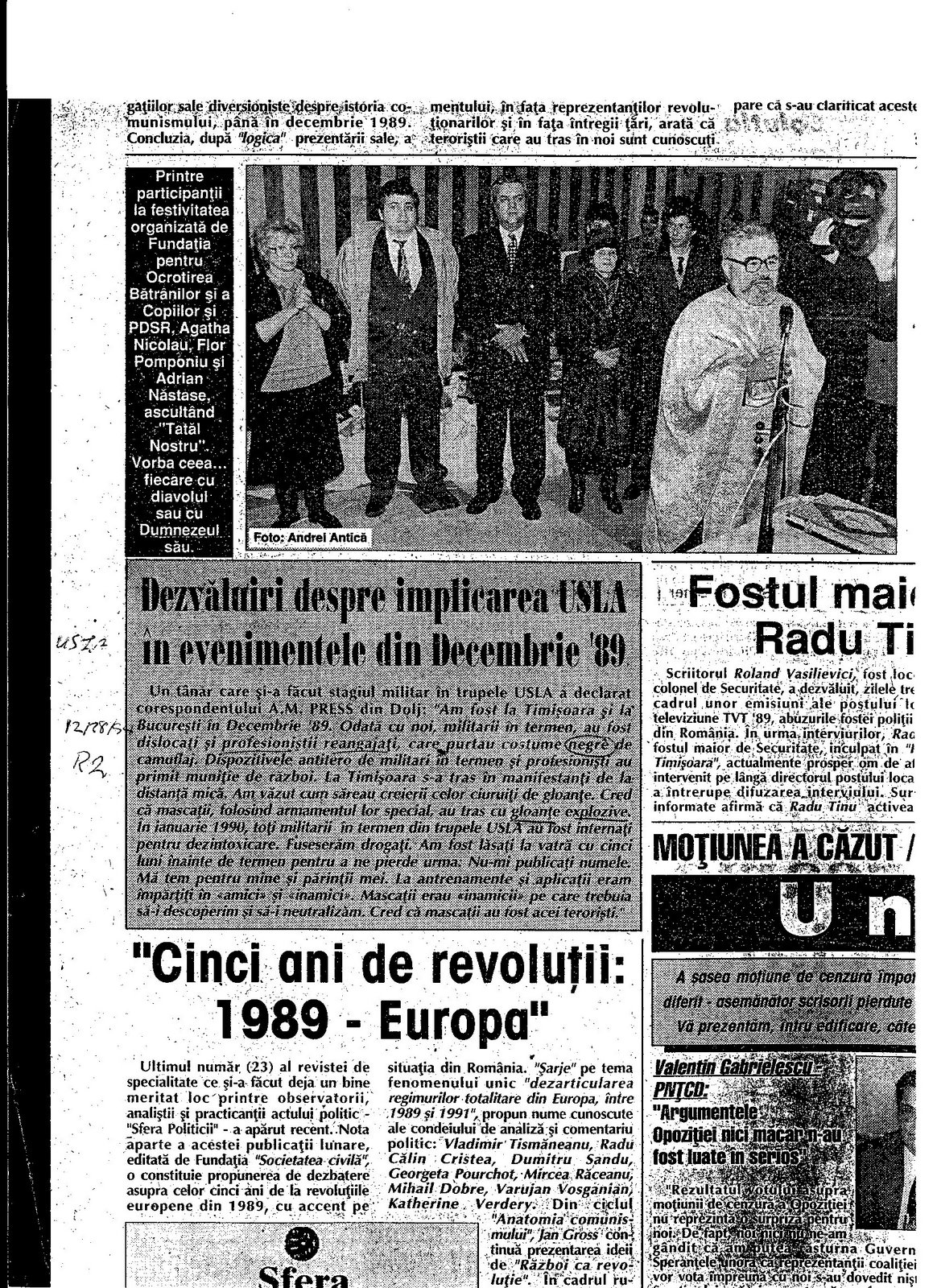
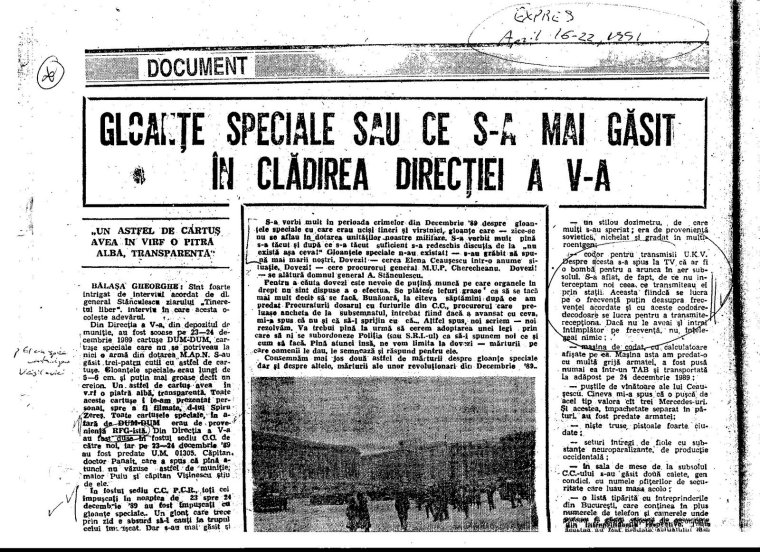
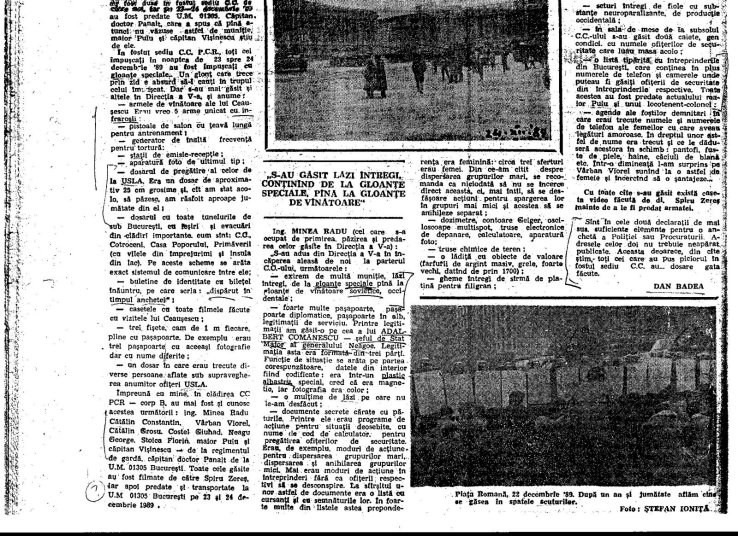
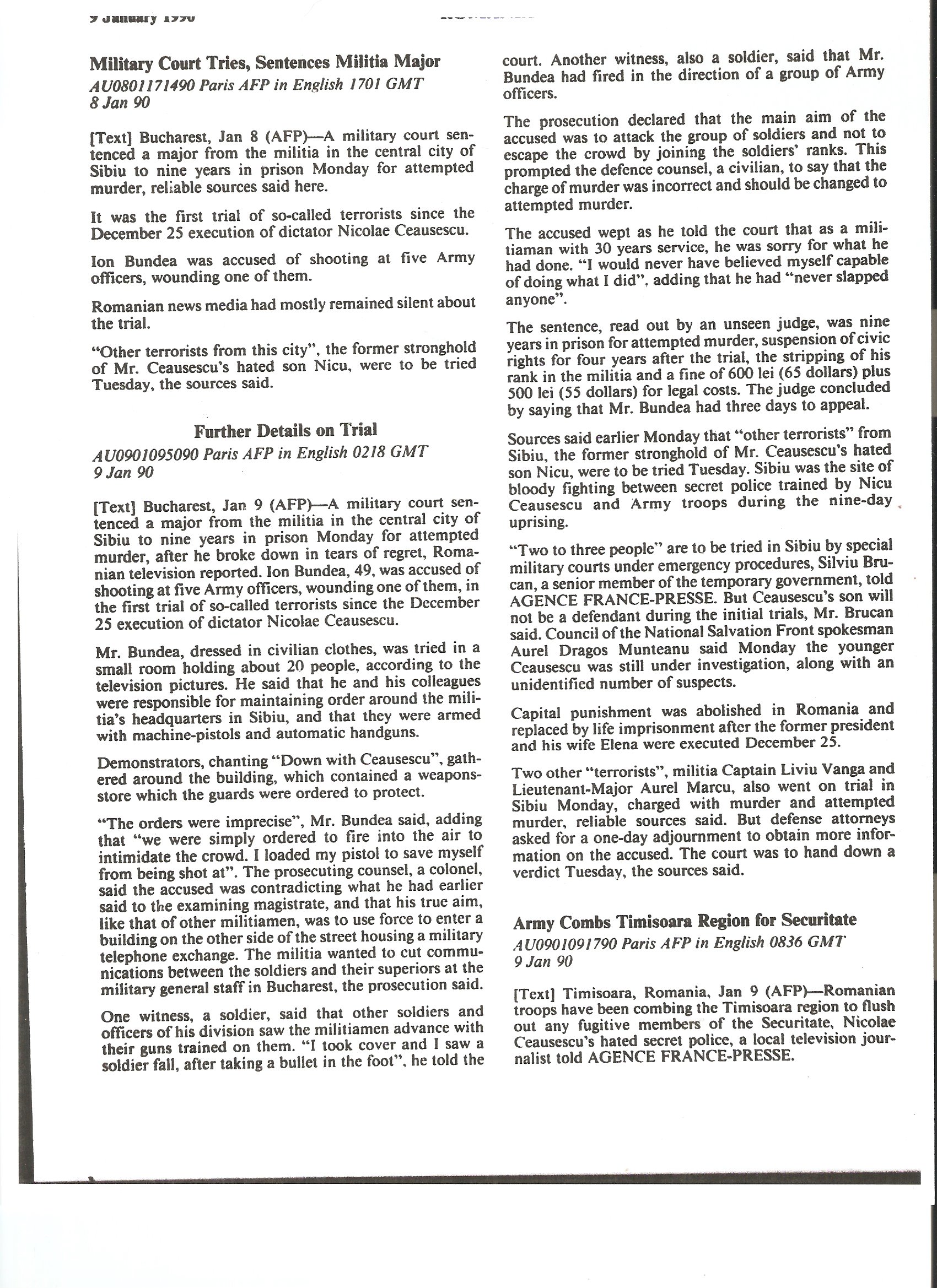
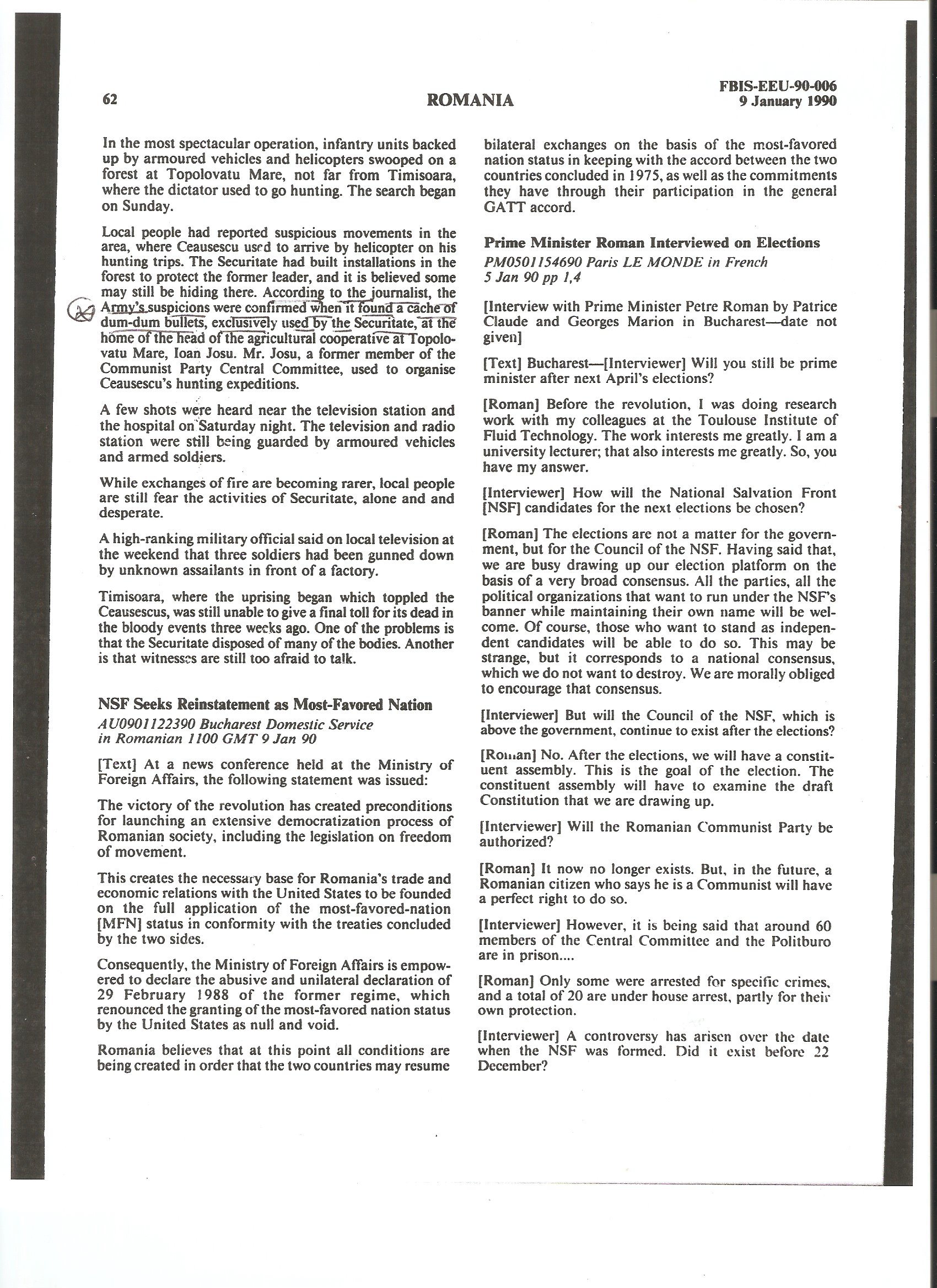
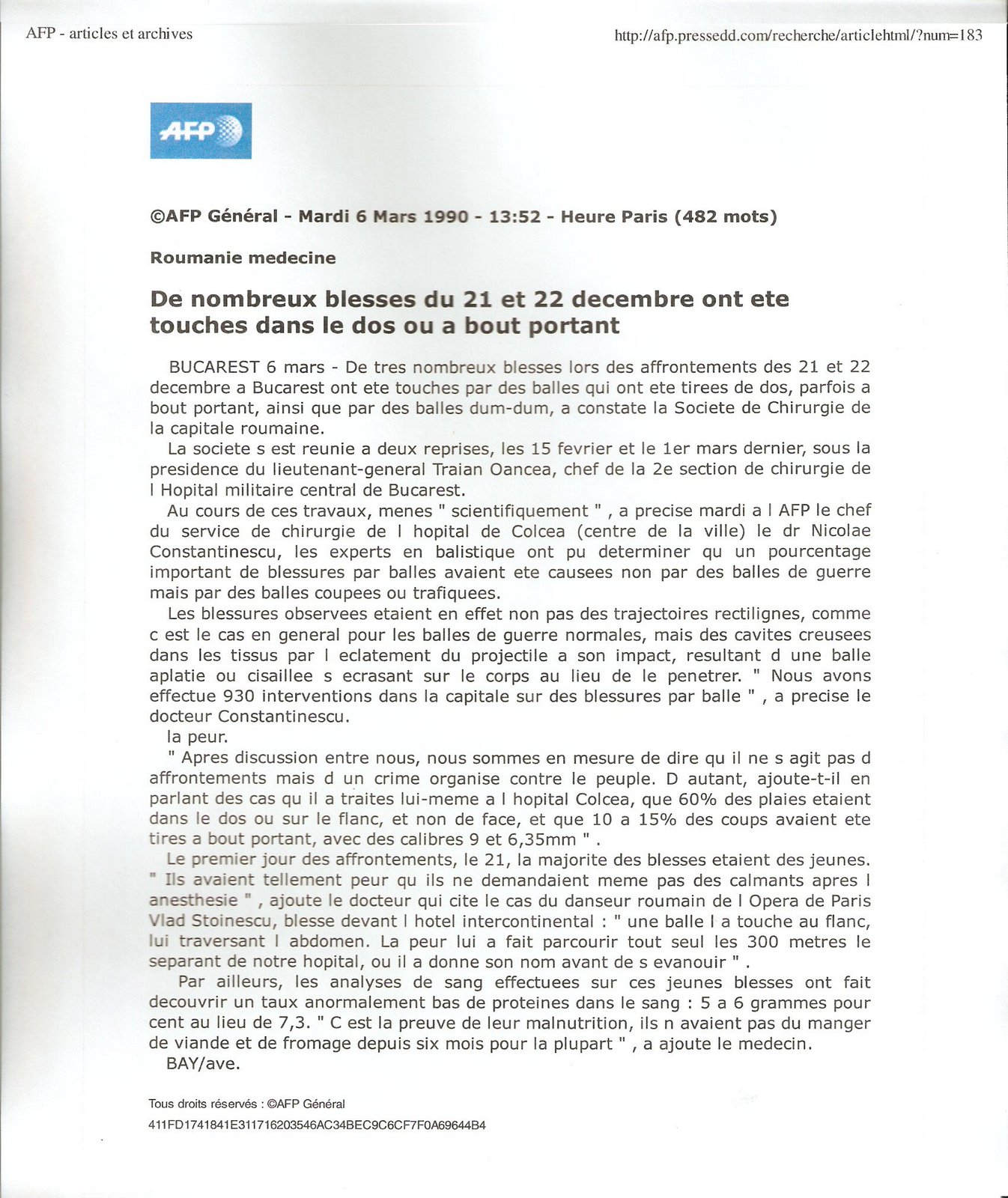
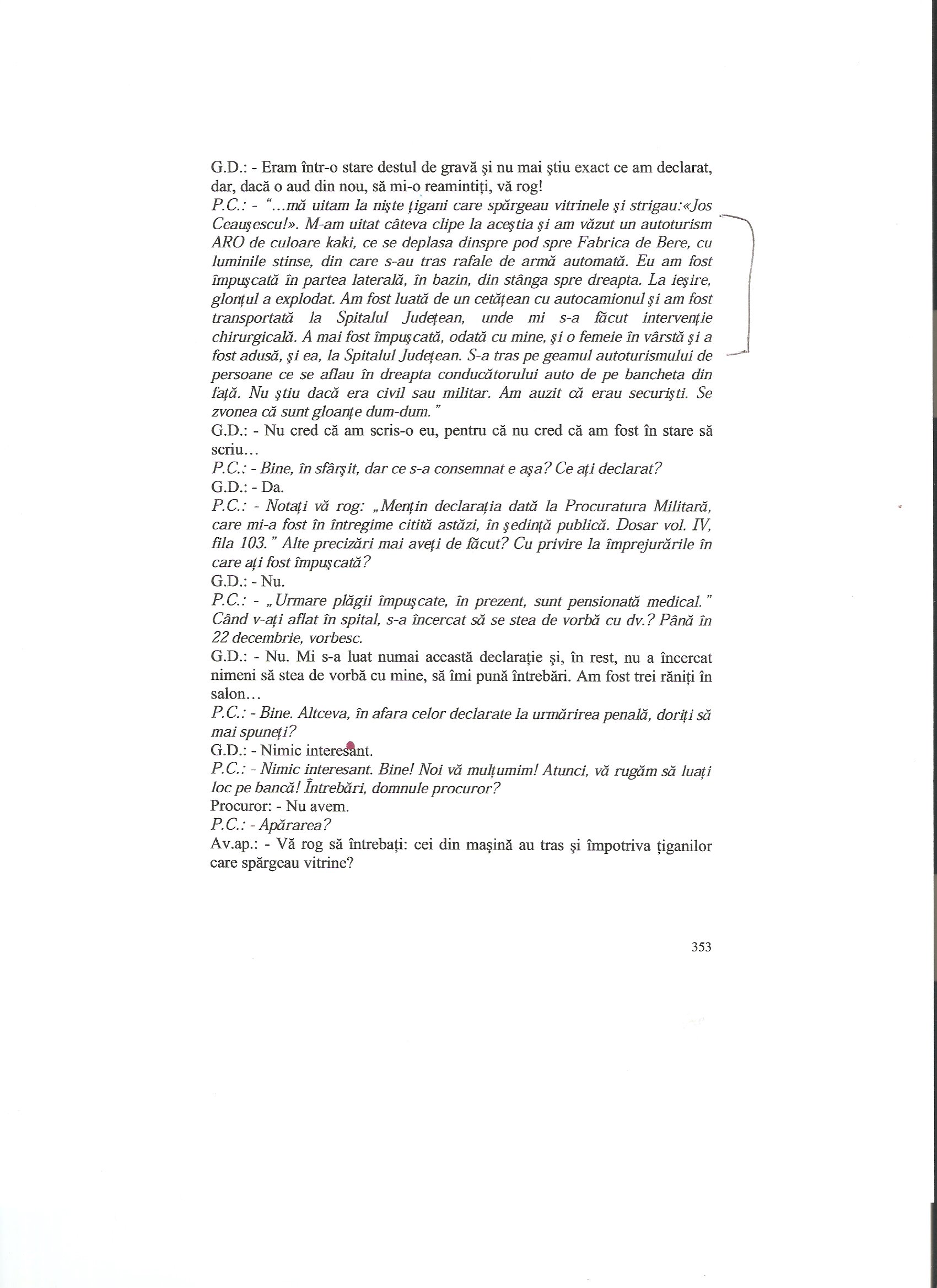
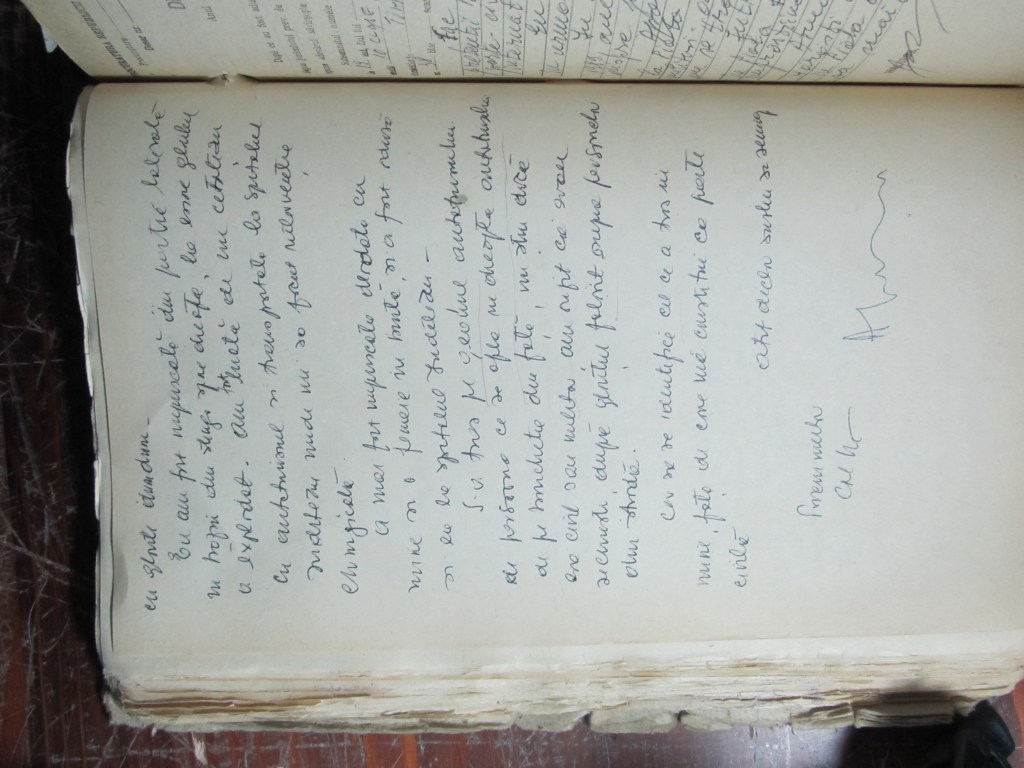
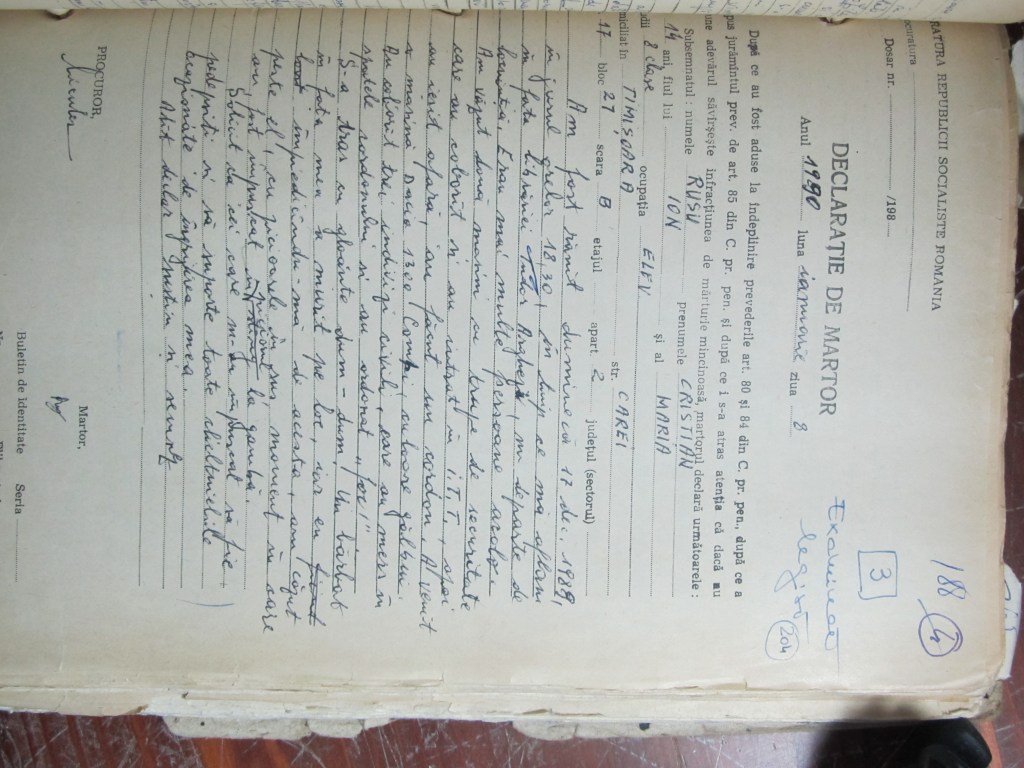
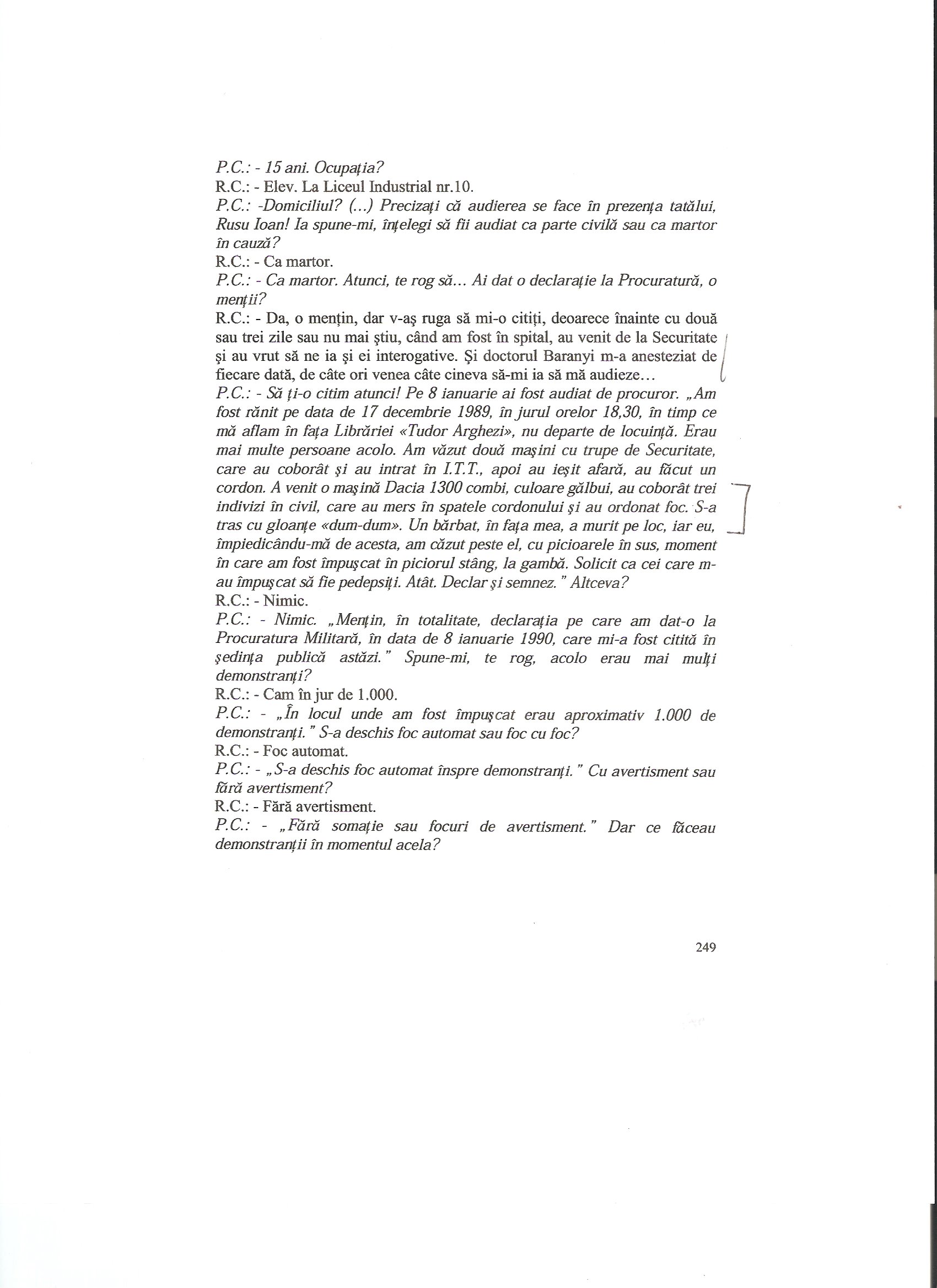
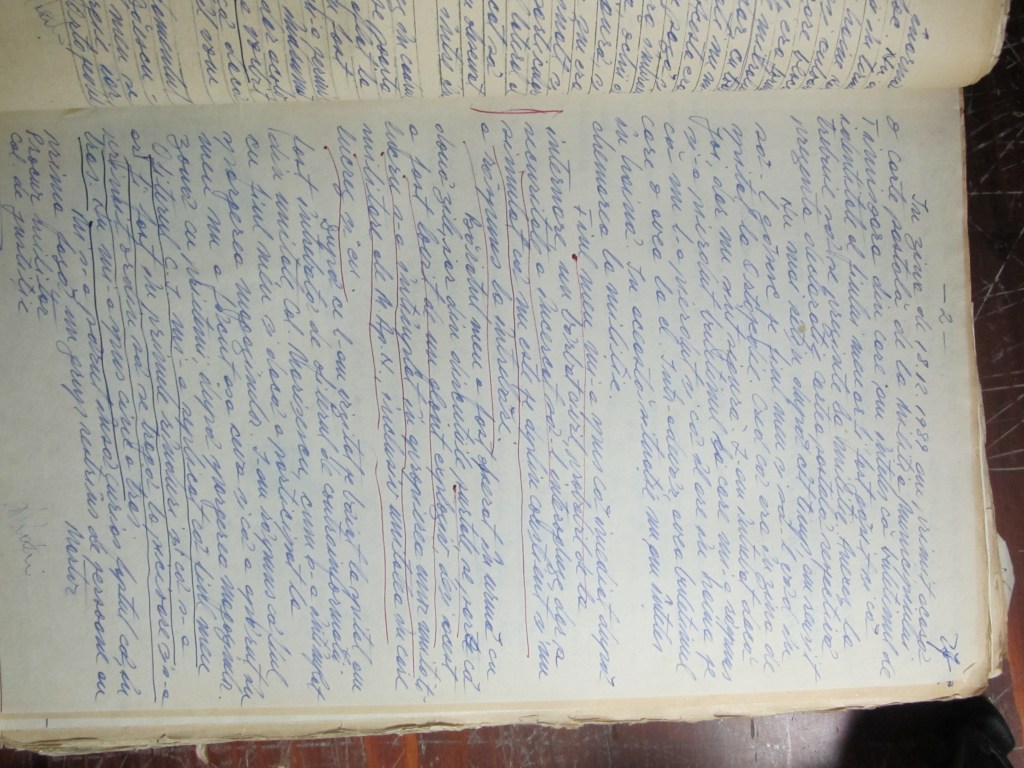
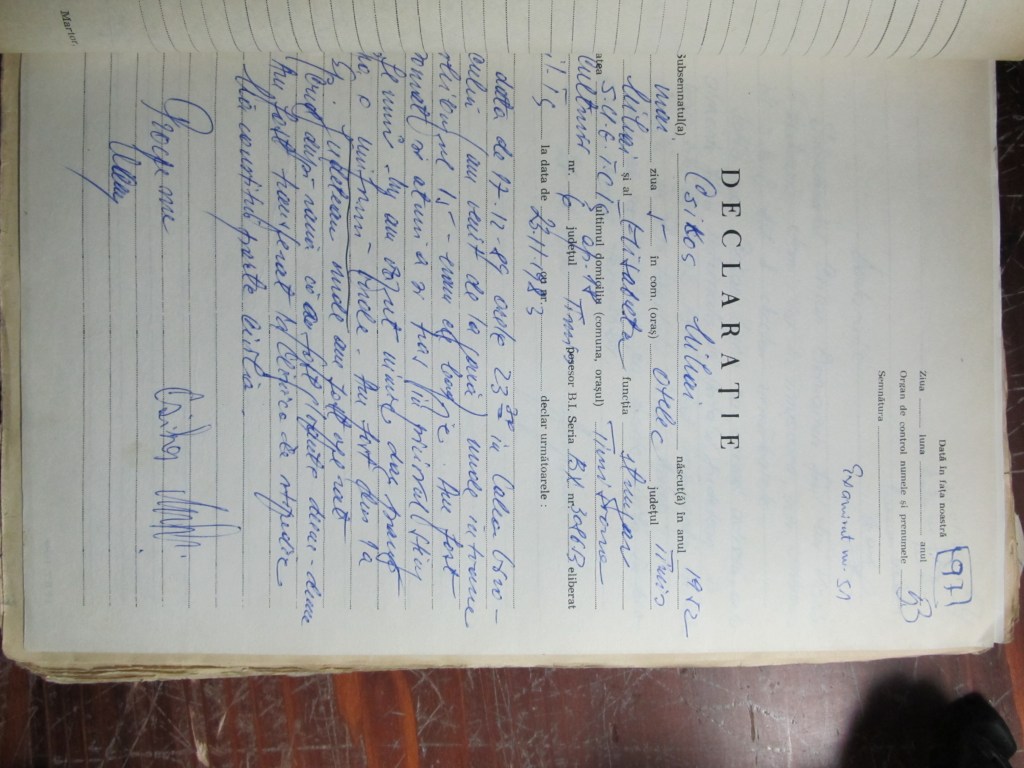
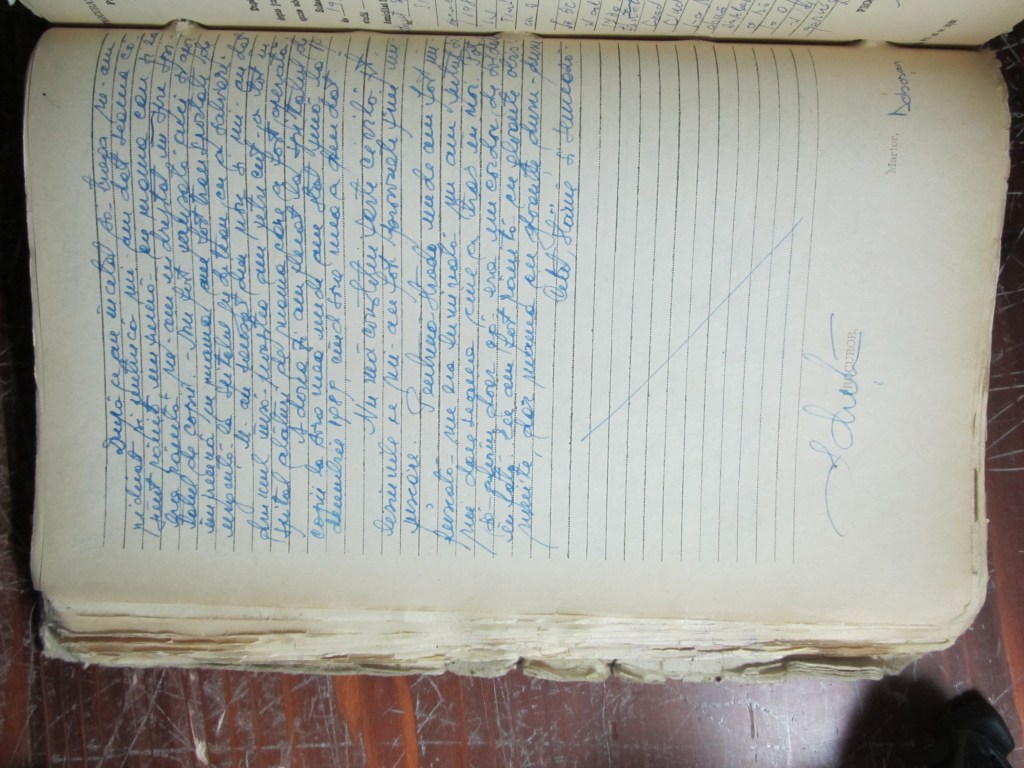
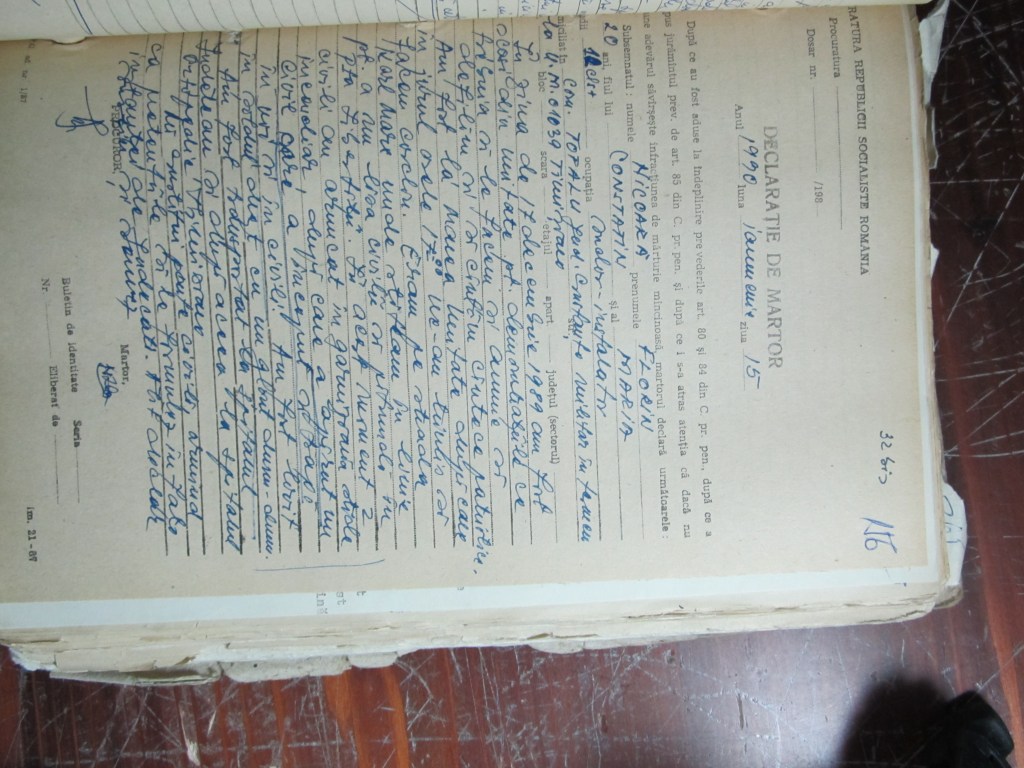
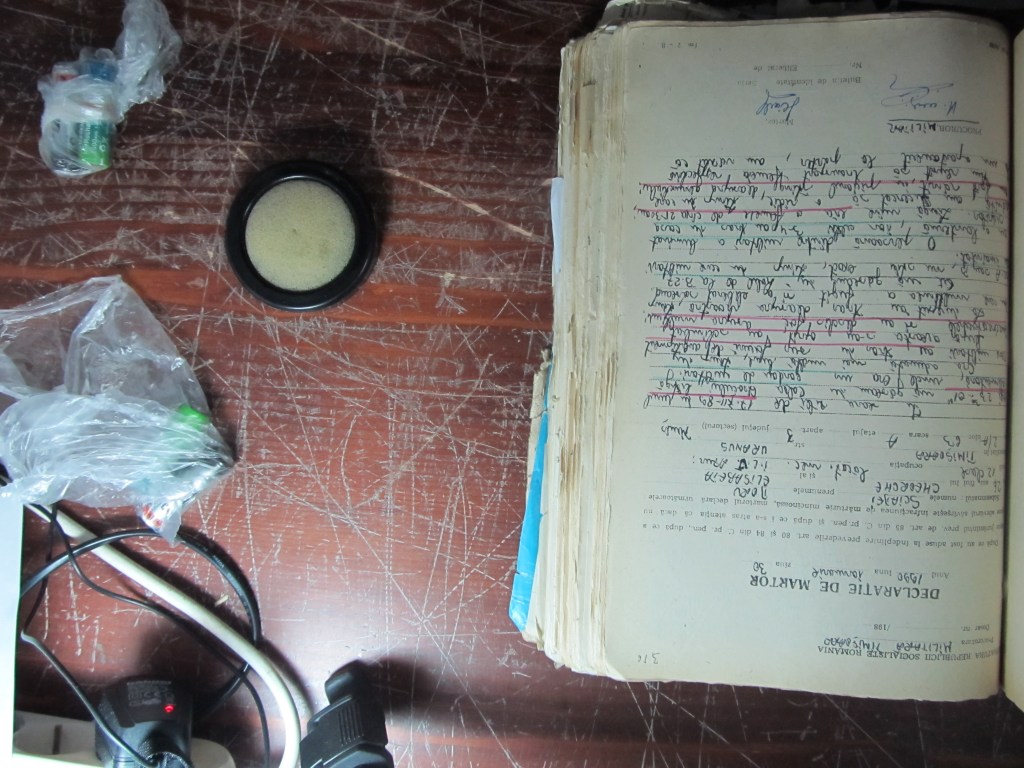
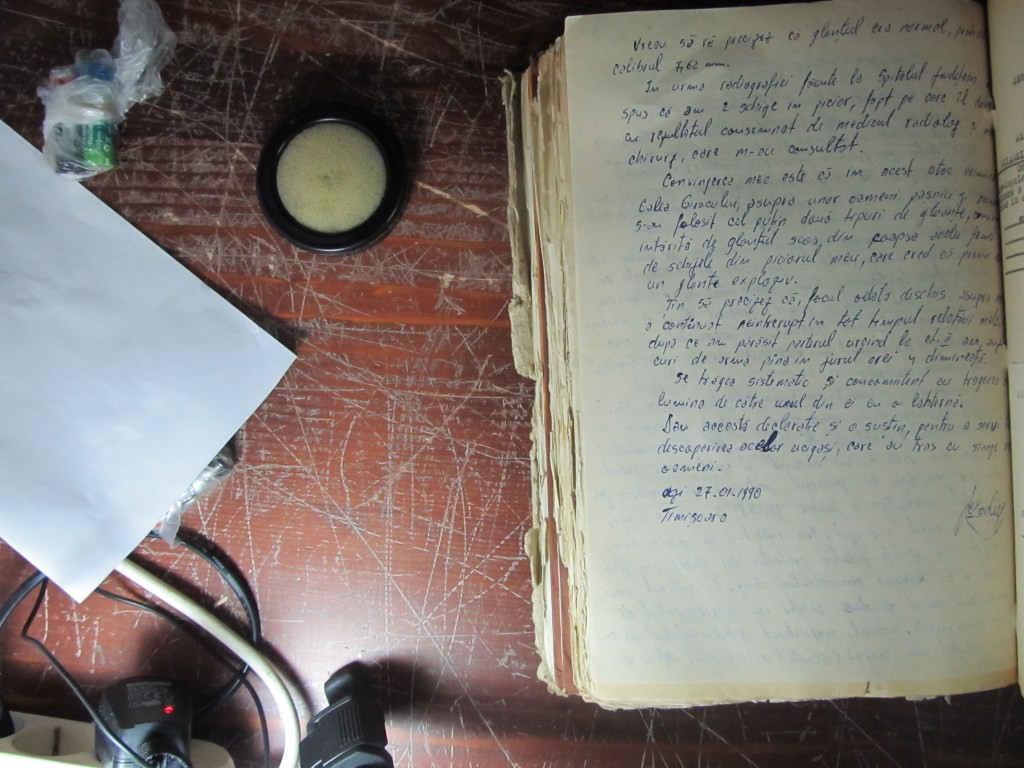


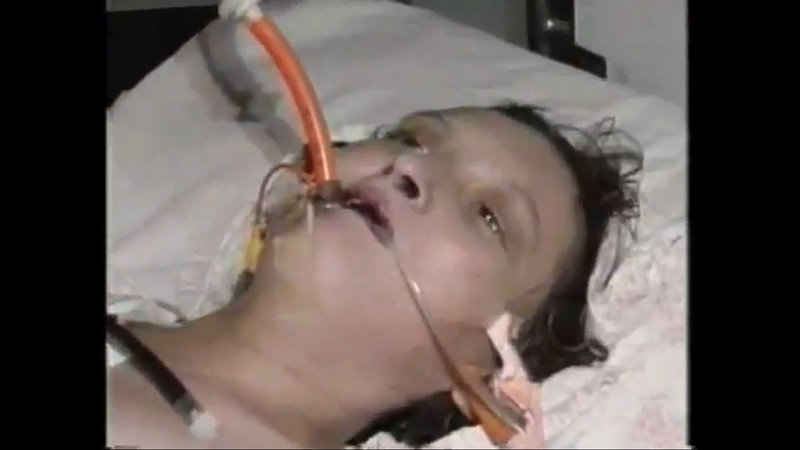
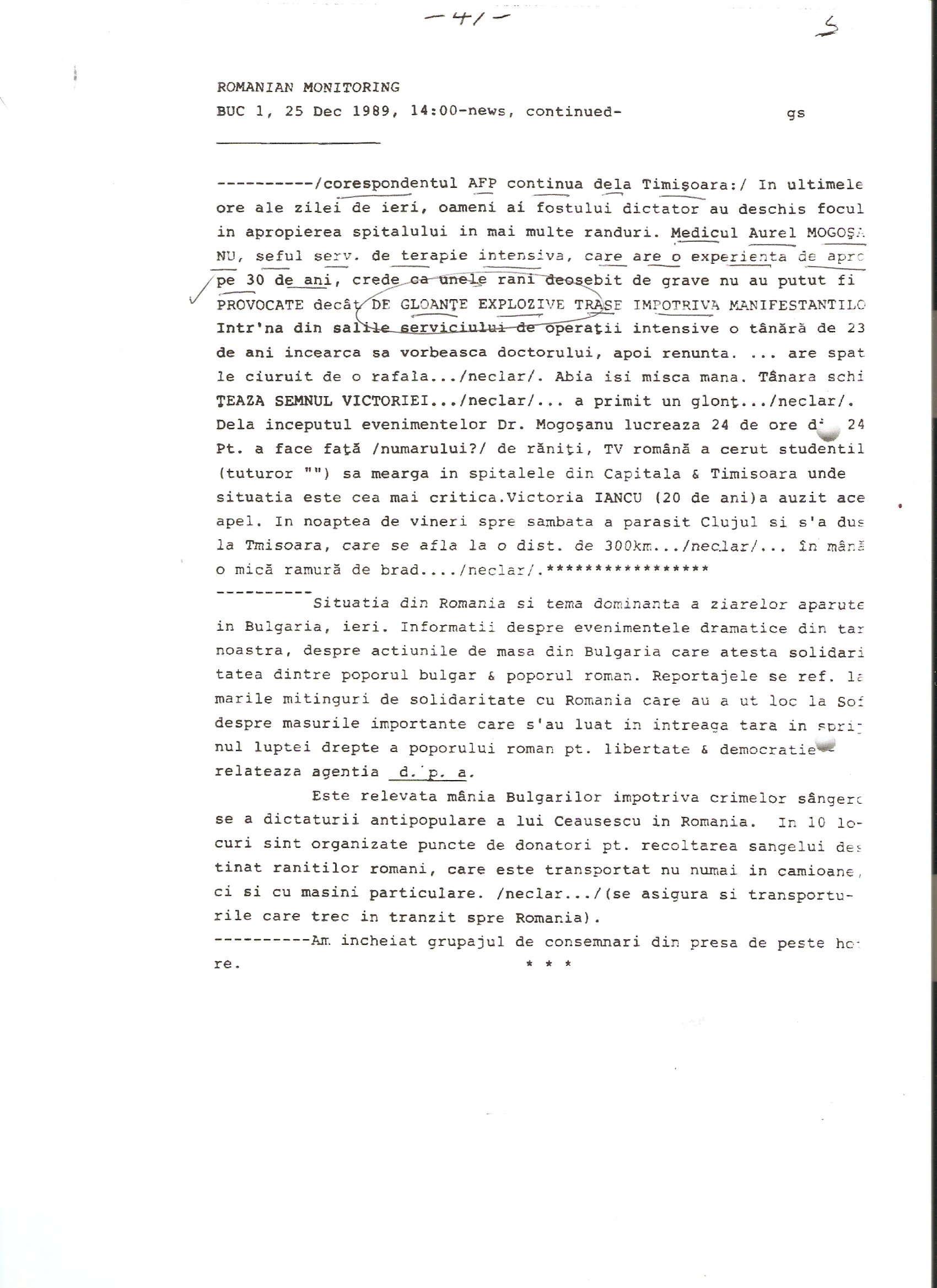

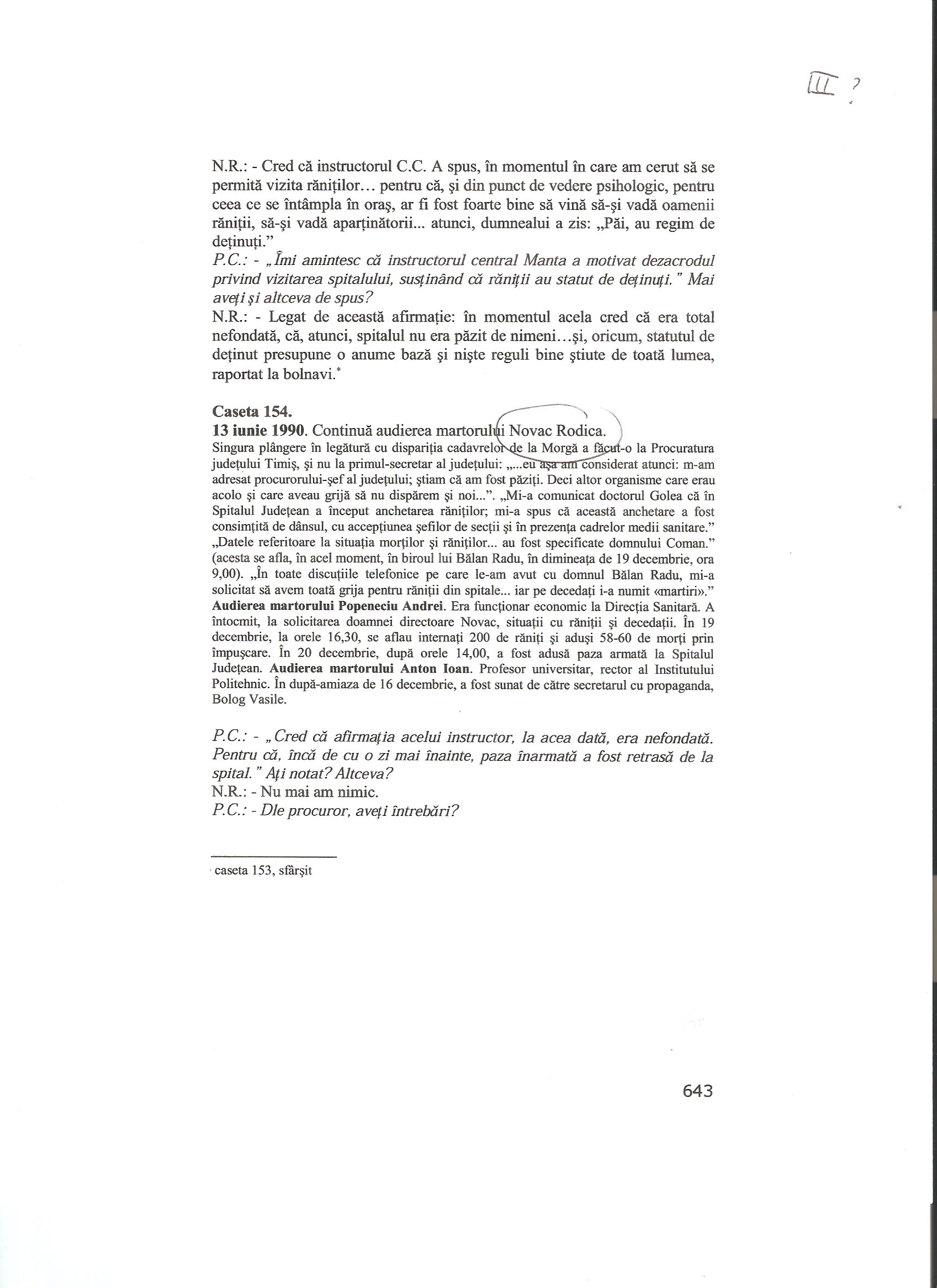


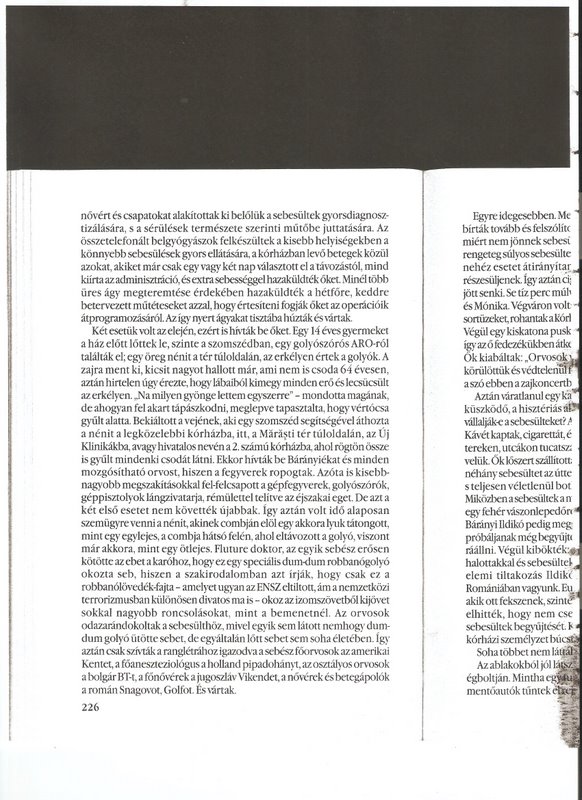
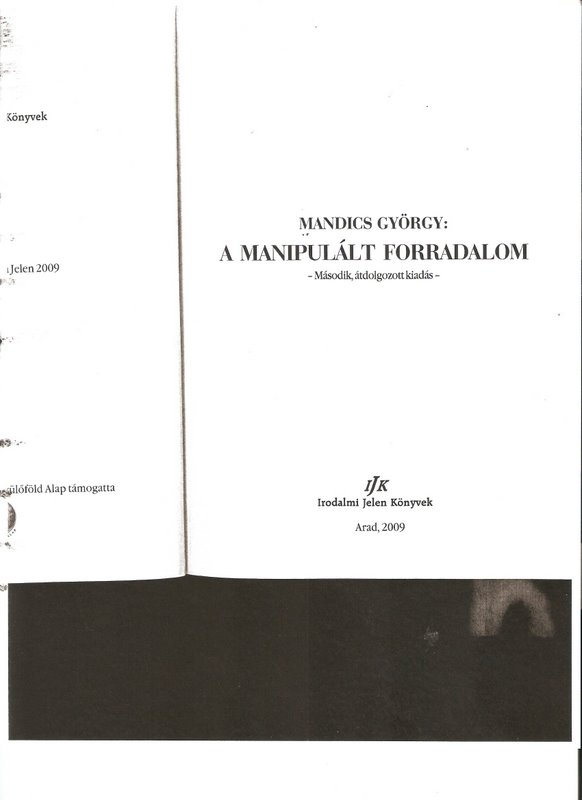
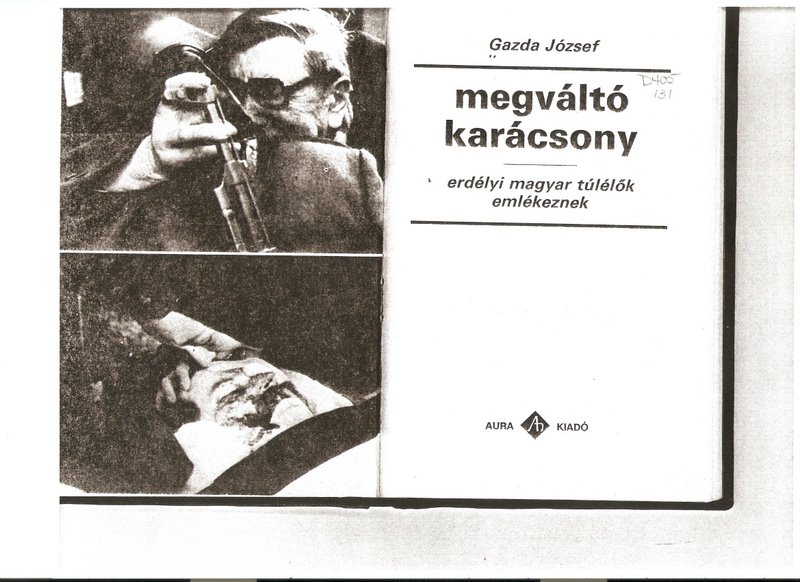
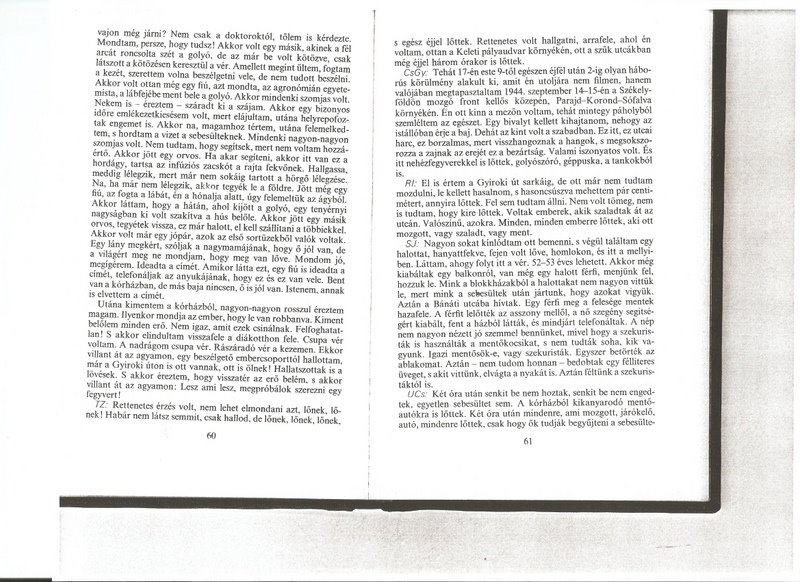
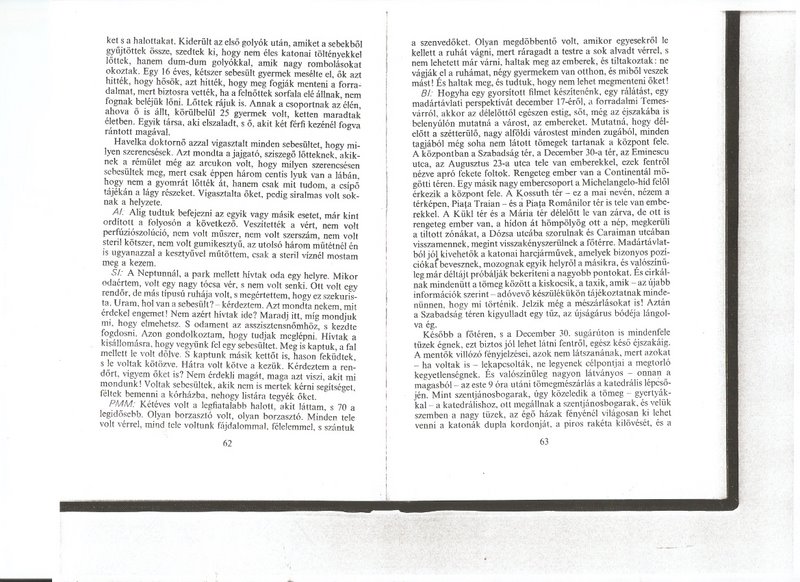
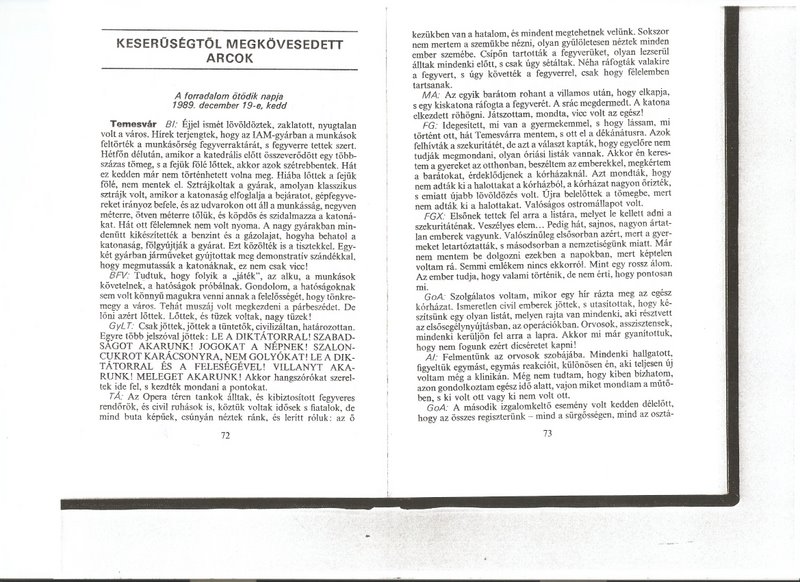
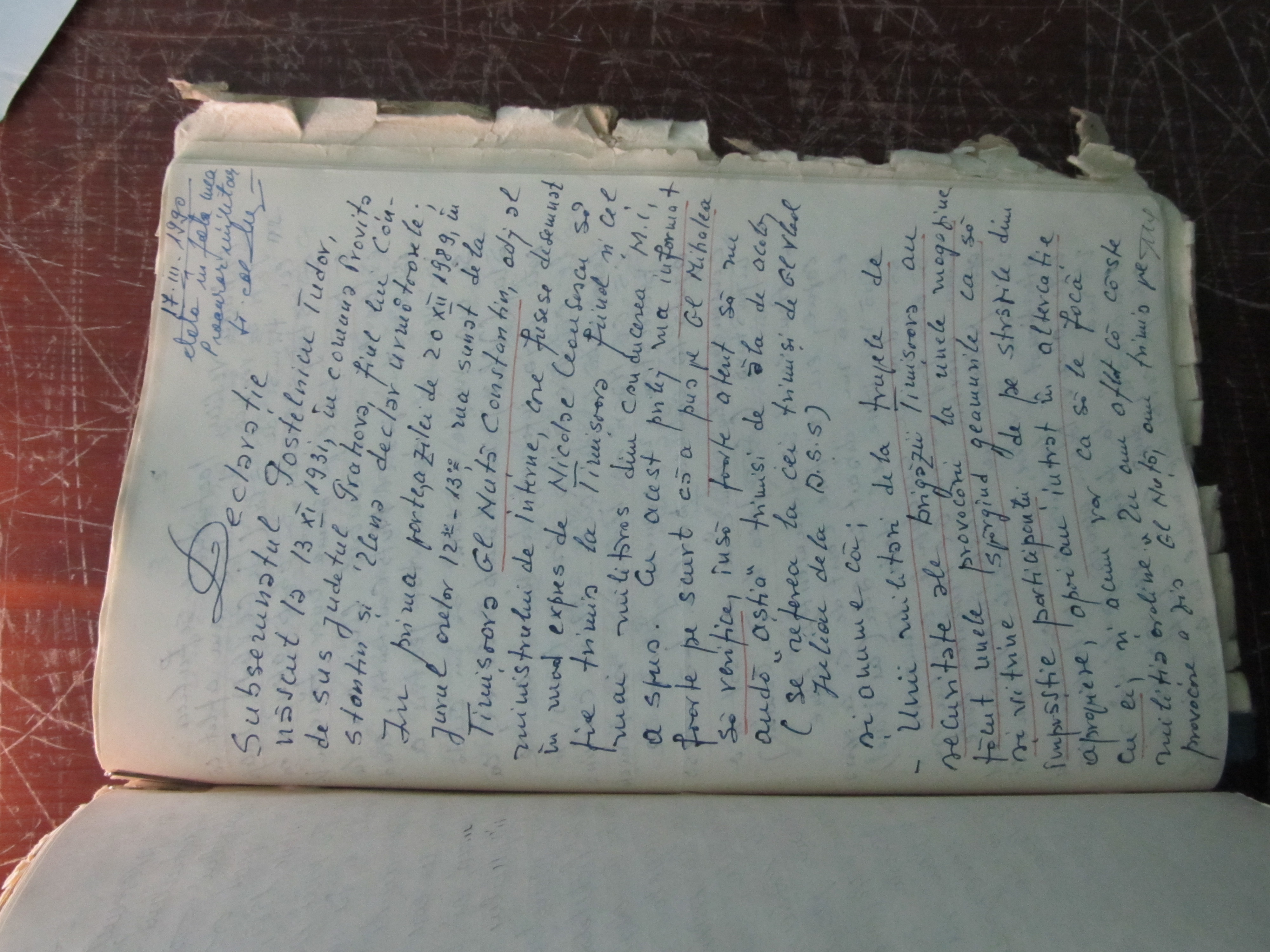
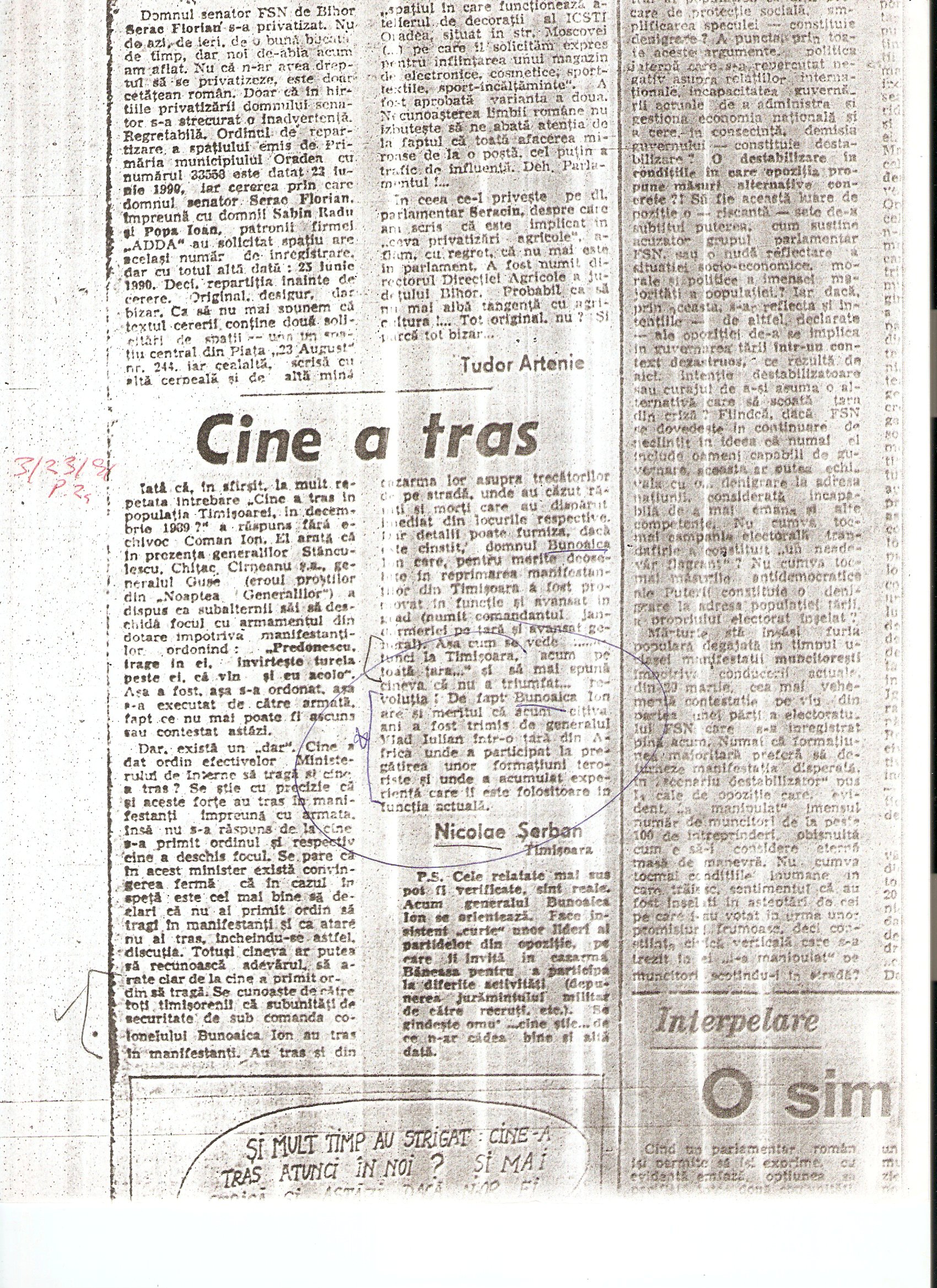
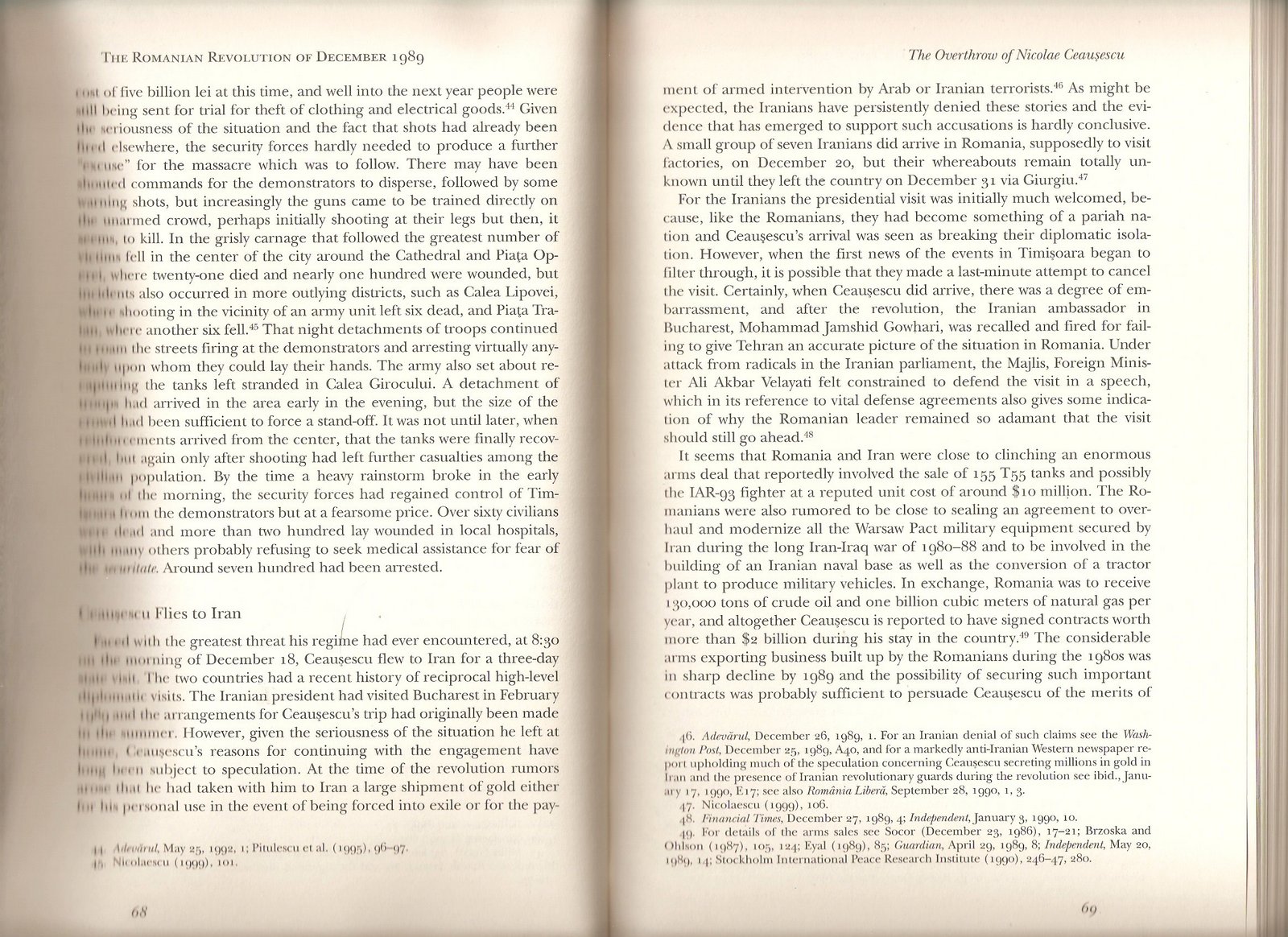
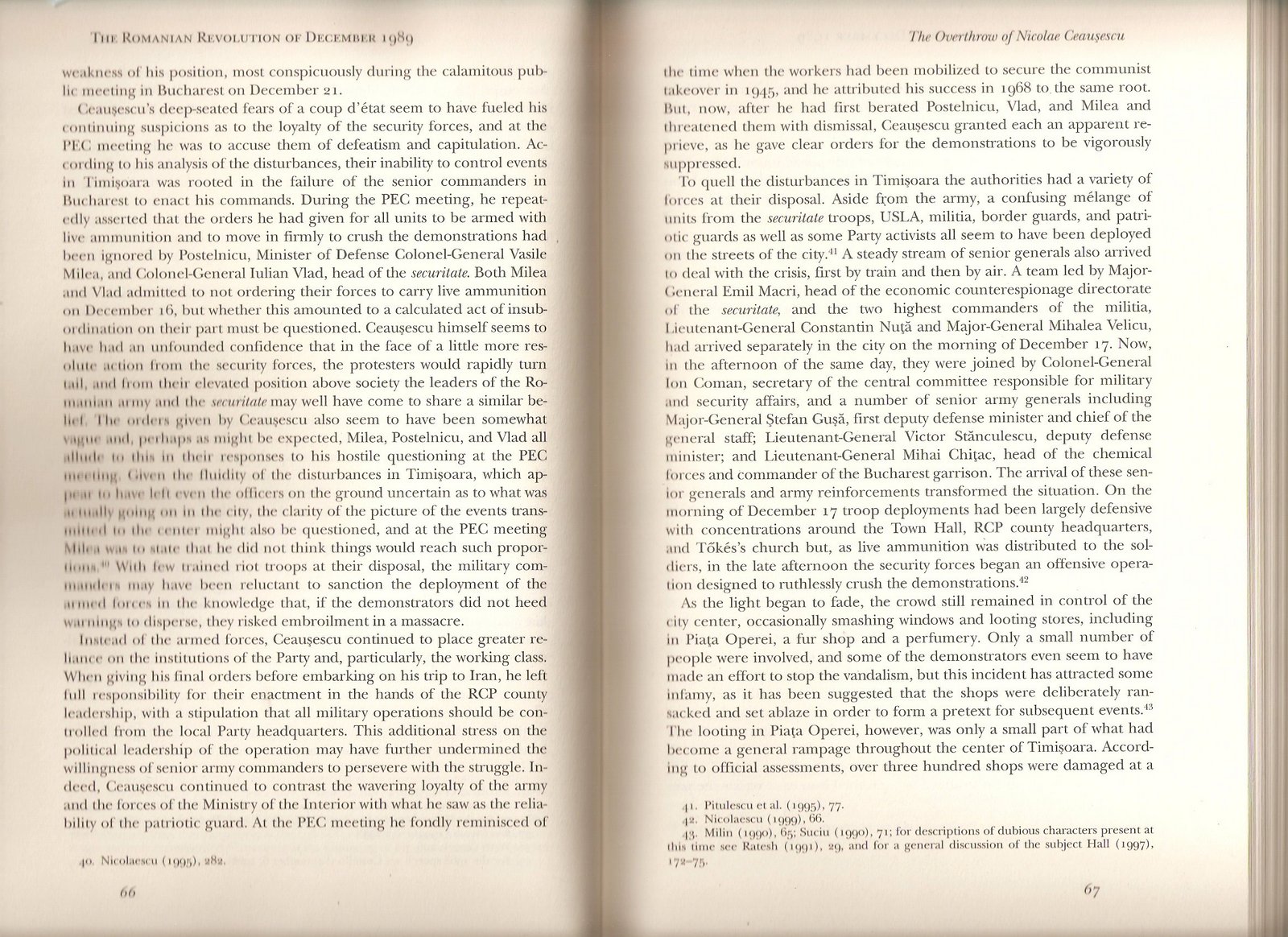
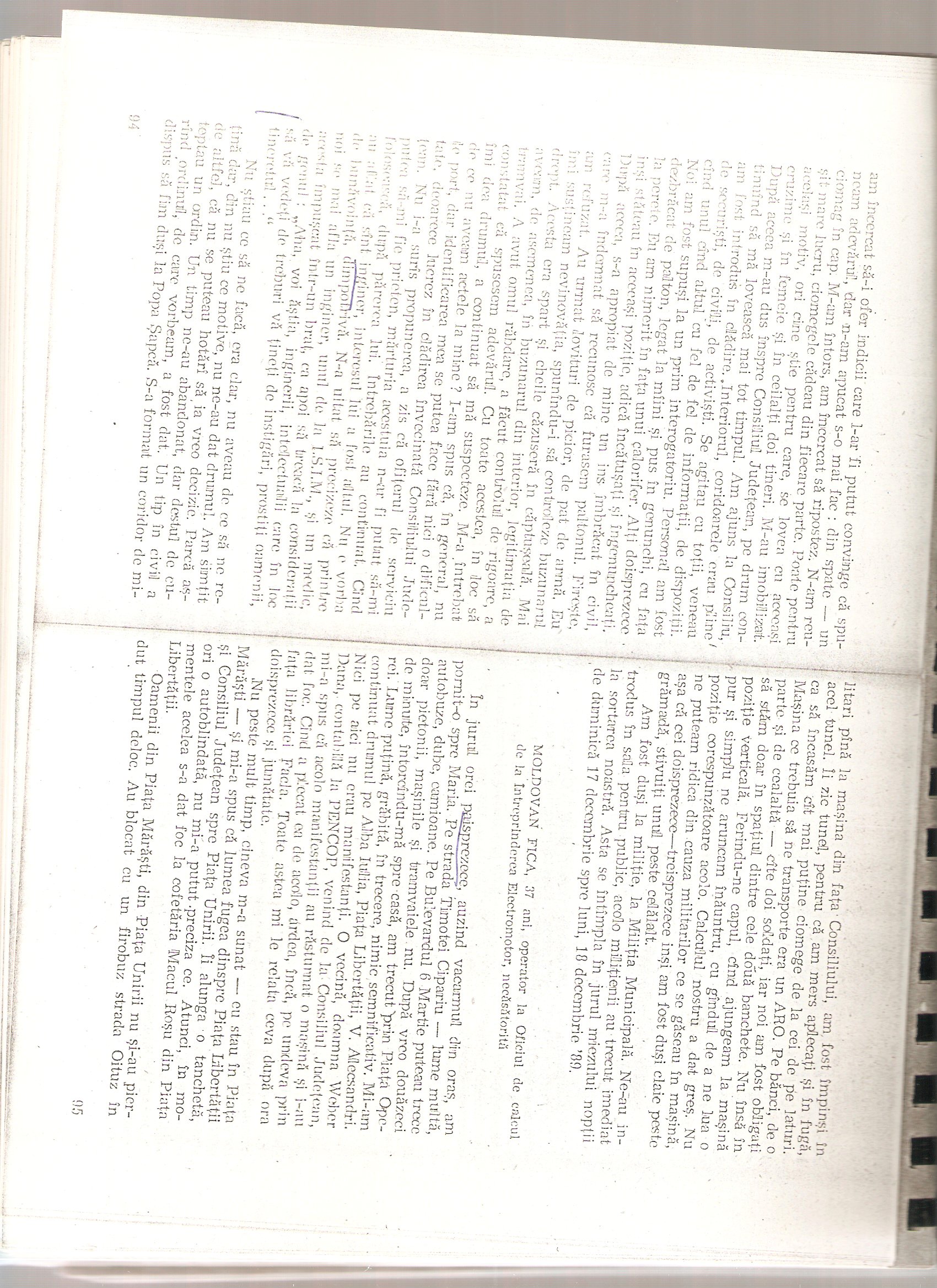
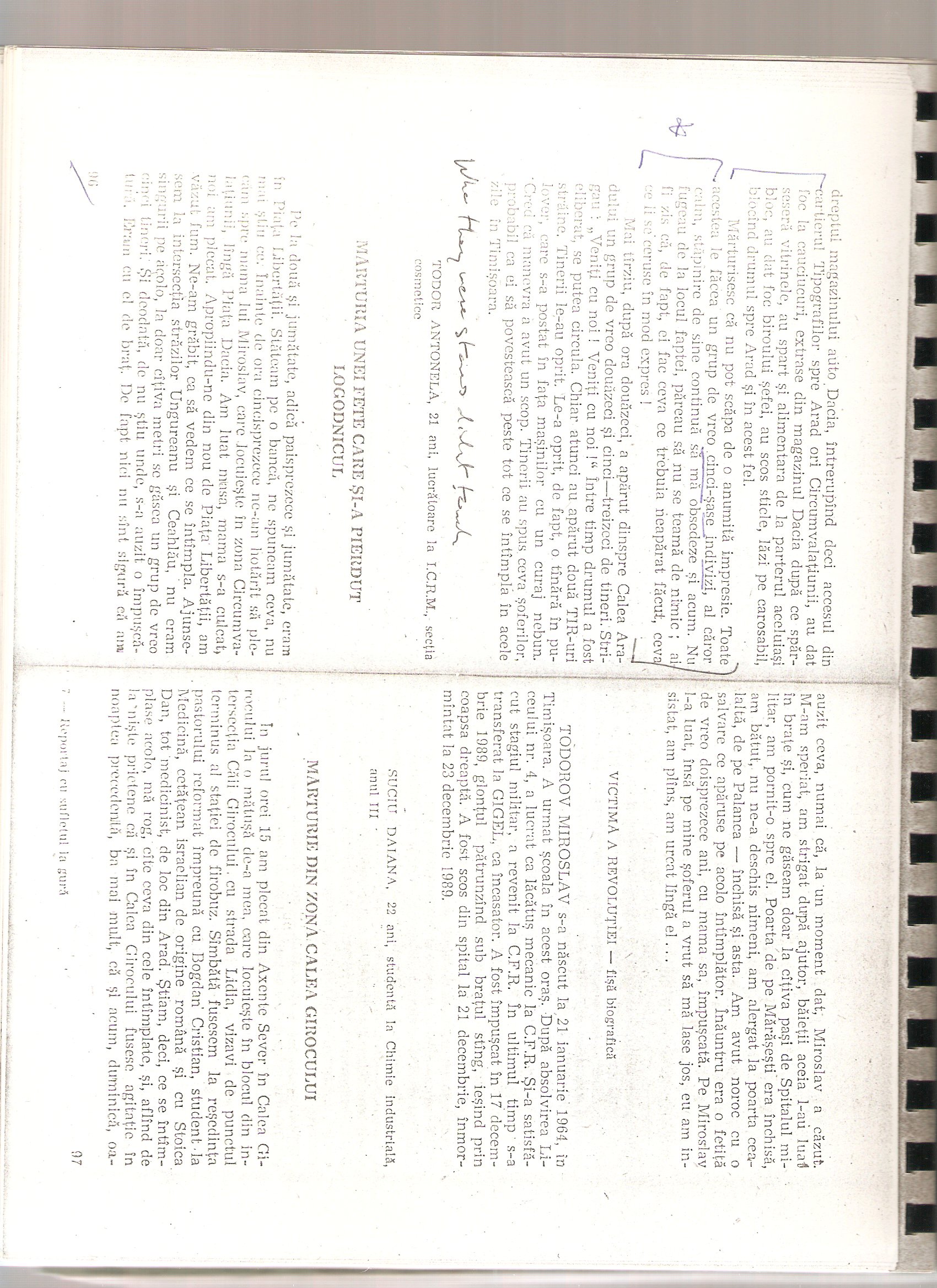
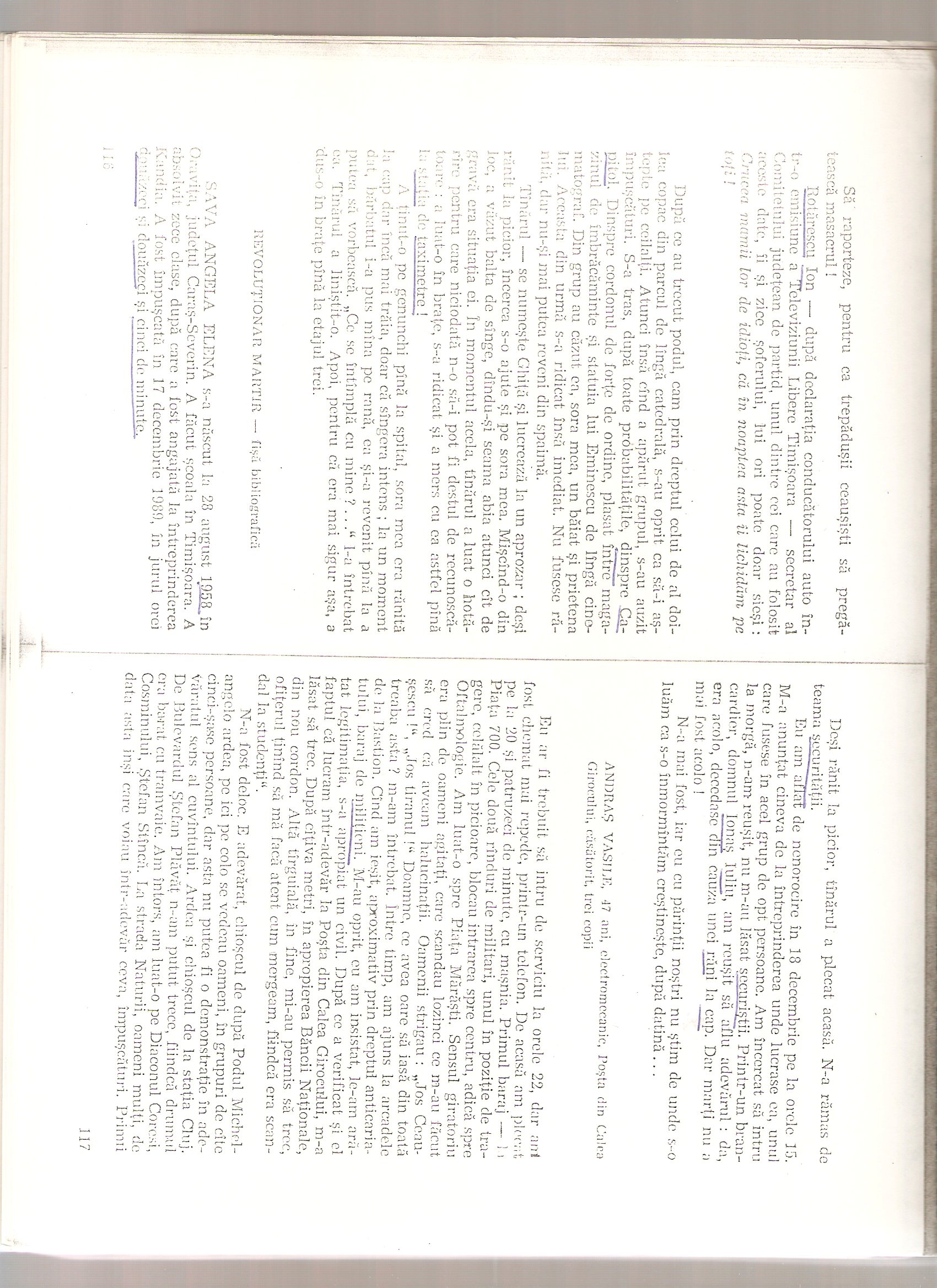
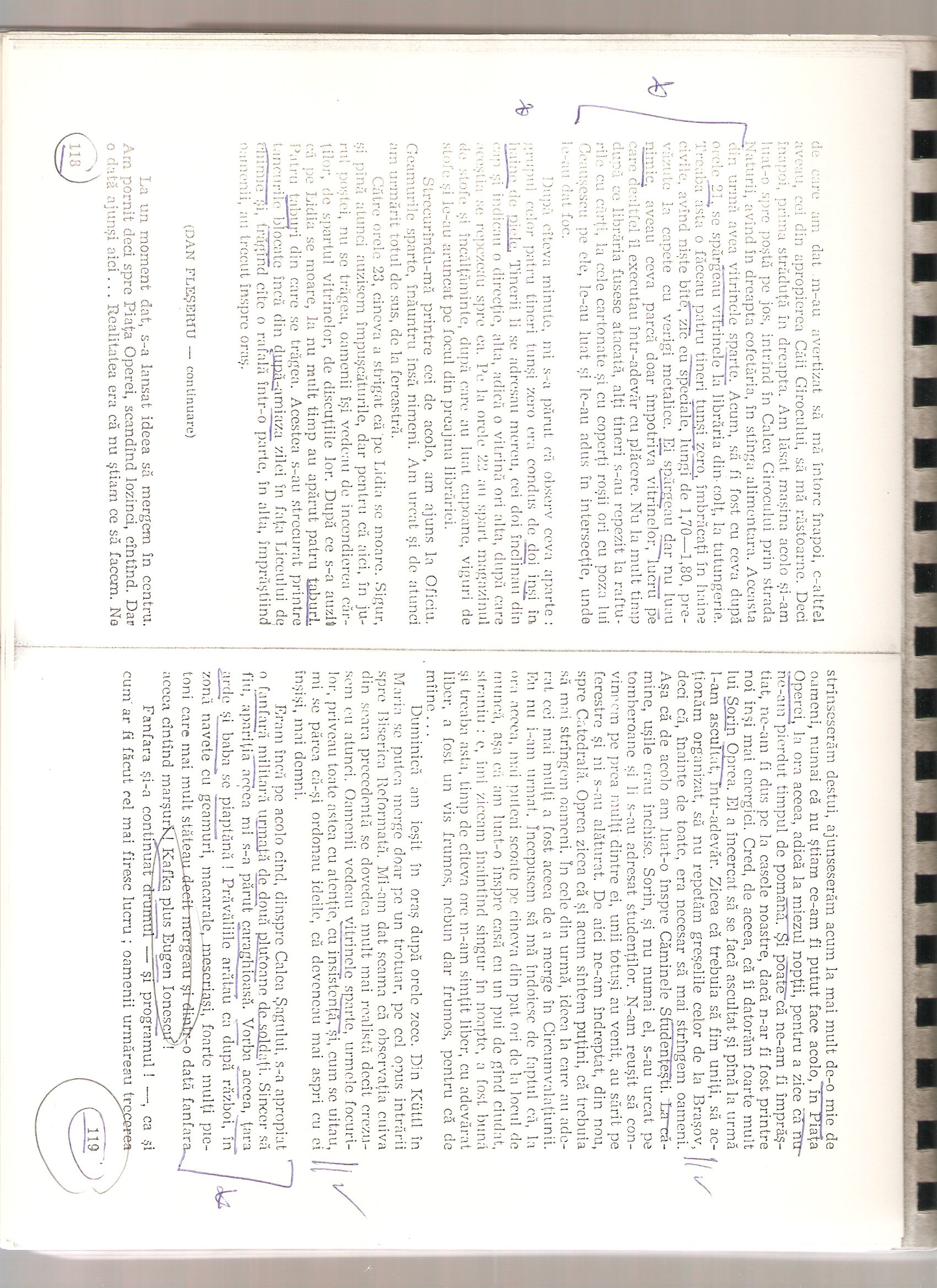
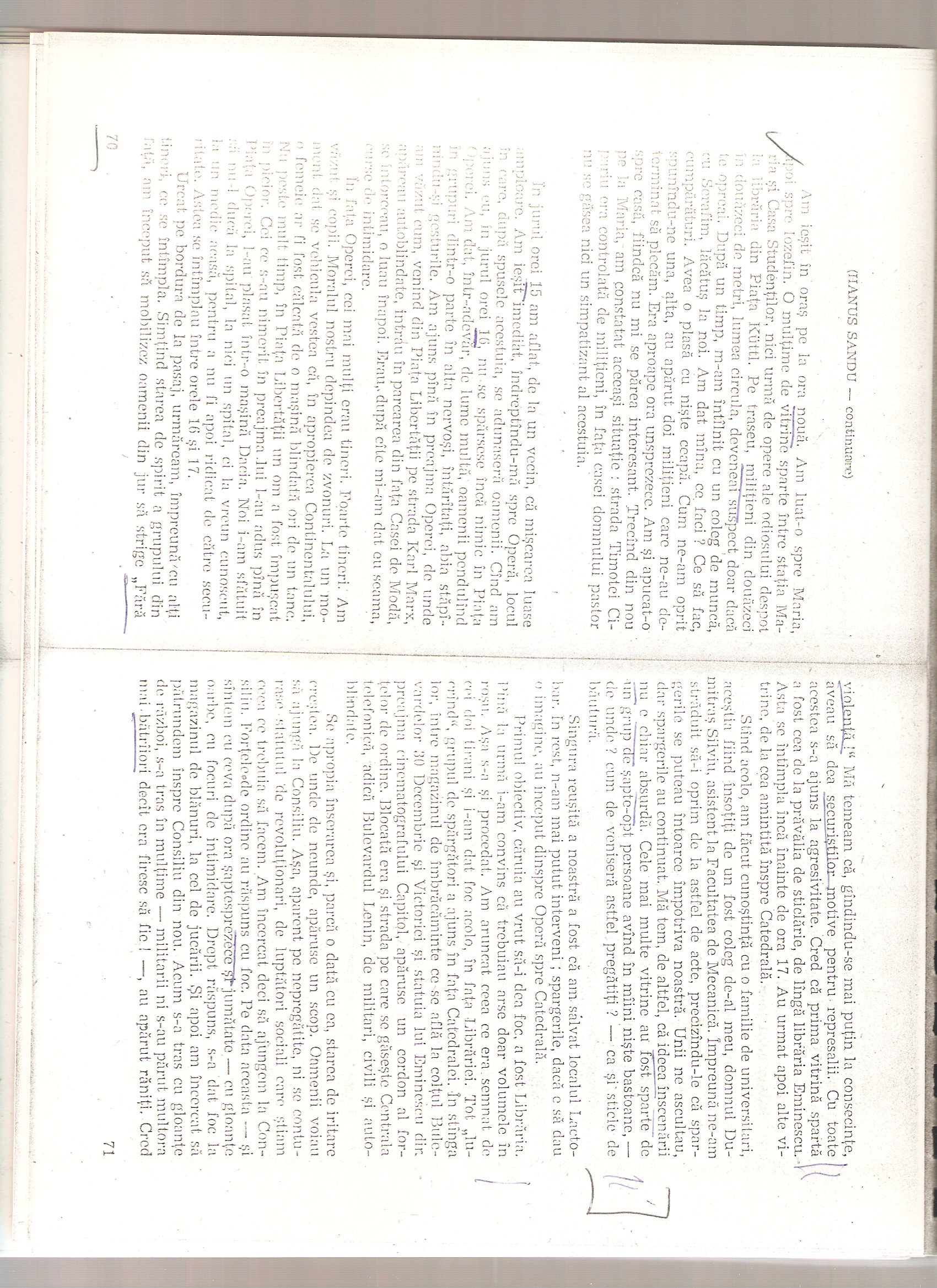
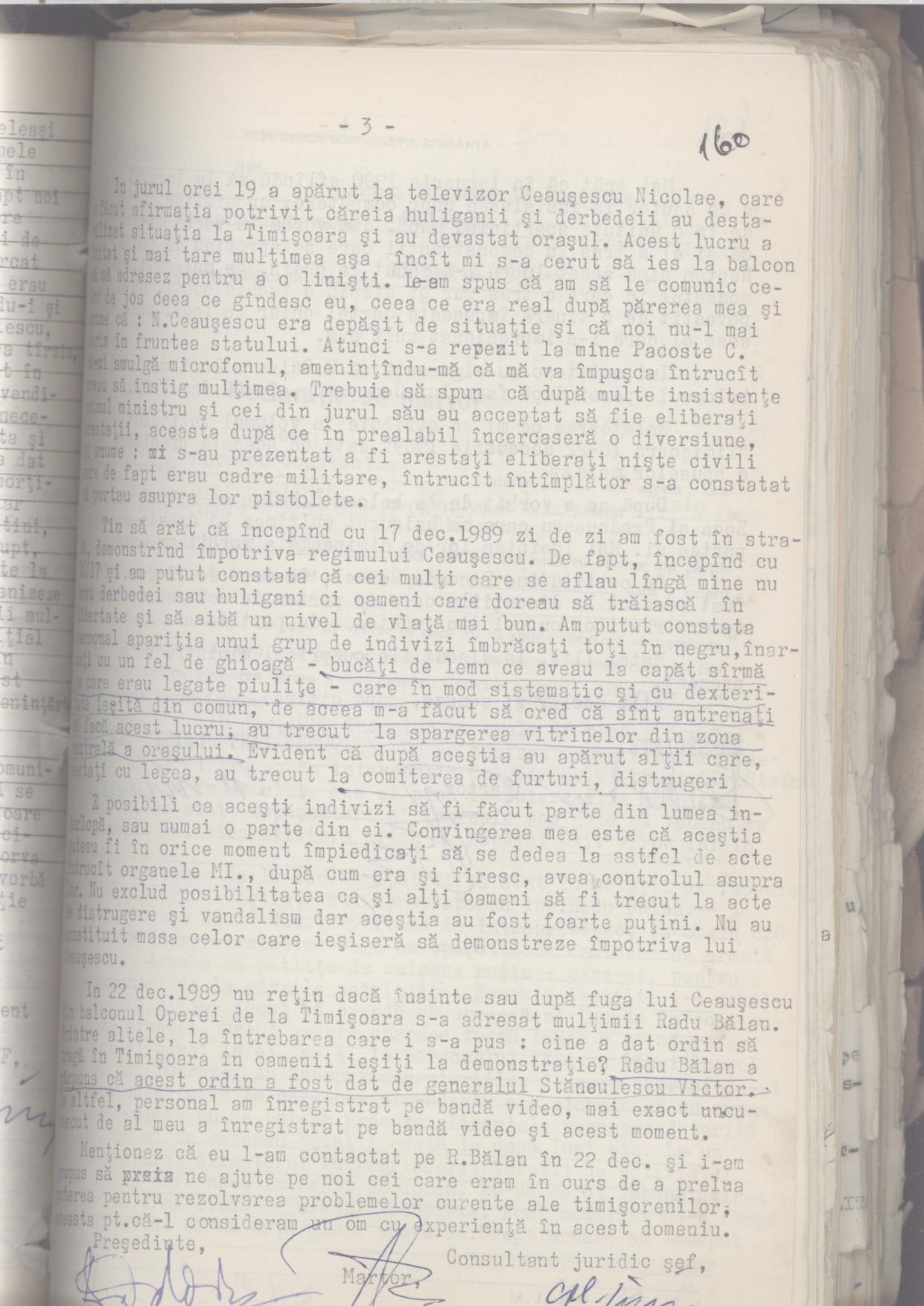
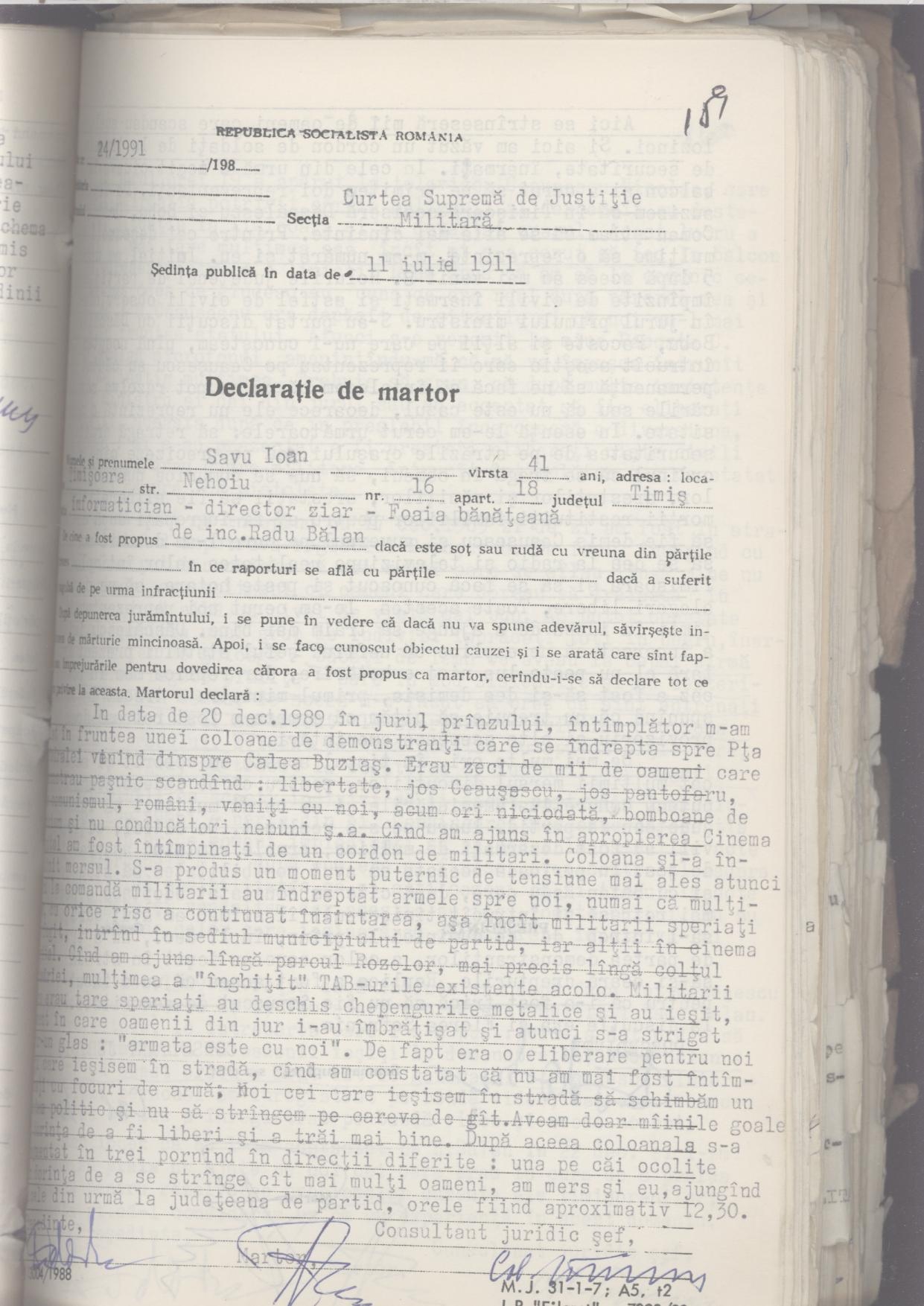
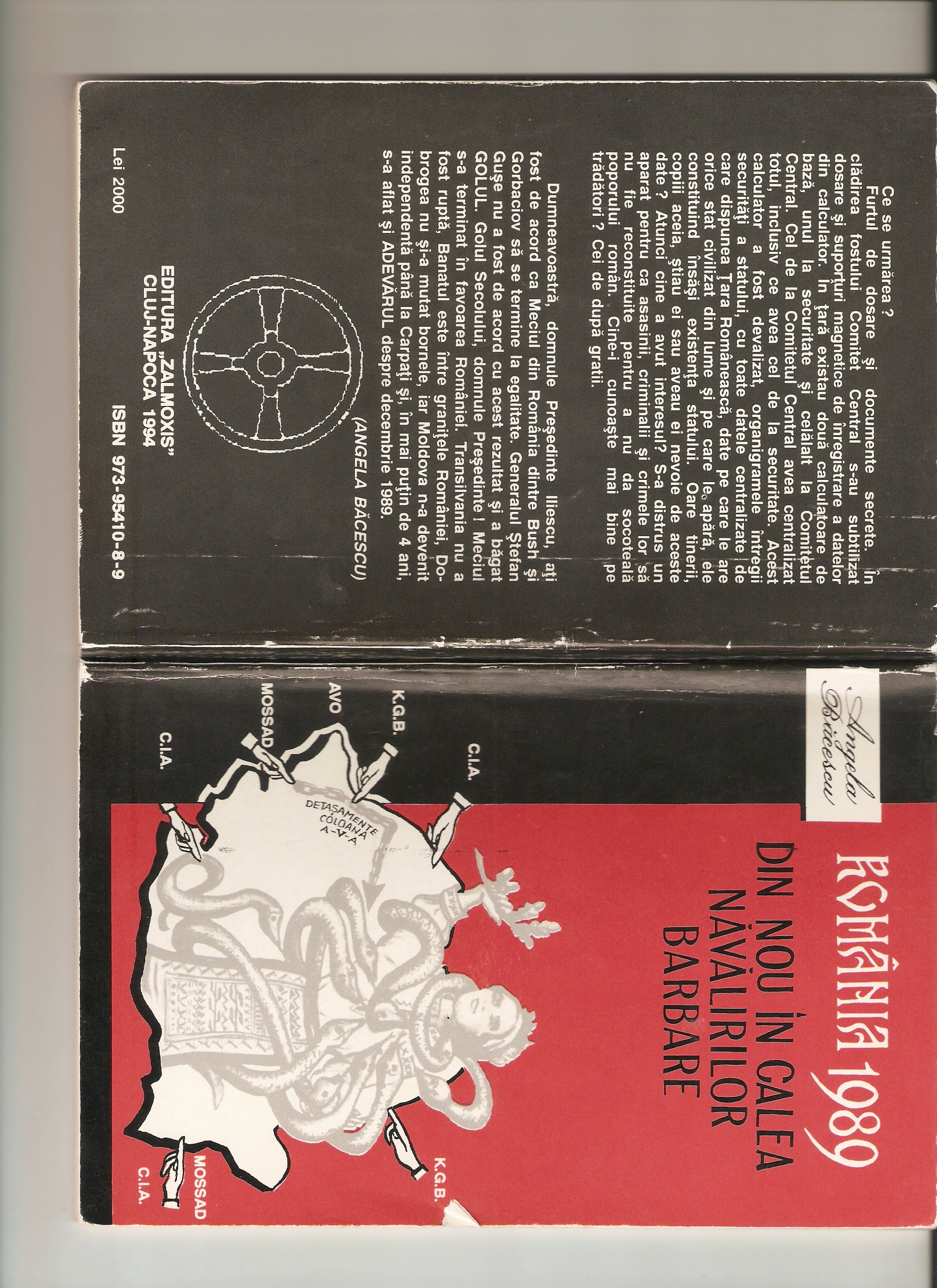
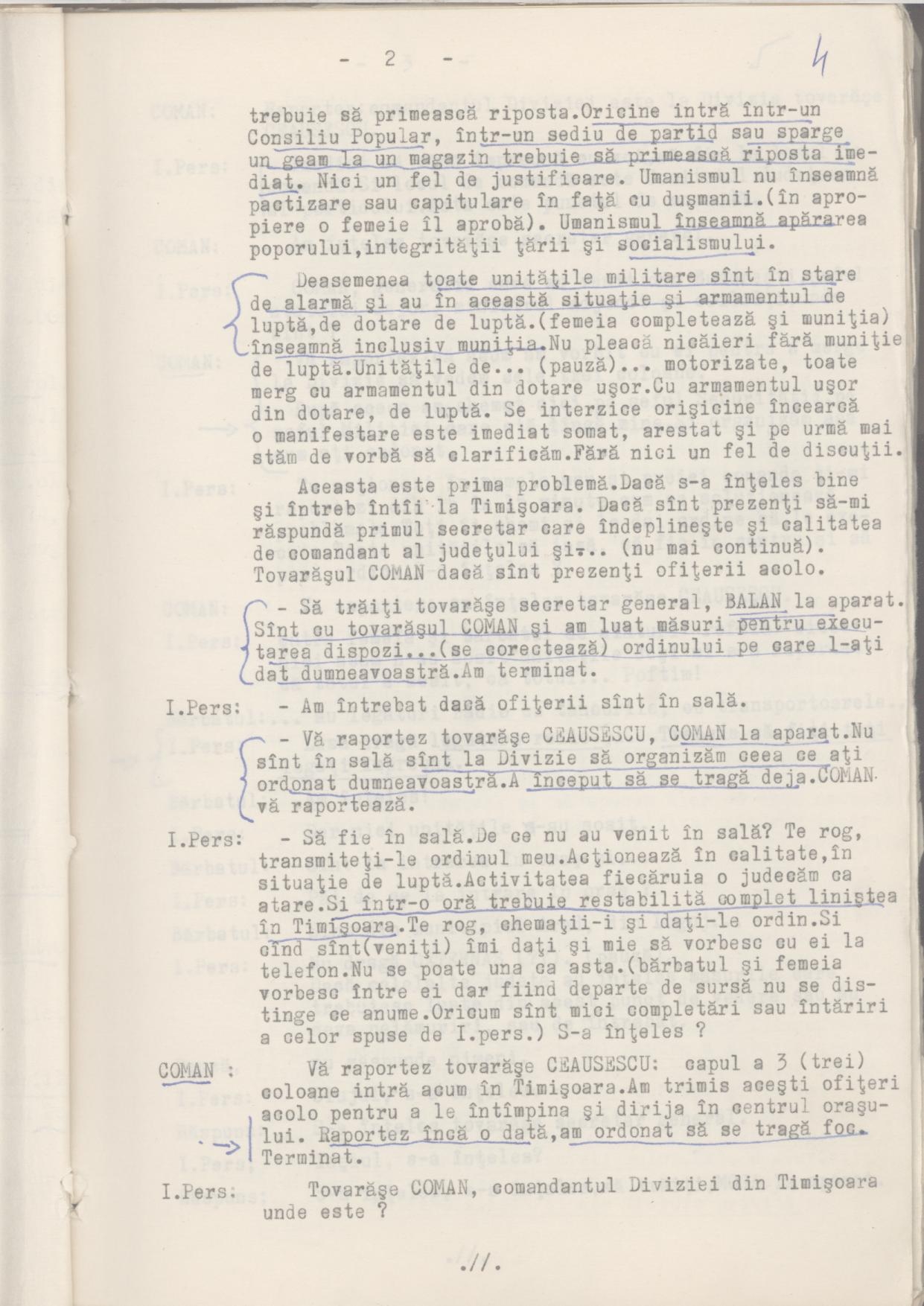
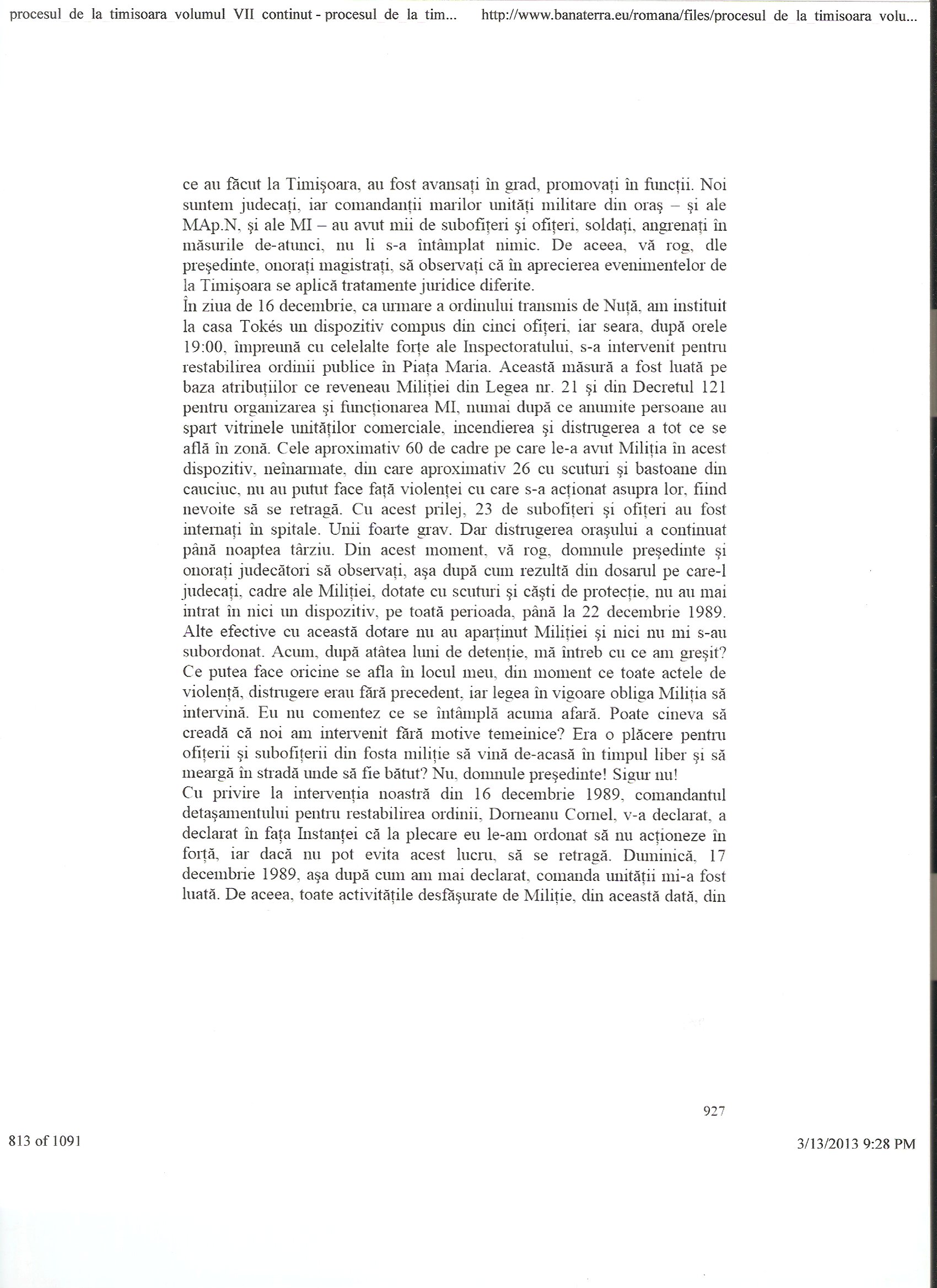
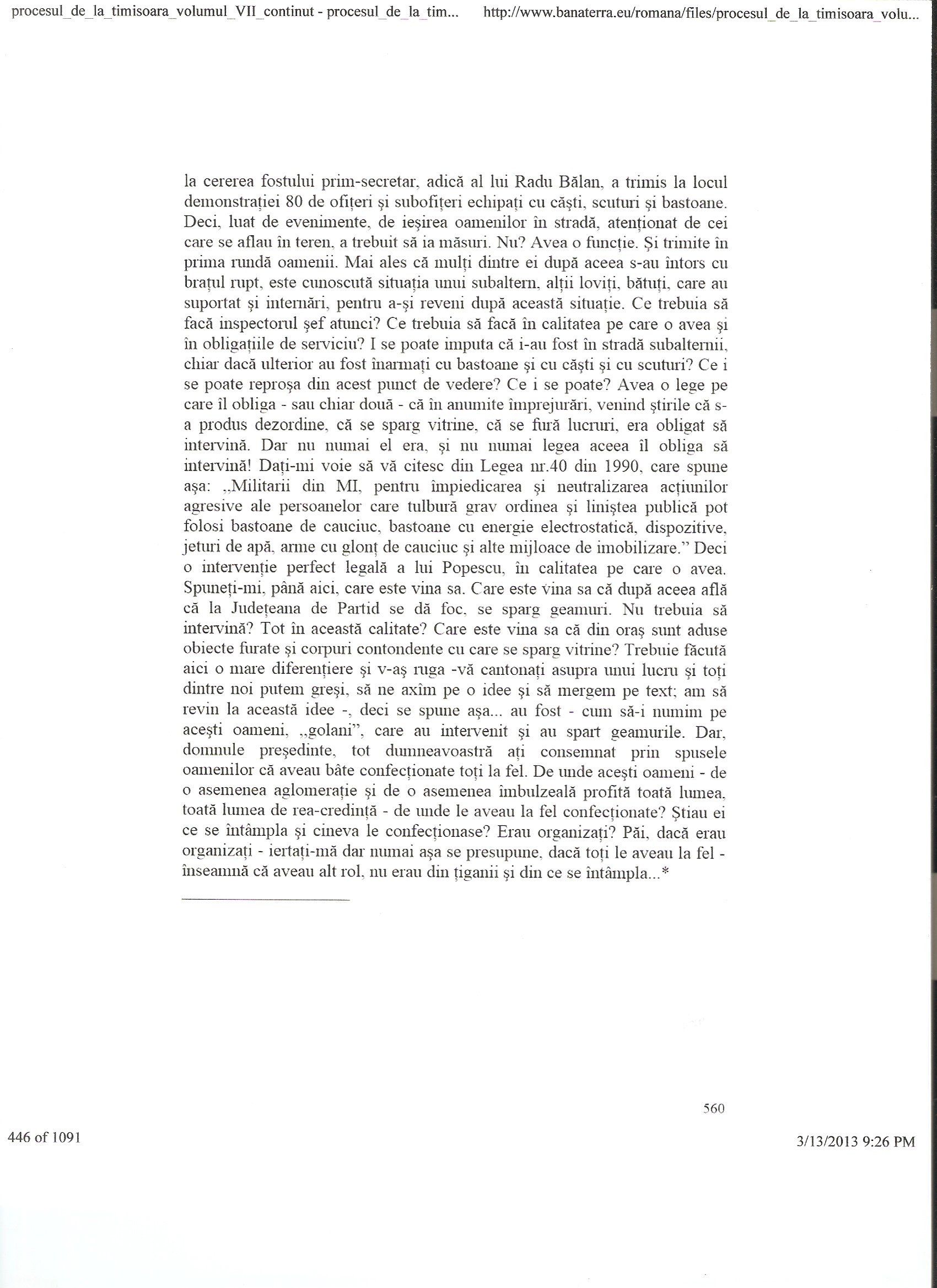

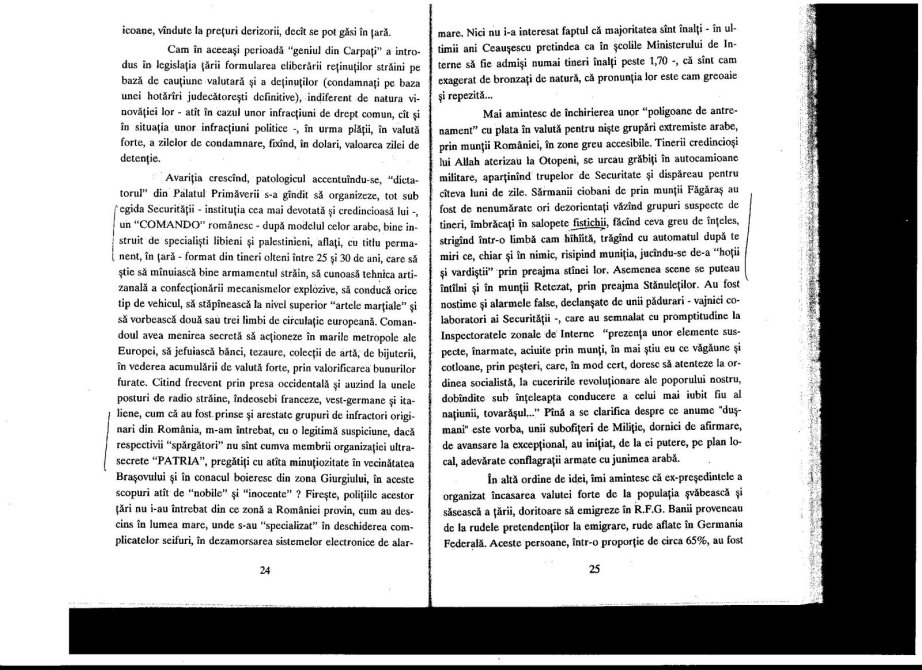


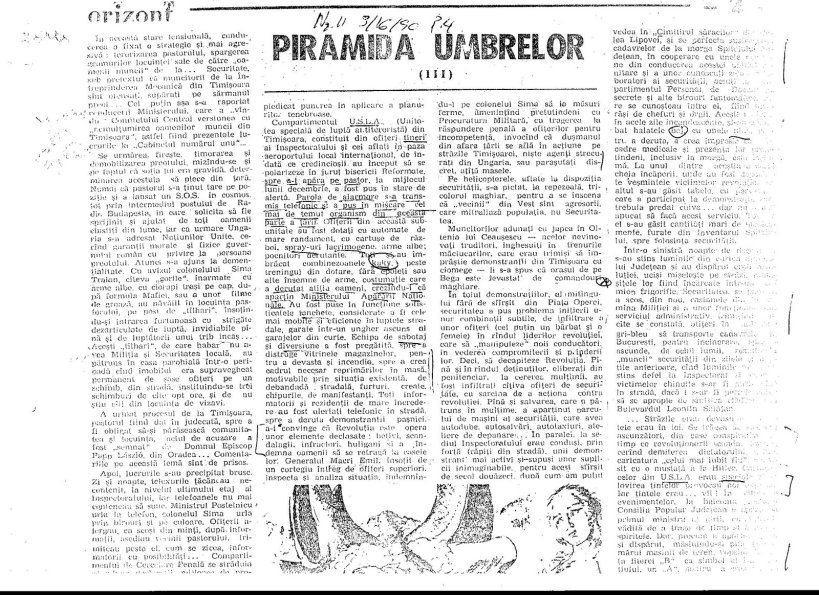
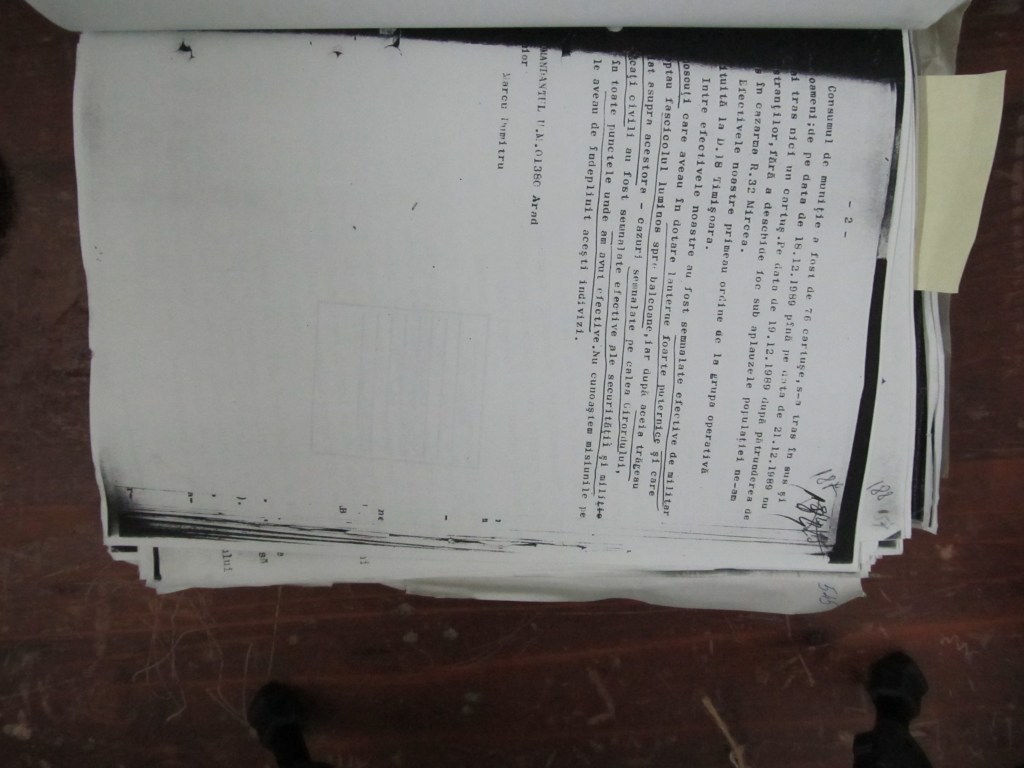
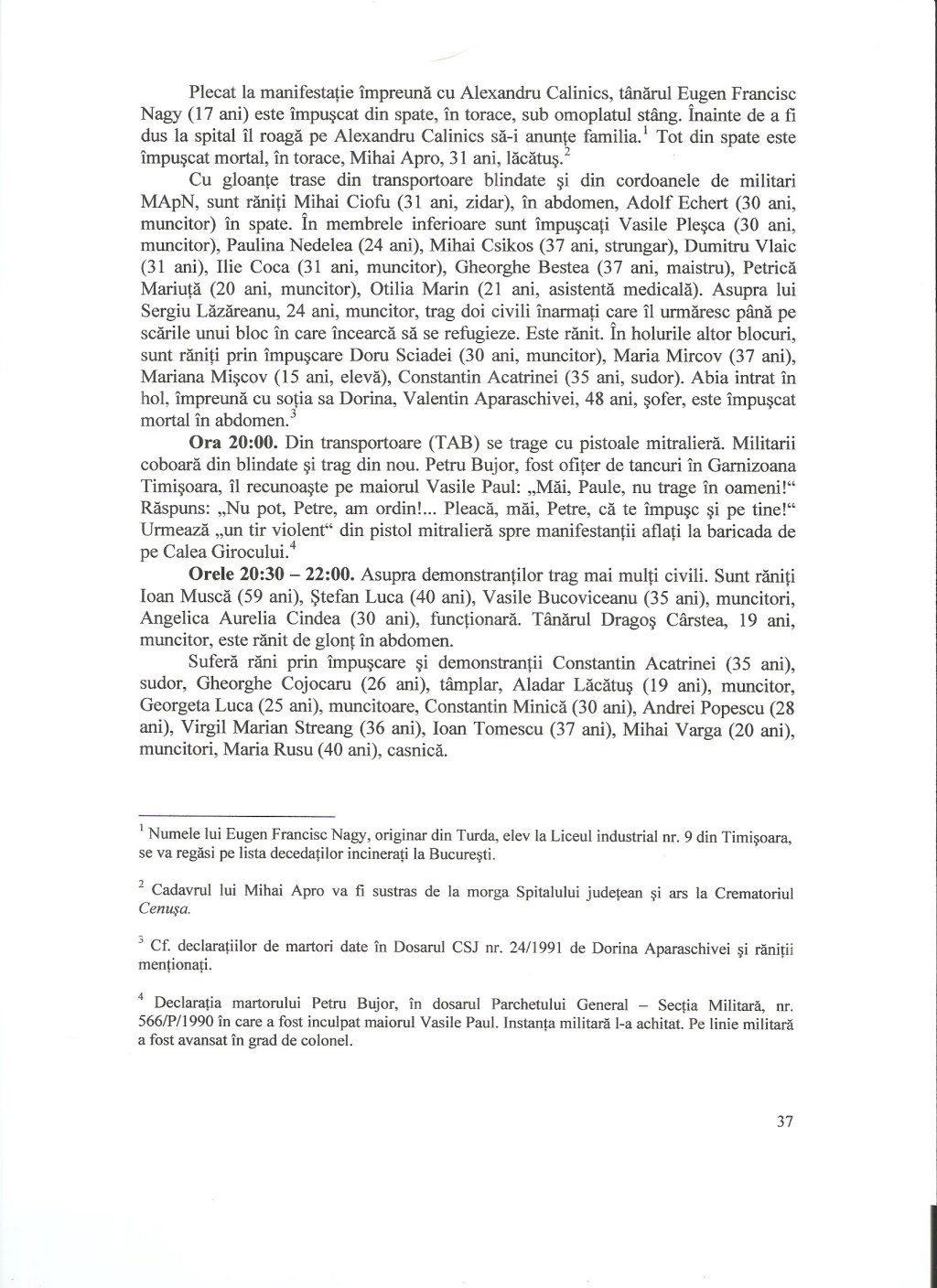
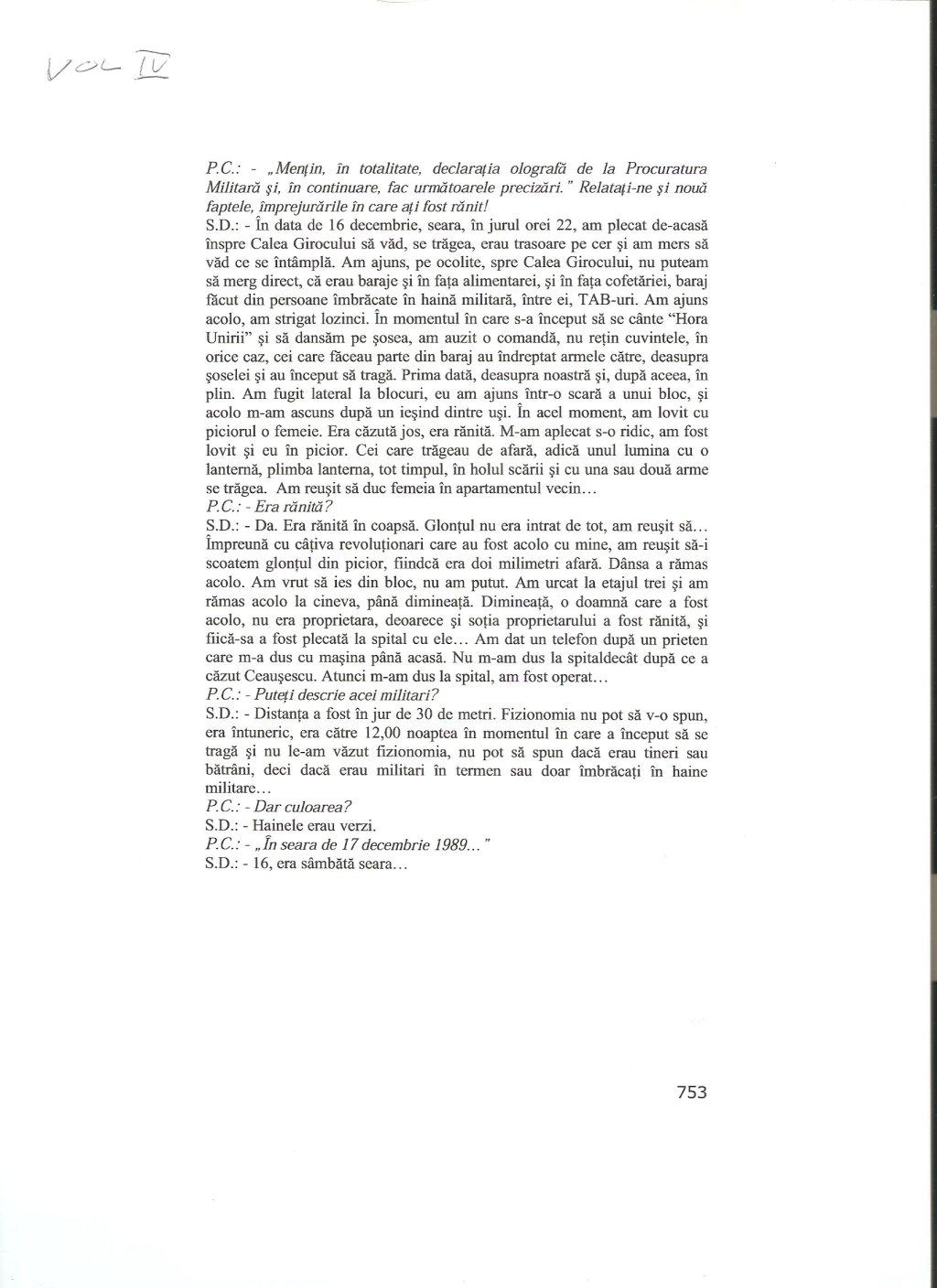
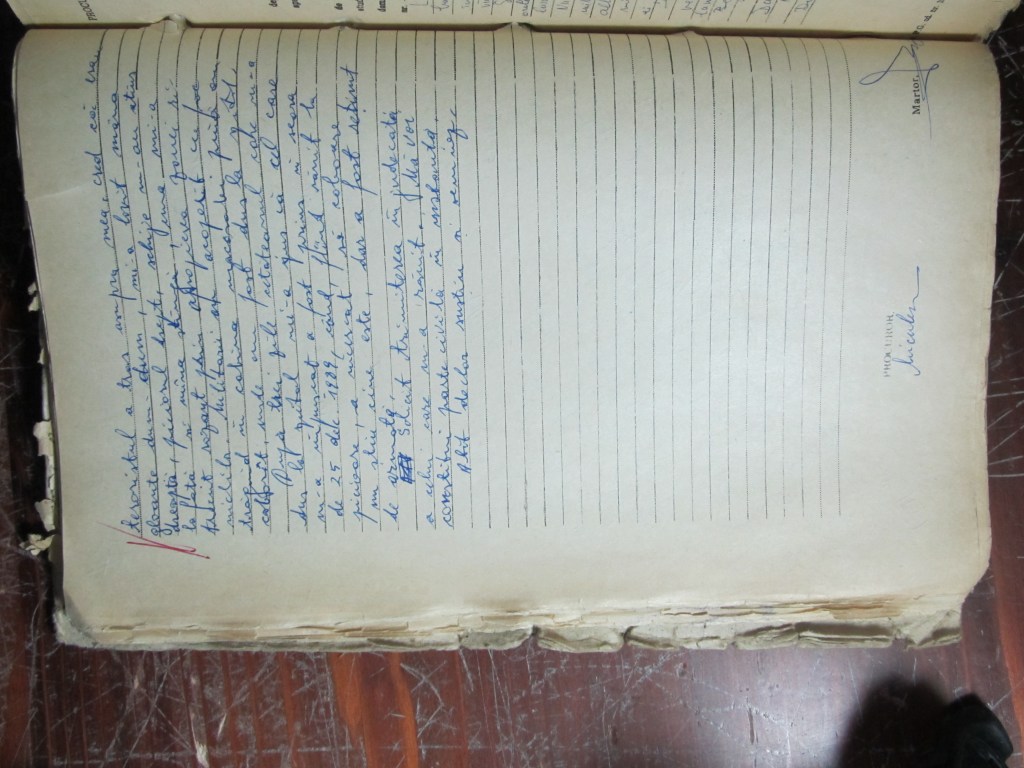
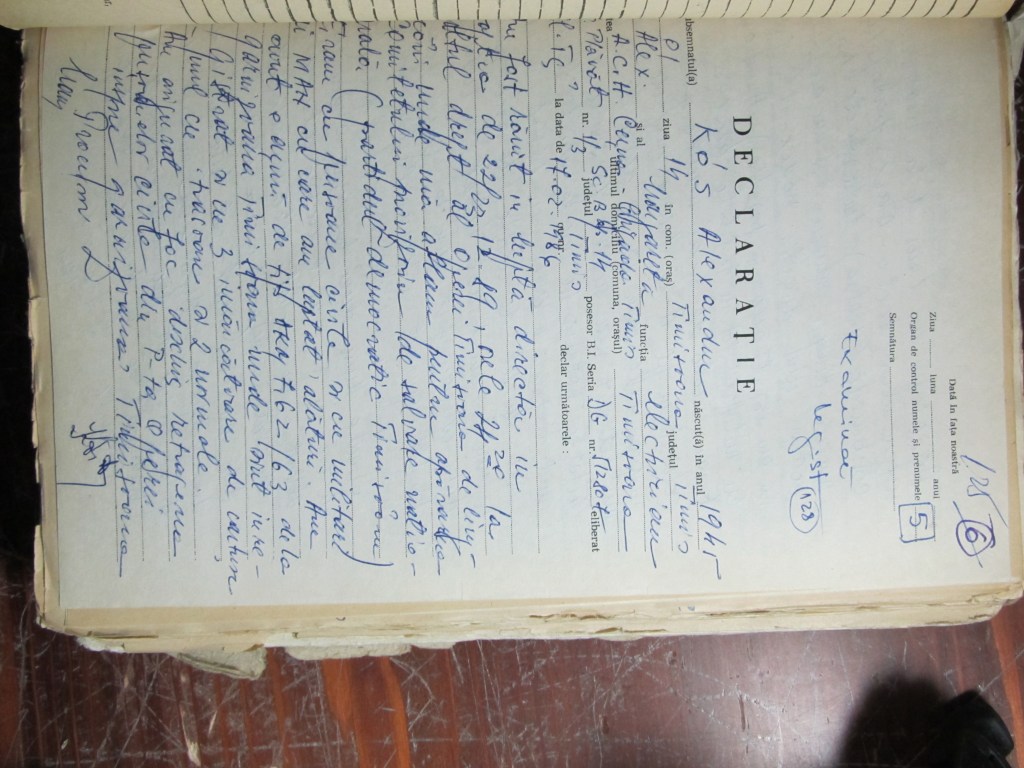
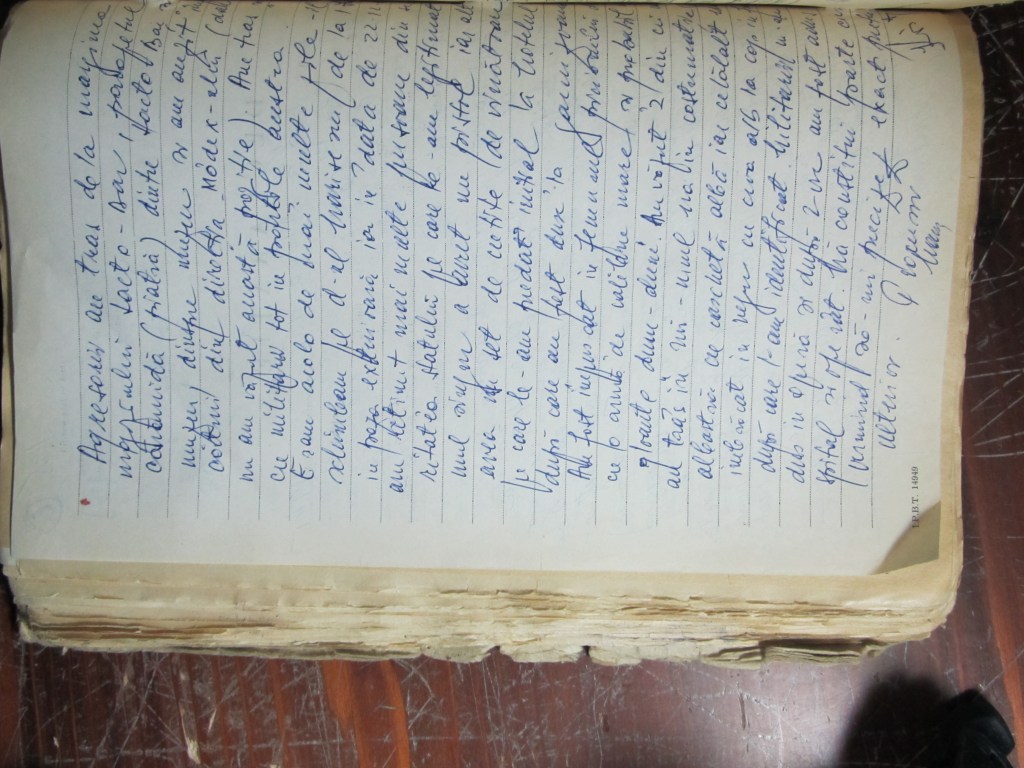

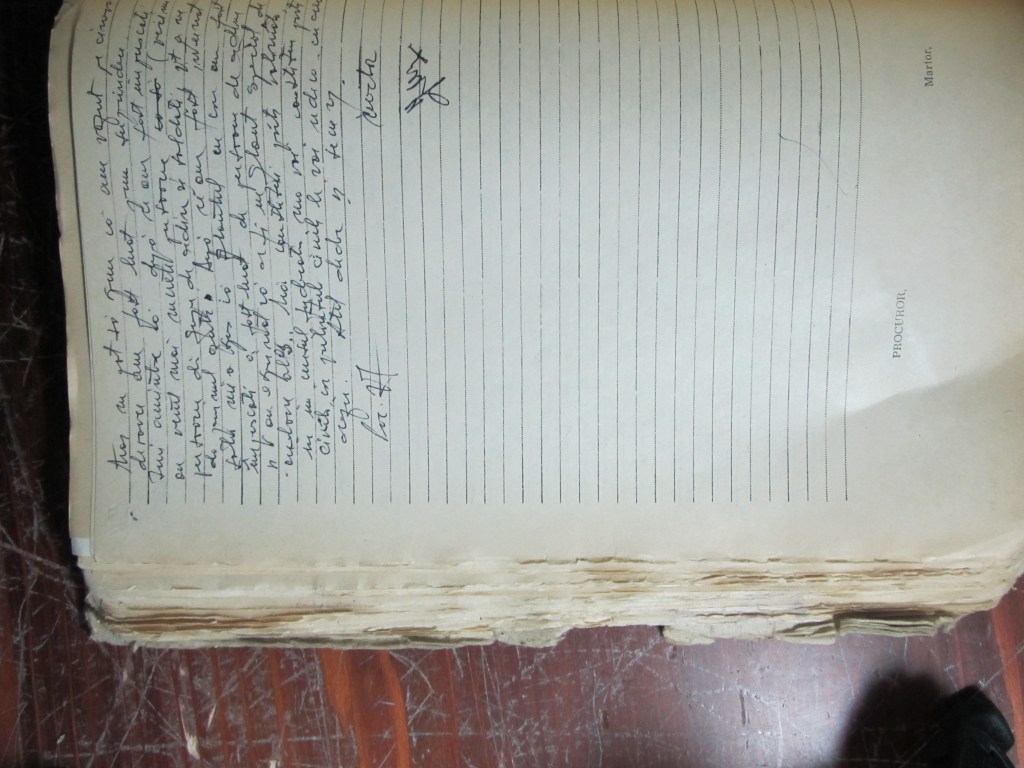

 The Archive of the Romanian Revolution of December 1989
