[42] According to Sorin Iliesiu, the filmmaker who claims to have edited the chapter on December 1989 in the so-called Tismaneanu Raport Final, the “spirit of Voinea’s findings can be found in the Chapter.” Indeed, the chapter includes snippets from an interview between Dan Voinea and Andrei Badin (Adevarul , December 2006). The “indefatigable” Voinea, as Tom Gallagher has referred to him, continues to be defended by Vladimir Tismaneanu who has expressed support for Voinea’s investigations “from both a juridic and historic viewpoint” (see the entries for 21 September 2009 at http://tismaneanu.wordpress.com), avoiding any mention of the reasons for Voinea’s dismissal from the Military Procuracy, mistakes that Prosecutor General Laura Codruta Kovesi says “one wouldn’t expect even from a beginner” (for more on this and background, see Hall 2008):
Ce îi reproşaţi, totuşi, lui Voinea? Punctual, ce greşeli a făcut în instrumentarea cauzelor?
Sunt foarte multe greşeli, o să menţionez însă doar câteva. Spre exemplu, s-a început urmărirea penală faţă de persoane decedate. Poate îmi explică dumnealui cum poţi să faci cercetări faţă de o persoană decedată! Apoi, s-a început urmărirea penală pentru fapte care nu erau prevăzute în Codul Penal. În plus, deşi nu a fost desemnat să lucreze, spre exemplu, într-un dosar privind mineriada (repartizat unui alt procuror), domnul procuror Dan Voinea a luat dosarul, a început urmărirea penală, după care l-a restituit procurorului de caz. Vă imaginaţi cum ar fi dacă eu, ca procuror general, aş lua dosarul unui coleg din subordine, aş începe urmărirea penală după care i l-aş înapoia. Cam aşa ceva s-a întâmplat şi aici.
Mai mult, a început urmărirea penală într-o cauză, deşi, potrivit unei decizii a Înaltei Curţi de Casaţie şi Justiţie, era incompatibil să mai facă asta. E vorba despre dosarul 74/p/1998 (dosar în care Voinea l-a acuzat pe fostul preşedinte Ion Iliescu că, în iunie 1990, a determinat cu intenţie intervenţia în forţă a militarilor împotriva manifestanţilor din Capitală – n.r.).
Apoi au fost situaţii în care s-a început urmărirea penală prin acte scrise de mână, care nu au fost înregistrate în registrul special de începere a urmăririi penale. Aceste documente, spre exemplu, nu prevedeau în ce constau faptele comise de presupuşii învinuiţi, nu conţin datele personale ale acestora. De exemplu, avem rezoluţii de începere a urmăririi penale care-l privesc pe Radu Ion sau pe Gheorghe Dumitru, ori nu ştim cine este Gheorghe Dumitru, nu ştim cine este Radu Ion.
„Parchetul să-şi asume tergiversarea anchetelor”
Credeţi că, în cazul lui Voinea, au fost doar greşeli sau că a fost vorba de intenţie, ştiind că acuzaţii vor scăpa?
Nu cunosc motivele care au stat la baza acestor decizii şi, prin urmare, nu le pot comenta.
Poate fi vorba şi despre complexitatea acestor dosare?
Când ai asemenea dosare în lucru, nu faci astfel de greşeli, de începător. Eşti mult mai atent când ai cauze de o asemenea importanţă pentru societatea românească.
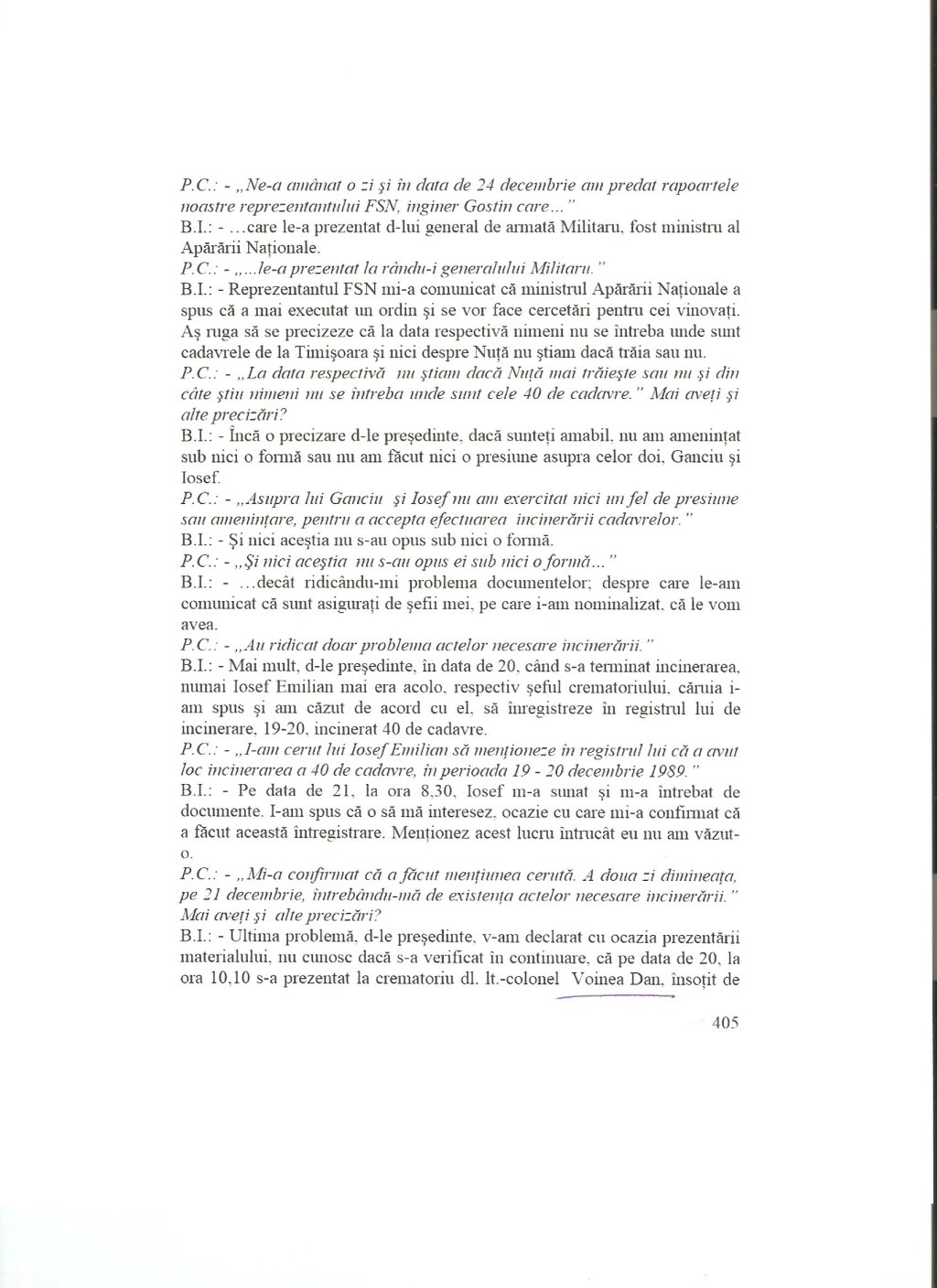
III) The most significant revelation of Ion Baciu’s 23 January 1990 confession may not actually be his claim that he saw Dan Voinea at the Cenusa Crematorium on the morning of 20 December 1989, but that he recognized Voinea precisely because Voinea had previously worked for Directorate VI (“Department of Corrections” essentially) of the Securitate.
[On 20 December 1989 at 1010 at the Cenusa Crematorium arrived Lt. Col. Dan Voinea, a prosecutor from DPM, whom I knew because before that post he had worked in the Department of State Security (i.e Securitate), in the Directorate of Penal Investigations (Penitentiaries/Prisons, Directorate VI of the Securitate)].”
23.01.1990 Declaratie: Colonel Ion Baciu, șef al Direcției Economice din IGM,
(my thanks to researcher Mircea Munteanu, formerly of the CWIHP at the Woodrow Wilson Center, for helping me with the following transcription)
Pe 20.12.89 la orele 1010 la crematoriu a venit Lt. Col. Voinea Dan [[proc mil — procuror militar]] din D.P.M., pe care-l cunosc intrucit inainte de activare, a lucrat la Departmentul Securitatii Statului, directia cercetari penale.
Era imbracat civil, insotit de un procuror militar in uniforma. Au discutat cu o femeie, Geta, nu-i stiu numele care i-a spus: “[[Bine]] ca ati venit. Toata noaptea au ars aici si [[oamenilor]] le este teama.” Nu am auzit alte vorbe. Au discutat cu aceia femeie [[ca. –circa]] 15 minute dupa care au plecat.
Cred ca au fost trimisi acolo fie de Popovici, fie de Diaconescu, pentru a vedea cum decurge incinerarea.
Solicit sa fie audiati Popovici Nicolae, fost procuror general, Diaconescu Gh, adjunctul acestuia si cei doi procurori militari…
IV) Ion Baciu’s 12 March 1990 courtroom testimony saw him cutoff by the prosecutor who refused to allow in the official record that it was Voinea Baciu claimed to see on 20 December 1989 at the Cenusa Crematorium, but also, in particular, when Baciu attempted (and seemed) to state that Voinea essentially admitted as much to him during his later questioning by Voinea: (p. 406) “…pe domnul colonel Voinea care de altfel si cu ocazia anchetei mi s-a spus, de fapt…”
Baciu’s courtroom testimony (no reference made to his 23 January 1990 handwritten testimony above) was discussed by Vasile Surcel in the following article:
V) As the statements and testimony of other officials involved in the cremation of the Timisoara protesters make clear: Voinea is clearly dissembling and crafting a false narrative of how and when officials became aware of the cremation of the Timisoara protesters.
VI) Of course, Voinea has critical “top cover” for his denial that he was at the Cenusa Crematorium on 20 December 1989. His chief/boss, Ceausescu’s last Prosecutor General Nicolae Popovici denies that he knew anything until after 22 December 1989 about the cremation of protesters, even though multiple confessions by other officials make such a claim seem virtually impossible. Thus, as his declaration below demonstrates, he was clearly asked if he dispatched a military prosecutor and civilian prosecutor to Cenusa Crematorium on 20 December 1989. But to admit that he did would be to admit that he had known at the time about the burning of the corpses of Timisoara protesters…and therefore undermined the larger lie…
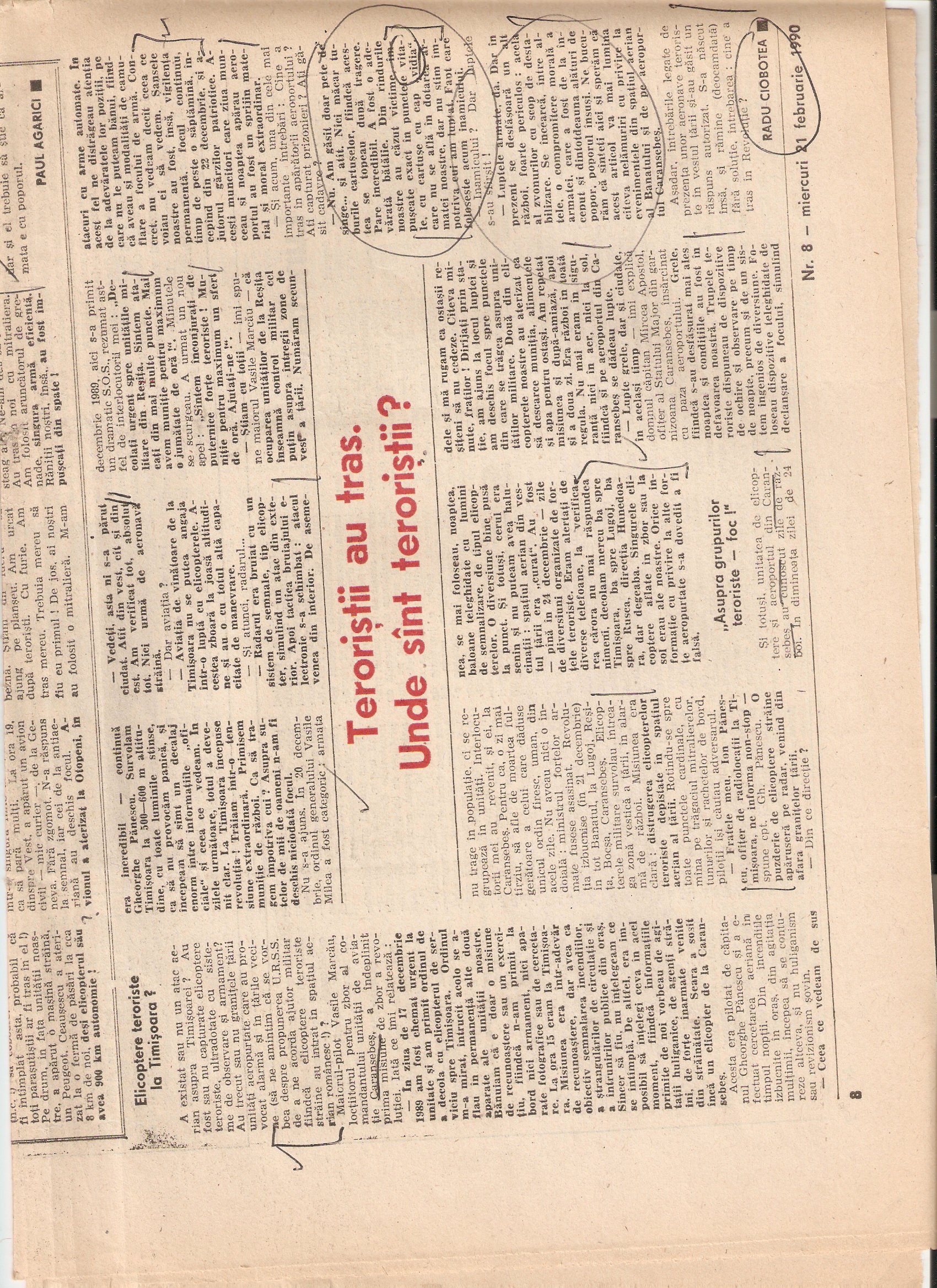
But my use of the term “Orwellian” in the title of this paper is not only designed to capture Voinea’s uncanny ability to make definitive statements that are demonstrably wrong, to argue that black is white and white is black—from his denial of the use of gunfire simulators in December 1989, to his claim that the only “lunetisti” who acted after 22 December were from the Army, to his denial of the existence of weapons and (especially “vidia”) bullets not in the arsenal of the Army, to his denial of the existence of “terrorists,” to his denial that any military unit was attacked during the events, to his denial of the role of foreigners in the events….
I use the term “Orwellian” here as much to describe the ease with which he has gotten and gets away with errors, misunderstandings, and falsehoods that could easily be challenged, if not combated by his interlocutors in the Romanian media and intelligentsia. For it is the fact that he has been able and is able to get away with all this that is truly “Orwellian” and that is indeed a tragedy for Romania’s citizens. The tragedy is thus less the predictable “supply side” of the post-authoritarian lie, than the enthusiastic consumption and appetite for it. This is why I believe, accurately I would argue, that “December 1989” long ago became more about post-Ceausescu Romania than about what happened in December 1989.
Posted by romanianrevolutionofdecember1989 on May 5, 2013
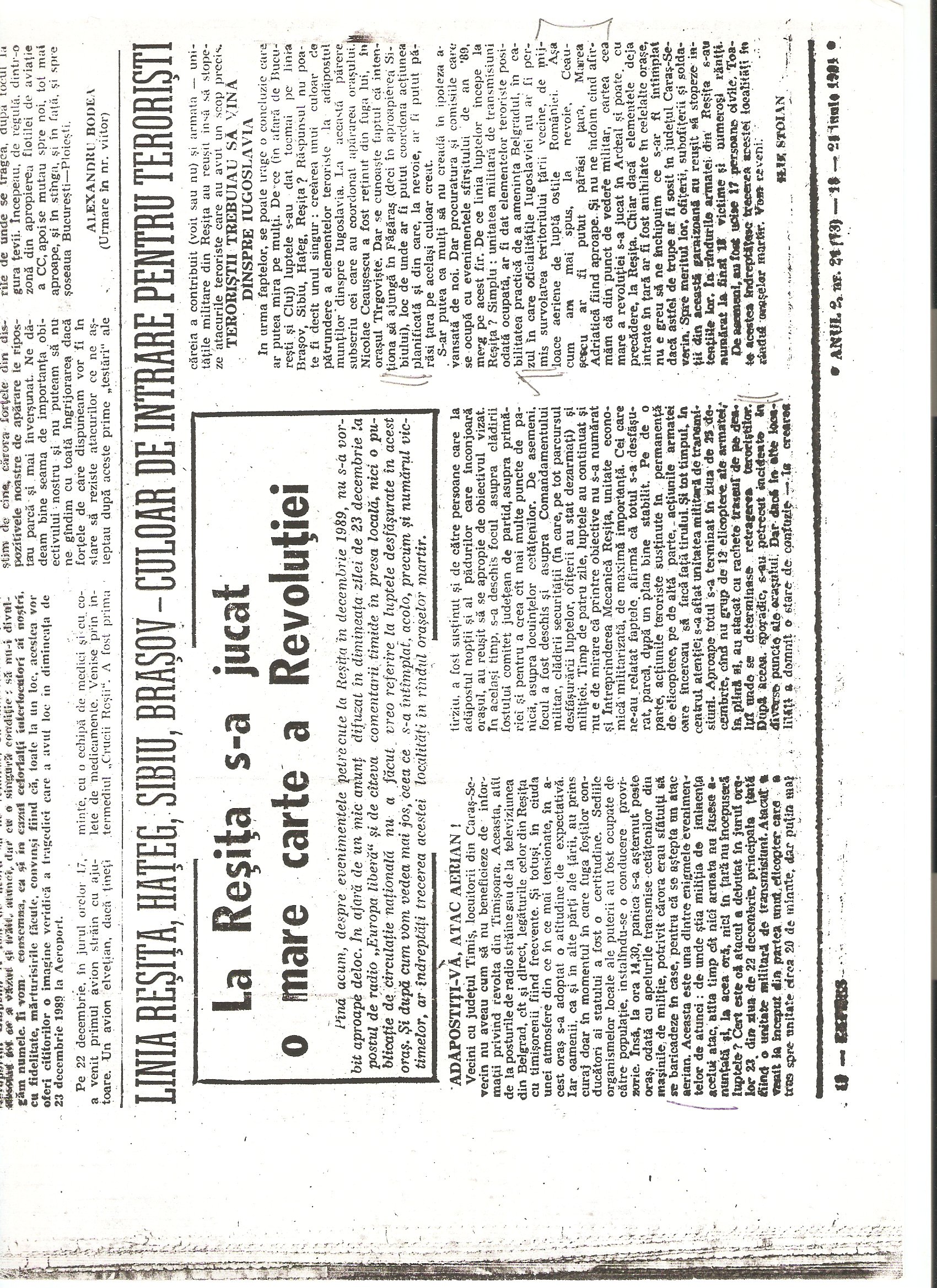
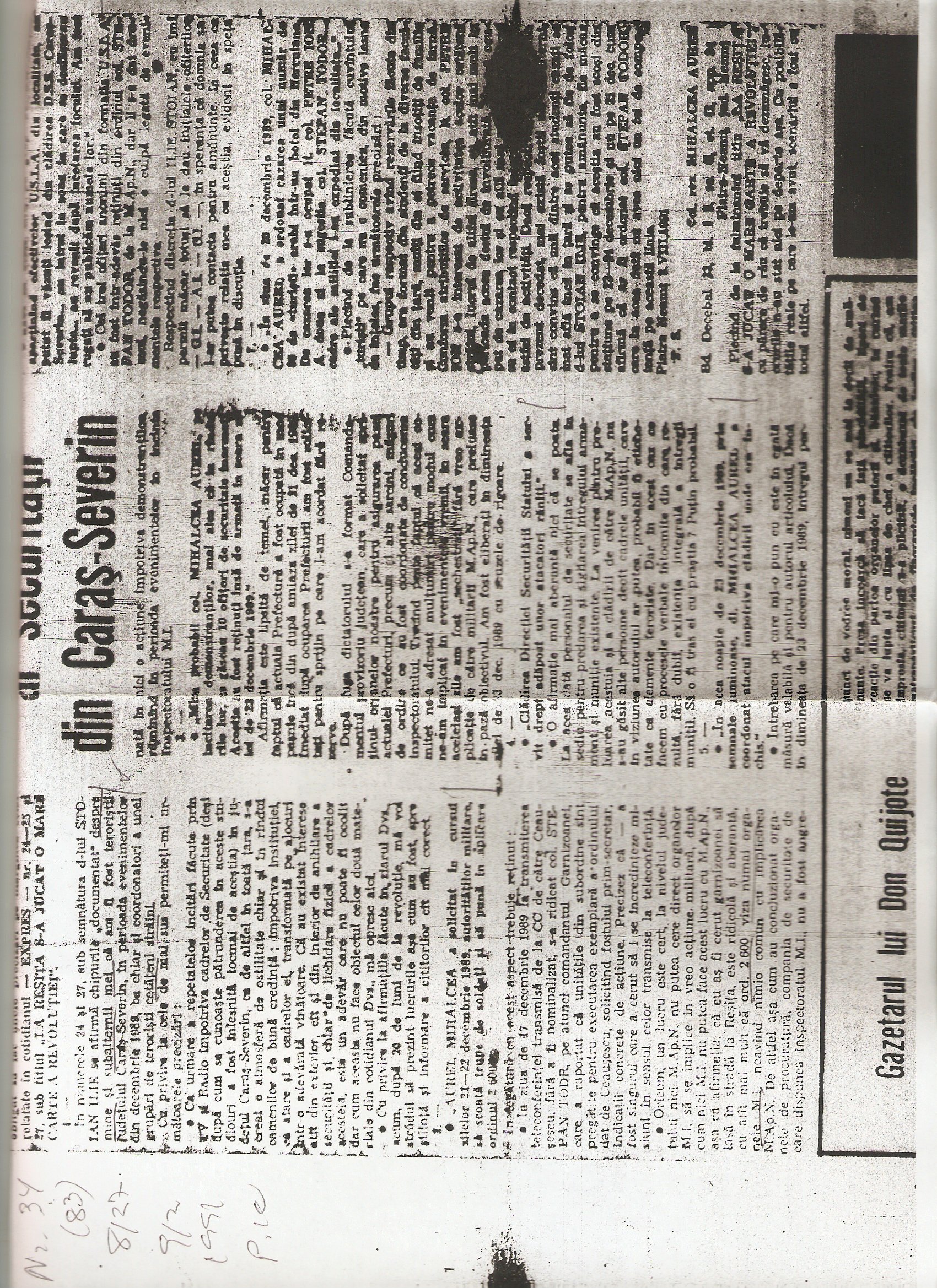
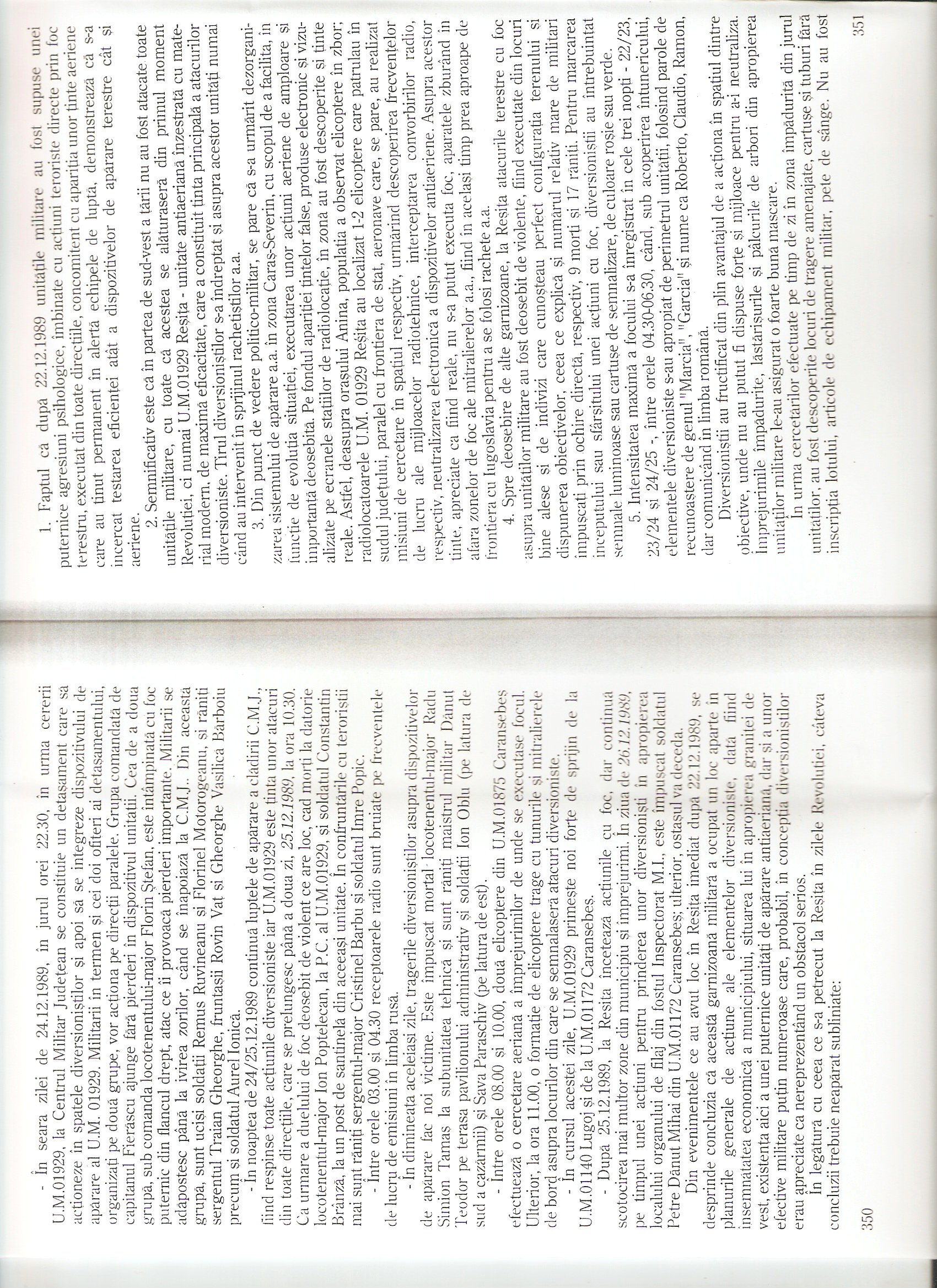
Reşiţa a plătit şi ea cu sânge dorinţa de schimbare a regimului socialist. Capitala Banatului de munte a dat ca jertfă un număr de aproximativ 65 de morţi, toţi aceştia fiind victimele diversiunii securisto-teroriste aservite vechiului regim, în încercarea sa de a menţine teroarea asupra populaţiei din judeţul Caraş-Severin şi după evacuarea cuplului de dictatori în data de 22 Decembrie 1989.
Un monument dedicat evenimentelor din Decembrie 1989 va fi ridicat în centrul municipiului Reşiţa, la cererea revoluţionarilor, dar şi a urmaşilor acestora. În acest sens, primăria Reşiţa a lansat o competiţie la care se pot înscrie până în 15 mai, toţi artiştii plastici interesaţi. Cele mai bune trei proiecte vor fi premiate cu cinci mii de lei, trei mii de lei şi respectiv două mii de lei. Câştigătorii vor fi anunţaţi în data de 30 mai. Monumentul se va numi “In Memoriam 1989” şi va fi amplasat pe locul actualei troiţe închinate eroilor Revoluţiei.
In decembrie 1989 am scapat de “domnia” Partidului Comunist si a “mult iubitului conducator”, Nicolae Ceausescu. In acea perioada, romanii satui sa indure o dictatura ajunsa la un prag maxim de acceptabilitate, au iesit in strada unul cate unul, pana s-au inmultit, formand o masa mult prea mare pentru a fi stapanita de Nicolae Ceausescu si oamenii sai.
Pretul libertatii a fost scump. Pretul e imens, dramele prin care au trecut mii de familii in acea vreme nu au un pret anume, nu exista o alaturare de cuvinte agreabila. Pentru libertate s-au pierdut vieti. Vieti tinere, dornice de a descoperi viata in libertate, dar care nu au mai ajuns sa se bucure de ea. De libertate. Tineri si oameni in toata firea, din toate colturile tarii, au fost rapusi de gloantele si tancurile armatei. Sau de “teroristi” necunoscuti. Timisoara, Cluj, Iasi, Bucuresti, dar si in Resita, urmarile luptei pentru libertate se fac cunoscute si acum datorita memoriei celor care au disparut la revolutie.
Adam Livia, a fost o batrana din Resita care a plecat dintre cei vii in ziua de 25 decembrie 1989. Motivul este unul cat se poate de tragic. Un glont a penetrat fereastra apartamentului in care locuia si, din pacate, s-a oprit in corpul batranei.
Birbora Constantin pazea bazinele cu apa, era in timpul serviciului. Prins in valtoarea luptei, pe 14 decembrie 1989, acesta a fost impuscat mortal in zona capului. Final tragic a avut si Puraci Samfiu, unul din cei care au fost impuscati in fata sediului Militiei, decedand in urma ranilor provocate. Din pacate lista neagra nu se incheie doar cu aceste nume, ci si cu alte persoane care au sfarsit luptand pentru libertate, pentru dreptul a vorbi liber, de a munci unde si ce doreste. Pentru o viata mai buna.
De aceea, in memoria lor, le oferim o pagina, un loc de respect in amintirea lor, pe acest portal.
Nume si prenume
Calitatea pentru care s-a acordat titlul
Modul de acordare al titlului
1
Birbora Constantin
Fost luptator garzi la S.C. U.C.M. Resita S.A.
H.C.L. nr. 83 / 28.10.1993 Decernat post mortem
2
Ivan Marius
Fost luptator garzi la Directia Judeteana de posta si telecomunicatii
H.C.L. nr. 83 / 28.10.1993 Decernat post mortem
3
Lupea Ion Daniel
Sublocotenent post mortem U.M.01929
H.C.L. nr. 83 / 28.10.1993 Decernat post mortem
4
Mihai Danut
Sublocotenent post mortem U.M.01929
H.C.L. nr. 83 / 28.10.1993 Decernat post mortem
5
Motorgeanu Florinel
Sublocotenent post mortem U.M.01929
H.C.L. nr. 83 / 28.10.1993 Decernat post mortem
6
Mircea Ioan
Fost luptator garzi la S.C. U.C.M. Resita S.A.
H.C.L. nr. 83 / 28.10.1993 Decernat post mortem
7
Poptelecan Ioan
Capitan U.M.01929
H.C.L. nr. 83 / 28.10.1993 Decernat post mortem
8
Pongracz Norbert
Sublocotenent U.M.01929
H.C.L. nr. 83 / 28.10.1993 Decernat post mortem
9
Ruvineantu Remus Lazar
Sublocotenent U.M.01929
H.C.L. nr. 83 / 28.10.1993 Decernat post mortem
10
Raut Mihai Ovidiu
Fost luptator garzi la S.C. U.C.M. Resita S.A.
H.C.L. nr. 83 / 28.10.1993 Decernat post mortem
11
Smaranda Ion
Capitan U.M.01929
H.C.L. nr. 83 / 28.10.1993 Decernat post mortem
12
Tamas Radu Simion
Capitan U.M.01929
H.C.L. nr. 83 / 28.10.1993 Decernat post mortem
13
Talpeanu Mircea
Fost angajat la Directia Judeteana de posta si telecomunicatii
H.C.L. nr. 83 / 28.10.1993 Decernat post mortem
14
Adam Livia
Victima a Revolutiei Române
H.C.L. nr. 104/ 28.10.1993 Decernat post mortem
15
Branza Constantin
Victima a Revolutiei Române
H.C.L. nr. 104/ 28.10.1993 Decernat post mortem
16
Popa Valerian
Victima a Revolutiei Române
H.C.L. nr. 104/ 28.10.1993 Decernat post mortem
17
Presznovka Adam Ion
Victima a Revolutiei Române
H.C.L. nr. 104/ 28.10.1993 Decernat post mortem
Lupea Ioan Daniel ( 255 )
Profesie: Soldat in termen la UM 01929 Resita
Data nasteri: 02.06.1970
Locul nasterii: Hunedoara
Calitate: Erou Martir
Data mortii: 24 decembrie 1989
Locul mortii: Resita, in dispozitivul de aparare al unitatii mil
Cauza: Impuscat pe 23 decembrie 1989 cu un glont dum-dum, care a intrat pe deasupra piciorului stang si a iesit pe sub mana stanga Vinovati:
Vineri, 21 Decembrie 2012 18:34 Scris de Patricia Klauss
Un moment solemn, dedicat Revoluţiei din Decembrie 1989, a avut loc, vineri, în curtea fostei garnizoane a Unităţii 17 Rachete Antiaeriene „Semenic” din Reşiţa.
După trecerea în revistă a gărzii de onoare de către prefectul de Caraş-Severin, Silviu Hurduzeu, şi intonarea imnului de stat, a urmat o slujba religioasă, oficiată de către un sobor de preoţi, şi depunerea de coroane, la monumentul dedicat soldaţilor căzuţi în Revoluţia din Decembrie 1989, la Unitatea Militară 17 Rachete Antiaeriene Semenic.
În fiecare an, în cazarma unităţii, eroii Revoluţiei sunt comemoraţi. Este un prilej pentru a reaminti, măcar câteva din momentele derulate începând cu data de 21 decembrie 1989, la Reşiţa.
În acea seară, când manifestanţii erau deja adunaţi în faţa Comitetului Judeţean de partid din municipiu, s-a petrecut un lucru care a influenţat derularea evenimentelor.
„Atunci, Regimentul 17 Rachete Antiaeriene Semenic a primit primit ordin să apere Comitetul Judeţean de partid. A fost, pentru prima oară, în calitatea mea de ofiţer al Armatei Române, cu o vechime de 25 de ani, în domeniu, când nu am spus: Am înţeles! Am adunat oamenii, le-am spus despre ce e vorba, care e misiunea regimentului. Atunci am luat decizia pe care mi-am asumat-o, de a nu scoate oamenii în stradă. Mi-am asumat decizia de a nu confrunta armata cu poporul, iar consecinţele nu s-au lăsat aşteptate. Dovadă, că în noaptea de 21 spre 22 decembrie, am fost atacaţi de profesionişti, care aveau în dotare arme care nu existau în Armata Română”, a declarat gen. (r.) Vasile Cocoşilă, comandant la acea vreme a Unităţii 17 Rachete Antiaeriene Semenic.
Unul dintre militarii care se aflau în punctul de control, sublocotenent post-mortem Daniel Lupea, a murit în noaptea de 23 spre 24 decembrie, după ce a fost împuşcat în stomac. Dacă glonţul era unul normal, Daniel Lupea ar fi trăit şi în ziua de astăzi, susţine gen. (r.) Vasile Cocoşilă.
„Din păcate, a fost vorba de un glonţ dum-dum, care, în timpul impactului produce o explozie, iar lui Daniel Lupea i-au fost distruse toate organele interne. Asemenea gloanţe nu existau nici în dotarea Armatei Române, nici a gărzilor naţionale, nici a altor structuri naţionale de apărare. Au fost multe alte diversiuni, dar Armata, la Reşiţa, nu a reacţionat împotriva poporului. Şi susţin aceasta, în ciuda tuturor afirmaţiilor prin care se susţine contrariul”, a mai precizat fostul comandant al unităţii.
După evenimentele din decembrie 1989, Reşiţa a fost declarat oraş martir. Aici şi-au pierdut viaţa, în timpul Revoluţiei, 25 de persoane.
Zaharia Drăghiţă a supravieţuit mai multor tentive de asasinat. Prima dintre acestea a avut loc în 21 decembrie, la intrarea în Pipirig. A doua a fost atunci când – susţine acesta – le-a cerut celor din noua conducere a Primăriei să nu ridice receptoarele telefoanelor, şi tocmai el a încălcat consemnul. În momentul în care a fost întrebat ,,Zoli?”, şi a răspuns ,,Da!”, s-a şi tras asupra lui. Următoarea tentativă a avut loc în 24 decembrie, când a plecat la Reşiţa să aducă muniţie. La Kilometrul 8 s-a tras asupra lui, şi, odată ajuns în faţa Miliţiei Judeţene, s-a deschis iar focul, Zaharia Drăghiţă scăpând cu viaţă doar fiindcă s-a aruncat pe burtă. Glonţul era dum-dum, l-a găsit şoferul maşinii înfipt în banchetă, când au ajuns înapoi, la Caransebeş. ,,Tot acolo, la sediul Miliţiei Judeţene, un securist a împuşcat doi miliţieni, după care a fugit”, a mai spus Drăghiţă. După alte două săptămâni s-a tras asupra sa dintr-o Dacie roşie, despre care ulterior a aflat că era maşina comandantului Securităţii, Pârvu. Altă dată a scăpat ca prin urechile acului de o maşină care voia să-l calce în timp ce era pe trotuar, cu fetiţa nou-născută în cărucior…
Nascut la 15 ianuarie 1971, unicul fiu al lui Norbert si al Ilenei Pongracz.
A cazut in noaptea de 23 decembrie 1989, ora 2,40 in unitatea (de radiolocatie) in care isi satisfacea stagiul militar. Un glont ucigas pornit din paduricea din apropiere (care ulterior s-a defrisat) in timp ce statea de vorba cu locotenentul sau i-a secerat pe amandoi. In total au fost ucise 9 persoane (ofiteri si militari in termen). S-a presupus ca ucigasii ar fi fost de la unitatea de rachete, dar arma cu care s-a tras a fost speciala, calibrul 5,62 fata de armamentul obisnuit de 7,62 mm.
Pe langa golul definitiv in sufletul lor, durerea cea mai mare a familiei Pongracz este ca nici acum nu s-a elucidat problema aceasta a ucigasilor fiului lor. Resita are declarati 16 morti in Revolutie, iar domnul Pongracz, cand a mers sa ridice trupul baiatului sau de la morga, a vazut circa 50 de cadavre.
Strada Gorunului a fost botezata dupa numele eroului Norbert Pongracz.
Sonetul sau de absolvent, dedicat lui Adrian Zamfirescu, contine urmatorul text: Sa traim din plin, soarele nu rasare de doua ori pe zi si viata nu ne este harazita decat o singura data? Cu stima si respect Norbi. Sub semnatura lui Norbi sta tiparit: La revedere, in prima sambata a lunii iulie 1999. El nu va putea veni la aceasta intalnire, dar va ramane pentru totdeauna in inimile noastre, intre eroii nostri.
Adolescent fiind, a trecut in randul nemuritorilor luptand cu arma in mana, pentru libertate, pentru prietenie, pentru ca in fapta aceasta este democratia – libertate si prietenie. Si pentru aceasta a fost si jertfa lui Norbert.
Suflet curat, fiu al unor parinti cinstiti si harnici, Norbert nu si-a dezmintit afirmatia: Viata nu ne este harazita decat o singura data. Avand constiinta acestui fapt, sacrificiul sau devine mai inalt, mai plin de intelesuri si durere decat insasi viata pe care o traim.
El nu a murit, traieste si va trai de-a pururi in sufletele parintilor sai, colegilor, camarazilor de lupta, in sufletele noastre.
– Vă rog să vă prezentaţi, domnule plutonier.
– Sânt plutonierul Coancă Gheorghe.
– Pentru prima dată v-am întâlnit în data de 20 decembrie 1989, în faţa Consiliului, împreună cu subunitatea dumneavoastră. Ce s-a întâmplat apoi ?
– Din 20 până în 25 decembrie 1989 am apărat oraşul Lugoj.
– Iar după aceea ?
– Consiliul Frontului Salvării Naţionale din Reşiţa a cerut întăriri din partea Lugojului şi o parte din subunităţile noastre s-au deplasat de urgenţă în ajutorul fraţilor din Reşiţa.
– Bănuiesc că a fost vorba de “terorişti” ?
– Nu, de securitatea civilă a statului.
– Unde se găseau ei ? În vreo unitate militară ?
– Erau dispersaţi în tot oraşul, în locuinţe, cazemate subterane şi la Liceul nr. 2, unde îşi transportau răniţii.
– În ce mod îşi desfăşurau atacul ?
– Atacul se deschidea la lăsarea serii şi înceta în jurul orei opt-nouă dimineaţa.
– Aţi reuşit să prindeţi câţiva ?
– La una din locuinţele de unde s-a tras, am reuşit să arestăm un maior de securitate, împreună cu cei doi fii ai săi (unul de 14 ani, iar celălalt de 20 ani, elev la şcoala militară de securitate), toţi trei foarte buni trăgători.
– Nu erau conştienţi de faptul că totul e pierdut ?
– Ba fa, dar … la întrebarea adresată de comandantul unităţii militare din Reşiţa : “Ce rost are vărsarea de sânge, situaţia oricum nu o puteţi întoarce ?”, răspunsul comandantului Securităţii civile, atunci arestat, a fost : “Puţin ne pasă !”.
– Care a fost atitudinea civililor ?
– Populaţia a manifestat o adevărată dragoste faţă de armată, gărzile patriotice participând activ la acţiunile de luptă.
– Aţi avut victime ?
– Din rândul gărzilor patriotice s-au înregistrat multe victime, din rândul subunităţii noastre nu s-a înregistrat nici o victimă. – Când s-au predat securiştii şi ce armament au folosit ? – S-au predat în data de 29 decembrie 1989, dar am continuat să apărăm obiectivele până astăzi, 10 ianuarie, când ne-am întors la Lugoj. Armamentul lor era de provenienţă străină, super-uşor, de calibru 5,6 şi în cadenţă de tragere dublă. Gloanţele erau cu vârf retezat şi pastilă explosivă în cap.
– Care este acum cea mai mare dorinţă a dumneavoastră ?
– Să-mi revăd copilul, de doi ani şi jumătate. Să fac o baie fierbinte şi să-mi schimb cizmele că, din 17 decembrie până în 5 ianuarie 1990, am dormit îmbrăcat şi fără să-mi scot cizmele din picioare.
– Spuneţi-mi, s-a ridicat convocarea ?
– Nu, dar ni se permite să mergem zilnic, pentru câteva ore acasă.
– Aveţi un gând personal ?
– Sânt mândru, satisfăcut, că atât la Lugoj cât şi la Reşiţa, ca de altfel în întreaga ţară, Armata şi-a dovedit calmul, puterea de discernământ şi disciplina.
Reporter : Simion FLORIEAN
(Drapelul, nr. 7 – sâmbătă, 13 ianuarie 1990)
Adam Livia ( 21 )
Profesie: Pensionara
Data nasteri: 19.01.1924
Locul nasterii: Caras-Severin
Calitate: Erou Martir
Data mortii: 25 decembrie 1989
Locul mortii: Resita, Piata 1 Decembrie 1918, (in locuinta sa)
Cauza: Plaga impuscata a capului
Vinovati:
Observatii: Glontul penetrant a intrat prin fereastra apartamentulu
Posted by romanianrevolutionofdecember1989 on October 27, 2011
[as always, purely personal views based on purely personal research and publications over the past two decades]
–There are more than a dozen cases (most available online, including from court testimonies highlighted here) of people wounded or killed by exploding dum-dum bullets in Timisoara on 17-18 December 1989. Half a dozen medical personnel in Timisoara attest to treating people with dum-dum bullet wounds. Foreign television crews in Timisoara in the days of late December 1989 reported on the use of dum-dum bullets by Ceausescu regime forces and Army personnel in the early months of 1990 alleged the same. So why not admit the use of dum-dum bullets before 22 December 1989?…Therein lies the conundrum…
Thanks to Miodrag Milin (and ASOCIAŢIA MEMORIALUL REVOLUŢIEI 16-22 DECEMBRIE 1989, TIMIŞOARA), the tapes of the Timisoara trials of 1990-1991 have been transcribed and made available to the public. These transcripts are highly valuable for the researcher of the December 1989 Romanian Revolution. To my knowledge, much of this information has never made it into the public domain, and much of the most important information has definitely not.
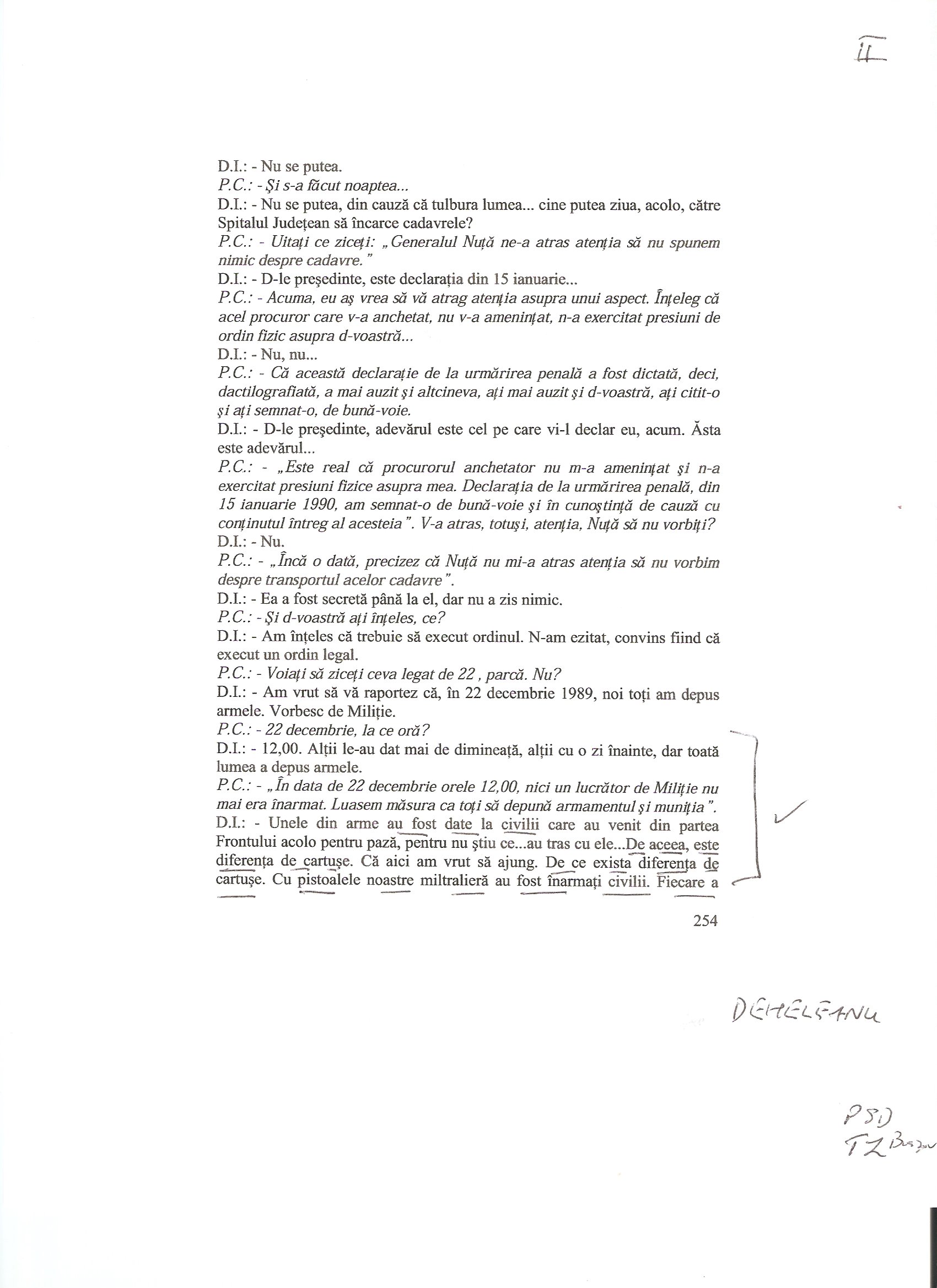
The 9 March 1990 testimony of Ion Deheleanu, chief of the Timis County Militia in December 1989, is edifying…he emphatically denies the existence of the terrorists after 22 december 1989 (using the oldest claim in the book, “because personally I never saw any”) and explains that the use of “different cartridges” after 22 december 1989 was a result of civilians having been armed from the stocks of the Securitate and Militia. He denies however that there might have been anything unusual about these cartridges (i.e. explosive dum-dum, etc.)
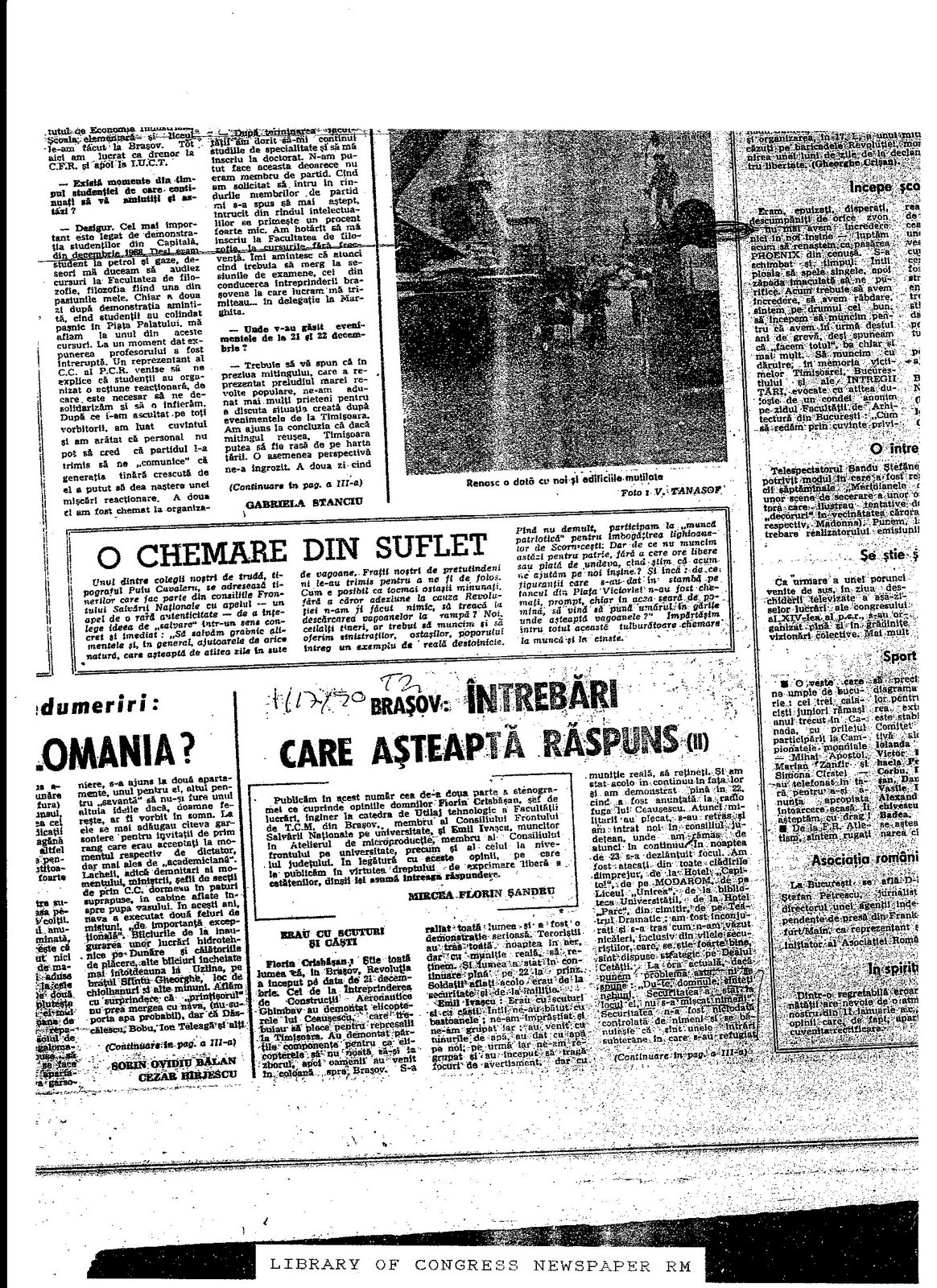
This confirms what can be proven from statements of the time, but has long since been forgotten: the idea that there were no terrorists, that Army units and civilians given arms shot wildly into one another by accident or by intention, did not originate with opponents of the Iliescu regime, but with the former Securitate and Militia….(the following article from 17 January 1990 makes this clear)
Deheleanu-type views can also be seen here in a late 1991 article by Pavel Corut under his later acknowledged alias of “Paul Cernescu”…he talks about reading the fantezist (fantastical) and pathetic revelations of Army personnel regarding the use of explosive and vidia bullets in December 1989…i.e. he too seeks to deny their use and existence
Paul Cernescu, acknowledged alias of a Fourth Directorate Securitate Military Counter-Intelligence officer, Pavel Corut
—————————————————————————————————————————————
Yet foreign media reporting from Timisoara and Army personnel in the initial post-revolutionary period talked about the use and existence of dum-dum bullets:
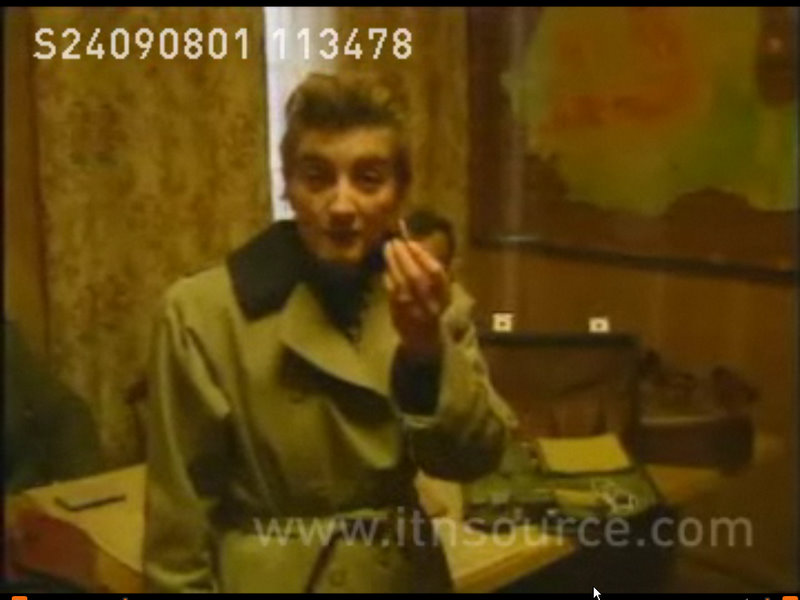
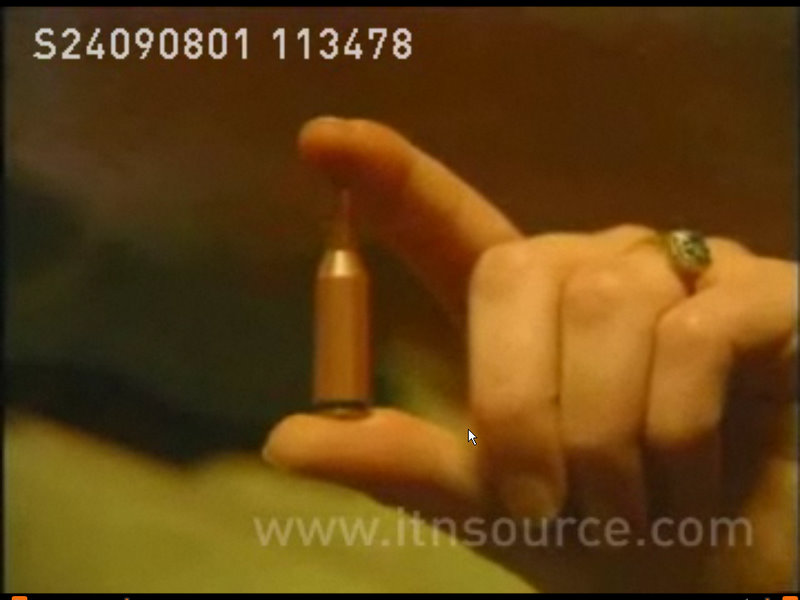
28th December 1989 – Timisoara search GRAPHIC Exit the secret police ROMANIA: Timisoara: EXT Soldiers standing outside Army HQ INT Camera goes inside HQ / Officer shows and explains weapons …
A1: Mix / A2: Mix
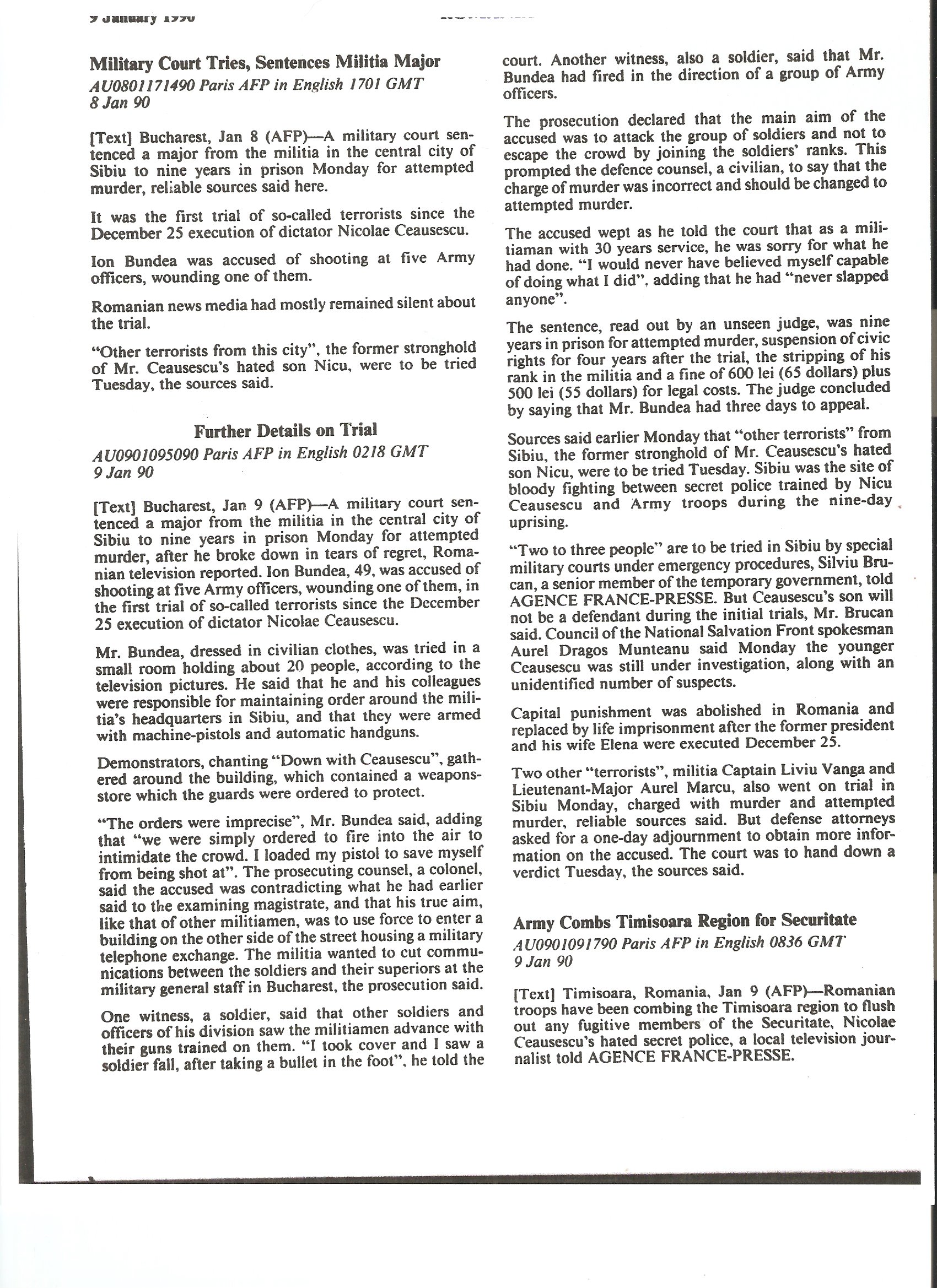
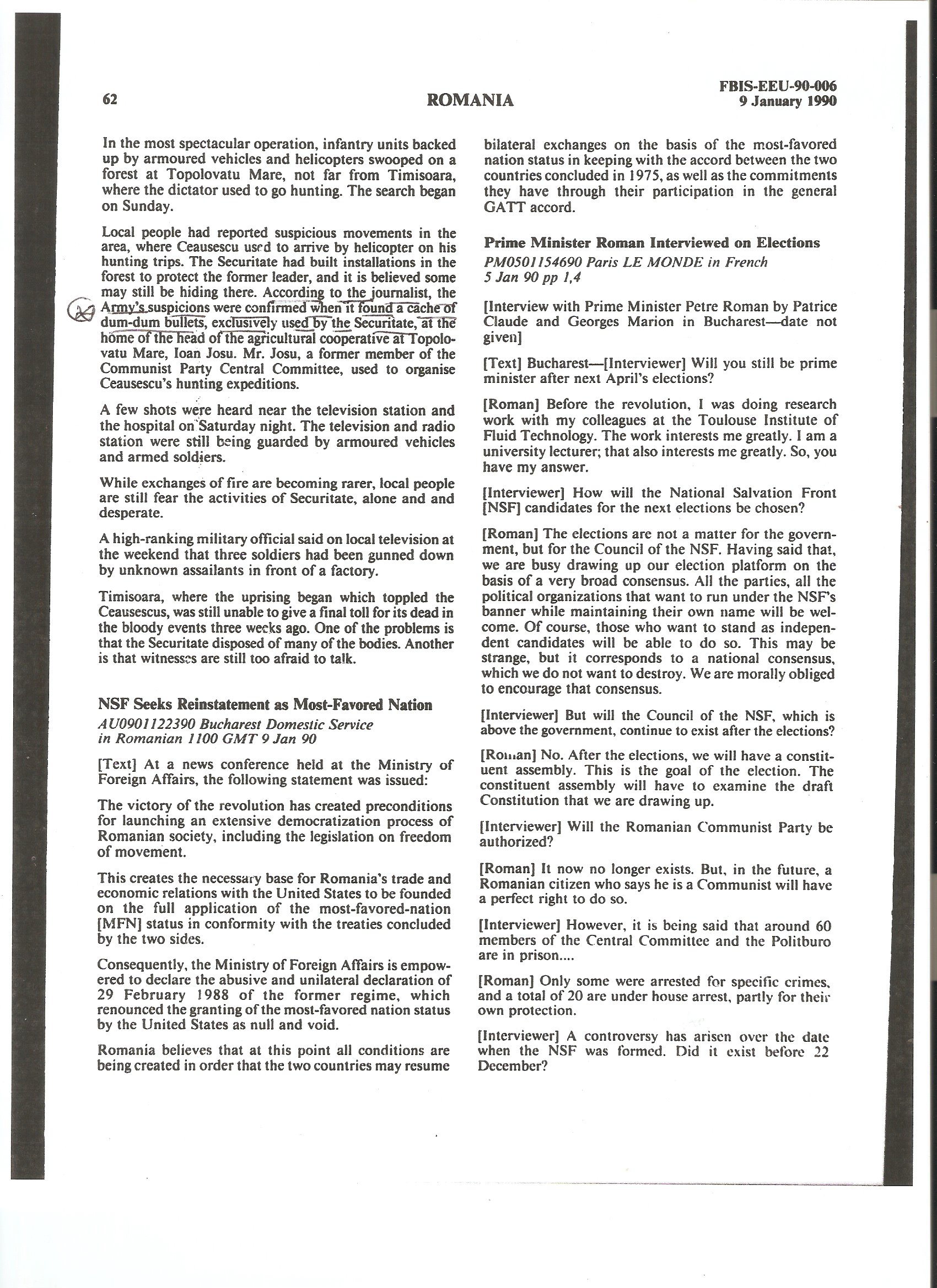
FBIS-EEU-90-006 9 January 1990 “Army Combs Timisoara Region for Securitate” Agence France Presse 9 January 1990, pp. 61-62
According to the journalist, the Army’s suspicions were confirmed when it found a cache of dum-dum bullets, exclusively used by the Securitate, at the home of the head of the agricultural cooperative at Topolovatu Mare, Ioan Josu [former member of the Communist Party Central Committee].
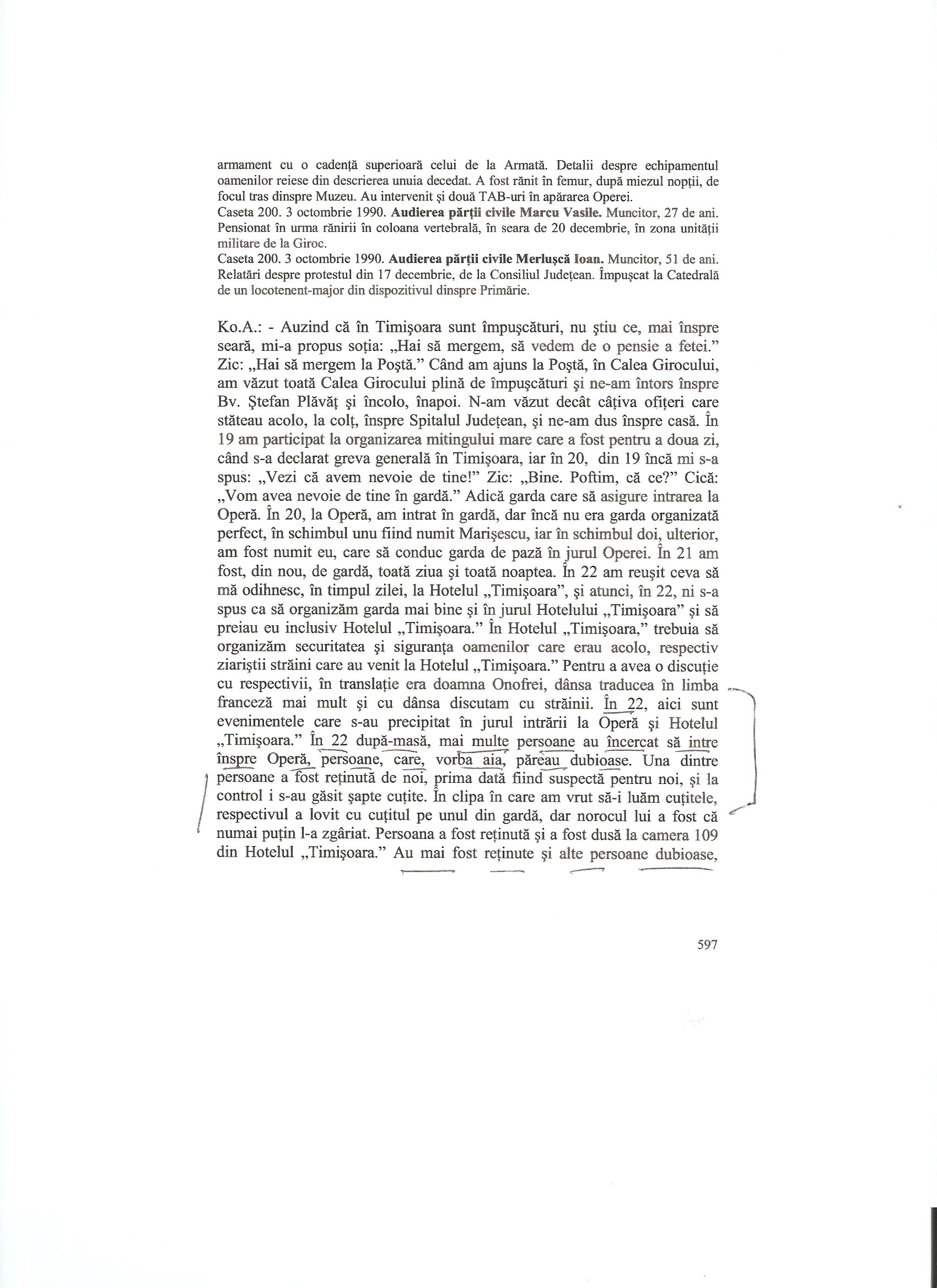
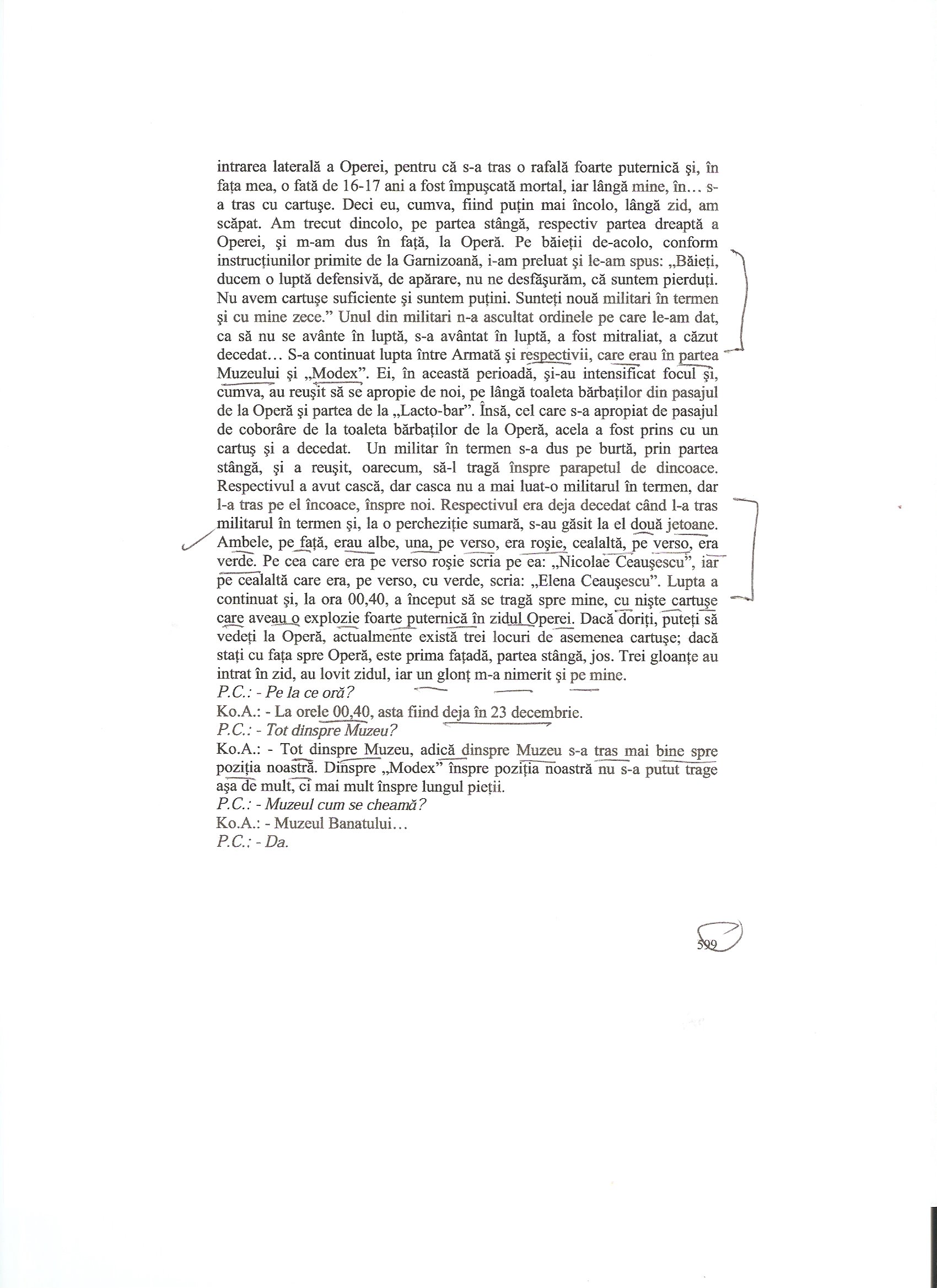
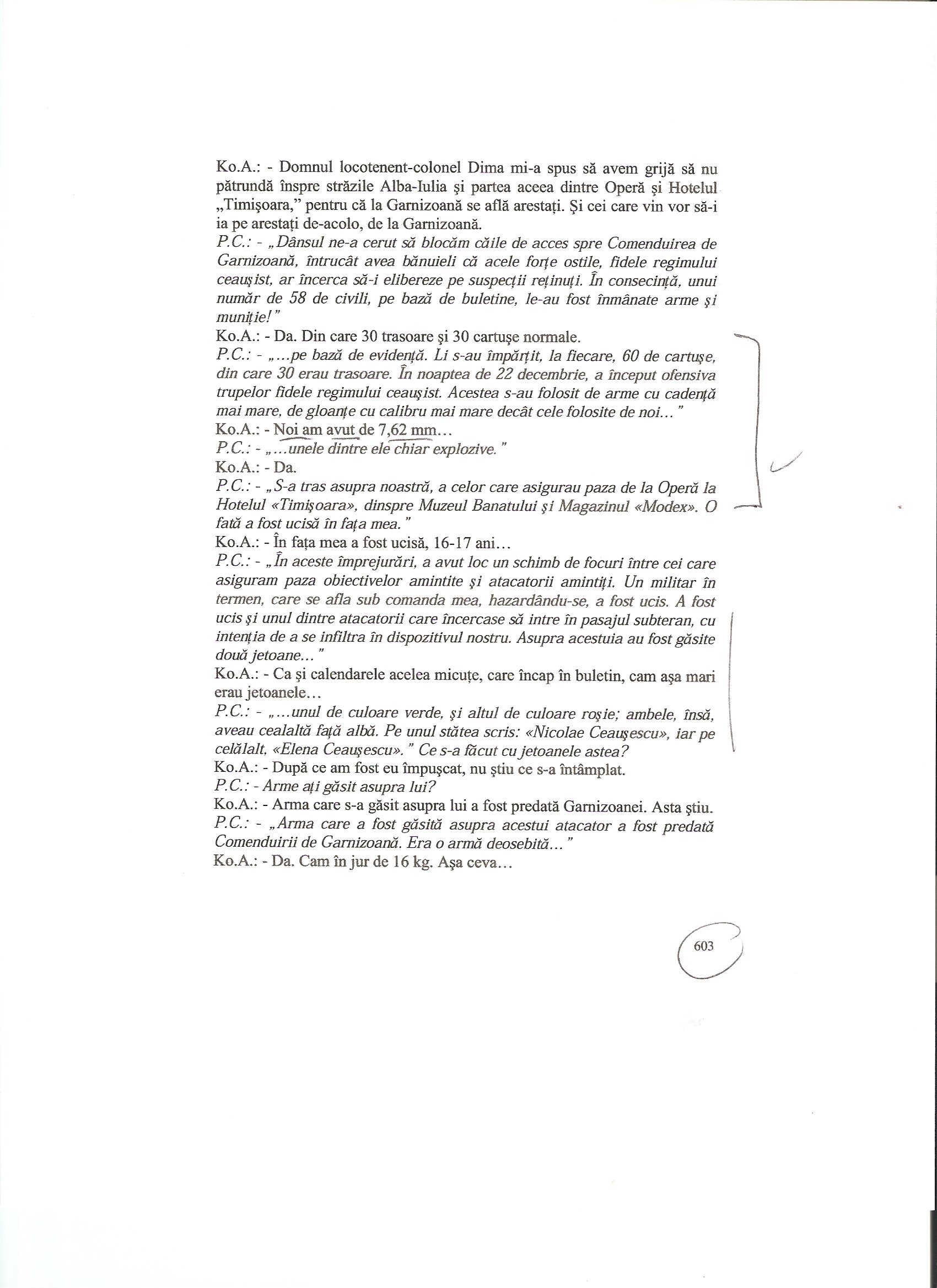
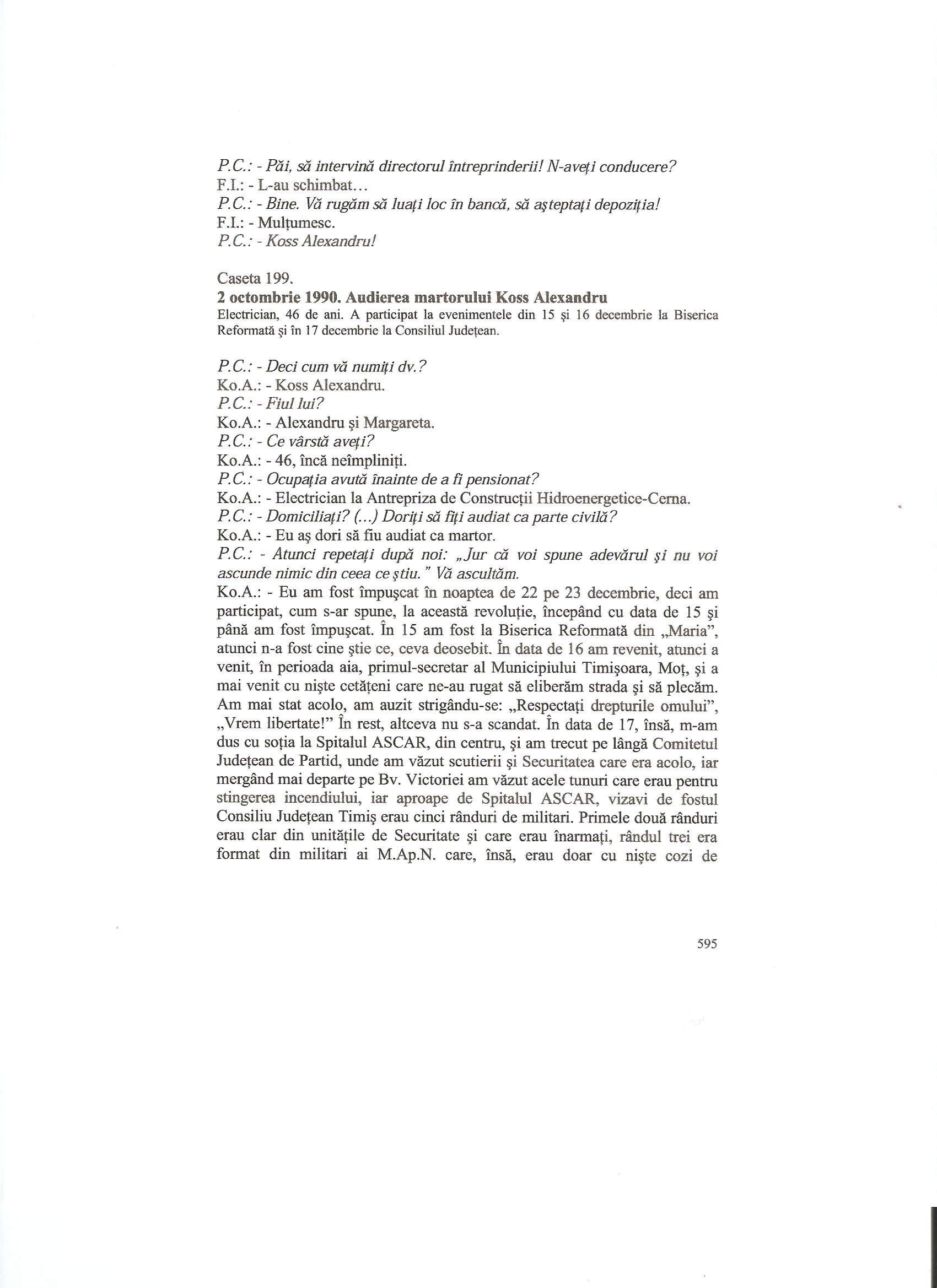
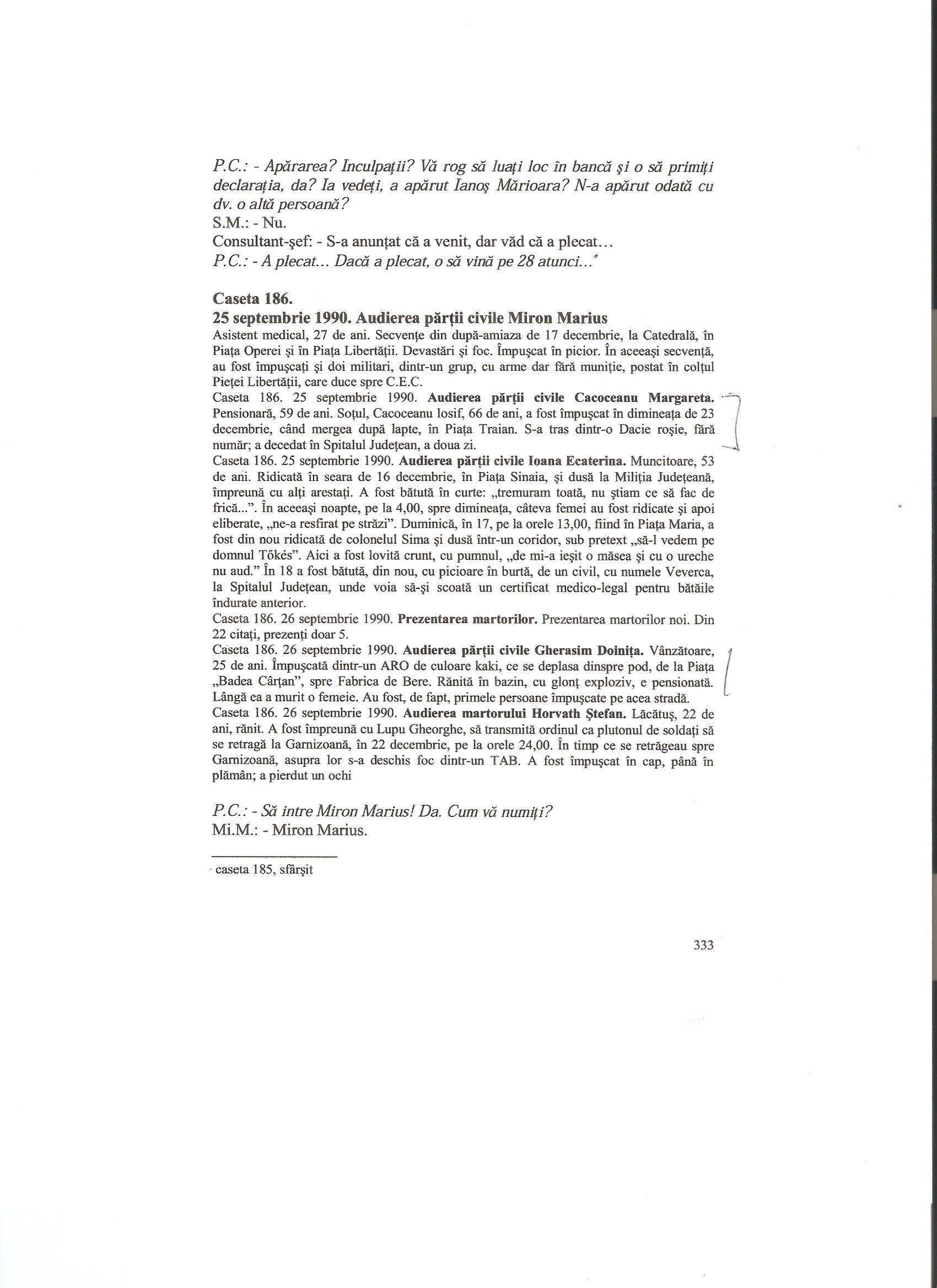
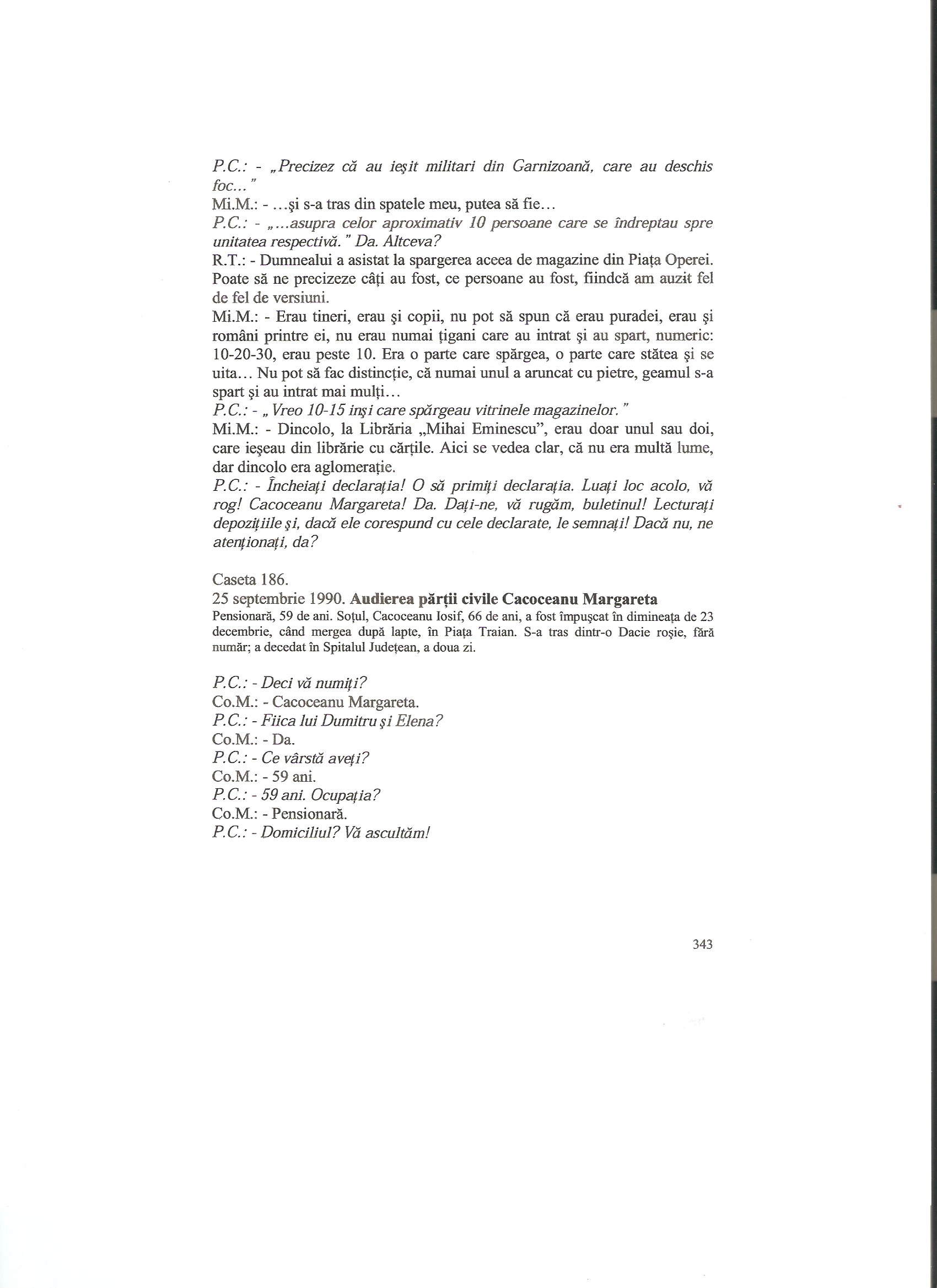
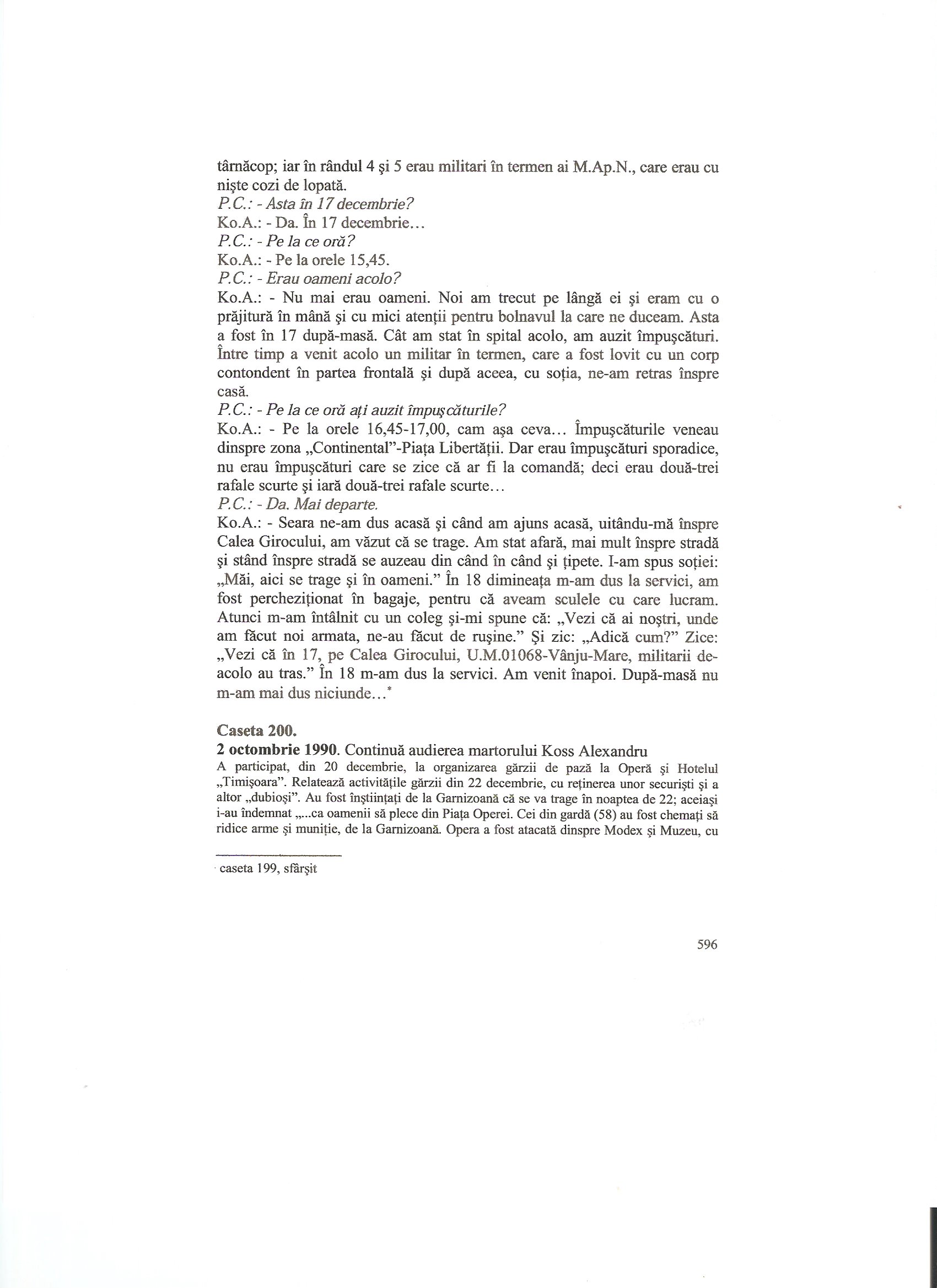
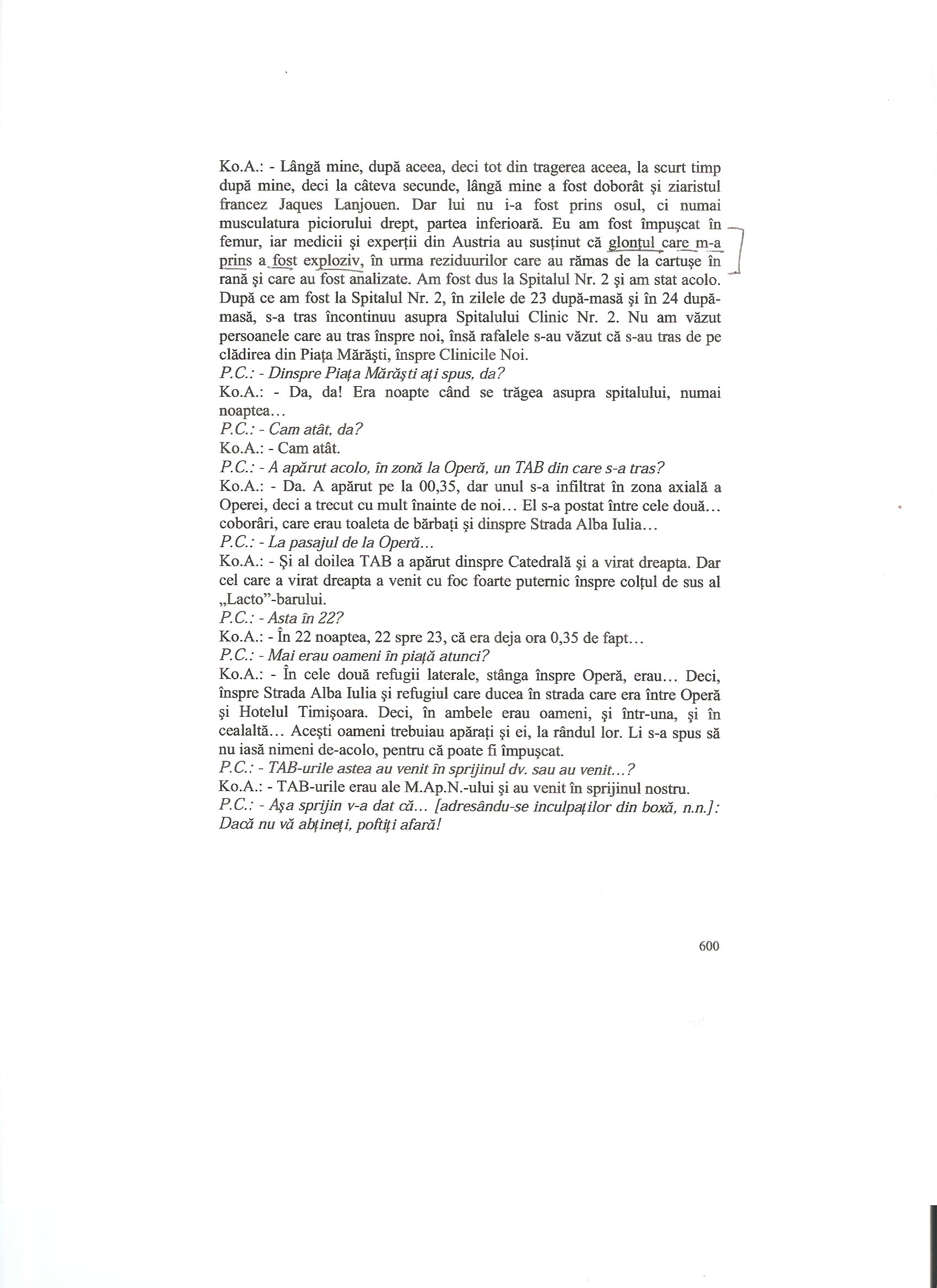
Two of the people who testified in court, Margaret Cacoceanu and Alexandru Koos, discussed the use of dum-dum bullets in Timisoara after the flight of Nicolae Ceausescu and Elena Ceausescu at noon on 22 December 1989 (Koos also described the terrorists he fought against and who he considered had shot him)
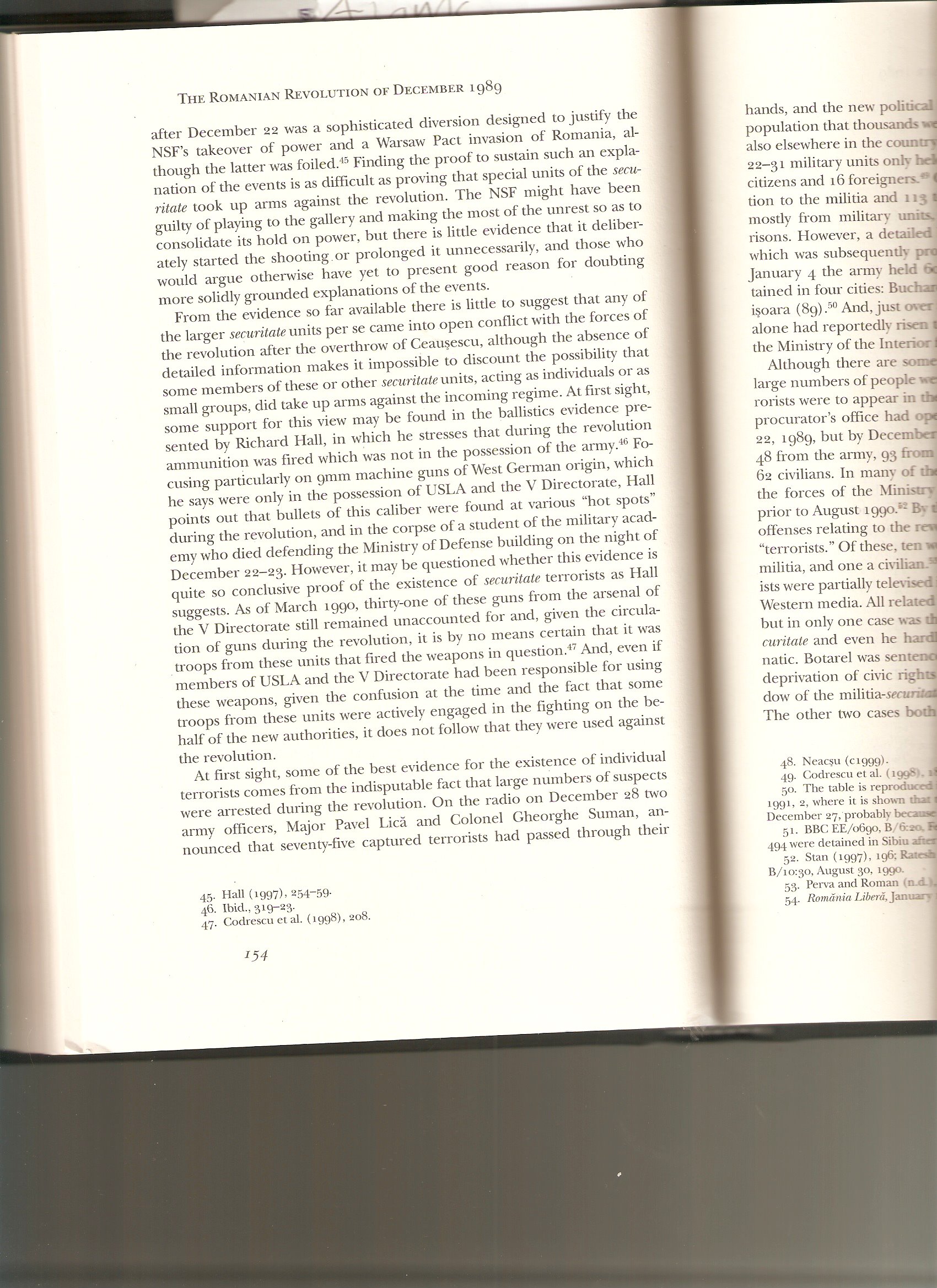
Peter Siani-Davies in 2005 speculated in general terms that any use of atypical munitions–those not used by the Army–could not necessarily be attributed to their use by the “terrorists” because civilians in certain places had been armed from Securitate and Militia stockpiles.
Peter Siani-Davies, The Romanian Revolution of December 1989, p. 154. parts of this excellent book are available online at
The Siani-Davies’ thesis of free-floating arms, of civilians having shot with Securitate and Militia weapons and thus responsibility/guilt thereby not necessarily being attributable to the Securitate or Militia falls completely apart, however, when we turn to the court testimonies and revelations concerning those who were wounded and/or killed by dum-dum explosive bullets on 17 December 1989 in Timisoara. Clearly, unlike post 12:08 pm on 22 December 1989, there was no opportunity or possibility for civilians/protesters to have these arms.
Moreover, it should also be pointed out, the so-called DIA hypothesis (alleging that the terrorists were from the Army’s intelligence directorate and therefore might be the source of such atypical munitions) also falls apart here. DIA personnel were not present in Timisoara on the afternoon and evening of 17 December 1989 when these injuries and deaths from exploding bullets took place.
Finally, the idea that “perhaps the rank-and-file Army had dum-dum explosive bullets too” falls apart: in twenty-two years, not a single Army official (including former draftees!) has admitted or alleged such a thing and there has been absolutely no evidence that this might have been the case. What is more: as we have seen, where as some Army officials (see Petre Ghinea above) want to talk about the existence of dum-dum bullets and acknowledge there use in December 1989, Securitate and Militia personnel (Ion Deheleanu, Pavel Corut, etc.) deny their very existence! This speaks volumes about potential culpability.
Cases available on the Internet mentioning the wounding or killing of demonstrators with dum-dum explosive bullets on 17-18 December 1989. There are more than a dozen in all, many of whom we have seen were testified about during the Timisoara trials.
Danut Gavra with his two daughters in the Heroes’ Cemetery in December 2009
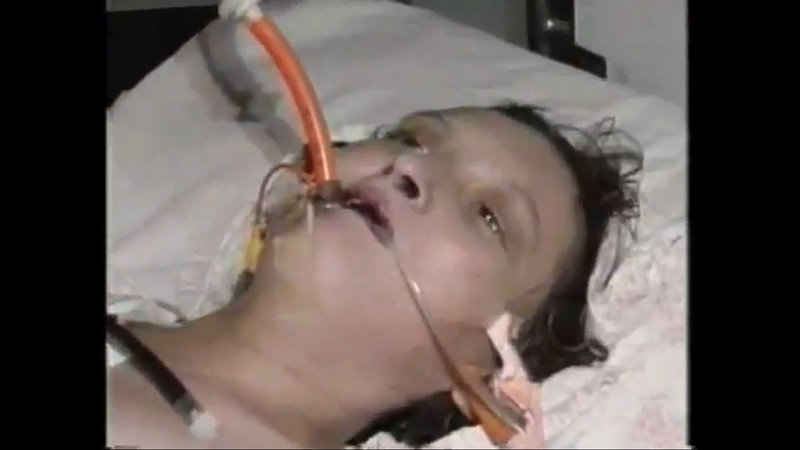
rish Television (RTE) captured what were apparently the last hours of Florica Sava’s tragic end. Warning: the scene from 11:00 to 11:30 is graphic and unsettling.
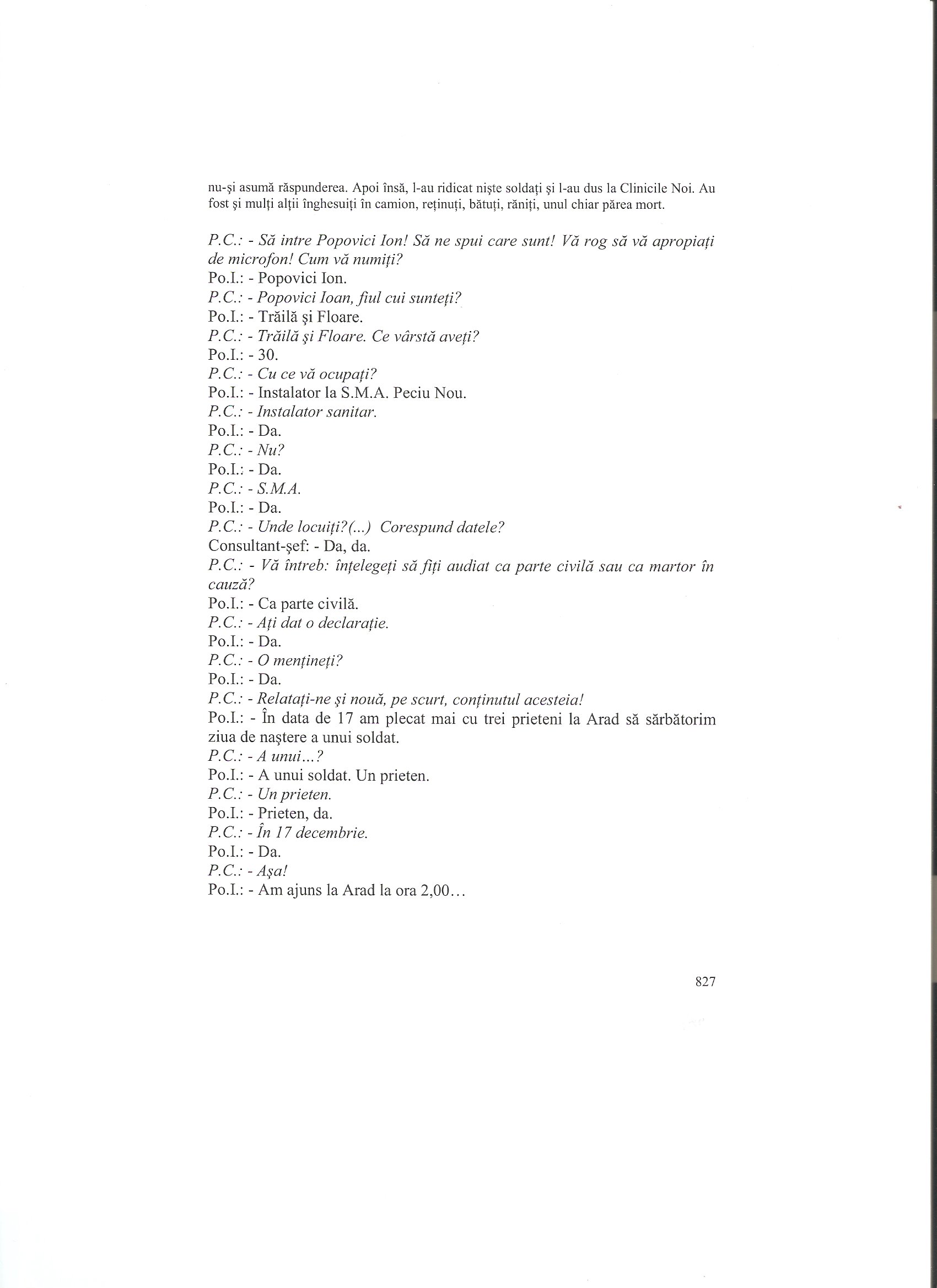
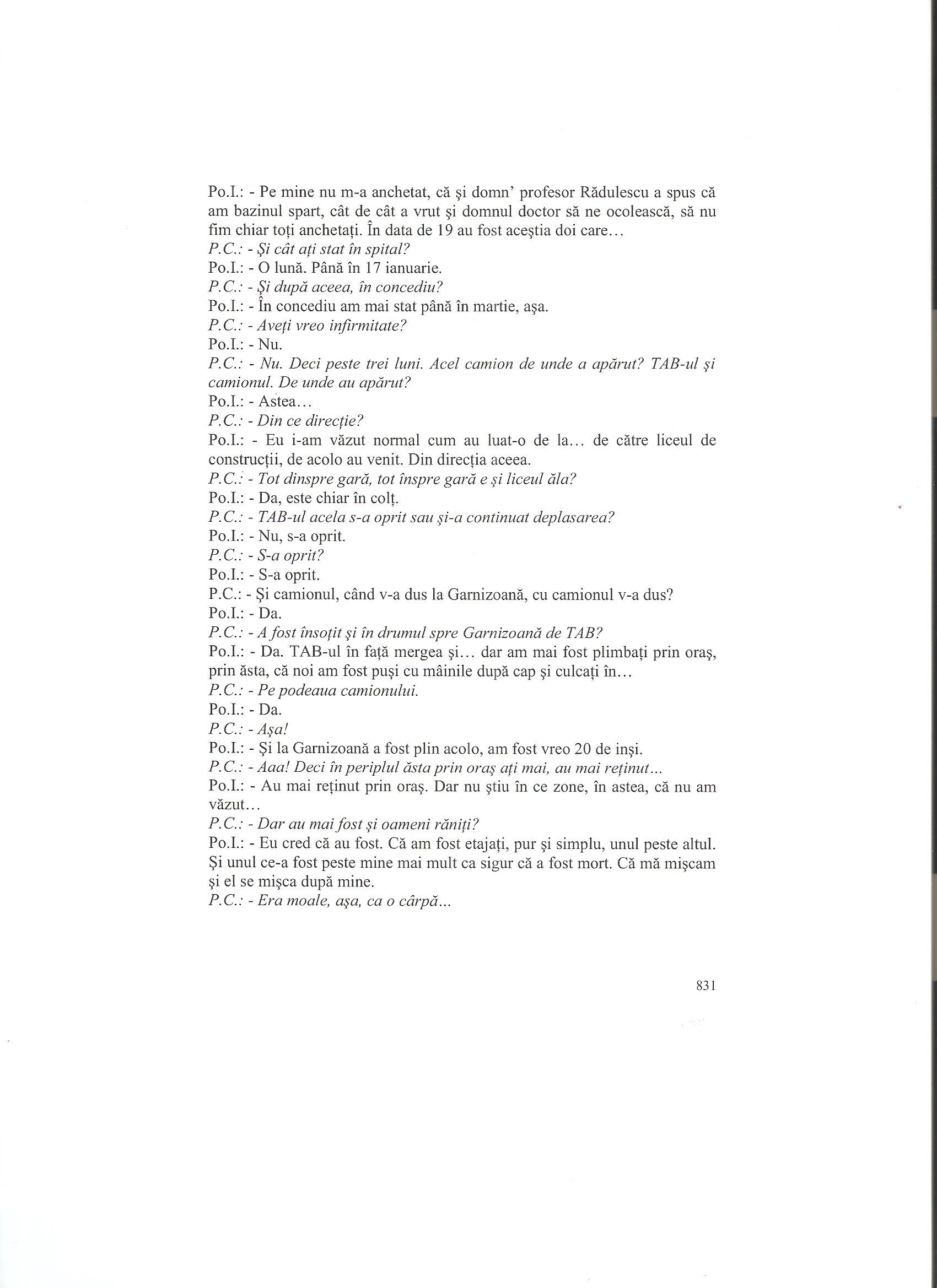
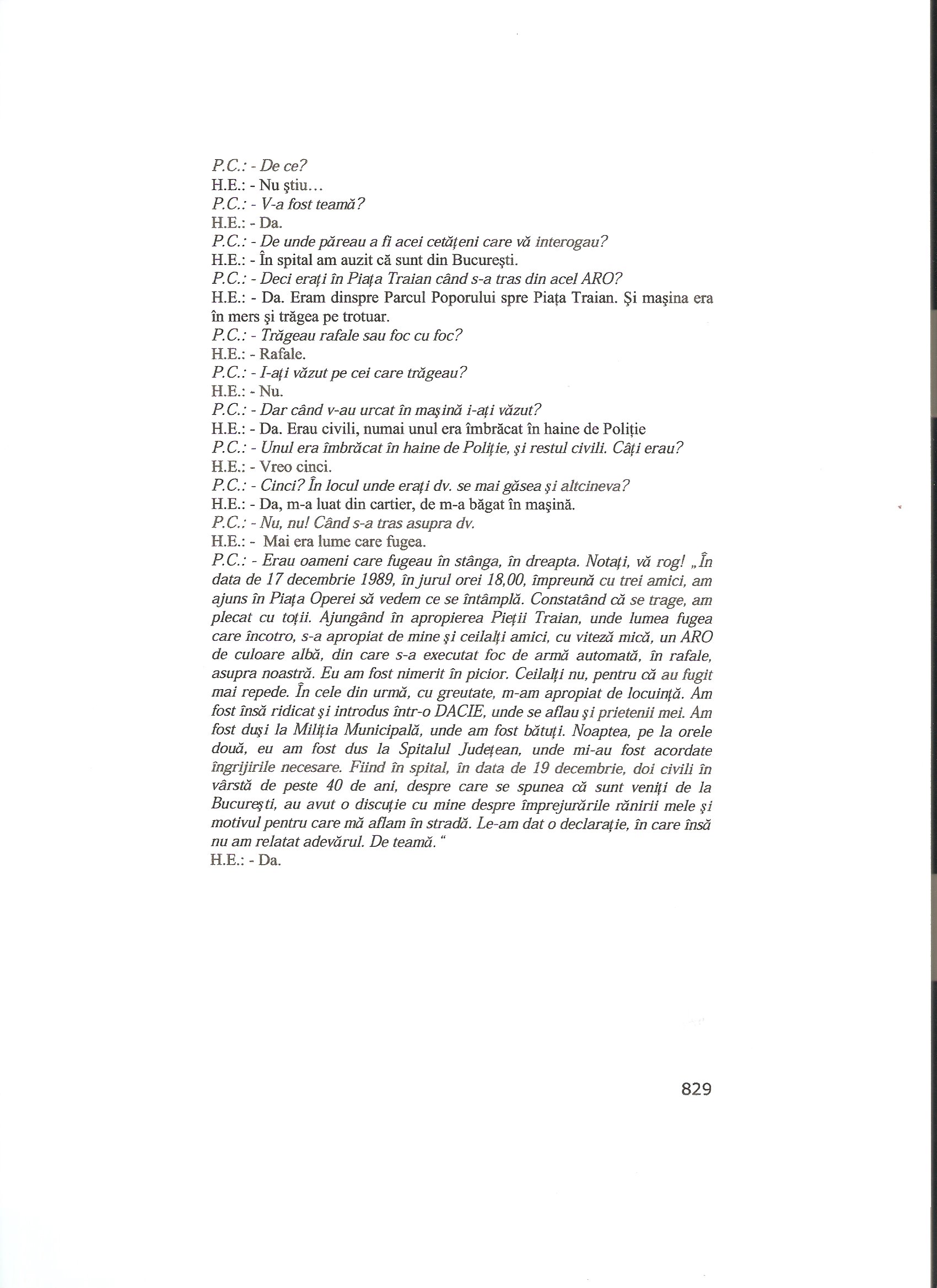
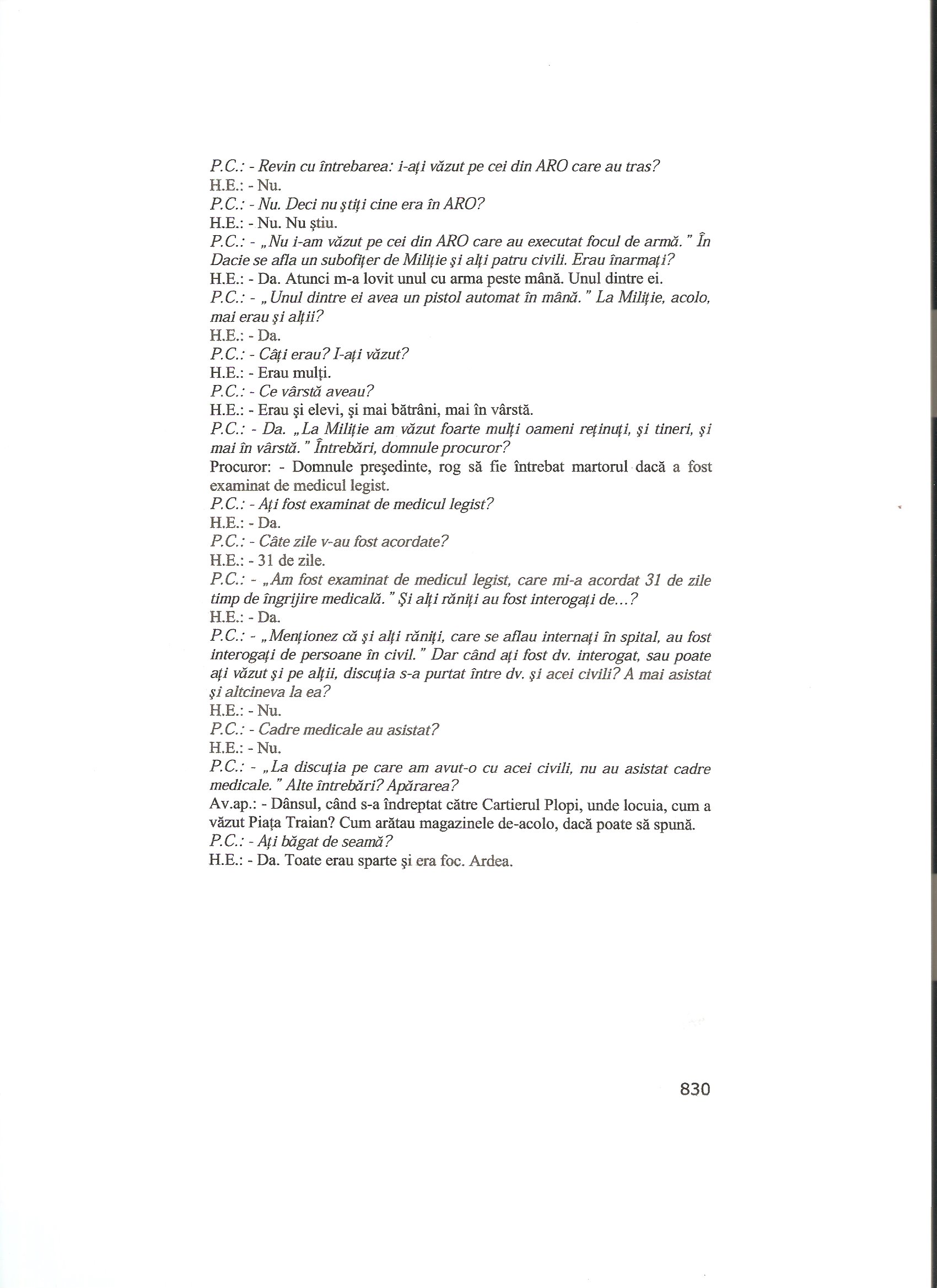
Brendan O’Brien (reporter): “Florica Sava, a 33 year old mother of two young sons, was shot from a car with a dum-dum bullet. It caused massive internal injuries. Doctors said she had just hours to live.”
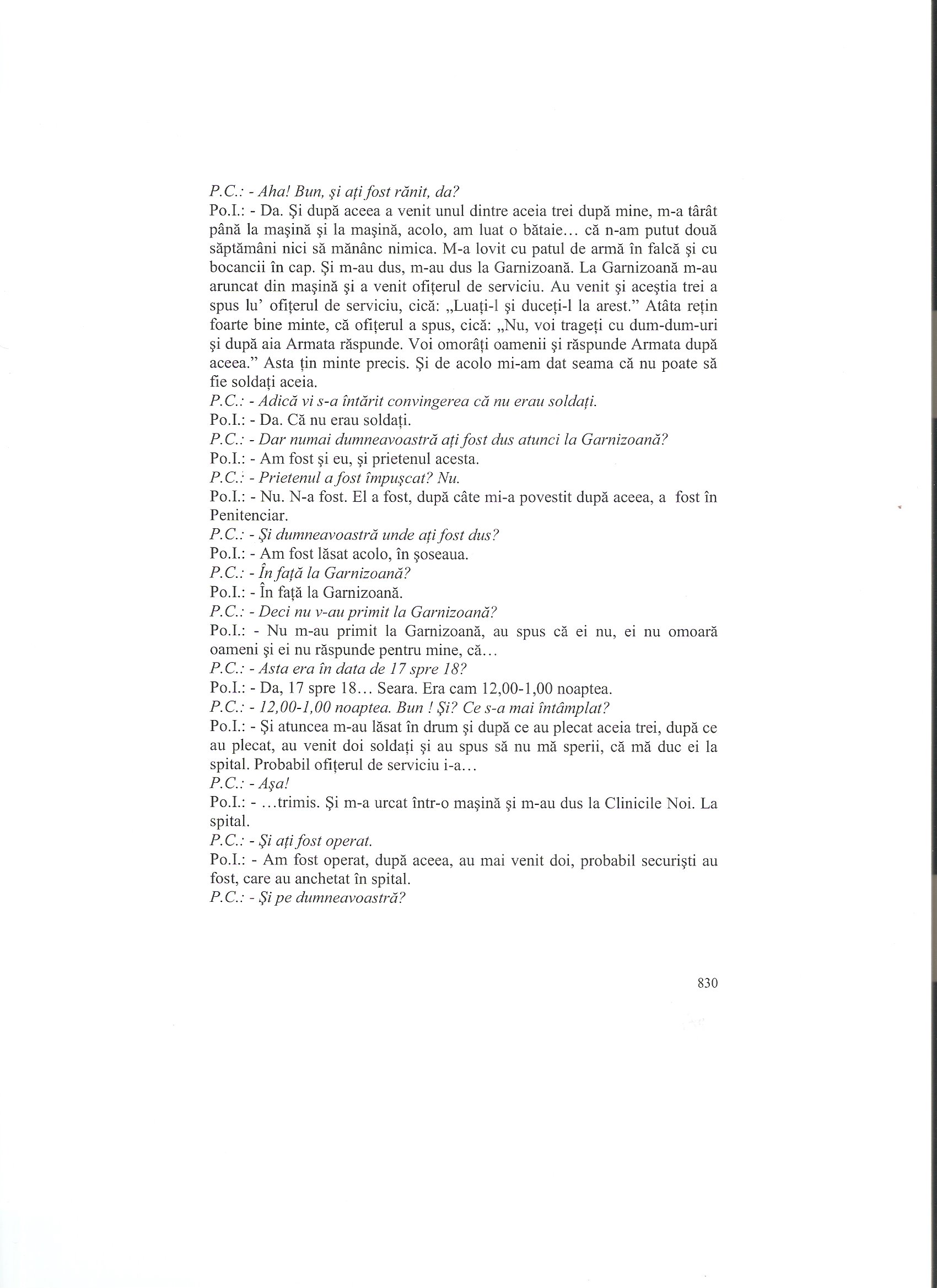
Some excerpts: P.C.: Ati dat o declaratie? Po. I. : Da P.C.: O mentineti? Po. I. Da (p. 827) P.C.: “Inteleg sa fiu audiat in cauza ca parte civila”, da? V-as ruga sa faceti putin liniste! “Mentin declaratia de la Procuratura si…” (p. 833)
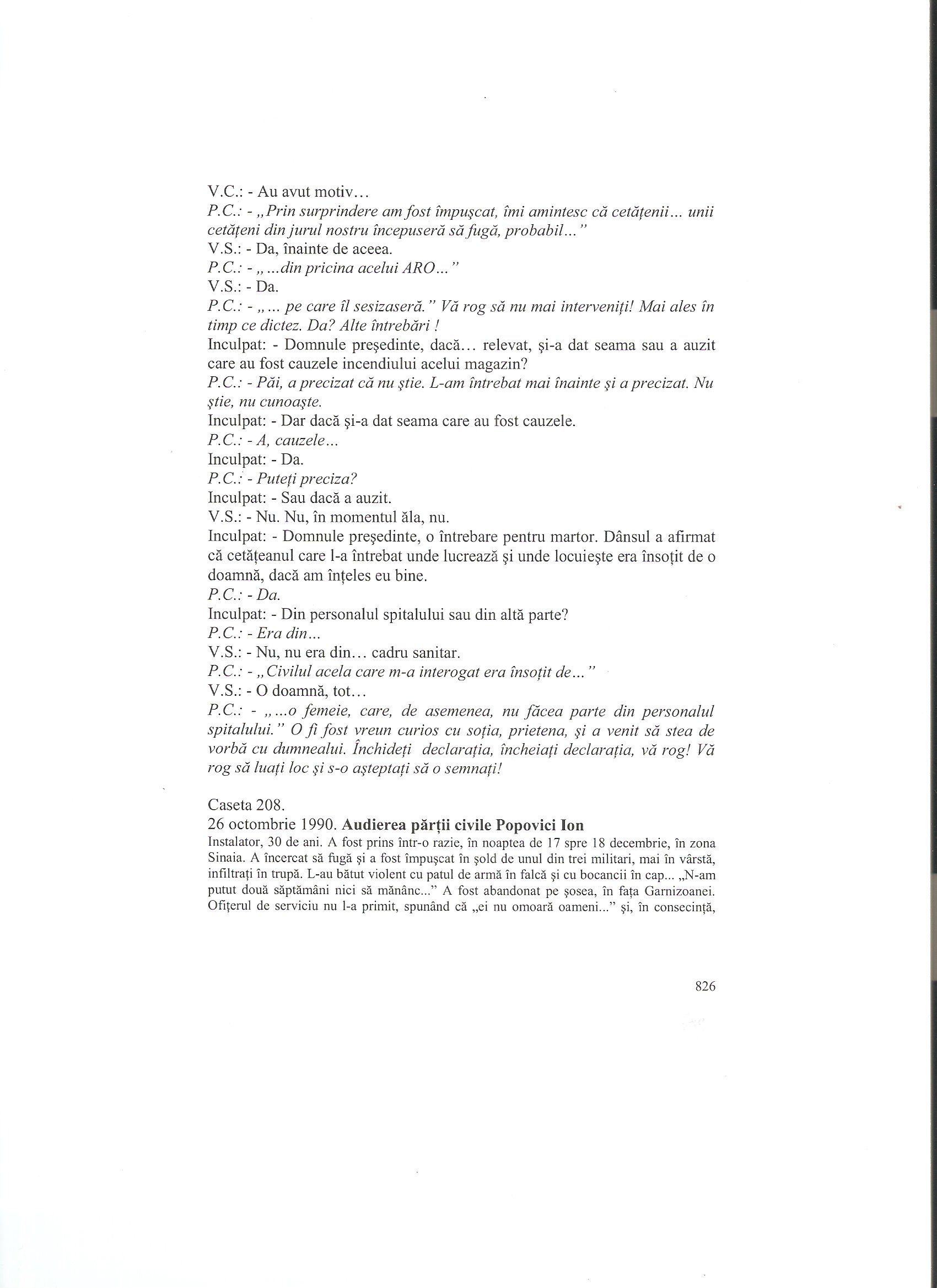
Po. I.: …Da [am fost ranit]. Si dupa aceea a venit unul dintre trei [civili mai in varsta] dupa mine, m-a tarat pana la masina si la masina, acolo, am luat o bataie…ca n-am putut doua saptamani nici sa mananc nimica. M-a lovit cu patul de arma in falca si cu bocancii in cap. Si m-au dus, m-au dus la Garnizoana. La Garnizoana m-au aruncat din masina si a venit ofiterul de serviciu. Au venit si acestia trei a spus lu’ ofiterul de serviciu, cica: “Luati-l si duceti-l la arest.” Atata retin foarte bine minte, ca ofiterul a spus, cica: “Nu, voi trageti cu dum-dum-uri si dupa aia Armata raspunde. Voi omorati oameni si raspunde Armata dupa aceea.” Asta tin minte precis. Si de acolo mi-am dat seama ca nu poate sa fie soldati aceia. (p. 830)
—————————————————————————————
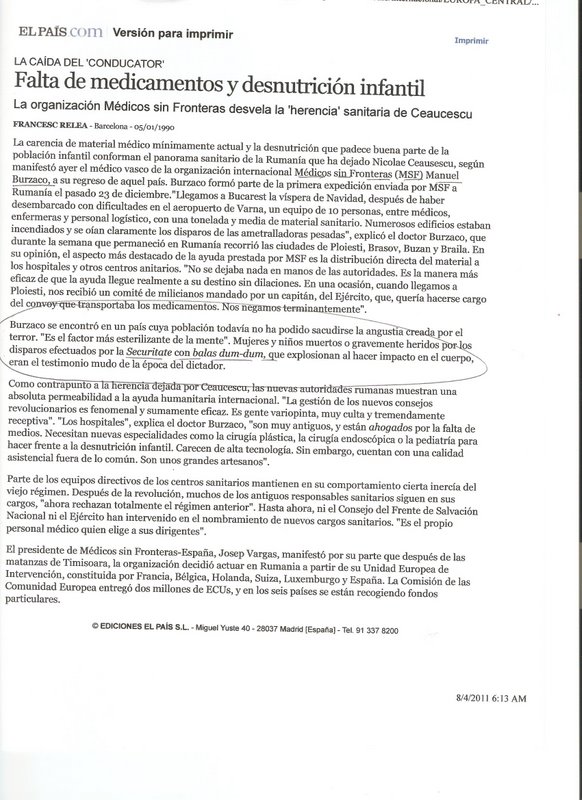
Dr. Manuel Burzaco from “Doctors without Borders” was part of a team of doctors from that group who visited hospitals in Bucharest, Ploiesti, Brasov, Buzau and Braila in late December 1989 and early January 1990. This report from the Madrid daily El Pais touches upon the women and children gravely injured by the exploding “dum dum bullets used by the Securitate.”
SIX Doctors/Medical personnel from Timisoara alone have discussed the use of dum-dum bullets against demonstrators in Timisoara…
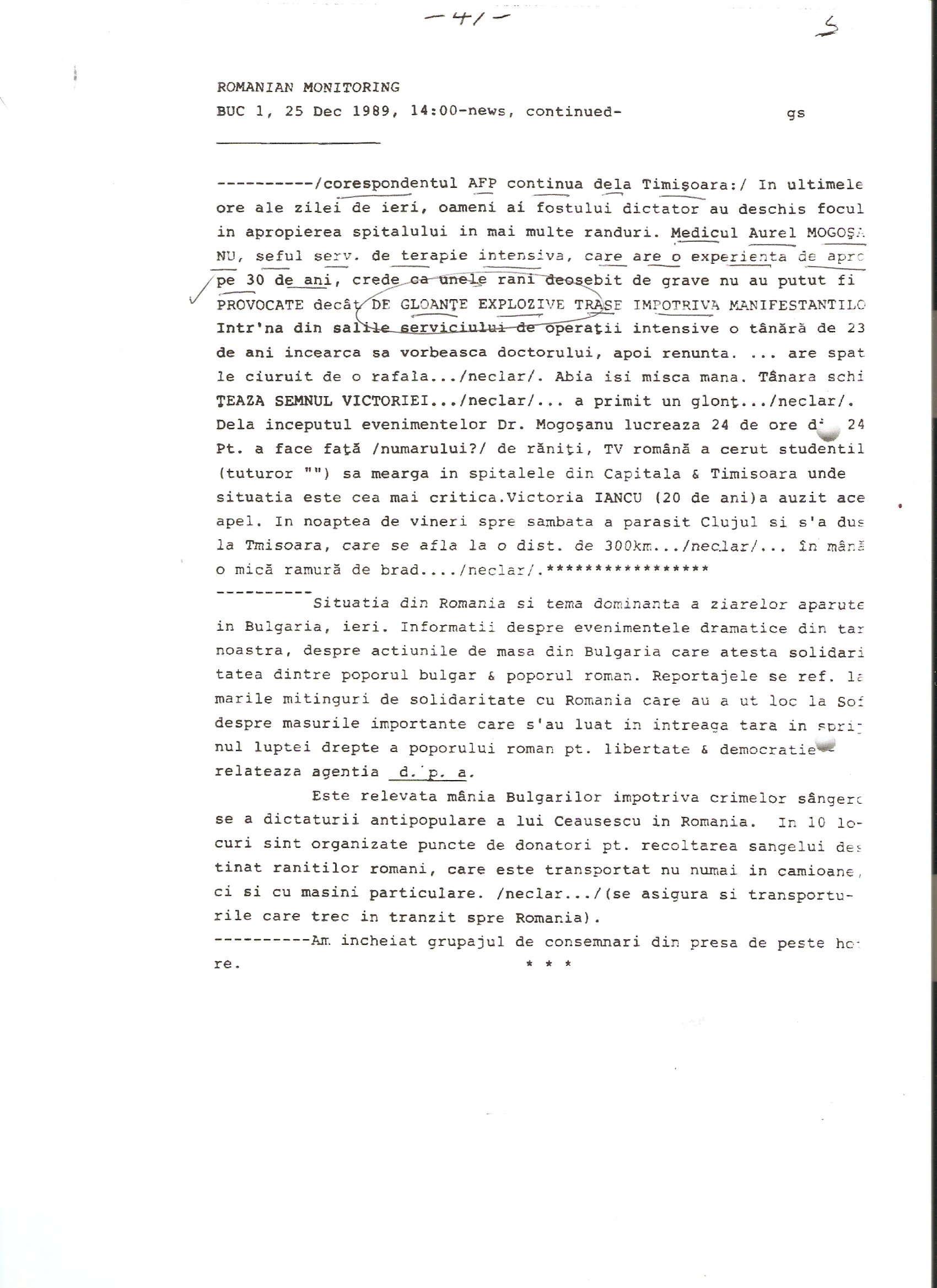
Doctors also reported on the wounds caused by explosive bullets (i.e. dum-dum bullets): In this dispatch from Agence France Presse, relayed by Radio Free Europe on 25 December 1989, Dr. Aurel Mogosanu, a medic in the intensive care unit of a Timisoara hospital, says based on his thirty years of experience, some of the wounds could only have been CAUSED by EXPLOSIVE BULLETS SHOT AT THE PROTESTERS”
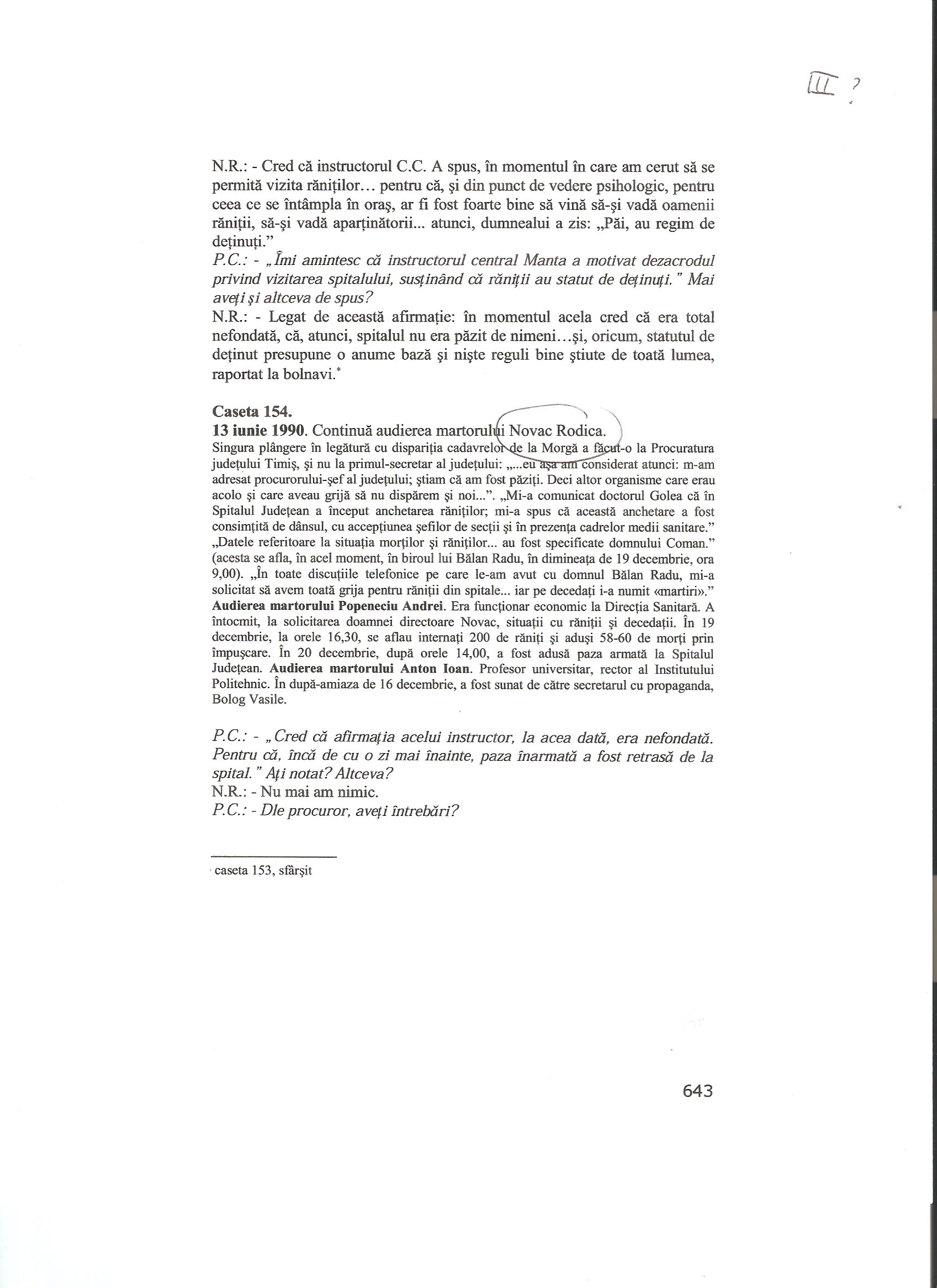
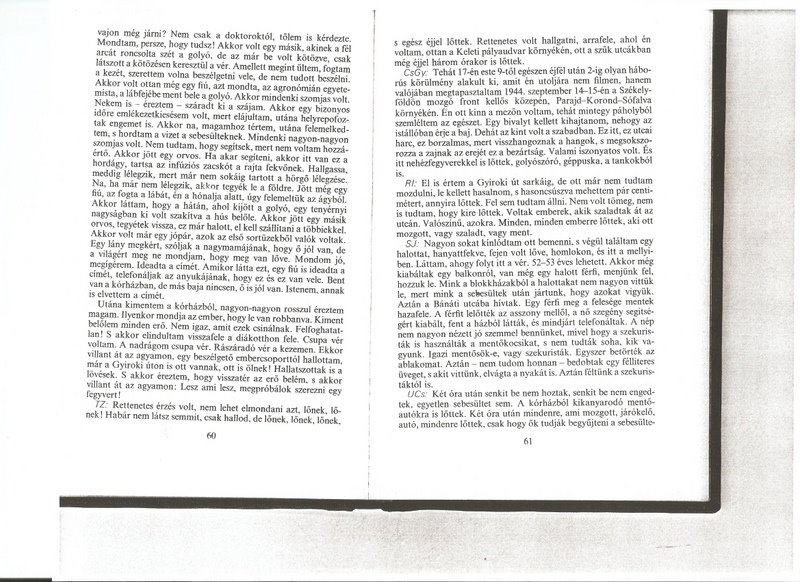
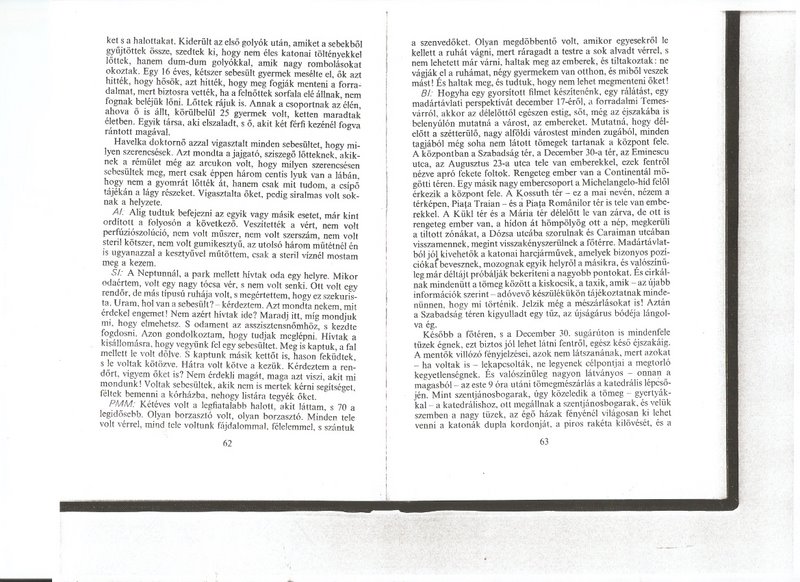
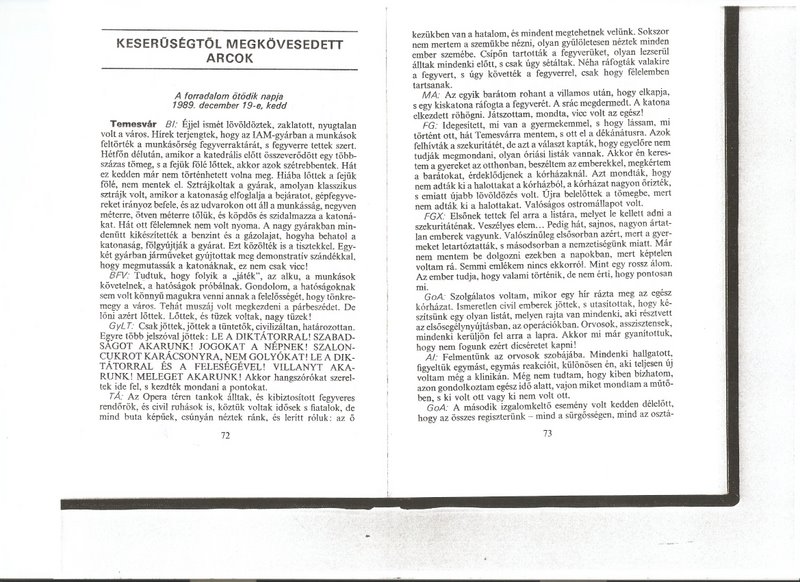
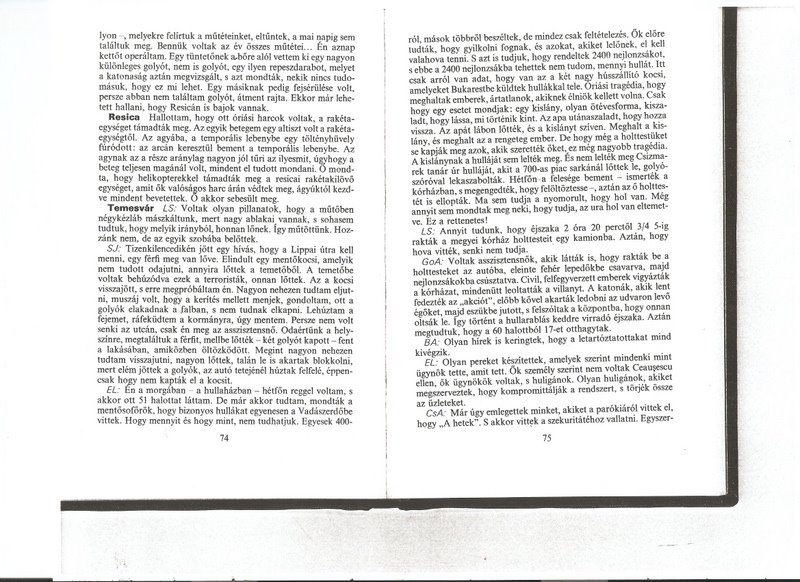
Rodica Novac’s claim is corroborated elsewhere by four other medical officials on call during the Timisoara repression. First, in Romanian, by Dr. Atanasie Barzeanu, then in Hungarian by three doctors (Vladimir Fluture, Csaba Ungor, and Andras Goga) present and performing surgery in Timisoara hospitals from 17-19 december 1989 who recount separately their discovery of dum-dum exploding bullets among the bullets with which demonstrators arriving at the hospital had been shot. december 1989: temesvari orvosok, dum-dum golyok, es a roman forradalom
Sava Florica, 33 de ani, vinzatoare la Loto-pronosport in cartierul Fabric, impuscata din mers, in Piata Traian
Barzeanu Atanasie, 65 anit, medic primar, doctor in stiinte, chirurg, Spitalul Judetean Timisoara
“…sintem deci in 18 decembrie…Pe la orele doua si patruzeci, cind inchideam o operatie–Sava Florica, 33 de ani, vinzatoare la Loto-pronosport in cartierul Fabric, impuscata din mers, in Piata Traian, dintr-un ARO, pacienta prezentindu-se o echimoza cu distrugerea tesuturilor (plaga in diametru de 15 centimetri), a tesuturilor din regiunea epigastrica, inclusiv a muschilor drepti abdominali, cu ruptura a colonului ascendent transvers si a jejuno-ileonului, fiind in stare de soc grav traumatic, hemoragic–, fara sa-mi poti explica nici macar acum cu ce fel de gloante a putut fi lovita, pentru ca nu am identificat nici orificiul de iesire si nici pe cel de intrare, a venit o asistenta de la Chirurgie I, care mi-a spus sa merg la domnul Ignat.”
Titus Suciu, Reportaj cu Sufletul la Gura, (Editura Facla 1990), pp. 133-134.
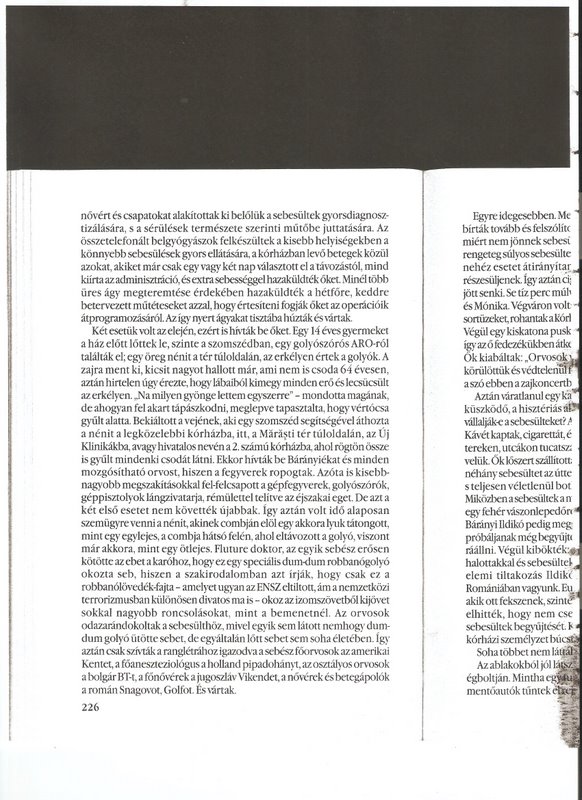
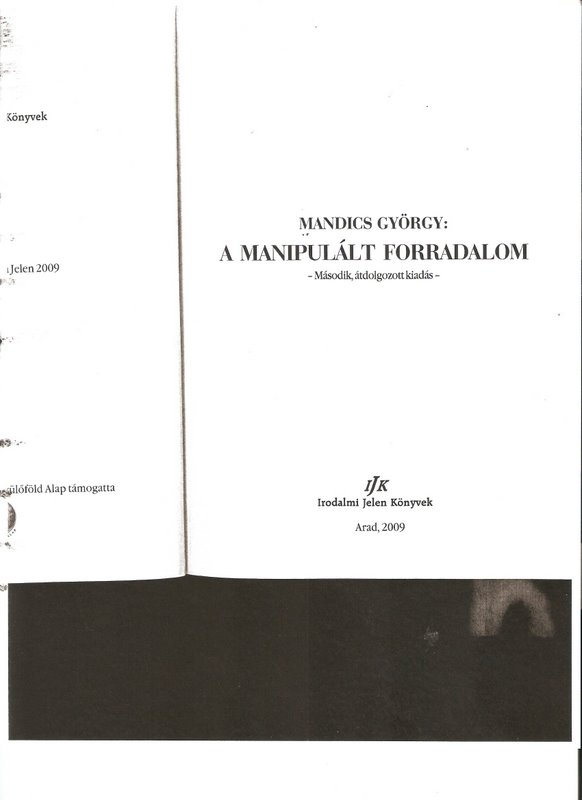
The following first appeared in Gyorgy Mandics’s Temesvari golgota (1991) pp. 348-349 and is reprinted in his A Manipulalt Forradalom (2009). [My guess is this is also the source for the reference to dum dum bullets in the German language wikipedia entry for http://de.wikipedia.org/wiki/Rum%C3%A4nische_Revolution_1989 — Hans Vastag, György Mandics, Manfred Engelmann: Temeswar. Symbol der Freiheit. Wien 1992. ]
pp. 348-349
Ket esetuk volt az elejen. Ezert is hivtak be oket. Egy 14 eves gyermeket a haz elott lottek le, szinte a szomszedban, egy golyoszoros ARO-rol talaltak el; egy oreg nenit a ter tuloldalon, az erkelyen ertek a golyok. A zarja ment ki, kicsit nagyott hallott mar, amire is csoda, 64 evesen, azt hirtelen ugy erezte, hogy labaibol kimegy minden ero es lecsusott az erholya. Na milyen gyonge lettem egyszeruen–mondotta maganak. de ahogyan fel akart tapaszkodni meg lepve tapasztalt, hogy vertocsa gyult alatta. Bekialtolt a vegenek aki egy szomszed segitsegevel athozta a nenit a legkozelebbi korhazba, itt a Marasti ter tuloldalan, az uj Klinikakba, avagy hivatalos neven a 2 szamu korhazba, ahol rogton osszecodult mindenki csodat latni. Ekkor hivtak be Baranziekat es minden mozgositato orvost, hiszen a fegyverek ropogatak. Azota is kisebb nagyobb megszakitasokkal, felfelecsapolt a gepfegyverek, golyoszorok, geppisztolyok langzivatarja, remulettel telitva az ejszaki eget.
p. 349
De azt a ket elso esett nem kovettek ujabbok. Igz aztan volt ido alaposan szemugyre venni a nenit akinek combjan elol egz akkora lyuk tatongott mint egy egy lejes, a comba hatso felen ahol eltavotott a golyo, ott viszont mar akkora mint egy otlejes. Fluture doktor, az egzik sebesz erosen kototte az ebet a korohoz, hogy ez egz specialis dum-dum robbanogolyo okozta seb, hiszen a szakirodalomban azt irjak, hogy csak ez a robbannolovedek-fajta-amelyet ugyan az ENSZ eltitott, am a nemzetkozi terrorizmusban kulonesen divatos ma is–okoz az izomszovetbol kijovet sokkal nagyobb roncsolasokat mint a bemenetnel. Az orvosok odazarandokoltak a sebesulthoz, mivel egzik sem latott semhogy dum-dum golyo utotte sebet, de egyaltalan lott sebet sem soha eleteben. Igz aztan csak szivtak a rangeletrahoz igazodva a sebesz foorvosok az amerikai Kentet, a foamnesztezialogus a holland pipadohanyt, az asztalyos orovosok a bolgar BT-t, a fonoverek a jugoslav Vikend-et, a noverek es helyapolok a roman Snagov-t, Golfot. Es vartak.
(Note: it is unclear who the 64 yr. old described was…there are several individuals without ages listed as injured or dead during the events, but I think it more likely the age of the woman is incorrect)
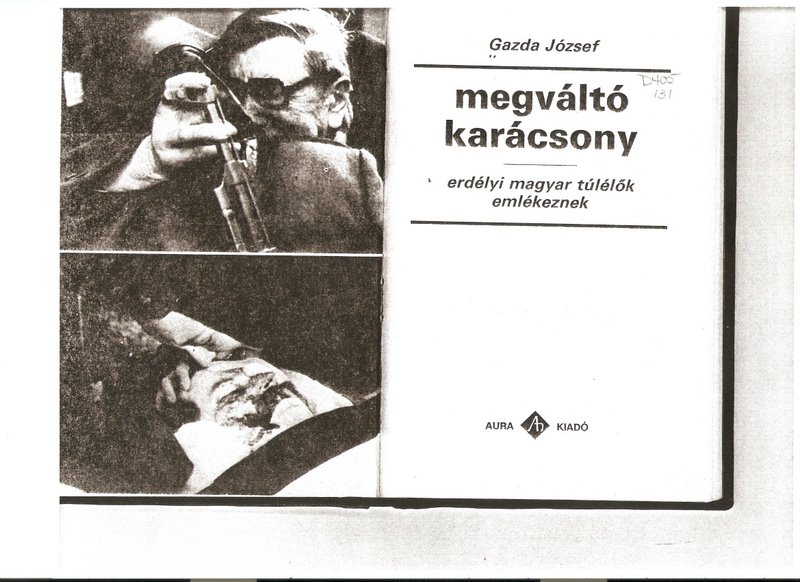
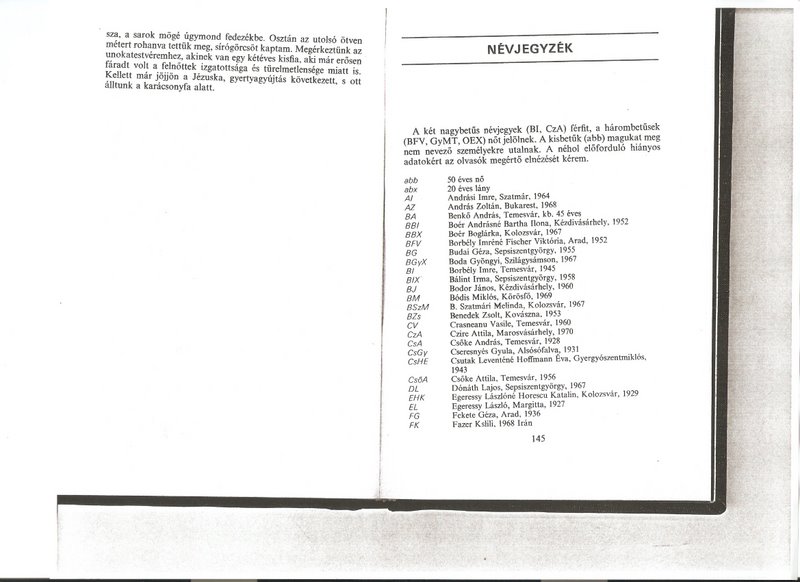
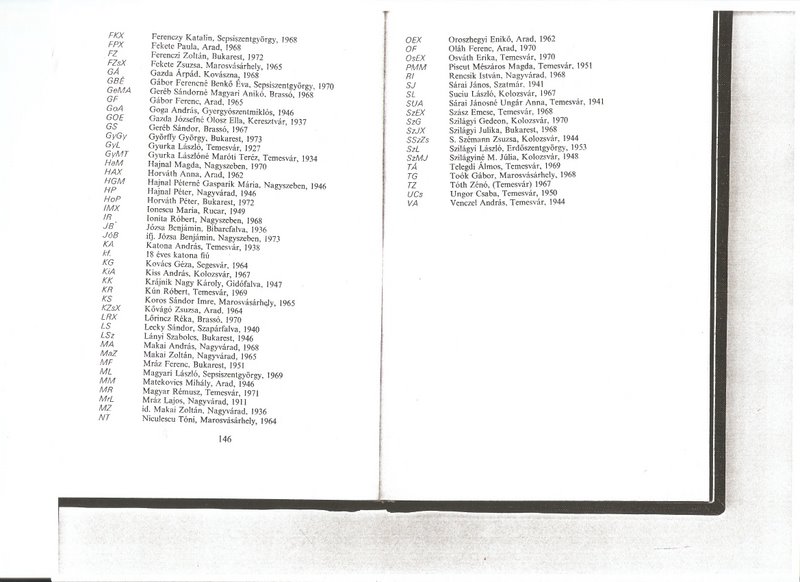
Jozsef Gazda Megvalto karacsony. Erdelyi magyar tulelok emlekeznek. (1990)
Ungor Csaba: Ket ora utan senkit be nem hoztak, senkit be nem engedtek, egyetlen sebesult sem. A korhazbol kikanyarado mentoautokra is lottek. Ket ora utan mindre, ami mozgott, jarokelo, auto, mindenre lottek, csak hogy ok tudjak begyujteni a sebesulteket s a halottakat. Kiderult az elso golyok utan, amiket a sebekbol gyujottek ossze, szedtek ki, hogy nem eles katonai toltenyekkel lottek, hanem dum-dum golyokkal, amik nagy rombolasokat okoztak. Egy 16 eves, ketszer sebesult gyermek meselte el, ok azt hittek, hogy hosok, azt hittek, hogy meg fogjak menteni a forradalmat, mert biztosra vettek, ha a felnottek sorfala ele allnak, nem fognak belejuk loni. Lottek rajuk is.
Goga Andras: A masodik izgalomkelto esemeny volt kedden delelott, hogy az osszes regiszterunk–mind a surgossegen, mind az osztalyon–, melyekre felirtuk a muteteinket, eltuntek, a mai napig sem talaltuk meg. Bennuk voltak az ev osszes mutetei[***]…En aznap kettot operaltam. Egy tuntetonek a bore alol vettem ki egy nagyon kulonleges golyok, nem is golyot, egy ilyen repeszdarabot, melyet a katonasag aztan megvizsgalt, s azt mondtak, nekik nincs tudmasuk, hogy ez mi lehet. Egy masiknak pedig fejserulese volt, persze abban nem talaltam golyot, amtent rajta.
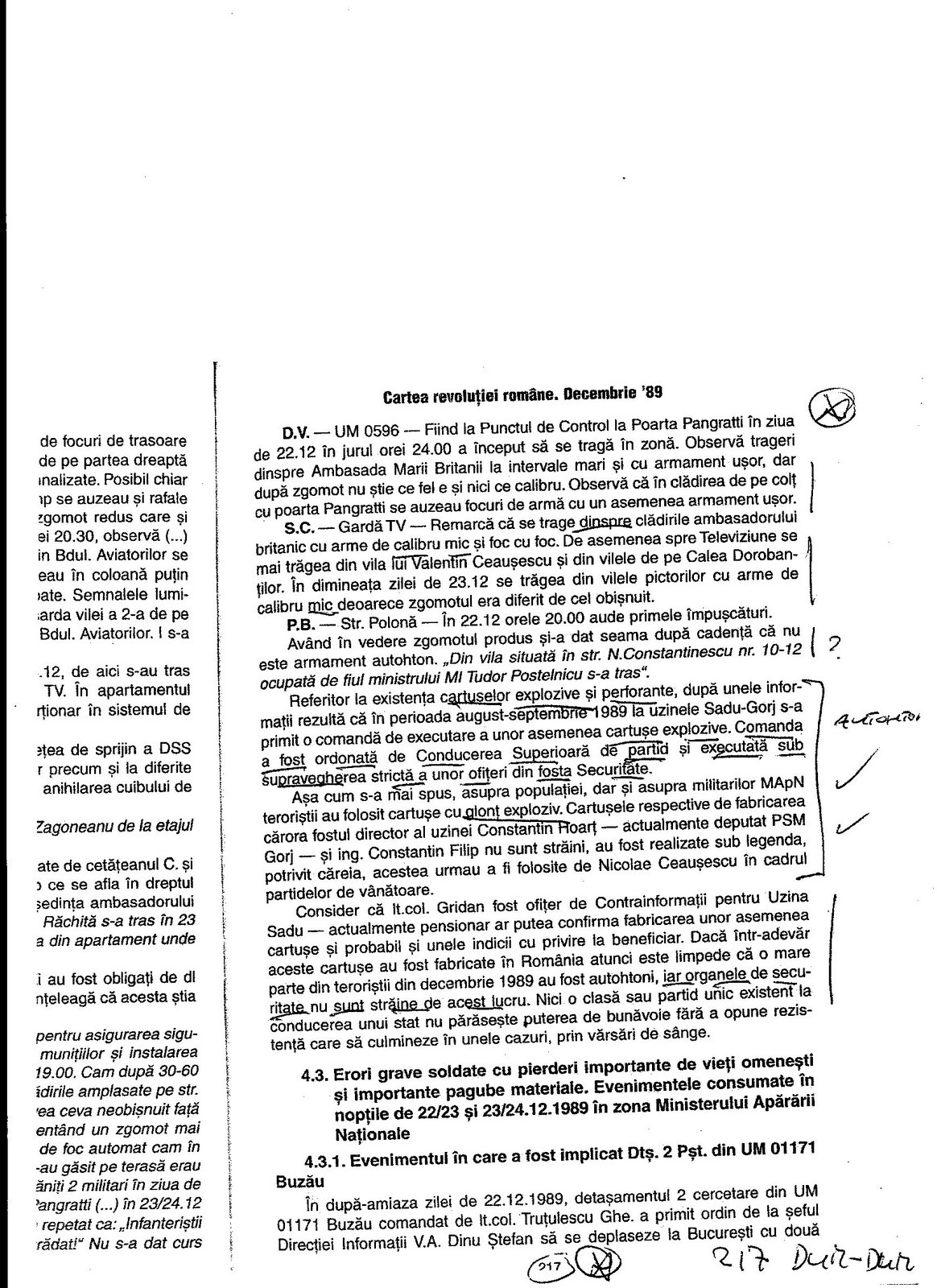
comanda de fabricatie a gloantelor explozive DUM-DUM
Referitor la existenta cartuselor explozive si perforante, dupa unele informatii rezulta ca in perioada august-septembrie 1989 la uzinele Sadu-Gorj s-a primit o comanda de executare a unor asemenea cartuse explozive. Comanda a fost ordonata de Conducerea Superioara de partid si executata sub supravegherea stricta a unor ofiteri din fosta Securitate.
Asa cum s-a mai spus, asupra populatiei, dar si asupra militarilor MApN teroristii au folosit cartuse cu glont exploziv. Cartusele respective de fabricarea carora fostul director al uzinei Constantin Hoart–actualmente deputat PSM Gorj–si ing. Constantin Filip nu sunt straini, au fost realizate sub legenda, potrivit careia, acestea urmai a fi folosite de Nicolae Ceausescu in cadrul partidelor de vanatoare.
Consider ca lt. col. Gridan fost ofiter de Contrainformatii pentru Uzina Sadu–actualmente pensionar ar putea confirma fabricarea unor asemenea cartuse si probabil si unele indicii cu privire la beneficiar. Daca intr-adevar aceste cartuse au fost fabricate in Romania atunci este limpede ca o mare parte din teroristii din decembrie 1989 au fost autohtoni, iar organele de securitate nu sunt straine de acest lucru.
The Amazing, Disappearing Romanian Counter-Revolution of December 1989
by Richard Andrew Hall, Ph.D.
Standard Disclaimer: All statements of fact, opinion, or analysis expressed are those of the author and do not reflect the official positions or views of the Central Intelligence Agency (CIA) or any other U.S. Government agency. Nothing in the contents should be construed as asserting or implying U.S. Government authentication of information or CIA endorsement of the author’s views. This material has been reviewed by CIA to prevent the disclosure of classified information. [Submitted 19 November 2009; PRB approved 15 December 2009]
I am an intelligence analyst for the Central Intelligence Agency. I have been a CIA analyst since 2000. Prior to that time, I had no association with CIA outside of the application process.
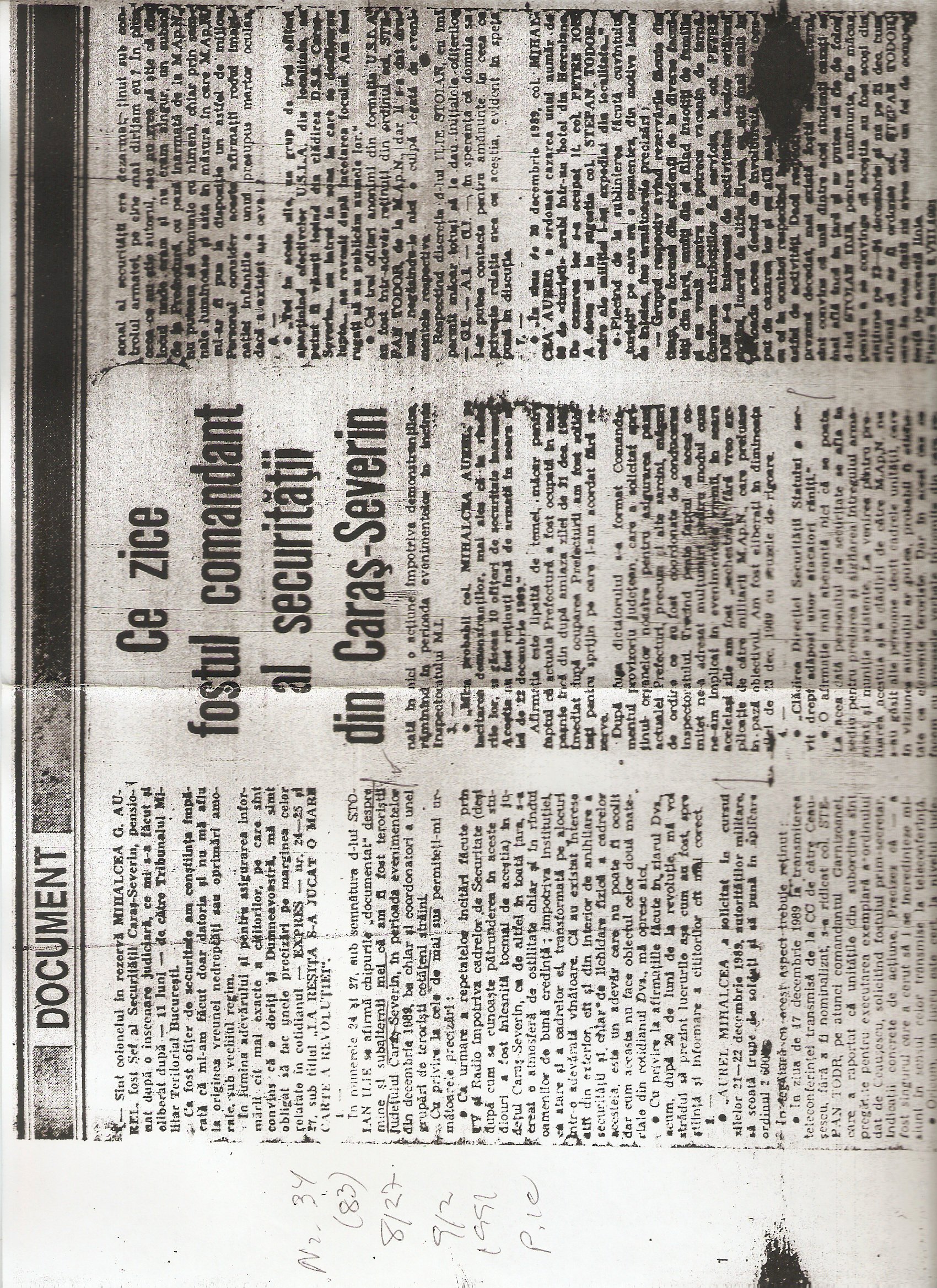
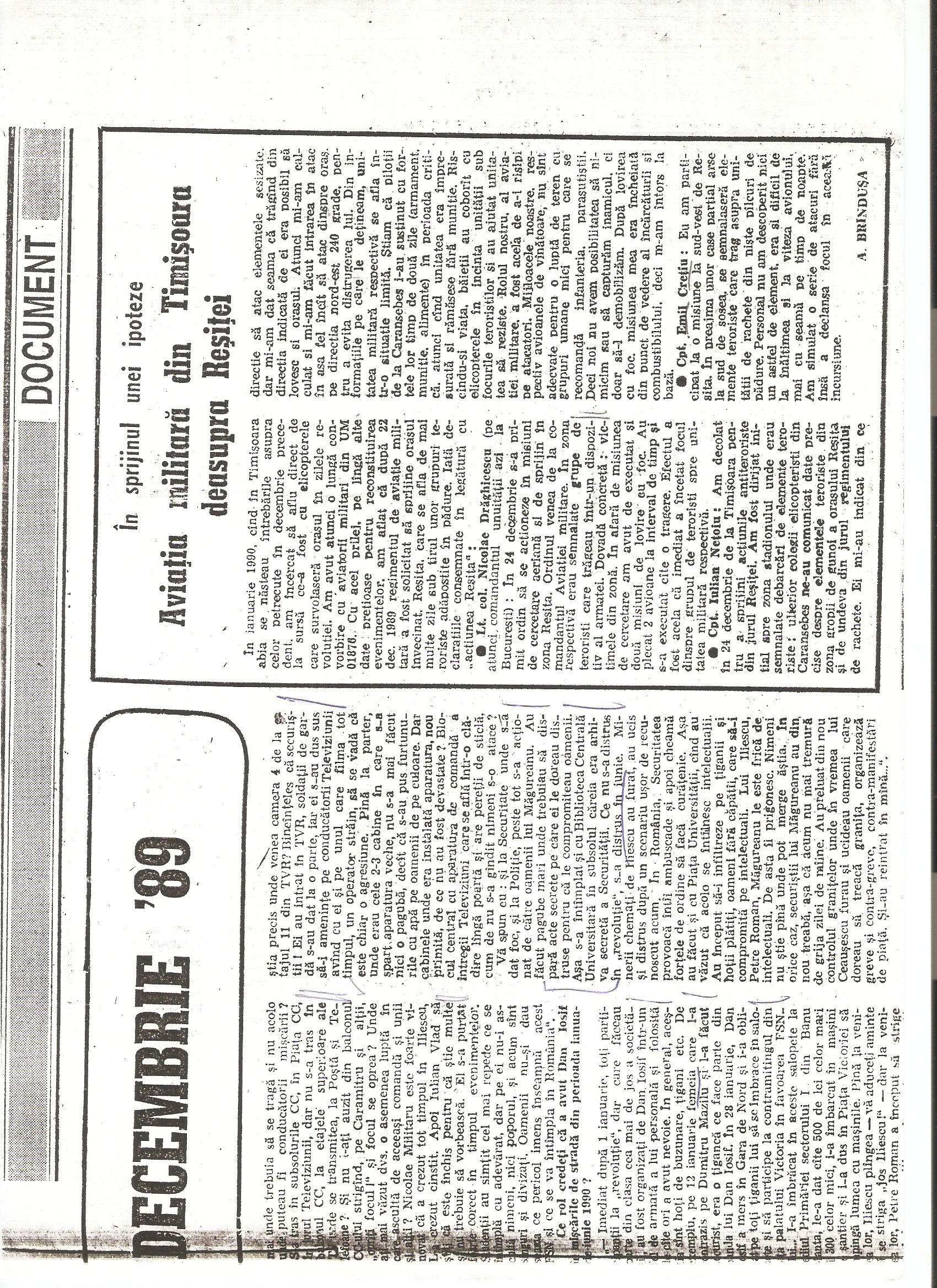
As opposed to the aforementioned Vladimir Belis, Pavel Corut, and Dan Voinea, all of whom who have strenuously and repeatedly denied the existence and use in December 1989 of atypical munitions of dum-dum bullets and vidia bullets, there exist those who have told us of the existence and use of these in December 1989.[2] They are essentially, for lack of a better term, former Securitate whistleblowers, who have admitted the Securitate’s role in providing the “terrorists” who caused so much destruction, mayhem, and loss of life in those days.
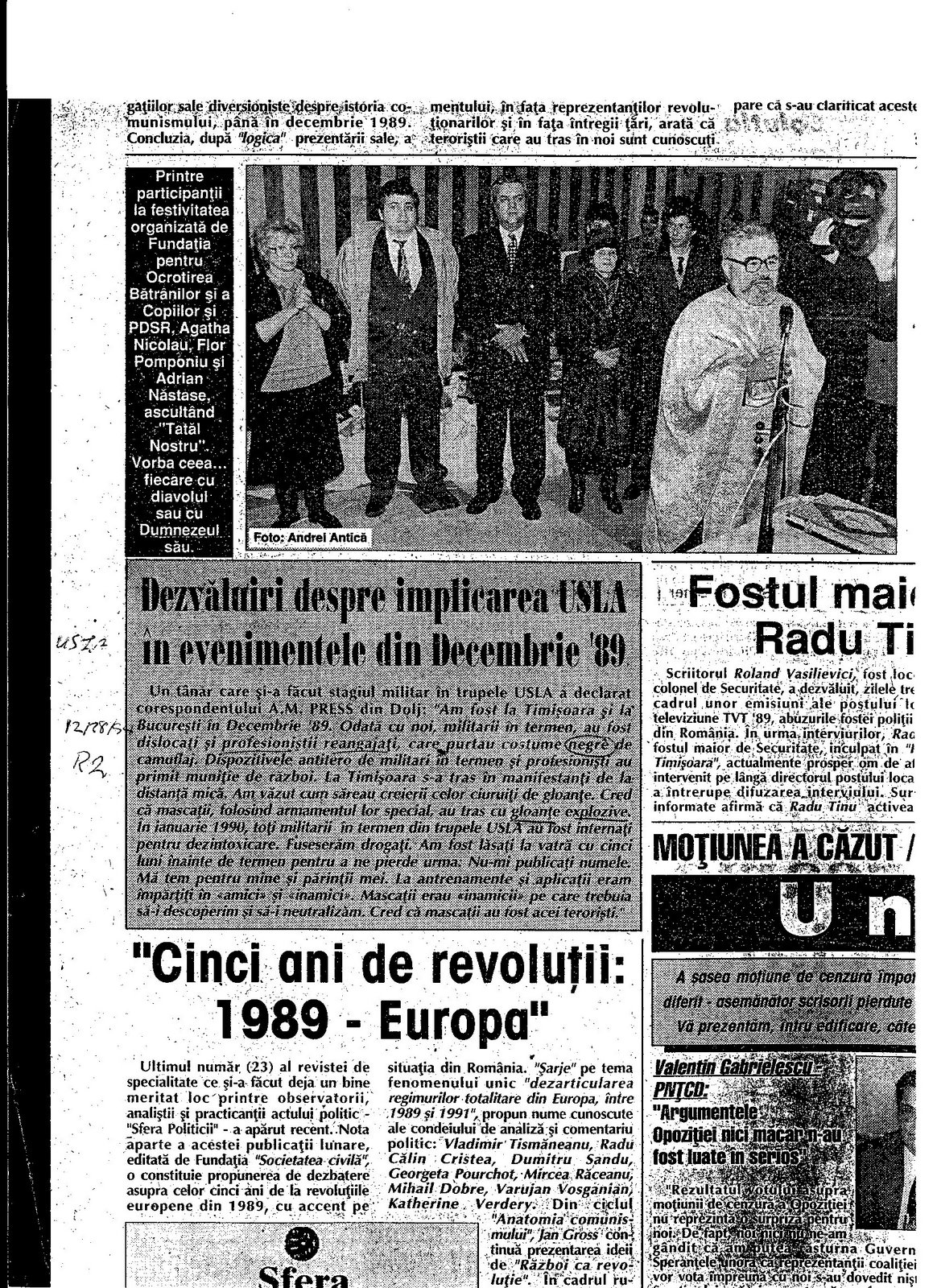
For years I have been essentially the sole researcher inside or outside the country familiar with and promoting the claims of 1) former Timisoara Securitate Directorate I officer Roland Vasilevici—who published his claims about December 1989 under the byline of Puspoki F. in the Timisoara political-cultural weekly Orizont in March 1990 and under the pseudonym “Romeo Vasiliu”—and 2) an anonymous USLA recruit who told his story to AM Press Dolj (published on the five year anniversary of the events in Romania Libera 28 December 1994…ironically (?) next to a story about how a former Securitate official attempted to interrupt a private television broadcast in which Roland Vasilevici was being interviewed in Timisoara about Libyan involvement in December 1989).
Vasilevici claimed in those March 1990 articles and in a 140 page book that followed—both the series and the book titled Pyramid of Shadows—that the USLA and Arab commandos were the “terrorists” of December 1989. What is particularly noteworthy in light of the above discussion about “exploding [dum-dum] bullets” was his claim that the USLA and the foreign students who supplemented them “used special cartridgeswhich upon hitting their targets caused new explosions” [emphasis added]—in other words, exploding or dum-dum bullets.[3]
The anonymous USLA recruit stated separately, but similarly:
I was in Timisoara and Bucharest in December ’89. In addition to us [USLA] draftees, recalled professionals, who wore black camouflage outfits, were dispatched. Antiterrorist troop units and these professionals received live ammunition. In Timisoara demonstrators were shot at short distances. I saw how the skulls of those who were shot would explode. I believe the masked ones, using their own special weapons, shot with exploding bullets. In January 1990, all the draftees from the USLA troops were put in detox. We had been drugged. We were discharged five months before our service was due to expire in order to lose any trace of us. Don’t publish my name. I fear for me and my parents. When we trained and practiced we were separated into ‘friends’ and ‘enemies.’ The masked ones were the ‘enemies’ who we had to find and neutralize. I believe the masked ones were the ‘terrorists’.[4] [emphases added]
As I have pointed out, despite the short shrift given these two revelations by Romanian media and Romanianists, one group has paid close attention: the former Securitate. That is not accidental.[5]
for full discussion of those who told us the truth (i.e. continuation of above), see discussion here:
Posted by romanianrevolutionofdecember1989 on October 25, 2011
[as always, purely personal views based on purely personal research and publications over the past two decades]
Thanks to Miodrag Milin (and ASOCIAŢIA MEMORIALUL REVOLUŢIEI 16-22 DECEMBRIE 1989, TIMIŞOARA), the tapes of the Timisoara trials of 1990-1991 have been transcribed and made available to the public. These transcripts are highly valuable for the researcher of the December 1989 Romanian Revolution. To my knowledge, much of this information has never made it into the public domain, and much of the most important information has definitely not.
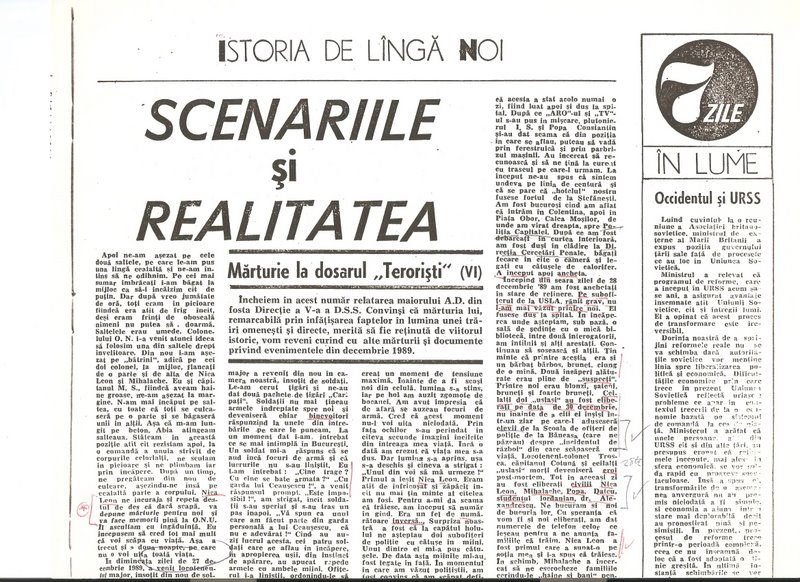
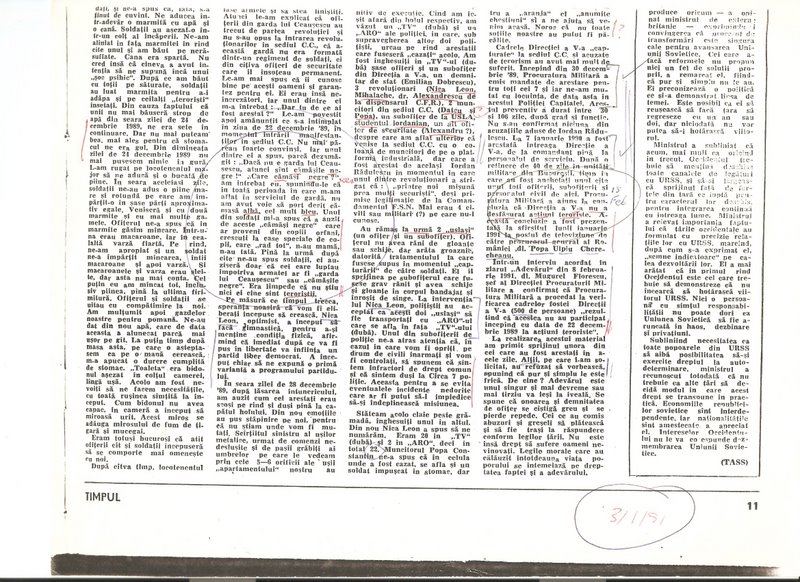
Maior A.D. (Aurel David?) din fosta Directie a V-a a D.S.S., “Scenariile si Realitatea. Marturie la dosarul ‘Teroristi’ (VI), Timpul , 1 martie 1991, p. 11.
“Nu pareau foarte convinsi, iar unul dintre ei a spus, parca dezamagit: ‘Daca nu e garda lui Ceausescu, atunci sint camasile negre!’ ‘Care camasi negre?’ am intrebat eu, spunindu-le ca in toata perioada in care m-am aflat in serviciul de garda, nu am avut voie sa port decit camasa alba, cel mult bleu. Unul din soldati mi-a spus ca a auzit de aceste ‘camasi negre’ care ar proveni din copiii orfani, crescuti la case speciale de copii, care ,rad tot,’ n-au mama, n-au tata. Pina la urma dupa cite ne-au spus soldatii, ei auzisera doar ca cei care luptau impotriva armatei ar fi ‘garda lui Ceausescu’ sau ‘camasile negre.’”
Dan Badea, “Secretele Revolutiei,” Expres, nr. 22 (7-13 iunie 1994), pp. 8-9
“Secretele Revolutiei” (Dan Badea, Expres, 7-13 iunie 1994)
from Orwellian…Positively Orwellian (2006)
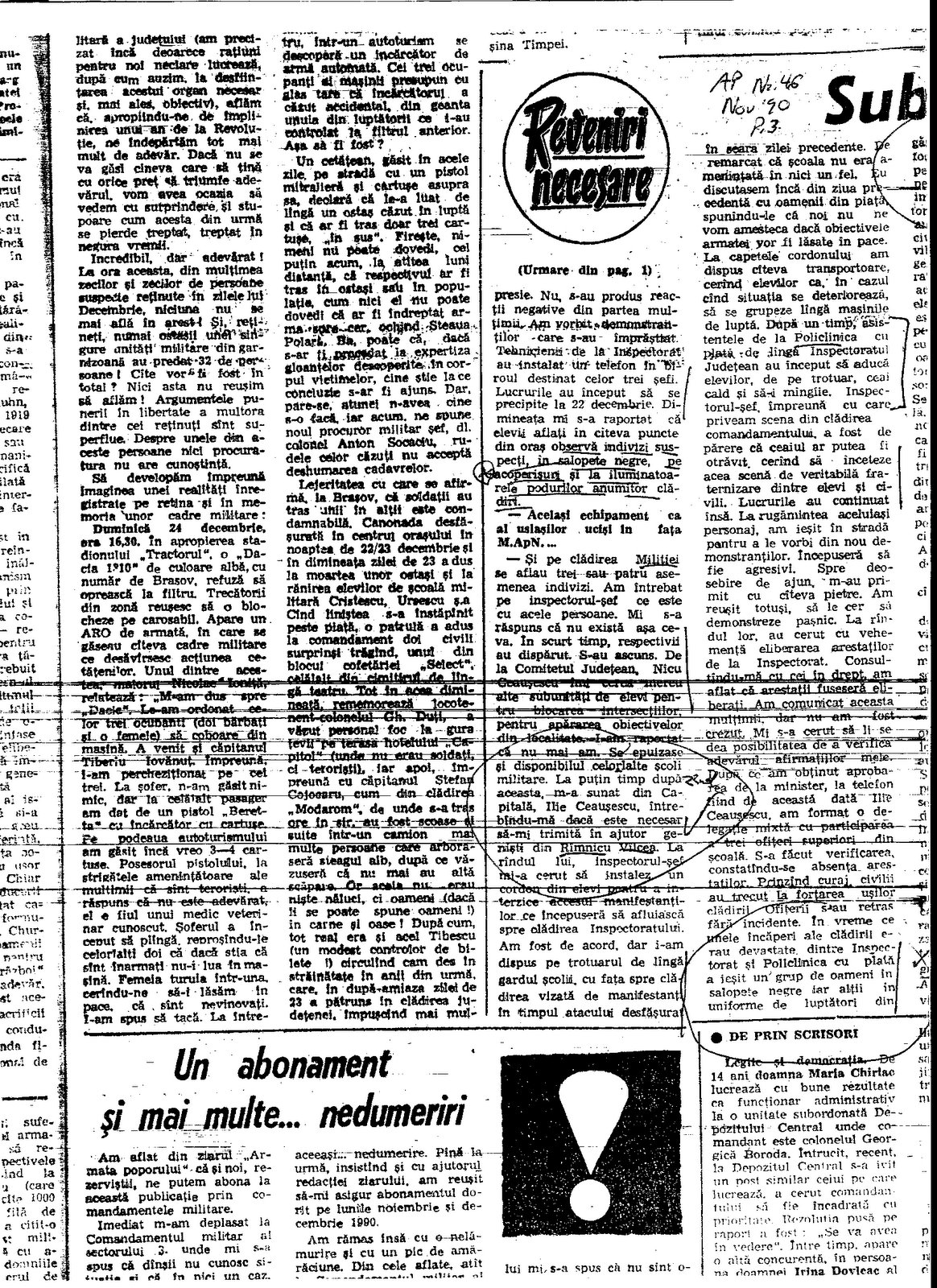
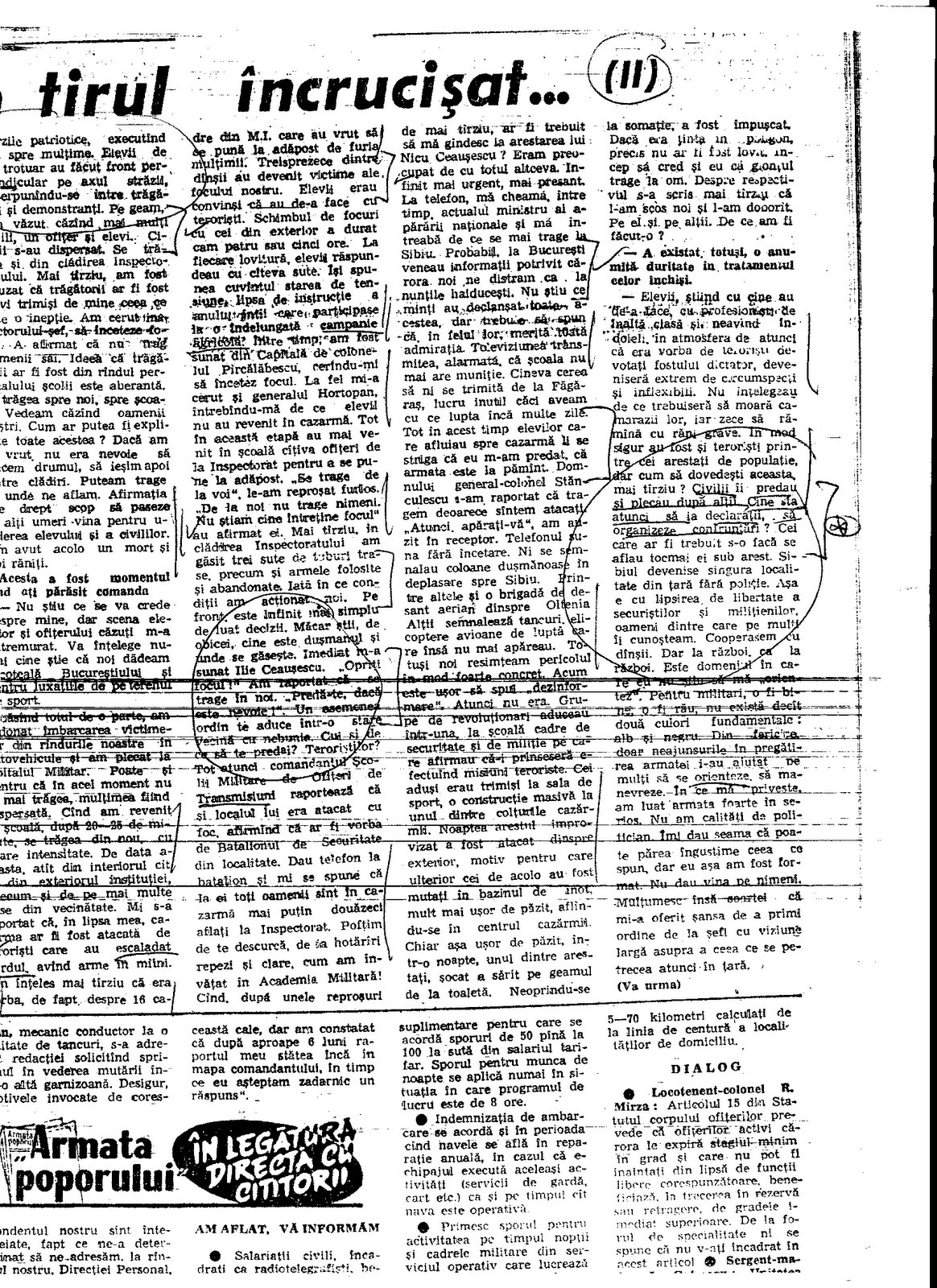
Lt. Col. Aurel Dragomir, former commander of the “Nicolae Balcescu” Military Officers School in Sibiu, described in 1994 those killed as “terrorists” in Sibiu in December 1989:
…On the morning of 22 December…I was informed that on the rooftops there were some suspicious persons. I saw 2-3 people in black jumpsuits. The Militia told me that they weren’t their people. At noon there appeared 10 to 15 people in black jumpsuits who opened massive gunfire on the crowds and soldiers. I ordered them to respond with fire. I headed to the infirmary—the reserve command site, and col. Pircalabescu [head of the Patriotic Guards] called and asked me “why was there gunfire?” I told him we were being attacked. He told me to cease fire. Ilie Ceausescu [Ceausescu’s brother, and an Army General] told me to surrender. I slammed the telephone down. Then [Army General] Stanculescu called. I told him that we are under attack. Stanculescu said to me: ‘Defend yourselves!’….The attackers had on black jumpsuits under which they had on civilian clothes….Weapons and ammunition that weren’t in the arsenal of the Army were found, guns with silencers were found, that aren’t in the Army’s arsenal….After the events declarations given to the investigating commissions disappeared, notebooks filled with the recordings of officers on duty (ofiterii de serviciu), and a map that noted from which houses gunfire came. The dead who were in jumpsuits and had several layers of clothing were identified: they were cadre from the Sibiu Interior Ministry (Militia and Securitate)…. (“black jumpsuits” emphases and “weapons and ammunition…” emphasis added; rest in original)[57]
Armata Poporului, “Sub tirul incrucisat…(II)” interviu cu Aurel Dragomir, nr. 46, noiembrie 1990 p. 3.
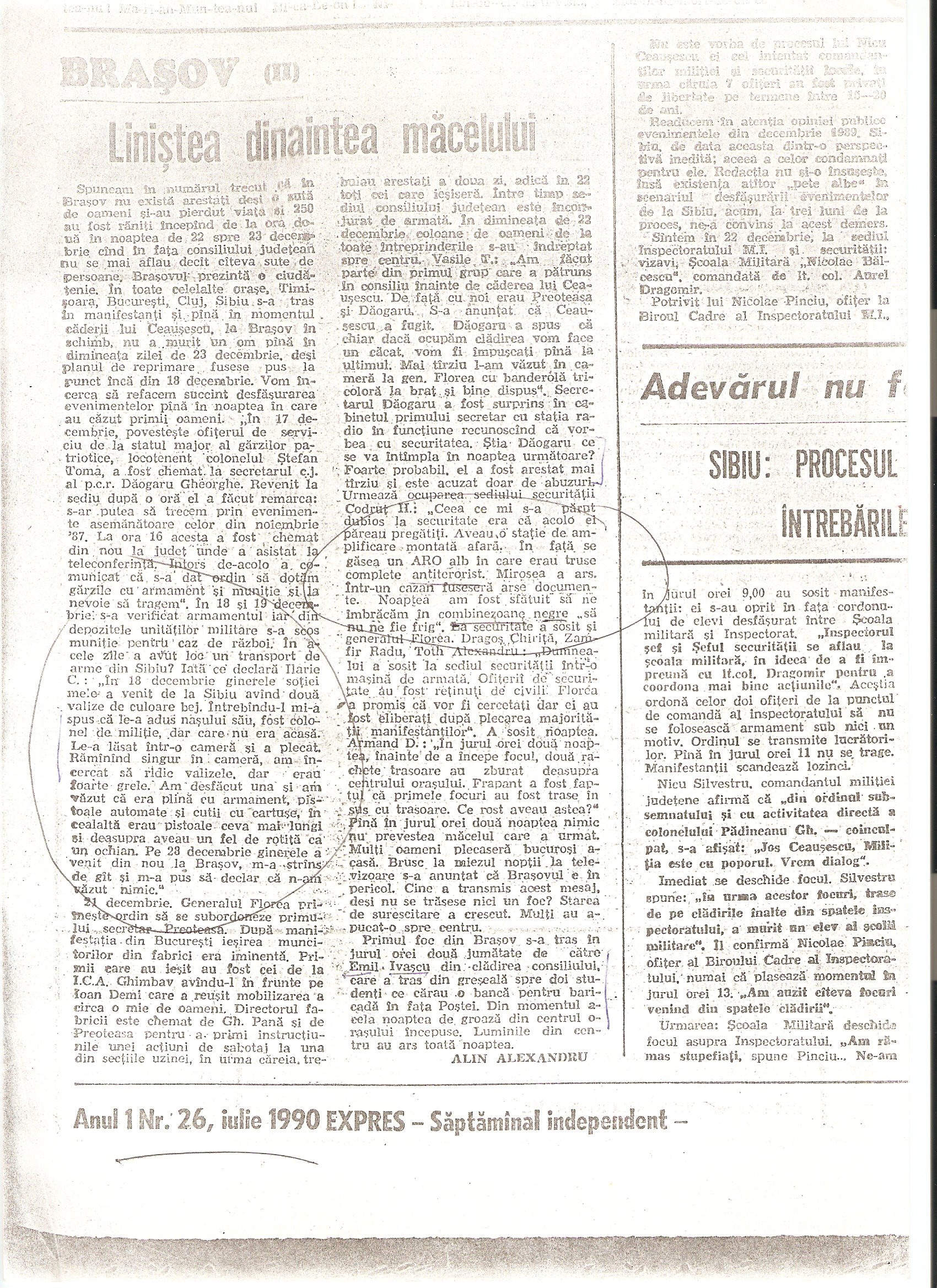
Finally, in this context, the comments of a Codrut H. in July 1990 about what he and other civilians found when they occupied Securitate headquarters in Brasov on the night of 22 December: “What appeared suspicious to me was that the Securitate there appeared to have been prepared [for something]…. Out front of the building there was a white ARO [automobile] in which there were complete antiterrorist kits [emphasis added].” What else did the civilians find there?…combinezoane negre.[58]
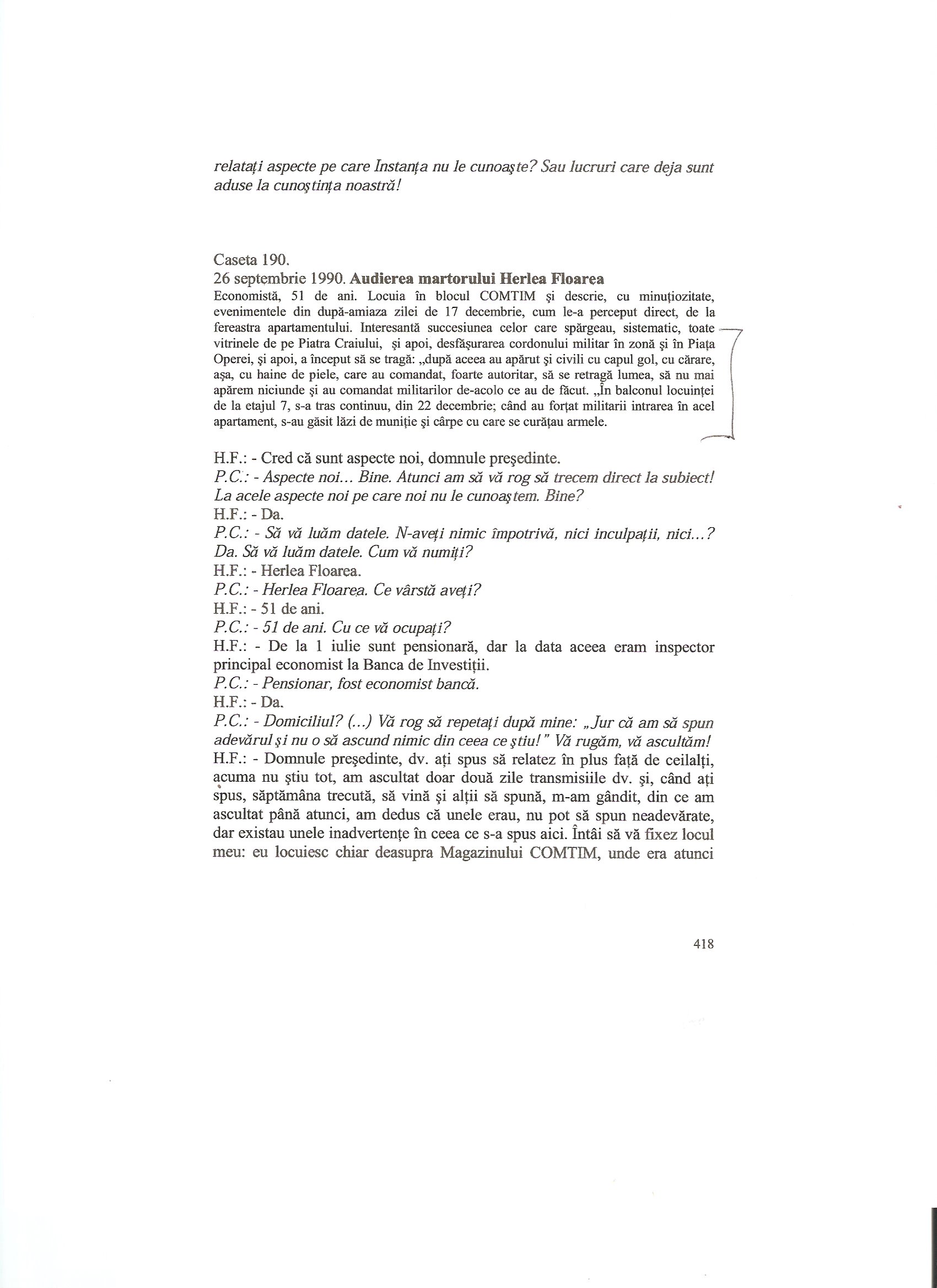
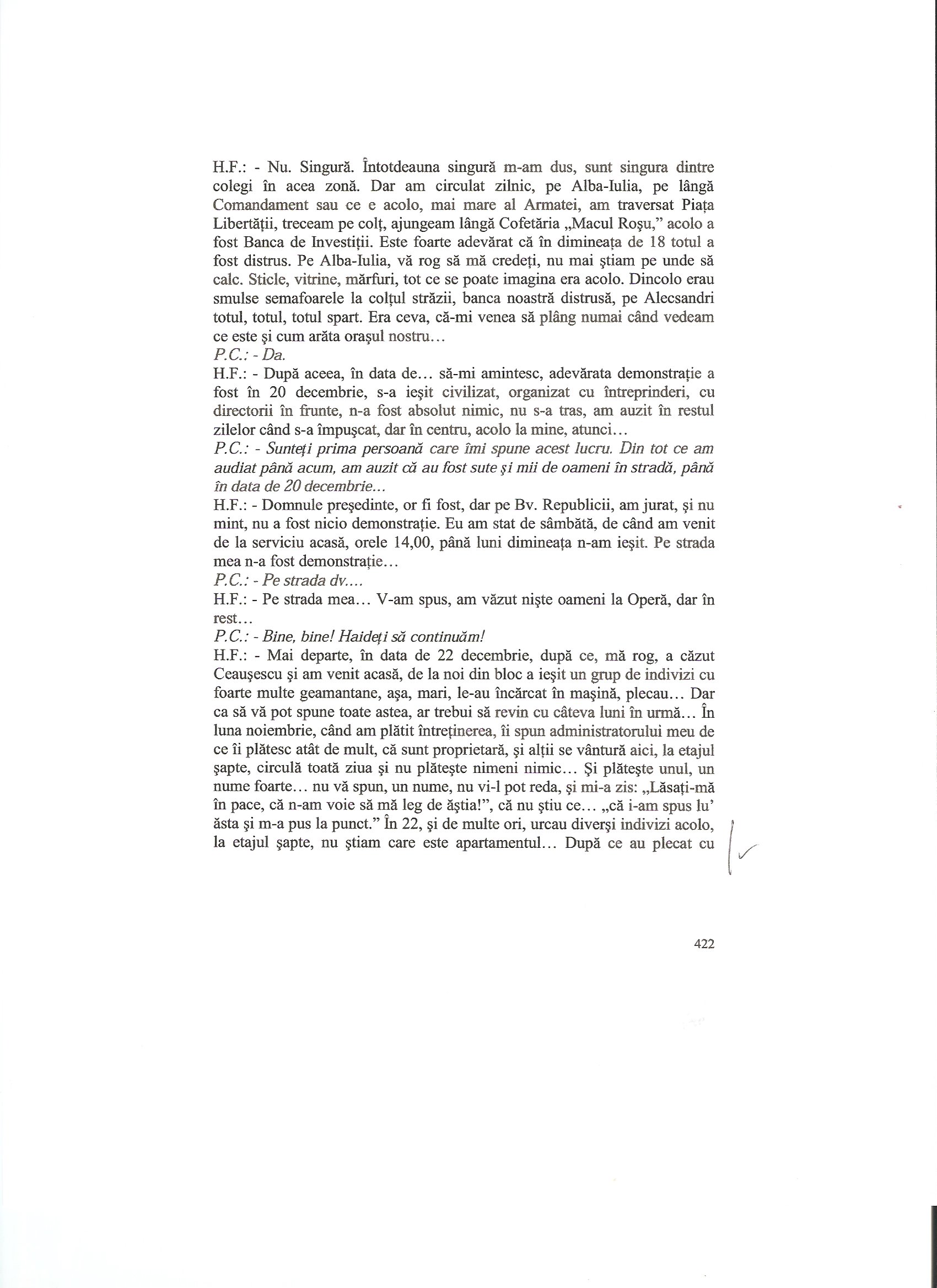
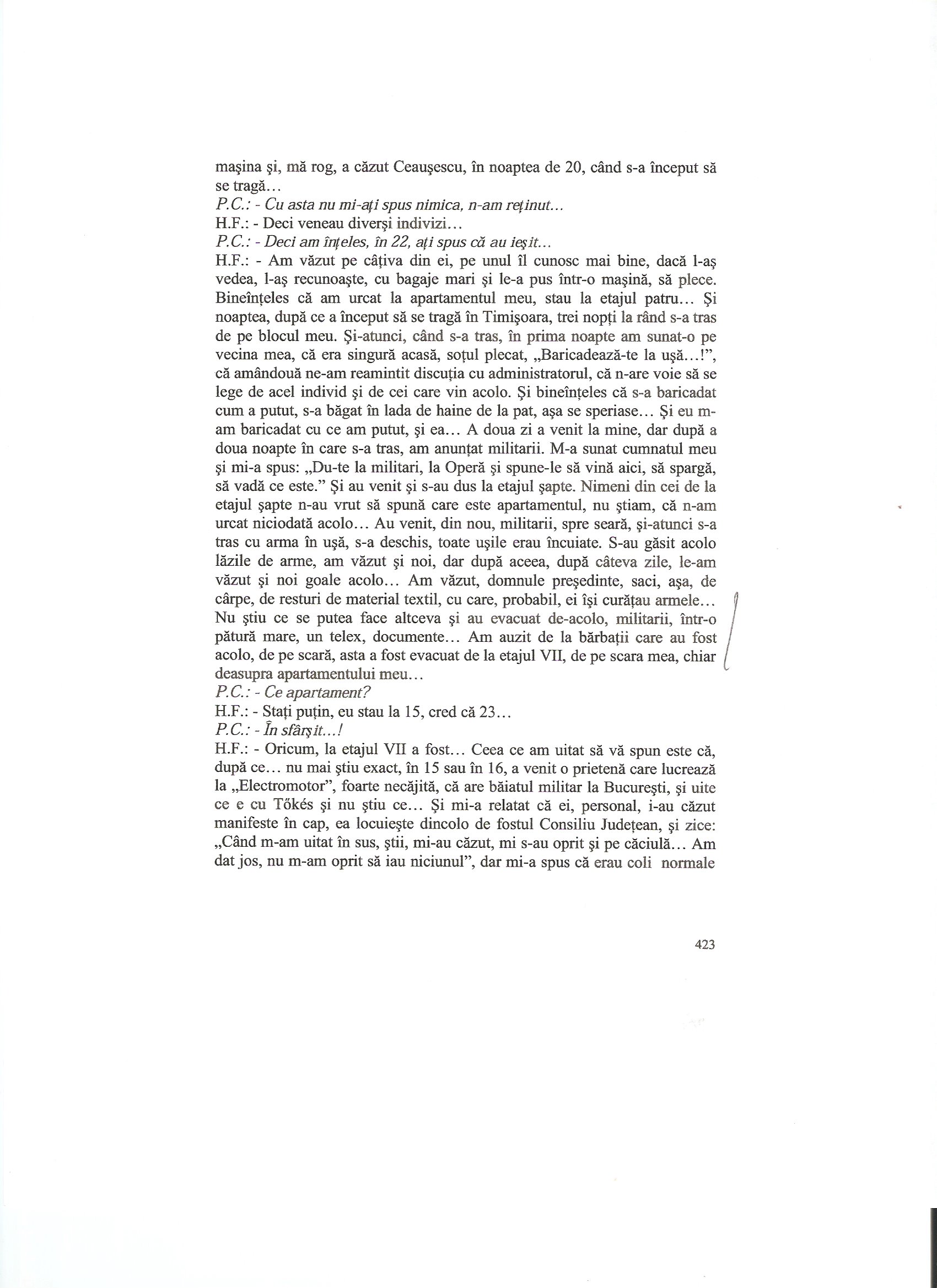
Herlea Floarea despre case conspirative, apartamente din care s-au tras
Similar situations with “safe houses” occurred in Brasov and Sibiu
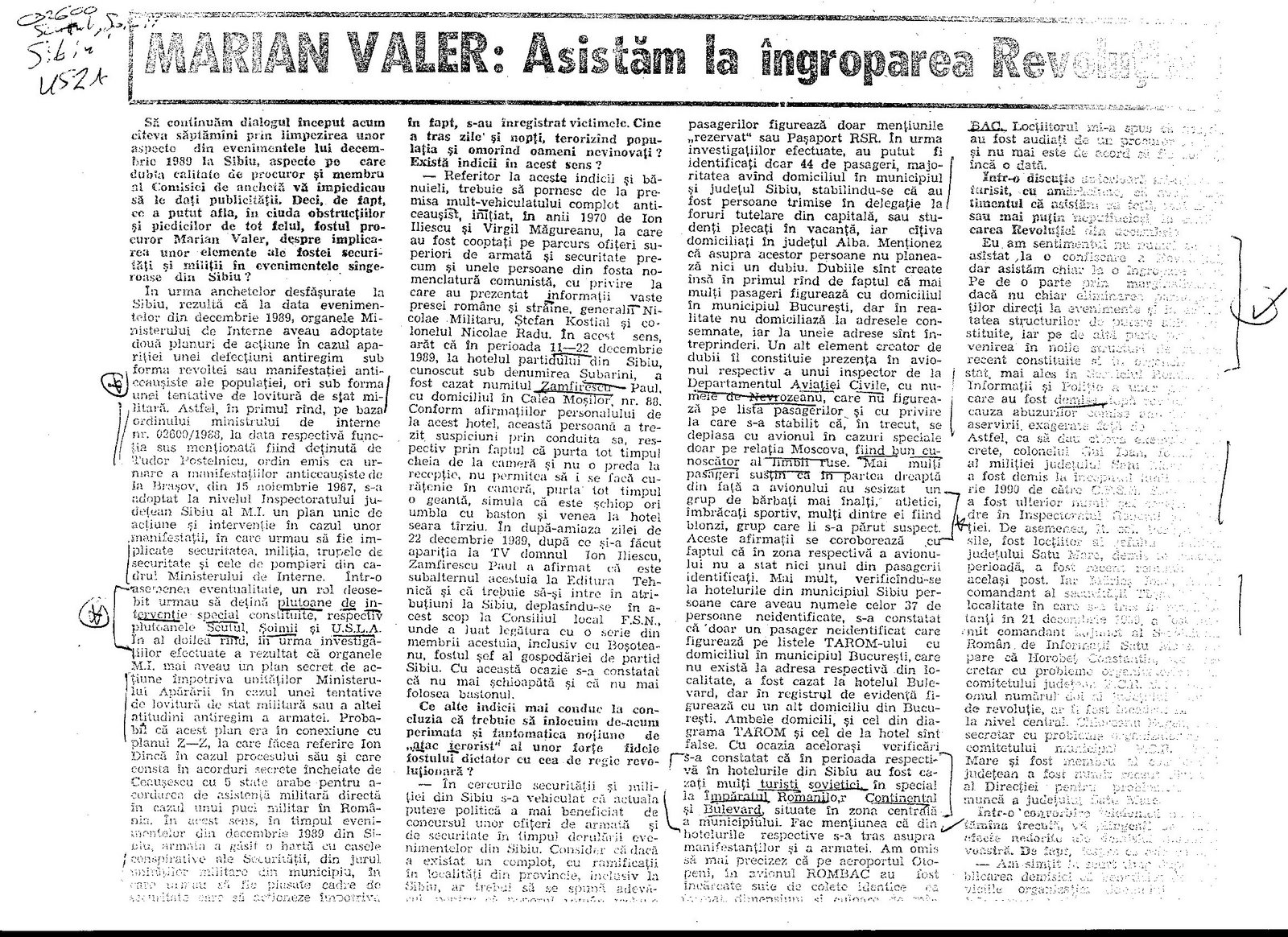
Monica N. Marginean, “MARIAN VALER: Asistam la ingroparea Revolutiei,” Expres, nr. 33 (septembrie 1990), p. 2.
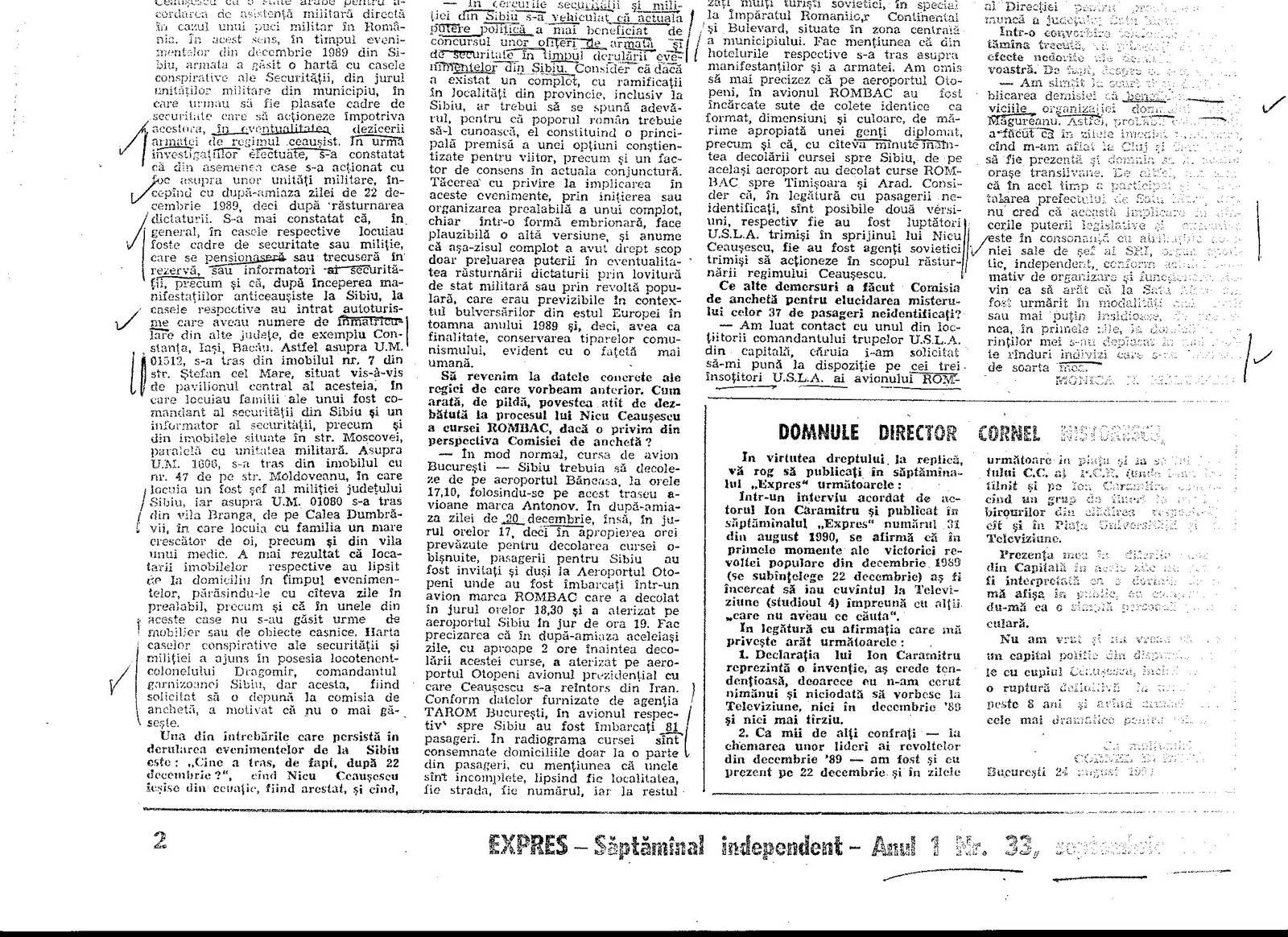
Sa continuam dialogul inceput acum citeva saptamini prin limpezirea unor aspecte din evenimentele lui decembrie 1989 la Sibiu, aspecte pe care dubla calitate de procuror si membru al Comisiei de ancheta va impiedicau sa le dati publicitatii. Deci, de fapt, ce a putut afla, in ciuda obstructiilor si piedicilor de tot felul, fostul procuror Marian Valer, despre implicarea unor elemente ale fostei securitati si militii in evenimentele singeroase din Sibiu?
In urma anchetelor desfasurate la Sibiu, rezulta ca la data evenimentelor din decembrie 1989, organele Ministerului de Interne aveau adoptate doua planuri de actiune in cazul aparitiei unei defectiuni antiregim sub forma revoltei sau manifestatiei anti-ceausiste ale populatiei, ori sub forma unei tentative de lovitura de stat militara. Astfel, in primul rind, pe baza ordinului ministrului de interne nr. 02600/1988, la data respectiva functia sus mentionata fiind detinuta de Tudor Postelnicu, ordin emis ca urmare a manifestatiilor anticeausiste de la Brasov, din 15 noiembrie 1987, s-a adoptat la nivelul Inspectoratului judetean Sibiu al M.I. un plan unic de actiune si interventie in cazul unor manifestatii, in care urmau sa fie implicate securitatea, militia, trupele de securitate si cele de pompieri din cadrul Ministerului de Interne. Intr-o asemenea eventualitate, un rol deosebit urmau sa detina plutoane de interventie special constituite, respectiv plutoantele Scutul, Soimii si U.S.L.A. In al doilea rind, in urma investigatiilor efectuate a rezultat ca organele M.I. mai aveau un plan secret de actiune impotriva unitatilor Ministerului Apararii in cazul unei tentative de lovitura de stat militara sau a altei atitudini antiregim a armatei. Probabil ca acest plan era in conexiune cu planul Z-Z, la care facea referire Ion Dinca in cazul procesului sau si care consta in acorduri secrete incheiate de Ceausescu cu 5 state arabe pentru acordarea de asistenta militara directa in cazul unui puci militar in Romania. In acest sens, in timpul evenimentelor din decembrie 1989 din Sibiu, armata a gasit o harta cu casele conspirative ale Securitatii din jurul unitatilor militare din municipiu, in care urmau sa fie plasate cadre de securitate care sa actioneze impotriva acestora, in eventualitatea dezicerii armatei de regimul ceausist. In urma investigatiilor efectuate, s-a constatat ca din asemenea case s-a actionat cu foc asupra unor unitati militare, incepind cu dupa-amiaza zilei de 22 decembrie 1989, deci dupa rasturnarea dictaturii. S-a mai constatat ca, in general, in casele respective locuiau foste cadre de securitate sau militie, care se pensionsera sau trecusera in rezerva, sau informatori al securitatii, precum si ca, dupa inceperea manifestatiilor anticeausiste la Sibiu, la casele respective au intrat autoturisme care aveau numere de inmatriculare din alte judete, de exemplu Constanta, Iasi, Bacau. Astfel asupra U.M. 01512, s-a tras din imobilul nr. 7 din str. Stefan cel Mare, situat vis-a-vis de pavilionul central ai acesteia, in care locuiau familii ale unui fost comandant al securitatii din Sibiu si un informator al securitatii, precum si din imobilele situate in str. Moscovei, paralela cu unitatea militara. Asupra U.M. 1606, s-a tras din imobilul cu nr. 47 de pe str. Moldoveanu, in care locuiau un fost sef al militiei judetului Sibiu, iar asupra U.M. 01080 s-a tras din vila Branga, de pe Calea Dumbravii, in care locuia cu familia un mare crescator de oi, precum si din vila unui medic. A mai rezultat ca locatarii imobilelor respective au lipsit de la domiciliu in timpul evenimentelor, parasindu-le cu citeva zile in prealabil, precum si ca in unele din aceste case nu s-au gasit urme de mobilier sau de obiecte casnice. Harta caselor conspirative ale securitatii si militiei a ajuns in posesia locotenent-colonelului Dragomir, comandantul garnizoanei Sibiu, dar acesta, fiind solicitat sa o depuna la comisia de ancheta, a motivat ca nu o mai gaseste.
Monica M. Maginean: “MARIAN VALER: Asistam la ingroparea Revolutiei,” Expres nr. 33, septembrie 1990, p. 2.
Posted by romanianrevolutionofdecember1989 on October 22, 2011
[as always, purely personal views based on purely personal research and publications over the past two decades]
Thanks to Miodrag Milin (and ASOCIAŢIA MEMORIALUL REVOLUŢIEI 16-22 DECEMBRIE 1989, TIMIŞOARA), the tapes of the Timisoara trials of 1990-1991 have been transcribed and made available to the public. These transcripts are highly valuable for the researcher of the December 1989 Romanian Revolution. To my knowledge, much of this information has never made it into the public domain, and much of the most important information has definitely not.
When reading the courtroom testimony below, keep in mind here the unambiguous rejection by military prosecutor Dan Voinea of the use of dum-dum bullets in December 1989:
Dan Voinea: There were no victims (people who were shot) from either vidia bullets or dum-dum bullets. During the entire period of the events war munitions were used, normal munitions that were found at the time in the arsenal of the Interior Ministry and the Defense Ministry. The confusion and false information were the product of the fact that different caliber weapons were used, and therefore, the resulting sound was perceived differently. (General Dan Voinea, interview by Romulus Cristea, “Toti alergau dupa un inamic invizibil,” Romania Libera, 22 December 2005, online edition.)
Doctors also reported on the wounds caused by explosive bullets (i.e. dum-dum bullets): In this dispatch from Agence France Presse, relayed by Radio Free Europe on 25 December 1989, Dr. Aurel Mogosanu, a medic in the intensive care unit of a Timisoara hospital, says based on his thirty years of experience, some of the wounds could only have been CAUSED by EXPLOSIVE BULLETS SHOT AT THE PROTESTERS”
doctorului aurel mogosanu, seful sectiei anestezie-terapie intensiva (ati), care il simpatiza. si-au luat halatele, iar zoran mi-a dat si mie unul, de la el.
spitalul judetean era inconjurat de soldati, iar la intrare era un civil inalt si solid, in aceeasi scurta de piele gri, cu un automat cu pat rabatabil la gat. ne-a privit cu o figura de gheata si n-a zis nimic vazandu-ne cu halatele albe sub brat. “studenti,” a explicat cristi si ne-a lasat sa trecem. in inconstienta noastra, nu ne-a fost teama nici o clipa ca ar fi putut sa ne legitimeze si, cum eu nu aveam carnet de student, am fi dat de dracu’. in holul spitalului, ne-am imbracat din mers cu halatele, moment in care am izbucnit toti trei intr-un ras isteric: halatul meu nu avea o maneca ! eram nebuni de legat ! zoran a gasit intr-o clipa solutia: mi-a smuls si cealalta maneca. nici azi, dupa 20 de ani, nu inteleg cum de nu s-a prins nimeni de impostura.
doctorul mogosanu a inteles dintr-o privire de ce am venit. si-a pastrat calmul si ne-a trimis pe sectie. saloanele erau pline de oameni raniti in noaptea care trecuse. am citit cu ochii nostri fisele de observatie, care aveau sa dispara pentru totdeauna in zilele urmatoare. diagnosticele erau aproape identice: “plaga impuscata” sau “plaga impuscata transfixianta“. unii erau in stare grava, altii aveau rani mai usoare. ne priveau cu suspiciune si doar cativa au indraznit sa vorbeasca cu noi. erau speriati si ne intrebau daca lumea a mai iesit in strada.
—————————————————————————-
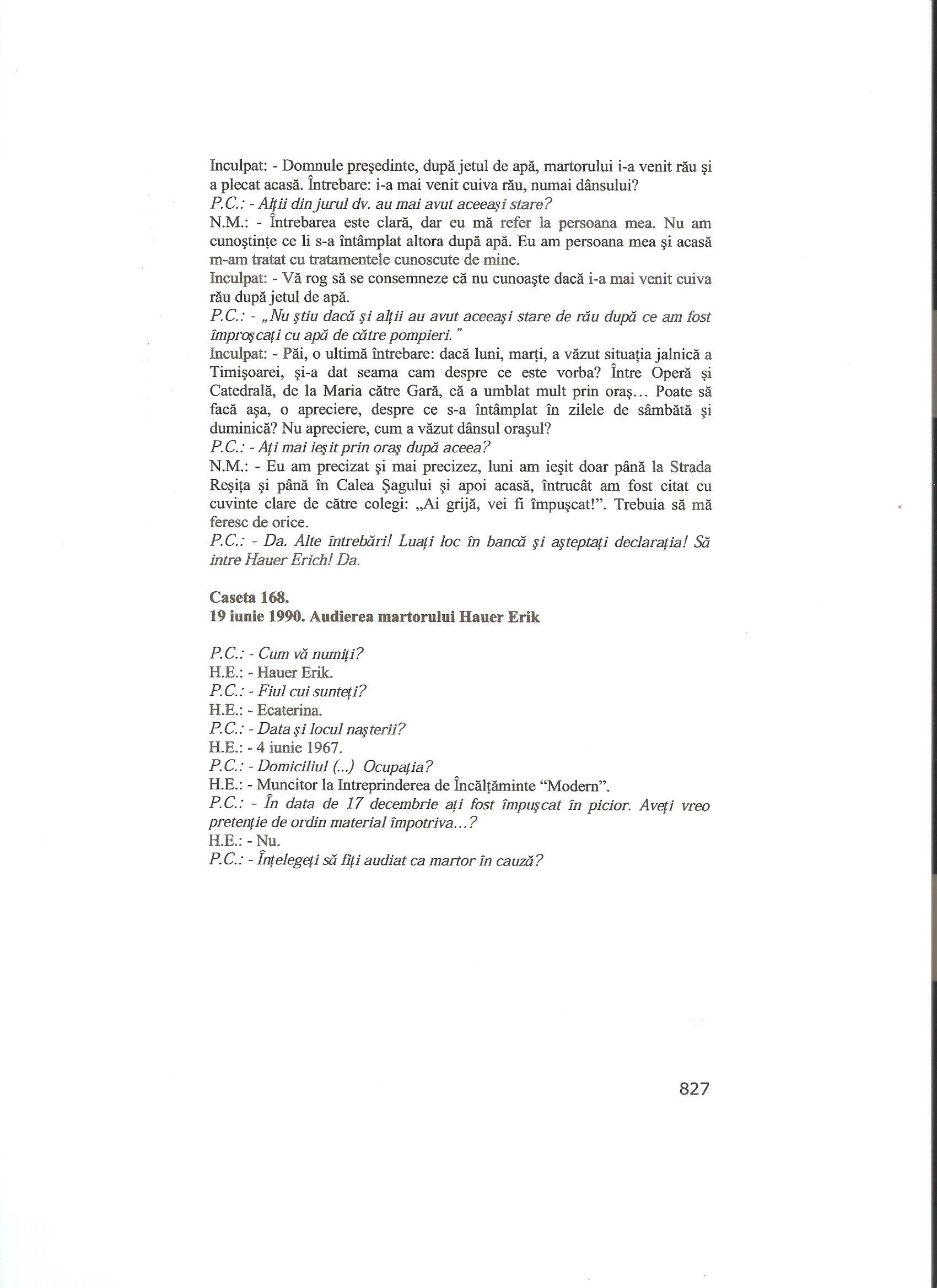
Two of the testimonies from the Timisoara trials concern the killing/wounding of people with dum-dum bullets after the flight of Nicolae Ceausescu and Elena Ceausescu at 12:08 pm on 22 December 1989 (in other words, the so-called “terrorist phase” of the Romanian Revolution)–the cases of Iosif Cacoceanu and Alexandru Koos (see below).
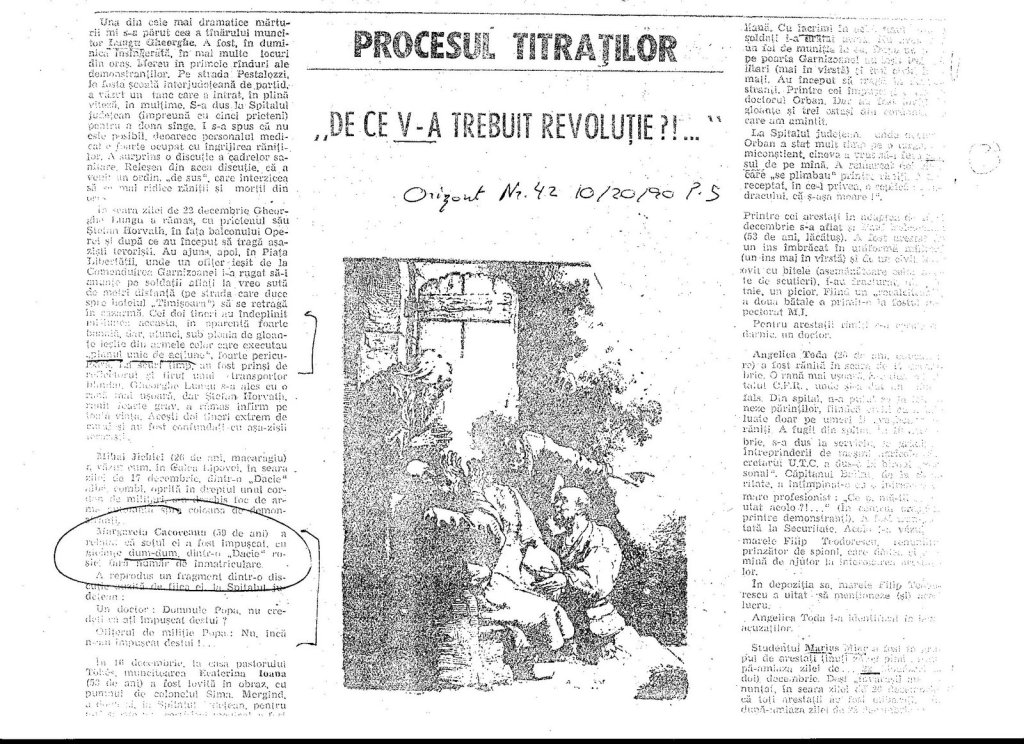
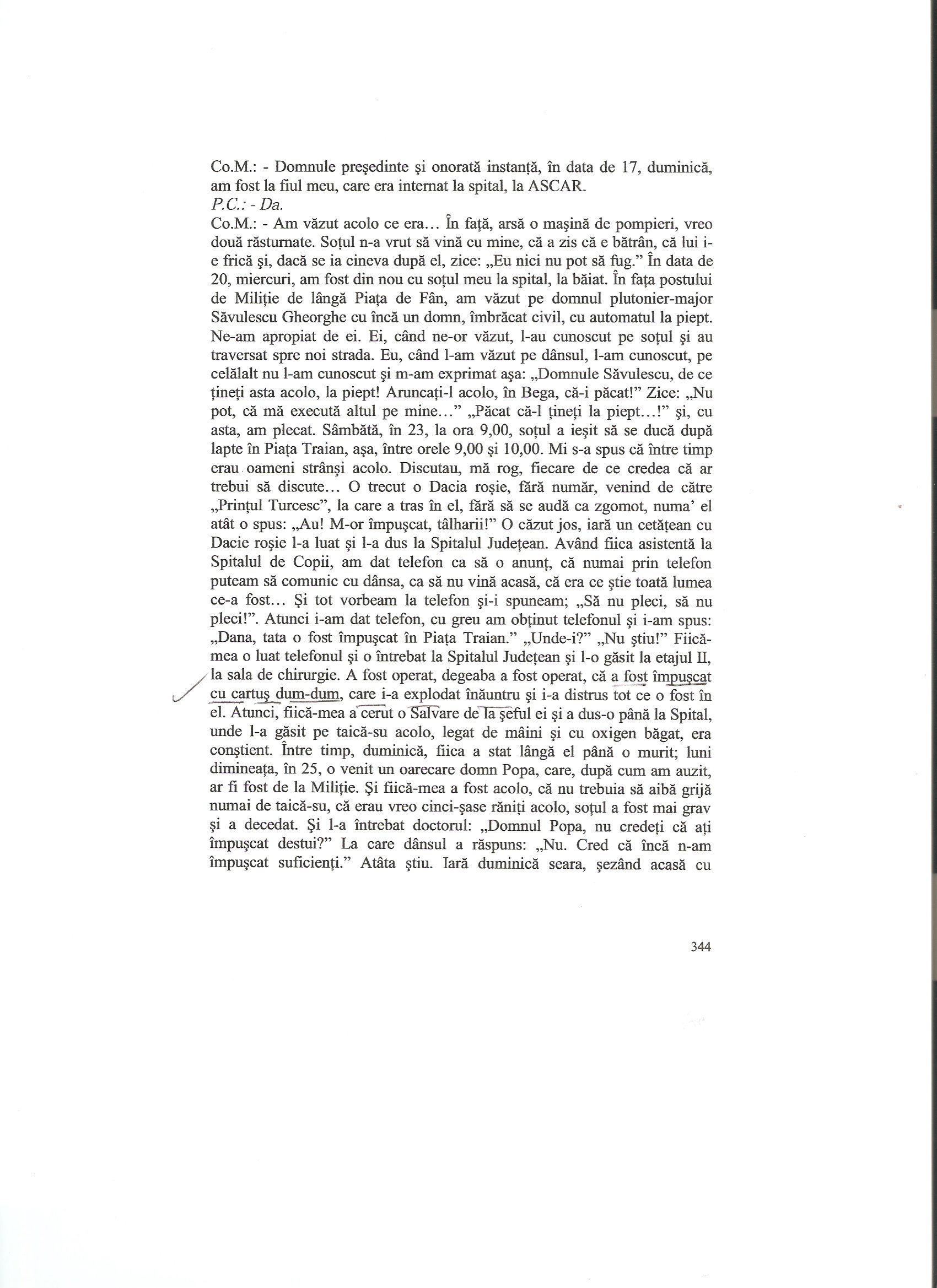
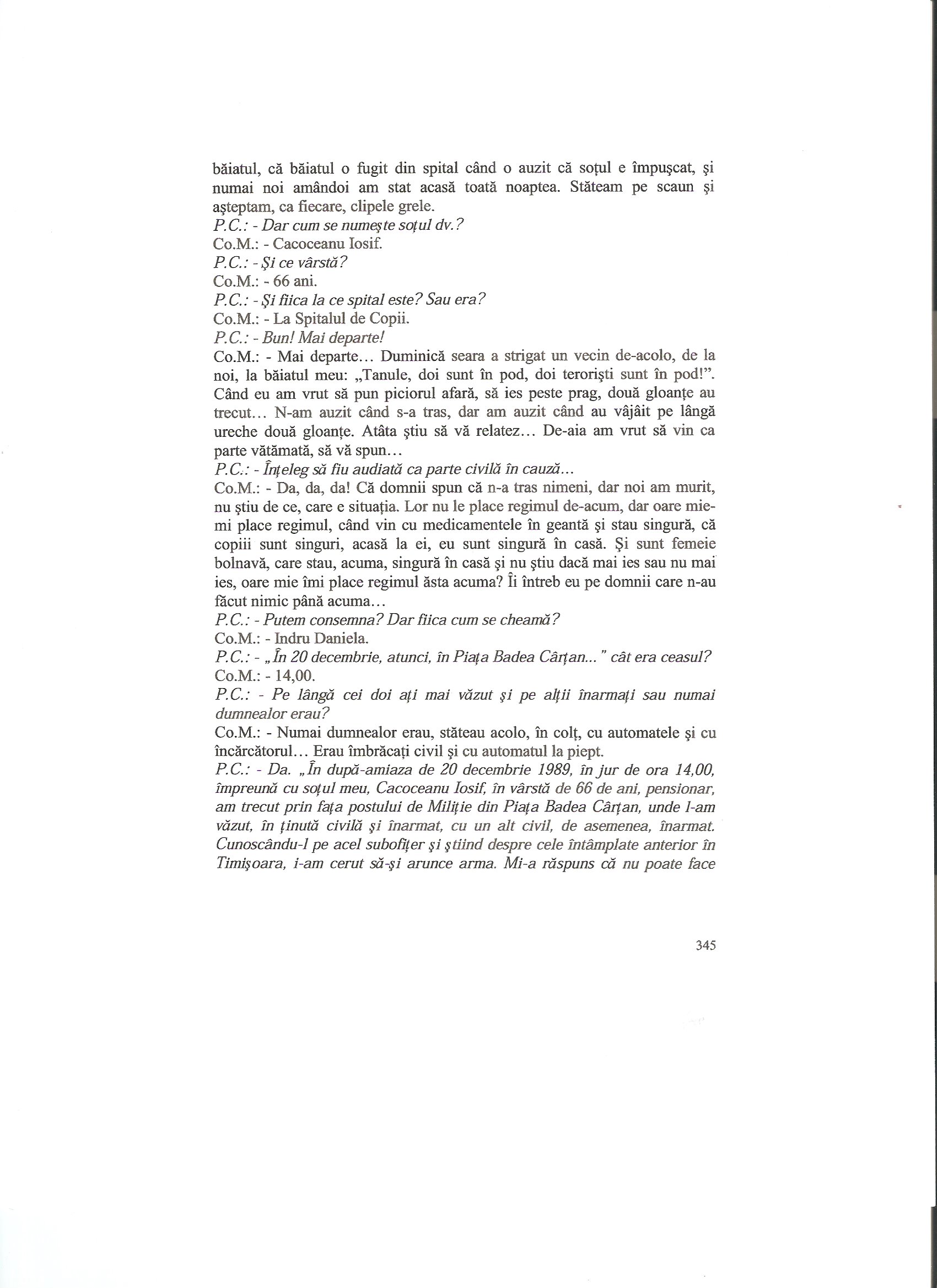
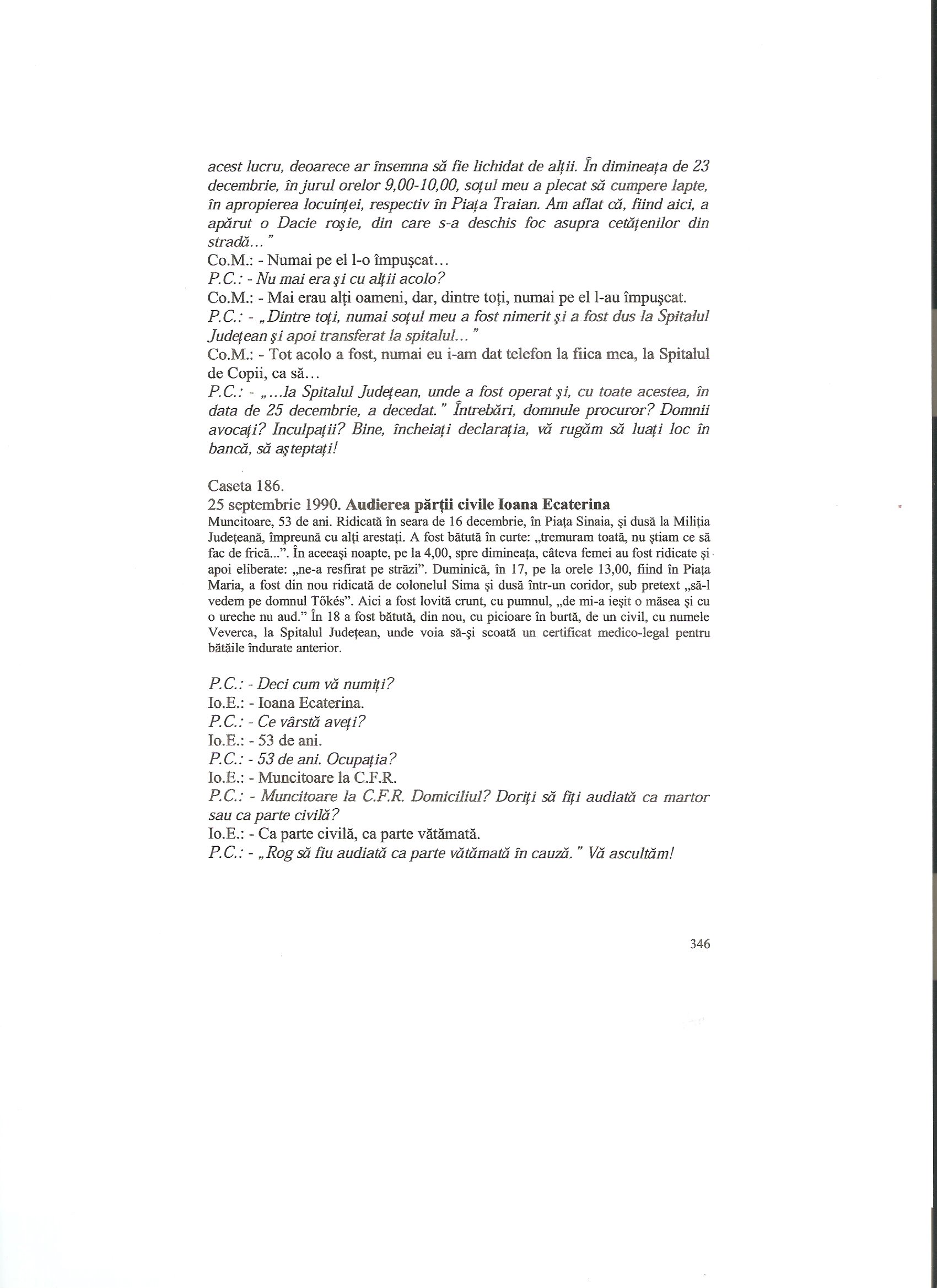
“Margareta Cacoceanu (59 de ani) a relatat ca sotul ei a fost impuscat, cu gloante dum-dum, dintr-o “Dacie” rosie fara numar de inmatriculare.”
The testimony of Margaret Cacoceanu on 25 September 1990. The late Timisoara investigative journalist Iosif Costinas, who was one of the few to cover the trials as they were going on, wrote of Margaret Cacoceanu’s testimony in passing in the October 1990 Orizont article above. She discusses how her daughter related from the county hospital that her husband had been operated on after having been shot by the destructive dum-dum explosive bullets, but nevertheless perished.
Alexandru Koos, wounded by a dum-dum bullet on the night of 22-23 december 1989 in Timisoara
Posted by romanianrevolutionofdecember1989 on October 21, 2011
[as always, purely personal views based on purely personal research and publications over the past two decades]
Thanks to Miodrag Milin (and ASOCIAŢIA MEMORIALUL REVOLUŢIEI 16-22 DECEMBRIE 1989, TIMIŞOARA), the tapes of the Timisoara trials of 1990-1991 have been transcribed and made available to the public. These transcripts are highly valuable for the researcher of the December 1989 Romanian Revolution. To my knowledge, much of this information has never made it into the public domain, and much of the most important information has definitely not.
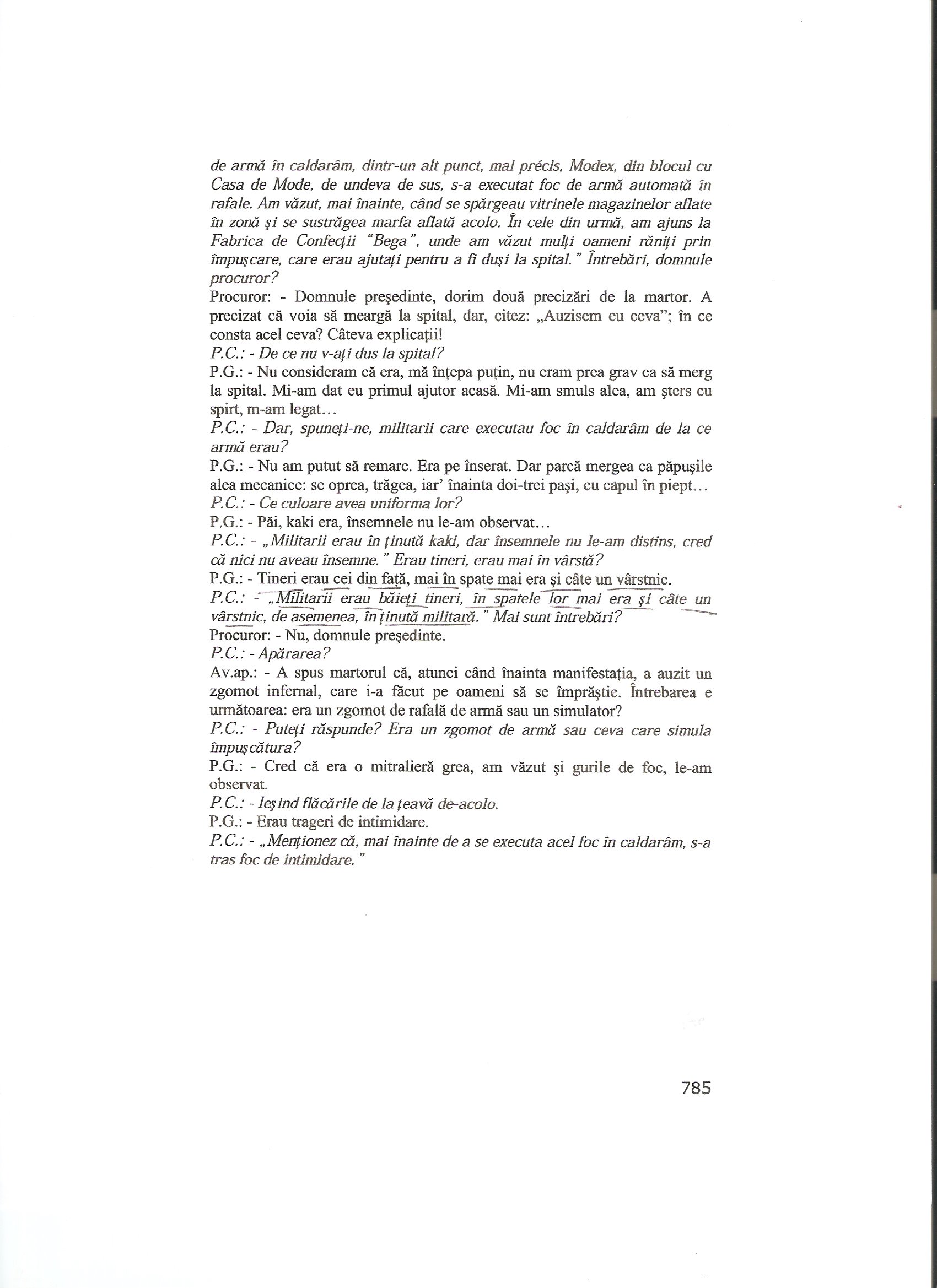
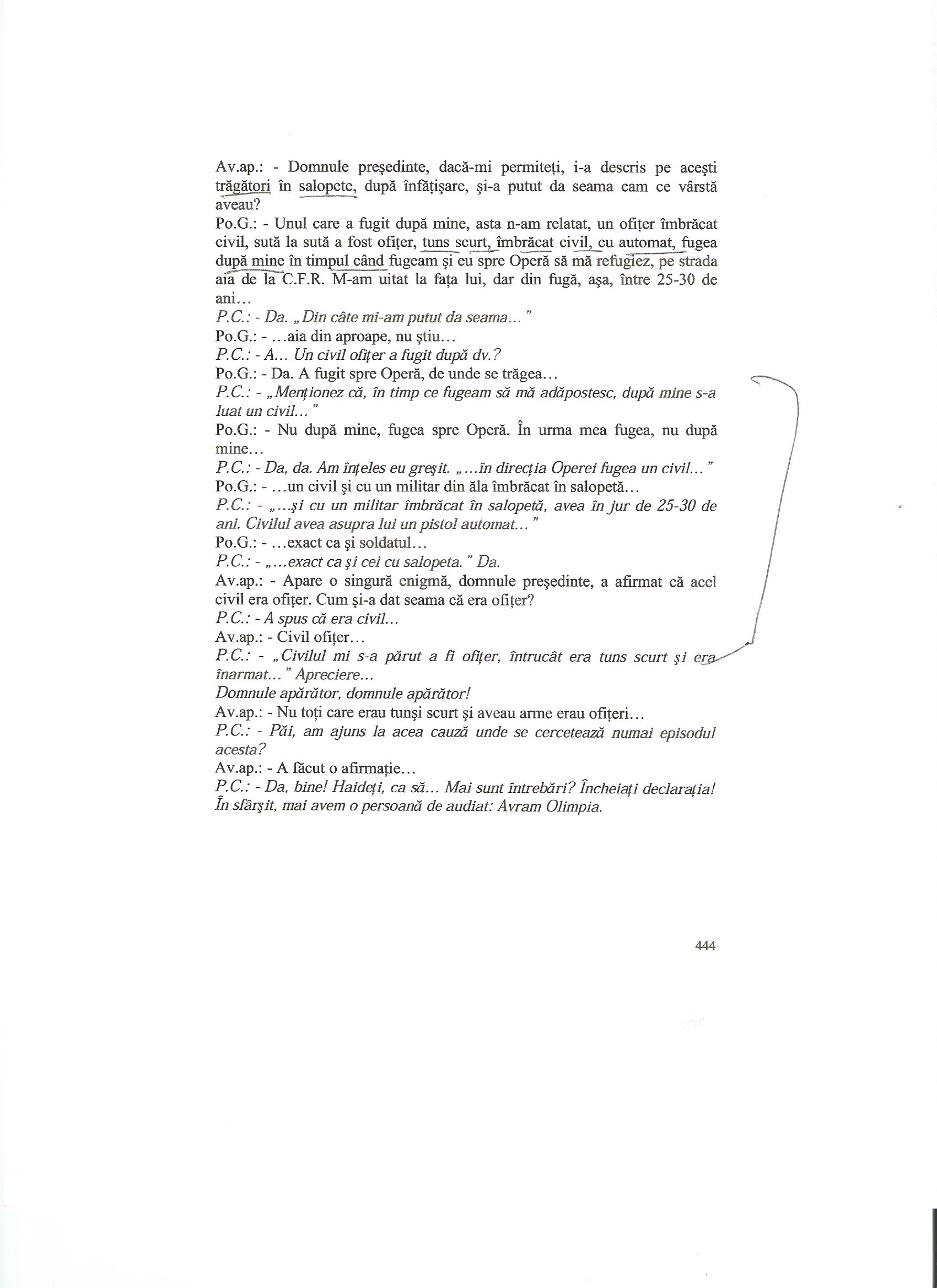
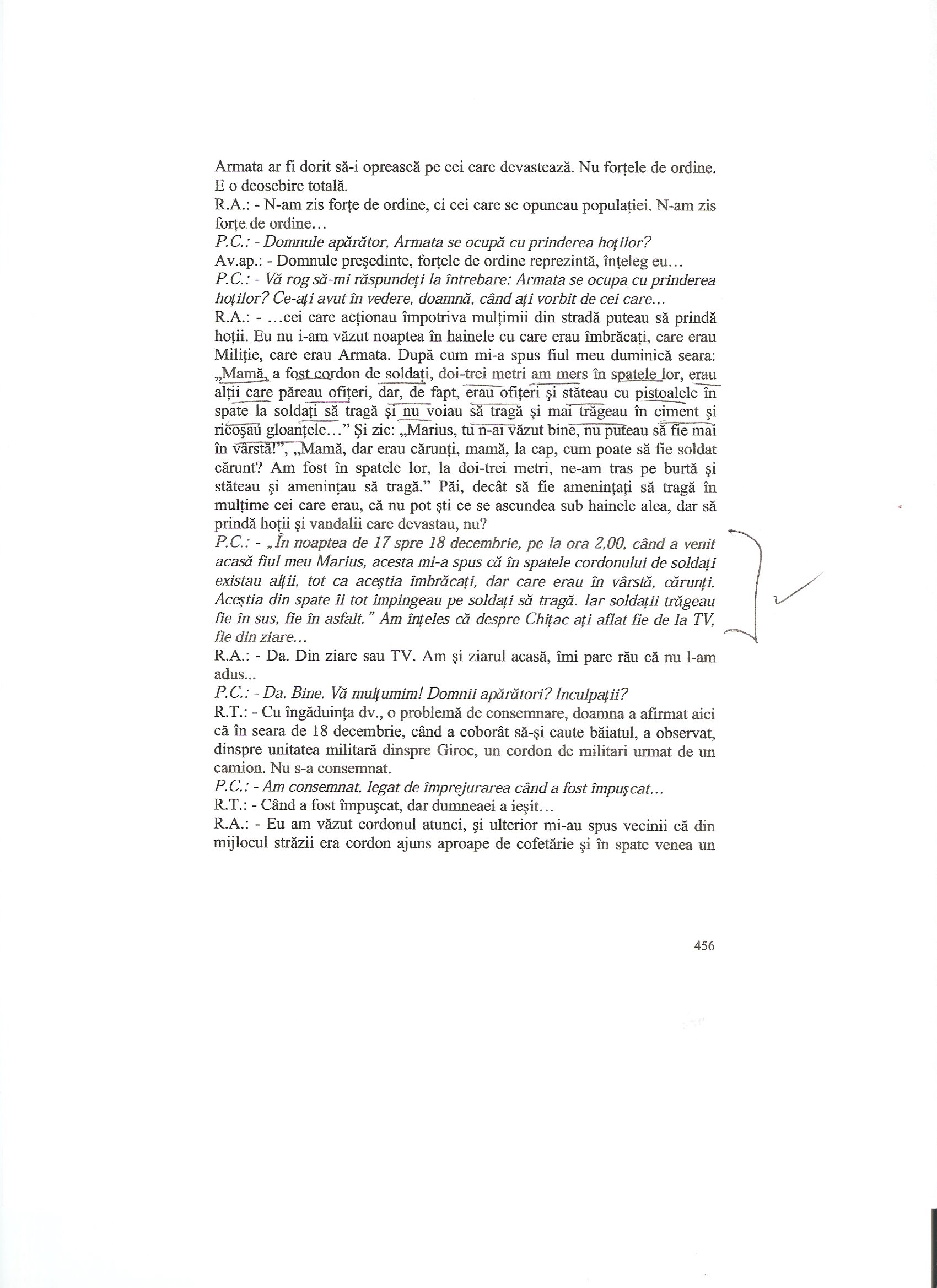
Back in 1990, the suggestion that non-draftees were infiltrated and positioned among and more importantly behind soldiers was hardly a radical idea…and indeed those who admitted the Army’s role in the bloodshed also pointed to their presence.
This might shed light on the claim of Army Lieutenant Colonel Dumitru Damian in January 1990 that approximately every unit of…twenty soldiers was subordinated to a Securitate officer who would stand behind them and monitor them. These Securitate officers would give the order to shoot and threaten to shoot the soldiers on the spot if they refused the order to open fire.[92]
[92].. Lt. Col. Dumitru Damian and Major Viroel Oancea, interview by William Totok, Die Tageszeitung, 23 January 1990, in trans. Heinz Lahni, “Generalul m-a facut dobitoc,” Contrapunct, 2 March 1990, 11.
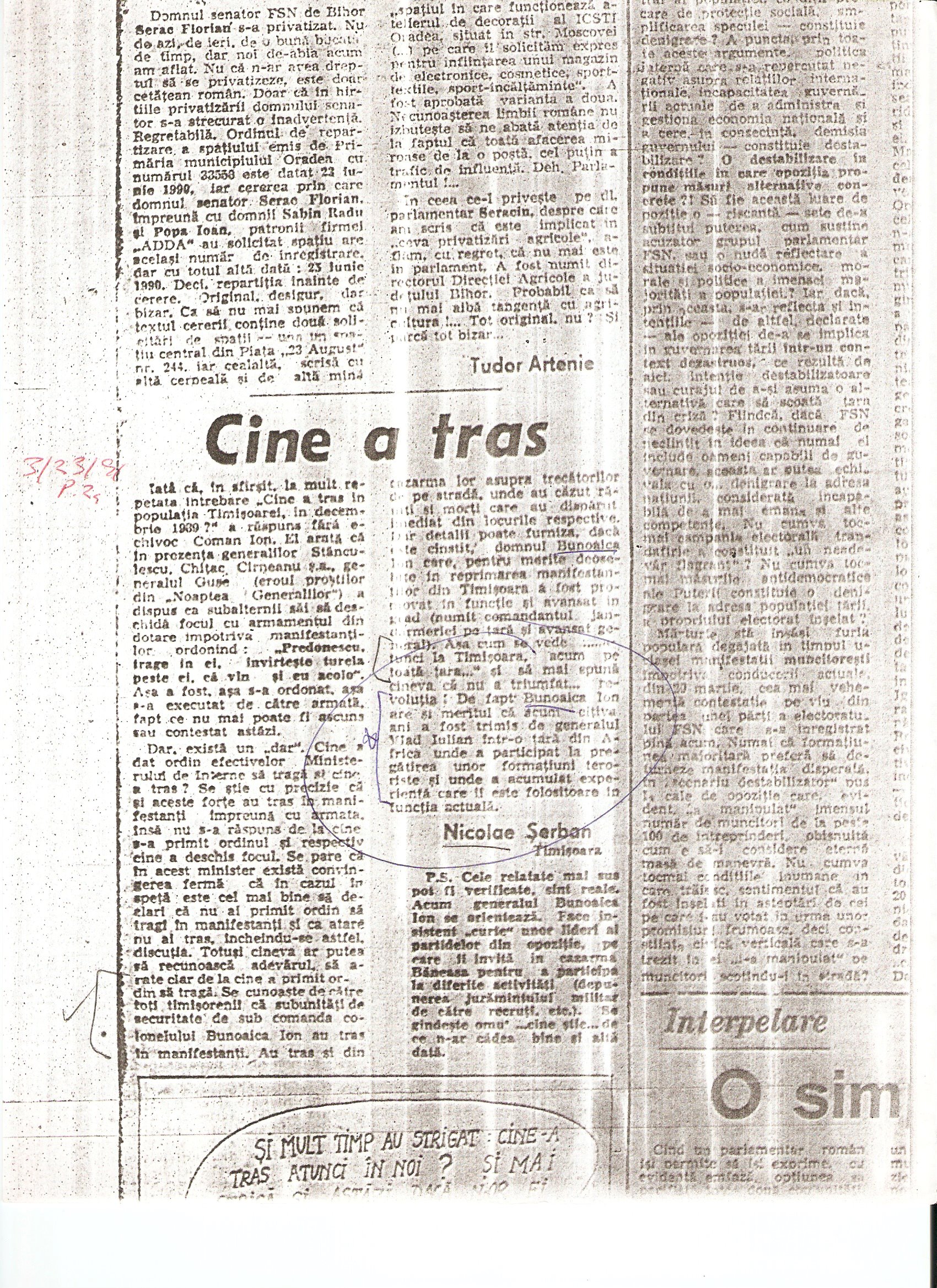
One of the few Securitate officers to deviate from the courtroom routine of steadfast denial of the institution’s involvement was Colonel Ion Bunoaica, the commander of the Securitate’s uniformed troops in Timisoara. Testifying as a witness in late 1990, Bunoaica eventually admitted both that his men had been armed during the Timisoara unrest and, suggestively, that they had taken up “battle formations” behind Army units which opened fire.[91]
[91].. Iosif Costinas, “Nu sinteti dumneavoastra colonelul Bunoaica? [Aren’t you colonel Bunoaica?],” Orizont, 2 November 1990, 5; idem, “Jur sa spun numai adevarul… [I swear to tell the whole truth],” Orizont, 9 November 1990, 5.
Internet posters claiming to have been in the military and on the streets of Timisoara in December 1989 have discussed the appearance of personnel in military uniforms who very clearly were not from the military (my thanks to Corneliu N. Vaida for bringing the following to my attention):
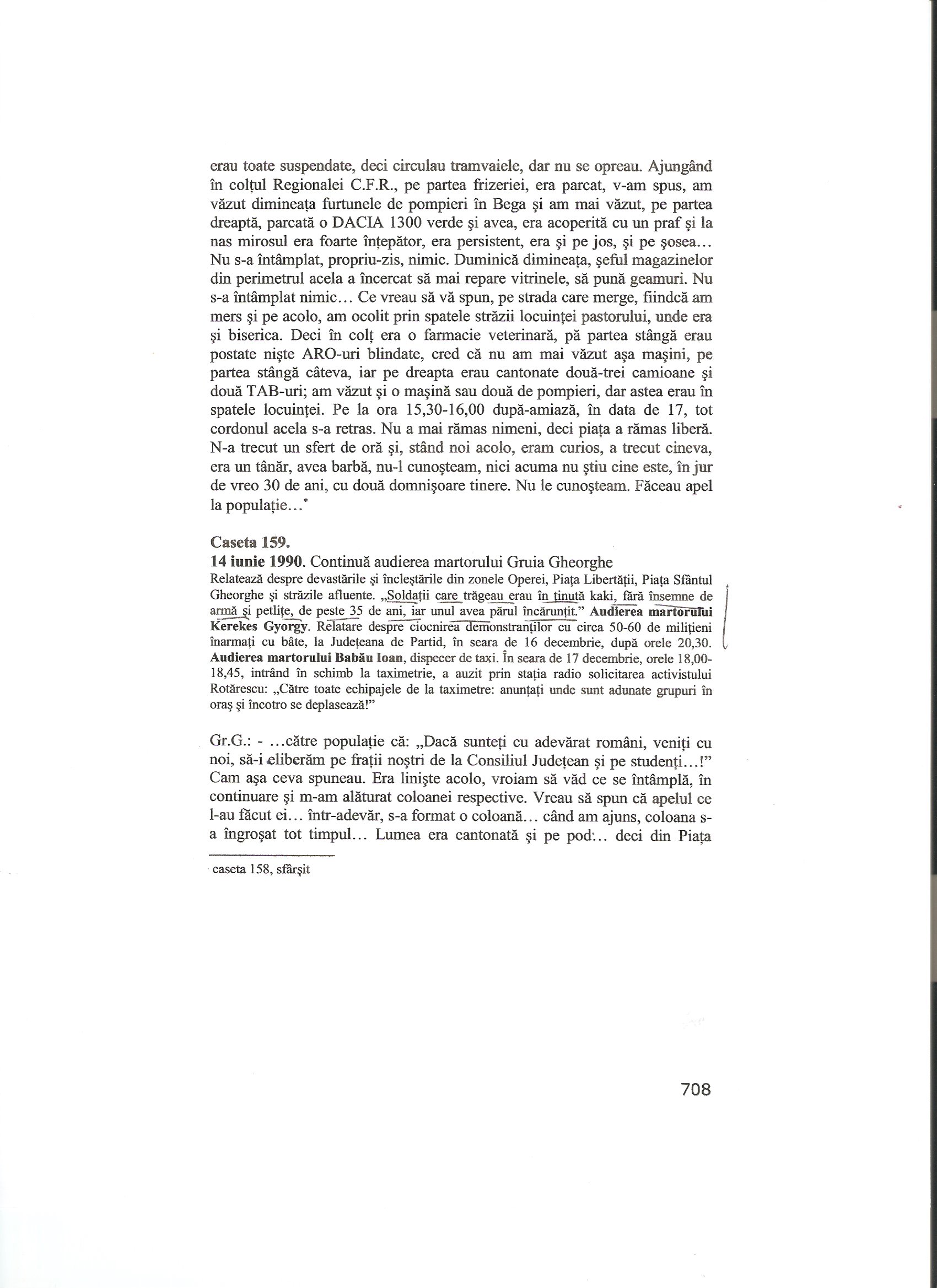
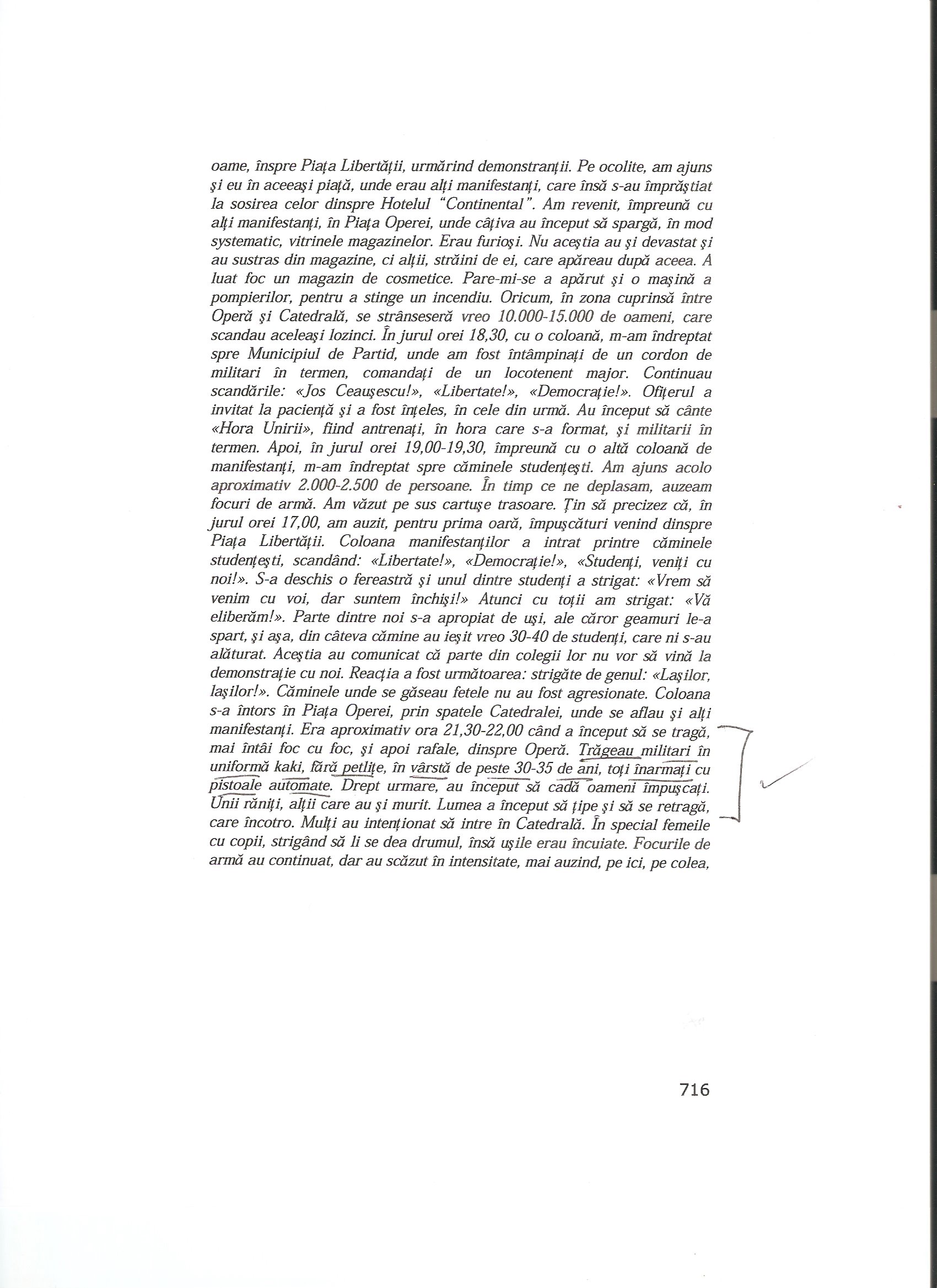
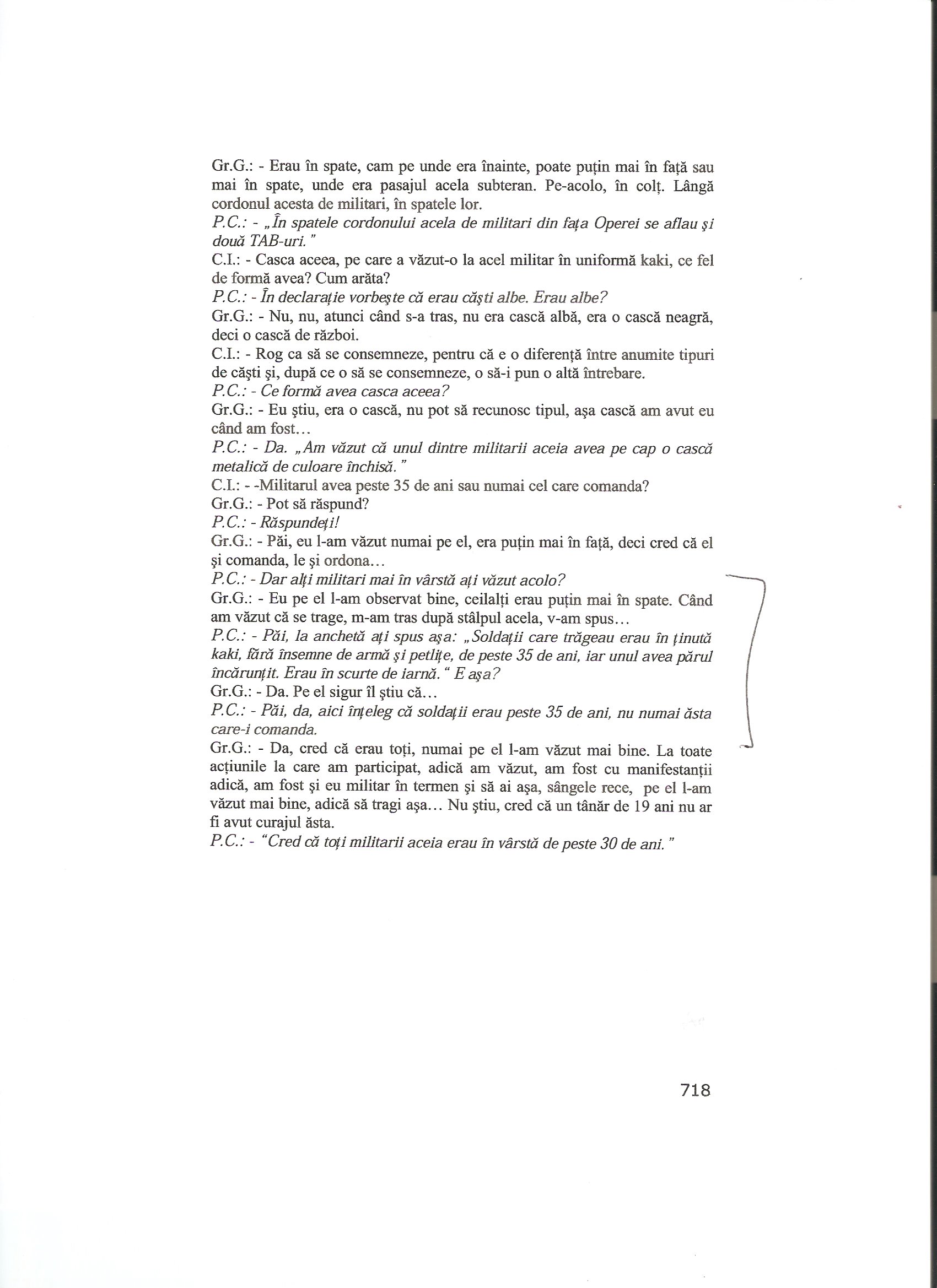
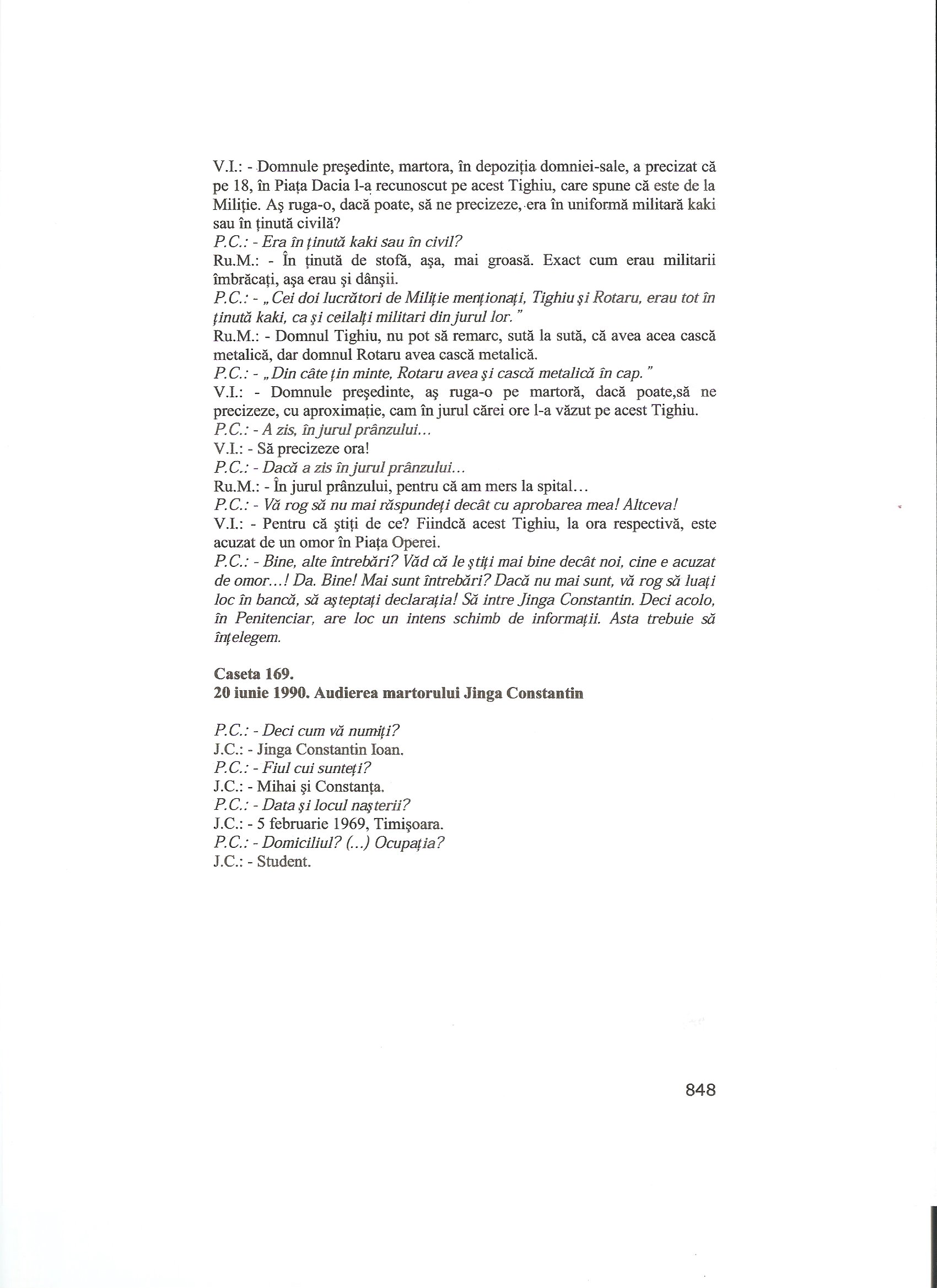
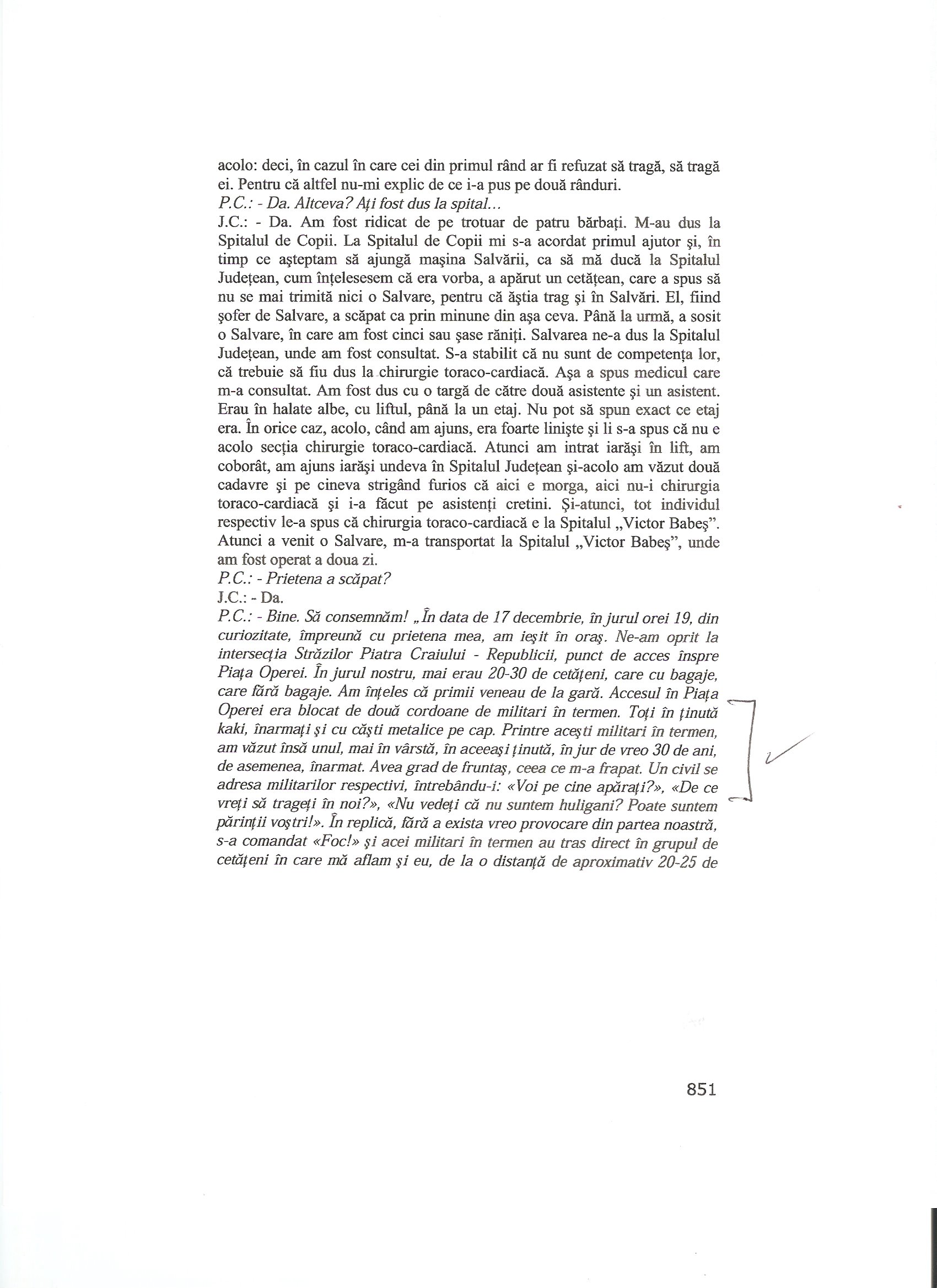
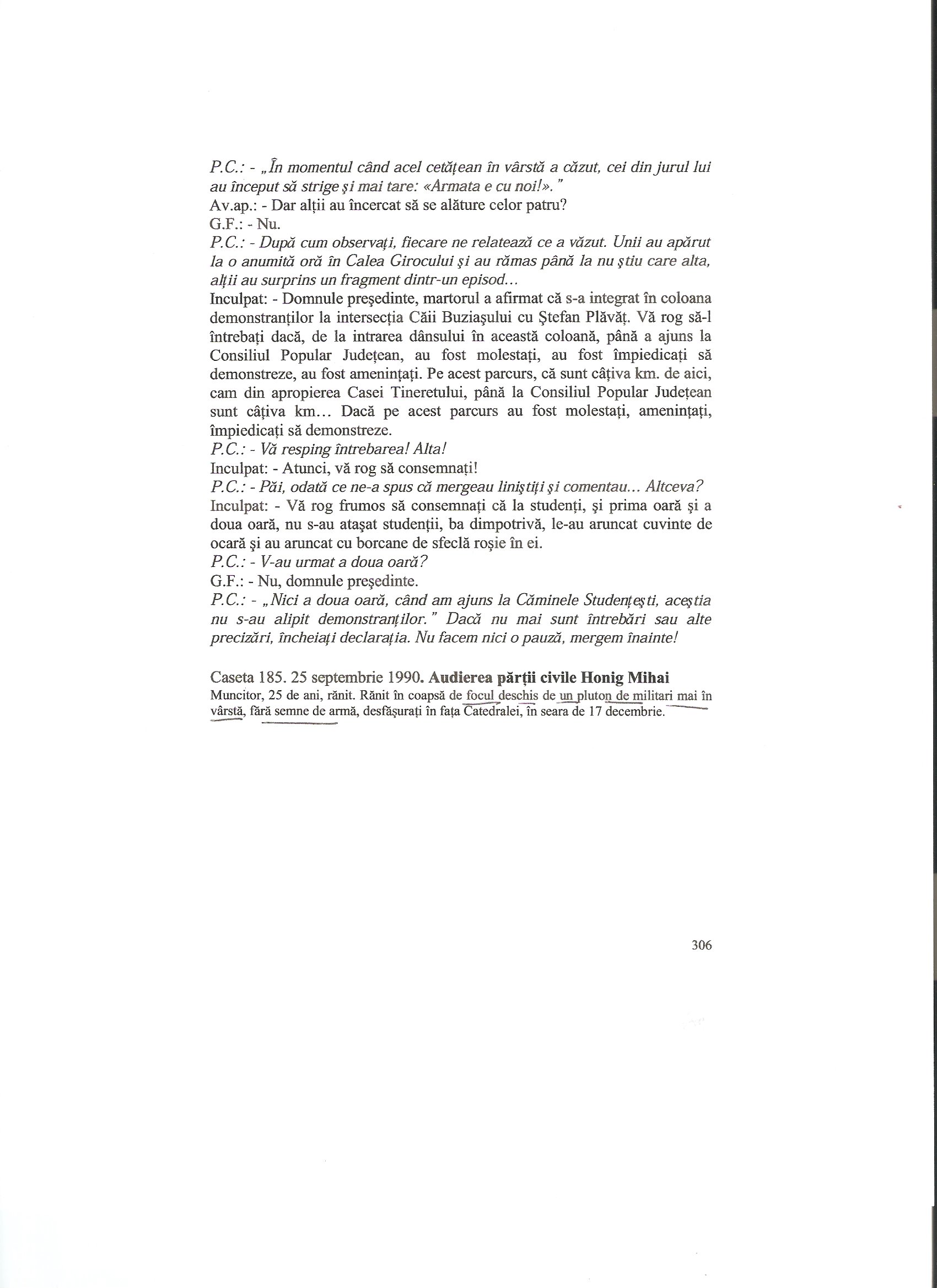
Am fost la Timisoara militar in termen in 89. In fata noastra la un moment dat a fost dizlocat un pluton cu militari in tinuta kaki, mai in varsta ca noi, la 30-35 de ani si care nu aveau petlite si nici insemne de arma. Ii intrebam de vorba si nu ne raspundeau ne ignorau… Au tras orizontal rafale de pistol automat… Noi pana atunci am tras in plan vertical. Cine erau acei “militari”?
Noi toti am banuit ca erau ofiteri din trupele de securitate imbracati in postav kaki nou de la stoc care mirosea a naftalina.
Dupa aceea toata revolutia am petrecut-o pe un bloc in fata unei mitraliere si cu un camarad cu care ma scimbam periodic. Am ramas de atunci bolnav cu “mijlocul” din cauza frigului pe care l-am suportat atunci pe acel nenorocit de bloc.
Dumnezeu sa-i ierte pe toti eroii revolutiei din 1989…
BELOW 10 TESTIMONIES WHICH DISCUSS THE ROLE OF THESE “UNIDENTIFIED CIVILIANS OR SOLDIERS” [LIKELY PLAINCLOTHES SECURITATE AND/OR MILITIA OFFICERS], IN SOME CASES STATIONED BEHIND RANK-AND-FILE SOLDIERS:
Posted by romanianrevolutionofdecember1989 on October 20, 2011
[as always, purely personal views based on purely personal research and publications over the past two decades]
Thanks to Miodrag Milin (and ASOCIAŢIA MEMORIALUL REVOLUŢIEI 16-22 DECEMBRIE 1989, TIMIŞOARA), the tapes of the Timisoara trials of 1990-1991 have been transcribed and made available to the public. These transcripts are highly valuable for the researcher of the December 1989 Romanian Revolution. To my knowledge, much of this information has never made it into the public domain, and much of the most important information has definitely not.
Emblematic of post-Ceausescu Romania and the legacy of disinformation spread by the former Securitate and Ceausescu’s apologists in the 1990s (to understand, see http://atomic-temporary-3899751.wpcomstaging.com/the-uses-of-absurdity-romania-1989-1999/) was the July 2008 public release of declassified excerpts of Romanian Army documents from immediately after the December 1989 Revolution. The focus of journalists and forumisti was not upon researching to see if there was independent, confirmatory information to substantiate/corroborate the details contained in the Army documents, but upon how the documents were being used (thereby ignoring the possibility that two things were true at the same time: the documents were being used, but they also revealed the truth–which is exactly what was happening). Thus was lost yet another critical opportunity for understanding December 1989 as the testimonies from the Timisoara trials make clear.
Trupele de Miliţie, Securitatea în civil şi luptători ai USLA au acţionat, alături de militari, pentru oprirea manifestaţiilor de la Timişoara, din decembrie 1989. Informaţiile apar în “Jurnalul de luptă” al Ministerului Apărării, din perioada 16-22 decembrie. Acesta a fost azi făcut public de Înalta Curte de Casaţie şi Justiţie. Documentul a fost desecretizat în urma solicitării avocaţilor din dosarul în care generalii Victor Atanasie Stănculescu şi Mihai Chiţac sunt acuzaţi de omor deosebit de grav, respectiv tentativă de omor deosebit de grav.
1 /4.
Din documentul desecretizat azi, care conţine descrierea pe ore a evenimentelor petrecute la Revoluţia de pe Bega, reiese că trupe ale Securităţii, Miliţiei şi Unităţii Speciale de Luptă Antiterorism s-au infiltrat printre soldaţi. Aceşti militari ar fi tras asupra manifestanţilor, în special în momentele în care armata trăgea focuri de avertizare.
Un raport de informare al Ministerului Apărării Naţionale, întocmit de comandantul Marcu Dumitru din Arad, arată că acesta a semnalat “efective militare necunoscute” printre militarii săi. “Între efectivele noastre au fost semnalate efective de militari necunoscuţi care aveau în dotare lanterne foarte puternice şi care îndreptau fascicolul luminos spre balcoane, iar după aceea trăgeau asupra acestora – cazuri semnalate pe calea Girocului – îmbrăcaţi civili. Au fost semnalate efective ale Securităţii şi Miliţie în toate punctele unde am avut efective. Nu cunoaştem misiunile pe care le aveau de îndeplinit aceşti indivizi“, raporta comandantul.
“Rezulta ca, in perioada 16 – 21 decembrie 1989, la Timisoara, printre soldati au fost infiltrate diverse persoane. Astfel, au fost persoane imbracate in uniforma kaki si care detineau armament foarte sofisticat. Era armament de lupta de provenienta straina, care nu era in dotarea Armatei si cu care s-a tras inclusiv chiar si in soldati. Va dau un singur exemplu. Pe 17 decembrie au fost depistate cinci persoane straine care atacau masini de lupta ale armatei. Atunci cand au fost depistate, acele persoane care erau imbracate in uniforma specifica armatei au fugit.
Spatiul aerian era survolat de niste aparate de zbor mici, despre care nu s-a stabilit nici pana in prezent de unde proveneau. Au fost impuscati multi soldati, s-au atacat tancuri ale armatei. Documentele depuse de noi la dosar arata ca printre persoanele infiltrate in randul celor de la Timisoara se aflau oameni din Unitatea Speciala de Lupta Antiterorism si din Securitate”, a declarat Avocata lui Victor Stanculescu, Alice Draghici.
Trupe de Securitate, Miliţia, Securitatea în civil şi Trupele USLA au acţionat, alături de militari, pentru oprirea manifestaţiilor de la Timişoara, din decembrie 1989, potrivit “Jurnalului de luptă” depus la dosarul Revoluţiei de la Timişoara de la instanţa supremă.
Jurnalul arată că regimul s-a folosit de ofiţeri de securitate şi de trupe speciale, infiltraţi printre manifestanţi, pentru a “arunca vina pe seama armatei”.
“Includerea în mai multe locuri fierbinţi a unităţilor militare în cadrul unor dispozitive mixte, împreună cu forţele de ordine ( trupe de securitate, miliţie, USLA, grăniceri), specializate în acţiuni represive, de forţă, infiltrarea printre rândurile manifestanţilor a unor persoane, aparţinând Securităţii care acţionau cu deosebită abilitate, trăgând acoperit împotriva manifestanţilor, a fost deliberat folosită ca stabilirea responsabilităţii pentru împuşcarea unor oameni să devină practic imposibilă, şi a arunca pe seama armatei vina pentru o bună parte din tot ce s-a întâmplat în acele zile la Timişoara”, este una dintre concluziile unui raport înaintat Parlamentului României de Ministerul Apărării Naţionale, în 1990, inclus în Jurnalul depus la instanţa supremă.
Un alt raport de Informare al Ministerului Apărării Naţionale, întocmit de comandantul Marcu Dumitru din Arad, arată că acesta a semnalat “efective militare necunoscute” printre militarii săi.
“Între efectivele noastre au fost semnalate efective de militari necunoscuţi care aveau în dotare lanterne foarte puternice şi care îndreptau fascicolul luminos spre balcoane, iar după aceea trăgeau asupra acestora – cazuri semnalate pe calea Girocului – îmbrăcaţi civili. Au fost semnalate efective ale Securităţii şi Miliţie în toate punctele unde am avut efective. Nu cunoaştem misiunile pe care le aveau de îndeplinit aceşti indivizi”, raporta comandantul.
Să lămurim odată şi cu infiltrarea aceasta.Nimeni nu a spus, că securiştii, câte unul s-au infiltrat printre militarii în termen.Ceea ce se poate deduce din mărturiile martorilor oculari, este, că militarii în termen erau în dispozitiv, şi trăgeau focuri de avertizare, în sus. Securiştii însă, care erau pe rândul doi, au tras printre aceşti militari (că doar nu era dispozitivul compact, ermetic), şi de pe cuiburile de tragere instalate pe clădirile din jur, direct în demonstranţi. Scenariul a fost acelaşi peste tot, şi la Timişoara, şi la Bucureşti, Sibiu, Braşov, Cluj, Târgu Mureş etc. Ochitori speciali, dotaţi cu puşti cu lunetă, îmbrăcaţi de obicei în combinezoane negre, din cadrul forţelor speciale ale Securităţii, erau plasaţi în etajele superioare sau pe acoperişurile clădirilor înalte care înconjurau piaţa centrală a fiecărui oraş.
Aceste echipă de comando câteodată soseau în provincie deghizaţi în sportivi, erau cazaţi în hotelurile să zicem luxoase pe ultimul etaj, de unde nici n-au trebuit să iasă afară. Nu-i întâmplător că în acele zile, dar mai ales în noaptea de 22 spre 23 focurile de armă veneau dinspre hoteluri (de ex. la Braşov: Hotel Negoiu). Când au văzut că balanţa nu se înclină în favoarea lui Ceauşescu, datorită – hai să spunem clar – trecerii armatei de partea revoluţiei, băieţii ăştia s-au evaporat. S-au întors la slujbele lor acoperite ca civili, sau la unităţile securiste unde erau încadraţi. Iar noi, nu reuşim să le dăm de urmă nici după 19 ani. (Ce-i drept, procurorii nici nu s-au omorât să facă investigaţii serioase. Îia prinşi au fost lăsaţi să plece liber. Cică, au executat un ordin, şi asta se respectă între militari.)
Yet what is significant is the number of testimonies in court during the trials of Timisoara attesting exactly to that: the presence of well-armed civilians, clearly older than the standard military recruits who surrounded them, who opened fire on demonstrators. [Below, from testimonies previously shared in other parts of this series]
Some excerpts: P.C.: Ati dat o declaratie? Po. I. : Da P.C.: O mentineti? Po. I. Da (p. 827) P.C.: “Inteleg sa fiu audiat in cauza ca parte civila”, da? V-as ruga sa faceti putin liniste! “Mentin declaratia de la Procuratura si…” (p. 833)
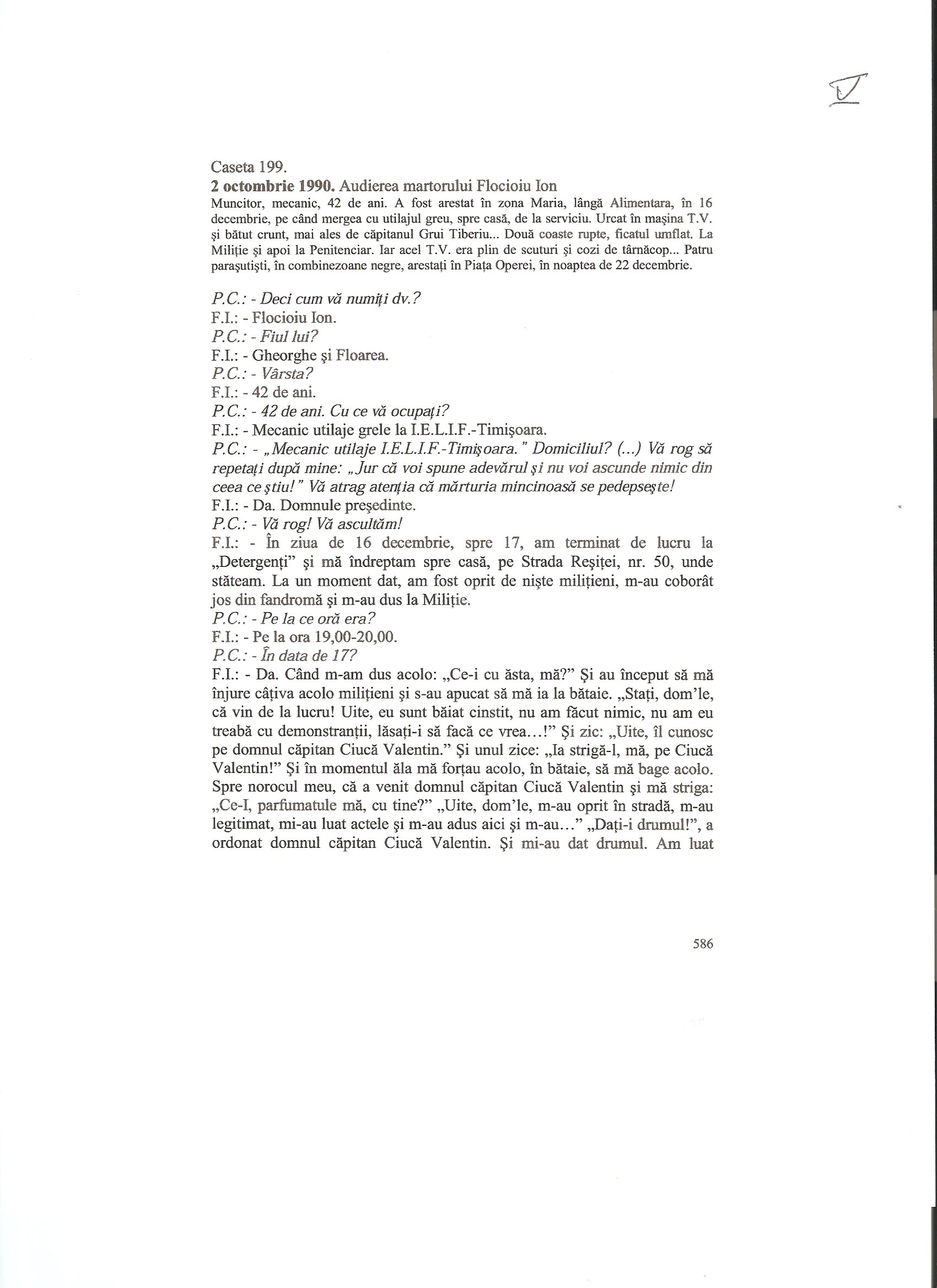
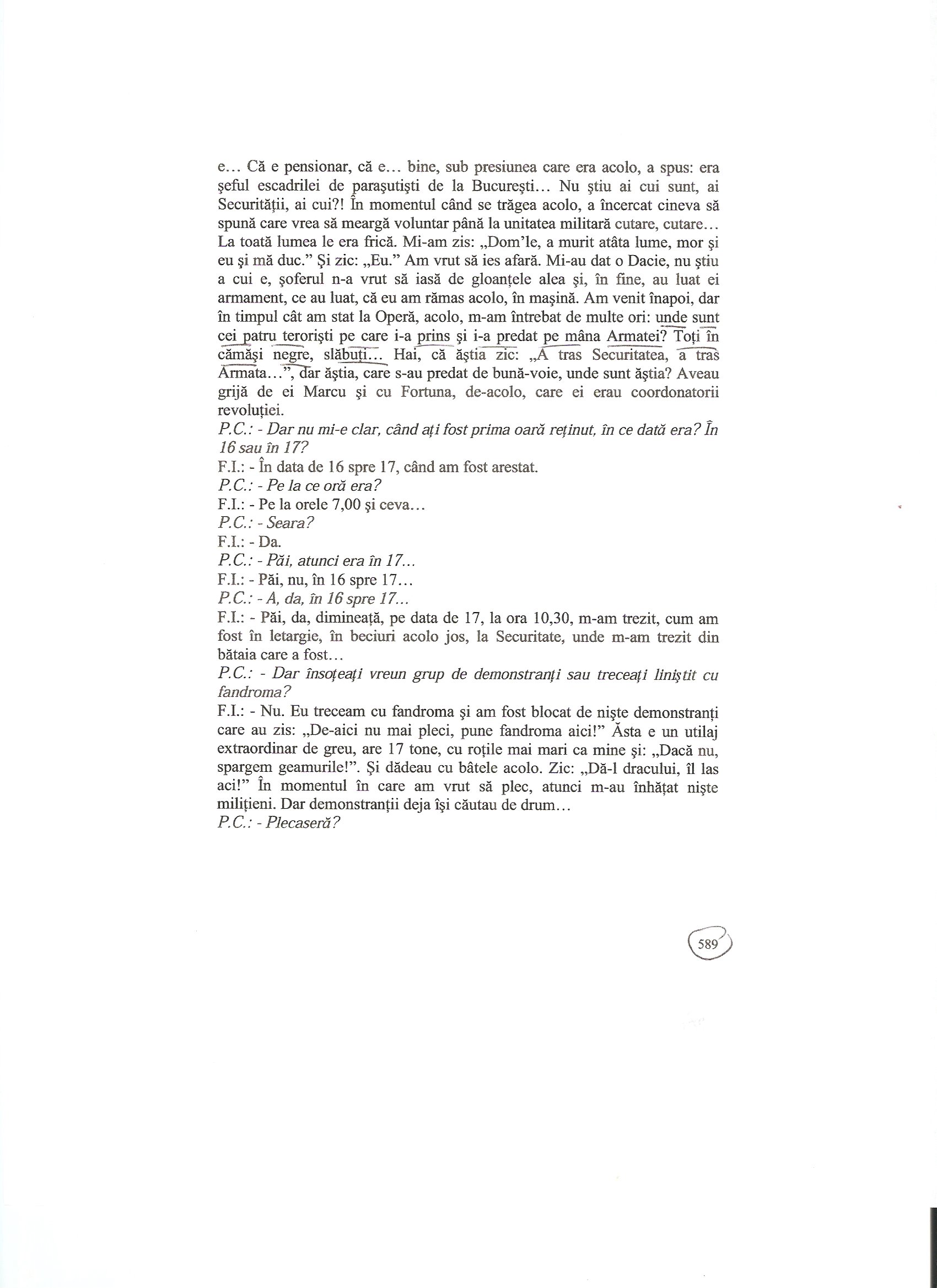
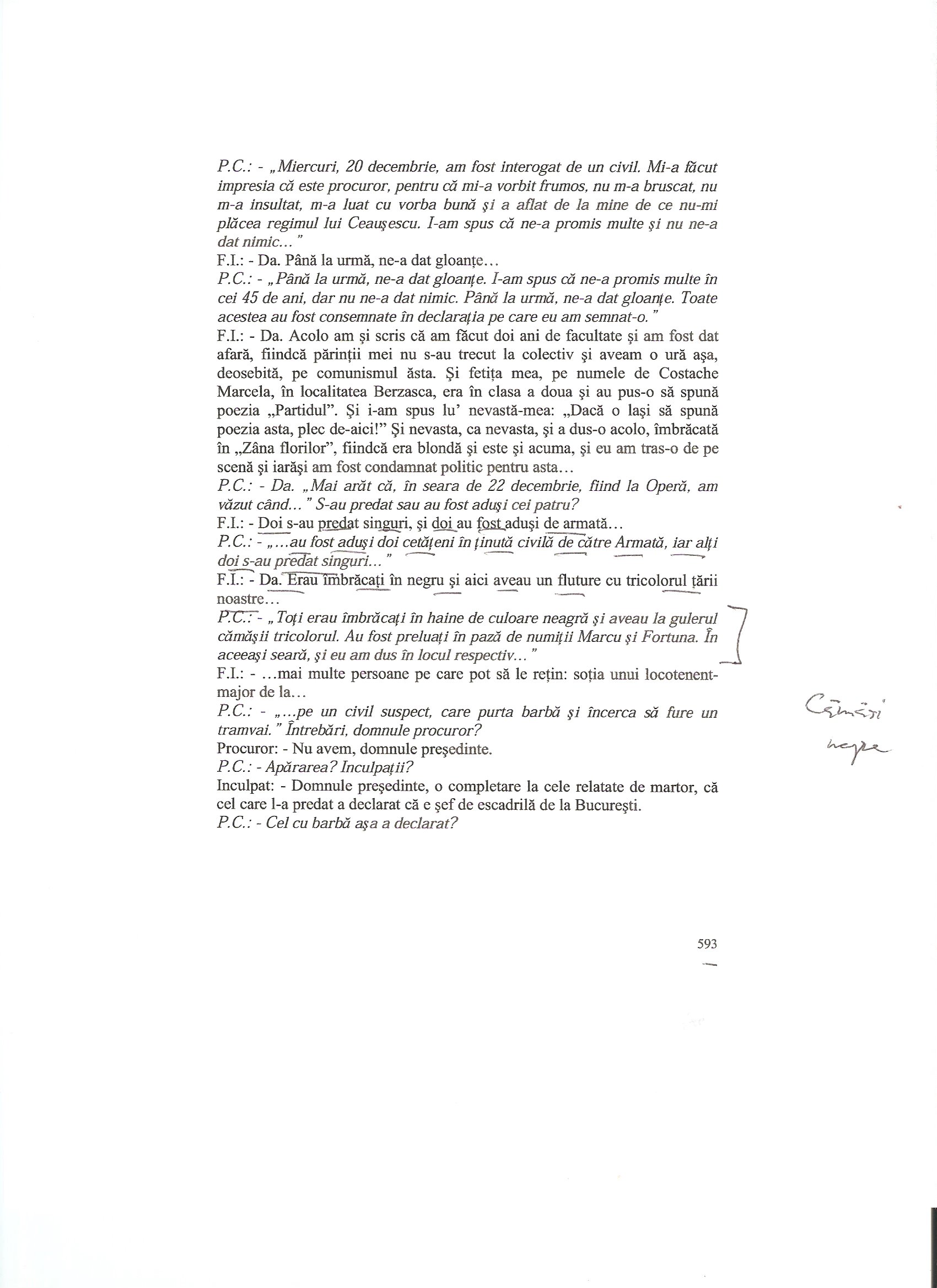
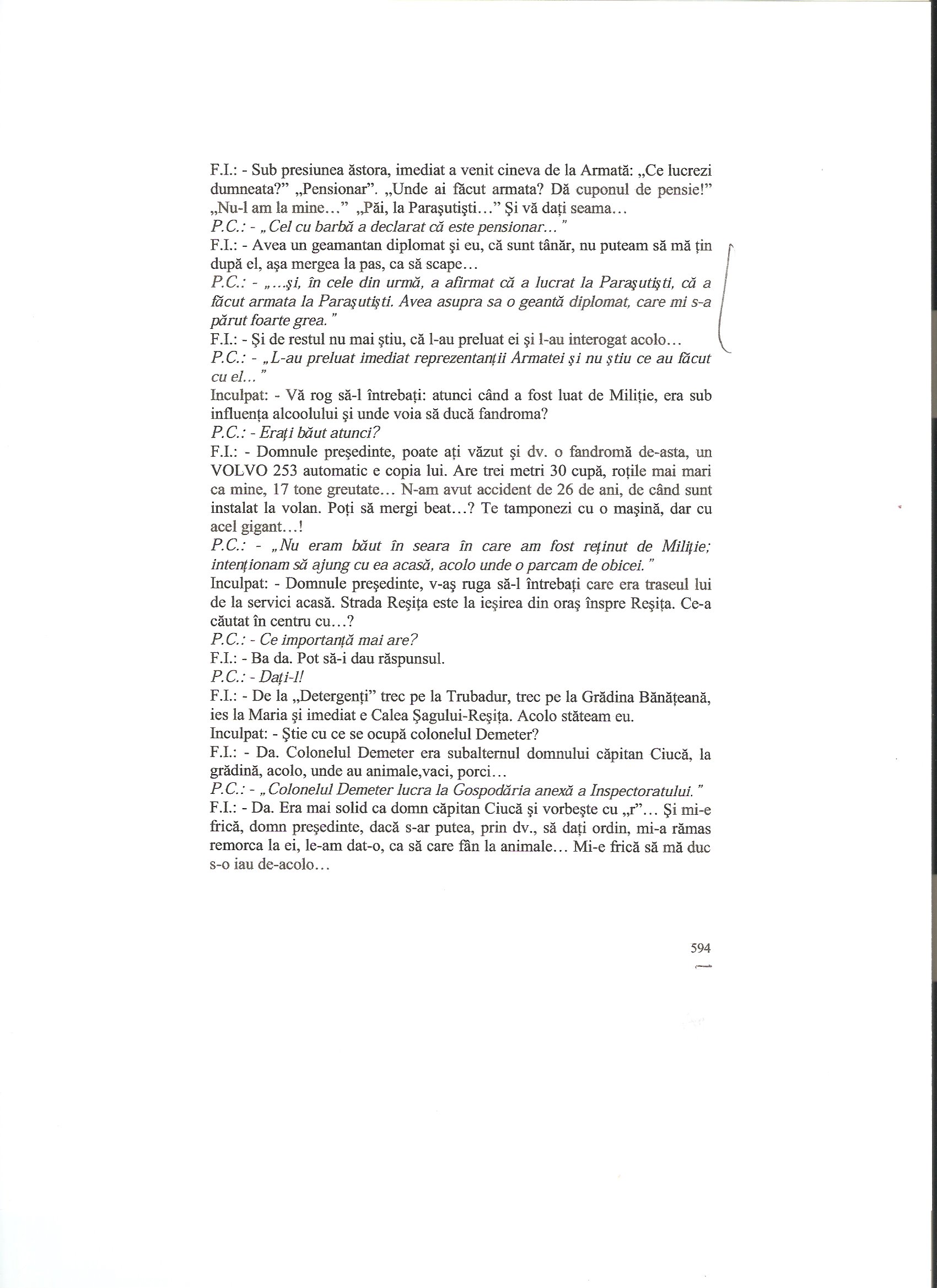
Po. I.: …Da [am fost ranit]. Si dupa aceea a venit unul dintre trei [civili mai in varsta] dupa mine, m-a tarat pana la masina si la masina, acolo, am luat o bataie…ca n-am putut doua saptamani nici sa mananc nimica. M-a lovit cu patul de arma in falca si cu bocancii in cap. Si m-au dus, m-au dus la Garnizoana. La Garnizoana m-au aruncat din masina si a venit ofiterul de serviciu. Au venit si acestia trei a spus lu’ ofiterul de serviciu, cica: “Luati-l si duceti-l la arest.” Atata retin foarte bine minte, ca ofiterul a spus, cica: “Nu, voi trageti cu dum-dum-uri si dupa aia Armata raspunde. Voi omorati oameni si raspunde Armata dupa aceea.” Asta tin minte precis. Si de acolo mi-am dat seama ca nu poate sa fie soldati aceia. (p. 830)
Perhaps most interesting are the words of Traian Orban, commenting on the release of the Army documents in July 2008, but comparing it to his court testimony in 1990–when he clearly laid emphasis on the role played by these older civilians amongst the soldiers…
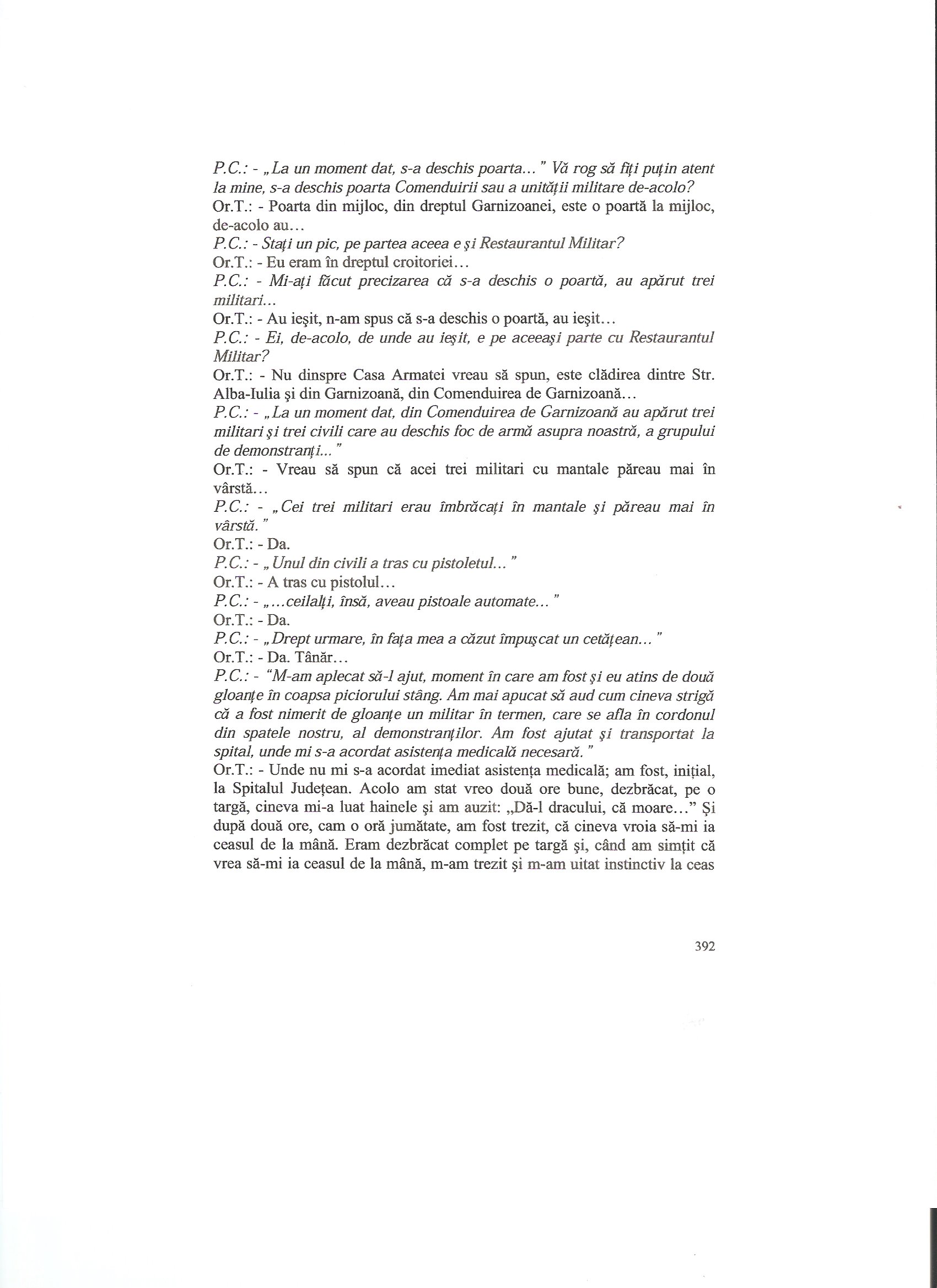
Generalii vor să scapede puşcărieÎnsemnările desecretizate din „Jurnalul de luptă“ din perioada 17-22 decembrie 1989, aflat la MApN, încearcă să acrediteze ideea că victimele de la Timişoara trebuie trecute în seama lucră torilor de Securitate, Miliţie şi USLA, infiltraţi printre militarii forţelor armate. Prin urmare, Armata nu s-ar face vinovată de cei 72 de morţi şi cei peste 350 de răniţi. Afirmaţiile sunt contrazise de răniţii de acum 18 ani. Potrivit lor, generalii în rezervă Stănculescu şi Chiţac, condamnaţi la 15 ani de închisoare în dosarul „Revoluţiei de la Timişoara“, vor să folosească jurnalul desecretizat al acţiunilor de luptă din MApN ca să scape de puşcărie şi nicidecum pentru a scoate la lumină un adevăr istoric. Stănculescu şi Chiţac sunt complici cu aşa-zişii „infiltraţi“, pe care i-au tăinuit timp de 18 ani, mai spun ei.„Există numeroase mărturii în care participanţi la evenimentele de atunci, unii dintre ei răniţi, au declarat că au văzut cu ochii lor militari în termen şi cadre militare aparţinând MApN trăgând în demonstranţii de la Timişoara. Eu am fost împuşcat în Piaţa Libertăţii şi asupra noastră s-a tras, fără somaţie, atât de la nivelul trotuarului, cât şi din balconul Diviziei 18 Mecanizate Timişoara. Militari înarmaţi cu pistolete şi cu AKM-uri au ieşit din Garnizoana Militară şi au tras în noi tot fără somaţie. La noi, la Memorialul Revoluţiei, sunt sute de astfel de declaraţii care spun că armata a tras în populaţia paşnică. Interesant este faptul că Victor Atanasie Stănculescu foloseşte abia acum, în procesul pe care revoluţionarii timişorenii l-au intentat, astfel de însemnări.Stănculescu şi Chiţac au fost la vremea respectivă persoanele cu cel mai înalt grad prezente la Timişoara şi care au coordonat reprimarea violentă a demonstranţilor. Dacă Stănculescu ştia că lucrători din Securitate, miliţieni şi uslaşi au fost infiltraţi printre militari şi au omorât oameni, atunci este tot atât de vinovat, fiind complice cu infiltraţii, pentru că nu i-a deconspirat şi nu i-a predat justiţiei militare pentru a fi judecaţi. Putea să facă acest lucru imediat după Revoluţie, când a devenit ministru al apărării, iar Chiţac ca ministru de interne. Din contră, ei au stopat cercetă rile, în calităţile pe care le aveau, legate de revolta de la Timişoara“, a declarat Traian Orban, rănit în Revoluţie şi preşedinte al Memorialului Revoluţiei de la Timişoara.
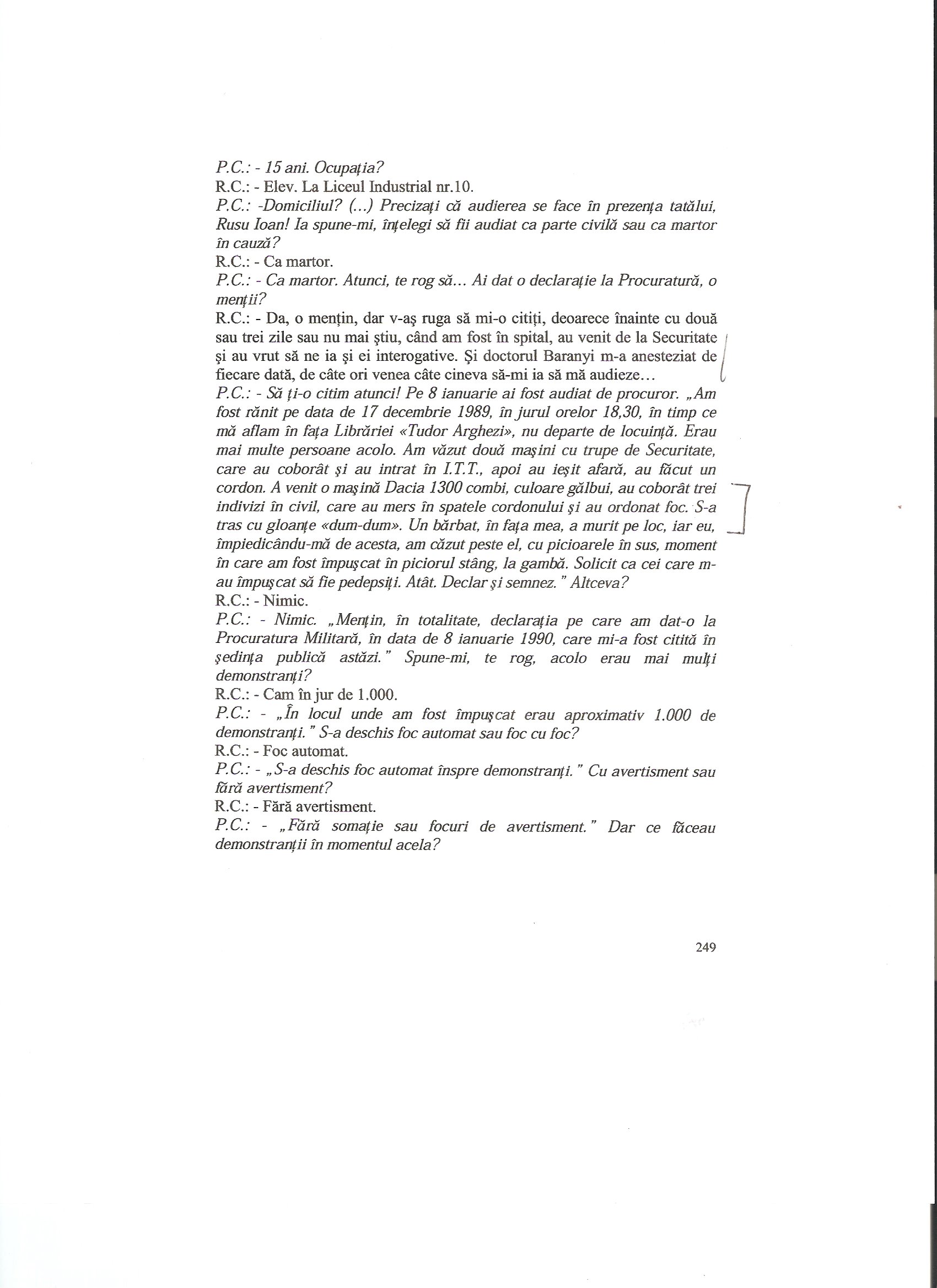
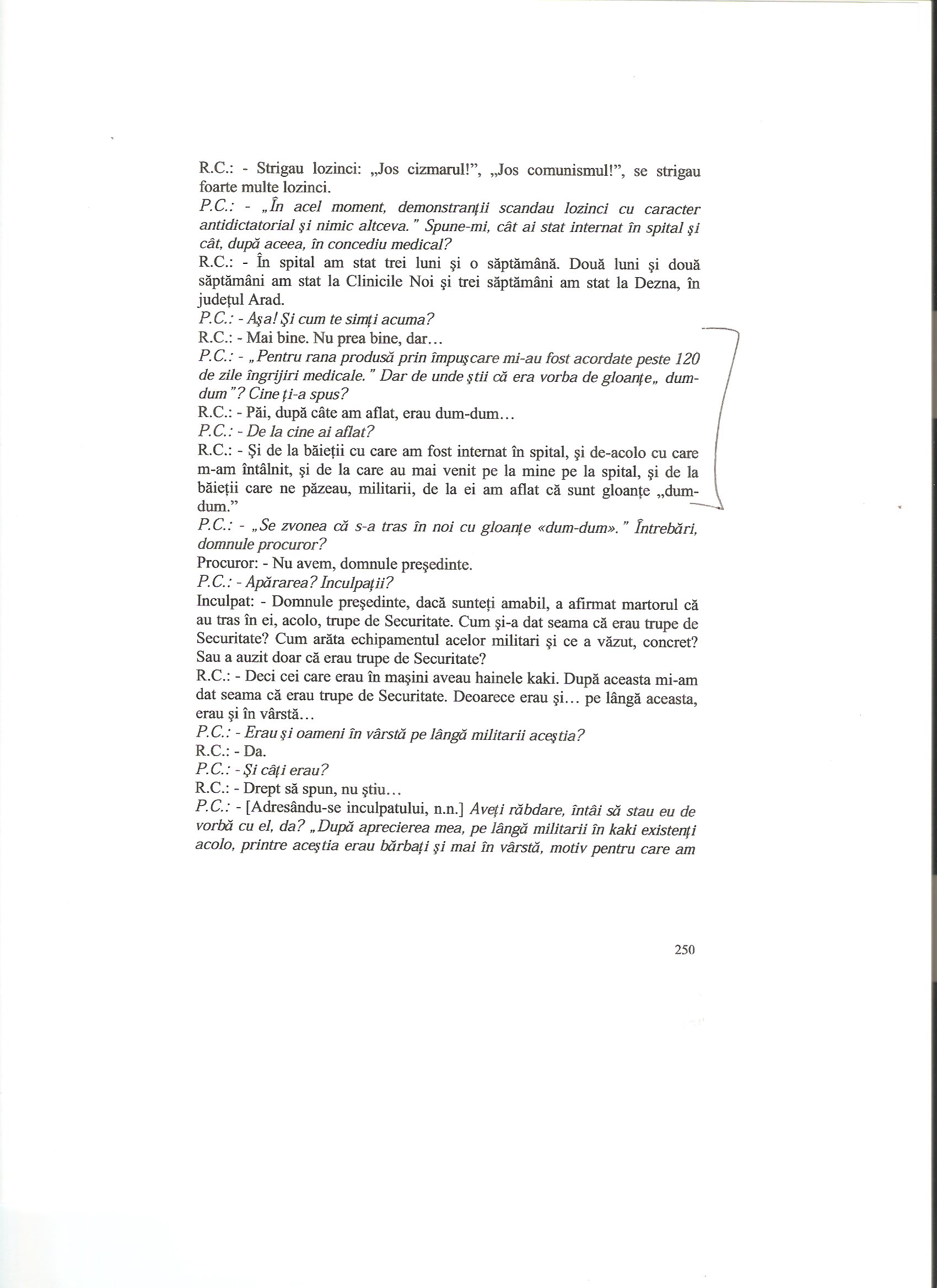
Cristian Rusu: Pe 8 ianuarie audiat de procuror: …A venit o masina Dacia 1300 combi, culoare glabui, au coborat trei indivizi in civil, care au mers in spatele cordonului si au ordonat foc. S-a tras cu gloante “dum-dum.”
Cristian Rusu: “Si de la baietii cu care am fost internat in spital, si de-acolo cu care m-am intilnit, si de la care au mai venit pe la mine pe la spital, si de la baietii care ne pazeau, militarii, de la ei am aflat ca sunt gloante ‘dum-dum’.”




 Pretul libertatii a fost scump. Pretul e imens, dramele prin care au trecut mii de familii in acea vreme nu au un pret anume, nu exista o alaturare de cuvinte agreabila. Pentru libertate s-au pierdut vieti. Vieti tinere, dornice de a descoperi viata in libertate, dar care nu au mai ajuns sa se bucure de ea. De libertate. Tineri si oameni in toata firea, din toate colturile tarii, au fost rapusi de gloantele si tancurile armatei. Sau de “teroristi” necunoscuti. Timisoara, Cluj, Iasi, Bucuresti, dar si in Resita, urmarile luptei pentru libertate se fac cunoscute si acum datorita memoriei celor care au disparut la revolutie.


































 The Archive of the Romanian Revolution of December 1989


