The Archive of the Romanian Revolution of December 1989

A Catch-22 December 1989, Groundhog-Day Production. Presenting the Personal Research & Scholarship of Richard Andrew Hall, Ph.D.

Posts Tagged ‘romania december 1989’

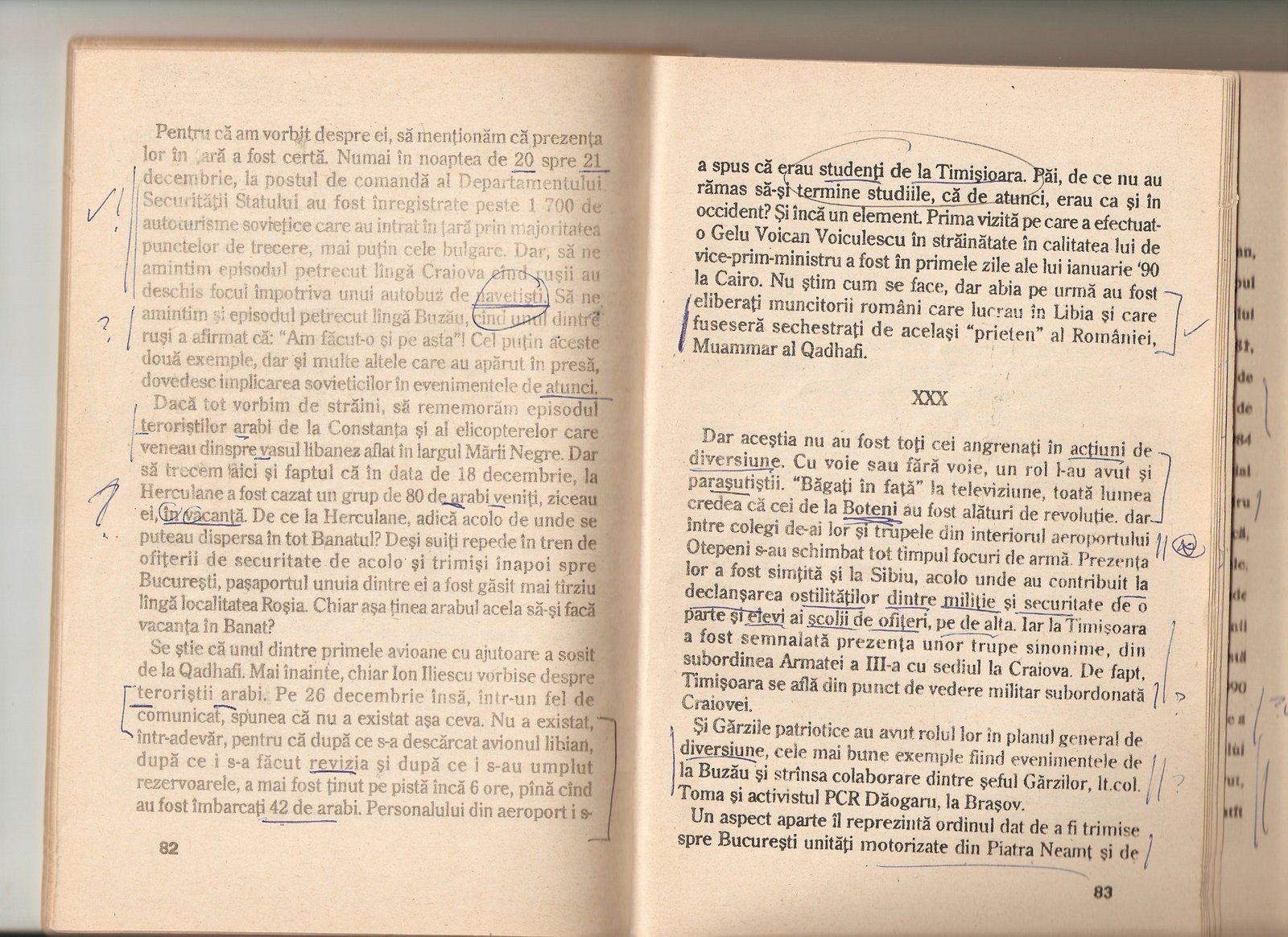
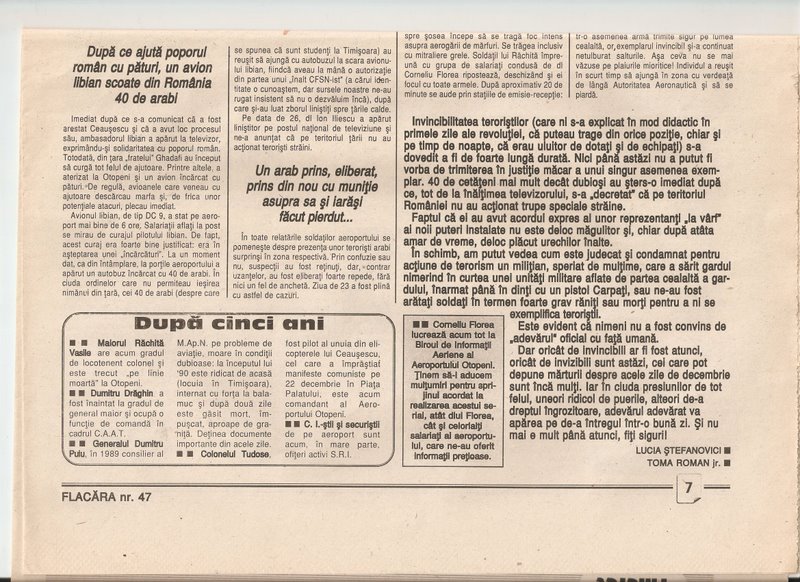
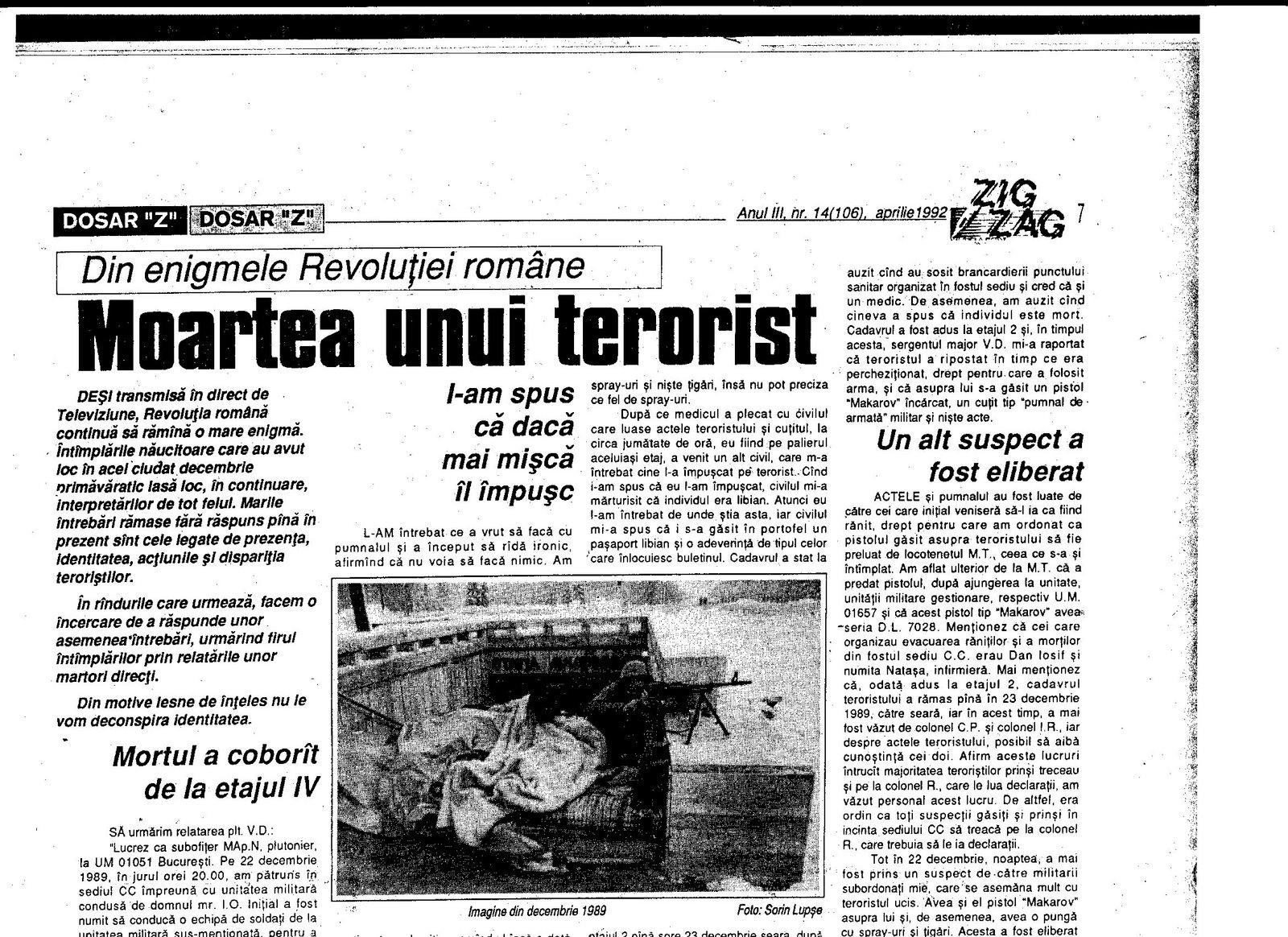
Nicolae Ceausescu, Securitatea, Libieni, Cincu/Fagaras/Brasov, si Revolutia Romana

Posted by romanianrevolutionofdecember1989 on January 10, 2014

Marcus I.

Revolutia ne-au furat-o altii. Noi generatia in blugi si adidasi am inceput aceasta revolutie impotriva tiranului am invins si am fost dati la o parte de altii. Unde sunt teroristii libieni? Eu personal am vazut doi prinsi dezarmati de arme necunoscute noua si arestati de militarii romani. Vorbeau stricat romaneste cu accent arab. Cui i-au fost predati?
Am fost la televiziune… Cine a tras asupra noastra si cine vroia sa cucereasca postul national de televiziune? De ce se spune acum ca nu au existat ofiteri de securitate fanatici care au luptat si au fost loiali dictatorului?
De ce se spune acum ca nu au existat teroristi? Nu contest ca au fost si situatii nefericite cand datorita dezinformarii militarii au tras unii in altii… Dar astea au fost cazuri izolate.
Am avut noroc ca Armata Romana ni s-a alaturat la indemnul nostru “ARMATA E CU NOI”, altfel varsarea de sange ar fi fost mai mare.
Si acum dupa 20 de ani se ascunde adevarul despre REVOLUTIA ROMANA…
Am fost acolo… am vazut tot… pe mine nu ma poate prosti nimeni…
DUMNEZEU SA-I ODIHNEASCA IN PACE PE TOTI EROII NOSTRII DIN 89…

http://www.ligamilitarilor.ro/eroii-neamului/recunostinta-eroilor-revolutiei-din-%E2%80%9989-timisoara/

—————————————————————————————-

Au fost teroristi!!!!! 11:49:22, 22 Dec 2010

Stefan : Cateva intrebari: 1. Care a fost primul diplomat strain care a aparut la TVR, nu cumva ambasadorul libian….dupa aceasta interventie au disparut din spitale, etc toate persoanele care trebuiau sa dispara (au fost transportati cu masini utilizate pentru transportul painii) si dusi la Otopeni. Dupa aceasta data au incetat si luptele….O parte din teroristi ( in special libieni, palestinieni, etc.)erau din taberele de antrenament de la Cincu unde erau coordonati si antrenati de ofiteri romani contra cost in special pentru lupte de comando si in schimbul unoor tratate speciale cu tarile arabe.

http://www.cotidianul.ro/nu-au-existat-teroristi-in-decembrie-89-132724/

—————————————————————————————–

“AM DAT NAS IN NAS CU ARABII”Si inainte de 1989 am fost un mare pasionat al muntelui. Asa i-am cunoscut pe cei de la statia meteo de pe Tarcu. Ei mi-au dat caseta cu inregistrarile acelea din zilele revolutiei. Am incercat o traducere cu studentii mei de la Facultatea de Medicina. In mare parte, am reusit sa dezleg misterul, dar, din pacate, mai exista pasaje pe care inca nu am reusit sa le deslusesc. Pot doar sa va spun, cu toata convingerea, ca teroristi arabi au existat, in Timisoara, in perioada decembrie 1989. I-am vazut cu ochii mei langa fosta Policlinica cu plata. In plus, imediat dupa evenimentele de atunci, in pasul Sercaia, in timp ce faceam fotografii, am dat nas in nas cu indivizi ce aveau alura de arabi, imbracati in haine militare romanesti. Cred ca acolo era o tabara de antrenamentdr. Adrian Siniteanu 

http://jurnalul.ro/special-jurnalul/libienii-pe-frecventa-revolutiei-la-timisoara-53715.html

——————————————————————————————-

02:23 Pompiliu Alămorean:  …Teroriştii libieni. Teroriştii libieni au plecat cu 2 avioane de pe Otopeni, în 27 decembrie 1989, ă, ’90. Teroriştii sirieni şi alţi arabi erau printre noi şi majoritatea au rămas printre noi. Erau studenţi, cum spunem noi, cu acoperire. Conserva. Teroriştii interni. Teroriştii interni au fost în primul rînd trupele speciale ale lui Ceauşescu, care îl şi purtau pe Ceauşescu la gît. Unul dintre ei este celebrul mort în revoluţie, care acuma îmi scapă numele, care pe masa de operaţie, sub narcoză spunea: “Unde-i tătucul să-mi dea gloanţe să trag?” Da, mă rog, acuma…

V.P. Spune:

august 5, 2010 at 1:33 pm Interesant ca langa cadavrul lui Iosif Costinas au gasit ambalaj de la diazepam, asa cum s-au gasit si in cazul enoriasului lui Tokes, a carui cadavru a fost descoperit intr-o padure de langa Timisoara, cu cateva luni inainte de decembrie 1989. Oare cu adevarat s-au sinucis amandoi, sau mai degraba au fost ‘sinucisi’? Iar despre teroristii libieni sau arabi care au plecat de la Otopeni, mai multi martori sustin ca asa a fost….Normal ca ambasadorul Siriei sau Libiei, sau al nu stiu carei tara a avut pe-acolo teroristi ar da in judecata Romania daca s-ar spune ceva oficial in legatura cu asta…Ca doar n-o fi prost ca sa sustina ca oamenii lor au fost implicati atat de bine in ‘evenimentele’ din Romania… http://mariusmioc.wordpress.com/2010/07/07/culisele-revolutiei-6/

————————————————————————–

26 – In decembrie 1989, la Revolutie, in Brasov, unii dintre acesti libieni s-au aflat printre cei care au tras de la ultimele doua etaje ale hotelului Capitol in brasovenii manifestanti;

27 – Desi prinsi de catre Armata, acei tragatori libieni au fost uterior eliberati;

28 – Cetatenii brasoveni cunosc aceste situatii;

http://www.amosnews.ro/arhiva/ioan-ghise-contesta-decizia-lideralilor-ii-retrage-sprijinul-politic-29-08-2006

—————————————————————————————-
61. teroristi la Focani in arest 10:16 | 20 Iulie
luul

teroristi in combinezon negru au fost retinuti inclusiv in arestul unuitatilor militare din Focsani. ne cereau tigari de dupa gratii si erau calmi si nu stiau limba romana. noi, simpli soldati le aratam cartusele din incarcator in locul tigarilor. asta e adevarul. apoi s-au volatilizat la ordin “de sus”.

http://www.romanialibera.ro/exclusiv-rl/investigatii/au-recunoscut-ca-au-tras-la-revolutie-142447.html

—————————————————————————————-

Chiar erau terorişti?

M-am uitat la ei – da, erau… terorişti! Aveau tenul foarte măsliniu, nu vorbeau româneşte. Erau libieni – eu aşa cred. Şi îi legasem fedeleş şi îi păzeam cu coada de mătură. Le ziceam: „Dacă mişti, îţi dau cu asta în cap!” Ăia cu mătura… au dispărut a doua zi. I-a luat colonelul Oană pe toţi şi i-a dus, asta se ştie. Probabil că Gaddafi din Libia a zis că dacă mi-i împuşcaţi, vă împuşc şi eu vreo 300 de români în Libia, la mine! De-aia nici nu se putea spune nimic. Dar oamenii aceia au existat! Asta este teoria mea! Dacă lucrurile ar fi decurs altfel, dacă oamenii care aveau puterea ar fi decis să fie de partea lui Ceauşescu, eram oale şi ulcele, bătrâne! Păi, când a tras colonelul Oană salva de tun, am simţit că genunchii s-au tăiat şi am căzut la pământ imediat. Am ieşit în curte, era soare, frumos, şi deasupra – cu ochii mei, ţi-o spun, Andrei – am văzut, la o înălţime cam de o mie de metri, un elicopter şi unii cu o puşcă-mitralieră trăgeau în noi. Cum mă vezi şi cum te văd! Stupefiant! Cine era ăla? De ce trăgea în Televiziune? Incredibil! Erau atâtea evenimente că nu se poate spune, pe care să le ţii minte mai abitir?

http://www.adevarul.ro/actualitate/Dumitru_Graur_a_pazit_teroristi-_-Erau_libieni_0_607139601.html

—————————————————————————————

Căderea lui Gadaffi ar putea lămuri unele mistere din 1989

Întrebat ce părere are despre revoluționarii care cer indemnizații mai mari, Dinescu a spus tranșant că sunt niște profitori, la fel ca Grigore Cartianu. ”Acest individ trăiește din sângele Revoluției, ceea ce este tot o formă de a profita de sacrificiul unor oameni. Este o rușine pentru istorici, că nu s-a găsit altul care să lămurească lucrurile. Știm câte țiitoare a avut Ștefan cel Mare și  nu știm ce s-a întâmplat în 21-22 decembrie 1989… De pildă, s-a spus că au fost libieni, îmbrăcați în salopete. După căderea lui Gadaffi ar trebui să se solicite date din arhive. Erau sute de militari libieni la antrenament în România, exact cum s-au folosit, acum, mercenari străini în Libia. Și au fost răniți, există mărturii din spitalele de urgență. Gadaffi a amenințat că dacă nu le dă drumul, îi arestează pe cei 10.000 de români care lucrau în Libia, în acel moment. Așa că un avion cu soldați libieni a plecat în decembrie la Tripoli. Aștept ca istoricii să afle adevărul, să nu mai vină toți amatorii cu scorneli despre Revoluție”.

http://www.dcnews.ro/2011/12/dinescu-ii-cere-lui-patriciu-demiterea-lui-cartianu-%E2%80%9Dun-profitor-al-revolu%C8%9Biei%E2%80%9D/

O voce din sală: 

Dar despre împuşcarea în halul ăla a lui Ceauşescu, ce spuneţi?


Mircea Dinescu:

Păi cum!? O împuşcare mai suavă? (râsete ) Trebuia proces de-a adevăratelea, da, dar, s-a crezut, s-a spus că „n-o să mai tragă teroriştii” Şi italienii l-au spânzurat rapid pe Musolinni… Ce să cred? Din pricina lui Ceauşescu au murit mulţi, ei nu mai pot vorbi. Femei gravide, pe masa de operaţie, bătrâni care nu erau luaţi de salvare, că erau ca pe moarte, bestial, nu? Limita pentru asta era cea de 7o de ani, cea biblică, ce vreţi mai mare cinism? Au murit foarte-foarte mulţi oameni cu zile. Şi acum e aproape tot aşa. Dispreţul faţă de om, de semeni.


Altă voce din sală:

Dar terorişti au existat?


Mircea Dinescu:

Au existat, da! Există! Eu am văzut şi simulatoare electronice, astea erau împânzite în tot Bucureştiul, erau planuri vechi, pentru eventualitatea unor invazii, atacuri, etc.


Eugen Evu:

Acelaşi scenariu, peste tot unde s-a tras în oameni. Şi la Hunedoara, jur că s-a tras asupra mea, eram în faţa Poştei, cu o doamnă de la sindicate… Urma, gaura de glonţ vidia, alături de una normală, a stat mult timp în geamul intrării poştei, s-a tras asupra mea, eram de mult urmărit de securişti şi de unii de la miliţie, care mă arestau periodic, m-au anchetat şi penal, căci îi scrisesem lui Ceauşescu şi nu am vrut să recunosc! (ibidem,n.2006) În actuala Hunedoară, o biserică cu hramul martirilor prin împuşcare (şase la număr), stagnează de ani buni fără fonduri a se isprăvi. Pare un stigmat. Predicile se aud în oraş unele sunt de-a dreptul patetice, cu apeluri disperate, dar enoriaşii n-au bani, iar cei ce au nu prea se-apleacă. (ibid).


Mircea Dinescu:

De când erau în Cehoslovacia… Simulatoarele imitau mitralierele, soldaţii trăgeau uşurel, cu gloanţe în infraroşu, eu am văzut, erau împuşcaţi numai în frunte, aşa: în C.C., în întuneric! Numai acolo-ntr-o oră au fost împuşcaţi şaişpe inşi. Numai pe lumină stinsă, în frunte, doar erau profesionişti, erau băieţi care… aveau arme speciale cu lunetă! A existat şi o echipă specială care-l păzea pe Ceauşescu şi erau Arabi. Erau de-ai lui Araffat. Erau libieni, care au fost arestaţi de ai noştri, dar în acea vreme lucrau în Libia lui Gadaffi vreo zece mii de români. Ăla, terorist de rang mondial, a ameninţat că dacă nu li-se dă drumul imediat, ne împuşcă compatrioţii! A apărut şi la televiziunea lor, se ştie… Vă daşi seama ce ieşea? Şi le-a dat drumul înapoi, şi gata.

mai mult despre subiecte alaturate…

http://www.agero-stuttgart.de/REVISTA-AGERO/JURNALISTICA/Dialog%20Evu%20Dinescu%20de%20EE.htm

——————————————————————————–

revolutia mea (2) (Miercuri, 21 decembrie 2011, 21:09)

gigi marga [anonim]

(continuare)2 – Cred ca era pe 23… “teroristii straini activau”; Cineva m-a rugat sa merg sa-l intalnesc undeva in centru Brasovului, dincolo de primarie. Cand am ajuns langa un mic cimitir acolo (langa cimitirul actual al eroilor) soldatii tocmai reusisera sa prinda un individ care semanase panica in zona cu un PSL (pusca luneta) si se ascundea in cimitir. L-au scos de acolo si ii trageau bocanci peste tot pana cand a venit un ofiter/locotenent parca, moment in care eram si eu aproape. M-am uitat bine la “prizonier” – avea figura de arab, nu vorbea deloc desi cred ca stia/intelegea romaneste, era bine echipat, camuflaj, bine facut parea un mercenar. Ofiterul in cauza a incercat sa-l interogheze fara succes, dupa ce a anuntatse captura la superiori, dar in scurt timp a venit un camion in care s-au suit si l-au dus la “cazarma”; ei stiu unde. 
In zilele urmatoare am tot asteptat sa vad/aud/citesc cine era individul/teroristul in cauza!? Am asteptat eu mult si bine pana mi s-au lungit urechile ca la iepuri si atunci m-am hotarat relativ subit ca e momentul sa trag cortina, sa ma duc si sa-mi traiesc viata in pace pe meleaguri mai “normale” (asa am visat eu mereu si visul nu ti-l poate lua nimeni!)Un Craciun Fericit! 
la toata lumea (exclus teroristii, ucigasii, hotzii, pungashii si probabil politicienii)http://www.hotnews.ro/stiri-10999290-.htm?nomobile

———————————————————————————-

5. Arabii- teroristii din crama cetate

Inainte de revolutie, se
sarbatorea Sf Nicolae si erau mese organizate la crama cetate. La una din mese
erau si niste arabi, mai multi care se antrenau la Cincu. La un moment dat a
izbucnit un scandal intre unii dintre romanii de la o masa si arabii respectivi.
Pentru asta puteti sa-i cereti detalii tot consilierului Contiu care a fost si
implicat in scandal fiind invitat la ziua d-nului Tibi Popa. Acolo la cheful
respectiv erau mai multe mese organizate si se aflau si alte persoane, inclusiv
politisti. Din cauza scandalului, arabilor li s-a ordonat de catre securitate sa
se retraga la cincu.

Ca garzile patriotice au primit si armament de la unitatea
militara ESTE O MINCIUNA SFRUNTATA!

Multi fac doar presupuneri sau bazandu-se
pe niste informatii eronate sau partiale, vin acum si fac pe eroii.
Ca povestea
in care teroristul arab se cinstea in crama de la cetate. :)) Pai daca era
terorist se ducea sa bea ca tampitul si sa faca scandal sa-l ia toti in vizor?

Sau ca militarul in termen care asculta convorbirile! :))

Adevarul il detin
insa oameni care au fost implicati direct atunci si inca mai traiesc!

Pentru
cei ce mint cu atata nerusinare, sa va fie rusine!

——————————————————————-

Liviu Valenas, “Lovitura de Palat:  Capii Complotului Se Dezvlauie,” Baricada, nr. 32, p. 3 Unii “teroristi” au fost evident straini.  Nu este intimplator ca pe 25 decembrie 1989, primul avion sosit cu ajutoare a venit din Libia.  El insa a plecat plin inapoi, incarcat cu persoane.  In haosul aproape total care domnea atunci, Noua Putere nu a stiut de incarcatura, spre Libia a avionului respectiv (care a decolat de pe Otopeni, cind inca aeroportul era inchis pentru trafic).”

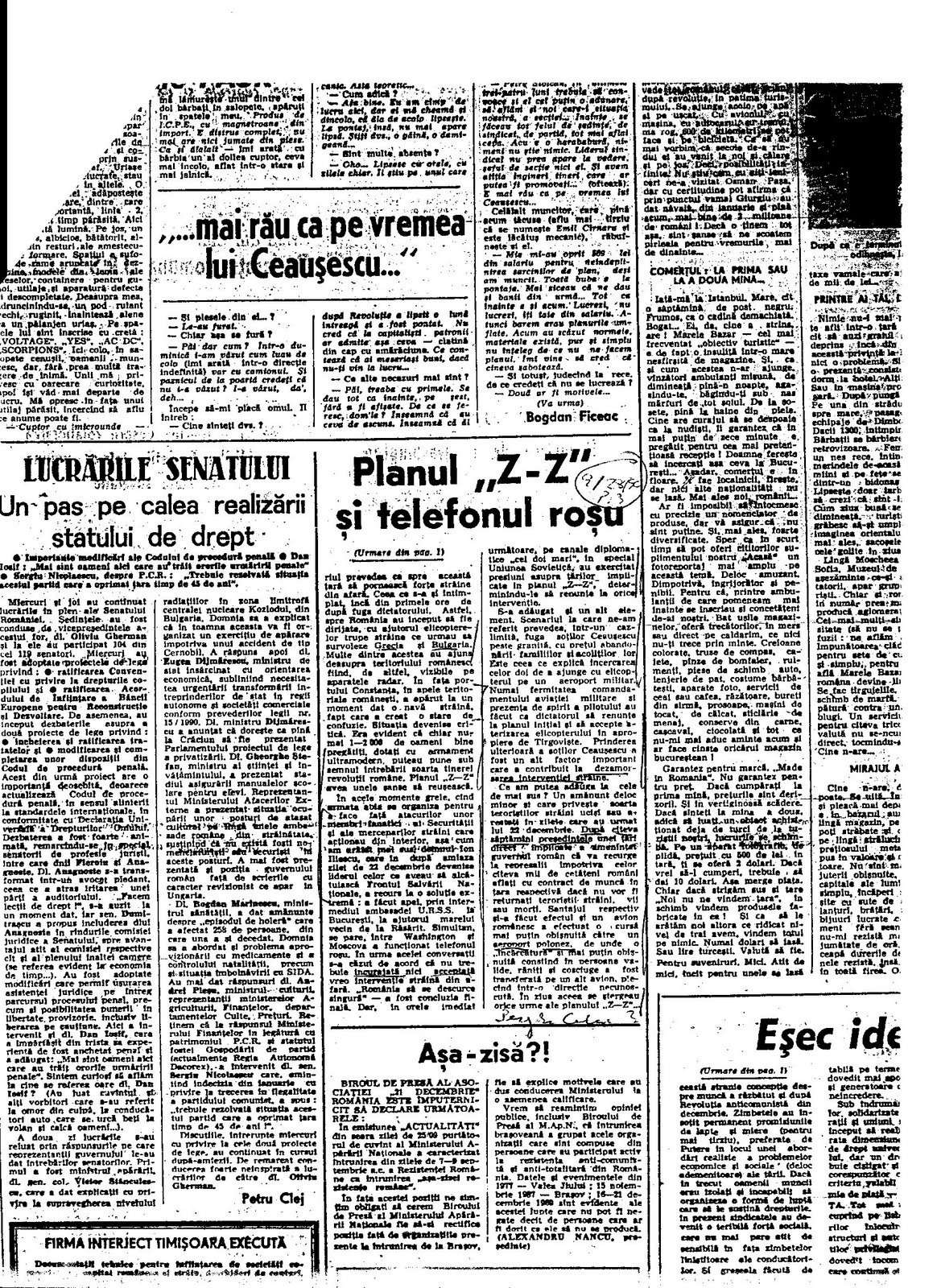
Constantin Vranceanu, “Planul Z-Z si telefonul rosu,” Romania Libera, 28 septembrie 1990. Dupa citeva saptamini presedintele unei tari direct implicate a amenintat guvernul roman ca va recurge la represalii impotriva celor citeva mii de cetateni romani aflati cu contract de munca in tara respectiva daca nu vor fi returnati teroristii straini, vii sau morti.  Santajul respectiv si-a facut efectul si un avion romanesc a efectuat o cursa mai putin obisnuita catre un aeroport polonez, de unde o “incarcatura” mai putin obisnuita constind in persoane valide, raniti si cosciuge a fost transferata pe un alt avion, plecand intr-o directie necunoscuta.  In ziua aceea se stergeau orice urme ale planului “Z-Z

More details emerged about this flight late in 1994.

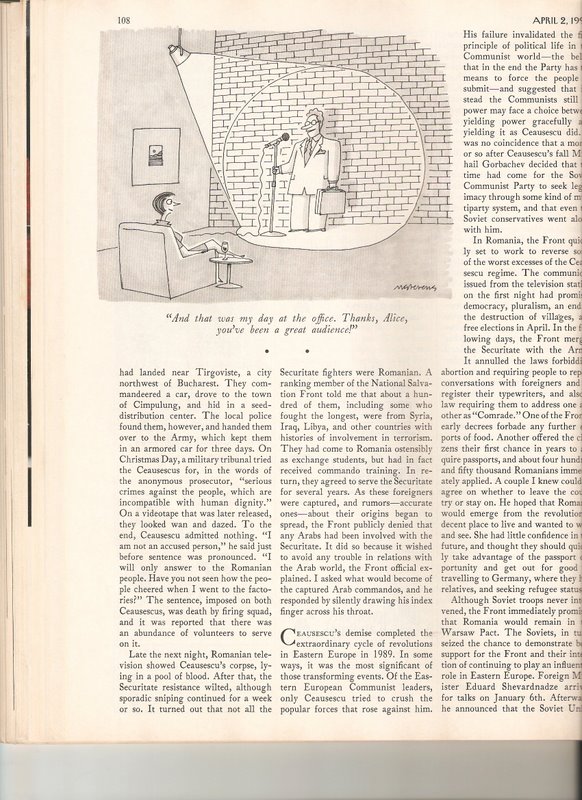
Robert Cullen, “Report from Romania:  Down with the Tyrant,” The New Yorker, 2 April 1990. Late the next night, Romanian television showed Ceausescu’s corpse, lying in a pool of blood.  After that, the Securitate resistance wilted, although sporadic sniping continued for a week or so.  It turned out that not all of the Securitate fighters were Romanian.  A ranking member of the National Salvation Front told me that about a hundred of them, including some who fought the longest, were from Syria, Iraq, Libya, and other countries with histories of involvement in terrorism.  They had come to Romania ostensibly as exchange students, but had in fact received commando training.  In return, they agreed to serve the Securitate for several years.  As these foreigners were captured, and rumors–accurate ones–about their origins began to spread, the Front publicly denied that any Arabs had been involved with the Securitate.  It did so because it wished to avoid any trouble in relations with the Arab world, the Front official explained.  I asked what would become of the captured Arab commandos, and he responded by silently drawing his index finger across his throat.

pasaport libian…

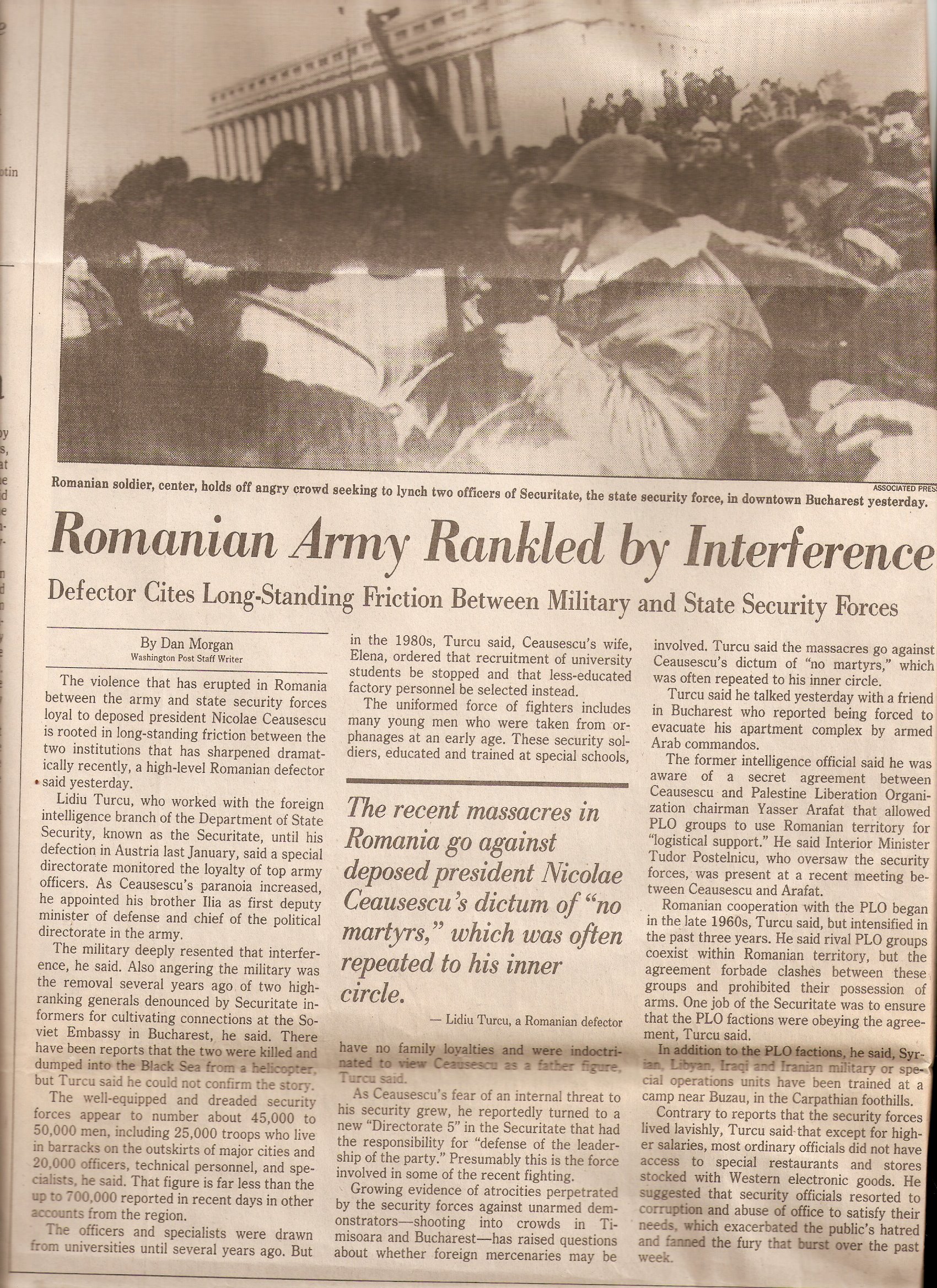
Romanian Army Rankled by Interference;Defector Cites Long-Standing Friction Between Military and State Security Forces

The Washington Post
December 24, 1989 | Dan Morgan

The violence that has erupted in Romania between the army and state security forces loyal to deposed president Nicolae Ceausescu is rooted in long-standing friction between the two institutions that has sharpened dramatically recently, a high-level Romanian defector said yesterday.

Lidiu Turcu, who worked with the foreign intelligence branch of the Department of State Security, known as the Securitate, until his defection in Austria last January, said a special directorate monitored the loyalty of top army officers. As Ceausescu’s paranoia increased, he appointed his brother Ilia as first deputy minister of defense and chief of the political directorate in the army.

The military deeply resented that interference, he said. Also angering the military was the removal several years ago of two high-ranking generals denounced by Securitate informers for cultivating connections at the Soviet Embassy in Bucharest, he said. There have been reports that the two were killed and dumped into the Black Sea from a helicopter, but Turcu said he could not confirm the story.

The well-equipped and dreaded security forces appear to number about 45,000 to 50,000 men, including 25,000 troops who live in barracks on the outskirts of major cities and 20,000 officers, technical personnel, and specialists, he said. That figure is far less than the up to 700,000 reported in recent days in other accounts from the region.

The officers and specialists were drawn from universities until several years ago. But in the 1980s, Turcu said, Ceausescu’s wife, Elena, ordered that recruitment of university students be stopped and that less-educated factory personnel be selected instead.

The uniformed force of fighters includes many young men who were taken from orphanages at an early age. These security soldiers, educated and trained at special schools, have no family loyalties and were indoctrinated to view Ceausescu as a father figure, Turcu said.

As Ceausescu’s fear of an internal threat to his security grew, he reportedly turned to a new “Directorate 5″ in the Securitate that had the responsibility for “defense of the leadership of the party.” Presumably this is the force involved in some of the recent fighting.

Growing evidence of atrocities perpetrated by the security forces against unarmed demonstrators-shooting into crowds in Timisoara and Bucharest-has raised questions about whether foreign mercenaries may be involved. Turcu said the massacres go against Ceausescu’s dictum of “no martyrs,” which was often repeated to his inner circle.

Turcu said he talked yesterday with a friend in Bucharest who reported being forced to evacuate his apartment complex by armed Arab commandos.

The former intelligence official said he was aware of a secret agreement between Ceausescu and Palestine Liberation Organization chairman Yasser Arafat that allowed PLO groups to use Romanian territory for “logistical support.” He said Interior Minister Tudor Postelnicu, who oversaw the security forces, was present at a recent meeting between Ceausescu and Arafat.

Romanian cooperation with the PLO began in the late 1960s, Turcu said, but intensified in the past three years. He said rival PLO groups coexist within Romanian territory, but the agreement forbade clashes between these groups and prohibited their possession of arms. One job of the Securitate was to ensure that the PLO factions were obeying the agreement, Turcu said.

In addition to the PLO factions, he said, Syrian, Libyan, Iraqi and Iranian military or special operations units have been trained at a camp near Buzau, in the Carpathian foothills.

Contrary to reports that the security forces lived lavishly, Turcu said that except for higher salaries, most ordinary officials did not have access to special restaurants and stores stocked with Western electronic goods. He suggested that security officials resorted to corruption and abuse of office to satisfy their needs, which exacerbated the public’s hatred and fanned the fury that burst over the past week.

For verification of some of Turcu’s claims (in particular, the less-discussed participation of Iraqis from Saddam Hussein’s Iraq, see here:  http://atomic-temporary-3899751.wpcomstaging.com/foreign-intervention/)

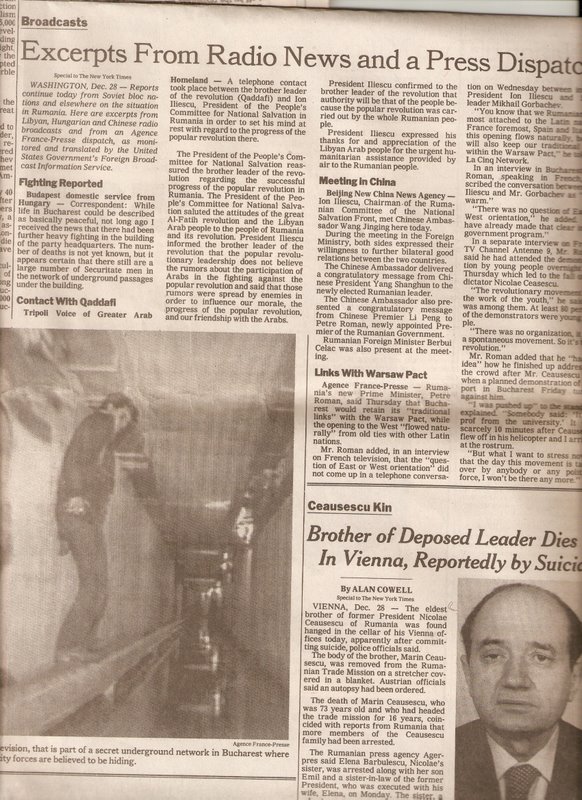
CONTACT WITH QADDAFI Tripoli Voice of Greater Arab Homeland – A telephone contact took place between the brother leader of the revolution (Qaddafi) and Ion Iliescu, President of the People’s Committee for National Salvation in Rumania in order to set his mind at rest with regard to the progress of the popular revolution there. The President of the People’s Committee for National Salvation reassured the brother leader of the revolution regarding the successful progress of the popular revolution in Rumania. The President of the People’s Committee for National Salvation saluted the attitudes of the great Al-Fatih revolution and the Libyan Arab people to the people of Rumania and its revolution. President Iliescu informed the brother leader of the revolution that the popular revolutionary leadership does not believe the rumors about the participation of Arabs in the fighting against the popular revolution and said that those rumors were spread by enemies in order to influence our morale, the progress of the popular revolution, and our friendship with the Arabs. President Iliescu confirmed to the brother leader of the revolution that authority will be that of the people because the popular revolution was carried out by the whole Rumanian people. President Iliescu expressed his thanks for and appreciation of the Libyan Arab people for the urgent humanitarian assistance provided by air to the Rumanian people. http://www.nytimes.com/1989/12/29/world/upheaval-in-the-east-news-reports-excerpts-from-broadcasts-and-a-press-dispatch.html Angela Bacescu with the Libyan ambassador to Romania Abu Ghula, Europa (Est/Vest), no. 94, September 1992, pp. 14-15 The Libyan ambassador discusses how on 25 or 26 December 1989 the then Libyan ambassador went on Romanian television to deny the rumors of Libyans fighting.  “What is more, he called for the delivery of any Libyan terrorirsts [!]“  On 29 or 30 December, Colonel Khadaffi addressed the Romanian people by satellite.  “Libya sent 4 planes with humanitarian aid (food, beds, medicine) that landed at Otopeni airport, were unloaded and then returned empty to Libya [interesting that he should have to specify that they returned empty to Libya].”
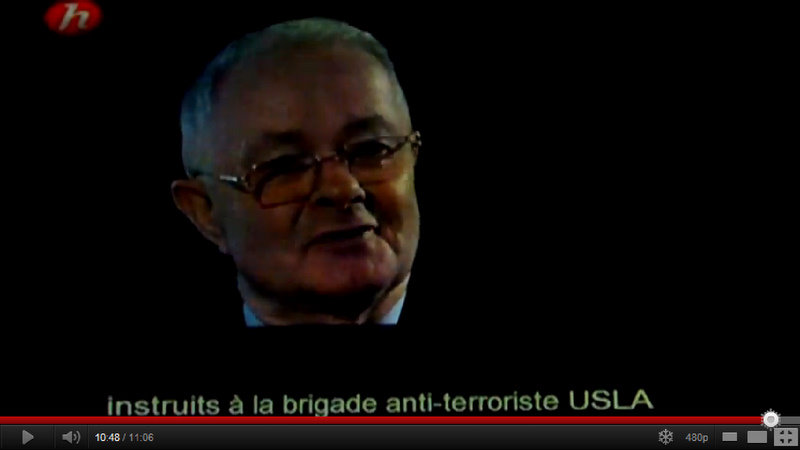
Former Securitate member and head of its successor agency, the Romanian Information Service (SRI) from 1990 to 1997 not only admits in this French documentary that Libyans and other “Arab insurgents,” including Palestinians, were trained at bases in Romania, but admits specifically that they were trained by the Securitate’s anti-terrorist unit, the USLA–just as former Securitate whistleblowers (including Roland Vasilevici and Marian Romanescu among others had told us)
image-18image-17image-16image-15
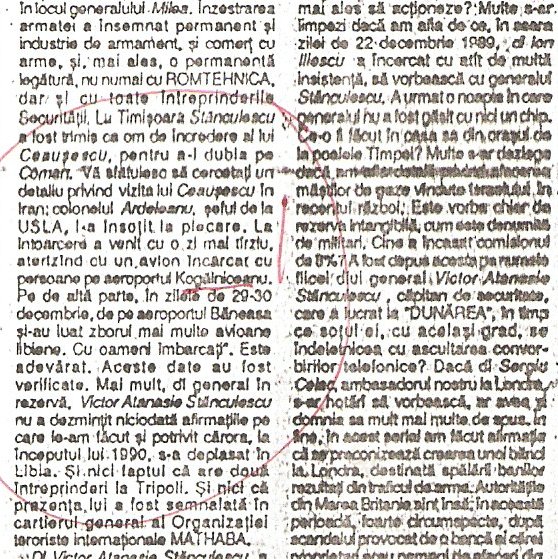
“Operatiunea ‘Deghizarea’ (IV),” Romania Libera, 19 martie 1992, p. 5a.  Generalul Militaru: “Va sfatuiesc sa cercetati un detaliu privind vizita lui Ceausescu in Iran:  colonelul Ardeleanu, seful de la USLA, i-a insotit la plecare.  La intoarcere a venit cu o zi mai tirziu, aterizind cu un avion, incarcat cu persoane pe aeroportul Kogalniceanu.  Pe de alta parte, in ziua de 29-30 decembrie, de pe aeroportul Baneasa s-au luat zborul mai multe avioane libiene.  Cu oameni imbarcati.!

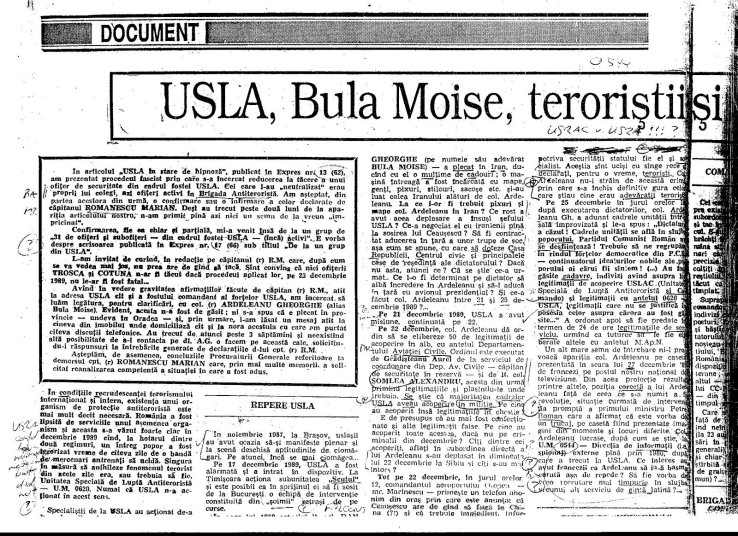
We also know from Romanescu and a second source that USLA commander Gheorghe Ardeleanu (Bula Moise) addressed his troops as follows:

“On 25 December at around 8 pm, after the execution of the dictators, Colonel Ardeleanu gathered the unit’s members into an improvised room and said to them:

‘The Dictatorship has fallen!  The Unit’s members are in the service of the people.  The Romanian Communist Party [PCR] is not disbanding!  It is necessary for us to regroup in the democratic circles of the PCR—the inheritor of the noble ideas of the people of which we are a part!…Corpses were found, individuals with USLAC (Special Unit for Antiterrorist and Commando Warfare) identity cards and identifications with the 0620 stamp of the USLA, identity cards that they had no right to be in possession of when they were found…’  He instructed that the identity cards [of members of the unit] had to be turned in within 24 hours, at which time all of them would receive new ones with Defense Ministry markings.” [7] [8]

In other words, a cover-up of a now failed attempt at counter-revolution—having been cut short by the execution of the Ceausescus, the object of their struggle—had begun.  In the days and weeks that were to follow, the Securitate, including people such as the seemingly ubiquitous Colonel Ghircoias discussed in the opening of this article would go about recovering those “terrorists” who were unlucky enough to be captured, injured, or killed.  By 24 January 1990, the “terrorists” of the Romanian Counter-Revolution of December 1989, no longer existed, so-to-speak, and the chances for justice and truth about what had happened in December 1989 would never recover.[9]

http://atomic-temporary-3899751.wpcomstaging.com/2009/12/12/u-s-l-a-in-stare-de-hipnoza-dan-badea-expres-1991/

http://atomic-temporary-3899751.wpcomstaging.com/2009/12/10/decembrie-1989-usla-bula-moise-teroristii-si-fratii-musulmani-dan-badea-marian-romanescu-expres-iulie-1991/

Sediul U.S.L.A , pe 25 decembrie 1989 in jurul orelor 18…

Pe 25 decembrie in jurul orelor 18, dupa executarea dictatorilor, col. Ardeleanu Gh. a adunat cadrele unitatii intr-o sala
improvizata si le-a spus: “Dictatura a cazut! Cadrele unitatii se afla in slujba
poporului. Partidul Comunist Roman nu se desfiinteaza! Trebuie sa ne regrupam in
rindul fortelor democratice din P.C.R.–continuatorul idealurilor nobile ale
poporului ai carui fii sintem ! (…) Au fost gasite cadavre, indivizi avind
asupra lor legitimatii de acoperire USLAC (Unitatea Speciala de Lupta
Antiterorista si Comando) si legitimatii cu antetul 0620–USLA, legitimatii care
nu se justifica in posesia celor asupra carora au fost gasite…” A ordonat apoi
sa fie predate in termen de 24 de ore legitmatiile de serviciu, urmind ca
tuturor sa le fie eliberate altele cu antetul M.Ap.N.

(capitanul Romanescu Marian, cu Dan Badea, “USLA, Bula Moise, teroristii si
‘Fratii Musulmani’,” Expres nr. 26 (75), 2-8 iulie 1991, 8-9)

image-15

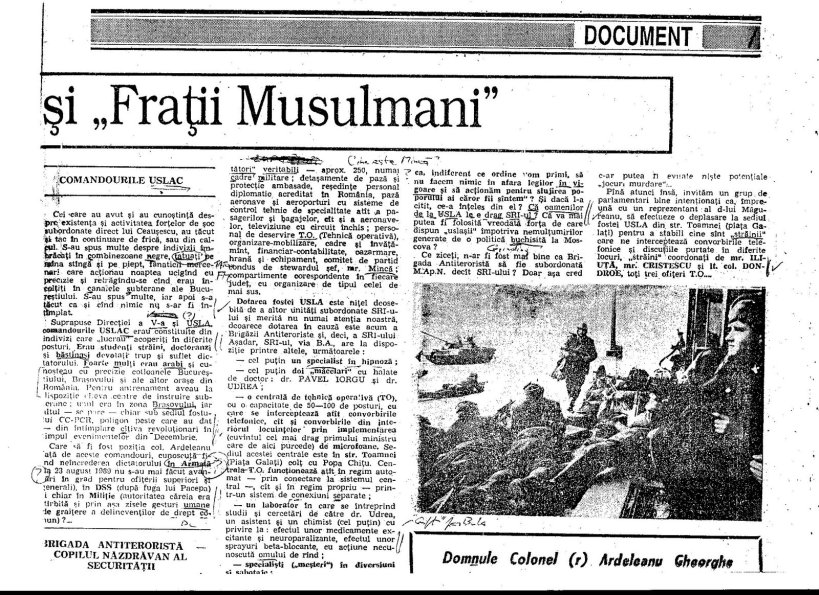
(Capitanul Romanescu Marian (fost cadru USLA) si Dan Badea, “USLA, Bula Moise, teroristii, si ‘Fratii Musulmani’,” Expres nr. 26 (75), 2-8 iulie 1991, pp. 8-9)

COMANDOURILE USLAC

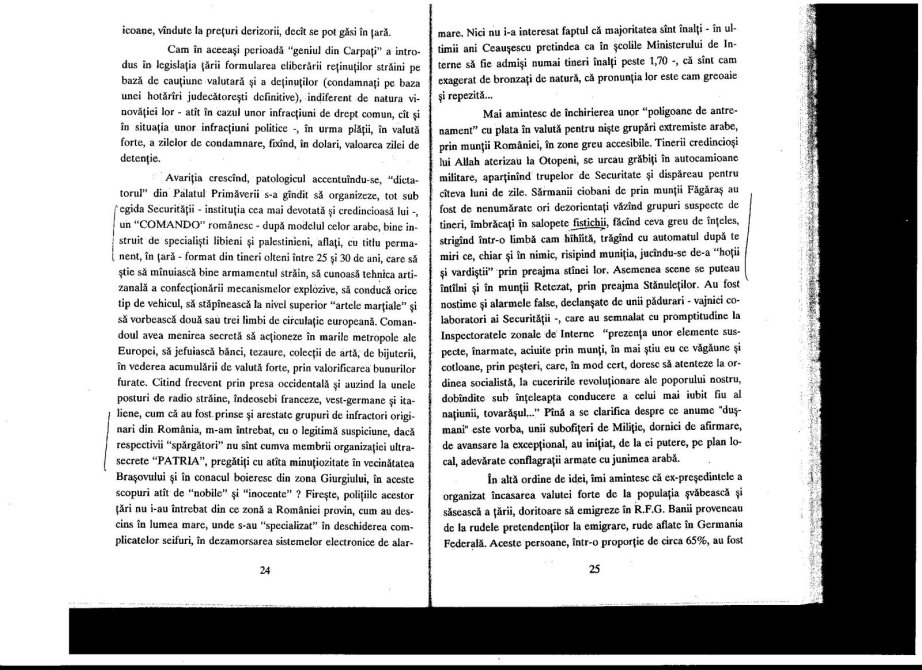
Cei care au avut si au cunostinta despre existenta si activitatea fortelor de soc subordonate direct lui Ceausescu, au tacut si tac in continuare de frica, sau din calcul.  S-au spus multe despre indivizii imbracati in combinezoane negre, tatuati pe mina stinga si pe piept, fanaticii mercenari care actionau noaptea ucigind cu precizie si retragindu-se cind erau incoltiti in canalele subterane ale Bucurestiului.  S-au spus multe, iar apoi au tacut ca si cind nimic nu s-ar fi intimplat.

Suprapuse Directiei a V-a si USLA comandourile USLAC erau constituite din indivizi care “lucrau” acoperiti in diferite posturi. Erau studenti straini, doctoranzi si bastinasi devotati trup si suflet dictatorului.  Foarte multi erau arabi si cunosteau cu precizie cotloanele Bucurestiului, Brasovului si ale altor orase din Romania.  Pentru antrenament aveau la dispozitie citeva centre de instruire subterane:  unul era in zona Brasovului, iar altul–se pare–chiar sub sediul fostului CC-PCR, poligon care au dat–din intimplare citiva revolutionari in timpul evenimentelor din Decembrie.

image-13

Further related reading:

Posted in decembrie 1989, raport final | Tagged: , , , , , , , , | 8 Comments »

Revisiting the Myths of the Revolution. Part III: The water is poisoned! (Apa este otravita!)…(Dr. Heyndrickx’s Toxicology Report)

Posted by romanianrevolutionofdecember1989 on December 22, 2013

Myth No. 2:  The water is poisoned! (Apa este otravita!)

This is part III of a four part series.  For parts I and II, see

http://atomic-temporary-3899751.wpcomstaging.com/2013/12/21/revisiting-the-myths-of-the-romanian-revolution-part-i-the-hegemony-of-conspiratorial-and-postmodernist-explanations/).

Myth 1:  The “Timisoara Syndrome” or the “False Timisoara Grave (the Paupers Cemetery)/Massacre” http://atomic-temporary-3899751.wpcomstaging.com/2013/12/21/revisiting-the-myths-of-the-revolution-part-ii-the-timisoara-syndrome-or-the-false-timisoara-grave-the-paupers-cemeterymassacre/

Myth 2:  The water is posioned!  (Apa este otravita!)

Myth 3:  The Romanian Television building is in danger, danger of an explosion!   (TVR e in pericol–Pericol de explozie!)

——————————————————————————————————————————————————————————————————————————–

Oh, how Romanians and Romanianists love to invoke or allude to this example!  It precipitates laughter:  ah the crude manipulation and naivete!

Predictably, this is a favorite of foreign sources on December 1989.

Romanian emigre Andrei Codrescu tells us in his November 1990 article in Harper’s (“Big Chills”) about the wild rumors of December 1989, that the water in Sibiu had allegedly been poisoned, but as he found out at his 25th anniversary high school reunion, he learned how all the rumors had been false: and the water in Sibiu, it was just fine!  http://alina_stefanescu.typepad.com/files/big-chills-my-high-school-reunion-in-romania-by-andrei-codrescu-1.pdf

Peter Siani-Davies quotes BBC journalist John Simpson, who had heard similar stories concerning poisoned water during the Iranian revolution of 1979, as noting that “certain ideas appeal forcibly  to the self-dramatizing mind of the revolutionary,” to which Siani-Davies adds:

“Indeed, in Romania the wild storytelling to a certain extent was just another consequence of the tumult of the revolution.  However, the imagery may have served another purpose….Now, through the tales of horror, they [Romanians] were able to place the evil forces of that [Ceausescu] regime so far beyond the bounds of ‘normal’ society that they were effectively able to distance themselves from the demons of the past.  There was also a sense in which it was necessary for the securitate to be so terrible:  How else could the years of mute suffering under an enfeebled old tyrant such as Ceausescu be explained and condoned?”   (Siani-Davies, The Romanian Revolution of December 1989, p. 160.)

——————————————————————————————————————————————————————————————————————————–

Underlying all of these interpretations and explanations is the assumption that the water never was poisoned, that it was all a baseless rumor.

Surely, one assumes, the rumor has been run to ground…but the truth is, as with so many things about December 1989, it hasn’t…

In fact, there was a basis in reality for what Teodor Brates was saying on TV on the afternoon of 22 December 1989 as the following toxicology report by the Belgian Dr. Aubin Heyndrickx makes clear:

Romania

On December 21, 1989, people drinking from water tank #4 in Sibiu experienced headache, visual disturbances, loss of consciousness, vomiting, etc.  These symptoms are all compatible with organophosphate poisoning.  The analysis of the water (by gas chromatography) and the determination of the cholinesterase activity of the blood was done in the University of Cluj.  The conclusion was that an organophosphate had been used.  Atropine sulfate and toxogonin were advised.

As soon as the symptoms appeared among the population, water tank #4 was shut off, rinsed, and cleaned.  The people received water from army trucks.

A few days later, there was a fight in Timisoara between the army and Securitate over the water tanks.  Poisoning was feared, as had occurred in Sibiu.  According to witnesses, the Securitate possesses “all possible chemical warfare agents.”

Toxicologist Aubin Heyndrickx supervised the chemical tests and interviewed the physicians at Central Hospital who treated the patients.  From the tests and from the very high dose of atropine required to produce a response, he concluded that the tank was poisoned with sarin or VX (Report on the Humanitarian Mission to Romania, December 23-29, 1989, Laboratoria voor Toxicologie Criminalistiek, State University of Ghent).

http://www.physiciansforcivildefense.org/cdp/jan90.htm

Indeed, one can watch a brief discussion of the incident with Dr. Heyndrickx beginning at approximately the 40 second mark from an ITN broadcast of 27 December 1989

http://www.itnsource.com/en/shotlist//ITN/1989/12/27/BSP271289002/?s=romania+sibiu+after+the+revolution+27+1989&st=0&pn=1

ROMANIA: SIBIU AFTER THE REVOLUTION:

}T27128901   ROMANIA: SIBIU AFTER THE REVOLUTION: United Nations medical
27.12.89     relief team arrives in Sibiu with medical supplies and blood
TX           to treat the people who were injured during the fight against
             Securitate (secret police). Toxicologists have found evidence
             that the security police poisoned the water supply. Injured
             Securitate are being treated in hospitals alongside the people
             they shot.
Clip Ref: BSP271289002 0

Clip 1of1

}T27128901   ROMANIA: SIBIU AFTER THE REVOLUTION: United Nations medical
27.12.89     relief team arrives in Sibiu with medical supplies and blood
TX           to treat the ...
  • Duration: 00:01:44 |
  • Timecode – In: 00:00:00:00  Out: 00:01:44:00 |
  • Copyright: ITN / 3rd Party Copyright

I have found evidence of discussion of Heyndrickx and his toxicology report in the Hungarian press of the time, but significantly, to date, I have been unable to find discussion of it in the Romanian press!

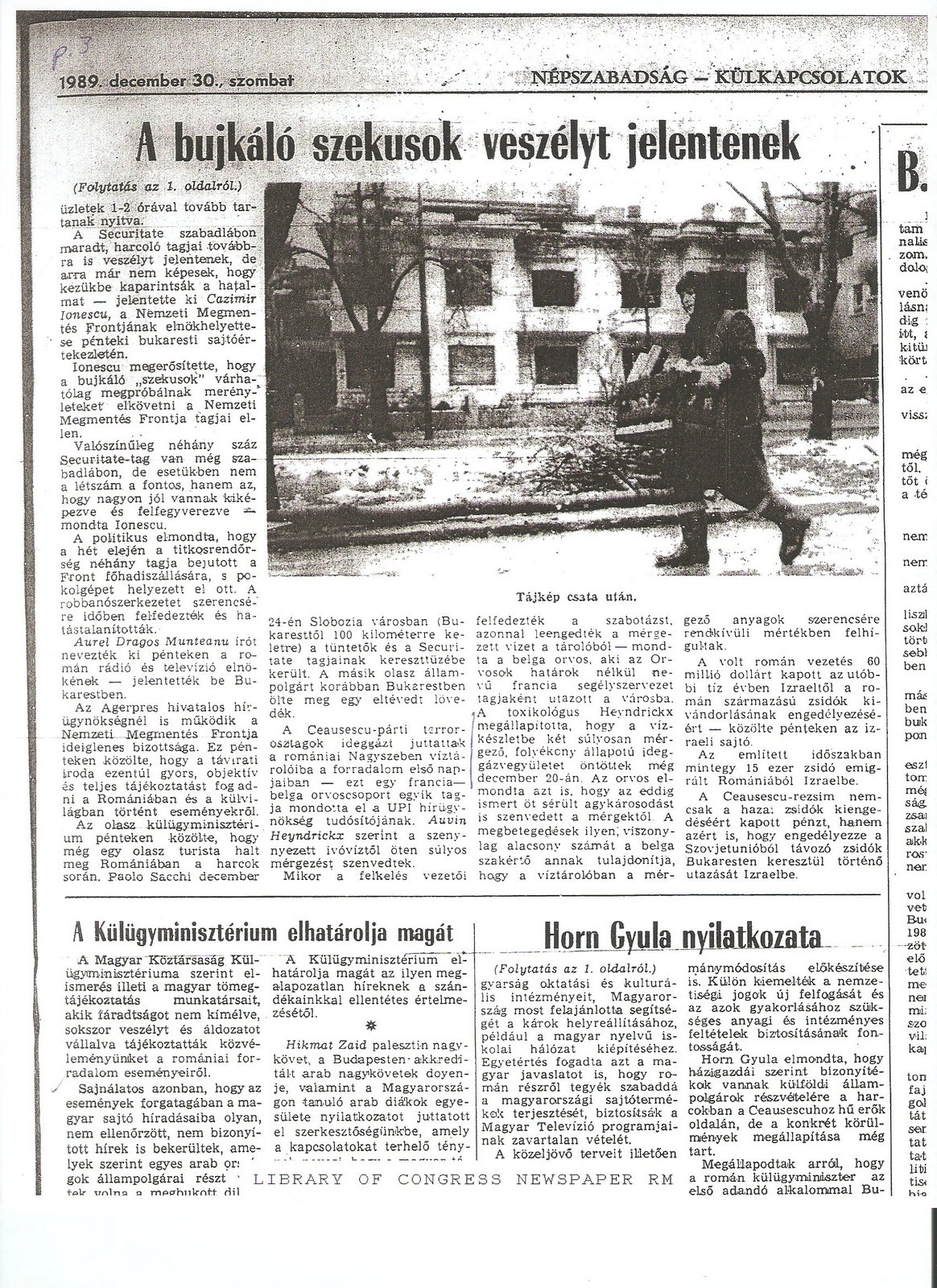
Nepszabadsag, 30 December 1989, p. 3 citing a UPI dispatch, apparently P. Green, “French team confirms poison in water supply,” UPI, 29 December 1989.


Nagyszeben – ideggáz

Bukarest, 1989. december 29. péntek (UPI) – A Ceausescu-párti terrorosztagok ideggázt vegyítettek a romániai Nagyszeben víztárólóiba a forradalom első napjaiban – ezt egy francia-belga orvoscsoport egyik tagja mondotta el a UPI hírügynökség tudósítójának. Auvin Heyndrickx szerint a szennyezett ivóvíztól öten súlyos mérgezést szenvedtek.Mikor a felkelés vezetői felfedezték a szabotázst, azonnal
leengedték a mérgezett vizet a tárolóból – mondta a belga orvos, aki
az ,,Orvosok – határok nélkül,, nevű francia segélyszervezet
tagjaként utazott a városba. A toxikológus Heyndrickx
megállapította, hogy a vízkészletbe két súlyosan mérgező, folyékony
állapotú ideggázvegyületet öntöttek még december 20-án. Az orvos
elmondta azt is, hogy az eddig ismert öt sérült agykárosodást is
szenvedett a mérgektől. A megbetegedések ilyen viszonylag alacsony
számát a belga szakértő annnak tulajdonítja, hogy a víztárolóban a
mérgező anyagok szerencsére rendkívüli mértékben felhígultak.+++1989. december 29., péntek 07:57

http://rendszervaltas.mti.hu/Pages/News.aspx?se=1&wo=nagyszeben&sd=19890101&ed=19901231&sp=0&ni=230929&ty=1

http://www.rsis.edu.sg/cens/publications/reports/RSIS_Food%20Defence_170209.pdf See citations in fn#59 page 10.

———————————————————————————————————————————————————————————————————————————

It is thus with justification that in my dissertation in 1997 and in a reiteration of the dissertation views in 2007, I defended TVR personnel by pointing out the extent to which they went to intervene and inform the population when it was safe to drink the water again.  (for a glimpse into the eternal “appreciation” I received for pointing out the latter, see http://atomic-temporary-3899751.wpcomstaging.com/raport-final-cpadcr-iiccmer-si-revolutia-din-1989/)

Excerpt from http://atomic-temporary-3899751.wpcomstaging.com/rewriting-the-revolution-1997-chapter-8-unsolving-december/

In their discussion of the Romanian transition, Linz and Stepan note the “[r]umors of deliberately poisoned water supplies, of 10,000, 60,000, even 100,000 dead, filled the news channels and streets” and conclude that “disinformation played an important role in the events.”[45] They have in mind, however, the idea that this disinformation was disseminated in order to help the Front seize power. This, of course, echoes the dominant view on this theme. As we saw in the preceding chapter, both Securitate and opposition sources maintain that disinformation pervaded the December events, and they uniformly attribute it to the Front and the Front’s supporters at television, and, in some cases, to foreign actors such as the Soviet Union.

Yet there has been very little effort to investigate the context in which particular rumors originated and the relationship between actual events and those rumors. Take, for example, this rumor alleging the poisoning of the water supply which is so frequently invoked by both domestic and foreigner observers. To what are they referring? Around 3 p.m. on the afternoon of 22 December–therefore approximately three hours after the Ceausescus had fled Bucharest–television commentator Teodor Brates began to issue periodic, sometimes frantic reports about fighting between the Army and the Securitate in the city of Sibiu and about rumors that the water supply had been poisoned by the Securitate. Here are some excerpts of what Brates said on television on that afternoon:

One moment, please…from Sibiu it has been communicated to us that the army no longer has ammunition and the Securitate troops continue to attack military units….We want to inform you that in Sibiu, military units are urgently requesting help…We are constantly receiving communications…of course, we do not have the possibility to verify their authenticity…but we ask for your attention…It is said that these enemy elements, the securisti, have poisoned the water in Sibiu, in Timisoara,…the water must be boiled before being consumed.[46]

[45].. Linz and Stepan, “The Effects of Totalitarianism-cum-Sultanism,” 345-346.

[46].. See the text of the transcript, Revolutia Romana in Direct (Bucharest: Televiziunea Romana, 1990), 47, 48, 51.

2007:  Linked to the allegations of supposedly intentionally hyping the threat posed by the “terrorists” is the certitude with which many Romanians and Romanianists assert that TV personnel (especially Teodor Brates) intentionally spread rumors about the water being poisioned and the army running out of ammunition in Sibiu etc.–rumors that proved to be unsubstantiated. Here is what they likely remember:

“One moment, please…from Sibiu it has been communicated that the army no longer has ammunition and the Securitate troops continue to attack mili tary units….We want to inform you that in Sibiu, military units are urgently requesting help…We are constantly receiving communications…of course, we do not have the possibility to verify their authenticity…but we ask for your attention…It is said that the enemy elements, the securisti, have poisoned the water in Sibiu, in Timisoara…the water must be boiled before being consumed.” (from the transcript of 22 December 1989 in “Revolutia Romana in Direct” (Bucharest: 1990), pp. 47, 48, 51, quoted p. 324, Richard Andrew Hall, 1997, Ph.D. Dissertation, “Rewriting the Revolution: Authoritarian Regime-State Relations and the Triumph of Securitate Revisionism in Post-Ceausescu Romania”)

What they don’t remember is that Brates returned later to inform the audience a) when the fighting had ceased in Sibiu, b) when supplies of bottled water were on their way to Sibiu, and c) when the competent authorities verified that the water in Bucharest was safe to drink (“Revolutia Romana in Direct,” pp. 71, 72, 75, discussed p. 327 Hall, “Rewriting the Revolution”) This is there…in the transcript of what was said on Television…it is not a matter of a “difference of opinion” as the likes of Tismanenau and others in denial would have us believe. It is the old saw from American baseball: as the famous manager Casey Stengel used to say “You can look it up!” Once again: if your goal is “diversion,” intentional panic and manipulation, is it likely that you would return to the same subjects and say things designed to calm fears? Of course, not.

http://atomic-temporary-3899751.wpcomstaging.com/raport-final-cpadcr-iiccmer-si-revolutia-din-1989/

Posted in decembrie 1989, raport final | Tagged: , , , , , , , , , , | 2 Comments »

Revisiting the Myths of the Revolution. Part II: The “Timisoara Syndrome” or the “False Timisoara Grave (the Paupers Cemetery)/Massacre”

Posted by romanianrevolutionofdecember1989 on December 21, 2013

Myth No. 1:  The “Timisoara Syndrome”…The “False/Fake Timisoara Massacre”…”Madonna and Child”

Of the three myths that I am exploring in this series, conspiratorial explanations tend to outweigh postmodernist explanations perhaps most heavily in the coverage of this first myth (for part I of this series, see http://atomic-temporary-3899751.wpcomstaging.com/2013/12/21/revisiting-the-myths-of-the-romanian-revolution-part-i-the-hegemony-of-conspiratorial-and-postmodernist-explanations/ ).

Myth 1:  The “Timisoara Syndrome” or the “False Timisoara Grave (the Paupers Cemetery)/Massacre”

Myth 2:  The water is posioned!  (Apa este otravita!)

Myth 3:  The Romanian Television building is in danger, danger of an explosion!   (TVR e in pericol–Pericol de explozie!)

I will address two aspects of Myth no. 1 below:  1) the presumed intentionality of the digging up of corpses unrelated to the Timisoara repression (the Paupers Cemetery, 22 December 1989) with intent to disinform public opinion (domestic and foreign) and 2) that the ultimate false character of the Timisoara Paupers Cemetery episode is evidence of the absence of a true Timisoara massacre.

————————————————————————————————————————————————————————————————————————-

Jacques Levesque in The Enigma of 1989 (1997, University of California Press, p. 195, online at http://publishing.cdlib.org/ucpressebooks/view?docId=ft4q2nb3h6;chunk.id=0;doc.view=print) captures quite well popular conspiratorial explanations of the “fake grave,” and “false massacre” it was supposedly used to suggest, in the following passage:

Let us mention some examples. The reports and horrifying images of the mass grave “discovered” in Timisoara are still a vivid memory; they came several days after the repression of the mid-December demonstrations against the reassignment of the ethnic Hungarian pastor Laszlo Tokes. The demonstrations were followed by riots, which gave the initial push to the Romanian “revolution.” The newspapers reported that 4,630 corpses had been discovered. Several months later, it was learned from doctors’ accounts that some thirty of the corpses shown “exhumed” by television around the world had been stolen from the city morgue and hospitals in the night of December 21–22. Disconcertingly, the “mass grave” may have been constituted after its discovery was announced the day before by East German and Hungarian press agencies. To this day, no one has been able to establish firmly who organized this staging, and precisely to what ends. As far as the purpose of the “grave” is concerned, several interpretations were put forth and supported: to bring about a revolt in the country; to raise the greatest possible indignation on the international level in order to make the leaders of the coup accepted and acclaimed; or to make the Securitate, which was blamed for the carnage, the incarnation of all the Ceausescu regime’s evils, in order to better clear the army and its leaders, who joined the side of the new government, or essentially constituted it. It was later learned that it was the army, and not the Securitate, which opened fire.

Andrei Codrescu, well-known poet and National Public Radio commentator, (The Hole in the Flag. A Romanian Exile’s Story of Return and Revolution (New York, William Morrow and Company, 1991, pp. 203-204) recounts the same incident in this memorable description:

“The Romanian ‘Revolution’ was entirely televised, all those of us who believed for years with Gil Scott-Heron that ‘the revolution will not be televised’ were shaken by it. In truth, there were two revolutions: a real revolution that was not televised and that continues, particularly in Timisoara, and a studio revolution that fooled the entire world. Who could forget the piles of corpses stacked like cordwood in front of the Timisoara cathedral?…Or the image of the mother and child shot with a single bullet, lying in the arms of death? Watching these images in New Orleans via CNN, I was moved and enraged, along with millions of others in the world. We now know. The mass graves discovered in Timisoara and presented to the world as proof of the Hitlerite insanity of Securitate were in fact bodies dug out of a pauper’s cemetery with autopsy scars visible. Many of them were in an advanced state of decay…And the extraordinary picture of the mother and her baby killed with the same bullet, seen thousands of times on all the world’s TV screens, was a gross collage. A woman who had died of alcoholism had had an unrelated dead baby placed on her chest for video purposes.

In 1999, journalist John Sweeney recounted the incident in The Guardian as follows:

http://www.guardian.co.uk/world/1999/nov/07/johnsweeney.theobserver

Millions dead, but who’s counting?

The truths that exist behind press reporting

Eighteen bodies lay beneath an electricity pylon on white plastic sheets in the pauper’s cemetery, naked to the sky. The stink of the dead hung in the pre-dawn air; nearby were the graves from which they had been disinterred. The bodies were soiled by the dirt from the graves, their nudity obscene. On one woman’s stomach lay a perfectly formed foetus, its skin stained an unnatural purple, as if it had come from a jar. Thirty paces away lay the corpse of what looked like an old man, his feet bound by twisted wire: tortured? Nineteen corpses in all. It was Timisoara, Saturday, 23 December, 1989, and the news agencies were saying 4,000, 40,000, 60,000 dead. Where were the mass graves?

There was something strange – unsatisfactory – about the 19 bodies. Eight corpses had stitches in their stomachs, perhaps from autopsies; some of the rest were so badly decomposed the flesh had rotted from the bones. They did not look like they had been killed the previous Sunday, the flashpoint of the Romanian revolution.

Not 60,000 dead in Timisoara, but 19, and fishy at that. My reward for reporting this was a tiddly piece on page three. News desk lionhearts like big numbers from reporters sent to cover mass murder.

Le Monde in March 2000 (http://webcache.googleusercontent.com/search?q=cache:cswQZh6E7W0J:mondediplo.com/2000/03/07kospress+syndrome+timisoara+halimi&cd=3&hl=en&ct=clnk&gl=us) commented:

Barely 10 years earlier, despatched to Timisoara to view some old corpses dug up by the propaganda department of the new Rumanian regime, a journalist from the France 2 television channel had commented, “These pictures are here to prove that 4,630 people died at the hands of the secret police” (22 December 1989).

Nor, even in Romania, has this incident lost its utility as a touchstone for mendacity, as the following article by Grigore Cartianu from August 2011 (http://adevarul.ro/news/societate/certificatul-rebel-1_50a7b8a27c42d5a66369f0b1/index.html) demonstrates:

“Neroziile spuse atunci vor rămâne în antologia dezinformării. Unele erau minciuni sfruntate (povestea cu robineţii de aur), altele făcături ordinare (cadavrele din sceneta „mama şi copilul” nu aparţineau unor martiri ai Revoluţiei şi nici nu erau victime ale represiunii ceauşiste, ci zăceau de prin noiembrie în Cimitirul săracilor din Timişoara, fiind dezgropate doar pentru şedinţa foto-video).” 

(Who is Grigore Cartianu?  No less than Vladimir Tismaneanu, the dean of communist and post-communist Romanian studies in the United States, has exalted in both English and Romanian, Grigore Cartianu’s investigations of the December 1989 events–see http://www.movingimagesource.us/articles/how-was-ceausescu-possible-20110929 and http://tismaneanu.wordpress.com/2010/07/21/deshumarea-lui-ceausescu-un-pas-spre-adevar/  “Este un lucru demonstrat cu prisosinta si de onesta ancheta jurnalistica a lui Grigore Cartianu (publicata sub titlul de carte: “Sfârşitul Ceauşeştilor”).” )

Finally, this episode has become immortalized in postmodernist literature, thanks to its invocation and development by Jean Baudrillard, as follows:

“The Timisoara Syndrome”

Jean Baudrillard (trans. Chris Turner), The Illusion of the End (Cambridge, Polity Press, 1994), pp. 54-61 “The Timisoara massacre.”

p. 55 “It was not the dead that were the scandal, but the corpses being pressed into appearing before the television cameras, as in the past dead souls were pressed into appearance in the register of deaths.”

p. 60 “And yet there will, nonetheless, have been a kind of verdict in this Romanian affair, and the artificial heaps of corpses will have been of some use, all the same one might ask whether the Romanians, by the very excessiveness of this staged event and the simulacrum of their revolution, have not served as demistifyers of news and its guiding principle…Who can say what responsibility attaches to the televisual production of a false massacre (Timisoara), as compared with the perpetrating of a true massacre?”

———————————————————————————————————————————————————————————————————————–

The idea about “some old corpses dug up by the propaganda department of the new Rumanian regime,” that Novi Sad TV journalists (presumably then, according to this conspiracy theory, Yugoslav agents), or, most ridiculous of all, Securitate agents themselves, were responsible for digging up and presenting the corpses from the Paupers’ cemetery (all views that have gained expression through the years) is simply WRONG.

How do we know?  From what eyewitnesses have described.  Here 30 yr. old Ion Gogoara described in Titus Suciu’s Raport cu Sufletul la Gura (1990) that the makeshift grave in the Paupers’ cemetery was found by kids, that when he got there there were about 30 people gathered placing candles, and that all this took place at about 10:30 or 11 am on the morning of 22 December 1989, thus before Ceausescu’s flight from power (but at a time when Timisoara was long already beyond the regime’s control).

Indeed, it was those missing loved ones who were the first to the Paupers Cemetery

Virgil Botoc told Marius Mioc in 1995 how, on 22 December 1989, he was searching frantically for his 13 year old daughter Luminita and how, he and others participated in the removal of the corpses and put them on some sheets.  As Mioc has noted, precisely because many of those who had lost loved ones in the repression of the previous days did not know yet that many corpses had been transported from the hospitals and morgue to be incinerated, they looked frantically anywhere they could, including the Paupers’ cemetery.

Botoc Virgil (tatal lui Luminita Botoc) In 22 dimineata la cimitirul saracilor s-au dezgropat niste morti. Am fost si eu acolo sa vad daca n-o gasesc pe Luminita. Aici era o groapa comuna, o alta groapa cu un singur mort si inca un mort in capela. Mortii fusesera ingropati dezbracati. Unii erau cusuti cu sirma, cel din capela avea si picioarele legate cu sirma. Am scos mortii, i-am pus pe niste cearsafuri.  http://timisoara.com/newmioc/33.htm

Marius Mioc: “Filmarea din 22 decembrie a fost cu cadavre dezgropate din cimitirul săracilor. Aceia nu erau morţi din revoluţie ci sărăntoci fără familie îngropaţi pe cheltuiala Primăriei. Familiile celor morţi în revoluţie, care nu găseau cadavrele celor dragi (fuseseră incinerate, dar nu se ştia asta pe atunci), în disperare au căutat pe unde le-a trecut prin minte, şi au dezgropat şi morţii de la cimitirul săracilor. S-a crezut atunci sincer că aceia sînt morţi din revoluţie.” http://piatauniversitatii.com/forum/viewtopic.php?t=974

So, we have our answer to the first part of Myth no. 1:  The only intentionality of those who dug up the corpses in the Paupers Cemetery was that those looking for their loved ones were frantically searching everywhere and anywhere for traces of them.  (That the Paupers Cemetery was then linked to, or interpreted through the lens of inflated and erroneous death tolls (for a discussion of these, please see the following, courtesy of William Totok, http://www.halbjahresschrift.homepage.t-online.de/neumann.htm) and the widespread view of the dictatorship of Nicolae Ceausescu as (late) communism in its highest stage, is ultimately a different story.)

————————————————————————————————————————————————————————————————————————-

Perhaps worst of all, while the Paupers cemetery on 22 December 1989 and the “Timisoara syndrome” have become part of an international literature on journalistic manipulation and/or error, those who invoke this example tend to be oblivious to the real mass grave of victims from the Timisoara uncovered in mid-January 1990 (including, Virgil Botoc’s 13 year old daughter Luminita)

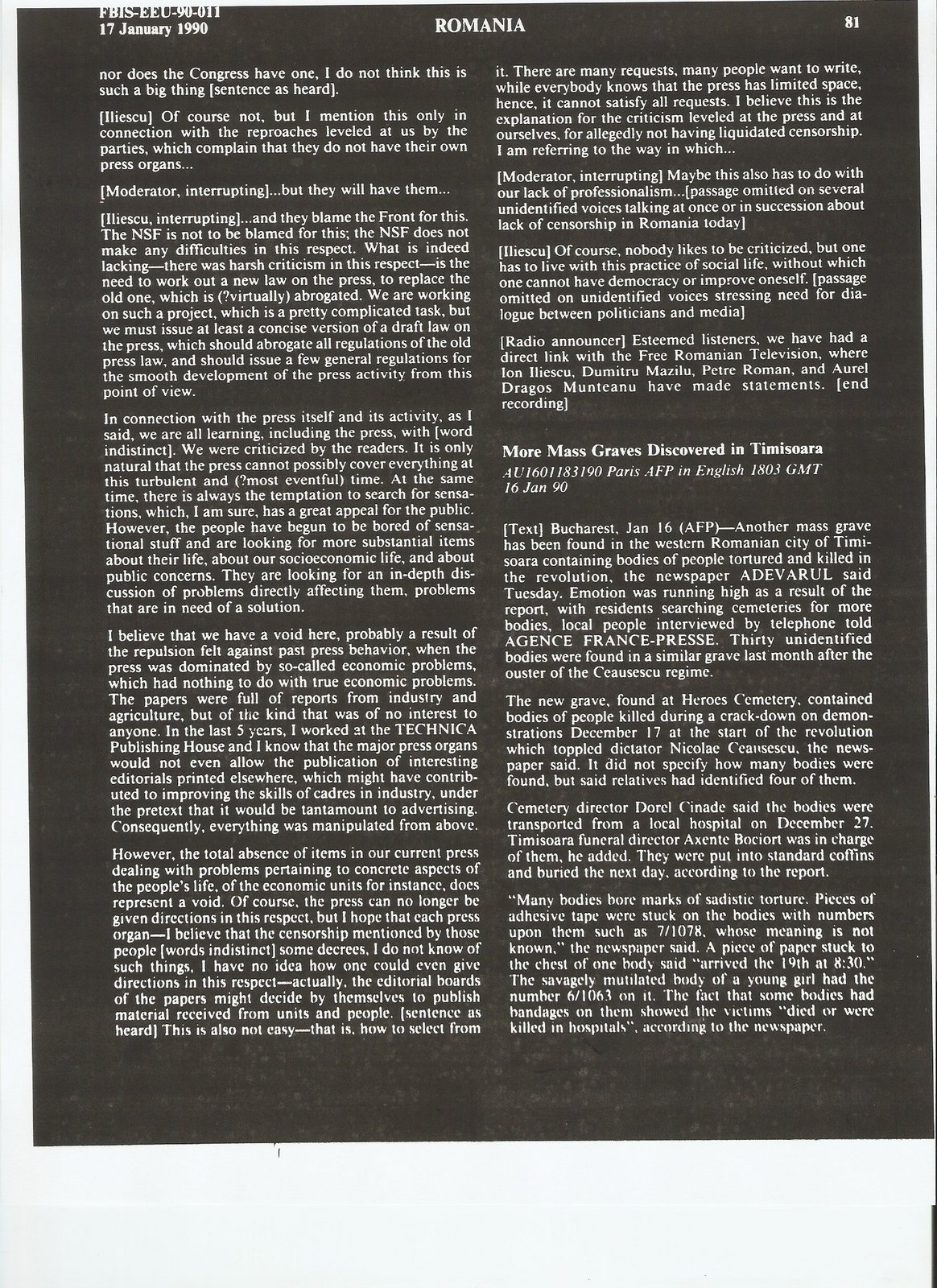
FBIS (AFP 16 January 1990, lower right column):

Marius Mioc has detailed this episode extensively as follows:

“Renaşterea Bănăţeană” din 16 ianuarie 1990 despre groapa comună din cimitirul eroilor:

http://www.youtube.com/watch?v=_AuwsQFuKLw

Groapa comună din cimitirul eroilor descoperită în ianuarie 1990

Tatulici & Tatomir – Povestea Timişorii (7). Groapa comună din cimitirul eroilor octombrie 28, 2010

Rate This

Al şaptelea fragment din filmul “Povestea Timişorii” realizat de Mihai Tatulici şi Virgil Tatomir şi difuzat în 1991 la TVR. În acest fragment am combinat 3 fragmente diferite din filmul original, pentru a avea un articol explicativ complet despre problema gropii comune din cimitirul eroilor din Timişoara. Deci există o oarecare abatere de la succesiunea din filmul domnilor Tatulici şi Tatomir, pe care am considerat-o necesară pentru a înlesni analiza problemei gropii comune a revoluţiei din Timişoara. La sfîrşitul serialului, cînd voi da şi playlistul complet, cei interesaţi vor putea vedea filmul aşa cum a fost el prezentat iniţial. La transcrierea înregistrării comentariile mele ulterioare sînt inserate în text cu litere cursive, între paranteze drepte.

Vezi şi primele 6 fragmente prezentate pe acest blog:
15 decembrie 1989
16 decembrie 1989
În jurul lui Tokes
Dezvoltarea mişcării revoluţionare în 16 decembrie 1989
Lupte între manifestanţi şi forţele de ordine
Calea Lipovei şi Girocului, 17 decembrie 1989

Transcriere înregistrare:
00:00 Virgil Boţoc: În timpul ăsta a trecut o mulţime de oameni. Pur şi simplu nu i-am putut să-i văd cîţi or fost. Şi strigau diferite plancarde. Şi atuncea fata aia mai mare vine la maică-sa: “mămică, mergem şi noi”. “Nu mergi niciunde”. În timpul ăsta o trimis la mine fata că-i dau voie. Aia mică o luat fîşul de pe cuier şi o coborît jos. Şi atuncea îmi zice sora ei geamănă: “tăticule, Luminiţa o coborît jos”. Zic: “noi avem ceva de făcut”. Cînd ajung jos (neînţelegibil) plecase. Cînd am ajuns în Calea Lipovei, în spatele bisericii, s-or tras focuri de avertisment de la aviaţie, roşu, şi i-am zis lu’ nevastă-mea: “fii atent că se trage”. Zice “nu se trage”, şi atunci au început focuri. După care am văzut că fata n-o venit toată noaptea acasă. M-am dus în zonă, dimineaţă. În zonă, că acolo locuiesc, m-am întîlnit cu mulţi prieteni, şi m-am interesat. Din care m-am întîlnit şi cu prietenul ăsta, Avădanei, care a lucrat cu mine foarte mulţi ani. Şi-l întreb “mă Ştefane, s-o tras? Ce-i pe aicea?”. Că plouase, nu s-o cunoscut nici un semn, nimic. Zice “mă, s-o tras”. Ce, eu uite mi-o dispărut fata. Zice “cu ce-o fosta asta a ta îmbrăcată?”. “C-un fîş roşu, aşa”. Zice “uite aici o fost împuşcată mortal. Eu, zice, am luat-o, am pus-o pe bancă, şi banca o fost îngustă şi i-a legat mîinile cu o sfoară, cu ceva, ca să nu i se rupă mîinile”. Zice “du-te la Clinicile Noi”. Am fost la Clinicile Noi, am vorbit cu autopsierul, am mers cu fata geamănă, cu sora ei, îmbrăcată într-aceeaşi formă. Şi întreb pe autopsierul: “domnu’, nu vă supăraţi, o fost o fată adusă aicea?”. Zice “da”. “Şi dac-o vedeţi, o cunoaşteţi?”. Zice “da”. Zic “îi asta sau nu-i asta?”. Zice “cum Dumnezeu, astă fată o fost împuşcată în inimă”. Zic “nu, sora ei”. “Bă, dacă veneai cu juma’ de oră, o găseai aicea, da-i plecată [spitalul] judeţean”. Atunci m-am dus la morgă la judeţean, am întrebat, m-am întîlnit cu, adică, cu asistenta, asistenta mi-o spus “vorbeşti cu domnul doctor Dressler”. Domnul doctor Dressler o spus că nu este nici un mort în morgă şi nu lasă pe nimeni în morgă. În timpul ăsta vine domnul locotenent major Rosu, nu mai ştiu exact cum îi zice pentru că el a fost cu paşapoarte pentru plecare în străinătate. Şi am fost plecat în Libia. El pe mine, eu pe el l-am cunoscut, el pe mine nu m-a cunoscut. Şi mi-o pus arma la cap: “Ce faci mă aici scandal?”. Şi atuncea zic “domnu’ Rusu, dumneavoastră pe mine nu mă cunoaşteţi, dar eu pe dumneavoastră vă cunosc”. Şi atuncea o lăsat arma. Mai era un militar care citea o carte. În fine, era cu o carte în mînă, cam aşa ceva. A doua zi iară, a treia zi iară, nici un…, n-am putut să rezolv nimica.
02:43 Virgil Tatomir: S-a încercat să vi se dea un certificat de deces pe care scria că fata dumneavoastră ar fi suferit şi ar fi murit de hepatită?
02:52 Virgil Boţoc: Da. Da, şi atuncea, da, mi s-a eliberat aşa ceva, un certificat din ăsta, şi atuncea am fost nevoit să mă duc, să scot adeverinţă de la şcoală precum că fata mea n-o fost bolnavă şi nici nu ştiu unul din familia lu’ Boţoc, că asta a fost şi discuţie cu domnul doctor Dressler, că să-mi arăte cel puţin o internare a unui din familia lui Boţoc de diagnosticul de hepatită cronică, cum o scris acolo. N-am putut să dau nici de un rez…, n-am putut să aflu nimica.
03:20 Virgil Tatomir: Aţi apelat la sprijinul procuraturii?
03:22 Virgil Boţoc: Da. Am fost la domnul procuror [Romeo] Bălan, am dat declaraţii, am lăsat fotografii. O spus că să am răbdare, că sînt 61 de indivizi arestaţi şi sînt în anchetă. Şi atuncea poate o recunoaşte vreunul că-i dusă la Bucureşti la cremator[procurorul se referea la cadavrele furate din morga spitalului şi arse la crematoriul din Bucureşti (linc), între care bănuia că se află şi Luminiţa Boţoc]. Şi în 15 ianuarie cînd am fost ultima dată, o spus, dimineaţa, o spus că mai sînt 3 de anchetat şi să viu peste două sau trei zile. Şi cînd m-am dus la lucru am aflat că s-or dezgropat morţii în groapa comună (neînţelegibil). Şi atunci am fost şi mi-am recunoscut fata. Am ridicat-o de acolo, am îngropat-o creştineşte.
03:57 Virgil Tatomir: Vi s-a eliberat un nou certificat de deces.
03:59 Virgil Boţoc: Da, mi-a eliberat un nou certificat, moartă în revoluţie.
04:03 Comentariu Mihai Tatulici (pe fondul unor imagini filmate la ansamblul memorial din cimitirul eroilor din Timişoara consacrat victimelor revoluţiei): Virgil Boţoc şi-a pierdut fiica în 17 decembrie 1989. Ucisă pe stradă. A regăsit-o, a regăsit cadavrul ei, în ianuarie, în groapa comună. E printre cei fericiţi, care şi-au putut îngropa creştineşte copilul. Povestea aceasta este însă doar un crîmpei din trista şi dramatica istorie a morţilor Timişoarei. Tot aşa cum pentru morţi s-a ieşit în stradă, tot aşa trebuie să ţinem la aflarea adevărului. Virgil Boţoc îi face acum mormînt frumos fiicei sale. Cine nu respectă morţii, n-are nici un Dumnezeu. [aici se încheie prima parte din filmul prezentat, dar continui cu un fragment din a 2-a parte, legat tot de problema gropii comune]
05:04 Comentariu Mihai Tatulici (pe fondul unor imagini filmate în cimitir, la dezgroparea unor morţi): Sînt încă multe întrebări la care trebuie să răspundă justiţia, în ceea ce priveşte morţii Timişoarei. Aceste întrebări trebuie repede adresate unor oameni care încă sînt vii şi ştiu. Măcar pentru a linişti spiritele, pentru a risipi confuziile. Cum e cazul gropii comune din cimitirul săracilor. Gazetari nedocumentaţi şi persoane fără competenţele necesare au isterizat mulţimile prezentînd aici orori care nu se confirmă. Am avut ocazia să citim puncte de vedere ale unor medici legişti de talie internaţională. Trebuie analizate şi referinţele doctorului Dressler. Condamnarea publică fără argumente e la fel de păguboasă azi ca şi înainte de decembrie 1989. Aceste lucruri trebuie exact prezentate de procuratura militară Timişoara, care deţine informaţii exacte, tocmai pentru a le delimita de cele reale şi extrem de grave.
06:09 Virgil Tatomir: Timişoara continua să îşi caute cu înfrigurare morţii revoluţiei. O făcea şi cu speranţa că odată cu găsirea celor care nu ajunseseră la crematoriu, se va dezgropa şi adevărul. Această deshumare s-a efectuat în 15 ianuarie 1990 în cimitirul, în urma insistenţelor unui părinte îndurerat, Virgil Boţoc, carre îşi căuta fata şi cu care aţi făcut cunoştiinţă în episodul trecut. Cîteva lucruri se impun a fi aici accentuate, şi bune şi rele, pentru că s-a iscat multă vîlvă în jurul acestui caz. Înhumarea într-o groapă comună a unui număr de 9 cadavre s-a făcut destul de tîrziu, în 28 decembrie. S-a susţinut că morţii erau încă neidentificaţi pînă la acea dată. Dacă după victoria revoluţiei a recurge la o groapă comună rămîne o faptă de neacceptat, cel puţin din punct de vedere moral, trebuie spus că în baza datelor cunoscute pînă acum s-au însăilat şi erori. Între care unele aruncate intenţionat sau nu, direct sau indirect, pe seama doctorului Dressler [pe atunci, şeful laboratorului de medicină legală din Timişoara] şi a şefului administraţiei cimitirelor. Izvorîte din cunoaşterea incompletă a unor situaţii şi date, ele trebuie detaşate de adevăr.
07:37 Axente Bociort [pe atunci, şeful administraţiei cimitirelor din Timişoara]: Pe data de 27 decembrie 1989, am ridicat de la spitalul judeţean, din morgă, 11 cadavre între care 9 au fost neidentificate iar 2 identificate. Am ajuns la cimitirul eroilor. Aceste cadavre au fost depuse în capelă, urmînd ca în data de 28 cadavrele neidentificate să fie înhumate. Din lipsă de groapri, şi situaţia, întrucît se trăgea prin cimitir, nu am reuşit să facem groapa cu personalul existent şi s-a apelat la excavatoristul Miron Alexandru, care a săpat groapa comună, urmînd ca să se facă slujba religioasă de părintele Micu Constantin. Şi înhumarea celor 9 cadavre neidentificate s-a făcut în groapa comună respectivă.
08:49 Virgil Boţoc: Într-adevăr, erau 8 cadavre, din care 3 erau în sicrie şi retul în lăzi. Şi buldozeristul care-o săpat groapa era acolo mort, că l-or recunoscut părinţii. Erau din Suceava. După ce-o săpat groapa, că chiar aşa o fost, şi aia este martori, şi şeful cimitirului poa’ să spuie lucrul ăsta, a avut şi cheile de la buldozer pe piept. Şi a avut singura lovitură în partea stîngă, nu, în dreapta, a avut gaură în dreapta, aici [arată de fapt spre tîmpla stîngă].
09:19 Comentariu Mihai Tatulici: Respectînd durerea unui copil care şi-a pierdut un copil în revoluţie, trebuie totuşi să facem necesarele precizări: Domnul Boţoc nu are argumente că i s-ar fi eliberat un certificat de deces prin hepatită. Cu aceeaşi uşurinţă, preia şi alte zvonuri. Cum să afirmi, liniştit, că un om e mort, cînd el e viu? Chiar dacă la Timişoara s-a spus că în acea groapă se afla şi excavatoristul care a făcut-o. Cînd e mult folclor, rămîne puţin loc pentru adevăr.
09:49 Alexandru Miron (excavatorist): În data de 28 decembrie 1989 am fost solicitat să fac acest lucru în cimitirul eroilor. Să sap o groapă comună pentru înmormîntarea mai multor cadavre care erau, n-avea cine să le înmormînteze. Şi am fost solicitat şi am făcut lucrul acesta. După cum vedeţi, mă aflu aicea viu şi nevătămat, n-am avut nici o problemă, nimic absolut. Şi cam asta este situaţia.
10:27 Comentariu Virgil Tatomir: S-au făcut ulterior morminte îngrijite, iar arhitectul Alămureanu a conceput şi un monument pe măsură [monumentul eroilor revoluţiei din cimitirul eroilor, prezentat în filmare, este făcut după schiţele domnului Pompiliu Alămureanu, care după revoluţie a ocupat pentru scurt timp şi postul de primar al Timişorii]. Dar ele nu ţin încă loc de adevăr, ci numai de aducere aminte. Fiecare martor are adevărul lui. Cert e că din momentul în care s-a vărsat sînge, drumul era fără întoarcere. Mămăliga explodase!

———————————————————————————————————————————————————————————————————————

The disjuncture, between the allegedly intentional presentation of a “false grave” connoting an allegedly “false massacre”–the widely-mediated, so-called “Timisoara Syndrome”–with the reality of a real mass grave of massacre victims found the next month but with little (domestic or foreign) mass media coverage, leads me here to propose the term, “The ‘Timisoara syndrome’ syndrome” or when a postmodernist conclusion is sufficiently intellectually-enticing that it creates its own reality–and thereby frames, discourages, and obscures any further search for reality.

Posted in decembrie 1989, raport final | Tagged: , , , , | 2 Comments »

Revisiting the Myths of the Romanian Revolution. Part I: The Hegemony of Conspiratorial and Postmodernist Explanations

Posted by romanianrevolutionofdecember1989 on December 21, 2013

Revisiting the Myths* of the Romanian Revolution.  Part I:  The Hegemony of Conspiratorial and Postmodernist Explanations

This is the theoretical introduction to a three part series (Parts II-IV) which will follow:

Myth 1:  The “Timisoara Syndrome” or the “False Timisoara Grave (the Paupers Cemetery)/Massacre”

Myth 2:  The water is posioned!  (Apa este otravita!)

Myth 3:  The Romanian Television building is in danger, danger of an explosion!   (TVR e in pericol–Pericol de explozie!)

Two scholars of comparative political science, Juan Linz and Alfred Stepan, essentially captured what has been the dominant trend in studies of the overthrow of the communist regime of dictator Nicolae Ceausescu in December 1989 when they opined:  “any primarily narrative account is necessarily unsatisfying, what we need, rather are studies of the dynamics of myth creation and the functions of disinformation–a deconstruction of the revolution itself” (Linz and Stepan, p. 346.).

In stating things in this manner, Linz and Stepan drew attention to the two primary trends in studies of December 1989, what I have chosen to call:  1) Conspiratorial (“studies of …the functions of disinformation”) and 2) Postmodernist (“studies of the dynamics of myth creation”).  Both of these research trends developed as early as 1990 and have arguably dominated the field of study ever since.**  I break them down here as follows:

1) Conspiratorial.  These explanations attribute intentional actions to interested parties, ranging from foreign security services to domestic political officials and military officers.  Disinformation, lies, and manipulation, rather than misunderstanding, dominate in these conspiratorial accounts.  Such accounts are rife with an almost unbounded or unconstrained voluntarism and agency.  The focus is heavily on the “supply-side” (producers) of myth.  Examples of this approach include:  Michel Castex, Radu Portocala (and Olivier Weber), and Andrei Codrescu.

2) Postmodernist.  Postmodernism is premised on the a priori existence of pluralities.  There isn’t a single Truth with a capital T, as conspiratorial accounts suggest; there are multiple “truths” with a little t and preferably quotation marks or italics.   These explanations question the notion of singular, objective “truth” as suggested by conspiratorial accounts, and thus emphasize subjectivity.  Individuals are less agents, than subjects, situationally-bounded and contextually-informed, in constructed realities, and hence likely to fall victim to and to produce misunderstandings.  Although postmodernist accounts address both the supply and demand sides of myth creation, what sets it apart is probably the energy and time devoted to the focusing on the demand side, in other words on audience.  Examples of this approach include:  Katherine Verdery and Gail Kligman, Peter Siani-Davies, and Ruxandra Cesereanu (whose book is appropriately titled, December 1989:  The Deconstruction of a Revolution, and who has associated articles posted to the site of the equally-appropriately named “Center for Imagination Studies,” for example, http://phantasma.ro/wp/?p=934&lang=en )

Linz and Stepan perhaps captured the essence of the postmodernist trend in analyzing Verdery and Kligman’s account of the events of 1989-1990: “...[Verdery and Kligman] have sifted through the supposed facts and evidence, and they know all the literature, but their concern is with the very terms by which the events in Romania were experienced, described, and understood:  the miners, the demonstrators, the front, the revolution, neo-communism.  This makes for a lot of italics, but is illuminating.” (Linz and Stepan, p. 346).  An emblematic passage from Verdery and Kligman’s approach comes on page 139 (in Banac, ed.) of their article:  “Indeed, we question the coherence and unity of all groups named in one or another interpretation–the “Army,” the “Securitate,” the “Front,” and so on.  Such unifying labels are unsuited to describing groups with fuzzy boundaries, internal conflicts and fissures, and constantly changing coalitions.”  Indeed, Verdery and Kligman make abundantly clear from the opening line of their November 1990 essay, that they are already jaded and frustrated by the question, “What ‘really happened’ in Romania in December 1989, when the twenty-five year rule of Nicolae Ceausescu was violently overthrown? (Banac, ed., p. 117).  That they put “really happened” in quotation marks in itself foreshadows and tells much about their approach.

The differences between these the conspiratorialist and postmodernist perspectives can be seen in how they treat the three myths that form parts II – IV of this series.  None of these three myths, I would argue, is central to the understanding of December 1989, but they are reasonably well-known among Romanians, Romanianists, and journalists and academics who study the region.  The conspiratorial account suggests journalists and agents from the security services/communist party in Romania and perhaps from other East European countries intentionally fabricated the myths of a Timisoara mass grave of those killed in an alleged Timisoara massacre, of poisoned drinking water in Sibiu and elsewhere, and of the main television station in Bucharest being under attack and at risk of being blown up.  The focus here is on perpetrators of the alleged fraud.   By contrast, the postmodernist accounts explain these same myths by appealing to a host of more banal explanations–as are laid out at times explicitly and at times implicitly in, for example, the concluding chapter of Peter Siani-Davies’ 2005 volume on December 1989:  including parachute and pack journalism, regime inculcated fear and hatred of the Ceausescus and the forces of repression, as well as Western anti-(national) communist othering/Balkan Orientalism (see, for example, the discussion of vampires, Dracula, and Ceausescu, pp. 282-284; for an analysis of these narrative frames with regard to Romania specifically see, for example,  http://www.academia.edu/554879/Images_of_Hungarians_and_Romanians_in_Modern_American_Media_and_Popular_Culture Images of Hungarians and Romanians).  The focus is thus almost less on those created the myths than on why the audience–especially the television one, in Romania, but also around the world–bought those myths.

It is intriguing to note that whereas conspiratorial explanations tend to be favored on the European Continent, among French and German journalists and academics, and particularly among Romanians themselves–as Verdery and Kligman memorably lay out in their 1990 account “‘the plot mentality’ characteristic of virtually every Romanian’s description of events before, during, and after December” (p. 119)–postmodernist explanations tend to be associated with US and UK academics, particularly from the social sciences, who are not Romanian emigres.  (The most notable exception to this generalization is undoubtedly Ruxandra Cesereanu, whose accounts are highly postmodernist, but perhaps this is not so surprising considering that she is primarily a novelist and literary critic.)  Indeed, one of the more interesting things to observe is how Romanian emigres in the US and UK academic systems will opt more for postmodernist explanations when in the “polite company” of fellow western social scientists, but will write and voice more conspiratorial accounts, although not always consciously, in Romania or with fellow Romanians.  (Romanian emigres don’t want to look like fools–which is what they are likely to be viewed as, should they argue more conspiratorial accounts among their Western academic peers; but they also realize how out-of-hand postmodernist explanations, with their failure to assign agency or blame, will be rejected by fellow Romanians.  Theirs is a difficult, but telling dilemma.) Suffice it to say, those who advocate conspiratorial accounts view postmodernist explanations as hopelessly naive and as the luxury of those removed from the events and their consequences, while those who advocate postmodernist accounts view conspiratorial explanations as a useful instinct gone awry, as deformed lenses, and not without a certain amount of intellectual condescension.

*The discussion of myth in the context of the Romanian transition of December 1989 is large.  Among those who have used it, and who are not discussed above, are:  Ciobanu, Deletant, Egry, Mungiu-Pippidi, Shafir, and Tismaneanu.

**My own 1999 EEPS article, Richard Andrew Hall, “The Uses of Absurdity:  The Staged War Theory and the Romanian Revolution of December 1989,” East European Politics and Societies, vol 13, no. 3 (Fall 1999), pp. 501-542 ( https://romanianrevolutionofdecember1989.wordpress.com/the-uses-of-absurdity-romania-1989-1999/ ) reflects both these dominant trends, conspiratorial and postmodernist–having been encouraged by dissertation advisors and fellow graduate students, and my own perception at the time of the “professionally correct” thing to do, to focus on “why it happened?,” rather than “what happened?,” the latter single case study approach being what Charles King once quipped as akin to ‘professional suicide,’ the former being seen at least in theory as enhancing the case’s comparative character, lending itself to comparative analysis, and helping it “travel” better.

Select Bibliography

Castex, Michel.  Un mensonge gros comme le siècle: Roumanie, histoire d’une manipulation (Paris: Albin Michel, 1990).

Cesereanu, Ruxandra.  Decembrie ’89:  Deconstructii unei revolutii (Iasi:  Polirom, 2004).

Ciobanu, Monica.  “The Myth Factory,” Transitions Online (19 December 2005).

Codrescu, Andrei.  The Hole in the Flag. A Romanian Exile’s Story of Return and Revolution (New York:  William Morrow and Company, 1991).

Deletant, Dennis.  “Myth-Making and the Romanian Revolution,” Slavonic and East European Review, vol. 2, no. 3 (July 1994).

Egry, Gabor.  H-Net Review of Siani-Davies (November 2011), https://www.h-net.org/reviews/showrev.php?id=25906.

Linz, Juan J. and Alfred Stepan, “The Effects of Totalitarianism-cum-Sultanism on Democratic Transition:  Romania,” in Problems of Democratic Transition and Consolidation:  Southern Europe, South America, and Post-Communist Europe (Baltimore:  The Johns Hopkins University Press, 1996), pp. 344-365.

Mungiu-Pippidi, Alina.  “Doubtful Revolutions and Counter-Revolutions Deconstructed,” Journal of Southern Europe and the Balkans, vol. 8, no. 1 (April 2006), pp. 109-112.

Portocala, Radu.  Autopsie du coup d’État roumain (Paris: Calmann-Lévy, 1990).

Portocala, Radu and Olivier Weber.  “Les cinq actes d’une manipulation,” Le Point, 922, 21 May 1990.

Shafir, Michael.  “Preparing for the Future by Revising the Past,” Radio Free Europe’s “Report on Eastern Europe,” Vol. 1, No. 41, (12 October 1990), pp. 29-42.

Siani-Davies, Peter.  The Romanian Revolution of December 1989 (Ithaca:  Cornell University Press, 2005).

Tismaneanu, Vladimir.  Fantasies of Salvation:  Democracy, Nationalism, and Myth in Post-Communist Europe (Princeton:  Princeton University Press, 1998).

Verdery Katherine and Kligman Gail, “Romania after Ceausescu:  Post-Communist Communism?” in Ivo Banac (ed.)., Eastern Europe in Revolution (Ithaca, NY:  Cornell University Press, 1992), pp. 117-147.

Posted in decembrie 1989, raport final | Tagged: , , , , | 3 Comments »

When a Truth Commission Misses Crucial Evidence: The Romanian CPADCR Final Report and Securitate General Iulian Vlad’s Declaration

Posted by romanianrevolutionofdecember1989 on November 20, 2013

(purely personal views as always)

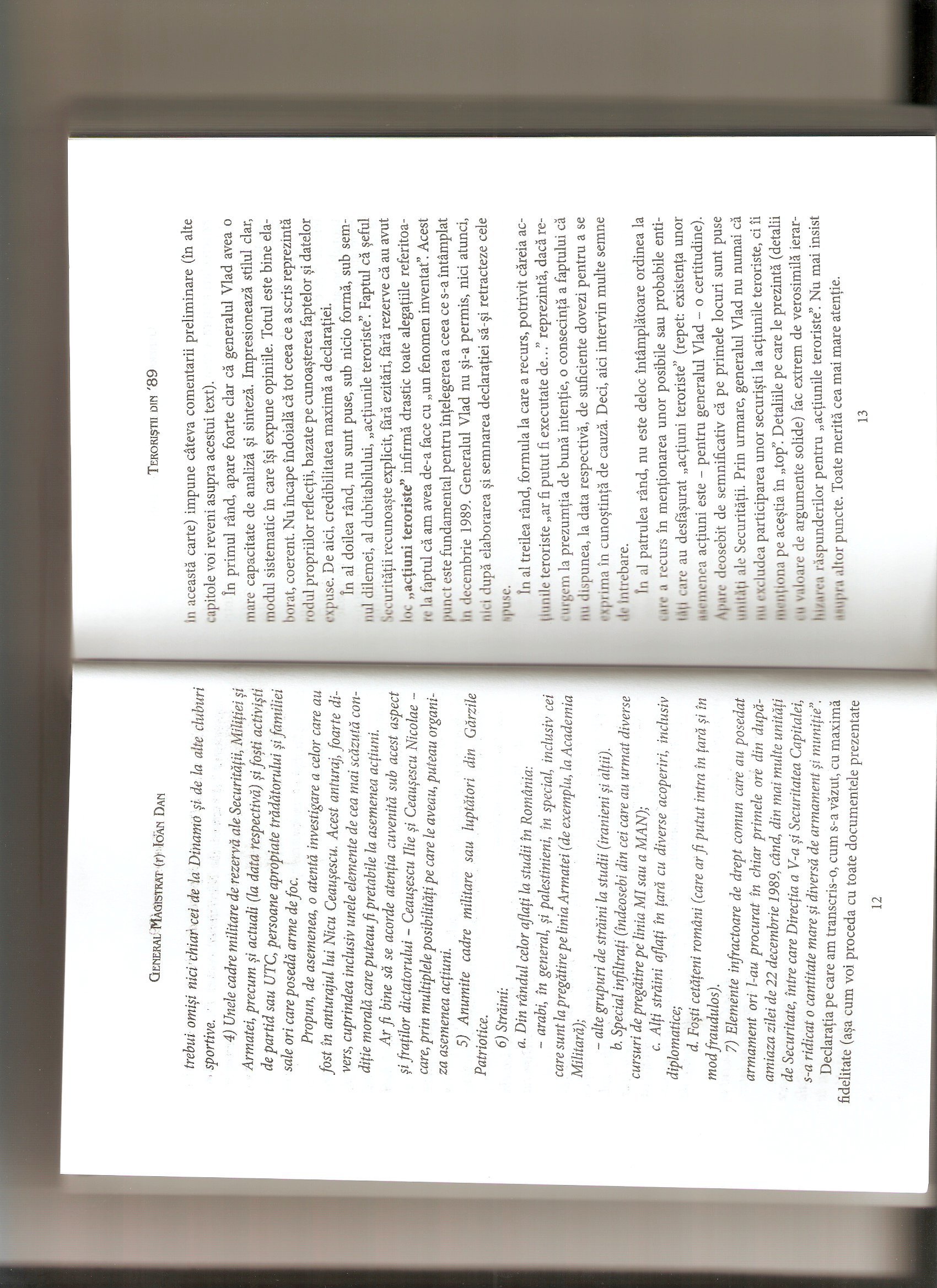
It is virtually certain that the authors of the Chapter on the Romanian Revolution of December 1989 (pp. 620-627, especially p. 625 http://www.presidency.ro/static/ordine/RAPORT_FINAL_CPADCR.pdf ) had no knowledge of Securitate General Iulian Vlad’s Declaration of 29 January 1990 … with predictable negative consequences for their understanding of what happened in December 1989.

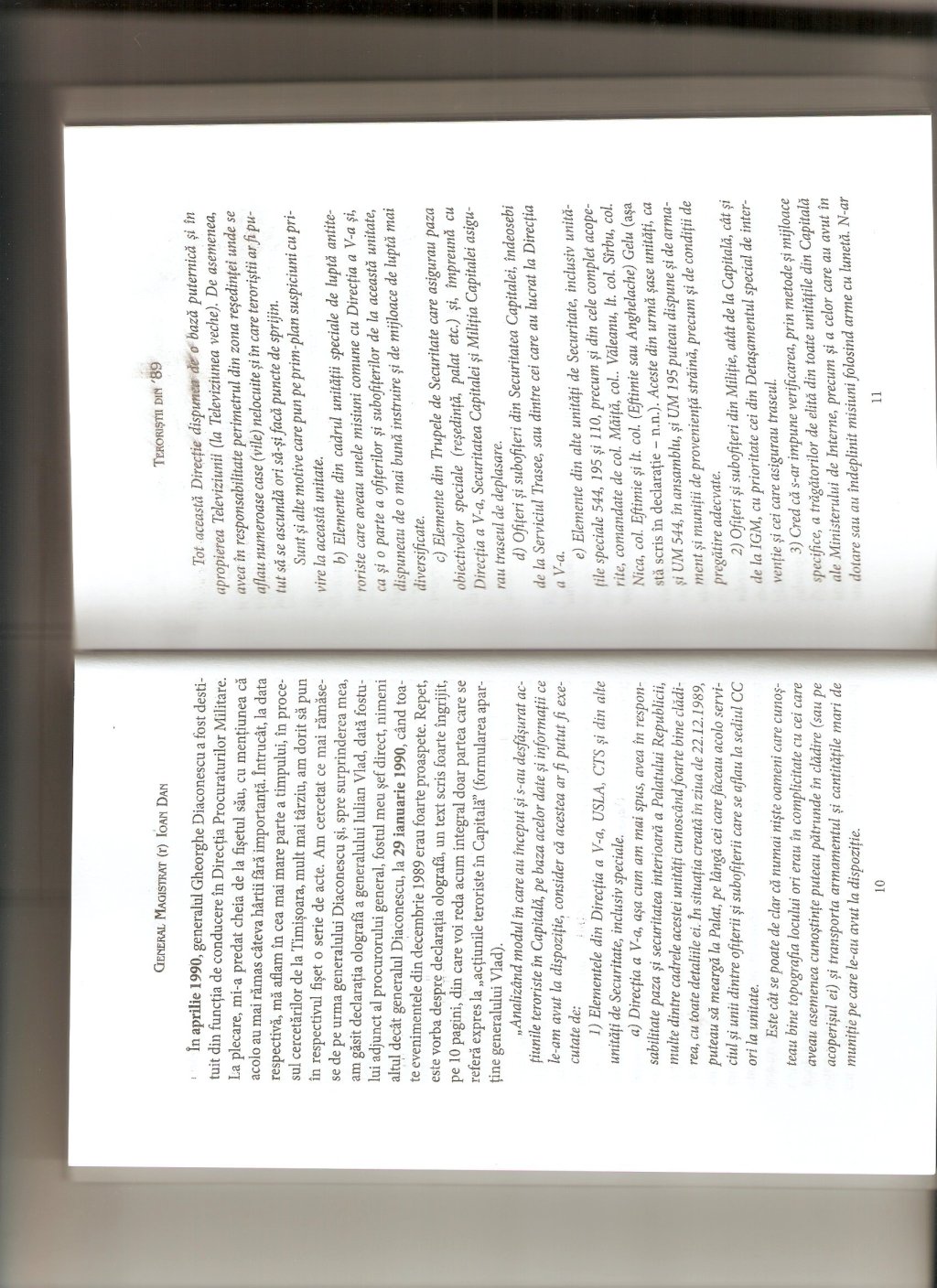
image0-001

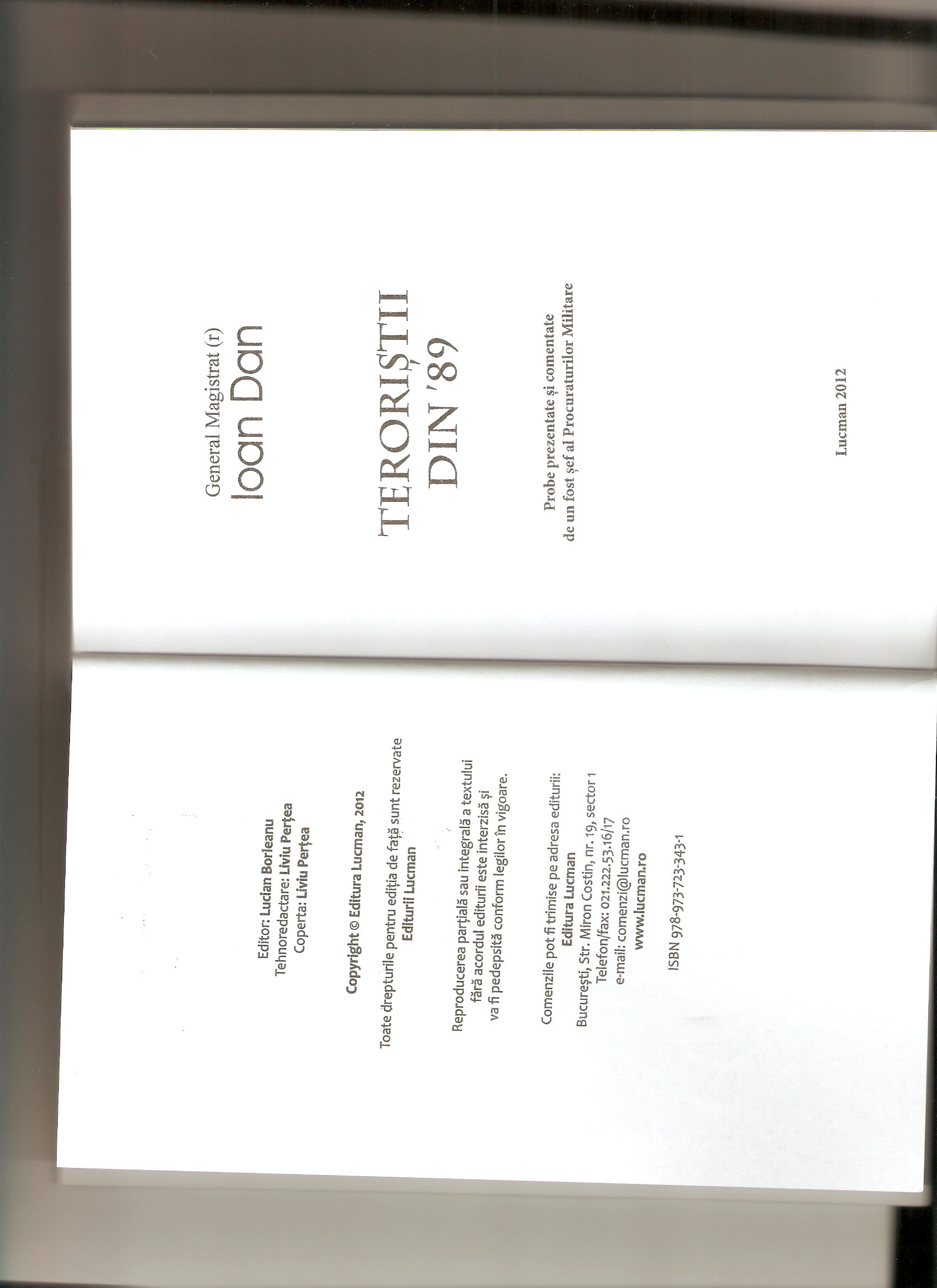
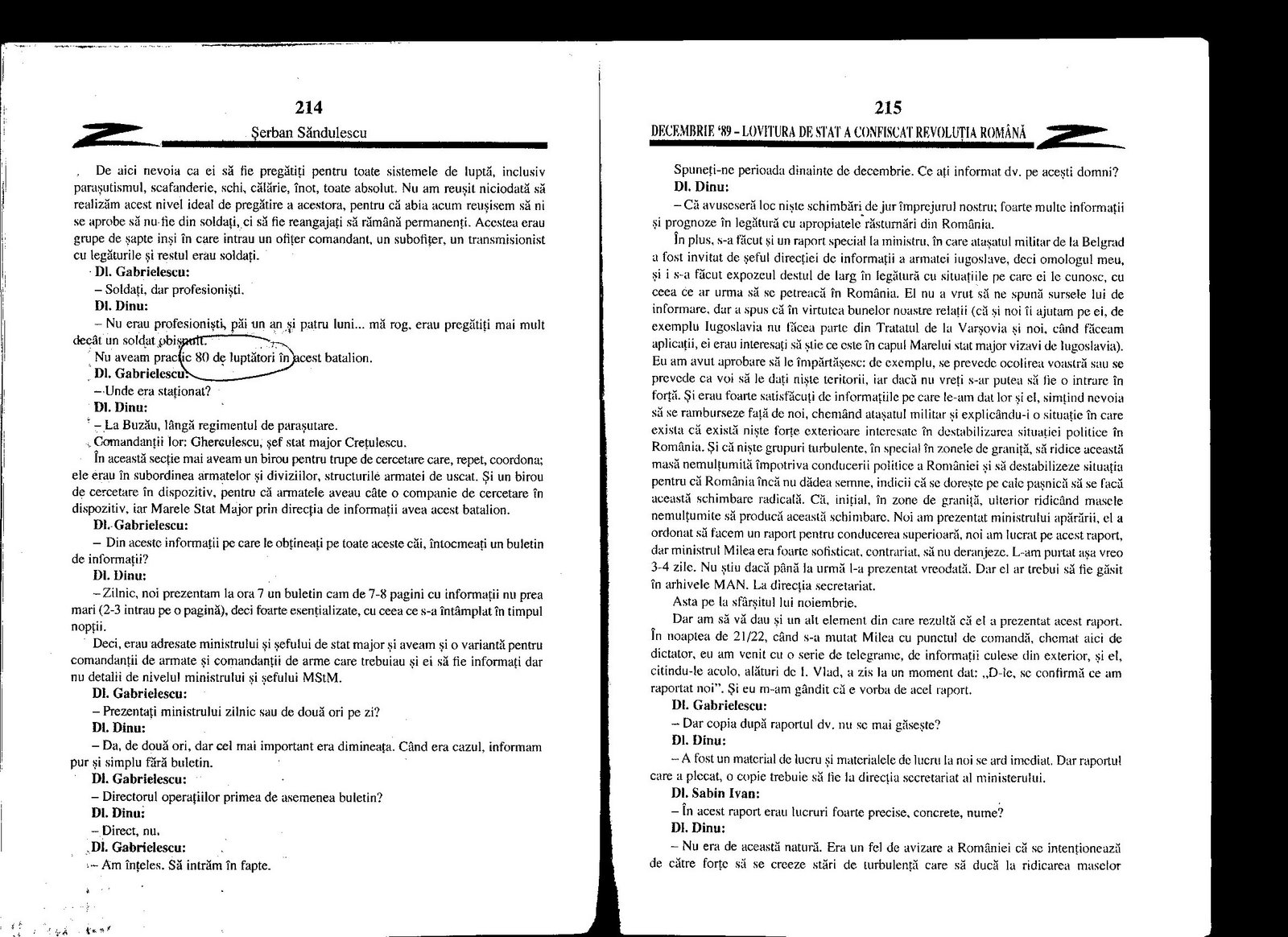
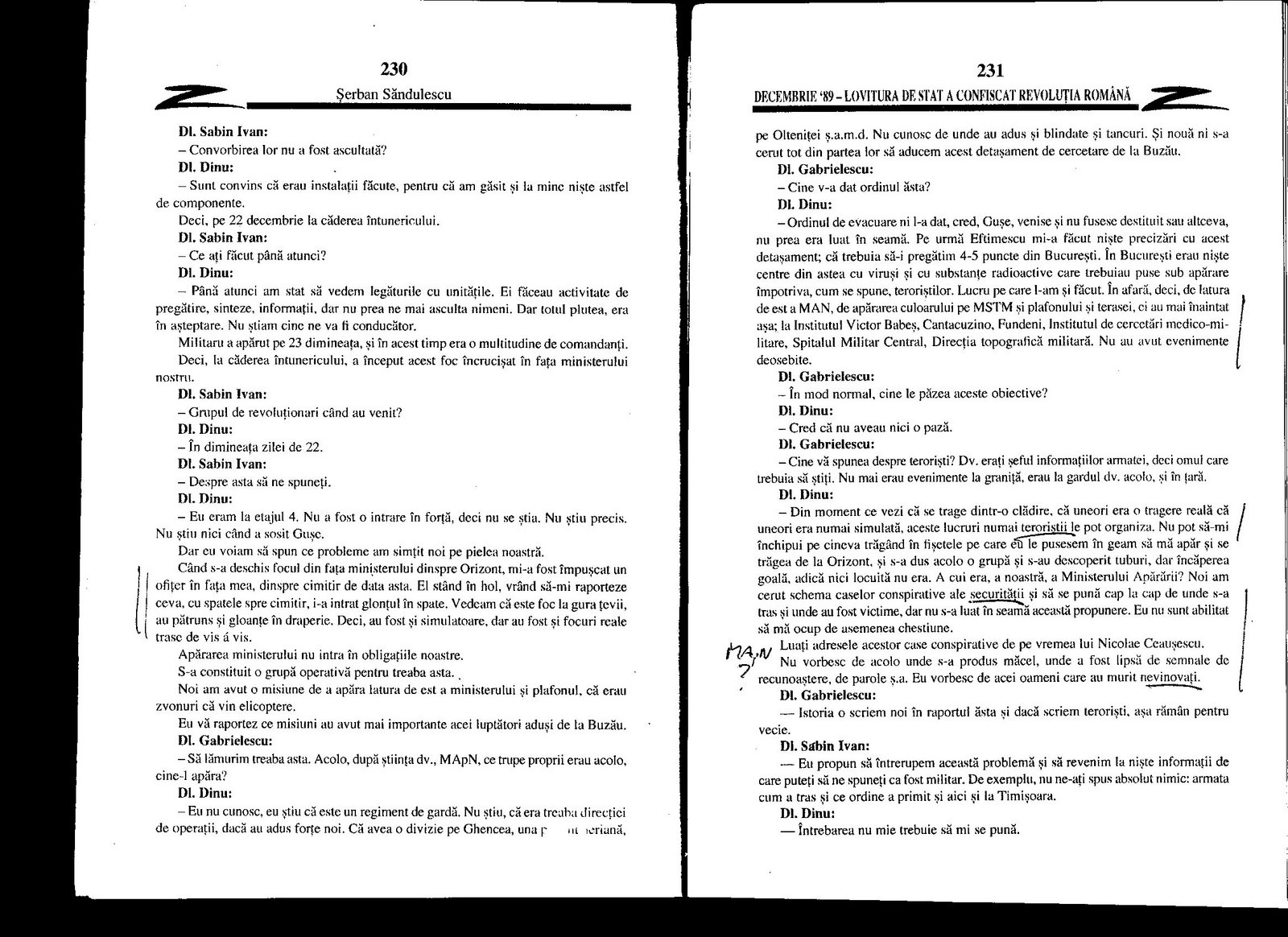
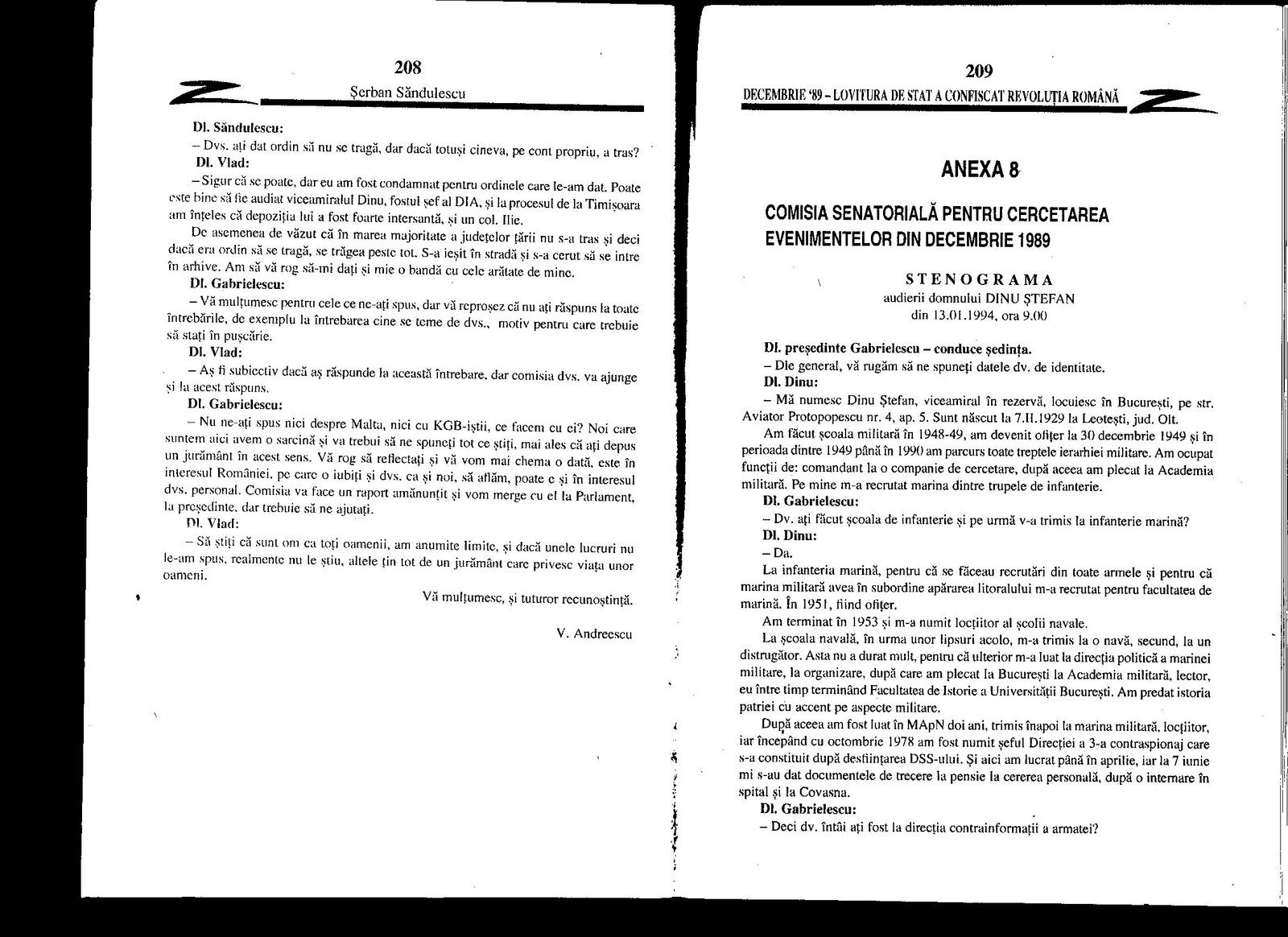
General Magistrat (r) Ioan Dan

In aprilie 1990, generalul Ghoerghe Diaconescu a fost destituit din functia de conducere in Directia Procuraturilor Militare.  La plecare, mi-a predat cheia de la fisteul sau, cu mentiunea ca acolo au mai ramas cateva hartii fara importanta. Intrucat, la data respectiva, ma aflam in cea mai mare parte a timpului, in procesul cercetarilor de la Timisoara, mult mai tarziu, am dorit sa pun in respectivul fiset o serie de acte.  Am cercetat ce mai ramasese de pe urma generalului Diaconescu si, spre surprinderea mea, am gasit declaratia olografa a generalului Iulian Vlad, data fostului adjunct al procurorului general, fostul meu sef direct, nimeni altul decat generalul Diaconescu, la 29 ianuarie 1990, cand toate evenimentele din decembrie 1989 erau foarte proaspete.  Repet, este vorba despre declaratia olografa, un text scris foarte ingrijit, pe 10 pagini, din care voi reda acum integral doar partea care se refera expres la “actiunile teroriste in Capitala” (formularea apartine generalului Vlad).

image0

“Analizand modul in care au inceput si s-au desfasurat actiunile teroriste in Capitala, pe baza acelor date si informatii ce le-am avut la dispozitie, consider ca acestea ar fi putut fi executate de:

1) Elementele din Directia a V-a, USLA, CTS si din alte unitati de Securitate, inclusiv speciale.

a) Directia a V-a, asa cum am mai spus, avea in responsabilitate paza si securitatea interioara a Palatului Republicii, multe dintre cadrele acestei unitati cunoscand foarte bine cladirea, cu toate detaliile ei.  In situatia creata in ziua de 22.12.1989, puteau sa mearga la Palat, pe langa cei care faceau acolo serviciul si unii dintre ofiterii si subofiterii care se aflau la sediul CC ori la unitate.

Este ca se poate de clar ca numai niste oameni care cunosteanu bine topografia locului ori erau in complicitate cu cei care aveau asemenea cunostinte puteau patrunde in cladire (sau pe acoperisul ei) si transporta armamentul si cantitatile mari de munitie pe care le-au avut la dispozitie.

Tot aceasta Directie dispunea de o baza puternica si in apropierea Televiziunii (la Televiziunea veche).  De asemenea, avea in responsabilitate perimetrul din zona resedintei unde se aflau numeroase case (vile) nelocuite si in care teroristii ar fi putut sa se ascunda ori sa-si faca puncte de sprijin.

Sunt si alte motive care pun pe prim-plan suspiciuni cu privire la aceasta unitate.

b) Elemente din cadrul unitatii speciale de lupta antiterroriste care aveau unele misiuni comune cu Directia a V-a si, ca si o parte a ofiterilor si subofiterilor de la aceasta unitate, dispuneau de o mai buna instruire si de mijloace de lupta mai diversificate.

c) Elemente din Trupele de Securitate care asigurau paza obiectivilor speciale (resedinta, palat etc.) si, impreuna cu Directia a-V-a, Securitatea Capitalei si Militia Capitalei asigurau traseul de deplasare.

d) Ofiteri si subofiteri din Securitatea Capitalei, indeosebi de la Serviciul Trasee, sau dintre cei care au lucrat la Directia a V-a.

e) Elemente din alte unitati de Securitate, inclusiv unitatile speciale 544, 195 si 110, precum si din cele complet acoperite, comandate de col. Maita, col. Valeanu, lt. col. Sirbu, col. Nica, col. Eftimie si lt. col. (Eftimie sau Anghelache) Gelu (asa sta scris in declaratie–n.n.).  Aceste din urma sase unitati, ca si UM 544, in ansamblu, si UM 195 puteau dispune si de armament si munitii de provenienta straina, precum si de conditii de pregatire adecvate.

2) Ofiteri si subofiteri din Militie, atat de la Capitala, cat si de la IGM, cu prioritate cei din Detasamentul special de interventie si cei care asigurau traseul.

3) Cred ca s-ar impune verificarea, prin metode si mijloace specifice, a tragatorilor de elita din toate unitatile din Capitala ale Ministerului de Interne, precum si a celor care au avut in dotare sau au indeplinit misiuni folosind arme cu luneta.  N-ar trebui omisi nici chiar cei de la Dinamo si de la alte cluburi sportive.

4) Unele cadre militare de rezerva ale Securitatii, Militiei si Armatei, precum si actuali (la data respectiva) si fosti activisti de partid sau UTC, persoane apropriate tradatorului si familiei sale ori care poseda arme de foc.

Propun, de asemenea, o atenta investigare a celor care au fost in anturajul lui Nicu Ceausescu.  Acest anturaj, foarte divers, cuprindea inclusive unele elemente de cea mai scazuta conditie morala care puteau fi pretabile la asemenea actiuni.

Ar fi bine sa se acorde atentia cuvenita sub acest aspect si fratilor dictatorului–Ceausescu Ilie si Ceausescu Nicolae–care, prin multiplele posibilitati pe care le aveau, puteau organiza asemenea actiuni.

5) Anumite cadre militare sau luptatori din Garzile Patriotice.

6) Straini:

a. Din randul celor aflati la studii in Romania:

— arabi, in general, si palestinieni, in special, inclusiv cei care sunt la pregatire pe linia Armatei (de exemplu, la Academia Militara);

— alte grupuri de straini la studii (iranieni si altii).

b. Special infiltrati (indeosebi din cei care au urmat diverse cursuri de pregatire pe linia MI sau a MAN);

c. Alti straini aflati in tara cu diverse acoperiri, inclusiv diplomatice;

d. Fosti cetateni romani (care ar fi putut intra in tara si in mod fraudulos).

7) Elemente infractoare de drept comun care au posedat armament ori l-au procurat in chiar primele ore din dupa-amiaza zilei de 22 decembrie 1989, cand, din mai multe unitati de Securitate, intre care Directia a V-a si Securitatea Capitalei, s-a ridicat o cantitate mare si diversa de armament si munitie.”

image0-002

Posted in decembrie 1989, raport final | Tagged: , , , , , , , , , , , , , , , , , , | 4 Comments »

Final Boarding Call for TAROM’s special ROMBAC service from Bucuresti to Sibiu: Would the large party of suspicious “Soviet tourists” please report to the gate immediately! (IV)

Posted by romanianrevolutionofdecember1989 on August 16, 2013

Part I :  Just how absurd is the Soviet tourist scenario?! http://atomic-temporary-3899751.wpcomstaging.com/2013/08/10/final-boarding-call-for-taroms-special-rombac-service-from-bucuresti-to-sibiu-would-the-large-party-of-suspicious-soviet-tourists-please-report-to-the-gate-immediately-i/

Part II:  Senior Securitate officials sent to Timisoara cannot find the “foreign tourists” Nicolae Ceausescu and Iulian Vlad claim are behind the unrest.  http://atomic-temporary-3899751.wpcomstaging.com/2013/08/11/final-boarding-call-for-taroms-special-rombac-service-from-bucuresti-to-sibiu-would-the-large-party-of-suspicious-soviet-tourists-please-report-to-the-gate-immediately-ii/

Part III:  The Ceausescu regime bans new Soviet travellers to the country…but allows those “in transit,” already in Romania, to stay…and apparently, despite supposedly having great suspicions of their actions, do nothing to stop them… http://atomic-temporary-3899751.wpcomstaging.com/2013/08/14/final-boarding-call-for-taroms-special-rombac-service-from-bucuresti-to-sibiu-would-the-large-party-of-suspicious-soviet-tourists-please-report-to-the-gate-immediately-ii-2/

I hope to develop this, part IV, at another time…for now, some previously related content in reference to the famous ROMBAC flight of 20 December 1989 from Bucuresti (Otopeni) to Sibiu:

http://atomic-temporary-3899751.wpcomstaging.com/ultimul-raport-al-securitatii-catre-nicolae-ceausescu/

The Securitate’s last report to Nicolae Ceausescu:

Please note:  no mention whatsoever of the alleged role played by “Russian tourists” or “Soviet tourists” in allegedly fomenting the Timisoara uprising, or of their supposed presence on the ROMBAC of 20 December 1989
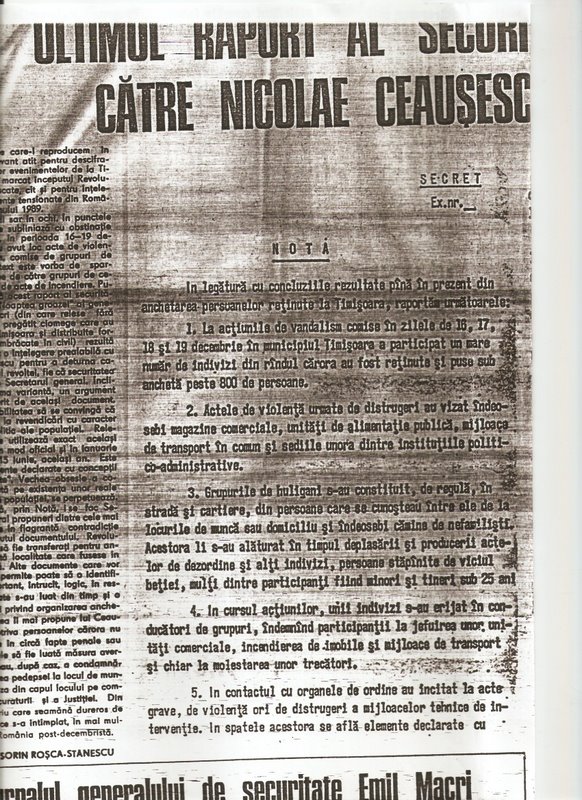
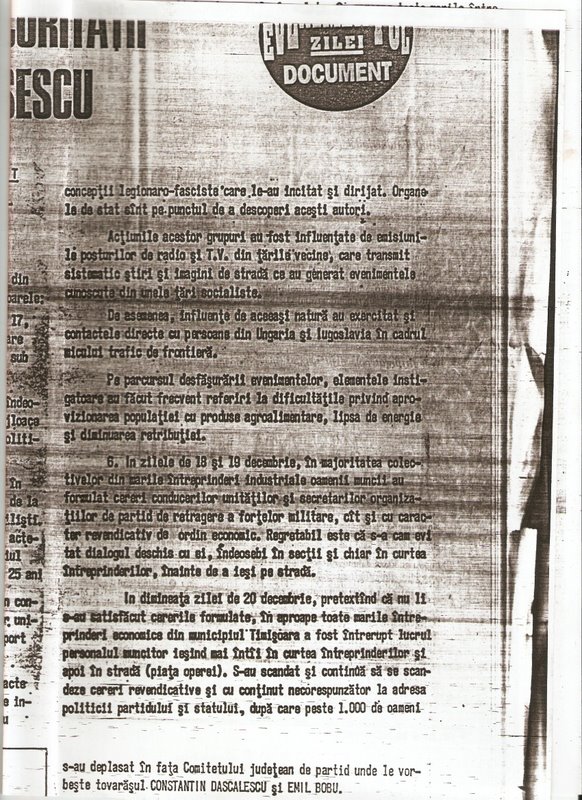
published in Evenimentul Zilei, 28 iulie 1992, p. 3.

http://atomic-temporary-3899751.wpcomstaging.com/2009/10/04/decembrie-89-citeva-indoieli-stirnite-de-un-articol-din-revista-22-cazul-ivanciuc-si-teza-turistilor-sovietici/

http://atomic-temporary-3899751.wpcomstaging.com/2009/03/26/a-ruse-by-any-other-name-general-stanculescu-the-soviet-tourists-and-december-1989/

THE 1989 ROMANIAN REVOLUTION AS GEOPOLITICAL PARLOR GAME: BRANDSTATTER’S “CHECKMATE” DOCUMENTARY AND THE LATEST WAVE IN A SEA OF REVISIONISM

By Richard Andrew Hall

Disclaimer: This material has been reviewed by CIA. That review neither constitutes CIA authentification of information nor implies CIA endorsement of the author’s views.

Part 3: Ruse

A SECURITATE RIDDLE: SOVIET “TOURISTS” AND THE OVERTHROW OF THE CEAUSESCU REGIME

Although I have written a good deal on the “tourist” conundrum in the past (see, for example, Hall 2002), I have not formally addressed the role of foreign histories of Ceausescu’s overthrow in the historiography of December 1989, particularly in regard to this topic. In the wake of the broadcast of Brandstatter’s “Checkmate” documentary in February 2004, Vladimir Bukovski’s invocation of journalist John Simpson’s 1994 article on the topic (discussed in Part 2 of this series) suggests, however, that it needs to be broached in greater detail. Moreover, as the year-long look-back at the December 1989 events in “Jurnalul National” shows, the “tourist” question—somewhat surprisingly to me—has become more and more central to arguments about the Revolution, thereby amplifying what is already tremendous confusion over the events in the Romanian press and public. Of course, as has traditionally been the case, the Soviet/Russian tourists figure prominently, and, to a lesser extent, the Hungarian tourists. However, the stock of other tourist groups has also gone up. For example, the role of Yugoslav (specifically Serb) tourists has found a greater emphasis, and, seemingly out of nowhere, so have East German/STASI tourists! The principal sources for all of these allegations are, as usual, former Securitate and Militia officers, with some military (intelligence) personnel thrown in for good measure.

FOREIGN FORUM, ROMANIAN CONTEXT

It is difficult to pinpoint the exact first mention of “the tourists” and their alleged role in the Revolution, but it appears that although the source of the claim was Romanian, the publication was foreign. James F. Burke, whose name is unfortunately left off the well-researched and widely-consulted web document “The December 1989 Revolt and the Romanian Coup d‘etat,” alludes to the “Romanian filmmaker” who first made these allegations (Burke, 1994). The claims are contained in an article by Richard Bassett in the 2 March 1990 edition of “The Times (London).” According to Bassett,

“Mr. [Grigore] Corpacescu has no doubt that the revolution here was carefully stage-managed—as was the case in Prague and East Berlin—by the Russians…According to Mr. Corpacescu a party of Soviet ‘tourists,’ all usually on individual visas, arrived in Timisoara two days before the first demonstration outside Mr. [i.e. Pastor] Tokes’ house. Police records trace them reaching Bucharest on December 20. By the 24th, two days after Ceausescu fled by helicopter, the Russians had disappeared. No police records exist to indicate how they left the country. (“The Times (London),” 2 March 1990)

But Bassett’s interlocutor, Mr. Corpacescu, says some strange things. Bassett is not clear but it appears that Corpacescu suggests that the post-Revolution Interior Minister Mihai Chitac, who was involved in the Timisoara events as head of the army’s chemical troops, somehow purposely coaxed the demonstrations against the regime because the tear-gas cannisters his unit fired failed to explode—the failure somehow an intended outcome. But beyond this, Corpacescu, who is at the time of the article filming the recreation of Ceausescu’s flight on the 22nd—using the same helicopter and pilot involved in the actual event—makes the following curious statement:

“The pilot of this helicopter is an old friend. I have many friends in the police, Timisoara was not started by the Hungarian pastor, the Reverend Laszlo Tokes [i.e. it was carefully stage-managed…by the Russians].” (“The Times (London),” 2 March 1990)

The pilot of the helicopter was in fact Vasile Malutan, an officer of the Securitate’s V-a Directorate. What kind of a person would it have been at that time—and how credible could that person have been–who has the pilot as an old friend and “many friends in the police?” And it would have been one thing perhaps two months after the revolution to talk about the presence of foreign agents “observing” events in Timisoara, but to deny the spontaneity of the demonstrations and denigrate Tokes’ role at this juncture is highly suspicious. I have been unable to unearth additional information on Mr. Corpacescu, but his revelations just happen to serve his friends extremely well—particularly at at time when the prospect of trials and jail time, for participation in the repression in Timisoara and elsewhere during the Revolution, still faced many former Securitate and Militia [i.e. police] members.

THE FORMER SECURITATE AND MILITIA REMINISCE ABOUT THE SOVIET “TOURISTS”

A week after “The Times” article, the chief of the Securitate’s Counter-espionage Directorate, Colonel Filip Teodorescu, mentioned at his trial for his role in the Ceausescu regime’s crackdown in Timisoara that he had in fact detained “foreign agents” during the events there (“Romania Libera,” 9 March 1990). In his 1992 book, he developed further on this theme, specifically focusing on the role of “Soviet tourists:”

“There were few foreigners in the hotels, the majority of them having fled the town after lunch [on 17 December] when the clashes began to break out. The interested parties remained. Our attention is drawn to the unjustifiably large number of Soviet tourists, be they by bus or car. Not all of them stayed in hotels. They either had left their buses or stayed in their cars overnight. Border records indicate their points of entry as being through northern Transylvania. They all claimed they were in transit to Yugoslavia. The explanation was plausible, the Soviets being well-known for their shopping trips. Unfortunately, we did not have enough forces and the conditions did not allow us to monitor the activities of at least some of these ‘tourists’” (Teodorescu, 1992, p. 92).

Reporting in July 1991 on the trial involving many of those involved in the Timisoara repression, Radu Ciobotea noted with what was probably an apt amount of skepticism and cynicism, what was telling in the confessions of those on trial:

Is the End of Amnesia Approaching?…

Without question, something is happening with this trial. The Securitate doesn’t say, but it suggests. It let’s small details ‘slip out.’…Increasingly worthy of interest are the reactions of those on trial….Traian Sima (the former head of the county’s Securitate) testifies happily that, finally, the Securitate has been accepted at the trial, after having been rejected by Justice. Filip Teodorescu utters the magic word ‘diplomats’ and, suddenly, the witness discovers the key to the drawer with surpise and declares, after five hours of amnesia, that in Timisoara, there appeared in the days in question, foreign spies under the cover of being journalists and diplomats, that in a conversation intercepted by a mobile Securitate surveillance unit Tokes was reported as ‘well,’ and that all these (and other) counterespionage actions that can’t be made public to the mass media can be revealed behind closed doors to the judge….[Timis County party boss] Radu Balan ‘remembers’ that on 18 December at midnight when he was heading toward IAEM, he passed a group of ten soviet cars stopped 100 meters from the county hospital. (It turns out that in this night, in the sight of the Soviets, the corpses were loaded!).” [emphasis in the original] (Flacara, no. 27, 1991, p. 9).

The reference to the corpses being loaded is to an operation by the Militia and Securitate on the night of 18-19 December 1989, in which the cadavers of 40 people killed during the repression of anti-regime protesters were secretly transported from Timisoara’s main hospital to Bucharest for cremation (reputedly on Elena Ceausescu’s personal order).

Finally, as yet another of many possible examples, we have the recollections of Bucharest Militia Captain Ionel Bejan, which apparently appeared in print for the first time only in 2004, in a book by Alex Mihai Stoenescu (excerpted in “Jurnalul National,” 7 December 2004). According to Bejan, around 2 AM on the night of 21-22 December, not far from University Plaza, where at that moment regime forces were firing their way through a barricade set up by protesters (48 were killed that night, 604 wounded, and 684 arrested), he spotted two LADA automobiles with Soviet plates and two men and a woman studying a map and pointing to different locations among the surrounding buildings. Bejan recalled:

“One thing’s for sure, and that is that although they looked like tourists, they didn’t behave like tourists who had just arrived in town or were lost, especially as close by there were compact groups of demonstrators, while from armored personnel carriers there was intense warning fire and a helicopter hovered overhead with lights ablaze. I don’t know what kind of tourist tours somewhere in such conditions. They left the impression that they were sure of themselves, they didn’t need any directions, proof which was that they didn’t ask us anything even though we were nearby and, being uniformed Militia, were in the position to give them any directions they needed. One thing’s for sure when I returned to that location in January 1990…the buildings displayed visible signs of bullet holes…[emphasis added]” (“Jurnalul National,” 7 December 2004)

STRANGE “TOURISTS”…STRANGER STILL, THE REACTIONS OF THE AUTHORITIES

We can agree with Ionel Bejan in one respect. One thing is for sure: these were some very strange tourists. (They give a whole new meaning to the term, “adventure tourism.”) As curious as the “Soviet tourists” themselves is how little the Romanian authorities who claim to have seen them did to stop them—or even try to collect more information about them. Why is it that no official questioned the enigmatic “Soviet tourists” or asked them to leave the area when, as Radu Balan claims, he saw ten LADAs outside the Timis county hospital at 1 AM in the morning the night the cadavers of protesters were being loaded onto a truck for cremation? Or, as Ionel Bejan claims, he spotted several of them in the center of Bucharest at 2 AM, when the area was essentially a warzone of regime repression? The regime had closed the borders to virtually all other foreigners, tourists or otherwise, it was trying to prevent any word of the repression from reaching the outside world, and yet Romanian authorities were not concerned about these “tourists” taking pictures or relaying what they were seeing?!

As I have written before, if it was obvious before 18 December, as these Ceausescu regime officials claim, that “Soviet tourists” were involved in the events in Timisoara, then why was it precisely “Soviet travelers coming home from shopping trips to Yugoslavia” who were the only group declared exempt from the ban on “tourism” announced on that day (see AFP, 19 December 1989 as cited in Hall 2002b)? In fact, an Agent France-Presse correspondent reported that two Romanian border guards on the Yugoslav frontier curtly told him: “Go back home, only Russians can get through”!!! The few official documents from the December events that have made their way into the public domain show the Romanian Ambassador to Moscow, Ion Bucur, appealing to the Soviets to honor the Romanian news blackout on events in Timisoara, but never once mentioning—let alone objecting to—the presence or behavior of “Soviet tourists” in Romania during these chaotic days of crisis for the Ceausescu regime (CWHIP, “New Evidence on the 1989 Crisis in Romania,” 2001). It truly strains the imagination to believe that the Romanian authorities were so “frightened” of committing a diplomatic incident with the Soviets that they would allow Soviet agents to roam the country virtually unhindered, allowing them to go anywhere and do anything they wanted.

BUT WAIT, THERE’S MORE…A “SOVIET TOURIST” ENCORE IN 1990

Add to all of this (!), the allegations that the “Soviet tourists” were seen again on the streets during major crises in 1990, such as the ethnic clashes between Romanians and Hungarians in Tirgu Mures in March 1990 (for evidence of the reach of the allegation of KGB manipulation via the “tourist” mechanism both in December 1989 AND in March 1990, see Emil Hurezeanu, “Cotidianul,” 23 December 1999; according to Hurezeanu, “It appears they didn’t leave the country until 1991, following a visit by [SRI Director] Virgil Magureanu to Moscow”!). Then there is the famous April 1991 interview of an alleged KGB officer—who spoke flawless Romania and was in Romania during the December 1989 events—who the interviewer, the vigorous anti-Iliescu foe, Sorin Rosca Stanescu, claimed to have just stumbled into in Paris. Of all the reporters who could have stumbled into a KGB officer present in Romania during the Revolution—the only such case I know of—it was Rosca Stanescu, who, it turned out later, had been an informer for the Securitate until the mid-1980s—but not just for anybody, but for the USLA. Intererstingly, although the article appeared on the non-descript page 8 of the primary opposition daily at the time (“Romania Libera”), the aforementioned Filip Teodorescu and Radu Balan invoked it in support of their contentions regarding the the “tourists” (for a discussion of this, see Hall 2002). Even more suprising, or not, depending on your point of view, in his April 1991 article, Stanescu attempted to tie together December 1989 with December 1990 (!):

“As you will recall, persistent rumors have circulated about the existence on Romanian soil [in December 1989] of over 2,000 Lada automobiles with Soviet tags and two men in each car. Similar massive infiltrations were witnessed in December 1990, too, with the outbreak of a wave of strikes and demonstrations. What were the KGB doing in Romania?” (emphasis added) (“Romania Libera,” 18 April 1991)

Indeed, what were they doing in Romania? But, more aptly:

WHO COULD THEY HAVE BEEN?

Some other recollections and comments may offer clues to the answer to this vexing question. For example, the Caransebes Militia Chief claims he helped a group of “Soviet tourists” coming from Timisoara on the night of 20-21 December when one of their cars—as usual, “it was part of a convoy of 20 cars, all of the same make and with 3-4 passengers per car”—went off the road (from “Europa,” no. 20, 1991, see the discussion in Hall 2002b). According to Teodorescu, the “tourists” greeted the militia chief with the phrase “What the hell? We are colleagues; you have to help us” (Teodorescu, 1992, p. 93). The militia chief opines that despite their Soviet passports, “to this day, I don’t really know where they were from.”

Nicu Ceausescu, Nicolae’s son and most likely heir and party secretary in Sibiu at the time of the Revolution, claimed that he also had to deal with enigmatic “tourists” during these historic days (the following several paragraphs borrow heavily from Hall 2002b). From his prison cell in 1990, Nicu recounted how on the night of 20 December 1989, a top party official came to inform him that the State Tourist Agency was requesting that he — the party secretary for Sibiu! — “find lodgings for a group of tourists who did not have accommodation” He kindly obliged and made the appropriate arrangements (interview with Nicu Ceausescu in “Zig-Zag,”, no. 20, 21-27 August 1990).

Interestingly, in the same interview Nicu discusses the “tourists” for which he was asked to find accommodations in the context of a group of mysterious passengers who had arrived by plane from Bucharest on the evening of 20 December 1989. We know that in the period immediately following these events, the then-military prosecutor, Anton Socaciu, had alleged that these passengers from Bucharest were members of the Securitate’s elite USLA unit (Special Unit for Antiterrorist Warfare) and were responsible for much of the bloodshed that occurred in Sibiu during the December events. Nicu Silvestru, chief of the Sibiu County Militia, admitted in passing in a letter from prison that on the afternoon of 19 December in a crisis meeting, Ceausescu’s son announced that he was going to “call [his] specialists from Bucharest” to take care of any protests (“Baricada,” no. 45, 1990). Ceausescu’s Interior Minister, Tudor Postelnicu, admitted at his trial in January 1990 that Nicu had called him requesting “some troops” and he had informed Securitate Director General Iulian Vlad of the request (“Romania Libera,” 30 January 1990.)

The rewriting of the story of the Revolution, the “tourists,” and the “terrorists” was already in full swing, when in August 1990, Nicu wryly observed:

“…[T]he Military Prosecutor gave me two variants. In the first part of the inquest, they [the flight’s passengers] were from the Interior Ministry. Later, however, in the second half of the investigation, when the USLA and those from the Interior Ministry began, so-to-speak, to pass ‘into the shadows,’ — after which one no longer heard anything of them — they [the passengers] turned out to be simple citizens…” (interview with Nicu Ceausescu in “Zig-Zag,” no. 20, 21-27 August 1990).

The impact of this “reconsideration” by the authorities could be seen in the comments of Socaciu’s successor as military prosecutor in charge of the Sibiu case, Marian Valer (see Hall 1997, pp. 314-315). Valer commented in September 1990 that investigations yielded the fact that there were 37 unidentified passengers on board the 20 December flight from Bucharest and that many of the other passengers maintained that “on the right side of the plane there had been a group of tall, athletic men, dressed in sporting attire, many of them blond, who had raised their suspicions.” The USLA, which were responsible for airport security and had “air marshals” on all flights (three in this case), refused to discuss the identity of these passengers with Valer. While investigations revealed that during this time there “were many Soviet tourists staying in Sibiu’s hotels,” they also established that “military units were fired upon from Securitate safehouses located around these units as of the afternoon of 22 December, after the overthrow of the Ceausescu regime.” He thus carefully concludes:

“As far as the unidentified passengers are concerned, there are two possible variants: Either they were USLA fighters sent to defend Nicu Ceausescu, or they were Soviet agents sent to act with the intent of overthrowing the Ceausescu regime” (“Expres,” no. 33, September 1990).

Clearly, one of these hypotheses is a lot more plauisble than the other…As I wrote in December 1996, partly based on the statements of the Military Prosecutor Marian Valer who stepped down from investigating the Sibiu events in fall 1990, citing duress: “thus as the USLA began to disappear from the historiography and therefore history of the Revolution, so the Soviet tourists began to enter it.” (Hall, 1996).

“ORWELLIAN…POSITIVELY ORWELLIAN:”

PROSECUTOR VOINEA’S CAMPAIGN TO SANITIZE

THE ROMANIAN REVOLUTION OF DECEMBER 1989

by Richard Andrew Hall

Disclaimer: All statements of fact, opinion, or analysis expressed are those of the author and do not reflect the official positions or views of the Central Intelligence Agency (CIA) or any other U.S. Government agency. Nothing in the contents should be construed as asserting or implying U.S. Government authentication of information or CIA endorsement of the author’s views. This material has been reviewed by CIA to prevent the disclosure of classified information.

Sibiu, 19-22 December 1989

In Sibiu, Siani-Davies tells us:

Controversy also continues to surround a commercial TAROM flight, which is alleged to have brought up to eighty USLA troops from Bucharest to Sibiu on December 20, 1989. It is not clear if the USLA forces were actually on the airplane, or, even if they were, what they actually did in Sibiu…[Serban] Sandulescu (c1996), 57-58…suggests they were not members of USLA but the DIA [Army’s Intelligence Unit].[151]

From the standpoint of Siani-Davies’ unsuspecting reader such a conclusion may seem not only credible, but judicious. But one of Siani-Davies’ habits—identified negatively by even those who praise the book—is his tendency to draw negative equivalencies: i.e. there is about as much evidence to support x as there is to support y, in order to disprove or discount both propositions. In a review, Doris Mironescu writes:

“Very common are claims such as the following: ‘Finding the proof to sustain such an explanation of the events [that the Army’s Intelligence arm, the DIA simulated the “terrorist diversion,” to permit the Front’s takeover and a possible Warsaw Pact invasion of the country] is as difficult as proving that special units of the securitate took up arms against the revolution’ (p. 154). Mutually contradictory hypotheses are invoked in order to negate each other, not so much because of the weight of the claims, but through the ideological similarity of both.”[152]

This tendency definitely affects Siani-Davies’ analysis of the “terrorists” and its accuracy. To begin with, in the very book (Sandulescu) invoked by Siani-Davies, the head of the DIA (Battalion 404 Buzau), Rear Admiral Stefan Dinu, is quoted as having told the Gabrielescu commission investigating the December events (of which Sandulescu was a member) that “we hardly had 80 fighters in this battalion.”[153] It is known that 41 of them were in Timisoara from the morning of 18 December and only returned to their home base in Buzau on 22 December.[154] This makes it highly unlikely that they were on the 20 December TAROM flight to Sibiu that is in question.[155]

http://atomic-temporary-3899751.wpcomstaging.com/2009/12/18/hai-sa-ne-punem-capul-in-ghips/

in decembrie 1989, “temuta” unitate DIA Batalionul 404…avea…80 de luptatori!

Contrast this with the signs that exist pointing to the mystery passengers as having been from the Securitate/Interior Ministry, in particular the USLA. Nicu Silvestru, chief of the Sibiu County Militia, admitted in passing in a letter from prison that on the afternoon of 19 December 1989, in a crisis meeting, Nicolae Ceausescu’s son, Nicu, party head of Sibiu County, announced that he was going to “call [his] specialists from Bucharest” to take care of any protests.[156] Ceausescu’s Interior Minister, Tudor Postelnicu, admitted at his trial in January 1990 that Nicu had called him requesting “some troops” and he had informed Securitate Director General Iulian Vlad of the request.[157] If they were, indeed, DIA personnel, why would Nicu have called Postelnicu, and Postelnicu informed Vlad of the request—would such a request not have been relayed through the Defense Minister?

The first two military prosecutors for Sibiu, Anton Socaciu and Marian Valer, identified the passengers as USLA. Even Nicu Ceausescu admits that this was the accusation when he stated in August 1990:

“…[T]he Military Prosecutor gave me two variants. In the first part of the inquest, they [the flight’s passengers] were from the Interior Ministry. Later, however, in the second half of the investigation, when the USLA and those from the Interior Ministry began, so-to-speak, to pass ‘into the shadows,’ – after which one no longer heard anything of them – they [the passengers] turned out to be simple citizens…”[158]

Beginning, at least as early as August 1990, with the allusions of Major Mihai Floca, and later seemingly indirectly confirmed by former USLA officer Marian Romanescu, it was suggested that when USLA Commander Ardeleanu was confronted at the Defense Ministry on the night of 23/24 December 1989, Ardeleanu reportedly admitted that “30 were on guard at [various] embassies, and 80 had been dispatched to Sibiu with a Rombac [aircraft] from 20 December 1989 upon ‘orders from on-high’.”[159] Finally, and along these lines, we bring things full circle—and recall our “phantoms in black” again in the process—with the testimony of Army officer Hortopan to the same Serban Sandulescu at the Gabrielescu Commission hearings:

Sandulescu: About those dressed in black jumpsuits do you know anything, do you have any information about whom they belonged to?

Hortopan: On the contrary. These were the 80 uslasi sent by the MI [Interior Ministry], by General Vlad and Postelnicu to guard Nicolae Ceausescu [i.e. Nicu]. I make this claim because Colonel Ardelean[u] in front of General Militaru, and he probably told you about this problem, at which I was present when he reported, when General Militaru asked him how many men he had in total and how many were now present, where each of them was: out of which he said that 80 were in Sibiu based on an order from his commanders. Thus, it is natural that these are who they were.[160]

Bringing us up to the morning of 22 December 1989, and setting the stage for what was to come, Lt. Col. Aurel Dragomir told the Army daily in November 1990:

Dragomir: Events began to develop quickly on 22 December. In the morning some of the students posted in different parts of the town began to observe some suspect individuals in black jumpsuits on the roofs in the lights of the attics of several buildings.

Reporter: The same equipment as the USLAsi killed out front of the Defense Ministry…

Dragomir: And on the roof of the Militia building there were three or four similar individuals…[161]

Of course, the fact that these individuals were posted on the top of the Militia building on this morning, speaks volumes in itself about their affiliation. Indeed, in a written statement dated 28 January 1990, Ioan Scarlatescu, (Dir. Comm. Jud. Sibiu), admitted that he was asked by the Army on that morning if the unknown individuals “could be from the USLA?”[162]

[151] Siani-Davies, 2005, p. 152, fn. no. 32.

[152] Doris Mironescu, “Revolutia româna, asa cum (probabil) a fost,” Timpul no. 1 (January 2006), at http://www.romaniaculturala.ro.

[153] Serban Sandulescu, Lovitura de Stat a Confiscat Revolutia Romana (Bucharest: Omega, 1996), p. 214. Sandulescu’s book was marketed and printed by Sorin Rosca Stanescu’s Ziua press. Rosca Stanescu was a former USLA informer between the mid-1970s and mid-1980s. Who was Sandulescu’s chief counselor on these matters? Stefan Radoi, a former USLA officer in the early 1980s! These are the type of people who, of course, believe the passengers were DIA and not USLA! See my discussion of this whole fiasco in “The Securitate Roots of a Modern Romanian Fairy Tale,” RFE “East European Perspectives” 4-6/2002, online.

[154] See Dinu’s testimony in Sandulescu, Lovitura de Stat, p. 220. Also see the claims of another senior DIA officer Remus Ghergulescu in Jurnalul National, March 2004, online edition.

[155] Speaking even more broadly, Army parachutists (whether from Buzau, Caracal, Campia Turzii, or Boteni) were in Timisoara, Caransebes, and Television, Piata Palatului and the Otopeni Airport in Bucharest during the December events, but that clearly leaves many places where there were “terrorist actions”—including Sibiu—without them, decreasing their likelihood as plausible suspects. See Catalin Tintareanu, “Sarbatoare la Scoala de Aplicatie pentru Parasutisti ‘General Grigore Bastan,” Opinia (Buzau), 10 June 2005, online edition.

[156] Nicu Silvestru, “Cine a ordonat sa se traga la Sibiu?” Baricada, no. 45, 1990, p.5.

[157] Emil Munteanu, “Postelnicu a vorbit neintrebat,” Romania Libera, 30 January 1990, p. 1

[158] Interview with Nicu Ceausescu in Zig-Zag, no. 20, 21-27 August 1990.

[159] Adevarul, 29 August 1990. Also, Romanescu with Badea “U.S.L.A, Bula Moise…” 1991.

[160] “Virgil Magureanu sustine ca revolta din 1989 a fost sprijinita din interiorul sistemului,” Gardianul, 12 November 2005, online edition.

[161] Lt. Col. Aurel Dragomir, interview by Colonel Dragos Dragoi, “Sub tirul incrucisat al acuzatiilor (II),” Armata Poporului, no. 46 (November 1990), p. 3. Remus Ghergulescu specified USLA appearance as follows: “Over their black jumpsuits (‘combinezoanele negre’) in which they were dressed they had kaki vests. This was normal. They were equipped with the jumpsuits as “war gear,” while the vests were “city wear.’” (Colonel Remus Ghergulescu, interview with Razvan Belciuganu, “Teroristii au iesit din haos,” Jurnalul National, 29 November 2004, online edition.)

[162] See Evenimentul Zilei, 25 November 1992, p. 3.

RFE/RL Reports Print Version E-mail this page to a friend

17 April 2002, Volume  4, Number  8

THE SECURITATE ROOTS OF A MODERN ROMANIAN FAIRY TALE: THE PRESS, THE FORMER SECURITATE, AND THE HISTORIOGRAPHY OF DECEMBER 1989

By Richard Andrew Hall

Part 2: ‘Tourists Are Terrorists and Terrorists are Tourists with Guns…’ *
The distance traveled by Securitate disinformation on the December 1989 events can be breathtaking. Bubbling up through the springs of popular rumor and speculation, it flows into the tributaries of the media as peripheral subplots to other stories and eventually wends its way — carried upon the waves of consensus and credibility that flow from its acceptance among prominent Romanian journalists and intellectuals — into the writings of Western journalists, analysts, and academics. Popular myths, which either have their origins in disinformation disseminated by the former Securitate, or which originated in the conspiratorial musings of the populace but proved propitious for the former secret police and thus were appropriated, nurtured, and reinjected into popular discourse, are today routinely repeated both inside and outside Romania. Frequently, this dissemination occurs without the faintest concern over, or knowledge of, the myth’s etymology or much thought given to the broader context and how it plays into the issue of the Securitate’s institutional culpability.

Take, for example, the “tourist” myth — perhaps the former Securitate’s most fanciful and enduring piece of disinformation. This myth suggests that in December 1989, Soviet, Hungarian, and other foreign agents posing as “tourists” instigated and/or nurtured anti-Ceausescu demonstrations in Timisoara, Bucharest, and elsewhere, and/or were responsible for the “terrorist” violence after 22 December that claimed over 900 victims, or almost 90 percent of those killed during the Revolution. The implication of such allegations is clear: It questions the spontaneity — and hence, inevitably, to a certain degree, the legitimacy — of the anti-Ceausescu demonstrations and the overthrow of the Ceausescu regime; it raises doubt about the popular legitimacy of those who seized power during the events; and it suggests that those who seized power lied about who was responsible for the terrorist violence and may ultimately have themselves been responsible for the bloodshed.

A robust exegesis of the “tourist” hypothesis was outlined on the eve of the 10th anniversary of the December 1989 events in the pages of the daily “Ziua” by Vladimir Alexe. Alexe has been a vigorous critic of Ion Iliescu and the former communists of the National Salvation Front (FSN) who took power in December 1989, maintaining that they overthrew Ceausescu in a Soviet-sponsored coup d’etat:

“The outbreak of the December events was preceded by an odd fact characteristic of the last 10 years. After 10 December 1989, an unprecedented number of Soviet ‘tourists’ entered the country. Whole convoys of Lada automobiles, with approximately four athletic men per car, were observed at the borders with the Moldovan Socialist Republic, Bulgaria, and Hungary. A detail worthy of mention: The Soviet ‘tourists’ entered Romania without passports, which suggests the complicity of higher-ups. According to the statistics, an estimated 67,000 Soviet ‘tourists’ entered Romania in December 1989″ (“Ziua”, 24 December 1999).

It is worth noting that Alexe considers elsewhere in this series of articles from December 1999 that the Russian “tourists” were an omnipresent, critical, and catalytic factor in the collapse of communism throughout ALL of Eastern Europe in December 1989.

Nor has the “tourist” hypothesis been confined strictly to the realm of investigative journalism. Serban Sandulescu, a bitter critic of Ion Iliescu and the former communists who seized power in December 1989, led the third parliamentary commission to investigate the December 1989 events as a Senator for the National Peasant Party Christian Democratic (PNTCD). In 1996, he published the findings of his commission as a book titled “December ’89: The Coup d’Etat That Abducted The Romanian Revolution.” He commented on the “tourists” as follows:

“From the data we have obtained and tabulated it appears that we are talking somewhere in the neighborhood of 5,000-6,000 ‘tourists’…. Soviet agents [who] came under the cover of being ‘tourists’ either in large organized groups that came by coach, or in smaller groups of 3-4 people that fanned out in Lada and Moskvich automobiles. They covered the whole country, being seen in all the important cities in the country. They contributed to the stoking of the internal revolutionary process, supervising its unfolding, and they fought [during the so-called ‘terrorist’ phase after 22 December]…” (Sandulescu, 1996, pp. 35, 45).

DECEMBER 1989: NICOLAE CEAUSESCU INITIATES THE ‘TOURIST’ MYTH
Not surprisingly, the “tourist” myth originated with none other than Nicolae Ceausescu. This myth inevitably implies illegitimate and cynical “foreign intervention,” and Ceausescu used it to make sense of what were — probably genuinely, for him — the unimaginable and surreal antiregime protests which began in Timisoara on 15 December 1989.

In an emergency meeting of the Romanian equivalent of the politburo (CPEX) on the afternoon of Sunday, 17 December 1989 — the afternoon on which regime forces were to open fire on the anti-Ceausescu demonstrators in Timisoara, killing scores and wounding hundreds — Ceausescu alleged that foreign interference and manipulation were behind the protests:

“Everything that has happened and is happening in Germany, in Czechoslovakia, and in Bulgaria now, and in the past in Poland and Hungary, are things organized by the Soviet Union with American and Western help” (cited in Bunea, 1994, p. 34).

That Ceausescu saw “tourists” specifically playing a nefarious role in stimulating the Timisoara protests is made clear by his order at the close of this emergency meeting:

“I have ordered that all tourist activity be interrupted at once. Not one more foreign tourist will be allowed in, because they have all turned into agents of espionage…. Not even those from the socialist countries will be allowed in, with the exception of [North] Korea, China, and Cuba. Because all the neighboring socialist countries are untrustworthy. Those sent from the neighboring socialist countries are sent as agents” (cited in Bunea, 1994, p. 34).

A CHRONOLOGY OF THE ‘TOURISTS’ ITINERARY AND ACTIVITIES ACCORDING TO TOP SECURITATE AND PARTY OFFICIALS IN THE IMMEDIATE AFTERMATH OF DECEMBER 1989
Filip Teodorescu, who as head of the Securitate’s Counterespionage Directorate (Directorate III) had been dispatched to Timisoara and was later arrested for his role in the repression there, maintained in March 1990 at his trial that he detained “foreign agents” during the Timisoara events (“Romania libera,” 9 March 1990). In a book that appeared in 1992, Teodorescu described as follows the events in Timisoara on Monday, 18 December — that is, after the bloody regime repression of anti-Ceausescu demonstrators the night before:

“There were few foreigners in the hotels, the majority of them having fled the town after lunch [on 17 December] when the clashes began to break out. The interested parties remained. Our attention is drawn to the unjustifiably large number of Soviet tourists, be they by bus or car. Not all of them stayed in hotels. They either had left their buses or stayed in their cars overnight. Border records indicate their points of entry as being through northern Transylvania. They all claimed they were in transit to Yugoslavia. The explanation was plausible, the Soviets being well-known for their shopping trips. Unfortunately, we did not have enough forces and the conditions did not allow us to monitor the activities of at least some of these ‘tourists’” (Teodorescu, 1992, p. 92).

Teodorescu appears here to be attempting to account for the fact that on Monday, 18 December 1989 — presumably as a consequence of Ceausescu’s tirade the afternoon before about the malicious intent of virtually all “tourists” — Romania announced, in typically Orwellian fashion, that it would not accept any more tourists because of a “shortage of hotel rooms” and because “weather conditions are not suitable for tourism” (Belgrade Domestic Service, 20 December 1989). Ironically, the only ones exempted from this ban were “Soviet travelers coming home from shopping trips to Yugoslavia” (!) (AFP, 19 December 1989).

Radu Balan, former Timis County party boss, picks up the story from there. While serving a prison sentence for his complicity in the Timisoara repression, in 1991 Balan told one of Ceausescu’s most famous “court poets,” Adrian Paunescu, that on the night of 18-19 December — during which in reality some 40 cadavers were secretly transported from Timisoara’s main hospital to Bucharest for cremation (reputedly on Elena Ceausescu’s personal order) — he too witnessed the role of these “foreign agents”:

“We had been receiving information, in daily bulletins, from the Securitate, that far more people were returning from Yugoslavia and Hungary than were going there and about the presence of Lada automobiles filled with Soviets. I saw them at the border and the border posts, and the cars were full. I wanted to know where and what they were eating and how they were crossing the border and going through cities and everywhere. More telling, on the night of 18-19 December, when I was at a fire at the I.A.M. factory, in front of the county hospital, I spotted 11 white ‘Lada’ automobiles at 1 a.m. in the morning. They pretended to ask me the road to Buzias.The 11 white Ladas had Soviet plates, not Romanian ones, and were in front of the hospital” (“Totusi iubirea,” no. 43, 24-31 October 1991).

Nicu Ceausescu, Nicolae’s son and most likely heir and party secretary in Sibiu at the time of the Revolution, claimed that he also had to deal with enigmatic “tourists” during these historic days. From his prison cell in 1990, Nicu recounted how on the night of 20 December 1989, a top party official came to inform him that the State Tourist Agency was requesting that he — the party secretary for Sibiu! — “find lodgings for a group of tourists who did not have accommodation.” He kindly obliged and made the appropriate arrangements (interview with Nicu Ceausescu in “Zig-Zag,”, no. 20, 21-27 August 1990).

Nor was Gheorghe Roset, head of the Militia in the city of Caransebes at the time of the Revolution, able to elude a visit from the “tourists” during these days. Writing from his prison cell in January 1991, he recounted:

“Stationed on the night of 20-21 December 1989 at headquarters, I received the order to issue an authorization for repairs for a Lada automobile that had overturned in Soceni, in Caras-Severin county, an order that was approved by the chief of the county Militia with the clarification that the passengers of this car were military personnel from the USSR. I was more than a little surprised when this car arrived in Caransebes and I saw that it was part of a convoy of 20 cars, all of the same make and with 3-4 passengers per car. Lengthy discussions with the person who had requested the authorization confirmed for me the accident and the fact that this convoy of cars was coming from Timisoara, on its way to Bucharest, as well as the fact that these were colleagues of ours from the country in question. He presented a passport in order to receive the documents he had requested, although not even today can I say with certainty that he belonged to this or that country. A short time after the convoy left on its way, it was reported to me that five of the cars had headed in the direction of Hateg, while the more numerous group headed for Bucharest” (“Europa,” no. 20, March 1991).

A September 1990 open letter authored by “some officers of the former Securitate” — most likely from the Fifth Directorate charged with guarding Ceausescu and the rest of the Romanian communist leadership — and addressed to the xenophobic, neo-Ceausist weekly “Democratia” (which was edited by Eugen Florescu, one of Ceausescu’s chief propagandists and speechwriters), sought to summarize the entire record of the “tourists” wanderings and activities in December 1989 as follows:

“11-15 [December] — a massive penetration of so-called Hungarian tourists takes place in Timisoara and Soviet tourists in Cluj;

15-16 [December] — upon the initiative of these groups, protests of support for the sinister ‘Priest [Father Laszlo Tokes of Timisoara]‘ break out;

16-17-18 [December] — in the midst of the general state of confusion building in the city, the army intervenes to reestablish order;

– this provides a long-awaited opportunity for the ‘tourists’ to start — in the midst of warning shots in the air — to shoot and stab in the back the demonstrators among whom they are located and whom they have incited;…

19-20-21 — a good part of the ‘tourists’ and their brethren among the locals begin to migrate — an old habit — from the main cities of Transylvania, according to plan, in order to destabilize: Cluj, Sibiu, Alba Iulia, Targu Mures, Satu Mare, Oradea, etc.” (“Democratia,” no. 36, 24-30 September 1990).

The authors of this chronology then maintain that this scene was replicated in Bucharest on 21 December, causing the famous disruption of Ceausescu’s speech and the death of civilians in University Square that evening.

Not to be out-done, Cluj Securitate chief Ion Serbanoiu claimed in a 1991 interview that, as of 21 December 1989, there were over 800 Russian and Hungarian tourists, mostly driving almost brand-new Lada automobiles (but also Dacia and Wartburg cars), in the city (interview with Angela Bacescu in “Europa,” no. 55, December 1991). In February 1991 during his trial, former Securitate Director General Iulian Vlad, not surprisingly, also spoke of “massive groups of Soviet tourists…the majority were men…deploy[ing] in a coordinated manner in a convoy of brand-new Lada automobiles” (see Bunea, 1994, pp. 460-461), while the infamous Pavel Corut has written of “the infiltration on Romanian territory of groups of Soviet commandos (“Spetsnaz”) under the cover of being tourists” (Corut, 1994).

REBUTTING THE ‘TOURIST’ MYTH
I vividly recall early on in my research of the December 1989 events being told emphatically, and not for the last time, by a journalist at the Cluj weekly “Nu” — a publication staunchly critical of the Iliescu regime — that the guest lists of Romanian hotels for December 1989 were nowhere to be found because they contained the secrets of the Revolution. Certainly, this rumor has intersected with the “tourist” myth and has been used as confirmation of the latter.

Significantly, Marius Mioc has sought to investigate the reality of this matter in Timisoara (Mioc, 2000). The numbers provided to the 17 December Timisoara Association (which Mioc heads) by all of Timisoara’s hotels and by the State Tourist Agency for Timisoara lay bare two of the key components upon which the “tourist” myth has relied: a) that the records of the December 1989 manifests do not exist, and b) that there was an unusually dramatic increase in the number of foreign tourists staying in Romanian hotels during this period. In fact, the opposite proves to be true, the number of foreign tourists — and specifically those from other “socialist” countries — declined in December 1989 both in comparison to the previous December and in comparison to November 1989!

Of course, as we have seen, proponents of the “tourist” myth have also suggested that many of the alleged foreign agents posing as tourists “avoided staying in hotels.” But this still raises the question of why the Securitate allowed them into the country in the first place and why they then seemed unable to follow their movements and prevent their activities. A 1991 open letter by “a group of [Romanian Army] officers from the Timisoara garrison” perhaps provides the best riposte to the dubious logic underlying the “tourist” hypothesis:

“If they [the tourists] appeared suspect to the special forces of the Securitate and military counterintelligence, why did they not attempt to keep them under surveillance? During this period, did the Securitate and the counterintelligence officers not know how to do their jobs? Did they somehow forget why they were paid such weighty sums from the state budget?” (“Romania libera,” 15 October 1991).

One must also ask: If it was precisely Soviet tourists who were most suspected at the time of being up to no good in the country, then why was it precisely they who were the sole group among “tourists” in the country at the time to be permitted to stay and go about their business unhindered?

HOW THE ‘TOURISTS’ ENTRY INTO THE HISTORIOGRAPHY OF DECEMBER 1989 PARALLELS THE EXIT OF THE SECURITATE
In commenting in August 1990 upon how the details of the state’s case against him had changed since early in the year, Nicolae Ceausescu’s son, Nicu, ironically highlighted how Securitate forces had begun to fade away from the historiography of the December 1989 events. In the August 1990 interview from his prison cell with Ion Cristoiu’s “Zig-Zag” (mentioned above), Nicu discusses the “tourists” for which he was asked to find accommodations in the context of a group of mysterious passengers who had arrived by plane from Bucharest on the evening of 20 December 1989. We know that in the period immediately following these events, the then-military prosecutor, Anton Socaciu, had alleged that these passengers from Bucharest were members of the Securitate’s elite USLA unit (Special Unit for Antiterrorist Warfare) and were responsible for much of the bloodshed that occurred in Sibiu during the December events (for a discussion, see Hall, 1996). In August 1990, however, Nicu wryly observed:

“…[T]he Military Prosecutor gave me two variants. In the first part of the inquest, they [the flight’s passengers] were from the Interior Ministry. Later, however, in the second half of the investigation, when the USLA and those from the Interior Ministry began, so-to-speak, to pass ‘into the shadows,’ — after which one no longer heard anything of them — they [the passengers] turned out to be simple citizens…” (interview with Nicu Ceausescu in “Zig-Zag,” no. 20, 21-27 August 1990).

The impact of this “reconsideration” by the authorities could be seen in the comments of Socaciu’s successor as military prosecutor in charge of the Sibiu case, Marian Valer (see Hall 1997a, pp. 314-315). Valer commented in September 1990 that investigations yielded the fact that there were 37 unidentified passengers on board the 20 December flight from Bucharest and that many of the other passengers maintained that “on the right side of the plane there had been a group of tall, athletic men, dressed in sporting attire, many of them blond, who had raised their suspicions.” While investigations revealed that during this time there “were many Soviet tourists staying in Sibiu’s hotels,” they also established that “military units were fired upon from Securitate safehouses located around these units as of the afternoon of 22 December, after the overturning of the Ceausescu regime.” He thus carefully concludes:

“As far as the unidentified passengers are concerned, there are two possible variants: Either they were USLA fighters sent to defend Nicu Ceausescu, or they were Soviet agents sent to act with the intent of overthrowing the Ceausescu regime” (“Expres,” no. 33, September 1990).

Thus, as the “tourists” began to enter the historiography of the December 1989 events, so the Securitate — specifically the USLA — began to disappear.

HOW THE ‘TOURIST’ MYTH NEVERTHELESS GAINED MAINSTREAM CREDIBILITY AND ACCEPTANCE
How, then, did the “tourist” myth gain credibility and acceptance in the Romanian press, given its rather obvious pedigree in the remnants of the Ceausescu regime, especially among former high-ranking Securitate officers and others most in need of an alibi/diversion to save their careers and avoid the possibility of going to jail? Although the reference to “tourists” during the December events probably entered the lexicon of mainstream reporting on the Revolution as early as April 1990 — not insignificantly, first in the pages of Ion Cristoiu’s weekly “Zig-Zag,” it appears — it was in particular journalist Sorin Rosca Stanescu who gave the theme legitimacy in the mainstream press.

Without specifying the term “tourists” — but clearly speaking in the same vein — Stanescu was probably the first to articulate the thesis most precisely and to tie the Soviet angle to it. In June 1990 in a piece entitled “Is The Conspiracy of Silence Breaking Down?” in the sharply anti-government daily “Romania libera,” Stanescu wrote:

“And still in connection with the breaking down of the conspiracy of silence, in the army there is more and more insistent talk about the over 4,000 Lada cars with two men per car that traveled many different roads in the days before the Revolution and then disappeared” (“Romania libera,” 14 June 1990).

Stanescu’s article was vigorously anti-FSN and anti-Iliescu and left little doubt that this thesis was part of the “unofficial” history of the December events, injurious to the new leaders, and something they did not wish to see published or wish to clarify.

But it was Stanescu’s April 1991 article in “Romania libera,” entitled “Is Iliescu Being Protected By The KGB?,” that truly gave impetus to the “tourist” thesis. Stanescu wrote:

“A KGB officer wanders in France. He is losing his patience and searching for a way to get to Latin America. Yesterday I met him in Paris. He talked to me after finding out that I was a Romanian journalist. He fears the French press. He knows Romanian and was in Timisoara in December 1989. As you will recall, persistent rumors have circulated about the existence on Romanian soil of over 2,000 Lada automobiles with Soviet tags and two men in each car. Similar massive infiltrations were witnessed in December 1990, too, with the outbreak of a wave of strikes and demonstrations. What were the KGB doing in Romania? Witness what the anonymous Soviet officer related to me in Paris:

‘There existed an intervention plan that for whatever reason was not activated. I received the order to enter Romania on 14 December and to head for Timisoara. Myself and my colleague were armed. During the events, we circulated in the military zone around Calea Girocului [Giriocul Road]. Those who headed toward Bucharest had the same mission. Several larger cities were targeted. We were to open fire in order to create a state of confusion. I never, however, received such an order. I left Romania on 26 December.’

I don’t have any reason to suspect the validity of these revelations. This short confession is naturally incomplete, but not inconclusive. What purpose would this elaborate, but aborted, KGB plan have had? The only plausible explanation is that it wasn’t necessary for KGB agents to intervene. The events were unfolding in the desired direction without need for the direct intervention of the Soviets. But this leads to other questions: What did the Ceausescu couple know, but were not allowed to say [prior to their hurried execution]? Why is Securitate General Vlad being held in limbo? To what degree has President Iliescu maintained ties to the Soviets? What are the secret clauses of the Friendship Treaty recently signed in Moscow? Is Iliescu being protected by the KGB or not? Perhaps the SRI [the Securitate’s institutional successor, the Romanian Information Service] would like to respond to these questions?”

Stanescu’s April 1991 article did not go unnoticed — despite its nondescript placement on page eight — and has since received recognition and praise from what might seem unexpected corners. For example, previously-discussed former Securitate Colonel Filip Teodorescu cited extensive excerpts from Stanescu’s article in his 1992 book on the December events, and he added cryptically:

“Moreover, I don’t have any reason to suspect that the journalist Sorin Rosca Stanescu would have invented a story in order to come to the aid of those accused, by the courts or by public opinion, for the results of the tragic events of December 1989″ (Teodorescu, 1992, pp. 92-94).

Radu Balan, former Timis County party secretary, imprisoned for his role in the December events, has also invoked Stanescu’s April 1991 article as proof of his revisionist view that “tourists” rather than “non-existent ‘terrorists’” were to blame for the December 1989 bloodshed:

“…[W]hile at Jilava [the jail where he was imprisoned at the time of the interview, in October 1991], I read ‘Romania libera’ from 18 April. And Rosca Stanescu writes from Paris that a KGB agent who deserted the KGB and is in transit to the U.S. stated that on 18 December [1989] he had the mission to create panic on Calea Girocului [a thoroughfare in Timisoara]. What is more, on the 18th, these 11 cars were at the top of Calea Girocului, where I saw them. I was dumbfounded, I tell you. I didn’t tell anybody. Please study ‘Romania libera,’ the last page, from 18 April 1991″ (“Totusi iubirea,” no. 43, 24-31 October1991).

In this regard, it would be irresponsible to totally discount the relevance of Rosca Stanescu’s past. Since December 1989, Stanescu has undeniably been a vigorous critic of, and made damaging revelations about, the Securitate’s institutional heir, the SRI, and the Iliescu regime, and he has frequently written ill of the former Securitate and the Ceausescu regime. Nevertheless, in 1992 it was leaked to the press — and Rosca Stanescu himself confirmed — that from the mid-1970s to the mid-1980s he was an informer for the Securitate (for a discussion, see Hall, 1997b, pp. 111-113). What was significant, however, was precisely for which branch of the Securitate Rosca Stanescu had been an informer: the USLA.

THE ‘TOURISTS’ MYTH TRAVELS WESTWARD
Almost inevitably, the “tourist” thesis has made its way into Western academic literature. For example, in a book lauded by experts (see for example, Professor Archie Brown’s review in “Slavic Review,” Winter 1998), Jacques Levesque invokes as “rare evidence” that the Soviets were responsible for igniting and fanning the flames of the Timisoara uprising the following:

“…testimony of an imprisoned Securitate colonel who was freed in 1991 [he is referring to the aforementioned Filip Teodorescu]. He writes that the Securitate had noted the arrival of ‘numerous false Soviet tourists’ in Timisoara in early December, coming from Soviet Moldova. He also reports that a convoy of several Lada cars, with Soviet license plates and containing three to four men each, had refused to stop at a police checkpoint in Craiova. After the Romanian police opened fire and killed several men, he claims that the Soviet authorities recovered the bodies without issuing an official protest. To the extent that this information is absolutely correct, it would tend to prove the presence of Soviet agents in Romania (which no one doubts), without, however, indicating to us their exact role in the events” (Levesque, 1997, p. 197).

Levesque seems generally unaware of or concerned with the problematic nature of the source of this “rare evidence” and thus never really considers the possibility that the Securitate colonel is engaging in disinformation. This is indicative of how upside-down the understanding of the December 1989 events has become in the post-Ceausescu era — and of the influence of the far-reaching and generally unchallenged revisionism of the events within Romania itself — that Western writers invoking the thesis seem to accept the claims at face value, never even enunciating any doubt about why the Securitate source in question might seek to make such an argument.

* A memorable phrase from Andrei Codrescu’s PBS special “Road Scholar” of the early 1990s.

(Richard Andrew Hall received his Ph.D. in Political Science from Indiana University in 1997. He currently works and lives in northern Virginia. Comments can be directed to him at hallria@msn.com.)

SOURCES

AFP, 19 December 1989, in FBIS-EEU-89-242, 19 December 1989.

Belgrade Domestic Service, 1400 GMT 20 December 1989, in FBIS-EEU-89-243, 20 December 1989.

Brown, A., 1998, “Review of Jacques Levesque, The Enigma of 1989: The USSR and the Liberation of Eastern Europe,” in “Slavic Review,” Vol. 57, no. 4 (Winter), pp. 882-883.

Bunea, M., 1994, Praf in ochi: Procesul celor 24-1-2 [Mud in the Eyes: The Trial of the 24-1-2], (Bucharest: Editura Scripta).

Court, P., 1994, Cantecul Nemuririi [Song of Immortality], (Bucharest: Editura Miracol).

“Democratia” (Bucharest), 1990.

“Europa,” (Bucharest), 1991

“Expres,” (Bucharest), 1990.

Hall, R. A., 1996, “Ce demonstreaza probele balistice dupa 7 ani?” [Seven Years Later What Does the Ballistic Evidence Tell Us?] in “22″ (Bucharest), 17-23 December.

Hall, R. A. 1997a, “Rewriting the Revolution: Authoritarian Regime-State Relations and the Triumph of Securitate Revisionism in Post-Ceausescu Romania,” (Ph.D. Dissertation, Indiana University).

Hall, R. A., 1997b, “The Dynamics of Media Independence in Post-Ceausescu Romania,” in O’Neil, P. H. (ed.) Post-Communism and the Media in Eastern Europe, (Portland, OR: Frank Cass), pp. 102-123.

Levesque, J., 1997, The Enigma of 1989: The USSR and the Liberation of Eastern Europe, (Berkeley: University of California Press).

Mioc, Marius, 2000, “Turisti straini in timpul revolutiei,” [Foreign Tourists During the Revolution] timisoara.com/newmioc/54.htm.

“Romania libera” (Bucharest), 1990-91.

Sandulescu, S., 1996, Decembrie ’89: Lovitura de Stat a Confiscat Revolutia Romana [December ’89: The Coup d’tat Abducted the Romanian Revolution], (Bucharest: Editura Omega Press Investment).

Teodorescu, F., 1992, Un Risc Asumat: Timisoara, decembrie 1989, [An Assumed Risk: Timisoara, December 1989] (Bucharest: Editura Viitorul Romanesc).

“Totusi iubirea” (Bucharest), 1991.

“Ziua” (Bucharest), 1999.

“Zig-Zag” (Bucharest), 1990.

Compiled by Michael Shafir

http://atomic-temporary-3899751.wpcomstaging.com/2010/04/15/sibiu-decembrie-1989-faimoasa-geanta-diplomat-si-tragatorii-din-poduri/

http://atomic-temporary-3899751.wpcomstaging.com/2010/12/30/decembrie-1989-turistii-si-sovietici/

Am scris despre “misterul” acesta de multe ori intre 1996 si 2005…

——————————————————————————————————————–
O singura intrebare…modesta:  aveau cumva uslasii vreo “acoperire” atunci cand erau “in teren”?  Si daca aveau, care ar fi fost aceasta “acoperire”?!
 
Asistam la Ingroparea Revolutiei

Monica N. Marginean:  Sa revenim la datele concrete ale regiei de care vorbeam anterior.  Cum arata, de pilda, povestea atit de dezbatuta la procesul lui Nicu Ceausescu a cursei ROMBAC, daca o privim din perspectiva Comisiei de ancheta?

fostul procuror Marian Valer:  In mod normal, cursa de avion Bucuresti-Sibiu trebuia sa decoleze de pe aeroportul Baneasa, la orele 17,10 folosindu-se pe acest traseu avioane marca Antonov.  In dupa-amiaza zilei de 20 decembrie, insa, in jurul orelor 17, deci in apropierea orei prevazute pentru decolarea cursei obisnuite, pasagerii pentru Sibiu au fost invitati si dusi la Aeroportul Otopeni unde au fost imbarcati intr-un avion marca ROMBAC care a decolat in jurul orelor 18,30 si a aterizat pe aeroportul Sibiu in jur de ora 19.  Fac precizarea ca in dupa-amiaza aceleiasi zile, cu aproape 2 ore inaintea decolarii acestei curse, a aterizat pe aeroportul Otopeni avionul prezidential cu care Ceausescu s-a reintors din Iran. Conform datelor furnizate de agentia TAROM Bucuresti, in avionul respectiv spre Sibiu au fost imbarcati 81 pasageri.  In radiograma cursei sint consemnate domiciile doar la o parte din pasageri, cu mentiunea ca unele sint incomplete, lipsind fie localitatea, fie strada, fie numarul, iar la restul pasagerilor figureaza doar mentiunile ,rezervat’ sau Pasaport RSR.  In urma investigatiilor efectuate, au putut fi identificati doar 44 de pasageri, majoritatea avind domiciliul in municipul si judetul Sibiu, stabilindu-se ca au fost persoane trimise in delegatie la foruri tutelare din capitala, sau studenti plecati in vacanta, iar citiva domiciliati in judetul Alba.  Mentionez ca asupra acestor persoane nu planeaza nici un dubiu.  Dubiile sint create insa in primul rind de faptul ca mai multi pasageri figureaza cu domiciliul in municipiul Bucuresti, dar in realitate nu domiciliaza la adresele consemnate, iar la unele adrese sint intreprinderi.  Un alt element creator de dubii il constituie prezenta in avionul respectiv a unui inspector de la Departmentul Aviatiei Civile, cu numele de Nevrozeanu, care nu figureaza pe lista pasagerilor si cu privire la care s-a stabilit ca, in trecut, se deplasa cu avionul in cazuri speciale doar pe relatia Moscova, fiind un bun cunoscator al limbii ruse.  Mai multi pasageri sustin ca in partea dreapta din fata a avionului au sesizat un grup de barbati, mai inalti, atletici, imbracati sportiv, multi dintre ei fiind blonzi, grup care li s-a parut suspect.  Aceste afirmatii se coroboreaza cu faptul ca in zona respectiva a avionului nu a stat nici unul din pasagerii identificati.  Mai mult, verificindu-se la hotelurile din municipiul Sibiu persoane care aveau numele celor 37 de persoane neidentificate, s-a constatat ca doar un pasager neidentificat care figureaza pe listele TAROM-ului cu domiciliul in municipiul Bucuresti, care nu exista la adresa respectiva din localitate, a fost cazat la hotelul Bulevard, dar in registrul de evidenta figureaza cu un alt domiciliu din Bucuresti.  Ambele domicilii, si cei din diagrama TAROM si cel de la hotel sint false.  Cu ocazia acelorasi verificari s-a constatat ca in perioada respectiva in hotelurile din Sibiu au fost cazati multi turisti sovietici, in special la Imparatul Romanilor, Continental, si Bulevard, situate in zona centrala a municipiului.  Fac mentiunea ca din hotelurile respective s-a tras asupra manifestantilor si a armatei. Am omis sa precizez ca pe aeroportul Otopeni, in avionul ROMBAC au fost incarcate sute de colete identice ca format, dimensiuni si culoare, de marime apropriata unei genti diplomat, precum si ca, cu citeva minute inaintea decolarii cursei spre Sibiu, de pe acelasi aeroport au decolat curse ROMBAC spre Timisoara si Arad.  Consider ca, in legatura cu pasagerii neidentificati, sint posibile doua versiuni, respectiv sa fie au fost luptatorii U.S.L.A. trimisi in sprijinul lui Nicu Ceausescu, fie au fost agenti sovietici trimisi sa actioneze in scopul rasturnarii regimului Ceausescu.

Monica N. Marginean:  Ce alte demersuri a facut Comisia de ancheta pentru elucidarea misterului celor 37 de pasageri neidentificati?

Marian Valer:  Am luat contact cu unul din loctiitorii comandamentului trupelor U.S.L.A. din capitala, caruia i-am solicitat sa-mi puna la dispozitie pe cei trei insotitori U.S.L.A. ai avionului ROMBAC.  Loctiitorul mi-a spus ca acestia au fost audiati de un procuror militar si nu mai este de acord sa fie audiati inca o data.

Monica M. Maginean:  “MARIAN VALER:  Asistam la ingroparea Revolutiei,” Expres nr. 33, septembrie 1990, p. 2.


Nicu Silvestru, chief of the Sibiu County Militia, admitted in passing in a letter from prison that on the afternoon of 19 December in a crisis meeting, Ceausescu’s son announced that he was going to “call [his] specialists from Bucharest” to take care of any protests (“Baricada,” no. 45, 1990).  Ceausescu’s Interior Minister, Tudor Postelnicu, admitted at his trial in January 1990 that Nicu had called him requesting “some troops” and he had informed Securitate Director General Iulian Vlad of the request (“Romania Libera,” 30 January 1990.)

The rewriting of the story of the Revolution, the “tourists,” and the “terrorists” was already in full swing, when in August 1990, Nicu wryly observed:

“…[T]he Military Prosecutor gave me two variants. In the first part of the inquest, they [the flight’s passengers] were from the Interior Ministry. Later, however, in the second half of the investigation, when the USLA and those from the Interior Ministry began, so-to-speak, to pass ‘into the shadows,’ — after which one no longer heard anything of them — they [the passengers] turned out to be simple citizens…” (interview with Nicu Ceausescu in “Zig-Zag,” no. 20, 21-27 August 1990).
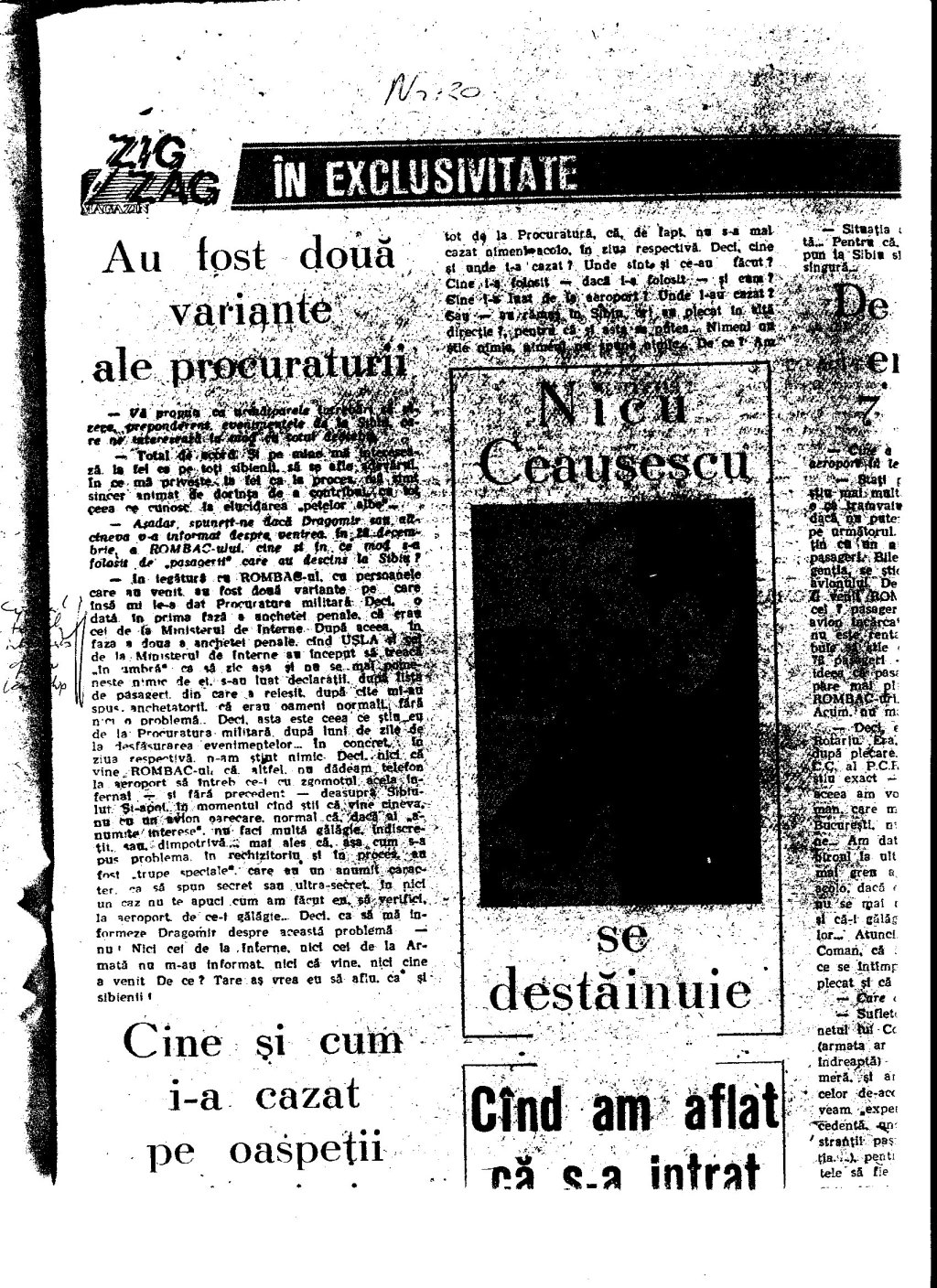
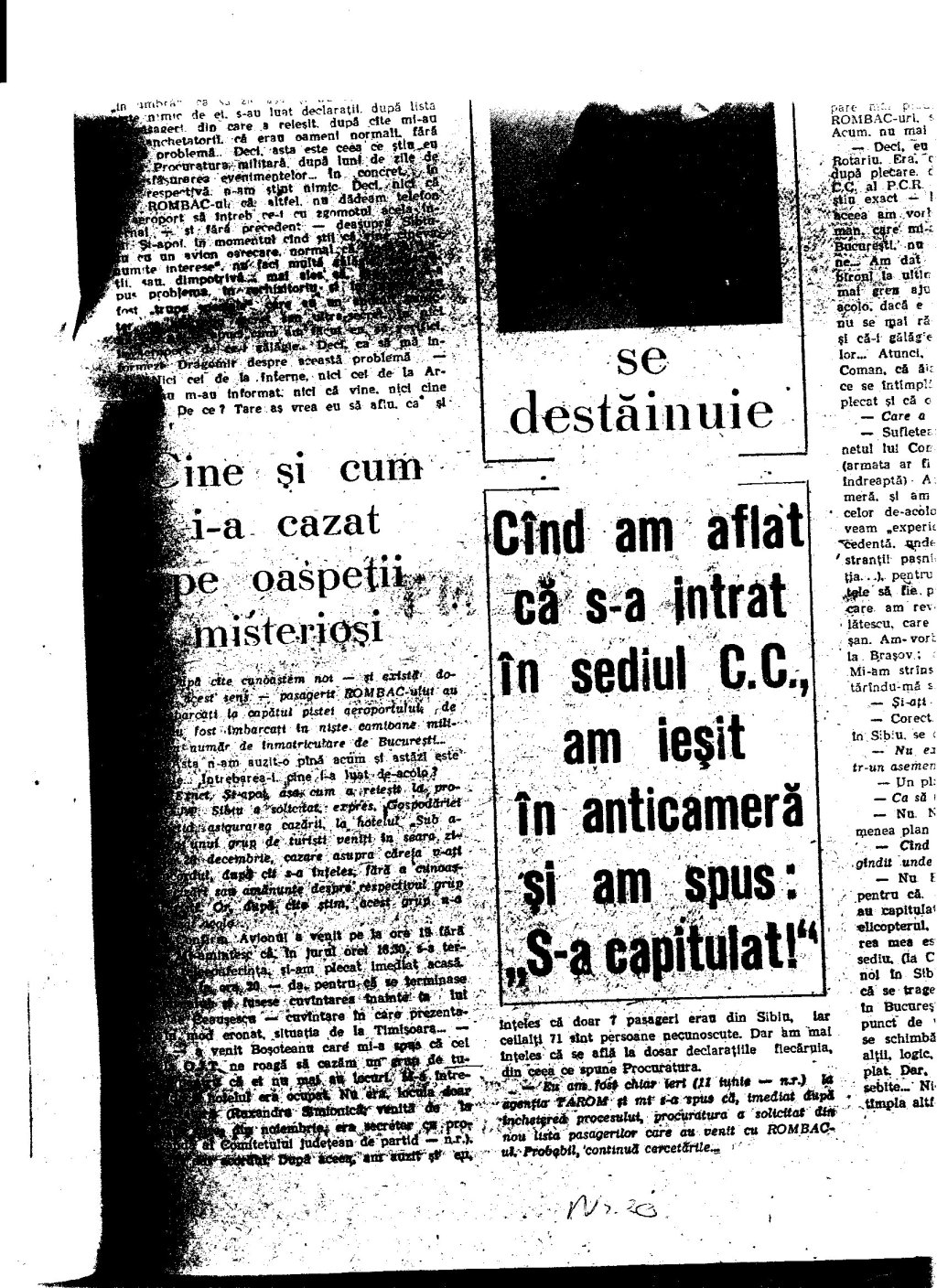
An interesting–if slightly confused–discussion of the “tourists”/ USLA in Sibiu in December 1989!

http://portalulrevolutiei.ro/forum/index.php?topic=3.615

Re: @ REVOLUTIA SIBIU 1989 @
« Reply #615 on: March 08, 2010, 15:31:24 PM »

Fac apel la oricine care a fost in seara de 21 spre 22 (ora 11,30-11,50) pe strada(actuala)Revolutiei, sau a vazut autoturismele parcate vis-sa vis de fosta Brutarie Nesciuc trei albe si una rosu inchis “Lada”. Va intreb daca cele 11 persoane imbracate cu scurta albastre tip jeans,  pantaloni deschisi la culoare, doi cu caciula de blana, trei cu caciula de lana impletita de culoare inchisa, si restul cu capul gol care au intors autoturismele parcate din capatul strazii si incendierea acestora? Statura lor era atletica? Cine a mai vazut apoi aceste persoane (acest gen) in afara de Piatza Mare din 21 decembrie ora 11,30 cand l-au protejat pe domnul care a iesit in fatza scutierilor cu copilul ridicat pe maini? (in dreptul Casei Albastre)
Aceleasi persoane au fost si in data de 21 decembrie la ora 9 in fata intrarii in magazinul Dumbrava, cand au “jenat” fara nici o teama scutierii si politistii care incercau sa prinda persoanele care fugeau prin magazin…Mai apelez la locatarii Blocului de garsoniere “turn” din coltul Calea Dumbravii-Milea, sa ne trimita o informatie cu intamplarile din 23-25 de la etajul 7-8, cu persoanele in combinezon de culoare inchisa care au coborat pe partea dinspre magazin din balcon in balcon, inclusiv despre persoana decedata, daca are legatura cu acel incident.O alta intrebare extrem de importanta: stie cineva cine a organizat “filtrele” de pe strazile Sibiului?Va multumesc
O precizare: Autoturismele erau parcate pe str Dobrun inspre str. Berariei Era pe trotoarul brutariei particulare (Nescuc sau Cibu, nu mai stiu cum se chema)

Re: @ REVOLUTIA SIBIU 1989 @
« Reply #623 on: March 11, 2010, 14:16:55 PM »

Acesti emanati, aceste lichele, nu-si puteau face jocurile, acapararea puterii totale, precum si inaintasii lor Dej si Ceausescu, decat prin forta represiunii armate. Parte din armata a reactionat pasnic, datorita onor ofitzeri care au dovedit mai multa logica, parte din armata a jucat rolul de dusman al romanilor. La Sibiu, avem tot mai multe date care intaresc teoria ca Dragomir a fost teroristul Nr. 1 in acele zile, ajutat si de grupul USLA trimis de la Bucuresti la Sibiu, pentru protectia lui NC, si care s-au reantors la “locul faptei” dupa ce l-a pus pe Nicu in siguranta. Ei au fost aceia care au comis executiile din Piatza Mare in ziua de 21 decembrie ora 11,45 cu primele victime ucise sau ranite. Au fost repartizati in patru puncte ale pietii: In podul Casei Albastre, in podul actualei Primarii, in podul de deasupra Tunelului Generalului si in podul de deasupra magazinului Moda. De aici, au deschis foc inspre demonstranti. Au deschis foc si pe data de 22 decembrie inspre hotelul Imparatul Romanilor din acelasi pod de deasupra Tunelului Generalului care avea corespondent cu celelalte poduri dinspre magazinul Covorul. Aceste grupe ale USLA nu aveau insemne de grad sau arma, nu purtau boneta militara si aveau la dispozitie doua microbuze ale unitatii 01512 care i-a transportat in tot acest timp. Un grup al USLA era incepand din ziua de 21 decembrie ora 07 la sediul Judetenei de partid, ocupand garajul din curtea din sapate cu munitie si armament special. Se poate descoperi foarte repede, numele persoanelor care au fost trimise la SIBIU cu Rombacul in dupa-amiaza zilei de 20 decembrie, ca urmare a convorbirilor indelungate purtate de Nicu si Bucuresti, despre demonstratia anuntata pentru dimineata zilei de 21 decembrie de la Mag Dumbrava. In timpul convorbirii telefonice, in biroul lui Nicu se afla Traian Popsa, fostul director de la IJIM Sibiu, maiorul Dragomir, seful Garzilor judetene Pescaru, secretar al CJPCR Sibiu si Niculae Hurubean, prim secretar la Alba care se afla in trecere prin Sibiu. Aceste trupe USLA au purtat alternativ, combinezoane negre, uniforma militara sau haine civile…
Lovitura de stat cu spectatori, cum zice Cornel Dinu, a functionat atata timp cat au avut nevoie pentru a pune mana pe putere acesti derbedei bolsevici-kaghebisti
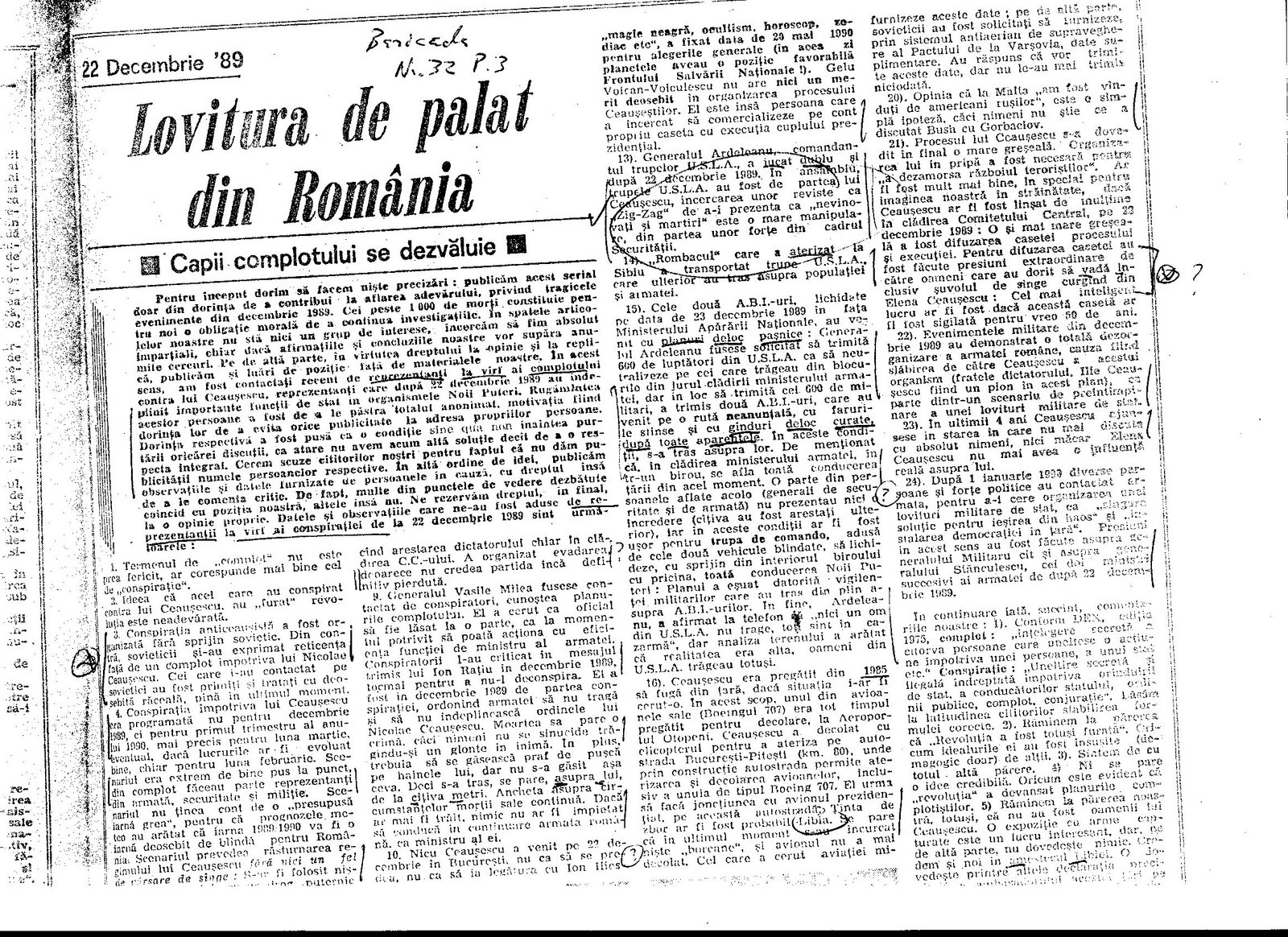
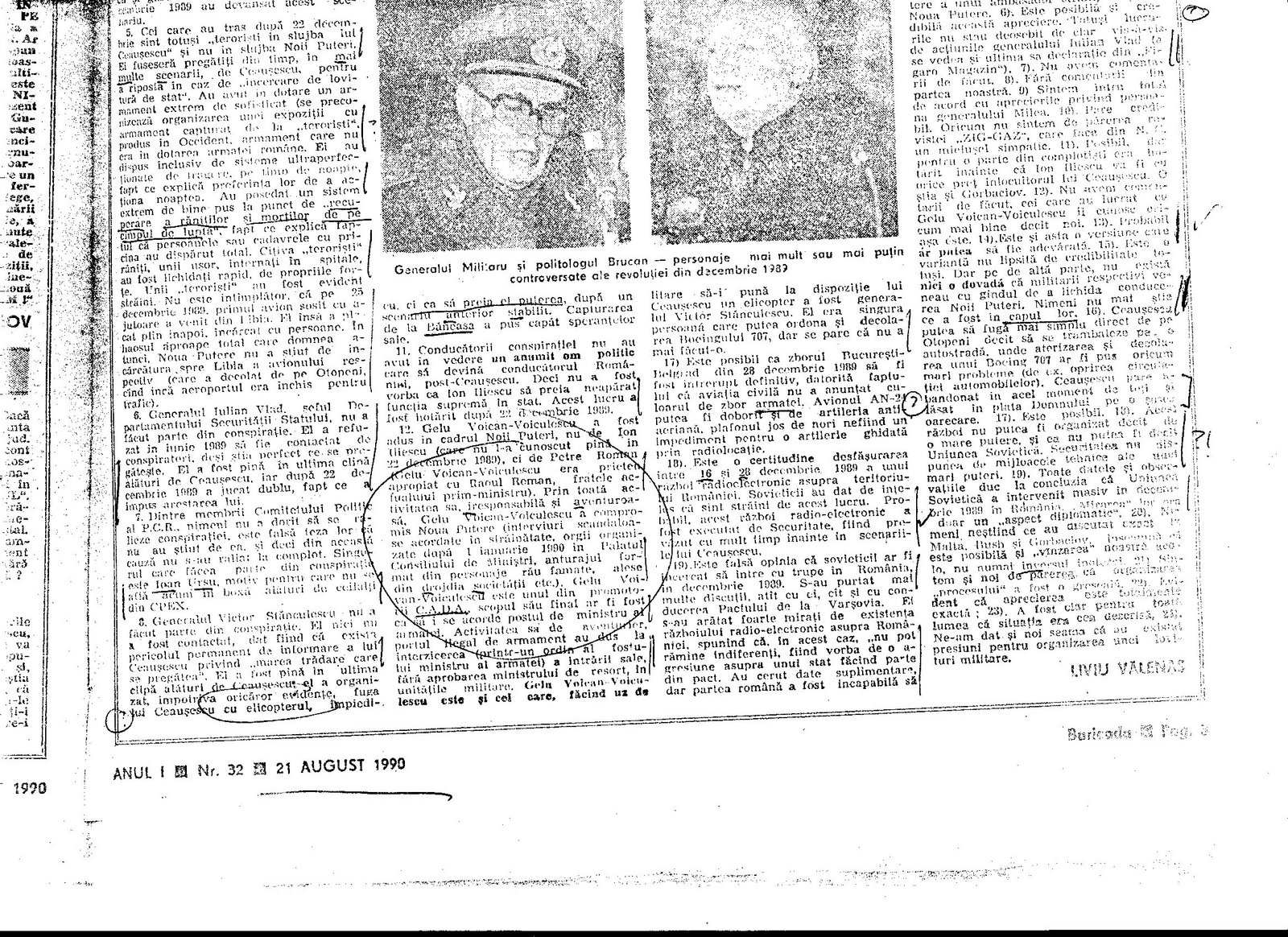
Posted in decembrie 1989 | Tagged: , , , , , , , , , , , , , , , , | 5 Comments »

Revisiting the Myths of the Revolution: “Romania’s TV Revolution had only one side…everyone had been on it.”

Posted by romanianrevolutionofdecember1989 on April 20, 2013

Previous material on the same general topic (strictly personal views as always):

Revisiting the Myths* of the Romanian Revolution.  Part I:  The Hegemony of Conspiratorial and Postmodernist Explanations http://atomic-temporary-3899751.wpcomstaging.com/revisiting-the-myths-of-the-romanian-revolution-part-i-the-hegemony-of-conspiratorial-and-postmodernist-explanations/

Myth 1:  The “Timisoara Syndrome” or the “False Timisoara Grave (the Paupers Cemetery)/Massacre” http://atomic-temporary-3899751.wpcomstaging.com/revisiting-the-myths-of-the-revolution-part-ii-the-timisoara-syndrome-or-the-false-timisoara-grave-the-paupers-cemeterymassacre/

Myth 2:  The water is posioned!  (Apa este otravita!) http://atomic-temporary-3899751.wpcomstaging.com/revisiting-the-myths-of-the-revolution-part-iii-the-water-is-poisoned-apa-este-otravita-dr-heyndrickxs-toxicology-report/

Myth 3:  The Romanian Television building is in danger, danger of an explosion!   (TVR e in pericol–Pericol de explozie!) http://atomic-temporary-3899751.wpcomstaging.com/revisiting-the-myths-of-the-revolution-part-iv-the-romanian-television-building-is-in-danger-bomba-in-subsolul-televiziunii/

image0

“Romania’s TV Revolution had only one side…everyone had been on it.”

So told us Andrei Codrescu in a Harper’s Magazine article–“Big Chills:  My High School Reunion in Romania,” an apparent play on the 1983 reunion film, The Big Chill–published in November 1990 (see the link below for an online version).  Codrescu’s article is unintentionally a tour de force in relaying to English-language readers Securitate (the Romanian secret police of the communist era) disinformation regarding their role in December 1989.  I was, ironically, myself in the same city, Sibiu, during the same month (mid-late July 1990), and heard many of the same details and arguments from Romanians that Codrescu recounts in the article.  Of course, I have learned an awful lot since then…

https://docs.google.com/viewer?a=v&q=cache:R0rgBuN52mUJ:alina_stefanescu.typepad.com/files/big-chills-my-high-school-reunion-in-romania-by-andrei-codrescu-1.pdf+romania+big+chills+codrescu+one+side&hl=en&gl=us&pid=bl&srcid=ADGEESgdk_7CPbEjBWbb_Qu0X-f8DTaCv4LzfLkp32-9uQ0FM5IQBPrp55QzDOlUlRa8ATqFHD_zuf5-Duji83oZsMIOxFtpCGqm1v1-MUq52PRv6HSrazFkl6oYCZeVKT6N24DvX_by&sig=AHIEtbT7nr99RVabjfFfuNQpOD5okuapCA

There are many ways to disprove the myth that “Romania’s TV Revolution had only one side…everyone had been on it.”  I choose here one that has gone unmentioned inside Romania and in the English-language literature on December 1989–and one of which so few people appear to be aware:  the statements of senior military officials of a neighboring country attesting to the fact that Romania’s TV Revolution did not have only one side, but had an adversary, Securitate forces.  In fact, the Hungarian military relayed to the Romanian military the locations of Securitate transmitters, allowing the Romanian military to neutralize those facilities.

(26 December 1989 1730 GMT Budapest Domestic Service in Hungarian,FBIS-EEU-89-247, p. 39)

Colonel Gyorgy Keleti, head of the Hungarian People’s Army Press Department:

“…I would like to say that a progressive weakening of the Securitate has been experienced.  We ourselves can see this, because our radio searching and locating units which were in Hungary a few days ago were monitoring broadcasts from 31 Securitate radio centers–yesterday 19, and today only 5.  We of course put this data at the disposal of the Romanian military leadership.”

The Hungarian Defense Ministry repeated this claim in a statement released on 11 January 1990:

1990. január 11., csütörtök 18:55


A Honvédelmi Minisztérium közleménye (4. rész) (OS)
A kezdeti időszakban, amikor a diktátorhoz hű Securitate a
forradalom vérbe fojtására jelentős erőket vetett be, a Magyar
Néphadsereg speciális képzettségű rádióbemérő alakulatainak egy
részét átcsoportosította a magyar-román államhatár közelébe a
Securitate rádióállomásainak bemérésére, helyeinek meghatározására.
Ezeknek az adatoknak az átadásával, az adók bemért földrajzi
helyeinek megjelölésével feltehetően segítséget nyújtott a Magyar
Néphadsereg a Securitate-bázisok felszámolásában, megsemmisítésében.
Szinte napról napra érzékelhető volt ezek számának csökkenése, ami a
magyar szakértők szerint arról tanúskodott, hogy a diktátorhoz hű
erők törzseit a román hadsereg folyamatosan számolja fel. Ezt
példázza, hogy a december 26-án nyilvánosságra hozottak szerint
24-én még 31, 25-én már 19 és 26-án csupán öt
Securitate-rádióközpont működését rögzítették és mérték be a magyar
rádiófelderítő és bemérő alegységek.


and Ferenc Karpati, Hungarian Defense Minister at the time of the Romanian Revolution of December 1989, maintained this claim in an article published in Historia in 2000:

Ferenc Karpati:  “A Securitate erői ellen hosszú, küzdelmes harcot folytattak a hadsereg és a forradalom más erői. Felszámolásuk érdekében a Magyar Honvédség speciális képzettségu rádióbemérő egységeinek egy részét átcsoportosítottuk a román államhatár közelébe, s így sikerült rádióállomásaikat bemérni, álláshelyeiket pontosan meghatározni. Az adatok átadásával jelentősen elősegítettük a Securitate-bázisok felszámolását.”  KÁRPÁTI FERENC: A román forradalom és Magyarország, 1989. Egy volt miniszter emlékezése

Posted in decembrie 1989, raport final | Tagged: , , , , , , , , , , , , , | Leave a Comment »