The Archive of the Romanian Revolution of December 1989

A Catch-22 December 1989, Groundhog-Day Production. Presenting the Personal Research & Scholarship of Richard Andrew Hall, Ph.D.

Posts Tagged ‘romanian revolution’

25 for 2014: 25 Things You Should Know about the Romanian Revolution on the 25th Anniversary of the Fall of Nicolae Ceausescu’s Communist Regime: #1 The Securitate Deny Foreign Instigation of the Timisoara Uprising

Posted by romanianrevolutionofdecember1989 on February 2, 2014

(Purely personal views as always, based on over two decades of research and publications inside and outside Romania)

—————————————————————————————————————————————————————————

[UPDATE 2.  A Response to Watts: The Pitfalls of Not Having Any Evidence

http://atomic-temporary-3899751.wpcomstaging.com/a-response-to-watts-the-pitfalls-of-not-having-any-evidence/

UPDATE I.  Related of relevance:  http://atomic-temporary-3899751.wpcomstaging.com/all-the-soviet-tourists-where-do-they-all-come-from/

What do previous studies tell us about the Soviets sending in agents posing as “tourists” prior to or during a military action or invasion against another country?

Mark Kramer has detailed Soviet use of “tourist” cover in the following CWIHP Bulletin article (Fall 1993, “The Prague Spring and the Soviet Invasion of Czechoslovakia:  New Interpretations (Second of two parts),.  What is important to take away from this?  The Soviets posed as WESTERN tourists.  They did not pose as…”Soviet tourists”!!!…

Indeed, what Larry Watts seems to miss in his exposition of claimed incidents of Soviet use of “tourist” cover in the context of planned/actual invasion is that in none of the examples do Soviet agents pose as…”Soviet tourists”…Why?  Because it is a relatively poor cover story that doesn’t give much deniability that they were Soviets.  If you are trying to conceal your Soviet links, you would most likely pose as some kind of other tourist, not as a Soviet tourist…

Why then, in December 1989, in Romania, are we to believe, that the Soviets would have abandoned precedent and posed as…”Soviet tourists”…driving around in Soviet automobiles (more easily identifiable in Romania than other Soviet bloc states because of the domestic production of and dominance of the market by Dacia vehicles) with Soviet tags/license plates, and apparently carrying Soviet passports?  Doesn’t sound particularly intelligent, does it?  Instead, such things would draw attention to you and would mint you as…Soviets!

http://atomic-temporary-3899751.wpcomstaging.com/2014/01/24/what-would-it-have-looked-like-if-nicolae-ceausescus-securitate-executed-a-plan-to-counter-an-invasionbut-the-invaders-never-came-iii/ ]

—————————————————————————————————————————————————————————

2014 marks the 25th anniversary of the collapse of communism in central and eastern Europe–Poland, Hungary, East Germany, Czechoslovakia, Bulgaria, and Romania.  This (likely aperiodic) series looks at 25 things I have learned about the events of the Romanian Revolution of December 1989.  The numbering is not designed to assign importance, but rather–to the extent possible–to progress chronologically through those events.

Significance:  Until the documents below were made publicly available and I unearthed the following, we had to rely primarily on arguments emphasizing the Securitate roots of these claims and/or about the implausibility and often absurdity of these claims.  We now have documentary evidence that in the immediate wake of December 1989 not even the Securitate believed in the claims they would make so frequently later on.

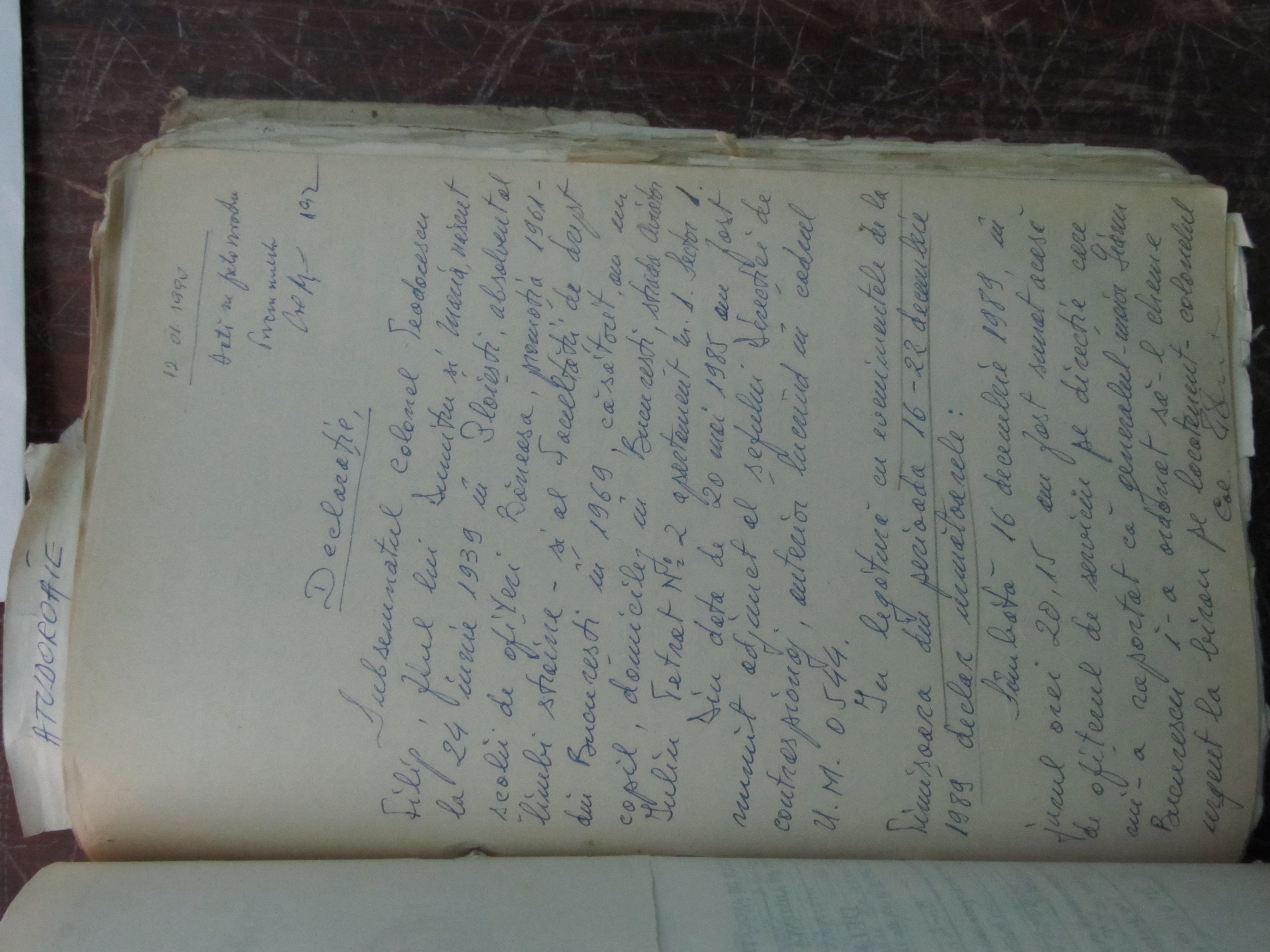
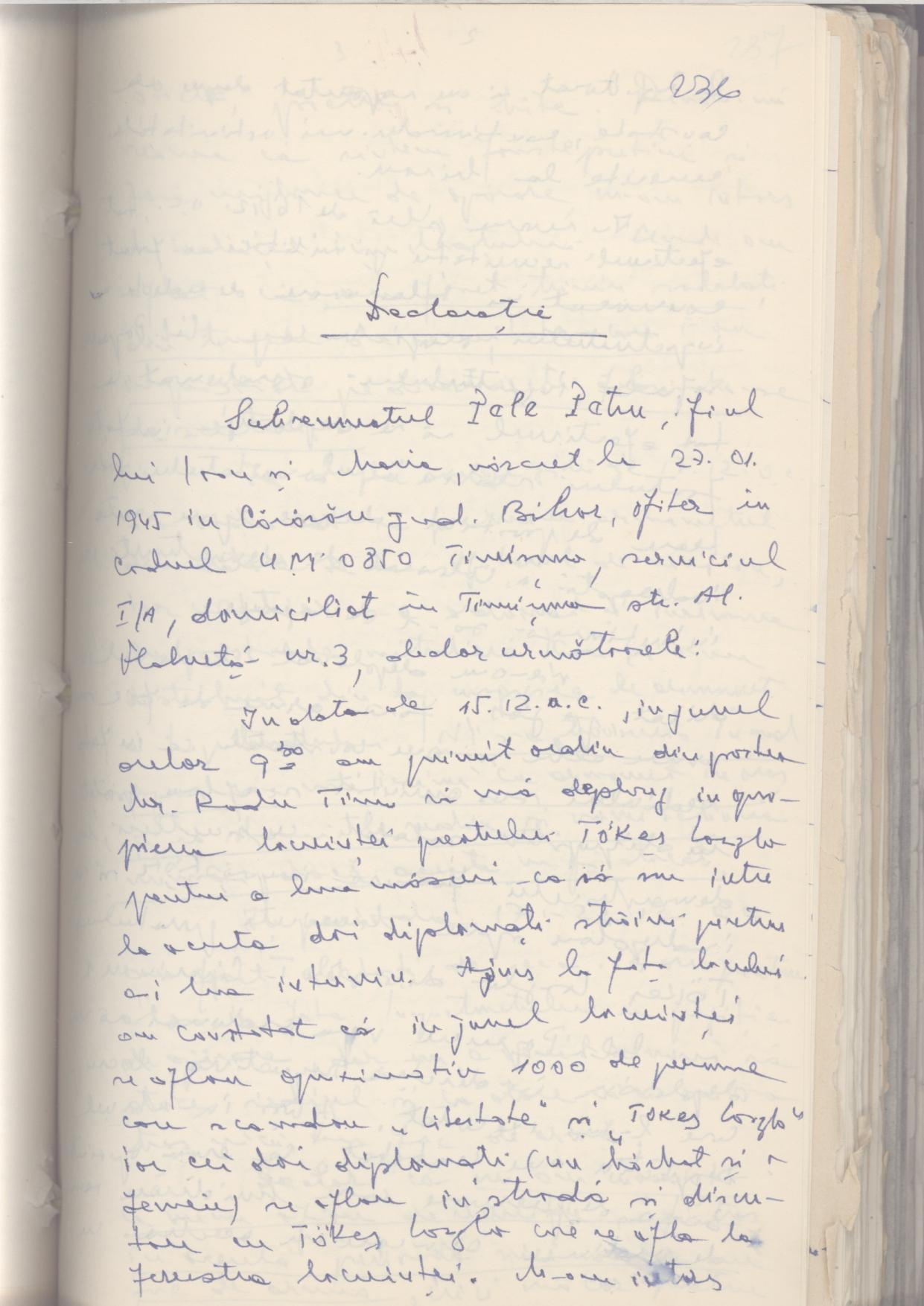
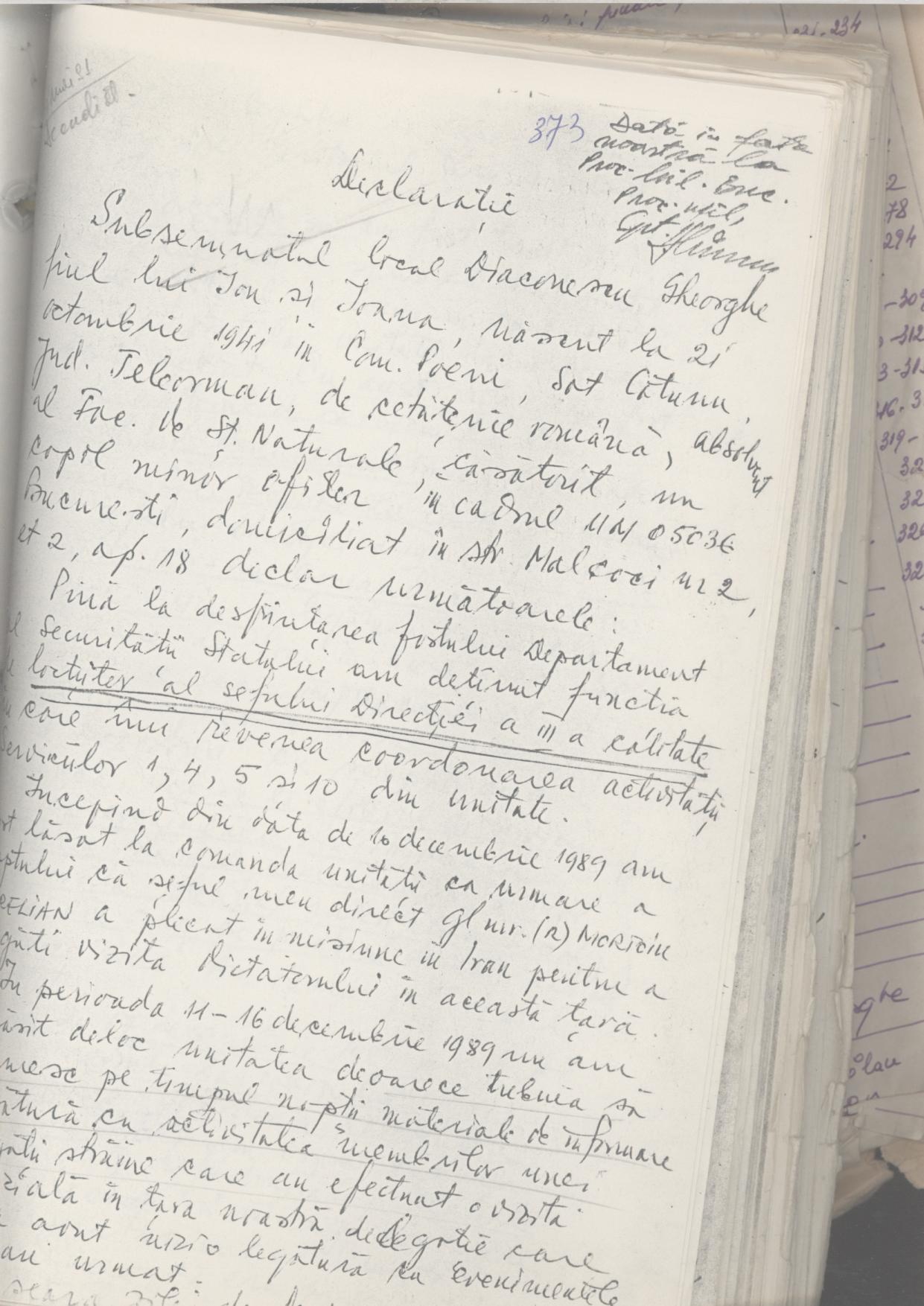
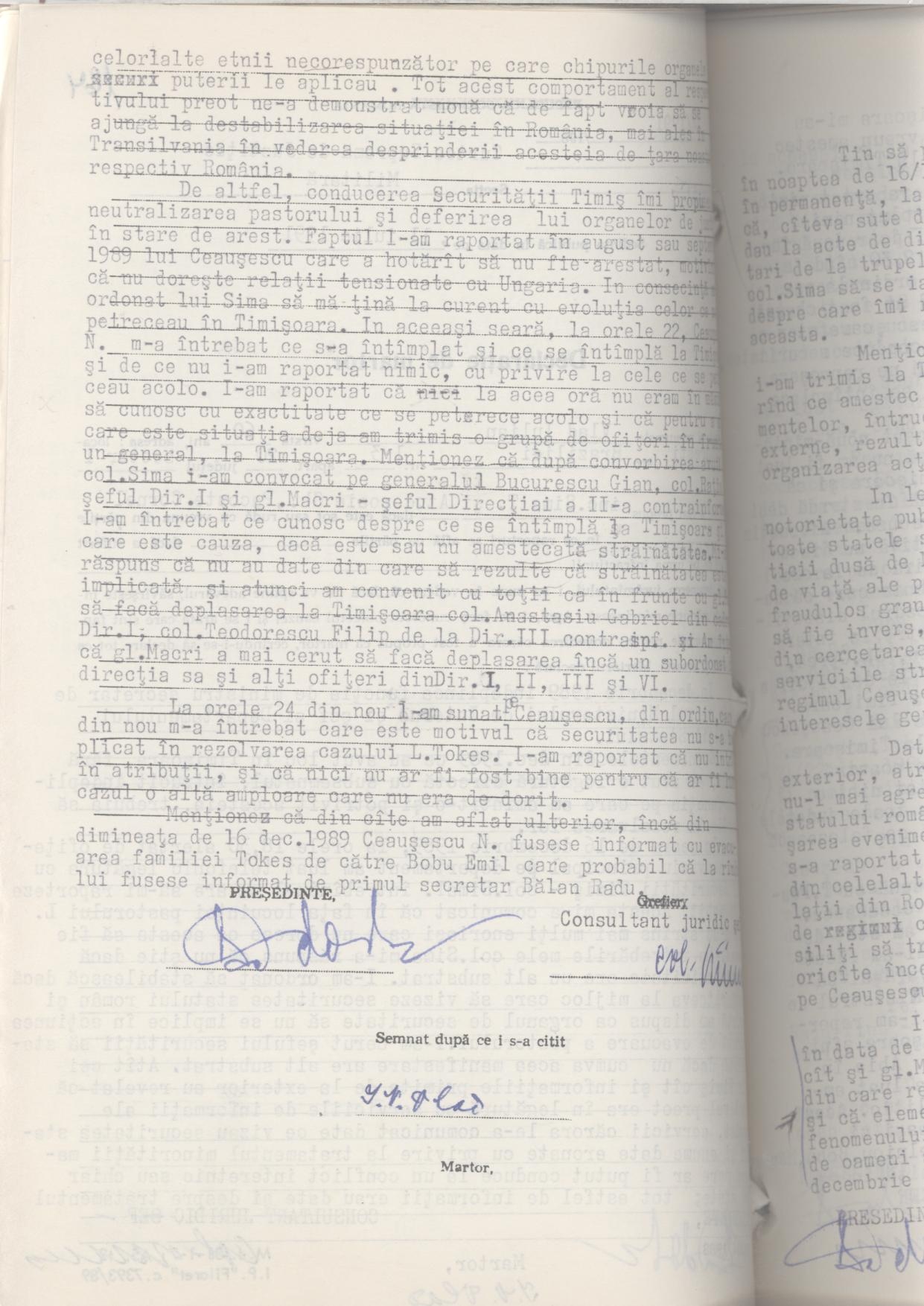
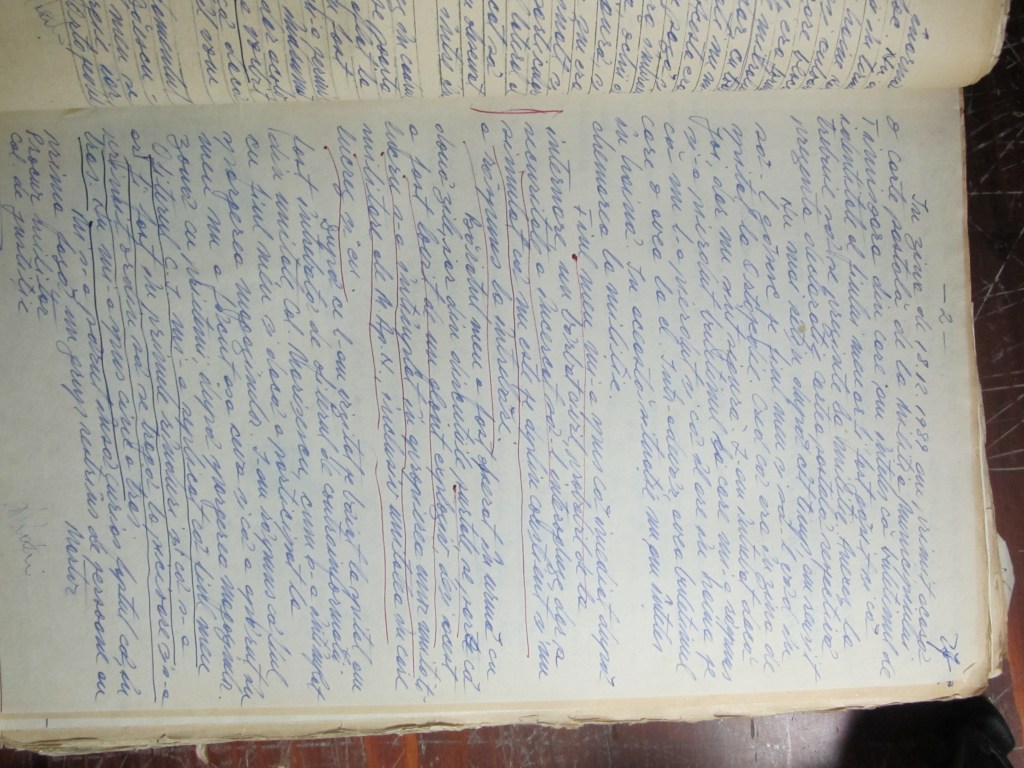
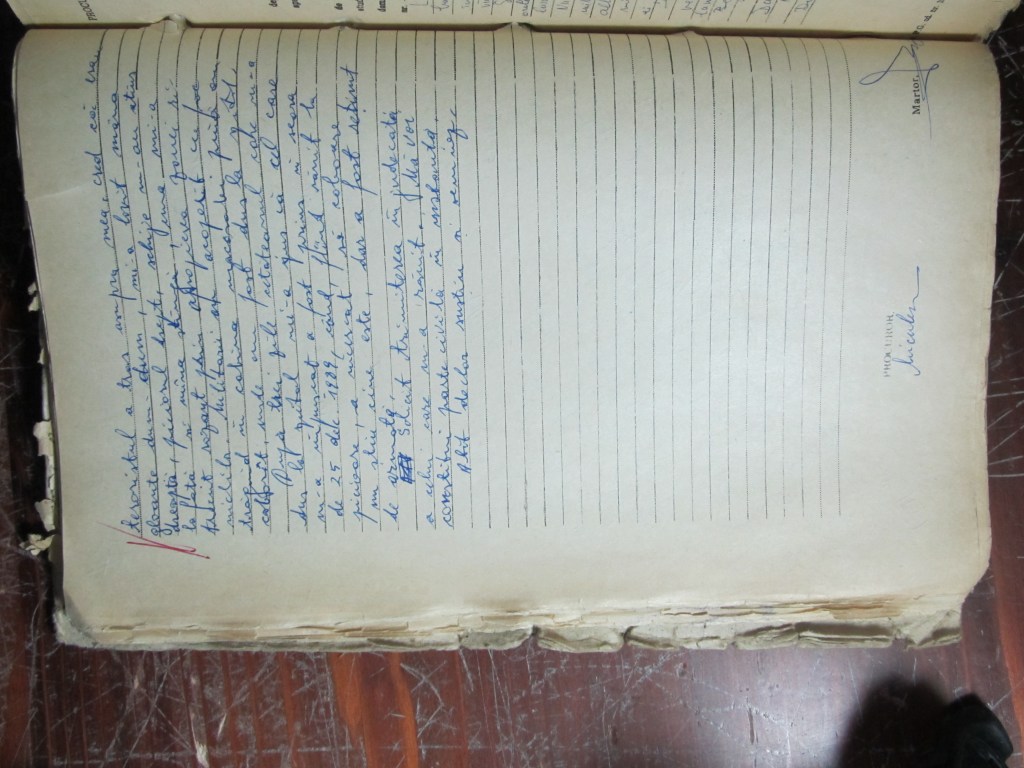
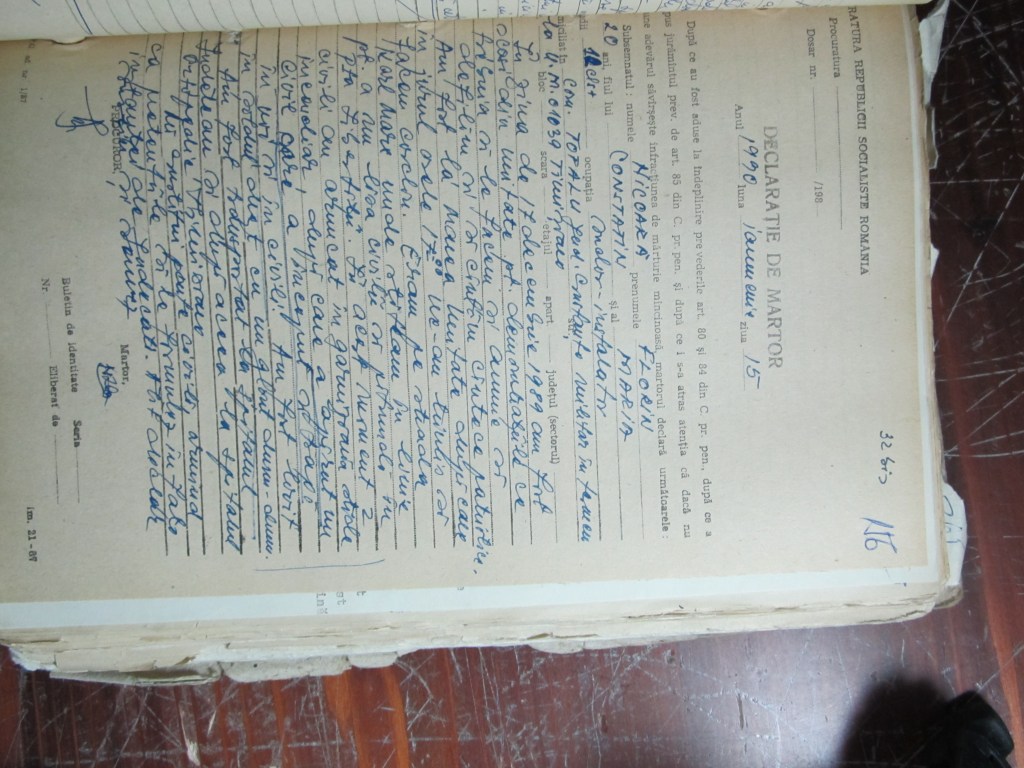
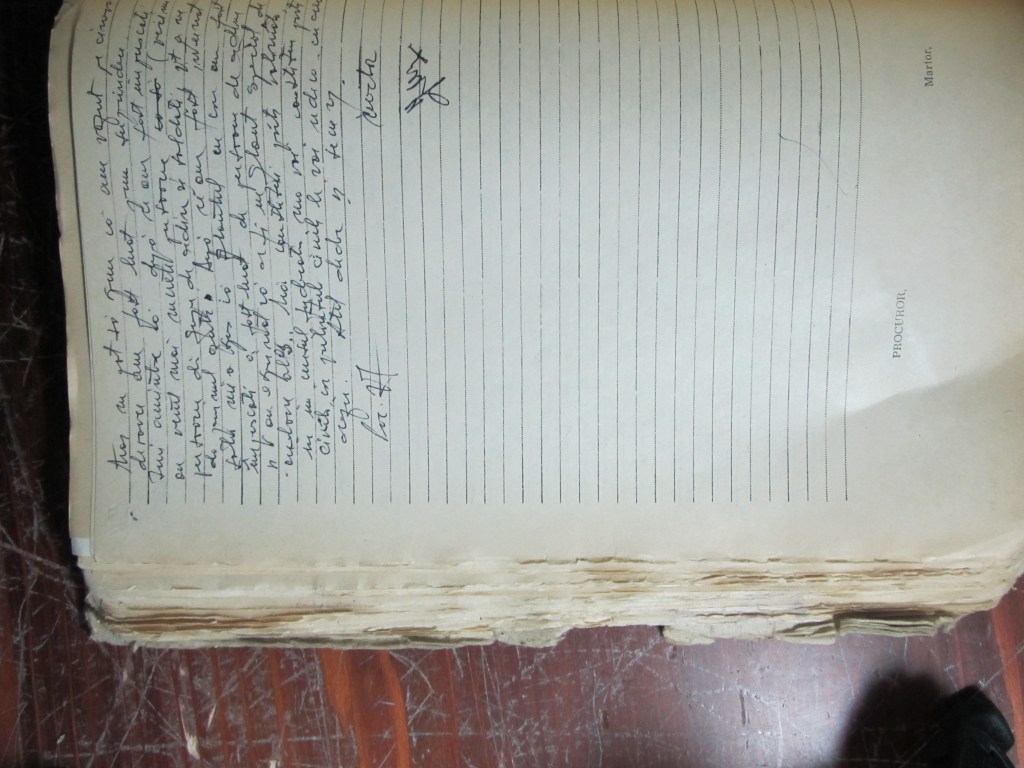
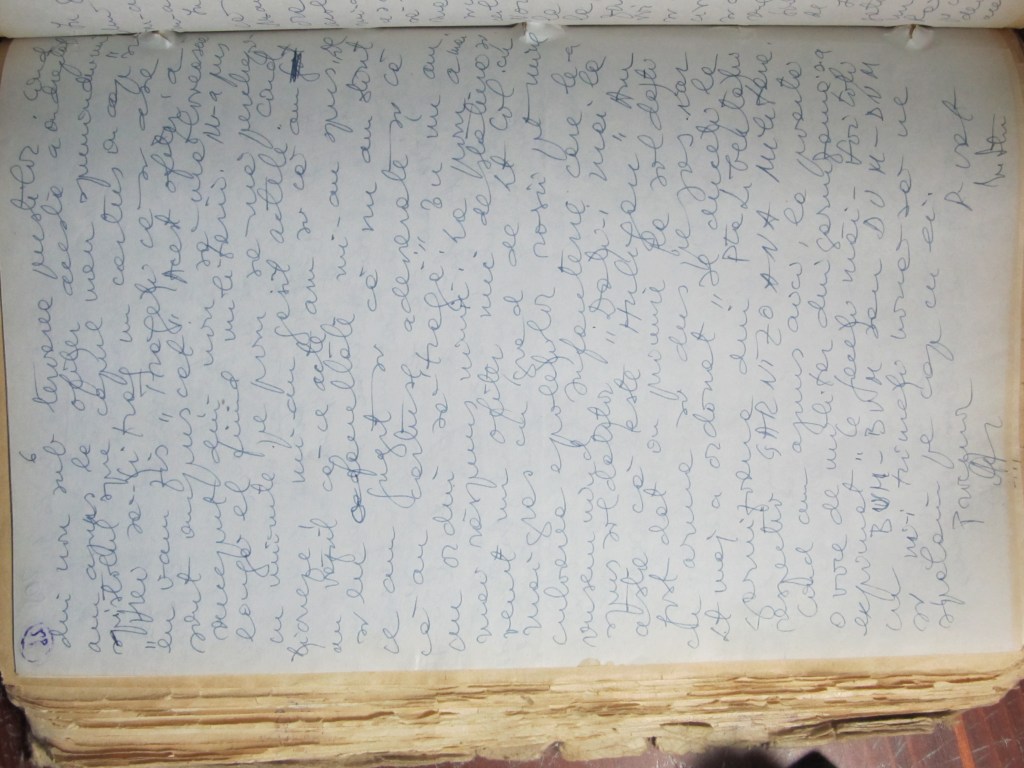
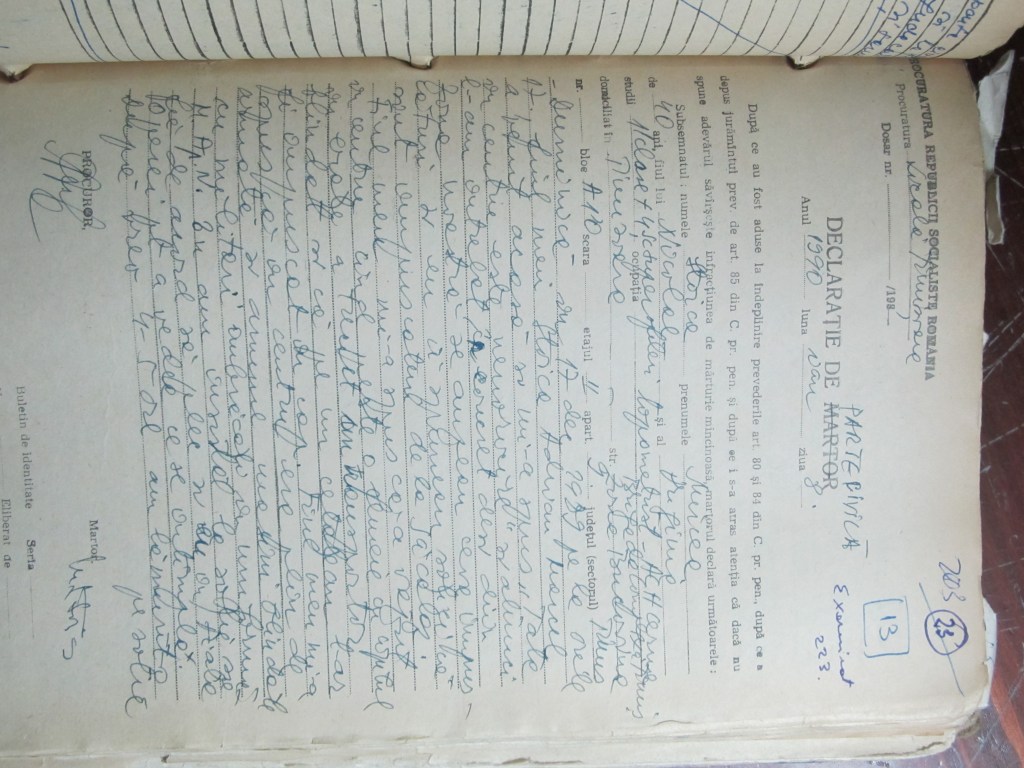
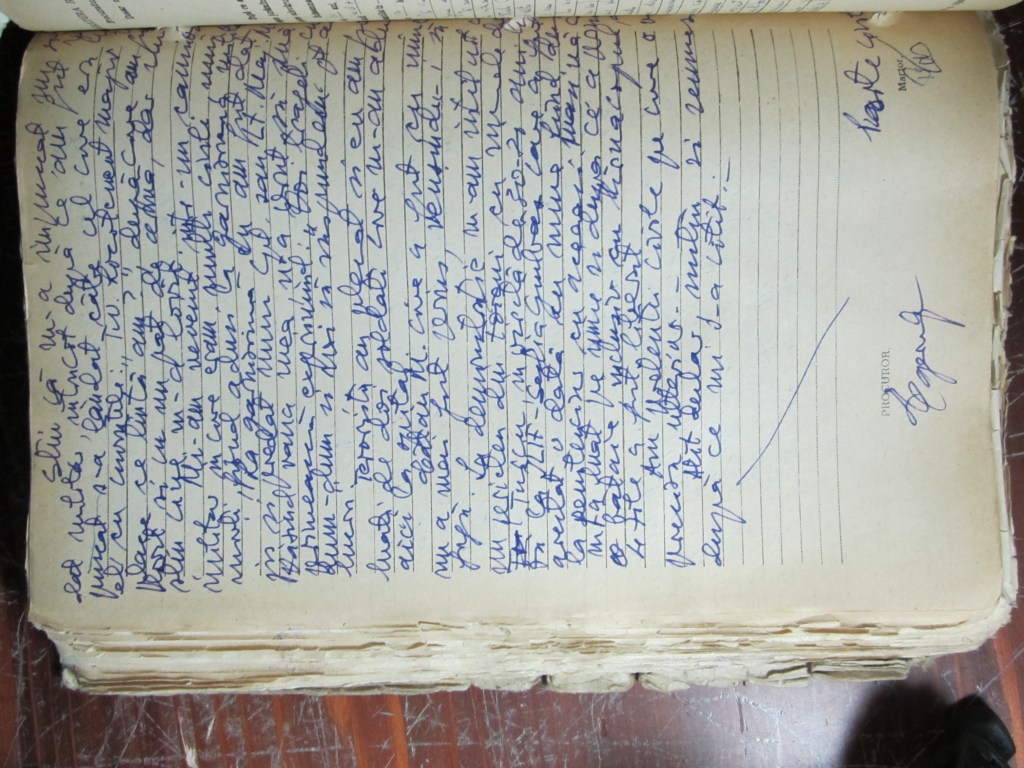
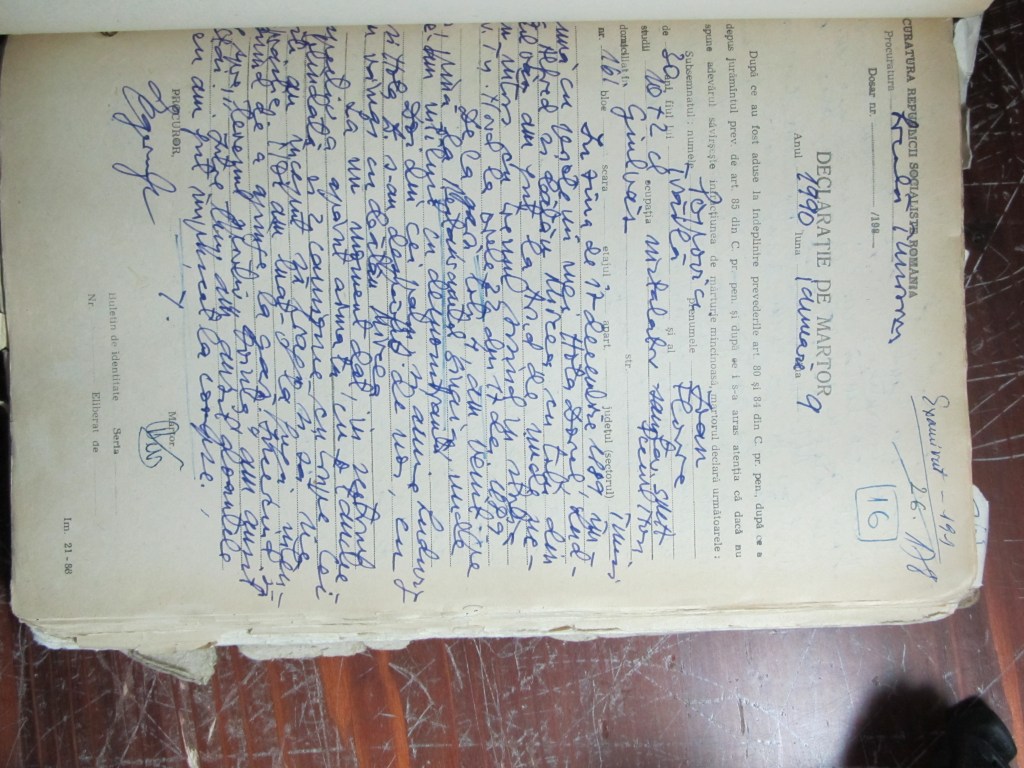
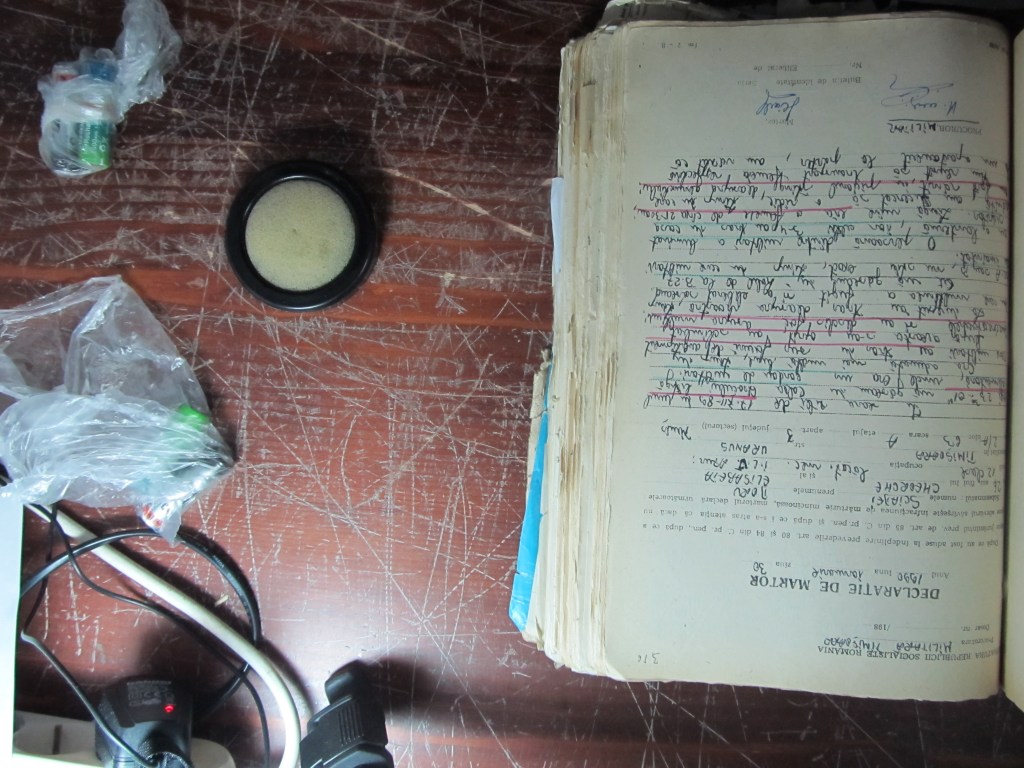
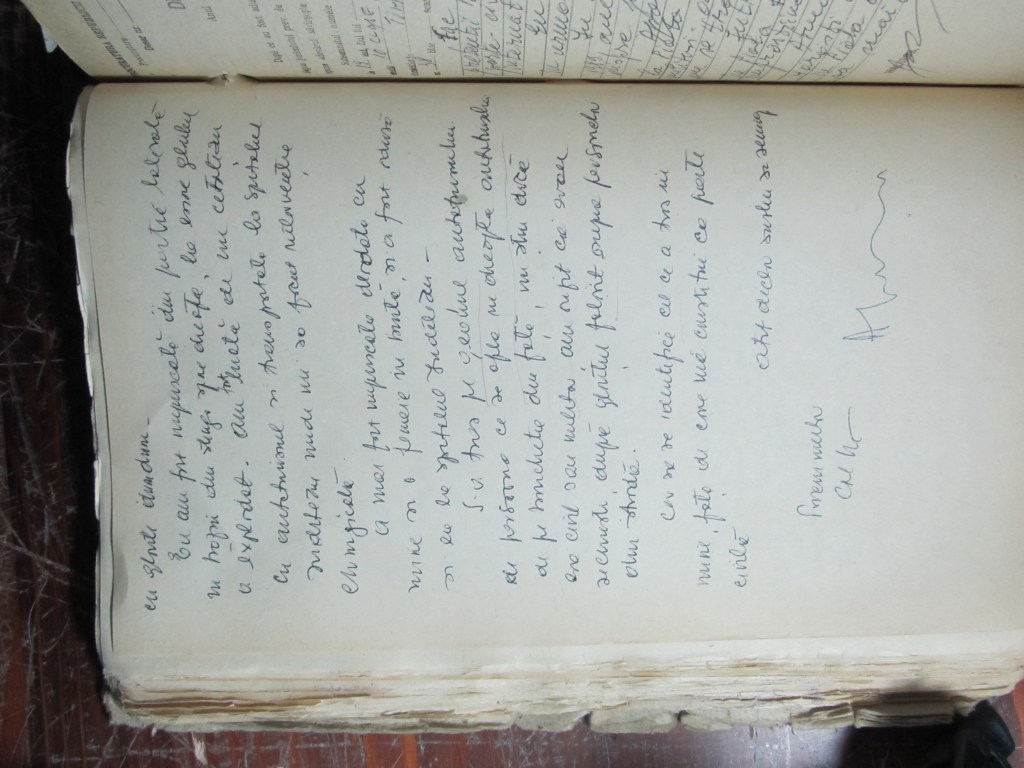
The Timisoara files about December 1989 are now publicly available (when the link works!) on the Internet at http://dosarelerevolutiei.ro/.  What they show is that Securitate, Militia, and other regime officials from Timis County were asked by Bucharest–communicated via the person of Securitate Director, General Iulian Vlad–to investigate the role of foreign elements, specifically tourists, in the Timisoara protests of mid-December 1989.  But they were not the only ones.  General Vlad tasked senior Securitate officials from Bucharest sent to Timisoara to report back to him on this very topic alleging external involvement and manipulation of the Timisoara demonstrations.  What remains unclear is how much of this tasking was General Vlad communicating his own “hypothesis” or how much of it was he relaying Nicolae Ceausescu’s “theory” about what was going on.  This much is clear:  neither those stationed in Timis County, nor those officials sent from Bucharest could find evidence of a foreign hand in the Timisoara uprising, despite being asked to investigate exactly this aspect.  How do we know this?  From their own written confessions immediately after the December 1989 events.  (Below are four of them:  Nicolae Mavru, Liviu Dinulescu, Emil Macri, and Filip Teodorescu.)

Niculae Mavru, fost sef al sectiei ‘Filaj si investigatie’ de la Securitatea Timis, declaratia din 13 ianuarie 1990:  …la ordinul col. Sima Traian, am primit…misiuni de a observa si sesiza aspecte din masa manifestantilor, din diferite zone ale orasului in sensul de a raporta daca sint straini (ceea ce nu prea au fost) care incita la dezordine, acte de violenta sau altfel de acte… 0331 25 iunie 1991 “Desi ne-am straduit nu am putut raporta col. Sima implicarea completa a vreunui cetatean strain in evolutia demonstratiilor cit si fenomenlor care au avut loc la Timisoara,..”
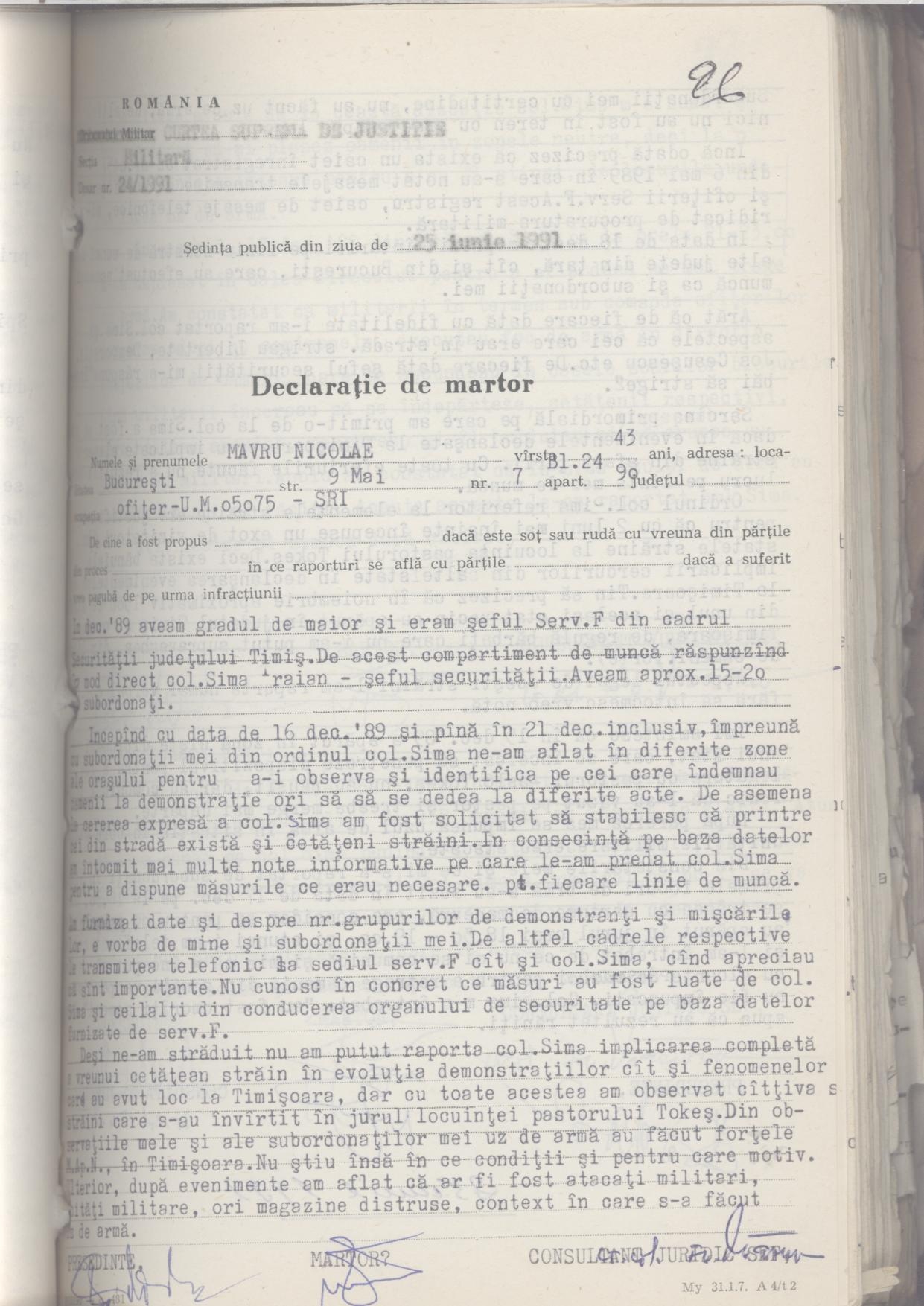
0173

“Sarcina primordiala pe care am primit-o de la col. Sima a fost daca in evenimentele declansate la Timisoara erau implicate elemente straine din afara tarii.  Cu toate eforturile facute nu a rezultat lucru pe linia mea de munca.” 0174

26 iunie 1991, Declaratia lui Liviu Dinulescu, cpt. la Serviciul de Pasapoarte al jud. Timis (in decembrie 1989, lt. maj. ofiter operativ Securitate judetean la Serv. III, care se ocupa de contraspionaj)

“Precizez ca anterior declansarii evenimentelor de la Timisoara din datele ce le detineam serviciul nostru nu rezulta vreun amestec din exterior in zona judetului Timis.”

0197

Generalul Emil Macri (seful Dir. II-a Securitatii, Contrainformatii Economice),

Declaratie 2 ianuarie 1990:

“Rezumind sintetic informatiile obtinute ele nu au pus in evidenta nici lideri si nici amestecul vreunei puteri straine in producerea evenimentelor de la Timisoara.  Raportarea acestor date la esalonul superior respectivi generalului I. Vlad a produs iritare si chiar suparare…”

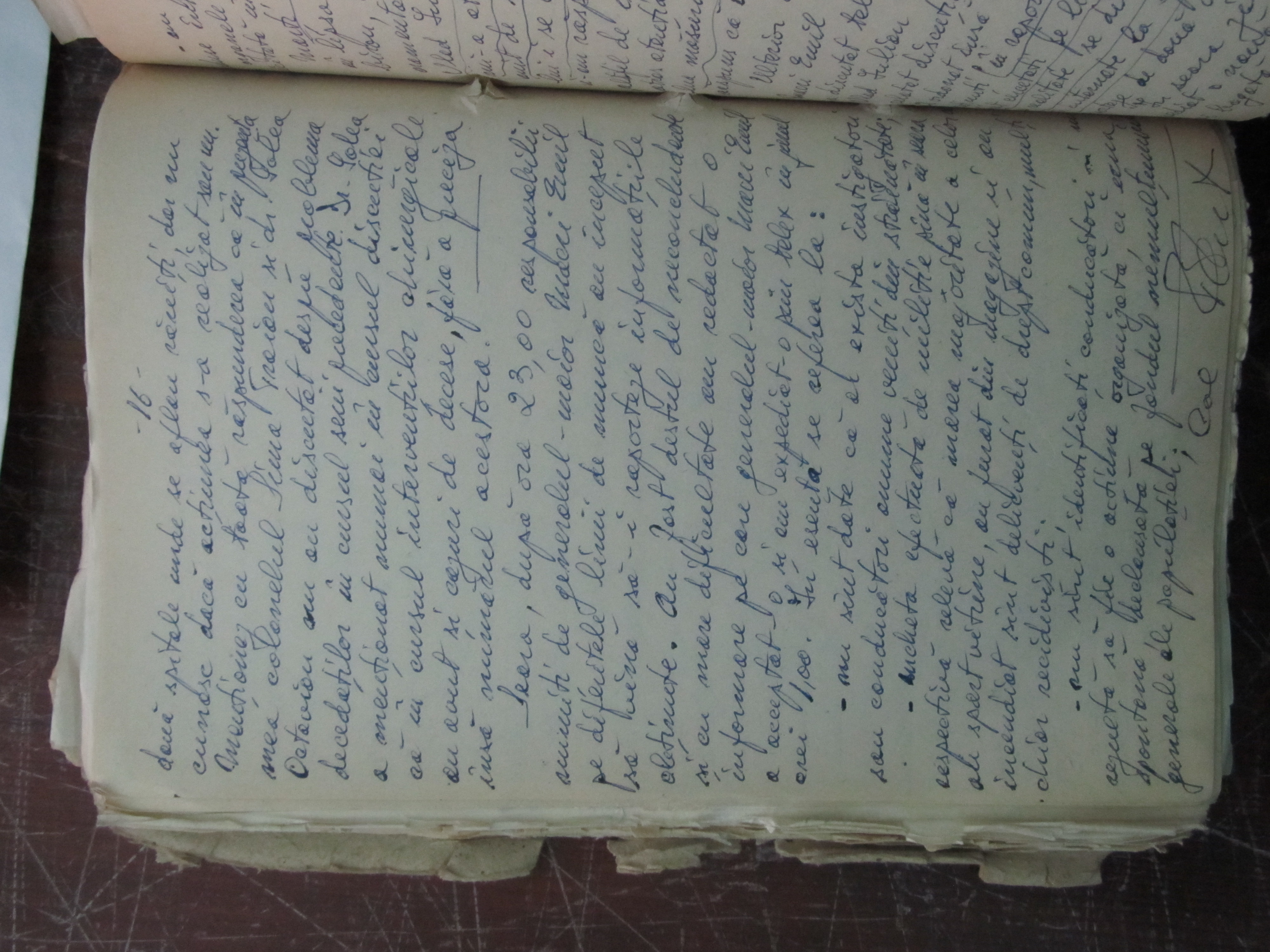
IMG_1219 IMG_1215 Filip Teodorescu (adj. sef. Dir III Contraspionaj D.S.S.), Declaratie, 12 ianaurie 1990:  Seara [luni, 18 decembrie 1989], dupa 23:00, responsabili (anumiti ?) de generalul-maior Macri Emil pe diferitele linii de munca au inceput sa vina sa-i raporteze informatiile obtinute.  Au fost destul de neconcludente si cu mare dificultate am redat o informare pe care generalul-maior Macri Emil a acceptat-o si am expediat-o prin telex in jurul orei 01:00 [marti, 19 decembrie 1989.  In esenta se refera la: –nu sint date ca ar exista instigatori sau conducatori anume veniti din strainatate… IMG_1453 IMG_1438 http://atomic-temporary-3899751.wpcomstaging.com/2013/04/29/high-time-to-unpack-already-why-the-restless-journey-of-the-soviet-tourists-of-the-romanian-revolution-should-come-to-an-end/
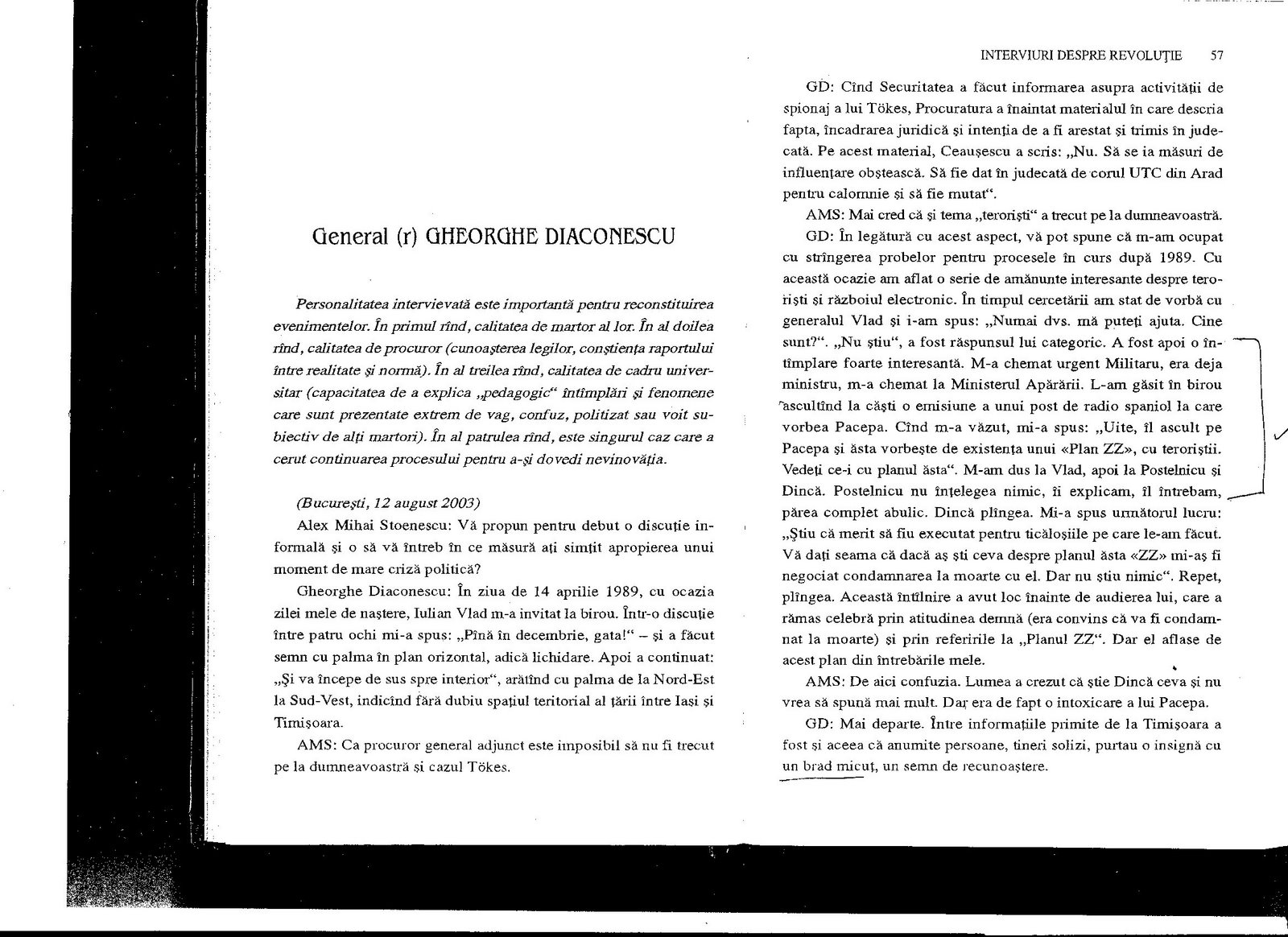
Mai jos, declaratiile lui Petre Pele, Tudor Postelnicu, Gheorghe Diaconescu, si Iulian Vlad Excerpt from Chapter 5 of my Ph.D. Dissertation at Indiana University: Richard Andrew Hall, Rewriting the Revolution: Authoritarian Regime-State Relations and the Triumph of Securitate Revisionism in Post-Ceausescu Romania (defended 16 December 1996). This is the original chapter as it appeared then and thus have not been revised in any form. http://atomic-temporary-3899751.wpcomstaging.com/rewriting-the-revolution-1997/

A Review of the Evidence

Although at first glance the regime’s treatment of Pastor Tokes seems strange and even illogical, within the context of the workings of the Ceausescu regime and the regime’s strategy for dealing with dissent it makes perfect sense. There is simply no convincing evidence to believe that the Securitate–or a faction within it–purposely dragged its feet in enforcing Pastor Tokes’ eviction, or was attempting to spark a demonstration in the hopes of precipitating Ceausescu’s fall. The regime’s decision to evict Tokes was not a last-minute decision. Moreover, the regime exerted tremendous and sometimes brutal pressure to silence Tokes in the months preceding this deadline. Interestingly, according to high-ranking members of the former Securitate, Nicolae Ceausescu’s unwillingness to approve the more definitive measures requested by the Securitate allowed the Tokes case to drag on without resolution (see below). The Tokes case suggests the bureaucratic and byzantine mentalities of the Ceausescu regime, and the clash between a dictator’s instructions and how the institutions charged with defending him interpret their mission. … The suggestion that the Securitate treated Tokes gently prior to his eviction is simply incorrect. On 2 November 1989, four masked men burst through the locked doors of the parochial residence, wielding knives and screaming in a fury. Tokes was slashed on the forehead before his church bodyguards could come to his rescue, causing the four to flee. The numerous Securitate men posted out front of the building had done nothing to intervene in spite of calls for help. Puspoki suggests that these “Mafia-like thugs,” who attacked as if from “an Incan tribe,” were some of Colonel Sima’s “gorillas,” sent to deliver a clear message to Tokes that he should leave immediately.[40] The view of the former Securitate–as expounded by Colonel Sima’s senior deputy, Major Radu Tinu–insinuates a “tourist”-like scenario. According to Tinu, the incident was clearly a “set-up” designed to draw sympathy to Tokes’ cause since the assailants fled away in a car with West German tags.[41] Not for the last time, the Securitate thus appears to attempt to attribute its own actions to foreign agents. A week after the mysterious attack by the masked intruders, all of the windows of the parochial residence and nearby buildings were smashed. Interestingly, the report drawn up for Bucharest by the Timisoara Securitate attempted to argue that “workers” from the Timisoara Mechanical Enterprise, offended by pastor Tokes’ behavior, had broken the windows. According to Puspoki, the use of a propaganda-like description was not accidental: the local Securitate was trying to present the incident as evidence of “the dissatisfaction of the working people of Timisoara” in the hope that it would finally prompt Ceausescu into approving definitive measures against Tokes.[42] Was Ceausescu responsible for the fact that the Tokes case dragged on without resolution? Support for such a conclusion comes from the comments of Securitate officers Colonel Filip Teodorescu and Major Radu Tinu. Teodorescu was dispatched to Timisoara with sixty other Securitate information officers in order to “verify” the request of the local Securitate that proceedings for treason be initiated against Tokes.[43] Teodorescu laments: Unfortunately, as in other situations…Nicolae Ceausescu did not agree because he didn’t want to further muddy relations with Hungary. Moreover, groundlessly, he hoped to avoid the criticisms of “Western democracies” by taking administrative measures against the pastor through the Reformed Church to which [Tokes] belonged.[44] Major Radu Tinu suggests that Ceausescu’s approval was necessary in the case of Securitate arrests and that the local Securitate remained “stupefied” that after having worked so long and hard in gathering information with which to charge Tokes with the crime of treason, Ceausescu rejected the request.[45] Tinu speculates that Ceausescu “did not want to create problems at the international level.” Because former Securitate officers rarely pass up the opportunity to absolve themselves of blame, and it would appear both easier and more advantageous to blame the deceased Ceausescu for being too unyielding in the Tokes affair, these allegations seem plausible. Thus, it would appear that because Nicolae Ceausescu was skittish of further damaging Romania’s already deteriorating relations with the international community, and the Tokes case was a high-profile one, he refrained from approving visible, definitive action against the pastor. The Securitate‘s attempt to goad Ceausescu to bolder action would appear to confirm Ghita Ionescu’s suggestion that where the security apparatus comes to dominate regime affairs it attempts to impose its institutional prerogatives upon political superiors. Ceausescu and the Securitate appear then to have had sometimes conflicting views over how to resolve the Tokes affair in the quickest and most efficient fashion. By December 1989, a huge group of Securitate officers were working on the Tokes case: the entire branch of the First Directorate for Timis county, the special division charged with combatting Hungarian espionage, high-ranking members of the First Directorate and Independent Service “D” (responsible for disinformation) from Bucharest, and members of the division charged with “Surveillance and Investigation.”[46] Puspoki describes Timisoara at this late hour as follows: Day and night, the telex machines on the top floor of the [County Militia] “Inspectorate” incessantly banged out communications, while the telephones never stopped ringing. Minister Postelnicu yelled on the phone, Colonel Sima yelled through the offices and the hallways. The officers ran, as if out of their minds, after information, besieged neighbors of the pastor, and dispatched in his direction–what they call–”informers with possibilities.”[47] Yet the case lingered on. On Sunday, 10 December 1989, Pastor Tokes announced to his congregation that he had received a rejection of his most recent appeal: the regime would make good on its threat to evict him on Friday, 15 December. He termed this an “illegal act” and suggested that the authorities would probably use force since he would not go willingly. He appealed for people to come and attend as “peaceful witnesses.”[48] They came.

[40].. Puspoki, “Piramida Umbrelor (III),” Orizont, no. 11 (16 March 1990), 4.

[41].. Bacescu, Din Nou in Calea, 78.
[42].. Puspoki, “Piramida Umbrelor (III).”
[43].. Teodorescu, Un Risc Asumat, 45-46.
[44].. Ibid., 90.
[45].. Bacescu, Din Nou in Calea, 78.
[46].. Puspoki, “Piramida Umbrelor (II).”
[47].. Ibid.
[48].. Tokes, With God, for the People, 1-4. ————————————————————————————————

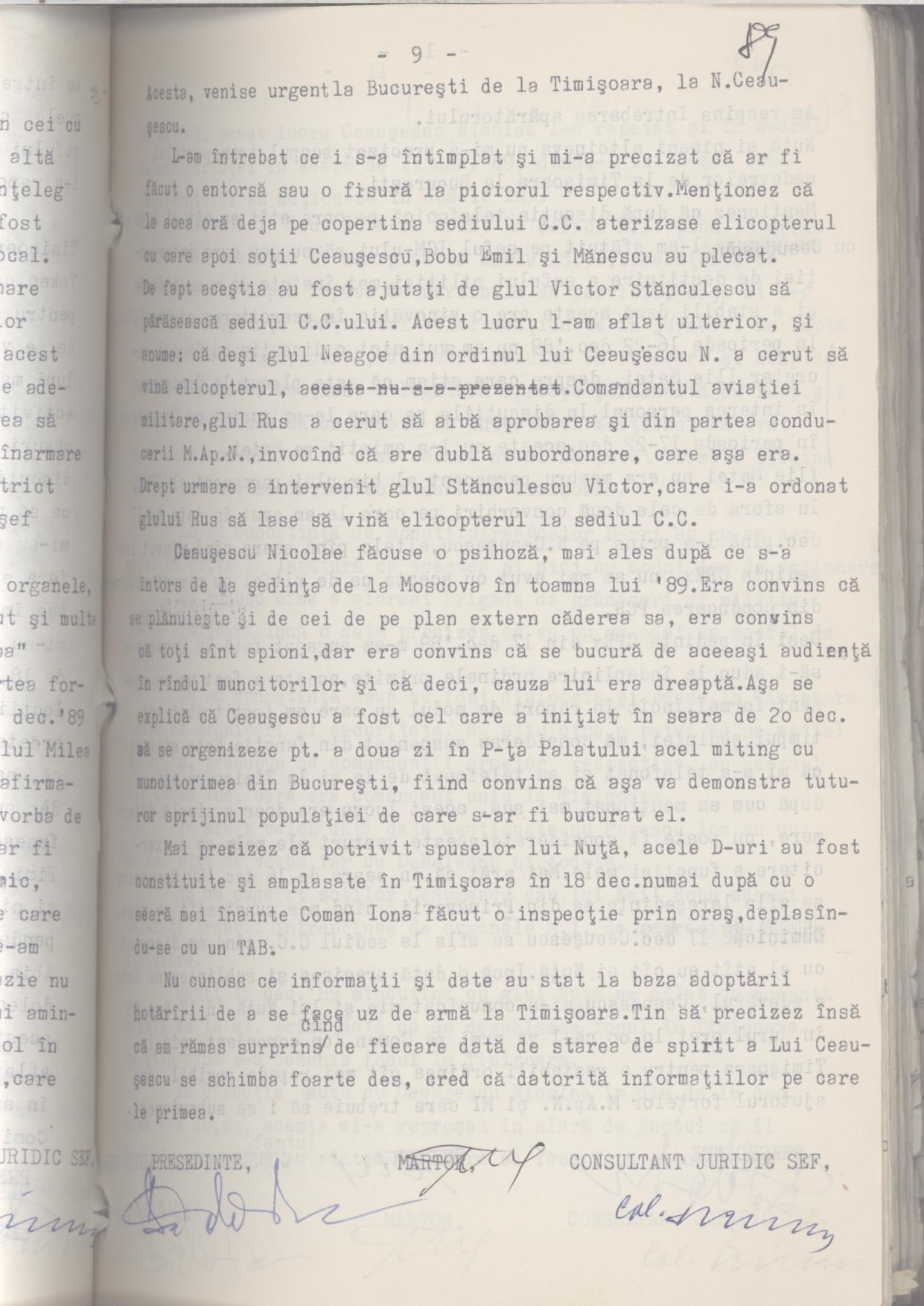
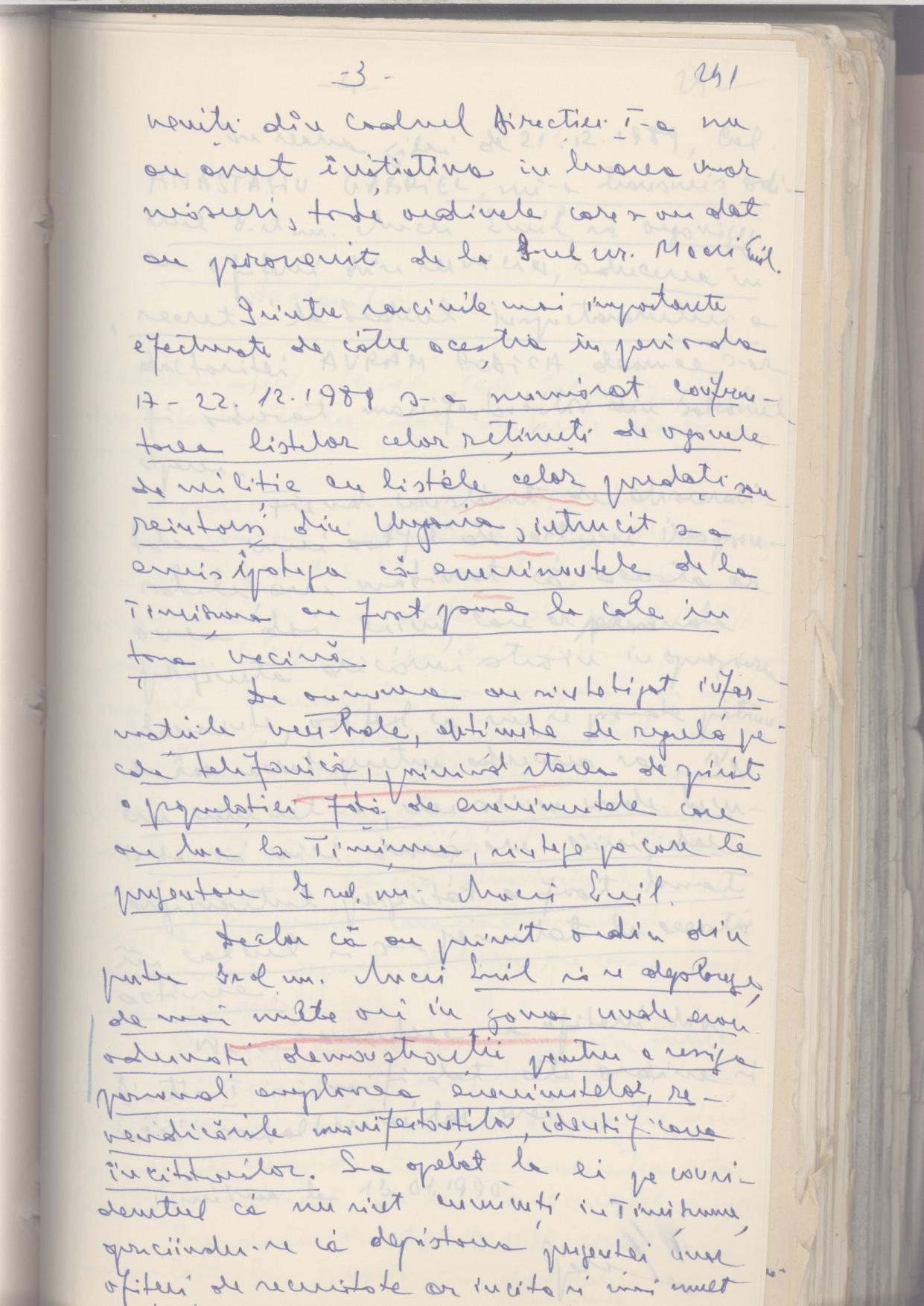
Tudor Postelnicu:  “Ceausescu Nicolae facuse o psihoza, mai ales dupa ce s-a intors de la sedinta de la Moscova in toamna lui ’89.  Era convins ca se planuieste si de cei de pe plan extern caderea sa, era convins ca toti sint spioni…” 0160 Petru Pele (Dir I, DSS). Declaratie, 16 ianuarie 1990:  “Printre sarciniile mai importante efectuate de catre acestia in  perioada 17-22.12.1989 s-a numerat (?) constituierea (?) listelor celor retinuti de organele militie cu listele celor predati sau reintorsi din Ungaria, intrucit s-a emis ipoteza ca evenimentele de la Timisoara au fost puse la cale in tara vecina…” 0299 0291 Gheorghe Diaconescu, Declaratie 31 decembrie 1989 “Luni 18 decembrie gl. col.  VLAD IULIAN a avut o convorbire cu colegul meu (local?) RADULESCU EMIL … 0476 Vlad Iulian (continuarea, declaratia lui Gheorghe Diaconescu) “?… foarte dur (?) ca nu (?) ca ‘un grup de turisti isi fac de cap in Timisoara’” 0477 0472 Tocmai Iulian Vlad, el insusi, recunoaste ne-implicarea strainilor in evenimentele de la Timisoara, aici… 0289 0290 Incepind cu noaptea de 16/17 dec. si in continuare pina in data de 20 dec. 1989 organul de securitate local col. Sima cit si gl. Macri si in lipsa lui col. Teodorescu imi comunicau date din care rezulta ca sute de elemente turbulente au devastat orasul, si ca elementul strain nu rezulta a se fi implicate in continuarea fenomenului.” 0291 “Mai exact, cei trimis de mine la Timisoara mi-au raportat ca nu au elemente din care sa rezulte vreum amestec al strainatatii in producerea evenimentelor de la Timisoara.” http://atomic-temporary-3899751.wpcomstaging.com/2013/03/17/o-indicatie-pretioasa-de-pe-malurile-dimbovitei-implicarea-strainilor-in-evenimentele-de-la-timisoara-paranoia-lui-nicolae-ceausescu-sau-confirmarea-lui-iulian-vlad/0292
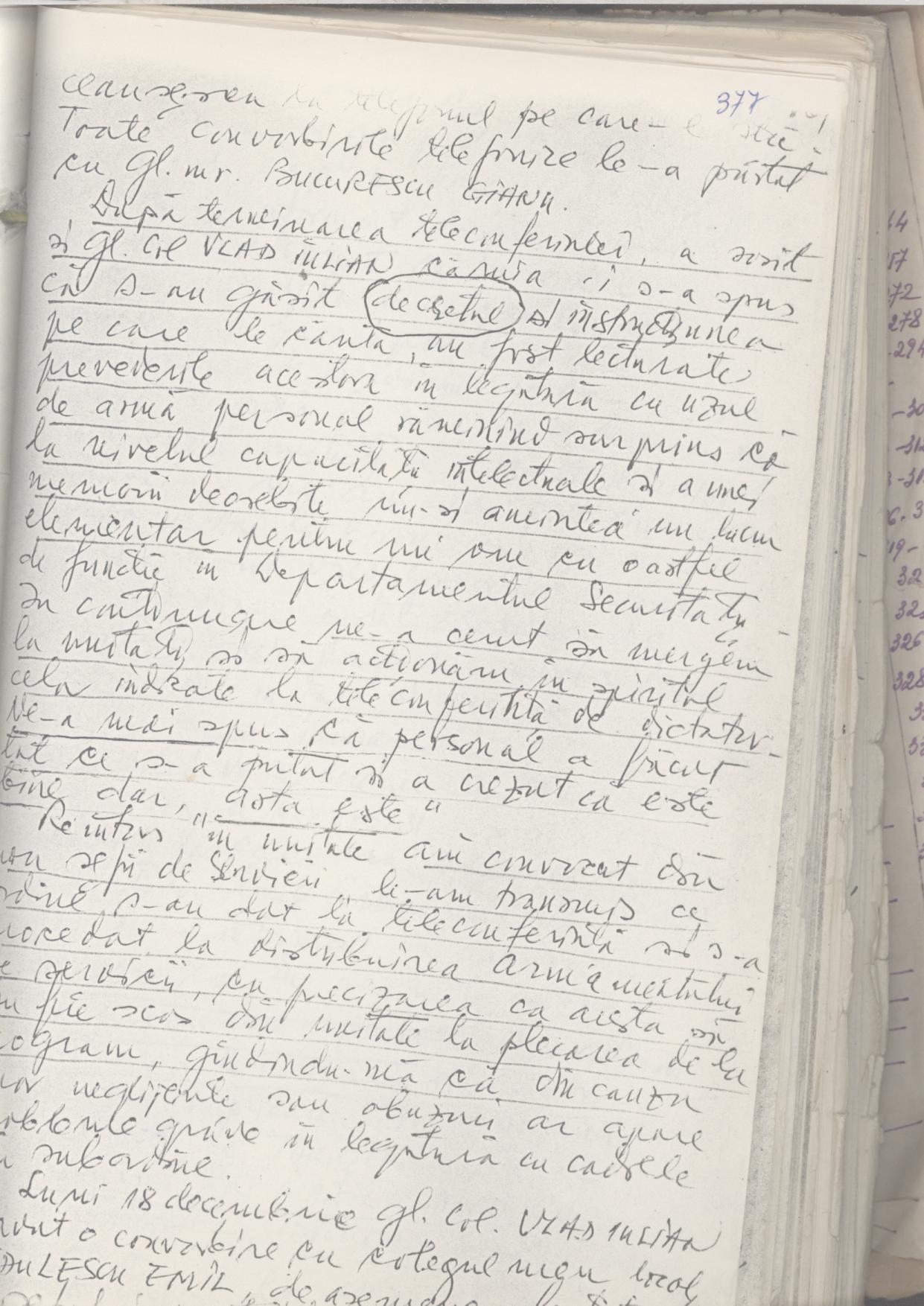
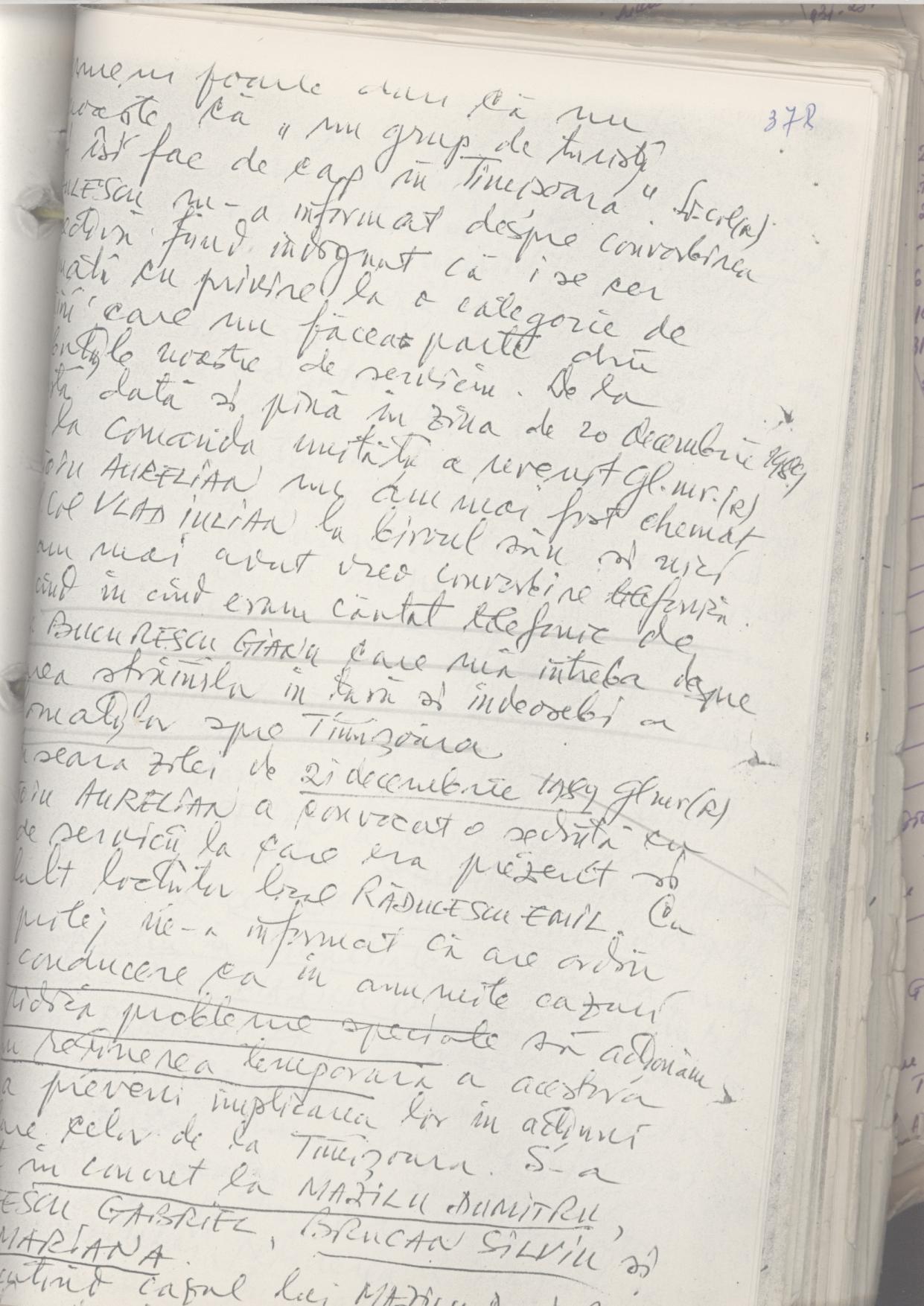
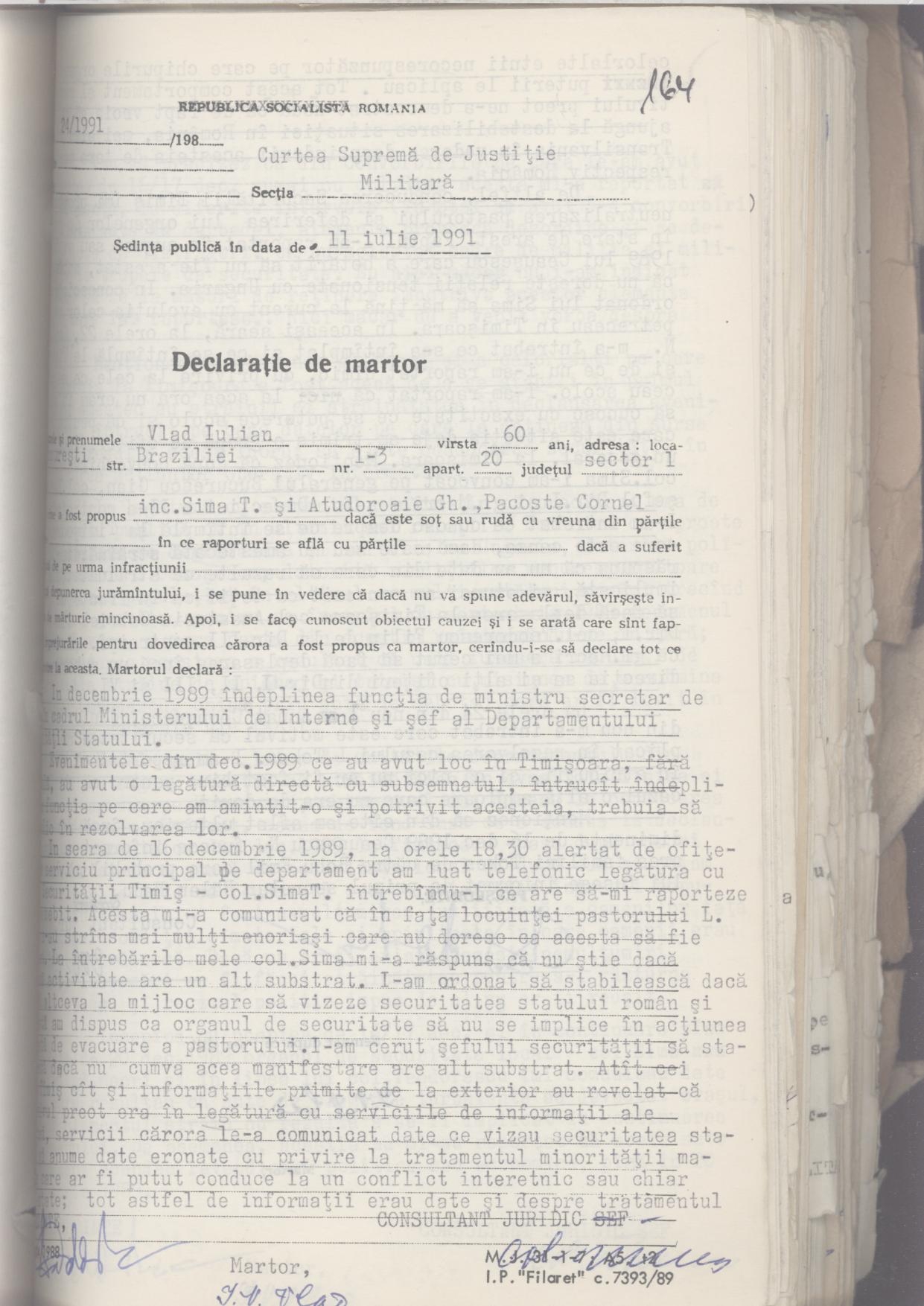
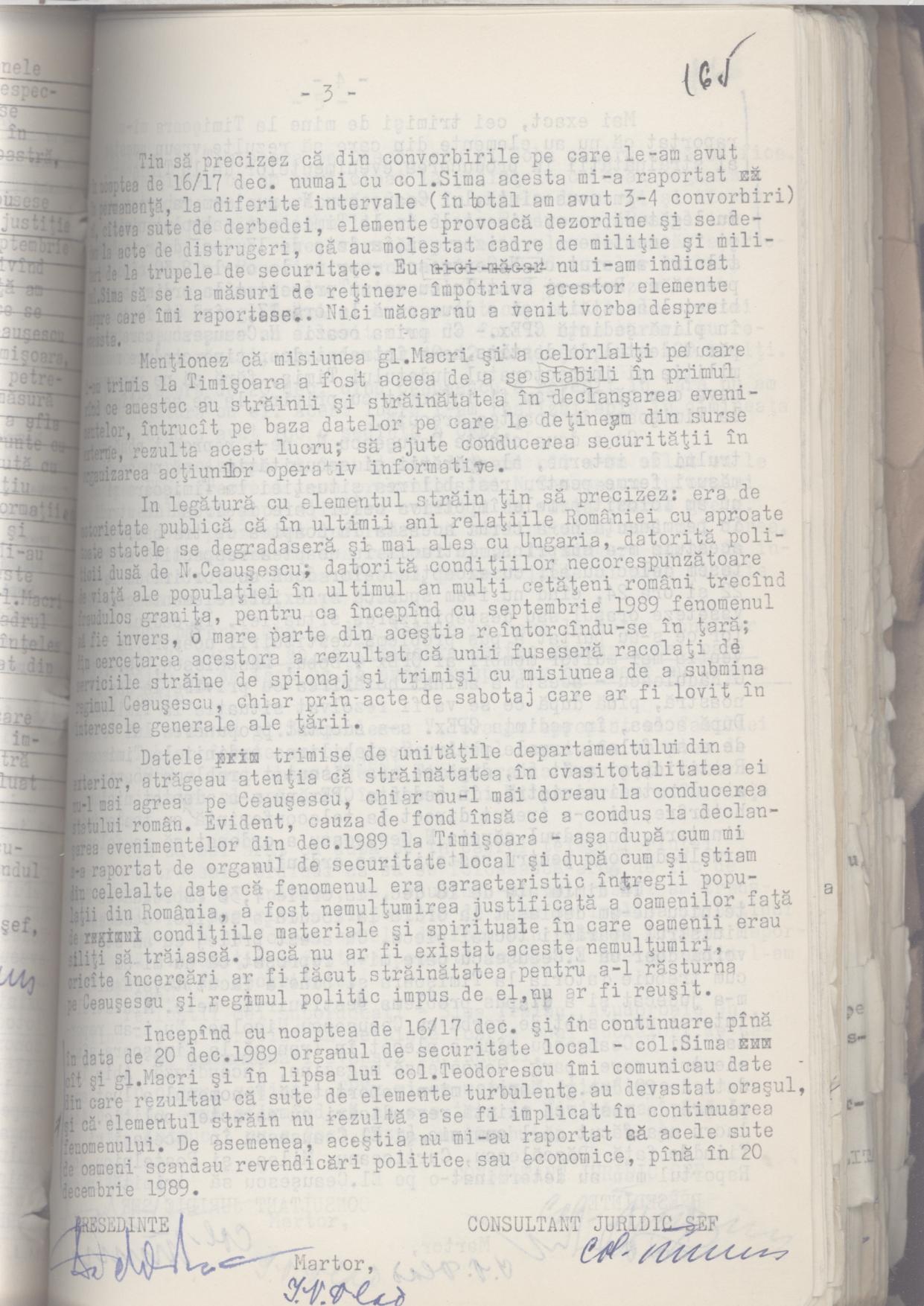
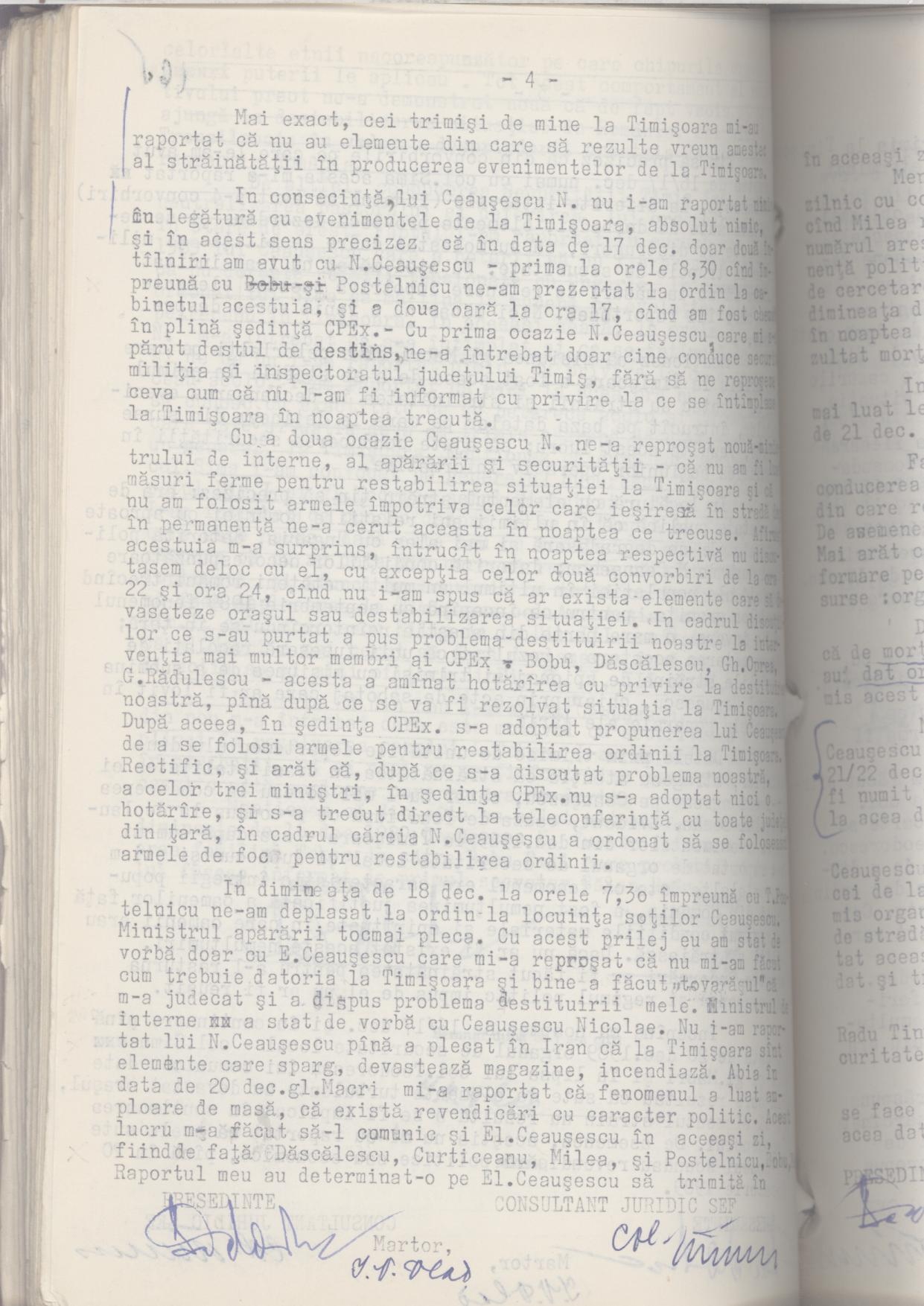
All this is important to keep in mind when coming across claims about the alleged role of these tourists in the overthrow of the communist regime of Nicolae Ceausescu:  none of the authors purporting such claims have addressed the documents above.  Among the authors who allege such a role and whose work is available on the Internet are the following:

James F. Burke (citing Grigore Corpacescu, General Iulian Vlad, and a well-known article from September 1990 in Democratia) http://www.ceausescu.org/ceausescu_texts/revolution/december_revolt_moscow.htm (I have dealt with these allegations here http://atomic-temporary-3899751.wpcomstaging.com/2010/12/29/presa-din-1990-despre-turistii-rusi-din-decembrie-1989/, and  http://atomic-temporary-3899751.wpcomstaging.com/2010/09/22/the-1989-romanian-revolution-as-geopolitical-parlor-game-brandstatter%E2%80%99s-%E2%80%9Ccheckmate%E2%80%9D-documentary-and-the-latest-wave-in-a-sea-of-revisionism-part-iii/)

Catherine Durandin (citing Radu Portocala) http://www.diploweb.com/english/romania/durandin1.htm  (I have addressed this allegation here http://atomic-temporary-3899751.wpcomstaging.com/2010/09/24/the-1989-romanian-revolution-as-geopolitical-parlor-game-brandstatter%E2%80%99s-%E2%80%9Ccheckmate%E2%80%9D-documentary-and-the-latest-wave-in-a-sea-of-revisionism-part-four/)

Alexander Ghaleb (fn. 9, citing “police sources”) http://www.sferapoliticii.ro/sfera/165/art03-Ghaleb.php

Jacques Levesque (citing a 1992 book by Filip Teodorescu) http://publishing.cdlib.org/ucpressebooks/view?docId=ft4q2nb3h6&chunk.id=d0e6746&toc.id=d0e6638&brand=ucpress

John Simpson (citing Virgil Magureanu and the SRI) http://www.independent.co.uk/life-style/ten-days-that-fooled-the-world-1387659.html

Alex Mihai Stoenescu (p. 186 of 340, Petre Roman citing Mihai Caraman) http://www.scribd.com/doc/105257958/Alex-Mihai-Stoenescu-Istoria-Loviturilor-de-Stat-Din-Romania-Vol-4-1

Larry Watts (fn. 90 p. 26, Petre Roman citing Mihai Caraman) http://www.larrylwatts.com/excerpts/with_friends_like_these_excerpts.pdf  (Roman ironically himself undermined such a claim here:  http://adevarul.ro/news/eveniment/petre-roman-ceausescu-acceptat-controlul-psihiatric-proces-putea-scape-1_50ad124a7c42d5a6638e48ab/index.html , Watts’ claim has been televised in the series “Mostenirea Clandestina,” http://www.youtube.com/watch?v=cAPOEu0ebwI start at about 46:10 to 46:60 and then assisted by Cristian Troncota, who discusses the “Soviet tourists,” including Watts’ claim, from 47:05 to 49:50…conveniently not mentioned here or anywhere else where Troncota appears (for example with Grigore Cartianu in Adevarul), Cristian Troncota was a Lt. Maj. in the Securitate:  see the index here from a 1987 issue of the Securitate‘s “strict secret” journal, (page 4 of 46 on the pdf) with a historical article beginning on page 78:  http://www.cnsas.ro/documente/periodicul_securitatea/Securitatea%201987-4-80.pdf  (vol. 80 from 1987).
 

Posted in decembrie 1989, raport final | Tagged: , , , , , , , , , , , , , , , | 19 Comments »

Revisiting the Myths of the Revolution. Part IV: The Romanian Television building is in danger! (Bomba in subsolul Televiziunii!)

Posted by romanianrevolutionofdecember1989 on December 22, 2013

Myth 3:  The Romanian Television building is in danger, danger of an explosion!   (TVR e in pericol–Pericol de explozie!)

This is part IV of a four part series.  For parts I, II, and III see

http://atomic-temporary-3899751.wpcomstaging.com/2013/12/21/revisiting-the-myths-of-the-romanian-revolution-part-i-the-hegemony-of-conspiratorial-and-postmodernist-explanations/

Myth 1:  The “Timisoara Syndrome” or the “False Timisoara Grave (the Paupers Cemetery)/Massacre” http://atomic-temporary-3899751.wpcomstaging.com/2013/12/21/revisiting-the-myths-of-the-revolution-part-ii-the-timisoara-syndrome-or-the-false-timisoara-grave-the-paupers-cemeterymassacre/

Myth 2:  The water is posioned!  (Apa este otravita!) http://atomic-temporary-3899751.wpcomstaging.com/2013/12/22/revisiting-the-myths-of-the-revolution-part-iii-the-water-is-poisoned-apa-este-otravita-dr-heyndrickxs-toxicology-report/

Myth 3:  The Romanian Television building is in danger, danger of an explosion!   (TVR e in pericol–Pericol de explozie!)

——————————————————————————————————————————————————————————————————————————–

Like the “water is poisoned” episode discussed in part III of this series, the claims of TV announcers regarding the threat posed to the Television building is a favorite for Romanians and Romanianists to lampoon:

Once again, Andrei Codrescu captures a widely and wildly popular view of TVR’s alleged role during the December 1989 events:

The Romanian revolution was a complex affair. It was a dramatic triumph that had the whole world for its audience, a world that keeps wondering long after the final curtain how much of what it saw was real. If I hadn’t lost my normally skeptical head to the euphoria of December, I would have questioned the single most evident source of news about the revolution: television. But it was precisely television that seduced me during my visit and made me lose sight of things I already knew….Imagine the shock and dismay of our newsmakers and our idealists–including myself–when most of these horrible events we saw with our own eyes on television turned out not to have happened at all. How could the grizzled, experienced Western journalists who are sworn to hard facts have missed the many clues and glaring contradictions that pointed to artifice? The astounding truth of the matter is that much of the glorious Romanian “revolution” was, in fact, a staged play, a revolution between quotation marks….But it couldn’t have been long after, however, the young revolutionaries (if that’s who they were) started becoming “responsible,” and the “spontaneous” provisional government showed up with its own TV script. The television station then became the headquarters of the new government, which, as far as most people were concerned, was born out of video like Venus out of the seashell. And hats must be off to the producers of the exceedingly realistic docu-drama of the strategic military center from where, in a charged atmosphere reminiscent of Reds or Dr. Zhivago, generals with telephones on both ears shouted orders at troops on vast invisible battlefields in every part of the country. Today I stand abashed by my naivete. Much of that Romanian “spontaneity” was as slick and scripted as a Hollywood movie. If I were in charge of the Emmys, I’d give one to the Romanian directors of December 1989. 

SOURCE: The Hole in the Flag: A Romanian Exile’s Story of Return and Revolution (Avon Books, 1991), by Andrei Codrescu, pp. 204-206. excerpted from http://faroutliers.wordpress.com/2004/12/06/the-romanian-revolution-was-televised/

—————————————————————————————————————————————————————————————————————————

As with the “poisoned water” episode, so too with the claimed threats against Television, including the idea that a bomb had been found and disarmed in the basement of the Television building (as can be seen in the above video)…no researcher has attempted to verify the veracity of the claim, until now!

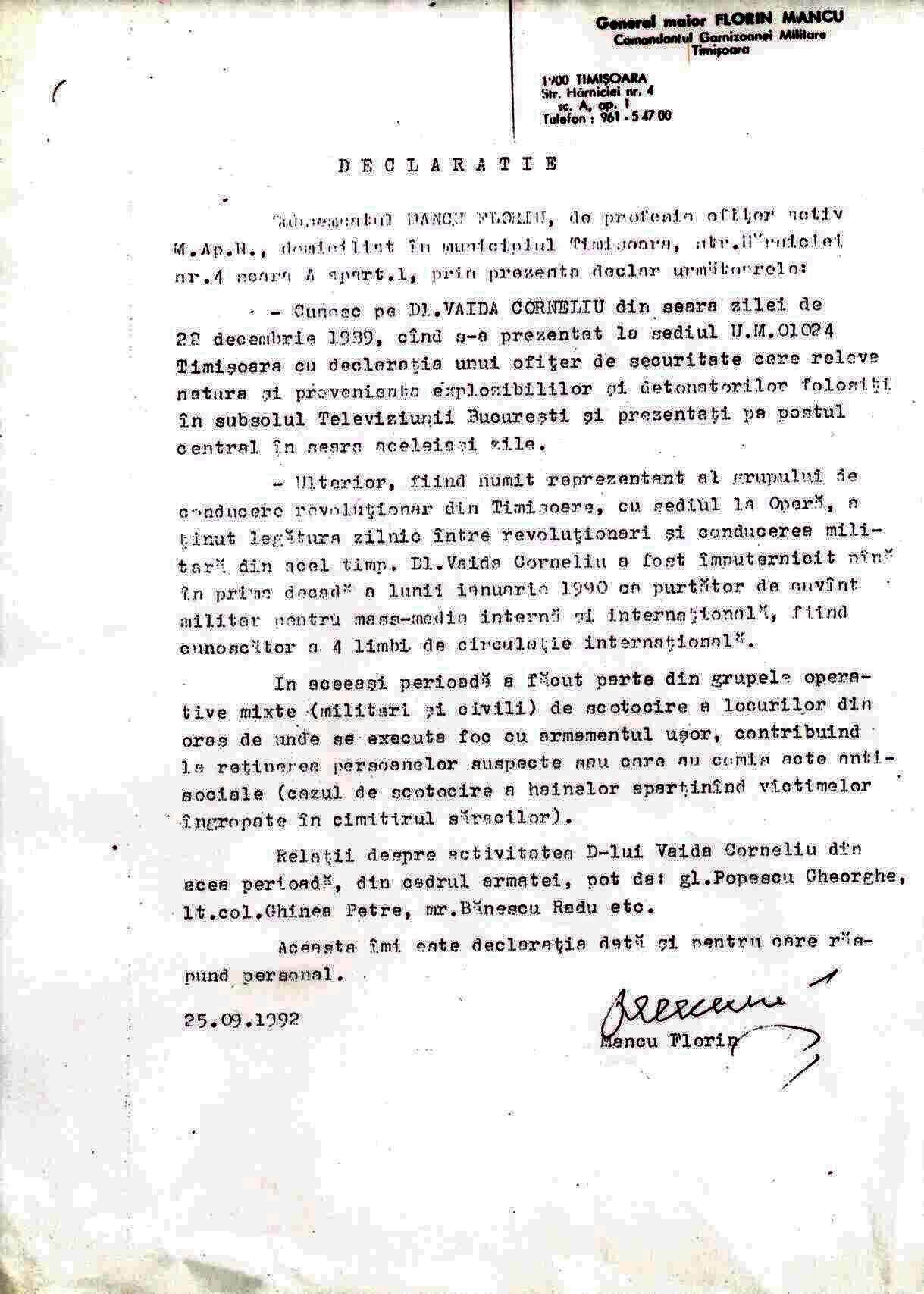
Recently, however, several sources have been unearthed/come to light that clarify what happened.  Here, Corneliu N. Vaida of Timisoara recounts how a Securitate member from Timisoara was convinced to call the Television Station in Bucharest to inform them that, as with many other highly strategic buildings in the country, TVR had been mined and an explosion could be set off.  It appears that the announcement above about a bomb having been disarmed in the basement of the TVR building, was as a result of this information from Timisoara:

Securistul trădat pentru binele TVR

În seara zilei de 22 decembrie şi-a vizitat mama, care locuia pe bulevardul 6 Martie, unde a găsit în apartament un vecin. Era vorba de Gheorghe Toader, un căpitan în rezervă la Securitate, care se refugiase de frică sa nu fie asasinat.

Urmărind programul “Revoluţiei în direct”, de la TVR, au observat la un moment dat o persoana care ţinea în mână un obiect care semăna cu o tastatură.

“Văzând tastatura, securistul a scos o exclamaţie de teamă: <Vor sări toţi în aer acolo! TVR e obiectiv strategic şi este minat, ca în cazuri extreme să poată fi aruncat în aer, tastând un cod pe aşa un detonator!>. A spus că a lucrat la aşa ceva în Bucureşti într-o intreprindere specială. La isistenţele mele a acceptat până la urmă să scrie o declaraţie anonimă pe care am dus-o personal la armată”, a mai declarat Corneliu Vaida.

Ajuns la Garnizoana Timişoara, Vaida a arătat scrisoarea colonelului Zeca, comandantul garnizoanei. “Acesta a pus mâna pe un telefon şi a sunat imediat la Bucureşti la o structură a armatei căreia i-a relatat continutul declaraţiei, dupa care mi-a cerut sa dezvalui identitatea semnatarului argumentând că acesta mai cunoaşte informaţii care ar ajuta la evitarea de victime”, a adaugat Vaida.

Neavând ce face, a trebuit să meargă cu armata să îl predea pe secursitul din casa mamei. “Înspre dimineaţă am văzut la televizor cum a venit cineva şi a declarat că explozibilul cu care era minată televiziunea a fost dezamorsat”, a mai spus timişoreanul.

http://adevarul.ro/locale/timisoara/foto-corneliu-vaida-purtator-cuvant-revolutiei-timisoara-s-au-luptat-grupari-securitate-armata-1_510985f54b62ed5875bbb81f/index.html

The event is also recounted by parachutists in this TVR video from 31 December 1989 that only recently appeared on the internet.

Parasutisti de la R. 64 Pst. Boteni la Televiziunea Romana in 31 decembrie 1989:
Lt. col. Ilie Croitoru, Mr. Chiranescu Ion, Cpt. Radulescu Aurelian, Cpt. Constantin Vlasceanu

Corneliu Vaida has been kind enough to share with me, the following additional confirmation of his actions in the document below:

HP0010

For more about Corneliu Vaida during the Revolution in Timisoara in December 1989, see his interview with ITN correspondent Penny Marshall on 27 December 1989:

http://atomic-temporary-3899751.wpcomstaging.com/2011/05/11/lets-go-to-the-videotape-i-to-the-army-its-confirmation-that-theyve-been-dealing-with-a-specially-trained-force-because-its-the-type-of-bullet-theyve-never-seen-before-itn-uk-telev/

Corneliu Vaida Timisoara December 1989

More on what transpired in and around the Television Station below:

image0

image0-001

image0-003

image0-002

Related posts:

http://atomic-temporary-3899751.wpcomstaging.com/2013/08/25/tvr-chirurgi-si-reportaje-despre-gloante-explozive-dum-dum/

http://atomic-temporary-3899751.wpcomstaging.com/2013/12/10/vina-de-neiertat-a-tvr-a-contribuit-decisiv-la-victoria-revolutiei-iv/

image0

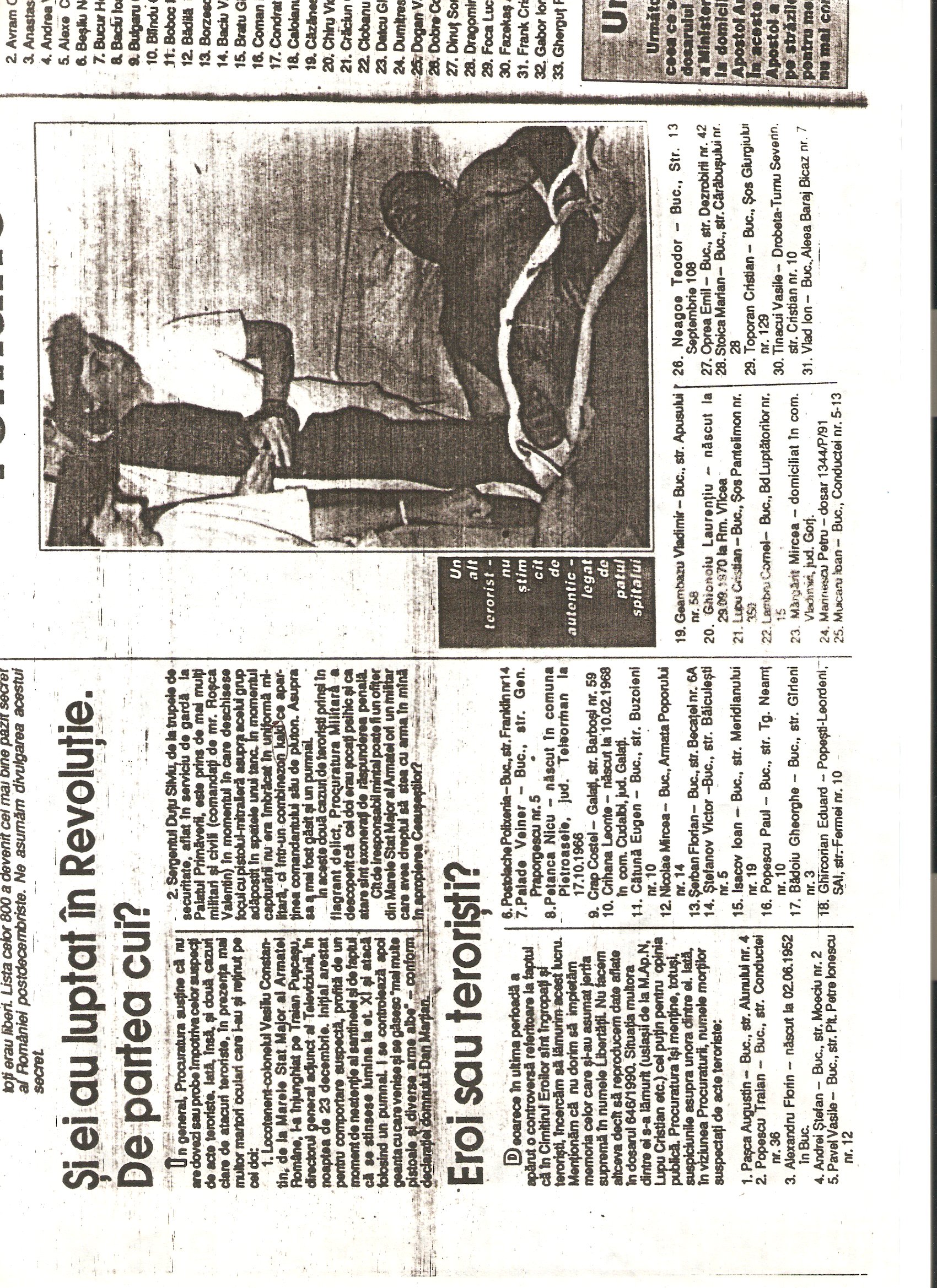
Ioan Itu, “Si ei au luptat in Revolutie.  De partea cui?,” Tinerama, 10-16 septembrie 1993, p. 8.

image0-001

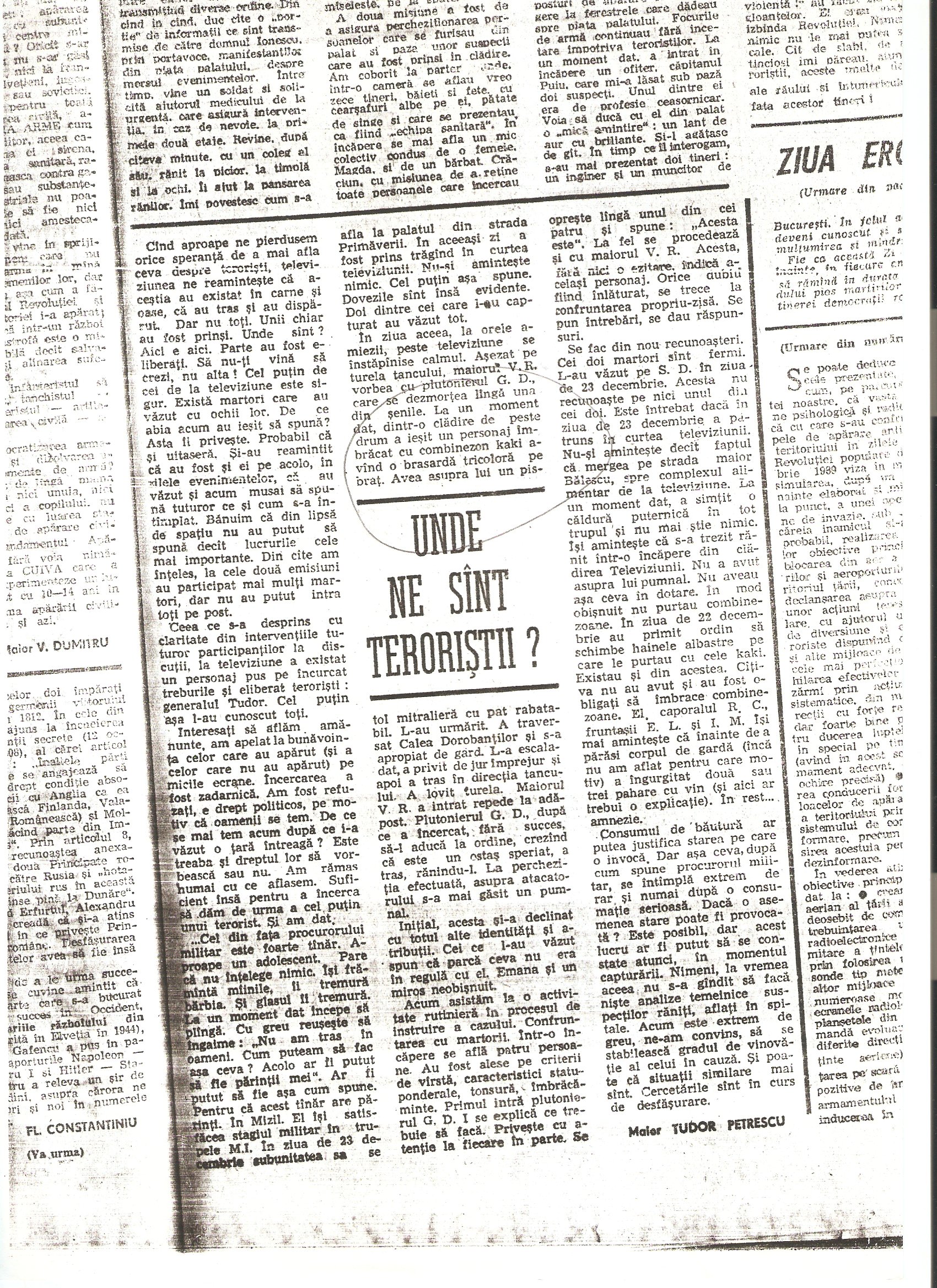
Maior Tudor Petrescu, “Unde ne sint teroristii?” Armata Poporului, nr. 22, 30 mai 1990, p. 3.  (S.D. = Silviu Dutu)

image0-002

image0-003

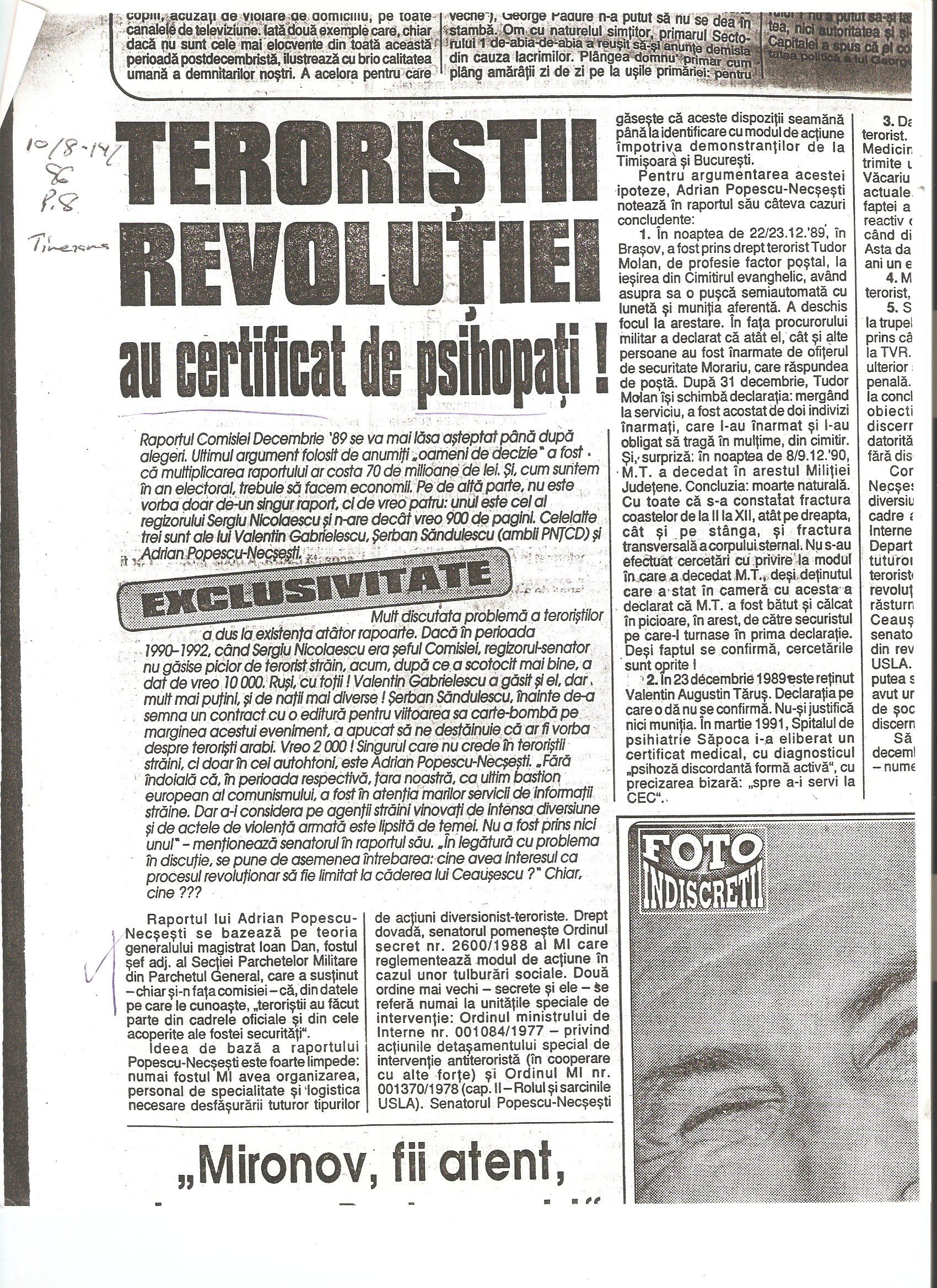
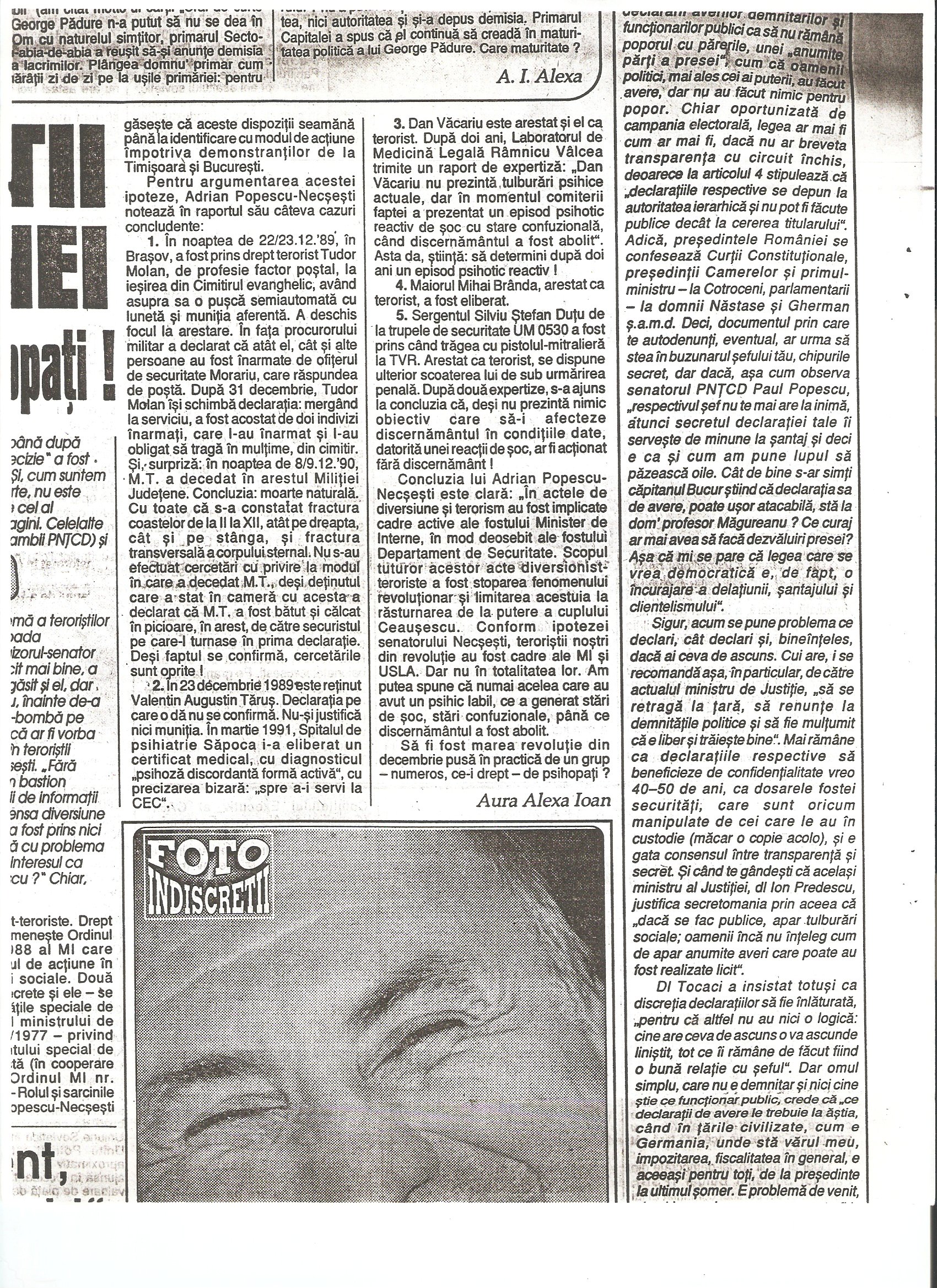
Aura Alexa Ioan (cu Adrian Popescu-Necsesti), “Teroristii Revolutiei au certificat de psihopati!” Tinerama, 8-14 octombrie 1996, p. 8

image0

image0-001

image0-002

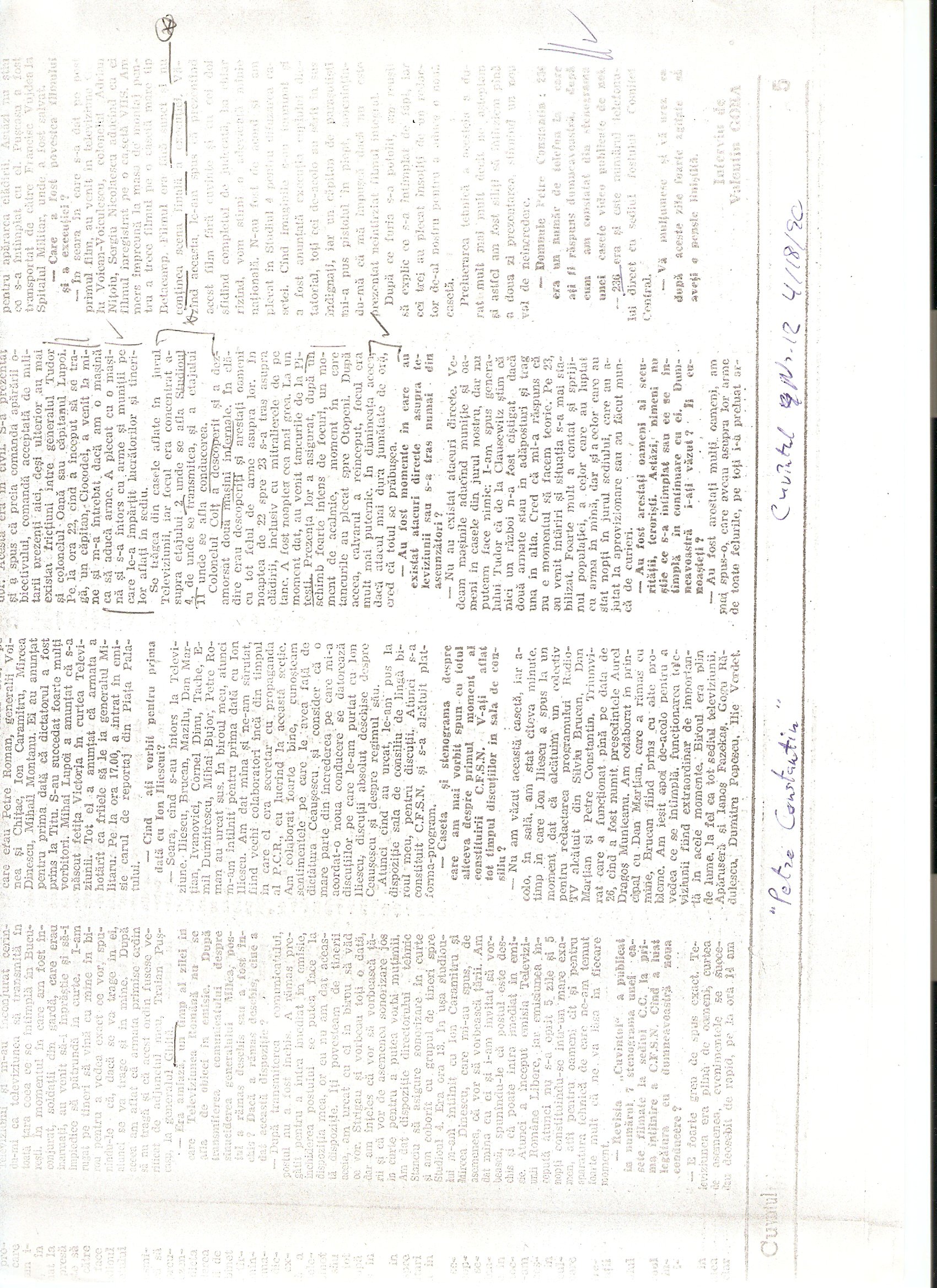
Valentin Gora:  Au fost arestati oameni ai securitatii, teroristi.  Astazi, nimeni nu stie ce s-a intimplat sa ce se intimpla in continuare cu ei.  Dumneavoastra i-ati vazut?  Ii cunoasteti?

Petre Constantin:  Au fost arestati multi oameni, am mai spus-o, care aveau asupra lor arme de toate felurile, pe toti i-a preluat armata si nu stiu ce s-a intimplat mai departe cu ei.  Adjunctul meu, Traian Puscasu, a fost injunghiat in noaptea de 23 spre 24 decembrie, pe hol, la etajul 11.  Agresorul, locotenent-colonelul Vasiliu, il viza pe generalul Tudor sau pe mine.  Eu am lipsit citeva miunte, generalul Tudor s-a ferit in momentul atacului si a fost lovit Puscasu.  Totul se intimpla in usa biroului.  Militarii au sarit si l-au imobilizat imediat.

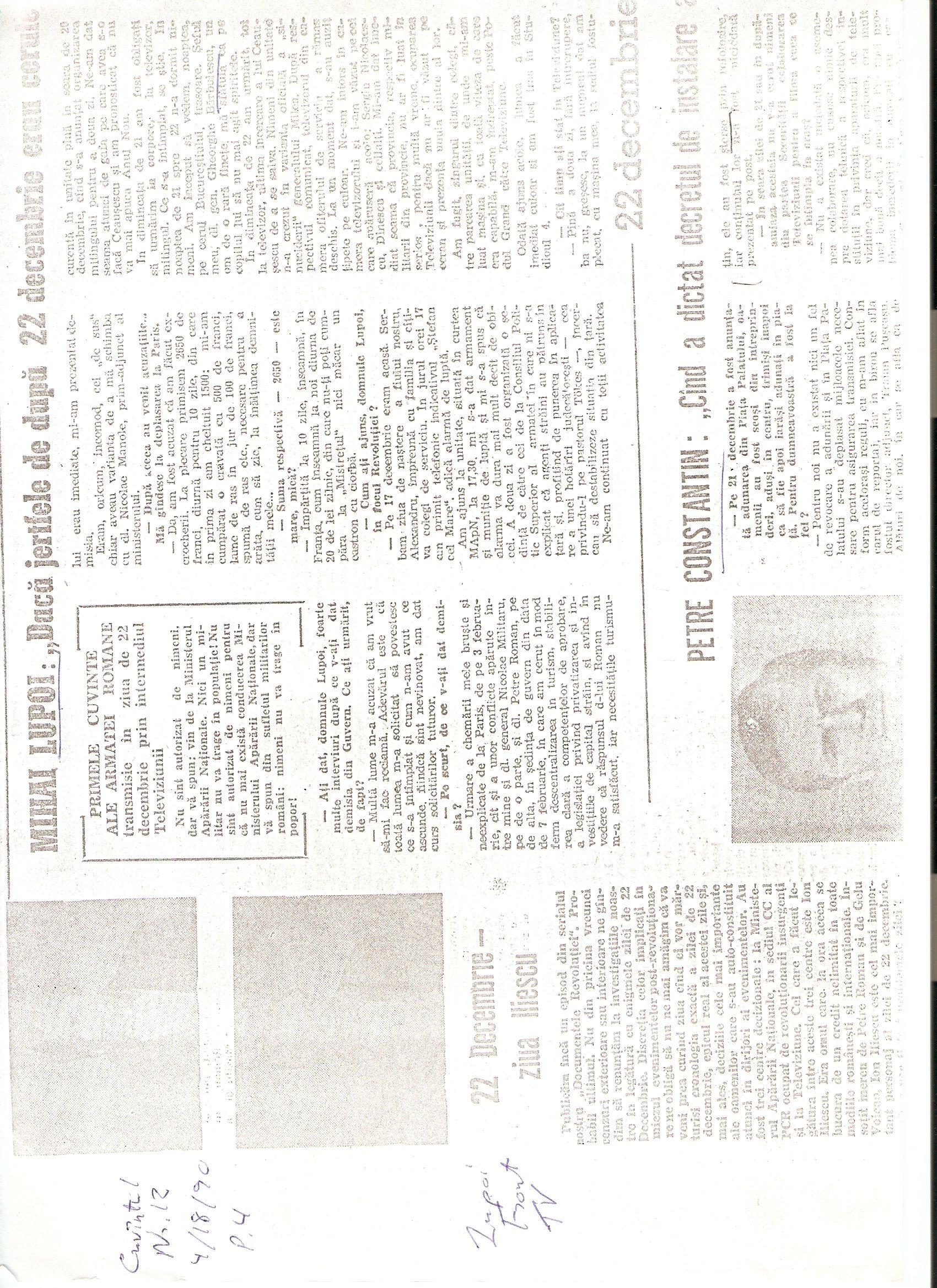
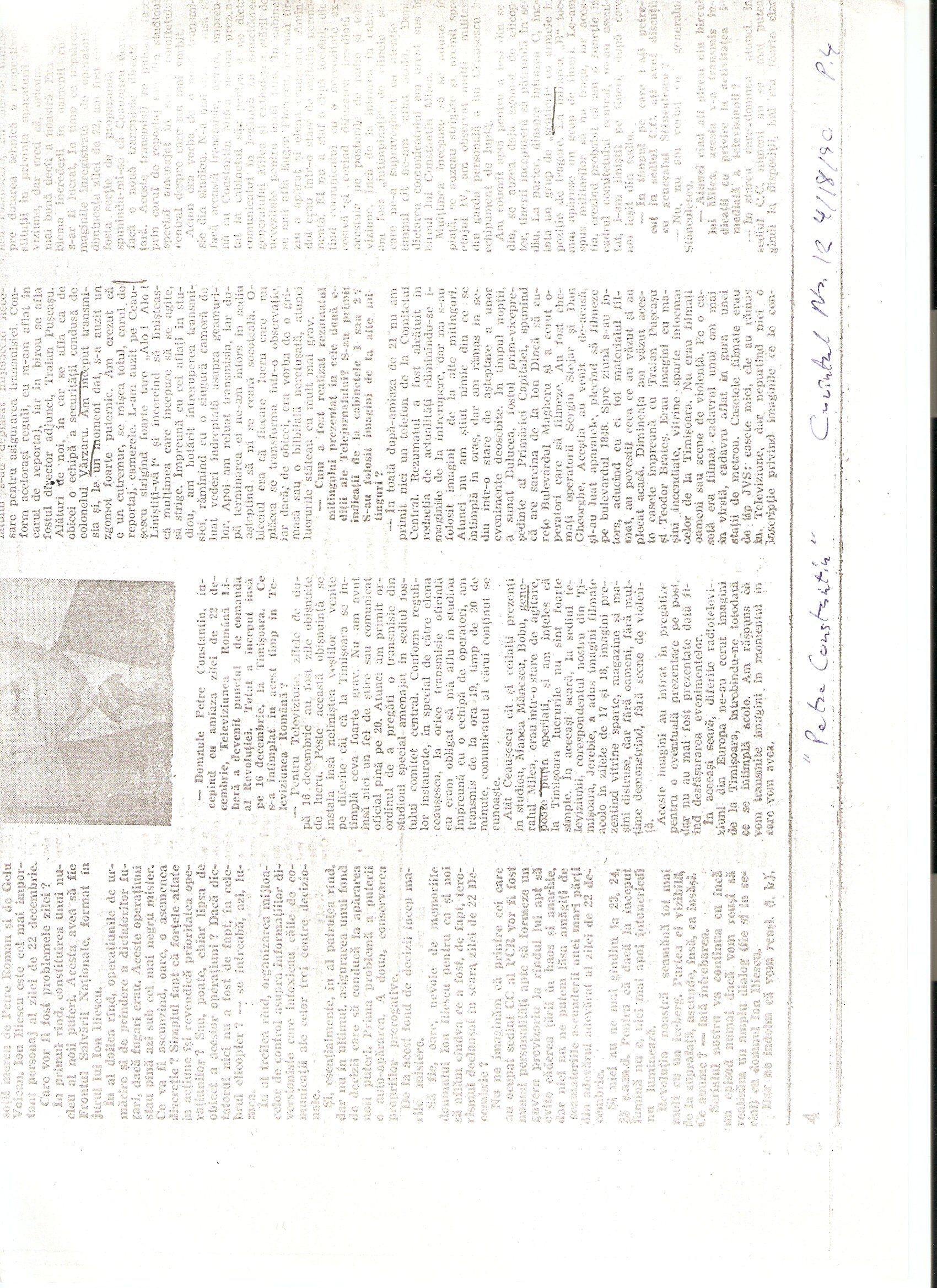
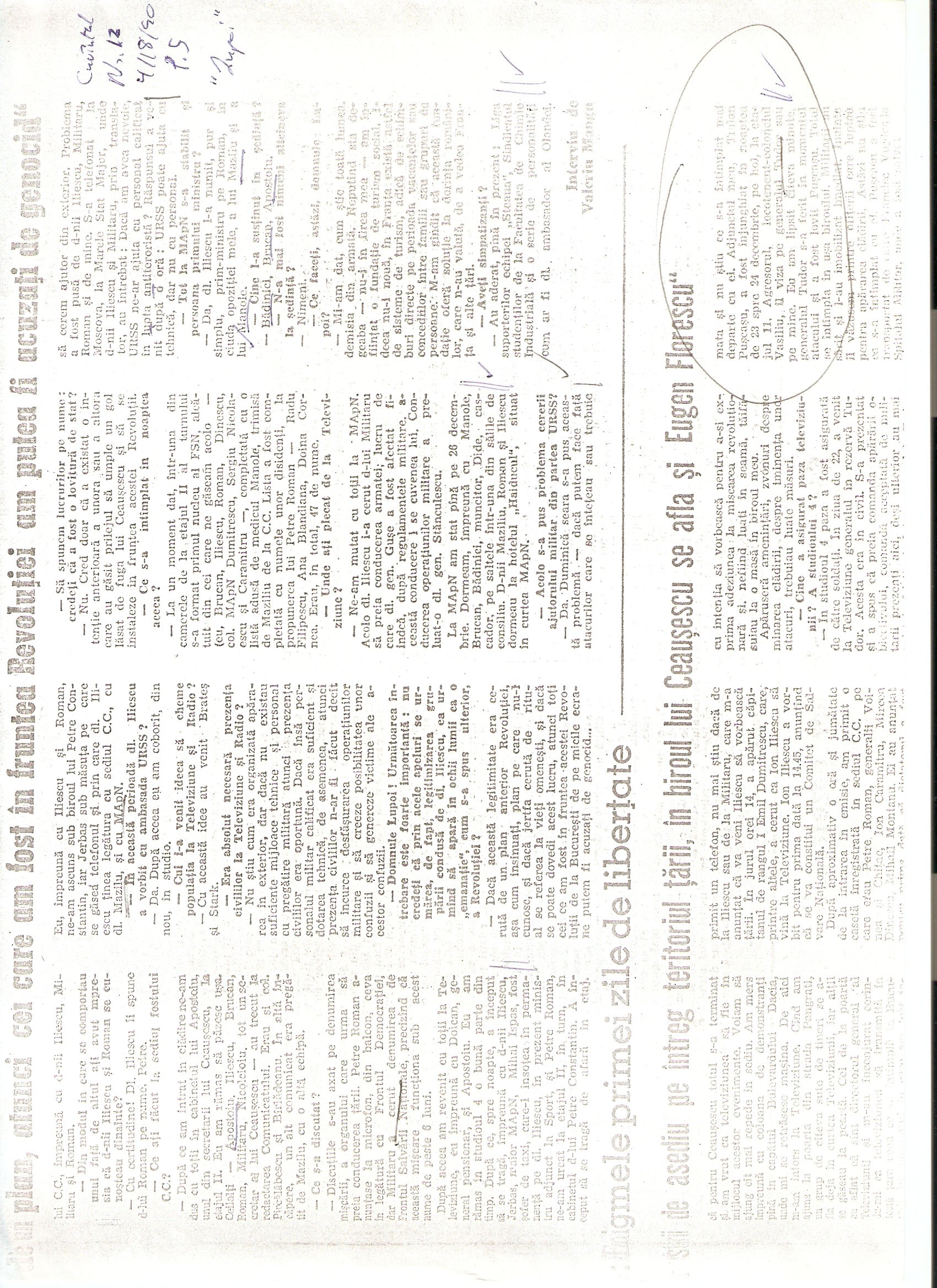
Valentin Gora cu Petre Constantin, “Petre Constantin:  Cind a dictat decretul de instalare ? de asediu pe intreg teritoriul tarii, in biroul lui Ceausescu se afla si Eugen Florescu,” Cuvintul, nr. 12, 18 aprilie 1990, pp. 4-5.

image0-003

http://mariusmioc.wordpress.com/2013/11/13/cercetarile-parchetului-in-dosarul-revolutiei-37-bucuresti-televiziune-raniti-si-ucisi-5/

425. Parte vătămată Puşcaşu Traian (Televiziune-Vol. 110)
Numitul Puşcaşu Traian, fiul lui Gheorghe şi Maria, născut la data de 01.03.1927, în Iaşi, domiciliat în Bucureşti (…) în noaptea de 22/23.12.1989, în timp ce se afla în incinta televiziunii, unde-şi desfăşura activitatea ca director adjunct al TVR, a fost înjunghiat în abdomen cu un cuţit de către lt. col. Vasiliu Cornel, care se afla în dispozitivul de pază al instituţiei respective.
Conform raportului medico-legal nr. A1/3409/1990, numitul Puşcaşu Traian a prezentat la data de 24.12.1989 o plagă abdominală penetrantă cu interesarea splinei şi arterei epigastrice. Leziunea a putut fi produsă prin lovire cu corp tăietor-înţepător (posibil cuţit). A necesitat circa 25 zile de îngrijiri medicale. Leziunea i-a pus viaţa în pericol.
Prin rezoluţia nr. 1411/P/1990, din data de 15.11.1990, Procuratura Militară Bucureşti a dispus neînceperea urmăririi penale faţă de lt. col. Vasiliu Constantin, sub aspectul infr. prev. de art. 20 rap. la art. 174 C.p., reţinându-se că, în urma expertizării sale psihiatrice, s-a stabilit că a acţionat fără discernământ.

Posted in decembrie 1989, raport final | Tagged: , , , , | 1 Comment »

Revolutia Romana, Spitalul Militar, Gloante Explozive, si Sarlatani

Posted by romanianrevolutionofdecember1989 on September 30, 2013

(purely personal, if highly-informed views as always)

Yet another sad case of someone who was killed in December 1989 by exploding dum-dum bullets, the case of Petre Mihailescu, age 22, shot in the abdomen outside the Defense Ministry Headquarters in Bucharest on 23 December 1989:

După ce şi-a revenit din şoc, mama lui Petre s-a dus la Bucureşti, ca să vadă ce s-a întâmplat cu fiul ei. “Medicii de la IML (Institutul de Medicină Legală – n.r.) miau spus că fiul meu a murit la Spitalul Militar. Cică ar fi fost împuşcat cu un glonţ care i-a explodat în burtă. N-am avut bani, ca să-l duc acasă, să-l îngrop. Fiul meu a fost înmormântat la Cimitirul Eroilor, alături de alţi eroi ai Revoluţiei”, afirmă mama lui Petre. Citiţi mai mult: Revoluţionarii şarlatani. Cum şi-a bătut joc un securist de familia unui erou martir – Exclusiv EVZ > EVZ.ro http://www.evz.ro/detalii/stiri/revolutionarii-sarlatani-1059562.html#ixzz2gOgRsf00EVZ.ro

We know from other cases mentioning Spitalul Central about the use of explosive bullets during these days.

Sâmbata 30 decembrie 1989

Reportaj la Spitalul Militar Central: se relateaza despre modul dramatic în care au fost efectuate operatiile (chirurgicale) din ziua de 22 decembrie 1989. „Noapte alba sau zi neagra” spune doctorul pe buna dreptate. Armele teroristilor, a securistilor au împroscat multimea cu gloante explozive, care au avut ca efect plagi si leziuni gigantice.  
Emotionant! Dramatic! Dureros!

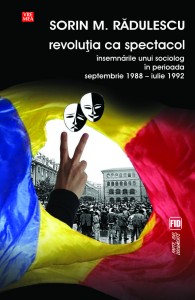
SORIN M. RĂDULESCU – REVOLUŢIA CA SPECTACOL, Miercuri 27 decembrie, 1989 – Revolutia -3 –

REVOLUŢIA CA SPECTACOL
(ÎNSEMNARILE UNUI SOCIOLOG ÎN PERIOADA SEPTEMBRIE 1988-IULIE 1992)

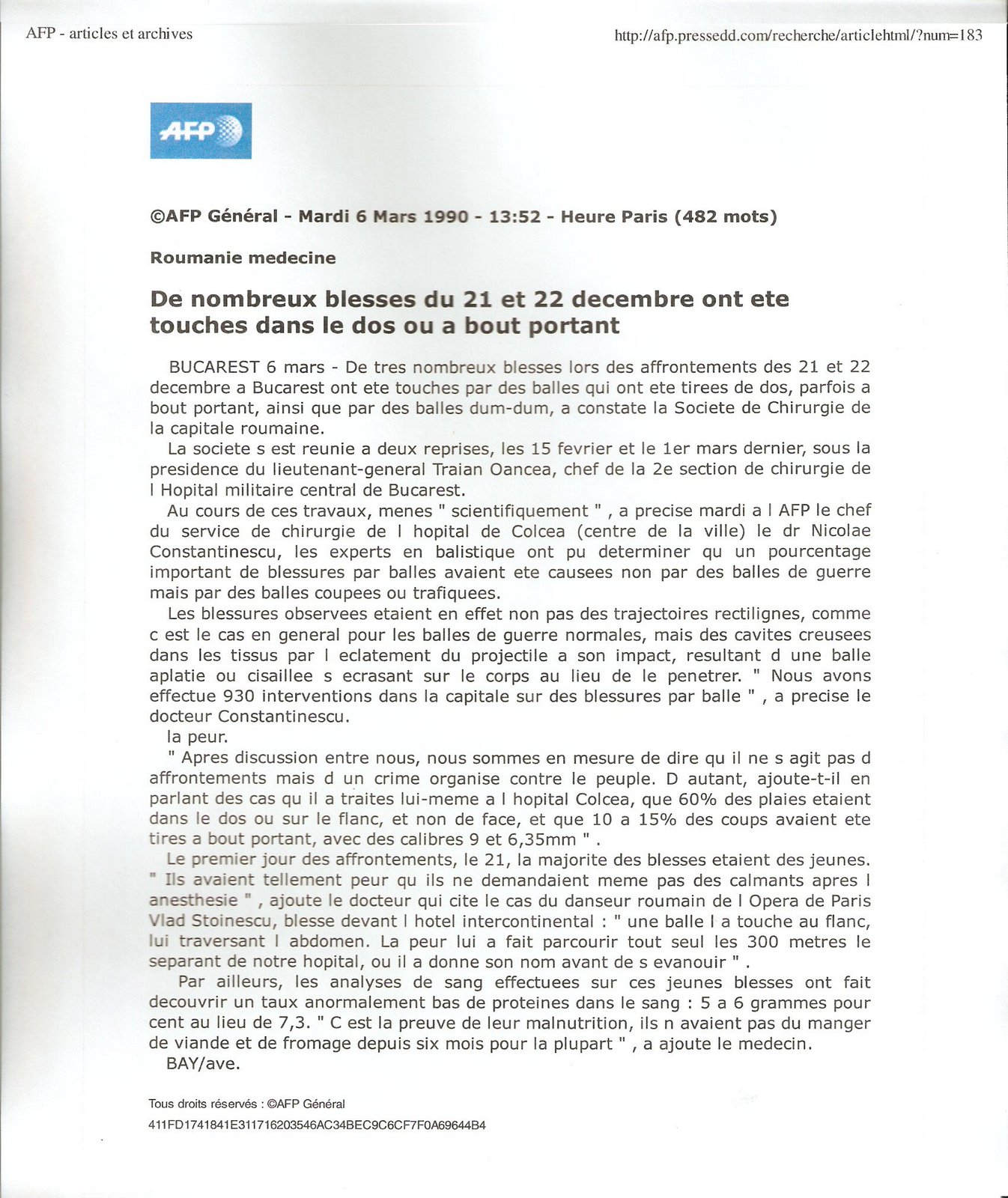
In early March 1990, AFP reported the declared findings of surgeons in Bucharest, attesting to the fact that many of those wounded on 21-22 December 1989 in Bucharest had been shot with exploding bullets, DUM-DUM bullets.  This is a critical article (and description of an event that I believe has gotten almost no coverage inside or outside Romania).  Lt. Gnl. Traian Oancea, chief of surgery in part of the Central Military Hospital (Spitalul Militar) in Bucharest, and Dr. Nicolae “Nae” Constantinescu, chief of surgery at the Coltea Hospital, discussed this at a meeting of the Society of Surgeons in Bucharest.

http://atomic-temporary-3899751.wpcomstaging.com/2013/08/25/tvr-chirurgi-si-reportaje-despre-gloante-explozive-dum-dum/

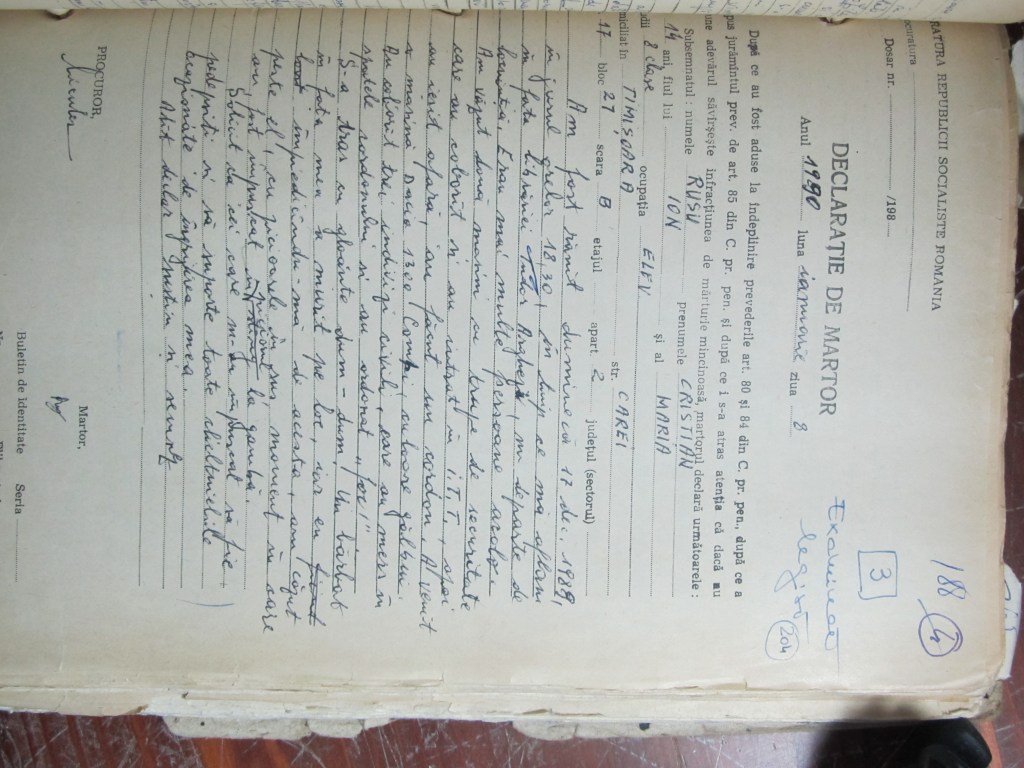
Still, there remain those who deny their existence and use of exploding dum-dum bullets in December 1989:  in particular the former military prosecutor General Dan Voinea. (Dan Voinea has been a constant at IICCMER first under Vladimir Tismaneanu and now under his successors; Voinea is cited as a sort of impartial expert abroad !, http://www.nytimes.com/2013/09/30/world/europe/in-trial-romania-warily-revisits-a-brutal-past.html?_r=0)  Voinea’s claim that there no victims of exploding dum-dum bullets is revealed for the blatant lie it is, not just through the sad tale of Petre Mihailescu’s mother, but by the handwritten testimonies of participants in the Timisoara uprising contained in the documents of Dosarele Revolutiei de la Timisoara below.

Romulus Cristea (ziarist, Romania Libera, 22 decembrie 2005):  – Munitia speciala, gloantele cu cap vidia sau dum-dum, a provocat victime? Presa de la acea vreme a fost plina cu astfel de relatari…

General-magistrat Dan Voinea – Nu exista victime (persoane impuscate) nici de la gloantele cu cap vidia, nici de la dum-dum. Pe durata evenimentelor s-a folosit munitie de razboi, munitie normala care se gasea la vremea respectiva in dotarea Ministerului de Interne si a Ministerului Apararii Nationale. Confuzia si informatiile false au aparut de la faptul ca se foloseau calibre diferite si, deci, zgomotul produs era altfel perceput.  http://www.romanialibera.ro/opinii/interviuri/toti-alergau-dupa-un-inamic-invizibil-58783.html

For additional proof of Voinea’s lack of credibility, see http://atomic-temporary-3899751.wpcomstaging.com/text-of-securitate-general-iulian-vlads-29-january-1990-declaration-identifying-the-terrorists/

and regarding his own role in December 1989:

http://atomic-temporary-3899751.wpcomstaging.com/2013/07/02/ceausescus-prosecutors-the-cremation-of-timisoara-protesters-and-the-good-sergeant-schultz/

http://atomic-temporary-3899751.wpcomstaging.com/2013/05/18/colonel-ion-baciu-pe-20-12-89-la-orele-1010-la-crematoriu-a-venit-lt-col-voinea-dan-pe-care-l-cunosc-intrucit-inainte-a-lucrat-la-departmentul-securitatii-statului-directia-cercetari-penale/

Robert Buzatu “a fost lovit de un glont exploziv”

IMG_0045

imaginea 43
imaginea 44
imaginea 45
imaginea 46

Georgian Baran “[pe 25 decembrie 1989]…teroristul a tras asupra mea, cred ca erau gloante dum-dum, mi-a lovit…”

imaginea 61
imaginea 62

IMG_0062

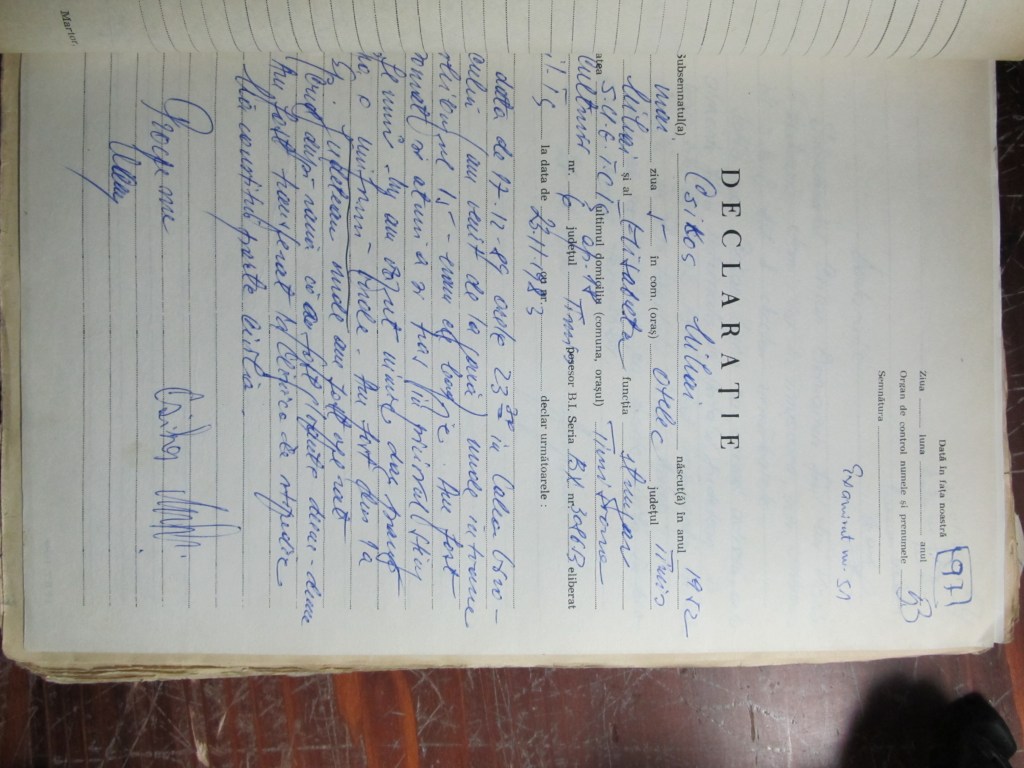
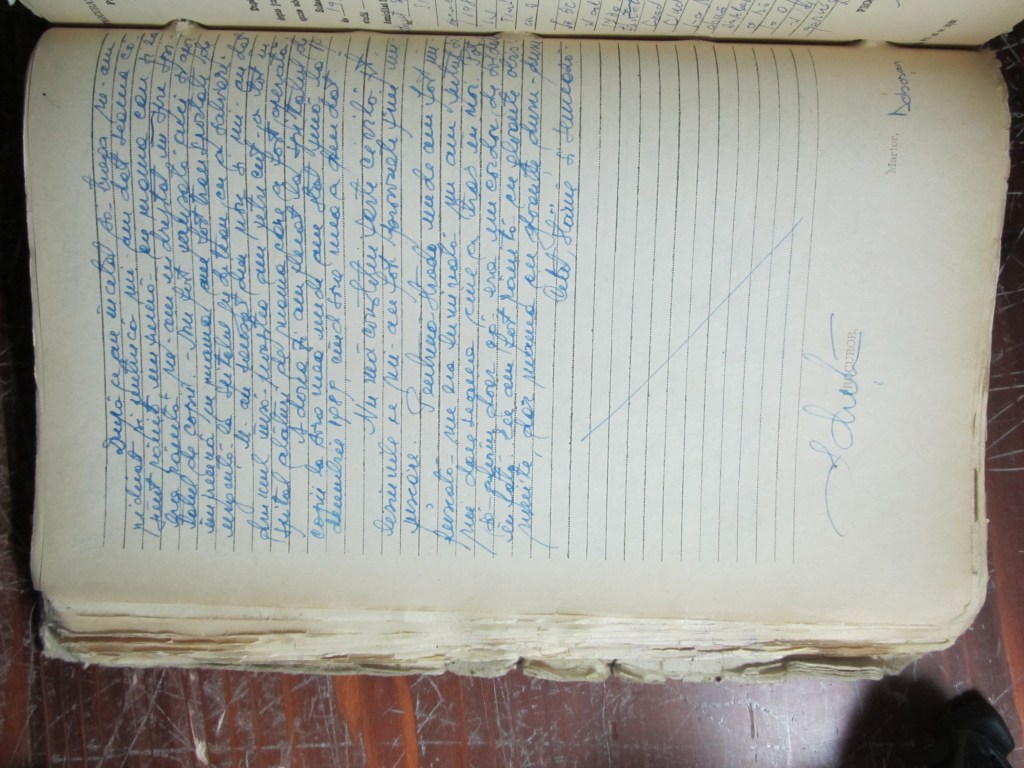
Csikos I[?] “Cred dupa rana [?]  ca au fost gloante dum-dum”

IMG_0088

Dobosan “am fost ranit…cu gloante dum-dum”

imaginea 127
imaginea 128

IMG_0128

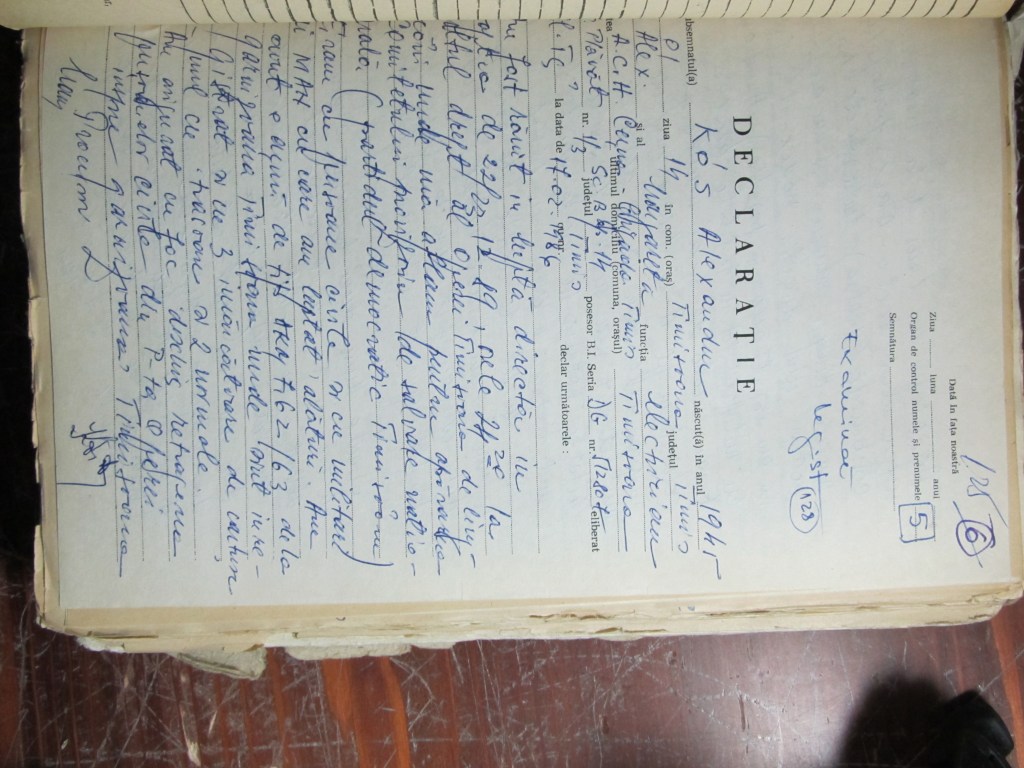
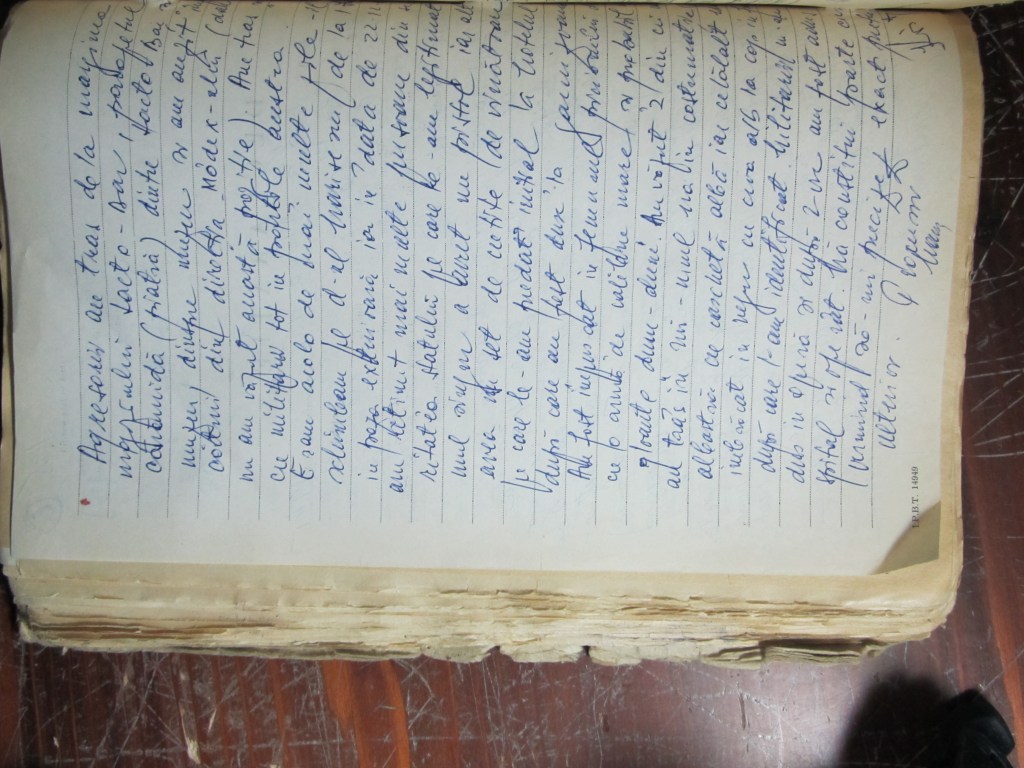
Alexandru Kos “[pe 23 decembrie 1989] am fost impuscat…cu o arma de calibru mare si probabil cu gloante dum-dum”

imaginea 207
imaginea 208

IMG_0207

IMG_0208

Florin Nicoara “Am fost lovit in soldul drept cu un glont dum-dum”

IMG_0257

Griga “civilii au fost impuscati cu gloante plate [?], care asa cum spuneau medicii cu rupt tesuturile”

imaginea 170
imaginea 171

IMG_0171

Andrei Jubea “glontul special de culoare alb”

imaginea 204
imaginea 205

IMG_0205

Iosif Cota “gloante crestati”

imaginea 90
imaginea 91

IMG_0091

http://atomic-temporary-3899751.wpcomstaging.com/2012/12/30/dosarele-revolutiei-de-la-timisoara-declaratia-lui-mircea-stoica-8-ianuarie-1990-40-ani-topometrist-impuscat-patru-luni-spitalizat-decedat/

Mircea Stoica (declaratie, 8 ian 1990):  “Cind am ajuns aici, la poarta o voce de militar din garnizoana s-a exprimat:  “Ce faceti mai — voi toti cu BUM-BUM sau DUM-DUM si ni-i trimiteti noua sa ne spalam pe cap cu ei.”


Mircea Stoica (declaration, 8 January 1990):  “When I got there, I heard a soldier’s voice from the garrison exclaim:  “What are you guys doing? You all with your BUM-BUM or DUM-DUM and then you send`em to us to solve the problem [almost impossible to solve]” <very angry, pissed off>

(my sincere thanks to Gigga Adrian Tudor for this transcription and translation of the quote!)

Popovici:  “Mi-am revenit intr-un camion militar in care eram multi civili unii morti fiind adusi la garnizoana militara.  La garnizoana eu am fost dat jos si predat unui cpt (capitan) sau unui lt.major (locotenent major). vazand rana mea n-a vrut sa ma primeasca exprimand: Voi trageti cu dum dum si noi sa raspundem pentru acest lucru.”  (my thanks to A.K. for this transcription)

Popovici:  “I came to in a military truck in which there were lots of civilians some dead being brought to the military garrison.  At the garrison I was taken down and surrendered to a captain or lt. major, who looking at my wound did not want to receive me, exclaiming:  You shoot with dum-dum bullets and we are held responsible for it.”

It doesn’t take a genius to recognize the important similarity between the testimonies of Mircea Stoica and Ioan Popovici:  both are party to/overhear military personnel referring to the 1) use of DUM-DUM bullets, 2) that those who are using them are clearly not fellow soldiers and instead likely M.I./Securitate personnel, and 3) the Army personnel are resentful of essentially being left to “hold the bag” for the results of the DUM-DUM munitions!

———————————————————————————————————————————

Stoica Mircea, 40 ani, topometrist, Bd. Republicii, impuscat mina si picior http://www.timisoara.com/mioc/REVT06~1.HTM

197. Partea vătămată Stoica Maria cere 500000 lei, lunar, contribuţie de întreţinere, motivînd că, în decembrie 1989, soţul ei, Mircea Stoica a fost împuşcat, patru luni spitalizat, a rămas handicapat (gradul II de invaliditate), apoi a decedat.  În dovedirea cererii, depune acte de spitalizare şi de stabilire a capacităţii de muncă, care atestă vătămarea, cauzele şi consecinţele ei. Mai depune: declaraţia împuşcatului, actul lui de deces, actul de căsătorie şi carnetul de muncă (vol. 6 p. 304; vol. 10 p. 58-60, 170, 245-250; vol. 14 p. 54-61; vol. 27 p. 179-207).
http://www.procesulcomunismului.com/marturii/fonduri/mmioc/curteasup/docs/0307pciv.htm

IMG_0335

“Cind am ajuns aici, la poarta o voce de militar din garnizoana s-a exprimat:  “Ce faceti mai — voi toti cu BUM-BUM sau DUM-DUM si ni-i trimiteti noua sa ne spalam pe cap cu ei.”

IMG_0330

intreaga declaratie e aici:

imaginea 330
imaginea 331
imaginea 332
imaginea 333
imaginea 334
imaginea 335
imaginea 336

in legatura cu declaratia aceasta, vezi si http://atomic-temporary-3899751.wpcomstaging.com/2012/12/02/dosarele-revolutiei-de-la-timisoara/ ,

Procesul de la Timisoara (II). Audierea partii civile Popovici Ion: “…Atata retin foarte bine minte, ca ofiterul a spus, cica: ‘Nu, voi trageti cu dum-dum-uri si dupa aia Armata raspunde.’”

Popovici:  “Mi-am revenit intr-un camion militar in care eram multi civili unii morti fiind adusi la garnizoana militara.  La garnizoana eu am fost dat jos si predat unui cpt (capitan) sau unui lt.major (locotenent major). vazand rana mea n-a vrut sa ma primeasca exprimand: Voi trageti cu dum dum si noi sa raspundem pentru acest lucru.”  (my thanks to A.K. for this transcription)

Popovici:  “I came to in a military truck in which there were lots of civilians some dead being brought to the military garrison.  At the garrison I was taken down and surrendered to a captain or lt. major, who looking at my wound did not want to receive me, exclaiming:  You shoot with dum-dum bullets and we are held responsible for it.”

available on this site http://www.banaterra.eu/romana/procesul-de-la-timisoara-1990-1991-vol-v ].  The following is from Volume V.]

Some excerpts: P.C.:  Ati dat o declaratie?   Po. I. :  Da  P.C.:  O mentineti?  Po. I. Da (p. 827) P.C.:  “Inteleg sa fiu audiat in cauza ca parte civila”, da?  V-as ruga sa faceti putin liniste!  “Mentin declaratia de la Procuratura si…” (p. 833)

Po. I.:  …Da [am fost ranit].  Si dupa aceea a venit unul dintre trei [civili mai in varsta] dupa mine, m-a tarat pana la masina si la masina, acolo, am luat o bataie…ca n-am putut doua saptamani nici sa mananc nimica.  M-a lovit cu patul de arma in falca si cu bocancii in cap.  Si m-au dus, m-au dus la Garnizoana.  La Garnizoana m-au aruncat din masina si a venit ofiterul de serviciu.  Au venit si acestia trei a spus lu’ ofiterul de serviciu, cica:  “Luati-l si duceti-l  la arest.”  Atata retin foarte bine minte, ca ofiterul a spus, cica:  “Nu, voi trageti cu dum-dum-uri si dupa aia Armata raspunde.  Voi omorati oameni si raspunde Armata dupa aceea.”  Asta tin minte precis.  Si de acolo mi-am dat seama ca nu poate sa fie soldati aceia. (p. 830)

IMG_0291

IMG_0290

Doru Sciadei

IMG_0932

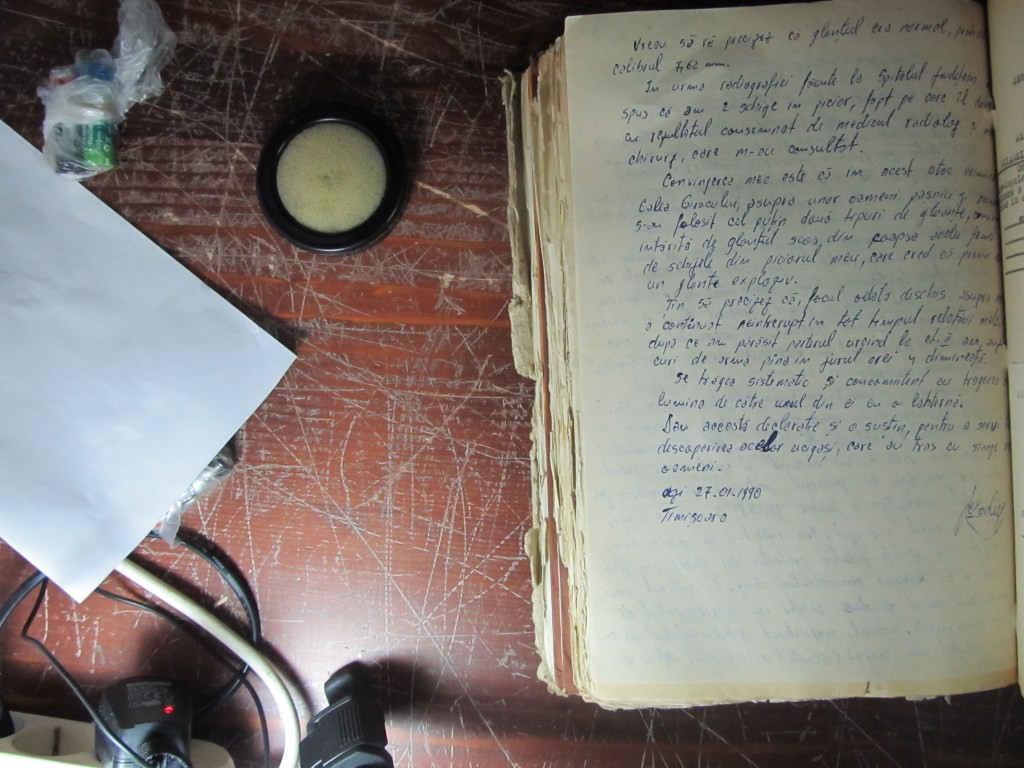
“In urma radiografiei facute la Spitalul Judetean au spus ca am 2 schije in picior…consemnat de medicul radiolog si chirurg, care m-au consultat.

Convingerea mea este ca in acest atac (pe ?) Calea Girocului, asupra unor oameni pasnici si (?) s-au folosit cel putin doua tipuri de gloante, convingerea intirita de glontul scos din coapsa (?) si schijele din piciorul meu, care cred ca provin de un glonte exploziv.

IMG_0929

Doina Gherasim glonte dum dum

IMG_0175

Cristian Rusu “S-a tras cu gloante dum-dum”

IMG_0305

SIX Doctors/Medical personnel from Timisoara alone have discussed the use of dum-dum bullets against demonstrators in Timisoara…

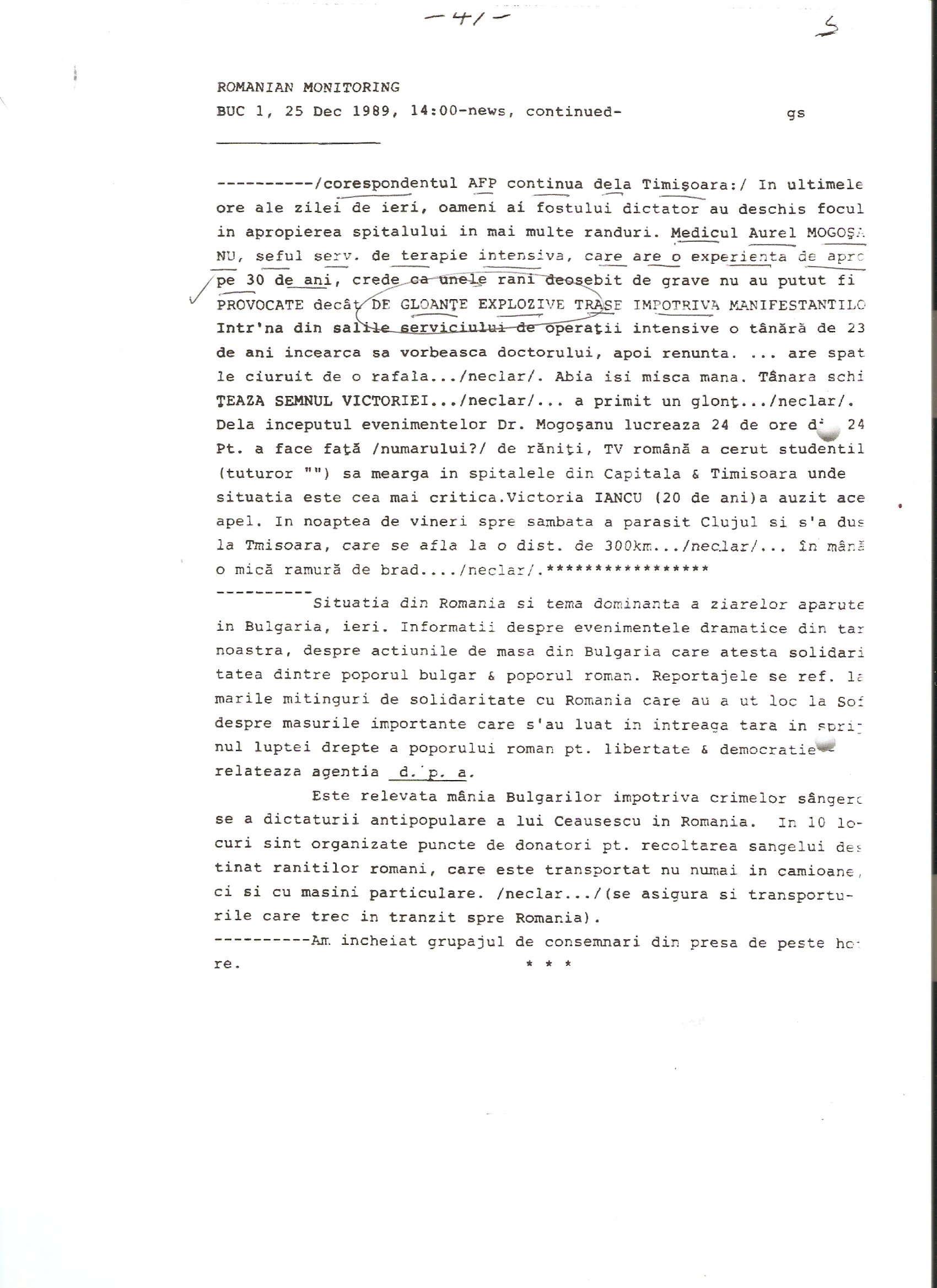
Doctors also reported on the wounds caused by explosive bullets (i.e. dum-dum bullets):  In this dispatch from Agence France Presse, relayed by Radio Free Europe on 25 December 1989, Dr. Aurel Mogosanu, a medic in the intensive care unit of a Timisoara hospital, says based on his thirty years of experience, some of the wounds could only have been CAUSED by EXPLOSIVE BULLETS SHOT AT THE PROTESTERS”

sursa (documentele Europa Libera disponsibile la):  http://media.hotnews.ro/media_server1/generic_file-2009-12-22-6754154-0-radio-bucuresti-25-dec-pdf.pdf (p. 49 of 82)

©AFP Général – Lundi 25 Décembre 1989 – 08:33 – Heure Paris (386 mots)
Roumanie, prev Nuit de Noel a l hopital central de Timisoara De l un des envoyes speciaux de l AFP, NICOLAS MILETITCH
   TIMISOARA (Roumanie) 25 dec – Devant l hopital central de Timisoara, dimanche soir, une quarantaine de camions remplis de medicaments et de produits alimentaires tout juste arrives, attendaient d etre decharges.
   ” L aide nous vient d un peu partout. Hongrie, RFA, Tchecoslovaquie, France, Yougoslavie, URSS, Bulgarie, Italie… ” , indique a l AFP l un des soldats qui gardent l hopital. Les militaires sont partout autour de l hopital, sur les toits, dans les cours et meme a l interieur.
   ” Des hommes de la Securitate ont tire pres de l hopital a plusieurs reprises, ces dernieres heures ” , explique le docteur Aurel Mogosianu, chef du service de soins intensifs, en donnant des ordres a un soldat qui passe, la mitraillette a l epaule, dans un couloir, entre les malades.
   Le Dr Mogosianu, qui a une trentaine d annees d experience, pense que certaines blessures particulierement horribles, n ont pu etre provoquees que par des balles explosives tirees contre les manifestants.
   Dans une salle de soins intensifs, une femme de 23 ans essaie de parler au docteur, puis renonce. ” C est un cas difficile. Elle a eu le dos transperce par une rafale ” , precise le Dr Mogosianu.
   En bougeant a peine la main, la jeune femme esquisse le ” V ” de la victoire pour dire ” au revoir ” . Un effort irrealisable pour son voisin qui a recu une balle dans le cou, impossible a extraire.
   Comme la plupart de ses collegues, le docteur travaille, a peu de choses pres, 24 heures sur 24 depuis le debut des evenements. Dans un coin, une infirmiere dort, ecroulee sur une chaise.
   Pour faire face a l afflux de blesses, la television de Bucarest a demande a tous les etudiants en medecine du pays de se rendre dans les hopitaux de la capitale et de Timisoara, ou la situation est la plus critique.
   Victor Jancu, 20 ans, a entendu cet appel. Dans la nuit de vendredi a samedi, il a quitte Cluj et reussi a rejoindre Timisoara, a plus de 300 kms de la, en arretant des camions.
   Quelques visiteurs arrivent a l hopital, portant a la main une petite branche de sapin : a Timisoara aussi, on voudrait feter Noel.
   nm/jga/vr.
Tous droits réservés : ©AFP Général
021851451DC1ED1D715E06849EA4C6E0F37C0C25ECE8D503

mai mult despre Dr. Aurel Mogosanu in decembrie 1989:  http://www.sorinbogdan.ro/2009/12/timisoara-18-decembrie-1989/.

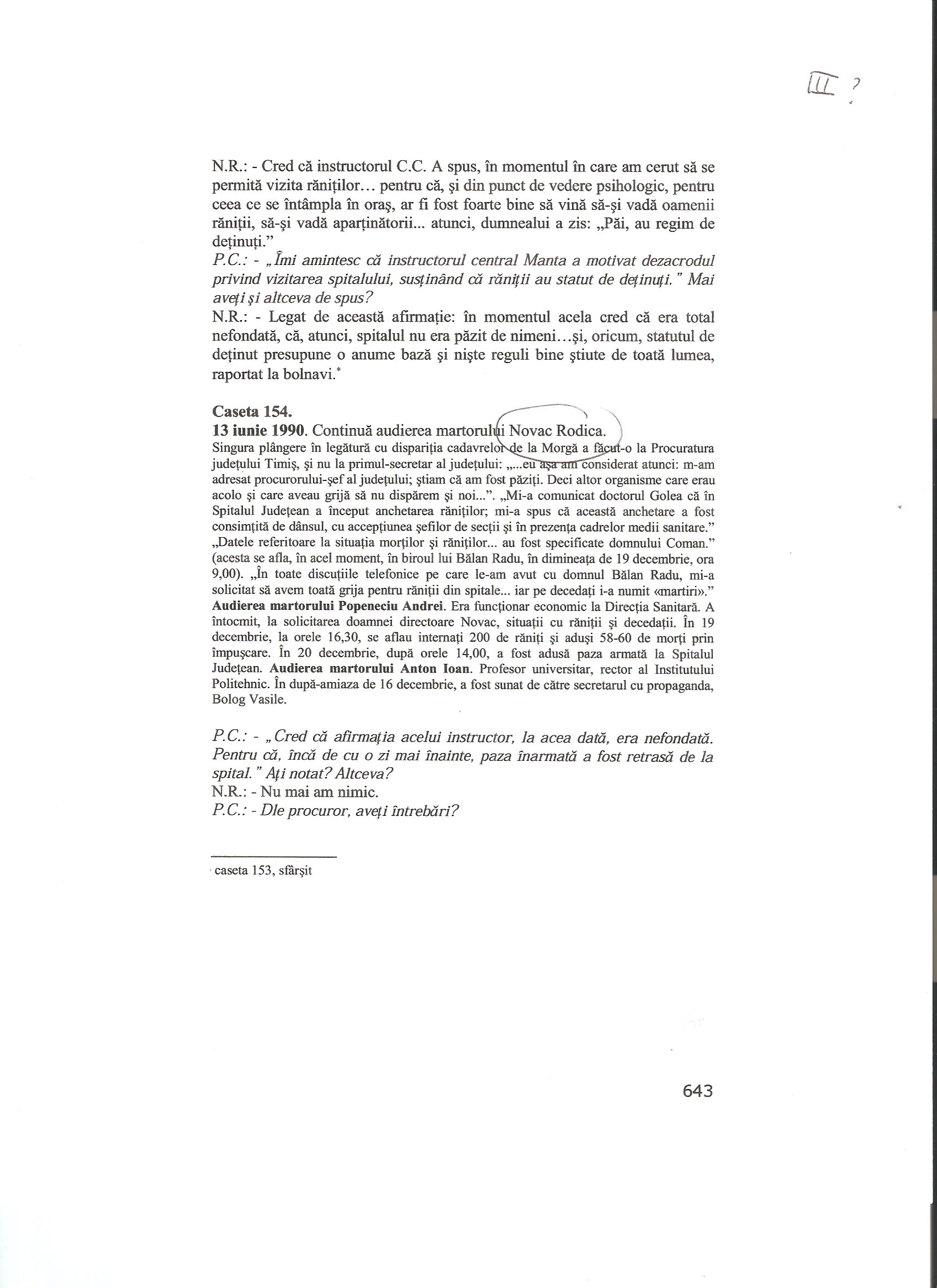
http://atomic-temporary-3899751.wpcomstaging.com/2011/09/30/procesul-de-la-timisoara-iii-audierea-martorului-rodica-novac-directorul-directiei-sanitare-timis-13-iunie-1990/

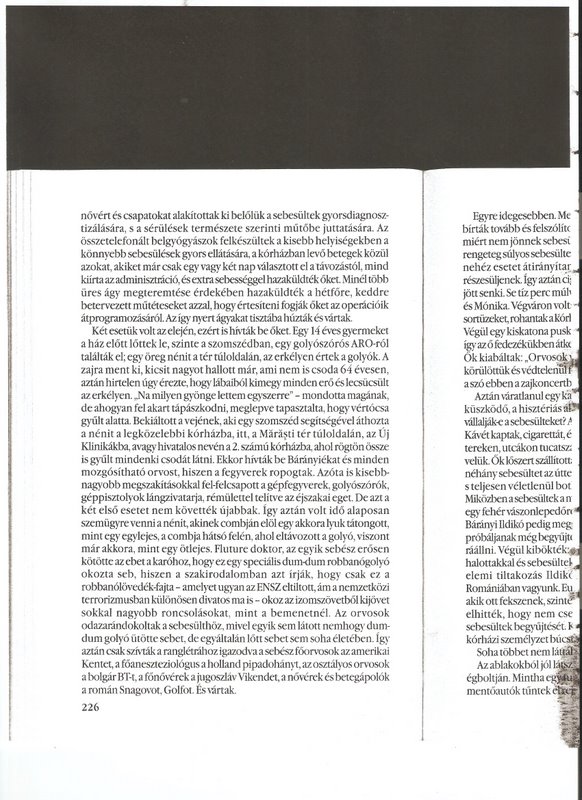
Rodica Novac’s claim is corroborated elsewhere by four other medical officials on call during the Timisoara repression.  First, in Romanian, by Dr. Atanasie Barzeanu, then in Hungarian by three doctors (Vladimir Fluture, Csaba Ungor, and Andras Goga) present and performing surgery in Timisoara hospitals from 17-19 december 1989 who recount separately their discovery of dum-dum exploding bullets among the bullets with which demonstrators arriving at the hospital had been shot.  december 1989: temesvari orvosok, dum-dum golyok, es a roman forradalom

Sava Florica, 33 de ani, vinzatoare la Loto-pronosport in cartierul Fabric, impuscata din mers, in Piata Traian

Barzeanu Atanasie, 65 anit, medic primar, doctor in stiinte, chirurg, Spitalul Judetean Timisoara

“…sintem deci in 18 decembrie…Pe la orele doua si patruzeci, cind inchideam o operatie–Sava Florica, 33 de ani, vinzatoare la Loto-pronosport in cartierul Fabric, impuscata din mers, in Piata Traian, dintr-un ARO, pacienta prezentindu-se o echimoza cu distrugerea tesuturilor (plaga in diametru de 15 centimetri), a tesuturilor din regiunea epigastrica, inclusiv a muschilor drepti abdominali, cu ruptura a colonului ascendent transvers si a jejuno-ileonului, fiind in stare de soc grav traumatic, hemoragic–, fara sa-mi poti explica nici macar acum cu ce fel de gloante a putut fi lovita, pentru ca nu am identificat nici orificiul de iesire si nici pe cel de intrare, a venit o asistenta de la Chirurgie I, care mi-a spus sa merg la domnul Ignat.”

Titus Suciu, Reportaj cu Sufletul la Gura, (Editura Facla 1990), pp. 133-134.

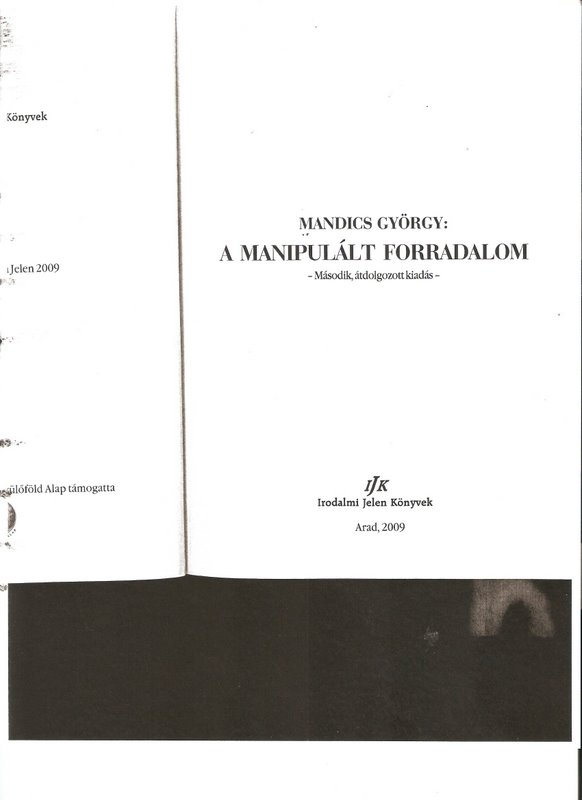
The following first appeared in Gyorgy Mandics’s Temesvari golgota (1991) pp. 348-349 and is reprinted in his A Manipulalt Forradalom (2009).  [My guess is this is also the source for the reference to dum dum bullets in the German language wikipedia entry for http://de.wikipedia.org/wiki/Rum%C3%A4nische_Revolution_1989 — Hans Vastag, György Mandics, Manfred Engelmann: Temeswar. Symbol der Freiheit. Wien 1992. ]

pp. 348-349

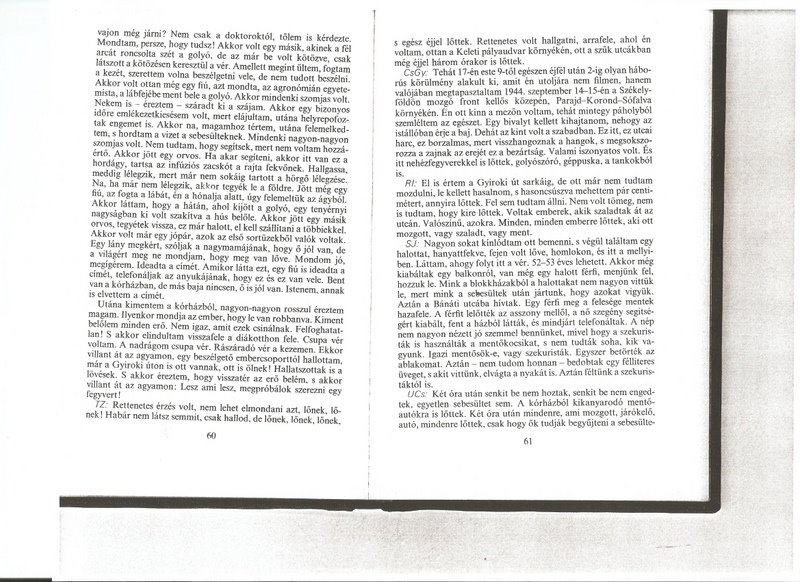
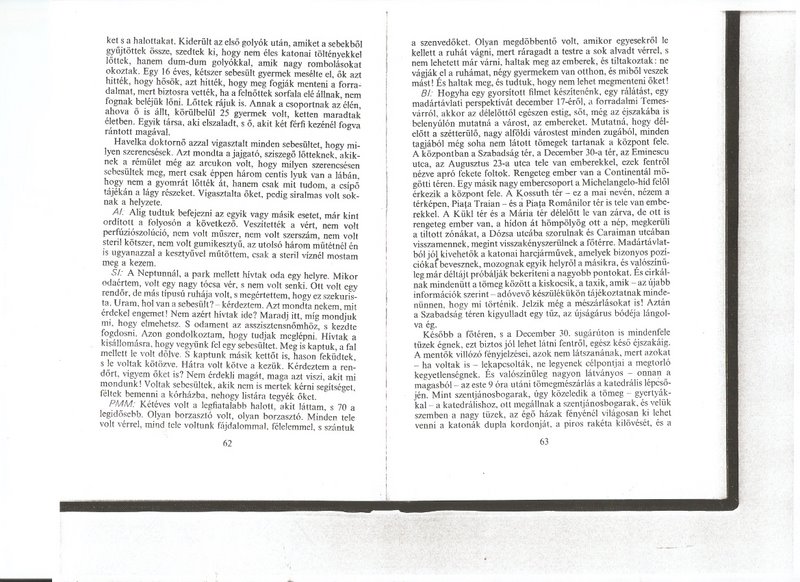
Ket esetuk volt az elejen.  Ezert is hivtak be oket.  Egy 14 eves gyermeket a haz elott lottek le, szinte a szomszedban, egy golyoszoros ARO-rol talaltak el; egy oreg nenit a ter tuloldalon, az erkelyen ertek a golyok.  A zarja ment ki, kicsit nagyott hallott mar, amire is csoda, 64 evesen, azt hirtelen ugy erezte, hogy labaibol kimegy minden ero es lecsusott az erholya.  Na milyen gyonge lettem egyszeruen–mondotta maganak. de ahogyan fel akart tapaszkodni meg lepve tapasztalt, hogy vertocsa gyult alatta.  Bekialtolt a vegenek aki egy szomszed segitsegevel athozta a nenit a legkozelebbi korhazba, itt a Marasti ter tuloldalan, az uj Klinikakba, avagy hivatalos neven a 2 szamu korhazba, ahol rogton osszecodult mindenki csodat latni.  Ekkor hivtak be Baranziekat es minden mozgositato orvost, hiszen a fegyverek ropogatak.  Azota is kisebb nagyobb megszakitasokkal, felfelecsapolt a gepfegyverek, golyoszorok, geppisztolyok langzivatarja, remulettel telitva az ejszaki eget.

p. 349

De azt a ket elso esett nem kovettek ujabbok.  Igz aztan volt ido alaposan szemugyre venni a nenit akinek combjan elol egz akkora lyuk tatongott mint egy egy lejes, a comba hatso felen ahol eltavotott a golyo, ott viszont mar akkora mint egy otlejes.  Fluture doktor, az egzik sebesz erosen kototte az ebet a korohoz, hogy ez egz specialis dum-dum robbanogolyo okozta seb, hiszen a szakirodalomban azt irjak, hogy csak ez a robbannolovedek-fajta-amelyet ugyan az ENSZ eltitott, am a nemzetkozi terrorizmusban kulonesen divatos ma is–okoz az izomszovetbol kijovet sokkal nagyobb roncsolasokat mint a bemenetnel.  Az orvosok odazarandokoltak a sebesulthoz, mivel egzik sem latott semhogy dum-dum golyo utotte sebet, de egyaltalan lott sebet sem soha eleteben.  Igz aztan csak szivtak a rangeletrahoz igazodva a sebesz foorvosok az amerikai Kentet, a foamnesztezialogus a holland pipadohanyt, az asztalyos orovosok a bolgar BT-t, a fonoverek a jugoslav Vikend-et, a noverek es helyapolok a roman Snagov-t, Golfot.  Es vartak.

(Note: it is unclear who the 64 yr. old described was…there are several individuals without ages listed as injured or dead during the events, but I think it more likely the age of the woman is incorrect)

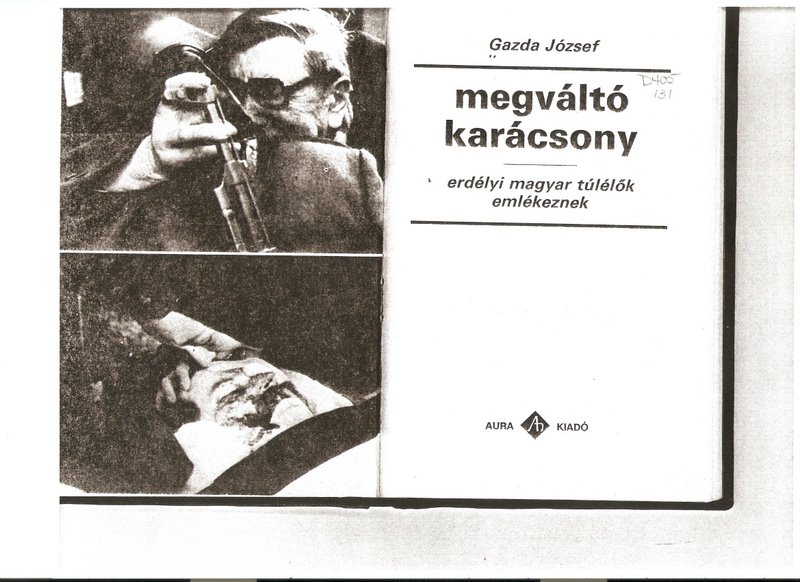
Jozsef Gazda Megvalto karacsonyErdelyi magyar tulelok emlekeznek. (1990)

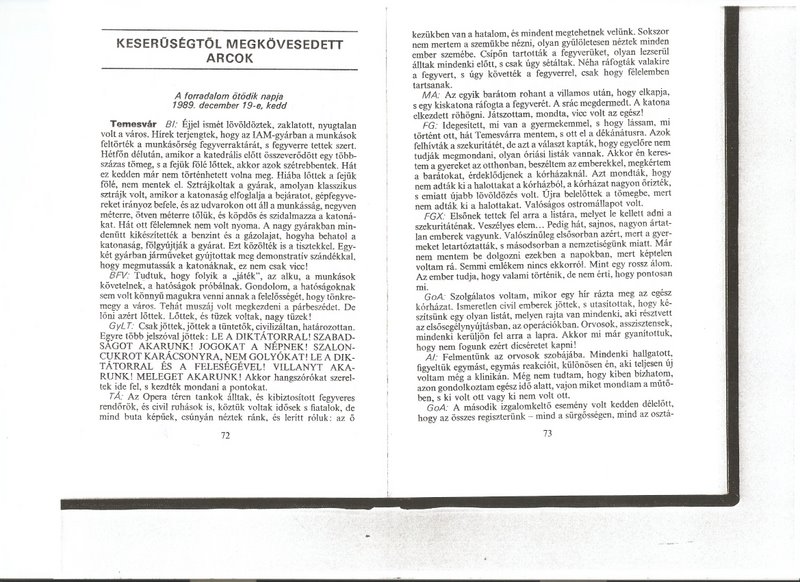
Ungor Csaba:  Ket ora utan senkit be nem hoztak, senkit be nem engedtek, egyetlen sebesult sem.  A korhazbol kikanyarado  mentoautokra is lottek.  Ket ora utan mindre, ami mozgott, jarokelo, auto, mindenre lottek, csak hogy ok tudjak begyujteni a sebesulteket s a halottakat.  Kiderult az elso golyok utan, amiket a sebekbol gyujottek ossze, szedtek ki, hogy nem eles katonai toltenyekkel lottek, hanem dum-dum golyokkal, amik nagy rombolasokat okoztak.  Egy 16 eves, ketszer sebesult gyermek meselte el, ok azt hittek, hogy hosok, azt hittek, hogy meg fogjak menteni a forradalmat, mert biztosra vettek, ha a felnottek sorfala ele allnak, nem fognak belejuk loni.  Lottek rajuk is.

Goga Andras:  A masodik izgalomkelto esemeny volt kedden delelott, hogy az osszes regiszterunk–mind a surgossegen, mind az osztalyon–, melyekre felirtuk a muteteinket, eltuntek, a mai napig sem talaltuk meg.  Bennuk voltak az ev osszes mutetei[***]…En aznap kettot operaltam.  Egy tuntetonek a bore alol vettem ki egy nagyon kulonleges golyok, nem is golyot, egy ilyen repeszdarabot, melyet a katonasag aztan megvizsgalt, s azt mondtak, nekik nincs tudmasuk, hogy ez mi lehet.  Egy masiknak pedig fejserulese volt, persze abban nem talaltam golyot, atment rajta.

In early March 1990, AFP reported the declared findings of surgeons in Bucharest, attesting to the fact that many of those wounded on 21-22 December 1989 in Bucharest had been shot with exploding bullets, DUM-DUM bullets.  This is a critical article (and description of an event that I believe has gotten almost no coverage inside or outside Romania).  Lt. Gnl. Traian Oancea, chief of surgery in part of the Central Military Hospital in Bucharest, and Dr. Nicolae “Nae” Constantinescu, chief of surgery at the Coltea Hospital, discussed this at a meeting of the Society of Surgeons in Bucharest.

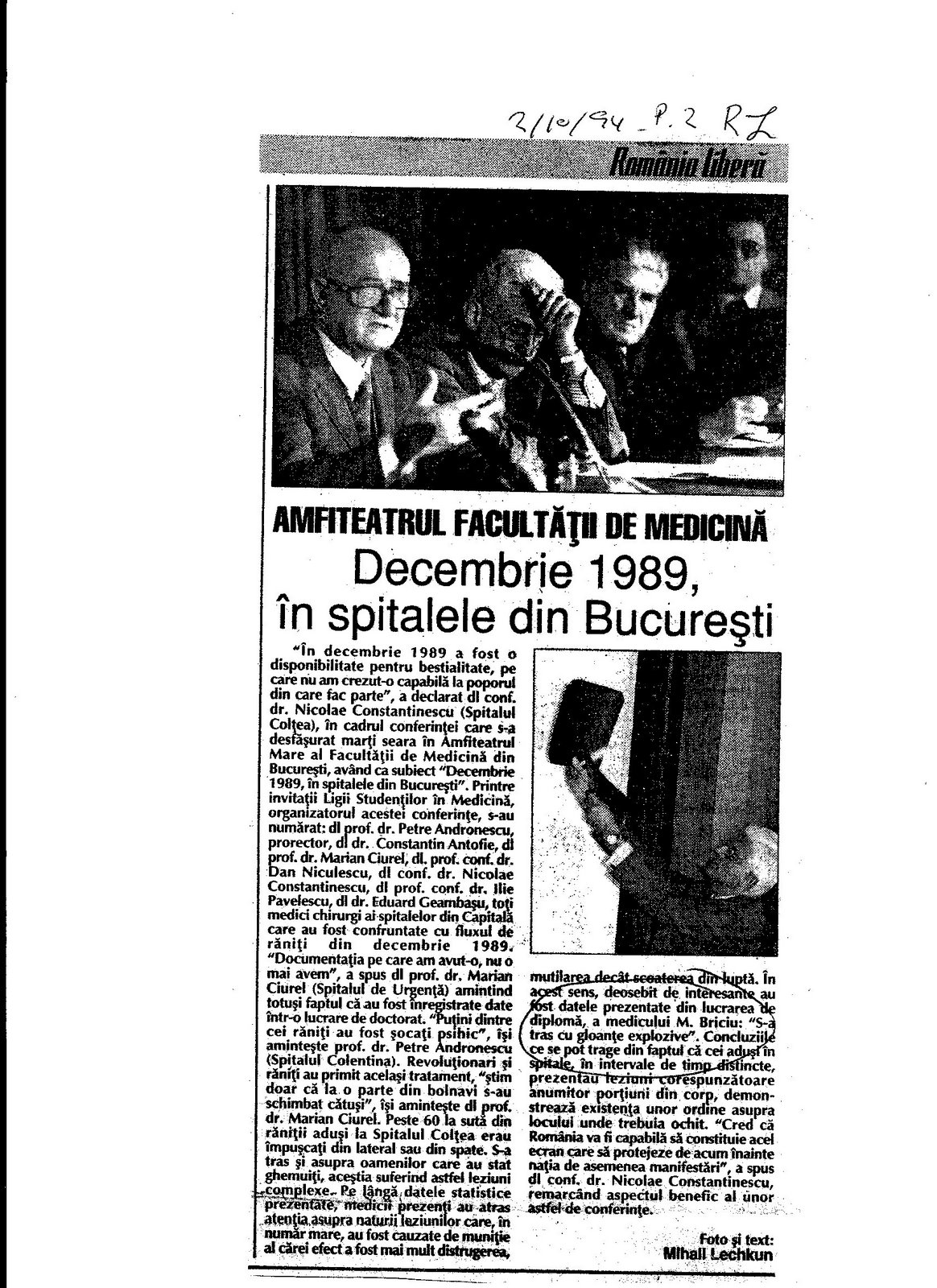
This was also discussed by Bucharest medical personnel at a 1994 conference:

AMFITEATRUL FACULTATII DE MEDICINA

“Decembrie 1989, in spitalele din Bucuresti”

Mihail Lechkun, Romania Libera, 10 februarie 1994, p. 2

“In decembrie 1989 a fost o disponsibilitate pentru bestialitate, pe care nu am crezut-o capabila la poporul care fac parte, ” a declarat dl. conf. dr. Nicolae Constantinescu (Spitalul Coltea), in cadrul conferintei care s-a desfasurat marti seara in Amfiteatrul Mare al Facultatii de Medicina din Bucurest, avand ca subiect “Decembrie 1989, in spitalele din Bucuresti”.  Printre invitatii Ligii Studentilor in Medicina, organizatorul acestei conferinte, s-au numarat:  dl. prof. dr. Petre Andronescu, prorector, dl. dr. Constantin Antofie, dl. prof. dr. Marian Ciurel, dl. prof. conf. dr. Dan Niculescu, dl. conf. dr. Nicolae Constantinescu, dl. prof. conf. dr. Ilie Pavelescu, dl. dr. Eduard Geambasu, toti medici chirurgi din Capitala care au fost confruntate cu fluxul de raniti din decembrie 1989.  “Documentatia pe care am avut-o, nu o mai avem,” a spus dl. prof. dr. Marian Ciurel (Spitalul de Urgenta) amintind totusi faptul ca au fost inregistrate date intr-o lucrare de doctorat.  “Putini dintre cei raniti au fost socati psihic,” isi aminteste prof. dr. Petre Andronescu (Spitalul Colentina).  Revolutionari si raniti au primit acelasi tratament, “stim doar ca la o parte din bolnavi s-au schimbat catusi” isi aminteste dl. prof. dr. Marian Ciurel.  Peste 60 la suta din ranitii adusi la Spitalul Coltea erau impuscati lateral sau din spate.  S-a tras si asupra oamenilor care au stat ghemuiti, acestia suferind astfel leziuni complexe.  Pe langa datele statistice prezentate, medicii prezenti au atras atentia asupra naturii leziunilor care, in numar mare, au fost cazate de munitie al carie efect a fost mai mult distrugerea, mutilarea decat scoaterea din lupta.  In acest sens, deosebit de interesante au fost datele prezentate din lucrarea de diploma, a medicului M. Briciu:  “S-a tras cu gloante explozive”. Concluziile ce se pot trage din faptul ca cei adusi in spitale, in intervale de timp distincte, prezentau leziuni corespunzatoare anumitor portiuni din corp, demonstreaza existenta unor ordine asupra locului unde trebuia ochit.  “Cred ca Romania va fi capabila sa constituie acel ecran care sa protejeze de acum inainte natia de asemenea manifestari,” a spus dl. conf. dr. Nicolae Constantinescu, remarcand aspectul benefic al unor astfel de conferinte.

NOR WERE THESE THE ONLY DOCTORS AND MEDICAL PERSONNEL–FOREIGN OR DOMESTIC–WHO ATTESTED TO THE USE OF DUM-DUM EXPLODING AND OTHER ATYPICAL, UNUSUAL MUNITIONS USED DURING THE EVENTS OF DECEMBER 1989

http://atomic-temporary-3899751.wpcomstaging.com/2011/08/08/doctors-and-dum-dum-bullets-in-romania-in-december-1989-i-dr-manuel-burzaco-medecins-sans-frontieres/

http://atomic-temporary-3899751.wpcomstaging.com/2011/08/10/doctors-and-dum-dum-bullets-in-romania-in-december-1989-ii-trimisi-in-strainatate-italia-franta-austria-anglia-si-germania-pentru-tratament/

http://atomic-temporary-3899751.wpcomstaging.com/2011/08/11/doctors-and-dum-dum-bullets-in-romania-in-december-1989-iii-ce-spun-medici-romani/

Other posts with documents from dosarele revolutiei…

http://atomic-temporary-3899751.wpcomstaging.com/2012/12/16/what-can-we-learn-from-dosarele-revolutiei-de-la-timisoara-i/

http://atomic-temporary-3899751.wpcomstaging.com/2012/12/19/what-can-we-learn-from-dosarele-revolutiei-de-la-timisoara-ii/

http://atomic-temporary-3899751.wpcomstaging.com/2012/12/20/what-can-we-learn-from-dosarele-revolutie-de-la-timisoara-iii/

http://atomic-temporary-3899751.wpcomstaging.com/2012/12/21/what-can-we-learn-from-dosarele-revolutiei-de-la-timisoara-iv/

http://atomic-temporary-3899751.wpcomstaging.com/2012/12/27/what-can-we-learn-from-dosarele-revolutiei-de-la-timisoara-v/

http://atomic-temporary-3899751.wpcomstaging.com/2012/12/28/what-can-we-learn-from-dosarele-revolutiei-de-la-timisoara-vi/

Posted in decembrie 1989, raport final | Tagged: , , , , , , , | Leave a Comment »

“Foarte curioasă treaba asta!”: Securitate General Iulian Vlad Remembers to Forget and Reorients His Story

Posted by romanianrevolutionofdecember1989 on September 28, 2013

image0

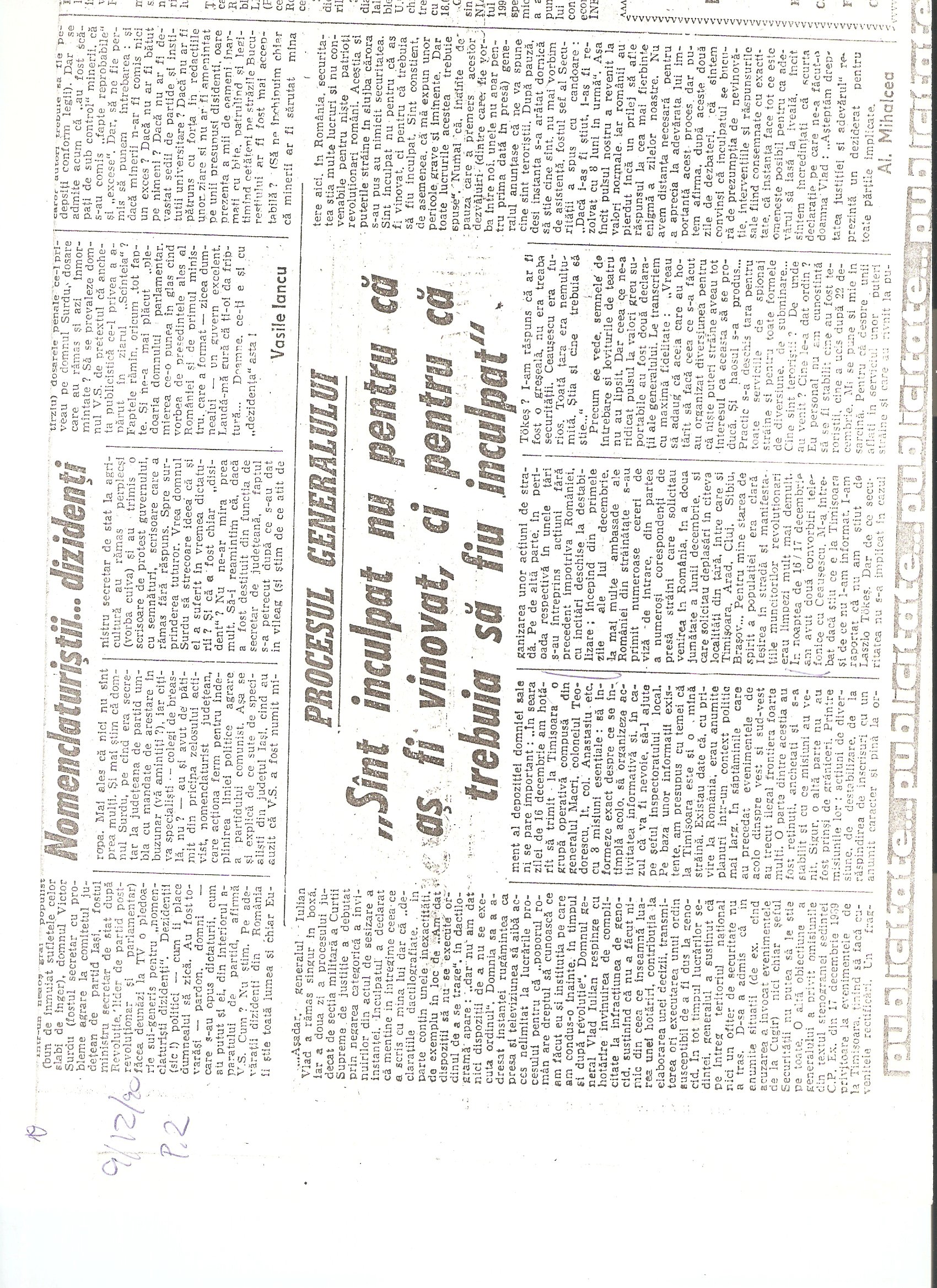
Al. Mihalcea, “Procesul Generalului:  ‘Sint inculpat nu pentru ca as fi vinovat, ci pentru ca trebuia sa fiu inculpat,” Romania Libera, 12 septembrie 1990, p. 2

FBIS-EEU-90-177 Romania, 12 September 1990, p. 38.

image0

Generalul Iulian Vlad:  “Vreau sa adaug ca aceia care au hotarit sa faca ceea ce s-a facut au organizat diversiunea pentru ca niste puteri straine aveau tot interesul ca aceasta sa se produca.  Si haosul s-a produs…Practic s-a deschis tara pentru toate serviciile de spionaj straine si pentru toate formele de diversiune, de subminare…Care sint teroristii?  De unde au venit?  Cine le-a dat ordin?  Eu personal nu am cunostiinta sa se fi stabilit cine au fost teroristii, cine a ucis dupa 22 decembrie.  Mi se spune si mie in sarcina.  Pentru ca despre unii aflati in serviciul unor puteri straine si care au rivnit la putere aici, in Romania, securitatea stia multe lucruri si nu convenabile pentru niste patrioti revolutionari romani.  Acestia si puterile straine in slujba carora s-au pus au nimicit securitatea.  Sint inculpat nu pentru ca as fi vinovat, ci pentru ca trebuia sa fiu inculpat.  Sint constient, de asemenea, ca ma expun unor pericole grave si iminente.  Dar toate lucrurile acestea trebuie spuse.”  Numai ca, inainte de pauza care a premers acestor dezvaluiri (dintre care, fie vorba intre noi, unele nu apar pentru prima data in presa) generalul anuntase ca ne va spune cine sint teroristii.  Dupa pauza, desi instanta s-a aratat dornica sa stie cine sint, nu mai vorbim de asistenta, fostul sef al Securitatii a spus cu candoare: Daca i-as fi stiut, i-as fi rezolvat cu 8 luni in urma.” (Al. Mihalcea, “Procesul Generalului:  ‘Sint inculpat nu pentru ca as fi vinovat, ci pentru ca trebuia sa fiu inculpat,” Romania Libera, 12 septembrie 1990, p. 2)

to paraphrase General Vlad himself on the night of 22-23 December 1989:  “Foarte curioasă treaba asta!”

…because just over half a year earlier General Vlad had confessed the following about the existence and identity of the “terrorists” of the Romanian Revolution of December 1989 (of course, in the interim the political landscape had changed and the former Securitate and its supporters had so poisoned and confused the narrative space, that he only needed to remember to forget when it came time for this court appearance…)

image0-001

It took 22 years for the text of Securitate Director General Iulian Vlad’s handwritten declaration of 29 January 1990 to become public knowledge–thanks to former military prosecutor General Ioan Dan.  (Inevitably, there will no doubt be those who will allege that General Vlad was “forced” to write this declaration to save his skin, etc., that this was the “propaganda of the moment” and all a huge lie.  If that were the case, one would have expected Iliescu, Brucan, Militaru, Voican Voiculescu, etc. to have made every effort for Vlad’s declaration to leak to the media.  Instead, for 22 years it was hidden from public knowledge!)

Of Note:  No “Soviet tourists,” no DIA (Batallion 404) troops of the army’s intelligence wing, no “there were no terrorists:  the Army shot into everyone else and into itself”–in other words, none of the spurious claims that have littered the narrative landscape, fueled by the former Securitate over the past two decades plus.  No, Vlad knew who the terrorists of the Romanian Revolution of December 1989 were, because they reported to him!

image0

image0-002

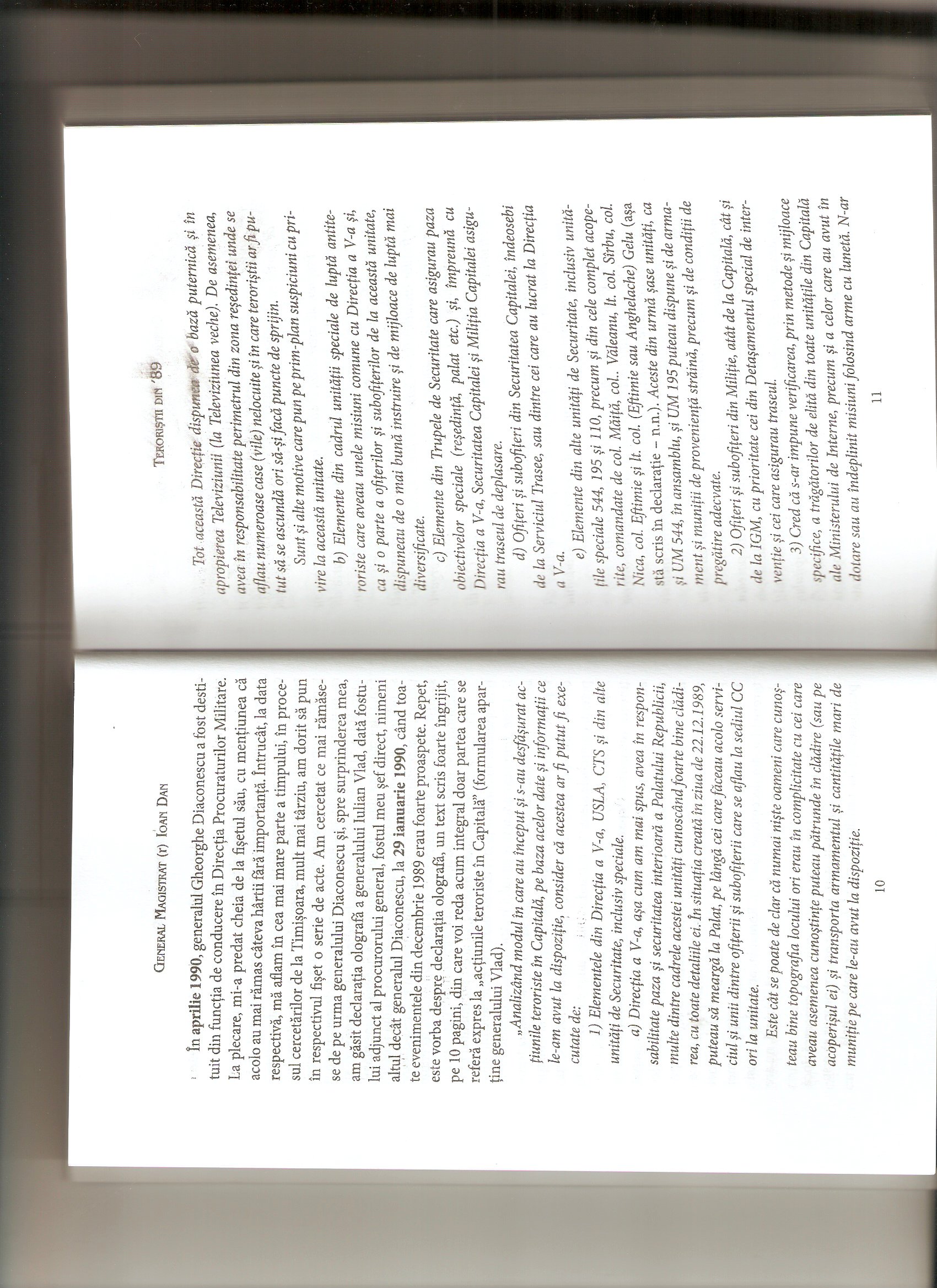
General Magistrat (r) Ioan Dan

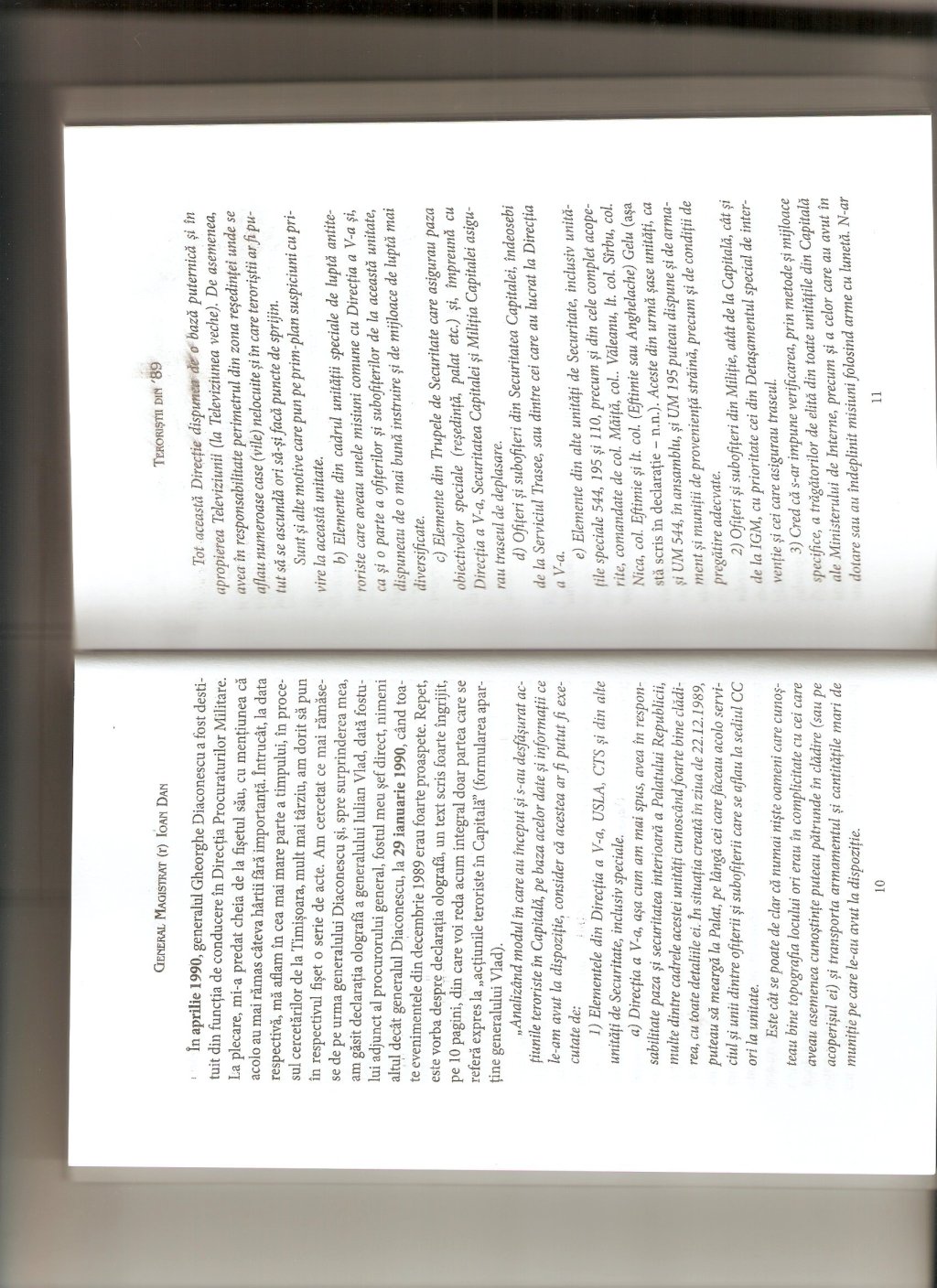
In aprilie 1990, generalul Ghoerghe Diaconescu a fost destituit din functia de conducere in Directia Procuraturilor Militare.  La plecare, mi-a predat cheia de la fisteul sau, cu mentiunea ca acolo au mai ramas cateva hartii fara importanta. Intrucat, la data respectiva, ma aflam in cea mai mare parte a timpului, in procesul cercetarilor de la Timisoara, mult mai tarziu, am dorit sa pun in respectivul fiset o serie de acte.  Am cercetat ce mai ramasese de pe urma generalului Diaconescu si, spre surprinderea mea, am gasit declaratia olografa a generalului Iulian Vlad, data fostului adjunct al procurorului general, fostul meu sef direct, nimeni altul decat generalul Diaconescu, la 29 ianuarie 1990, cand toate evenimentele din decembrie 1989 erau foarte proaspete.  Repet, este vorba despre declaratia olografa, un text scris foarte ingrijit, pe 10 pagini, din care voi reda acum integral doar partea care se refera expres la “actiunile teroriste in Capitala” (formularea apartine generalului Vlad).

“Analizand modul in care au inceput si s-au desfasurat actiunile teroriste in Capitala, pe baza acelor date si informatii ce le-am avut la dispozitie, consider ca acestea ar fi putut fi executate de:

1) Elementele din Directia a V-a, USLA, CTS si din alte unitati de Securitate, inclusiv speciale.

a) Directia a V-a, asa cum am mai spus, avea in responsabilitate paza si securitatea interioara a Palatului Republicii, multe dintre cadrele acestei unitati cunoscand foarte bine cladirea, cu toate detaliile ei.  In situatia creata in ziua de 22.12.1989, puteau sa mearga la Palat, pe langa cei care faceau acolo serviciul si unii dintre ofiterii si subofiterii care se aflau la sediul CC ori la unitate.

Este ca se poate de clar ca numai niste oameni care cunosteanu bine topografia locului ori erau in complicitate cu cei care aveau asemenea cunostinte puteau patrunde in cladire (sau pe acoperisul ei) si transporta armamentul si cantitatile mari de munitie pe care le-au avut la dispozitie.

Tot aceasta Directie dispunea de o baza puternica si in apropierea Televiziunii (la Televiziunea veche).  De asemenea, avea in responsabilitate perimetrul din zona resedintei unde se aflau numeroase case (vile) nelocuite si in care teroristii ar fi putut sa se ascunda ori sa-si faca puncte de sprijin.

Sunt si alte motive care pun pe prim-plan suspiciuni cu privire la aceasta unitate.

b) Elemente din cadrul unitatii speciale de lupta antiterroriste care aveau unele misiuni comune cu Directia a V-a si, ca si o parte a ofiterilor si subofiterilor de la aceasta unitate, dispuneau de o mai buna instruire si de mijloace de lupta mai diversificate.

c) Elemente din Trupele de Securitate care asigurau paza obiectivilor speciale (resedinta, palat etc.) si, impreuna cu Directia a-V-a, Securitatea Capitalei si Militia Capitalei asigurau traseul de deplasare.

d) Ofiteri si subofiteri din Securitatea Capitalei, indeosebi de la Serviciul Trasee, sau dintre cei care au lucrat la Directia a V-a.

e) Elemente din alte unitati de Securitate, inclusiv unitatile speciale 544, 195 si 110, precum si din cele complet acoperite, comandate de col. Maita, col. Valeanu, lt. col. Sirbu, col. Nica, col. Eftimie si lt. col. (Eftimie sau Anghelache) Gelu (asa sta scris in declaratie–n.n.).  Aceste din urma sase unitati, ca si UM 544, in ansamblu, si UM 195 puteau dispune si de armament si munitii de provenienta straina, precum si de conditii de pregatire adecvate.

2) Ofiteri si subofiteri din Militie, atat de la Capitala, cat si de la IGM, cu prioritate cei din Detasamentul special de interventie si cei care asigurau traseul.

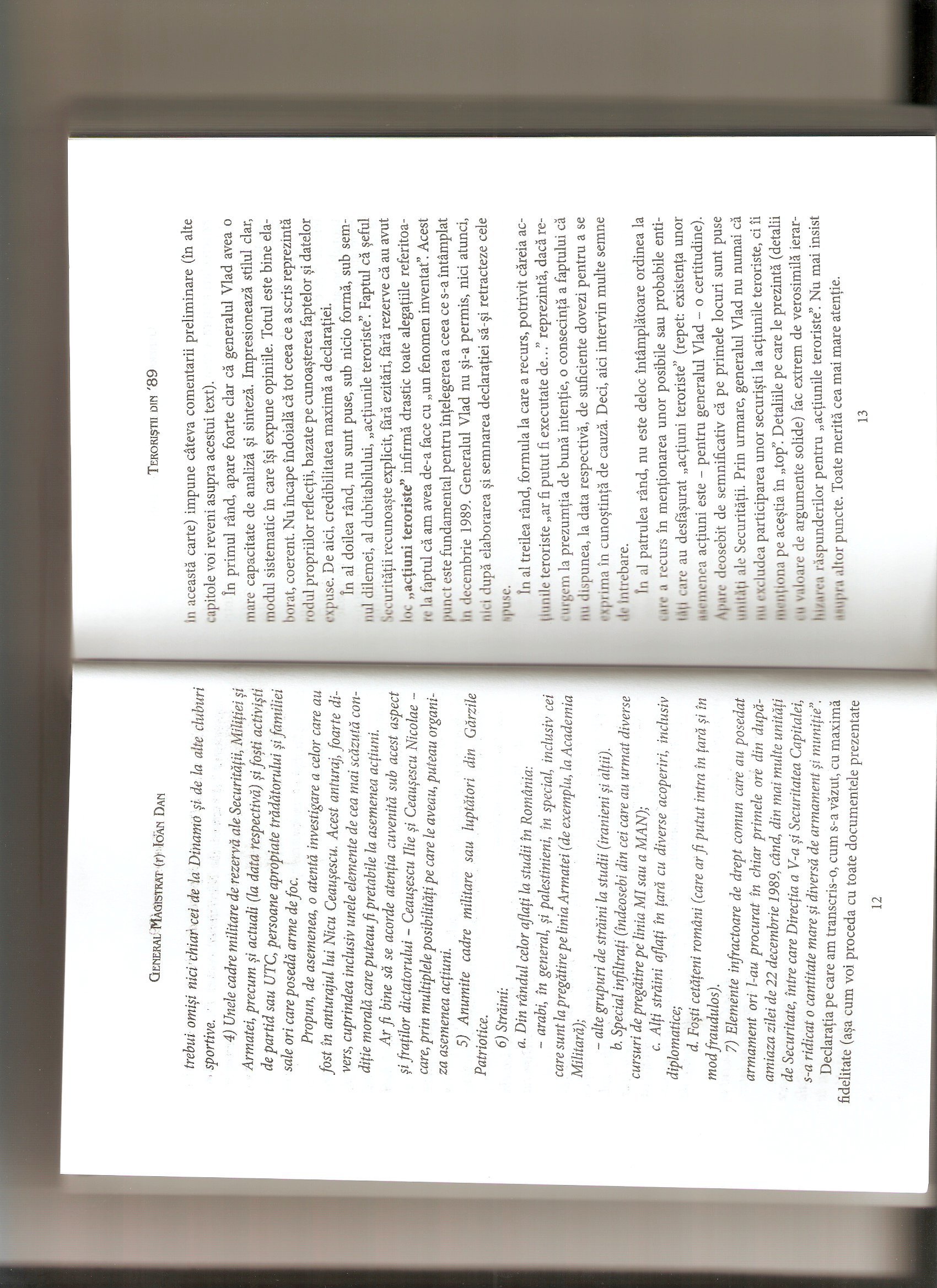
3) Cred ca s-ar impune verificarea, prin metode si mijloace specifice, a tragatorilor de elita din toate unitatile din Capitala ale Ministerului de Interne, precum si a celor care au avut in dotare sau au indeplinit misiuni folosind arme cu luneta.  N-ar trebui omisi nici chiar cei de la Dinamo si de la alte cluburi sportive.

4) Unele cadre militare de rezerva ale Securitatii, Militiei si Armatei, precum si actuali (la data respectiva) si fosti activisti de partid sau UTC, persoane apropriate tradatorului si familiei sale ori care poseda arme de foc.

Propun, de asemenea, o atenta investigare a celor care au fost in anturajul lui Nicu Ceausescu.  Acest anturaj, foarte divers, cuprindea inclusive unele elemente de cea mai scazuta conditie morala care puteau fi pretabile la asemenea actiuni.

Ar fi bine sa se acorde atentia cuvenita sub acest aspect si fratilor dictatorului–Ceausescu Ilie si Ceausescu Nicolae–care, prin multiplele posibilitati pe care le aveau, puteau organiza asemenea actiuni.

5) Anumite cadre militare sau luptatori din Garzile Patriotice.

6) Straini:

a. Din randul celor aflati la studii in Romania:

— arabi, in general, si palestinieni, in special, inclusiv cei care sunt la pregatire pe linia Armatei (de exemplu, la Academia Militara);

— alte grupuri de straini la studii (iranieni si altii).

b. Special infiltrati (indeosebi din cei care au urmat diverse cursuri de pregatire pe linia MI sau a MAN);

c. Alti straini aflati in tara cu diverse acoperiri, inclusiv diplomatice;

d. Fosti cetateni romani (care ar fi putut intra in tara si in mod fraudulos).

7) Elemente infractoare de drept comun care au posedat armament ori l-au procurat in chiar primele ore din dupa-amiaza zilei de 22 decembrie 1989, cand, din mai multe unitati de Securitate, intre care Directia a V-a si Securitatea Capitalei, s-a ridicat o cantitate mare si diversa de armament si munitie.”

Posted in decembrie 1989, raport final | Tagged: , , , , , , , | 3 Comments »

Lying in wait: Securitate Director General Vlad in the CC building (I)

Posted by romanianrevolutionofdecember1989 on September 14, 2013

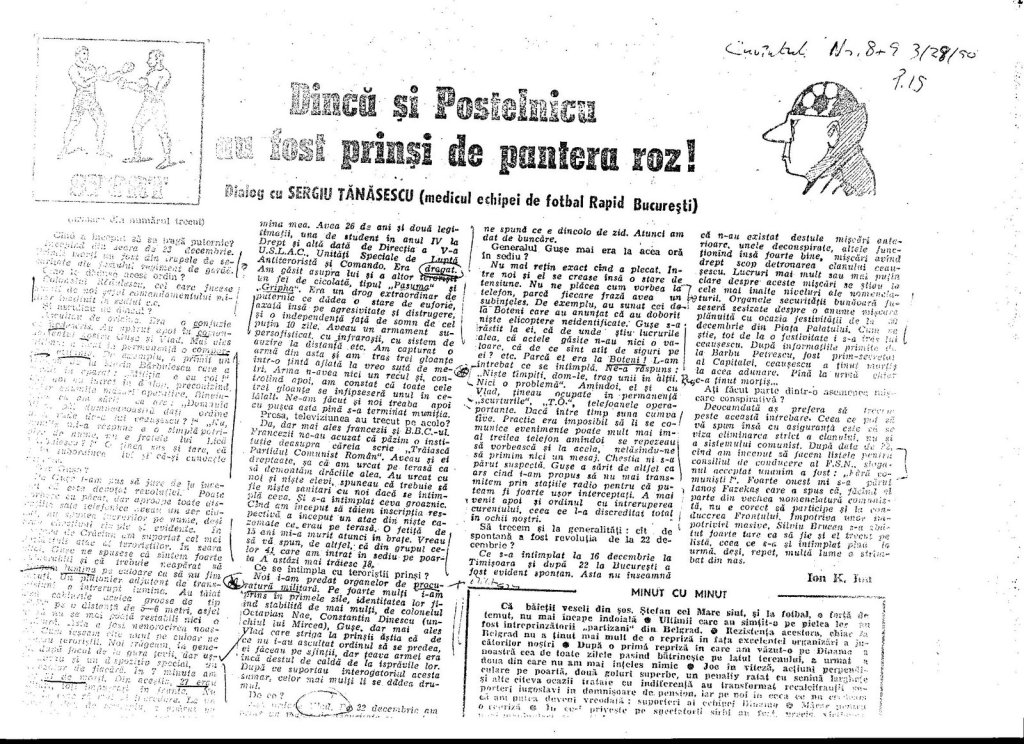
Sergiu Tanasescu (medicul echipei de fotbal Rapid Bucuresti), iaunarie 1990:  “Amindoi, el [Generalul Guse] si cu [Generalul] Vlad tineau ocupate in permanenta ‘scurturile,’ ‘T.O.’ telefoane operative.  Practic era imposibil sa li comunice evenimente poate mult mai importante.  Daca intre timp se suna cumva al treilea telefon se repezeau sa vorbeasca si la acela, nelasindu-ne sa primim nici un mesaj.  Chestia ni s-a parut suspecta.

Revolutionaries in the CC were understandably suspicious of the behavior of General Vlad and General Guse on these phones…as Sergiu Tanasescu recalled in late January 1990:

“Intre noi si el [Guse] se crease insa o stare de tensiune.  Nu ne placea cum vorbea la telefon, parca fiecare fraza avea un subinteles.  De exemplu, au sunat cei de la Boteni care au anuntat ca au doborit niste elicoptere neidentificate.  Guse s-a rastit la ei, ca de unde stiu lucrurile alea, ca actele gasite n-au nici o valoare, ca de ce sint atit de siguri pe ei? etc.  Parca el era la Boteni!  L-am intrebat ce se intimpla.  Ne-a raspuns:  “Niste timpiti, dom-le, unii trag in altii.  Nici o problema.”  Amindoi, el si cu [Generalul] Vlad tineau ocupate in permanenta ‘scurturile,’ ‘T.O.’ telefoane operative.  Practic era imposibil sa li comunice evenimente poate mult mai importante.  Daca intre timp se suna cumva al treilea telefon se repezeau sa vorbeasca si la acela, nelasindu-ne sa primim nici un mesaj.  Chestia ni s-a parut suspecta.

image-5

The following passage is indicative of Vlad’s duplicity and lack of credibility.  Playing dumb about the report of unidentified helicopters, he responds to one of the revolutionary’s questions–suggesting that the helicopters belonged to Vlad’s Securitate–in a ridiculous and unserious manner,”perhaps they are yours?” he says to the man. (!)

1:32 Iulian Vlad: Dar eu nu-nţeleg de ce au plecat elicopterele.
1:34 Bărbat: Ale teroriştilor.
1:35 Iulian Vlad: Care terorişti, domnule, de unde au venit ăştia? Că n-au…
1:38 Bărbat: (neînţelegibil) speciale
1:40 Iulian Vlad: Păi de unde? Ori ale dînsului (arată spre Guşă), ori ale mele tre’ să fie. Altele nu sînt.
1:44 Bărbat: Ale dumneavoastră.
1:46 Iulian Vlad: Ale dumneavoastră, măi copii.
1:47 Bărbat: Au fost şi altele.
1:49 Iulian Vlad: Foarte curioasă treaba asta.
1:51 Bărbat: Sînt de la dumneavoastră cu alte ordine.

1:53 Iulian Vlad: Păi nu am decît trei elicoptere.

transcribed at http://mariusmioc.wordpress.com/2011/01/14/stefan-gusa-alerta-totala-peste-tot-astia-au-fost-niste-dementi-au-doborit-8-elicoptere-o-fi-avut-un-regiment-subteran-pe-undeva-video/

Former USLA Captain Marian Romanescu admitted to journalist Dan Badea in 1991 that the USLA (special anti-terrorist unit) had its own helicopter force, thereby substantiating the suspicion of the unidentified revolutionary that the helicopters in question were “special”/”from a special unit.”  Thus, it is abundantly clear that Vlad’s claim that the Securitate had “just three helicopters” was a bald-faced lie.

image-12

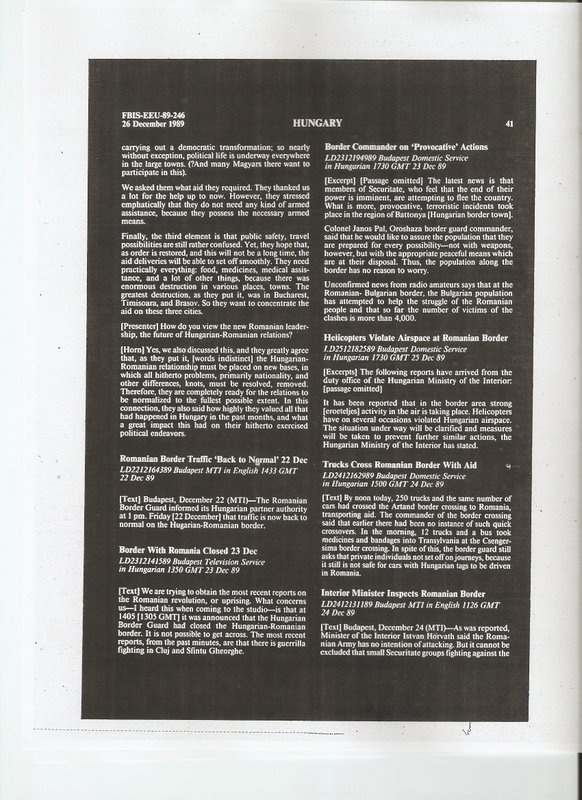
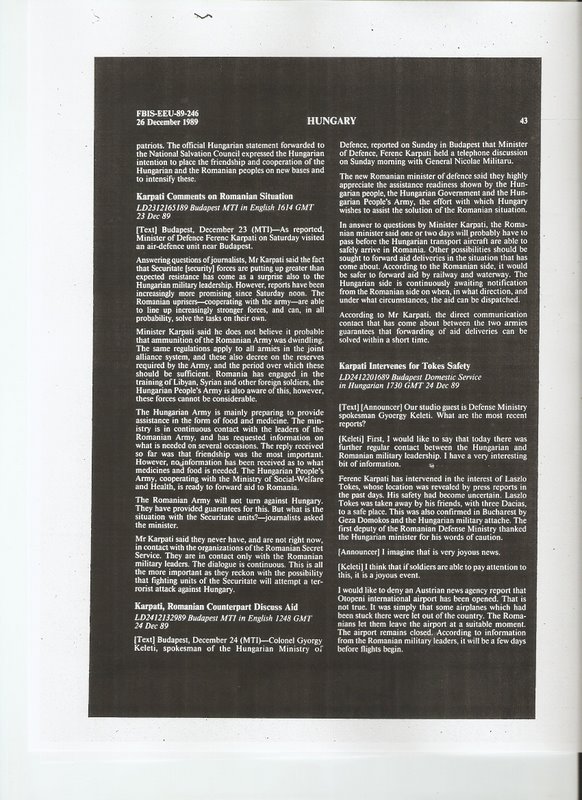
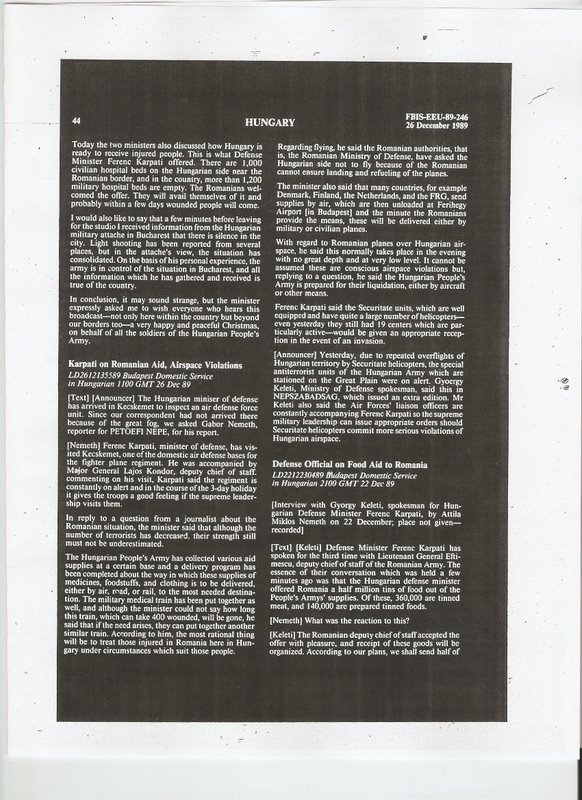
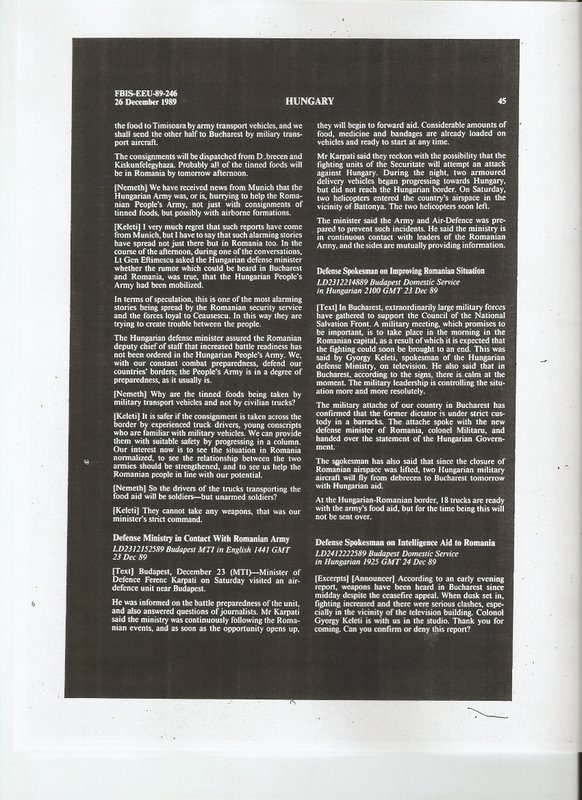
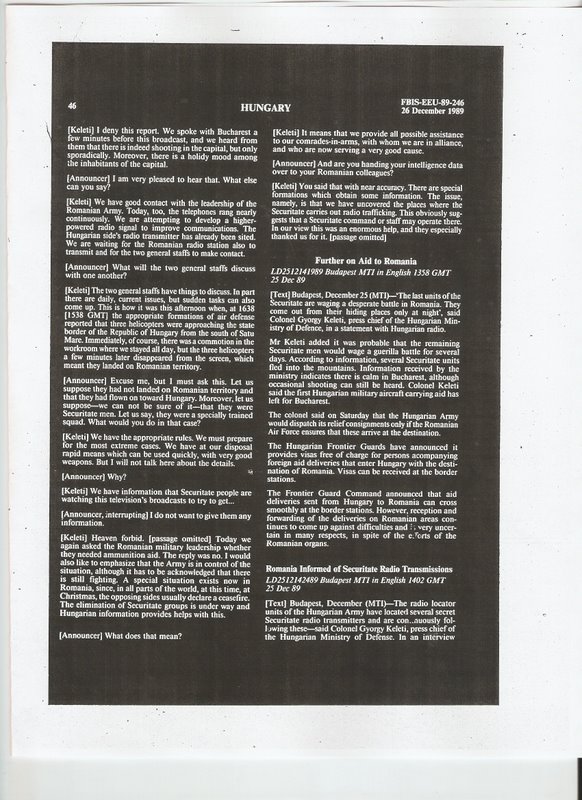
Moreover, there was confirmation outside of Romania as to the activity of Securitate helicopters during these days:  specifically, Hungarian Defense Officials.  Not only did the Securitate have “a large number of helicopters” (Def. Min. Ferenc Karpati) but on Saturday 23 December 1989, two of them briefly violated Hungarian airspace near Battonya (which is not far from the Romanian city of Arad).  The idea that somehow Hungarian Defense officials did not know the difference between Romanian Air Force and Romanian Securitate helicopters–given the fact that they were both Warsaw Pact members and given that at least since 1986 tensions between Hungary and Romania had been at an increasingly high level–verges on the implausible.  http://atomic-temporary-3899751.wpcomstaging.com/securitate-helicopters-transmitters-per-hungarian-defense-officials/

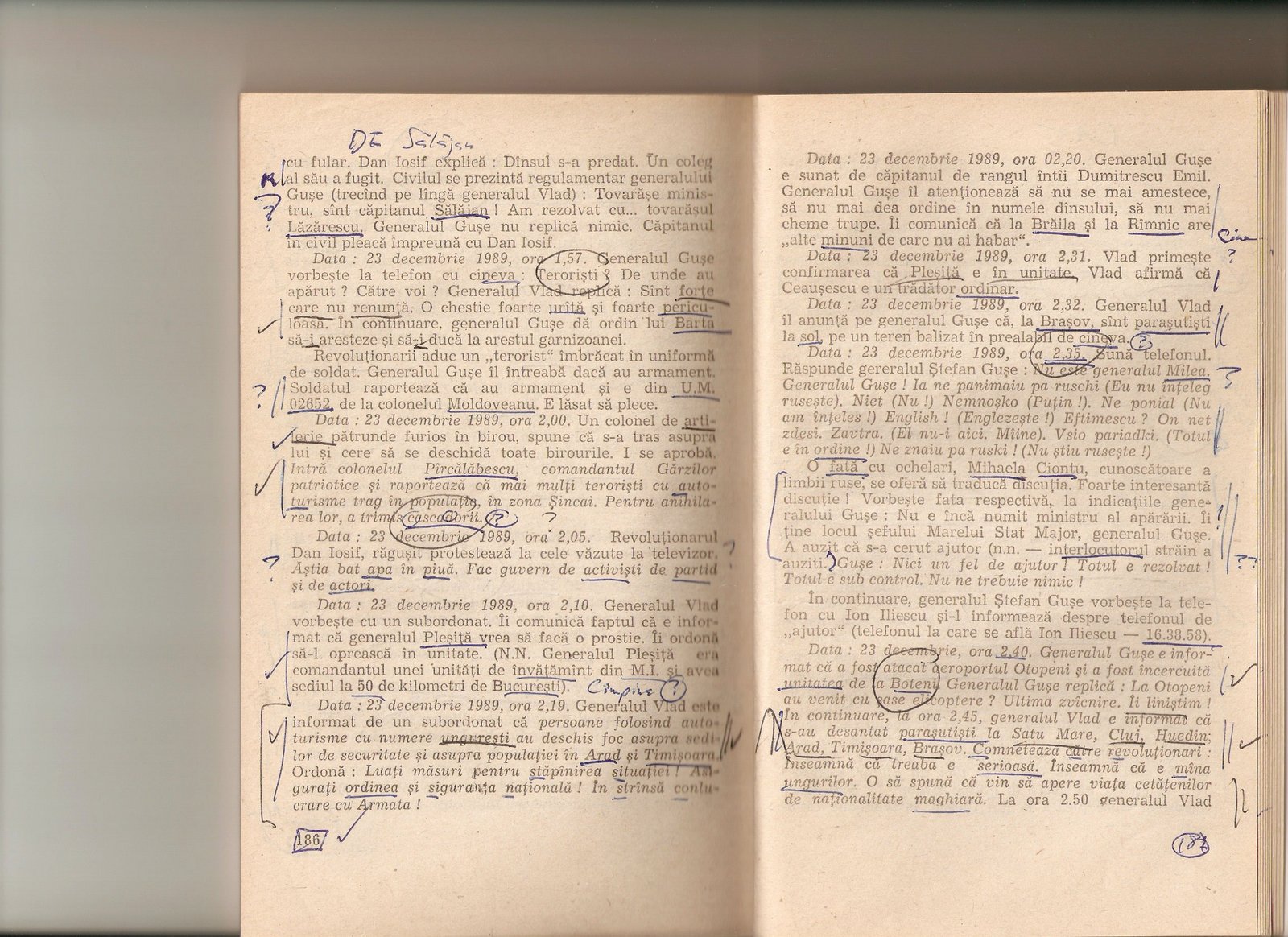
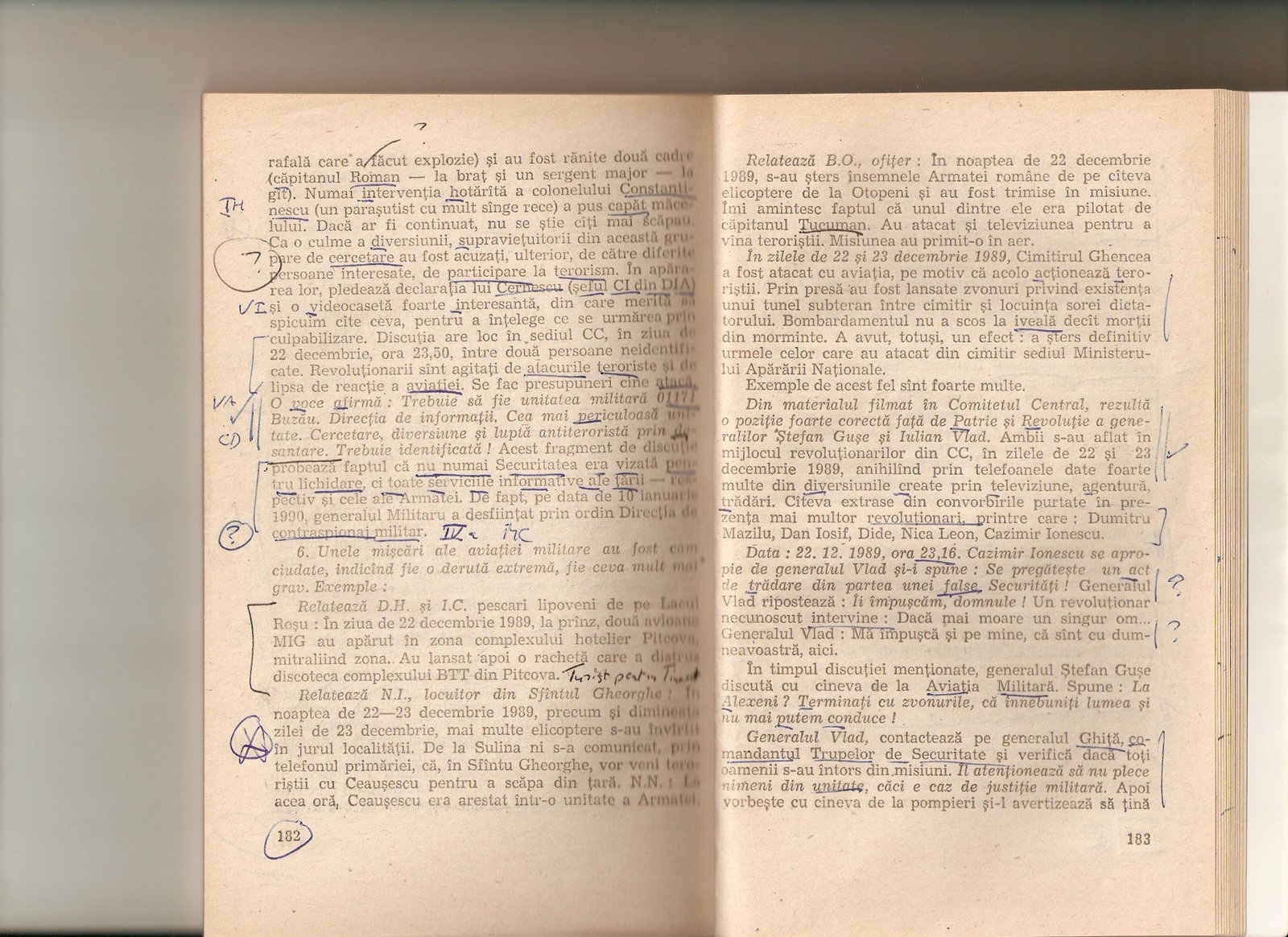
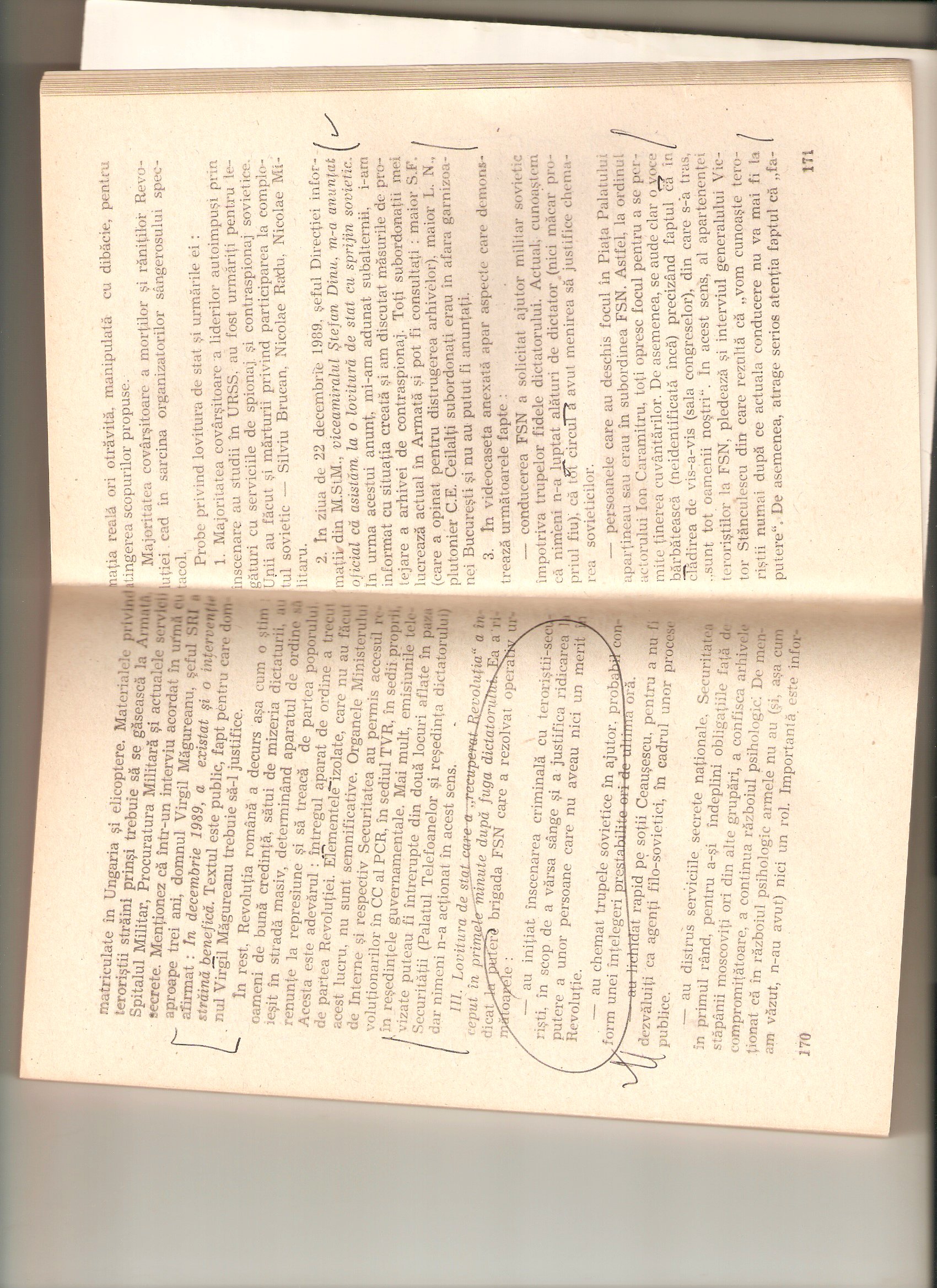
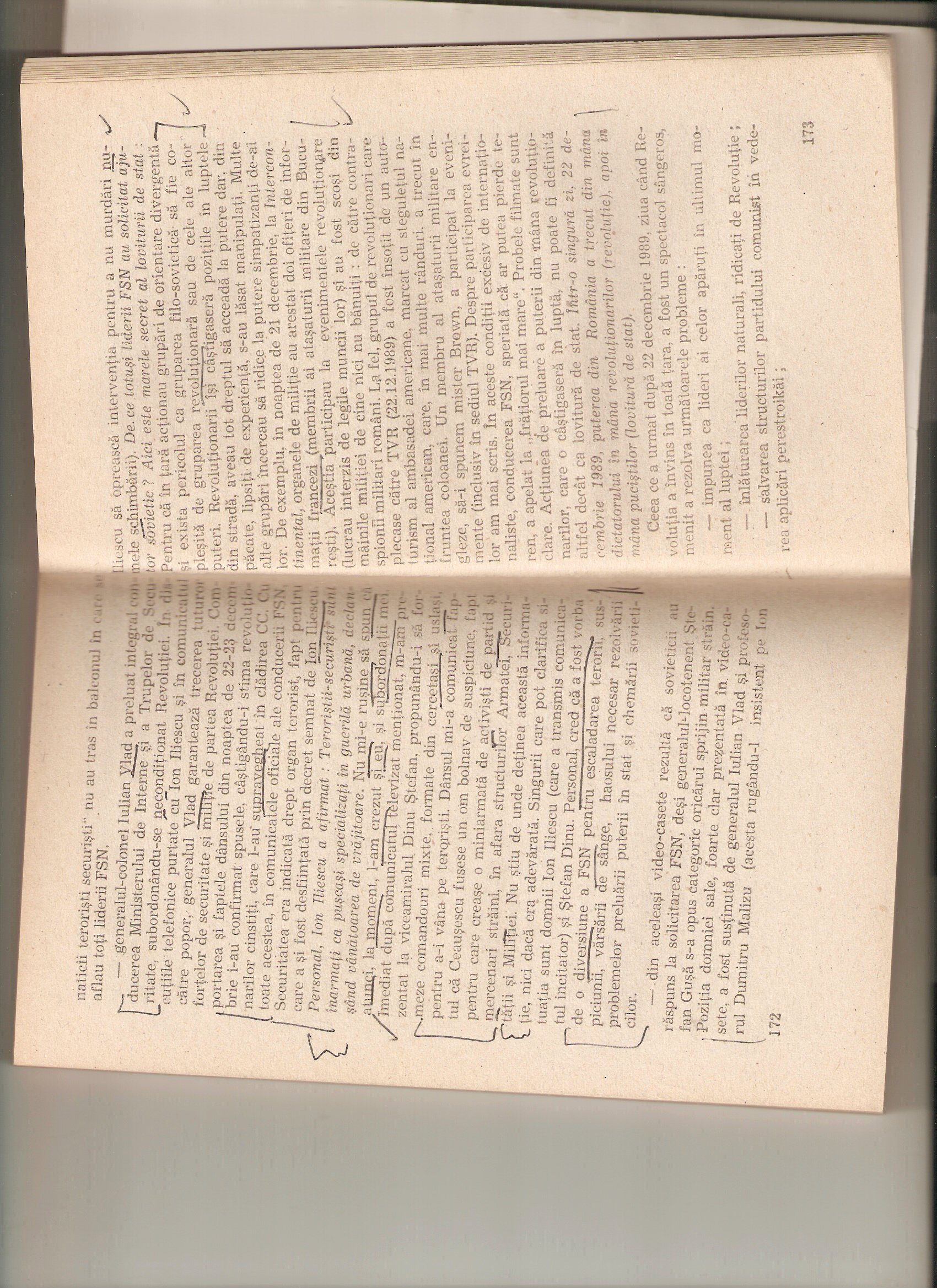
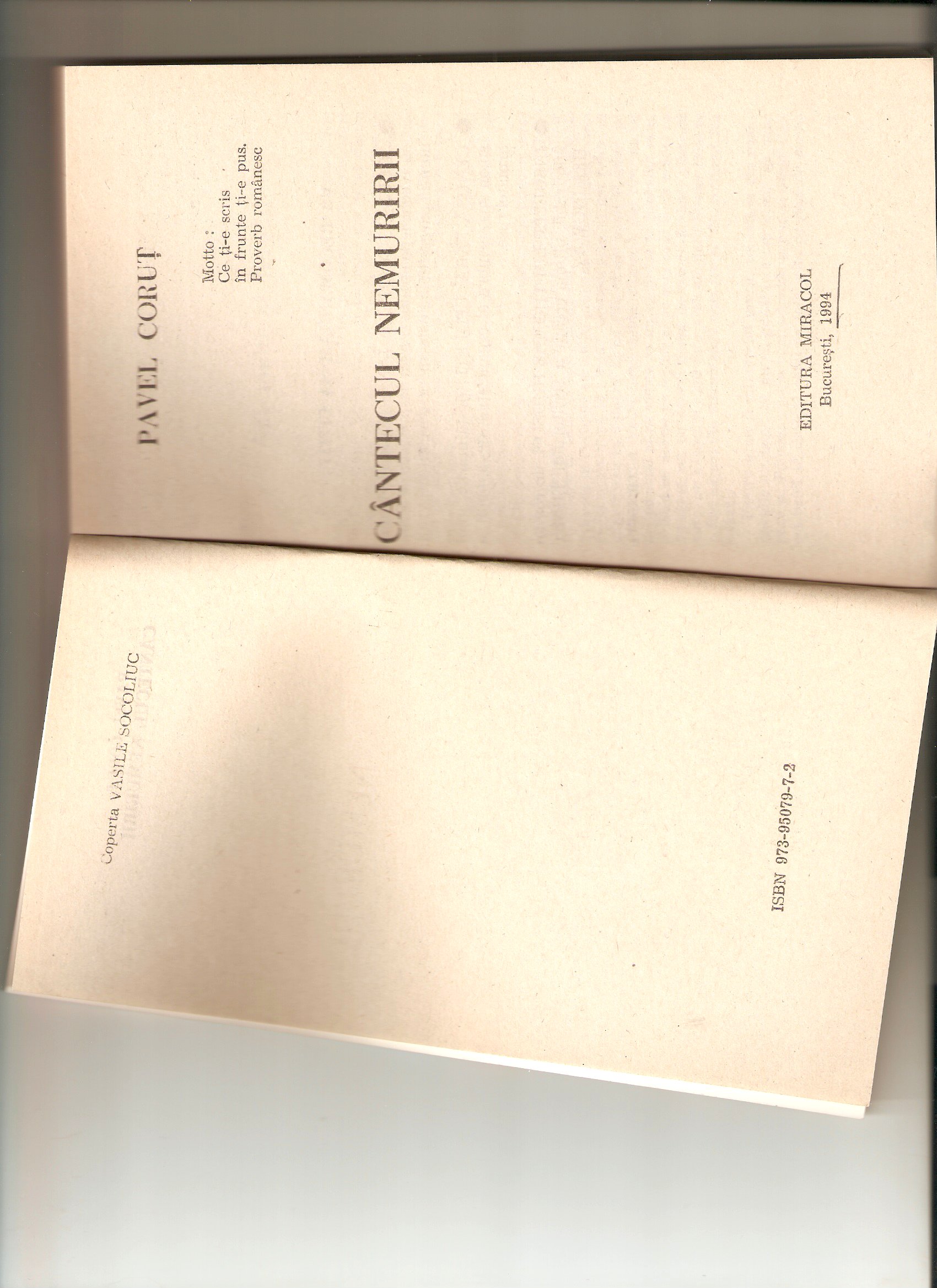
Finally, if the following personally stylized “transcript” of former Securitate officer (Military Counter-Intelligence, Directorate IV) Pavel Corut is anywhere close to accurate, it is clear that not only did General Vlad lie about the possibility (i.e. reality) that the unidentified helicopters in question belonged to his Securitate, but he attempted to suggest that the helicopters belonged to Hungary and were transporting Hungarian parachutists into Transylvania (see pages 186 and 187 below, Pavel Corut Floarea de Argint (Editura Miracol, 1994), pp. 182-191 ).

The above passage from page 187 shows pretty clearly that Securitate General Iulian Vlad was intentionally misleading the revolutionaries in the CC and others, as he alleges an invasion of Hungarian parachutists in six Transylvanian cities.  There is absolutely no evidence–either in accounts of the time or since–that Hungarian parachutists turned up in these cities.  Thus, while Vlad attempted to play dumb regarding the suspected presence and activation of Arab terrorists allied with the Securitate on behalf on the Ceausescus–particularly in the Black Sea Coast region–he was seeking to disseminate disinformation about a non-existent–but highly nationalist, paranoid, and potentially resonant, especially perhaps in Transylvania–invasion by neighboring Hungary.  He knew exactly what he was doing and what was transpiring.

In other words, Securitate General Vlad was engaging in what Romanians describe as:  “Hoţul strigă hoţii!  (The thief shouts out:  [Stop] thieves!)

Posted in decembrie 1989 | Tagged: , , , , , , , , , , , , , , , , , , , , , , , , , , , | 10 Comments »

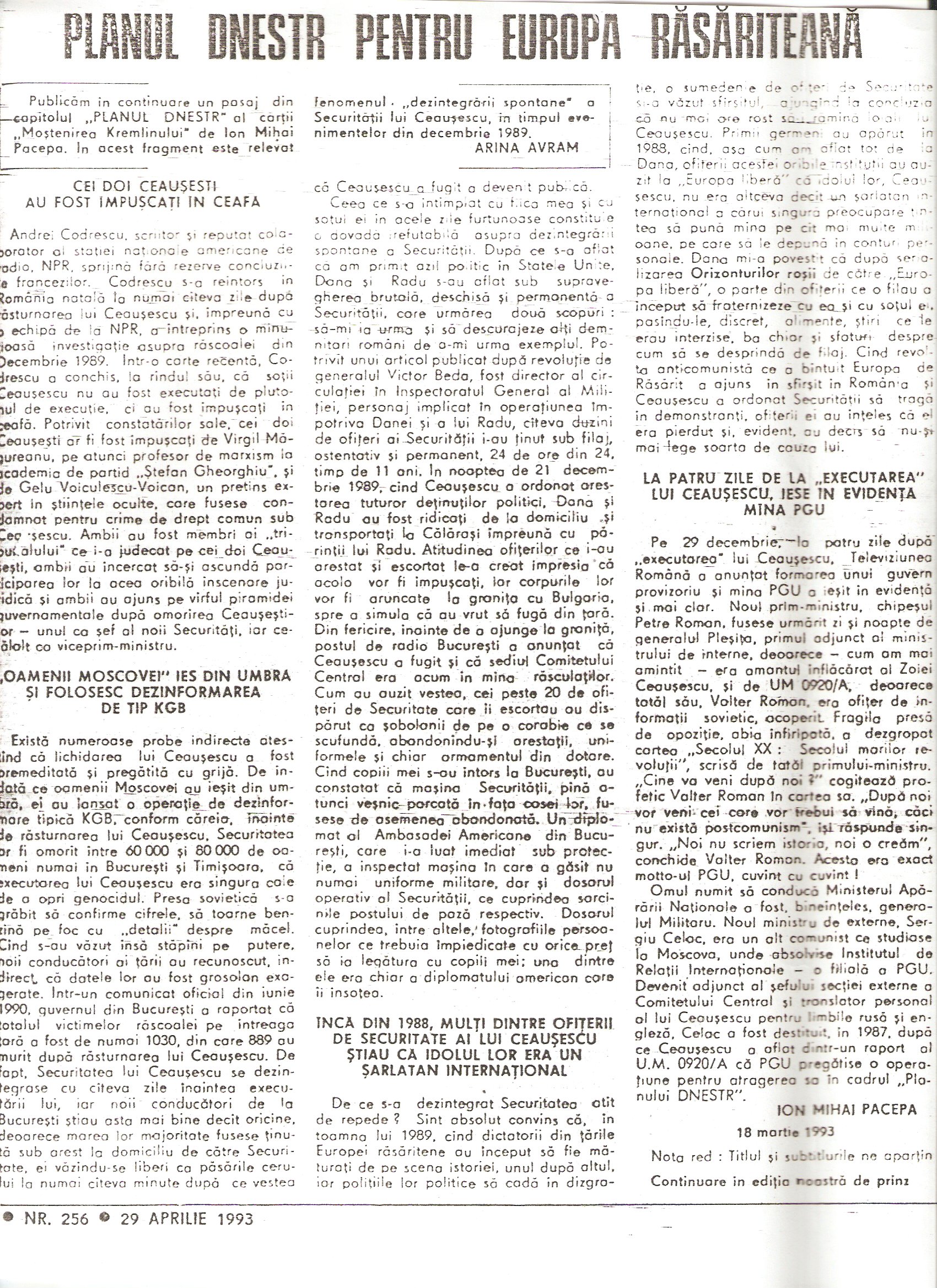
Former Securitate officials who corroborated General Iulian Vlad’s Declaration on the Terrorists: Liviu Turcu, Ion Mihai Pacepa, Radu Vasilevici, Marian Romanescu, and others

Posted by romanianrevolutionofdecember1989 on September 7, 2013

Timage0-001

It took 22 years for the text of Securitate Director General Iulian Vlad’s handwritten declaration of 29 January 1990 to become public knowledge–thanks to former military prosecutor General Ioan Dan.  (Inevitably, there will no doubt be those who will allege that General Vlad was “forced” to write this declaration to save his skin, etc., that this was the “propaganda of the moment” and all a huge lie.  If that were the case, one would have expected Iliescu, Brucan, Militaru, Voican Voiculescu, etc. to have made every effort for Vlad’s declaration to leak to the media.  Instead, for 22 years it was hidden from public knowledge!)

Of Note:  No “Soviet tourists,” no DIA (Batallion 404) troops of the army’s intelligence wing, no “there were no terrorists:  the Army shot into everyone else and into itself”–in other words, none of the spurious claims that have littered the narrative landscape, fueled by the former Securitate over the past two decades plus.  No, Vlad knew who the terrorists of the Romanian Revolution of December 1989 were, because they reported to him!

image0

image0-002

General Magistrat (r) Ioan Dan

In aprilie 1990, generalul Ghoerghe Diaconescu a fost destituit din functia de conducere in Directia Procuraturilor Militare.  La plecare, mi-a predat cheia de la fisteul sau, cu mentiunea ca acolo au mai ramas cateva hartii fara importanta. Intrucat, la data respectiva, ma aflam in cea mai mare parte a timpului, in procesul cercetarilor de la Timisoara, mult mai tarziu, am dorit sa pun in respectivul fiset o serie de acte.  Am cercetat ce mai ramasese de pe urma generalului Diaconescu si, spre surprinderea mea, am gasit declaratia olografa a generalului Iulian Vlad, data fostului adjunct al procurorului general, fostul meu sef direct, nimeni altul decat generalul Diaconescu, la 29 ianuarie 1990, cand toate evenimentele din decembrie 1989 erau foarte proaspete.  Repet, este vorba despre declaratia olografa, un text scris foarte ingrijit, pe 10 pagini, din care voi reda acum integral doar partea care se refera expres la “actiunile teroriste in Capitala” (formularea apartine generalului Vlad).

“Analizand modul in care au inceput si s-au desfasurat actiunile teroriste in Capitala, pe baza acelor date si informatii ce le-am avut la dispozitie, consider ca acestea ar fi putut fi executate de:

1) Elementele din Directia a V-a, USLA, CTS si din alte unitati de Securitate, inclusiv speciale.

a) Directia a V-a, asa cum am mai spus, avea in responsabilitate paza si securitatea interioara a Palatului Republicii, multe dintre cadrele acestei unitati cunoscand foarte bine cladirea, cu toate detaliile ei.  In situatia creata in ziua de 22.12.1989, puteau sa mearga la Palat, pe langa cei care faceau acolo serviciul si unii dintre ofiterii si subofiterii care se aflau la sediul CC ori la unitate.

Este ca se poate de clar ca numai niste oameni care cunosteanu bine topografia locului ori erau in complicitate cu cei care aveau asemenea cunostinte puteau patrunde in cladire (sau pe acoperisul ei) si transporta armamentul si cantitatile mari de munitie pe care le-au avut la dispozitie.

Tot aceasta Directie dispunea de o baza puternica si in apropierea Televiziunii (la Televiziunea veche).  De asemenea, avea in responsabilitate perimetrul din zona resedintei unde se aflau numeroase case (vile) nelocuite si in care teroristii ar fi putut sa se ascunda ori sa-si faca puncte de sprijin.

Sunt si alte motive care pun pe prim-plan suspiciuni cu privire la aceasta unitate.

b) Elemente din cadrul unitatii speciale de lupta antiterroriste care aveau unele misiuni comune cu Directia a V-a si, ca si o parte a ofiterilor si subofiterilor de la aceasta unitate, dispuneau de o mai buna instruire si de mijloace de lupta mai diversificate.

c) Elemente din Trupele de Securitate care asigurau paza obiectivilor speciale (resedinta, palat etc.) si, impreuna cu Directia a-V-a, Securitatea Capitalei si Militia Capitalei asigurau traseul de deplasare.

d) Ofiteri si subofiteri din Securitatea Capitalei, indeosebi de la Serviciul Trasee, sau dintre cei care au lucrat la Directia a V-a.

e) Elemente din alte unitati de Securitate, inclusiv unitatile speciale 544, 195 si 110, precum si din cele complet acoperite, comandate de col. Maita, col. Valeanu, lt. col. Sirbu, col. Nica, col. Eftimie si lt. col. (Eftimie sau Anghelache) Gelu (asa sta scris in declaratie–n.n.).  Aceste din urma sase unitati, ca si UM 544, in ansamblu, si UM 195 puteau dispune si de armament si munitii de provenienta straina, precum si de conditii de pregatire adecvate.

2) Ofiteri si subofiteri din Militie, atat de la Capitala, cat si de la IGM, cu prioritate cei din Detasamentul special de interventie si cei care asigurau traseul.

3) Cred ca s-ar impune verificarea, prin metode si mijloace specifice, a tragatorilor de elita din toate unitatile din Capitala ale Ministerului de Interne, precum si a celor care au avut in dotare sau au indeplinit misiuni folosind arme cu luneta.  N-ar trebui omisi nici chiar cei de la Dinamo si de la alte cluburi sportive.

4) Unele cadre militare de rezerva ale Securitatii, Militiei si Armatei, precum si actuali (la data respectiva) si fosti activisti de partid sau UTC, persoane apropriate tradatorului si familiei sale ori care poseda arme de foc.

Propun, de asemenea, o atenta investigare a celor care au fost in anturajul lui Nicu Ceausescu.  Acest anturaj, foarte divers, cuprindea inclusive unele elemente de cea mai scazuta conditie morala care puteau fi pretabile la asemenea actiuni.

Ar fi bine sa se acorde atentia cuvenita sub acest aspect si fratilor dictatorului–Ceausescu Ilie si Ceausescu Nicolae–care, prin multiplele posibilitati pe care le aveau, puteau organiza asemenea actiuni.

5) Anumite cadre militare sau luptatori din Garzile Patriotice.

6) Straini:

a. Din randul celor aflati la studii in Romania:

— arabi, in general, si palestinieni, in special, inclusiv cei care sunt la pregatire pe linia Armatei (de exemplu, la Academia Militara);

— alte grupuri de straini la studii (iranieni si altii).

b. Special infiltrati (indeosebi din cei care au urmat diverse cursuri de pregatire pe linia MI sau a MAN);

c. Alti straini aflati in tara cu diverse acoperiri, inclusiv diplomatice;

d. Fosti cetateni romani (care ar fi putut intra in tara si in mod fraudulos).

7) Elemente infractoare de drept comun care au posedat armament ori l-au procurat in chiar primele ore din dupa-amiaza zilei de 22 decembrie 1989, cand, din mai multe unitati de Securitate, intre care Directia a V-a si Securitatea Capitalei, s-a ridicat o cantitate mare si diversa de armament si munitie.”

http://atomic-temporary-3899751.wpcomstaging.com/2013/05/14/planul-z-z-ion-mihai-pacepa-si-liviu-turcu-in-decembrie-1989/

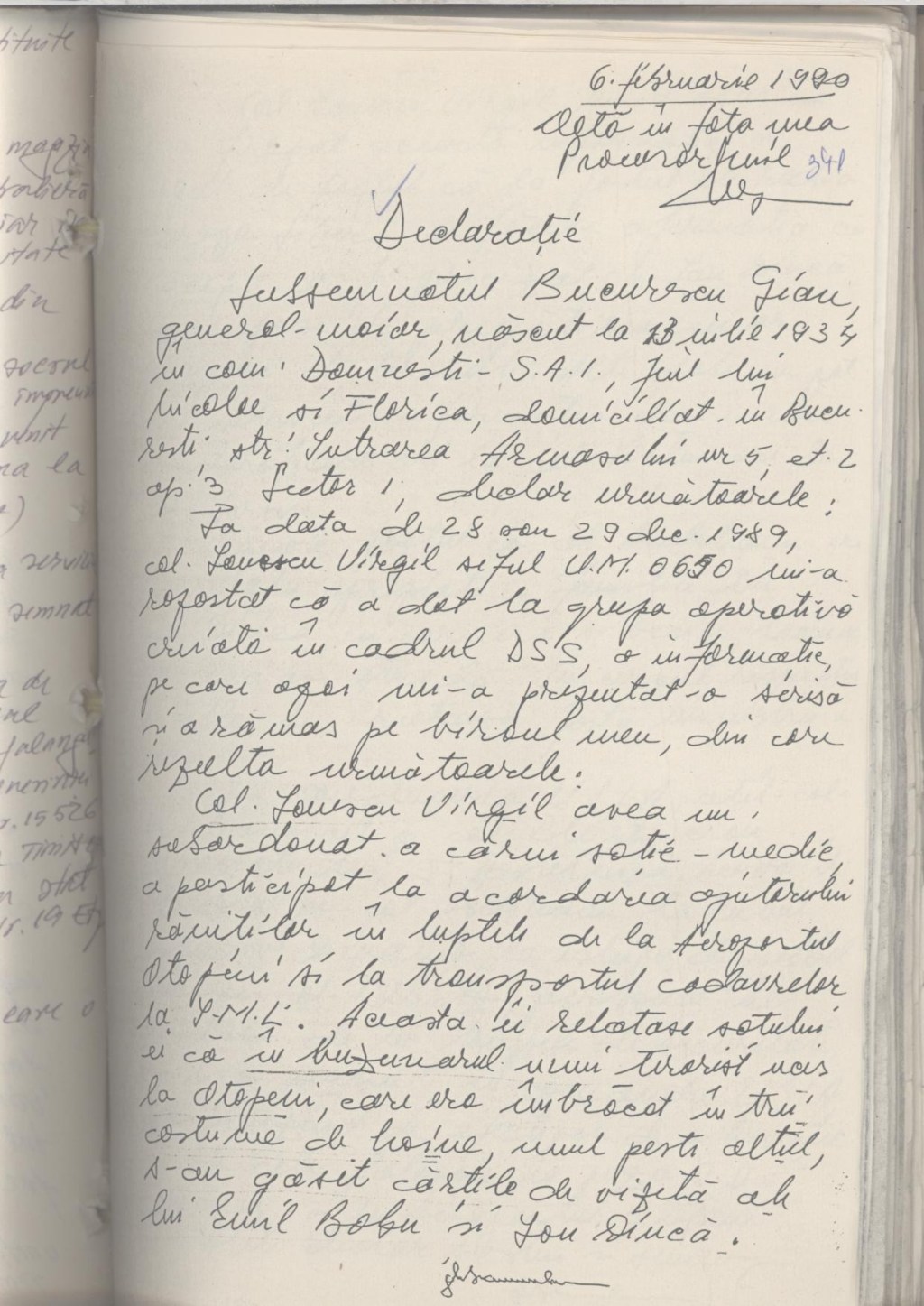
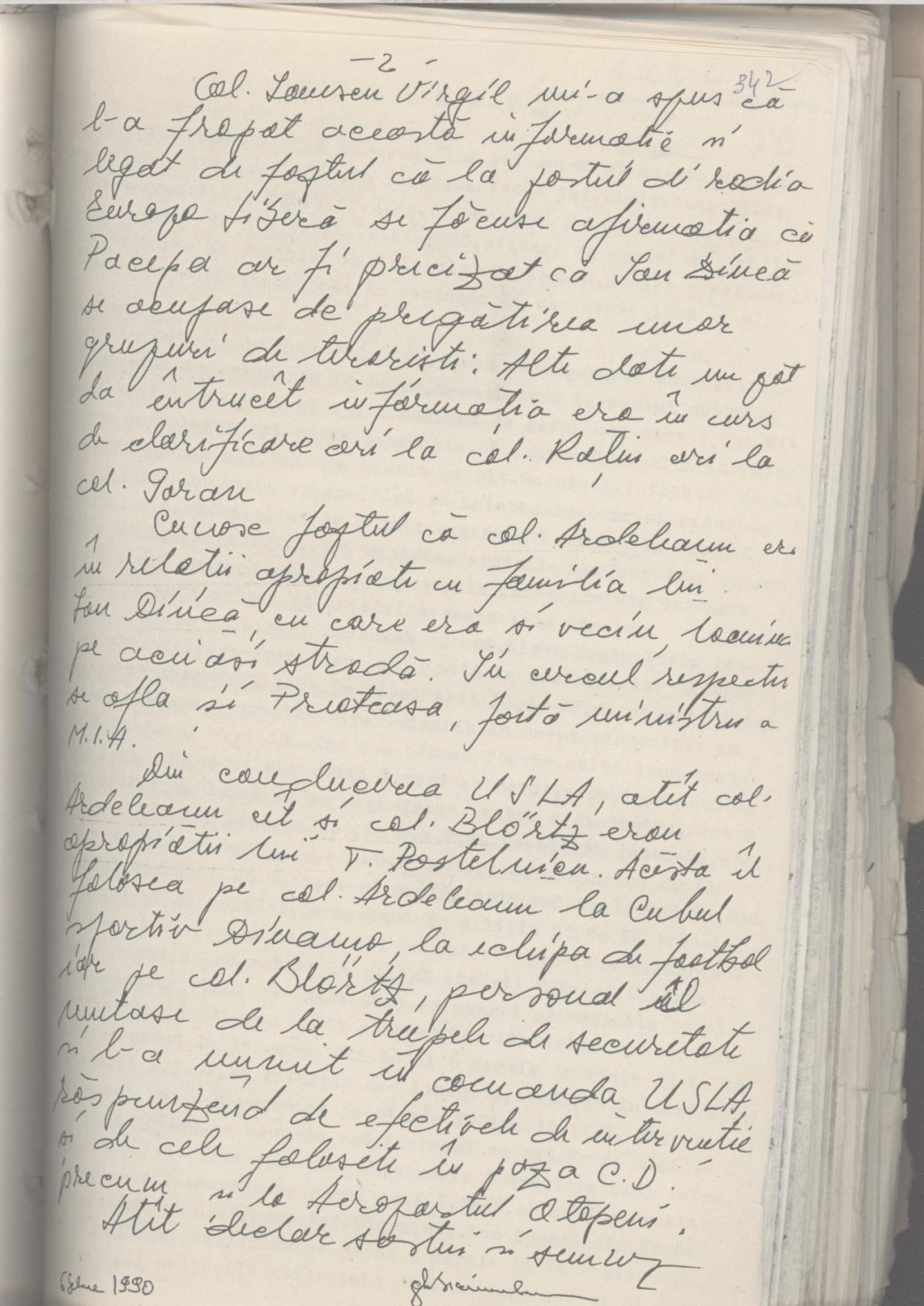
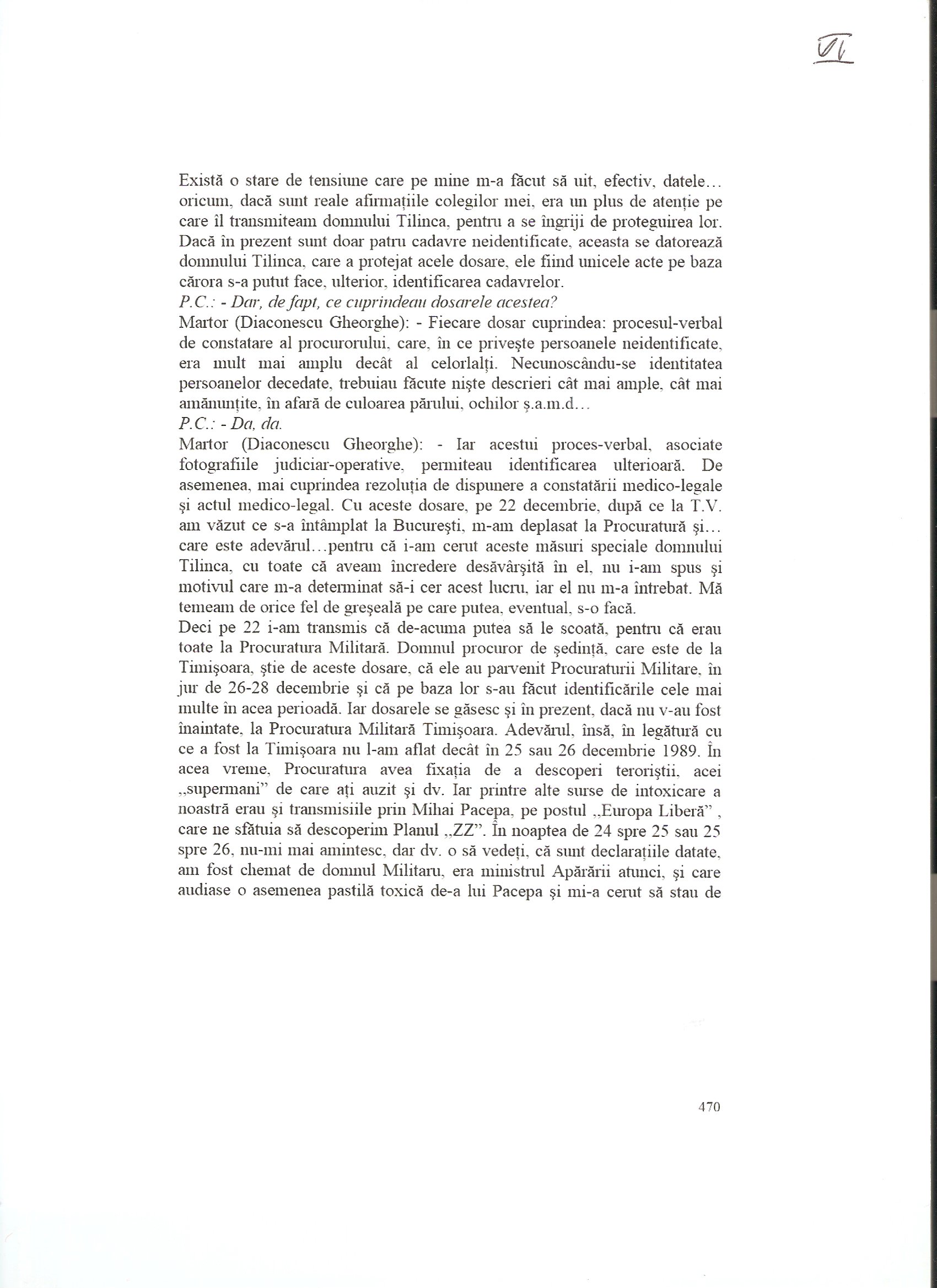
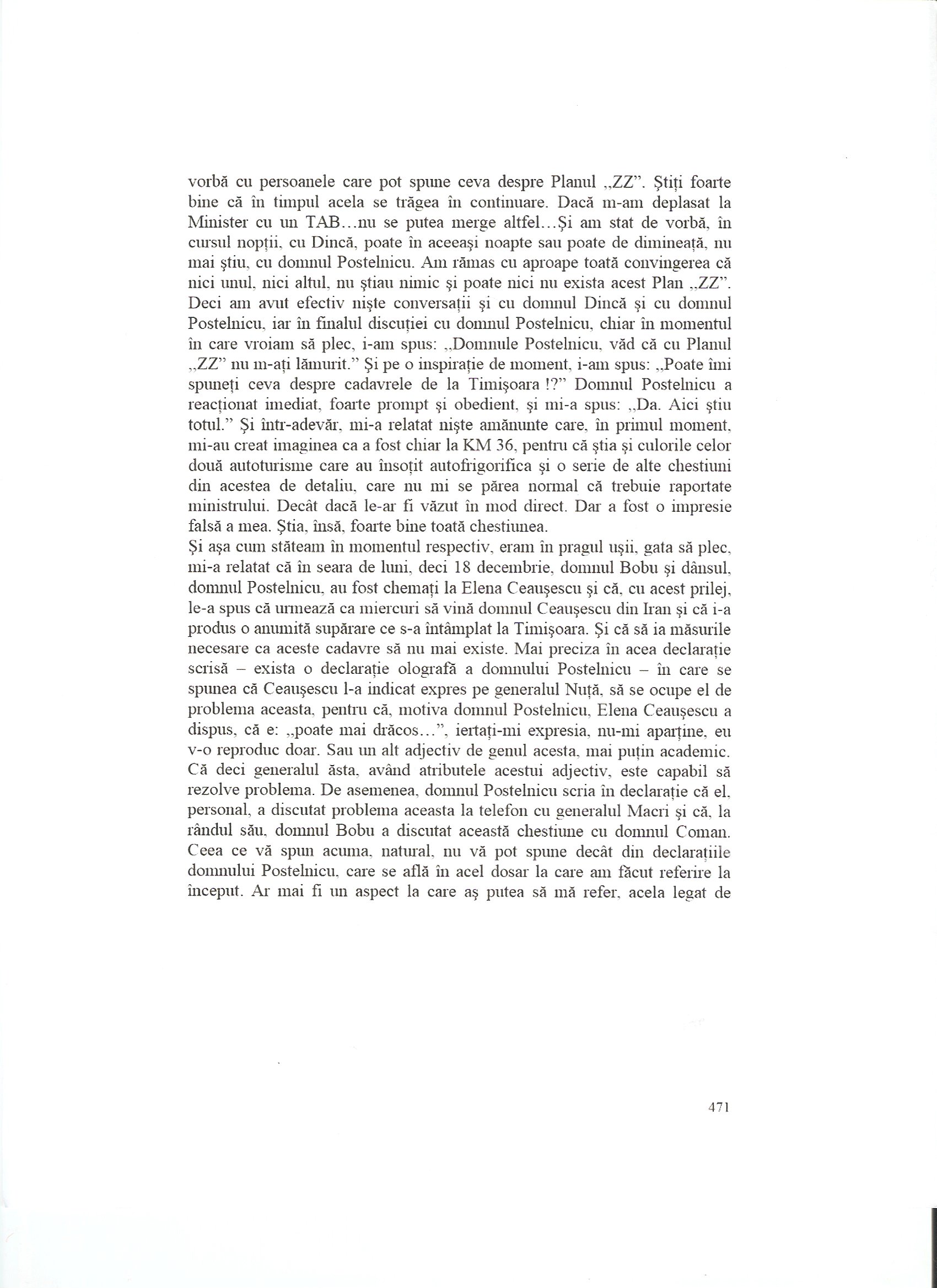
I have attempted to trace Pacepa’s public discussion of Plan Z-Z to verify claims made by other actors (see below, Gheorghe Diaconescu, Giani Bucurescu/Virgil Lovescu) in the Romanian Revolution of December 1989.  All of these actors refer to Pacepa’s discussion on Radio Free Europe/Radio Europa Libera sometime apparently between 24 and 26 December 1989.  Unfortunately, although there are a series of audio clips and transcripts from these days on the Europa Libera site http://www.europalibera.org/archive/1989/latest/452/982.html, there is no mention of the Pacepa intervention in question and no indication of record of its existence on the Internet.

0436

6 februarie 1990

Declaratie.  Subsemnatul Bucurescu Giani, general-maior [D.S.S.]

La data de 28 sau 29 decembrie 1989, col. Lovescu [?] Virgil seful U.M. 0650 mi-a raportat ca…

Col. Lovescu [?] Virgil avea un subordonat a carui sotie-medic a participat la acordarea ajutorului ranitilor in luptele de la Aeroport Otopeni si la transportarea cadavrelor la I.M.L.  Acestea ii relatase sotului ca in buzunarul unui terorist ucis la Otopeni, care era imbracat in trei costume de haine, unul peste altul, s-au gasit cartile de vizita ale lui Emil Bobu si Ion Dinca.

Col. L Virgil mi-a spus ca l-a frapat aceasta informatie si legat de faptul ca la postul de Radio Europa Libera se facuse afirmatie cu Pacepa ar fi precizat ca Ion Dinca se ocupase de pregatirea unor grupuri de teroristi.  Alte date nu pot da intrucit informatia era in curs de clarificare ori la Col. Ratiu [DSS Dir I] ori la Col. Goran [SMB]…

Cunosc [?] faptul ca col. Ardeleanu [sef USLA] era in relatii apropriate cu familia lui Ion Dinca…

Din conducerea USLA atit col. Ardeleanu cit si col Blortz [Bleort] erau apropriatii lui T. Postelnicu

0437

http://atomic-temporary-3899751.wpcomstaging.com/2012/12/28/what-can-we-learn-from-dosarele-revolutiei-de-la-timisoara-vi/

We have two different accounts from Gheorghe Diaconescu, which roughly match:

http://www.banaterra.eu/romana/files/procesul_de_la_timisoara_volumul_VI_continut.pdf

image0

image0-001

This also seems to confirm the following (when adjusted for the corrected dates):

Nestor Ratesh quotes one of Ceausescu’s senior party henchman, Ion Dinca, as having stated at his trial in early February 1990:

“During the night of 27-28 [of January 1990] at 12:30 A.M., I was called by several people from the Prosecutor’s Office to tell what I knew about the agreement entitled Z.Z. between Romania and five other states providing for the dispatching of terrorist forces to Romania in order to intervene in case of a military Putsch.  This agreement Z.Z. is entitled ‘the End of the End.’  I stated then, and I am stating now to you, that I have never been involved in this agreement, neither I nor other people.  And I was told:  Only you and two other people know this.  I stated that and a detailed check was made in order to prove that I was not involved in such acts.”[95]

[95] Ratesh, Romania:  The Entangled Revolution, pp. 66-67, quoting Radio Bucharest, 2 February 1990.  I don’t think from the context given it is clear that this alleged incident took place in January 1990, as Ratesh assumes; the reference to 27-28 might have been a reference to December 1989.

But it almost doesn’t matter when Pacepa first discussed this…because almost identical details were disclosed by Liviu Turcu, a DIE officer who had defected earlier in 1989 (thereby being far more knowledgeable of current plans/realities inside the Romanian security state), only without reference to a named plan, such as Plan Z-Z.  It was thus Turcu on 23 December 1989 (within 24 hours of the outbreak of terrorist hostilities in Romania; the interview would have taken place on Saturday the 23rd) who first informed Western media of the existence of such a plan–although it appears Turcu’s disclosures were never relayed by Romanian media or by Radio Europa Libera.

Romanian Army Rankled by Interference;Defector Cites Long-Standing Friction Between Military and State Security Forces

The Washington Post
December 24, 1989 | Dan Morgan

The violence that has erupted in Romania between the army and state security forces loyal to deposed president Nicolae Ceausescu is rooted in long-standing friction between the two institutions that has sharpened dramatically recently, a high-level Romanian defector said yesterday.

Lidiu Turcu, who worked with the foreign intelligence branch of the Department of State Security, known as the Securitate, until his defection in Austria last January, said a special directorate monitored the loyalty of top army officers. As Ceausescu’s paranoia increased, he appointed his brother Ilia as first deputy minister of defense and chief of the political directorate in the army.

The military deeply resented that interference, he said. Also angering the military was the removal several years ago of two high-ranking generals denounced by Securitate informers for cultivating connections at the Soviet Embassy in Bucharest, he said. There have been reports that the two were killed and dumped into the Black Sea from a helicopter, but Turcu said he could not confirm the story.

The well-equipped and dreaded security forces appear to number about 45,000 to 50,000 men, including 25,000 troops who live in barracks on the outskirts of major cities and 20,000 officers, technical personnel, and specialists, he said. That figure is far less than the up to 700,000 reported in recent days in other accounts from the region.

The officers and specialists were drawn from universities until several years ago. But in the 1980s, Turcu said, Ceausescu’s wife, Elena, ordered that recruitment of university students be stopped and that less-educated factory personnel be selected instead.

The uniformed force of fighters includes many young men who were taken from orphanages at an early age. These security soldiers, educated and trained at special schools, have no family loyalties and were indoctrinated to view Ceausescu as a father figure, Turcu said.

As Ceausescu’s fear of an internal threat to his security grew, he reportedly turned to a new “Directorate 5″ in the Securitate that had the responsibility for “defense of the leadership of the party.” Presumably this is the force involved in some of the recent fighting.

Growing evidence of atrocities perpetrated by the security forces against unarmed demonstrators-shooting into crowds in Timisoara and Bucharest-has raised questions about whether foreign mercenaries may be involved. Turcu said the massacres go against Ceausescu’s dictum of “no martyrs,” which was often repeated to his inner circle.

Turcu said he talked yesterday with a friend in Bucharest who reported being forced to evacuate his apartment complex by armed Arab commandos.

The former intelligence official said he was aware of a secret agreement between Ceausescu and Palestine Liberation Organization chairman Yasser Arafat that allowed PLO groups to use Romanian territory for “logistical support.” He said Interior Minister Tudor Postelnicu, who oversaw the security forces, was present at a recent meeting between Ceausescu and Arafat.

Romanian cooperation with the PLO began in the late 1960s, Turcu said, but intensified in the past three years. He said rival PLO groups coexist within Romanian territory, but the agreement forbade clashes between these groups and prohibited their possession of arms. One job of the Securitate was to ensure that the PLO factions were obeying the agreement, Turcu said.

In addition to the PLO factions, he said, Syrian, Libyan, Iraqi and Iranian military or special operations units have been trained at a camp near Buzau, in the Carpathian foothills.

Contrary to reports that the security forces lived lavishly, Turcu said that except for higher salaries, most ordinary officials did not have access to special restaurants and stores stocked with Western electronic goods. He suggested that security officials resorted to corruption and abuse of office to satisfy their needs, which exacerbated the public’s hatred and fanned the fury that burst over the past week.

For verification of some of Turcu’s claims (in particular, the less-discussed participation of Iraqis from Saddam Hussein’s Iraq, see here:  http://atomic-temporary-3899751.wpcomstaging.com/foreign-intervention/)

“They dress in black berets and black jumpsuits [combinezoane negre, salopete negre] with red silk stripes on their sleeves.  They carry small two-way radios and speak into them in coded language.  They are equipped with automatic rifles with infrared nightscopes for sniping.”


http://atomic-temporary-3899751.wpcomstaging.com/2010/11/19/les-souterrains-de-bucarest-ja2-20h-27121989-01min55s/

Sediul U.S.L.A , pe 25 decembrie 1989 in jurul orelor 18…

Pe 25 decembrie in jurul orelor 18, dupa executarea dictatorilor, col. Ardeleanu Gh. a adunat cadrele unitatii intr-o sala
improvizata si le-a spus: “Dictatura a cazut! Cadrele unitatii se afla in slujba
poporului. Partidul Comunist Roman nu se desfiinteaza! Trebuie sa ne regrupam in
rindul fortelor democratice din P.C.R.–continuatorul idealurilor nobile ale
poporului ai carui fii sintem ! (…) Au fost gasite cadavre, indivizi avind
asupra lor legitimatii de acoperire USLAC (Unitatea Speciala de Lupta
Antiterorista si Comando) si legitimatii cu antetul 0620–USLA, legitimatii care
nu se justifica in posesia celor asupra carora au fost gasite…” A ordonat apoi
sa fie predate in termen de 24 de ore legitmatiile de serviciu, urmind ca
tuturor sa le fie eliberate altele cu antetul M.Ap.N.

(capitanul Romanescu Marian, cu Dan Badea, “USLA, Bula Moise, teroristii si
‘Fratii Musulmani’,” Expres nr. 26 (75), 2-8 iulie 1991, 8-9)

image-15

(Capitanul Romanescu Marian (fost cadru USLA) si Dan Badea, “USLA, Bula Moise, teroristii, si ‘Fratii Musulmani’,” Expres nr. 26 (75), 2-8 iulie 1991, pp. 8-9)

COMANDOURILE USLAC

Cei care au avut si au cunostinta despre existenta si activitatea fortelor de soc subordonate direct lui Ceausescu, au tacut si tac in continuare de frica, sau din calcul.  S-au spus multe despre indivizii imbracati in combinezoane negre, tatuati pe mina stinga si pe piept, fanaticii mercenari care actionau noaptea ucigind cu precizie si retragindu-se cind erau incoltiti in canalele subterane ale Bucurestiului.  S-au spus multe, iar apoi au tacut ca si cind nimic nu s-ar fi intimplat.

Suprapuse Directiei a V-a si USLA comandourile USLAC erau constituite din indivizi care “lucrau” acoperiti in diferite posturi. Erau studenti straini, doctoranzi si bastinasi devotati trup si suflet dictatorului.  Foarte multi erau arabi si cunosteau cu precizie cotloanele Bucurestiului, Brasovului si ale altor orase din Romania.  Pentru antrenament aveau la dispozitie citeva centre de instruire subterane:  unul era in zona Brasovului, iar altul–se pare–chiar sub sediul fostului CC-PCR, poligon care au dat–din intimplare citiva revolutionari in timpul evenimentelor din Decembrie.

image-13

Dezvaluiri despre implicarea USLA in evenimentele din Decembrie ‘89

Un tanar care si-a facut stagiul militar in trupele USLA a declarat
corespondentului A.M. PRESS din Dolj: “Am fost la Timisoara si la Bucuresti in
Decembrie ‘89. Odata cu noi, militarii in termen, au fost dislocati si
profesionistii reangajati, care purau costume negre de camuflaj. Dispozitivele
antitero de militari in termen si profesionisti au primit munitie de razboi. La
Timisoara s-a tras in manifestanti de la distanta mica. Am vazut
cum sareau creierii celor ciuruiti de gloante. Cred ca mascatii, folosind armamentul lor special, au tras cu
gloante explozive.
In ianuarie 1990, toti militarii in termen din trupele USLA
au fost internati pentru dezintoxicare. Fusesaram drogati. Am fost lasati la
vatra cu cinci luni inainte de termen pentru a ne pierde urma. Nu-mi publicati
numele. Ma tem pentru mine si parintii mei. La antranamente si aplicatii eram
impartiti in “amici” si “inamici.” Mascatii erau “inamicii” pe care trebuia sa-i
descoperim si sa-i neutralizam. Cred ca mascatii au
fost acei teroristi.”

(Romania Libera, 28 Decembrie 1994, p. 3)

image-18image-17image-16image-15

image-4image-9

Posted in decembrie 1989, raport final | Tagged: , , , , , , , , , | 6 Comments »

The Blues Brothers. Oh, we got both kinds of music here: Country AND Western!

Posted by romanianrevolutionofdecember1989 on August 3, 2013

The ideologues would have us believe that it is all about the post-Ceausescu world view and politics of individuals of the former communist regime.  Bureaucratic/Institutional interests across world views and politics are thus ignored.  For example, only protochronists, Ceausescu nostalgics would allege that December 1989 was a Soviet plot.  Back in 2005, I took a look at the supposedly diametrically opposed claims of Ion Mihai Pacepa and Pavel Corut on December 1989.  As, one can see, stripped of all the philosophical rhetoric, their views are completely different and should in no case be compared with or considered similar to one another…

image0

Ion Mihai Pacepa in Evenimentul Zilei, 29 aprilie 1993.

from http://atomic-temporary-3899751.wpcomstaging.com/2010/09/22/the-1989-romanian-revolution-as-geopolitical-parlor-game-brandstatter%E2%80%99s-%E2%80%9Ccheckmate%E2%80%9D-documentary-and-the-latest-wave-in-a-sea-of-revisionism-part-iii/

translated version in Romanian by Marius Mioc available at http://mariusmioc.wordpress.com/2009/11/07/rich-hall-brandstatter-15/

RED HERRINGS:  THE CHRONICLES OF A FORMER COMMUNIST SPY CHIEF’S VIEWS ON DECEMBER 1989

Inevitably, too, in the wake of the Brandstatter film the Romanian media dragged out its old warhorse for such occassions, the former Director of communist Romania’s Foreign Intelligence Service, General Ion Mihai Pacepa, the man whose defection in 1978 led to his being sentenced to death in abstentia and whose sensational revelations about Ceausescu’s repressive and profligate rule helped erode the myth of Ceausescu in the West.  Pacepa’s break from Ceausescu and the communist regime, and his stinging criticism of the administrations of President Ion Iliescu for their incorporation of and reliance upon former Securitate personnel, have led Pacepa to be lionized in the West and to be highly-respected and thoroughly-trusted among Romania’s intellectual and media elites.

In the wake of Brandstatter’s film, and, indirectly, in support of Bukovski’s allegations, Pacepa’s claims about December 1989 were once again invoked.  Thus, for example, excerpts of an August 2000 interview on the Hungarian Duna TV channel (rebroadcast on Duna TV two nights before the debut of the Brandstatter film) were published (“Jurnalul National,” 26 February 2004).  In the interview, Pacepa maintained that there were no so-called “terrorists” during the Revolution—that the “terrorist” phenomenon was all a pretext used by the party-state officials who ousted Ceausescu to legitimate a Soviet intervention:

“Interviewer:  What exactly was the essence of the the ‘Dnestr’ Plan?

Pacepa:  It was necessary to find a motive [to justify] the Soviet intervention, if the coup was to succeed by itself.  Therefore it is very easy to understand.  On 22 [sic. 23] December 1989, at 2 pm in the afternoon, Romanian Television announced:  “The National Salvation Front has requested Soviet help because unidentified foreign terrorists are attacking Romania.”  Already on this day, Iliescu declared that the Ceausescu couple had been arrested and a trial would be held, only for Television to announce [later] that their trial and execution had taken place.” (“Confessions of a Spy Chief” in “Jurnalul National,” 26 February 2004)

Since the early 1990s, Pacepa has maintained that the events of December 1989 were part of a well-scripted Soviet plan—the so-called “Dnestr Plan”—to remove Ceausescu (for a summary, see Deletant, 1995, pp. 89-90).  According to Pacepa, the Soviet plan was a response to the 1969 visit of US President Richard Nixon to Bucharest.  Pacepa claims that Iliescu had been designated Ceausescu’s replacement in accordance with this plan as early as 1971!  Dennis Deletant cautions with regard to Pacepa’s account:

“Pacepa’s use of the term ‘Front for National Salvation’ smacks too much of an attempt to compromise the more recent Front for National Salvation, set up after the 1989 revolution, by suggesting that the seeds of it had been sown some twenty years earlier by Moscow.  It is difficult to believe that such a name could have been chosen so many years earlier.” (Deletant, 1995, p. 90)

Pacepa’s claims are even more questionable than Deletant’s moderate skepticism suggests.  As I wrote in 1997:

“Moreover, it is intriguing to note that Pacepa revealed these details [i.e. those of the ‘Dnestr’ plan] only after the December 1989 events (in his 1993 book ‘The Inheritance of the Kremlin’).  Although in ‘Red Horizons’ (his 1988 detail-filled, “tell-all” book on the Ceausescus and the Securitate) he mentioned cases in which alleged Soviet agents (including Army General Nicolae Militaru…) were caught, he did not mention anything about the so-called ‘Operation Dnestr’.” (Hall, 1997, p. 117).

Pacepa had no problem in “Red Horizons” revealing alleged Soviet agents in Romania and alleged secret plans by which Ceausescu’s fabled “independence from Moscow” was all a Moscow-created ruse, yet he somehow did not feel the need or desire to outline Moscow’s plan for further increasing their control over Romania through “Operation Dnestr?”  This is hard to believe.

…By 1993—and as we have seen from the quote from the 2000 interview, continuing long after that, to the present day—Pacepa was claiming that there had been no “terrorists,” that it was all just a pretext by the KGB agents who seized power from Ceausescu (Iliescu, Militaru, Brucan, etc.) for justifying Soviet military intervention (see, for example, his comments in “Evenimentul Zilei,” 10 April 1993; 29 April 1993).  The Ceausescus had been shot KGB-style to prevent them from revealing to the Romanian people and the world that the coup-plotters were KGB agents, according to Pacepa.  One must ask:  if Pacepa possessed this knowledge prior to December 1989—and he claims that the plan originated in 1969—and therefore had suspicions that the “terrorist” phase was merely a diversion designed to serve as a pretext for Soviet intervention, then why did he say what he said, and why did he not reveal his knowledge and voice his concerns before, during, or immediately after December 1989?

Finally, there is the problem of the similarity of Pacepa’s arguments on the Revolution with those of other former Securitate officers.  True, they hate Pacepa and Pacepa hates them equally.  But take, for example, the following quote:

“The coup d’état which ‘recovered the Revolution’…brought to power the FSN [the National Salvation Front] crew…[which] initiated the criminal scenario with Securitate-terrorists in order to spill blood and justify the assumption of power by people who had no business proclaiming themselves to be revolutionaries…[I]t was a diversion of the FSN in order to escalate the terror, suspicion, blood-letting, [and] chaos necessary to resolve the problem of taking state power and calling the Soviets.”

The source of this quote is not Pacepa, but the well-known “protochronist,” “national communist” former Securitate officer Pavel Corut (Corut, 1994, “Cantecul Nemuririi [Song of the Undying]” (Bucharest:  Editura Miracol, 1994), pp. 170, 172, quoted in Hall, 1997, p. 257).  The point is, as the accusations of Pacepa discussed at the beginning of this section demonstrate, Pacepa’s claims are identical to what Corut’s alleges.  By forcing an analytical, but also partisan ideological distinction by dividing protoWesterners from protochronists, as if the two were night-and-day and so easily identifiable, critical similarities such as this one—which demands attention and analysis precisely because it is unexpected—are ignored.

03 Mar 2004 – 00:00

“M-am mirat cat de repede au reusit agentii serviciilor secrete sovietice sa preia puterea politica dupa Ceausescu”
Celebrul dezertor roman Ion Mihai Pacepa este convins de implicarea sovieticilor in Revolutia din Romania. Intr-un interviu pentru un post de televiziune ungar, el afirma ca Nicolae Ceausescu a fost impuscat in stil KGB.

Si eu m-am mirat cat de repede au reusit agentii serviciilor secrete sovietice sa preia puterea politica dupa Ceausescu. Indata ce s-au prezentat imaginile cu Ceausescu fugind cu elicopterul, la televiziune a aparut generalul pensionar Militaru si s-a autoproclamat comandat suprem al armatei. Acest general Militaru este acela caruia, in 1978, microfoanele UM 920A i-au inregistrat convorbirea avuta la intalnirea cu un informator sovietic, atunci cand Moscova ar fi dorit sa-l includa in asa-numitul program “Dnester”. La cateva luni dupa raportul privind cele inregistrate am parasit Romania si mult timp nu am stiut daca a fost racolat. Da, Mihai Lupoi, primarul Bucurestiului, care a emigrat in Elvetia, a facut o declaratie in 1990 potrivit careia Militaru a devenit agent sovietic. Ca dovada este documentul Corbu din dosarul Securitatii. La scurt timp am fost din nou consternat. A aparut Ion Ilici Iliescu, fost secretar de partid, lider comunist pregatit la Moscova. Tatal sau l-a idolatrizat pe Lenin, motiv pentru care i-a dat fiului sau numele Ilici. Acesta este acelasi Iliescu care, tot cu ajutorul microfoanelor UM 920A, a inceput sa fie supravegheat, in 1972, datorita unor legaturi secrete la Moscova. Iliescu si Gorbaciov au invatat impreuna la facultate.

Care este esenta proiectului “Dnester”?

Sa se gaseasca un motiv pentru implicarea sovieticilor, daca puciul nu reuseste de la sine. Asa este mult mai usor de inteles. In 22 decembrie 1989, la ora doua dupa-amiaza, TVR a informat: “FSN a cerut ajutorul URSS pe motivul ca teroristi straini neidentificati au atacat Romania”. Inca in aceea zi, Iliescu a declarat ca au fost arestati sotii Ceausescu si procesul va fi deschis, cu toate ca televiziunea a informat doar despre faptul ca procesul si executia lor au avut loc.

A fost impuscat in stil KGB

Nu vi s-au parut mult prea pripite?

Se poate. Noii lideri au dorit sa ingroape secrete. Am motive serioase sa cred ca Ceausescu a fost executat pentru ca el stia cel mai bine ca Ion Ilici Iliescu si generalul Nicolae Militaru, precum si alti noi lideri erau agenti de legatura cu servicul de informatii sovietic, cu KGB. Sunt destul de neclare imaginile pe caseta, doua cadavre culcate pe spate care nu au urme de rana nici la nivelul pieptului, nici la fata, dar ale caror tample sunt intr-o balta de sange. KGB obisnuia sa-i impuste in cap, din spate, pe condamnati. Acesta este stilul KGB. Acestea au fost primele ganduri care mi-au trecut prin minte cand am vazut corpurile neinsufletite ale celor doi lideri draconici, cei care, spre nenorocul meu, mi-au condus cea mai mare parte din viata.

image0

image0-001

image0-002

Posted in decembrie 1989 | Tagged: , , , , , , , , | 1 Comment »