The Archive of the Romanian Revolution of December 1989

A Catch-22 December 1989, Groundhog-Day Production. Presenting the Personal Research & Scholarship of Richard Andrew Hall, Ph.D.

Archive for the ‘Uncategorized’ Category

Doar despre tuneluri, buncare, ziduri duble, si subterane (decembrie 1989)

Posted by romanianrevolutionofdecember1989 on November 20, 2010

Poze/film/video televiziune franceza 27 decembrie 1989:

http://atomic-temporary-3899751.wpcomstaging.com/2010/11/19/les-souterrains-de-bucarest-ja2-20h-27121989-01min55s/

buncarele au fost descoperite “destul de tirziu…dupa 24 decembrie”
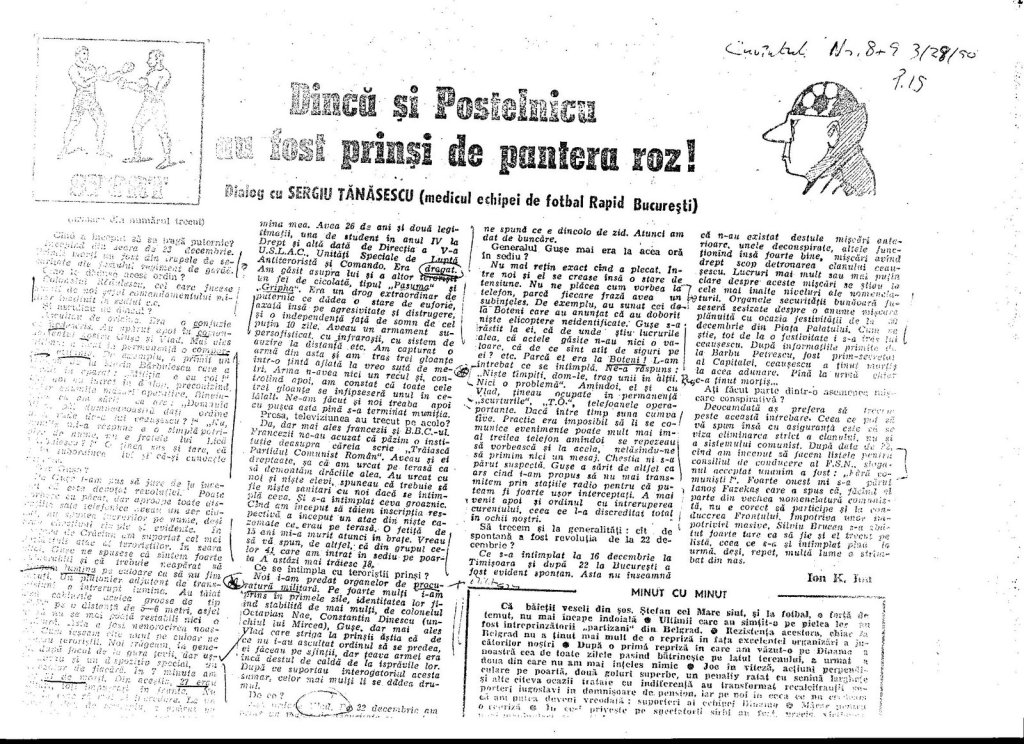
image-5image-3

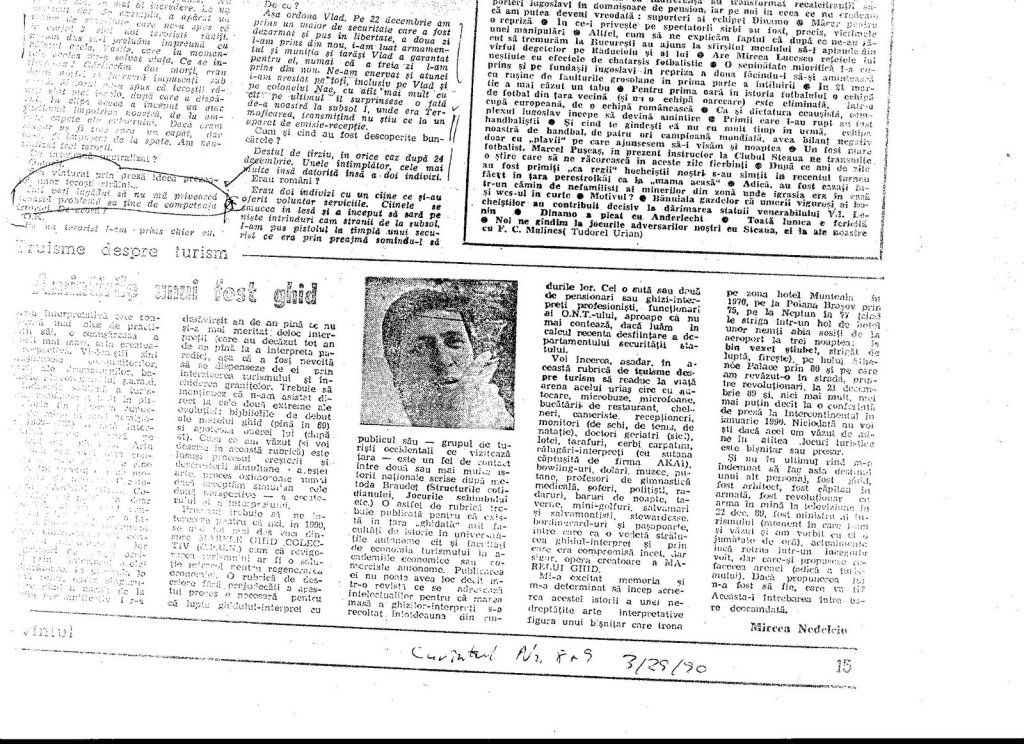
U.S.L.A.C.

Sergiu Tanasescu (medicul echipei de fotbal Rapid Bucuresti) = S.T.
Ion K. Ion (ziarist, Cuvintul) = I.I.

I.I.: S-a vinturat prin presa ideea prezente unor teroristi straini…

S.T.: Imi veti ingadui sa nu ma priveasca aceasta problema ea tine de competenta
istoriei. De acord?

I.I.: O.K.

S.T.: Pe un terorist l-am prins chiar eu, mina mea. Avea 26 de ani si doua
legitimatii, una de student in anul IV la Drept si alta data de Directia a V-a
U.S.L.A.C. Unitati Speciale de Lupta Antiterorista si Comando. Era drogat. Am
gasit asupra lui si a altor teroristi un fel de cicolata, tipul “Pasuma” si
“Gripha”. Era un drog extraordinar de puternic ce dadea o stare de euforie,
axata insa pe agresivitate si distrugere, si o independenta fata de somn de cel
putin 10 zile. Aveau un armament supersofisticat, cu infrarosii, cu sistem de
auzire la distanta etc. Am capturat o arma din asta si am tras trei gloante
intr-o tinta aflata la vreo suta de metri. Arma n-avea nici un recul si,
controlind apoi, am constatat ca toate cele trei gloante se infipsesera unul in celalalt. Ne-am facut si
noi treaba apoi cu pusca asta pina s-a terminat munitia.

I.I. : Ce se intimpla cu teroristii prinsi?

S.T.: Noi i-am predat organelor de procuratura militara. Pe foarte multi i-am
prins in primele zile, identitatea lor fiind stabilita de mai multi, de
colonelul Octavian Nae, Constantin Dinescu (unchiul lui Mircea), Guse, dar mai
ales Vlad care strig la prinsii astia ca de ce nu i-au ascultat ordinul sa se
predea, ei faceau pe sfintii, dar teava armei era inca destul de calda de la
ispravile lor. Dupa ce suportau interogatoriul acesta sumar, celor mai multi li
se dadea drumul.

I.I.: De ce?

S.T. Asa ordona Vlad. Pe 22 decembrie am prins un maior de securitate care a
fost dezarmat si pus in libertate, a doua zi l-am prins din nou, i-am luat
armamentul si munitia si iarasi Vlad a garantat pentru el, numai ca a treia zi
l-am prins din nou. Ne-am enervat si atunci i-am arestat pe toti, inclusiv pe
Vlad si pe colonelul Nae, cu atit mai mult cu cit pe ultimul il surprinsese o fata de a noastra la subsol I,
unde era Termoficarea, transmitind nu stiu ce la un aparat de emisie-receptie.

I.I.: Cum si cind au fost descoperite buncarele?

S.T.: Destul de tirziu, in orice caz dupa 24 decembrie. Unele intimplator, cele
mai multe insa datorita insa a doi indivizi….

(Sergiu Tanasescu, cu Ion K. Ion, “Dinca si Postelnicu au fost prinsi de pantera
roz!” Cuvintul, nr. 9 29 martie 1990, p. 15.)

se pare ca acesti doi indivizi au fost “maiorul Gheorghe Grigoras si capitanul Nicolae Grigoras, de la unitatea speciala de lupta antiterorista”…

Cai de navigatie secrete sub Bucuresti

La 12 metri sub platoul Pietei Revolutiei exista o retea de catacombe prin care se circula cu barca

La 12 metri sub platoul Pietei Revolutiei exista o retea de catacombe prin care se circula cu barca. E vorba de culoare betonate, cu latimea de aproximativ doi metri, prin care curge un rau subteran adanc de un metru. Cu apa curata. Debitul raului secret e aproximat la 1,5 metri cubi pe secunda. La intrare, aceste cai navigabile care stabat Capitala sunt utilate cu barci pneumatice. Informatiile ne-au fost furnizate de Dan Falcan, seful sectiei de istorie a Muzeului Municipiului Bucuresti. Istoricul a cules toate datele existente despre catacombele Bucurestilor, mai vechi si mai noi, si le-a pus cap la cap pentru a-si face o imagine asupra istoriei orasului.

(IMG:http://news.softpedia.com/images//news/1913_6.jpg)

Capitala Romaniei are o traditie de secole in materie de tainite si coridoare secrete. Din datele pe care le detin istoricii, primele coridoare subterane demne de luat in seama au fost beciurile producatorilor de vinuri. Acestea aveau zeci de metri si erau atat de largi incat se circula cu carele. In secolul al XIX-lea au aparut edificiile care aveau tuneluri de refugiu, cum e tunelul care leaga Palatul Ghica Tei de Manastirea Plumbuita, lung de mai bine de un kilometru. In nordul Parcului Cismigiu, Biserica Schitu Magureanu e legata prin subterane de Palatul Cretzulescu .

Sub Palatul Golescu, situat langa stadionul Giulesti, a fost depistat un coridor subteran care da inspre lunca Dambovitei . Coridorul a fost folosit si de Tudor Vladimirescu. “De pe la 1826 ne-au ramas
cateva relatari care ne dau o imagine asupra catacombelor de sub capitala Tarii Romanesti. La acea vreme haiduceau in zona vestitii Tunsu si Grozea. Timp de multi ani, ei au bagat spaima in boierii din Bucuresti, in special in cei care aveau casele in zona actualei sosele Panduri. Ii calcau mereu, iar poterele nu puteau face nimic. Desi reuseau sa ii localizeze si sa-i incercuiasca, cand sa puna mana pe ei haiducii dispareau “intrand in pamant”, adica coborau in subteran. Astazi putem afirma ca sub aceasta sosea erau o multime de coridoare subterane, late de trei metri si inalte de doi metri. Dar toate datele acestea au palit atunci cand am intrat in contact cu alte informatii recente. Labirintul subteran vechi al orasului pare neinsemnat pe langa cel construit din ordinul lui Ceausescu. Datele mi-au parvenit de la militarii care au intrat in subteranele fostului Comitet Central, actualul Senat la Romaniei, respectiv de la maiorul Gheorghe Grigoras si capitanul Nicolae Grigoras, de la unitatea speciala de lupta antiterorista. Ei au intrat in aceste catacombe chiar pe 25 decembrie 1989, impreuna cu un grup de genisti si pirotehnisti”, explica muzeograful Dan Falcan.

Conform relatarii militarilor, la subsolul cladirii au gasit un tunel, nu prea lung, care coboara intr-un fel de cazarma. Opt camere cu paturi pliante. Din aceste camere pornesc mai multe culoare, unul ducand chiar pana la etajul II al cladirii. Pe un alt culoar se poate ajunge la un buncar mai larg, la 7 metri adancime. Se trece apoi de o usa blindata si se ajunge la un apartament spatios, la adancimea de 9 metri. Militarii au cautat apoi camera in care se afla sistemul de ventilatie si s-au trezit pe un nou culoar. Dupa ce au strabatut aproximativ 30 de metri au gasit o nisa cu o lada mare, in care erau 16 barci din cauciuc, cu pompe de umflare. Dupa alti 20 de metri militarii au observat ca peretii tunelului au alta culoare, sunt mai noi si sunt acoperiti cu un fel de rasina sintetica. Dupa inca 10 metri culoarul se infunda. Chiar la capat se afla un piedestal din lemn pe care era asezat un capac de WC. Au ridicat capacul iar sub el au gasit un chepeng de fier. L-au ridicat si au gasit… un rau cu apa curata, care curge intr-o matca artificiala din beton. Are latimea de circa 1,5 metri si adancimea de aproximativ un metru. Raul se afla la aproximativ 12 metri sub platforma Pietei Revolutiei . Cele 16 barci erau folosite de fapt pentru acesta cale de navigatie. Albia amenajata are pe lateral bare metalice facute pentru oprirea sau impulsionarea barcilor. “In opinia militarilor, raul secret duce catre un lacurile din afara orasului, in nord, si Dambovita, in sud-est” , subliniaza Falcan. Ofiterii au vorbit insa de existenta unui alt canal similar, la capatul unui alt tunel, precum si de un sistem de inundare a labirintului, pe sectiuni. In cazul in care un eventual fugar e urmarit, el poate inunda portiuni de tunel in spatele lui pentru a opri urmaritorii. A mai fost gasita o gura de iesire din labirint in curtea interioara a fostului CC, de unde, printr-o retea de canale, se poate intra in canalizarea orasului, de unde se poate iesi catre Dambovita. Reteaua are guri de iesire in Palatul Regal, Biserica Cretzulescu si magazinul Muzica. “In urma unor cercetari ulterioare a reiesit ca ramificatiile subterane au corespondenta cu circa 80 de obiective din Bucuresti, cum ar fi cladirea ASE, Casa Enescu, Opera Romana etc. Subliniez, relatari sunt ale unor ofiteri din cadrul armatei. Lucru foarte interesant, nimeni nu neaga existenta acestor cai de navigatie secrete, dar cand am incercat sa le exploram, nu ni s-a permis pe motiv ca… nu se poate”. Despre aceste galerii ale lui Ceausescu ne-a vorbit si Radulescu Dobrogea, presedintele asociatiei Ecocivica, fost inspector de mediu in Primaria Capitalei, omul care s-a ocupat multi ani de panza freatica a orasului. El sustine ca stie de aceste galerii ale lui Ceausescu si ca apa limpede care curge prin ele este panza freatica de sub oras.

Administratorii Senatului au vazut numai intrarea in catacombe

“Pot sa va spun ca am auzit despre aceste lucruri, dar nu le-am vazut. Exista o cale de comunicatie subterana care pleaca din Senat catre Piata Revolutiei, o cale care pleaca de la Palatul Regal catre Piata si inca una, tot din Palatul Regal, catre Biserica Cretzulescu. Intrarile in aceste cai de acces le-am vazut, dar unde se opresc, nu stiu, nu este treaba noastra sa cotrobaim pe acolo”, ne-a declarat inginer Constantin Bratu, directorul tehnic al administratiai cladirii Senatului Romaniei.

Sorin Golea (Libertatea 2005)

Actorul Ernest Maftei a avut de a face cu tuneluri…si teroristi…
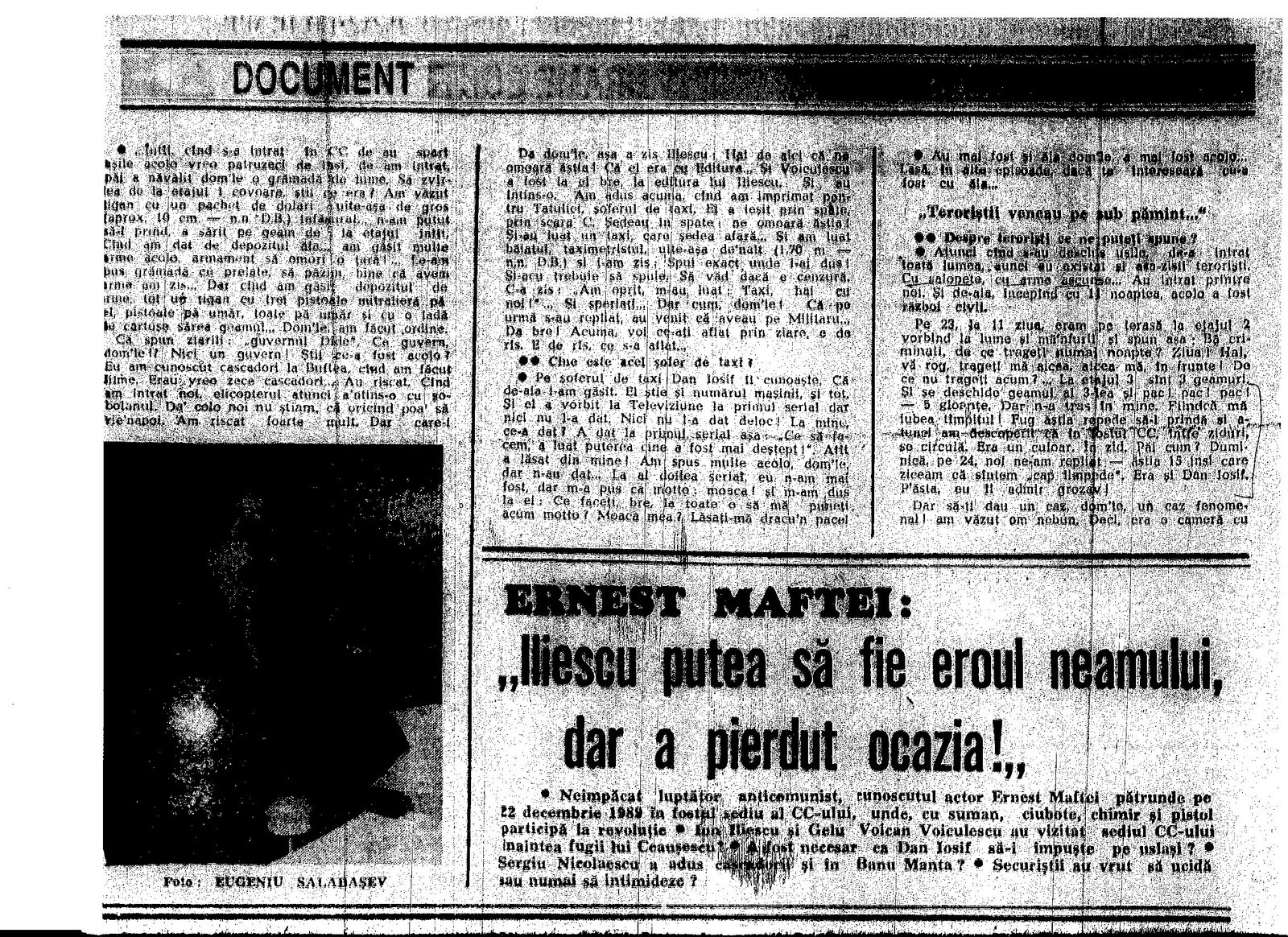
Dan Badea:  Cine erau cei pe care i-a impuscat Dan Iosif?

Ernest Maftei:  USLA!  Venisera sa ne ajute si a venit sa ne’mpuste, dom’le!  Ce dracu’, nu stiu?  Au venit sa ne ajute.  La demisol erau niste oameni de ai nostri, ca acolo erau niste usi blindate ca nu stiu ce-i.  Si unui o deschis o usa dina asta si umbla la becuri.  Si nu-am speriat ca ce-o fi fost acolo.  Atunci vine USLA sa ne ajute.  Vin 15 insi si 4 colonel, dom’le.  Da!  Si cind se duc jos, i-au impuscat pe toti ai nostri.  Doi dintre ai nostri acolo au fost omoriti, erau revolutionari, oameni necajiti care s-au dus acolo sa moara.  Si atunci ne-am dat seama ca astia ne omoara.  Dar apoi vin sus.  Au avut si ei 3 morti.  Si-atunci i-am inconjurat:  “Dezbracarea!”  Pai da’ ce dracu’ dom’le?

Dan Badea:  Atunci i-au dezbracat?

Ernest Maftei:  Pai dar cum dom’le?  I-au impuscat pe loc!  Pai dar ne impuscau ei pe noi…

Dan Badea:  Dan Iosif a spus ca nu i-a impuscat pe cei 15 USLASI…

Ernest Maftei:  Da’ nu te lua cu el!  A fost necesar de i-a’mpuscat acolo!  Dar nu-i voie sa zica, fiindca nu vrea sa se afle.  nu-i voie din cauza ca acu’ne conduce Securitatea.  Chiar aia care au tras in noi sint pe posturi de conducere.  Asculta ce spun!  Ca USLA, coloana a 5-a, a fost cu Ceausescu.  Nu ne-ar fi omorit?  Vai de mine!…

Dan Badea:  Despre teroristi ce ne puteti spune?

Ernest Maftei:  Atunci cind s-au deschis usile, d-a intrat toata lumea, atunci au existat si asa-zisii teroristi.  Cu salopete, cu arme ascunse. … Au intrat printre nio.  Se de-aia, incepind cu 11 noaptea [23 decembrie 1989], acolo a fost razboi civil….Fug astia repede sa-l prinda si atunci am descoperit ca in fostul CC, intre ziduri, se circula.  Era un culoar.  In zid.  Pai cum? …

Dan Badea:  Pe unde credeti ca veneau teroristii?

Ernest Maftei:  Eu ma miram asa, la un moment dat:  cum dom’le, se trage, trag o jumatate de ora in plin si pe urma stau?  Si zic:  ba, baieti, de unde dracu vin?  Era pe 23, de-acuma.  Zic:  de unde vin si unde se duc?  de unde iau astia arme si inca nu-i videm?  Ce crezi?  Mi-am adus aminte, eu fiind batrin, ca la vila asta, care e a artistilor acuma, linga Biserica Alba, c-a fost vila lu’ Lupeasca.  Si de-acolo, Carol al II-lea a facut tunel pa sub pamint pina la palat, ca sa duca la el.  Venea cu masina, ca sa nu se vada lumea.  Si la palatul regal trageau tare.  Pai acolo, la vila aia, a fost armament mult.  Stai sa vezi ce se intimpla.  Era 1 noaptea, pe 23.  Zic:  ma copii, mergeti voi cu mine?  Si ajung pina in dreptul blocului aia, cu astia….

(Ernest Maftei cu Dan Badea, “‘Iliescu putea sa fie eroul neamului, dar a pierdut ocazia!’,” Expres, nr. 36 (85), 10-16 septembrie 1991, pp. 10-11.)

cei care au antrenat in buncarele au fost…
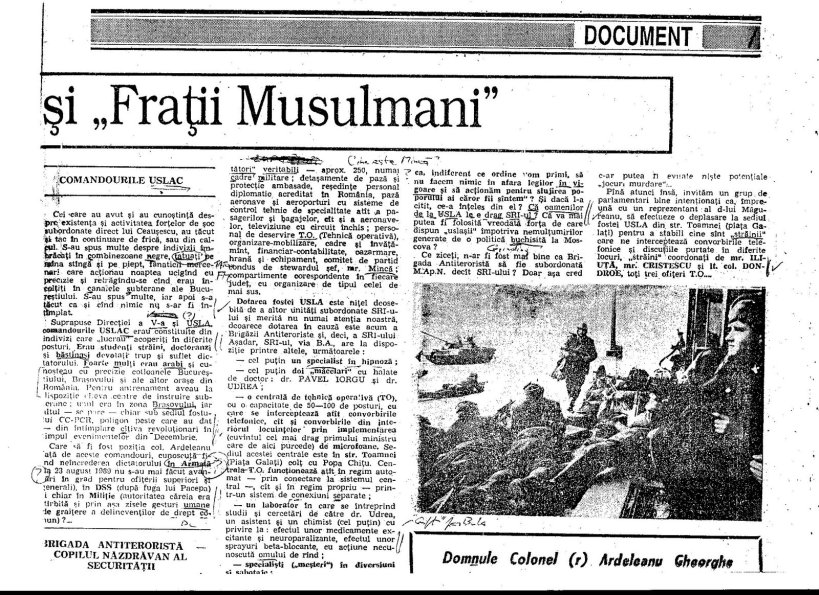
image-13

(Capitanul Romanescu Marian (fost cadru USLA) si Dan Badea, “USLA, Bula Moise, teroristii, si ‘Fratii Musulmani’,” Expres nr. 26 (75), 2-8 iulie 1991, pp. 8-9)

COMANDOURILE USLAC

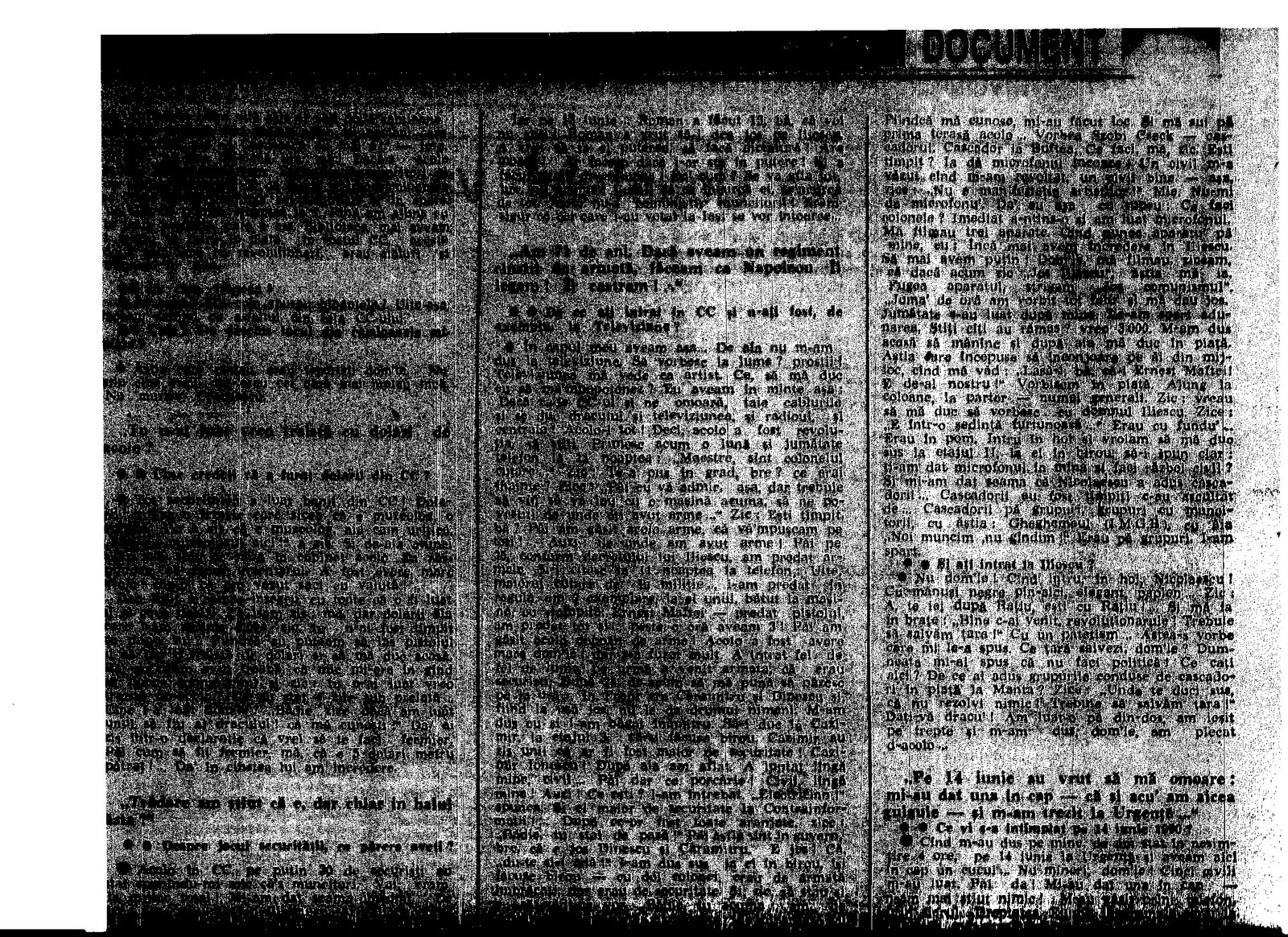
Cei care au avut si au cunostinta despre existenta si activitatea fortelor de soc subordonate direct lui Ceausescu, au tacut si tac in continuare de frica, sau din calcul.  S-au spus multe despre indivizii imbracati in combinezoane negre, tatuati pe mina stinga si pe piept, fanaticii mercenari care actionau noaptea ucigind cu precizie si retragindu-se cind erau incoltiti in canalele subterane ale Bucurestiului.  S-au spus multe, iar apoi au tacut ca si cind nimic nu s-ar fi intimplat.

Suprapuse Directiei a V-a si USLA comandourile USLA erau constituite din indivizi care “lucrau” acoperiti in diferite posturi. Erau studenti straini, doctoranzi si bastinasi devotati trup si suflet dictatorului.  Foarte multi erau arabi si cunosteau cu precizie cotloanele Bucurestiului, Brasovului si ale altor orase din Romania.  Pentru antrenament aveau la dispozitie citeva centre de instruire subterane:  unul era in zona Brasovului, iar altul–se pare–chiar sub sediul fostului CC-PCR, poligon care au dat–din intimplare citiva revolutionari in timpul evenimentelor din Decembrie.

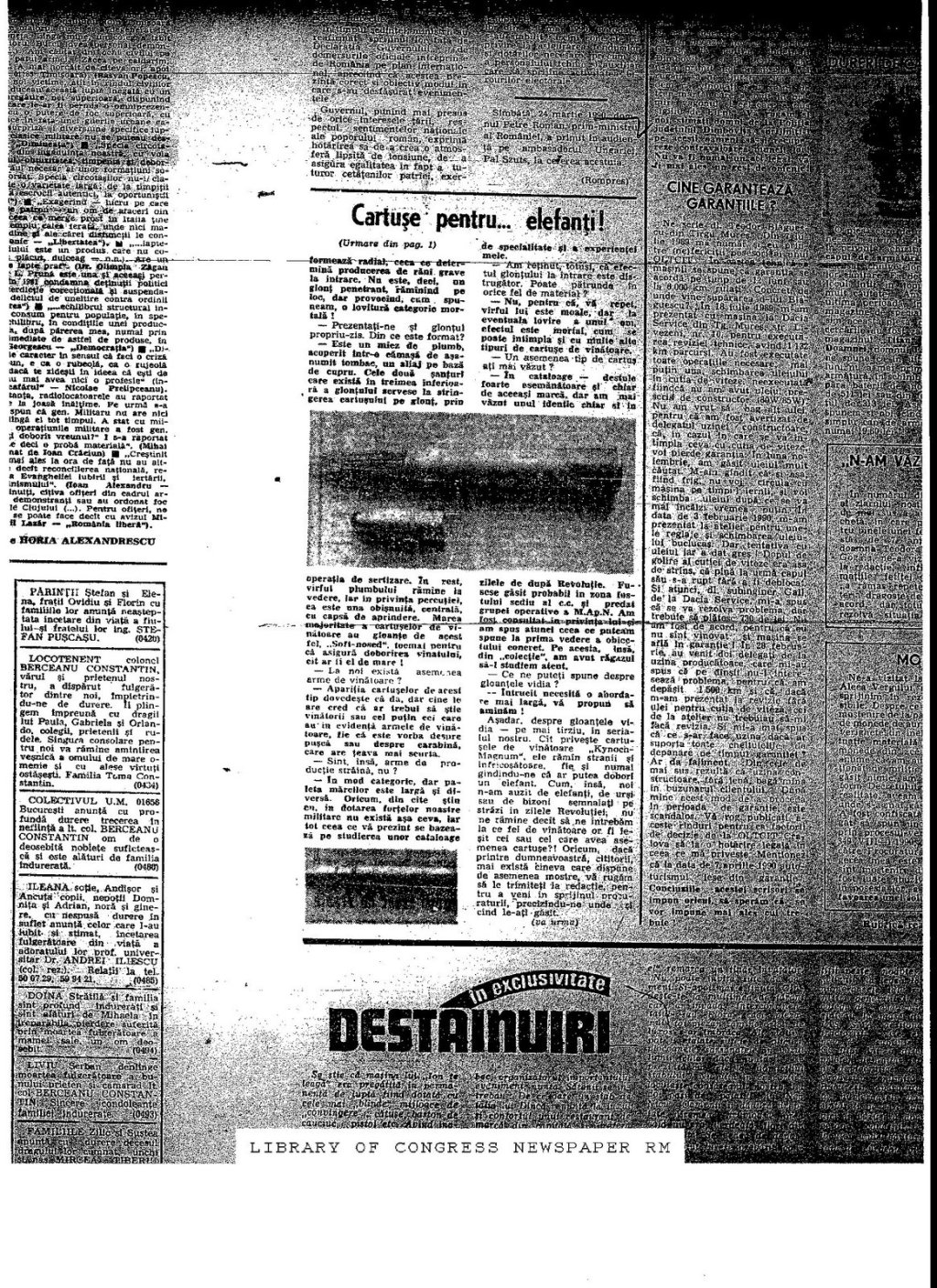
Au fost gasite:  “Cartusele “Kynoch-Magnum” ramin stranii, prin aparitia lor insolita pe strazile Capitalei, alaturi de intreaga “colectie” de gloante adunata de echipele militare care au curatat subteranele Bucurestiului….”

image-89

image-88

Maior Mihai Floca, “Reportaj La U.S.L.A.,” Tineretul Liber, 5 ianuarie 1990, p. 4.
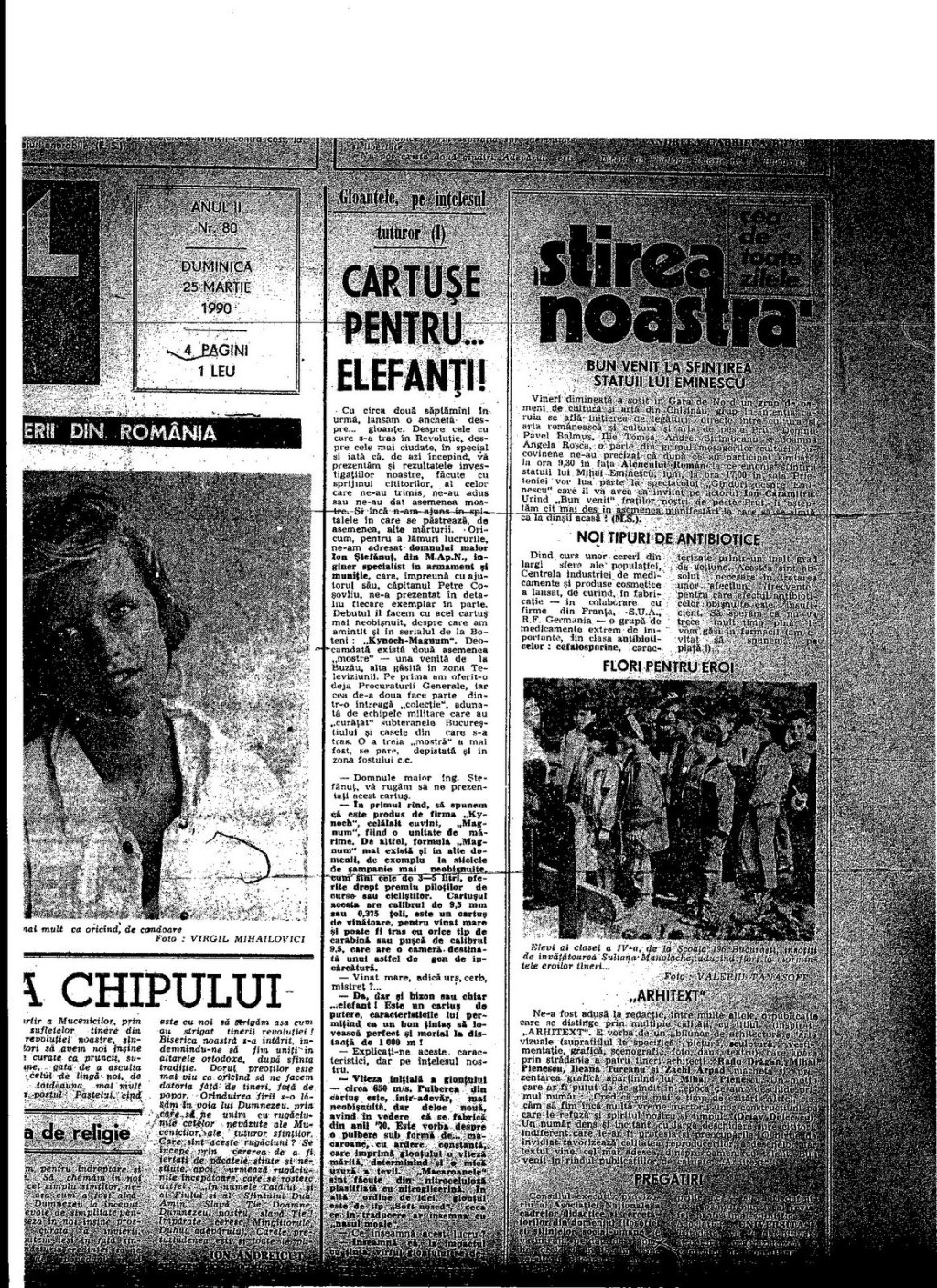
image-9image-8

“Un capitol aparte privind mijloacele folosite il constituie cartusele cu care s-a tras in Revolutie, multe gloante gasite fiind cel putin ciudate, de provenienta straina. Intr-o ampla ancheta, “Tineretul Liber” incearca sa elucideze misterul gloantelor “ciudate” apelind la maiorul Ion Stefanut, inginer specialist in armament si munitie la M.Ap.N. [nota mea: nu este mentionat aici dar e destul de important: in decembrie 1989 Stefanut a fost cadru…USLA]

Cartuse de tip “Kynoch-Magnum” s-au gasit la Buzau, dar si in zona Televiziunii si se pare ca o “mostra” a mai fost depistata si in zona fostului c.c. Este produs de firma “Kyondi”, celalalt cuvint “Magnum” fiind o unitate de masura. Acest cartus are calibrul 9,5 mm sau 0,375 toli. Este un cartus de vinatoare pentru vinat mare si poate fi tras cu orice tip de carabina sau puscaa de calibru 9,5 care are o camera destinata unui astfel de gen de incarcatura. Este un cartus de mare putere, caracteristicele lui permitind ca un bun tintas sa loveasca perfect si mortal la o distanta de 1000 m, viteza initiala a glontului este de circa 850 m/s. Pulberea din cartus este, intr-adevar mai neobisnuita, dar deloc noua, avind in vedere ca se fabrica din anii 70. Este vorba de o pulbere sub forma de…macaroane, cu ardere constanta, care imprima glontului o viteza marita, determinind si o mica uzura a tevii. “Macaroanele” sint facute din nitroceluloza plastificata cu nitroglicerina. Glontul este de tip “Softnosed”, ceea ce in traducere ar insemna, “cu nasul moale”, adica la impactul cu tinta, virful glontului se deformeaza radial, ceea ce determina producerea de rani grave la intrare. Nu este un glont penetrant raminind pe loc, dar provocind o lovitura de categoric mortala. Glontul este un miez de plumb acoperit intr-o camasa de tombac, un aliaj pe baza de cupru.

Apartia cartuselor de acest tip dovedeste ca si la noi exista asemenea arme de vinatoare. In dotarea fortelor noastre armate nu exista o astfel de arma.

Cartusele “Kynoch-Magnum” ramin stranii, prin aparitia lor insolita pe strazile Capitalei, alaturi de intreaga “colectie” de gloante adunata de echipele militare care au curatat subteranele Bucurestiului [dupa Voinea, nici acestea n-au existat] si casele din care s-a tras….”

extras din Aurel Perva si Carol Roman, Misterele Revolutiei Romane, 1990, pp. 103-104

aceste gloante speciale au fost gasite si in Directia a V-a a Securitatii…acolo a fost descoperit in plus “dosarul cu toate tunelurile de sub Bucuresti, cu iesiri si evacuari din cladiri importante, cum sint: C.C., Cotroceni, Casa Poporului, Primaverii (cu vilele din imprejurimi si insula din lac). Pe aceste scheme se arata exact sistemul de comunicare intre ele”

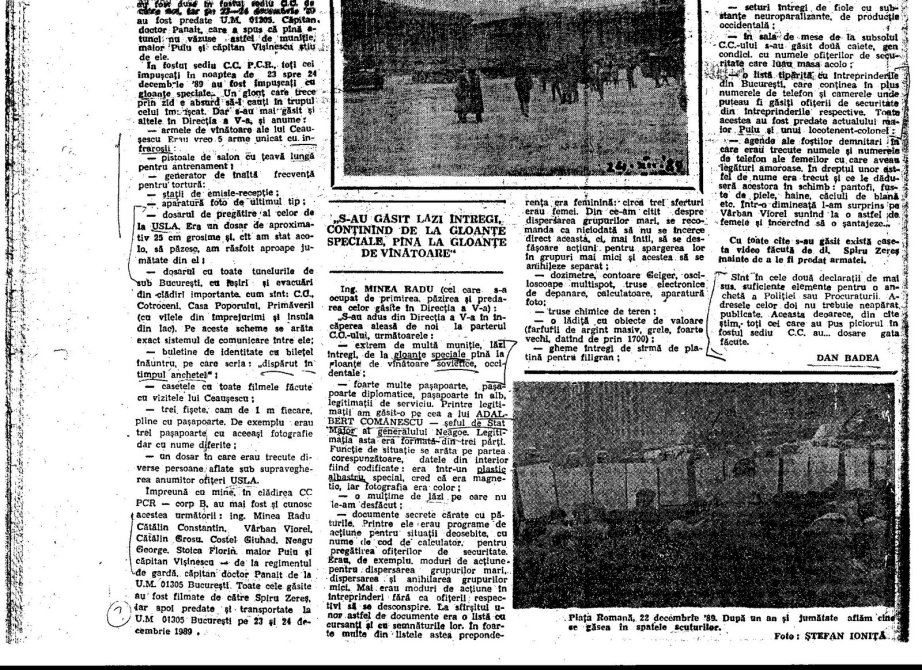
image-8

image-7

BALASA GHEORGHE: Sint foarte intrigat de interviul acordat de dl. general Stanculescu ziarului “Tineretul Liber”, interviu in care acesta ocoleste adevarul.

Din Directia a V-a, din depozitul de munitie, au fost scoase pe 23-24 decembrie 1989 cartuse DUM-DUM, cartuse speciale care nu se potriveau la nici o arma din dotarea M.Ap.N. S-au gasit trei-patru cutii cu astfel de cartuse. Gloantele speciale, erau lungi de 5-6 cm si putin mai groasa decit un creion. Un astfel de cartus avea in virf o piatra alba, transparenta. Toate aceste cartuse i le-am prezentat personal, spre a fi filmate, d-lui Spiru Zeres. Toate cartusele speciale, in afara de DUM-DUM era de provenienta RFG-ista. Din Directia a V-a au fost predate U.M. 01305. Capitan doctor Panait, care a spus ca pina atunci nu vazuse astel de munitie, maior Puiu si captian Visinescu stiu de ele.

In fostul sediu C.C. P.C.R., toti cei impuscati in noaptea de 23 spre 24 decembrie ‘89 au fost impuscati cu gloante speciale. Un glont care trece prin zid e absurd sa-l cauti in trupul celui impuscat. Dar s-au mai gaist si altele in Directia a V-a, si anume:

armele de vinatoare ale lui Ceausescu. Erau vreo 5 arme unicat cu infrarosii:

–pistoale de salon cu teava lunga pentru antrenament;

–generator de inalta frecventa pentru tortura;

–statii de emisie-receptie;

–aparatura de foto de ultimul tip;

–dosarul de pregatire al celor de la USLA. Era un dosar de aproximativ 25 cm grosime si cit am stat acolo, sa pazesc, am rasfoit aproape jumatate din el;

–dosarul cu toate tunelurile de sub Bucuresti, cu iesiri si evacuari din cladiri importante, cum sint: C.C., Cotroceni, Casa Poporului, Primaverii (cu vilele din imprejurimi si insula din lac). Pe aceste scheme se arata exact sistemul de comunicare intre ele;

–buletine de identitate cu biletul inauntru pe care scria: “disparut in timpul anchetei”;

–casetele cu toate filmele facute cu vizitele lui Ceausescu;

–trei fisete cam de 1 m fiecare, pline cu pasapoarte. De exemplu erau trei pasapoarte cu aceeasi fotografie dar cu nume diferite;

–un dosar in care erau trecute diverse persoane aflate sub supravegherea anumitor ofiteri USLA.

–Impreuna cu mine, in cladirea CC PCR–corp. B. au mai fost si cunosc acestea urmatorii: ing. Minea Radu, Catalin Constantin, Varban Viorel, Catalin Crosu, Costel Ciuhad, Neagu George, Stoica Florin, maior Puiu si capitan Visinescu–de la regimentul de garda, capitan doctor Panait de la U.M. 01305 Bucuresti. Toate cele gasite au fost filmate de catre Spiru Zeres, iar apoi predate si transportate la U.M. 01305 Bucuresti pe 23 si 24 decembrie 1989.

(Expres, aprilie 1991)

si in Palatul Regal, printre ziduri duble, misunau securisti-teroristi…care au folosit gloante speciale de calibru cinci, cinci si ceva…dar “n-au vrut uslasii sa” lasa un singur glont
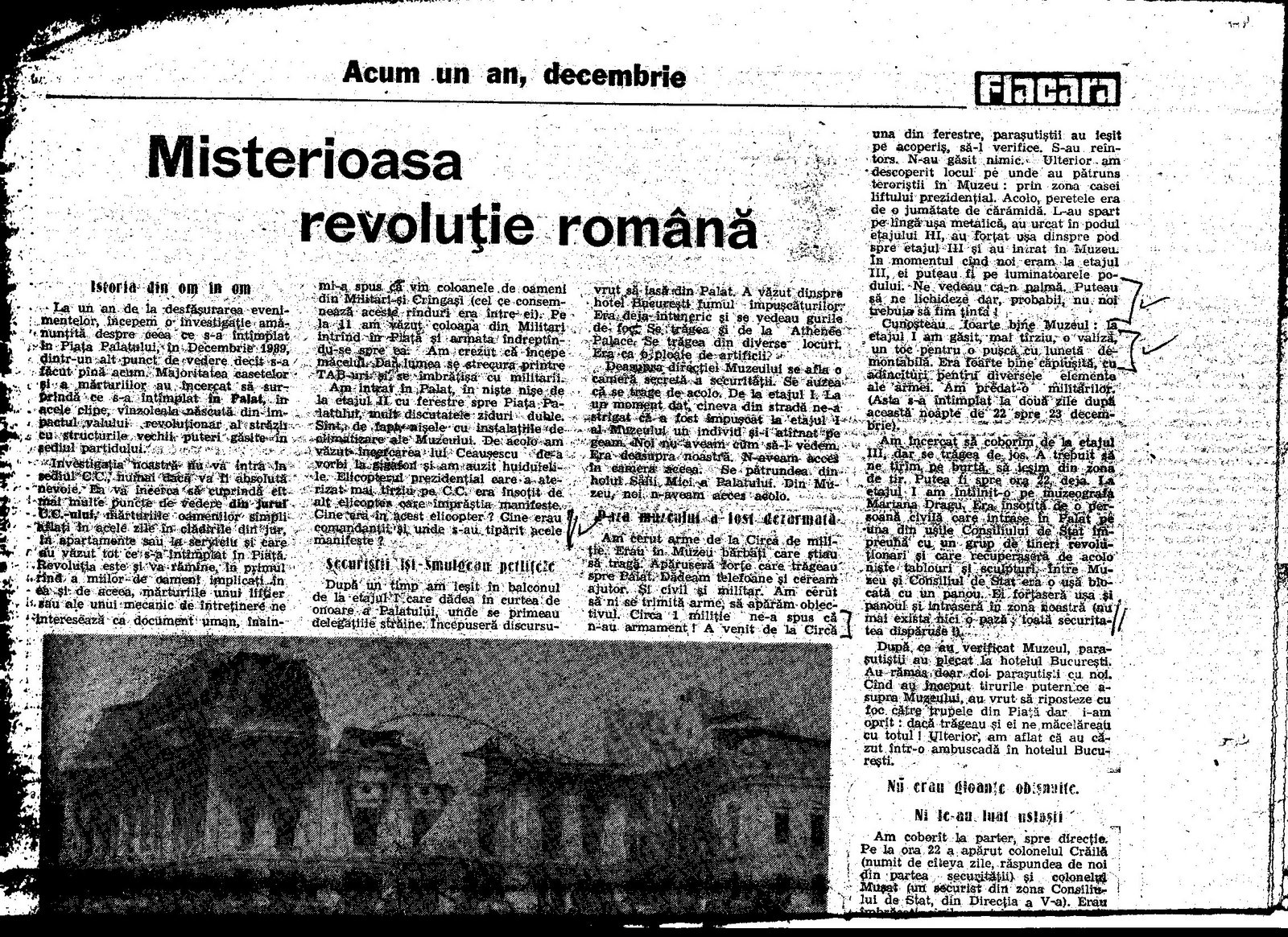


Ing. Dan Iliescu, Muzeul de Arta

“S-a tras din Muzeu permanent. Aveam impresia ca se trage de la parter, de la arta feudala….Armele lor sunau altfel. Aveau o cadenta sanatoasa. A doua zi si in zilele urmatoare am gasit gloante in Muzeu. Nu erau gloante obisnuite. Aveau un virf tesit. Pareau imbricate intr-o camasa de plumb. Era un calibru intre cinci, cinci si ceva. N-au vrut uslasii [ USLA] sa ne lasa nici un glont. I-am rugat sa ne lasa macar de amintire. N-au vrut! Au zis ca au nevoie pentru identificare. Au notat de unde le-au ridicat.”

Ion Zubascu, “Misterioasa revolutie romana,” Flacara, 19 decembrie 1990, p. 11.

[cu alte cuvinte:  adevarul despre care Grigore Cartianu habar nu are…si adevarul pe care Dan Voinea nu-l recunoaste]
Posted in raport final, Uncategorized | 10 Comments »

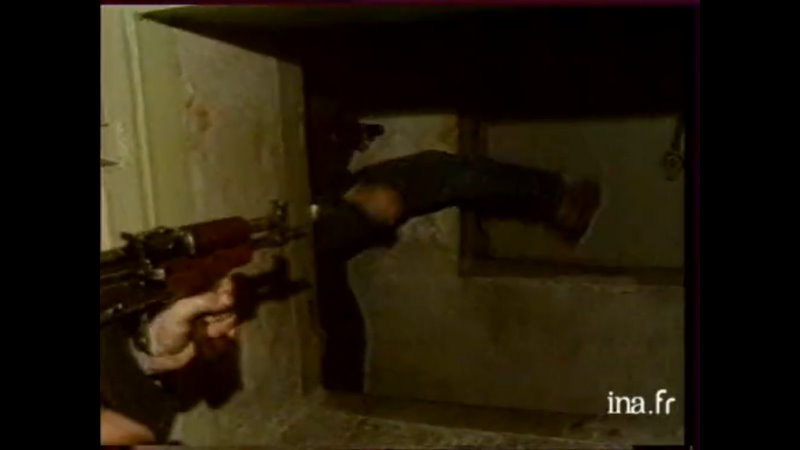
Les souterrains de Bucarest JA2 20H – 27/12/1989 – 01min55s

Posted by romanianrevolutionofdecember1989 on November 19, 2010

http://www.ina.fr/histoire-et-conflits/revolutions-et-coups-d-etat/video/CAB89054565/les-souterrains-de-bucarest.fr.html

Les souterrains de Bucarest

JA2 20H – 27/12/1989 – 01min55s
385 vues

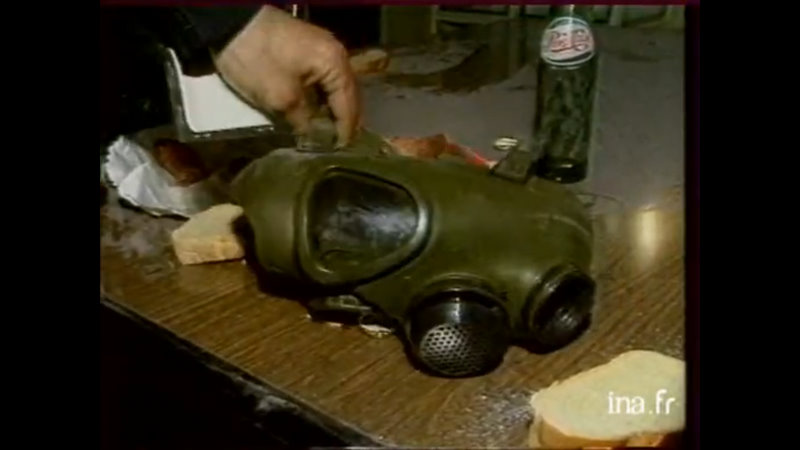
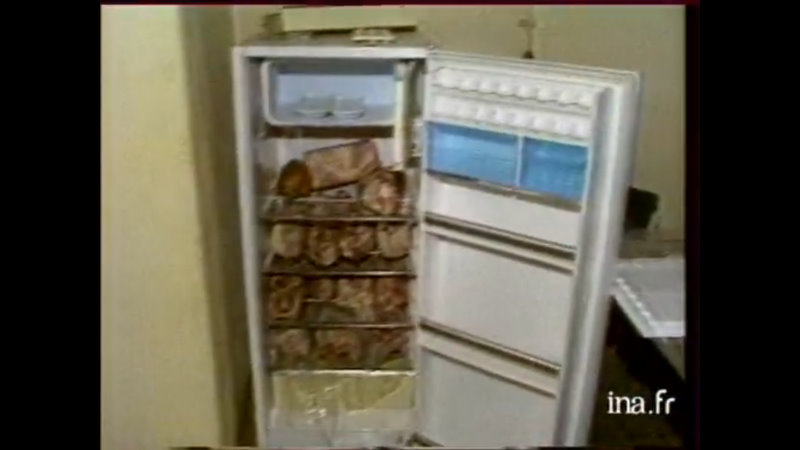
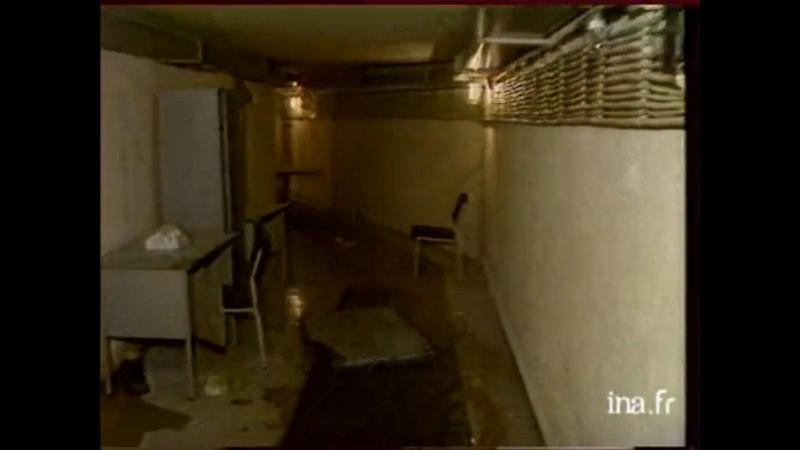
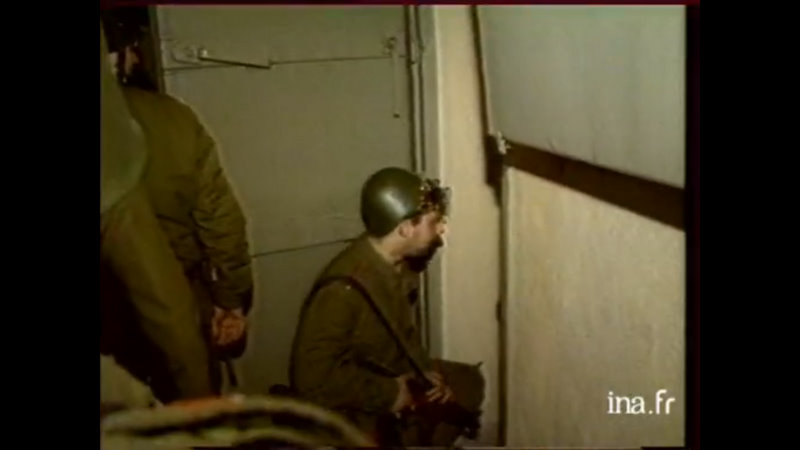
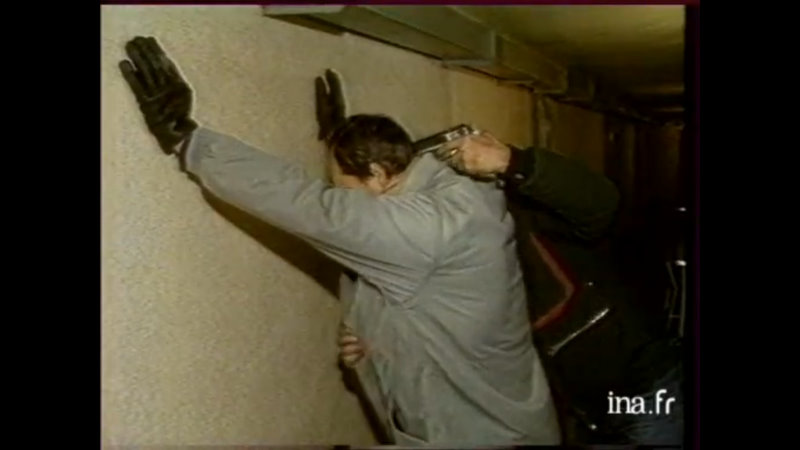
Reportage sur le réseau souterrain de Bucarest, véritable ville parallèle créee par Ceausescu pour assurer sa défense et où se sont réfugiés les rebelles de la Securitate, la police secrète du régime, après la chute du dictateur. – Soldat roumain explorant un souterrain l’arme au poing. Soldat ouvrant une porte d’un coup de botte. GP Visage du soldat tendu par la peur de se trouver face à face avec un agent de la Securitate. Soldat prenant un ascenseur qui les ammène dans le bunker personnel du dictateur Ceausescu. Restes d’un repas sur la table. Réfrigérateur plein de viande. Soldat fouillant un agent de la Securitate qui vient d’être arrêté dans un tunnel du réseau souterrain. On examine ses papiers. GP Oranges découvertes sur lui, indice supplémentaire confirmant son appartenance à la Securitate. Soldat explorant un tunnel le long duquel s’écoule une rigole d’eau.

…dar ce spune Dan Voinea http://rcristea.blogspot.com/2007/11/nici-simulatoare-de-tragere-nici.html:

Tunelurile secrete ale mincinosilor
– Ani de zile s-a tot vorbit despre tunelurile secrete pline de teroristi care ieseau si ucideau oamenii de pe strada sau din diverse institutii… Exista vreo marturie credibila, vreun document?
– Nu putem califica aceste informatii nici macar ca tinand de domeniul legendei. E o minciuna! O alta minciuna! Bucurestiul, ca de altfel toate marile orase, e brazdat subteran de tot felul de tuneluri, unele pentru canalizare, gospodarirea apei, electricitate si alte scopuri. De altfel, Capitala are in subteran tuneluri realizate in urma cu sute de ani. Aceste tuneluri nu au constituit adaposturi pentru teroristi. Recent, am participat la o reconstituire pe teren, la asemenea asa-zise tuneluri secrete folosite de teroristi. Era un simplu canal pentru distribuirea apei potabile. Deci am constatat ca a fost vorba de o minciuna.
[sigur dle. Voinea…e normal pentru “tuneluri, unele pentru canalizare, gospodarirea apei, si electricitate” sa aiba frigidere pline de carne…]
si adevarul (nu ‘adevarul’ lui Grigore Cartianu…hai sa fim seriosi) este ca nici ziaristul Romulus Cristea nu prea crede in ceea ce povesteste dle. Voinea…cu o intarziere de numai doua zile el a publicat dezvaluirea aceasta…cine este mai credibil in privinta aceasta…arhitectul sau procuratorul militar?…

Arhitectul bucurestean Camil Roguski, fost angajat al Ministerului Afacerilor Externe, dar si la Unitatea de întretinere si decorare a palatelor prezidentiale din perioada ceausista a fost unul dintre putinii civili care au avut privilegiul sa vada si sa participe la cartografierea, la construirea si decorarea unor tuneluri secrete din mai multe localitati

Cum se „teleporta” Ceausescu

În perioada 1970-1975, Calea Victoriei a fost blocata. Se efectuau lucrari la un tunel care facea legatura între Comitetul Central, Muzeul de Arta si Sala Palatului. Arhitectul Roguski isi aminteste ca : „Era un tunel elegant, foarte bine realizat, cu toate dotarile necesare. Era astfel construit, cu sursa de apa proprie, încât în cazuri de urgenta, se putea ramâne la interior cel putin trei zile fara interventii exterioare. Ceusescu venea de la CC, direct în loja de la Sala Palatului, prin tunel, fara paza, lucru care îi contraria pe multi care nu îl vedeau traversând Calea Victoriei. La Revolutie, soldatii consemnati aici au început sa iasa la suprafata si au fost luati drept teroristi. Trebuie cunoscut faptul ca toate clsdirile catalogate strategice din Bucuresti aveau buncare antiatomice sau antiaeriene construite foarte bine (chiar placate cu placi de plumb)”. Buncare de acest gen exista la Ministerul Afacerilor Externe (folosit pâna prin anii 1950 ca depozit de valori, pentru decoratii nemtesti si românesti), Ministerul Apararii Na]ionale, Palatul Victoria, Palatul Cotroceni, fostul Comitet Central etc. La Casa Poporului au fost construite doar doua masive buncare antiatomice si exista o retea de legaturi prin tuneluri spre anumite zone. Arhitectul a refuzat sa ofere alte amanunte, argumentând ca „anumite persoane ar fi deranjate”, multe constituie secrete de stat dar, subliniind ca exista foarte multe legende, fara fundament, legate de aceasta constructie.

„Sub fostul CC exista mai multe cai de acces, la nivelul subsolului doi. In decembrie 1989, tunelul care era liber, accesat cu un lift personal ,si care ar fi trebuit sa-i asigure iesirea lui Ceusescu trecea pe sub CC, CC-UTC, Bdul Magheru, Intercontinental si facea legatura cu tunelurile tehnice de langa statia de metrou <<Universitate>>. Nu este un secret ca majoritatea statiilor de metrou au fost astfel construite încât sa poata fi folosite ca adaposturi antiatomice. Sub tunelul propriu – zis exista o retea de buncare si tuneluri mai mici, tehnice, care sunt ca un paienjenis sub Bucuresti. Prin aceste tuneluri se poate circula comod cu un anumit mijloc de transport electric. Se putea ajunge, urmând paralel traseul metroului, pâna la Palatul Primaverii unde exista un buncar central, de coordonare strategica . Din acest buncar, legatura era un tunel secret la care a lucrat, timp de trei ani, prin anii 80, o echipa de mineri de la Petrila. Legatura subterana ajungea la o amenajare de la Lacul Herastrau unde exista permanent o salupa rapida pregatita sa-l transporte pe un alt mal si unde astepta o masina cu destinatia Clinceni – aerodrom. Daca Ceausescu ajungea în subteranele de sub CC, avea posibilitea sa ajunga, foarte usor si rapid, în orice punct de la periferia Capitalei”, a precizat Roguski. Conform documentelor de arhiva si a marturiilor militarilor, de asigurarea securitatii la tunelurile din zona CC (adapost pentru conducerea PCR) se pare ca se ocupa direct, in acea perioada, generalul Ioan Geoana, seful Apararii Civile, tatal lui Mircea Geoana, actualul presedinte PSD.

Posted in raport final, Uncategorized | 9 Comments »

Bullets, Lies, and Videotape: The Amazing, Disappearing Romanian Counter-Revolution of December 1989 (Part VII: Conclusion. Those Who Told Us the Truth) by Richard Andrew Hall

Posted by romanianrevolutionofdecember1989 on October 28, 2010

for Part I see PART I: His Name Was Ghircoias…Nicolae Ghircoias

for Part II see Part II: A Revolution, A Coup d\’etat, AND a Counter-Revolution

for Part III see Part III: Lost…during Investigation

for Part IV see Part IV: The Good Sergeant Schultz or They Know Nothing

for Part V see Part V: Seeing is Believing Videos One and Two

for Part VI see Part VI: Seeing is Believing, Videos 3 and 4

Bullets, Lies, and Videotape:

The Amazing, Disappearing Romanian Counter-Revolution of December 1989

by Richard Andrew Hall, Ph.D.

Standard Disclaimer:  All statements of fact, opinion, or analysis expressed are those of the author and do not reflect the official positions or views of the Central Intelligence Agency (CIA) or any other U.S. Government agency.  Nothing in the contents should be construed as asserting or implying U.S. Government authentication of information or CIA endorsement of the author’s views.  This material has been reviewed by CIA to prevent the disclosure of classified information.  [Submitted 19 November 2009; PRB approved 15 December 2009]

I am an intelligence analyst for the Central Intelligence Agency.  I have been a CIA analyst since 2000.  Prior to that time, I had no association with CIA outside of the application process.

Those Who Have Told Us the Truth [1]

As opposed to the aforementioned Vladimir Belis, Pavel Corut, and Dan Voinea, all of whom who have strenuously and repeatedly denied the existence and use in December 1989 of atypical munitions of dum-dum bullets and vidia bullets, there exist those who have told us of the existence and use of these in December 1989.[2] They are essentially, for lack of a better term, former Securitate whistleblowers, who have admitted the Securitate’s role in providing the “terrorists” who caused so much destruction, mayhem, and loss of life in those days.

For years I have been essentially the sole researcher inside or outside the country familiar with and promoting the claims of 1) former Timisoara Securitate Directorate I officer Roland Vasilevici—who published his claims about December 1989 under the byline of Puspoki F. in the Timisoara political-cultural weekly Orizont in March 1990 and under the pseudonym “Romeo Vasiliu”—and 2) an anonymous USLA recruit who told his story to AM Press Dolj (published on the five year anniversary of the events in Romania Libera 28 December 1994…ironically (?) next to a story about how a former Securitate official attempted to interrupt a private television broadcast in which Roland Vasilevici was being interviewed in Timisoara about Libyan involvement in December 1989).

Vasilevici claimed in those March 1990 articles and in a 140 page book that followed—both the series and the book titled Pyramid of Shadows—that the USLA and Arab commandos were the “terrorists” of December 1989.  What is particularly noteworthy in light of the above discussion about “exploding [dum-dum] bullets” was his claim that the USLA and the foreign students who supplemented them “used special cartridges which upon hitting their targets caused new explosions” [emphasis added]—in other words, exploding or dum-dum bullets.[3]

The anonymous USLA recruit stated separately, but similarly:

I was in Timisoara and Bucharest in December ’89.  In addition to us [USLA] draftees, recalled professionals, who wore black camouflage outfits, were dispatched.  Antiterrorist troop units and these professionals received live ammunition.  In Timisoara demonstrators were shot at short distances.  I saw how the skulls of those who were shot would explode. I believe the masked ones, using their own special weapons, shot with exploding bullets.  In January 1990, all the draftees from the USLA troops were put in detox.  We had been drugged.  We were discharged five months before our service was due to expire in order to lose any trace of us.  Don’t publish my name.  I fear for me and my parents.  When we trained and practiced we were separated into ‘friends’ and ‘enemies.’  The masked ones were the ‘enemies’ who we had to find and neutralize.  I believe the masked ones were the ‘terrorists’.[4] [emphases added]

As I have pointed out, despite the short shrift given these two revelations by Romanian media and Romanianists, one group has paid close attention:  the former Securitate.  That is not accidental.[5]

Those discussed as alternatively “commandos” or “professionals” appear to have been members of the so-called USLAC—Special Unit for Anti-terrorist and Commando Warfare.  In 1991, Dan Badea summarized former USLA Captain Marian Romanescu’s description of the USLAC as follows:

THE USLAC COMMANDOS:

Those who had and have knowledge about the existence and activities of the shock troops subordinated directly to Ceausescu remained quiet and continue to do so out of fear or out of calculation.  Much has been said about individuals in black jumpsuits, with tattoos on their left hand and chest, mercenary fanatics who acted at night, killing with precision and withdrawing when they were encircled to the underground tunnels of Bucharest.  Much was said, then nobody said anything, as if nothing had ever happened.

Traversing the [Securitate’s] Fifth Directorate and the USLA, the USLAC commandos were made up of individuals who ‘worked’ undercover at different posts.  Many were foreign students, doctoral students and thugs committed with heart and soul to the dictator.  Many were Arabs who knew with precision the nooks and crannies of Bucharest, Brasov and other towns in Romania.  For training these had at their disposal several underground centers of instruction:  one was in an area near Brasov, while another—it appears—was right under the former headquarters of the PCR CC [communist party central committee building], a shooting range that was—discovered by accident by several revolutionaries during the events of December .”[6]

We also know from Romanescu and a second source that USLA commander Gheorghe Ardeleanu (Bula Moise) addressed his troops as follows:

“On 25 December at around 8 pm, after the execution of the dictators, Colonel Ardeleanu gathered the unit’s members into an improvised room and said to them:

‘The Dictatorship has fallen!  The Unit’s members are in the service of the people.  The Romanian Communist Party [PCR] is not disbanding!  It is necessary for us to regroup in the democratic circles of the PCR—the inheritor of the noble ideas of the people of which we are a part!…Corpses were found, individuals with USLAC (Special Unit for Antiterrorist and Commando Warfare) identity cards and identifications with the 0620 stamp of the USLA, identity cards that they had no right to be in possession of when they were found…’  He instructed that the identity cards [of members of the unit] had to be turned in within 24 hours, at which time all of them would receive new ones with Defense Ministry markings.” [7] [8]

In other words, a cover-up of a now failed attempt at counter-revolution—having been cut short by the execution of the Ceausescus, the object of their struggle—had begun.  In the days and weeks that were to follow, the Securitate, including people such as the seemingly ubiquitous Colonel Ghircoias discussed in the opening of this article would go about recovering those “terrorists” who were unlucky enough to be captured, injured, or killed.  By 24 January 1990, the “terrorists” of the Romanian Counter-Revolution of December 1989, no longer existed, so-to-speak, and the chances for justice and truth about what had happened in December 1989 would never recover.[9]

THE REVOLUTION WAS TELEVISED. THE COUNTER-REVOLUTION WAS VIDEOTAPED.

Poet, essayist, and NPR contributor Andrei Codrescu memorably turned Gil Scott Heron’s famous social commentary—“The Revolution Will Not Be Televised”—on  its head, saying that contrary to what Heron’s song had led them to expect …in Romania, the revolution was televised!  But if you read on or listen to Codrescu closely, it would be more accurate to say that he, like many Romanians and Romanianists, believes that what happened in December 1989 was a coup d’etat—he talks about the“staging of the revolution” and how the coup plotters “seized the means of projection”—and thus what he really seems to intend to say is that “the coup d’etat was televised.”[10]

On the other hand, Vladimir Tismaneanu is quoted as once having memorably said:  ”The VCR killed Ceausescu even before his execution…It was the most important factor in terms of creating a mass consciousness.”[11] It is an important and insightful observation about the power of technology and the challenges it poses to centralized control, especially of the totalitarian state.

Ceausescu’s image and control was damaged by the video-player—to say nothing of, by live television, with the infamous “mirror-shattering” moment of 21 December 1989.  However, as this paper has demonstrated, it is the video-recorder that has undone his final and unfortunately (ever)lasting “Christmas gift” to his Romanian subjects, and that has undone the lies of those—including certain past military prosecutors with roots in the communist era—bent on covering this up.

[1] This section borrows heavily from Hall 2008 and Hall 2006.

[2] In addition to these videos, I have thus far accumulated 45 mentions/claims of use of dum-dum and/or vidia bullets in December 1989.  These include the testimonies of doctors who treated the wounded, but also military officers—not just recruits—who are familiar with ballistics.  Separately, I also have accumulated 36 mentions/claims of people who were either killed or wounded by such atypical munitions during the events.  Significantly, these include people killed or wounded prior to 22 December 1989 as well as after, and they are from multiple cities and a variety of locations for both periods—suggesting not accident, but a well-executed plan by the repressive forces of the Ceausescu regime, the Securitate and their foreign mercenary allies.  See Hall 2008 for some of these.

[3] Puspoki F., “Piramida Umbrelor (III),” Orizont (Timisoara), no. 11 (16 March 1990) p.4, and Roland Vasilevici, Piramida Umbrelor (Timisoara:  Editura de Vest, 1991), p. 61.

[4] “Dezvaluiri despre implicarea USLA in evenimentele din decembrie ’89,” Romania Libera, 28 December 1994, p.3.

[5] For the discussion of the former Securitate response to those who have violated the code of silence, see Hall, “Orwellian…Positively Orwellian,” http://homepage.mac.com/khallbobo/RichardHall/pubs/Voineaswar091706.html .

[6] Captain Marian Romanescu, with Dan Badea, “USLA, Bula Moise, teroristii si ‘Fratii Musulmani’,” Expres (2-8 July 1991), pp. 8-9.

[7] Captain Marian Romanescu, with Dan Badea, “USLA, Bula Moise, teroristii si ‘Fratii Musulmani’,” Expres (2-8 July 1991), pp. 8-9.

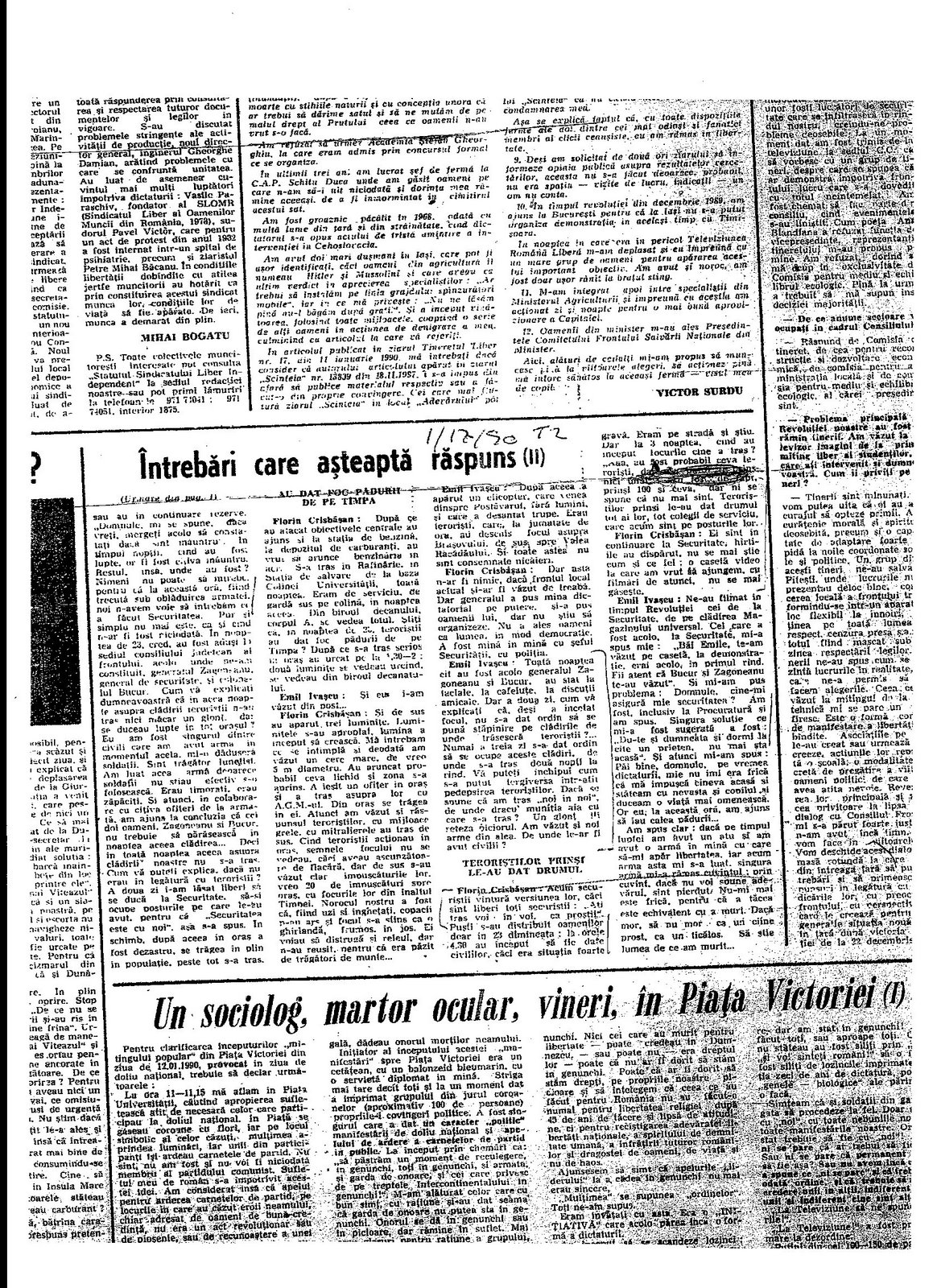
[8] What evidence do we have that the “USLAC”—a reference attributed to Ardeleanu, discussed by Romanescu, and alluded to by Vasilevici (“commandos,” he specified the involvement of Arabs in his book) and the anonymous recruit (the “professionals in black camouflage”)—in fact existed?  To me, the most convincing evidence comes from the comments of Dr. Sergiu Tanasescu, the medical trainer of the Rapid Bucharest soccer team, who was directly involved in the fighting at the Central Committee building.  One has to realize that until his comments in March 1990, the very acronym “USLAC” and its extension does not appear to have appeared in the Romanian media—and has very rarely appeared since.  Here is what he said:

Ion K. Ion (reporter at the weekly Cuvintul):  The idea that there were foreign terrorists has been circulating in the press.

Sergiu Tanasescu (trainer for the Bucharest Rapid soccer club):  I ask that you be so kind as to not ask me about the problem because it is a historical issue.  Are we in agreement?

I.I.:  O.K.

Tanasescu:  I caught a terrorist myself, with my own hands.  He was 26 years old and had two ID cards, one of a student in the fourth year of Law School, and another one of Directorate V-a U.S.L.A.C. Special Unit for Antiterrorist and Commando Warfare [emphasis added].  He was drugged.  I found on him a type of chocolate, “Pasuma” and “Gripha” brands.  It was an extraordinarily powerful drug that gave a state of euphoria encouraging aggression and destruction, and an ability to go without sleep for ten days.  He had a supersophisticated weapon, with nightsights [i.e. lunetisti], with a system for long-distance sound…

Ion K. Ion:  What happened to those terrorists who were caught?

S.T.:  We surrendered them to organs of the military prosecutor.  We caught many in the first days, their identity being confirmed by many, by Colonel Octavian Nae [Dir. V-a], Constantin Dinescu (Mircea’s uncle), [Army Chief of Staff, General] Guse, but especially by [Securitate Director] Vlad who shouted at those caught why they didn’t listen to his order to surrender, they would pretend to be innocent, but the gun barrels of their weapons were still warm from their exploits.  After they would undergo this summary interrogation, most of them were released.

I.I.:  Why?

S.T.:  Because that’s what Vlad ordered.  On 22 December we caught a Securitate major who was disarmed and let go, only to capture him again the next day, when we took his weapon and ammo and again Vlad vouched for him, only to capture him on the third day yet again.  We got annoyed and then arrested all of them, including Vlad and Colonel Nae, especially after a girl of ours on the first basement floor where the heating system is located found him transmitting I don’t know what on a walkie-talkie.

I.I.:  When and how were the bunkers discovered?

S.T.:  Pretty late in the game, in any case only after 24 December.  Some by accident, most thanks to two individuals [with a dog].

Sergiu Tanasescu, interview by Ion K. Ion, “Dinca si Postelnicu au fost prinsi de pantera roz!” Cuvintul, no. 8-9, 28 March 1990, 15.  From Hall, 2006.

[9] For some of the discussion of how the problem was made to “go away,” see Hall 2006 and the section “Foreign Involvement.”

[10] Andrei Codrescu, The Hole in the Flag (Morrow and Company, 1991).  For a discussion of this Codrescu’s sources and arguments, including his allegations of a Yalta-Malta conspiracy, see Hall 2005.

[11] Quoted in Alexander Stille, “Cameras Shoot Where Uzis Can’t,” New York Times, 20 September 20 2003, available at http://www.nytimes.com/2003/09/20/arts/cameras-shoot-where-uzis-can-t.html.

Posted in Uncategorized | Leave a Comment »

Bullets, Lies, and Videotape: The Amazing, Disappearing Romanian Counter-Revolution of December 1989 (Part VI: Seeing is Believing, Videos 3 and 4) by Richard Andrew Hall

Posted by romanianrevolutionofdecember1989 on October 27, 2010

for Part I see PART I: His Name Was Ghircoias…Nicolae Ghircoias

for Part II see Part II: A Revolution, A Coup d\’etat, AND a Counter-Revolution

for Part III see Part III: Lost…during Investigation

for Part IV see Part IV: The Good Sergeant Schultz or They Know Nothing

for Part V see Part V: Seeing is Believing Videos One and Two

Bullets, Lies, and Videotape:

The Amazing, Disappearing Romanian Counter-Revolution of December 1989

by Richard Andrew Hall, Ph.D.

Standard Disclaimer:  All statements of fact, opinion, or analysis expressed are those of the author and do not reflect the official positions or views of the Central Intelligence Agency (CIA) or any other U.S. Government agency.  Nothing in the contents should be construed as asserting or implying U.S. Government authentication of information or CIA endorsement of the author’s views.  This material has been reviewed by CIA to prevent the disclosure of classified information.  [Submitted 19 November 2009; PRB approved 15 December 2009]

I am an intelligence analyst for the Central Intelligence Agency.  I have been a CIA analyst since 2000.  Prior to that time, I had no association with CIA outside of the application process.


Video No. 3:  Bucharest, Soft-nosed (“Dum-Dum”) Bullets Found in the Headquarters of the Securitate’s V-th Directorate

The third video was found by the blogger who goes by the handle “Claude 2.0” (Claude 2.0 Dupa 19 ani – Gloante dum-dum ? postare din 14 aprilie 2009). It shows people going through material including bullets found in the headquarters building of the Securitate’s Fifth Directorate (that charged with the personal protection of the Ceausescus).  An article from March 1990 appended below has a senior arms specialist discussing his being summoned during these days to the zone around the CC building (where the Vth Directorate building was located), where he verified that “soft-nosed” bullets (known colloquially as “dum-dum”) were discovered (he then goes into detail about their properties).  Discussion in the videotape about the box in which the bullets were discovered, as well as the comments of the arms specialist, suggest these were Kynoch-Magnum “soft-nosed” bullets—described in the article as “cartridges for [hunting] elephants.”

Video No. 4:  Brasov, Morgue, Atypical (“Vidia”) Bullets

Video 4 comes from part 7 of Maria Petrascu’s 2005 documentary film “Revolutionary Brasov”

(Brasovul Revolutionar PARTEA 7 http://www.youtube.com/watch?v=P9z4wLuma0Q).  It shows both the small, atypical, [“vidia”] bullets with which civilians and soldiers were killed, as well as an unidentified doctor speaking on 23 January 1990 in which he states that four of six soldiers he had looked at had been shot with great precision in the forehead with such bullets (film is also shown of their gruesome injuries).   Maria Petrascu has described elsewhere what she and her husband found on 29-30 December 1989 at the County Morgue:

Even the halls were filled with the dead, there were over 100.  They didn’t have any place to put them all, we walked through pools of blood, we saw the cadavers of children, young people, adults, shot in the forehead, in the heart, in the feet and abdomen with brains and intestines having exploded, nightmarish scenes that I shall never forget.  It was then that we decided we wouldn’t rest until we discovered who fired, because we had begun to understand that many of those killed had been shot by guns with infrared scopes, by some professionals.[i]


[i] Reproduced at http://www.portalulrevolutiei.ro/forum/index.php?topic=1.msg214.


Posted in raport final, Uncategorized | Tagged: , , , , , , , , , , , , , | 5 Comments »

Bullets, Lies, and Videotape: The Amazing, Disappearing Romanian Counter-Revolution of December 1989 (Part V: Seeing is Believing, Videos 1 and 2) by Richard Andrew Hall

Posted by romanianrevolutionofdecember1989 on October 27, 2010

for Part I see PART I: His Name Was Ghircoias…Nicolae Ghircoias

for Part II see Part II: A Revolution, A Coup d\’etat, AND a Counter-Revolution

for Part III see Part III: Lost…during Investigation

for Part IV see Part IV: The Good Sergeant Schultz or They Know Nothing

Bullets, Lies, and Videotape:

The Amazing, Disappearing Romanian Counter-Revolution of December 1989

by Richard Andrew Hall, Ph.D.

Standard Disclaimer:  All statements of fact, opinion, or analysis expressed are those of the author and do not reflect the official positions or views of the Central Intelligence Agency (CIA) or any other U.S. Government agency.  Nothing in the contents should be construed as asserting or implying U.S. Government authentication of information or CIA endorsement of the author’s views.  This material has been reviewed by CIA to prevent the disclosure of classified information.  [Submitted 19 November 2009; PRB cleared 15 December 2009]

I am an intelligence analyst for the Central Intelligence Agency.  I have been a CIA analyst since 2000.  Prior to that time, I had no association with CIA outside of the application process.

VIDEO KILLED THE DICTATOR…AND EXPLODES THE LIES OF HIS  SUBORDINATES:

Four Videos in the Battle against Amnesia and Denial

For years, former Securitate and Militia personnel, and senior former communist party officials—in other words those most vested in the former Ceausescu regime and its legacy—have banked on the fact that the material evidence that could contradict their claims was absent, in fact did not and had never not existed.  As a result of the odd twists, turns, and vagaries of post-Ceausescu politics—combining rigidly partisan political narratives with a remarkable permeability to the arguments and information of “the enemy of my enemy”—it is also the case, ironically, that many on the liberal, anti-communist side of political spectrum, have become vested in this assumption too. [i]

Before the advent in the mid and late 2000s of user-generated content video sites, much of what had been seen of the Revolution came from the studios and cameras of Romanian Television or foreign networks.  The Internet and video sites such as Youtube, Daily Motion, and others have broken down the centralized control of other often individually-recorded images, ultimately challenging the sort of control over information exercised by a state agency such as, in this case, the military procuracy.

Video No. 1:  Bucharest, Securitate Archives in the Central Committee Building, Dum-Dum and Vidia Bullets

In the first video


Revolutia Romana 22 Dec 1989 cd5

(posted by Alexandru2006 at http://www.dailymotion.com/video/x7rojm_revolutia-romana-22-dec-1989-cd5_shortfilms) , the sequence from roughly 1:20 to 2:50 shows civilians in the bowels of the CC building in Bucharest—the focal point of the December events, from where Nicolae Ceausescu gave his famous “final speech” on 21 December and from which Front leaders addressed crowds on 22 December and after—showing the munitions found in the Archives of the PCR’s CC.  The “dum-dum” bullets of “the elite shooters/commandos”—he mentions they are of West German manufacture—are identified for the camera, as are smaller, special bullets—which appear, based on other video, photos, and accounts, to be “vidia” bullets.  [Following the two screen captures below is an article from 31 December 1989, “Cu ce trag teroristii?” (With What are the Terrorists Shooting), in which the journalist discusses having a West German-manufactured (RWS firm) “dum-dum” bullet in his hand, as well as the “unfortunately now-famous small bullets of 5,62 mm caliber” (vidia bullets). click to see in this version here:  Cu ce trag teroristii]

DUM-DUM MUNITIONS OF THE SECURITATE’S ELITE SNIPERS (above); VIDIA BULLETS (below)

Video No. 2: Bucharest, Piata Aviatorilor, near TVR (Romanian state Television) headquarters, Vidia Bullets

In the second video


Revolutia Romana 22 Dec.1989 – cd4

(posted by Alexandru2006 at http://www.dailymotion.com/video/x7rob0_revolutia-romana-22-dec1989-cd4_shortfilms), a civilian shows how the bullets shot by “the enemy”—i.e. “the terrorists”—are different than the standard ammunition (7.62 mm) he and the others are using.  Based on other video, photos, and accounts, these appear to be “vidia” bullets—there are many testimonies from those who fought in the area near the TV station regarding these bullets.  [Below the screen capture:   a photo posted on the Internet by Alexandru Stepanian, that he claims is a photo of one of these vidia bullets]

Munitie folosite in zilele Revolutiei


Imaginea a glontului vidia de 5,6 mm, tras la poarta din Pangrati a sediului TVR, in 22-23 decembrie 1989, de tineri vlajgani, in blugi, prinsi, dar eliberati de tov. General Tudor, activat de tov. Ion Iliescu.

Material primit de la dl. Alexandru Stepanian.

www.portalulrevolutiei.ro, glont vidia, zona TVR, Alexandru Stepanian


[i] See, especially Hall 1999 and Hall 2002 for a discussion.


Posted in Uncategorized | Tagged: , , , , , , , , | 5 Comments »

Bullets, Lies, and Videotape: The Amazing, Disappearing Romanian Counter-Revolution of December 1989 (Part IV: The Good ‘Sergeant Schultz’ or ‘They Know Nothing’) by Richard Andrew Hall

Posted by romanianrevolutionofdecember1989 on October 25, 2010

for Part I see PART I: His Name Was Ghircoias…Nicolae Ghircoias

for Part II see Part II: A Revolution, A Coup d\’etat, AND a Counter-Revolution

for Part III see Part III: Lost…during Investigation

Bullets, Lies, and Videotape:

The Amazing, Disappearing Romanian Counter-Revolution of December 1989

by Richard Andrew Hall, Ph.D.

Standard Disclaimer:  All statements of fact, opinion, or analysis expressed are those of the author and do not reflect the official positions or views of the Central Intelligence Agency (CIA) or any other U.S. Government agency.  Nothing in the contents should be construed as asserting or implying U.S. Government authentication of information or CIA endorsement of the author’s views.  This material has been reviewed by CIA to prevent the disclosure of classified information.  [Submitted for clearance 19 November 2009; PRB approved 15 December 2009]

I am an intelligence analyst for the Central Intelligence Agency.  I have been a CIA analyst since 2000.  Prior to that time, I had no association with CIA outside of the application process.


BANKING ON THE ABSENCE OF EVIDENCE…

If Rasvan Popescu’s account is correct, it is understandable why functionaries of the Ceausescu regime have long banked on an absence of evidence.  For example, when asked if other than the standard 7.62 mm caliber weapons belonging to the Army were used in December 1989, Dr. Vladimir Belis, the head of the Institute of Forensic Medicine (IML) at the time, claims he doesn’t know and can’t say, because he claims no autopsies were ever performed—leading journalists to conclude that “therefore the tales of terrorists who shot with ‘dum-dum’ bullets, ‘bullets with vidia tips’ or bullets of large caliber, atypical for Romanian military units, will remain just stories that can neither be confirmed nor denied.”[1]

Former Securitate officer-turned journalist, novelist, and celebrity, Pavel Corut, has written alternatively derisively and sarcastically—well-nigh tauntingly—about the existence of such atypical ammunition and its use in December 1989:

“…Later I read fantastical and pathetic accounts according to which this [Army] officer died by being ‘hit by vidia and explosive [dum-dum] bullets.’  It isn’t the only case of a solider killed accidentally in warfare…”[2]

“Now we know that all the information…was false:  there did not exist a special guard unit that pledged an oath of (legionary-like) fealty to the dictator, there did not exist snipers with infrared sighting systems, no one shot vidia bullets…”[3]

“Vidia bullets don’t exist anywhere in the world.  And yet even the Army believed that the ‘Securitate-terrorists’ used vidia bullets….All this information was designed to create [the impression of] terrorists.  To show the people and the whole world fanatical terrorists.”[4]

Last, but hardly least, military prosecutors with roots in the Ceausescu era, have assimilated or mirror such arguments.  General Dan Voinea who headed the investigations from 1997-2001 and 2004-2008 said as much:

Romulus Cristea (journalist):  “Did special ammunition, bullets with a vidia tip or dum-dum bullets, claim [any] victims?  The press of the time was filled with such claims…”

Dan Voinea:  There were no victims (people who were shot) from either vidia bullets or dum-dum bullets.  During the entire period of the events war munitions were used, normal munitions that were found at the time in the arsenal of the Interior Ministry and the Defense Ministry. The confusion and false information were the product of the fact that different caliber weapons were used, and therefore, the resulting sound was perceived differently.[5][6] (Emphasis added)

The wonderful legalistic (alibi-bestowing) logic for Voinea and his colleagues then goes something like this:   there exist victims requesting damages for injuries, loss of life, livelihood or property sustained during the violence of December 1989, their loss was real and deserves to be compensated by the Romanian state; but those initially considered guilty of causing much of this injury, loss of life, and damage and taken into custody in December 1989—the”terrorist” suspects—were (either) released in January 1990 (or were never captured in the first place), and so juridically there do not exist defendants; nor does there appear to still exist in the hands of the military procuracy much of the material evidence presented in 1990-1991—maps, videos, etc.—and, apparently, only four bullets; and no autopsies were officially performed on those shot in December 1989.  So in essence, the only things left are the crimes themselves and the testimonies of those interviewed over the past two decades:  no autopsy records, little material evidence, and the original suspects have gone missing…Conclusion:  no atypical munitions existed, were used, or maimed or killed anybody, and there were no terrorists, everyone shot into everyone else in the chaos of the moment—or in other words, the exact argument which as we have seen has been with us since Florin Crisbasan and Emil Ivascu of Brasov related the former Securitate’s “line of reasoning” in mid-January 1990.


[1] Laura Toma, Toma Roman Jr. , and Roxana Ioana Ancuta, “Belis nu a vazut cadavrele Ceausestilor,” Jurnalul National, 25 October 2005, http://www.jurnalul.ro/articole/34668/belis-nu-a-vazut-cadavrele-ceausestilor, discussed in Hall 2008.

[2] Paul Cernescu (aka Pavel Corut), “Cine a tras in noi?” Expres Magazin, nr. 66 (43) 30 October-5 November 1991, p. 12.  Paul Cernescu is Pavel Corut’s acknowledged alias.  During his journalistic career at Ion Cristoiu’s Expres Magazin, he began by writing under this pseudonym.

[3] Paul Cernescu (aka Pavel Corut), “Cine a tras in noi?” Expres Magazin, nr. 65 (42) 23-29 October 1991, p. 12.

[4] Pavel Corut, Fulgerul Albastru (Bucuresti:  Editura Miracol, 1993), p. 177.  For background in English on Corut, see Michael Shafir, “Best Selling Spy Novels Seek To Rehabilitate Romanian ‘Securitate,'” in Radio Free Europe/Radio Liberty Research Report, Vol. 2, no. 45, pp. 14-18.

[5] General Dan Voinea, interview by Romulus Cristea, “Toti alergau dupa un inamic invizibil,” Romania Libera, 22 December 2005, online edition.  Reproduced at, for example, http://asociatia21decembrie.ro/phpBB2/viewtopic.php?t=31&sid=f9403c7a52a7ac9c8b53b8042226f135.

See also the claims of former military prosecutor Teodor Ungureanu (Facultatea de Drept, 1978) also in December 2005, at, for example, http://www.piatauniversitatii.com/forum/viewtopic.php?p=3912&sid=c76d79333718bc7fdfad0eb8e22eb913

and

http://www.piatauniversitatii.com/forum/viewtopic.php?t=202&postdays=0&postorder=asc&start=0. Nor does Teodoru Ungureanu believe in terrorists, vidia bullets, dum-dum bullets, or atypical ammunition:

“La cele de mai sus va trebui să adăugăm fabulaţiile cu privire la celebrele “gloanţe-widia”. Prin lansarea acestei aberaţii, cei mai de seamă reprezentanţi ai Armatei s-au compromis lamentabil. Ceea ce prezentau în emisiuni tv ori în paginile unor ziare ca fiind teribilele instrumente ale morţii, nu erau nimic altceva decât miezurile din oţel care intrau în alcătuirea internă a proiectilului cal. 7,62 mm-scurt destinat armelor tip AKM. Tot aşa aveau să fie făcute speculaţii asupra folosirii muniţiei explozive (de tip dum-dum), de către persoane care erau fie străine de efectele povocate asupra corpului uman de proiectile cu diverse energii cinetice (la momentul străpungerii), ori de fragmente din proiectile dezmembrate la un anterior impact cu un corp dur, fie de cei angajaţi într-o reală acţiune de dezinformare….”

[6] According to Sorin Iliesiu, the filmmaker who claims to have edited the chapter on December 1989 in the so-called Tismaneanu Raport Final, the “spirit of Voinea’s findings can be found in the Chapter.”  Indeed, the chapter includes snippets from an interview between Dan Voinea and Andrei Badin (Adevarul , December 2006).  The “indefatigable” Voinea, as Tom Gallagher has referred to him, continues to be defended by Vladimir Tismaneanu who has expressed support for Voinea’s investigations “from both a juridic and historic viewpoint” (see his post on his blog from 21 September 2009 Important este ca actiunea sa nu fie inchisa, nici juridic, nici istoric), avoiding any mention of the reasons for Voinea’s dismissal from the Military Procuracy, mistakes that Prosecutor General Laura Codruta Kovesi says “one wouldn’t expect even from a beginner” (for more on this and background, see Hall 2008):

Ce îi reproşaţi, totuşi, lui Voinea? Punctual, ce greşeli a făcut în instrumentarea cauzelor?

Sunt foarte multe greşeli, o să menţionez însă doar câteva. Spre exemplu, s-a început urmărirea penală faţă de persoane decedate. Poate îmi explică dumnealui cum poţi să faci cercetări faţă de o persoană decedată! Apoi, s-a început urmărirea penală pentru fapte care nu erau prevăzute în Codul Penal. În plus

, deşi nu a fost desemnat să lucreze, spre exemplu, într-un dosar privind mineriada (repartizat unui alt procuror), domnul procuror Dan Voinea a luat dosarul, a început urmărirea penală, după care l-a restituit procurorului de caz. Vă imaginaţi cum ar fi dacă eu, ca procuror general, aş lua dosarul unui coleg din subordine, aş începe urmărirea penală după care i l-aş înapoia. Cam aşa ceva s-a întâmplat şi aici.

Mai mult, a început urmărirea penală într-o cauză, deşi, potrivit unei decizii a Înaltei Curţi de Casaţie şi Justiţie, era incompatibil să mai facă asta. E vorba despre dosarul 74/p/1998 (dosar în care Voinea l-a acuzat pe fostul preşedinte Ion Iliescu că, în iunie 1990, a determinat cu intenţie intervenţia în forţă a militarilor împotriva manifestanţilor din Capitală – n.r.).

Apoi au fost situaţii în care s-a început urmărirea penală prin acte scrise de mână, care nu au fost înregistrate în registrul special de începere a urmăririi penale. Aceste documente, spre exemplu, nu prevedeau în ce constau faptele comise de presupuşii învinuiţi, nu conţin datele personale ale acestora. De exemplu, avem rezoluţii de începere a urmăririi penale care-l privesc pe Radu Ion sau pe Gheorghe Dumitru, ori nu ştim cine este Gheorghe Dumitru, nu ştim cine este Radu Ion.

„Parchetul să-şi asume tergiversarea anchetelor”

Credeţi că, în cazul lui Voinea, au fost doar greşeli sau că a fost vorba de intenţie, ştiind că acuzaţii vor scăpa?

Nu cunosc motivele care au stat la baza acestor decizii şi, prin urmare, nu le pot comenta.

Poate fi vorba şi despre complexitatea acestor dosare?

Când ai asemenea dosare în lucru, nu faci astfel de greşeli, de începător. Eşti mult mai atent când ai cauze de o asemenea importanţă pentru societatea românească.

Excerpted from http://www.evz.ro/articole/detalii-articol/868918/Kovesi-despre-revolutia-ratata-a-lui-Voinea-A-gresit-ca-un-incepator/

Posted in Uncategorized | Tagged: , , , , , , , , , , , , , , , | 3 Comments »

Bullets, Lies, and Videotape: The Amazing, Disappearing Romanian Counter-Revolution of December 1989 (Part III: “Lost”…during Investigation) by Richard Andrew Hall

Posted by romanianrevolutionofdecember1989 on October 24, 2010

for Part I see PART I: His Name Was Ghircoias…Nicolae Ghircoias

for Part II see Part II: A Revolution, A Coup d\’etat, AND a Counter-Revolution

Bullets, Lies, and Videotape:

The Amazing, Disappearing Romanian Counter-Revolution of December 1989

by Richard Andrew Hall, Ph.D.

Standard Disclaimer:  All statements of fact, opinion, or analysis expressed are those of the author and do not reflect the official positions or views of the Central Intelligence Agency (CIA) or any other U.S. Government agency.  Nothing in the contents should be construed as asserting or implying U.S. Government authentication of information or CIA endorsement of the author’s views.  This material has been reviewed by CIA to prevent the disclosure of classified information.

I am an intelligence analyst for the Central Intelligence Agency.  I have been a CIA analyst since 2000.  Prior to that time, I had no association with CIA outside of the application process.


“LOST”…DURING INVESTIGATION:  WHEN ABSENCE OF EVIDENCE IS NOT EVIDENCE OF ABSENCE.[1]

From early in 1990, those who participated in or were directly affected by the December 1989 events have attested to efforts to cover-up what happened.  Significantly, and enhancing the credibility of these accusations, those who claim such things come from diverse backgrounds, different cities, and from across the post-Ceausescu political spectrum.  Further enhancing their credibility, in many cases, they do not attempt to place these incidents into larger narratives about what happened in December 1989, but merely note it as a fact in relating their own personal experiences.

Let’s take the case of Simion Cherla, a participant in the December 1989 events in Timisoara.  Here is how Radu Ciobotea recounted Cherla’s story in May 1991:

Simion Cherlea also arrives, agitated.  He received a death threat, wrapped in a newspaper.  Next to it, in his mailbox, a bullet cartridge was also found.  To suggest to him that that is how he would end up if…

–If I talk.  Or if I have a copy of the file that I removed on 22 December 1989 from the office of the head of the county Securitate.  There was a map of the 8 Interior Ministry formations from Timisoara and “registry-journal of unique ordered operational activities.”  I gave them to Constantin Grecu (since transferred to the reserves), who gave them to Colonel Zeca and General Gheorghe Popescu.  These documents were of great use…in the Army’s fight against the terrorists.

–Do you know what the deal is with such formations?…When I looked at the map, my eyes glazed over.  Their formations were for entire zones where 10 to 12 nests of gunfire were programmed to shoot at a precise hour and minute!  Can you imagine!  And I, because I was trying to help in the fight against the terrorists, I turned it over to them!  So now I asked for it to be used at the trial.  In the registry everything was written:  who ordered, who executed the mission, the place, the hour, how long it last, the impact.  Great, all these documents are now said to have disappeared.  And I am threatened that I too will disappear like them.[2]

The discovery and then disappearances of such maps showing the placement and actions of Interior Ministry units—in particular, the Securitate—was recounted by others in the early 1990s.[3]

Nor, as we saw earlier from Dr. Nicolae Constantinescu’s testimony above, could one count on the military prosecutor’s office.  Jean Constantinescu [no apparent relation], who was shot in the CC building on 23 December 1989, stated the following in a declaration he gave just last year (as recounted by the investigative journalist Romulus Cristea):

I had two encounters with representatives from the prosecutor’s office.  The first prosecutor visited me at home, around two months after the events, he listened and noted my account, and as a conclusion, informally, he said something to me such as “we already know a good part of the shooters, they can be charged and pay civil damages, you can be part of the lawsuit and request appropriate damages.”  After hesitating, I added such a request, at the end of my written declaration, which I signed….

The second prosecutor, who later came to head the institution [the procuracy], invited me after several months to the office near Rosetti Square.  At the end of the conversation, he attempted to convince me that we shot amongst ourselves [ie there was no real enemy, no terrorists].[4]

The second prosecutor’s actions, according to Constantinescu’s recounting, are very familiar.  Already in mid-January 1990, participants in the gunfights of Brasov were telling the press that important evidence was missing and that the former Securitate were attempting to change the story of December 1989:

Florin Crisbasan:  Now the securisti are spreading their version:  “You guys shot into one another like a bunch of idiots.”…About 100 people were arrested as terrorists, but now they tell us they no longer have them…documents are missing, they don’t know how or what type:  a video cassette that I wished to access, with film from the events, can no longer be found….

Emil Ivascu:  If they tell us that “we shot among ourselves,” how the hell do you explain the ammunition with which they [the terrorists] fired? A bullet would rip your foot apart.  We saw for ourselves these type of arms.  Could just average civilians have been in possession of these?[5]

In May 1991, Gheorghe Balasa and Radu Minea described in detail for journalist Dan Badea the atypical ammunitions they found in the headquarters of the Securitate’s Vth Directorate (charged with Ceausescu’s personal security) building, including dum-dum bullets and special bullets (apparently vidia bullets).  They noted the civilians and soldiers who had witnessed this find, and mentioned that a certain Spiru Zeres had filmed the whole sequence, cassettes that were available for the military procuracy.[6]

Journalist and documentary-maker Maria Petrascu, who with her since deceased husband Marius, had for years investigated the Brasov events, also drew attention to the type of ammunition used in December 1989 when she recalled in 2007 that, “For a long time the Brasov Military Procuracy didn’t do anything, although they had evidence, statements, documents, photos and even the atypical bullets brought by the families of those killed or wounded.”[7] A soldier shot on 23 December 1989 in Buzau recently admitted that his doctors changed their declarations regarding the bullet with which he had been hit—identified by another soldier with whom he was interned as a ‘vidia’ bullet—to standard 7.62 mm ammunition.[8] In fall 2006, the daughter of a priest recalled:

In December ’89, after he arrived from Timisoara, my father stayed with me on Stefan Cel Mare Boulevard [in Bucharest].  We returned to our home, on the corner of Admiral Balescu and Rosenthal.  I found the cupboard of the dresser pure and simple riddled with bullets, about 8 to 10 of them. Someone who knew about such things told me they were vidia bullets. They were brought to a commission, but I don’t know what happened to them.[9]

This echoes something that Army Colonel Ion Stoleru was saying back in 1992:  that the “terrorists” had “weapons with silencers, with scopes, for shooting at night time (in ‘infrared’), bullets with a ‘vidia’ tip.  Really modern weapons,” to which he added, significantly, The civilian and military commissions haven’t followed through in investigating this…[10]

And yet, amazingly—despite all these testimonies regarding the existence and use of atypical munitions, or perhaps better put, precisely because of them—as of August 1991, Rasvan Popescu could report that “of the thousands of projectiles shot against the revolutionaries during  December 1989, the Prosecutor’s office has entered into the possession of…four bullets.  A ridiculous harvest.”[11]

[1] The origin of this phrase is apparently ascribed to the astronomer and scientist Carl Sagan, and only later became a favorite of former US Secretary of Defense Donald Rumsfeld.

[2] Radu Ciobotea, “Spitalul groazei nu are amintiri,” Flacara, nr. 19 (8 mai 1991), p. 4.

[3] See the sources listed in endnote 59, Hall 2006.

[4] http://romuluscristea.wordpress.com/2009/04/21/cautari-dupa-20-de-ani/#more-2603 It would be interesting to say the least to know who the second prosecutor was, although I have my suspicions as to who it could have been.

[5] Mircea Florin Sandru, “Brasov:  Intrebari care asteapta raspuns (II),” Tineretul Liber, 17 ianuarie 1990, p. 1, p. III-a).

[6] I discussed all of this in detail, including a partial English translation of the article, in Hall 2008.

[7] http://www.portalulrevolutiei.ro/forum/index.php?topic=1.msg214 Reply #131.

[8] http://1989.jurnalul.ro/stire-special/baiete-ai-avut-zile-526579.html.

[9] Christian Levant, “Dacă tata nu-l salva pe Tokes, dacă nu salva biserici, tot se întâmpla ceva,” Adevarul, 30 September 2006, online at http://www.adevarul.ro/articole/dac-x103-tata-nu-l-salva-pe-tokes-dac-x103-nu-salva-biserici-tot-se-nt-mpla-ceva/200090.

[10] Army Colonel Ion Stoleru with Mihai Galatanu, “Din Celebra Galerie a Teroristilor,” Expres, no. 151 (22-28 December 1992), p. 4, and “Am vazut trei morti suspecti cu fata intoarsa spre caldarim,” Flacara, no. 29 (22 July 1992), p. 7.  Cited in Hall, 2008.

[11] Rasvan Popescu, “Patru gloante dintr-o tragedie,” Expres, nr. 32 (81) 13-19 August 1991, p. 10 (?).

Posted in raport final, Uncategorized | Tagged: , , , , , , , , , , , , , , | 4 Comments »