Who, in 1990, was at the forefront of informing the Romanians about the details of the radio-electronic war? Civilian journalists at the main dailies Romania Libera orAdevarul, etc.? NO!!!
It was the Army itself! Army officers in the pages in the pages of the official Army daily!!! In March 1990!
There are many reasons for why the suggestion that the Army intentionally disinformed itself in December 1989 is absurd: this is one of them!
Locotenent-colonel Alexandru Bodea, “Varianta la Invazia Extraterestrilor,” Armata Poporului, nr. 12 (21 martie 1990), p. 4.
Posted by romanianrevolutionofdecember1989 on August 16, 2014
To my pleasant and true surprise! The Hungarian Television program from 29 February 2004 I cited in my 2005 article, “The Romanian Revolution as Geopolitical Parlor Game” is now available on Youtube (in Hungarian):
Hungarian Television began scrutinizing the film in its “Thursday Evening” program, but the more important examination of the film was on Sunday, 29 February 2004, when MTV (Magyar Televizio) broadcast a program entitled “Secret Revolution (Titkos Forradalom)?” According to the host, Sandor Friderikusz, “days later [after the first showing of the documentary] the film was still enthralling Hungarians and foreigners.” But it was clearly Nemeth’s claim that was driving everything—and ended up serving as the gateway to a more wideranging deconstruction of the film.
Brandstatter had been scheduled to appear on the progam, Friderikusz stated, but after having promised for a week to participate, at the last minute pulled out without giving a reason. Friderikusz decided to contact those interviewed in the film to verify their statements on camera. A pattern soon began to emerge: Brandstatter had conducted long, in some cases hours-long, interviews, but had only placed short, frequently out-of-context clips in the final product. Moreover, according to her interlocutors, she had come to the interviews with her mind firmly made up about what had happened in December 1989.
The first interviewee who was sought out, was Milton Bearden, who participated by phone from his home in New Hampshire. Bearden, the former Chief of Operations for the Soviet Union and Eastern Europe, was not amused by Brandstatter’s documentary. His admonition to Brandstatter, that she should be careful in her pursuit of the idea that the Romanian Revolution was the work of foreign security services, was the only excerpt of what he maintained was a two and a half hour interview. [Romanian Army General Victor Stanculescu maintains that although in the film he only has a few words, the interview with Brandstatter lasted four hours (“Clipa,” 11 March 2004).]
Bearden was emphatic in declaring that “the CIA in no way directed or precipitated the revolution” and rejected Brandstatter’s contention that the Revolution was the work of foreign security services as “completely untrue.” Asked if he thought Brandstatter had forced her case, Bearden responded: “I don’t want to cause Brandstatter difficulty, but she [came] already convinced of the truth of her theory.” His admonition for her to “be careful,” appears to have been a reference to how she was approaching the topic analytically—not that this pursuit was endangering her life or well-being.
Bearden considered the allegations of a central Hungarian role ridiculous. He noted that in 1989, the Hungarian political scene was dominated by two principal issues: the reburial of Imre Nagy and the opening of its western frontier with Austria. To his credit as a journalist, Friderikusz challenged Bearden on two points: 1) perhaps other personnel within the CIA might have been involved in an operation against Romania of the variety alleged in the film of which Bearden was unaware, and 2) if there had been a CIA role, would it not be natural that Bearden should deny a CIA role? Bearden claimed it was out of the question that an operation of this type could have taken place without his knowledge, and he acknowledged the suspicion with which his denials might be received but reiterated emphatically that Brandstatter’s claims were groundless.
Next, Friderikusz interviewed Ferenc Karpati, Hungarian Defense Minister at the time of the Revolution, and Laszlo Borsics, Hungarian Chief of Staff at the time. Karpati and Borsics denied any preparation for, or provision of, arms during the Revolution, and stated that they did not believe something such as the alleged CIA training of agents provocateurs to overthrow Ceausescu could have been launched from Hungary. Although there was some discussion in political circles of sending in Hungary’s anti-terrorist brigades and armed volunteers, Karpati opined, “luckily we rejected it.” In fact, the officials claimed they only made offers of arms and munitions after Ceausescu’s overthrow and that these had been rejected by the Romanian military, who only accepted medical supplies. Friderikusz pushed Karpati on the question of “which party or political faction” was advocating intervention, but Karpati declined to say, stating that he had already made it public years before in an article in the “Historia” magazine. [In the throes of the 1994 Hungarian parliamentary election campaign, however, the leader of the former communist party (MSzP), Gyula Horn, accused the deceased former Prime Minister Jozsef Antall and then current foreign minister Geza Jeszensky of the Hungarian Democratic Forum (MDF) as having asked in the days of the Revolution to be permitted to create volunteer detachments to intervene in Romania, but that the request was rejected. Jeszensky denied Horn’s claim, saying that the MDF had asked Horn, who was foreign minister in December 1989, to request NATO intervention and had never proposed the idea of volunteer detachments. (see Dorin Suciu, “Si totusi in ’89 Ungaria pregatea o interventie armata in Romania,” Adevarul, 26 April 1994).]
In what was emerging as a clear pattern, Karpati claimed that a year earlier Brandstatter had conducted a two hour (unfilmed) “pre”-interview with him—none of which ever saw the light of day. Thus, when she asked to send a film crew, he declined when she did not respond to his questions of the content of the film. Challenged about Nemeth’s claim of Hungarian and CIA direct involvement in the Revolution, Borsics opined that Nemeth’s words “may have been taken out of context…and I certainly have no knowledge of such things.” Borsics also highlighted some basic factual inaccuracies in the account purported in the Brandstatter film—such as the Bicske “training camp” being 40 km from the Austrian border, when in fact it is 40 km from Budapest and at least 150 km from the Austrian border.
Friderikusz followed up once again with Karpati, inquiring how it was possible that Nemeth’s account, at least as it appeared in the film, could be so different from his and Borsics’? “Was it possible,” he asked, “that only he [Nemeth] was privy” to these secrets? Karpati responded emphatically:
“All I can say, is that during those days, every hour we were updating the Prime Minister, frequently we sat a his desk, marking on a map every move that was taking place in Romania, we spoke about troop movements, we talked about everything, and I believe that he would have heard everything from us first.”
Finally, Friderikusz spoke to Sandor Aradi, the Hungarian military attache in Bucharest during the Revolution, who denied Brandstatter’s thesis, claimed the film was full of doubletalk, and affirmed that the Romanian Revolution was first and foremost the work of the Romanian people, especially the Romanian youth. “Without a doubt,” Aradi claimed, it was unthinkable that he could have held such a position and not had some information on the secret operations Nemeth had alleged.
THE 1989 ROMANIAN REVOLUTION AS GEOPOLITICAL PARLOR GAME: BRANDSTATTER’S “CHECKMATE” DOCUMENTARY AND THE LATEST WAVE IN A SEA OF REVISIONISM
By Richard Andrew Hall
Disclaimer: This material has been reviewed by CIA. That review neither constitutes CIA authentification of information nor implies CIA endorsement of the author’s views.
Please Note: This article is not to be cited, reproduced, translated, or used in any form without the acknowledgement and permission of the author.
Part 2: CHECKMATE: “A thrilling documentary that may destroy your confidence in the mass media…”*
With much fanfare “Checkmate” finally debuted on the Franco-German TV Arte channel on Wednesday, 25 February 2004. Brandstatter’s film is more formidable than many accounts alleging a primary foreign role in the December 1989 events. Indeed, it is impressive in some ways: Brandstatter obviously did a lot of leg-work and preparation for her documentary. She filmed and conducted research in Romania, Hungary, Germany, Austria, France, and the United States, and spoke to other relevant figures in Great Britain, Bulgaria, and Norway. Among those whose interviews appear in the film are: former President Ion Iliescu, analyst Stelian Tanase, dissident Laszlo Tokes, Army General Victor Stanculescu, dissident Doina Cornea, Securitate Colonel Gheorghe Ratiu, Army General Dan Voinea, NSC official Robert Hutchings, Congressman Christopher Smith, and former CIA officers Milton Bearden, Charles Cogan, and Robert Baer (“Jurnalul National,” 24 February 2004).
Brandstatter’s thesis in the film is that Nicolae Ceausescu was overthrown in December 1989 by the CIA, in conjunction with the intelligence services of some of its NATO allies, and of the Hungarians in the East bloc. To be sure, she says, the Soviets had their fingers in the pie, thanks to the presence of the ubiquitous Russian “tourists” (i.e. intelligence agents, more about this below), but theirs was not the decisive role. Thankfully, Brandstatter does at least acknowledge the independent role played by the courage of the long-suffering average Romanian citizen—although not sufficiently in the view of critics—and does not suggest that all was merely smoke and mirrors in December 1989 (“Jurnalul National,” 24 February 2004).
What evidence does Brandstatter marshal in support of her theory? A key sequence in the film begins with Miklos Nemeth, Hungarian Prime Minister in December 1989, who admits that Hungary supplied the Romanians with “a lot of important aid, including guns and ammunition,” and that Hungary attempted to recruit officials in key institutions of the Ceausescu regime who were “in a position to help the regime’s victims.” Brandstatter believes that General Victor Stanculescu was one of those high-ranking Romanian officials who the Hungarians allegedly recruited—although Stanculescu denies this in the film and claims that although he sympathized with regime opponents, he had no ties to them (Magyar Televizio,“Titkos Forradalom?” 29 February 2004).
Next, a Securitate colonel in 1989, Gheorghe Ratiu—in fact, head of the First Directorate, the one most identified by Romanian citizens as the “political police”—declares the Securitate was in possession of information that in (West) Germany (Zehndorf), Austria (Traiskirchen), and Hungary (Bicske), there were training camps where guerilla warfare was being instructed by “American trainers.” The trainees were taught how to “foment unrest and a national uprising.” Then, in one of what is perhaps the film’s most unexpected moments, Nemeth appears to confirm the allegations from Ratiu’s interview: “In the south of Germany and in Austria and in other countries, the Germans and Americans were training the required people” (Magyar Televizio, “Titkos Forradalom?” 29 February 2004).
Brandstatter asks, “Was this possible in Romania at that time?” Dominique Fonveille, the former French intelligence officer who appeared in the February 2003 Durandin televison expose discussed in Part 1 of this series, reveals in the Brandstatter film: “Yes, one could enter from neighboring countries, and there were also training camps in Hungary and Germany. It is certain that these people had to be infiltrated in at the given moment. You have to understand, however, that it was not possible to infiltrate hundreds of people, nor even for that matter dozens.” Charles Cogan, described as “head of the CIA’s Paris Station in 1989” is seen stating: “Either the CIA was active in these camps or was training the trainers.” In his interview, Robert Baer, a former CIA officer, elaborates, “It is likely that they [the trainers] would have told these people, here is an M-16, here is how to load it, here is how to secure it, here is how you shoot with it and here is how you kill someone with it. Here is how you activate a plastic explosive, etc.” (Magyar Televizio, “Titkos Forradalom?” 29 February 2004).
Finally, Brandstatter interviews Milton Bearden, presented as “Director of CIA’s East European [operations].” Bearden declares:
“It is said that these were CIA camps. We have to make a distinction here. Almost everything is attributed to the CIA. I don’t know what these people told you, [and] I don’t deny it in its entirety, but I would advise you to be careful…” (Magyar Televizio, “Titkos Forradalom?” 29 February 2004).
Of course, because Brandstatter’s thesis is that the Revolution was essentially “made in the USA,” sparked and manipulated by American-trained agents, it is not surprising that she promotes the ideas of her interlocutors that the bloodshed and victims of December were intentional—part of a plan to stoke popular outrage against the Ceausescu regime and then to legitimate the leadership that replaced him. Once again she invokes the words of former Securitate Colonel Gheorghe Ratiu of the First Directorate. According to Ratiu, the lesson learned by the “producers” of the December 1989 Revolution from the Brasov workers’ riots of November 1987 was that “if there aren’t any corpses, the people won’t revolt sufficiently [in order to overthrow the regime]” (Jurnalul National, 27 February 2004). Therefore, he suggests that the bloodshed, in the week that preceded the Ceausescus’ flight from power on 22 December 1989, was intended to accomplish just this end.
The French security official, Dominique Fonveille, apparently speaking mostly in reference to the post-22 December bloodshed, argues that the gunfire and chaos that dominated the next few days was deliberate, designed to create a state of insecurity that would in turn create support for the new leaders. Victims were thus necessary for the credibility of the Revolution, in his view. Finally, Brandstatter presents an interview with the former Romanian Military Prosecutor, General Dan Voinea, who, on the 10th anniversary of the Revolution, had declared the findings of the investigation into the question of the so-called “terrorists”—the term used to describe those held responsible for 942 deaths (nearly 90% of the overall number of 1,104 people who died in the course of the Revolution) in the immediate hours and days following the flight of the Ceausescus. According to Voinea—who, it is important to point out, was himself one of the people involved in the trial of the Ceausescus that was justified officially as having been necessary to put an end to the “terrorist” violence:
“After 22 December 1989, there existed a huge diversion, in the sense that the notion of terrorists who were attacking the population were invented. After investigating the question, it was determined that these terrorists did not in reality exist.” (“Jurnalul National,” 27 February 2004).
DOMESTIC AND FOREIGN REACTIONS TO THE “CHECKMATE” DOCUMENTARY
Reviews of Brandstatter’s film were positive and it certainly fascinated its viewers. A rare note of skepticism, but also acceptance of the film’s thesis on foreign involvement, was Dominique Dhombres’ review in “Le Monde” on 26 February 2004. Yes, he wrote, the CIA, the KGB, and perhaps even the French secret services were involved, but Brandstatter still underplayed the role of Romania’s citizens “who were not [just] marionettes.” He concluded, “Brandstatter’s display is sedcutive, but like the execution of the Ceausescus…[her conclusions are] a little hasty.”
Somewhat surprisingly perhaps, some Romanian commentators not known for their support of the Western-engineered variant of the conspiracy theory of December 1989 have argued that Brandstatter’s arguments deserve serious consideration. Using the research strategy of “qui bono”—a strategy which Brandstatter admits also drove her analysis of the December 1989 events—Cornel Nistorescu, editor of the mass daily “Evenimentul Zilei [Event of the Day],” concludes: Hungary was also interested in Ceausescu’s fall (it’s European integration would have been an unsolvable problem if Ceausescu had continued to exist across its Eastern border); also interested were France, Germany, and the United States” (“Evenimentul Zilei,” 28 February 2004).
Some of the other commentary on Brandstatter’s film is equally interesting. In a statement published by “Jurnalul National [The National Journal]” on 25 February 2004, Radu Tinu declared: “It is regrettable that the facts I presented, five years ago, have become interesting only now, when the West releases them…We Romanians did not make the Revolution, but rather danced to the music of other intelligence services. Tap-dancing for the CIA and ‘kalinka’ for the KGB.” Tinu differs with Brandstatter, however, over for whom Stanculescu was spying; according to Tinu, he was working for the English, not the Hungarians as Brandstatter insinuates. The name Radu Tinu may be familiar to Romania watchers: he was the Deputy Chief of the Timis County Securitate that was involved in the bloody repression of demonstrators in Timisoara in December 1989.**
In a 3 March 2004 editorial entitled “The Romanian Revolution at the Intersection of CIA and KGB Streets,” the senior editor of “Jurnalul National,” Marius Tuca, accepted the rejection of some of Brandstatter’s claims—relayed by journalists at his own paper—and then summarizing the contradiction and timeless conspiratorial view at the center of many Romanian responses wrote: “…there exists one certainty in all this debate: the Revolution was founded by the Romanian people. What remains to be learned is if someone put it in train and especially WHO! (emphasis in original].”
One of the more interesting reactions to the film came from Sergiu Nicolaescu, a film director who found himself at the center of the December events and who chaired a parliamentary commission investigating those events in the early and mid-1990s. Nicolaescu alleged that the film was “a dirty trick financed by the Hungarians, because they are the only ones interested in making people believe that the Romanian Revolution was made by someone other than Romanians…[and, furthermore] the interviews were conducted in Hungarian not Romanian” (“Jurnalul National,” 28 February 2004).
HUNGARIAN INTERVENTION…IN THE [HISTORIOGRAPHY OF THE] ROMANIAN REVOLUTION
Had it not been for the surprising claims of former Hungarian Prime Minister Miklos Nemeth in “Checkmate,” it is doubtful the Hungarians would have paid much attention to the film. But Nemeth’s comments suddenly converted what otherwise would have been a “foreign story” into one that “hit home,” so-to-speak. Those who think that such narcissism is the province of individuals—or as a good number of American academics seem to think, a quintessentially American condition—have probably never witnessed media coverage in other countries of an overseas catastrophe or sporting event, in which co-nationals are the be-all and end-all of coverage.
Until investigations by Hungarian Television to substantiate Nemeth’s claims in “Checkmate,” the Hungarian population had been informed primarily by translated dispatches of “Jurnalul National,” related by Hungarian correspondents in Bucharest, that were not subject to further scrutiny. The daily “Magyar Hirlap” presented on 26 February the revelations of Securitate officers Ratiu and Tinu as confirming the thesis that Ceausescu had been overthrown by foreign intelligence services—who had set up training centers, including in Hungary as Nemeth maintained. That the statements by former Securitate officials—even if in support of the argument of a former top Hungarian official—could be taken at face-value is perhaps evidence of how far we have come even in Hungary from December 1989—such statements would have been subject to far more, almost knee-jerk scrutiny in the early 1990s. The idea that the Hungarian media was just dying to deny Brandstatter’s allegations thus does not really wash.
Hungarian Television began scrutinizing the film in its “Thursday Evening” program, but the more important examination of the film was on Sunday, 29 February 2004, when MTV (Magyar Televizio) broadcast a program entitled “Secret Revolution (Titkos Forradalom)?” According to the host, Sandor Friderikusz, “days later [after the first showing of the documentary] the film was still enthralling Hungarians and foreigners.” But it was clearly Nemeth’s claim that was driving everything—and ended up serving as the gateway to a more wideranging deconstruction of the film.
Brandstatter had been scheduled to appear on the progam, Friderikusz stated, but after having promised for a week to participate, at the last minute pulled out without giving a reason. Friderikusz decided to contact those interviewed in the film to verify their statements on camera. A pattern soon began to emerge: Brandstatter had conducted long, in some cases hours-long, interviews, but had only placed short, frequently out-of-context clips in the final product. Moreover, according to her interlocutors, she had come to the interviews with her mind firmly made up about what had happened in December 1989.
The first interviewee who was sought out, was Milton Bearden, who participated by phone from his home in New Hampshire. Bearden, the former Chief of Operations for the Soviet Union and Eastern Europe, was not amused by Brandstatter’s documentary. His admonition to Brandstatter, that she should be careful in her pursuit of the idea that the Romanian Revolution was the work of foreign security services, was the only excerpt of what he maintained was a two and a half hour interview. [Romanian Army General Victor Stanculescu maintains that although in the film he only has a few words, the interview with Brandstatter lasted four hours (“Clipa,” 11 March 2004).]
Bearden was emphatic in declaring that “the CIA in no way directed or precipitated the revolution” and rejected Brandstatter’s contention that the Revolution was the work of foreign security services as “completely untrue.” Asked if he thought Brandstatter had forced her case, Bearden responded: “I don’t want to cause Brandstatter difficulty, but she [came] already convinced of the truth of her theory.” His admonition for her to “be careful,” appears to have been a reference to how she was approaching the topic analytically—not that this pursuit was endangering her life or well-being.
Bearden considered the allegations of a central Hungarian role ridiculous. He noted that in 1989, the Hungarian political scene was dominated by two principal issues: the reburial of Imre Nagy and the opening of its western frontier with Austria. To his credit as a journalist, Friderikusz challenged Bearden on two points: 1) perhaps other personnel within the CIA might have been involved in an operation against Romania of the variety alleged in the film of which Bearden was unaware, and 2) if there had been a CIA role, would it not be natural that Bearden should deny a CIA role? Bearden claimed it was out of the question that an operation of this type could have taken place without his knowledge, and he acknowledged the suspicion with which his denials might be received but reiterated emphatically that Brandstatter’s claims were groundless.
Next, Friderikusz interviewed Ferenc Karpati, Hungarian Defense Minister at the time of the Revolution, and Laszlo Borsics, Hungarian Chief of Staff at the time. Karpati and Borsics denied any preparation for, or provision of, arms during the Revolution, and stated that they did not believe something such as the alleged CIA training of agents provocateurs to overthrow Ceausescu could have been launched from Hungary. Although there was some discussion in political circles of sending in Hungary’s anti-terrorist brigades and armed volunteers, Karpati opined, “luckily we rejected it.” In fact, the officials claimed they only made offers of arms and munitions after Ceausescu’s overthrow and that these had been rejected by the Romanian military, who only accepted medical supplies. Friderikusz pushed Karpati on the question of “which party or political faction” was advocating intervention, but Karpati declined to say, stating that he had already made it public years before in an article in the “Historia” magazine. [In the throes of the 1994 Hungarian parliamentary election campaign, however, the leader of the former communist party (MSzP), Gyula Horn, accused the deceased former Prime Minister Jozsef Antall and then current foreign minister Geza Jeszensky of the Hungarian Democratic Forum (MDF) as having asked in the days of the Revolution to be permitted to create volunteer detachments to intervene in Romania, but that the request was rejected. Jeszensky denied Horn’s claim, saying that the MDF had asked Horn, who was foreign minister in December 1989, to request NATO intervention and had never proposed the idea of volunteer detachments. (see Dorin Suciu, “Si totusi in ’89 Ungaria pregatea o interventie armata in Romania,” Adevarul, 26 April 1994).]
In what was emerging as a clear pattern, Karpati claimed that a year earlier Brandstatter had conducted a two hour (unfilmed) “pre”-interview with him—none of which ever saw the light of day. Thus, when she asked to send a film crew, he declined when she did not respond to his questions of the content of the film. Challenged about Nemeth’s claim of Hungarian and CIA direct involvement in the Revolution, Borsics opined that Nemeth’s words “may have been taken out of context…and I certainly have no knowledge of such things.” Borsics also highlighted some basic factual inaccuracies in the account purported in the Brandstatter film—such as the Bicske “training camp” being 40 km from the Austrian border, when in fact it is 40 km from Budapest and at least 150 km from the Austrian border.
Friderikusz followed up once again with Karpati, inquiring how it was possible that Nemeth’s account, at least as it appeared in the film, could be so different from his and Borsics’? “Was it possible,” he asked, “that only he [Nemeth] was privy” to these secrets? Karpati responded emphatically:
“All I can say, is that during those days, every hour we were updating the Prime Minister, frequently we sat a his desk, marking on a map every move that was taking place in Romania, we spoke about troop movements, we talked about everything, and I believe that he would have heard everything from us first.”
Finally, Friderikusz spoke to Sandor Aradi, the Hungarian military attache in Bucharest during the Revolution, who denied Brandstatter’s thesis, claimed the film was full of doubletalk, and affirmed that the Romanian Revolution was first and foremost the work of the Romanian people, especially the Romanian youth. “Without a doubt,” Aradi claimed, it was unthinkable that he could have held such a position and not had some information on the secret operations Nemeth had alleged.
Even at the political level, Nemeth’s claims were rejected by other senior politicians from the time. A separate MTV 1 program conducted an interview with Imre Pozsgay, who claimed no knowledge of Nemeth’s allegations and that Nemeth had discussed nothing of the sort (Magyar Televizio b, 2004). “If I didn’t know about [the secret operations], then that means very, very few could have known,” he stated,
“…sure the West and Moscow tried to apply pressure to Ceausescu, but a revolution, a societal uprising, a rebellion, that the security services could pull off such a thing…such a thing has never happened in the history of the world [!].”
Thus, besides Romanian figures who disputed their characterization and/or presentation in the film and the manner in which Brandstatter produced it, we have here at least five other key officials from the time, not only rejecting Brandstatter’s thesis, but expressing dismay and disgust at how Brandstatter put the Revolution in “Checkmate”—Bearden, Karpati, Borsics, Aradi, and Pozsgay.
WAIT A MINUTE! HADN’T IT JUST BEEN AGREED THAT THE KGB DID IT?
Among those asked by “Jurnalul National” to comment on the Brandstatter documentary was former Soviet-era Russian dissident Vladimir Bukovski. Bukovski did not challenge Brandstatter’s account, maintaining that he had not had access to the sources available to Brandstatter—thereby leaving open the possibility of a CIA role in Ceausescu’s overthrow. At first glance, this was somewhat surprising, as Bukovski has long argued that the December 1989 events in Romania were the work of the US and CIA’s principal adversary, the KGB. However, it is not so surprising when one realizes the primary role Bukovski gives to foreign forces in bringing about Ceausescu’s overthrow, and his corresponding neglect of the internal dynamics of the Revolution inside Romania.
Bukovski’s comments while visiting Romania in November 2003—that the KGB orchestrated the events of Ceausescu’s overthrow—meant that the Romanian press had a field day on the 14th anniversary of the Revolution. As usual when it comes to the KGB thesis, it was Editor-in-Chief Sorin Rosca Stanescu’s daily “Ziua” that gave Bukovski’s comments publicity, although dailies such as “Evenimentul Zilei,” “Romania Libera,” and others soon chimed in. “Case closed,” many editorialists, intellectuals, and politicians hastened to pronounce. Bukovski’s comments were interpreted as gospel precisely by those who have for years accepted and promoted this theory and who recognize its utility in contemporary Romanian political debates. Bukovski’s credibility is enhanced by his stature and integrity as a former Soviet dissident, and by his post-1991 access to Soviet archives and publication of the documents he was able to surreptitiously photocopy. But two critical points have to be made with regard to Bukovski’s claim about Romania’s December 1989 events. First, he alleges that the collapse of communist rule throughout Eastern Europe—including the fall of the Berlin Wall—were part of an elaborate KGB plot, hatched beginning from 1988. Second, he first made such allegations well-before he got access to those Soviet archives.
In a study dating from the late 1990s, the Romanian author Vladimir Alexe, who endorses a similar viewpoint on Romania’s December 1989 events, quoted Bukovski’s comments in 1990 on the collapse of communism in Eastern Europe, as follows:
“Never has the role of the KGB inside the country [the USSR] or abroad been so important. The Soviet secret services are the ones that watched the overthrow of Ceausescu in Romania, launched the ‘velvet revolution’ in Czechoslovakia, [and] that took measures to overthrow Erich Honecker in East Germany, producing especially favorable circumstances for the destruction of the Berlin Wall (“L’Empire du moindre mal,” Libre Journal, Paris, nr. 1, sept-oct, 1990, p. 30).” (see Vladimir Alexe, “KGB si revolutiile din Europa de Est” in Ziua, 19 November 1999 and 20 December 1999)
In the wake of Bukovski’s “bombshell” in November 2003, at least one Romanian commentator attempted to legitimize the credibility of Bukovski’s claims by appealing to the fact that the documents substantiating Bukovski’s claims are “on the Internet, anybody can access them.” It is true that Bukovski has published Soviet archival documents on the Internet, including from the period 1988 to 1991—however, none of them are about the December 1989 events in Romania (http://psi.ece.jhu.edu/~kaplan/IRUSS/BUK/GBARC/pdfs/sovter75/sovter75-e.html). Indeed, given the amazing antennae of the Romanian press for anything that substantiates their beliefs on this matter—and their deafness to anything that challenges those beliefs—one would expect that did such documents exist they would have been reproduced in the Romanian press by now.
Following Brandstatter’s film, Bukovski returned again to the Romanian press scene in the summer of 2004 in a series of interviews in “Ziua.” Although the daily typically hyped Bukovski’s comments—one could click on a file on their internet site devoted exclusively to “The Bukovski Scandal”—to make it appear that Bukovski had made stunning, new, and unassailable revelations, and Bukovski offered to provide documentary evidence for his views, he provided neither documentary evidence nor any new details—already, virtually non-existent—to his account.
As mentioned above, in commenting on what he referred to as the “Checkmate documentary,” Bukovski stated that he did not challenge Brandstatter’s account, since he had not had access to the sources available to her. However, he did seek to strengthen support for his own argument of the events as predominantly a KGB coup by invoking the writings of the BBC reporter, John Simpson (“Jurnalul National,” 2 March 2004?). Simpson’s writings have been invoked by others who have sought to evaluate accounts of the Revolution. For example, Krishna Kumar writes in his 2001 book reexamining 1989 in the region, that John Simpson had brought new, sensational revelations to the table in a 1994 “Independent (London)” article (Kumar, 2001). But the basis of Simpson’s 1994 article is the report released by the Romanian Information Service (SRI) that alleges Russian and other East bloc “tourists” played a seminal role in sparking the Revolution. (Despite questioning other aspects of the SRI’s contentions, Deletant unfortunately appears to accept this claim at face value—without recognizing how it contradicts and ultimately negates his other arguments on the events (see Deletant ,1999, pp. 171-172).) That the SRI is the Securitate’s formal institutional successor, and incorporated many of the personnel, structures, and culture of the Securitate, hardly lends the argument credibility. Moreover, one has to ask if Bukovski supposedly knows so much about the KGB role in the Romanian Revolution from his access to Soviet archival sources, how is it that he does not know about what would appear to be a key detail—the role of Russian and East bloc “tourists” in sparking Ceausescu’s overthrow?
*From the television guide description of Newsletter MARS 2004/1 on the Internet.
**Marius Mioc, a direct participant in the Timisoara uprising and a researcher who has written some of the most detailed and insightful analysis on the events of December 1989, was sufficiently incensed with “revelations” that suggest that the events of Timisoara were stage-managed by foreign forces and that defended or denied the role of regime forces in repressing demonstrators that he published a newspaper devoted to the subject (Mioc 2004).
Mioc, M., 2004. “Revolutia din Timisoara si minciunile de Marius Tuca [The Timisoara Revolution and the Lies of Marius Tuca (editor of Jurnalul National),” (Timisoara), March.
MTV 1 (Magyar Televizio 1), 2004. “Csutortok este [Thursday Evening],” 26 February at http://www.icenter.hu.
MTV 1 (Magyar Televizio 1), 2004. “Titkos Forradalom? [Secret Revolution?],” 29 February at http://www.asolasszabadsaga.hu.
Posted by romanianrevolutionofdecember1989 on August 15, 2014
(purely personal views–to suggest otherwise is to misrepresent me–based on two decades of prior research and publications, not for unauthorized reproduction, thank you)
—“Without a doubt…something is going on. The Securitate doesn’t say but it suggests. It allows small details to leak out.”
In the seemingly endless discussions of the alleged role of large numbers of Soviet agents (using the cover of being tourists) in the December 1989 overthrow of Nicolae Ceausescu’s communist dictatorship, I am inevitably reminded of this July 1991 quote from Radu Ciobotea that I used in my 2005 article “The Romanian Revolution as Geopolitical Parlor Game.”
Reporting in July 1991 on the trial involving many of those involved in the Timisoara repression, Radu Ciobotea noted with what was probably an apt amount of skepticism and cynicism, what was telling in the confessions of those on trial:
“Is the End of Amnesia Approaching?…
Without question, something is happening with this trial. The Securitate doesn’t say, but it suggests. It let’s small details ‘slip out.’…Increasingly worthy of interest are the reactions of those on trial….Traian Sima (the former head of the county’s Securitate) testifies happily that, finally, the Securitate has been accepted at the trial, after having been rejected by Justice. Filip Teodorescu utters the magic word ‘diplomats’ and, suddenly, the witness discovers the key to the drawer with surpise and declares, after five hours of amnesia, that in Timisoara, there appeared in the days in question, foreign spies under the cover of being journalists and diplomats, that in a conversation intercepted by a mobile Securitate surveillance unit Tokes was reported as ‘well,’ and that all these (and other) counterespionage actions that can’t be made public to the mass media can be revealed behind closed doors to the judge….[Timis County party boss] Radu Balan ‘remembers’ that on 18 December at midnight when he was heading toward IAEM, he passed a group of ten soviet cars stopped 100 meters from the county hospital. (It turns out that in this night, in the sight of the Soviets, the corpses were loaded!).” [emphasis in the original] (Flacara, no. 27, 1991, p. 9).
So what is the substance of the most recent popular iteration of the so-called “Soviet tourist” hypothesis as outlined in the 12 August article above? It is actually from a 23 December 2012 article in the daily Libertatea under the bombastic headline, “25.000 de spioni KGB au stăpânit România aproape un an! Ceauşescu a fost detronat de o armată secretă sovietică, care a stat în ţara noastră în perioada decembrie 1989 – octombrie 1990” (http://www.libertatea.ro/detalii/articol/25-000-de-spioni-kgb-au-stapanit-romania-aproape-un-an-428106.html#ixzz3APp0Eq5v)
“La expunerea clară, concisă a lui Caraman (Mihai Caraman – n.r.), directorul Centralei de Informaţii Externe, am cerut sovieticilor să-şi retragă comandourile. Era vorba despre aproximativ 25.000 – 30.000 de oameni. S-au retras ca urmare a faptului că Gorbaciov modificase strategia şi spusese că URSS nu mai este jandarm în această zonă”. Declaraţia îi aparţine lui Petre Roman, fostul premier al României în perioada decembrie 1989 – septembrie 1991 şi a fost inclusă într-o carte a istoricului Alex Mihai Stoenescu.
In the same article, Larry L. Watt’s 2010 volume Fereşte-mă, Doamne, de prieteni (the English version entitled With Friends Like These) is invoked. In the English version, Watts wrote on page 16, with a footnote on page 26:
“It is suggestive that more than 25,000 of the 37,000 “extra” Soviet tourists that deemed Romania a desirable place to visit or transit in the two weeks prior to its revolution in December 1989 chose not to leave until almost a year later, in October 1990, after the Romanian government formally insisted on their departure.90”
90. “Ceauşescu protested the sudden influx of Soviet ‘tourists’ to Moscow at the time, none of whom stayed in hotels. See e.g. Mircea Munteanu, New Evidence on the 1989 Crisis in Romania, e-Dossier no. 5, Washington D.C., Woodrow Wilson International Center for Scholars, December 2001, pp. 3-11, CWIHP. The Romanian Senate’s investigation into the events of December 1989 disclosed the extraordinary jump in Soviet ‘tourists’ from 30,000 in 1988 to 67,000 in 1989 as recorded in customs and border statistics, as well as the unexplained delay in their departure. Mention of this glaring anomaly was qualified as unwarranted “conspiracy theory.” See e.g. Depostion of Petre Roman, Transcript no. 90/8.03.1994, Romanian Senate Archive, Bucharest, pp. 44-45. According to ex-Prime Minister Roman, 30,000 Russians ‘tourists’ remained in Romania for almost a year, until officially requested to leave in October 1990. Allegedly, Caraman’s Foreign Intelligence Service (SIE) informed Roman about them only at that time. However, since at least March, Romanian TV had broadcast news stories of the Russian encampments.”]
Cel mai important fragment din cartea lui Larry Watts care se referă la revoluţie îl găsim la pagina 55, şi este următorul:
Este sugestiv faptul că peste 25000 din cei 37000 de turişti sovietici care au considerat România locul preferat pentru vizite sau tranzit, în cele două săptămînă anterioare revoluţiei din decembrie 1989, au ales să nu mai plece timp de aproape un an, pînă în octombrie 1990, după ce guvernul român le-a cerut oficial şi insistent să părăsească ţara.
Aici se face trimitere la o notă de subsol în care se scrie:
Ceauşescu a protestat împotriva afluxului brusc de turişti de la Moscova, din care nici unul nu stătea la vreun hotel. Vezi Mircea Munteanu, New Evidence on the 1989 Crisis in Romania, e-Dossier nr. 5, Washington D.C., Woodrow Wilson International Center for Scholars, decembrie 2001, pp. 3-11, CWIHP. Ancheta Senatului României asupra evenimentelor din 1989 menţionează un salt de la 30000 turişti sovietici în 1988 la 67000 în 1989, precum şi o întîrziere inexplicabilă în plecarea acestora. Vezi Depoziţia lui Petre Roman, transcript nr. 90/8.03.1994, Arhiva Senatului României, pp. 44-45. Conform prim-ministrului Petre Roman, 30000 de turişti ruşi au rămas în România peste un an, pînă cînd li s-a cerut oficial să plece, în octombrie 1990. Conform lui Roman, şeful SIE, Caraman, l-a informat numai la acea dată despre aceştia. Totuşi încă din martie televiziunea română relata despre taberele sovietice.
...Asadar, coloanele de „turisti” sovietici se prezentau ca fiind în tranzit spre sau din Iugoslavia, dar nu fãceau tranzitul. Ei au rãmas pe teritoriul României în preajma marilor orase pentru a interveni în cazul esecului diversiunilor care trebuiau sã provoace cãderea lui Ceausescu. Au fost pur si simplu dati afarã din tarã abia în octombrie 1990 de cãtre priniul-ministru Petre Roman: „A mai fost un moment foarte delicat, în octombrie 1990, cînd în tarã se aflau 30 000 de rusi! Cu masinile lor! Eu, cînd am aflat de a-ceasta, în calitate de prim-ministru, de la organul competent, adicã S.I. Externe, am fãcut mare tãrãboi si, mã rog, pînã la urmã am reactionat, au fost scosi din tarã. A mai fost o miscare foarte ciudatã înainte de 19 martie 1990 la Tîrgu-Mures”395. într-o discutie particularã, Petre Roman i-a confirmat autorului cã identitatea acestor „turisti” ca luptãtori ai fortelor speciale sovietice fusese deplin documentatã de SIE. Ce fel de tranzit era acela în care 30 000 de turisti (probabil cã nu toti erau luptãtori ai fortelor speciale sovietice, dar ei ofereau acoperirea) rãmîn pe teritoriul unui stat, prin care se presupune cã trec în maximum 48 de ore, si rãmîn un an de zile! (pp. 189-190)
I have through some searching been able to find the sources for Stoenescu’s claim: Arhiva Senatului României, Stenograma nr.90/8 martie 1994, Audiere Petre Roman, pp.44-45.
http://internationalfreemedia.wordpress.com/2013/01/14/relatiile-romano-americane-de-la-razboiul-absurd-la-fratia-in-nato/#_ftn7 . The claim from Stoenescu’s 2004 volume appears to have made its way into the press beginning in 2006 in Evenimentul Zilei, ironically (?) on the eve of the presentation to parliament of the Report by the Presidential Commission for the Analysis of the Communist Dictatorship in Romania (CPADCR) on 18 December 2006, despite the fact that Evenimentul Zilei was/is supposedly the hub of opposition to communist and Securitate revisionism in Romania! (it must be, since Vladimir Tismaneanu, head of the CPADCR, published op-eds there at the time and still does!): http://www.evz.ro/operatiunea-kgb-decembrie-1989-423201.html.
In other words, Watts’ claim is recycled and originates with Alex Mihai Stoenescu. Watts likes to point out that because Petre Roman was a former Prime Minister and was testifying under oath to a parliamentary committee, and because Roman claims he received the information from the then head of foreign intelligence that this enhances the credibility of the claim (see his comment on the post Mostenirea Clandestina). Marius Mioc’s observation thus seems appropriate in light of such an interpretation:
Ceilalţi – Comisia Senatorială “Decembrie 1989″, Alex Mihai Stoenescu, Larry Watts, Grigore Cartianu, Sorin Golea – nu fac decît să repete cele spuse de Petre Roman. Remarc că Comisia Senatorială “Decembrie 1989″ n-a făcut nici minima verificare de a-l contacta şi pe Mihai Caraman, pentru a vedea dacă acesta confirmă spusele lui Petre Roman. Despre căutarea unor documente în arhivele Guvernului României sau ale Ministerului Afacerilor Externe care să ateste cererea făcută către sovietici de a-şi retrage agenţii nici nu mai vorbesc.
Moreover, what is the background of the people making such allegations or to whom such allegations are ascribed? Mihai Caraman was a long-time member of the Securitate’s Foreign Intelligence organization, named the CIE in its latter days. Thus, Petre Roman’s source for this information is a former high-ranking Securitate official. As I have argued consistently and repeatedly for over two decades in publications, for the purposes of investigating December 1989 three questions are relevant when it comes to what former Securitate personnel argue:
1) Does what they argue absolve the Securitate as an institution of wrongdoing in December 1989–wrongdoing that can be proved as having been committed by Securitate personnel?
2) Is what they argue similar to what other former Securitate personnel argue and can therefore be interpreted as an institutional view?
3) What was their personal relationship with the Securitate: did they work for the institution? Were they informers or collaborators of the institution during the communist era?
For example, Mihai Caraman, the alleged source of former PM Petre Roman’s claim was a longtime member of the Securitate’s foreign intelligence organization, and his claim about the alleged presence and role of numerous Soviet agents in the overthrow has been enunciated by numerous other former Securitate personnel (whether internal or external) from 1990 onward, as this site has demonstrated on numerous occasions.
Finally, it has to be stressed that, besides sounding absurd–even if we ignore Petre Roman’s supposed earlier clarification to Stoenescu, according to Stoenescu, that all 30,000 of these Soviet tourists were members of Soviet special forces and estimate “conservatively” that “only” 10 percent were actual Soviet agents, that still leaves 3,000 Soviet agents (an incredible devotion of man power) traversing Romania not in Romanian Dacias so as to not draw attention but instead supposedly in Ladas and Moskovici!!!–THERE IS NO RECORD OF A SINGLE “SOVIET TOURIST” HAVING BEEN ARRESTED UPON SUSPICION OF INVOLVEMENT, LET ALONE ARMED INVOLVEMENT, IN THE UPHEAVAL THAT OVERTURNED THE REGIME OF NICOLAE CEAUSESCU BEFORE OR AFTER 22 DECEMBER 1989! (And specifically with regard to the beginnings of the uprising in Timisoara, Securitate officials themselves, in the immediate aftermath of the events, confessed that despite being tasked from Bucharest to supply evidence of alleged foreign tourist involvement in the demonstrations and riots against Nicolae Ceausescu and his regime, they were unable to do so! See 25 for 2014: 25 Things You Should Know about the Romanian Revolution on the 25th Anniversary of the Fall of Nicolae Ceausescu’s Communist Regime: #1 The Securitate Deny Foreign Instigation of the Timisoara Uprising)
This then is why as Radu Ciobotea wrote, “The Securitate doesn’t say but it suggests. It allows small details to leak out.”–precisely because it has no tactical proof of Soviet tourist responsibility for the December 1989 events, its former personnel must appeal to broad, structural, and unverifiable claims, such as the overall number of Soviet tourists in 1989, to suggest that by the mere presence of so many Soviet tourists they must have been involved.
S-a născut la Drobeta-Turnu Severin, pe 1 martie 1953. În 1976 a terminat Facultatea de Drept din București [!], cu nota 9,95. A devenit procuror la Procuratura Sectorului 2. Este căsătorit din 1979 si are 3 copii. 1980 devine judecător la Tribunalul Militar București. 1989 devine președintele Tribunalului Militar. Mai 1990 primește dosarul lui Nicu Ceausescu. 14 iunie 1990 devine ministru de Interne în guvernul Petre Roman, până în 16 octombrie 1991, apoi este secretar de stat la Ministerul de Externe. 1992 devine deputat de Argeș, al Partidului Democrat. Iși incepe cariera in avocatură. Până în 1996 este membru al Comisiei de Control a SRI. 1997 iși dă doctoratul în Drept Penal și ajunge până la gradul de conferențiar universitar. Renunță la politică și la profesorat pentru avocatură. În prezent este avocat titular al Cabinetului de avocat “Doru Viorel Ursu” cu sediul in București.
On 29 January 1990, Securitate General Iulian Vlad confessed the painful truth: the “terrorists” who were responsible for almost a thousand deaths and several thousand injuries beginning on the afternoon of 22 December 1989 were from the institution he commanded, the Securitate. Not all confessions are equal: it means much more when someone confesses that the institution of which he is a member was responsible for a particular crime. It means even more when the person confessing is the head of that institution…even if, as in this case, Vlad personally evades responsibility for the actions of those under his command. (As to the corroboration of Vlad’s confession: this website abounds in details from eyewitnesses that, indeed, the terrorists were from the Securitate. It is only the politics of post-Ceausescu Romania and the role of Securitate disinformation in manipulating the narrative space that this is actually “news” and should come as such a surprise. It speaks volumes that General Vlad’s 29 January 1990 confession has never been mentioned, published, or transcribed by the Romanian media in 23 years…it is as if it had never existed…)
General Magistrat (r) Ioan Dan
In aprilie 1990, generalul Ghoerghe Diaconescu a fost destituit din functia de conducere in Directia Procuraturilor Militare. La plecare, mi-a predat cheia de la fisteul sau, cu mentiunea ca acolo au mai ramas cateva hartii fara importanta. Intrucat, la data respectiva, ma aflam in cea mai mare parte a timpului, in procesul cercetarilor de la Timisoara, mult mai tarziu, am dorit sa pun in respectivul fiset o serie de acte. Am cercetat ce mai ramasese de pe urma generalului Diaconescu si, spre surprinderea mea, am gasit declaratia olografa a generalului Iulian Vlad, data fostului adjunct al procurorului general, fostul meu sef direct, nimeni altul decat generalul Diaconescu, la 29 ianuarie 1990, cand toate evenimentele din decembrie 1989 erau foarte proaspete. Repet, este vorba despre declaratia olografa, un text scris foarte ingrijit, pe 10 pagini, din care voi reda acum integral doar partea care se refera expres la “actiunile teroriste in Capitala” (formularea apartine generalului Vlad).
“Analizand modul in care au inceput si s-au desfasurat actiunile teroriste in Capitala, pe baza acelor date si informatii ce le-am avut la dispozitie, consider ca acestea ar fi putut fi executate de:
1) Elementele din Directia a V-a, USLA, CTS si din alte unitati de Securitate, inclusiv speciale.
a) Directia a V-a, asa cum am mai spus, avea in responsabilitate paza si securitatea interioara a Palatului Republicii, multe dintre cadrele acestei unitati cunoscand foarte bine cladirea, cu toate detaliile ei. In situatia creata in ziua de 22.12.1989, puteau sa mearga la Palat, pe langa cei care faceau acolo serviciul si unii dintre ofiterii si subofiterii care se aflau la sediul CC ori la unitate.
Este ca se poate de clar ca numai niste oameni care cunosteanu bine topografia locului ori erau in complicitate cu cei care aveau asemenea cunostinte puteau patrunde in cladire (sau pe acoperisul ei) si transporta armamentul si cantitatile mari de munitie pe care le-au avut la dispozitie.
Tot aceasta Directie dispunea de o baza puternica si in apropierea Televiziunii (la Televiziunea veche). De asemenea, avea in responsabilitate perimetrul din zona resedintei unde se aflau numeroase case (vile) nelocuite si in care teroristii ar fi putut sa se ascunda ori sa-si faca puncte de sprijin.
Sunt si alte motive care pun pe prim-plan suspiciuni cu privire la aceasta unitate.
b) Elemente din cadrul unitatii speciale de lupta antiterroriste care aveau unele misiuni comune cu Directia a V-a si, ca si o parte a ofiterilor si subofiterilor de la aceasta unitate, dispuneau de o mai buna instruire si de mijloace de lupta mai diversificate.
c) Elemente din Trupele de Securitate care asigurau paza obiectivilor speciale (resedinta, palat etc.) si, impreuna cu Directia a-V-a, Securitatea Capitalei si Militia Capitalei asigurau traseul de deplasare.
d) Ofiteri si subofiteri din Securitatea Capitalei, indeosebi de la Serviciul Trasee, sau dintre cei care au lucrat la Directia a V-a.
e) Elemente din alte unitati de Securitate, inclusiv unitatile speciale 544, 195 si 110, precum si din cele complet acoperite, comandate de col. Maita, col. Valeanu, lt. col. Sirbu, col. Nica, col. Eftimie si lt. col. (Eftimie sau Anghelache) Gelu (asa sta scris in declaratie–n.n.). Aceste din urma sase unitati, ca si UM 544, in ansamblu, si UM 195 puteau dispune si de armament si munitii de provenienta straina, precum si de conditii de pregatire adecvate.
2) Ofiteri si subofiteri din Militie, atat de la Capitala, cat si de la IGM, cu prioritate cei din Detasamentul special de interventie si cei care asigurau traseul.
3) Cred ca s-ar impune verificarea, prin metode si mijloace specifice, a tragatorilor de elita din toate unitatile din Capitala ale Ministerului de Interne, precum si a celor care au avut in dotare sau au indeplinit misiuni folosind arme cu luneta. N-ar trebui omisi nici chiar cei de la Dinamo si de la alte cluburi sportive.
4) Unele cadre militare de rezerva ale Securitatii, Militiei si Armatei, precum si actuali (la data respectiva) si fosti activisti de partid sau UTC, persoane apropriate tradatorului si familiei sale ori care poseda arme de foc.
Propun, de asemenea, o atenta investigare a celor care au fost in anturajul lui Nicu Ceausescu. Acest anturaj, foarte divers, cuprindea inclusive unele elemente de cea mai scazuta conditie morala care puteau fi pretabile la asemenea actiuni.
Ar fi bine sa se acorde atentia cuvenita sub acest aspect si fratilor dictatorului–Ceausescu Ilie si Ceausescu Nicolae–care, prin multiplele posibilitati pe care le aveau, puteau organiza asemenea actiuni.
5) Anumite cadre militare sau luptatori din Garzile Patriotice.
6) Straini:
a. Din randul celor aflati la studii in Romania:
– arabi, in general, si palestinieni, in special, inclusiv cei care sunt la pregatire pe linia Armatei (de exemplu, la Academia Militara);
– alte grupuri de straini la studii (iranieni si altii).
b. Special infiltrati (indeosebi din cei care au urmat diverse cursuri de pregatire pe linia MI sau a MAN);
c. Alti straini aflati in tara cu diverse acoperiri, inclusiv diplomatice;
d. Fosti cetateni romani (care ar fi putut intra in tara si in mod fraudulos).
7) Elemente infractoare de drept comun care au posedat armament ori l-au procurat in chiar primele ore din dupa-amiaza zilei de 22 decembrie 1989, cand, din mai multe unitati de Securitate, intre care Directia a V-a si Securitatea Capitalei, s-a ridicat o cantitate mare si diversa de armament si munitie.”
Army General Ion Hortopan’s declaration of 16 February 1990 suggests that later on 23 December 1989 Vlad attempted to suggest that those shooting were the revolutionaries themselves, including the ill-intentioned among them who had served prison time…
“Actiunile teroristilor au crescut in intensitate in ziua de 23 decembrie si in seara zilei, la o analiza a Consilului Frontului Salvarii Nationale, Vlad a fost intrebat cine sunt cei care trag asupra Armatei si populatiei, la care acesta–in scopul de a ne induce in eroare–a raspuns ca manifestantii , patrunzand in anumite obiective importante, printre ei fiind si elemente rauvoitoare, fosti puscariasi de drept comun, au pus mana pe arme, s-au constituit in grupuri si trag asupra noastra.” (p. 317)
Declaratia generalului colonel I. Hortopan, 16.02.1990 (din cate cunosc, pana publicarea cartii lui Dan Ioan, timp de 22 de ani, aceasta declaratie n-a aparut in presa romana)
“Actiunile teroristilor au crescut in intensitate in ziua de 23 decembrie si in seara zilei, la o analiza a Consilului Frontului Salvarii Nationale, Vlad a fost intrebat cine sunt cei care trag asupra Armatei si populatiei, la care acesta — in scopul de ne induce in eroare — a raspuns ca manifestantii patrunzand in anumite obiective importante, printre ei fiind si elemente rauvoitoare, fosti puscariasi de drept comun, au pus mana pe arme, s-au constituit in grupuri si trag asupra noastra. In timpul actiunii, trupele noastre au prins un numar de teroristi care faceau din unitatile de Securitate, au cerut cuvantul si au prezentat numarul unitatilor din care faceau parte (UM-0672F, UM-0639, UM-0106, UM-0620), la care Vlad, tot pentru inducere in eroare, a afirmat ca acestia s-ar putea sa fie fanatici, care, chipurile, ar actiona pe cont propriu.”
If during the events of December 1989, Vlad attempted to disinform those around him with suggestions that the “terrorists” were Hungarians or revolutionaries, including those with prison records, who had seized weapons–that this hypothesis has penetrated the popular consciousness can be seen in the ongoing Adevarul series on December 1989 and to some extent in the works of Ruxandra Cesereanu, Peter Siani-Davies, and the Raport Final of the CPADCR Tismaneanu Commission which placed its uncritical trust in former military prosecutor General Dan Voinea–in court in September 1990 he pleaded ignorance, but speculated it was the hand of agents in the service of foreign powers. In other words, Vlad has done what those engaging in lies and disinformation usually do: he takes and plays the field, promoting any alternative theory that diverts and contradicts the truth, since the goal is not the success of any specific counter theory, but the marginalization and delegitimization of the truth…in this case, what he revealed on 29 January 1990…
Generalul Iulian Vlad: “Vreau sa adaug ca aceia care au hotarit sa faca ceea ce s-a facut au organizat diversiunea pentru ca niste puteri straine aveau tot interesul ca aceasta sa se produca. Si haosul s-a produs…Practic s-a deschis tara pentru toate serviciile de spionaj straine si pentru toate formele de diversiune, de subminare…Care sint teroristii? De unde au venit? Cine le-a dat ordin? Eu personal nu am cunostiinta sa se fi stabilit cine au fost teroristii, cine a ucis dupa 22 decembrie. Mi se spune si mie in sarcina. Pentru ca despre unii aflati in serviciul unor puteri straine si care au rivnit la putere aici, in Romania, securitatea stia multe lucruri si nu convenabile pentru niste patrioti revolutionari romani. Acestia si puterile straine in slujba carora s-au pus au nimicit securitatea. Sint inculpat nu pentru ca as fi vinovat, ci pentru ca trebuia sa fiu inculpat. Sint constient, de asemenea, ca ma expun unor pericole grave si iminente. Dar toate lucrurile acestea trebuie spuse.” Numai ca, inainte de pauza care a premers acestor dezvaluiri (dintre care, fie vorba intre noi, unele nu apar pentru prima data in presa) generalul anuntase ca ne va spune cine sint teroristii. Dupa pauza, desi instanta s-a aratat dornica sa stie cine sint, nu mai vorbim de asistenta, fostul sef al Securitatii a spus cu candoare: “Daca i-as fi stiut, i-as fi rezolvat cu 8 luni in urma.” (Al. Mihalcea, “Procesul Generalului: ‘Sint inculpat nu pentru ca as fi vinovat, ci pentru ca trebuia sa fiu inculpat,” Romania Libera, 12 septembrie 1990, p. 2)
Posted by romanianrevolutionofdecember1989 on April 13, 2014
(Purely personal views as always, based on over two decades of research and publications inside and outside Romania)
2014 marks the 25th anniversary of the collapse of communism in central and eastern Europe–Poland, Hungary, East Germany, Czechoslovakia, Bulgaria, and Romania. This (likely aperiodic) series looks at 25 things I have learned about the events of the Romanian Revolution of December 1989. The numbering is not designed to assign importance, but rather–to the extent possible–to progress chronologically through those events.
However, they suddenly are willing to countenance their use where demonstrators maintain they were shot by the Army. But they fail to ask the critical question of what forces were present among those involved in firing on demonstrators and what evidence exists that the institution in question had access to and possessed such munitions? The evidence is pretty clear: even where demonstrators zealously maintain they were shot “by the Army,” Securitate forces were also present, and whereas there are multiple indications that the Securitate possessed and used such ammunition, there exists NOT a SINGLE piece of evidence that the Army did. Until those who maintain this point of view can marshal evidence demonstrating that the Army possessed and used DUM-DUM bullets, logically one can only assume that it was the Securitate who possessed and used these vicious munitions. To illustrate this, let us look at the tragedy at Podul Decebal in Timisoara on 17 December 1989.
(Dan Gavra has not doubt: his foot was blown off by a double-explosion bullet, a DUM-DUM bullet. Indeed, in this interview with Radio Timisoara Vocea Evangheliei, from approximately min. 20:45 he explains exactly why)
We know that at least four people and probably more were wounded or killed with exploding DUM-DUM bullets at Podul Decebal on 17 December 1989, including Ţînţaru Teodor Octavian (http://asociatia17decembrie1989timisoara.wordpress.com/in-memoriam/ “Octavian suferise o operaţie laborioasă condusă de Dr. Lazăr Fulger. Din cauza gloanţelor explozive i-au fost distruse un rinichi, jumătate din ficat şi artera femurală. Nu a supravieţuit pentru că nu erau rezerve de sânge pentru transfuzie.”) and Banciu Leontina http://www.memorialulrevolutiei.ro/index.php?page=revista-on-line/memorial-4/masacrul-de-la-pod-i ” Pe certificatul medical de constatate a decesului soţiei scrie: plagă împuşcată torace, glonţ exploziv. Deci a explodat în inimă glonţul, iar Procuratura Militară, după declaraţiile care au fost, care le-am dat eu, mi-a dat alt certificat care zice că a fost în coloana de manifestanţi de la Podul Decebal din Timişoara şi a fost împuşcată în seara din 17 Decembrie.”)
Gavra continued:
D.G.: – Am rămas în picioare. Când am vrut să fug, a început, din nou, rafala. Iar am rămas în picioare. Iar s-a oprit. Şi atunci am vrut să fug. Şi-atunci a venit un cartuş, deci am luat-o spre stânga, direct din faţă a venit… deci eu am fost în mijloc, chiar în mijlocul şoselei. Când am vrut să fac stânga, a venit un cartuş şi m-a lovit în picior. Şi am zburat vreo doi, trei metri în aer. Am căzut pe marginea, pe pământ acolo, într-o baltă, într-o urmă de TAB, cred că acolo întorsese TAB-ul sau cine ştie, că eram parcă într-un tranşeu. Aşa am simţit, când am căzut jos, încă o rafală razantă cu pământul. Doar atât am apucat, să-mi pun mâinile după cap. Şi, când am vrut să mă ridic de acolo, din noroi – spun de noroi, pentru că am văzut că tot eram plin de noroi – nu mai reuşeam să-mi ridic piciorul. Piciorul meu parcă era bătut cu un ţăruş în pământ. Piciorul meu a dispărut de la genunchi şi până la talpă, pe o distanţă de douăzeci şi ceva de centimetri. A dispărut tibia, peroneul, tot. Au tras cu cartuşe cu dublă explozie. http://www.memorialulrevolutiei.ro/index.php?page=revista-on-line/memorial-5/masacrul-de-la-pod-ii
Gavra has detailed whom he believes was involved in his wounding (and the death of his girlfriend at the time, 21 year old Ewinger Slobodanca) in the following interview. His focus is on Army personnel who opened fire, commanded by Major Gheorghe Badea:
„Plutonul de execuţie era de la unitatea unde am făcut eu armata”
D.G.: – La Podul Decebal era un pluton de execuţie, o unitate militară… ironia sorţii, chiar cu câtva timp înainte fusesem concentrat la unitatea aceea militară.
L.K.: – Care unitate ?
D.G.: – 01185 de pe Chişodei. Era sub comanda maiorului Badea Gheorghe acel pluton. Ne-am apropiat de ei şi strigam: „Nu vă impacientaţi! Fără violenţă!”. Diferite lucruri. Şi ne-am apropiat la vreo 30 de metri de ei. Fără somaţie, fără nimic, s-a tras în plin în noi.
L.K.: – Până unde aţi ajuns? Până la colţ cu…
D.G.: – La vreo 30 de metri… Ei erau dispuşi în felul următor: un rând în genunchi, un rând în picioare. Între Parc şi Bega. Pe şoseaua aceea. La o distanţă de vreo cinci, zece metri de pod. Noi ne-am apropiat de ei, am zis 30 de metri, dar poate mai aproape, pentru că-i vedeam şi puteam să avem un dialog. De fapt, numai noi strigam: „Fără violenţă!”.
L.K.: – Erau luminile încă?
D.G.: – Nu. Nu erau. Şi s-a tras în plin în noi.
L.K.: – Aţi fost somaţi?
D.G.: – Nu, eu atâta mi s-a părut, că cel din dreapta plutonului fuma şi, când a aruncat ţigara, a început şi focul, dar poate-i doar închipuirea mea, n-a fost nicio somaţie, nici…
L.K: – Aţi văzut nişte siluete, practic? Un TAB aţi văzut? Erau în dispozitiv?
G.D.: – Nu. Erau… deci am spus că a fost o grupă. Vreo patru de tragere în genunchi şi vreo şase, şapte în picioare. Unii spun că au fost mai mulţi, dar eu cam aşa îmi aduc aminte. Pentru că eram chiar în faţă, am rămas, la un moment dat, toţi au fugit, au căzut, au murit, au fost răniţi. Eu am rămas în picioare, pentru că m-am şocat. Nu-mi venea să cred că se întâmplă. Patru bucăţi mi-au trecut, mi-au şuierat pe la urechea dreaptă. Am vrut să mă pun şi eu jos, au bătut în piatră cartuşele. Realmente nu mai ştiam ce să fac! Mă gândeam: acuma o să mor. Şi, când am simţit o ezitare între rafale, pentru că a fost o rafală… Eu am rămas şocat. S-a oprit.
„Am zburat vreo trei metri şi am căzut într-o baltă”
D.G.: – Am rămas în picioare. Când am vrut să fug, a început, din nou, rafala. Iar am rămas în picioare. Iar s-a oprit. Şi atunci am vrut să fug. Şi-atunci a venit un cartuş, deci am luat-o spre stânga, direct din faţă a venit… deci eu am fost în mijloc, chiar în mijlocul şoselei. Când am vrut să fac stânga, a venit un cartuş şi m-a lovit în picior. Şi am zburat vreo doi, trei metri în aer. Am căzut pe marginea, pe pământ acolo, într-o baltă, într-o urmă de TAB, cred că acolo întorsese TAB-ul sau cine ştie, că eram parcă într-un tranşeu. Aşa am simţit, când am căzut jos, încă o rafală razantă cu pământul. Doar atât am apucat, să-mi pun mâinile după cap. Şi, când am vrut să mă ridic de acolo, din noroi – spun de noroi, pentru că am văzut că tot eram plin de noroi – nu mai reuşeam să-mi ridic piciorul. Piciorul meu parcă era bătut cu un ţăruş în pământ. Piciorul meu a dispărut de la genunchi şi până la talpă, pe o distanţă de douăzeci şi ceva de centimetri. A dispărut tibia, peroneul, tot. Au tras cu cartuşe cu dublă explozie.
D.G: – Doar praf în ochi. Pentru că nu doar ei au fost cei arestaţi. Pentru că maiorul Badea Gheorghe, cel care a tras în noi, ulterior, din ordin prezidenţial al tovarăşului Ion Iliescu, a fost avansat de la gradul de maior sau ce-o fost la gradul de locotenent-colonel.
Even more convinced that he was shot by a DUM-DUM bullet shot by the Army is Adrian Kali. Significantly, Kali talks about being shot by two distinct bullets, one a normal munition and one a DUM-DUM bullet, demonstrating that doctors and others involved in these events were able to distinguish between different types of munitions used.
Rănit în Revoluţie, cu gloanţe adevărate
Deşi este proprietarul celei mai numeroase armate paşnice din România, Adrian Kali a fost împuşcat de două ori. Întâi cu un glonte exploziv, aşa-numitele dum-dum, apoi cu un glonte de 7,62. Asta s-a întâmplat în timpul Revoluţiei din 1989, în 17 decembrie, pe Podul Decebal.
BUT DOES THE CONVICTION OR FOCUS OF THESE PARTICIPANTS THAT THEY WERE “SHOT WITH DUM-DUM BULLETS FIRED BY THE ARMY” HOLD UPON FURTHER ANALYSIS. DO THEY ACTUALLY KNOW THE MAKE-UP OF THE UNITS THAT FIRED AT THEM? THE ANSWER IS NO: BECAUSE THESE UNITS WERE MADE UP NOT ONLY OF ARMY PERSONNEL BUT…ALSO OF SECURITATE PERSONNEL AS WE LEARN FROM NICOLAE DURBAC BELOW:
(Anexa 3)
“ COMISIA GUVERNAMENTALĂ
JUDEŢUL TIMIŞ
REFERAT
(luna mai 1990)
Din datele culese până în prezent de Comisia Guvernamentală, instituită la nivelul judeţului Timiş, a reieşit că în zona podului Decebal, din Timişoara, în seara zilei de 17. 12 1989, s-a deschis foc împotriva demonstranţilor şi au rezultat mai mulţi morţi şi răniţi. În urma verificărilor făcute, s-au stabilit următoarele :
Din cadrul M.U., (Divizia 18 Mecanizată Timişoara, n.a.), în după amiaza zilei de 17.12 1989, în zona podului Decebal s-au dispus, în cordoane, militari de la U.M. 01185, de la U.M. 01008, ambele din Timişoara. În zonă erau dis-puşi, de asemenea, şi militari de la Brigada de securitate Timişoara.
Aceste forţe au avut misiunea de a împiedica acce-sul demonstranţilor spre Comitetul judeţean al P.C.R. Timiş. În jurul orelor 19.30-20.00, cordonul de militari, dispus în partea dreaptă a podului, a deschis focul de armă împotriva unei coloane de demonstranţi care se deplasa pe strada Splaiul Galaţi, dinspre Complexul studenţesc spre podul De-cebal.
Din audierile militarilor aflaţi în zonă, rezultă că dis-pozitivul care a deschis focul de armă era format din militari de la U.M. 01185 Timişoara, sub comanda căpitanului Ba-dea Gheorghe şi din militarii de la Brigada de securitate, sub comanda locotentului major Zepa Anbrozie. Acest aspect rezultă din declaraţiile locotenent-colonelului Andrei Ilie, ale maiorului Dragomir Marin, ambii din cadrul U.M. 01008 Timi-şoara, ale maiorului Ghibea Dorel, din U.M. 01115 Timi-şoara şi ale căpitanului Lăzăroiu Ioan de la U.M. 01024 Timişoara, filele 30-33 şi 3-12. Din declaraţiile locotenentului major Zepa Anbrozie şi ale soldaţilor Brâncoveanu Gheor-ghe şi Ţibocu Iulian, toţi din cadrul Brigăzii de securitate, reiese că ordinul de a se deschide foc spre demonstranţi a fost dat de căpitanul Badea Gheorghe.
Fiind audiat căpitanul Badea Gheorghe şi alte cadre de la U.M. 01185 Timişoara, rezultă că au deschis numai foc de avertisment, în plan vertical, însă, la faţa locului, s-au înregistrat morţi şi răniţi. Totodată, acesta susţine că s-a deschis focul din altă direcţie, aspect care este infirmat de declaraţiile date de maiorul Dima Viorel, din aceeaşi unitate, fila 28, de căpitanul Lăzăroiu Ioan, de la divizie, de căpitanul Ghibea Dorel, de la U.M. 01115, filele 3-12, precum şi de declaraţia numitului Bindeleu Gelu, persoană prezentă în rândul demonstranţilor, fila 1-2.
Faţă de cele mai sus, Comisia Guvernamentală pro-pune cercetarea penală, de către Procuratura Militară Timi-şoara, a căpitanului Badea Gheorghe.
So then the question becomes one of who would have possessed and used DUM-DUM bullets in Timisoara on 17 December 1989. For one thing, we can almost automatically eliminate two hypotheses: Peter Siani-Davies hypothesis used to cast doubt on the use of atypical munitions after 22 December 1989–i.e. that the revolutionaries/civilians could have themselves taken possession of the munitions and weapons of regime forces and used them–since it is clear from the events at Podul Decebal that the only ones who fired were from the regime forces. Secondly, as part 1 of this series demonstrated, the Securitate themselves in their declarations immediately after the events denied the presence and involvement in the demonstrations of foreign agents, most notably the so-called “Soviet/Russian tourists.”
So what is the evidence that the Army would have possessed and used DUM-DUM bullets on 17 December 1989 in Timisoara? The answer is essentially NONE. In more than two decades, not a single Army officer or even draftee has come forward and alleged/admitted that a) the Army had them, b) that those munitions were distributed to them, and c) that they fired them against demonstrators. This is in stark contrast to the case of the Securitate, where we have demonstrators overhearing the Army complaining about being left out to dry so-to-speak by the Securitate who was using these munitions (see below). But moreoever, we have the claims of former Securitate whistleblowers, multiple cases, admitting that they had these munitions and used them. Any logical, evidentiary based analysis of December 1989 then can only conclude that it was the Securitate who had and used these munitions.
The testimonies of the demonstrators Ion Popovici (9 January 1990) and Marin Stoica (8 January 1990) show that they overheard the discussion of the use of Dum-Dum bullets between soldiers and Interior Ministry personnel.
Popovici: “Mi-am revenit intr-un camion militar in care eram multi civili unii morti fiind adusi la garnizoana militara. La garnizoana eu am fost dat jos si predat unui cpt (capitan) sau unui lt.major (locotenent major). vazand rana mea n-a vrut sa ma primeasca exprimand: Voi trageti cu dum dum si noi sa raspundem pentru acest lucru.” (my thanks to A.K. for this transcription)
Popovici: “I came to in a military truck in which there were lots of civilians some dead being brought to the military garrison. At the garrison I was taken down and surrendered to a captain or lt. major, who looking at my wound did not want to receive me, exclaiming: You shoot with dum-dum bullets and we are held responsible for it.”
Mircea Stoica (declaratie, 8 ian 1990): “Cind am ajuns aici, la poarta o voce de militar din garnizoana s-a exprimat: “Ce faceti mai — voi toti cu BUM-BUM sau DUM-DUM si ni-i trimiteti noua sa ne spalam pe cap cu ei.”
Mircea Stoica (declaration, 8 January 1990): “When I got there, I heard a soldier’s voice from the garrison exclaim: “What are you guys doing? You all with your BUM-BUM or DUM-DUM and then you send`em to us to solve the problem [almost impossible to solve]” <very angry, pissed off> (my sincere thanks to Gigga Adrian Tudor for this transcription and translation of the quote!)
Some excerpts: P.C.: Ati dat o declaratie? Po. I. : Da P.C.: O mentineti? Po. I. Da (p. 827) P.C.: “Inteleg sa fiu audiat in cauza ca parte civila”, da? V-as ruga sa faceti putin liniste! “Mentin declaratia de la Procuratura si…” (p. 833)
Po. I.: …Da [am fost ranit]. Si dupa aceea a venit unul dintre trei [civili mai in varsta] dupa mine, m-a tarat pana la masina si la masina, acolo, am luat o bataie…ca n-am putut doua saptamani nici sa mananc nimica. M-a lovit cu patul de arma in falca si cu bocancii in cap. Si m-au dus, m-au dus la Garnizoana. La Garnizoana m-au aruncat din masina si a venit ofiterul de serviciu. Au venit si acestia trei a spus lu’ ofiterul de serviciu, cica: “Luati-l si duceti-l la arest.” Atata retin foarte bine minte, ca ofiterul a spus, cica: “Nu, voi trageti cu dum-dum-uri si dupa aia Armata raspunde. Voi omorati oameni si raspunde Armata dupa aceea.” Asta tin minte precis. Si de acolo mi-am dat seama ca nu poate sa fie soldati aceia. (p. 830)
Mircea Stoica (declaratie, 8 ian 1990): “Cind am ajuns aici, la poarta o voce de militar din garnizoana s-a exprimat: “Ce faceti mai — voi toti cu BUM-BUM sau DUM-DUM si ni-i trimiteti noua sa ne spalam pe cap cu ei.”
Mircea Stoica (declaration, 8 January 1990): “When I got there, I heard a soldier’s voice from the garrison exclaim: “What are you guys doing? You all with your BUM-BUM or DUM-DUM and then you send`em to us to solve the problem [almost impossible to solve]” <very angry, pissed off>
(my sincere thanks to Gigga Adrian Tudor for this transcription and translation of the quote!)
197. Partea vătămată Stoica Maria cere 500000 lei, lunar, contribuţie de întreţinere, motivînd că, în decembrie 1989, soţul ei, Mircea Stoica a fost împuşcat, patru luni spitalizat, a rămas handicapat (gradul II de invaliditate), apoi a decedat. În dovedirea cererii, depune acte de spitalizare şi de stabilire a capacităţii de muncă, care atestă vătămarea, cauzele şi consecinţele ei. Mai depune: declaraţia împuşcatului, actul lui de deces, actul de căsătorie şi carnetul de muncă (vol. 6 p. 304; vol. 10 p. 58-60, 170, 245-250; vol. 14 p. 54-61; vol. 27 p. 179-207).
“Cind am ajuns aici, la poarta o voce de militar din garnizoana s-a exprimat: “Ce faceti mai — voi toti cu BUM-BUM sau DUM-DUM si ni-i trimiteti noua sa ne spalam pe cap cu ei.”
It doesn’t take a genius to recognize the important similarity between the testimonies of Mircea Stoica and Ioan Popovici: both are party to/overhear military personnel referring to the 1) use of DUM-DUM bullets, 2) that those who are using them are clearly not fellow soldiers and instead likely M.I./Securitate personnel, and 3) the Army personnel are resentful of essentially being left to “hold the bag” for the results of the DUM-DUM munitions!
Uzina Sadu-Gorj, august-septembrie 1989,
comanda de fabricatie a gloantelor explozive DUM-DUM
Referitor la existenta cartuselor explozive si perforante, dupa unele informatii rezulta ca in perioada august-septembrie 1989 la uzinele Sadu-Gorj s-a primit o comanda de executare a unor asemenea cartuse explozive. Comanda a fost ordonata de Conducerea Superioara de partid si executata sub supravegherea stricta a unor ofiteri din fosta Securitate.
Asa cum s-a mai spus, asupra populatiei, dar si asupra militarilor MApN teroristii au folosit cartuse cu glont exploziv. Cartusele respective de fabricarea carora fostul director al uzinei Constantin Hoart–actualmente deputat PSM Gorj–si ing. Constantin Filip nu sunt straini, au fost realizate sub legenda, potrivit careia, acestea urmai a fi folosite de Nicolae Ceausescu in cadrul partidelor de vanatoare.
Consider ca lt. col. Gridan fost ofiter de Contrainformatii pentru Uzina Sadu–actualmente pensionar ar putea confirma fabricarea unor asemenea cartuse si probabil si unele indicii cu privire la beneficiar. Daca intr-adevar aceste cartuse au fost fabricate in Romania atunci este limpede ca o mare parte din teroristii din decembrie 1989 au fost autohtoni, iar organele de securitate nu sunt straine de acest lucru.
The Amazing, Disappearing Romanian Counter-Revolution of December 1989
by Richard Andrew Hall, Ph.D.
Standard Disclaimer: All statements of fact, opinion, or analysis expressed are those of the author and do not reflect the official positions or views of the Central Intelligence Agency (CIA) or any other U.S. Government agency. Nothing in the contents should be construed as asserting or implying U.S. Government authentication of information or CIA endorsement of the author’s views. This material has been reviewed by CIA to prevent the disclosure of classified information. [Submitted 19 November 2009; PRB approved 15 December 2009]
I am an intelligence analyst for the Central Intelligence Agency. I have been a CIA analyst since 2000. Prior to that time, I had no association with CIA outside of the application process.
As opposed to the aforementioned Vladimir Belis, Pavel Corut, and Dan Voinea, all of whom who have strenuously and repeatedly denied the existence and use in December 1989 of atypical munitions of dum-dum bullets and vidia bullets, there exist those who have told us of the existence and use of these in December 1989.[2] They are essentially, for lack of a better term, former Securitate whistleblowers, who have admitted the Securitate’s role in providing the “terrorists” who caused so much destruction, mayhem, and loss of life in those days.
For years I have been essentially the sole researcher inside or outside the country familiar with and promoting the claims of 1) former Timisoara Securitate Directorate I officer Roland Vasilevici—who published his claims about December 1989 under the byline of Puspoki F. in the Timisoara political-cultural weekly Orizont in March 1990 and under the pseudonym “Romeo Vasiliu”—and 2) an anonymous USLA recruit who told his story to AM Press Dolj (published on the five year anniversary of the events in Romania Libera 28 December 1994…ironically (?) next to a story about how a former Securitate official attempted to interrupt a private television broadcast in which Roland Vasilevici was being interviewed in Timisoara about Libyan involvement in December 1989).
Vasilevici claimed in those March 1990 articles and in a 140 page book that followed—both the series and the book titled Pyramid of Shadows—that the USLA and Arab commandos were the “terrorists” of December 1989. What is particularly noteworthy in light of the above discussion about “exploding [dum-dum] bullets” was his claim that the USLA and the foreign students who supplemented them “used special cartridgeswhich upon hitting their targets caused new explosions” [emphasis added]—in other words, exploding or dum-dum bullets.[3]
The anonymous USLA recruit stated separately, but similarly:
I was in Timisoara and Bucharest in December ’89. In addition to us [USLA] draftees, recalled professionals, who wore black camouflage outfits, were dispatched. Antiterrorist troop units and these professionals received live ammunition. In Timisoara demonstrators were shot at short distances. I saw how the skulls of those who were shot would explode. I believe the masked ones, using their own special weapons, shot with exploding bullets. In January 1990, all the draftees from the USLA troops were put in detox. We had been drugged. We were discharged five months before our service was due to expire in order to lose any trace of us. Don’t publish my name. I fear for me and my parents. When we trained and practiced we were separated into ‘friends’ and ‘enemies.’ The masked ones were the ‘enemies’ who we had to find and neutralize. I believe the masked ones were the ‘terrorists’.[4] [emphases added]
Dezvaluiri despre implicarea USLA in evenimentele din Decembrie ‘89
Un tanar care si-a facut stagiul militar in trupele USLA a declarat
corespondentului A.M. PRESS din Dolj: “Am fost la Timisoara si la Bucuresti in Decembrie ‘89. Odata cu noi, militarii in termen, au fost dislocati si profesionistii reangajati, care purau costume negre de camuflaj. Dispozitivele antitero de militari in termen si profesionisti au primit munitie de razboi. La
Timisoara s-a tras in manifestanti de la distanta mica. Am vazut cum sareau creierii celor ciuruiti de gloante. Cred ca mascatii, folosind armamentul lor special, au tras cu
gloante explozive. In ianuarie 1990, toti militarii in termen din trupele USLA
au fost internati pentru dezintoxicare. Fusesaram drogati. Am fost lasati la
vatra cu cinci luni inainte de termen pentru a ne pierde urma. Nu-mi publicati
numele. Ma tem pentru mine si parintii mei. La antranamente si aplicatii eram
impartiti in “amici” si “inamici.” Mascatii erau “inamicii” pe care trebuia sa-i
descoperim si sa-i neutralizam. Cred ca mascatii au
fost acei teroristi.”
(Romania Libera, 28 Decembrie 1994, p. 3)
As I have pointed out, despite the short shrift given these two revelations by Romanian media and Romanianists, one group has paid close attention: the former Securitate. That is not accidental.[5]
for full discussion of those who told us the truth (i.e. continuation of above), see discussion here:
Bucharest: Stanculescu’s unexpected revelation prompted a participant in the Revolution to challenge Stanculescu’s claim to ignorance as to the source of the bullets. Ironically, while this challenge suggests Stanculescu may have being playing coy and not telling everything he knew, it does not contradict Stanculescu’s claim that the ammunition was not the Army’s, but rather buttresses it:
Balasa Gheorghe: I am very intrigued by the interview given by General Stanculescu to the newspaper ‘Tineretul Liber,’ an interview in which he avoids the truth.
From [Securitate] Directorate V-a, from the weapons depot, on 23-24 December 1989, DUM-DUM cartridges, special cartridges that did not fit any arm in the arsenal of the Defense Ministry were retrieved. Three or four boxes with these kinds of cartridges were found. The special bullets were 5-6 cm. in length and less thick than a pencil. Such a cartridge had a white stone tip that was transparent. All of these cartridges I personally presented to be filmed by Mr. Spiru Zeres. All the special cartridges, other than the DUM-DUM [ones] were of West German [FRG] make. From Directorate V-a we brought these to the former CC building, and on 23-24 December ’89 they were surrendered to U.M. 01305. Captain Dr. Panait, who told us that he had never seen such ammunition before, Major Puiu and Captain Visinescu know about [what was turned over].
In the former CC of the PCR, all of those shot on the night of 23-24 December ’89 were shot with special bullets. It is absurd to search for the bullet in a corpse that can penetrate a wall….[44]
S-a vorbi mult in perioada crimelor din Decembrie ’89 despre gloante speciale cu care erau ucisi tineri si virstnici, gloante care–zice-se nu se aflau in dotarea unitatilor noastre militare. S-a vorbit mult pina s-a tacut si dupa ce s-a facut suficient s-a redeschis discutia de la “nu exista asa ceva!” Gloante speciale n-au existat!–s-au grabit sa spuna mai marii nostri. Dovezi!–cerea Elena Ceausescu intr-o anume situatie. Dovezi!–cere procurorul general M.U.P. Cherecheanu. Dovezi!–se alatura domnul general A. Stanculescu.
Pentru a cauta dovezi este nevoie de putina munca pe care organele in drept nu sint dispuse a o efectua. Se platesc lefuri grase ca sa se taca mai mult decit sa se faca. Bunaoara, la citeva saptamini dupa ce am predat Procuraturii dosarul cu furturile din C.C., procurorul care preluase ancheta de la subsemnatul, intrebat fiind daca a avansat cu ceva, mi-a spus ca nu si ca sa-l sprijin eu ca…Altfel spus, noi scriem–noi rezolvam. Va trebui pina la urma sa cerem adoptarea unei legi prin care sa ni se subordeneze Politia (sau S.R.I.-ul) ca sa-i spunem noi ce si cum sa faca. Pina atunci insa, ne vom limita la dovezi-marturii pe care oamenii le dau, le semneaza si raspund pentru ele.
Consemnam mai jos doua astfel de marturii despre gloante speciale dar si despre altele, marturii ale unor revolutionari din Decembrie ’89…
“UN ASTFEL DE CARTUS AVEA IN VIRF O PITRA ALBA, TRASPARENTA”
BALASA GHEORGHE: Sint foarte intrigat de interviul acordat de dl. general Stanculescu ziarului “Tineretul Liber”, interviu in care acesta ocoleste adevarul.
Din Directia a V-a, din depozitul de munitie, au fost scoase pe 23-24 decembrie 1989 cartuse DUM-DUM, cartuse speciale care nu se potriveau la nici o arma din dotarea M.Ap.N. S-au gasit trei-patru cutii cu astfel de cartuse. Gloantele speciale, erau lungi de 5-6 cm si putin mai groasa decit un creion. Un astfel de cartus avea in virf o piatra alba, transparenta. Toate aceste cartuse i le-am prezentat personal, spre a fi filmate, d-lui Spiru Zeres. Toate cartusele speciale, in afara de DUM-DUM era de provenienta RFG-ista. Din Directia a V-a au fost predate U.M. 01305. Capitan doctor Panait, care a spus ca pina atunci nu vazuse astel de munitie, maior Puiu si captian Visinescu stiu de ele.
In fostul sediu C.C. P.C.R., toti cei impuscati in noaptea de 23 spre 24 decembrie ’89 au fost impuscati cu gloante speciale. Un glont care trece prin zid e absurd sa-l cauti in trupul celui impuscat. Dar s-au mai gaist si altele in Directia a V-a, si anume:
–armele de vinatoare ale lui Ceausescu. Erau vreo 5 arme unicat cu infrarosii:
–pistoale de salon cu teava lunga pentru antrenament;
–generator de inalta frecventa pentru tortura;
–statii de emisie-receptie;
–aparatura de foto de ultimul tip;
–dosarul de pregatire al celor de la USLA. Era un dosar de aproximativ 25 cm grosime si cit am stat acolo, sa pazesc, am rasfoit aproape jumatate din el;
–dosarul cu toate tunelurile de sub Bucuresti, cu iesiri si evacuari din cladiri importante, cum sint: C.C., Cotroceni, Casa Poporului, Primaverii (cu vilele din imprejurimi si insula din lac). Pe aceste scheme se arata exact sistemul de comunicare intre ele;
–buletine de identitate cu biletul inauntru pe care scria: “disparut in timpul anchetei”;
–casetele cu toate filmele facute cu vizitele lui Ceausescu;
–trei fisete cam de 1 m fiecare, pline cu pasapoarte. De exemplu erau trei pasapoarte cu aceeasi fotografie dar cu nume diferite;
–un dosar in care erau trecute diverse persoane aflate sub supravegherea anumitor ofiteri USLA.
–Impreuna cu mine, in cladirea CC PCR–corp. B. au mai fost si cunosc acestea urmatorii: ing. Minea Radu, Catalin Constantin, Varban Viorel, Catalin Crosu, Costel Ciuhad, Neagu George, Stoica Florin, maior Puiu si capitan Visinescu–de la regimentul de garda, capitan doctor Panait de la U.M. 01305 Bucuresti. Toate cele gasite au fost filmate de catre Spiru Zeres, iar apoi predate si transportate la U.M. 01305 Bucuresti pe 23 si 24 decembrie 1989.
“S-AU GASIT LAZI INTREGI, CONTININD DE LA GLOANTE SPECIALE, PINA LA GLOANTE DE VINATOARE”
Ing. MINEA RADU (cel care s-a ocupat de primirea pazirea si predarea celor gasite in Directia a V-a):
“S-au adus din Directia a V-a in incaperea aleasa de noi la parterul C.C.-ului, urmatoarele:
–extrem de multa munitie, lazi intregi de la gloante speciale pina la gloante de vinatoare sovietice, occidentale;
–foarte multe pasapoarte, pasapoarte diplomatice, pasapoarte in alb, legitimatii de serviciu. Printre legitimatii am gasit-o pe cea a lui ADALBERT COMANESCU–seful de Stat Major al generalului Neagoe. Legitimatia asta era formata din trei parti. Functie de situatie se arata pe partea corespunzatoare, datele din interior fiind codificate: era intr-un plastic albastru, special, cred ca era magnetic, iar fotografia era color;
–o multime de lazi pe care nu le-am desfacut;
–documente secrete carate cu paturile. Printre ele erau programate de actiune pentru situatii deosebite, cu nume de cod de calculator, pentru pregatirea ofiterilor de securitate. Erau de exemplu, moduri de actiune pentru dispersarea si anihilarea grupurilor mici. Mai erau moduri de actiune in intreprinderi fara ca ofiterii respectivi sa se deconspire. La sfirsitulul unor astfel de documente era o lista cu cursanti si cu semnaturile lor. In foarte multe din listele astea preponderenta era feminina: circa trei sferturi erau femei. Din ce-am citit despre dispersarea grupurilor mari, se recomanda ca niciodata sa nu se incerce direct aceasta, ci, mai intii, sa se desfasoare actiuni pentru spargerea lor in grupuri mai mici si acestea sa se anihileze separat;
–o ladita cu obiecte de valoare (farfurii de argint masiv, grele, foarte vechi, datind de prin 1700);
–gheme intregi de sirma de platina pentru filigran;
–un stilou dozimetru, de care multi s-au speriat; era de provenienta sovietica, nichelat si gradat in multiroentgen;
–codor pentru transmisiii U.K.V. Despre acesta s-a spus la TV ca ar fi o bomba pentru a arunca in aer subsolul. S-a aflat, de fapt, de ce nu interceptam noi ceea ce transmiteau ei prin statii. Aceasta fiindca se lucra pe o frecventa putin deasupra frecventei acordate si cu aceste codoare-decodoare se lucra pentru a transmite-receptiona. Daca nu le aveati si intrai intimplator pe frecventa, nu intelegeai nimic;
–masina de codat, cu calculatoare afisate pe ea. Masina asta am predat-o cu multa grija armatei, a fost pusa numai ea intr-un TAB si transportata l adapost pe 24 decembrie 1989;
–pustile de vinatoare ale lui Ceausescu. Cineva mi-a spus ca o pusca de acel tip valora cit trei Mercedes-uri. Si acestea, impachetate separat in paturi, au fost predate armatei;
–niste truse pistoale foarte ciudate;
–seturi intregi de fiole cu substante neoparalizante, de productie occidentala;
–in sala de mese de la subsolul C.C.-ului s-au gasit doua caiete, gen condici cu numele ofiterilor de securitate care luau masa acolo;
–o lista tiparita cu intreprinderile din Bucuresti, care continea in plus numerele de telefon si camerele unde puteau fi gasiti ofiterii de securitate din intreprinderile respective. Toate acestea au fost predate actualuli maior Puiu si unui locotenent-colonel:
–agende ale fostilor demitari in care erau trecute numele si numerele de telefon ale femeilor cu care aveau legaturi amoroase. In dreptul unor astfel de nume era trecut si ce le dadusera acestora in schimb: pantofi, fustele de piele, haine, caciuli de blana etc. Intr-o dimineata l-am surprins pe Varban Viorel sunind la o astfel de femeie si incercind sa o santajeze….
Cu toate cite s-au gasit exista caseta video facuta de dl. Spiru Zeres inainte de a le fi predat armatei.
Sint in cele doua declaratii de mai sus, suficiente elemente pentru o ancheta a Politiei sau Procuraturii. Adresele celor doi nu trebuie neaparat publicate. Acestea deoarece, din cite stim, toti cei care au pus piciorul in fostul sediu C.C. au…dosare gata facute.
[Dan Badea, “GLOANTE SPECIALE SAU CE S-A MAI GASIT IN CLADIREA DIRECTIEI A V-A,” Expres, 16-22 aprilie 1991]
FBIS-EEU-90-006 9 January 1990 “Army Combs Timisoara Region for Securitate” Agence France Presse 9 January 1990, pp. 61-62
According to the journalist, the Army’s suspicions were confirmed when it found a cache of dum-dum bullets, exclusively used by the Securitate, at the home of the head of the agricultural cooperative at Topolovatu Mare, Ioan Josu [former member of the Communist Party Central Committee].
In early March 1990, AFP reported the declared findings of surgeons in Bucharest, attesting to the fact that many of those wounded on 21-22 December 1989 in Bucharest had been shot with exploding bullets, DUM-DUM bullets. This is a critical article (and description of an event that I believe has gotten almost no coverage inside or outside Romania). Lt. Gnl. Traian Oancea, chief of surgery in part of the Central Military Hospital in Bucharest, and Dr. Nicolae “Nae” Constantinescu, chief of surgery at the Coltea Hospital, discussed this at a meeting of the Society of Surgeons in Bucharest.
Posted by romanianrevolutionofdecember1989 on March 2, 2014
(Purely personal views as always, based on over two decades of research and publications inside and outside Romania)
2014 marks the 25th anniversary of the collapse of communism in central and eastern Europe–Poland, Hungary, East Germany, Czechoslovakia, Bulgaria, and Romania. This (likely aperiodic) series looks at 25 things I have learned about the events of the Romanian Revolution of December 1989. The numbering is not designed to assign importance, but rather–to the extent possible–to progress chronologically through those events.
Significance: No researcher has previously attempted to track and aggregate the discussion of atypical ammunition, to include exploding dum-dum bullets, that were used in the maiming and killing of demonstrators in Romania in December 1989. Here we talk about their use prior to the flight from power of Nicolae and Elena Ceausescu at 12:09 on 22 December 1989. Romanian prosecutors, mostly notably former military prosecutor General Dan Voinea, have refused to acknowledge the existence and use of dum-dum bullets in December 1989–and yet the documents of the military procuracy itself contradict them. (Voinea’s “findings” are invoked as the basis for the chapter about December 1989 in the so-called Tismaneanu Commission Final Report). Below, evidence from the testimonies of demonstrators, next of kin, and doctors in Timisoara.
An excellent documentary from 1991 posted to the internet by Florin Iepan only recently and seen rarely if at all since its showing in 1991. There is much interesting information in this film. (The film may have to be rewound to its beginning.) The sequence beginning at 50:20 has doctors/medical staff talking about the destruction of internal organs among the wounded brought to the hospital and at 51:02-51:06 the doctor mentions the use of “explosive bullets.” (Scroll down for testimonies by doctors and medical staff about the use of explosive bullets by the repressive forces.)
Timisoara Decembrie 1989 / Timisoara December 1989,
regia/directed by – Ovidiu Bose Pastina
imaginea/camera – Doru Segal
Sahiafilm 1991
—————————————————————————————————————-
This post has four sections, as follows:
1) The testimonies of the demonstrators Ion Popovici (9 January 1990) and Marin Stoica (8 January 1990) show that they overheard the discussion of the use of Dum-Dum bullets between soldiers and Interior Ministry personnel.
2) 7 Declarations and/or courtroom testimony about demonstrators injured or killed by dum-dum bullets: Doina Gherasim, Cristian Rusu, Robert Buzatu, M. Csikos, Dobosan, Florin Nicoara, and Doru Sciadei.
3) 10 other testimonies from Victims or Relatives of Victims of Dum-Dum Bullets on 17-18 December 1989: Valentin Aparashivei, Ioan Musca, Danut Gavra, Octavian Tintaru, Adrian Kali, Mariana Rodica Farcau, Leontina Banciu, Vasile Avram, Marius Ciopec, and Florica Sava.
4) 6 Doctors/Medical personnel from Timisoara alone have discussed the use of dum-dum bullets against demonstrators in Timisoara…: Dr. Aurel Mogosanu, Dr. Atanasie Barzeanu, Rodica Novac, Dr. Fluture, Csaba Ungor, Goga Andras.
After reading these four sections, it should be pretty clear that anyone who denies the use of exploding dum-dum bullets in Timisoara is either uninformed, lying, or so in denial that they cannot bring themselves to admit reality. This many people are simply not wrong…
————————————————————————————————————-
1) The testimonies of the demonstrators Ion Popovici (9 January 1990) and Marin Stoica (8 January 1990) show that they overheard the discussion of the use of Dum-Dum bullets between soldiers and Interior Ministry personnel.
Popovici: “Mi-am revenit intr-un camion militar in care eram multi civili unii morti fiind adusi la garnizoana militara. La garnizoana eu am fost dat jos si predat unui cpt (capitan) sau unui lt.major (locotenent major). vazand rana mea n-a vrut sa ma primeasca exprimand: Voi trageti cu dum dum si noi sa raspundem pentru acest lucru.” (my thanks to A.K. for this transcription)
Popovici: “I came to in a military truck in which there were lots of civilians some dead being brought to the military garrison. At the garrison I was taken down and surrendered to a captain or lt. major, who looking at my wound did not want to receive me, exclaiming: You shoot with dum-dum bullets and we are held responsible for it.”
Mircea Stoica (declaratie, 8 ian 1990): “Cind am ajuns aici, la poarta o voce de militar din garnizoana s-a exprimat: “Ce faceti mai — voi toti cu BUM-BUM sau DUM-DUM si ni-i trimiteti noua sa ne spalam pe cap cu ei.”
Mircea Stoica (declaration, 8 January 1990): “When I got there, I heard a soldier’s voice from the garrison exclaim: “What are you guys doing? You all with your BUM-BUM or DUM-DUM and then you send`em to us to solve the problem [almost impossible to solve]” <very angry, pissed off> (my sincere thanks to Gigga Adrian Tudor for this transcription and translation of the quote!)
Some excerpts: P.C.: Ati dat o declaratie? Po. I. : Da P.C.: O mentineti? Po. I. Da (p. 827) P.C.: “Inteleg sa fiu audiat in cauza ca parte civila”, da? V-as ruga sa faceti putin liniste! “Mentin declaratia de la Procuratura si…” (p. 833)
Po. I.: …Da [am fost ranit]. Si dupa aceea a venit unul dintre trei [civili mai in varsta] dupa mine, m-a tarat pana la masina si la masina, acolo, am luat o bataie…ca n-am putut doua saptamani nici sa mananc nimica. M-a lovit cu patul de arma in falca si cu bocancii in cap. Si m-au dus, m-au dus la Garnizoana. La Garnizoana m-au aruncat din masina si a venit ofiterul de serviciu. Au venit si acestia trei a spus lu’ ofiterul de serviciu, cica: “Luati-l si duceti-l la arest.” Atata retin foarte bine minte, ca ofiterul a spus, cica: “Nu, voi trageti cu dum-dum-uri si dupa aia Armata raspunde. Voi omorati oameni si raspunde Armata dupa aceea.” Asta tin minte precis. Si de acolo mi-am dat seama ca nu poate sa fie soldati aceia. (p. 830)
Mircea Stoica (declaratie, 8 ian 1990): “Cind am ajuns aici, la poarta o voce de militar din garnizoana s-a exprimat: “Ce faceti mai — voi toti cu BUM-BUM sau DUM-DUM si ni-i trimiteti noua sa ne spalam pe cap cu ei.”
Mircea Stoica (declaration, 8 January 1990): “When I got there, I heard a soldier’s voice from the garrison exclaim: “What are you guys doing? You all with your BUM-BUM or DUM-DUM and then you send`em to us to solve the problem [almost impossible to solve]” <very angry, pissed off>
(my sincere thanks to Gigga Adrian Tudor for this transcription and translation of the quote!)
197. Partea vătămată Stoica Maria cere 500000 lei, lunar, contribuţie de întreţinere, motivînd că, în decembrie 1989, soţul ei, Mircea Stoica a fost împuşcat, patru luni spitalizat, a rămas handicapat (gradul II de invaliditate), apoi a decedat. În dovedirea cererii, depune acte de spitalizare şi de stabilire a capacităţii de muncă, care atestă vătămarea, cauzele şi consecinţele ei. Mai depune: declaraţia împuşcatului, actul lui de deces, actul de căsătorie şi carnetul de muncă (vol. 6 p. 304; vol. 10 p. 58-60, 170, 245-250; vol. 14 p. 54-61; vol. 27 p. 179-207).
“Cind am ajuns aici, la poarta o voce de militar din garnizoana s-a exprimat: “Ce faceti mai — voi toti cu BUM-BUM sau DUM-DUM si ni-i trimiteti noua sa ne spalam pe cap cu ei.”
It doesn’t take a genius to recognize the important similarity between the testimonies of Mircea Stoica and Ioan Popovici: both are party to/overhear military personnel referring to the 1) use of DUM-DUM bullets, 2) that those who are using them are clearly not fellow soldiers and instead likely M.I./Securitate personnel, and 3) the Army personnel are resentful of essentially being left to “hold the bag” for the results of the DUM-DUM munitions!
———————————————————————————————————————————
2) Declarations and/or courtroom testimony about demonstrators injured or killed by dum-dum bullets: Doina Gherasim, Cristian Rusu, Robert Buzatu, M. Csikos, Dobosan, Florin Nicoara, Doru Sciadei, and Valentin Aparaschivei.
Doina Gherasim
Cristian Rusu: Pe 8 ianuarie audiat de procuror: …A venit o masina Dacia 1300 combi, culoare glabui, au coborat trei indivizi in civil, care au mers in spatele cordonului si au ordonat foc. S-a tras cu gloante “dum-dum.”
“In urma radiografiei facute la Spitalul Judetean au spus ca am 2 schije in picior…consemnat de medicul radiolog si chirurg, care m-au consultat.
Convingerea mea este ca in acest atac (pe ?) Calea Girocului, asupra unor oameni pasnici si (?) s-au folosit cel putin doua tipuri de gloante, convingerea intirita de glontul scos din coapsa (?) si schijele din piciorul meu, care cred ca provin de un glonte exploziv.
…Se trage sistematic si concomitent cu tragerea de lumina de catre unul din ei cu o lanterna.”
3) Other testimonies from Victims or Relatives of Victims of Dum-Dum Bullets on 17-18 December 1989: Valentin Aparashivei, Ioan Musca, Danut Gavra, Octavian Tintaru, Adrian Kali, Mariana Rodica Farcau, Leontina Banciu, Vasile Avram, Marius Ciopec, and Florica Sava.
Followed by 6 Medical Personnel Who Treated the Victims Attest to the Use of Dum-Dum Bullets
Cases available on the Internet mentioning the wounding or killing of demonstrators with dum-dum explosive bullets on 17-18 December 1989. There are more than a dozen in all, many of whom we have seen were testified about during the Timisoara trials.
Doru Sciadei’s recollections are similar to those of Dorina Aparaschivei, whose husband, Valentin, was shot at the same location on Calea Girocului in Timisoara on 17 December 1989:
Pe 17 decembrie 1989, duminică seara, toată Calea Girocului a fost cuprinsă de febra revoltei. Mii de locuitori au ieşit pe stradă să îşi arate nemulţumirea faţă de sistem. Pe fondul izbucnirii conflictelor între manifestanţi şi soldaţi, s-a format un grup de 40 de militari sub comanda lt.col. Constantin Caraivan, care aveau misiunea de a restabili ordinea. „În jurul orei 23, când au început să tragă, am decis să ne retragem spre casă. Am fost şi noi la baricade. Soţul meu spunea că se trage cu gloanţe de cauciuc, voia să mă liniştească”, a spus Dorina Aparaschivei.
Ca în filmele de acţiune
Cordoanele de militari înaintau pe de o parte şi de alta a trotuarului, iar în mijloc se deplasa un tanc. „Noi ne-am băgat în scara de bloc unde erau peste 20 de persoane. Valentin era de mână cu cei doi copii, care aveau 12 şi 15 ani. La un moment dat am văzut o lumină puternică, moment în care au început să tragă”, a mai adăugat femeia. Au fost cinci gloanţe trimise către casa scării, iar unul dintre ele a trecut prin geam şi l-a nimerit în piept pe Valentin Aparaschivei. În acel moment, un bătrân a ieşit în genunchi şi a strigat „Măi militarilor, de ce aţi împuşcat un om nevinovat?”. I s-a răspuns: „Bagă capul că te împuşc şi pe tine!”.
Salvarea a sosit în scurt timp, însă medicii nu au putut să mai facă nimic. „Avea o gaură mare în piept, cât o gură de pahar. Se spunea că erau gloanţe explozibile. L-am dus în casă cu pătura şi l-am pregătit pentru înmormântare. A doua zi au venit patru oameni în albastru, cu un sicriu şi l-au luat”, a mai povestit Dorina Aparaschivei. [my emphasis inserted in this sentence]
Criminali cu lanterne
În aceea seară şi în noaptea care a urmat, în zonă au acţionat pe lângă militari persoane necunoscute, care aveau în dotare lanterne foarte puternice. Îndreptau fasciculul luminos către balcoane şi scări, după care trăgeau. Au acţionat de asemenea, şi securişti şi miliţieni în civil. Pe toată Calea Girocului, de la intersecţia cu strada Albac până la intersecţia cu Liviu Rebreanu au fost 11 victime prin împuşcare şi 26 de răniţi.
Danut Gavra with his two daughters in the Heroes’ Cemetery in December 2009
Irish Television (RTE) captured what were apparently the last hours of Florica Sava’s tragic end. Warning: the scene from 11:00 to 11:30 is graphic and unsettling.
Brendan O’Brien (reporter): “Florica Sava, a 33 year old mother of two young sons, was shot from a car with a dum-dum bullet. It caused massive internal injuries. Doctors said she had just hours to live.”
4) SIX Doctors/Medical personnel from Timisoara alone have discussed the use of dum-dum bullets against demonstrators in Timisoara…: Dr. Aurel Mogosanu, Dr. Atanasie Barzeanu, Rodica Novac, Dr. Fluture, Csaba Ungor, Goga Andras
Doctors also reported on the wounds caused by explosive bullets (i.e. dum-dum bullets): In this dispatch from Agence France Presse, relayed by Radio Free Europe on 25 December 1989, Dr. Aurel Mogosanu, a medic in the intensive care unit of a Timisoara hospital, says based on his thirty years of experience, some of the wounds could only have been CAUSED by EXPLOSIVE BULLETS SHOT AT THE PROTESTERS”
Roumanie, prev Nuit de Noel a l hopital central de Timisoara De l un des envoyes speciaux de l AFP, NICOLAS MILETITCH
TIMISOARA (Roumanie) 25 dec – Devant l hopital central de Timisoara, dimanche soir, une quarantaine de camions remplis de medicaments et de produits alimentaires tout juste arrives, attendaient d etre decharges.
” L aide nous vient d un peu partout. Hongrie, RFA, Tchecoslovaquie, France, Yougoslavie, URSS, Bulgarie, Italie… ” , indique a l AFP l un des soldats qui gardent l hopital. Les militaires sont partout autour de l hopital, sur les toits, dans les cours et meme a l interieur.
” Des hommes de la Securitate ont tire pres de l hopital a plusieurs reprises, ces dernieres heures ” , explique le docteur Aurel Mogosianu, chef du service de soins intensifs, en donnant des ordres a un soldat qui passe, la mitraillette a l epaule, dans un couloir, entre les malades.
Le Dr Mogosianu, qui a une trentaine d annees d experience, pense que certaines blessures particulierement horribles, n ont pu etre provoquees que par des balles explosives tirees contre les manifestants.
Dans une salle de soins intensifs, une femme de 23 ans essaie de parler au docteur, puis renonce. ” C est un cas difficile. Elle a eu le dos transperce par une rafale ” , precise le Dr Mogosianu.
En bougeant a peine la main, la jeune femme esquisse le ” V ” de la victoire pour dire ” au revoir ” . Un effort irrealisable pour son voisin qui a recu une balle dans le cou, impossible a extraire.
Comme la plupart de ses collegues, le docteur travaille, a peu de choses pres, 24 heures sur 24 depuis le debut des evenements. Dans un coin, une infirmiere dort, ecroulee sur une chaise.
Pour faire face a l afflux de blesses, la television de Bucarest a demande a tous les etudiants en medecine du pays de se rendre dans les hopitaux de la capitale et de Timisoara, ou la situation est la plus critique.
Victor Jancu, 20 ans, a entendu cet appel. Dans la nuit de vendredi a samedi, il a quitte Cluj et reussi a rejoindre Timisoara, a plus de 300 kms de la, en arretant des camions.
Quelques visiteurs arrivent a l hopital, portant a la main une petite branche de sapin : a Timisoara aussi, on voudrait feter Noel.
Rodica Novac’s claim is corroborated elsewhere by four other medical officials on call during the Timisoara repression. First, in Romanian, by Dr. Atanasie Barzeanu, then in Hungarian by three doctors (Vladimir Fluture, Csaba Ungor, and Andras Goga) present and performing surgery in Timisoara hospitals from 17-19 december 1989 who recount separately their discovery of dum-dum exploding bullets among the bullets with which demonstrators arriving at the hospital had been shot. december 1989: temesvari orvosok, dum-dum golyok, es a roman forradalom
Sava Florica, 33 de ani, vinzatoare la Loto-pronosport in cartierul Fabric, impuscata din mers, in Piata Traian
Barzeanu Atanasie, 65 anit, medic primar, doctor in stiinte, chirurg, Spitalul Judetean Timisoara
“…sintem deci in 18 decembrie…Pe la orele doua si patruzeci, cind inchideam o operatie–Sava Florica, 33 de ani, vinzatoare la Loto-pronosport in cartierul Fabric, impuscata din mers, in Piata Traian, dintr-un ARO, pacienta prezentindu-se o echimoza cu distrugerea tesuturilor (plaga in diametru de 15 centimetri), a tesuturilor din regiunea epigastrica, inclusiv a muschilor drepti abdominali, cu ruptura a colonului ascendent transvers si a jejuno-ileonului, fiind in stare de soc grav traumatic, hemoragic–, fara sa-mi poti explica nici macar acum cu ce fel de gloante a putut fi lovita, pentru ca nu am identificat nici orificiul de iesire si nici pe cel de intrare, a venit o asistenta de la Chirurgie I, care mi-a spus sa merg la domnul Ignat.”
Titus Suciu, Reportaj cu Sufletul la Gura, (Editura Facla 1990), pp. 133-134.
The following first appeared in Gyorgy Mandics’s Temesvari golgota (1991) pp. 348-349 and is reprinted in his A Manipulalt Forradalom (2009). [My guess is this is also the source for the reference to dum dum bullets in the German language wikipedia entry for http://de.wikipedia.org/wiki/Rum%C3%A4nische_Revolution_1989 — Hans Vastag, György Mandics, Manfred Engelmann: Temeswar. Symbol der Freiheit. Wien 1992. ]
pp. 348-349
Ket esetuk volt az elejen. Ezert is hivtak be oket. Egy 14 eves gyermeket a haz elott lottek le, szinte a szomszedban, egy golyoszoros ARO-rol talaltak el; egy oreg nenit a ter tuloldalon, az erkelyen ertek a golyok. A zarja ment ki, kicsit nagyott hallott mar, amire is csoda, 64 evesen, azt hirtelen ugy erezte, hogy labaibol kimegy minden ero es lecsusott az erholya. Na milyen gyonge lettem egyszeruen–mondotta maganak. de ahogyan fel akart tapaszkodni meg lepve tapasztalt, hogy vertocsa gyult alatta. Bekialtolt a vegenek aki egy szomszed segitsegevel athozta a nenit a legkozelebbi korhazba, itt a Marasti ter tuloldalan, az uj Klinikakba, avagy hivatalos neven a 2 szamu korhazba, ahol rogton osszecodult mindenki csodat latni. Ekkor hivtak be Baranziekat es minden mozgositato orvost, hiszen a fegyverek ropogatak. Azota is kisebb nagyobb megszakitasokkal, felfelecsapolt a gepfegyverek, golyoszorok, geppisztolyok langzivatarja, remulettel telitva az ejszaki eget.
p. 349
De azt a ket elso esett nem kovettek ujabbok. Igz aztan volt ido alaposan szemugyre venni a nenit akinek combjan elol egz akkora lyuk tatongott mint egy egy lejes, a comba hatso felen ahol eltavotott a golyo, ott viszont mar akkora mint egy otlejes. Fluture doktor, az egzik sebesz erosen kototte az ebet a korohoz, hogy ez egz specialis dum-dum robbanogolyo okozta seb, hiszen a szakirodalomban azt irjak, hogy csak ez a robbannolovedek-fajta-amelyet ugyan az ENSZ eltitott, am a nemzetkozi terrorizmusban kulonesen divatos ma is–okoz az izomszovetbol kijovet sokkal nagyobb roncsolasokat mint a bemenetnel. Az orvosok odazarandokoltak a sebesulthoz, mivel egzik sem latott semhogy dum-dum golyo utotte sebet, de egyaltalan lott sebet sem soha eleteben. Igz aztan csak szivtak a rangeletrahoz igazodva a sebesz foorvosok az amerikai Kentet, a foamnesztezialogus a holland pipadohanyt, az asztalyos orovosok a bolgar BT-t, a fonoverek a jugoslav Vikend-et, a noverek es helyapolok a roman Snagov-t, Golfot. Es vartak.
(Note: it is unclear who the 64 yr. old described was…there are several individuals without ages listed as injured or dead during the events, but I think it more likely the age of the woman is incorrect)
Jozsef Gazda Megvalto karacsony. Erdelyi magyar tulelok emlekeznek. (1990)
Ungor Csaba: Ket ora utan senkit be nem hoztak, senkit be nem engedtek, egyetlen sebesult sem. A korhazbol kikanyarado mentoautokra is lottek. Ket ora utan mindre, ami mozgott, jarokelo, auto, mindenre lottek, csak hogy ok tudjak begyujteni a sebesulteket s a halottakat. Kiderult az elso golyok utan, amiket a sebekbol gyujottek ossze, szedtek ki, hogy nem eles katonai toltenyekkel lottek, hanem dum-dum golyokkal, amik nagy rombolasokat okoztak. Egy 16 eves, ketszer sebesult gyermek meselte el, ok azt hittek, hogy hosok, azt hittek, hogy meg fogjak menteni a forradalmat, mert biztosra vettek, ha a felnottek sorfala ele allnak, nem fognak belejuk loni. Lottek rajuk is.
Goga Andras: A masodik izgalomkelto esemeny volt kedden delelott, hogy az osszes regiszterunk–mind a surgossegen, mind az osztalyon–, melyekre felirtuk a muteteinket, eltuntek, a mai napig sem talaltuk meg. Bennuk voltak az ev osszes mutetei[***]…En aznap kettot operaltam. Egy tuntetonek a bore alol vettem ki egy nagyon kulonleges golyok, nem is golyot, egy ilyen repeszdarabot, melyet a katonasag aztan megvizsgalt, s azt mondtak, nekik nincs tudmasuk, hogy ez mi lehet. Egy masiknak pedig fejserulese volt, persze abban nem talaltam golyot, atment rajta.
Efectivele care desfasoara actiuni in cadrul lupte de rezistenta se vor dota corespunzator misiunilor incredintate. Materialele necesare vor fi realizate din cele aflate in dotarea unitatilor sau din depozitele special create in locuri ascunse, din capturi de la inamic, trimitere pe calea aerului sau alte surse…
The Securitate, in recounting their version of what happened in December 1989, love to point out how their official stockpiles of arms were sealed when the Ceausescus fled by helicopter at approximately 12:00 on 22 December 1989. (Even this is only partially true.) Military Prosecutor General Dan Voinea, and many researchers of December 1989–including some of the best among them, such as Peter Siani-Davies, repeat claims similar to this–or to the extent that they acknowledge Securitate weapons might have been used, they suggest, as does Siani-Davies, that we cannot just assume that the Securitate used them, but that they may have fallen into the hands of civilians, the Patriotic Guards, the Army, etc. None of this, however, accounts for the fact that from injured civilians, to domestic and foreign doctors who operated on them, to military officers, have attested to the existence, use, and discovery of atypical munitions not in the Army’s arsenal–namely the use of exploding Dum-Dum bullets and/or “vidia” bullets. The Securitate appear to be generally correct: these weren’t in their normal stockpiles. But they didn’t use those. Naturally, in the context of an assumed foreign invasion and occupation, they could not bank on access to such stockpiles, which would probably have fallen into the hands of the enemy. Instead, they would have to rely on hidden stockpiles, secret deposits strategically placed in major cities and outside of them, that only they knew about, and that could be accessed in the case of foreign occupation. Also, one can assume the scruples that they might have had with regard to the use of such munitions against their own unarmed people–although given what happened, it turns out they didn’t have many scruples after all–did not apply to an invading and occupying foreign force–hence the preparation of such munitions. Moreover, after the Ceausescus fled on 22 December, the character of the terrorist actions were very much in keeping with what we might expect from a “resistance war” (lupta de rezistenta): as some have noted in recounting what happened, if they were unarmed they seemed to be able to move with reasonable ease and not great fear of being shot…however, if they were armed they became a target, and could receive a sniper shot to the head or chest (something of which a civilian with little familiarity with arms or access to them before 22 December 1989 would have been unlikely to be able to pull off).
“Saptamina trecuta am incheiat un ciclu de 2 saptamini de pregatire si examinare, la Baneasa, pentru obtinerea gradului de subofiter. Acest ciclu l-am efectuat la Baneasa, deoarece stagiul militar de 9 luni, l-am satisfacut intr-o unitate apartinind Securitatii Statului.
–Ce specific a avut pregatirea?
–Am fost antrenati pentru lupta de gherila urbana, in caz de agresiune externa. Eram organizati in grupuri mici care actionau pentru destabilizarea inamicului, pe teritoriul ocupat de el.
–S-au facut afirmatii in perioada revolutiei, ca nu exista trupe specializate in gherila urbana! Este adevarat?
–Nu! In cazul in care se face exceptie de notiunea de inamic strain sau agresiune externa, pregatire multor generatii de militari au acest specific.
–Ati fi activat doar in termenul celor 9 luni?
–Nu! Noi sintem la dispozitia lor in permanenta. Putem fi convocati telefonic sau printr-o alta modalitate conspirativa. Existe case conspirative si depozite de munitie in plin Bucuresti, de unde ne-am fi aprovizionat cu armament si munitie pentru a efectua ambuscade, aruncari in aer si altele.
–Considerati ca dupa revolutie lucrurile s-au schimbat, cum apreciati ca ati fost chemat tot la o unitate fosta a Securitatii?
–Am fost indignati si chiar ne-am manifestat in sensul acesta! La toate intrebarile noastre n-am primit raspuns. De abia la sfirsitul stagiului am aflat ca ne-am pregatit, de fapt, la trupele de jandarmi.
–Si pina atunci?
–Col. Porumbelu ne-a tacut un mic istoric din care am sa citez: “Din 22 dec. in 28 am fost teroristi! Din 28 pina in martie am fost M.Ap.N.-isti. Pina pe 5 iulie sintem trupe de jandarmi….
Stiu ca in zilele de 23-25 XII 1989, din circa 150 sesizari facute de cetateni 48 s-au dovedit intemeiate in sensul ca, in punctele indicate, s-au gasit depozite de arme. Deci nu exista “taina absoluta.” Depozitul de arme gasit in blocul Scala, prabusit la cutremur, era tot al USLA, deci de mult a fost pregatita actiunea. Avem de a face cu o organizatie criminala pregatita de un stat impotriva populatiei sale. — N.F., pensionar, Bucuresti. “Voi ati tras in noi, noi va salvam viata!” 22, nr. 5 (16 februarie 1990), p. 10. Now available online at http://www.revista22.ro/nou/arhivapdf/5_1990.pdf .
from Gardianul 16 December 2005
(Virgil Magureanu before the Parliamentary Commission investigating the events of December 1989):
Vreau sa va spun ca tot atunci a venit tot un subordonat de-al meu, locotenent-colonel Chilin, si era seful informatiilor la brigada antiterorista
Nicolaescu: Ati stat de vorba cu un general de Securitate, ati luat niste securisti cu dv., ati plecat la televiziune sa aparati televiziunea, impotriva cui? Cu cine credeati dv. ca luptati?
Magureanu: Dl, noi am presupus ca insurgentii erau cei care nu doreau prabusirea regimului; indiferent cine erau aceia; dar noi am vazut ca televiziunea era in primejdie de a scapa din mana celor care dadusera anatema regimului Ceausescu si erau vadit impotriva. Acolo taberele erau cei pro si impotriva regimului Ceausescu.
Asa am apreciat atunci.
Si asa imi mentin aprecierea si azi. De principiu.
Ma rog, aflasem mai multe lucruri. Despre niste depozite de armament (Chilin mi-a zis) de pe traseul de la Piata Palatului spre iesirea din Bucuresti de unde se aproviziona Securitatea atunci cand pazea traseul, despre niste subterane in care ar exista, de asemenea, armament si munitie, subterane care trebuiau luate in posesie si sa fie vazut ce e acolo. (In other words, an USLA official confirmed that the Securitate had deposits of arms and munitions along routes in Bucharest.)
Magureanu: Si am ajuns. Oamenii de acolo, cand am aparut eu, sigur ca s-au strans in jurul meu. Vreau sa va spun ca tot atunci a venit tot un subordonat de-al meu, locotenent-colonel Chilin, si era seful informatiilor la brigada antiterorista. S-au grupat pur si simplu in jurul meu ca nici ei nu aveau cu cine sta de vorba acolo. Militarii aveau sarcinile lor in dispozitiv, ceilalti, politicienii erau cu preocuparile lor si ingrijorarile lor, iar eu disponibil.
Nicolaescu: Ati plecat de la Eforie, cam la ce ora si cati insi?
Magureanu: Dl Nicolaescu deci toate acestea s-au petrecut pana in dupa-amiaza; ora nu o stiu cu precizie si traseul a fost dificil. Ca sa nu fim opriti, deci a fost o dubita si cateva masini cu toti astia. Cred ca nu erau in civili, cred ca erau totusi in kaki, dar trebuie sa-i intrebam chiar pe ei. Oamenii au venit cu automatele, s-au asezat in dispozitiv, in partea dinspre Dorobanti.
Nicolaescu: La cine v-ati prezentat cu ei la televiziune? La ce poarta?
Magureanu: Daca nu ma insel, era generalul Tudor care-i repartiza in dispozitiv de aparare. I-am dus acolo, i-am lasat si oamenii si-au vazut de treaba lor in continuare.
Nicolaescu: Si dv. ati plecat mai departe?
Magureanu: Pe urma ce-a fost? A venit, ca iarasi ma cunosteau, se lipise de mine un inginer de la un institut de cercetari, care a si ramas cu mine, a aparut acolo a fost o cunostinta de-a mea, altul care a incercat sa-l contactez, fara succes, fostul general la politie generalul Penciuc. A fost trecut in rezerva. Prin 1983-1984 i-am facut o vizita la Baneasa. Nu a percutat in nici un fel. Si el stie o multime de lucruri despre ce s-a intamplat in decembrie. Dumitru Penciuc. Nu mai stiu ce functie a avut. Dar a venit la mine in 23 la amiaza. Chilin a venit si au mai venit inca si ne-au spus o serie de lucruri pe care noi am socotit ca e bine sa le transmitem in forma aceea celor de la aparare si dlui Iliescu.
Nicolaescu: Ati stat de vorba cu un general de Securitate, ati luat niste securisti cu dv., ati plecat la televiziune sa aparati televiziunea, impotriva cui? Cu cine credeati dv. ca luptati?
Magureanu: Dl, noi am presupus ca insurgentii erau cei care nu doreau prabusirea regimului; indiferent cine erau aceia; dar noi am vazut ca televiziunea era in primejdie de a scapa din mana celor care dadusera anatema regimului Ceausescu si erau vadit impotriva. Acolo taberele erau cei pro si impotriva regimului Ceausescu.
Asa am apreciat atunci.
Si asa imi mentin aprecierea si azi. De principiu.
Ma rog, aflasem mai multe lucruri. Despre niste depozite de armament (Chilin mi-a zis) de pe traseul de la Piata Palatului spre iesirea din Bucuresti de unde se aproviziona Securitatea atunci cand pazea traseul, despre niste subterane in care ar exista, de asemenea, armament si munitie, subterane care trebuiau luate in posesie si sa fie vazut ce e acolo.
Nicolaescu: De cine sa fie luate in posesie?
Magureanu: De catre cei care-si asumasera noua putere. Totusi se infiripase acolo. Nu era la televiziune intr-un dispozitiv care se raliasera evenimentelor? Si intr-un fel sau altul cei care luptau pentru apararea televiziunii trebuiau sa stie si unde sunt punctele de rezistenta ale celor care se opuneau.
Nicolaescu: Nu va suparati pe mine pentru ca vreau sa lamuresc.
Magureanu: Dle Nicolaescu nu cred ca sunt aici pentru sentimente precum suparare sau altceva.
Deci, sa stiti, treaba cu depozitele s-a dovedit nereala ulterior. Era Penciuc, inginerul asta de care va spun.
A, era sa-mi scape un amanunt. Cand am ajuns acolo si am stat de vorba cu Mortoiu, mi-a zis: “Toti isi iau arme automate. Luati-va si dv. macar un pistol, un pistolet”. Eu nu am purtat in viata mea arma. Nici acum nu o port. Este o chestie de psihologie personala.
Insa atunci s-a insistat “ia-l ca nu se stie ce se poate intampla”. Nu-mi dadeam seama ce se poate intampla si nici ce as face eu cu o arma pentru ca nu sunt capabil sa traga cineva.
In fine, daca a insistat si ca sa scap de gura lui am zis “bine domnule”. S-a nimerit ca nu a fost magazionerul acolo si am plecat fara, mai tarziu.
Nicolaescu: Ceilalti cum au luat arme daca nu era magazionerul acolo?”
Magureanu: Automatele mari erau intr-un loc anume. Oamenii nu aveau arme asupra lor, dar atunci li s-au distribuit arme si munitie din dotarea unitatii.
Pistoletele aveau probabil un alt regim. In orice caz, omul care trebuia sa-mi dea nu era.
Ca sa nu fim banuiti de altceva s-a scris pe pancarte: “Noua securitate a poporului”. Pe la Universitate am fost oprit si inca in vreo doua locuri. Si oamenii bombaneau “bine, bine numai sa fie noua”.
Mergem cu masini. Am ajuns fara incidente la TV. S-au repartizat in dispozitiv, tirul era “in draci”.
Reconstituirea traseului, daca are vreo importanta pot s-o fac dupa ce stau de vorba cu cei care au fost acolo.
In sfarsit, ce vroia sa spun. Doua ore mai tarziu hotarasem sa ne ducem la armata sa le spunem alora de depozit, de subterane, imi facusera capul calendar. Dl Chilin poate sa vina sa depuna aici. Acum s-a privatizat.
Si aceasta problema este un capitol separat (cu privatizarea).
Cand am iesit din TV ca sa mergem la armata (eram Peciuc si altii, nu-mi aduc aminte, eram cu o masina. Erau doua grupuri; unul mai mare si unul mai mic in stari diferite de luciditate. In Piata Aviatorilor – grupuri care stateau pe margini in partea dinspre Arcul de Triumf. Primul grup era de 15-20, curios este ca desi nu aveau imbracaminte neobisnuita, toti au trecut, pe mine m-au oprit. Am trecut de primul grup la al doilea mi s-a infundat. M-au buzunarit, au confruntat actele; daca gasea si pistolul, eram terminat. Cred ca cu ala ma impuscau. Nu am mai putut trece de ei. S-a produs o busculada. Era o dunga de la caciula si au zis “asta avea cascheta aici, e securist, e terorist, puneti mana pe el. Mai aveam inca in buzunar si biletele de tren. M-au tot inghesuit ca nu puteau sa gaseasca ceva. Toti cu care eram plecasera, singurul care ramasese cu mine era inginerasul acela de la institutul de cercetari. Unul din grupul acela, mai lucid, mi-a zis: “Dle uite astia vor sa-ti faca ceva, mai bine te legam, te punem intr-o Raba si te ducem la militie sa te indentifice. Eu aveam acte la mine, dar actele alea nu le spuneau nimic. Ne-am dus la postul de militie din dreapta statuii Aviatorilor si am stat vreo trei orei. Deci legat la maini pe mine si pe inginerul de care v-am spus.
Raposatul Stark a dat telefon de la TV sa-mi dea drumul. Numai asa mi-au dat drumul. M-am intors la TV.
Hossu: De unde stiau sa sune la TV?
Magureanu: Eu le-am dat sugestia. Le-am spus: Sunati la TV” ca de acolo am venit, nu am venit din alta parte.
Sabin Ivan: Din tot grupul cum de v-a luat tocmai pe dv.?
Magureanu: Nici eu nu-mi pot explica. Probabil ca au intuit ce o sa ajung eu.
Sabin Ivan: Pai asta era ideea. Nu-i tineti minte pe aia?
Magureanu: Nu.
Nicolaescu: Nu cumva totusi cineva din aia v-a recunoscut?
Magureanu: Nu. In mod sigur, nu.
Daca incidentul prezinta importanta, in nume personal eu oricum puteam sa fiu terminat acolo. Daca as fi avut ceva de ascuns va dati seama ca nu-l reproduceam.
Ivan Sabin: De ce l-ati reprodus totusi, ca nu e asa important?
Magureanu: Ar trebui sa va decideti dl. Am remarcat ca nu aveti decat intepaturi pentru mine.
Deci dlor ne-am intors la televiziune.
In 23 seara la circa o ora-doua a venit dl Iliescu, abia atunci am putut sa stam de vorba si am plecat impreuna cu niste TAB-uri la Aparare. Era cu noi Voican. Motanu, Babone – care a si produs un incident in noaptea aceea, cred ca era securist, dar de proasta calitate. Dl Iliescu nu-i cunostea.
Vreau sa va spun un lucru, care cred ca ma disocia fata de ceilalti. Multi s-au bagat acolo, in grupul acela cam fara nici o legatura cu ceea ce se intamplase. Si multi au avut grija sa apara pe urma in umbra actualului presedinte (eventual barba, sa li se vada).
Sabin Ivan: Astia au ramas in continuare langa presedinte?
Magureanu: Dar dv. stiti aceste lucruri. In orice caz de aceea am intrebat pe dl Iliescu daca-i cunoaste pentru ca anturajul devenise incert, dupa parerea mea. Prea multa lume civila si intamplatoare in sediul Apararii. Si orice ar fi cand e vorba de armata si de militarie in actiuni de acest gen, multi incurca “batatura”.
Acolo erau perdelele trase, o canonada in draci. Se discuta “cam la podea”. Cand am intrat acolo, proaspatul numit ministru Militaru s-a apropiat de dl Iliescu si i-a spus ca situatia tinde sa scape de sub control. Si a inceput sa insire escadrile de elicoptere dinspre mare, desant aerian, coloane de blindate pe Oltenitei si inca vreo doua din astea.
Platica: Ati amintit adineauri de proaspat numitul ministru. Deci in seara de 23?
Magureanu: Deci Militaru era acolo in calitatea de care eu va vorbesc acum.
Platica: Din discutiile avute cu ceilalti, aceasta numire a fost plasata in ziua de 24 din punct de vedere sa-i spunem formal, iar de drept, din 25 sau 26.
Magureanu: E posibil ca semnarea acestei numiri sa fi fost ulterioara, insa Militaru era in tinuta militara. Oricum el a fost primul care s-a apropiat de Ion Iliescu si i-a prezentat ceea ce v-am spus. Nu stiu cata insemnatate are data, s-ar putea de vreme ce m-ati intrebat, dar efectiv eu asa tin minte; ca in seara de 23 el era deja ministrul apararii. Dar bineinteles se poate reconstitui. Poate fi intrebat si dl Iliescu, Stanculescu. Dragos Munteanu actual ambasador la Washington. M-as fi mirat sa nu fie asa pentru ca de un ministru al apararii in acel moment este evident ca era nevoie.
Platica: Este evident ca era, dar tocmai de atunci incolo se mai pun niste intrebari. Stiti cumva la sugestia cui s-a facut aceasta numire? Pentru ca era inca o situatie de provizorat. Chiar dv. mai adineauri ati spus ca ati ramas oarecum mirat de configuratia formulei care exista in cadrul ministerului. Cum de s-a ajuns la aceasta numire a dlui Militaru?
Magureanu: Nu sunt in masura sa va raspund eu. Eu v-am relatat situatia care am vazut-o acolo. Poate ca intrebati chiar pe impricinat.
Va rog permiteti sa derulez noaptea acea de 23-24, dupa care va rog foarte mult programati-ma la o data care o considerati dv. convenabila ca sa revin sa reluam amanuntit.
Deci in 23-24, lucrurile au mers ca asa. Pe un fond de razboi psihologic foarte dens, Militaru a spus atunci ceea ce v-am spus. Poate s-o confirme, poate ca a si comunicat-o. In acel moment, generalul Stanculescu, care era de fata, a zis ca “nu crede ca 95% pot fi adevarate”. Este mai degraba o alarma falsa. Deci cel care a incercat sa dea o imagine mai moderata a fost Stanculescu. Cu mai mult realism, mai multa luciditate.
Canonada era in toi. Si atunci s-a presupus ca MAN era inconjurat de profesionistii in terorism care intentioneau sa distruga creierul apararii militare. Si pe acest fond a aparut acolo un personaj, defunctul Ardeleanu, fostul sef al USLA, cu care regret ca nu am stat mai mult de vorba cu el.
Nu-mi aduc aminte daca Vlad era, in orice caz era in alta incapere daca era.
Mai era si cu cineva din fostii mai-marelui regim, un personaj de prim-rang langa Ardeleanu, pentru ca ei pe urma au fost izolati. In orice caz, incerc sa-mi aduc aminte pana data viitoare.
– Gloantele Vidia erau marca secreta a Romaniei impotriva unui atac sovietic de care Ceausescu se tot ferea inca de la invadarea Cehoslovaciei in 1968.
(Sergiu Nicolaescu, Cartea revolutiei romane. Decembrie ’89, 1999, p. 217.)
Uzina Sadu-Gorj, august-septembrie 1989,
comanda de fabricatie a gloantelor explozive DUM-DUM
Referitor la existenta cartuselor explozive si perforante, dupa unele informatii rezulta ca in perioada august-septembrie 1989 la uzinele Sadu-Gorj s-a primit o comanda de executare a unor asemenea cartuse explozive. Comanda a fost ordonata de Conducerea Superioara de partid si executata sub supravegherea stricta a unor ofiteri din fosta Securitate.
Asa cum s-a mai spus, asupra populatiei, dar si asupra militarilor MApN teroristii au folosit cartuse cu glont exploziv. Cartusele respective de fabricarea carora fostul director al uzinei Constantin Hoara–actualmente deputat PSM Gorj–si ing. Constantin Filip nu sunt straini, au fost realizate sub legenda, potrivit careia, acestea urmai a fi folosite de Nicolae Ceausescu in cadrul partidelor de vanatoare.
Consider ca lt. col. Gridan fost ofiter de Contrainformatii pentru Uzina Sadu–actualmente pensionar ar putea confirma fabricarea unor asemenea cartuse si probabil si unele indicii cu privire la beneficiar. Daca intr-adevar aceste cartuse au fost fabricate in Romania atunci este limpede ca o mare parte din teroristii din decembrie 1989 au fost autohtoni, iar organele de securitate nu sunt straine de acest lucru.
It took 22 years for the text of Securitate Director General Iulian Vlad’s handwritten declaration of 29 January 1990 to become public knowledge–thanks to former military prosecutor General Ioan Dan. (Inevitably, there will no doubt be those who will allege that General Vlad was “forced” to write this declaration to save his skin, etc., that this was the “propaganda of the moment” and all a huge lie. If that were the case, one would have expected Iliescu, Brucan, Militaru, Voican Voiculescu, etc. to have made every effort for Vlad’s declaration to leak to the media. Instead, for 22 years it was hidden from public knowledge!)
Of Note: No “Soviet tourists,” no DIA (Batallion 404) troops of the army’s intelligence wing, no “there were no terrorists: the Army shot into everyone else and into itself”–in other words, none of the spurious claims that have littered the narrative landscape, fueled by the former Securitate over the past two decades plus. No, Vlad knew who the terrorists of the Romanian Revolution of December 1989 were, because they reported to him!
General Magistrat (r) Ioan Dan
In aprilie 1990, generalul Ghoerghe Diaconescu a fost destituit din functia de conducere in Directia Procuraturilor Militare. La plecare, mi-a predat cheia de la fisteul sau, cu mentiunea ca acolo au mai ramas cateva hartii fara importanta. Intrucat, la data respectiva, ma aflam in cea mai mare parte a timpului, in procesul cercetarilor de la Timisoara, mult mai tarziu, am dorit sa pun in respectivul fiset o serie de acte. Am cercetat ce mai ramasese de pe urma generalului Diaconescu si, spre surprinderea mea, am gasit declaratia olografa a generalului Iulian Vlad, data fostului adjunct al procurorului general, fostul meu sef direct, nimeni altul decat generalul Diaconescu, la 29 ianuarie 1990, cand toate evenimentele din decembrie 1989 erau foarte proaspete. Repet, este vorba despre declaratia olografa, un text scris foarte ingrijit, pe 10 pagini, din care voi reda acum integral doar partea care se refera expres la “actiunile teroriste in Capitala” (formularea apartine generalului Vlad).
“Analizand modul in care au inceput si s-au desfasurat actiunile teroriste in Capitala, pe baza acelor date si informatii ce le-am avut la dispozitie, consider ca acestea ar fi putut fi executate de:
1) Elementele din Directia a V-a, USLA, CTS si din alte unitati de Securitate, inclusiv speciale.
a) Directia a V-a, asa cum am mai spus, avea in responsabilitate paza si securitatea interioara a Palatului Republicii, multe dintre cadrele acestei unitati cunoscand foarte bine cladirea, cu toate detaliile ei. In situatia creata in ziua de 22.12.1989, puteau sa mearga la Palat, pe langa cei care faceau acolo serviciul si unii dintre ofiterii si subofiterii care se aflau la sediul CC ori la unitate.
Este ca se poate de clar ca numai niste oameni care cunosteanu bine topografia locului ori erau in complicitate cu cei care aveau asemenea cunostinte puteau patrunde in cladire (sau pe acoperisul ei) si transporta armamentul si cantitatile mari de munitie pe care le-au avut la dispozitie.
Tot aceasta Directie dispunea de o baza puternica si in apropierea Televiziunii (la Televiziunea veche). De asemenea, avea in responsabilitate perimetrul din zona resedintei unde se aflau numeroase case (vile) nelocuite si in care teroristii ar fi putut sa se ascunda ori sa-si faca puncte de sprijin.
Sunt si alte motive care pun pe prim-plan suspiciuni cu privire la aceasta unitate.
b) Elemente din cadrul unitatii speciale de lupta antiterroriste care aveau unele misiuni comune cu Directia a V-a si, ca si o parte a ofiterilor si subofiterilor de la aceasta unitate, dispuneau de o mai buna instruire si de mijloace de lupta mai diversificate.
c) Elemente din Trupele de Securitate care asigurau paza obiectivilor speciale (resedinta, palat etc.) si, impreuna cu Directia a-V-a, Securitatea Capitalei si Militia Capitalei asigurau traseul de deplasare.
d) Ofiteri si subofiteri din Securitatea Capitalei, indeosebi de la Serviciul Trasee, sau dintre cei care au lucrat la Directia a V-a.
e) Elemente din alte unitati de Securitate, inclusiv unitatile speciale 544, 195 si 110, precum si din cele complet acoperite, comandate de col. Maita, col. Valeanu, lt. col. Sirbu, col. Nica, col. Eftimie si lt. col. (Eftimie sau Anghelache) Gelu (asa sta scris in declaratie–n.n.). Aceste din urma sase unitati, ca si UM 544, in ansamblu, si UM 195 puteau dispune si de armament si munitii de provenienta straina, precum si de conditii de pregatire adecvate.
2) Ofiteri si subofiteri din Militie, atat de la Capitala, cat si de la IGM, cu prioritate cei din Detasamentul special de interventie si cei care asigurau traseul.
3) Cred ca s-ar impune verificarea, prin metode si mijloace specifice, a tragatorilor de elita din toate unitatile din Capitala ale Ministerului de Interne, precum si a celor care au avut in dotare sau au indeplinit misiuni folosind arme cu luneta. N-ar trebui omisi nici chiar cei de la Dinamo si de la alte cluburi sportive.
4) Unele cadre militare de rezerva ale Securitatii, Militiei si Armatei, precum si actuali (la data respectiva) si fosti activisti de partid sau UTC, persoane apropriate tradatorului si familiei sale ori care poseda arme de foc.
Propun, de asemenea, o atenta investigare a celor care au fost in anturajul lui Nicu Ceausescu. Acest anturaj, foarte divers, cuprindea inclusive unele elemente de cea mai scazuta conditie morala care puteau fi pretabile la asemenea actiuni.
Ar fi bine sa se acorde atentia cuvenita sub acest aspect si fratilor dictatorului–Ceausescu Ilie si Ceausescu Nicolae–care, prin multiplele posibilitati pe care le aveau, puteau organiza asemenea actiuni.
5) Anumite cadre militare sau luptatori din Garzile Patriotice.
6) Straini:
a. Din randul celor aflati la studii in Romania:
– arabi, in general, si palestinieni, in special, inclusiv cei care sunt la pregatire pe linia Armatei (de exemplu, la Academia Militara);
– alte grupuri de straini la studii (iranieni si altii).
b. Special infiltrati (indeosebi din cei care au urmat diverse cursuri de pregatire pe linia MI sau a MAN);
c. Alti straini aflati in tara cu diverse acoperiri, inclusiv diplomatice;
d. Fosti cetateni romani (care ar fi putut intra in tara si in mod fraudulos).
7) Elemente infractoare de drept comun care au posedat armament ori l-au procurat in chiar primele ore din dupa-amiaza zilei de 22 decembrie 1989, cand, din mai multe unitati de Securitate, intre care Directia a V-a si Securitatea Capitalei, s-a ridicat o cantitate mare si diversa de armament si munitie.”
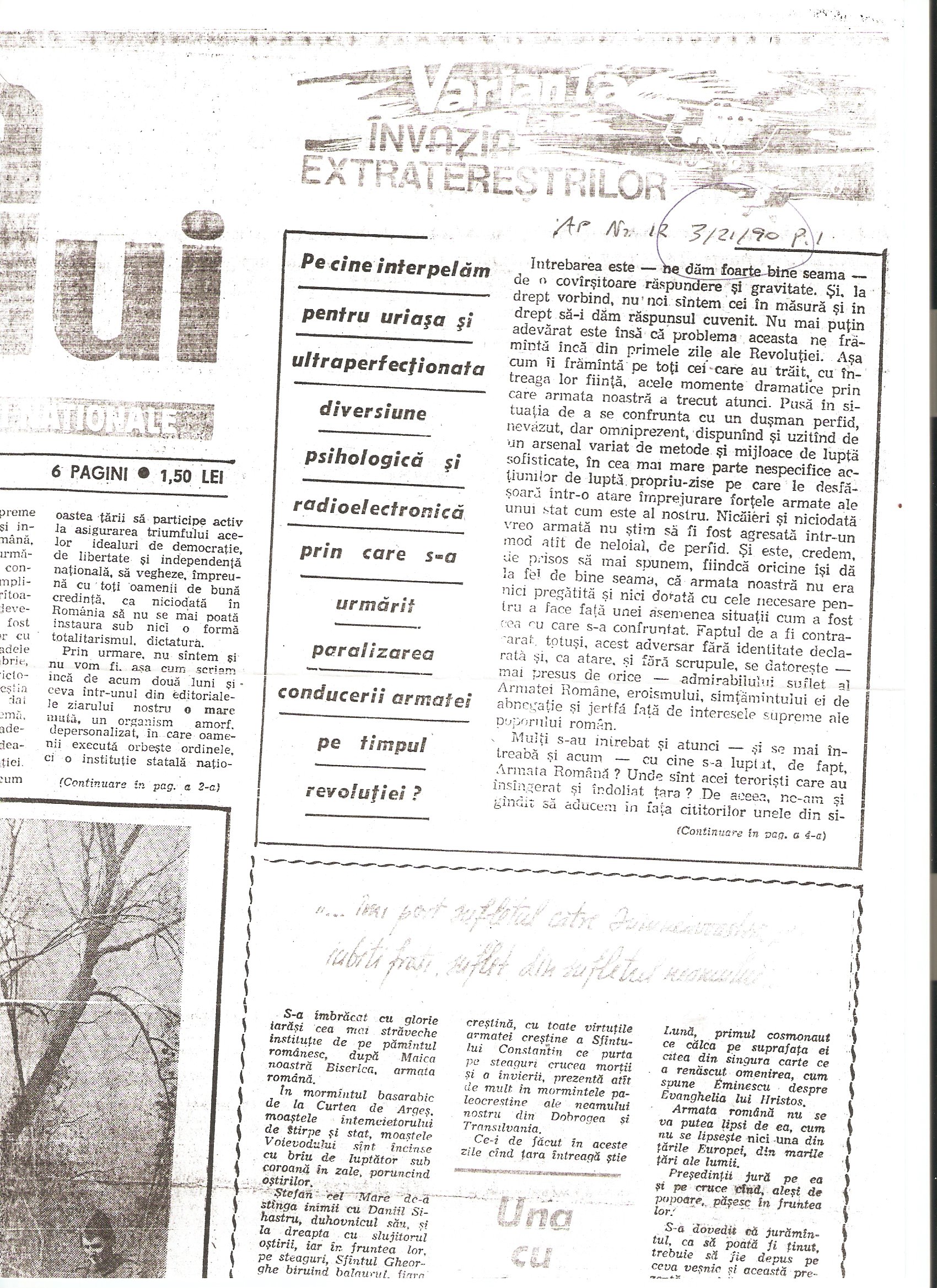
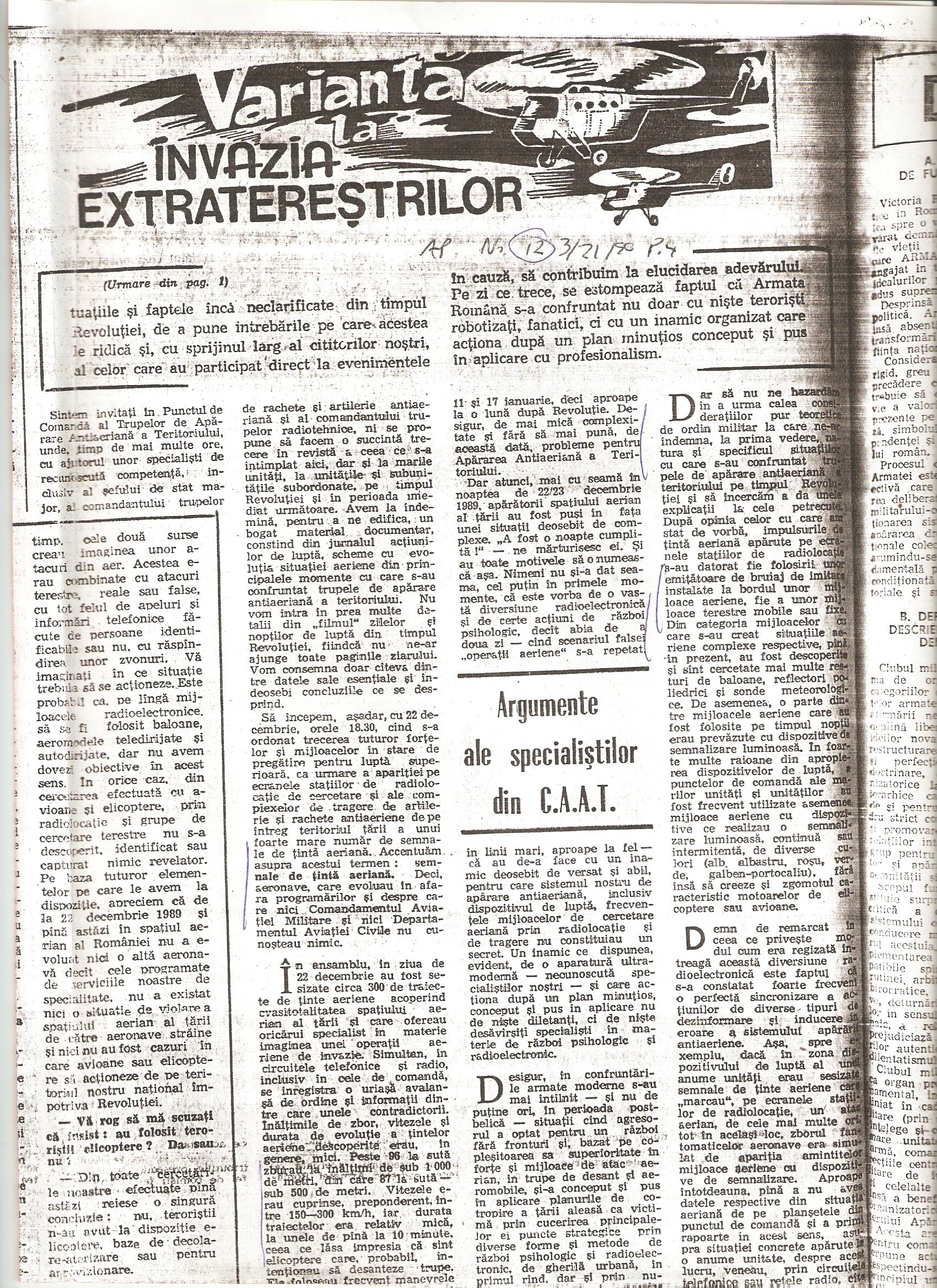
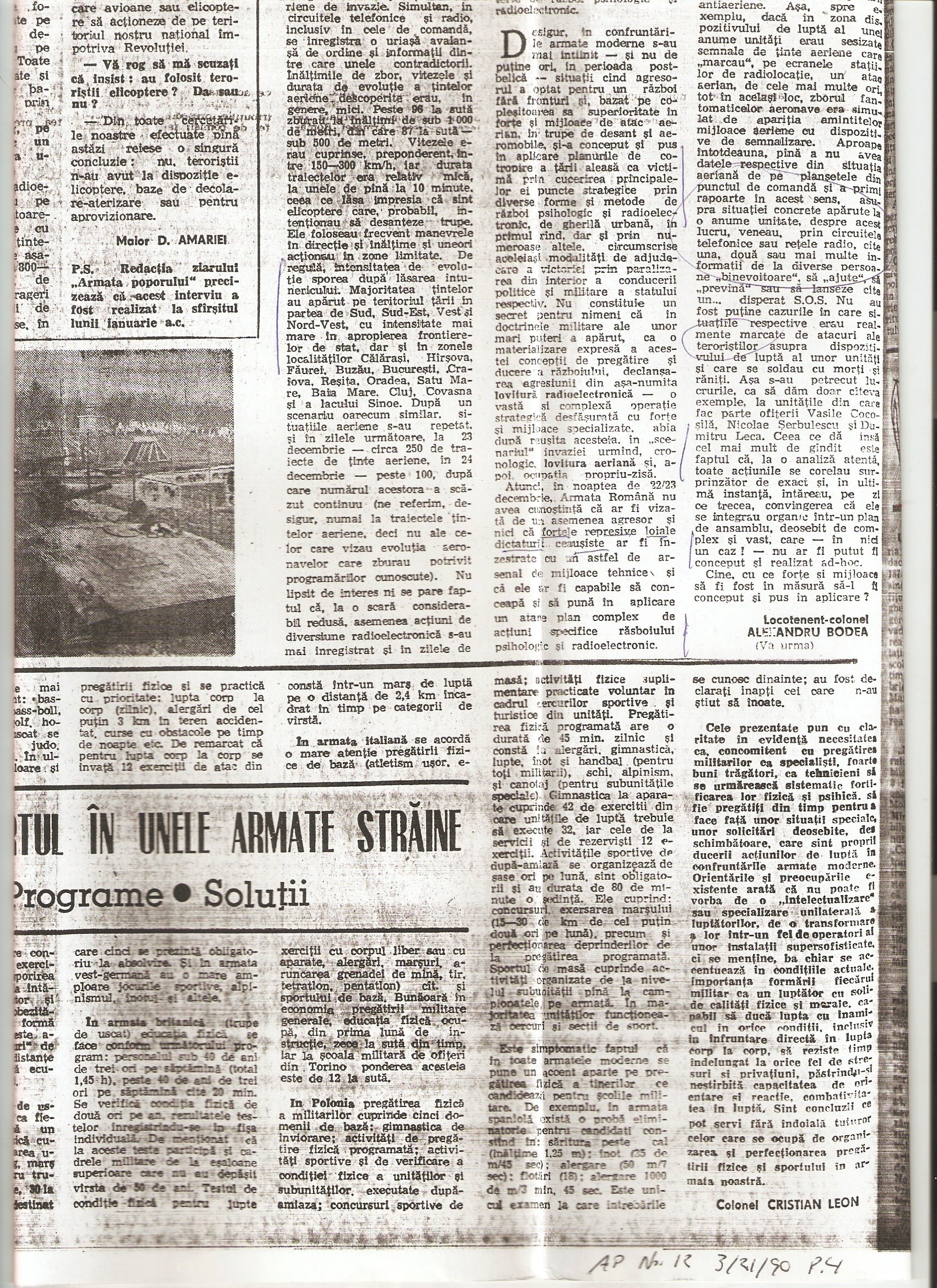

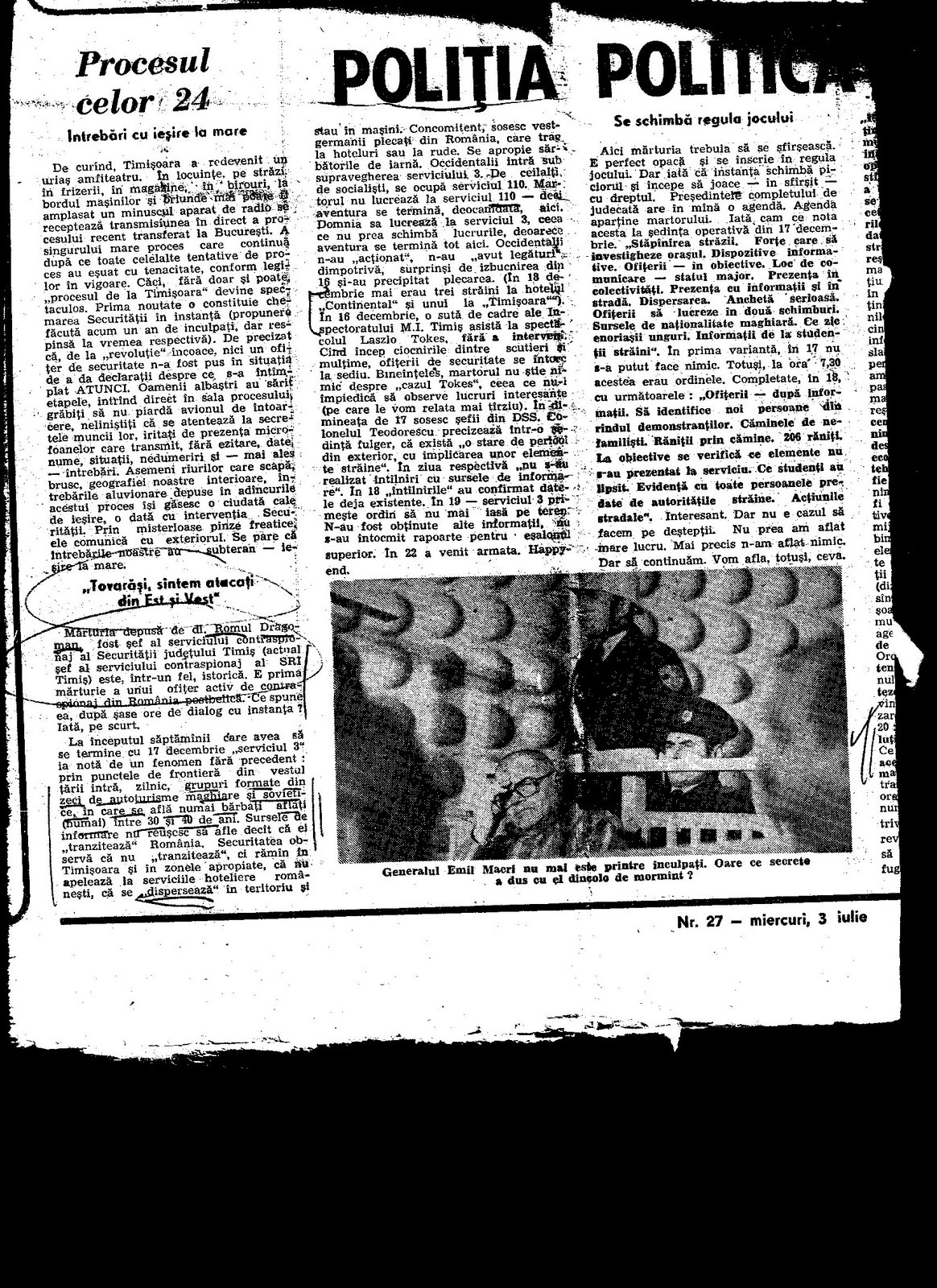
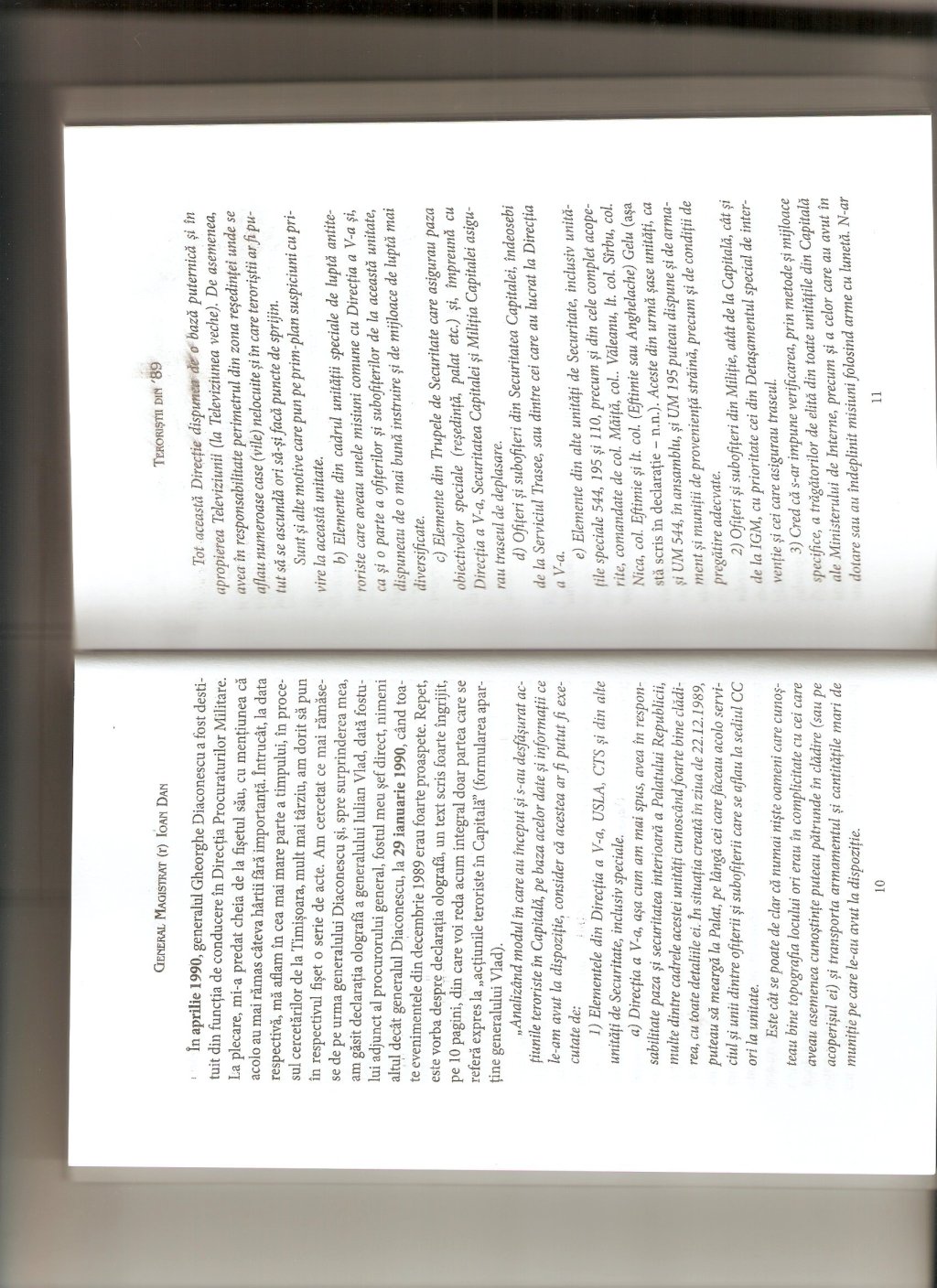
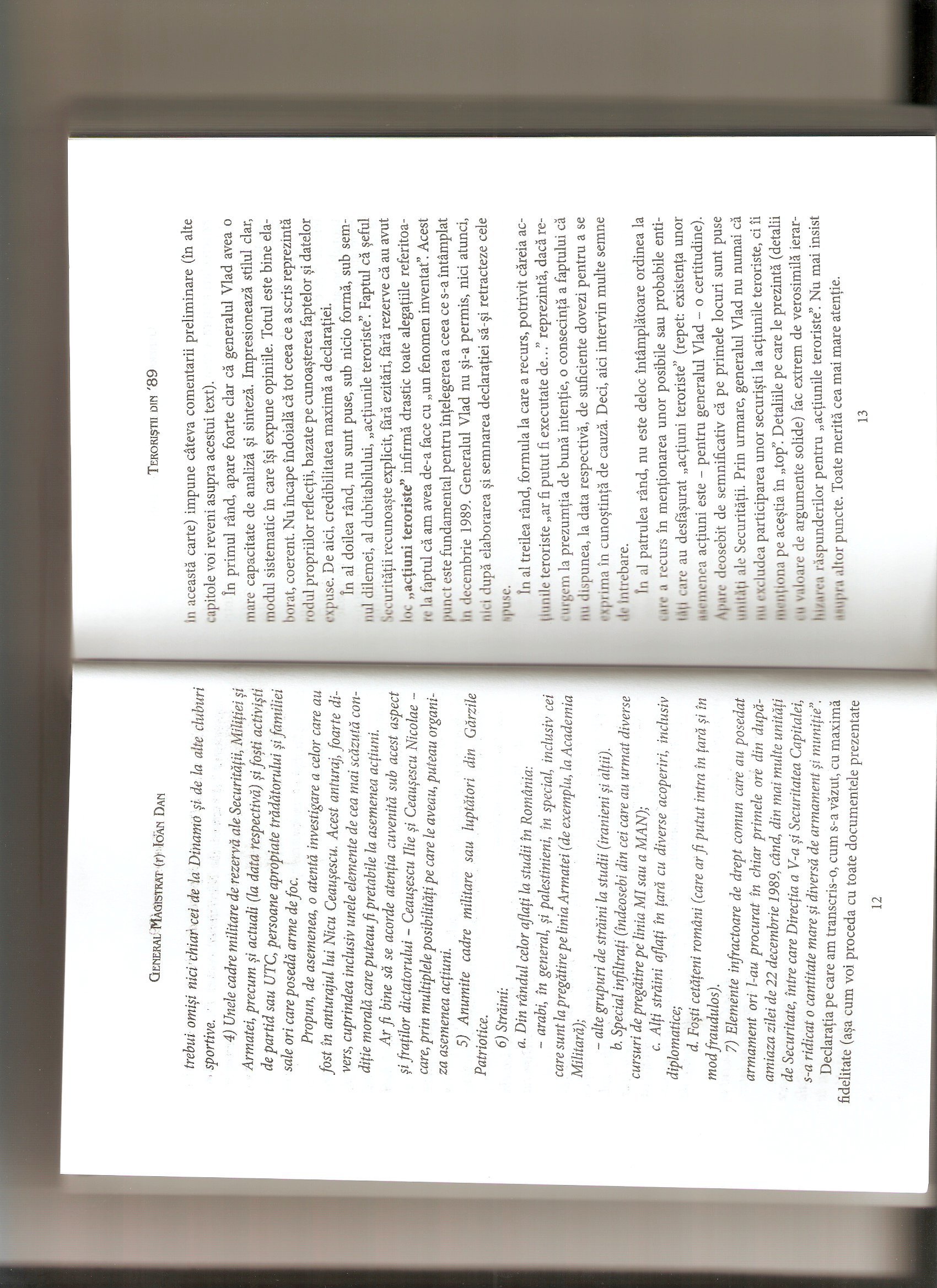
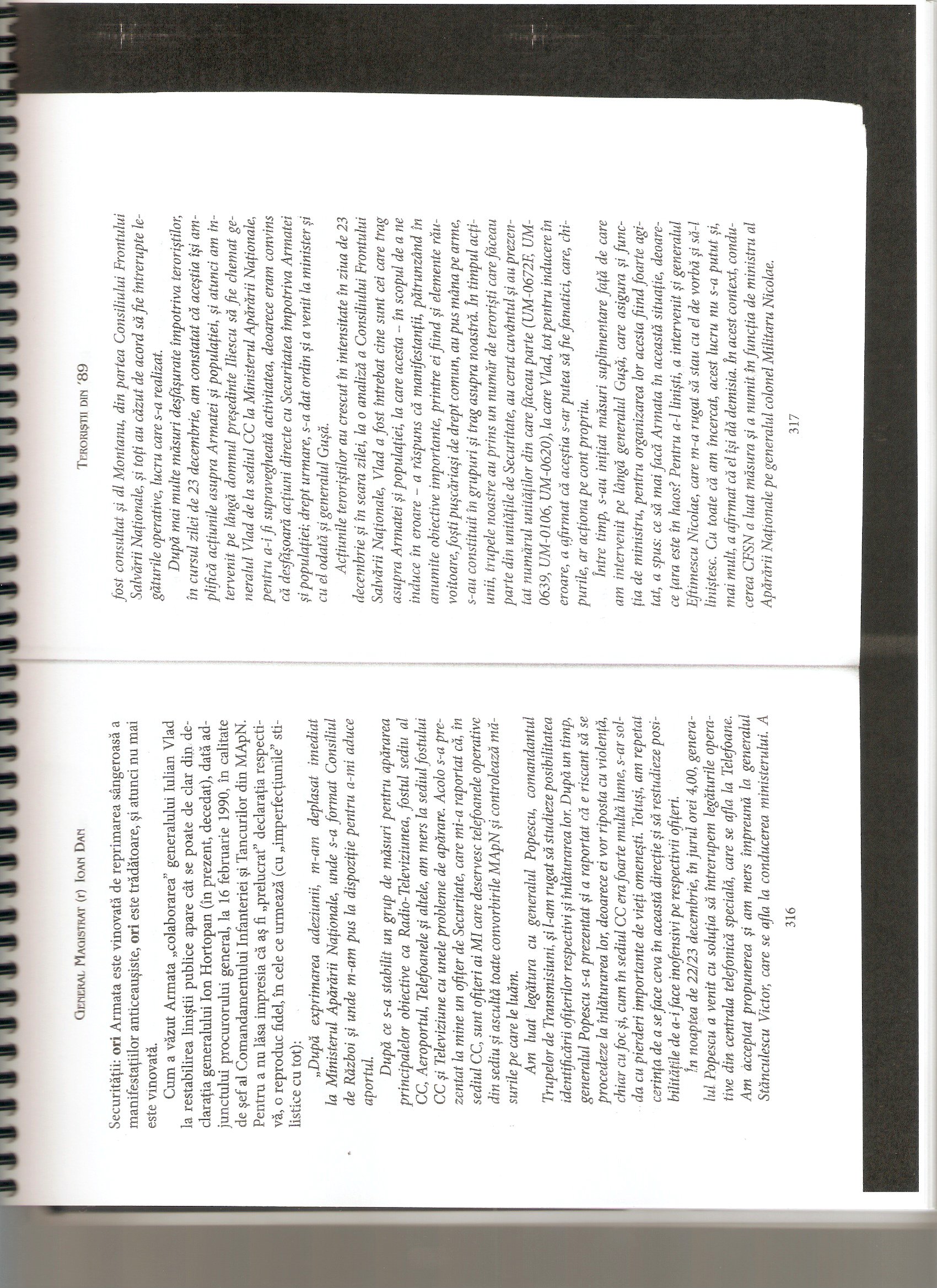
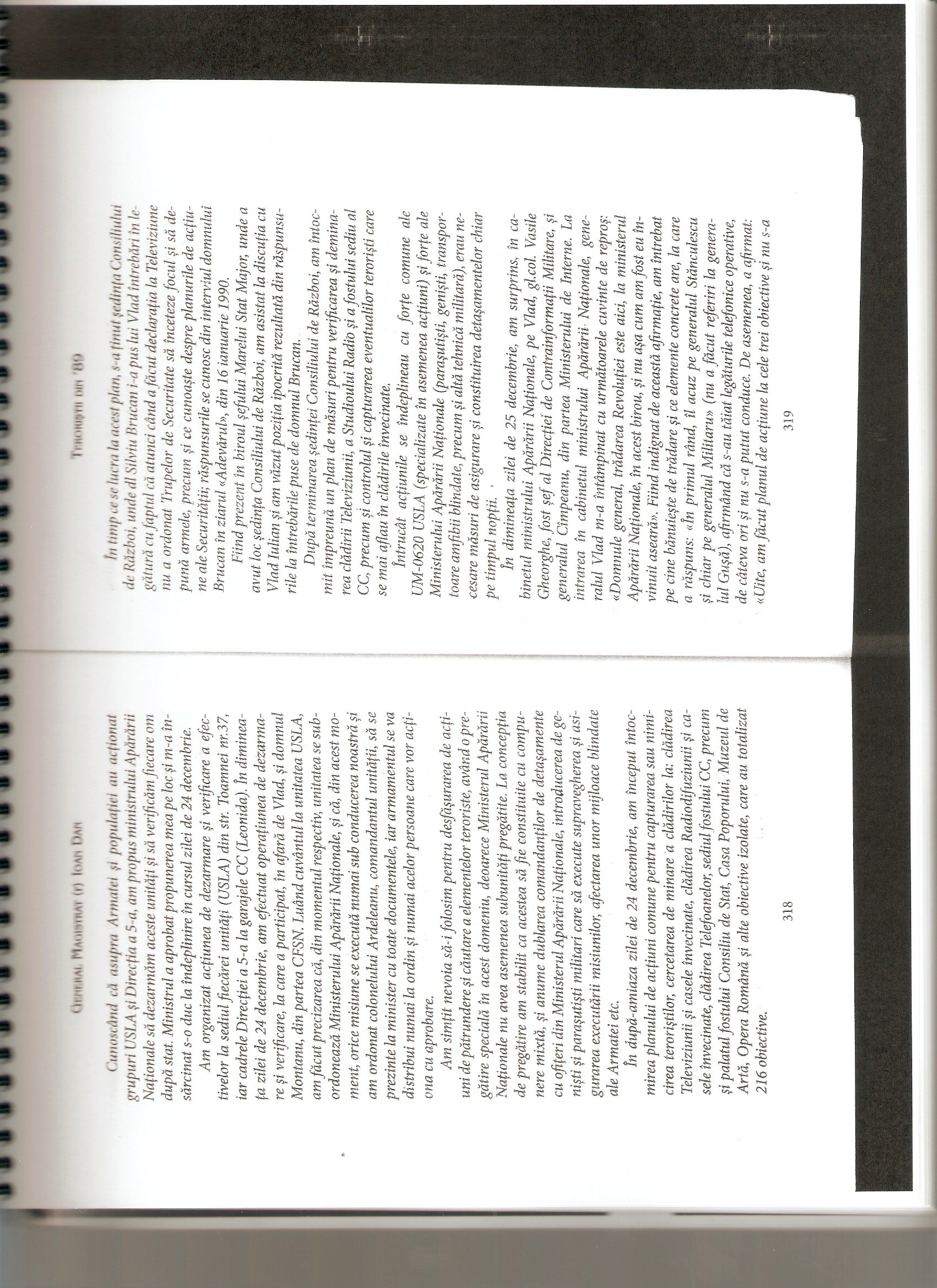
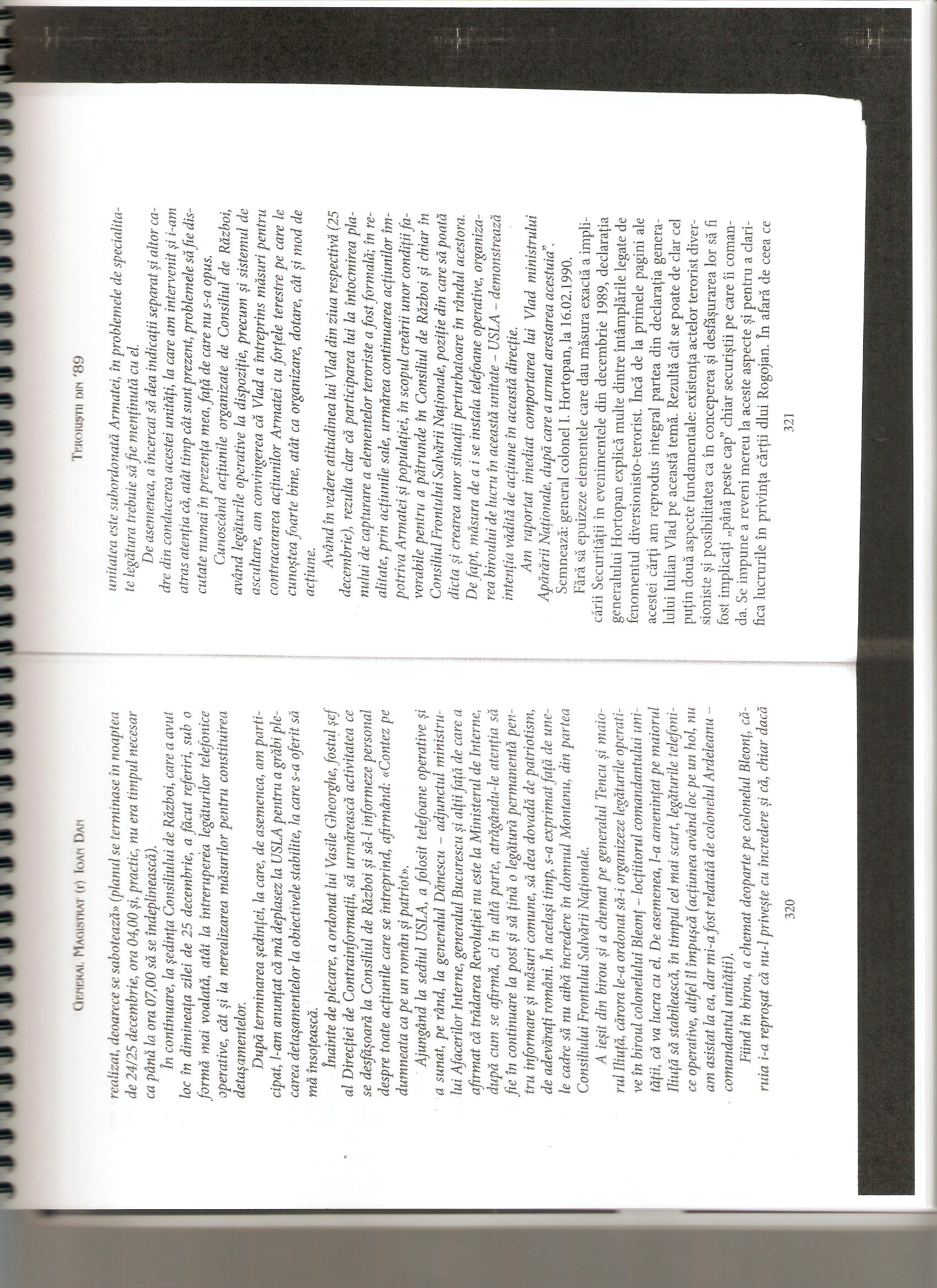
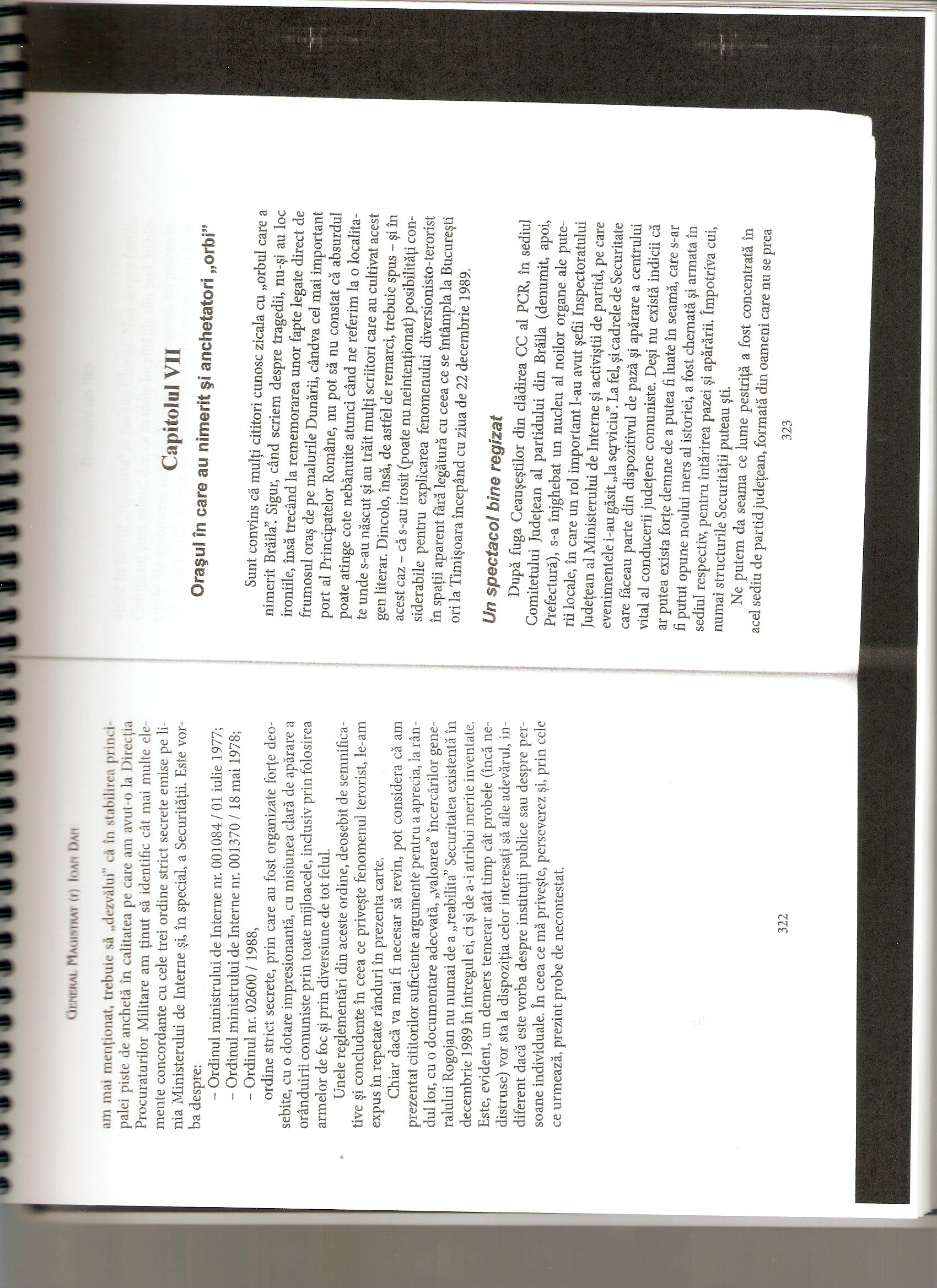
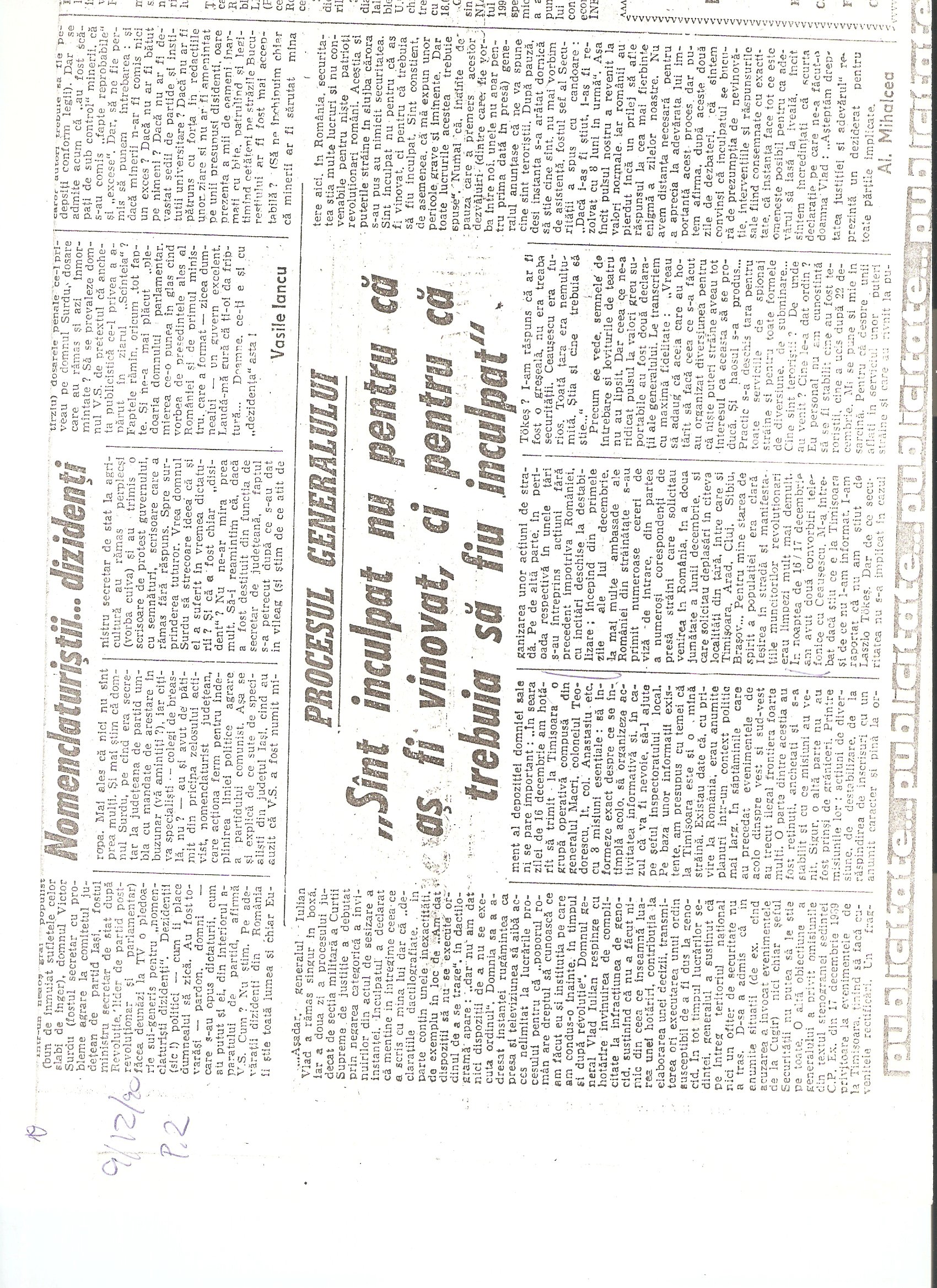
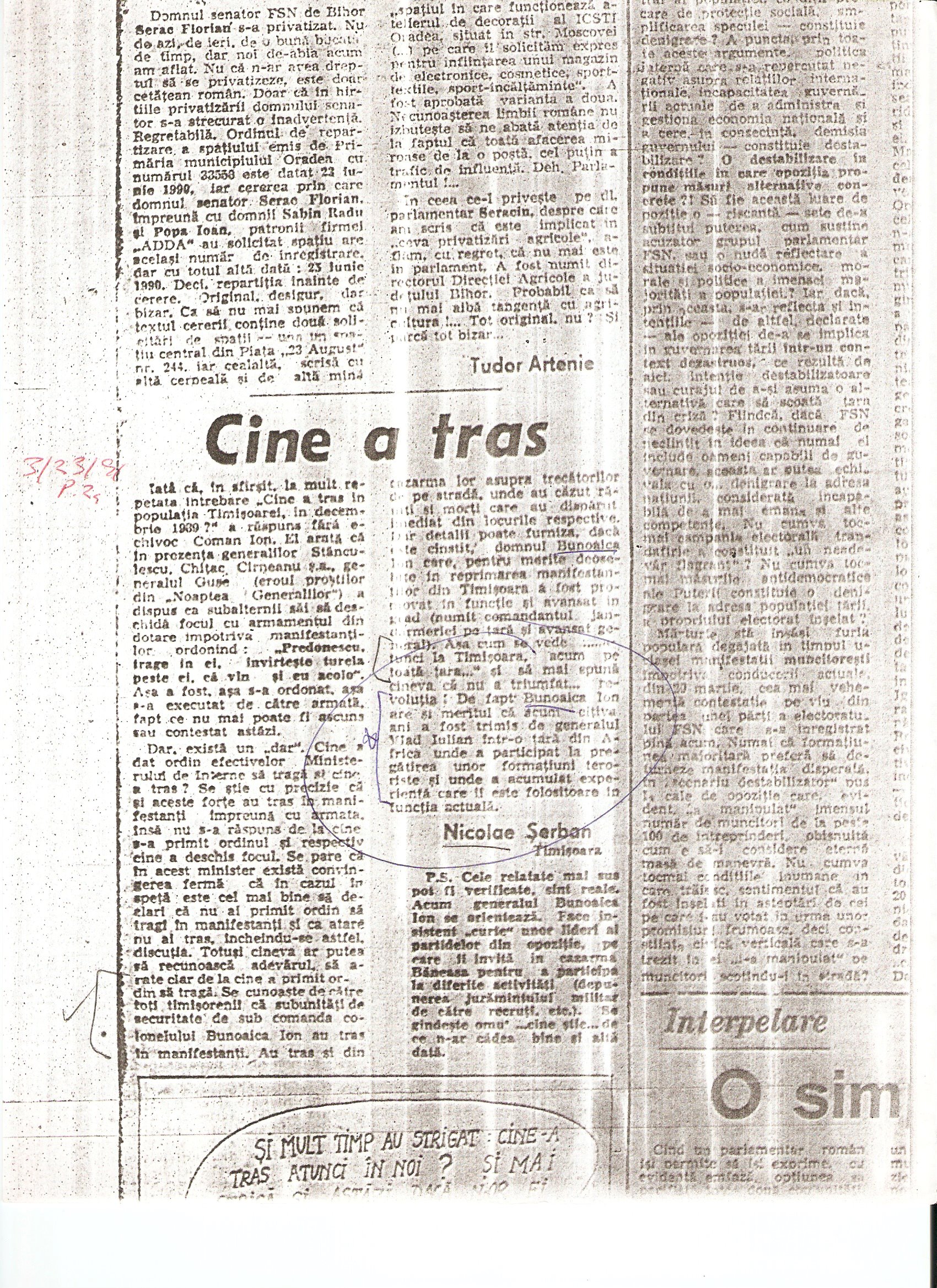
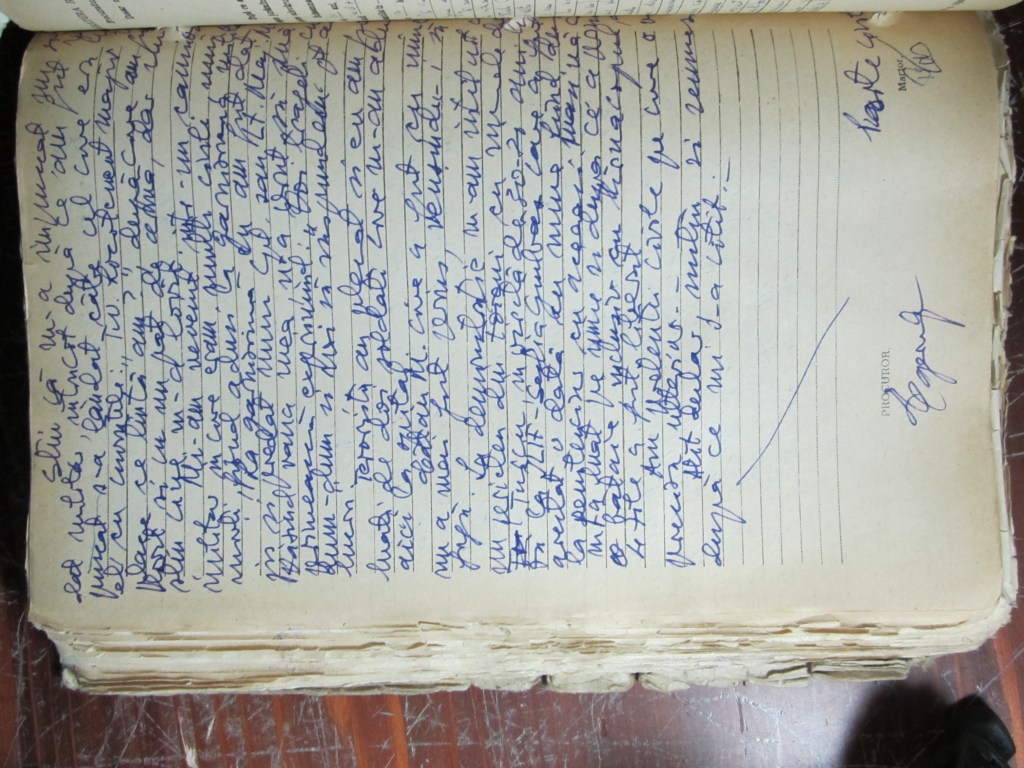
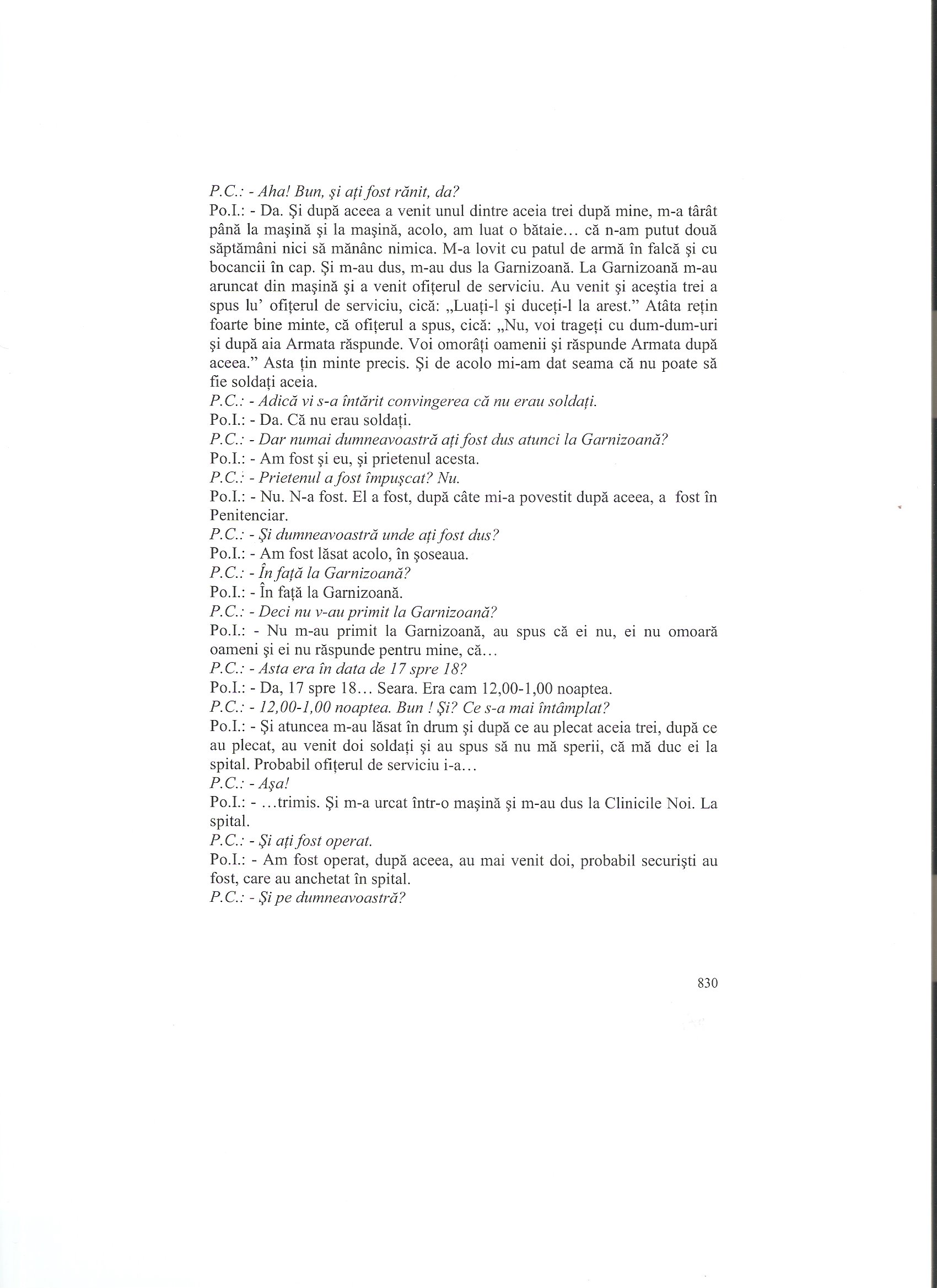
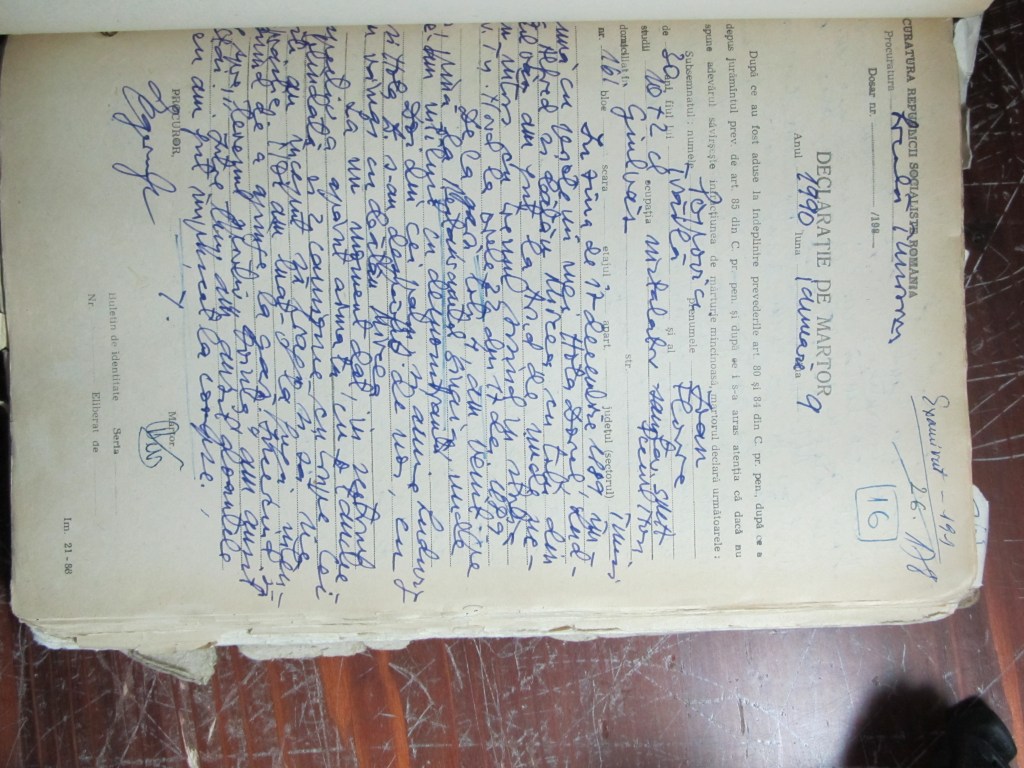
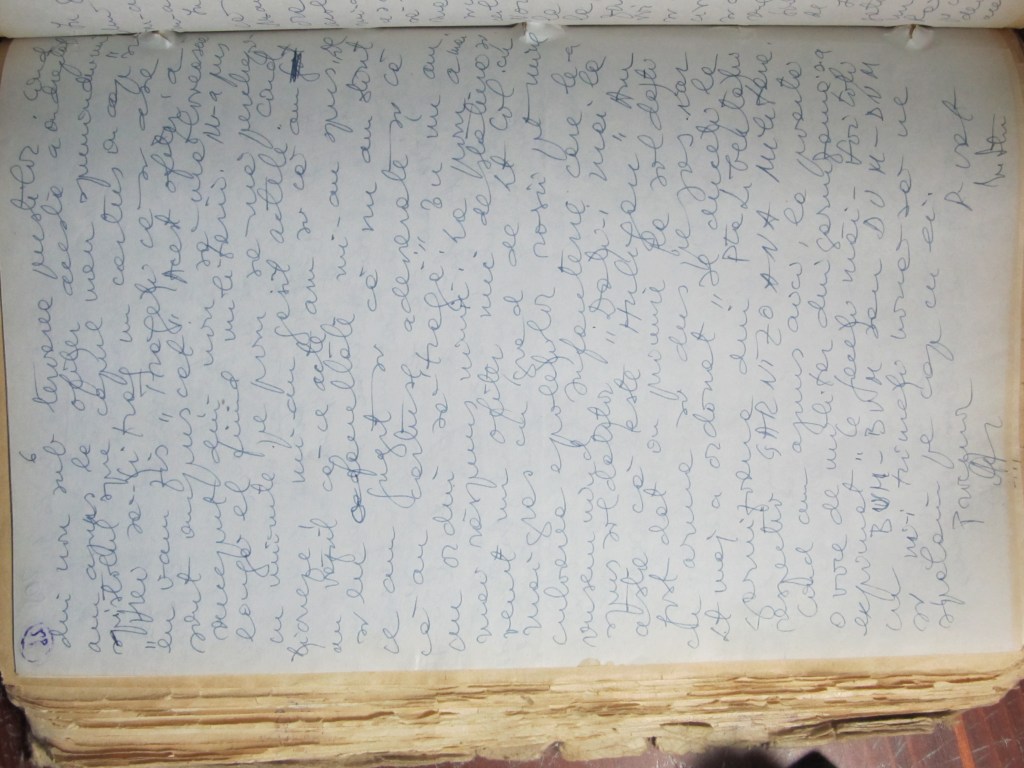
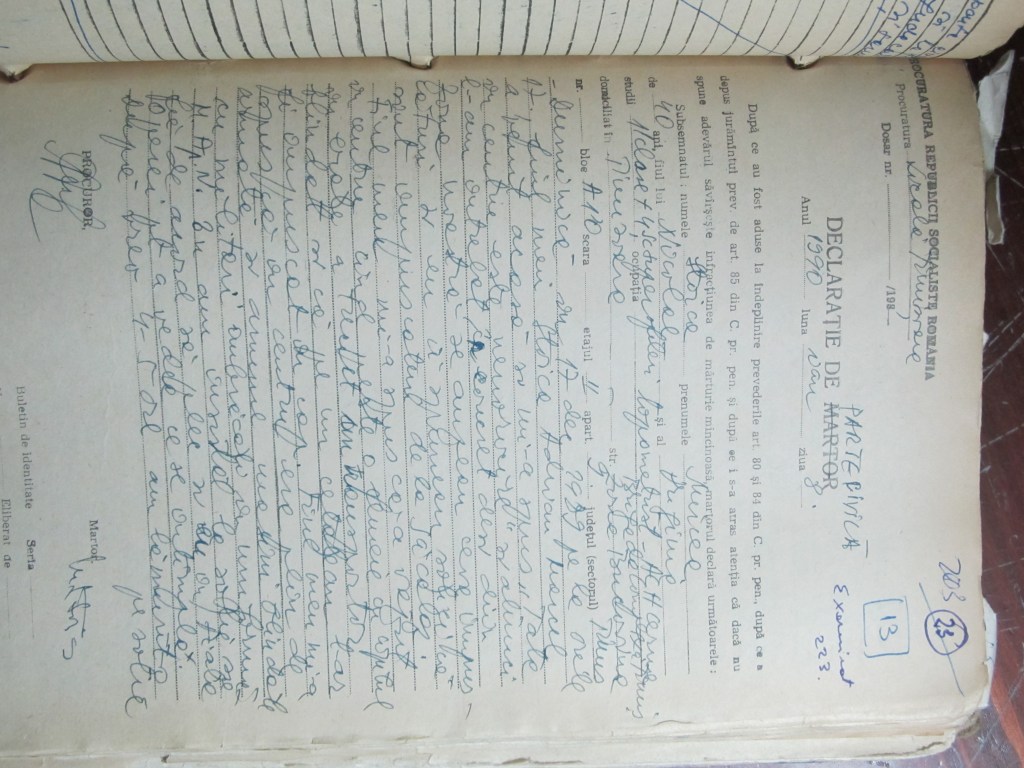
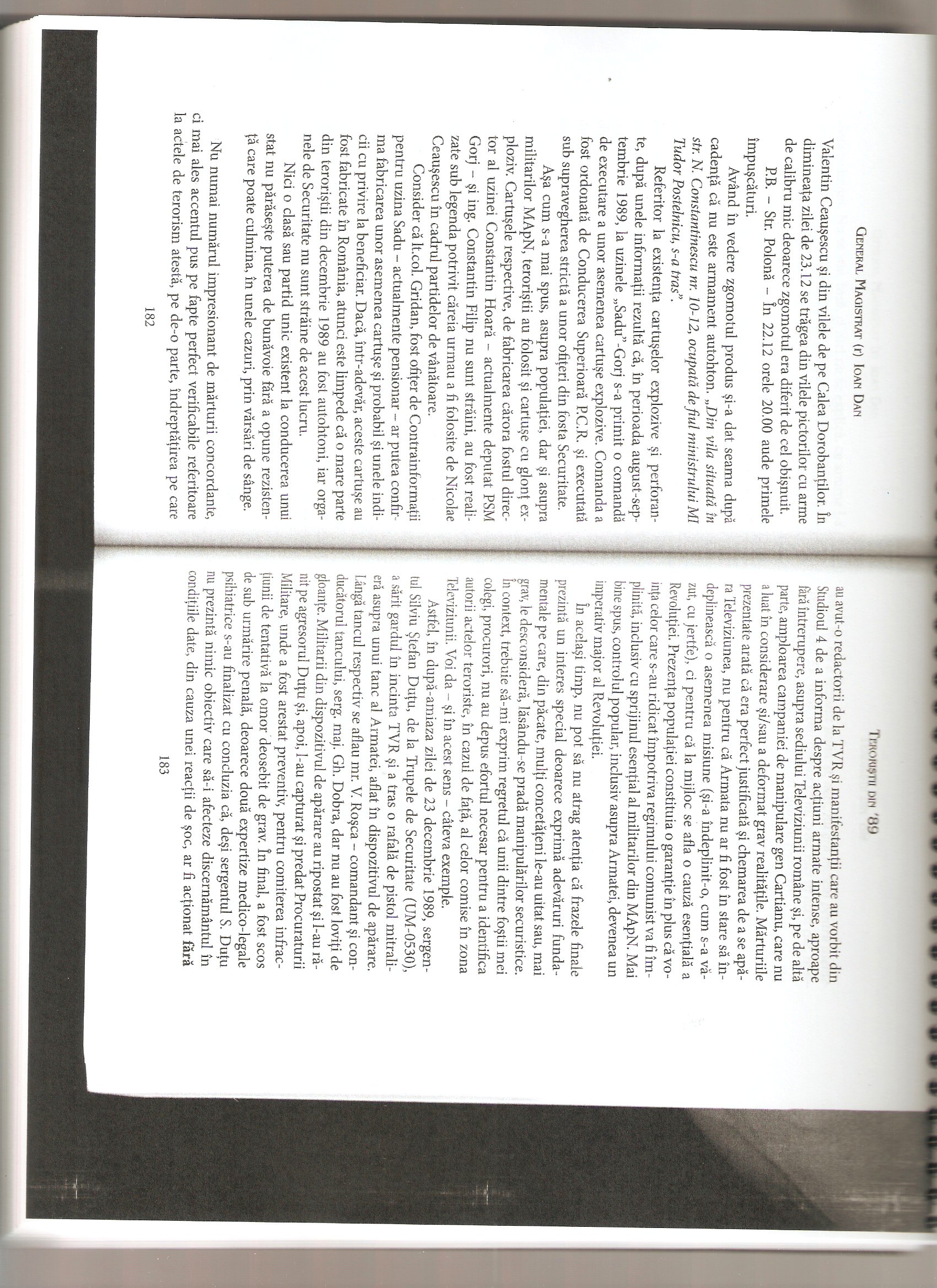
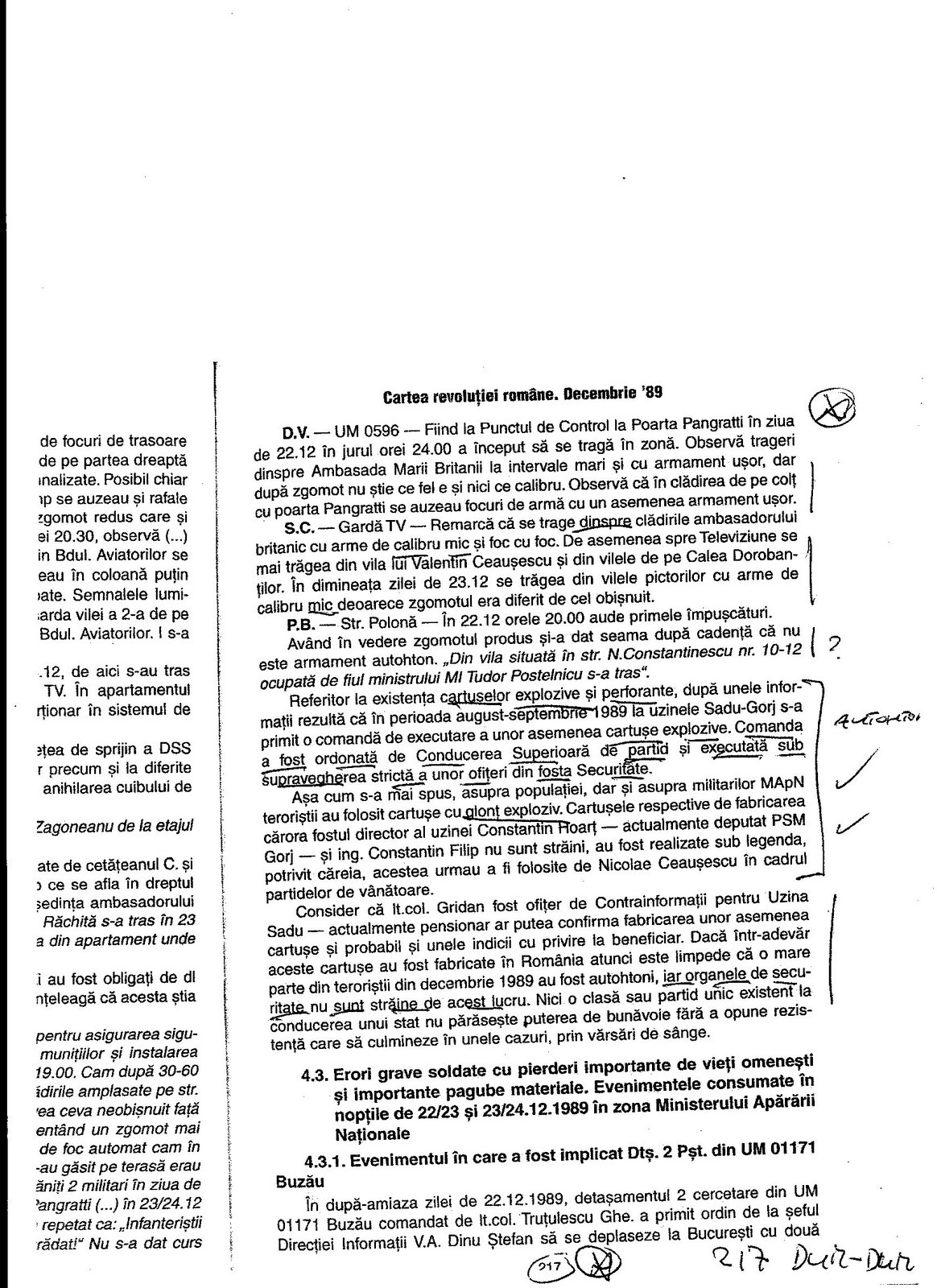

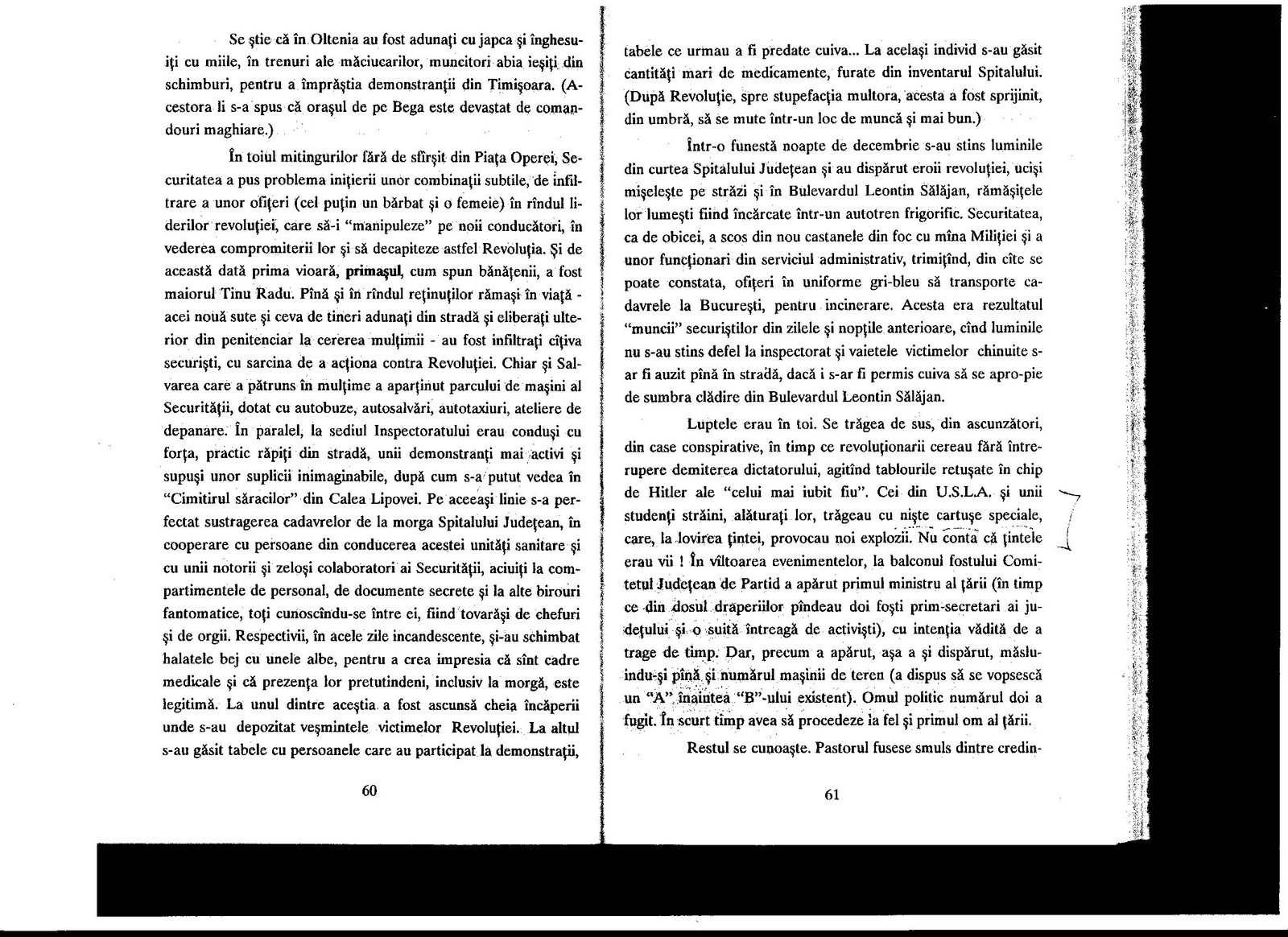
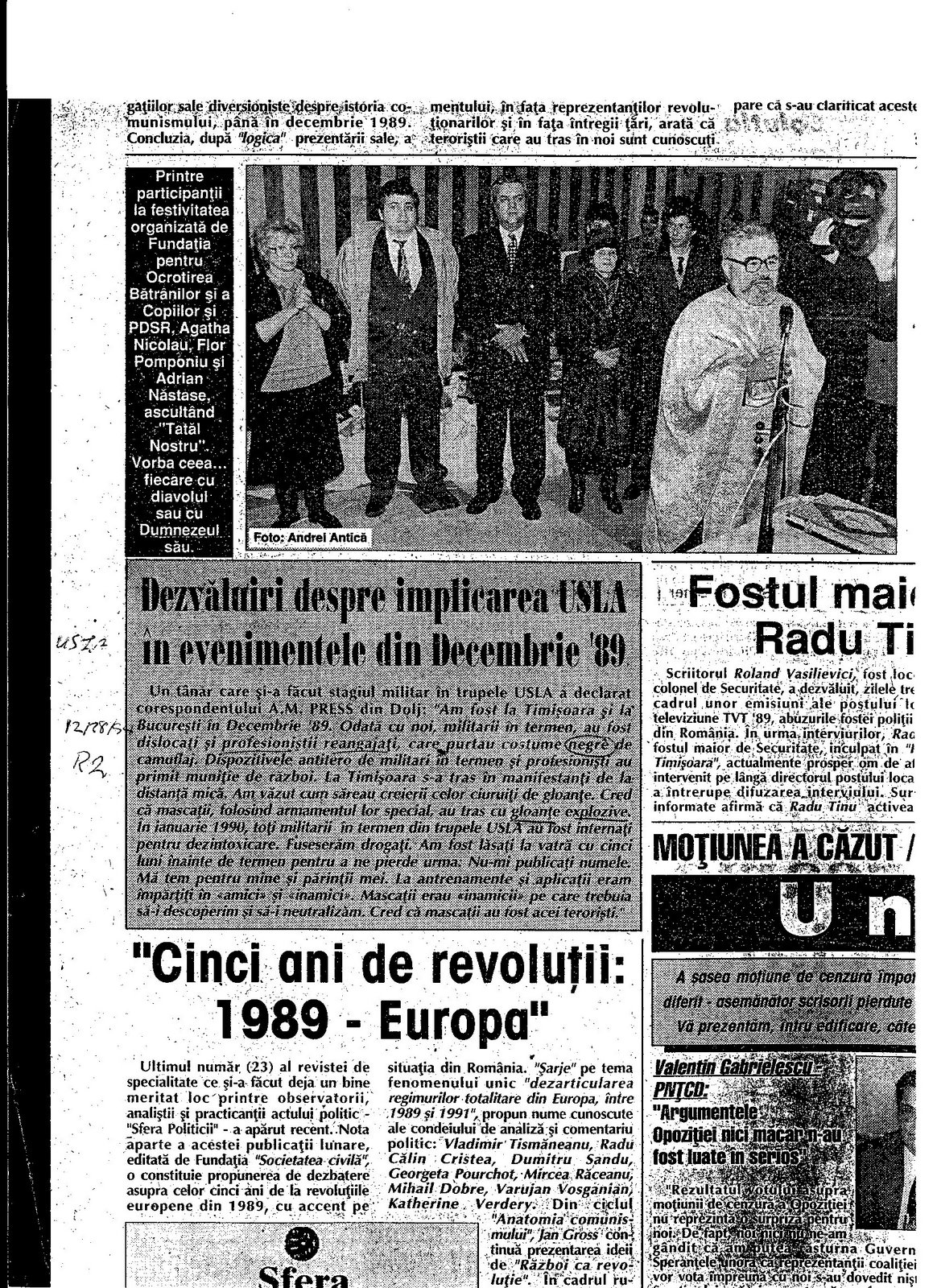
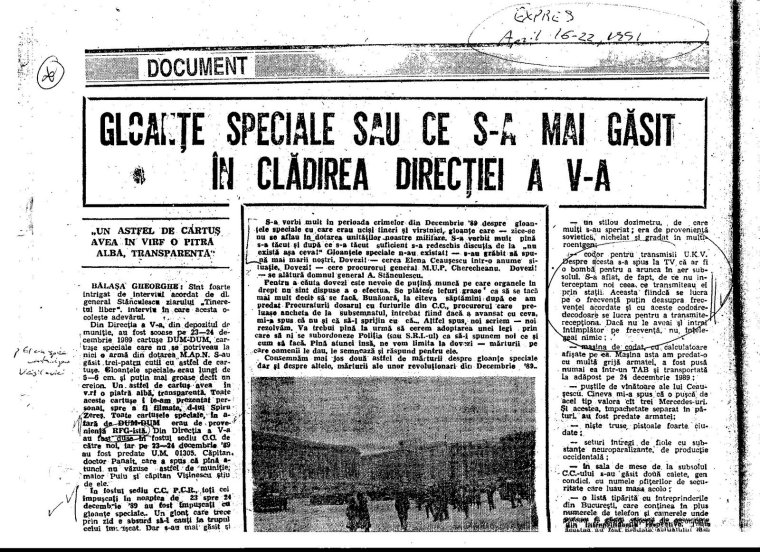
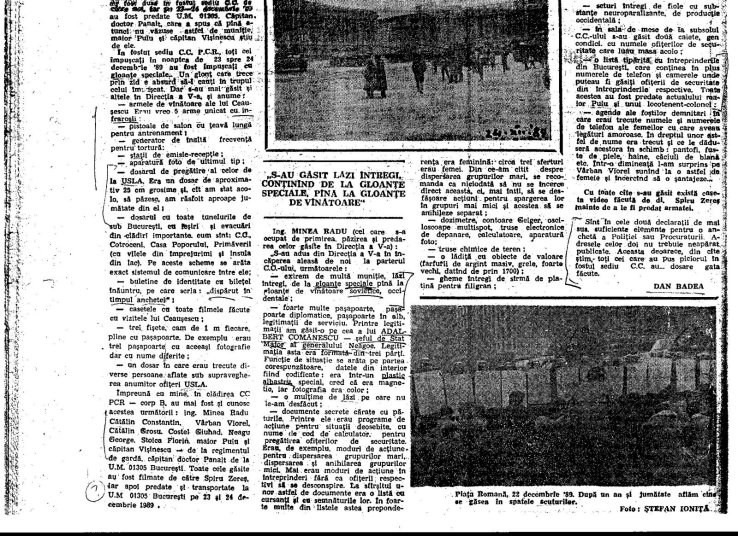
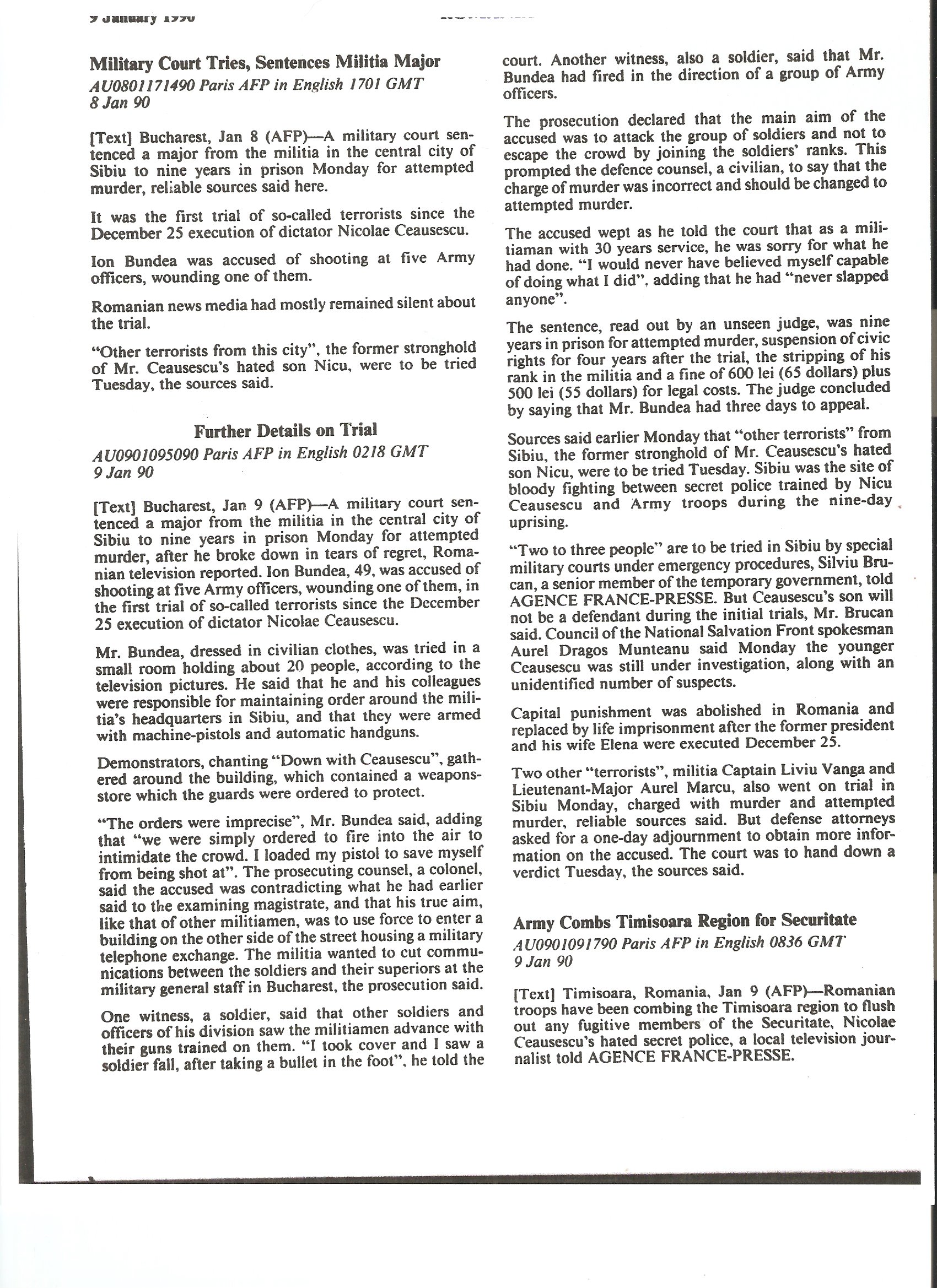
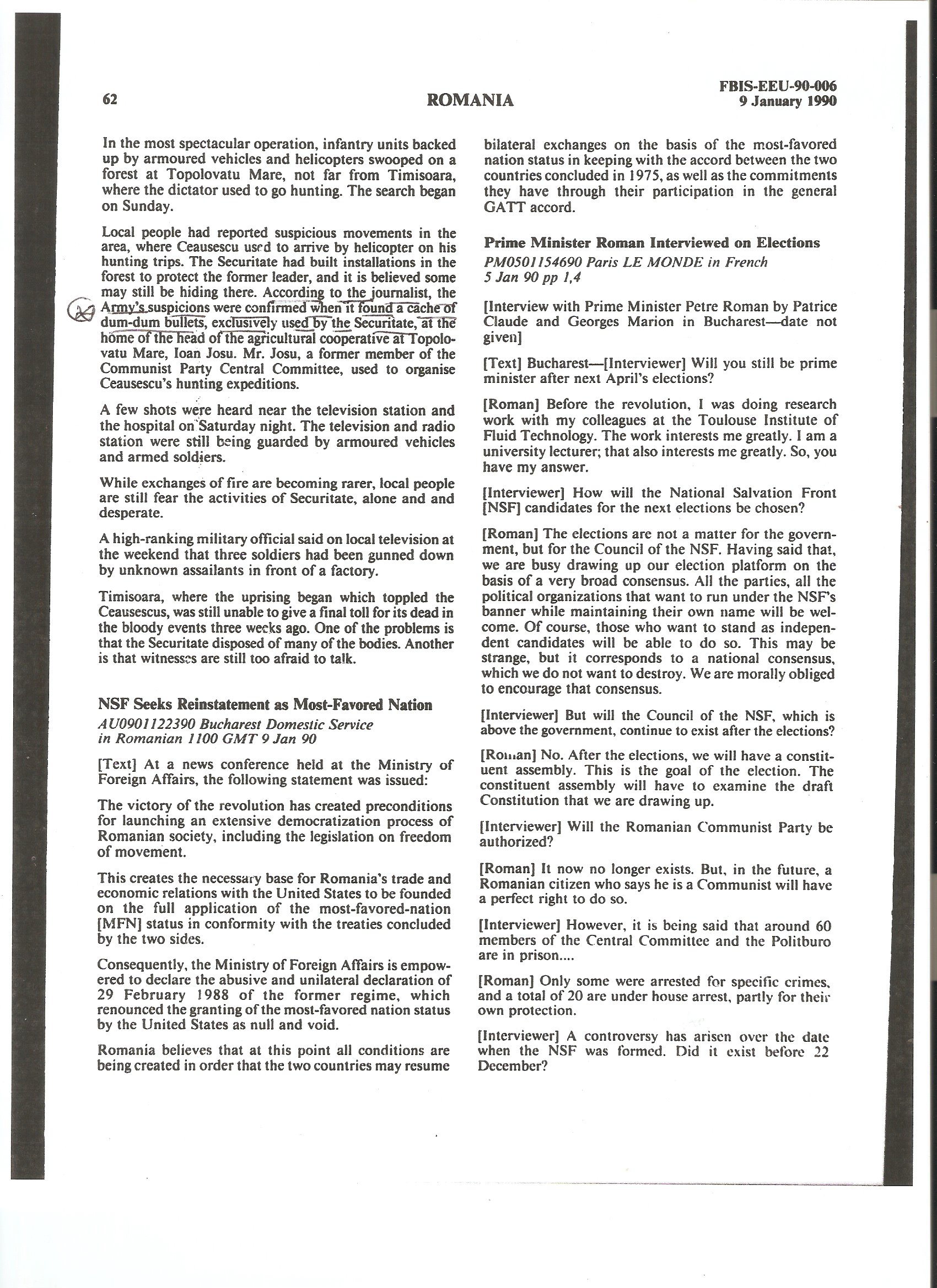
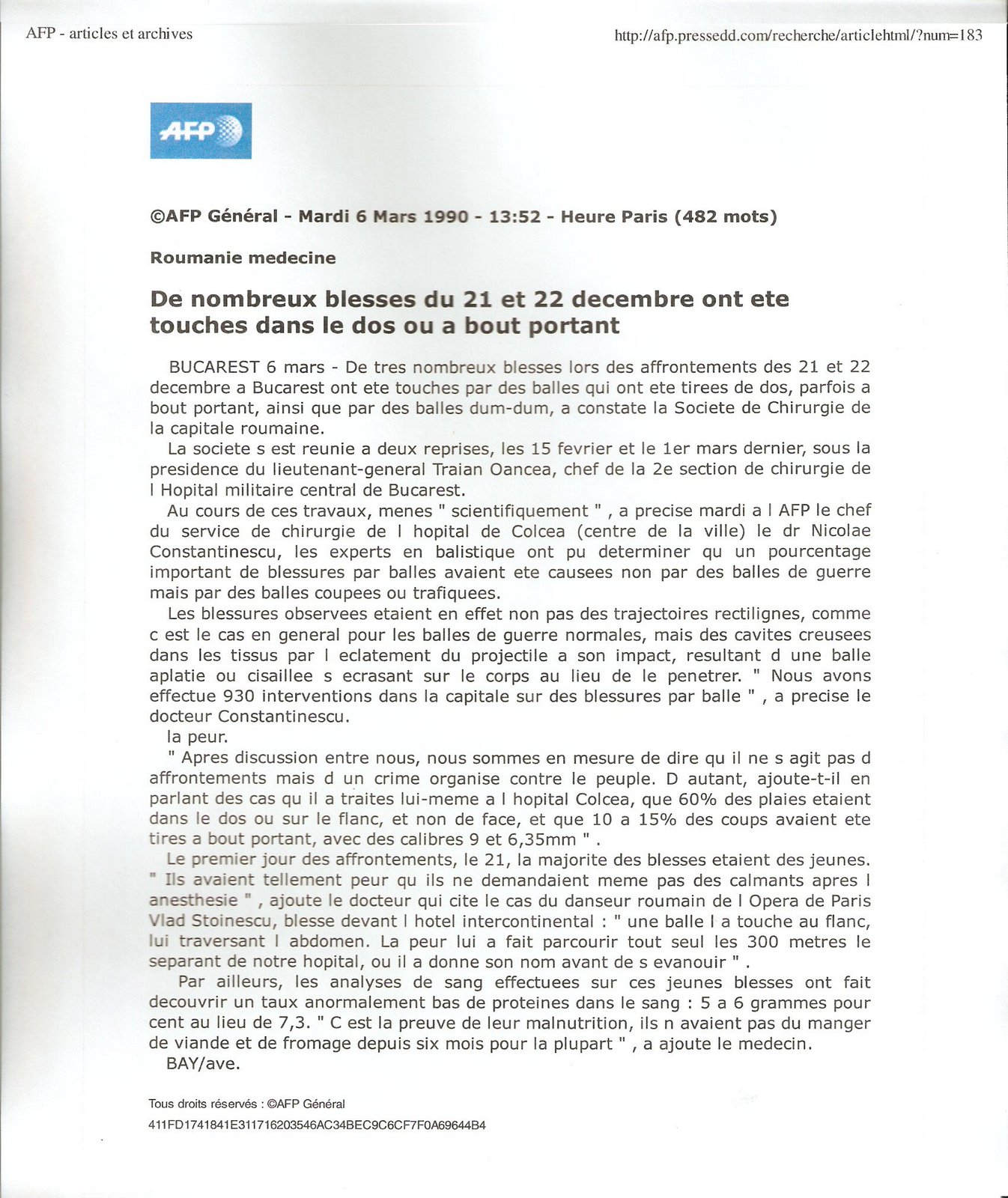
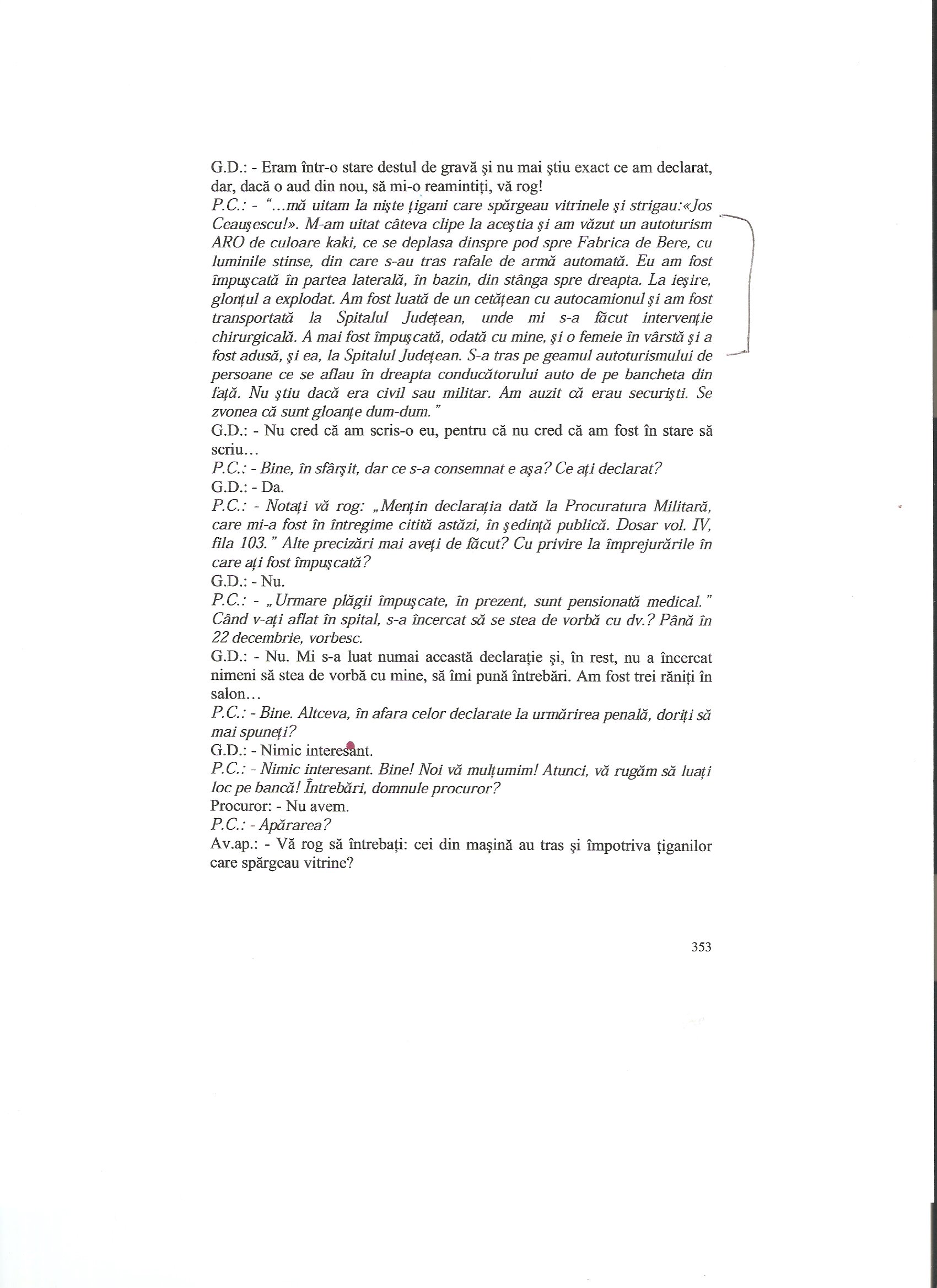
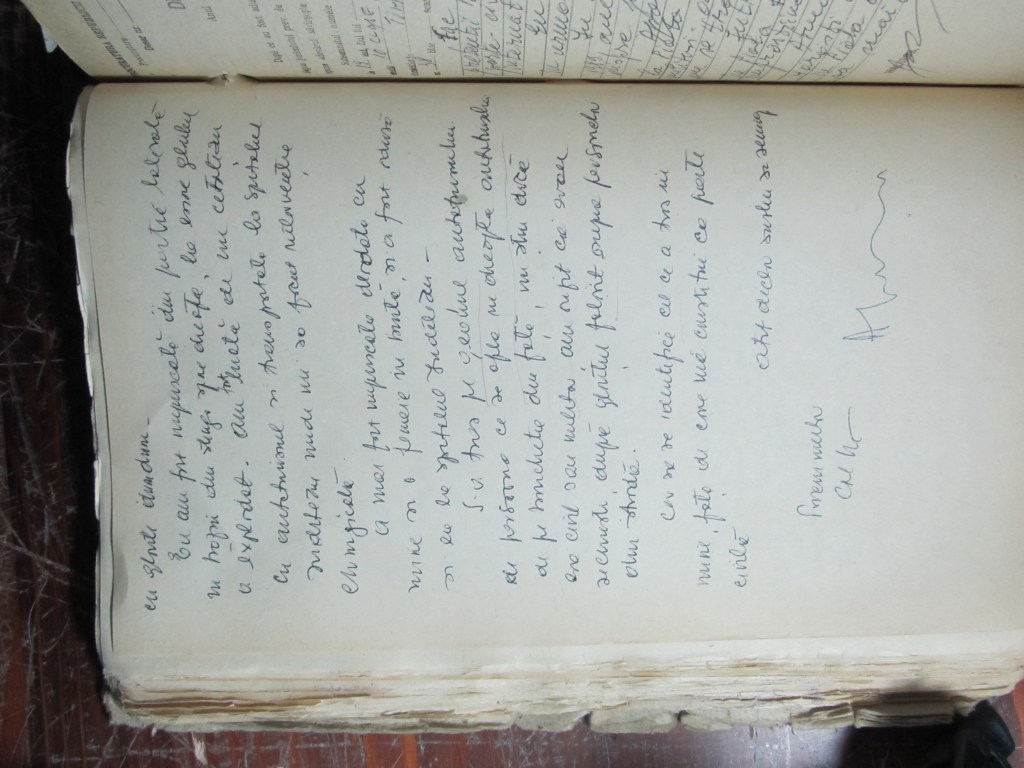
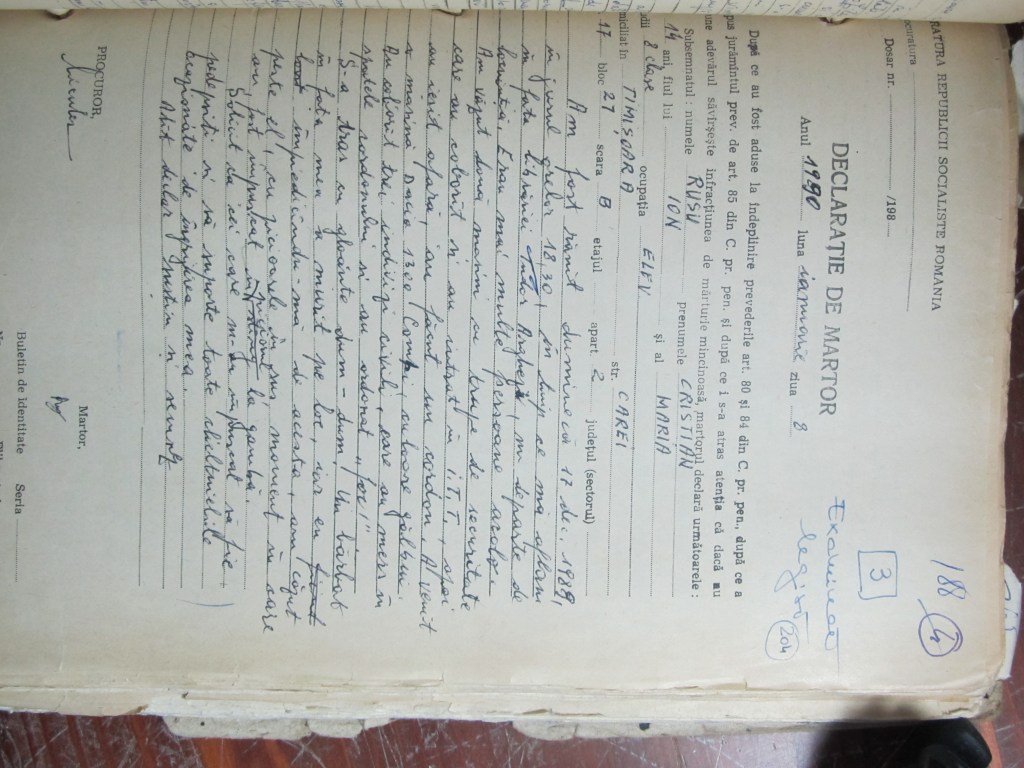
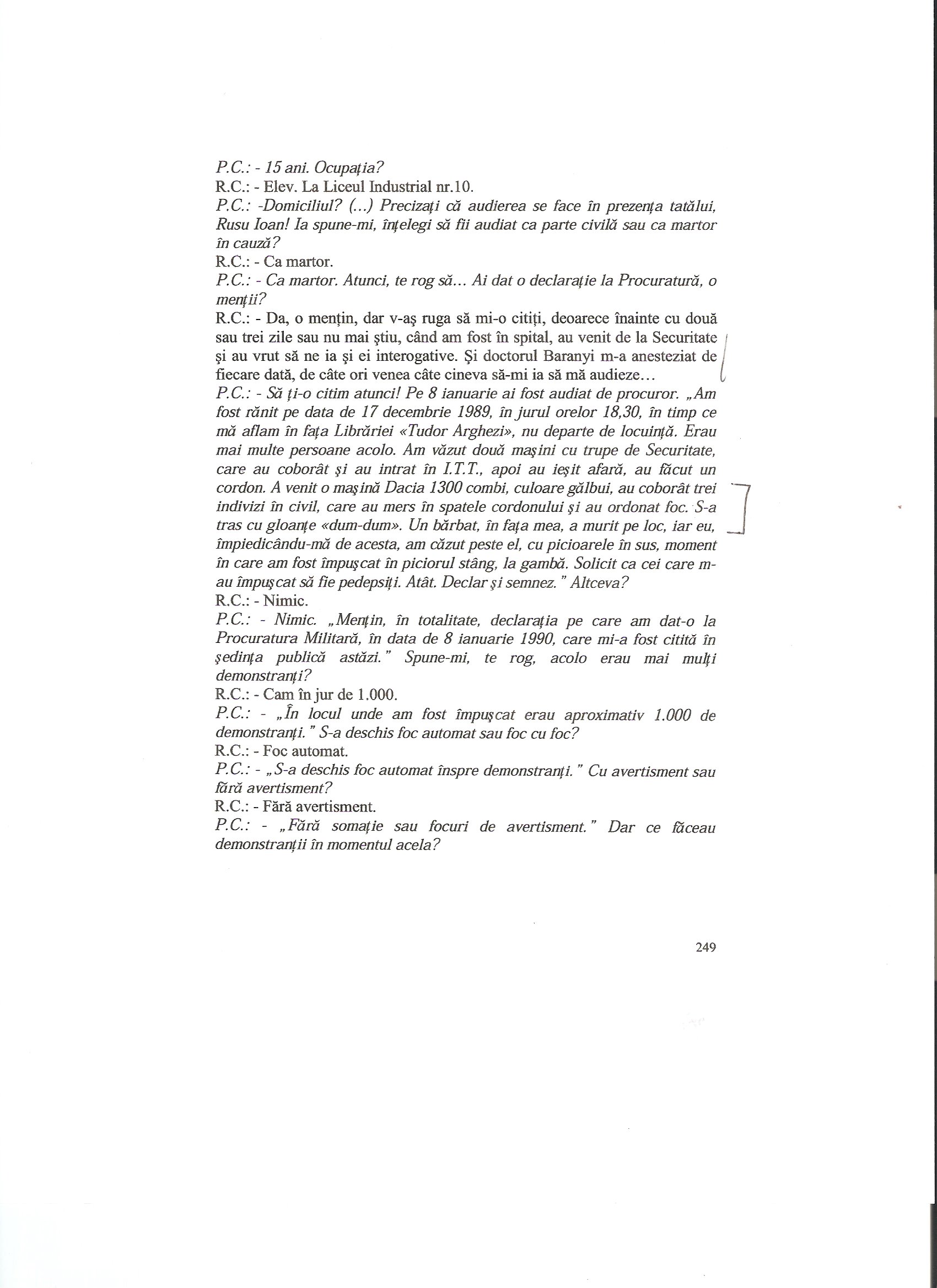
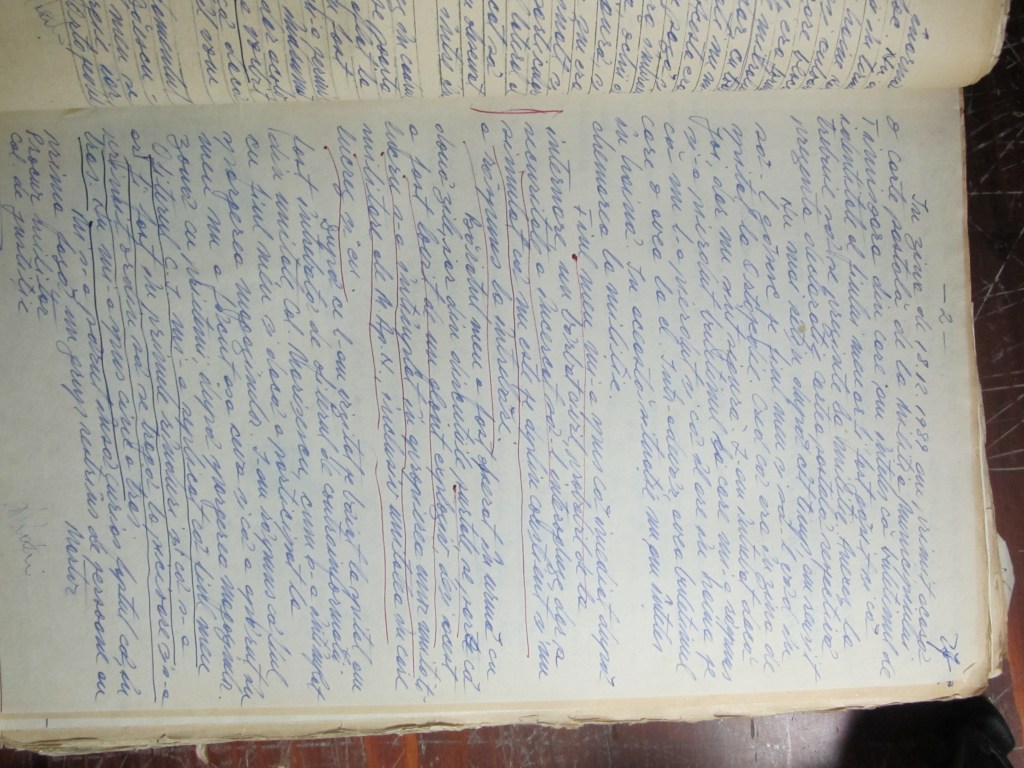
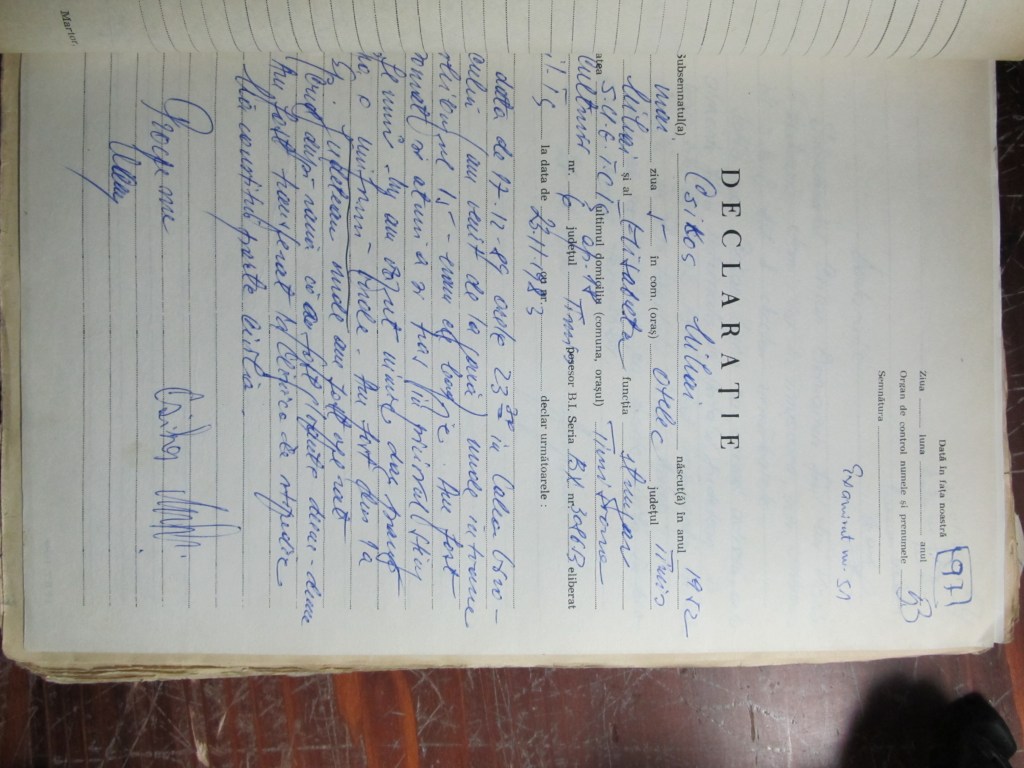
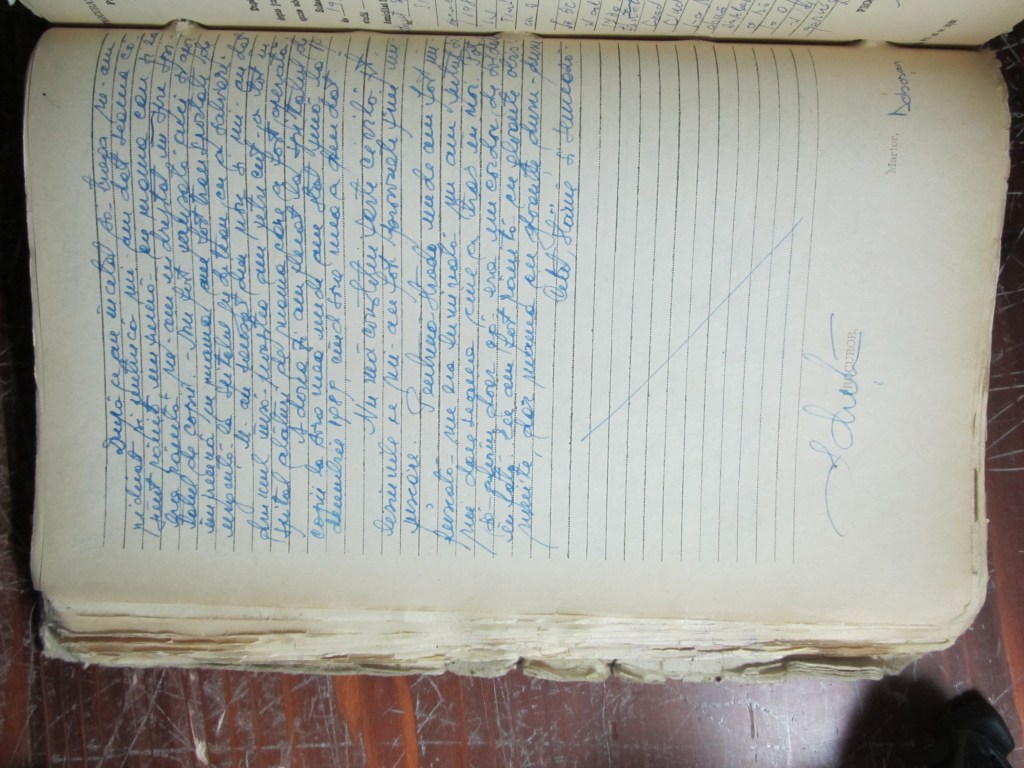
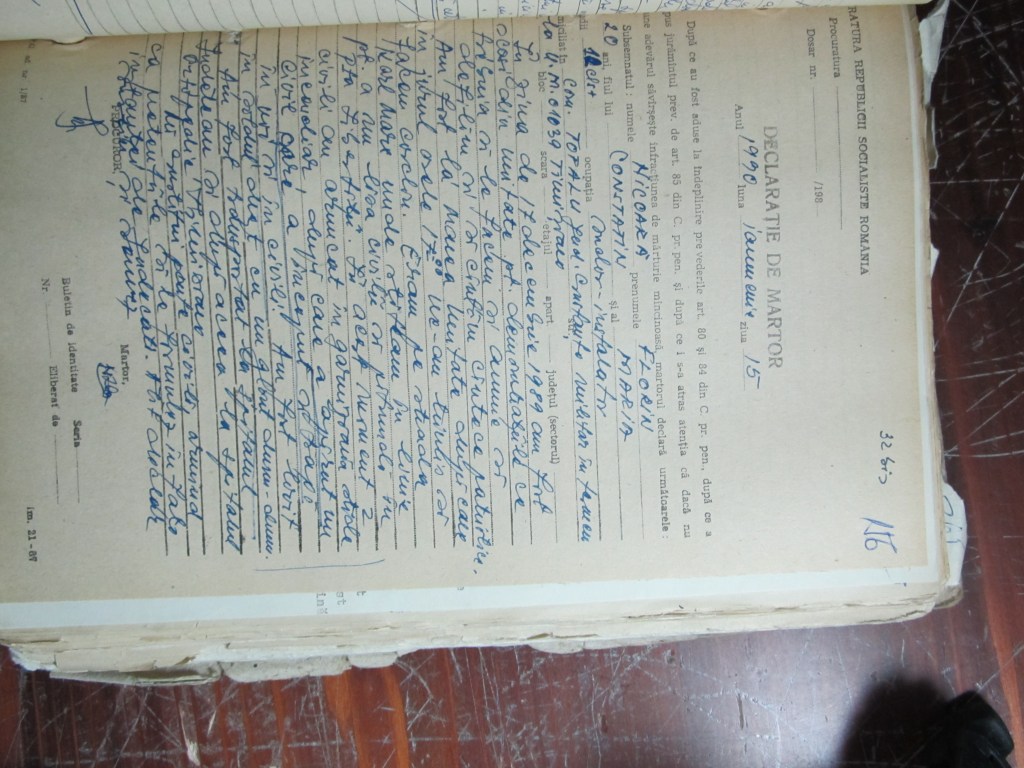
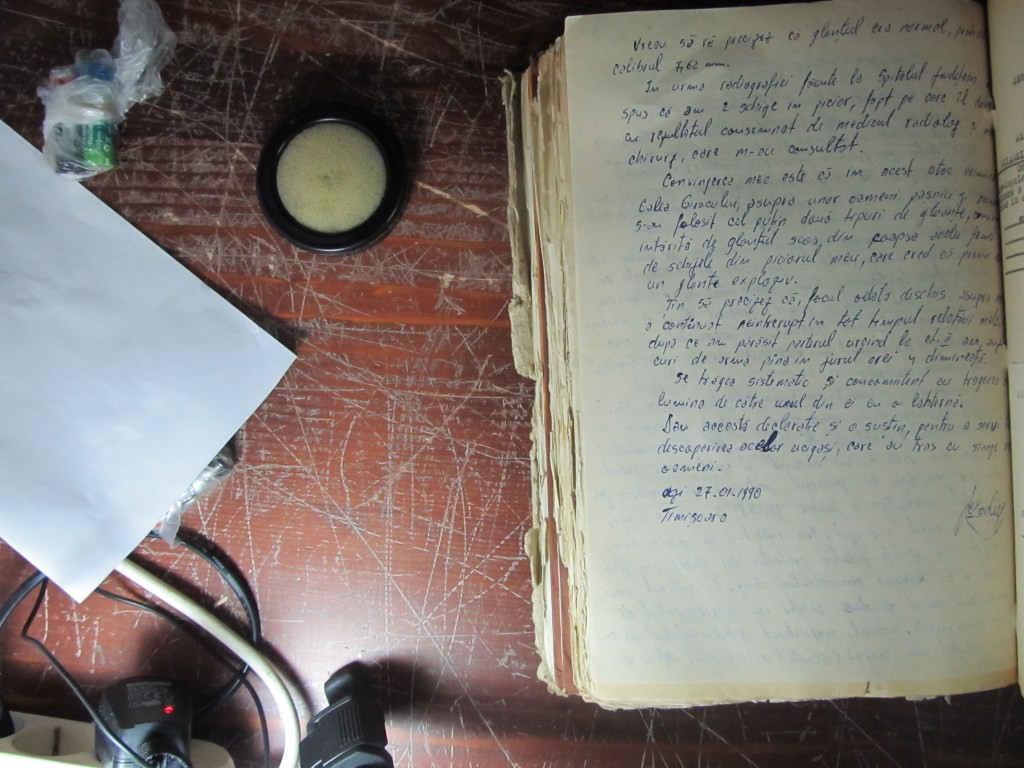


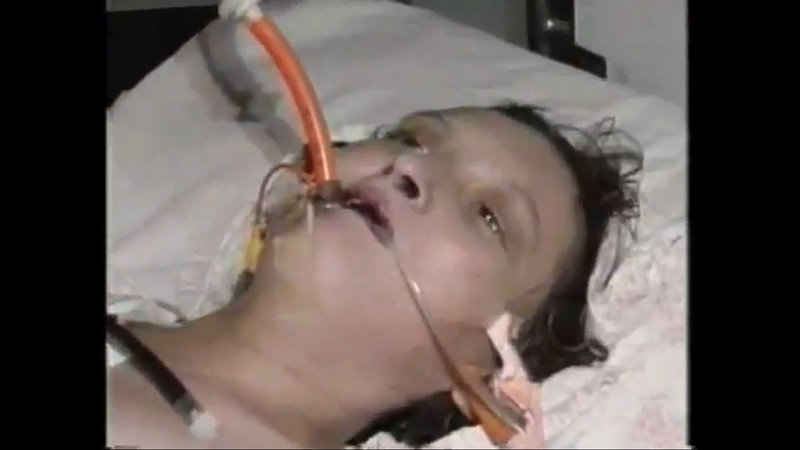
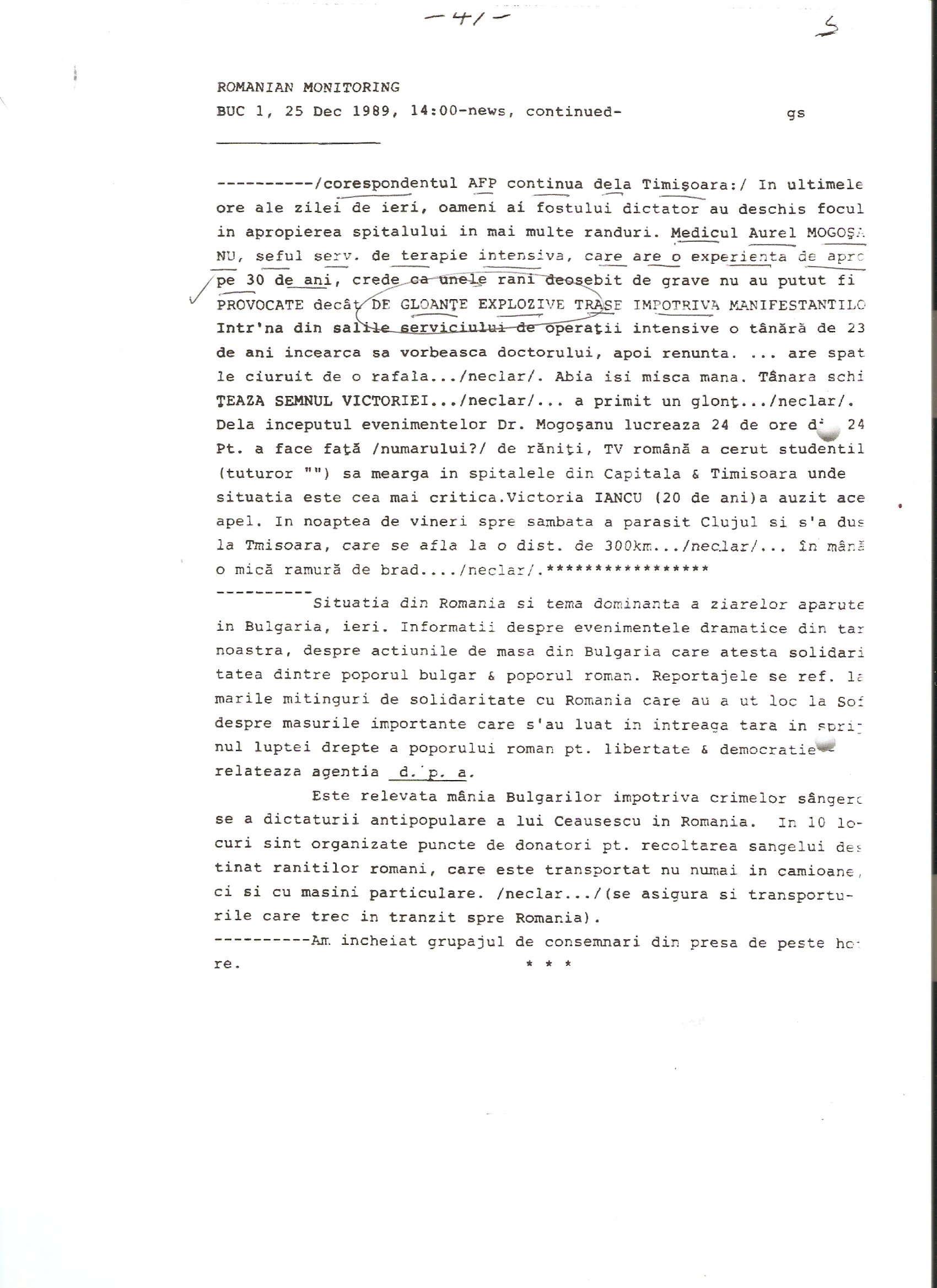

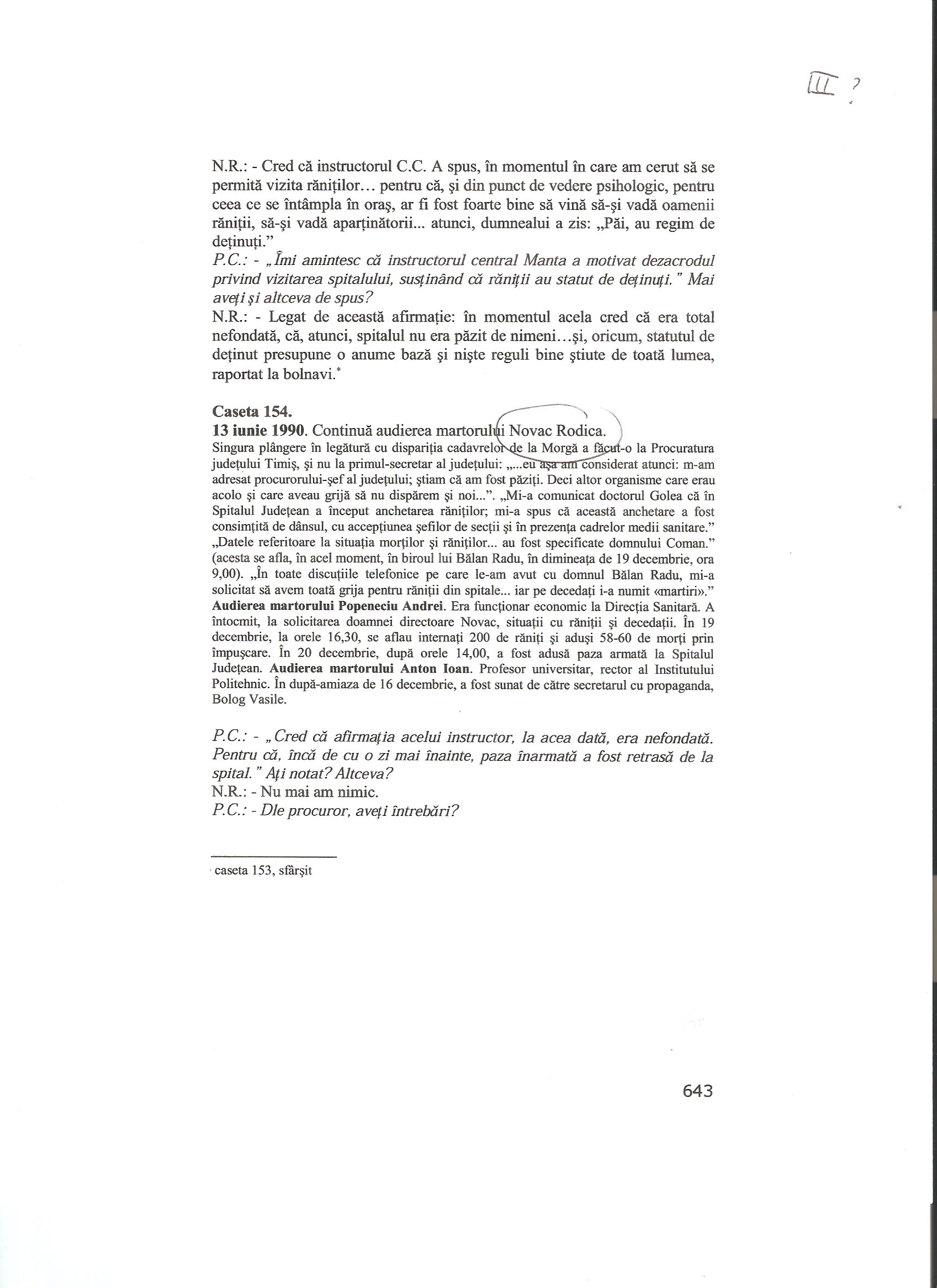


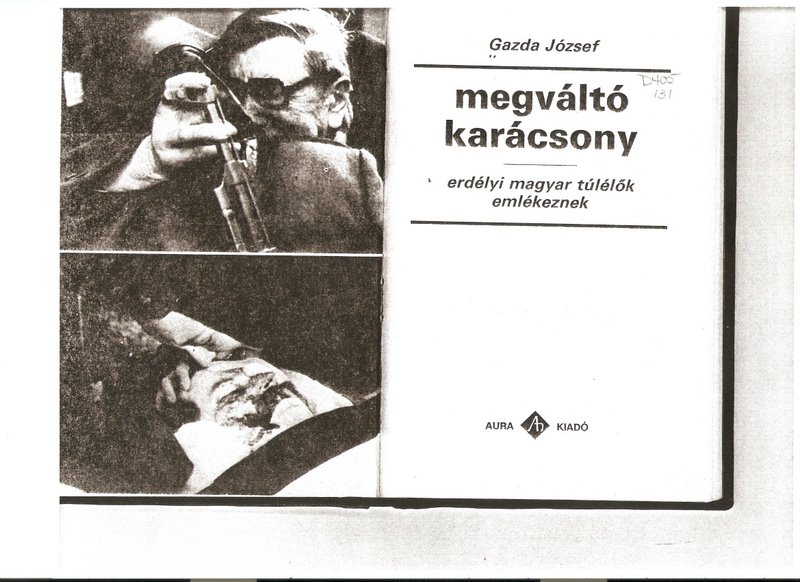
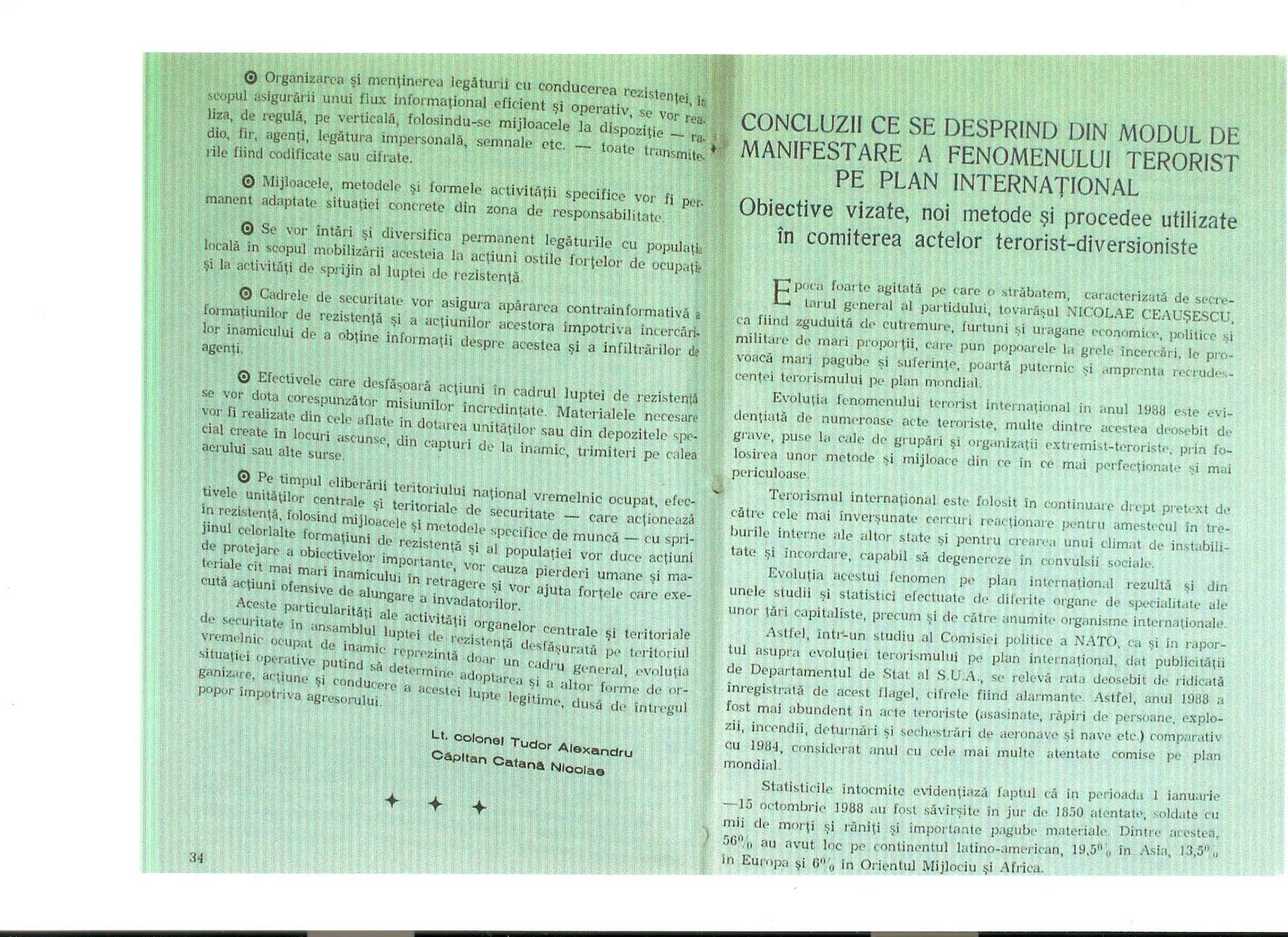
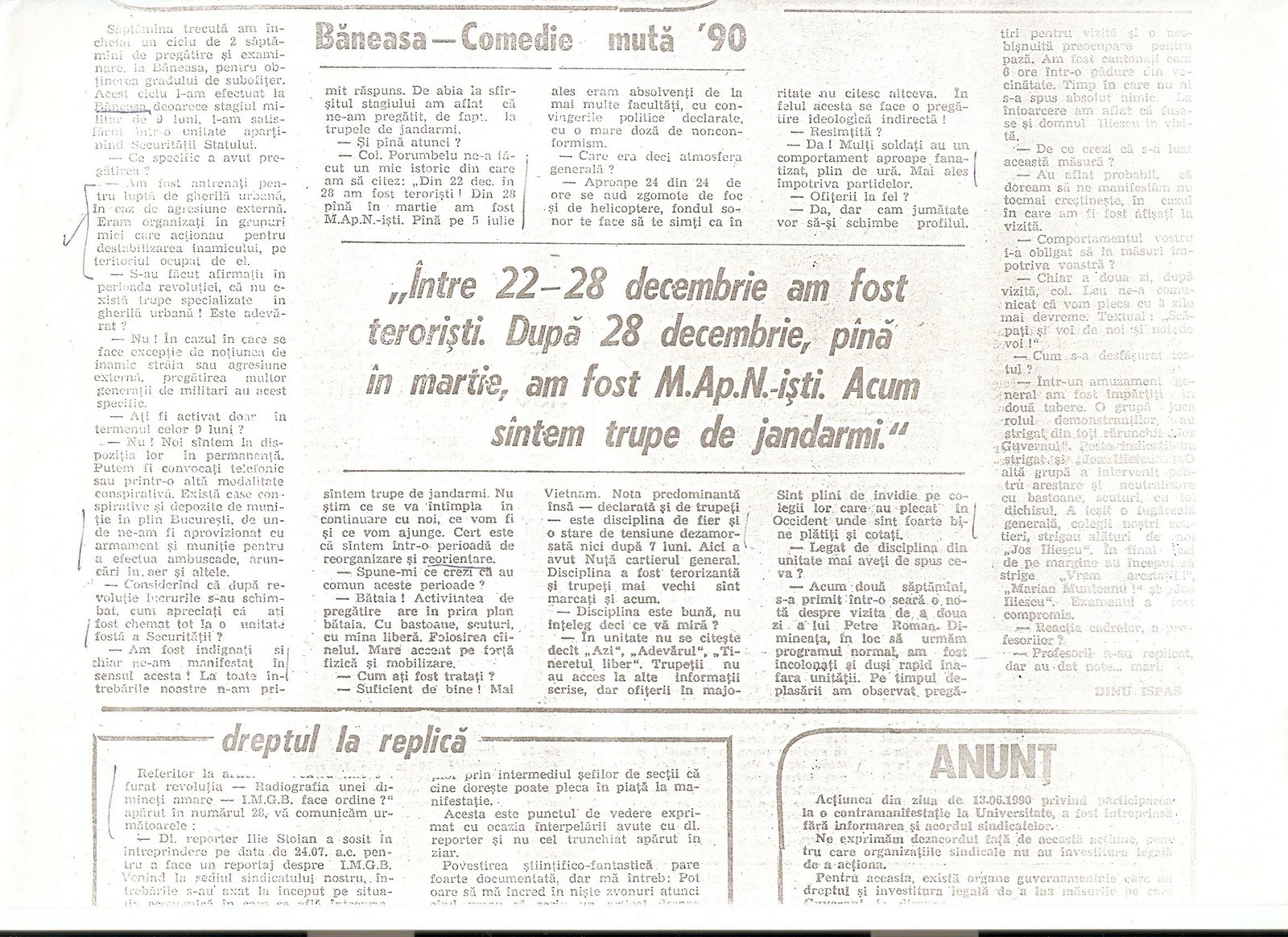
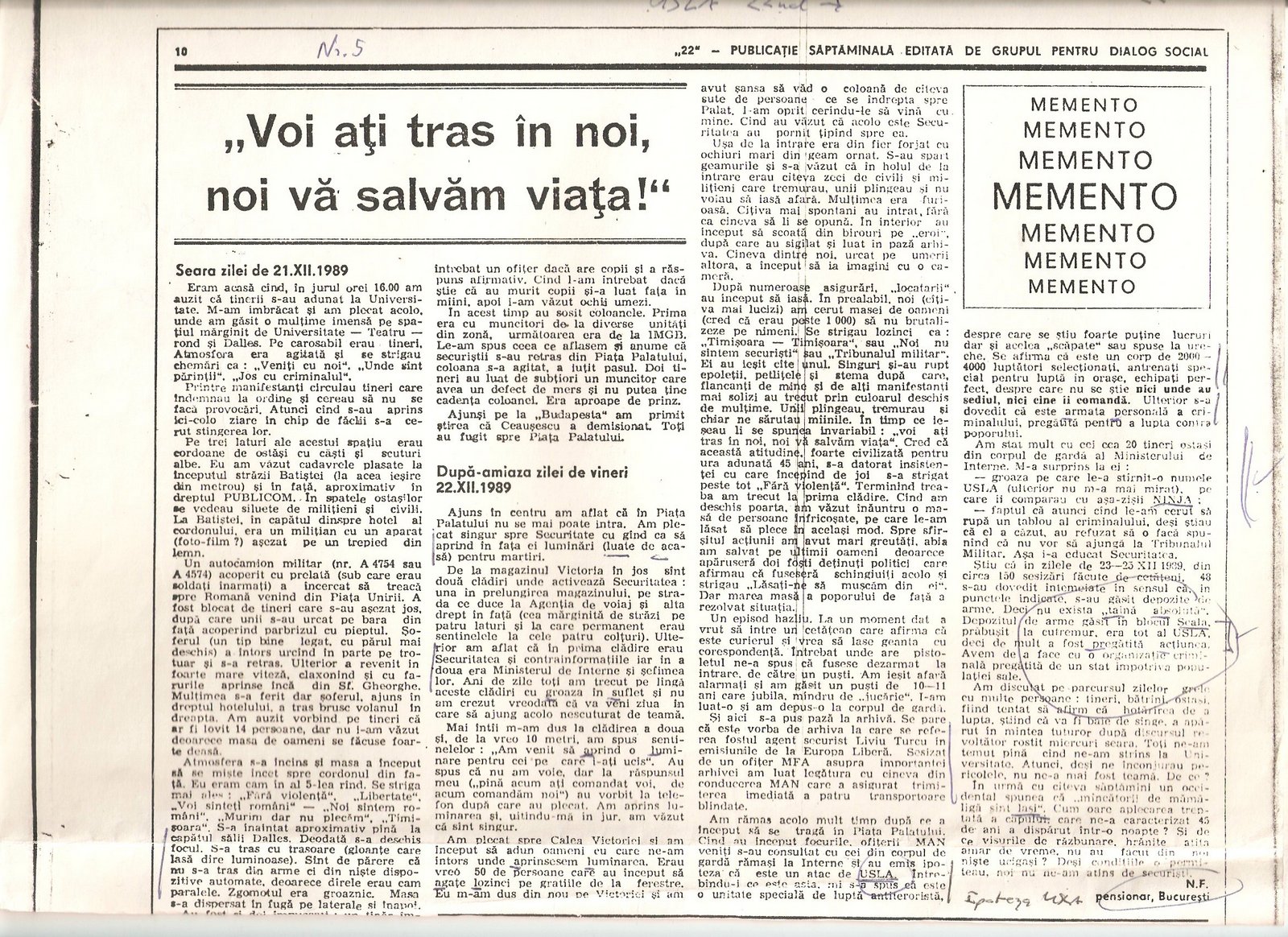
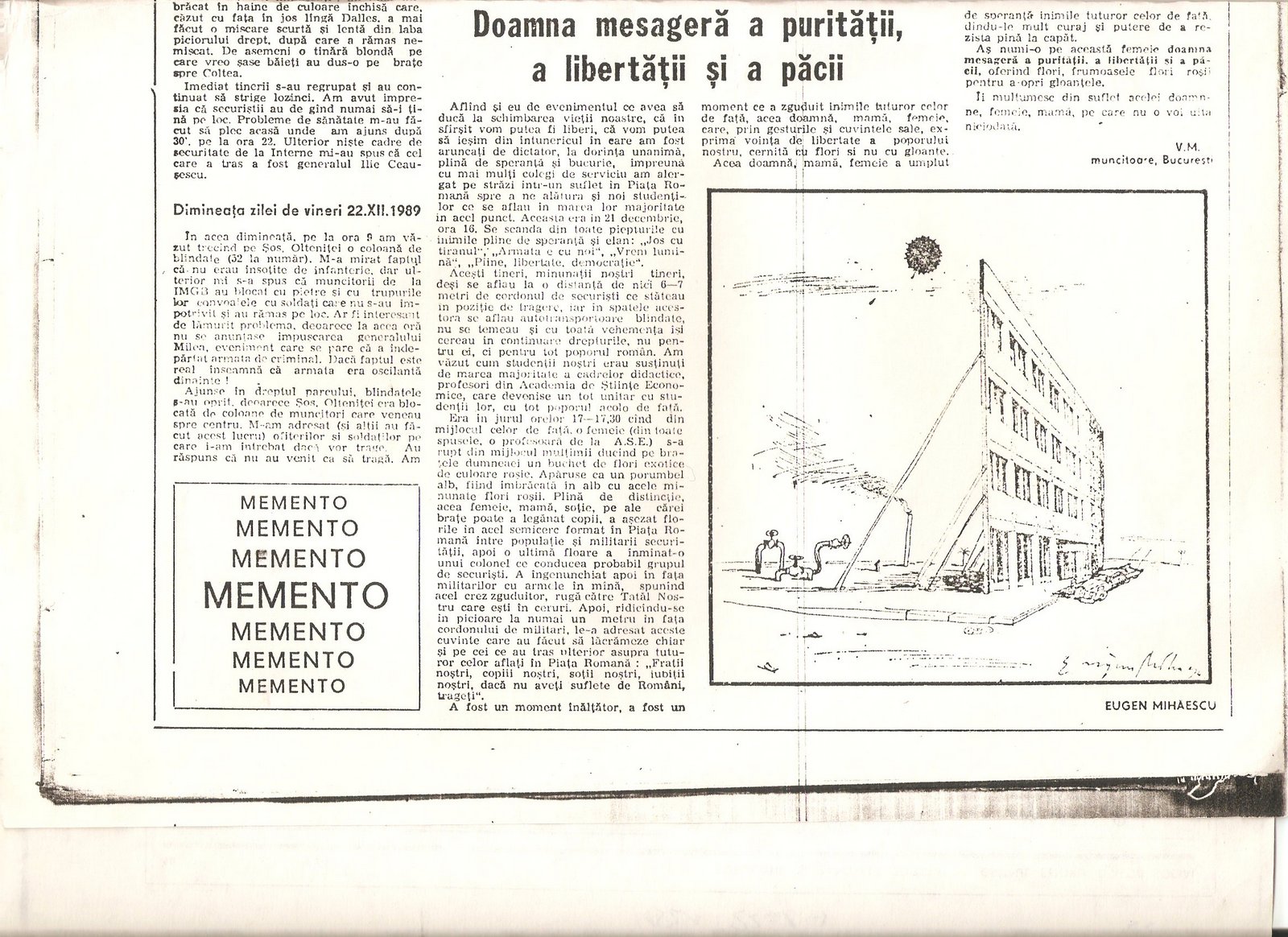


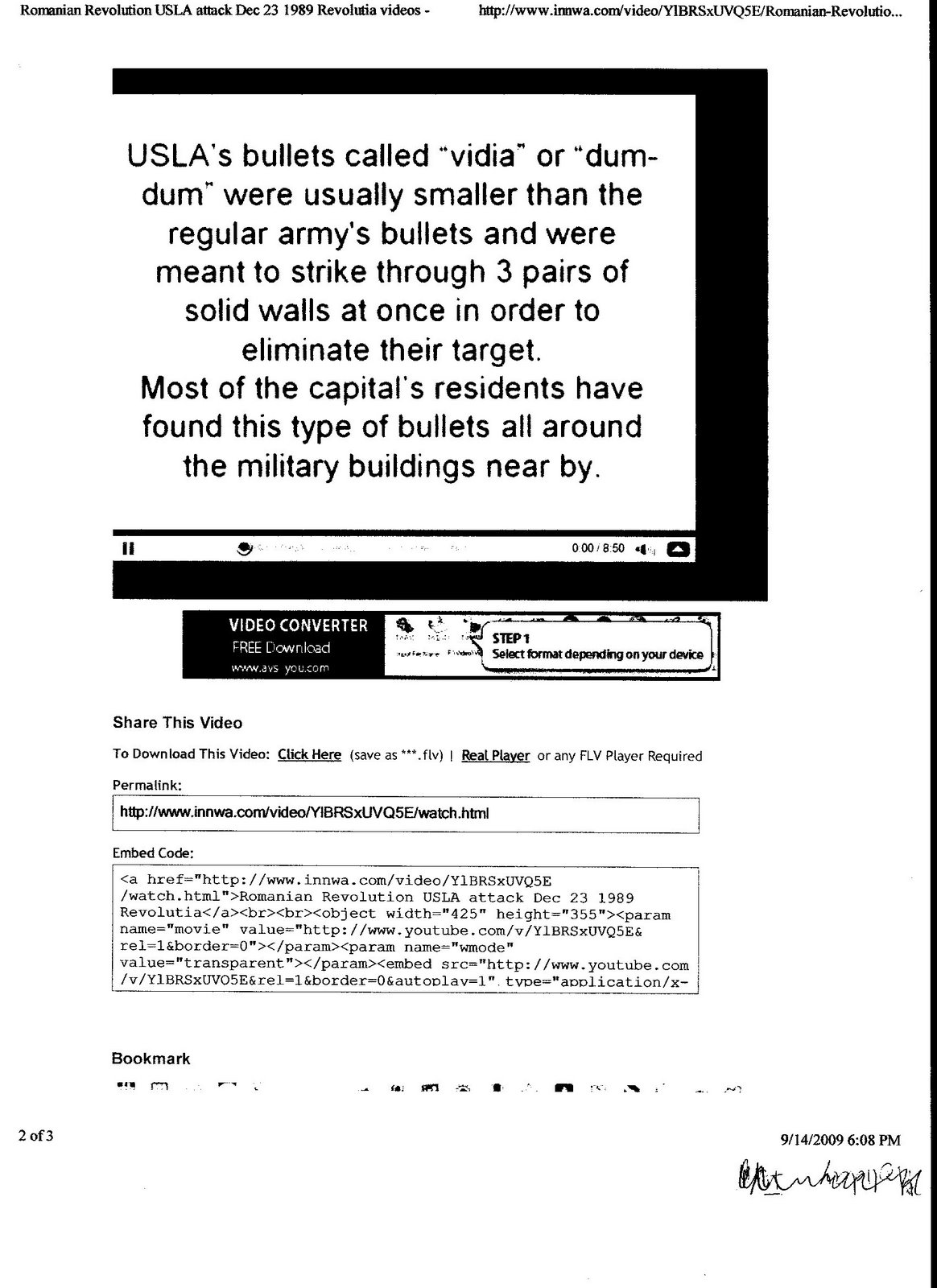
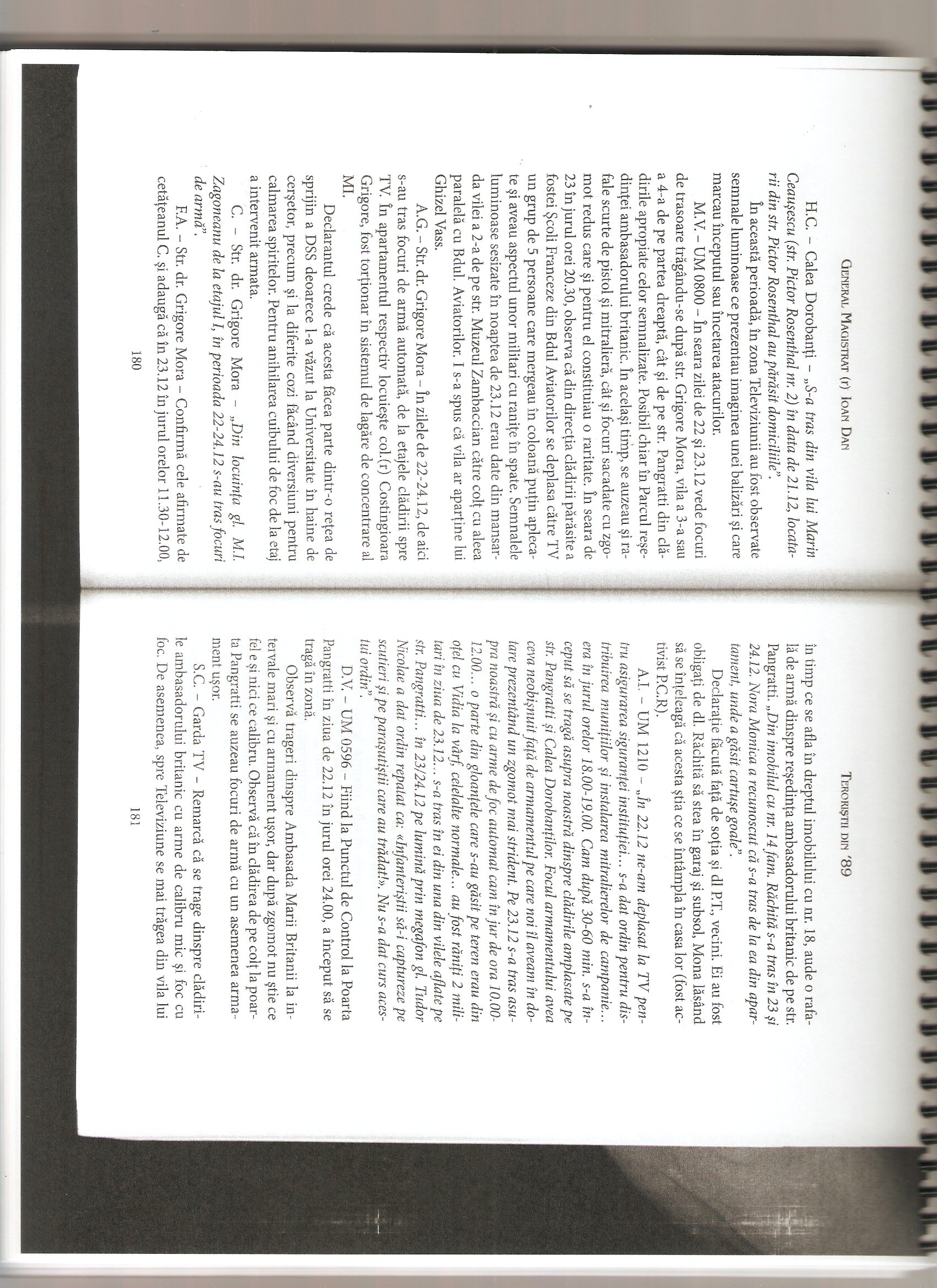
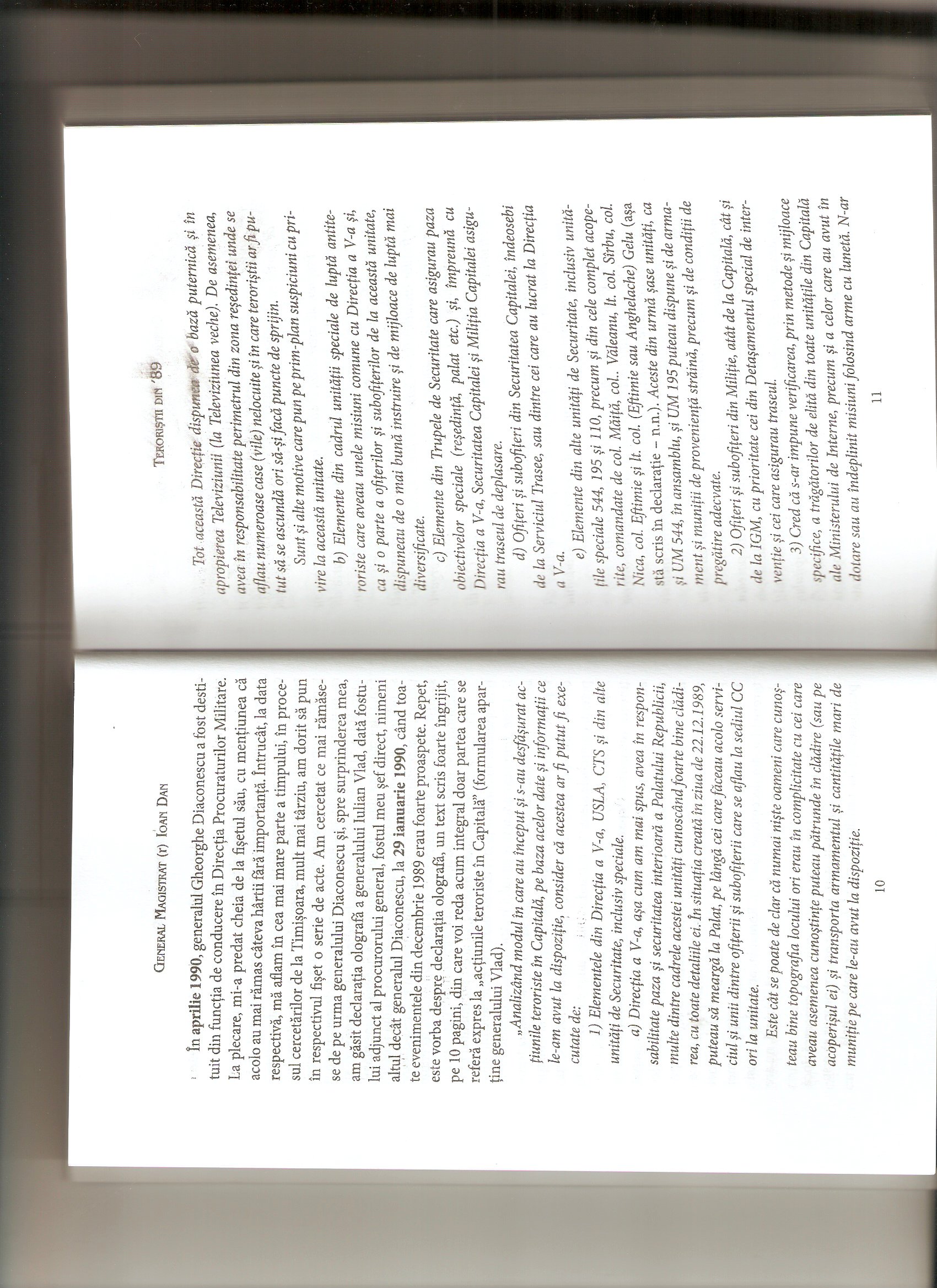
 The Archive of the Romanian Revolution of December 1989
