The Archive of the Romanian Revolution of December 1989

A Catch-22 December 1989, Groundhog-Day Production. Presenting the Personal Research & Scholarship of Richard Andrew Hall, Ph.D.

Posts Tagged ‘securitate decembrie 1989’

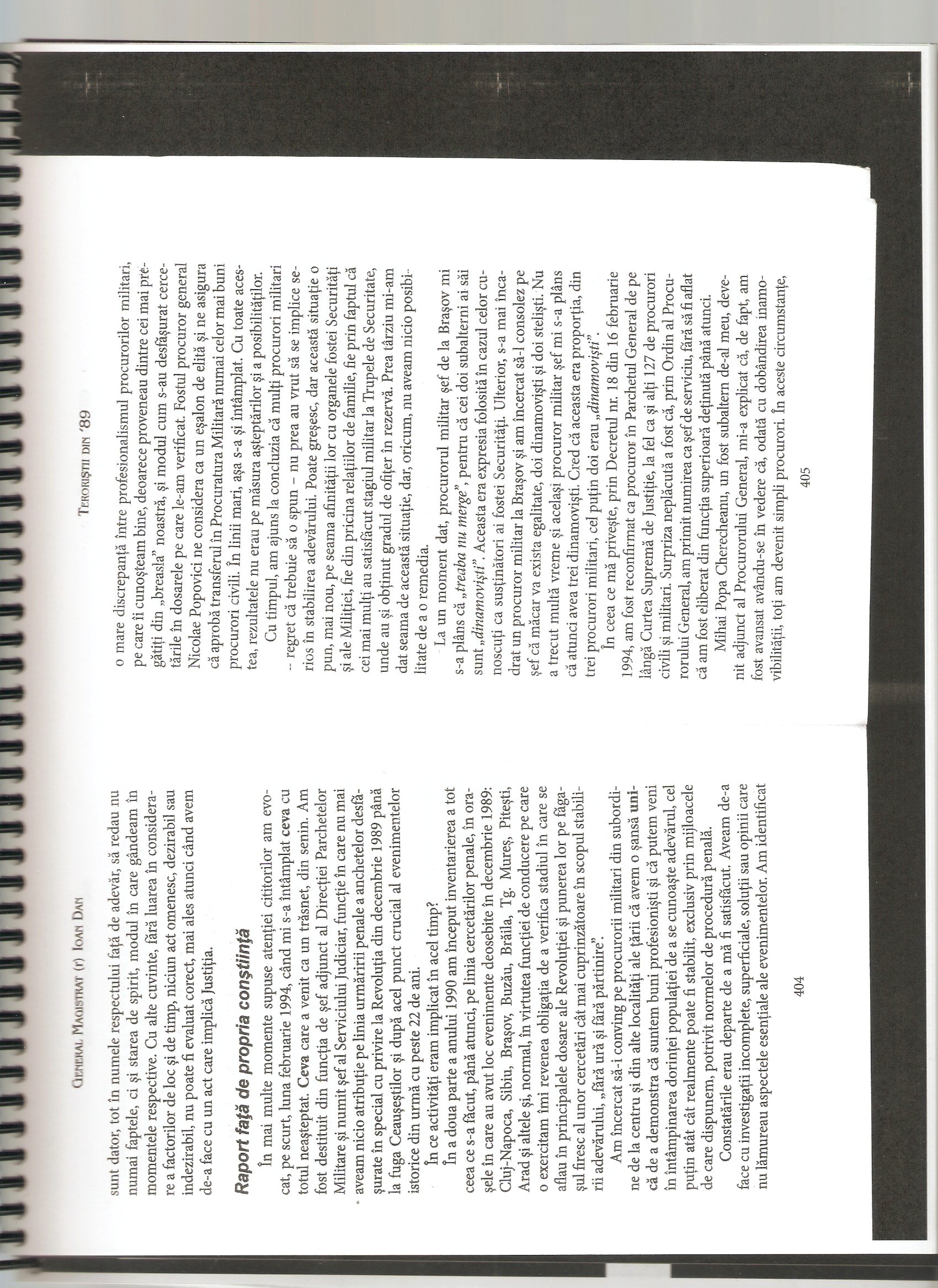
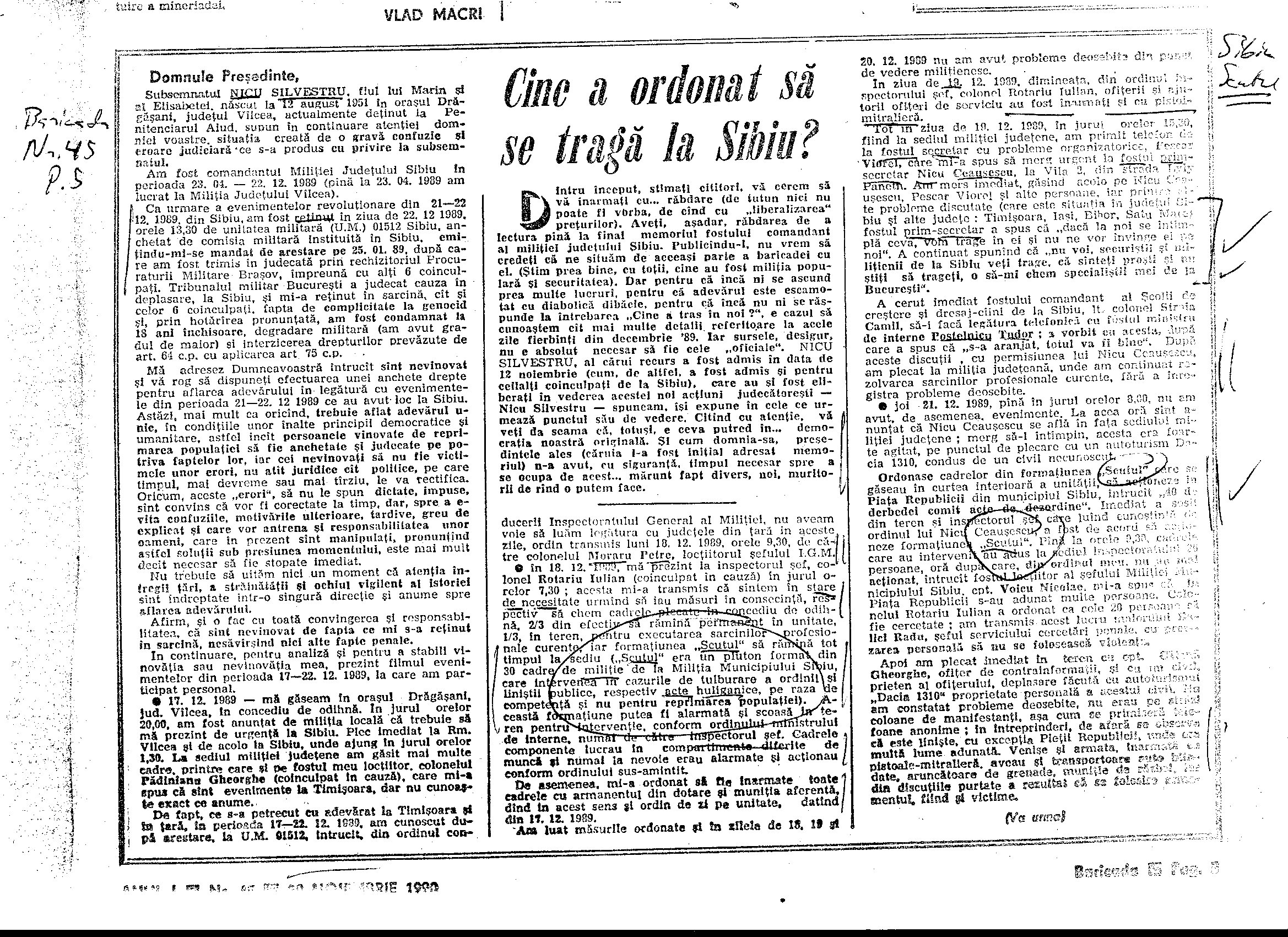
Dinamovisti, militieni, si Procuratura Militara Brasov

Posted by romanianrevolutionofdecember1989 on November 16, 2013

(strictly personal research and views, as always)

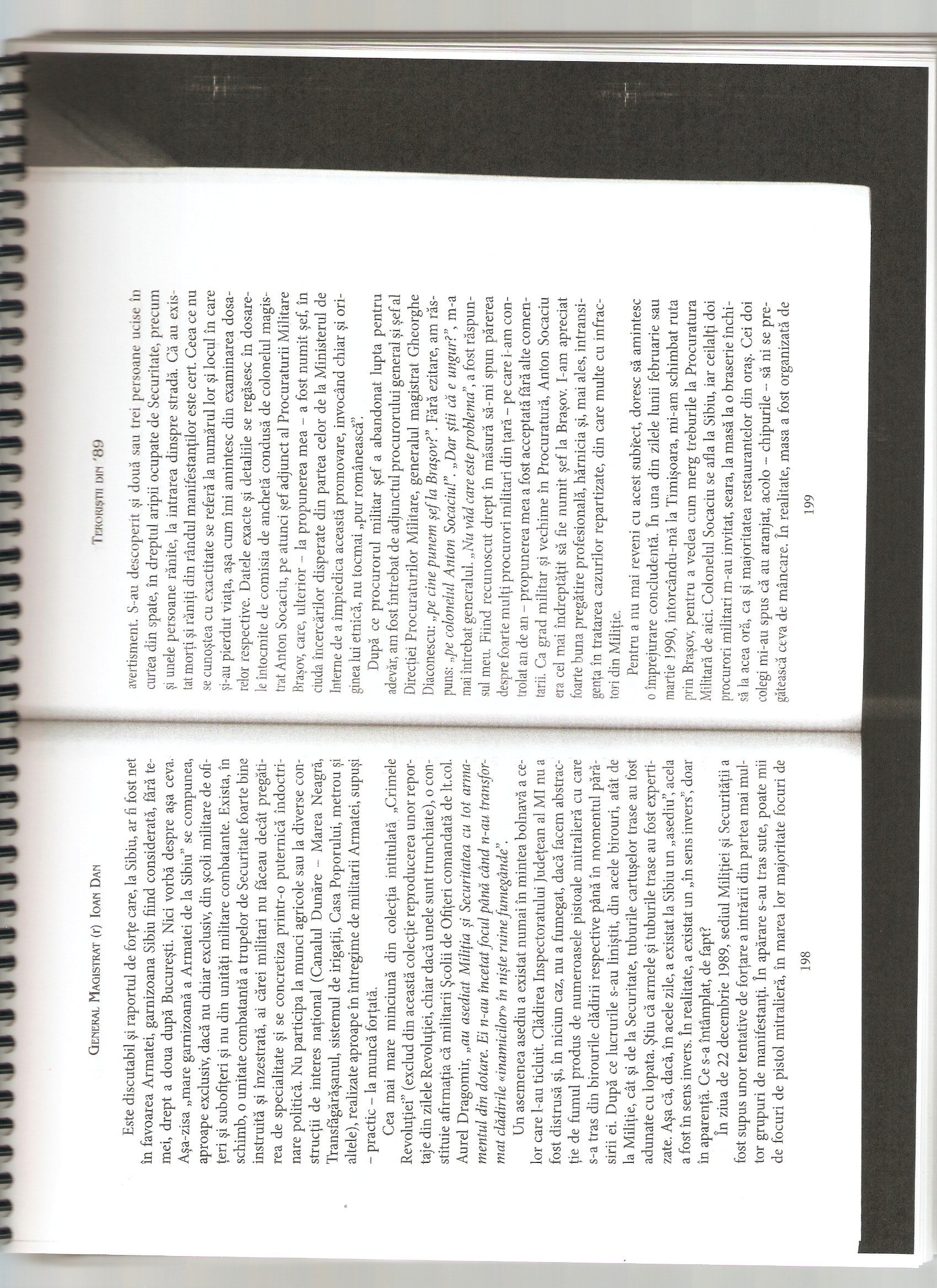
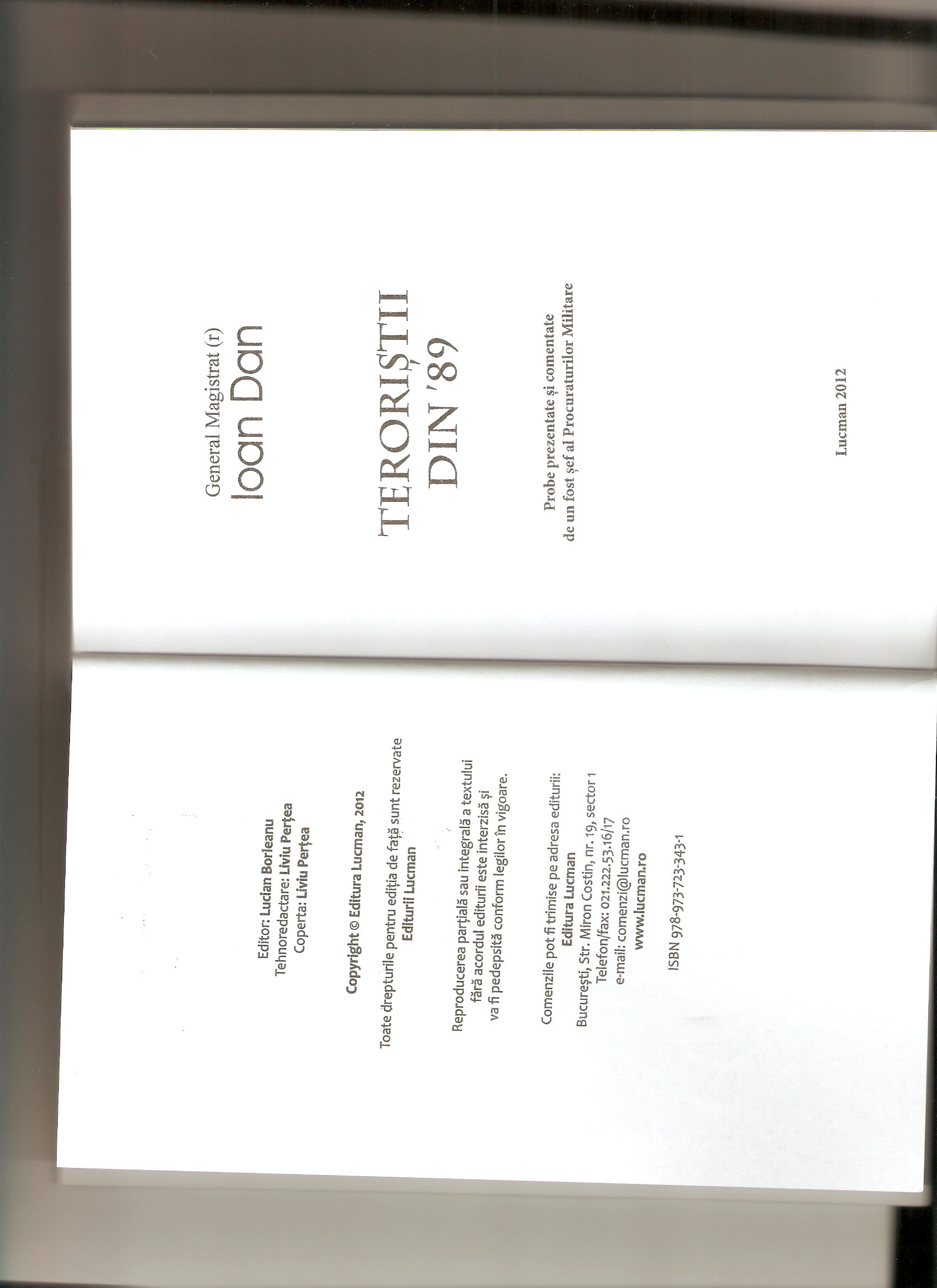
General Magistrat (r) Ioan Dan, Teroristii din ’89 (Lucman, 2012)

In dosarele intocmite de comisia de ancheta condusa de colonelul magistrat Anton Socaciu, pe atunci sef adjunct al Procuraturii Militare Brasov, care, ulterior–la propunerea mea–a fost numit sef, in ciuda incercarilor disperate din partea celor de la Ministerul de Interne de a impiedica aceasta promovare, invocand chiar si originea lui etnica, nu tocmai ‘pur romaneasca.’

image0

[martie 1990] In realitate, masa a fost orgaizata de seful Militiei; au participat doi sau trei ofiteri de Militie din conducerea Inspectoratului.  Acestia, foarte direct, mi-au cerut ca nu cumva sa fie numit sef al Procuraturii Militare din Brasov colonelul Anton Socaciu.  Aceasta interventie mi-a intarit convingereaca Socaciu trebuie numit sef….

image0-001

La un moment dat, procurorul militar sef de la Brasov mi s-a plans ca ‘treaba nu merge’, pentru ca cei doi subalterni ai sai sunt ‘dinamovisti.’  Aceasta era expresia folosita in cazul celor cunoscuti ca sustinatori ai fostei Securitati.  Ulterior, s-a mai incadrat un procuror militar la Brasov si am incercat sa-l consolez pe sef ca macar va exista egalitate, doi dinamovisti si doi stelisti.  Nu a trecut multa vreme si acelasi procuror militar sef mi s-a plans ca atunci avea trei dinamovisti.  Cred ca aceasta era proportia, din trei procurori militari, cel putin doi erau ‘dinamovisti’.

image0-002

Posted in decembrie 1989, raport final | Tagged: , , , , , , , | Leave a Comment »

Maria Petrascu: documentarul “Voi ati tras in noi!” si cate ceva despre Maiorul Nicolae Paraschiv (serviciul antiterorist al Inspectoratului de Securitate Brasov) (I)

Posted by romanianrevolutionofdecember1989 on October 24, 2013

(purely personal views, as always)

Reiau aici cateva episoade din documentarul regretatei Maria Petrascu, Voi ati tras in noi! (2005), si semnalez cateva dezvaluiri importante mai jos.

Brasovul Revolutionar PARTEA 4

min 0:55- Nicolae Samson (1:46-2:02) “pentru ca acei oameni in combinezoane negre au existat…erau cu automate scurte…”

————————————————————————————————————————————

Brasovul Revolutionar PARTEA 5

min 7:38-9:36 Gheorge Iosif, despre subsolul, si oameni cu arme scurte, haine inchisa de culoare neagra, cagula pe cap
————————————————————————————————————————————
Brasovul Revolutionar PARTEA 6
min. 0:00-1:22 Sorin Firoiu despre Ordinul MI 002600
min. 1:23-2:49 Vasile Mardare despre Capitol, Modarom, si gloante speciale (explozive)
min. 3:56-4:50 Sorin Firoiu despre “200” mercenari si exfiltrarea lor spre Tripoli
———————————————————————————————————————————-
Brasovul Revolutionar PARTEA 7
min. 6:56-0:45 Col. Mag. (r) Gheorghe Ionescu, Parchetul Militar Brasov, da explicatii “oficiale”–gen Dan Voinea

Posted in decembrie 1989, raport final | Tagged: , , , , , , , , , , , , , , , , , | Leave a Comment »

Lying in wait: Securitate Director General Vlad in the CC building (II)

Posted by romanianrevolutionofdecember1989 on September 14, 2013

http://atomic-temporary-3899751.wpcomstaging.com/2013/09/14/lying-in-wait-securitate-director-general-vlad-in-the-cc-building-i/

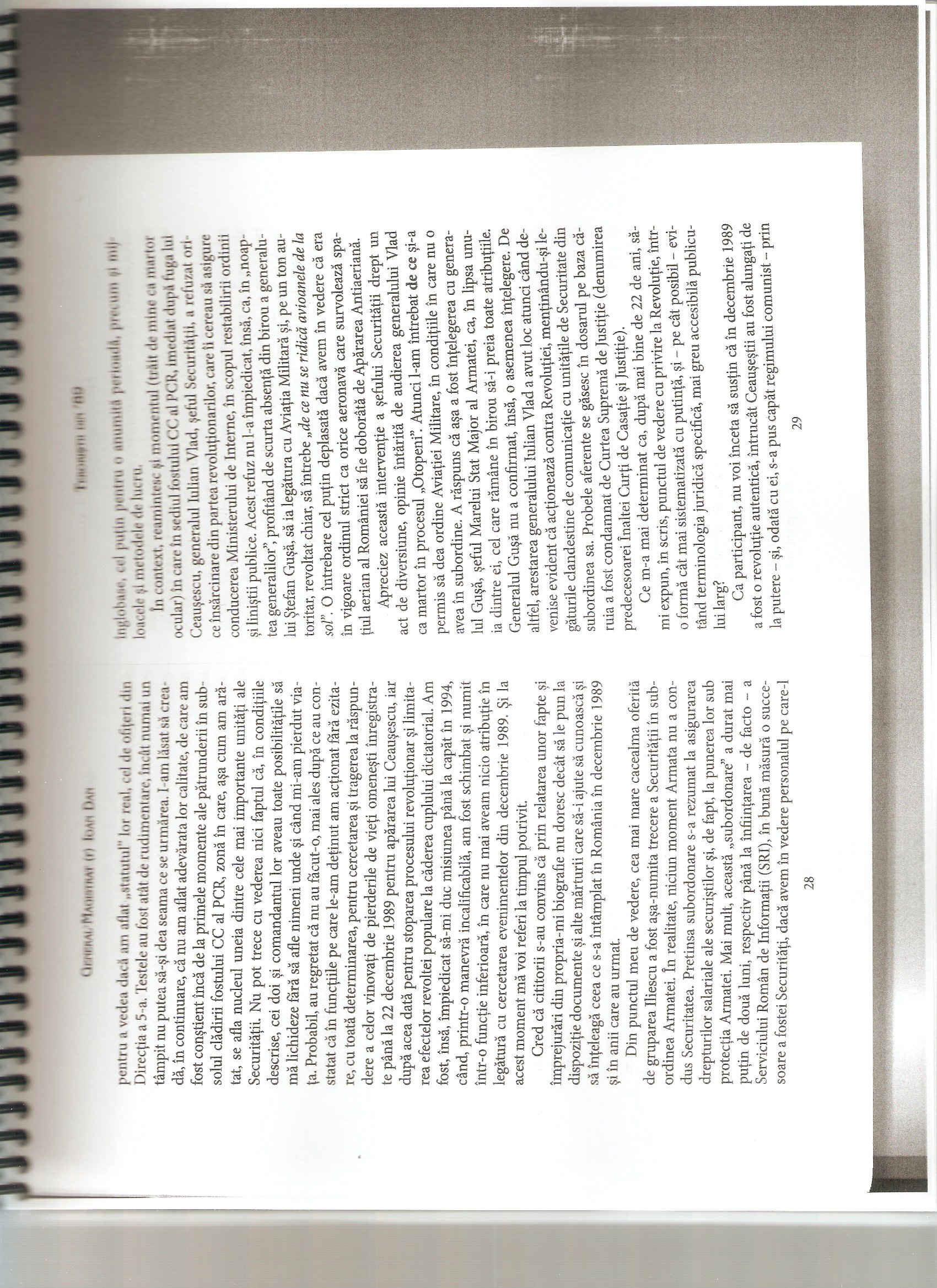
In context, reamintesc si momentul (trait de mine ca martor ocular) in care in sediul fostului CC al PCR, imediat dupa fuga lui Ceausescu, generalul Iulian Vlad, seful Securitatii, a refuzat orice insarcinare din partea revolutionarilor, care ii cereau sa asigure conducerea Ministerului de Interne, in scopul restabilirii ordinii si linistii publice.  Acest refuz nu l-a impiedicat, insa, ca, in “noaptea generaliilor”, profitand de scurta absenta din birou a generalului Stefan Gusa, sa ia legatura cu Aviatia Militara si, pe un ton autoritar, revoltat chiar, sa intrebe, “de ce nu se ridica avioanele de la sol“.  O intrebare cel putin deplasata daca avem in vedere ca era in vigoare ordinul strict ca orice aeronava care survoleaza spatiul aerian al Romaniei sa fie doborata de Apararea Antiaeriana.

image0

Apreciez aceasta interventie a sefului Securitatii drept un act de diversiune, opinie intarita de audierea generalului Vlad ca martor in procesul “Otopeni”.  Atunci l-am intrebat de ce si-a permis sa dea ordine Aviatiei Militare, in conditiile in care nu o avea in subordine.  A raspuns ca asa a fost intelegerea cu generalul Gusa, seful Marelui Stat Major al Armatei, ca, in lipsa unuia dintre ei, cel care ramane in birou sa-i preia toate atributiile.  Generalul Gusa nu a confirmat, insa, o asemenea intelegere.  De altfel, arestarea generalului Iulian Vlad a avut loc atunci cand devenise evident ca actioneaza contra Revoltuiei, mentinandu-si legaturile clandestine de comunicatie cu unitatile de Securitate din subordinea sa. (Generalul Magistrat (r) Ioan Dan, Teroristii din ’89, Lucman, 2012)

The ongoing, counter-revolutionary use of Securitate transmitters is detailed below:

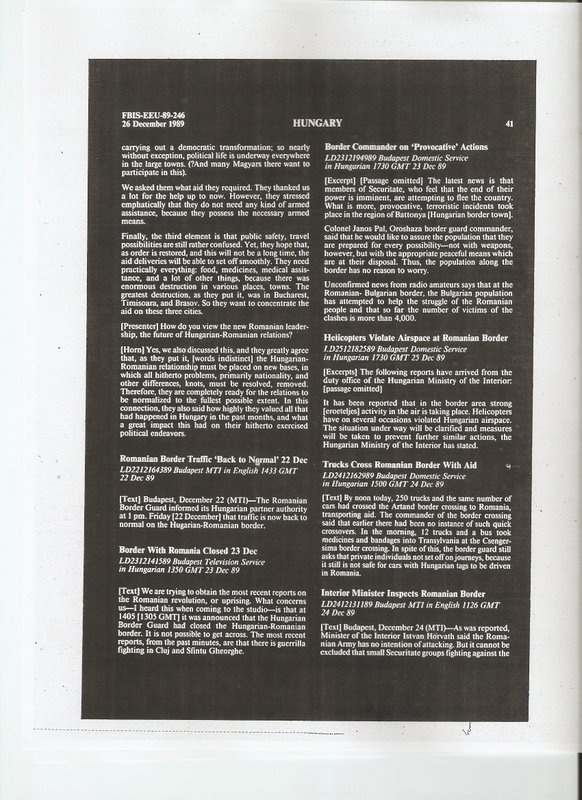
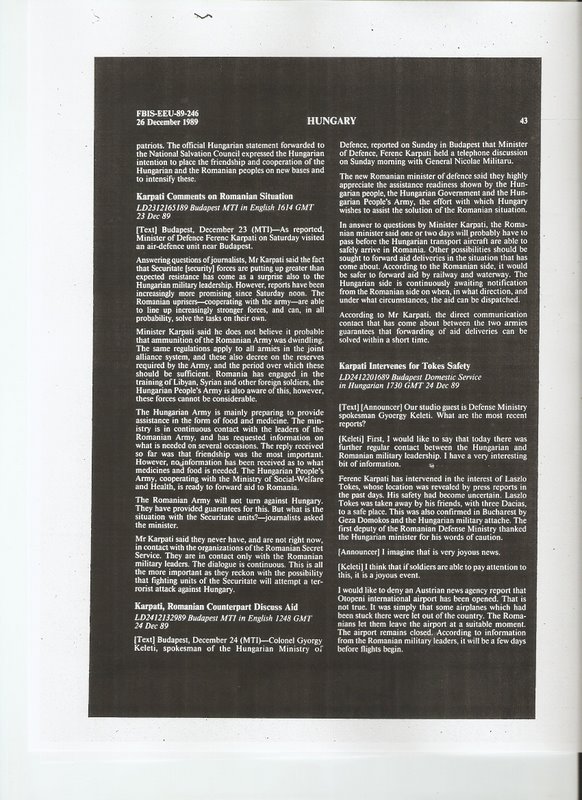
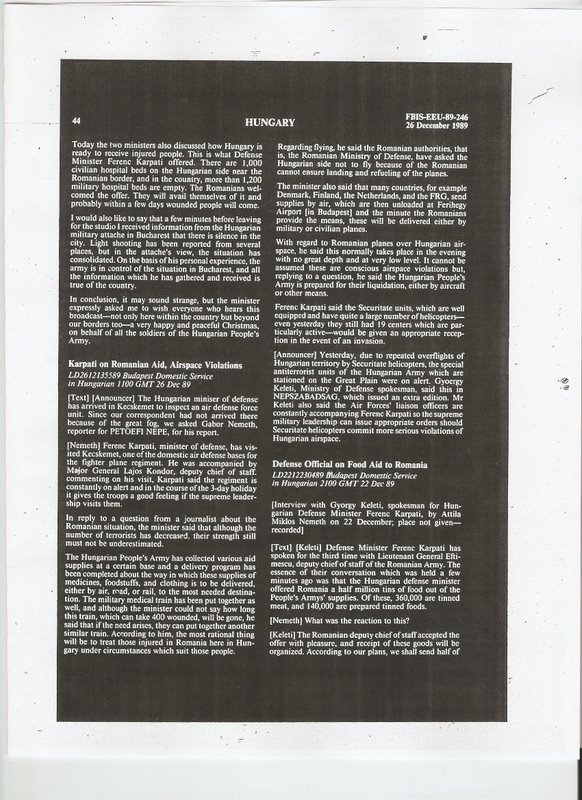
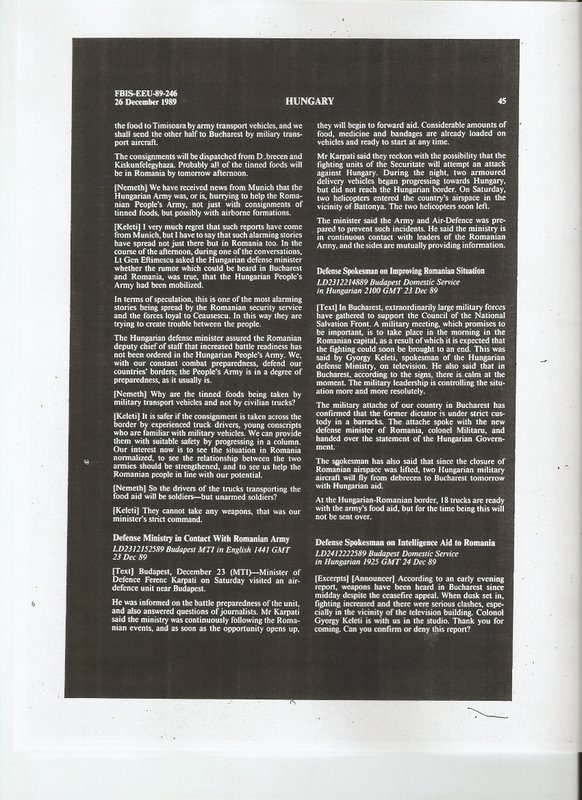
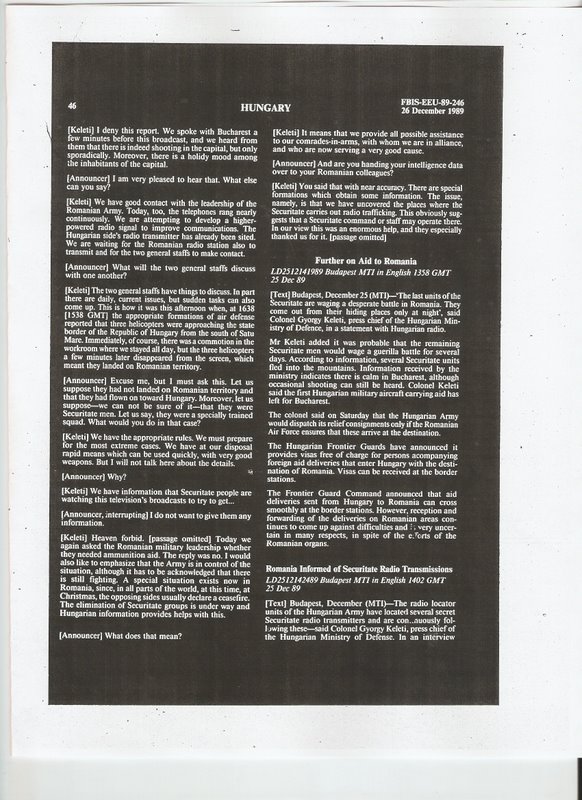
Colonel Gyorgy Keleti, head of the Hungarian People’s Army Press Department:  “…I would like to say that a progressive weakening of the Securitate has been experienced.  We ourselves can see this, because our radio searching and locating units which were in Hungary a few days ago were monitoring broadcasts from 31 Securitate radio centers–yesterday 19, and today only 5.  We of course put this data at the disposal of the Romanian military leadership.”

Ferenc Karpati:  “A Securitate erői ellen hosszú, küzdelmes harcot folytattak a hadsereg és a forradalom más erői. Felszámolásuk érdekében a Magyar Honvédség speciális képzettségu rádióbemérő egységeinek egy részét átcsoportosítottuk a román államhatár közelébe, s így sikerült rádióállomásaikat bemérni, álláshelyeiket pontosan meghatározni. Az adatok átadásával jelentősen elősegítettük a Securitate-bázisok felszámolását.”  KÁRPÁTI FERENC: A román forradalom és Magyarország, 1989. Egy volt miniszter emlékezése

1990. január 11., csütörtök 18:55


A Honvédelmi Minisztérium közleménye (4. rész) (OS)
A kezdeti időszakban, amikor a diktátorhoz hű Securitate a
forradalom vérbe fojtására jelentős erőket vetett be, a Magyar
Néphadsereg speciális képzettségű rádióbemérő alakulatainak egy
részét átcsoportosította a magyar-román államhatár közelébe a
Securitate rádióállomásainak bemérésére, helyeinek meghatározására.
Ezeknek az adatoknak az átadásával, az adók bemért földrajzi
helyeinek megjelölésével feltehetően segítséget nyújtott a Magyar
Néphadsereg a Securitate-bázisok felszámolásában, megsemmisítésében.
Szinte napról napra érzékelhető volt ezek számának csökkenése, ami a
magyar szakértők szerint arról tanúskodott, hogy a diktátorhoz hű
erők törzseit a román hadsereg folyamatosan számolja fel. Ezt
példázza, hogy a december 26-án nyilvánosságra hozottak szerint
24-én még 31, 25-én már 19 és 26-án csupán öt
Securitate-rádióközpont működését rögzítették és mérték be a magyar
rádiófelderítő és bemérő alegységek.

Posted in decembrie 1989, raport final | Tagged: , , , , , , , , , | 5 Comments »

Lying in wait: Securitate Director General Vlad in the CC building (I)

Posted by romanianrevolutionofdecember1989 on September 14, 2013

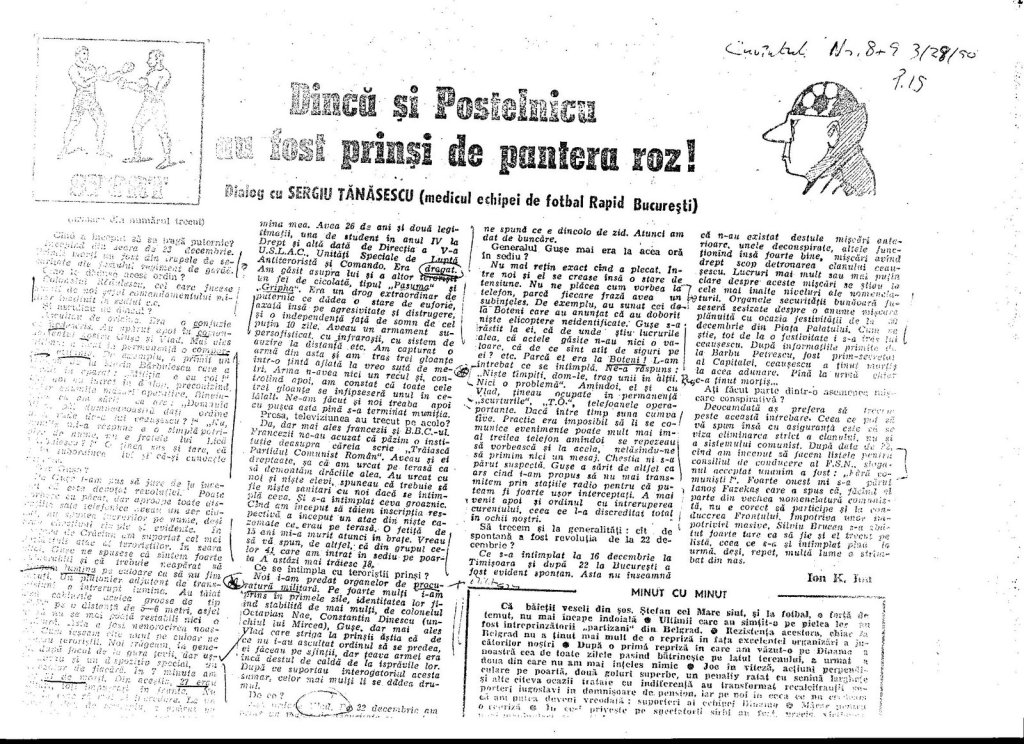
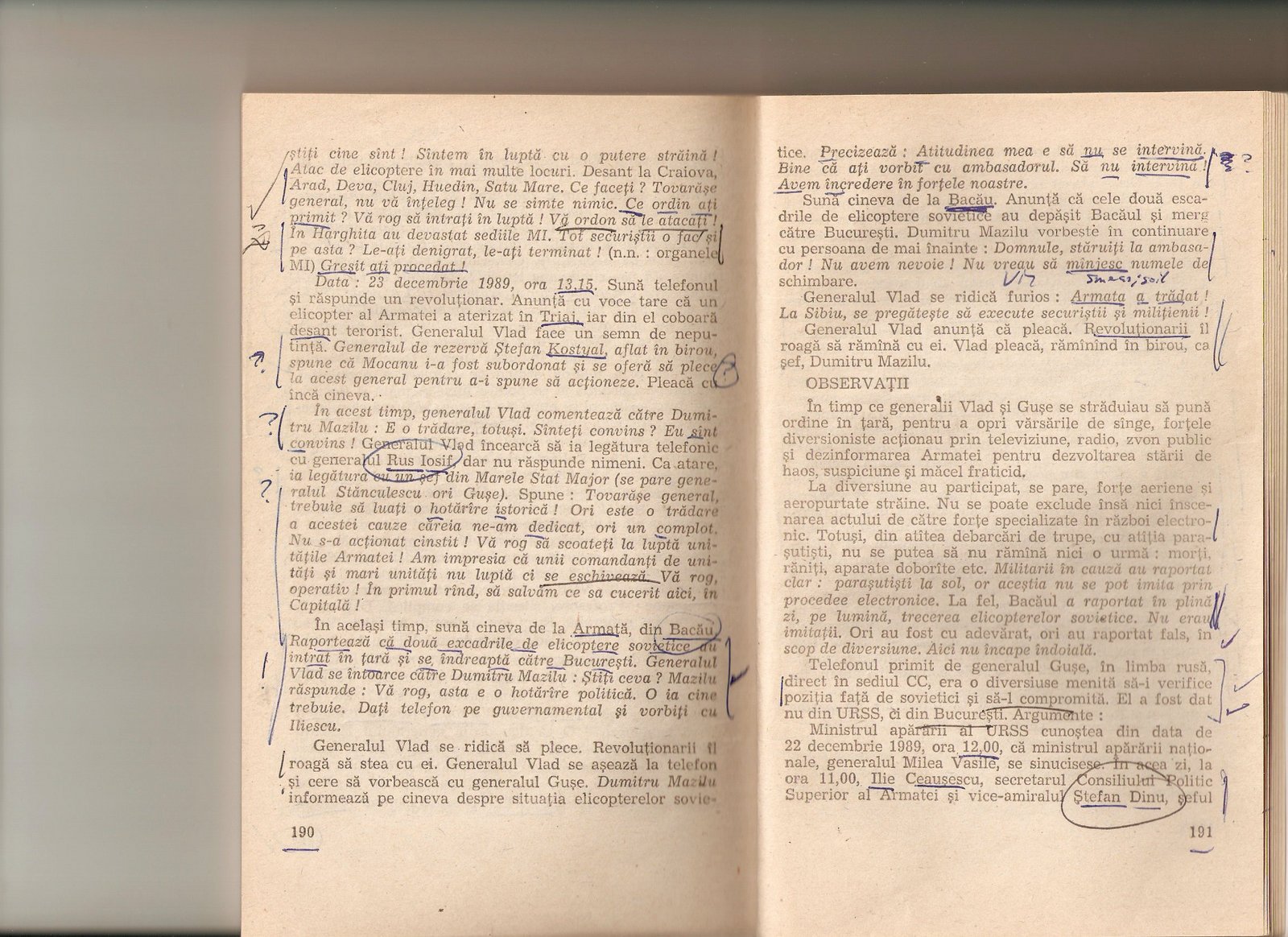
Sergiu Tanasescu (medicul echipei de fotbal Rapid Bucuresti), iaunarie 1990:  “Amindoi, el [Generalul Guse] si cu [Generalul] Vlad tineau ocupate in permanenta ‘scurturile,’ ‘T.O.’ telefoane operative.  Practic era imposibil sa li comunice evenimente poate mult mai importante.  Daca intre timp se suna cumva al treilea telefon se repezeau sa vorbeasca si la acela, nelasindu-ne sa primim nici un mesaj.  Chestia ni s-a parut suspecta.

Revolutionaries in the CC were understandably suspicious of the behavior of General Vlad and General Guse on these phones…as Sergiu Tanasescu recalled in late January 1990:

“Intre noi si el [Guse] se crease insa o stare de tensiune.  Nu ne placea cum vorbea la telefon, parca fiecare fraza avea un subinteles.  De exemplu, au sunat cei de la Boteni care au anuntat ca au doborit niste elicoptere neidentificate.  Guse s-a rastit la ei, ca de unde stiu lucrurile alea, ca actele gasite n-au nici o valoare, ca de ce sint atit de siguri pe ei? etc.  Parca el era la Boteni!  L-am intrebat ce se intimpla.  Ne-a raspuns:  “Niste timpiti, dom-le, unii trag in altii.  Nici o problema.”  Amindoi, el si cu [Generalul] Vlad tineau ocupate in permanenta ‘scurturile,’ ‘T.O.’ telefoane operative.  Practic era imposibil sa li comunice evenimente poate mult mai importante.  Daca intre timp se suna cumva al treilea telefon se repezeau sa vorbeasca si la acela, nelasindu-ne sa primim nici un mesaj.  Chestia ni s-a parut suspecta.

image-5

The following passage is indicative of Vlad’s duplicity and lack of credibility.  Playing dumb about the report of unidentified helicopters, he responds to one of the revolutionary’s questions–suggesting that the helicopters belonged to Vlad’s Securitate–in a ridiculous and unserious manner,”perhaps they are yours?” he says to the man. (!)

1:32 Iulian Vlad: Dar eu nu-nţeleg de ce au plecat elicopterele.
1:34 Bărbat: Ale teroriştilor.
1:35 Iulian Vlad: Care terorişti, domnule, de unde au venit ăştia? Că n-au…
1:38 Bărbat: (neînţelegibil) speciale
1:40 Iulian Vlad: Păi de unde? Ori ale dînsului (arată spre Guşă), ori ale mele tre’ să fie. Altele nu sînt.
1:44 Bărbat: Ale dumneavoastră.
1:46 Iulian Vlad: Ale dumneavoastră, măi copii.
1:47 Bărbat: Au fost şi altele.
1:49 Iulian Vlad: Foarte curioasă treaba asta.
1:51 Bărbat: Sînt de la dumneavoastră cu alte ordine.

1:53 Iulian Vlad: Păi nu am decît trei elicoptere.

transcribed at http://mariusmioc.wordpress.com/2011/01/14/stefan-gusa-alerta-totala-peste-tot-astia-au-fost-niste-dementi-au-doborit-8-elicoptere-o-fi-avut-un-regiment-subteran-pe-undeva-video/

Former USLA Captain Marian Romanescu admitted to journalist Dan Badea in 1991 that the USLA (special anti-terrorist unit) had its own helicopter force, thereby substantiating the suspicion of the unidentified revolutionary that the helicopters in question were “special”/”from a special unit.”  Thus, it is abundantly clear that Vlad’s claim that the Securitate had “just three helicopters” was a bald-faced lie.

image-12

Moreover, there was confirmation outside of Romania as to the activity of Securitate helicopters during these days:  specifically, Hungarian Defense Officials.  Not only did the Securitate have “a large number of helicopters” (Def. Min. Ferenc Karpati) but on Saturday 23 December 1989, two of them briefly violated Hungarian airspace near Battonya (which is not far from the Romanian city of Arad).  The idea that somehow Hungarian Defense officials did not know the difference between Romanian Air Force and Romanian Securitate helicopters–given the fact that they were both Warsaw Pact members and given that at least since 1986 tensions between Hungary and Romania had been at an increasingly high level–verges on the implausible.  http://atomic-temporary-3899751.wpcomstaging.com/securitate-helicopters-transmitters-per-hungarian-defense-officials/

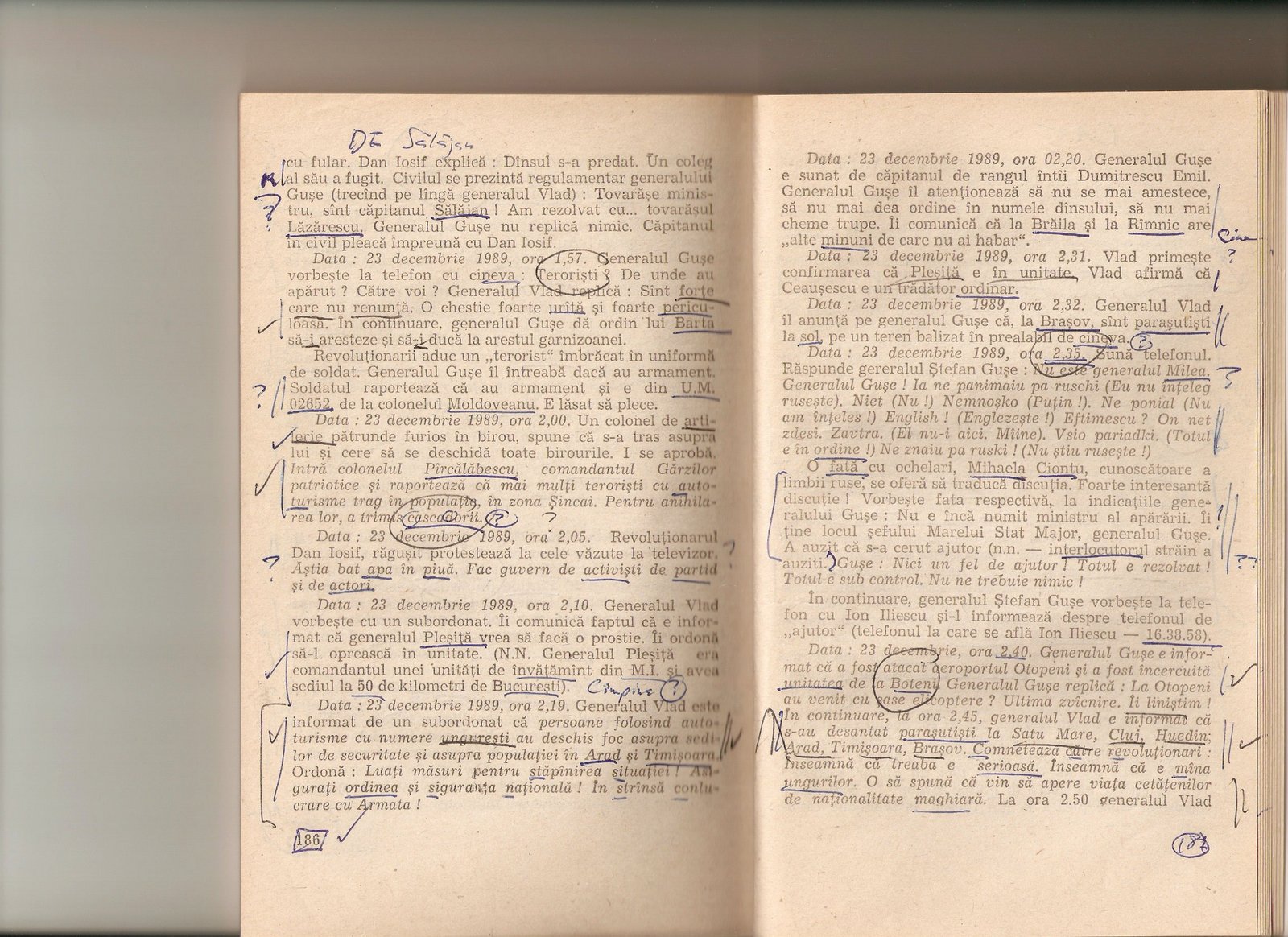
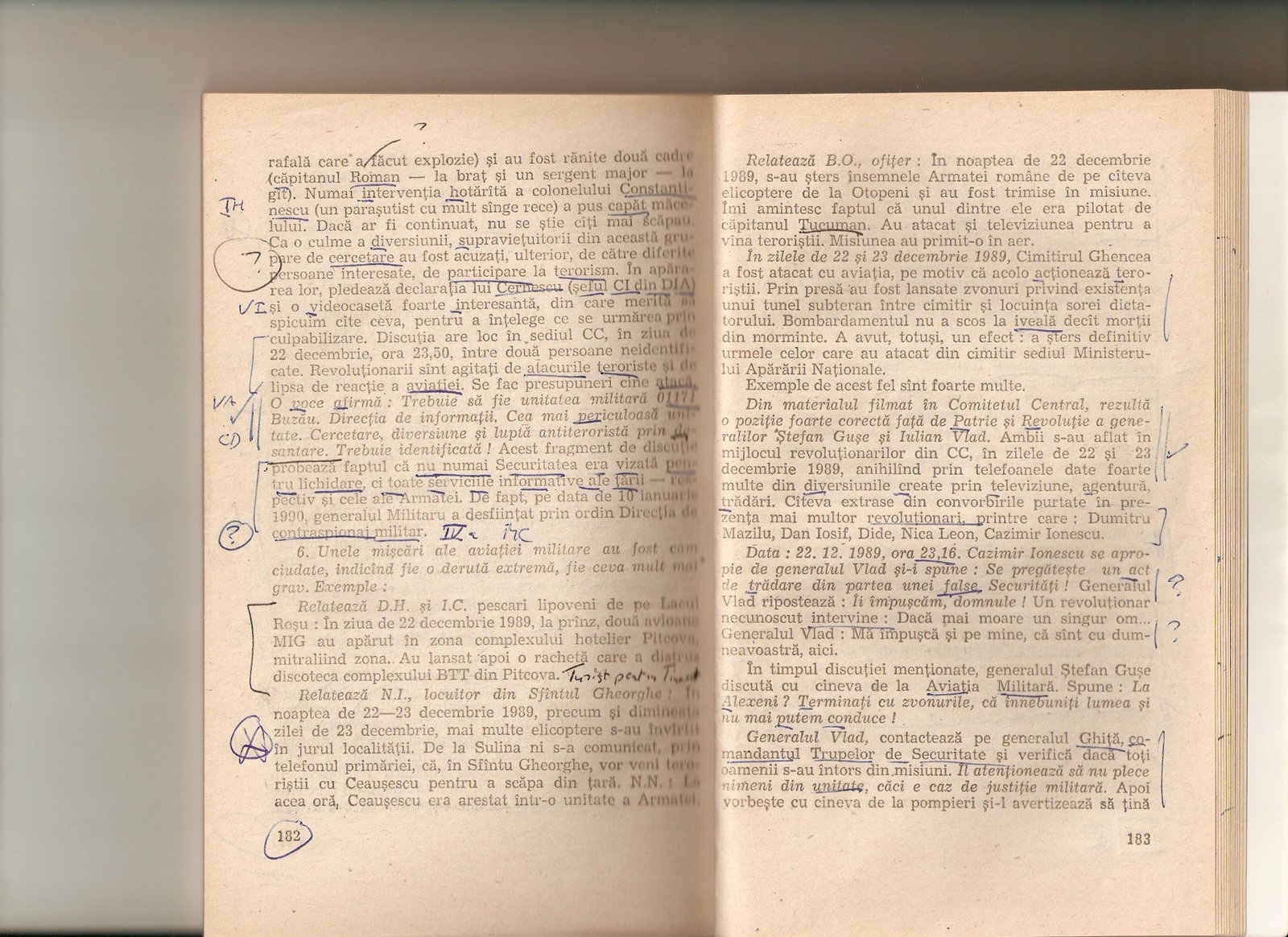
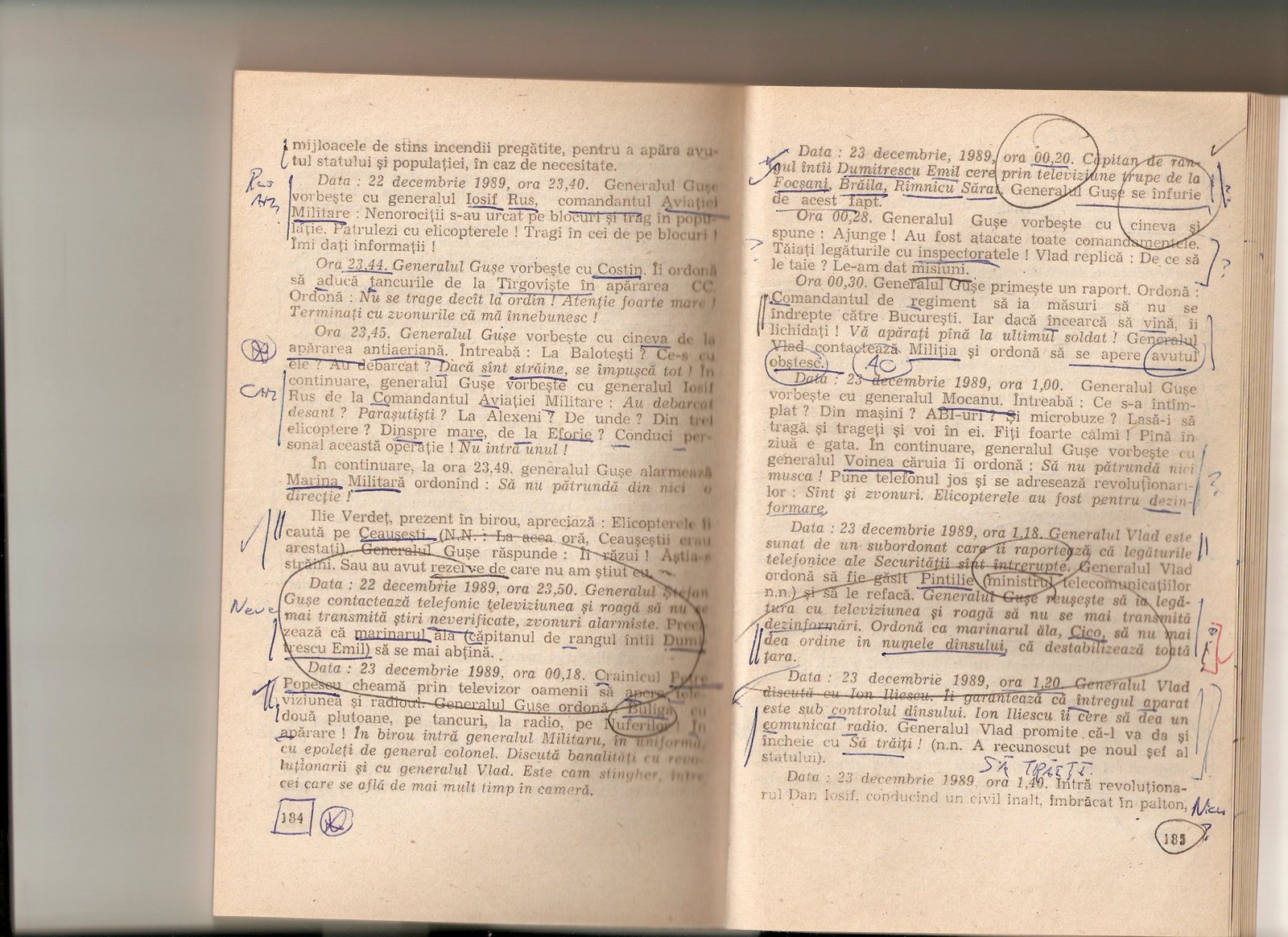
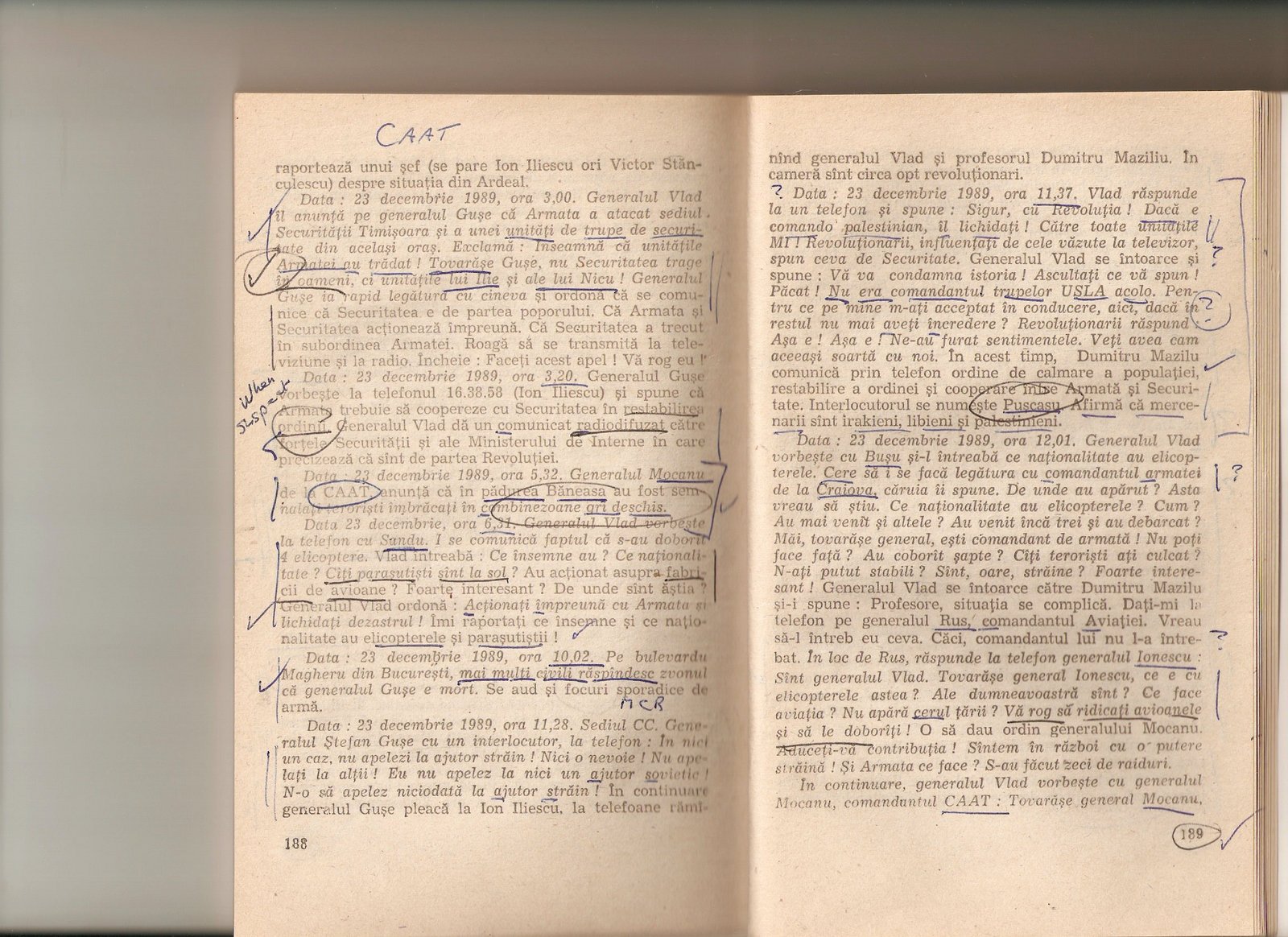
Finally, if the following personally stylized “transcript” of former Securitate officer (Military Counter-Intelligence, Directorate IV) Pavel Corut is anywhere close to accurate, it is clear that not only did General Vlad lie about the possibility (i.e. reality) that the unidentified helicopters in question belonged to his Securitate, but he attempted to suggest that the helicopters belonged to Hungary and were transporting Hungarian parachutists into Transylvania (see pages 186 and 187 below, Pavel Corut Floarea de Argint (Editura Miracol, 1994), pp. 182-191 ).

The above passage from page 187 shows pretty clearly that Securitate General Iulian Vlad was intentionally misleading the revolutionaries in the CC and others, as he alleges an invasion of Hungarian parachutists in six Transylvanian cities.  There is absolutely no evidence–either in accounts of the time or since–that Hungarian parachutists turned up in these cities.  Thus, while Vlad attempted to play dumb regarding the suspected presence and activation of Arab terrorists allied with the Securitate on behalf on the Ceausescus–particularly in the Black Sea Coast region–he was seeking to disseminate disinformation about a non-existent–but highly nationalist, paranoid, and potentially resonant, especially perhaps in Transylvania–invasion by neighboring Hungary.  He knew exactly what he was doing and what was transpiring.

In other words, Securitate General Vlad was engaging in what Romanians describe as:  “Hoţul strigă hoţii!  (The thief shouts out:  [Stop] thieves!)

Posted in decembrie 1989 | Tagged: , , , , , , , , , , , , , , , , , , , , , , , , , , , | 10 Comments »

Securitate Director General Iulian Vlad Identifies the Terrorists

Posted by romanianrevolutionofdecember1989 on September 1, 2013

image0-001

It took 22 years for the text of Securitate Director General Iulian Vlad’s handwritten declaration of 29 January 1990 to become public knowledge–thanks to former military prosecutor General Ioan Dan.  (Inevitably, there will no doubt be those who will allege that General Vlad was “forced” to write this declaration to save his skin, etc., that this was the “propaganda of the moment” and all a huge lie.  If that were the case, one would have expected Iliescu, Brucan, Militaru, Voican Voiculescu, etc. to have made every effort for Vlad’s declaration to leak to the media.  Instead, for 22 years it was hidden from public knowledge!)

Of Note:  No “Soviet tourists,” no DIA (Batallion 404) troops of the army’s intelligence wing, no “there were no terrorists:  the Army shot into everyone else and into itself”–in other words, none of the spurious claims that have littered the narrative landscape, fueled by the former Securitate over the past two decades plus.  No, Vlad knew who the terrorists of the Romanian Revolution of December 1989 were, because they reported to him!

image0

image0-002

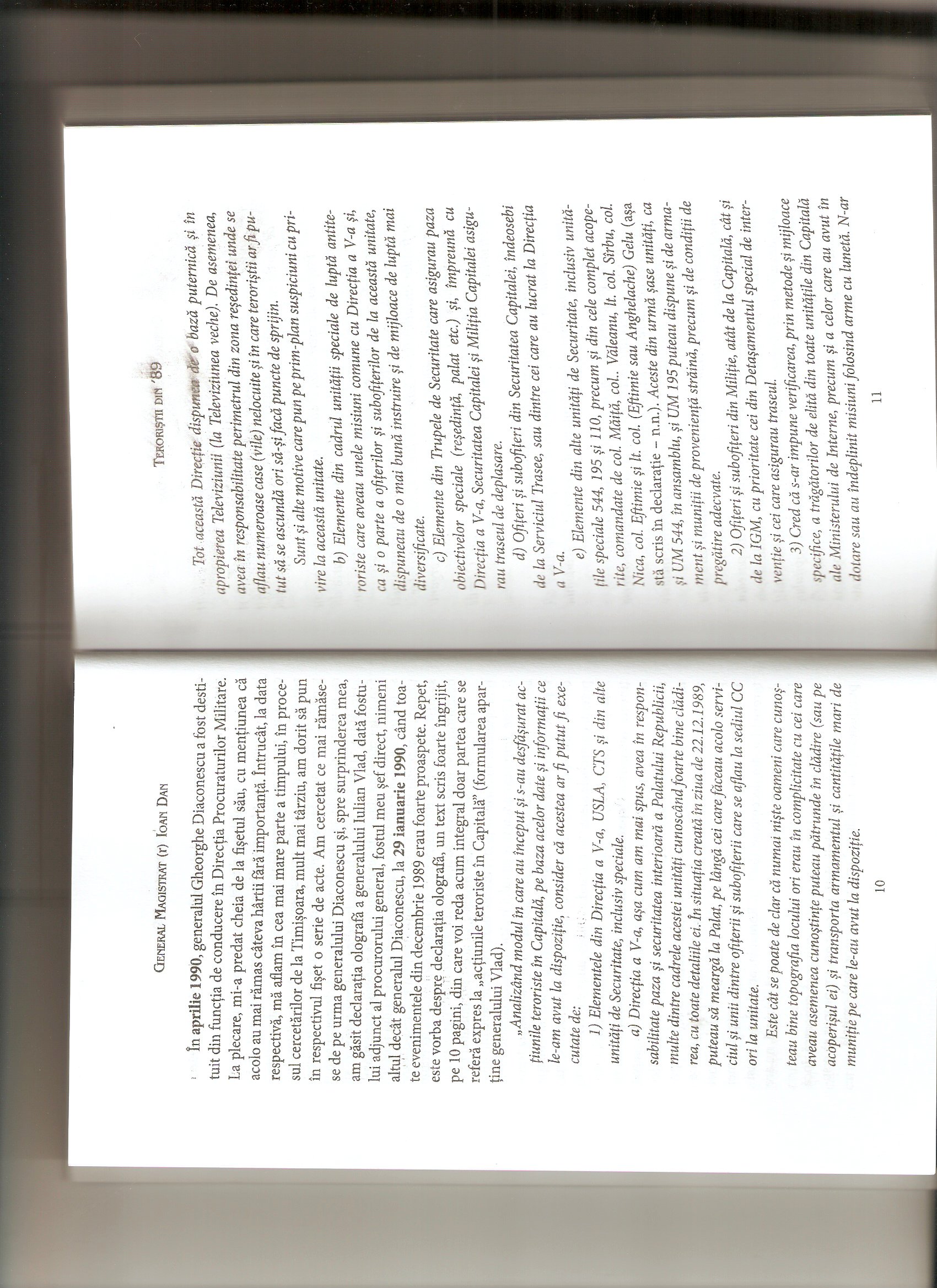
General Magistrat (r) Ioan Dan

In aprilie 1990, generalul Ghoerghe Diaconescu a fost destituit din functia de conducere in Directia Procuraturilor Militare.  La plecare, mi-a predat cheia de la fisteul sau, cu mentiunea ca acolo au mai ramas cateva hartii fara importanta. Intrucat, la data respectiva, ma aflam in cea mai mare parte a timpului, in procesul cercetarilor de la Timisoara, mult mai tarziu, am dorit sa pun in respectivul fiset o serie de acte.  Am cercetat ce mai ramasese de pe urma generalului Diaconescu si, spre surprinderea mea, am gasit declaratia olografa a generalului Iulian Vlad, data fostului adjunct al procurorului general, fostul meu sef direct, nimeni altul decat generalul Diaconescu, la 29 ianuarie 1990, cand toate evenimentele din decembrie 1989 erau foarte proaspete.  Repet, este vorba despre declaratia olografa, un text scris foarte ingrijit, pe 10 pagini, din care voi reda acum integral doar partea care se refera expres la “actiunile teroriste in Capitala” (formularea apartine generalului Vlad).

“Analizand modul in care au inceput si s-au desfasurat actiunile teroriste in Capitala, pe baza acelor date si informatii ce le-am avut la dispozitie, consider ca acestea ar fi putut fi executate de:

1) Elementele din Directia a V-a, USLA, CTS si din alte unitati de Securitate, inclusiv speciale.

a) Directia a V-a, asa cum am mai spus, avea in responsabilitate paza si securitatea interioara a Palatului Republicii, multe dintre cadrele acestei unitati cunoscand foarte bine cladirea, cu toate detaliile ei.  In situatia creata in ziua de 22.12.1989, puteau sa mearga la Palat, pe langa cei care faceau acolo serviciul si unii dintre ofiterii si subofiterii care se aflau la sediul CC ori la unitate.

Este ca se poate de clar ca numai niste oameni care cunosteanu bine topografia locului ori erau in complicitate cu cei care aveau asemenea cunostinte puteau patrunde in cladire (sau pe acoperisul ei) si transporta armamentul si cantitatile mari de munitie pe care le-au avut la dispozitie.

Tot aceasta Directie dispunea de o baza puternica si in apropierea Televiziunii (la Televiziunea veche).  De asemenea, avea in responsabilitate perimetrul din zona resedintei unde se aflau numeroase case (vile) nelocuite si in care teroristii ar fi putut sa se ascunda ori sa-si faca puncte de sprijin.

Sunt si alte motive care pun pe prim-plan suspiciuni cu privire la aceasta unitate.

b) Elemente din cadrul unitatii speciale de lupta antiterroriste care aveau unele misiuni comune cu Directia a V-a si, ca si o parte a ofiterilor si subofiterilor de la aceasta unitate, dispuneau de o mai buna instruire si de mijloace de lupta mai diversificate.

c) Elemente din Trupele de Securitate care asigurau paza obiectivilor speciale (resedinta, palat etc.) si, impreuna cu Directia a-V-a, Securitatea Capitalei si Militia Capitalei asigurau traseul de deplasare.

d) Ofiteri si subofiteri din Securitatea Capitalei, indeosebi de la Serviciul Trasee, sau dintre cei care au lucrat la Directia a V-a.

e) Elemente din alte unitati de Securitate, inclusiv unitatile speciale 544, 195 si 110, precum si din cele complet acoperite, comandate de col. Maita, col. Valeanu, lt. col. Sirbu, col. Nica, col. Eftimie si lt. col. (Eftimie sau Anghelache) Gelu (asa sta scris in declaratie–n.n.).  Aceste din urma sase unitati, ca si UM 544, in ansamblu, si UM 195 puteau dispune si de armament si munitii de provenienta straina, precum si de conditii de pregatire adecvate.

2) Ofiteri si subofiteri din Militie, atat de la Capitala, cat si de la IGM, cu prioritate cei din Detasamentul special de interventie si cei care asigurau traseul.

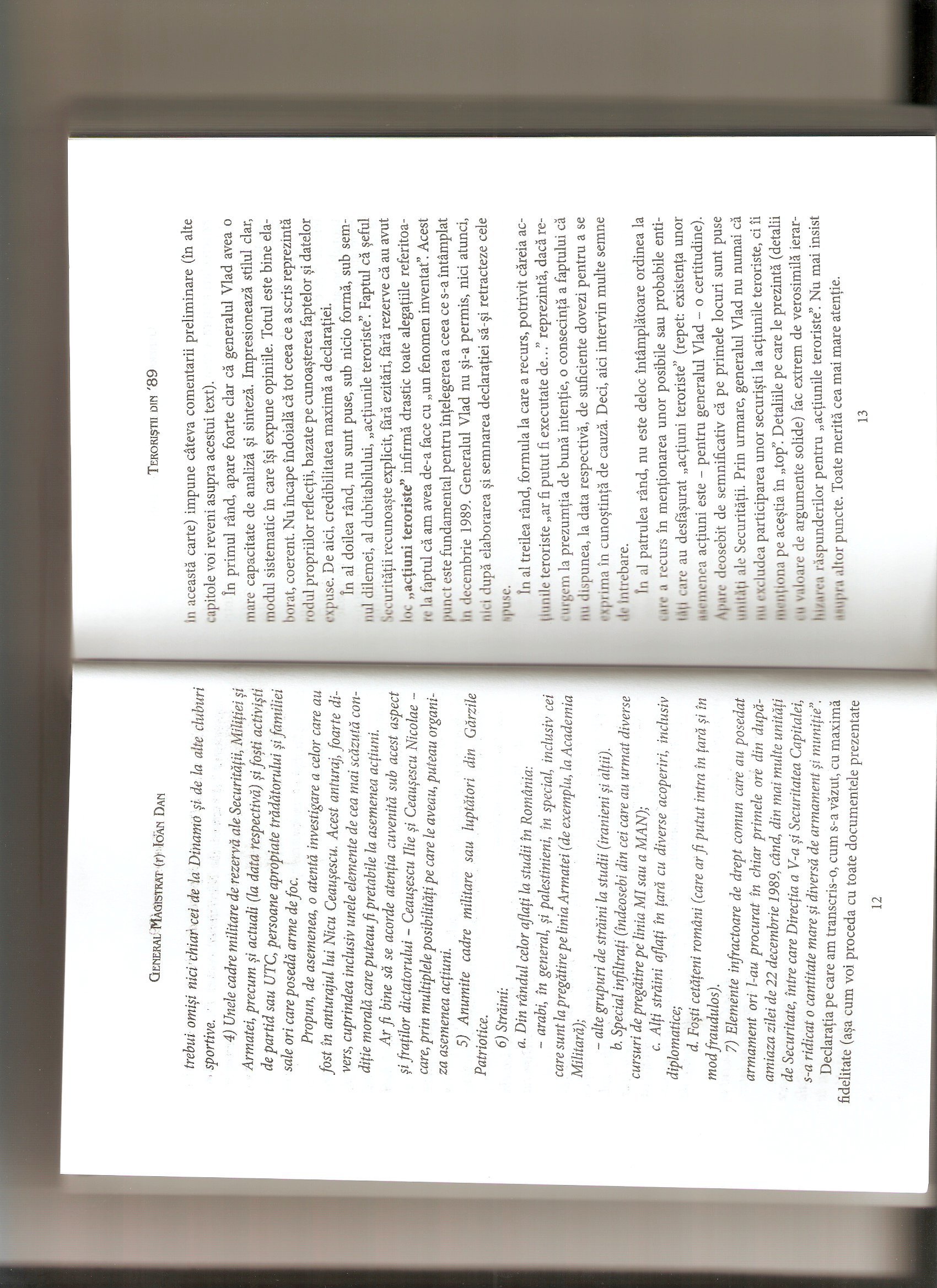
3) Cred ca s-ar impune verificarea, prin metode si mijloace specifice, a tragatorilor de elita din toate unitatile din Capitala ale Ministerului de Interne, precum si a celor care au avut in dotare sau au indeplinit misiuni folosind arme cu luneta.  N-ar trebui omisi nici chiar cei de la Dinamo si de la alte cluburi sportive.

4) Unele cadre militare de rezerva ale Securitatii, Militiei si Armatei, precum si actuali (la data respectiva) si fosti activisti de partid sau UTC, persoane apropriate tradatorului si familiei sale ori care poseda arme de foc.

Propun, de asemenea, o atenta investigare a celor care au fost in anturajul lui Nicu Ceausescu.  Acest anturaj, foarte divers, cuprindea inclusive unele elemente de cea mai scazuta conditie morala care puteau fi pretabile la asemenea actiuni.

Ar fi bine sa se acorde atentia cuvenita sub acest aspect si fratilor dictatorului–Ceausescu Ilie si Ceausescu Nicolae–care, prin multiplele posibilitati pe care le aveau, puteau organiza asemenea actiuni.

5) Anumite cadre militare sau luptatori din Garzile Patriotice.

6) Straini:

a. Din randul celor aflati la studii in Romania:

— arabi, in general, si palestinieni, in special, inclusiv cei care sunt la pregatire pe linia Armatei (de exemplu, la Academia Militara);

— alte grupuri de straini la studii (iranieni si altii).

b. Special infiltrati (indeosebi din cei care au urmat diverse cursuri de pregatire pe linia MI sau a MAN);

c. Alti straini aflati in tara cu diverse acoperiri, inclusiv diplomatice;

d. Fosti cetateni romani (care ar fi putut intra in tara si in mod fraudulos).

7) Elemente infractoare de drept comun care au posedat armament ori l-au procurat in chiar primele ore din dupa-amiaza zilei de 22 decembrie 1989, cand, din mai multe unitati de Securitate, intre care Directia a V-a si Securitatea Capitalei, s-a ridicat o cantitate mare si diversa de armament si munitie.”

Posted in decembrie 1989, raport final | Tagged: , , , , , , , , , , , , , , , , , , | 2 Comments »

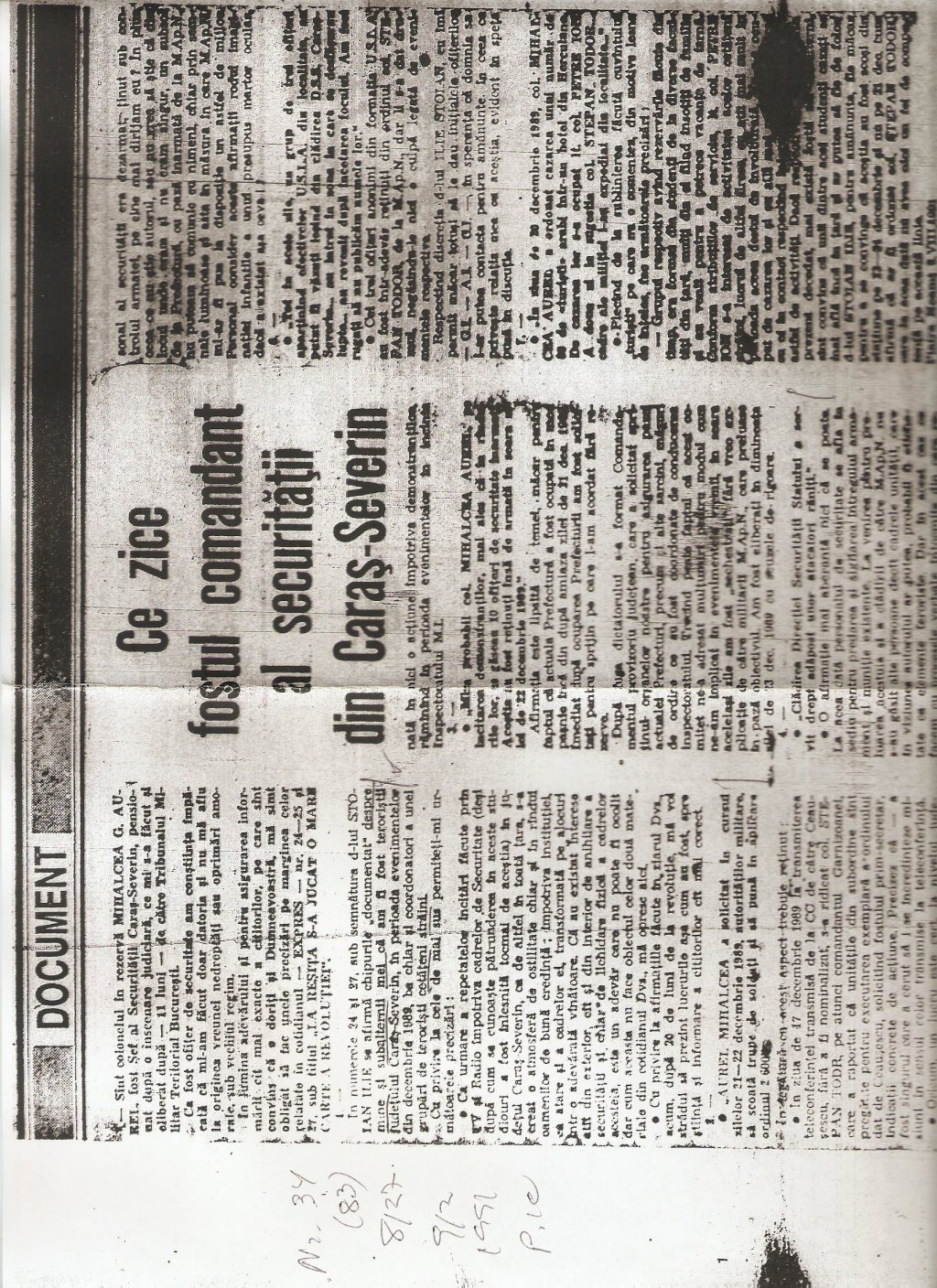
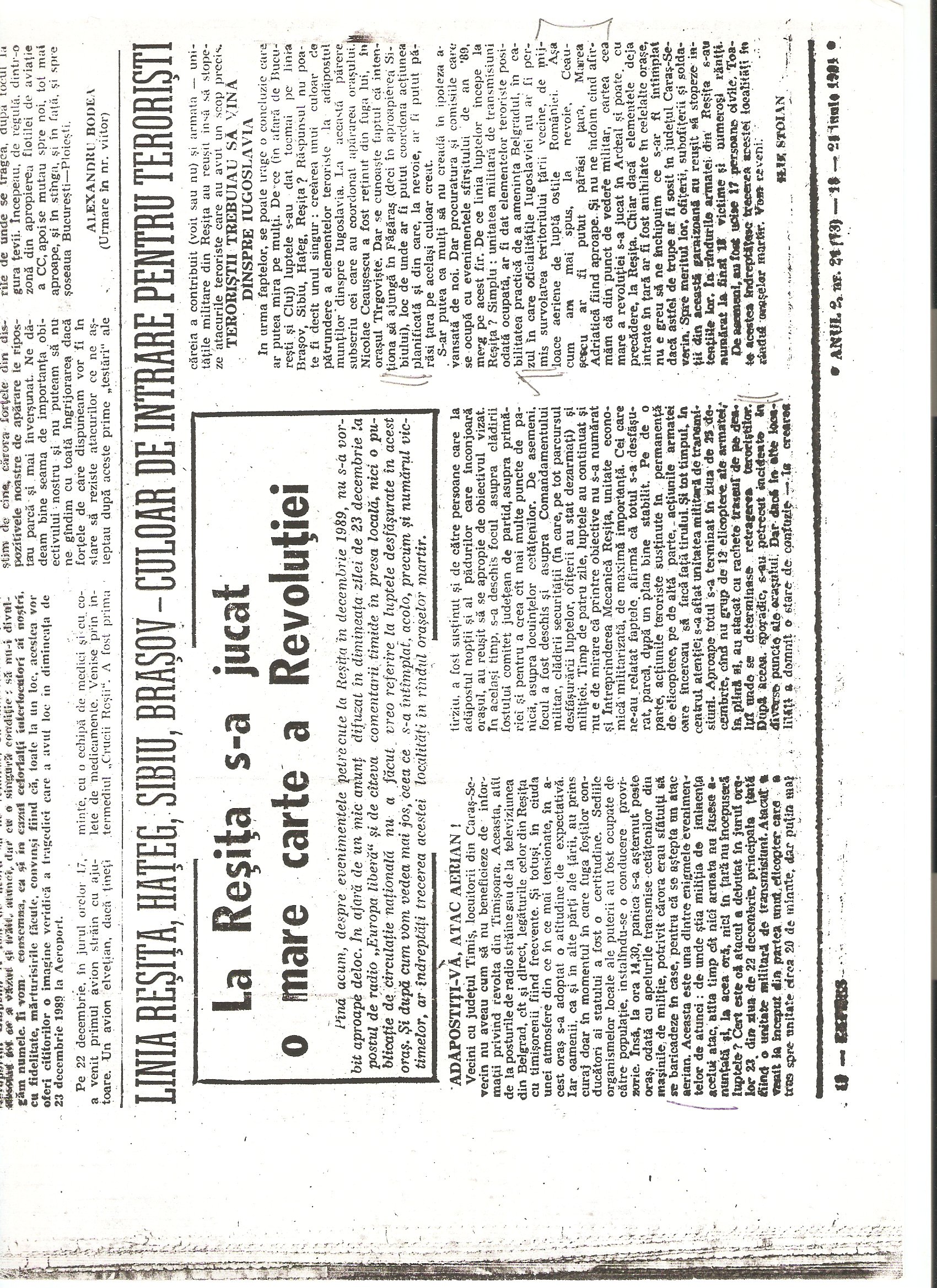
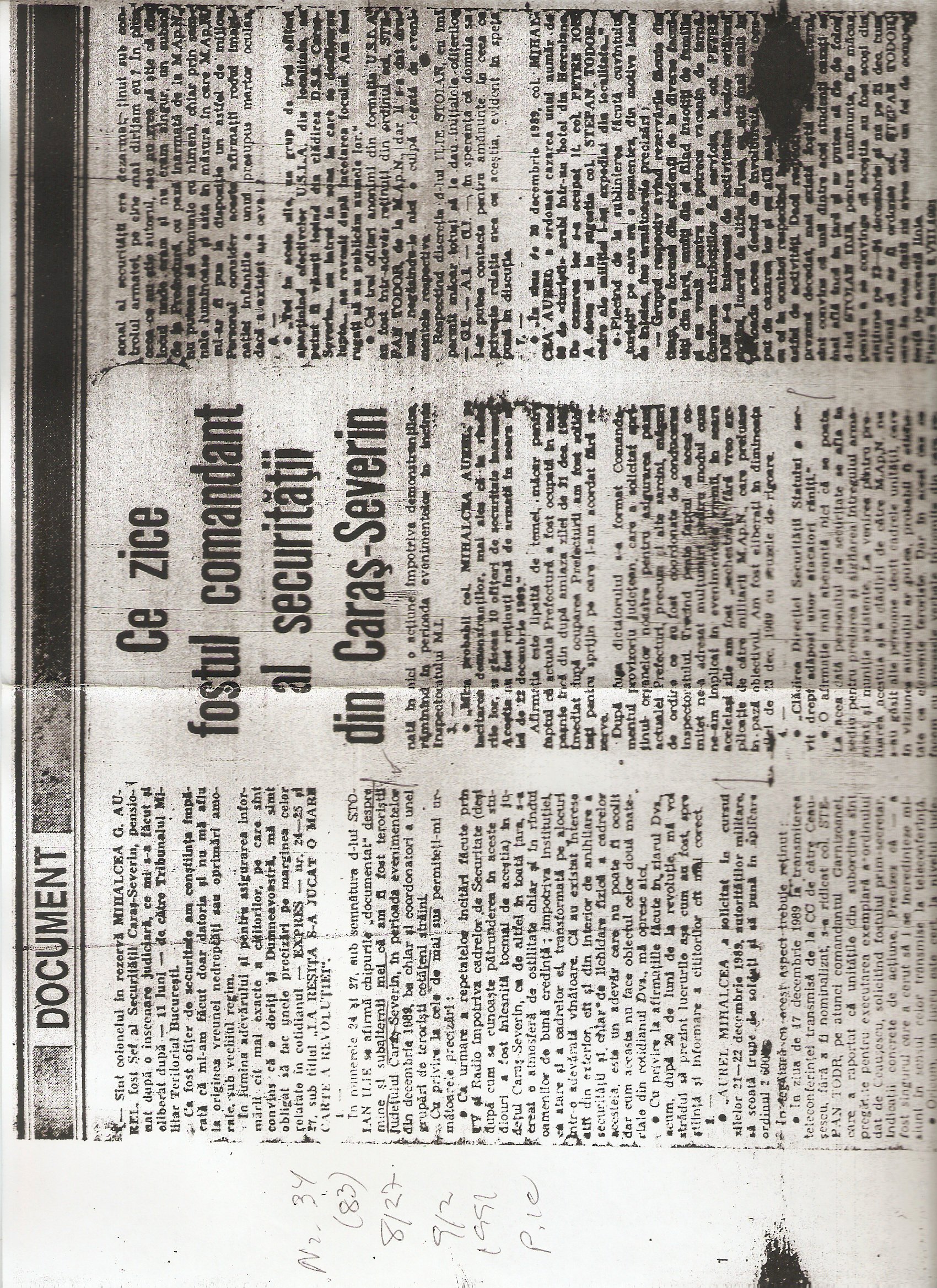
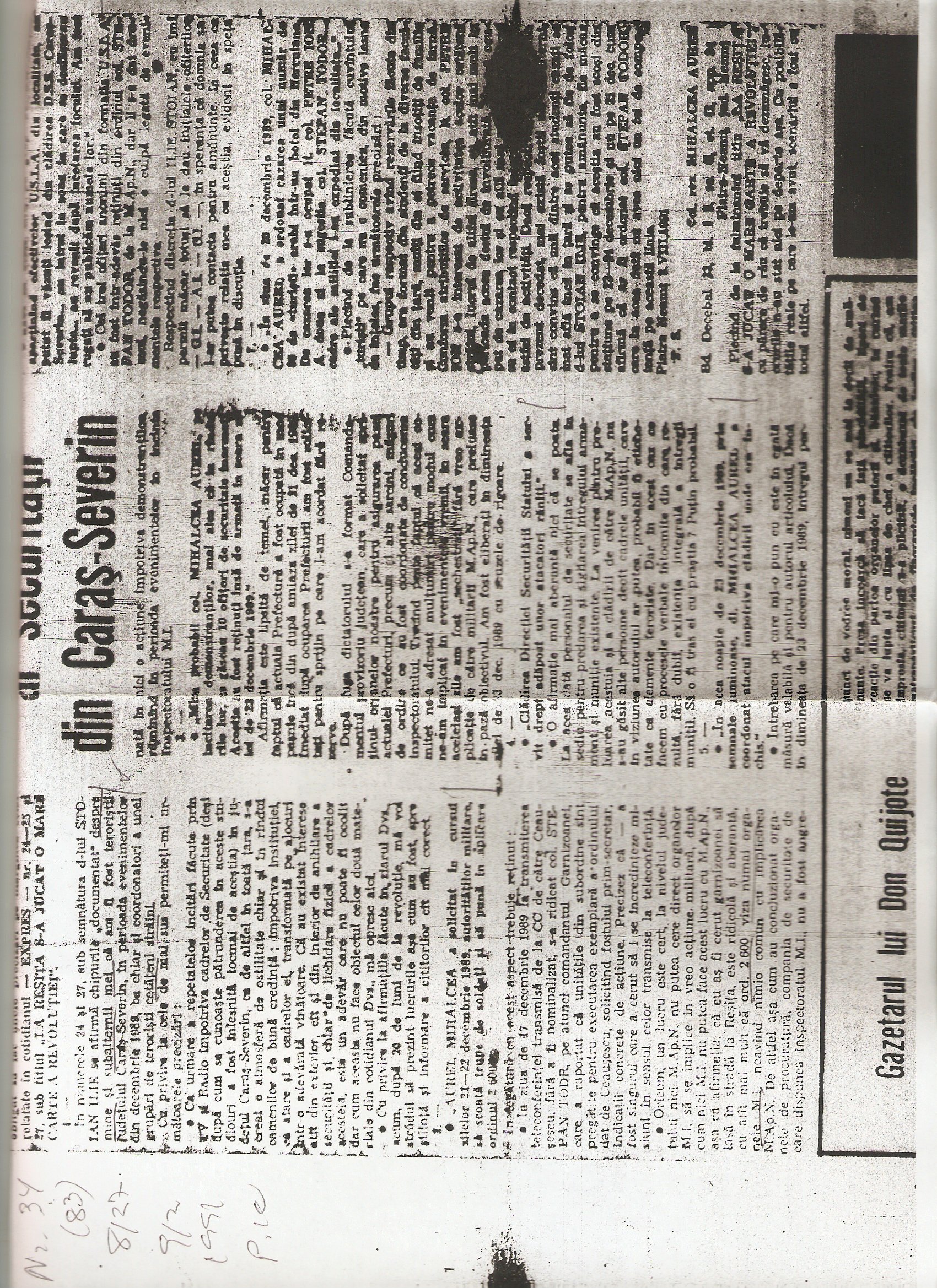
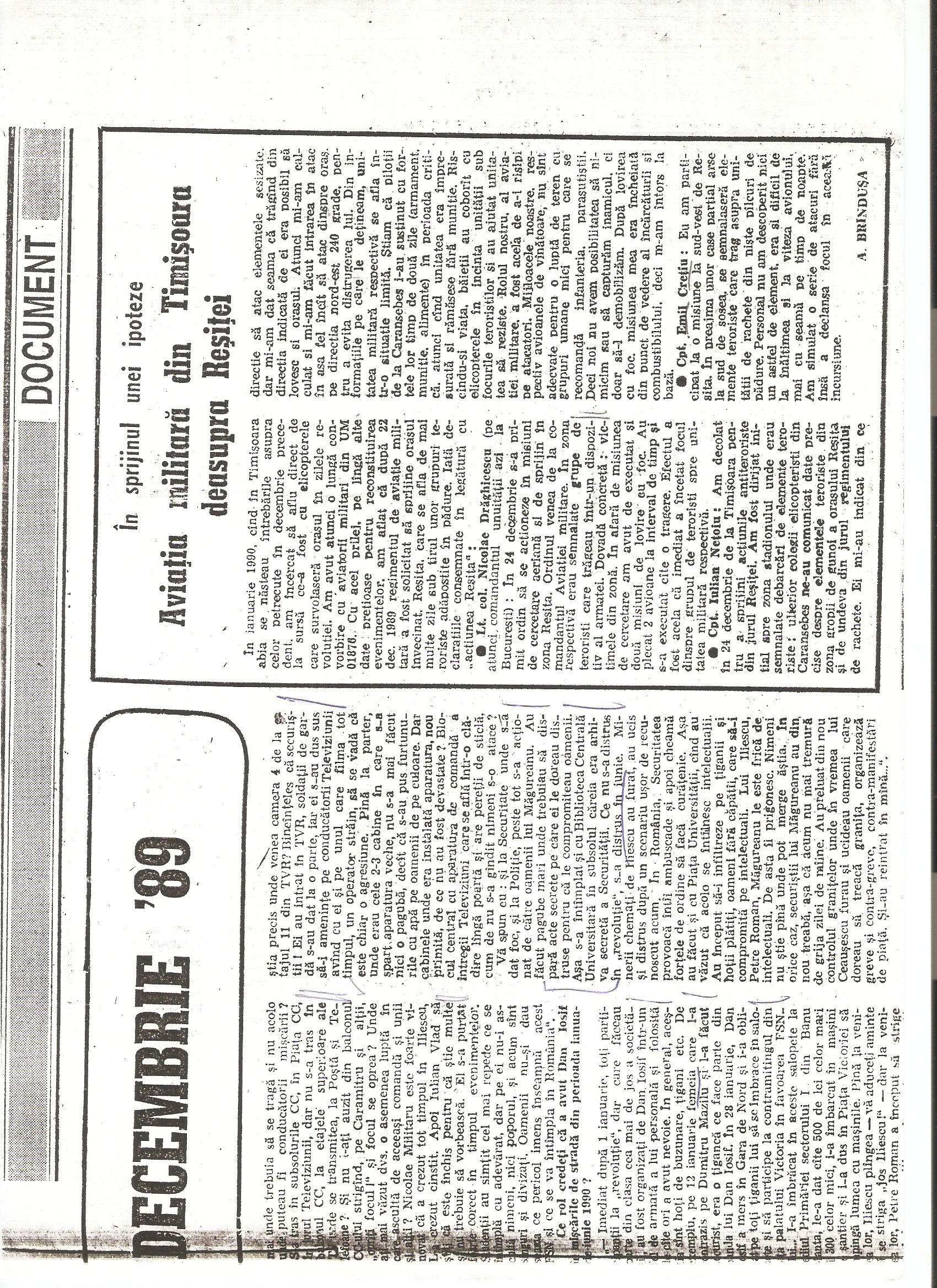
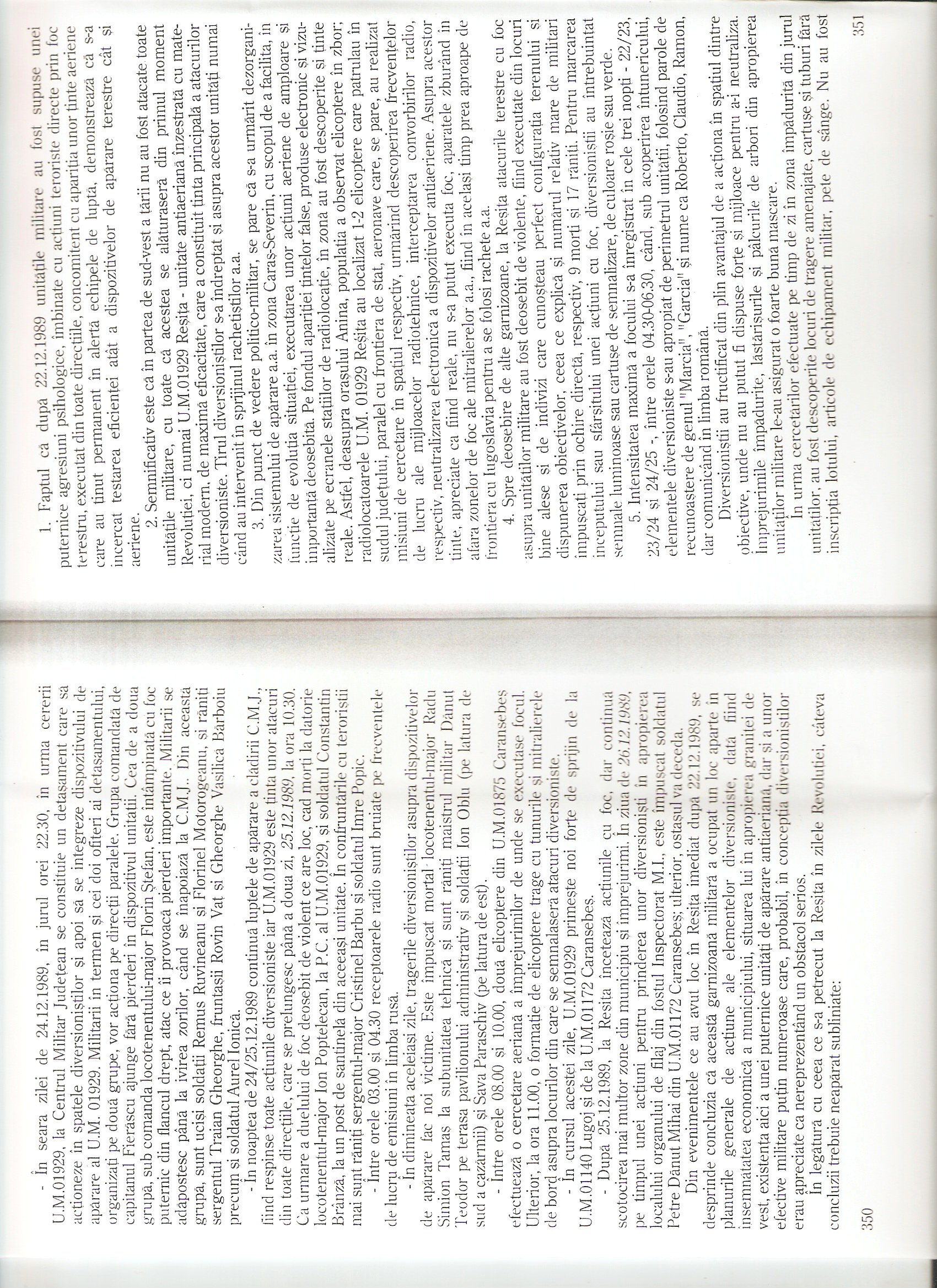
La Resita s-a jucat o mare carte a Revolutiei (Dovada de adevar: ce spun fosti securisti?! Revista Vitralii)

Posted by romanianrevolutionofdecember1989 on August 17, 2013

http://atomic-temporary-3899751.wpcomstaging.com/2013/05/05/la-resita-s-a-jucat-o-mare-carte-a-revolutiei/

Reşiţa a plătit şi ea cu sânge dorinţa de schimbare a regimului socialist. Capitala Banatului de munte a dat ca jertfă un număr de aproximativ 65 de morţi, toţi aceştia fiind victimele diversiunii securisto-teroriste aservite vechiului regim, în încercarea sa de a menţine teroarea asupra populaţiei din judeţul Caraş-Severin şi după evacuarea cuplului de dictatori în data de 22 Decembrie 1989.

http://www.memorialulrevolutiei.ro/index.php?page=evenimente/2012/vernisaj-reia
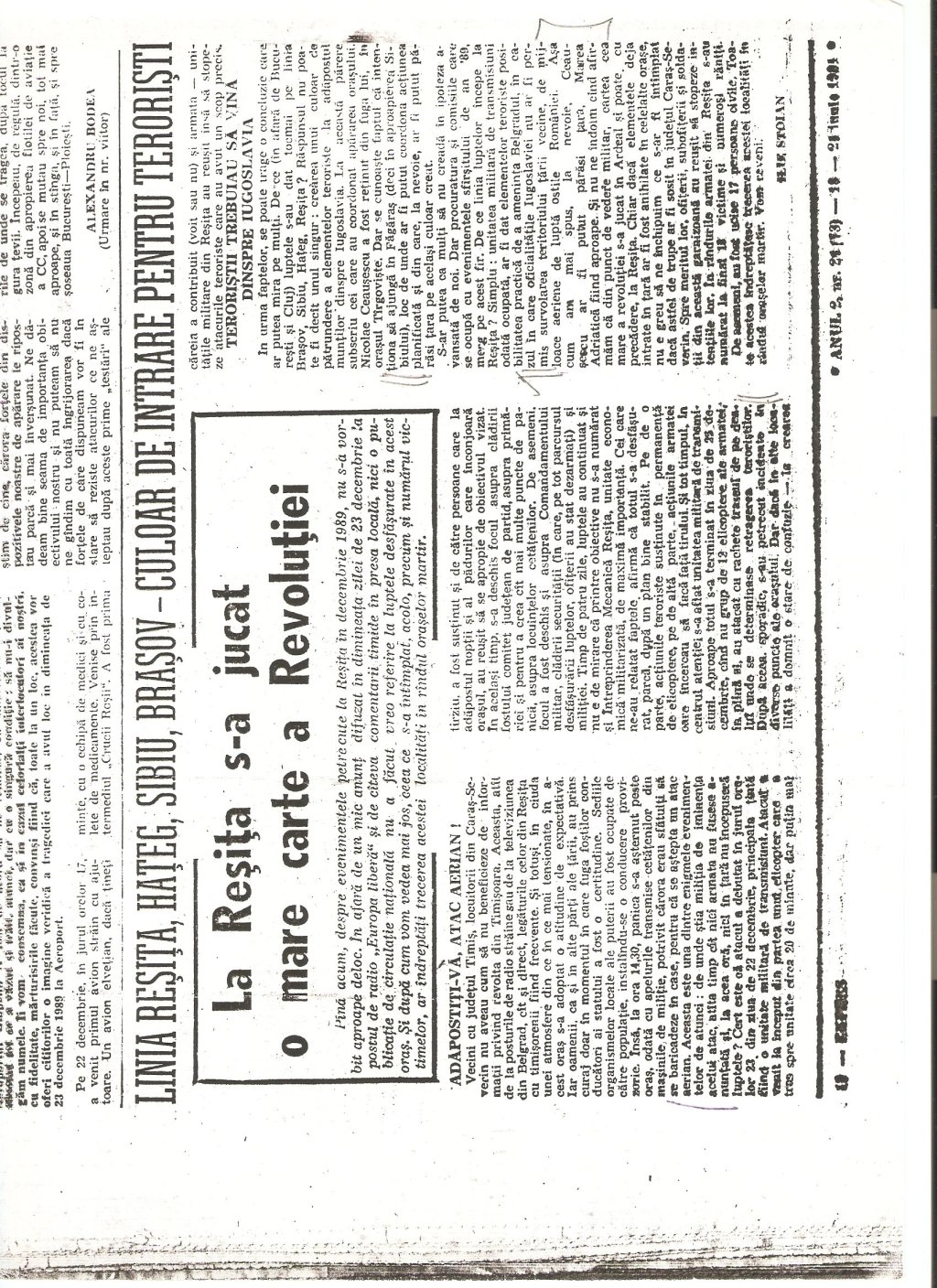
 image0-001

56 VITRALII – LUMINI ŞI UMBRE
REŞIŢA: CUM AM DEVENIT „ŞEFUL TERORIŞTILOR”
Deşi intervenţia mea poate părea tardivă, consider că sunt dator, ca fost
şef al Securităţii din Inspectoratul MI al judeţului Caraş-Severin, să contribui la
ridicarea vălului de dezinformări, minciuni şi manipulări care s-au vehiculat
despre cadrele de Securitate.
Acum începem să aflăm adevărul, acum putem, după atâţia ani, să
înţelegem cum şi de ce, în decembrie 1989, s-au putut petrece acele grozăvii,
cine au fost cei care fabricau scenariile, cine au fost cei care le ordonau, le
răspândeau sau le executau.
Foarte pe scurt, doar câteva aspecte din perioada premergătoare:
Pe fondul lipsurilor în care ne zbăteam, şi în judeţul nostru
nemulţumirile populaţiei s-au amplificat, situaţia devenind explozivă. Zilele lui
Ceauşescu păreau a fi numărate, mulţi dintre noi punându-şi speranţa în cel deal XIV–lea Congres al PCR, care însă a fost dezamăgitor. Am constatat o
creştere a virulenţei manifestărilor anticeauşiste, dar ne-am limitat numai la
raportarea ierarhică a informaţiilor primite.
Nu puţine informaţii ne parveneau şi din exterior. Astfel, un director
german de la firma mixtă „Renk-Reşiţa”, întorcându-se din ţara natală, s-a
adresat celor care îl aşteptau la aeroport cu cuvintele: „Nu mai aveţi mult şi
până în decembrie scăpaţi de Ceauşescu”.
Constatam trecerea tot mai intensă a frontierei, atât legal cât şi ilegal,
depistând agenţi şi tot felul de emisari străini veniţi cu sarcini destabilizatoare,
precum şi pătrunderea în ţară a unor fugari anterior instruiţi şi pregătiţi în
exterior cu scopul de a forma pichete ale dezordinii la un semnal dat.
Mai mult, aşa după cum a reieşit din cercetarea acestora, în aşteptarea
acelui moment cei în cauză erau instruiţi să lanseze zvonuri alarmiste; să racoleze
noi persoane pretabile la acţiuni de dezordine şi de incitare; să creeze noi canale de
trecere ilegală a graniţei; să studieze modalităţile de distrugere a unor obiective
social-politice şi economice; să culeagă şi să transmită date despre aceste
obiective, precum şi despre activiştii de partid, despre cadrele MI etc.
Asemenea elemente depistate de Inspectoratul MI al judeţului Caraş-
Severin au fost preluate în acelaşi scop, de cercetare, şi de către unităţile centrale
ale Securităţii, stabilindu-se misiunile clandestine ce le aveau de îndeplinit în
România, primite îndeosebi de cei trecuţi prin lagărul de la Bicske, Ungaria.
În ziua de 21 decembrie 1989 au fost semnalate 14 autoturisme cu turişti
sovietici în centrul oraşului Reşiţa; în preajma evenimentelor, pe şoselele judeţului
circulau astfel de coloane, care au făcut obiectul cercetărilor efectuate de un VITRALII – LUMINI ŞI UMBRE 57
colectiv condus de şeful Miliţiei – colonel Câmpeanu Alexandru (unul dintre
autoturisme fusese distrus într-un accident soldat cu moartea celor doi pasageri).
Consider că este un fapt deja clarificat că nu pentru turism veniseră
aceştia în România.
Pentru noi, cei de la Securitate, a contat mult o convocare organizată în
acea perioadă pe regiuni ale ţării de către conducerea centrală, cu prilejul căreia
s-au trasat sarcinile ce ne reveneau, în sensul de a cunoaşte în permanenţă
starea de spirit; de a nu ne implica în acţiuni stradale de reprimare a unor
eventuale demonstraţii; de a nu panica subordonaţii şi alte asemenea ordine, cu
accent pe informarea cu operativitate a forurilor ierarhic superioare.
Aşadar, starea de fapt creată în ultima parte a anului 1989, generatoare
de revoltă a populaţiei, cât şi faptul că în toate instituţiile şi unităţile economice
s-au organizat adunări având ca scop condamnarea celor petrecute în
Timişoara, au culminat şi la Reşiţa, cum era previzibil, cu ieşirea în stradă a
demonstranţilor încă din 21 decembrie. Aceştia au ocupat piaţa centrală a
oraşului şi manifestau, scandând revendicări legate de condiţii mai bune de
muncă şi viaţă: apă caldă, căldură, aprovizionare etc., şi exprimându-şi
simpatia faţă de timişoreni.
De menţionat că în tot acest timp cadrele MI din toate localităţile
judeţului nu au intervenit pentru a împiedica aceste manifestări, în ciuda
instrucţiunilor primite de la conducerea de partid locală care, textual, ne cerea:
„Nu scăpaţi muncitorii în stradă!”
Spre sfârşitul zilei de 21 decembrie, o parte dintre demonstranţi au pătruns
în sediul Comitetului judeţean de partid, astăzi Prefectura judeţului, dorind a
dialoga asupra revendicărilor lor. Personalul militar din Inspectoratul MI Caraş-
Severin care asigura paza sediului şi a oficialităţilor de atunci s-a comportat
exemplar. Împreună cu liderii demonstranţilor, aceştia au reuşit să atenueze unele
stări tensionale care începuseră să apară, au determinat încetarea lozincilor
incitatoare la dezordine şi a zvonurilor alarmiste cu tentă de violenţă.
Numeroase au fost măsurile luate de conducerea Inspectoratului, la
solicitarea liderilor, în acea noapte, spre a împiedica săvârşirea de acte cu
implicaţii imprevizibile, accentul punându-se pe paza instituţiilor şi a
obiectivelor economice din municipiu.
Pe timpul nopţii de 21-22 decembrie am fost solicitat de liderul ad-hoc
al revoluţionarilor pătrunşi în sediul Comitetului judeţean de partid, un pictor,
pe nume Nicolae Vlădulescu (devenit ulterior preşedintele FSN Caraş-
Severin), să verific prin subordonaţii mei numeroasele zvonuri alarmiste sau de
natură incitatoare. De asemenea, i-am pus la dispoziţie mijloacele umane şi
tehnice necesare pentru a se adresa demonstranţilor, asigurându-i că Securitatea
este de partea lor.58 VITRALII – LUMINI ŞI UMBRE
Încă din 21 decembrie, conform ordinului transmis telefonic de
generalul Iulian Vlad, armamentul din dotarea subordonaţilor a fost depus la
rastel, iar ofiţerii şi subofiţerii de Securitate au fost instruiţi să nu părăsească
unitatea decât la ordin şi să nu răspundă la eventuale provocări.
Manifestările de revoltă împotriva lui Ceauşescu au continuat şi în
dimineaţa zilei de 22 decembrie, când coloane de muncitori de la marile
obiective economice ale municipiului Reşiţa s-au deplasat spre centrul oraşului,
scandând lozinci anticeauşiste, şi s-au alăturat celor ce ocupaseră piaţa centrală
în ziua precedentă.
Pe tot parcursul zilei de 22 decembrie manifestările nu s-au soldat cu
incidente, iar procesul de preluare a puterii a decurs în mod paşnic, aşa cum s-a
petrecut şi în alte oraşe ale judeţului, cu excepţia municipiului Caransebeş.
După alegerea comitetului provizoriu al Frontului Salvării Naţionale pe
judeţ, preşedintele acestuia, Nicolae Vlădulescu, ne-a convocat în după-amiaza
zilei de 22 decembrie (pe subsemnatul şi pe şeful Miliţiei judeţene) la sediul
Prefecturii de azi, ce se afla încă sub paza instituţiei noastre. Cu această ocazie, a
evidenţiat modul reuşit în care cadrele Inspectoratului nostru au acţionat,
prevenind acţiuni violente şi acte de dezordine în municipiu, şi ne-a fixat sarcini
pentru a doua zi, când urma să ne prezentăm din nou la el. La terminarea
discuţiilor a ţinut să ne aducă mulţumiri din partea FSN şi, prin noi, tuturor
cadrelor din subordine, pentru sprijinul acordat, pentru evitarea apariţiei unor
victime, pentru faptul că a fost posibil să nu se tragă nici un foc de armă în Reşiţa.
Noaptea de 22 spre 23 decembrie a însemnat şi pentru judeţul Caraş-
Severin o cotitură nefastă în desfăşurarea evenimentelor, urmare celor
orchestrate de la Bucureşti de echipa generalului Nicolae Militaru, proaspăt
numit la conducerea Armatei, despre care ştiam că fusese trecut în rezervă
pentru activitate de trădare în favoarea unei puteri străine.
Ca profesionist al informaţiilor, presimţeam că această numire nu este
de bun augur, iar faptele reprobabile şi atrocităţile comise în zilele următoare în
Reşiţa au dovedit că nu m-am înşelat. Şi asta s-a întâmplat pentru că în unele
judeţe (ca şi în Caraş-Severin) au existat comandanţi militari zeloşi, după
chipul şi asemănarea generalului Militaru, care i-au urmat orbeşte ordinele,
devenind principalii factori destabilizatori ai noii puteri.
În ziua de 22 decembrie, Securitatea judeţeană a fost preluată sub
control de colonelul Teodor Stepan, la data respectivă şef al Centrului Militar
al judeţului Caraş-Severin şi, după cum au urmat lucrurile, se părea că ne vom
continua activităţile specifice în noua subordonare a FSN. Pe radarele de la
graniţă apăruseră ţinte aeriene într-un număr atât de mare, încât ne pregăteam
să facem faţă unui eventual atac aerian.VITRALII – LUMINI ŞI UMBRE 59
Liniştea ce se aşternuse în conştiinţa noastră de militari, cum că ne-am
făcut datoria în acele condiţii deosebite nu a durat însă decât până în seara zilei
de 22 decembrie, când am constatat că legăturile telefonice ne-au fost tăiate,
când a început lansarea unor zvonuri, precum atacarea de către trupe
nedefinite, otrăvirea apei etc.
În aceeaşi zi, în jurul orei 2300, mi s-a cerut să mă deplasez la sediul
FSN, deoarece cadrele Ministerului de Interne care asigurau paza acestuia, ca
şi cei stabiliţi în garda de corp a noilor conducători sau cei ce fuseseră solicitaţi
de însuşi colonelul Teodor Stepan pentru diverse misiuni, fuseseră sechestraţi.
Ajuns la sediul amintit, am fost foarte surprins de faptul că am fost
percheziţionat şi suspectat ca aş fi intenţionat să atac revoluţionarii şi am luat la
cunoştinţă că paza fusese preluată de militarii colonelului Stepan. Consternat
de aceste răsturnări de situaţie, am fost dus într-un birou şi acuzat că am trădat
revoluţia şi că desfăşor acţiuni împotriva poporului român.
Închis în acel birou, singur şi în imposibilitate de a-mi îndeplini
atribuţiunile de până atunci, am asistat la vânzoleala penibilă, în unele situaţii
chiar tragică, auzind informaţii şoc, precum că trupe fidele lui Ceauşescu atacă
Reşiţa, că se trage spre sediul Inspectoratului MI etc.
În jurul orelor 3 din dimineaţa zilei de 23 decembrie, după ce se mai
liniştise canonada, am fost scos din camera amintită de către militarii
colonelului Stepan şi dus în biroul preşedintelui FSN, unde mi s-a spus, cu o
oarecare jenă, ca voi părăsi clădirea pentru a-mi exercita atribuţiunile ce îmi
reveneau, dându-mi-se în primire şi cei 9 ofiţeri MI care, de asemenea, fuseseră
dezarmaţi şi sechestraţi în condiţiile arătate.
Ajuns la sediul Securităţii, mi s-a raportat ca în acea noapte clădirea
Inspectoratului a fost atacată cu gloanţe de mitralieră, de la o unitate de rachete ce
se afla pe un podiş de pe teritoriul municipiului şi că au fost făcute cercetări asupra
gloanţelor identificate, dar că militarii noştri de pază nu au răspuns atacului.
Am informat conducerea Inspectoratului despre cele întâmplate cu mine
şi cu militarii sechestraţi şi împreună am apreciat că militarii din paza
Inspectoratului au procedat foarte bine atunci când nu au răspuns cu foc
atacului amintit, fiind vorba de o provocare.
În dimineaţa aceleiaşi zile de 23 decembrie, am fost anunţaţi să ne
deplasăm, conducerea inspectoratului, la sediul FSN. Ştiind că acest lucru
rămăsese stabilit din ziua precedentă, în cadrul discuţiilor cu preşedintele FSN,
am mers liniştiţi, nebănuind nimic din cele ce urma să ni se întâmple.
Ajunşi la FSN, în biroul preşedintelui Nicolae Vlădulescu, am constatat
că mai erau prezenţi adjunctul acestuia (fostul prim-secretar Szasz Iosif),
colonelul Teodor Stepan, mai mulţi revoluţionari şi ziarişti, printre care şi Dan
Dinu Glăvan. După unele discuţii legate de situaţia existentă la acea oră în 60 VITRALII – LUMINI ŞI UMBRE
municipiu, a intervenit colonelul Teodor Stepan, care a început să debiteze un
scenariu ridicol de superficial şi de prost argumentat, vădit incriminant la
adresa conducerii Inspectoratului MI. Din acuze reieşea că eu aş fi şeful
teroriştilor, că am legături la Bucureşti, de unde primesc instrucţiuni pentru a
dirija acţiunile în judeţ împotriva revoluţiei, că aş dispune de depozite de
armament şi muniţie sofisticată, că aş fi dat dispoziţii subalternilor să distrugă
arhiva Securităţii etc. Riposta mea de a demonta asemenea aberaţii a fost
hotărâtă, fără a-l determina însă să îşi retragă scenariul prezentat.
Într-un final, adjunctul preşedintelui, Szasz Iosif, sesizând netemeinicia
acuzaţiilor invocate de colonel şi dorind, probabil, să curme situaţia penibilă ce
se crease, a propus ca cei din conducerea Inspectoratului MI să fim lăsaţi liberi
pentru a ne putea continua activitatea în noua situaţie, atragându-ne atenţia de a
ne subordona întrutotul colonelului Stepan Teodor, care reclamase anterior aşazise acte de insubordonare.
Această intervenţie a fost însă de natură să-l irite şi mai mult pe colonel,
care a ieşit din birou, reîntorcându-se după un timp cu un ofiţer subordonat şi
doi militari. Acestora li s-a ordonat să povestească un alt scenariu, la fel de
prost documentat, prin care susţineau că în noaptea respectivă ar fi văzut ieşind
dintr-un bloc apropiat Inspectoratului nostru un terorist care şi-ar fi camuflat un
pistol rabatabil într-o servietă diplomat; că acesta ar fi intrat în sediul
Securităţii, că în tot cursul nopţii acolo ar mai fi pătruns şi alte persoane, unele
rănite; că în curtea Inspectoratului MI ar fi văzut intrând o Salvare şi mai multe
maşini particulare etc.
În aceste condiţii, m-am situat pe aceeaşi poziţie de loialitate şi
onestitate, încercând să clarific toate suspiciunile ce planau (doar în mintea lor)
asupra noastră. Ceilalţi colegi din conducerea Inspectoratului au început să dea
explicaţii în sprijinul celor susţinute de mine, prezentând diverse aspecte şi
fapte cu care s-au confruntat pe linie de Miliţie. Aceştia au mai spus că asupra
clădirii Inspectoratului, în acea noapte s-au tras rafale de mitralieră. Colonelul
Teodor Stepan a replicat că s-a tras de la acea unitate pentru că au constatat că
s-ar fi făcut semnale luminoase şi că în acele împrejurări li s-ar fi împuşcat un
ostaş. Adevărata împrejurare în care a murit acel soldat mi-a fost dezvăluită
ulterior, în timp ce mă aflam în arestul unităţii, de către un subofiţer ce
participase la acele evenimente, afirmaţii confirmate ulterior de către un vecin,
revoluţionar, Bărbulescu Gheorghe, care mi-a explicat că de fapt a fost un
accident între ostaşi.
Colonelul Teodor Stepan a curmat discuţiile, cu dreptul celui care are
puterea. A reluat acuzaţiile anterioare legate de instruirea subordonaţilor mei spre a
desfăşura acte îndreptate împotriva revoluţiei, fiind vizibil că dorea arestarea mea
şi a celorlalţi. În urma acestor acuzaţii, preşedintele Vlădulescu Nicolae ne-a cerut, VITRALII – LUMINI ŞI UMBRE 61
celor din conducerea Inspectoratului, să părăsim pentru un timp încăperea.
Nu ştiu ce s-a mai discutat în lipsa noastră, dar după aceea am fost
chemaţi înapoi în birou, preşedintele m-a abordat astfel: „Domnule colonel…
sunt convins că nu puteai acţiona ca terorist… aşa cum s-a spus,… dar te rog să
explici dacă ai cunoştinţe despre astfel de terorişti care acţionează sau vor să
acţioneze în judeţ…, dacă ai primit instrucţiuni în acest sens? “
La răspunsul meu negativ, mi-a spus să accept sechestrarea, până când,
în următoarele zile, se vor clarifica problemele, hotărând ca împreună cu
inspectorul şef, colonel Rădulescu Gheorghe, să rămânem în acel sediu. A mai
afirmat, la despărţire: „Dacă asigurările dumneavoastră se vor confirma, atunci
fiţi siguri că tot noi vom fi aceia care vă vom cere scuze”.
Acestea fiind spuse, am fost conduşi de un ofiţer MApN la subsolul
clădirii amintite, unde au eliberat în grabă o cameră, iar şeful Miliţiei,
Câmpeanu Alexandru, a fost învestit, în prezenţa noastră, să preia comanda
efectivelor Inspectoratului. În continuare, lucrurile s-au derulat la Reşiţa ca şi
la Sibiu şi în alte oraşe din ţară.
În zadar am tot aşteptat scuzele pentru arestarea mea ilegală, deoarece
colonelul Teodor Stepan, pentru a se erija într-un erou şi salvator al oraşului
Reşiţa, m-a popularizat prin mass-media ca şef al teroriştilor care i-aş fi
pricinuit multe suferinţe.
Şi acum câteva cuvinte doar despre personajul care după evenimente a
obţinut avansarea la gradul de general, fapt care aproape că nu mai miră pe
nimeni. El – şi ca el mulţi alţii – s-au încadrat în rândul profitorilor noului
regim, s-au transformat în virulenţi adversari ai Securităţii şi s-au străduit ca
despre persoana lor să se creeze o cu totul altă imagine decât cea reală.
Stepan Teodor, ofiţer de Transmisiuni promoţia 1958, a lucrat, de la
înălţarea sa la gradul de locotenent, în structurile Direcţiei de Informaţii a
Armatei. A ajuns diplomat la ambasada română din Atena, de unde a fost retras
după o perioadă foarte scurtă de şedere la post. (Nu cumva trebuie să ne
întrebăm de ce?). Contrainformaţiile Militare ajunseseră la concluzia că ar
trebui trecut în rezervă, pe motive similare cazului Militaru. Nu a fost
îndepărtat din Armată, ci doar mutat într-o funcţie mai puţin sensibilă, aceea de
şef al Centrului militar judeţean Caraş-Severin.
După ştiinţa mea, a mai existat un caz asemănător, cel al colonelului
Marin Pancea, fost ataşat militar la Paris şi Belgrad. Şi acesta, după ce a fost
documentat ca agent sovietic, a fost scos din DIA şi trimis şef al Centrului
Militar din Brăila. În decembrie 1989, Marin Pancea a preluat comanda
garnizoanei Brăila, consecinţa ordinelor sale aberante fiind 44 de morţi şi 99 de
răniţi. Apoi a fost numit şef al spionajului românesc, dar a rezistat foarte puţin
timp, adică mai puţin de o lună. A fost transferat ca şef al DIA, unde a rezistat 62 VITRALII – LUMINI ŞI UMBRE
ceva mai mult, până în 1991, după care, plin de grijă, preşedintele Iliescu l-a
numit secretar al CSAT.
Teodor Stepan a fost numit de către noul ministru al Apărării, generalul
Nicolae Militaru, comandant al garnizoanei, rămânând în funcţie până la trecerea
în rezervă. Mai amintesc aici un alt episod legat de acesta. Atunci când Ceauşescu
a ţinut vestita sa teleconferinţă din 17 decembrie, legată de evenimentele din
Timişoara, la încheierea teleconferinţei, colonelul Teodor Stepan a fost singurul
din sală care s-a ridicat şi a condamnat tulburările din Timişoara, cerând primului
secretar al judeţului dreptul de a interveni cu unităţile militare din judeţ, pentru a
executa, exemplar, ordinele comandantului suprem.
Teodor Stepan a început punerea în aplicare a scenariilor diversioniste
care trebuia să ducă la incitarea populaţiei împotriva cadrelor Ministerului de
Interne şi în special împotriva Securităţii.
Au urmat episoade dramatice derulate pe timpul detenţiei în aresturi
improvizate, dar şi pe timpul transportului dintr-o localitate într-alta, acţiuni
gândite coerent şi urmărind evident o finalitate previzibilă pentru mine:
suprimarea fizică.
Să încep cu sechestrarea la Prefectură. Aici, în noaptea de 23 spre 24
decembrie, Stepan şi subordonaţii săi au organizat o sarabandă de trageri cu tot
felul de armament, însoţită de comentarii prin portavoce, alarmante pentru
populaţie, care anunţau iminenţa unui atac executat de forţe teroriste asupra
sediului Prefecturii, pentru recuperarea şefului lor. Auzeam din camera de la
demisol tropăituri, înjurături şi frânturi de dialog: „Acolo ai găsit ceva?… Nu,
aici nu sunt…” sau îndemnuri de a se trage cât mai multă muniţie. Am încercat
să sting lumina, dar ofiţerul de pază mi-a sugerat „subtil” (adică urlând) să
aprind lumina, reproşându-mi că „fac semnale luminoase”. Continuau în acest
timp avertizările, prin portavoce, către populaţie să nu stea la ferestre şi să nu
iasă din imobile pentru că pot fi împuşcaţi de terorişti (ei probabil fiind imuni –
precum eroii din filmele proaste de război).
Pe străzile oraşului, un autoturism cu megafon „informa” populaţia că
în cimitirul din localitate se ascundea, nimeni altul, decât „şeful teroriştilor”,
dovedit în persoana şefului Securităţii judeţului, mai concret colonelul
Mihalcea Aurel. În acele momente acesta nu era însă altceva decât un individ
terorizat în subsolul din sediul fostului organ judeţean de partid. Pentru
credibilitate se afirma că eram însoţit de un alt terorist marcant, subordonatul
meu, lt. col. Petre Ion. Acesta era comandantul formaţiunii de luptă
antiteroristă, structură existentă la fiecare Securitate judeţeană de atunci.
Am aflat ulterior de la dl. Gigi Bărbulescu, revoluţionar, că de fapt în
cimitir, din ordinul lui Stepan, erau doi cetăţeni înarmaţi care, după ce s-au
trezit din somnul cel dulce indus de o cantitate apreciabilă de palincă, au VITRALII – LUMINI ŞI UMBRE 63
început să-şi descarce la întâmplare muniţia cu care erau dotaţi. Tacticianul
Stepan Teodor, apreciind că teroriştii nu vor renunţa să-şi salveze şeful, a
ordonat ca în dimineaţa zilei de 24 decembrie eu şi col. Rădulescu să fim
transportaţi la o unitate de rachete, din municipiu.
Mijlocul de transport era ABI-ul cu care era dotată subunitatea antitero a
Inspectoratului. În autovehicul mai era şi un subofiţer MApN care manevra
ameninţător o mitralieră. Imaginea de ansamblu se completa cu grupuri de
manifestanţi cu banderole tricolore şi trecători, de o parte şi de alta a drumului,
care priveau curioşi la transportul celor doi terorişti. La apropierea de unitatea
militară, am fost întâmpinaţi cu foc puternic de automate, gloanţele lovind
blindajul ABI-ului. Ceva mai inspirat, de data asta (nu ca în subsolul prefecturii),
i-am cerut ofiţerului MApN să nu mai tragă cu AKM-ul şi să semnalizeze
intenţiile noastre paşnice cu banderola tricoloră legată de ţeava armei.
Doar aşa a încetat focul dinspre unitatea militară, iar stupefacţia
cadrelor din unitate la vederea şi identificarea noastră, a fost totală, deoarece
erau informaţi că vor fi atacaţi. Cred că ofiţerul MApN din ABI ar putea să-mi
fie recunoscător, deoarece, dacă nu mi-ar fi urmat sfatul, am fi putut fi acum,
împreună, la doi metri sub pământ, victime ale „revoluţiei”.
Dar spiritul războinic al lui Stepan nu avea odihnă! Analizând încă o
dată complexitatea situaţiei, a decis că nu suntem bine „asiguraţi”, aşa că a
solicitat un elicopter, de la o unitate din Caransebeş, pentru a-i transporta pe cei
doi terorişti la arestul unităţii militare de pe lângă aeroportul acestui municipiu.
Toţi participanţii, atât cei din paza transportului, cât şi cei de la primirea
noastră la aeroport au fost avertizaţi că au de-a face cu indivizi foarte
periculoşi. De aceea la aeroport eram aşteptaţi de echipa de luptă antitero, adică
subordonaţii mei, dar şi de nişte militari mai ciudaţi, echipaţi în uniforme
speciale, despre care am aflat că ar fi paraşutişti veniţi de la Buzău. Şi probabil,
tot de aceea, escorta din elicopter ne-a legat mâinile cu sârmă şi ne-au tratat cu
tot „respectul” de care erau ei în stare.
Îmi îngădui o paranteză şi îmi cer scuze de la cititori, dacă întrebarea pe
care le-o pun este aparent naivă: recunoaşteţi scenariile?
Primirea teroriştilor la aeroport a fost la fel de consternantă şi de
stânjenitoare ca şi la unitatea de rachete. Am fost recunoscuţi de subordonaţi, dar
şi de ofiţerii cu funcţii de decizie de la aeroport, care totuşi nu au putut trece peste
deciziile militare. Aşa că am mers legaţi la arestul aeroportului. Acolo un ofiţer
MApN necunoscut, oarecum enervat şi furios, ne-a dezlegat, consecinţa stării lui
fiind urmele rămase pe mâinile noastre… Am fost cazaţi într-o camera „surdă” şi
am intrat în atenţia gorilelor paraşutate din jungla umană, care şi-au manifestat
cultura diversionist teroristă (de fapt, ei chiar puteau fi numiţi terorişti) printr-un
întreg arsenal de injurii şi alte tratamente speciale.64 VITRALII – LUMINI ŞI UMBRE
Am fost scoşi din ghearele lor de şeful arestului, un om cu nume
aproape predestinat – Apostol, căruia îi mulţumesc încă o dată – şi am fost
„promovaţi” din ordinul inimosului comandant al unităţii într-un birou, cât de
cât mai primitor, unde umanoizii nu mai aveau acces.
Încerc să înţeleg astăzi acest comportament al lor prin prisma omului
supus stării de stres, teamă, nesiguranţă şi tensiune, ca o consecinţă a
propagandei cenuşii, dar poate şi a ordinelor şi instrucţiunilor primite. Ce nu pot
înţelege este faptul că şi eu, şi ei eram MILITARI. Ce a făcut diferenţa?
A urmat calvarul anchetelor. Echipele de procurori se succedau una
după alta, în încercarea de a smulge „mărturii” despre activitatea noastră de
terorişti şi duşmani ai „revoluţiei”, despre planuri, depozite, legături şi tot ce le
putea imagina mintea înfierbântată de importanţa actului lor justiţiar. Evident
că toate aceste presiuni nu s-au putut finaliza şi nici nu s-au putut contraface
„probe”. Ca urmare a acestui eşec, am beneficiat de încă o mutare de şah
„stepanovistă”, fiind readuşi la unitatea de rachete din Reşiţa, mai aproape de
sufletul dar şi de posibilităţile pe care le avea proaspătul eliberator şi erou al
oraşului de a manipula şi influenţa anchetele procurorilor militari.
Rămăsesem singurul arestat, col. Rădulescu nemaiprezentând nici
pericol şi nici interes pentru proaspătul emanat, aşa că trebuia acum ca noile
echipe de anchetatori să scoată de la mine ceva care să justifice, cât de cât,
arestarea şi reţinerea mea ilegală.
*
Întrerup deocamdată nararea teribilei mele încercări de viaţă, cu
promisiunea de a reveni cu finalizarea anchetelor (şi sunt multe de povestit)
într-unul dintre numerele viitoare ale revistei „Vitralii”.
Mă motivează şi gândul, acum mărturisit, că admirabilii mei subalterni,
colegi şi tovarăşi de suferinţă, închişi şi încătuşaţi la fel ca şi mine, îşi vor reactiva
memoria şi vor creiona alte gânduri, trăiri şi evenimente din acea perioadă.
Pentru că au mai fost şi multe, şi dureroase! Să ne amintim de raidul
aerian al aviaţiei de vânătoare din Timişoara care avea ca scop lichidarea
teroriştilor de pe un deal împădurit, învecinat Reşiţei, locaţie în care Stepan
ordonase în prealabil să meargă efective din Inspectoratul MI Caraş-Severin,
tocmai pentru că acolo s-ar fi aflat terorişti? Sau despre tragerile misterioase
din clopotniţa unei biserici care, la ordinul lui Stepan, a fost „cercetată” abia
după câteva ore, timp în care ….
Măcar pentru memoria şi cinstirea celor 18 morţi şi a numeroşilor
mutilaţi, civili şi militari, care au înroşit pământul Reşiţei cu propriul lor sânge.
Dar şi pentru a dezvălui adevărata faţă a unor aşa-zişi eroi!
Col. (r) Aurel Mihalcea
http://www.acmrr-sri.ro/upload/Vitraliino13.pdf glont perforant

COLONELUL STEPAN
Am citit cu mare atenţie articolul d-lui col. (r) Aurel Mihalcea1
în legătură
cu evenimentele care au avut loc la Reşiţa în decembrie 1989, hotărând să vin şi eu
în completare cu câteva elemente pe care le consider a fi interesante.
L-am cunoscut pe colonelul Theodor Stepan de la Reşiţa în cadrul
programului de dispersare în ţară a structurilor informative ale României „post
decembriste” şi nu pot spune că această cunoştinţă mi-a făcut plăcere. Atunci,
alături de mai mulţi ofiţeri, am fost trimis din Mehedinţi la Caraş-Severin,
pentru a conduce noua structură a constraspionajului din zonă. În ziua sosirii
mele la Reşiţa, am fost uluit de felul în care arăta faţada clădirii Inspectoratului
Judeţean al Ministerului de Interne. Imaginea faţadei, ciuruită de circa 10000
de gloanţe şi cu aproape toate geamurile sparte, era de-a dreptul sinistră.
Prima întâlnire cu cel numit mai sus a avut loc în sala de şedinţe a
inspectoratului unde ne-a spus – pe un ton foarte grav – cine este. Apoi ne-a
informat că vine direct de la CPUN local, unde a informat că „ofiţerii
compromişi la Caraş-Severin în timpul revoluţiei au fost trimişi în alte judeţe”,
urmând ca în locul lor să vină cadre din altă parte. La sfârşitul şedinţei i-am
cerut o întrevedere personală, în cadrul căreia l-am rugat să nu mai insiste pe
tema mutării ofiţerilor aşa-zis compromişi întrucât, în mod logic, lumea va
percepe că şi noi cei trimişi la Reşiţa am fost compromişi în judeţele de unde
am plecat. La zisele mele nu a reacţionat în vreun fel cu excepţia unei priviri
tăioase şi a unui rictus facial. M-a întrebat în ce domeniu am lucrat şi dacă am
lucrat în străinătate. Rugându-l să mă sprijine în protejarea contrainformativă a
structurii de contraspionaj, întrucât nu ştim care va fi strategia de lucru în
viitor, m-a asigurat de sprijinul său, mi-a cerut să-mi cazez la hotel ofiţerii care
au venit, după care o să vadă ce se poate face.
După trei nopţi de cazare la hotel, câţiva dintre noi au fost cazaţi în
dormitoarele comune de la poliţia municipală Reşiţa, iar eu împreună cu încă
trei ofiţeri am fost cazaţi într-un apartament situat pe malul râului Bîrzava,
apartament ce ne-a fost predat de către o echipă a Centrului Militar, care era
1
„Vitralii – Lumini şi umbre”, nr. 9/Decembrie 201160 VITRALII – LUMINI ŞI UMBRE, an IV, nr.13, decembrie 2012-februarie 2013
atât de „conspirată” încât au venit purtând uniformele de serviciu, şi atât de
„discretă” încât toată scara blocului a asistat la operaţiune. Cu această ocazie
am aflat că respectivul apartament aparţinuse Securităţii ca o bază a filajului.
După încheierea formalităţilor de predare-primire, noii locatari au început
acţiunea de dereticare în interior şi nu mică ne-a fost mirarea când am găsit sub
cada din baie un glonţ mai deosebit. Uzând de cunoştinţele noastre în materie
criminalistică, am constatat că era un glonţ perforant, care intrase sub cadă prin
geamul de la baie în care lăsase gaura corespunzătoare, neobservată în procesul
de predare-preluare a apartamentului.
Am început „activitatea” prin observare directă pentru a cunoaşte oraşul,
studiind presa locală şi stând la cozile cele mai lungi pe care le întâlneam pentru a
face cumpărăturile necesare unui trai de subzistenţă. Mărturisesc că în acest mod
colectivul pe care-l conduceam a aflat informaţii deosebit de interesante.
Înainte de a prezenta o succintă analiză a lor, doresc să mai fac câteva
precizări:
 Studiind, din afară, cu atenţie faţada clădirii inspectoratului
judeţean care fusese supus tirului susţinut al forţelor care luptaseră
cu „teroriştii”, am constatat că circa zece geamuri nu erau sparte în
totalitate, ele prezentând doar între una şi trei găuri;
 din interior, am constatat că se trăsese cartuşe cu gloanţe perforante
dintr-o altfel de armă decât pistolul mitralieră binecunoscut (AKM),
situaţie constatată în biroul fostului şef al serviciului de
contraspionaj al judeţului Caraş Severin, de unde am şi recuperat
glonţul „poposit” în peretele opus ferestrei;
 toate birourile care prezentau asemenea găuri în geamuri găzduiseră
comandanţi pe diferite trepte ierarhice ai Securităţii şi Miliţiei
judeţene;
 Theodor Stepan fusese obiectiv în lucru pe linie de contrainformaţii
militare, iar la preluarea de către armată a Inspectoratului M.I.,
acesta şi-a găsit surprinzător de repede fişa de lucru aflată la
serviciul tehnic, motiv pentru care şeful acestuia a devenit
duşmanul său de moarte şi, evident, „securist – terorist” fruntaş.
Concluziile pe care le voi prezenta nu abordează faptele în desfăşurarea
lor cronologică, încercând mai degrabă o interconectare a lor. VITRALII – LUMINI ŞI UMBRE, an IV, nr.13, decembrie 2012-februarie 2013 61
Aşadar, la câteva zile după preluarea noului post am avut norocul să cunosc
un tânăr inginer care, din ordinul luptătorului-şef împotriva teroriştilor, col. Theodor
Stepan, a tras de pe platforma unui bloc vecin cu inspectoratul, cu o armă cu lunetă
în fereastra biroului menţionat de mine mai sus. Conform spuselor acestuia, în birou
nu se afla nimeni când el a tras. A tras un singur cartuş şi cunoştea cui aparţinea acel
birou de la cel care-l instruise şi-l condusese la locul tragerii, un subordonat al lui
Theodor Stepan echipat în semicivil, fără însemne şi grade.
Din cele relatate de colegii reşiţeni rămaşi în unitate a rezultat că, odată
cu preluarea şefiei Ministerului Apărării de către generalul Militaru, toate
cadrele fostei Securităţi au fost consemnate la serviciu, fără a li se permite
legături cu exteriorul, inclusiv cu familia. La declanşarea tirului infernal asupra
sediului inspectoratului judeţean, toţi s-au adăpostit pe holurile clădirii. Prin
megafoane, vajnicii luptători împotriva „securiştilor – terorişti”, îi somau pe
cei din interior să iasă din clădire pentru a se preda. Pentru intimidarea acestora
au întreprins demonstraţii de forţă, plasând la baza clădirii mai multe
încărcături explozive. În cele din urmă au reuşit să „răpună” un terorist. Acesta
era şeful popotei inspectoratului (un subofiţer ori angajat civil, al cărui nume
regret că l-am uitat), care într-una dintre zile a ieşit să facă aprovizionarea cu
pâine. Cel în cauză are şi în ziua de azi o proteză specială la şold.
Întrucât nu avea formatori de opinie şi alte mijloace rapide de influenţă
şi dezinformare, Theodor Stepan, şef al Centrului Militar, comandant al
garnizoanei Reşiţa şi comandant suprem al tuturor forţelor armate din judeţul
Caraş-Severin (conform unui decret FSN), s-a prezentat personal la redacţia
ziarului local „Timpul” şi, începând cu data de 06.01.1990, a acordat interviuri
menite „a lumina ignoranta populaţie a Banatului de Munte”. Şi-a motivat
intervenţia la ziar prin aceea că „nu s-a evidenţiat anterior modul de acţiune al
armatei pentru sprijinirea Frontului şi apărarea unor obiective din oraş” (nu a
putut preciza împotriva cui – n.n.).
Fac oarecare eforturi să citez din înţelepciunea dumnealui: „voiau
(teroriştii) controlul aerian pentru a salva familia Ceauşescu”.
De asemenea, „în urma acţiunilor teroriste, negăsindu-se nici un
cadavru al acestora, a existat părerea că acel tumult de împuşcături ar fi
provocate în mod gratuit de armată şi gărzile patriotice, zvon răspândit repede
şi dăunător pentru armată”;… „s-a dovedit că armata nu era pregătită pentru 62 VITRALII – LUMINI ŞI UMBRE, an IV, nr.13, decembrie 2012-februarie 2013
asemenea acţiuni de apărare”;… „am avut de-a face cu militari care au tras
în 1989 trei cartuşe”;… „cu asemenea militari am fost puşi în situaţia de a
face faţă unor profesionişti, pentru că au fost de mare fineţe, buni cunoscători
ai unor tehnici de învăluire”. În primul său interviu „acordat” amintitului ziar,
Theodor Stepan întreba retoric: „Ce ne-a salvat pe noi?”, la care, bine
documentat, răspunde: „modul de organizare a focului. Am reuşit să realizăm
pe obiectivele care erau periculoase pentru noi o mare densitate de foc şi
această tactică nu le-a permis să folosească armamentul de care dispuneau la
o capacitate mare. I-am obligat să nu tragă”.
În marea lui slugărnicie faţă de profesorul său, Nicolae Militaru, a
afirmat că acesta ar fi motivul pentru care a tras cele aproape 10000 de cartuşe
asupra clădirii Inspectoratului Judeţean al Ministerului de Interne, dar nu văd
în baza cărui raţionament logic putea susţine „tactica de organizare a focului”
cu militari „care nu ştiau să tragă”.
Seria de interviuri acordate ziarului culminează cu cele spuse în data de
07.01.1990, în articolul intitulat „Noaptea cea mai critică”. În opinia sa, noaptea
de 24/25.12.1989 „a început prin apariţia unui aliniament de trăgători care a
deschis foc puternic în zona hotelului asupra CMJ, cu 2-3 arme automate”;…
„noi am depistat în jur de 60 de cuiburi foc”;… „focul a durat toată noaptea cu
pauze de 10-15 minute”. Asemenea afirmaţii arată că marele comandant stătea
foarte rău cu logica, iar singurele dovezi ale operaţiunilor erau spusele sale.
Nimeni nu a găsit în locurile precizate de el nici măcar un cartuş, nemaivorbind de
imposibilitatea dispunerii a 2-3 arme automate în 60 cuiburi de foc.
În dimineaţa zilei de 25.12.1989, din ordinul lui Theodor Stepan, au ajuns
la Reşiţa 10 elicoptere de la unitatea din Caransebeş, care au „bătut pădurea cu
armamentul la bord” (pădurea este situată peste drum de I.J. al M.I. – n.n.).
După această operaţiune s-a efectuat scotocirea pădurii cu participarea
unei subunităţi MApN şi a unei grupe de poliţie, solicitată de Theodor Stepan,
prilej cu care s-a constatat că nu s-a găsit nici o creangă ruptă de rafalele
armelor, nici o urmă de tragere deci, a fost o demostraţie de forţă cu muniţie de
manevră. Îmi pun întrebarea, cred eu firească: nu cumva singurul terorist din
Reşiţa a fost Theodor Stepan? Am discutat cu o familie care locuieşte chiar la
poalele crângului supus intervenţiei, care mărturisea că acţiunile din acele zile VITRALII – LUMINI ŞI UMBRE, an IV, nr.13, decembrie 2012-februarie 2013 63
i-au „terorizat psihic”. Mai târziu şi-au dat însă seama că totul a fost o făcătură,
o înscenare menită să alimenteze psihoza „securişti-terorişti”.
Tot în acel articol se mai afirmă că din catedrală s-a tras de la un crenel,
iar Theodor Stepan a apelat la un pluton de miliţie pentru prinderea teroristului,
blocând căile de refugiu cu militari al MApN.
Din afirmaţiile unui participant la acţiune a reieşit că la un moment dat
Theodor Stepan a spus că „merge la Front pentru consultaţii”, iar miliţienii să
stea pe poziţie în aşteptarea ordinelor. Theodor Stepan s-a deplasat prin spatele
catedralei, a revenit după două ore, ordonând scotocirea. Teroristul nu a fost
găsit, foarte probabil că în acel interval a fost retras din dispozitiv de către
comandantul său.
În judeţul Caraş-Severin, evenimentele din decembrie 1989 au fost
multiple, unele dintre ele tragice. Mi-aş permite însă o scurtă reflecţie: am
cunoscut mulţi bănăţeni. Aceştia au un puternic respect pentru rezultatele muncii,
motiv pentru care nu pot crede că distrugerile care au avut loc în această zonă să fi
fost opera lor, determinată de ura împotriva unui sistem social.
Mă mai întreb, în mod cât se poate de firesc, unde sunt cele câteva zeci
de pistoale mitralieră, repartizate unor „luptători din gărzile patriotice” pe baza
unei simple semnături într-un registru şi nerecuperate nici până astăzi?
Lt. col. (r) Ioan Micle

In Memoriam 1989

Un monument dedicat evenimentelor din Decembrie 1989 va fi ridicat în centrul municipiului Reşiţa, la cererea revoluţionarilor, dar şi a urmaşilor acestora.  În acest sens, primăria Reşiţa a lansat o competiţie la care se pot înscrie până în 15 mai, toţi artiştii plastici interesaţi. Cele mai bune trei proiecte vor fi premiate cu  cinci mii de lei, trei mii de lei şi respectiv două mii de lei. Câştigătorii vor fi anunţaţi în data de 30 mai. Monumentul se va numi “In Memoriam 1989” şi va fi amplasat pe locul actualei troiţe închinate eroilor Revoluţiei.

http://www.radio-resita.ro/in-memoriam-1989

http://www.resita.ro/eroi-ai-revolutiei

Eroi ai revolutiei

In decembrie 1989 am scapat de “domnia” Partidului Comunist si a “mult iubitului conducator”, Nicolae Ceausescu. In acea perioada, romanii satui sa indure o dictatura ajunsa la un prag maxim de acceptabilitate, au iesit in strada unul cate unul, pana s-au inmultit, formand o masa mult prea mare pentru a fi stapanita de Nicolae Ceausescu  si oamenii sai.

Tricolorul in timpul revolutieiPretul libertatii a fost scump. Pretul e imens, dramele prin care au trecut mii de familii in acea vreme nu au un pret anume, nu exista o alaturare de cuvinte agreabila. Pentru libertate s-au pierdut vieti. Vieti tinere, dornice de a descoperi viata in libertate, dar care nu au mai ajuns sa se bucure de ea. De libertate. Tineri si oameni in toata firea, din toate colturile tarii, au fost rapusi de gloantele si tancurile armatei. Sau de “teroristi” necunoscuti. Timisoara, Cluj, Iasi, Bucuresti, dar si in Resita, urmarile luptei pentru libertate se fac cunoscute si acum datorita memoriei celor care au disparut la revolutie.

Adam Livia, a fost o batrana din Resita care a plecat dintre cei vii in ziua de 25 decembrie 1989. Motivul este unul cat se poate de tragic. Un glont a penetrat fereastra apartamentului in care locuia si, din pacate, s-a oprit in corpul batranei.

Birbora Constantin pazea bazinele cu apa, era in timpul serviciului. Prins in valtoarea luptei, pe 14 decembrie 1989, acesta a fost impuscat mortal in zona capului. Final tragic a avut si Puraci Samfiu, unul din cei care au fost impuscati in fata sediului Militiei, decedand in urma ranilor provocate. Din pacate lista neagra nu se incheie doar cu aceste nume, ci si cu alte persoane care au sfarsit luptand pentru libertate, pentru dreptul a vorbi liber, de a munci unde si ce doreste. Pentru o viata mai buna.

De aceea, in memoria lor, le oferim o pagina, un loc de respect in amintirea lor, pe acest portal.

Nume si prenume Calitatea pentru care s-a acordat titlul Modul de acordare al titlului
1 Birbora Constantin Fost luptator garzi la S.C. U.C.M. Resita S.A. H.C.L. nr. 83 / 28.10.1993 Decernat post mortem
2 Ivan Marius Fost luptator garzi la Directia Judeteana de posta si telecomunicatii H.C.L. nr. 83 / 28.10.1993 Decernat post mortem
3 Lupea Ion Daniel Sublocotenent post mortem U.M.01929 H.C.L. nr. 83 / 28.10.1993 Decernat post mortem
4 Mihai Danut Sublocotenent post mortem U.M.01929 H.C.L. nr. 83 / 28.10.1993 Decernat post mortem
5 Motorgeanu Florinel Sublocotenent post mortem U.M.01929 H.C.L. nr. 83 / 28.10.1993 Decernat post mortem
6 Mircea Ioan Fost luptator garzi la S.C. U.C.M. Resita S.A. H.C.L. nr. 83 / 28.10.1993 Decernat post mortem
7 Poptelecan Ioan Capitan U.M.01929 H.C.L. nr. 83 / 28.10.1993 Decernat post mortem
8 Pongracz Norbert Sublocotenent U.M.01929 H.C.L. nr. 83 / 28.10.1993 Decernat post mortem
9 Ruvineantu Remus Lazar Sublocotenent U.M.01929 H.C.L. nr. 83 / 28.10.1993 Decernat post mortem
10 Raut Mihai Ovidiu Fost luptator garzi la S.C. U.C.M. Resita S.A. H.C.L. nr. 83 / 28.10.1993 Decernat post mortem
11 Smaranda Ion Capitan U.M.01929 H.C.L. nr. 83 / 28.10.1993 Decernat post mortem
12 Tamas Radu Simion Capitan U.M.01929 H.C.L. nr. 83 / 28.10.1993 Decernat post mortem
13 Talpeanu Mircea Fost angajat la Directia Judeteana de posta si telecomunicatii H.C.L. nr. 83 / 28.10.1993 Decernat post mortem
14 Adam Livia Victima a Revolutiei Române H.C.L. nr. 104/ 28.10.1993 Decernat post mortem
15 Branza Constantin Victima a Revolutiei Române H.C.L. nr. 104/ 28.10.1993 Decernat post mortem
16 Popa Valerian Victima a Revolutiei Române H.C.L. nr. 104/ 28.10.1993 Decernat post mortem
17 Presznovka Adam Ion Victima a Revolutiei Române H.C.L. nr. 104/ 28.10.1993 Decernat post mortem

 Lupea Ioan Daniel ( 255 )
Profesie: Soldat in termen la UM 01929 Resita
Data nasteri: 02.06.1970
Locul nasterii: Hunedoara
Calitate: Erou Martir
Data mortii: 24 decembrie 1989
Locul mortii: Resita, in dispozitivul de aparare al unitatii mil
Cauza: Impuscat pe 23 decembrie 1989 cu un glont dum-dum, care a intrat pe deasupra piciorului stang si a iesit pe sub mana stanga
Vinovati:

http://www.voxbanat.ro/divertisment/2090-militarii-de-la-unitatea-17-rachete-antiaeriene-semenic-impucai-cu-gloane-dum-dum

Militarii de la Unitatea 17 Rachete Antiaeriene Semenic, împuşcaţi cu gloanţe dum-dum

comemorare unitate1      Un moment solemn, dedicat Revoluţiei din Decembrie 1989, a avut loc, vineri, în curtea fostei garnizoane a Unităţii 17 Rachete Antiaeriene „Semenic” din Reşiţa.

      După trecerea în revistă a gărzii de onoare de către prefectul de Caraş-Severin, Silviu Hurduzeu, şi intonarea imnului de stat, a urmat o comemorare unitate2slujba religioasă, oficiată de către un sobor de preoţi, şi depunerea de coroane, la monumentul dedicat soldaţilor căzuţi în Revoluţia din Decembrie 1989, la Unitatea Militară 17 Rachete Antiaeriene Semenic.

      În fiecare an, în cazarma unităţii, eroii Revoluţiei sunt comemoraţi. Este un prilej pentru a reaminti, măcar comemorare unitate3câteva din momentele derulate începând cu data de 21 decembrie 1989, la Reşiţa.

      În acea seară, când manifestanţii erau deja adunaţi în faţa Comitetului Judeţean de partid din municipiu, s-a petrecut un lucru care a influenţat derularea evenimentelor.

comemorare unitate4      „Atunci, Regimentul 17 Rachete Antiaeriene Semenic a primit primit ordin să apere Comitetul Judeţean de partid. A fost, pentru prima oară, în calitatea mea de ofiţer al Armatei Române, cu o vechime de 25 de ani, în domeniu, când nu am spus: Am înţeles! Am adunat oamenii, le-am spus despre ce e vorba, care e misiunea regimentului. Atunci am luat decizia pe care mi-am asumat-o, de a nu scoate oamenii în stradă. Mi-am asumat decizia de a nu confrunta armata cu poporul, iar consecinţele nu s-au lăsat aşteptate. Dovadă, că în noaptea de 21 spre 22 decembrie, am fost atacaţi de profesionişti, care aveau în dotare arme care nu existau în Armata Română”, a declarat gen. (r.) Vasile Cocoşilă, comandant la acea vreme a Unităţii 17 Rachete Antiaeriene Semenic.

comemorare unitate      Unul dintre militarii care se aflau în punctul de control, sublocotenent post-mortem Daniel Lupea, a murit în noaptea de 23 spre 24 decembrie, după ce a fost împuşcat în stomac. Dacă glonţul era unul normal, Daniel Lupea ar fi trăit şi în ziua de astăzi, susţine gen. (r.) Vasile Cocoşilă.

comemorare unitate6      „Din păcate, a fost vorba de un glonţ dum-dum, care, în timpul impactului produce o explozie, iar lui Daniel Lupea i-au fost distruse toate organele interne. Asemenea gloanţe nu existau nici în dotarea Armatei Române, nici a gărzilor naţionale, nici a altor structuri naţionale de apărare. Au fost multe alte diversiuni, comemorare unitate5dar Armata, la Reşiţa, nu a reacţionat împotriva poporului. Şi susţin aceasta, în ciuda tuturor afirmaţiilor prin care se susţine contrariul”, a mai precizat fostul comandant al unităţii.

      După evenimentele din decembrie 1989, Reşiţa a fost declarat oraş martir. Aici şi-au pierdut viaţa, în timpul Revoluţiei, 25 de persoane.

http://www.7-zile.com/2008/12/25/1989-decembrie-caransebes-ii/

Zaharia Drăghiţă a supravieţuit mai multor tentive de asasinat. Prima dintre acestea a avut loc în 21 decembrie, la intrarea în Pipirig. A doua a fost atunci când – susţine acesta – le-a cerut celor din noua conducere a Primăriei să nu ridice receptoarele telefoanelor, şi tocmai el a încălcat consemnul. În momentul în care a fost întrebat ,,Zoli?”, şi a răspuns ,,Da!”, s-a şi tras asupra lui. Următoarea tentativă a avut loc în 24 decembrie, când a plecat la Reşiţa să aducă muniţie. La Kilometrul 8 s-a tras asupra lui, şi, odată ajuns în faţa Miliţiei Judeţene, s-a deschis iar focul, Zaharia Drăghiţă scăpând cu viaţă doar fiindcă s-a aruncat pe burtă. Glonţul era dum-dum, l-a găsit şoferul maşinii înfipt în banchetă, când au ajuns înapoi, la Caransebeş. ,,Tot acolo, la sediul Miliţiei Judeţene, un securist a împuşcat doi miliţieni, după care a fugit”, a mai spus Drăghiţă. După alte două săptămâni s-a tras asupra sa dintr-o Dacie roşie, despre care ulterior a aflat că era maşina comandantului Securităţii, Pârvu. Altă dată a scăpat ca prin urechile acului de o maşină care voia să-l calce în timp ce era pe trotuar, cu fetiţa nou-născută în cărucior…

http://atomic-temporary-3899751.wpcomstaging.com/2008/12/27/un-caz-nou-24-decembrie-1989-resita-si-un-glont-dum-dum/
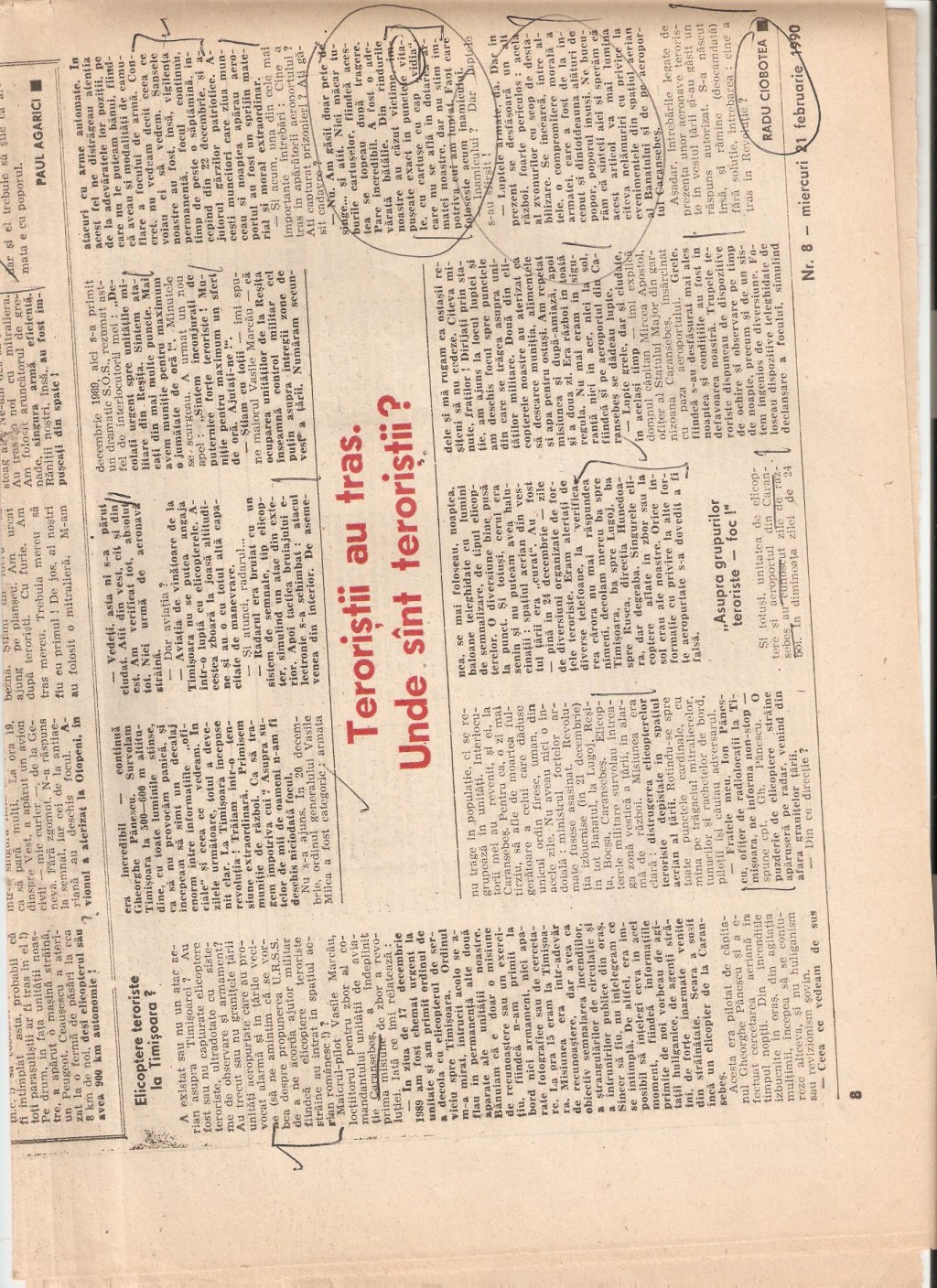
image0-002

Norbert Pongracz

Valentin Rosada

Nascut la 15 ianuarie 1971, unicul fiu al lui Norbert si al Ilenei Pongracz.

A cazut in noaptea de 23 decembrie 1989, ora 2,40 in unitatea (de radiolocatie) in care isi satisfacea stagiul militar. Un glont ucigas pornit din paduricea din apropiere (care ulterior s-a defrisat) in timp ce statea de vorba cu locotenentul sau i-a secerat pe amandoi. In total au fost ucise 9 persoane (ofiteri si militari in termen). S-a presupus ca ucigasii ar fi fost de la unitatea de rachete, dar arma cu care s-a tras a fost speciala, calibrul 5,62 fata de armamentul obisnuit de 7,62 mm.

Pe langa golul definitiv in sufletul lor, durerea cea mai mare a familiei Pongracz este ca nici acum nu s-a elucidat problema aceasta a ucigasilor fiului lor. Resita are declarati 16 morti in Revolutie, iar domnul Pongracz, cand a mers sa ridice trupul baiatului sau de la morga, a vazut circa 50 de cadavre.

Strada Gorunului a fost botezata dupa numele eroului Norbert Pongracz.

Sonetul sau de absolvent, dedicat lui Adrian Zamfirescu, contine urmatorul text: Sa traim din plin, soarele nu rasare de doua ori pe zi si viata nu ne este harazita decat o singura data? Cu stima si respect Norbi. Sub semnatura lui Norbi sta tiparit: La revedere, in prima sambata a lunii iulie 1999. El nu va putea veni la aceasta intalnire, dar va ramane pentru totdeauna in inimile noastre, intre eroii nostri.

Adolescent fiind, a trecut in randul nemuritorilor luptand cu arma in mana, pentru libertate, pentru prietenie, pentru ca in fapta aceasta este democratia – libertate si prietenie. Si pentru aceasta a fost si jertfa lui Norbert.

Suflet curat, fiu al unor parinti cinstiti si harnici, Norbert nu si-a dezmintit afirmatia: Viata nu ne este harazita decat o singura data. Avand constiinta acestui fapt, sacrificiul sau devine mai inalt, mai plin de intelesuri si durere decat insasi viata pe care o traim.

El nu a murit, traieste si va trai de-a pururi in sufletele parintilor sai, colegilor, camarazilor de lupta, in sufletele noastre.

Dumnezeu sa-l odihneasca in pace!

http://www.revolutialugojana.org/eroi

– Vă rog să vă prezentaţi, domnule plutonier.
– Sânt plutonierul Coancă Gheorghe.
– Pentru prima dată v-am întâlnit în data de 20 decembrie 1989, în faţa Consiliului, împreună cu subunitatea dumneavoastră. Ce s-a întâmplat apoi ?
– Din 20 până în 25 decembrie 1989 am apărat oraşul Lugoj.
– Iar după aceea ?
– Consiliul Frontului Salvării Naţionale din Reşiţa a cerut întăriri din partea Lugojului şi o parte din subunităţile noastre s-au deplasat de urgenţă în ajutorul fraţilor din Reşiţa.
– Bănuiesc că a fost vorba de “terorişti” ?
– Nu, de securitatea civilă a statului.
– Unde se găseau ei ? În vreo unitate militară ?
– Erau dispersaţi în tot oraşul, în locuinţe, cazemate subterane şi la Liceul nr. 2, unde îşi transportau răniţii.
– În ce mod îşi desfăşurau atacul ?
– Atacul se deschidea la lăsarea serii şi înceta în jurul orei opt-nouă dimineaţa.
– Aţi reuşit să prindeţi câţiva ?
– La una din locuinţele de unde s-a tras, am reuşit să arestăm un maior de securitate, împreună cu cei doi fii ai săi (unul de 14 ani, iar celălalt de 20 ani, elev la şcoala militară de securitate), toţi trei foarte buni trăgători.
– Nu erau conştienţi de faptul că totul e pierdut ?
– Ba fa, dar … la întrebarea adresată de comandantul unităţii militare din Reşiţa : “Ce rost are vărsarea de sânge, situaţia oricum nu o puteţi întoarce ?”, răspunsul comandantului Securităţii civile, atunci arestat, a fost : “Puţin ne pasă !”.
– Care a fost atitudinea civililor ?
– Populaţia a manifestat o adevărată dragoste faţă de armată, gărzile patriotice participând activ la acţiunile de luptă.
– Aţi avut victime ?
– Din rândul gărzilor patriotice s-au înregistrat multe victime, din rândul subunităţii noastre nu s-a înregistrat nici o victimă.
Când s-au predat securiştii şi ce armament au folosit ?
– S-au predat în data de 29 decembrie 1989, dar am continuat să apărăm obiectivele până astăzi, 10 ianuarie, când ne-am întors la Lugoj. Armamentul lor era de provenienţă străină, super-uşor, de calibru 5,6 şi în cadenţă de tragere dublă. Gloanţele erau cu vârf retezat şi pastilă explosivă în cap.
– Care este acum cea mai mare dorinţă a dumneavoastră ?
– Să-mi revăd copilul, de doi ani şi jumătate. Să fac o baie fierbinte şi să-mi schimb cizmele că, din 17 decembrie până în 5 ianuarie 1990, am dormit îmbrăcat şi fără să-mi scot cizmele din picioare.
– Spuneţi-mi, s-a ridicat convocarea ?
– Nu, dar ni se permite să mergem zilnic, pentru câteva ore acasă.
– Aveţi un gând personal ?
– Sânt mândru, satisfăcut, că atât la Lugoj cât şi la Reşiţa, ca de altfel în întreaga ţară, Armata şi-a dovedit calmul, puterea de discernământ şi disciplina.

Reporter : Simion FLORIEAN

(Drapelul, nr. 7 – sâmbătă, 13 ianuarie 1990)

Adam Livia ( 21 )
Profesie: Pensionara
Data nasteri: 19.01.1924
Locul nasterii: Caras-Severin
Calitate: Erou Martir
Data mortii: 25 decembrie 1989
Locul mortii: Resita, Piata 1 Decembrie 1918, (in locuinta sa)
Cauza: Plaga impuscata a capului
Vinovati:
Observatii: Glontul penetrant a intrat prin fereastra apartamentulu
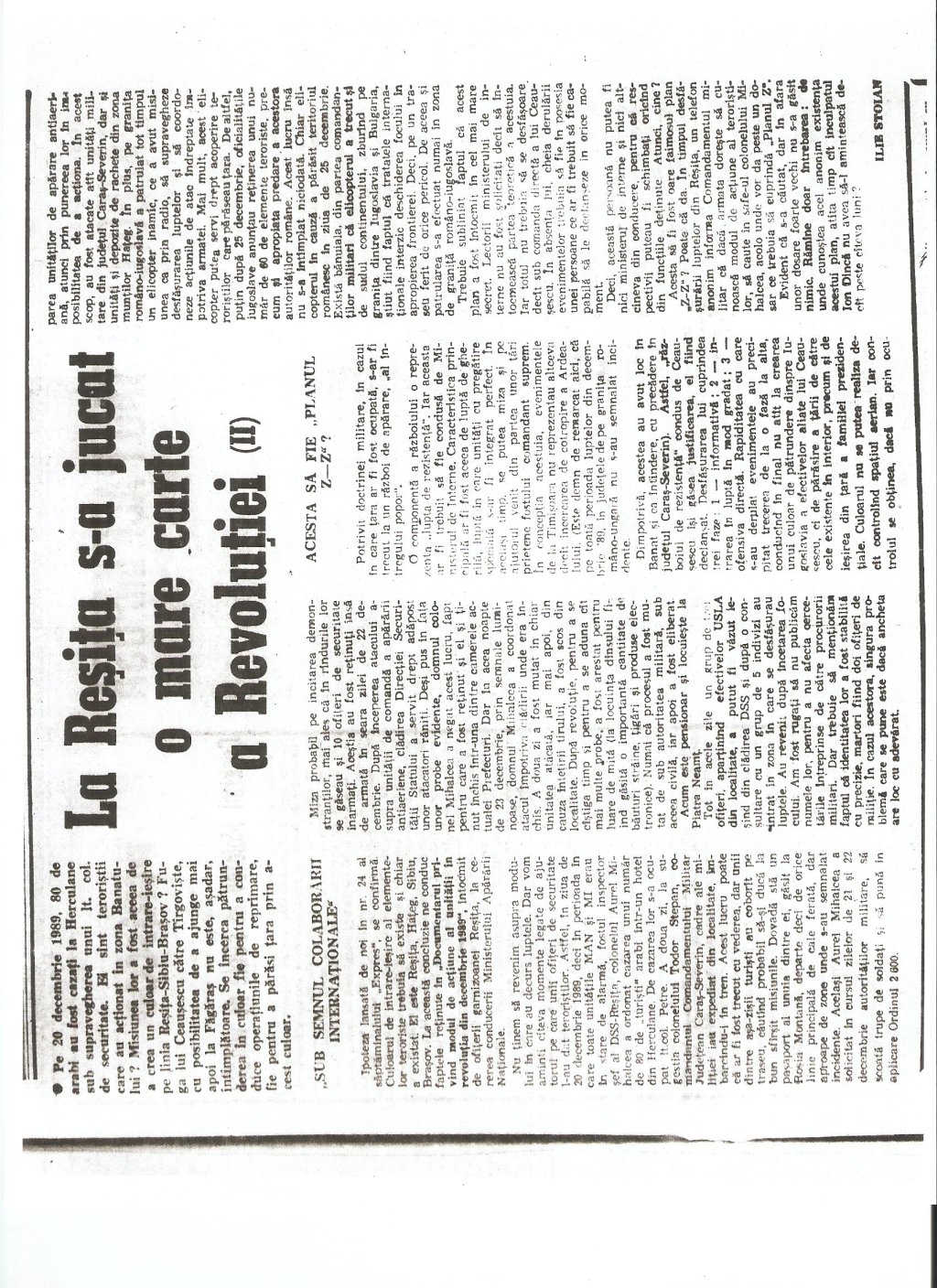
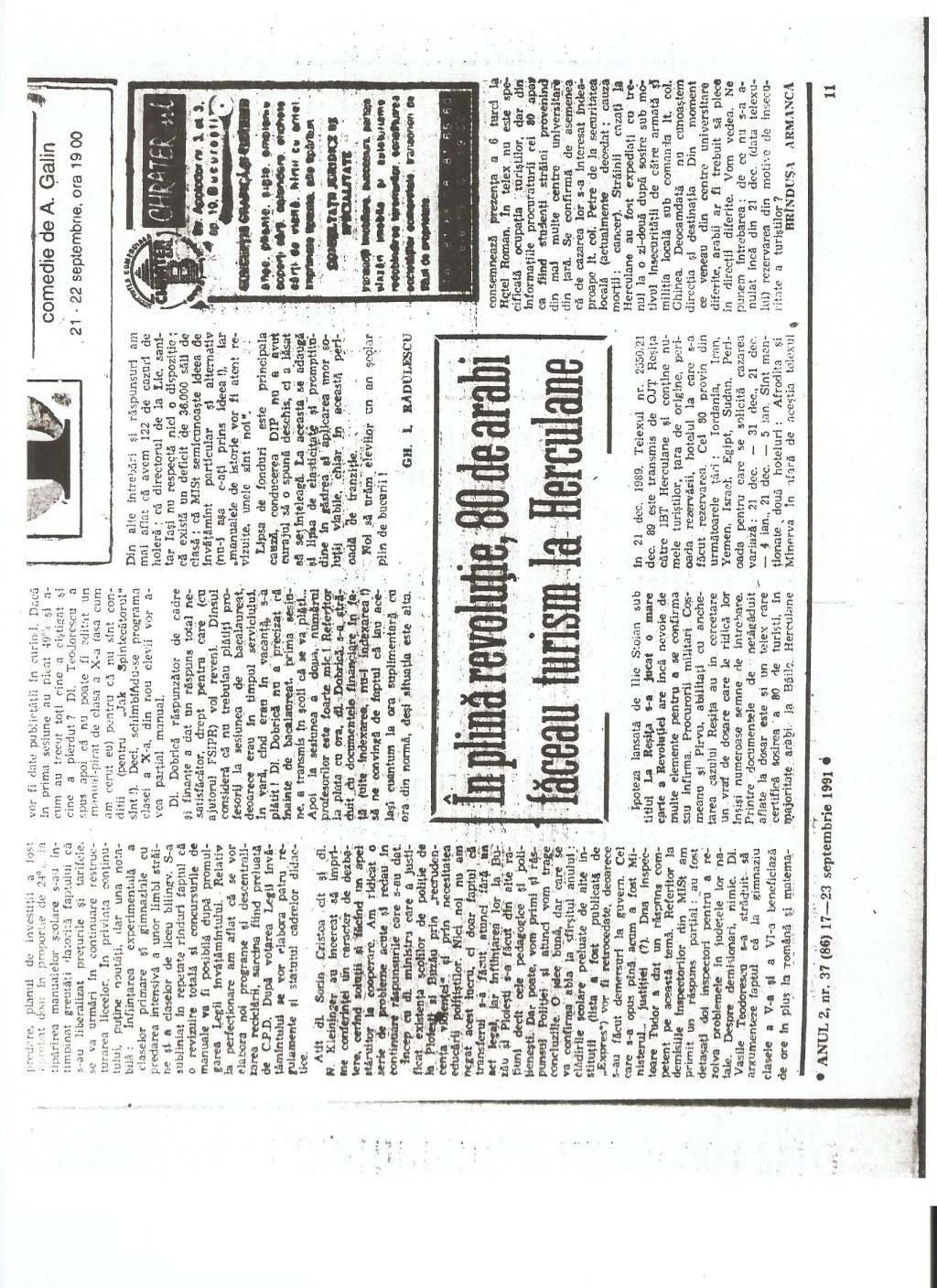
 image0-001

image0-004

image0-005

image0

image0


Posted in decembrie 1989 | Tagged: , , , , , , , , , , , , , , , , , , , | 2 Comments »

Final Boarding Call for TAROM’s special ROMBAC service from Bucuresti to Sibiu: Would the large party of suspicious “Soviet tourists” please report to the gate immediately! (IV)

Posted by romanianrevolutionofdecember1989 on August 16, 2013

Part I :  Just how absurd is the Soviet tourist scenario?! http://atomic-temporary-3899751.wpcomstaging.com/2013/08/10/final-boarding-call-for-taroms-special-rombac-service-from-bucuresti-to-sibiu-would-the-large-party-of-suspicious-soviet-tourists-please-report-to-the-gate-immediately-i/

Part II:  Senior Securitate officials sent to Timisoara cannot find the “foreign tourists” Nicolae Ceausescu and Iulian Vlad claim are behind the unrest.  http://atomic-temporary-3899751.wpcomstaging.com/2013/08/11/final-boarding-call-for-taroms-special-rombac-service-from-bucuresti-to-sibiu-would-the-large-party-of-suspicious-soviet-tourists-please-report-to-the-gate-immediately-ii/
Part III:  The Ceausescu regime bans new Soviet travellers to the country…but allows those “in transit,” already in Romania, to stay…and apparently, despite supposedly having great suspicions of their actions, do nothing to stop them… http://atomic-temporary-3899751.wpcomstaging.com/2013/08/14/final-boarding-call-for-taroms-special-rombac-service-from-bucuresti-to-sibiu-would-the-large-party-of-suspicious-soviet-tourists-please-report-to-the-gate-immediately-ii-2/

I hope to develop this, part IV, at another time…for now, some previously related content in reference to the famous ROMBAC flight of 20 December 1989 from Bucuresti (Otopeni) to Sibiu:

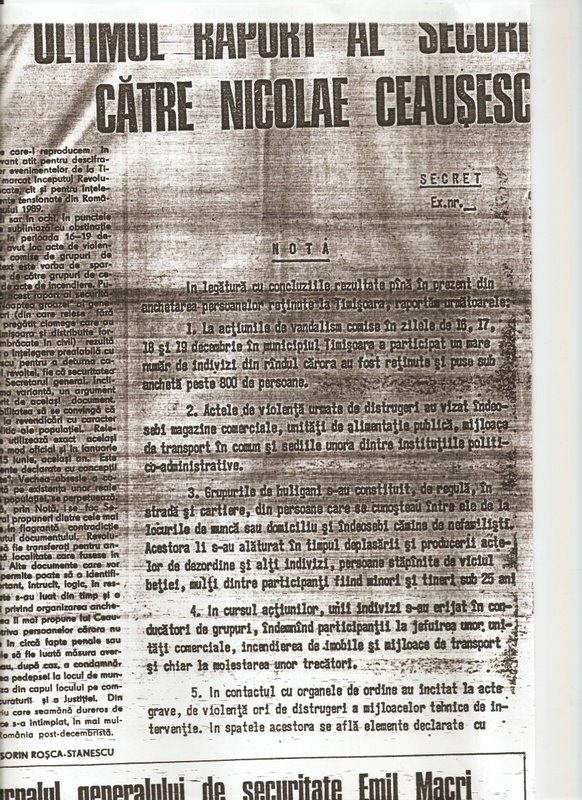
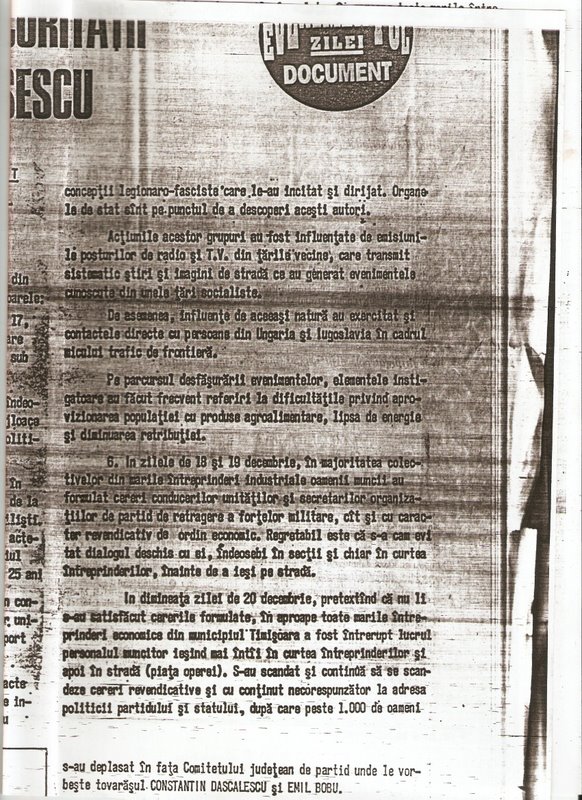
http://atomic-temporary-3899751.wpcomstaging.com/ultimul-raport-al-securitatii-catre-nicolae-ceausescu/

The Securitate’s last report to Nicolae Ceausescu:

Please note:  no mention whatsoever of the alleged role played by “Russian tourists” or “Soviet tourists” in allegedly fomenting the Timisoara uprising, or of their supposed presence on the ROMBAC of 20 December 1989

published in Evenimentul Zilei, 28 iulie 1992, p. 3.

http://atomic-temporary-3899751.wpcomstaging.com/2009/10/04/decembrie-89-citeva-indoieli-stirnite-de-un-articol-din-revista-22-cazul-ivanciuc-si-teza-turistilor-sovietici/

http://atomic-temporary-3899751.wpcomstaging.com/2009/03/26/a-ruse-by-any-other-name-general-stanculescu-the-soviet-tourists-and-december-1989/

THE 1989 ROMANIAN REVOLUTION AS GEOPOLITICAL PARLOR GAME: BRANDSTATTER’S “CHECKMATE” DOCUMENTARY AND THE LATEST WAVE IN A SEA OF REVISIONISM

By Richard Andrew Hall

Disclaimer: This material has been reviewed by CIA. That review neither constitutes CIA authentification of information nor implies CIA endorsement of the author’s views.

Part 3: Ruse

A SECURITATE RIDDLE: SOVIET “TOURISTS” AND THE OVERTHROW OF THE CEAUSESCU REGIME

Although I have written a good deal on the “tourist” conundrum in the past (see, for example, Hall 2002), I have not formally addressed the role of foreign histories of Ceausescu’s overthrow in the historiography of December 1989, particularly in regard to this topic. In the wake of the broadcast of Brandstatter’s “Checkmate” documentary in February 2004, Vladimir Bukovski’s invocation of journalist John Simpson’s 1994 article on the topic (discussed in Part 2 of this series) suggests, however, that it needs to be broached in greater detail. Moreover, as the year-long look-back at the December 1989 events in “Jurnalul National” shows, the “tourist” question—somewhat surprisingly to me—has become more and more central to arguments about the Revolution, thereby amplifying what is already tremendous confusion over the events in the Romanian press and public. Of course, as has traditionally been the case, the Soviet/Russian tourists figure prominently, and, to a lesser extent, the Hungarian tourists. However, the stock of other tourist groups has also gone up. For example, the role of Yugoslav (specifically Serb) tourists has found a greater emphasis, and, seemingly out of nowhere, so have East German/STASI tourists! The principal sources for all of these allegations are, as usual, former Securitate and Militia officers, with some military (intelligence) personnel thrown in for good measure.

FOREIGN FORUM, ROMANIAN CONTEXT

It is difficult to pinpoint the exact first mention of “the tourists” and their alleged role in the Revolution, but it appears that although the source of the claim was Romanian, the publication was foreign. James F. Burke, whose name is unfortunately left off the well-researched and widely-consulted web document “The December 1989 Revolt and the Romanian Coup d‘etat,” alludes to the “Romanian filmmaker” who first made these allegations (Burke, 1994). The claims are contained in an article by Richard Bassett in the 2 March 1990 edition of “The Times (London).” According to Bassett,

“Mr. [Grigore] Corpacescu has no doubt that the revolution here was carefully stage-managed—as was the case in Prague and East Berlin—by the Russians…According to Mr. Corpacescu a party of Soviet ‘tourists,’ all usually on individual visas, arrived in Timisoara two days before the first demonstration outside Mr. [i.e. Pastor] Tokes’ house. Police records trace them reaching Bucharest on December 20. By the 24th, two days after Ceausescu fled by helicopter, the Russians had disappeared. No police records exist to indicate how they left the country. (“The Times (London),” 2 March 1990)

But Bassett’s interlocutor, Mr. Corpacescu, says some strange things. Bassett is not clear but it appears that Corpacescu suggests that the post-Revolution Interior Minister Mihai Chitac, who was involved in the Timisoara events as head of the army’s chemical troops, somehow purposely coaxed the demonstrations against the regime because the tear-gas cannisters his unit fired failed to explode—the failure somehow an intended outcome. But beyond this, Corpacescu, who is at the time of the article filming the recreation of Ceausescu’s flight on the 22nd—using the same helicopter and pilot involved in the actual event—makes the following curious statement:

“The pilot of this helicopter is an old friend. I have many friends in the police, Timisoara was not started by the Hungarian pastor, the Reverend Laszlo Tokes [i.e. it was carefully stage-managed…by the Russians].” (“The Times (London),” 2 March 1990)

The pilot of the helicopter was in fact Vasile Malutan, an officer of the Securitate’s V-a Directorate. What kind of a person would it have been at that time—and how credible could that person have been–who has the pilot as an old friend and “many friends in the police?” And it would have been one thing perhaps two months after the revolution to talk about the presence of foreign agents “observing” events in Timisoara, but to deny the spontaneity of the demonstrations and denigrate Tokes’ role at this juncture is highly suspicious. I have been unable to unearth additional information on Mr. Corpacescu, but his revelations just happen to serve his friends extremely well—particularly at at time when the prospect of trials and jail time, for participation in the repression in Timisoara and elsewhere during the Revolution, still faced many former Securitate and Militia [i.e. police] members.

THE FORMER SECURITATE AND MILITIA REMINISCE ABOUT THE SOVIET “TOURISTS”

A week after “The Times” article, the chief of the Securitate’s Counter-espionage Directorate, Colonel Filip Teodorescu, mentioned at his trial for his role in the Ceausescu regime’s crackdown in Timisoara that he had in fact detained “foreign agents” during the events there (“Romania Libera,” 9 March 1990). In his 1992 book, he developed further on this theme, specifically focusing on the role of “Soviet tourists:”

“There were few foreigners in the hotels, the majority of them having fled the town after lunch [on 17 December] when the clashes began to break out. The interested parties remained. Our attention is drawn to the unjustifiably large number of Soviet tourists, be they by bus or car. Not all of them stayed in hotels. They either had left their buses or stayed in their cars overnight. Border records indicate their points of entry as being through northern Transylvania. They all claimed they were in transit to Yugoslavia. The explanation was plausible, the Soviets being well-known for their shopping trips. Unfortunately, we did not have enough forces and the conditions did not allow us to monitor the activities of at least some of these ‘tourists’” (Teodorescu, 1992, p. 92).

Reporting in July 1991 on the trial involving many of those involved in the Timisoara repression, Radu Ciobotea noted with what was probably an apt amount of skepticism and cynicism, what was telling in the confessions of those on trial:

Is the End of Amnesia Approaching?…

Without question, something is happening with this trial. The Securitate doesn’t say, but it suggests. It let’s small details ‘slip out.’…Increasingly worthy of interest are the reactions of those on trial….Traian Sima (the former head of the county’s Securitate) testifies happily that, finally, the Securitate has been accepted at the trial, after having been rejected by Justice. Filip Teodorescu utters the magic word ‘diplomats’ and, suddenly, the witness discovers the key to the drawer with surpise and declares, after five hours of amnesia, that in Timisoara, there appeared in the days in question, foreign spies under the cover of being journalists and diplomats, that in a conversation intercepted by a mobile Securitate surveillance unit Tokes was reported as ‘well,’ and that all these (and other) counterespionage actions that can’t be made public to the mass media can be revealed behind closed doors to the judge….[Timis County party boss] Radu Balan ‘remembers’ that on 18 December at midnight when he was heading toward IAEM, he passed a group of ten soviet cars stopped 100 meters from the county hospital. (It turns out that in this night, in the sight of the Soviets, the corpses were loaded!).” [emphasis in the original] (Flacara, no. 27, 1991, p. 9).

The reference to the corpses being loaded is to an operation by the Militia and Securitate on the night of 18-19 December 1989, in which the cadavers of 40 people killed during the repression of anti-regime protesters were secretly transported from Timisoara’s main hospital to Bucharest for cremation (reputedly on Elena Ceausescu’s personal order).

Finally, as yet another of many possible examples, we have the recollections of Bucharest Militia Captain Ionel Bejan, which apparently appeared in print for the first time only in 2004, in a book by Alex Mihai Stoenescu (excerpted in “Jurnalul National,” 7 December 2004). According to Bejan, around 2 AM on the night of 21-22 December, not far from University Plaza, where at that moment regime forces were firing their way through a barricade set up by protesters (48 were killed that night, 604 wounded, and 684 arrested), he spotted two LADA automobiles with Soviet plates and two men and a woman studying a map and pointing to different locations among the surrounding buildings. Bejan recalled:

“One thing’s for sure, and that is that although they looked like tourists, they didn’t behave like tourists who had just arrived in town or were lost, especially as close by there were compact groups of demonstrators, while from armored personnel carriers there was intense warning fire and a helicopter hovered overhead with lights ablaze. I don’t know what kind of tourist tours somewhere in such conditions. They left the impression that they were sure of themselves, they didn’t need any directions, proof which was that they didn’t ask us anything even though we were nearby and, being uniformed Militia, were in the position to give them any directions they needed. One thing’s for sure when I returned to that location in January 1990…the buildings displayed visible signs of bullet holes…[emphasis added]” (“Jurnalul National,” 7 December 2004)

STRANGE “TOURISTS”…STRANGER STILL, THE REACTIONS OF THE AUTHORITIES

We can agree with Ionel Bejan in one respect. One thing is for sure: these were some very strange tourists. (They give a whole new meaning to the term, “adventure tourism.”) As curious as the “Soviet tourists” themselves is how little the Romanian authorities who claim to have seen them did to stop them—or even try to collect more information about them. Why is it that no official questioned the enigmatic “Soviet tourists” or asked them to leave the area when, as Radu Balan claims, he saw ten LADAs outside the Timis county hospital at 1 AM in the morning the night the cadavers of protesters were being loaded onto a truck for cremation? Or, as Ionel Bejan claims, he spotted several of them in the center of Bucharest at 2 AM, when the area was essentially a warzone of regime repression? The regime had closed the borders to virtually all other foreigners, tourists or otherwise, it was trying to prevent any word of the repression from reaching the outside world, and yet Romanian authorities were not concerned about these “tourists” taking pictures or relaying what they were seeing?!

As I have written before, if it was obvious before 18 December, as these Ceausescu regime officials claim, that “Soviet tourists” were involved in the events in Timisoara, then why was it precisely “Soviet travelers coming home from shopping trips to Yugoslavia” who were the only group declared exempt from the ban on “tourism” announced on that day (see AFP, 19 December 1989 as cited in Hall 2002b)? In fact, an Agent France-Presse correspondent reported that two Romanian border guards on the Yugoslav frontier curtly told him: “Go back home, only Russians can get through”!!! The few official documents from the December events that have made their way into the public domain show the Romanian Ambassador to Moscow, Ion Bucur, appealing to the Soviets to honor the Romanian news blackout on events in Timisoara, but never once mentioning—let alone objecting to—the presence or behavior of “Soviet tourists” in Romania during these chaotic days of crisis for the Ceausescu regime (CWHIP, “New Evidence on the 1989 Crisis in Romania,” 2001). It truly strains the imagination to believe that the Romanian authorities were so “frightened” of committing a diplomatic incident with the Soviets that they would allow Soviet agents to roam the country virtually unhindered, allowing them to go anywhere and do anything they wanted.

BUT WAIT, THERE’S MORE…A “SOVIET TOURIST” ENCORE IN 1990

Add to all of this (!), the allegations that the “Soviet tourists” were seen again on the streets during major crises in 1990, such as the ethnic clashes between Romanians and Hungarians in Tirgu Mures in March 1990 (for evidence of the reach of the allegation of KGB manipulation via the “tourist” mechanism both in December 1989 AND in March 1990, see Emil Hurezeanu, “Cotidianul,” 23 December 1999; according to Hurezeanu, “It appears they didn’t leave the country until 1991, following a visit by [SRI Director] Virgil Magureanu to Moscow”!). Then there is the famous April 1991 interview of an alleged KGB officer—who spoke flawless Romania and was in Romania during the December 1989 events—who the interviewer, the vigorous anti-Iliescu foe, Sorin Rosca Stanescu, claimed to have just stumbled into in Paris. Of all the reporters who could have stumbled into a KGB officer present in Romania during the Revolution—the only such case I know of—it was Rosca Stanescu, who, it turned out later, had been an informer for the Securitate until the mid-1980s—but not just for anybody, but for the USLA. Intererstingly, although the article appeared on the non-descript page 8 of the primary opposition daily at the time (“Romania Libera”), the aforementioned Filip Teodorescu and Radu Balan invoked it in support of their contentions regarding the the “tourists” (for a discussion of this, see Hall 2002). Even more suprising, or not, depending on your point of view, in his April 1991 article, Stanescu attempted to tie together December 1989 with December 1990 (!):

“As you will recall, persistent rumors have circulated about the existence on Romanian soil [in December 1989] of over 2,000 Lada automobiles with Soviet tags and two men in each car. Similar massive infiltrations were witnessed in December 1990, too, with the outbreak of a wave of strikes and demonstrations. What were the KGB doing in Romania?” (emphasis added) (“Romania Libera,” 18 April 1991)

Indeed, what were they doing in Romania? But, more aptly:

WHO COULD THEY HAVE BEEN?

Some other recollections and comments may offer clues to the answer to this vexing question. For example, the Caransebes Militia Chief claims he helped a group of “Soviet tourists” coming from Timisoara on the night of 20-21 December when one of their cars—as usual, “it was part of a convoy of 20 cars, all of the same make and with 3-4 passengers per car”—went off the road (from “Europa,” no. 20, 1991, see the discussion in Hall 2002b). According to Teodorescu, the “tourists” greeted the militia chief with the phrase “What the hell? We are colleagues; you have to help us” (Teodorescu, 1992, p. 93). The militia chief opines that despite their Soviet passports, “to this day, I don’t really know where they were from.”

Nicu Ceausescu, Nicolae’s son and most likely heir and party secretary in Sibiu at the time of the Revolution, claimed that he also had to deal with enigmatic “tourists” during these historic days (the following several paragraphs borrow heavily from Hall 2002b). From his prison cell in 1990, Nicu recounted how on the night of 20 December 1989, a top party official came to inform him that the State Tourist Agency was requesting that he — the party secretary for Sibiu! — “find lodgings for a group of tourists who did not have accommodation” He kindly obliged and made the appropriate arrangements (interview with Nicu Ceausescu in “Zig-Zag,”, no. 20, 21-27 August 1990).

Interestingly, in the same interview Nicu discusses the “tourists” for which he was asked to find accommodations in the context of a group of mysterious passengers who had arrived by plane from Bucharest on the evening of 20 December 1989. We know that in the period immediately following these events, the then-military prosecutor, Anton Socaciu, had alleged that these passengers from Bucharest were members of the Securitate’s elite USLA unit (Special Unit for Antiterrorist Warfare) and were responsible for much of the bloodshed that occurred in Sibiu during the December events. Nicu Silvestru, chief of the Sibiu County Militia, admitted in passing in a letter from prison that on the afternoon of 19 December in a crisis meeting, Ceausescu’s son announced that he was going to “call [his] specialists from Bucharest” to take care of any protests (“Baricada,” no. 45, 1990). Ceausescu’s Interior Minister, Tudor Postelnicu, admitted at his trial in January 1990 that Nicu had called him requesting “some troops” and he had informed Securitate Director General Iulian Vlad of the request (“Romania Libera,” 30 January 1990.)

The rewriting of the story of the Revolution, the “tourists,” and the “terrorists” was already in full swing, when in August 1990, Nicu wryly observed:

“…[T]he Military Prosecutor gave me two variants. In the first part of the inquest, they [the flight’s passengers] were from the Interior Ministry. Later, however, in the second half of the investigation, when the USLA and those from the Interior Ministry began, so-to-speak, to pass ‘into the shadows,’ — after which one no longer heard anything of them — they [the passengers] turned out to be simple citizens…” (interview with Nicu Ceausescu in “Zig-Zag,” no. 20, 21-27 August 1990).

The impact of this “reconsideration” by the authorities could be seen in the comments of Socaciu’s successor as military prosecutor in charge of the Sibiu case, Marian Valer (see Hall 1997, pp. 314-315). Valer commented in September 1990 that investigations yielded the fact that there were 37 unidentified passengers on board the 20 December flight from Bucharest and that many of the other passengers maintained that “on the right side of the plane there had been a group of tall, athletic men, dressed in sporting attire, many of them blond, who had raised their suspicions.” The USLA, which were responsible for airport security and had “air marshals” on all flights (three in this case), refused to discuss the identity of these passengers with Valer. While investigations revealed that during this time there “were many Soviet tourists staying in Sibiu’s hotels,” they also established that “military units were fired upon from Securitate safehouses located around these units as of the afternoon of 22 December, after the overthrow of the Ceausescu regime.” He thus carefully concludes:

“As far as the unidentified passengers are concerned, there are two possible variants: Either they were USLA fighters sent to defend Nicu Ceausescu, or they were Soviet agents sent to act with the intent of overthrowing the Ceausescu regime” (“Expres,” no. 33, September 1990).

Clearly, one of these hypotheses is a lot more plauisble than the other…As I wrote in December 1996, partly based on the statements of the Military Prosecutor Marian Valer who stepped down from investigating the Sibiu events in fall 1990, citing duress: “thus as the USLA began to disappear from the historiography and therefore history of the Revolution, so the Soviet tourists began to enter it.” (Hall, 1996).

“ORWELLIAN…POSITIVELY ORWELLIAN:”

PROSECUTOR VOINEA’S CAMPAIGN TO SANITIZE

THE ROMANIAN REVOLUTION OF DECEMBER 1989

by Richard Andrew Hall

Disclaimer: All statements of fact, opinion, or analysis expressed are those of the author and do not reflect the official positions or views of the Central Intelligence Agency (CIA) or any other U.S. Government agency. Nothing in the contents should be construed as asserting or implying U.S. Government authentication of information or CIA endorsement of the author’s views. This material has been reviewed by CIA to prevent the disclosure of classified information.

Sibiu, 19-22 December 1989

In Sibiu, Siani-Davies tells us:

Controversy also continues to surround a commercial TAROM flight, which is alleged to have brought up to eighty USLA troops from Bucharest to Sibiu on December 20, 1989. It is not clear if the USLA forces were actually on the airplane, or, even if they were, what they actually did in Sibiu…[Serban] Sandulescu (c1996), 57-58…suggests they were not members of USLA but the DIA [Army’s Intelligence Unit].[151]

From the standpoint of Siani-Davies’ unsuspecting reader such a conclusion may seem not only credible, but judicious. But one of Siani-Davies’ habits—identified negatively by even those who praise the book—is his tendency to draw negative equivalencies: i.e. there is about as much evidence to support x as there is to support y, in order to disprove or discount both propositions. In a review, Doris Mironescu writes:

“Very common are claims such as the following: ‘Finding the proof to sustain such an explanation of the events [that the Army’s Intelligence arm, the DIA simulated the “terrorist diversion,” to permit the Front’s takeover and a possible Warsaw Pact invasion of the country] is as difficult as proving that special units of the securitate took up arms against the revolution’ (p. 154). Mutually contradictory hypotheses are invoked in order to negate each other, not so much because of the weight of the claims, but through the ideological similarity of both.”[152]

This tendency definitely affects Siani-Davies’ analysis of the “terrorists” and its accuracy. To begin with, in the very book (Sandulescu) invoked by Siani-Davies, the head of the DIA (Battalion 404 Buzau), Rear Admiral Stefan Dinu, is quoted as having told the Gabrielescu commission investigating the December events (of which Sandulescu was a member) that “we hardly had 80 fighters in this battalion.”[153] It is known that 41 of them were in Timisoara from the morning of 18 December and only returned to their home base in Buzau on 22 December.[154] This makes it highly unlikely that they were on the 20 December TAROM flight to Sibiu that is in question.[155]

http://atomic-temporary-3899751.wpcomstaging.com/2009/12/18/hai-sa-ne-punem-capul-in-ghips/

in decembrie 1989, “temuta” unitate DIA Batalionul 404…avea…80 de luptatori!

Contrast this with the signs that exist pointing to the mystery passengers as having been from the Securitate/Interior Ministry, in particular the USLA. Nicu Silvestru, chief of the Sibiu County Militia, admitted in passing in a letter from prison that on the afternoon of 19 December 1989, in a crisis meeting, Nicolae Ceausescu’s son, Nicu, party head of Sibiu County, announced that he was going to “call [his] specialists from Bucharest” to take care of any protests.[156] Ceausescu’s Interior Minister, Tudor Postelnicu, admitted at his trial in January 1990 that Nicu had called him requesting “some troops” and he had informed Securitate Director General Iulian Vlad of the request.[157] If they were, indeed, DIA personnel, why would Nicu have called Postelnicu, and Postelnicu informed Vlad of the request—would such a request not have been relayed through the Defense Minister?

The first two military prosecutors for Sibiu, Anton Socaciu and Marian Valer, identified the passengers as USLA. Even Nicu Ceausescu admits that this was the accusation when he stated in August 1990:

“…[T]he Military Prosecutor gave me two variants. In the first part of the inquest, they [the flight’s passengers] were from the Interior Ministry. Later, however, in the second half of the investigation, when the USLA and those from the Interior Ministry began, so-to-speak, to pass ‘into the shadows,’ – after which one no longer heard anything of them – they [the passengers] turned out to be simple citizens…”[158]

Beginning, at least as early as August 1990, with the allusions of Major Mihai Floca, and later seemingly indirectly confirmed by former USLA officer Marian Romanescu, it was suggested that when USLA Commander Ardeleanu was confronted at the Defense Ministry on the night of 23/24 December 1989, Ardeleanu reportedly admitted that “30 were on guard at [various] embassies, and 80 had been dispatched to Sibiu with a Rombac [aircraft] from 20 December 1989 upon ‘orders from on-high’.”[159] Finally, and along these lines, we bring things full circle—and recall our “phantoms in black” again in the process—with the testimony of Army officer Hortopan to the same Serban Sandulescu at the Gabrielescu Commission hearings:

Sandulescu: About those dressed in black jumpsuits do you know anything, do you have any information about whom they belonged to?

Hortopan: On the contrary. These were the 80 uslasi sent by the MI [Interior Ministry], by General Vlad and Postelnicu to guard Nicolae Ceausescu [i.e. Nicu]. I make this claim because Colonel Ardelean[u] in front of General Militaru, and he probably told you about this problem, at which I was present when he reported, when General Militaru asked him how many men he had in total and how many were now present, where each of them was: out of which he said that 80 were in Sibiu based on an order from his commanders. Thus, it is natural that these are who they were.[160]

Bringing us up to the morning of 22 December 1989, and setting the stage for what was to come, Lt. Col. Aurel Dragomir told the Army daily in November 1990:

Dragomir: Events began to develop quickly on 22 December. In the morning some of the students posted in different parts of the town began to observe some suspect individuals in black jumpsuits on the roofs in the lights of the attics of several buildings.

Reporter: The same equipment as the USLAsi killed out front of the Defense Ministry…

Dragomir: And on the roof of the Militia building there were three or four similar individuals…[161]

Of course, the fact that these individuals were posted on the top of the Militia building on this morning, speaks volumes in itself about their affiliation. Indeed, in a written statement dated 28 January 1990, Ioan Scarlatescu, (Dir. Comm. Jud. Sibiu), admitted that he was asked by the Army on that morning if the unknown individuals “could be from the USLA?”[162]

[151] Siani-Davies, 2005, p. 152, fn. no. 32.

[152] Doris Mironescu, “Revolutia româna, asa cum (probabil) a fost,” Timpul no. 1 (January 2006), at http://www.romaniaculturala.ro.

[153] Serban Sandulescu, Lovitura de Stat a Confiscat Revolutia Romana (Bucharest: Omega, 1996), p. 214. Sandulescu’s book was marketed and printed by Sorin Rosca Stanescu’s Ziua press. Rosca Stanescu was a former USLA informer between the mid-1970s and mid-1980s. Who was Sandulescu’s chief counselor on these matters? Stefan Radoi, a former USLA officer in the early 1980s! These are the type of people who, of course, believe the passengers were DIA and not USLA! See my discussion of this whole fiasco in “The Securitate Roots of a Modern Romanian Fairy Tale,” RFE “East European Perspectives” 4-6/2002, online.

[154] See Dinu’s testimony in Sandulescu, Lovitura de Stat, p. 220. Also see the claims of another senior DIA officer Remus Ghergulescu in Jurnalul National, March 2004, online edition.

[155] Speaking even more broadly, Army parachutists (whether from Buzau, Caracal, Campia Turzii, or Boteni) were in Timisoara, Caransebes, and Television, Piata Palatului and the Otopeni Airport in Bucharest during the December events, but that clearly leaves many places where there were “terrorist actions”—including Sibiu—without them, decreasing their likelihood as plausible suspects. See Catalin Tintareanu, “Sarbatoare la Scoala de Aplicatie pentru Parasutisti ‘General Grigore Bastan,” Opinia (Buzau), 10 June 2005, online edition.

[156] Nicu Silvestru, “Cine a ordonat sa se traga la Sibiu?” Baricada, no. 45, 1990, p.5.

[157] Emil Munteanu, “Postelnicu a vorbit neintrebat,” Romania Libera, 30 January 1990, p. 1

[158] Interview with Nicu Ceausescu in Zig-Zag, no. 20, 21-27 August 1990.

[159] Adevarul, 29 August 1990. Also, Romanescu with Badea “U.S.L.A, Bula Moise…” 1991.

[160] “Virgil Magureanu sustine ca revolta din 1989 a fost sprijinita din interiorul sistemului,” Gardianul, 12 November 2005, online edition.

[161] Lt. Col. Aurel Dragomir, interview by Colonel Dragos Dragoi, “Sub tirul incrucisat al acuzatiilor (II),” Armata Poporului, no. 46 (November 1990), p. 3. Remus Ghergulescu specified USLA appearance as follows: “Over their black jumpsuits (‘combinezoanele negre’) in which they were dressed they had kaki vests. This was normal. They were equipped with the jumpsuits as “war gear,” while the vests were “city wear.’” (Colonel Remus Ghergulescu, interview with Razvan Belciuganu, “Teroristii au iesit din haos,” Jurnalul National, 29 November 2004, online edition.)

[162] See Evenimentul Zilei, 25 November 1992, p. 3.

RFE/RL Reports Print Version E-mail this page to a friend

17 April 2002, Volume  4, Number  8

THE SECURITATE ROOTS OF A MODERN ROMANIAN FAIRY TALE: THE PRESS, THE FORMER SECURITATE, AND THE HISTORIOGRAPHY OF DECEMBER 1989

By Richard Andrew Hall

Part 2: ‘Tourists Are Terrorists and Terrorists are Tourists with Guns…’ *
The distance traveled by Securitate disinformation on the December 1989 events can be breathtaking. Bubbling up through the springs of popular rumor and speculation, it flows into the tributaries of the media as peripheral subplots to other stories and eventually wends its way — carried upon the waves of consensus and credibility that flow from its acceptance among prominent Romanian journalists and intellectuals — into the writings of Western journalists, analysts, and academics. Popular myths, which either have their origins in disinformation disseminated by the former Securitate, or which originated in the conspiratorial musings of the populace but proved propitious for the former secret police and thus were appropriated, nurtured, and reinjected into popular discourse, are today routinely repeated both inside and outside Romania. Frequently, this dissemination occurs without the faintest concern over, or knowledge of, the myth’s etymology or much thought given to the broader context and how it plays into the issue of the Securitate’s institutional culpability.

Take, for example, the “tourist” myth — perhaps the former Securitate’s most fanciful and enduring piece of disinformation. This myth suggests that in December 1989, Soviet, Hungarian, and other foreign agents posing as “tourists” instigated and/or nurtured anti-Ceausescu demonstrations in Timisoara, Bucharest, and elsewhere, and/or were responsible for the “terrorist” violence after 22 December that claimed over 900 victims, or almost 90 percent of those killed during the Revolution. The implication of such allegations is clear: It questions the spontaneity — and hence, inevitably, to a certain degree, the legitimacy — of the anti-Ceausescu demonstrations and the overthrow of the Ceausescu regime; it raises doubt about the popular legitimacy of those who seized power during the events; and it suggests that those who seized power lied about who was responsible for the terrorist violence and may ultimately have themselves been responsible for the bloodshed.

A robust exegesis of the “tourist” hypothesis was outlined on the eve of the 10th anniversary of the December 1989 events in the pages of the daily “Ziua” by Vladimir Alexe. Alexe has been a vigorous critic of Ion Iliescu and the former communists of the National Salvation Front (FSN) who took power in December 1989, maintaining that they overthrew Ceausescu in a Soviet-sponsored coup d’etat:

“The outbreak of the December events was preceded by an odd fact characteristic of the last 10 years. After 10 December 1989, an unprecedented number of Soviet ‘tourists’ entered the country. Whole convoys of Lada automobiles, with approximately four athletic men per car, were observed at the borders with the Moldovan Socialist Republic, Bulgaria, and Hungary. A detail worthy of mention: The Soviet ‘tourists’ entered Romania without passports, which suggests the complicity of higher-ups. According to the statistics, an estimated 67,000 Soviet ‘tourists’ entered Romania in December 1989″ (“Ziua”, 24 December 1999).

It is worth noting that Alexe considers elsewhere in this series of articles from December 1999 that the Russian “tourists” were an omnipresent, critical, and catalytic factor in the collapse of communism throughout ALL of Eastern Europe in December 1989.

Nor has the “tourist” hypothesis been confined strictly to the realm of investigative journalism. Serban Sandulescu, a bitter critic of Ion Iliescu and the former communists who seized power in December 1989, led the third parliamentary commission to investigate the December 1989 events as a Senator for the National Peasant Party Christian Democratic (PNTCD). In 1996, he published the findings of his commission as a book titled “December ’89: The Coup d’Etat That Abducted The Romanian Revolution.” He commented on the “tourists” as follows:

“From the data we have obtained and tabulated it appears that we are talking somewhere in the neighborhood of 5,000-6,000 ‘tourists’…. Soviet agents [who] came under the cover of being ‘tourists’ either in large organized groups that came by coach, or in smaller groups of 3-4 people that fanned out in Lada and Moskvich automobiles. They covered the whole country, being seen in all the important cities in the country. They contributed to the stoking of the internal revolutionary process, supervising its unfolding, and they fought [during the so-called ‘terrorist’ phase after 22 December]…” (Sandulescu, 1996, pp. 35, 45).

DECEMBER 1989: NICOLAE CEAUSESCU INITIATES THE ‘TOURIST’ MYTH
Not surprisingly, the “tourist” myth originated with none other than Nicolae Ceausescu. This myth inevitably implies illegitimate and cynical “foreign intervention,” and Ceausescu used it to make sense of what were — probably genuinely, for him — the unimaginable and surreal antiregime protests which began in Timisoara on 15 December 1989.

In an emergency meeting of the Romanian equivalent of the politburo (CPEX) on the afternoon of Sunday, 17 December 1989 — the afternoon on which regime forces were to open fire on the anti-Ceausescu demonstrators in Timisoara, killing scores and wounding hundreds — Ceausescu alleged that foreign interference and manipulation were behind the protests:

“Everything that has happened and is happening in Germany, in Czechoslovakia, and in Bulgaria now, and in the past in Poland and Hungary, are things organized by the Soviet Union with American and Western help” (cited in Bunea, 1994, p. 34).

That Ceausescu saw “tourists” specifically playing a nefarious role in stimulating the Timisoara protests is made clear by his order at the close of this emergency meeting:

“I have ordered that all tourist activity be interrupted at once. Not one more foreign tourist will be allowed in, because they have all turned into agents of espionage…. Not even those from the socialist countries will be allowed in, with the exception of [North] Korea, China, and Cuba. Because all the neighboring socialist countries are untrustworthy. Those sent from the neighboring socialist countries are sent as agents” (cited in Bunea, 1994, p. 34).

A CHRONOLOGY OF THE ‘TOURISTS’ ITINERARY AND ACTIVITIES ACCORDING TO TOP SECURITATE AND PARTY OFFICIALS IN THE IMMEDIATE AFTERMATH OF DECEMBER 1989
Filip Teodorescu, who as head of the Securitate’s Counterespionage Directorate (Directorate III) had been dispatched to Timisoara and was later arrested for his role in the repression there, maintained in March 1990 at his trial that he detained “foreign agents” during the Timisoara events (“Romania libera,” 9 March 1990). In a book that appeared in 1992, Teodorescu described as follows the events in Timisoara on Monday, 18 December — that is, after the bloody regime repression of anti-Ceausescu demonstrators the night before:

“There were few foreigners in the hotels, the majority of them having fled the town after lunch [on 17 December] when the clashes began to break out. The interested parties remained. Our attention is drawn to the unjustifiably large number of Soviet tourists, be they by bus or car. Not all of them stayed in hotels. They either had left their buses or stayed in their cars overnight. Border records indicate their points of entry as being through northern Transylvania. They all claimed they were in transit to Yugoslavia. The explanation was plausible, the Soviets being well-known for their shopping trips. Unfortunately, we did not have enough forces and the conditions did not allow us to monitor the activities of at least some of these ‘tourists’” (Teodorescu, 1992, p. 92).

Teodorescu appears here to be attempting to account for the fact that on Monday, 18 December 1989 — presumably as a consequence of Ceausescu’s tirade the afternoon before about the malicious intent of virtually all “tourists” — Romania announced, in typically Orwellian fashion, that it would not accept any more tourists because of a “shortage of hotel rooms” and because “weather conditions are not suitable for tourism” (Belgrade Domestic Service, 20 December 1989). Ironically, the only ones exempted from this ban were “Soviet travelers coming home from shopping trips to Yugoslavia” (!) (AFP, 19 December 1989).

Radu Balan, former Timis County party boss, picks up the story from there. While serving a prison sentence for his complicity in the Timisoara repression, in 1991 Balan told one of Ceausescu’s most famous “court poets,” Adrian Paunescu, that on the night of 18-19 December — during which in reality some 40 cadavers were secretly transported from Timisoara’s main hospital to Bucharest for cremation (reputedly on Elena Ceausescu’s personal order) — he too witnessed the role of these “foreign agents”:

“We had been receiving information, in daily bulletins, from the Securitate, that far more people were returning from Yugoslavia and Hungary than were going there and about the presence of Lada automobiles filled with Soviets. I saw them at the border and the border posts, and the cars were full. I wanted to know where and what they were eating and how they were crossing the border and going through cities and everywhere. More telling, on the night of 18-19 December, when I was at a fire at the I.A.M. factory, in front of the county hospital, I spotted 11 white ‘Lada’ automobiles at 1 a.m. in the morning. They pretended to ask me the road to Buzias.The 11 white Ladas had Soviet plates, not Romanian ones, and were in front of the hospital” (“Totusi iubirea,” no. 43, 24-31 October 1991).

Nicu Ceausescu, Nicolae’s son and most likely heir and party secretary in Sibiu at the time of the Revolution, claimed that he also had to deal with enigmatic “tourists” during these historic days. From his prison cell in 1990, Nicu recounted how on the night of 20 December 1989, a top party official came to inform him that the State Tourist Agency was requesting that he — the party secretary for Sibiu! — “find lodgings for a group of tourists who did not have accommodation.” He kindly obliged and made the appropriate arrangements (interview with Nicu Ceausescu in “Zig-Zag,”, no. 20, 21-27 August 1990).

Nor was Gheorghe Roset, head of the Militia in the city of Caransebes at the time of the Revolution, able to elude a visit from the “tourists” during these days. Writing from his prison cell in January 1991, he recounted:

“Stationed on the night of 20-21 December 1989 at headquarters, I received the order to issue an authorization for repairs for a Lada automobile that had overturned in Soceni, in Caras-Severin county, an order that was approved by the chief of the county Militia with the clarification that the passengers of this car were military personnel from the USSR. I was more than a little surprised when this car arrived in Caransebes and I saw that it was part of a convoy of 20 cars, all of the same make and with 3-4 passengers per car. Lengthy discussions with the person who had requested the authorization confirmed for me the accident and the fact that this convoy of cars was coming from Timisoara, on its way to Bucharest, as well as the fact that these were colleagues of ours from the country in question. He presented a passport in order to receive the documents he had requested, although not even today can I say with certainty that he belonged to this or that country. A short time after the convoy left on its way, it was reported to me that five of the cars had headed in the direction of Hateg, while the more numerous group headed for Bucharest” (“Europa,” no. 20, March 1991).

A September 1990 open letter authored by “some officers of the former Securitate” — most likely from the Fifth Directorate charged with guarding Ceausescu and the rest of the Romanian communist leadership — and addressed to the xenophobic, neo-Ceausist weekly “Democratia” (which was edited by Eugen Florescu, one of Ceausescu’s chief propagandists and speechwriters), sought to summarize the entire record of the “tourists” wanderings and activities in December 1989 as follows:

“11-15 [December] — a massive penetration of so-called Hungarian tourists takes place in Timisoara and Soviet tourists in Cluj;

15-16 [December] — upon the initiative of these groups, protests of support for the sinister ‘Priest [Father Laszlo Tokes of Timisoara]‘ break out;

16-17-18 [December] — in the midst of the general state of confusion building in the city, the army intervenes to reestablish order;

– this provides a long-awaited opportunity for the ‘tourists’ to start — in the midst of warning shots in the air — to shoot and stab in the back the demonstrators among whom they are located and whom they have incited;…

19-20-21 — a good part of the ‘tourists’ and their brethren among the locals begin to migrate — an old habit — from the main cities of Transylvania, according to plan, in order to destabilize: Cluj, Sibiu, Alba Iulia, Targu Mures, Satu Mare, Oradea, etc.” (“Democratia,” no. 36, 24-30 September 1990).

The authors of this chronology then maintain that this scene was replicated in Bucharest on 21 December, causing the famous disruption of Ceausescu’s speech and the death of civilians in University Square that evening.

Not to be out-done, Cluj Securitate chief Ion Serbanoiu claimed in a 1991 interview that, as of 21 December 1989, there were over 800 Russian and Hungarian tourists, mostly driving almost brand-new Lada automobiles (but also Dacia and Wartburg cars), in the city (interview with Angela Bacescu in “Europa,” no. 55, December 1991). In February 1991 during his trial, former Securitate Director General Iulian Vlad, not surprisingly, also spoke of “massive groups of Soviet tourists…the majority were men…deploy[ing] in a coordinated manner in a convoy of brand-new Lada automobiles” (see Bunea, 1994, pp. 460-461), while the infamous Pavel Corut has written of “the infiltration on Romanian territory of groups of Soviet commandos (“Spetsnaz”) under the cover of being tourists” (Corut, 1994).

REBUTTING THE ‘TOURIST’ MYTH
I vividly recall early on in my research of the December 1989 events being told emphatically, and not for the last time, by a journalist at the Cluj weekly “Nu” — a publication staunchly critical of the Iliescu regime — that the guest lists of Romanian hotels for December 1989 were nowhere to be found because they contained the secrets of the Revolution. Certainly, this rumor has intersected with the “tourist” myth and has been used as confirmation of the latter.

Significantly, Marius Mioc has sought to investigate the reality of this matter in Timisoara (Mioc, 2000). The numbers provided to the 17 December Timisoara Association (which Mioc heads) by all of Timisoara’s hotels and by the State Tourist Agency for Timisoara lay bare two of the key components upon which the “tourist” myth has relied: a) that the records of the December 1989 manifests do not exist, and b) that there was an unusually dramatic increase in the number of foreign tourists staying in Romanian hotels during this period. In fact, the opposite proves to be true, the number of foreign tourists — and specifically those from other “socialist” countries — declined in December 1989 both in comparison to the previous December and in comparison to November 1989!

Of course, as we have seen, proponents of the “tourist” myth have also suggested that many of the alleged foreign agents posing as tourists “avoided staying in hotels.” But this still raises the question of why the Securitate allowed them into the country in the first place and why they then seemed unable to follow their movements and prevent their activities. A 1991 open letter by “a group of [Romanian Army] officers from the Timisoara garrison” perhaps provides the best riposte to the dubious logic underlying the “tourist” hypothesis:

“If they [the tourists] appeared suspect to the special forces of the Securitate and military counterintelligence, why did they not attempt to keep them under surveillance? During this period, did the Securitate and the counterintelligence officers not know how to do their jobs? Did they somehow forget why they were paid such weighty sums from the state budget?” (“Romania libera,” 15 October 1991).

One must also ask: If it was precisely Soviet tourists who were most suspected at the time of being up to no good in the country, then why was it precisely they who were the sole group among “tourists” in the country at the time to be permitted to stay and go about their business unhindered?

HOW THE ‘TOURISTS’ ENTRY INTO THE HISTORIOGRAPHY OF DECEMBER 1989 PARALLELS THE EXIT OF THE SECURITATE
In commenting in August 1990 upon how the details of the state’s case against him had changed since early in the year, Nicolae Ceausescu’s son, Nicu, ironically highlighted how Securitate forces had begun to fade away from the historiography of the December 1989 events. In the August 1990 interview from his prison cell with Ion Cristoiu’s “Zig-Zag” (mentioned above), Nicu discusses the “tourists” for which he was asked to find accommodations in the context of a group of mysterious passengers who had arrived by plane from Bucharest on the evening of 20 December 1989. We know that in the period immediately following these events, the then-military prosecutor, Anton Socaciu, had alleged that these passengers from Bucharest were members of the Securitate’s elite USLA unit (Special Unit for Antiterrorist Warfare) and were responsible for much of the bloodshed that occurred in Sibiu during the December events (for a discussion, see Hall, 1996). In August 1990, however, Nicu wryly observed:

“…[T]he Military Prosecutor gave me two variants. In the first part of the inquest, they [the flight’s passengers] were from the Interior Ministry. Later, however, in the second half of the investigation, when the USLA and those from the Interior Ministry began, so-to-speak, to pass ‘into the shadows,’ — after which one no longer heard anything of them — they [the passengers] turned out to be simple citizens…” (interview with Nicu Ceausescu in “Zig-Zag,” no. 20, 21-27 August 1990).

The impact of this “reconsideration” by the authorities could be seen in the comments of Socaciu’s successor as military prosecutor in charge of the Sibiu case, Marian Valer (see Hall 1997a, pp. 314-315). Valer commented in September 1990 that investigations yielded the fact that there were 37 unidentified passengers on board the 20 December flight from Bucharest and that many of the other passengers maintained that “on the right side of the plane there had been a group of tall, athletic men, dressed in sporting attire, many of them blond, who had raised their suspicions.” While investigations revealed that during this time there “were many Soviet tourists staying in Sibiu’s hotels,” they also established that “military units were fired upon from Securitate safehouses located around these units as of the afternoon of 22 December, after the overturning of the Ceausescu regime.” He thus carefully concludes:

“As far as the unidentified passengers are concerned, there are two possible variants: Either they were USLA fighters sent to defend Nicu Ceausescu, or they were Soviet agents sent to act with the intent of overthrowing the Ceausescu regime” (“Expres,” no. 33, September 1990).

Thus, as the “tourists” began to enter the historiography of the December 1989 events, so the Securitate — specifically the USLA — began to disappear.

HOW THE ‘TOURIST’ MYTH NEVERTHELESS GAINED MAINSTREAM CREDIBILITY AND ACCEPTANCE
How, then, did the “tourist” myth gain credibility and acceptance in the Romanian press, given its rather obvious pedigree in the remnants of the Ceausescu regime, especially among former high-ranking Securitate officers and others most in need of an alibi/diversion to save their careers and avoid the possibility of going to jail? Although the reference to “tourists” during the December events probably entered the lexicon of mainstream reporting on the Revolution as early as April 1990 — not insignificantly, first in the pages of Ion Cristoiu’s weekly “Zig-Zag,” it appears — it was in particular journalist Sorin Rosca Stanescu who gave the theme legitimacy in the mainstream press.

Without specifying the term “tourists” — but clearly speaking in the same vein — Stanescu was probably the first to articulate the thesis most precisely and to tie the Soviet angle to it. In June 1990 in a piece entitled “Is The Conspiracy of Silence Breaking Down?” in the sharply anti-government daily “Romania libera,” Stanescu wrote:

“And still in connection with the breaking down of the conspiracy of silence, in the army there is more and more insistent talk about the over 4,000 Lada cars with two men per car that traveled many different roads in the days before the Revolution and then disappeared” (“Romania libera,” 14 June 1990).

Stanescu’s article was vigorously anti-FSN and anti-Iliescu and left little doubt that this thesis was part of the “unofficial” history of the December events, injurious to the new leaders, and something they did not wish to see published or wish to clarify.

But it was Stanescu’s April 1991 article in “Romania libera,” entitled “Is Iliescu Being Protected By The KGB?,” that truly gave impetus to the “tourist” thesis. Stanescu wrote:

“A KGB officer wanders in France. He is losing his patience and searching for a way to get to Latin America. Yesterday I met him in Paris. He talked to me after finding out that I was a Romanian journalist. He fears the French press. He knows Romanian and was in Timisoara in December 1989. As you will recall, persistent rumors have circulated about the existence on Romanian soil of over 2,000 Lada automobiles with Soviet tags and two men in each car. Similar massive infiltrations were witnessed in December 1990, too, with the outbreak of a wave of strikes and demonstrations. What were the KGB doing in Romania? Witness what the anonymous Soviet officer related to me in Paris:

‘There existed an intervention plan that for whatever reason was not activated. I received the order to enter Romania on 14 December and to head for Timisoara. Myself and my colleague were armed. During the events, we circulated in the military zone around Calea Girocului [Giriocul Road]. Those who headed toward Bucharest had the same mission. Several larger cities were targeted. We were to open fire in order to create a state of confusion. I never, however, received such an order. I left Romania on 26 December.’

I don’t have any reason to suspect the validity of these revelations. This short confession is naturally incomplete, but not inconclusive. What purpose would this elaborate, but aborted, KGB plan have had? The only plausible explanation is that it wasn’t necessary for KGB agents to intervene. The events were unfolding in the desired direction without need for the direct intervention of the Soviets. But this leads to other questions: What did the Ceausescu couple know, but were not allowed to say [prior to their hurried execution]? Why is Securitate General Vlad being held in limbo? To what degree has President Iliescu maintained ties to the Soviets? What are the secret clauses of the Friendship Treaty recently signed in Moscow? Is Iliescu being protected by the KGB or not? Perhaps the SRI [the Securitate’s institutional successor, the Romanian Information Service] would like to respond to these questions?”

Stanescu’s April 1991 article did not go unnoticed — despite its nondescript placement on page eight — and has since received recognition and praise from what might seem unexpected corners. For example, previously-discussed former Securitate Colonel Filip Teodorescu cited extensive excerpts from Stanescu’s article in his 1992 book on the December events, and he added cryptically:

“Moreover, I don’t have any reason to suspect that the journalist Sorin Rosca Stanescu would have invented a story in order to come to the aid of those accused, by the courts or by public opinion, for the results of the tragic events of December 1989″ (Teodorescu, 1992, pp. 92-94).

Radu Balan, former Timis County party secretary, imprisoned for his role in the December events, has also invoked Stanescu’s April 1991 article as proof of his revisionist view that “tourists” rather than “non-existent ‘terrorists’” were to blame for the December 1989 bloodshed:

“…[W]hile at Jilava [the jail where he was imprisoned at the time of the interview, in October 1991], I read ‘Romania libera’ from 18 April. And Rosca Stanescu writes from Paris that a KGB agent who deserted the KGB and is in transit to the U.S. stated that on 18 December [1989] he had the mission to create panic on Calea Girocului [a thoroughfare in Timisoara]. What is more, on the 18th, these 11 cars were at the top of Calea Girocului, where I saw them. I was dumbfounded, I tell you. I didn’t tell anybody. Please study ‘Romania libera,’ the last page, from 18 April 1991″ (“Totusi iubirea,” no. 43, 24-31 October1991).

In this regard, it would be irresponsible to totally discount the relevance of Rosca Stanescu’s past. Since December 1989, Stanescu has undeniably been a vigorous critic of, and made damaging revelations about, the Securitate’s institutional heir, the SRI, and the Iliescu regime, and he has frequently written ill of the former Securitate and the Ceausescu regime. Nevertheless, in 1992 it was leaked to the press — and Rosca Stanescu himself confirmed — that from the mid-1970s to the mid-1980s he was an informer for the Securitate (for a discussion, see Hall, 1997b, pp. 111-113). What was significant, however, was precisely for which branch of the Securitate Rosca Stanescu had been an informer: the USLA.

THE ‘TOURISTS’ MYTH TRAVELS WESTWARD
Almost inevitably, the “tourist” thesis has made its way into Western academic literature. For example, in a book lauded by experts (see for example, Professor Archie Brown’s review in “Slavic Review,” Winter 1998), Jacques Levesque invokes as “rare evidence” that the Soviets were responsible for igniting and fanning the flames of the Timisoara uprising the following:

“…testimony of an imprisoned Securitate colonel who was freed in 1991 [he is referring to the aforementioned Filip Teodorescu]. He writes that the Securitate had noted the arrival of ‘numerous false Soviet tourists’ in Timisoara in early December, coming from Soviet Moldova. He also reports that a convoy of several Lada cars, with Soviet license plates and containing three to four men each, had refused to stop at a police checkpoint in Craiova. After the Romanian police opened fire and killed several men, he claims that the Soviet authorities recovered the bodies without issuing an official protest. To the extent that this information is absolutely correct, it would tend to prove the presence of Soviet agents in Romania (which no one doubts), without, however, indicating to us their exact role in the events” (Levesque, 1997, p. 197).

Levesque seems generally unaware of or concerned with the problematic nature of the source of this “rare evidence” and thus never really considers the possibility that the Securitate colonel is engaging in disinformation. This is indicative of how upside-down the understanding of the December 1989 events has become in the post-Ceausescu era — and of the influence of the far-reaching and generally unchallenged revisionism of the events within Romania itself — that Western writers invoking the thesis seem to accept the claims at face value, never even enunciating any doubt about why the Securitate source in question might seek to make such an argument.

* A memorable phrase from Andrei Codrescu’s PBS special “Road Scholar” of the early 1990s.

(Richard Andrew Hall received his Ph.D. in Political Science from Indiana University in 1997. He currently works and lives in northern Virginia. Comments can be directed to him at hallria@msn.com.)

SOURCES

AFP, 19 December 1989, in FBIS-EEU-89-242, 19 December 1989.

Belgrade Domestic Service, 1400 GMT 20 December 1989, in FBIS-EEU-89-243, 20 December 1989.

Brown, A., 1998, “Review of Jacques Levesque, The Enigma of 1989: The USSR and the Liberation of Eastern Europe,” in “Slavic Review,” Vol. 57, no. 4 (Winter), pp. 882-883.

Bunea, M., 1994, Praf in ochi: Procesul celor 24-1-2 [Mud in the Eyes: The Trial of the 24-1-2], (Bucharest: Editura Scripta).

Court, P., 1994, Cantecul Nemuririi [Song of Immortality], (Bucharest: Editura Miracol).

“Democratia” (Bucharest), 1990.

“Europa,” (Bucharest), 1991

“Expres,” (Bucharest), 1990.

Hall, R. A., 1996, “Ce demonstreaza probele balistice dupa 7 ani?” [Seven Years Later What Does the Ballistic Evidence Tell Us?] in “22″ (Bucharest), 17-23 December.

Hall, R. A. 1997a, “Rewriting the Revolution: Authoritarian Regime-State Relations and the Triumph of Securitate Revisionism in Post-Ceausescu Romania,” (Ph.D. Dissertation, Indiana University).

Hall, R. A., 1997b, “The Dynamics of Media Independence in Post-Ceausescu Romania,” in O’Neil, P. H. (ed.) Post-Communism and the Media in Eastern Europe, (Portland, OR: Frank Cass), pp. 102-123.

Levesque, J., 1997, The Enigma of 1989: The USSR and the Liberation of Eastern Europe, (Berkeley: University of California Press).

Mioc, Marius, 2000, “Turisti straini in timpul revolutiei,” [Foreign Tourists During the Revolution] timisoara.com/newmioc/54.htm.

“Romania libera” (Bucharest), 1990-91.

Sandulescu, S., 1996, Decembrie ’89: Lovitura de Stat a Confiscat Revolutia Romana [December ’89: The Coup d’tat Abducted the Romanian Revolution], (Bucharest: Editura Omega Press Investment).

Teodorescu, F., 1992, Un Risc Asumat: Timisoara, decembrie 1989, [An Assumed Risk: Timisoara, December 1989] (Bucharest: Editura Viitorul Romanesc).

“Totusi iubirea” (Bucharest), 1991.

“Ziua” (Bucharest), 1999.

“Zig-Zag” (Bucharest), 1990.

Compiled by Michael Shafir

http://atomic-temporary-3899751.wpcomstaging.com/2010/04/15/sibiu-decembrie-1989-faimoasa-geanta-diplomat-si-tragatorii-din-poduri/

http://atomic-temporary-3899751.wpcomstaging.com/2010/12/30/decembrie-1989-turistii-si-sovietici/

Am scris despre “misterul” acesta de multe ori intre 1996 si 2005…

——————————————————————————————————————–
O singura intrebare…modesta:  aveau cumva uslasii vreo “acoperire” atunci cand erau “in teren”?  Si daca aveau, care ar fi fost aceasta “acoperire”?!
 
Asistam la Ingroparea Revolutiei

Monica N. Marginean:  Sa revenim la datele concrete ale regiei de care vorbeam anterior.  Cum arata, de pilda, povestea atit de dezbatuta la procesul lui Nicu Ceausescu a cursei ROMBAC, daca o privim din perspectiva Comisiei de ancheta?

fostul procuror Marian Valer:  In mod normal, cursa de avion Bucuresti-Sibiu trebuia sa decoleze de pe aeroportul Baneasa, la orele 17,10 folosindu-se pe acest traseu avioane marca Antonov.  In dupa-amiaza zilei de 20 decembrie, insa, in jurul orelor 17, deci in apropierea orei prevazute pentru decolarea cursei obisnuite, pasagerii pentru Sibiu au fost invitati si dusi la Aeroportul Otopeni unde au fost imbarcati intr-un avion marca ROMBAC care a decolat in jurul orelor 18,30 si a aterizat pe aeroportul Sibiu in jur de ora 19.  Fac precizarea ca in dupa-amiaza aceleiasi zile, cu aproape 2 ore inaintea decolarii acestei curse, a aterizat pe aeroportul Otopeni avionul prezidential cu care Ceausescu s-a reintors din Iran. Conform datelor furnizate de agentia TAROM Bucuresti, in avionul respectiv spre Sibiu au fost imbarcati 81 pasageri.  In radiograma cursei sint consemnate domiciile doar la o parte din pasageri, cu mentiunea ca unele sint incomplete, lipsind fie localitatea, fie strada, fie numarul, iar la restul pasagerilor figureaza doar mentiunile ,rezervat’ sau Pasaport RSR.  In urma investigatiilor efectuate, au putut fi identificati doar 44 de pasageri, majoritatea avind domiciliul in municipul si judetul Sibiu, stabilindu-se ca au fost persoane trimise in delegatie la foruri tutelare din capitala, sau studenti plecati in vacanta, iar citiva domiciliati in judetul Alba.  Mentionez ca asupra acestor persoane nu planeaza nici un dubiu.  Dubiile sint create insa in primul rind de faptul ca mai multi pasageri figureaza cu domiciliul in municipiul Bucuresti, dar in realitate nu domiciliaza la adresele consemnate, iar la unele adrese sint intreprinderi.  Un alt element creator de dubii il constituie prezenta in avionul respectiv a unui inspector de la Departmentul Aviatiei Civile, cu numele de Nevrozeanu, care nu figureaza pe lista pasagerilor si cu privire la care s-a stabilit ca, in trecut, se deplasa cu avionul in cazuri speciale doar pe relatia Moscova, fiind un bun cunoscator al limbii ruse.  Mai multi pasageri sustin ca in partea dreapta din fata a avionului au sesizat un grup de barbati, mai inalti, atletici, imbracati sportiv, multi dintre ei fiind blonzi, grup care li s-a parut suspect.  Aceste afirmatii se coroboreaza cu faptul ca in zona respectiva a avionului nu a stat nici unul din pasagerii identificati.  Mai mult, verificindu-se la hotelurile din municipiul Sibiu persoane care aveau numele celor 37 de persoane neidentificate, s-a constatat ca doar un pasager neidentificat care figureaza pe listele TAROM-ului cu domiciliul in municipiul Bucuresti, care nu exista la adresa respectiva din localitate, a fost cazat la hotelul Bulevard, dar in registrul de evidenta figureaza cu un alt domiciliu din Bucuresti.  Ambele domicilii, si cei din diagrama TAROM si cel de la hotel sint false.  Cu ocazia acelorasi verificari s-a constatat ca in perioada respectiva in hotelurile din Sibiu au fost cazati multi turisti sovietici, in special la Imparatul Romanilor, Continental, si Bulevard, situate in zona centrala a municipiului.  Fac mentiunea ca din hotelurile respective s-a tras asupra manifestantilor si a armatei. Am omis sa precizez ca pe aeroportul Otopeni, in avionul ROMBAC au fost incarcate sute de colete identice ca format, dimensiuni si culoare, de marime apropriata unei genti diplomat, precum si ca, cu citeva minute inaintea decolarii cursei spre Sibiu, de pe acelasi aeroport au decolat curse ROMBAC spre Timisoara si Arad.  Consider ca, in legatura cu pasagerii neidentificati, sint posibile doua versiuni, respectiv sa fie au fost luptatorii U.S.L.A. trimisi in sprijinul lui Nicu Ceausescu, fie au fost agenti sovietici trimisi sa actioneze in scopul rasturnarii regimului Ceausescu.

Monica N. Marginean:  Ce alte demersuri a facut Comisia de ancheta pentru elucidarea misterului celor 37 de pasageri neidentificati?

Marian Valer:  Am luat contact cu unul din loctiitorii comandamentului trupelor U.S.L.A. din capitala, caruia i-am solicitat sa-mi puna la dispozitie pe cei trei insotitori U.S.L.A. ai avionului ROMBAC.  Loctiitorul mi-a spus ca acestia au fost audiati de un procuror militar si nu mai este de acord sa fie audiati inca o data.

Monica M. Maginean:  “MARIAN VALER:  Asistam la ingroparea Revolutiei,” Expres nr. 33, septembrie 1990, p. 2.


Nicu Silvestru, chief of the Sibiu County Militia, admitted in passing in a letter from prison that on the afternoon of 19 December in a crisis meeting, Ceausescu’s son announced that he was going to “call [his] specialists from Bucharest” to take care of any protests (“Baricada,” no. 45, 1990).  Ceausescu’s Interior Minister, Tudor Postelnicu, admitted at his trial in January 1990 that Nicu had called him requesting “some troops” and he had informed Securitate Director General Iulian Vlad of the request (“Romania Libera,” 30 January 1990.)

The rewriting of the story of the Revolution, the “tourists,” and the “terrorists” was already in full swing, when in August 1990, Nicu wryly observed:

“…[T]he Military Prosecutor gave me two variants. In the first part of the inquest, they [the flight’s passengers] were from the Interior Ministry. Later, however, in the second half of the investigation, when the USLA and those from the Interior Ministry began, so-to-speak, to pass ‘into the shadows,’ — after which one no longer heard anything of them — they [the passengers] turned out to be simple citizens…” (interview with Nicu Ceausescu in “Zig-Zag,” no. 20, 21-27 August 1990).

An interesting–if slightly confused–discussion of the “tourists”/ USLA in Sibiu in December 1989!

http://portalulrevolutiei.ro/forum/index.php?topic=3.615

Re: @ REVOLUTIA SIBIU 1989 @
« Reply #615 on: March 08, 2010, 15:31:24 PM »

Fac apel la oricine care a fost in seara de 21 spre 22 (ora 11,30-11,50) pe strada(actuala)Revolutiei, sau a vazut autoturismele parcate vis-sa vis de fosta Brutarie Nesciuc trei albe si una rosu inchis “Lada”. Va intreb daca cele 11 persoane imbracate cu scurta albastre tip jeans,  pantaloni deschisi la culoare, doi cu caciula de blana, trei cu caciula de lana impletita de culoare inchisa, si restul cu capul gol care au intors autoturismele parcate din capatul strazii si incendierea acestora? Statura lor era atletica? Cine a mai vazut apoi aceste persoane (acest gen) in afara de Piatza Mare din 21 decembrie ora 11,30 cand l-au protejat pe domnul care a iesit in fatza scutierilor cu copilul ridicat pe maini? (in dreptul Casei Albastre)
Aceleasi persoane au fost si in data de 21 decembrie la ora 9 in fata intrarii in magazinul Dumbrava, cand au “jenat” fara nici o teama scutierii si politistii care incercau sa prinda persoanele care fugeau prin magazin…Mai apelez la locatarii Blocului de garsoniere “turn” din coltul Calea Dumbravii-Milea, sa ne trimita o informatie cu intamplarile din 23-25 de la etajul 7-8, cu persoanele in combinezon de culoare inchisa care au coborat pe partea dinspre magazin din balcon in balcon, inclusiv despre persoana decedata, daca are legatura cu acel incident.O alta intrebare extrem de importanta: stie cineva cine a organizat “filtrele” de pe strazile Sibiului?Va multumesc
O precizare: Autoturismele erau parcate pe str Dobrun inspre str. Berariei Era pe trotoarul brutariei particulare (Nescuc sau Cibu, nu mai stiu cum se chema)

Re: @ REVOLUTIA SIBIU 1989 @
« Reply #623 on: March 11, 2010, 14:16:55 PM »

Acesti emanati, aceste lichele, nu-si puteau face jocurile, acapararea puterii totale, precum si inaintasii lor Dej si Ceausescu, decat prin forta represiunii armate. Parte din armata a reactionat pasnic, datorita onor ofitzeri care au dovedit mai multa logica, parte din armata a jucat rolul de dusman al romanilor. La Sibiu, avem tot mai multe date care intaresc teoria ca Dragomir a fost teroristul Nr. 1 in acele zile, ajutat si de grupul USLA trimis de la Bucuresti la Sibiu, pentru protectia lui NC, si care s-au reantors la “locul faptei” dupa ce l-a pus pe Nicu in siguranta. Ei au fost aceia care au comis executiile din Piatza Mare in ziua de 21 decembrie ora 11,45 cu primele victime ucise sau ranite. Au fost repartizati in patru puncte ale pietii: In podul Casei Albastre, in podul actualei Primarii, in podul de deasupra Tunelului Generalului si in podul de deasupra magazinului Moda. De aici, au deschis foc inspre demonstranti. Au deschis foc si pe data de 22 decembrie inspre hotelul Imparatul Romanilor din acelasi pod de deasupra Tunelului Generalului care avea corespondent cu celelalte poduri dinspre magazinul Covorul. Aceste grupe ale USLA nu aveau insemne de grad sau arma, nu purtau boneta militara si aveau la dispozitie doua microbuze ale unitatii 01512 care i-a transportat in tot acest timp. Un grup al USLA era incepand din ziua de 21 decembrie ora 07 la sediul Judetenei de partid, ocupand garajul din curtea din sapate cu munitie si armament special. Se poate descoperi foarte repede, numele persoanelor care au fost trimise la SIBIU cu Rombacul in dupa-amiaza zilei de 20 decembrie, ca urmare a convorbirilor indelungate purtate de Nicu si Bucuresti, despre demonstratia anuntata pentru dimineata zilei de 21 decembrie de la Mag Dumbrava. In timpul convorbirii telefonice, in biroul lui Nicu se afla Traian Popsa, fostul director de la IJIM Sibiu, maiorul Dragomir, seful Garzilor judetene Pescaru, secretar al CJPCR Sibiu si Niculae Hurubean, prim secretar la Alba care se afla in trecere prin Sibiu. Aceste trupe USLA au purtat alternativ, combinezoane negre, uniforma militara sau haine civile…
Lovitura de stat cu spectatori, cum zice Cornel Dinu, a functionat atata timp cat au avut nevoie pentru a pune mana pe putere acesti derbedei bolsevici-kaghebisti

Posted in decembrie 1989 | Tagged: , , , , , , , , , , , , , , , , | 5 Comments »