The Archive of the Romanian Revolution of December 1989

A Catch-22 December 1989, Groundhog-Day Production. Presenting the Personal Research & Scholarship of Richard Andrew Hall, Ph.D.

Posts Tagged ‘teroristii din decembrie 1989’

25 for the 25th Anniversary of the Romanian Revolution: #20 Identifying the Terrorists: Securitate General Iulian Vlad’s Ignored Declaration and other Evidence

Posted by romanianrevolutionofdecember1989 on December 26, 2014

(purely personal views, based on two decades of prior research and publications)

Bullets, Lies, and Videotape:
The Amazing, Disappearing Romanian Counter-Revolution of December 1989
by Richard Andrew Hall, Ph.D.

Standard Disclaimer: All statements of fact, opinion, or analysis expressed are those of the author and do not reflect the official positions or views of the Central Intelligence Agency (CIA) or any other U.S. Government agency. Nothing in the contents should be construed as asserting or implying U.S. Government authentication of information or CIA endorsement of the author’s views. This material has been reviewed by CIA to prevent the disclosure of classified information.
[Submitted to CIA’s Publications Review Board (PRB) 19 November 2009; cleared without changes by PRB 15 December 2009]
I am an intelligence analyst for the Central Intelligence Agency. I have been a CIA analyst since 2000. Prior to that time, I had no association with CIA outside of the application process.

Bullets Lies and Videotape The Amazing Disappearing Romanian Counter-Revolution of December 1989 by Richard Andrew Hall 103013tk1

Bullets Lies and Videotape The Amazing Disappearing Romanian Counter-Revolution of December 1989 by Richard Andrew Hall 103013tk1

COLONEL GHIRCOIAS MAKES THE ROUNDS OF BUCHAREST’S HOSPITALS

Unofficially, we also know of Colonel Ghircoias’ exploits after the Ceausescu regime collapsed on 22 December 1989, exploits for which he was not charged at his trial and for which he has never been charged.  Of the 1,104 people killed and 3,352 people injured during the December 1989 bloodshed, 942 of them were killed and 2,251 wounded after Nicolae and Elena Ceausescu fled power on 22 December 1989.  At the time, personnel of the communist regime’s secret police—known as the Securitate—and allied foreign mercenaries fighting to restore the Ceausescu regime—collectively christened “the terrorists”—were thought to be the primary source behind the post-22 December bloodshed.

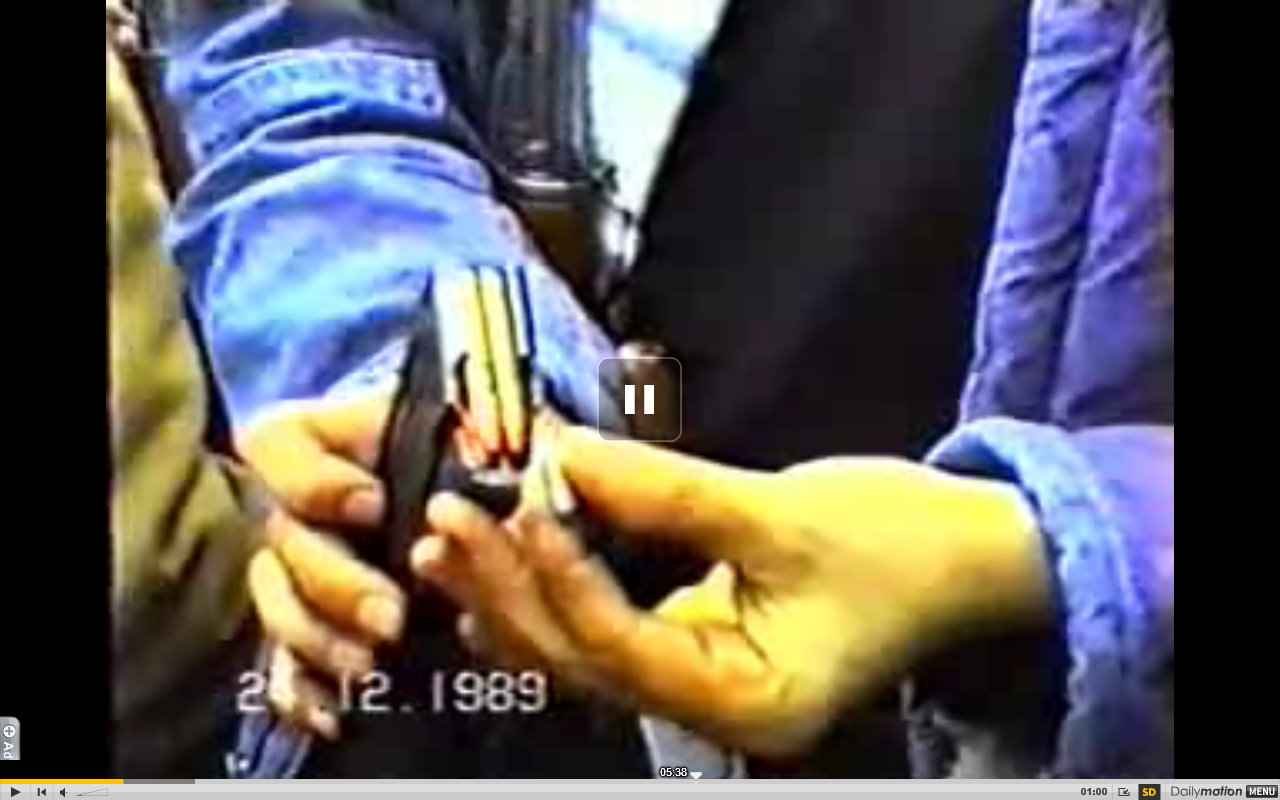
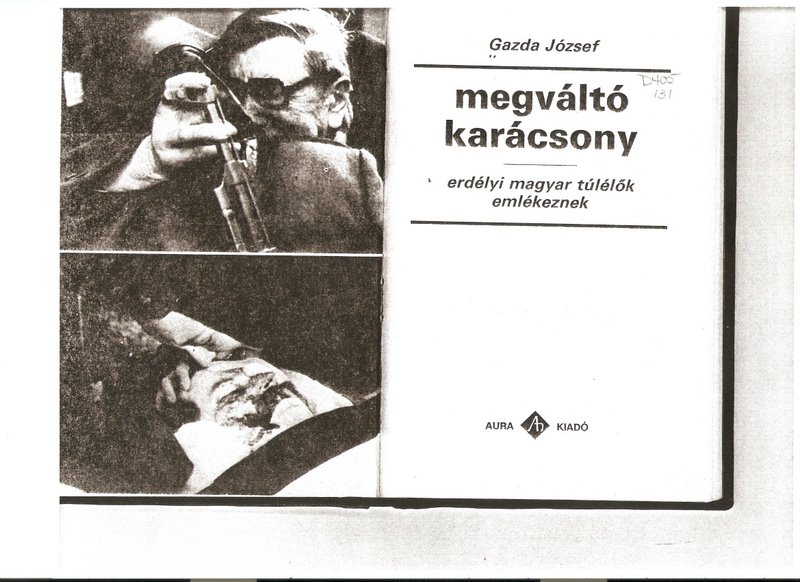
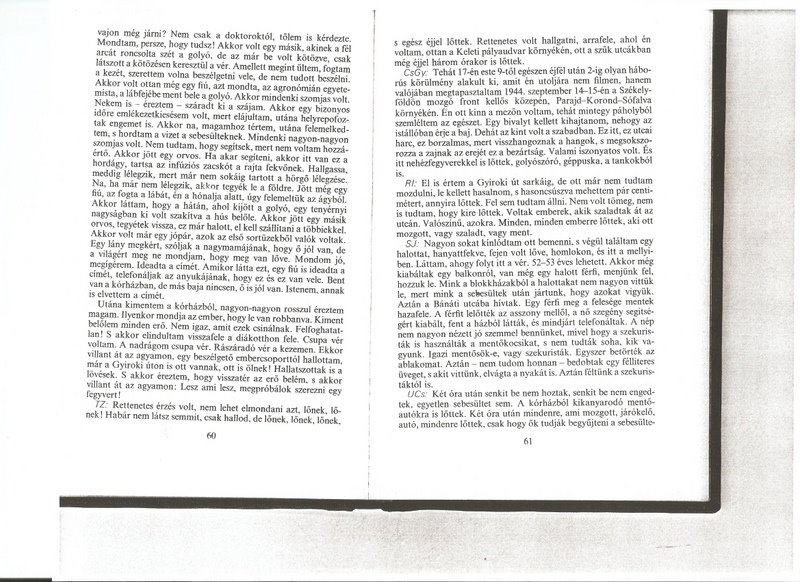
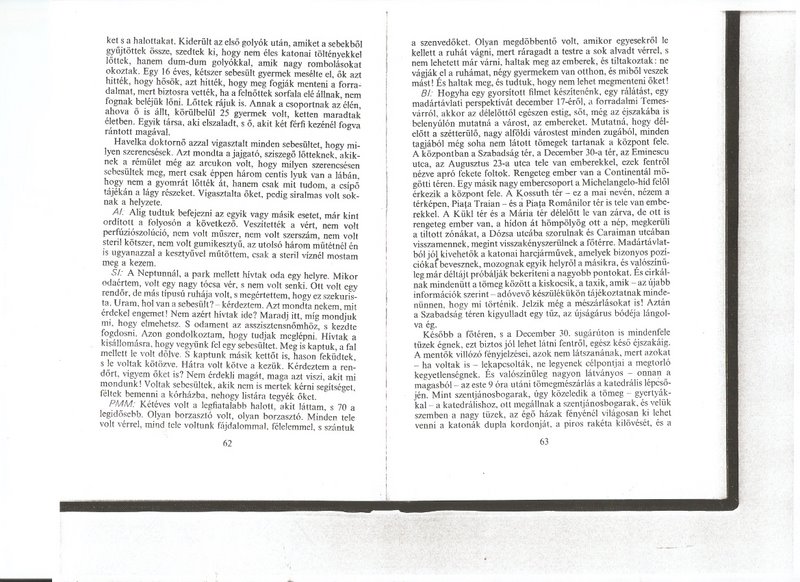
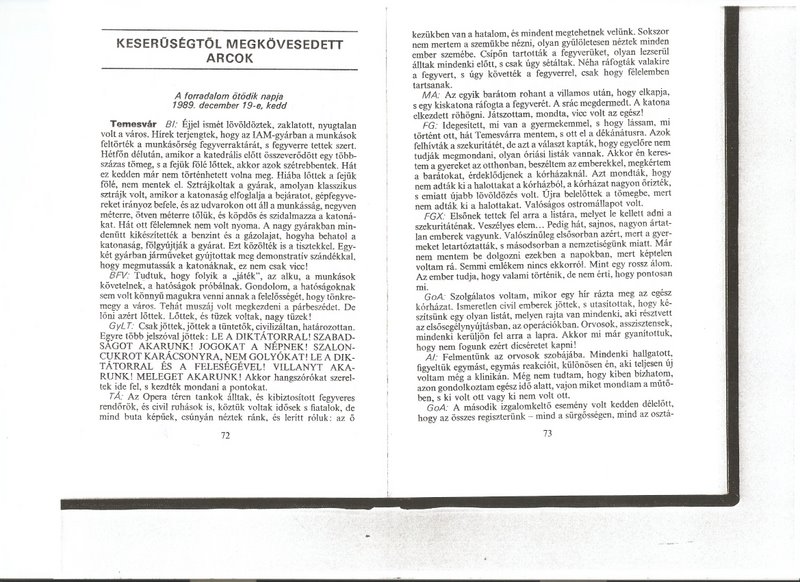
It was in this context, that doctors from Bucharest’s various main hospitals recall Colonel Ghircoias’ sudden, unannounced appearances during the last days of December 1989 and first days of January 1990.  Professor Andrei Firica of the Bucharest “Emergency Hospital” recounted in a 2004 media interview largely the same details he had conveyed to the press in the summer of 1990.  According to Firica, some 15 to 20 suspected terrorists had been interned at the “Emergency Hospital” in varying states of medical distress.  He says he made a small file of the medical situations of these patients.  A Militia colonel, whom he later was to see in [prisoner] stripes on TV as a defendant in the Timisoara trial—i.e. fairly clearly Ghircoias—came one day and counseled him to keep nosy foreign reporters away from the beds of the “terrorists,” stating ominously that “these were just terrorist suspects and he [Dr. Firica] didn’t want to wake up one day on trial for having defamed someone”!   The colonel later came and loaded the wounded terrorist suspects onto a bus and off they went.  Firica maintains the files he kept on the terrorist suspects “of course, disappeared.”  He noted, however, that he asked his son, who had studied theater and film at university, to film the terrorists tied down to the hospital beds, and he claims he gave copies of this cassette to the Procuracy.[4]

[5]

[In viewing these photos, witness what Constantin Fugasin recounted in “Unde ne sint teroristii?” Zig-Zag, in 1990, based in part on an interview with Dr. Andrei Firica:

At the Emergency Hospital 13 suspected of being what we call terrorists were interned.  Among these a few were definitely foreign, even though all had Romanian papers.  Two clearly had ‘Mongoloid’ (‘Asiatic’) features (one stated that his mother was Romanian, while his father was from Laos), while four others were Arabs.  Nevertheless, they spoke Romanian very well.  Doctor Nicolae Staicovici, who worked a time in Egypt and who treated them for a time spoke with them.  At a moment, he formed a question in Arabic.  One of the injured responded to him perfectly.  All were well-built, one was a ‘mountain of a man.’  He said nothing, although he probably had terrible pains.  There were also two terrorists who were not wounded.  One arrived at night, under some pretext.  Those on guard suspecting him, immobilized him.  He had on three layers of clothing and several ids.  They tied him to the stretcher, but although he appeared rather frail, at a given moment he ripped the restraints off.[6]]


[7]

[Dr. Andrei Firica, 2004:  From a diagnostic perspective, those who maintain that the terrorists didn’t exist are telling an outrageous lie…In the Emergency Hospital, people were brought who were shot with precision in the forehead, from behind, just a few yards in the crowd of demonstrators, such people who did this can only be called terrorists…[8]]


Dr. Nicolae Constantinescu, chief surgeon at the Coltea Hospital, also was paid the honor of a visit by Colonel Ghircoias during these days:

I remember that on 1 or 2 January ’90 there appeared at the [Coltea] hospital a colonel from the Interior Ministry, who presented himself as Chircoias.  He maintained in violent enough language that he was the chief of I-don’t-know-what “criminalistic” department from the Directorate of State Security [ie. Securitate].  He asked that all of the extracted bullets be turned over to him.  Thus were turned over to him 40 bullets of diverse forms and dimensions, as well as munition fragments.

To the question of whether he informed the Military Procuracy?

Of course, I announced the Prosecutor’s Office, and requested an investigation [of those shot in the revolution].  For example, when I showed them the apartment from where there were was shooting during the revolution, on the fourth floor of the ‘Luceafarul’ cinema, the prosecutors told me that they sought to verify it and uncovered that there was a Securitate ‘safehouse’ there and that was it.

In 1992, I signed along with other doctors, university professors, renowned surgeons, a memorandum [see page 5 (below) for an article apparently linked to the memorandum] addressed to the Prosecutor General in which we requested an investigation regarding the wounded and dead by gunfire.  Not having received any response, after six months I went there to ask what was going on.  They told me they were working on it, and they showed me two or three requests and that was it.  One of the prosecutors took me into the hallway and told me “I have a child, a wife, it is very complicated.”  He asked me what I thought I was doing…I lit back into him, I told him I wasn’t just any kind of person to be blown off.

I showed him the x-rays of those who were shot, I showed him the bullets in the liver.  The x-rays exist, they weren’t my invention, I didn’t just dream all this up to demand an investigation!  I told them that there are some people who wish to find out the truth and they signed a memo to the Procuracy and they aren’t just anybody, but doctors with experience, experts in the field.  In vain, we requested ballistics tests and other research, in vain we presented forms, documents, x-rays, studies.  They did not want to undertake a serious investigation.[9]
[4]Professor Andrei Firica, interview by Florin Condurateanu, “Teroristii din Spitalul de Urgenta,” Jurnalul National, 9 March 2004, online edition, cited in Hall, “Orwellian…Positively Orwellian” http://homepage.mac.com/khallbobo/RichardHall/pubs/Voineaswar091706.html. For similar accounts, see Florin Mircea Corcoz si Mircea Aries, “Terorist ascuns in Apuseni?” Romania Libera, 21 August 1992, p. 1–“Colonelul Ghircoias, former director of the Securitate’s penal investigative unit, brought together the individuals accused of being terrorists and made them disappear”; Andreea Hasnas, “Reportajul unui film cu TERORISTI,” Expres, no. 10 (6-12 aprilie 1990), p. 5; Constantin Fugasin, “Unde ne sint teroristii?” Zig-Zag, 1990.

[5] Screen capture from http://www.dailymotion.com/video/x7rp6b_revolutia-romana-2225-dec1989-part_shortfilms posted by Alexandru2006.

[6] Significantly this video is in direct contradiction and contests the claims of the Sorin Iliesiu who maintains that “General Dan Voinea has said clearly:  The terrorists did not exist.  Those who seized power lied to protect the real criminals….The diversion of the ‘terrorists’ has been demonstrated by [the] Justice [System], not a single terrorist being found among the dead, wounded or arrested  (Sorin Iliesiu, “18 ani de la masacrul care a deturnat revoluţia anticomunistă,” 21 December 2007, http://www.romanialibera.com/articole/articol.php?step=articol&id=6709).  For a discussion, see Hall 2008.

[7] Screen capture from http://www.dailymotion.com/video/x7rp6b_revolutia-romana-2225-dec1989-part_shortfilms posted by Alexandru2006.

[8] Professor Andrei Firica, interview by Florin Condurateanu, “Teroristii din Spitalul de Urgenta,” Jurnalul National, 9 March 2004, online edition.

[9] Dr. Professor Nicolae Constantinescu, interview by Romulus Cristea, “”Nici acum nu-mi dau seama cum am putut sa operez nonstop timp de trei zile,” Romania Libera, 20 December 2006, online edition.

—————————————————————————————————————————————————————————————————

http://atomic-temporary-3899751.wpcomstaging.com/2014/09/23/a-tale-of-two-letters-by-securitate-director-general-iulian-vlad-what-the-romanian-press-does-and-does-not-publish/

http://atomic-temporary-3899751.wpcomstaging.com/2013/11/20/when-a-truth-commission-misses-crucial-evidence-the-romanian-cpadcr-final-report-and-securitate-general-iulian-vlads-declaration/

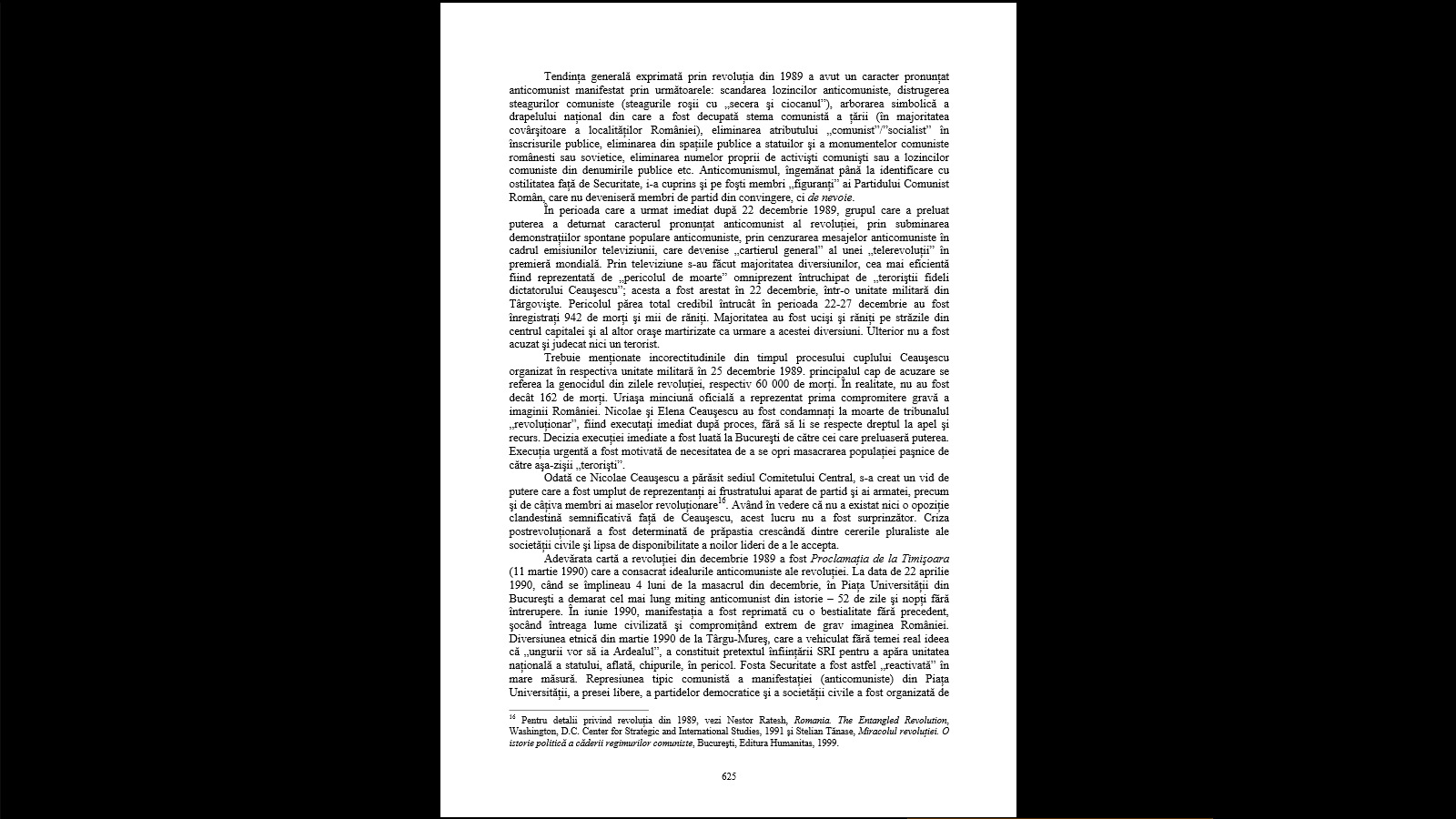
It is virtually certain that the authors of the Chapter on the Romanian Revolution of December 1989 (pp. 620-627, especially p. 625 http://www.presidency.ro/static/ordine/RAPORT_FINAL_CPADCR.pdf ) had no knowledge of Securitate General Iulian Vlad’s Declaration of 29 January 1990 … with predictable negative consequences for their understanding of what happened in December 1989.

And one wonders why I found (find) mainstream Romanian studies so unhelpful in trying to understand Nicolae Ceausescu’s overthrow and the Romanian Revolution of December 1989?  Read Vladimir Tismaneanu or Tom Gallagher (or in its 2014 variation, see Grigore Pop-Eleches in Bernhard and Kubik) on Romania in the early 1990s and one is presented with a world of good and evil, of angels and demons, with distance from former nomenklaturist and high-ranking communist Ion Iliescu and the core of the National Salvation Front being as being the simple formula for explaining and understanding any event or policy.  As opposed to this highly–one might say blatantly–politically partisan [and bureaucratically ignorant] approach, on the other side stand functional or deconstructionist explanations–the kind favored by Peter Gross, Katherine Verdery, Peter Siani-Davies, or Ruxandra Cesereanu–which would explain the press of the time as the function of market pressures, sensationalist appetites, an anomic readership, poor journalistic training and professionalism, etc.

How then does one explain the following conundrum:  the selective treatment of the letters and declarations of former Securitate Director General Iulian Vlad?  Oh, yes, the text of General Vlad’s letters which allege he was a stooge and victim of Ion Iliescu, etc. can be found in the Romanian press.  No problem!  But what about his declaration of 29 January 1990, where he deftly admits the responsibility of his institution for the bloodshed of December?  What, that not sensationalist enough, different enough to sell papers?  That’s not “anti-communist” enough for publication?  Is it somehow less credible than the other letters whose text has been published without problem?  24 plus years later, the Romanian media has yet to publish this document!  Could it be that the problem with this declaration is that it does not fit with and undermines the other popular narratives of December 1989 that minimize and even absolve the former Securitate of responsibility for the bloodshed of December 1989?
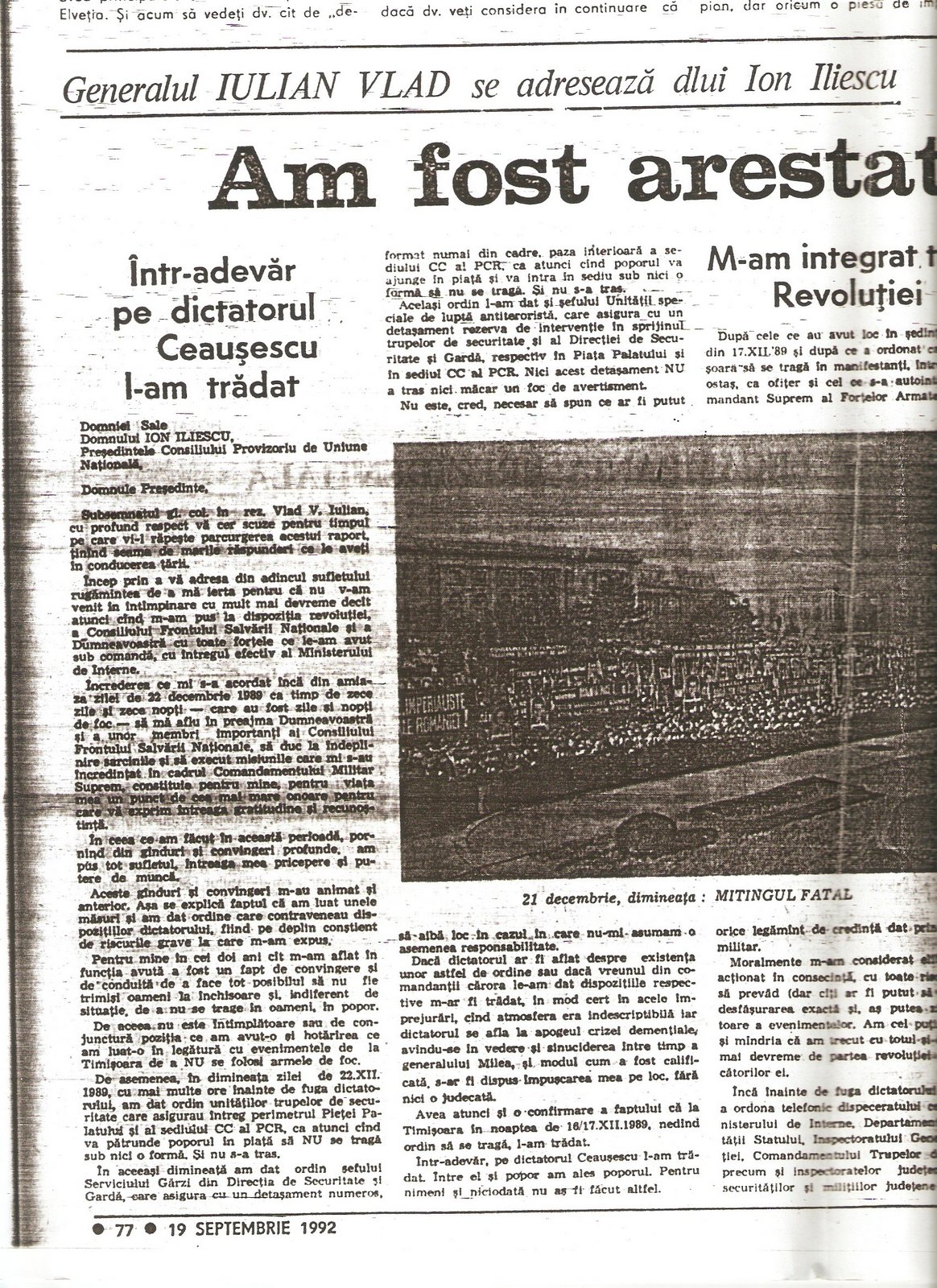
image0-001

Ion Cristoiu’s Evenimentul Zilei debuted in June 1992 and was the flagship of opposition to the regime of Ion Iliescu.  In the fall of 1992 it ran a zealous campaign opposed to Iliescu’s reelection.  Here is the exculpatory letter from former Securitate General Iulian Vlad (dated 20 March 1990) that was published on 19 September 1992:
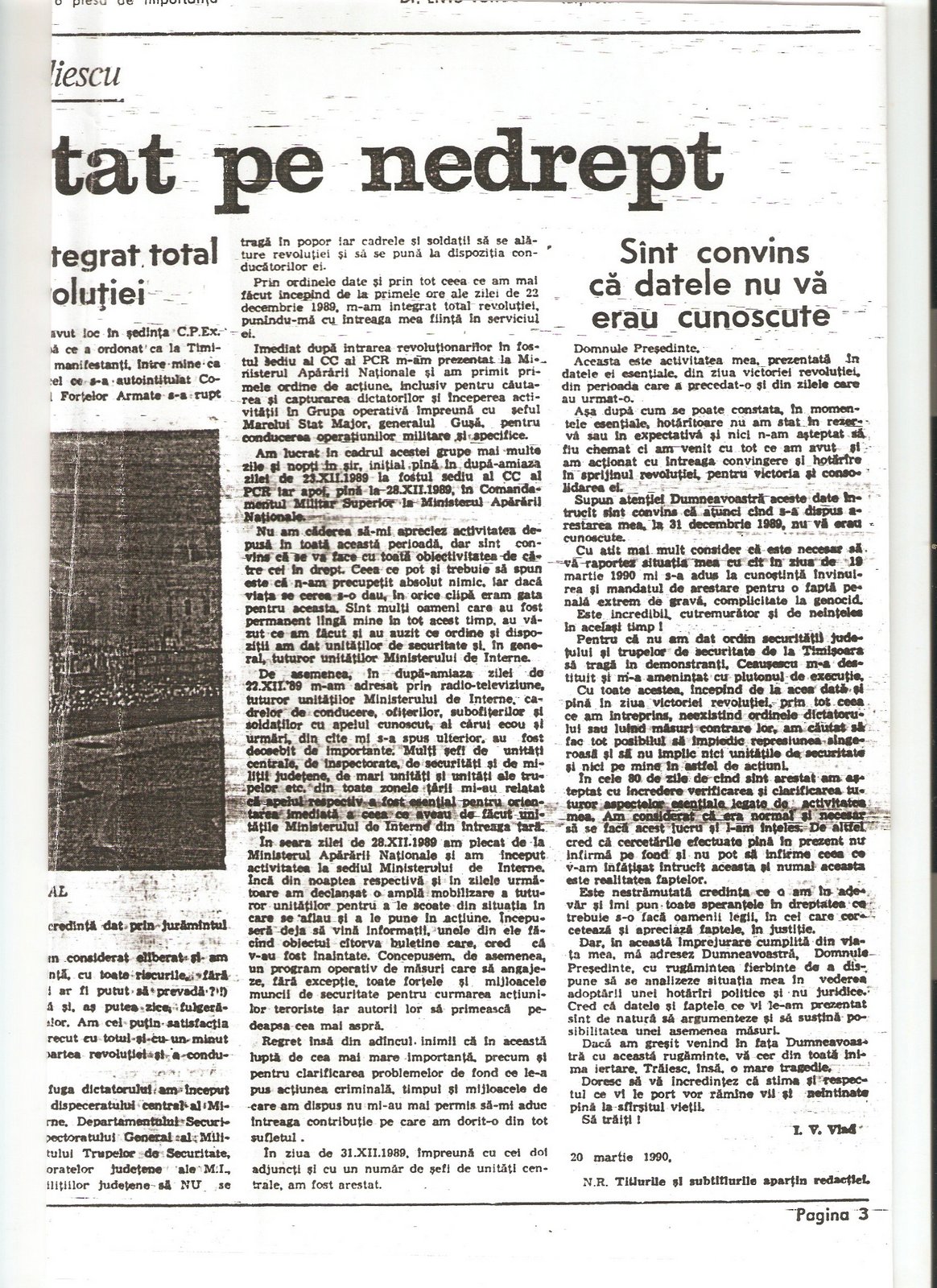
image0-004

“Generalul IULIAN VLAD se adreseaza dlui Ion Iliescu:  Am fost arestat pe nedrept (20 March 1990),” Evenimentul Zilei, 19 septembrie 1992, p. 3.  “Intr-adevar pe dictatorul Ceausescu l-am tradat” “M-am integrat total Revolutiei” “Sint convins ca datele nu va erau cunoscute”  I.V. Vlad 20 martie 1990

And, yet, what of General Iulian Vlad’s declaration of 29 January 1990.  As far as I know, in 24 plus years, only this brief allusive mention on the 15th anniversary of the letter (although not mentioned or acknowledged in the article, and possibly accidental) has made its way into the Romanian press.  Below it:  the text of the statement of 29 January 1990!
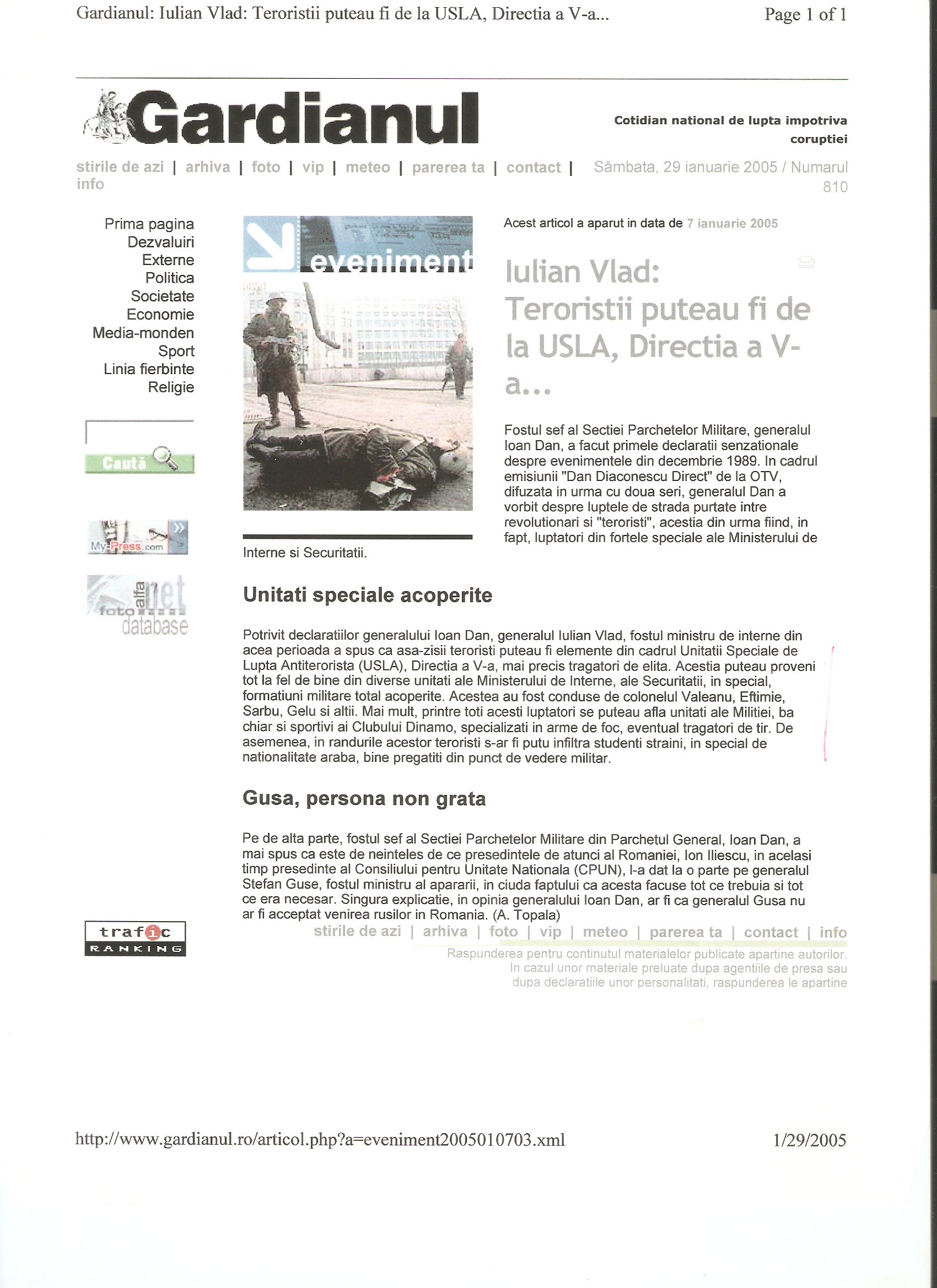
image0-005

http://atomic-temporary-3899751.wpcomstaging.com/text-of-securitate-general-iulian-vlads-29-january-1990-declaration-identifying-the-terrorists/

image0-001

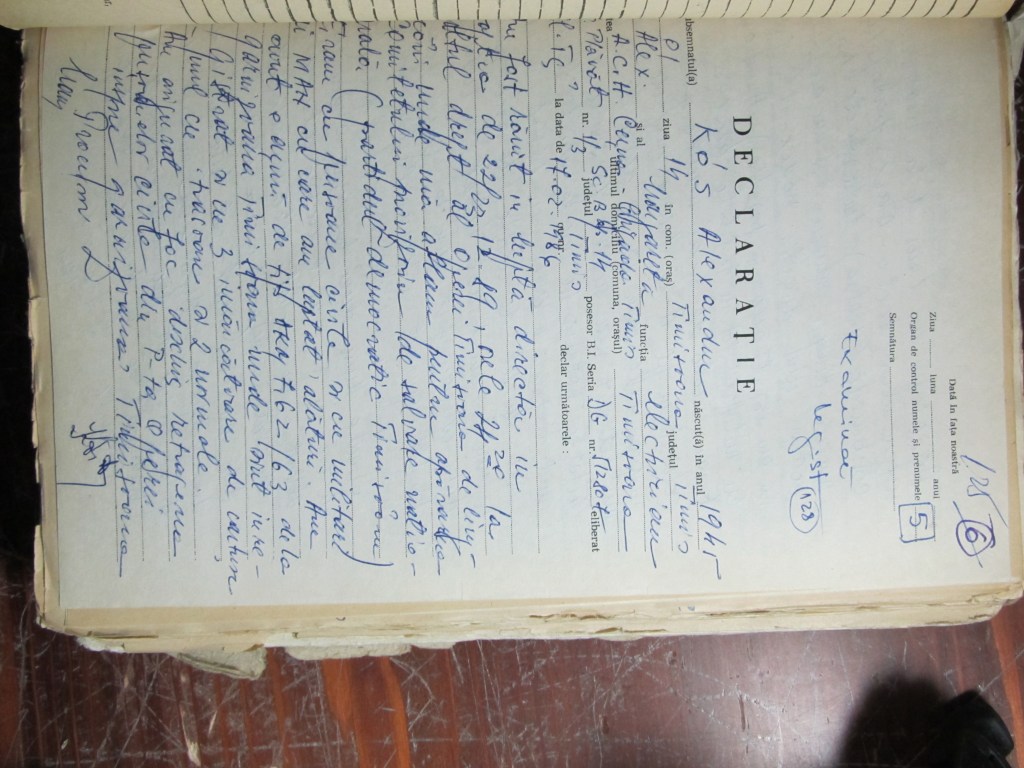
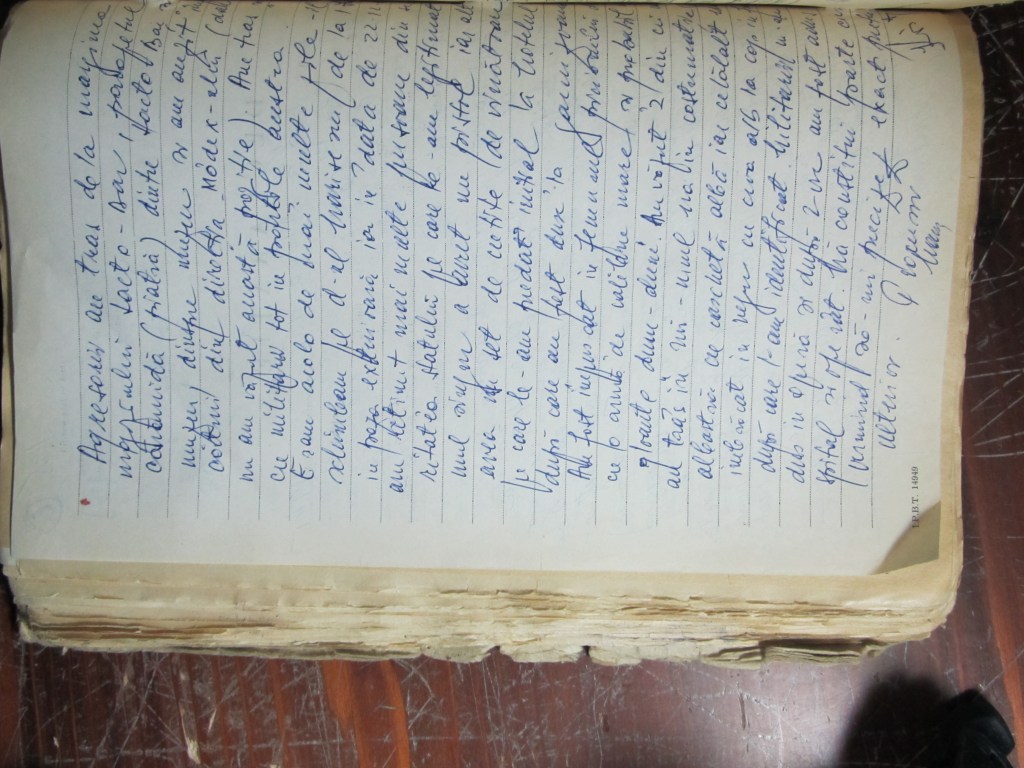
It took 22 years for the text of Securitate Director General Iulian Vlad’s handwritten declaration of 29 January 1990 to become public knowledge–thanks to former military prosecutor General Ioan Dan.  (Inevitably, there will no doubt be those who will allege that General Vlad was “forced” to write this declaration to save his skin, etc., that this was the “propaganda of the moment” and all a huge lie.  If that were the case, one would have expected Iliescu, Brucan, Militaru, Voican Voiculescu, etc. to have made every effort for Vlad’s declaration to leak to the media.  Instead, for 22 years it was hidden from public knowledge!)

Of Note:  No “Soviet tourists,” no DIA (Batallion 404) troops of the army’s intelligence wing, no “there were no terrorists:  the Army shot into everyone else and into itself”–in other words, none of the spurious claims that have littered the narrative landscape, fueled by the former Securitate over the past two decades plus.  No, Vlad knew who the terrorists of the Romanian Revolution of December 1989 were, because they reported to him!

image0

image0-002

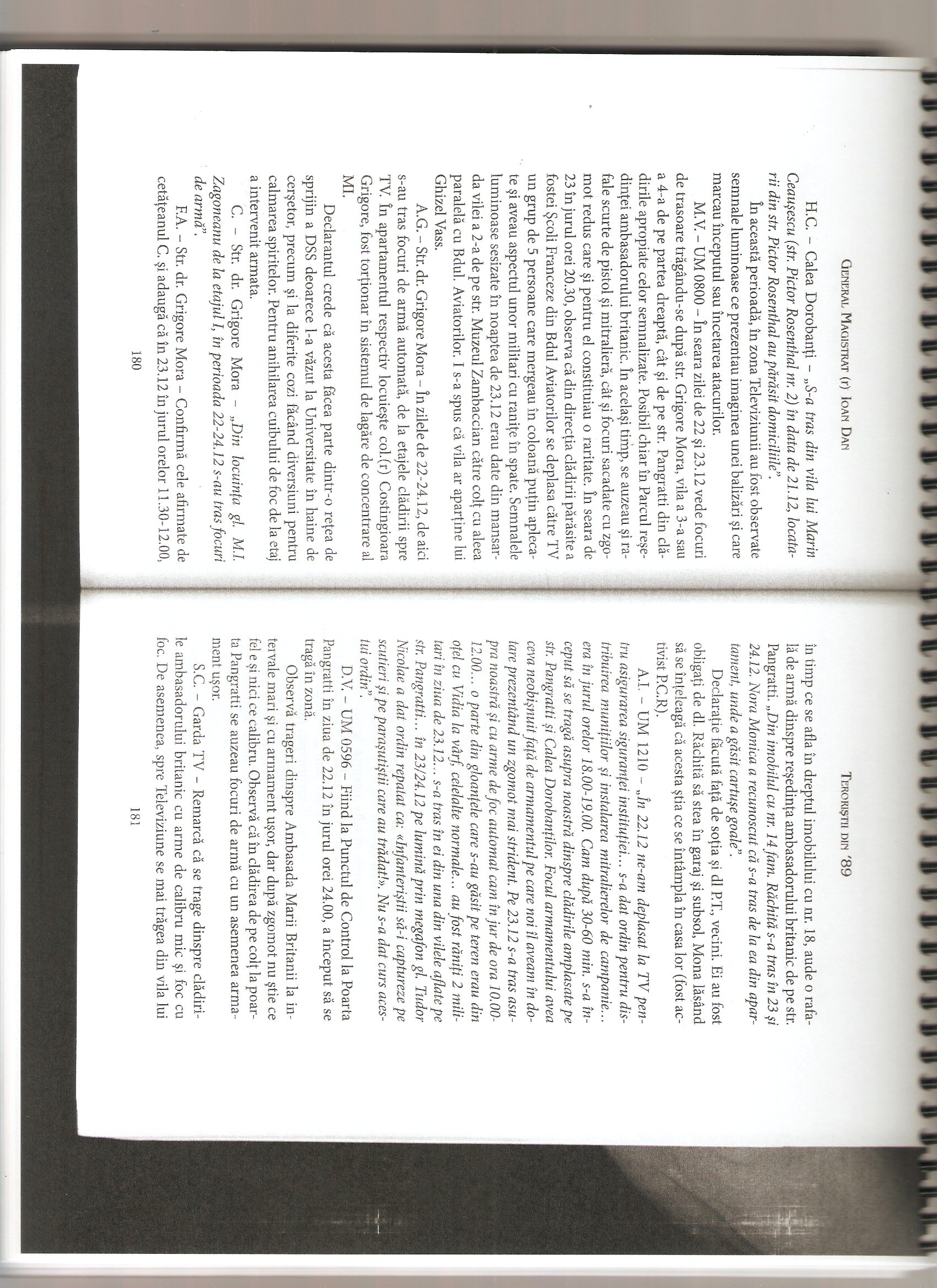
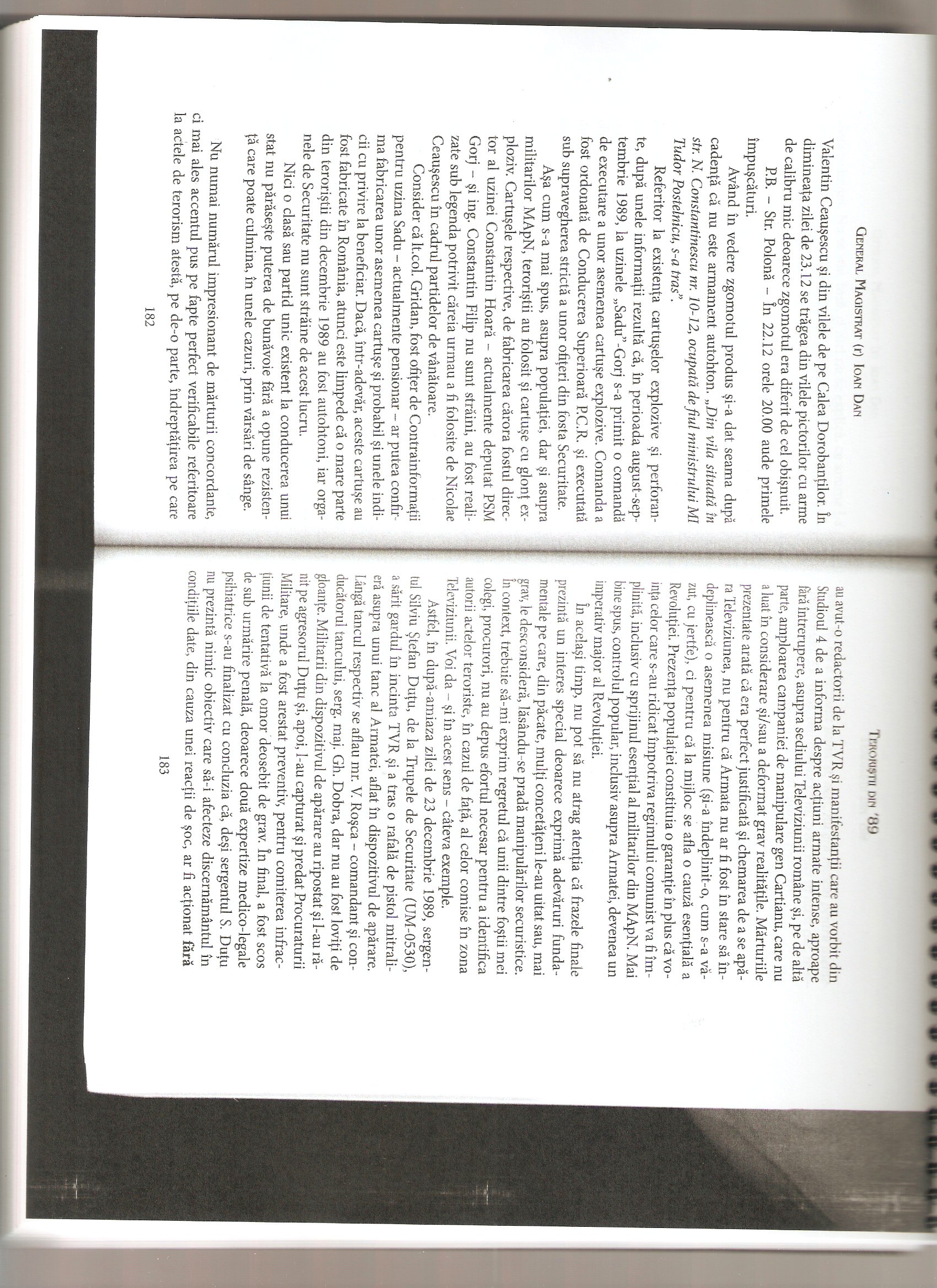
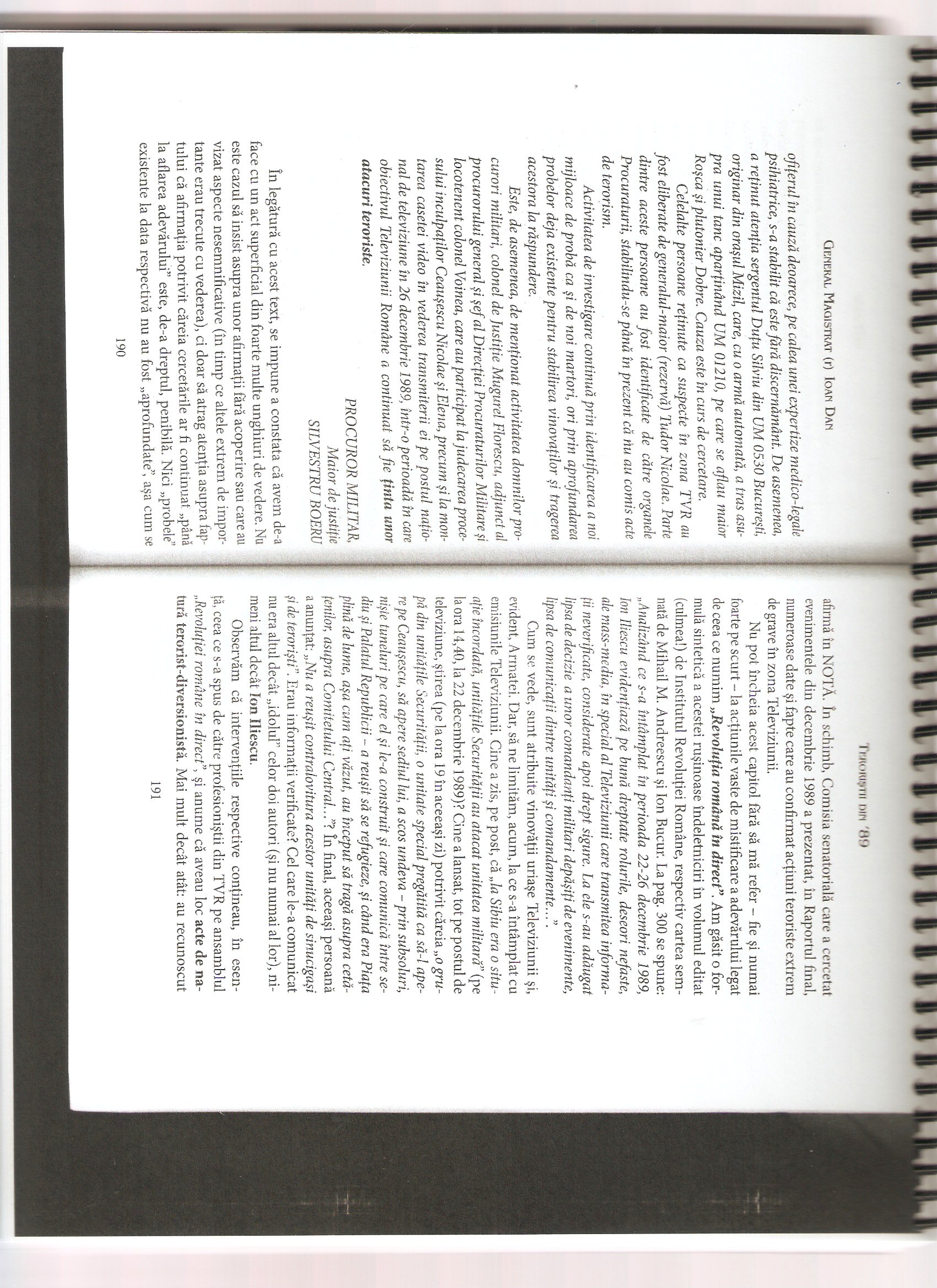
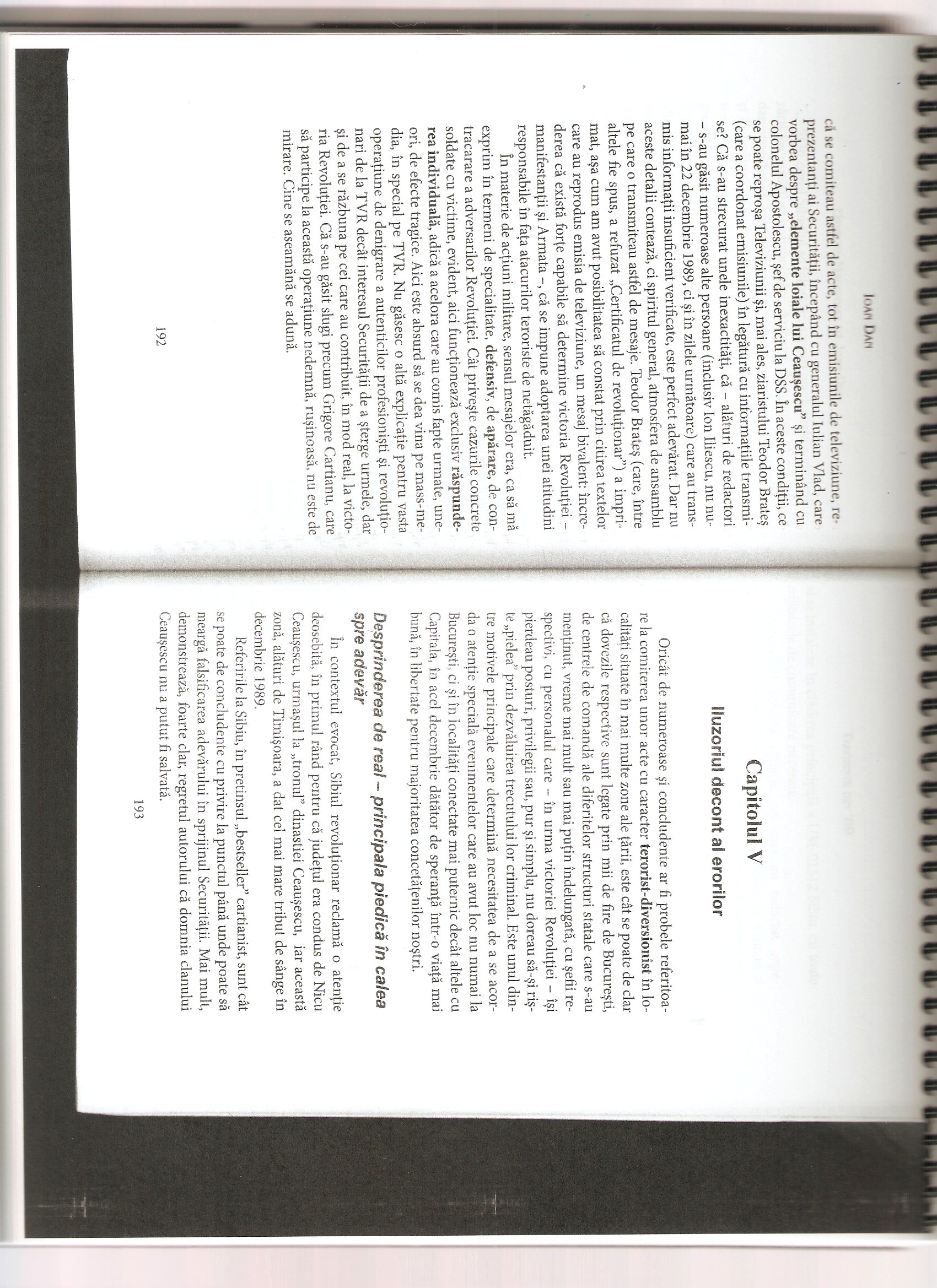
General Magistrat (r) Ioan Dan

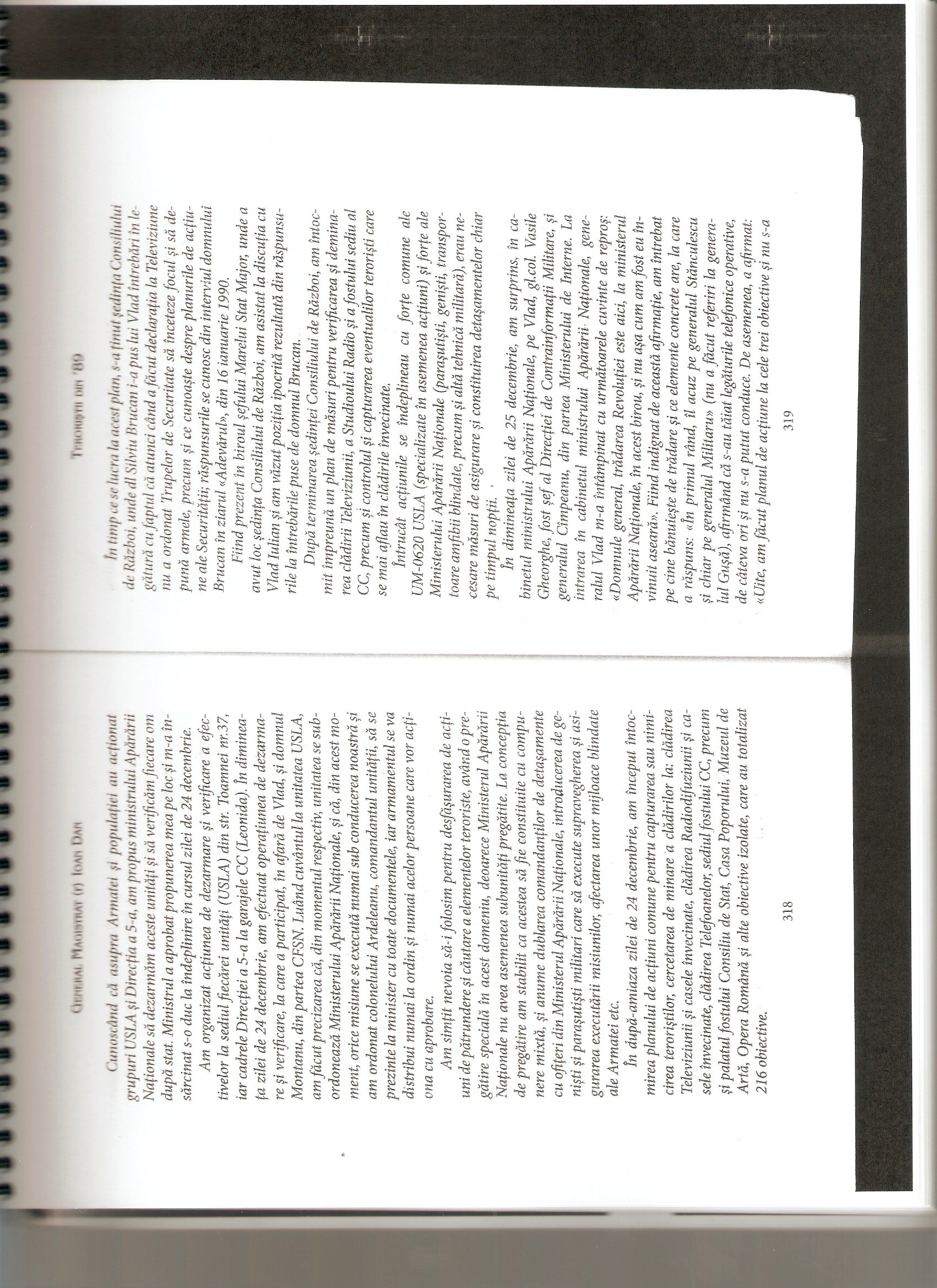
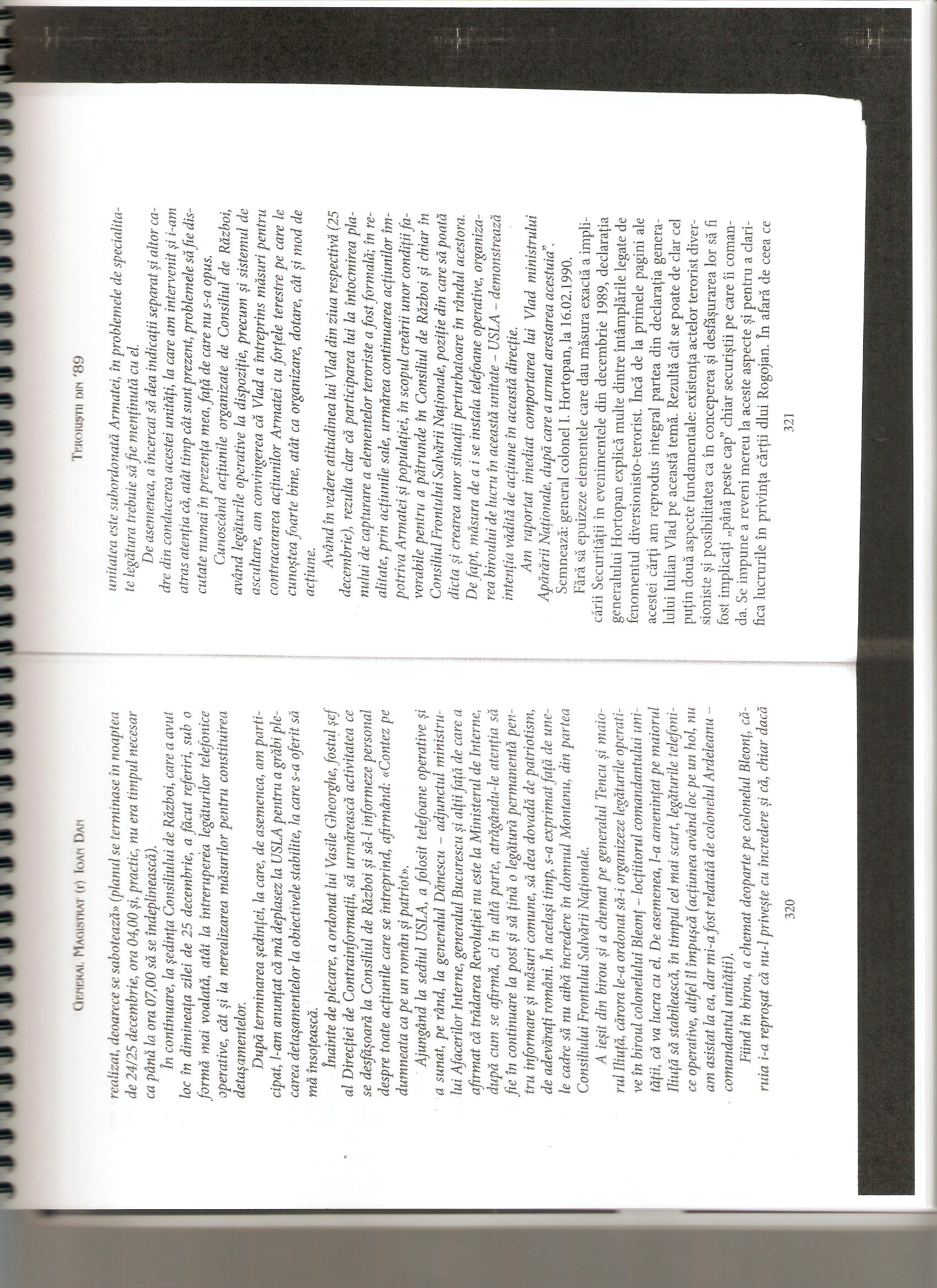
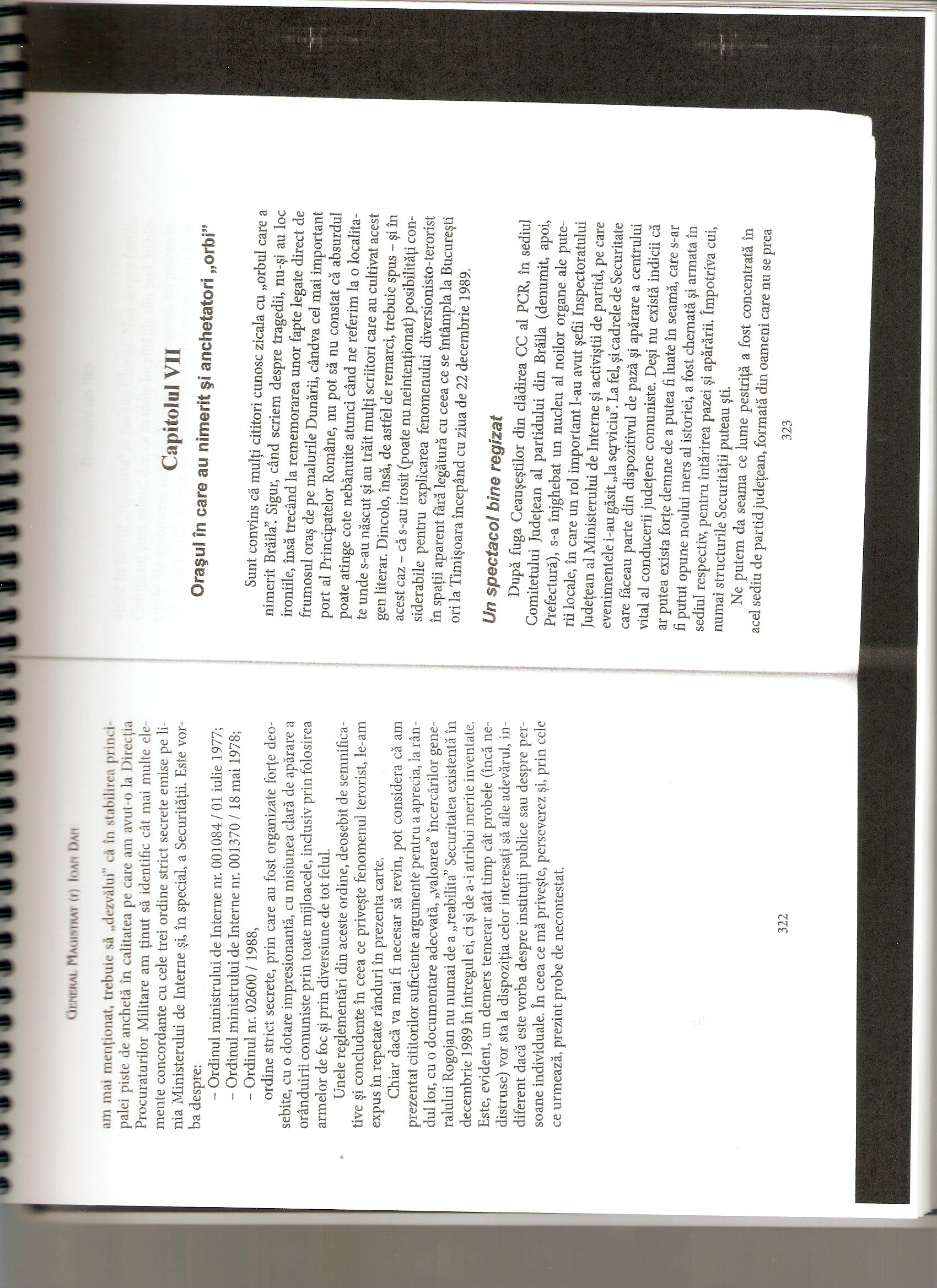
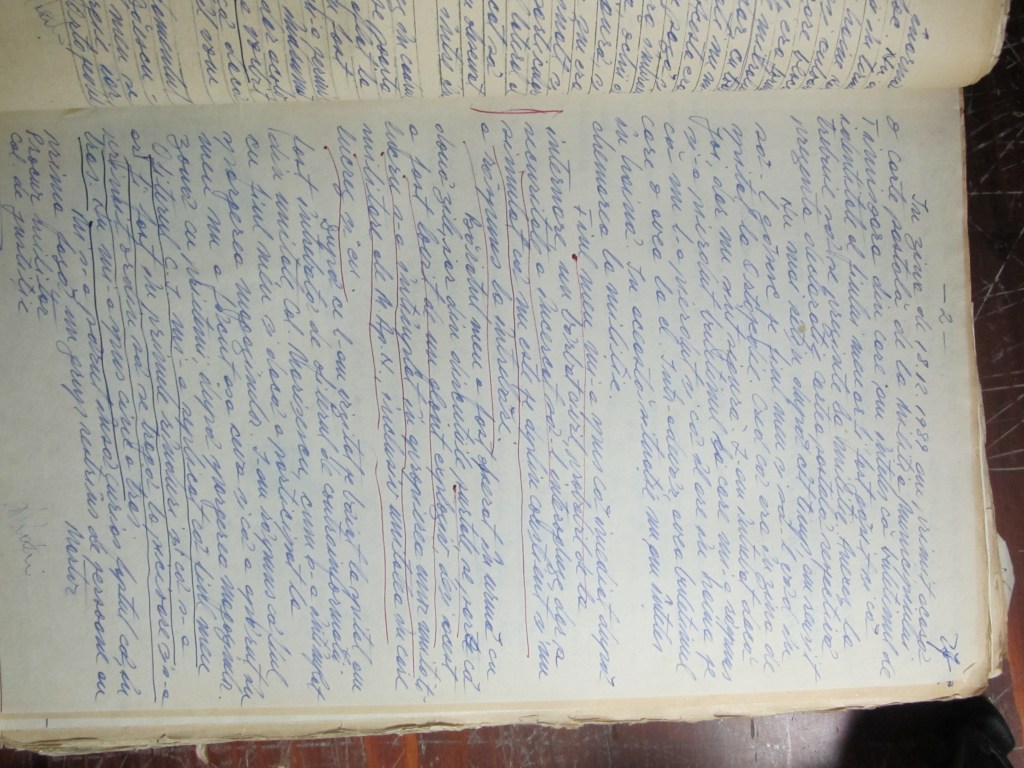
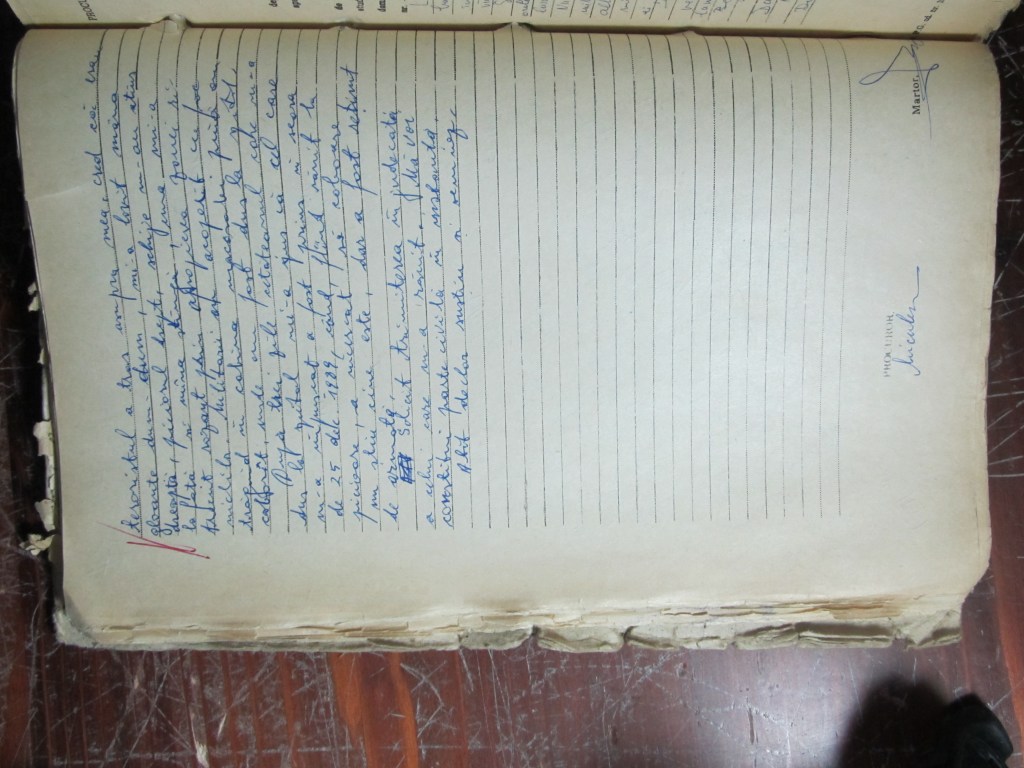
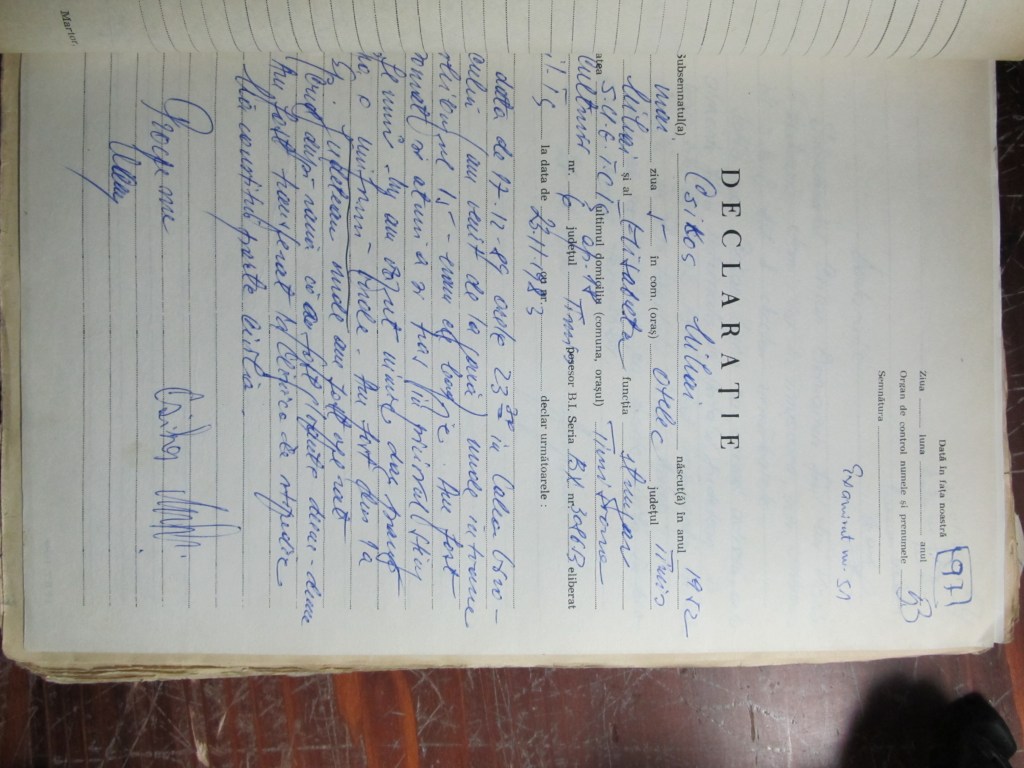
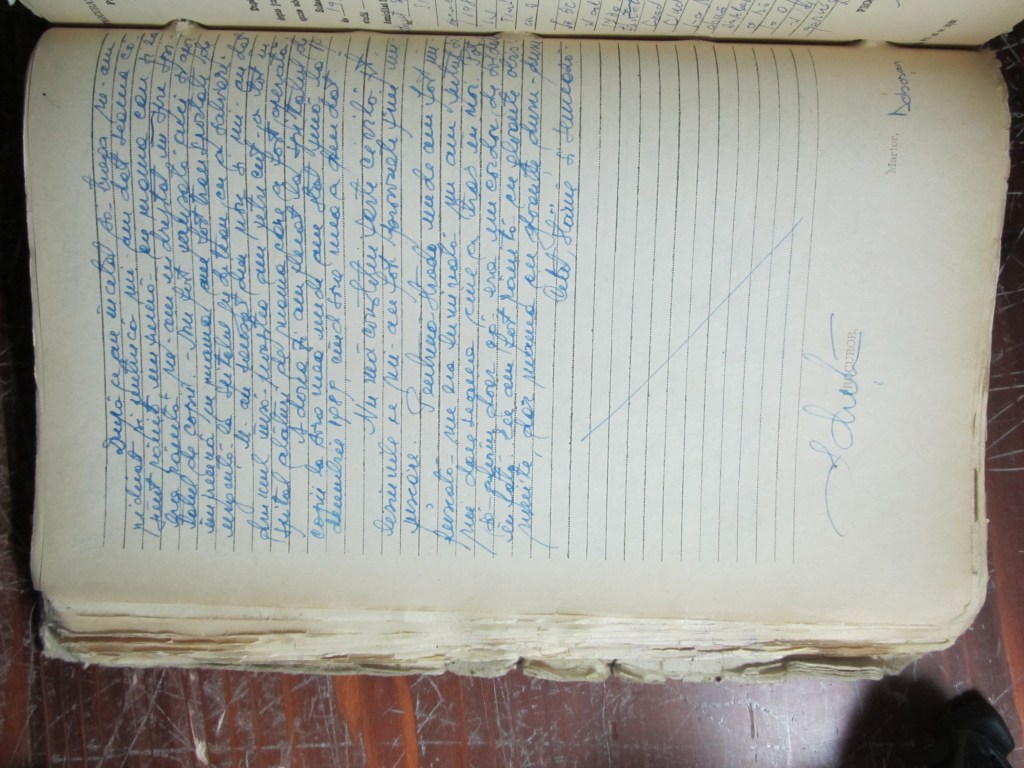
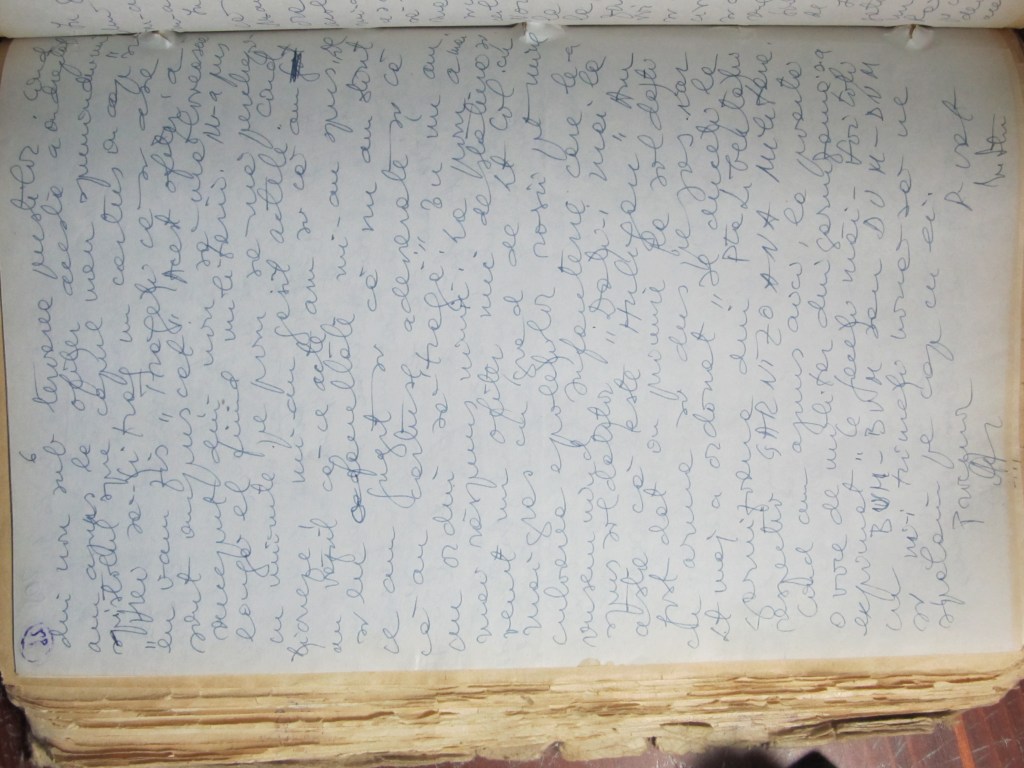
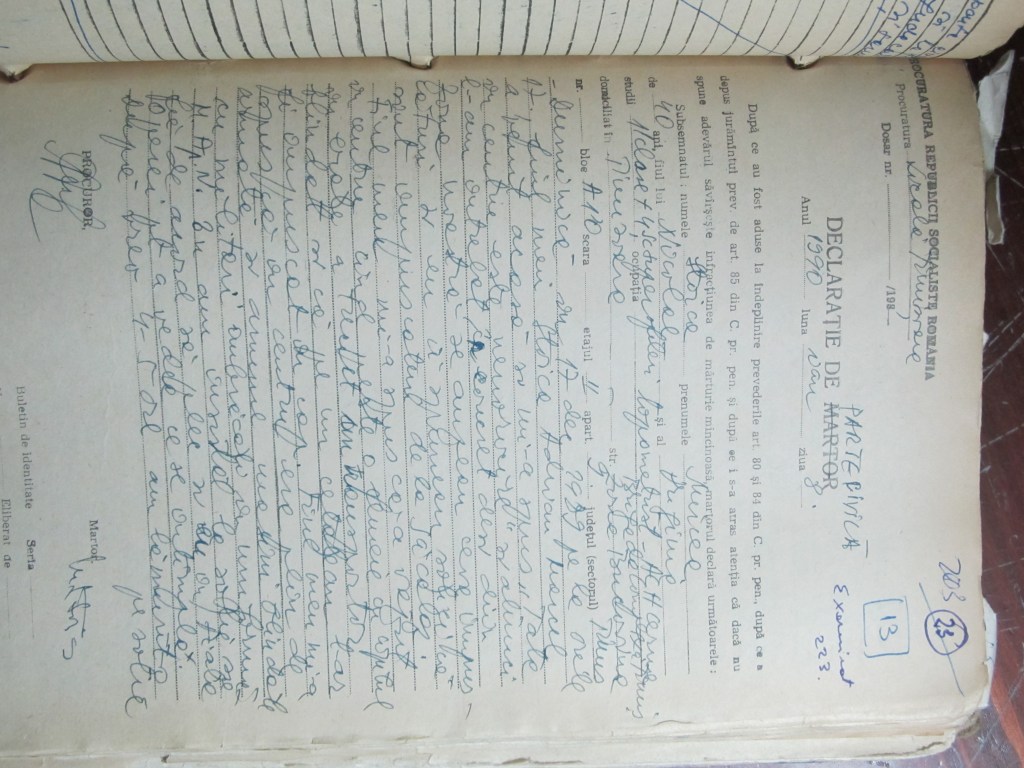
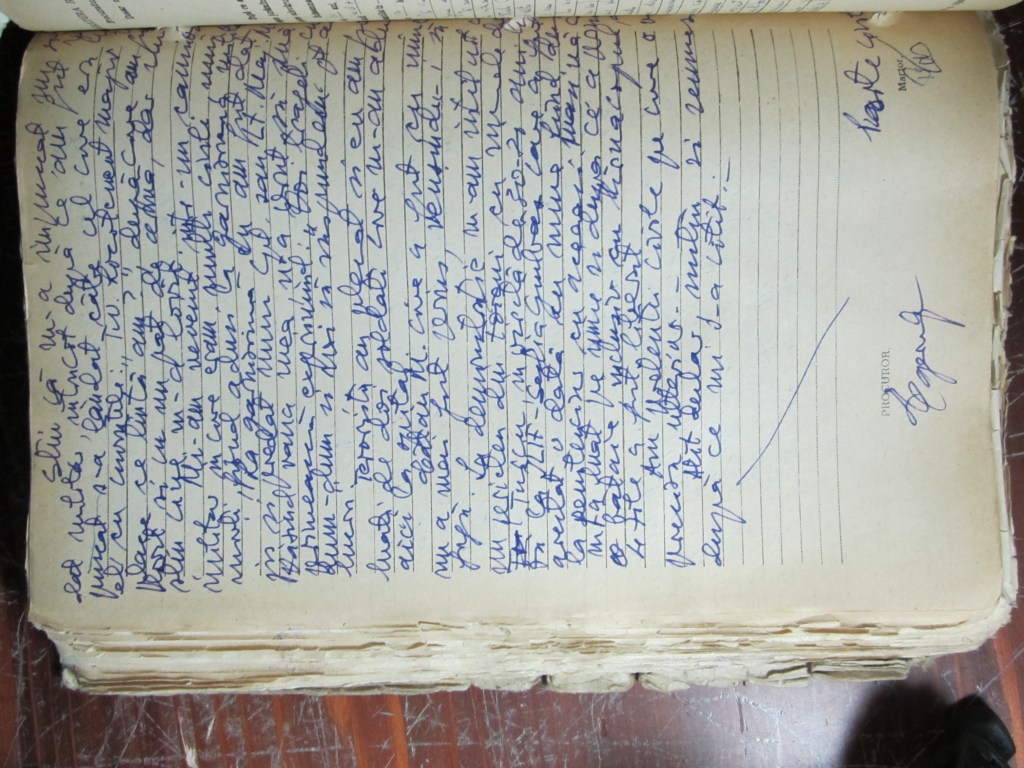
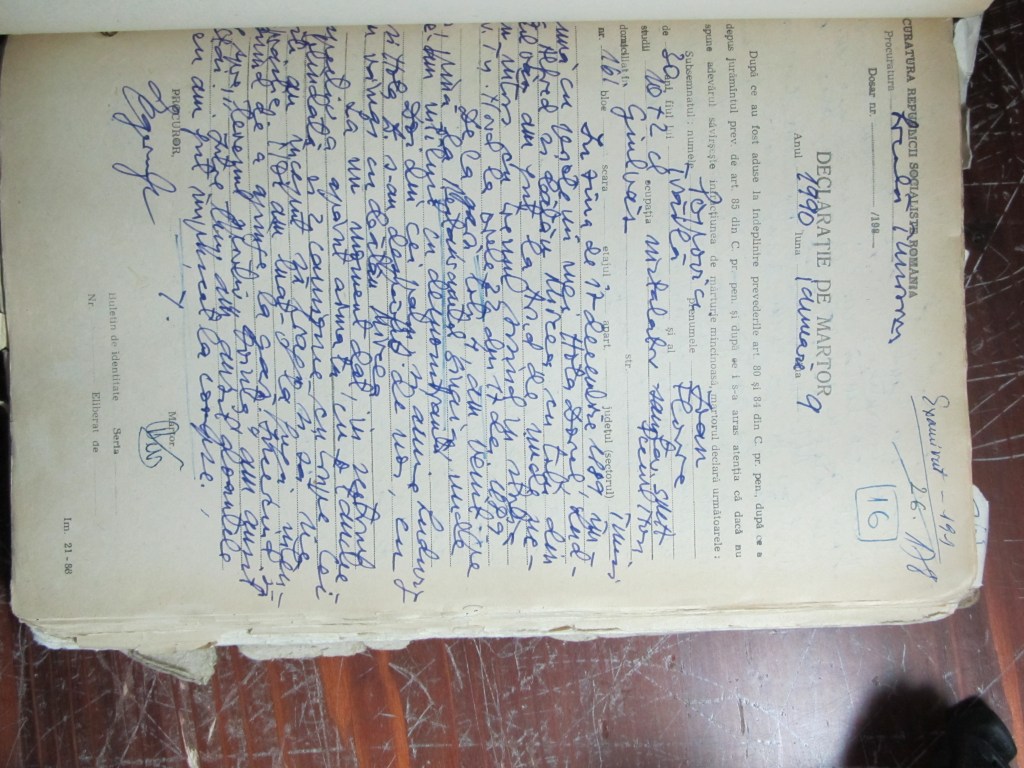
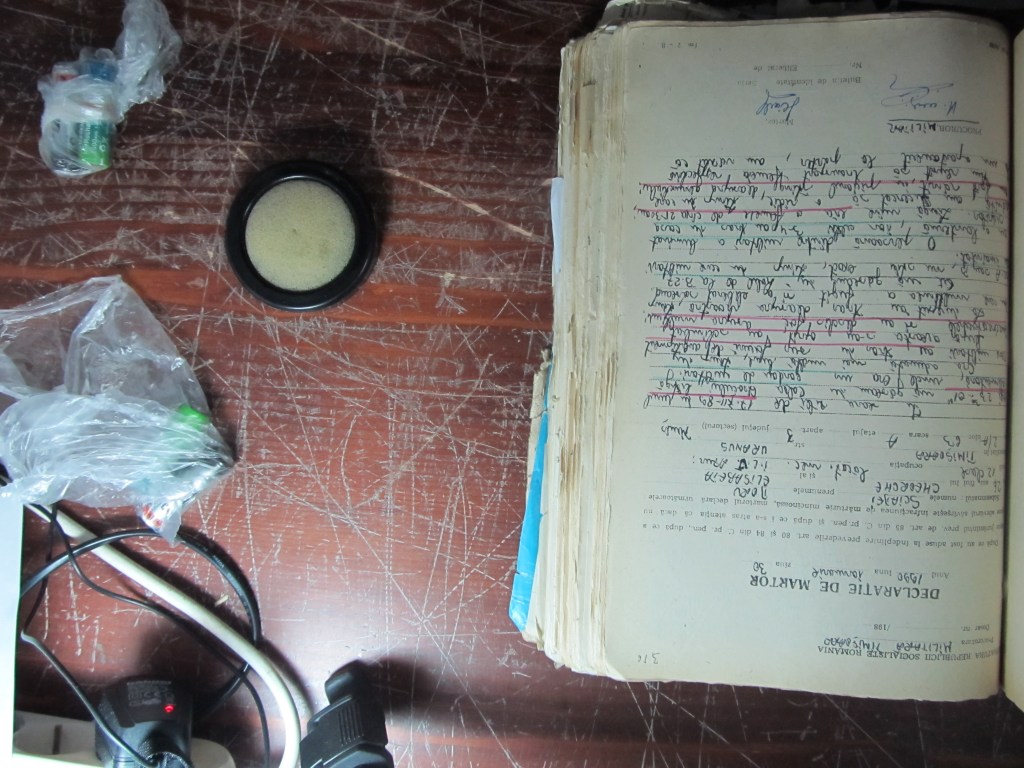
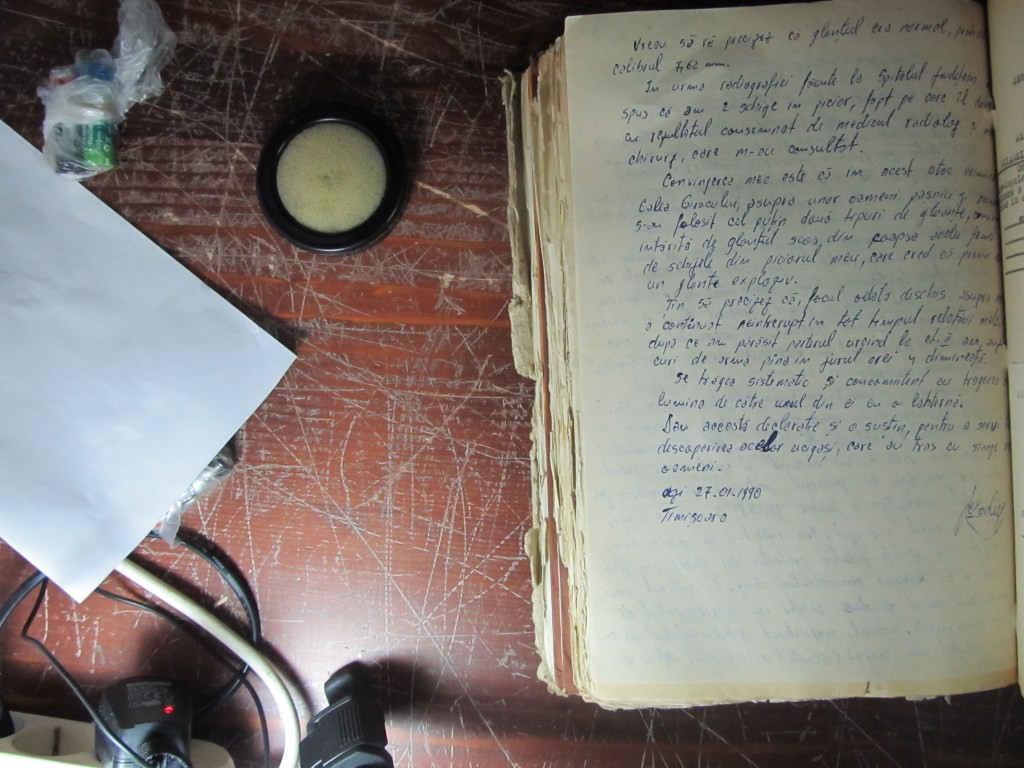
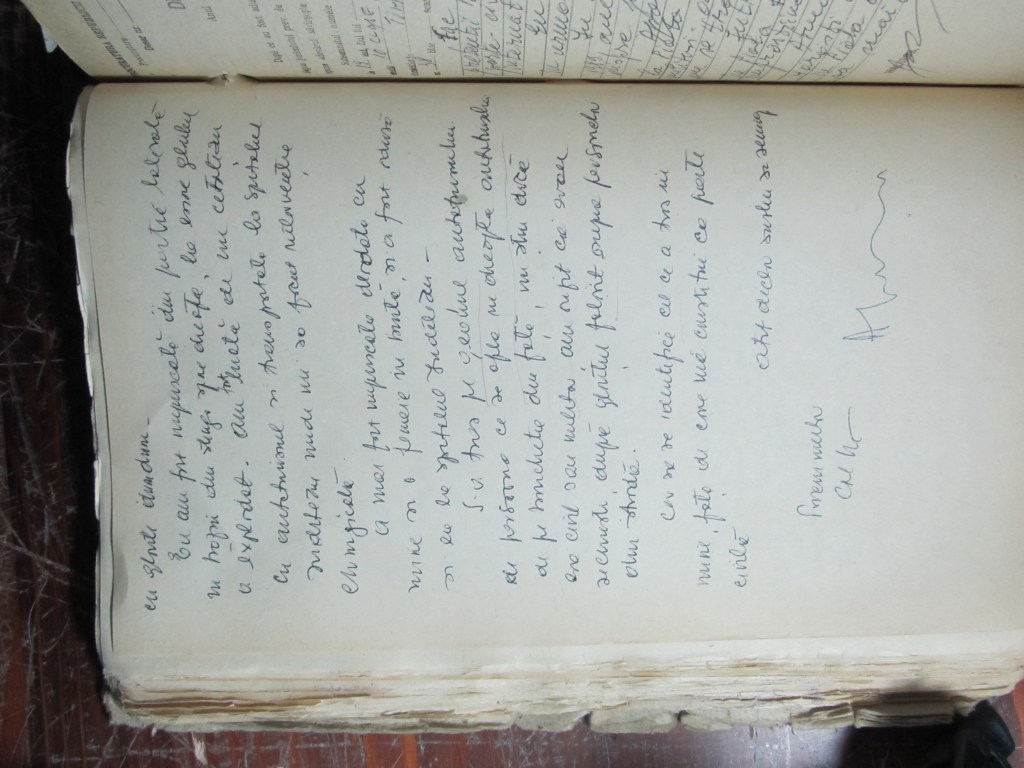
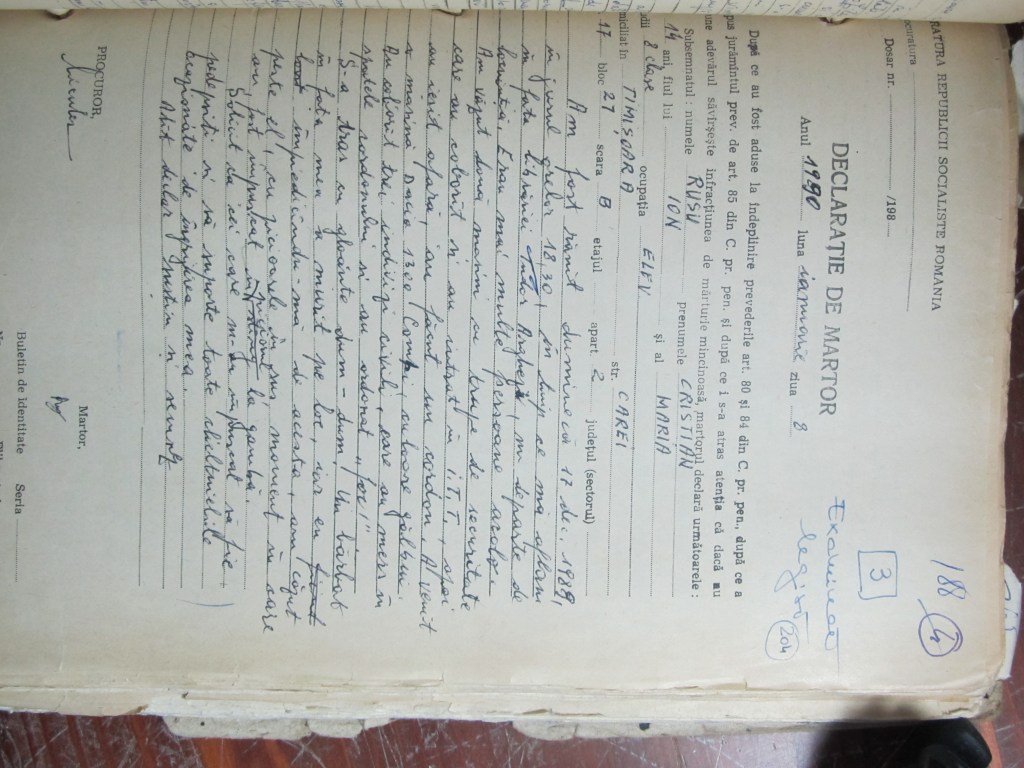
In aprilie 1990, generalul Gheorghe Diaconescu a fost destituit din functia de conducere in Directia Procuraturilor Militare.  La plecare, mi-a predat cheia de la fisteul sau, cu mentiunea ca acolo au mai ramas cateva hartii fara importanta. Intrucat, la data respectiva, ma aflam in cea mai mare parte a timpului, in procesul cercetarilor de la Timisoara, mult mai tarziu, am dorit sa pun in respectivul fiset o serie de acte.  Am cercetat ce mai ramasese de pe urma generalului Diaconescu si, spre surprinderea mea, am gasit declaratia olografa a generalului Iulian Vlad, data fostului adjunct al procurorului general, fostul meu sef direct, nimeni altul decat generalul Diaconescu, la 29 ianuarie 1990, cand toate evenimentele din decembrie 1989 erau foarte proaspete.  Repet, este vorba despre declaratia olografa, un text scris foarte ingrijit, pe 10 pagini, din care voi reda acum integral doar partea care se refera expres la “actiunile teroriste in Capitala” (formularea apartine generalului Vlad).

“Analizand modul in care au inceput si s-au desfasurat actiunile teroriste in Capitala, pe baza acelor date si informatii ce le-am avut la dispozitie, consider ca acestea ar fi putut fi executate de:

1) Elementele din Directia a V-a, USLA, CTS si din alte unitati de Securitate, inclusiv speciale.

a) Directia a V-a, asa cum am mai spus, avea in responsabilitate paza si securitatea interioara a Palatului Republicii, multe dintre cadrele acestei unitati cunoscand foarte bine cladirea, cu toate detaliile ei.  In situatia creata in ziua de 22.12.1989, puteau sa mearga la Palat, pe langa cei care faceau acolo serviciul si unii dintre ofiterii si subofiterii care se aflau la sediul CC ori la unitate.

Este ca se poate de clar ca numai niste oameni care cunosteanu bine topografia locului ori erau in complicitate cu cei care aveau asemenea cunostinte puteau patrunde in cladire (sau pe acoperisul ei) si transporta armamentul si cantitatile mari de munitie pe care le-au avut la dispozitie.

Tot aceasta Directie dispunea de o baza puternica si in apropierea Televiziunii (la Televiziunea veche).  De asemenea, avea in responsabilitate perimetrul din zona resedintei unde se aflau numeroase case (vile) nelocuite si in care teroristii ar fi putut sa se ascunda ori sa-si faca puncte de sprijin.

Sunt si alte motive care pun pe prim-plan suspiciuni cu privire la aceasta unitate.

b) Elemente din cadrul unitatii speciale de lupta antiterroriste care aveau unele misiuni comune cu Directia a V-a si, ca si o parte a ofiterilor si subofiterilor de la aceasta unitate, dispuneau de o mai buna instruire si de mijloace de lupta mai diversificate.

c) Elemente din Trupele de Securitate care asigurau paza obiectivilor speciale (resedinta, palat etc.) si, impreuna cu Directia a-V-a, Securitatea Capitalei si Militia Capitalei asigurau traseul de deplasare.

d) Ofiteri si subofiteri din Securitatea Capitalei, indeosebi de la Serviciul Trasee, sau dintre cei care au lucrat la Directia a V-a.

e) Elemente din alte unitati de Securitate, inclusiv unitatile speciale 544, 195 si 110, precum si din cele complet acoperite, comandate de col. Maita, col. Valeanu, lt. col. Sirbu, col. Nica, col. Eftimie si lt. col. (Eftimie sau Anghelache) Gelu (asa sta scris in declaratie–n.n.).  Aceste din urma sase unitati, ca si UM 544, in ansamblu, si UM 195 puteau dispune si de armament si munitii de provenienta straina, precum si de conditii de pregatire adecvate.

2) Ofiteri si subofiteri din Militie, atat de la Capitala, cat si de la IGM, cu prioritate cei din Detasamentul special de interventie si cei care asigurau traseul.

3) Cred ca s-ar impune verificarea, prin metode si mijloace specifice, a tragatorilor de elita din toate unitatile din Capitala ale Ministerului de Interne, precum si a celor care au avut in dotare sau au indeplinit misiuni folosind arme cu luneta.  N-ar trebui omisi nici chiar cei de la Dinamo si de la alte cluburi sportive.

4) Unele cadre militare de rezerva ale Securitatii, Militiei si Armatei, precum si actuali (la data respectiva) si fosti activisti de partid sau UTC, persoane apropriate tradatorului si familiei sale ori care poseda arme de foc.

Propun, de asemenea, o atenta investigare a celor care au fost in anturajul lui Nicu Ceausescu.  Acest anturaj, foarte divers, cuprindea inclusive unele elemente de cea mai scazuta conditie morala care puteau fi pretabile la asemenea actiuni.

Ar fi bine sa se acorde atentia cuvenita sub acest aspect si fratilor dictatorului–Ceausescu Ilie si Ceausescu Nicolae–care, prin multiplele posibilitati pe care le aveau, puteau organiza asemenea actiuni.

5) Anumite cadre militare sau luptatori din Garzile Patriotice.

6) Straini:

a. Din randul celor aflati la studii in Romania:

– arabi, in general, si palestinieni, in special, inclusiv cei care sunt la pregatire pe linia Armatei (de exemplu, la Academia Militara);

– alte grupuri de straini la studii (iranieni si altii).

b. Special infiltrati (indeosebi din cei care au urmat diverse cursuri de pregatire pe linia MI sau a MAN);

c. Alti straini aflati in tara cu diverse acoperiri, inclusiv diplomatice;

d. Fosti cetateni romani (care ar fi putut intra in tara si in mod fraudulos).

7) Elemente infractoare de drept comun care au posedat armament ori l-au procurat in chiar primele ore din dupa-amiaza zilei de 22 decembrie 1989, cand, din mai multe unitati de Securitate, intre care Directia a V-a si Securitatea Capitalei, s-a ridicat o cantitate mare si diversa de armament si munitie.”

http://atomic-temporary-3899751.wpcomstaging.com/2013/10/04/declaratia-generalului-ion-hortopan-cum-a-vazut-armata-colaborarea-generalului-iulian-vlad/

image0-010

Declaratia generalului colonel I. Hortopan, 16.02.1990 (din cate cunosc, pana publicarea cartii lui Dan Ioan, timp de 22 de ani, aceasta declaratie n-a aparut in presa romana)

“Actiunile teroristilor au crescut in intensitate in ziua de 23 decembrie si in seara zilei, la o analiza a Consilului Frontului Salvarii Nationale, Vlad a fost intrebat cine sunt cei care trag asupra Armatei si populatiei, la care acesta — in scopul de ne induce in eroare — a raspuns ca manifestantii patrunzand in anumite obiective importante, printre ei fiind si elemente rauvoitoare, fosti puscariasi de drept comun, au pus mana pe arme, s-au constituit in grupuri si trag asupra noastra.  In timpul actiunii, trupele noastre au prins un numar de teroristi care faceau din unitatile de Securitate, au cerut cuvantul si au prezentat numarul unitatilor din care faceau parte (UM-0672F, UM-0639, UM-0106, UM-0620), la care Vlad, tot pentru inducere in eroare, a afirmat ca acestia s-ar putea sa fie fanatici, care, chipurile, ar actiona pe cont propriu.”

image0-011

image0-012

image0-013

http://atomic-temporary-3899751.wpcomstaging.com/2013/09/07/former-securitate-officials-who-corroborated-general-iulian-vlads-declaration-on-the-terrorists-liviu-turcu-ion-mihai-pacepa-radu-vasilevici-marian-romanescu-and-others/ 

http://atomic-temporary-3899751.wpcomstaging.com/2013/05/14/planul-z-z-ion-mihai-pacepa-si-liviu-turcu-in-decembrie-1989/

I have attempted to trace Pacepa’s public discussion of Plan Z-Z to verify claims made by other actors (see below, Gheorghe Diaconescu, Giani Bucurescu/Virgil Lovescu) in the Romanian Revolution of December 1989.  All of these actors refer to Pacepa’s discussion on Radio Free Europe/Radio Europa Libera sometime apparently between 24 and 26 December 1989.  Unfortunately, although there are a series of audio clips and transcripts from these days on the Europa Libera site http://www.europalibera.org/archive/1989/latest/452/982.html, there is no mention of the Pacepa intervention in question and no indication of record of its existence on the Internet.

0436

6 februarie 1990

Declaratie.  Subsemnatul Bucurescu Giani, general-maior [D.S.S.]

La data de 28 sau 29 decembrie 1989, col. Lovescu [?] Virgil seful U.M. 0650 mi-a raportat ca…

Col. Lovescu [?] Virgil avea un subordonat a carui sotie-medic a participat la acordarea ajutorului ranitilor in luptele de la Aeroport Otopeni si la transportarea cadavrelor la I.M.L.  Acestea ii relatase sotului ca in buzunarul unui terorist ucis la Otopeni, care era imbracat in trei costume de haine, unul peste altul, s-au gasit cartile de vizita ale lui Emil Bobu si Ion Dinca.

Col. L Virgil mi-a spus ca l-a frapat aceasta informatie si legat de faptul ca la postul de Radio Europa Libera se facuse afirmatie cu Pacepa ar fi precizat ca Ion Dinca se ocupase de pregatirea unor grupuri de teroristi.  Alte date nu pot da intrucit informatia era in curs de clarificare ori la Col. Ratiu [DSS Dir I] ori la Col. Goran [SMB]…

Cunosc [?] faptul ca col. Ardeleanu [sef USLA] era in relatii apropriate cu familia lui Ion Dinca…

Din conducerea USLA atit col. Ardeleanu cit si col Blortz [Bleort] erau apropriatii lui T. Postelnicu

0437

http://atomic-temporary-3899751.wpcomstaging.com/2012/12/28/what-can-we-learn-from-dosarele-revolutiei-de-la-timisoara-vi/

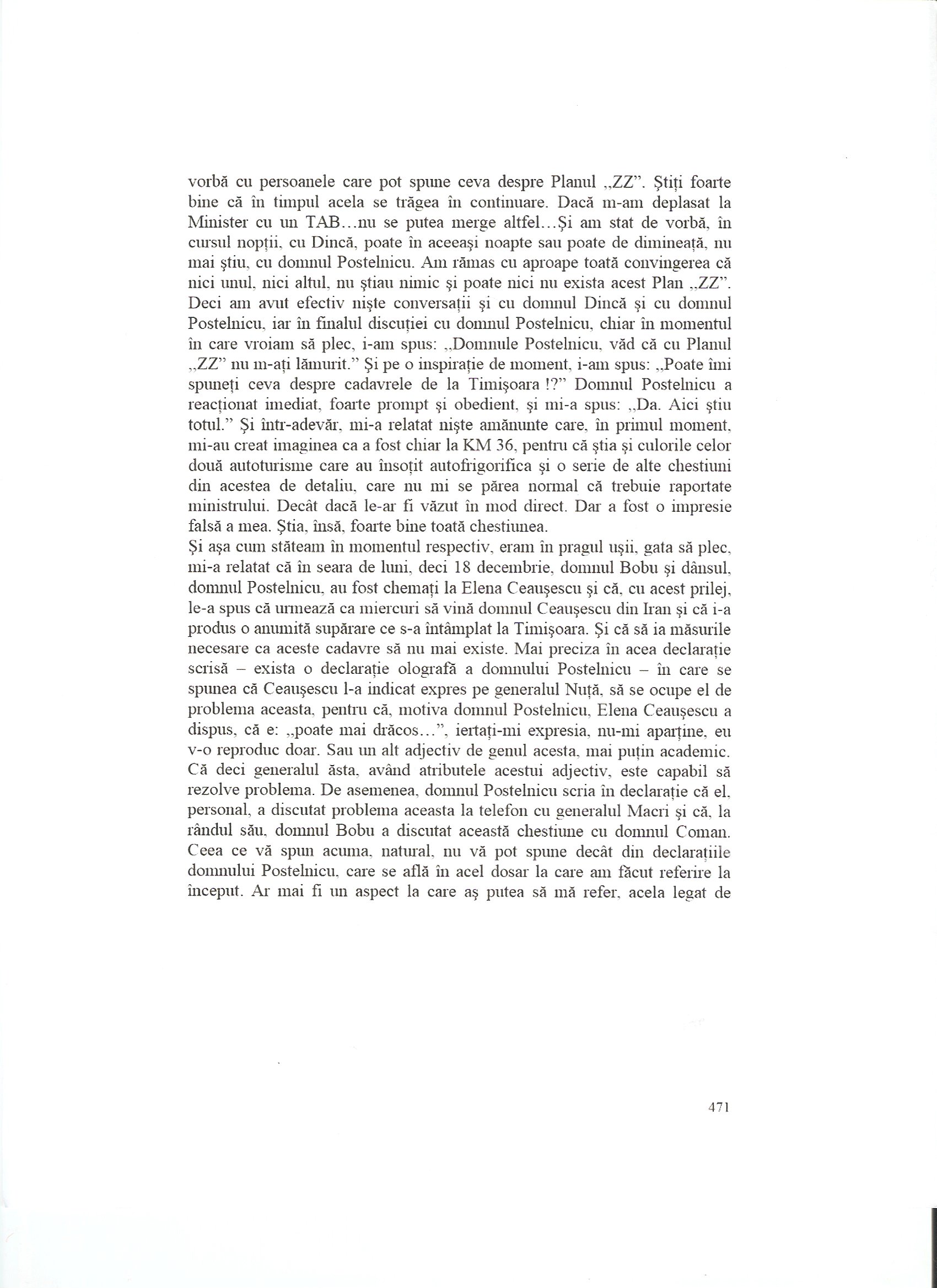
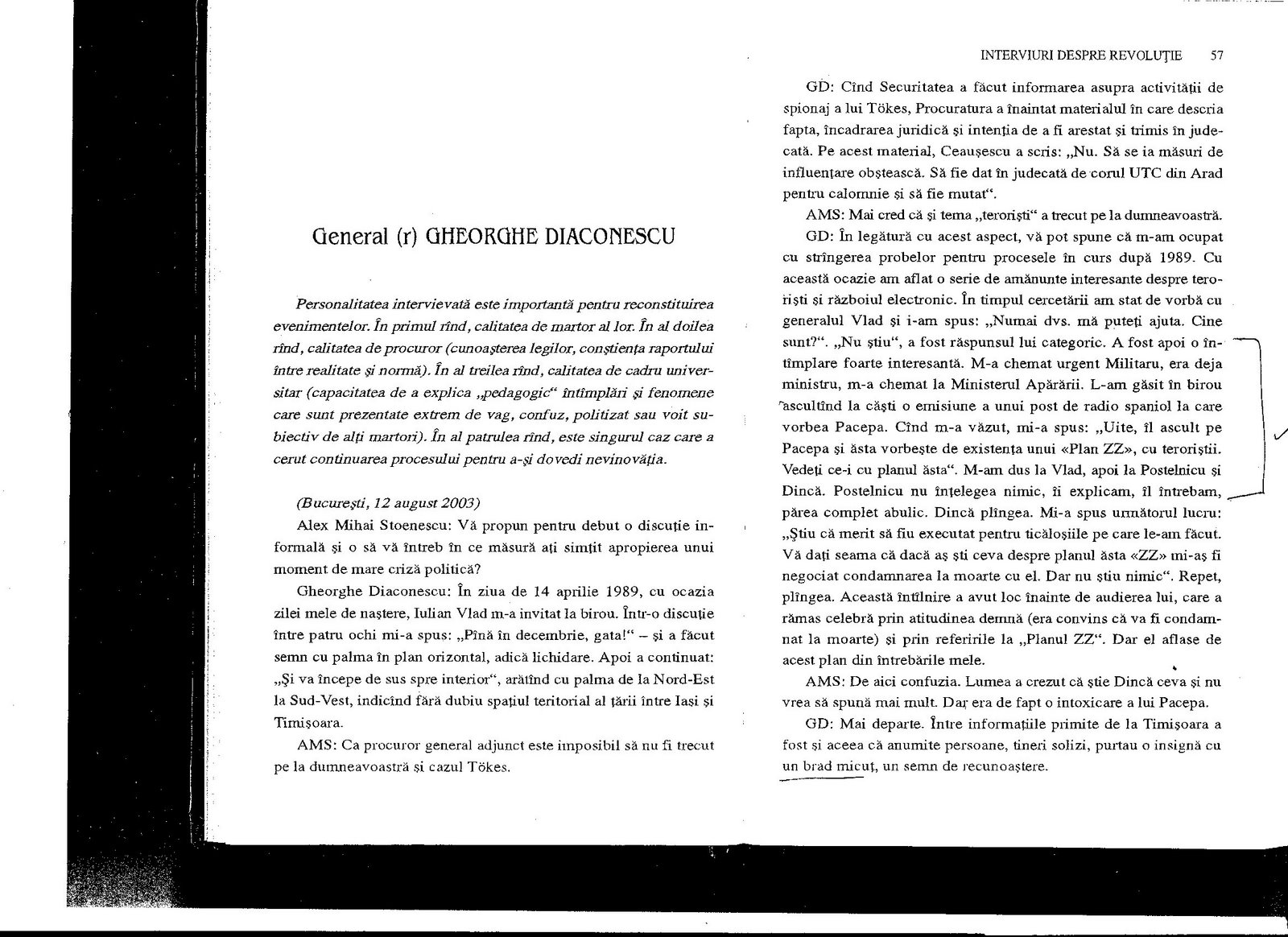
We have two different accounts from Gheorghe Diaconescu, which roughly match:

http://www.banaterra.eu/romana/files/procesul_de_la_timisoara_volumul_VI_continut.pdf

image0

image0-001

This also seems to confirm the following (when adjusted for the corrected dates):

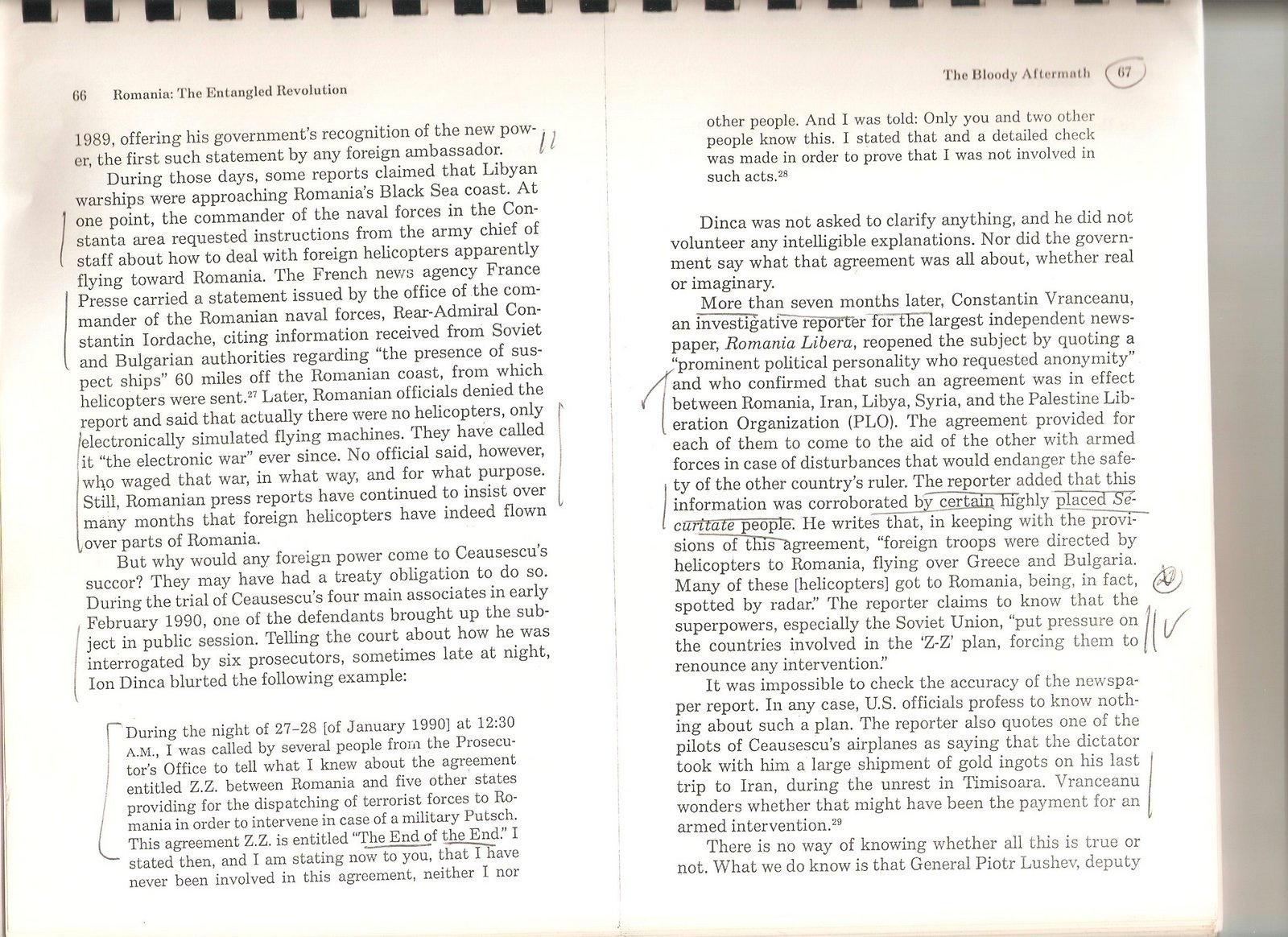
Nestor Ratesh quotes one of Ceausescu’s senior party henchman, Ion Dinca, as having stated at his trial in early February 1990:

“During the night of 27-28 [of January 1990] at 12:30 A.M., I was called by several people from the Prosecutor’s Office to tell what I knew about the agreement entitled Z.Z. between Romania and five other states providing for the dispatching of terrorist forces to Romania in order to intervene in case of a military Putsch.  This agreement Z.Z. is entitled ‘the End of the End.’  I stated then, and I am stating now to you, that I have never been involved in this agreement, neither I nor other people.  And I was told:  Only you and two other people know this.  I stated that and a detailed check was made in order to prove that I was not involved in such acts.”[95]

[95] Ratesh, Romania:  The Entangled Revolution, pp. 66-67, quoting Radio Bucharest, 2 February 1990.  I don’t think from the context given it is clear that this alleged incident took place in January 1990, as Ratesh assumes; the reference to 27-28 might have been a reference to December 1989.

But it almost doesn’t matter when Pacepa first discussed this…because almost identical details were disclosed by Liviu Turcu, a DIE officer who had defected earlier in 1989 (thereby being far more knowledgeable of current plans/realities inside the Romanian security state), only without reference to a named plan, such as Plan Z-Z.  It was thus Turcu on 23 December 1989 (within 24 hours of the outbreak of terrorist hostilities in Romania; the interview would have taken place on Saturday the 23rd) who first informed Western media of the existence of such a plan–although it appears Turcu’s disclosures were never relayed by Romanian media or by Radio Europa Libera.

Romanian Army Rankled by Interference;Defector Cites Long-Standing Friction Between Military and State Security Forces

The Washington Post
December 24, 1989 | Dan Morgan

The violence that has erupted in Romania between the army and state security forces loyal to deposed president Nicolae Ceausescu is rooted in long-standing friction between the two institutions that has sharpened dramatically recently, a high-level Romanian defector said yesterday.

Lidiu Turcu, who worked with the foreign intelligence branch of the Department of State Security, known as the Securitate, until his defection in Austria last January, said a special directorate monitored the loyalty of top army officers. As Ceausescu’s paranoia increased, he appointed his brother Ilia as first deputy minister of defense and chief of the political directorate in the army.

The military deeply resented that interference, he said. Also angering the military was the removal several years ago of two high-ranking generals denounced by Securitate informers for cultivating connections at the Soviet Embassy in Bucharest, he said. There have been reports that the two were killed and dumped into the Black Sea from a helicopter, but Turcu said he could not confirm the story.

The well-equipped and dreaded security forces appear to number about 45,000 to 50,000 men, including 25,000 troops who live in barracks on the outskirts of major cities and 20,000 officers, technical personnel, and specialists, he said. That figure is far less than the up to 700,000 reported in recent days in other accounts from the region.

The officers and specialists were drawn from universities until several years ago. But in the 1980s, Turcu said, Ceausescu’s wife, Elena, ordered that recruitment of university students be stopped and that less-educated factory personnel be selected instead.

The uniformed force of fighters includes many young men who were taken from orphanages at an early age. These security soldiers, educated and trained at special schools, have no family loyalties and were indoctrinated to view Ceausescu as a father figure, Turcu said.

As Ceausescu’s fear of an internal threat to his security grew, he reportedly turned to a new “Directorate 5″ in the Securitate that had the responsibility for “defense of the leadership of the party.” Presumably this is the force involved in some of the recent fighting.

Growing evidence of atrocities perpetrated by the security forces against unarmed demonstrators-shooting into crowds in Timisoara and Bucharest-has raised questions about whether foreign mercenaries may be involved. Turcu said the massacres go against Ceausescu’s dictum of “no martyrs,” which was often repeated to his inner circle.

Turcu said he talked yesterday with a friend in Bucharest who reported being forced to evacuate his apartment complex by armed Arab commandos.

The former intelligence official said he was aware of a secret agreement between Ceausescu and Palestine Liberation Organization chairman Yasser Arafat that allowed PLO groups to use Romanian territory for “logistical support.” He said Interior Minister Tudor Postelnicu, who oversaw the security forces, was present at a recent meeting between Ceausescu and Arafat.

Romanian cooperation with the PLO began in the late 1960s, Turcu said, but intensified in the past three years. He said rival PLO groups coexist within Romanian territory, but the agreement forbade clashes between these groups and prohibited their possession of arms. One job of the Securitate was to ensure that the PLO factions were obeying the agreement, Turcu said.

In addition to the PLO factions, he said, Syrian, Libyan, Iraqi and Iranian military or special operations units have been trained at a camp near Buzau, in the Carpathian foothills.

Contrary to reports that the security forces lived lavishly, Turcu said that except for higher salaries, most ordinary officials did not have access to special restaurants and stores stocked with Western electronic goods. He suggested that security officials resorted to corruption and abuse of office to satisfy their needs, which exacerbated the public’s hatred and fanned the fury that burst over the past week.

For verification of some of Turcu’s claims (in particular, the less-discussed participation of Iraqis from Saddam Hussein’s Iraq, see here:  http://atomic-temporary-3899751.wpcomstaging.com/foreign-intervention/)

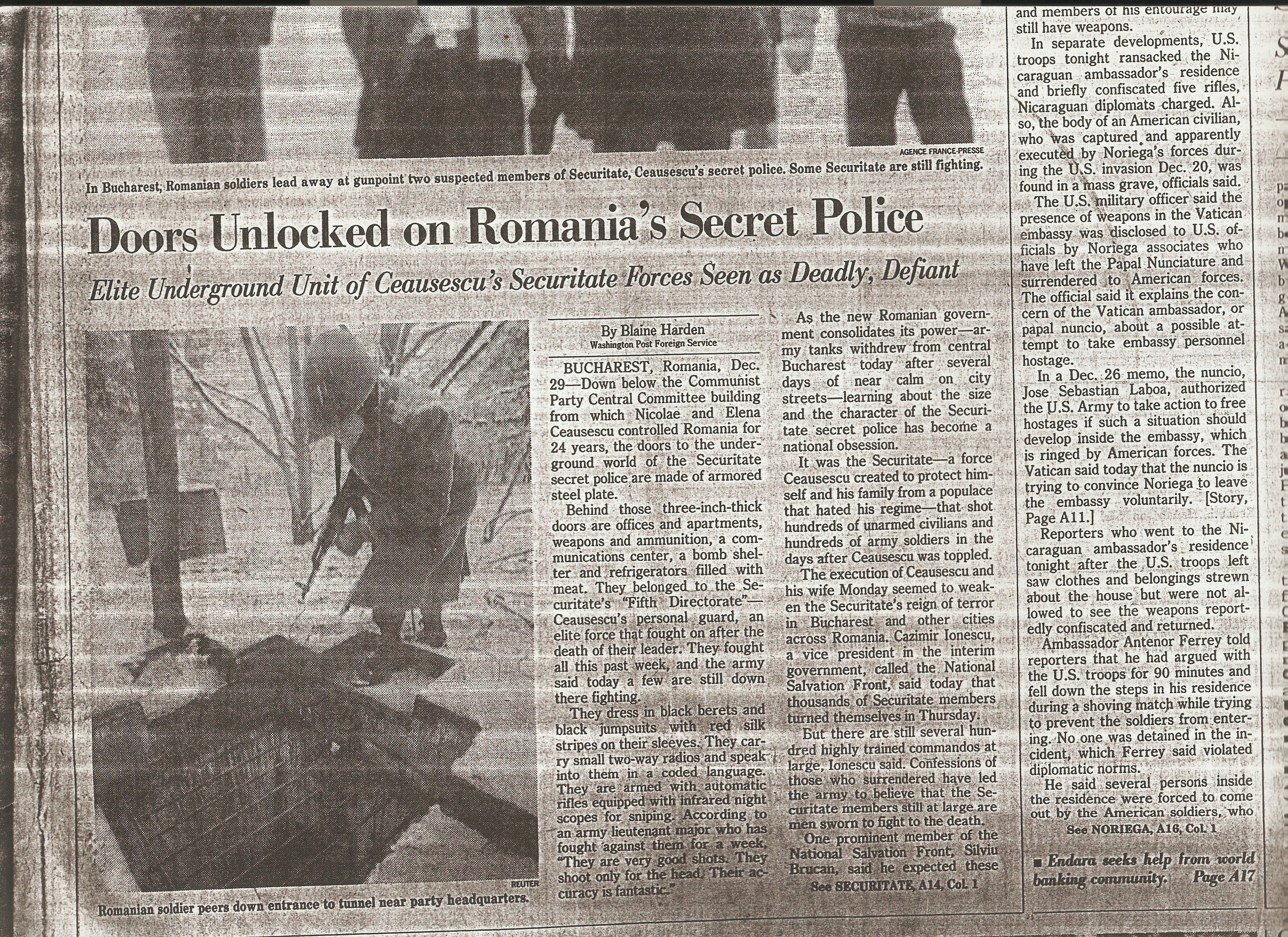
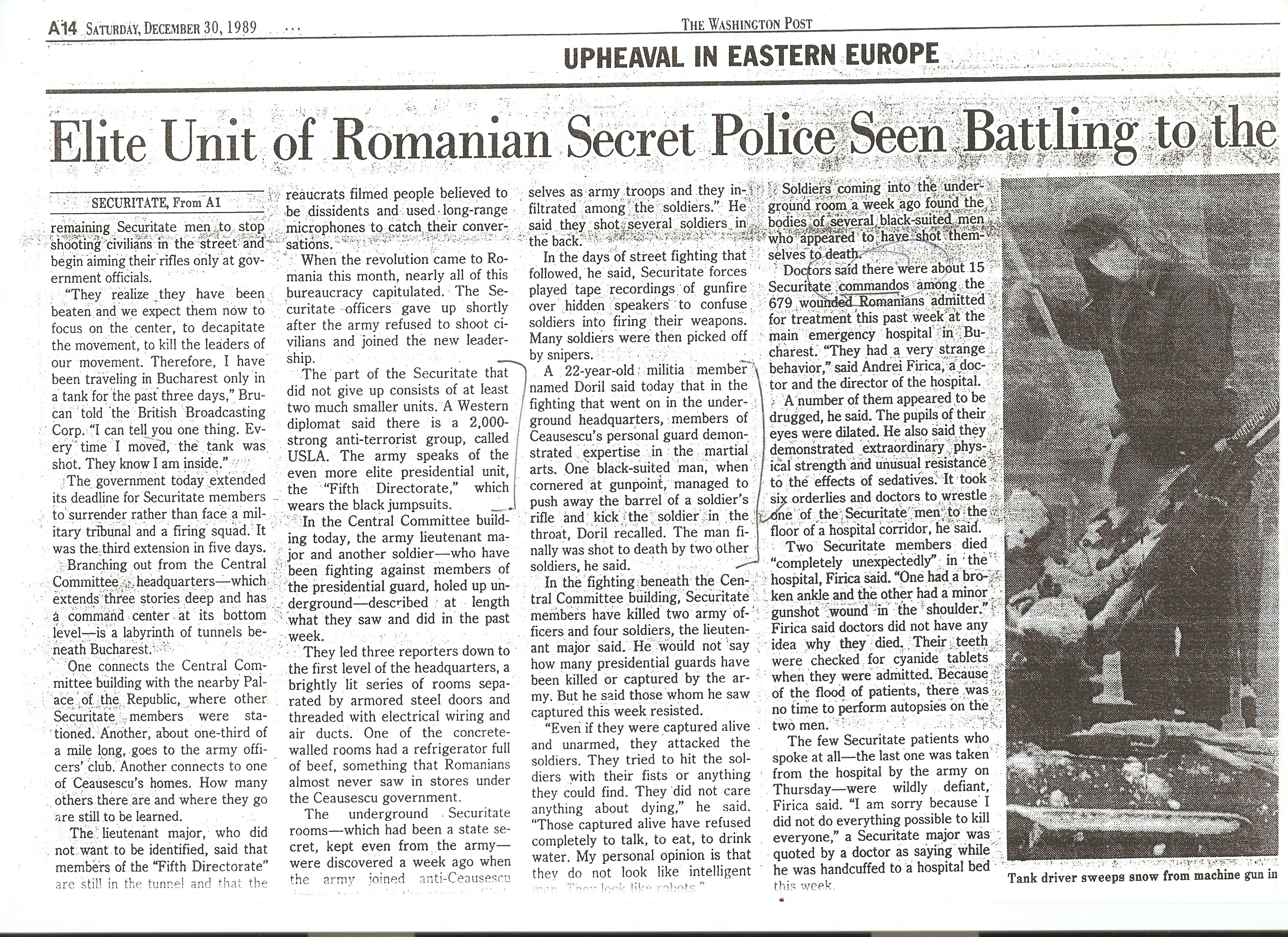
“They dress in black berets and black jumpsuits [combinezoane negre, salopete negre] with red silk stripes on their sleeves.  They carry small two-way radios and speak into them in coded language.  They are equipped with automatic rifles with infrared nightscopes for sniping.”


http://atomic-temporary-3899751.wpcomstaging.com/2010/11/19/les-souterrains-de-bucarest-ja2-20h-27121989-01min55s/

Sediul U.S.L.A , pe 25 decembrie 1989 in jurul orelor 18…

Pe 25 decembrie in jurul orelor 18, dupa executarea dictatorilor, col. Ardeleanu Gh. a adunat cadrele unitatii intr-o sala
improvizata si le-a spus: “Dictatura a cazut! Cadrele unitatii se afla in slujba
poporului. Partidul Comunist Roman nu se desfiinteaza! Trebuie sa ne regrupam in
rindul fortelor democratice din P.C.R.–continuatorul idealurilor nobile ale
poporului ai carui fii sintem ! (…) Au fost gasite cadavre, indivizi avind
asupra lor legitimatii de acoperire USLAC (Unitatea Speciala de Lupta
Antiterorista si Comando) si legitimatii cu antetul 0620–USLA, legitimatii care
nu se justifica in posesia celor asupra carora au fost gasite…” A ordonat apoi
sa fie predate in termen de 24 de ore legitmatiile de serviciu, urmind ca
tuturor sa le fie eliberate altele cu antetul M.Ap.N.

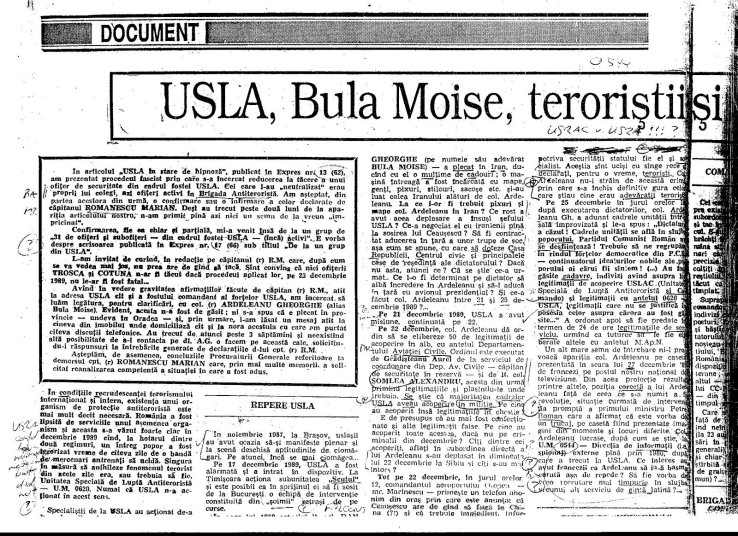
(capitanul Romanescu Marian, cu Dan Badea, “USLA, Bula Moise, teroristii si
‘Fratii Musulmani’,” Expres nr. 26 (75), 2-8 iulie 1991, 8-9)

image-15

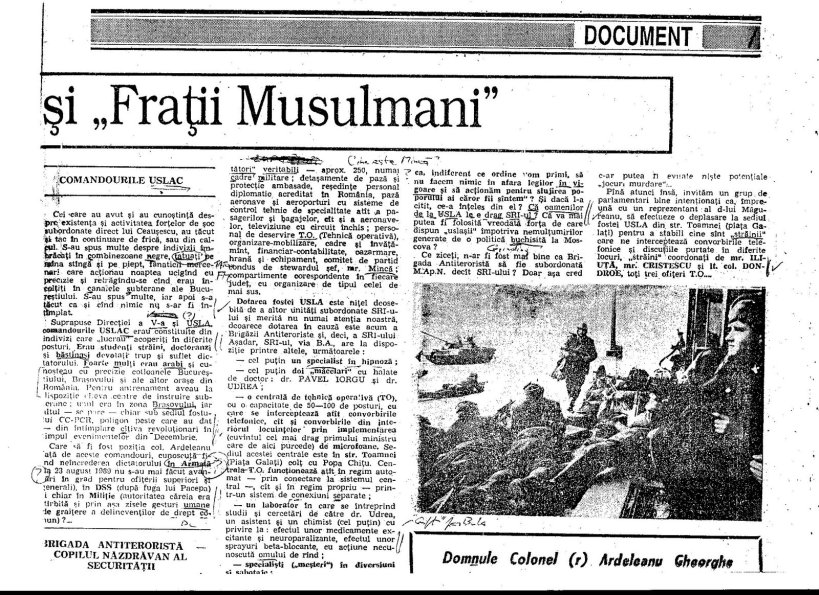
(Capitanul Romanescu Marian (fost cadru USLA) si Dan Badea, “USLA, Bula Moise, teroristii, si ‘Fratii Musulmani’,” Expres nr. 26 (75), 2-8 iulie 1991, pp. 8-9)

COMANDOURILE USLAC

Cei care au avut si au cunostinta despre existenta si activitatea fortelor de soc subordonate direct lui Ceausescu, au tacut si tac in continuare de frica, sau din calcul.  S-au spus multe despre indivizii imbracati in combinezoane negre, tatuati pe mina stinga si pe piept, fanaticii mercenari care actionau noaptea ucigind cu precizie si retragindu-se cind erau incoltiti in canalele subterane ale Bucurestiului.  S-au spus multe, iar apoi au tacut ca si cind nimic nu s-ar fi intimplat.

Suprapuse Directiei a V-a si USLA comandourile USLAC erau constituite din indivizi care “lucrau” acoperiti in diferite posturi. Erau studenti straini, doctoranzi si bastinasi devotati trup si suflet dictatorului.  Foarte multi erau arabi si cunosteau cu precizie cotloanele Bucurestiului, Brasovului si ale altor orase din Romania.  Pentru antrenament aveau la dispozitie citeva centre de instruire subterane:  unul era in zona Brasovului, iar altul–se pare–chiar sub sediul fostului CC-PCR, poligon care au dat–din intimplare citiva revolutionari in timpul evenimentelor din Decembrie.

image-13

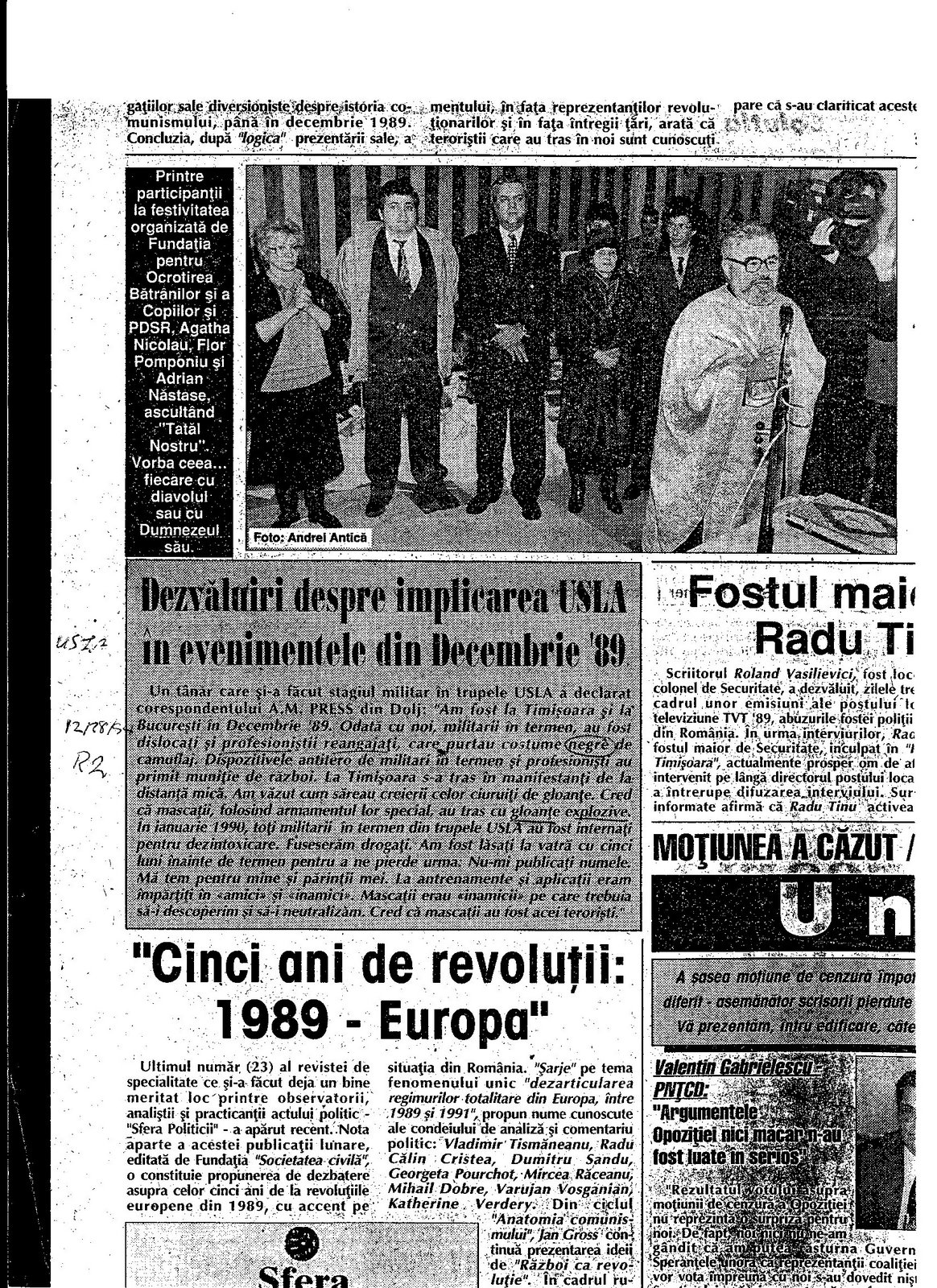
Dezvaluiri despre implicarea USLA in evenimentele din Decembrie ‘89

Un tanar care si-a facut stagiul militar in trupele USLA a declarat
corespondentului A.M. PRESS din Dolj: “Am fost la Timisoara si la Bucuresti in
Decembrie ‘89. Odata cu noi, militarii in termen, au fost dislocati si
profesionistii reangajati, care purau costume negre de camuflaj. Dispozitivele
antitero de militari in termen si profesionisti au primit munitie de razboi. La
Timisoara s-a tras in manifestanti de la distanta mica. Am vazut
cum sareau creierii celor ciuruiti de gloante. Cred ca mascatii, folosind armamentul lor special, au tras cu
gloante explozive.
In ianuarie 1990, toti militarii in termen din trupele USLA
au fost internati pentru dezintoxicare. Fusesaram drogati. Am fost lasati la
vatra cu cinci luni inainte de termen pentru a ne pierde urma. Nu-mi publicati
numele. Ma tem pentru mine si parintii mei. La antranamente si aplicatii eram
impartiti in “amici” si “inamici.” Mascatii erau “inamicii” pe care trebuia sa-i
descoperim si sa-i neutralizam. Cred ca mascatii au
fost acei teroristi.”

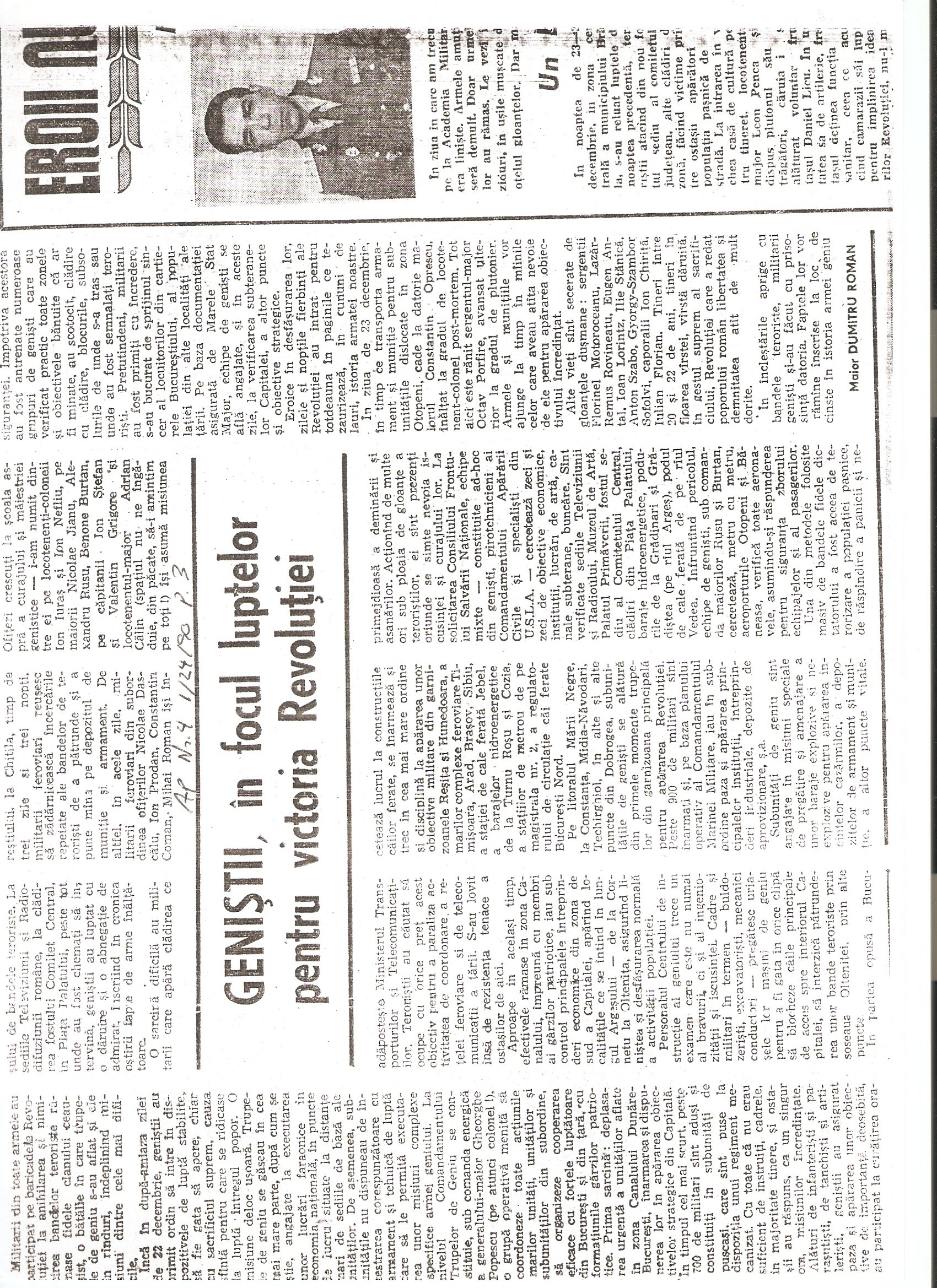
(Romania Libera, 28 Decembrie 1994, p. 3)

image-18image-17image-16image-15

image-4image-9

Posted in decembrie 1989, raport final | Tagged: , , , , , , , , , , , , , , , , , , , , , , , , , , , , , , , , , , , , , , | Leave a Comment »

25 for the 25th Anniversary of the Romanian Revolution: #17 The Role of TVR (Televiziunea Romana, Romanian Television)

Posted by romanianrevolutionofdecember1989 on December 24, 2014

(purely personal views, based on two decades of prior research and publication)

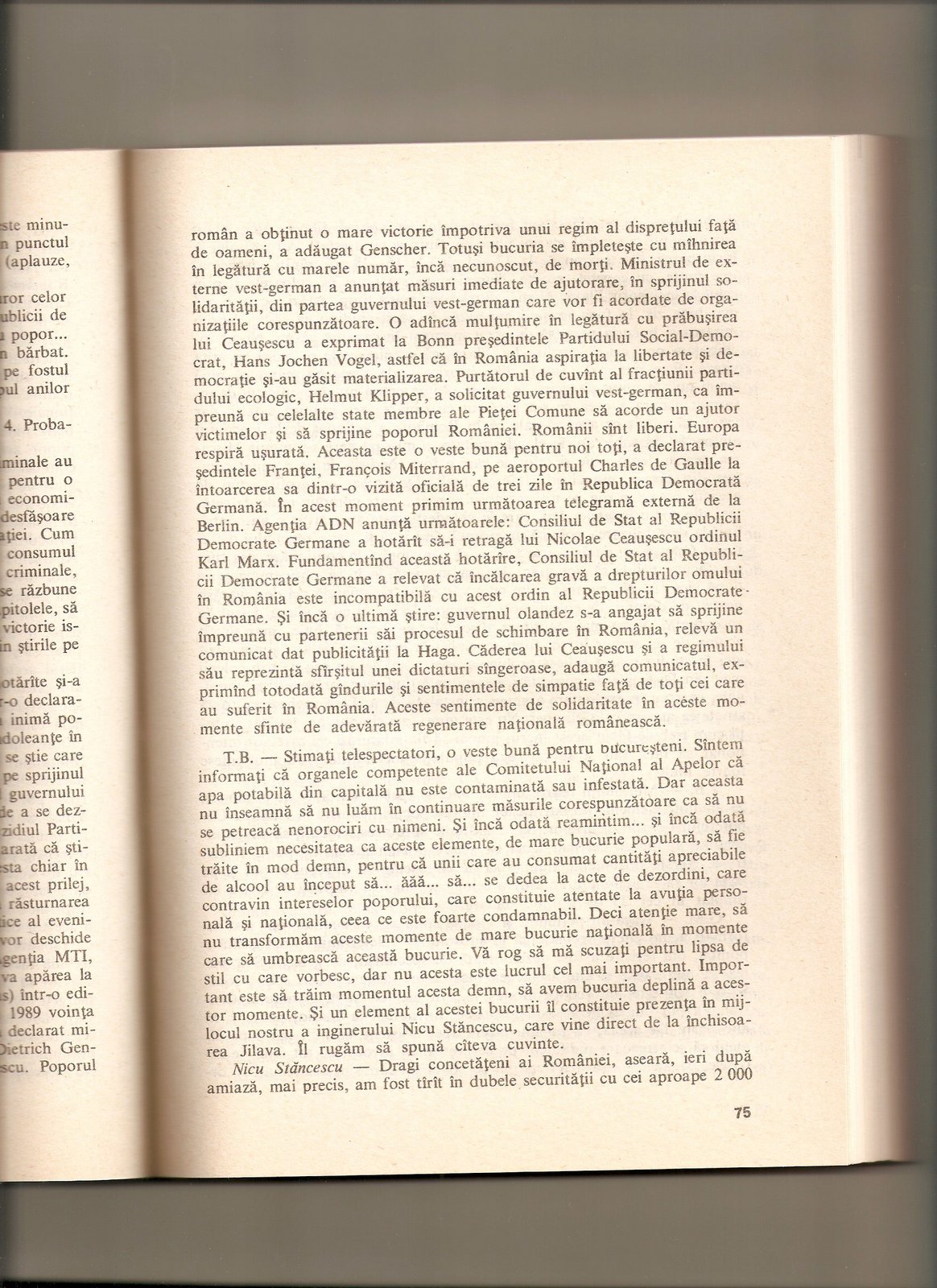
The Myths of a Revolution: “It is said that these enemy elements, the securisti, have poisoned the water in Sibiu, in Timisoara,…the water must be boiled before being consumed.” (Apa este otravita la Sibiu!)

Oh, how Romanians and Romanianists love to invoke or allude to the televised claim in December 1989 that the water had been posioned in Sibiu!

It precipitates laughter:  ah, the crude manipulation and naivete!

Predictably, this is a favorite of foreign sources on December 1989.

Romanian emigre Andrei Codrescu tells us in his November 1990 article in Harper’s (“Big Chills”) about the wild rumors of December 1989, that the water in Sibiu had allegedly been poisoned, but as he found out at his 25th anniversary high school reunion, he learned how all the rumors had been false: and the water in Sibiu, it was just fine!  http://alina_stefanescu.typepad.com/files/big-chills-my-high-school-reunion-in-romania-by-andrei-codrescu-1.pdf

John Feffer in Shock Waves (1992) invokes Codrescu’s claims that, “Contrary to earlier reports, there were no mass killings, no poisoned water in Sibiu, no terrorists–only the manufacturing of a revolutionary smokescreen to conceal pre-planned machinations that resulted in the creation of the National Salvation Front.” (p. 207)

http://books.google.hu/books?id=u2l7b9gg28YC&pg=PA207&lpg=PA207&dq=romania+ceausescu+1989+water+poisoned+sibiu&source=bl&ots=P0pzR5YrIr&sig=ljCRYy27Lzsvh_HSxETfvz8SAH0&hl=en&sa=X&ei=buxwVNScFvPesASo0IHoAw&ved=0CDcQ6AEwBDhQ#v=onepage&q=romania%20ceausescu%201989%20water%20poisoned%20sibiu&f=false

Peter Siani-Davies quotes BBC journalist John Simpson, who had heard similar stories concerning poisoned water during the Iranian revolution of 1979, as noting that “certain ideas appeal forcibly  to the self-dramatizing mind of the revolutionary,” to which Siani-Davies adds:

“Indeed, in Romania the wild storytelling to a certain extent was just another consequence of the tumult of the revolution.  However, the imagery may have served another purpose….Now, through the tales of horror, they [Romanians] were able to place the evil forces of that [Ceausescu] regime so far beyond the bounds of ‘normal’ society that they were effectively able to distance themselves from the demons of the past.  There was also a sense in which it was necessary for the securitate to be so terrible:  How else could the years of mute suffering under an enfeebled old tyrant such as Ceausescu be explained and condoned?”   (Siani-Davies, The Romanian Revolution of December 1989, p. 160.)

——————————————————————————————————————————————————————————————————————————–

Underlying all of these interpretations and explanations is the assumption that the water never was poisoned, that it was all a baseless rumor.

Surely, one assumes, the rumor has been run to ground…but the truth is, as with so many things about December 1989, it hasn’t…

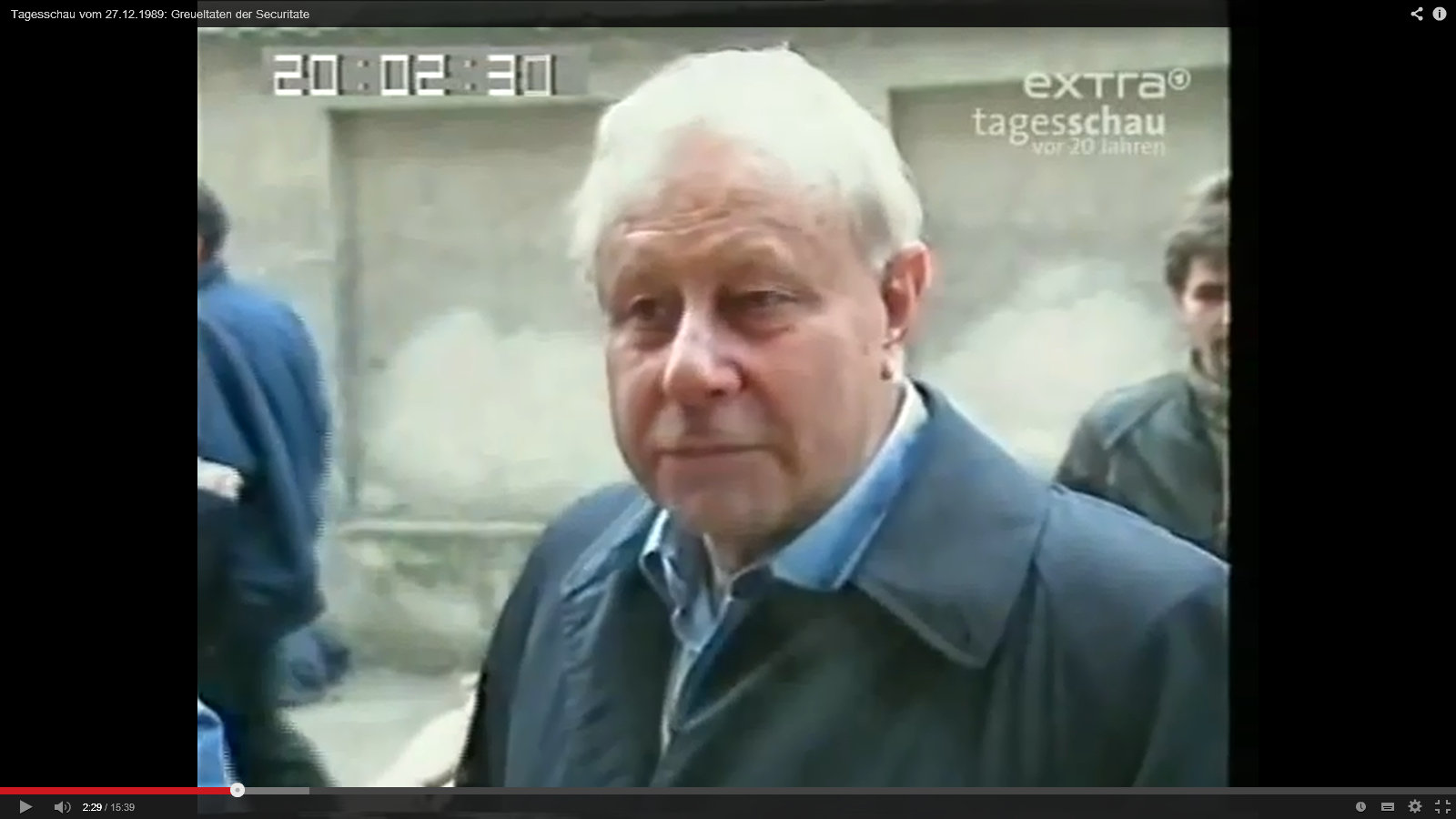
report from Sibiu starts at approximately 2:20 (Tagesschau 27.12.1989)

In fact, there was a basis in reality for what Teodor Brates was saying on TV on the afternoon of 22 December 1989 as the following toxicology report by the Belgian Dr. Aubin Heyndrickx makes clear:

Fullscreen capture 11222014 42152 PM

Romania

On December 21, 1989, people drinking from water tank #4 in Sibiu experienced headache, visual disturbances, loss of consciousness, vomiting, etc.  These symptoms are all compatible with organophosphate poisoning.  The analysis of the water (by gas chromatography) and the determination of the cholinesterase activity of the blood was done in the University of Cluj.  The conclusion was that an organophosphate had been used.  Atropine sulfate and toxogonin were advised.

As soon as the symptoms appeared among the population, water tank #4 was shut off, rinsed, and cleaned.  The people received water from army trucks.

A few days later, there was a fight in Timisoara between the army and Securitate over the water tanks.  Poisoning was feared, as had occurred in Sibiu.  According to witnesses, the Securitate possesses “all possible chemical warfare agents.”

Toxicologist Aubin Heyndrickx supervised the chemical tests and interviewed the physicians at Central Hospital who treated the patients.  From the tests and from the very high dose of atropine required to produce a response, he concluded that the tank was poisoned with sarin or VX (Report on the Humanitarian Mission to Romania, December 23-29, 1989, Laboratoria voor Toxicologie Criminalistiek, State University of Ghent).

http://www.physiciansforcivildefense.org/cdp/jan90.htm

Indeed, one can watch a brief discussion of the incident with Dr. Heyndrickx beginning at approximately the 40 second mark from an ITN broadcast of 27 December 1989

http://www.itnsource.com/en/shotlist//ITN/1989/12/27/BSP271289002/?s=romania+sibiu+after+the+revolution+27+1989&st=0&pn=1

ROMANIA: SIBIU AFTER THE REVOLUTION:

}T27128901   ROMANIA: SIBIU AFTER THE REVOLUTION: United Nations medical
27.12.89     relief team arrives in Sibiu with medical supplies and blood
TX           to treat the people who were injured during the fight against
             Securitate (secret police). Toxicologists have found evidence
             that the security police poisoned the water supply. Injured
             Securitate are being treated in hospitals alongside the people
             they shot.
Clip Ref: BSP271289002 0

Clip 1of1

}T27128901   ROMANIA: SIBIU AFTER THE REVOLUTION: United Nations medical
27.12.89     relief team arrives in Sibiu with medical supplies and blood
TX           to treat the ...
  • Duration: 00:01:44 |
  • Timecode – In: 00:00:00:00  Out: 00:01:44:00 |
  • Copyright: ITN / 3rd Party Copyright

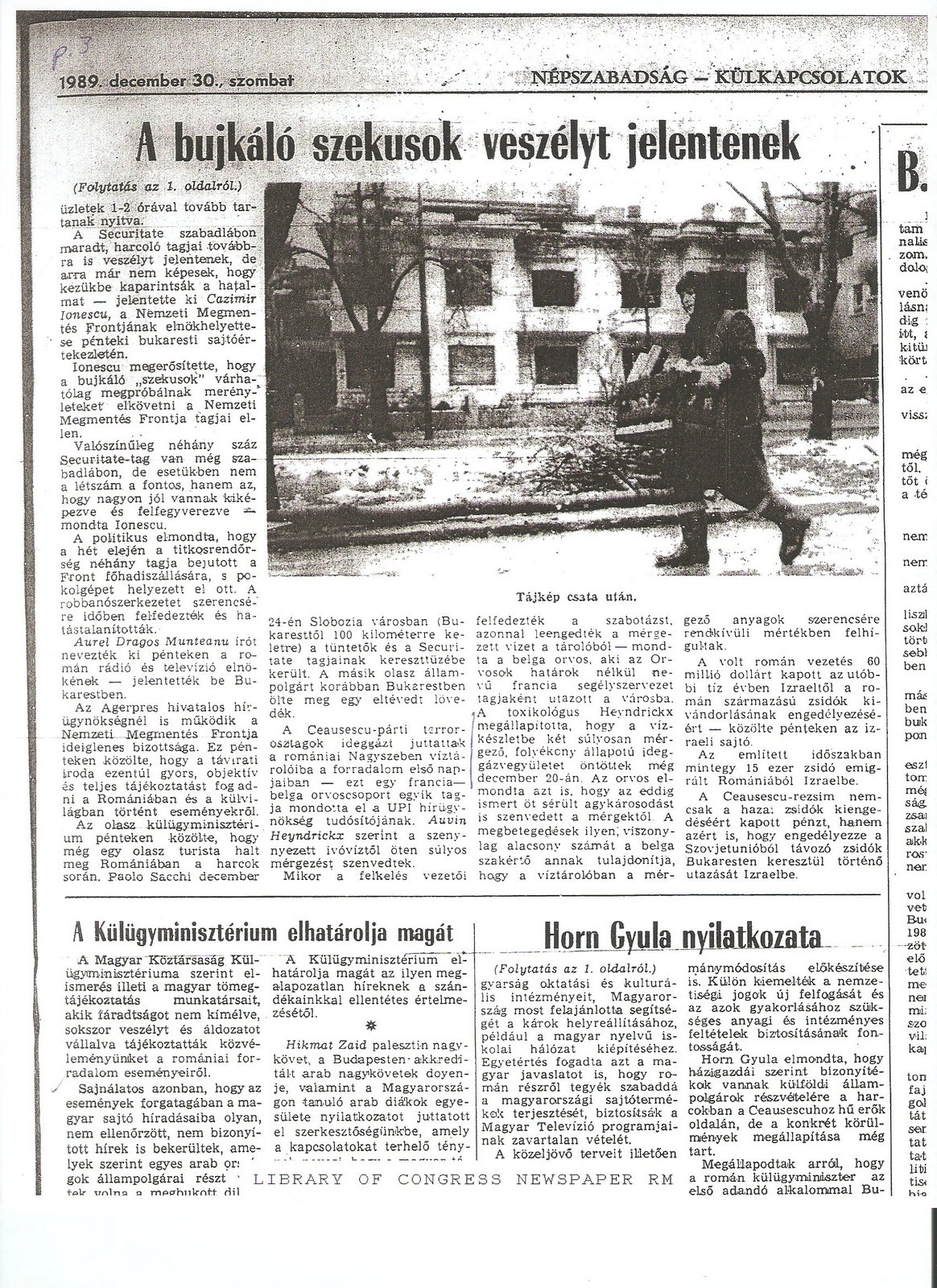
I have found evidence of discussion of Heyndrickx and his toxicology report in the Hungarian press of the time, but significantly, to date, I have been unable to find discussion of it in the Romanian press!

Nepszabadsag, 30 December 1989, p. 3 citing a UPI dispatch, apparently P. Green, “French team confirms poison in water supply,” UPI, 29 December 1989.


Nagyszeben – ideggáz

Bukarest, 1989. december 29. péntek (UPI) – A Ceausescu-párti terrorosztagok ideggázt vegyítettek a romániai Nagyszeben víztárólóiba a forradalom első napjaiban – ezt egy francia-belga orvoscsoport egyik tagja mondotta el a UPI hírügynökség tudósítójának. Auvin Heyndrickx szerint a szennyezett ivóvíztól öten súlyos mérgezést szenvedtek.Mikor a felkelés vezetői felfedezték a szabotázst, azonnal
leengedték a mérgezett vizet a tárolóból – mondta a belga orvos, aki
az ,,Orvosok – határok nélkül,, nevű francia segélyszervezet
tagjaként utazott a városba. A toxikológus Heyndrickx
megállapította, hogy a vízkészletbe két súlyosan mérgező, folyékony
állapotú ideggázvegyületet öntöttek még december 20-án. Az orvos
elmondta azt is, hogy az eddig ismert öt sérült agykárosodást is
szenvedett a mérgektől. A megbetegedések ilyen viszonylag alacsony
számát a belga szakértő annnak tulajdonítja, hogy a víztárolóban a
mérgező anyagok szerencsére rendkívüli mértékben felhígultak.+++1989. december 29., péntek 07:57

http://rendszervaltas.mti.hu/Pages/News.aspx?se=1&wo=nagyszeben&sd=19890101&ed=19901231&sp=0&ni=230929&ty=1

http://www.rsis.edu.sg/cens/publications/reports/RSIS_Food%20Defence_170209.pdf See citations in fn#59 page 10.

———————————————————————————————————————————————————————————————————————————

It is thus with justification that in my dissertation in 1997 and in a reiteration of the dissertation views in 2007, I defended TVR personnel by pointing out the extent to which they went to intervene and inform the population when it was safe to drink the water again.  (for a glimpse into the eternal “appreciation” I received for pointing out the latter, see http://atomic-temporary-3899751.wpcomstaging.com/raport-final-cpadcr-iiccmer-si-revolutia-din-1989/)

image0-007

Excerpt from http://atomic-temporary-3899751.wpcomstaging.com/rewriting-the-revolution-1997-chapter-8-unsolving-december/

In their discussion of the Romanian transition, Linz and Stepan note the “[r]umors of deliberately poisoned water supplies, of 10,000, 60,000, even 100,000 dead, filled the news channels and streets” and conclude that “disinformation played an important role in the events.”[45] They have in mind, however, the idea that this disinformation was disseminated in order to help the Front seize power. This, of course, echoes the dominant view on this theme. As we saw in the preceding chapter, both Securitate and opposition sources maintain that disinformation pervaded the December events, and they uniformly attribute it to the Front and the Front’s supporters at television, and, in some cases, to foreign actors such as the Soviet Union.

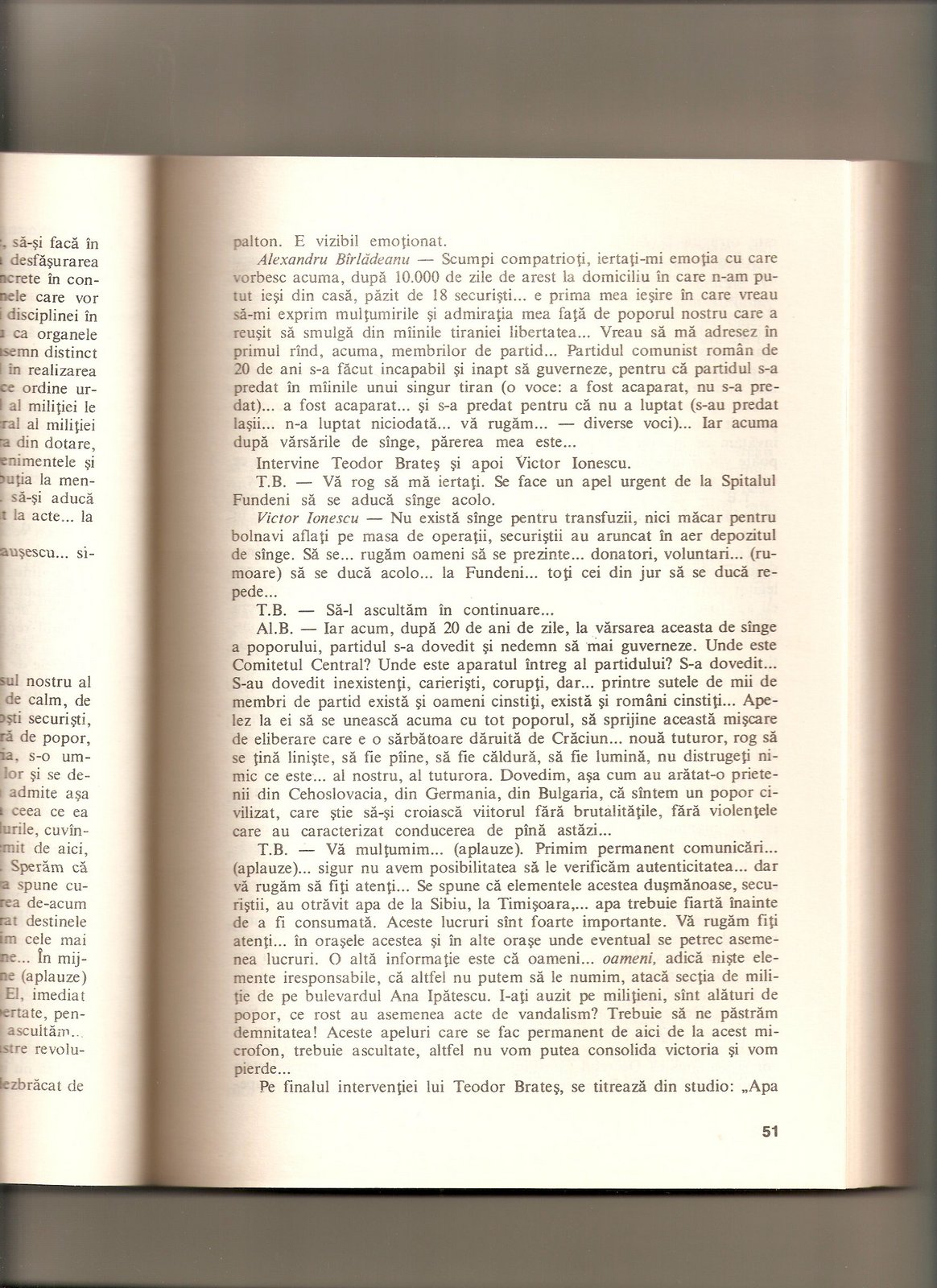
Yet there has been very little effort to investigate the context in which particular rumors originated and the relationship between actual events and those rumors. Take, for example, this rumor alleging the poisoning of the water supply which is so frequently invoked by both domestic and foreigner observers. To what are they referring? Around 3 p.m. on the afternoon of 22 December–therefore approximately three hours after the Ceausescus had fled Bucharest–television commentator Teodor Brates began to issue periodic, sometimes frantic reports about fighting between the Army and the Securitate in the city of Sibiu and about rumors that the water supply had been poisoned by the Securitate. Here are some excerpts of what Brates said on television on that afternoon:

One moment, please…from Sibiu it has been communicated to us that the army no longer has ammunition and the Securitate troops continue to attack military units….We want to inform you that in Sibiu, military units are urgently requesting help…We are constantly receiving communications…of course, we do not have the possibility to verify their authenticity…but we ask for your attention…It is said that these enemy elements, the securisti, have poisoned the water in Sibiu, in Timisoara,…the water must be boiled before being consumed.[46]

[45].. Linz and Stepan, “The Effects of Totalitarianism-cum-Sultanism,” 345-346.

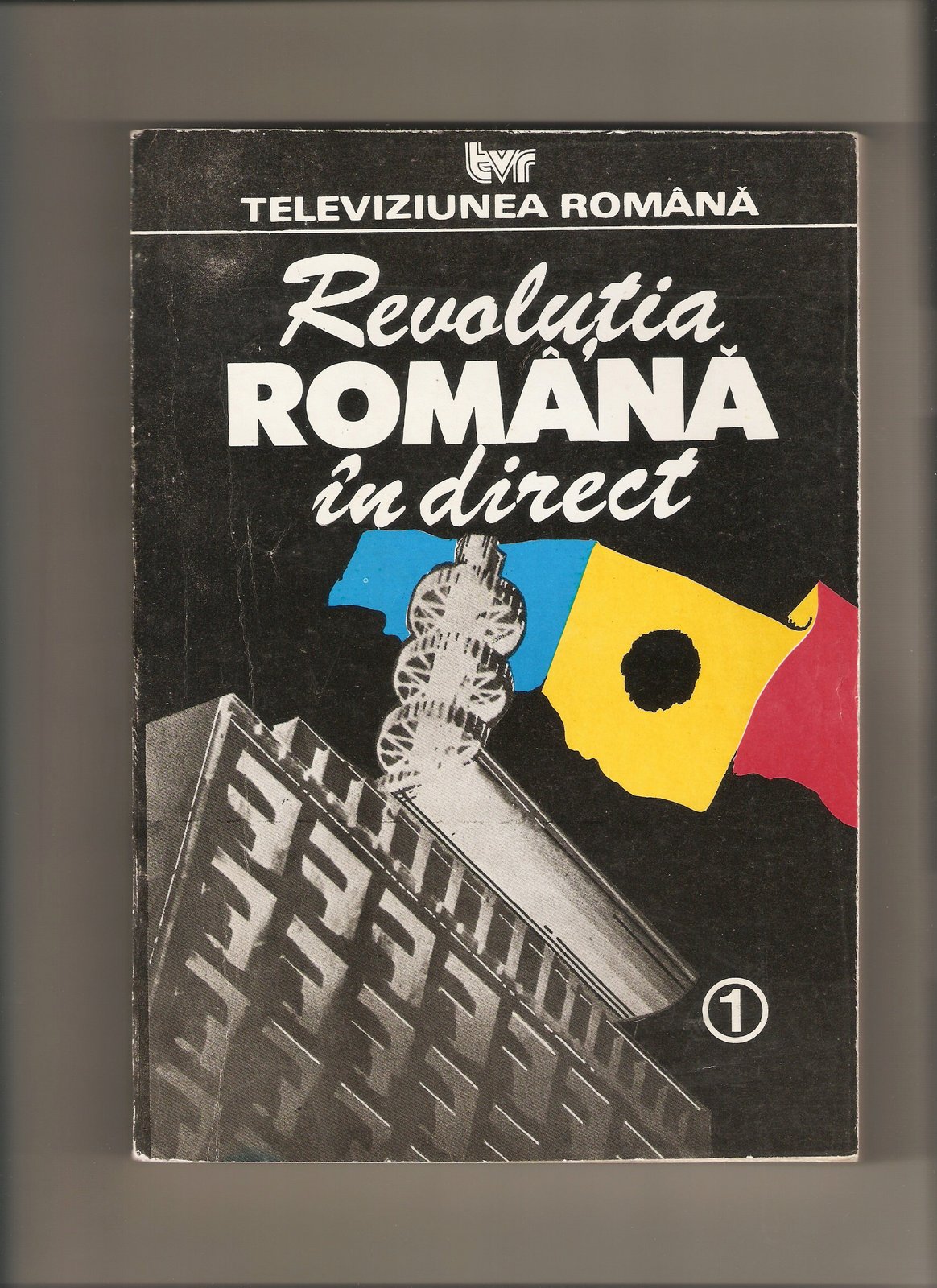
[46].. See the text of the transcript, Revolutia Romana in Direct (Bucharest: Televiziunea Romana, 1990), 47, 48, 51.

image0-001

2007:  Linked to the allegations of supposedly intentionally hyping the threat posed by the “terrorists” is the certitude with which many Romanians and Romanianists assert that TV personnel (especially Teodor Brates) intentionally spread rumors about the water being poisioned and the army running out of ammunition in Sibiu etc.–rumors that proved to be unsubstantiated. Here is what they likely remember:

“One moment, please…from Sibiu it has been communicated that the army no longer has ammunition and the Securitate troops continue to attack mili tary units….We want to inform you that in Sibiu, military units are urgently requesting help…We are constantly receiving communications…of course, we do not have the possibility to verify their authenticity…but we ask for your attention…It is said that the enemy elements, the securisti, have poisoned the water in Sibiu, in Timisoara…the water must be boiled before being consumed.” (from the transcript of 22 December 1989 in “Revolutia Romana in Direct” (Bucharest: 1990), pp. 47, 48, 51, quoted p. 324, Richard Andrew Hall, 1997, Ph.D. Dissertation, “Rewriting the Revolution: Authoritarian Regime-State Relations and the Triumph of Securitate Revisionism in Post-Ceausescu Romania”)

image0-005

image0-003

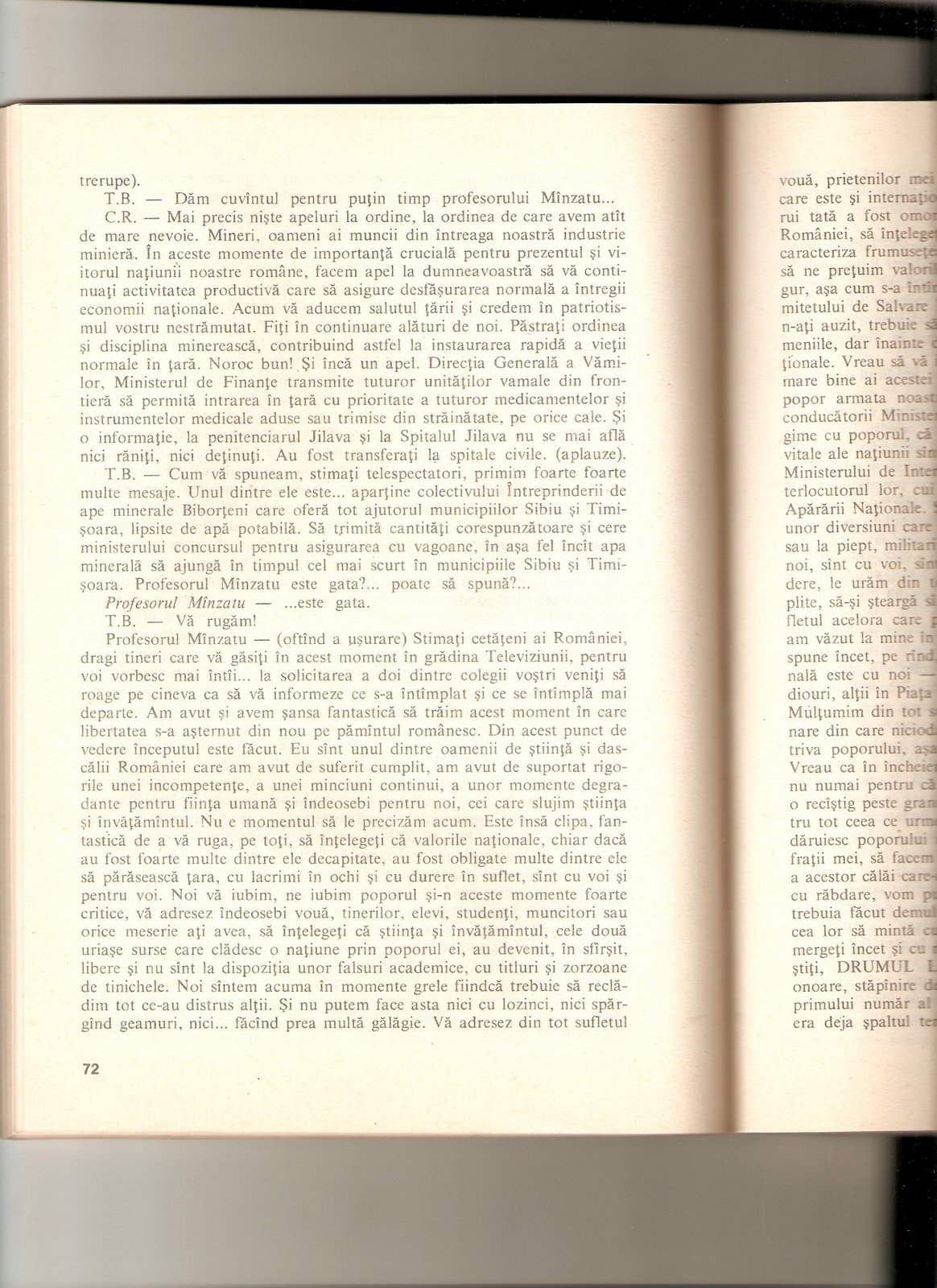
What they don’t remember is that Brates returned later to inform the audience a) when the fighting had ceased in Sibiu, b) when supplies of bottled water were on their way to Sibiu, and c) when the competent authorities verified that the water in Bucharest was safe to drink (“Revolutia Romana in Direct,” pp. 71, 72, 75, discussed p. 327 Hall, “Rewriting the Revolution”) This is there…in the transcript of what was said on Television…it is not a matter of a “difference of opinion” as the likes of Tismanenau and others in denial would have us believe. It is the old saw from American baseball: as the famous manager Casey Stengel used to say “You can look it up!” Once again: if your goal is “diversion,” intentional panic and manipulation, is it likely that you would return to the same subjects and say things designed to calm fears? Of course, not.

http://atomic-temporary-3899751.wpcomstaging.com/raport-final-cpadcr-iiccmer-si-revolutia-din-1989/

Fullscreen capture 12232014 70257 PM

The page from THE Report, a report which in the vision of its chairman–a highly disinterested and objective party, by definition, of course!–must be continuously praised and cannot be legitimately criticized (all criticisms are defined almost by definition as personally-motivated or personal attacks!):  http://www.contributors.ro/global-europa/raportul-final-este-realizarea-mea-de-varf-atat-profesional-cat-si-moral/

——————————————————————————————————————————————————————————————————

Un Craciun Revolutionar (15 minutes of Previously Unseen Footage from 24 December 1989 by Andrei Iliescu)

This has apparently been around for a few months, but I only discovered it recently:

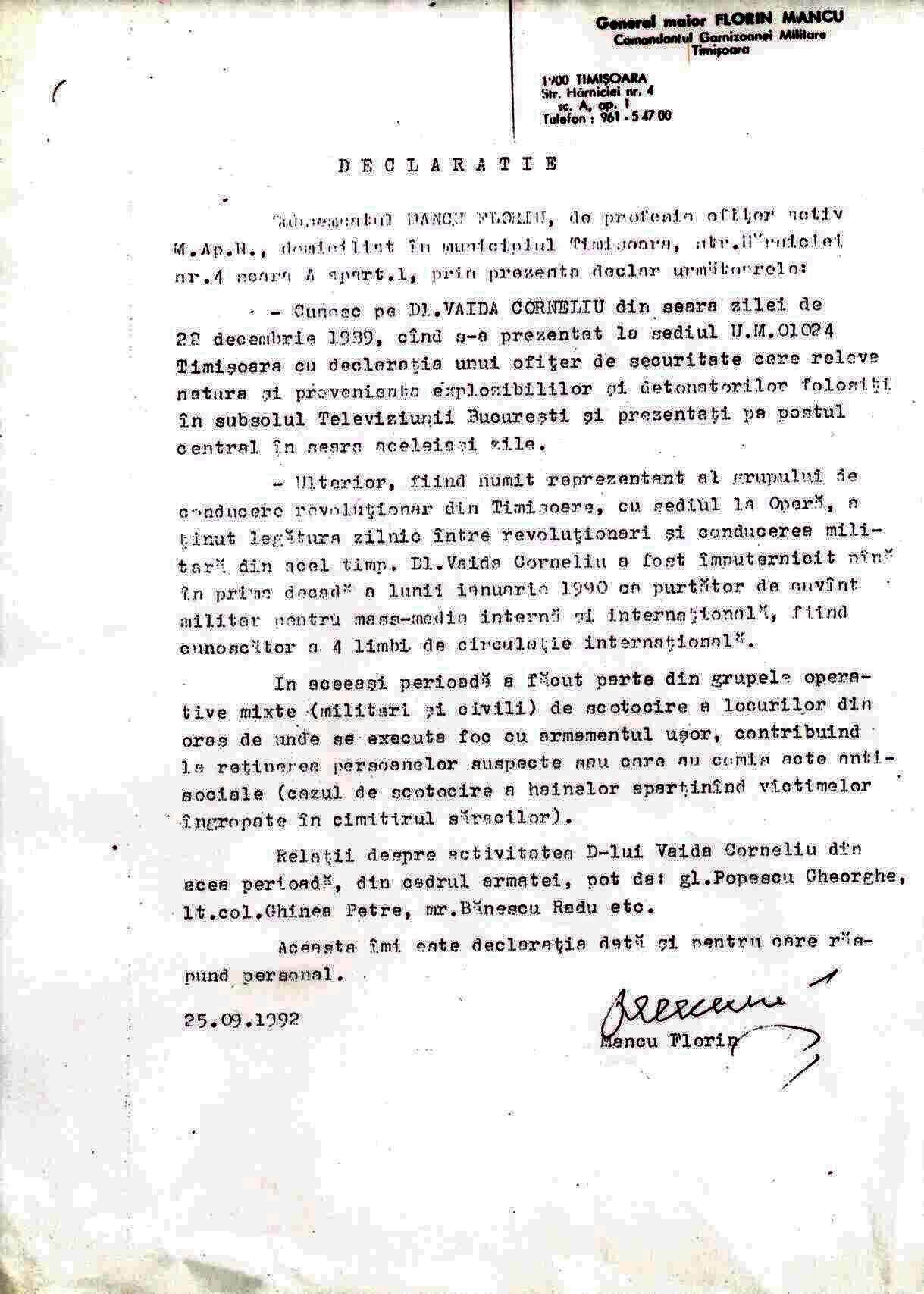
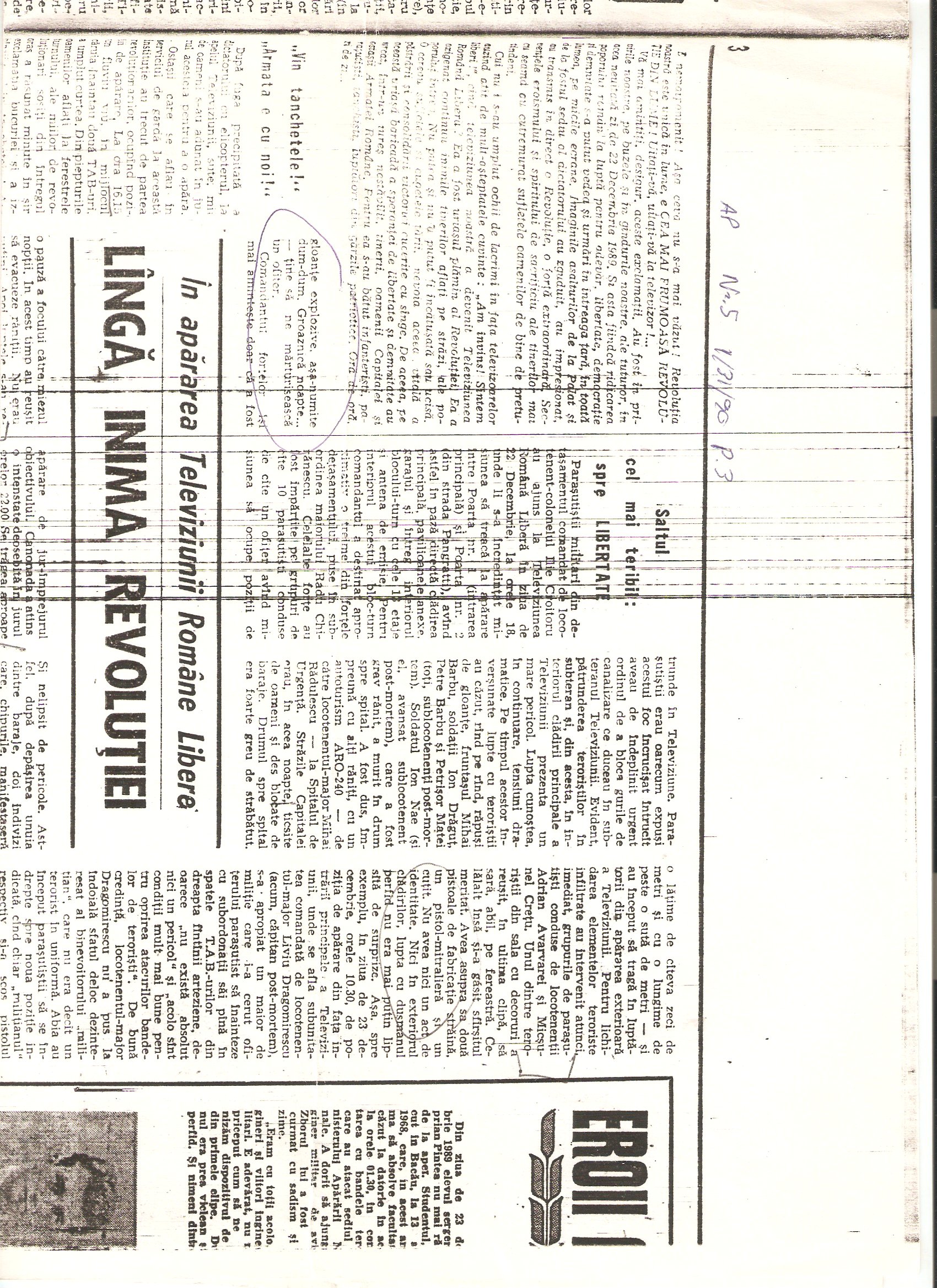
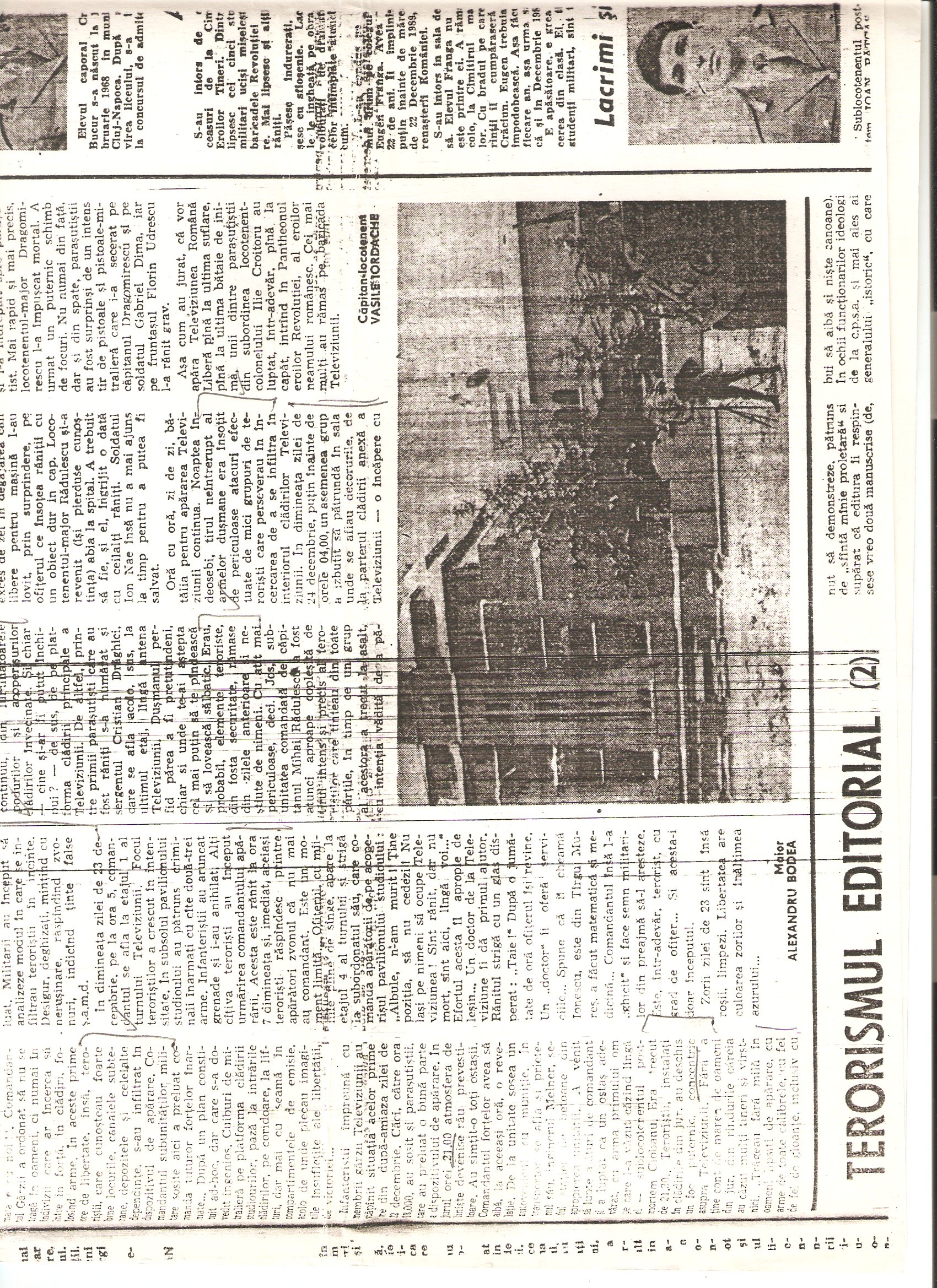
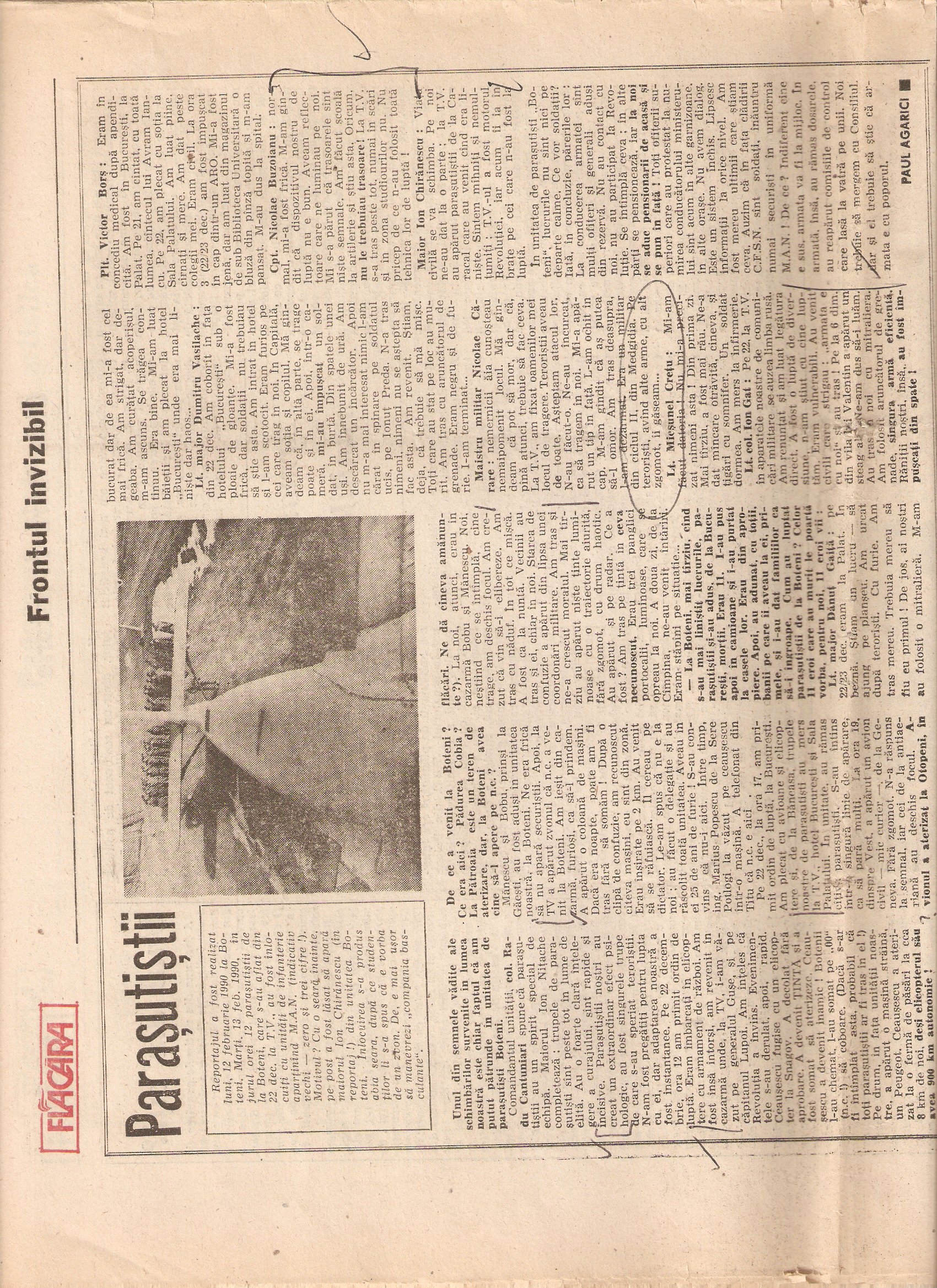
Pe 24 decembrie 1989, fotograful Andrei Iliescu abia scapase de la Jilava, unde-l bagase militia pentru ca poza protestele, si umbla uimit pe strazile Bucurestiului revolutionar. Nu mai avea buletin, singurul lui act era camera video. El a filmat aceste secvente.

which comes from http://casajurnalistului.ro/revolutie/

I draw attention to the sequence from approximately min. 3:37 to 3:53 in which the young soldier is asked about and discusses those whom they are fighting (this is in the vicinity of the TVR Television station).  (My thanks to Gigga Adrian Tudor, in particular, and Corneliu N. Vaida for clarifying the exchange for me.)

Soldier:  “Au mitraliere, care sunt micute…Cum au astia…americanii” (They have small machine guns…like the Americans.)

Voice off camera:  “Sunt mai bune ca ale voastre?” (Are they better than yours?)

Soldier:  “Da, bine-nteles.”  (Yes, of course.)

Soldier:  “Sunt mai eficiente; consuma mai putin si distrug mai mult, in general asa” (They’re more efficient; they consume less and destroy more, generally speaking.)

That the “terrorists” had weapons different from and in addition to the standard ones the Army rank-and-file were equipped with is and should be beyond dispute by now, and yet another proof of their existence.  We have, of course, multiple similar claims in the same Bucharest neighborhood, elsewhere in Bucharest, and indeed throughout the rest of the country.

Fullscreen capture 10182009 103639 AM

http://www.dailymotion.com/video/x7rob0_revolutia-romana-22-dec-1989-cd4_shortfilms

From approximately min 0:45 to 1:10, also from the same day, 24 December 1989

Video No. 2: Bucharest, Piata Aviatorilor, near TVR (Romanian state Television) headquarters, “Vidia” Bullets

In the second video (posted by Alexandru2006 (Alexandru Stepanian) at http://www.dailymotion.com/video/x7rob0_revolutia-romana-22-dec1989-cd4_shortfilms), a civilian shows how the bullets shot by “the enemy”—i.e. “the terrorists”—are different than the standard ammunition (7.62 mm) he and the others are using.  Based on other video, photos, and accounts, these appear to be “vidia” bullets—there are many testimonies from those who fought in the area near the TV station regarding these bullets.

from http://atomic-temporary-3899751.wpcomstaging.com/december-1989-2009-bullets-lies-and-videotape/  blv 111909tk6

Those who were in the CC building of the PCR during these days also know such weapons:

image-19image-23

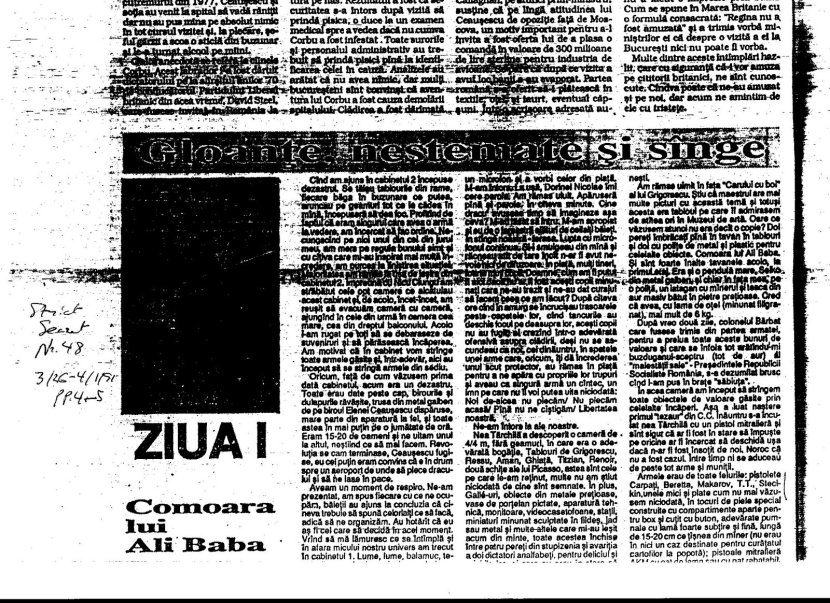
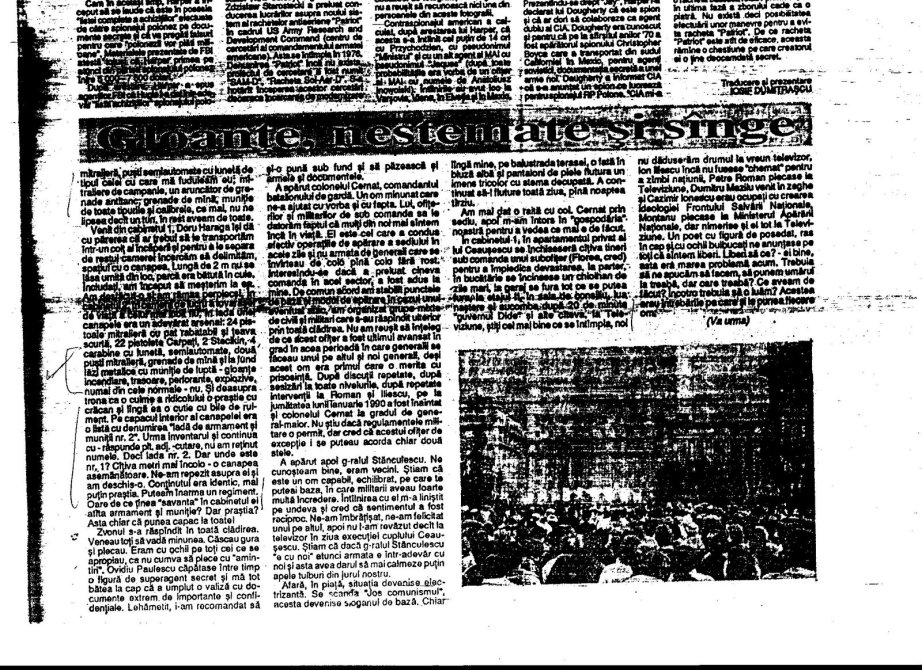
In aceea camera am inceput sa stringem toate obietele de valoare gasite prin celelalte incaperi.  Asa a luat nastere primul “tezaur” din C.C.  Inauntru s-a incuiat nea Tarchila cu un pistol mitraliera si sint sigur ca ar fi fost in stare sa impuste pe oricine ar fi incercat sa deschida usa daca n-ar fi fost insotit de noi.  Noroc ca nu a fost cazul.  Intre timp ni se aduceau de peste tot arme si munitii.

Armele erau de toate felurile:  pistolete Carpati, Beretta, Makarov, T.T., Stecikin, unele mici si plate cum nu mai vazusem niciodata, in tocuri de piele special construite cu compartimente aparte pentru box si cutit cu buton, adevarate pumnale cu lama foarte subtire si fina, lunga de 15-20 ce tisnea din miner (nu erau in nici un caz destinate pentru curatatul cartofilor la popota); pistoale mitraliera AKM cu pat de lemn sau cu pat rabatabil…mitraliera, pusti semiautomate cu luneta de tipul celei cu care ma fuduleam eu; mitraliere de campanie, un aruncator de grenade antitanc; grenade de mina, munitie de toate tipurile si calibrele, ce mai nu ne lipsea decit un tun, in rest aveam de toate.

Venit din cabinetul 1, Doru Haraga isi da cu parerea ca ar trebui sa le transportam intr-un colt al incaperii si pentru a le separa de restul camerei incercam sa delimitam spatiul cu o canapea.  Lunga de 2 m nu se lasa umita din loc, parca era batuta in cuie, inciduati, am inceput sa mesterim ia ea.  Am desfacut-o si am ramas perplecsi.  In cabinetul 2, in camera de lucru a tovarasei de viata a celui mai iubit fiu, in lada unei canapele era un adevarat arsenal:  24 pistoale mitraliera cu pat rabatabil si teava scurta, 22 pistolete Carpati, 2 Stecikin, 4 carabine cu luneta, semiautomate, doua pusti mitraliera, grenade de mina si la fund lazi metalice cu munitie de lupta–gloante incendiare, trasoare, perforante, explozive, numai din cele normale–nu. Si deasupra trona ca o culme a ridicolului o prastie cu cracan si linga ea o cutie cu bile de rulment.  Pe capacul interior al canapelei era o list cu denumirea “lada de armament si munitii nr. 2″.  Urma inventarul si continua cu–raspunde plt. adj.–cutare, nu am retinut numele.  Deci lada nr. 2.  Dar unde este nr. 1?  Citiva metri mai incolo–o canapea asemanatoare.  Ne-am repezit asupra ei si am deschis-o.  Continutul era identic, mai putin prastia.  Puteam inarma un regiment.  Oare de ce tinea “savanta” in cabinetul ei atita armament si munitie?  Dar prastia?  Asta chiar ca punea capac la toate!

Mircea Boaba, “Gloante, nestemate si singe.  Ziua I:  Comoara lui Ali Baba,”  Strict Secret, nr. 48 26 martie – 1 aprilie 1991, pp. 4-5.

In timp ce urcam scara, vrind sa incarc carabinaa, am avut surpriza sa descopar ca gloantele din cele doua incarcatoare erau cu virful bont.

nr. 47 18-25 martie 1991, pp. 4-5.

http://atomic-temporary-3899751.wpcomstaging.com/2009/08/12/22-decembrie-1989-ce-s-a-gasit-in-cabinetul-unu-nicolae-ceausescu-si-cabinetul-doi-elena-ceausescu/

http://atomic-temporary-3899751.wpcomstaging.com/2010/12/21/marturii-intre-1990-si-1992-din-zilele-fierbinte-in-cc-ul-decembrie-1989-doru-teodor-maries-mircea-boaba-sergiu-tanasescu-si-ernest-maftei/

More testimonies:

http://www.romanialibera.ro/special/investigatii/marturii-despre-teatrele-de-razboi-ale-revolutiei-romane–18312

Lt. mr. APOSTOL M. ANTON, fost ofiter in serviciul 1 declara:

In ziua de 29 decembrie 1989 a aflat de la vecinul PIPOI REMUS, care locuieste la etajul 2, sub apartamentul lui, ca a vazut mai multe persoane tragand spre Ministerul Apararii Nationale, despre care era convins ca nu erau romani. I s-a parut ca ar fi arabi. Trageau cu niste pistoale automate mici.

http://atomic-temporary-3899751.wpcomstaging.com/2009/07/27/arabesque-arab-terrorists-in-the-december-1989-romanian-revolution/

Fiecare pluton din aceasta scoala de ofiteri de rezerva, avea alocata cate o sala de clasa, care era ca o sala de laborator-expozitie dotata cu o anumita baza materiala de instructie (in zilele de azi, se cheama training) aferenta unei anumite tematici. De exemplu, sala noastra continea materiale si planse despre armamentul individual de infanterie si balistica aferenta. Exact ca intr-un muzeu, aveam acolo vitrine cu exemplare sectionate de automat Kalashnikov, pusca mitraliera cu incarcator sector si tambur, pusca semiautomata cu luneta, pistolul TT model ’33 aflat in dotarea ofiterilor armatei si pistolul Carpati din dotarea militiei. De asemenea, imi amintesc ca era si un aruncator de grenade antitanc AG7 cu lovitura aferenta, si parca si un model imbunatatit de Kalasnikov cu teava scurta si pat rabatabil aflat in dotarea trupelor de securitate USLA (Unitati Specializate de Lupta Antiterorista)… si bineinteles toata gama de munitie, adica toate calibrele de cartuse complete, mai putin praful de pusca din tub. Era sa uit mitraliera de companie…
Toate armele erau sectionate in asa maniera incat sa se poata intelege principiul complet de functionare… daca puneai un cartus in incarcator si armai, se putea vedea traseul complet al sau din incarcator pana la expulzarea tubului dupa percutare.  http://calinhera.wordpress.com/2010/10/24/servesc-patria-la-multi-ani/

–In afara de modul –interpretat ca suspect–, in care au patruns in dispozitivul dumneavoastra, ce dovezi mai aveti?

–Faptul ca, la teava unuia dintre tancuri, tabla de protectie a fost rupta in doua locuri, trei din pistoalele mitraliera pe care le-am “capturat” (cu teava scurta si incarcator de 20 cartuse)  aveau tevile afumate, turela tancului de comandat de locotenentul maior Vasile Barbu a fost blocata, iar dimineata plutonierul Butoi a gasit pe tancul sau un pistol mitraliera si o lanterna de semnalizare…Cit despre dotare, sa nu-mi zica mie cum am citit intr-un ziar de mare tiraj– ca era jalnica, in nivelul armatei.  A doua zi, am recuperat, din cele doua autoblindate, radiotelefoane Telefunken, veste antiglont, pistoale de 9 mm, pumnale, binoclu cu infrarosu — care pentru noi constituiau noutatii absolute.  Si, pentru ca tot am fost provocati, sa va mai spun ceva.  Dimineata, cind l-am intrebat “de ce ai tras, ma?” unul dintre cei trei supravietuitori, pe care i-am gasit in blocul de vizavi mi-a raspuns:  “Ce p. mati, si eu execut acelasi ordin ca si tine!!!”  E clar ca nu au venit ca prieteni!

http://atomic-temporary-3899751.wpcomstaging.com/2010/04/17/crima-cazul-mapn-23-24-decembrie-89-si-sosirea-uslasilor-maior-mihai-floca-armata-poporului-6-iunie-1990-p-3/

Even some military prosecutors have been willing to admit the obvious:

CINE A TRAS ÎN NOI… DUPĂ 22?!

Interviu cu colonelul magistrat Ilina Radu – prim-procuror al Parchetului Militar Timişoara… la 20 de ani de la evenimente
A consemnat Liza Kratochwill

R.I.: – Nu. Ziua eram la serviciu. Ziua – program normal, seara cu familia, cu prietenii… ne reuneam trei, patru familii de vecini şi stăteam pe jos, pe covoare, pentru că se trăgea formidabil, uneori chiar la nivelul ferestrelor noastre, şi nu-ţi ardea să faci balet prin casă.

L.K.: – În blocuri?

R.I.: – În blocuri, da. În blocurile din, relativ, zona centrală a oraşului. A fost urât…

L.K.: – Asta în ce zi ?

R.I.: – Mi-amintesc de acea noapte cruntă de 23 spre 24 când s-a tras, ne găseam câţiva colegi într-un bloc din zona centrală şi s-a tras formidabil. De la nouă seara până la şase dimineaţa, continuu, cred că au fost zeci de mii de cartuşe şi am fost speriat. Şi chiar atunci am spus: dacă Dumnezeu ne iubeşte, vom prinde Ajunul serii următoare, ca să colindăm. Era Ajunul Crăciunului, însă, noaptea aia a fost furibundă. Şi nu eram de competenţă, de aia nu ne-am implicat profesional. Ca procuror civil nu puteai atunci să cercetezi faptele cu arme ale militarilor şi se ştiu foarte puţine lucruri. S-au găsit foarte puţine tuburi de cartuşe din cele care trebuiau să fie. S-au găsit, în schimb, repet, unele dispozitive care, ulterior, ar fi fost analizate şi ar fi putut constitui simulatoare de tragere sau ţinte false.

L.K.: – Dar dumneavoastră, acum, cred că sunteţi cel mai în măsură să-mi spuneţi care au fost tipurile, în afară de calibrul ăla obişnuit, 7,62, care au fost toate tipurile de gloanţe care au fost identificate, folosite în 1989 şi care au cauzat decese şi răni. Deci au fost o dată aceste 7,62, au fost acele dum-dum explozive şi-n afară de…

R.I.: – 7,65-ul a fost, pistoale-mitraliere scurte…

L.K.: – Kalaşnikov, da, din acestea au fost folosite şi la… cred că şi la cazul Jubea…

R.I.: – …un tip care, atunci, erau doar în dotarea forţelor speciale, la acel moment. Pistoale cu pat scurt şi cu ţeavă scurtă. Mai erau pistoale-mitralieră, AKAEM-uri obişnuite. Au fost apoi, s-a tras chiar şi cu aruncător de grenade, cu AG 7 şi cu diverse tipuri de pistoale.s

L.K.: – Pistoale ale forţelor armate sau…?
R.I.: – Pistoale din dotare. E foarte greu de spus.
L.K.: – Păi, ce pistoale avea România, la acea oră?
R.I.: – TT şi Carpaţi-ul.
L.K.: – Carpaţi-ul, care era în dotarea Miliţiei, nu?

R.I.: – De regulă, era la Miliţie, forţe de Securitate… şi TT-urile, care erau, deopotrivă, şi aici şi acolo. La ofiţeri sau la…

L.K.: – Şi aici ce tipuri de calibru de gloanţe erau folosite, la tipurile astea de pistoale?

R.I.: – Păi, discutăm şi de calibru de 9 milimetri, cu tuburi specifice, cam de nouă milimetri.

L.K.: – Dar cele care se foloseau la lunetă, deci ţintă fixă?

R.I.: – Carabine sau puşti-mitralieră cu tambur.
 
About the same area around the TV station during these days (Prosecutor General Ioan Dan):

image0

image0-001

image0

image0-001

image0


http://atomic-temporary-3899751.wpcomstaging.com/2011/01/29/pozefotofilmvideo-gloante-dum-dum-si-speciale-i-e-vidia-decembrie-1989/

(Bucuresti, zona TVR) below– individual demonstrates how much smaller they are than Army’s standard 7,62 mm munitions

Video No. 2: Bucharest, Piata Aviatorilor, near TVR (Romanian state Television) headquarters, Vidia Bullets

In the second video
Revolutia Romana 22 Dec.1989 – cd4

(posted by Alexandru2006 at http://www.dailymotion.com/video/x7rob0_revolutia-romana-22-dec1989-cd4_shortfilms), a civilian shows how the bullets shot by “the enemy”—i.e. “the terrorists”—are different than the standard ammunition (7.62 mm) he and the others are using.  Based on other video, photos, and accounts, these appear to be “vidia” bullets—there are many testimonies from those who fought in the area near the TV station regarding these bullets.

——————————————————————————————————————————————————————————————————

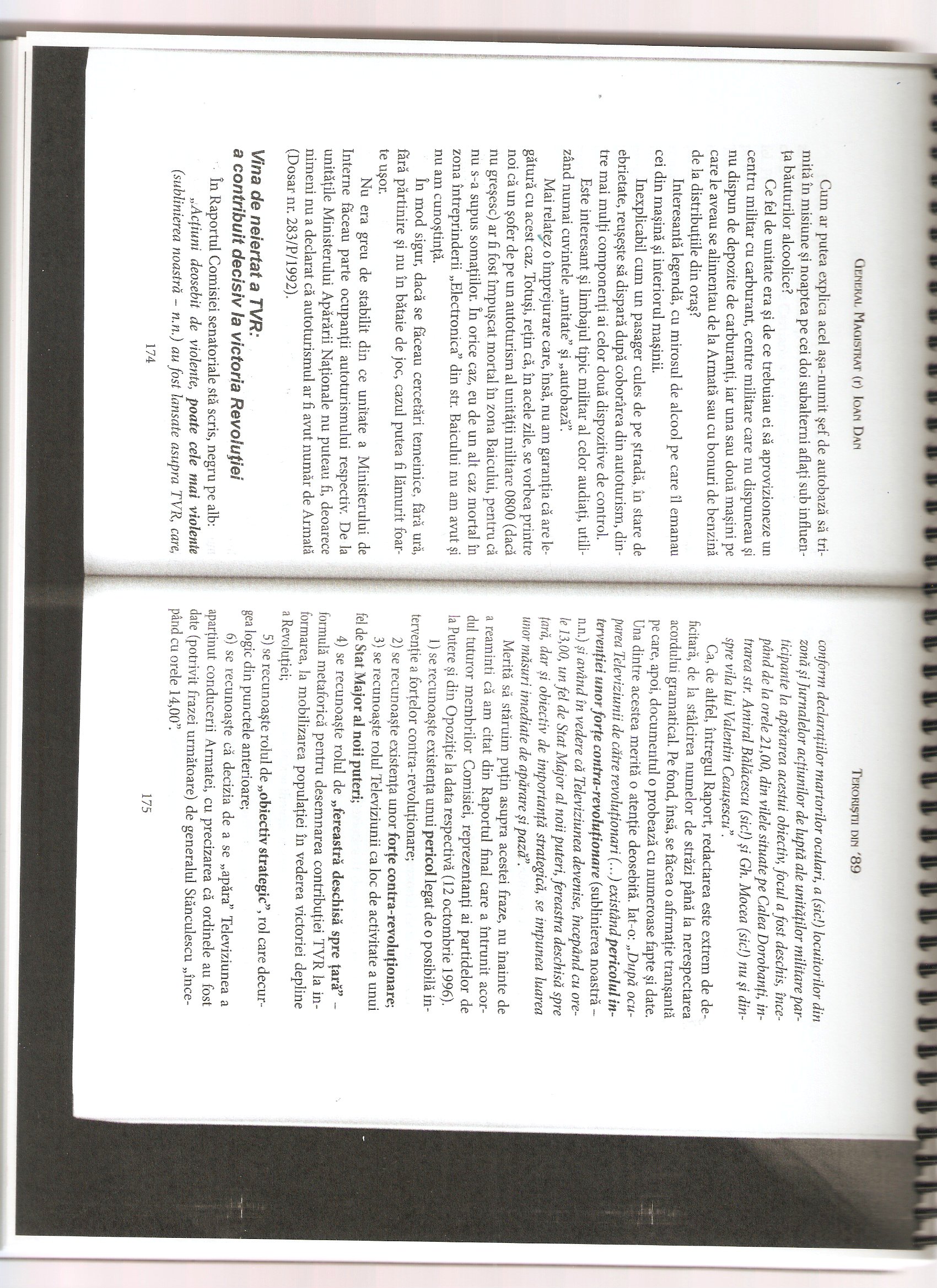
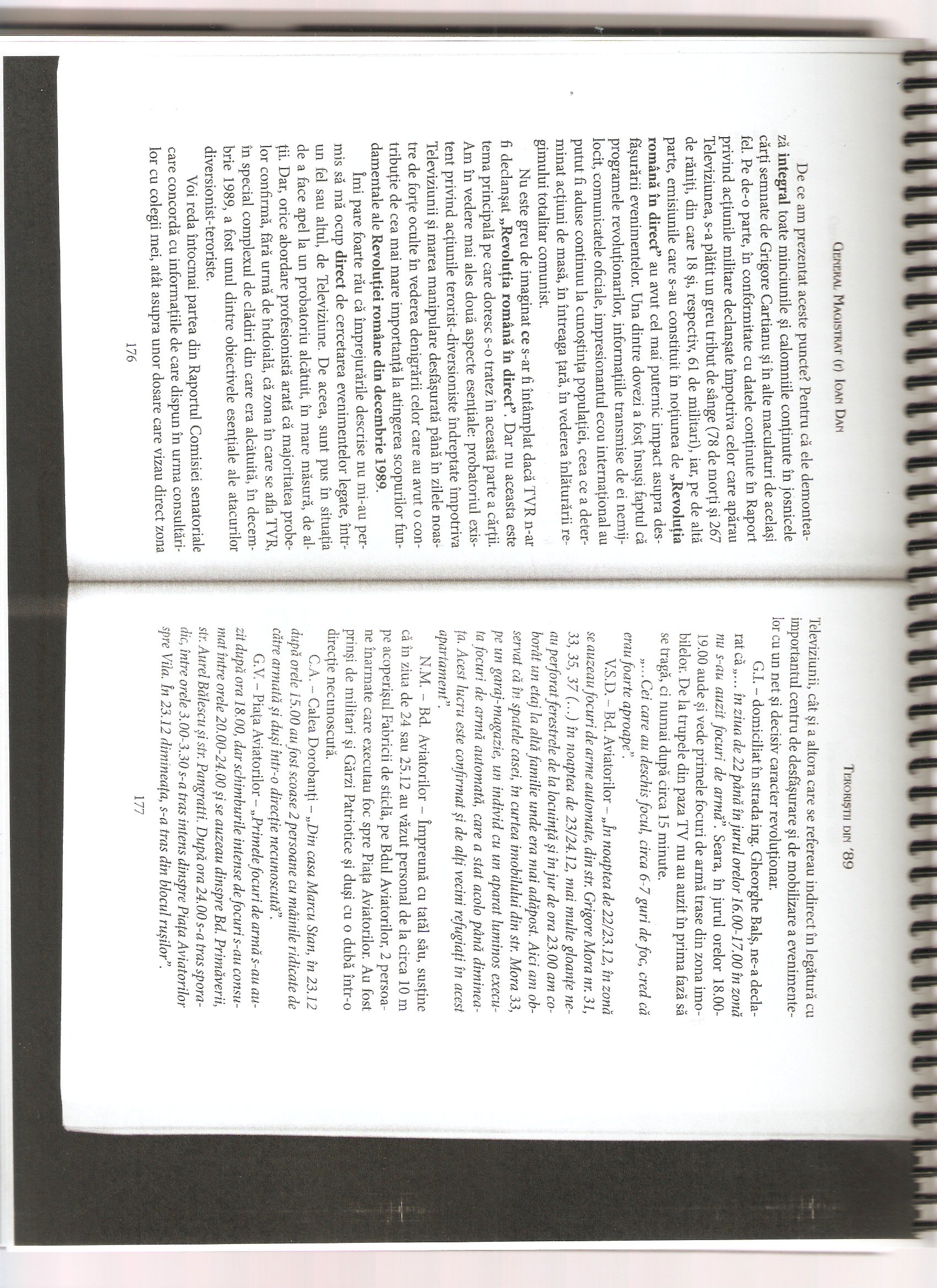
Vina de neiertat a TVR: a contribuit decisiv la victoria Revolutiei (I)

image0

image0-001

image0-002

image0-003

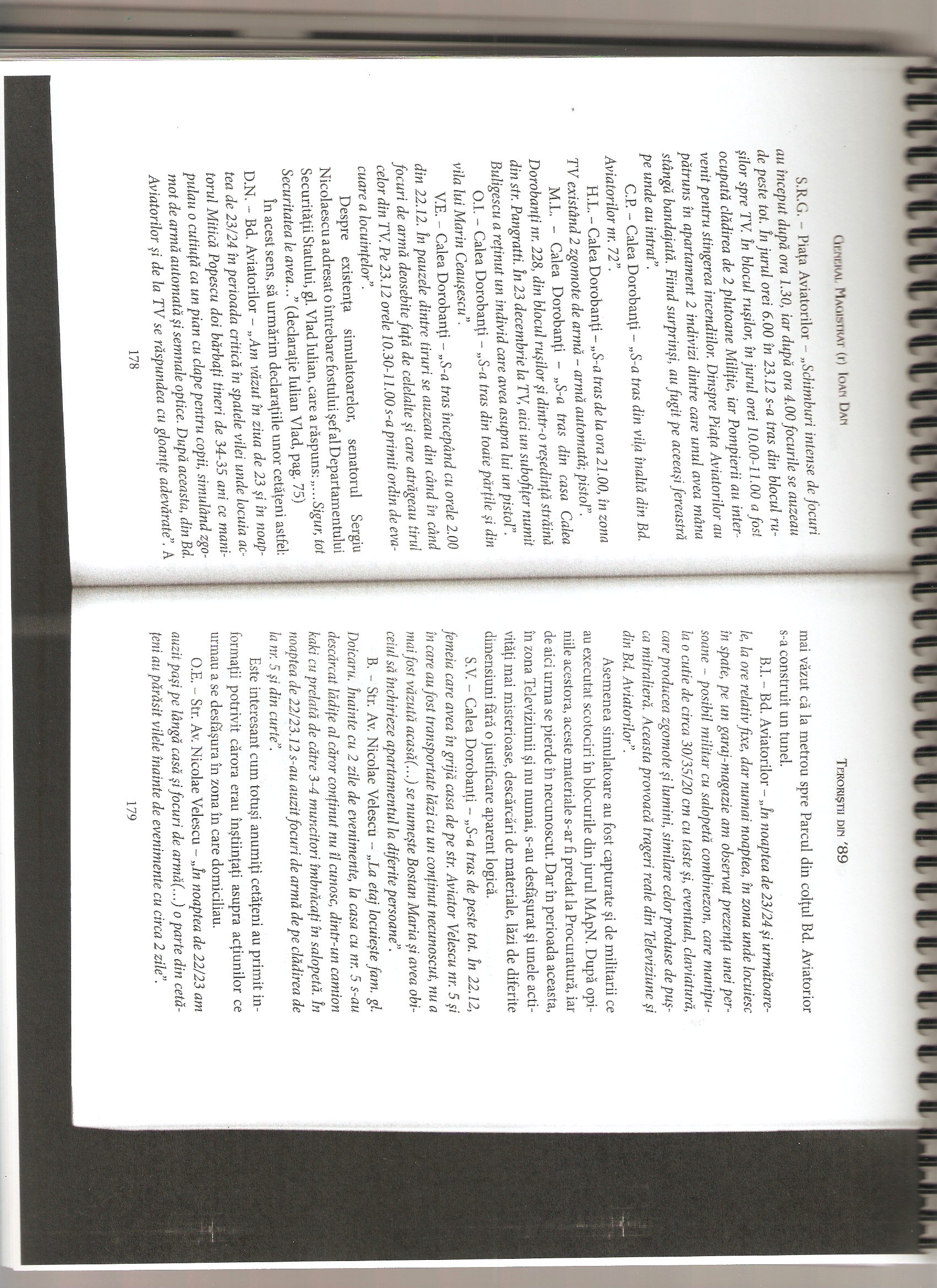
Vina de neiertat a TVR: a contribuit decisiv la victoria Revolutiei (II)

image0-001

“Despre existenta simulatoarele, senatorul Sergiu Nicolaescu a adresat o intrebare fostului sef al Departmamentului Securitatii Statului, gl. Vlad Iulian, care a raspuns…”Sigur, tot Securitatea le avea…” (declaratie Iulian Vlad, pag. 75).

image0

In aceasta perioada, in zona Televiziunii au fost observate semnale luminoase ce prezentau imaginea unei balizari si care marcau inceputul sau incetarea atacurilor.

image0-001

Mai mult despre “semnale luminoase”:

http://atomic-temporary-3899751.wpcomstaging.com/2012/12/19/what-can-we-learn-from-dosarele-revolutiei-de-la-timisoara-ii/

Vina de neiertat a TVR: a contribuit decisiv la victoria Revolutiei (III)

Uzina Sadu-Gorj, august-septembrie 1989,

comanda de fabricatie a gloantelor explozive DUM-DUM

Referitor la existenta cartuselor explozive si perforante, dupa unele informatii rezulta ca in perioada august-septembrie 1989 la uzinele Sadu-Gorj s-a primit o comanda de executare a unor asemenea cartuse explozive.  Comanda a fost ordonata de Conducerea Superioara de partid si executata sub supravegherea stricta a unor ofiteri din fosta Securitate.

Asa cum s-a mai spus, asupra populatiei, dar si asupra militarilor MApN teroristii au folosit cartuse cu glont exploziv.  Cartusele respective de fabricarea carora fostul director al uzinei Constantin Hoara–actualmente deputat PSM Gorj–si ing. Constantin Filip nu sunt straini, au fost realizate sub legenda, potrivit careia, acestea urmai a fi folosite de Nicolae Ceausescu in cadrul partidelor de vanatoare.

Consider ca lt. col. Gridan fost ofiter de Contrainformatii pentru Uzina Sadu–actualmente pensionar ar putea confirma fabricarea unor asemenea cartuse si probabil si unele indicii cu privire la beneficiar.  Daca intr-adevar aceste cartuse au fost fabricate in Romania atunci este limpede ca o mare parte din teroristii din decembrie 1989 au fost autohtoni, iar organele de securitate nu sunt straine de acest lucru.

http://atomic-temporary-3899751.wpcomstaging.com/2013/12/01/vina-de-neiertat-a-tvr-a-contribui-decisiv-la-victoria-revolutiei-i/

http://atomic-temporary-3899751.wpcomstaging.com/2013/12/04/vina-de-neiertat-a-tvr-a-contribuit-decisiv-la-victoria-revolutiei-ii/

image0-001

image0

http://atomic-temporary-3899751.wpcomstaging.com/2013/08/25/tvr-chirurgi-si-reportaje-despre-gloante-explozive-dum-dum/

http://atomic-temporary-3899751.wpcomstaging.com/2013/05/16/dosarele-revolutiei-si-expertize-balistice-cine-a-tras-in-voi-cu-gloante-explozive/

Romulus Cristea (ziarist, Romania Libera, 22 decembrie 2005):  – Munitia speciala, gloantele cu cap vidia sau dum-dum, a provocat victime? Presa de la acea vreme a fost plina cu astfel de relatari…

General-magistrat Dan Voinea – Nu exista victime (persoane impuscate) nici de la gloantele cu cap vidia, nici de la dum-dum. Pe durata evenimentelor s-a folosit munitie de razboi, munitie normala care se gasea la vremea respectiva in dotarea Ministerului de Interne si a Ministerului Apararii Nationale. Confuzia si informatiile false au aparut de la faptul ca se foloseau calibre diferite si, deci, zgomotul produs era altfel perceput.  http://www.romanialibera.ro/opinii/interviuri/toti-alergau-dupa-un-inamic-invizibil-58783.html

Vina de neiertat a TVR: a contribuit decisiv la victoria Revolutiei (IV)

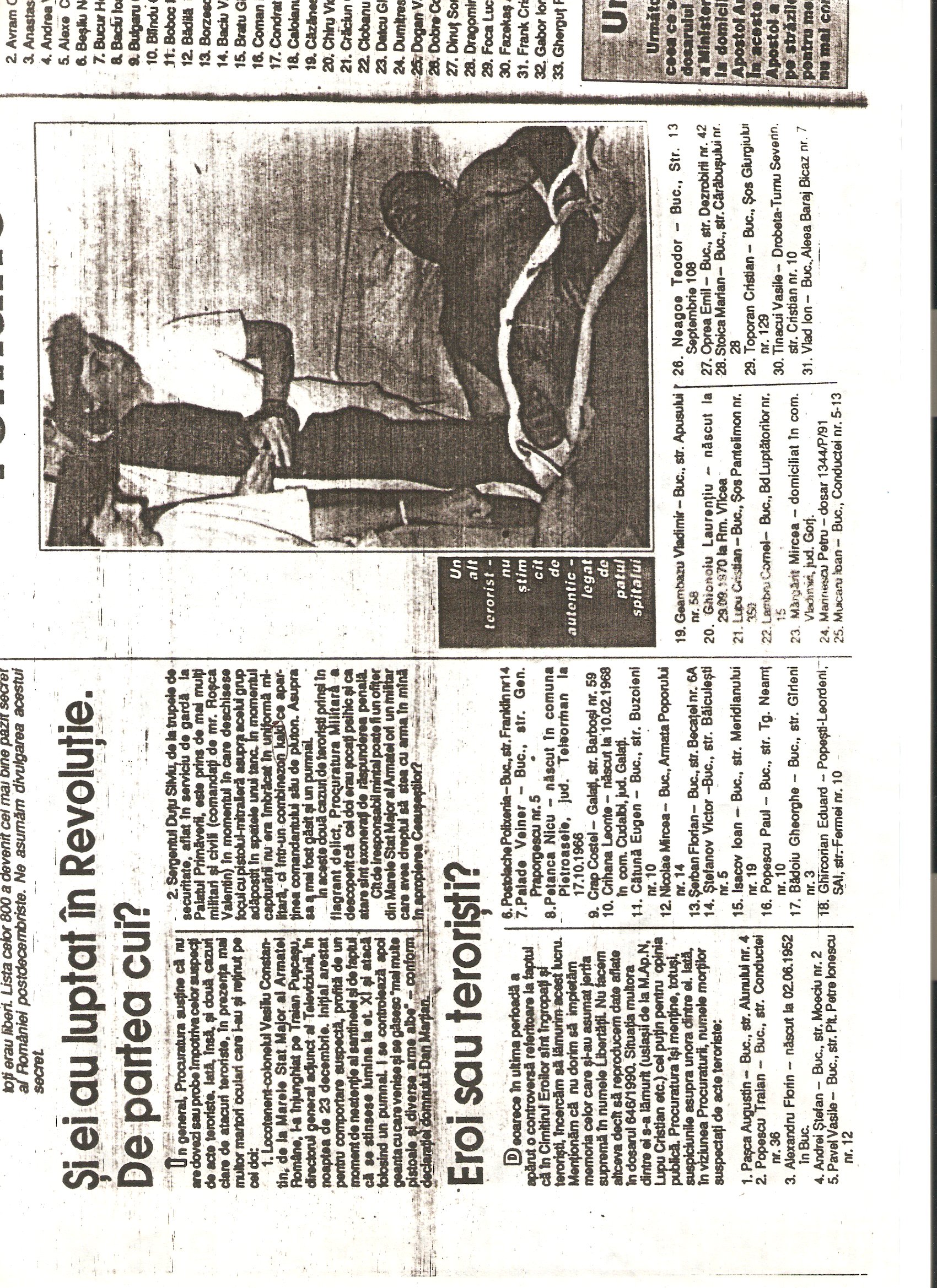
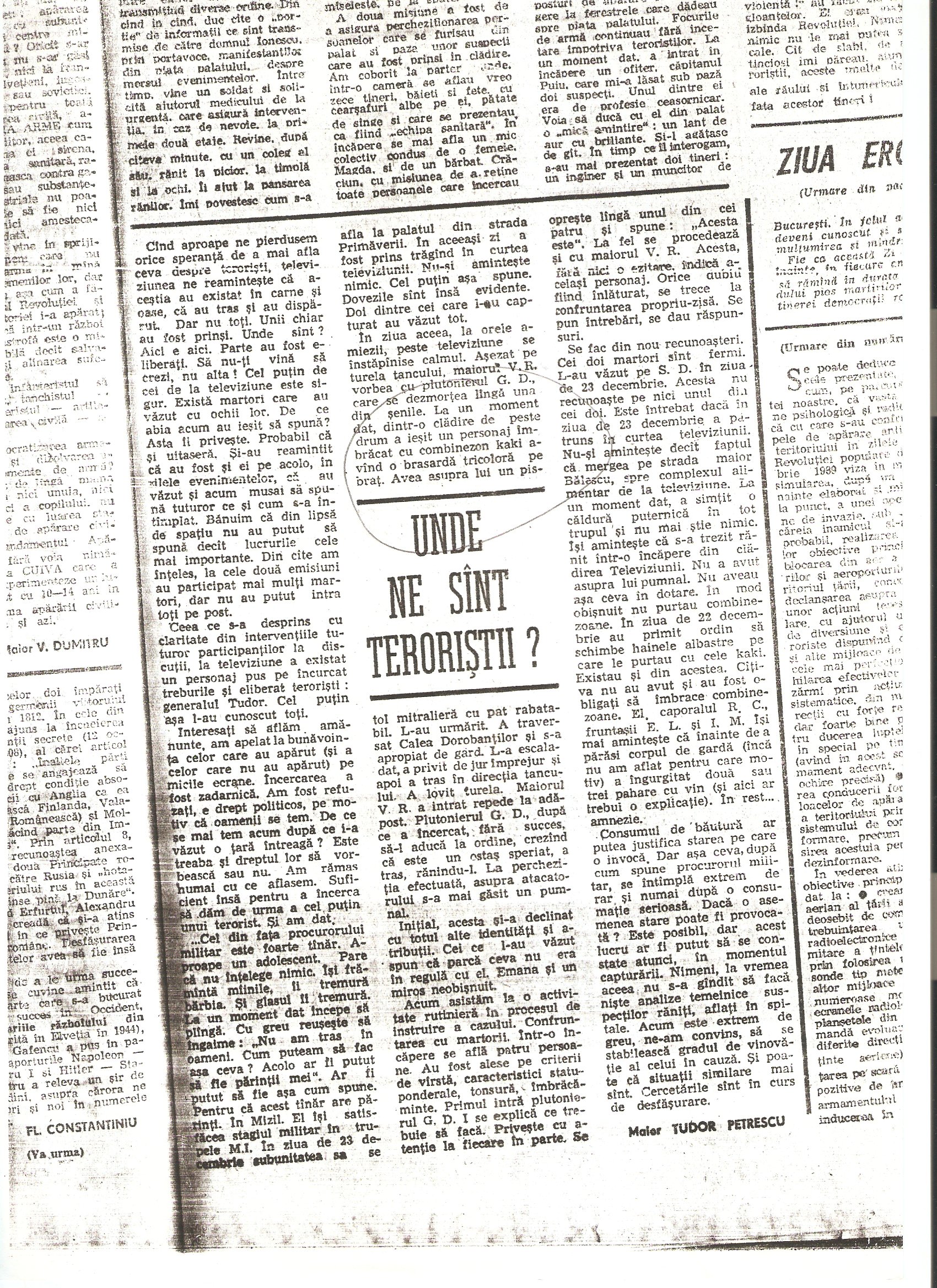
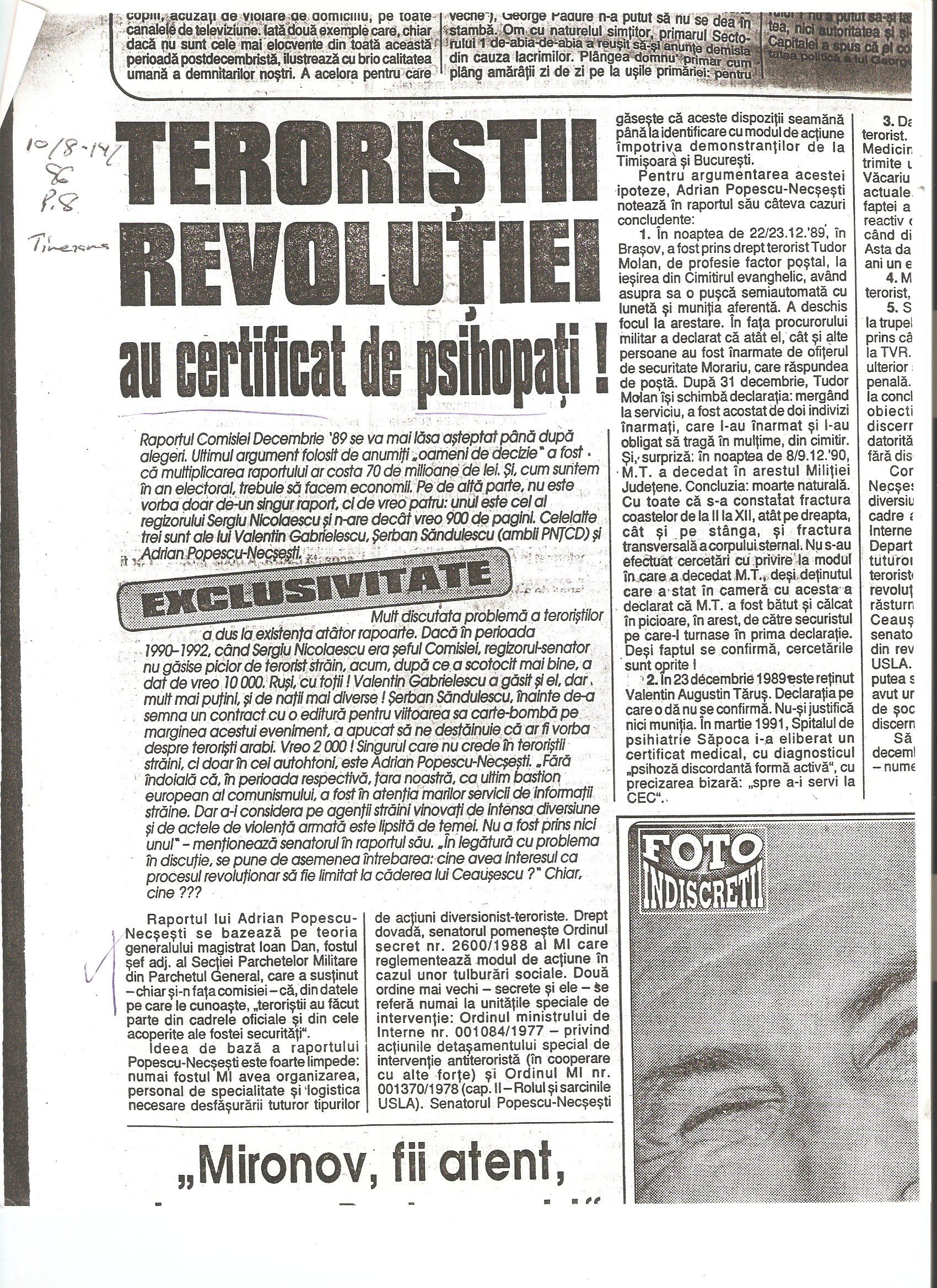
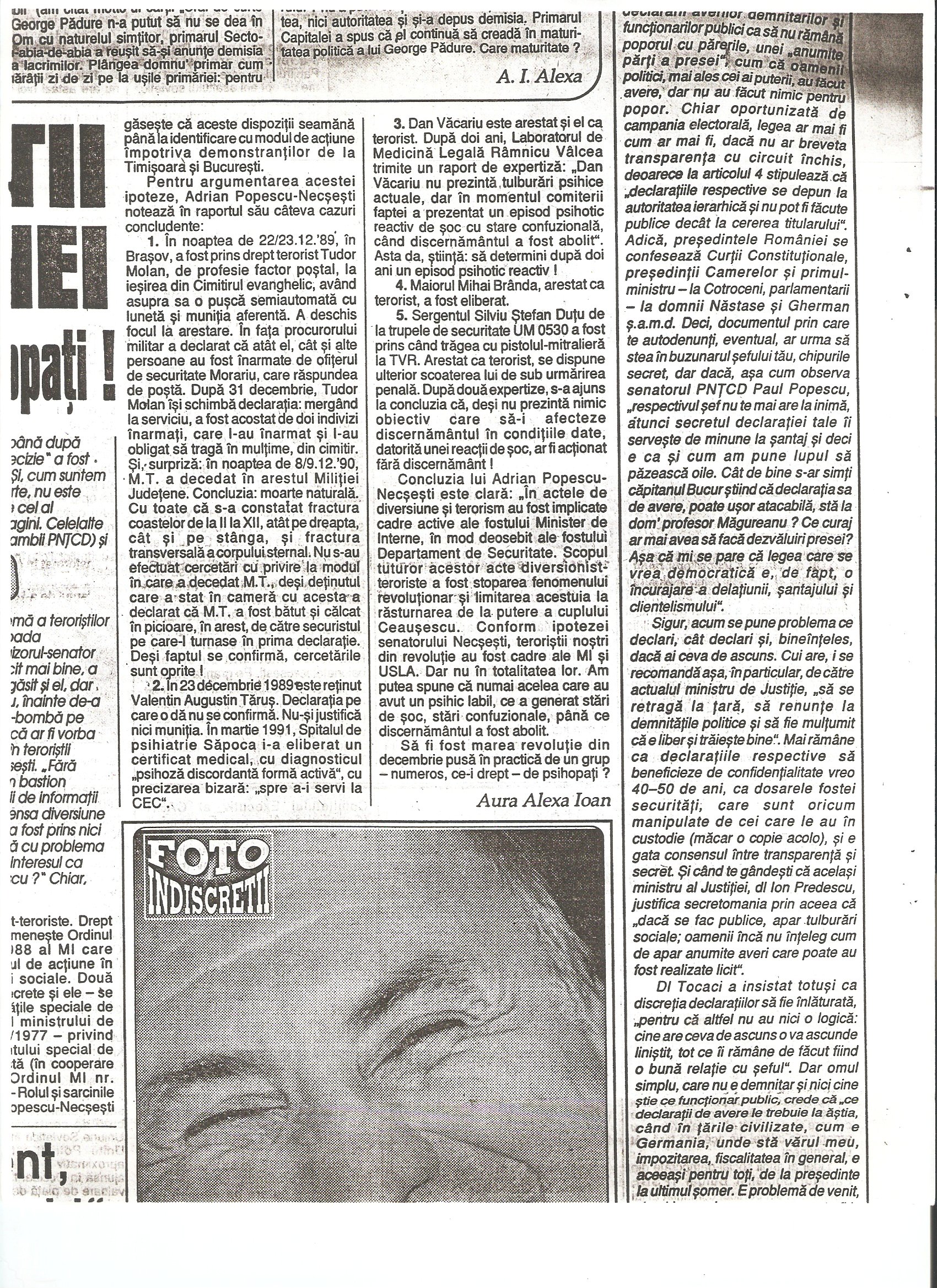
Presa romaneasca din anii nouazeci despre cazul lui Silviu Dutu–suspectat de terorism la TVR

image0

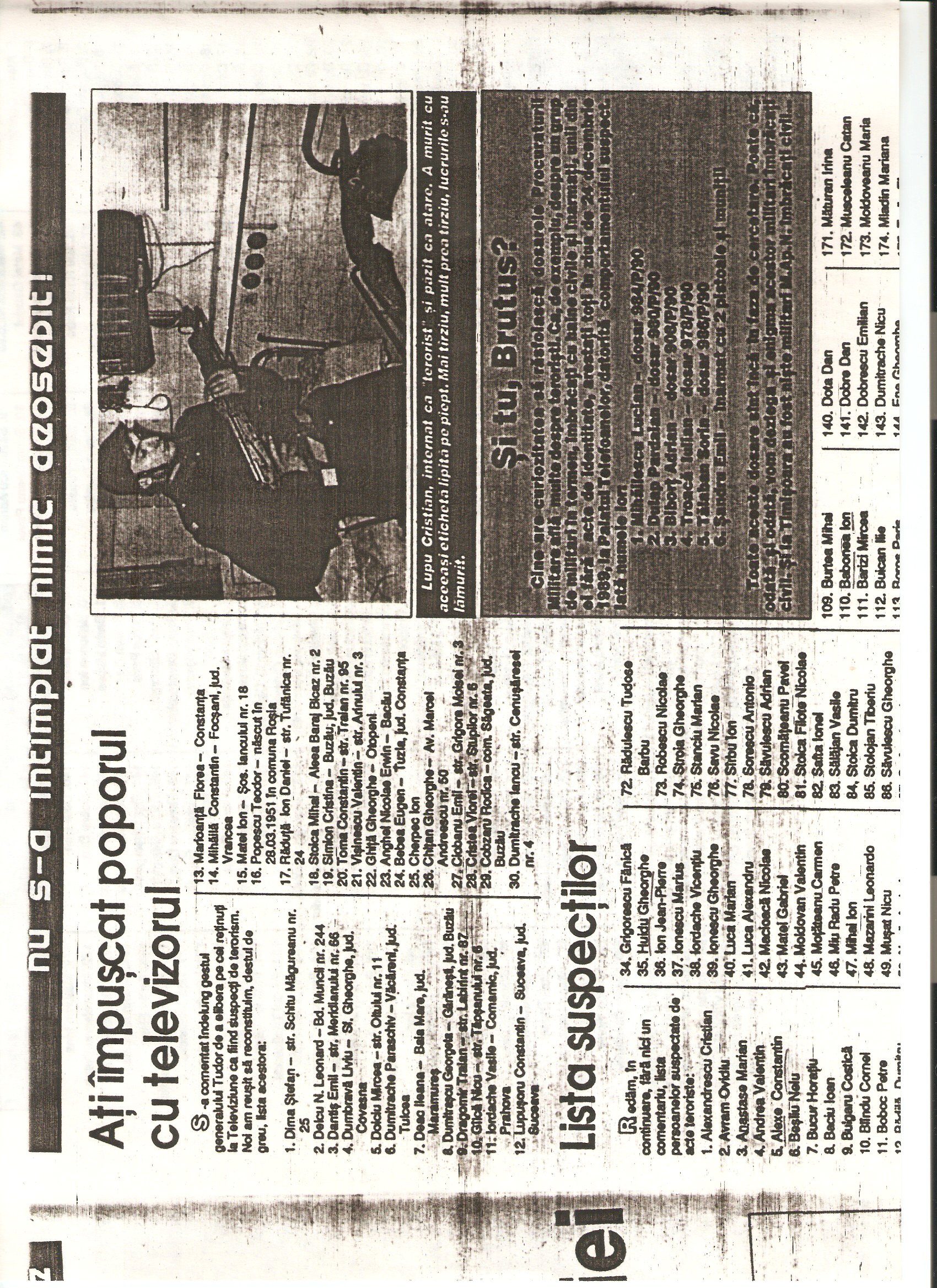
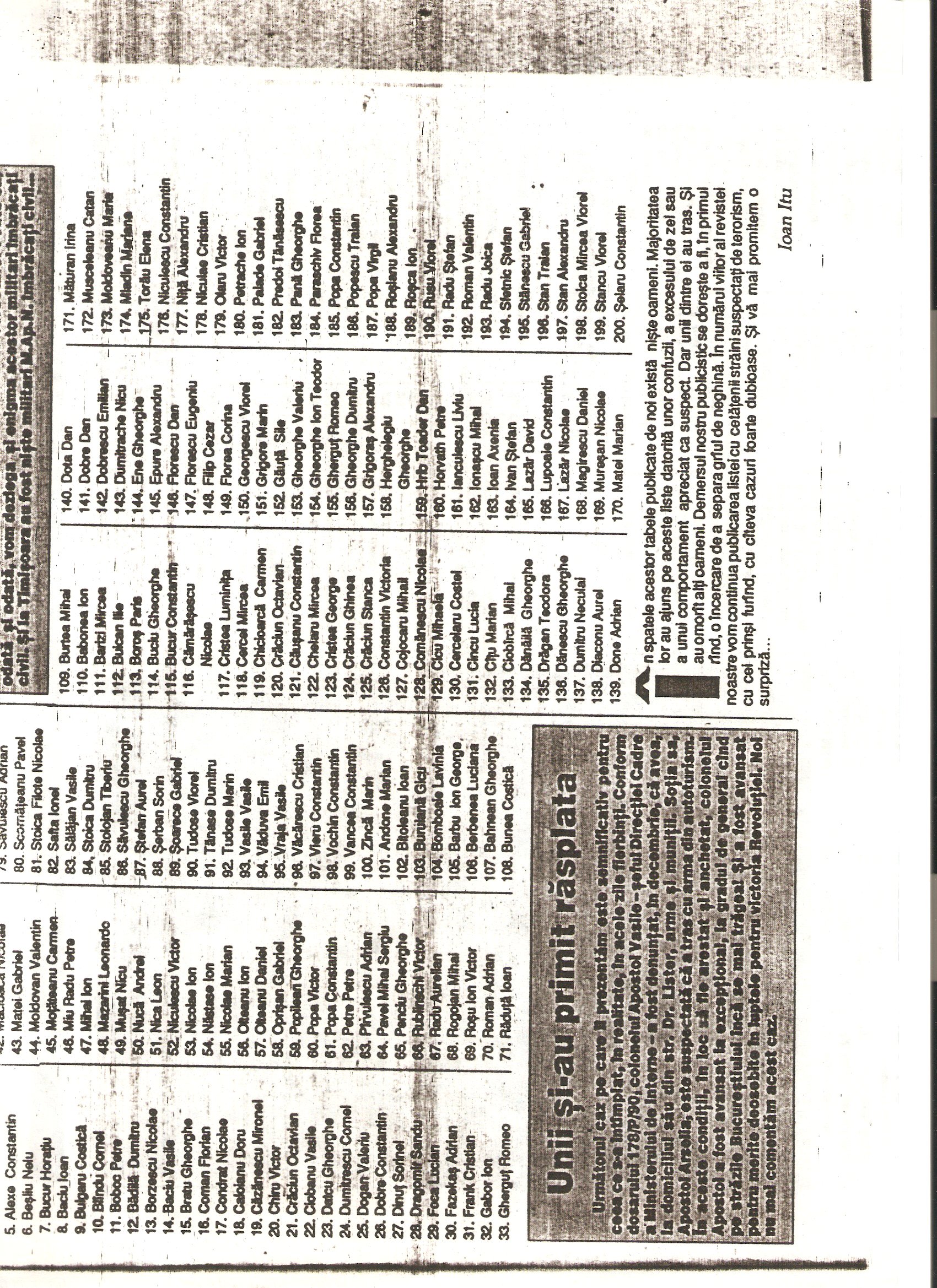
Ioan Itu, “Si ei au luptat in Revolutie.  De partea cui?,” Tinerama, 10-16 septembrie 1993, p. 8.

image0-001

Maior Tudor Petrescu, “Unde ne sint teroristii?” Armata Poporului, nr. 22, 30 mai 1990, p. 3.  (S.D. = Silviu Dutu)

image0-002

image0-003

Aura Alexa Ioan (cu Adrian Popescu-Necsesti), “Teroristii Revolutiei au certificat de psihopati!” Tinerama, 8-14 octombrie 1996, p. 8

Presa romaneasca din anii nouazeci despre cazul lui Constantin Vasiliu–suspectat de terorism la TVR

publicat pe internetul pana acum, in schimb apare Lt. Col. Vasiliu Constantin:

image0

image0-001

image0-002

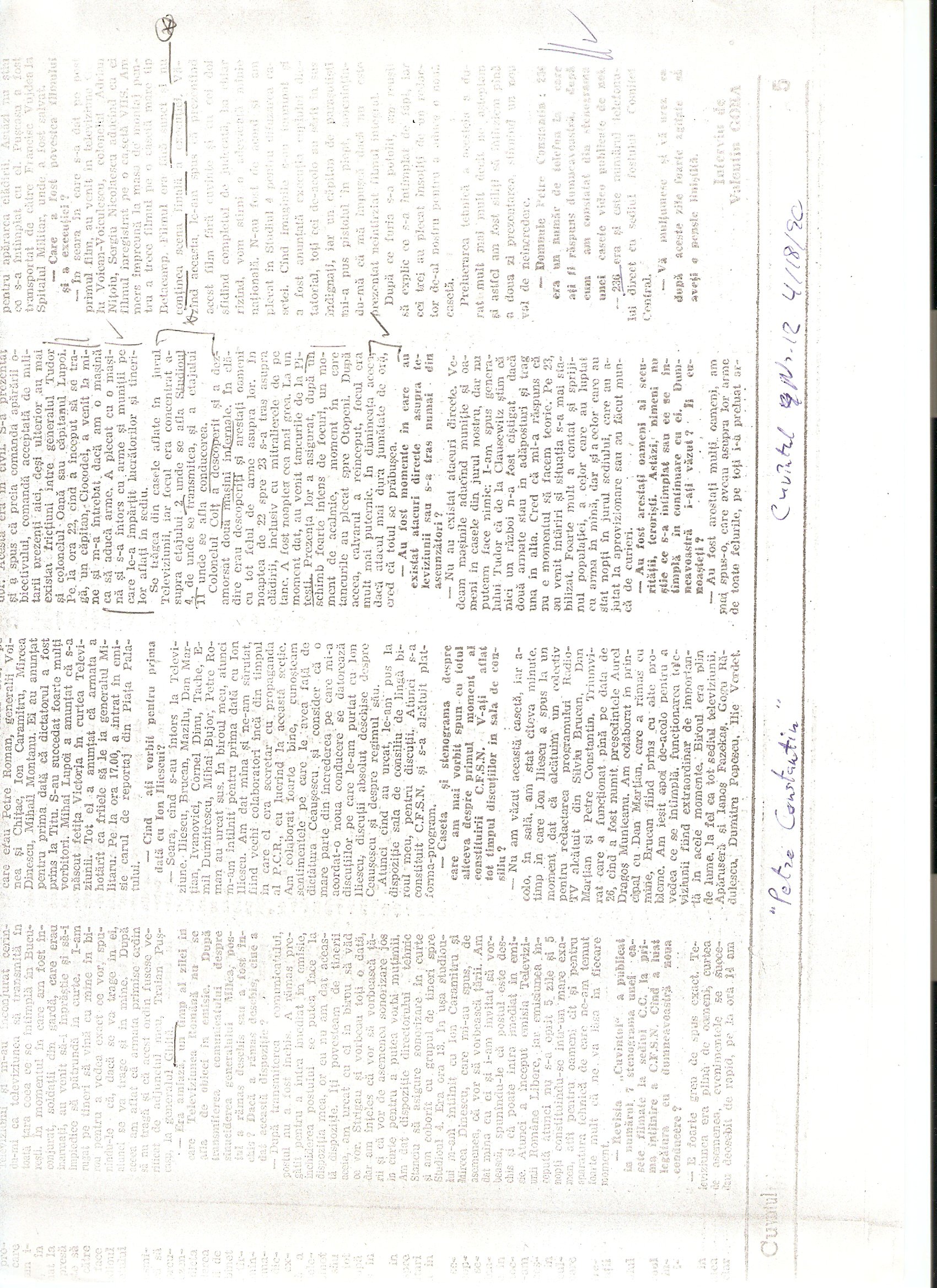
Valentin Gora:  Au fost arestati oameni ai securitatii, teroristi.  Astazi, nimeni nu stie ce s-a intimplat sa ce se intimpla in continuare cu ei.  Dumneavoastra i-ati vazut?  Ii cunoasteti?

Petre Constantin:  Au fost arestati multi oameni, am mai spus-o, care aveau asupra lor arme de toate felurile, pe toti i-a preluat armata si nu stiu ce s-a intimplat mai departe cu ei.  Adjunctul meu, Traian Puscasu, a fost injunghiat in noaptea de 23 spre 24 decembrie, pe hol, la etajul 11.  Agresorul, locotenent-colonelul Vasiliu, il viza pe generalul Tudor sau pe mine.  Eu am lipsit citeva miunte, generalul Tudor s-a ferit in momentul atacului si a fost lovit Puscasu.  Totul se intimpla in usa biroului.  Militarii au sarit si l-au imobilizat imediat.

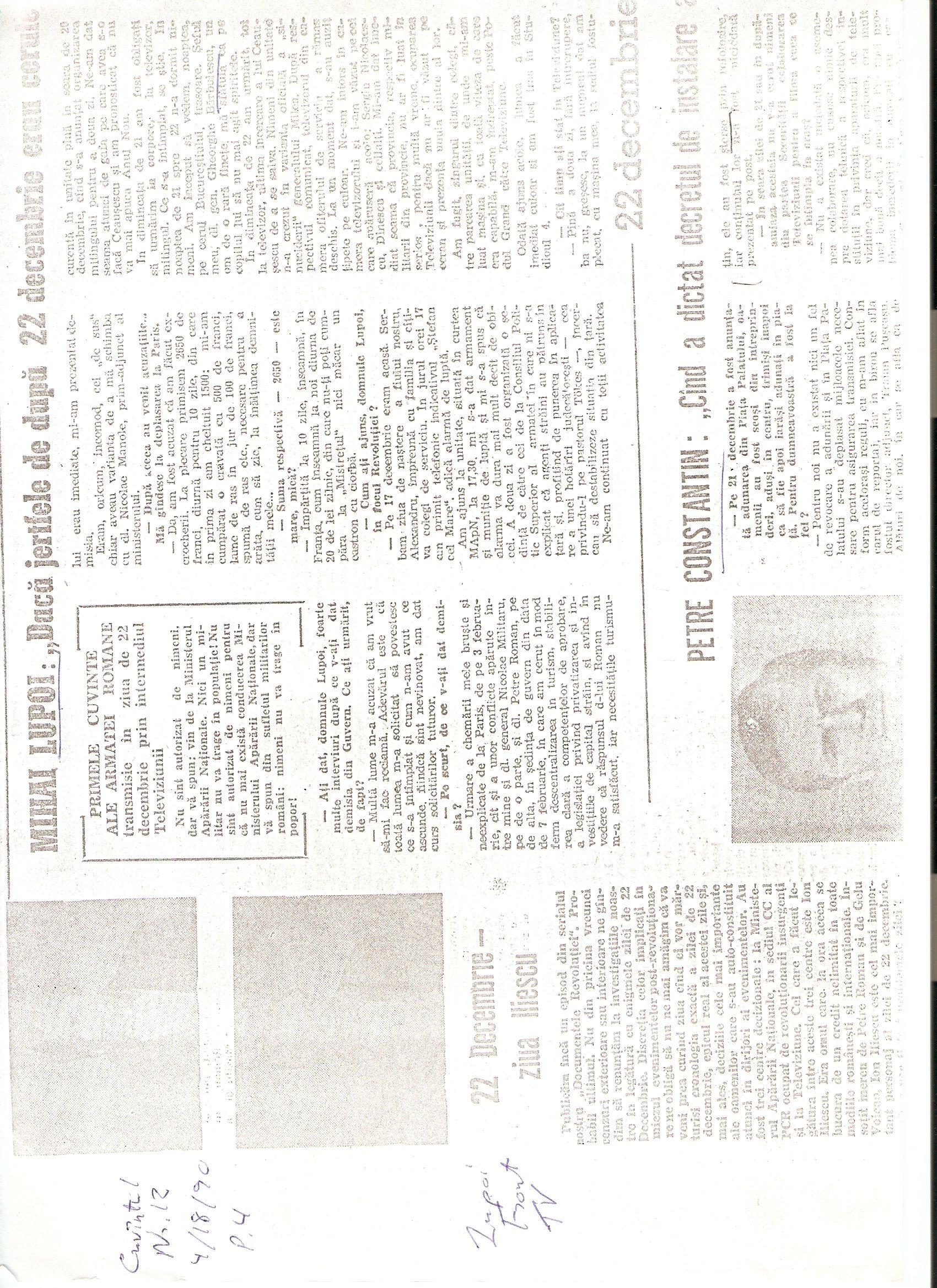
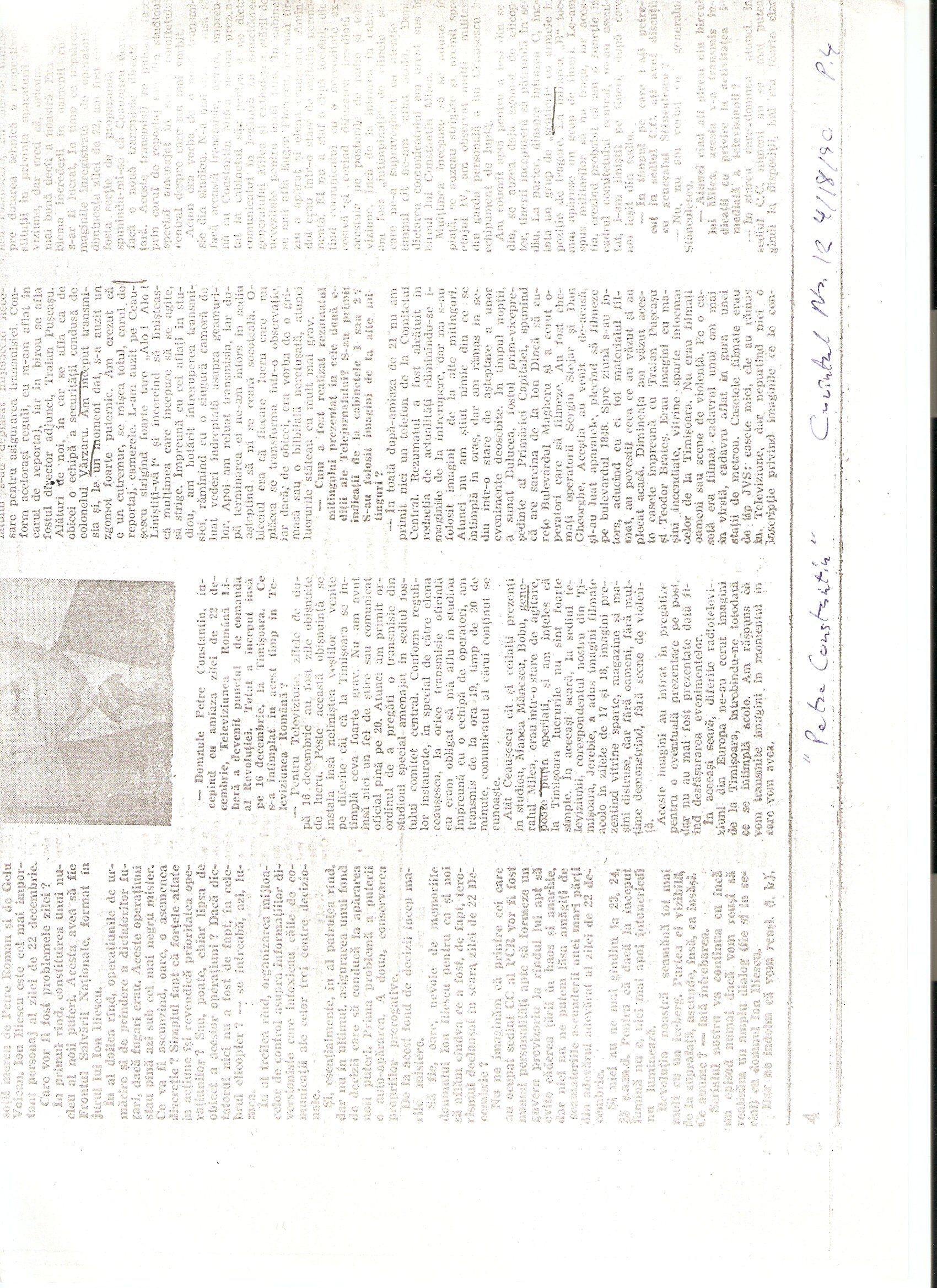
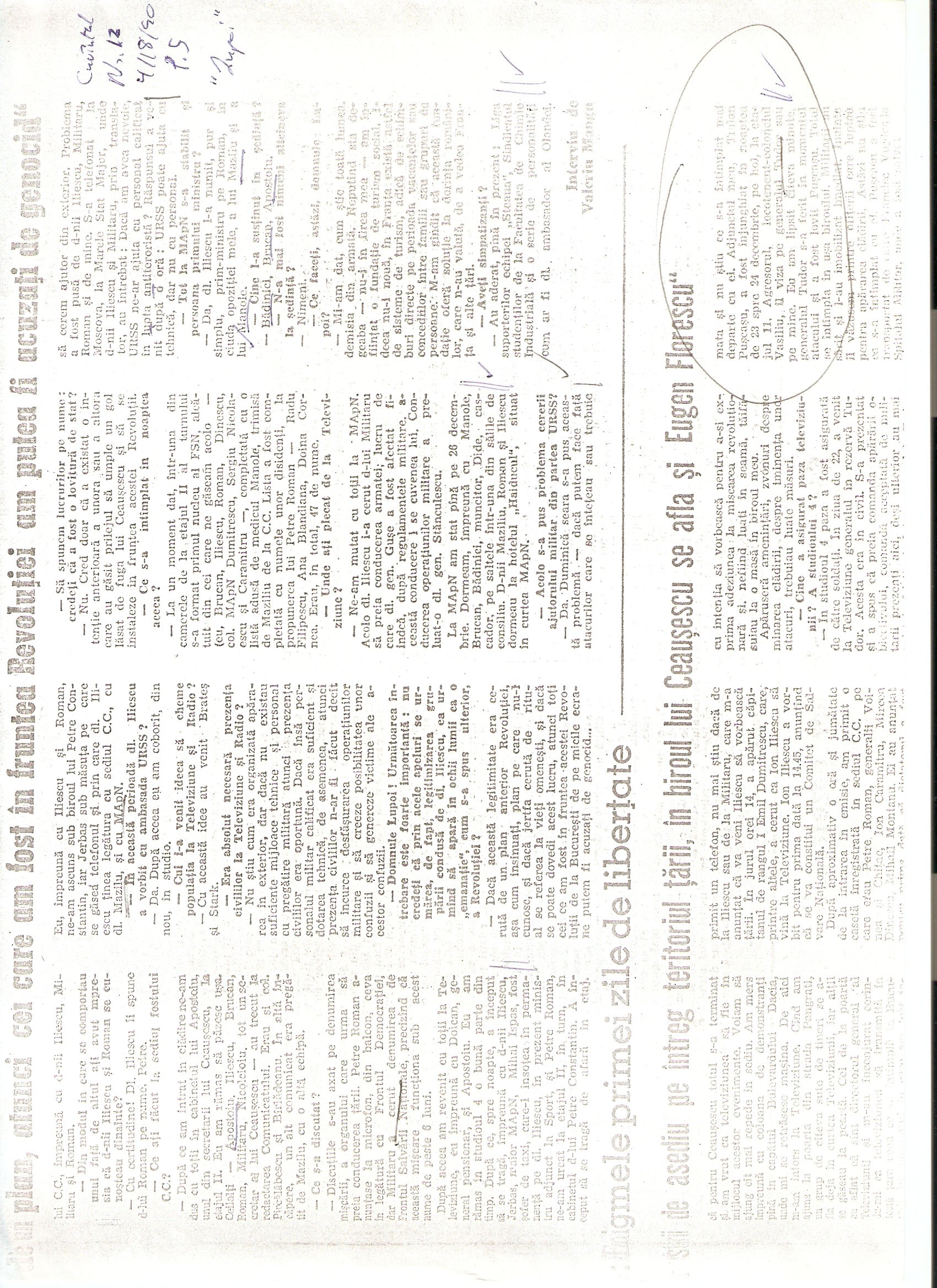
Valentin Gora cu Petre Constantin, “Petre Constantin:  Cind a dictat decretul de instalare ? de asediu pe intreg teritoriul tarii, in biroul lui Ceausescu se afla si Eugen Florescu,” Cuvintul, nr. 12, 18 aprilie 1990, pp. 4-5.

image0-003

http://mariusmioc.wordpress.com/2013/11/13/cercetarile-parchetului-in-dosarul-revolutiei-37-bucuresti-televiziune-raniti-si-ucisi-5/

425. Parte vătămată Puşcaşu Traian (Televiziune-Vol. 110)
Numitul Puşcaşu Traian, fiul lui Gheorghe şi Maria, născut la data de 01.03.1927, în Iaşi, domiciliat în Bucureşti (…) în noaptea de 22/23.12.1989, în timp ce se afla în incinta televiziunii, unde-şi desfăşura activitatea ca director adjunct al TVR, a fost înjunghiat în abdomen cu un cuţit de către lt. col. Vasiliu Cornel, care se afla în dispozitivul de pază al instituţiei respective.
Conform raportului medico-legal nr. A1/3409/1990, numitul Puşcaşu Traian a prezentat la data de 24.12.1989 o plagă abdominală penetrantă cu interesarea splinei şi arterei epigastrice. Leziunea a putut fi produsă prin lovire cu corp tăietor-înţepător (posibil cuţit). A necesitat circa 25 zile de îngrijiri medicale. Leziunea i-a pus viaţa în pericol.
Prin rezoluţia nr. 1411/P/1990, din data de 15.11.1990, Procuratura Militară Bucureşti a dispus neînceperea urmăririi penale faţă de lt. col. Vasiliu Constantin, sub aspectul infr. prev. de art. 20 rap. la art. 174 C.p., reţinându-se că, în urma expertizării sale psihiatrice, s-a stabilit că a acţionat fără discernământ.

image0

Tinerama 10-16 septembrie 1993. p. 9.

image0-001

image0

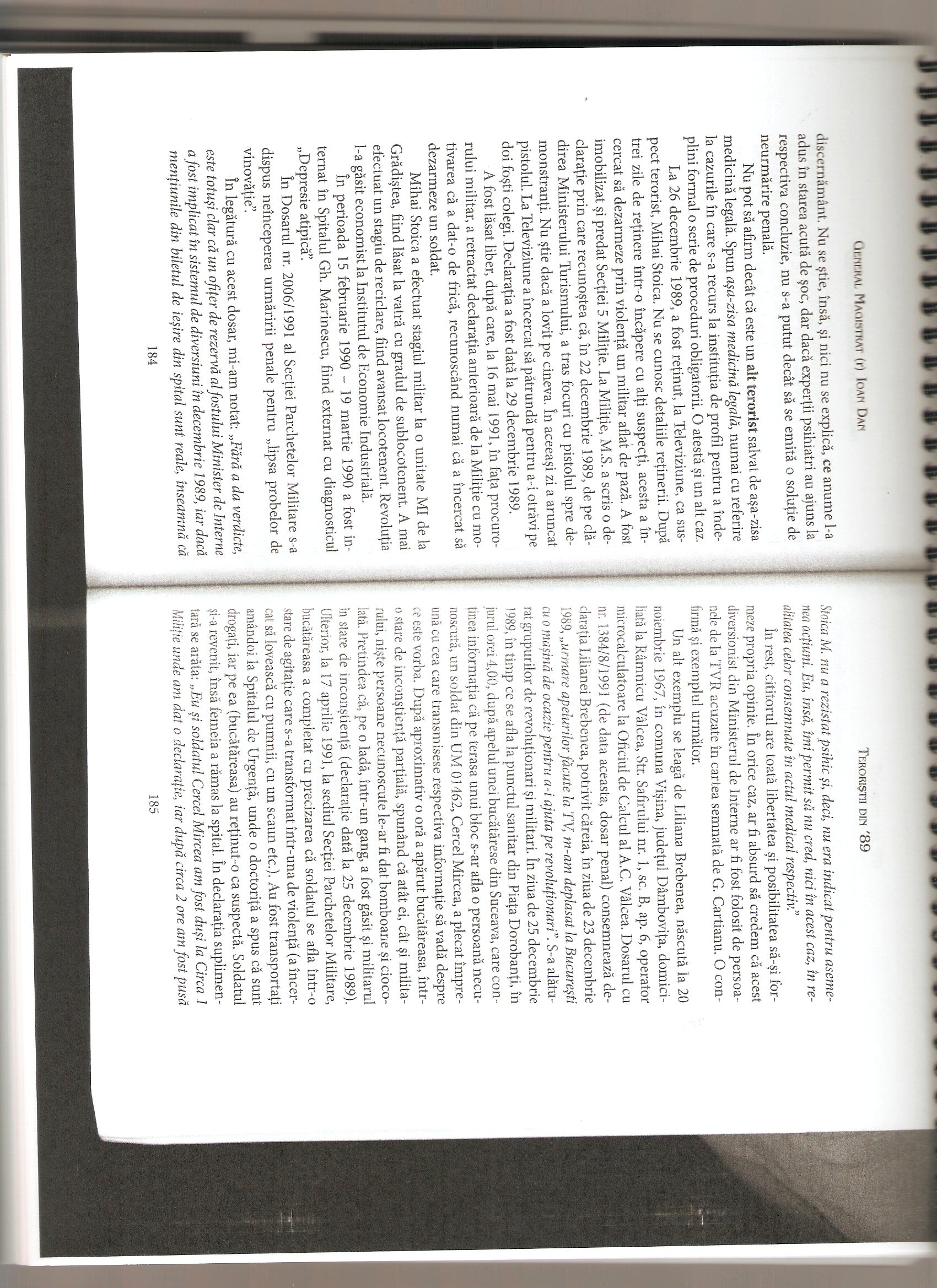
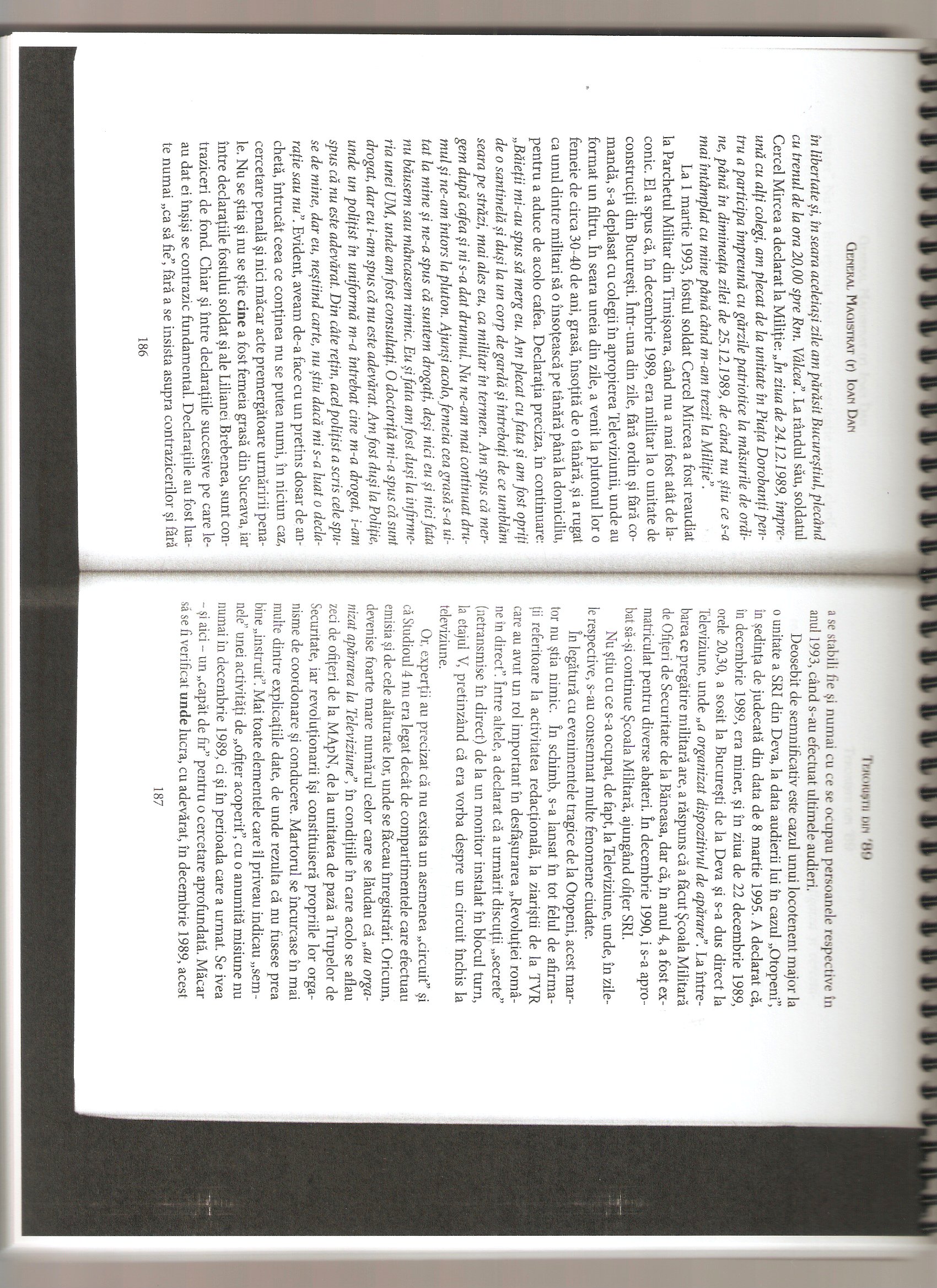
Cazurile Mihai Stoica si Liliana Brebenea

image0-003

image0-002


http://atomic-temporary-3899751.wpcomstaging.com/2013/08/25/tvr-chirurgi-si-reportaje-despre-gloante-explozive-dum-dum/

Trying to reconstruct the timeline of reporting on the use of exploding dum-dum bullets and other unusual munitions used solely by the Securitate “terrorists” during the Romanian Revolution of December 1989 is not easy.  Unfortunately, we must rely in the public domain on transcripts and diaries from the time, as demonstrated below.  Clearly, it is emerging:  there was discussion at the beginning.  A watershed event that should have then and should now spark great interest and further investigation–a press conference by surgeons (including military doctors) in early March 1990 that as far as I can tell was only ever reported on in depth in French by AFP (see below)–has all but been ignored and forgotten as if it had never taken place.  Highly damning too is the documentary evidence by the wounded themselves, relatives, army officers, and doctors in Timisoara (attesting to the use of these munitions both before and after 22 December 1989).  The overall evidence is overwhelming as to the use of exploding dum-dum bullets and other unusual munitions in December 1989; the alibis and mechanisms of denial are transparent:  just because they existed doesn’t mean they were used; perhaps the army had them too; perhaps the bullets ricocheted and split apart; doctors and army officers (even military doctors) what would they know about dum-dum bullets?; on and on, etc. etc.

http://elenatomaxxl.blogspot.com/2013/06/sorin-m-radulescu-revolutia-ca_24.html


Sâmbata 30 decembrie 1989

Reportaj la Spitalul Militar Central: se relateaza despre modul dramatic în care au fost efectuate operatiile (chirurgicale) din ziua de 22 decembrie 1989. „Noapte alba sau zi neagra” spune doctorul pe buna dreptate. Armele teroristilor, a securistilor au împroscat multimea cu gloante explozive, care au avut ca efect plagi si leziuni gigantice.
Emotionant! Dramatic! Dureros!


luni, 24 iunie 2013

SORIN M. RĂDULESCU – REVOLUŢIA CA SPECTACOL, Miercuri 27 decembrie, 1989 – Revolutia -3 –

REVOLUŢIA CA SPECTACOL
(ÎNSEMNARILE UNUI SOCIOLOG ÎN PERIOADA SEPTEMBRIE 1988-IULIE 1992)
Miercuri 27 decembrie 1989
Primesc telefon de la Vasilica P., care îmi descrie cu lux de amanunte atmosfera din Centrul de Sociologie, care a devenit un fel de ,,dipecerat” al sociologilor bucuresteni. Ma deplasez imediat acolo ca sa fiu prezent la desfasurarea evenimentelor.

/ Teroriştii .Mărturii (22 27dec.’89 )

22 apr. Notez cu R –revoluţionarii, al căror nume nu-l pot şti

– R 1: Generalul Tudor, pe care aş vrea să nu-l mai văd!

El a eliberat teroriştii suspecţi prinşi de noi!

– R 2: Asupra lor am găsit agende, bancnote însemnate.

Ce a făcut g-ral Tudor cu ei, noi nu ştim!

– R 3 :Eu am păzit camera suspecţilor .Erau 9. Din ordinul g-ralului Tudor li s-a dat drumul

– R 4. Dorobanţu Marin: Un terorist trăgea dintr-o vilă vecină; o maşină cu copertină

din care cca 15 persoane au fugit din vila din faţă; am prins o salvare cu un terorist ;

era şi o maşină inflamabilă pe care am aprins-o; în spatele ei au ieşit 3 terorişti .

A fost un foc foarte puternic.

– Ofiţer paraşutist: aici se lupta, cum s-a spus …

– R 5: Teroriştii au atacat mult TVR. Pe 24 decembrie, din două taburi, cu steag,

au coborît mulţi militari şi au deschis foc asupra noastră .

S-au retras apoi pe străzi, în spatele maşinilor.

– R 6: Pe 24 decembrie s-a zvonit că mîncarea adusă este otrăvită. Am aruncat-o.

Nu aveam nici lumină şi apă .

– R 7: Parola noastră – ” Cine eşti ?”

– Reporter: Cine a tras în voi?

– Ofiţer: G-ral Tudor a eliberat mulţi suspecţi. Nici atunci, nici pe urmă, n-am înţeles

de ce a făcut-o

– R 2: Arestaţii terorişti aveau dolari, staţie de emisie, unul era chiar străin;

au fost eliberaţi – nu ştiu de ce!

– R 6: Au fost şi zvonuri pentru a face panică. Unele au fost false. Altele reale .

Pe 26 sau 27 decembrie a fost prins un civil ( ing. electronist la Tg. Mureş ). La control cpt. Epure i-a găsit o schiţă cu centrul Bucureştiului, pe care era marcat hotelul Modern. Aş vrea să ştiu ce este cu acest terorist?

– Reporter: Da, am vrea să ştim cine a tras în noi?

– Alt reporter ( arătînd la o uşă ): Cum a fost?

– Lct X: teroriştii trăgeau în balamale şi broaşte cu gloanţe cu cap vidia.

Asemenea arme nu sunt în dotarea armatei.

– Lct mj. Diţiu: invită la sediul clubului “TV’22 “, ca să mai afle cum a fost.

http://www.procesulcomunismului.com/marturii/fonduri/cdandara/agende/agenda4/docs/jurnal4_6.htm

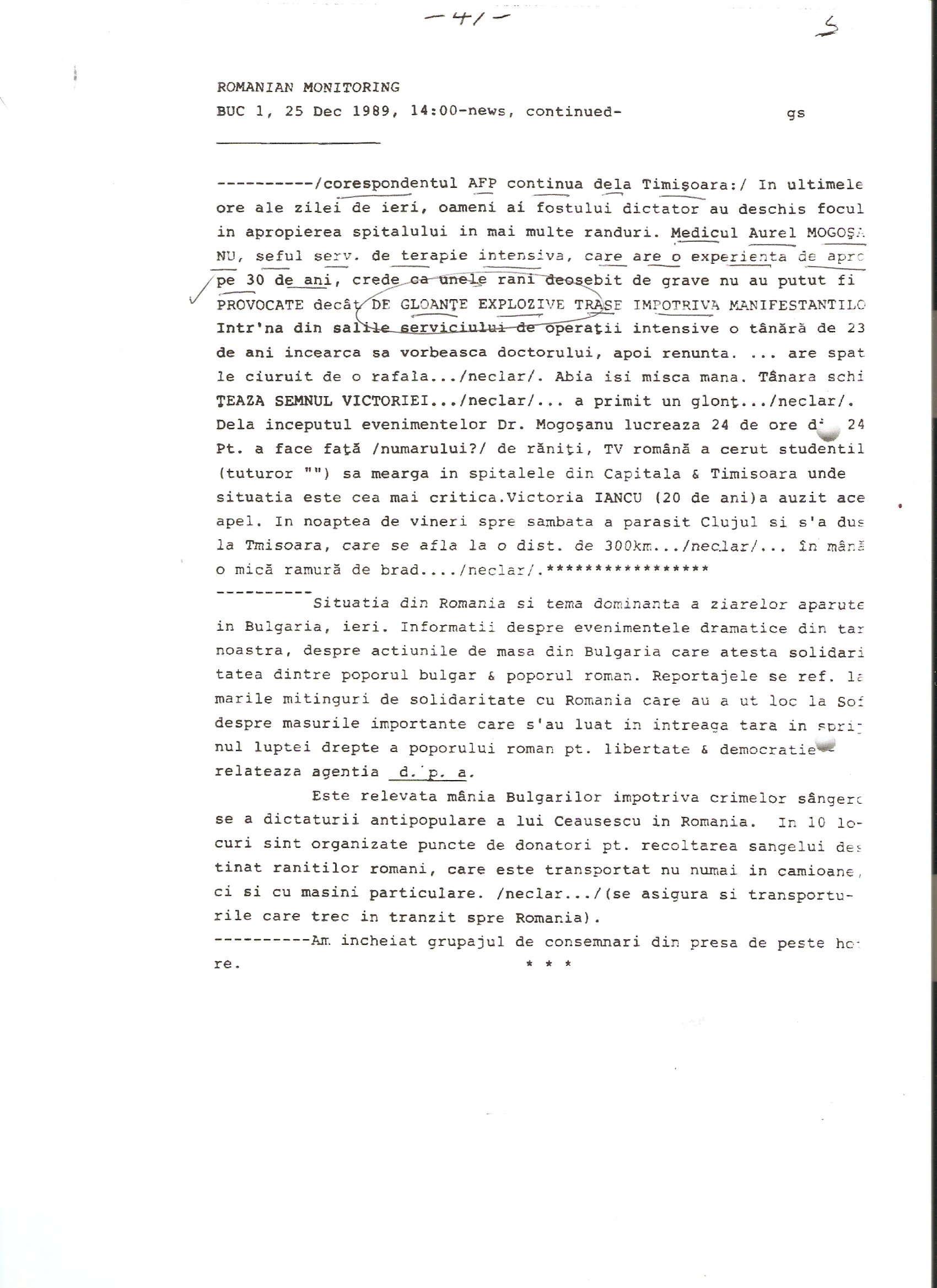
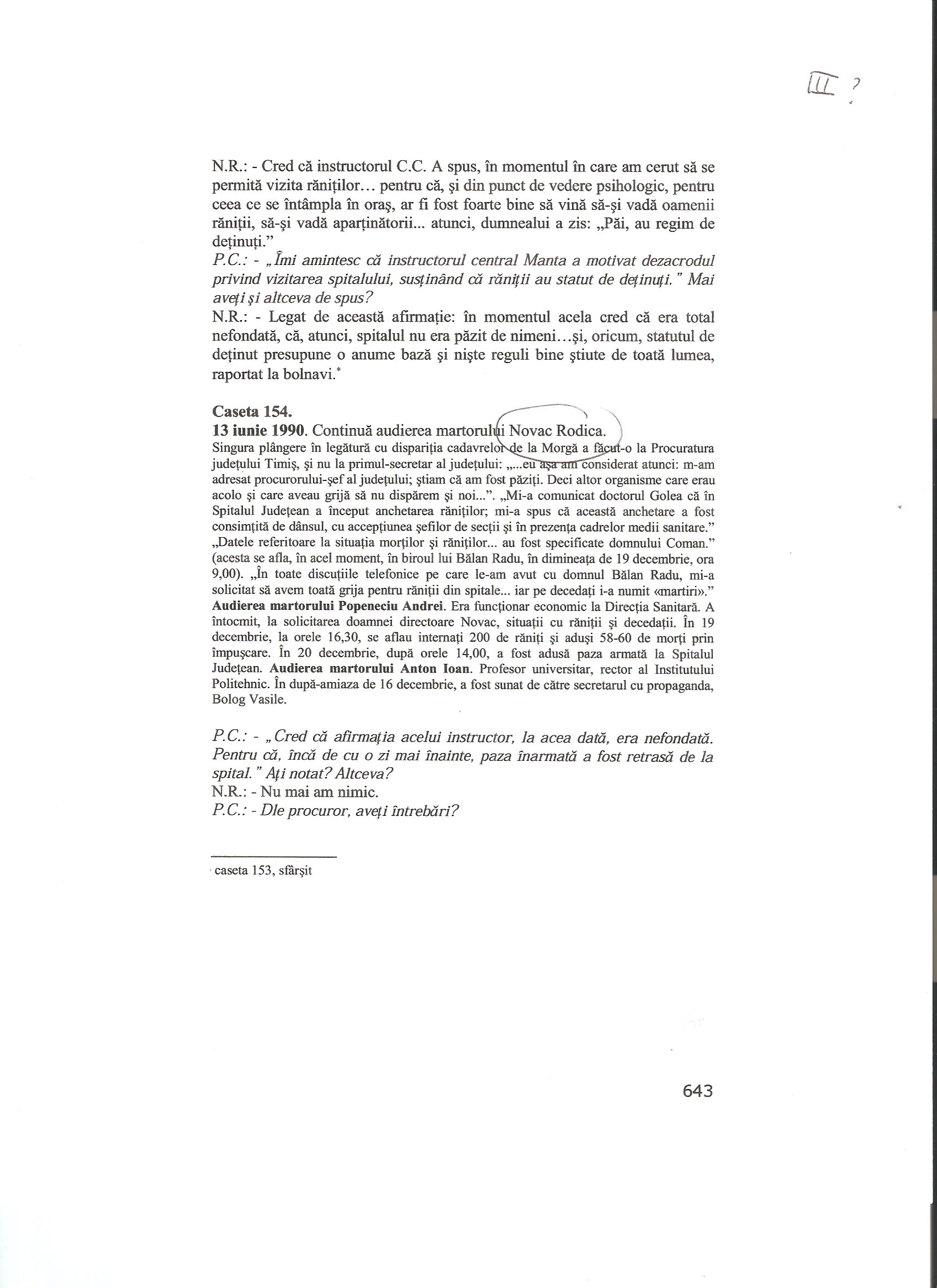
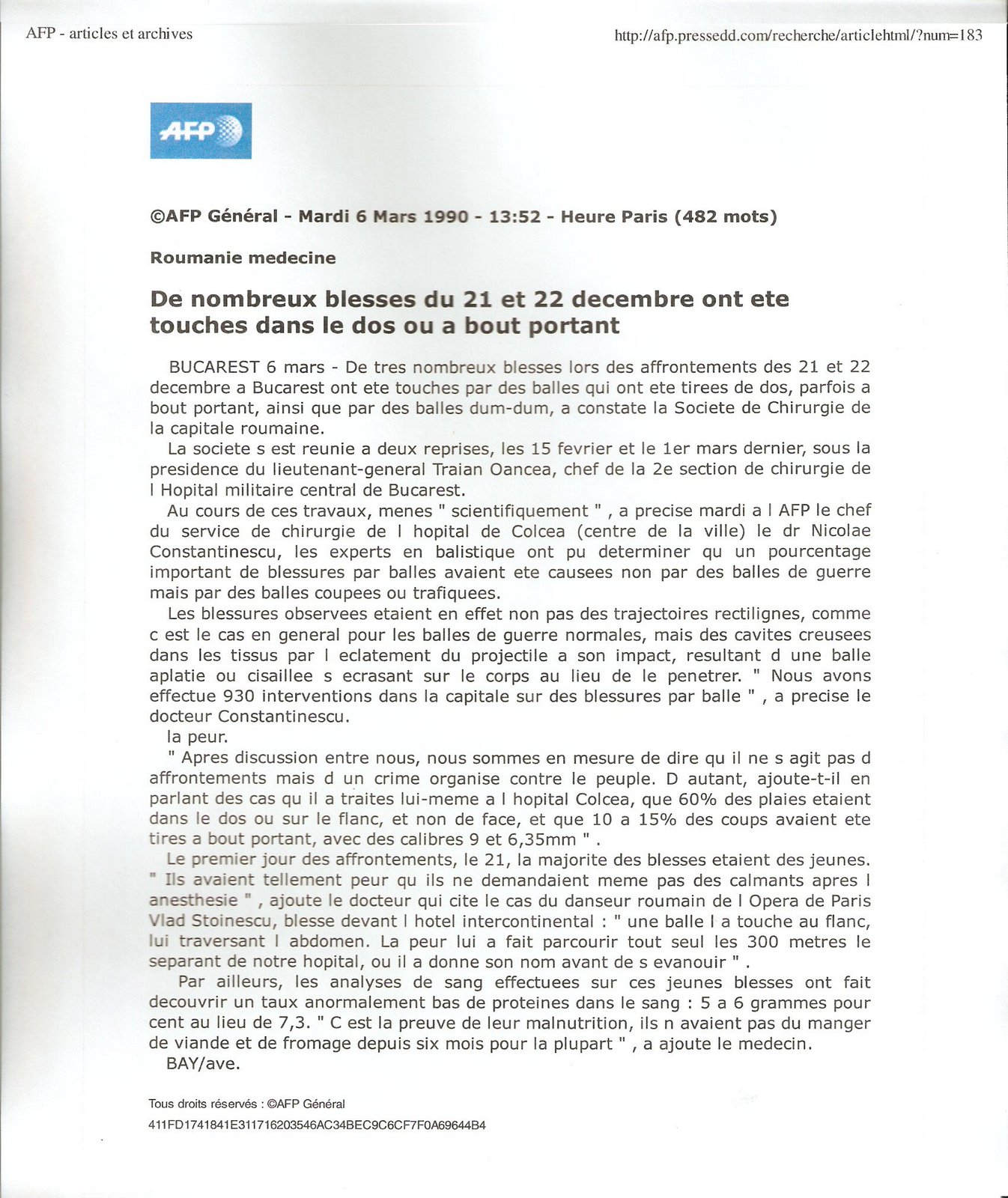
In early March 1990, AFP reported the declared findings of surgeons in Bucharest, attesting to the fact that many of those wounded on 21-22 December 1989 in Bucharest had been shot with exploding bullets, DUM-DUM bullets.  This is a critical article (and description of an event that I believe has gotten almost no coverage inside or outside Romania).  Lt. Gnl. Traian Oancea, chief of surgery in part of the Central Military Hospital in Bucharest, and Dr. Nicolae “Nae” Constantinescu, chief of surgery at the Coltea Hospital, discussed this at a meeting of the Society of Surgeons in Bucharest.

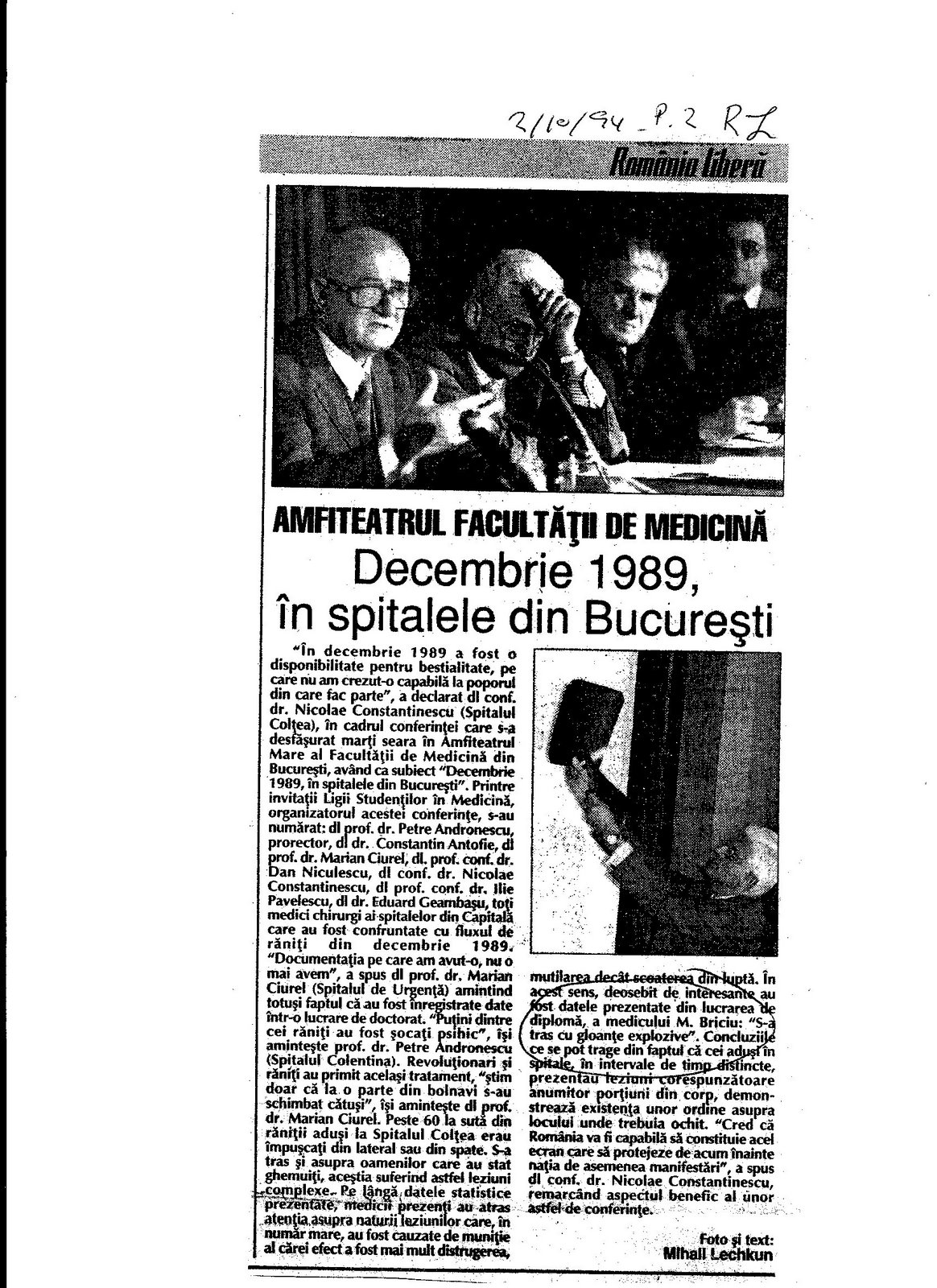
This was also discussed by Bucharest medical personnel at a 1994 conference:

AMFITEATRUL FACULTATII DE MEDICINA

“Decembrie 1989, in spitalele din Bucuresti”

Mihail Lechkun, Romania Libera, 10 februarie 1994, p. 2

“In decembrie 1989 a fost o disponsibilitate pentru bestialitate, pe care nu am crezut-o capabila la poporul care fac parte, ” a declarat dl. conf. dr. Nicolae Constantinescu (Spitalul Coltea), in cadrul conferintei care s-a desfasurat marti seara in Amfiteatrul Mare al Facultatii de Medicina din Bucurest, avand ca subiect “Decembrie 1989, in spitalele din Bucuresti”.  Printre invitatii Ligii Studentilor in Medicina, organizatorul acestei conferinte, s-au numarat:  dl. prof. dr. Petre Andronescu, prorector, dl. dr. Constantin Antofie, dl. prof. dr. Marian Ciurel, dl. prof. conf. dr. Dan Niculescu, dl. conf. dr. Nicolae Constantinescu, dl. prof. conf. dr. Ilie Pavelescu, dl. dr. Eduard Geambasu, toti medici chirurgi din Capitala care au fost confruntate cu fluxul de raniti din decembrie 1989.  “Documentatia pe care am avut-o, nu o mai avem,” a spus dl. prof. dr. Marian Ciurel (Spitalul de Urgenta) amintind totusi faptul ca au fost inregistrate date intr-o lucrare de doctorat.  “Putini dintre cei raniti au fost socati psihic,” isi aminteste prof. dr. Petre Andronescu (Spitalul Colentina).  Revolutionari si raniti au primit acelasi tratament, “stim doar ca la o parte din bolnavi s-au schimbat catusi” isi aminteste dl. prof. dr. Marian Ciurel.  Peste 60 la suta din ranitii adusi la Spitalul Coltea erau impuscati lateral sau din spate.  S-a tras si asupra oamenilor care au stat ghemuiti, acestia suferind astfel leziuni complexe.  Pe langa datele statistice prezentate, medicii prezenti au atras atentia asupra naturii leziunilor care, in numar mare, au fost cazate de munitie al carie efect a fost mai mult distrugerea, mutilarea decat scoaterea din lupta.  In acest sens, deosebit de interesante au fost datele prezentate din lucrarea de diploma, a medicului M. Briciu:  “S-a tras cu gloante explozive”. Concluziile ce se pot trage din faptul ca cei adusi in spitale, in intervale de timp distincte, prezentau leziuni corespunzatoare anumitor portiuni din corp, demonstreaza existenta unor ordine asupra locului unde trebuia ochit.  “Cred ca Romania va fi capabila sa constituie acel ecran care sa protejeze de acum inainte natia de asemenea manifestari,” a spus dl. conf. dr. Nicolae Constantinescu, remarcand aspectul benefic al unor astfel de conferinte.

NOR WERE THESE THE ONLY DOCTORS AND MEDICAL PERSONNEL–FOREIGN OR DOMESTIC–WHO ATTESTED TO THE USE OF DUM-DUM EXPLODING AND OTHER ATYPICAL, UNUSUAL MUNITIONS USED DURING THE EVENTS OF DECEMBER 1989

http://atomic-temporary-3899751.wpcomstaging.com/2011/08/08/doctors-and-dum-dum-bullets-in-romania-in-december-1989-i-dr-manuel-burzaco-medecins-sans-frontieres/

http://atomic-temporary-3899751.wpcomstaging.com/2011/08/10/doctors-and-dum-dum-bullets-in-romania-in-december-1989-ii-trimisi-in-strainatate-italia-franta-austria-anglia-si-germania-pentru-tratament/

http://atomic-temporary-3899751.wpcomstaging.com/2011/08/11/doctors-and-dum-dum-bullets-in-romania-in-december-1989-iii-ce-spun-medici-romani/

Dr. Manuel Burzaco from “Doctors without Borders” was part of a team of doctors from that group who visited hospitals in Bucharest, Ploiesti, Brasov, Buzau and Braila in late December 1989 and early January 1990.  This report from the Madrid daily El Pais touches upon the women and children gravely injured by the exploding “dum dum bullets used by the Securitate.”

Other reports from Bucharest and Timisoara hospitals during the events:

“At Bucharest’s main emergency hospital, doctors said that Securitate snipers, apparently using infra-red telescopic sights and exploding dum-dum bullets, had been firing throughout Saturday night and they shot many civilians, with bullets striking foreheads and hearts.  The morgue at the hospital was stacked with 90 bodies at noon today, almost all of them civilians dead of gunshot wounds.”

Blaine Harden, “In Bucharest, Tears and Prayers for the Fallen,” The Washington Post, 25 December 1989, p. A1; A40.

Other posts with documents from dosarele revolutiei…

http://atomic-temporary-3899751.wpcomstaging.com/2012/12/16/what-can-we-learn-from-dosarele-revolutiei-de-la-timisoara-i/

http://atomic-temporary-3899751.wpcomstaging.com/2012/12/19/what-can-we-learn-from-dosarele-revolutiei-de-la-timisoara-ii/

http://atomic-temporary-3899751.wpcomstaging.com/2012/12/20/what-can-we-learn-from-dosarele-revolutie-de-la-timisoara-iii/

http://atomic-temporary-3899751.wpcomstaging.com/2012/12/21/what-can-we-learn-from-dosarele-revolutiei-de-la-timisoara-iv/

http://atomic-temporary-3899751.wpcomstaging.com/2012/12/27/what-can-we-learn-from-dosarele-revolutiei-de-la-timisoara-v/

http://atomic-temporary-3899751.wpcomstaging.com/2012/12/28/what-can-we-learn-from-dosarele-revolutiei-de-la-timisoara-vi/

http://atomic-temporary-3899751.wpcomstaging.com/2013/12/22/revisiting-the-myths-of-the-revolution-part-iv-the-romanian-television-building-is-in-danger-bomba-in-subsolul-televiziunii/

Myth 3:  The Romanian Television building is in danger, danger of an explosion!   (TVR e in pericol–Pericol de explozie!)

This is part IV of a four part series.  For parts I, II, and III see

http://atomic-temporary-3899751.wpcomstaging.com/2013/12/21/revisiting-the-myths-of-the-romanian-revolution-part-i-the-hegemony-of-conspiratorial-and-postmodernist-explanations/

Myth 1:  The “Timisoara Syndrome” or the “False Timisoara Grave (the Paupers Cemetery)/Massacre” http://atomic-temporary-3899751.wpcomstaging.com/2013/12/21/revisiting-the-myths-of-the-revolution-part-ii-the-timisoara-syndrome-or-the-false-timisoara-grave-the-paupers-cemeterymassacre/

Myth 2:  The water is posioned!  (Apa este otravita!) http://atomic-temporary-3899751.wpcomstaging.com/2013/12/22/revisiting-the-myths-of-the-revolution-part-iii-the-water-is-poisoned-apa-este-otravita-dr-heyndrickxs-toxicology-report/

Myth 3:  The Romanian Television building is in danger, danger of an explosion!   (TVR e in pericol–Pericol de explozie!)

——————————————————————————————————————————————————————————————————————————–

Like the “water is poisoned” episode discussed in part III of this series, the claims of TV announcers regarding the threat posed to the Television building is a favorite for Romanians and Romanianists to lampoon:

Once again, Andrei Codrescu captures a widely and wildly popular view of TVR’s alleged role during the December 1989 events:

The Romanian revolution was a complex affair. It was a dramatic triumph that had the whole world for its audience, a world that keeps wondering long after the final curtain how much of what it saw was real. If I hadn’t lost my normally skeptical head to the euphoria of December, I would have questioned the single most evident source of news about the revolution: television. But it was precisely television that seduced me during my visit and made me lose sight of things I already knew….Imagine the shock and dismay of our newsmakers and our idealists–including myself–when most of these horrible events we saw with our own eyes on television turned out not to have happened at all. How could the grizzled, experienced Western journalists who are sworn to hard facts have missed the many clues and glaring contradictions that pointed to artifice? The astounding truth of the matter is that much of the glorious Romanian “revolution” was, in fact, a staged play, a revolution between quotation marks….But it couldn’t have been long after, however, the young revolutionaries (if that’s who they were) started becoming “responsible,” and the “spontaneous” provisional government showed up with its own TV script. The television station then became the headquarters of the new government, which, as far as most people were concerned, was born out of video like Venus out of the seashell. And hats must be off to the producers of the exceedingly realistic docu-drama of the strategic military center from where, in a charged atmosphere reminiscent of Reds or Dr. Zhivago, generals with telephones on both ears shouted orders at troops on vast invisible battlefields in every part of the country. Today I stand abashed by my naivete. Much of that Romanian “spontaneity” was as slick and scripted as a Hollywood movie. If I were in charge of the Emmys, I’d give one to the Romanian directors of December 1989. 

SOURCE: The Hole in the Flag: A Romanian Exile’s Story of Return and Revolution (Avon Books, 1991), by Andrei Codrescu, pp. 204-206. excerpted from http://faroutliers.wordpress.com/2004/12/06/the-romanian-revolution-was-televised/

—————————————————————————————————————————————————————————————————————————

As with the “poisoned water” episode, so too with the claimed threats against Television, including the idea that a bomb had been found and disarmed in the basement of the Television building (as can be seen in the above video)…no researcher has attempted to verify the veracity of the claim, until now!

Recently, however, several sources have been unearthed/come to light that clarify what happened.  Here, Corneliu N. Vaida of Timisoara recounts how a Securitate member from Timisoara was convinced to call the Television Station in Bucharest to inform them that, as with many other highly strategic buildings in the country, TVR had been mined and an explosion could be set off.  It appears that the announcement above about a bomb having been disarmed in the basement of the TVR building, was as a result of this information from Timisoara:

Securistul trădat pentru binele TVR

În seara zilei de 22 decembrie şi-a vizitat mama, care locuia pe bulevardul 6 Martie, unde a găsit în apartament un vecin. Era vorba de Gheorghe Toader, un căpitan în rezervă la Securitate, care se refugiase de frică sa nu fie asasinat.

Urmărind programul “Revoluţiei în direct”, de la TVR, au observat la un moment dat o persoana care ţinea în mână un obiect care semăna cu o tastatură.

“Văzând tastatura, securistul a scos o exclamaţie de teamă: <Vor sări toţi în aer acolo! TVR e obiectiv strategic şi este minat, ca în cazuri extreme să poată fi aruncat în aer, tastând un cod pe aşa un detonator!>. A spus că a lucrat la aşa ceva în Bucureşti într-o intreprindere specială. La isistenţele mele a acceptat până la urmă să scrie o declaraţie anonimă pe care am dus-o personal la armată”, a mai declarat Corneliu Vaida.

Ajuns la Garnizoana Timişoara, Vaida a arătat scrisoarea colonelului Zeca, comandantul garnizoanei. “Acesta a pus mâna pe un telefon şi a sunat imediat la Bucureşti la o structură a armatei căreia i-a relatat continutul declaraţiei, dupa care mi-a cerut sa dezvalui identitatea semnatarului argumentând că acesta mai cunoaşte informaţii care ar ajuta la evitarea de victime”, a adaugat Vaida.

Neavând ce face, a trebuit să meargă cu armata să îl predea pe secursitul din casa mamei. “Înspre dimineaţă am văzut la televizor cum a venit cineva şi a declarat că explozibilul cu care era minată televiziunea a fost dezamorsat”, a mai spus timişoreanul.

http://adevarul.ro/locale/timisoara/foto-corneliu-vaida-purtator-cuvant-revolutiei-timisoara-s-au-luptat-grupari-securitate-armata-1_510985f54b62ed5875bbb81f/index.html

The event is also recounted by parachutists in this TVR video from 31 December 1989 that only recently appeared on the internet.

Parasutisti de la R. 64 Pst. Boteni la Televiziunea Romana in 31 decembrie 1989:
Lt. col. Ilie Croitoru, Mr. Chiranescu Ion, Cpt. Radulescu Aurelian, Cpt. Constantin Vlasceanu

Corneliu Vaida has been kind enough to share with me, the following additional confirmation of his actions in the document below:

HP0010

For more about Corneliu Vaida during the Revolution in Timisoara in December 1989, see his interview with ITN correspondent Penny Marshall on 27 December 1989:

http://atomic-temporary-3899751.wpcomstaging.com/2011/05/11/lets-go-to-the-videotape-i-to-the-army-its-confirmation-that-theyve-been-dealing-with-a-specially-trained-force-because-its-the-type-of-bullet-theyve-never-seen-before-itn-uk-telev/

Corneliu Vaida Timisoara December 1989

More on what transpired in and around the Television Station below:

image0

image0-001

image0-003

image0-002

Related posts:

http://atomic-temporary-3899751.wpcomstaging.com/2013/08/25/tvr-chirurgi-si-reportaje-despre-gloante-explozive-dum-dum/

http://atomic-temporary-3899751.wpcomstaging.com/2013/12/10/vina-de-neiertat-a-tvr-a-contribuit-decisiv-la-victoria-revolutiei-iv/

image0

Ioan Itu, “Si ei au luptat in Revolutie.  De partea cui?,” Tinerama, 10-16 septembrie 1993, p. 8.

image0-001

Maior Tudor Petrescu, “Unde ne sint teroristii?” Armata Poporului, nr. 22, 30 mai 1990, p. 3.  (S.D. = Silviu Dutu)

image0-002

image0-003

Aura Alexa Ioan (cu Adrian Popescu-Necsesti), “Teroristii Revolutiei au certificat de psihopati!” Tinerama, 8-14 octombrie 1996, p. 8

image0

image0-001

image0-002

Valentin Gora:  Au fost arestati oameni ai securitatii, teroristi.  Astazi, nimeni nu stie ce s-a intimplat sa ce se intimpla in continuare cu ei.  Dumneavoastra i-ati vazut?  Ii cunoasteti?

Petre Constantin:  Au fost arestati multi oameni, am mai spus-o, care aveau asupra lor arme de toate felurile, pe toti i-a preluat armata si nu stiu ce s-a intimplat mai departe cu ei.  Adjunctul meu, Traian Puscasu, a fost injunghiat in noaptea de 23 spre 24 decembrie, pe hol, la etajul 11.  Agresorul, locotenent-colonelul Vasiliu, il viza pe generalul Tudor sau pe mine.  Eu am lipsit citeva miunte, generalul Tudor s-a ferit in momentul atacului si a fost lovit Puscasu.  Totul se intimpla in usa biroului.  Militarii au sarit si l-au imobilizat imediat.

Valentin Gora cu Petre Constantin, “Petre Constantin:  Cind a dictat decretul de instalare ? de asediu pe intreg teritoriul tarii, in biroul lui Ceausescu se afla si Eugen Florescu,” Cuvintul, nr. 12, 18 aprilie 1990, pp. 4-5.

image0-003

http://mariusmioc.wordpress.com/2013/11/13/cercetarile-parchetului-in-dosarul-revolutiei-37-bucuresti-televiziune-raniti-si-ucisi-5/

425. Parte vătămată Puşcaşu Traian (Televiziune-Vol. 110)
Numitul Puşcaşu Traian, fiul lui Gheorghe şi Maria, născut la data de 01.03.1927, în Iaşi, domiciliat în Bucureşti (…) în noaptea de 22/23.12.1989, în timp ce se afla în incinta televiziunii, unde-şi desfăşura activitatea ca director adjunct al TVR, a fost înjunghiat în abdomen cu un cuţit de către lt. col. Vasiliu Cornel, care se afla în dispozitivul de pază al instituţiei respective.
Conform raportului medico-legal nr. A1/3409/1990, numitul Puşcaşu Traian a prezentat la data de 24.12.1989 o plagă abdominală penetrantă cu interesarea splinei şi arterei epigastrice. Leziunea a putut fi produsă prin lovire cu corp tăietor-înţepător (posibil cuţit). A necesitat circa 25 zile de îngrijiri medicale. Leziunea i-a pus viaţa în pericol.
Prin rezoluţia nr. 1411/P/1990, din data de 15.11.1990, Procuratura Militară Bucureşti a dispus neînceperea urmăririi penale faţă de lt. col. Vasiliu Constantin, sub aspectul infr. prev. de art. 20 rap. la art. 174 C.p., reţinându-se că, în urma expertizării sale psihiatrice, s-a stabilit că a acţionat fără discernământ.

Posted in decembrie 1989, raport final | Tagged: , , , , , , , , , , , , , , , , , , , , , , , , , , , , , , , , , , , , , , , , , , | Leave a Comment »

A Tale of Two Letters by Securitate Director General Iulian Vlad: What the Romanian Press Does and Does Not Publish

Posted by romanianrevolutionofdecember1989 on September 23, 2014

(purely personal views as always, based on two decades of prior research and publications)

And one wonders why I found (find) mainstream Romanian studies so unhelpful in trying to understand Nicolae Ceausescu’s overthrow and the Romanian Revolution of December 1989?  Read Vladimir Tismaneanu or Tom Gallagher (or in its 2014 variation, see Grigore Pop-Eleches in Bernhard and Kubik) on Romania in the early 1990s and one is presented with a world of good and evil, of angels and demons, with distance from former nomenklaturist and high-ranking communist Ion Iliescu and the core of the National Salvation Front being as being the simple formula for explaining and understanding any event or policy.  As opposed to this highly–one might say blatantly–politically partisan [and bureaucratically ignorant] approach, on the other side stand functional or deconstructionist explanations–the kind favored by Peter Gross, Katherine Verdery, Peter Siani-Davies, or Ruxandra Cesereanu–which would explain the press of the time as the function of market pressures, sensationalist appetites, an anomic readership, poor journalistic training and professionalism, etc.

How then does one explain the following conundrum:  the selective treatment of the letters and declarations of former Securitate Director General Iulian Vlad?  Oh, yes, the text of General Vlad’s letters which allege he was a stooge and victim of Ion Iliescu, etc. can be found in the Romanian press.  No problem!  But what about his declaration of 29 January 1990, where he deftly admits the responsibility of his institution for the bloodshed of December?  What, that not sensationalist enough, different enough to sell papers?  That’s not “anti-communist” enough for publication?  Is it somehow less credible than the other letters whose text has been published without problem?  24 plus years later, the Romanian media has yet to publish this document!  Could it be that the problem with this declaration is that it does not fit with and undermines the other popular narratives of December 1989 that minimize and even absolve the former Securitate of responsibility for the bloodshed of December 1989?

image0-001

Ion Cristoiu’s Evenimentul Zilei debuted in June 1992 and was the flagship of opposition to the regime of Ion Iliescu.  In the fall of 1992 it ran a zealous campaign opposed to Iliescu’s reelection.  Here is the exculpatory letter from former Securitate General Iulian Vlad (dated 20 March 1990) that was published on 19 September 1992:

image0-004

“Generalul IULIAN VLAD se adreseaza dlui Ion Iliescu:  Am fost arestat pe nedrept (20 March 1990),” Evenimentul Zilei, 19 septembrie 1992, p. 3.  “Intr-adevar pe dictatorul Ceausescu l-am tradat” “M-am integrat total Revolutiei” “Sint convins ca datele nu va erau cunoscute”  I.V. Vlad 20 martie 1990

And, yet, what of General Iulian Vlad’s declaration of 29 January 1990.  As far as I know, in 24 plus years, only this brief allusive mention on the 15th anniversary of the letter (although not mentioned or acknowledged in the article, and possibly accidental) has made its way into the Romanian press.  Below it:  the text of the statement of 29 January 1990!
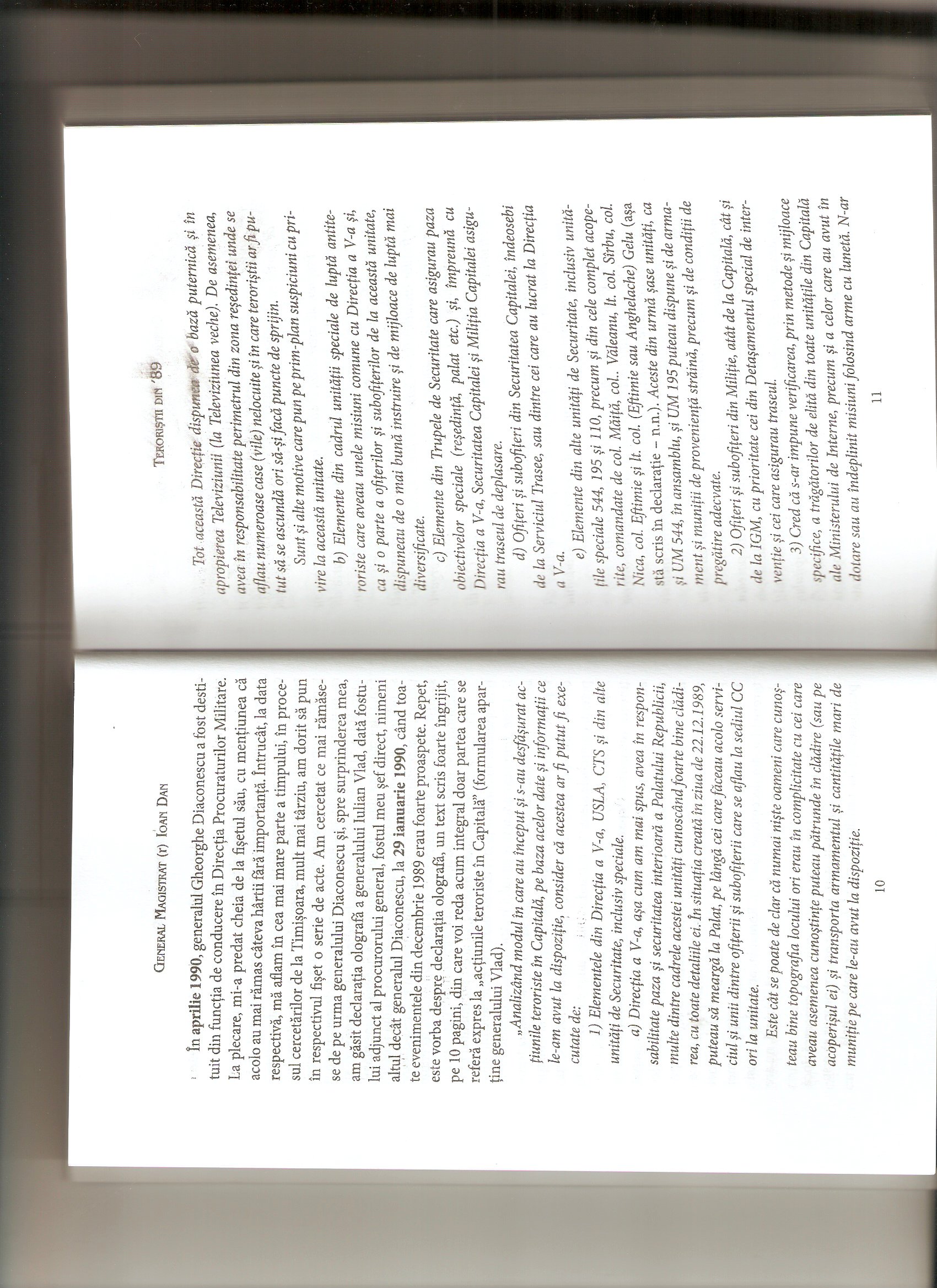
image0-005

http://atomic-temporary-3899751.wpcomstaging.com/text-of-securitate-general-iulian-vlads-29-january-1990-declaration-identifying-the-terrorists/

image0-001

It took 22 years for the text of Securitate Director General Iulian Vlad’s handwritten declaration of 29 January 1990 to become public knowledge–thanks to former military prosecutor General Ioan Dan.  (Inevitably, there will no doubt be those who will allege that General Vlad was “forced” to write this declaration to save his skin, etc., that this was the “propaganda of the moment” and all a huge lie.  If that were the case, one would have expected Iliescu, Brucan, Militaru, Voican Voiculescu, etc. to have made every effort for Vlad’s declaration to leak to the media.  Instead, for 22 years it was hidden from public knowledge!)

Of Note:  No “Soviet tourists,” no DIA (Batallion 404) troops of the army’s intelligence wing, no “there were no terrorists:  the Army shot into everyone else and into itself”–in other words, none of the spurious claims that have littered the narrative landscape, fueled by the former Securitate over the past two decades plus.  No, Vlad knew who the terrorists of the Romanian Revolution of December 1989 were, because they reported to him!
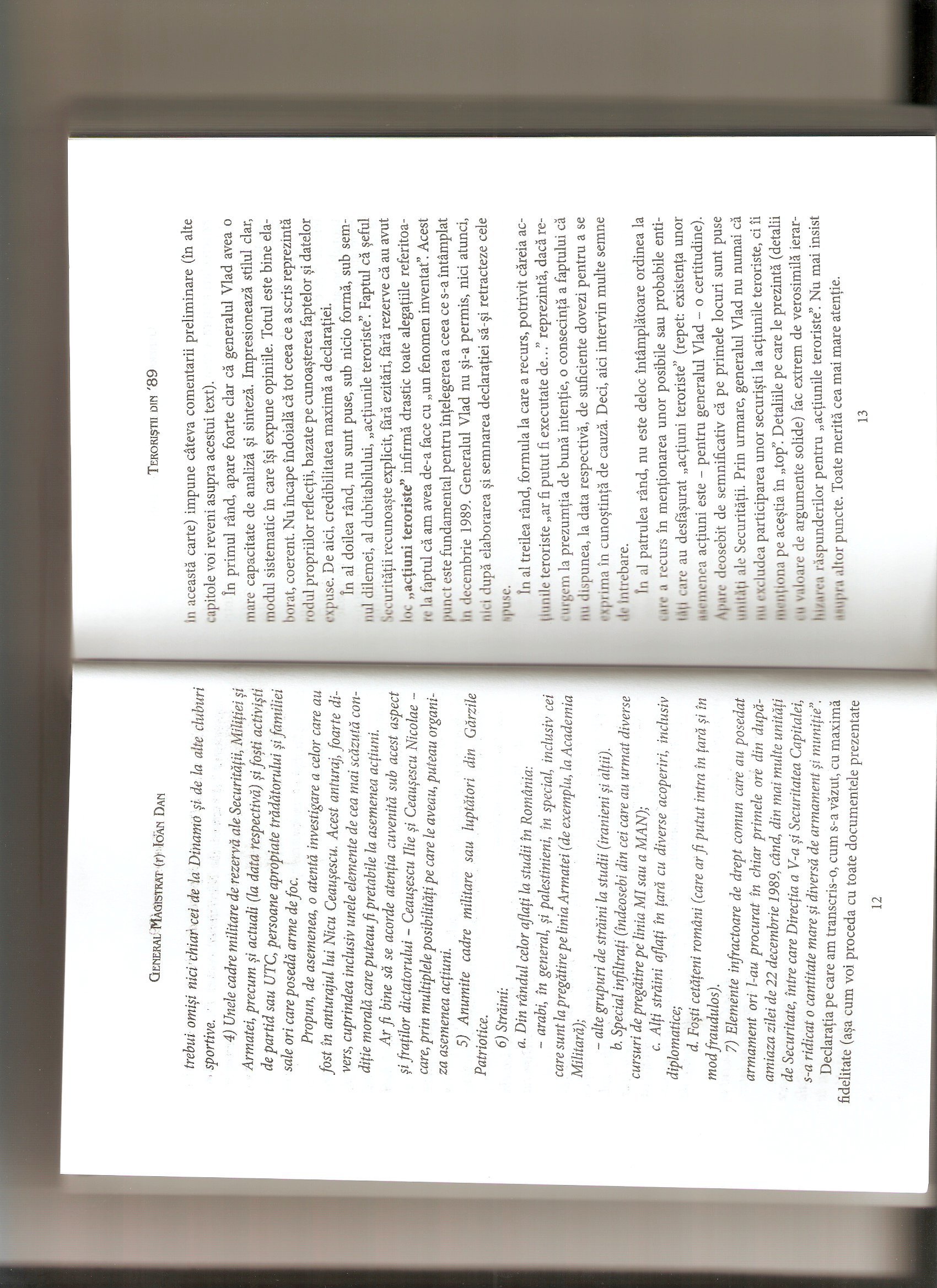
image0

image0-002

General Magistrat (r) Ioan Dan

In aprilie 1990, generalul Ghoerghe Diaconescu a fost destituit din functia de conducere in Directia Procuraturilor Militare.  La plecare, mi-a predat cheia de la fisteul sau, cu mentiunea ca acolo au mai ramas cateva hartii fara importanta. Intrucat, la data respectiva, ma aflam in cea mai mare parte a timpului, in procesul cercetarilor de la Timisoara, mult mai tarziu, am dorit sa pun in respectivul fiset o serie de acte.  Am cercetat ce mai ramasese de pe urma generalului Diaconescu si, spre surprinderea mea, am gasit declaratia olografa a generalului Iulian Vlad, data fostului adjunct al procurorului general, fostul meu sef direct, nimeni altul decat generalul Diaconescu, la 29 ianuarie 1990, cand toate evenimentele din decembrie 1989 erau foarte proaspete.  Repet, este vorba despre declaratia olografa, un text scris foarte ingrijit, pe 10 pagini, din care voi reda acum integral doar partea care se refera expres la “actiunile teroriste in Capitala” (formularea apartine generalului Vlad).

“Analizand modul in care au inceput si s-au desfasurat actiunile teroriste in Capitala, pe baza acelor date si informatii ce le-am avut la dispozitie, consider ca acestea ar fi putut fi executate de:

1) Elementele din Directia a V-a, USLA, CTS si din alte unitati de Securitate, inclusiv speciale.

a) Directia a V-a, asa cum am mai spus, avea in responsabilitate paza si securitatea interioara a Palatului Republicii, multe dintre cadrele acestei unitati cunoscand foarte bine cladirea, cu toate detaliile ei.  In situatia creata in ziua de 22.12.1989, puteau sa mearga la Palat, pe langa cei care faceau acolo serviciul si unii dintre ofiterii si subofiterii care se aflau la sediul CC ori la unitate.

Este ca se poate de clar ca numai niste oameni care cunosteanu bine topografia locului ori erau in complicitate cu cei care aveau asemenea cunostinte puteau patrunde in cladire (sau pe acoperisul ei) si transporta armamentul si cantitatile mari de munitie pe care le-au avut la dispozitie.

Tot aceasta Directie dispunea de o baza puternica si in apropierea Televiziunii (la Televiziunea veche).  De asemenea, avea in responsabilitate perimetrul din zona resedintei unde se aflau numeroase case (vile) nelocuite si in care teroristii ar fi putut sa se ascunda ori sa-si faca puncte de sprijin.

Sunt si alte motive care pun pe prim-plan suspiciuni cu privire la aceasta unitate.

b) Elemente din cadrul unitatii speciale de lupta antiterroriste care aveau unele misiuni comune cu Directia a V-a si, ca si o parte a ofiterilor si subofiterilor de la aceasta unitate, dispuneau de o mai buna instruire si de mijloace de lupta mai diversificate.

c) Elemente din Trupele de Securitate care asigurau paza obiectivilor speciale (resedinta, palat etc.) si, impreuna cu Directia a-V-a, Securitatea Capitalei si Militia Capitalei asigurau traseul de deplasare.

d) Ofiteri si subofiteri din Securitatea Capitalei, indeosebi de la Serviciul Trasee, sau dintre cei care au lucrat la Directia a V-a.

e) Elemente din alte unitati de Securitate, inclusiv unitatile speciale 544, 195 si 110, precum si din cele complet acoperite, comandate de col. Maita, col. Valeanu, lt. col. Sirbu, col. Nica, col. Eftimie si lt. col. (Eftimie sau Anghelache) Gelu (asa sta scris in declaratie–n.n.).  Aceste din urma sase unitati, ca si UM 544, in ansamblu, si UM 195 puteau dispune si de armament si munitii de provenienta straina, precum si de conditii de pregatire adecvate.

2) Ofiteri si subofiteri din Militie, atat de la Capitala, cat si de la IGM, cu prioritate cei din Detasamentul special de interventie si cei care asigurau traseul.

3) Cred ca s-ar impune verificarea, prin metode si mijloace specifice, a tragatorilor de elita din toate unitatile din Capitala ale Ministerului de Interne, precum si a celor care au avut in dotare sau au indeplinit misiuni folosind arme cu luneta.  N-ar trebui omisi nici chiar cei de la Dinamo si de la alte cluburi sportive.

4) Unele cadre militare de rezerva ale Securitatii, Militiei si Armatei, precum si actuali (la data respectiva) si fosti activisti de partid sau UTC, persoane apropriate tradatorului si familiei sale ori care poseda arme de foc.

Propun, de asemenea, o atenta investigare a celor care au fost in anturajul lui Nicu Ceausescu.  Acest anturaj, foarte divers, cuprindea inclusive unele elemente de cea mai scazuta conditie morala care puteau fi pretabile la asemenea actiuni.

Ar fi bine sa se acorde atentia cuvenita sub acest aspect si fratilor dictatorului–Ceausescu Ilie si Ceausescu Nicolae–care, prin multiplele posibilitati pe care le aveau, puteau organiza asemenea actiuni.

5) Anumite cadre militare sau luptatori din Garzile Patriotice.

6) Straini:

a. Din randul celor aflati la studii in Romania:

– arabi, in general, si palestinieni, in special, inclusiv cei care sunt la pregatire pe linia Armatei (de exemplu, la Academia Militara);

– alte grupuri de straini la studii (iranieni si altii).

b. Special infiltrati (indeosebi din cei care au urmat diverse cursuri de pregatire pe linia MI sau a MAN);

c. Alti straini aflati in tara cu diverse acoperiri, inclusiv diplomatice;

d. Fosti cetateni romani (care ar fi putut intra in tara si in mod fraudulos).

7) Elemente infractoare de drept comun care au posedat armament ori l-au procurat in chiar primele ore din dupa-amiaza zilei de 22 decembrie 1989, cand, din mai multe unitati de Securitate, intre care Directia a V-a si Securitatea Capitalei, s-a ridicat o cantitate mare si diversa de armament si munitie.”
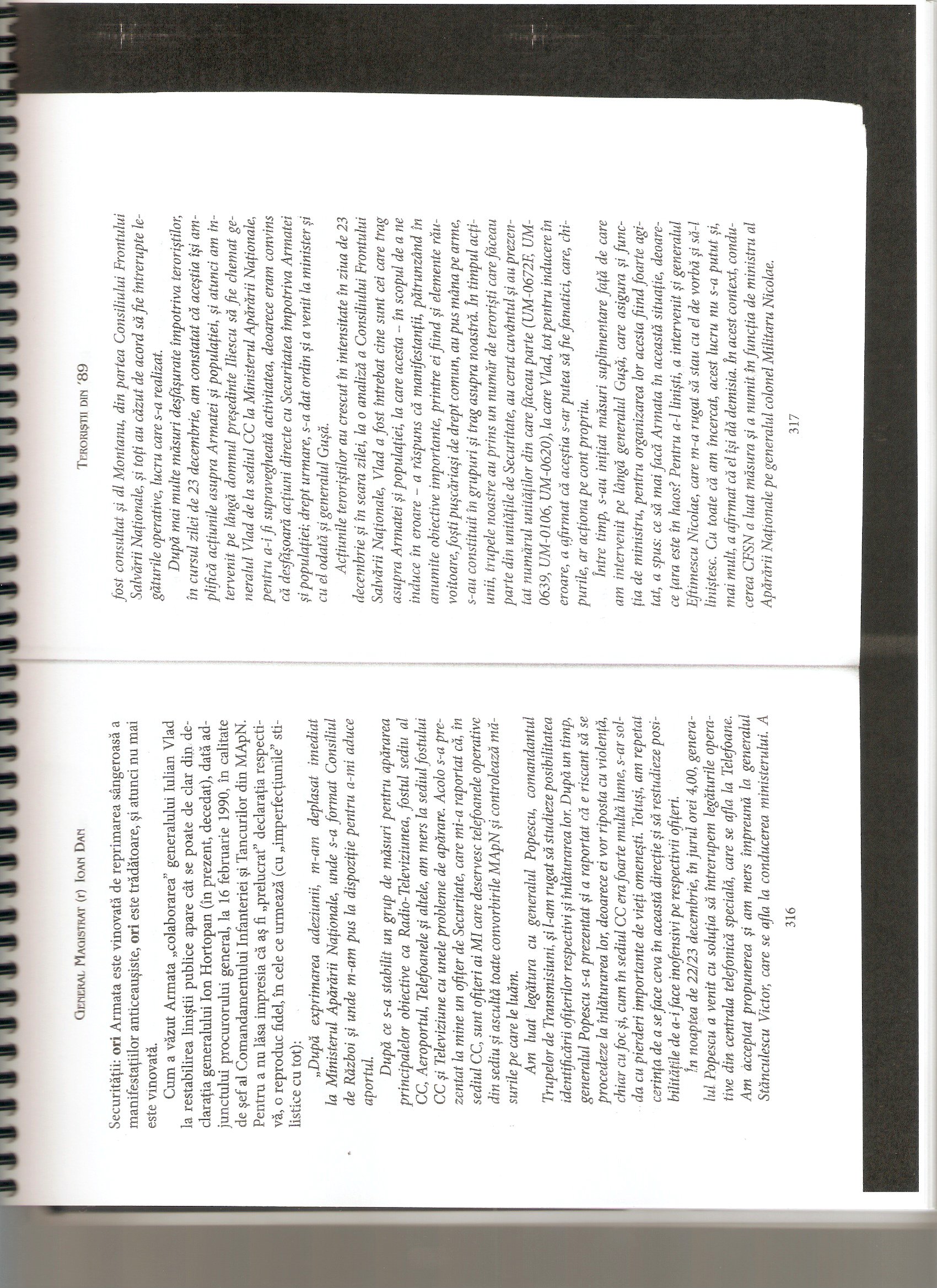
 

Posted in decembrie 1989, raport final | Tagged: , , , , , , , , | 1 Comment »

Un Craciun Revolutionar (15 minutes of Previously Unseen Footage from 24 December 1989 by Andrei Iliescu)

Posted by romanianrevolutionofdecember1989 on May 4, 2014

(purely personal views as always, based on two decades of prior research and publications)

This has apparently been around for a few months, but I only discovered it recently:

http://www.youtube.com/watch?v=l4LkzZrWguA

Pe 24 decembrie 1989, fotograful Andrei Iliescu abia scapase de la Jilava, unde-l bagase militia pentru ca poza protestele, si umbla uimit pe strazile Bucurestiului revolutionar. Nu mai avea buletin, singurul lui act era camera video. El a filmat aceste secvente.

which comes from http://casajurnalistului.ro/revolutie/

I draw attention to the sequence from approximately min. 3:37 to 3:53 in which the young soldier is asked about and discusses those whom they are fighting (this is in the vicinity of the TVR Television station).  (My thanks to Gigga Adrian Tudor, in particular, and Corneliu N. Vaida for clarifying the exchange for me.)

Soldier:  “Au mitraliere, care sunt micute…Cum au astia…americanii” (They have small machine guns…like the Americans.)

Voice off camera:  “Sunt mai bune ca ale voastre?” (Are they better than yours?)

Soldier:  “Da, bine-nteles.”  (Yes, of course.)

Soldier:  “Sunt mai eficiente; consuma mai putin si distrug mai mult, in general asa” (They’re more efficient; they consume less and destroy more, generally speaking.)

That the “terrorists” had weapons different from and in addition to the standard ones the Army rank-and-file were equipped with is and should be beyond dispute by now, and yet another proof of their existence.  We have, of course, multiple similar claims in the same Bucharest neighborhood, elsewhere in Bucharest, and indeed throughout the rest of the country.

Fullscreen capture 10182009 103639 AM

http://www.dailymotion.com/video/x7rob0_revolutia-romana-22-dec-1989-cd4_shortfilms

From approximately min 0:45 to 1:10, also from the same day, 24 December 1989

Video No. 2: Bucharest, Piata Aviatorilor, near TVR (Romanian state Television) headquarters, “Vidia” Bullets

In the second video (posted by Alexandru2006 (Alexandru Stepanian) at http://www.dailymotion.com/video/x7rob0_revolutia-romana-22-dec1989-cd4_shortfilms), a civilian shows how the bullets shot by “the enemy”—i.e. “the terrorists”—are different than the standard ammunition (7.62 mm) he and the others are using.  Based on other video, photos, and accounts, these appear to be “vidia” bullets—there are many testimonies from those who fought in the area near the TV station regarding these bullets.

from http://atomic-temporary-3899751.wpcomstaging.com/december-1989-2009-bullets-lies-and-videotape/  blv 111909tk6

Those who were in the CC building of the PCR during these days also know such weapons:

image-19image-23

In aceea camera am inceput sa stringem toate obietele de valoare gasite prin celelalte incaperi.  Asa a luat nastere primul “tezaur” din C.C.  Inauntru s-a incuiat nea Tarchila cu un pistol mitraliera si sint sigur ca ar fi fost in stare sa impuste pe oricine ar fi incercat sa deschida usa daca n-ar fi fost insotit de noi.  Noroc ca nu a fost cazul.  Intre timp ni se aduceau de peste tot arme si munitii.

Armele erau de toate felurile:  pistolete Carpati, Beretta, Makarov, T.T., Stecikin, unele mici si plate cum nu mai vazusem niciodata, in tocuri de piele special construite cu compartimente aparte pentru box si cutit cu buton, adevarate pumnale cu lama foarte subtire si fina, lunga de 15-20 ce tisnea din miner (nu erau in nici un caz destinate pentru curatatul cartofilor la popota); pistoale mitraliera AKM cu pat de lemn sau cu pat rabatabil…mitraliera, pusti semiautomate cu luneta de tipul celei cu care ma fuduleam eu; mitraliere de campanie, un aruncator de grenade antitanc; grenade de mina, munitie de toate tipurile si calibrele, ce mai nu ne lipsea decit un tun, in rest aveam de toate.

Venit din cabinetul 1, Doru Haraga isi da cu parerea ca ar trebui sa le transportam intr-un colt al incaperii si pentru a le separa de restul camerei incercam sa delimitam spatiul cu o canapea.  Lunga de 2 m nu se lasa umita din loc, parca era batuta in cuie, inciduati, am inceput sa mesterim ia ea.  Am desfacut-o si am ramas perplecsi.  In cabinetul 2, in camera de lucru a tovarasei de viata a celui mai iubit fiu, in lada unei canapele era un adevarat arsenal:  24 pistoale mitraliera cu pat rabatabil si teava scurta, 22 pistolete Carpati, 2 Stecikin, 4 carabine cu luneta, semiautomate, doua pusti mitraliera, grenade de mina si la fund lazi metalice cu munitie de lupta–gloante incendiare, trasoare, perforante, explozive, numai din cele normale–nu. Si deasupra trona ca o culme a ridicolului o prastie cu cracan si linga ea o cutie cu bile de rulment.  Pe capacul interior al canapelei era o list cu denumirea “lada de armament si munitii nr. 2″.  Urma inventarul si continua cu–raspunde plt. adj.–cutare, nu am retinut numele.  Deci lada nr. 2.  Dar unde este nr. 1?  Citiva metri mai incolo–o canapea asemanatoare.  Ne-am repezit asupra ei si am deschis-o.  Continutul era identic, mai putin prastia.  Puteam inarma un regiment.  Oare de ce tinea “savanta” in cabinetul ei atita armament si munitie?  Dar prastia?  Asta chiar ca punea capac la toate!

Mircea Boaba, “Gloante, nestemate si singe.  Ziua I:  Comoara lui Ali Baba,”  Strict Secret, nr. 48 26 martie – 1 aprilie 1991, pp. 4-5.

In timp ce urcam scara, vrind sa incarc carabinaa, am avut surpriza sa descopar ca gloantele din cele doua incarcatoare erau cu virful bont.

nr. 47 18-25 martie 1991, pp. 4-5.

http://atomic-temporary-3899751.wpcomstaging.com/2009/08/12/22-decembrie-1989-ce-s-a-gasit-in-cabinetul-unu-nicolae-ceausescu-si-cabinetul-doi-elena-ceausescu/

http://atomic-temporary-3899751.wpcomstaging.com/2010/12/21/marturii-intre-1990-si-1992-din-zilele-fierbinte-in-cc-ul-decembrie-1989-doru-teodor-maries-mircea-boaba-sergiu-tanasescu-si-ernest-maftei/

More testimonies:

http://www.romanialibera.ro/special/investigatii/marturii-despre-teatrele-de-razboi-ale-revolutiei-romane–18312

Lt. mr. APOSTOL M. ANTON, fost ofiter in serviciul 1 declara:

In ziua de 29 decembrie 1989 a aflat de la vecinul PIPOI REMUS, care locuieste la etajul 2, sub apartamentul lui, ca a vazut mai multe persoane tragand spre Ministerul Apararii Nationale, despre care era convins ca nu erau romani. I s-a parut ca ar fi arabi. Trageau cu niste pistoale automate mici.

http://atomic-temporary-3899751.wpcomstaging.com/2009/07/27/arabesque-arab-terrorists-in-the-december-1989-romanian-revolution/

Fiecare pluton din aceasta scoala de ofiteri de rezerva, avea alocata cate o sala de clasa, care era ca o sala de laborator-expozitie dotata cu o anumita baza materiala de instructie (in zilele de azi, se cheama training) aferenta unei anumite tematici. De exemplu, sala noastra continea materiale si planse despre armamentul individual de infanterie si balistica aferenta. Exact ca intr-un muzeu, aveam acolo vitrine cu exemplare sectionate de automat Kalashnikov, pusca mitraliera cu incarcator sector si tambur, pusca semiautomata cu luneta, pistolul TT model ’33 aflat in dotarea ofiterilor armatei si pistolul Carpati din dotarea militiei. De asemenea, imi amintesc ca era si un aruncator de grenade antitanc AG7 cu lovitura aferenta, si parca si un model imbunatatit de Kalasnikov cu teava scurta si pat rabatabil aflat in dotarea trupelor de securitate USLA (Unitati Specializate de Lupta Antiterorista)… si bineinteles toata gama de munitie, adica toate calibrele de cartuse complete, mai putin praful de pusca din tub. Era sa uit mitraliera de companie…
Toate armele erau sectionate in asa maniera incat sa se poata intelege principiul complet de functionare… daca puneai un cartus in incarcator si armai, se putea vedea traseul complet al sau din incarcator pana la expulzarea tubului dupa percutare.  http://calinhera.wordpress.com/2010/10/24/servesc-patria-la-multi-ani/

–In afara de modul –interpretat ca suspect–, in care au patruns in dispozitivul dumneavoastra, ce dovezi mai aveti?

–Faptul ca, la teava unuia dintre tancuri, tabla de protectie a fost rupta in doua locuri, trei din pistoalele mitraliera pe care le-am “capturat” (cu teava scurta si incarcator de 20 cartuse)  aveau tevile afumate, turela tancului de comandat de locotenentul maior Vasile Barbu a fost blocata, iar dimineata plutonierul Butoi a gasit pe tancul sau un pistol mitraliera si o lanterna de semnalizare…Cit despre dotare, sa nu-mi zica mie cum am citit intr-un ziar de mare tiraj– ca era jalnica, in nivelul armatei.  A doua zi, am recuperat, din cele doua autoblindate, radiotelefoane Telefunken, veste antiglont, pistoale de 9 mm, pumnale, binoclu cu infrarosu — care pentru noi constituiau noutatii absolute.  Si, pentru ca tot am fost provocati, sa va mai spun ceva.  Dimineata, cind l-am intrebat “de ce ai tras, ma?” unul dintre cei trei supravietuitori, pe care i-am gasit in blocul de vizavi mi-a raspuns:  “Ce p. mati, si eu execut acelasi ordin ca si tine!!!”  E clar ca nu au venit ca prieteni!

http://atomic-temporary-3899751.wpcomstaging.com/2010/04/17/crima-cazul-mapn-23-24-decembrie-89-si-sosirea-uslasilor-maior-mihai-floca-armata-poporului-6-iunie-1990-p-3/

Even some military prosecutors have been willing to admit the obvious:

CINE A TRAS ÎN NOI… DUPĂ 22?!

Interviu cu colonelul magistrat Ilina Radu – prim-procuror al Parchetului Militar Timişoara… la 20 de ani de la evenimente
A consemnat Liza Kratochwill

R.I.: – Nu. Ziua eram la serviciu. Ziua – program normal, seara cu familia, cu prietenii… ne reuneam trei, patru familii de vecini şi stăteam pe jos, pe covoare, pentru că se trăgea formidabil, uneori chiar la nivelul ferestrelor noastre, şi nu-ţi ardea să faci balet prin casă.

L.K.: – În blocuri?

R.I.: – În blocuri, da. În blocurile din, relativ, zona centrală a oraşului. A fost urât…

L.K.: – Asta în ce zi ?

R.I.: – Mi-amintesc de acea noapte cruntă de 23 spre 24 când s-a tras, ne găseam câţiva colegi într-un bloc din zona centrală şi s-a tras formidabil. De la nouă seara până la şase dimineaţa, continuu, cred că au fost zeci de mii de cartuşe şi am fost speriat. Şi chiar atunci am spus: dacă Dumnezeu ne iubeşte, vom prinde Ajunul serii următoare, ca să colindăm. Era Ajunul Crăciunului, însă, noaptea aia a fost furibundă. Şi nu eram de competenţă, de aia nu ne-am implicat profesional. Ca procuror civil nu puteai atunci să cercetezi faptele cu arme ale militarilor şi se ştiu foarte puţine lucruri. S-au găsit foarte puţine tuburi de cartuşe din cele care trebuiau să fie. S-au găsit, în schimb, repet, unele dispozitive care, ulterior, ar fi fost analizate şi ar fi putut constitui simulatoare de tragere sau ţinte false.

L.K.: – Dar dumneavoastră, acum, cred că sunteţi cel mai în măsură să-mi spuneţi care au fost tipurile, în afară de calibrul ăla obişnuit, 7,62, care au fost toate tipurile de gloanţe care au fost identificate, folosite în 1989 şi care au cauzat decese şi răni. Deci au fost o dată aceste 7,62, au fost acele dum-dum explozive şi-n afară de…

R.I.: – 7,65-ul a fost, pistoale-mitraliere scurte…

L.K.: – Kalaşnikov, da, din acestea au fost folosite şi la… cred că şi la cazul Jubea…

R.I.: – …un tip care, atunci, erau doar în dotarea forţelor speciale, la acel moment. Pistoale cu pat scurt şi cu ţeavă scurtă. Mai erau pistoale-mitralieră, AKAEM-uri obişnuite. Au fost apoi, s-a tras chiar şi cu aruncător de grenade, cu AG 7 şi cu diverse tipuri de pistoale.s

L.K.: – Pistoale ale forţelor armate sau…?
R.I.: – Pistoale din dotare. E foarte greu de spus.
L.K.: – Păi, ce pistoale avea România, la acea oră?
R.I.: – TT şi Carpaţi-ul.
L.K.: – Carpaţi-ul, care era în dotarea Miliţiei, nu?

R.I.: – De regulă, era la Miliţie, forţe de Securitate… şi TT-urile, care erau, deopotrivă, şi aici şi acolo. La ofiţeri sau la…

L.K.: – Şi aici ce tipuri de calibru de gloanţe erau folosite, la tipurile astea de pistoale?

R.I.: – Păi, discutăm şi de calibru de 9 milimetri, cu tuburi specifice, cam de nouă milimetri.

L.K.: – Dar cele care se foloseau la lunetă, deci ţintă fixă?

R.I.: – Carabine sau puşti-mitralieră cu tambur.
 
About the same area around the TV station during these days (Prosecutor General Ioan Dan):

image0

image0-001

image0

image0-001

image0


Posted in decembrie 1989, raport final | Tagged: , , , , , | Leave a Comment »

After the Ceausescus Were Executed: The Counter-Revolution is “Disappeared” (26 December 1989 – 24 January 1990)

Posted by romanianrevolutionofdecember1989 on July 7, 2013

http://atomic-temporary-3899751.wpcomstaging.com/december-1989-2009-bullets-lies-and-videotape/

Bullets, Lies, and Videotape:  The Amazing, Disappearing Romanian Counter-Revolution of December 1989[1] 

by Richard Andrew Hall, Ph.D. (published December 2009)

Standard Disclaimer:  All statements of fact, opinion, or analysis expressed are those of the author and do not reflect the official positions or views of the Central Intelligence Agency (CIA) or any other U.S. Government agency.  Nothing in the contents should be construed as asserting or implying U.S. Government authentication of information or CIA endorsement of the author’s views.  This material has been reviewed by CIA to prevent the disclosure of classified information.   I am an intelligence analyst for the Central Intelligence Agency.  I have been a CIA analyst since 2000.  Prior to that time, I had no association with CIA outside of the application process.

…In other words, a cover-up of a now failed attempt at counter-revolution—having been cut short by the execution of the Ceausescus, the object of their struggle—had begun.  In the days and weeks that were to follow, the Securitate, including people such as the seemingly ubiquitous Colonel Ghircoias discussed in the opening of this article would go about recovering those “terrorists” who were unlucky enough to be captured, injured, or killed.  By 24 January 1990, the “terrorists” of the Romanian Counter-Revolution of December 1989, no longer existed, so-to-speak, and the chances for justice and truth about what had happened in December 1989 would never recover.[53]

COLONEL GHIRCOIAS MAKES THE ROUNDS OF BUCHAREST’S HOSPITALS

Unofficially, we also know of Colonel Ghircoias’ exploits after the Ceausescu regime collapsed on 22 December 1989, exploits for which he was not charged at his trial and for which he has never been charged.  Of the 1,104 people killed and 3,352 people injured during the December 1989 bloodshed, 942 of them were killed and 2,251 wounded after Nicolae and Elena Ceausescu fled power on 22 December 1989.  At the time, personnel of the communist regime’s secret police—known as the Securitate—and allied foreign mercenaries fighting to restore the Ceausescu regime—collectively christened “the terrorists”—were thought to be the primary source behind the post-22 December bloodshed.

It was in this context, that doctors from Bucharest’s various main hospitals recall Colonel Ghircoias’ sudden, unannounced appearances during the last days of December 1989 and first days of January 1990.  Professor Andrei Firica of the Bucharest “Emergency Hospital” recounted in a 2004 media interview largely the same details he had conveyed to the press in the summer of 1990.  According to Firica, some 15 to 20 suspected terrorists had been interned at the “Emergency Hospital” in varying states of medical distress.  He says he made a small file of the medical situations of these patients.  A Militia colonel, whom he later was to see in [prisoner] stripes on TV as a defendant in the Timisoara trial—i.e. fairly clearly Ghircoias—came one day and counseled him to keep nosy foreign reporters away from the beds of the “terrorists,” stating ominously that “these were just terrorist suspects and he [Dr. Firica] didn’t want to wake up one day on trial for having defamed someone”!   The colonel later came and loaded the wounded terrorist suspects onto a bus and off they went.  Firica maintains the files he kept on the terrorist suspects “of course, disappeared.”  He noted, however, that he asked his son, who had studied theater and film at university, to film the terrorists tied down to the hospital beds, and he claims he gave copies of this cassette to the Procuracy.[4]

  • At the Emergency Hospital 13 suspected of being what we call terrorists were interned.  Among these a few were definitely foreign, even though all had Romanian papers.  Two clearly had ‘Mongoloid’ (‘Asiatic’) features (one stated that his mother was Romanian, while his father was from Laos), while four others were Arabs.  Nevertheless, they spoke Romanian very well.  Doctor Nicolae Staicovici, who worked a time in Egypt and who treated them for a time spoke with them.  At a moment, he formed a question in Arabic.  One of the injured responded to him perfectly.  All were well-built, one was a ‘mountain of a man.’  He said nothing, although he probably had terrible pains.  There were also two terrorists who were not wounded.  One arrived at night, under some pretext.  Those on guard suspecting him, immobilized him.  He had on three layers of clothing and several ids.  They tied him to the stretcher, but although he appeared rather frail, at a given moment he ripped the restraints off.  [Constantin Fugasin, “Unde ne sint teroristii?” Zig-Zag, 1990.]

[4]Professor Andrei Firica, interview by Florin Condurateanu, “Teroristii din Spitalul de Urgenta,” Jurnalul National, 9 March 2004, online edition, cited in Hall, “Orwellian…Positively Orwellian” http://homepage.mac.com/khallbobo/RichardHall/pubs/Voineaswar091706.html. For similar accounts, see Florin Mircea Corcoz si Mircea Aries, “Terorist ascuns in Apuseni?” Romania Libera, 21 August 1992, p. 1–“Colonelul Ghircoias, former director of the Securitate’s penal investigative unit, brought together the individuals accused of being terrorists and made them disappear”; Andreea Hasnas, “Reportajul unui film cu TERORISTI,” Expres, no. 10 (6-12 aprilie 1990), p. 5; Constantin Fugasin, “Unde ne sint teroristii?” Zig-Zag, 1990.

—————————————————————————————————————————————————————————————————————————————————

A Brief Timeline of the Counter-Revolutionary Coverup

26 December 1989

(Those who argue that there was no “other side” during the fighting of 22-25 December 1989–that the “terrorists” did not exist, that they were from the Army (in particular DIA), that it was all just “friendly fire,” misunderstanding, paranoia, fear, and suspicion (such post-modernist excess permeates the accounts of Peter Siani-Davies, Ruxandra Cesereanu , Adrian Cioflanca, to name a few of the more recent accounts, as well as reviews of films such as A Fost sau N-a Fost?/12:08 East of Bucharest)–have difficulty explaining how the Hungarian military maintains they were tracking Securitate radio transmitters/transmissions and relaying the information to the Romanian military leadership and that the operation of these Securitate transmitters dropped off in sync with the drop off in counter-revolutionary resistance posed by the Securitate…Then again they are not aware of this or most of the details/evidence presented for the period 26 December 1989 – 24 January 1990 below…) 

Colonel Gyorgy Keleti, head of the Hungarian People’s Army Press Department:  “…I would like to say that a progressive weakening of the Securitate has been experienced.  We ourselves can see this, because our radio searching and locating units which were in Hungary a few days ago were monitoring broadcasts from 31 Securitate radio centers–yesterday 19, and today only 5.  We of course put this data at the disposal of the Romanian military leadership.”

Ferenc Karpati:  “A Securitate erői ellen hosszú, küzdelmes harcot folytattak a hadsereg és a forradalom más erői. Felszámolásuk érdekében a Magyar Honvédség speciális képzettségu rádióbemérő egységeinek egy részét átcsoportosítottuk a román államhatár közelébe, s így sikerült rádióállomásaikat bemérni, álláshelyeiket pontosan meghatározni. Az adatok átadásával jelentősen elősegítettük a Securitate-bázisok felszámolását.”  KÁRPÁTI FERENC: A román forradalom és Magyarország, 1989. Egy volt miniszter emlékezése

1990. január 11., csütörtök 18:55


A Honvédelmi Minisztérium közleménye (4. rész) (OS)
A kezdeti időszakban, amikor a diktátorhoz hű Securitate a
forradalom vérbe fojtására jelentős erőket vetett be, a Magyar
Néphadsereg speciális képzettségű rádióbemérő alakulatainak egy
részét átcsoportosította a magyar-román államhatár közelébe a
Securitate rádióállomásainak bemérésére, helyeinek meghatározására.
Ezeknek az adatoknak az átadásával, az adók bemért földrajzi
helyeinek megjelölésével feltehetően segítséget nyújtott a Magyar
Néphadsereg a Securitate-bázisok felszámolásában, megsemmisítésében.
Szinte napról napra érzékelhető volt ezek számának csökkenése, ami a
magyar szakértők szerint arról tanúskodott, hogy a diktátorhoz hű
erők törzseit a román hadsereg folyamatosan számolja fel. Ezt
példázza, hogy a december 26-án nyilvánosságra hozottak szerint
24-én még 31, 25-én már 19 és 26-án csupán öt
Securitate-rádióközpont működését rögzítették és mérték be a magyar
rádiófelderítő és bemérő alegységek.

25-27 December 1989

Gheorghe Ratiu, head of the Securitate’s First Directorate, maintains that, on Director Vlad’s orders, between 25 and 27 December 1989 he was tasked with finding out the “truth” concerning the “foreign terrorists” reported to be in the hospitals and morgues; he had to resort to subterfuge to verify the situation, since Army personnel were denying him entrance.  (Gheorghe Ratiu, interview by Ilie Neacsu (episode 17), Europa, 7-22 March 1995, cited in Hall 1997, p. 366.)

Gheorghe Ratiu (fost sef al Directiei I a Securitatii):  “La ordinul generalului Vlad, in zilele de 25-27 decembrie 1989, am coordonat o investigatie in spitalele si morgile Capitalei pentru a stabili care este adevarul in legatura cu ‘teroristii straini’ despre care se tot relata la televiziune si in presa.  Toate unitatiile spitalicesti si morga de la Institutul Medico-Legal, fusesera preluate in paza de catre armata.  La inceput, ofiterilor trimisi de mine nu li s-a permis intrarea in nici unul din aceste obiective, cu toate ca, oficial, de la data de 23 decembrie devenisem seful Directiei de Infromatii Interne a Armatei.  Pentru a strapunge acest baraj instituit, de forte oculte, am apelat si am primit sprijinul procurorului general Popovici, a ministrului adjunct dr. Iacob de la Ministerul Sanatatii, si a generalului Vasile, inca sef al Directiei de contrainformatii militare.  Am format astfel, patru echipe conduse de cate un procuror si din care mai faceau parte, cate un ofiter de contrainformatii cu uniforma al legitimatii cu uniforma si legitimatie de la Ministerul Apararii  Nationale [!!!], un ofiter de la directia mea si un inspector de la Directia sanitara a Municipului Bucuresti.  Aceste echipe au reusit sa patrunda peste tot [!!!], mai putin la Spitalul Militar Central…Rezultatul a fost ca in tara murisera in acea perioada doar patru cetateni straini…Deci, nici un terorist strain [!!!]“

Gheorghe Ratiu, interviu luat de Ilie Neacsu, Europa, episoade XVII si XVIII, martie-aprilie 1995.

—————————————————————————————————————————————————————————————————————————————————-

28 December 1989

Constantin Catalin-Ceferistul:  “Pe 28 decembrie am predat patru cetateni de nationalitate araba.  Aveau pasaport, Republica Irak.” (Expres Magazin, nr. 22 (1991))

—————————————————————————————————————————————————————————————————————————————————-

30-31 December 1989

(To my pleasant surprise, I discovered the AFP (Agence France Presse) Archive online.  I finally dug into my pocket and purchased for approximately 3 euros an article the following articles.)

Anatomy of a Cover-up (or Constanta, we have a problem…):  In the waning days of December 1989 following the execution of Nicolae and Elena Ceausescu on Christmas Day, several high-ranking officials from Romania’s military and commercial navy stationed in and around Constanta recounted to foreign reporters details of what had happened off the Black Sea Coast during the previous week and a half…That they spoke out of turn and were entirely too honest could be surmised by the effort of Bucharest–and those directly charged with the overall governance and defense of the country–to deny the revelations out of Constanta.  It was the beginning of the cover-up of the Counter-Revolution of December 1989 and it was done precisely because of the involvement of foreign mercenaries in fighting side by side with elements of the Securitate who opposed the ouster of Nicolae Ceausescu.  (So, indeed, the cover-up was initiated by Romania’s new civil and military leaders to avoid international ramifications (the ultimate state function, regardless of regime, in a world of nation-states)…it would be continued by others.)

One wonders what would have happened had this series of reports been laid out in sequence and analyzed as a sequence.  There seems to have been more coverage of them (abroad) in the Budapest (see below), rather than Bucharest, press.  One of the few references in the literature on December 1989 is on page 66 of Nestor Ratesh’s Romania: The Entangled Revolution (1991), where Ratesh notes a (31 December 1989) Agence France Presse dispatch citing the office of naval commander Constantin Iordache on Soviet and Bulgarian information that helicopters were being launched by suspicious ships approximately 60 miles off the coast, as well as a later denial by other Romanian authorities of the existence of these helicopters.  As one can see below, the five AFP reports on the subject, from 30 and 31 December 1989, and 2 and 3 January 1990, are far more detailed, diverse, and damning than Ratesh’s allusion would suggest.

Note:  Not everything at this point had “disappeared”:  General Vasile Ionel confirmed that the terrorists had used foreign arms (arms not produced in Warsaw Pact countries, as he specified) and that they used munitions outlawed by international conventions, for example exploding DUM-DUM bullets (“balles explosives”).

Talk about a clear example where the stupidities about Front and/or Army “disinformation” “inventing the terrorists” cannot explain behavior and fall apart miserably:  The case of the comments of military commanders on the Black Sea coast during the period 29-31 December 1989…and the reaction of senior military authorities in Bucharest who realized those revelations could cause international problems for Romania’s new leaders and thus needed to quash the truth as quickly as possible.

Robert Cullen, “Report from Romania:  Down with the Tyrant,” The New Yorker, 2 April 1990.

Late the next night, Romanian television showed Ceausescu’s corpse, lying in a pool of blood.  After that, the Securitate resistance wilted, although sporadic sniping continued for a week or so.  It turned out that not all of the Securitate fighters were Romanian.  A ranking member of the National Salvation Front told me that about a hundred of them, including some who fought the longest, were from Syria, Iraq, Libya, and other countries with histories of involvement in terrorism.  They had come to Romania ostensibly as exchange students, but had in fact received commando training.  In return, they agreed to serve the Securitate for several years.  As these foreigners were captured, and rumors–accurate ones–about their origins began to spread, the Front publicly denied that any Arabs had been involved with the Securitate.  It did so because it wished to avoid any trouble in relations with the Arab world, the Front official explained.  I asked what would become of the captured Arab commandos, and he responded by silently drawing his index finger across his throat.

—————————————————————————————————————————————————————————————————————————————————-

1-2 January 1990

Dr. Nicolae Constantinescu, chief surgeon at the Coltea Hospital, also was paid the honor of a visit by Colonel Ghircoias during these days:

I remember that on 1 or 2 January ’90 there appeared at the [Coltea] hospital a colonel from the Interior Ministry, who presented himself as Chircoias.  He maintained in violent enough language that he was the chief of I-don’t-know-what “criminalistic” department from the Directorate of State Security [ie. Securitate].  He asked that all of the extracted bullets be turned over to him.  Thus were turned over to him 40 bullets of diverse forms and dimensions, as well as munition fragments.[9]

[9] Dr. Professor Nicolae Constantinescu, interview by Romulus Cristea, “”Nici acum nu-mi dau seama cum am putut sa operez nonstop timp de trei zile,” Romania Libera, 20 December 2006, online edition.

Bucuresti, Spitalul Coltea:  “Pe data de 1 sau 2 ianuarie 1990 a aparut la spital un colonel Chircoias, de la Interne cred”

Prof. univ. dr. Nicolae (Nae) Constantinescu, membru al Academiei de Medicina si al Academiei Oamenilor de Stiinta. Medic chirug la Spitalul Coltea.

– Ce s-a intamplat cu cartusele extrase chirurgical din ranile pacientilor? Erau niste probe care ar fi putut lamuri anumite aspecte…
Pe data de 1 sau 2 ianuarie 1990 a aparut la spital un colonel Chircoias, de la Interne cred. Acest Chircoias a fost judecat si condamnat mai tarziu intr-un proces la Timisoara in legatura cu revolutia.

Chircoias, care sustinea sus si tare ca ar conduce nu stiu ce sectie criminalistica din Directia Securitatii Statului, a cerut gloantele extrase. Acestea, vreo 40 la numar, i-au fost date de un medic care era secretar de partid la IMF. Tin minte ca erau gloante de diverse forme, de diferite dimensiuni.

—————————————————————————————————————————————————————————————————————————————————-

7 January 1990

Ion Medoia, “Teroristi prinsi pe teritoriul Iugoslaviei,” Romania Libera, 10 ianuarie 1990.

d. Stire de senzatie
Autoritatile iugoslave au arestat ieri 63 de teroristi, care au participat la masacrele de la Timisoara, Sibiu si Bucuresti. Cand vor fi predati inapoi, vom releva detalii semnificative.
(publicat in ziarul Renasterea banateana, Timisoara, 07.01.1990,pe prima pagina, fara titlu si nesemnat, dar incadrat in chenar)
N.R. La vremea respectiva colonelul Nicolae Predonescu, reprezentant al conducerii Garnizoanei militare Timisoara la Consiliul judetean FSN Timis si totodata membru al respectivului Consiliu, a informat, inclusiv pe presedintele Consiliului judetean FSN Timis, Lorin Ioan Fortuna, ca va pleca, impreuna cu o delegatie militara, la solicitarea

http://lorin-fortuna.ro/reviste/politica_nationala/Trimestrul_1_din_2004/html/index.htm


—————————————————————————————————————————————————————————————————————————————————

9 January 1990

FBIS-EEU-90-006 9 January 1990 “Army Combs Timisoara Region for Securitate” Agence France Presse 9 January 1990, pp. 61-62

According to the journalist, the Army’s suspicions were confirmed when it found a cache of dum-dum bullets, exclusively used by the Securitate, at the home of the head of the agricultural cooperative at Topolovatu Mare, Ioan Josu [former member of the Communist Party Central Committee].

—————————————————————————————————————————————————————————————————————————————————

11 January 1990

Mai tirziu in 11 ianuarie [1990], cind toata lumea spunea iarasi ‘civili sa predea armele’ impreuna cu Cercel Doina Rebeca am intrat in buncarul subteran din CC si am mai prins inca opt insi.  Au tras–daca nu era Rebeca era a treia oara cind muream….

———————————————————————————————————–

9 January 1990; 11-17 January 1990

Lt. Col. Alexandru Bodea (no. 22 May 1990 Armata Poporului):On 9 January 1990, between the hours of 21:55 and 23:14, on the radar screens of the missile managers of one of the subordinate subunits there were detected signals coming from about 12 unidentified aircraft, that were deploying, at a height of 300 to 1800 meters, in the direction of a nearby locality.The following day, between the hours of 03:00 and 04:15 again were detected the signals of six airships, after which—the same—between 17:00-18:00 and 21:30—the same type of signals, several aerial targets hovering at altitudes between 300-3000 meters, in the same direction as the previous day.Then, as if to boost the belief of the missile officers that this was no accident, on the third day, 11 January, between the hours 0400-0500, again there appeared the signals of 7 unidentified aircraft, having essentially the same flight characteristics.  What is curious is that not a single one of these targets was observed visually and no characteristic engine sounds were heard in the respective locations.But even more curious is that, just then, from the central radio base of a nearby municipality, there arrived a communications unit that intercepted foreign signals on a particular bandwidth, in impulses, while on another frequency an intense traffic in Arabic or Turkish was noted.In light of this information, the commander of the unit organized a radio inspection of numerous areas, with the help of transmissions’ equipment.  Therefore, on 11 January 1990, between 1120 and 1130 on the respective frequency were received the code signs in English, 122 calling 49, 38, 89, 11, 82, 44, 38, 84, and asked if they “were doing well.”From the fragments of discussions it could be understood that they were making references to explosives, hospitals, medicines, and wounded “for the hours 1400.”  At 1330, on the same frequency, once again were intercepted conversations in which there was mention of wounded and requests for help.  The transmissions were received over this, in which a more feminine voice and a dog’s bark could be clearly heard.  References were made to the preceding conversations that were to follow at 1800, 1900, 2200, and then on 12 January 1990, at 0910.Chatting with some citizens from the local area where these targets and foreign radio traffic were intercepted, the commander of the anti-aircraft unit to whom we referred found out that nearby there exists a wooded road (author’s note: the locality is in a mountainous area), surrounded by two rows of barbed wire, a road on which in fact there is no lumber transport.  Not by chance, since before the Revolution, the road was off-limits and was under the strict guard of the Securitate.  [emphasis added]These same citizens further informed the unit’s commander, that after the Revolution, the road in question did not become a no-man’s land, remaining instead in the hands of people dressed as woodsmen but about whom those from the local lumber collective had no clue.Who could these unknown “woodsmen” be?  And what “affairs” did they have there?  Perhaps exactly…[article concludes]

“…In data de 09.01.1990, intre orele 21.55 si 23.14, pe ecranele complexului de dirijare a rachetelor de la una dintre subunitatiile subordonate au fost sesizate semnale provenind de la un numar de 12 aeronave neidentificate, care se deplasau la inaltimi cuprinse intre 300 si 1800 de metri, pe directia unei localitatii invecinate.
In ziua urmatoare, intre orele 03.00 si 04.15, au fost sesizate, din nou, semnale de la sase aeronave, dupa care–la fel–intre orele 17.00-18.00 si 21.30–acelasi tip de semnale, despre niste tinte aeriene evoluind la altitudini cuprinse intre 800-3000 de metri, pe aceeasi directie de deplasare ca si in ziua precedenta.
Apoi, parca pentru a intari rachetistilor convingerea ca nu poate fi vorba de nici o confuzie, a treia zi, pe 11 ianuarie, intre orele 04.00-05.00, au mai aparut, iarasi, semnale despre 7 aeronave neidentificate, avind in esenta aceleasi caracteristici de zbor.  Ceea ce este curios e ca nici una dintre tinte nu a fost observata vizual si nici nu a facut sa se auda in zona respectiva zgomotului caracteristic de motor.
Dar si mai curios este ca, tot atunci, de la centrul de control radio din municipiul apropriat, a parvenit la unitate informatia ca, pe o anumita banda de frecventa, au fost interceptate semnale strainii, modulate in impuls, iar pe o alta frecventa se semnala un intens trafic radio intr-o limba araba sau turca.
In urma acestei informatii, comandantul unitatii a organizat cercetarea radio din mai multe zone, cu ajutorul unor mijloace de transmisiuni din inzestrare.  Astfel, in data de 11.01.1990 intre orele 11.20 si 11.30 au fost receptionate, pe frecventa respectiva, convorbiri radio, in fonic [?] in limba engleza, in cadrul carora indicatul “122″ chema indicativele “49″, “38″, “89″, “11″, “82″, “44″, “38″, “84″, si le intreba “daca va simtiti bine”.
Din fragmentele de discutii s-a mai inteles ca se faceau referiri la explozivi, spital, medicamente, si raniti “pentru orele 16.00″.  La orele 13,30, pe aceeasi frecventa, au fost din nou interceptate convorbiri in care era vorba de raniti si se cereau ajutoare.  Emisiunile au fost receptionate pe fondul altor convorbiri, din care s-au detasat mai clar o voce feminina si un latrat de ciine.  S-au facut iarasi referiri la ulterioarele convorbiri ca urmau sa aiba loc la orele 16.00, 19.00, 22.00 si, apoi, in ziua de 12.01.1990, la 09.10.
Stind de vorba cu unii cetateni din zona localitatii unde au fost sesizate acele tinte aeriene si unde fusese localizat straniul trafic radio interceptat, comandantul unitatii de aparare antiaeriana la care ne-am referit a aflat ca, in vecinatate, exista un drum forestier (nota noastra; localitatea respectiva se afla intr-o zona muntoasa), marginit de doua rinduri de sirma ghimpata, drum pe care nu se efectueaza [?], de fapt, transporturi forestiere.  Nu de alta, dar si pentru ca, pina la Revolutie, drumul in cauza era interzis si se afla sub paza stricta a securitatii.
Tot acei cetateni au mai tinut sa-l informeze pe comandantul unitatii ca, nici dupa Revolutie, drumul respectiv nu a ramas chiar al nimanului, intrucit in zona respectiva au fost vazute persoane imbracate in uniforme de padurari despre care insa, nimeni de la ocolul silvic in raza cariua se afla acele locuri nu stia absolut nimic.
Cine sa fi fost oare acei “padurari” necunoscuti?  Si cu ce “treburi” pe acolo?  Poate tot…”
(Locotenent-colonel Alexandru Bodea, din serialul “Varianta la Invazia Extraterestrilor.  Pe cine interpelam pentru uriasa si ultraperfectionata diversiune psihologica si radioelectronica prin care s-a urmarit paralizarea conducerii armatei in timpul Revolutiei?”
Armata Poporului, nr. 22 (“urmare din numarul 21″), mai 1990.)

asemenea actiuni de diversiune radio-electronica s-au mai inregistrat si in zilele de 11 si 17 ianuarie, deci aproape la o luna dupa Revolutie…

—————————————————————————————————————————————————————————————————————————————————-

16 January 1990:  (Date of film procured by Ted Koppel and ABC News showing underground tunnels used by the “terrorists”)

Monday, March 5 (1990). 

Bucharest.  Among the many art forms that have atrophied during the past 45 years in Romania, is that of dissembling.  Confronted by questions they don’t like, a number of military officers and officials whom we encountered, simply lied.  Stupid lies; the kind that speak of a society in which no one ever dared to question an official pronouncement.

We had requested a tour of the complex of tunnels that radiate out from beneath the old Communist Party Central Committee building in Bucharest.  An army colonel escorted us along perhaps 50 yards of tunnel one level beneath the ground and the pronounced the tour over.  I asked to be shown the second and third levels, videotape of which had already been provided us by some local entrepreneurs.  “There is no second or third level,” said the colonel.  I assured him that I had videotape of one of his own subordinates, who had escorted us on this tour, lifting a toilet that concealed the entrance to a ladder down to the next level of tunnels.  The colonel went off to consult with his man.  When he came back he said, “my officer says he’s never seen you before.”  “True,” I replied, but then I’d never said he had, only that we were in possession of the videotape I’d described.  “There are no other tunnels,” said the colonel.

Ted Koppel, “Romanian Notebook.  The week Lenin got the hook.” The Washington Post, 13 March 1990, A25.

from 2 April 1990, ABC News Special.  The Koppel Report:  Death of a Dictator.


Dupa alti 20 de metri militarii au observat ca peretii tunelului au alta culoare, sunt mai noi si sunt acoperiti cu un fel de rasina sintetica. Dupa inca 10 metri culoarul se infunda. Chiar la capat se afla un piedestal din lemn pe care era asezat un capac de WC. Au ridicat capacul iar sub el au gasit un chepeng de fier. L-au ridicat si au gasit… un rau cu apa curata, care curge intr-o matca artificiala din beton. Are latimea de circa 1,5 metri si adancimea de aproximativ un metru. Raul se afla la aproximativ 12 metri sub platforma Pietei Revolutiei . Cele 16 barci erau folosite de fapt pentru acesta cale de navigatie.

from 2 April 1990, ABC News Special.  The Koppel Report:  Death of a Dictator.

—————————————————————————————————————————————————————————————————————————————————-

18 January 1990

On Thursday morning [18 January 1990], for example, a plainclothes officer of the pro-Ceausescu Securitate suddenly emerged from a manhole on Nicolae Balcescu Boulevard, the main north-south thoroughfare. He was immediately detained by passers-by, who were evidently aware that in recent weeks the Securitate forces had used a vast network of underground tunnels for hit-and-run attacks on the Rumanian Army units that joined the uprising.  In a short time, armed soldiers gathered at the manhole and brought out another 16 Securitate officers who had been living in the tunnels for nearly a month. Down the street that same day, four more Securitate officers turned themselves in to an army unit in front of the Plaza Building, saying they were starving.  This was revealed by two associates of Cristian Popisteanu, editor in chief of Magazin Istoric, who witnessed the incidents. But so far, no word of what happened has appeared in the Bucharest press or on television. [NYT 1/22/1990]

Upheaval in the East: Rumania; Rumanians Call for Freedom in Schools

By DAVID BINDER, Special to The New York Times
Published: January 22, 1990

BUCHAREST, Rumania, Jan. 21— Student leaders, addressing a crowd of about 3,000 of their classmates today, demanded far-reaching changes in the faculties of Bucharest University and other Rumanian institutions of higher learning.

The strongest demand, and the one cheered most loudly by the students, was for the ouster of professors most closely associated with the Communist dictatorship of the late Nicolae Ceausescu, particularly those working for the Securitate, or state security police.

”There are Securitate officers on the journalism faculty,” a student, Daniel Oghian, declared. He assailed Professor Radu Florian as a Ceausescu holdover whose advocacy of Communist ideology was particularly objectionable. Mr. Florian is a member of the Stefan Gheorgiu Academy, where Securitate officials were trained. The academy was grafted onto Bucharest University under the Ceausescu Government.

”Down with Florian!” the students chanted. ”Down with Stefan Gheorgiu! Depoliticize! Depoliticize!” ‘Militarized’ Classrooms Mihai Iliescu, a physics student, drew cheers when he declared that incompetent professors should be sent back to ”study their lessons over again” or be forced to resign. He also called for the ouster of the Ministry of Education’s inspector of universities.

Another speaker, from the Marine Sciences Institute in Constanta, said that his college had been ”militarized” and subjected to Securitate control under Mr. Ceausescu. Conditions were such that students were quartered 50 to a single room, he said, and buildings were unheated.

”Take it over!” the students shouted. ”Take it over!” It was the second rally in two weeks in the capital. The first was held at the Polytechnical Institute in western Bucharest. But this time the students gathered in University Square in the middle of the city under the auspices of a newly-formed Student League.

In passionate speeches commemorating classmates who were killed in the uprising that toppled the Ceausescu regime four weeks ago, the students said they wanted to create ”a new society” and ”a strong Rumania.”

”We speak from our hearts for those who were killed in the revolution,” said Mihai Gheorghiu, a third-year philosophy student. Dan Josif, another student, said, ”They fought with weapons, and we carried flowers.”

Government Is Silent on Protest

The students, many cradling lighted candles in their hands, bowed their heads in a minute of silence for their slain classmates, then raised their voices in four stanzas of the long-banned hymn ”Awake, Ye Rumanians,” which denounces ”barbarians and tyrants.”

There were no Government spokesmen at the rally. Nor was there any immediate reaction from the governing Council of National Salvation, although its President, Ion Iliescu, met with youth leaders today to discuss a future group for Rumanian young people to replace the Communist youth organization.

It has generally been impossible to obtain precise information about or reactions to daily events in Rumania from the Government, which closed its foreign press and telephone service on Saturday, even from its spokesman, although he holds periodic news conferences.

On Thursday morning, for example, a plainclothes officer of the pro-Ceausescu Securitate suddenly emerged from a manhole on Nicolae Balcescu Boulevard, the main north-south thoroughfare. He was immediately detained by passers-by, who were evidently aware that in recent weeks the Securitate forces had used a vast network of underground tunnels for hit-and-run attacks on the Rumanian Army units that joined the uprising.

In a short time, armed soldiers gathered at the manhole and brought out another 16 Securitate officers who had been living in the tunnels for nearly a month. Down the street that same day, four more Securitate officers turned themselves in to an army unit in front of the Plaza Building, saying they were starving.

This was revealed by two associates of Cristian Popisteanu, editor in chief of Magazin Istoric, who witnessed the incidents. But so far, no word of what happened has appeared in the Bucharest press or on television.

Photos: Students in Bucharest demonstrating yesterday for far-reaching changes at universities, including the ouster of faculty members the students say were supporters of the deposed dictator, Nicolae Ceausescu. (AP); A student at the rally mourning a relative killed in the revolution. (Reuters)

—————————————————————————————————————————————————————————————————————————————————-

24 January 1990

A cryptic message announcing the abrogation of unspecified secret accords with unspecified countries carried out by the Ceausescu regime, but not contained in the registries of the Foreign Ministry and in contravention of international law (in other words, Plan Z-Z, an accord with several Middle Eastern states, most importantly perhaps Qadhafi’s Libya)…24 January 1990 appears to have also been–not coincidentally–the last day “foreign terrorists” who had fought with the Securitate against Ceausescu’s downfall were exfiltrated from the country–reputedly following a threat to Romanian workers in Libya by Qadhafi if the remaining Arab mercenaries in Romanian custody were not allowed to leave the country…WHY OH WHY, WE ARE CONSTANTLY ASKED, DID ILIESCU, ROMAN, AND THE NATIONAL SALVATION FRONT NOT PUT THE “TERRORISTS” ON TRIAL:  HERE IS YOUR ANSWER, THEY WERE COMPLICIT IN ALLOWING THEM TO LEAVE THE COUNTRY AND THEREFORE LACKED A KEY ELEMENT OF THOSE RESPONSIBLE FOR THE DECEMBER BLOODSHED.  THE TRUTH ABOUT THE REVOLUTION WAS THUS COMPROMISED, BURIED ON THAT FATEFUL DAY OF 24 JANUARY 1990.

Constantin Vranceanu, “Planul Z-Z si telefonul rosu,” Romania Libera, 28 septembrie 1990.

Dupa citeva saptamini presedintele unei tari direct implicate a amenintat guvernul roman ca va recurge la represalii impotriva celor citeva mii de cetateni romani aflati cu contract de munca in tara respectiva daca nu vor fi returnati teroristii straini, vii sau morti.  Santajul respectiv si-a facut efectul si un avion romanesc a efectuat o cursa mai putin obisnuita catre un aeroport polonez, de unde o “incarcatura” mai putin obisnuita constind in persoane valide, raniti si cosciuge a fost transferata pe un alt avion, plecand intr-o directie necunoscuta.  In ziua aceea se stergeau orice urme ale planului “Z-Z”

24 ianuarie 1990

The End…of “The End of the End”

Posted in decembrie 1989, raport final | Tagged: , , | 2 Comments »

Planul Z-Z, Ion Mihai Pacepa, si Liviu Turcu in decembrie 1989

Posted by romanianrevolutionofdecember1989 on May 14, 2013

(strictly personal views based on two decades of prior research and publications; not for reproduction without prior authorization; thank you!)

I have previously written about former Securitate (DIE) General Ion Mihai Pacepa’s discussion of matters related to Plan Z-Z as follows in 2005:

Furthermore, there is his amazing about face on the question of the “terrorists”/Ceausescu loyalists during the Revolution.  At the time, Pacepa spoke of “Plan M” as the source of the “terrorists” (see AP, Bryan Brumley, “Ceausescu Had Planned to Flee to China, Former Security Chief Says,” 5 January 1990).  According to Pacepa, “Plan M” called for Securitate forces to “retreat to hidden bunkers and wage guerilla war.”  He spoke about the use of safe houses and of a maze of secret tunnels, descriptions that were similar to what was being heard from Romanian during and immediately after the Revolution.  Significantly, Pacepa’s details mirror many of the points in the so-called “Plan Z” for the event of an attempt to remove Ceausescu, the reputed 1987 copy of which was published in the daily “Evenimentul Zilei” in July 1993 and which apparently was still in effect in December 1989 (for a good discussion of the plan, see Deletant, 1995, pp. 84-88).  [for a copy of the latter see:  http://atomic-temporary-3899751.wpcomstaging.com/2013/05/11/planul-z-z-planul-zet-zet-in-presa-romana-din-anii-nouazeci/ 

http://atomic-temporary-3899751.wpcomstaging.com/2010/09/22/the-1989-romanian-revolution-as-geopolitical-parlor-game-brandstatter%E2%80%99s-%E2%80%9Ccheckmate%E2%80%9D-documentary-and-the-latest-wave-in-a-sea-of-revisionism-part-iii/

I have attempted to trace Pacepa’s public discussion of Plan Z-Z to verify claims made by other actors (see below, Gheorghe Diaconescu, Giani Bucurescu/Virgil Lovescu) in the Romanian Revolution of December 1989.  All of these actors refer to Pacepa’s discussion on Radio Free Europe/Radio Europa Libera sometime apparently between 24 and 26 December 1989.  Unfortunately, although there are a series of audio clips and transcripts from these days on the Europa Libera site http://www.europalibera.org/archive/1989/latest/452/982.html, there is no mention of the Pacepa intervention in question and no indication of record of its existence on the Internet.
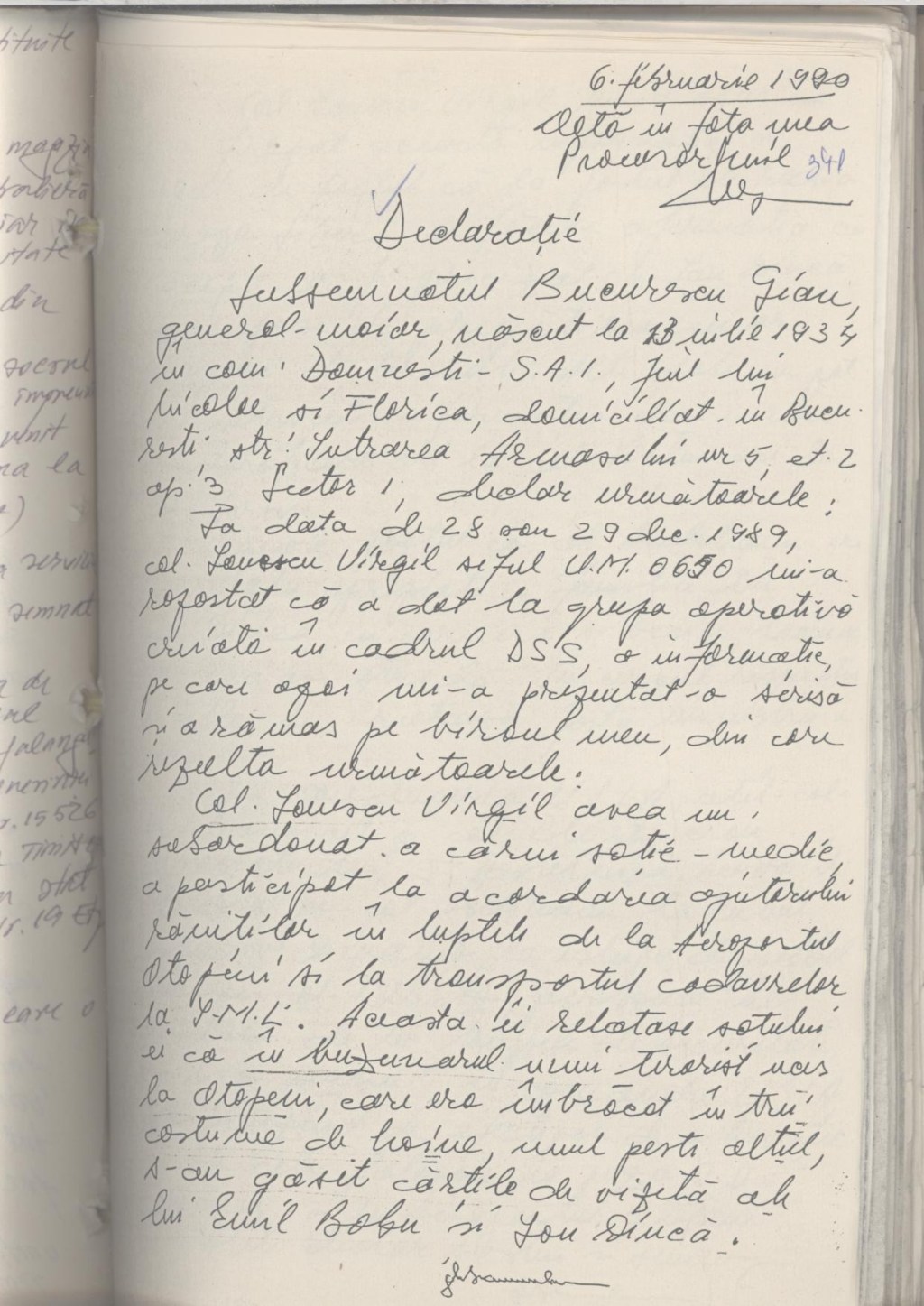
0436

6 februarie 1990

Declaratie.  Subsemnatul Bucurescu Giani, general-maior [D.S.S.]

La data de 28 sau 29 decembrie 1989, col. Lovescu [?] Virgil seful U.M. 0650 mi-a raportat ca…

Col. Lovescu [?] Virgil avea un subordonat a carui sotie-medic a participat la acordarea ajutorului ranitilor in luptele de la Aeroport Otopeni si la transportarea cadavrelor la I.M.L.  Acestea ii relatase sotului ca in buzunarul unui terorist ucis la Otopeni, care era imbracat in trei costume de haine, unul peste altul, s-au gasit cartile de vizita ale lui Emil Bobu si Ion Dinca.

Col. L Virgil mi-a spus ca l-a frapat aceasta informatie si legat de faptul ca la postul de Radio Europa Libera se facuse afirmatie cu Pacepa ar fi precizat ca Ion Dinca se ocupase de pregatirea unor grupuri de teroristi.  Alte date nu pot da intrucit informatia era in curs de clarificare ori la Col. Ratiu [DSS Dir I] ori la Col. Goran [SMB]…

Cunosc [?] faptul ca col. Ardeleanu [sef USLA] era in relatii apropriate cu familia lui Ion Dinca…

Din conducerea USLA atit col. Ardeleanu cit si col Blortz [Bleort] erau apropriatii lui T. Postelnicu
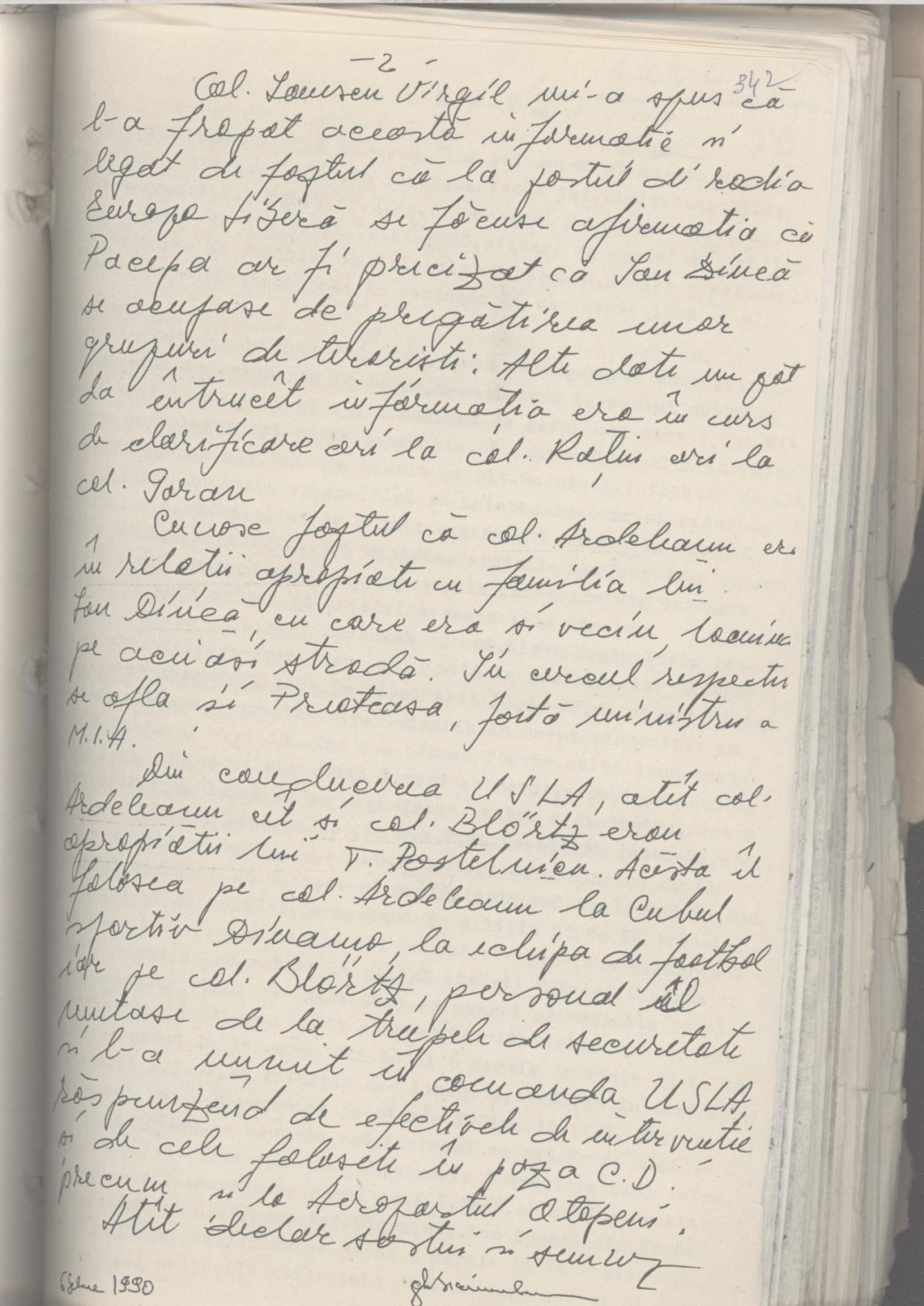
0437

http://atomic-temporary-3899751.wpcomstaging.com/2012/12/28/what-can-we-learn-from-dosarele-revolutiei-de-la-timisoara-vi/

We have two different accounts from Gheorghe Diaconescu, which roughly match:

http://www.banaterra.eu/romana/files/procesul_de_la_timisoara_volumul_VI_continut.pdf
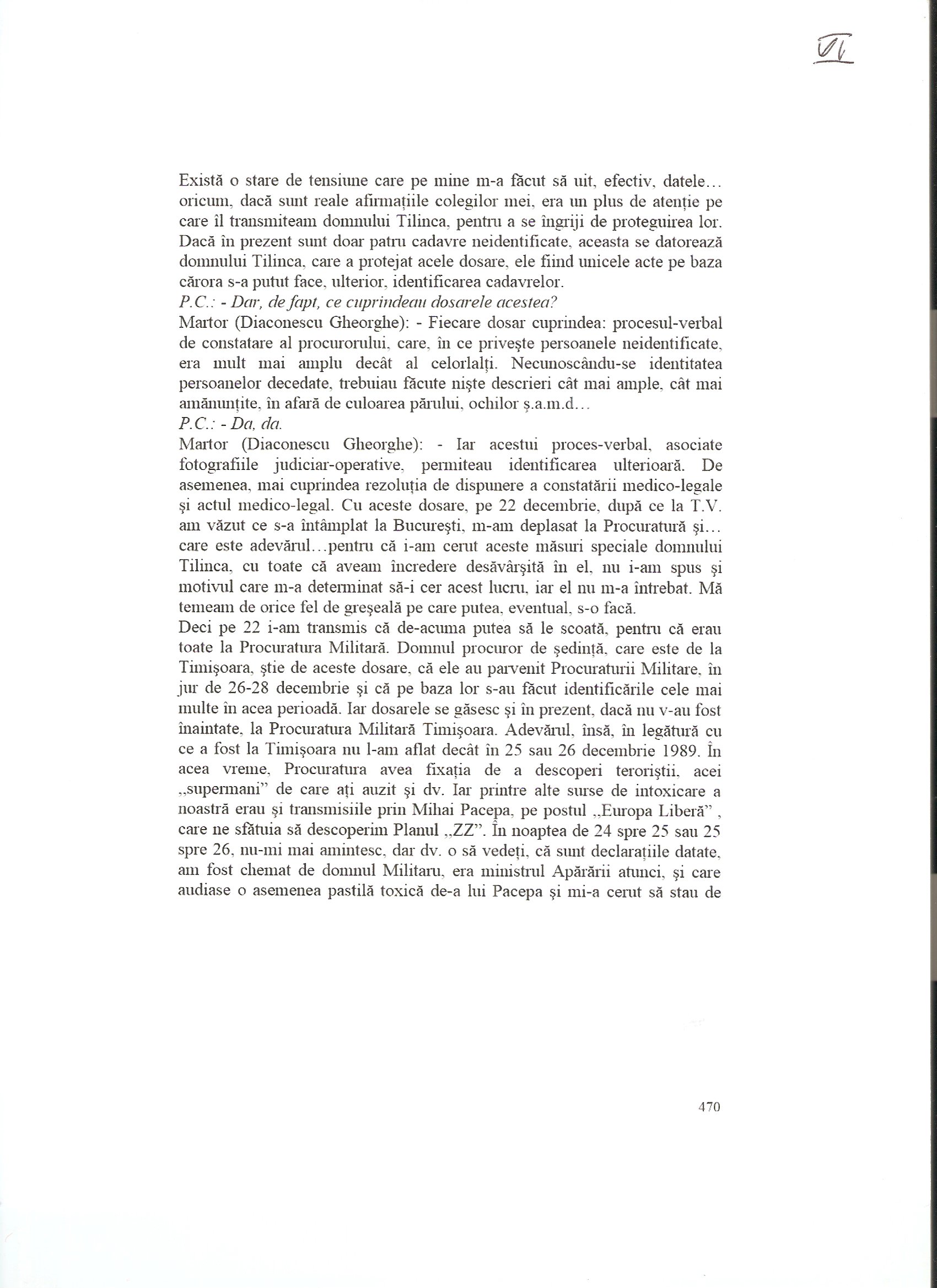
image0

image0-001

This also seems to confirm the following (when adjusted for the corrected dates):

Nestor Ratesh quotes one of Ceausescu’s senior party henchman, Ion Dinca, as having stated at his trial in early February 1990:

“During the night of 27-28 [of January 1990] at 12:30 A.M., I was called by several people from the Prosecutor’s Office to tell what I knew about the agreement entitled Z.Z. between Romania and five other states providing for the dispatching of terrorist forces to Romania in order to intervene in case of a military Putsch.  This agreement Z.Z. is entitled ‘the End of the End.’  I stated then, and I am stating now to you, that I have never been involved in this agreement, neither I nor other people.  And I was told:  Only you and two other people know this.  I stated that and a detailed check was made in order to prove that I was not involved in such acts.”[95]

[95] Ratesh, Romania:  The Entangled Revolution, pp. 66-67, quoting Radio Bucharest, 2 February 1990.  I don’t think from the context given it is clear that this alleged incident took place in January 1990, as Ratesh assumes; the reference to 27-28 might have been a reference to December 1989.

But it almost doesn’t matter when Pacepa first discussed this…because almost identical details were disclosed by Liviu Turcu, a DIE officer who had defected earlier in 1989 (thereby being far more knowledgeable of current plans/realities inside the Romanian security state), only without reference to a named plan, such as Plan Z-Z.  It was thus Turcu on 23 December 1989 (within 24 hours of the outbreak of terrorist hostilities in Romania; the interview would have taken place on Saturday the 23rd) who first informed Western media of the existence of such a plan–although it appears Turcu’s disclosures were never relayed by Romanian media or by Radio Europa Libera.
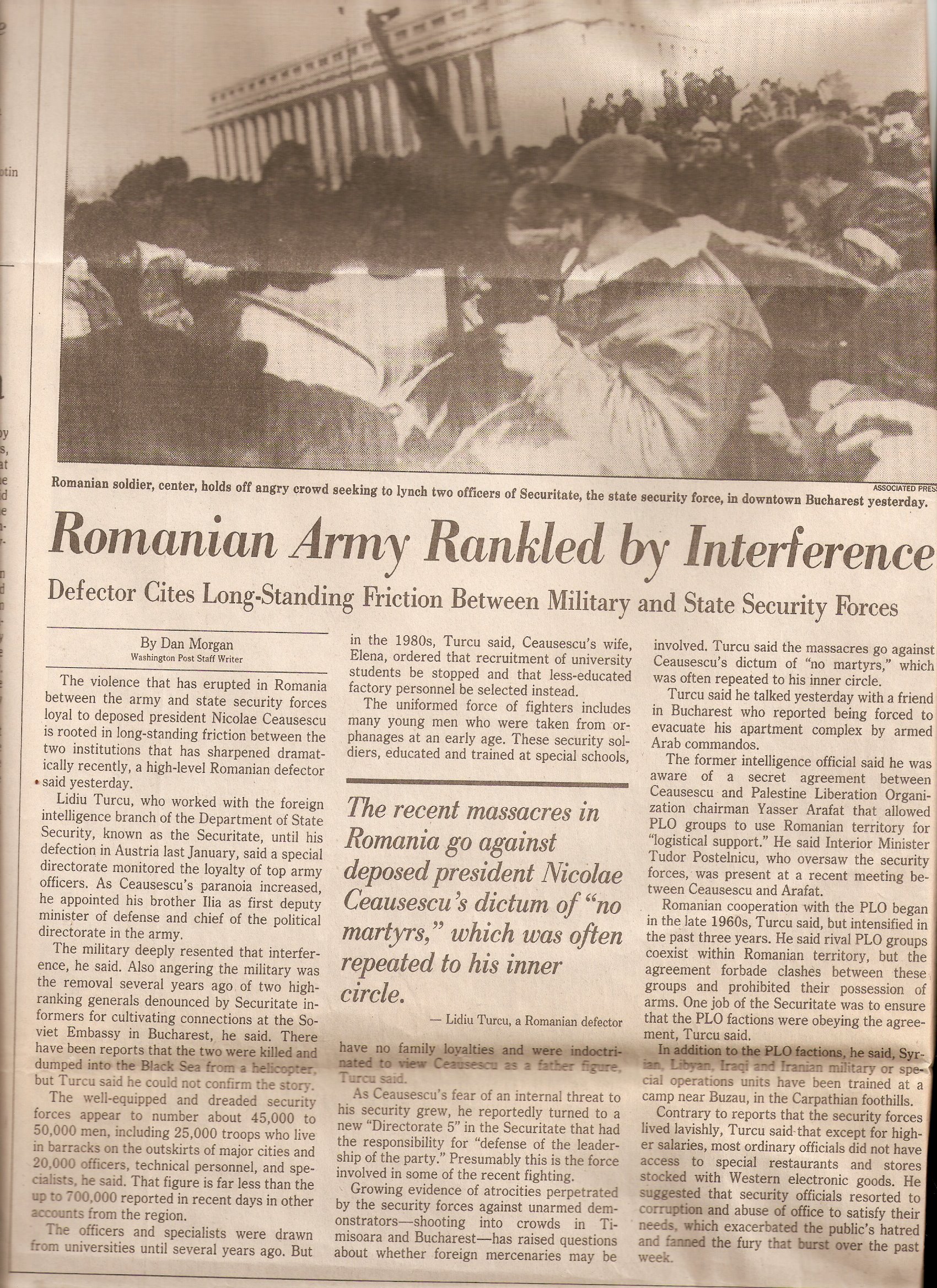
Romanian Army Rankled by Interference;Defector Cites Long-Standing Friction Between Military and State Security Forces

The Washington Post
December 24, 1989 | Dan Morgan

The violence that has erupted in Romania between the army and state security forces loyal to deposed president Nicolae Ceausescu is rooted in long-standing friction between the two institutions that has sharpened dramatically recently, a high-level Romanian defector said yesterday.

Lidiu Turcu, who worked with the foreign intelligence branch of the Department of State Security, known as the Securitate, until his defection in Austria last January, said a special directorate monitored the loyalty of top army officers. As Ceausescu’s paranoia increased, he appointed his brother Ilia as first deputy minister of defense and chief of the political directorate in the army.

The military deeply resented that interference, he said. Also angering the military was the removal several years ago of two high-ranking generals denounced by Securitate informers for cultivating connections at the Soviet Embassy in Bucharest, he said. There have been reports that the two were killed and dumped into the Black Sea from a helicopter, but Turcu said he could not confirm the story.

The well-equipped and dreaded security forces appear to number about 45,000 to 50,000 men, including 25,000 troops who live in barracks on the outskirts of major cities and 20,000 officers, technical personnel, and specialists, he said. That figure is far less than the up to 700,000 reported in recent days in other accounts from the region.

The officers and specialists were drawn from universities until several years ago. But in the 1980s, Turcu said, Ceausescu’s wife, Elena, ordered that recruitment of university students be stopped and that less-educated factory personnel be selected instead.

The uniformed force of fighters includes many young men who were taken from orphanages at an early age. These security soldiers, educated and trained at special schools, have no family loyalties and were indoctrinated to view Ceausescu as a father figure, Turcu said.

As Ceausescu’s fear of an internal threat to his security grew, he reportedly turned to a new “Directorate 5” in the Securitate that had the responsibility for “defense of the leadership of the party.” Presumably this is the force involved in some of the recent fighting.

Growing evidence of atrocities perpetrated by the security forces against unarmed demonstrators-shooting into crowds in Timisoara and Bucharest-has raised questions about whether foreign mercenaries may be involved. Turcu said the massacres go against Ceausescu’s dictum of “no martyrs,” which was often repeated to his inner circle.

Turcu said he talked yesterday with a friend in Bucharest who reported being forced to evacuate his apartment complex by armed Arab commandos.

The former intelligence official said he was aware of a secret agreement between Ceausescu and Palestine Liberation Organization chairman Yasser Arafat that allowed PLO groups to use Romanian territory for “logistical support.” He said Interior Minister Tudor Postelnicu, who oversaw the security forces, was present at a recent meeting between Ceausescu and Arafat.

Romanian cooperation with the PLO began in the late 1960s, Turcu said, but intensified in the past three years. He said rival PLO groups coexist within Romanian territory, but the agreement forbade clashes between these groups and prohibited their possession of arms. One job of the Securitate was to ensure that the PLO factions were obeying the agreement, Turcu said.

In addition to the PLO factions, he said, Syrian, Libyan, Iraqi and Iranian military or special operations units have been trained at a camp near Buzau, in the Carpathian foothills.

Contrary to reports that the security forces lived lavishly, Turcu said that except for higher salaries, most ordinary officials did not have access to special restaurants and stores stocked with Western electronic goods. He suggested that security officials resorted to corruption and abuse of office to satisfy their needs, which exacerbated the public’s hatred and fanned the fury that burst over the past week.

For verification of some of Turcu’s claims (in particular, the less-discussed participation of Iraqis from Saddam Hussein’s Iraq, see here:  http://atomic-temporary-3899751.wpcomstaging.com/foreign-intervention/)

Posted in decembrie 1989, raport final | Tagged: , , , , , , , , , , , , , | 2 Comments »

Dosarele Revolutiei de la Timisoara: Cine a spus si cine spune adevarul despre decembrie 1989?

Posted by romanianrevolutionofdecember1989 on December 31, 2012

[Documentary evidence in support of the publication entitled:  Bullets, Lies, and Videotape:  The Amazing, Disappearing Counter-Revolution of December 1989  ]

On 1 December 2012, Doru Teodor Maries and Asociatia 21 decembrie 1989 made images of many of the official files investigating the events of December 1989 in Timisoara available on the Internet at http://dosarelerevolutiei.ro/ .  Among the copies available are testimonies from victims of the repression of the communist regime of Nicolae Ceausescu, witnesses of the repression, relatives of the victims of the repression, and members of regime forces that either participated in the repression or were witnesses to it.  These documents allow researchers the ability to confirm or infirm claims made in the Romanian media or accounts published since December 1989.

[VA ROG, DACA VRETI, AJUTATI-MA CU TRANSCIERILE ILIZIBILE!  VA MULTUMESC!!!]

Romulus Cristea (ziarist, Romania Libera, 22 decembrie 2005):  – Munitia speciala, gloantele cu cap vidia sau dum-dum, a provocat victime? Presa de la acea vreme a fost plina cu astfel de relatari…

General-magistrat Dan Voinea – Nu exista victime (persoane impuscate) nici de la gloantele cu cap vidia, nici de la dum-dum. Pe durata evenimentelor s-a folosit munitie de razboi, munitie normala care se gasea la vremea respectiva in dotarea Ministerului de Interne si a Ministerului Apararii Nationale. Confuzia si informatiile false au aparut de la faptul ca se foloseau calibre diferite si, deci, zgomotul produs era altfel perceput.  http://www.romanialibera.ro/opinii/interviuri/toti-alergau-dupa-un-inamic-invizibil-58783.html

Robert Buzatu “a fost lovit de un glont exploziv”

IMG_0045

imaginea 43
imaginea 44
imaginea 45
imaginea 46

Georgian Baran “[pe 25 decembrie 1989]…teroristul a tras asupra mea, cred ca erau gloante dum-dum, mi-a lovit…”

imaginea 61
imaginea 62

IMG_0062

Csikos I[?] “Cred dupa rana [?]  ca au fost gloante dum-dum”

IMG_0088

Dobosan “am fost ranit…cu gloante dum-dum”

imaginea 127
imaginea 128

IMG_0128

Alexandru Kos “[pe 23 decembrie 1989] am fost impuscat…cu o arma de calibru mare si probabil cu gloante dum-dum”

imaginea 207
imaginea 208

IMG_0207

IMG_0208

Florin Nicoara “Am fost lovit in soldul drept cu un glont dum-dum”

IMG_0257

Griga “civilii au fost impuscati cu gloante plate [?], care asa cum spuneau medicii cu rupt tesuturile”

imaginea 170
imaginea 171

IMG_0171

Andrei Jubea “glontul special de culoare alb”

imaginea 204
imaginea 205

IMG_0205

Iosif Cota “gloante crestati”

imaginea 90
imaginea 91

IMG_0091

http://atomic-temporary-3899751.wpcomstaging.com/2012/12/30/dosarele-revolutiei-de-la-timisoara-declaratia-lui-mircea-stoica-8-ianuarie-1990-40-ani-topometrist-impuscat-patru-luni-spitalizat-decedat/

Mircea Stoica (declaratie, 8 ian 1990):  “Cind am ajuns aici, la poarta o voce de militar din garnizoana s-a exprimat:  “Ce faceti mai — voi toti cu BUM-BUM sau DUM-DUM si ni-i trimiteti noua sa ne spalam pe cap cu ei.”


Mircea Stoica (declaration, 8 January 1990):  “When I got there, I heard a soldier’s voice from the garrison exclaim:  “What are you guys doing? You all with your BUM-BUM or DUM-DUM and then you send`em to us to solve the problem [almost impossible to solve]” <very angry, pissed off>

(my sincere thanks to Gigga Adrian Tudor for this transcription and translation of the quote!)

Popovici:  “Mi-am revenit intr-un camion militar in care eram multi civili unii morti fiind adusi la garnizoana militara.  La garnizoana eu am fost dat jos si predat unui cpt (capitan) sau unui lt.major (locotenent major). vazand rana mea n-a vrut sa ma primeasca exprimand: Voi trageti cu dum dum si noi sa raspundem pentru acest lucru.”  (my thanks to A.K. for this transcription)

Popovici:  “I came to in a military truck in which there were lots of civilians some dead being brought to the military garrison.  At the garrison I was taken down and surrendered to a captain or lt. major, who looking at my wound did not want to receive me, exclaiming:  You shoot with dum-dum bullets and we are held responsible for it.”

It doesn’t take a genius to recognize the important similarity between the testimonies of Mircea Stoica and Ioan Popovici:  both are party to/overhear military personnel referring to the 1) use of DUM-DUM bullets, 2) that those who are using them are clearly not fellow soldiers and instead likely M.I./Securitate personnel, and 3) the Army personnel are resentful of essentially being left to “hold the bag” for the results of the DUM-DUM munitions!

———————————————————————————————————————————

Stoica Mircea, 40 ani, topometrist, Bd. Republicii, impuscat mina si picior http://www.timisoara.com/mioc/REVT06~1.HTM

197. Partea vătămată Stoica Maria cere 500000 lei, lunar, contribuţie de întreţinere, motivînd că, în decembrie 1989, soţul ei, Mircea Stoica a fost împuşcat, patru luni spitalizat, a rămas handicapat (gradul II de invaliditate), apoi a decedat.  În dovedirea cererii, depune acte de spitalizare şi de stabilire a capacităţii de muncă, care atestă vătămarea, cauzele şi consecinţele ei. Mai depune: declaraţia împuşcatului, actul lui de deces, actul de căsătorie şi carnetul de muncă (vol. 6 p. 304; vol. 10 p. 58-60, 170, 245-250; vol. 14 p. 54-61; vol. 27 p. 179-207).

http://www.procesulcomunismului.com/marturii/fonduri/mmioc/curteasup/docs/0307pciv.htm

IMG_0335

“Cind am ajuns aici, la poarta o voce de militar din garnizoana s-a exprimat:  “Ce faceti mai — voi toti cu BUM-BUM sau DUM-DUM si ni-i trimiteti noua sa ne spalam pe cap cu ei.”

IMG_0330

intreaga declaratie e aici:

imaginea 330
imaginea 331
imaginea 332
imaginea 333
imaginea 334
imaginea 335
imaginea 336

in legatura cu declaratia aceasta, vezi si http://atomic-temporary-3899751.wpcomstaging.com/2012/12/02/dosarele-revolutiei-de-la-timisoara/ ,

Procesul de la Timisoara (II). Audierea partii civile Popovici Ion: “…Atata retin foarte bine minte, ca ofiterul a spus, cica: ‘Nu, voi trageti cu dum-dum-uri si dupa aia Armata raspunde.’”

Popovici:  “Mi-am revenit intr-un camion militar in care eram multi civili unii morti fiind adusi la garnizoana militara.  La garnizoana eu am fost dat jos si predat unui cpt (capitan) sau unui lt.major (locotenent major). vazand rana mea n-a vrut sa ma primeasca exprimand: Voi trageti cu dum dum si noi sa raspundem pentru acest lucru.”  (my thanks to A.K. for this transcription)

Popovici:  “I came to in a military truck in which there were lots of civilians some dead being brought to the military garrison.  At the garrison I was taken down and surrendered to a captain or lt. major, who looking at my wound did not want to receive me, exclaiming:  You shoot with dum-dum bullets and we are held responsible for it.”

available on this site http://www.banaterra.eu/romana/procesul-de-la-timisoara-1990-1991-vol-v ].  The following is from Volume V.]

Some excerpts: P.C.:  Ati dat o declaratie?   Po. I. :  Da  P.C.:  O mentineti?  Po. I. Da (p. 827) P.C.:  “Inteleg sa fiu audiat in cauza ca parte civila”, da?  V-as ruga sa faceti putin liniste!  “Mentin declaratia de la Procuratura si…” (p. 833)

Po. I.:  …Da [am fost ranit].  Si dupa aceea a venit unul dintre trei [civili mai in varsta] dupa mine, m-a tarat pana la masina si la masina, acolo, am luat o bataie…ca n-am putut doua saptamani nici sa mananc nimica.  M-a lovit cu patul de arma in falca si cu bocancii in cap.  Si m-au dus, m-au dus la Garnizoana.  La Garnizoana m-au aruncat din masina si a venit ofiterul de serviciu.  Au venit si acestia trei a spus lu’ ofiterul de serviciu, cica:  “Luati-l si duceti-l  la arest.”  Atata retin foarte bine minte, ca ofiterul a spus, cica:  “Nu, voi trageti cu dum-dum-uri si dupa aia Armata raspunde.  Voi omorati oameni si raspunde Armata dupa aceea.”  Asta tin minte precis.  Si de acolo mi-am dat seama ca nu poate sa fie soldati aceia. (p. 830)

IMG_0291

IMG_0290

Doru Sciadei

IMG_0932

“In urma radiografiei facute la Spitalul Judetean au spus ca am 2 schije in picior…consemnat de medicul radiolog si chirurg, care m-au consultat.

Convingerea mea este ca in acest atac (pe ?) Calea Girocului, asupra unor oameni pasnici si (?) s-au folosit cel putin doua tipuri de gloante, convingerea intirita de glontul scos din coapsa (?) si schijele din piciorul meu, care cred ca provin de un glonte exploziv.

IMG_0929

Doina Gherasim glonte dum dum

IMG_0175

Cristian Rusu “S-a tras cu gloante dum-dum”

IMG_0305

SIX Doctors/Medical personnel from Timisoara alone have discussed the use of dum-dum bullets against demonstrators in Timisoara…

Doctors also reported on the wounds caused by explosive bullets (i.e. dum-dum bullets):  In this dispatch from Agence France Presse, relayed by Radio Free Europe on 25 December 1989, Dr. Aurel Mogosanu, a medic in the intensive care unit of a Timisoara hospital, says based on his thirty years of experience, some of the wounds could only have been CAUSED by EXPLOSIVE BULLETS SHOT AT THE PROTESTERS”

sursa (documentele Europa Libera disponsibile la):  http://media.hotnews.ro/media_server1/generic_file-2009-12-22-6754154-0-radio-bucuresti-25-dec-pdf.pdf (p. 49 of 82)

©AFP Général – Lundi 25 Décembre 1989 – 08:33 – Heure Paris (386 mots)
Roumanie, prev Nuit de Noel a l hopital central de Timisoara De l un des envoyes speciaux de l AFP, NICOLAS MILETITCH
   TIMISOARA (Roumanie) 25 dec – Devant l hopital central de Timisoara, dimanche soir, une quarantaine de camions remplis de medicaments et de produits alimentaires tout juste arrives, attendaient d etre decharges.
   ” L aide nous vient d un peu partout. Hongrie, RFA, Tchecoslovaquie, France, Yougoslavie, URSS, Bulgarie, Italie… ” , indique a l AFP l un des soldats qui gardent l hopital. Les militaires sont partout autour de l hopital, sur les toits, dans les cours et meme a l interieur.
   ” Des hommes de la Securitate ont tire pres de l hopital a plusieurs reprises, ces dernieres heures ” , explique le docteur Aurel Mogosianu, chef du service de soins intensifs, en donnant des ordres a un soldat qui passe, la mitraillette a l epaule, dans un couloir, entre les malades.
   Le Dr Mogosianu, qui a une trentaine d annees d experience, pense que certaines blessures particulierement horribles, n ont pu etre provoquees que par des balles explosives tirees contre les manifestants.
   Dans une salle de soins intensifs, une femme de 23 ans essaie de parler au docteur, puis renonce. ” C est un cas difficile. Elle a eu le dos transperce par une rafale ” , precise le Dr Mogosianu.
   En bougeant a peine la main, la jeune femme esquisse le ” V ” de la victoire pour dire ” au revoir ” . Un effort irrealisable pour son voisin qui a recu une balle dans le cou, impossible a extraire.
   Comme la plupart de ses collegues, le docteur travaille, a peu de choses pres, 24 heures sur 24 depuis le debut des evenements. Dans un coin, une infirmiere dort, ecroulee sur une chaise.
   Pour faire face a l afflux de blesses, la television de Bucarest a demande a tous les etudiants en medecine du pays de se rendre dans les hopitaux de la capitale et de Timisoara, ou la situation est la plus critique.
   Victor Jancu, 20 ans, a entendu cet appel. Dans la nuit de vendredi a samedi, il a quitte Cluj et reussi a rejoindre Timisoara, a plus de 300 kms de la, en arretant des camions.
   Quelques visiteurs arrivent a l hopital, portant a la main une petite branche de sapin : a Timisoara aussi, on voudrait feter Noel.
   nm/jga/vr.
Tous droits réservés : ©AFP Général
021851451DC1ED1D715E06849EA4C6E0F37C0C25ECE8D503

mai mult despre Dr. Aurel Mogosanu in decembrie 1989:  http://www.sorinbogdan.ro/2009/12/timisoara-18-decembrie-1989/.

http://atomic-temporary-3899751.wpcomstaging.com/2011/09/30/procesul-de-la-timisoara-iii-audierea-martorului-rodica-novac-directorul-directiei-sanitare-timis-13-iunie-1990/

Rodica Novac’s claim is corroborated elsewhere by four other medical officials on call during the Timisoara repression.  First, in Romanian, by Dr. Atanasie Barzeanu, then in Hungarian by three doctors (Vladimir Fluture, Csaba Ungor, and Andras Goga) present and performing surgery in Timisoara hospitals from 17-19 december 1989 who recount separately their discovery of dum-dum exploding bullets among the bullets with which demonstrators arriving at the hospital had been shot.  december 1989: temesvari orvosok, dum-dum golyok, es a roman forradalom

Sava Florica, 33 de ani, vinzatoare la Loto-pronosport in cartierul Fabric, impuscata din mers, in Piata Traian

Barzeanu Atanasie, 65 anit, medic primar, doctor in stiinte, chirurg, Spitalul Judetean Timisoara

“…sintem deci in 18 decembrie…Pe la orele doua si patruzeci, cind inchideam o operatie–Sava Florica, 33 de ani, vinzatoare la Loto-pronosport in cartierul Fabric, impuscata din mers, in Piata Traian, dintr-un ARO, pacienta prezentindu-se o echimoza cu distrugerea tesuturilor (plaga in diametru de 15 centimetri), a tesuturilor din regiunea epigastrica, inclusiv a muschilor drepti abdominali, cu ruptura a colonului ascendent transvers si a jejuno-ileonului, fiind in stare de soc grav traumatic, hemoragic–, fara sa-mi poti explica nici macar acum cu ce fel de gloante a putut fi lovita, pentru ca nu am identificat nici orificiul de iesire si nici pe cel de intrare, a venit o asistenta de la Chirurgie I, care mi-a spus sa merg la domnul Ignat.”

Titus Suciu, Reportaj cu Sufletul la Gura, (Editura Facla 1990), pp. 133-134.

The following first appeared in Gyorgy Mandics’s Temesvari golgota (1991) pp. 348-349 and is reprinted in his A Manipulalt Forradalom (2009).  [My guess is this is also the source for the reference to dum dum bullets in the German language wikipedia entry for http://de.wikipedia.org/wiki/Rum%C3%A4nische_Revolution_1989 — Hans Vastag, György Mandics, Manfred Engelmann: Temeswar. Symbol der Freiheit. Wien 1992. ]

pp. 348-349

Ket esetuk volt az elejen.  Ezert is hivtak be oket.  Egy 14 eves gyermeket a haz elott lottek le, szinte a szomszedban, egy golyoszoros ARO-rol talaltak el; egy oreg nenit a ter tuloldalon, az erkelyen ertek a golyok.  A zarja ment ki, kicsit nagyott hallott mar, amire is csoda, 64 evesen, azt hirtelen ugy erezte, hogy labaibol kimegy minden ero es lecsusott az erholya.  Na milyen gyonge lettem egyszeruen–mondotta maganak. de ahogyan fel akart tapaszkodni meg lepve tapasztalt, hogy vertocsa gyult alatta.  Bekialtolt a vegenek aki egy szomszed segitsegevel athozta a nenit a legkozelebbi korhazba, itt a Marasti ter tuloldalan, az uj Klinikakba, avagy hivatalos neven a 2 szamu korhazba, ahol rogton osszecodult mindenki csodat latni.  Ekkor hivtak be Baranziekat es minden mozgositato orvost, hiszen a fegyverek ropogatak.  Azota is kisebb nagyobb megszakitasokkal, felfelecsapolt a gepfegyverek, golyoszorok, geppisztolyok langzivatarja, remulettel telitva az ejszaki eget.

p. 349

De azt a ket elso esett nem kovettek ujabbok.  Igz aztan volt ido alaposan szemugyre venni a nenit akinek combjan elol egz akkora lyuk tatongott mint egy egy lejes, a comba hatso felen ahol eltavotott a golyo, ott viszont mar akkora mint egy otlejes.  Fluture doktor, az egzik sebesz erosen kototte az ebet a korohoz, hogy ez egz specialis dum-dum robbanogolyo okozta seb, hiszen a szakirodalomban azt irjak, hogy csak ez a robbannolovedek-fajta-amelyet ugyan az ENSZ eltitott, am a nemzetkozi terrorizmusban kulonesen divatos ma is–okoz az izomszovetbol kijovet sokkal nagyobb roncsolasokat mint a bemenetnel.  Az orvosok odazarandokoltak a sebesulthoz, mivel egzik sem latott semhogy dum-dum golyo utotte sebet, de egyaltalan lott sebet sem soha eleteben.  Igz aztan csak szivtak a rangeletrahoz igazodva a sebesz foorvosok az amerikai Kentet, a foamnesztezialogus a holland pipadohanyt, az asztalyos orovosok a bolgar BT-t, a fonoverek a jugoslav Vikend-et, a noverek es helyapolok a roman Snagov-t, Golfot.  Es vartak.

(Note: it is unclear who the 64 yr. old described was…there are several individuals without ages listed as injured or dead during the events, but I think it more likely the age of the woman is incorrect)

Jozsef Gazda Megvalto karacsonyErdelyi magyar tulelok emlekeznek. (1990)

Ungor Csaba:  Ket ora utan senkit be nem hoztak, senkit be nem engedtek, egyetlen sebesult sem.  A korhazbol kikanyarado  mentoautokra is lottek.  Ket ora utan mindre, ami mozgott, jarokelo, auto, mindenre lottek, csak hogy ok tudjak begyujteni a sebesulteket s a halottakat.  Kiderult az elso golyok utan, amiket a sebekbol gyujottek ossze, szedtek ki, hogy nem eles katonai toltenyekkel lottek, hanem dum-dum golyokkal, amik nagy rombolasokat okoztak.  Egy 16 eves, ketszer sebesult gyermek meselte el, ok azt hittek, hogy hosok, azt hittek, hogy meg fogjak menteni a forradalmat, mert biztosra vettek, ha a felnottek sorfala ele allnak, nem fognak belejuk loni.  Lottek rajuk is.

Goga Andras:  A masodik izgalomkelto esemeny volt kedden delelott, hogy az osszes regiszterunk–mind a surgossegen, mind az osztalyon–, melyekre felirtuk a muteteinket, eltuntek, a mai napig sem talaltuk meg.  Bennuk voltak az ev osszes mutetei[***]…En aznap kettot operaltam.  Egy tuntetonek a bore alol vettem ki egy nagyon kulonleges golyok, nem is golyot, egy ilyen repeszdarabot, melyet a katonasag aztan megvizsgalt, s azt mondtak, nekik nincs tudmasuk, hogy ez mi lehet.  Egy masiknak pedig fejserulese volt, persze abban nem talaltam golyot, atment rajta.

In early March 1990, AFP reported the declared findings of surgeons in Bucharest, attesting to the fact that many of those wounded on 21-22 December 1989 in Bucharest had been shot with exploding bullets, DUM-DUM bullets.  This is a critical article (and description of an event that I believe has gotten almost no coverage inside or outside Romania).  Lt. Gnl. Traian Oancea, chief of surgery in part of the Central Military Hospital in Bucharest, and Dr. Nicolae “Nae” Constantinescu, chief of surgery at the Coltea Hospital, discussed this at a meeting of the Society of Surgeons in Bucharest.

This was also discussed by Bucharest medical personnel at a 1994 conference:

AMFITEATRUL FACULTATII DE MEDICINA

“Decembrie 1989, in spitalele din Bucuresti”

Mihail Lechkun, Romania Libera, 10 februarie 1994, p. 2

“In decembrie 1989 a fost o disponsibilitate pentru bestialitate, pe care nu am crezut-o capabila la poporul care fac parte, ” a declarat dl. conf. dr. Nicolae Constantinescu (Spitalul Coltea), in cadrul conferintei care s-a desfasurat marti seara in Amfiteatrul Mare al Facultatii de Medicina din Bucurest, avand ca subiect “Decembrie 1989, in spitalele din Bucuresti”.  Printre invitatii Ligii Studentilor in Medicina, organizatorul acestei conferinte, s-au numarat:  dl. prof. dr. Petre Andronescu, prorector, dl. dr. Constantin Antofie, dl. prof. dr. Marian Ciurel, dl. prof. conf. dr. Dan Niculescu, dl. conf. dr. Nicolae Constantinescu, dl. prof. conf. dr. Ilie Pavelescu, dl. dr. Eduard Geambasu, toti medici chirurgi din Capitala care au fost confruntate cu fluxul de raniti din decembrie 1989.  “Documentatia pe care am avut-o, nu o mai avem,” a spus dl. prof. dr. Marian Ciurel (Spitalul de Urgenta) amintind totusi faptul ca au fost inregistrate date intr-o lucrare de doctorat.  “Putini dintre cei raniti au fost socati psihic,” isi aminteste prof. dr. Petre Andronescu (Spitalul Colentina).  Revolutionari si raniti au primit acelasi tratament, “stim doar ca la o parte din bolnavi s-au schimbat catusi” isi aminteste dl. prof. dr. Marian Ciurel.  Peste 60 la suta din ranitii adusi la Spitalul Coltea erau impuscati lateral sau din spate.  S-a tras si asupra oamenilor care au stat ghemuiti, acestia suferind astfel leziuni complexe.  Pe langa datele statistice prezentate, medicii prezenti au atras atentia asupra naturii leziunilor care, in numar mare, au fost cazate de munitie al carie efect a fost mai mult distrugerea, mutilarea decat scoaterea din lupta.  In acest sens, deosebit de interesante au fost datele prezentate din lucrarea de diploma, a medicului M. Briciu:  “S-a tras cu gloante explozive”. Concluziile ce se pot trage din faptul ca cei adusi in spitale, in intervale de timp distincte, prezentau leziuni corespunzatoare anumitor portiuni din corp, demonstreaza existenta unor ordine asupra locului unde trebuia ochit.  “Cred ca Romania va fi capabila sa constituie acel ecran care sa protejeze de acum inainte natia de asemenea manifestari,” a spus dl. conf. dr. Nicolae Constantinescu, remarcand aspectul benefic al unor astfel de conferinte.

NOR WERE THESE THE ONLY DOCTORS AND MEDICAL PERSONNEL–FOREIGN OR DOMESTIC–WHO ATTESTED TO THE USE OF DUM-DUM EXPLODING AND OTHER ATYPICAL, UNUSUAL MUNITIONS USED DURING THE EVENTS OF DECEMBER 1989

http://atomic-temporary-3899751.wpcomstaging.com/2011/08/08/doctors-and-dum-dum-bullets-in-romania-in-december-1989-i-dr-manuel-burzaco-medecins-sans-frontieres/

http://atomic-temporary-3899751.wpcomstaging.com/2011/08/10/doctors-and-dum-dum-bullets-in-romania-in-december-1989-ii-trimisi-in-strainatate-italia-franta-austria-anglia-si-germania-pentru-tratament/

http://atomic-temporary-3899751.wpcomstaging.com/2011/08/11/doctors-and-dum-dum-bullets-in-romania-in-december-1989-iii-ce-spun-medici-romani/

Posted in decembrie 1989, raport final, Uncategorized | Tagged: , , , , , | Leave a Comment »