Posted by romanianrevolutionofdecember1989 on December 26, 2014
(purely personal views, based on two decades of prior research and publications)
Bullets, Lies, and Videotape:
The Amazing, Disappearing Romanian Counter-Revolution of December 1989
by Richard Andrew Hall, Ph.D.
Standard Disclaimer: All statements of fact, opinion, or analysis expressed are those of the author and do not reflect the official positions or views of the Central Intelligence Agency (CIA) or any other U.S. Government agency. Nothing in the contents should be construed as asserting or implying U.S. Government authentication of information or CIA endorsement of the author’s views. This material has been reviewed by CIA to prevent the disclosure of classified information.
[Submitted to CIA’s Publications Review Board (PRB) 19 November 2009; cleared without changes by PRB 15 December 2009]
I am an intelligence analyst for the Central Intelligence Agency. I have been a CIA analyst since 2000. Prior to that time, I had no association with CIA outside of the application process.
COLONEL GHIRCOIAS MAKES THE ROUNDS OF BUCHAREST’S HOSPITALS
Unofficially, we also know of Colonel Ghircoias’ exploits after the Ceausescu regime collapsed on 22 December 1989, exploits for which he was not charged at his trial and for which he has never been charged. Of the 1,104 people killed and 3,352 people injured during the December 1989 bloodshed, 942 of them were killed and 2,251 wounded afterNicolae and Elena Ceausescu fled power on 22 December 1989. At the time, personnel of the communist regime’s secret police—known as the Securitate—and allied foreign mercenaries fighting to restore the Ceausescu regime—collectively christened “the terrorists”—were thought to be the primary source behind the post-22 December bloodshed.
It was in this context, that doctors from Bucharest’s various main hospitals recall Colonel Ghircoias’ sudden, unannounced appearances during the last days of December 1989 and first days of January 1990. Professor Andrei Firica of the Bucharest “Emergency Hospital” recounted in a 2004 media interview largely the same details he had conveyed to the press in the summer of 1990. According to Firica, some 15 to 20 suspected terrorists had been interned at the “Emergency Hospital” in varying states of medical distress. He says he made a small file of the medical situations of these patients. A Militia colonel, whom he later was to see in [prisoner] stripes on TV as a defendant in the Timisoara trial—i.e. fairly clearly Ghircoias—came one day and counseled him to keep nosy foreign reporters away from the beds of the “terrorists,” stating ominously that “these were just terrorist suspects and he [Dr. Firica] didn’t want to wake up one day on trial for having defamed someone”! The colonel later came and loaded the wounded terrorist suspects onto a bus and off they went. Firica maintains the files he kept on the terrorist suspects “of course, disappeared.” He noted, however, that he asked his son, who had studied theater and film at university, to film the terrorists tied down to the hospital beds, and he claims he gave copies of this cassette to the Procuracy.[4]
[In viewing these photos, witness what Constantin Fugasin recounted in “Unde ne sint teroristii?” Zig-Zag, in 1990, based in part on an interview with Dr. Andrei Firica:
At the Emergency Hospital 13 suspected of being what we call terrorists were interned. Among these a few were definitely foreign, even though all had Romanian papers. Two clearly had ‘Mongoloid’ (‘Asiatic’) features (one stated that his mother was Romanian, while his father was from Laos), while four others were Arabs. Nevertheless, they spoke Romanian very well. Doctor Nicolae Staicovici, who worked a time in Egypt and who treated them for a time spoke with them. At a moment, he formed a question in Arabic. One of the injured responded to him perfectly. All were well-built, one was a ‘mountain of a man.’ He said nothing, although he probably had terrible pains. There were also two terrorists who were not wounded. One arrived at night, under some pretext. Those on guard suspecting him, immobilized him. He had on three layers of clothing and several ids. They tied him to the stretcher, but although he appeared rather frail, at a given moment he ripped the restraints off.[6]]
[Dr. Andrei Firica, 2004: From a diagnostic perspective, those who maintain that the terrorists didn’t exist are telling an outrageous lie…In the Emergency Hospital, people were brought who were shot with precision in the forehead, from behind, just a few yards in the crowd of demonstrators, such people who did this can only be called terrorists…[8]]
–
Dr. Nicolae Constantinescu, chief surgeon at the Coltea Hospital, also was paid the honor of a visit by Colonel Ghircoias during these days:
I remember that on 1 or 2 January ’90 there appeared at the [Coltea] hospital a colonel from the Interior Ministry, who presented himself as Chircoias. He maintained in violent enough language that he was the chief of I-don’t-know-what “criminalistic” department from the Directorate of State Security [ie. Securitate]. He asked that all of the extracted bullets be turned over to him. Thus were turned over to him 40 bullets of diverse forms and dimensions, as well as munition fragments.
To the question of whether he informed the Military Procuracy?
Of course, I announced the Prosecutor’s Office, and requested an investigation [of those shot in the revolution]. For example, when I showed them the apartment from where there were was shooting during the revolution, on the fourth floor of the ‘Luceafarul’ cinema, the prosecutors told me that they sought to verify it and uncovered that there was a Securitate ‘safehouse’ there and that was it.
In 1992, I signed along with other doctors, university professors, renowned surgeons, a memorandum [see page 5 (below) for an article apparently linked to the memorandum] addressed to the Prosecutor General in which we requested an investigation regarding the wounded and dead by gunfire. Not having received any response, after six months I went there to ask what was going on. They told me they were working on it, and they showed me two or three requests and that was it. One of the prosecutors took me into the hallway and told me “I have a child, a wife, it is very complicated.” He asked me what I thought I was doing…I lit back into him, I told him I wasn’t just any kind of person to be blown off.
I showed him the x-rays of those who were shot, I showed him the bullets in the liver. The x-rays exist, they weren’t my invention, I didn’t just dream all this up to demand an investigation! I told them that there are some people who wish to find out the truth and they signed a memo to the Procuracy and they aren’t just anybody, but doctors with experience, experts in the field. In vain, we requested ballistics tests and other research, in vain we presented forms, documents, x-rays, studies. They did not want to undertake a serious investigation.[9]
[4]Professor Andrei Firica, interview by Florin Condurateanu, “Teroristii din Spitalul de Urgenta,” Jurnalul National, 9 March 2004, online edition, cited in Hall, “Orwellian…Positively Orwellian” http://homepage.mac.com/khallbobo/RichardHall/pubs/Voineaswar091706.html. For similar accounts, see Florin Mircea Corcoz si Mircea Aries, “Terorist ascuns in Apuseni?” Romania Libera, 21 August 1992, p. 1–“Colonelul Ghircoias, former director of the Securitate’s penal investigative unit, brought together the individuals accused of being terrorists and made them disappear”; Andreea Hasnas, “Reportajul unui film cu TERORISTI,” Expres, no. 10 (6-12 aprilie 1990), p. 5; Constantin Fugasin, “Unde ne sint teroristii?” Zig-Zag, 1990.
[6] Significantly this video is in direct contradiction and contests the claims of the Sorin Iliesiu who maintains that “General Dan Voinea has said clearly: The terrorists did not exist. Those who seized power lied to protect the real criminals….The diversion of the ‘terrorists’ has been demonstrated by [the] Justice [System], not a single terrorist being found among the dead, wounded or arrested (Sorin Iliesiu, “18 ani de la masacrul care a deturnat revoluţia anticomunistă,” 21 December 2007, http://www.romanialibera.com/articole/articol.php?step=articol&id=6709). For a discussion, see Hall 2008.
[8] Professor Andrei Firica, interview by Florin Condurateanu, “Teroristii din Spitalul de Urgenta,” Jurnalul National, 9 March 2004, online edition.
[9] Dr. Professor Nicolae Constantinescu, interview by Romulus Cristea, “”Nici acum nu-mi dau seama cum am putut sa operez nonstop timp de trei zile,” Romania Libera, 20 December 2006, online edition.
It is virtually certain that the authors of the Chapter on the Romanian Revolution of December 1989 (pp. 620-627, especially p. 625 http://www.presidency.ro/static/ordine/RAPORT_FINAL_CPADCR.pdf ) had no knowledge of Securitate General Iulian Vlad’s Declaration of 29 January 1990 … with predictable negative consequences for their understanding of what happened in December 1989.
And one wonders why I found (find) mainstream Romanian studies so unhelpful in trying to understand Nicolae Ceausescu’s overthrow and the Romanian Revolution of December 1989? Read Vladimir Tismaneanu or Tom Gallagher (or in its 2014 variation, see Grigore Pop-Eleches in Bernhard and Kubik) on Romania in the early 1990s and one is presented with a world of good and evil, of angels and demons, with distance from former nomenklaturist and high-ranking communist Ion Iliescu and the core of the National Salvation Front being as being the simple formula for explaining and understanding any event or policy. As opposed to this highly–one might say blatantly–politically partisan [and bureaucratically ignorant] approach, on the other side stand functional or deconstructionist explanations–the kind favored by Peter Gross, Katherine Verdery, Peter Siani-Davies, or Ruxandra Cesereanu–which would explain the press of the time as the function of market pressures, sensationalist appetites, an anomic readership, poor journalistic training and professionalism, etc.
How then does one explain the following conundrum: the selective treatment of the letters and declarations of former Securitate Director General Iulian Vlad? Oh, yes, the text of General Vlad’s letters which allege he was a stooge and victim of Ion Iliescu, etc. can be found in the Romanian press. No problem! But what about his declaration of 29 January 1990, where he deftly admits the responsibility of his institution for the bloodshed of December? What, that not sensationalist enough, different enough to sell papers? That’s not “anti-communist” enough for publication? Is it somehow less credible than the other letters whose text has been published without problem? 24 plus years later, the Romanian media has yet to publish this document! Could it be that the problem with this declaration is that it does not fit with and undermines the other popular narratives of December 1989 that minimize and even absolve the former Securitate of responsibility for the bloodshed of December 1989?
Ion Cristoiu’s Evenimentul Zilei debuted in June 1992 and was the flagship of opposition to the regime of Ion Iliescu. In the fall of 1992 it ran a zealous campaign opposed to Iliescu’s reelection. Here is the exculpatory letter from former Securitate General Iulian Vlad (dated 20 March 1990) that was published on 19 September 1992:
“Generalul IULIAN VLAD se adreseaza dlui Ion Iliescu: Am fost arestat pe nedrept (20 March 1990),” Evenimentul Zilei, 19 septembrie 1992, p. 3. “Intr-adevar pe dictatorul Ceausescu l-am tradat” “M-am integrat total Revolutiei” “Sint convins ca datele nu va erau cunoscute” I.V. Vlad 20 martie 1990
And, yet, what of General Iulian Vlad’s declaration of 29 January 1990. As far as I know, in 24 plus years, only this brief allusive mention on the 15th anniversary of the letter (although not mentioned or acknowledged in the article, and possibly accidental) has made its way into the Romanian press. Below it: the text of the statement of 29 January 1990!
It took 22 years for the text of Securitate Director General Iulian Vlad’s handwritten declaration of 29 January 1990 to become public knowledge–thanks to former military prosecutor General Ioan Dan. (Inevitably, there will no doubt be those who will allege that General Vlad was “forced” to write this declaration to save his skin, etc., that this was the “propaganda of the moment” and all a huge lie. If that were the case, one would have expected Iliescu, Brucan, Militaru, Voican Voiculescu, etc. to have made every effort for Vlad’s declaration to leak to the media. Instead, for 22 years it was hidden from public knowledge!)
Of Note: No “Soviet tourists,” no DIA (Batallion 404) troops of the army’s intelligence wing, no “there were no terrorists: the Army shot into everyone else and into itself”–in other words, none of the spurious claims that have littered the narrative landscape, fueled by the former Securitate over the past two decades plus. No, Vlad knew who the terrorists of the Romanian Revolution of December 1989 were, because they reported to him!
General Magistrat (r) Ioan Dan
In aprilie 1990, generalul Gheorghe Diaconescu a fost destituit din functia de conducere in Directia Procuraturilor Militare. La plecare, mi-a predat cheia de la fisteul sau, cu mentiunea ca acolo au mai ramas cateva hartii fara importanta. Intrucat, la data respectiva, ma aflam in cea mai mare parte a timpului, in procesul cercetarilor de la Timisoara, mult mai tarziu, am dorit sa pun in respectivul fiset o serie de acte. Am cercetat ce mai ramasese de pe urma generalului Diaconescu si, spre surprinderea mea, am gasit declaratia olografa a generalului Iulian Vlad, data fostului adjunct al procurorului general, fostul meu sef direct, nimeni altul decat generalul Diaconescu, la 29 ianuarie 1990, cand toate evenimentele din decembrie 1989 erau foarte proaspete. Repet, este vorba despre declaratia olografa, un text scris foarte ingrijit, pe 10 pagini, din care voi reda acum integral doar partea care se refera expres la “actiunile teroriste in Capitala” (formularea apartine generalului Vlad).
“Analizand modul in care au inceput si s-au desfasurat actiunile teroriste in Capitala, pe baza acelor date si informatii ce le-am avut la dispozitie, consider ca acestea ar fi putut fi executate de:
1) Elementele din Directia a V-a, USLA, CTS si din alte unitati de Securitate, inclusiv speciale.
a) Directia a V-a, asa cum am mai spus, avea in responsabilitate paza si securitatea interioara a Palatului Republicii, multe dintre cadrele acestei unitati cunoscand foarte bine cladirea, cu toate detaliile ei. In situatia creata in ziua de 22.12.1989, puteau sa mearga la Palat, pe langa cei care faceau acolo serviciul si unii dintre ofiterii si subofiterii care se aflau la sediul CC ori la unitate.
Este ca se poate de clar ca numai niste oameni care cunosteanu bine topografia locului ori erau in complicitate cu cei care aveau asemenea cunostinte puteau patrunde in cladire (sau pe acoperisul ei) si transporta armamentul si cantitatile mari de munitie pe care le-au avut la dispozitie.
Tot aceasta Directie dispunea de o baza puternica si in apropierea Televiziunii (la Televiziunea veche). De asemenea, avea in responsabilitate perimetrul din zona resedintei unde se aflau numeroase case (vile) nelocuite si in care teroristii ar fi putut sa se ascunda ori sa-si faca puncte de sprijin.
Sunt si alte motive care pun pe prim-plan suspiciuni cu privire la aceasta unitate.
b) Elemente din cadrul unitatii speciale de lupta antiterroriste care aveau unele misiuni comune cu Directia a V-a si, ca si o parte a ofiterilor si subofiterilor de la aceasta unitate, dispuneau de o mai buna instruire si de mijloace de lupta mai diversificate.
c) Elemente din Trupele de Securitate care asigurau paza obiectivilor speciale (resedinta, palat etc.) si, impreuna cu Directia a-V-a, Securitatea Capitalei si Militia Capitalei asigurau traseul de deplasare.
d) Ofiteri si subofiteri din Securitatea Capitalei, indeosebi de la Serviciul Trasee, sau dintre cei care au lucrat la Directia a V-a.
e) Elemente din alte unitati de Securitate, inclusiv unitatile speciale 544, 195 si 110, precum si din cele complet acoperite, comandate de col. Maita, col. Valeanu, lt. col. Sirbu, col. Nica, col. Eftimie si lt. col. (Eftimie sau Anghelache) Gelu (asa sta scris in declaratie–n.n.). Aceste din urma sase unitati, ca si UM 544, in ansamblu, si UM 195 puteau dispune si de armament si munitii de provenienta straina, precum si de conditii de pregatire adecvate.
2) Ofiteri si subofiteri din Militie, atat de la Capitala, cat si de la IGM, cu prioritate cei din Detasamentul special de interventie si cei care asigurau traseul.
3) Cred ca s-ar impune verificarea, prin metode si mijloace specifice, a tragatorilor de elita din toate unitatile din Capitala ale Ministerului de Interne, precum si a celor care au avut in dotare sau au indeplinit misiuni folosind arme cu luneta. N-ar trebui omisi nici chiar cei de la Dinamo si de la alte cluburi sportive.
4) Unele cadre militare de rezerva ale Securitatii, Militiei si Armatei, precum si actuali (la data respectiva) si fosti activisti de partid sau UTC, persoane apropriate tradatorului si familiei sale ori care poseda arme de foc.
Propun, de asemenea, o atenta investigare a celor care au fost in anturajul lui Nicu Ceausescu. Acest anturaj, foarte divers, cuprindea inclusive unele elemente de cea mai scazuta conditie morala care puteau fi pretabile la asemenea actiuni.
Ar fi bine sa se acorde atentia cuvenita sub acest aspect si fratilor dictatorului–Ceausescu Ilie si Ceausescu Nicolae–care, prin multiplele posibilitati pe care le aveau, puteau organiza asemenea actiuni.
5) Anumite cadre militare sau luptatori din Garzile Patriotice.
6) Straini:
a. Din randul celor aflati la studii in Romania:
– arabi, in general, si palestinieni, in special, inclusiv cei care sunt la pregatire pe linia Armatei (de exemplu, la Academia Militara);
– alte grupuri de straini la studii (iranieni si altii).
b. Special infiltrati (indeosebi din cei care au urmat diverse cursuri de pregatire pe linia MI sau a MAN);
c. Alti straini aflati in tara cu diverse acoperiri, inclusiv diplomatice;
d. Fosti cetateni romani (care ar fi putut intra in tara si in mod fraudulos).
7) Elemente infractoare de drept comun care au posedat armament ori l-au procurat in chiar primele ore din dupa-amiaza zilei de 22 decembrie 1989, cand, din mai multe unitati de Securitate, intre care Directia a V-a si Securitatea Capitalei, s-a ridicat o cantitate mare si diversa de armament si munitie.”
Declaratia generalului colonel I. Hortopan, 16.02.1990 (din cate cunosc, pana publicarea cartii lui Dan Ioan, timp de 22 de ani, aceasta declaratie n-a aparut in presa romana)
“Actiunile teroristilor au crescut in intensitate in ziua de 23 decembrie si in seara zilei, la o analiza a Consilului Frontului Salvarii Nationale, Vlad a fost intrebat cine sunt cei care trag asupra Armatei si populatiei, la care acesta — in scopul de ne induce in eroare — a raspuns ca manifestantii patrunzand in anumite obiective importante, printre ei fiind si elemente rauvoitoare, fosti puscariasi de drept comun, au pus mana pe arme, s-au constituit in grupuri si trag asupra noastra. In timpul actiunii, trupele noastre au prins un numar de teroristi care faceau din unitatile de Securitate, au cerut cuvantul si au prezentat numarul unitatilor din care faceau parte (UM-0672F, UM-0639, UM-0106, UM-0620), la care Vlad, tot pentru inducere in eroare, a afirmat ca acestia s-ar putea sa fie fanatici, care, chipurile, ar actiona pe cont propriu.”
I have attempted to trace Pacepa’s public discussion of Plan Z-Z to verify claims made by other actors (see below, Gheorghe Diaconescu, Giani Bucurescu/Virgil Lovescu) in the Romanian Revolution of December 1989. All of these actors refer to Pacepa’s discussion on Radio Free Europe/Radio Europa Libera sometime apparently between 24 and 26 December 1989. Unfortunately, although there are a series of audio clips and transcripts from these days on the Europa Libera site http://www.europalibera.org/archive/1989/latest/452/982.html, there is no mention of the Pacepa intervention in question and no indication of record of its existence on the Internet.
La data de 28 sau 29 decembrie 1989, col. Lovescu [?] Virgil seful U.M. 0650 mi-a raportat ca…
Col. Lovescu [?] Virgil avea un subordonat a carui sotie-medic a participat la acordarea ajutorului ranitilor in luptele de la Aeroport Otopeni si la transportarea cadavrelor la I.M.L. Acestea ii relatase sotului ca in buzunarul unui terorist ucis la Otopeni, care era imbracat in trei costume de haine, unul peste altul, s-au gasit cartile de vizita ale lui Emil Bobu si Ion Dinca.
Col. L Virgil mi-a spus ca l-a frapat aceasta informatie si legat de faptul ca la postul de Radio Europa Libera se facuse afirmatie cu Pacepa ar fi precizat ca Ion Dinca se ocupase de pregatirea unor grupuri de teroristi. Alte date nu pot da intrucit informatia era in curs de clarificare ori la Col. Ratiu [DSS Dir I] ori la Col. Goran [SMB]…
Cunosc [?] faptul ca col. Ardeleanu [sef USLA] era in relatii apropriate cu familia lui Ion Dinca…
Din conducerea USLA atit col. Ardeleanu cit si col Blortz [Bleort] erau apropriatii lui T. Postelnicu
This also seems to confirm the following (when adjusted for the corrected dates):
Nestor Ratesh quotes one of Ceausescu’s senior party henchman, Ion Dinca, as having stated at his trial in early February 1990:
“During the night of 27-28 [of January 1990] at 12:30 A.M., I was called by several people from the Prosecutor’s Office to tell what I knew about the agreement entitled Z.Z. between Romania and five other states providing for the dispatching of terrorist forces to Romania in order to intervene in case of a military Putsch. This agreement Z.Z. is entitled ‘the End of the End.’ I stated then, and I am stating now to you, that I have never been involved in this agreement, neither I nor other people. And I was told: Only you and two other people know this. I stated that and a detailed check was made in order to prove that I was not involved in such acts.”[95]
[95] Ratesh, Romania: The Entangled Revolution, pp. 66-67, quoting Radio Bucharest, 2 February 1990. I don’t think from the context given it is clear that this alleged incident took place in January 1990, as Ratesh assumes; the reference to 27-28 might have been a reference to December 1989.
But it almost doesn’t matter when Pacepa first discussed this…because almost identical details were disclosed by Liviu Turcu, a DIE officer who had defected earlier in 1989 (thereby being far more knowledgeable of current plans/realities inside the Romanian security state), only without reference to a named plan, such as Plan Z-Z. It was thus Turcu on 23 December 1989 (within 24 hours of the outbreak of terrorist hostilities in Romania; the interview would have taken place on Saturday the 23rd) who first informed Western media of the existence of such a plan–although it appears Turcu’s disclosures were never relayed by Romanian media or by Radio Europa Libera.
Romanian Army Rankled by Interference;Defector Cites Long-Standing Friction Between Military and State Security Forces
The violence that has erupted in Romania between the army and state security forces loyal to deposed president Nicolae Ceausescu is rooted in long-standing friction between the two institutions that has sharpened dramatically recently, a high-level Romanian defector said yesterday.
Lidiu Turcu, who worked with the foreign intelligence branch of the Department of State Security, known as the Securitate, until his defection in Austria last January, said a special directorate monitored the loyalty of top army officers. As Ceausescu’s paranoia increased, he appointed his brother Ilia as first deputy minister of defense and chief of the political directorate in the army.
The military deeply resented that interference, he said. Also angering the military was the removal several years ago of two high-ranking generals denounced by Securitate informers for cultivating connections at the Soviet Embassy in Bucharest, he said. There have been reports that the two were killed and dumped into the Black Sea from a helicopter, but Turcu said he could not confirm the story.
The well-equipped and dreaded security forces appear to number about 45,000 to 50,000 men, including 25,000 troops who live in barracks on the outskirts of major cities and 20,000 officers, technical personnel, and specialists, he said. That figure is far less than the up to 700,000 reported in recent days in other accounts from the region.
The officers and specialists were drawn from universities until several years ago. But in the 1980s, Turcu said, Ceausescu’s wife, Elena, ordered that recruitment of university students be stopped and that less-educated factory personnel be selected instead.
The uniformed force of fighters includes many young men who were taken from orphanages at an early age. These security soldiers, educated and trained at special schools, have no family loyalties and were indoctrinated to view Ceausescu as a father figure, Turcu said.
As Ceausescu’s fear of an internal threat to his security grew, he reportedly turned to a new “Directorate 5″ in the Securitate that had the responsibility for “defense of the leadership of the party.” Presumably this is the force involved in some of the recent fighting.
Growing evidence of atrocities perpetrated by the security forces against unarmed demonstrators-shooting into crowds in Timisoara and Bucharest-has raised questions about whether foreign mercenaries may be involved. Turcu said the massacres go against Ceausescu’s dictum of “no martyrs,” which was often repeated to his inner circle.
Turcu said he talked yesterday with a friend in Bucharest who reported being forced to evacuate his apartment complex by armed Arab commandos.
The former intelligence official said he was aware of a secret agreement between Ceausescu and Palestine Liberation Organization chairman Yasser Arafat that allowed PLO groups to use Romanian territory for “logistical support.” He said Interior Minister Tudor Postelnicu, who oversaw the security forces, was present at a recent meeting between Ceausescu and Arafat.
Romanian cooperation with the PLO began in the late 1960s, Turcu said, but intensified in the past three years. He said rival PLO groups coexist within Romanian territory, but the agreement forbade clashes between these groups and prohibited their possession of arms. One job of the Securitate was to ensure that the PLO factions were obeying the agreement, Turcu said.
In addition to the PLO factions, he said, Syrian, Libyan, Iraqi and Iranian military or special operations units have been trained at a camp near Buzau, in the Carpathian foothills.
Contrary to reports that the security forces lived lavishly, Turcu said that except for higher salaries, most ordinary officials did not have access to special restaurants and stores stocked with Western electronic goods. He suggested that security officials resorted to corruption and abuse of office to satisfy their needs, which exacerbated the public’s hatred and fanned the fury that burst over the past week.
“They dress in black berets and black jumpsuits [combinezoane negre, salopete negre] with red silk stripes on their sleeves. They carry small two-way radios and speak into them in coded language. They are equipped with automatic rifles with infrared nightscopes for sniping.”
Sediul U.S.L.A , pe 25 decembrie 1989 in jurul orelor 18…
Pe 25 decembrie in jurul orelor 18, dupa executarea dictatorilor, col. Ardeleanu Gh. a adunat cadrele unitatii intr-o sala
improvizata si le-a spus: “Dictatura a cazut! Cadrele unitatii se afla in slujba
poporului. Partidul Comunist Roman nu se desfiinteaza! Trebuie sa ne regrupam in
rindul fortelor democratice din P.C.R.–continuatorul idealurilor nobile ale
poporului ai carui fii sintem ! (…) Au fost gasite cadavre, indivizi avind
asupra lor legitimatii de acoperire USLAC (Unitatea Speciala de Lupta
Antiterorista si Comando) si legitimatii cu antetul 0620–USLA, legitimatii care
nu se justifica in posesia celor asupra carora au fost gasite…” A ordonat apoi
sa fie predate in termen de 24 de ore legitmatiile de serviciu, urmind ca
tuturor sa le fie eliberate altele cu antetul M.Ap.N.
(capitanul Romanescu Marian, cu Dan Badea, “USLA, Bula Moise, teroristii si
‘Fratii Musulmani’,” Expres nr. 26 (75), 2-8 iulie 1991, 8-9)
(Capitanul Romanescu Marian (fost cadru USLA) si Dan Badea, “USLA, Bula Moise, teroristii, si ‘Fratii Musulmani’,” Expres nr. 26 (75), 2-8 iulie 1991, pp. 8-9)
COMANDOURILE USLAC
Cei care au avut si au cunostinta despre existenta si activitatea fortelor de soc subordonate direct lui Ceausescu, au tacut si tac in continuare de frica, sau din calcul. S-au spus multe despre indivizii imbracati in combinezoane negre, tatuati pe mina stinga si pe piept, fanaticii mercenari care actionau noaptea ucigind cu precizie si retragindu-se cind erau incoltiti in canalele subterane ale Bucurestiului. S-au spus multe, iar apoi au tacut ca si cind nimic nu s-ar fi intimplat.
Suprapuse Directiei a V-a si USLA comandourile USLAC erau constituite din indivizi care “lucrau” acoperiti in diferite posturi. Erau studenti straini, doctoranzi si bastinasi devotati trup si suflet dictatorului. Foarte multi erau arabi si cunosteau cu precizie cotloanele Bucurestiului, Brasovului si ale altor orase din Romania. Pentru antrenament aveau la dispozitie citeva centre de instruire subterane: unul era in zona Brasovului, iar altul–se pare–chiar sub sediul fostului CC-PCR, poligon care au dat–din intimplare citiva revolutionari in timpul evenimentelor din Decembrie.
Dezvaluiri despre implicarea USLA in evenimentele din Decembrie ‘89
Un tanar care si-a facut stagiul militar in trupele USLA a declarat
corespondentului A.M. PRESS din Dolj: “Am fost la Timisoara si la Bucuresti in Decembrie ‘89. Odata cu noi, militarii in termen, au fost dislocati si profesionistii reangajati, care purau costume negre de camuflaj. Dispozitivele antitero de militari in termen si profesionisti au primit munitie de razboi. La
Timisoara s-a tras in manifestanti de la distanta mica. Am vazut cum sareau creierii celor ciuruiti de gloante. Cred ca mascatii, folosind armamentul lor special, au tras cu
gloante explozive. In ianuarie 1990, toti militarii in termen din trupele USLA
au fost internati pentru dezintoxicare. Fusesaram drogati. Am fost lasati la
vatra cu cinci luni inainte de termen pentru a ne pierde urma. Nu-mi publicati
numele. Ma tem pentru mine si parintii mei. La antranamente si aplicatii eram
impartiti in “amici” si “inamici.” Mascatii erau “inamicii” pe care trebuia sa-i
descoperim si sa-i neutralizam. Cred ca mascatii au
fost acei teroristi.”
Ted Koppel’s ABC News special Death of a Dictator (April 1990) has a good deal of discussion of Nicolae Ceausescu’s famous watch (ceasul lui Ceausescu), which allegedly had a radio-transmitter beacon in it…hence his continuous checking of his watch (as the first speaker below explained, looking at his watch and looking at the sky and looking back again, as if he was waiting for someone or something)…it lasted all the way up through his trial.
The time turned out to be: the final minutes of his dictatorial regime and life…
Important details of the Ceausescus’ capture, holding, trial, and execution can be found in the following:
Gelu Voican Voiculescu claims that he prevailed upon Ion Iliescu to consider the immediate execution of Nicolae and Elena Ceausescu only after the attacks of 23/24 December 1989, with the memorable phrase: “Sir, do you want to end up like Allende?” (cited in this following article from 2000: http://atomic-temporary-3899751.wpcomstaging.com/theories-of-collective-action-and-revolution-2000/ , see page 1088).
The effort on the night of 24/25 December 1989, to keep Nicolae Ceausescu alive, so that he could be tried and executed, continues to be a matter of dispute:
from Bacescu 1994 above, and Sandulescu 1996 below:
Viorel Domenico Ceausescu la Targoviste (1999) below
Mi se pare important ceea ce spune Cptn. Gheorghe Bobric la fata locului (Tirgoviste):
“Totodata eu cred ca (seful Securitatii locale, Col.) Dinu nu era strain de actiunile desfasurate impotriva unitatii. De pilda, intr-o noapte, m-a scos afara, in curtea unitatii, si auzind in oras zgomote, imi spunea, ‘Fii atent, astea sunt ABI-uri…In 10 minute, incep sa traga…’ Stia totul, de parca isi confirma un plan cunoscut dinainte. Si mi-a mai spus, ‘Teroristii si antiteroristii sunt pregatiti dupa aceleasi principii si reguli, fac aceeasi instructie.'”
Captain Gheorge Bobric’s recounting of Securitate Col. Dinu’s comment, according to which “…notice, those are ABIs [Securitate USLA vehicles]…in ten minutes, firing will begin…The terrorists and anti-terrorists are trained according to the same principles and rules, they go through the same training.” p. 157
Ceausestii la Tirgoviste, Flacara no. 51 (19 decembrie 1990), pp. 8-10.
We’ll start with a copy printed from a microfiche machine in late 1990/early 1991 at Indiana University (Bloomington)’s Main Library. It contains an excerpt long since forgotten, especially among those who deny the idea of Securitate terrorists and mercenaries loyal to Nicolae Ceausescu who fought on after 22 December 1989. Below it, in Romanian, what Adrian Paunescu’s Totusi Iubirea in May 1991- June 1992 under the title “Adevarata stenograma a procesului Nicolae Ceausescu – Elena Ceausescu” (xeroxed spring 1997 Babes-Bolyai University Library, Cluj, Romania)
Prosecutor: But those who shot at the young people were security men, the terrorists.
Elena Ceausescu: The terrorists are from the Securitate.
Prosecutor: The terrorists are from the Securitate?
Elena Ceausescu: Yes.
Adrian Paunescu’s Totusi Iubirea in May 1991- June 1992 under the title “Adevarata stenograma a procesului Nicolae Ceausescu – Elena Ceausescu.”
the actual conversation per this version is somewhat more nuanced than the translation above (which lacks the original Romanian)
Presed (Prosecutor): Dar la Bucuresti, in tinerii care au murit, cine a tras, peste care au trecut tanchetele Securitatii? A unei parti… [“tanchetele Securitatii, a unei parti…” this may be a reference to the ABIs of the USLA and/or a mistake/intentional mischaracterization of the concomitant participation of Army tanks in the Bucharest repression of 21/22 December 1989]
E.C. (Elena Ceausescu): Pai, da, tero…
(N.C. (Nicolae Ceausescu) il face semn sa taca) (Nicolae Ceausescu signals her to be quiet) [this is very revealing…clearly, Elena was stumbling into saying more than she should and Nicolae wanted to cut her off)
Presed: Teroristi? Teroristi?
E.C. Teroristii se spun ca sint, pe aicea vorbeau oamenii, ca sint al Securitatii?
Presed: Teroristii sint ai Securitatii?
E.C. Asa se vorbea.
Acuz: Si Securitatea nu era a comandamentului suprem?
That the terrorists were affiliated with the Securitate was recognized by Securitate General Iulian Vlad in his declaration of 29 January 1990, which can be found here:
Despite Ion Iliescu’s fervent and repeated denials to the contrary, leaders of the National Salvation Front, including apparently Ion Iliescu and Silviu Brucan, panicked on 23 December 1989 and requested Soviet military assistance. The reporting from the time seems pretty clear on this point, and what is significant is that it was the Soviets themselves who acknowledged the existence of the request. Here, for example, is a Los Angeles Times report (available on the Internet) by Michael Parks from Sunday 24 December 1989 reporting from Moscow, the previous day’s statements by Soviet officials on Saturday 23 December 1989:
Upheaval In Romania : Moscow Pledges Aid but Rejects Troop Request : Soviet Union: Gorbachev says Romania’s new government can expect humanitarian help from the Warsaw Pact.
MOSCOW — The Soviet Union, affirming its support for the popular uprising that overthrew Romanian President Nicolae Ceausescu, pledged Saturday to provide “immediate and effective humanitarian aid” to the country but drew the line at military assistance….
Gorbachev told the deputies that the Kremlin had considered a request for military assistance by leaders of the Front of National Salvation, the provisional government established by former Communist Party and government officials, military commanders and intellectuals in Bucharest. But he said Moscow had decided against sending in forces as the fighting appeared to abate….
Gorbachev said the request for military assistance had come overnight when Romanian army units, apparently loyal to Ceausescu, “turned against the people” and were threatening to retake strategic positions in Bucharest–including the Communist Party’s headquarters, where the provisional government’s leaders were meeting. But the loyalists’ counterattack was “suppressed,” Gorbachev said, when more troops were brought in….
Nestor Ratesh noted in his 1991 The Entangled Revolution, notes the broadcast of this appeal as follows (commenters on online articles often express exasperation to denials of the appeal because personally they recall seeing or hearing it):
In any case, on December 23, 1989, between 10:00 and 11:00 A.M., Romanian television and Radio Bucharest in a joint broadcast carried the following announcement:
“We are informed that the help of the Soviet army was requested through the Embassy of the USSR, due to the fact that the terrorists have resorted to helicopters through foreign interventionists.”
As further confirmation, the Polish researcher Adam Burakowski unearthed a document from the Polish Ministry of Foreign Affairs that is translated below by Tomasz Kluz:
După utilizare, mesajul cifrat trebuie distrus conform prevederilor referitoare la utilizarea documentelor secrete
SECRET
Exemplar 12
Mesaj cifrat nr. …
din Bucureşti 23.12.89
URGENT
Către dir. J. Mąkosa
Însărcinat cu afaceri, Bauer informează prin depeşa nr. 189 din data de 23 luna curentă:
Ora 15.00.
1. De la sovietici: În numele Frontului Salvării Naţionale, I. Iliescu şi S. Brucan au solicitat ajutor militar Ambasadei URSS, pentru că singuri nu se vor descurca. Fără să aştepte răspunsul, FSN a anunţat la TV că Ambasada a promis ajutorul. Răspunsul URSS: sunt gata să acorde orice fel de ajutor cu excepţia intervenţiei trupelor.
2. Polonezii de la aeroport sunt deocamdată în siguranţă. Ne sună. Noi nu putem [să-i sunăm]. Au primit pături şi hrană. Nu există nicio posibilitate de a ajunge la aeroport şi
de a-i lua de acolo.
3. Sovieticii au probleme cu cetăţenii lor, care s-au adăpostit în ambasadă după distrugerea Biroului Consilierului Comercial şi a locuinţelor.
4. La radio s-a anunţat că trupe arabe atacă Televiziunea.
La ora 15.00 auzim de acolo împuşcături care devin din ce în ce mai intense.
Spre ştiinţă:
(nume fiecare primeşte câte un exemplar, în ordinea dată)
Întocmit în 15 exemplare a câte o pagină.
Bătut la maşina de scris nr. 7157 de Kowalczyk
Army General Stefan Guse rejecting (if I recall correctly) Hungarian military’s offer of aid (conversation takes place through Russian translator since that was the assumed lingua franca)
Govoritz pa russkiy?
Dumitru Mazilu discussing terrorists in the service of the tyrant (Nicolae Ceausescu) and rejecting Soviet offers of help on 23 December 1989 (note reference to belief that Soviets were already entering the country…someone says at “Bacau”)
For many Romanians, that is all they need to know: they don’t care about the context in which such a decision was made, that the Soviets appear to have for the most part turned down the request, and that the Front decision was dictated by the genuine confusion and fear that permeated the hours during which these appeals were made. What then is the reality of the reasons Front officials gave for the request for Soviet assistance? As Nestor Ratesh wrote in 1991 in The Entangled Revolution (p. 111):
In any case, on December 23, 1989, between 10:00 and 11:00 A.M., Romanian television and Radio Bucharest in a joint broadcast carried the following announcement: “We are informed that the help of the Soviet army was requested through the Embassy of the USSR, due to the fact that the terrorists have resorted to helicopters through foreign interventionists.”
So we have two data points to investigate:
1) the existence of helicopters not under control of forces loyal to Nicolae Ceausescu’s overthrow, and 2) the existence of non-Romanians among the so-called “terrorists.”
We know that the claim of unidentified helicopters was an issue on the night of 22/23 December 1989, as this video makes clear.
[The following passage is indicative of Securitate General Iulian Vlad’s duplicity and lack of credibility. Playing dumb about the report of unidentified helicopters, he responds to one of the revolutionary’s questions–suggesting that the helicopters belonged to Vlad’s Securitate–in a ridiculous and unserious manner,”perhaps they are yours?” he says to the man (!)]
1:32 Iulian Vlad: Dar eu nu-nţeleg de ce au plecat elicopterele.
1:34 Bărbat: Ale teroriştilor.
1:35 Iulian Vlad: Care terorişti, domnule, de unde au venit ăştia? Că n-au…
1:38 Bărbat: (neînţelegibil) speciale
1:40 Iulian Vlad: Păi de unde? Ori ale dînsului (arată spre Guşă), ori ale mele tre’ să fie. Altele nu sînt.
1:44 Bărbat: Ale dumneavoastră.
1:46 Iulian Vlad: Ale dumneavoastră, măi copii.
1:47 Bărbat: Au fost şi altele.
1:49 Iulian Vlad: Foarte curioasă treaba asta.
1:51 Bărbat: Sînt de la dumneavoastră cu alte ordine.
1:53 Iulian Vlad: Păi nu am decît trei elicoptere.
Hungarian defense officials related interesting and important information during the days of 23-26 December 1989. (These are xeroxes from the Library of Congress of the Foreign Broadcast Information Service (FBIS) translations performed in December 1989. Unfortunately, for some unknown reason, they were filed under Hungary and not Romania–unclear what the methodology for categorization was–meaning that they were easily missed by researchers, including myself, for many years.) Details include:
1) Not only did the Securitate have “a large number of helicopters” (Def. Min. Ferenc Karpati) but on Saturday 23 December 1989, two of them briefly violated Hungarian airspace near Battonya (which is not far from the Romanian city of Arad)
2) The Hungarian Army monitored and passed on to the Romanian Army locations of secret Securitate radio transmitters (in a later report, it is detailed that the number of active Securitate radio transmitters fell during these days from 31 to 19 to 5, concomitant with the decline in counter-revolutionary fighting).
3) Hungarian forces recognized “stories being spread by the Romanian security services and the forces loyal to Ceausescu,” including the reports that the Romanian Army was low on ammunition (a rumor designed to create panic and give the impression that the Romanian armed forces could be conquered) and that the Hungarians were to send planes into Romania (suggesting an effort to invade or take advantage of the chaos in Romania) which Col. Gyorgy Keleti of the Hungarian Ministry of Defense claimed he was asked about by Romanian Lt. Gen Eftimescu, whom he reassured it was an untrue rumor.
Former USLA Captain Marian Romanescu admitted to journalist Dan Badea in 1991 that the USLA (special anti-terrorist unit) had its own helicopter force, thereby substantiating the suspicion of the unidentified revolutionary that the helicopters in question were “special”/”from a special unit.” Thus, it is abundantly clear that Vlad’s claim that the Securitate had “just three helicopters” was a bald-faced lie.
2) Regarding the involvement of “foreign interventionists”–in particular, mercenaries from Arab countries (and Iran) with treaty obligations to Ceausescu and Romania–the per cost AFP archives are a bonanza.
Note: Not everything at this point had “disappeared”: General Vasile Ionel confirmed that the terrorists had used foreign arms (arms not produced in Warsaw Pact countries, as he specified) and that they used munitions outlawed by international conventions, for example exploding DUM-DUM bullets (“balles explosives”).
Talk about a clear example where the stupidities about Front and/or Army “disinformation” “inventing the terrorists” cannot explain behavior and fall apart miserably: The case of the comments of military commanders on the Black Sea coast during the period 29-31 December 1989…and the reaction of senior military authorities in Bucharest who realized those revelations could cause international problems for Romania’s new leaders and thus needed to quash the truth as quickly as possible.
Roumanie, prev Nuit de Noel a l hopital central de Timisoara De l un des envoyes speciaux de l AFP, NICOLAS MILETITCH
TIMISOARA (Roumanie) 25 dec – Devant l hopital central de Timisoara, dimanche soir, une quarantaine de camions remplis de medicaments et de produits alimentaires tout juste arrives, attendaient d etre decharges.
” L aide nous vient d un peu partout. Hongrie, RFA, Tchecoslovaquie, France, Yougoslavie, URSS, Bulgarie, Italie… ” , indique a l AFP l un des soldats qui gardent l hopital. Les militaires sont partout autour de l hopital, sur les toits, dans les cours et meme a l interieur.
” Des hommes de la Securitate ont tire pres de l hopital a plusieurs reprises, ces dernieres heures ” , explique le docteur Aurel Mogosianu, chef du service de soins intensifs, en donnant des ordres a un soldat qui passe, la mitraillette a l epaule, dans un couloir, entre les malades.
Le Dr Mogosianu, qui a une trentaine d annees d experience, pense que certaines blessures particulierement horribles, n ont pu etre provoquees que par des balles explosives tirees contre les manifestants.
Dans une salle de soins intensifs, une femme de 23 ans essaie de parler au docteur, puis renonce. ” C est un cas difficile. Elle a eu le dos transperce par une rafale ” , precise le Dr Mogosianu.
En bougeant a peine la main, la jeune femme esquisse le ” V ” de la victoire pour dire ” au revoir ” . Un effort irrealisable pour son voisin qui a recu une balle dans le cou, impossible a extraire.
Comme la plupart de ses collegues, le docteur travaille, a peu de choses pres, 24 heures sur 24 depuis le debut des evenements. Dans un coin, une infirmiere dort, ecroulee sur une chaise.
Pour faire face a l afflux de blesses, la television de Bucarest a demande a tous les etudiants en medecine du pays de se rendre dans les hopitaux de la capitale et de Timisoara, ou la situation est la plus critique.
Victor Jancu, 20 ans, a entendu cet appel. Dans la nuit de vendredi a samedi, il a quitte Cluj et reussi a rejoindre Timisoara, a plus de 300 kms de la, en arretant des camions.
Quelques visiteurs arrivent a l hopital, portant a la main une petite branche de sapin : a Timisoara aussi, on voudrait feter Noel.
Sibiu, la ville ou les combats ont ete les plus violents de l un des envoyes speciaux de l AFP, NICOLAS MILETITCH
SIBIU (Roumanie) 27 dec – Sibiu, dans le centre de la Roumanie, est indubitablement la ville ou les combats entre l armee et la Securitate, fidele a Nicolae Ceausescu, ont ete les plus violents. C est la que Nicu, fils du dictateur, etait chef du parti.
Des maisons totalement detruites et calcinees dont il ne reste plus que les murs, des eclats de verre partout dans les rues, des toits eventres par des tirs de grenades et par les mitrailleuses des tanks, des voitures et blindes brulant encore en travers de la route: tel etait le spectacle de desolation qu offraient mercredi plusieurs quartiers de Sibiu, a constate un envoye special de l AFP.
Du 22 au 25 decembre, les affrontements se sont concentres aux abords des trois ecoles militaires de Sibiu, du siege de la police et de celui de la Securitate. Il ne reste plus grand-chose des deux batiments a trois etages qui abritaient la police et les services secrets. Les fenetres ont vole en eclats. Toutes les maisons des alentours, ou s etaient retranches les agents de la police secrete, portent d innombrables traces, et, dans la cour de la police, un blinde leger calcine est observe avec curiosite par les passants.
” C etait la guerre ici, avec des tanks, des balles explosives et des unites de commando. C est ici que Nicu Ceausescu a essaye de lancer une contre-offensive contre nous ” , souligne un militaire qui garde maintenant les lieux.
Lynchages.
Devant cet immeuble, une centaine de personnes commentent a haute voix un extrait des archives qu elles viennent de decouvrir: les fiches de renseignements que la Securitate avait etablies sur chaque habitant de Sibiu. ” Ecrit a un cousin en Suisse. Propos sans importance. Pendant son service militaire, ne frequentait que des soldats d origine allemande comme lui ” , est-il indique sur une de ces fiches qui comportent de nombreux renseignements personnels, certaines remontant a 1958.
Dans la foule, on raconte comment une dizaine de Securistes (agents de la Securitate) arretes pendant les affrontements de ces derniers jours ont ete lynches par la population qui les a tues a coups de pied et de poing: ” Nous n avons pas de mots pour qualifier ces gens de la Securitate, ils sont pires que des monstres ” , dit une dame d une cinquantaine d annees, qui s interrompt et fond en larmes. Certains ont reussi neanmoins a conserver un certain sens de l humour noir: ” Quand les voitures de la Securitate ont ete brulees devant chez moi, j ai pense que c etait bien la premiere fois qu il faisait chaud dans mon appartement ” , a declare a l AFP une habitante de Sibiu, en faisant allusion a l impossibilite pour les Roumains de se chauffer en raison des restrictions.
Les combats ont egalement ete tres durs dans le centre de Sibiu. Le principal hotel de la ville, le ” Continental ” , n a plus de fenetres sur cinq etages, et des traces de balles sont visibles jusqu au 11eme etage.
” Les Securistes avait pris position dans l hotel et avaient rempli deux etages de munitions ” , explique un employe de l etablissement. Des incendies ont eclate dans certaines chambres, touchees par des balles incendiaires. Face a l hotel, un panneau est reste accroche a un lampadaire: ” Militaires, ne tirez pas sur nos freres et nos parents. L armee est avec nous ” .
Dans les rues de Sibiu, ou de tres nombreuses vitrines sont recouvertes de carton, la population vaquait normalement a ses occupations mercredi soir. Patrouilles de militaires, blindes legers et ambulances croisaient des voitures portant des cercueils sur le toit et des camions apportant de l aide alimentaire et medicale de Hongrie, de Tchecoslovaquie et de RFA.
Sibiu pense deja a renaitre de ses cendres: malgre le froid tres vif, des equipes de nettoyage et de vitriers travaillaient tard dans la soiree dans la ville.
Il ne faut pas considerer les troupes de la Securitate comme des terroristes, selon le chef d etat-major roumain
PARIS 2 jan – Les membres de la Securitate, la police politique de Nicolae Ceausescu, ne sont pas dans leur majorite des ” terroristes ” , ceux- ci se recrutant dans la garde personnelle de l ancien dictateur, a affirme mardi le general Vasile Ionel, chef d etat-major de l armee roumaine.
” On n a pas le droit de considerer les troupes de la Securitate comme des terroristes ” , a declare a Radio France Internationale M. Ionel, adjoint du ministre de la Defense le general Nicolae Militaru. Pour le general Ionel, ” la majorite de la Securitate est devouee au peuple ” .
Il a ajoute que lorsque M. Ceausescu avait donne l ordre de tirer sur la foule a Bucarest, le 22 decembre, ” certaines unites de la Securitate ont tire, mais il y en a eu d autres qui n ont pas tire ” .
Le lendemain, quand le chef de la Securitate a lance a la radio l ordre de ne plus participer aux combats, ” toutes les unites de la Securitate sont retournees dans les casernes ” , a declare le general Ionel, ajoutant que ce sont des membres de la garde personnelle de Ceausescu, evalues a ” plusieurs centaines ” qui ont poursuivi les combats.
L armee, a-t-il dit ” ne soupconnait auparavant ni le nombre ni l efficacite de ses hommes – des tireurs d elite – ni la nature du materiel. “.
Interroge sur la provenance de leurs armes, le general Ionel affirme qu elles ne viennent ” d aucun pays du Pacte de Varsovie ” , sans toutefois preciser leur origine. Il ajoute en revanche que les ” terroristes ” ont utilise certains types d armements interdits par les traites internationaux, des balles explosives par exemple.
Temoignages sur la presence de mercenaires etrangers en Roumanie
BUDAPEST 30 dec – La presence de mercenaires etrangers en Roumanie, notamment de differents pays arabes et de l Iran, est hors de doute, selon le correspondant de l agence hongroise MTI a Bucarest largement cite dans la presse hongroise samedi.
Toutefois, aucun ” mercenaire etranger ” n a jusqu a present ete identifie, presente a la television, ou interviewe a la radio.
” La participation d unites militaires etrangeres aux combats en Roumanie est un fait ” , selon le correspondant qui se refere aux temoignages de soldats roumains qui ont ” neutralise ” un groupe de 27 ” terroristes ” iraniens. Un des prisonniers a admis, selon le correspondant, que le commando ” etait venu directement de l Iran ” .
Il etait connu, selon le correspondant de MTI, que quelque 12.000 etudiants etaient inscrits aux differentes hautes ecoles et universites roumaines et que des ” camps ont existe en Roumanie pour l entrainement d unites speciales au compte de differents pays arabes ” . Un de ces camps etait situe a proximite de Bucarest, dans la ville de Snagov, mais il en existait d autres un peu partout dans le pays, precise le correspondant toujours en reference a des recits de soldats roumains.
Le correspondant de MTI revele egalement l existence d unites speciales de la Securitate nommees les ” Chemises Noirs ” qui fonctionnaient selon l exemple de la Loge P-2 (Loge maconnique clandestine italienne). Les plus hauts dirigeants roumains ont appartenu a cette loge clandestine dont notamment l ancien ministre de l Interieur, Tudor Postelnicu, un des chefs de la Securitate, le vice-premier ministre Ion Dinca et le fils du dictateur roumain dechu, Nicu Ceausescu. La Securitate etait divisee en 17 unites surveillant toute la Roumanie. Ses bases se trouvaient generalement dans des villas de luxe, precise le correspondant de MTI a Bucarest.
Roumanie, prev Dans un train de Noel: psychose des tireurs isoles et chasse aux hommes de la Securitate de l un des envoyes speciaux de l AFP, Jean-Anne CHALET
A BORD DU TRAIN TIMISOARA-BUCAREST 25 dec – Dans le premier train de Noel entre Timisoara (ouest de la Roumanie) et Bucarest, les voyageurs partagent le pain et le sel et sont deja entres dans l ere de l ” apres-Ceausescu ” .
Malgre la psychose des tireurs isoles, ce sont les agents de l ancien regime, les hommes de la Securitate, qui sont devenus les pourchasses, apres avoir ete chasseurs pendant des annees.
Ces hommes, les plus craints de l ancien appareil repressif de Nicolae Ceausescu, qui continuent a resister dans plusieurs villes de Roumanie, sont traques. Lundi, deux d entre eux ont ete arretes par une garde patriotique dans la gare de Timisoara, la cite martyre, ou l on a denombre, selon les dernieres estimations, pres de cinq mille morts.
Mais ils continuent de faire peur. Toute la nuit de Noel, les tirs ont ete incessants dans le centre de Timisoara, et lundi matin, il etait pratiquement impossible de circuler a pied ou en voiture.
Pour gagner la gare a pied, l envoye special de l AFP a essuye le feu de tireurs isoles et il a fallu que les soldats interviennent au fusil mitrailleur pour le couvrir. Le train est parti de Timisoara avec une demi-heure de retard, apres l arrestation des deux agents de la Securitate. En cours de route, une bombe a ete decouverte dans le convoi et tous les voyageurs invites a descendre. Le wagon ou se trouvait l engin a ete detache du train.
Les nouvelles sur un transistor.
Dans la plupart des gares traversees, les references a l ancien regime avaient ete effacees, les drapeaux bleu-jaune-rouge de la Roumanie comportaient un grand trou au milieu, la ou figuraient jadis les emblemes du communisme. Des inscriptions aussi un peu partout : ” Mort au tyran ” , ” Vive la Roumanie libre ” .
Dans ce compartiment, voyagent ensemble un ingenieur de 60 ans, un ancien architecte devenu tanneur par la force des choses, un jeune garde patriotique, un camionneur et un paysan.
Le pain et le sel ont ete partages entre tous dans cette journee de Noel, et les informations captees sur un transistor commentees en termes severes. Tous sont d accord pour estimer que Ceausescu et son clan s etaient rendus responsables de veritables atrocites durant les 25 ans ou ils ont ete au pouvoir. ” Notre pays etait une sorte de bagne. Non seulement nous n avions aucune liberte, mais en plus, le tyran a fait executer beaucoup de Roumains, uniquement parce qu ils avaient ose resister ou discuter les ordres ” , declare le tanneur. ” Il poursuit son action criminelle encore aujourd hui, alors qu il a ete arrete, a travers les activites de la Securitate, qui mettent le pays a feu et a sang ” , surencherit l ingenieur.
Tout le monde sous les banquettes.
A ce moment, comme pour donner plus de poids a ces propos, une rafale d arme automatique est tiree le long de la voie, obligeant tout le monde a se cacher sous les banquettes. Nouvelle alerte quelques kilometres plus loin, avec arret force, controle de toutes les identites, et cinq interpellations de voyageurs d origine arabe.
La psychose des mercenaires qui seraient a la solde de l ancien dictateur, ajoutee a celle des hommes de la Securitate, a cree, dans toutes les regions traversees par le train, une nervosite tant dans les rangs de l armee que parmi les gardes patriotiques. Cette affaire de mercenaires evoquee dimanche soir a Timisoara, au cours d une conference de presse par le commandant local des gardes patriotiques, a pris de l ampleur au cours de la journee de lundi, et diverses radios ” libres ” locales, captees dans le train, y ont fait allusion.
Apres plusieurs haltes de controle, le train de Noel de Timisoara est arrive a Bucarest avec deux heures de retard et les impacts des rafales tirees durant le voyage.
Une grande base d helicopteres en Roumanie serait aux mains de la Securitate, selon Budapest
BUDAPEST 25 dec – Une importante base d helicopteres en Roumanie serait aux mains de la Securitate, la police secrete de Ceausescu, a declare lundi le porte- parole du ministere hongrois de la Defense a la television hongroise.
Le colonel Gyorgy Keleti n a pas precise le nom de cette base, indiquant seulement qu elle se trouvait en Roumanie, a une centaine de km de la frontiere hongroise.
” Il semble que cette base soit aux mains des terroristes ” (la Securitate), a declare le porte-parole en rappelant que des helicopteres roumains avaient viole l espace aerien hongrois plusieurs fois ces derniers jours.
D autre part, le colonel Keleti a annonce que l organisation caritative de l ordre de Malte avait recu l autorisation exceptionnelle de monter une station de radio sur la base militaire hongroise de Szeged, toute proche de la Roumanie. Cette station vise a assurer les communications entre l organisation et son siege en RFA, afin de faciliter la logistique de l acheminement des dons vers la Roumanie.
Roumanie Securitate, prev Les hommes de la Securitate attaquent encore l armee mais cherchent surtout a fuir De l un des envoyes speciaux de l AFP, Nicolas MILETITCH
MOLDOVA-NOUA (Roumanie) 25 dec – Des commandos de la Securitate ont attaque des unites militaires lundi, en fin de matinee, a Resica et Oravita, dans le sud du pays, mais divers indices indiquent que leur objectif reste principalement de quitter le pays.
D autres affrontements armes ont ete egalement observes lundi a Tournu Sevrin, plus au sud, de l autre cote de la chaine des Carpates meridionales, et les routes de la region sont peu sures, a indique a l AFP un officier de l armee a Moldova-Noua.
Selon des sources militaires, il y a eu d autres affrontements de l autre cote du pays, a Constanza, sur la Mer Noire.
Sur les routes, les controles, souvent nerveux, effectues par les militaires et les patrouilles populaires, nombreux et minutieux, notamment a proximite de la frontiere, temoignent de la confusion qui regne encore dans plusieurs regions ou des commandos de la Securitate menent des actions isolees.
La chasse a l homme se poursuit en Roumanie pour s emparer des derniers elements de la Securitate, qui tentent de fuir le pays, sans doute peu nombreux, mais bien equipes et entraines.
Plusieurs d entre eux ont ete arretes en Yougoslavie, dans l apres- midi, pres de Klodovo, par les unites speciales de la police yougoslave envoyees sur place depuis quelques jours. Ces agents de la Securitate emportaient avec eux d importantes quantites d or.
Dirigeants locaux elus.
D autres se cachent encore dans les forets de la region, a-t-on indique a l AFP de source policiere. Sur la route qui longe le Danube entre Pojejenea et Macesti, des militaires, arme au poing, arretent les voitures.
” Beaucoup de terroristes (agents de la Securitate) tentent de passer de l autre cote en Yougoslavie ” , explique l un d eux. Juste retour des choses, l extraordinaire dispositif (barbeles, miradors, postes de garde tous les cent metres), mis en place par la police le long du Danube pour empecher les Roumains de fuir vers la Yougoslavie, est aujourd hui un obstacle supplementaire pour les agents de la police secrete aux abois.
Il faudra sans doute encore attendre quelques jours pour que soient liquidees les dernieres poches de resistance, les agents de la Securitate risquant de manquer bientot de munitions, ont souligne a l AFP plusieurs officiers charges d assurer la securite dans la region.
Si la situation n est pas encore completement sous le controle des nouvelles autorites et de l armee, sur la route (la circulation de nuit reste fortement deconseillee) et dans certaines villes, la vie semble revenir a la normale a peu pres partout ailleurs.
” Une nouvelle administration est deja mise en place dans notre region. Nous recevons nos instructions par la radio et la tele de Bucarest, et la vie a repris son cours ” , declare le directeur des Mines de Moldova-Noua, Ionec Danciu. Les nouveaux dirigeants de la ville ont ete elus librement par leurs citoyens . ” C est bien la premiere fois ” , releve Ionec Danciu, et parmi eux, se trouvent meme des membres du Parti communiste.
Roumanie medecine, lead Cinq jeunes Roumains, blesses durant les evenements, hospitalises a Marseille
MARSEILLE 10 jan – Les premiers Roumains rapatries en France depuis les recents evenements, quatre hommes et une femme grievement blesses par balles a Bucarest et a Timisoara, sont arrives dans la nuit de mardi a mercredi, a Marseille, ou ils ont ete hospitalises.
Ces personnes, rapatriees par un Transall de l armee francaise qui avait ete specialement affrete, ont ete admises dans cinq des onze etablissements de l Assistance publique de Marseille. Aucune indication n a ete fournie sur ces hopitaux, ni sur la nature precise des blessures.
Selon le docteur Richard Domergue, responsable adjoint du SAMU de Marseille, qui a dirige ce rapatriement, la femme et ses quatre compatriotes, ” atteints par des projectiles de guerre dum-dum (NDLR: balles entaillees en croix, de maniere a provoquer de larges dechirures), souffrent de graves problemes fonctionnels mais nullement vitaux ” , a-t-il declare a l AFP.
Le docteur avait ete avise de cette evacuation sanitaire, dans la nuit de lundi a mardi, par un telex de la cellule interministerielle de crise, mise en place par le gouvernement francais depuis des evenements en Roumanie.
L equipe du SAMU, constituee de deux medecins et de deux infirmieres, a ete acheminee jusqu a Bucarest ou l attendait le Dr Lamare, de la cellule logistique en place a l ambassade de France.
Quelques heures plus tard l avion, transportant les cinq blesses, places sous perfusion, se posait sur la base aerienne d Istres (Bouches-du-Rhone) ou attendaient des ambulances.
Arrives a l hopital de la Timone, vers minuit, les Roumains, ages de 20 a 35 ans et parlant seulement leur langue natale, ont ete repartis dans divers etablissements, ” en fonction des places disponibles et des besoins medicaux : traumatologie, micro-chirurgie, orthopedie ” .
” Ces personnes ont ete atteintes lors de manifestations de rue pacifiques, par un ou deux projectiles, selon les cas, a explique le Dr Domergue. Elles presentent de grosses lesions pouvant entrainer la paralysie de membres ” . Elles vont subir un bilan de sante complet qui permettra notamment d etablir les risques eventuels de sequelles.
Ambiance soixante-huitarde a Bucarest, selon le medecin marseillais.
Il a precise que la femme a ete blessee lors de la manifestation de rue du 17 decembre a Timisoara. ” Elle a raconte avoir ete admise dans un hopital d ou elle a du etre evacuee apres que des tirs eurent ete entendus dans l etablissement ou des hommes de la Securitate achevaient des blesses ” , a rapporte le Dr Domergue.
Il regne a Bucarest, selon le medecin marseillais, ” une ambiance soixante-huitarde, un peu revolutionnaire. On sent une certaine exhaltation et il y a beaucoup de mouvements dans les rues ” , a-t-il temoigne. Il a souligne ” la chaleur touchante ” manifestee par les Roumains a l equipe medicale francaise. ” Ils ont une confiance totale en nous. Nous ne pouvons pas les decevoir. Nous allons les dorloter, ca parait le minimun ” , a-t-il assure.
De nombreux blesses du 21 et 22 decembre ont ete touches dans le dos ou a bout portant
BUCAREST 6 mars – De tres nombreux blesses lors des affrontements des 21 et 22 decembre a Bucarest ont ete touches par des balles qui ont ete tirees de dos, parfois a bout portant, ainsi que par des balles dum-dum, a constate la Societe de Chirurgie de la capitale roumaine.
La societe s est reunie a deux reprises, les 15 fevrier et le 1er mars dernier, sous la presidence du lieutenant-general Traian Oancea, chef de la 2e section de chirurgie de l Hopital militaire central de Bucarest.
Au cours de ces travaux, menes ” scientifiquement ” , a precise mardi a l AFP le chef du service de chirurgie de l hopital de Colcea (centre de la ville) le dr Nicolae Constantinescu, les experts en balistique ont pu determiner qu un pourcentage important de blessures par balles avaient ete causees non par des balles de guerre mais par des balles coupees ou trafiquees.
Les blessures observees etaient en effet non pas des trajectoires rectilignes, comme c est le cas en general pour les balles de guerre normales, mais des cavites creusees dans les tissus par l eclatement du projectile a son impact, resultant d une balle aplatie ou cisaillee s ecrasant sur le corps au lieu de le penetrer. ” Nous avons effectue 930 interventions dans la capitale sur des blessures par balle ” , a precise le docteur Constantinescu.
la peur.
” Apres discussion entre nous, nous sommes en mesure de dire qu il ne s agit pas d affrontements mais d un crime organise contre le peuple. D autant, ajoute-t-il en parlant des cas qu il a traites lui-meme a l hopital Colcea, que 60% des plaies etaient dans le dos ou sur le flanc, et non de face, et que 10 a 15% des coups avaient ete tires a bout portant, avec des calibres 9 et 6,35mm ” .
Le premier jour des affrontements, le 21, la majorite des blesses etaient des jeunes. ” Ils avaient tellement peur qu ils ne demandaient meme pas des calmants apres l anesthesie ” , ajoute le docteur qui cite le cas du danseur roumain de l Opera de Paris Vlad Stoinescu, blesse devant l hotel intercontinental : ” une balle l a touche au flanc, lui traversant l abdomen. La peur lui a fait parcourir tout seul les 300 metres le separant de notre hopital, ou il a donne son nom avant de s evanouir ” .
Par ailleurs, les analyses de sang effectuees sur ces jeunes blesses ont fait decouvrir un taux anormalement bas de proteines dans le sang : 5 a 6 grammes pour cent au lieu de 7,3. ” C est la preuve de leur malnutrition, ils n avaient pas du manger de viande et de fromage depuis six mois pour la plupart ” , a ajoute le medecin.
La repression escamotee dans le proces du general Ceausescu
BUCAREST 5 avr – Le proces du general Nicolae-Andruta Ceausescu, frere du dictateur roumain, continue a donner l impression que la repression qui a fait des dizaines de morts et des centaines de blesses le 21 decembre pres de l hotel Intercontinental a Bucarest etait le fait d un homme seul, tirant avec un pistolet.
Oubliees les centaines de personnes touchees par balles, les blessures a la balle dum-dum, les manifestants abattus a bout portant, selon les expertises des medecins et chirurgiens de l hopital Coltea.
Au quatrieme jour des debats, devant le tribunal militaire de Bucarest, un seul temoignage, aussitot interrompu par le procureur militaire, a fait etat de l utilisation de leurs armes par des ” hommes en civil venant du service d ordre ” .
Apres une vingtaine de temoins interroges depuis mardi matin, tous membres de l Ecole de la Securitate que commandait le general Ceausescu et presentant la meme version monocorde qui vise a innocenter en bloc l Ecole a l exception du general, le colonel Teodor Amariucai, premier officier de l armee -et non de la police- appele a la barre a cree la surprise en donnant sa version des affrontements du 21.
” Vers 19H30, une deuxieme serie de rafales de sommation tirees en l air par l armee, pour faire reculer les manifestants boulevard Balcescu, a provoque la confusion dans la foule, de nombreux manifestants se couchant a terre pour se proteger ” , a-t-il dit.
contrepartie.
” C est alors que de nombreux civils en manteau, surgissant de derriere le cordon des forces de l ordre ou j etais, l ont traverse pour se lancer vers les manifestants. Certains matraquaient ceux qui etaient a terre, d autres tiraient de dessous leur manteau sur ceux qui s enfuyaient, on voyait leur poche tressaillir a chaque coup. J ai vu des flaques de sang, et des morts qu on trainait vers une camionnette.. “.
Double intervention du procureur et du president du tribunal: ” ces faits font l objet de poursuites judiciaires, et seront penalement sanctionnes. Revenons aux faits concernant l inculpe ” .
Officiellement, dans le cadre de ce proces, les temoignages se concentrent donc sur un ” fait divers ” , celui d un general se jetant sur la foule avec son pistolet d ordonnance ” sous l emprise d une crise de diabete ” .
Deux nouveaux temoignages ont ” confirme ” jeudi que le general Ceausescu avait ” perdu le controle de lui-meme ” , notamment celui de son chauffeur, l adjudant Ion Turcin, qui dit que le general a braque son arme sur lui.
Le general ecoute les temoins, tantot avec agacement, tantot avec indifference, mais sans rien ajouter.
Les observateurs en viennent a se demander si le general n a pas d avance accepte de ne mettre personne en cause, parmi les personnes qui ont participe avec lui a la repression, pour obtenir en contrepartie des garanties pour lui ou, plus vraisemblablement, pour son epouse malade, son fils, sa fille et ses petits-enfants.
Oh, how Romanians and Romanianists love to invoke or allude to the televised claim in December 1989 that the water had been posioned in Sibiu!
It precipitates laughter: ah, the crude manipulation and naivete!
Predictably, this is a favorite of foreign sources on December 1989.
Romanian emigre Andrei Codrescu tells us in his November 1990 article in Harper’s (“Big Chills”) about the wild rumors of December 1989, that the water in Sibiu had allegedly been poisoned, but as he found out at his 25th anniversary high school reunion, he learned how all the rumors had been false: and the water in Sibiu, it was just fine! http://alina_stefanescu.typepad.com/files/big-chills-my-high-school-reunion-in-romania-by-andrei-codrescu-1.pdf
John Feffer in Shock Waves (1992) invokes Codrescu’s claims that, “Contrary to earlier reports, there were no mass killings, no poisoned water in Sibiu, no terrorists–only the manufacturing of a revolutionary smokescreen to conceal pre-planned machinations that resulted in the creation of the National Salvation Front.” (p. 207)
Peter Siani-Davies quotes BBC journalist John Simpson, who had heard similar stories concerning poisoned water during the Iranian revolution of 1979, as noting that “certain ideas appeal forcibly to the self-dramatizing mind of the revolutionary,” to which Siani-Davies adds:
“Indeed, in Romania the wild storytelling to a certain extent was just another consequence of the tumult of the revolution. However, the imagery may have served another purpose….Now, through the tales of horror, they [Romanians] were able to place the evil forces of that [Ceausescu] regime so far beyond the bounds of ‘normal’ society that they were effectively able to distance themselves from the demons of the past. There was also a sense in which it was necessary for the securitate to be so terrible: How else could the years of mute suffering under an enfeebled old tyrant such as Ceausescu be explained and condoned?” (Siani-Davies, The Romanian Revolution of December 1989, p. 160.)
Underlying all of these interpretations and explanations is the assumption that the water never was poisoned, that it was all a baseless rumor.
Surely, one assumes, the rumor has been run to ground…but the truth is, as with so many things about December 1989, it hasn’t…
report from Sibiu starts at approximately 2:20 (Tagesschau 27.12.1989)
In fact, there was a basis in reality for what Teodor Brates was saying on TV on the afternoon of 22 December 1989 as the following toxicology report by the Belgian Dr. Aubin Heyndrickx makes clear:
Romania
On December 21, 1989, people drinking from water tank #4 in Sibiu experienced headache, visual disturbances, loss of consciousness, vomiting, etc. These symptoms are all compatible with organophosphate poisoning. The analysis of the water (by gas chromatography) and the determination of the cholinesterase activity of the blood was done in the University of Cluj. The conclusion was that an organophosphate had been used. Atropine sulfate and toxogonin were advised.
As soon as the symptoms appeared among the population, water tank #4 was shut off, rinsed, and cleaned. The people received water from army trucks.
A few days later, there was a fight in Timisoara between the army and Securitate over the water tanks. Poisoning was feared, as had occurred in Sibiu. According to witnesses, the Securitate possesses “all possible chemical warfare agents.”
Toxicologist Aubin Heyndrickx supervised the chemical tests and interviewed the physicians at Central Hospital who treated the patients. From the tests and from the very high dose of atropine required to produce a response, he concluded that the tank was poisoned with sarin or VX (Report on the Humanitarian Mission to Romania, December 23-29, 1989, Laboratoria voor Toxicologie Criminalistiek, State University of Ghent).
Indeed, one can watch a brief discussion of the incident with Dr. Heyndrickx beginning at approximately the 40 second mark from an ITN broadcast of 27 December 1989
}T27128901   ROMANIA: SIBIU AFTER THE REVOLUTION: United Nations medical
27.12.89     relief team arrives in Sibiu with medical supplies and blood
TX           to treat the people who were injured during the fight against
             Securitate (secret police). Toxicologists have found evidence
             that the security police poisoned the water supply. Injured
             Securitate are being treated in hospitals alongside the people
             they shot.
}T27128901   ROMANIA: SIBIU AFTER THE REVOLUTION: United Nations medical
27.12.89     relief team arrives in Sibiu with medical supplies and blood
TX           to treat the ...
Duration: 00:01:44 |
Timecode – In: 00:00:00:00 Out: 00:01:44:00 |
Copyright: ITN / 3rd Party Copyright
I have found evidence of discussion of Heyndrickx and his toxicology report in the Hungarian press of the time, but significantly, to date, I have been unable to find discussion of it in the Romanian press!
Nepszabadsag, 30 December 1989, p. 3 citing a UPI dispatch, apparently P. Green, “French team confirms poison in water supply,” UPI, 29 December 1989.
Nagyszeben – ideggáz
Bukarest, 1989. december 29. péntek (UPI) – A Ceausescu-párti terrorosztagok ideggázt vegyítettek a romániai Nagyszeben víztárólóiba a forradalom első napjaiban – ezt egy francia-belga orvoscsoport egyik tagja mondotta el a UPI hírügynökség tudósítójának. Auvin Heyndrickx szerint a szennyezett ivóvíztól öten súlyos mérgezést szenvedtek.Mikor a felkelés vezetői felfedezték a szabotázst, azonnal
leengedték a mérgezett vizet a tárolóból – mondta a belga orvos, aki
az ,,Orvosok – határok nélkül,, nevű francia segélyszervezet
tagjaként utazott a városba. A toxikológus Heyndrickx
megállapította, hogy a vízkészletbe két súlyosan mérgező, folyékony
állapotú ideggázvegyületet öntöttek még december 20-án. Az orvos
elmondta azt is, hogy az eddig ismert öt sérült agykárosodást is
szenvedett a mérgektől. A megbetegedések ilyen viszonylag alacsony
számát a belga szakértő annnak tulajdonítja, hogy a víztárolóban a
mérgező anyagok szerencsére rendkívüli mértékben felhígultak.+++1989. december 29., péntek 07:57
It is thus with justification that in my dissertation in 1997 and in a reiteration of the dissertation views in 2007, I defended TVR personnel by pointing out the extent to which they went to intervene and inform the population when it was safe to drink the water again. (for a glimpse into the eternal “appreciation” I received for pointing out the latter, see http://atomic-temporary-3899751.wpcomstaging.com/raport-final-cpadcr-iiccmer-si-revolutia-din-1989/)
In their discussion of the Romanian transition, Linz and Stepan note the “[r]umors of deliberately poisoned water supplies, of 10,000, 60,000, even 100,000 dead, filled the news channels and streets” and conclude that “disinformation played an important role in the events.”[45] They have in mind, however, the idea that this disinformation was disseminated in order to help the Front seize power. This, of course, echoes the dominant view on this theme. As we saw in the preceding chapter, both Securitate and opposition sources maintain that disinformation pervaded the December events, and they uniformly attribute it to the Front and the Front’s supporters at television, and, in some cases, to foreign actors such as the Soviet Union.
Yet there has been very little effort to investigate the context in which particular rumors originated and the relationship between actual events and those rumors. Take, for example, this rumor alleging the poisoning of the water supply which is so frequently invoked by both domestic and foreigner observers. To what are they referring? Around 3 p.m. on the afternoon of 22 December–therefore approximately three hours after the Ceausescus had fled Bucharest–television commentator Teodor Brates began to issue periodic, sometimes frantic reports about fighting between the Army and the Securitate in the city of Sibiu and about rumors that the water supply had been poisoned by the Securitate. Here are some excerpts of what Brates said on television on that afternoon:
One moment, please…from Sibiu it has been communicated to us that the army no longer has ammunition and the Securitate troops continue to attack military units….We want to inform you that in Sibiu, military units are urgently requesting help…We are constantly receiving communications…of course, we do not have the possibility to verify their authenticity…but we ask for your attention…It is said that these enemy elements, the securisti, have poisoned the water in Sibiu, in Timisoara,…the water must be boiled before being consumed.[46]
[45].. Linz and Stepan, “The Effects of Totalitarianism-cum-Sultanism,” 345-346.
[46].. See the text of the transcript, Revolutia Romana in Direct (Bucharest: Televiziunea Romana, 1990), 47, 48, 51.
2007: Linked to the allegations of supposedly intentionally hyping the threat posed by the “terrorists” is the certitude with which many Romanians and Romanianists assert that TV personnel (especially Teodor Brates) intentionally spread rumors about the water being poisioned and the army running out of ammunition in Sibiu etc.–rumors that proved to be unsubstantiated. Here is what they likely remember:
“One moment, please…from Sibiu it has been communicated that the army no longer has ammunition and the Securitate troops continue to attack mili tary units….We want to inform you that in Sibiu, military units are urgently requesting help…We are constantly receiving communications…of course, we do not have the possibility to verify their authenticity…but we ask for your attention…It is said that the enemy elements, the securisti, have poisoned the water in Sibiu, in Timisoara…the water must be boiled before being consumed.” (from the transcript of 22 December 1989 in “Revolutia Romana in Direct” (Bucharest: 1990), pp. 47, 48, 51, quoted p. 324, Richard Andrew Hall, 1997, Ph.D. Dissertation, “Rewriting the Revolution: Authoritarian Regime-State Relations and the Triumph of Securitate Revisionism in Post-Ceausescu Romania”)
What they don’t remember is that Brates returned later to inform the audience a) when the fighting had ceased in Sibiu, b) when supplies of bottled water were on their way to Sibiu, and c) when the competent authorities verified that the water in Bucharest was safe to drink (“Revolutia Romana in Direct,” pp. 71, 72, 75, discussed p. 327 Hall, “Rewriting the Revolution”) This is there…in the transcript of what was said on Television…it is not a matter of a “difference of opinion” as the likes of Tismanenau and others in denial would have us believe. It is the old saw from American baseball: as the famous manager Casey Stengel used to say “You can look it up!” Once again: if your goal is “diversion,” intentional panic and manipulation, is it likely that you would return to the same subjects and say things designed to calm fears? Of course, not.
This has apparently been around for a few months, but I only discovered it recently:
Pe 24 decembrie 1989, fotograful Andrei Iliescu abia scapase de la Jilava, unde-l bagase militia pentru ca poza protestele, si umbla uimit pe strazile Bucurestiului revolutionar. Nu mai avea buletin, singurul lui act era camera video. El a filmat aceste secvente.
I draw attention to the sequence from approximately min. 3:37 to 3:53 in which the young soldier is asked about and discusses those whom they are fighting (this is in the vicinity of the TVR Television station). (My thanks to Gigga Adrian Tudor, in particular, and Corneliu N. Vaida for clarifying the exchange for me.)
Soldier: “Au mitraliere, care sunt micute…Cum au astia…americanii” (They have small machine guns…like the Americans.)
Voice off camera: “Sunt mai bune ca ale voastre?” (Are they better than yours?)
Soldier: “Da, bine-nteles.” (Yes, of course.)
Soldier: “Sunt mai eficiente; consuma mai putin si distrug mai mult, in general asa” (They’re more efficient; they consume less and destroy more, generally speaking.)
That the “terrorists” had weapons different from and in addition to the standard ones the Army rank-and-file were equipped with is and should be beyond dispute by now, and yet another proof of their existence. We have, of course, multiple similar claims in the same Bucharest neighborhood, elsewhere in Bucharest, and indeed throughout the rest of the country.
From approximately min 0:45 to 1:10, also from the same day, 24 December 1989
Video No. 2: Bucharest, Piata Aviatorilor, near TVR (Romanian state Television) headquarters, “Vidia” Bullets
In the second video (posted by Alexandru2006 (Alexandru Stepanian) at http://www.dailymotion.com/video/x7rob0_revolutia-romana-22-dec1989-cd4_shortfilms), a civilian shows how the bullets shot by “the enemy”—i.e. “the terrorists”—are different than the standard ammunition (7.62 mm) he and the others are using. Based on other video, photos, and accounts, these appear to be “vidia” bullets—there are many testimonies from those who fought in the area near the TV station regarding these bullets.
Those who were in the CC building of the PCR during these days also know such weapons:
In aceea camera am inceput sa stringem toate obietele de valoare gasite prin celelalte incaperi. Asa a luat nastere primul “tezaur” din C.C. Inauntru s-a incuiat nea Tarchila cu un pistol mitraliera si sint sigur ca ar fi fost in stare sa impuste pe oricine ar fi incercat sa deschida usa daca n-ar fi fost insotit de noi. Noroc ca nu a fost cazul. Intre timp ni se aduceau de peste tot arme si munitii.
Armele erau de toate felurile: pistolete Carpati, Beretta, Makarov, T.T., Stecikin, unele mici si plate cum nu mai vazusem niciodata, in tocuri de piele special construite cu compartimente aparte pentru box si cutit cu buton, adevarate pumnale cu lama foarte subtire si fina, lunga de 15-20 ce tisnea din miner (nu erau in nici un caz destinate pentru curatatul cartofilor la popota); pistoale mitraliera AKM cu pat de lemn sau cu pat rabatabil…mitraliera, pusti semiautomate cu luneta de tipul celei cu care ma fuduleam eu; mitraliere de campanie, un aruncator de grenade antitanc; grenade de mina, munitie de toate tipurile si calibrele, ce mai nu ne lipsea decit un tun, in rest aveam de toate.
Venit din cabinetul 1, Doru Haraga isi da cu parerea ca ar trebui sa le transportam intr-un colt al incaperii si pentru a le separa de restul camerei incercam sa delimitam spatiul cu o canapea. Lunga de 2 m nu se lasa umita din loc, parca era batuta in cuie, inciduati, am inceput sa mesterim ia ea. Am desfacut-o si am ramas perplecsi. In cabinetul 2, in camera de lucru a tovarasei de viata a celui mai iubit fiu, in lada unei canapele era un adevarat arsenal: 24 pistoale mitraliera cu pat rabatabil si teava scurta, 22 pistolete Carpati, 2 Stecikin, 4 carabine cu luneta, semiautomate, doua pusti mitraliera, grenade de mina si la fund lazi metalice cu munitie de lupta–gloante incendiare, trasoare, perforante, explozive, numai din cele normale–nu. Si deasupra trona ca o culme a ridicolului o prastie cu cracan si linga ea o cutie cu bile de rulment. Pe capacul interior al canapelei era o list cu denumirea “lada de armament si munitii nr. 2″. Urma inventarul si continua cu–raspunde plt. adj.–cutare, nu am retinut numele. Deci lada nr. 2. Dar unde este nr. 1? Citiva metri mai incolo–o canapea asemanatoare. Ne-am repezit asupra ei si am deschis-o. Continutul era identic, mai putin prastia. Puteam inarma un regiment. Oare de ce tinea “savanta” in cabinetul ei atita armament si munitie? Dar prastia? Asta chiar ca punea capac la toate!
Mircea Boaba, “Gloante, nestemate si singe. Ziua I: Comoara lui Ali Baba,” Strict Secret, nr. 48 26 martie – 1 aprilie 1991, pp. 4-5.
In timp ce urcam scara, vrind sa incarc carabinaa, am avut surpriza sa descopar ca gloantele din cele doua incarcatoare erau cu virful bont.
Lt. mr. APOSTOL M. ANTON, fost ofiter in serviciul 1 declara:
In ziua de 29 decembrie 1989 a aflat de la vecinul PIPOI REMUS, care locuieste la etajul 2, sub apartamentul lui, ca a vazut mai multe persoane tragand spre Ministerul Apararii Nationale, despre care era convins ca nu erau romani. I s-a parut ca ar fi arabi. Trageau cu niste pistoale automate mici.
Fiecare pluton din aceasta scoala de ofiteri de rezerva, avea alocata cate o sala de clasa, care era ca o sala de laborator-expozitie dotata cu o anumita baza materiala de instructie (in zilele de azi, se cheama training) aferenta unei anumite tematici. De exemplu, sala noastra continea materiale si planse despre armamentul individual de infanterie si balistica aferenta. Exact ca intr-un muzeu, aveam acolo vitrine cu exemplare sectionate de automat Kalashnikov, pusca mitraliera cu incarcator sector si tambur, pusca semiautomata cu luneta, pistolul TT model ’33 aflat in dotarea ofiterilor armatei si pistolul Carpati din dotarea militiei. De asemenea, imi amintesc ca era si un aruncator de grenade antitanc AG7 cu lovitura aferenta, si parca si un model imbunatatit de Kalasnikov cu teava scurta si pat rabatabil aflat in dotarea trupelor de securitate USLA (Unitati Specializate de Lupta Antiterorista)… si bineinteles toata gama de munitie, adica toate calibrele de cartuse complete, mai putin praful de pusca din tub. Era sa uit mitraliera de companie…
Toate armele erau sectionate in asa maniera incat sa se poata intelege principiul complet de functionare… daca puneai un cartus in incarcator si armai, se putea vedea traseul complet al sau din incarcator pana la expulzarea tubului dupa percutare. http://calinhera.wordpress.com/2010/10/24/servesc-patria-la-multi-ani/
–In afara de modul –interpretat ca suspect–, in care au patruns in dispozitivul dumneavoastra, ce dovezi mai aveti?
–Faptul ca, la teava unuia dintre tancuri, tabla de protectie a fost rupta in doua locuri, trei din pistoalele mitraliera pe care le-am “capturat” (cu teava scurta si incarcator de 20 cartuse) aveau tevile afumate, turela tancului de comandat de locotenentul maior Vasile Barbu a fost blocata, iar dimineata plutonierul Butoi a gasit pe tancul sau un pistol mitraliera si o lanterna de semnalizare…Cit despre dotare, sa nu-mi zica mie cum am citit intr-un ziar de mare tiraj– ca era jalnica, in nivelul armatei. A doua zi, am recuperat, din cele doua autoblindate, radiotelefoane Telefunken, veste antiglont, pistoale de 9 mm, pumnale, binoclu cu infrarosu — care pentru noi constituiau noutatii absolute. Si, pentru ca tot am fost provocati, sa va mai spun ceva. Dimineata, cind l-am intrebat “de ce ai tras, ma?” unul dintre cei trei supravietuitori, pe care i-am gasit in blocul de vizavi mi-a raspuns: “Ce p. mati, si eu execut acelasi ordin ca si tine!!!” E clar ca nu au venit ca prieteni!
Even some military prosecutors have been willing to admit the obvious:
CINE A TRAS ÎN NOI… DUPĂ 22?!
Interviu cu colonelul magistrat Ilina Radu – prim-procuror al Parchetului Militar Timişoara… la 20 de ani de la evenimente
A consemnat Liza Kratochwill
R.I.: – Nu. Ziua eram la serviciu. Ziua – program normal, seara cu familia, cu prietenii… ne reuneam trei, patru familii de vecini şi stăteam pe jos, pe covoare, pentru că se trăgea formidabil, uneori chiar la nivelul ferestrelor noastre, şi nu-ţi ardea să faci balet prin casă.
L.K.: – În blocuri?
R.I.: – În blocuri, da. În blocurile din, relativ, zona centrală a oraşului. A fost urât…
L.K.: – Asta în ce zi ?
R.I.: – Mi-amintesc de acea noapte cruntă de 23 spre 24 când s-a tras, ne găseam câţiva colegi într-un bloc din zona centrală şi s-a tras formidabil. De la nouă seara până la şase dimineaţa, continuu, cred că au fost zeci de mii de cartuşe şi am fost speriat. Şi chiar atunci am spus: dacă Dumnezeu ne iubeşte, vom prinde Ajunul serii următoare, ca să colindăm. Era Ajunul Crăciunului, însă, noaptea aia a fost furibundă. Şi nu eram de competenţă, de aia nu ne-am implicat profesional. Ca procuror civil nu puteai atunci să cercetezi faptele cu arme ale militarilor şi se ştiu foarte puţine lucruri. S-au găsit foarte puţine tuburi de cartuşe din cele care trebuiau să fie. S-au găsit, în schimb, repet, unele dispozitive care, ulterior, ar fi fost analizate şi ar fi putut constitui simulatoare de tragere sau ţinte false.
L.K.: – Dar dumneavoastră, acum, cred că sunteţi cel mai în măsură să-mi spuneţi care au fost tipurile, în afară de calibrul ăla obişnuit, 7,62, care au fost toate tipurile de gloanţe care au fost identificate, folosite în 1989 şi care au cauzat decese şi răni. Deci au fost o dată aceste 7,62, au fost acele dum-dum exploziveşi-n afară de…
R.I.: – 7,65-ul a fost, pistoale-mitraliere scurte…
L.K.: – Kalaşnikov, da, din acestea au fost folosite şi la… cred că şi la cazul Jubea…
R.I.: – …un tip care, atunci, erau doar în dotarea forţelor speciale, la acel moment. Pistoale cu pat scurt şi cu ţeavă scurtă.Mai erau pistoale-mitralieră, AKAEM-uri obişnuite. Au fost apoi, s-a tras chiar şi cu aruncător de grenade, cu AG 7 şi cu diverse tipuri de pistoale.s
L.K.: – Pistoale ale forţelor armate sau…?
R.I.: – Pistoale din dotare. E foarte greu de spus.
L.K.: – Păi, ce pistoale avea România, la acea oră?
R.I.: – TT şi Carpaţi-ul.
L.K.: – Carpaţi-ul, care era în dotarea Miliţiei, nu?
R.I.: – De regulă, era la Miliţie, forţe de Securitate… şi TT-urile, care erau, deopotrivă, şi aici şi acolo. La ofiţeri sau la…
L.K.: – Şi aici ce tipuri de calibru de gloanţe erau folosite, la tipurile astea de pistoale?
R.I.: – Păi, discutăm şi de calibru de 9 milimetri, cu tuburi specifice, cam de nouă milimetri.
L.K.: – Dar cele care se foloseau la lunetă, deci ţintă fixă?
(posted by Alexandru2006 at http://www.dailymotion.com/video/x7rob0_revolutia-romana-22-dec1989-cd4_shortfilms), a civilian shows how the bullets shot by “the enemy”—i.e. “the terrorists”—are different than the standard ammunition (7.62 mm) he and the others are using. Based on other video, photos, and accounts, these appear to be “vidia” bullets—there are many testimonies from those who fought in the area near the TV station regarding these bullets.
“Despre existenta simulatoarele, senatorul Sergiu Nicolaescu a adresat o intrebare fostului sef al Departmamentului Securitatii Statului, gl. Vlad Iulian, care a raspuns…”Sigur, tot Securitatea le avea…” (declaratie Iulian Vlad, pag. 75).
In aceasta perioada, in zona Televiziunii au fost observate semnale luminoase ce prezentau imaginea unei balizari si care marcau inceputul sau incetarea atacurilor.
comanda de fabricatie a gloantelor explozive DUM-DUM
Referitor la existenta cartuselor explozive si perforante, dupa unele informatii rezulta ca in perioada august-septembrie 1989 la uzinele Sadu-Gorj s-a primit o comanda de executare a unor asemenea cartuse explozive. Comanda a fost ordonata de Conducerea Superioara de partid si executata sub supravegherea stricta a unor ofiteri din fosta Securitate.
Asa cum s-a mai spus, asupra populatiei, dar si asupra militarilor MApN teroristii au folosit cartuse cu glont exploziv. Cartusele respective de fabricarea carora fostul director al uzinei Constantin Hoara–actualmente deputat PSM Gorj–si ing. Constantin Filip nu sunt straini, au fost realizate sub legenda, potrivit careia, acestea urmai a fi folosite de Nicolae Ceausescu in cadrul partidelor de vanatoare.
Consider ca lt. col. Gridan fost ofiter de Contrainformatii pentru Uzina Sadu–actualmente pensionar ar putea confirma fabricarea unor asemenea cartuse si probabil si unele indicii cu privire la beneficiar. Daca intr-adevar aceste cartuse au fost fabricate in Romania atunci este limpede ca o mare parte din teroristii din decembrie 1989 au fost autohtoni, iar organele de securitate nu sunt straine de acest lucru.
Romulus Cristea (ziarist, Romania Libera, 22 decembrie 2005): – Munitia speciala, gloantele cu cap vidia sau dum-dum, a provocat victime? Presa de la acea vreme a fost plina cu astfel de relatari…
General-magistrat Dan Voinea – Nu exista victime (persoane impuscate) nici de la gloantele cu cap vidia, nici de la dum-dum.Pe durata evenimentelor s-a folosit munitie de razboi, munitie normala care se gasea la vremea respectiva in dotarea Ministerului de Interne si a Ministerului Apararii Nationale. Confuzia si informatiile false au aparut de la faptul ca se foloseau calibre diferite si, deci, zgomotul produs era altfel perceput. http://www.romanialibera.ro/opinii/interviuri/toti-alergau-dupa-un-inamic-invizibil-58783.html
publicat pe internetul pana acum, in schimb apare Lt. Col. Vasiliu Constantin:
Valentin Gora: Au fost arestati oameni ai securitatii, teroristi. Astazi, nimeni nu stie ce s-a intimplat sa ce se intimpla in continuare cu ei. Dumneavoastra i-ati vazut? Ii cunoasteti?
Petre Constantin: Au fost arestati multi oameni, am mai spus-o, care aveau asupra lor arme de toate felurile, pe toti i-a preluat armata si nu stiu ce s-a intimplat mai departe cu ei. Adjunctul meu, Traian Puscasu, a fost injunghiat in noaptea de 23 spre 24 decembrie, pe hol, la etajul 11. Agresorul, locotenent-colonelul Vasiliu, il viza pe generalul Tudor sau pe mine. Eu am lipsit citeva miunte, generalul Tudor s-a ferit in momentul atacului si a fost lovit Puscasu. Totul se intimpla in usa biroului. Militarii au sarit si l-au imobilizat imediat.
Valentin Gora cu Petre Constantin, “Petre Constantin: Cind a dictat decretul de instalare ? de asediu pe intreg teritoriul tarii, in biroul lui Ceausescu se afla si Eugen Florescu,” Cuvintul, nr. 12, 18 aprilie 1990, pp. 4-5.
425. Parte vătămată Puşcaşu Traian (Televiziune-Vol. 110)
Numitul Puşcaşu Traian, fiul lui Gheorghe şi Maria, născut la data de 01.03.1927, în Iaşi, domiciliat în Bucureşti (…) în noaptea de 22/23.12.1989, în timp ce se afla în incinta televiziunii, unde-şi desfăşura activitatea ca director adjunct al TVR, a fost înjunghiat în abdomen cu un cuţit de către lt. col. Vasiliu Cornel, care se afla în dispozitivul de pază al instituţiei respective.
Conform raportului medico-legal nr. A1/3409/1990, numitul Puşcaşu Traian a prezentat la data de 24.12.1989 o plagă abdominală penetrantă cu interesarea splinei şi arterei epigastrice. Leziunea a putut fi produsă prin lovire cu corp tăietor-înţepător (posibil cuţit). A necesitat circa 25 zile de îngrijiri medicale. Leziunea i-a pus viaţa în pericol.
Prin rezoluţia nr. 1411/P/1990, din data de 15.11.1990, Procuratura Militară Bucureşti a dispus neînceperea urmăririi penale faţă de lt. col. Vasiliu Constantin, sub aspectul infr. prev. de art. 20 rap. la art. 174 C.p., reţinându-se că, în urma expertizării sale psihiatrice, s-a stabilit că a acţionat fără discernământ.
Trying to reconstruct the timeline of reporting on the use of exploding dum-dum bullets and other unusual munitions used solely by the Securitate “terrorists” during the Romanian Revolution of December 1989 is not easy. Unfortunately, we must rely in the public domain on transcripts and diaries from the time, as demonstrated below. Clearly, it is emerging: there was discussion at the beginning. A watershed event that should have then and should now spark great interest and further investigation–a press conference by surgeons (including military doctors) in early March 1990 that as far as I can tell was only ever reported on in depth in French by AFP (see below)–has all but been ignored and forgotten as if it had never taken place. Highly damning too is the documentary evidence by the wounded themselves, relatives, army officers, and doctors in Timisoara (attesting to the use of these munitions both before and after 22 December 1989). The overall evidence is overwhelming as to the use of exploding dum-dum bullets and other unusual munitions in December 1989; the alibis and mechanisms of denial are transparent: just because they existed doesn’t mean they were used; perhaps the army had them too; perhaps the bullets ricocheted and split apart; doctors and army officers (even military doctors) what would they know about dum-dum bullets?; on and on, etc. etc.
Reportaj la Spitalul Militar Central: se relateaza despre modul dramatic în care au fost efectuate operatiile (chirurgicale) din ziua de 22 decembrie 1989. „Noapte alba sau zi neagra” spune doctorul pe buna dreptate. Armele teroristilor, a securistilor au împroscat multimea cu gloante explozive, care au avut ca efect plagi si leziuni gigantice.
Emotionant! Dramatic! Dureros!
luni, 24 iunie 2013
SORIN M. RĂDULESCU – REVOLUŢIA CA SPECTACOL, Miercuri 27 decembrie, 1989 – Revolutia -3 –
REVOLUŢIA CA SPECTACOL
(ÎNSEMNARILE UNUI SOCIOLOG ÎN PERIOADA SEPTEMBRIE 1988-IULIE 1992) Miercuri 27 decembrie 1989
Primesc telefon de la Vasilica P., care îmi descrie cu lux de amanunte atmosfera din Centrul de Sociologie, care a devenit un fel de ,,dipecerat” al sociologilor bucuresteni. Ma deplasez imediat acolo ca sa fiu prezent la desfasurarea evenimentelor.
/ Teroriştii .Mărturii (22 27dec.’89 )
22 apr. Notez cu R –revoluţionarii, al căror nume nu-l pot şti
– R 1: Generalul Tudor, pe care aş vrea să nu-l mai văd!
El a eliberat teroriştii suspecţi prinşi de noi!
– R 2: Asupra lor am găsit agende, bancnote însemnate.
Ce a făcut g-ral Tudor cu ei, noi nu ştim!
– R 3 :Eu am păzit camera suspecţilor .Erau 9. Din ordinul g-ralului Tudor li s-a dat drumul
– R 4. Dorobanţu Marin: Un terorist trăgea dintr-o vilă vecină; o maşină cu copertină
din care cca 15 persoane au fugit din vila din faţă; am prins o salvare cu un terorist ;
era şi o maşină inflamabilă pe care am aprins-o; în spatele ei au ieşit 3 terorişti .
A fost un foc foarte puternic.
– Ofiţer paraşutist: aici se lupta, cum s-a spus …
– R 5: Teroriştii au atacat mult TVR. Pe 24 decembrie, din două taburi, cu steag,
au coborît mulţi militari şi au deschis foc asupra noastră .
S-au retras apoi pe străzi, în spatele maşinilor.
– R 6: Pe 24 decembrie s-a zvonit că mîncarea adusă este otrăvită. Am aruncat-o.
Nu aveam nici lumină şi apă .
– R 7: Parola noastră – ” Cine eşti ?”
– Reporter: Cine a tras în voi?
– Ofiţer: G-ral Tudor a eliberat mulţi suspecţi. Nici atunci, nici pe urmă, n-am înţeles
de ce a făcut-o
– R 2: Arestaţii terorişti aveau dolari, staţie de emisie, unul era chiar străin;
au fost eliberaţi – nu ştiu de ce!
– R 6: Au fost şi zvonuri pentru a face panică. Unele au fost false. Altele reale .
Pe 26 sau 27 decembrie a fost prins un civil ( ing. electronist la Tg. Mureş ). La control cpt. Epure i-a găsit o schiţă cu centrul Bucureştiului, pe care era marcat hotelul Modern. Aş vrea să ştiu ce este cu acest terorist?
– Reporter: Da, am vrea să ştim cine a tras în noi?
– Alt reporter ( arătînd la o uşă ): Cum a fost?
– Lct X: teroriştii trăgeau în balamale şi broaşte cu gloanţe cu cap vidia.
. Asemenea arme nu sunt în dotarea armatei.
– Lct mj. Diţiu: invită la sediul clubului “TV’22 “, ca să mai afle cum a fost.
In early March 1990, AFP reported the declared findings of surgeons in Bucharest, attesting to the fact that many of those wounded on 21-22 December 1989 in Bucharest had been shot with exploding bullets, DUM-DUM bullets. This is a critical article (and description of an event that I believe has gotten almost no coverage inside or outside Romania). Lt. Gnl. Traian Oancea, chief of surgery in part of the Central Military Hospital in Bucharest, and Dr. Nicolae “Nae” Constantinescu, chief of surgery at the Coltea Hospital, discussed this at a meeting of the Society of Surgeons in Bucharest.
This was also discussed by Bucharest medical personnel at a 1994 conference:
AMFITEATRUL FACULTATII DE MEDICINA
“Decembrie 1989, in spitalele din Bucuresti”
Mihail Lechkun, Romania Libera, 10 februarie 1994, p. 2
“In decembrie 1989 a fost o disponsibilitate pentru bestialitate, pe care nu am crezut-o capabila la poporul care fac parte, ” a declarat dl. conf. dr. Nicolae Constantinescu (Spitalul Coltea), in cadrul conferintei care s-a desfasurat marti seara in Amfiteatrul Mare al Facultatii de Medicina din Bucurest, avand ca subiect “Decembrie 1989, in spitalele din Bucuresti”. Printre invitatii Ligii Studentilor in Medicina, organizatorul acestei conferinte, s-au numarat: dl. prof. dr. Petre Andronescu, prorector, dl. dr. Constantin Antofie, dl. prof. dr. Marian Ciurel, dl. prof. conf. dr. Dan Niculescu, dl. conf. dr. Nicolae Constantinescu, dl. prof. conf. dr. Ilie Pavelescu, dl. dr. Eduard Geambasu, toti medici chirurgi din Capitala care au fost confruntate cu fluxul de raniti din decembrie 1989. “Documentatia pe care am avut-o, nu o mai avem,” a spus dl. prof. dr. Marian Ciurel (Spitalul de Urgenta) amintind totusi faptul ca au fost inregistrate date intr-o lucrare de doctorat. “Putini dintre cei raniti au fost socati psihic,” isi aminteste prof. dr. Petre Andronescu (Spitalul Colentina). Revolutionari si raniti au primit acelasi tratament, “stim doar ca la o parte din bolnavi s-au schimbat catusi” isi aminteste dl. prof. dr. Marian Ciurel. Peste 60 la suta din ranitii adusi la Spitalul Coltea erau impuscati lateral sau din spate. S-a tras si asupra oamenilor care au stat ghemuiti, acestia suferind astfel leziuni complexe. Pe langa datele statistice prezentate, medicii prezenti au atras atentia asupra naturii leziunilor care, in numar mare, au fost cazate de munitie al carie efect a fost mai mult distrugerea, mutilarea decat scoaterea din lupta. In acest sens, deosebit de interesante au fost datele prezentate din lucrarea de diploma, a medicului M. Briciu: “S-a tras cu gloante explozive”. Concluziile ce se pot trage din faptul ca cei adusi in spitale, in intervale de timp distincte, prezentau leziuni corespunzatoare anumitor portiuni din corp, demonstreaza existenta unor ordine asupra locului unde trebuia ochit. “Cred ca Romania va fi capabila sa constituie acel ecran care sa protejeze de acum inainte natia de asemenea manifestari,” a spus dl. conf. dr. Nicolae Constantinescu, remarcand aspectul benefic al unor astfel de conferinte.
NOR WERE THESE THE ONLY DOCTORS AND MEDICAL PERSONNEL–FOREIGN OR DOMESTIC–WHO ATTESTED TO THE USE OF DUM-DUM EXPLODING AND OTHER ATYPICAL, UNUSUAL MUNITIONS USED DURING THE EVENTS OF DECEMBER 1989
Dr. Manuel Burzaco from “Doctors without Borders” was part of a team of doctors from that group who visited hospitals in Bucharest, Ploiesti, Brasov, Buzau and Braila in late December 1989 and early January 1990. This report from the Madrid daily El Pais touches upon the women and children gravely injured by the exploding “dum dum bullets used by the Securitate.”
Other reports from Bucharest and Timisoara hospitals during the events:
“At Bucharest’s main emergency hospital, doctors said that Securitate snipers, apparently using infra-red telescopic sights and exploding dum-dum bullets, had been firing throughout Saturday night and they shot many civilians, with bullets striking foreheads and hearts. The morgue at the hospital was stacked with 90 bodies at noon today, almost all of them civilians dead of gunshot wounds.”
Blaine Harden, “In Bucharest, Tears and Prayers for the Fallen,” The Washington Post, 25 December 1989, p. A1; A40.
Other posts with documents from dosarele revolutiei…
Like the “water is poisoned” episode discussed in part III of this series, the claims of TV announcers regarding the threat posed to the Television building is a favorite for Romanians and Romanianists to lampoon:
Once again, Andrei Codrescu captures a widely and wildly popular view of TVR’s alleged role during the December 1989 events:
The Romanian revolution was a complex affair. It was a dramatic triumph that had the whole world for its audience, a world that keeps wondering long after the final curtain how much of what it saw was real. If I hadn’t lost my normally skeptical head to the euphoria of December, I would have questioned the single most evident source of news about the revolution: television. But it was precisely television that seduced me during my visit and made me lose sight of things I already knew….Imagine the shock and dismay of our newsmakers and our idealists–including myself–when most of these horrible events we saw with our own eyes on television turned out not to have happened at all. How could the grizzled, experienced Western journalists who are sworn to hard facts have missed the many clues and glaring contradictions that pointed to artifice? The astounding truth of the matter is that much of the glorious Romanian “revolution” was, in fact, a staged play, a revolution between quotation marks….But it couldn’t have been long after, however, the young revolutionaries (if that’s who they were) started becoming “responsible,” and the “spontaneous” provisional government showed up with its own TV script. The television station then became the headquarters of the new government, which, as far as most people were concerned, was born out of video like Venus out of the seashell. And hats must be off to the producers of the exceedingly realistic docu-drama of the strategic military center from where, in a charged atmosphere reminiscent of Reds or Dr. Zhivago, generals with telephones on both ears shouted orders at troops on vast invisible battlefields in every part of the country. Today I stand abashed by my naivete. Much of that Romanian “spontaneity” was as slick and scripted as a Hollywood movie. If I were in charge of the Emmys, I’d give one to the Romanian directors of December 1989.
As with the “poisoned water” episode, so too with the claimed threats against Television, including the idea that a bomb had been found and disarmed in the basement of the Television building (as can be seen in the above video)…no researcher has attempted to verify the veracity of the claim, until now!
Recently, however, several sources have been unearthed/come to light that clarify what happened. Here, Corneliu N. Vaida of Timisoara recounts how a Securitate member from Timisoara was convinced to call the Television Station in Bucharest to inform them that, as with many other highly strategic buildings in the country, TVR had been mined and an explosion could be set off. It appears that the announcement above about a bomb having been disarmed in the basement of the TVR building, was as a result of this information from Timisoara:
Securistul trădat pentru binele TVR
În seara zilei de 22 decembrie şi-a vizitat mama, care locuia pe bulevardul 6 Martie, unde a găsit în apartament un vecin. Era vorba de Gheorghe Toader, un căpitan în rezervă la Securitate, care se refugiase de frică sa nu fie asasinat.
Urmărind programul “Revoluţiei în direct”, de la TVR, au observat la un moment dat o persoana care ţinea în mână un obiect care semăna cu o tastatură.
“Văzând tastatura, securistul a scos o exclamaţie de teamă: <Vor sări toţi în aer acolo! TVR e obiectiv strategic şi este minat, ca în cazuri extreme să poată fi aruncat în aer, tastând un cod pe aşa un detonator!>. A spus că a lucrat la aşa ceva în Bucureşti într-o intreprindere specială. La isistenţele mele a acceptat până la urmă să scrie o declaraţie anonimă pe care am dus-o personal la armată”, a mai declarat Corneliu Vaida.
Ajuns la Garnizoana Timişoara, Vaida a arătat scrisoarea colonelului Zeca, comandantul garnizoanei. “Acesta a pus mâna pe un telefon şi a sunat imediat la Bucureşti la o structură a armatei căreia i-a relatat continutul declaraţiei, dupa care mi-a cerut sa dezvalui identitatea semnatarului argumentând că acesta mai cunoaşte informaţii care ar ajuta la evitarea de victime”, a adaugat Vaida.
Neavând ce face, a trebuit să meargă cu armata să îl predea pe secursitul din casa mamei. “Înspre dimineaţă am văzut la televizor cum a venit cineva şi a declarat că explozibilul cu care era minată televiziunea a fost dezamorsat”, a mai spus timişoreanul.
The event is also recounted by parachutists in this TVR video from 31 December 1989 that only recently appeared on the internet.
Parasutisti de la R. 64 Pst. Boteni la Televiziunea Romana in 31 decembrie 1989:
Lt. col. Ilie Croitoru, Mr. Chiranescu Ion, Cpt. Radulescu Aurelian, Cpt. Constantin Vlasceanu
Corneliu Vaida has been kind enough to share with me, the following additional confirmation of his actions in the document below:
For more about Corneliu Vaida during the Revolution in Timisoara in December 1989, see his interview with ITN correspondent Penny Marshall on 27 December 1989:
Ioan Itu, “Si ei au luptat in Revolutie. De partea cui?,” Tinerama, 10-16 septembrie 1993, p. 8.
Maior Tudor Petrescu, “Unde ne sint teroristii?” Armata Poporului, nr. 22, 30 mai 1990, p. 3. (S.D. = Silviu Dutu)
Aura Alexa Ioan (cu Adrian Popescu-Necsesti), “Teroristii Revolutiei au certificat de psihopati!” Tinerama, 8-14 octombrie 1996, p. 8
Valentin Gora: Au fost arestati oameni ai securitatii, teroristi. Astazi, nimeni nu stie ce s-a intimplat sa ce se intimpla in continuare cu ei. Dumneavoastra i-ati vazut? Ii cunoasteti?
Petre Constantin: Au fost arestati multi oameni, am mai spus-o, care aveau asupra lor arme de toate felurile, pe toti i-a preluat armata si nu stiu ce s-a intimplat mai departe cu ei. Adjunctul meu, Traian Puscasu, a fost injunghiat in noaptea de 23 spre 24 decembrie, pe hol, la etajul 11. Agresorul, locotenent-colonelul Vasiliu, il viza pe generalul Tudor sau pe mine. Eu am lipsit citeva miunte, generalul Tudor s-a ferit in momentul atacului si a fost lovit Puscasu. Totul se intimpla in usa biroului. Militarii au sarit si l-au imobilizat imediat.
Valentin Gora cu Petre Constantin, “Petre Constantin: Cind a dictat decretul de instalare ? de asediu pe intreg teritoriul tarii, in biroul lui Ceausescu se afla si Eugen Florescu,” Cuvintul, nr. 12, 18 aprilie 1990, pp. 4-5.
425. Parte vătămată Puşcaşu Traian (Televiziune-Vol. 110) Numitul Puşcaşu Traian, fiul lui Gheorghe şi Maria, născut la data de 01.03.1927, în Iaşi, domiciliat în Bucureşti (…) în noaptea de 22/23.12.1989, în timp ce se afla în incinta televiziunii, unde-şi desfăşura activitatea ca director adjunct al TVR, a fost înjunghiat în abdomen cu un cuţit de către lt. col. Vasiliu Cornel, care se afla în dispozitivul de pază al instituţiei respective. Conform raportului medico-legal nr. A1/3409/1990, numitul Puşcaşu Traian a prezentat la data de 24.12.1989 o plagă abdominală penetrantă cu interesarea splinei şi arterei epigastrice. Leziunea a putut fi produsă prin lovire cu corp tăietor-înţepător (posibil cuţit). A necesitat circa 25 zile de îngrijiri medicale. Leziunea i-a pus viaţa în pericol. Prin rezoluţia nr. 1411/P/1990, din data de 15.11.1990, Procuratura Militară Bucureşti a dispus neînceperea urmăririi penale faţă de lt. col. Vasiliu Constantin, sub aspectul infr. prev. de art. 20 rap. la art. 174 C.p., reţinându-se că, în urma expertizării sale psihiatrice, s-a stabilit că a acţionat fără discernământ.
Posted by romanianrevolutionofdecember1989 on December 23, 2014
(purely personal views as always, based on two decades of prior research and publications)
Below, a compendium of various eyewitness (martor ocular) articles, videos, and photos collected through the years.
Sergiu Tanasescu (medicul echipei de fotbal Rapid Bucuresti) = S.T.
Ion K. Ion (ziarist, Cuvintul) = I.I.
S.T.: Noi i-am predat organelor de procuratura militara. Pe foarte multi i-am prins in primele zile, identitatea lor fiind stabilita de mai multi, de colonelul Octavian Nae, Constantin Dinescu (unchiul lui Mircea), Guse, dar mai ales Vlad care strig la prinsii astia ca de ce nu i-au ascultat ordinul sa se predea, ei faceau pe sfintii, dar teava armei era inca destul de calda de la ispravile lor. Dupa ce suportau interogatoriul acesta sumar, celor mai multi li se dadea drumul.
S.T. Asa ordona Vlad. Pe 22 decembrie am prins un maior de securitate care a fost dezarmat si pus in libertate, a doua zi l-am prins din nou, i-am luat armamentul si munitia si iarasi Vlad a garantat pentru el, numai ca a treia zi l-am prins din nou. Ne-am enervat si atunci i-am arestat pe toti, inclusiv pe Vlad si pe colonelul Nae, cu atit mai mult cu cit pe ultimul il surprinsese o fata de a noastra la subsol I, unde era Termoficarea, transmitind nu stiu ce la un aparat de emisie-receptie.
I.I.: S-a vinturat prin presa ideea prezente unor teroristi straini…
S.T.: Imi veti ingadui sa nu ma priveasca aceasta problema ea tine de competenta
istoriei. De acord?
I.I.: O.K.
S.T.: Pe un terorist l-am prins chiar eu, mina mea. Avea 26 de ani si doua
legitimatii, una de student in anul IV la Drept si alta data de Directia a V-a
U.S.L.A.C. Unitati Speciale de Lupta Antiterorista si Comando. Era drogat. Am
gasit asupra lui si a altor teroristi un fel de cicolata, tipul “Pasuma” si
“Gripha”. Era un drog extraordinar de puternic ce dadea o stare de euforie,
axata insa pe agresivitate si distrugere, si o independenta fata de somn de cel
putin 10 zile. Aveau un armament supersofisticat, cu infrarosii, cu sistem de
auzire la distanta etc. Am capturat o arma din asta si am tras trei gloante
intr-o tinta aflata la vreo suta de metri. Arma n-avea nici un recul si,
controlind apoi, am constatat ca toate cele trei gloante se infipsesera unul in celalalt. Ne-am facut si
noi treaba apoi cu pusca asta pina s-a terminat munitia.
I.I. : Ce se intimpla cu teroristii prinsi?
S.T.: Noi i-am predat organelor de procuratura militara. Pe foarte multi i-am
prins in primele zile, identitatea lor fiind stabilita de mai multi, de
colonelul Octavian Nae, Constantin Dinescu (unchiul lui Mircea), Guse, dar mai
ales Vlad care strig la prinsii astia ca de ce nu i-au ascultat ordinul sa se
predea, ei faceau pe sfintii, dar teava armei era inca destul de calda de la
ispravile lor. Dupa ce suportau interogatoriul acesta sumar, celor mai multi li
se dadea drumul.
I.I.: De ce?
S.T. Asa ordona Vlad. Pe 22 decembrie am prins un maior de securitate care a
fost dezarmat si pus in libertate, a doua zi l-am prins din nou, i-am luat
armamentul si munitia si iarasi Vlad a garantat pentru el, numai ca a treia zi
l-am prins din nou. Ne-am enervat si atunci i-am arestat pe toti, inclusiv pe
Vlad si pe colonelul Nae, cu atit mai mult cu cit pe ultimul il surprinsese o fata de a noastra la subsol I,
unde era Termoficarea, transmitind nu stiu ce la un aparat de emisie-receptie.
I.I.: Cum si cind au fost descoperite buncarele?
S.T.: Destul de tirziu, in orice caz dupa 24 decembrie. Unele intimplator, cele
mai multe insa datorita insa a doi indivizi….
(Sergiu Tanasescu, cu Ion K. Ion, “Dinca si Postelnicu au fost prinsi de pantera
roz!” Cuvintul, nr. 9 29 martie 1990, p. 15.)
—————————————————————————————————————
…Ceea ce, insa, se stie si s-a probat cu nenumarate marturii este ca primele focuri s-au tras de pe acoperisul fostului Palat Regal.
…Probe concordante arata ca generalul Vlad a trimis o echipa USLA sa descopere cine e pe acoperisuri si trage. Afirmatia a fost sustinuta in fata Comisiei senatoriale si de colonelul de Securitate Octavian Nae.
Ce observam aici fara nicio dificultate? La intrebarea directa a generalului Gusa (“ai cui sunt?”), generalul Vlad nu a raspuns, ci s-a referit la o alta tema, si anume “pe cine a tradat”. Apoi, cum ramane treaba cu dezarmarea securistilor daca s-a trimis o unitate USLA inarmata sa cerceteze Palatul Regal? In sfarsit, rezulta clar ca subordonati ai generalului Vlad ii executau ordinele, neconditionat.
(Generalul Magistrat (r) Ioan Dan, Teroristii din ’89, Lucman, 2012)
in his declaration of 29 January 1990–the text of which was published for the first time (oare de ce?) in 2012 by Ioan Dan–General Vlad identified exactly who was most likely responsible for initiating the gunfire from the Royal Palace:
1) Elementele din Directia a V-a, USLA, CTS si din alte unitati de Securitate, inclusiv speciale.
a) Directia a V-a, asa cum am mai spus, avea in responsabilitate paza si securitatea interioara a Palatului Republicii, multe dintre cadrele acestei unitati cunoscand foarte bine cladirea, cu toate detaliile ei. In situatia creata in ziua de 22.12.1989, puteau sa mearga la Palat, pe langa cei care faceau acolo serviciul si unii dintre ofiterii si subofiterii care se aflau la sediul CC ori la unitate.
Este ca se poate de clar ca numai niste oameni care cunosteanu bine topografia locului ori erau in complicitate cu cei care aveau asemenea cunostinte puteau patrunde in cladire (sau pe acoperisul ei) si transporta armamentul si cantitatile mari de munitie pe care le-au avut la dispozitie.
Rebeca Doina Cercel (revolutionar, CC PCR, decembrie 1989): “Erau intr-adevar dosare pe care era scris ‘strict secret’ si in care am vazut ca erau mentionate bazele de antrenament ‘antiterorist’ ale libienilor de la noi din tara–situate in zona Brasovului”
Rebeca Doina Cercel cu Traian Calin Uba, “1.500.000 dolari–C.C.–Emanatii ‘Revolutiei'” Contrast (Constanta), nr. 9 (49) 8-14 martie 1991, pp. 4-5.
si Viorel Ringhilescu, prezent si el in cladirea CC PCR, spune ca el a vazut documente USLA in limba araba…
‘USLAT-externe’ (“Pe partea din stanga a hartiei era scris in limba araba, probabil echivalentul lingvistic al aceste nume de trupe.”…”Toate erau batute la masina de scris si numele care se aflau notate acolo erau numai de provenienta araba” O Revolutie Originala, Bucuresti 2008)
cu alte cuvinte, exact ce spunea Marian Romanescu, fost cadru USLA, in 1991:
Capitanul Romanescu Marian (fost cadru USLA) si Dan Badea, “USLA, Bula Moise, teroristii, si ‘Fratii Musulmani’,” Expres nr. 26 (75), 2-8 iulie 1991, pp. 8-9)
COMANDOURILE USLAC
Cei care au avut si au cunostinta despre existenta si activitatea fortelor de soc subordonate direct lui Ceausescu, au tacut si tac in continuare de frica, sau din calcul. S-au spus multe despre indivizii imbracati in combinezoane negre, tatuati pe mina stinga si pe piept, fanaticii mercenari care actionau noaptea ucigind cu precizie si retragindu-se cind erau incoltiti in canalele subterane ale Bucurestiului. S-au spus multe, iar apoi au tacut ca si cind nimic nu s-ar fi intimplat.
Suprapuse Directiei a V-a si USLA comandourile USLAC erau constituite din indivizi care “lucrau” acoperiti in diferite posturi. Erau studenti straini, doctoranzi si bastinasi devotati trup si suflet dictatorului. Foarte multi erau arabi si cunosteau cu precizie cotloanele Bucurestiului, Brasovului si ale altor orase din Romania. Pentru antrenament aveau la dispozitie citeva centre de instruire subterane: unul era in zona Brasovului, iar altul–se pare–chiar sub sediul fostului CC-PCR, poligon care au dat–din intimplare citiva revolutionari in timpul evenimentelor din Decembrie.
Punct de vedere strict personal: (daca vreti sa folositi informatii de pe saitul acesta, va rog sa luati legatura cu mine la hallria@comcast.net .
Va multumesc.)–RAH
DORU MARIES (13 iunie 1991, interviu luat de Angela Bacescu, revista Europa):
“Am citit aproape toate interviurile luate de dumneavoastra. Ati facut lumina prin interviul colectiv luat in penitenciarul din Timisoara prin care a fost demascata activitatea de tradare de tara a lui Laszlo Tokes.”
“Doamna Bacescu, dupa mirarea dumneavoastra ar rezulta ca Ceausescu ar fi avut dreptate: Agenturile straine…”
“Eu n-am sa-l regret niciodata pe Ceausescu. Singura calitate pe care i-o atribui este ca a fost UN MARE PATRIOT. A tinut la granite. Dar in schim ne-a tinut in frig, foame, teroare, iar nevasta sa ne ura efectiv.”
“Eu sustin ca martor ocular ca [securistii] nu au tras. Ba, mai mult, si-au lasat armele si munitia. Acum inteleg de ce. Probabil ca aveau informatii ca gogorita cu “teroristii” o sa fie pusa in spinarea lor. Au fost bine informati. Nu s-au implicat in conflict, nu au tras. Altfel ar fi fost razboi civil, se omora frate cu frate.”
TEODOR MARIES:
“In primul rind in timpul lui Ceausescu nu erau arestati. Spun acestea pentru ca triplul spion Silviu Brucan, tradatorul neamului romanesc, Laszlo Tokes, si altii sint liberi, si ei sint liberi si acum, inseamna ca atunci tradau tara pusi de catre cei care acum nu-i trag la raspundere cind s-a confirmat vinovatia lor. In timpul lui Ceausescu daca faceai greva foamei in trei zile venea procurorul militar si rezolva problema. Dar asta nu-l scuza cu nimic pe Ceausescu.”
———————————————————————–
Mircea Boaba, “Comoara lui Ali Baba,” Strict Secret, 26 martie – 1 aprilie 1991, sau ce s-a gasit in Cabinetul doi pe 22
“gloante incendiare, trasoare, perforante [vidia], explozive [dum-dum], numai din cele normale–nu”
In aceea camera am inceput sa stringem toate obietele de valoare gasite prin celelalte incaperi. Asa a luat nastere primul “tezaur” din C.C. Inauntru s-a incuiat nea Tarchila cu un pistol mitraliera si sint sigur ca ar fi fost in stare sa impuste pe oricine ar fi incercat sa deschida usa daca n-ar fi fost insotit de noi. Noroc ca nu a fost cazul. Intre timp ni se aduceau de peste tot arme si munitii.
Armele erau de toate felurile: pistolete Carpati, Beretta, Makarov, T.T., Stecikin, unele mici si plate cum nu mai vazusem niciodata, in tocuri de piele special construite cu compartimente aparte pentru box si cutit cu buton, adevarate pumnale cu lama foarte subtire si fina, lunga de 15-20 ce tisnea din miner (nu erau in nici un caz destinate pentru curatatul cartofilor la popota); pistoale mitraliera AKM cu pat de lemn sau cu pat rabatabil…mitraliera, pusti semiautomate cu luneta de tipul celei cu care ma fuduleam eu; mitraliere de campanie, un aruncator de grenade antitanc; grenade de mina, munitie de toate tipurile si calibrele, ce mai nu ne lipsea decit un tun, in rest aveam de toate.
Venit din cabinetul 1, Doru Haraga isi da cu parerea ca ar trebui sa le transportam intr-un colt al incaperii si pentru a le separa de restul camerei incercam sa delimitam spatiul cu o canapea. Lunga de 2 m nu se lasa umita din loc, parca era batuta in cuie, inciduati, am inceput sa mesterim ia ea. Am desfacut-o si am ramas perplecsi. In cabinetul 2, in camera de lucru a tovarasei de viata a celui mai iubit fiu, in lada unei canapele era un adevarat arsenal: 24 pistoale mitraliera cu pat rabatabil si teava scurta, 22 pistolete Carpati, 2 Stecikin, 4 carabine cu luneta, semiautomate, doua pusti mitraliera, grenade de mina si la fund lazi metalice cu munitie de lupta–gloante incendiare, trasoare, perforante, explozive, numai din cele normale–nu. Si deasupra trona ca o culme a ridicolului o prastie cu cracan si linga ea o cutie cu bile de rulment. Pe capacul interior al canapelei era o list cu denumirea “lada de armament si munitii nr. 2”. Urma inventarul si continua cu–raspunde plt. adj.–cutare, nu am retinut numele. Deci lada nr. 2. Dar unde este nr. 1? Citiva metri mai incolo–o canapea asemanatoare. Ne-am repezit asupra ei si am deschis-o. Continutul era identic, mai putin prastia. Puteam inarma un regiment. Oare de ce tinea “savanta” in cabinetul ei atita armament si munitie? Dar prastia? Asta chiar ca punea capac la toate!
Mircea Boaba, “Gloante, nestemate si singe. Ziua I: Comoara lui Ali Baba,” Strict Secret, nr. 48 26 martie – 1 aprilie 1991, pp. 4-5.
In timp ce urcam scara, vrind sa incarc carabinaa, am avut surpriza sa descopar ca gloantele din cele doua incarcatoare erau cu virful bont.
nr. 47 18-25 martie 1991, pp. 4-5.
Las automatul si ma duc in tezaur unde nea Tarchila tropala, nestiind ce se intimpla. Ii explic in doua cuvinte si iau dintr-o cutie lunga de lemn comoara care pentru mine avea atunci cea mai mare importanta. O pusca semiautomata nou-nouta, cu luneta de noapte in infrarosu cu baterii si petru incarcatoare cu gloante explozive.
nr. 50, 10-15 aprilie 1991, p. 4.
————————————————————————————
Sergiu Tanasescu (medicul echipei de fotbal Rapid Bucuresti) = S.T.
Ion K. Ion (ziarist, Cuvintul) = I.I.
I.I.: S-a vinturat prin presa ideea prezente unor teroristi straini…
S.T.: Imi veti ingadui sa nu ma priveasca aceasta problema ea tine de competenta
istoriei. De acord?
I.I.: O.K.
S.T.: Pe un terorist l-am prins chiar eu, mina mea. Avea 26 de ani si doua
legitimatii, una de student in anul IV la Drept si alta data de Directia a V-a
U.S.L.A.C. Unitati Speciale de Lupta Antiterorista si Comando. Era drogat. Am
gasit asupra lui si a altor teroristi un fel de cicolata, tipul “Pasuma” si
“Gripha”. Era un drog extraordinar de puternic ce dadea o stare de euforie,
axata insa pe agresivitate si distrugere, si o independenta fata de somn de cel
putin 10 zile. Aveau un armament supersofisticat, cu infrarosii, cu sistem de
auzire la distanta etc. Am capturat o arma din asta si am tras trei gloante
intr-o tinta aflata la vreo suta de metri. Arma n-avea nici un recul si,
controlind apoi, am constatat ca toate cele trei gloante se infipsesera unul in celalalt. Ne-am facut si
noi treaba apoi cu pusca asta pina s-a terminat munitia.
I.I. : Ce se intimpla cu teroristii prinsi?
S.T.: Noi i-am predat organelor de procuratura militara. Pe foarte multi i-am
prins in primele zile, identitatea lor fiind stabilita de mai multi, de
colonelul Octavian Nae, Constantin Dinescu (unchiul lui Mircea), Guse, dar mai
ales Vlad care strig la prinsii astia ca de ce nu i-au ascultat ordinul sa se
predea, ei faceau pe sfintii, dar teava armei era inca destul de calda de la
ispravile lor. Dupa ce suportau interogatoriul acesta sumar, celor mai multi li
se dadea drumul.
I.I.: De ce?
S.T. Asa ordona Vlad. Pe 22 decembrie am prins un maior de securitate care a
fost dezarmat si pus in libertate, a doua zi l-am prins din nou, i-am luat
armamentul si munitia si iarasi Vlad a garantat pentru el, numai ca a treia zi
l-am prins din nou. Ne-am enervat si atunci i-am arestat pe toti, inclusiv pe
Vlad si pe colonelul Nae, cu atit mai mult cu cit pe ultimul il surprinsese o fata de a noastra la subsol I,
unde era Termoficarea, transmitind nu stiu ce la un aparat de emisie-receptie.
I.I.: Cum si cind au fost descoperite buncarele?
S.T.: Destul de tirziu, in orice caz dupa 24 decembrie. Unele intimplator, cele
mai multe insa datorita insa a doi indivizi….
(Sergiu Tanasescu, cu Ion K. Ion, “Dinca si Postelnicu au fost prinsi de pantera
roz!” Cuvintul, nr. 9 29 martie 1990, p. 15.)
——————————————————————————–
Dan Badea: Cine erau cei pe care i-a impuscat Dan Iosif?
Ernest Maftei: USLA! Venisera sa ne ajute si a venit sa ne’mpuste, dom’le! Ce dracu’, nu stiu? Au venit sa ne ajute. La demisol erau niste oameni de ai nostri, ca acolo erau niste usi blindate ca nu stiu ce-i. Si unui o deschis o usa dina asta si umbla la becuri. Si nu-am speriat ca ce-o fi fost acolo. Atunci vine USLA sa ne ajute. Vin 15 insi si 4 colonel, dom’le. Da! Si cind se duc jos, i-au impuscat pe toti ai nostri. Doi dintre ai nostri acolo au fost omoriti, erau revolutionari, oameni necajiti care s-au dus acolo sa moara. Si atunci ne-am dat seama ca astia ne omoara. Dar apoi vin sus. Au avut si ei 3 morti. Si-atunci i-am inconjurat: “Dezbracarea!” Pai da’ ce dracu’ dom’le?
Dan Badea: Atunci i-au dezbracat?
Ernest Maftei: Pai dar cum dom’le? I-au impuscat pe loc! Pai dar ne impuscau ei pe noi…
Dan Badea: Dan Iosif a spus ca nu i-a impuscat pe cei 15 USLASI…
Ernest Maftei: Da’ nu te lua cu el! A fost necesar de i-a’mpuscat acolo! Dar nu-i voie sa zica, fiindca nu vrea sa se afle. nu-i voie din cauza ca acu’ne conduce Securitatea. Chiar aia care au tras in noi sint pe posturi de conducere. Asculta ce spun! Ca USLA, coloana a 5-a, a fost cu Ceausescu. Nu ne-ar fi omorit? Vai de mine!…
Dan Badea: Despre teroristi ce ne puteti spune?
Ernest Maftei: Atunci cind s-au deschis usile, d-a intrat toata lumea, atunci au existat si asa-zisii teroristi. Cu salopete, cu arme ascunse. … Au intrat printre nio. Se de-aia, incepind cu 11 noaptea [23 decembrie 1989], acolo a fost razboi civil….Fug astia repede sa-l prinda si atunci am descoperit ca in fostul CC, intre ziduri, se circula. Era un culoar. In zid. Pai cum? …
Dan Badea: Pe unde credeti ca veneau teroristii?
Ernest Maftei: Eu ma miram asa, la un moment dat: cum dom’le, se trage, trag o jumatate de ora in plin si pe urma stau? Si zic: ba, baieti, de unde dracu vin? Era pe 23, de-acuma. Zic: de unde vin si unde se duc? de unde iau astia arme si inca nu-i videm? Ce crezi? Mi-am adus aminte, eu fiind batrin, ca la vila asta, care e a artistilor acuma, linga Biserica Alba, c-a fost vila lu’ Lupeasca. Si de-acolo, Carol al II-lea a facut tunel pa sub pamint pina la palat, ca sa duca la el. Venea cu masina, ca sa nu se vada lumea. Si la palatul regal trageau tare. Pai acolo, la vila aia, a fost armament mult. Stai sa vezi ce se intimpla. Era 1 noaptea, pe 23. Zic: ma copii, mergeti voi cu mine? Si ajung pina in dreptul blocului aia, cu astia….
(Ernest Maftei cu Dan Badea, “‘Iliescu putea sa fie eroul neamului, dar a pierdut ocazia!’,” Expres, nr. 36 (85), 10-16 septembrie 1991, pp. 10-11.)
În mijlocul scandalului, Nica Leon a înrebat ziariştii prezenţi care asistau râzând: “De ce a fugit Ceauşescu cu elicopterul? De ce nu s-a dus în subsol, în adăpostul antiatomic, unde avea telefoane şi tot ce vroia? Eu ştiu!”.
“Păi de ce nu îţi scrii memoriile, frate?!”, l-a luat peste picior din nou Cristian Iliescu.
Leon, însă, nu s-a lăsat perturbat de ironia fostului său coleg. “M-aţi pedepsit cu conspiraţia tăcerii”, le-a reproşat Leon ziariştilor.
CPUN-istul cu ochelari şi geacă neagră de piele a intervenit din nou: “Nica Leon vorbea cu «Granitul», adică cu Iulian Vlad, la Revoluţie”.
Cristian Iliescu a completat şi el, adresându-se lui Nica Leon: “La Revoluţie, tu l-ai chemat pe şeful Miliţiei Capitalei”.
intervalul 27:30-38:30 despre Lazarescu Florea si Nae Octavian (Directia V-a a Securitatii) si 46:30 Nica Leon
revista Timpul (redactor: Raoul Sorban), februarie-martie 1991…e vorba, se crede, de Maiorul Aurel David (Dir. V-a) [Marturie la dosarul “Teroristi”]
——————————————————————
min 41:45 despre armele Stecikin
pentru o perioada scurta in 1991 s-au interesat oameni in expertiza balistica…unul dintre ei a fost “Gh. Simionica” (revista “Strict Secret” ianuarie 1991)…de multi ani, fiindca n-a aparut mai mult in presa romaneasca, credeam ca era vorba de un “nom de plume”…dar recent am constatat ca intr-adevar e vorba de un om, avocatul Gheorghe Simionica, care a scris un manuscris foarte interesant–disponsibil, din pacate, incomplet, pe internetul…se pare ca n-a fost niciodata publicat…ce pacat!…si atat de tipic…
By far, some of the worst, most disgusting (Securitate-inspired or Securitate-serving) revisionism is in connection, not by accident, with Sibiu, Nicu Ceausescu’s fiefdom. An admittedly, below, scattershot compendium of my previous writings/posts on Sibiu (apologies for the dezordine si haos!)!
Both of the previous two above videos posted on youtube by Tioluciano
“Cuvinte pentru Gloante III (Sibiu),” Colonel Gh. Vaduva, nr. 21 (76) 22-28 mai 1991, “Armata Romaniei”
dupa 15:00 22 decembrie 1989
“S-a mai tras?”
Cpt. Cristian Teodorescu:
Nu. Dar in momentul cind noi am tras focul de avertisment au fost raniti doi tinerei. In nici un caz de focurile noastre. Gloantele au venit din spate, nu din directia noastra si nici de sus. Unuia dintre ei i-a explodat in umar. Veneau oameni la mine si imi spuneau ‘La mine in pod este cineva de doua zile. Mi-a fost frica sa urc sa vad ce-i acolo.”
Dan Mititi, elevul:
S-a tras din toate punctuale asupra scolii…Eu am adunat plutonul din coada care se retrasera in cazarma, au trecut pe platou (?) unde erau retinuti trei indivizi in salopete si cu cite doua pistole si mi-am dus cu elevii in dormitor. Nu s-a tras intimplator, ci ochit si foarte precis.
In batalion am avut un mort si 14 raniti. Din fericire, cei raniti au fost recuperati. Se trageau cu un anumit fel de gloante. Am adunat multe gloante din acelea. Le-am dat comisi de procurori. Au disparut. Ca multe alte probe.
Dan Badea, “Secretele Revolutiei,” Expres, nr. 22 (7-13 iunie 1994), pp. 8-9
“Secretele Revolutiei” (Dan Badea, Expres, 7-13 iunie 1994)
from Orwellian…Positively Orwellian (2006)
Lt. Col. Aurel Dragomir, former commander of the “Nicolae Balcescu” Military Officers School in Sibiu, described in 1994 those killed as “terrorists” in Sibiu in December 1989:
…On the morning of 22 December…I was informed that on the rooftops there were some suspicious persons. I saw 2-3 people in black jumpsuits. The Militia told me that they weren’t their people. At noon there appeared 10 to 15 people in black jumpsuits who opened massive gunfire on the crowds and soldiers. I ordered them to respond with fire. I headed to the infirmary—the reserve command site, and col. Pircalabescu [head of the Patriotic Guards] called and asked me “why was there gunfire?” I told him we were being attacked. He told me to cease fire. Ilie Ceausescu [Ceausescu’s brother, and an Army General] told me to surrender. I slammed the telephone down. Then [Army General] Stanculescu called. I told him that we are under attack. Stanculescu said to me: ‘Defend yourselves!’….The attackers had on black jumpsuits under which they had on civilian clothes….Weapons and ammunition that weren’t in the arsenal of the Army were found, guns with silencers were found, that aren’t in the Army’s arsenal….After the events declarations given to the investigating commissions disappeared, notebooks filled with the recordings of officers on duty (ofiterii de serviciu), and a map that noted from which houses gunfire came. The dead who were in jumpsuits and had several layers of clothing were identified: they were cadre from the Sibiu Interior Ministry (Militia and Securitate)…. (“black jumpsuits” emphases and “weapons and ammunition…” emphasis added; rest in original)[57]
Armata Poporului, “Sub tirul incrucisat…(II)” interviu cu Aurel Dragomir, nr. 46, noiembrie 1990 p. 3.
Finally, in this context, the comments of a Codrut H. in July 1990 about what he and other civilians found when they occupied Securitate headquarters in Brasov on the night of 22 December: “What appeared suspicious to me was that the Securitate there appeared to have been prepared [for something]…. Out front of the building there was a white ARO [automobile] in which there were complete antiterrorist kits [emphasis added].” What else did the civilians find there?…combinezoane negre.[58]
Sibiu, 19-22 December 1989
In Sibiu, Siani-Davies tells us:
Controversy also continues to surround a commercial TAROM flight, which is alleged to have brought up to eighty USLA troops from Bucharest to Sibiu on December 20, 1989. It is not clear if the USLA forces were actually on the airplane, or, even if they were, what they actually did in Sibiu…[Serban] Sandulescu (c1996), 57-58…suggests they were not members of USLA but the DIA [Army’s Intelligence Unit].[151]
From the standpoint of Siani-Davies’ unsuspecting reader such a conclusion may seem not only credible, but judicious. But one of Siani-Davies’ habits—identified negatively by even those who praise the book—is his tendency to draw negative equivalencies: i.e. there is about as much evidence to support x as there is to support y, in order to disprove or discount both propositions. In a review, Doris Mironescu writes:
“Very common are claims such as the following: ‘Finding the proof to sustain such an explanation of the events [that the Army’s Intelligence arm, the DIA simulated the “terrorist diversion,” to permit the Front’s takeover and a possible Warsaw Pact invasion of the country] is as difficult as proving that special units of the securitate took up arms against the revolution’ (p. 154). Mutually contradictory hypotheses are invoked in order to negate each other, not so much because of the weight of the claims, but through the ideological similarity of both.”[152]
This tendency definitely affects Siani-Davies’ analysis of the “terrorists” and its accuracy. To begin with, in the very book (Sandulescu) invoked by Siani-Davies, the head of the DIA (Battalion 404 Buzau), Rear Admiral Stefan Dinu, is quoted as having told the Gabrielescu commission investigating the December events (of which Sandulescu was a member) that “we hardly had 80 fighters in this battalion.”[153] It is known that 41 of them were in Timisoara from the morning of 18 December and only returned to their home base in Buzau on 22 December.[154] This makes it highly unlikely that they were on the 20 December TAROM flight to Sibiu that is in question.[155]
Contrast this with the signs that exist pointing to the mystery passengers as having been from the Securitate/Interior Ministry, in particular the USLA. Nicu Silvestru, chief of the Sibiu County Militia, admitted in passing in a letter from prison that on the afternoon of 19 December 1989, in a crisis meeting, Nicolae Ceausescu’s son, Nicu, party head of Sibiu County, announced that he was going to “call [his] specialists from Bucharest” to take care of any protests.[156] Ceausescu’s Interior Minister, Tudor Postelnicu, admitted at his trial in January 1990 that Nicu had called him requesting “some troops” and he had informed Securitate Director General Iulian Vlad of the request.[157] If they were, indeed, DIA personnel, why would Nicu have called Postelnicu, and Postelnicu informed Vlad of the request—would such a request not have been relayed through the Defense Minister?
The first two military prosecutors for Sibiu, Anton Socaciu and Marian Valer, identified the passengers as USLA. Even Nicu Ceausescu admits that this was the accusation when he stated in August 1990:
“…[T]he Military Prosecutor gave me two variants. In the first part of the inquest, they [the flight’s passengers] were from the Interior Ministry. Later, however, in the second half of the investigation, when the USLA and those from the Interior Ministry began, so-to-speak, to pass ‘into the shadows,’ – after which one no longer heard anything of them – they [the passengers] turned out to be simple citizens…”[158]
Beginning, at least as early as August 1990, with the allusions of Major Mihai Floca, and later seemingly indirectly confirmed by former USLA officer Marian Romanescu, it was suggested that when USLA Commander Ardeleanu was confronted at the Defense Ministry on the night of 23/24 December 1989, Ardeleanu reportedly admitted that “30 were on guard at [various] embassies, and 80 had been dispatched to Sibiu with a Rombac [aircraft] from 20 December 1989 upon ‘orders from on-high’.”[159] Finally, and along these lines, we bring things full circle—and recall our “phantoms in black” again in the process—with the testimony of Army officer Hortopan to the same Serban Sandulescu at the Gabrielescu Commission hearings:
Sandulescu: About those dressed in black jumpsuits do you know anything, do you have any information about whom they belonged to?
Hortopan: On the contrary. These were the 80 uslasi sent by the MI [Interior Ministry], by General Vlad and Postelnicu to guard Nicolae Ceausescu [i.e. Nicu]. I make this claim because Colonel Ardelean[u] in front of General Militaru, and he probably told you about this problem, at which I was present when he reported, when General Militaru asked him how many men he had in total and how many were now present, where each of them was: out of which he said that 80 were in Sibiu based on an order from his commanders. Thus, it is natural that these are who they were.[160]
Bringing us up to the morning of 22 December 1989, and setting the stage for what was to come, Lt. Col. Aurel Dragomir told the Army daily in November 1990:
Dragomir: Events began to develop quickly on 22 December. In the morning some of the students posted in different parts of the town began to observe some suspect individuals in black jumpsuits on the roofs in the lights of the attics of several buildings.
Reporter: The same equipment as the USLAsi killed out front of the Defense Ministry…
Dragomir: And on the roof of the Militia building there were three or four similar individuals…[161]
Of course, the fact that these individuals were posted on the top of the Militia building on this morning, speaks volumes in itself about their affiliation. Indeed, in a written statement dated 28 January 1990, Ioan Scarlatescu, (Dir. Comm. Jud. Sibiu), admitted that he was asked by the Army on that morning if the unknown individuals “could be from the USLA?”[162]
Armata Romaniei, “N-am nimic de ascuns,” nr. 22 (233), 1-7 iunie 1994, p. 7.
IATA DE CE N-A INTELES GORBACIOV PROVOCAREA ‘SUBTILA’ SI ‘MINUNATA’ A LUI GRIGORE CARTIANU DE LA ADEVARUL…DOVADA CLAR CA HABAR N-ARE NICI NASUL DE LA BASE1TV RADU MORARU NICI GRIGORE CARTIANU DESPRE IDENTITATEA REALA A ‘TURISTILOR RUSI’ IN DECEMBRIE 1989
Revine in actualitate faimoasa, mult-vestita “geanta diplomat” cu pistolul gasita in Sibiu in decembrie 1989…ha ha ha, fraieri, spun majoritatea romanilor–sau asa se pare–TVR-ul, armata, si ziarele de atunci au facut mare caz de aceasta misterioasa “geanta diplomat” pentru a intari “dezinformarea” cruda despre “asa-zisii teroristi” care toata lumea cu bunul simt stie acum n-au existat deloc…totul a fost diversiune…si in plus “s-a dovedit” ca “pistolul din geanta diplomat” a fost tras numai o singura data si nu in decembrie 1989…si, in sfarsit, problema este ca nu mai exista “proba” aceasta la procuratura militara (nici documentele despre cazul)…care insemna ca nu exista oficial…si, de aceea, poate ca n-a existat niciodata, dle…
Bine, deci sa incepem cu cea mai noua mentiune a cazului de fata:
Pentru a scăpa cu viaţă, cadrele MI rămase în cele două sedii se adăpostiseră la subsolul Miliţiei, abandonându-şi armamentul şi muniţia în fişetele din birouri. Imediat după încetarea focurilor (în jurul orei 16.30), mai mulţi civili aflaţi în zonă au pătruns în sediul Miliţiei, unde au devastat birourile şi s-au înarmat cu pistoalele-mitralieră pe care le-au găsit în respectivele încăperi. „Dintr-un dulap tip rastel eu am luat o geantă diplomat în care se afla un mecanism cu pistol”, a declarat Frohlich Adolf Horst, unul dintre civilii pătrunşi în incintă, atunci când a fost audiat de Procuratura Militară pentru „Dosarul Revoluţiei”.
ANCHETA
La scurt timp după restabilirea liniştii, cercetarea evenimentelor de la Sibiu a fost preluată de anchetatorii Parchetului Militar Braşov, conduşi de către procurorul Socaciu. Revoluţionarul Ioan Nemeş ne-a declarat că în acea perioadă a adunat tot felul de gloanţe din zidurile caselor în care s-a tras, precum şi părţi componente ale unor puşti cu lunetă, găsite prin poduri. Alţi localnici afirmă că mai multe simulatoare de foc, găsite în imobilele amplasate în jurul unor unităţi militare, au fost predate comisiei de anchetă, conduse de acelaşi Socaciu.
Tot acolo s-a predat şi o ciudată geantă diplomat în interiorul căreia era mascat un revolver cu care se putea deschide focul în mod discret. Imaginea acelui dispozitiv a apărut în mai multe ziare. După doi ani, anchetatorii au anunţat că toate aceste probe, alături de mai multe declaraţii de martor, au dispărut fără urmă şi nu au mai fost găsite niciodată.
NUMAI CA E FOARTE INTERESANT SA NE AMINTIM CINE AU CALATORIT CU SI AU ADUS IN SIBIU “GENTI DIPOMATI” IN ACESTE ZILE: USLASII (“turisti rusi”) COMANDATI DE CATRE PRINTISORUL, NICU CEAUSESCU, CARE AU VENIT CU ROMBAC-UL IN SEARA DE 20 DECEMBRIE 1989:
Monica N. Marginean: Sa revenim la datele concrete ale regiei de care vorbeam anterior. Cum arata, de pilda, povestea atit de dezbatuta la procesul lui Nicu Ceausescu a cursei ROMBAC, daca o privim din perspectiva Comisiei de ancheta?
fostul procuror Marian Valer: In mod normal, cursa de avion Bucuresti-Sibiu trebuia sa decoleze de pe aeroportul Baneasa, la orele 17,10 folosindu-se pe acest traseu avioane marca Antonov. In dupa-amiaza zilei de 20 decembrie, insa, in jurul orelor 17, deci in apropierea orei prevazute pentru decolarea cursei obisnuite, pasagerii pentru Sibiu au fost invitati si dusi la Aeroportul Otopeni unde au fost imbarcati intr-un avion marca ROMBAC care a decolat in jurul orelor 18,30 si a aterizat pe aeroportul Sibiu in jur de ora 19. Fac precizarea ca in dupa-amiaza aceleiasi zile, cu aproape 2 ore inaintea decolarii acestei curse, a aterizat pe aeroportul Otopeni avionul prezidential cu care Ceausescu s-a reintors din Iran. Conform datelor furnizate de agentia TAROM Bucuresti, in avionul respectiv spre Sibiu au fost imbarcati 81 pasageri. In radiograma cursei sint consemnate domiciile doar la o parte din pasageri, cu mentiunea ca unele sint incomplete, lipsind fie localitatea, fie strada, fie numarul, iar la restul pasagerilor figureaza doar mentiunile ,rezervat’ sau Pasaport RSR. In urma investigatiilor efectuate, au putut fi identificati doar 44 de pasageri, majoritatea avind domiciliul in municipul si judetul Sibiu, stabilindu-se ca au fost persoane trimise in delegatie la foruri tutelare din capitala, sau studenti plecati in vacanta, iar citiva domiciliati in judetul Alba. Mentionez ca asupra acestor persoane nu planeaza nici un dubiu. Dubiile sint create insa in primul rind de faptul ca mai multi pasageri figureaza cu domiciliul in municipiul Bucuresti, dar in realitate nu domiciliaza la adresele consemnate, iar la unele adrese sint intreprinderi. Un alt element creator de dubii il constituie prezenta in avionul respectiv a unui inspector de la Departmentul Aviatiei Civile, cu numele de Nevrozeanu, care nu figureaza pe lista pasagerilor si cu privire la care s-a stabilit ca, in trecut, se deplasa cu avionul in cazuri speciale doar pe relatia Moscova, fiind un bun cunoscator al limbii ruse. Mai multi pasageri sustin ca in partea dreapta din fata a avionului au sesizat un grup de barbati, mai inalti, atletici, imbracati sportiv, multi dintre ei fiind blonzi, grup care li s-a parut suspect. Aceste afirmatii se coroboreaza cu faptul ca in zona respectiva a avionului nu a stat nici unul din pasagerii identificati. Mai mult, verificindu-se la hotelurile din municipiul Sibiu persoane care aveau numele celor 37 de persoane neidentificate, s-a constatat ca doar un pasager neidentificat care figureaza pe listele TAROM-ului cu domiciliul in municipiul Bucuresti, care nu exista la adresa respectiva din localitate, a fost cazat la hotelul Bulevard, dar in registrul de evidenta figureaza cu un alt domiciliu din Bucuresti. Ambele domicilii, si cei din diagrama TAROM si cel de la hotel sint false. Cu ocazia acelorasi verificari s-a constatat ca in perioada respectiva in hotelurile din Sibiu au fost cazati multi turisti sovietici, in special la Imparatul Romanilor, Continental, si Bulevard, situate in zona centrala a municipiului. Fac mentiunea ca din hotelurile respective s-a tras asupra manifestantilor si a armatei. Am omis sa precizez ca pe aeroportul Otopeni, in avionul ROMBAC au fost incarcate sute de colete identice ca format, dimensiuni si culoare, de marime apropriata unei genti diplomat, precum si ca, cu citeva minute inaintea decolarii cursei spre Sibiu, de pe acelasi aeroport au decolat curse ROMBAC spre Timisoara si Arad. Consider ca, in legatura cu pasagerii neidentificati, sint posibile doua versiuni, respectiv sa fie au fost luptatorii U.S.L.A. trimisi in sprijinul lui Nicu Ceausescu, fie au fost agenti sovietici trimisi sa actioneze in scopul rasturnarii regimului Ceausescu.
Monica N. Marginean: Ce alte demersuri a facut Comisia de ancheta pentru elucidarea misterului celor 37 de pasageri neidentificati?
Marian Valer: Am luat contact cu unul din loctiitorii comandamentului trupelor U.S.L.A. din capitala, caruia i-am solicitat sa-mi puna la dispozitie pe cei trei insotitori U.S.L.A. ai avionului ROMBAC. Loctiitorul mi-a spus ca acestia au fost audiati de un procuror militar si nu mai este de acord sa fie audiati inca o data.
Monica M. Maginean: “MARIAN VALER: Asistam la ingroparea Revolutiei,” Expres nr. 33, septembrie 1990, p. 2.
Monica N. Marginean, “MARIAN VALER: Asistam la ingroparea Revolutiei,” Expres, nr. 33 (septembrie 1990), p. 2.
Sa continuam dialogul inceput acum citeva saptamini prin limpezirea unor aspecte din evenimentele lui decembrie 1989 la Sibiu, aspecte pe care dubla calitate de procuror si membru al Comisiei de ancheta va impiedicau sa le dati publicitatii. Deci, de fapt, ce a putut afla, in ciuda obstructiilor si piedicilor de tot felul, fostul procuror Marian Valer, despre implicarea unor elemente ale fostei securitati si militii in evenimentele singeroase din Sibiu?
In urma anchetelor desfasurate la Sibiu, rezulta ca la data evenimentelor din decembrie 1989, organele Ministerului de Interne aveau adoptate doua planuri de actiune in cazul aparitiei unei defectiuni antiregim sub forma revoltei sau manifestatiei anti-ceausiste ale populatiei, ori sub forma unei tentative de lovitura de stat militara. Astfel, in primul rind, pe baza ordinului ministrului de interne nr. 02600/1988, la data respectiva functia sus mentionata fiind detinuta de Tudor Postelnicu, ordin emis ca urmare a manifestatiilor anticeausiste de la Brasov, din 15 noiembrie 1987, s-a adoptat la nivelul Inspectoratului judetean Sibiu al M.I. un plan unic de actiune si interventie in cazul unor manifestatii, in care urmau sa fie implicate securitatea, militia, trupele de securitate si cele de pompieri din cadrul Ministerului de Interne. Intr-o asemenea eventualitate, un rol deosebit urmau sa detina plutoane de interventie special constituite, respectiv plutoantele Scutul, Soimii si U.S.L.A. In al doilea rind, in urma investigatiilor efectuate a rezultat ca organele M.I. mai aveau un plan secret de actiune impotriva unitatilor Ministerului Apararii in cazul unei tentative de lovitura de stat militara sau a altei atitudini antiregim a armatei. Probabil ca acest plan era in conexiune cu planul Z-Z, la care facea referire Ion Dinca in cazul procesului sau si care consta in acorduri secrete incheiate de Ceausescu cu 5 state arabe pentru acordarea de asistenta militara directa in cazul unui puci militar in Romania. In acest sens, in timpul evenimentelor din decembrie 1989 din Sibiu, armata a gasit o harta cu casele conspirative ale Securitatii din jurul unitatilor militare din municipiu, in care urmau sa fie plasate cadre de securitate care sa actioneze impotriva acestora, in eventualitatea dezicerii armatei de regimul ceausist. In urma investigatiilor efectuate, s-a constatat ca din asemenea case s-a actionat cu foc asupra unor unitati militare, incepind cu dupa-amiaza zilei de 22 decembrie 1989, deci dupa rasturnarea dictaturii. S-a mai constatat ca, in general, in casele respective locuiau foste cadre de securitate sau militie, care se pensionsera sau trecusera in rezerva, sau informatori al securitatii, precum si ca, dupa inceperea manifestatiilor anticeausiste la Sibiu, la casele respective au intrat autoturisme care aveau numere de inmatriculare din alte judete, de exemplu Constanta, Iasi, Bacau. Astfel asupra U.M. 01512, s-a tras din imobilul nr. 7 din str. Stefan cel Mare, situat vis-a-vis de pavilionul central ai acesteia, in care locuiau familii ale unui fost comandant al securitatii din Sibiu si un informator al securitatii, precum si din imobilele situate in str. Moscovei, paralela cu unitatea militara. Asupra U.M. 1606, s-a tras din imobilul cu nr. 47 de pe str. Moldoveanu, in care locuiau un fost sef al militiei judetului Sibiu, iar asupra U.M. 01080 s-a tras din vila Branga, de pe Calea Dumbravii, in care locuia cu familia un mare crescator de oi, precum si din vila unui medic. A mai rezultat ca locatarii imobilelor respective au lipsit de la domiciliu in timpul evenimentelor, parasindu-le cu citeva zile in prealabil, precum si ca in unele din aceste case nu s-au gasit urme de mobilier sau de obiecte casnice. Harta caselor conspirative ale securitatii si militiei a ajuns in posesia locotenent-colonelului Dragomir, comandantul garnizoanei Sibiu, dar acesta, fiind solicitat sa o depuna la comisia de ancheta, a motivat ca nu o mai gaseste.
UN REVOLUTIONAR SIBIEN DESPRE ISPRAVA USLASILOR IN ZILELE ACESTE:
Acesti emanati, aceste lichele, nu-si puteau face jocurile, acapararea puterii totale, precum si inaintasii lor Dej si Ceausescu, decat prin forta represiunii armate. Parte din armata a reactionat pasnic, datorita onor ofitzeri care au dovedit mai multa logica, parte din armata a jucat rolul de dusman al romanilor. La Sibiu, avem tot mai multe date care intaresc teoria ca Dragomir a fost teroristul Nr. 1 in acele zile, ajutat si de grupul USLA trimis de la Bucuresti la Sibiu, pentru protectia lui NC, si care s-au reantors la “locul faptei” dupa ce l-a pus pe Nicu in siguranta. Ei au fost aceia care au comis executiile din Piatza Mare in ziua de 21 decembrie ora 11,45 cu primele victime ucise sau ranite. Au fost repartizati in patru puncte ale pietii: In podul Casei Albastre, in podul actualei Primarii, in podul de deasupra Tunelului Generalului si in podul de deasupra magazinului Moda. De aici, au deschis foc inspre demonstranti. Au deschis foc si pe data de 22 decembrie inspre hotelul Imparatul Romanilor din acelasi pod de deasupra Tunelului Generalului care avea corespondent cu celelalte poduri dinspre magazinul Covorul. Aceste grupe ale USLA nu aveau insemne de grad sau arma, nu purtau boneta militara si aveau la dispozitie doua microbuze ale unitatii 01512 care i-a transportat in tot acest timp. Un grup al USLA era incepand din ziua de 21 decembrie ora 07 la sediul Judetenei de partid, ocupand garajul din curtea din sapate cu munitie si armament special. Se poate descoperi foarte repede, numele persoanelor care au fost trimise la SIBIU cu Rombacul in dupa-amiaza zilei de 20 decembrie, ca urmare a convorbirilor indelungate purtate de Nicu si Bucuresti, despre demonstratia anuntata pentru dimineata zilei de 21 decembrie de la Mag Dumbrava. In timpul convorbirii telefonice, in biroul lui Nicu se afla Traian Popsa, fostul director de la IJIM Sibiu, maiorul Dragomir, seful Garzilor judetene Pescaru, secretar al CJPCR Sibiu si Niculae Hurubean, prim secretar la Alba care se afla in trecere prin Sibiu. Aceste trupe USLA au purtat alternativ, combinezoane negre, uniforma militara sau haine civile…
Lovitura de stat cu spectatori, cum zice Cornel Dinu, a functionat atata timp cat au avut nevoie pentru a pune mana pe putere acesti derbedei bolsevici-kaghebisti.
Interesant, si semnificativ, chiar daca saitul acesta (http://securitatea.100free.com/documente/diplomat.htm) incearca sa-i scapa pe securisti basme curate , recunoaste ca geanta dipomat a fost…folosita de catre USLA “in misiune de insotire”:
Celebra “arma secreta” a securitatii din Sibiu, de care au facut atata caz inclusiv cei de la procuratura militara, era de fapt un simplu pistolet introdus intr-o geanta tip diplomat, folosit de catre cei de la USLA in misiuni de insotire. “Inventie” pur romaneasca, pistoletul avea adaptat un mecanism, care il facea utilizabil printr-o simpla apasare intr-un anume loc al manerului.
Cazul SIBIU
Monica N. Marginean, “MARIAN VALER: Asistam la ingroparea Revolutiei,” Expres, nr. 33 (septembrie 1990), p. 2.
Sa continuam dialogul inceput acum citeva saptamini prin limpezirea unor aspecte din evenimentele lui decembrie 1989 la Sibiu, aspecte pe care dubla calitate de procuror si membru al Comisiei de ancheta va impiedicau sa le dati publicitatii. Deci, de fapt, ce a putut afla, in ciuda obstructiilor si piedicilor de tot felul, fostul procuror Marian Valer, despre implicarea unor elemente ale fostei securitati si militii in evenimentele singeroase din Sibiu?
In urma anchetelor desfasurate la Sibiu, rezulta ca la data evenimentelor din decembrie 1989, organele Ministerului de Interne aveau adoptate doua planuri de actiune in cazul aparitiei unei defectiuni antiregim sub forma revoltei sau manifestatiei anti-ceausiste ale populatiei, ori sub forma unei tentative de lovitura de stat militara. Astfel, in primul rind, pe baza ordinului ministrului de interne nr. 02600/1988, la data respectiva functia sus mentionata fiind detinuta de Tudor Postelnicu, ordin emis ca urmare a manifestatiilor anticeausiste de la Brasov, din 15 noiembrie 1987, s-a adoptat la nivelul Inspectoratului judetean Sibiu al M.I. un plan unic de actiune si interventie in cazul unor manifestatii, in care urmau sa fie implicate securitatea, militia, trupele de securitate si cele de pompieri din cadrul Ministerului de Interne. Intr-o asemenea eventualitate, un rol deosebit urmau sa detina plutoane de interventie special constituite, respectiv plutoantele Scutul, Soimii si U.S.L.A. In al doilea rind, in urma investigatiilor efectuate a rezultat ca organele M.I. mai aveau un plan secret de actiune impotriva unitatilor Ministerului Apararii in cazul unei tentative de lovitura de stat militara sau a altei atitudini antiregim a armatei. Probabil ca acest plan era in conexiune cu planul Z-Z, la care facea referire Ion Dinca in cazul procesului sau si care consta in acorduri secrete incheiate de Ceausescu cu 5 state arabe pentru acordarea de asistenta militara directa in cazul unui puci militar in Romania. In acest sens, in timpul evenimentelor din decembrie 1989 din Sibiu, armata a gasit o harta cu casele conspirative ale Securitatii din jurul unitatilor militare din municipiu, in care urmau sa fie plasate cadre de securitate care sa actioneze impotriva acestora, in eventualitatea dezicerii armatei de regimul ceausist. In urma investigatiilor efectuate, s-a constatat ca din asemenea case s-a actionat cu foc asupra unor unitati militare, incepind cu dupa-amiaza zilei de 22 decembrie 1989, deci dupa rasturnarea dictaturii. S-a mai constatat ca, in general, in casele respective locuiau foste cadre de securitate sau militie, care se pensionsera sau trecusera in rezerva, sau informatori al securitatii, precum si ca, dupa inceperea manifestatiilor anticeausiste la Sibiu, la casele respective au intrat autoturisme care aveau numere de inmatriculare din alte judete, de exemplu Constanta, Iasi, Bacau. Astfel asupra U.M. 01512, s-a tras din imobilul nr. 7 din str. Stefan cel Mare, situat vis-a-vis de pavilionul central ai acesteia, in care locuiau familii ale unui fost comandant al securitatii din Sibiu si un informator al securitatii, precum si din imobilele situate in str. Moscovei, paralela cu unitatea militara. Asupra U.M. 1606, s-a tras din imobilul cu nr. 47 de pe str. Moldoveanu, in care locuiau un fost sef al militiei judetului Sibiu, iar asupra U.M. 01080 s-a tras din vila Branga, de pe Calea Dumbravii, in care locuia cu familia un mare crescator de oi, precum si din vila unui medic. A mai rezultat ca locatarii imobilelor respective au lipsit de la domiciliu in timpul evenimentelor, parasindu-le cu citeva zile in prealabil, precum si ca in unele din aceste case nu s-au gasit urme de mobilier sau de obiecte casnice. Harta caselor conspirative ale securitatii si militiei a ajuns in posesia locotenent-colonelului Dragomir, comandantul garnizoanei Sibiu, dar acesta, fiind solicitat sa o depuna la comisia de ancheta, a motivat ca nu o mai gaseste.
Monica Marginean: Intr-o convorbire telefonica de saptamina trecuta, va plingeati de unele afecte nedorite ale demisiei dumneavoastra. De fapt, despre ce este vorba?
Marian Valer: Am simtit la scurt timp dupa publicarea demisiei ca beneficiez de serviciile organizatiei domnului Virgil Magureanu….Revin ca sa arat ca la Satu Mare am fost urmarit in modalitati mai mult sau mai putin insidioase, de asemenea, in primele zile, la domiciliul parintilor mei s-au deplasat in mai multe rinduri indivizi care s-au interesat de soarta mea.
(”Asistam la ingroparea Revolutiei” Expres, nr. 33 septembrie 1990, p. 2)
“Dupa evenimente au disparut niste declaratii date la comisiile de ancheta, au disparut caietele brute de inregistrare de la ofiterii de serviciu, plus o harta in care am insemnat casele de unde s-a tras. Mortii care erau in combinezoane si aveau mai multe haine dedesubt i-am identificat: erau cadre ale M.I. din Sibiu (Militie si Securitate)….S-au gasit arme si munitii care nu sint in dotarea armatei, s-au gasit pistoale cu amortizor, care nu sint in dotarea noastra etc.”
(Aurel Dragomir cu Dan Badea, “Secretele Revolutiei,” Expres, nr. 22 ( 7-13 iunie 1994), pp. 8-9.)
SIBIU, 21 decembrie 1989
Doua autoturisme ARO si un autoturism Dacia au inconjurat grupul Piata Mare, facand arestari. Militienii din ARO albastru au facut 3 arestari, placand in viteza. Autoturismul 1-SB-3634 a demarat in viteza printre oameni, solicitand respectarea linistii si ordinei publice. ARO cu numarul 1-SB-1425 a fost intors cu rotile in sus si a fost incendiat de o tanara.
Astfel, din adresele numărul 68 000 07 din 7 ianuarie 1990 şi numărul 68000171 din 28 februarie 1990 ale Serviciului Independent Arme-Muniţie şi Substanţe Toxice din cadrul Inspectoratului general al Poliţiei rezultă că, inculpatul figurează în evidenţa deţinătorilor legali de arme, cu pistolul marca STAR calibrul 7,85mm şi 12 cartuşe acelaşi calibru. Pentru celelalte arme găsite în locuinţa din Sibiu şi anume:pistolul mitralieră AKM , calibrul 5,6 mm, pistolul SCHMIDT, carabină automatic marca G ARM, calibrul 5,5mm, carabina 7 x 64 SAKO, carabină BROWING şi puşcă de vânătoare cu alice, semiautomată,calibrul 12 mm, cât şi pentru muniţia:6 cartuşe –357 MAGNUM, 214 cartuşe calibul 12 mm , 66 cartuşe-300 V.I.N. , 140 cartuşe-7×64mm şi 506 cartuşe.
Ion Neata: “…Avea cartus inauntru, l-am extras imediat si am inceput sa studiez arma, stiti, eu sint la maistri militari, specialitatea armament. Mi-au trecut multe pusti prin mina, dar asa ,bijuterie’ inca nu am vazut. Este vorba de un Browning de mare precizie, calibru 5,6 mm de productie belgiana….Controlindu-l am gasit asupra sa urmatoarele: buletin de identitate pe numele Fanea Nicolae, legitimatie de serviciu, pe acelasi nume, din care rezulta ca este inginer la I.P.A.S….si o statie de emisie-receptie de tipul celor de la militie.”
[“On 23 December 1989 in Sibiu, a soldier participated in the capture of one Fanea Nicolae who was carrying a Belgian-made 5.6 mm Browning and “a radio transmitter-receiver of the type used by the Romanian ‘Militia’.
Ion Neata, interview by Major Mihai Floca, “Unde sint teroristii?,” Armata Poporului, no. 30 (25 July 1990), p. 3.”
De asemenea, la locuinţa inculpatului situată în Bucureşti,strada Cosmonauţilor nr.2-4, a fost găsit un pistol cu aer comprimat calibrul 4,5 mm , 23 cartuşe calibrul 7×64mm, un cartuş 300 V.I.N., 44cartuşe-357 MAGNUM, 3 cartuşe calibrul 12 mm, 498 cartuşe-calibrul 5,6mm, 50 cartuşe-calibrul 9mm lung, 27 cartuşe-calibrul 6,35mm, două cutii cu diaboluri –calibrul 4,5mm pentru care nu a posedat autorizaţie legală, aşa cum prevede articolul 2,litera f din decretul numărul 367/1971.
La locuinta lui Nicolae Andruta Ceausescu din Bucuresti
“arma cu luneta si 695 gloante calibru 5,6 mm”
[Victor Dinu, Romania Libera, 12 April 1990, p. 2.
During the trial of Nicolae Ceausescu’s brother, Nicolae Andruta Ceausescu, head of the Securitate’s Baneasa training academy, it was disclosed that at his home “a gun with an infra-red scope and 695 cartridges of 5.6 mm bullets were found.”
Continuare –declaraţia inculpatului Nicu Ceauşescu
Pr.-În legătură cu cea de a doua învinuire şi anume deţinerea, fără drept sau în condiţii nelegale, a mai multor arme de foc şi a muniţiei aferente acestora, a muniţiei în general, ce aveţi de spus? Deci aţi deţinut, şi câte astfel de arme, în ce condiţii?
In.-Da.
Pr.-Ce aveţi de relatat vizavi de această învinuire ?Deci, în primul rând, ce arme aţi deţinut la locuinţele dumneavoastră?
In.-Domnule preşedinte , acuma trebuie, ţin să specific acelaşi lucru-armele nu au fost găsite la locuinţa mea din Sibiu.Nici armele, nici muniţia. Armele au fost găsite la Centrul de Dresaj-Câini.
Pr.-Da.
In.-Armele erau proprietatea tatălui meu pe care le foloseam şi eu.
Pr.-Deci, care sunt aceste arme?
In.-Poftiţi?
Pr.-Care sunt aceste arme? Să-ncepem unde le-aţi deţinut şi cu ce titlu, să ne spuneţi.
In.-Aşa. Aceste arme, deci-nu ştiu exact denumirile…
Pr.-Cele din rechizitoriu corespundeau, ca să putem să vă facilităm…
In.-Da,da,da.
Pr.-Atunci aţi posedat un pistol mitralieră,fără serie, confecţionat tip CUGIR…
In.-Da.
Pr.-de 5,6 calibru?
In.-Da.
Pr.-Unde s-a aflat acest …
In.-Acest pistol mitralieră s-a aflat o perioadă la taică-miu, o perioadă la mine, o perioadă la Şcoala de câini.
Pr.-Când anume, de ce a ajuns la Şcoala de Câini?
In.-Păi, la Şcoala de Câini a ajuns în ziua de 22, când am spus, existând pericolul…
Pr.-Deci, până în 22, unde a fost?
In.-Păi,la…depinde de când?
Pr.-Deci, de-atuncia…
In.-Bun. La Sibiu ,deci, de 2 ani de zile ca să nu mai…la mine!
Pr.-Era al dumneavoastră?
In.-Nu!
Pr.-Dar?
In.-Era al lui taică-miu, io-l foloseam. De fapt, ar…ăăă…regimul era în felul următor(puţin mai complicat),deci în fosta Direcţie 5 a fostului Departament al Securităţii Statului avea, din câte cunosc eu, toate armele înregistrate. Ea se ocupa de înregistrarea lor, deci,practic trecerea lor în registru sau în … asta de port-armă, muniţie, întreţinere, toate celelalte probleme. Am avut două discuţii, în legătură cu aceste arme, cu fostul şef al Direcţiei a 5-a ,respectiv fost general sau actual general-Marin Neagoe.
Şi l-am întrebat: toate armele sunt normale?(armele care erau în posesia mea). Mi-a spus:„Nu e nici o problemă, toate armele sunt trecute în evidenţa miliţiei şi există un permis general pe ele).
Pr.-Deci aţi auzit că există un permis general pe aceste arme?
In.-Pe fiecare, adică toate sunt trecute pă un singur permis.
Pr.-Aparţinând cui?
In.-Aşa.
Pr.-Deci există un permis ! Ce fel de permis?
In.-Un permis de arme în care sunt trecute toate armele care există în casă…
Pr.-Un permis pe numele cui? Sau pentru cine?Sau al cui?
In.-Această întrebare n-am pus-o.
Pr.-Nu vi se pare nefiresc că n-aţi pus-o?
In.-Nu!
Pr.-Şi că v-aţi mulţumit?…Da.
In.-Nu mi se … ştiţi de ce? Să vă spun foarte sincer –datorită faptului că era Departamentul Securităţii Statului.
Pr.-Acest pistol-mitralieră, de tip CUGIR, calibrul 5,6, de cât timp se află în detenţia dumnea, în deţinerea dumneavoastră?
In.-Doi ani jumate.
Pr.-„Am deţinut un pistol mitralieră-calibrul 5,6, tip Cugir, primit în urmă cu circa doi ani, de la tatăl meu…”. Pistolul SCHMIDT, unde l-aţi avut, tot la Sibiu? Pistol Schmidt?
In.-Pe care aveam permis de port-armă sau…?
Pr.-Pistolul SCHMIDT ca atare, şi pe urmă cu permisul…
In.-Păi, nu ,dar nu ştiu care este, vă rog să mă scuzaţi, da’ io nu ştiu exact, după denumire, cum arată, asta e partea mai…ăăă…
Pr.-Problema aceasta de tip de arme militare sau nu şi de mărci , nici nouă nu ne este foarte familiară, dar…
In.-În rechizitoriu spune că io-am avut permis de port –armă cu un singur pistolet.
Pr.-Câte pistoale aţi avut atunci? Câte pistoale,pistolete aţi deţinut?
In.-SCHMIDT? Păi, dacă-i aici e…tot de 2 ani de zile.
Pr.-Ca număr vă întreb.
In.-Păi, câte sunt în rechizitoriu.
Pr.-Nu, nu! Câte aţi avut dumneavoastră? Nu ştiaţi câte arme?
In.-Nu!
Pr.-„Nu pot preciza câte pistolete am deţinut…”
Dar, la Bucureşti, câte v-au fost găsite în maşină?
„…dar,la Bucuresti, au fost găsite în maşina cu care călătoream 2 pistolete,…”. Vă aparţineau acestea ?
In..-Da.
Pr.-„…care îmi aparţineau .” Câte carabine aţi avut?
In.-Două.
Pr.-Două sau trei?
In.-Două puşti de vânătoare şi două de 5,6 fiindcă şi…
Pr.-Deci două? Două cu lunetă şi două fără?
In.-Da.
Pr.-„Am mai deţinut 2 carabine cu lunetă şi 2 puşti de vânătoare”. Toate acestea la Sibiu, ce-am discutat?…
Pr.-Toate acestea la Sibiu, ce-am discutat până acuma?
In.-Da.
Pr.-„Toate acestea în locuinţa mea, din Sibiu, până la data de 22 decembrie…”
Cine a dispus să fie duse la Şcoala de Câini? Când,înainte de a pleca spre aeroport?
In.-Nu! Dimineaţa la şapte.
Pr.-„…când, dimineaţa, eu am dispus să fie transportate la Şcoala de Creştere şi Dresaj-Câini”. În locuinţa din Cosmonauţilor aţi deţinut un pistol de tip aer comprimat?
In.-Cred că da. Da!
Pr.-„Am deţinut la locuinţa din Bucureşti, strada Cosmonauţilor, un pistol de tir, cu aer comprimat, marcă germană”.
Contestaţi muniţia şi tipul de muniţie şi numărul din procesele verbale, care le-aţi văzut la dosar?
In.-Nu,păi…
Pr.-Că s-ar fi găsit la locuinţa dumneavoastră, că vă aparţineau?
In.-A, tot ce se poate! Acuma, singurul lucru, care pot să spun io , e că n-am văzut procesul verbal de percheziţie, da’, merg pe bună credinţă, înseamnă că aşa e.
Pr.-Da, atuncia ne puteţi dumneavoastră spune câte anume?
In.-Nu!Nu.
Pr.-„Am deţinut muniţie atât la locuinţa mea din Sibiu,…
In.-La Sibiu toată a fost dusă la…
Pr.-…care a fost, şi ea, transportată, la Centrul de Creştere şi Dresaj-Câini…”
La Bucureşti aţi avut muniţie? În Cosmonauţilor?
In.-Cred că da. Dacă spun c-am avut …
Pr.-„…şi cred c-am avut muniţie şi la locuinţa din Bucureşti”.
In.-Am înţeles că s-a găsit un cartuş, două cartuşe,mă rog.
Pr.- „Nu pot reda numeric şi, ca tip, muniţia deţinută , dar consider reale menţiunile din actele de la dosar”. Acestea v-au fost,în parte, date de tatăl dumneavoastră sau le-aţi primit dumneavoastră personal,sau cum? Aceste arme : carabine, puşti cu lunetă, pistoale?
In.-Da. Adică, am încercat de la început să explic un lucru. Deci nu numai astea le-aveam. Aveam la Direcţia 5-a mai multe.
Pr.-Nu. Asupra dumneavoastră şi-n locuinţele dumneavoastră?
In.-Bun!Asupra mea s-a găsit un pistol.
Pr.-Aşa.
In.-Dar…ăăă…problema care e – ei se ocupau de toate problemele astea.
Pr.-De unde aţi primit acestea despre care am vorbit?
In.-Aa, bun! O parte, de exemplu, o parte le-am primit şi eu, o parte erau de la tată-miu.
Pr.-„O parte din aceste arme le primisem de la tatăl meu , altele le primisem în mod direct.”
In.-Aşa. De exemplu, pistol…
Pr.-„Cert este că generalul Neagoe îmi comunicase că, pentru toate aceste arme există înregistrări legale , precum şi un permis general, iar eu nu am cerut alte precizări.”
Consideraţi că le deţineţi legal,practic?Consideraţi că sunteţi în deţinerea legală a acestor arme şi a acestor muniţii?
In.-Foarte greu de spus.Adică, domnule preşedinte, vă daţi seama că, în funcţia pe care o aveam io, ca să deţin permis, adică să obţin permis de port-armă şi muniţie aferentă era un lucru foarte simplu.Era, practic îl chemam pe cel de la…
Pr.-În funcţia în care…
In.-Era…
Pr.-…aţi deţinut-o, multe probleme le puteaţi rezolva foarte simplu,dar, aicea, este altă problemă.
In.-Bun, io-am…
Pr.-Tocmai în funcţia pe care o deţineaţi, eraţi dator să cunoaşteţi dispoziţiile legilor şi legislaţiei române.
In.-…am plecat de la buna…
Pr.-Vizavi de această legislaţie…
In.-Da?
Pr.-…dumneavoastră vă consideraţi un om cu studii superioare şi cu o anumită…deci, din acest punct de vedere consideraţi legală, privitor la legea română ?
In. -Am de făcut 2 precizări: nu cunosc legea din ` 71 privind regimul armelor …
Pr.-Deci nu cunoaşteţi această lege?
In.-Da.Aşa. Şi…ăăă…la momentul respectiv, consideram legal, dacă era vorba de…
Pr.-„Nu cunosc legea, actul normativ din 1971, privind regimul armelor şi muniţilor…”
In.-Da’ , acuma cunoscând, ştiu că nu-i legal.
Pr.-Şi deci, atunci, apreciaţi că sunteţi în cadrul unei deţineri legale?
In.-Nu,acuma…
Pr.-Nu acuma. Atunci ?
In.-Atuncia? Atuncia da, fiind…
Pr.-„…şi am considerat, în permanenţă, că mă aflu într-o deţinere legală a armamentului şi muniţiei, abia acum realizând că am încălcat dispoziţiile legale.”
Aţi avut,totuşi, un permis de port-armă ?
In.-Da.
Pr.-Şi la acest permis de port-armă, ce armă era trecută?
In.-Un pistol .
Pr.-Cine, de ce vi s-a dat? L-aţi solicitat dumneavoastră sau…?
In.-Nu! Era singura armă care nu provenea de la Direcţia 5.
Pr.-Da.
In.-Şi provenea direct de la Postelnicu. Şi-atuncia, când am zis , mi-au dat arma…
Pr.-Nu vi s-a părut normal că pentru acest pistol aveţi permis de port-armă, iar pentru toate celelalte-şi pe numele dumneavoastră categoric-?
In.-Dupa-ceea. Ăsta a fost şi motivul pentru care l-am întrebat pe Neagoe.
Pr.-E clar!
„Eu am primit un pistolet de la…direct de la Tudor Postelnicu şi un permis pentru acest pistolet, şi atunci l-am întrebat pe generalul Neagoe despre situaţia celorlalte arme, aflând despre ceea ce am numit un permis general”. În legătură cu aceste probleme, legate de învinuirea , în legătură cu armamentul şi muniţia mai aveţi ceva de declarat?
In.-Nu. Nu.
Pr.-În conformitate cu dispoziţiile legale, dacă aţi relatat tot ceea ce-aţi avut de relatat în legătură cu învinuirea, Instanţa vă va adresa câteva întrebări.
Did the black-suited ones have any affiliation to any institution? After all, is it not odd that so many of them would appear to be dressed in the same garb? In 1990, an engineer, Mircea Georgescu, expressed his frustration about the post-December disappearance of the “terrorists” in Sibiu, Nicu Ceausescu’s fiefdom, as follows:
“Who fired from the attics of Sibiu on 21-22 December 1989? Who are the so-called terrorists? Where are their guns with scopes and unmistakable cadence? Silence on all fronts:…
c) A fighter from the guards, along with his brother, captured in these days (23-25 dec.) some 8 securisti among whom: one about 45-50 years old, at the State Theater Sibiu, we surrendered him to the Commander at the Army House. He was taken under guard by 4 civilian fighters (one in front had a club in his hand) and by a soldier with a gun at his side. He was dressed in a vest (like a smith’s) and a pant-suit (combinezon) that was black or a very dark grey…brown with short hair, well-built and 1,70-1,75 m tall….What, nobody knows anything about this guy either?…[emphases added]”[56]
Lt. Col. Aurel Dragomir, former commander of the “Nicolae Balcescu” Military Officers School in Sibiu, described in 1994 those killed as “terrorists” in Sibiu in December 1989:
…On the morning of 22 December…I was informed that on the rooftops there were some suspicious persons. I saw 2-3 people in black jumpsuits. The Militia told me that they weren’t their people. At noon there appeared 10 to 15 people in black jumpsuits who opened massive gunfire on the crowds and soldiers. I ordered them to respond with fire. I headed to the infirmary—the reserve command site, and col. Pircalabescu [head of the Patriotic Guards] called and asked me “why was there gunfire?” I told him we were being attacked. He told me to cease fire. Ilie Ceausescu [Ceausescu’s brother, and an Army General] told me to surrender. I slammed the telephone down. Then [Army General] Stanculescu called. I told him that we are under attack. Stanculescu said to me: ‘Defend yourselves!’….The attackers had on black jumpsuits under which they had on civilian clothes….Weapons and ammunition that weren’t in the arsenal of the Army were found, guns with silencers were found, that aren’t in the Army’s arsenal….After the events declarations given to the investigating commissions disappeared, notebooks filled with the recordings of officers on duty (ofiterii de serviciu), and a map that noted from which houses gunfire came. The dead who were in jumpsuits and had several layers of clothing were identified: they were cadre from the Sibiu Interior Ministry (Militia and Securitate)…. (“black jumpsuits” emphases and “weapons and ammunition…” emphasis added; rest in original)[57]
According to the Army’s semi-official account of the December events, in the area of the Cernica and Pustnicu forests and the Brick Factory in Bucharest (apparently in the vicinity of vilas of Postelnicu and Valentin Ceausescu), a tank unit under the command of Captain Ion Anghel “engaged in battle with terrorist elements that were on foot and in ABIs,” the latter being a vehicle exclusively belonging to the USLA, as was noted earlier.[134]
Sibiu, 19-22 December 1989
In Sibiu, Siani-Davies tells us:
Controversy also continues to surround a commercial TAROM flight, which is alleged to have brought up to eighty USLA troops from Bucharest to Sibiu on December 20, 1989. It is not clear if the USLA forces were actually on the airplane, or, even if they were, what they actually did in Sibiu…[Serban] Sandulescu (c1996), 57-58…suggests they were not members of USLA but the DIA [Army’s Intelligence Unit].[151]
From the standpoint of Siani-Davies’ unsuspecting reader such a conclusion may seem not only credible, but judicious. But one of Siani-Davies’ habits—identified negatively by even those who praise the book—is his tendency to draw negative equivalencies: i.e. there is about as much evidence to support x as there is to support y, in order to disprove or discount both propositions. In a review, Doris Mironescu writes:
“Very common are claims such as the following: ‘Finding the proof to sustain such an explanation of the events [that the Army’s Intelligence arm, the DIA simulated the “terrorist diversion,” to permit the Front’s takeover and a possible Warsaw Pact invasion of the country] is as difficult as proving that special units of the securitate took up arms against the revolution’ (p. 154). Mutually contradictory hypotheses are invoked in order to negate each other, not so much because of the weight of the claims, but through the ideological similarity of both.”[152]
This tendency definitely affects Siani-Davies’ analysis of the “terrorists” and its accuracy. To begin with, in the very book (Sandulescu) invoked by Siani-Davies, the head of the DIA (Battalion 404 Buzau), Rear Admiral Stefan Dinu, is quoted as having told the Gabrielescu commission investigating the December events (of which Sandulescu was a member) that “we hardly had 80 fighters in this battalion.”[153] It is known that 41 of them were in Timisoara from the morning of 18 December and only returned to their home base in Buzau on 22 December.[154] This makes it highly unlikely that they were on the 20 December TAROM flight to Sibiu that is in question.[155]
Contrast this with the signs that exist pointing to the mystery passengers as having been from the Securitate/Interior Ministry, in particular the USLA. Nicu Silvestru, chief of the Sibiu County Militia, admitted in passing in a letter from prison that on the afternoon of 19 December 1989, in a crisis meeting, Nicolae Ceausescu’s son, Nicu, party head of Sibiu County, announced that he was going to “call [his] specialists from Bucharest” to take care of any protests.[156] Ceausescu’s Interior Minister, Tudor Postelnicu, admitted at his trial in January 1990 that Nicu had called him requesting “some troops” and he had informed Securitate Director General Iulian Vlad of the request.[157] If they were, indeed, DIA personnel, why would Nicu have called Postelnicu, and Postelnicu informed Vlad of the request—would such a request not have been relayed through the Defense Minister?
The first two military prosecutors for Sibiu, Anton Socaciu and Marian Valer, identified the passengers as USLA. Even Nicu Ceausescu admits that this was the accusation when he stated in August 1990:
“…[T]he Military Prosecutor gave me two variants. In the first part of the inquest, they [the flight’s passengers] were from the Interior Ministry. Later, however, in the second half of the investigation, when the USLA and those from the Interior Ministry began, so-to-speak, to pass ‘into the shadows,’ – after which one no longer heard anything of them – they [the passengers] turned out to be simple citizens…”[158]
Beginning, at least as early as August 1990, with the allusions of Major Mihai Floca, and later seemingly indirectly confirmed by former USLA officer Marian Romanescu, it was suggested that when USLA Commander Ardeleanu was confronted at the Defense Ministry on the night of 23/24 December 1989, Ardeleanu reportedly admitted that “30 were on guard at [various] embassies, and 80 had been dispatched to Sibiu with a Rombac [aircraft] from 20 December 1989 upon ‘orders from on-high’.”[159] Finally, and along these lines, we bring things full circle—and recall our “phantoms in black” again in the process—with the testimony of Army officer Hortopan to the same Serban Sandulescu at the Gabrielescu Commission hearings:
Sandulescu: About those dressed in black jumpsuits do you know anything, do you have any information about whom they belonged to?
Hortopan: On the contrary. These were the 80 uslasi sent by the MI [Interior Ministry], by General Vlad and Postelnicu to guard Nicolae Ceausescu [i.e. Nicu]. I make this claim because Colonel Ardelean[u] in front of General Militaru, and he probably told you about this problem, at which I was present when he reported, when General Militaru asked him how many men he had in total and how many were now present, where each of them was: out of which he said that 80 were in Sibiu based on an order from his commanders. Thus, it is natural that these are who they were.[160]
Bringing us up to the morning of 22 December 1989, and setting the stage for what was to come, Lt. Col. Aurel Dragomir told the Army daily in November 1990:
Dragomir: Events began to develop quickly on 22 December. In the morning some of the students posted in different parts of the town began to observe some suspect individuals in black jumpsuits on the roofs in the lights of the attics of several buildings.
Reporter: The same equipment as the USLAsi killed out front of the Defense Ministry…
Dragomir: And on the roof of the Militia building there were three or four similar individuals…[161]
Of course, the fact that these individuals were posted on the top of the Militia building on this morning, speaks volumes in itself about their affiliation. Indeed, in a written statement dated 28 January 1990, Ioan Scarlatescu, (Dir. Comm. Jud. Sibiu), admitted that he was asked by the Army on that morning if the unknown individuals “could be from the USLA?”[162]
Gheorghe Cocos povesteste cum el si sotia sa au fost impuscati cu gloante DUM-DUM “care se spune ca nu exista, dar totusi exista”
Vedeti clip-ul 4:55-6:23
posted by tioluciano on youtube on 22 December 2009 cu cuvintele aceste
“Documentarul “SIBIU 1989” LDTV(comprimat 15,4 MB, format WMV, 212kbps, 384 x 288 pixels,13 fps)
Documentar lansat într-o proiectie publica in data de 21 decembrie 2009, de la ora 18.00, la Casa de Cultura a Sindicatelor Sibiu, Sala STUDIO
Producator versiune originala : Octavian Repede ( sibiuvideo@gmail.com , sau Octavian Repede-0747/990495)
———————————————————————-
mai mult despre gloantele DUM-DUM in decembrie 1989:
MEN IN BLACK: The Recurring Theme of “Black Jumpsuits”
Part of the great riddle of the “terrorists” concerns their clothing. In Brasov, it was noted the individual arrested on 23 December firing a 5.65 mm Thomson automatic was wearing a “black jumpsuit.” The descriptions go by different names—“combinezoane negre,” “salopete negre,” or “de culor inchis,” for example—but they all note the black or dark outfits of many of those suspected of being “terrorists.”
It is critical to note that we have evidence that the focus on the black clothing of those identified as “terrorists” occurred among participants at the time, and is not merely some expost facto artifact. Major A.D. of Directorate V-a (probably Major Aurel David) recounted in early 1991 that while under arrest on 27 December 1989, the Army soldiers guarding him asked “If” as Major A.D. had sought to convince them, “it isn’t Ceausescu’s guard [i.e. V-a]” who was firing, “then who are the black-shirted ones [emphasis added]?”[52] The report of the SRI [the Securitate’s institutional successor] on Timisoara indirectly confirms Army suspicion when alleging that Army Colonel Constantin Zeca gave the order after 22 December 1989, to shoot at anybody “in a blue, navy blue, or black jumpsuit.”[53] Why this clothing in particular, and why the suspicion then?
Some of those shot as “terrorists” turn out to have been wearing “black jumpsuits.” Bucking the hegemony of official, elite interpretations denying the very existence of the “terrorists,” a poster calling himself “Danka” posted the following on the Jurnalul National web forum in April 2006:
“22 decembrie 1989, military unit 010_ _ at the edge of the Branesti forest.
The Branesti forest houses one of the largest munitions depots around the capital. It is said that an explosion at this depot would destroy the Pantelimon neighborhood from the beginning of the no. 14 tram [route]. Towards evening gunfire opened on the unit from the railroad. Everything was a target, [and] small caliber arms and semi-automatic weapons were being used [emphasis added; note: possible reference to 5 mm weapons]. Based on the flashes from the gun-barrels it appeared that there were 3 persons hiding among the tracks who opened fire with the goal of creating panic. The soldiers came out of their barracks and set up in the car-park under trucks. They couldn’t stay inside the buildings, “the terrorists” were shooting the windows [out]. Even though an alert had been given earlier in the day, nobody was prepared to respond except those on duty. A group of soldiers with officers and n.c.o.s equipped with AK-47s, and TT pistols launched an attack from the surrounding area. All reached their destined locations without problem by nightfall, in part because the intruders were preoccupied with maintaining a continuous gunfire on the unit. At a given moment, the soldiers opened fire, the gunfight lasted less than 10 minutes. Their little UZIs weren’t equipped for long-distance and thus could not stand up to the renowned AK 47. One of the terrorists was shot in the head, while the other two were wounded when they tried to flee through a field leading away from the military unit. The three were transported to the guard post where the lights were turned on (until then the unit had been in complete darkness) and we realized that one of the two survivors was in fact a woman. All three were olive-skinned, clothed in black jumpsuits [emphasis added] and the two wounded survivors struggled to say something in Arabic. After a half hour an ARO [vehicle] of the Army arrived saying they had come from the Chief of Staff’s Division and they took all three. After a few days all the soldiers who participated in the activities of that night were made to sign a declaration pledging not to divulge anything about what had happened. All of this is true and can easily be verified.”[54]
Another small group of people wearing “black jumpsuits” held a military convoy under fire near the city of Buzau. On the evening of 23 December 1989, a military convoy from Piatra Neamt en route to Bucharest reached the community of Maracineni near Buzau. Members of the local military unit told the soldiers from Piatra Neamt that
…the unit had been attacked by two people, a civilian and Militia NCO, who disappeared with an Oltcit [car] and an ABI vehicle [an armored transport used exclusively by the Securitate’s USLA]. Shortly after [being told] this, gunfire opened on the convoy. And gunfire reopened on the local military unit….those from the unit fired back with ordinance that lit the sky, in this way enabling them to observe a group of 3-4 armed people, wearing black jumpsuits (“salopete negre”) who were shooting while constantly changing position. At the same time, on the radio frequencies of the convoy, they received messages about coming devastating attacks, and even Soviet intervention. All of these proved to be simple disinformation. The next day, in a moment of calm, villagers brought the soldiers food, and related how the terrorists had occupied attics of their houses. They said they [the occupiers] were Romanians and that in a few words they had ordered [the villagers] to let them into the attics of their houses….In general, they shot at night, but on 25 December the cannonade continued during the day…. Curiously, the ‘fighting’ in Maracineni continued until 30 December. Who and for whom were they trying to impress? [emphasis added][55]
Indeed, there are three key aspects here: 1) this was not a heavily populated area, thereby undermining arguments about “operetta-like” fake warfare to impress the population, 2) it is difficult to explain this episode as the result of “misunderstandings” between units, and 3) the gunfire lasted well over a week, a fact that is difficult to ascribe to confusion.
Did the black-suited ones have any affiliation to any institution? After all, is it not odd that so many of them would appear to be dressed in the same garb? In 1990, an engineer, Mircea Georgescu, expressed his frustration about the post-December disappearance of the “terrorists” in Sibiu, Nicu Ceausescu’s fiefdom, as follows:
“Who fired from the attics of Sibiu on 21-22 December 1989? Who are the so-called terrorists? Where are their guns with scopes and unmistakable cadence? Silence on all fronts:…
c) A fighter from the guards, along with his brother, captured in these days (23-25 dec.) some 8 securisti among whom: one about 45-50 years old, at the State Theater Sibiu, we surrendered him to the Commander at the Army House. He was taken under guard by 4 civilian fighters (one in front had a club in his hand) and by a soldier with a gun at his side. He was dressed in a vest (like a smith’s) and a pant-suit (combinezon) that was black or a very dark grey…brown with short hair, well-built and 1,70-1,75 m tall….What, nobody knows anything about this guy either?…[emphases added]”[56]
Lt. Col. Aurel Dragomir, former commander of the “Nicolae Balcescu” Military Officers School in Sibiu, described in 1994 those killed as “terrorists” in Sibiu in December 1989:
…On the morning of 22 December…I was informed that on the rooftops there were some suspicious persons. I saw 2-3 people in black jumpsuits. The Militia told me that they weren’t their people. At noon there appeared 10 to 15 people in black jumpsuits who opened massive gunfire on the crowds and soldiers. I ordered them to respond with fire. I headed to the infirmary—the reserve command site, and col. Pircalabescu [head of the Patriotic Guards] called and asked me “why was there gunfire?” I told him we were being attacked. He told me to cease fire. Ilie Ceausescu [Ceausescu’s brother, and an Army General] told me to surrender. I slammed the telephone down. Then [Army General] Stanculescu called. I told him that we are under attack. Stanculescu said to me: ‘Defend yourselves!’….The attackers had on black jumpsuits under which they had on civilian clothes….Weapons and ammunition that weren’t in the arsenal of the Army were found, guns with silencers were found, that aren’t in the Army’s arsenal….After the events declarations given to the investigating commissions disappeared, notebooks filled with the recordings of officers on duty (ofiterii de serviciu), and a map that noted from which houses gunfire came. The dead who were in jumpsuits and had several layers of clothing were identified: they were cadre from the Sibiu Interior Ministry (Militia and Securitate)…. (“black jumpsuits” emphases and “weapons and ammunition…” emphasis added; rest in original)[57]
Finally, in this context, the comments of a Codrut H. in July 1990 about what he and other civilians found when they occupied Securitate headquarters in Brasov on the night of 22 December: “What appeared suspicious to me was that the Securitate there appeared to have been prepared [for something]…. Out front of the building there was a white ARO [automobile] in which there were complete antiterrorist kits [emphasis added].” What else did the civilians find there?…combinezoane negre.[58]
Sibiu, 19-22 December 1989
In Sibiu, Siani-Davies tells us:
Controversy also continues to surround a commercial TAROM flight, which is alleged to have brought up to eighty USLA troops from Bucharest to Sibiu on December 20, 1989. It is not clear if the USLA forces were actually on the airplane, or, even if they were, what they actually did in Sibiu…[Serban] Sandulescu (c1996), 57-58…suggests they were not members of USLA but the DIA [Army’s Intelligence Unit].[151]
From the standpoint of Siani-Davies’ unsuspecting reader such a conclusion may seem not only credible, but judicious. But one of Siani-Davies’ habits—identified negatively by even those who praise the book—is his tendency to draw negative equivalencies: i.e. there is about as much evidence to support x as there is to support y, in order to disprove or discount both propositions. In a review, Doris Mironescu writes:
“Very common are claims such as the following: ‘Finding the proof to sustain such an explanation of the events [that the Army’s Intelligence arm, the DIA simulated the “terrorist diversion,” to permit the Front’s takeover and a possible Warsaw Pact invasion of the country] is as difficult as proving that special units of the securitate took up arms against the revolution’ (p. 154). Mutually contradictory hypotheses are invoked in order to negate each other, not so much because of the weight of the claims, but through the ideological similarity of both.”[152]
This tendency definitely affects Siani-Davies’ analysis of the “terrorists” and its accuracy. To begin with, in the very book (Sandulescu) invoked by Siani-Davies, the head of the DIA (Battalion 404 Buzau), Rear Admiral Stefan Dinu, is quoted as having told the Gabrielescu commission investigating the December events (of which Sandulescu was a member) that “we hardly had 80 fighters in this battalion.”[153] It is known that 41 of them were in Timisoara from the morning of 18 December and only returned to their home base in Buzau on 22 December.[154] This makes it highly unlikely that they were on the 20 December TAROM flight to Sibiu that is in question.[155]
Contrast this with the signs that exist pointing to the mystery passengers as having been from the Securitate/Interior Ministry, in particular the USLA. Nicu Silvestru, chief of the Sibiu County Militia, admitted in passing in a letter from prison that on the afternoon of 19 December 1989, in a crisis meeting, Nicolae Ceausescu’s son, Nicu, party head of Sibiu County, announced that he was going to “call [his] specialists from Bucharest” to take care of any protests.[156] Ceausescu’s Interior Minister, Tudor Postelnicu, admitted at his trial in January 1990 that Nicu had called him requesting “some troops” and he had informed Securitate Director General Iulian Vlad of the request.[157] If they were, indeed, DIA personnel, why would Nicu have called Postelnicu, and Postelnicu informed Vlad of the request—would such a request not have been relayed through the Defense Minister?
The first two military prosecutors for Sibiu, Anton Socaciu and Marian Valer, identified the passengers as USLA. Even Nicu Ceausescu admits that this was the accusation when he stated in August 1990:
“…[T]he Military Prosecutor gave me two variants. In the first part of the inquest, they [the flight’s passengers] were from the Interior Ministry. Later, however, in the second half of the investigation, when the USLA and those from the Interior Ministry began, so-to-speak, to pass ‘into the shadows,’ – after which one no longer heard anything of them – they [the passengers] turned out to be simple citizens…”[158]
Beginning, at least as early as August 1990, with the allusions of Major Mihai Floca, and later seemingly indirectly confirmed by former USLA officer Marian Romanescu, it was suggested that when USLA Commander Ardeleanu was confronted at the Defense Ministry on the night of 23/24 December 1989, Ardeleanu reportedly admitted that “30 were on guard at [various] embassies, and 80 had been dispatched to Sibiu with a Rombac [aircraft] from 20 December 1989 upon ‘orders from on-high’.”[159] Finally, and along these lines, we bring things full circle—and recall our “phantoms in black” again in the process—with the testimony of Army officer Hortopan to the same Serban Sandulescu at the Gabrielescu Commission hearings:
Sandulescu: About those dressed in black jumpsuits do you know anything, do you have any information about whom they belonged to?
Hortopan: On the contrary. These were the 80 uslasi sent by the MI [Interior Ministry], by General Vlad and Postelnicu to guard Nicolae Ceausescu [i.e. Nicu]. I make this claim because Colonel Ardelean[u] in front of General Militaru, and he probably told you about this problem, at which I was present when he reported, when General Militaru asked him how many men he had in total and how many were now present, where each of them was: out of which he said that 80 were in Sibiu based on an order from his commanders. Thus, it is natural that these are who they were.[160]
Bringing us up to the morning of 22 December 1989, and setting the stage for what was to come, Lt. Col. Aurel Dragomir told the Army daily in November 1990:
Dragomir: Events began to develop quickly on 22 December. In the morning some of the students posted in different parts of the town began to observe some suspect individuals in black jumpsuits on the roofs in the lights of the attics of several buildings.
Reporter: The same equipment as the USLAsi killed out front of the Defense Ministry…
Dragomir: And on the roof of the Militia building there were three or four similar individuals…[161]
Of course, the fact that these individuals were posted on the top of the Militia building on this morning, speaks volumes in itself about their affiliation. Indeed, in a written statement dated 28 January 1990, Ioan Scarlatescu, (Dir. Comm. Jud. Sibiu), admitted that he was asked by the Army on that morning if the unknown individuals “could be from the USLA?”[162]
Specialistii lui Nicu…
Nicu Silvestru, chief of the Sibiu County Militia, admitted in passing in a letter from prison that on the afternoon of 19 December in a crisis meeting, Ceausescu’s son announced that he was going to “call [his] specialists from Bucharest” to take care of any protests (“Baricada,” no. 45, 1990). Ceausescu’s Interior Minister, Tudor Postelnicu, admitted at his trial in January 1990 that Nicu had called him requesting “some troops” and he had informed Securitate Director General Iulian Vlad of the request (“Romania Libera,” 30 January 1990.)
The rewriting of the story of the Revolution, the “tourists,” and the “terrorists” was already in full swing, when in August 1990, Nicu wryly observed:
“…[T]he Military Prosecutor gave me two variants. In the first part of the inquest, they [the flight’s passengers] were from the Interior Ministry. Later, however, in the second half of the investigation, when the USLA and those from the Interior Ministry began, so-to-speak, to pass ‘into the shadows,’ — after which one no longer heard anything of them — they [the passengers] turned out to be simple citizens…” (interview with Nicu Ceausescu in “Zig-Zag,” no. 20, 21-27 August 1990).
Acesti emanati, aceste lichele, nu-si puteau face jocurile, acapararea puterii totale, precum si inaintasii lor Dej si Ceausescu, decat prin forta represiunii armate. Parte din armata a reactionat pasnic, datorita onor ofitzeri care au dovedit mai multa logica, parte din armata a jucat rolul de dusman al romanilor. La Sibiu, avem tot mai multe date care intaresc teoria ca Dragomir a fost teroristul Nr. 1 in acele zile, ajutat si de grupul USLA trimis de la Bucuresti la Sibiu, pentru protectia lui NC, si care s-au reantors la “locul faptei” dupa ce l-a pus pe Nicu in siguranta. Ei au fost aceia care au comis executiile din Piatza Mare in ziua de 21 decembrie ora 11,45 cu primele victime ucise sau ranite. Au fost repartizati in patru puncte ale pietii: In podul Casei Albastre, in podul actualei Primarii, in podul de deasupra Tunelului Generalului si in podul de deasupra magazinului Moda. De aici, au deschis foc inspre demonstranti. Au deschis foc si pe data de 22 decembrie inspre hotelul Imparatul Romanilor din acelasi pod de deasupra Tunelului Generalului care avea corespondent cu celelalte poduri dinspre magazinul Covorul. Aceste grupe ale USLA nu aveau insemne de grad sau arma, nu purtau boneta militara si aveau la dispozitie doua microbuze ale unitatii 01512 care i-a transportat in tot acest timp. Un grup al USLA era incepand din ziua de 21 decembrie ora 07 la sediul Judetenei de partid, ocupand garajul din curtea din sapate cu munitie si armament special. Se poate descoperi foarte repede, numele persoanelor care au fost trimise la SIBIU cu Rombacul in dupa-amiaza zilei de 20 decembrie, ca urmare a convorbirilor indelungate purtate de Nicu si Bucuresti, despre demonstratia anuntata pentru dimineata zilei de 21 decembrie de la Mag Dumbrava. In timpul convorbirii telefonice, in biroul lui Nicu se afla Traian Popsa, fostul director de la IJIM Sibiu, maiorul Dragomir, seful Garzilor judetene Pescaru, secretar al CJPCR Sibiu si Niculae Hurubean, prim secretar la Alba care se afla in trecere prin Sibiu. Aceste trupe USLA au purtat alternativ, combinezoane negre, uniforma militara sau haine civile…
Nicolae Deca cu Petre Mihai Bacanu, “Ceausescu nu s-a gandit sa fuga din tara,” Romania Libera, 23 decembrie 1993, p. 15.
“Nicolae Ceausescu nu s-a gandit nici o clipa sa fuga din tara, pentru ca elicopterul avea suficient combustibil sa ajunga in Irak sau Iran, locuri care, cred eu, i-ar fi asigurat viata.”
from the 1993 documentary, The Last Day, by Arnaud Hamelin
Why did Ceausescu not intend to flee the country? Why did he tell Nicolae Deca that he planned to “organize the resistance” in Tirgoviste?
What “organized resistance” would Nicolae Ceausescu have had in mind?
Tirgoviste was one alternate in a longstanding plan…
Mirel Curea, Evenimentul Zilei, nr. 317, 9 iulie 1993, p. 3
An excerpt from
A chapter from my Ph.D. Dissertation at Indiana University: Richard Andrew Hall, Rewriting the Revolution: Authoritarian Regime-State Relations and the Triumph of Securitate Revisionism in Post-Ceausescu Romania (defended 16 December 1996). This is the original chapter as it appeared then and thus has not been revised in any form.
22 December 1989: What Forced the Ceausescus to Flee?
At midday on Friday, 22 December 1989, a large, overloaded helicopter lifted off from the roof of the Central Committee (CC) building and struggled to clear the grey Bucharest skyline. Moments later, demonstrators reached the roof of the CC building and began destroying the landing pad so as to ensure that no more helicopters could land. Below in Palace Square almost 100,000 people had gathered and were now singing deliriously to the tune of a widely-known English soccer hymn: “Ole! Ole! Ole! Ceausescu nu mai e!” (”Ole! Ole! Ole! Ceausescu is no more!”). The helicopter carried Nicolae and Elena Ceausescu on their final, convoluted journey out of Bucharest and brought to an abrupt and ignominious end Nicolae Ceausescu’s twenty-four year reign. After the violence of the previous night, the peaceful denouement to the confrontation between population and the Ceausescu regime came unexpectedly. Most observers figured that Ceausescu would rather have held out in the Central Committee building–”surrounded by mountains of cadavers,” as one person put it–than flee from power.[106] Thus, these observers have come to assume that the Securitate must have abandoned Ceausescu en masse.[107] Ilie Stoian summarizes the prevailing view when he states that “we are convinced that if the Securitate had not wished it so, no one would have penetrated the CC [building] and Ceausescu would not have fallen on this day.”[108]
Moreover, there has been widespread speculation that the leadership of the former Securitate must already by this time have come to some sort of understanding with the coup plotters who were to lead the National Salvation Front to power.[109] Such speculation is important for if the Securitateas institution abandoned Ceausescu and already had an agreement with the country’s new political leaders, then the “terrorists” who appeared after the evening of 22 December must either have been working on behalf of the National Salvation Front or have been an invention designed to legitimate the Front’s seizure of power.
Opposition sources have provided fodder for both conclusions. According to Liviu Valenas: “In Bucharest, it is certain that the Securitate had crossed over practically in corpore to the side of the plotters already from the night of 21/22 December 1989, probably around midnight.”[110] He speculates that General Vlad had already been engaging in dissident activity over the preceding days: “it appears that he [Securitate Director General Iulian Vlad] is the person who transmitted to Timisoara the orders…’that in Timisoara there will not be calm,’ ‘for the workers to go out into the street,’ and ‘for the Army to be withdrawn to barracks.’”[111] Ilie Stoian attempts to imply that during the evening of 21/22 December 1989, General Vlad was already attempting to distance himself from the other regime commanders. Stoian contrasts the actions of Defense Minister Milea–who remained among the group of party, Army, Securitate, and Militia officials who were coordinating the repression–and those of General Iulian Vlad who “stood alone on the sidewalk across from these [officials], a place from which he did not leave until the morning of 22 December and in which he remained quiet and did not attempt to make contact with anyone.”[112]
This allegation seems doubtful, however. In March 1990, a demonstrator alluded to Vlad’s role at University Square on the night of 21/22 December: “we were several hundred people then, when the sinister person who hid behind the codename ‘M-88′ gave the order for us to be massacred.”[113] In the transcript of communications among USLA and Militia personnel on 21 and 22 December, “88″ is indicated as General Vlad’s code.[114] Furthermore, as our discussion of the events in University Square revealed, Securitate forces were clearly involved–and in fact appear to have been the main component–in the brutal repression which took place on this night.
The sudden death of Defense Minister Vasile Milea just before 9:30 a.m. on 22 December 1989 was a critical moment in the evolution of events. The announcement on national television a little more than an hour later (10:50 a.m.) that “the traitor Milea has committed suicide” only seemed to hasten the fraternization already underway between Army recruits and the protesters heading for the city center. The official explanation of General Milea’s sudden death raised incredulity then and has continued to ever since. The title of an interview with one of Milea’s deputies sums up the details of Milea’s death which make the official “suicide” explanation questionable: “A curiosity: you shoot yourself in the heart, place the gun on the table, and then lie down on the sofa.”[115]
In 1995, Liviu Valenas publicized the claims of a former officer of the Securitate’s foreign intelligence branch (DIE)–now sharply critical of the Iliescu regime and SRI–regarding Milea’s death. According to this Securitate source, the Securitate was already serving the interests of the National Salvation Front by the morning of 22 December. He alleged that Milea was shot by the Securitate “on the orders of Ion Iliescu” and that this “smoothed the way for the success of a coup d’etat of KGB inspiration.”[116]
This allegation is highly suspect. Questioned at his summary trial on 25 December 1989 just prior to his execution, Nicolae Ceausescu maintained that Milea was a traitor because “he did not urge his unit to do their patriotic duty.”[117] Ceausescu had expanded in greater detail at the emergency CPEx meeting immediately following Milea’s death:
General Milea left from my office and two minutes later I was informed that he had shot himself. Taking into account his behavior during this entire period, it is clearly evident that he sabotaged the application of measures and worked in close coordination with foreigners…In the Capital, they did not apply a measure, they did not assign the specified units to the Capital, but used them elsewhere….The traitor Milea left from here and committed suicide. I told him to go issue the order to call military units and he committed suicide….[118]
According to Rady, Milea’s alleged insubordination was not merely in Ceausescu’s imagination:
When daybreak came, the extent of Milea’s disobedience became clear. The Central Committee Building was only lightly guarded and the streets leading up to it were inadequately protected. At the same time, the earliest reports began to come in from local party secretaries and securitate offices that the army was no longer taking any action to put down demonstrations in the provinces. Thus whereas the previous day, the army had shot down six demonstrators in Tirgu Mures, it had now assumed a passive position, simply guarding the party headquarters and leaving the streets to the crowds.[119]
Rady proposes that for this is the reason, Milea was summoned to Ceausescu’s office and instructed “to order the army to recommence active operations immediately and to open fire on such units as proved recalcitrant.”
Army sources suggest that after exiting the first emergency CPEx meeting of the morning (at approximately 8:30 a.m.), Milea gave the order that the Army units on the streets of Bucharest should mass around their equipment, ignore “provocations,” and refrain from opening fire.[120] To some extent, Milea was merely responding to the realities in the field, for already after 7 a.m. huge columns of workers from the IMGB and other major factories were on the march towards the city center. Overwhelmed commanders in the field were constantly inquiring of their superiors as to how they should proceed in light of the rapidly-changing situation. In some cases, they apparently received the order from mid-level commanders to mass around their equipment; in others, they apparently followed their own conscience. According to Army sources, the effect of the soldiers grouping around their equipment was de facto to break up the cordons of regime forces designed to prevent the forward progress of the demonstrators.[121] Milea’s order solidified the unhindered passage of the demonstrators all the way into Palace Square.
It remains unclear whether Milea was assassinated by the Securitate for this insubordination or did indeed commit suicide.[122] For example, one Army officer has admitted that (apparently after his showdown with Ceausescu) a very emotional Milea ordered him to give him his gun and then Milea slammed the door to his office and shot himself.[123] What is clear is that immediately following news of Milea’s death, the CPEx met in emergency session again. The transcript of the emergency CPEx meeting sometime after 9:30 a.m. offers some surprises.[124] While most CPEx members obediently answered Ceausescu’s appeal for them to fight to the bitter end, several members appeared to equivocate in the face of the now massive numbers of protesters. Gogu Radulescu argued: “Based on the information we have, columns of workers have headed towards the center and it is necessary to take measures in order to avoid a bloodbath.” Even Prime Minister Constantin Dascalescu admitted: “I have been and will be by your side until the end, but I believe that it is necessary to consider what will happen if we shoot into honest workers.”
The views of the CPEx members seem also to have been influenced by news that some Army soldiers had been “disarmed” by protesters. Ion Radu stated that “Minister Vlad says that there are still isolated, small groups of disarmed soldiers.” Significantly, in the absence of a representative from the Army at the meeting, it was Securitate Director Vlad (officially not even a CPEx member) who assured those gathered that “the Army will not allow itself to be disarmed.” In the end, it was decided that only if the demonstrators were armed or attacked would regime forces open fire. While the post-Ceausescu media has occasionally recorded Vlad as having responded to Ceausescu’s appeal to “fight to the end” with the phrase “like hell we will,” the stenogram quotes him as replying obediently “we will proceed as you have instructed.”[125]
In the wake of Milea’s death, Nicolae Ceausescu personally appointed General Victor Stanculescu–freshly-arrived from Timisoara and a notorious favorite of Elena’s–as Defense Minister. From a bureaucratic standpoint, the Army Chief of Staff, General Stefan Guse, should have legally succeeded Milea. But Guse was still in transit from Timisoara and in such cases Ceausescu’s word was always the final arbiter. According to Stanculescu, Milea had phoned him the previous night and told him that “problems” had developed and that he should return to Bucharest immediately.[126] In one of the most famous pieces of folklore concerning the December events, upon returning to Bucharest in the early morning hours of 22 December, Stanculescu–according to his own account–was so determined to avoid being further implicated in a repression similar to what he had been involved in in Timisoara that he arranged for a doctor to put his left leg in a cast.[127] Nevertheless, this did not prevent him from being appointed Defense Minister.
Between 9:30 a.m. (when Milea was found dead) and 10:45 a.m. (when Stanculescu arrived at the CC building), the Army was essentially without a commander-in-chief and officers continued to transmit Milea’s last order prior to his death, calling on the troops not to open fire.[128] After Stanculescu arrived at the CC building, at 10:45 a.m. he expanded Milea’s “Rondoul” order to include the return of all Army units to barracks.[129] At the same time, however–according to Air Force Commander, General Gheorghe Rus, immediately after the events–Stanculescu instructed him to dispatch three hundred parachutists, with helicopters and airplanes, ready to descend and engage in battle in Palace Square.[130] While on trial in 1990, CPEx member Manea Manescu confirmed that the initial plan had been to evacuate the entire CPEx from the CC building.[131]
Sauca is probably correct that Stanculescu realized that if he did not quickly find a way to get rid of the Ceausescus, he too might suffer Milea’s fate.[132] The choice for Stanculescu was simple: “either him [Nicolae] or us!” Stanculescu maintains that because the hallways of the CC building were teeming with well-armed guards and “windows could already be heard shattering at the entrance to the CC,” he took the decision to evacuate the Ceausescus by helicopter in order to avoid a bloodbath or the lynching of the first couple.[133] According to Lieutenant Colonel Ion Pomojnicu, one of the few Army officers in the building at the time, the Securitate inside were indeed “armed to the teeth” with machine guns and piles of ammunition and “determined to face anything.”[134]
Although the former Securitate contest the popular and “revolutionary” dimension of the December events, they routinely take credit for the fact that they did not open fire on demonstrators on the morning of 22 December 1989. For example, “a group of former Securitate officers” ask “a final question of all those ‘revolutionaries’ and ‘dissidents’ who attack the personnel of the former Securitate“: why if the officers of the Fifth Directorate located inside the CC building had 200,000 cartridges at their disposal did they not open fire?[135] General Vlad has gone to great lengths to detail the orders he gave to his subordinates on the morning of 22 December, instructing them not to open fire and to allow the peaceful entrance of demonstrators into the CC building and television station.[136]
Vlad’s statements are drawn into question, however, by the fact that they accompany claims that as early as 17 December 1989 he was disobeying Ceausescu’s orders and instructing his men in Timisoara not to open fire and to stay off the streets, and that on 18 December he issued such an order for the whole country.[137] The transcript of communications among USLA and Militia units does reveal that after 9:40 a.m. frequent references were made to a decision from “central headquarters” that regime forces were to open fire only if demonstrators attempted to penetrate regime buildings, in which case only warning shots were to be fired.[138] Yet the timing of this decision suggests that it was a reaction to the action–or rather, lack of action–of the Army which had allowed demonstrators to overwhelm the city center, and that it was in accordance with the decision taken at the second emergency CPEx meeting.
According to Army Lieutenant Colonel Ion Pomojnicu, the Securitate were fully-prepared to repress, but they were caught off-guard by the rapid development of events precipitated by the defection of the Army from the regime:
Generally-speaking, you know the withdrawal of the Army created great surprise. The moment the Army withdrew, the other forces fragmented and those forces belonging to the Interior Ministry fled. If this momentary disorganization of theirs had not intervened between 11 and 12 a.m. when it happened, it is possible that these Interior Ministry forces would have intervened. This moment of panic and disorientation favored the future evolution of events.[139]
Moreover, the evacuation of the Ceausescus from the CC building left them flat-footed:
…[The Securitate] fled as soon as their mission was finished; their mission was to defend this person, Ceausescu. If he had remained, they would have [opened fire]. I believe that for these people the flight of Ceausescu from the CC building eliminated the object they were supposed to defend in the building and would have defended indefinitely had he stayed….Don’t forget that there were similar forces not only inside the CC building. There were also troops barricaded in the headquarters of the Fifth Directorate and in the [National] Library. They did not come down from the top of the building until the helicopter had taken off….I am convinced that neither at the television station would anybody have penetrated inside if it had not been known that Ceausescu had fled. The flight of Ceausescu was vital to the unfolding of the Romanian Revolution.[140]
Further evidence that the Securitate were left in disarray by Ceausescu’s flight comes from Dr. Sergiu Tanasescu, one of the first people to enter the CC building:
…I must tell you those there were taken completely by surprise. We found half-finished coffees, abandoned cigarettes in the ashtrays….They were ripping off their epaulets, they had on shirts of one color and pants of another, trying to confuse us….At Entrance A there were many Securitate….who took advantage of the fact that they were dressed in civilian clothes and attempted to mix into the crowds….five in civilian clothes opened fire without any warning, even if it is true that they shot over the heads of the crowd…[141]
The Ceausescus on the Run
The situation in Palace Square evolved so quickly that in the end only one helicopter was able to land. Air Force Commander General Rus was forced to cancel the order for the parachutists and called the other helicopters back to base. Here was indeed a case where a slight change in timing might have had huge consequences. Had the demonstrators not made it to the roof of the CC building and set about destroying the landing pad–thus making it inoperable–Stanculescu would probably have boarded one of the other helicopters en route. The Army would have been far less likely to threaten to shoot down any of the helicopters knowing that the acting Defense Minister was aboard one of them.[142] The helicopter carrying the Ceausescus might then have made it to the heavily-fortified Boteni air force base. Had the commanders there obeyed the orders issued in person by the Supreme Commander (Ceausescu) “the situation would have become enormously complex.”[143]
But as things turned out, the protesters reached the roof of the CC building just as the Ceausescus were boarding the first helicopter–indeed, Ceausescu’s bodyguards from the Fifth Directorate had to hold back the demonstrators at gunpoint. Moreover, there were a host of eyewitnesses who distinctly heard Elena shout back to Stanculescu: “Victoras [a diminutive], take care of the children!” According to Brucan, Stanculescu was highly-aware of this fact, and realizing that Ceausescu was clearly finished, “with his characteristic elegance [he] made a sharp U-turn: ‘La stinga imprejur [About-Face]!’.”[144] Brucan suggests that he had complete confidence that from this moment, Stanculescu broke definitively with the Ceausescus and allied with the revolution.[145] Sauca states things more colorfully: “It is clear that from the moment when the helicopter lifted off from the roof of the CC, Victor Stanculescu no longer gave a damn for the lives of the Ceausescus and their clan.”[146]
Initially, it was assumed that the Ceausescus were headed for “an Arab country, presumably Libya, where they could count on their dollar deposit at Swiss banks.”[147] But, as Silviu Brucan writes: “our assumptions were wrong. No, Ceausescu was not a man to accept defeat so readily.”[148] After a short stopover at their Snagov villa–where Nicolae phoned frantically to find a safe haven within the country and where Elena packed four more bags of jewels, bathrobes, and towels to put aboard the already over-laden helicopter–they took off again headed for Tirgoviste (from which Nicolae had received the most encouraging reports). When the pilot of the helicopter, Lieutenant Colonel Vasile Malutan, informed Nicolae and Elena that the helicopter had been spotted on radar and could be shot down at any moment, the Ceausescus decided it was better to land.[149] Ceausescu’s Fifth Directorate bodyguards then flagged down a passing car at gunpoint and the first couple attempted to “hitch” their way to Tirgoviste. Their first lucky driver, doctor Nicolae Deca, has maintained that the Ceausescus “never thought for a moment of fleeing the country.”[150]
After nightfall, the Ceausescus ended up at the Inspectorate of the Militia and Securitate in Tirgoviste. According to Army Major Ion Tecu, in the preceding hours Militia men had held the couple in a nearby forest, apparently trying to decide what to do with them.[151] When they turned up unexpectedly at the Inspectorate, the head of the local Securitate, Colonel Gheorghe Dinu, agreed to turn the couple over to the Army detachment which had arrived to take control of the building. Brucan describes Dinu’s actions in the following quotation:
As was typical of the situation that fateful afternoon, the local Securitate commander could not make up his mind how to proceed. In the meantime, radio and television were signaling to the whole nation that the balance was tilting in favor of the revolution. The security officers started leaving the building, and very soon everybody was gone.[152]
Shortly after 6 p.m., the couple was transported to the Army garrison. Major Tecu states: “From 22 December at 6:20 p.m. until 25 December at 2:45 p.m., when the execution took place, [the Ceausescus] did not leave the perimeter of the barracks.”[153] Meanwhile, speaking from the balcony of the CC building in Bucharest, Ion Iliescu announced to a huge crowd that “the armed forces have been ordered to arrest Ceausescu. We have news that he has been captured near Tirgoviste and when this news is confirmed we will make it public…he will be arrested, and submitted to public justice!”[154] Not long after, the sporadic gunfire which had broken out after nightfall would become more sustained and erupt not only in Bucharest, but throughout the country. Phase two of the Revolution–the “terrorist” phase–had begun.
Conclusion
In two of the Eastern European countries with the most hardline regimes in the fall of 1989–East Germany and Czechoslovakia–the outbreak of unprecedented anti-regime demonstrations instigated and enabled officials within the party hierarchy to remove the hardline party leader (Erich Honnecker and Milos Jakes respectively). Moreover, after poorly-planned attempts by the security services to crush these demonstrations backfired and in fact catalyzed anti-regime sentiment, these institutions largely withdrew to the sidelines. The withdrawal of the state institutions of law and order from the aggressive defense of the party leadership and the communist regime allowed first for the removal of the hardline leadership and then for the collapse of the communist regime.
Anti-regime protest in Romania highlighted the basic differences in the institutional character of the Romanian regime even when compared to two such hardline regimes. Anti-regime protest in Romania could not precipitate Ceausescu’s removal from the position of general secretary by other party officials because the Romanian communist party had long since lost its corporate character. Instead, as we have seen, CPEx members obediently supported Ceausescu’s decision to suppress the Timisoara demonstrations. Moreover, the state security apparatus and the military participated in the aggressive and bloody defense of the regime in Timisoara. Significantly, even when given the perfect opportunity provided by Ceausescu’s two-day absence during his trip to Iran, senior party officials did not act to remove him as general secretary and neither the Securitate nor the Army launched a coup d’etat to end his rule.
The Romanian case supplies confirmation for the arguments of Theda Skocpol and Charles Tilly that it is the action or inaction of the state which plays a critical, catalytic, and often unintended role in making revolution possible.[155] The heavy-handed, absurd speeches of party activists dispatched to the Timisoara factories, the tactical withdrawal of Army troops to barracks in Timisoara, Ceausescu’s rambling televised tirade on the evening of 20 December, and his tremendously misguided idea of convoking a pro-regime rally on 21 December and then assuring live transmission of this event to the entire nation, all emboldened the population and made fundamental contributions to the eventual collapse of the regime.
Finally, contrary to most accounts, the Ceausescu regime appears to have fallen on 22 December 1989 not as the result of some conspiracy or Securitate magnanimity, but as the result of a sudden expansion of protest and the reasonably spontaneous decisions of mid-level field commanders who took the initiative when confronted with events which were fast out-pacing them. This forced the Army high command to first allow the protesters to pass unhindered to the city center and then for the Army to retreat to barracks. The Army’s slippery-slope towards defection put the Securitate in an unenviable and somewhat unanticipated (if not wholly unprepared for) position. The evidence seems to suggest that the Securitate was simply overtaken by events, by the protesters and by the Army’s behavior. The Romanian events thus confirm the importance accorded by D.E.H. Russell to the centrality of the Army’s defection in making revolution possible.[156]
Endnotes
[106].. Alexandru Sauca, K.G.B.-ul si Revolutia Romana (Bucharest: Editura Miracol, 1994), 80.
[107].. See, for example, Vladimir Tismaneanu, “The Quasi-Revolution and Its Discontents: Emerging Political Pluralism in Post-Ceausescu Romania,” East European Politics and Societies 7, no. 2 (Spring 1993): 328 (fn. 31 especially). According to Tismaneanu: “So far, however, the only certain elements are that the Securitate and the army switched allegiances and abandoned Ceausescu during the early hours of December 22, 1989…”
[108].. Stoian, Decembrie ‘89: Arta Diversiunii, 28.
[109].. See, for example, Tismaneanu, “The Quasi-Revolution”: 328 (fn. 31): “…generals Stanculescu, Guse, and Vlad acted like traditional praetorian guard chieftains in that they abandoned the losing tyrant and played a crucial role in the selection of his successor (the palace coup).”
[110].. Liviu Valenas, “Lovitura de palat din Romania,” Baricada, no. 26 (10 July 1990), 3.
[112].. Stoian, Decembrie ‘89: Arta Diversiunii, 24. Indeed, according to Stoian, Defense Minister Milea was the supreme commander of the repressive forces on this night. In December 1993, on the fourth anniversary of these events, the opposition daily edited by Horia Alexandrescu, Cronica Romana, reiterated the claim that Vlad distanced himself from the team supervising the repression (Cronica Romana, 21 December 1993, 3.).
[113].. Vasile Neagoe, “Noaptea cea mai lunga,” Expres, no. 8 (23-29 March 1990), 6.
[114].. See “Dintre sute de catarge,” Libertatea, 1 February 1990; 9 February 1990; 12 February 1990.
[115].. Captain Alexandru Barbu, interview by Horia Alexandrescu, “O curiozitate: te impusti in inima, asezi pistolul pe masa, apoi te intinzi pe canapea!” Tineretul Liber, 2 June 1990, 1-2.
[116].. Liviu Valenas, “Dosarele secrete ale neocomunismului din Romania [The secret files of Romanian neo-communism],” Romanul Liber XI, no. 8-9 (August-September 1995), 32. This appears to have originally been published in the opposition daily Evenimentul Zilei.
[117].. See FBIS-EEU-89-248, 28 December 1989, 63.
[119].. Rady, Romania in Turmoil, 103. Indeed, information elsewhere suggests that before 10 a.m. demonstrators had taken control of local government in Alba Iulia, Arad, and other important towns in Transylvania.
[120].. See the comments of Lieutenant Colonel Rafaelescu Alexandru in Ion D. Goia, “Chiar daca fugea, Ceausescu nu scapa! [Even if he was fleeing, Ceausescu was not escaping!],” Flacara, no. 5 (6-12 February 1991), 8-9.
[121].. Lieutenant Colonel Ion Cotirlea and Lieutenant Colonel Rafaelescu Alexandru in ibid.
[122].. Even Brucan is unsure. See Brucan, The Wasted Generation, 2.
[123].. See the comments of Army Major Engineer Tufan as recounted by Lieutenant Colonel Alexandru Andrei in Goia, “Chiar daca fugea,” 9.
[127].. Ibid. Hence, his satirical nickname in the Romanian media: “Ghipsulescu,” from the Romanian word “ghips” which means “cast.”
[128].. See the comments of Lieutenant Colonel Alexandru Andrei in Goia, “Chiar daca fugea,” 9.
[129].. Ibid. See also Stanculescu, interview by Ioan Buduca, 9. According to the First Senatorial Commission report on the events, at 10:45 a.m. he instructed all units in Bucharest and on the road to Bucharest to return to barracks, and at 12:15 a.m. the order was transmitted for all units throughout the country to return to barracks (see “Cine a tras in noi, in 16-22?” Romania Libera, 27 May 1992, 5).
[130].. Brucan, The Wasted Generation, 2-3. Interestingly, Brucan comments: “[Rus’] statement was recorded in early January 1990 when his memory of events was still fresh and before political conditions began to engender the inhibitions that later would prevent generals from making such forthright statements….”
[141].. Dr. Sergiu Tanasescu, interview by Ion K. Ion, “Dinca si Postelnicu au fost prinsi de pantera roz! [Dinca and Postelnicu were caught red-handed!],” Cuvintul, no. 7 (14 March 1990), 15.
[142].. Sauca suggests this idea in Sauca, KGB-ul si Revolutia, 82.
[144].. Silviu Brucan, Generatia Irosita (Bucharest: Editura Univers & Calistrat Hogas, 1992), 16. This discussion does not appear in the English version of his memoirs, The Wasted Generation.
[150].. Nicolae Deca, interview by Petre Mihai Bacanu, “Ceausescu nu s-a gindit sa fuga din tara,” Romania Libera, 23 December 1993, 15.
[151].. See Tecu’s comments in Ion D. Goia and Petre Barbu, “Ceausestii la Tirgoviste,” Flacara, no. 51 (19 December 1990), 9-10.
[152].. Brucan, The Wasted Generation, 5. Tecu confirms that between 2 and 5 p.m., the Securitate and Militia personnel began evacuating the Inspectorate building in Goia and Barbu, “Ceausestii la Tirgoviste,” 10.
[153].. Goia and Barbu, “Ceausestii la Tirgoviste,” 10.
[154].. Revolutia Romana in Direct (Bucharest, 1990), 85.
[155].. Theda Skocpol, States and Social Revolutions: A Comparative Analysis of France, Russia, and China (New York: Cambridge University Press, 1979); Charles Tilly, From Mobilization to Revolution (New York: Random House, 1978).
[156].. D.E.H. Russell, Rebellion, Revolution, and Armed Force (New York: Academic, 1974).


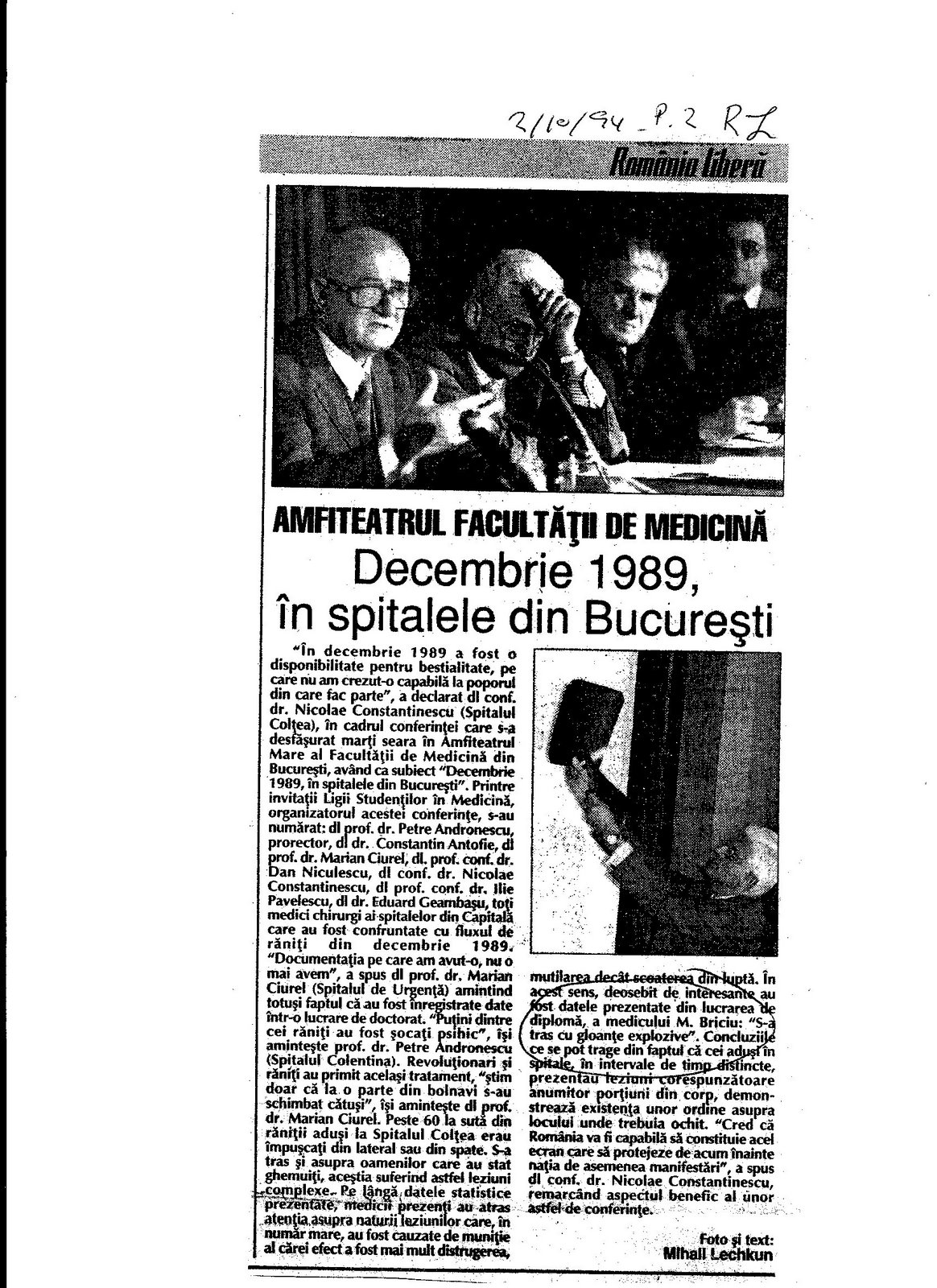
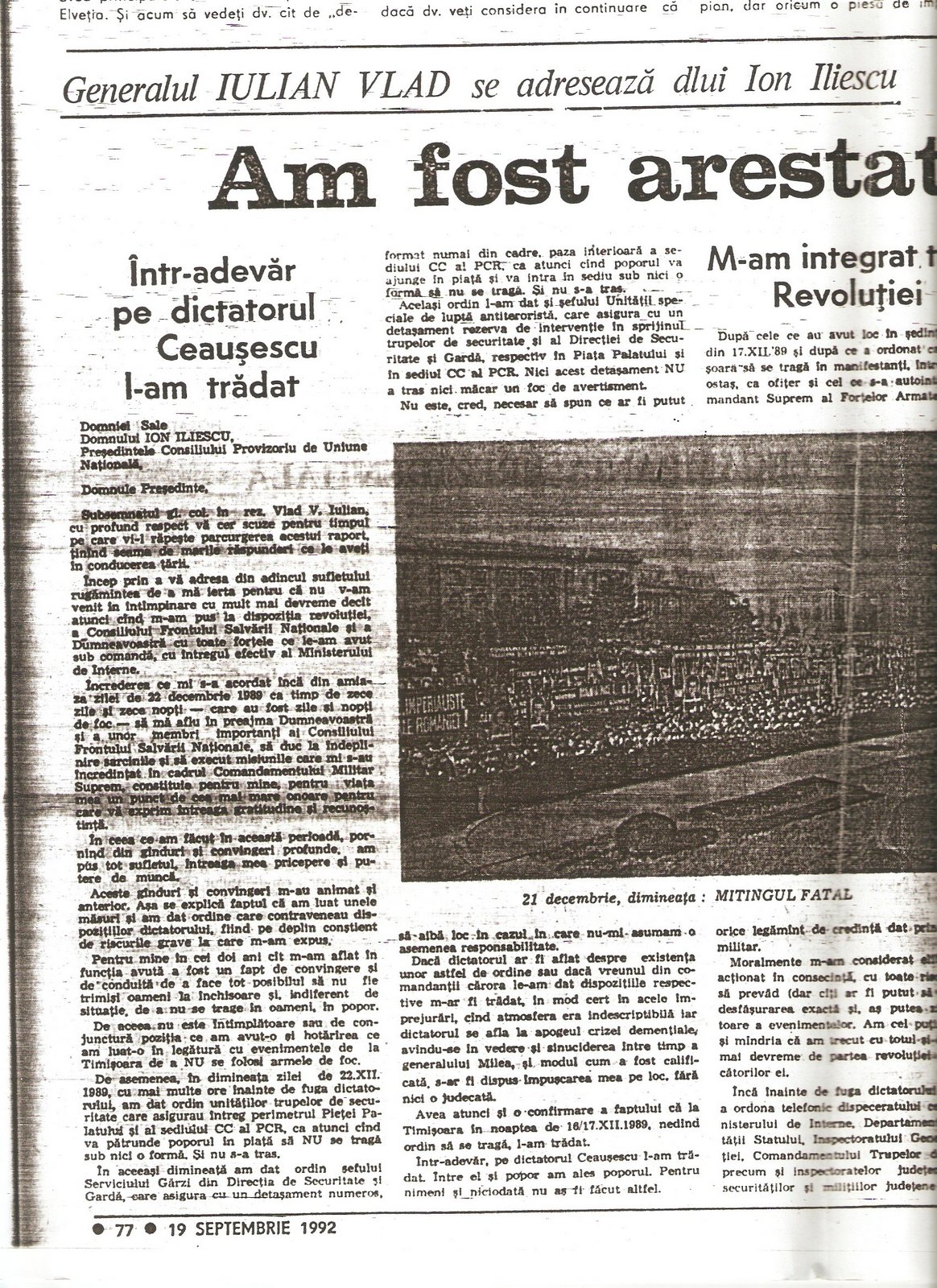
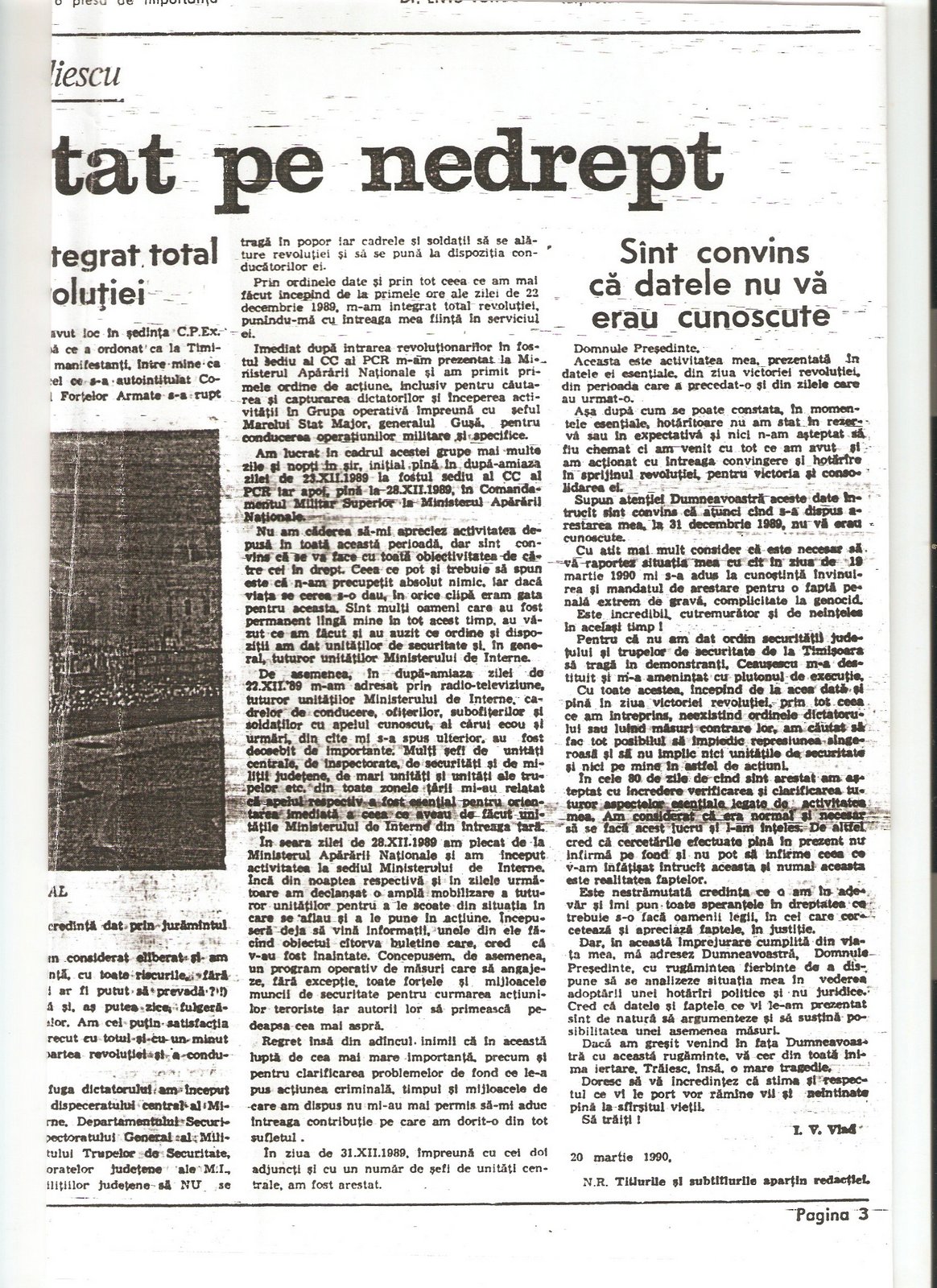
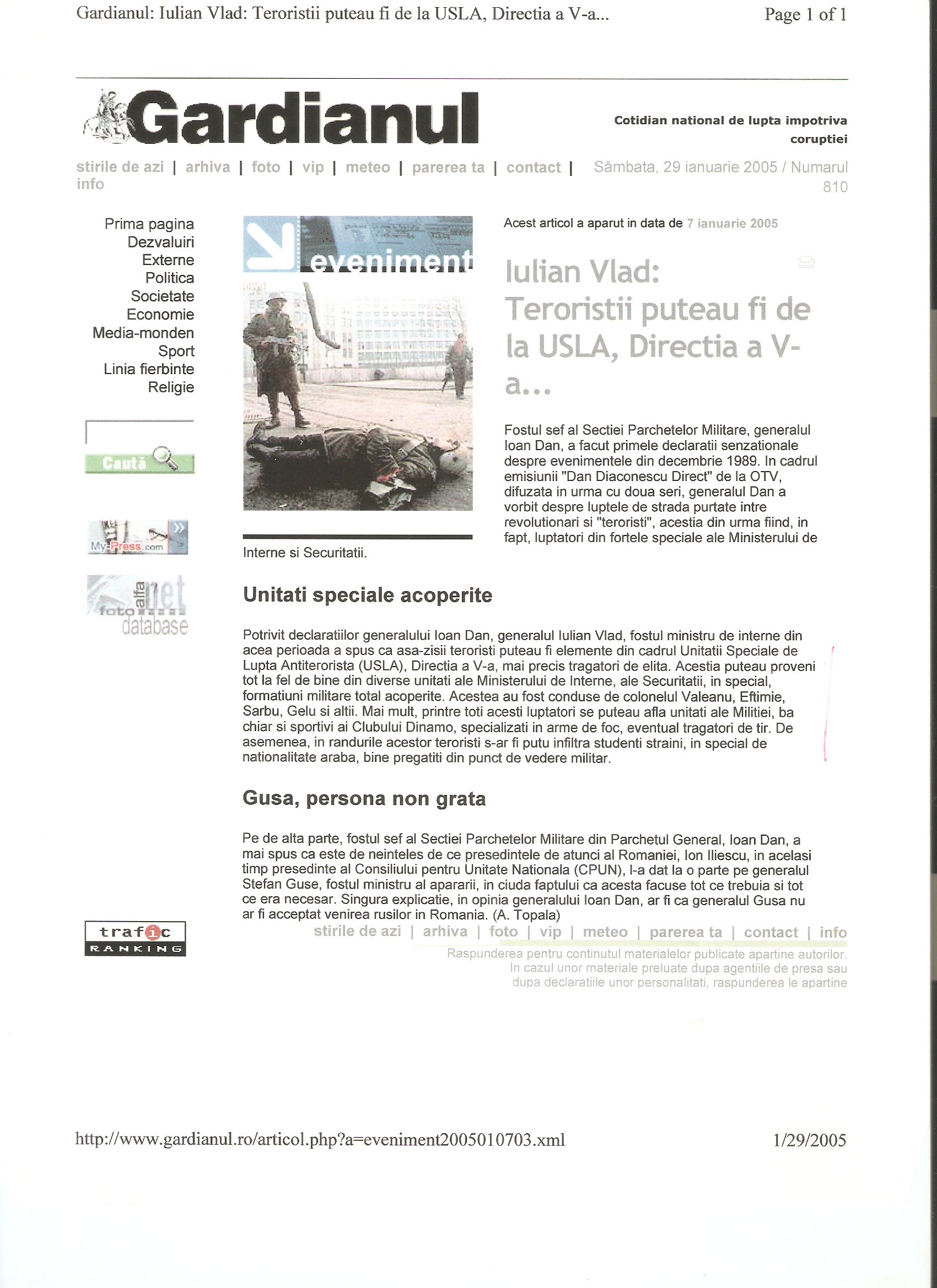
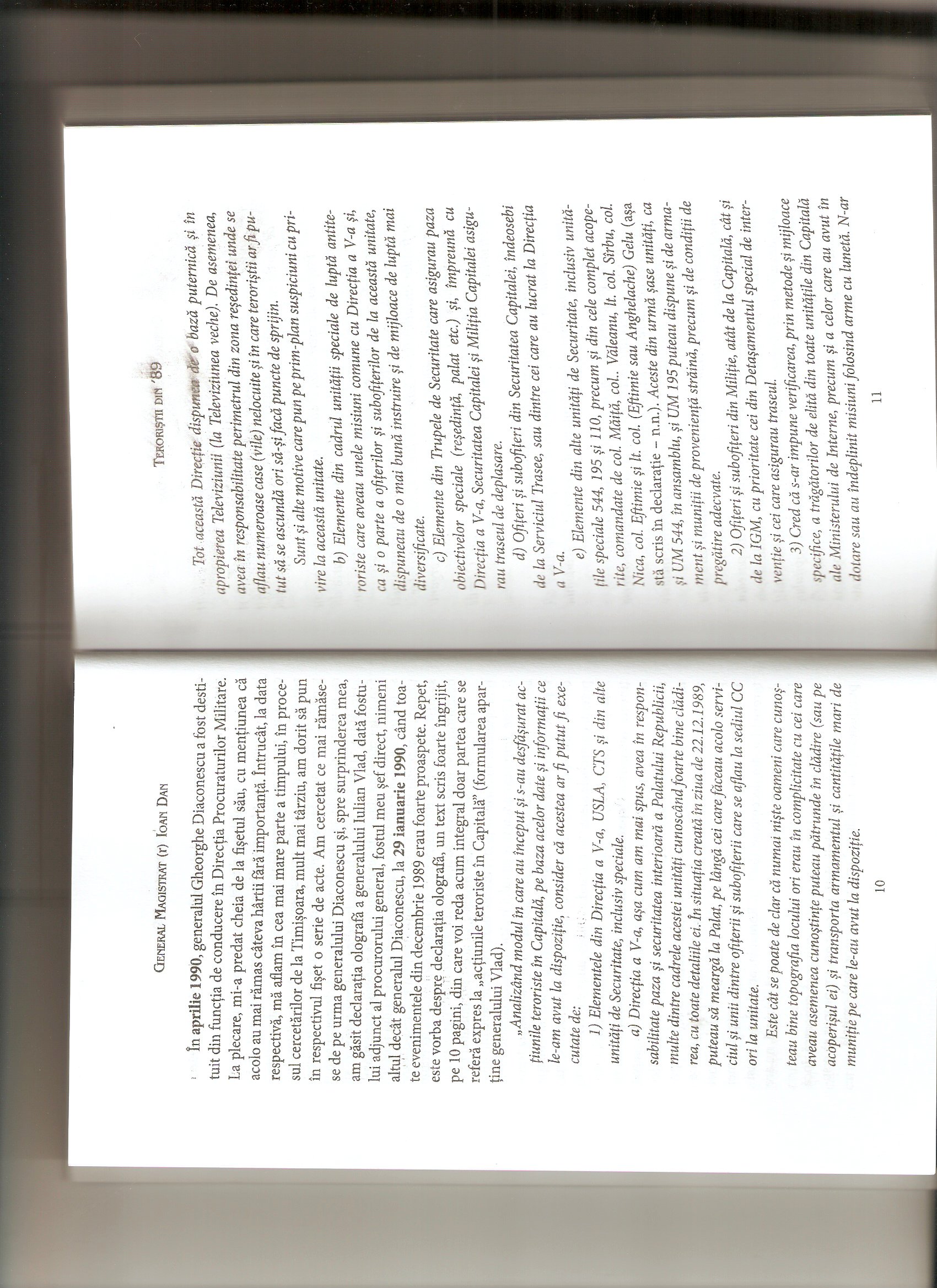
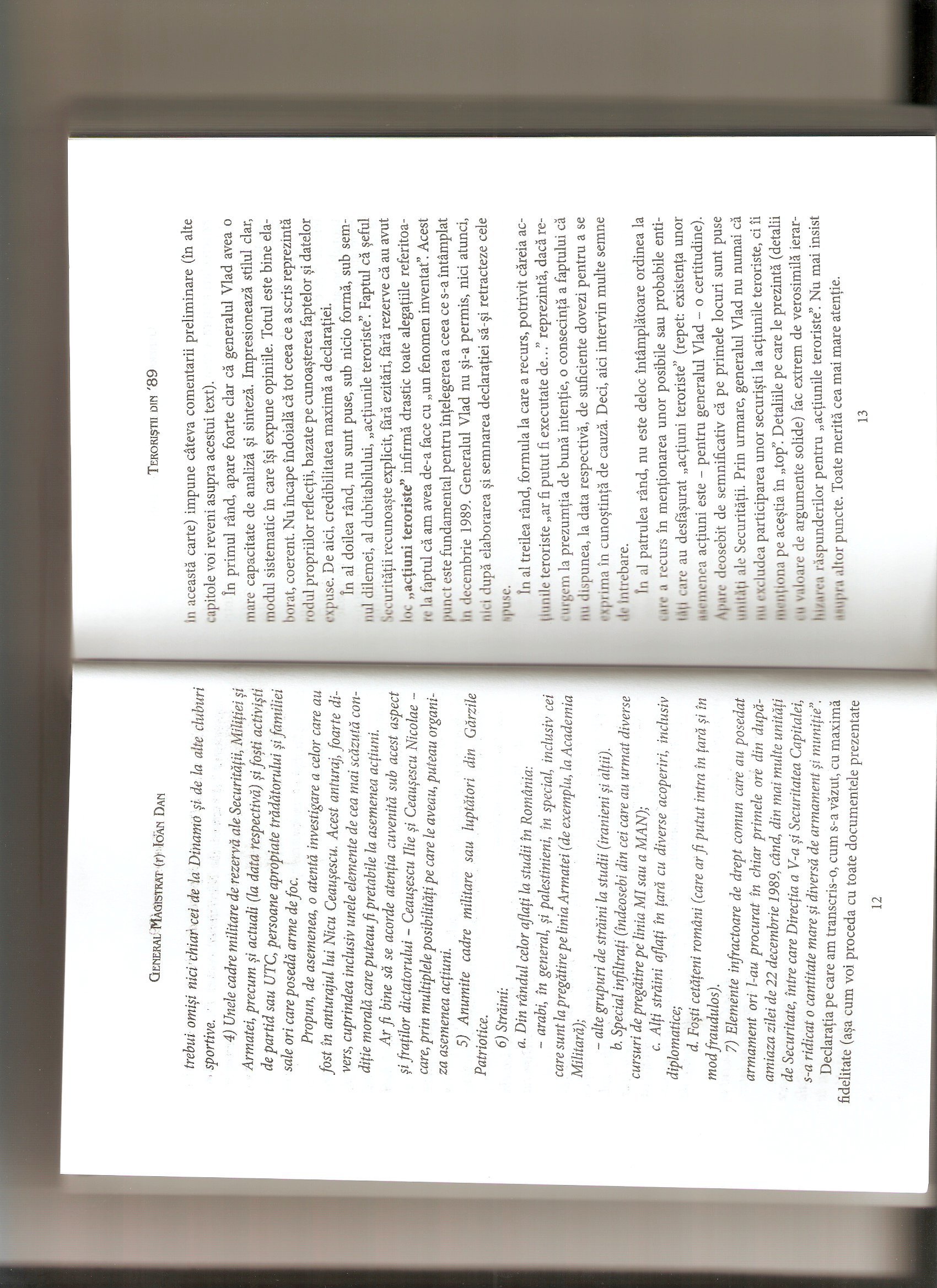
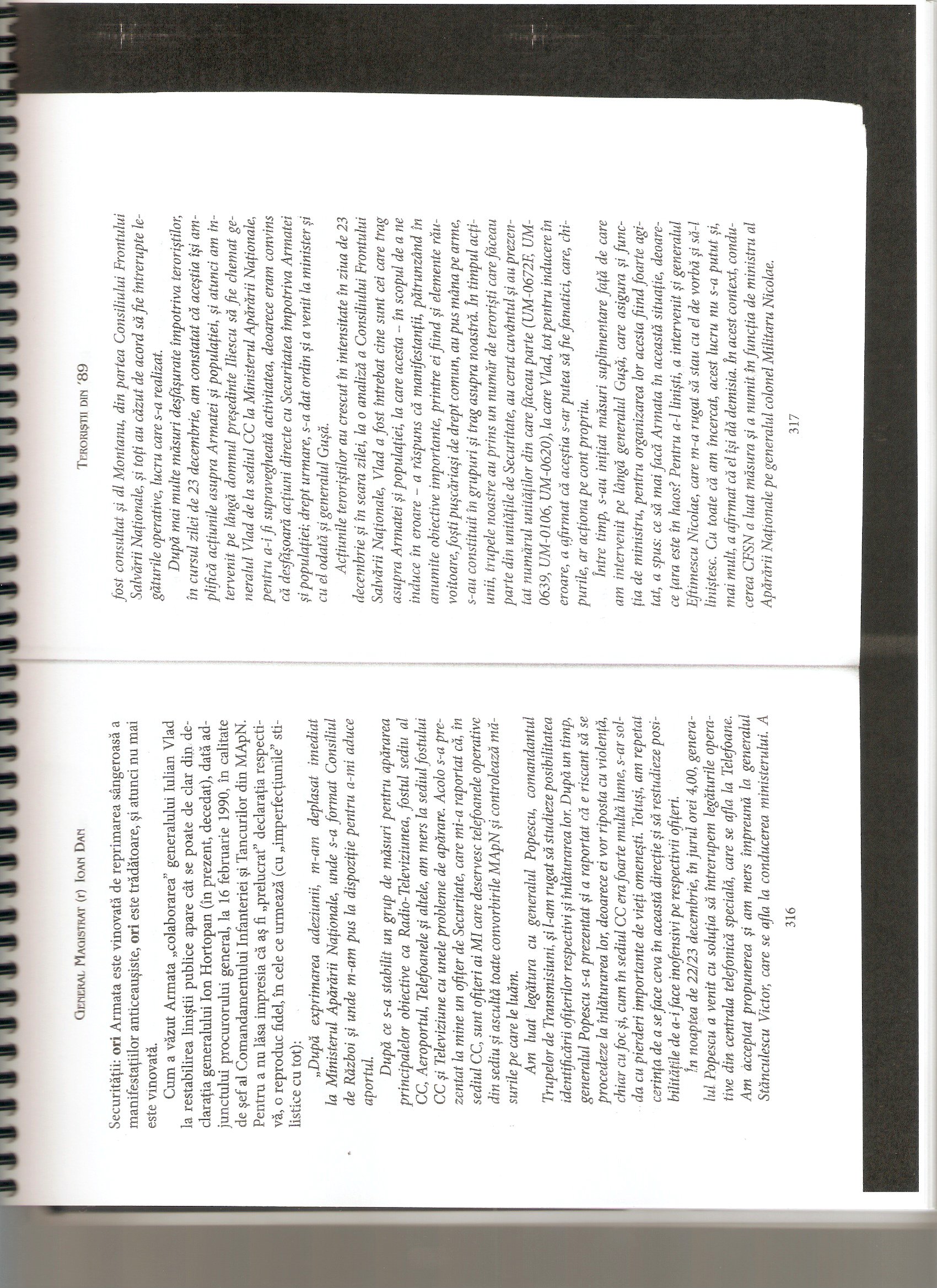
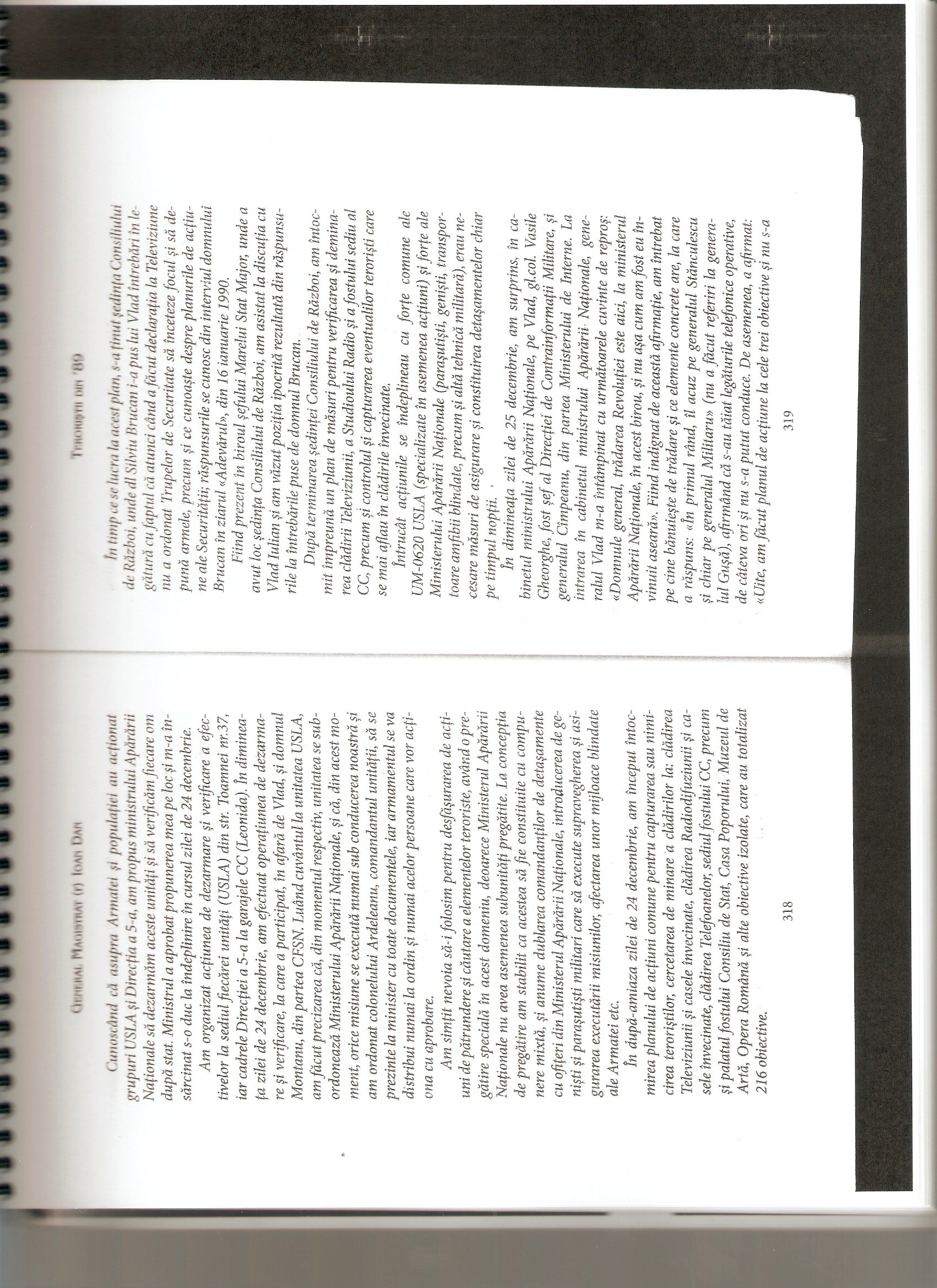
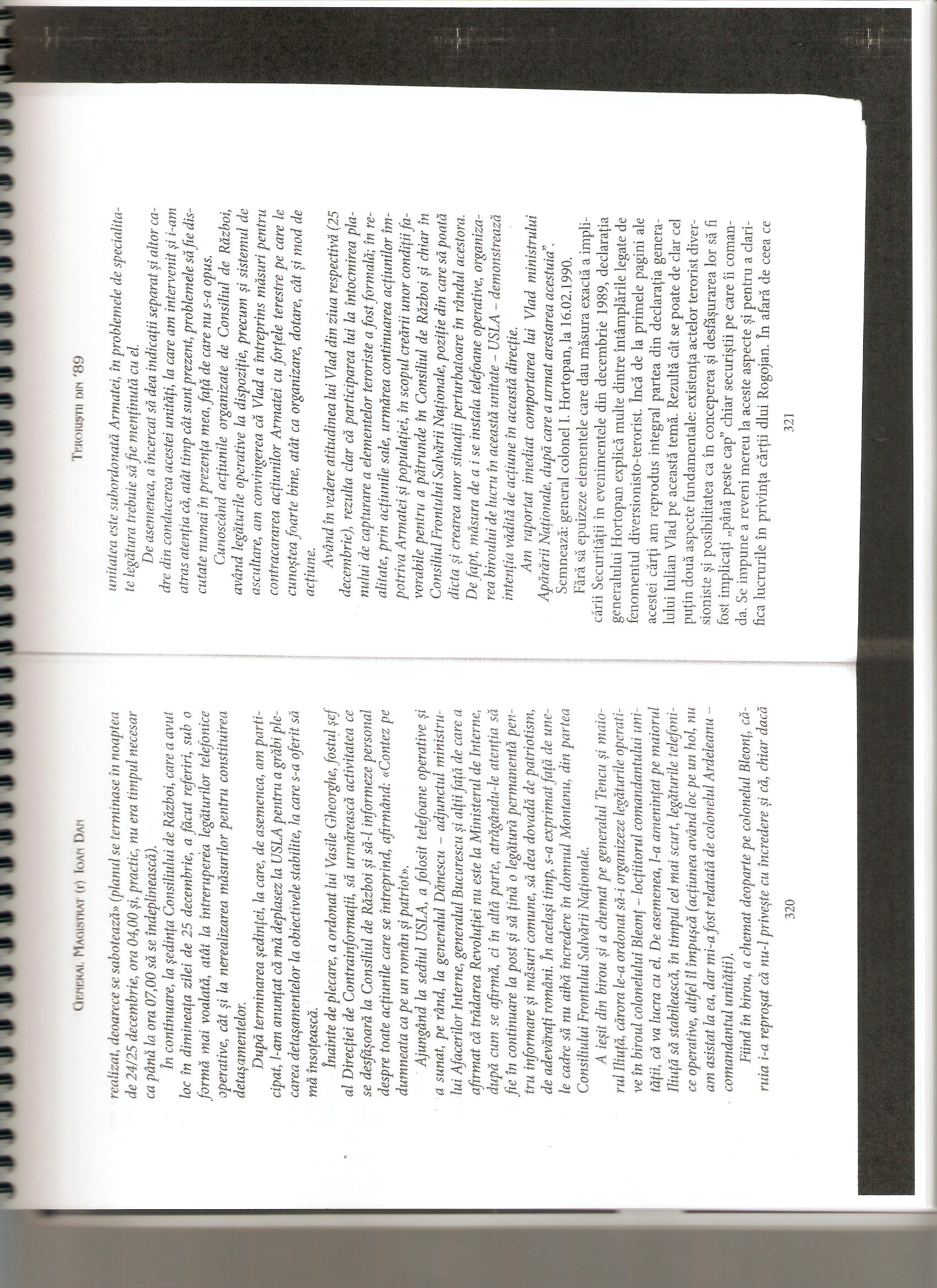
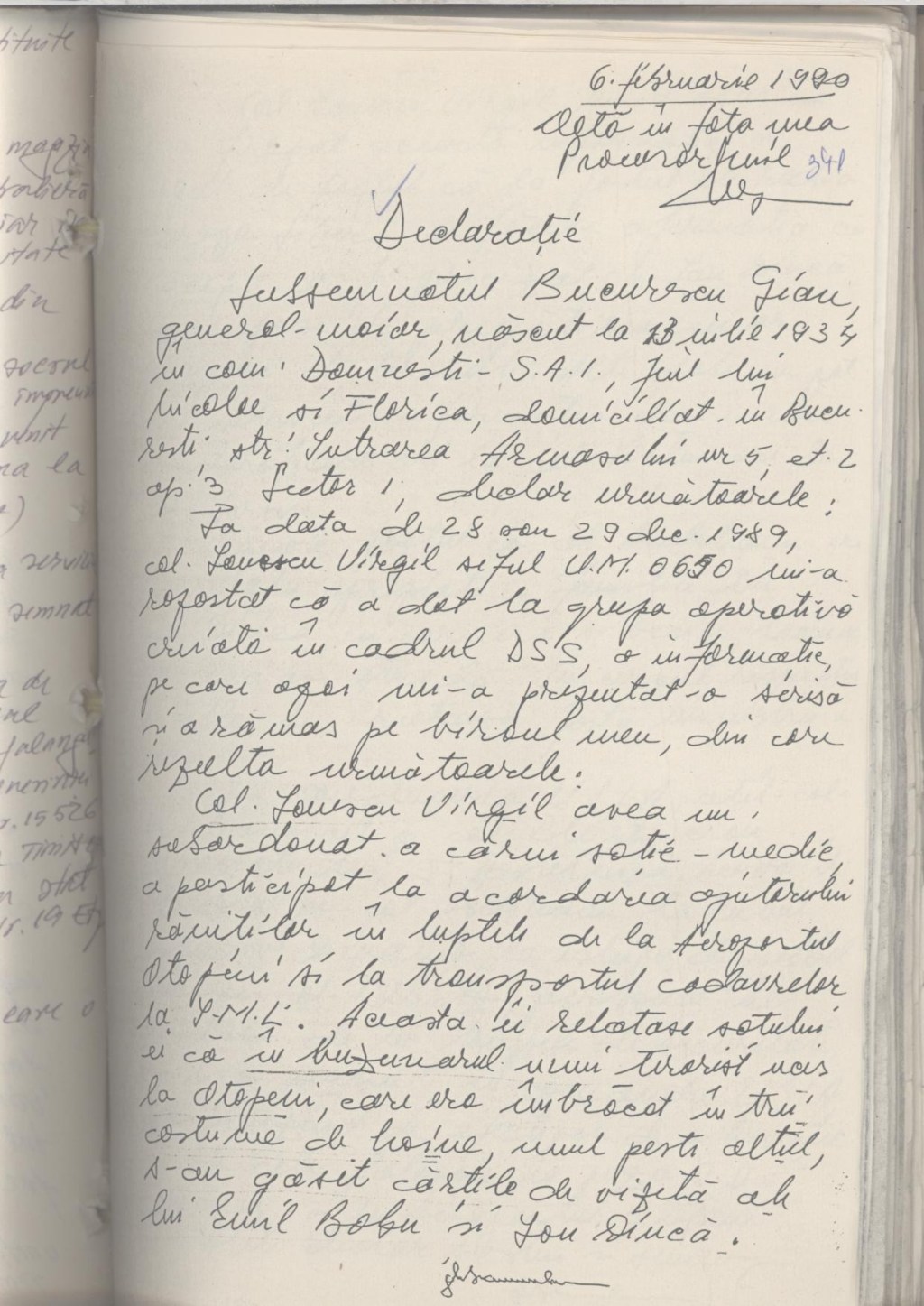
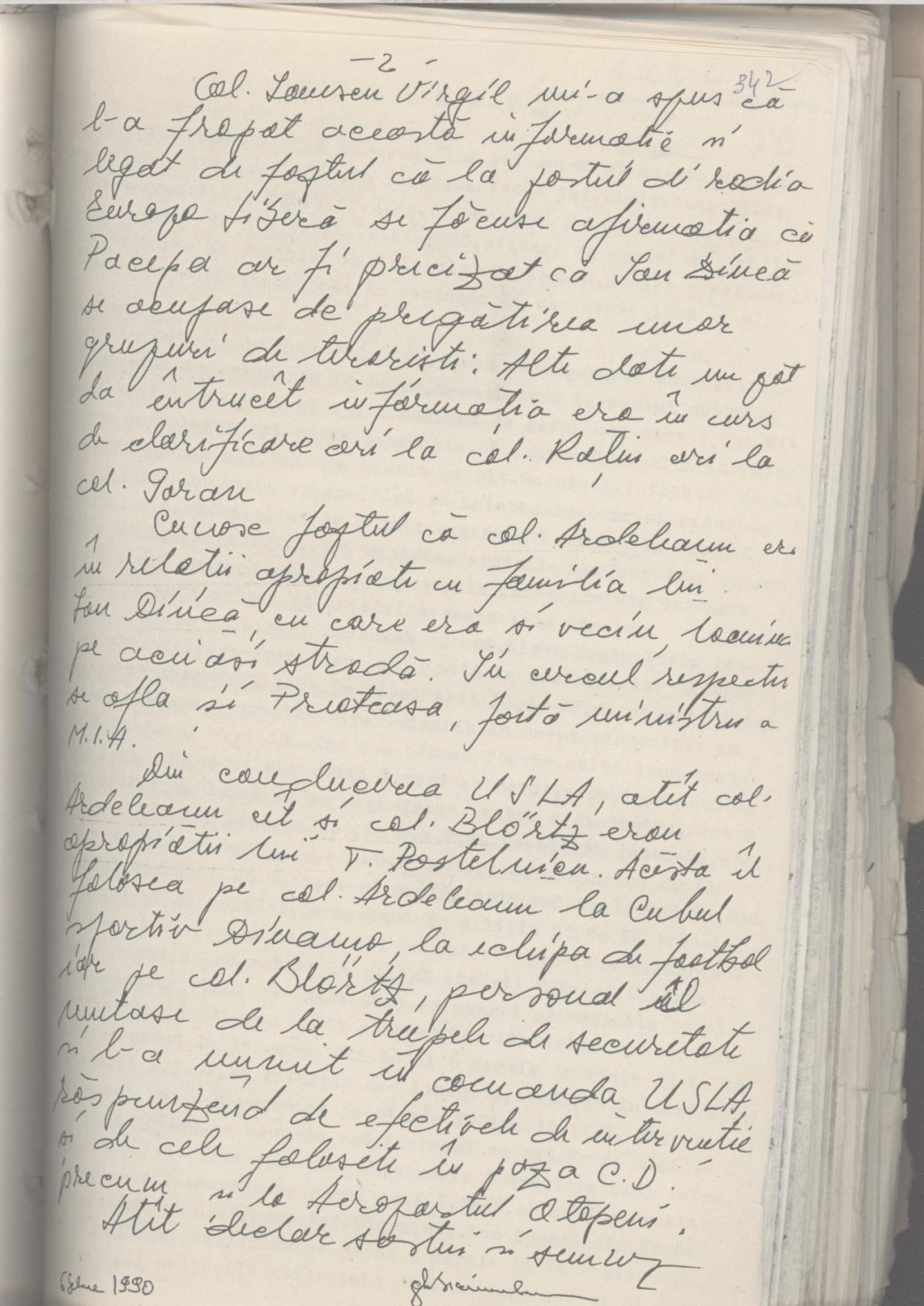
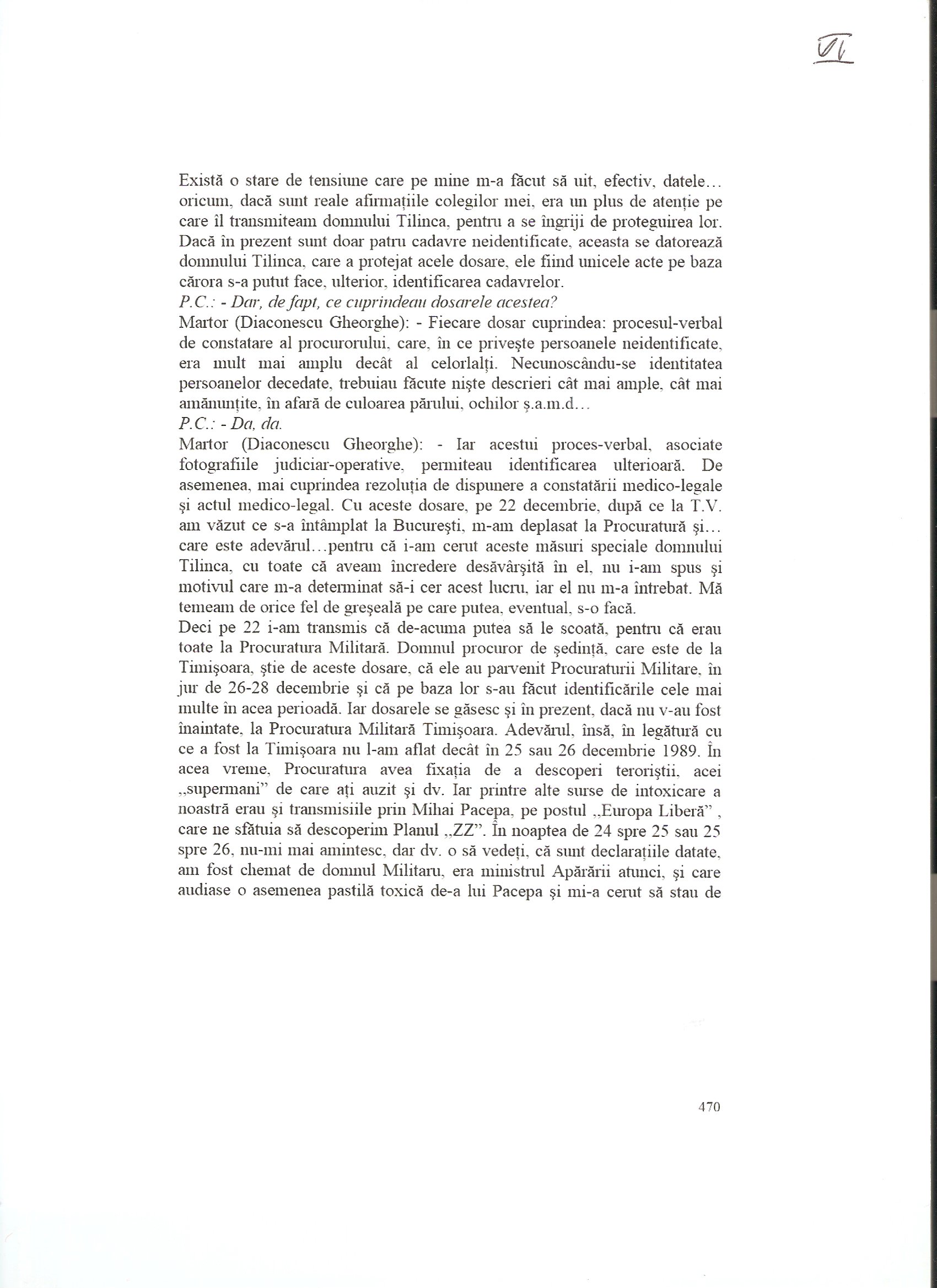
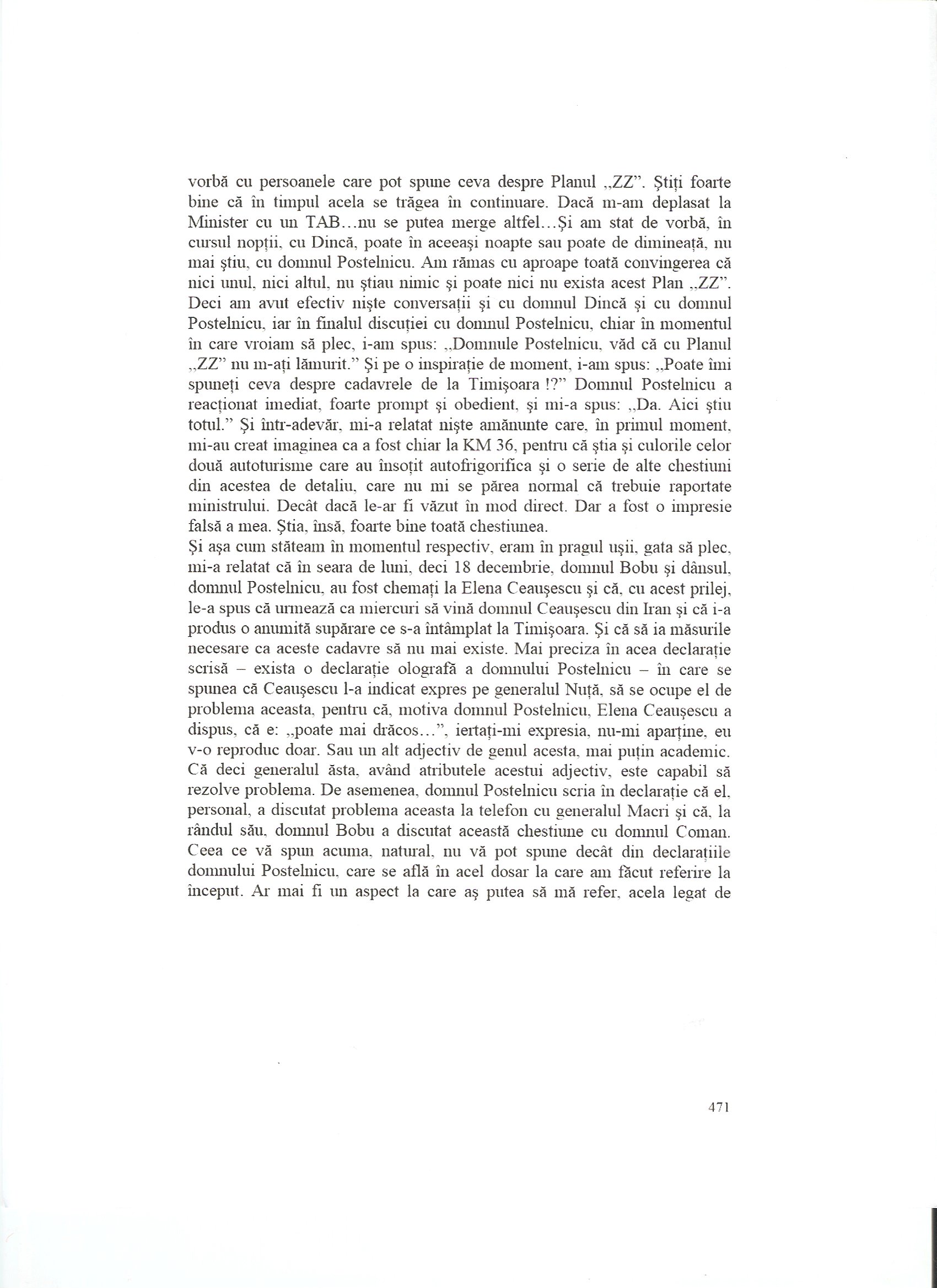
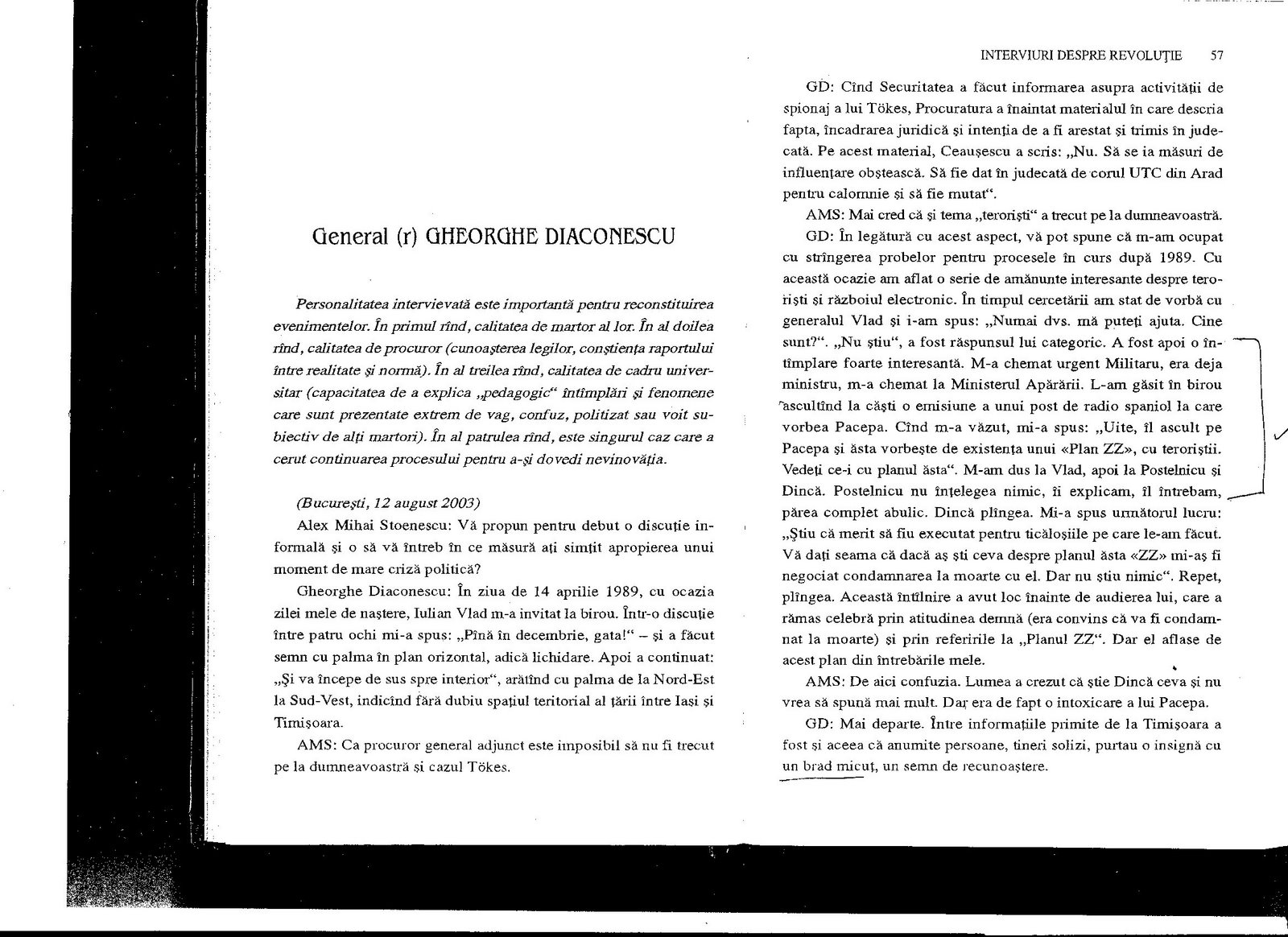
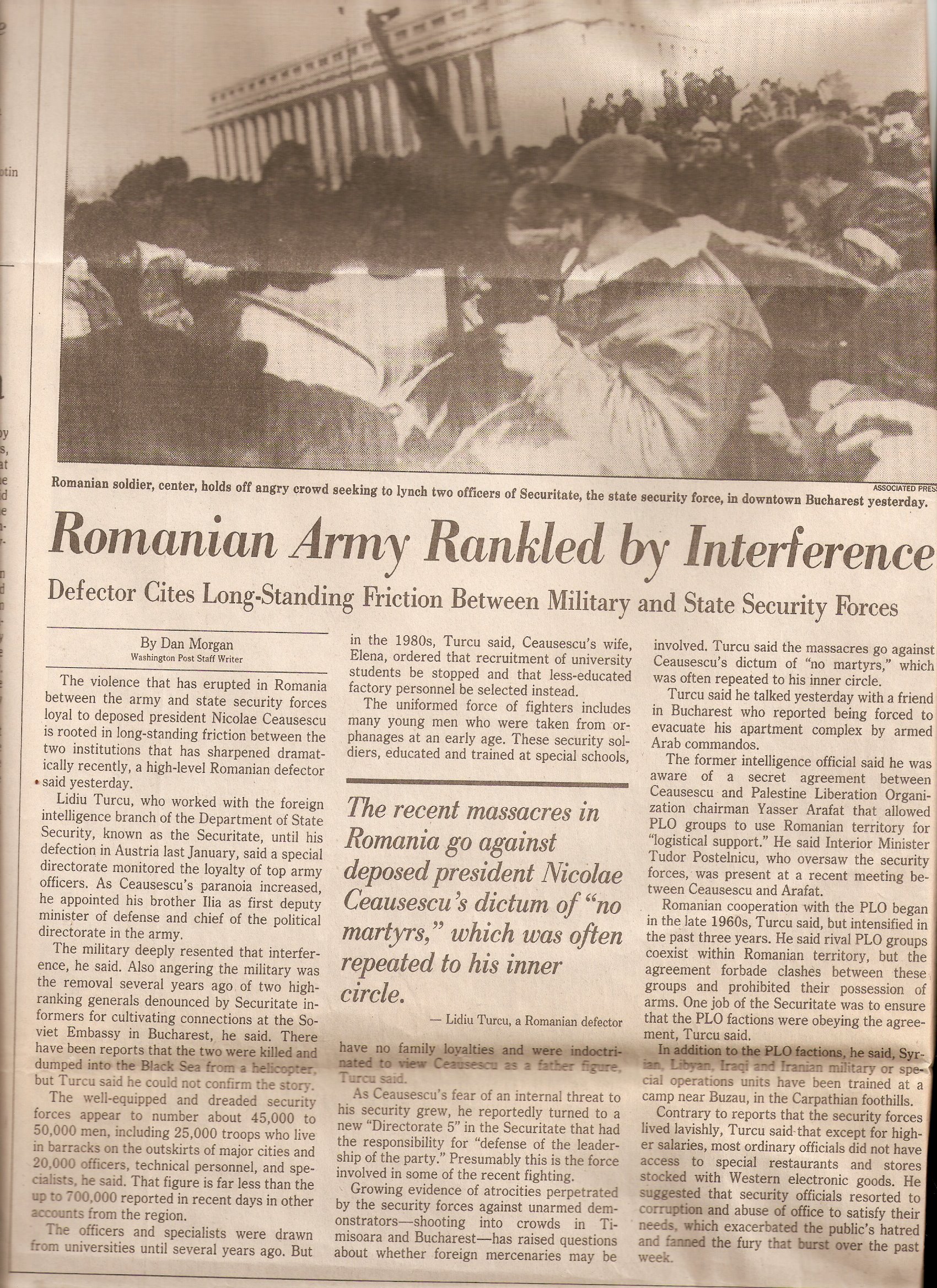

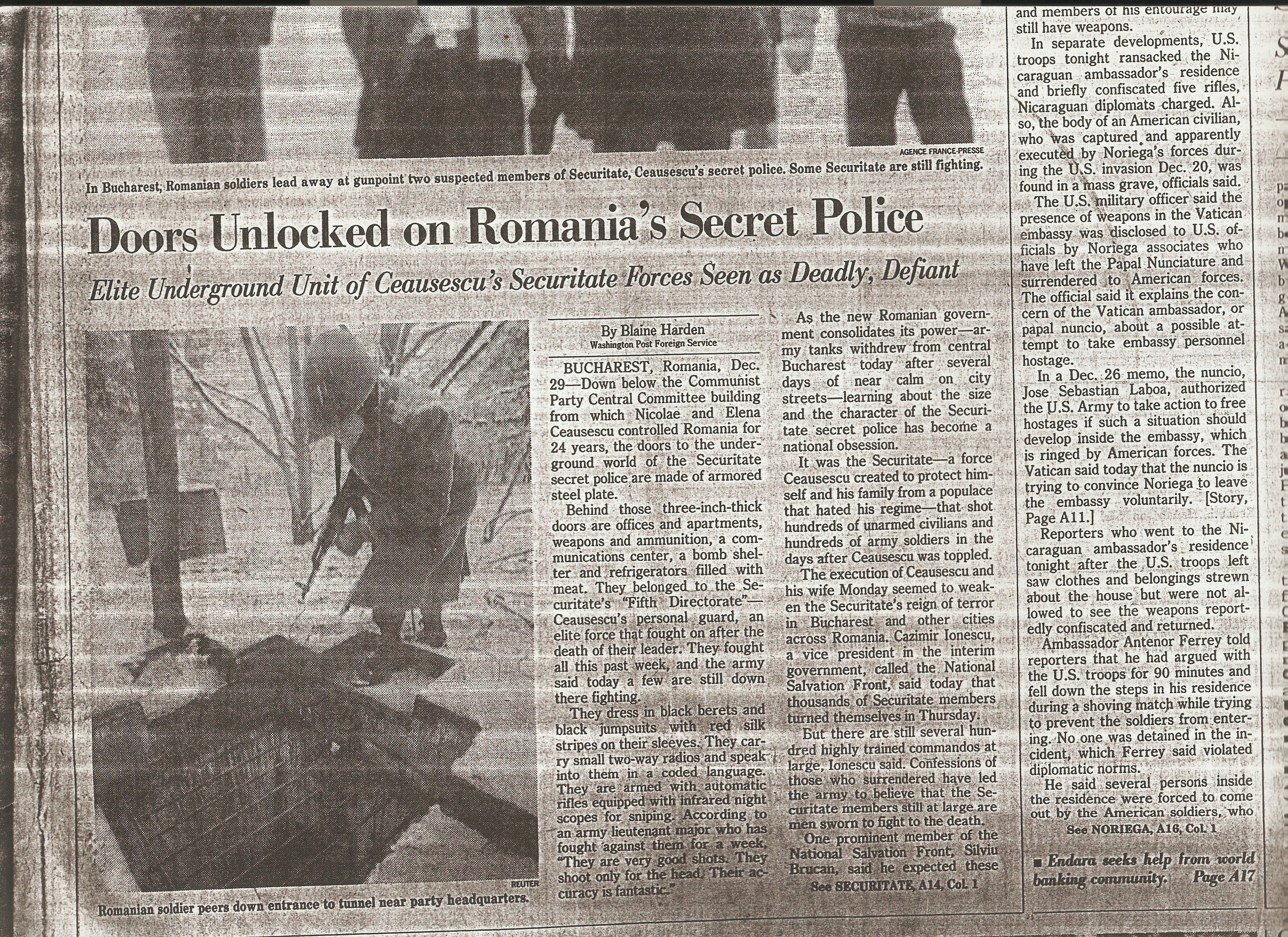
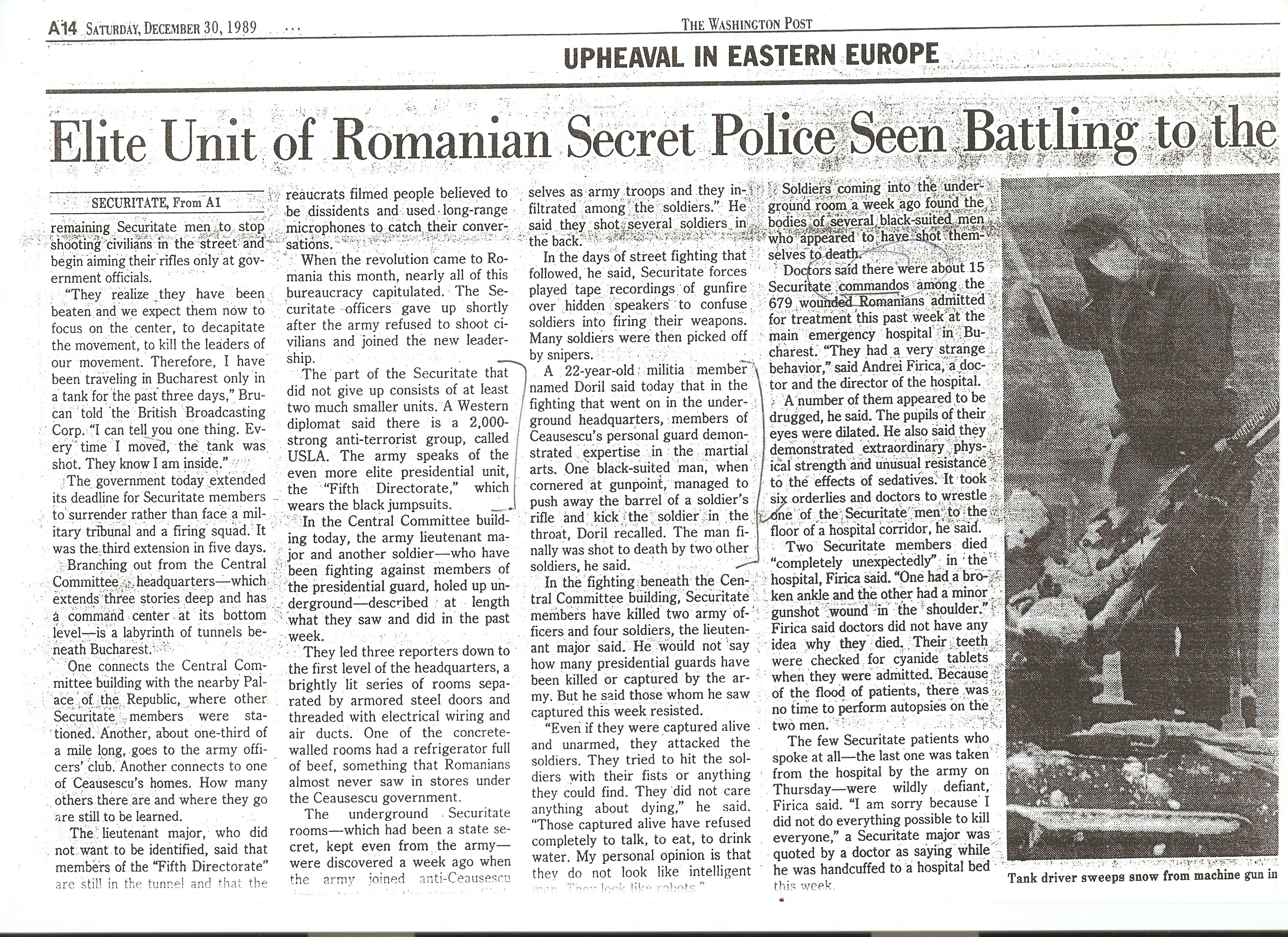

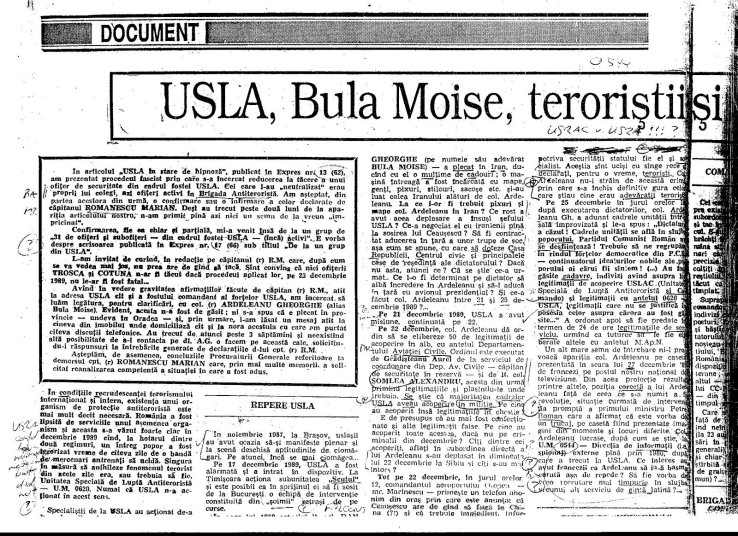
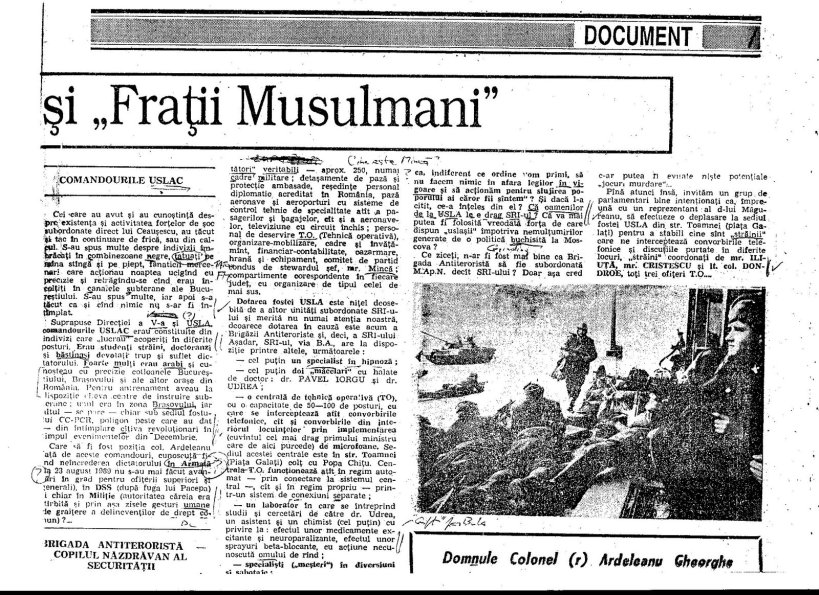
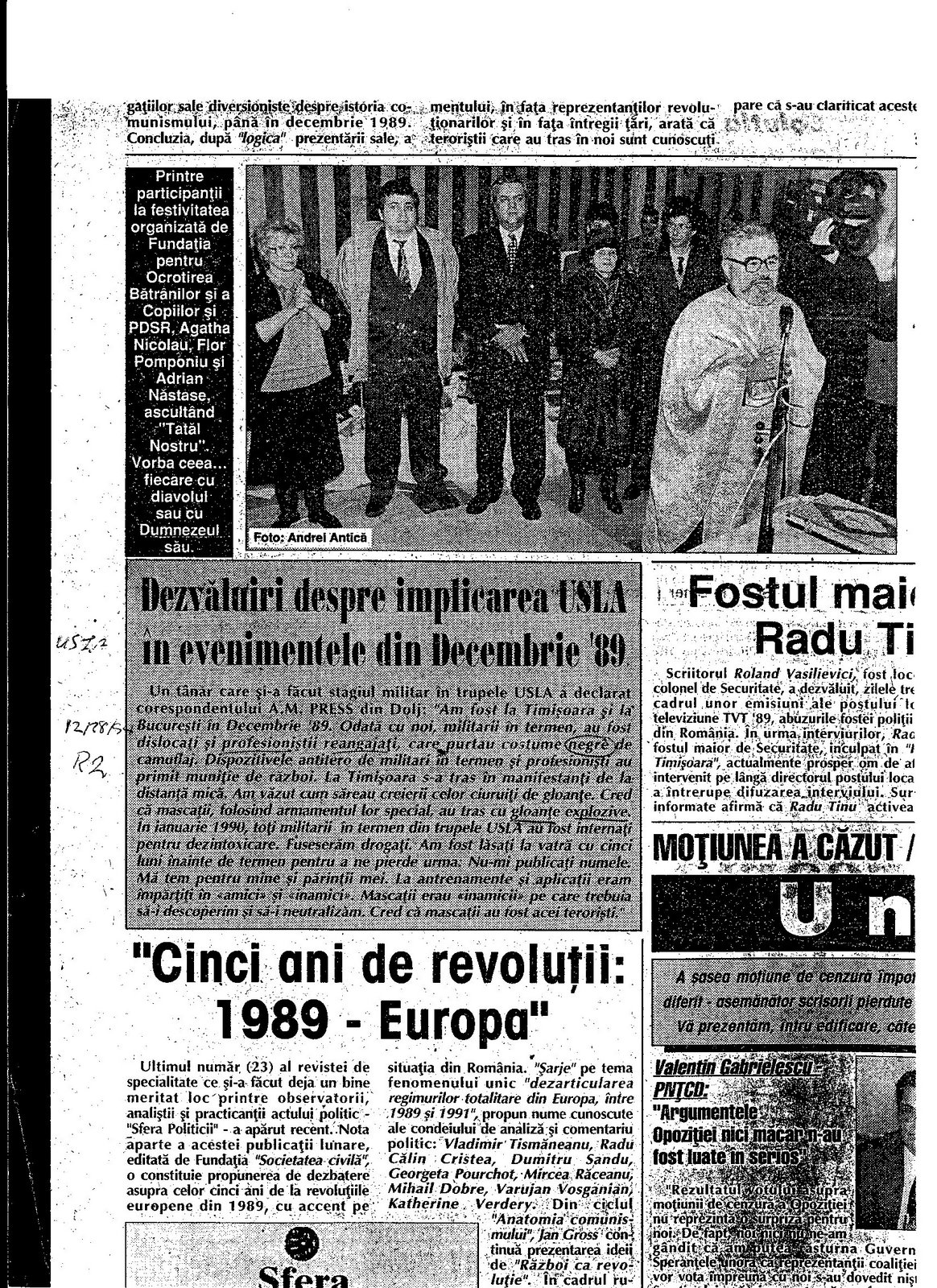

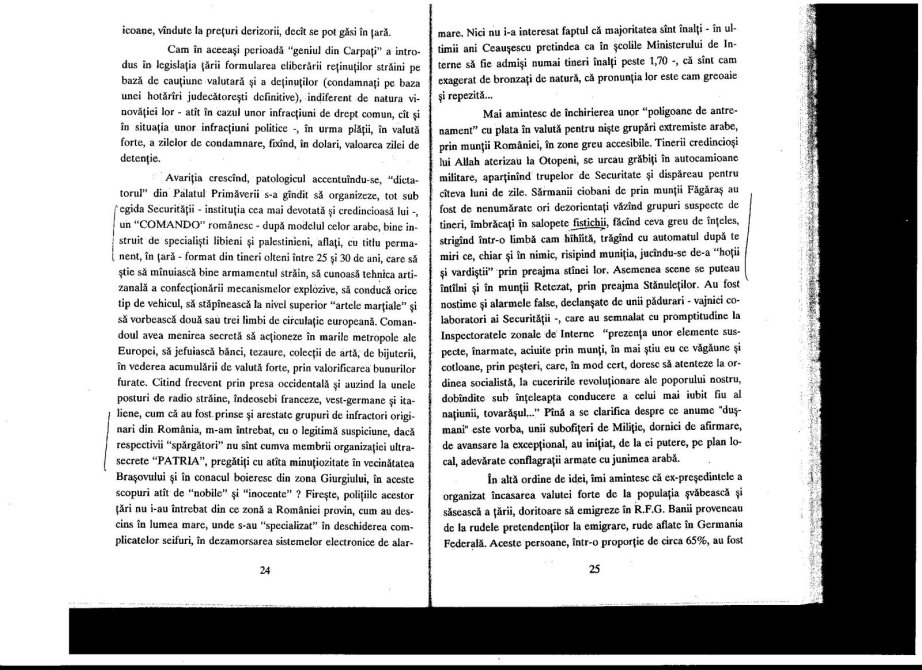


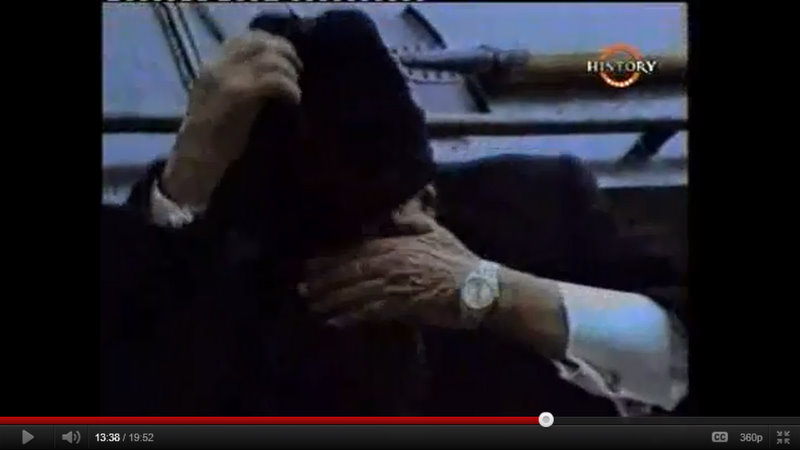

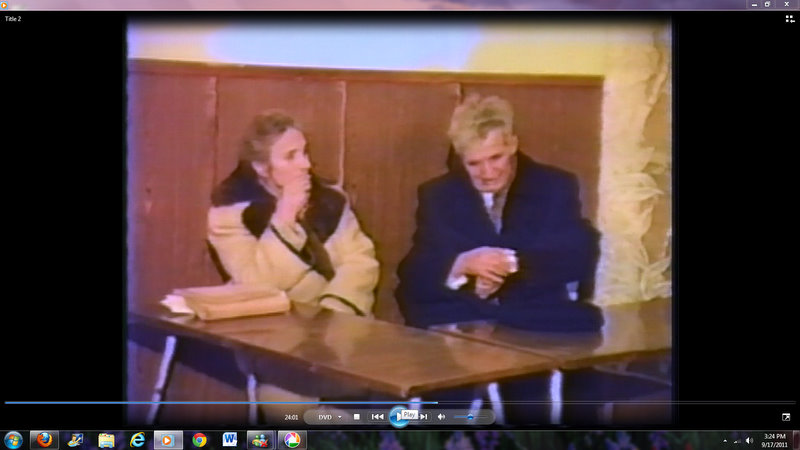
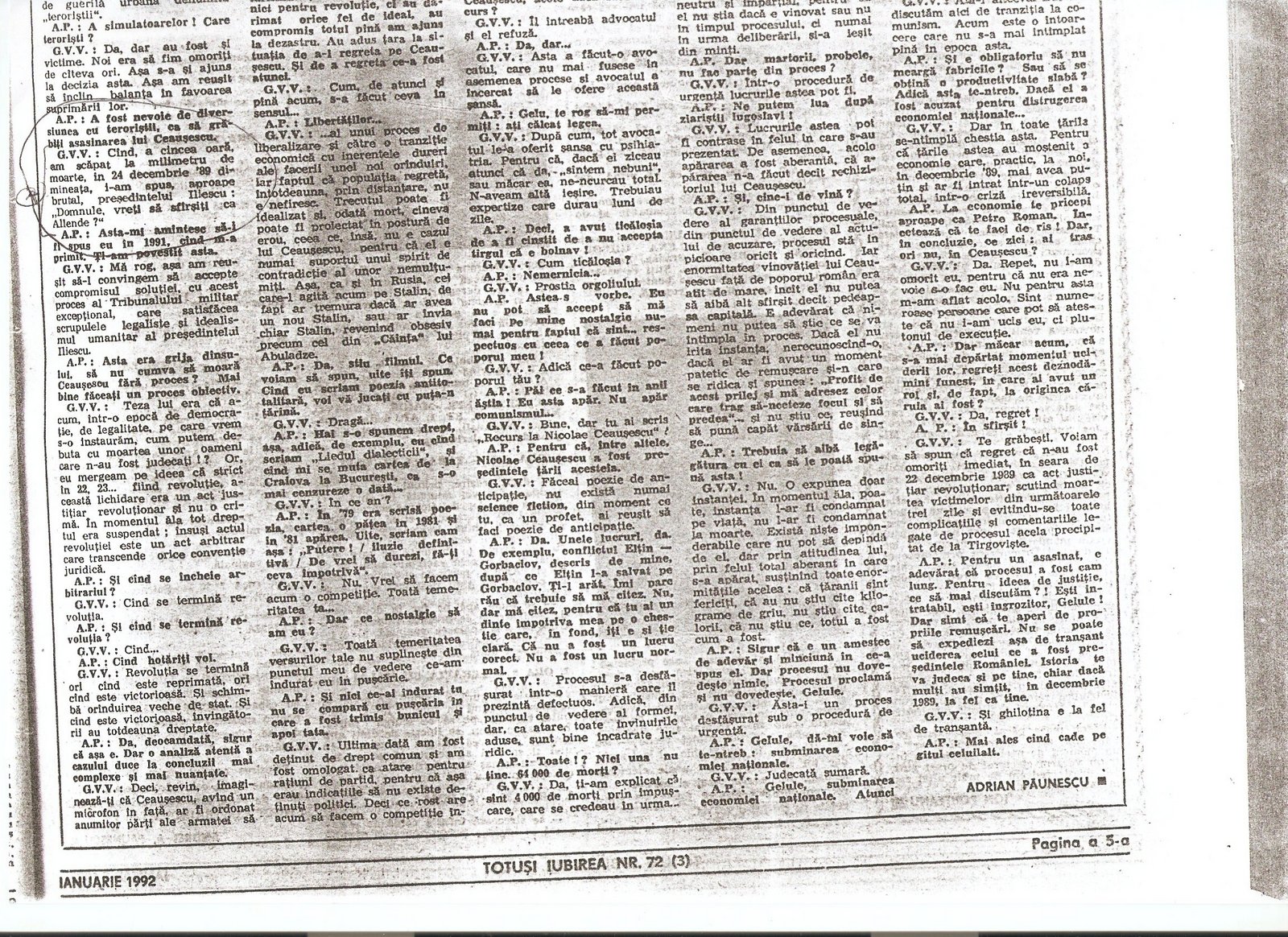

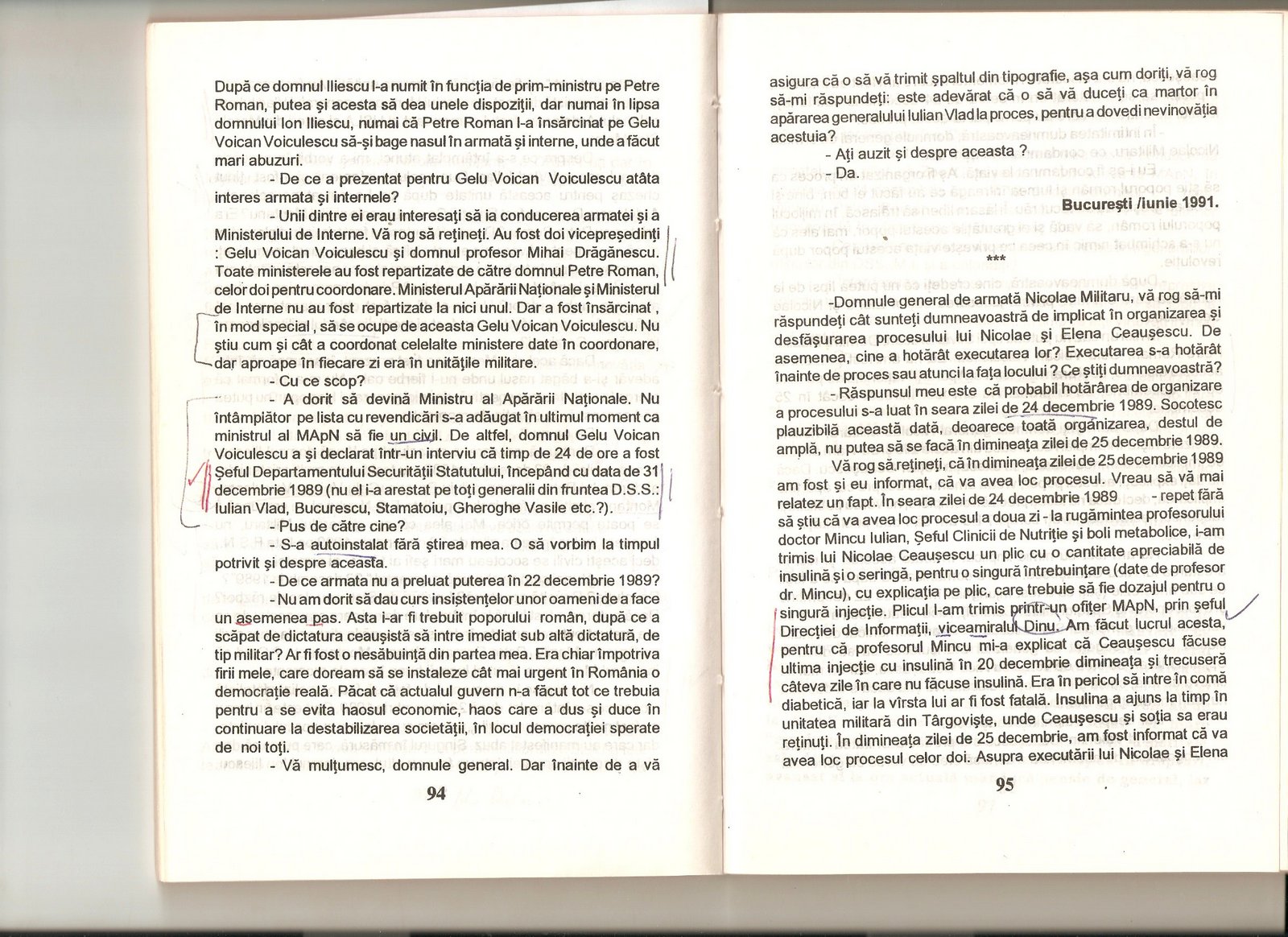
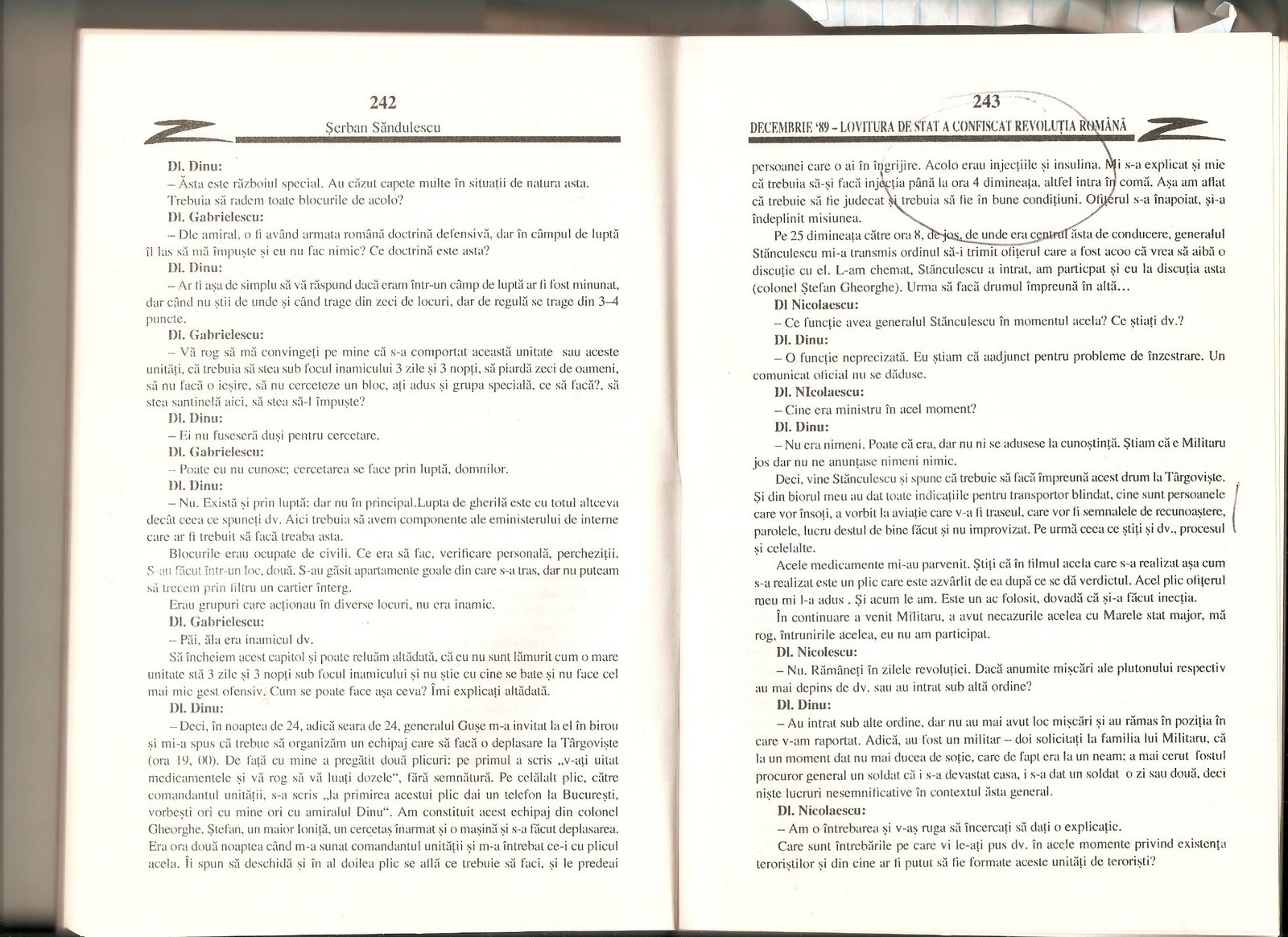
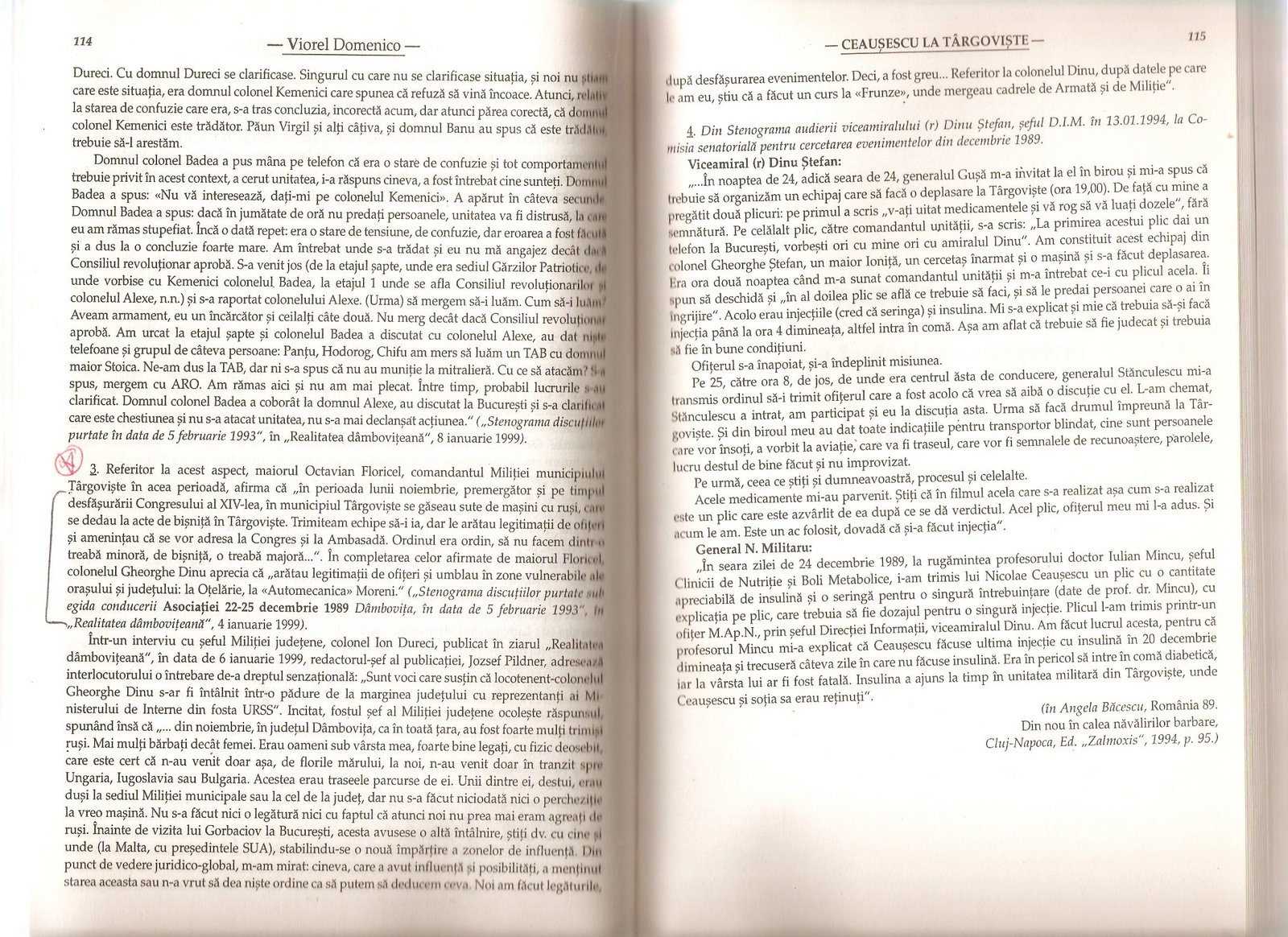
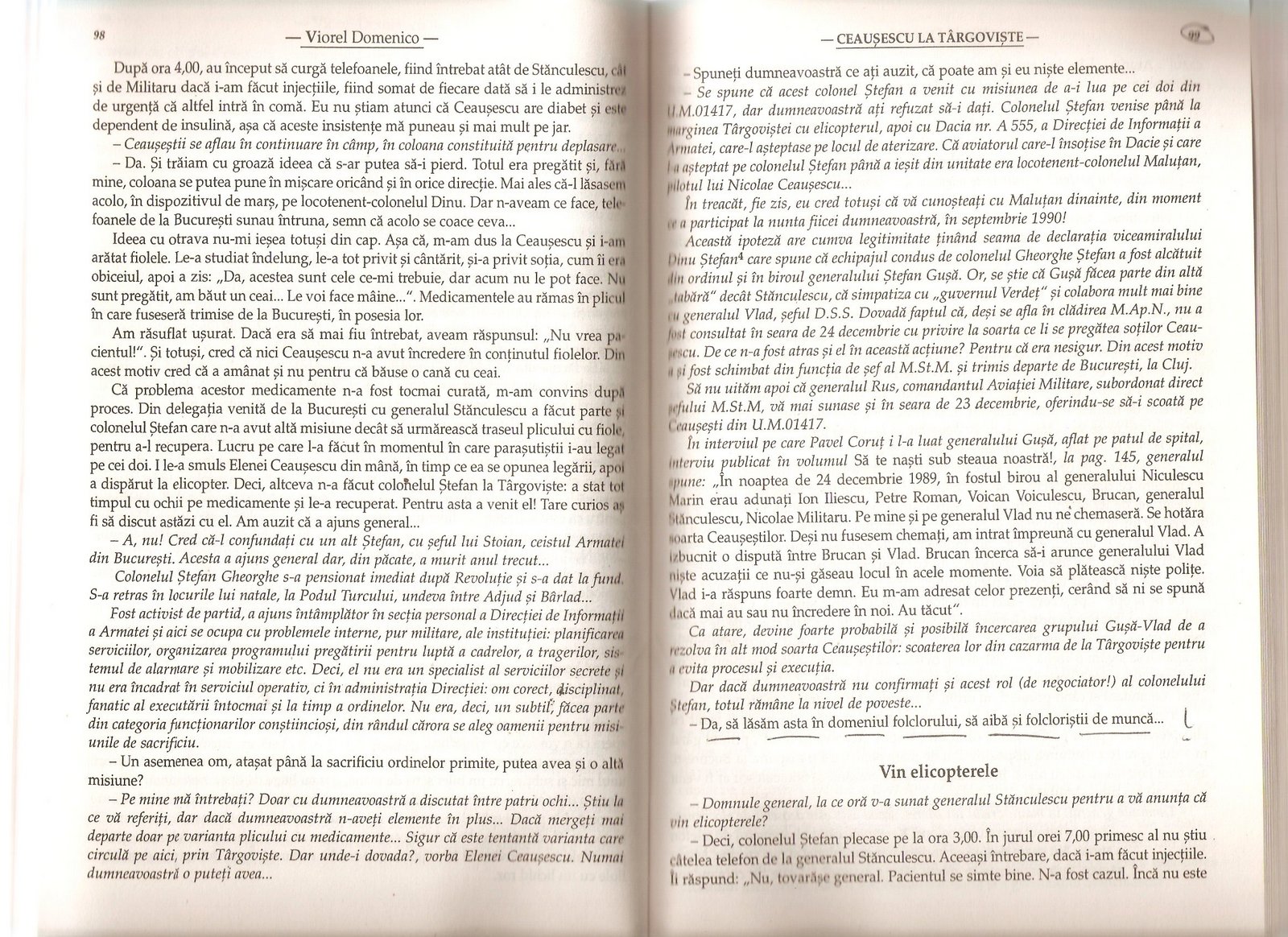
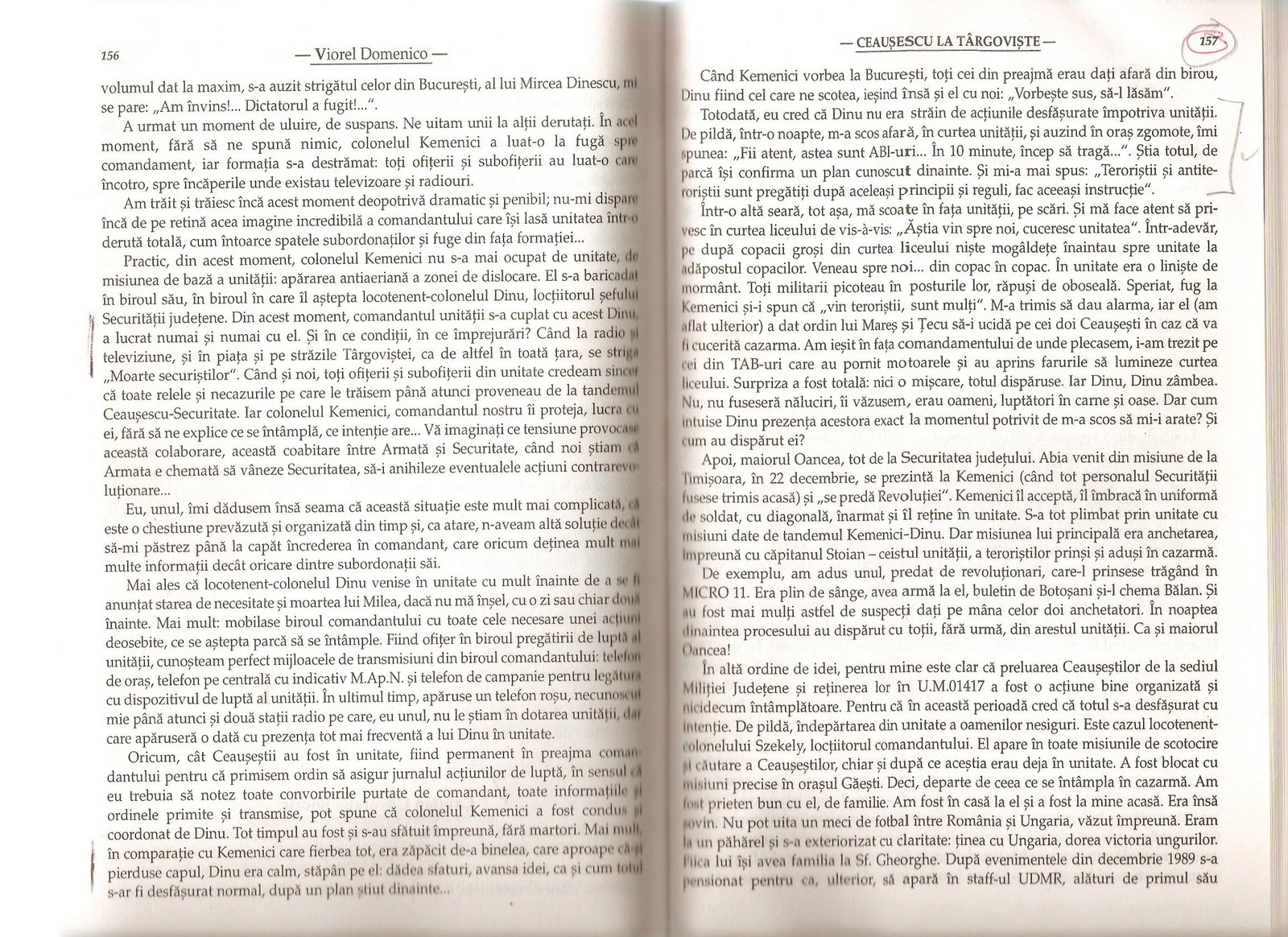
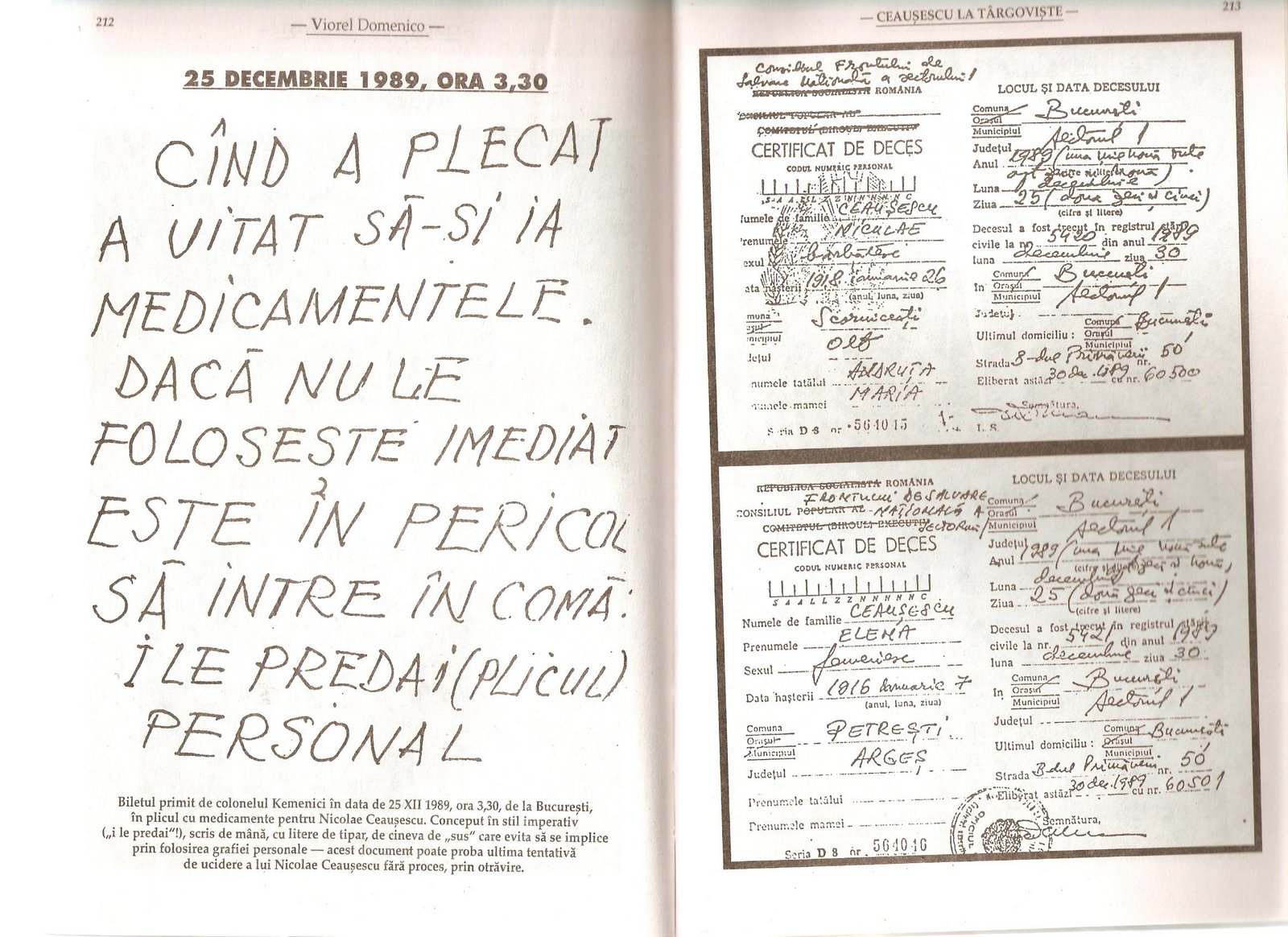
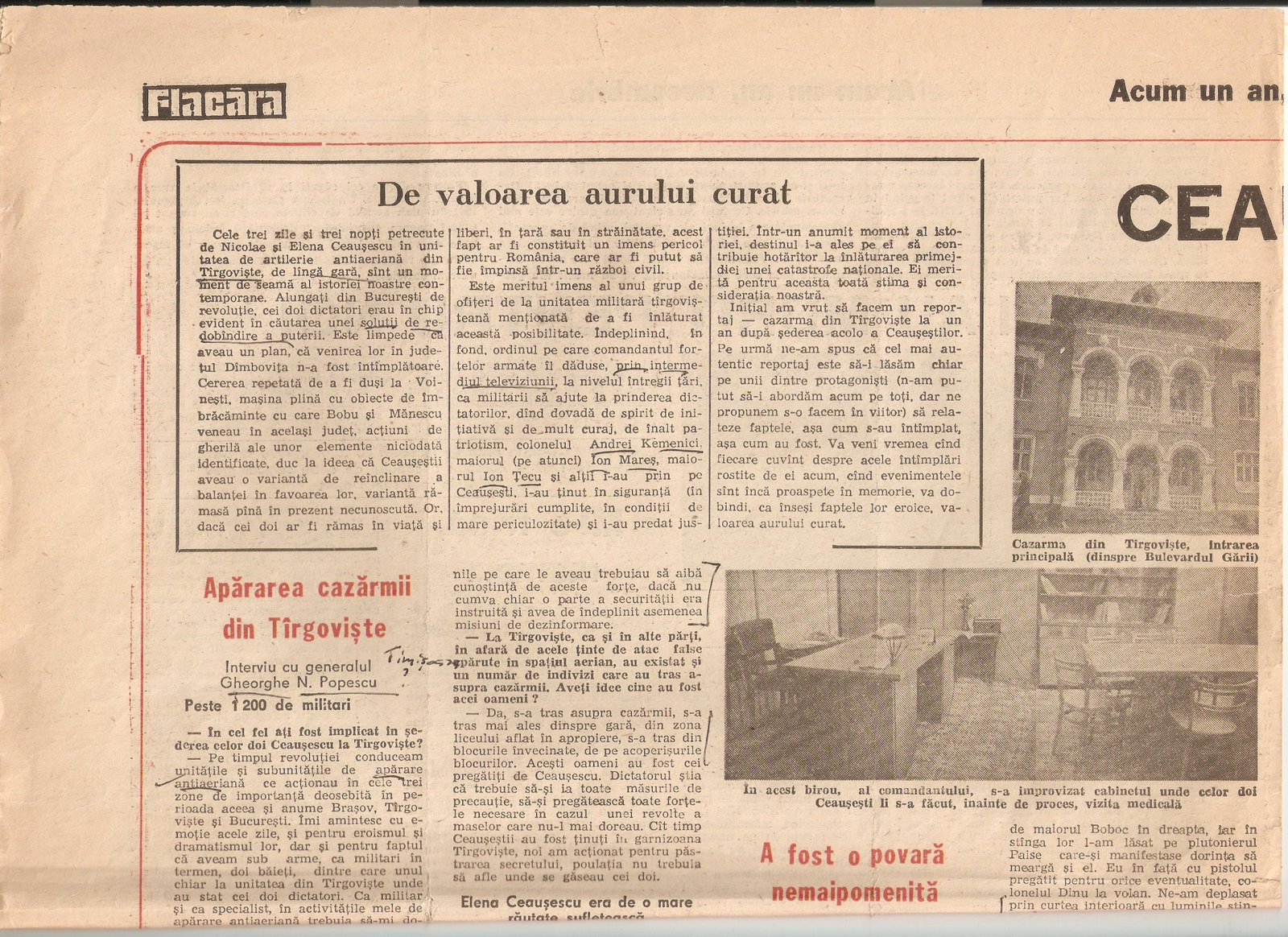
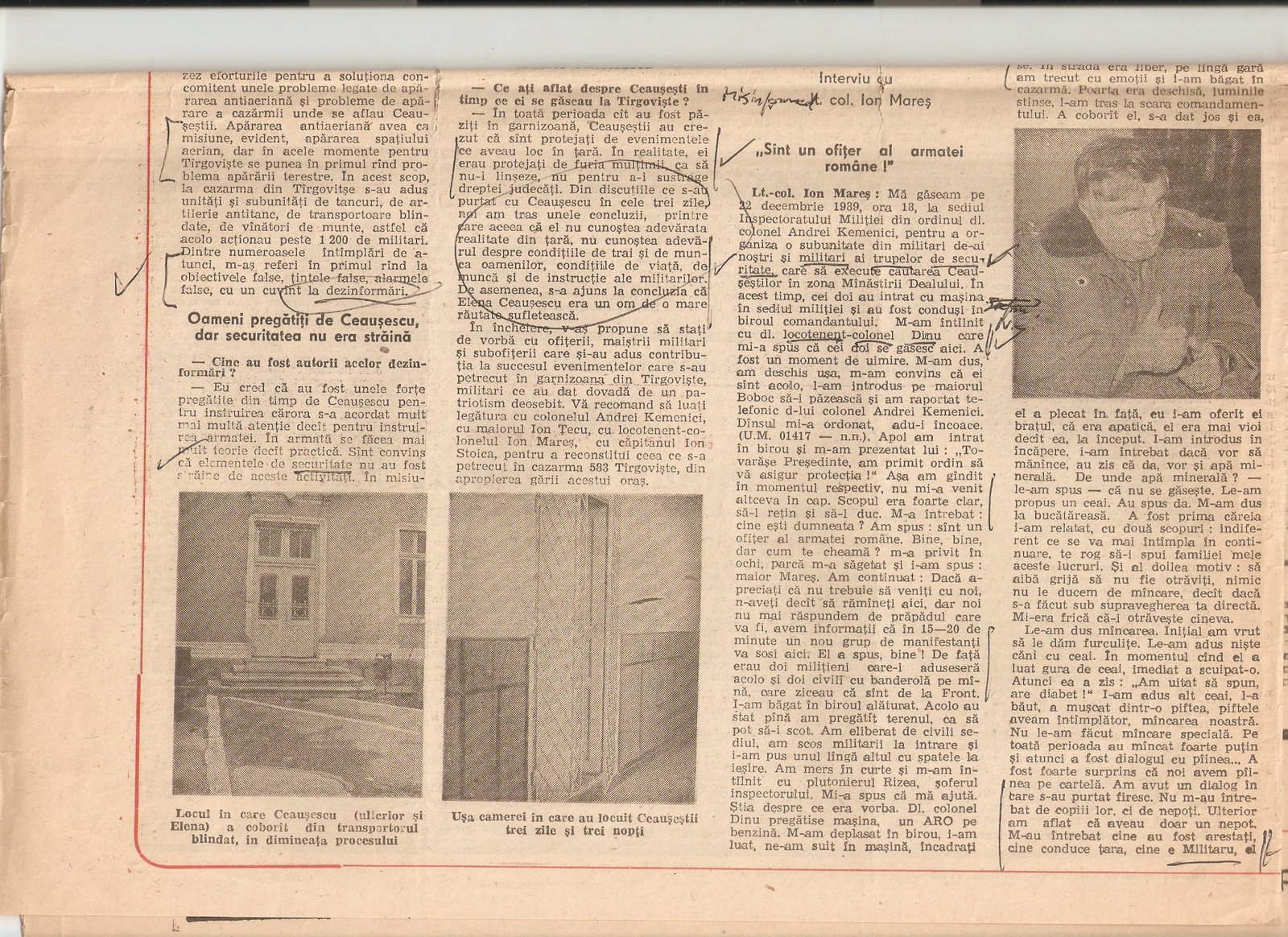

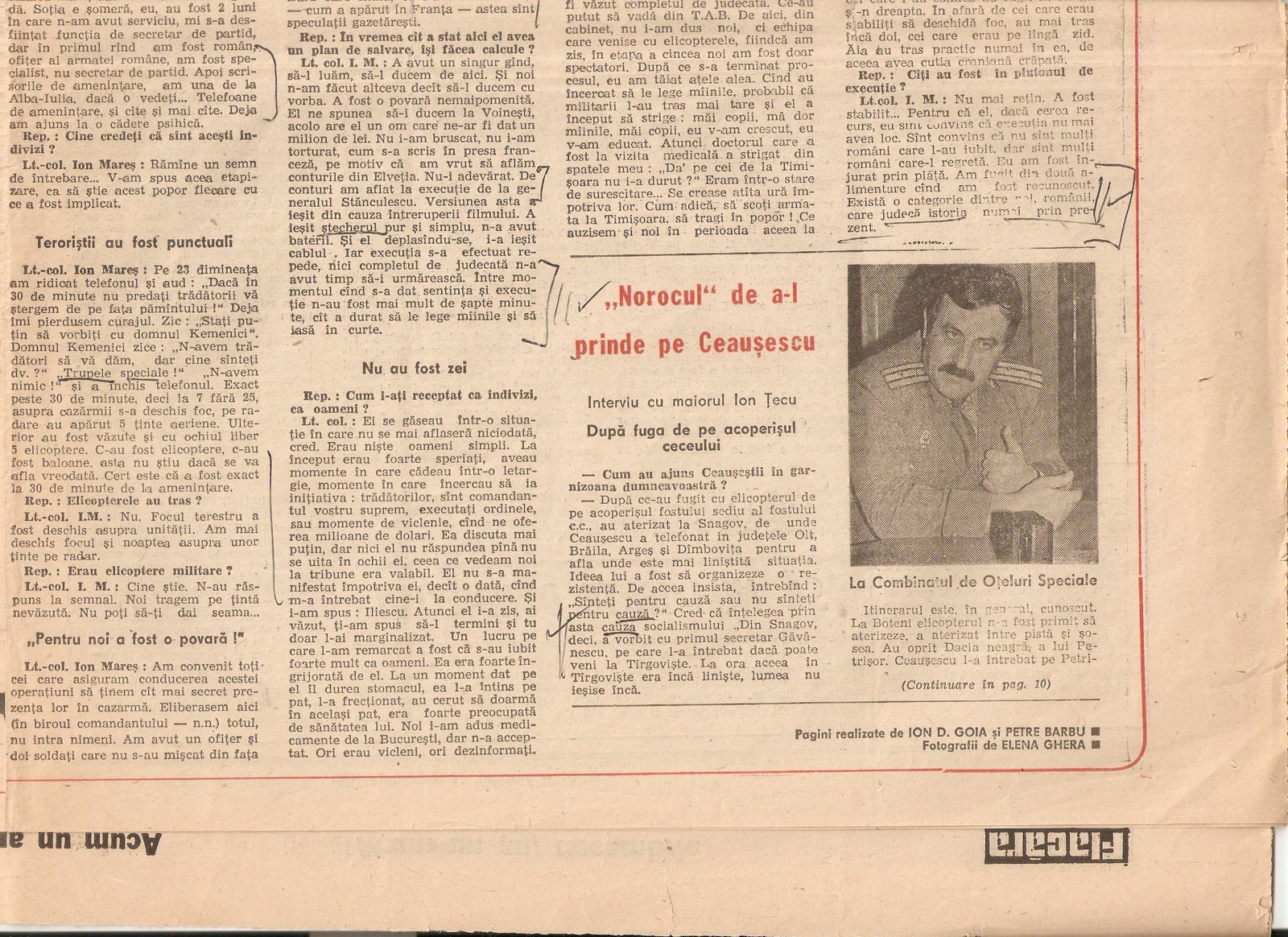
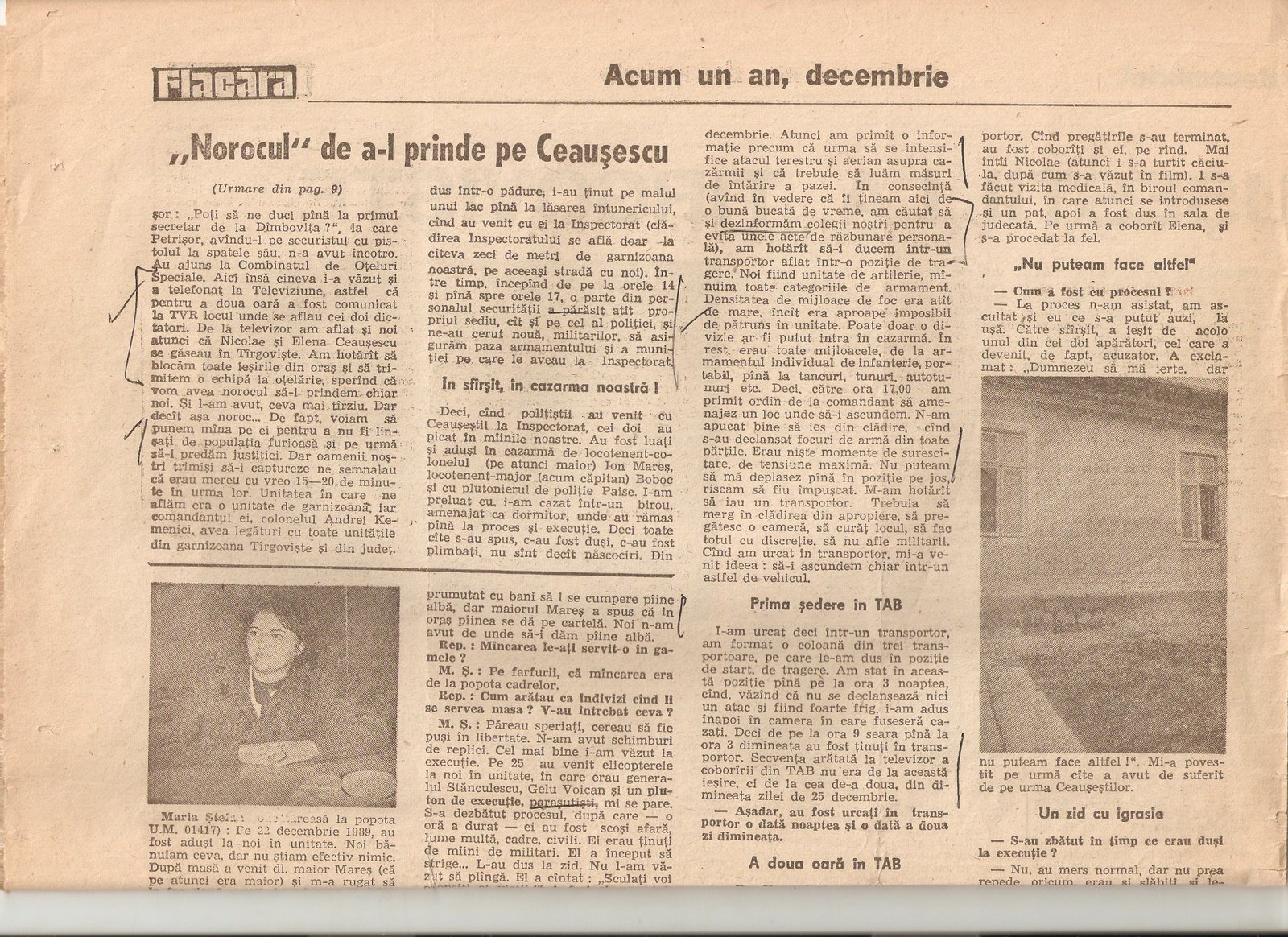
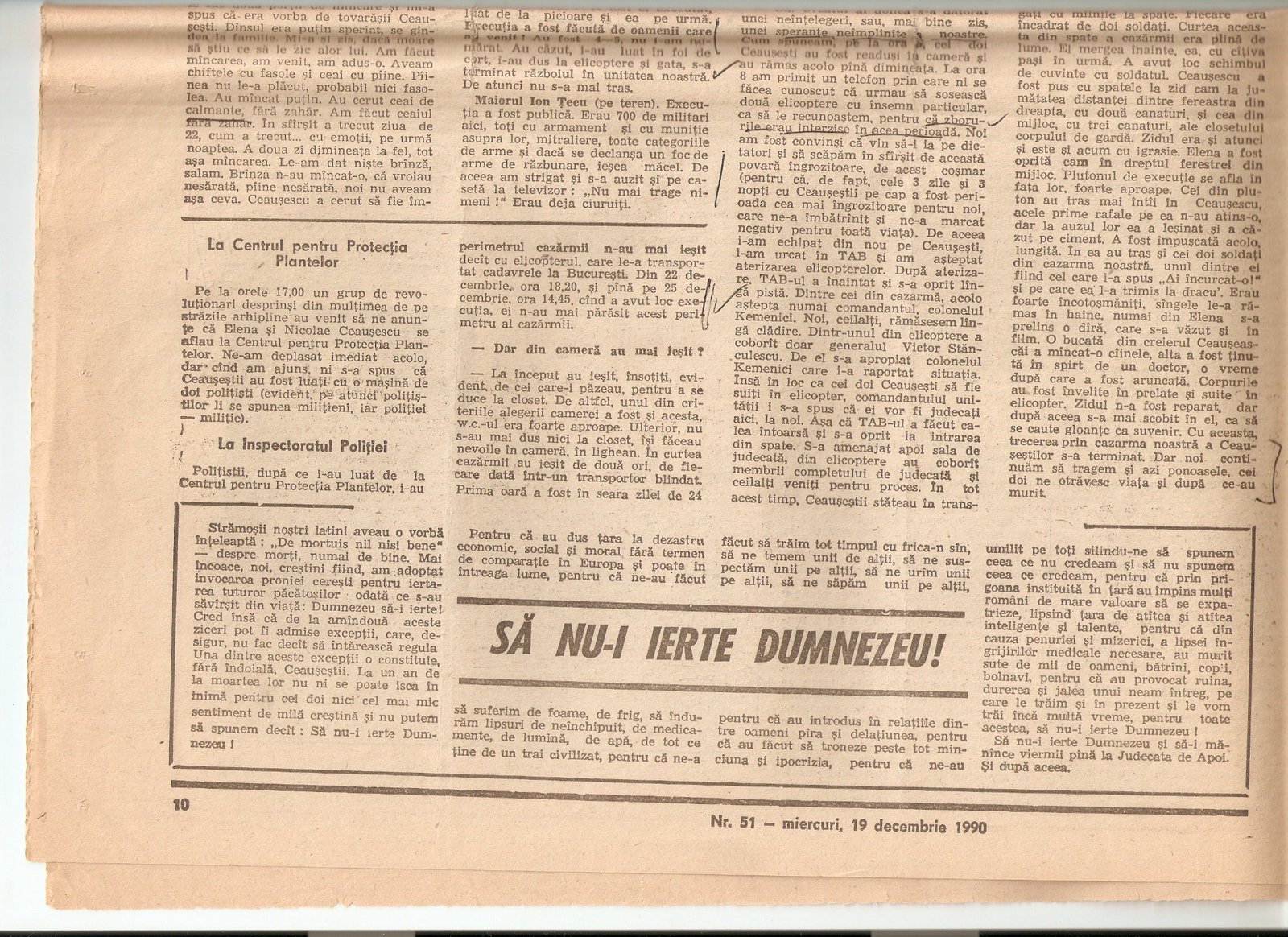

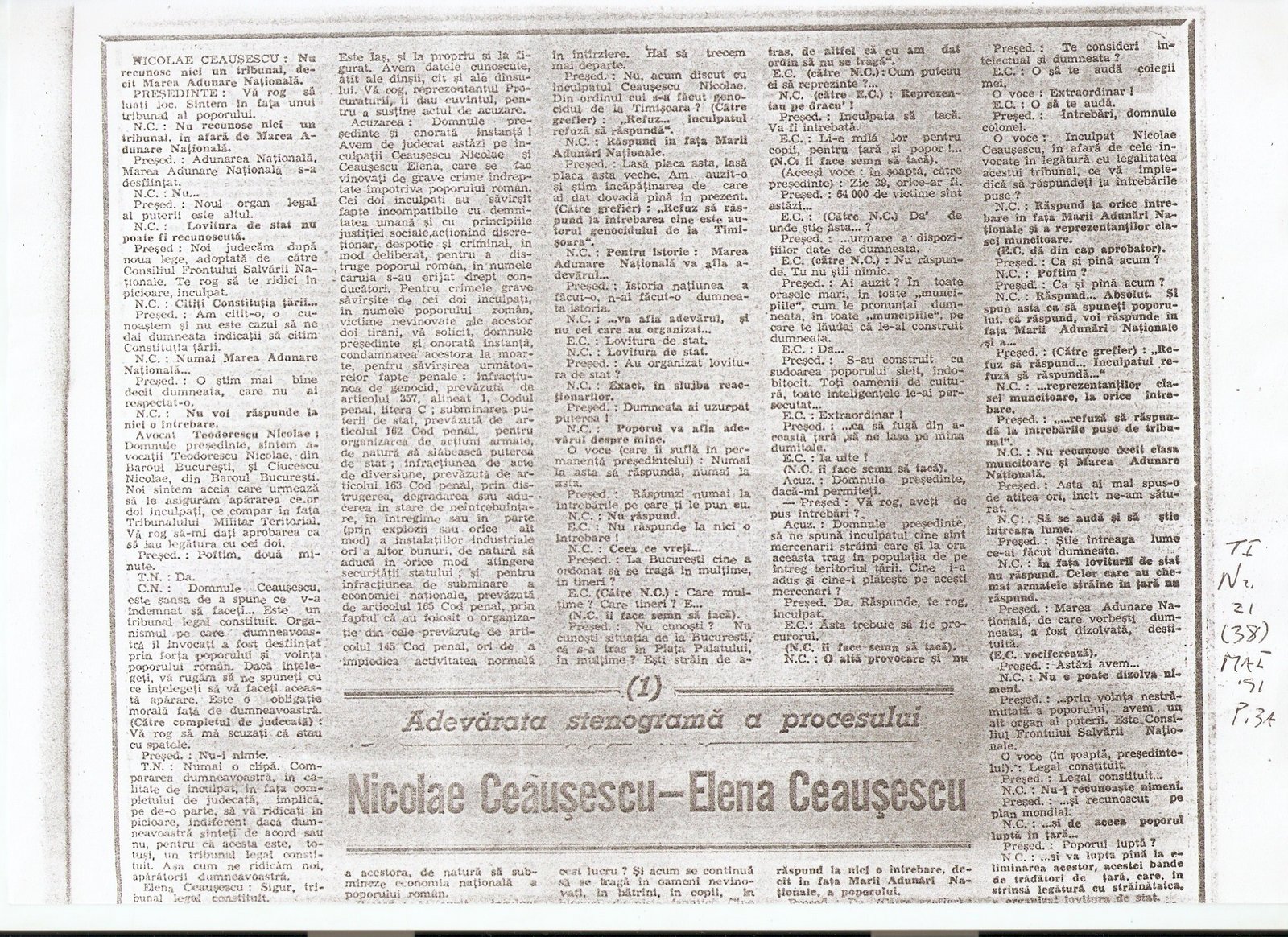
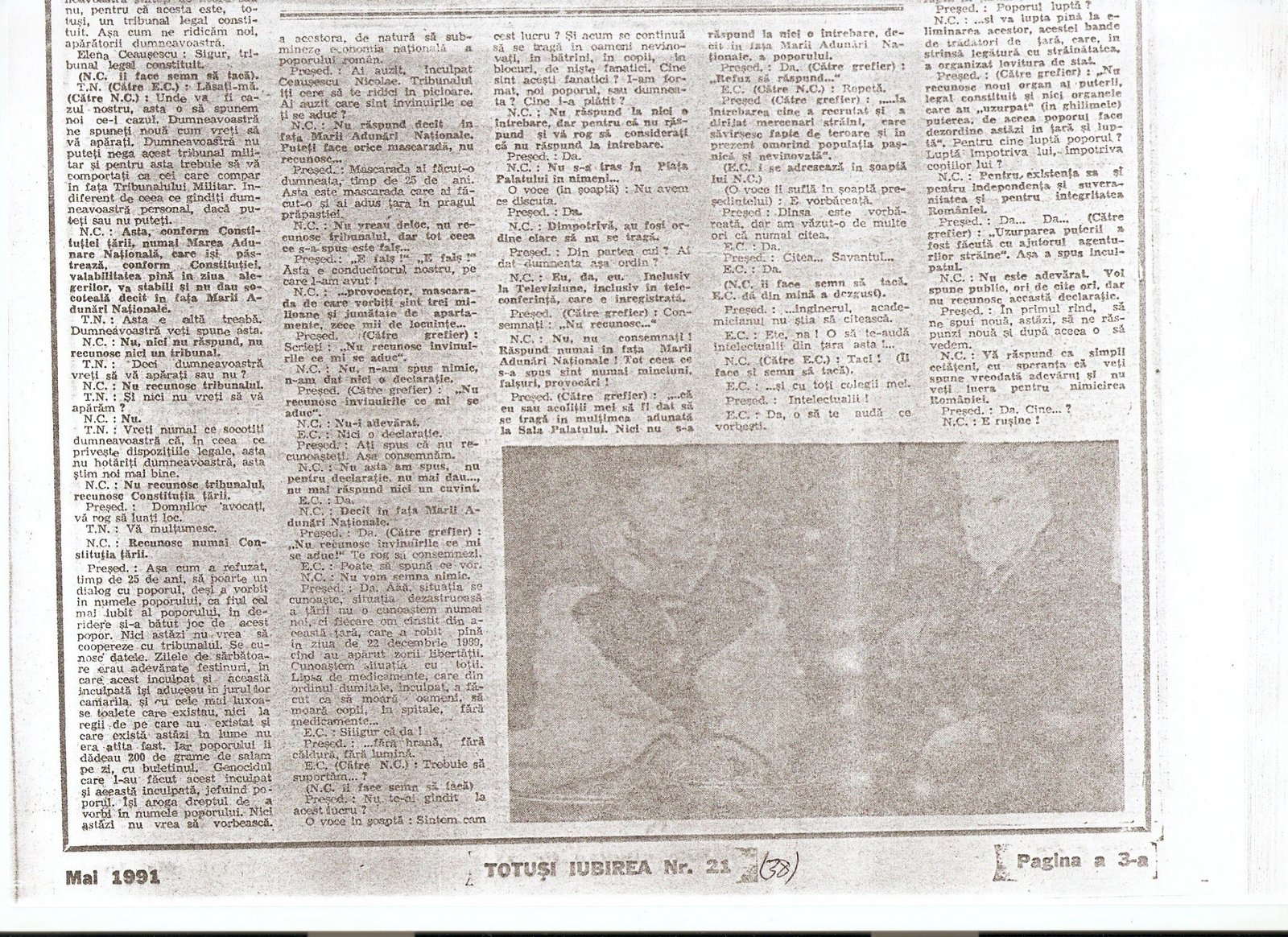
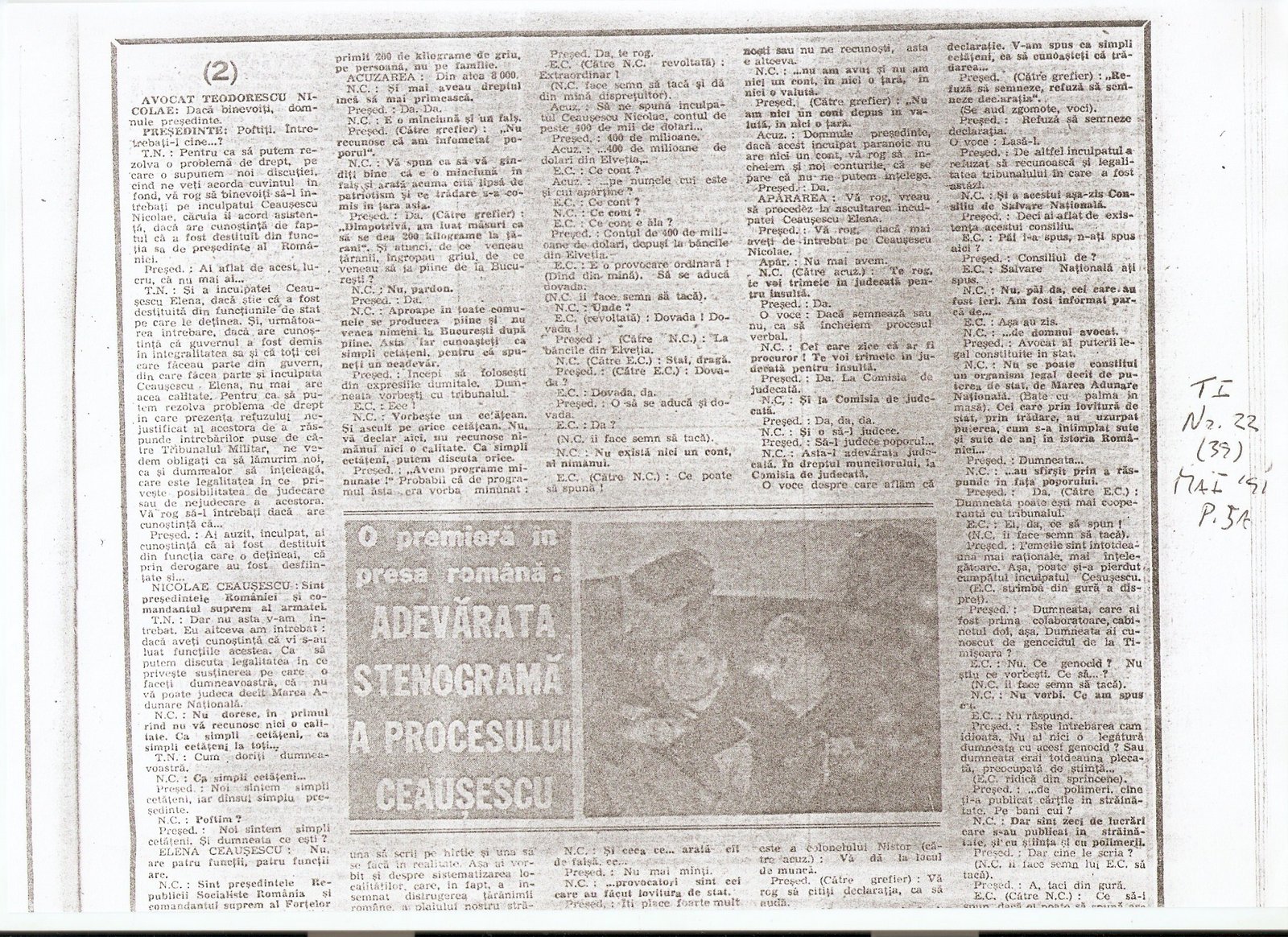
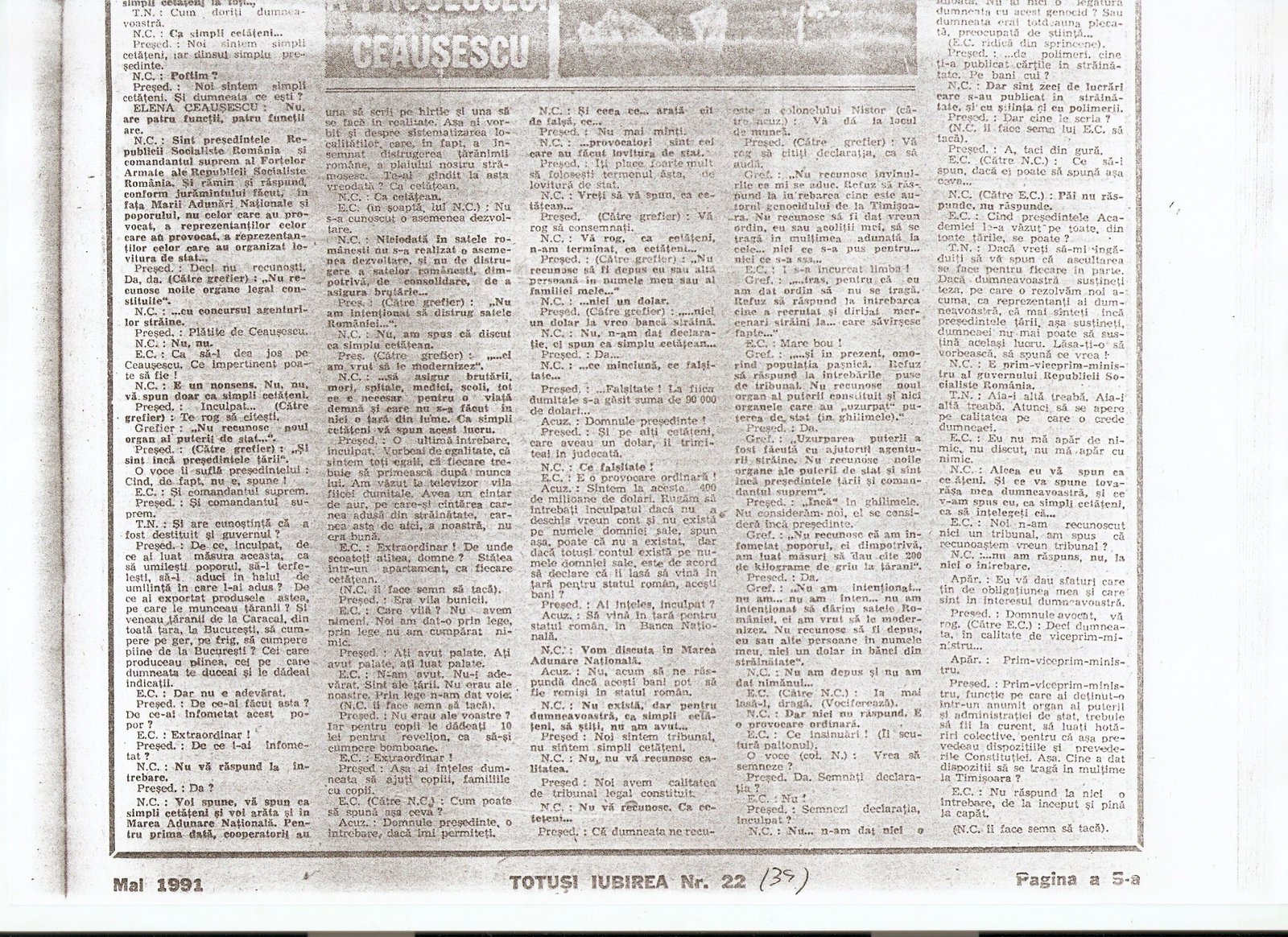
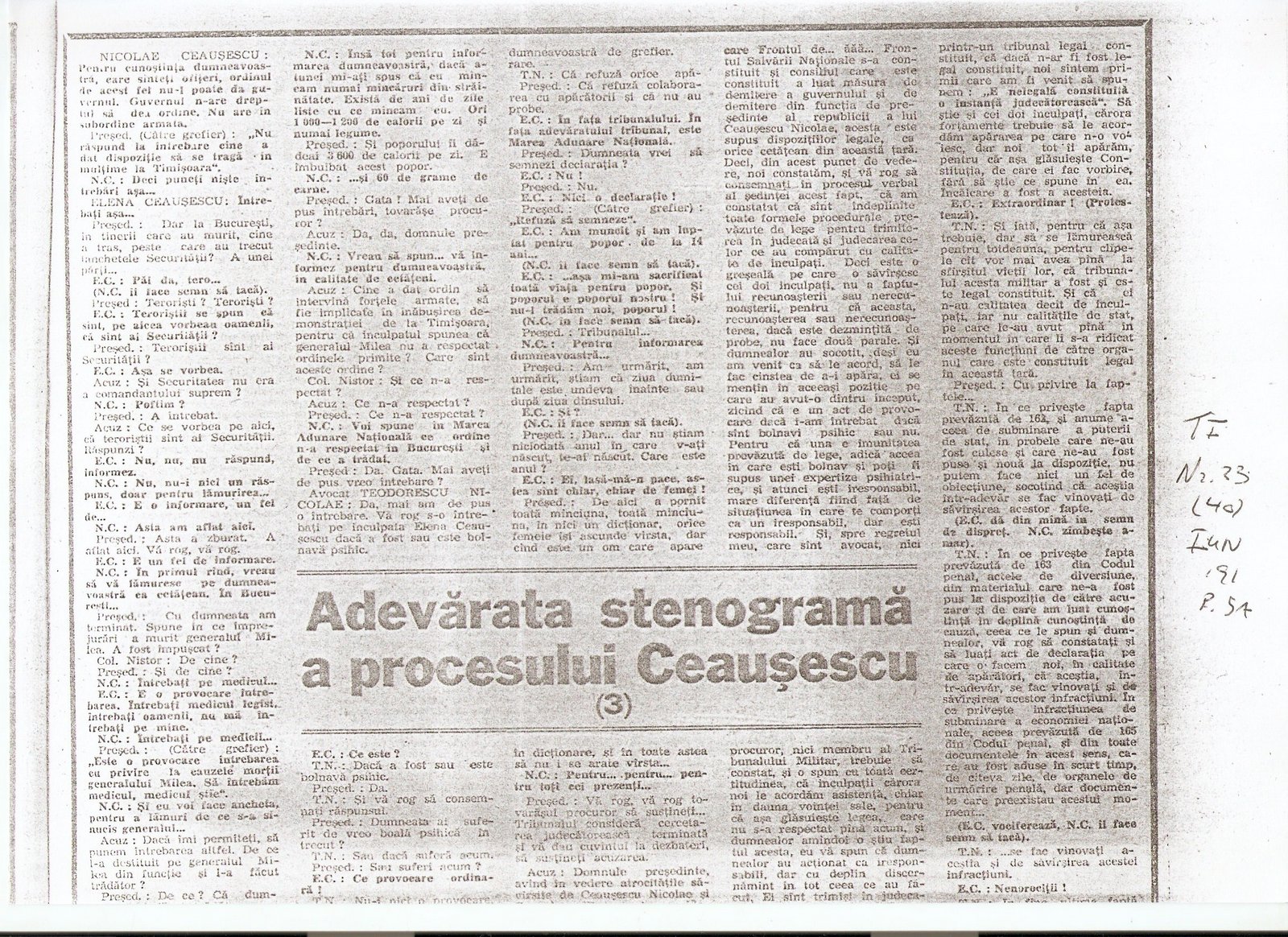

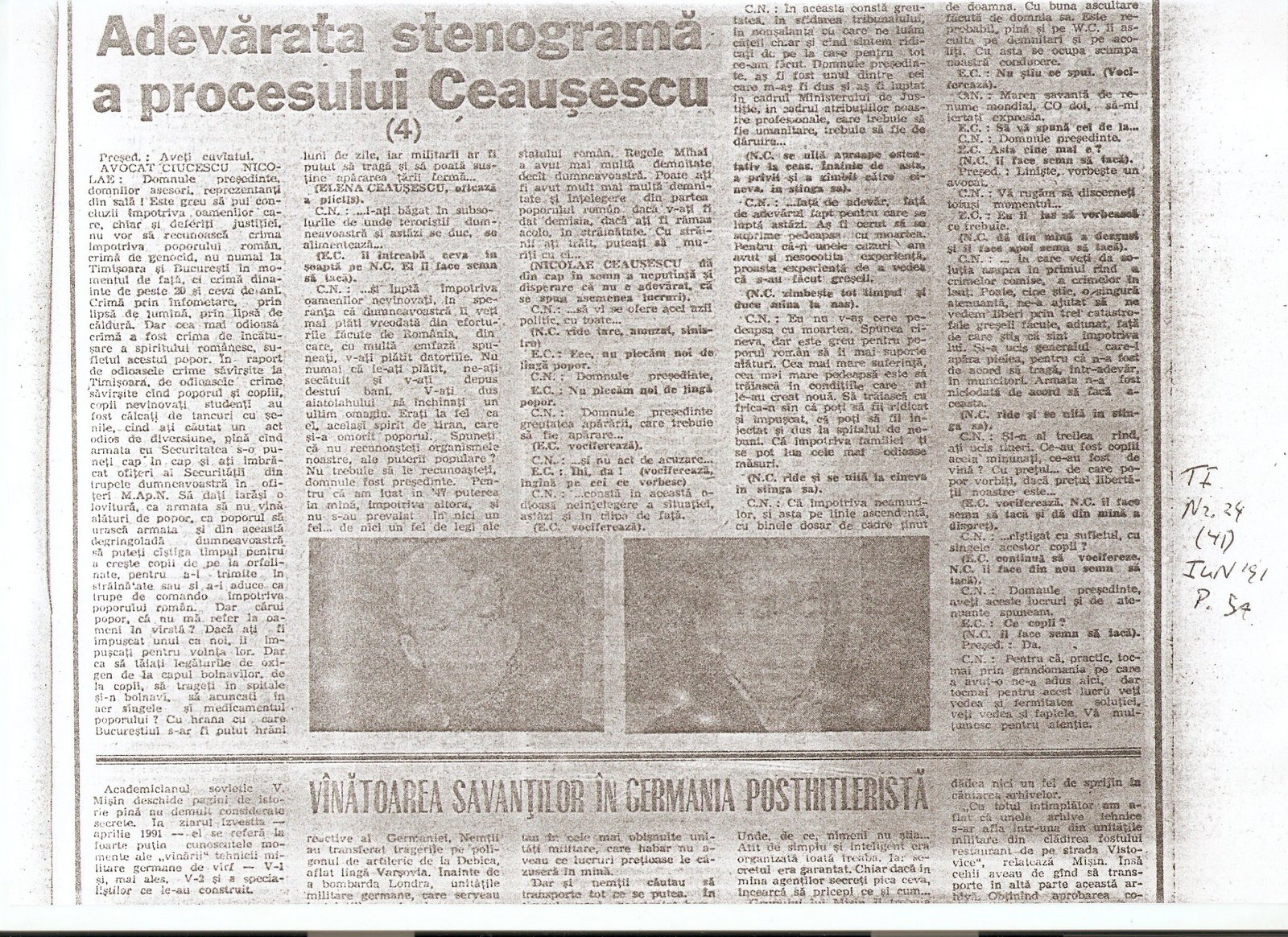
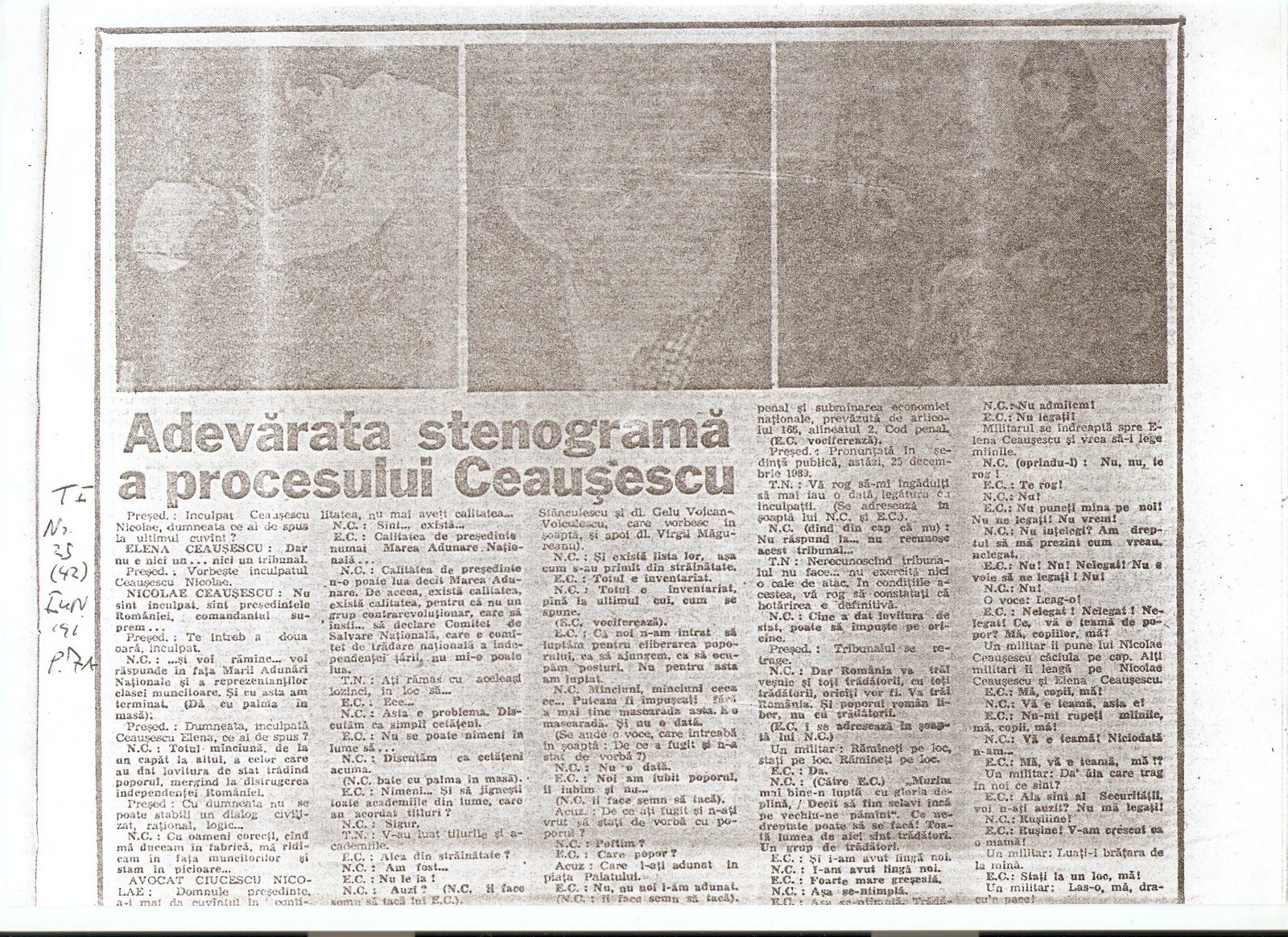
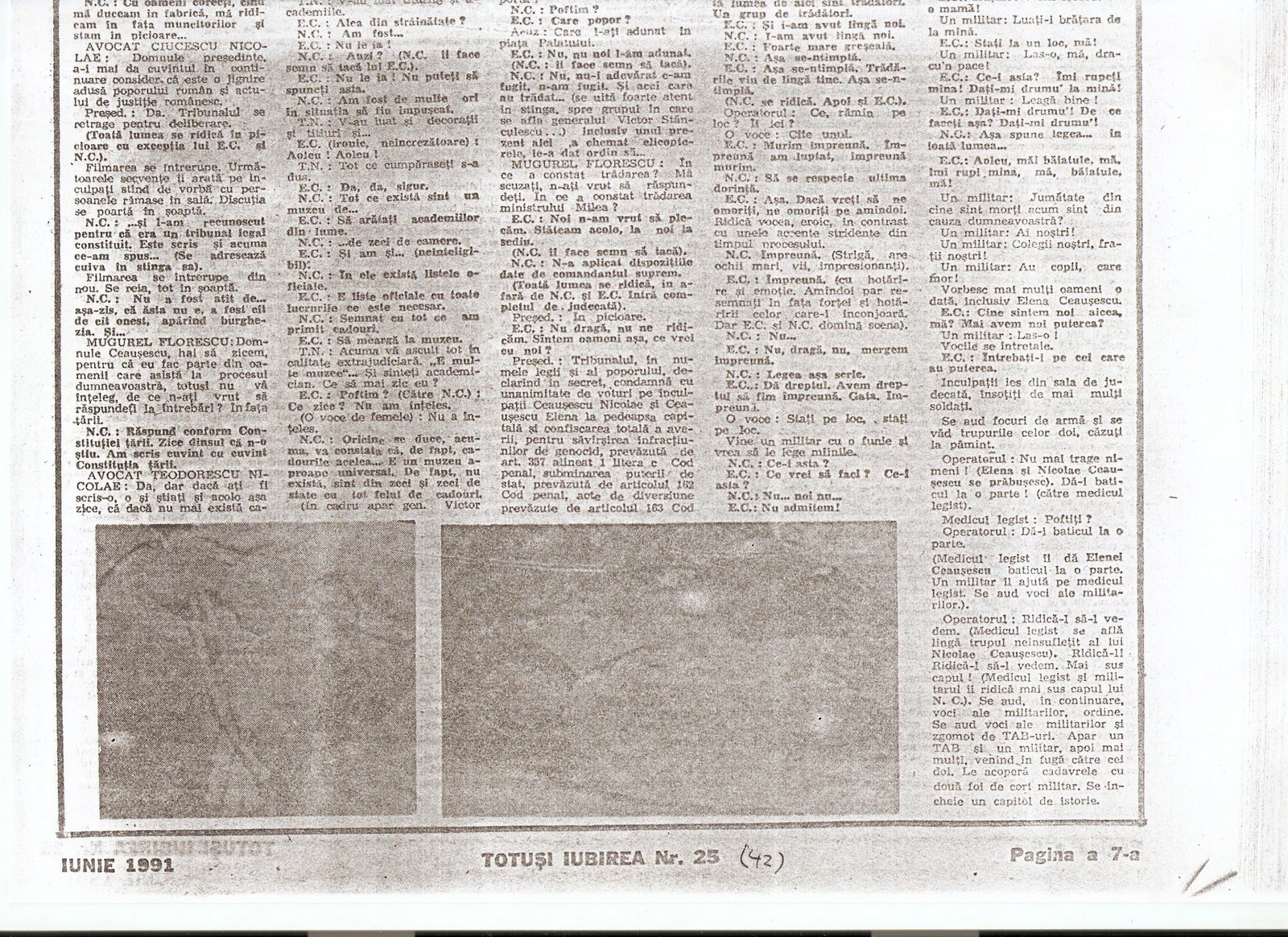
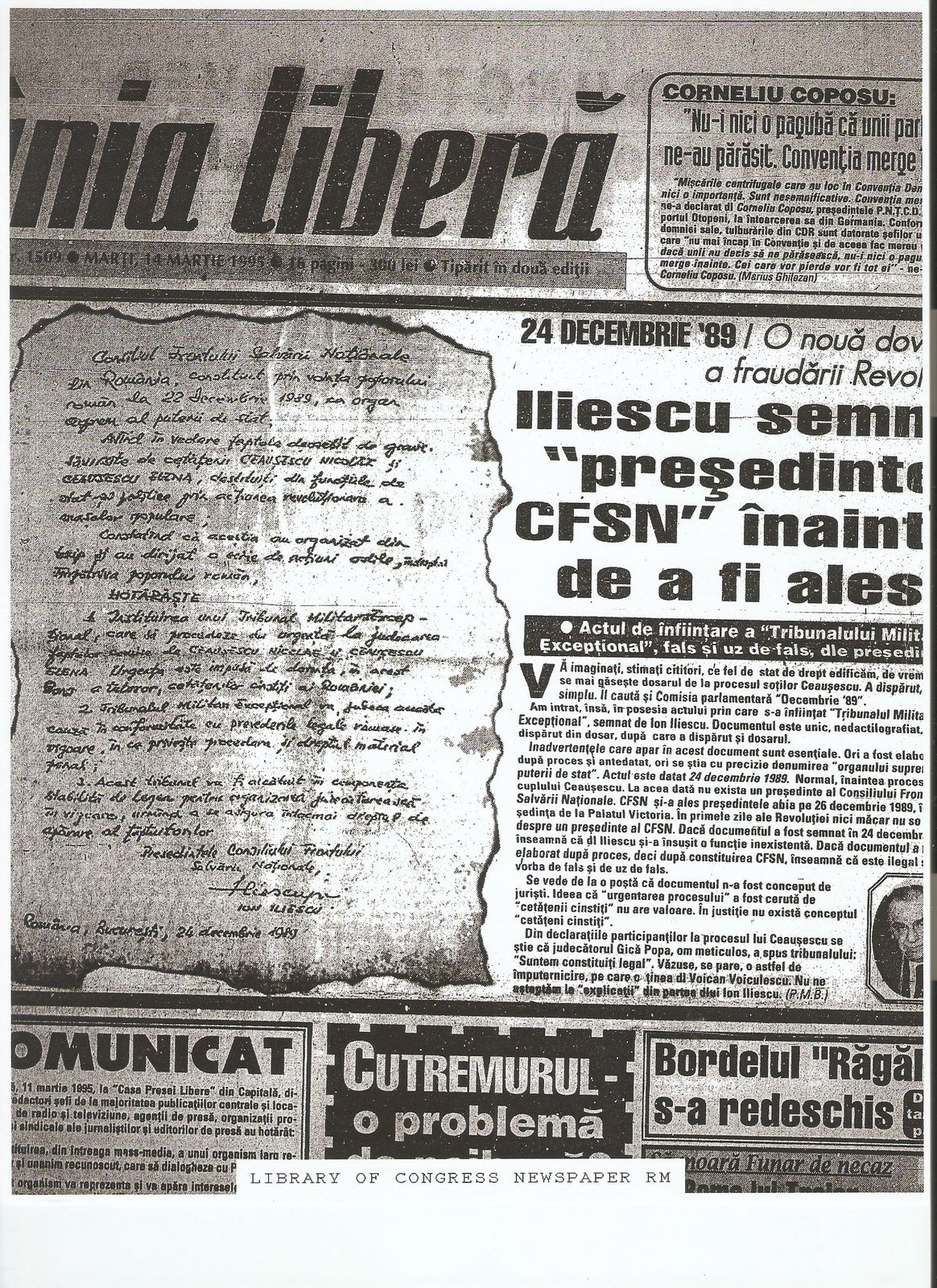
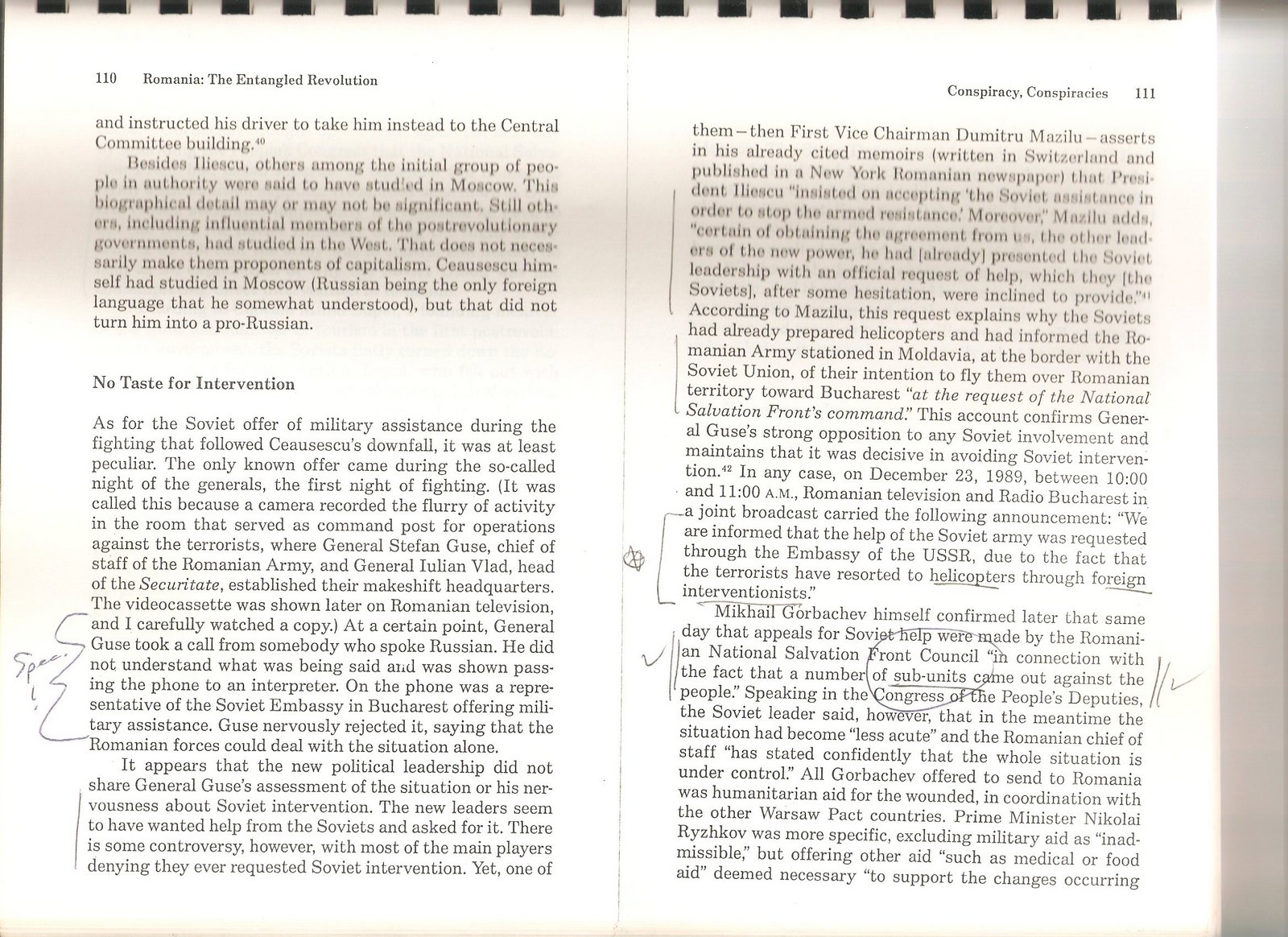


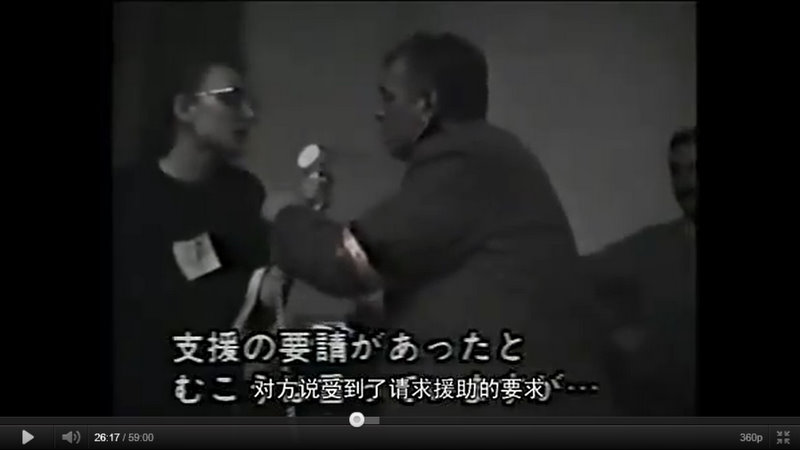
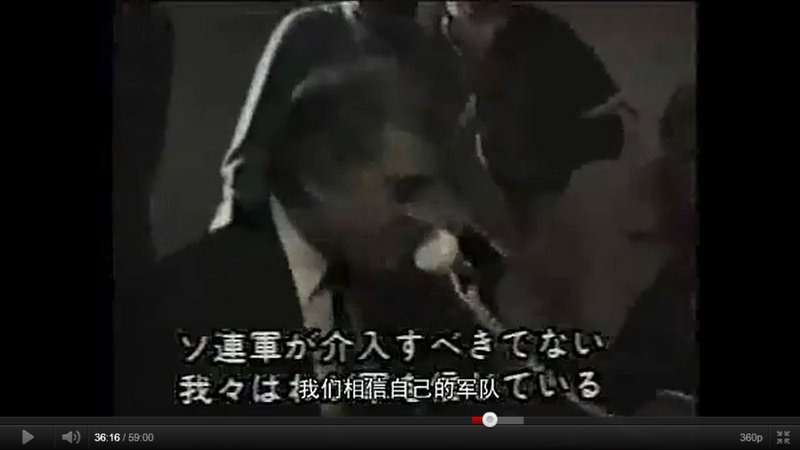
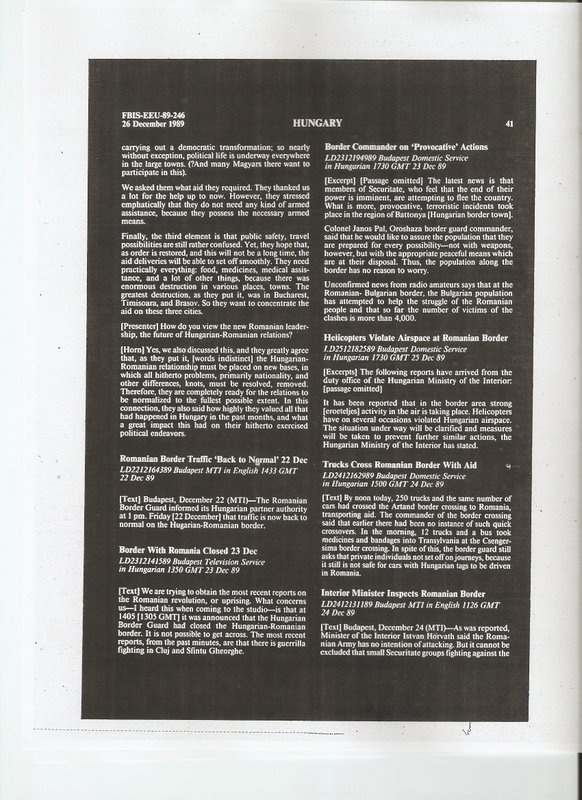
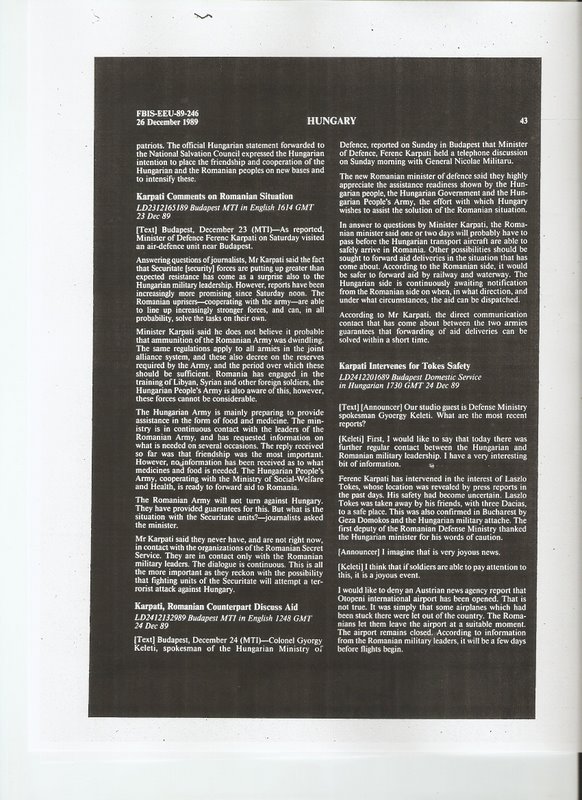
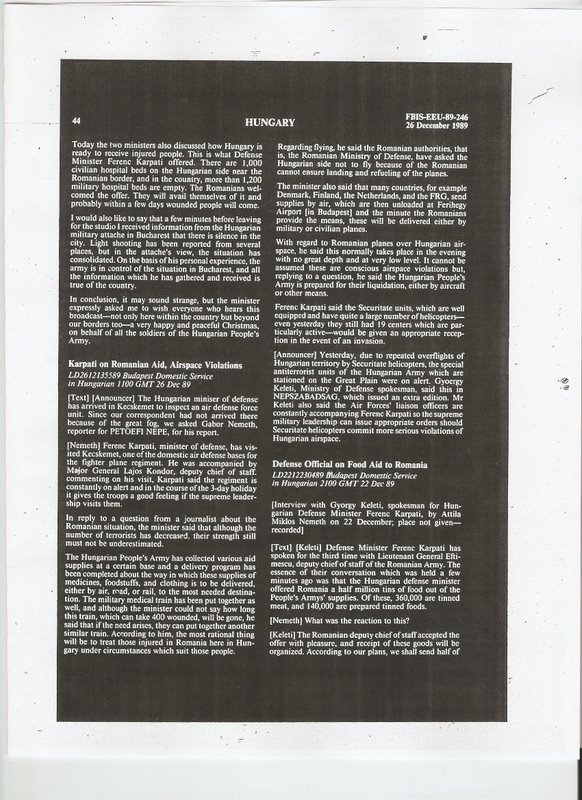
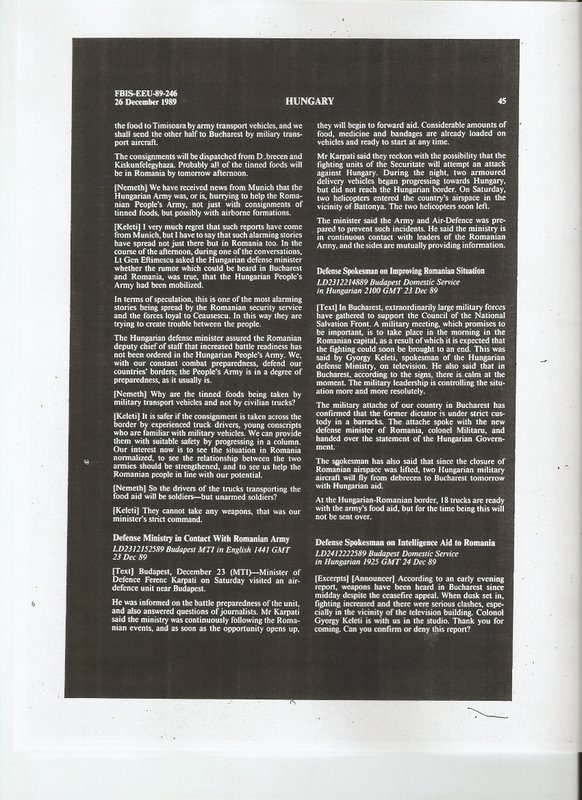
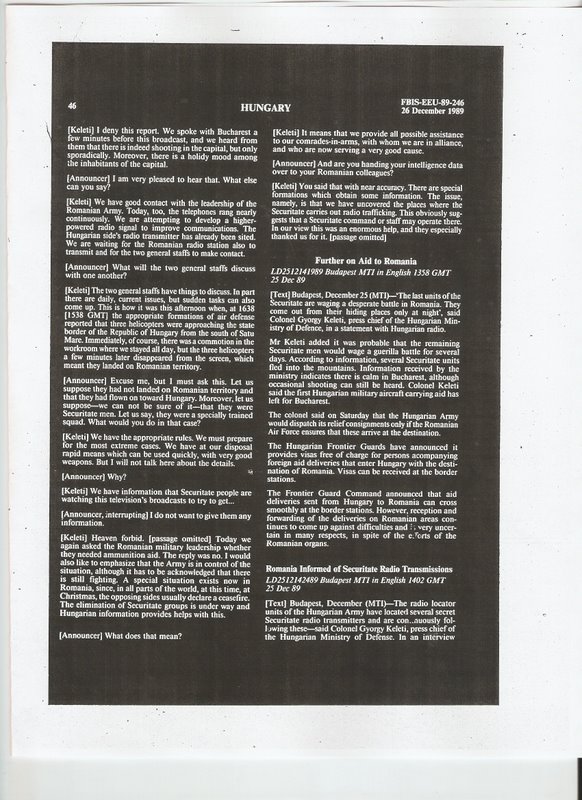


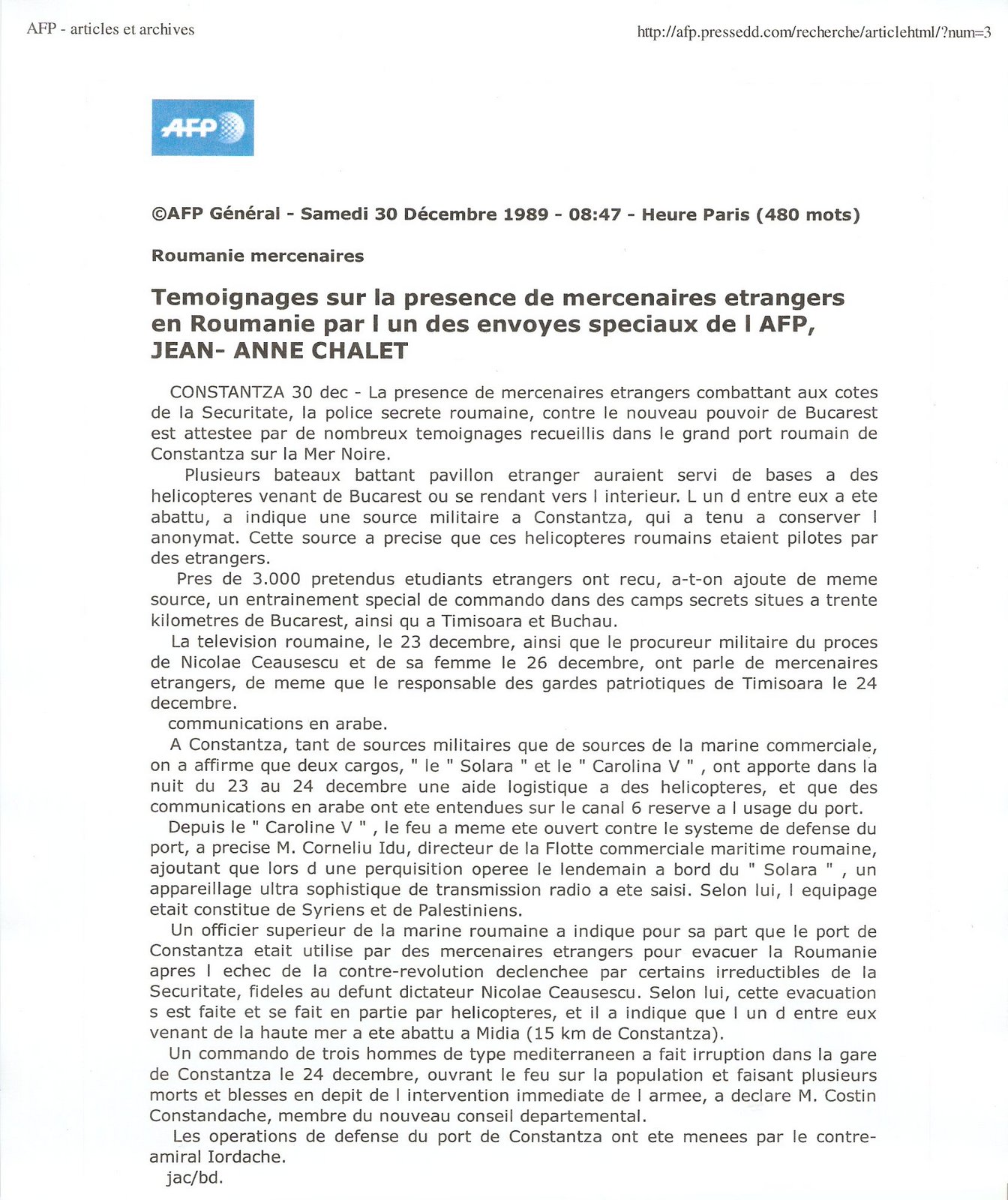
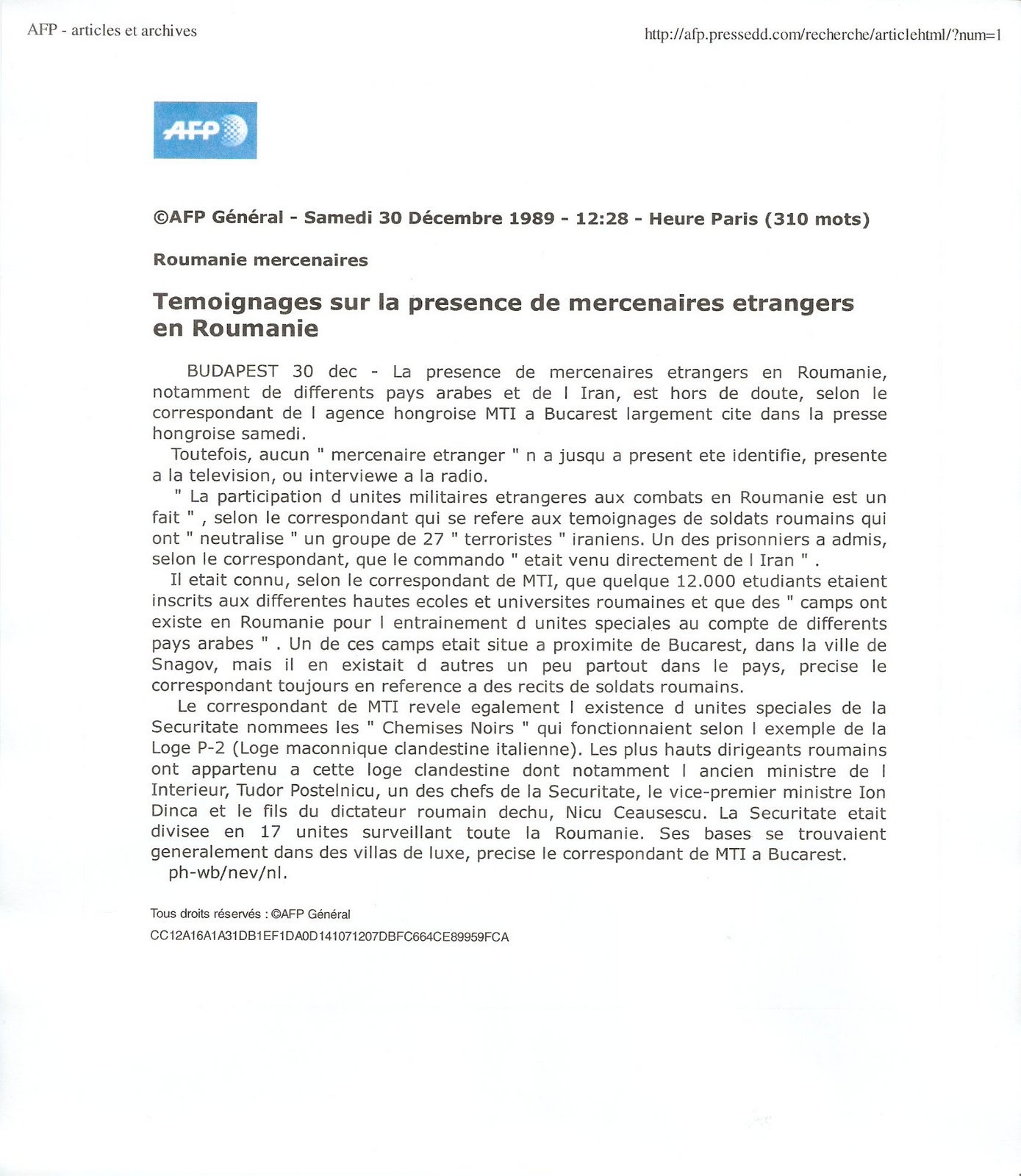
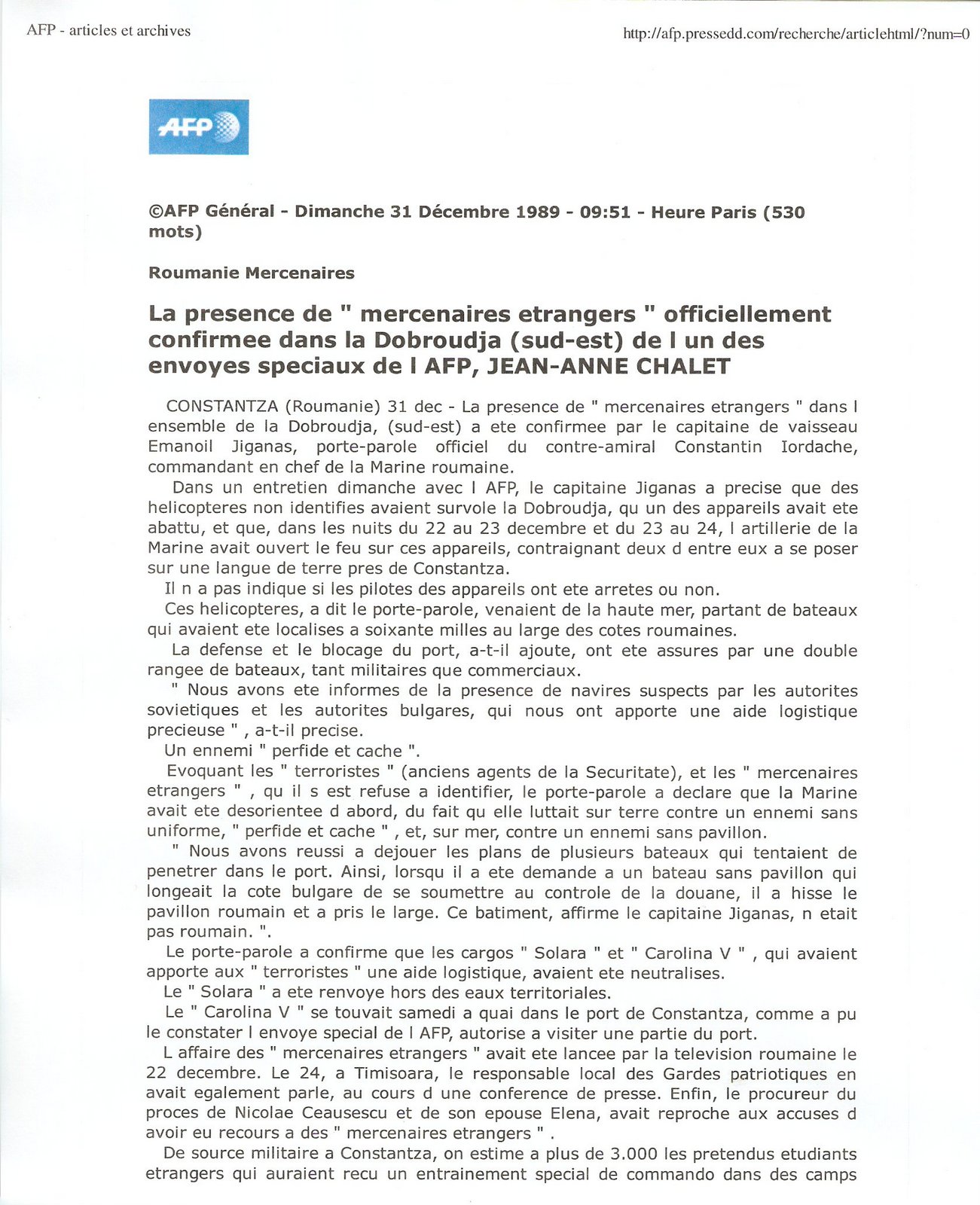

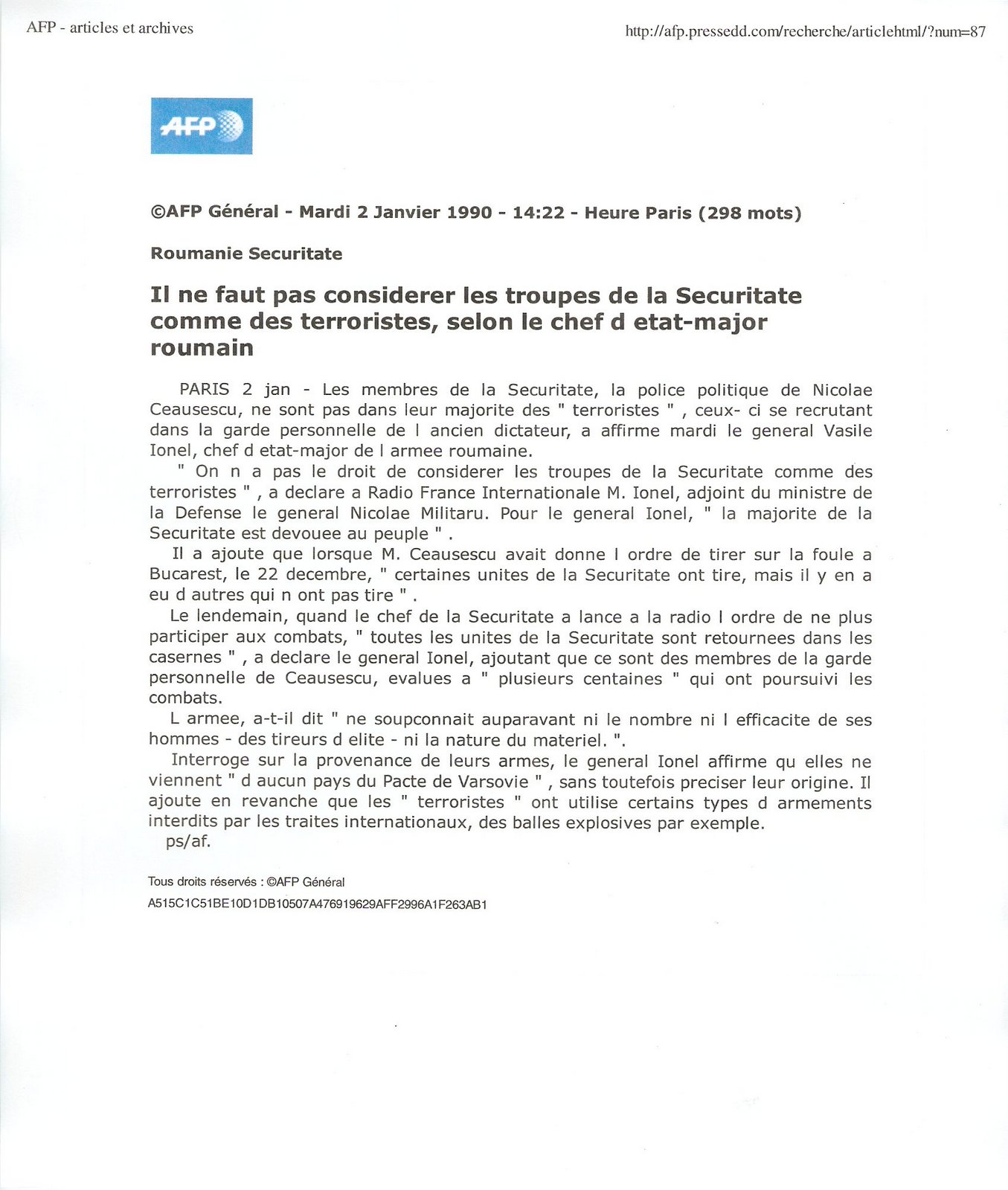
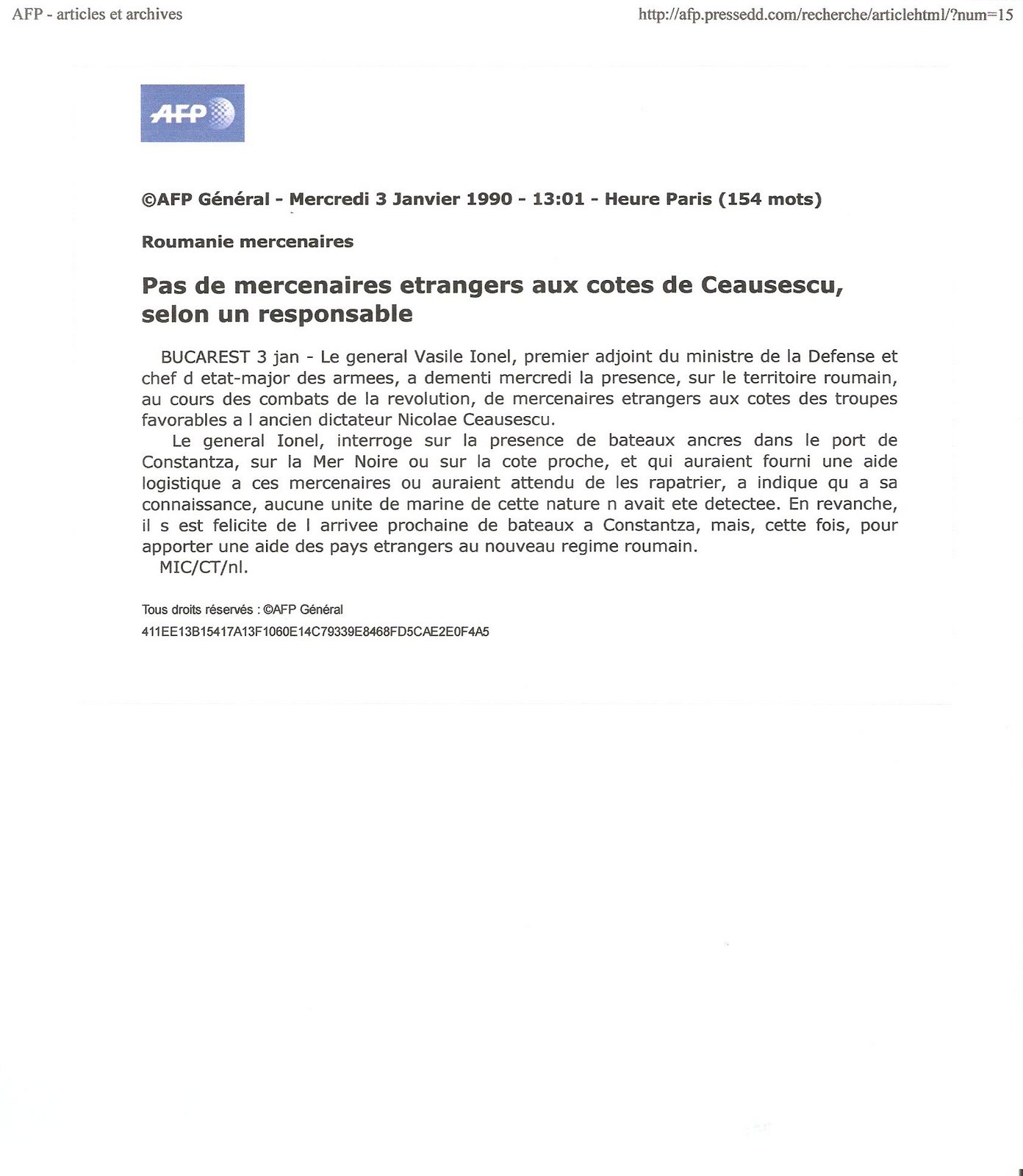

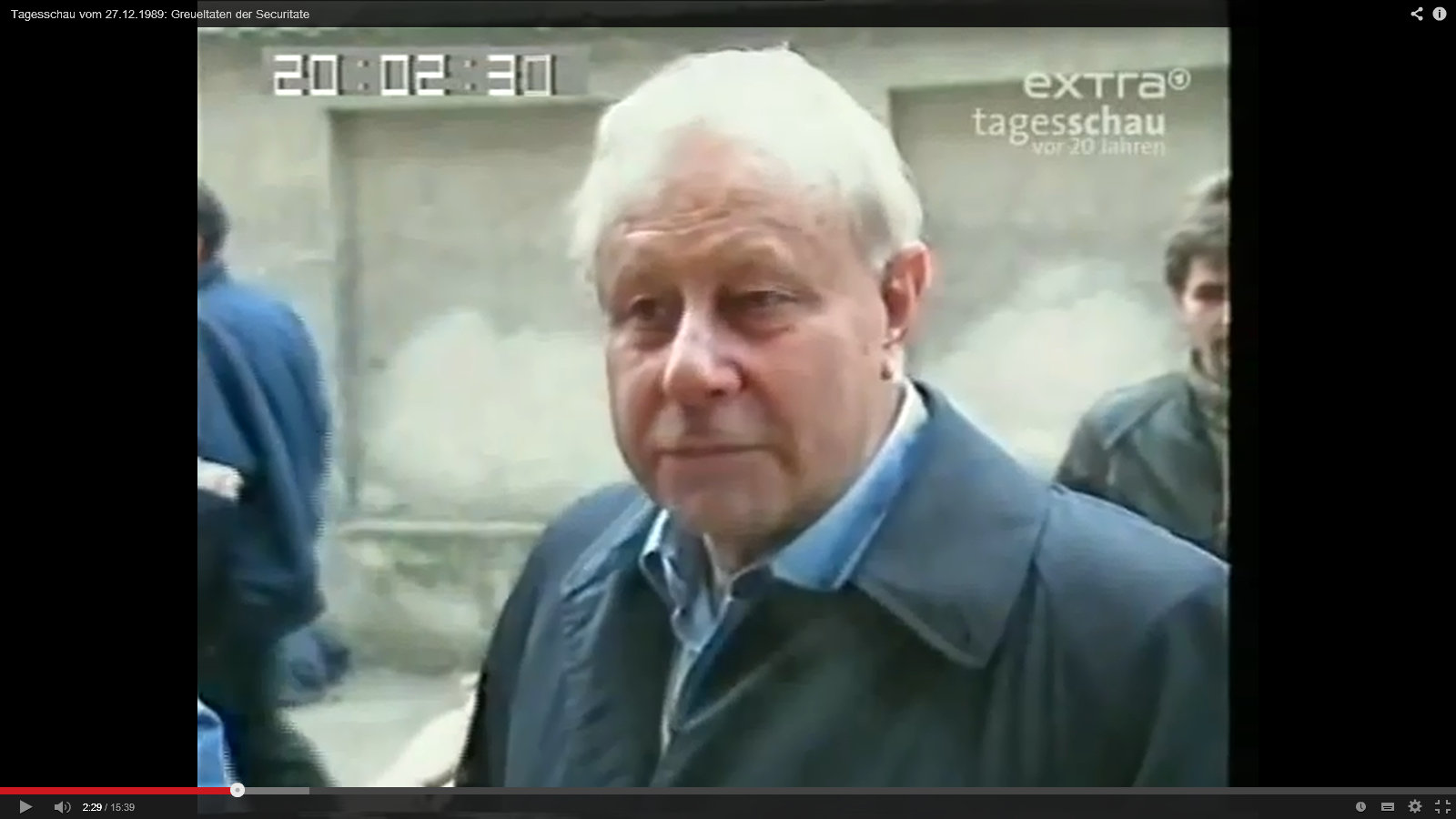
 Clip Ref: BSP271289002 0
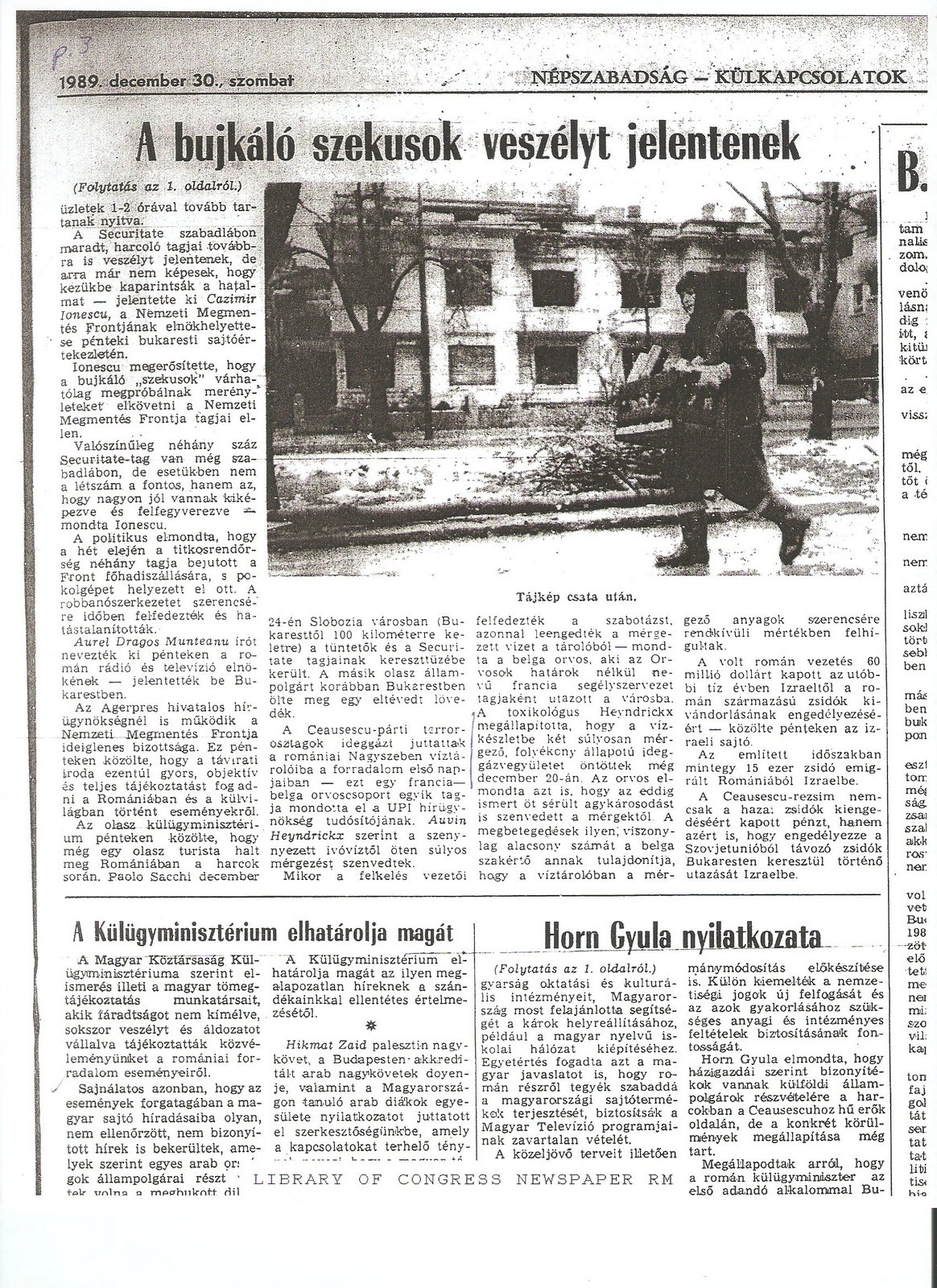


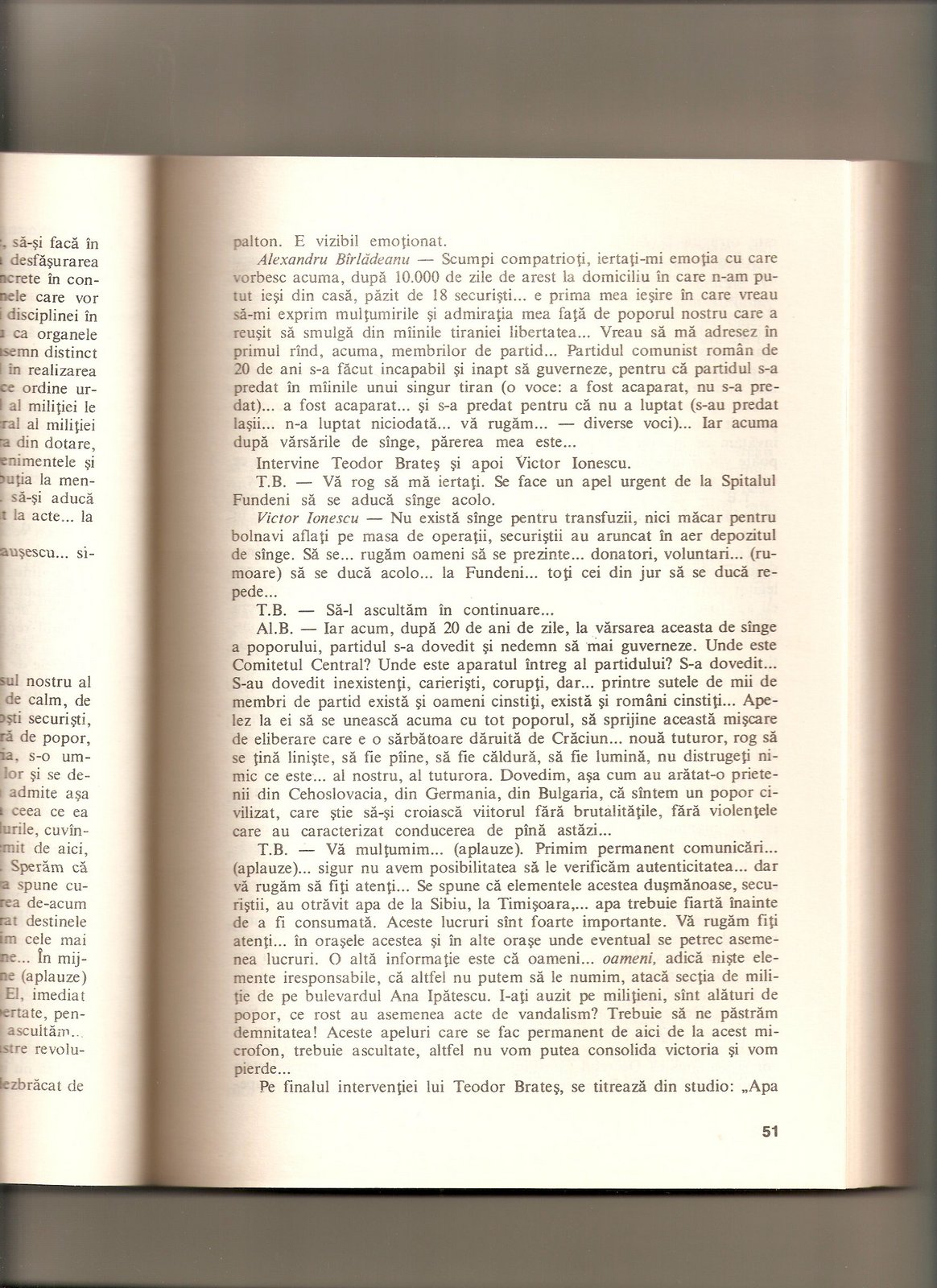
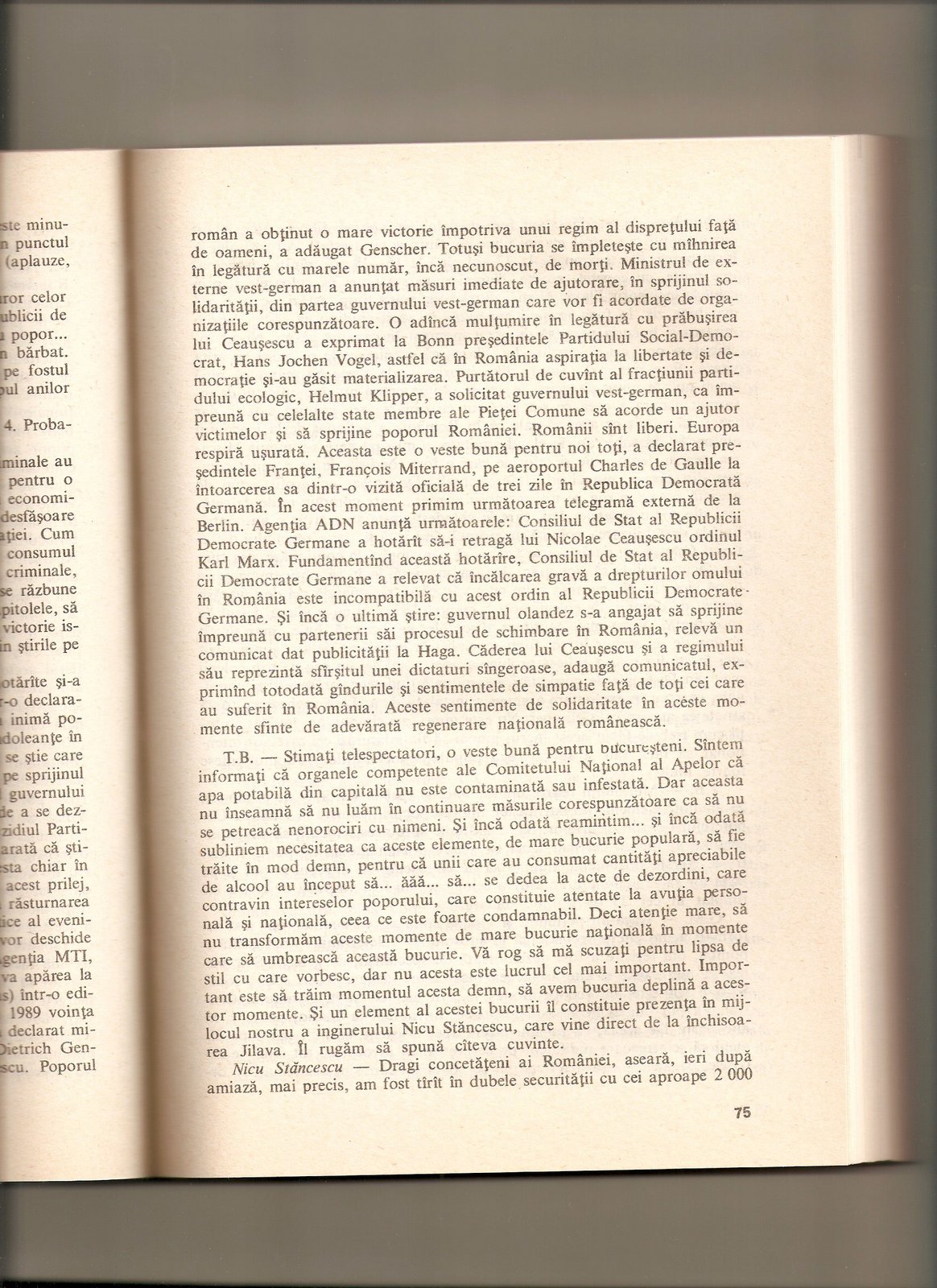
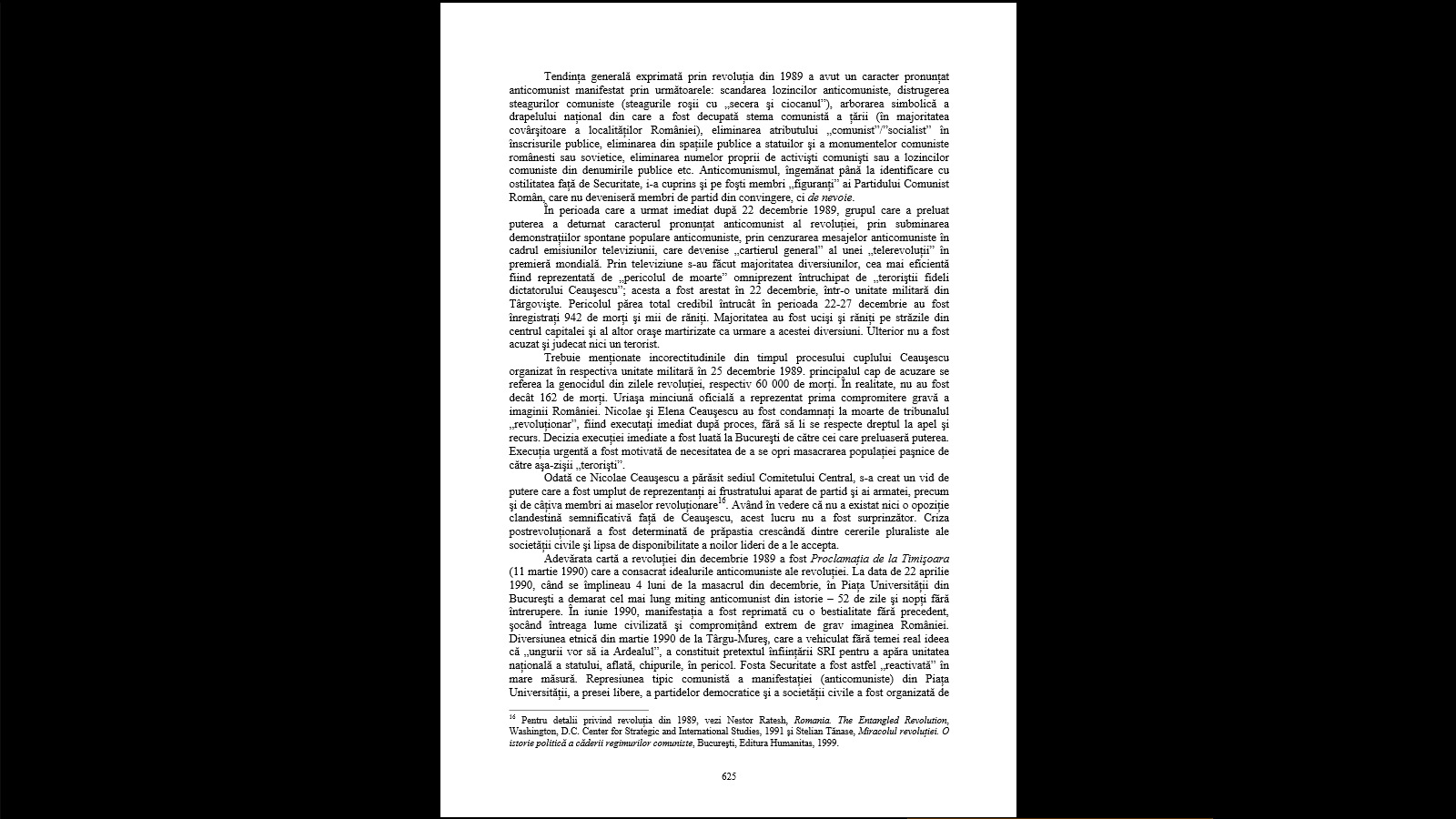
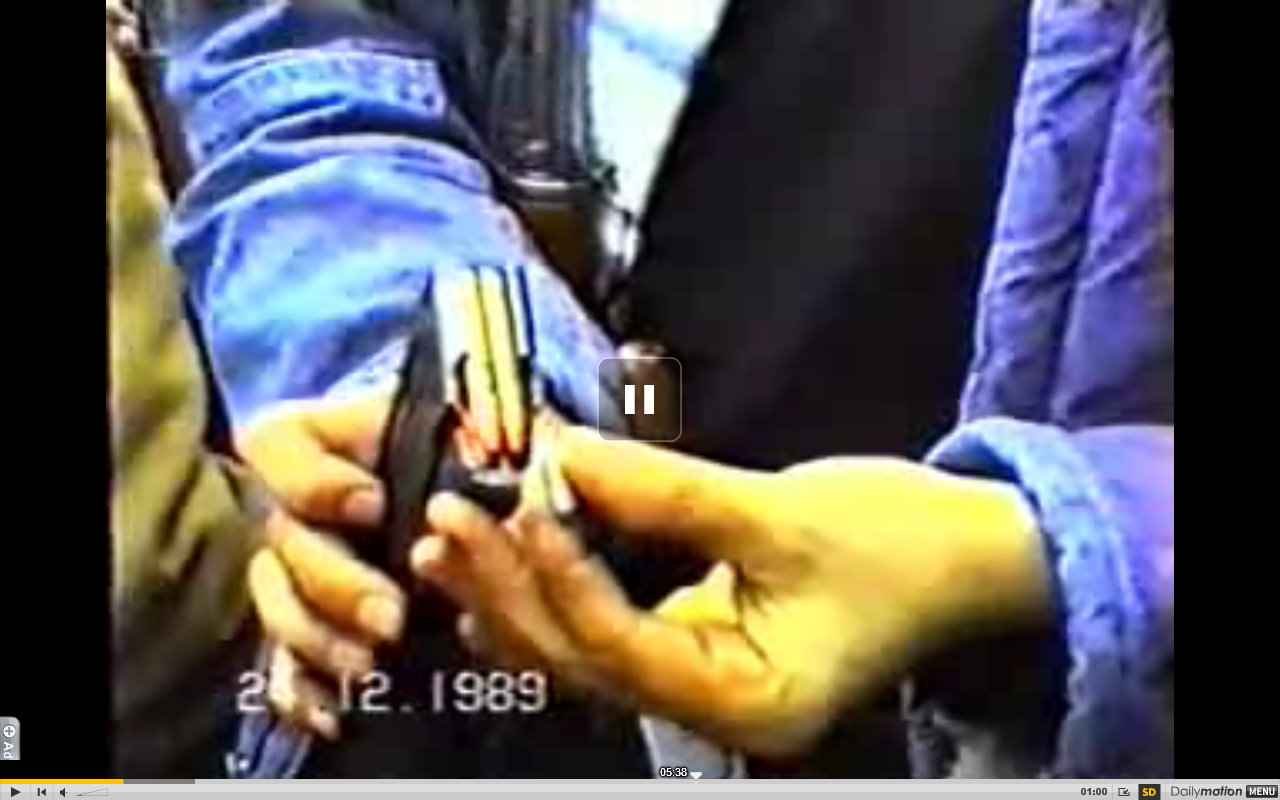
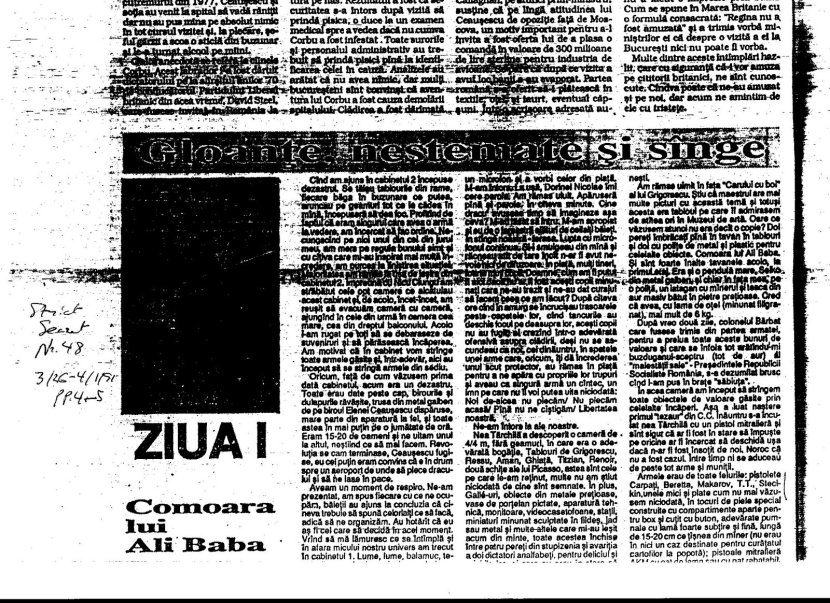
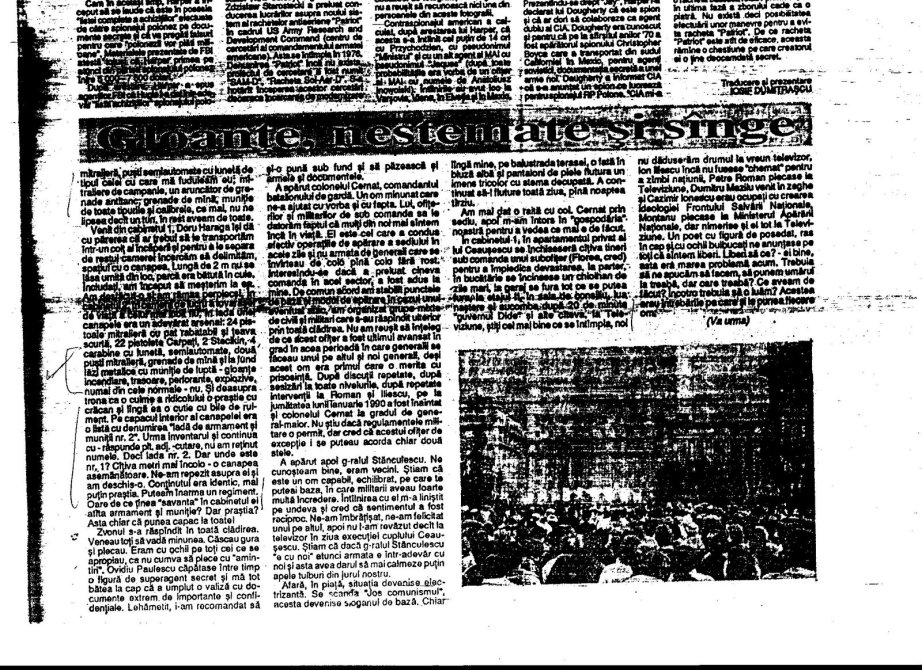

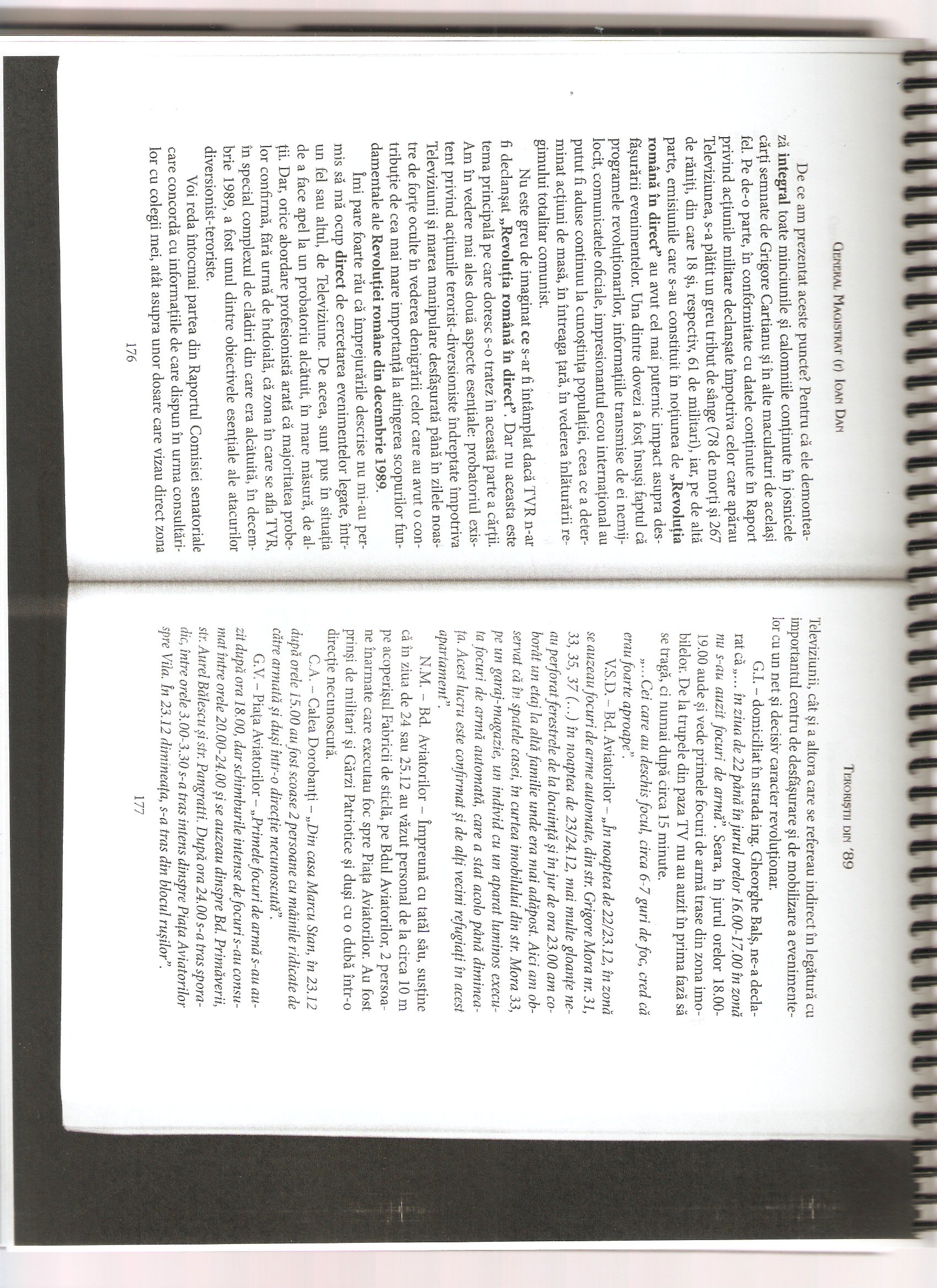
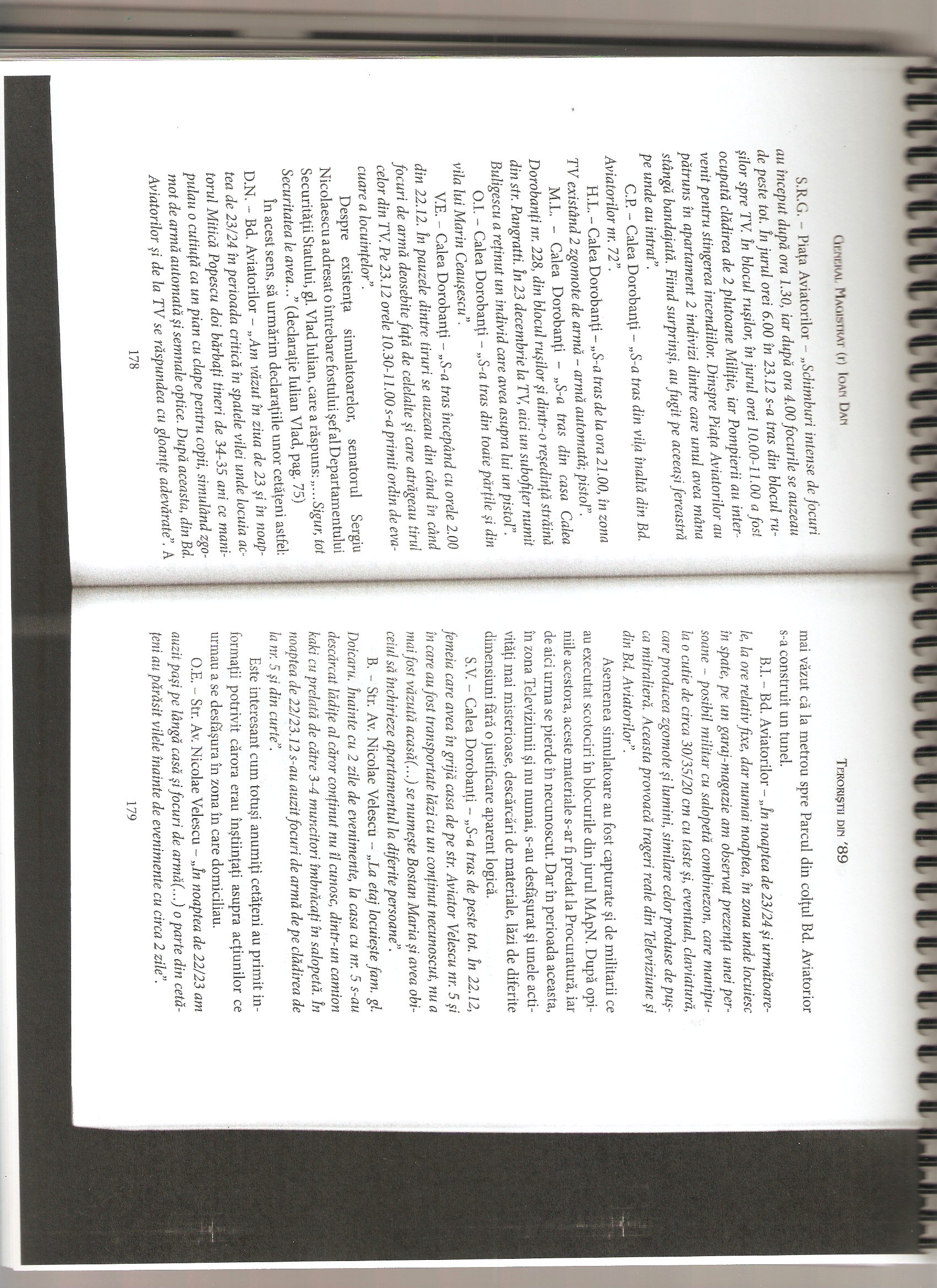
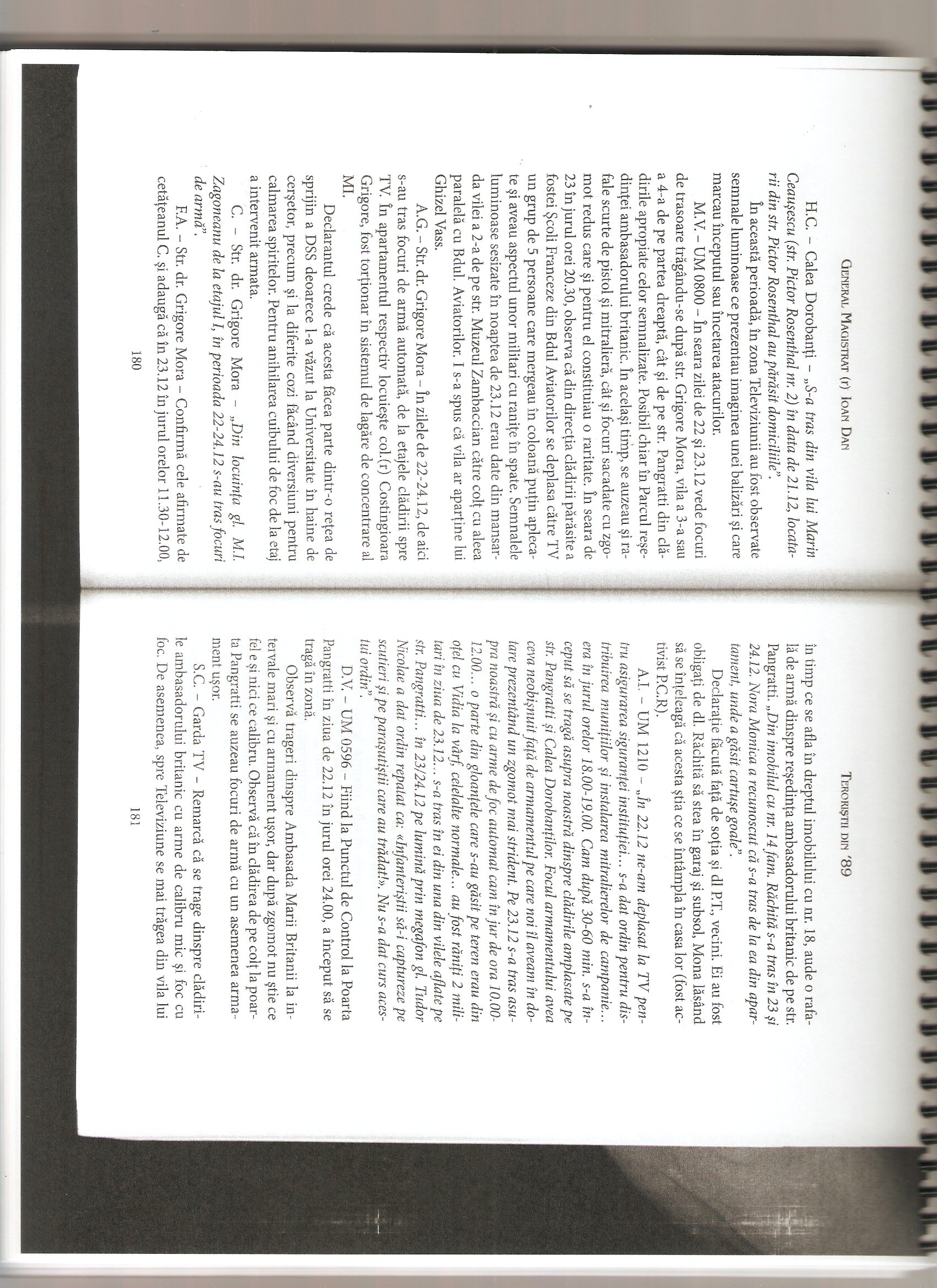
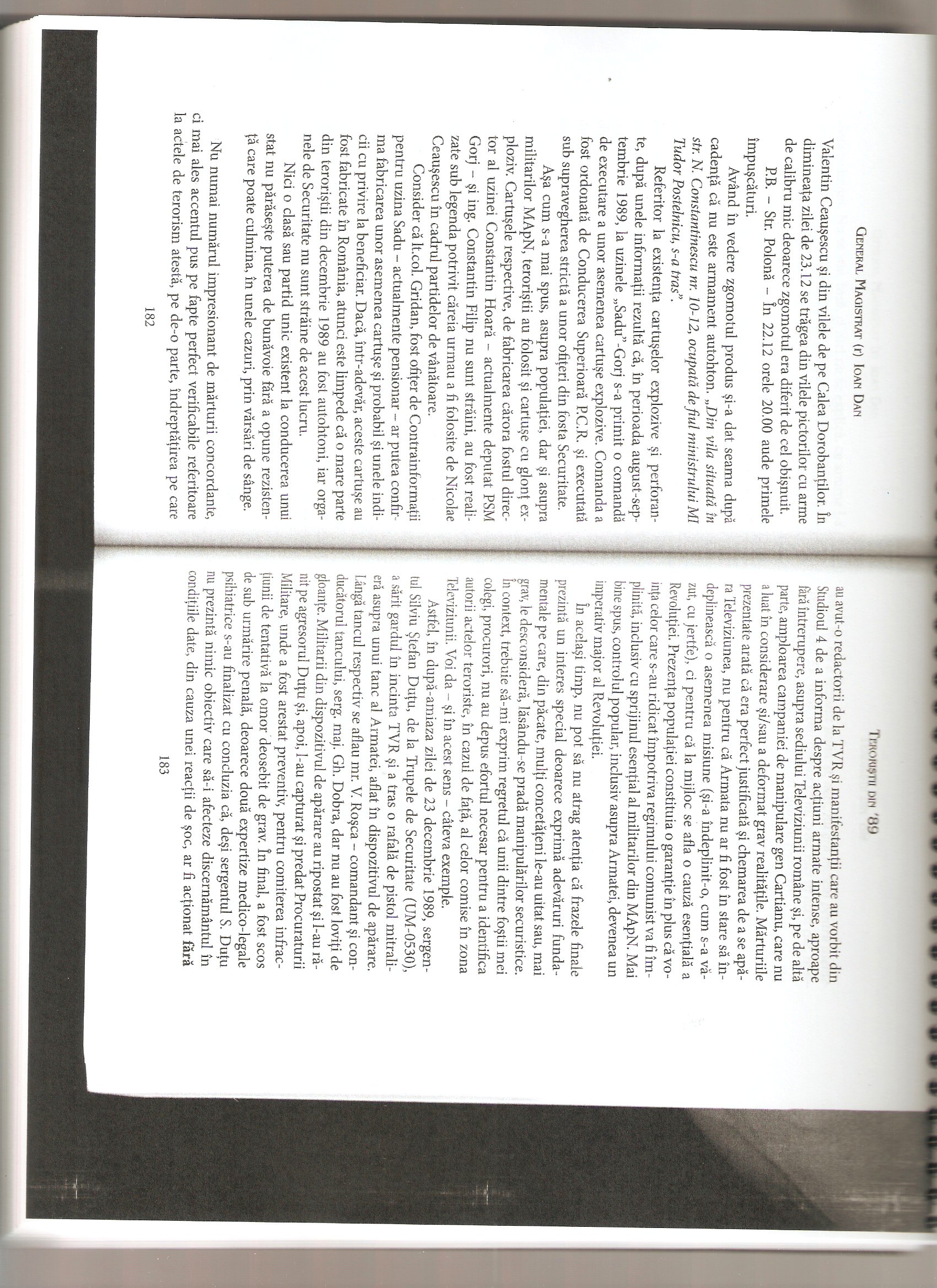
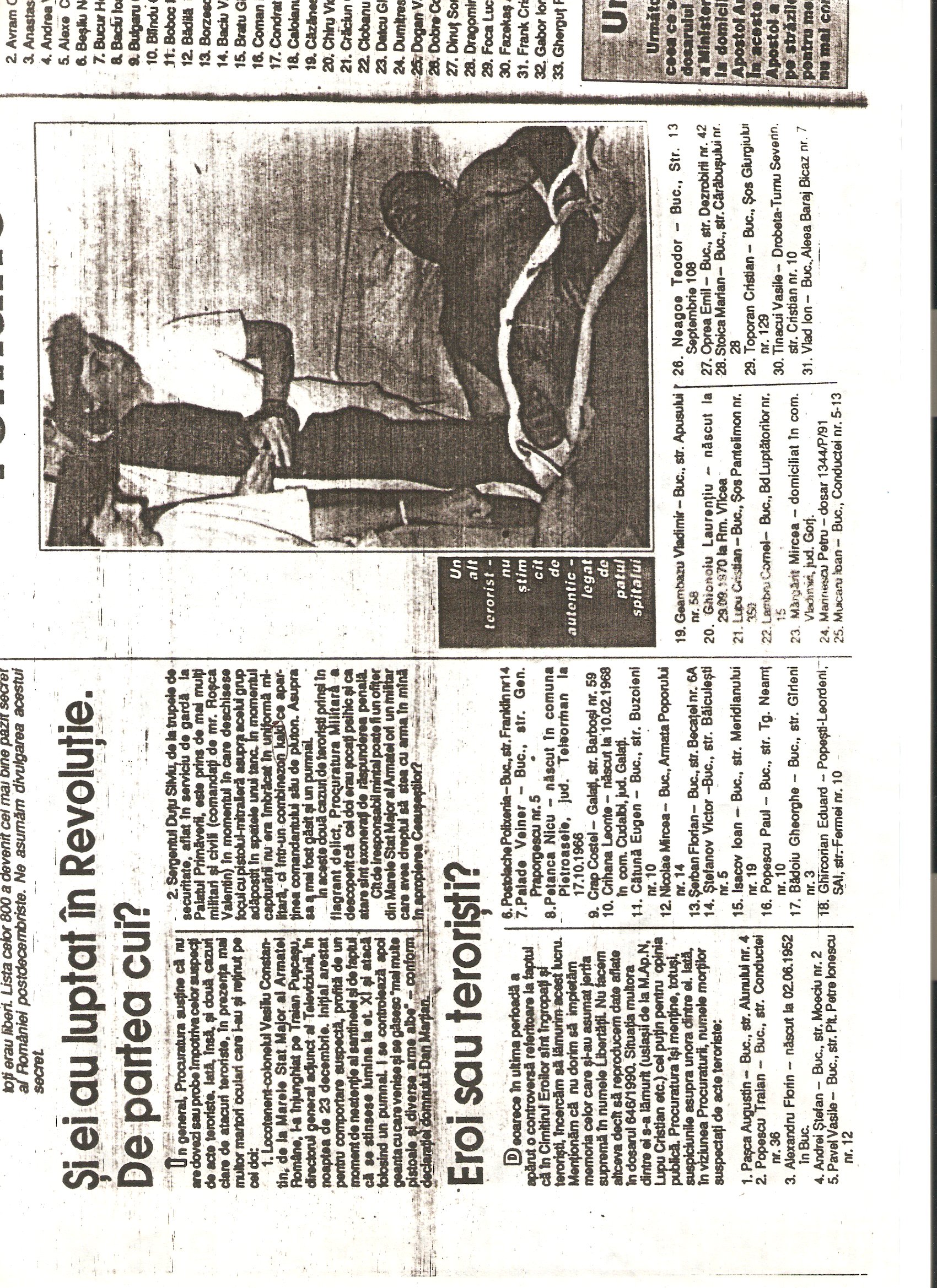
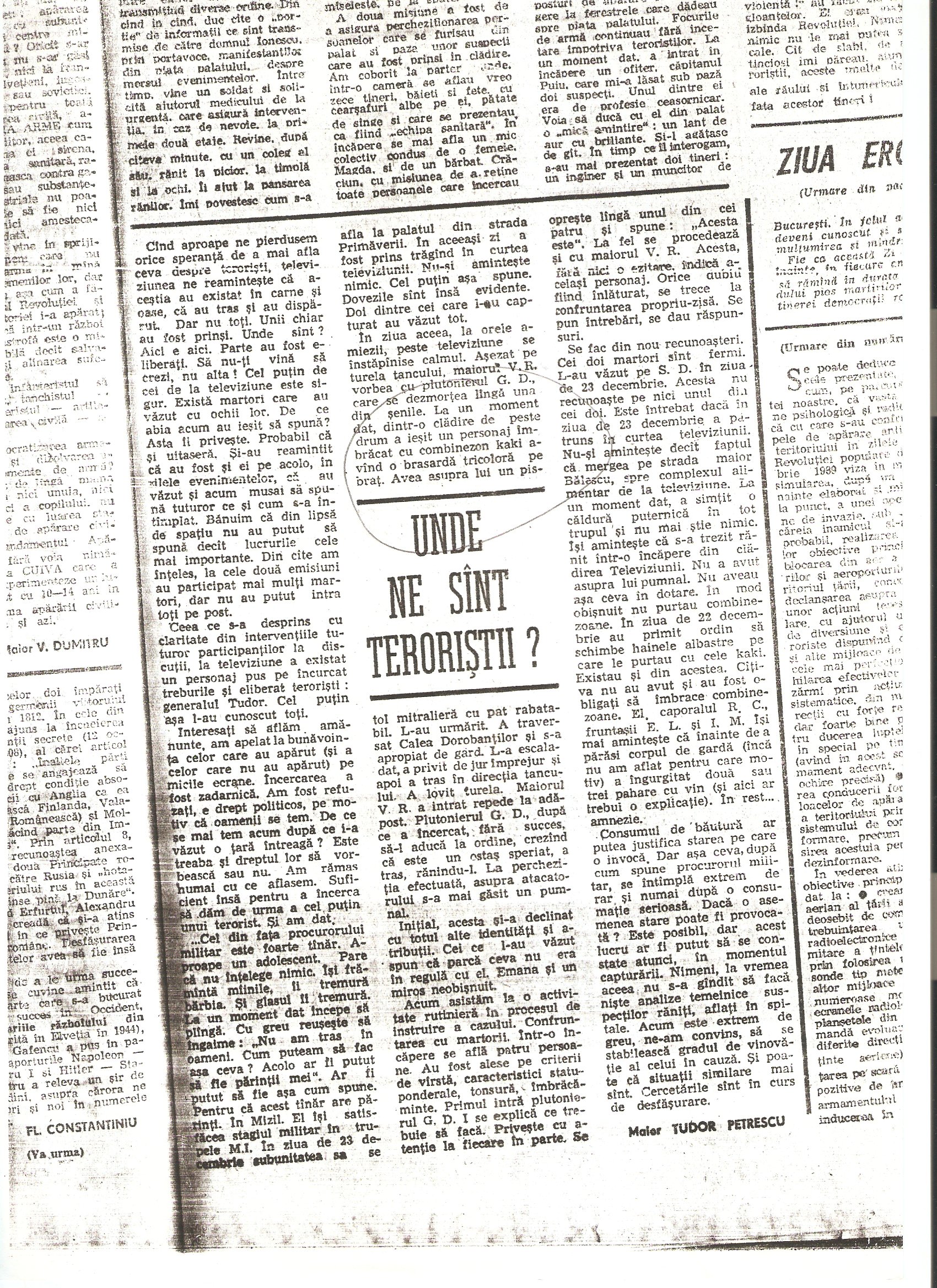
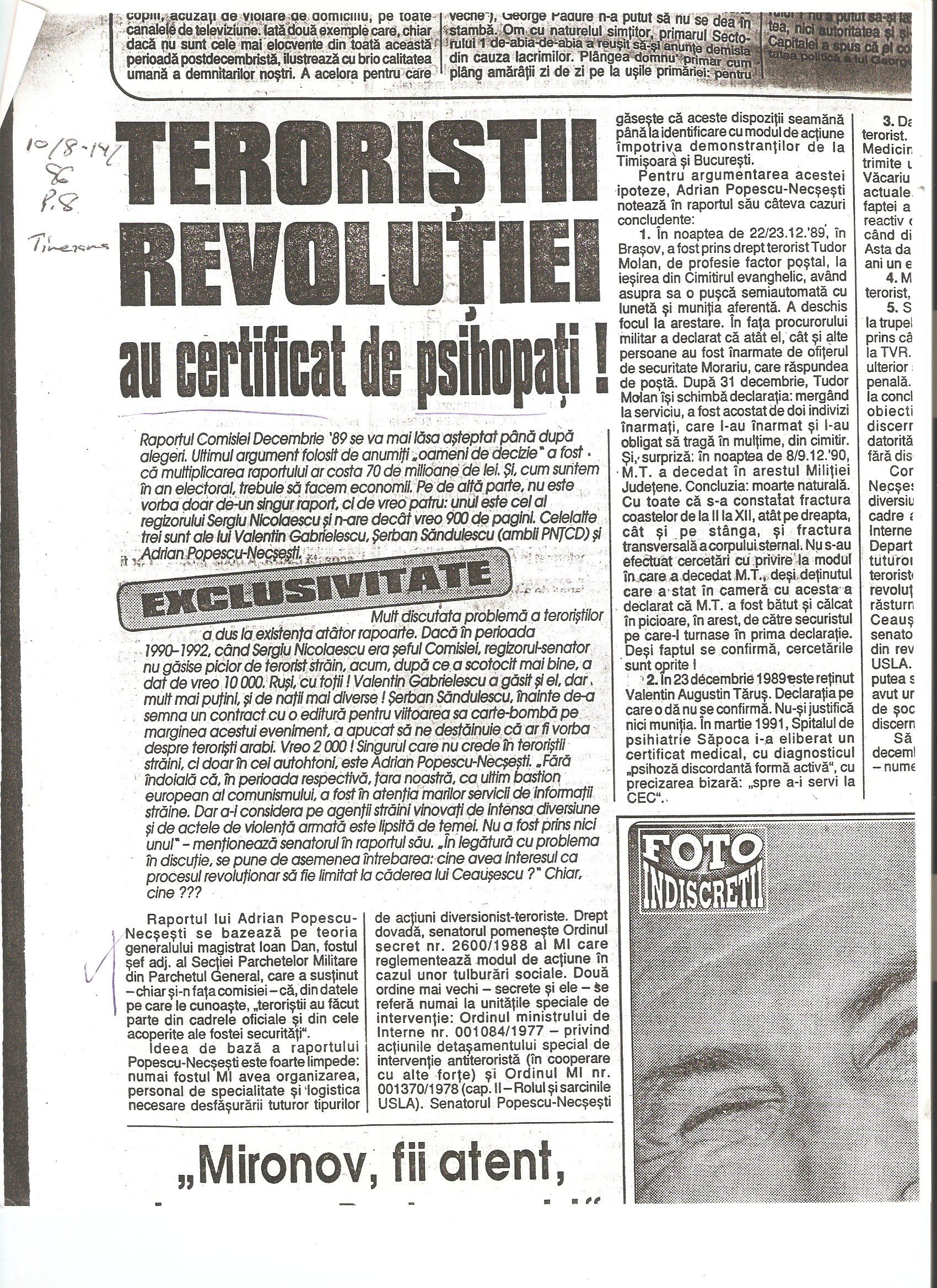
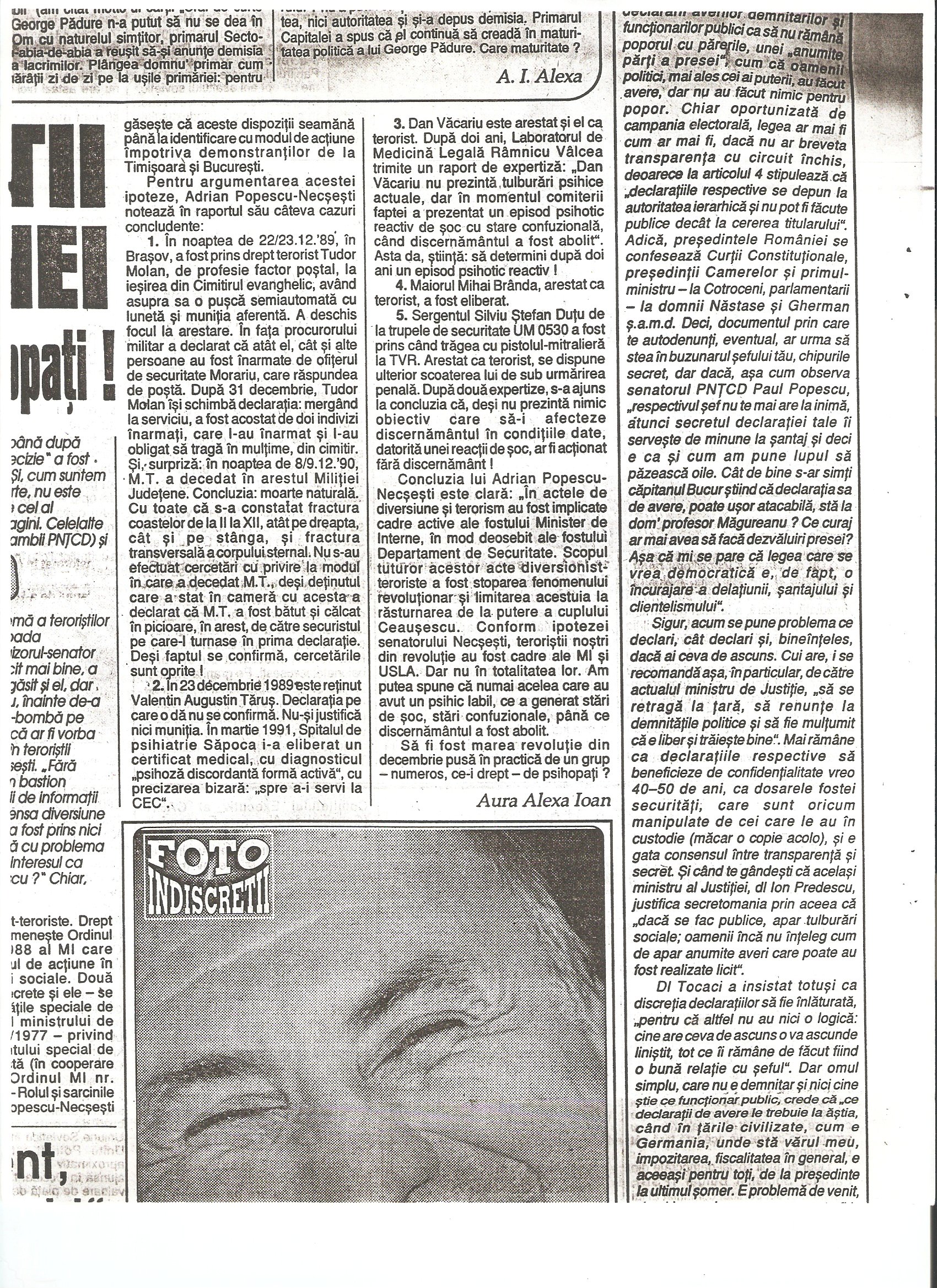
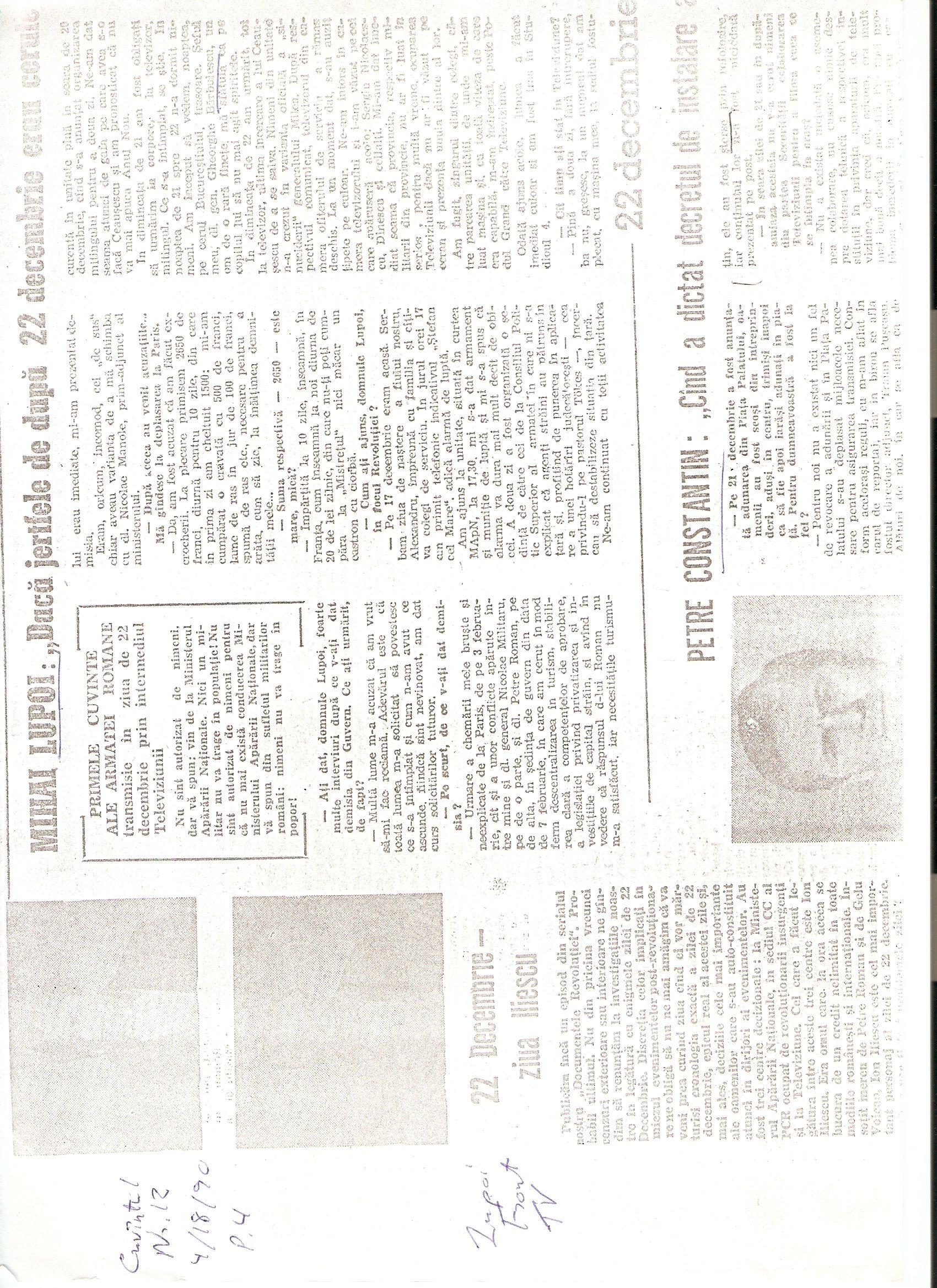
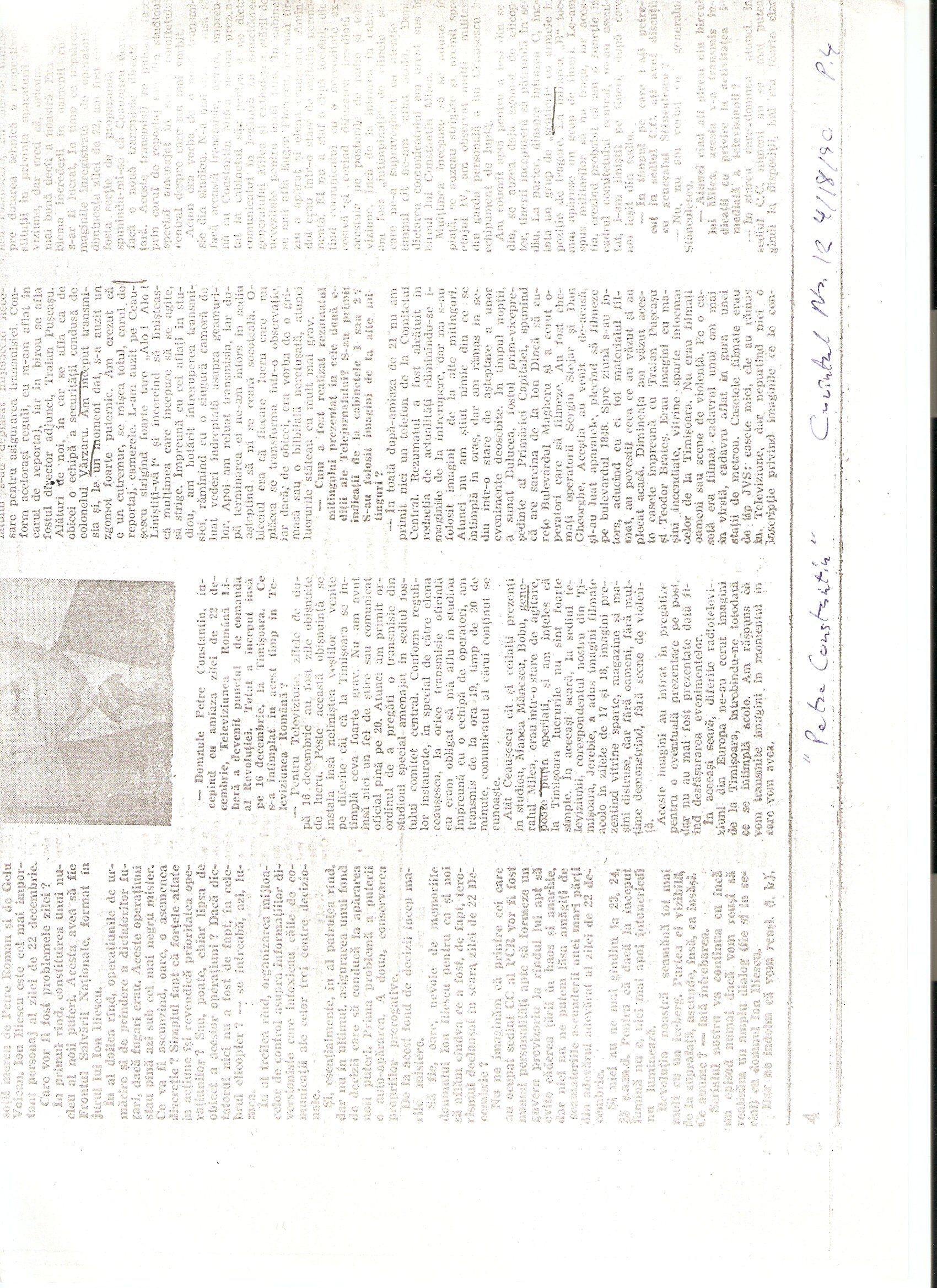
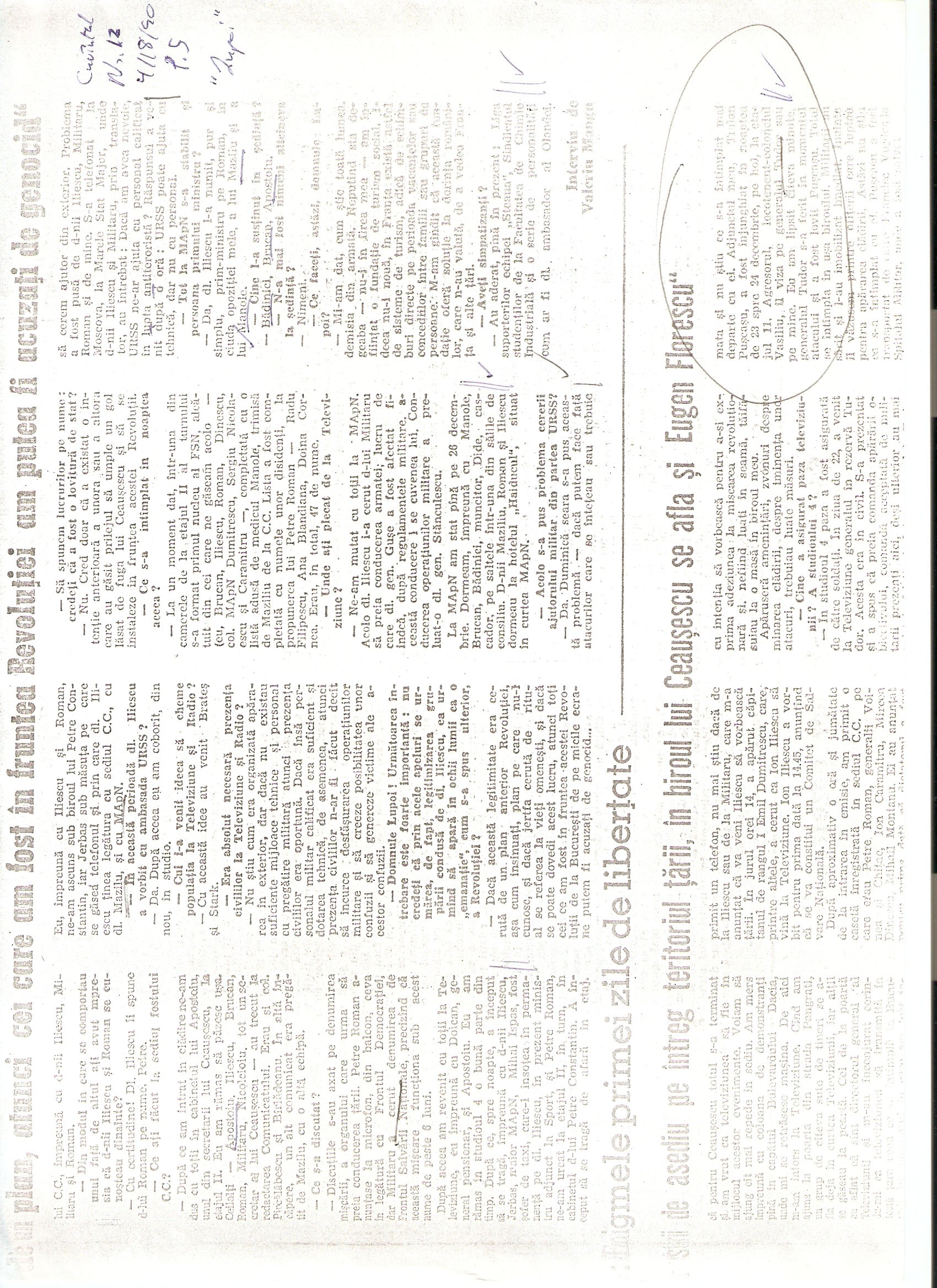
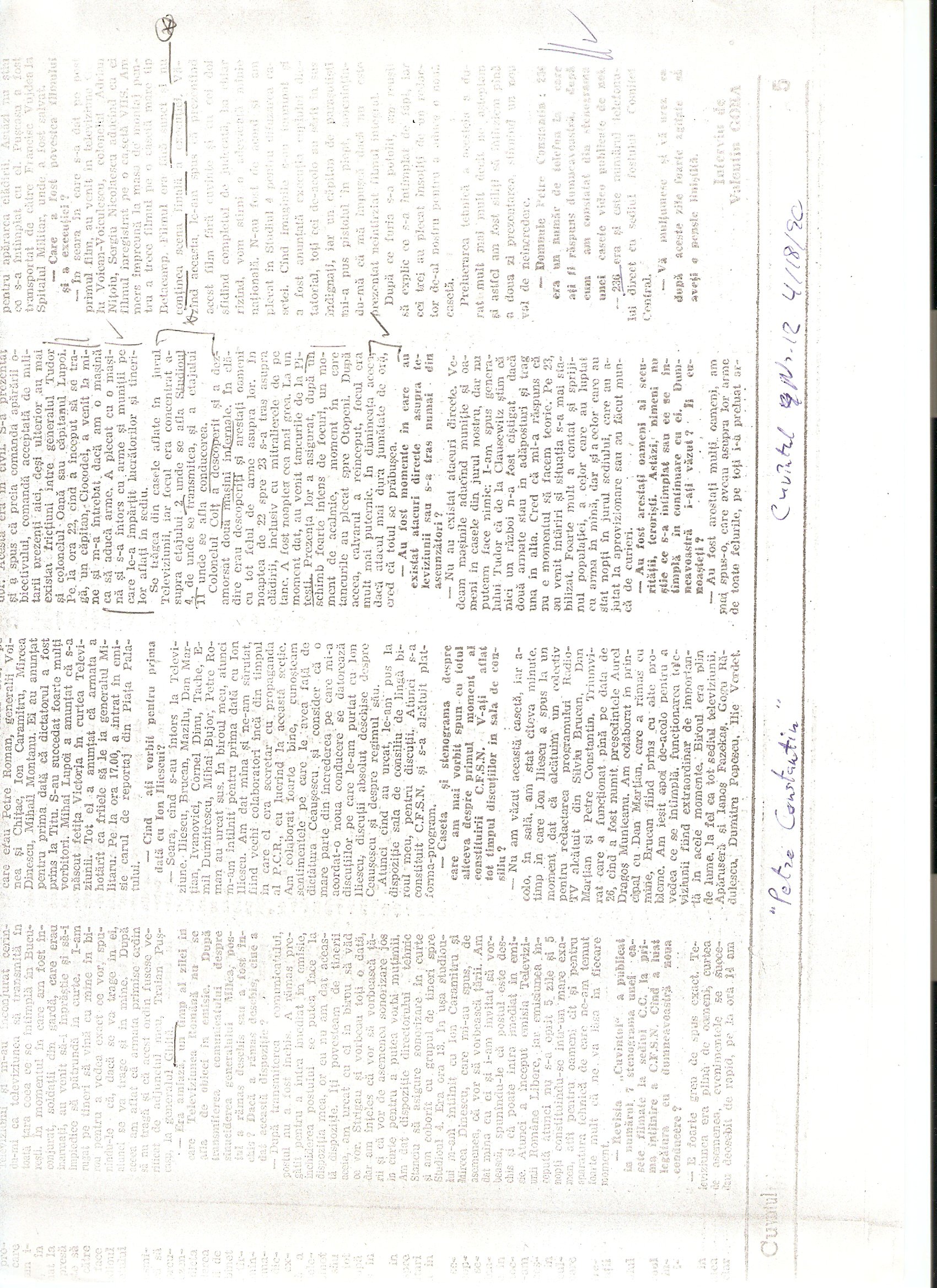
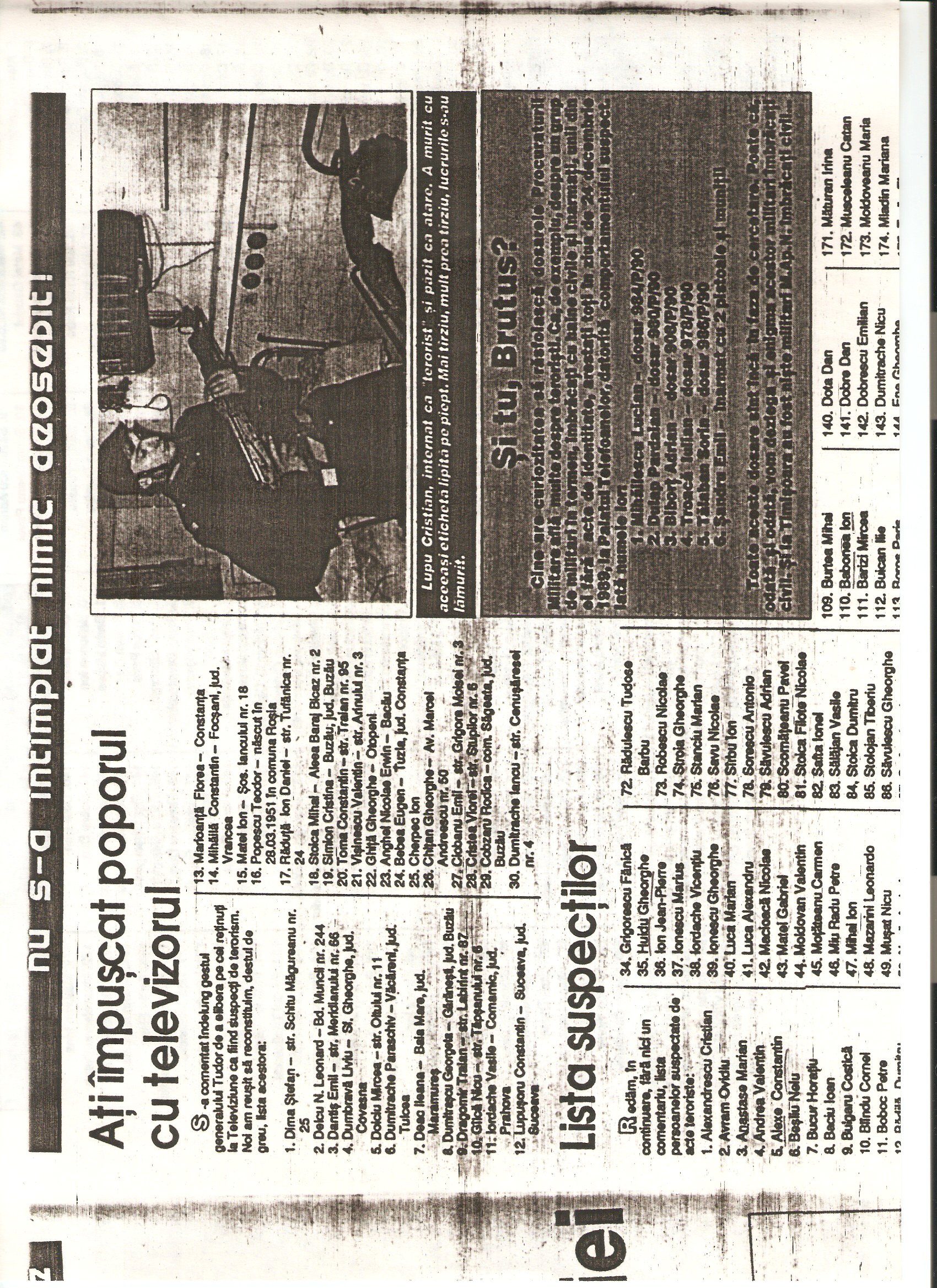
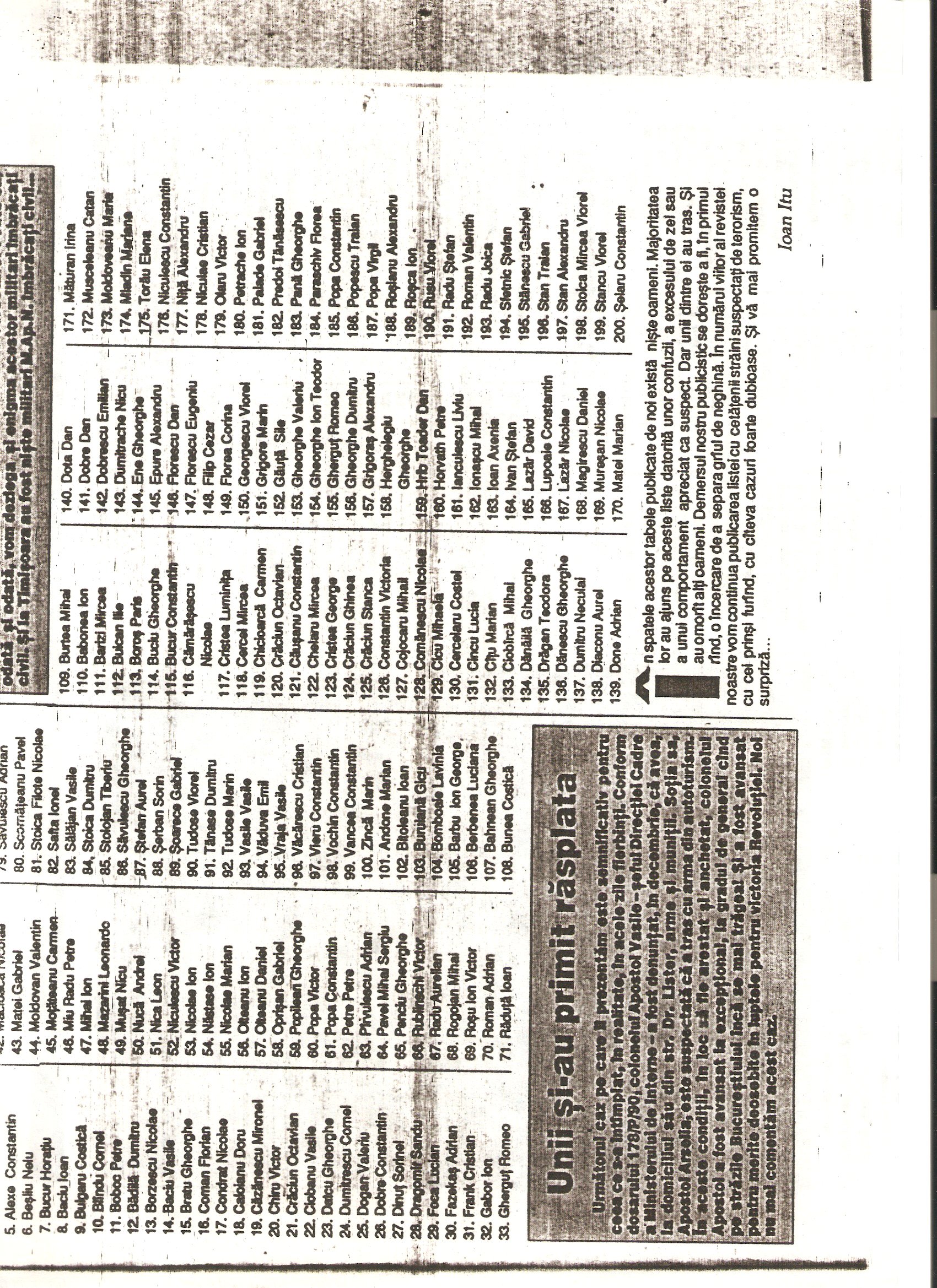
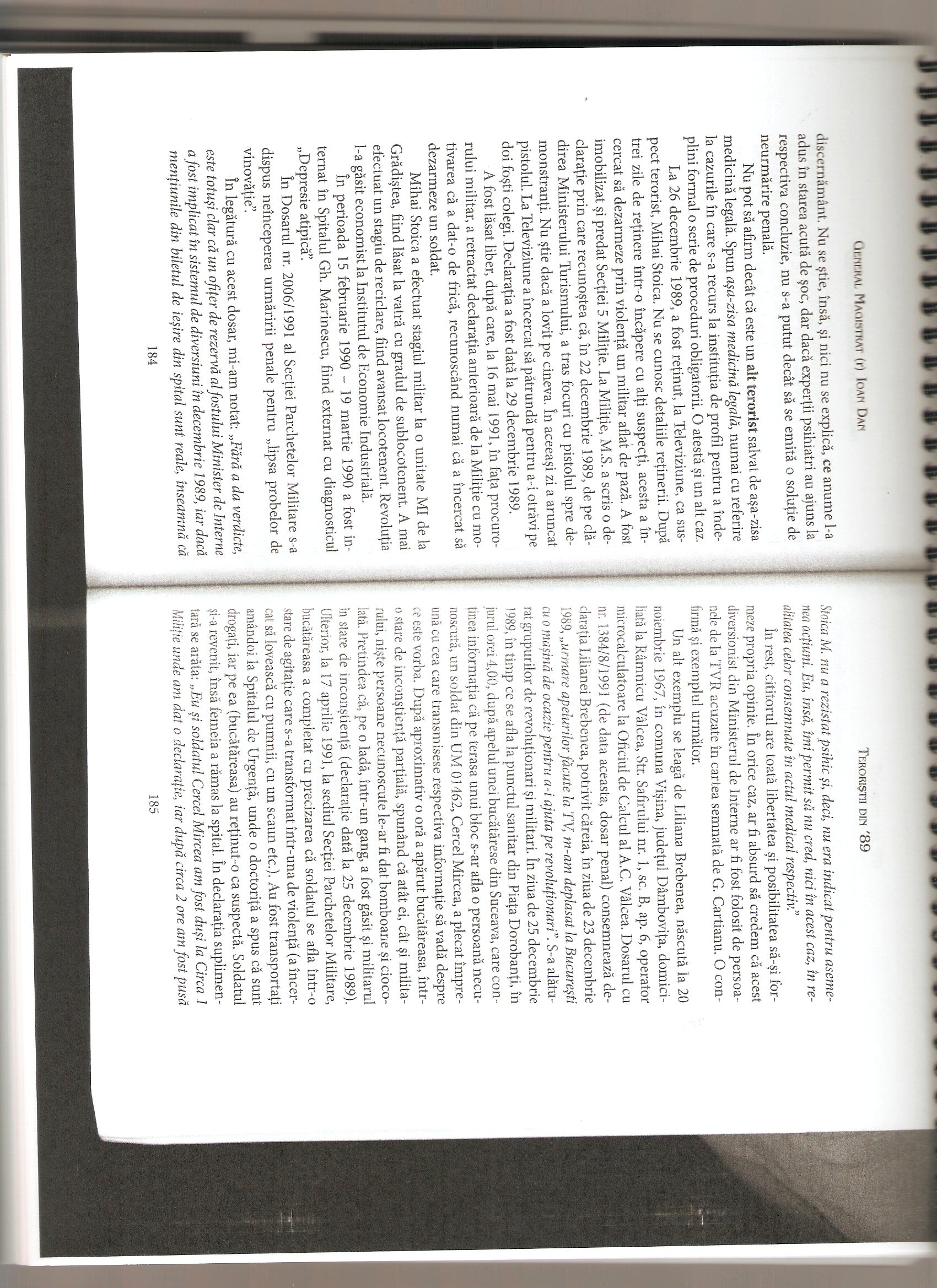
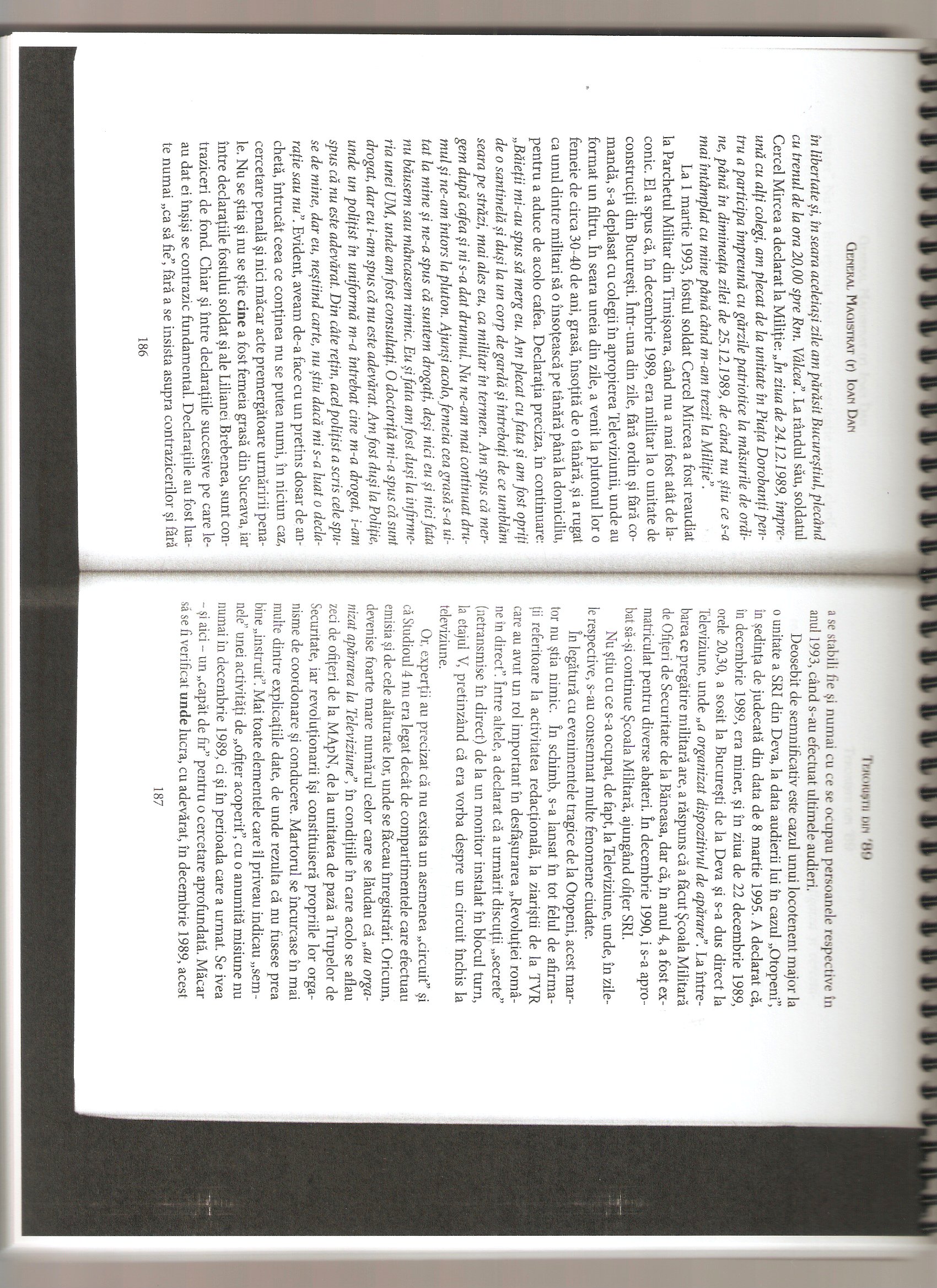
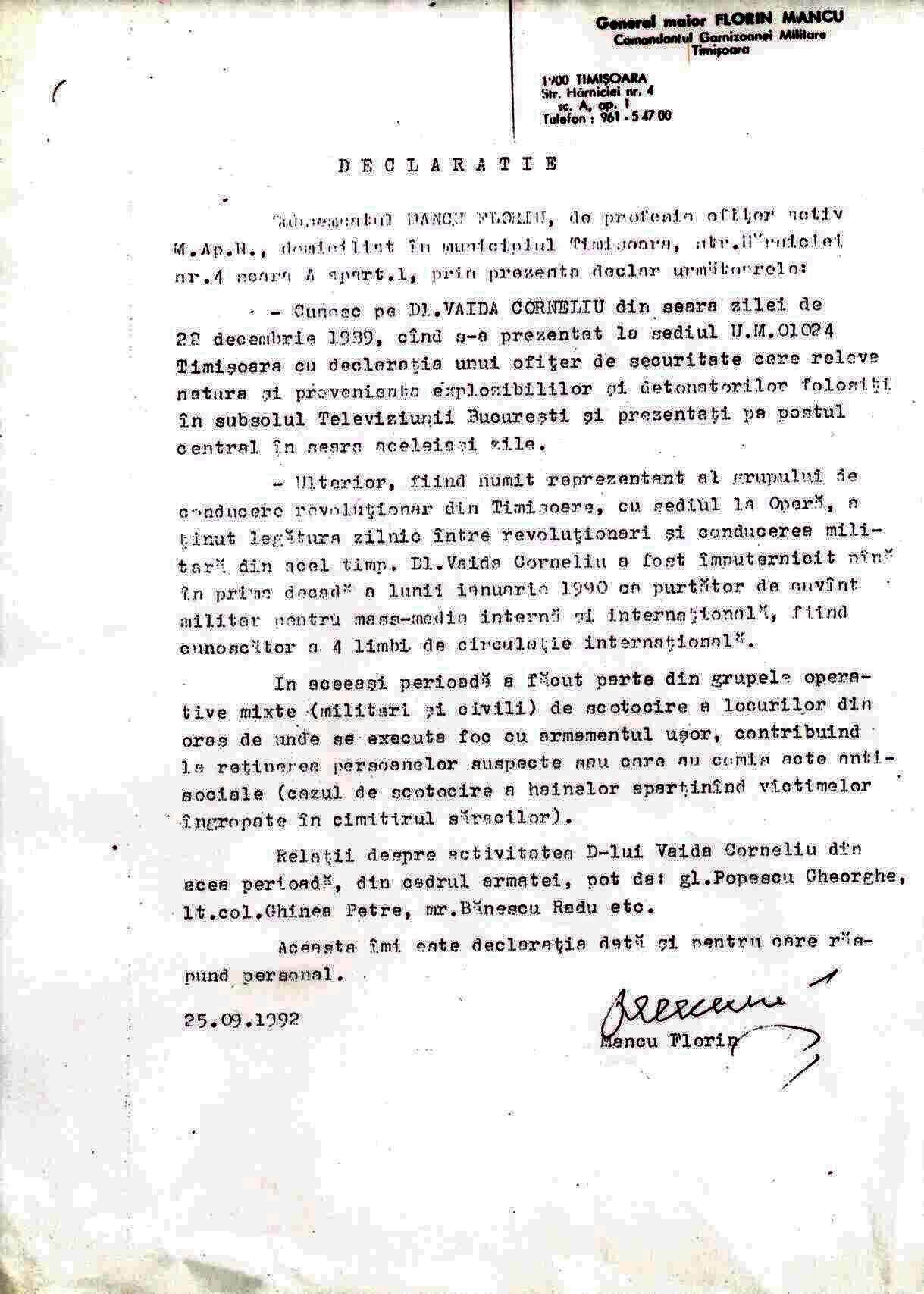
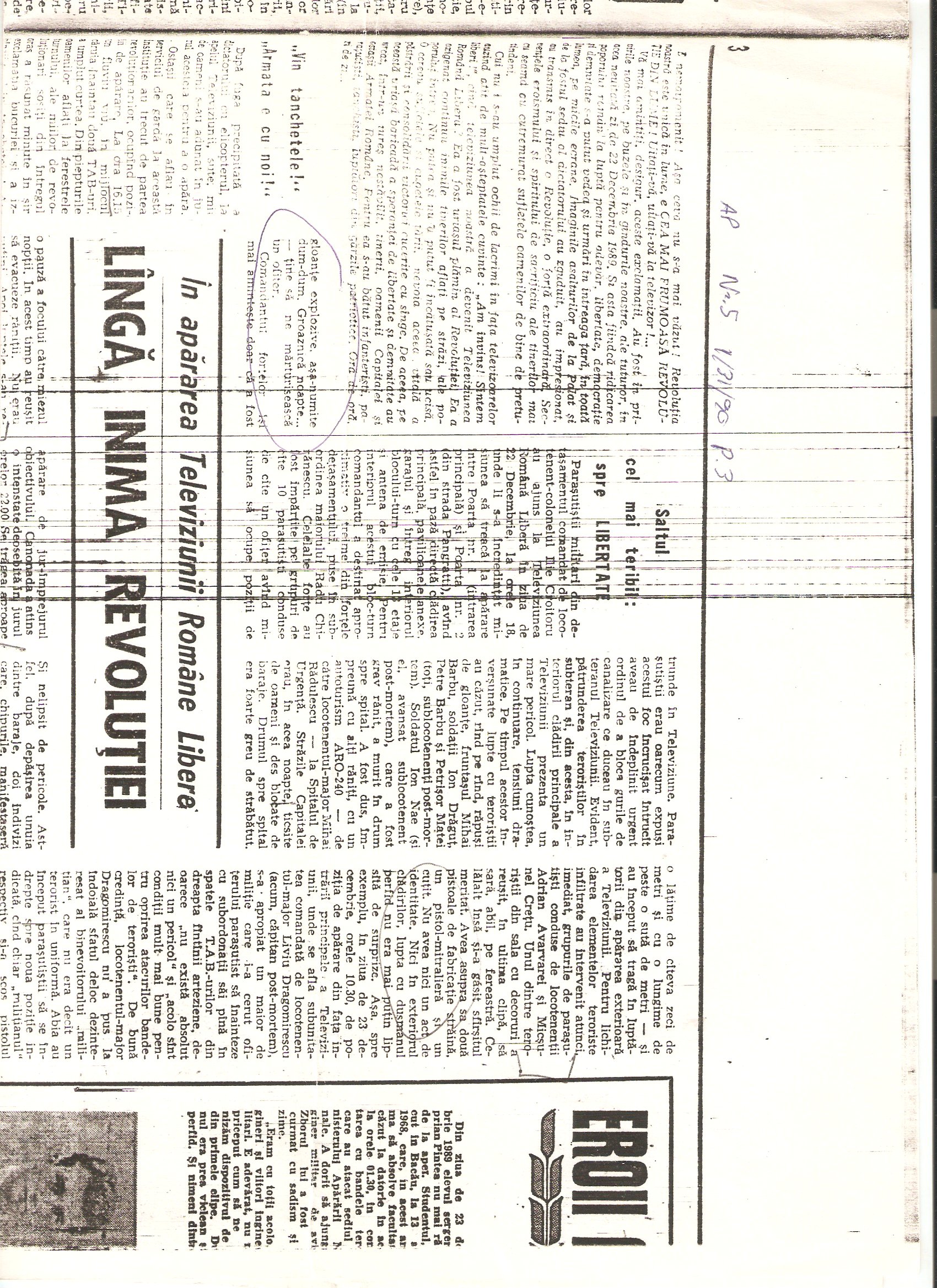
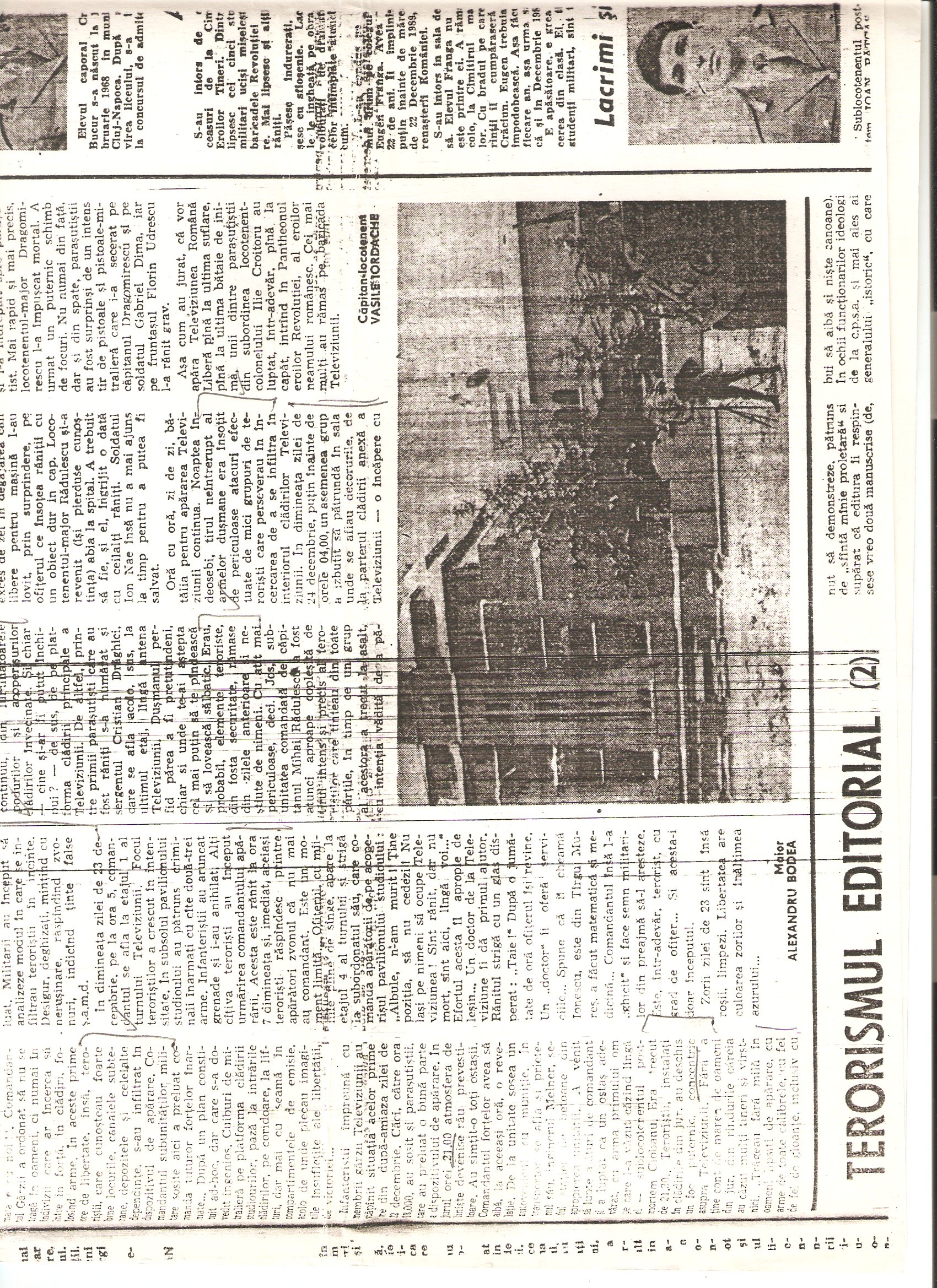
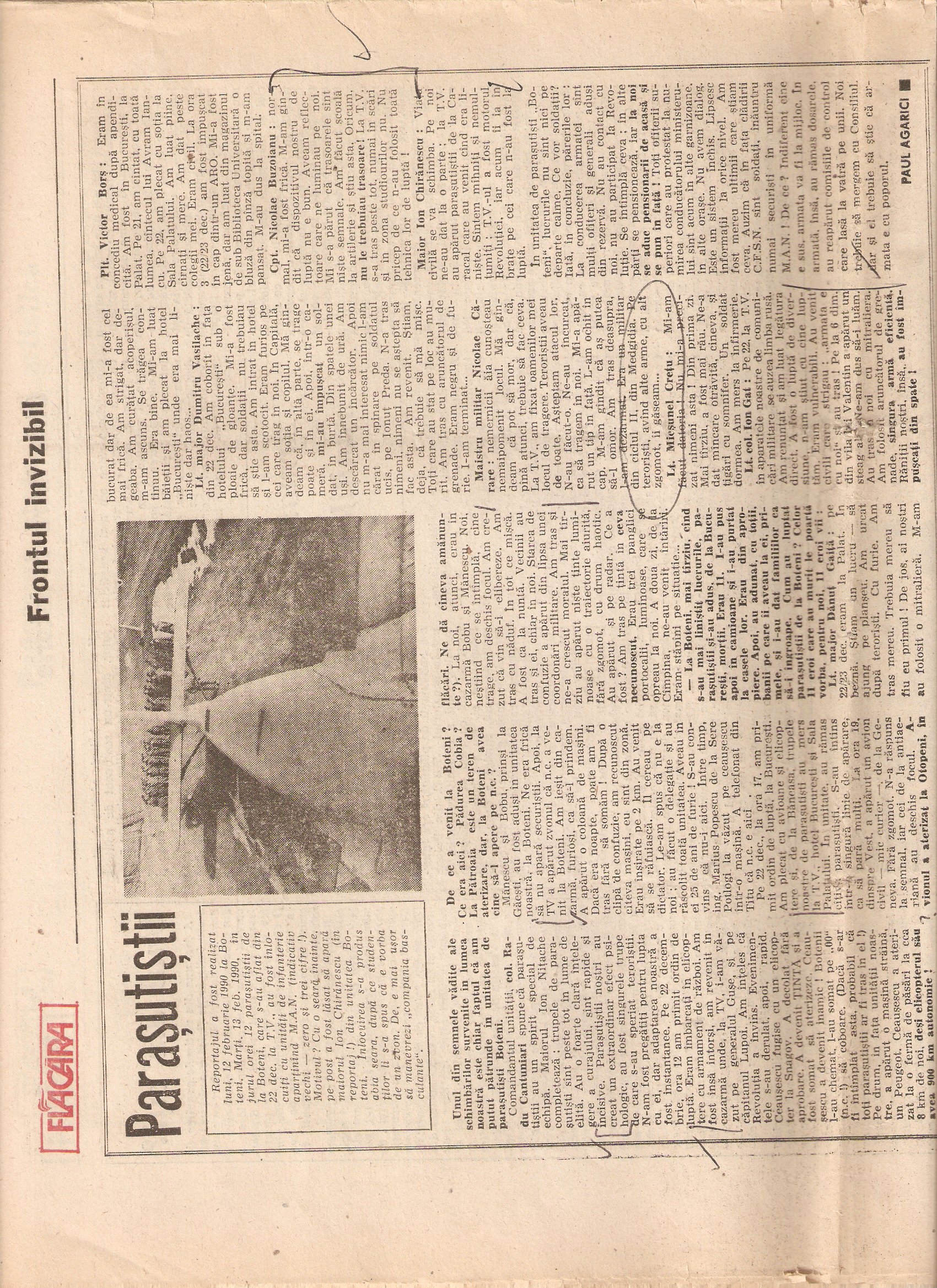
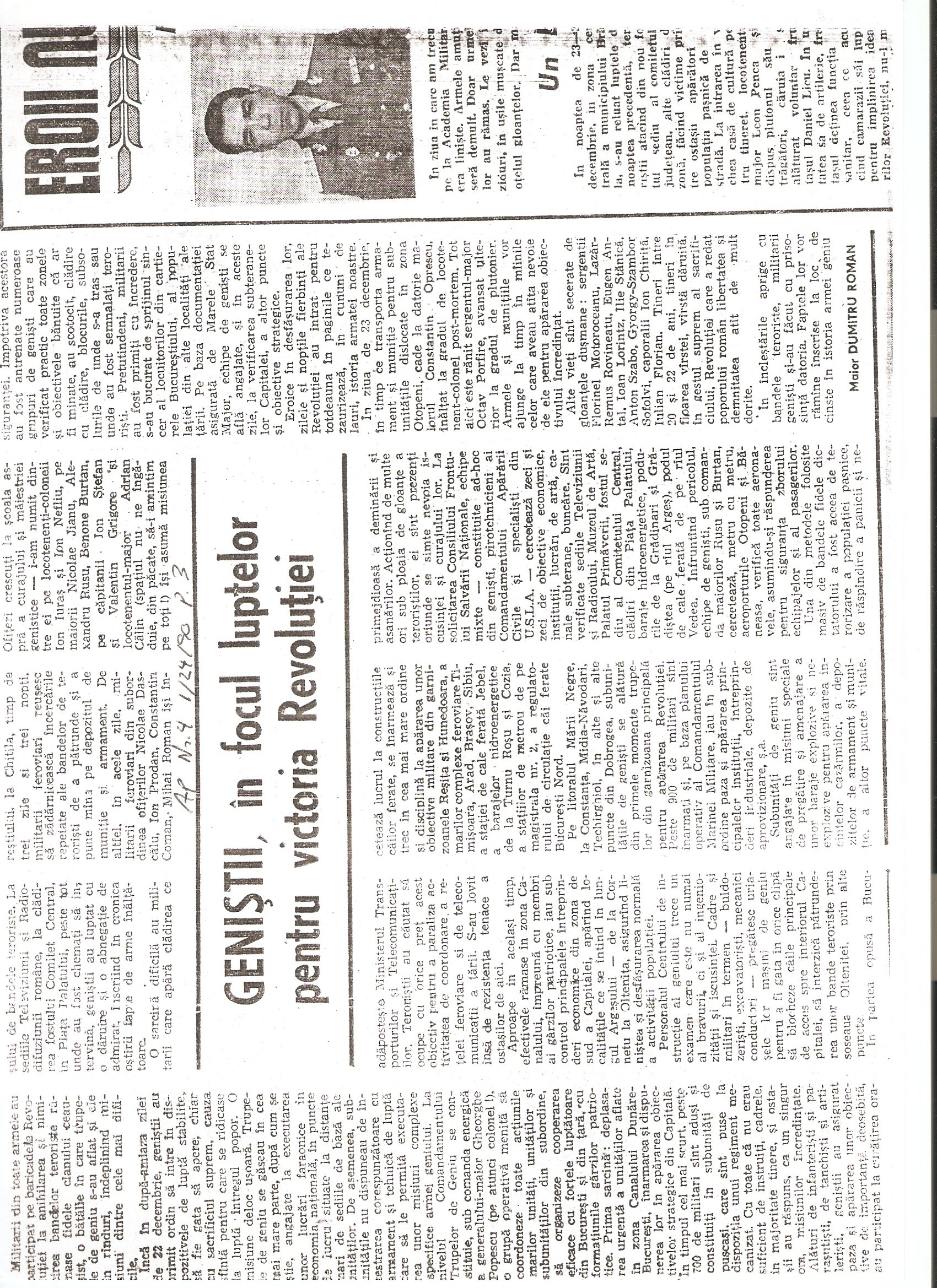
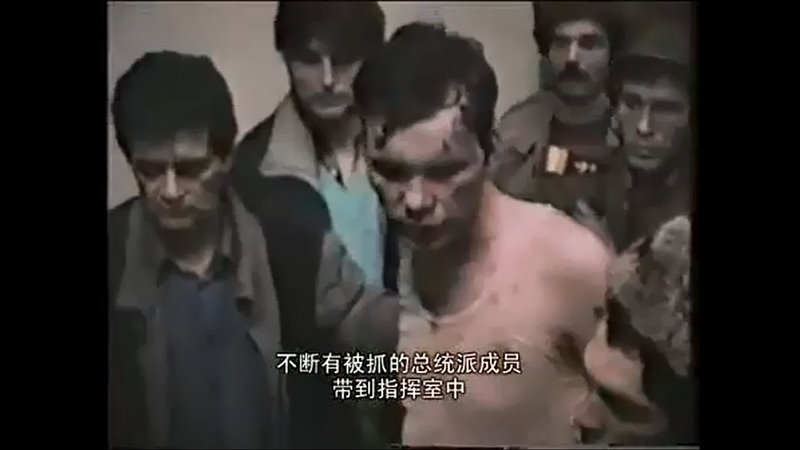
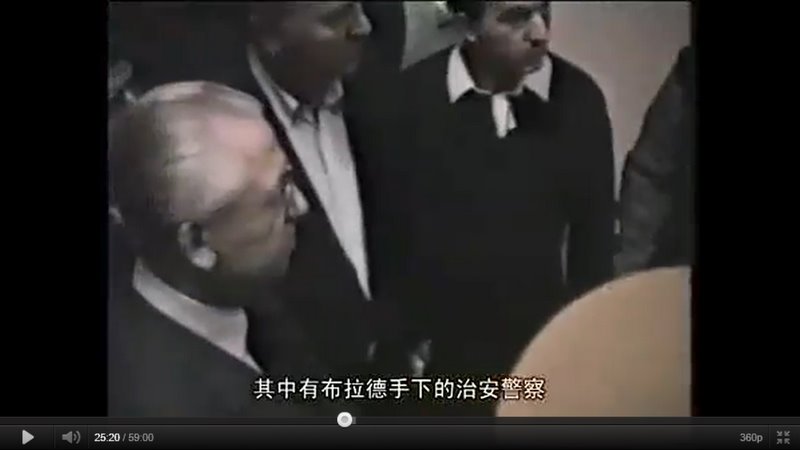
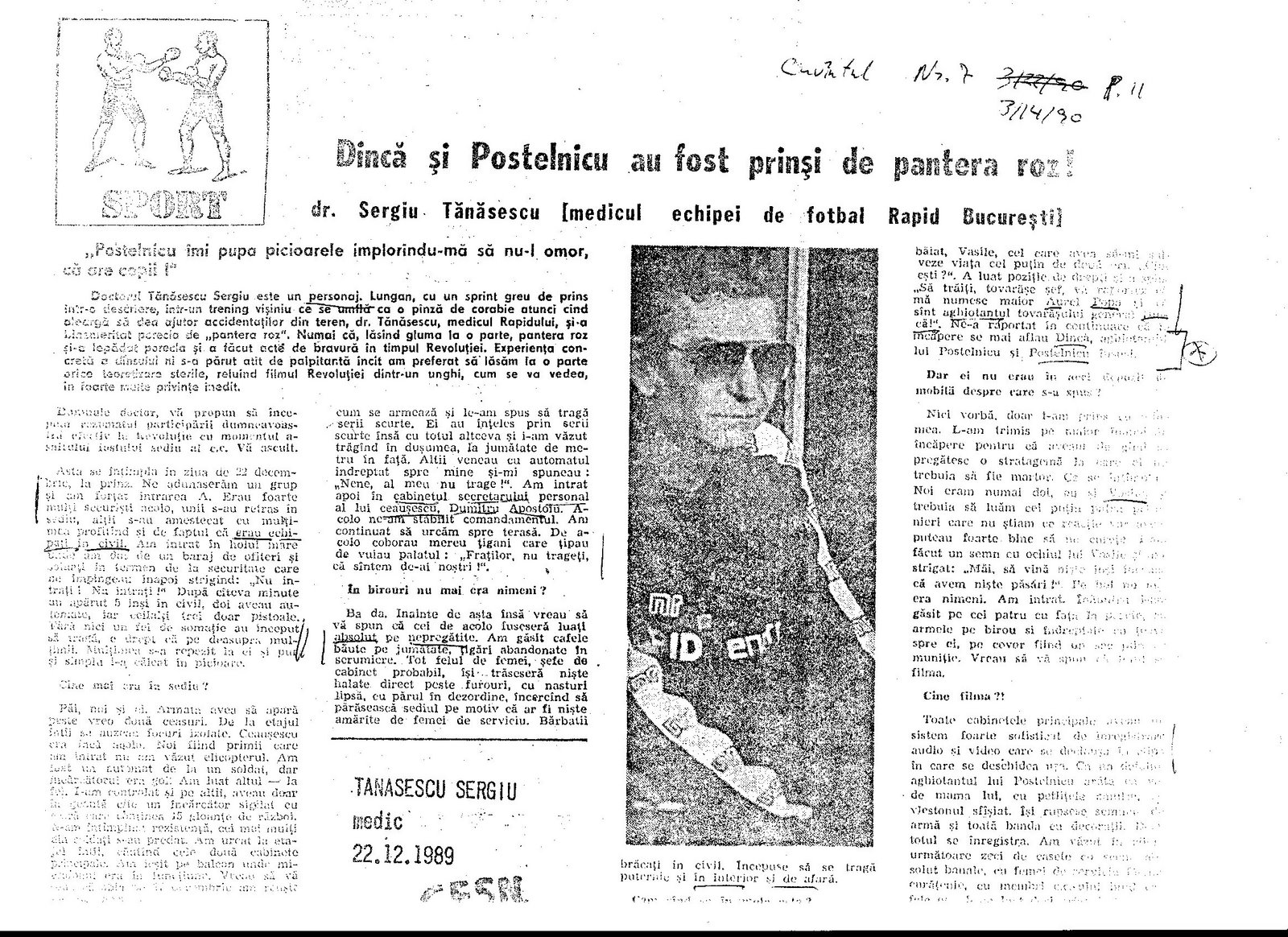
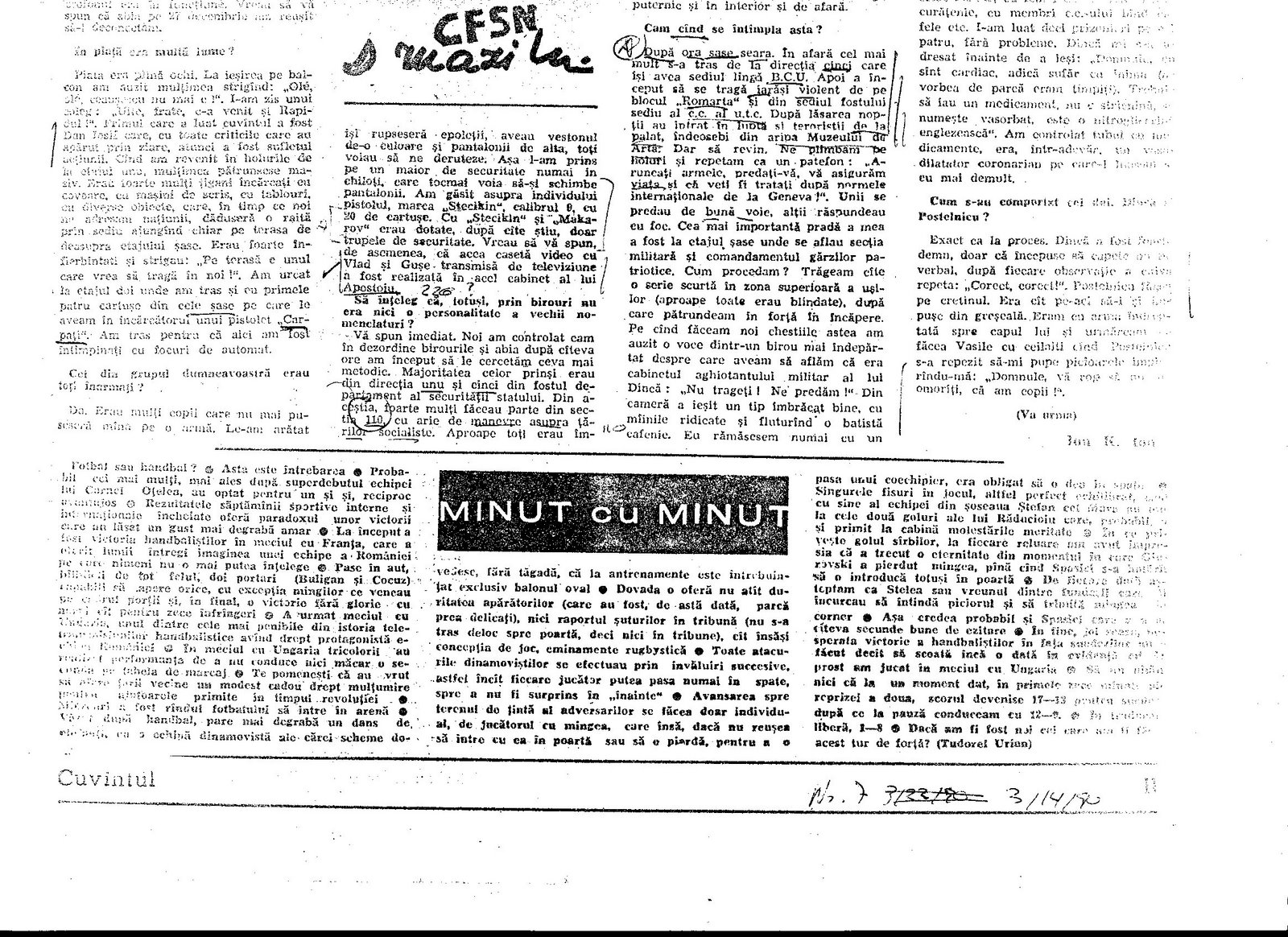
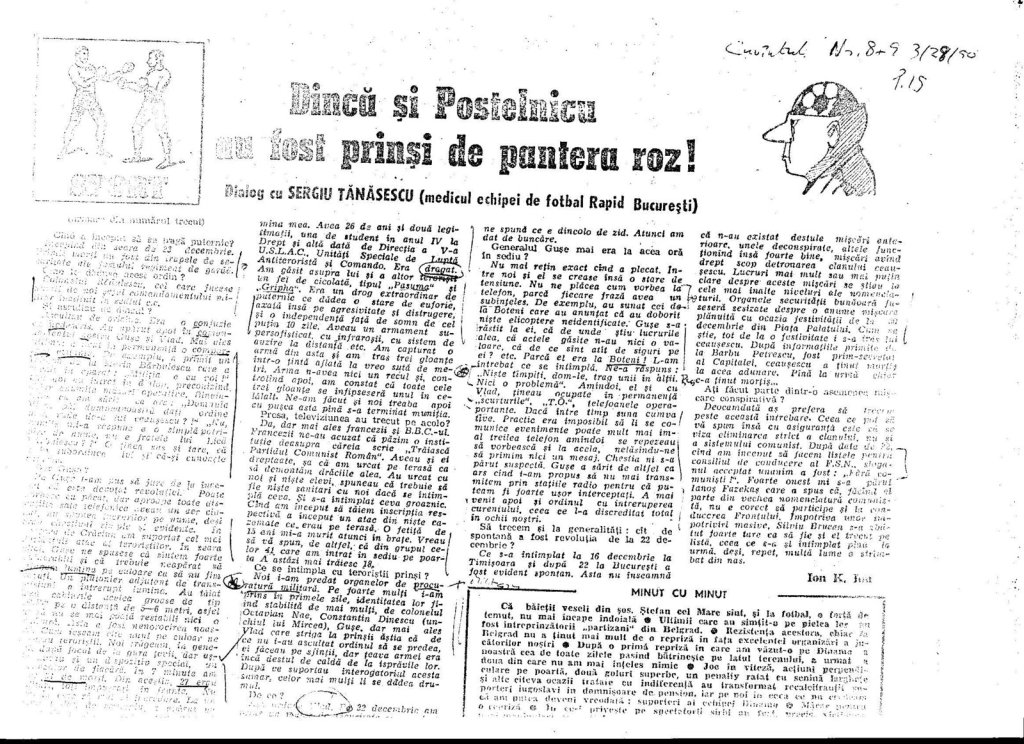
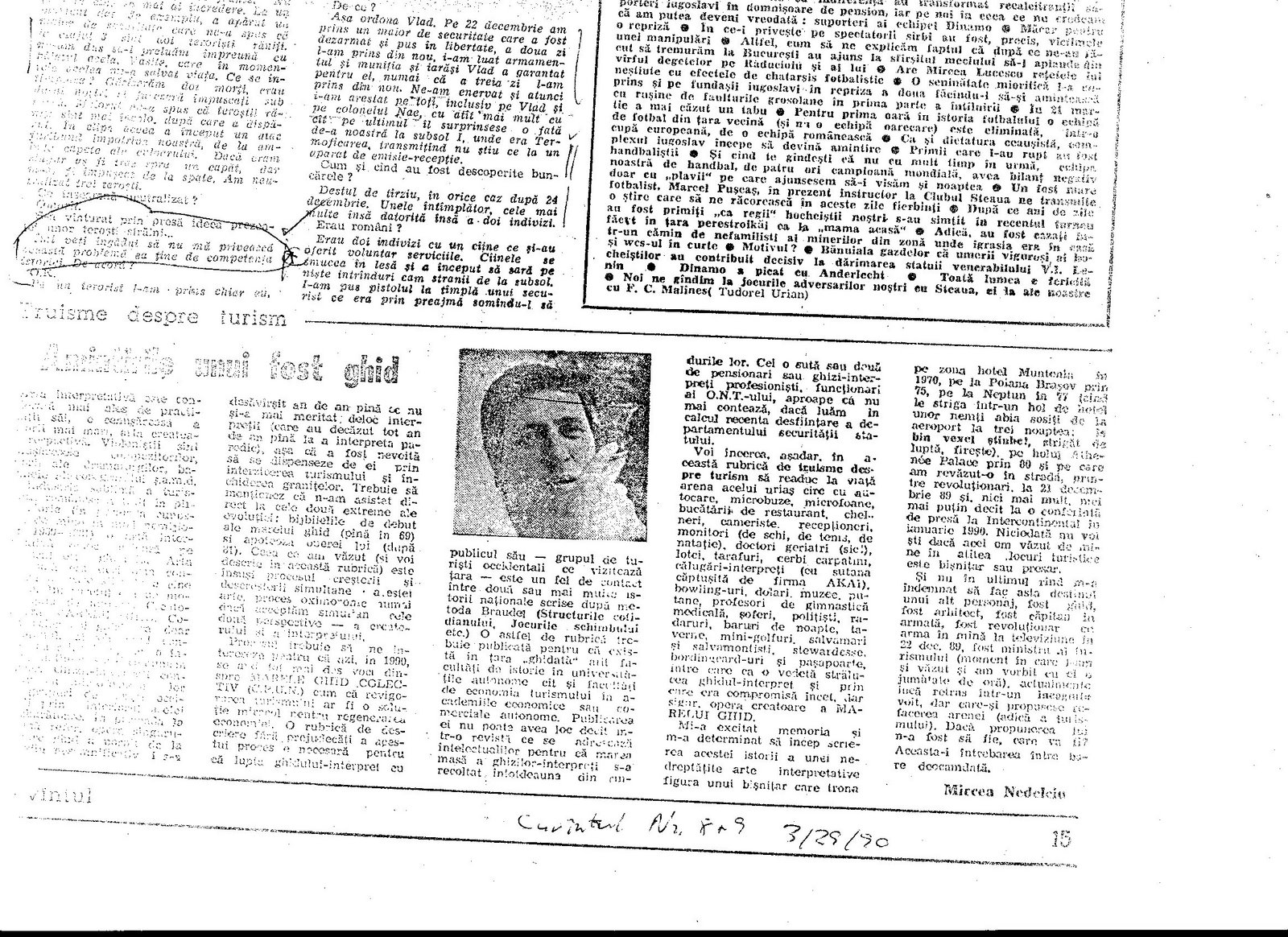
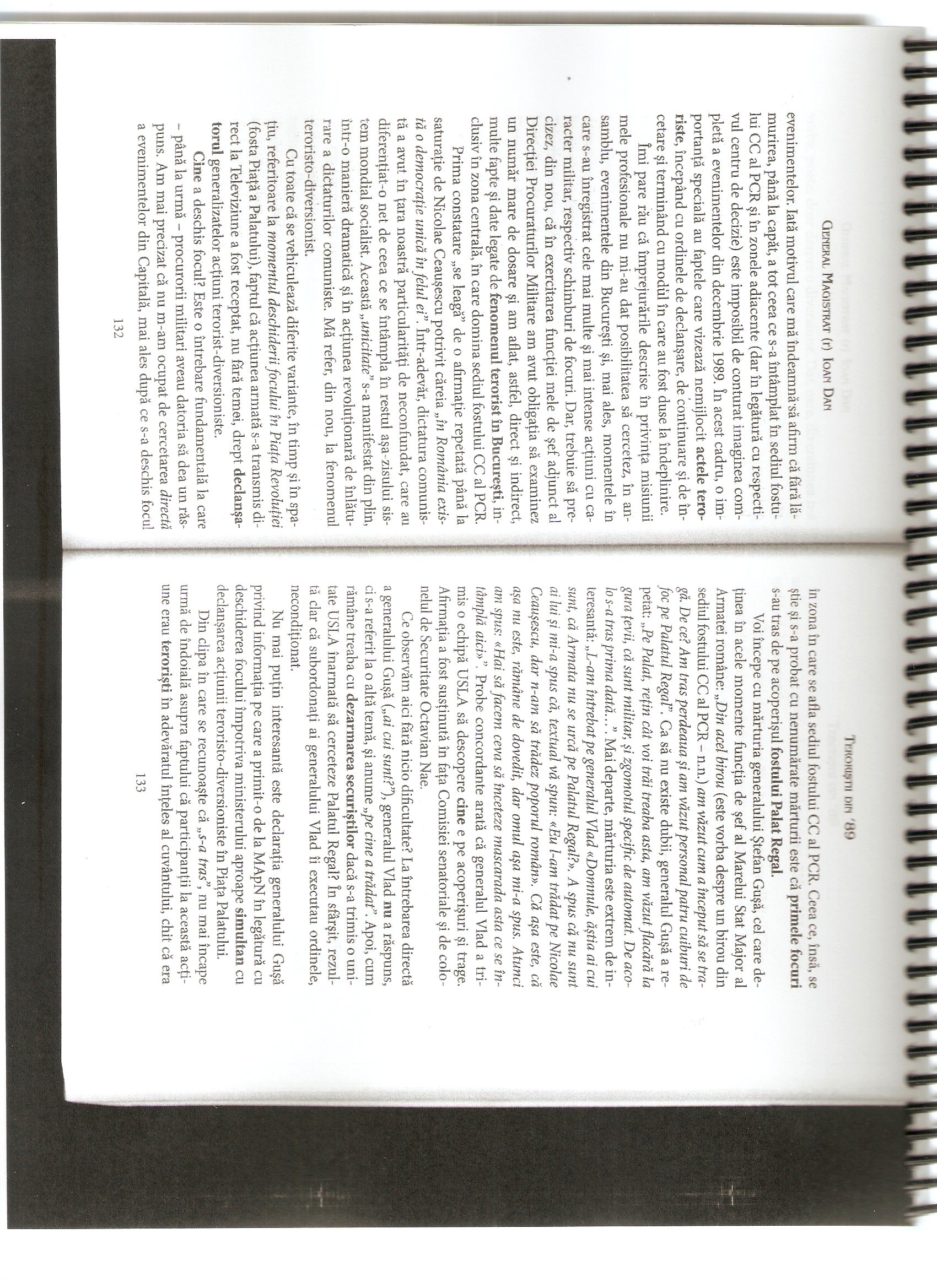
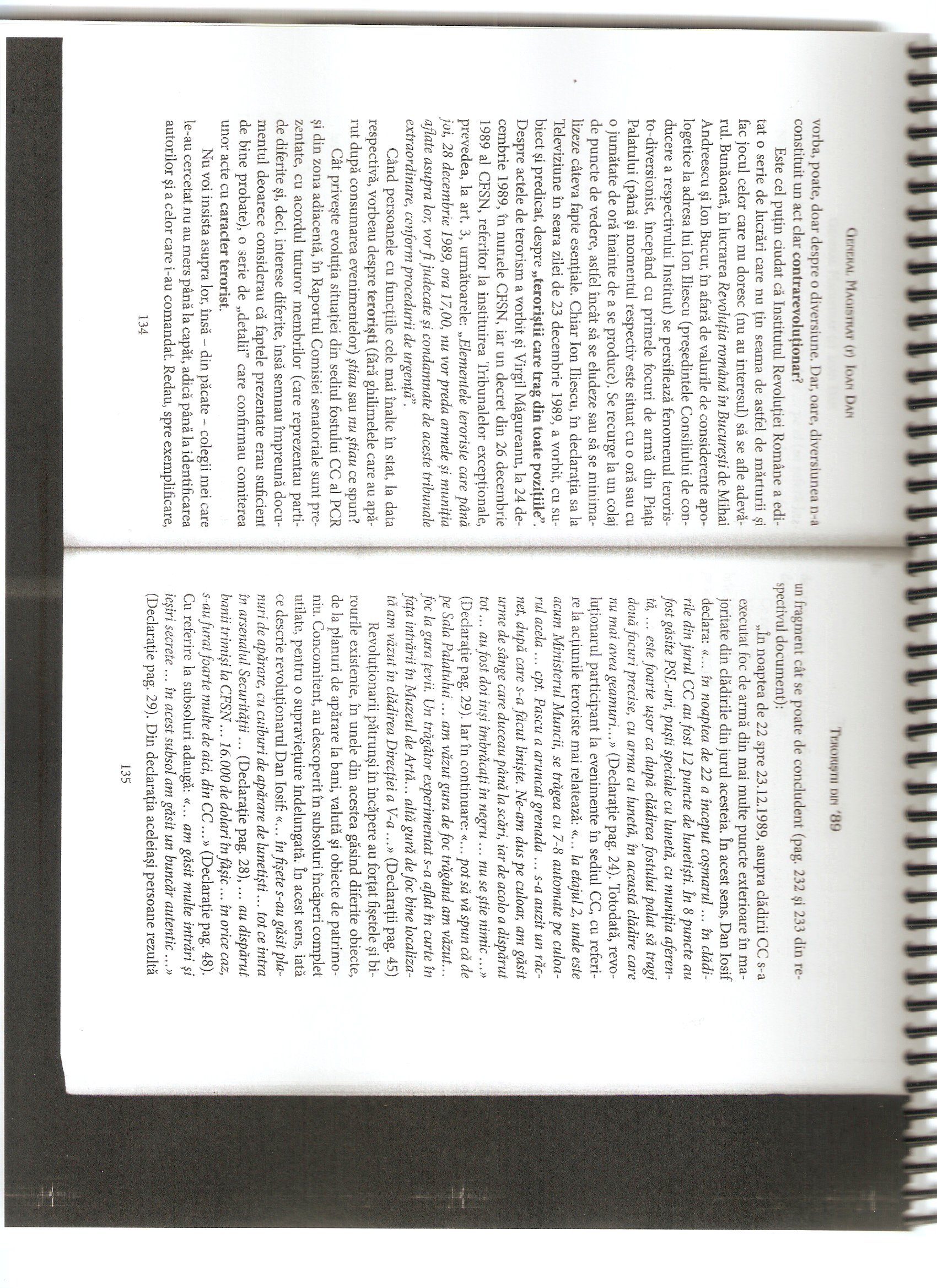
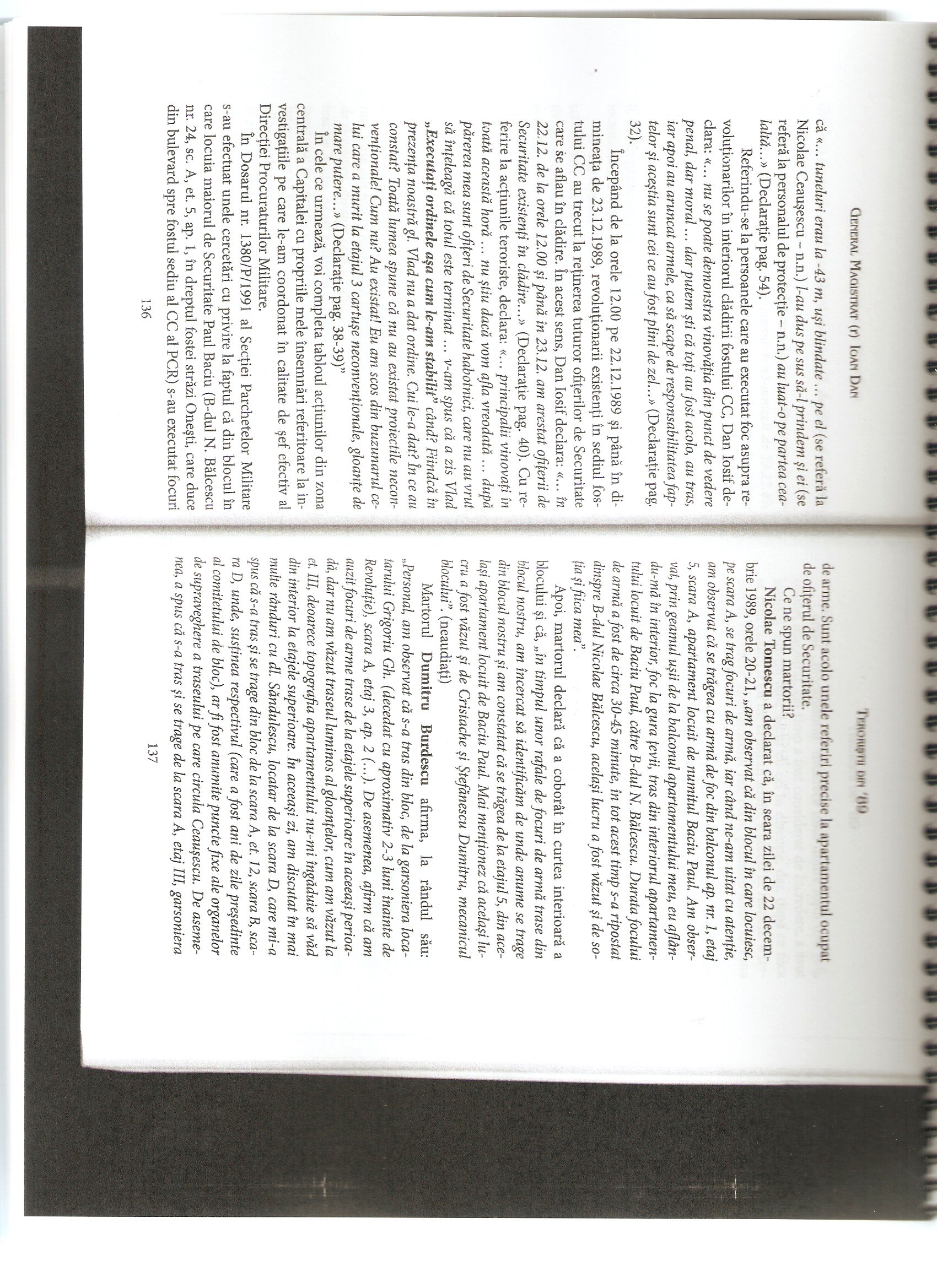

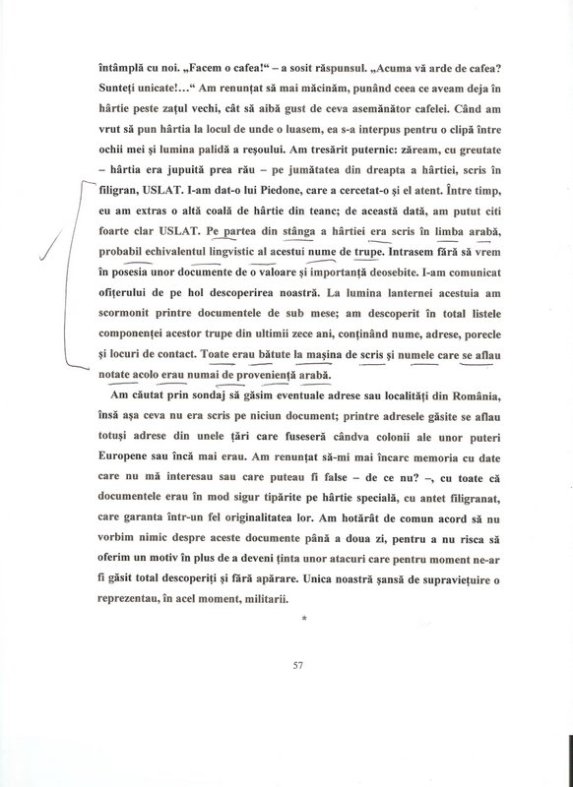
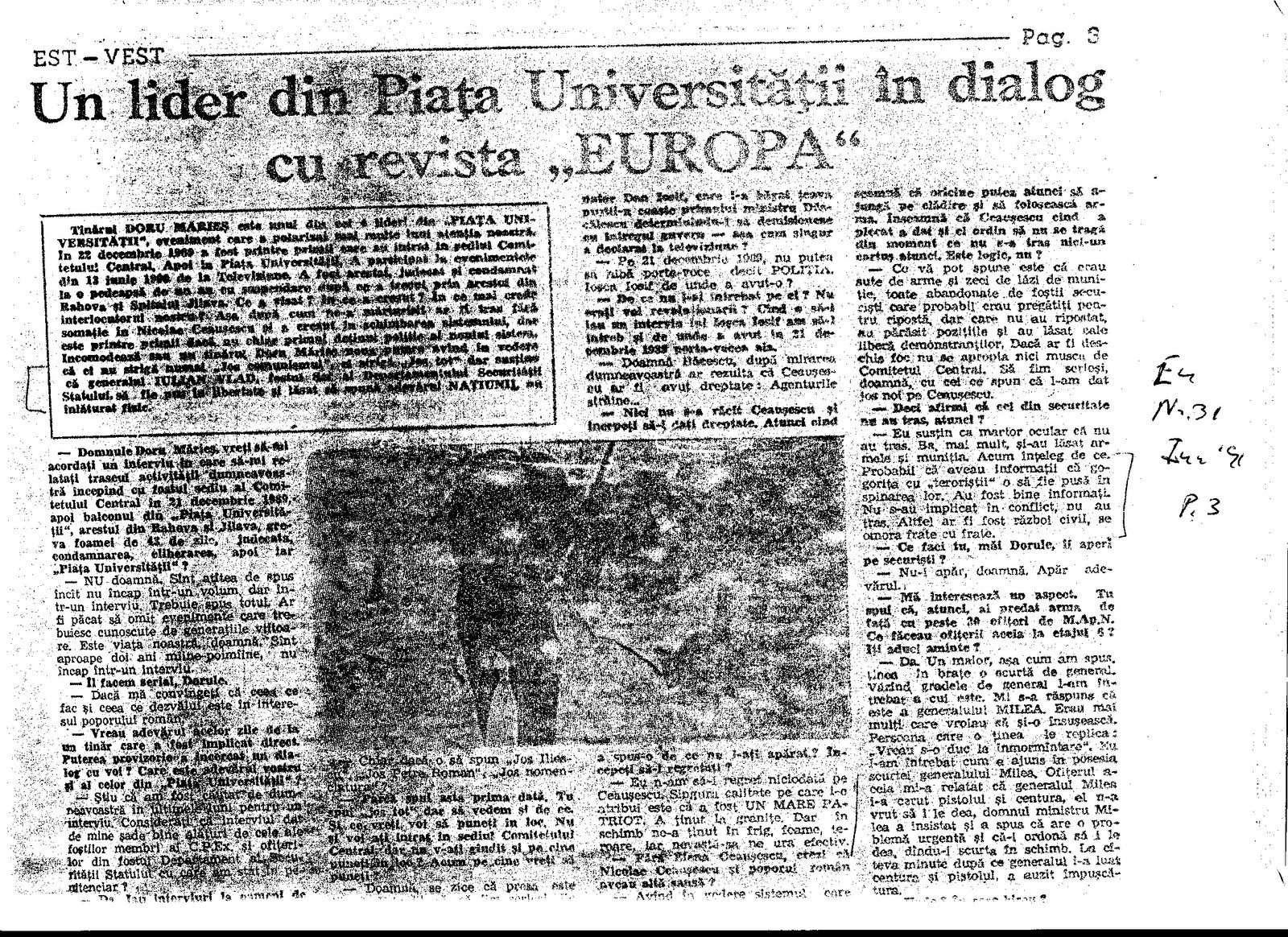
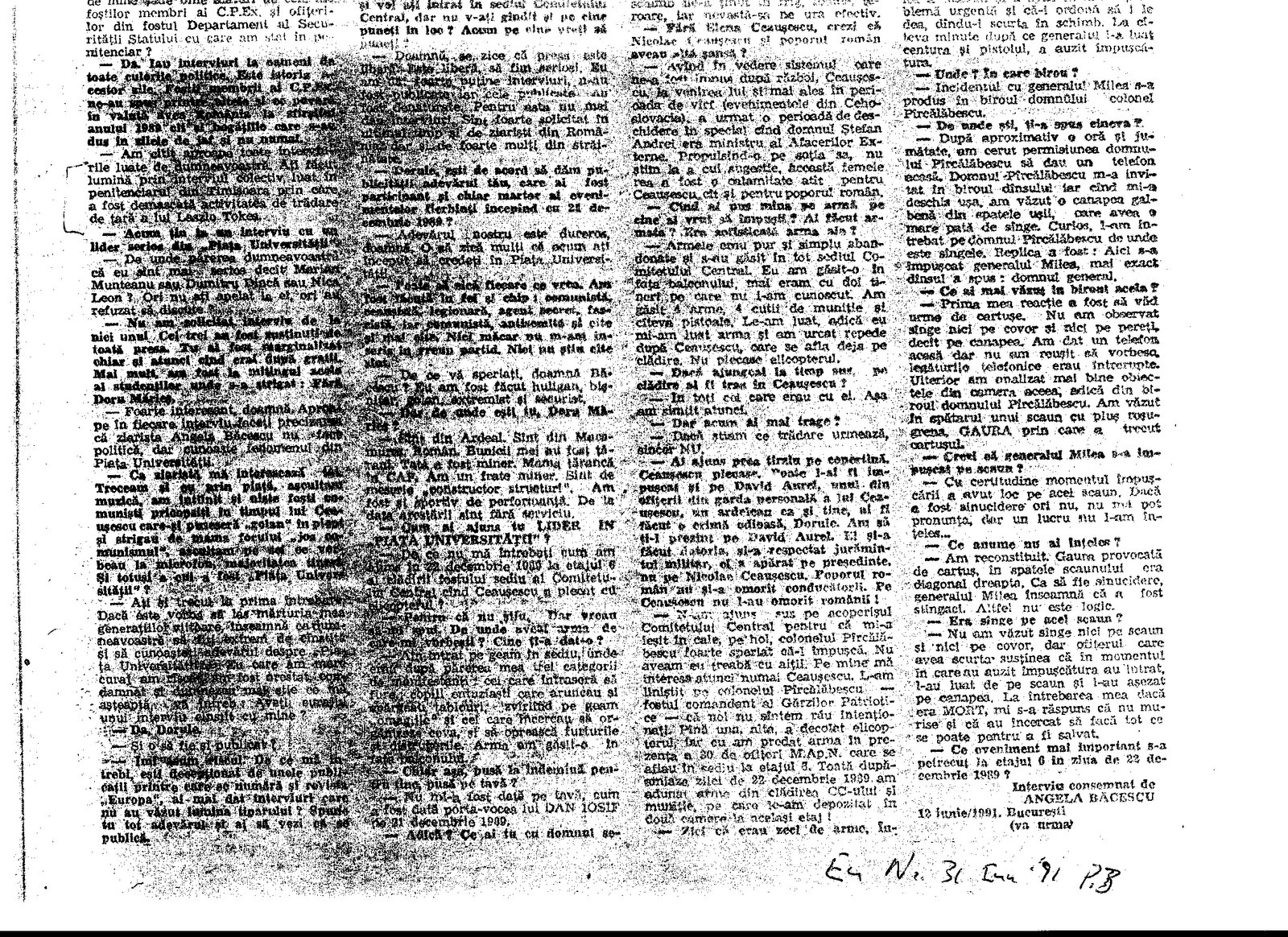
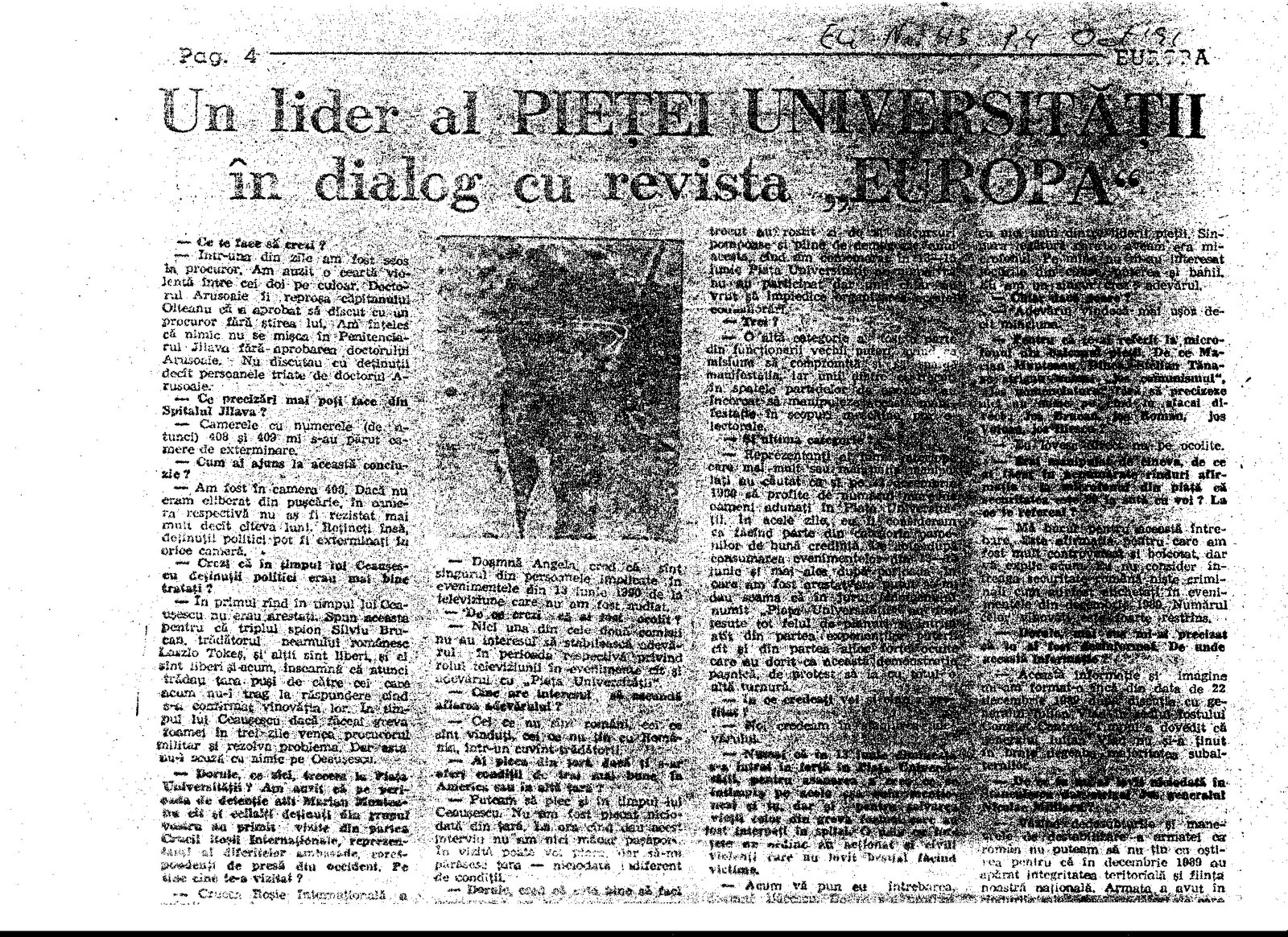
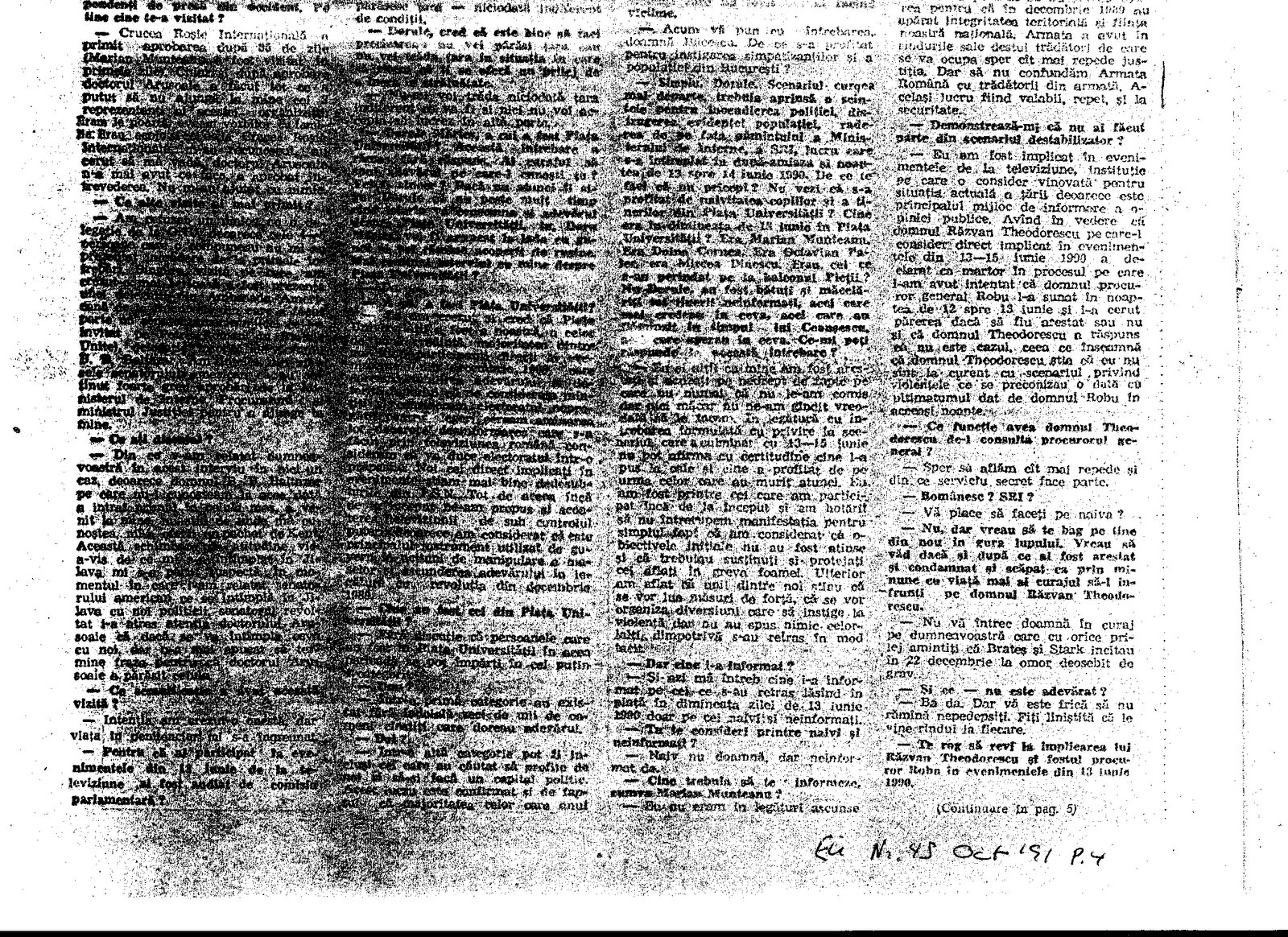


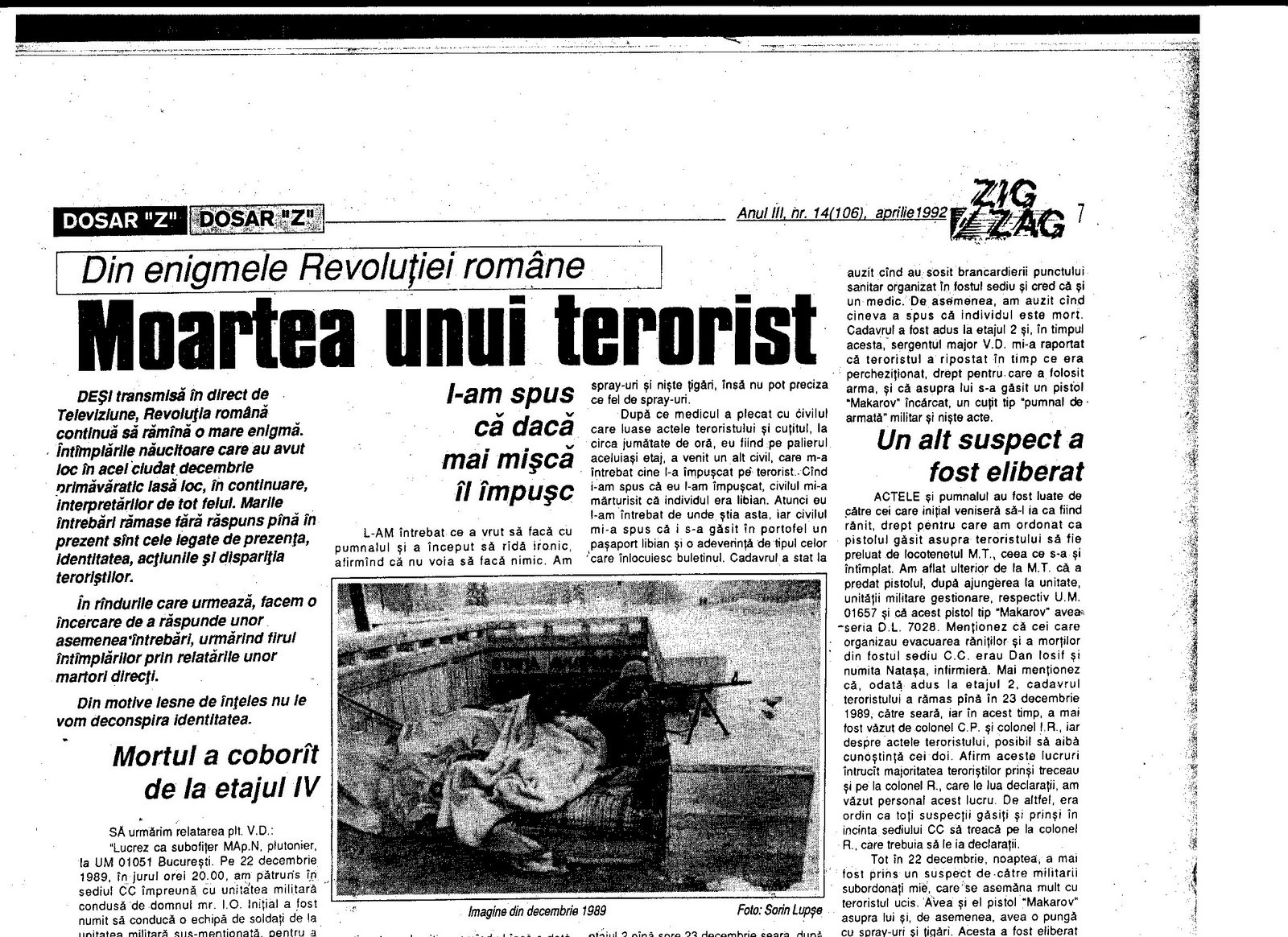
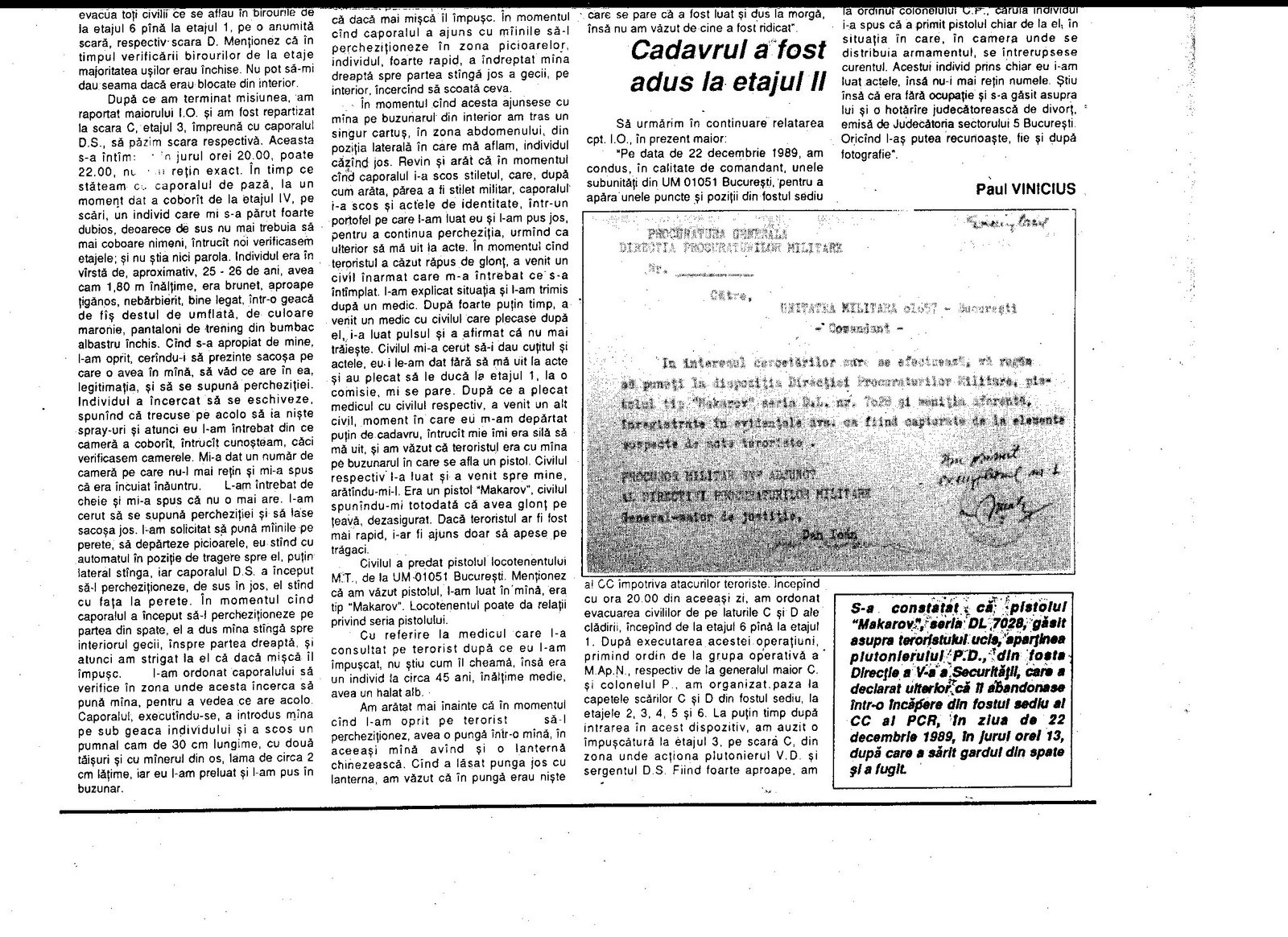
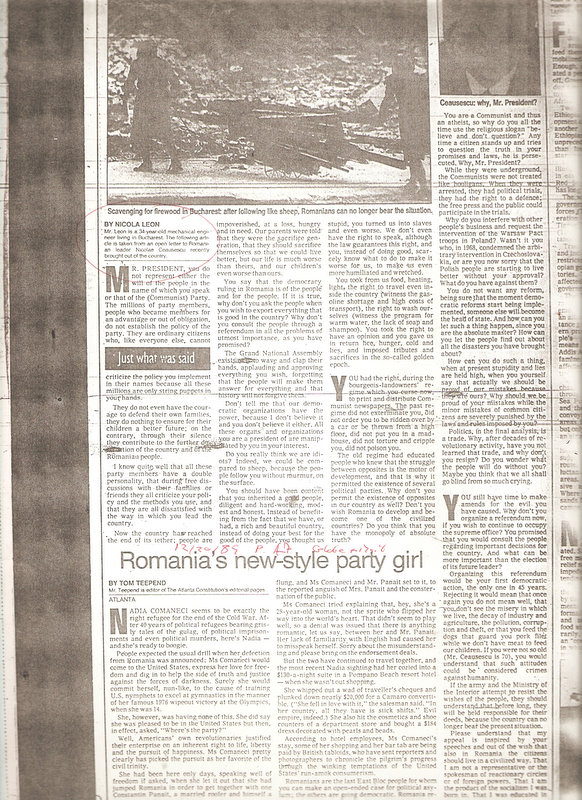
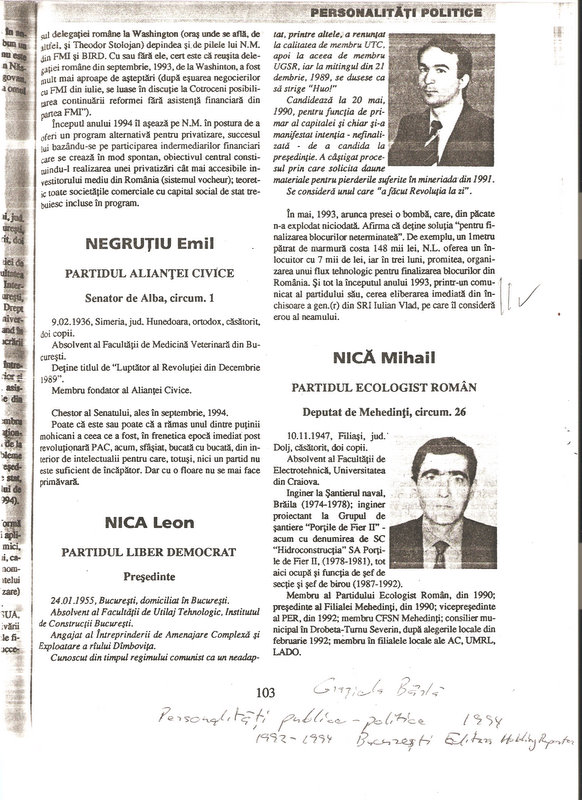
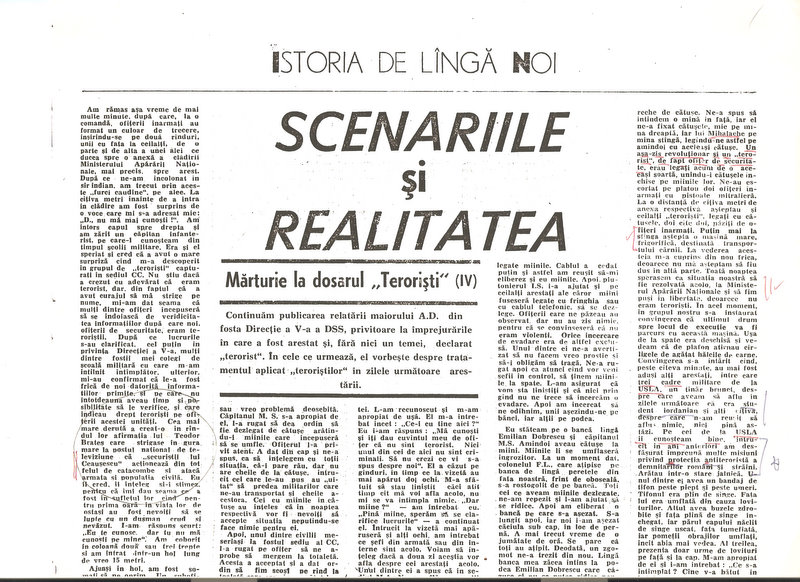
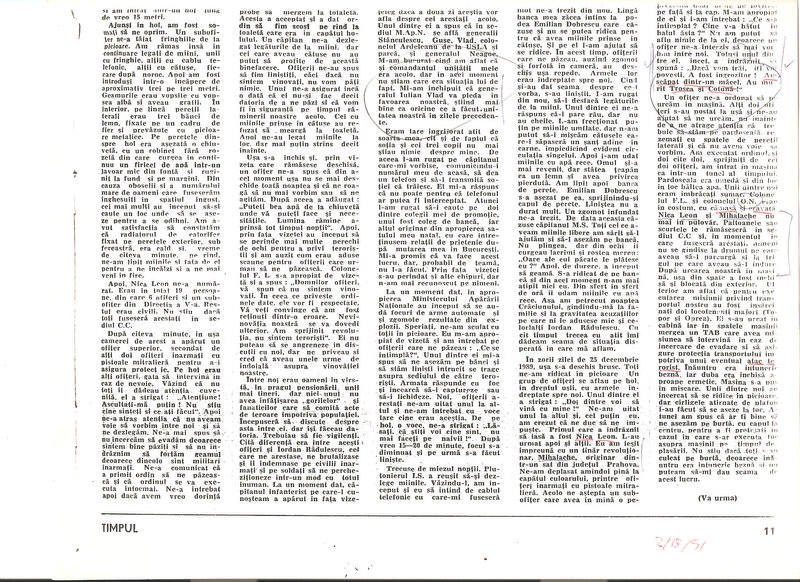
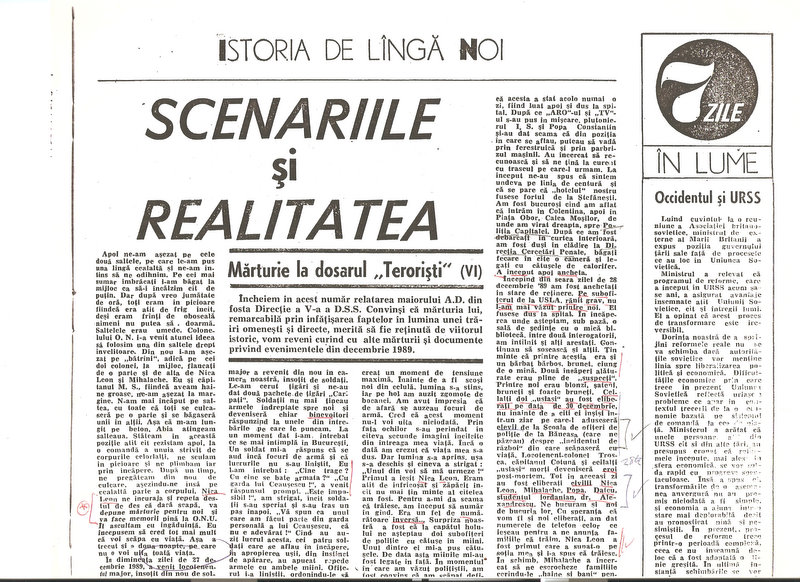
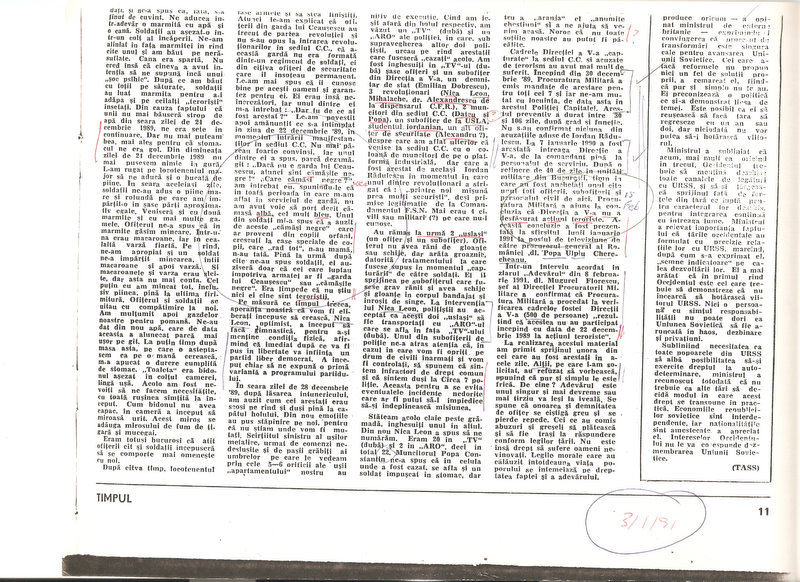
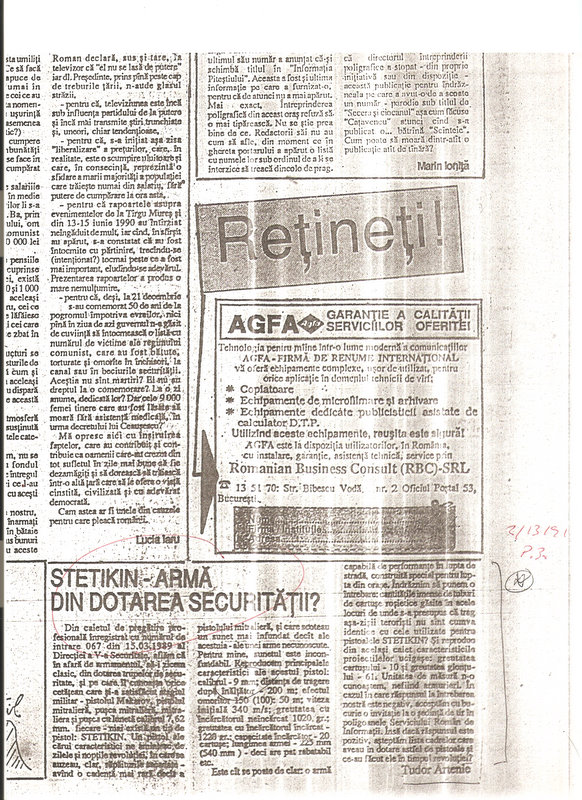
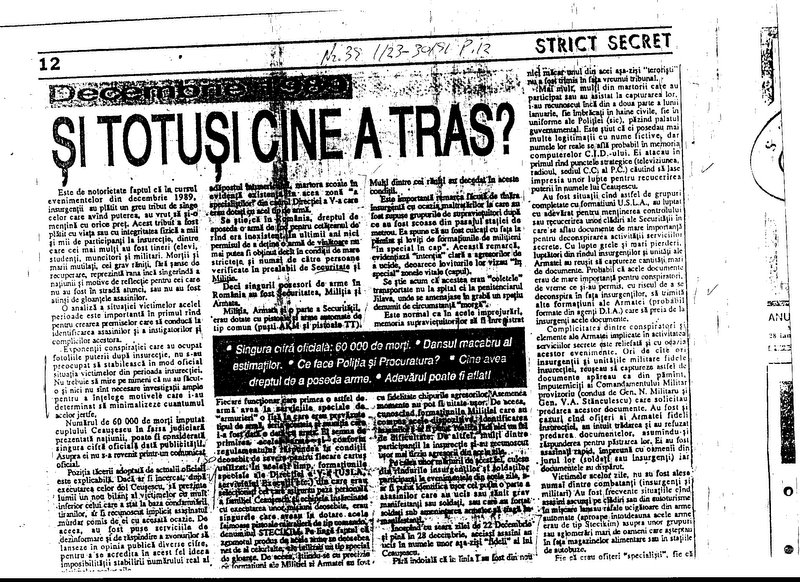
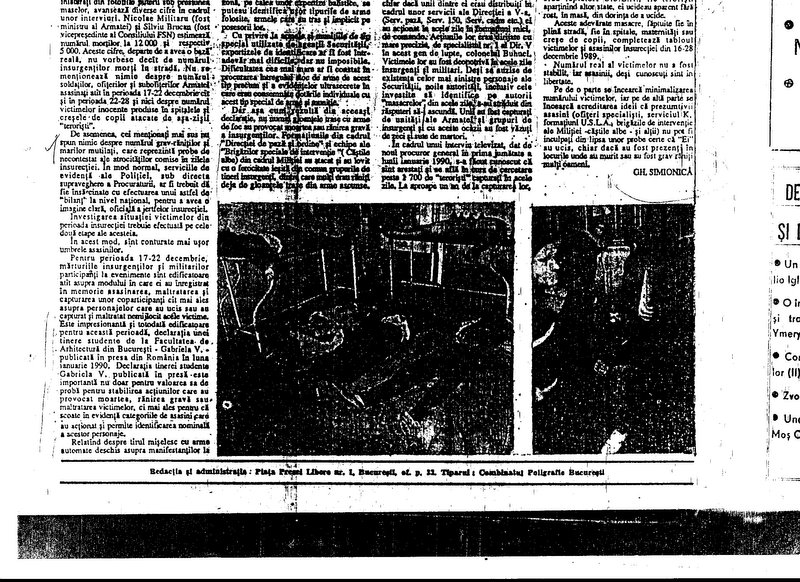
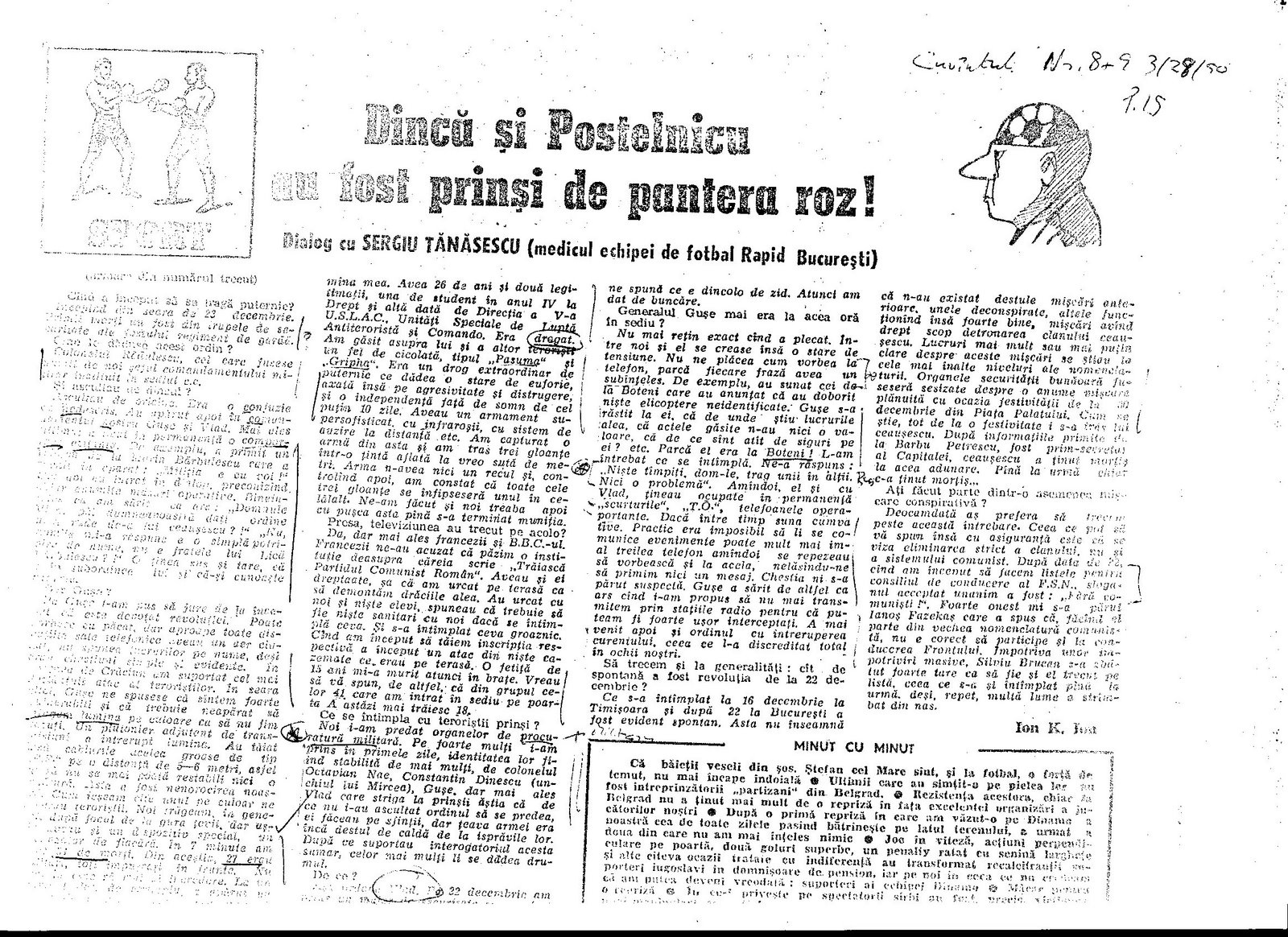
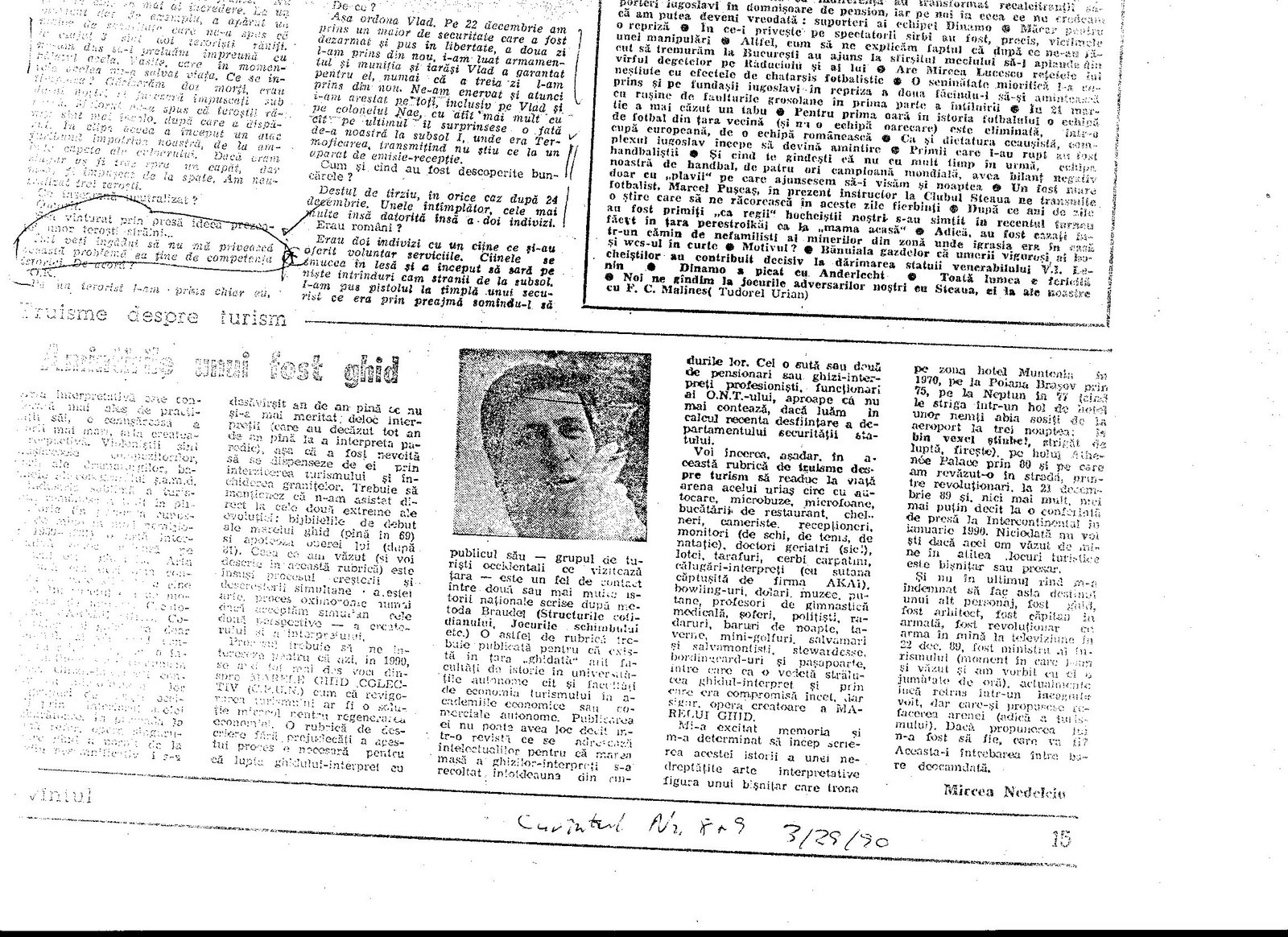

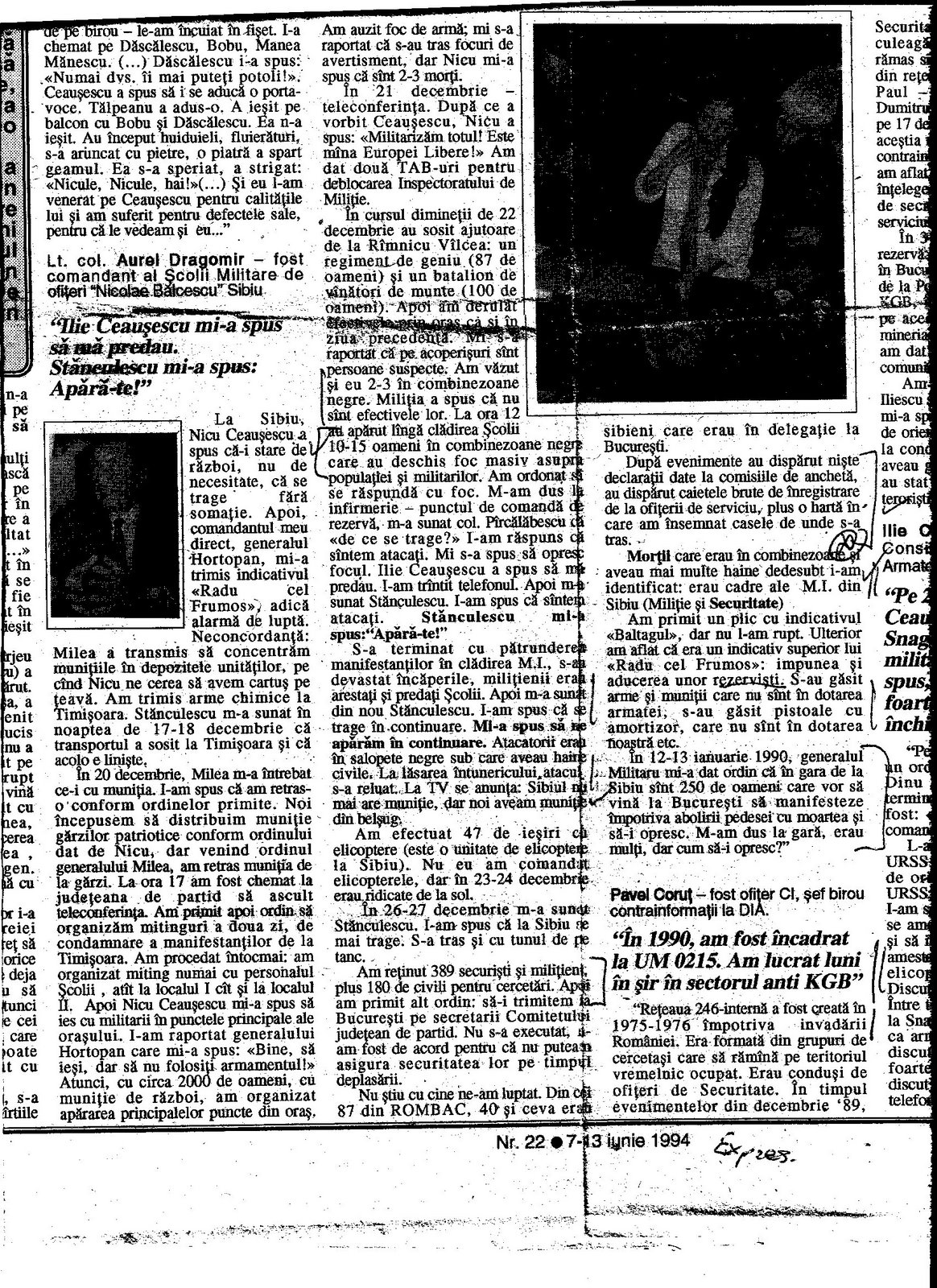
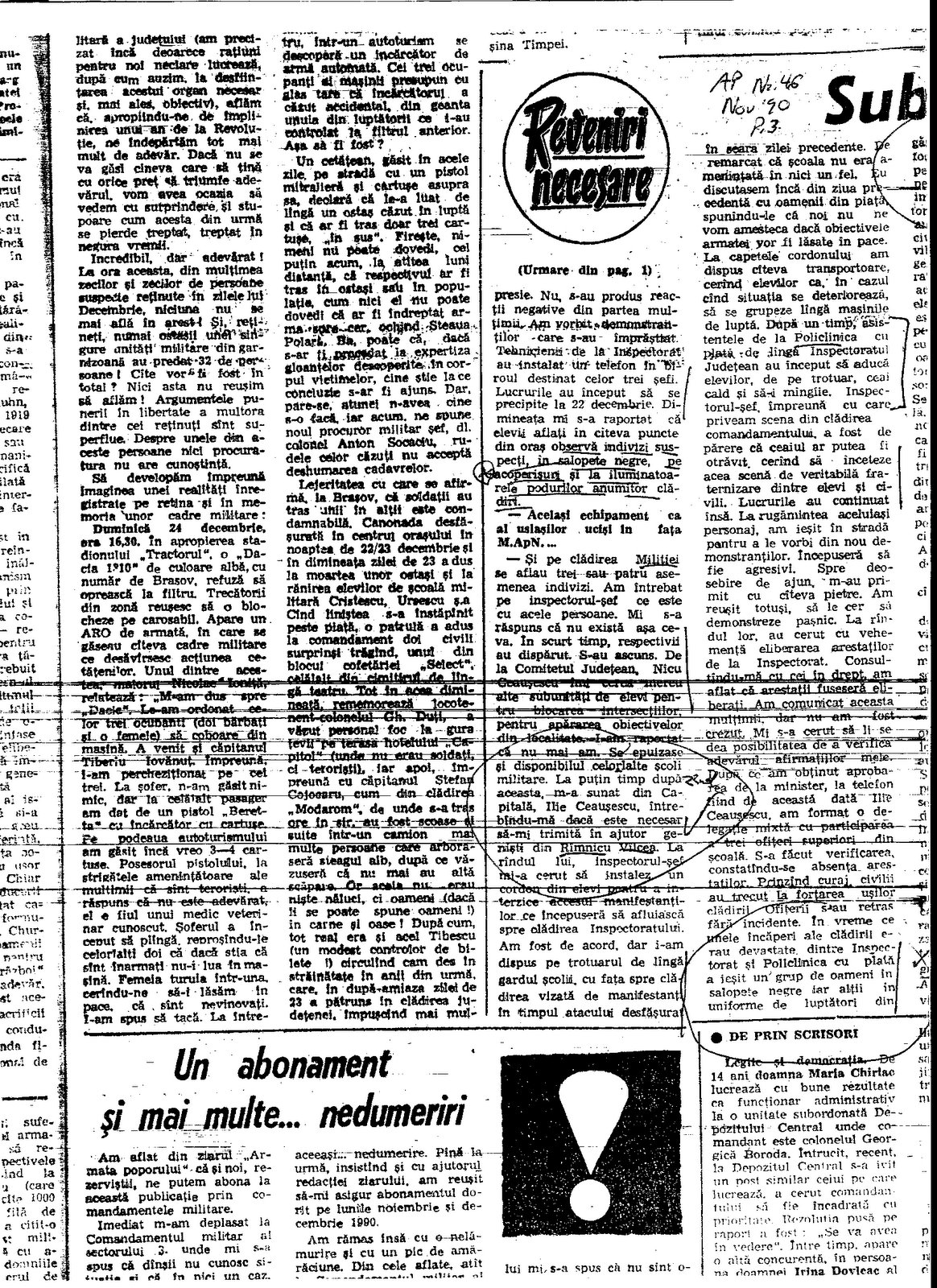
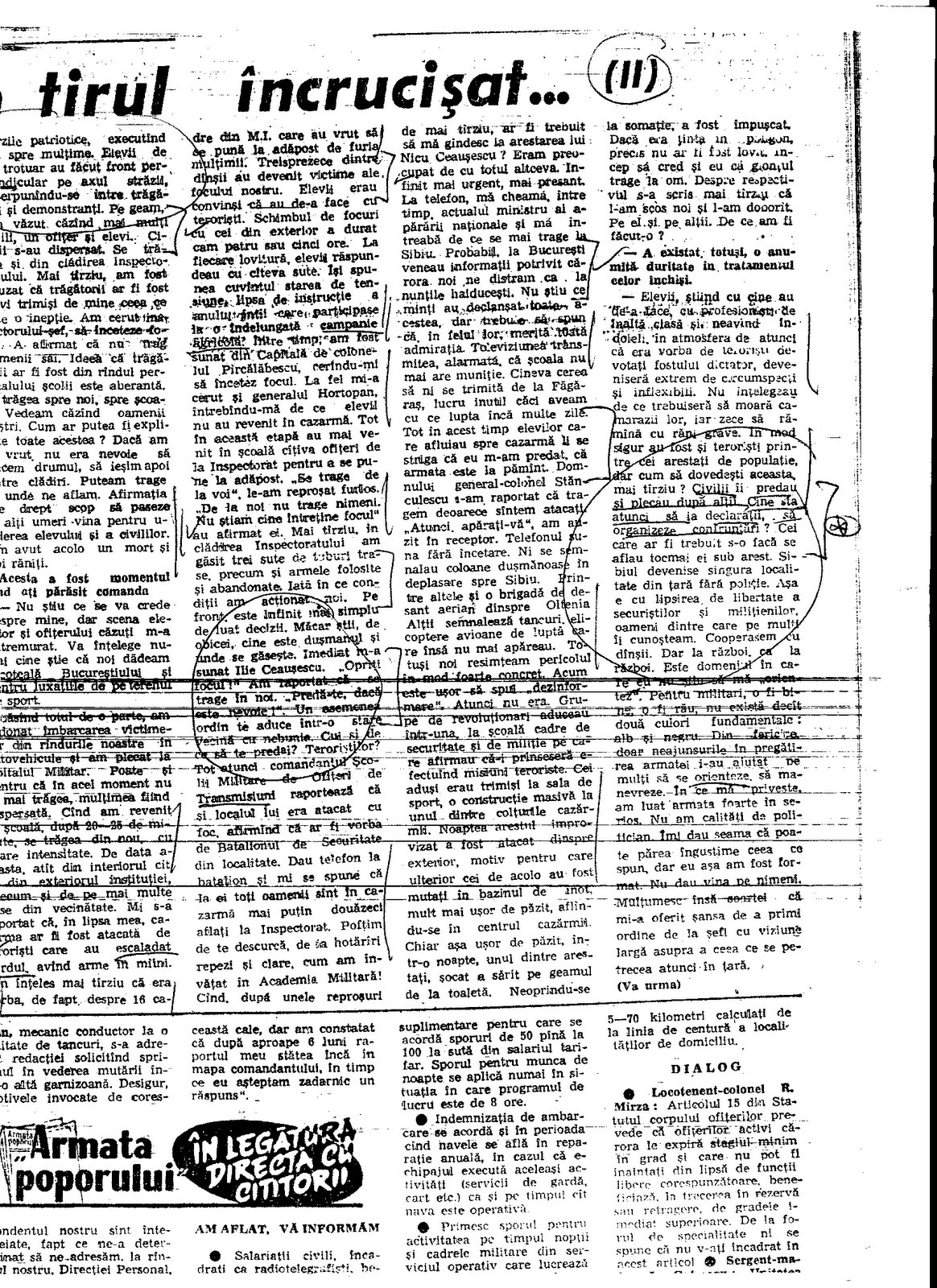


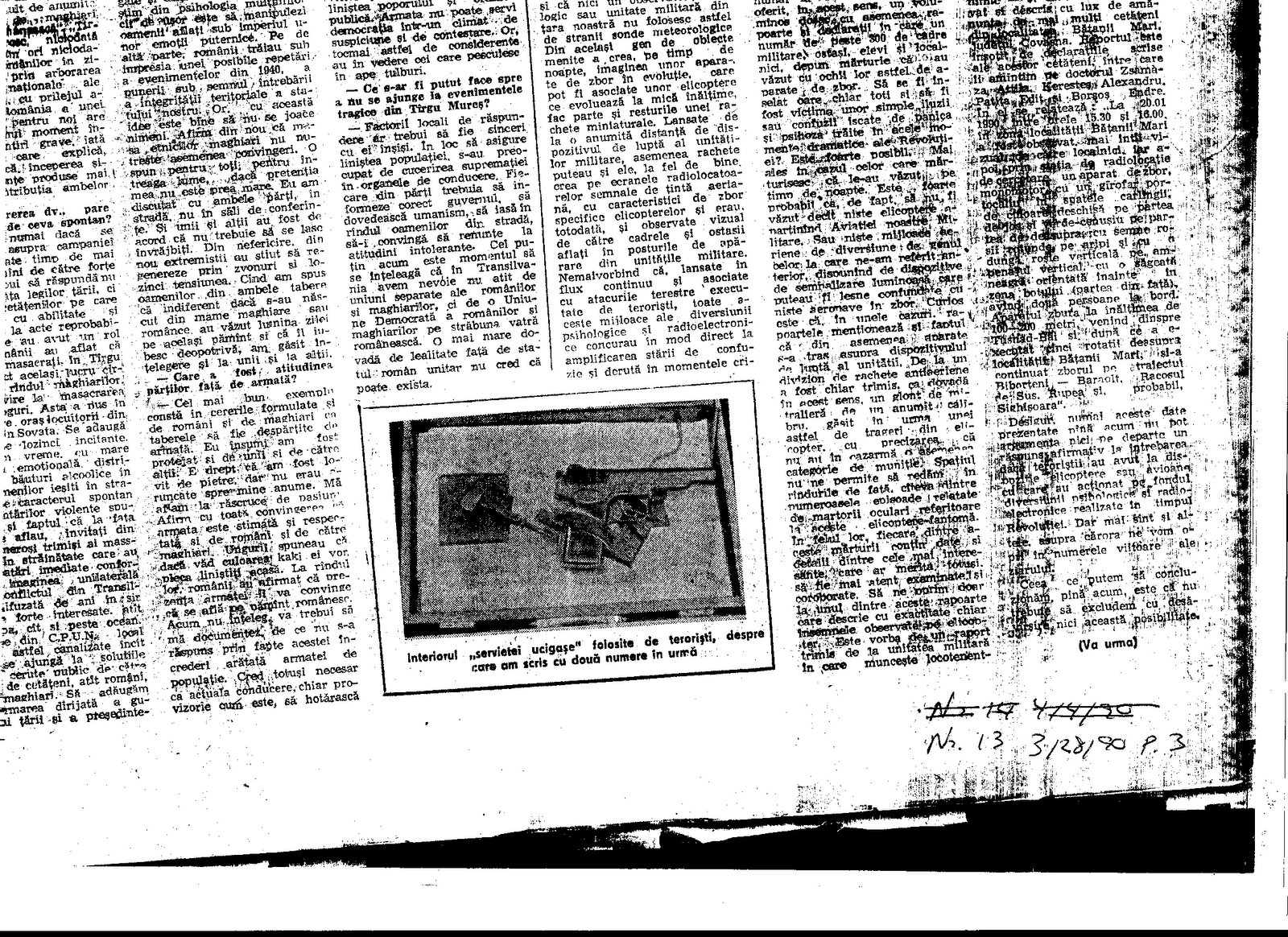
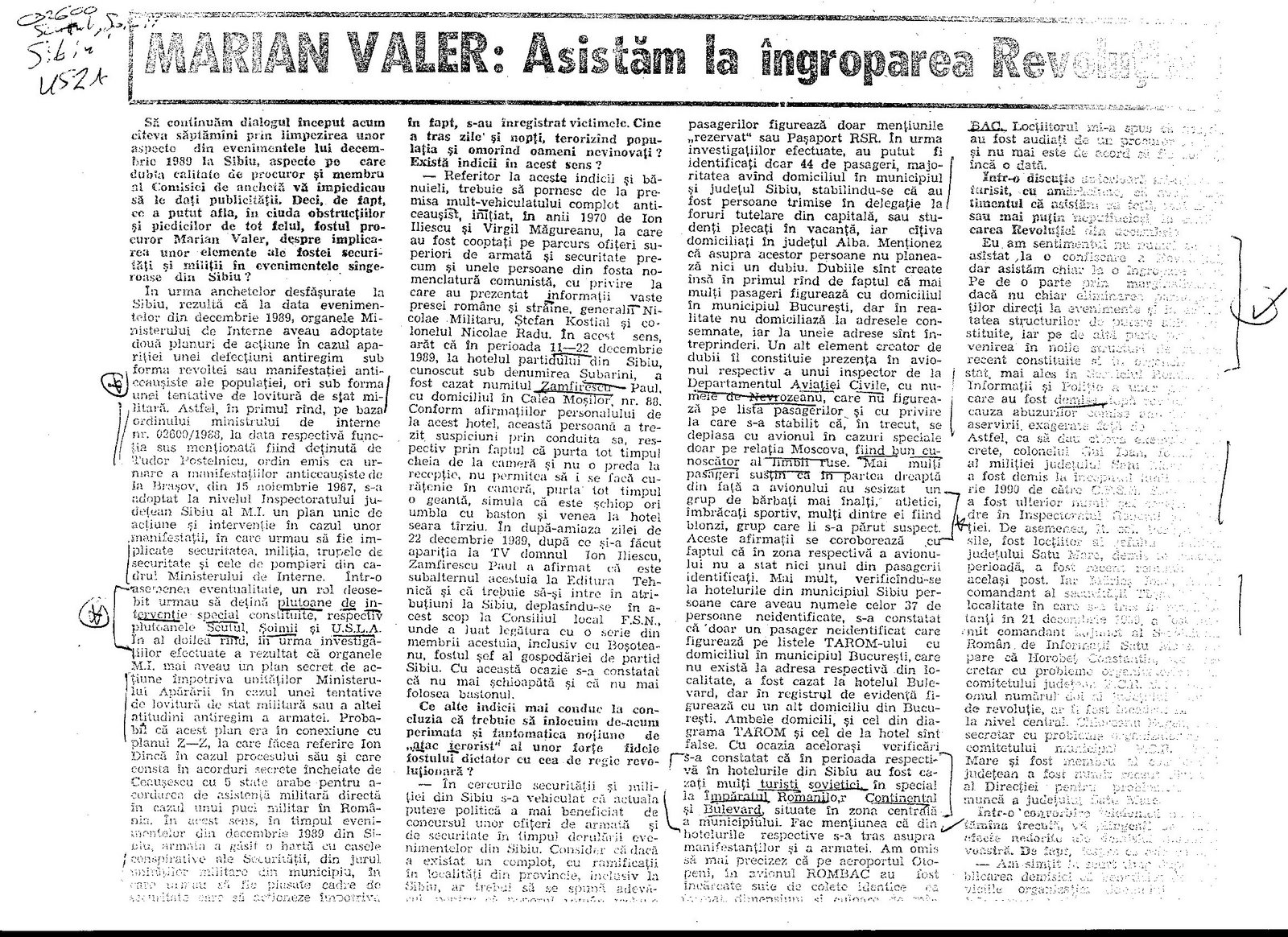
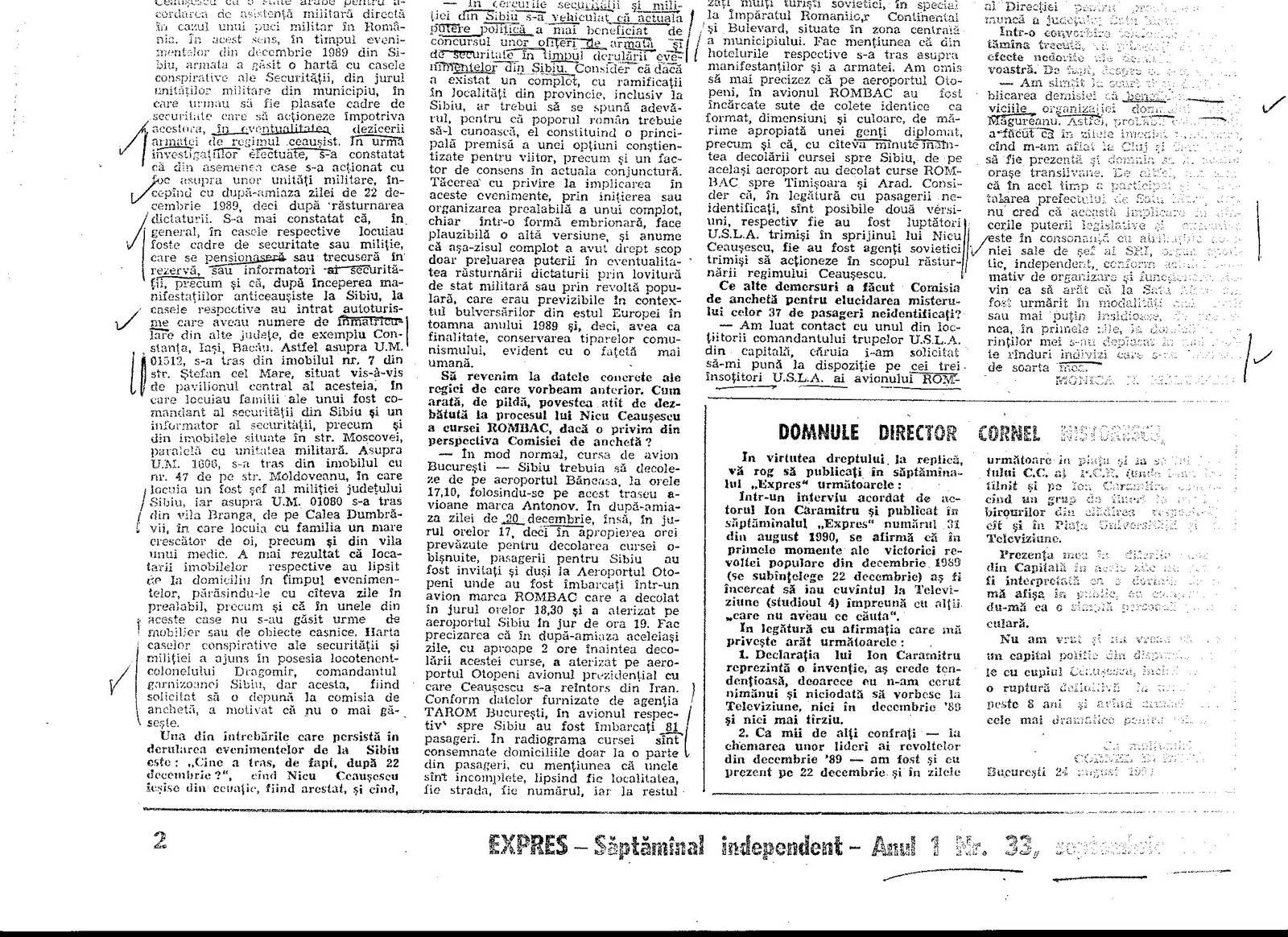

 Offline


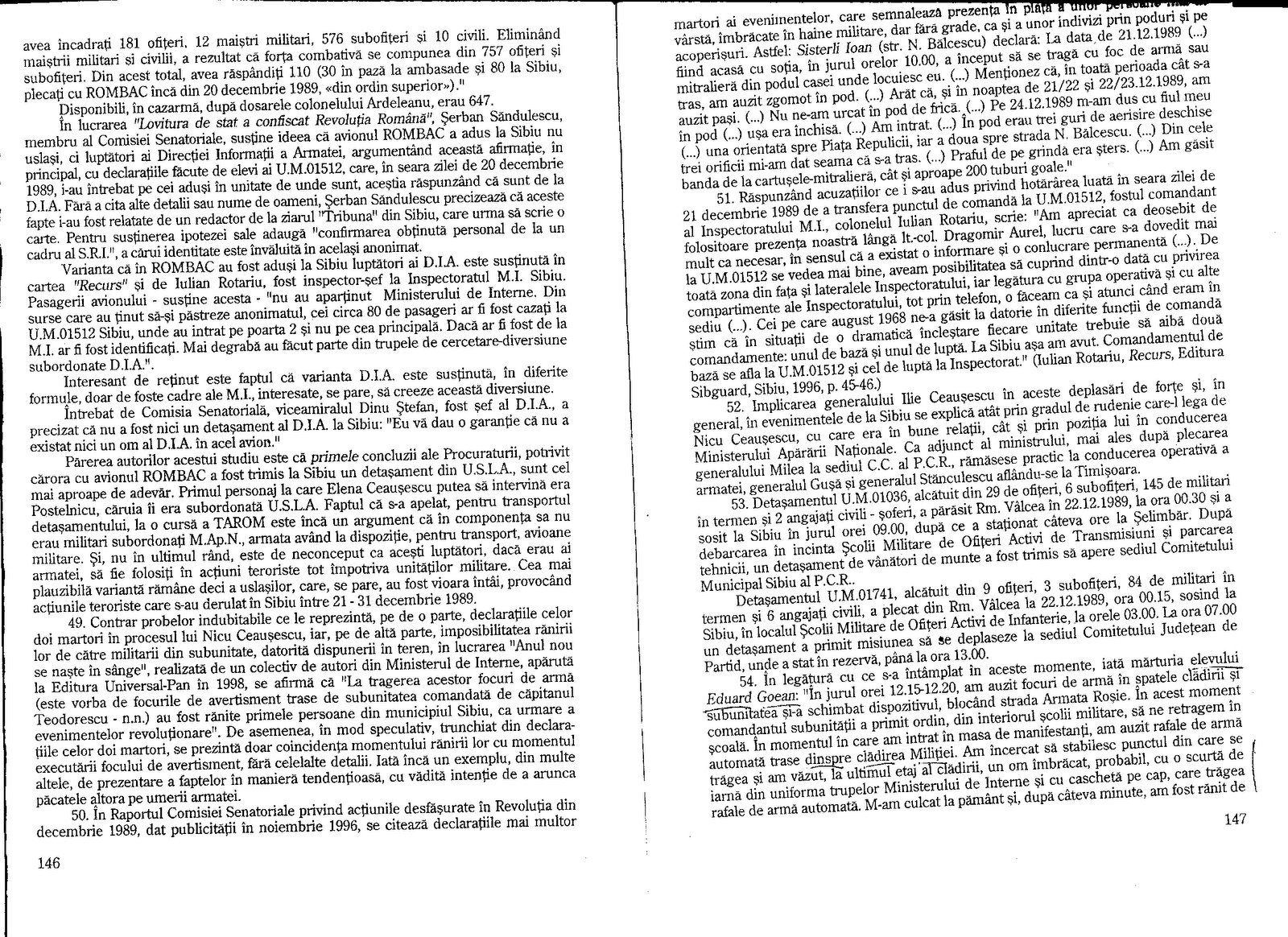
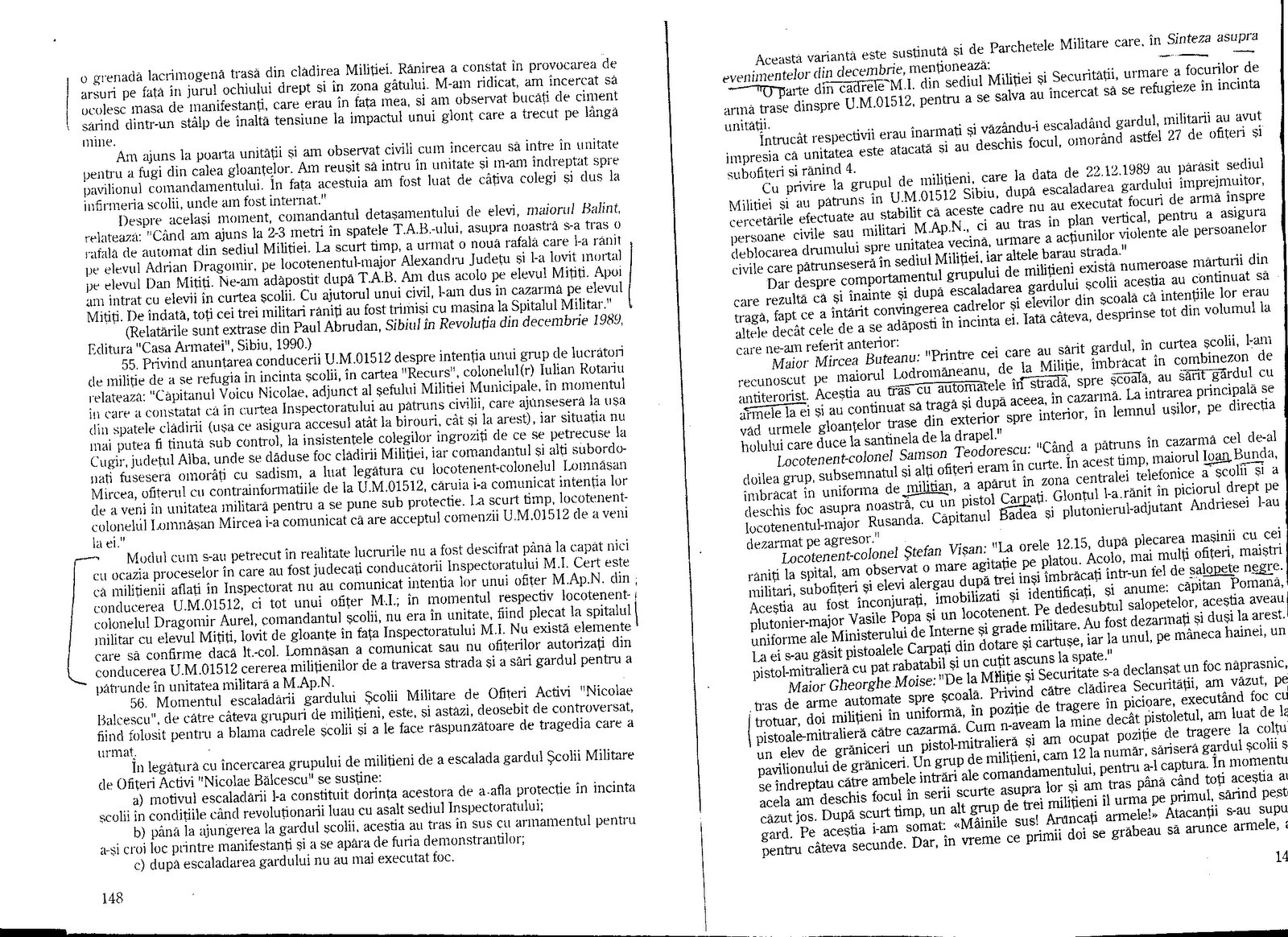
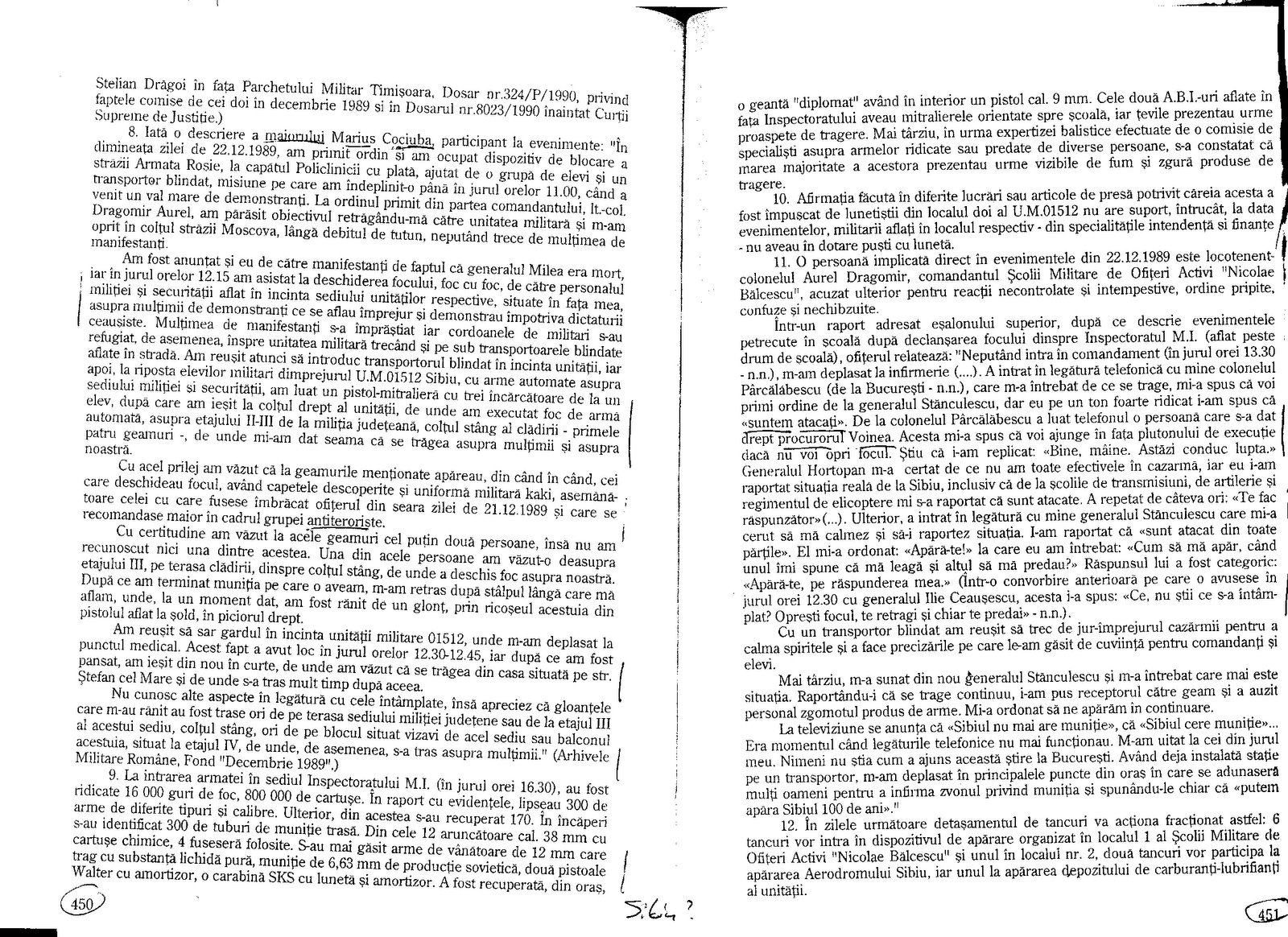


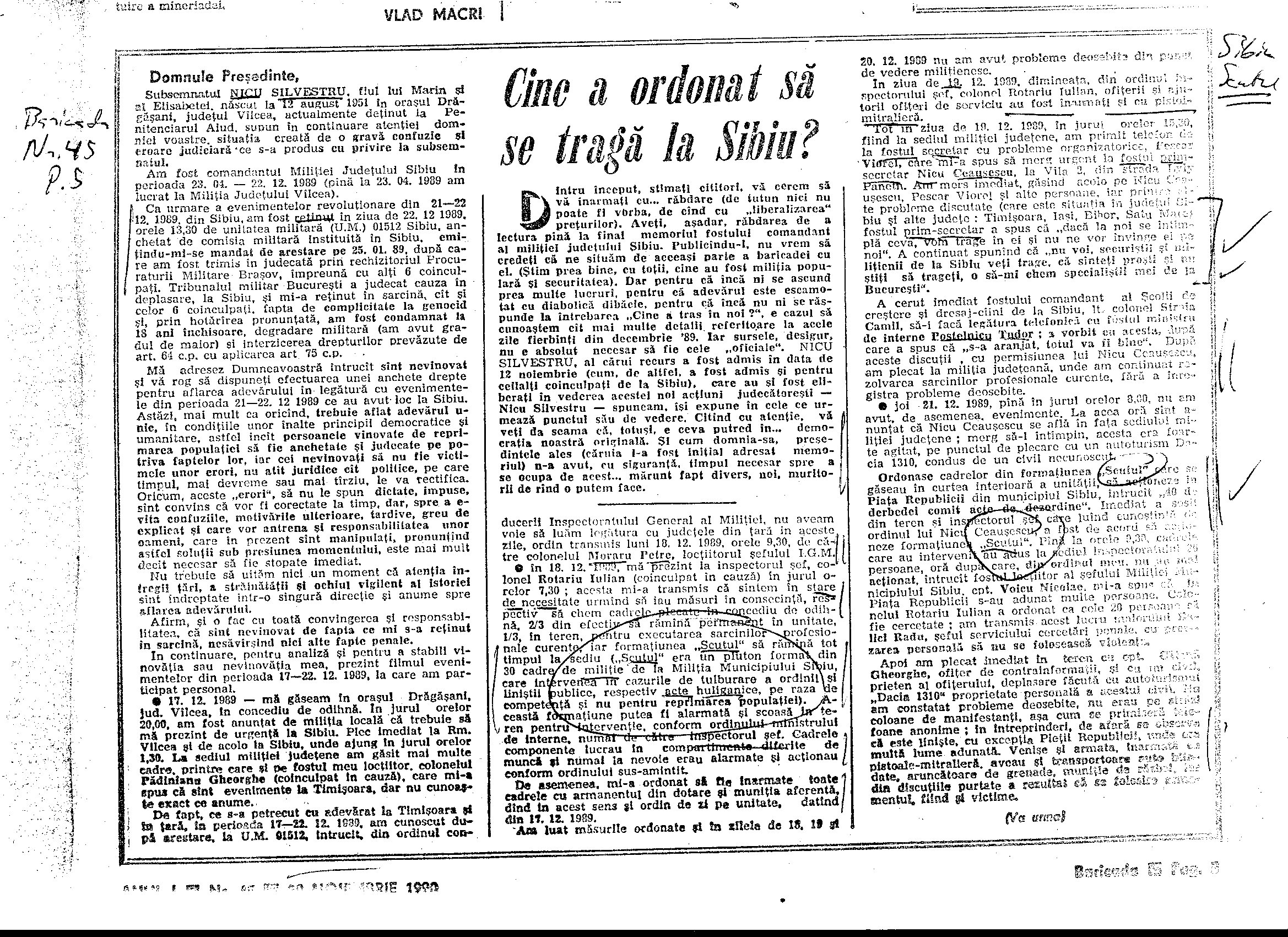
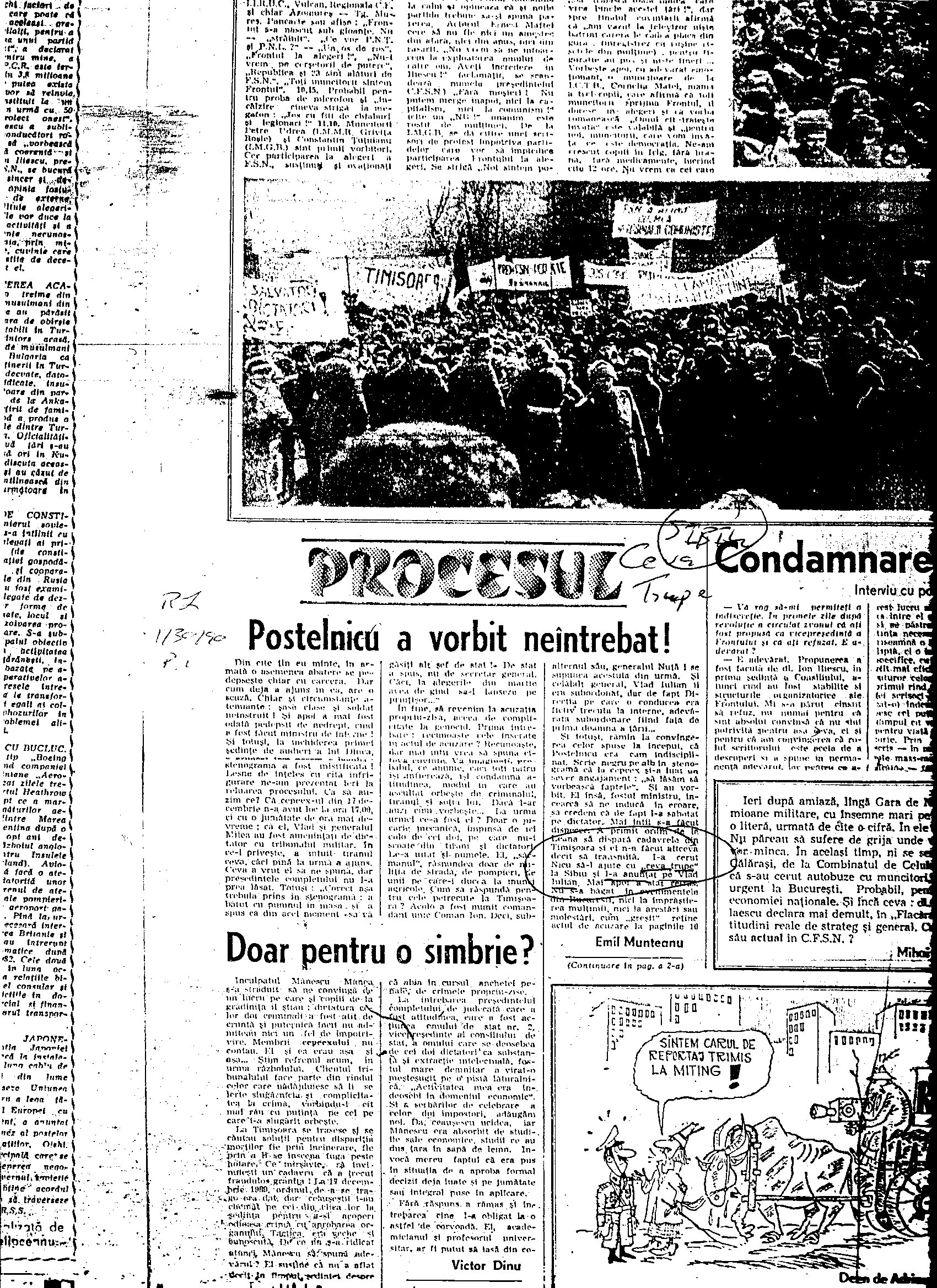
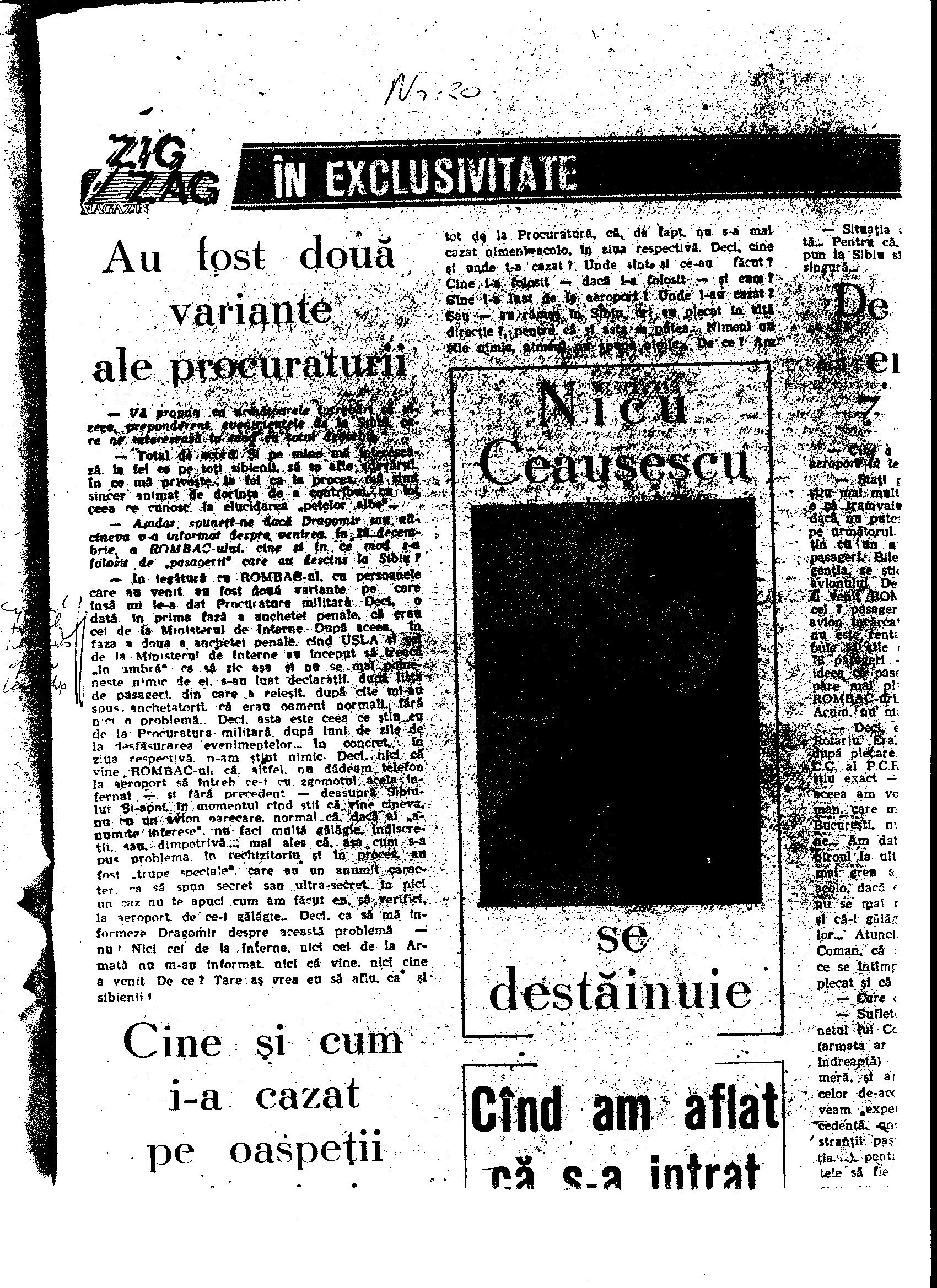
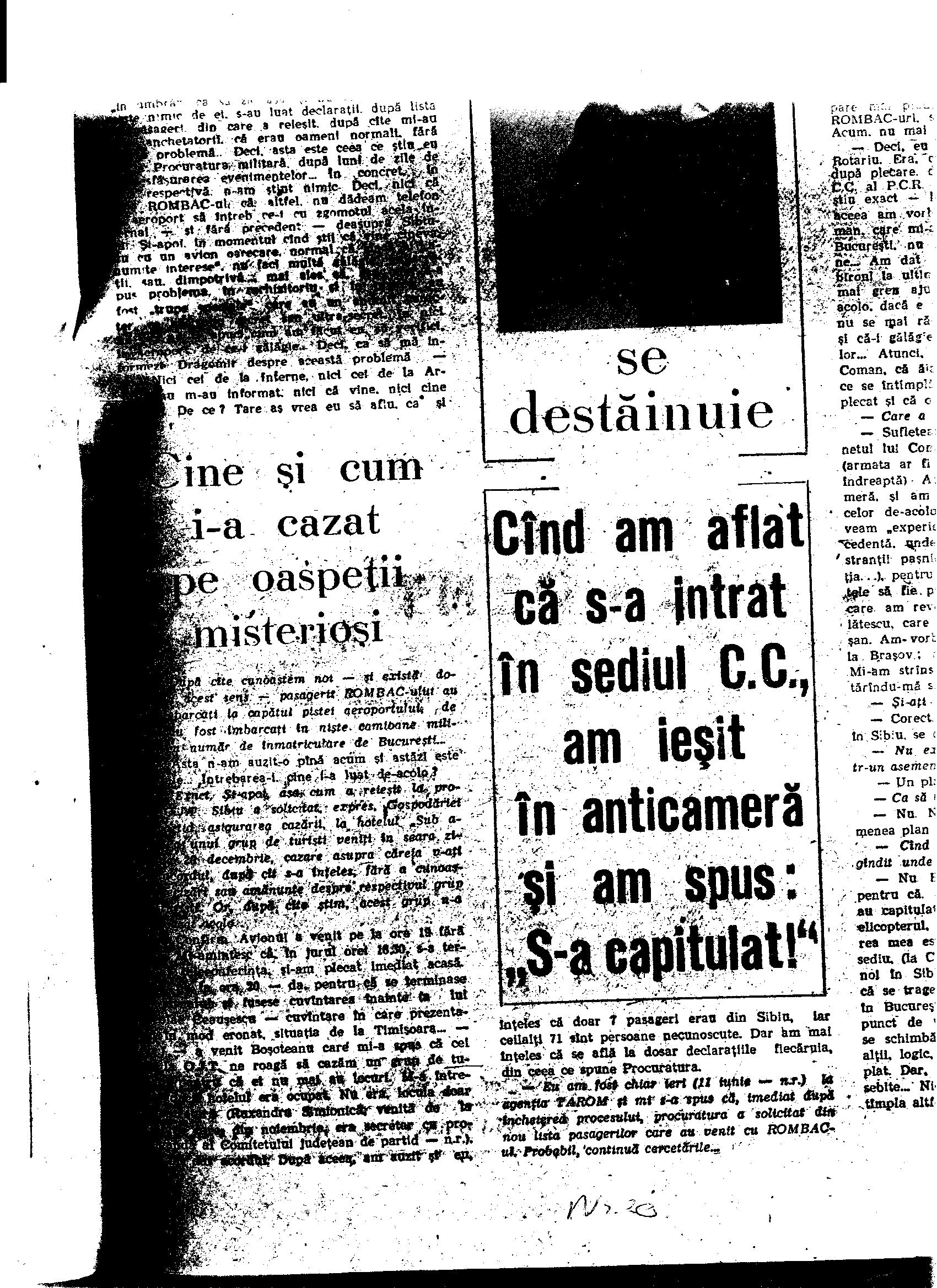
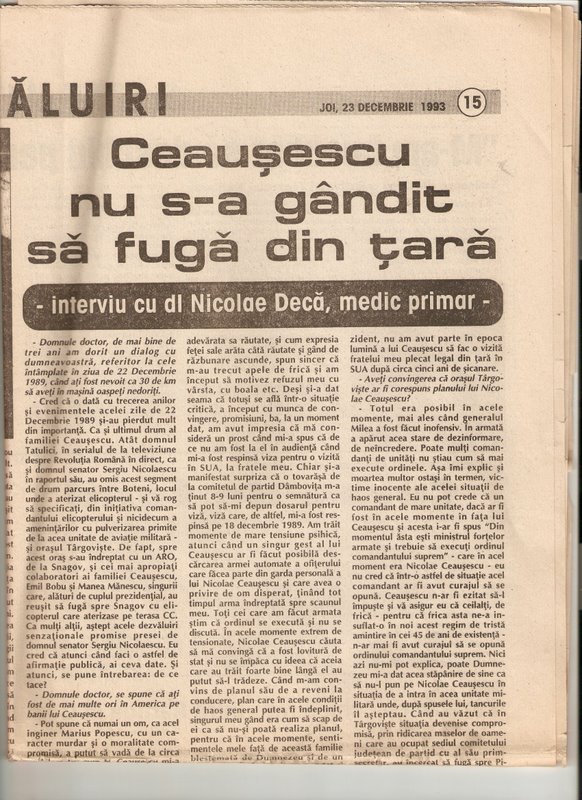

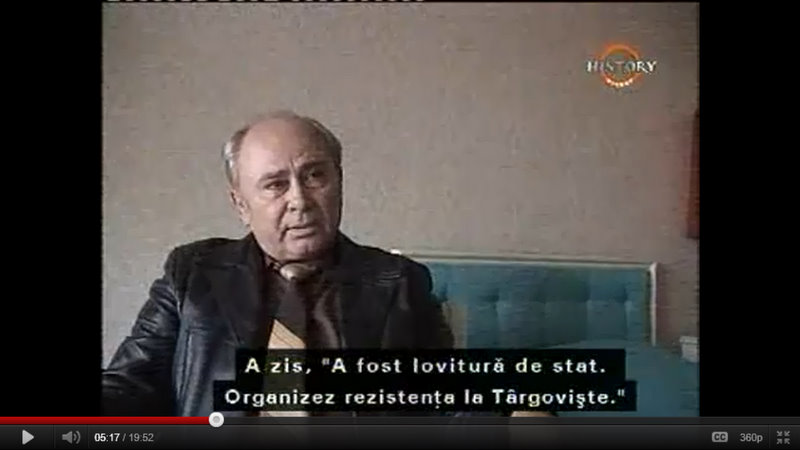


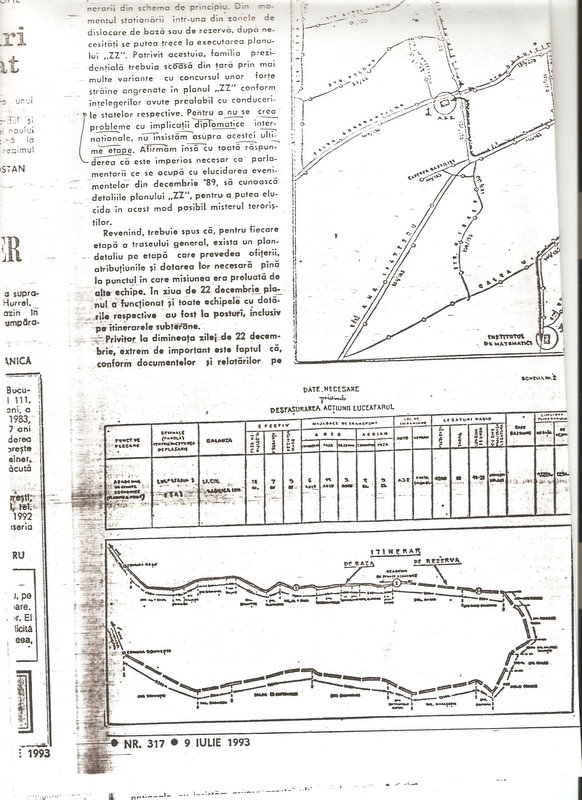
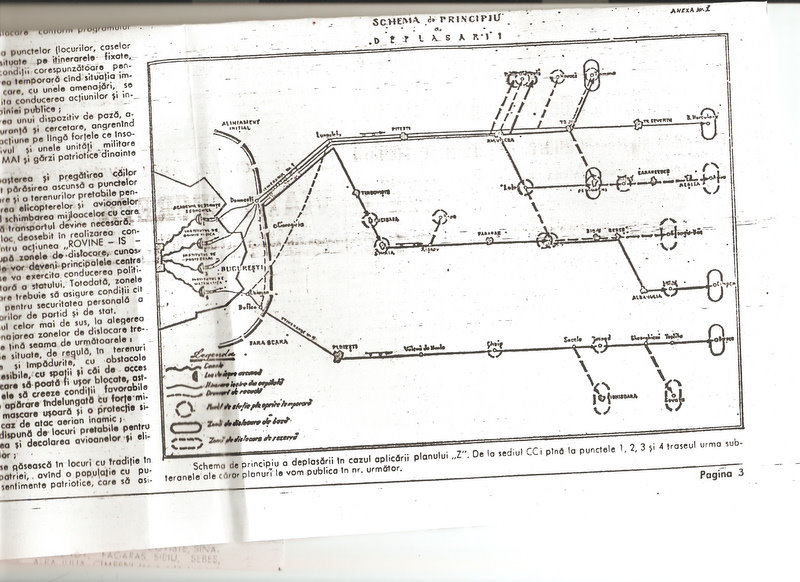
 The Archive of the Romanian Revolution of December 1989
22/02/2013 la 15:45