The Archive of the Romanian Revolution of December 1989

A Catch-22 December 1989, Groundhog-Day Production. Presenting the Personal Research & Scholarship of Richard Andrew Hall, Ph.D.

Posts Tagged ‘Timisoara December 1989’

25 for the 25th Anniversary of the Romanian Revolution: #2 Shattered Glass: Securitate Vandalism to Justify Timisoara Crackdown

Posted by romanianrevolutionofdecember1989 on December 16, 2014

(Purely personal views as always, based on over two decades of research and publications inside and outside Romania)

2014 marks the 25th anniversary of the collapse of communism in central and eastern Europe–Poland, Hungary, East Germany, Czechoslovakia, Bulgaria, and Romania.  This series looks at 25 things I have learned about the events of the Romanian Revolution of December 1989.  The numbering is not designed to assign importance, but rather–to the extent possible–to progress chronologically through those events.

Significance:  I have essentially been the only researcher who has consistently advocated this understanding.  Most others–including Peter Siani-Davies–tended to dismiss it.  Now we have documentary evidence that it took place.

An excellent documentary from 1991 posted to the internet by Florin Iepan only recently and seen rarely if at all since its showing in 1991.  There is much interesting information in this film.  (The film seems to start at min. 19:00 and has to be rewound to its beginning.)  Here, I will focus on the claim beginning at approximately min. 17:40 that the destruction of Timisoara shops and storefronts was organized and a pretext to justify–including legally–the repression by the Ceausescu regime of Timisoara demonstrators.  Interior Minister Tudor Postelnicu’s declaration of 17 March 1990 confirms this claim and the observations of eyewitnesses.

Timisoara Decembrie 1989 / Timisoara December 1989,

regia/directed by – Ovidiu Bose Pastina
imaginea/camera – Doru Segal

Sahiafilm 1991

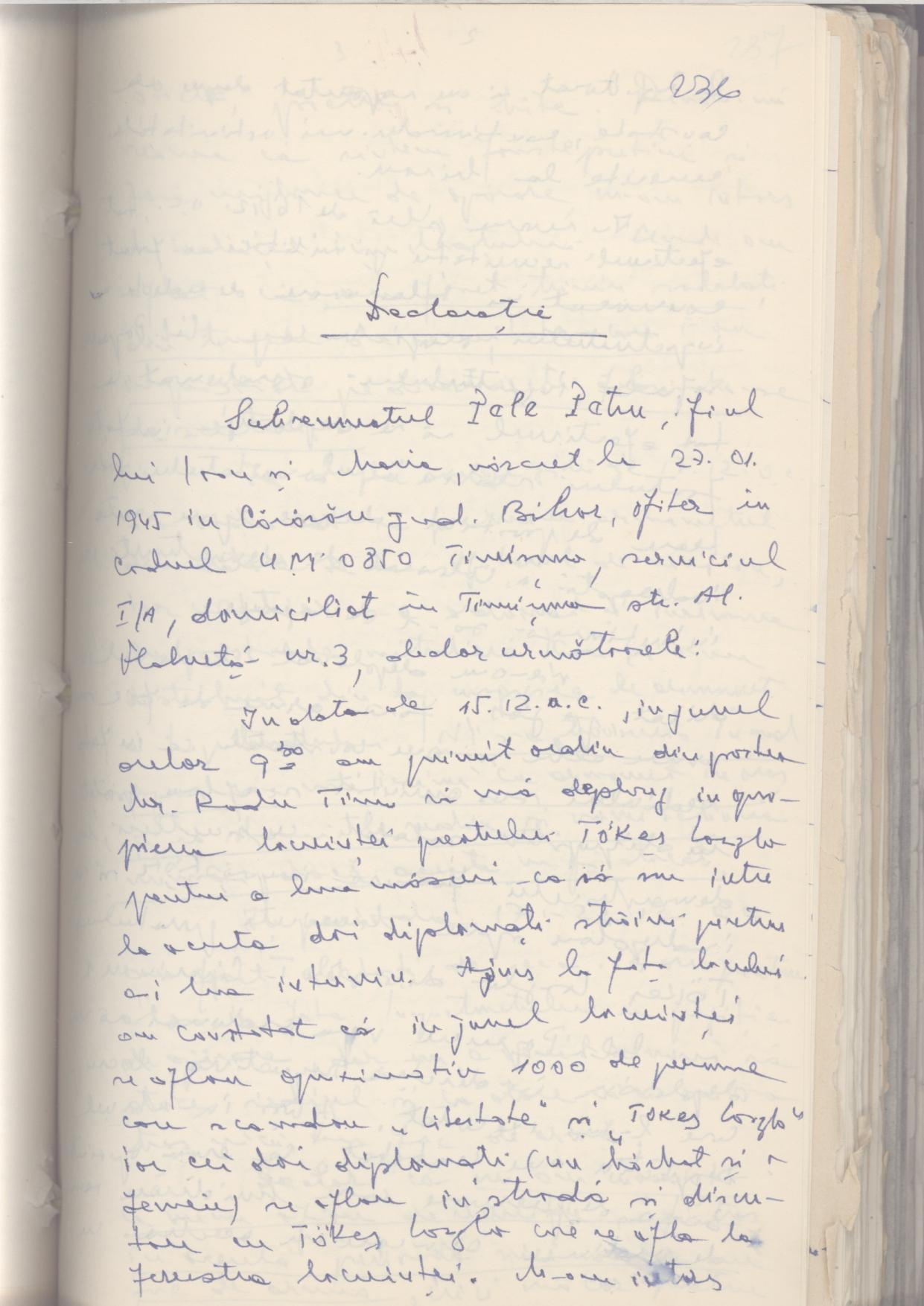
Tudor Postelnicu (Ministerul de Interne in decembrie 1989):  “Unii militari de la trupele de securitate ale brigazii Timisoara au facut unele provocari la unele magazine si vitrine spargind geamurile sa imprastie participantii de pe straziile din apropriere, apoi au intrat in altercatie cu ei, si acum (?) vor sa le faca militia ordine.  ‘Nu am aflat ca costa provocare a zis Gl. Nuta, am trimis pe …” (17.III.1990) 
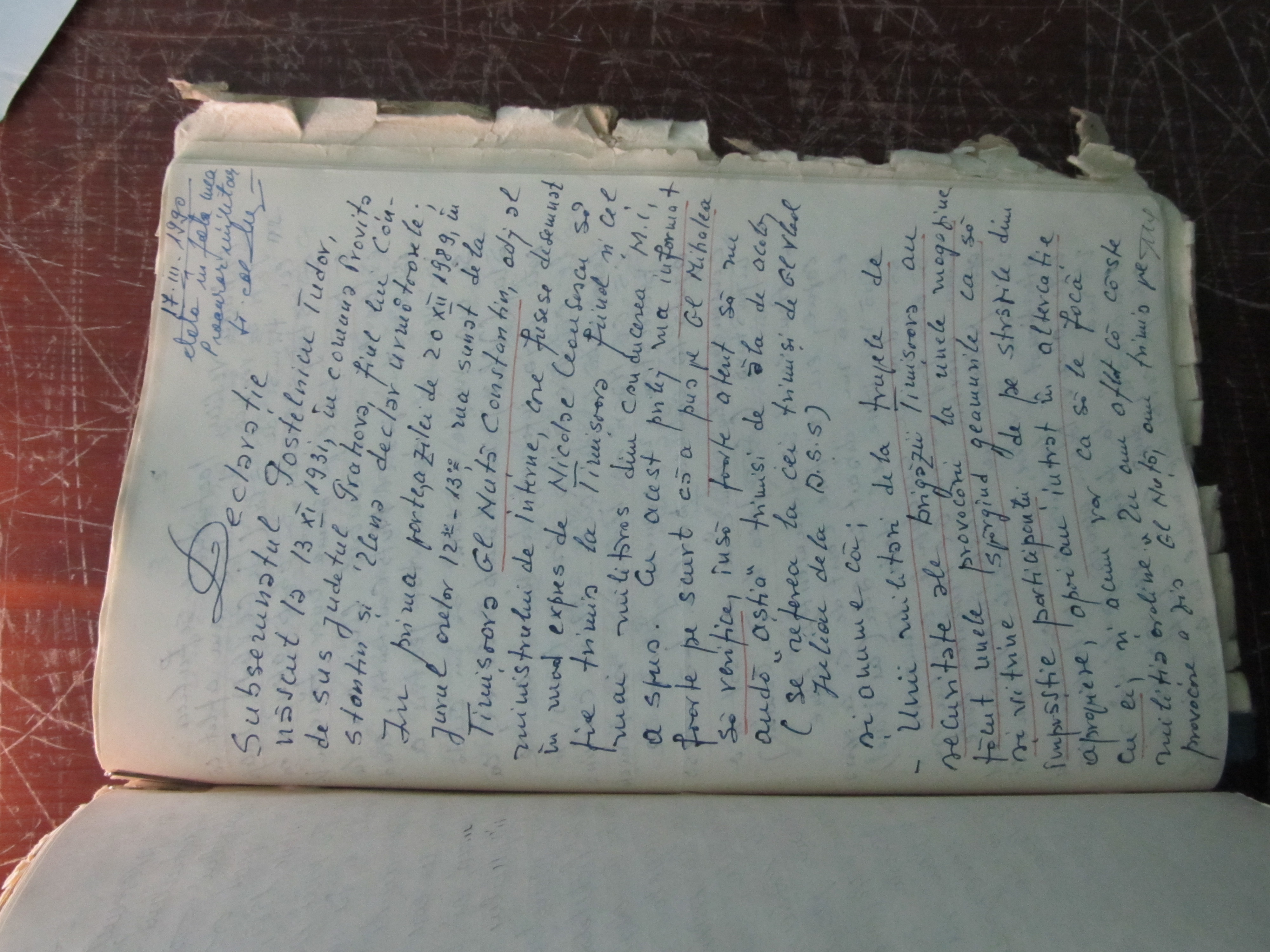
http://sensidev.com/fc/dosare%20de%20urmarire%20penala/dosar%20%20de%20urmarire%20penala%20volumul%2011/IMG_2576.JPG (Dosarul de Urmarire Penala, Vol. 11, IMG 2576)

IMG_2576

image0

Before we move on here, it is worth noting how this destruction was covered in Peter Siani-Davies’ 2005 volume The Romanian Revolution of December 1989.  As I have written on many occasions, Siani-Davies’ volume is wonderfully-written and is excellent, but the claim by Daniel Chirot that is a “near-definitive” account is far off the mark.  One of the negative characteristics of Siani-Davies’ work is the use of “filler” rational choice, cui bono arguments where he concludes there is not enough information to make a valid judgment.  The problem is the question is never one of “what was possible?” “what makes ‘sense’?” but rather what did happen?

Thus, for example in the case of the destruction of Timisoara Siani-Davies argues that there was already enough of a basis for the regime to crackdown, therefore why would they need to create a pretext for cracking down:  “Given the seriousness of the situation and the fact that shots had already been fired elsewhere, the security forces hardly needed to produce a further ‘excuse’ for the massacre which was to follow.” (p. 68)

image0-001

image0-003

Back to exploring more of the evidence…

An excerpt from Chapter 5 of my Ph.D. Dissertation at Indiana University: Richard Andrew Hall, Rewriting the Revolution: Authoritarian Regime-State Relations and the Triumph of Securitate Revisionism in Post-Ceausescu Romania (defended 16 December 1996). This is the original chapter as it appeared then and thus has not been revised in any form.

Chapter Five.  The Beginning of the End: Timisoara, 15-17 December 1989

The “Window Breakers”

The reportedly unusual scope of physical destruction which occurred in Timisoara, particularly on the afternoon and evening of 17 December 1989, has fueled revisionist arguments. Estimates of the damage during the Timisoara unrest are in the neighborhood of four to five billion lei (approximately forty to fifty million dollars at the time), a reasonably large sum given Romania’s standard of living at the time. A huge number of windows was broken and as many as 300 to 400 stores suffered some sort of damage, although relatively few were actually looted. On the evening of 17 December, stores, vehicles, and kiosks were burning in at least ten different areas of the city.[65]

Former Securitate officers clearly wish to link this destruction to the “foreign tourists” who were supposedly so ubiquitous in Timisoara during these days.[66] Perhaps somewhat surprisingly, former Securitate Director Iulian Vlad argued at his trial that

…the acts of vandalism, theft, destruction, arson… acts without precedent…could not have been the work [“opera”] of the faithful [apparently referring sarcastically to Tokes’ parishioners], nor the revolutionaries. They were produced by elements which wished to create a certain atmosphere of tension.[67]

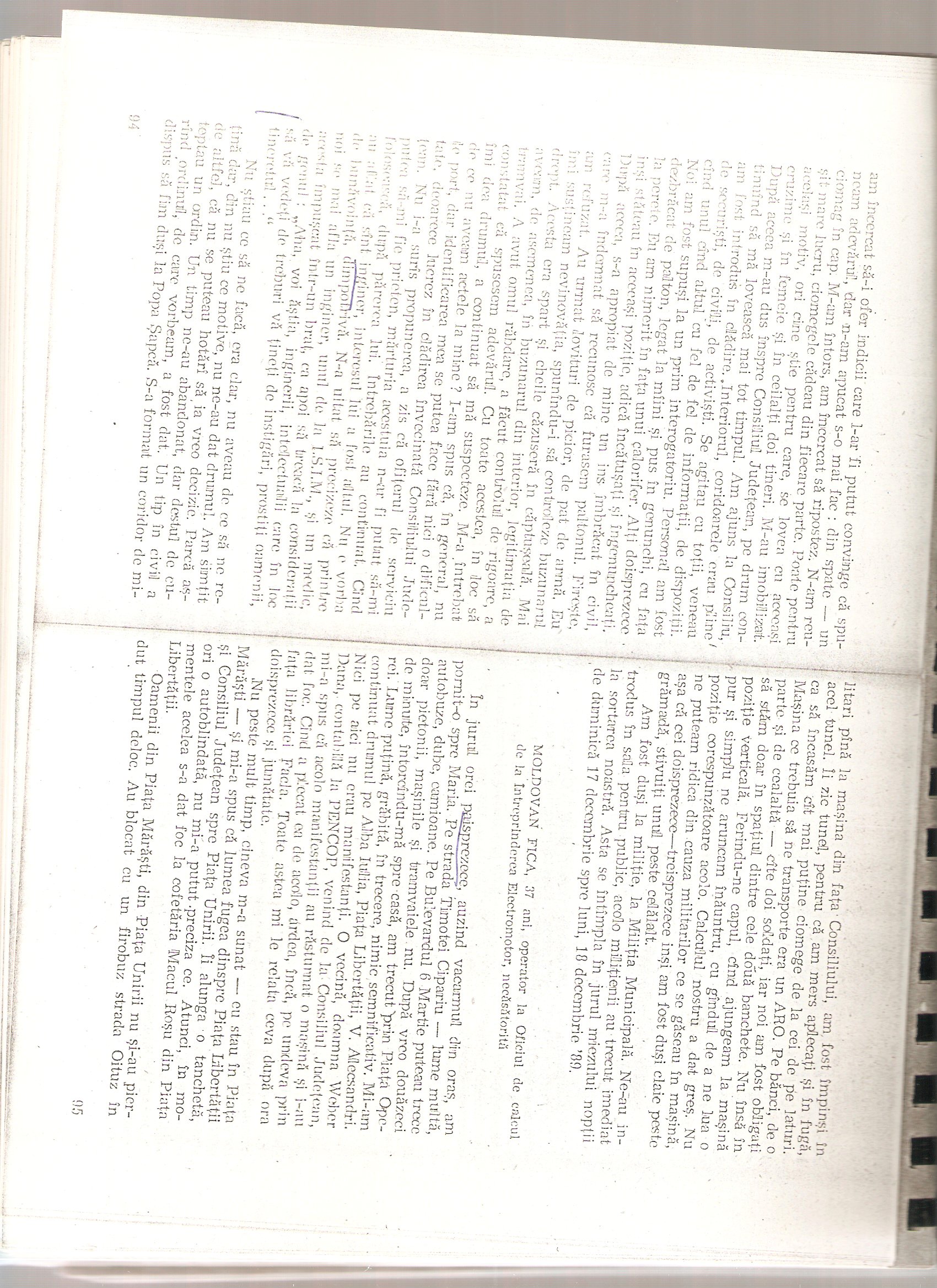
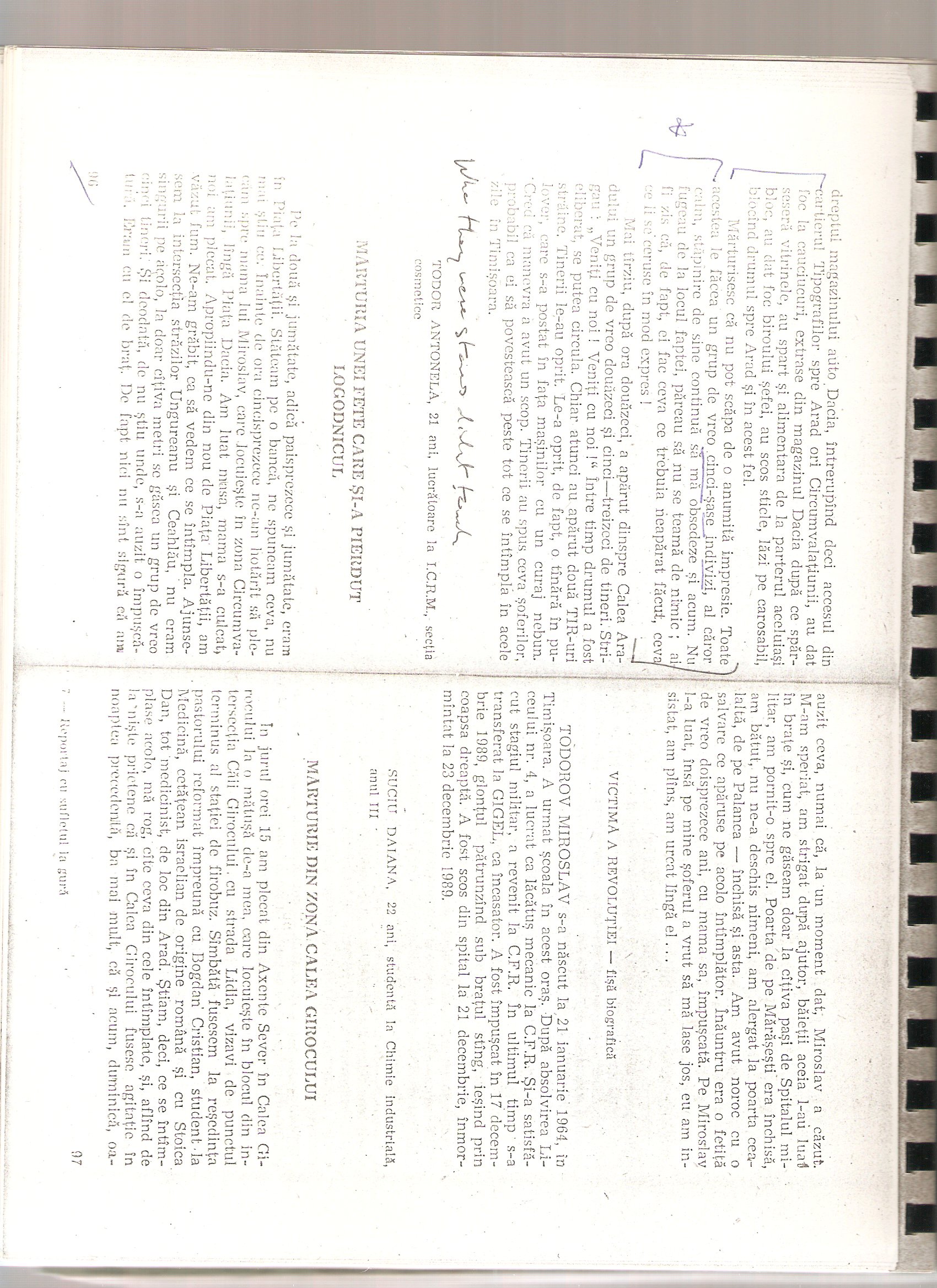
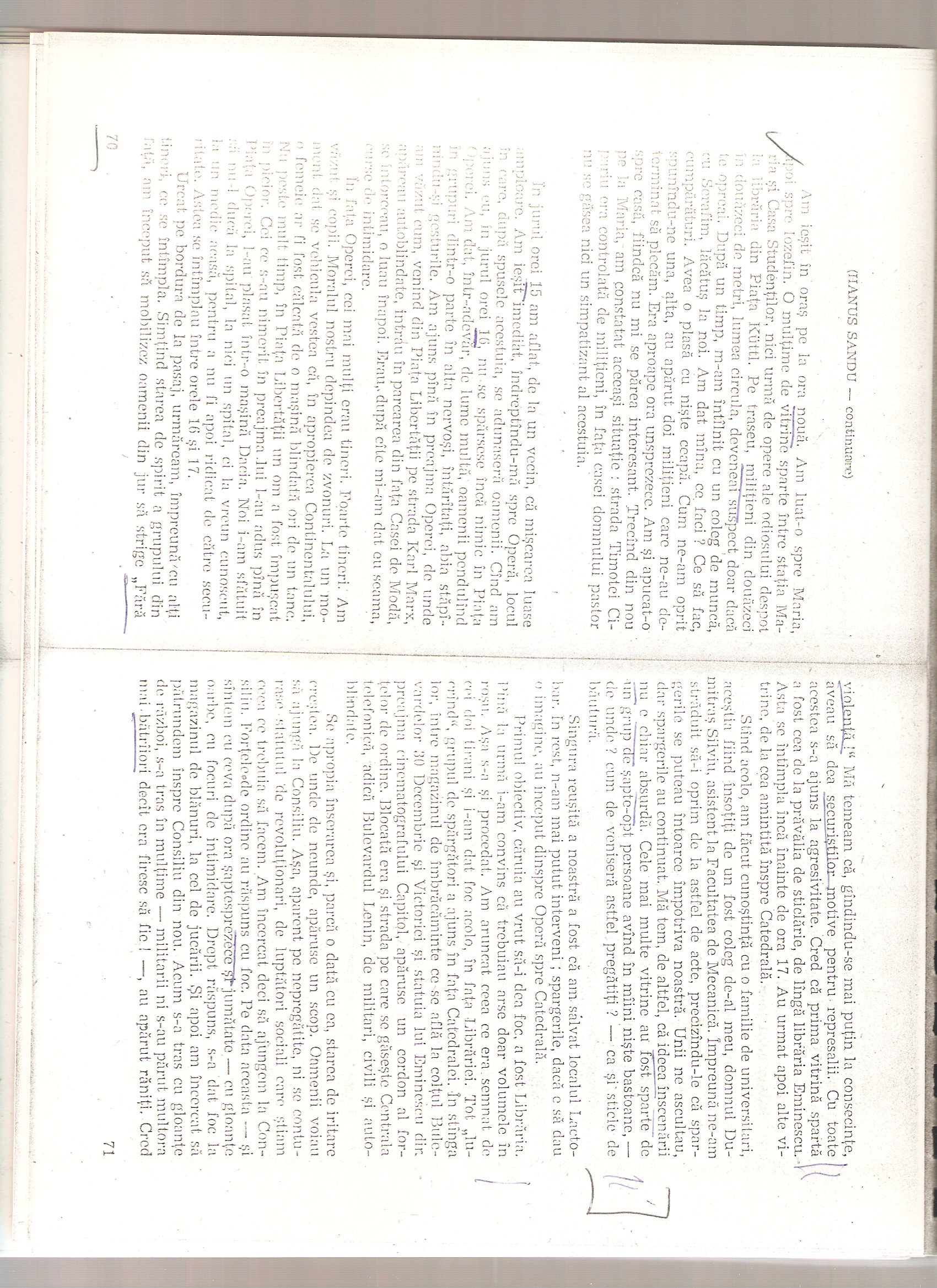
Eyewitness accounts recorded soon after the events–therefore at a time before the various plots and scenarios had permeated the popular imagination–support the hypothesis that the vandalism was organized. Moldovan Fica remarks:

I admit that I cannot escape a certain conclusion. All of this [destruction] was done by a group of about five or six individuals, whose calm demeanor and self-control continues to stay with me to this day. They did not run from the scene, they appeared as if they did not fear anything; I would say that, in fact, they were doing what was required of them, something which had been ordered directly of them![75]

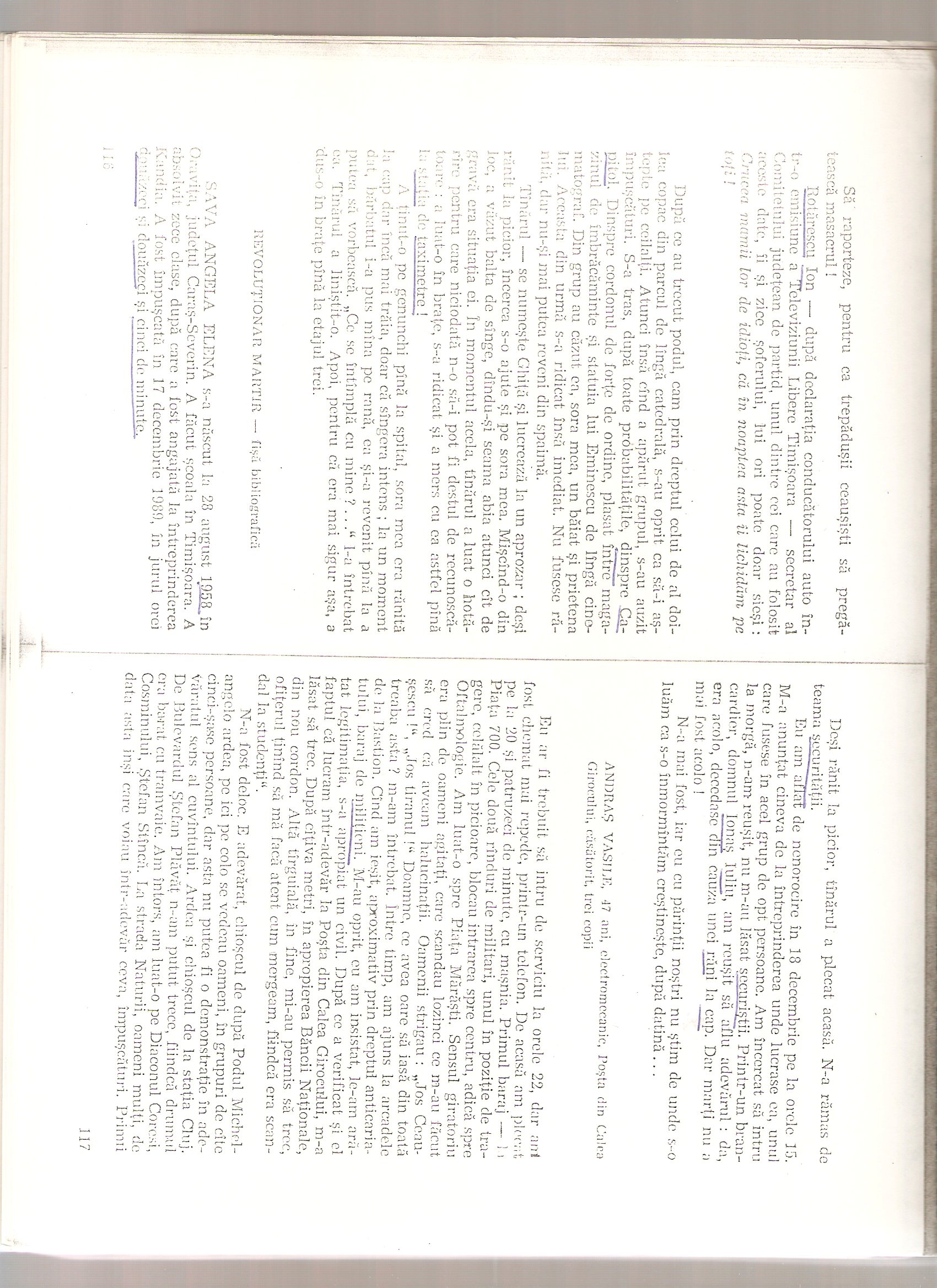
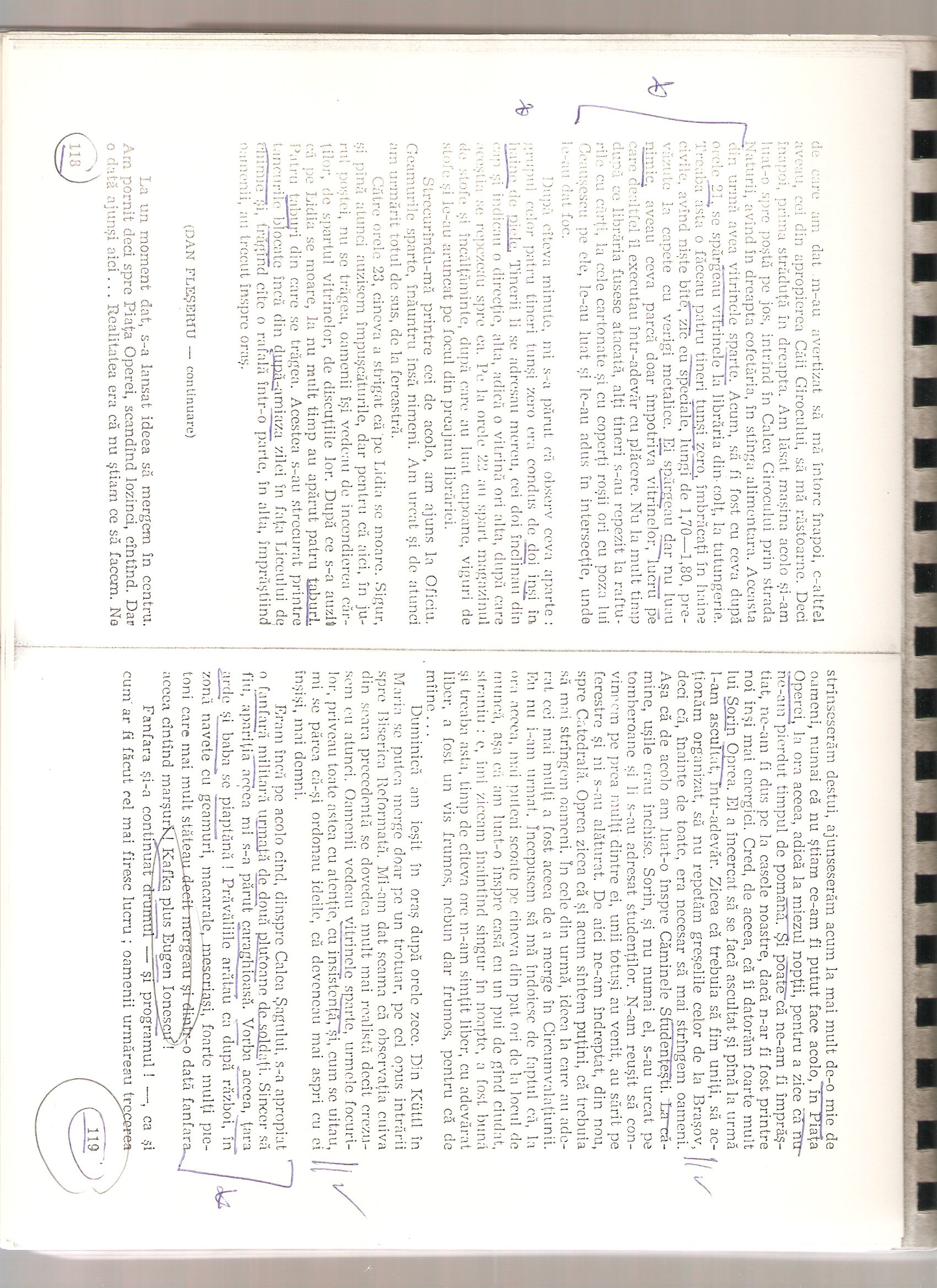
Describing destruction in a different part of the city, Andras Vasile observed that

…four young men with shaved heads and wearing civilian clothes had sticks–I would term them special sticks–1.7 to 1.8 meters long, equipped with metal rings on the top of them. They were breaking the windows, but not taking anything, as if they only had something against the windows, something which they thus went about with great enjoyment…they were led by two individuals in leather jackets.[76]

Other eyewitnesses supply details which confirm the widespread character of the vandalism; its undeniably organized quality; the disinterest of its perpetrators in looting the stores; and the almost “drugged” nature of the perpetrators, who seemed unperturbed by the chaos and repression going on around them.[77]

http://atomic-temporary-3899751.wpcomstaging.com/rewriting-the-revolution-1997/

image0-005

Moldovan Fica (martor ocular)

image0-001

image0

Andras Vasile (martor ocular)

image0-003

image0-002

image0-004

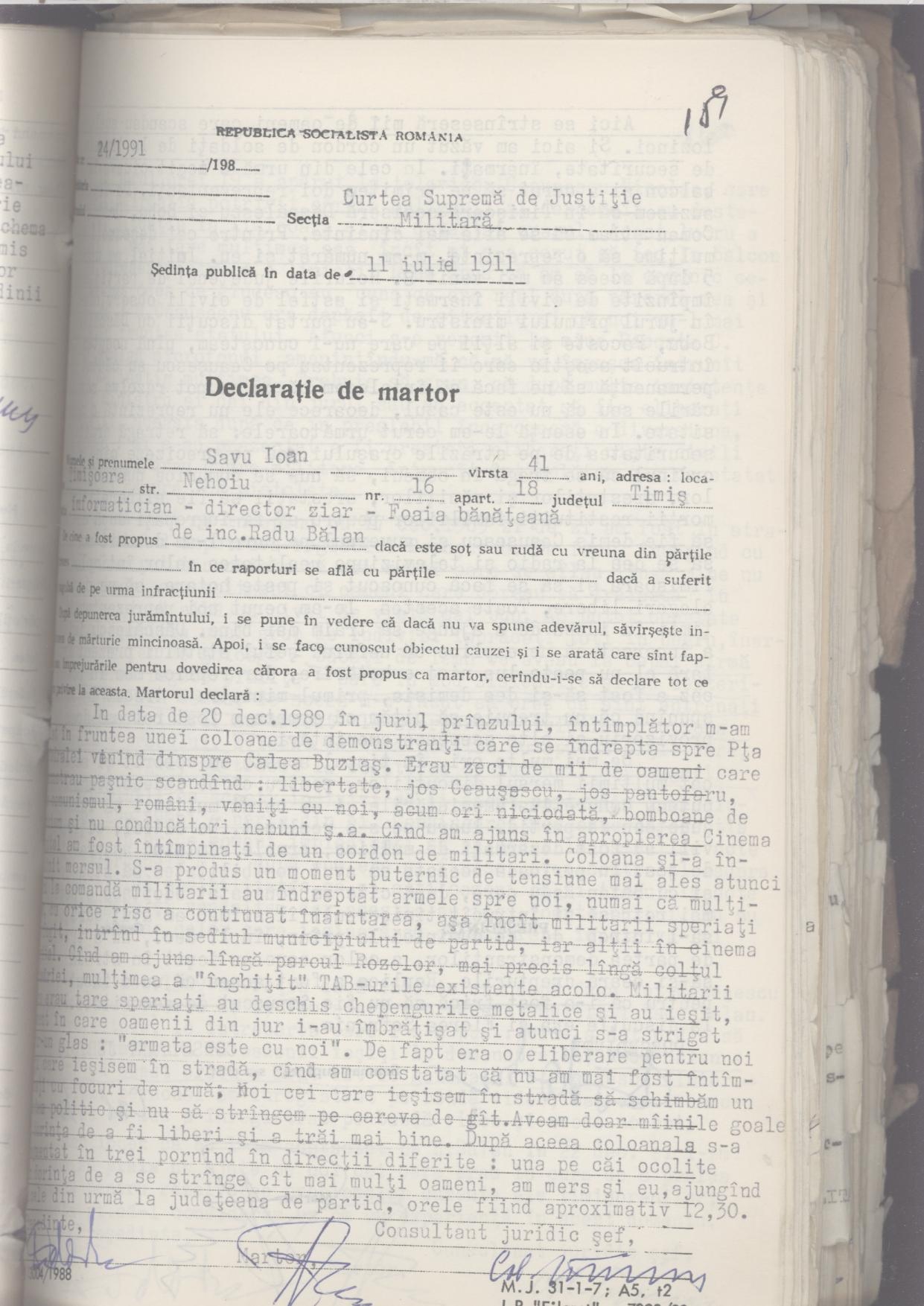
Ioan Savu discussed the windowbreakers as follows:

0282

0280

———————————-

Other depictions of this event available online:

Conducerea partidului, alarmată, a trimis în Piaţa Maria, conform Ordinului 02600, numeroşi miliţieni şi trupe speciale, pentru a lichida manifestaţia care luase amploare. Circulaţia în zonă se întrerupsese. În Piaţa Maria au fost trimişi aproximativ 200 de activişti de partid, miliţieni şi numeroşi ofiţeri de securitate, îmbrăcaţi în haine civile. Au urmat ciocniri violente, mai ales după ce manifestanţii s-au încolonat şi au pornit spre sediul CJ PCR, strigând “Libertate”, “Vrem pâine”, “Vrem căldură”, “Azi la Timişoara, mâine în toată ţara”.
În acea seară echipe de miliţie dinainte pregătite au spart vitrinele magazinelor din centrul oraşului, pentru a avea argumente pentru o intervenţie în forţă. Desigur, multe vitrine au fost sparte şi de derbedei, asupra cărora s-au găsit bunuri furate. În acea noapte au fost arestate aproape 5-600 de cetăţeni. Ei au fost duşi la Penitenciarul oraşului, unde au fost bătuţi în mod bestial. În zilele care au urmat arestării au fost anchetaţi în vederea trimiterii lor în judecată. Bineînţeles, dacă Revoluţia n-ar fi reuşit.

“Azi la Timişoara”
Ivan Sabin

http://revista.memoria.ro/?location=view_article&id=371

Totuşi, se ştie că în acele zile fierbinţi din Timişoara au existat „personaje neidentificate” care au acţionat în mai multe zone ale oraşului. Am să amintesc aici doar două aspecte concrete cu privire la implicarea acestora în evenimentele din Timişoara. În zilele de 16 şi 17 decembrie au fost sparte aproape toate vitrinele magazinelor din zona centrală a oraşului. Sunt zeci de declaraţii ale revoluţionarilor care fac o descriere clară a celor care au spart acele geamuri. Au fost oameni bine îmbrăcaţi, robuşti şi tunşi scurt. Aceştia erau dotaţi cu nişte beţe speciale cu care printr-un gest scurt şi foarte bine exersat loveau vitrinele, după care plecau fără a încerca să sustragă ceva din magazine. Aceste persoane au fost văzute chiar şi de forţele de ordine desfăşurate în acea zonă, care în mod ciudat nu au luat măsuri împotriva lor, ci au acţionat împotriva manifestanţilor ce demonstrau împotriva regimului ceauşist. Un alt aspect relatat de mulţi timişoreni se referă mai ales la zilele de 17-19 decembrie, când, în rândul cordoanelor militare din diferite dispozitive amplasate în zonele importante ale oraşului, între soldaţi, erau intercalate persoane mai în vârstă, nebărbierite îmbrăcate doar parţial în uniforme militare, care nu făceau parte din acele unităţi militare.

Cine au fost acele „persoane neidentificate”? De ce s-a dorit în unele cercuri, cu insistenţă chiar, acreditarea ideii că oamenii au fost scoşi în stradă de agenţi străini? De ce, chiar şi după 20 de ani, se fac afirmaţii de genul: cadavrele celor arşi la Crematoriul „Cenuşa” erau ale unor agenţi străini? Nu voi căuta acum răspunsuri la aceste întrebări, dar, cu siguranţă, ele există.

Kali Adrian Matei

nascut in 30 iulie 1968 la Timisoara, muncitor la IJPIPS (1989), profesor de istorie la Liceul de informatica (1998), impuscat in spate

La Bijuterii concetatenii nostri tigani carau ce puteau. Numai la “Modex” nu era spart. Un grup de oameni se uitau cum niste indivizi bine instruiti spargeau geamurile de linga restaurantul Bulevard. Am rugat oamenii sa apere Modexul, pentru ca era clar ca spargatorii n-aveau nimic comun cu revolta.  30 septembrie 1995  http://timisoara.com/newmioc/4.htm

“În data de 14 decembrie, securitatea a spart toate gemurile din partea străzii principale, iar clădirea arăta ca o cetate asediată. Fostul primar al Timişorei, Petre Moţ l-a vizitat pe Tokes şi a ieşit la geam pentru a vorbi mulţimii. Moţ a cerut să se pună geamuri noi. Erau foarte multe maşini ale securiştilor. Întreaga stradă era ocupată. Se făcea filaj. Eu locuiam acolo, ba intram, ba ieşeam. Nu se vorbea încă revoluţie. Era o solidaritatea faţă de pastor”, declarat Iosif Kabai (foto), care locuieşte şi acum în clădirea bisericii reformate.Citeste mai mult: adevarul.ro/locale/timisoara/16-decembrie-1989-ziua-timisoara-s-a-strigat-data-democratie-jos-comunismul-1_50bd3d887c42d5a663c8e01f/index.html

Radu Tinu cu Angela Bacescu…

The reportedly unusual scope of physical destruction which occurred in Timisoara, particularly on the afternoon and evening of 17 December 1989, has fueled revisionist arguments. Estimates of the damage during the Timisoara unrest are in the neighborhood of four to five billion lei (approximately forty to fifty million dollars at the time), a reasonably large sum given Romania’s standard of living at the time. A huge number of windows was broken and as many as 300 to 400 stores suffered some sort of damage, although relatively few were actually looted. On the evening of 17 December, stores, vehicles, and kiosks were burning in at least ten different areas of the city.[65]

Former Securitate officers clearly wish to link this destruction to the “foreign tourists” who were supposedly so ubiquitous in Timisoara during these days.[66] Perhaps somewhat surprisingly, former Securitate Director Iulian Vlad argued at his trial that

…the acts of vandalism, theft, destruction, arson… acts without precedent…could not have been the work [“opera”] of the faithful [apparently referring sarcastically to Tokes’ parishioners], nor the revolutionaries. They were produced by elements which wished to create a certain atmosphere of tension.[67]

image0-006

RADU TINU:…SINGURLE COMPLEXE COMERCIALE RAMASE INTREGI AU FOST CELE DIN FATA MILITIEI JUDETENE SI CEL DE LANGA FABRICA “MODERN”…

image0-007

image0-008


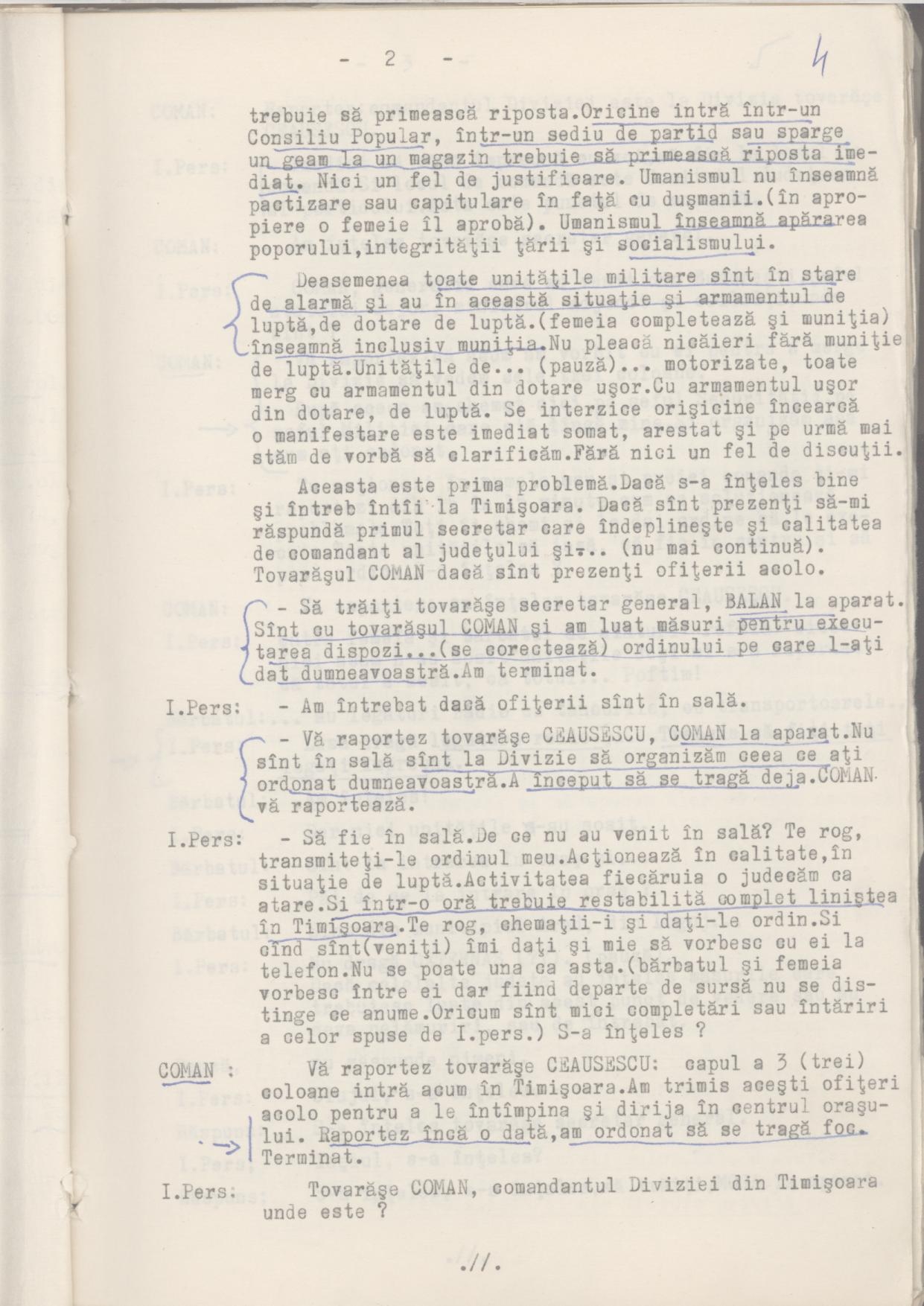
The significance of window-breaking as a justification for repression–something the Securitate would have realized–was outlined by Nicolae Ceausescu in his teleconference of 17 December 1989 as follows:

“Oricine intra intr-un Consiliu Popular, intr-un sediu de partid sau sparge un geam la un magazin trebuie sa primeasca riposta imediat.

0007

Col. Ion Popescu (sef IGM)’s defense lawyer appealed to Legea 21 and Decretul 121 specifically as obligating Interior Ministry (M.I.–Militia and Securitate) forces to intervene in response to the breaking of windows of commercial units…

image0-001

image0

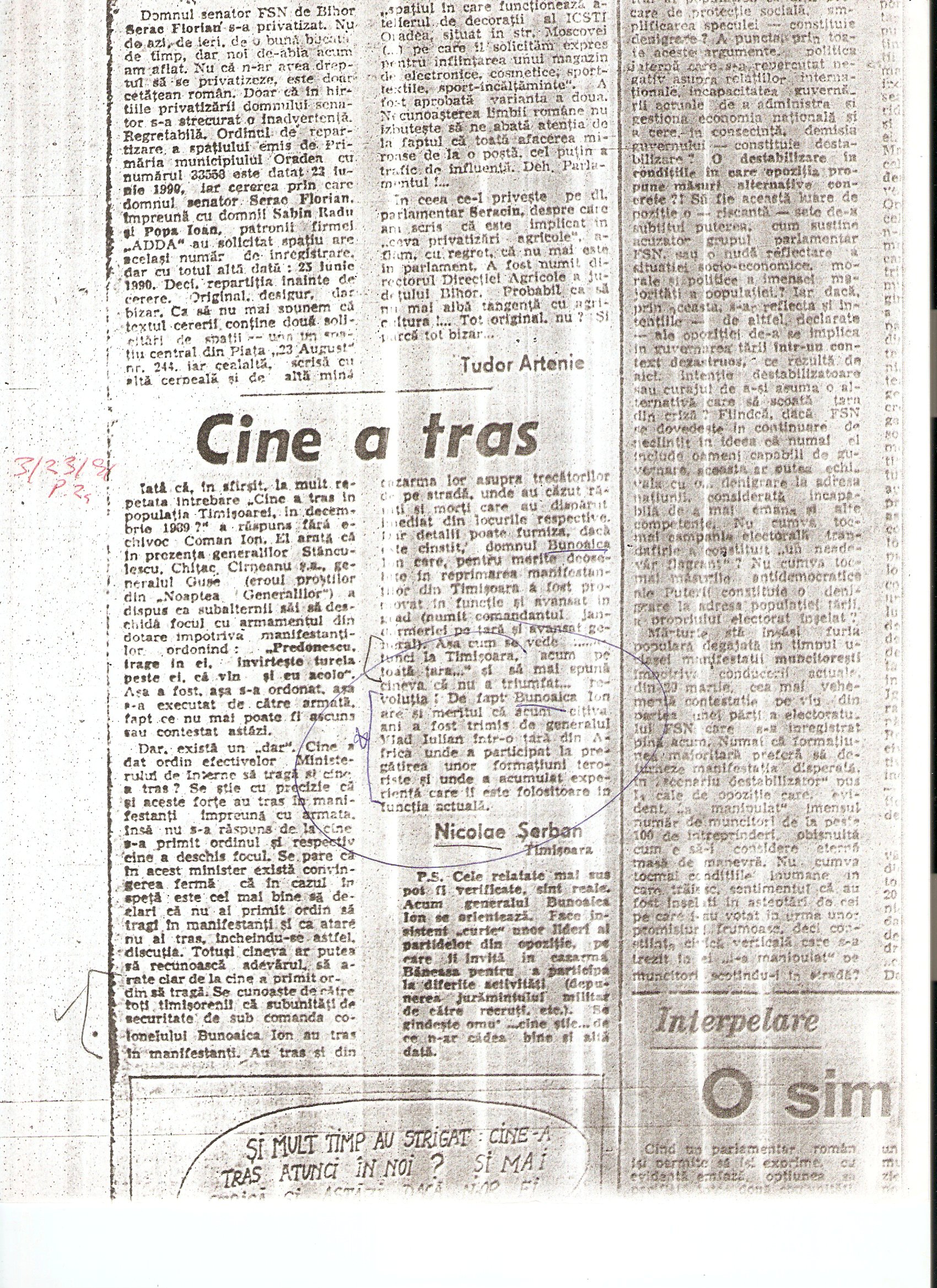
Thus, the breaking of windows, which according to Interior Minister was instigated and carried out in part by Securitate Brigade 30 under the command of Ion Bunoaica served a bureaucratic and legalistic function–a tactic not unknown in the annals of other totalitarian or authoritarian regimes…

image-18image-17image-16image-15

image-4image-9

———————————–

An excerpt from Chapter 5 of my Ph.D. Dissertation at Indiana University: Richard Andrew Hall, Rewriting the Revolution: Authoritarian Regime-State Relations and the Triumph of Securitate Revisionism in Post-Ceausescu Romania (defended 16 December 1996). This is the original chapter as it appeared then and thus has not been revised in any form.

Chapter Five.  The Beginning of the End: Timisoara, 15-17 December 1989

The “Window Breakers”

The reportedly unusual scope of physical destruction which occurred in Timisoara, particularly on the afternoon and evening of 17 December 1989, has fueled revisionist arguments. Estimates of the damage during the Timisoara unrest are in the neighborhood of four to five billion lei (approximately forty to fifty million dollars at the time), a reasonably large sum given Romania’s standard of living at the time. A huge number of windows was broken and as many as 300 to 400 stores suffered some sort of damage, although relatively few were actually looted. On the evening of 17 December, stores, vehicles, and kiosks were burning in at least ten different areas of the city.[65]

Former Securitate officers clearly wish to link this destruction to the “foreign tourists” who were supposedly so ubiquitous in Timisoara during these days.[66] Perhaps somewhat surprisingly, former Securitate Director Iulian Vlad argued at his trial that

…the acts of vandalism, theft, destruction, arson… acts without precedent…could not have been the work [“opera”] of the faithful [apparently referring sarcastically to Tokes’ parishioners], nor the revolutionaries. They were produced by elements which wished to create a certain atmosphere of tension.[67]

“A group of former Securitate officers” wrote to the Ceausist Democratia in September 1990 that after the Militia and Securitate refused to respond to the demonstrations provoked by the “foreign tourists”: “they advance[d] to the next stage: the massive destruction of public property designed to provoke forcible interventions–human victims were needed.”[68]

Nevertheless, here is how one opposition journalist, Grid Modorcea, has described the strange character of Timisoara destruction:

For the first time in history, a revolution…was announced in a previously unknown and absolutely original manner, both literally and figuratively speaking: through the methodical breakage of thousands of windows. On 16 and 17 December 1989, Timisoara was the city of [glass] shards. Well-trained groups of athletes spread throughout the town, tactically, but energetically smashing to pieces hundreds of huge windows without apparently being interested in stealing from these stores…they were like mythical Magis coming to announce the end of one world and the beginning of another. And they gave it an apocalyptic quality: the sound produced by the breaking glass was infernal. The panic this caused was indescribable….Those who “executed” the windows did so with karate-like kicks while yelling “Liberty and Justice”!…The crowds of people who came out into the streets transformed spontaneously into columns of demonstrators, of authentic revolutionaries. The effect was therefore monumental: the breaking of the windows unleashed the popular revolt against the dictator.[69]

Modorcea is convinced that the Tokes case was “merely a pretext” and that “someone–perhaps those who planned the vandalizing of the windows–has an interest in preventing it from being known who broke the windows.” Although Modorcea maintains he is unsure who was responsible, he insists on observing that:

Only the Customs people know how many tourists there were. All were men and long-haired. Inside their cars they had canisters. This fits with the method of the breaking of the windows, with the Molotov cocktails, and the drums used as barricades–they were exactly of the same type….To what extent the new regime which came to power was implicated, we cannot say![70]

Many Timisoara protesters appear torn between wishing to rationalize the extensive destruction as the courageous response of an enraged, long-suffering population, and denying that the perpetrators could have come from among their ranks. Even those investigators attuned to the retroactive psychology of the protesters cannot help but admit that widespread destruction occurred and that it could not have been wholly spontaneous.[71] Furthermore, as Laszlo Tokes has observed in discussing the events at Piata Maria, manipulation and attempts to instigate the crowd to violence were constant features during these days.

Tokes maintains that Securitate provocateurs had tried to agitate the crowd by shouting things like, “Let’s break into the house. The Securitate are in there; they’re trying to kidnap Laszlo Tokes! Let’s rush them!” and by appealing for him to “Come down into the street and lead us!”[72] According to Tokes:

I was alarmed at the obvious provocation from individuals in the crowd clearly intent on making the situation uncontrollable….Later, thinking about the events of those two days, I realized that the authorities would have had a great deal to gain if the situation had become a riot.[73]

Mircea Balan questions whether the protesters would have set stores on fire which were located on the ground floor of the buildings in which the protesters themselves lived.[74] Moreover, he wonders how even the revolutionary fury of the crowd could drive protesters to break so many windows, particularly given the presence of repressive forces on the streets. It is what Balan has termed the “systematic devastation” of property which raises questions.

Eyewitness accounts recorded soon after the events–therefore at a time before the various plots and scenarios had permeated the popular imagination–support the hypothesis that the vandalism was organized. Moldovan Fica remarks:

I admit that I cannot escape a certain conclusion. All of this [destruction] was done by a group of about five or six individuals, whose calm demeanor and self-control continues to stay with me to this day. They did not run from the scene, they appeared as if they did not fear anything; I would say that, in fact, they were doing what was required of them, something which had been ordered directly of them![75]

Describing destruction in a different part of the city, Andras Vasile observed that

…four young men with shaved heads and wearing civilian clothes had sticks–I would term them special sticks–1.7 to 1.8 meters long, equipped with metal rings on the top of them. They were breaking the windows, but not taking anything, as if they only had something against the windows, something which they thus went about with great enjoyment…they were led by two individuals in leather jackets.[76]

Other eyewitnesses supply details which confirm the widespread character of the vandalism; its undeniably organized quality; the disinterest of its perpetrators in looting the stores; and the almost “drugged” nature of the perpetrators, who seemed unperturbed by the chaos and repression going on around them.[77]

Mircea Balan has little doubt who committed this “systematic destruction”:

Demonstrators might have thrown rocks in windows, but the destruction of the entire store was not their work…Nobody need believe that for such a thing foreign intervention was necessary, seeing as there were enough first-class specialists in destruction and demolition right here at home. The Securitate could not have been foreign to what happened, no matter how much it fiercely attempts to deny this today. They were professionals in the art of destruction. They needed a justification for the bloody repression.[78]

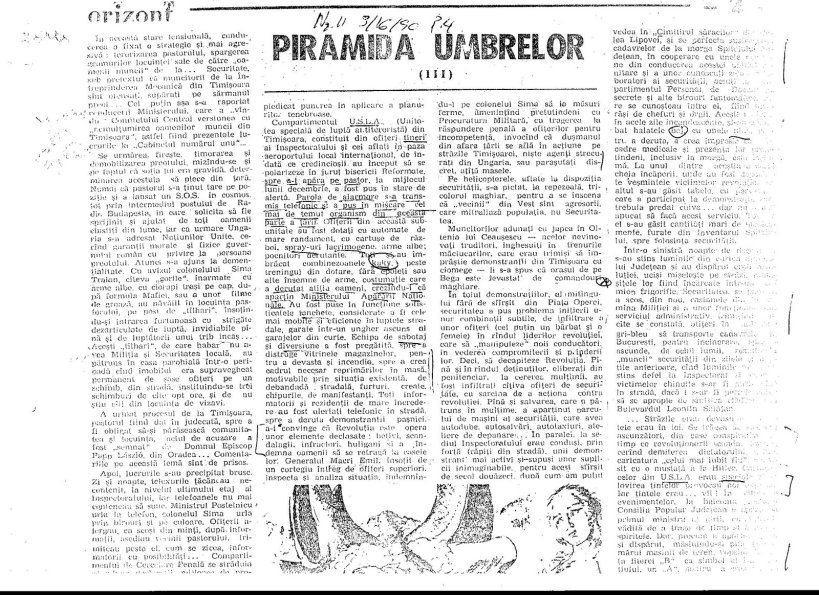
In March 1990, Puspoki had been willing to identify the culprits more specifically. According to Puspoki, as the demonstrators began to gather to prevent Tokes’ eviction:

The USLA’s Sabotage and Diversion team was readied to break store windows, to devastate and set fires–to create the conditions necessary for mass repression: the existence of disorder in the streets and theft on the part of the demonstrators.[79]

Securitate Major Radu Tinu’s observation that the commercial complex “in front of the county Militia building” (i.e. the Inspectorate in which both the Securitate and Militia offices were located) was one of only two such complexes in the whole city to remain intact during these days may also be an indication of the source of the destruction.[80]

It is possible then that to the extent that this destruction did indeed contain an organized component, it was designed by the regime to subvert and cast suspicion upon the intentions of the protesters and to create a pretext for repression. To the extent that an organized component did contribute to the destruction, it was far more likely to have been regime forces attempting to undermine the protests than foreign agents attempting to provoke an uprising against the regime.

[65].. See, for example, Grid Modorcea, “Spargerea Geamurilor [The Breaking of the Windows],” Expres Magazin, no. 49 (1991), 8-9; Mircea Bunea, “Eroii noi si vechi [New and old heroes],” Adevarul, 2 February 1991, in Bunea, Praf in Ochi, 448-449; Suciu, Reportaj cu Sufletul, 57-58.

[66].. See, for example, the comments of Radu Tinu, the deputy director of the Timis County Securitate, in Bacescu, Din Nou in Calea, 67-85.

[67].. Mircea Bunea, “Ipse Dixit,” Adevarul, 21 February 1991, in Bunea, Praf in Ochi, 463. Vlad’s determination to emphasize that these were “acts without precedent” makes one wonder if they were indeed without precedent.

[68].. A group of former Securitate officers, “Asa va place revolutia? Asa a fost! [You like the revolution? Here is how it was!],” Democratia, no. 36 (24-30 September 1990), 4. The lengthy defense by these officers of the Fifth Directorate in this letter suggests that they were members of this directorate.

[69].. Modorcea, “Spargerea Geamurilor,” 8.

[70].. Ibid.

[71].. Balan, “Masacrul.”

[72].. Tokes, With God, for the People, 153, 156.

[73].. Ibid., 156.

[74].. Balan, “Masacrul.”

[75].. Suciu, Reportaj cu Sufletul, 96.

[76].. Ibid, 118. The fact that the two persons supervising the destruction are described as having worn “leather jackets” strongly suggests they may have been Securitate men. Mihai Decean claims that on a train headed for Bucharest on 25 December (therefore after Ceausescu’s flight), he helped in the arrest of two USLA officers whom he describes as “athletic, with shaved heads, and wearing leather jackets.” See Laura Ganea, “La Timisoara se mai trage inca” Tinerama, no. 77 (July 1991), 3.

[77].. Ibid., 71, 122. Some of the eyewitnesses cited in Modorcea, “Spargerea Geamurilor,” say similar things; Modorcea, however, gives them a very different interpretation.

[78].. Balan, “Masacrul.”

[79].. Puspoki, “Piramida Umbrelor (III).”

[80].. Bacescu, Din Nou in Calea, 80.

The following was added some years later as a footnote to the section above in republications of this chapter.  Badea says here “many years later” Postelnicu admitted this, but as we can now see from the Timisoara files, he wrote it in his declaration/statement dated 17 March 1990.

(In connection with the “window breakers” we do know a little more today than we did then back in 1996.  Dan Badea wrote in 1999 Bunoaica and the Window Breakers that “Tudor Postelnicu, the Interior Minister at the time, was to declare many years later that the “breaking of the windows” was a mission executed by personnel from the 30th Securitate Brigade led by col. Ion Bunoaica).  Orele 20.00 – 21.00: Sint sparte toate vitrinele magazinelor de pe Bulevardul 6 Martie (Tudor Postelnicu, ministru de interne la acea vreme, avea sa declare multi ani mai tirziu ca “spargerea vitrinelor” a fost o misiune executata de militari ai Brigazii 30 Securitate condusa de col. Ion Bunoaica).

25 for the 25th Anniversary of the Romanian Revolution: #1 The Securitate Deny Foreign Instigation of the Timisoara Uprising

Posted in decembrie 1989, raport final | Tagged: , , , , , , , , , , , , , , , , , , , , , , , , | 9 Comments »

25 for the 25th Anniversary of the Romanian Revolution: #1 The Securitate Deny Foreign Instigation of the Timisoara Uprising

Posted by romanianrevolutionofdecember1989 on December 16, 2014

(strictly personal views, based on more than two decades of prior research and publications)

http://atomic-temporary-3899751.wpcomstaging.com/a-response-to-watts-ii-preliminary/

http://atomic-temporary-3899751.wpcomstaging.com/a-response-to-watts-the-pitfalls-of-not-having-any-evidence/

2014 marks the 25th anniversary of the collapse of communism in central and eastern Europe–Poland, Hungary, East Germany, Czechoslovakia, Bulgaria, and Romania.  This series looks at 25 things I have learned about the events of the Romanian Revolution of December 1989.  The numbering is not designed to assign importance, but rather–to the extent possible–to progress chronologically through those events.

Looking through the Romanian media’s articles devoted to the 25th anniversary of the Romanian Revolution of December 1989 that overthrew the communist dictator Nicolae Ceausescu, one cannot help but be reminded of Valentin Ceausescu’s 1997 claim according to which (paraphrased),

–“Have you noticed? All the heroes…now are the militia and the Securitate.” “The villains are now the heroes…and the heroes are now the villains!”

Until the documents [screen captures] below were made publicly available and I unearthed the following, we had to rely primarily on arguments emphasizing the Securitate roots of these claims and/or about the implausibility and often absurdity of these claims.  We now have documentary evidence that in the immediate wake of December 1989 not even the Securitate believed in the claims they would make so frequently later on according to which foreign agents were allegedly responsible for the Timisoara uprising.

——————————————————————————————————————————————————————————————————

Back in 1997, the American novelist and Pulitzer Prize Winner William McPherson wrote of what Valentin Ceausescu, communist dictator Nicolae Ceausescu’s eldest son, told him about the events of the Romanian Revolution of December 1989.  Here are some excerpts:

  • Valentin and I were having coffee in the Vox Maris, the same grand casino where the funeral feast was held. It was morning, two days after the funeral [of Nicu Ceausescu], and the crowds had not yet arrived.
  • “Nicu was never groomed to be the successor. That was [only] the rumor.” He paused for a moment. “But rumors even become the reality.”
  • “Yes. Especially in Romania.”
  • “Maybe others in the party thought it would be a good idea. He could command a lot of sympathy. He always wanted to look tough and act strong, but he wasn’t. He was more like a child than anything else.”
  • “What about the 90 people killed in Sibiu?”
  • “He did not order the shooting. I know when he’s trying to lie, and he wasn’t lying. I knew immediately. That’s why I defended him so strongly.”
  • He paused and lit another Pall Mall. “Have you noticed? All the heroes in Sibiu now are the militia and the Securitate – all the dead people, and now they are the heroes of the revolution.”
  • “So the villains are now the heroes?”
  • “Yes.”
  • And the heroes are now the villains.
  • The official toll of the dead, revised frequently with a final version released three years after the events, is 1,104; only 160 were killed before the dictator fled.
  • Curious – if the figures are accurate – that the majority of them were killed in Sibiu. “A lot of effort,” Valentin once said, “to kill these two old people.”

William McPherson, “A Balkan Comedy,” The Wilson Quarterly, Volume 21, Issue 3 (Summer 1997)

——————————————————————————————————————————————————————————————————

Thus it is that at Evenimentul Zilei, long hailed by Romania’s westward leaning intelligentsia and Romanianists in North America as the most authentically anti-communist and credible of Romania’s dailies, articles continue their reliance–very selectively–of recent years on the claims of senior former Securitate officers, Iulian Vlad, Emil Macri, Filip Teodorescu, Nicolae Mavru, etc., or on the research of Alex Mihai Stoenescu, whose work is detailed and meticulous and thus deserves to be read, but, who, it turns out, not accidentally, is also an acknowledged former Securitate collaborator.  (Not for nothing, the Evenimentul Zilei series is entitled “25 de ani de la evenimentele din decembrie ’89. Lumini si umbre” thus intentionally or unintentionally conjuring up the name, appropriately enough, of the current preferred vehicle of the former Securitate for discussing December 1989, http://www.acmrr-sri.ro/categorii/19/revista-vitralii–lumini-si-umbre.html )

(See, for example, http://www.evz.ro/document-strict-secret-1989-raportul-generalului-iulian-vlad-catre-nicolae-ceausescu.html or http://www.evz.ro/25de-ani-de-la-evenimentele-din-decembrie-1989-generalul-iulian-vlad-daca-oamenii-nu-erau-nemultumiti-strainatatea-nu-l-putea-rasturna-pe-ceausescu.html; http://www.evz.ro/timisoara-protestul-pentru-laszlo-tokes-si-povestea-agentilor-straini.html; http://www.evz.ro/dec-1989-cum-a-izbucnit-revolutia-romana-revolta-de-la-iasi-si-scanteia-maghiara-de-la-timisoara.html; http://www.evz.ro/25de-ani-de-la-evenimentele-din-decembrie-1989-declaratia-generalului-iulian-vlad-seful-securitatii-din-procesul-revolutiei-de-la-timisoara-daca-oamenii-nu-erau-nemultumiti-strainatatea-nu-l-putea-rasturna-pe-ceausescu.html)

[Oh, but wait, there is good news!  In addition to all these articles furthering the viewpoint, to a lesser or greater extent, of the former Securitate, is the beginning of the chapter on December 1989 in The Greatest Tribute to Truth and Justice in the History of the World!, the so-called Final Report of the Tismaneanu Commission (CPADCR) of December 2006 condemning communism http://www.evz.ro/25de-ani-de-la-evenimentele-din-decembrie-1989-raportul-final-al-comisiei-prezidentiale-de-analiza-a-dictaturii-comuniste-condusa-de-vladimir-tismaneanu.html, which continues the glorious copy-paste tradition of the original, failing to cite that the text used in 2006 and now again in 2014, is from a 1997 chapter by the chair of the commission, Professor Vladimir Tismaneanu–that this is inarguable, see here http://atomic-temporary-3899751.wpcomstaging.com/2010/05/01/the-romanian-revolution-for-dum-dums-by-richard-andrew-hall/ , the xeroxes in fn. 10 in particular)]

——————————————————————————————————————————————————————————————————

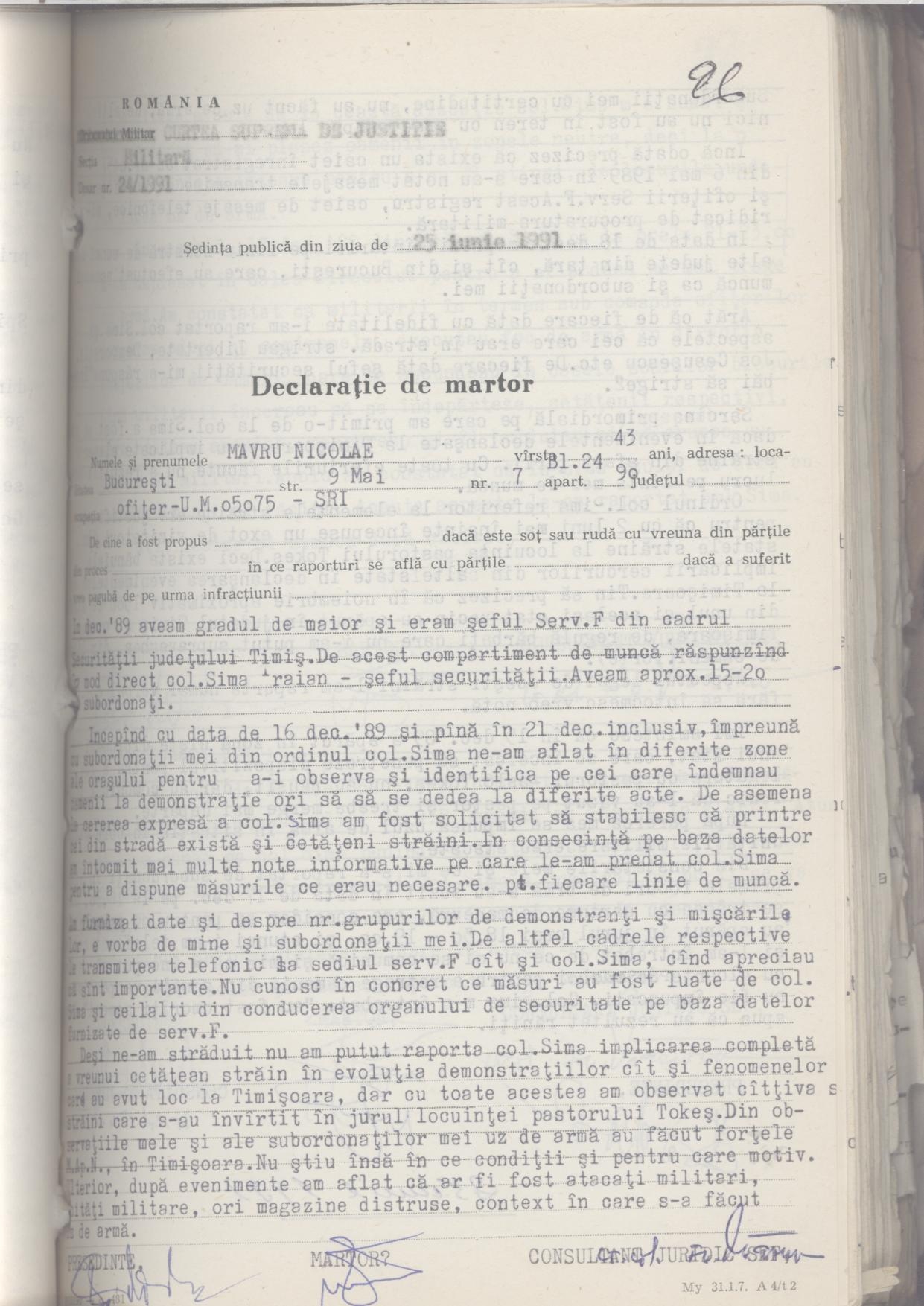
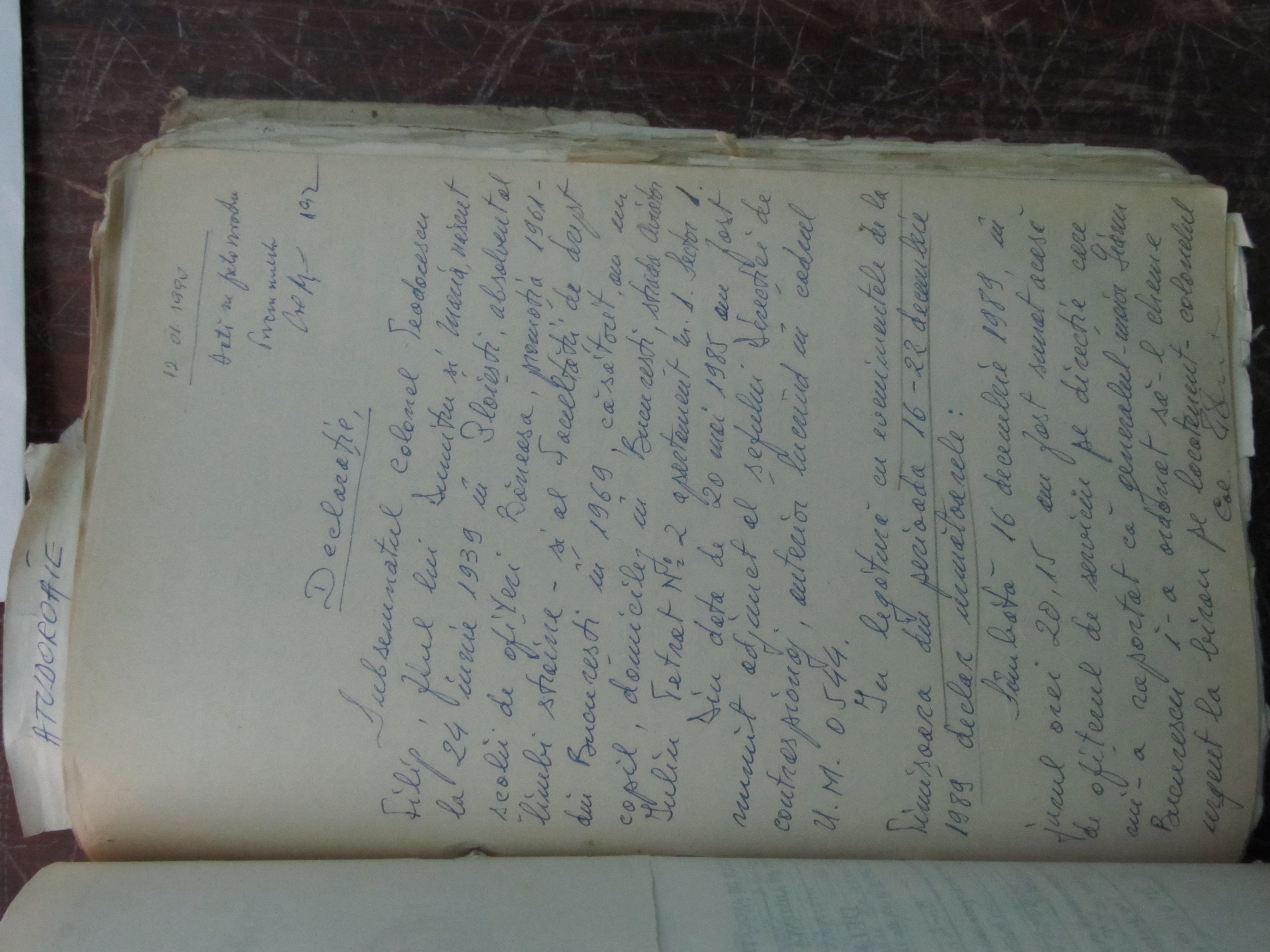
The Timisoara files about December 1989 are now publicly available (when the link works!) on the Internet at http://dosarelerevolutiei.ro/.  What they show is that Securitate, Militia, and other regime officials from Timis County were asked by Bucharest–communicated via the person of Securitate Director, General Iulian Vlad–to investigate the role of foreign elements, specifically tourists, in the Timisoara protests of mid-December 1989.  But they were not the only ones.  General Vlad tasked senior Securitate officials from Bucharest sent to Timisoara to report back to him on this very topic alleging external involvement and manipulation of the Timisoara demonstrations.  What remains unclear is how much of this tasking was General Vlad communicating his own “hypothesis” or how much of it was he relaying Nicolae Ceausescu’s “theory” about what was going on.  This much is clear:  neither those stationed in Timis County, nor those officials sent from Bucharest could find evidence of a foreign hand in the Timisoara uprising, despite being asked to investigate exactly this aspect.  How do we know this?  From their own written confessions immediately after the December 1989 events.  (Below are four of them:  Nicolae Mavru, Liviu Dinulescu, Emil Macri, and Filip Teodorescu.)

Niculae Mavru, fost sef al sectiei ‘Filaj si investigatie’ de la Securitatea Timis, declaratia din 13 ianuarie 1990:  …la ordinul col. Sima Traian, am primit…misiuni de a observa si sesiza aspecte din masa manifestantilor, din diferite zone ale orasului in sensul de a raporta daca sint straini (ceea ce nu prea au fost) care incita la dezordine, acte de violenta sau altfel de acte… 0331 25 iunie 1991 “Desi ne-am straduit nu am putut raporta col. Sima implicarea completa a vreunui cetatean strain in evolutia demonstratiilor cit si fenomenlor care au avut loc la Timisoara,..”

0173

“Sarcina primordiala pe care am primit-o de la col. Sima a fost daca in evenimentele declansate la Timisoara erau implicate elemente straine din afara tarii.  Cu toate eforturile facute nu a rezultat lucru pe linia mea de munca.” 0174

26 iunie 1991, Declaratia lui Liviu Dinulescu, cpt. la Serviciul de Pasapoarte al jud. Timis (in decembrie 1989, lt. maj. ofiter operativ Securitate judetean la Serv. III, care se ocupa de contraspionaj)

“Precizez ca anterior declansarii evenimentelor de la Timisoara din datele ce le detineam serviciul nostru nu rezulta vreun amestec din exterior in zona judetului Timis.”

0197

Generalul Emil Macri (seful Dir. II-a Securitatii, Contrainformatii Economice),

Declaratie 2 ianuarie 1990:

“Rezumind sintetic informatiile obtinute ele nu au pus in evidenta nici lideri si nici amestecul vreunei puteri straine in producerea evenimentelor de la Timisoara.  Raportarea acestor date la esalonul superior respectivi generalului I. Vlad a produs iritare si chiar suparare…”

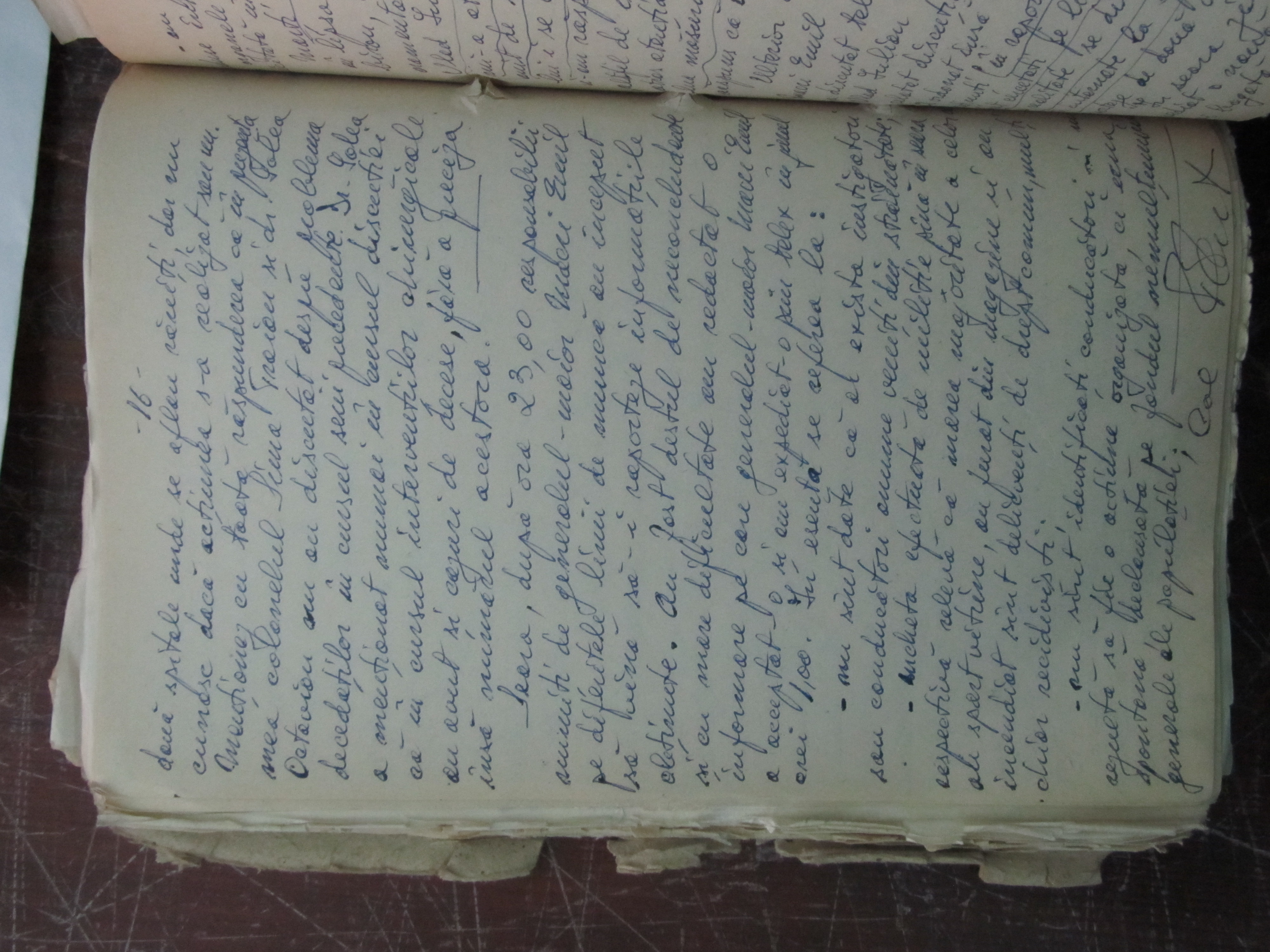
IMG_1219 IMG_1215 Filip Teodorescu (adj. sef. Dir III Contraspionaj D.S.S.), Declaratie, 12 ianaurie 1990:  Seara [luni, 18 decembrie 1989], dupa 23:00, responsabili (anumiti ?) de generalul-maior Macri Emil pe diferitele linii de munca au inceput sa vina sa-i raporteze informatiile obtinute.  Au fost destul de neconcludente si cu mare dificultate am redat o informare pe care generalul-maior Macri Emil a acceptat-o si am expediat-o prin telex in jurul orei 01:00 [marti, 19 decembrie 1989.  In esenta se refera la: –nu sint date ca ar exista instigatori sau conducatori anume veniti din strainatate… IMG_1453 IMG_1438 http://atomic-temporary-3899751.wpcomstaging.com/2013/04/29/high-time-to-unpack-already-why-the-restless-journey-of-the-soviet-tourists-of-the-romanian-revolution-should-come-to-an-end/

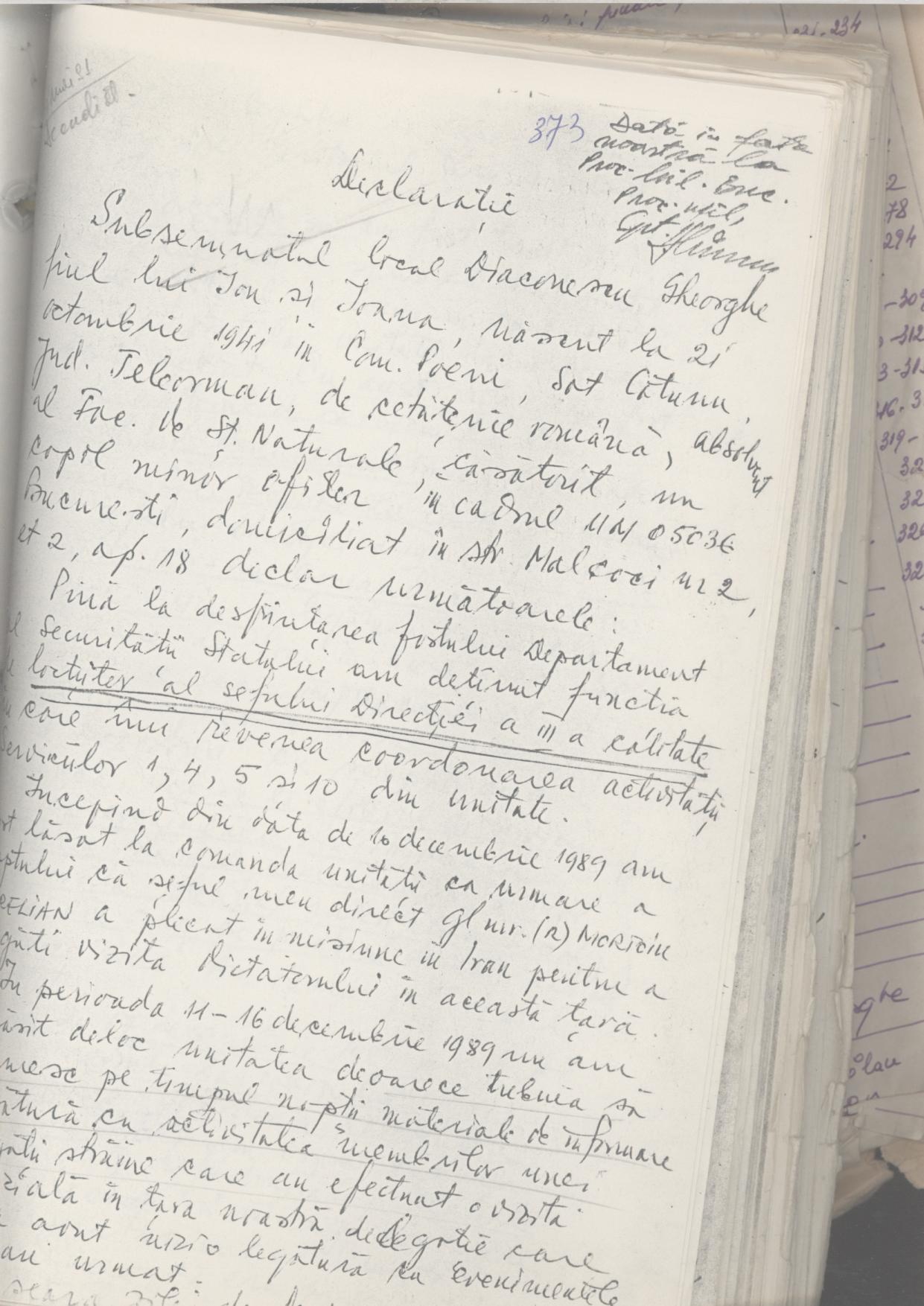
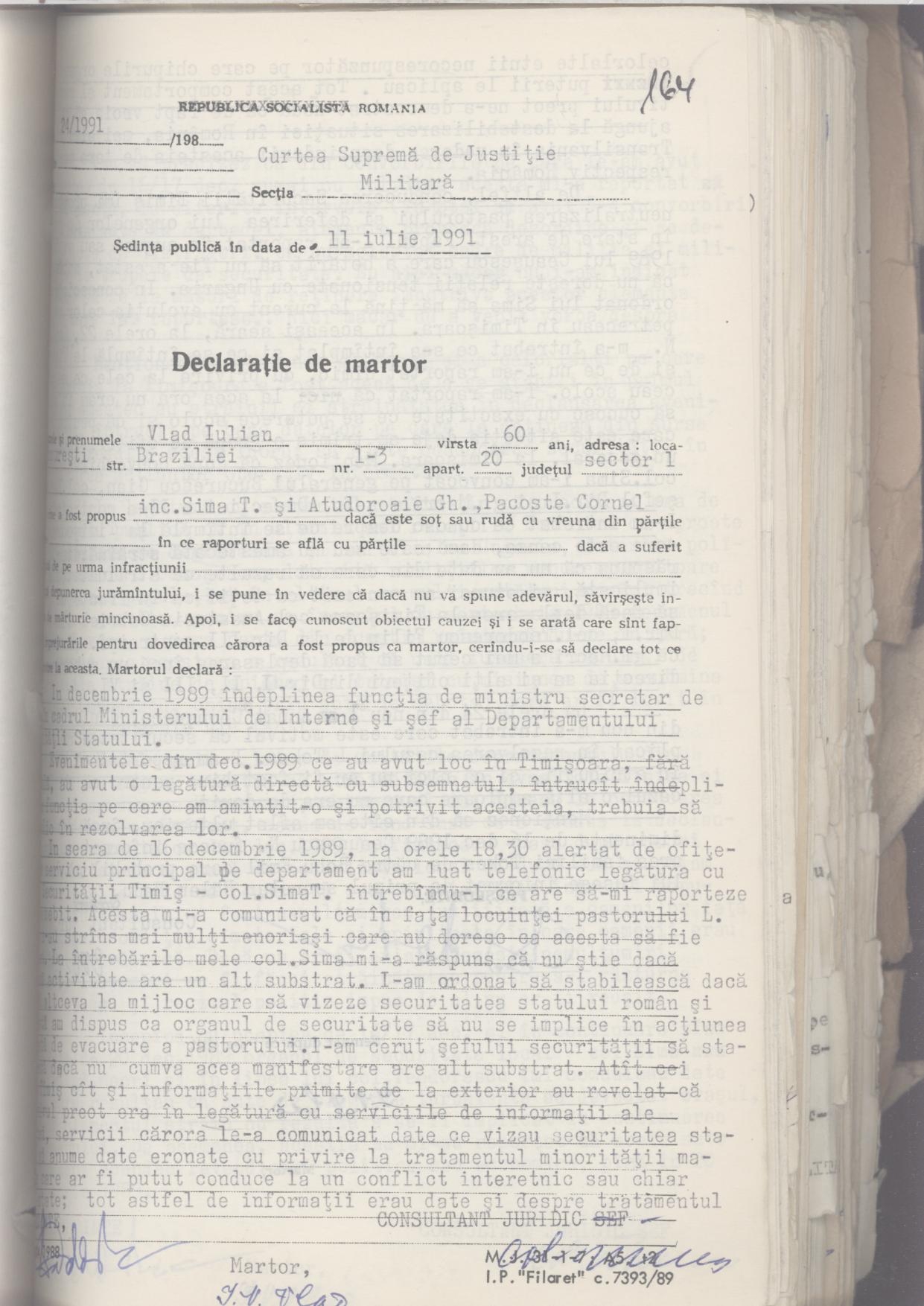
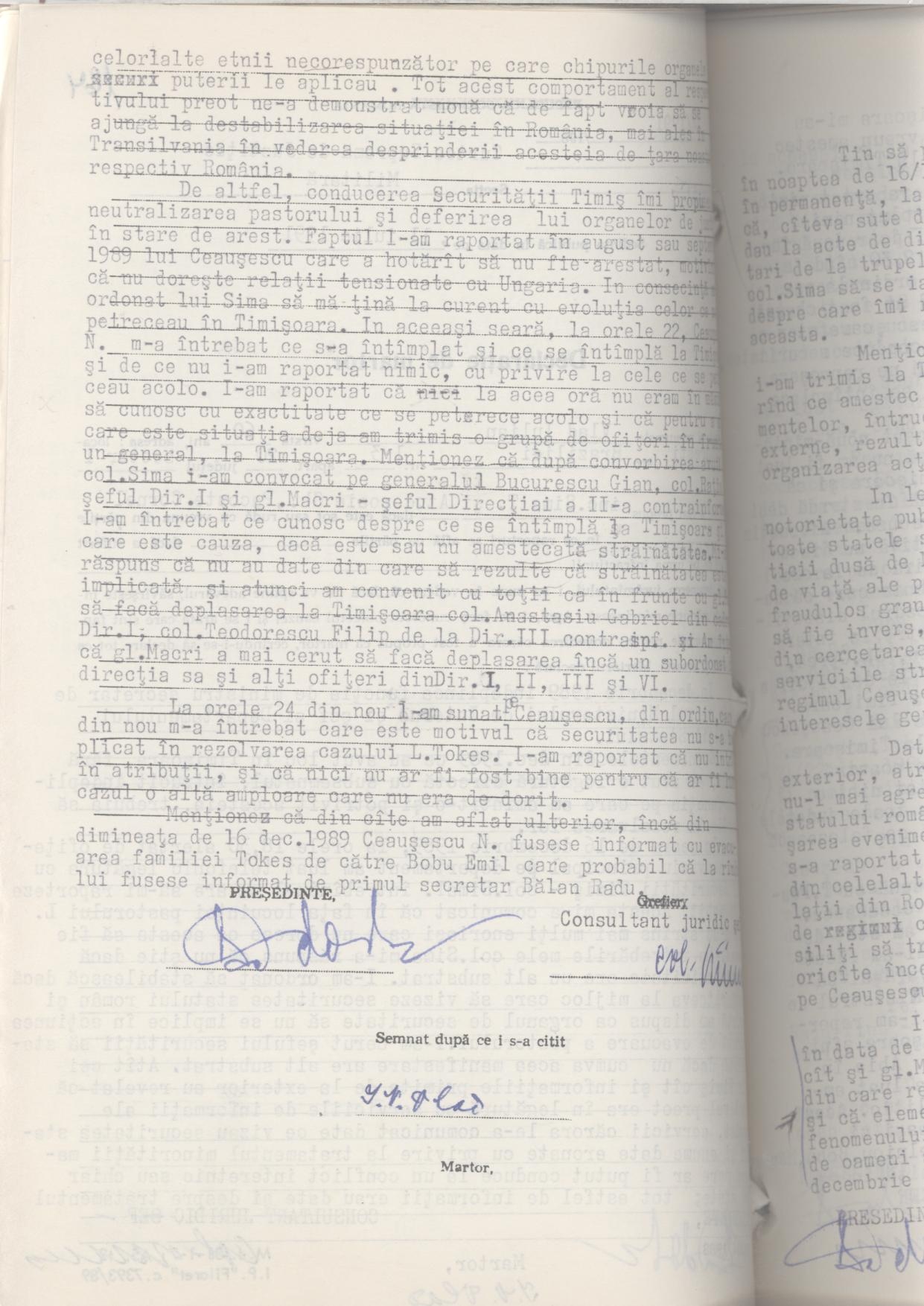
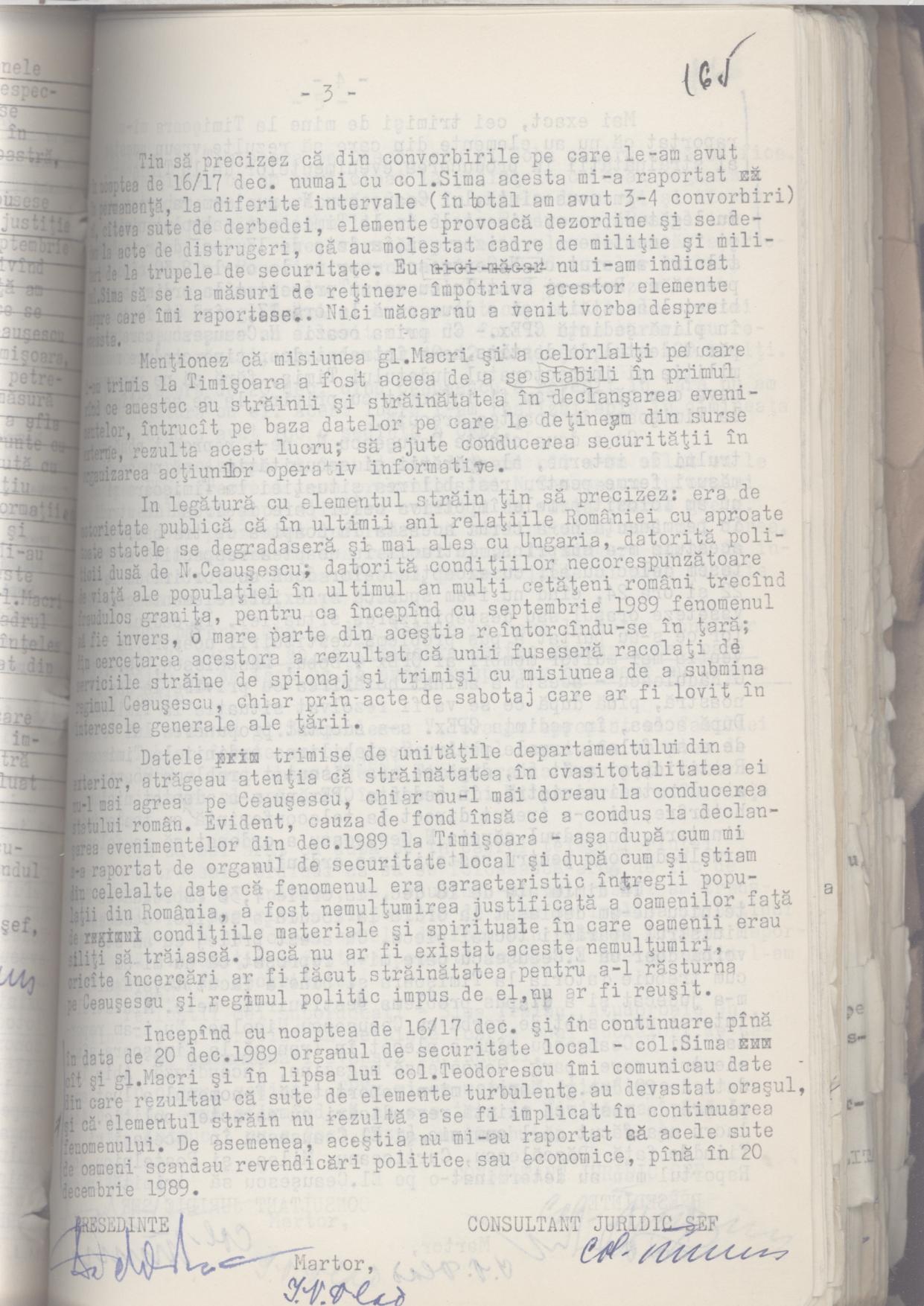
Mai jos, declaratiile lui Petre Pele, Tudor Postelnicu, Gheorghe Diaconescu, si Iulian Vlad Excerpt from Chapter 5 of my Ph.D. Dissertation at Indiana University: Richard Andrew Hall, Rewriting the Revolution: Authoritarian Regime-State Relations and the Triumph of Securitate Revisionism in Post-Ceausescu Romania (defended 16 December 1996). This is the original chapter as it appeared then and thus have not been revised in any form. http://atomic-temporary-3899751.wpcomstaging.com/rewriting-the-revolution-1997/

A Review of the Evidence

Although at first glance the regime’s treatment of Pastor Tokes seems strange and even illogical, within the context of the workings of the Ceausescu regime and the regime’s strategy for dealing with dissent it makes perfect sense. There is simply no convincing evidence to believe that the Securitate–or a faction within it–purposely dragged its feet in enforcing Pastor Tokes’ eviction, or was attempting to spark a demonstration in the hopes of precipitating Ceausescu’s fall. The regime’s decision to evict Tokes was not a last-minute decision. Moreover, the regime exerted tremendous and sometimes brutal pressure to silence Tokes in the months preceding this deadline. Interestingly, according to high-ranking members of the former Securitate, Nicolae Ceausescu’s unwillingness to approve the more definitive measures requested by the Securitate allowed the Tokes case to drag on without resolution (see below). The Tokes case suggests the bureaucratic and byzantine mentalities of the Ceausescu regime, and the clash between a dictator’s instructions and how the institutions charged with defending him interpret their mission. … The suggestion that the Securitate treated Tokes gently prior to his eviction is simply incorrect. On 2 November 1989, four masked men burst through the locked doors of the parochial residence, wielding knives and screaming in a fury. Tokes was slashed on the forehead before his church bodyguards could come to his rescue, causing the four to flee. The numerous Securitate men posted out front of the building had done nothing to intervene in spite of calls for help. Puspoki suggests that these “Mafia-like thugs,” who attacked as if from “an Incan tribe,” were some of Colonel Sima’s “gorillas,” sent to deliver a clear message to Tokes that he should leave immediately.[40] The view of the former Securitate–as expounded by Colonel Sima’s senior deputy, Major Radu Tinu–insinuates a “tourist”-like scenario. According to Tinu, the incident was clearly a “set-up” designed to draw sympathy to Tokes’ cause since the assailants fled away in a car with West German tags.[41] Not for the last time, the Securitate thus appears to attempt to attribute its own actions to foreign agents. A week after the mysterious attack by the masked intruders, all of the windows of the parochial residence and nearby buildings were smashed. Interestingly, the report drawn up for Bucharest by the Timisoara Securitate attempted to argue that “workers” from the Timisoara Mechanical Enterprise, offended by pastor Tokes’ behavior, had broken the windows. According to Puspoki, the use of a propaganda-like description was not accidental: the local Securitate was trying to present the incident as evidence of “the dissatisfaction of the working people of Timisoara” in the hope that it would finally prompt Ceausescu into approving definitive measures against Tokes.[42] Was Ceausescu responsible for the fact that the Tokes case dragged on without resolution? Support for such a conclusion comes from the comments of Securitate officers Colonel Filip Teodorescu and Major Radu Tinu. Teodorescu was dispatched to Timisoara with sixty other Securitate information officers in order to “verify” the request of the local Securitate that proceedings for treason be initiated against Tokes.[43] Teodorescu laments: Unfortunately, as in other situations…Nicolae Ceausescu did not agree because he didn’t want to further muddy relations with Hungary. Moreover, groundlessly, he hoped to avoid the criticisms of “Western democracies” by taking administrative measures against the pastor through the Reformed Church to which [Tokes] belonged.[44] Major Radu Tinu suggests that Ceausescu’s approval was necessary in the case of Securitate arrests and that the local Securitate remained “stupefied” that after having worked so long and hard in gathering information with which to charge Tokes with the crime of treason, Ceausescu rejected the request.[45] Tinu speculates that Ceausescu “did not want to create problems at the international level.” Because former Securitate officers rarely pass up the opportunity to absolve themselves of blame, and it would appear both easier and more advantageous to blame the deceased Ceausescu for being too unyielding in the Tokes affair, these allegations seem plausible. Thus, it would appear that because Nicolae Ceausescu was skittish of further damaging Romania’s already deteriorating relations with the international community, and the Tokes case was a high-profile one, he refrained from approving visible, definitive action against the pastor. The Securitate‘s attempt to goad Ceausescu to bolder action would appear to confirm Ghita Ionescu’s suggestion that where the security apparatus comes to dominate regime affairs it attempts to impose its institutional prerogatives upon political superiors. Ceausescu and the Securitate appear then to have had sometimes conflicting views over how to resolve the Tokes affair in the quickest and most efficient fashion. By December 1989, a huge group of Securitate officers were working on the Tokes case: the entire branch of the First Directorate for Timis county, the special division charged with combatting Hungarian espionage, high-ranking members of the First Directorate and Independent Service “D” (responsible for disinformation) from Bucharest, and members of the division charged with “Surveillance and Investigation.”[46] Puspoki describes Timisoara at this late hour as follows: Day and night, the telex machines on the top floor of the [County Militia] “Inspectorate” incessantly banged out communications, while the telephones never stopped ringing. Minister Postelnicu yelled on the phone, Colonel Sima yelled through the offices and the hallways. The officers ran, as if out of their minds, after information, besieged neighbors of the pastor, and dispatched in his direction–what they call–”informers with possibilities.”[47] Yet the case lingered on. On Sunday, 10 December 1989, Pastor Tokes announced to his congregation that he had received a rejection of his most recent appeal: the regime would make good on its threat to evict him on Friday, 15 December. He termed this an “illegal act” and suggested that the authorities would probably use force since he would not go willingly. He appealed for people to come and attend as “peaceful witnesses.”[48] They came.

[40].. Puspoki, “Piramida Umbrelor (III),” Orizont, no. 11 (16 March 1990), 4.

[41].. Bacescu, Din Nou in Calea, 78.
[42].. Puspoki, “Piramida Umbrelor (III).”
[43].. Teodorescu, Un Risc Asumat, 45-46.
[44].. Ibid., 90.
[45].. Bacescu, Din Nou in Calea, 78.
[46].. Puspoki, “Piramida Umbrelor (II).”
[47].. Ibid.
[48].. Tokes, With God, for the People, 1-4. ————————————————————————————————

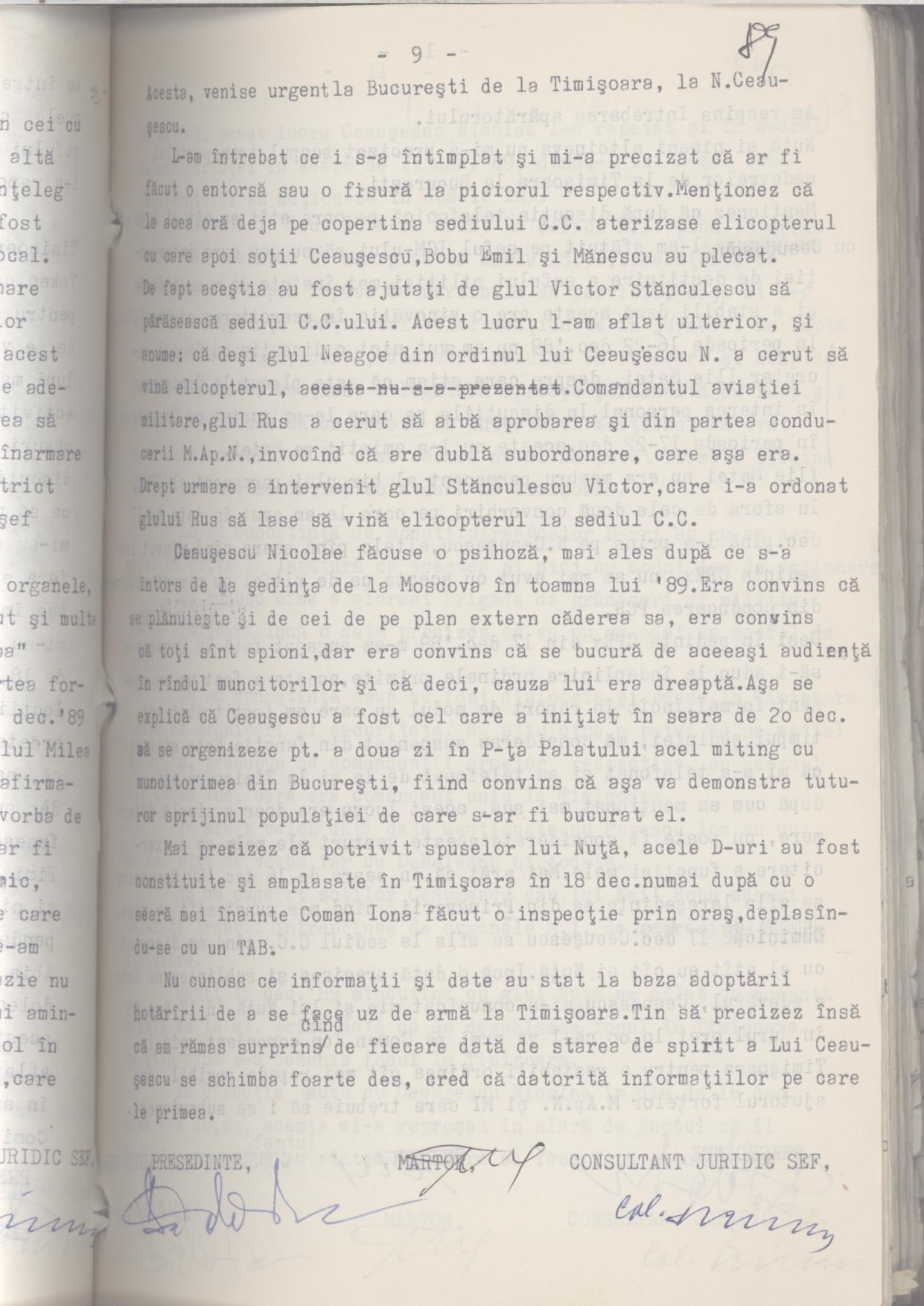
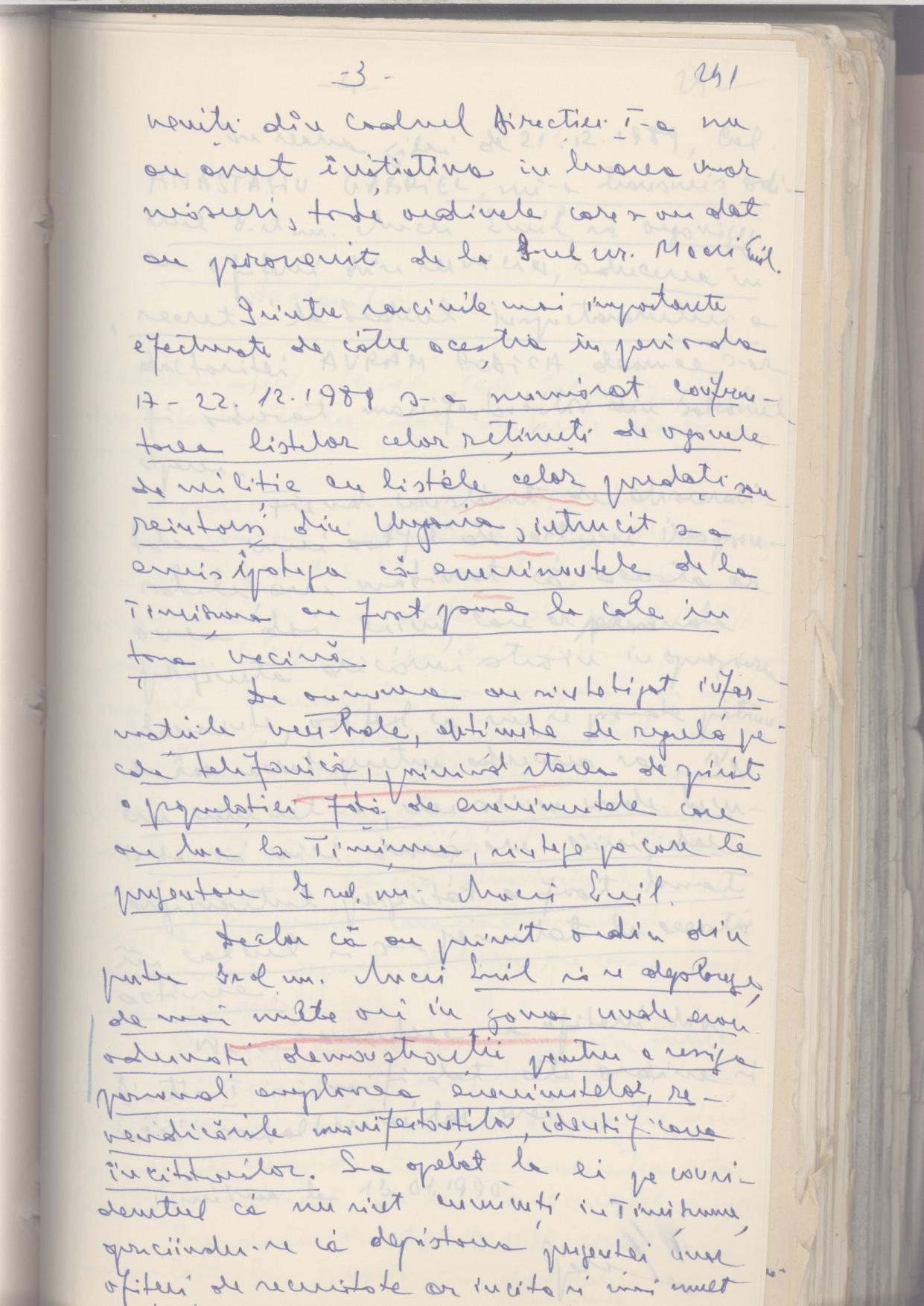
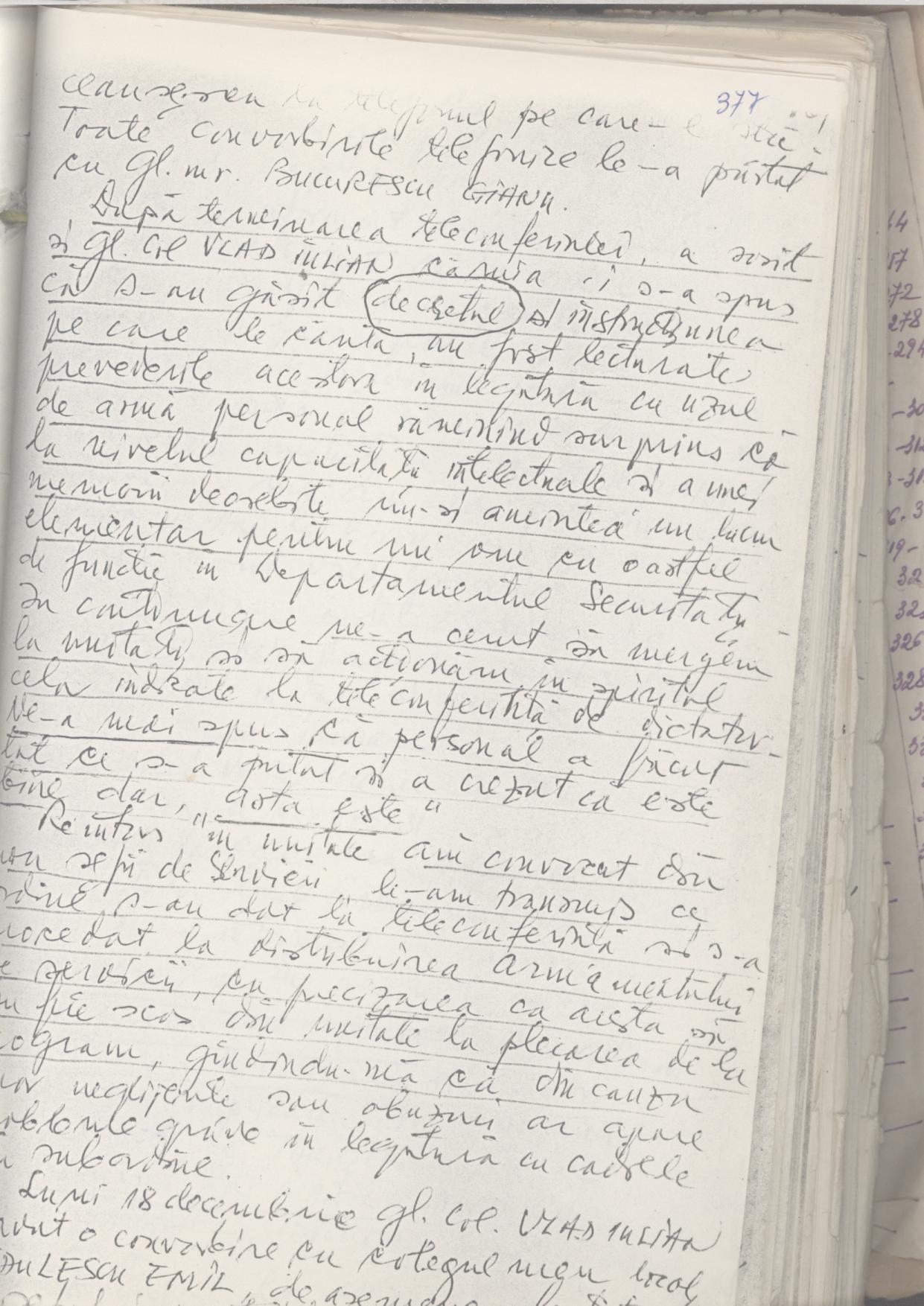
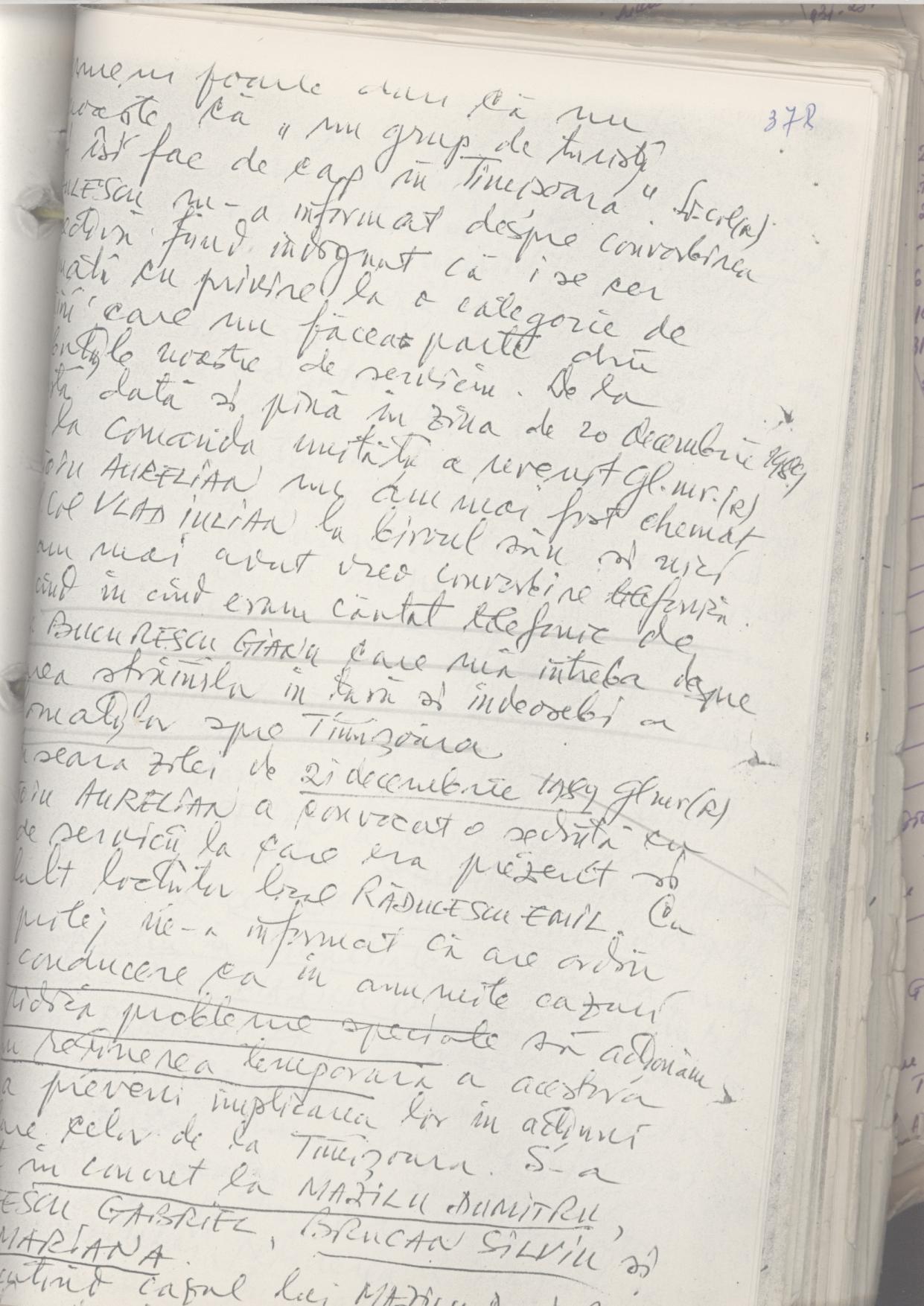
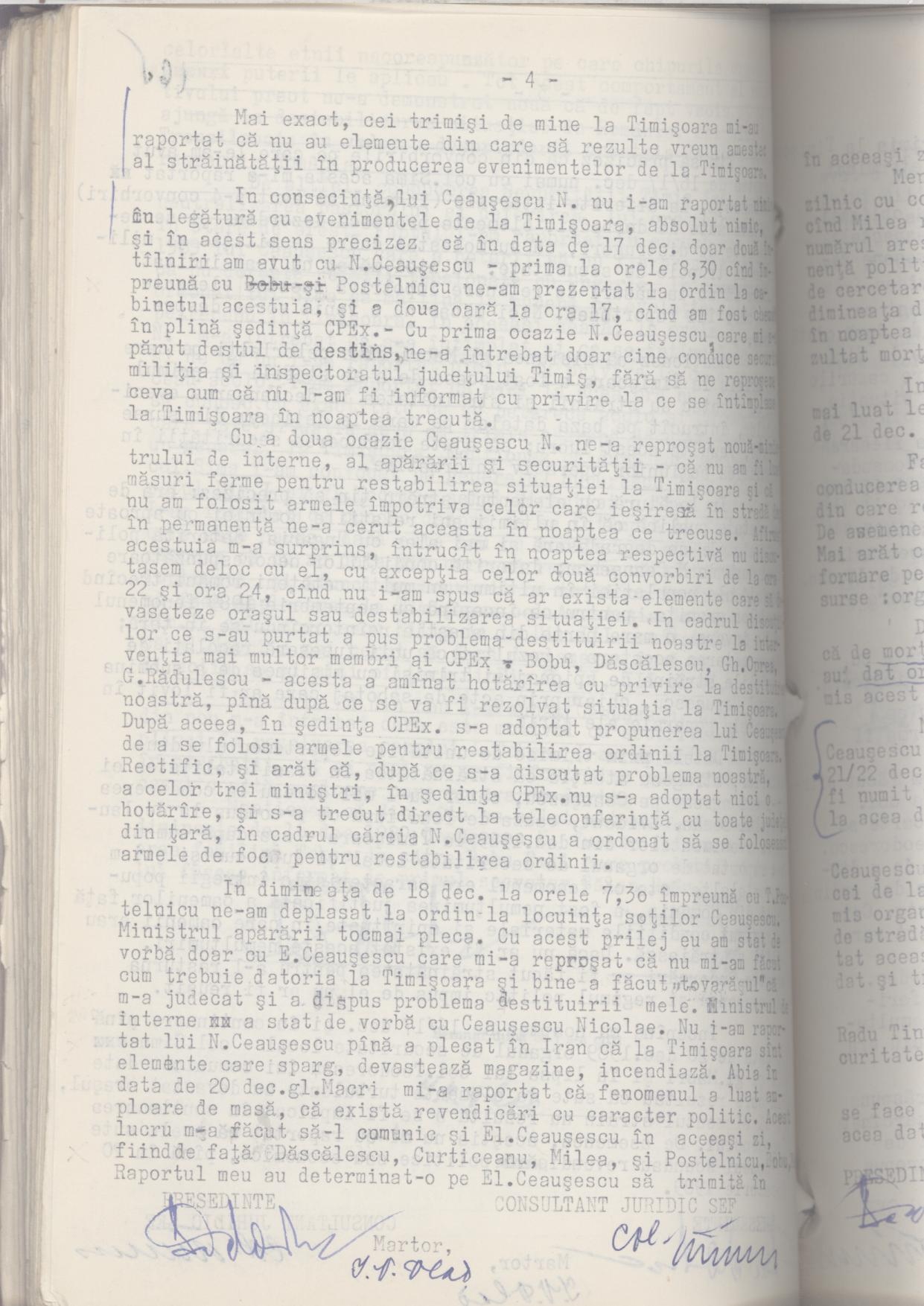
Tudor Postelnicu:  “Ceausescu Nicolae facuse o psihoza, mai ales dupa ce s-a intors de la sedinta de la Moscova in toamna lui ’89.  Era convins ca se planuieste si de cei de pe plan extern caderea sa, era convins ca toti sint spioni…” 0160 Petru Pele (Dir I, DSS). Declaratie, 16 ianuarie 1990:  “Printre sarciniile mai importante efectuate de catre acestia in  perioada 17-22.12.1989 s-a numerat (?) constituierea (?) listelor celor retinuti de organele militie cu listele celor predati sau reintorsi din Ungaria, intrucit s-a emis ipoteza ca evenimentele de la Timisoara au fost puse la cale in tara vecina…” 0299 0291 Gheorghe Diaconescu, Declaratie 31 decembrie 1989 “Luni 18 decembrie gl. col.  VLAD IULIAN a avut o convorbire cu colegul meu (local?) RADULESCU EMIL … 0476 Vlad Iulian (continuarea, declaratia lui Gheorghe Diaconescu) “?… foarte dur (?) ca nu (?) ca ‘un grup de turisti isi fac de cap in Timisoara’” 0477 0472 Tocmai Iulian Vlad, el insusi, recunoaste ne-implicarea strainilor in evenimentele de la Timisoara, aici… 0289 0290 Incepind cu noaptea de 16/17 dec. si in continuare pina in data de 20 dec. 1989 organul de securitate local col. Sima cit si gl. Macri si in lipsa lui col. Teodorescu imi comunicau date din care rezulta ca sute de elemente turbulente au devastat orasul, si ca elementul strain nu rezulta a se fi implicate in continuarea fenomenului.” 0291 “Mai exact, cei trimis de mine la Timisoara mi-au raportat ca nu au elemente din care sa rezulte vreum amestec al strainatatii in producerea evenimentelor de la Timisoara.” http://atomic-temporary-3899751.wpcomstaging.com/2013/03/17/o-indicatie-pretioasa-de-pe-malurile-dimbovitei-implicarea-strainilor-in-evenimentele-de-la-timisoara-paranoia-lui-nicolae-ceausescu-sau-confirmarea-lui-iulian-vlad/0292

All this is important to keep in mind when coming across claims about the alleged role of these tourists in the overthrow of the communist regime of Nicolae Ceausescu:  none of the authors purporting such claims have addressed the documents above.  Among the authors who allege such a role and whose work is available on the Internet are the following:

James F. Burke (citing Grigore Corpacescu, General Iulian Vlad, and a well-known article from September 1990 in Democratia) http://www.ceausescu.org/ceausescu_texts/revolution/december_revolt_moscow.htm (I have dealt with these allegations here http://atomic-temporary-3899751.wpcomstaging.com/2010/12/29/presa-din-1990-despre-turistii-rusi-din-decembrie-1989/, and  http://atomic-temporary-3899751.wpcomstaging.com/2010/09/22/the-1989-romanian-revolution-as-geopolitical-parlor-game-brandstatter%E2%80%99s-%E2%80%9Ccheckmate%E2%80%9D-documentary-and-the-latest-wave-in-a-sea-of-revisionism-part-iii/)

Catherine Durandin (citing Radu Portocala) http://www.diploweb.com/english/romania/durandin1.htm  (I have addressed this allegation here http://atomic-temporary-3899751.wpcomstaging.com/2010/09/24/the-1989-romanian-revolution-as-geopolitical-parlor-game-brandstatter%E2%80%99s-%E2%80%9Ccheckmate%E2%80%9D-documentary-and-the-latest-wave-in-a-sea-of-revisionism-part-four/)

Alexander Ghaleb (fn. 9, citing “police sources”) http://www.sferapoliticii.ro/sfera/165/art03-Ghaleb.php

Jacques Levesque (citing a 1992 book by Filip Teodorescu) http://publishing.cdlib.org/ucpressebooks/view?docId=ft4q2nb3h6&chunk.id=d0e6746&toc.id=d0e6638&brand=ucpress

John Simpson (citing Virgil Magureanu and the SRI) http://www.independent.co.uk/life-style/ten-days-that-fooled-the-world-1387659.html

Alex Mihai Stoenescu (p. 186 of 340, Petre Roman citing Mihai Caraman) http://www.scribd.com/doc/105257958/Alex-Mihai-Stoenescu-Istoria-Loviturilor-de-Stat-Din-Romania-Vol-4-1

Larry Watts (fn. 90 p. 26, Petre Roman citing Mihai Caraman) http://www.larrylwatts.com/excerpts/with_friends_like_these_excerpts.pdf  (Roman ironically himself undermined such a claim here:  http://adevarul.ro/news/eveniment/petre-roman-ceausescu-acceptat-controlul-psihiatric-proces-putea-scape-1_50ad124a7c42d5a6638e48ab/index.html , Watts’ claim has been televised in the series “Mostenirea Clandestina,” http://www.youtube.com/watch?v=cAPOEu0ebwI start at about 46:10 to 46:60 and then assisted by Cristian Troncota, who discusses the “Soviet tourists,” including Watts’ claim, from 47:05 to 49:50…conveniently not mentioned here or anywhere else where Troncota appears (for example with Grigore Cartianu in Adevarul), Cristian Troncota was a Lt. Maj. in the Securitate:  see the index here from a 1987 issue of the Securitate‘s “strict secret” journal, (page 4 of 46 on the pdf) with a historical article beginning on page 78:  http://www.cnsas.ro/documente/periodicul_securitatea/Securitatea%201987-4-80.pdf  (vol. 80 from 1987).


Posted in decembrie 1989, raport final | Tagged: , , , , , , , , , , , , , , , , , , , , | 11 Comments »

Fara indoiala…se intimpla ceva. Securitatea nu spune dar sugereaza. “Lasa sa-i scape” mici detalii.

Posted by romanianrevolutionofdecember1989 on August 15, 2014

(purely personal views–to suggest otherwise is to misrepresent me–based on two decades of prior research and publications, not for unauthorized reproduction, thank you)

“Without a doubt…something is going on.  The Securitate doesn’t say but it suggests.  It allows small details to leak out.”

In the seemingly endless discussions of the alleged role of large numbers of Soviet agents (using the cover of being tourists) in the December 1989 overthrow of Nicolae Ceausescu’s communist dictatorship, I am inevitably reminded of this July 1991 quote from Radu Ciobotea that I used in my 2005 article “The Romanian Revolution as Geopolitical Parlor Game.”

(For a recent example, 12 August, of the reappearance of such a claim see: http://cultural.bzi.ro/25-000-de-spioni-kgb-au-stapanit-romania-aproape-un-an-18070 )

from THE 1989 ROMANIAN REVOLUTION AS GEOPOLITICAL PARLOR GAME: BRANDSTATTER’S “CHECKMATE” DOCUMENTARY AND THE LATEST WAVE IN A SEA OF REVISIONISM, Part III (cleared in March 2005)

Reporting in July 1991 on the trial involving many of those involved in the Timisoara repression, Radu Ciobotea noted with what was probably an apt amount of skepticism and cynicism, what was telling in the confessions of those on trial:

Is the End of Amnesia Approaching?…

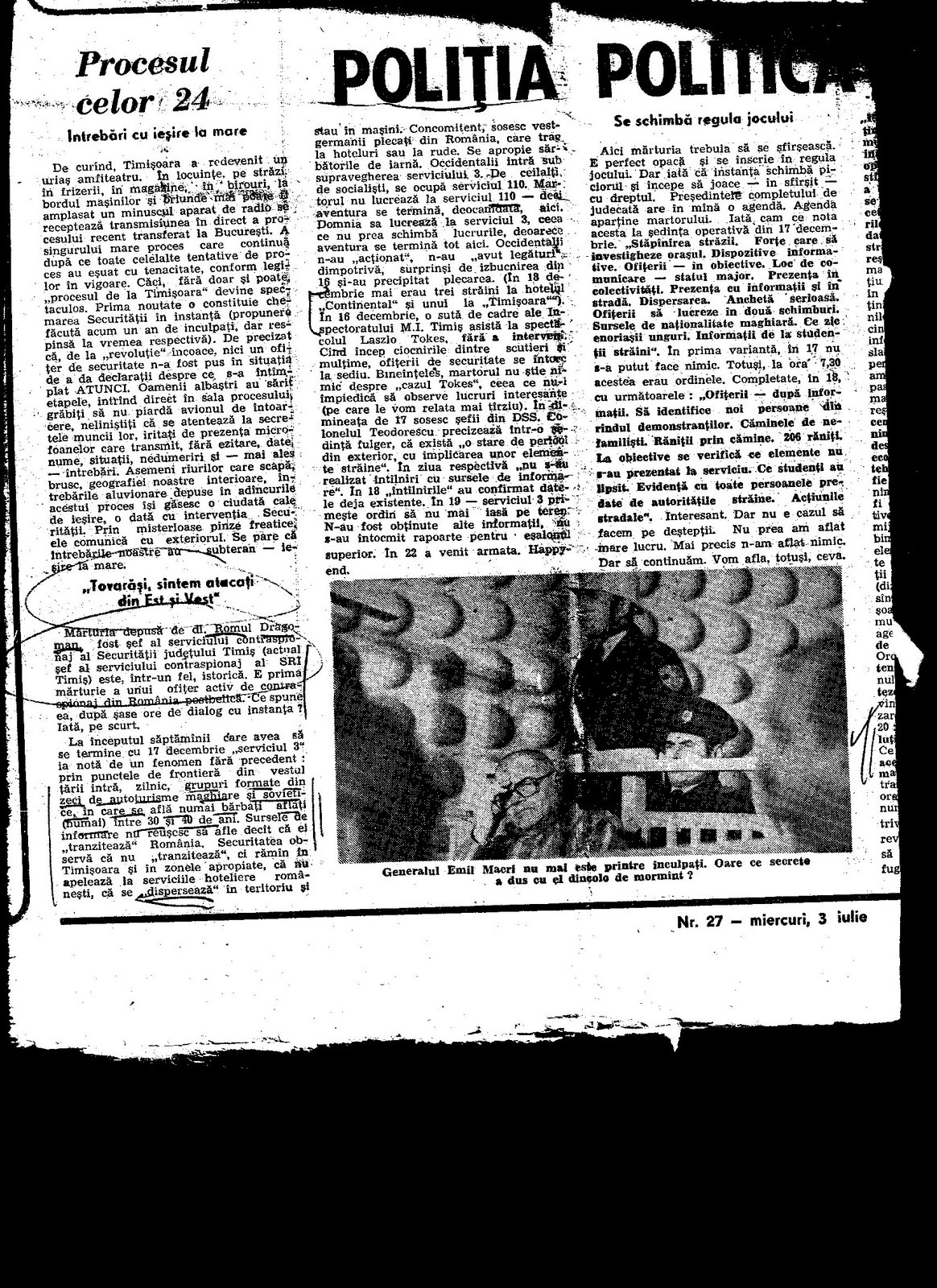
Without question, something is happening with this trial.  The Securitate doesn’t say, but it suggests.  It let’s small details ‘slip out.’…Increasingly worthy of interest are the reactions of those on trial….Traian Sima (the former head of the county’s Securitate) testifies happily that, finally, the Securitate has been accepted at the trial, after having been rejected by Justice.  Filip Teodorescu utters the magic word ‘diplomats’ and, suddenly, the witness discovers the key to the drawer with surpise and declares, after five hours of amnesia, that in Timisoara, there appeared in the days in question, foreign spies under the cover of being journalists and diplomats, that in a conversation intercepted by a mobile Securitate surveillance unit Tokes was reported as  ‘well,’ and that all these (and other) counterespionage actions that can’t be made public to the mass media can be revealed behind closed doors to the judge….[Timis County party boss] Radu Balan ‘remembers’ that on 18 December at midnight when he was heading toward IAEM, he passed a group of ten soviet cars stopped 100 meters from the county hospital. (It turns out that in this night, in the sight of the Soviets, the corpses were loaded!).” [emphasis in the original] (Flacara, no. 27, 1991, p. 9).

So what is the substance of the most recent popular iteration of the so-called “Soviet tourist” hypothesis as outlined in the 12 August article above?  It is actually from a 23 December 2012 article in the daily Libertatea under the bombastic headline, “25.000 de spioni KGB au stăpânit România aproape un an! Ceauşescu a fost detronat de o armată secretă sovietică, care a stat în ţara noastră în perioada decembrie 1989 – octombrie 1990” (http://www.libertatea.ro/detalii/articol/25-000-de-spioni-kgb-au-stapanit-romania-aproape-un-an-428106.html#ixzz3APp0Eq5v)

“La expunerea clară, concisă a lui Caraman (Mihai Caraman – n.r.), directorul Centralei de Informaţii Externe, am cerut sovieticilor să-şi retragă comandourile. Era vorba despre aproximativ 25.000 – 30.000 de oameni. S-au retras ca urmare a faptului că Gorbaciov modificase strategia şi spusese că URSS nu mai este jandarm în această zonă”. Declaraţia îi aparţine lui Petre Roman, fostul premier al României în perioada decembrie 1989 – septembrie 1991 şi a fost inclusă într-o carte a istoricului Alex Mihai Stoenescu.

In the same article, Larry L. Watt’s 2010 volume Fereşte-mă, Doamne, de prieteni (the English version entitled With Friends Like These) is invoked.  In the English version, Watts wrote on page 16, with a footnote on page 26:

“It is suggestive that more than 25,000 of the 37,000 “extra” Soviet tourists that deemed Romania a desirable place to visit or transit in the two weeks prior to its revolution in December 1989 chose not to leave until almost a year later, in October 1990, after the Romanian government formally insisted on their departure.90”

90. “Ceauşescu protested the sudden influx of Soviet ‘tourists’ to Moscow at the time, none of whom stayed in hotels. See e.g. Mircea Munteanu, New Evidence on the 1989 Crisis in Romania, e-Dossier no. 5, Washington D.C., Woodrow Wilson International Center for Scholars, December 2001, pp. 3-11, CWIHP. The Romanian Senate’s investigation into the events of December 1989 disclosed the extraordinary jump in Soviet ‘tourists’ from 30,000 in 1988 to 67,000 in 1989 as recorded in customs and border statistics, as well as the unexplained delay in their departure. Mention of this glaring anomaly was qualified as unwarranted “conspiracy theory.” See e.g. Depostion of Petre Roman, Transcript no. 90/8.03.1994, Romanian Senate Archive, Bucharest, pp. 44-45. According to ex-Prime Minister Roman, 30,000 Russians ‘tourists’ remained in Romania for almost a year, until officially requested to leave in October 1990. Allegedly, Caraman’s Foreign Intelligence Service (SIE) informed Roman about them only at that time. However, since at least March, Romanian TV had broadcast news stories of the Russian encampments.”]

Marius Mioc reproduced the Romanian version of the passages as follows (Răstălmăcirile lui Larry Watts şi răstălmăcirile altora despre Larry Watts):

Cel mai important fragment din cartea lui Larry Watts care se referă la revoluţie îl găsim la pagina 55, şi este următorul:

Este sugestiv faptul că peste 25000 din cei 37000 de turişti sovietici care au considerat România locul preferat pentru vizite sau tranzit, în cele două săptămînă anterioare revoluţiei din decembrie 1989, au ales să nu mai plece timp de aproape un an, pînă în octombrie 1990, după ce guvernul român le-a cerut oficial şi insistent să părăsească ţara.

Aici se face trimitere la o notă de subsol în care se scrie:

Ceauşescu a protestat împotriva afluxului brusc de turişti de la Moscova, din care nici unul nu stătea la vreun hotel. Vezi Mircea Munteanu, New Evidence on the 1989 Crisis in Romania, e-Dossier nr. 5, Washington D.C., Woodrow Wilson International Center for Scholars, decembrie 2001, pp. 3-11, CWIHP. Ancheta Senatului României asupra evenimentelor din 1989 menţionează un salt de la 30000 turişti sovietici în 1988 la 67000 în 1989, precum şi o întîrziere inexplicabilă în plecarea acestora. Vezi Depoziţia lui Petre Roman, transcript nr. 90/8.03.1994, Arhiva Senatului României, pp. 44-45. Conform prim-ministrului Petre Roman, 30000 de turişti ruşi au rămas în România peste un an, pînă cînd li s-a cerut oficial să plece, în octombrie 1990. Conform lui Roman, şeful SIE, Caraman, l-a informat numai la acea dată despre aceştia. Totuşi încă din martie televiziunea română relata despre taberele sovietice.

But, as it turns out, Watts’ claim is neither new, nor his own.  It indeed appears to belong to Alex Mihai Stoenescu.  Stoenescu wrote the following in a 2004 volume which I found online here, although unfortunately without the endnotes,  http://hot24.weebly.com/uploads/5/2/3/8/5238782/alex_mihai_stoenescu_-_istoria_loviturilor_de_stat_in_romania_vol_4-1.pdf)

...Asadar, coloanele de „turisti” sovietici se prezentau ca fiind în tranzit spre sau din Iugoslavia, dar nu fãceau tranzitul. Ei au rãmas pe teritoriul României în preajma marilor orase pentru a interveni în cazul esecului diversiunilor care trebuiau sã provoace cãderea lui Ceausescu. Au fost pur si simplu dati afarã din tarã abia în octombrie 1990 de cãtre priniul-ministru Petre Roman: „A mai fost un moment foarte delicat, în octombrie 1990, cînd în tarã se aflau 30 000 de rusi! Cu masinile lor! Eu, cînd am aflat de a-ceasta, în calitate de prim-ministru, de la organul competent, adicã S.I. Externe, am fãcut mare tãrãboi si, mã rog, pînã la urmã am reactionat, au fost scosi din tarã. A mai fost o miscare foarte ciudatã înainte de 19 martie 1990 la Tîrgu-Mures”395. într-o discutie particularã, Petre Roman i-a confirmat autorului cã identitatea acestor „turisti” ca luptãtori ai fortelor speciale sovietice fusese deplin documentatã de SIE. Ce fel de tranzit era acela în care 30 000 de turisti (probabil cã nu toti erau luptãtori ai fortelor speciale sovietice, dar ei ofereau acoperirea) rãmîn pe teritoriul unui stat, prin care se presupune cã trec în maximum 48 de ore, si rãmîn un an de zile! (pp. 189-190)

I have through some searching been able to find the sources for Stoenescu’s claim:  Arhiva Senatului României, Stenograma nr.90/8 martie 1994, Audiere Petre Roman, pp.44-45.
http://internationalfreemedia.wordpress.com/2013/01/14/relatiile-romano-americane-de-la-razboiul-absurd-la-fratia-in-nato/#_ftn7 .  The claim from Stoenescu’s 2004 volume appears to have made its way into the press beginning in 2006 in Evenimentul Zilei, ironically (?) on the eve of the presentation to parliament of the Report by the Presidential Commission for the Analysis of the Communist Dictatorship in Romania (CPADCR) on 18 December 2006, despite the fact that Evenimentul Zilei was/is supposedly the hub of opposition to communist and Securitate revisionism in Romania! (it must be, since Vladimir Tismaneanu, head of the CPADCR, published op-eds there at the time and still does!):  http://www.evz.ro/operatiunea-kgb-decembrie-1989-423201.html.

In other words, Watts’ claim is recycled and originates with Alex Mihai Stoenescu.  Watts likes to point out that because Petre Roman was a former Prime Minister and was testifying under oath to a parliamentary committee, and because Roman claims he received the information from the then head of foreign intelligence that this enhances the credibility of the claim (see his comment on the post Mostenirea Clandestina).  Marius Mioc’s observation thus seems appropriate in light of such an interpretation:

Ceilalţi – Comisia Senatorială “Decembrie 1989″, Alex Mihai Stoenescu, Larry Watts, Grigore Cartianu, Sorin Golea – nu fac decît să repete cele spuse de Petre Roman. Remarc că Comisia Senatorială “Decembrie 1989″ n-a făcut nici minima verificare de a-l contacta şi pe Mihai Caraman, pentru a vedea dacă acesta confirmă spusele lui Petre Roman. Despre căutarea unor documente în arhivele Guvernului României sau ale Ministerului Afacerilor Externe care să ateste cererea făcută către sovietici de a-şi retrage agenţii nici nu mai vorbesc.

(from Răstălmăcirile lui Larry Watts şi răstălmăcirile altora despre Larry Watts)

Moreover, what is the background of the people making such allegations or to whom such allegations are ascribed?  Mihai Caraman was a long-time member of the Securitate’s Foreign Intelligence organization, named the CIE in its latter days.  Thus, Petre Roman’s source for this information is a former high-ranking Securitate official.  As I have argued consistently and repeatedly for over two decades in publications, for the purposes of investigating December 1989 three questions are relevant when it comes to what former Securitate personnel argue:

1) Does what they argue absolve the Securitate as an institution of wrongdoing in December 1989–wrongdoing that can be proved as having been committed by Securitate personnel?

2) Is what they argue similar to what other former Securitate personnel argue and can therefore be interpreted as an institutional view?

3) What was their personal relationship with the Securitate:  did they work for the institution?  Were they informers or collaborators of the institution during the communist era?

For example, Mihai Caraman, the alleged source of former PM Petre Roman’s claim was a longtime member of the Securitate’s foreign intelligence organization, and his claim about the alleged presence and role of numerous Soviet agents in the overthrow has been enunciated by numerous other former Securitate personnel (whether internal or external) from 1990 onward, as this site has demonstrated on numerous occasions.

Likewise, Alex Mihai Stoenescu, who first drew attention to the 1994 Petre Roman statement, has been defintively declared by CNSAS as having collaborated with the Securitate in the 1980s (see http://activenews.ro/decizie-definitiva-iccj-istoricul-alex-mihai-stoenescu-colaborat-cu-fosta-securitate_1829506.html or http://www.avocatura.com/stire/10316/istoricul-alex-mihai-stoenescu-verdict-irevocabil-de-colaborator-al-securitatii.html)

Finally, it has to be stressed that, besides sounding absurd–even if we ignore Petre Roman’s supposed earlier clarification to Stoenescu, according to Stoenescu, that all 30,000 of these Soviet tourists were members of Soviet special forces and estimate “conservatively” that “only” 10 percent were actual Soviet agents, that still leaves 3,000 Soviet agents (an incredible devotion of man power) traversing Romania not in Romanian Dacias so as to not draw attention but instead supposedly in Ladas and Moskovici!!!–THERE IS NO RECORD OF A SINGLE “SOVIET TOURIST” HAVING BEEN ARRESTED UPON SUSPICION OF INVOLVEMENT, LET ALONE ARMED INVOLVEMENT, IN THE UPHEAVAL THAT OVERTURNED THE REGIME OF NICOLAE CEAUSESCU BEFORE OR AFTER 22 DECEMBER 1989!  (And specifically with regard to the beginnings of the uprising in Timisoara, Securitate officials themselves, in the immediate aftermath of the events, confessed that despite being tasked from Bucharest to supply evidence of alleged foreign tourist involvement in the demonstrations and riots against Nicolae Ceausescu and his regime, they were unable to do so! See 25 for 2014: 25 Things You Should Know about the Romanian Revolution on the 25th Anniversary of the Fall of Nicolae Ceausescu’s Communist Regime: #1 The Securitate Deny Foreign Instigation of the Timisoara Uprising)

This then is why as Radu Ciobotea wrote, “The Securitate doesn’t say but it suggests.  It allows small details to leak out.”–precisely because it has no tactical proof of Soviet tourist responsibility for the December 1989 events, its former personnel must appeal to broad, structural, and unverifiable claims, such as the overall number of Soviet tourists in 1989, to suggest that by the mere presence of so many Soviet tourists they must have been involved.


Posted in decembrie 1989, raport final | Tagged: , , , , , , , , , , , , , , , , , , , , , | 1 Comment »

25 for 2014: 25 Things You Should Know about the Romanian Revolution on the 25th Anniversary of the Fall of Nicolae Ceausescu’s Communist Regime: #2 Shattered Glass: Securitate Vandalism to Justify Timisoara Crackdown

Posted by romanianrevolutionofdecember1989 on February 13, 2014

(Purely personal views as always, based on over two decades of research and publications inside and outside Romania)

2014 marks the 25th anniversary of the collapse of communism in central and eastern Europe–Poland, Hungary, East Germany, Czechoslovakia, Bulgaria, and Romania.  This (likely aperiodic) series looks at 25 things I have learned about the events of the Romanian Revolution of December 1989.  The numbering is not designed to assign importance, but rather–to the extent possible–to progress chronologically through those events.

Significance:  I have essentially been the only researcher who has consistently advocated this understanding.  Most others–including Peter Siani-Davies–tended to dismiss it.  Now we have documentary evidence that it took place.

An excellent documentary from 1991 posted to the internet by Florin Iepan only recently and seen rarely if at all since its showing in 1991.  There is much interesting information in this film.  (The film seems to start at min. 19:00 and has to be rewound to its beginning.)  Here, I will focus on the claim beginning at approximately min. 17:40 that the destruction of Timisoara shops and storefronts was organized and a pretext to justify–including legally–the repression by the Ceausescu regime of Timisoara demonstrators.  Interior Minister Tudor Postelnicu’s declaration of 17 March 1990 confirms this claim and the observations of eyewitnesses.

Timisoara Decembrie 1989 / Timisoara December 1989,

regia/directed by – Ovidiu Bose Pastina
imaginea/camera – Doru Segal

Sahiafilm 1991

Tudor Postelnicu (Ministerul de Interne in decembrie 1989):  “Unii militari de la trupele de securitate ale brigazii Timisoara au facut unele provocari la unele magazine si vitrine spargind geamurile sa imprastie participantii de pe straziile din apropriere, apoi au intrat in altercatie cu ei, si acum (?) vor sa le faca militia ordine.  ‘Nu am aflat ca costa provocare a zis Gl. Nuta, am trimis pe …” (17.III.1990) 
http://sensidev.com/fc/dosare%20de%20urmarire%20penala/dosar%20%20de%20urmarire%20penala%20volumul%2011/IMG_2576.JPG (Dosarul de Urmarire Penala, Vol. 11, IMG 2576)

IMG_2576

image0

Before we move on here, it is worth noting how this destruction was covered in Peter Siani-Davies’ 2005 volume The Romanian Revolution of December 1989.  As I have written on many occasions, Siani-Davies’ volume is wonderfully-written and is excellent, but the claim by Daniel Chirot that is a “near-definitive” account is far off the mark.  One of the negative characteristics of Siani-Davies’ work is the use of “filler” rational choice, cui bono arguments where he concludes there is not enough information to make a valid judgment.  The problem is the question is never one of “what was possible?” “what makes ‘sense’?” but rather what did happen?

Thus, for example in the case of the destruction of Timisoara Siani-Davies argues that there was already enough of a basis for the regime to crackdown, therefore why would they need to create a pretext for cracking down:  “Given the seriousness of the situation and the fact that shots had already been fired elsewhere, the security forces hardly needed to produce a further ‘excuse’ for the massacre which was to follow.” (p. 68)
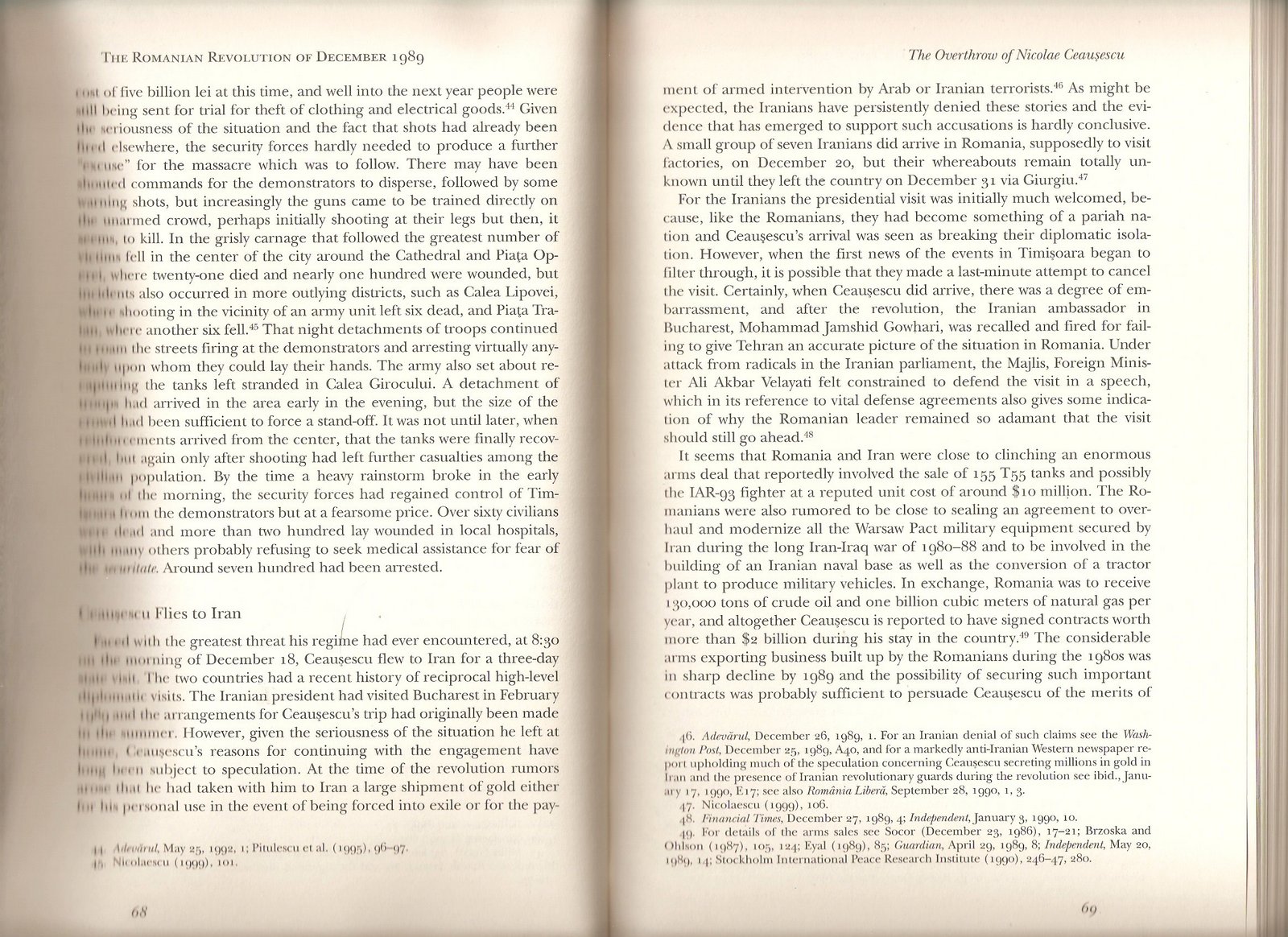
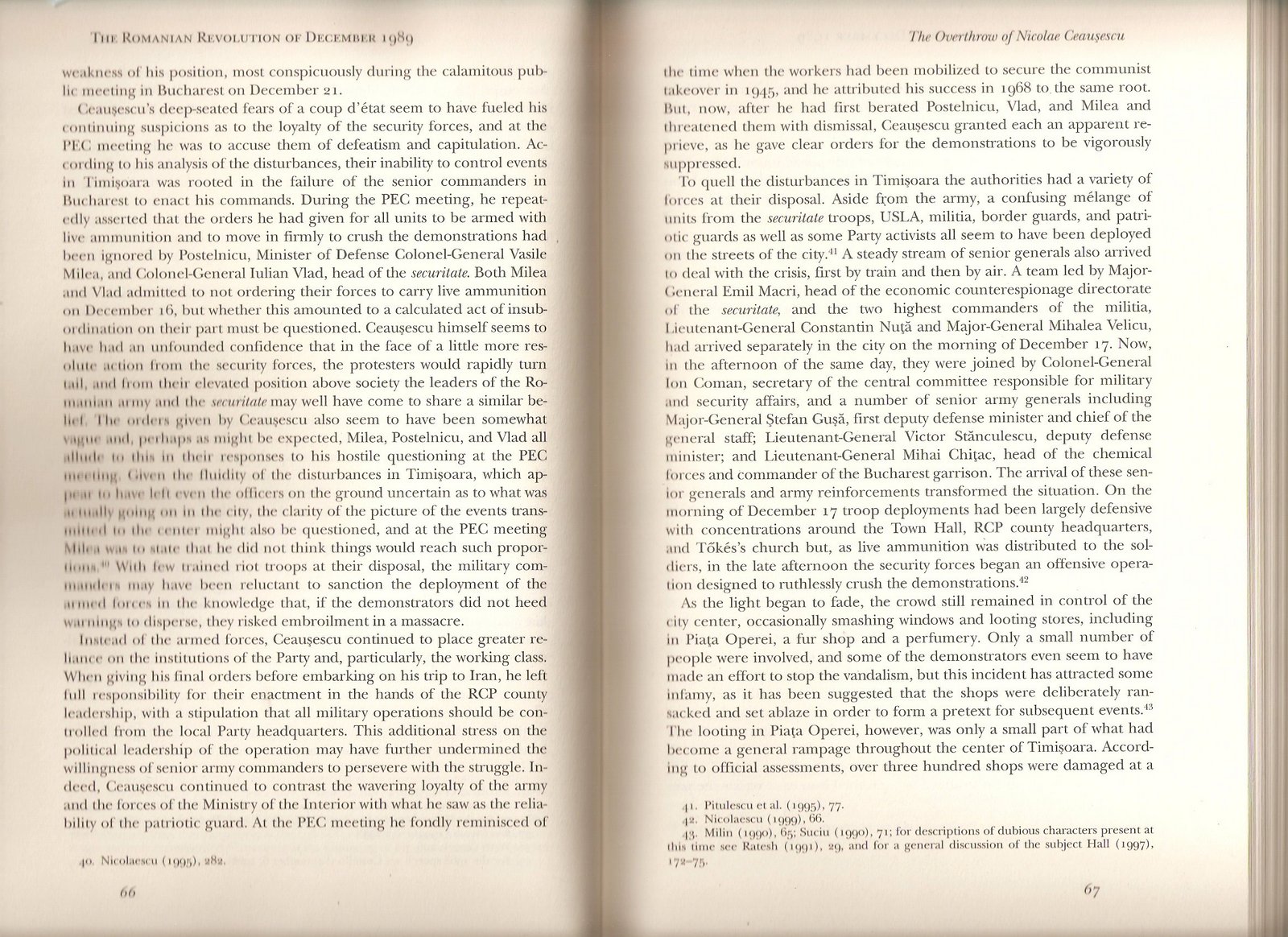
image0-001

image0-003

Back to exploring more of the evidence…

An excerpt from Chapter 5 of my Ph.D. Dissertation at Indiana University: Richard Andrew Hall, Rewriting the Revolution: Authoritarian Regime-State Relations and the Triumph of Securitate Revisionism in Post-Ceausescu Romania (defended 16 December 1996). This is the original chapter as it appeared then and thus has not been revised in any form.

Chapter Five.  The Beginning of the End: Timisoara, 15-17 December 1989

The “Window Breakers”

The reportedly unusual scope of physical destruction which occurred in Timisoara, particularly on the afternoon and evening of 17 December 1989, has fueled revisionist arguments. Estimates of the damage during the Timisoara unrest are in the neighborhood of four to five billion lei (approximately forty to fifty million dollars at the time), a reasonably large sum given Romania’s standard of living at the time. A huge number of windows was broken and as many as 300 to 400 stores suffered some sort of damage, although relatively few were actually looted. On the evening of 17 December, stores, vehicles, and kiosks were burning in at least ten different areas of the city.[65]

Former Securitate officers clearly wish to link this destruction to the “foreign tourists” who were supposedly so ubiquitous in Timisoara during these days.[66] Perhaps somewhat surprisingly, former Securitate Director Iulian Vlad argued at his trial that

…the acts of vandalism, theft, destruction, arson… acts without precedent…could not have been the work [“opera”] of the faithful [apparently referring sarcastically to Tokes’ parishioners], nor the revolutionaries. They were produced by elements which wished to create a certain atmosphere of tension.[67]

Eyewitness accounts recorded soon after the events–therefore at a time before the various plots and scenarios had permeated the popular imagination–support the hypothesis that the vandalism was organized. Moldovan Fica remarks:

I admit that I cannot escape a certain conclusion. All of this [destruction] was done by a group of about five or six individuals, whose calm demeanor and self-control continues to stay with me to this day. They did not run from the scene, they appeared as if they did not fear anything; I would say that, in fact, they were doing what was required of them, something which had been ordered directly of them![75]

Describing destruction in a different part of the city, Andras Vasile observed that

…four young men with shaved heads and wearing civilian clothes had sticks–I would term them special sticks–1.7 to 1.8 meters long, equipped with metal rings on the top of them. They were breaking the windows, but not taking anything, as if they only had something against the windows, something which they thus went about with great enjoyment…they were led by two individuals in leather jackets.[76]

Other eyewitnesses supply details which confirm the widespread character of the vandalism; its undeniably organized quality; the disinterest of its perpetrators in looting the stores; and the almost “drugged” nature of the perpetrators, who seemed unperturbed by the chaos and repression going on around them.[77]

http://atomic-temporary-3899751.wpcomstaging.com/rewriting-the-revolution-1997/
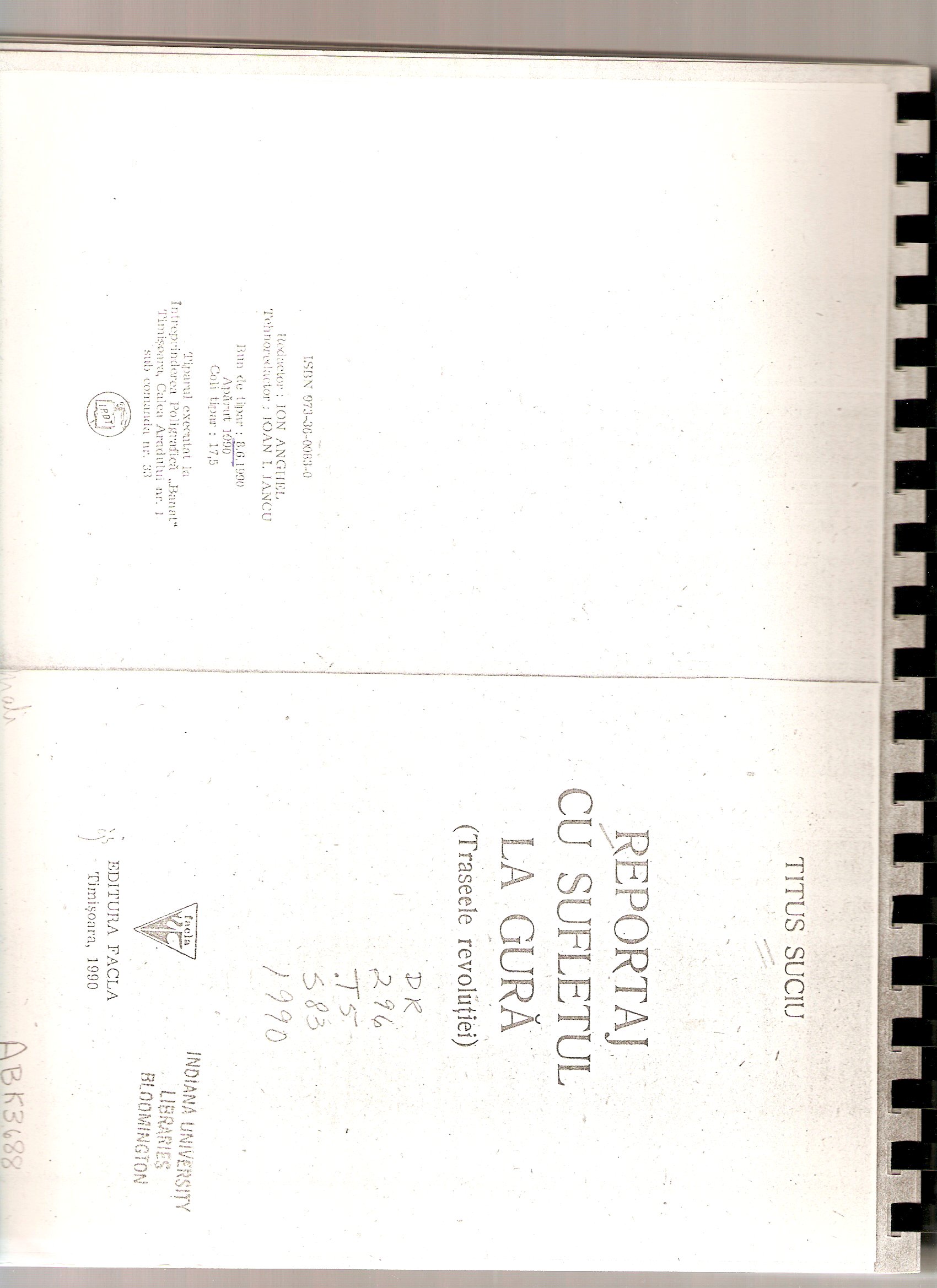
image0-005

Moldovan Fica (martor ocular)

image0-001

image0

Andras Vasile (martor ocular)

image0-003

image0-002

image0-004

Ioan Savu discussed the windowbreakers as follows:
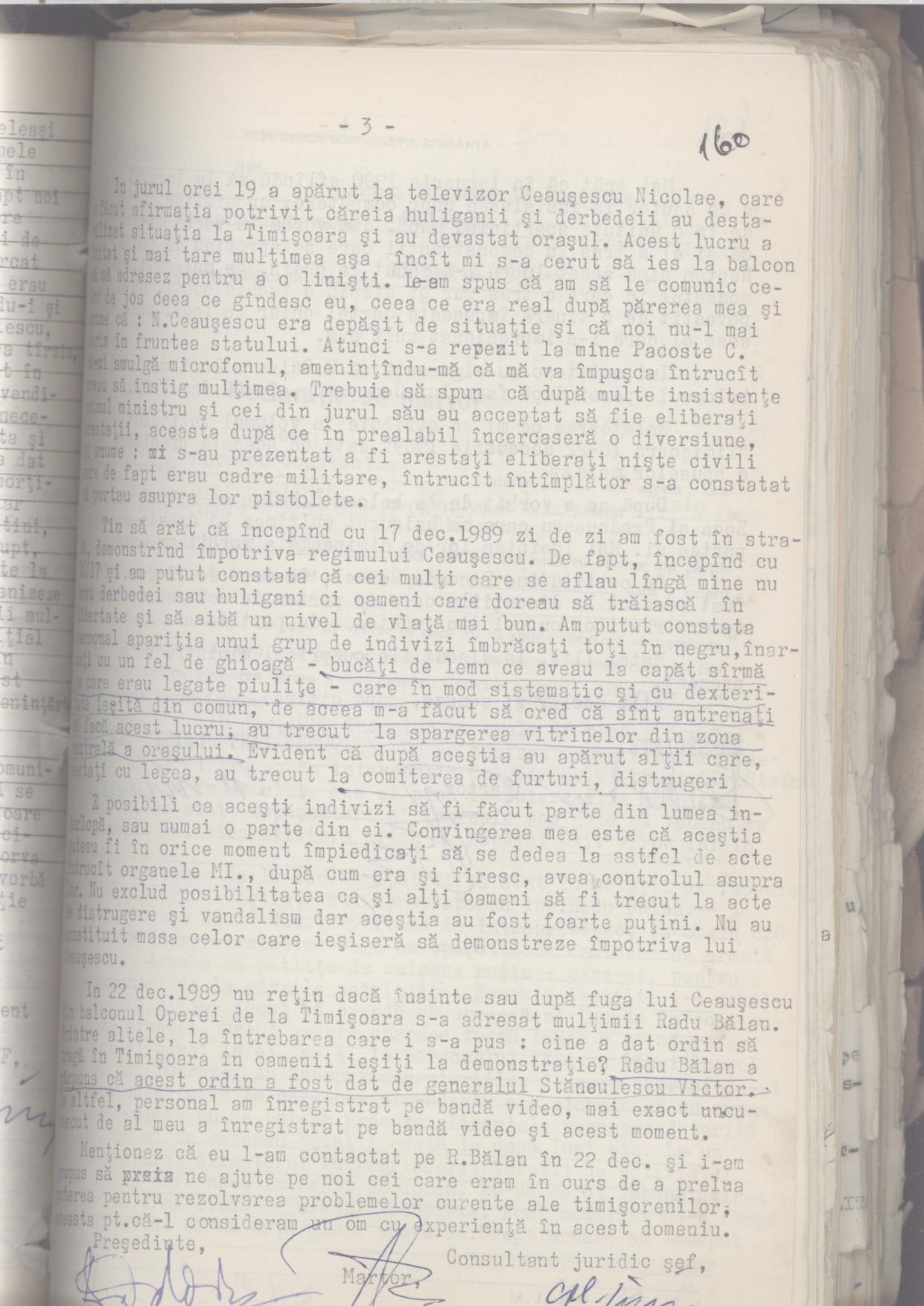
0282

0280

———————————-

Other depictions of this event available online:

Conducerea partidului, alarmată, a trimis în Piaţa Maria, conform Ordinului 02600, numeroşi miliţieni şi trupe speciale, pentru a lichida manifestaţia care luase amploare. Circulaţia în zonă se întrerupsese. În Piaţa Maria au fost trimişi aproximativ 200 de activişti de partid, miliţieni şi numeroşi ofiţeri de securitate, îmbrăcaţi în haine civile. Au urmat ciocniri violente, mai ales după ce manifestanţii s-au încolonat şi au pornit spre sediul CJ PCR, strigând “Libertate”, “Vrem pâine”, “Vrem căldură”, “Azi la Timişoara, mâine în toată ţara”.
În acea seară echipe de miliţie dinainte pregătite au spart vitrinele magazinelor din centrul oraşului, pentru a avea argumente pentru o intervenţie în forţă. Desigur, multe vitrine au fost sparte şi de derbedei, asupra cărora s-au găsit bunuri furate. În acea noapte au fost arestate aproape 5-600 de cetăţeni. Ei au fost duşi la Penitenciarul oraşului, unde au fost bătuţi în mod bestial. În zilele care au urmat arestării au fost anchetaţi în vederea trimiterii lor în judecată. Bineînţeles, dacă Revoluţia n-ar fi reuşit.

“Azi la Timişoara”
Ivan Sabin

http://revista.memoria.ro/?location=view_article&id=371

Totuşi, se ştie că în acele zile fierbinţi din Timişoara au existat „personaje neidentificate” care au acţionat în mai multe zone ale oraşului. Am să amintesc aici doar două aspecte concrete cu privire la implicarea acestora în evenimentele din Timişoara. În zilele de 16 şi 17 decembrie au fost sparte aproape toate vitrinele magazinelor din zona centrală a oraşului. Sunt zeci de declaraţii ale revoluţionarilor care fac o descriere clară a celor care au spart acele geamuri. Au fost oameni bine îmbrăcaţi, robuşti şi tunşi scurt. Aceştia erau dotaţi cu nişte beţe speciale cu care printr-un gest scurt şi foarte bine exersat loveau vitrinele, după care plecau fără a încerca să sustragă ceva din magazine. Aceste persoane au fost văzute chiar şi de forţele de ordine desfăşurate în acea zonă, care în mod ciudat nu au luat măsuri împotriva lor, ci au acţionat împotriva manifestanţilor ce demonstrau împotriva regimului ceauşist. Un alt aspect relatat de mulţi timişoreni se referă mai ales la zilele de 17-19 decembrie, când, în rândul cordoanelor militare din diferite dispozitive amplasate în zonele importante ale oraşului, între soldaţi, erau intercalate persoane mai în vârstă, nebărbierite îmbrăcate doar parţial în uniforme militare, care nu făceau parte din acele unităţi militare.

Cine au fost acele „persoane neidentificate”? De ce s-a dorit în unele cercuri, cu insistenţă chiar, acreditarea ideii că oamenii au fost scoşi în stradă de agenţi străini? De ce, chiar şi după 20 de ani, se fac afirmaţii de genul: cadavrele celor arşi la Crematoriul „Cenuşa” erau ale unor agenţi străini? Nu voi căuta acum răspunsuri la aceste întrebări, dar, cu siguranţă, ele există.

Kali Adrian Matei

nascut in 30 iulie 1968 la Timisoara, muncitor la IJPIPS (1989), profesor de istorie la Liceul de informatica (1998), impuscat in spate

La Bijuterii concetatenii nostri tigani carau ce puteau. Numai la “Modex” nu era spart. Un grup de oameni se uitau cum niste indivizi bine instruiti spargeau geamurile de linga restaurantul Bulevard. Am rugat oamenii sa apere Modexul, pentru ca era clar ca spargatorii n-aveau nimic comun cu revolta.  30 septembrie 1995  http://timisoara.com/newmioc/4.htm

“În data de 14 decembrie, securitatea a spart toate gemurile din partea străzii principale, iar clădirea arăta ca o cetate asediată. Fostul primar al Timişorei, Petre Moţ l-a vizitat pe Tokes şi a ieşit la geam pentru a vorbi mulţimii. Moţ a cerut să se pună geamuri noi. Erau foarte multe maşini ale securiştilor. Întreaga stradă era ocupată. Se făcea filaj. Eu locuiam acolo, ba intram, ba ieşeam. Nu se vorbea încă revoluţie. Era o solidaritatea faţă de pastor”, declarat Iosif Kabai (foto), care locuieşte şi acum în clădirea bisericii reformate.Citeste mai mult: adevarul.ro/locale/timisoara/16-decembrie-1989-ziua-timisoara-s-a-strigat-data-democratie-jos-comunismul-1_50bd3d887c42d5a663c8e01f/index.html

Radu Tinu cu Angela Bacescu…

The reportedly unusual scope of physical destruction which occurred in Timisoara, particularly on the afternoon and evening of 17 December 1989, has fueled revisionist arguments. Estimates of the damage during the Timisoara unrest are in the neighborhood of four to five billion lei (approximately forty to fifty million dollars at the time), a reasonably large sum given Romania’s standard of living at the time. A huge number of windows was broken and as many as 300 to 400 stores suffered some sort of damage, although relatively few were actually looted. On the evening of 17 December, stores, vehicles, and kiosks were burning in at least ten different areas of the city.[65]

Former Securitate officers clearly wish to link this destruction to the “foreign tourists” who were supposedly so ubiquitous in Timisoara during these days.[66] Perhaps somewhat surprisingly, former Securitate Director Iulian Vlad argued at his trial that

…the acts of vandalism, theft, destruction, arson… acts without precedent…could not have been the work [“opera”] of the faithful [apparently referring sarcastically to Tokes’ parishioners], nor the revolutionaries. They were produced by elements which wished to create a certain atmosphere of tension.[67]
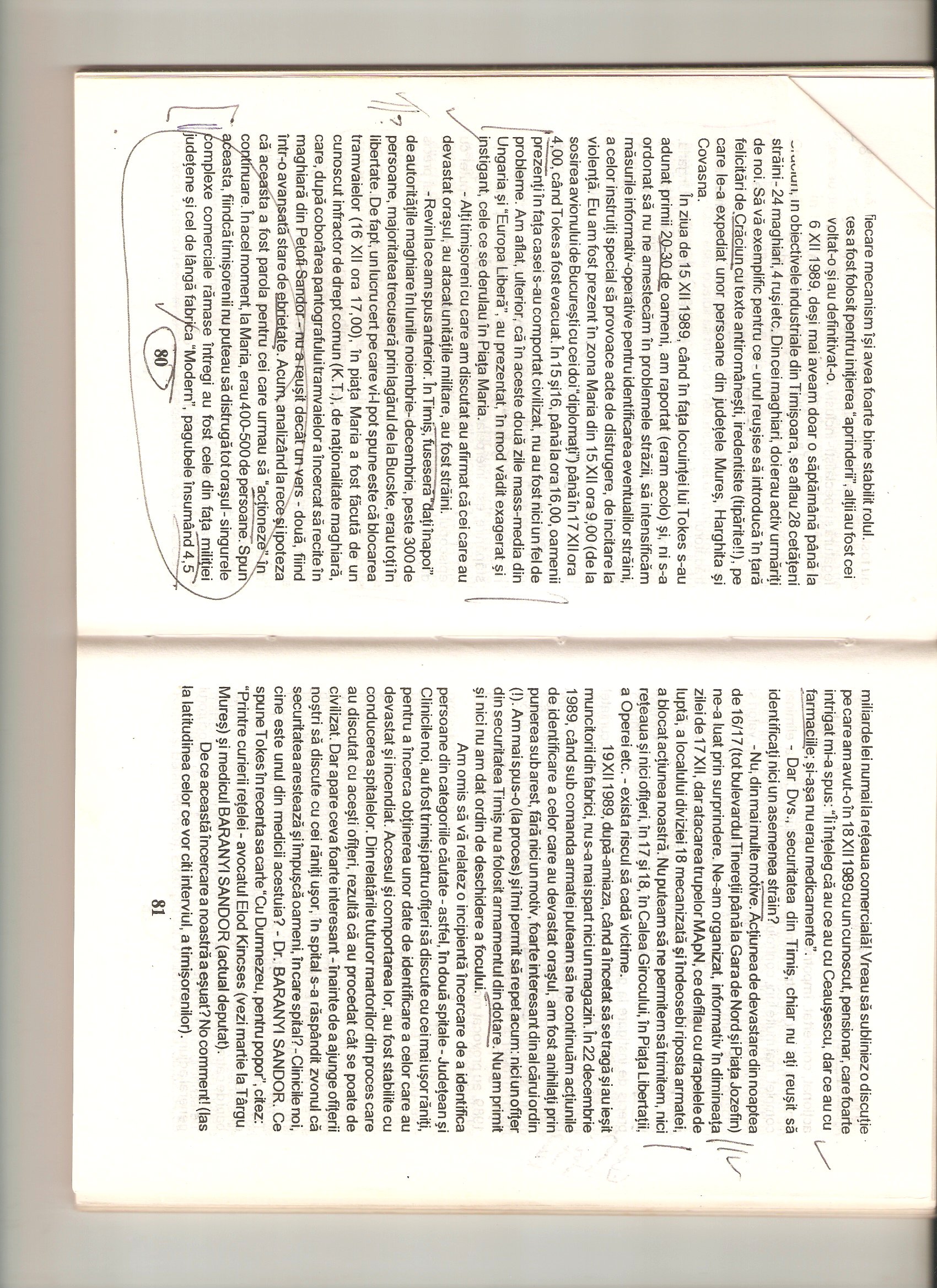
image0-006

RADU TINU:…SINGURLE COMPLEXE COMERCIALE RAMASE INTREGI AU FOST CELE DIN FATA MILITIEI JUDETENE SI CEL DE LANGA FABRICA “MODERN”…
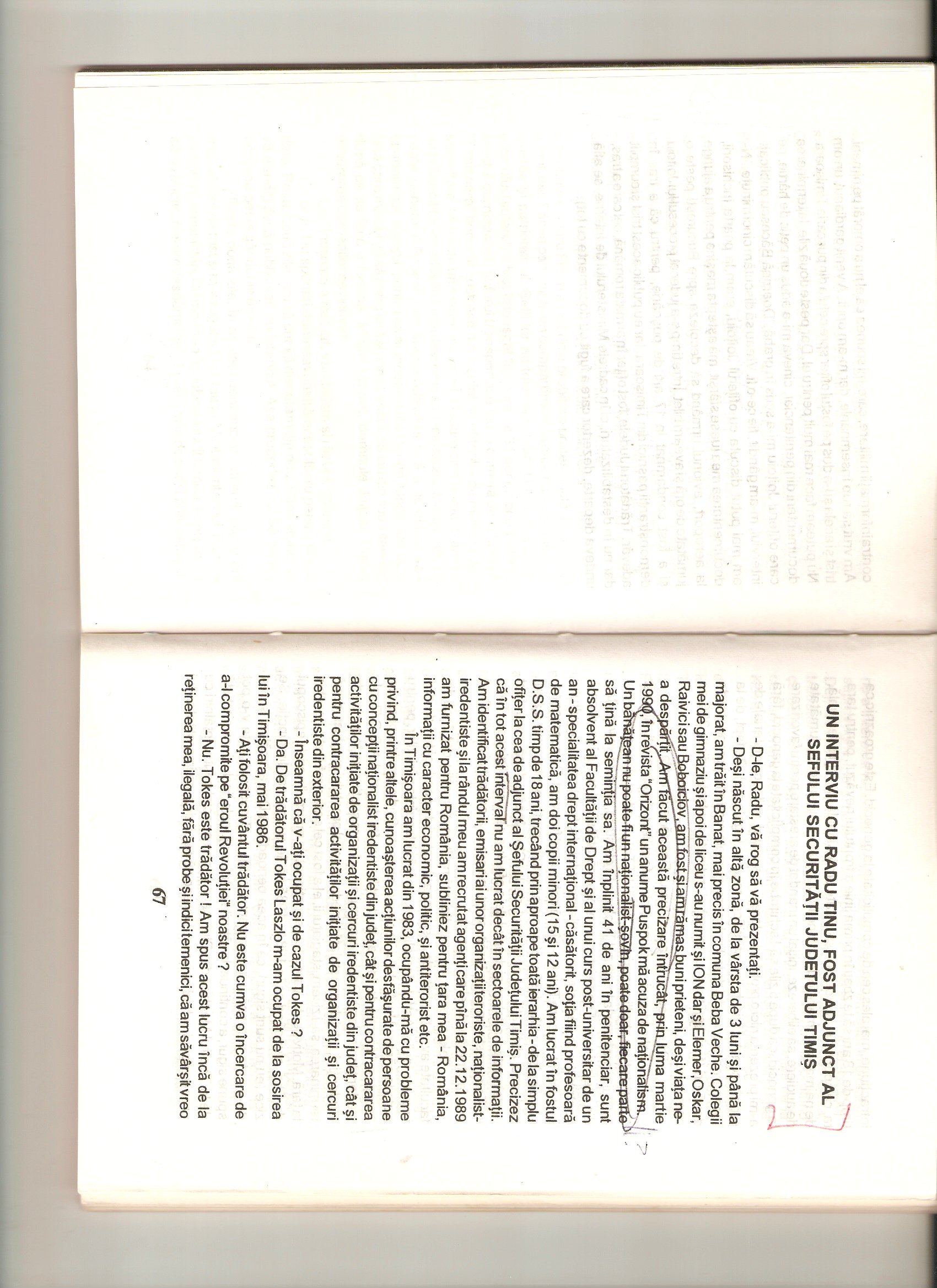
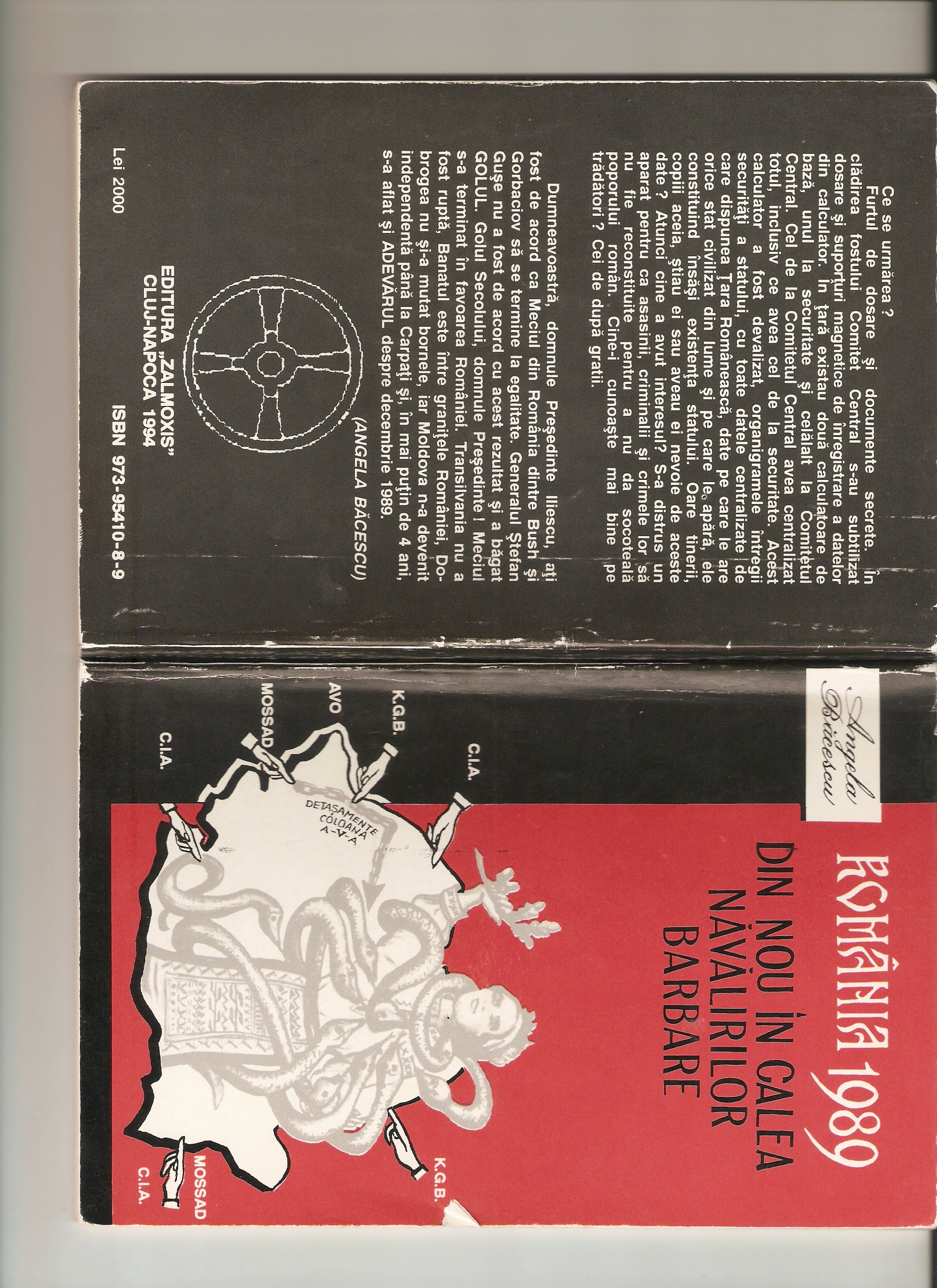
image0-007

image0-008


The significance of window-breaking as a justification for repression–something the Securitate would have realized–was outlined by Nicolae Ceausescu in his teleconference of 17 December 1989 as follows:

“Oricine intra intr-un Consiliu Popular, intr-un sediu de partid sau sparge un geam la un magazin trebuie sa primeasca riposta imediat.
0007

Col. Ion Popescu (sef IGM)’s defense lawyer appealed to Legea 21 and Decretul 121 specifically as obligating Interior Ministry (M.I.–Militia and Securitate) forces to intervene in response to the breaking of windows of commercial units…
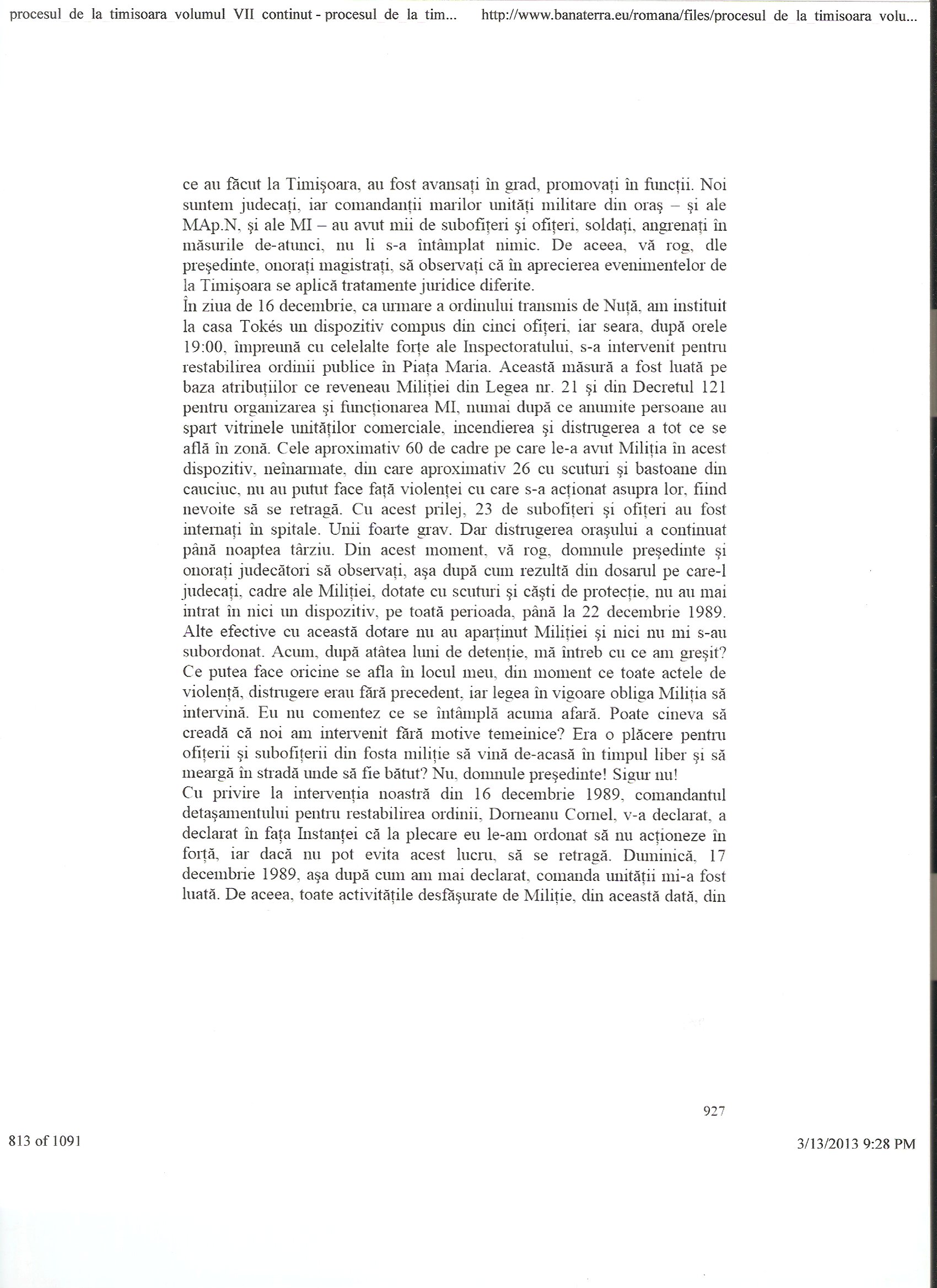
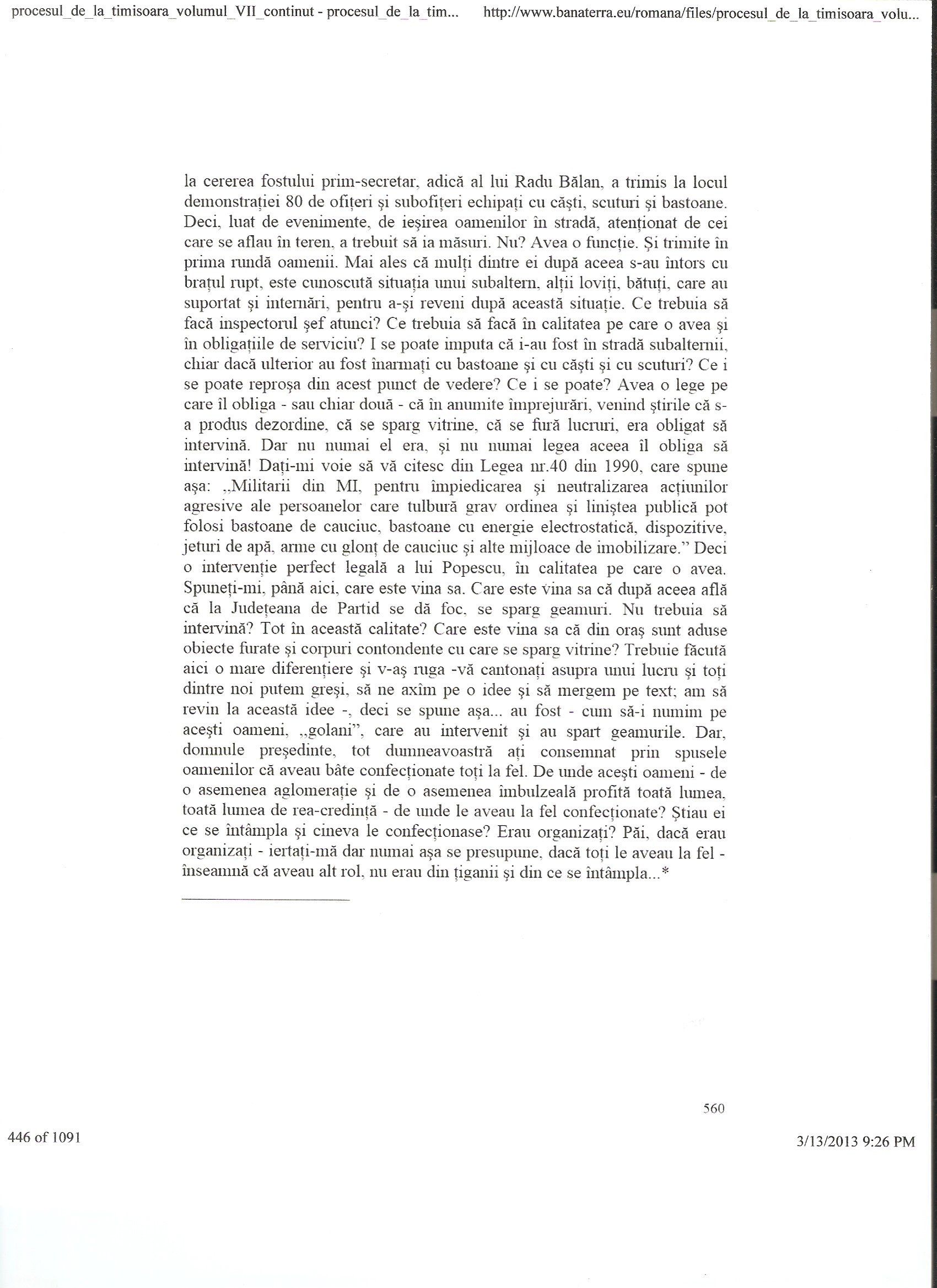
image0-001

image0

Thus, the breaking of windows, which according to Interior Minister was instigated and carried out in part by Securitate Brigade 30 under the command of Ion Bunoaica served a bureaucratic and legalistic function–a tactic not unknown in the annals of other totalitarian or authoritarian regimes…

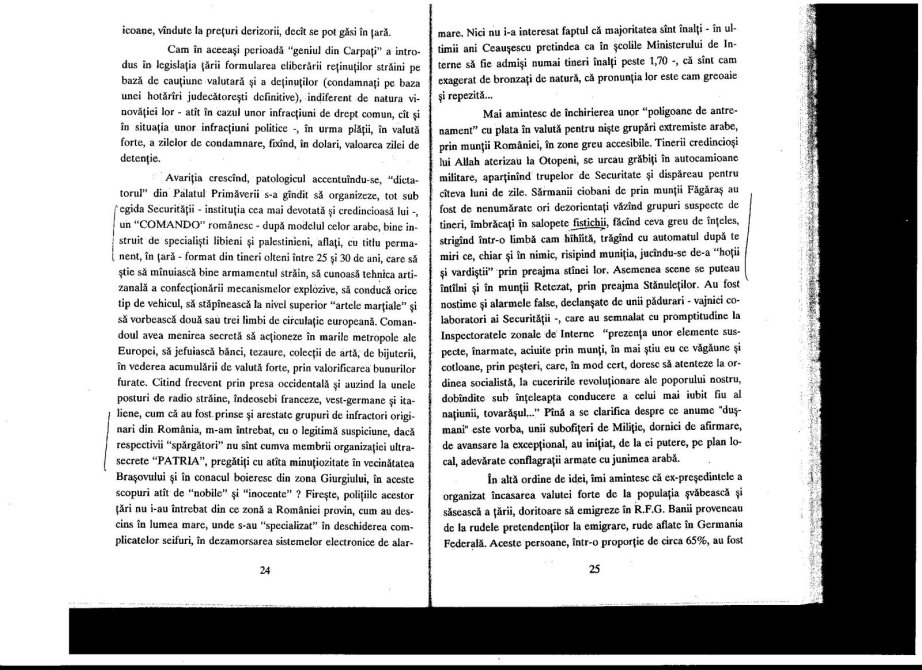
image-18image-17image-16image-15

image-4image-9

———————————–

An excerpt from Chapter 5 of my Ph.D. Dissertation at Indiana University: Richard Andrew Hall, Rewriting the Revolution: Authoritarian Regime-State Relations and the Triumph of Securitate Revisionism in Post-Ceausescu Romania (defended 16 December 1996). This is the original chapter as it appeared then and thus has not been revised in any form.

Chapter Five.  The Beginning of the End: Timisoara, 15-17 December 1989

The “Window Breakers”

The reportedly unusual scope of physical destruction which occurred in Timisoara, particularly on the afternoon and evening of 17 December 1989, has fueled revisionist arguments. Estimates of the damage during the Timisoara unrest are in the neighborhood of four to five billion lei (approximately forty to fifty million dollars at the time), a reasonably large sum given Romania’s standard of living at the time. A huge number of windows was broken and as many as 300 to 400 stores suffered some sort of damage, although relatively few were actually looted. On the evening of 17 December, stores, vehicles, and kiosks were burning in at least ten different areas of the city.[65]

Former Securitate officers clearly wish to link this destruction to the “foreign tourists” who were supposedly so ubiquitous in Timisoara during these days.[66] Perhaps somewhat surprisingly, former Securitate Director Iulian Vlad argued at his trial that

…the acts of vandalism, theft, destruction, arson… acts without precedent…could not have been the work [“opera”] of the faithful [apparently referring sarcastically to Tokes’ parishioners], nor the revolutionaries. They were produced by elements which wished to create a certain atmosphere of tension.[67]

“A group of former Securitate officers” wrote to the Ceausist Democratia in September 1990 that after the Militia and Securitate refused to respond to the demonstrations provoked by the “foreign tourists”: “they advance[d] to the next stage: the massive destruction of public property designed to provoke forcible interventions–human victims were needed.”[68]

Nevertheless, here is how one opposition journalist, Grid Modorcea, has described the strange character of Timisoara destruction:

For the first time in history, a revolution…was announced in a previously unknown and absolutely original manner, both literally and figuratively speaking: through the methodical breakage of thousands of windows. On 16 and 17 December 1989, Timisoara was the city of [glass] shards. Well-trained groups of athletes spread throughout the town, tactically, but energetically smashing to pieces hundreds of huge windows without apparently being interested in stealing from these stores…they were like mythical Magis coming to announce the end of one world and the beginning of another. And they gave it an apocalyptic quality: the sound produced by the breaking glass was infernal. The panic this caused was indescribable….Those who “executed” the windows did so with karate-like kicks while yelling “Liberty and Justice”!…The crowds of people who came out into the streets transformed spontaneously into columns of demonstrators, of authentic revolutionaries. The effect was therefore monumental: the breaking of the windows unleashed the popular revolt against the dictator.[69]

Modorcea is convinced that the Tokes case was “merely a pretext” and that “someone–perhaps those who planned the vandalizing of the windows–has an interest in preventing it from being known who broke the windows.” Although Modorcea maintains he is unsure who was responsible, he insists on observing that:

Only the Customs people know how many tourists there were. All were men and long-haired. Inside their cars they had canisters. This fits with the method of the breaking of the windows, with the Molotov cocktails, and the drums used as barricades–they were exactly of the same type….To what extent the new regime which came to power was implicated, we cannot say![70]

Many Timisoara protesters appear torn between wishing to rationalize the extensive destruction as the courageous response of an enraged, long-suffering population, and denying that the perpetrators could have come from among their ranks. Even those investigators attuned to the retroactive psychology of the protesters cannot help but admit that widespread destruction occurred and that it could not have been wholly spontaneous.[71] Furthermore, as Laszlo Tokes has observed in discussing the events at Piata Maria, manipulation and attempts to instigate the crowd to violence were constant features during these days.

Tokes maintains that Securitate provocateurs had tried to agitate the crowd by shouting things like, “Let’s break into the house. The Securitate are in there; they’re trying to kidnap Laszlo Tokes! Let’s rush them!” and by appealing for him to “Come down into the street and lead us!”[72] According to Tokes:

I was alarmed at the obvious provocation from individuals in the crowd clearly intent on making the situation uncontrollable….Later, thinking about the events of those two days, I realized that the authorities would have had a great deal to gain if the situation had become a riot.[73]

Mircea Balan questions whether the protesters would have set stores on fire which were located on the ground floor of the buildings in which the protesters themselves lived.[74] Moreover, he wonders how even the revolutionary fury of the crowd could drive protesters to break so many windows, particularly given the presence of repressive forces on the streets. It is what Balan has termed the “systematic devastation” of property which raises questions.

Eyewitness accounts recorded soon after the events–therefore at a time before the various plots and scenarios had permeated the popular imagination–support the hypothesis that the vandalism was organized. Moldovan Fica remarks:

I admit that I cannot escape a certain conclusion. All of this [destruction] was done by a group of about five or six individuals, whose calm demeanor and self-control continues to stay with me to this day. They did not run from the scene, they appeared as if they did not fear anything; I would say that, in fact, they were doing what was required of them, something which had been ordered directly of them![75]

Describing destruction in a different part of the city, Andras Vasile observed that

…four young men with shaved heads and wearing civilian clothes had sticks–I would term them special sticks–1.7 to 1.8 meters long, equipped with metal rings on the top of them. They were breaking the windows, but not taking anything, as if they only had something against the windows, something which they thus went about with great enjoyment…they were led by two individuals in leather jackets.[76]

Other eyewitnesses supply details which confirm the widespread character of the vandalism; its undeniably organized quality; the disinterest of its perpetrators in looting the stores; and the almost “drugged” nature of the perpetrators, who seemed unperturbed by the chaos and repression going on around them.[77]

Mircea Balan has little doubt who committed this “systematic destruction”:

Demonstrators might have thrown rocks in windows, but the destruction of the entire store was not their work…Nobody need believe that for such a thing foreign intervention was necessary, seeing as there were enough first-class specialists in destruction and demolition right here at home. The Securitate could not have been foreign to what happened, no matter how much it fiercely attempts to deny this today. They were professionals in the art of destruction. They needed a justification for the bloody repression.[78]

In March 1990, Puspoki had been willing to identify the culprits more specifically. According to Puspoki, as the demonstrators began to gather to prevent Tokes’ eviction:

The USLA’s Sabotage and Diversion team was readied to break store windows, to devastate and set fires–to create the conditions necessary for mass repression: the existence of disorder in the streets and theft on the part of the demonstrators.[79]

Securitate Major Radu Tinu’s observation that the commercial complex “in front of the county Militia building” (i.e. the Inspectorate in which both the Securitate and Militia offices were located) was one of only two such complexes in the whole city to remain intact during these days may also be an indication of the source of the destruction.[80]

It is possible then that to the extent that this destruction did indeed contain an organized component, it was designed by the regime to subvert and cast suspicion upon the intentions of the protesters and to create a pretext for repression. To the extent that an organized component did contribute to the destruction, it was far more likely to have been regime forces attempting to undermine the protests than foreign agents attempting to provoke an uprising against the regime.

[65].. See, for example, Grid Modorcea, “Spargerea Geamurilor [The Breaking of the Windows],” Expres Magazin, no. 49 (1991), 8-9; Mircea Bunea, “Eroii noi si vechi [New and old heroes],” Adevarul, 2 February 1991, in Bunea, Praf in Ochi, 448-449; Suciu, Reportaj cu Sufletul, 57-58.

[66].. See, for example, the comments of Radu Tinu, the deputy director of the Timis County Securitate, in Bacescu, Din Nou in Calea, 67-85.

[67].. Mircea Bunea, “Ipse Dixit,” Adevarul, 21 February 1991, in Bunea, Praf in Ochi, 463. Vlad’s determination to emphasize that these were “acts without precedent” makes one wonder if they were indeed without precedent.

[68].. A group of former Securitate officers, “Asa va place revolutia? Asa a fost! [You like the revolution? Here is how it was!],” Democratia, no. 36 (24-30 September 1990), 4. The lengthy defense by these officers of the Fifth Directorate in this letter suggests that they were members of this directorate.

[69].. Modorcea, “Spargerea Geamurilor,” 8.

[70].. Ibid.

[71].. Balan, “Masacrul.”

[72].. Tokes, With God, for the People, 153, 156.

[73].. Ibid., 156.

[74].. Balan, “Masacrul.”

[75].. Suciu, Reportaj cu Sufletul, 96.

[76].. Ibid, 118. The fact that the two persons supervising the destruction are described as having worn “leather jackets” strongly suggests they may have been Securitate men. Mihai Decean claims that on a train headed for Bucharest on 25 December (therefore after Ceausescu’s flight), he helped in the arrest of two USLA officers whom he describes as “athletic, with shaved heads, and wearing leather jackets.” See Laura Ganea, “La Timisoara se mai trage inca” Tinerama, no. 77 (July 1991), 3.

[77].. Ibid., 71, 122. Some of the eyewitnesses cited in Modorcea, “Spargerea Geamurilor,” say similar things; Modorcea, however, gives them a very different interpretation.

[78].. Balan, “Masacrul.”

[79].. Puspoki, “Piramida Umbrelor (III).”

[80].. Bacescu, Din Nou in Calea, 80.

The following was added some years later as a footnote to the section above in republications of this chapter.  Badea says here “many years later” Postelnicu admitted this, but as we can now see from the Timisoara files, he wrote it in his declaration/statement dated 17 March 1990.

(In connection with the “window breakers” we do know a little more today than we did then back in 1996.  Dan Badea wrote in 1999 Bunoaica and the Window Breakers that “Tudor Postelnicu, the Interior Minister at the time, was to declare many years later that the “breaking of the windows” was a mission executed by personnel from the 30th Securitate Brigade led by col. Ion Bunoaica).  Orele 20.00 – 21.00: Sint sparte toate vitrinele magazinelor de pe Bulevardul 6 Martie (Tudor Postelnicu, ministru de interne la acea vreme, avea sa declare multi ani mai tirziu ca “spargerea vitrinelor” a fost o misiune executata de militari ai Brigazii 30 Securitate condusa de col. Ion Bunoaica).
25 for 2014: 25 Things You Should Know about the Romanian Revolution on the 25th Anniversary of the Fall of Nicolae Ceausescu’s Communist Regime: #1 The Securitate Deny Foreign Instigation of the Timisoara Uprising

Posted in decembrie 1989 | Tagged: , , , , , , , , , , , , , , , , , , , , , , , , | 11 Comments »

25 for 2014: 25 Things You Should Know about the Romanian Revolution on the 25th Anniversary of the Fall of Nicolae Ceausescu’s Communist Regime: #1 The Securitate Deny Foreign Instigation of the Timisoara Uprising

Posted by romanianrevolutionofdecember1989 on February 2, 2014

(Purely personal views as always, based on over two decades of research and publications inside and outside Romania)

—————————————————————————————————————————————————————————

[UPDATE 2.  A Response to Watts: The Pitfalls of Not Having Any Evidence

http://atomic-temporary-3899751.wpcomstaging.com/a-response-to-watts-the-pitfalls-of-not-having-any-evidence/

UPDATE I.  Related of relevance:  http://atomic-temporary-3899751.wpcomstaging.com/all-the-soviet-tourists-where-do-they-all-come-from/

What do previous studies tell us about the Soviets sending in agents posing as “tourists” prior to or during a military action or invasion against another country?

Mark Kramer has detailed Soviet use of “tourist” cover in the following CWIHP Bulletin article (Fall 1993, “The Prague Spring and the Soviet Invasion of Czechoslovakia:  New Interpretations (Second of two parts),.  What is important to take away from this?  The Soviets posed as WESTERN tourists.  They did not pose as…”Soviet tourists”!!!…

Indeed, what Larry Watts seems to miss in his exposition of claimed incidents of Soviet use of “tourist” cover in the context of planned/actual invasion is that in none of the examples do Soviet agents pose as…”Soviet tourists”…Why?  Because it is a relatively poor cover story that doesn’t give much deniability that they were Soviets.  If you are trying to conceal your Soviet links, you would most likely pose as some kind of other tourist, not as a Soviet tourist…

Why then, in December 1989, in Romania, are we to believe, that the Soviets would have abandoned precedent and posed as…”Soviet tourists”…driving around in Soviet automobiles (more easily identifiable in Romania than other Soviet bloc states because of the domestic production of and dominance of the market by Dacia vehicles) with Soviet tags/license plates, and apparently carrying Soviet passports?  Doesn’t sound particularly intelligent, does it?  Instead, such things would draw attention to you and would mint you as…Soviets!

http://atomic-temporary-3899751.wpcomstaging.com/2014/01/24/what-would-it-have-looked-like-if-nicolae-ceausescus-securitate-executed-a-plan-to-counter-an-invasionbut-the-invaders-never-came-iii/ ]

—————————————————————————————————————————————————————————

2014 marks the 25th anniversary of the collapse of communism in central and eastern Europe–Poland, Hungary, East Germany, Czechoslovakia, Bulgaria, and Romania.  This (likely aperiodic) series looks at 25 things I have learned about the events of the Romanian Revolution of December 1989.  The numbering is not designed to assign importance, but rather–to the extent possible–to progress chronologically through those events.

Significance:  Until the documents below were made publicly available and I unearthed the following, we had to rely primarily on arguments emphasizing the Securitate roots of these claims and/or about the implausibility and often absurdity of these claims.  We now have documentary evidence that in the immediate wake of December 1989 not even the Securitate believed in the claims they would make so frequently later on.

The Timisoara files about December 1989 are now publicly available (when the link works!) on the Internet at http://dosarelerevolutiei.ro/.  What they show is that Securitate, Militia, and other regime officials from Timis County were asked by Bucharest–communicated via the person of Securitate Director, General Iulian Vlad–to investigate the role of foreign elements, specifically tourists, in the Timisoara protests of mid-December 1989.  But they were not the only ones.  General Vlad tasked senior Securitate officials from Bucharest sent to Timisoara to report back to him on this very topic alleging external involvement and manipulation of the Timisoara demonstrations.  What remains unclear is how much of this tasking was General Vlad communicating his own “hypothesis” or how much of it was he relaying Nicolae Ceausescu’s “theory” about what was going on.  This much is clear:  neither those stationed in Timis County, nor those officials sent from Bucharest could find evidence of a foreign hand in the Timisoara uprising, despite being asked to investigate exactly this aspect.  How do we know this?  From their own written confessions immediately after the December 1989 events.  (Below are four of them:  Nicolae Mavru, Liviu Dinulescu, Emil Macri, and Filip Teodorescu.)

Niculae Mavru, fost sef al sectiei ‘Filaj si investigatie’ de la Securitatea Timis, declaratia din 13 ianuarie 1990:  …la ordinul col. Sima Traian, am primit…misiuni de a observa si sesiza aspecte din masa manifestantilor, din diferite zone ale orasului in sensul de a raporta daca sint straini (ceea ce nu prea au fost) care incita la dezordine, acte de violenta sau altfel de acte… 0331 25 iunie 1991 “Desi ne-am straduit nu am putut raporta col. Sima implicarea completa a vreunui cetatean strain in evolutia demonstratiilor cit si fenomenlor care au avut loc la Timisoara,..”

0173

“Sarcina primordiala pe care am primit-o de la col. Sima a fost daca in evenimentele declansate la Timisoara erau implicate elemente straine din afara tarii.  Cu toate eforturile facute nu a rezultat lucru pe linia mea de munca.” 0174

26 iunie 1991, Declaratia lui Liviu Dinulescu, cpt. la Serviciul de Pasapoarte al jud. Timis (in decembrie 1989, lt. maj. ofiter operativ Securitate judetean la Serv. III, care se ocupa de contraspionaj)

“Precizez ca anterior declansarii evenimentelor de la Timisoara din datele ce le detineam serviciul nostru nu rezulta vreun amestec din exterior in zona judetului Timis.”

0197

Generalul Emil Macri (seful Dir. II-a Securitatii, Contrainformatii Economice),

Declaratie 2 ianuarie 1990:

“Rezumind sintetic informatiile obtinute ele nu au pus in evidenta nici lideri si nici amestecul vreunei puteri straine in producerea evenimentelor de la Timisoara.  Raportarea acestor date la esalonul superior respectivi generalului I. Vlad a produs iritare si chiar suparare…”

IMG_1219 IMG_1215 Filip Teodorescu (adj. sef. Dir III Contraspionaj D.S.S.), Declaratie, 12 ianaurie 1990:  Seara [luni, 18 decembrie 1989], dupa 23:00, responsabili (anumiti ?) de generalul-maior Macri Emil pe diferitele linii de munca au inceput sa vina sa-i raporteze informatiile obtinute.  Au fost destul de neconcludente si cu mare dificultate am redat o informare pe care generalul-maior Macri Emil a acceptat-o si am expediat-o prin telex in jurul orei 01:00 [marti, 19 decembrie 1989.  In esenta se refera la: –nu sint date ca ar exista instigatori sau conducatori anume veniti din strainatate… IMG_1453 IMG_1438 http://atomic-temporary-3899751.wpcomstaging.com/2013/04/29/high-time-to-unpack-already-why-the-restless-journey-of-the-soviet-tourists-of-the-romanian-revolution-should-come-to-an-end/

Mai jos, declaratiile lui Petre Pele, Tudor Postelnicu, Gheorghe Diaconescu, si Iulian Vlad Excerpt from Chapter 5 of my Ph.D. Dissertation at Indiana University: Richard Andrew Hall, Rewriting the Revolution: Authoritarian Regime-State Relations and the Triumph of Securitate Revisionism in Post-Ceausescu Romania (defended 16 December 1996). This is the original chapter as it appeared then and thus have not been revised in any form. http://atomic-temporary-3899751.wpcomstaging.com/rewriting-the-revolution-1997/

A Review of the Evidence

Although at first glance the regime’s treatment of Pastor Tokes seems strange and even illogical, within the context of the workings of the Ceausescu regime and the regime’s strategy for dealing with dissent it makes perfect sense. There is simply no convincing evidence to believe that the Securitate–or a faction within it–purposely dragged its feet in enforcing Pastor Tokes’ eviction, or was attempting to spark a demonstration in the hopes of precipitating Ceausescu’s fall. The regime’s decision to evict Tokes was not a last-minute decision. Moreover, the regime exerted tremendous and sometimes brutal pressure to silence Tokes in the months preceding this deadline. Interestingly, according to high-ranking members of the former Securitate, Nicolae Ceausescu’s unwillingness to approve the more definitive measures requested by the Securitate allowed the Tokes case to drag on without resolution (see below). The Tokes case suggests the bureaucratic and byzantine mentalities of the Ceausescu regime, and the clash between a dictator’s instructions and how the institutions charged with defending him interpret their mission. … The suggestion that the Securitate treated Tokes gently prior to his eviction is simply incorrect. On 2 November 1989, four masked men burst through the locked doors of the parochial residence, wielding knives and screaming in a fury. Tokes was slashed on the forehead before his church bodyguards could come to his rescue, causing the four to flee. The numerous Securitate men posted out front of the building had done nothing to intervene in spite of calls for help. Puspoki suggests that these “Mafia-like thugs,” who attacked as if from “an Incan tribe,” were some of Colonel Sima’s “gorillas,” sent to deliver a clear message to Tokes that he should leave immediately.[40] The view of the former Securitate–as expounded by Colonel Sima’s senior deputy, Major Radu Tinu–insinuates a “tourist”-like scenario. According to Tinu, the incident was clearly a “set-up” designed to draw sympathy to Tokes’ cause since the assailants fled away in a car with West German tags.[41] Not for the last time, the Securitate thus appears to attempt to attribute its own actions to foreign agents. A week after the mysterious attack by the masked intruders, all of the windows of the parochial residence and nearby buildings were smashed. Interestingly, the report drawn up for Bucharest by the Timisoara Securitate attempted to argue that “workers” from the Timisoara Mechanical Enterprise, offended by pastor Tokes’ behavior, had broken the windows. According to Puspoki, the use of a propaganda-like description was not accidental: the local Securitate was trying to present the incident as evidence of “the dissatisfaction of the working people of Timisoara” in the hope that it would finally prompt Ceausescu into approving definitive measures against Tokes.[42] Was Ceausescu responsible for the fact that the Tokes case dragged on without resolution? Support for such a conclusion comes from the comments of Securitate officers Colonel Filip Teodorescu and Major Radu Tinu. Teodorescu was dispatched to Timisoara with sixty other Securitate information officers in order to “verify” the request of the local Securitate that proceedings for treason be initiated against Tokes.[43] Teodorescu laments: Unfortunately, as in other situations…Nicolae Ceausescu did not agree because he didn’t want to further muddy relations with Hungary. Moreover, groundlessly, he hoped to avoid the criticisms of “Western democracies” by taking administrative measures against the pastor through the Reformed Church to which [Tokes] belonged.[44] Major Radu Tinu suggests that Ceausescu’s approval was necessary in the case of Securitate arrests and that the local Securitate remained “stupefied” that after having worked so long and hard in gathering information with which to charge Tokes with the crime of treason, Ceausescu rejected the request.[45] Tinu speculates that Ceausescu “did not want to create problems at the international level.” Because former Securitate officers rarely pass up the opportunity to absolve themselves of blame, and it would appear both easier and more advantageous to blame the deceased Ceausescu for being too unyielding in the Tokes affair, these allegations seem plausible. Thus, it would appear that because Nicolae Ceausescu was skittish of further damaging Romania’s already deteriorating relations with the international community, and the Tokes case was a high-profile one, he refrained from approving visible, definitive action against the pastor. The Securitate‘s attempt to goad Ceausescu to bolder action would appear to confirm Ghita Ionescu’s suggestion that where the security apparatus comes to dominate regime affairs it attempts to impose its institutional prerogatives upon political superiors. Ceausescu and the Securitate appear then to have had sometimes conflicting views over how to resolve the Tokes affair in the quickest and most efficient fashion. By December 1989, a huge group of Securitate officers were working on the Tokes case: the entire branch of the First Directorate for Timis county, the special division charged with combatting Hungarian espionage, high-ranking members of the First Directorate and Independent Service “D” (responsible for disinformation) from Bucharest, and members of the division charged with “Surveillance and Investigation.”[46] Puspoki describes Timisoara at this late hour as follows: Day and night, the telex machines on the top floor of the [County Militia] “Inspectorate” incessantly banged out communications, while the telephones never stopped ringing. Minister Postelnicu yelled on the phone, Colonel Sima yelled through the offices and the hallways. The officers ran, as if out of their minds, after information, besieged neighbors of the pastor, and dispatched in his direction–what they call–”informers with possibilities.”[47] Yet the case lingered on. On Sunday, 10 December 1989, Pastor Tokes announced to his congregation that he had received a rejection of his most recent appeal: the regime would make good on its threat to evict him on Friday, 15 December. He termed this an “illegal act” and suggested that the authorities would probably use force since he would not go willingly. He appealed for people to come and attend as “peaceful witnesses.”[48] They came.

[40].. Puspoki, “Piramida Umbrelor (III),” Orizont, no. 11 (16 March 1990), 4.

[41].. Bacescu, Din Nou in Calea, 78.
[42].. Puspoki, “Piramida Umbrelor (III).”
[43].. Teodorescu, Un Risc Asumat, 45-46.
[44].. Ibid., 90.
[45].. Bacescu, Din Nou in Calea, 78.
[46].. Puspoki, “Piramida Umbrelor (II).”
[47].. Ibid.
[48].. Tokes, With God, for the People, 1-4. ————————————————————————————————

Tudor Postelnicu:  “Ceausescu Nicolae facuse o psihoza, mai ales dupa ce s-a intors de la sedinta de la Moscova in toamna lui ’89.  Era convins ca se planuieste si de cei de pe plan extern caderea sa, era convins ca toti sint spioni…” 0160 Petru Pele (Dir I, DSS). Declaratie, 16 ianuarie 1990:  “Printre sarciniile mai importante efectuate de catre acestia in  perioada 17-22.12.1989 s-a numerat (?) constituierea (?) listelor celor retinuti de organele militie cu listele celor predati sau reintorsi din Ungaria, intrucit s-a emis ipoteza ca evenimentele de la Timisoara au fost puse la cale in tara vecina…” 0299 0291 Gheorghe Diaconescu, Declaratie 31 decembrie 1989 “Luni 18 decembrie gl. col.  VLAD IULIAN a avut o convorbire cu colegul meu (local?) RADULESCU EMIL … 0476 Vlad Iulian (continuarea, declaratia lui Gheorghe Diaconescu) “?… foarte dur (?) ca nu (?) ca ‘un grup de turisti isi fac de cap in Timisoara’” 0477 0472 Tocmai Iulian Vlad, el insusi, recunoaste ne-implicarea strainilor in evenimentele de la Timisoara, aici… 0289 0290 Incepind cu noaptea de 16/17 dec. si in continuare pina in data de 20 dec. 1989 organul de securitate local col. Sima cit si gl. Macri si in lipsa lui col. Teodorescu imi comunicau date din care rezulta ca sute de elemente turbulente au devastat orasul, si ca elementul strain nu rezulta a se fi implicate in continuarea fenomenului.” 0291 “Mai exact, cei trimis de mine la Timisoara mi-au raportat ca nu au elemente din care sa rezulte vreum amestec al strainatatii in producerea evenimentelor de la Timisoara.” http://atomic-temporary-3899751.wpcomstaging.com/2013/03/17/o-indicatie-pretioasa-de-pe-malurile-dimbovitei-implicarea-strainilor-in-evenimentele-de-la-timisoara-paranoia-lui-nicolae-ceausescu-sau-confirmarea-lui-iulian-vlad/0292

All this is important to keep in mind when coming across claims about the alleged role of these tourists in the overthrow of the communist regime of Nicolae Ceausescu:  none of the authors purporting such claims have addressed the documents above.  Among the authors who allege such a role and whose work is available on the Internet are the following:

James F. Burke (citing Grigore Corpacescu, General Iulian Vlad, and a well-known article from September 1990 in Democratia) http://www.ceausescu.org/ceausescu_texts/revolution/december_revolt_moscow.htm (I have dealt with these allegations here http://atomic-temporary-3899751.wpcomstaging.com/2010/12/29/presa-din-1990-despre-turistii-rusi-din-decembrie-1989/, and  http://atomic-temporary-3899751.wpcomstaging.com/2010/09/22/the-1989-romanian-revolution-as-geopolitical-parlor-game-brandstatter%E2%80%99s-%E2%80%9Ccheckmate%E2%80%9D-documentary-and-the-latest-wave-in-a-sea-of-revisionism-part-iii/)

Catherine Durandin (citing Radu Portocala) http://www.diploweb.com/english/romania/durandin1.htm  (I have addressed this allegation here http://atomic-temporary-3899751.wpcomstaging.com/2010/09/24/the-1989-romanian-revolution-as-geopolitical-parlor-game-brandstatter%E2%80%99s-%E2%80%9Ccheckmate%E2%80%9D-documentary-and-the-latest-wave-in-a-sea-of-revisionism-part-four/)

Alexander Ghaleb (fn. 9, citing “police sources”) http://www.sferapoliticii.ro/sfera/165/art03-Ghaleb.php

Jacques Levesque (citing a 1992 book by Filip Teodorescu) http://publishing.cdlib.org/ucpressebooks/view?docId=ft4q2nb3h6&chunk.id=d0e6746&toc.id=d0e6638&brand=ucpress

John Simpson (citing Virgil Magureanu and the SRI) http://www.independent.co.uk/life-style/ten-days-that-fooled-the-world-1387659.html

Alex Mihai Stoenescu (p. 186 of 340, Petre Roman citing Mihai Caraman) http://www.scribd.com/doc/105257958/Alex-Mihai-Stoenescu-Istoria-Loviturilor-de-Stat-Din-Romania-Vol-4-1

Larry Watts (fn. 90 p. 26, Petre Roman citing Mihai Caraman) http://www.larrylwatts.com/excerpts/with_friends_like_these_excerpts.pdf  (Roman ironically himself undermined such a claim here:  http://adevarul.ro/news/eveniment/petre-roman-ceausescu-acceptat-controlul-psihiatric-proces-putea-scape-1_50ad124a7c42d5a6638e48ab/index.html , Watts’ claim has been televised in the series “Mostenirea Clandestina,” http://www.youtube.com/watch?v=cAPOEu0ebwI start at about 46:10 to 46:60 and then assisted by Cristian Troncota, who discusses the “Soviet tourists,” including Watts’ claim, from 47:05 to 49:50…conveniently not mentioned here or anywhere else where Troncota appears (for example with Grigore Cartianu in Adevarul), Cristian Troncota was a Lt. Maj. in the Securitate:  see the index here from a 1987 issue of the Securitate‘s “strict secret” journal, (page 4 of 46 on the pdf) with a historical article beginning on page 78:  http://www.cnsas.ro/documente/periodicul_securitatea/Securitatea%201987-4-80.pdf  (vol. 80 from 1987).


Posted in decembrie 1989, raport final | Tagged: , , , , , , , , , , , , , , , | 19 Comments »

High Time to Unpack Already: Why the Restless Journey of the “Soviet tourists” of the Romanian Revolution Should Come to an End.

Posted by romanianrevolutionofdecember1989 on April 29, 2013

(purely personal views as always, based on two decades of research and publication, not for reproduction, thank you!)

Somewhere out there, on the Great Highway in the Sky, or perhaps more fittingly, the Beltway of one of Dante’s circles, the “Soviet tourists” (alternatively, “Russian tourists”) of December 1989 in Romania continue to drive around, aimlessly, and, of course, as we are so often told, not staying in hotels.  Sadly, for the lovers of absurdity, this never-ending holiday from reality must–or at least should–come to an end.  Here’s why:

The Timisoara files about December 1989 are now publicly available (when the link works!) on the Internet at http://dosarelerevolutiei.ro/.  What they show is that Securitate, Militia, and other regime officials from Timis County were asked by Bucharest–communicated via the person of Securitate Director, General Iulian Vlad–to investigate the role of foreign elements, specifically tourists, in the Timisoara protests of mid-December 1989.  But they were not the only ones.  General Vlad tasked senior Securitate officials from Bucharest sent to Timisoara to report back to him on this very topic alleging external involvement and manipulation of the Timisoara demonstrations.  What remains unclear is how much of this tasking was General Vlad communicating his own “hypothesis” or how much of it was he relaying Nicolae Ceausescu’s “theory” about what was going on.  This much is clear:  neither those stationed in Timis County, nor those officials sent from Bucharest could find evidence of a foreign hand in the Timisoara uprising, despite being asked to investigate exactly this aspect.  How do we know this?  From their own written confessions immediately after the December 1989 events.  (Below are four of them:  Nicolae Mavru, Liviu Dinulescu, Emil Macri, and Filip Teodorescu.)

Niculae Mavru, fost sef al sectiei ‘Filaj si investigatie’ de la Securitatea Timis, declaratia din 13 ianuarie 1990:  …la ordinul col. Sima Traian, am primit…misiuni de a observa si sesiza aspecte din masa manifestantilor, din diferite zone ale orasului in sensul de a raporta daca sint straini (ceea ce nu prea au fost) care incita la dezordine, acte de violenta sau altfel de acte…

0331

25 iunie 1991

“Desi ne-am straduit nu am putut raporta col. Sima implicarea completa a vreunui cetatean strain in evolutia demonstratiilor cit si fenomenlor care au avut loc la Timisoara,..”

0173

“Sarcina primordiala pe care am primit-o de la col. Sima a fost daca in evenimentele declansate la Timisoara erau implicate elemente straine din afara tarii.  Cu toate eforturile facute nu a rezultat lucru pe linia mea de munca.”

0174

26 iunie 1991, Declaratia lui Liviu Dinulescu, cpt. la Serviciul de Pasapoarte al jud. Timis (in decembrie 1989, lt. maj. ofiter operativ Securitate judetean la Serv. III, care se ocupa de contraspionaj)

“Precizez ca anterior declansarii evenimentelor de la Timisoara din datele ce le detineam serviciul nostru nu rezulta vreun amestec din exterior in zona judetului Timis.”

0197

Generalul Emil Macri (seful Dir. II-a Securitatii, Contrainformatii Economice),

Declaratie 2 ianuarie 1990:

“Rezumind sintetic informatiile obtinute ele nu au pus in evidenta nici lideri si nici amestecul vreunei puteri straine in producerea evenimentelor de la Timisoara.  Raportarea acestor date la esalonul superior respectivi generalului I. Vlad a produs iritare si chiar suparare…”

IMG_1219

IMG_1215

Filip Teodorescu (adj. sef. Dir III Contraspionaj D.S.S.), Declaratie, 12 ianaurie 1990: 

Seara [luni, 18 decembrie 1989], dupa 23:00, responsabili (anumiti ?) de generalul-maior Macri Emil pe diferitele linii de munca au inceput sa vina sa-i raporteze informatiile obtinute.  Au fost destul de neconcludente si cu mare dificultate am redat o informare pe care generalul-maior Macri Emil a acceptat-o si am expediat-o prin telex in jurul orei 01:00 [marti, 19 decembrie 1989.  In esenta se refera la:

–nu sint date ca ar exista instigatori sau conducatori anume veniti din strainatate…

IMG_1453

IMG_1438

All this is important to keep in mind when coming across claims about the alleged role of these tourists in the overthrow of the communist regime of Nicolae Ceausescu:  none of the authors purporting such claims have addressed the documents above.  Among the authors who allege such a role and whose work is available on the Internet are the following:

James F. Burke (citing Grigore Corpacescu, General Iulian Vlad, and a well-known article from September 1990 in Democratia) http://www.ceausescu.org/ceausescu_texts/revolution/december_revolt_moscow.htm (I have dealt with these allegations here http://atomic-temporary-3899751.wpcomstaging.com/2010/12/29/presa-din-1990-despre-turistii-rusi-din-decembrie-1989/, and  http://atomic-temporary-3899751.wpcomstaging.com/2010/09/22/the-1989-romanian-revolution-as-geopolitical-parlor-game-brandstatter%E2%80%99s-%E2%80%9Ccheckmate%E2%80%9D-documentary-and-the-latest-wave-in-a-sea-of-revisionism-part-iii/)

Catherine Durandin (citing Radu Portocala) http://www.diploweb.com/english/romania/durandin1.htm  (I have addressed this allegation here http://atomic-temporary-3899751.wpcomstaging.com/2010/09/24/the-1989-romanian-revolution-as-geopolitical-parlor-game-brandstatter%E2%80%99s-%E2%80%9Ccheckmate%E2%80%9D-documentary-and-the-latest-wave-in-a-sea-of-revisionism-part-four/)

Alexander Ghaleb (fn. 9, citing “police sources”) http://www.sferapoliticii.ro/sfera/165/art03-Ghaleb.php

Jacques Levesque (citing a 1992 book by Filip Teodorescu) http://publishing.cdlib.org/ucpressebooks/view?docId=ft4q2nb3h6&chunk.id=d0e6746&toc.id=d0e6638&brand=ucpress

John Simpson (citing Virgil Magureanu and the SRI) http://www.independent.co.uk/life-style/ten-days-that-fooled-the-world-1387659.html

Alex Mihai Stoenescu (p. 186 of 340, Petre Roman citing Mihai Caraman) http://www.scribd.com/doc/105257958/Alex-Mihai-Stoenescu-Istoria-Loviturilor-de-Stat-Din-Romania-Vol-4-1

Larry Watts (fn. 90 p. 26, Petre Roman citing Mihai Caraman) http://www.larrylwatts.com/excerpts/with_friends_like_these_excerpts.pdf  (Roman ironically himself undermined such a claim here:  http://adevarul.ro/news/eveniment/petre-roman-ceausescu-acceptat-controlul-psihiatric-proces-putea-scape-1_50ad124a7c42d5a6638e48ab/index.html)

Posted in decembrie 1989, raport final | Tagged: , , , , , , , , , , | 9 Comments »

Bullets, Lies, and Videotape: The Amazing, Disappearing Romanian Counter-Revolution of December 1989 (Part I: “His name was Ghircoias…Nicolae Ghircoias”) by Richard Andrew Hall

Posted by romanianrevolutionofdecember1989 on October 20, 2010

Bullets, Lies, and Videotape:

The Amazing, Disappearing Romanian Counter-Revolution of December 1989[1]

by Richard Andrew Hall, Ph.D.

Standard Disclaimer:  All statements of fact, opinion, or analysis expressed are those of the author and do not reflect the official positions or views of the Central Intelligence Agency (CIA) or any other U.S. Government agency.  Nothing in the contents should be construed as asserting or implying U.S. Government authentication of information or CIA endorsement of the author’s views.  This material has been reviewed by CIA to prevent the disclosure of classified information. [Submitted 19 November 2009; PRB approved 15 December 2009]

I am an intelligence analyst for the Central Intelligence Agency.  I have been a CIA analyst since 2000.  Prior to that time, I had no association with CIA outside of the application process.

Part I

His name was Ghircoias…Nicolae Ghircoias.

And in Romania in December 1989 and January 1990, Nicolae Ghircoias was a very busy man.

We know, officially, of Nicolae Ghircoias’ actions in the last days leading up to the fall of the regime of communist dictator Nicolae Ceausescu on 22 December 1989, as a result of what he and others said at a trial later in January 1990.  In bureaucratic parlance, Colonel Nicolae Ghircoias, was the Director of the Criminalistic Institute of the Militia’s [Police’s] General Inspectorate.   In colloquial terms, in December 1989 it appears that this amounted to being something of a “cleaner,” or “fixer,” the kind of guy who could make unpleasant things—such as corpses—go away, without leaving a trace.

After regime forces opened fire on anti-regime protesters in the western city of Timisoara on 17 and 18 December 1989, Colonel Ghircoias was dispatched to recover the corpses of those with gunshot wounds from the city’s morgue.  The unautopsied cadavers of 43 demonstrators were stolen from the morgue in the dead of night and then transported to the outskirts of the capital Bucharest by refrigerated truck, where they were cremated.[2] Ghircoias was also in charge of collecting and destroying the hospital records and any other incriminating material that might indicate not just the death, but also the life of those who had perished—the official explanation for the disappearance of these citizens was to be that they had fled the country, thus taking their documents with them.  In other words, Colonel Nicolae Ghircoias’ job was primarily, it seems, the destruction of evidence.[3]

COLONEL GHIRCOIAS MAKES THE ROUNDS OF BUCHAREST’S HOSPITALS

Unofficially, we also know of Colonel Ghircoias’ exploits after the Ceausescu regime collapsed on 22 December 1989, exploits for which he was not charged at his trial and for which he has never been charged.  Of the 1,104 people killed and 3,352 people injured during the December 1989 bloodshed, 942 of them were killed and 2,251 wounded after Nicolae and Elena Ceausescu fled power on 22 December 1989.  At the time, personnel of the communist regime’s secret police—known as the Securitate—and allied foreign mercenaries fighting to restore the Ceausescu regime—collectively christened “the terrorists”—were thought to be the primary source behind the post-22 December bloodshed.

It was in this context, that doctors from Bucharest’s various main hospitals recall Colonel Ghircoias’ sudden, unannounced appearances during the last days of December 1989 and first days of January 1990.  Professor Andrei Firica of the Bucharest “Emergency Hospital” recounted in a 2004 media interview largely the same details he had conveyed to the press in the summer of 1990.  According to Firica, some 15 to 20 suspected terrorists had been interned at the “Emergency Hospital” in varying states of medical distress.  He says he made a small file of the medical situations of these patients.  A Militia colonel, whom he later was to see in [prisoner] stripes on TV as a defendant in the Timisoara trial—i.e. fairly clearly Ghircoias—came one day and counseled him to keep nosy foreign reporters away from the beds of the “terrorists,” stating ominously that “these were just terrorist suspects and he [Dr. Firica] didn’t want to wake up one day on trial for having defamed someone”!   The colonel later came and loaded the wounded terrorist suspects onto a bus and off they went.  Firica maintains the files he kept on the terrorist suspects “of course, disappeared.”  He noted, however, that he asked his son, who had studied theater and film at university, to film the terrorists tied down to the hospital beds, and he claims he gave copies of this cassette to the Procuracy.[4]

[5]

[In viewing these photos, witness what Constantin Fugasin recounted in “Unde ne sint teroristii?” Zig-Zag, in 1990, based in part on an interview with Dr. Andrei Firica:

At the Emergency Hospital 13 suspected of being what we call terrorists were interned.  Among these a few were definitely foreign, even though all had Romanian papers.  Two clearly had ‘Mongoloid’ (‘Asiatic’) features (one stated that his mother was Romanian, while his father was from Laos), while four others were Arabs.  Nevertheless, they spoke Romanian very well.  Doctor Nicolae Staicovici, who worked a time in Egypt and who treated them for a time spoke with them.  At a moment, he formed a question in Arabic.  One of the injured responded to him perfectly.  All were well-built, one was a ‘mountain of a man.’  He said nothing, although he probably had terrible pains.  There were also two terrorists who were not wounded.  One arrived at night, under some pretext.  Those on guard suspecting him, immobilized him.  He had on three layers of clothing and several ids.  They tied him to the stretcher, but although he appeared rather frail, at a given moment he ripped the restraints off.[6]]

[7]

[Dr. Andrei Firica, 2004:  From a diagnostic perspective, those who maintain that the terrorists didn’t exist are telling an outrageous lie…In the Emergency Hospital, people were brought who were shot with precision in the forehead, from behind, just a few yards in the crowd of demonstrators, such people who did this can only be called terrorists…[8]]


Dr. Nicolae Constantinescu, chief surgeon at the Coltea Hospital, also was paid the honor of a visit by Colonel Ghircoias during these days:

I remember that on 1 or 2 January ’90 there appeared at the [Coltea] hospital a colonel from the Interior Ministry, who presented himself as Chircoias.  He maintained in violent enough language that he was the chief of I-don’t-know-what “criminalistic” department from the Directorate of State Security [ie. Securitate].  He asked that all of the extracted bullets be turned over to him.  Thus were turned over to him 40 bullets of diverse forms and dimensions, as well as munition fragments.

To the question of whether he informed the Military Procuracy?

Of course, I announced the Prosecutor’s Office, and requested an investigation [of those shot in the revolution].  For example, when I showed them the apartment from where there were was shooting during the revolution, on the fourth floor of the ‘Luceafarul’ cinema, the prosecutors told me that they sought to verify it and uncovered that there was a Securitate ‘safehouse’ there and that was it.

In 1992, I signed along with other doctors, university professors, renowned surgeons, a memorandum [see page 5 (below) for an article apparently linked to the memorandum] addressed to the Prosecutor General in which we requested an investigation regarding the wounded and dead by gunfire.  Not having received any response, after six months I went there to ask what was going on.  They told me they were working on it, and they showed me two or three requests and that was it.  One of the prosecutors took me into the hallway and told me “I have a child, a wife, it is very complicated.”  He asked me what I thought I was doing…I lit back into him, I told him I wasn’t just any kind of person to be blown off.

I showed him the x-rays of those who were shot, I showed him the bullets in the liver.  The x-rays exist, they weren’t my invention, I didn’t just dream all this up to demand an investigation!  I told them that there are some people who wish to find out the truth and they signed a memo to the Procuracy and they aren’t just anybody, but doctors with experience, experts in the field.  In vain, we requested ballistics tests and other research, in vain we presented forms, documents, x-rays, studies.  They did not want to undertake a serious investigation.[9]

[1]For some of my previous publications on this topic, see Richard Andrew Hall:

Hall 2008 http://homepage.mac.com/khallbobo/RichardHall/pubs/romrevfordumdums042108tk.html,

Hall 2006 http://homepage.mac.com/khallbobo/RichardHall/pubs/Voineaswar091706.html,

Hall 2005 http://homepage.mac.com/khallbobo/RichardHall/pubs/checkmate040405.html,

Hall 2004 http://homepage.mac.com/khallbobo/RichardHall/pubs/doublespeak%20romania%203-2004.html,

Hall 2002 http://homepage.mac.com/khallbobo/RichardHall/pubs/romania%20securitate%205-2002.html,

Richard Andrew Hall, “Theories of Collective Action and Revolution:  Evidence from the Romanian Transition of December 1989,” Europe-Asia Studies 2000, no. 6 (September 2000).

Richard Andrew Hall, “The Uses of Absurdity:  The ‘Staged-War’ Theory and the Romanian Revolution of December 1989,” East European Politics and Societies vol 13, no. 3 (Fall 1999) (University of California Berkeley Press).

[2] For a good discussion of this in English, which explains how cremation practices were  at odds with Romanian burial traditions, see the article entitled “The Red Mask of Death:  The Evil Politics of Cremation in Romania 1989,” in the journal Mortality, no. 15 (1).

[3]For more information online, see, for example, http://ro.wikipedia.org/wiki/Nicolae_Ghircoia%C5%9F, http://ro.wikipedia.org/wiki/Opera%C5%A3iunea_Trandafirul, http://www.romanialibera.ro/a51078/cine-a-organizat-furtul-cadavrelor-din-morga-spitalului-judetean.html, http://www.timisoara.com/newmioc/53.htm, http://www.timisoara.com/newmioc/67.htm. Even the 1994 SRI report admits that confusion surrounding the identity of those who were cremated stems from Ghircoias’ burning—after the flight of the Ceausescus on 22 December—of all relevant documents he had seized from the Timisoara county hospital http://www.ceausescu.org/ceausescu_texts/revolution/raportul_sri11.htm.  Thus, it seems appropriate to say Ghircoias’ job involved making things disappear…

[4]Professor Andrei Firica, interview by Florin Condurateanu, “Teroristii din Spitalul de Urgenta,” Jurnalul National, 9 March 2004, online edition, cited in Hall, “Orwellian…Positively Orwellian” http://homepage.mac.com/khallbobo/RichardHall/pubs/Voineaswar091706.html. For similar accounts, see Florin Mircea Corcoz si Mircea Aries, “Terorist ascuns in Apuseni?” Romania Libera, 21 August 1992, p. 1–“Colonelul Ghircoias, former director of the Securitate’s penal investigative unit, brought together the individuals accused of being terrorists and made them disappear”; Andreea Hasnas, “Reportajul unui film cu TERORISTI,” Expres, no. 10 (6-12 aprilie 1990), p. 5; Constantin Fugasin, “Unde ne sint teroristii?” Zig-Zag, 1990.

[5] Screen capture from http://www.dailymotion.com/video/x7rp6b_revolutia-romana-2225-dec1989-part_shortfilms posted by Alexandru2006.

[6] Significantly this video is in direct contradiction and contests the claims of the Sorin Iliesiu who maintains that “General Dan Voinea has said clearly:  The terrorists did not exist.  Those who seized power lied to protect the real criminals….The diversion of the ‘terrorists’ has been demonstrated by [the] Justice [System], not a single terrorist being found among the dead, wounded or arrested  (Sorin Iliesiu, “18 ani de la masacrul care a deturnat revoluţia anticomunistă,” 21 December 2007, http://www.romanialibera.com/articole/articol.php?step=articol&id=6709).  For a discussion, see Hall 2008.

[7] Screen capture from http://www.dailymotion.com/video/x7rp6b_revolutia-romana-2225-dec1989-part_shortfilms posted by Alexandru2006.

[8] Professor Andrei Firica, interview by Florin Condurateanu, “Teroristii din Spitalul de Urgenta,” Jurnalul National, 9 March 2004, online edition.

[9] Dr. Professor Nicolae Constantinescu, interview by Romulus Cristea, “”Nici acum nu-mi dau seama cum am putut sa operez nonstop timp de trei zile,” Romania Libera, 20 December 2006, online edition.


Posted in raport final | Tagged: , , , , , , , , , , , , , , , , , , , , , , , , | 33 Comments »