Posted by romanianrevolutionofdecember1989 on September 12, 2011
[purely personal views, based on many years of earlier, previously published research]
The “Timisoara Syndrome” syndrome is when a postmodernist conclusion is sufficiently intellectually-enticing that it creates its own reality–and thereby frames and discourages any further search for reality…
Much has been made over the years of what Jean Baudrillard termed the “Timisoara syndrome,” the so-called “faking of the dead,” recalled, for example, here in a Le Monde article from March 2000: Barely 10 years earlier, despatched to Timisoara to view some old corpses dug up by the propaganda department of the new Rumanian regime, a journalist from the France 2 television channel had commented, “These pictures are here to prove that 4,630 people died at the hands of the secret police” (22 December 1989). http://webcache.googleusercontent.com/search?q=cache:cswQZh6E7W0J:mondediplo.com/2000/03/07kospress+syndrome+timisoara+halimi&cd=3&hl=en&ct=clnk&gl=us
“Ciudata evolutie a unui bilant,” Zig-Zag nr. 12 (1990), p. 7.
The problem is that this understandable postmodernist take (likely influenced by understandable, if nevertheless erroneous French media revisionism in 1990 as I outlined in a 2005 article THE 1989 ROMANIAN REVOLUTION AS GEOPOLITICAL PARLOR GAME: BRANDSTATTER’S “CHECKMATE” DOCUMENTARY AND THE LATEST WAVE IN A SEA OF REVISIONISM, Part Four) ends up ignoring the reality of the Timisoara massacre itself, the circumstances under which those corpses from the Paupers’ cemetery were dug up, and the discovery of an actual mass grave the following month in January 1990 (all-but-ignored by accounts of the “Timisoara syndrome,”) that got scant media coverage.
After nightfall (around 5 p.m.) on Sunday, 17 December, regime forces opened fire on demonstrators in several locations in the center of Timisoara. Erroneous, inflated death tolls reported in both the East European and Western media over the following days (suggesting that anywhere between 1,000 and as many as 12,000 people had been killed), and the realization after the events that the actual death toll was substantially lower, has tended to obscure the fact that by almost any definition a massacre did indeed occur on the evening of 17 December 1989 in Timisoara. [excerpt from http://atomic-temporary-3899751.wpcomstaging.com/rewriting-the-revolution-1997/
Jean Baudrillard (trans. Chris Turner), The Illusion of the End (Cambridge, Polity Press, 1994), pp. 54-61 “The Timisoara massacre.”
p. 55 “It was not the dead that were the scandal, but the corpses being pressed into appearing before the television cameras, as in the past dead souls were pressed into appearance in the register of deaths.”
p. 60 “And yet there will, nonetheless, have been a kind of verdict in this Romanian affair, and the artificial heaps of corpses will have been of some use, all the same one might ask whether the Romanians, by the very excessiveness of this staged event and the simulacrum of their revolution, have not served as demistifyers of news and its guiding principle…Who can say what responsibility attaches to the televisual production of a false massacre (Timisoara), as compared with the perpetrating of a true massacre?”
Andrei Codrescu (well-known poet and National Public Radio commentator), The Hole in the Flag. A Romanian Exile’s Story of Return and Revolution (New York, William Morrow and Company, 1991), pp. 203-204:
“The Romanian ‘Revolution’ was entirely televised, all those of us who believed for years with Gil Scott-Heron that ‘the revolution will not be televised’ were shaken by it. In truth, there were two revolutions: a real revolution that was not televised and that continues, particularly in Timisoara, and a studio revolution that fooled the entire world. Who could forget the piles of corpses stacked like cordwood in front of the Timisoara cathedral?…Or the image of the mother and child shot with a single bullet, lying in the arms of death? Watching these images in New Orleans via CNN, I was moved and enraged, along with millions of others in the world. We now know. The mass graves discovered in Timisoara and presented to the world as proof of the Hitlerite insanity of Securitate were in fact bodies dug out of a pauper’s cemetery with autopsy scars visible. Many of them were in an advanced state of decay…And the extraordinary picture of the mother and her baby killed with the same bullet, seen thousands of times on all the world’s TV screens, was a gross collage. A woman who had died of alcoholism had had an unrelated dead baby placed on her chest for video purposes. Someone made a neat bullet hole in both bodies.”
———————————————————————————————————————-
I) List of those who died in the Timisoara repression (compiled by Timisoara participant and researcher Marius Mioc)
(Nume, prenume, virsta, meserie, zona in care au fost impuscati)
17 decembrie:
1. Andrei Maria, 25 ani, casnica, podul Decebal. Arsa la crematoriu.
2. Aparaschivei Valentin, 48 ani, sofer, Calea Girocului.
3. Apro Mihai, 31 ani, lacatus, Calea Girocului. Ars la crematoriu.
4. Avram Ioan Vasile, 40 ani, C.T.C.-ist, Opera.
5. Balmus Vasile, 26 ani, muncitor, Catedrala. Ars la crematoriu.
6. Balogh Pavel, 69 ani, pensionar, str. Transilvaniei colt cu str. Resita. Ars la crematoriu.
7. Barbat Lepa, 43 ani, contabila, Piata Libertatii. Arsa la crematoriu.
8. Banciu Leontina, 39 ani, muncitoare, podul Decebal. Arsa la crematoriu.
9. Belehuz Ioan, 41 ani, impiegat CFR, str. 13 Decembrie. Ars la crematoriu.
10. Belici Radian, 25 ani, pompier, Piata 700. Ars la crematoriu.
11. Bonte Petru Ioan, 22 ani, muncitor, str. Transilvaniei. Gasit in ianuarie 1990 in groapa comuna din cimitirul eroilor.
12. Botoc Luminita, 14 ani, eleva, Calea Lipovei. Gasita in ianuarie 1990 in groapa comuna din cimitirul eroilor.
13. Caceu Margareta, 40 ani, functionara, Catedrala. Arsa la crematoriu.
14. Caceu Mariana Silvia, 37 ani, functionara, Catedrala.
15. Carpin Danut, 29 ani, parchetar, Calea Aradului. Ars la crematoriu.
16. Chšršsi Alexandru, 24 ani, muncitor, Opera. Ars la crematoriu.
17. Ciobanu Constantin, 43 ani, muncitor, str. Transilvania (in balconul locuintei). Ars la crematoriu.
18. Cruceru Gheorghe, 25 ani, muncitor, Opera. Ars la crematoriu.
19. Csizmarik Ladislau, 55 ani, profesor de muzica, Opera. Ars la crematoriu.
20. Ewinger Slobodanca, 21 ani, muncitoare, podul Decebal. Arsa la crematoriu.
21. Fecioru Lorent, 38 ani, muncitor.
22. Ferkel-Suteu Alexandru, 43 ani, sudor, Calea Girocului. Ars la crematoriu.
23. Florian Antoniu Tiberiu, 20 ani, student, Complexul Studentesc. Ars la crematoriu.
24. Girjoaba Dumitru Constantin, 24 ani, electrician, Catedrala. Ars la crematoriu.
25. Grama Alexandru, 18 ani, muncitor, Calea Aradului.
26. Hategan Petru, 47 ani, electrician, Opera. Ars la crematoriu.
27. Ion Maria, 57 ani, pensionara, Calea Girocului (in masina). Sotul afirma ca a mai fost impuscata si in spitalul judetean.
28. Iosub Constantin, 17 ani, elev, Catedrala. Ars la crematoriu.
29. Iotcovici Gheorghe Nutu, 25 ani, strungar, Opera. Ars la crematoriu.
30. Istvan Andrei, 42 ani, muncitor, Catedrala.
31. Juganaru Dumitru, 37 ani, mozaicar, Calea Girocului.
32. Lacatus Nicolae, 28 ani, muncitor, Piata Traian. Ars la crematoriu.
33. Luca Rodica, 30 ani, functionara, Calea Girocului. Arsa la crematoriu.
34. Lungu Cristina, 2 ani, prescolara, Calea Girocului.
35. Mardare Adrian, 20 ani, muncitor.
36. Maris Stefan, 40 ani, mecanic, Calea Girocului.
37. Miron Ioan, 58 ani, pensionar, Calea Lipovei. Ars la crematoriu.
38. Motohon Silviu, 35 ani, ajutor maistru, str. Ialomita. Ars la crematoriu.
39. Munteanu Nicolae Ovidiu, 25 ani, student, Complexul Studentesc. Ars la crematoriu.
40. Nagy Eugen, 17 ani, elev, Calea Girocului. Ars la crematoriu.
41. Opre Gogu, 30 ani, electrician, Opera. Ars la crematoriu.
42. Osman Dumitru, 24 ani, barman, Opera. Ars la crematoriu.
43. Otelita Aurel, 34 ani, muncitor, Calea Lipovei (in locuinta). Ars la crematoriu.
44. Paduraru Vasile, 30 ani, muncitor.
45. Pinzhoffer Georgeta, 35 ani, muncitoare, Calea Lipovei.
46. Popescu Rozalia Irma, 55 ani, pensionara, calcata de un autovehicul blindat linga podul Decebal.
47. Radu Constantin, 33 ani, lacatus, Calea Girocului. Ars la crematoriu.
48. Sava Angela Elena, 25 ani, muncitoare, Catedrala. Arsa la crematoriu.
49. Sava Florica, 33 ani, vinzatoare, Piata Traian.
50. Simicin Nicolae, 32 ani, muncitor, Calea Lipovei.
51. Sporer Rudolf Herman, 33 ani, zugrav, Calea Lipovei. Ars la crematoriu.
52. Stanciu Ioan, 42 ani, operator chimist, Catedrala. Ars la crematoriu.
53. Tako Gabriela Monica, 10 ani, eleva, Bd. Republicii.
54. Tasala Remus Marian, 23 ani, sculer-matriter, Piata 700 (impuscatura superficiala la git). Dus de prieteni la spitalul judetean, a fost gasit apoi cu o impuscatura in frunte.
55. Todorov Miroslav, 25 ani, muncitor, str. Vasile Alecsandri.
56. Tintaru Teodor Octavian, 21 ani, electrician, podul Decebal.
57. Varcus Ioan Claudiu, 15 ani, elev, Calea Girocului.
58. Wittman Petru. Ars la crematoriu.
59. Zabulica Constantin, 30 ani, muncitor, Piata Stefan Furtuna. Ars la crematoriu.
60. Blindu Mircea. Impuscat linga Gara de Est de militianul Atomii Radu. Nu a fost trecut de Procuratura pe lista oficiala a eroilor revolutiei pentru ca, dupa parerea acesteia, impuscarea a fost datorata faptului ca ar fi furat dintr-un magazin. Familia contesta acest lucru.
61. Zornek Otto, 53 ani, zugrav. Oficial este considerat disparut. Este plauzibil sa fi fost printre cei arsi la crematoriu (caz preluat din arhiva asociatiei “Memorialul Revolutiei”.
62. Pisek Stefan. Oficial este considerat disparut. Este plauzibil sa fi fost printre cei arsi la crematoriu. Despartit de sotie (care locuieste la Resita) din 1988 – plecat la Timisoara. La citiva ani dupa revolutie sotia pretinde ca Stefan Pisek, cu care nu mai tinuse legatura, a murit in timpul revolutiei. Unul din ranitii revolutiei – Alexandru Kos – a depus marturie ca l-a vazut pe Stefan Pisek impuscat in seara de 17 decembrie 1989 in Piata Libertatii.
63. Un caz ce l-am prezentat in editia intii a cartii: Cardos Traian, 76 ani. Conform adeverintei eliberate in 16 ianuarie 1991 de preotul Stelian Borza de la Parohia Ortodoxa din cartierul Mehala, “la data de 21 decembrie 1989 Nr. matricol 153, a fost inmormintat enoriasul Cardos Traian din str. Crisan nr. 58 care a fost in dupa amiaza zilei de 17 decembrie impuscat, dar pentru ca familia sa-l poata inmorminta in certificatul de deces a fost scris accident, dispozitiile erau de la Comitetul Judetean catre Mitropolie, Protopopiat, sa nu inmormintam pe cei impuscati si nici sa tragem clopotele. (…) Realitatea se poate dovedi cu martorii de la procesiune si daca e cazul prin exhumare”. Totusi Parchetul considera ca a fost vorba de un accident de circulatie (17 decembrie 1989, Calea Lipovei colt cu Pomiculturii). Pentru aceasta a fost trimis in judecata Gheorghe Cuzic, sub invinuirile de conducere fara permis si parasirea locului accidentului (omorul din culpa nu a fost retinut, considerindu-se ca a fost vina victimei). Nu cunosc rezultatul procesului, dar tinindu-se seama de incadrarea juridica, probabil s-a aplicat unul din decretele de amnistie sau gratiere de la inceputul lui 1990. Numele Cardos Traian figureaza si in cimitirul eroilor din Timisoara, printre martirii revolutiei.
64-70. Certificate medicale nerevendicate (din grupul celor incinerati). 5 dintre aceste certificate pot apartine celor arsi la crematoriu pentru care nu s-a gasit certificat medical (moartea stabilita prin marturii), si anume Csizmarik Ladislau, Florian Antoniu Tiberiu, Ewinger Slobodanca, Ianos Paris, Radu Constantin.
18 decembrie:
1. Ciopec Dumitru Marius, 20 ani, electromecanic, Calea Girocului.
2. Ianos Paris, 18 ani, fara ocupatie, Calea Girocului. Ars la crematoriu.
3. Leia Sorinel Dinel, 23 ani, operator chimist, Catedrala. Gasit in ianuarie 1990 in groapa comuna din cimitirul eroilor.
4. Mariutac Ioan, 20 ani, muncitor, Catedrala. Gasit in ianuarie 1990 in groapa comuna din cimitirul eroilor.
5. Nemtoc Vasile Marius, 19 ani, muncitor, Catedrala.
19 decembrie:
1. Curic Veronica, 32 ani, casnica, Piata 1 Mai (Iozefin).
2. Reiter Edita Irina, 39 ani, functionara, Bd. Tineretii.
———————————————————————————————————————————
II) The idea about “some old corpses dug up by the propaganda department of the new Rumanian regime,” that Novi Sad TV journalists (presumably then, according to this conspiracy theory, Yugoslav agents), or, most ridiculous of all, Securitate agents themselves, were responsible for digging up and presenting the corpses from the Paupers’ cemetery (all views that have gained expression through the years) is simply WRONG. How do we know? From what eyewitnesses have described. Here 30 yr. old Ion Gogoara described in Titus Suciu’s Raport cu Sufletul la Gura (1990) that the makeshift grave in the Paupers’ cemetery was found by kids, that when he got there there were about 30 people gathered placing candles, and that all this took place at about 10:30 or 11 am on the morning of 22 December 1989, thus before Ceausescu’s flight from power (but at a time when Timisoara was long already beyond the regime’s control).
Virgil Botoc told Marius Mioc in 1995 how on 22 December 1989 he was searching frantically for his 13 year old daughter Luminita and how he and others participated in the removal of the corpses and put them on some sheets. As Mioc has noted, precisely because many of those who had lost loved ones in the repression of the previous days did not know yet that many corpses had been transported from the hospitals and morgue to be incinerated, they looked frantically anywhere they could, including the Paupers’ cemetery.
Botoc Virgil (tatal lui Luminita Botoc) In 22 dimineata la cimitirul saracilor s-au dezgropat niste morti. Am fost si eu acolo sa vad daca n-o gasesc pe Luminita. Aici era o groapa comuna, o alta groapa cu un singur mort si inca un mort in capela. Mortii fusesera ingropati dezbracati. Unii erau cusuti cu sirma, cel din capela avea si picioarele legate cu sirma. Am scos mortii, i-am pus pe niste cearsafuri. http://timisoara.com/newmioc/33.htm
Marius Mioc: “Filmarea din 22 decembrie a fost cu cadavre dezgropate din cimitirul săracilor. Aceia nu erau morţi din revoluţie ci sărăntoci fără familie îngropaţi pe cheltuiala Primăriei. Familiile celor morţi în revoluţie, care nu găseau cadavrele celor dragi (fuseseră incinerate, dar nu se ştia asta pe atunci), în disperare au căutat pe unde le-a trecut prin minte, şi au dezgropat şi morţii de la cimitirul săracilor. S-a crezut atunci sincer că aceia sînt morţi din revoluţie.” http://piatauniversitatii.com/forum/viewtopic.php?t=974
The issue of the inflated death tolls is somewhat more difficult to account for and trace, and has never been fully cleared up–although I remain inclined to believe that the information blackout placed on the Timisoara repression by the Ceausescu regime, the horror of the events as they happened, the fear of the regime by those in Romania and by emigres, and “pack journalism” were primarily at work here. The following account in English shows that Romanian regime officials did not uniformly or even intentionally inflate death totals across the board as has been suggested. Note the Health Minister on 25 December 1989 discussing far more realistic numbers.
In Timisoara, local army commander Corneliu Vajda said 600 bodies of people slain by security forces had so far been found in mass graves and estimated the total number of dead at 4,670, the Austrian Press Agency reported, quoting Finnish journalist Marita Vihervuori as its source.
Unconfirmed reports of casualties have run as high as tens of thousands. But Victor Ciobanu, health minister under Ceausescu and now in opposition to him, said 500 people had died in Bucharest alone over the past four days, with 2,000 wounded.
Doina Alexandru: Mircea Carp, mentionai adineauri agentia ADN. Am în fata telegrama ei şi as vrea să v-o expun pe larg. Agentia Est-Germana de ştiri ADN, citând sursele unor muncitori români care lucreaza în RDG a informat că forţele de Securitate au ucis între 3-4000 de oameni în Timişoara. Victimele au fost înmormântate în gropi comune. ADN a adăugat că forţele guvernamentale au reprimat brutal adunările de protest din peste 10 oraţe româneşti. Securitatea a tras în mulţime la întâmplare, ucigând chiar femei gravide şi copii. Agentia est-germană precizează că la Timişoara au fost atât de multe victime încât cadavrele au trebuit să fie înmormântate în gropi comune ori incinerate. Spitalele sunt supra-aglomerate de răniţi.
The following may be from a piece written by Ioan Scurtu and alleging intentional international manipulation (based in part it seems on the first parliamentary report associated with the investigative commission headed by Sergiu Nicolaescu)
La 19 decembrie, Radio Budapesta, la ora 08.00, relata că la Timişoara numărul morţilor este de 300-400″. La ora 09.37, Center Monitoring Departament, din München, preluând o altă relatare de la Radio Budapesta, menţiona că s-a aflat ca într-un spital din Timisoara, mai mult de 200 de oameni au murit în urma rănilor”. Associated Press transmite din Viena, la 11.25, o convorbire telefonica cu un tânar maghiar care a declarat ca are mai multe rude care lucreaza ca doctori în spitalele din Timisoara. Acesta afirma ca într-un singur spital erau 250 de morti, printre cei ucişi fiind mai mulţi copii. Circa 30% la suta dintre cei ucişi si răniţi erau etnici maghiari, ceilalti etnici români. AFP, 13.02, Vatin: “Mii de morti la morga spitalului”. Vocea Americii (VOA), 21.00: “Câteva sute”. Radio Europa Libera (REL), 22.15: “Numarul mortilor variaza de la doi la câteva sute… specificam ca aceste cifre nu sunt confirmate”. Tanjug, Vârset, 22.52: “Aproximativ 2000 oameni”.
Comentând aceste informatii care sunt deseori conflictuale, Emil Hurezeanu, la Europa Libera, precizează: “Specificăm că aceste cifre nu sunt confirmate şi vom continua să susţinem de fiecare dată caracterul violent al reprimării demonstraţiei de la Timişoara”.
A doua zi, 20 decembrie, Reuter transmite din Belgrad, la ora 01.43: “De când forţele Securităţii au intervenit cu tancuri şi elicoptere împotriva demonstranţilor anti-guvernamentali, au fost ucişi până la 2000 de oameni”. Tot Reuter, de data aceasta de la Budapesta, la ora 14.20, relateaza ca ministrul de externe ungar, Gyula Horn, a spus ca “mai multe sute de oameni au fost ucişi şi răniţi la Timişoara când miliţia şi armata au atacat demonstranţii”. Reuter, la 20.57 din Berlinul de Răsărit, ştire preluată de la AND: “circa 3000-4000”.
21 decembrie. DPA, 09.33, Bucuresti, stire AND: “3000-4000 de oameni”. Reuter, 15.16, Viena, stire a agentiei ungare MTI: “În România, demonstratiile în care au fost ucisi pâna la 4000 de oameni continuă”.
La ora 17.00, Europa Liberă informează despre o conferinţă a ministrului de externe ungar, la care acesta a declarat că potrivit unor informatii credibile, în vestul României au loc ciocniri între forţele armate şi cele ale Securităţii. Se pare că unii soldaţi au refuzat să execute ordinele de a trage în demonstratii şi s-au alăturat manifestanţilor. Horn a informat totodată că potrivit informaţiilor deţinute, între 1000-2000 de persoane au fost ucise la Timişoara şi în împrejurimi, ca urmare a ciocnirilor dintre forţele Securităţii şi demonstranţi”.
În dimineaţa zilei de 22 decembrie, Europa Liberă difuzează o ştire primita de N. C. Munteanu, de la cineva, cu o voce gâtuită de emotie, care a spus că la Timişoara ar fi fost “4632 morti, 1282 de raniti în spitale, unii în judete apropiate”. „Cifra ni se pare foarte mica [comentariu Emil Hurezeanu -n.n.]. 13214 arestări şi 7613 condamnari la moarte! Deci la Timisoara! Cifrele respective ar fi fost discutate într-o sedinta cu usile închise a Cabinetului 2 a Comitetului Executiv, miercuri seara”.
Aceasta cifră este preluată şi de Radio Budapesta, care la ora 16.00 transmite: “Radioul liber de la Timişoara a anunţat la ora 15.08… 4326 morti”.
23 decembrie. Reuter, 15.16, Belgrad: „Tanjug a relatat din Bucureşti că în timpul întregii saptamâni de violenţe au fost omorâţi cel puţin 12 000 de oameni”. R. B., dupa ora 18.000, relatare Józef Orosz: “Surse ponderate susţin că până acum numărul victimelor revoluţiei române se ridica la 70 000-80 000. Numarul ranitilor ajunge la 300 000”. Iata si câteva stiri din ziua de 25 decembrie. La ora 12-14, Associated Press, citeaza Radio Budapesta ca spunând ca 70 000-80 000 de oameni ar fi fost omorâti de când a început în decembrie revolutia care l-a rasturnat pe ultimul conducator stalinist din blocul sovietic.
“Numarul ranitilor a atins cifra de 300 000″ a spus Radio Budapesta. Stirea, ca si cea referitoare la victime, este imposibil sa fie verificate”.
Aceeasi agentie revine, la ora 13.18, cu o declaratie a ministrului Sanatatii de la Bucuresti care apreciaza ca în întreaga tara sunt mai multe mii de victime… În ceea ce priveste cifra data de Radio Budapesta, 70 000 de morti din 17 decembrie, începutul revoltei în Timisoara, ministrul român a apreciat-o ca fiind „foarte exagerata”.
1998-12-02 (Magazin istoric nr.12)
————————————————————————————————————————
III) The discussion of the Paupers’ cemetery has obscured the finding on 15 January 1990 discovery of an actual mass grave of those killed during the repression as Marius Mioc has detailed.
“Despre sute de cadavre filmate eu n-am auzit, am auzit de 2 filmări, una din 22 decembrie 1989 şi una din ianuarie 1990, fiecare cu vreo 10 cadavre. Că de la o filmare cu 10 cadavre unii ajung să-şi închipuie că au văzut sute sau mii de cadavre e problema lor şi a psihologilor.
Filmarea din 22 decembrie a fost cu cadavre dezgropate din cimitirul săracilor. Aceia nu erau morţi din revoluţie ci sărăntoci fără familie îngropaţi pe cheltuiala Primăriei. Familiile celor morţi în revoluţie, care nu găseau cadavrele celor dragi (fuseseră incinerate, dar nu se ştia asta pe atunci), în disperare au căutat pe unde le-a trecut prin minte, şi au dezgropat şi morţii de la cimitirul săracilor. S-a crezut atunci sincer că aceia sînt morţi din revoluţie.
În ianuarie 1990 s-a descoperit o altă groapă comună, la cimitirul eroilor, iar aceasta era într-adevăr cu morţi din revoluţie, îngropaţi cam prin 27 decembrie fiindcă nimeni nu-i revendica şi mirosea urît la morgă, nu mai puteau să-i ţină. Cazuri concrete sînt Sorin Leia http://timisoara.com/newmioc/11.htm sau Luminiţa Boţoc http://timisoara.com/newmioc/33.htm”
Virgil Botoc:
In 22 dimineata la cimitirul saracilor s-au dezgropat niste morti. Am fost si eu acolo sa vad daca n-o gasesc pe Luminita. Aici era o groapa comuna, o alta groapa cu un singur mort si inca un mort in capela. Mortii fusesera ingropati dezbracati. Unii erau cusuti cu sirma, cel din capela avea si picioarele legate cu sirma. Am scos mortii, i-am pus pe niste cearsafuri.
O masina a trecut pe Calea Lipovei si anunta de la o statie de amplificare ca Ceausescu a fost prins.
La spitalul judetean n-am mai fost fiindca mi se spusese ca acolo nu mai sint morti si auzisem ca mortii de acolo au fost dusi la Bucuresti.
In 24 decembrie am fost la procuratura, am dat declaratii si fotografia fetei. Procurorul Balan mi-a spus ca are 60 de teroristi arestati si va cerceta daca recunoaste vreunul fotografia.
In 15 ianuarie iar am fost la tribunal si procurorul Balan mi-a spus ca pina acum nimeni n-a recunoscut-o pe fiica mea. Dupa ce am iesit de la tribunal, am aflat ca in cimitirul Eroilor s-a descoperit o noua groapa comuna. Am mers acolo. In groapa erau 11 morti, printre care si Luminita.
18 martie 1995
“Renaşterea Bănăţeană” din 16 ianuarie 1990 anunţînd despre groapa comună din cimitirul eroilor
“Renaşterea Bănăţeană” 16 ianuarie 1990, pag. 3
Comunicatul garnizoanei Timişoara după ce s-a aflat de groapa comună din cimitirul eroilor, publicat în “Renaşterea Bănăţeană” din 18 ianuarie 1990
The Amazing, Disappearing Romanian Counter-Revolution of December 1989
by Richard Andrew Hall, Ph.D.
Standard Disclaimer: All statements of fact, opinion, or analysis expressed are those of the author and do not reflect the official positions or views of the Central Intelligence Agency (CIA) or any other U.S. Government agency. Nothing in the contents should be construed as asserting or implying U.S. Government authentication of information or CIA endorsement of the author’s views. This material has been reviewed by CIA to prevent the disclosure of classified information.
I am an intelligence analyst for the Central Intelligence Agency. I have been a CIA analyst since 2000. Prior to that time, I had no association with CIA outside of the application process.
“LOST”…DURING INVESTIGATION: WHEN ABSENCE OF EVIDENCE IS NOT EVIDENCE OF ABSENCE.[1]
From early in 1990, those who participated in or were directly affected by the December 1989 events have attested to efforts to cover-up what happened. Significantly, and enhancing the credibility of these accusations, those who claim such things come from diverse backgrounds, different cities, and from across the post-Ceausescu political spectrum. Further enhancing their credibility, in many cases, they do not attempt to place these incidents into larger narratives about what happened in December 1989, but merely note it as a fact in relating their own personal experiences.
Let’s take the case of Simion Cherla, a participant in the December 1989 events in Timisoara. Here is how Radu Ciobotea recounted Cherla’s story in May 1991:
Simion Cherlea also arrives, agitated. He received a death threat, wrapped in a newspaper. Next to it, in his mailbox, a bullet cartridge was also found. To suggest to him that that is how he would end up if…
–If I talk. Or if I have a copy of the file that I removed on 22 December 1989 from the office of the head of the county Securitate. There was a map of the 8 Interior Ministry formations from Timisoara and “registry-journal of unique ordered operational activities.” I gave them to Constantin Grecu (since transferred to the reserves), who gave them to Colonel Zeca and General Gheorghe Popescu. These documents were of great use…in the Army’s fight against the terrorists.
–Do you know what the deal is with such formations?…When I looked at the map, my eyes glazed over. Their formations were for entire zones where 10 to 12 nests of gunfire were programmed to shoot at a precise hour and minute! Can you imagine! And I, because I was trying to help in the fight against the terrorists, I turned it over to them! So now I asked for it to be used at the trial. In the registry everything was written: who ordered, who executed the mission, the place, the hour, how long it last, the impact. Great, all these documents are now said to have disappeared. And I am threatened that I too will disappear like them.[2]
The discovery and then disappearances of such maps showing the placement and actions of Interior Ministry units—in particular, the Securitate—was recounted by others in the early 1990s.[3]
Nor, as we saw earlier from Dr. Nicolae Constantinescu’s testimony above, could one count on the military prosecutor’s office. Jean Constantinescu [no apparent relation], who was shot in the CC building on 23 December 1989, stated the following in a declaration he gave just last year (as recounted by the investigative journalist Romulus Cristea):
I had two encounters with representatives from the prosecutor’s office. The first prosecutor visited me at home, around two months after the events, he listened and noted my account, and as a conclusion, informally, he said something to me such as “we already know a good part of the shooters, they can be charged and pay civil damages, you can be part of the lawsuit and request appropriate damages.” After hesitating, I added such a request, at the end of my written declaration, which I signed….
The second prosecutor, who later came to head the institution [the procuracy], invited me after several months to the office near Rosetti Square. At the end of the conversation, he attempted to convince me that we shot amongst ourselves [ie there was no real enemy, no terrorists].[4]
The second prosecutor’s actions, according to Constantinescu’s recounting, are very familiar. Already in mid-January 1990, participants in the gunfights of Brasov were telling the press that important evidence was missing and that the former Securitate were attempting to change the story of December 1989:
Florin Crisbasan: Now the securisti are spreading their version: “You guys shot into one another like a bunch of idiots.”…About 100 people were arrested as terrorists, but now they tell us they no longer have them…documents are missing, they don’t know how or what type: a video cassette that I wished to access, with film from the events, can no longer be found….
Emil Ivascu: If they tell us that “we shot among ourselves,” how the hell do you explain the ammunition with which they [the terrorists] fired? A bullet would rip your foot apart. We saw for ourselves these type of arms. Could just average civilians have been in possession of these?[5]
In May 1991, Gheorghe Balasa and Radu Minea described in detail for journalist Dan Badea the atypical ammunitions they found in the headquarters of the Securitate’s Vth Directorate (charged with Ceausescu’s personal security) building, including dum-dum bullets and special bullets (apparently vidia bullets). They noted the civilians and soldiers who had witnessed this find, and mentioned that a certain Spiru Zeres had filmed the whole sequence, cassettes that were available for the military procuracy.[6]
Journalist and documentary-maker Maria Petrascu, who with her since deceased husband Marius, had for years investigated the Brasov events, also drew attention to the type of ammunition used in December 1989 when she recalled in 2007 that, “For a long time the Brasov Military Procuracy didn’t do anything, although they had evidence, statements, documents, photos and even the atypical bullets brought by the families of those killed or wounded.”[7] A soldier shot on 23 December 1989 in Buzau recently admitted that his doctors changed their declarations regarding the bullet with which he had been hit—identified by another soldier with whom he was interned as a ‘vidia’ bullet—to standard 7.62 mm ammunition.[8] In fall 2006, the daughter of a priest recalled:
In December ’89, after he arrived from Timisoara, my father stayed with me on Stefan Cel Mare Boulevard [in Bucharest]. We returned to our home, on the corner of Admiral Balescu and Rosenthal. I found the cupboard of the dresser pure and simple riddled with bullets, about 8 to 10 of them. Someone who knew about such things told me they were vidia bullets. They were brought to a commission, but I don’t know what happened to them.[9]
This echoes something that Army Colonel Ion Stoleru was saying back in 1992: that the “terrorists” had “weapons with silencers, with scopes, for shooting at night time (in ‘infrared’), bullets with a ‘vidia’ tip. Really modern weapons,” to which he added, significantly, “The civilian and military commissions haven’t followed through in investigating this…”[10]
And yet, amazingly—despite all these testimonies regarding the existence and use of atypical munitions, or perhaps better put, precisely because of them—as of August 1991, Rasvan Popescu could report that “of the thousands of projectiles shot against the revolutionaries during December 1989, the Prosecutor’s office has entered into the possession of…four bullets. A ridiculous harvest.”[11]
[1] The origin of this phrase is apparently ascribed to the astronomer and scientist Carl Sagan, and only later became a favorite of former US Secretary of Defense Donald Rumsfeld.
[2] Radu Ciobotea, “Spitalul groazei nu are amintiri,” Flacara, nr. 19 (8 mai 1991), p. 4.
[3] See the sources listed in endnote 59, Hall 2006.
[10] Army Colonel Ion Stoleru with Mihai Galatanu, “Din Celebra Galerie a Teroristilor,” Expres, no. 151 (22-28 December 1992), p. 4, and “Am vazut trei morti suspecti cu fata intoarsa spre caldarim,” Flacara, no. 29 (22 July 1992), p. 7. Cited in Hall, 2008.
[11] Rasvan Popescu, “Patru gloante dintr-o tragedie,” Expres, nr. 32 (81) 13-19 August 1991, p. 10 (?).
Posted by romanianrevolutionofdecember1989 on December 18, 2009
An excerpt from
A chapter from my Ph.D. Dissertation at Indiana University: Richard Andrew Hall, Rewriting the Revolution: Authoritarian Regime-State Relations and the Triumph of Securitate Revisionism in Post-Ceausescu Romania (defended 16 December 1996). This is the original chapter as it appeared then and thus has not been revised in any form.
Ceausescu Departs for Iran
On Monday morning 18 December 1989, President Nicolae Ceausescu departed on a previously-scheduled state visit to Iran. He was the first head of state to pay an official visit to Tehran since the death of the Ayatollah Khomeini in June 1989.[1] By the time the presidential jet took off for Iran, Timisoara was under virtual military occupation by units of the Army, Securitate, and Militia. Ceausescu was apparently sufficiently satisfied by the news he was receiving on the status of the crackdown, that he judged it safe to leave the country. In his absence, the “Permanent Bureau of the Political Executive Committee (CPEx)” was left in charge. In effect, this meant that power resided with the First Deputy Prime Minister, his wife Elena–hardly a stranger to such power–and the Vice President of the country, Manea Manescu, who was married to Nicolae’s sister Maria.[2]
On the one hand, the fact that Ceausescu would leave the country in the midst of the most serious challenge ever to communist rule in Romania–fully aware of what had happened to his fellow communist leaders in the region earlier that fall–was a testament to how supremely overconfident and detached from reality he had become. On the other hand, Ceausescu’s absence from the country between 18 and 20 December for a period in excess of forty-eight hours provided regime elites with the perfect opportunity to oust him from power had they wanted to. Ceausescu would likely have been granted asylum by the Iranian regime. In theory it seems, had Ceausescu’s ouster been premeditated, this was the ideal moment to strike.
Most regime elites had a vivid memory of how Ceausescu’s absence from the country during the devastating earthquake of March 1977 had paralyzed the regime apparatus.[3] Moreover, having been threatened by Ceausescu at the emergency CPEx meeting of 17 December with removal from their posts and possible execution–and Ceausescu had been persuaded merely to defer, rather than to cancel this decision–Ceausescu’s commanders had a strong incentive to act fast. Instead, Ceausescu’s henchmen faithfully executed his orders and patiently awaited his return. This is a powerful argument against any suggestion that Ceausescu’s subordinates were scheming to replace him and had intentionally allowed the Timisoara unrest to elude their control.
Theories which maintain that Ceausescu was overthrown by a foreign-engineered coup d’etat also have trouble explaining why the plotters did not attempt to seize power during the period while Ceausescu was out of the country and then prevent him from returning to Romania. The Timisoara events had already assured that Ceausescu’s ouster would contain the popular dimension which was reputedly so central to this coup d’etat scenario. Furthermore, if the Timisoara protests had been instigated by foreign agents, why were these agents unable to “spread the revolution” to Bucharest (which remained surprisingly quiet) during these days?
In support of his contention that the December events were a Soviet-backed coup d’etat, Cornel Ivanciuc has cited the March 1994 comments of Igor Toporovski (director of the Moscow-based Institute for Russian and International Political Studies) which allege that the Soviet Politburo “…chose the moment when Ceausescu was in Teheran [to oust him] because otherwise the action would have been difficult to initiate.”[4] Yet the facts tell another story. Ceausescu was not driven from power at the most opportune moment–while he was in Iran–and the uprising in Timisoara did not spread outside of Timisoara until after Ceausescu’s return. These points cast doubt upon Toporovski’s claims.
18-19 December 1989: The Timisoara Crackdown in Ceausescu’s Absence
Considering the centrality of the “foreign tourist” scenario to Securitate-inspired accounts of the December events, it is interesting to note the actions taken by the Ceausescu regime on 18 December 1989. At the close of the emergency CPEx meeting on Sunday afternoon, Nicolae Ceausescu had announced:
I have ordered that all tourist activity be interrupted at once. Not one more foreign tourist will be allowed in, because they have all turned into agents of espionage….Not even those from the socialist countries will be allowed in, outside of [North] Korea, China, and Cuba. Because all the neighboring socialist countries are untrustworthy. Those sent from the neighboring socialist countries are sent as agents.[5]
On Monday, 18 December 1989, in typical Ceausist-style it was therefore announced that Romania would not accept any more tourists because of a “shortage of hotel rooms” and because “weather conditions” were “not suitable for tourism.”[6] Ironically, the only ones exempted from this ban were: “Soviet travellers coming home from shopping trips to Yugoslavia”(!)[7]
Thus, it is intriguing to see how former Securitate Colonel Filip Teodorescu tailors his characterization of Timisoara on 18 December to account for this change:
There were few foreigners in the hotels, the majority of them having fled the town after lunch [on 17 December] when the clashes began to break out. The interested parties remained. Our attention is drawn to the unjustifiably large number of Soviet tourists, be they by bus or car. Not all of them stayed in hotels. They either had left their buses, or stayed in their cars overnight. Border records indicate their points of entry as being through northern Transylvania. They all claimed they were in transit to Yugoslavia. The explanation was plausible, the Soviets being well-known for their shopping trips. Unfortunately, we did not have enough forces and the conditions did not allow us to monitor the activities of at least some of these “tourists.”[8]
This raises the question of why, if the Soviet tourists were the ones suspected from the first of being behind the unrest, it should have been exactly they who were given continued access into Romania? One of the most effective rejections of the “tourist” scenario came in 1991 from “a group of [Army] officers from the Timisoara garrison.” In an open letter, they proclaimed:
If they [the tourists] appeared suspect to the special forces of the Securitate and counter-military intelligence, why did they not attempt to keep them under surveillance? During this period, did the Securitate and the counter-intelligence officers not know how to do their jobs? Did they somehow forget why they were paid such weighty sums from the state budget?[9]
As we mentioned earlier, in an interesting psychological twist the former Securitate sometimes appear to attribute their own actions to others, especially the convenient phantom-like “foreign tourists.” Some of the Securitate’s arguments also appear to be based on the manipulation and perversion of real information which has been ripped from its context and placed in another one which suits the Securitate’s institutional interests better. For example, the comments of the Yugoslav News Agency (TANJUG) correspondent at the Vatin border post on 20 December 1989 may give us a hint as to where the idea of “foreign tourists travelling in convoys of cars” originated from:
People who spent a long time at this crossing point today say that the Romanian government is even accompanying private cars of tourists returning home via Romania. They usually wait until five or six of them assemble and then let them continue in convoys led by official Romanian cars.[10]
Finally, we will recall that the French journalists, Portocala and Weber, support their claims of “foreign intervention” by referencing the court statement of the Securitate’s “master spycatcher” (Colonel Filip Teodorescu) that during the events he arrested “foreign agents” in Timisoara. As it turns out, Teodorescu does indeed appear to have arrested “intelligence agents” at a major Timisoara factory. However, they were members of DIA, the Army’s intelligence unit, and not agents of foreign security services.[11]
Throughout Monday, house-to-house searches and arrests continued in Timisoara. Protesters attempted to gather again and began chanting the most tragic slogan of these days: “We want our dead!” Regime forces responded by opening fire again. At least seven people were killed and more than one hundred injured on 18 and 19 December alone. Securitate men are alleged to have shot some of the injured demonstrators in their hospital beds. This rumor seems to be confirmed by the observation of an Army soldier who witnessed the exhumation of twenty-seven bodies from the Timisoara “Paupers’ cemetery” in January 1990: some of the corpses bore clear signs of treated wounds.[12] Upon the orders of Elena Ceausescu, during the night of 18/19 December the Securitate and Militia removed the cadavers of forty dead protesters from the morgue of the county hospital and transported them to Bucharest where they were incinerated.[13] Just as on the night of 16/17 December when the regime had gone to absurd lengths to make it appear as if nothing unusual had happened the previous evening at the county party headquarters building–by repairing all the physical damage in the area–this incident reflected the belief that “where there are no identity papers and no bodies, there can be no dead.” The Orwellian reflexes of the regime never left it even in its greatest moment of crisis.
[1].. Jack Anderson and Dale Van Atta, “Iran Embarrassed by Ceausescu Visit,” The Washington Post, 17 January 1990, E17.
[2].. Martyn Rady, Romania in Turmoil: A Contemporary History (New York: IB Tauris & Co Ltd., 1992), 94. For Manescu’s link to the Ceausescu family, see ibid., 52-53.
[3].. Indeed, the abortive military coup d’etat attempt planned for October 1984 while the Ceausescus were on a state visit to West Germany had been inspired by memories of the March 1977 experience. See Silviu Brucan, The Wasted Generation: Memories of the Romanian Journey from Capitalism to Socialism and Back (Boulder, CO: Westview Press, 1993), 131-134.
[4].. Cornel Ivanciuc, “Raporturile dintre Frontul Salvarii Nationale si KGB,” 22, no. 21 (24-30 May 1995), 11.
[5].. See Mircea Bunea, Praf in Ochi. Procesul Celor 24-1-2. (Bucharest: Editura Scripta, 1994), 34.
[6].. Belgrade Domestic Service, 1400 GMT 20 December 1989, in FBIS-EEU-89-243, 20 December 1989.
[7].. Agence France Presse, 19 December 1989, in FBIS-EEU-89-242, 19 December 1989.
[8].. Filip Teodorescu, Un Risc Asumat: Timisoara decembrie 1989 (Bucharest: Editura Viitorul Romanesc, 1992), 92.
[9].. Un grup de ofiteri din garnizoana Timisoara, “FRICA DE PROPRIUL POPOR… [Fear of your own people]” Romania Libera, 15 October 1991, 2a.
[10].. Belgrade TANJUG, 2137 GMT 20 December 1989, in FBIS-EEU-89-244, 21 December 1989, 80. Disinformation is frequently thought of as synonymous with the “big lie,” but indeed the most effective disinformation always contains a kernel of truth. Frequently, real facts are merely presented out of context. It is also intriguing to note the almost Freudian mirror-imaging quality of this disinformation–a characteristic common to totalitarian regimes. This is especially the case when it comes to the accusations of foreign powers being engaged in “terrorist actions”–an eerily accurate description of the Ceausescu regime’s own actions.
[11].. On this bizarre and slightly comical incident see “FRICA DE PROPRIUL POPOR” and Ilie Stoian, Decembrie ‘89: Arta Diversiunii. (Bucharest: Editura Colaj, 1993), 17-18. In spite of Teodorescu’s steadfast allegations regarding the role played by foreign agents, he admits that those he arrested were DIA officers (Teodorescu, Un Risc Asumat, 96). The circumstances surrounding this incident remain unclear; however, it may be an indication of the inter-institutional rivalry which permeated much of the December events.
[12].. Liviu Stefanut, interview by Dan Preisz, “Teroristii Timisoarei,” Romania Libera, 21 April 1994, 6. Although Securitate Colonel Teodorescu vehemently denies this allegation, his description of what went on during these days at the county hospital only serves to heighten such suspicion (Teodorescu, Un Risc Asumat, 87-89). Hospital staff maintain that the Securitate conducted brutal interrogations and that no medical staff were present, see the comments of Curpas Florica in Titus Suciu, Reportaj cu Sufletul la Gura [Reporting with Your Soul in Your Throat] (Timisoara: Editura Facla, 1990), 145.
———————————
Marius Mioc translated parts of this chapter on his blog, with at least one interesting result:
Regarding the following sentence from Chapter 6 (written in 1996), “This rumor seems to be confirmed by the observation of an Army soldier who witnessed the exhumation of twenty-seven bodies from the Timisoara “Paupers’ cemetery” in January 1990: some of the corpses bore clear signs of treated wounds.[12]
[12].. Liviu Stefanut, interview by Dan Preisz, “Teroristii Timisoarei,” Romania Libera, 21 April 1994, 6. Although Securitate Colonel Teodorescu vehemently denies this allegation, his description of what went on during these days at the county hospital only serves to heighten such suspicion (Teodorescu, Un Risc Asumat, 87-89). Hospital staff maintain that the Securitate conducted brutal interrogations and that no medical staff were present, see the comments of Curpas Florica in Titus Suciu, Reportaj cu Sufletul la Gura [Reporting with Your Soul in Your Throat] (Timisoara: Editura Facla, 1990), 145.
“In fata unitatii [UM 01864/I au fost 3 sau 4. Cei mai multi au fost impuscati la baricada, dupa ce s-a iesit din unitate. Nu s-a mai spus, pana acum, ca acesti 18 morti–intre care si o fetita de 10 ani–au fost ingropati, ca inca vreo cativa, cu excavatorul, in Cimitirul Saracilor, chiar pe Calea Lipovei, la o statie de troleibuze de unitate…Stiu ca au fost descoperiti pe 20 ianuarie, de noi, pentru ca s-a aflat ca au fost ingropati cu excavatorul. Si eu am asistat la dezgropare, la primii 17…Dupa aceea, nu am mai rezistat…Deja era o luna si patru zile de cand fusesera impuscati. 18 dintre ei au fost omorati la baricada din Calea Lipovei. Au fost mai multi ingropati, vreo 27, am impresia. Deci, au fost impuscati, dusi la doctor, operati, scoase gloantele, cusuti. S-ar putea ca unii dintre ei sa fi fost vii cand au fost scosi din spital, dusi acolo, ingropati, daca nu cumva ingropate de vii.”
It is unclear here whether Stefanut is conflating the two cemeteries, mixing elements of the two different events toegether or basing his knowledge of the events on more hearsay than he is willing to admit. Nevertheless, what he describes here, based on the date, is as Marius Mioc points out NOT the Paupers cemetery (cimitirul saracilor), but the Heroes cemetery (cimitirul eroilor).
Marius Mioc thus does us an important service in clarifying this confusion…because as is well-known the case of the Paupers’ cemetery with unearthed corpses that turned out to not have been from those who died as a result of the bloodshed became a cause celebre, particularly among those of a post-modernist bent. The terrible, tragic irony is that while publications such as Le Figaro and other French press were reporting in late January about the supposed “false massacre” in Timisoara–based on the Paupers’ cemetery incident–they were overlooking the real elements of the Timisoara massacre–the 15 January 1990 discovery of 10 bodies in the Heroes’ cemetery, including the tragic better-known cases of Luminita Botoc (age 14, shot on 17 December) and Sorin Leia (age 23, shot on 18 December).
A look at some of the most influential, or at least sensationalist literature (for example, Michel Castex), on the December 1989 events in Romania, reveals much discussion of the alleged “staged massacre that never happened” of the Paupers cemetery–referred to as “The Timisoara Syndrome” by some–is coupled with NO mention of the 15 January 1990 discovery of real victims of the December bloodshed in the Heroes cemetery.
Witness two classic cases:
Jean Baudrillard (trans. Chris Turner), The Illusion of the End (Cambridge, Polity Press, 1994), pp. 54-61 “The Timisoara massacre.”
p. 55 “It was not the dead that were the scandal, but the corpses being pressed into appearing before the television cameras, as in the past dead souls were pressed into appearance in the register of deaths.”
p. 60 “And yet there will, nonetheless, have been a kind of verdict in this Romanian affair, and the artificial heaps of corpses will have been of some use, all the same one might ask whether the Romanians, by the very excessiveness of this staged event and the simulacrum of their revolution, have not served as demistifyers of news and its guiding principle…Who can say what responsibility attaches to the televisual production of a false massacre (Timisoara), as compared with the perpetrating of a true massacre?”
Andrei Codrescu (well-known poet and National Public Radio commentator), The Hole in the Flag. A Romanian Exile’s Story of Return and Revolution (New York, William Morrow and Company, 1991), pp. 203-204 (in February 2005 in Jurnalul National, Vladimir Tismaneanu described Codrescu’s account unreservedly and memorably as “impeccably accurate”):
“The Romanian ‘Revolution’ was entirely televised, all those of us who believed for years with Gil Scott-Heron that ‘the revolution will not be televised’ were shaken by it. In truth, there were two revolutions: a real revolution that was not televised and that continues, particularly in Timisoara, and a studio revolution that fooled the entire world. Who could forget the piles of corpses stacked like cordwood in front of the Timisoara cathedral?…Or the image of the mother and child shot with a single bullet, lying in the arms of death? Watching these images in New Orleans via CNN, I was moved and enraged, along with millions of others in the world. We now know. The mass graves discovered in Timisoara and presented to the world as proof of the Hitlerite insanity of Securitate were in fact bodies dug out of a pauper’s cemetery with autopsy scars visible. Many of them were in an advanced state of decay…And the extraordinary picture of the mother and her baby killed with the same bullet, seen thousands of times on all the world’s TV screens, was a gross collage. A woman who had died of alcoholism had had an unrelated dead baby placed on her chest for video purposes. Someone made a neat bullet hole in both bodies.”
Marius Mioc brings us back to reality, however, explaining how desperation to find loved ones, and not some grand “staged” event, led to the frantic digging up of the graves on 22 December 1989 in the Paupers cemetery…and how some of those being sought were only discovered in the common grave dug up in the Heroes cemetery on 15 January 1990…
“Despre sute de cadavre filmate eu n-am auzit, am auzit de 2 filmări, una din 22 decembrie 1989 şi una din ianuarie 1990, fiecare cu vreo 10 cadavre. Că de la o filmare cu 10 cadavre unii ajung să-şi închipuie că au văzut sute sau mii de cadavre e problema lor şi a psihologilor.
Filmarea din 22 decembrie a fost cu cadavre dezgropate din cimitirul săracilor. Aceia nu erau morţi din revoluţie ci sărăntoci fără familie îngropaţi pe cheltuiala Primăriei. Familiile celor morţi în revoluţie, care nu găseau cadavrele celor dragi (fuseseră incinerate, dar nu se ştia asta pe atunci), în disperare au căutat pe unde le-a trecut prin minte, şi au dezgropat şi morţii de la cimitirul săracilor. S-a crezut atunci sincer că aceia sînt morţi din revoluţie.
În ianuarie 1990 s-a descoperit o altă groapă comună, la cimitirul eroilor, iar aceasta era într-adevăr cu morţi din revoluţie, îngropaţi cam prin 27 decembrie fiindcă nimeni nu-i revendica şi mirosea urît la morgă, nu mai puteau să-i ţină. Cazuri concrete sînt Sorin Leia http://timisoara.com/newmioc/11.htm sau Luminiţa Boţoc http://timisoara.com/newmioc/33.htm”
Here is the case of Luminita Botoc and her father: his fruitless search first on 22 December 1989 at the Paupers cemetery, and then tragically finding his dead daughter on 15 January 1990 at the Heroes cemetery:
nascuta in 16 aprilie 1976 la Timisoara, eleva, gasita in ianuarie 1990 in groapa comuna din cimitirul eroilor
Botoc Virgil (tata):
nascut in 1952 in comuna Focuri, sat Fintinele (jud. Iasi), cioplitor in marmura
In 17 decembrie pe la ora 19-19,30 am auzit o coloana de manifestanti care treceau prin fata blocului (str. Pomiculturii – n.n.) strigind “Jos Ceausescu!”, “Romani veniti cu noi!”, “Si voi sinteti romani!”.
Fetele Luminita, Cristina si Lacramioara au coborit. Luminita s-a dus cu manifestantii.
Dupa un timp am iesit pe balcon si am vazut ca s-au tras trei rachete rosii. I-am zis nevestei: “Ceva nu-i in regula! O sa se deschida focul!”. Peste 5-10 minute am auzit focuri de arma.
Am vazut ca Luminita nu se intoarce. M-am gindit ca a vazut ca se trage si a ramas la o prietena peste noapte.
Dimineata m-am dus in Calea Lipovei si m-am intilnit cu colegul Avadanei Stefan care mi-a povestit ca au fost morti. I-am zis ca si fata mea a fost printre manifestanti iar el mi-a spus ca printre morti se afla si o fata cu fis rosu, asa cum era imbracata Luminita. Avadanei mi-a spus ca toti ranitii si mortii au fost dusi la Clinicile Noi. Am plecat la Clinicile Noi. Acolo, autopsierul mi-a spus ca fata mea a fost moarta si a trimis-o la morga, la spitalul judetean.
A 2-a zi (19) am fost la spitalul judetean. Am mers la doctorul Dressler care s-a uitat in registre si a spus ca nu este nici un mort in morga. Am intrebat cum nu este nici un mort ca de la Clinicile Noi fata mea a fost adusa aicea. Un soldat in uniforma M.Ap.N., de vreo 18-19 ani, a venit cu arma asupra mea si a spus de ce fac galagie si sa plec imediat ca ma impusca.
In 20 sotia s-a dus cu o vecina la spital s-o caute pe Luminita. A vorbit cu un militian, i-a spus de fata. Militianul a dus-o in spital. Acolo erau trei domni imbracati in halate albe si cu arme la ei. Nevasta le-a dat datele fetei si o fotografie, iar domnii aceia i-au spus sa mearga acasa linistita, ca o sa ne anunte ei daca Luminita e ranita sau moarta.
In 22 dimineata la cimitirul saracilor s-au dezgropat niste morti. Am fost si eu acolo sa vad daca n-o gasesc pe Luminita. Aici era o groapa comuna, o alta groapa cu un singur mort si inca un mort in capela. Mortii fusesera ingropati dezbracati. Unii erau cusuti cu sirma, cel din capela avea si picioarele legate cu sirma. Am scos mortii, i-am pus pe niste cearsafuri.
O masina a trecut pe Calea Lipovei si anunta de la o statie de amplificare ca Ceausescu a fost prins.
La spitalul judetean n-am mai fost fiindca mi se spusese ca acolo nu mai sint morti si auzisem ca mortii de acolo au fost dusi la Bucuresti.
In 24 decembrie am fost la procuratura, am dat declaratii si fotografia fetei. Procurorul Balan mi-a spus ca are 60 de teroristi arestati si va cerceta daca recunoaste vreunul fotografia.
In 15 ianuarie iar am fost la tribunal si procurorul Balan mi-a spus ca pina acum nimeni n-a recunoscut-o pe fiica mea. Dupa ce am iesit de la tribunal, am aflat ca in cimitirul Eroilor s-a descoperit o noua groapa comuna. Am mers acolo. In groapa erau 11 morti, printre care si Luminita.
18 martie 1995
———————-
in relation to Ceausescu’s trip to Iran, from Orwellian…Positively Orwellian
In this regard, further claims related by former USLA Captain Marian Romanescu to Dan Badea, are to say the least intriguing:
Several days before the outbreak of the December events, the commander of the USLA forces—col. ARDELEANU GHEORGHE (his real name being BULA MOISE)—left for Iran, bringing with him a great many gifts; and a car’s load of maps, bags, pens, sacks, etc. What did Col. Ardeleanu need these for in Iran? What was the use of having the head of the USLA go? What did he negotiate with the Iranians before the arrival of Ceausescu [18-19 December]? Could he have contracted the bringing into the country of some shock troops, as they are called, to enforce the guard at the House of the Republic, the civic Center and the principal residences of the dictator? If not for that reason, why? Because it is known what followed…
On 22 December, col. Ardeleanu gave the order that 50 blank cover IDs, with the stamp of the Department of Civil Aviation, be released. The order is executed by Gradisteanu Aurel from the coordinating service of that department—a Securitate captain in reserve—and by lt. Col. SOMLEA ALEXANDRU, the latter receiving the IDs and putting them where they needed to be. It is known that the majority of USLA cadre work under the cover of being in the Militia. But who did these IDs cover in this situation? [emphases and capitalization in original]<!–[if !supportFootnotes]–>[85]<!–[endif]–>
Cu repectul cuvenit fatza de cei omoriti in decembrie 1989,civili si militari,in calitate de rezervist al armatei Romane,indraznesc sa intreb si eu :
1. De ce NIMENI,absolut NIMENI ,nu incearca sa explice articolul din “Scinteia Tineretului” din 17.12.1989 (presa controlata in TOTALITATE de cenzura ceausista ) ,articol intitulat “Sfaturi pentru turistii aflati ACUM LA MARE ” (!),publicat in pagina a VII -a a ziarului sub forma unei coloane ,articol din care mai tin minte si acum (nu voi uita niciodata)sfaturi de genul “Cei ce se vor avinta prea mult in larg,sa stie ca serviciile Salvamar nu ii vor cauta” sau “Cei ce prefera baile de soare sa stie ca cea mai mare concentratie de Ultraviolete este intre orele 4 si 6 dimineatza” sau “Cei ce prefera muntele marii sa stie ca nu vor fi iertati”;;;;;Cam ciudate sfaturi pentru turistii ce mergeau la mare sa se imbaieze in decembrie…
intr-adevar, forumistul are dreptate (daca citeva detalii sunt gresite)…nu e clar…dar eu nu cred ca a fost o gluma proasta de iarna…foarte important cum se dezvaluie in articolul de jos: dupa 22 decembrie 1989, Generalul Militaru s-a interesat in acest articol fiindca el credea ca a fost un semnal…cred ca s-a interesat nu fiindca a fost vorba de un semn pentru revolutionari, dar mai probabil pentru mercenari (uslac) raspinditi prin tara…sa revenim…
“Acel articol a fost un cosmar pentru mine. In 22 decembrie au aparut fluturasi in Bucuresti cu “sfaturile ” din “Scinteia Tineretului “. Cine avea xeroxuri in acea vreme?”, se intreaba Sorin Preda. Am fost anchetat de Ministerul Apararii Nationale pentru ca generalul Militaru a considerat sau i s-a sugerat ca articolul meu era un semnal si pentru teroristi. Articolul il scrisesem cu patru zile inainte de aparitie si avea o introducere in care explicam caracterul lui umoristic. Nu stiu de ce acea introducere a disparut.
Cand in plina iarna publici sfaturi pentru cei aflati la mare, initiativa redactionala pare bizara. Cand articolul respectiv se bucura si de o trimitere la prima pagina, gestul atrage automat atentia. Iar atunci cand langa “sfaturi” este publicat un articol despre evenimentele fierbinti de la Timisoara, totul devine parte a unui scenariu bine articulat. Au fost cele cateva randuri semnate de Sorin Preda in “Scinteia tineretului” din 18 decembrie semnalul Revolutiei? Multi spun ca da, insa autorul neaga.
“Scinteia Tineretului” era considerata in presa comunista nu doar o pepiniera de cadre pentru “Scinteia batrana”, ci si publicatia in care se puteau citi si articole care ieseau din tipare.
DAN CONSTANTINAutocenzura redactiei si supravegherea sectiei de presa a CC erau mai relaxate la ziarul care s-a aflat mult timp sub coordonarea lui Nicu Ceausescu. In 18 decembrie 1989, in “Scinteia tineretului ” a aparut un mic articol care a fost considerat in perioada imediat urmatoare si in contextul misterelor Revolutiei un veritabil semnal pentru declansarea evenimentelor. Este vorba de “cateva sfaturi pentru cei aflati in aceste zile la mare”, care apareau in rubrica “In vacanta, educatia nu ia vacanta”. Sfaturile respective, date in plina iarna, par cu totul ciudate. “Nu va avantati prea mult in larg. Oricum, in caz de pericol nu strigati. Este inutil, sansele ca prin apropiere sa se afle vreo persoana dispusa sa va asculte sunt minime”, scria autorul semnat cu initiale S.P.Prima pagina
Un alt sfat: “E de preferat sa incepeti mai prudent, cu reprize scurte de 10-15 minute”. Colectia ingalbenita de timp a ziarului arata si o alta surpriza. Acest articol este anuntat in prima pagina, desi nu are nici o justificare din punct de vedere editorial. Trimiterea la pagina intai este plasata langa un articol in care erau condamnate actiunile lui Laszlo T.kes de la Timisoara, articol aparut in toata presa romana in acea zi. Simple coincidente? Cei care faceau “Scinteia tineretului” isi amintesc cu destula exactitate faptele.
Humor in zile grele
Gabriel Nastase era seful sectiei care realiza pagina elevului, unde au fost plasate “sfaturile”.
Imi aduc aminte ca am fost chemat din concediu de redactorul-sef care m-a anuntat ca s-au sistat zilele libere. Nu stiam nimic despre ce se intampla la Timisoara sau in tara. Eu i-am spus lui Sorin Preda – numele autorului articolului care a starnit atata valva – sa-mi scrie ceva pentru rubrica. Sorin era mai poet, a scris articolul intr-o maniera umoristica. Eu nu mi-am dat seama ca ar fi ceva ciudat. Nici dupa ce a aparut nu au fost probleme.
Conducerea redactiei s-a sesizat? Sectia de presa a gasit ceva nefiresc in sfaturile date?Nu. Nici Strungariu, redactorul-sef, nici Lucian Avramescu, adjunctul lui, nu au gasit ceva nefiresc, spune Gabriel Nastase.
Alt ziarist de la “Scinteia Tineretului”, Stefan Mitroi, ulterior redactor-sef al “Tineretului Liber”, publicatia transformata dupa Revolutie, ne spune ca problemele au aparut abia dupa 22 decembrie. Asupra lui Sorin Preda plana banuiala ca “ar fi fost ceva cu articolul”.
Colonelul Dosan stia?
Eu cred ca “dracul le-a potrivit”. Un fost ziarist din acea vreme, care s-a dorit anonim, ne spune ca “articolul nu era chiar nevinovat”. Asa ceva nu putea sa apara si colonelul Dosan, de la Securitate, care raspundea de publicatia noastra, stie mai multe. Articolul era cred si un raspuns la o scrisoare samizdat a lui Buduca.
Pe colonelul Dosan nu l-am gasit in cursul documentarii pentru articol, dar Sorin Preda este foarte clar in afirmatia ca totul a fost scos din context si s-a cautat de institutii specializate in manipulare sa fie considerat un “trompet al Revolutiei”.
Cosmar
“Acel articol a fost un cosmar pentru mine. In 22 decembrie au aparut fluturasi in Bucuresti cu “sfaturile ” din “Scinteia Tineretului “. Cine avea xeroxuri in acea vreme?”, se intreaba Sorin Preda. Am fost anchetat de Ministerul Apararii Nationale pentru ca generalul Militaru a considerat sau i s-a sugerat ca articolul meu era un semnal si pentru teroristi. Articolul il scrisesem cu patru zile inainte de aparitie si avea o introducere in care explicam caracterul lui umoristic. Nu stiu de ce acea introducere a disparut.
Dar de ce s-a facut trimitere din prima pagina? Il intreb pe autorul sfaturilor.”Nu a avut trimitere la pagina intai”, sustine Sorin Preda.
Avem facsimilul ziarului din 18 decembrie…Nu-mi mai aduc bine aminte, raspunde mai putin sigur Sorin Preda. Ce pot sa spun este ca am vrut sa dau o dezmintire la Televiziunea Romana ca nu am nici o legatura cu preparativele pentru Revolutie, dar DragosMunteanu, care conducea institutia, nu mi-a permis. Oricum, acele sfaturi au fost un cosmar pentru mine, conchide Sorin Preda.
Exista insa dupa atatia ani parerea ca articolul respectiv a fost un semnal pentru declansarea acelor evenimente din decembrie 1989. Istoricul Radu Portocala este convins de asta. La fel si senatorul Gabrielescu, seful unei Comisii parlamentare care a anchetat dosarele Revolutiei. Si inca un fapt neelucidat, fisetul in care se pastrau spalturile si manuscrisele de la “Tineretul Liber” a fost spart si “probele ” au disparut.
Cateva sfaturi pentru cei aflati in aceste zile la mare
Evitati expunerea intempestiva si prelungita la soare. E de preferat sa incepeti mai prudent, cu reprize scurte de 10-15 minute, cand pe o parte, cand pe alta. Astfel, va veti asigura un bronzaj placut si uniform pe tot corpul.
Nu va avantati prea mult in larg. Oricum, in caz de pericol, nu strigati. Este inutil. Sansele ca prin apropiere sa se afle vreo persoana dispusa a va asculta sunt minime.
Profitati de binefacerile razelor ultraviolete. Dupa cum se stie, ele sunt mai active intre orele 5:30 si 7:30. Se recomanda cu precadere persoanelor mai debile.
Daca sunteti o fire sentimentala si agreati apusurile de soare, librariile de pe Litoral va ofera un larg sortiment de vederi cu acest subiect.
Si inca ceva – daca aceste “sfaturi” v-au pus pe ganduri si aveti deja anumite ezitari, gandindu-va sa renuntati in favoarea muntelui, inseamna ca nu iubiti in suficienta masura marea. (S.P.)
„Soldaţii care erau în faţă la Spitalul Militar au somat demonstranţii să nu înainteze spre centru. Vasile a fost împuşcat între Hotel Timişoara şi comisariatul de stat. A fost nimenerit de un glonţ, care i-a străpuns toate organelele principale, plămânii, ficatul şi rinichii. A fost un glonţ explozibil!”, a povestit Olimpia Avram.
Decembrie ’89. Familia care nu mai are sărbători de iarnă de 20 de ani
Ştefan Both
1775 afişări
Luni 7 dec 2009
//
Timişoara
Olimpia Avram
Vasile Avram a fost împuşcat pe 17 decembrie 1989, în Piaţa 700, după ce militarii de la Comisariatul de Stat au deschis focul asupra manifestanţilor. A murit în ziua de Crăciun. Pentru familia Avram, cea mai frumoasă sărbătoare a creştinătăţii s-a transformat într-o perioadă tristă cu remintiri şi comemorări.
Vasile Avram locuia în Cartierul Circumvalaţiunii. Împreună cu patru vecini au plecat spre Piaţa Operei, cu intenţia de a se alătura manifestanţilor de acolo. Între Spitalul Militar şi Spitalul Dermato-veneric se afla un cordon de militari, iar în faţa lor revoluţionarii care doreau să ajungă în centru, pe lângă Hotelul Timişoara. După numai o jumătatea de oră, unul dintre vecini a bătut la uşa Olimpiei Avram cu o veste groaznică. Vasile fusese împuşcat.
„Soldaţii care erau în faţă la Spitalul Militar au somat demonstranţii să nu înainteze spre centru. Vasile a fost împuşcat între Hotel Timişoara şi comisariatul de stat. A fost nimenerit de un glonţ, care i-a străpuns toate organelele principale, plămânii, ficatul şi rinichii. A fost un glonţ explozibil!”, a povestit Olimpia Avram.
Miliţia şi-a făcut “datoria”
În parcarea Hotelului Timişoara oamenii au fost bătuţi cu sălbăticie de miliţieni şi s-au făcut arestări. Miliţia a acţionat cu trei maşini ARO şi două dube albastre. Miliţienii controlau curţile şi casele de pe străzile Brediceanu şi 16 Februarie. Oamenii găsiţi în casele scărilor erau ridicaţi. Prietenii l-au luat pe Vasile şi l-au dus la Clinicile Noi (actualul Spital Municipal), unde medicii l-au operat. Chiar în aceea seară, soţia, neamurile şi colegii s-au dus să doneze sânge.
Starea lui Vasile Avram era foarte gravă! Se afla în comă. „Pe parcurs şi-a revenit şi chiar am vorbit cu el. Ne-a povestit cum a fost somat, cum au tras. Spunea că erau militari în termen. În mulţime a remarcat o persoană în civil, care l-a fixat în ochi. A şi vrut să se întoarcă înapoi, dar era prea târziu. S-a deschis focul”, a mai declarat soţia revoluţionarului.
A murit de Crăciun
După patru zile de perfuzii, Vasile Avram şi-a revenit. A vorbit cu toţi cei care l-au vizitat. „La spital era agitaţie mare, veneau securiştii şi întrebau de aparţinători. Eu m-am ascuns de fiecare dată. Nu ştiam ce se va întâmpla cu noi. Ne era foarte frică. După ce i-au scos perfuziile, i s-a făcut din nou rău”, a mai spus Olimpia Avram. Pe 24 decembrie, de Crăciun, Vasile Avram a murit. „A urmat o suferinţă de nedescris. De atunci, nimic nu a mai fost la fel pentru noi. Nimic nu s-a schimbat după 20 de ani”, a mai spus Olimpia Avram.
Fata ei, Camelia, care avea 13 ani la Revoluţie, sătulă de atâta suferinţă a decis să plece din ţară. Aceasta locuieşte în Canada. „Dacă trăia tata, fata nu pleca din ţară. Îşi iubea enorm tatăl. O ducea peste tot. Din 1989, copilăria ei s-a terminat!”, spune Olimpia Avram.
„Niciodată nu am mai avut un Crăciun fericit”
Pentru familia Avram, Crăciunul, sărbătoarea care este aşteptată cu speranţe şi bucurii, vine cu tristeţe. „Ce e mai trist că a murit de Crăciun. Când toată lumea se bucură, pentru familia noastră atunci s-a terminat totul. În fiecare an, în această perioadă încep reamintirile. Pe 17 decembrie colivă, de Crăciun, când a murit, iară suferinţă, revin toate amintirile.
Niciodată nu am mai putut avea un Crăciun fericit! Era cea mai frumoasă sărbătoare însă în 89 s-a rupt totul. Şi mai mare durere este că a murit chiar degeaba! Ne ignoră toţi!”, a mai declarat Olimpia Avram.O altă mare durere a femeii este faptul că au fost uitaţi.
Revoluţia de pe strada Circumvalaţiunii
Când s-a spart buboiul, timişorenii nu mai puteau să ste în case şi au ieşit în număr mare în toate zonele oraşului. Una din punctele ferbinţi a fost intersecţia bulevardului Circumvalaţiunii cu strada Gheorghe Lazăr. Pe alocuri se puteau vedea camioane militare. Soldaţii nu i-au putut însă opri pe cei aproximativ 2.000 de oameni. Lumea se îndrepta spre Piaţa Dacia.
În drumul spre Calea Torontalului, manifestanţii au fost întâmpinaţi de trupele de la Miliţie, care erau echipate cu arme, scuturi şi căşti. Aici a avut loc o adevărată bătălie în care forţele de ordine au folosit paturi de armă şi baionetele. Mulţimea a răspuns cu pietre, crengi rupte din copaci şi bucăţi de lemn. Apar transpotoarele blindate şi patrulele de câini şi se fac arestări masive.
—————————————————————————————————–
UCIS PE TREPTELE CATEDRALEI Acestea sunt ultimele informaţii certe pe care le-a mai aflat doamna Stanciu despre soţul ei. În rest… doar zvonuri. Ceva mai târziu, către sfârşitul lunii decembrie 1989 i s-a spus că el a ar fi fost împuşcat pe treptele catedralei din oraş. Că ar fi fost lovit în zona toracică de un glonţ exploziv care l-ar fi făcut ţăndări pe-dinăuntru. Dar nici măcar trupul nu i l-a mai găsit vreodată.Vasile Surcel 9 decembrie 1989 Jurnalul National
—————————————————————————————————–
(Cel mai putin) Cinci cazuri de folosire ale gloantelor dum-dum in decembrie 1989 la Timisoara:
unul dupa 22 decembrie, alti patru inainte. Iata aici:
1) Cacoceanu Iosef (66 de ani, pensionar), 23 decembrie 1989
“Margareta Cacoveanu (59 de ani) a relatat ca sotul ei a fost impuscat, cu gloante dum-dum, dintr-o “Dacie” rosie fara numar de inmatriculare.”
(Iosif Costinas, “PROCESUL TITRATILOR [e vorba de Procesul de la Timisoara]: ‘DE CE V-A TREBUIT REVOLUTIE?…’,” Orizont (Timisoara), nr. 42 (20 octombrie 1990), p. 5)
(aflam din paginile lui Marius Mioc ca “Era in 23 decembrie dimineata. Ceausescu fugise iar Cacoceanu Iosef (nascut in 11 martie 1923 la Cacot – jud. Mehedinti, pensionar, fost plutonier de militie, 4 copii) a hotarit sa mearga in Centru. Sotia, Cacoceanu Margareta (nascuta in 1 mai 1931 la Cacot, pensionara) i-a zis sa nu plece ca la radio s-a anuntat ca in oras se trage, dar el n-a ascultat. Peste 10 minute doamna Cacoceanu a fost anuntata ca sotul ei a fost impuscat in Piata Traian. Dus la spitalul judetean, a raposat in 25 decembrie.” Marius Mioc \”Destine frinte\”
2) Farcau Mariana Rodica, 17 decembrie 1989
—La podul Decebal, intre pod si parc, erau militari in uniforma verde. Printre ei si unii mai in virsta, imbracati civil. In spate se vedea si un camion. Cind ne-am aproiat de ei, strigind “Armata e cu noi!” si alte lozinci, ne-am pomenit cu o ploaie de gloante (fara somatie). In momentul acela am simtit o durere puternica si am cazut. Fusesem atinsa de doua gloante (unul exploziv).Asta nu-i moarta! Hai s-o luam!
Farcau Mariana Rodica
nascuta in 9 ianuarie 1962 la Supur (jud. Satu Mare), lucratoare comerciala la ICSMA (1989), acum pensionata cu grad 2 de invaliditate, impuscata in umarul drept si spate
Simbata 16 decembrie pe la ora 19 fiind la sensul giratoriu de pe bd. Parvan am vazut grupuri de 2-3 persoane (militieni si securisti). In grupurile acestea am recunoscut pe Radulescu si pe Valentin Mioc, angajati ai Ministerului de Interne. Ii stiam fiindca lucrasem la un magazin din apropierea militiei, unde veneau si multi militieni.
Am plecat spre Piata Maria. La podul Mihai Viteazul am intilnit vreo 20 de manifestanti. Citiva au plecat spre caminele studentesti. Eu, cu alte 7 persoane am luat-o spre prefectura, pe la primarie, Modex, Muzeu, parcul din spatele magazinului Bega. Pe drum chemam oamenii sa ni se alature. La statia de tramvai de la Continental am stat dupa doua tramvaie, rugind calatorii sa vina cu noi.
Am ajuns la prefectura. S-au adunat tot mai multi oameni si am oprit tramvaiele. Au venit doua masini de militie si ne-au spus sa plecam. N-am vrut si atunci au cerut ajutoare. Au venit doua masini de pompieri care stropeau cu apa, incercind sa ne impinga spre Parcul Copiilor (Pionierilor). Militari in termen in uniforme albastre impreuna cu militienii, faceau arestari.
Am fugit, sarind gardul de la Parcul Pionierilor, apoi am luat-o pe Pestalozzi spre Fabrica de Bere. Aici am luat tramvaiul spre casa. In tramvai m-am razgindit si m-am intors la prefectura. Aici inca erau manifestanti (destul de multi, de ordinul zecilor). Vedeam cum militienii inhatau cite un demonstrant si il bagau intr-o duba.
Am plecat spre Piata Maria, cu ceilalti manifestanti care mai ramasesera la prefectura. Ajungind la Posta Mare, m-am gindit ca miine trebuie sa merg la serviciu si am plecat acasa. Ramaseseram putini si multi s-au descurajat plecind spre casele lor, cum am facut si eu.
Noaptea n-am putut sa dorm, am povestit la toti veciniice a fost in oras. La ora 4 am plecat spre servici.
La magazinul unde lucram, in dimineata aceea (17 decembrie) clientii (studentii din Complex) povesteau alarmati ca in complex sint multi politai care vor sa-i impiedice pe studenti sa iasa din camine. In jurul orei 11 prin zona au inceput sa patruleze tancuri.
Am fost cautata la telefon de o persoana care mi-a zis, fara sa se prezinte: “daca dumneavoastra sinteti Mariana Farcau mergeti imediat la sediul Politiei din Salajan, unde fratele si sora dv. care au fost arestati aseara urmeaza sa fie impuscati in urmatoarele ore”, apoi a inchis telefonul.
M-am gindit ca poate e o provocare, ca sa ma atraga la ei. Si inainte, militia si securitatea imi propusesera sa lucrez pentru ei, dar refuzasem. Am sunat la cumnata si am aflat ca intr-adevar fratele si sora mea nu s-au mai intors de o zi.
Am plecat cu masina. La posta era multa lume si cordoane de militari nu lasau lumea sa treaca. Cineva mi-a lovit parbrizul cu o umbrela si mi-a zis: “Coboara din masina si vino cu noi”. Am coborit si am spus celor adunati de situatia fratelui si a sorei mele. Ne-am adunat mai multi cu gindul sa mergem la militie sa eliberam arestatii, dar nu puteam trece din cauza soldatilor. Am plecat spre primarie ca sa mai adunam lume si de acolo. Intre primarie si cinema Capitol era cordon de militari. In fata cordonului manifestantii cintau Hora Unirii si scandau: “O vrem pe Doina Cornea!”. Grupuri de oameni erau si pe scarile Catedralei si imprastiati prin piata.
Am mers spre Opera. M-am suit pe postamentul pasajului subteran uitindu-ma dupa o colega (era intre orele 13-14). Cind am coborit am vazut un om imbracat cu vesta maro cazind, la coltul catre strada Alba Iulia. Cineva a zis: “l-au impuscat!”. Eu n-am auzit impuscatura. Altcineva a spus, uitindu-se catre Lacto Bar: “Adapostiti-va! Se trage cu amortizor si luneta!”. Cineva l-a luat pe om, si am vazut ca avea singe pe camasa. Am fugit spre Muzeu, dar apoi m-am intors in piata. La libraria Eminescu, in strada, ardeau cartile lui Ceausescu. Se spargea magazinul de blanuri si o alimentara.
Eu ii cautam pe cei din grupul cu care venisem, ca sa merg cu ei la Militie. Am format un grup de vreo 100 de persoane. Cum strada de pe linga primarie era blocata am mers pe podul Mihai Viteazul, iar apoi, pe Bd. P<rvan, in Complexul Studentesc. Voiam sa luam studenti sa vina cu noi la politie. Aveam si un drapel cu noi, cu stema spintecata, pe care il luaseram de la primarie. Stiam ca podul Decebal e blocat.
In Complex doua camine erau inchise cu lacate. Unii studenti au sarit pe geam de la etajul 1.
Cind coloana a ajuns la intersectia cu str. Pestalozzi 5-6 barbati bine imbracati, solizi, cred ca securisti, au incercat sa disperseze coloana spunindu-ne sa ne intoarcem in centru, unde se trage in oameni, si sa nu mergem la politie ca se va trage in noi. Vreo 10 minute am stat acolo, nu stiam ce sa facem. O parte s-au intors spre Centru. Eu atunci am luat drapelul si am mers spre podul Decebal ca sa-i conving pe oameni sa mearga la politie. La inceput nu m-au urmat decit 10-15 persoane, dar dupa ce am inceput sa scandam a venit toata coloana. Am dat altcuiva drapelul. Intentionam ca, daca se trage, sa trec Bega pe la pasarela cu alti citiva si sa mergem totusi la politie. Era seara, dar inca nu se intunecase complet.
La podul Decebal, intre pod si parc, erau militari in uniforma verde. Printre ei si unii mai in virsta, imbracati civil. In spate se vedea si un camion. Cind ne-am aproiat de ei, strigind “Armata e cu noi!” si alte lozinci, ne-am pomenit cu o ploaie de gloante (fara somatie). In momentul acela am simtit o durere puternica si am cazut. Fusesem atinsa de doua gloante (unul exploziv). Am facut pipi pe mine si am vazut parca niste stele si oameni luind-o la fuga. Dupa ce rafalele au incetat cei care se aruncasera la pamint s-au ridicat si unii plecau. Am strigat: “Luati-ma si pe mine!”. Cineva a zis: “Uite, asta nu-i moarta! Hai s-o luam!”. Altul zice: “Bine, dar e grea!”. M-au legat cu fularul si vorbeau intre ei sa aduca o masina. Eu am scos cheile de la masina si le-am dat, spunind ca am masina in parcarea de la Terma l (unde o dusesem intre timp). Apoi mi-am pierdut cunostiinta si m-am trezit la spital.
Doctorii de la spital spuneau ca trebuie sa-mi amputeze mina. Eu am refuzat. Dupa revolutie am fost trimisa la tratament in Franta, unde mi s-a adaptat o proteza metalica la umar, scapind astfel de amputare.
Deşi este proprietarul celei mai numeroase armate paşnice din România, Adrian Kali a fost împuşcat de două ori. Întâi cu un glonte exploziv, aşa-numitele dum-dum, apoi cu un glonte de 7,62. Asta s-a întâmplat în timpul Revoluţiei din 1989, în 17 decembrie, pe Podul Decebal. În 15 decembrie, a plecat de la lucru şi s-a oprit în faţa locuinţei lui Tökes. „Veneau câte doi în civil şi-l ridicau pe câte unul. Aşa, scurt”. La o „ridicare” din asta, a intervenit Ştefan Iordănescu, care s-a recomandat „regizor şomer”, când securistul care arestase un tânăr i-a cerut să se legitimeze. I-a tras un cap în gură securistului, Kali l-a lovit şi el, apoi coloana a trecut efectiv peste băieţii cu ochi albaştri. În 17 decembrie, Adrian Kali a fost împuşcat. La Urgenţele Spitalului Judeţean a ajuns cu o Dacie încărcată cu… carne de porc. Transferat la Spitalul de Cardiologie de la Pădurea Verde, a fost de două ori operat pe viu.
Glontele îl mai are şi acum. Cele 40 de milioane de lei pe care le-a primit ca rănit în Revoluţie le-a pus la bancă, oricând gata să le dea înapoi. Aşa că eroul Adrian Kali trăieşte, ca un om obişnuit, din salariul de profesor de istorie. Un profesor neobişnuit. „Important e ca soldaţii şi războaiele să stea la locul lor: în cutiile mele de carton, nu în lumea reală”.
“Mi-au dat o proteza si pe urma mi-au taiat pensia de invalid”
“Pentru cei care gandesc cu stomacul, nu a meritat sa lupti in ’89”, iti spune Danut Gavra, care a ramas, dupa acel sangeros decembrie, aproape fara tot piciorul stang. Avea atunci 24 de ani si, dupa cum isi aduce aminte, “speram ca daca pica Ceausescu, a doua zi va fi ca in America”. A fost in strada inca din 15 decembrie ’89, cand dupa serviciu s-a dus la casa lui Tokes. Istoria vrea sa scoata data de 15 decembrie. Vrea sa uitam de dimensiunea spirituala. Daca nu era acel 15, nu era nici 16, nici 22 decembrie. Desi infirm, barbatul, trecut de prima tinerete, traieste si acum clipele care i-au schimbat viata. Strange din pumni si scandeaza lozincile din ’89: “Vrem libertate”; “Vrem alegeri libere”; “Vrem faina si malai si pe regele Mihai”. A fost impuscat printre primii, la Podul Decebal din Timisoara, in seara zilei de 16. “Cand a aruncat unul din dreapta tigara jos, soldatii din cordon au inceput sa traga fara somatie. Cand am vrut sa ma intorc, un glont m-a nimerit in piciorul stang. De la genunchi si pana la talpa toata carnea era macinata pe dinauntru. Au tras cu dum-dum“.
Multimea ajunsa in Piata Libertatii, se lupta in continuare cu blindatele. Se rastoarna si se aprinde o masina Dacia albastra langa Restaurantul Banloc. Se sparg geamurile cladirilor, se da foc cabinei de dispecerat a intreprinderii de transporturi locale din centrul pietei. Este spart magazinul de Consignatie. Dupa o informatie publicata (Traian Pop Traian, in ziarul Timisoara, I, 2 din 24.01.1990), doi civili bine imbracati arunca cu sticle incendiare in cladirea garnizoanei si deschid focul cu arme incarcate cu gloante explozive impotriva civililor si a soldatilor din armata regulata. Cad sub gloante doi civili si patru militari. Se inregistreaza raniti si alti morti. Alti participanti afirma ca, initial, s-au folosit gloante oarbe si de cauciuc iar, ulterior gloante adevarate. Consideram ca este de competenta organelor de ancheta legal constituite in noua republica Romania, sa stabileasca numarul victimelor in toata infruntarea ce a avut loc la Timisoara vreme de mai bine de o saptamana. Multimea din Piata Libertatii se retrage spre Opera, Piata Unirii si Piata “700”.
6) Sava Florica, 33 de ani, vinzatoare la Loto-pronosport in cartierul Fabric, impuscata din mers, in Piata Traian
Barzeanu Atanasie, 65 anit, medic primar, doctor in stiinte, chirurg, Spitalul Judetean Timisoara
“…sintem deci in 18 decembrie…Pe la orele doua si patruzeci, cind inchideam o operatie–Sava Florica, 33 de ani, vinzatoare la Loto-pronosport in cartierul Fabric, impuscata din mers, in Piata Traian, dintr-un ARO [!], pacienta prezentindu-se o echimoza cu distrugerea tesuturilor (plaga in diametru de 15 centimetri), a tesuturilor din regiunea epigastrica, inclusiv a muschilor drepti abdominali, cu ruptura a colonului ascendent transvers si a jejuno-ileonului, fiind in stare de soc grav traumatic, hemoragic–, fara sa-mi poti explica nici macar acum cu ce fel de gloante a putut fi lovita, pentru ca nu am identificat nici orificiul de iesire si nici pe cel de intrare, a venit o asistenta de la Chirurgie I, care mi-a spus sa merg la domnul Ignat.”
Titus Suciu, Reportaj cu Sufletul la Gura, (Editura Facla 1990), pp. 133-134.
————————————————————————————————————————————————–
Armata nu neaga existenta gloantelor dum-dum…
“O lupta cu fortele raului,” Orizont (Timisoara), nr. 5 (2 februarie 1990), p. 5.
Iosif Costinas: Care este opinia ta despre felul cum au actionat securistii-teroristi?
Lt. Col. Petre Ghinea: Spre deosebire de militarii nostri, ei au fost foarte bine pregatiti pentru lupta in oras. Dispuneau de armament modern, special (inclusiv simulatoare de foc). De pilda, la automatele lor rabatabile, cu gloante videa [vidia] sau gloante explozive [dum-dum], nu se putea vedea flacara la gura tevii….
“Ion Coman era mana dreapta a lui Ceausescu si avea in subordine armata, Ministerul de Interne si justitia. Totodata, Vasile Milea, generalul Guse si Ilie Ceausescu erau singurii care aveau dreptul sa dea ordin sa se traga”, a spus Chitac. Contrar afirmatiilor partilor civile implicate in dosar, care spun ca s-a tras in ei cu cartuse de tip “dum -dum“, generalul a negat ca in dotarea Ministerului Apararii Nationale (MApN) s-ar fi aflat munitie de acest tip, dar a sustinut ca nu are cunostinta care era dotarea Ministerului de Interne.
…oficial, Ministerul de Interne nu crede in existenta gloantelor dum-dum…
Radu Ciobotea: Cu ce arme s-a tras in decembrie?
col. Stefan Demeter (sef al birou de servicii si inzestrare al (atunci) Inspectoratului judetean al M.I.):
“Dupa munitia folosita si zgomotele auzite in oras, rezulta clar ca pina in seara de 22 decembrie s-a tras cu pistoale mitraliera model 1963, de 7,62. Nu s-a folosit munitia “Dum-Dum” cu virf exploziv, interzisa de Tribunalul de Haga. Din 1989 si armamentul “Stecikin” car folosea munitie de 9 mm scurt a fost retras din toate inspectoratele judetene ale M.I. S-a vorbit mult despre gloante vidia. Motivul e simplu: materialul vidia e foarte casant si ar distruge teava armei. Este, deci, pe cit de inutil, pe atit de scump. “Exemplele” prezentate ca “gloante vidia” erau, de fapt, miezuri de otel ale gloantelor de 7,62.”
Radu Ciobotea, “M.I.–Martor Incomod,” Flacara, nr. 33, 14 august 1991, pp. 4-5.
Roland Vasilevici (fost securist, Dir I, judetul Timis, secte religioase):
“Cartusele celor din U.S.L.A. erau speciale si la lovirea tintelor provocau noi explozii.”
Puspoki F., “Piramida Umbrelor (III),” Orizont, nr. 11 (16 martie 1990), p. 4.
si in Roland Vasilevici, Piramida Umbrelor (editura de vest, 1991), p. 61:
“Cei din U.S.L.A. si unii studenti straini, alaturati lor, trageau cu niste cartuse speciale, care, la lovirea tintei, provocau noi explozii.”
Dezvaluiri despre implicarea USLA in evenimentele din Decembrie ‘89
Un tanar care si-a facut stagiul militar in trupele USLA a declarat
corespondentului A.M. PRESS din Dolj: “Am fost la Timisoara si la Bucuresti in
Decembrie ‘89. Odata cu noi, militarii in termen, au fost dislocati si
profesionistii reangajati, care purau costume negre de camuflaj. Dispozitivele
antitero de militari in termen si profesionisti au primit munitie de razboi. La
Timisoara s-a tras in manifestanti de la distanta mica. Am vazut cum sareau creierii celor ciuruiti de gloante. Cred ca mascatii, folosind armamentul lor special, au tras cu
gloante explozive. In ianuarie 1990, toti militarii in termen din trupele USLA
au fost internati pentru dezintoxicare. Fusesaram drogati. Am fost lasati la
vatra cu cinci luni inainte de termen pentru a ne pierde urma. Nu-mi publicati
numele. Ma tem pentru mine si parintii mei. La antranamente si aplicatii eram
impartiti in “amici” si “inamici.” Mascatii erau “inamicii” pe care trebuia sa-i
descoperim si sa-i neutralizam. Cred ca mascatii au
fost acei teroristi.”
Posted by romanianrevolutionofdecember1989 on December 17, 2009
[second video posted to youtube by Marius Mioc]
An excerpt from
A chapter from my Ph.D. Dissertation at Indiana University: Richard Andrew Hall, Rewriting the Revolution: Authoritarian Regime-State Relations and the Triumph of Securitate Revisionism in Post-Ceausescu Romania (defended 16 December 1996). This is the original chapter as it appeared then and thus has not been revised in any form.
(In connection with the “window breakers” we do know a little more today than we did then back in 1996. Dan Badea wrote in 1999 Bunoaica and the Window Breakers that “Tudor Postelnicu, the Interior Minister at the time, was to declare many years later that the “breaking of the windows” was a mission executed by personnel from the 30th Securitate Brigade led by col. Ion Bunoaica).
Chapter Five
The Beginning of the End: Timisoara, 15-17 December 1989
If the authorities had misjudged the intentions and resolve of the demonstrators on 15 and 16 December, by Sunday 17 December they were no longer taking any chances. Throughout the night of 16-17 December, Securitate and Army reinforcements arrived in Timisoara from bases elsewhere in the country. By mid-morning, thousands of demonstrators (as many as 7,000-8,000) had returned to the city center and were shouting for freedom, bread, and an end to Ceausescu’s rule. In an ill-conceived show of force, the Army paraded through the town with full fanfare and bugle corps, only to be pelted with rocks and jeered by the townspeople. As on the previous night, demonstrators made their way to the county party headquarters building.
The demonstrators found the building with its windows repaired, the previous night’s graffiti scrubbed away, the flowers and grass replanted, and trees broken the previous night tied together with wire![60] This was the fantasy world of totalitarianism, where the regime goes to the most absurd lengths to convince the population that black is white and white is black, to make even those who saw an event wonder if it had not all been a dream. Unlike the previous night, this time the building was guarded better. Nevertheless, the unexpectedly large numbers of protesters initially overwhelmed the regime forces and began ransacking the building. As on the previous night, however, the regime forces regrouped quickly and intervened brutally: the Militia and Securitate appeared on the scene and began savagely beating and arresting demonstrators. The first fatalities of the events also occurred at this time.[61]
Nevertheless, demonstrators continued to mass elsewhere in the city. Their numbers were perhaps in excess of ten thousand. The political character of the protests was made clear by the slogans calling for Ceausescu’s ouster and free elections. As Mircea Balan suggests, many protesters had prepared for the worst:
[v]ery many [of the demonstrators] had bags in their hands and children with them. It was a naive rationalization–that if they were arrested by the forces of order they could escape by claiming they had been out shopping or taking a walk.[62]
Perhaps because in a number of instances soldiers had fled rather than confront the crowds, and because of the widely-held impression that it was possible to appeal to the sympathy of Army soldiers, the crowds began to chant more insistently “Armata e cu noi” [The Army is with us]. Protesters challenged soldiers with phrases such as “We are the people, who are you defending?” and “You also have wives and children.” The demonstrators were clearly hoping to precipitate insubordination in the Army’s ranks and to create a rift among regime forces. According to Ratesh, on the afternoon and evening of Sunday, 17 December, “[f]or some unexplained reason, the protestors thought that either the authorities would not dare to massacre the people or the army would not follow orders to shoot with live ammunition.”[63] Ratesh’s claim seems to be born out by the testimonies of some of the demonstrators. A rumor (based on the comments of a former Army officer) circulated, according to which because a “state of emergency or war” had not been declared, the soldiers weapons were not loaded with live ammunition.[64] Tragically, the rumor was incorrect.
The “Window Breakers”
The reportedly unusual scope of physical destruction which occurred in Timisoara, particularly on the afternoon and evening of 17 December 1989, has fueled revisionist arguments. Estimates of the damage during the Timisoara unrest are in the neighborhood of four to five billion lei (approximately forty to fifty million dollars at the time), a reasonably large sum given Romania’s standard of living at the time. A huge number of windows was broken and as many as 300 to 400 stores suffered some sort of damage, although relatively few were actually looted. On the evening of 17 December, stores, vehicles, and kiosks were burning in at least ten different areas of the city.[65]
Former Securitate officers clearly wish to link this destruction to the “foreign tourists” who were supposedly so ubiquitous in Timisoara during these days.[66] Perhaps somewhat surprisingly, former Securitate Director Iulian Vlad argued at his trial that
…the acts of vandalism, theft, destruction, arson… acts without precedent…could not have been the work [“opera”] of the faithful [apparently referring sarcastically to Tokes’ parishioners], nor the revolutionaries. They were produced by elements which wished to create a certain atmosphere of tension.[67]
“A group of former Securitate officers” wrote to the Ceausist Democratia in September 1990 that after the Militia and Securitate refused to respond to the demonstrations provoked by the “foreign tourists”: “they advance[d] to the next stage: the massive destruction of public property designed to provoke forcible interventions–human victims were needed.”[68]
Nevertheless, here is how one opposition journalist, Grid Modorcea, has described the strange character of Timisoara destruction:
For the first time in history, a revolution…was announced in a previously unknown and absolutely original manner, both literally and figuratively speaking: through the methodical breakage of thousands of windows. On 16 and 17 December 1989, Timisoara was the city of [glass] shards. Well-trained groups of athletes spread throughout the town, tactically, but energetically smashing to pieces hundreds of huge windows without apparently being interested in stealing from these stores…they were like mythical Magis coming to announce the end of one world and the beginning of another. And they gave it an apocalyptic quality: the sound produced by the breaking glass was infernal. The panic this caused was indescribable….Those who “executed” the windows did so with karate-like kicks while yelling “Liberty and Justice”!…The crowds of people who came out into the streets transformed spontaneously into columns of demonstrators, of authentic revolutionaries. The effect was therefore monumental: the breaking of the windows unleashed the popular revolt against the dictator.[69]
Modorcea is convinced that the Tokes case was “merely a pretext” and that “someone–perhaps those who planned the vandalizing of the windows–has an interest in preventing it from being known who broke the windows.” Although Modorcea maintains he is unsure who was responsible, he insists on observing that:
Only the Customs people know how many tourists there were. All were men and long-haired. Inside their cars they had canisters. This fits with the method of the breaking of the windows, with the Molotov cocktails, and the drums used as barricades–they were exactly of the same type….To what extent the new regime which came to power was implicated, we cannot say![70]
Many Timisoara protesters appear torn between wishing to rationalize the extensive destruction as the courageous response of an enraged, long-suffering population, and denying that the perpetrators could have come from among their ranks. Even those investigators attuned to the retroactive psychology of the protesters cannot help but admit that widespread destruction occurred and that it could not have been wholly spontaneous.[71] Furthermore, as Laszlo Tokes has observed in discussing the events at Piata Maria, manipulation and attempts to instigate the crowd to violence were constant features during these days.
Tokes maintains that Securitate provocateurs had tried to agitate the crowd by shouting things like, “Let’s break into the house. The Securitate are in there; they’re trying to kidnap Laszlo Tokes! Let’s rush them!” and by appealing for him to “Come down into the street and lead us!”[72] According to Tokes:
I was alarmed at the obvious provocation from individuals in the crowd clearly intent on making the situation uncontrollable….Later, thinking about the events of those two days, I realized that the authorities would have had a great deal to gain if the situation had become a riot.[73]
Mircea Balan questions whether the protesters would have set stores on fire which were located on the ground floor of the buildings in which the protesters themselves lived.[74] Moreover, he wonders how even the revolutionary fury of the crowd could drive protesters to break so many windows, particularly given the presence of repressive forces on the streets. It is what Balan has termed the “systematic devastation” of property which raises questions.
Eyewitness accounts recorded soon after the events–therefore at a time before the various plots and scenarios had permeated the popular imagination–support the hypothesis that the vandalism was organized. Moldovan Fica remarks:
I admit that I cannot escape a certain conclusion. All of this [destruction] was done by a group of about five or six individuals, whose calm demeanor and self-control continues to stay with me to this day. They did not run from the scene, they appeared as if they did not fear anything; I would say that, in fact, they were doing what was required of them, something which had been ordered directly of them![75]
Describing destruction in a different part of the city, Andras Vasile observed that
…four young men with shaved heads and wearing civilian clothes had sticks–I would term them special sticks–1.7 to 1.8 meters long, equipped with metal rings on the top of them. They were breaking the windows, but not taking anything, as if they only had something against the windows, something which they thus went about with great enjoyment…they were led by two individuals in leather jackets.[76]
Other eyewitnesses supply details which confirm the widespread character of the vandalism; its undeniably organized quality; the disinterest of its perpetrators in looting the stores; and the almost “drugged” nature of the perpetrators, who seemed unperturbed by the chaos and repression going on around them.[77]
Mircea Balan has little doubt who committed this “systematic destruction”:
Demonstrators might have thrown rocks in windows, but the destruction of the entire store was not their work…Nobody need believe that for such a thing foreign intervention was necessary, seeing as there were enough first-class specialists in destruction and demolition right here at home. The Securitate could not have been foreign to what happened, no matter how much it fiercely attempts to deny this today. They were professionals in the art of destruction. They needed a justification for the bloody repression.[78]
In March 1990, Puspoki had been willing to identify the culprits more specifically. According to Puspoki, as the demonstrators began to gather to prevent Tokes’ eviction:
The USLA’s Sabotage and Diversion team was readied to break store windows, to devastate and set fires–to create the conditions necessary for mass repression: the existence of disorder in the streets and theft on the part of the demonstrators.[79]
Securitate Major Radu Tinu’s observation that the commercial complex “in front of the county Militia building” (i.e. the Inspectorate in which both the Securitate and Militia offices were located) was one of only two such complexes in the whole city to remain intact during these days may also be an indication of the source of the destruction.[80]
It is possible then that to the extent that this destruction did indeed contain an organized component, it was designed by the regime to subvert and cast suspicion upon the intentions of the protesters and to create a pretext for repression. To the extent that an organized component did contribute to the destruction, it was far more likely to have been regime forces attempting to undermine the protests than foreign agents attempting to provoke an uprising against the regime.
Ceausescu Gives the Order to Open Fire
On the afternoon of 17 December 1989, Nicolae Ceausescu convened an emergency session of the CPEx in which he berated his three main commanders–Milea (Defense), Postelnicu (Interior), and Vlad (State Security)–for their failure to put an end to the Timisoara protests.[81] He was particularly incensed by the fact that twice in less than twenty-four hours, demonstrators had penetrated the Timisoara party headquarters building. As with Stalin, failure to accomplish a task was equated with insubordination: there was no plausible alternative explanation.
When challenged as to why their troops had not been armed and had not fired at the feet of the demonstrators as he had ordered, the commanders told Ceausescu that they had misjudged the scope and potential of the protests. In the words of General Vlad: “Our thoughts were that it was an action of small proportions and that we could resolve it without cartridges.”[82] Their inability to crush the protesters thus appears to have been the product of a colossal over-confidence and complacency regarding their own abilities and a serious underestimation of the resolve of the demonstrators.
Elena, whose comments suggest that she was by far the more bloodthirsty of the two, goaded her husband into taking strict action against the three generals. Nicolae accused the three of treason and threatened to remove them from their posts and send them before a firing squad. Perhaps sensing that they might be next, the other CPEx members gingerly persuaded Nicolae to give the three generals one last chance to prove their loyalty. The three generals promised that they would not fail this time. To ensure that he had a person of unquestionable loyalty in the field, earlier that day Ceausescu had dispatched Ion Coman, party secretary in charge of coordinating military and security affairs and trusted crony, to Timisoara. The Ceausescus now awaited word from Coman on the status of the repression.
Two other aspects of this emergency CPEx meeting deserve mention. It is significant that in spite of the fact that at the beginning of this meeting Nicolae reiterated his conviction that foreign espionage services had stimulated the unrest in Timisoara, and in spite of the fact that Ceausescu’s commanders were threatened with a death sentence, none of them mentioned the “foreign tourists” who have become so famous in the post-Ceausescu era. It would seem that had the “foreign tourists” truly been thought to be responsible for the Timisoara unrest at the time, these commanders would not have hesitated to invoke a discussion of their activities, particularly after having been confronted with the prospect of being sent before a firing squad. In fact, it was Ceausescu and not his commanders who at the close of the meeting proposed that the borders must be closed to “foreign tourists” because they had “all transformed into espionage agents.”[83] This suggests that the “foreign tourist” scenario is–at a minimum–pure hindsight and, worse yet, is based on Ceausescu’s paranoid interpretation of the events at the time–hardly facts which enhance the credibility of this theory.
Secondly, Nicolae Ceausescu was clearly obsessed with the events of August 1968 and was interpreting this new challenge to his regime through this historical prism. For example, Ceausescu stated:
We will fight to the last and we must submit to the approval of the party, because the independence and sovereignty is won and defended through battle, because in 1968 had we not acted and brought the people here [apparently in reference to the main square outside the Central Committee building], if we had not armed the Patriotic Guards, they would have invaded us, as they did in Czechoslovakia, because the Soviets and Bulgarians were at the border.[84]
He thus appealed not merely or even predominantly to the need to defend the “achievements of socialism,” but to the need to defend the Romanian nation-state.
After nightfall (around 5 p.m.) on Sunday, 17 December, regime forces opened fire on demonstrators in several locations in the center of Timisoara. Erroneous, inflated death tolls reported in both the East European and Western media over the following days (suggesting that anywhere between 1,000 and as many as 12,000 people had been killed), and the realization after the events that the actual death toll was substantially lower, has tended to obscure the fact that by almost any definition a massacre did indeed occur on the evening of 17 December 1989 in Timisoara.
Doctors and staff at the Timisoara county hospital describe an “infernal” night, with estimates of at least one hundred dead and with the pace of incoming wounded (several hundred) so great that it was impossible for a time to note information about those being admitted.[85] Most accounts after the events placed the actual death toll at between 90 and 130, with between 300 and 400 wounded. For the next thirty-six hours, Timisoara was in a state of terror: the hospitals were overflowing with dead and wounded and almost one thousand people were arrested. The brutality of the Timisoara repression would seem to undermine any argument that Ceausescu’s commanders were encouraging or attempting to exploit the Timisoara protests to provoke Ceausescu’s ouster.
The Role of the Securitate in the Timisoara Massacre
Predictably, the former Securitate deny that they fired on the demonstrators. Instead, they allege that the multi-talented “foreign tourists” killed the Timisoara protesters:
On the basis of the general confusion which was building in the town, the Army intervened with the goal of reestablishing the gravely-disturbed order. This was the opportunity long-awaited by the “tourists”; they began–under the cover provided by warning shots–to shoot and stab demonstrators in the back while at the same time inciting them…[86]
In court, General Vlad maintained that throughout the events of 16 and 17 December, he repeatedly ordered his subordinates in Timisoara “not to open fire and not to become involved in what was going on in the streets.”[87] In general, Securitate and Militia officers called before the court to testify about the Timisoara events, have stuck to this line of defense: they were unarmed and–then redundantly and suspiciously–they did not open fire.[88]
Indeed, in 1994, Colonel Dumitru Rasina, the former head of the Arad county Securitate, gave testimony before the second Senatorial commission investigating the December events which appeared to preclude ipso facto the possibility that the Securitate could have been responsible for the Timisoara bloodshed. According to Rasina, at a secret meeting on 11 November 1989, General Vlad had issued instructions which stipulated that in the event of a challenge to Ceausescu’s rule, “the Securitate is not to implicate itself in the street actions or in the repression of the demonstrators.”[89] As significant as the argument itself was the source who brought it to light for public consumption: the aforementioned opposition journalist, Sorin Rosca Stanescu, who claimed he had been given this “sensational” testimony by an anonymous source within the commission.
In spite of these denials, it is clear that the Securitate took part in the repression. Even the transcript of the emergency CPEx meeting of 17 December (prior to the opening of gunfire) shows General Vlad telling Ceausescu that he had dispatched Securitate officers “with rubber clubs and tear gas” against the demonstrators–hardly an “indifferent” and “uninvolved” posture.[90] One of the few Securitate officers to deviate from the courtroom routine of steadfast denial of the institution’s involvement was Colonel Ion Bunoaica, the commander of the Securitate’s uniformed troops in Timisoara. Testifying as a witness in late 1990, Bunoaica eventually admitted both that his men had been armed during the Timisoara unrest and, suggestively, that they had taken up “battle formations” behind Army units which opened fire.[91] This might shed light on the claim of Army Lieutenant Colonel Dumitru Damian in January 1990 that approximately every unit of
…twenty soldiers was subordinated to a Securitate officer who would stand behind them and monitor them. These Securitate officers would give the order to shoot and threaten to shoot the soldiers on the spot if they refused the order to open fire.[92]
At the very least then, their persistent denials notwithstanding, the Securitate indeed appear to have been out on the streets and to have participated in the repression.
As the most controversial aspect of the Securitate’s behavior in the December 1989 events concerns the activities of the so-called USLA (the special anti-terrorist warfare unit), it is important to examine their role in the Timisoara crackdown. Colonel Gheorghe Ardeleanu, the USLA commander at the time of the December events, has strenuously denied the allegation that the USLA participated in the Timisoara repression.[93] He maintains that they could not have because their standard mission was merely the defense of embassies and airports.
When Army General Victor Stanculescu (who had himself been part of the Army team coordinating the Timisoara repression) became the new Defense Minister in February 1990, he declared that the USLA had neither been responsible for the “terrorist actions” after 22 December, nor had they taken part in the repression of demonstrators in Timisoara and Bucharest in the week prior to 22 December.[94] At the time of Stanculescu’s clarification, Horia Alexandrescu, the editor of the daily Tineretul Liber, thanked Stanculescu for “lifting the haze” which had hung over the USLA since the December events.[95] In reference to the Timisoara events, Alexandrescu wrote that Colonel Popescu, “director of the USLA service in Timisoara,” had four times refused to obey orders to engage in repressive actions against the demonstrators.[96]
Yet there is good reason to question such claims. Captain Marian Romanescu, a former USLA officer, revealed in 1991 that:
On 17 December 1989, the USLA was put on a state of alert and entered into formation. In Timisoara, the “Scutul” (”shield”) subunit was put into action, and it is possible that in addition to these persons, an intervention unit made up of the “soimii” (”eagles”) taken from their aviation duties [the “eagles” apparently performed security detail on all flights] participated.[97]
The USLA commander, Gheorghe Ardeleanu, has denied that the USLA participated in the “Scutul” action and claimed that this formation was made up only of “intervention units of the Militia.”[98] This is an artificial distinction, however. Puspoki describes the Timisoara USLA brigade as having consisted of “young officers of the [Militia] Inspectorate and those who guarded the local international airport.”[99] Moreover, according to Romanescu: “it is well-known that the Militia served as the cover for the majority of the USLA’s personnel.”[100]
Writing in early 1990, the Timisoara journalist Puspoki maintained that even as the crowds began to gather around the residence of pastor Tokes, the USLA, “the most feared organism in this part of the country,” was put on a state of alert.[101] Those regime forces which violently intervened on the evening of 16 December at the Tokes residence, and arrested as many as two hundred protesters in this area, included members of the USLA. The confrontations were fierce enough that several of the USLA ended up at the hospital.
Dr. Octavian Onisei, a surgeon at the county hospital, maintains that he treated “six members of the USLA between 9 and 10 p.m.” on 16 December, thereby clearly confirming their presence among the repressive forces.[102] Considering the frequency of the allegation in December 1989 that those captured as “terrorists” had been drugged, Dr. Onisei’s comments concerning Captain Dorneanu, the “Director of the Office of Guarding and Order of the Municipal Militia,” deserve mention:
Dorneanu I certainly won’t forget for a long time…I would say that he was drugged [emphasis added]….He behaved in a totally unnatural way. He was continuously shouting, shouting in the truest sense of the word, that these individuals were hooligans, vagabonds, that they had to be crushed; he was shouting that we wasn’t just any man, but was a commander and that he had to be among his men, if not in body at least in mind, in order to command them, to tell them what to do, his big regret being that he had not given them the order to open fire...[103]
Other sources refer to the fact that by the early hours of 17 December–when Tokes was forcibly evacuated–”the USLA troops had mastered the situation” at Piata Maria.[104] When the party headquarters building was overrun for a second time at midday on 17 December, it was USLA officers who participated in the brutal recapture of the building.[105] The USLA was also spotted making mass arrests in the center of town.[106] Writing in mid-January 1990, Alexandra Indries described the role of the USLA in yet another part of the city:
The soldiers with shields would ambush the demonstrators and throw them into paddywagons. They were known as the USLA: specialized units of anti-terrorist warfare; they are those who today we call in a more realistic manner: terrorists, in fact, their elite and avantgarde: professional killers.[107]
Did the USLA fire on protesters? According to at least one source, they did. In December 1994, a young man who had served briefly in the USLA told the A.M. Press agency:
In December 1989, I was in Timisoara and Bucharest….Anti-terrorist formations of recruits and professionals received war-munitions. In Timisoara, demonstrators were shot at from close distances. I saw how skulls fly when riddled by bullets. Those wearing masks, using their own special weapons, shot with exploding bullets. In January 1990, all active duty USLA troops were interned for detoxification. We had been drugged….Don’t publish my name. I fear for myself and for my parents.[108]
Was there a juridical basis to the Securitate’s intervention? In early 1990, at the trial of twenty-one Securitate and Militia officers arrested for their alleged participation in the Timisoara repression, the Military Prosecutor suggested that regime forces had intervened in Timisoara in accordance with the provisions of Interior Ministry Order No. 2600 of 1988. In charging the Inspector General of the Timisoara Militia, Colonel Ion Popescu–the individual referred to earlier by Alexandrescu as the “head of the USLA service in Timisoara”–the Military Prosecutor called attention to Article Six of this order:
The unique commander of all activities to be carried out on the territory of the county, in response to a grave turbulence of order and public calm, and also the unique commander of the intervention forces, will be the county’s Inspector General of the Interior Ministry, who will bear complete responsibility for the efficiency of the actions undertaken.[109]
During the course of the trial, it was established that–contrary to Alexandrescu’s protestations of Popescu’s innocence–Colonel Popescu had ordered the “intervention platoon” into action which violently dispersed the protesters in Piata Maria on the evening of 16 December.[110]
Ever since 1990, Silviu Brucan and Army General Nicolae Militaru have insisted that there is little mystery as to which regime forces participated in the repression and “terrorism” of December.[111] Silviu Brucan maintains that the USLA were intimately linked to Order No. 2600:
In all the thirty-eight pages, the document speaks of “antiterrorist” fighting units. Just change their name to “terrorist” units and that’s it. Article 11 says: “In case public order has been seriously troubled, at the order of the local chief inspector of the Interior Ministry and on the basis of a unique plan of action, units of antiterrorist defense jointly with available units of Securitate-Intervention will participate in the restoration of public order.”[112]
According to Brucan, Order No. 2600 was drafted upon Ceausescu’s orders after the Brasov riots of November 1987 caught the regime off-guard.
Information supplied by former USLA captain Marian Romanescu would seem to confirm Brucan’s claim. Romanescu has sarcastically acknowledged the USLA’s role in the 1987 Brasov events as follows:
In November 1987, in Brasov, the USLAsi had the occasion to give a plenary demonstration of their aptitude for clubbing. Back then, it was still only clubbing…[113]
According to Romanescu, although nominally charged with defending Romania from international terrorism, through 1986 the USLA were part of a so-called Plan “Aldea” which stipulated that in the event of unrest, the USLA would be responsible for arresting the most virulent opponents, and potential opponents, of the regime. “The continuation of plan ‘Aldea’ was Order 2600…”[114]
Conclusions
The historiography of the Timisoara events illustrates how Ceausescu’s paranoid explanation of those events at the time has not only been given a new lease on life in the post-Ceausescu era, but in a particularly ironic and tragic fashion, has come to dominate post-Ceausescu accounts of what happened. Ceausescu’s vague fears and delusions have been given form and content since December 1989 by the former Securitate. By suggesting that the Soviets and others instigated the Timisoara unrest, the “foreign tourist” scenario fits in perfectly with the anti-Soviet paranoia of the Securitate and the Romanian regime during the Ceausescu era. Moreover, it is interesting to note the juxtaposition or transference which sometimes occurs in Securitate accounts whereby actions which appear to have been the work of the Securitate are attributed to the mysterious and ubiquitous “tourists”: for example, when the attack by masked intruders on the Tokes residence is accredited to people driving cars with West German tags, or when the “tourists” are accused of having opened fire among the demonstrators. This, as we shall see, is a common occurrence throughout the coverage of the December events.
Perhaps one of the most important facts militating against the existence of the “foreign tourists” is that when given ample opportunity by Ceausescu to raise this point, and indeed when they were most in need of this argument–during the emergency CPEx meeting of 17 December 1989–none of Ceausescu’s commanders uttered a word to him about it. There is simply no evidence to believe that the Securitate were seeking to abandon Ceausescu; on the contrary, the evidence suggests that the Securitate obediently and ruthlessly fulfilled Ceausescu’s orders. Whereas the army and security apparatus failed to open fire on protesters in other East European countries when waves of mass protests challenged the ailing leaderships, in Romania they did.
Significantly, the theme of foreign involvement in the Timisoara events is accompanied by, and intertwined with, the denial of the Securitate’s role in the repression, especially in opening fire on the demonstrators. Thus, accounts alleging foreign involvement not only inevitably raise questions about the spontaneity and popular character of the Timisoara events–thereby placing in doubt the revolutionary definition of the events which sparked Ceausescu’s ouster–but they divert attention away from the issue of the Securitate’s culpability in the bloodshed. As we shall see, it is not only the Timisoara repression from which the USLA have been clumsily removed, but also the events in Bucharest and elsewhere on 21 and 22 December, and their disappearance from their part in the repression prior to the flight of the Ceausescus is necessitated by their disappearance from the more controversial events after 22 December 1989.
[60].. Mircea Balan, “Masacrul,” Cuvintul, no. 37 (9-15 October 1990), 7.
[61].. Ibid.; testimony of Florica Curpas, medical assistant, in Titus Suciu, Reportaj cu Sufletul la Gura (Timisoara: Editura Facla, 1990), 62-63.
[65].. See, for example, Grid Modorcea, “Spargerea Geamurilor [The Breaking of the Windows],” Expres Magazin, no. 49 (1991), 8-9; Mircea Bunea, “Eroii noi si vechi [New and old heroes],” Adevarul, 2 February 1991, in Bunea, Praf in Ochi, 448-449; Suciu, Reportaj cu Sufletul, 57-58.
[66].. See, for example, the comments of Radu Tinu, the deputy director of the Timis County Securitate, in Bacescu, Din Nou in Calea, 67-85.
[67].. Mircea Bunea, “Ipse Dixit,” Adevarul, 21 February 1991, in Bunea, Praf in Ochi, 463. Vlad’s determination to emphasize that these were “acts without precedent” makes one wonder if they were indeed without precedent.
[68].. A group of former Securitate officers, “Asa va place revolutia? Asa a fost! [You like the revolution? Here is how it was!],” Democratia, no. 36 (24-30 September 1990), 4. The lengthy defense by these officers of the Fifth Directorate in this letter suggests that they were members of this directorate.
[76].. Ibid, 118. The fact that the two persons supervising the destruction are described as having worn “leather jackets” strongly suggests they may have been Securitate men. Mihai Decean claims that on a train headed for Bucharest on 25 December (therefore after Ceausescu’s flight), he helped in the arrest of two USLA officers whom he describes as “athletic, with shaved heads, and wearing leather jackets.” See Laura Ganea, “La Timisoara se mai trage inca” Tinerama, no. 77 (July 1991), 3.
[77].. Ibid., 71, 122. Some of the eyewitnesses cited in Modorcea, “Spargerea Geamurilor,” say similar things; Modorcea, however, gives them a very different interpretation.
[88].. See, for example, the comments of defendants as recorded in Iosif Costinas’ series throughout 1990 covering the Timisoara trials, entitled “Procesul ‘Titratilor’ [The Trial of those with degrees],” in the Timisoara cultural weekly Orizont.
[89].. Sorin Rosca Stanescu brought this testimony to light in a December 1994 article in his daily Ziua. Reprinted in Cornel Dumitrescu, “Dezvaluiri senzationale despre decembrie ‘89 [Sensational revelations about December 1989],” Lumea Libera, no. 324 (17 December 1994), 16.
[91].. Iosif Costinas, “Nu sinteti dumneavoastra colonelul Bunoaica? [Aren’t you colonel Bunoaica?],” Orizont, 2 November 1990, 5; idem, “Jur sa spun numai adevarul… [I swear to tell the whole truth],” Orizont, 9 November 1990, 5.
[92].. Lt. Col. Dumitru Damian and Major Viroel Oancea, interview by William Totok, Die Tageszeitung, 23 January 1990, in trans. Heinz Lahni, “Generalul m-a facut dobitoc,” Contrapunct, 2 March 1990, 11.
[93].. Gheorghe Ardeleanu in Bacescu, Din Nou in Calea, 115.
[94].. See the 8 March 1990 Rompres dispatch in FBIS-EEU-90-051, 15 March 1990, 57.
[95].. Horia Alexandrescu, “Eroi cazuti la datorie [Heroes fallen on duty],” Tineretul Liber, 4 March 1990, 1. Tineretul Liber was something of a middle-of-the-road publication at the time. Alexandrescu went on later to edit the opposition daily Cronica Romana.
[96].. Idem, “Flori pentru ‘uslasi’ [Flowers for the USLA],” Tineretul Liber, 7 March 1990, 3.
[97].. Captain Marian Romanescu, with Dan Badea, “USLA, Bula Moise, teroristii si ‘Fratii Musulmani’,” Expres, no. 75 (2-8 July 1991), 8. On 22 August 1991, former deputy prime minister (1990-1991), Gelu Voican Voiculescu, confirmed this allegation on television. See Bacescu, Din Nou in Calea, 115.
[101].. Puspoki, “Piramida Umbrelor (III).” Stoian, who clearly attempts to whitewash the role of the USLA, nevertheless makes the following coy reference to their role in Timisoara: “Moreover, we should recall the ’surveillance’ of Pastor Tokes” (see Stoian, 86).
[104].. Vasile Popovici, Viorel Marineasa, and Marius Romulus Proks, “Cazul Tokes (VIII),” Orizont, no. 10 (9 March 1990), 5.
[105].. See Dr. Atanasie Barzeanu’s comments in Suciu, Reportaj cu Sufletul, 44.
[106].. Dan Mindrila, “Armata si uscaturile ei,” Gazeta de Vest, no. 3, 6; idem, “Din armata pentru zeita Cali,” Gazeta de Vest, no. 4, 6.
[107].. Alexandra Indries, “Ce am trait,” Orizont, no. 4 (16 January 1990), 5.
[108].. A.M. Press (Dolj County), “Dezvaluiri despre implicarea USLA in evenimentele din Decembrie ‘89,” Romania Libera, 28 December 1994, 3.
[109].. See the Military Prosecutor’s charges in Teodorescu, Un Risc Asumat, 285.
[110].. See Cici Iordache-Adam, “Timisoara: Revolutia si reprimarea, vazute din sala,” Flacara, (4 April 1990), 18. The “intervention platoon” was made up of thirty to forty members of the Militia’s Inspectorate who were equipped with visored helmets, shields, and clubs.
[111].. See, for example, Brucan, The Wasted Generation, 172, 183-184, 194; Nicolae Militaru, interview by Corneliu Antim, “Ordinul 2600 in decembrie 1989,” Romania Libera, 17 December 1992, 2.
To support his argument, in the “Heroes in Action” series Alexandrescu wrote that Colonel Popescu, “director of the USLA service in Timisoara” had four times refused to obey orders to engage in repressive actions against the demonstrators. In point of fact, in accordance with Order No. 2600 Colonel Ion Popescu as head of the General Inspectorate of the Militia had ordered into action the “intervention platoon” (that included USLA personnel) that violently dispersed protesters from Piata Maria on the evening of 16 December 1989 in Timisoara.<!–[if !supportFootnotes]–>[146]<!–[endif]–> Vasilevici and the anonymous USLA recruit quoted earlier have both maintained the USLA played a repressive role in Timisoara, with the latter claiming directly they opened fire.<!–[if !supportFootnotes]–>[147]<!–[endif]–> Weapons inspections immediately after December 1989 revealed that the USLA had been armed and had indeed fired their weapons:
“The witness Constantin Gheorghe, former junior officer in the Timis USLA Service, declares that, on the afternoon of 17.12.1989, upon the order of Lt. Col. Atudoroaie Gheorghe (editor’s note: deputy of the Timis County Securitate), 43 machine guns and ammunition were distributed, some to USLA cadre and others to Securitate cadre who reported. The witness specifies that he distributed arms and ammunition without any documentation and that when he ran out of arms from the stockade, he sent some other personnel to…The witness M.M. Pantea Ambrozie, supervisor of the Militia Inspectorate’s armory, who acknowledged that he signed out 272 machine guns and ammunition…Upon examining the table drawn up by M.M. Pantea Ambrozie, it follows that the first to be armed were 114 officers and junior officers of the Securitate, out of which 29 were from the USLA….It is worth mentioning in this regard that a part of the Securitate personnel repeatedly collected new ammunition, for example Captain Bratosin Tudor from Service I, Lt. Dragomir Florin PCTF, and Lt. Iaru Florin and Plutonier Timbula-Cojocaru Gheorghe, both from the USLA Service. And, not accidentally, upon the investigation of mixed Defense and Interior Ministry teams, it was established that the arms of these personnel showed gunpowder marks, denoting the fact that these had been fired (see the exchange S.201/12.01/1990 copied in the charges). Moreover, gunpowder marks were found on the weapons of 28 Securitate cadre.”<!–[if !supportFootnotes]–>[148]<!–[endif]–>
Does this sound like the USLA in Timisoara were “reluctant to intervene?” Did Horia Alexandrescu, barely two and a half months after the Revolution, just “happen” to give Colonel Popescu and the USLA in Timisoara the benefit of the doubt?
In legatura cu cine a tras la Timisoara…
Nr. 1238 de luni, 20 iulie 1998
Arhiva Pagina de start Redactia
Cauta:
Detalii »
Dezvaluiri
deschide »
ZIUA va prezinta un document exceptional privind represiunea din decembrie ‘89
Lista securistilor si militienilor care au tras la Timisoara
24 de arme apartinand cadrelor Securitatii, 64 -militienilor, iar 24 altor cadre din Ministerul de Interne au fost depuse la rastel innegrite de funingine * Printre cei care s-au intors din misiune cu armele afumate se afla si actualul sef al SRI Timis, col. Vasile Petrea
ZIUA va prezinta tabelul cu securistii si militenii din Timis care, in decembrie ‘89, si-au depus la rastel armele innegrite de funingine. Acesta contrazice afirmatiile col. (rez.) Gheorghe Ratiu, fost sef al Directiei 1 din Departamentul Securitatii Statului, care a declarat intr-un interviu realizat in 1990 ca “trupele de securitate nu au tras nici un cartus in nimeni, nici sa se apere, nici sa atace”. Documentul prezentat de noi este copia unui proces-verbal intocmit de o comisie de control MApN/MI la 8 ianuarie 1990, la UM 01024 Timisoara, care are mentiunea “secret de serviciu”. Comisia mixta a procedat la verificarea armamentului de la organele de securitate, politie si persoane civile din Timisoara. Procesul-verbal contine un tabel cu armamentul gasit, in urma verificarii, “cu urme de funingine”. Pe langa seriile armelor respective, in tabel sunt trecute si numele cadrelor carora le-a apartinut armamentul cu pricina. Dintre acestea, 24 sunt din Securitate, 28 din Politia judeteana Timis, 36 din Politia municipiului Timisoara si 24 – alte cadre ale Ministerului de Interne.
Un document fara drept de replica
Procesul-verbal precizeaza ca din cele 531 de pistoale calibru 7,65 mm model 1974 verificate, 42 au fost gasite cu funingine, din 726 pistoale-mitraliera calibru 7,62 mm model 1963 cu pat rabatabil, 70 au avut aceleasi urme, iar din 60 de pistoale-mitraliera cu pat rabatabil de acelasi calibru, insa model 1980, 7 au suferit de aceeasi “meteahna”. S-au mai gasit cu urme de funingine (pe teava, bineinteles): 5 pusti-mitraliera cal. 7,62 mm model 1964 (din 77 verificate), 2 pusti semiautomate cu luneta (din 3), precum si 1 (una) mitraliera cal.7,62 PKMS de pe ABI, din 2 verificate. Au ramas nemanjite de funingine 5 mitraliere 7,62 mm model 1966, 3 pistoale 7,65 mm “Walter” PP cu amortizor, 11 aruncatoare de grenade AG-7 si 2 carabine 7,62 mm model 1974 cu luneta.
Acestea nu sunt, insa, singurele dovezi ca numeroase cadre din Securitate si Militie au tras in demonstranti in decembrie 1989, laolalta cu militari din cadrul Armatei.
In concluziile in fond puse de (atunci) cpt. de justitie Romeo Balan, procuror-sef adjunct al Parchetului Militar Timisoara in dosarul nr. 6/1990 al Curtii Supreme de Justitie (privind “Lotul Timisoara”), sunt invocate si alte probe care vin sa demonstreze vinovatia Securitatii in reprimarea sangeroasa a Revolutiei. Iata ce sustine Romeo Balan (astazi prim-procuror al Parchetului Militar Timisoara), in concluziile sale:
“Inainte de constituirea comandamentelor, din ordinul generalului Macri si al conducerii inspectoratului judetean Timis al MI, in jurul orelor 14.00, cadrele de securitate si militie s-au inarmat cu pistoale si pistoale-mitraliera, cu munitie de razboi. De mentionat ca in 17.12.1989, fortele MI au fost primele care s-au inarmat si au fost dotate cu munitie reala.
Martorul Constantin Gheorghe, fost subofiter in cadrul Serviciului USLA Timis, declara ca, in dupa-amiaza zilei de 17.12.1989, din ordinul lt. col. Atudoroaie Gheorghe (adjunct al Securitatii judetului Timis-n.r.), a distribuit 43 de pistoale-mitraliera si munitie, unor cadre USLA si altor cadre de securitate care s-au prezentat. Martorul precizeaza ca a distribuit armament si munitie fara nici o evidenta si ca atunci cand nu a mai avut arme in magazie, a trimis celelalte cadre la depozitul unde era gestionar M.M. Pantea Ambrozie.
Martorul M.M. Pantea Ambrozie, gestionar la Depozitul de armament si munitie al inspectoratului, a distribuit in 17.12.1989, la ordin, 272 de pistoale-mitraliera cu munitia aferenta, unor cadre de securitate si militie. Martorul a distribuit armamentul pe baza de semnatura, intocmind in acest sens un tabel, ce a fost depus in copie la dosarul cauzei.
Din examinarea tabelului intocmit de M.M. Pantea Ambrozie, rezulta ca primii care s-au inarmat au fost 114 ofiteri si subofiteri de securitate, din care 29 de la Serviciul USLA, 22 de la Serviciul I, 7 de la Serviciul II, 17 de la Serviciul III, 21 de la Serviciul tehnic si 18 de la alte servicii. De mentionat ca o parte din cadrele de securitate au ridicat in mod repetat munitie in 17.12.1989 si, dintre acestia, exemplificam pe cpt. Bratosin Tudor, Serviciul I, lt. Dragomir Florin, PCTF, lt. Iaru Florin si plt. Timbula-Cojocaru Gheorghe, ambii de la Serviciul USLA. Si nu intamplator, la verificarea efectuata de comisia mixta MApN/MI, s-a constatat ca armele acestor cadre au prezentat urme de funingine, denotand faptul ca s-a tras cu acestea (a se vedea procesul-verbal S.201/12.01.1990, depus in xerocopie la instanta). De altfel, s-au constatat urme de funingine la armele apartinand unui numar de 28 de cadre de securitate. Rezulta astfel ca in 17.12.1989, 157 cadre de securitate au ridicat armament si munitie de la magaziile unde erau gestionari Constantin Gheorghe si Pantea Ambrozie.
Tot in 17.12.1989, 158 cadre de militie au ridicat de la depozitul de armament al inspectoratului, pistoale-mitraliera si munitie de razboi. Unii din acestia au ridicat in mod repetat munitie sau cantitati mari de armament si munitie. Exemplificam in acest sens: lt. maj. Peptan Eugen a ridicat peste 1.000 de cartuse de razboi. Pe teava armei avuta in dotare s-au constatat urme de funingine. Lt. Zlavog a ridicat 10 pistoale-mitraliera si 40 de incarcatoare cu 1.320 cartuse de razboi. Pe tevile a doua din aceste pistoale-mitraliera s-au gasit urme de funingine. Plt. Suru a ridicat 1.320 cartuse de razboi, iar serg. maj. Nica a ridicat, in afara armamentului individual, 17 incarcatoare a cate 30 de cartuse fiecare. Si exemplele ar putea continua (…). Urme de funingine s-au identificat si pe teava pistolului-mitraliera ce a fost in dotarea inc. mr. rez. Veverca Iosif, trimis in judecata pentru infractiunea de omor.”
In realitate, numarul celor care au tras e cu mult mai mare
O precizare se impune. Desi in tabelul publicat de noi sunt trecute doar numele a 24 cadre din Securitate, pe armele carora s-au gasit urme de funingine (deci care au tras), in realitate numarul acestora este mai mare. In originalul procesului-verbal S.201/12.01.1990, depus in xerocopie la instanta, se vorbeste de armele afumate a 28 cadre de Securitate (vezi sustinerea procurorului militar Romeo Balan). Copia acestui proces-verbal, pe care o detinem noi, are nr. S.336/19.01.1990 si contine varianta “revazuta” a tabelului, din care lipsesc numele a patru securisti. Cine sunt ei? O stiu, cu siguranta, fostul comandant al Garnizoanei Timisoara, general-maior Gheorghe Popescu, care a vizat respectiva copie si actualul comandant al aceleiasi garnizoane, generalul Florin Mancu, pe atunci sef de stat major al UM 01024, care a semnat “pentru conformitate”.
Nu este lipsit de importanta nici faptul ca, printre securistii care au inapoiat armamentul din dotare avand indicii clare ca s-a executat foc cu acesta, se afla, la pozitia 6 din tabel, si cpt.Vasile Petrea (pistol cal.7,65 mm, seria AC-4164). Astazi, respectivul ofiter a fost avansat, fiind colonel si sef al SRI Timis.
Laurian IEREMEIOV
Preotul Ioan Botau, administratorul Catedralei: “Sorin Leia, a scos un tricolor si l-agita si striga Desteapta te romane! La ora 17,15 a fost ochit in cap de un lunetist si ucis….Fusese lovit de glont in urma obrazului si nu murise pe loc. Parintele Mituga a iesit si a chemat salvarea….Securisti camuflati au tras, care azi fac si pe eroii! S-a tras si in ziua de Craciun, s-a tras pina in 29 decembrie” (Grid Modorcea, “Dumnezeu citat ca martor in procesul de la Timisoara,” Expres Magazin 1991)
si
Iosif Costinas (vara 1991): “Recent, un fost ofiter de Securitate, actualmente angajat in SRI, a chemat doi vecini sa-i repare o teava din baie. S-a imbata apoi si le-a spus: ‘In 17 decembrie am tras din turnul Catedralei. Am tras si mai tirziu. Si acum daca vreau, pot sa trag.’ Cei doi au povestit intimplarea dar nu i-au pomenit numele. ‘Omerta’ functioneaza perfect.” (Laura Ganea, “La Timisoara se mai trage inca,” Tinerama, nr. 77 (iulie 1991), p. 3.)
Ceausescu, ultimele zile
Marţi, 21 Decembrie 1999
15 – 22 decembrie 1989 – Cronologia evenimentelor 15 decembrieUltimul termen acordat preotului reformat Laszlo Tökes pentru evacuarea din locuinta si parohia sa de pe strada Timotei Cipariu nr.1 – Timisoara. Anuntati din vreme, enoriasii pastorului s-au adunat, inca de dimineata, in fata locuintei lui Tökes, cu gindul de a impiedica evacuarea.Ora 15.00: Pastorul Tökes cere enoriasilor, de la fereastra locuintei, sa plece acasa.Ora 23.00: Tökes este vizitat de primarul Timisoarei, Petru Mot, insotit de un activist PCR care il anunta ca evacuarea a fost anulata. In Piata Maria din Timisoara se strinsesera citeva sute de oameni. Apar primele huiduieli la adresa reprezentantilor puterii si primele manifestari anticeausiste din partea multimii adunate in Piata Maria.16 decembrieEnoriasii lui Laszlo Tökes revin in fata locuintei acestuia. Curind li se alatura tot mai multi locuitori ai Timisoarei. Circulatia in zona este intrerupta. Apar primele lozinci: “Libertate!”, “Democratie!”.Ora 17.00: Manifestatia devine anticeausista. Se scandeaza lozinci ca “Jos Ceausescu!”, “Libertate!”.Ora 17.30: Sediul Comitetului Judetean de Partid Timis este ocupat de luptatori din Garzile Patriotice, la ordinul prim-secretarului Radu Balan – seful Consiliului de Aparare al Judetului Timis.Ora 18.00: Un pluton de interventie (80 cadre ale Militiei) si doua-trei masini de pompieri ajung in Piata Maria.Orele 18.30-19.00: In Piata Maria incep ciocnirile dintre scutieri si manifestanti.Orele 19.00 – 20.00: Manifestantii se grupeaza in mai multe coloane care pornesc, scandind lozinci ceausite, in mai multe directii: Comitetul Judetean de Partid, Piata Operei, caminele studentesti, caminele de muncitori de pe Calea Buziasului etc. Au loc ciocniri cu fortele de ordine ale MI.Orele 20.00 – 21.00: Sint sparte toate vitrinele magazinelor de pe Bulevardul 6 Martie (Tudor Postelnicu, ministru de interne la acea vreme, avea sa declare multi ani mai tirziu ca “spargerea vitrinelor” a fost o misiune executata de militari ai Brigazii 30 Securitate condusa de col. Ion Bunoaica).La Bucuresti, generalul Iulian Vlad, seful DSS, ii convoaca pe toti sefii de directii din subordine si decide trimiterea unei grupe informativ-operative la Timisoara.Ora 21.30: Ministrul apararii nationale, general-colonel Vasile Milea, ordona lt.-col Zeca Constantin si col. Rotariu Constantin sa scoata in oras 15 (respectiv 10) patrule, cu un efectiv de 10 militari fiecare, care sa supravegheze orasul. Patrulele aveau sa se intoarca in cazarmi a doua zi, la ora 8.00.Ora 23.00: Grupa operativa din DSS pleaca spre Timisoara cu un tren special. Din echipa fac parte generalul Emil Macri – seful Directiei a II-a (Contrainformatii Economice), col. Filip Teodorescu – adj. al Directiei a III-a (Contraspionaj), lt.-col Dan Nicolici – seful CID (Centrul de Informatii si Documentare), lt.-col.Glavan Gheorghe – Sef serviciu informativ in USLA etc.La Timisoara incep arestarile in rindul demonstrantilor. Ele vor continua pina la ora 4.40. Sint arestati peste 180 de oameni. 17 decembrieOra 3.30: La Bucuresti este constituita, la nivelul MApN, o grupa de ofiteri din Consiliul Politic Superior, Marele Stat Major si Inspectoratul Muzicilor Militare. Grupa condusa de col. Dumitru Ionescu, din Directia Operatii a MStM, pleaca spre Timisoara pentru a organiza o defilare a unor detasamente MApN in Timisoara.Ora 4.00: Pastorul Laszlo Tökes este evacuat cu forta din locuinta si transportat la Mineu.Ora 6.30: La Timisoara soseste grupa operativa din DSS condusa de generalul Emil Macri.Ora 6.45: Generalul Milea ordona, pentru descurajarea manifestantilor timisoreni, organizarea unei demonstratii de forta a unitatilor MApN prin centrul orasului.Ora 9.00: La Timisoara soseste grupa condusa de col. Dumitru Ionescu din MStM.Ora 10.00: Incepe defilarea prin municipiul Timisoara a unitatilor militare. Patru coloane compuse din peste 550 militari pornesc marsul prin oras, cu drapel si fanfara.Timisorenii incep sa se adune, in grupuri din ce in ce mai mari, pe strazi. Mii de demonstranti se indreapta spre centrul orasului scandind lozinci anticeausiste si huiduind fortele de intimidare.Ora 12.00: Este transmis indicativul “ABC-ANA” – masuri de paza si aparare a obiectivelor militare ca urmare a vizitei planificate pentru a doua zi, in Iran, a lui Nicolae Ceausescu.Ora 13.30: Ministrul apararii nationale ordona ca armata sa intervina in forta impotriva demonstrantilor timisoreni: “Situatia in Timisoara s-a agravat. Este ordin sa intervina armata. Armata intra in stare de lupta. In judetul Timis este stare de necesitate”. Fortele MApN devin, din acest moment, forte de represiune. Incep ciocnirile cu manifestantii.Ora 13.45: Generalul Milea ordona scoaterea in oras a unor coloane de blindate (tancuri si masini de lupta).Ora 14.00: Este atacat si devastat, de catre manifestanti, sediul Comitetului Judetean de Partid.Ora 14.15: Milea transmite primul ordin de “alarma de lupta partiala” catre UM 01115 (Giroc).Ora 14.40: La Spitalul Judetean este adus primul ranit din rindul demonstrantilor. Era impuscat in gamba.Ora 15.00: Fortele de ordine recuceresc sediul judetenei de partid. Se aud primele focuri de arma in Timisoara.Ora 16.00: In Piata Libertatii militarii deschid foc impotriva manifestantilor.Ora 16.30: La Bucuresti incepe sedinta Consiliului Politic Executiv al CC al PCR. Se obtine, formal, aprobarea membrilor CPEx pentru reprimarea de catre fortele MApN si MI a demonstrantilor din Timisoara.La Timisoara, o coloana de tancuri ajunsa pe Calea Girocului este oprita si blocata de manifestanti.Ora 16.38: Soseste la Timisoara, cu un AN-24, Comandamentul special instituit de Nicolae Ceausescu si coordonat de Ion Coman – secretarul CC al PCR pe probleme militare – insotit de o grupa operativa formata din ofiteri superiori din MApN si MI. Grupa operativa este condusa de general Stefan Guse, seful Marelui Stat Major, din care mai fac parte generalii Victor Athanasie Stanculescu, Mihai Chitac, Florea Carneanu, Constantin Nuta – seful Inspectoratului General al Militiei, Gheorghe Diaconescu – procuror general adjunct.Ora 16.42: Printr-o nota telefonica, generalul Milea ordona masuri de mobilizare si riposta in confruntarile cu demonstrantii. “(…) Demonstrantii sa fie serios avertizati si apoi sa se traga la picioare”.Ora 17.30: Are loc teleconferinta in care Ceausescu da ordinul pentru deschiderea focului impotriva demonstrantilor. Ion Coman, participant la teleconferinta, il asigura pe Ceausescu ca au trecut la executarea acestui ordin.Ora 18.00: Generalul Stefan Guse preia conducerea fortelor apartinind MApN, forte aflate deja in dispozitiv de aparare/atac in oras.Ora 18.30: La Timisoara sosesc, cu un avion, Emil Bobu, Nicolae Mihalache si Ion Cumpanasu.Ora 18.45: Unitatile militare din Timisoara primesc oficial indicativul “Radu cel Frumos”. Prin urmare, toate efectivele militare primesc armament si munitie de razboi.Ora 20.00 – 24.00: La podul Decebal se deschide foc impotriva demonstrantilor. Se inregistreaza morti si raniti. La fel, pe Calea Aradului, Calea Lipovei, la Catedrala etc. Pe Calea Girocului are loc o adevarata batalie. Fortele MApN sint dispuse in toate punctele importante din oras. Se trage peste tot pe unde se afla concentrate grupuri de demonstranti.Ora 23.00: La Timisoara sosesc, cu un avion, Cornel Pacoste – membru supleant CPEx, si Iosif Szasz – membru CPEx.Ziua se incheie, pentru timisoreni, cu un bilant tragic: 63 de morti si 224 raniti.Numarul arestatilor a ajuns la 900. Pentru cercetarea si interogarea acestora venisera de la Bucuresti procurorul general adjunct Gheorghe Diaconescu impreuna cu 20 de procurori. 18 decembrieOrele 5.30-6.00: Ion Coman ii raporteaza lui Nicolae Ceausescu: “La Timisoara situatia este sub control“.Ora 7.30: La Timisoara soseste, cu un avion AN-26, un detasament de 41 cercetasi DIA de la UM 01171 Buzau. Cercetasii sint cazati la Marea Unitate Mecanizata.Ora 8.30: Nicolae Ceausescu pleaca intr-o “vizita de prietenie” in Iran. Ii lasa la conducere pe Elena Ceausescu, Emil Bobu si Manea Manescu.Ora 9.00: Timisoara este in greva generala. Peste 1.300 de militari cu armament si tehnica de lupta sint dislocati in diferite puncte din oras.Generalul Nuta constituie si trimite, pentru a actiona pe strazi, opt dispozitive mixte (patrule mobile) sub conducerea unor ofiteri de militie (D1-D8).Ora 14.30: La Spitalul Judetean incepe anchetarea abuziva a ranitilor, cu acordul conducerii spitalului.Pina la ora 17.00, cetatenii Timisoarei incep sa se constituie din nou in grupuri si sa se adune in centrul orasului. Pe Calea Sagului, manifestantii construiesc baricade din vehicule grele. La Catedrala se deschide foc impotriva manifestantilor care aveau in miini luminari aprinse si strigau “Jos Ceausescu!”, “Libertate!”, “Azi in Timisoara, miine-n toata tara!”Ora 18.30: Generalul Mihai Chitac ordona folosirea grenadelor cu substante toxice impotriva demonstrantilor din fata Catedralei.Ora 19.15: In fata Spitalului Judetean, un grup numeros de cetateni vrea sa-si recupereze mortii. Multimea este intimpinata si imprastiata cu grenade lacrimogene.Ora 23.00: La morga Spitalului Judetean, sub comanda colonelului Ghircoias, incepe operatiunea de sustragere a cadavrelor. Au fost ridicate 43 de cadavre cu acordul conducerii spitalului si al procurorului general adjunct Gheorghe Diaconescu. Toate cadavrele fusesera “incizate” pentru a li se extrage gloantele. Au fost transportate apoi la Bucuresti, cu o autoizoterma, pentru a fi incinerate. 19 decembrieOra 7.00: Muncitorii din intreprinderile “6 Martie”, “Elba”, “Solventul” si “Azur” declanseaza actiuni de protest.Ora 9.00: La Timisoara, generalul Stefan Guse ordona grupelor de cercetasi DIA sa patrunda in intreprinderile timisorene pentru a afla starea de spirit si intentiile muncitorilor. Doi dintre cercetasi sint descoperiti de muncitori si predati unor ofiteri de Securitate. Cei doi sint: lt.-maj. Stelian Buligescu – descoperit in intreprinderea “6 Martie”, si Viorel Teroiu – descoperit in Intreprinderea de autoturisme. Amindoi au fost trimisi inapoi la baza.Ora 11.00: Prim-secretarul Radu Balan este retinut ca ostatic de muncitorii de la “Elba”.Ora 12.00: La Comandamentul UM 01024 Timisoara, gen.-lt. Ilie Ceausescu, politrucul sef al Armatei, afirma ca tulburarile din oras “sint provocate de elemente teroriste aservite intereselor tarilor capitaliste”.Ora 14.00: Generalul Stefan Guse, insotit de un pluton de militari, merge la intreprinderea “Elba” pentru a discuta cu muncitorii. Este huiduit si se retrage.Ora 17.00: Autoizoterma cu cadavrele de la Timisoara ajunge la Crematoriul “Cenusa” din Bucuresti.Ora 18.00: Soseste la Timisoara un detasament de parasutisti de la Caracal.Dupa lasarea serii se inregistreaza alte victime.In 18 si 19 decembrie s-au inregistrat 7 morti si 98 raniti prin impuscare. 20 decembrieOrele 7.00-8.00: Intreprinderile timisorene se afla in greva. Muncitorii incep sa se organizeze si sa plece, in coloane, spre Piata Operei.Ora 10.00: La Crematoriul “Cenusa” din Bucuresti se termina operatiunea de ardere a cadavrelor aduse de la Timisoara.Ora 11.00: Generalul Stefan Guse retrage tehnica de lupta in cazarmi si interzice uzul de arma.Ora 11.15: Fortele MI parasesc dispozitivele fiind coplesite de numarul urias al manifestantilor.Orele 12.00-13.00: Coloanele de manifestanti se intilnesc la Catedrala si se indreapta catre Opera si Consiliul Judetean.Ora 13.00: Manifestantii ajung in Piata Operei. Militarii permit patrunderea acestora in cladirea Operei. Armata fraternizeaza cu populatia. Se constituie Frontul Democratic Roman.Ora 14.30: La Timisoara sosesc, cu un avion special, primul-ministru Constantin Dascalescu si Emil Bobu.Ora 15.00: Constantin Dascalescu primeste in sediul Comitetul Judetean de Partid din Timisoara o lista cu revendicari ale manifestantilor, printre care: “Demisia urgenta in bloc a guvernului si a presedintelui Ceausescu” si “Alegeri libere”.La Bucuresti, Nicolae Ceausescu revine de la Teheran. Ramine timp de doua ore in salonul oficial al Aeroportului Otopeni, dupa care merge la sediul Comitetului Central.Timisoara este primul oras liber al Romaniei.Ora 17.00: La Bucuresti, Nicolae Ceausescu tine o teleconferinta cu prim-secretarii in care afirma ca situatia din Timisoara se datoreaza interventiei straine.Ora 20.30: Nicolae Ceausescu aproba decretul privind instituirea starii de necesitate pe intreg teritoriul judetului Timis.Ora 23.00: Intra in vigoare decretul privind starea de necesitate. Victor Stanculescu este numit de Ion Coman comandant militar al Garnizoanei Timisoara. Solicitat sa citeasca din balconul Comitetului Judetean de Partid decretul de necesitate, Stanculescu se eschiveaza internindu-se, pentru citeva ore, la spitalul din Timisoara. 21 decembrieOra 3.40: Dascalescu si Bobu parasesc Timisoara si pleaca la Bucuresti.Orele 7.00-9.00: La Timisoara sosesc citeva garnituri de tren cu detasamente ale Garzilor Patriotice inarmate cu bite. Cei peste 25.000 de luptatori din Olt, Vilcea si Dolj aveau sarcina sa inabuse revolta timisorenilor. Ajunsi in Gara Timisoara si intelegind despre ce este vorba, luptatorii cu bite fie s-au intors din drum, fie au fraternizat cu timisorenii.Ora 9.00: La Timisoara, din balconul Operei se citeste Proclamatia Frontului Democrat Roman. Pe strazi sint peste 200.000 de manifestanti.Revolta se extinde in intregul judet Timis: Caransebes, Lugoj, Resita etc.La Bucuresti, se finalizeaza realizarea dispozitivelor militare (MI si MApN) din centrul orasului pentru asigurarea “bunei desfasurari” a mitingului programat pentru ora 12.00 in Piata Palatului.Ora 12.00: Incepe mitingul din Piata Palatului. Ceausescu apare in balconul Comitetului Central. La putin timp dupa ce ia cuvintul, Ceausescu este huiduit din multime. In Piata Palatului se creeaza o mare busculada urmata de intrarea in panica a manifestantilor.Ora 12.50: Mitingul este intrerupt si Ceausescu se retrage speriat in sediul Comitetului Central.Orele 13.30 – 14.00: Se formeaza grupuri de demonstranti care ocupa carosabilul in zona centrala a Bucurestiului. Fortele de ordine creeaza baraje la Intercontinental, Universitate, Piata Palatului si strazile adiacente.Orele 16.30 – 16.45: In fata Salii Dalles, un autocamion militar intra in masa de demonstranti dupa ce soferul acestuia pierde controlul volanului, accidentind peste 25 de oameni. Sint ucisi sapte civili si inca sapte, raniti grav. Este momentul in care, in Bucuresti, se aud primele rafale de arma.Ora 17.30: Generalul Milea ordona unei grupe de transmisionisti sa realizeze, in sediul Comitetului Central, un centru de comanda radio al operatiunilor armate care aveau sa urmeze.Ora 19.00: In Bucuresti incepe represiunea impotriva manifestantilor.Ora 22.00: Multimea scandeaza lozinci anticeausiste. Manifestantii din zona Hotelului Intercontinental ridica o baricada in fata Restaurantului Dunarea. Tot mai multe forte armate se concentreaza in zona centrala. Se opereaza arestari din rindul manifestantilor.Orele 23.00-23.30: Militarii pornesc actiunea de inlaturare a baricadei si de reprimare in forta a demonstrantilor. Mai multe tancuri strapung baricada. Urmeaza vinatoarea de oameni. Are loc un adevarat macel. Soldatii aveau ordin sa traga in plin. Sint ucisi 49 de manifestanti si sint raniti 463. De asemenea, 1.245 de oameni sint arestati, multi dintre ei fiind maltratati de organele de militie. 22 decembrieOra 3.00: In centrul Capitalei sint aduse echipe de muncitori pentru a curata si spala strazile de urmele masacrului.Ora 5.00: Generalul Victor Stanculescu, sosit de la Timisoara, se deplaseaza la Spitalul Militar unde directorul spitalului, generalul Niculescu, ii pune un picior in ghips.Ora 7.00: Fortele de ordine se afla in dispozitive. Peste 2.000 de militari, dotati cu tancuri si TAB-uri, ocupa punctele strategice din centrul Bucurestiului.Orele 7.00 – 8.00: Muncitorii de pe marile platforme industriale incep sa se organizeze pentru a se indrepta spre Piata Palatului.Ora 9.00: Nicolae Ceausescu tine o sedinta in sediul Comitetului Central si ordona aducerea unor unitati de tancuri pentru apararea sediului. La sedinta participa si Vasile Milea.Ora 9.30: Ministrul Vasile Milea intra in cabinetul lui Corneliu Pircalabescu – seful de Stat Major al Garzilor Patriotice. Dupa 5-10 minute, Milea este gasit impuscat in inima. Moare in Salvarea care il ducea la Spitalul Elias.Ora 10.00: Generalul Victor Stanculescu este numit de Nicolae Ceausescu ministru al apararii nationale.Ora 10.10: La posturile de radio se anunta prin decret prezidential stare de necesitate pe intreg teritoriul Romaniei.Ora 10.20: La radio se anunta ca general-colonel Vasile Milea a fost tradator si s-a sinucis.Orele 10.00 – 11.00: In Piata Palatului ajung coloane de muncitori din Militari, Pipera, 23 August, Grivita, Berceni. In fata sediului Comitetului Central sint peste 100.000 de oameni. Se scandeaza lozinci anticeausiste.Ora 11.30: Nicolae Ceausescu incearca sa vorbeasca multimii de la balconul Comitetului Central. Este huiduit si se retrage.Ora 12.00: Pe acoperisul Comitetului Central aterizeaza un elicopter condus de Vasile Malutan.Ora 12.09: Nicolae Ceausescu, protejat de garzile din Directia a V-a si insotit de Elena Ceausescu, Manea Manescu si Emil Bobu, decoleaza cu elicopterul de pe cladirea Comitetului Central. Dictatura lui Ceausescu luase sfirsit. Incepea lupta pentru succesiune. Pagina realizata de DAN BADEA
As in the case of the “Puspoki” series, so it was in the case of the comments of a former USLA recruit. Asked about the significance of this short A.M. Press news agency dispatch on page 3 of the daily Romania Libera on 28 December 1994 (“Dezvaluiri despre implicarea USLA in evenimentele din decembrie ’89 [Revelations on USLA involvement in the events of December ‘89]”), Romanian journalists and intellectuals have no knowledge of it—not surprising—and dismiss it as unimportant. Strangely, a former USLA officer read it and was so incensed he immediately published responses condemning it and identifying and denigrating the similarly anonymous correspondent of the dispatch (see footnote #76). Why such a zealous reaction?
Here are the comments of the recruit that precipitated the reaction:
“A youth who did his military service with the USLA troops declared to A.M. Press’ Dolj correspondent: ‘I was in Timisoara and Bucharest in December ’89. In addition to us [USLA] draftees, recalled professionals, who wore black camouflage outfits, were dispatched. Antiterrorist troop units and these professionals received live ammunition. In Timisoara demonstrators were shot at short distances. I saw how the skulls of those who were shot would explode. I believe the masked ones, using their own special weapons, shot with exploding bullets. In January 1990, all the draftees from the USLA troops were put in detox. We had been drugged. We were discharged five months before our service was due to expire in order to lose any trace of us. Don’t publish my name. I fear for me and my parents. When we trained and practiced we were separated into ‘friends’ and ‘enemies.’ The masked ones were the ‘enemies’ who we had to find and neutralize. I believe the masked ones were the terrorists’. [emphases added]”[75]
Note the references to black jumpsuits, special weapons, exploding bullets, and drugs.[76]
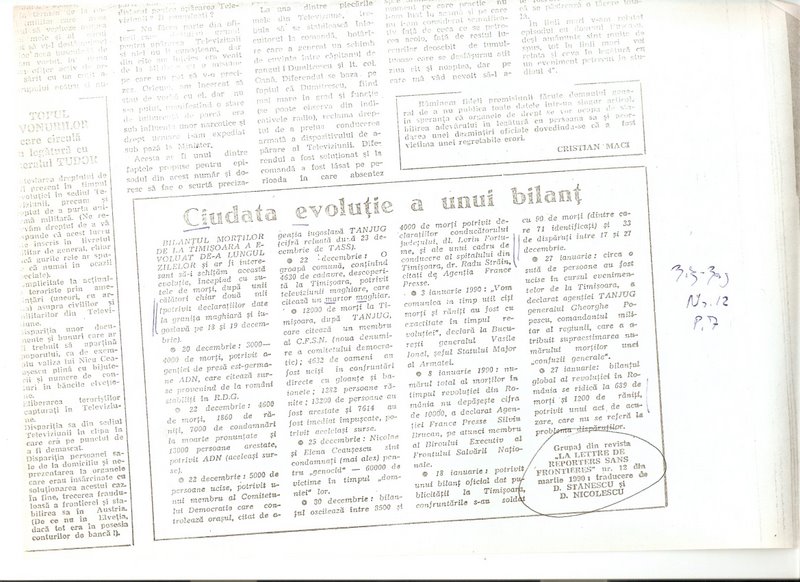
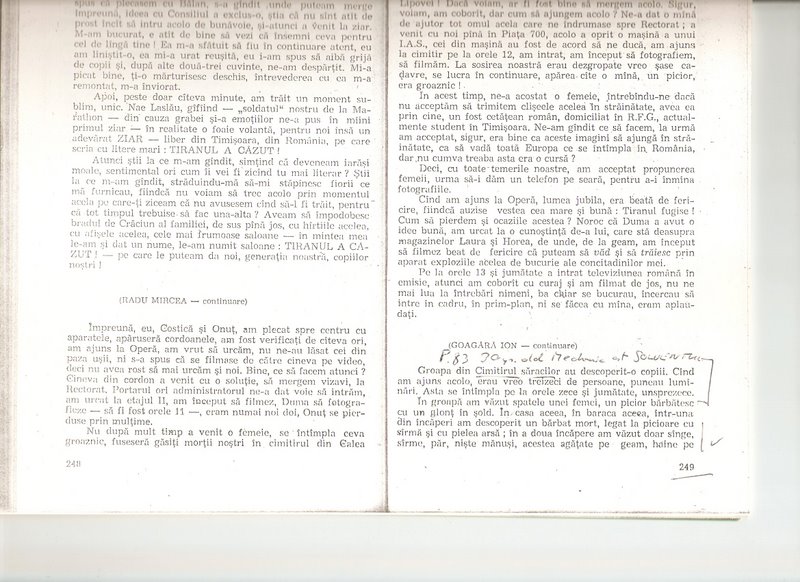

 “Renaşterea Bănăţeană” din 16 ianuarie 1990 anunţînd despre groapa comună din cimitirul eroilor
 “Renaşterea Bănăţeană” 16 ianuarie 1990, pag. 3
 Comunicatul garnizoanei Timişoara după ce s-a aflat de groapa comună din cimitirul eroilor, publicat în “Renaşterea Bănăţeană” din 18 ianuarie 1990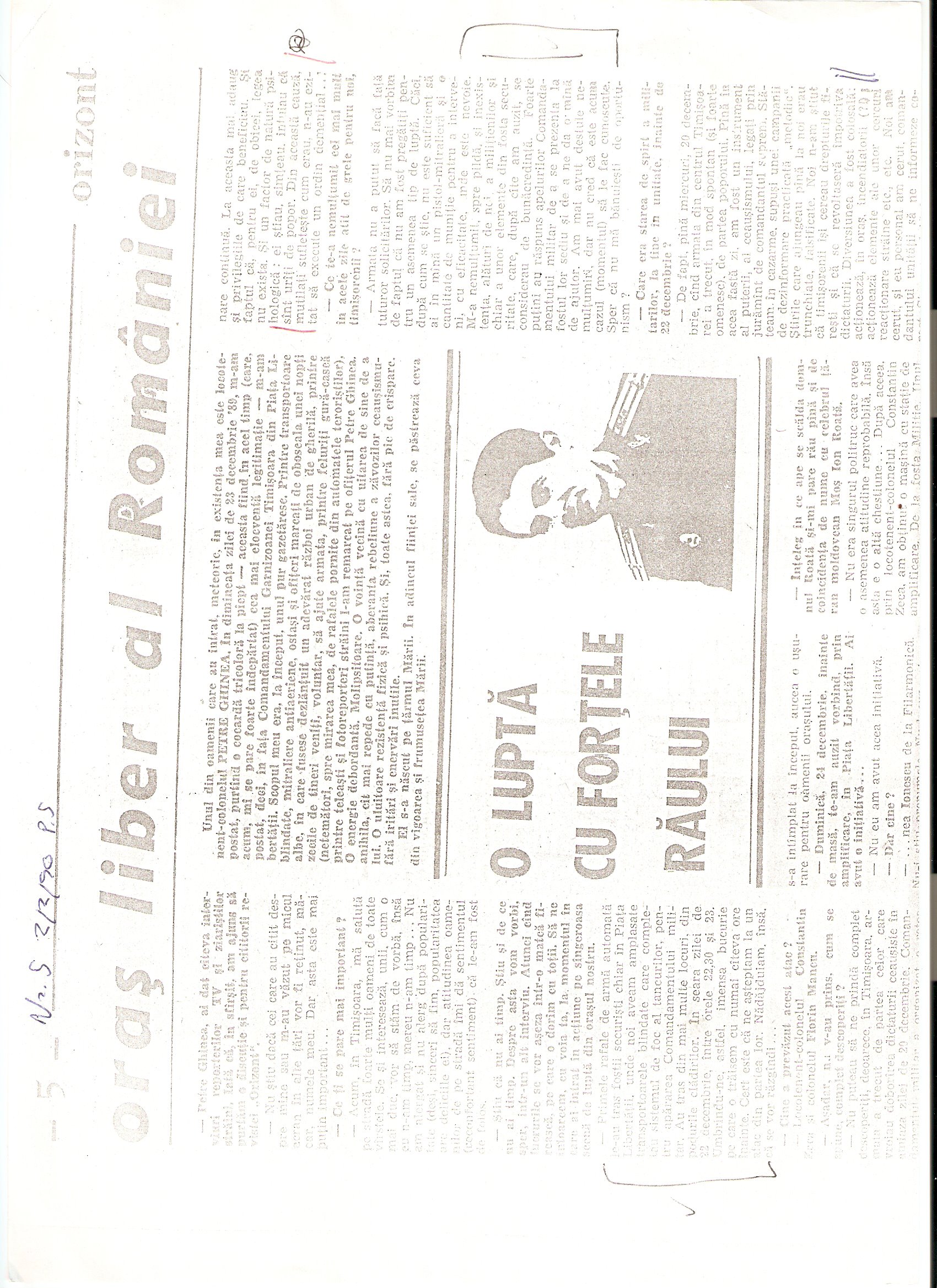
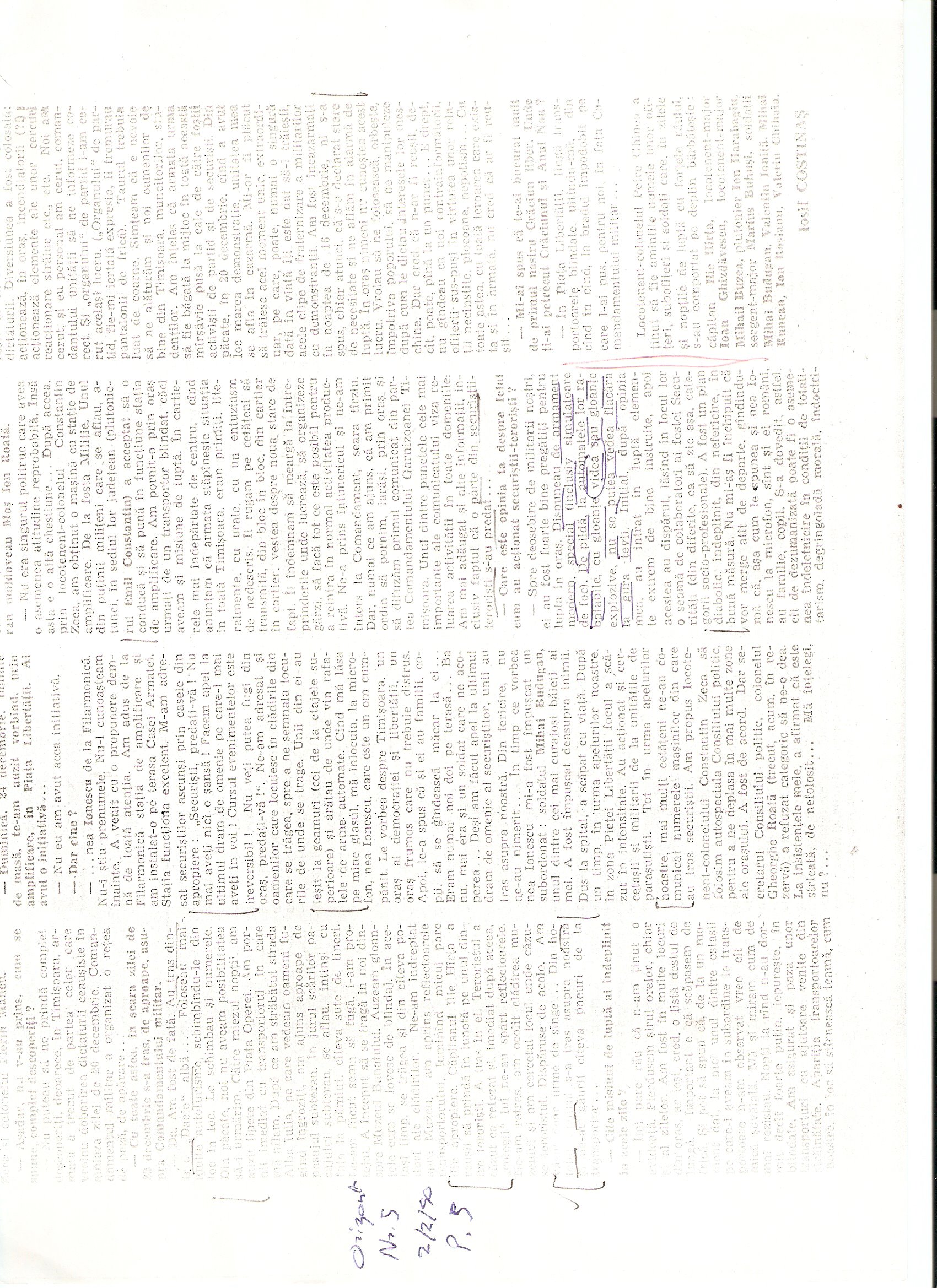


 The Archive of the Romanian Revolution of December 1989