The Archive of the Romanian Revolution of December 1989

A Catch-22 December 1989, Groundhog-Day Production. Presenting the Personal Research & Scholarship of Richard Andrew Hall, Ph.D.

Posts Tagged ‘nicolae ceausescu’

Romania December 1989. ‘Mos G(h)erila’: Nicolae Ceausescu’s Final and Lasting ‘Christmas Gift’ to His Romanian Subjects

Posted by romanianrevolutionofdecember1989 on May 1, 2010

THE ROMANIAN REVOLUTION FOR DUM-DUMS:

(like me…and perhaps even you)

by Richard Andrew Hall, Ph.D.

Standard Disclaimer: All statements of fact, opinion, or analysis expressed are those of the author and do not reflect the official positions or views of the Central Intelligence Agency (CIA) or any other U.S. Government agency. Nothing in the contents should be construed as asserting or implying U.S. Government authentication of information or CIA endorsement of the author’s views. This material has been reviewed by CIA to prevent the disclosure of classified information.

I am an intelligence analyst for the Central Intelligence Agency. I have been a CIA analyst since 2000. Prior to that time, I had no association with CIA outside of the application process. [Submitted for clearance 22 April 2008, approved 22 May 2008]


I have been researching the Revolution for the better part of the past 18 years. I first visited Romania in 1987 while backpacking through Europe, and I spent a total of about 20 months in the country during the years 1990, 1991, 1992, 1993-1994, and 1997, when I conducted pre-dissertation, dissertation, and post-dissertation research on the Revolution.

I have written on the topic of the Revolution, voluminously some might say, publishing in 1996, 1999, and 2000 before joining the Agency, and since I entered the Agency in 2002, 2004, 2005, and 2006.

It will and should be hard to believe for the outsider to this problem, but my work has been essentially the only systematic, ongoing investigation of the ballistics evidence—such are the shortcomings of small “communities of interest” investigating a peripheral historical topic and the perils of “group think.”

This article is, for lack of a better description, about “connecting the dots.”


–The story of the Romanian Revolution of December 1989 since December 1989 has been the struggle of disparate voices who share their memories, often with great frustration and a sense of resignation. They are hardly a unified chorus.

The accounts of ideologues seek to suggest to us that “the truth” miraculously is the province of people of this or that particular political persuasion in post-communist Romania. That is morality play and fairy tale; it is not the work of the serious historian. Would that history were so neat and tidy! It is not.

Instead, what one finds is that the people with the details that matter most are spread across the ideological and political spectrum—including people with what many of us might term distasteful, illiberal, ultranationalist, and nostalgic views.

There are those who relate these details in a narrative consistent with where those details lead.

There are those who relate these details even though it contradicts their narrative and ultimate conclusions about December 1989.

Finally, there are those—and there are many of them—who just know they experienced what they experienced. They aren’t sure exactly how it fits in with a larger narrative: they merely want to tell their story.

Together, they relate these details in the face of cynicism, indifference, and an often stunning intellectual conceit and deaf ear.

Theirs, however, and not the ideologues’, is the story of December 1989.


There was a lot of talk during the crimes of December ’89 about the special bullets with which the young and old alike were killed, bullets which—it is said were not in the arsenal of our military units. There was so much talk that there was no more to say and after there was no more to say for a sufficient amount of time the discussion was reopened with the line “such things don’t exist!” The special bullets didn’t exist!—our highest authorities hurried to tell us…In order to search for proof a little work is necessary by our legal organs that they are not terribly inclined to take….

[Dan Badea, “Gloante speciale sau ce s-a mai gasit in cladirea Directiei a V-a,” Expres, 16-22 April 1991]

image-8

image-7

The Internet allows the researcher to piece together history as never before. That’s a pretty bland statement, but the reality of it never ceases to amaze me. Take the case of those killed in the Romanian Revolution of December 1989 (officially 1,104 people perished in those events). Scroll through the list of those killed on the procesulcomunismului (“the trial of communism”) and portalulrevolutiei (“the portal to the revolution”) websites. For most, there is only limited information about the circumstances in which they died. For others, however, there is greater detail. As one scrolls through the names and photos, one of the similarities that begins to become apparent is that in cases where there is more information about the circumstances of the death, dum-dum bullets are mentioned. Thus, for example, we find the following five cases:

BUTIRI Florin, born in Joia Mare, 11 April 1969, he was living in Bucharest and was employed by the Bucharest Metro. He played rugby. On 22 December he participated in the demonstration at Sala Dalles [next to University Square]. On 23 December he went to defend the Radio Broadcast center on str. Nuferilor, and while he was saving some old people from a burning building he was shot. Brought to the Military Hospital because of a wound to his hip, caused by a dum-dum cartridge, they tried to ampute a leg. His stomach was also ravaged by a bullet. On 26 December 1989 he died. (http://www.procesulcomunismului.com/marturii/fonduri/ioanitoiu/aeroi/docs/album_2.htm)

FILOTI Claudiu
Profession: Lieutenant major UM 01171 Buzau, post-mortem Captain
Born: 30 July 1964
Birthplace: Vaslui
Date of death: 22 December 1989
Place of death: Bucharest, in the area of the Defense Ministry
Cause of death: Shot in the chest with dum-dum bullets (http://www.portalulrevolutiei.ro/index.php?menu=1&jud=53)

LUPEA Ion- Gabriel from Hunedoara, born in 1970…In 1989 he was sent from Bucharest to Anina [Resita], then to UM 01929. On 9 December 1989, he went on leave, but he was recalled. On the evening of 23 December he was on duty defending the unit [Anina-Resita], at the checkpoint, when around 11 pm they were attacked from the front and from the left flank. While crawling on hands and knees to bring more ammunition he was hit by a dum-dum bullet that entered above his left leg and exited through his left hand. Brought to the hospital he died Christmas Eve, making him the unit’s first hero; he was posthumously awarded the rank of sub-lieutenant. (http://www.procesulcomunismului.com/marturii/fonduri/ioanitoiu/aeroi/docs/album_5.htm)

MANESCU Dan, born 25 March 1964, a student in the Transportation Department, he joined with the other young people on 21 December and participated in the demonstrations in the center of the town [Bucharest]. Friday morning he went with his brother to the demonstrations and he returned after the flight of the dictator. He changed his clothes and returned for good, when on the night of 22/23 December a dum-dum bullet punctured his stomach in Palace Square. Brought to the Emergency hospital, he could not be saved. (http://www.procesulcomunismului.com/marturii/fonduri/ioanitoiu/aeroi/docs/album_5.htm)

POPTEAN Petre, born 27 December 1965, in Margau near Huedin, living in Bucharest…he worked as a driver for the Bucharest Transportation Department. On 21 December he went into town to protect his sister on her way home from work. The two of them left on Calea Victoriei and arrived at [Sala] Dalles, where in horror they watched…Petre called to his sister to aid the wounded. While on the ground, he was hit in the abdomen and left hip by dum-dum cartridges that caused him major wounds. His sister, Monica, was able to stop an ambulance with a Targoviste license number, but he didn’t make it to Hospital 9. At around 6 pm Petre passed away. (http://www.procesulcomunismului.com/marturii/fonduri/ioanitoiu/aeroi/docs/album_7.htm)

Let me draw the attention of the reader to two important details here. First, the use of dum-dum munitions was not confined to Bucharest (multiple locations), but includes the southwestern city of Resita (the case of Ion Lupea). Second, the use of dum-dum munitions occurred not just after communist dictator Nicolae Ceausescu fled at midday on 22 December 1989, but also before, on the evening of 21 December (the case of Petre Poptean).

Dum-dum bullets—which fragment and cause substantially more and more lethal damage to the organs of those who are hit—are outlawed by international convention (see more below). Moreover—or perhaps better-put, officially—no Romanian institution had them in their arsenal in December 1989. Yet, as we can see, almost two decades after the events, the obituaries of those gunned down in December 1989 include references to those munitions as having played a role not only in the wounding of people, but also in their deaths.

Despite the claims above attesting to not just the wounding, but the death of several people (civilians and soldiers) over several days in several locations from dum-dum bullets in December 1989, what did General Dan Voinea—removed from his post in December 2007 by Attorney General Laura Codruta Kovesi for violating basic judicial norms in another case[1]—who headed the investigations into December 1989 for well over a decade, have to say about them in late 2005? “Such things didn’t exist!”:

Romulus Cristea: “Did special ammunition, bullets with a vidia tip or dum-dum bullets, claim [any] victims? The press of the time was filled with such claims…”

Dan Voinea: There were no victims (people who were shot) from either vidia bullets or dum-dum bullets. During the entire period of the events war munitions were used, normal munitions that were found at the time in the arsenal of the Interior Ministry and the Defense Ministry. The confusion and false information were the product of the fact that different caliber weapons were used, and therefore, the resulting sound was perceived differently.[2] (Emphasis added)

So, there is no wiggle room here, no room for misinterpretation: according to Prosecutor Voinea , nobody was killed by dum-dum bullets in December 1989.

That’s a common claim among officials of the former communist regime—Voinea was a military prosecutor since 1982 and he was directly involved in the trial of the Ceausescus. Such conclusions were also repeated in late 2005 by Dr. Vladimir Belis, who was the head of the Medical Forensics Institute (IML) in Bucharest in December 1989: asked if other than the standard 7.62 mm caliber weapons belonging to the Army were used, he did not know and couldn’t say because he claimed no autopsies were ever performed.[3] The apparent official disinterest in munitions and autopsies is—ahem—shall we say “interesting” given the comments attributed to Belis’ subordinates and to doctors at Bucharest’s main hospitals—comments made in the early 1990s, but also made well over a decade later, in the mid 2000s.[4]

General Dan Voinea spoke in late 2005. Voinea’s argument that there were no dum-dum bullets, that there were no atypical munitions used, is directly linked to his contention that there were therefore “no terrorists” in December 1989. It has been routinely repeated in various forms by the media for well over a decade and by his supporters in intellectual circles at home and abroad. The encomia for General Voinea before and since that December 2005 interview by noted Romanian intellectuals and Romanianists are breathtaking. Tom Gallagher refers to him as the “indefatigable General Voinea”[5] and Western journalists have described him as “a one-man mission to uncover the truth about exactly what happened during those days.”[6] Sorin Iliesiu justifies his claims about the Revolution squarely on Voinea’s words:

General Dan Voinea has said clearly: The terrorists did not exist. Those who seized power lied to protect the real criminals….The diversion of the ‘terrorists’ has been demonstrated by [the] Justice [System], not a single terrorist being found among the dead[7], wounded[8] or arrested[9].”[10][11]

Highly problematic and damning for General Dan Voinea, Dr. Vladimir Belis, and fellow deniers are the following, detailed written testimonies of Gheorghe Balasa and Radu Minea presented by Dan Badea in April 1991, attesting to what they had found in December 1989 in the headquarters of the Securitate’s Fifth Directorate:

Balasa Gheorghe: From [Securitate] Directorate V-a, from the weapons depot, on 23-24 December 1989, DUM-DUM cartridges, special cartridges that did not fit any arm in the arsenal of the Defense Ministry were retrieved. Three or four boxes with these kinds of cartridges were found. The special bullets were 5-6 cm. in length and less thick than a pencil. Such a cartridge had a white stone tip that was transparent. All of these cartridges I personally presented to be filmed by Mr. Spiru Zeres. All the special cartridges, other than the DUM-DUM [ones] were of West German [FRG] make. From Directorate V-a we brought these to the former CC building, and on 23-24 December ’89 they were surrendered to U.M. 01305. Captain Dr. Panait, who told us that he had never seen such ammunition before, Major Puiu and Captain Visinescu know about [what was turned over].

In the former CC of the PCR, all of those shot on the night of 23-24 December ’89 were shot with special bullets. It is absurd to search for the bullet in a corpse that can penetrate a wall…

[of course, V-a worked hand-in-hand with the USLA, or the Securitate’s “special unit for anti-terrorist warfare,” and thus it was not suprising that in Directorate V-a’s headquarters…] Among things we also found were:…the training manual for the USLA. It was about 25 cm thick, and while there, I leafed through about half of it…[and I also came across] a file in which lots of different people under the surveillance of USLA officers were listed…

(Interviewed by Dan Badea, “Gloante speciale sau ce s-a mai gasit in cladirea Directiei a V-a,” Expres, 16-22 April 1991.)

Moreover, we know from the 2005 publication of the testimony of a detained V-th Directorate officer dated 2 February 1990, that he must have been asked to comment specifically on the existence of dum-dum ammunition—since he makes a point of emphasizing that “we didn’t have dum-dum ammunition or weapons with special properties, of foreign origin.”[12] So, in other words, we know from this interrogation document that six weeks after the Revolution, those who had taken power or at least the military prosecutors of the time were still interested in the existence of these munitions—thereby suggesting that they must have had some reason for believing in their existence, say for example the character of the injuries suffered by those shot during the events, as well as perhaps recovered bullet fragments, the testimonies of the doctors who operated on those wounded, etc…

Voinea’s ceaseless interviews and revelations during this period have been reprinted repeatedly since they took place and his conclusions been given wide circulation by journalists and people such as Sorin Iliesiu. Yet those who just relate what happened in December 1989 continue to mention the existence of dum-dum munitions. Thus, if one turns to the tourism site for the western border town of Curtici (near Arad) one can read the following about the history of the city, including the events of December 1989:

The following night [at the train station], the first team of five doctors from the Austrian “Lorenz Bohler” Hospital , who arrived in Curtici with a “hospital-wagon” took 18 people in critical condition to Austria for special treatment that lasted two to three months. That is, they needed organ transplants or special care, because of the monstrous results of dum-dum bullets.[13]

Or take the case of a poster on the 18th anniversary of the Revolution, who begins:

The Romarta (central Bucharest) file? What about the file on those who fired at me at the Astronomical Observatory on Ana Ipatescu Boulevard or those who at 1700 on 24 December fired near Casa Scanteii [press building] where I found a dum-dum cartridge in my bed—us having had to sleep in the bathroom.[14]

Finally, there are the cynical comments of those—no matter what they believe about December 1989—who cannot help but remember the dum-dum munitions and the horrible pain and trauma they caused their victims, many still living with the consequences of those wounds today…and how nobody wishes to remember them; for them, this is essentially a cruel, open secret.[15]

Unfortunately, no one in Romania has tied together such claims and the evidence I present above. I do not know how many of these people are still alive, but if the Romanian media were interested, the names are there for them to contact in order to confirm the claims above: Gheorghe Balasa, Radu Minea, Spiru Zeres, Major Puiu, and Captain Visinescu.

D’oh…Dum-Dum…(Tweedle) Dumb and (Tweedle) Dumber: Dum-Dum=Vidia

image-14

When I first viewed the youtube video “Romanian Revolution USLA attack Dec 23 1989 Revolutia” (http://www.youtube.com/watch?v=YlBRSxUVQ5E ), what struck me was: here, finally, after a decade and a half of almost unopposed revisionist denial, here was someone who claims to have been an eyewitness and has photos and details of the incident, and who maintains the now almost heretical idea that the Securitate’s “Special Unit for Anti-terrorist Warfare”(USLA for short) had indeed attempted to attack the heavily-guarded Defense Ministry Headquarters on Drumul Taberei in Bucharest on the night of 23-24 December 1989! But, in fact as we shall see, although important, that is actually not the most important thing about the one and only youtube video posted by “destituirea.”

For me the transcript of the USLA unit claiming to have witnessed army units attacking their own ministry and thus the supposed reason that the USLA men who witnessed it “had to be silenced by being killed”—a transcript leaked to the press in 1993 and which led scholars such as Denis Deletant and Peter Siani-Davies to consider this “case closed” essentially—was always highly problematic. It supplied what was said, but, if we are to believe the words of the USLA Commander Gheorghe Ardeleanu, speaking to the notorious Securitate cheerleader Angela Bacescu, it did not supply the much needed context: Ardeleanu claimed that he had been placed under arrest and that it was he who chose the names of the USLA officers who were to report to the Defense Ministry. The USLA units thus came in a situation in which those who had taken control of the country were in the Defense Ministry holding their commander under arrest.[16]

But more importantly, the transcript could not explain a) the lack of any corroboration since of these supposed Army units attacking the Defense Ministry on the night of 23-24 December 1989—truly hard to believe, given all the young recruits and given their comparative willingness to talk to the media after all these years, in comparison to the former Securitate, and b) the claims in summer 1990 by the Army cadre who had been involved in the firefight with the USLA and the interviews of civilians in the surrounding blocs of flats who had lived through the fighting in December 1989 and related what they had seen.[17] The interviewees had detailed the suspicious actions of the USLA convoy and made it clear that they came with less-than-friendly intentions.

Now, here, 17 years after those famous articles by Mihai Floca and Victor Stoica is a video supporting the claim that the USLA units attempted to force their way into the Defense Ministry. The photos of the inside of the USLA ABI vehicles and of the dead USLA men (wearing black jumpsuits underneath Army clothing) are perhaps the most extensive and detailed seen to date, and the anonymous poster plays coy as to where he got them from (he claims he does not want to reveal the source—something which, given the sensitivity of the issue, I am not surprised by).

But, as I mentioned previously, it is actually not the confirmation of this understanding of the Defense Ministry incident that is the most significant thing about this youtube video. It is at the 2:01-2:05 of 8:50 mark of this silent video that the poster makes the following interesting and critical insight/claim…

USLA’s bullets were called “vidia” or “dum-dum” were usually smaller than the regular army’s bullets…Most of the capital’s residents have found this type of bullets all around the military buildings near by. (at 2:01 of 8:50)[18]

And thus, it becomes clear that the discussion of “vidia” bullets and “dum-dum” bullets is interchangeable (or at least is treated as such)! (Hence, perhaps why Romulus Cristea asked his question of General Voinea as he did in December 2005: “Did special ammunition, bullets with a vidia tip or dum-dum bullets, claim [any] victims? The press of the time was filled with such claims…”) “Vidia” translates as “grooved,” and thus describes the modified feature of the bullets which makes them so lethal, thereby making the treatment of vidia and dumdum as de facto synonyms understandable.

This is critical because as I have previously written in detail, citing interviews and reminiscences in the Romanian press…vidia bullets showed up across the country in December 1989. In “Orwellian…Positively Orwellian: Prosecutor Voinea’s Campaign to Sanitize the Romanian Revolution of December 1989” (http://homepage.mac.com/khallbobo/RichardHall/pubs/Voineaswar091706.html) I detail examples of vidia bullets showing up across the country—Brasov, Sibiu, Bucharest (multiple locations), Braila, Caransebes, Craiova, and Hunedoara—as recounted by civilians and Army personnel, at various times since the events—not just during or right after. Such wide dispersion of the use of officially non-existent munitions is critical too because it infirms the notion that somehow demonstrators or the Army put their hands on such “free floating weapons” and used them during the December 1989 events—that it would have happened in one or two places could be explained, but that the same thing would happen in so many geographic centers is scarcely plausible.

Recall from our earlier extract from Prosecutor Dan Voinea’s December 2005 interview, his unambiguous denial of the use of vidia munitions. Nevertheless, significantly, since that interview we continue to find people who remember what they remember and they remember the use of vidia munitions. I have found yet more references. Alexandru Stepanian, who writes under the motto “Dreptate si Onoare! (Justice and Honor!),” not only claims to still have a vidia bullet from 22-23 December 1989 in the area around the TV Station in Bucharest, but he has placed a photo of it on the portalulrevolutiei website.[19] In fall 2006, the daughter of a priest recalled:

In December ’89, after he arrived from Timisoara, my father stayed with me on Stefan Cel Mare Boulevard. When we returned to our home, on the corner of Admiral Balescu and Rosenthal. I found the cupboard of the dresser pure and simple riddled with bullets, about 8 to 10 of them. Someone who knew about such things told me they were vidia bullets. They were brought to a commission, but I don’t know what happened to them.[20]

In 2007 a book entitled The Tales of the Terrorists was published in Galati. In one section, a Eugen Stoleriu recounts his dispatch to Bucharest as a military recruit during the events and how for the first time in his life he came across vidia bullets that were shot at him.[21]

Another apparent synonym for “vidia” is “crestata” or “notched.” I take it that the reference is to the same type of munitions because the damage caused to those wounded by them was equally catastrophic. In December 2007, Alexandru Tudor, a soccer official famous apparently for his stern, unsmiling demeanor, who was shot on 23 December 1989 around 10 am in the area of Piata Aviatorilor near the TV studio, recounted the episode that ended his career:

They brought me to Colentina Hospital and there I had the great fortune of two great doctors. If they had operated on me, they would have to amputate both my legs beneath the knee, but instead they left the bullets in there 12 days. Their explanation was that the bullets were too close to arteries, and since they were gloante crestate (notched bullets), it was very dangerous. After they were removed, I kept the bullets, I have them at home. I was on crutches for six months, I went through therapy, but I had to give up soccer.[22]

Also on the 18th anniversary of the Revolution, a frustrated poster to another site asked pointedly:

Who in Romania in 1989 had 5.5 mm caliber NATO-type munition, that in addition was “notched”—something outlawed by the Geneva Convention, while it is known that the Romanian Army had only the caliber used by Warsaw Pact nations for their weapons, that is to say 7,62 mm….At that time even the Olympic speed shooting champion, Sorin Babii, expressed his surprise….I had in my hand several samples of this cartridge: small, black, with a spiral on the top, or with 4 cuts (those who know a little bit about ballistics and medical forensics can attest to the devastating role caused by these modifications). I await a response to my questions…perhaps someone will be willing to break the silence. I thank you in advance. [emphases added][23]

In other words, the existence of crestate/vidia/dum-dum bullets is known, and not everyone has so blithely forgotten their existence.

A Dum-Dum by Any Other Name: Gloante explosive (exploding bullets), gloante speciale (special bullets)

Crestate, vidia, dum-dum…by now we know: these are very dangerous munitions…

In the field of firearms, an expanding bullet is a bullet designed to expand on impact. Such bullets are often known as Dum-dum or dumdum bullets. There are several types of dum-dum designs. Two popular designs are the hollow point (made during the manufacturing phase) and X-ing made usually by the user by making two notches perpendicular to each other on the tip of the bullet, commonly with a knife. The effect is that the bullet deforms and sometimes fragments upon impact due to the indentations. This creates a larger wound channel or channels with greater blood loss and trauma.

The hollow-point bullet, and the soft-nosed bullet, are sometimes also referred to as the dum-dum, so named after the British arsenal at Dum-Dum, near Calcutta, India, where it is said that jacketed, expanding bullets were first developed. This term is rare among shooters, but can still be found in use, usually in the news media and sensational popular fiction. Recreational shooters sometimes refer to hollow points as “JHPs”, from the common manufacturer’s abbreviation for “Jacketed Hollow Point”.

To be most correct, the term “Dum Dum Bullet” refers only to soft point bullets, not to hollow points, though it is very common for it to be mistakenly used this way.

The Hague Convention of 1899, Declaration III, prohibits the use in warfare of bullets which easily expand or flatten in the body, and was an expansion of the Declaration of St Petersburg in 1868, which banned exploding projectiles of less than 400 grams. These treaties limited the use of “explosive” bullets in military use, defining illegal rounds as a jacketed bullet with an exposed lead tip (and, by implication, a jacketed base).[24]

Thus, under the synonym for dumdum/vidia/crestate bullets of “exploding bullets,” we find the following on the Internet:

On the evening of 27 December 1989, Eugen Maresi, 20 years old, a military draftee, was sent to organize a checkpoint on soseaua Chitilei, at the entrance to Bucharest….A group of 25 soldiers came under fire from the belltower of a church. Eugen was the first shot…. “The doctors told me my only child was shot with (gloante explosive) exploding bullets. The fragments shattered all of his internal organs,” says Dumitru Maresi, the father of the [Drobeta Turnu] Severin hero. http://2003.informatia.ro/Article42788.phtml

and

Gheorghe Nicolosu, was shot in the leg…After he was operated on, it was established that the bullet with which he was shot did not figure in [the arsenal of] the Romanian Army. Nicolosu was operated on in Hunedoara, then arrived in Italy, where he underwent another surgery…In the same area, on Lipscani, Cristea Valeria, 36 years old, was shot in the stomach by ammunition that did not belong to the army. He died a few hours later, the doctors trying to save his life, but the glontul exploziv (exploding bullet) perforated his intestines. Another youngster, 18 year old Ion Gherasim was shot in the back at the entrance to UM 01933 by munition that did not belong to the army. (Emphases added) http://www.replicahd.ro/images/replica216/special2.htm

Once again, we are speaking here of far-flung locations across the country—Chitila (Bucharest) and Hunedoara—which makes the idea of accident and “free floating weapons” unlikely.

Ammunition…Consistent with the Confessions of Former Securitate Whistleblowers

And so, who was it, who has told us about “exploding bullets” and “special cartridges” like this, and who has it been said possessed them in December 1989?

For years I have been essentially the sole researcher inside or outside the country familiar with and promoting the claims of 1) former Timisoara Securitate Directorate I officer Roland Vasilevici—who published his claims about December 1989 under the byline of Puspoki F. in the Timisoara political-cultural weekly Orizont in March 1990 and under the pseudonym “Romeo Vasiliu”—and 2) an anonymous USLA recruit who told his story to AM Press Dolj (published on the five year anniversary of the events in Romania Libera 28 December 1994…ironically (?) next to a story about how a former Securitate official attempted to interrupt a private television broadcast in which Roland Vasilevici was being interviewed in Timisoara about Libyan involvement in December 1989).

image-4

Vasilevici claimed in those March 1990 articles and in a 140 page book that followed—both the series and the book titled Pyramid of Shadows—that the USLA and Arab commandos were the “terrorists” of December 1989. What is particularly noteworthy in light of the above discussion about “exploding bullets” was his claim that the USLA and the foreign students who supplemented them “used special cartridges which upon hitting their targets caused new explosions.”[25]

image-16

The anonymous USLA recruit stated separately, but similarly:

I was in Timisoara and Bucharest in December ’89. In addition to us [USLA] draftees, recalled professionals, who wore black camouflage outfits, were dispatched. Antiterrorist troop units and these professionals received live ammunition. In Timisoara demonstrators were shot at short distances. I saw how the skulls of those who were shot would explode. I believe the masked ones, using their own special weapons, shot with exploding bullets. In January 1990, all the draftees from the USLA troops were put in detox. We had been drugged. We were discharged five months before our service was due to expire in order to lose any trace of us. Don’t publish my name. I fear for me and my parents. When we trained and practiced we were separated into ‘friends’ and ‘enemies.’ The masked ones were the ‘enemies’ who we had to find and neutralize. I believe the masked ones were the ‘terrorists’. [emphases added]

image-3

As I have pointed out, despite the short shrift given these two revelations by Romanian media and Romanianists, one group has paid close attention: the former Securitate. That is not accidental. [26]

With the advent of the Internet, unverifiable bulletin board postings also pop up. On 23 December 2003, under the name of “kodiak,” the following appeared:

In ’89 I was a major in the USLA…and I know enough things that it would be better I didn’t know…15, 16, 20, 30 years will pass and nothing will be known beyond what you need and have permission to know…” (http://www.cafeneaua.com)[27]

Clearly, the legal constraints of security oaths and fear continue to cast a long shadow, long after the events of December 1989.

Si totusi…se stie [And nevertheless…it is known]

It took over three years into my research on the Revolution—and physically being in the Library of the Romanian Academy—before I came to the realization: oh yeah, that’s a good idea, yeah, I should systematically compare what the former Securitate have to say about December 1989 and compare it with what others are saying. It took a maddening additional half year before I came to the conclusion: oh yeah, and how about what the Army has to say? It may seem ridiculous—and it is in some ways indefensible from the perspective of performing historical research—but you have to understand how Romanian émigrés dominated early investigations of the Revolution, and how they divided the post-communist Romania media into the pro-regime (untrustworthy) press and the opposition (trustworthy) press, and the influence this “research frame” and methodology had at the time upon younger researchers such as myself.[28]

A more systematic mind probably would have come to these revelations long before I did. Instead, it took the accidental, simultaneous ordering of issues from 1990 and 1991 of the vigorous anti-Iliescu regime university publication NU (Cluj), the similarly oppositional Zig-Zag (Bucharest), and the former Securitate mouthpiece Europa to discover this. There I found Radu Nicolae making his way among diametrically opposed publications, saying the same things about December 1989. And it mattered: the source for example of Radu Portocala’s claim that there were “no terrorists” in December 1989 was Radu Nicolae. But more important still, was the discovery of Angela Bacescu revising the Defense Ministry incident, exonerating the USLA, and claiming there were no Securitate terrorists in Sibiu (only victims) in Zig-Zag…only to show up months later in Romania Mare and Europa months later writing the same stuff, and in the case of the Sibiu article republishing it verbatim. Nor was Bacescu alone among the former Securitate at Zig-Zag: she was for example joined by Gheorghe Ionescu Olbojan, the first to pen revisionist articles about the Army’s DIA unit.[29]

But without a broader comparative framework and approach to the Romanian media, all of this eluded the highly partisan Romanian émigré writers on the events. Nestor Ratesh alone among this group did seem puzzled and bothered by the similarity of Romania Libera Petre Mihai Bacanu’s conclusions on the V-th Directorate and those of Bacescu (he only alluded to her dubious reputation, however, and did not name her.) But Bacanu was fallible: memorably, but also upstandingly, in December 1993, he admitted based on what he claimed were new revelations, that his previous three and a half years of exonerating the USLA had been in vain since they were erroneous: they had after all played a significant role in the repression and killing of demonstrators on the night of 21-22 December 1989 in University Square. That alone should have precipitated a rethinking about assumptions and approaches to investigating the December 1989 events and particularly the role of the Securitate and the USLA, but it did not, and has not to this day…

image-19

Romanians and Romanianists like to indulge in the reassuring myth that the “schools” of research on the Revolution were separate from the beginning—that the defining feature was the political orientation of the author and whether he or she viewed the events of December 1989 as a revolution or coup d’etat. To the extent they are willing to admit that discussions of the “terrorists” cross-pollinated and became intertwined across the borders of the political spectrum, they assume that this must have happened later, after views had become consolidated.[30] But such a view is simply ahistorical and wishful-thinking. It is simply impossible to defend honestly when you have Angela Bacescu who “showed up with lots of documents and didn’t need any money” and wrote her revisionist tracts in the oppositional Zig-Zag, when she and Olbojan were the first ones to voice theses that later became staples of the anti-Iliescu opposition—long after they had left its press.

It is indicative that Romanians still have yet to confront this methodological flaw that one of the few studies in the country to read Securitate and Army sources in addition to journalist and participant accounts, still failed to address the key similarities across the political spectrum regarding the existence and identity of the “terrorists.” Smaranda Vultur wrote in a review of Ruxandra Cesereanu’s (otherwise, groundbreaking in comparison to what had appeared before it in Romanian in book form) Decembrie ’89. Deconstructia unei revolutii (Iasi: Polirom 2004):

Beyond this, I would underscore however a deficit that results directly from the choice of the author to classify her sources based on how the source defines the events: as a revolution, a plot, or a hybrid of the two. Because of this one will thus find, contained in the same chapter, Securitate people and political analysts, revolutionaries and politicians of the old and new regimes, and journalists.[31]

In other words, my exact indictment of the approach inside and outside Romania to the study of the Revolution, and the reason why people are simply unable to acknowledge the similarity and even identicality of views of the “terrorists.”

After the aforementioned realizations in 1993-1994 about the need to be more comparative and systematic in investigating accounts of the Revolution, it took yet another two maddening years before I started to realize the significance of the ballistics evidence. It thus came comparatively late in the dissertation process. My timing was fortuitous, however. I wrote a short article in November 1996 that was published in two different forms in 22 and Sfera Politicii in December 1996—the mood in Romania was euphoric as seven years of the Iliescu regime had just come to an end through the ballot box. [32] True, it didn’t spark debate and loosen some lips as I had hoped, but it made my visit to Bucharest the following June —especially my interviews on one particular day with a journalist at Cotidianul and, several hours later, a member of the Gabrielescu Parliamentary Commission investigating the events (Adrian Popescu-Necsesti)—memorable to say the least….

image-12

image-11

image-10

Of course, not then, or even since, has anybody who has investigated the December 1989 events inside or outside Romania systematically attempted to replicate, test, or expand upon my earlier findings—other than myself. As I have noted elsewhere,[33] in Peter Siani-Davies’ otherwise excellent The Romanian Revolution of December 1989 he devotes essentially a paragraph to the ballistics’ topic in a 300 plus page book—and it is only in the context of addressing my own earlier research. Monica Ciobanu could thus not be more wrong in her declaration that Peter Siani-Davies’ 2005 volume had disproven the “myth of Securitate terrorists.”[34] Siani-Davies has nothing to say about dum-dum/vidia/exploding ammunition: hence why he does not believe in Securitate terrorists!

Since then, I have written on Securitate revisionism, “the terrorists,” and the ballistics evidence of Romanian Revolution of December 1989, in the words of one critic who seems unable to call things by their name “voluminously, although never exhaustively, elsewhere”—publishing in 1999, 2000, 2002, 2004, 2005, and 2006. [35] Now, more than a decade after those original ballistics’ articles, I return here putting things together I should preferably have put together long before…

The high stakes of what was at play in late December 1989 become all the clearer here. Nicolae Ceausescu’s successors faced not only the dilemma of having foreign citizens arrested for firing at and killing in cold blood Romanian citizens[36], but members of a Romanian state institution—the Securitate—in addition to those foreign citizens, had injured, maimed, and killed Romanian citizens using munitions that were outlawed by international conventions to which Romania was a party. Thus, beyond the culpability of an institution that was key to the ability of the nomenklaturists who had seized power to continue in power—i.e. the Securitate—and who undoubtedly had compromising information on those leaders, the new potentates were faced with a problem of international dimensions and proportions.

Dan Badea’s April 1991 article with which I opened this paper concluded thusly:

There are in these two declarations above[–those of Gheorghe Balasa and Radu Minea–] sufficient elements for an investigation by the Police or Prosecutor’s Office. [Dan Badea, “Gloante speciale sau ce s-a mai gasit in cladirea Directiei a V-a,” Expres, 16-22 April 1991]

That, of course, never appears to have happened. I hope that the information I have supplied above—significantly, much of it new, much of it from the Internet in recent years—should at the very least encourage Romanians and Romanianists to reopen and reexamine the ballistics evidence. Let us hope that on the twentieth anniversary of the Revolution, we may be able to read serious investigations of the ballistics evidence, rather than be subjected to the false and jaded refrain… such things did not exist!


[1] See, for example, Dorin Petrisor, “Procurorul Voinea, acuzat ca a lucrat prost dosarul Iliescu 13 iunie 1990,” Cotidianul, 7 December 2007, online edition. Voinea’s removal generally went unpublicized abroad—it was understandably not a proud day for his supporters. Kovesi claimed to have been taken aback by Voinea’s inexplicable, seemingly incompetent handling of the June 1990 files.

[2] General Dan Voinea, interview by Romulus Cristea, “Toti alergau dupa un inamic invizibil,” Romania Libera, 22 December 2005, online edition. Cristea’s apparent effort/belief—shared by many others—to suggest that it was only “the press of the time”—something I take to mean December 1989 and the immediate months after—that was filled with such claims and accusations is untrue. (The suggestion is to say that civilians with no knowledge of weapons and munitions repeated rumors spread out of fear and fueled by those who had seized power but needed to create an enemy to legitimize themselves and thus exploited those fears…) For examples of such claims “in the press of the time,” see the words of an employee of the Municipal Hospital (“In the room was a boy, very badly wounded by dum-dum bullets that had blown apart his diaphragm, his sacroiliac, and left an exit wound the size of a 5 lei coin,” Expres no. 10 (6-12 April 1990), p. 5) and the discussion of how Bogdan Stan died (“vidia bullets which explode when they hit their ‘target,’ entered into the bone marrow of his spine,” Adevarul, 13 January 1990). But such claims also appear long after the December 1989 events. Two and a half and three years after the December 1989 events, Army Colonel Ion Stoleru maintained in detail that the “terrorists” had “weapons with silencers, with scopes, for shooting at night time (in ‘infrared’), bullets with a ‘vidia’ tip [more on this and the relation to dum-dum munitions below]. Really modern weapons” and added, significantly, “The civilian and military commissions haven’t followed through in investigating this…” (see Army Colonel Ion Stoleru with Mihai Galatanu, “Din Celebra Galerie a Teroristilor,” Expres, no. 151 (22-28 December 1992), p. 4, and “Am vazut trei morti suspecti cu fata intoarsa spre caldarim,” Flacara, no. 29 (22 July 1992), p. 7.) Voinea’s steadfast denials would seem to validate Stoleru’s allegations more than a decade after he made them. Not surprisingly, but highly unfortunate, Cristea’s interview with Voinea forms the basis of conclusions about the terrorists on the Romanian-language Wikipedia webpage on the Revolution: see http://ro.wikipedia.org/wiki/Revolu%C5%A3ia_rom%C3%A2n%C4%83_din_1989.

[3] Laura Toma, Toma Roman Jr. , and Roxana Ioana Ancuta, “Belis nu a vazut cadavrele Ceausestilor,” Jurnalul National, 25 October 2005, http://www.jurnalul.ro/articole/34668/belis-nu-a-vazut-cadavrele-ceausestilor. “Frumos (Nice)…” as the Romanians say. Belis may not have interested himself in the ballistics evidence—but some of his employees apparently did (see IML Dr. Florin Stanescu’s comments in Ion Costin Grigore, Cucuveaua cu Pene Rosii (Bucharest: Editura Miracol, 1994), pp. 70-72). Moreover, there were exhumations. (“For a long time the Brasov Military Prosecutor didn’t do anything, even though there existed cases, declarations, documents, photos and even atypical unusual bullets brought in by the families of the deceased and wounded.” http://www.portalulrevolutiei.ro/forum/index.php?topic=1.msg214) On 14 June 1990, General Nicolae Spiroiu, future Defense Minister (1991-1994), appears to have been in the city of Brasov, assisting at the exhumation of people killed there during the December 1989 Revolution. Such a step was a rarity, and apparently followed earlier talks between Spiroiu, five other officers, and the staff of the local newspaper Opinia, who were seeking clarification over who was responsible for the deaths of their fellow citizens. “They found in particular bullets of a 5.6 mm caliber that are not in the Army’s arsenal,” wrote the journalist Romulus Nicolae of the investigation. (Romulus Nicolae, “Au ars dosarele procuraturii despre evenimente din decembrie,” Cuvintul, no. 32 (August 1991), pp. 4-5, cited in Richard Andrew Hall, “Orwellian…Positively Orwellian: Prosecutor Voinea’s Campaign to Sanitize the Romanian Revolution of December 1989,” http://homepage.mac.com/khallbobo/RichardHall/pubs/Voineaswar091706.html.)

[4] Dr. Nicolae Constantinescu, surgeon at Coltea Hospital: “I remember that on 1 or 2 January ’90 there appeared at the [Coltea] hospital a colonel from the Interior Ministry, who presented himself as Chircoias. He maintained in violent enough language that he was the chief of a department from the Directorate of State Security [ie. Securitate]. He asked that all of the extracted bullets be turned over to him. Thus were turned over to him 40 bullets of diverse forms and dimensions, as well as munition fragments. I didn’t hear anything back from Chircoias or any expert. Those who made the evidence disappear neglected the fact that there still exist x-rays and other military documents that I put at the disposition of the [Military] Prosecutor.”

( http://www.romanialibera.ro/a113826/revolutia-5-000-de-victime-nici-un-vinovat.html)

[5] Tom Gallagher, Modern Romania: The End of Communism, the Failure of Democratic Reform, and the Theft of a Nation, (NY: New York University Press, 2005), p. 190.

[6] Jeremy Bransten, “Romania: The Bloody Revolution in 1989: Chaos as the Ceausescus Are Executed,” RFE/RFL, 14 December 1999 at http://www.rferl.org/specials/communism/10years/romania2.asp. This unfortunate comment aside, Brantsen’s series is an excellent journalistic introduction to the December 1989 events.

[7] Iliesiu is dead wrong. See the signed testimony to the contrary by Ion Lungu and Dumitru Refenschi dated 26 December 1989, reproduced in Ioan Itu, “Mostenirea teroristilor,” Tinerama, no. 123 (9-15 April 1993), p. 7. I translated the important parts of this document in Hall, “Orwellian…Positively Orwellian” http://homepage.mac.com/khallbobo/RichardHall/pubs/Voineaswar091706.html. Significantly, according to this document, Dr. Belis had access to the dead terrorists:

image-16

Dead Terrorists. Although their existence is vehemently denied by all official institutions, we are able to prove that they existed and have sufficient details to identify them.…We continue with some excerpts of the declaration of Ion Lungu, head of the group of fighters who guarded the ‘Institute of Legal Medicine’ [IML, the main Bucharest morgue], beginning from the evening of 22 December 1989:

“Starting from the 23rd, there were brought, in succession, more ‘special’ corpses. They were brought only by military vehicles and were accompanied by officers. They were all dressed the same: kaki uniforms, with or without military insignia, fur-lined boots, cotton underwear. All the clothes were new. The established procedure at that point was that when the bodies were unloaded from the trucks, at the ramp to the back of the IML, to be disrobed and inspected. The documents found were released to Prosecutor Vasiliu and criminology officers. The weapons and munitions we found and surrendered—on the basis of a verbal procedure—to the officer on duty from UM 01046. Weapons and ammunition were found only on those ‘special’ corpses. Those who brought them said that they were terrorists. I turned over to this military unit five pistols (three Stecikin and two Makarov—all 9 mm caliber), two commando daggers and hundreds of 9 mm and 7.62 mm cartridges (compatible with the AKM machine gun). They were held separately from the other corpses, in a room—I believe that it used to be the coatroom—with a guard at the door.…

Access to the room with the terrorists was strictly forbidden. Only Prosecutor Vasiliu, criminologist officers, Dr. Belis, and the chief of autopsies could enter. On top of them, next to the arms, there were personal documents, passports (some blank), all types of identity cards—one of them was clearly false, it stated that the dead terrorist was the director at Laromet (at that plant no director died)—identity cards that were brand new, different service stamps in white. All had been shot by rifles (one was severed in two) and showed evidence of gunshots of large caliber. Some had tattoos (they had vultures on their chests), were young (around 30 years old), and were solidly built. I believe that their identity was known, since otherwise I can’t explain why their photographs were attached to those of unidentified corpses. They were brought to us in a single truck. In all, there were around 30 dead terrorists. [The document is signed by Ion Lungu and Dumitru Refenschi on 26 December 1989]”

[8] Once again Iliesiu is wrong. Professor Andrei Firica at the Bucharest “Emergency Hospital” apparently also was paid a visit by Colonel Chircoias (aka Ghircoias), see fn. 4. He claims that he “made a small file of the medical situations of the 15-20 suspected terrorists from [i.e. interned at] the Emergency Hospital,” but as he adds “of course, all these files disappeared.” Firica reports that a Militia colonel, whom he later saw on TV in stripes as a defendant in the Timisoara trial [i.e. Ghircoias], came to the hospital and advised him “not to bring reporters to the beds of the terrorists, because these were just terrorist suspects and I didn’t want to wake up one day on trial for having defamed someone” (!) The colonel later came and loaded the wounded terrorist suspects into a bus and off they went. (Professor Andrei Firica, interview by Florin Condurateanu, “Teroristii din Spitalul de Urgenta,” Jurnalul National, 9 March 2004, online edition.) Cited in Hall, “Orwellian…Positively Orwellian” http://homepage.mac.com/khallbobo/RichardHall/pubs/Voineaswar091706.html.

[9] I don’t even know where to begin on this one. As I have written before, not all of those detained were terrorists, and many of the terrorists seemed to have eluded arrest, but there are so many accounts of people arrested as terrorists who legitimately fit that description that I don’t even know where to begin. See the multiple translations in Hall, “Orwellian…Positively Orwellian” http://homepage.mac.com/khallbobo/RichardHall/pubs/Voineaswar091706.html.

[10] Sorin Iliesiu, “18 ani de la masacrul care a deturnat revoluţia anticomunistă,” 21 December 2007, found at http://www.romanialibera.com/articole/articol.php?step=articol&id=6709 (note: this is NOT the Romania Libera daily newspaper). One will find many well-known names in the West among those who signed this petition: Dragoş Paul Aligică, Matei Călinescu, Ruxandra Cesereanu, Anneli Ute Gabanyi, Tom Gallagher, Gabriel Liiceanu, Norman Manea, Nicolae Manolescu, Mircea Mihaies, Ion Mihai Pacepa, Horia-Roman Patapievici, Radu Portocală, Nestor Ratesh, Lavinia Stan, Stelian Tănase, Alin Teodorescu, and Vladimir Tismăneanu. Sorin Iliesiu, who is a filmmaker and Vice President of the “Civic Alliance” organization, has written that he was part of the “team” that “edited” the seven page chapter on the Romanian Revolution contained in the Report of the Presidential Commission to Analyze the Communist Dictatorship of Romania (PCACDR). He is not a scholar and most certainly not a scholar of the December 1989 events. A textual comparison of the Report’s chapter on the Revolution and Vladimir Tismaneanu’s chapter in a Dawisha and Parrott edited volume from 1997 is unambiguous: the introductory two paragraphs of the Report’s chapter are taken verbatim in translation from p. 414 of Tismaneanu’s 1997 chapter, and other verbatim paragraphs, sentences, and phrases from pp. 414-417 make up parts of the rest of the Report’s Revolution chapter without any reference to the 1997 chapter. As the author(s) of an earlier chapter in the Report cite(s) Tismaneanu’s 1997 chapter (see p. 376 fn. 55) correctly, this leaves really only two possible explanations for the failure of Iliesiu et. al. to cite that they have borrowed wholesale from Tismaneanu’s 1997 chapter: a) an absence of scholarly knowledge, or b) an attempt to mask their dependence upon and deference to Tismaneanu, the Chair of the Commission, since the citations that do appear are the exact citations from the 1997 chapter and claims are translated word-by-word, so much so that Iliesiu et. al. did not even bother to change verb tenses despite the passage of a decade. Iliesiu et. al. can attempt to avoid answering questions and attempt to change the subject, but the textual analysis is unambiguous: Tismaneanu’s unattributed 1997 chapter forms the bulk of the Report’s chapter on the Revolution. The only question that needs to be answered is: why and why are they unwilling to admit the textual identicality?

Fullscreen capture 10232009 82206 PM

image

[11] All of this eludes Charles King in his Winter 2007 Slavic Review essay “Remembering Romanian Communism.” In his five page essay, he pauses no less than four times to mention the Revolution, despite the fact that its coverage takes up barely one percent of the PCACDR report. He relates the most banal of conclusions—“The report thus repeats the common view (at least among western academics) of the revolution as having been hijacked…”—yet misses or avoids what Iliesiu clearly seems most proud of: having inserted the claim that Nicolae Ceausescu was responsible for “only 162 deaths,” thereby insinuating Ceausescu’s successors bear responsibility for the other 942, and the claim to which such a reckoning is intimately related, namely Voinea’s that there were “no terrorists.” (It is interesting to note how Iliesiu et. al., the eternally suspicious of the state, miraculously become assiduous promoters of “official” and “state” claims once they turn out to be their own, thereby suggesting that their skepticism of the state is primarily situational rather than inherent—these are not equal opportunity skeptical and critical intellectuals.) King’s treatment of the Report is overall insufficiently informed, and as a consequence contextually-wanting and one-sided. He cites a handful of Romanian reviews of the Report, but they are almost uniformly positive accounts, almost as if supplied by the Chair of the Commission himself (see fn. 1, p. 718). He pauses to cite the former head of Radio Free Europe’s Romanian Research Division Michael Shafir’s 1985 book, yet makes no mention of Shafir’s trenchant criticisms (he gave the report a 7 out of 10 and mixed the positive with the negative) in a 1/12/07 interview in Ziua de Cluj, his extended critique “RAPORTUL TISMĂNEANU: NOTE DIN PUBLIC ŞI DIN CULISE” available in spring 2007 at http:// www.eleonardo.tk/ (no. 11), or his “Scrisoare (ultra)deschisa” in Observator Cultural no. 382 (25 July-1 August 2007) [given the timeline of scholarly publication, I am attempting to give King the benefit of the doubt here …He would certainly do well to read Shafir’s most recent discussion in Observator Cultural NR. 148 (406) 17 – 23 ianuarie 2008, “Despre clarificari nebuloase, plagiate, imposturi si careerism,” to see what a venerable critic and serious scholar was subjected to as a result of deigning to not wholeheartedly embrace the Report. Shafir’s treatment by the Report’s zealots has little to do with the liberal democratic view of the open society the Report’s authors ceaselessly profess.] Finally, had Charles King bothered to read Ciprian Siulea’s “Tentatia unui nou absolutism moral: Cu cine si de ce polemizeaza Vladimir Tismaneanu?” (Observator Cultural, nr. 379, 5-11 iulie 2007, once again conceivably within the publishing timeline) he might have refrained from parrotting the polarizing and unhelpful plebiscitary logic applied to the Report when he closed “The question is now whether the commission’s report will be used as yet another opportunity to reject history or as a way of helping Romanians learn, at last, how to own it” (p. 723). This, of course, suggests a certain infallible quality to the Report—which is far from the case—a conclusion only enhanced by King’s willingness to focus on the “hate speech” directed against the Report, but yet failing to cite and discuss any of the Romanian scholarly criticism of it.

[12] “Aghiotantii lui Ceausescu povestesc minut cu minut: O zi din viata dictatorului,” Romania Libera, 2 December 2005, online at http://www.romanialibera.ro/a5040/o-zi-din-viata-dictatorului.html. “Declaratie Subsemnatul TALPEANU ION, fiul lui Marin si Elena, nascut la 27 mai 1947 in comuna Baneasa, judetul Giurgiu, fost aghiotant prezidential cu grad de lt. col. in cadrul Directiei a V-a – Serviciul 1. Cu privire la armamentul din dotare arat ca, noi, aghiotantii aveam pistol “Makarov” cu 12 cartuse, iar sefii de grupa si ofiterii din grupa aveau pistolet “Makarov”, pistolet “Stecikin” si pistol-mitraliera AKM, cu munitie aferenta, care era cea obisnuita, in sensul ca nu aveam gloante dum-dum sau cu proprietati speciale, de provenienta straina.” (Dated 2 February 1990). His denial of dum-dum bullets is, of course, par for the course for former Securitate officers, who remember and thus “know nothing.”

[13] Quoted from http://www.tourismguide.ro/html/orase/Arad/Curtici/istoric_curtici.php. This raises an interesting point: there were foreign doctors who participated in Romania or in their home country in the surgery, treatment, and rehabilitation of those wounded. It would be interesting to hear what they remember and what they have to say regarding the munitions.

[15]Adina Anghelescu-Stancu refers to the “crippled and handicapped by dum-dum bullets” who do not number among Romania’s celebrities and about whom no one wishes to remember in today’s Romania, “Dureri care nu trec! (despre decembrie ‘89),” Gardianul, 18 December 2007, online at http://www.gardianul.ro/2007/12/18/editorial-c27/dureri_care_nu_trec_despre_decembrie_89_-s106259.html.

[16] I have examined the incident in detail several times, for the references to other works, see Richard Andrew Hall, “The Romanian Revolution as Geopolitical Parlor Game,” http://homepage.mac.com/khallbobo/RichardHall/pubs/checkmate040405.pdf, and Hall, “Orwellian…Positively Orwellian,” http://homepage.mac.com/khallbobo/RichardHall/pubs/Voineaswar091706.html.

[17] Once again, see “The Romanian Revolution as Geopolitical Parlor Game,” http://homepage.mac.com/khallbobo/RichardHall/pubs/checkmate040405.pdf, and “Orwellian…Positively Orwellian,” http://homepage.mac.com/khallbobo/RichardHall/pubs/Voineaswar091706.html. The critical articles were authored by Mihai Floca and Victor Stoica, who interviewed the Army cadre who had been involved in the incident and the residents of the surrounding apartment blocs who survived the fighting of those days.

[18] destituirea “Romanian Revolution USLA attack Dec 23 1989 Revolutia,” http://www.youtube.com/watch?v=YlBRSxUVQ5E

[19] For the photo see http://www.portalulrevolutiei.ro/documente/glont.htm; for one of his posts see http://www.portalulrevolutiei.ro/index.php?menu=6&pg=forum_thread.php&lnk=1&pagina=39. I cannot verify that this is indeed a “vidia” munition.

[20] Christian Levant, “Dacă tata nu-l salva pe Tokes, dacă nu salva biserici, tot se întâmpla ceva,” Adevarul, 30 September 2006, online at http://www.adevarul.ro/articole/dac-x103-tata-nu-l-salva-pe-tokes-dac-x103-nu-salva-biserici-tot-se-nt-mpla-ceva/200090.

[21] Cezar-Vladimir Rogoz, Povestirile teroristilor amintiri preluate si prelucrate de Cezar-Vladimir Rogoz, (Alma Print Galati 2007), p. 297, available online at http://www.bvau.ro/docs/e-books/2007/Rogoz,%20Cezar-Vladimir/povestirile_teroristilor.pdf.

[22]“A invatat sa zambeasca, [He learned how to smile],” http://marianmanescu.wordpress.com/2007/12/21/a-invatat-sa-zambeasca.

[25] Puspoki F., “Piramida Umbrelor (III),” Orizont (Timisoara), no. 11 (16 March 1990) p.4, and Roland Vasilevici, Piramida Umbrelor (Timisoara: Editura de Vest, 1991), p. 61.

[26] For the discussion of the former Securitate response to those who have violated the code of silence, see Hall, “Orwellian…Positively Orwellian,” http://homepage.mac.com/khallbobo/RichardHall/pubs/Voineaswar091706.html.

[28] I refer here to, for example, the works of Vladimir Tismaneanu, Matei Calinescu, Andrei Codrescu, Anneli Ute Gabanyi, Radu Portocala, and Nestor Ratesh. Some, like Tismaneanu in a 1993 article in EEPS, “The Quasi-Revolution and its Discontents,” were more explicit about this rather rigid dichotomous approach to the Romanian media, but it also comes through clearly in the sourcing, citations, and footnotes/endnotes of the others. (It continues to haunt the historiography of post-communist Romania, as works such as Tom Gallagher’s aforementioned Modern Romania make clear). To say the least, the issue of ballistics evidence essentially goes unanalyzed in these accounts. Moreover, although as we have seen, these authors have no problem affixing their names to petitions and the like, none of them has published any research on the December 1989 events since the early 1990s. It should tell you something that they continue to rely on and repeat the accounts they wrote in 1990 and 1991…as if nothing had been discovered or written since. In that way, it is almost fitting that the Report of the PCADCR reproduced Tismaneanu’s 1997 Dawisha and Parrott chapter in some places verbatim, down to failing to even change verb tenses when it states that certain questions “remain to be clarified.” I deconstructed the methodological faults in source selection in these émigré accounts in “The Romanian Revolution as Geopolitical Parlor Game” at http://homepage.mac.com/khallbobo/RichardHall/pubs/checkmate040405.html.

[29] For earlier discussions of all of this, see Richard Andrew Hall, “The Uses of Absurdity: The Staged-War Theory of the Romanian Revolution of December 1989,” East European Politics and Societies, vol. 13, no. 3, and Richard Andrew Hall, “The Securitate Roots of a Modern Romanian Fairy Tale,” Radio Free Europe East European Perspectives, April-May 2002, three part series, available at http://homepage.mac.com/khallbobo/RichardHall/pubs/romania%20securitate%205-2002.html.

[30] In “The Romanian Revolution as Geopolitical Parlor Game,” I demonstrated how even the so-called French and German schools (really the schools of Romanian émigrés in those countries) in 1990 were not and could not be independent from accounts in Romania, and that the accounts fed into and reinforced one another. It is simply intellectual myth—and an all too convenient one—to argue the antisceptic separation of these accounts as independent.

[31] Smaranda Vultur, “Revolutia recitita,” 22 no. 787 (9-15 April 2005) online at http://www.revista22.ro.

[32] Richard Andrew Hall, trans. Adrian Bobeica, “Ce demonstreaza probele balistice dupa sapte ani?” 22, no. 51 (17-23 December 1996), p. 10, and Richard Andrew Hall, trans. Corina Ileana Pop, “Dupa 7 ani,” Sfera Politicii no. 44 (1996), pp. 61-63.

[33] See my discussion in “Orwellian…Positively Orwellian,” at http://homepage.mac.com/khallbobo/RichardHall/pubs/Voineaswar091706.html.
[34] Monica Ciobanu’s review of Siani-Davies The Romanian Revolution of December 1989 and Tom Gallagher’s Modern Romania: Theft of a Nation is entitled “The Myth Factory” (found at http://www.tol.cz).

[35] Charles King, “Remembering Romanian Communism,” Slavic Review, Winter 2007, p 719. In King’s short article, he does not hesitate to make occasionally gratuitous citations for things he did not need to cite. Yet in discussing December 1989 and using the term “elsewhere”—which usually prefaces a description of “where else” one might find these things—there are no citations. “Although never exhaustively” is itself a gratuitous choice of words and far from accidental: in my last work on December 1989, I made light of how ridiculous it was for Daniel Chirot to claim that Peter Siani-Davies’ The Romanian Revolution of December 1989, an otherwise excellent work, was “near definitive” when so much was missing from Siani-Davies’ discussion—notably, for our purposes here, the question of dum-dum/vidia/exploding munitions. One could indeed be left with the impression that King intends to deliver a put-down, that some fellow Romanianists will no doubt catch, but yet deny the broader audience references to what he alludes and simultaneously protect his image from having delivered such a “palma” as the Romanians would say. It would appear that at least for readers of this paper, his goals won’t go completely fulfilled.

[36] See my discussion in “Orwellian…Positively Orwellian,” at http://homepage.mac.com/khallbobo/RichardHall/pubs/Voineaswar091706.html.
Posted in raport final, Uncategorized | Tagged: , , , , , , , , , , , , , , , , , , , , , , , , , , , , , , , , , , , , , , , , , , , , , , , , , , , , , , , , , , , , , , , , | 5 Comments »

decembrie 1989: in privinta ‘turistilor rusi,” cum au reactionat Securitatea si Ambasadorul Roman la Moscova? (documentele din Arhivele Ministerului Afacerilor Externe (AMAE), Telegrame, publicate de CWIHP)

Posted by romanianrevolutionofdecember1989 on March 14, 2010

Este nemaipomenit ca documentele diplomatice disponsible de pe site-ul Wilson Center (Cold War International History Project, www.wilsoncenter.org/topics/pubs/e-dossier5.pdf, vezi mai jos) n-au fost invocate, retraduse, sau folosite in nici un fel in Romania pana acum.  Daca cu adevarat regimul ceausist si mai ales securitatea credeau ca acesti “turisti rusi” sau “turisti sovietici” au fost agenti acoperiti si faceau o lovitura de stat, incepand cu evenimentele din Timisoara, de ce tocmai ei (“turisti rusi” in tranzit) au fost lasati sa calatoreasca prin tara dupa 17 decembrie 1989, si de ce “pericolul” acesta n-a fost ridicat in discutii diplomatice cu sovietici in aceste zile?


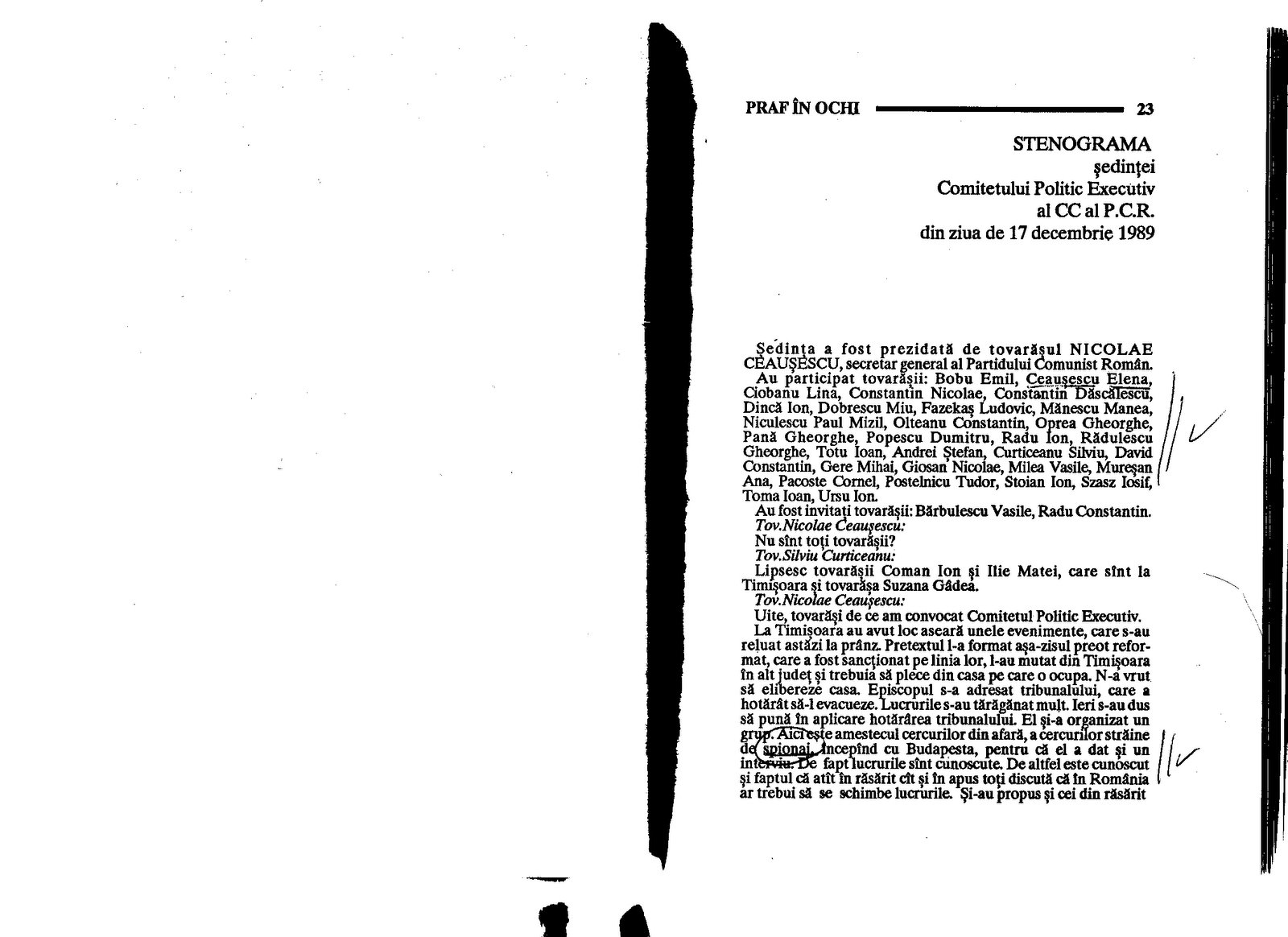
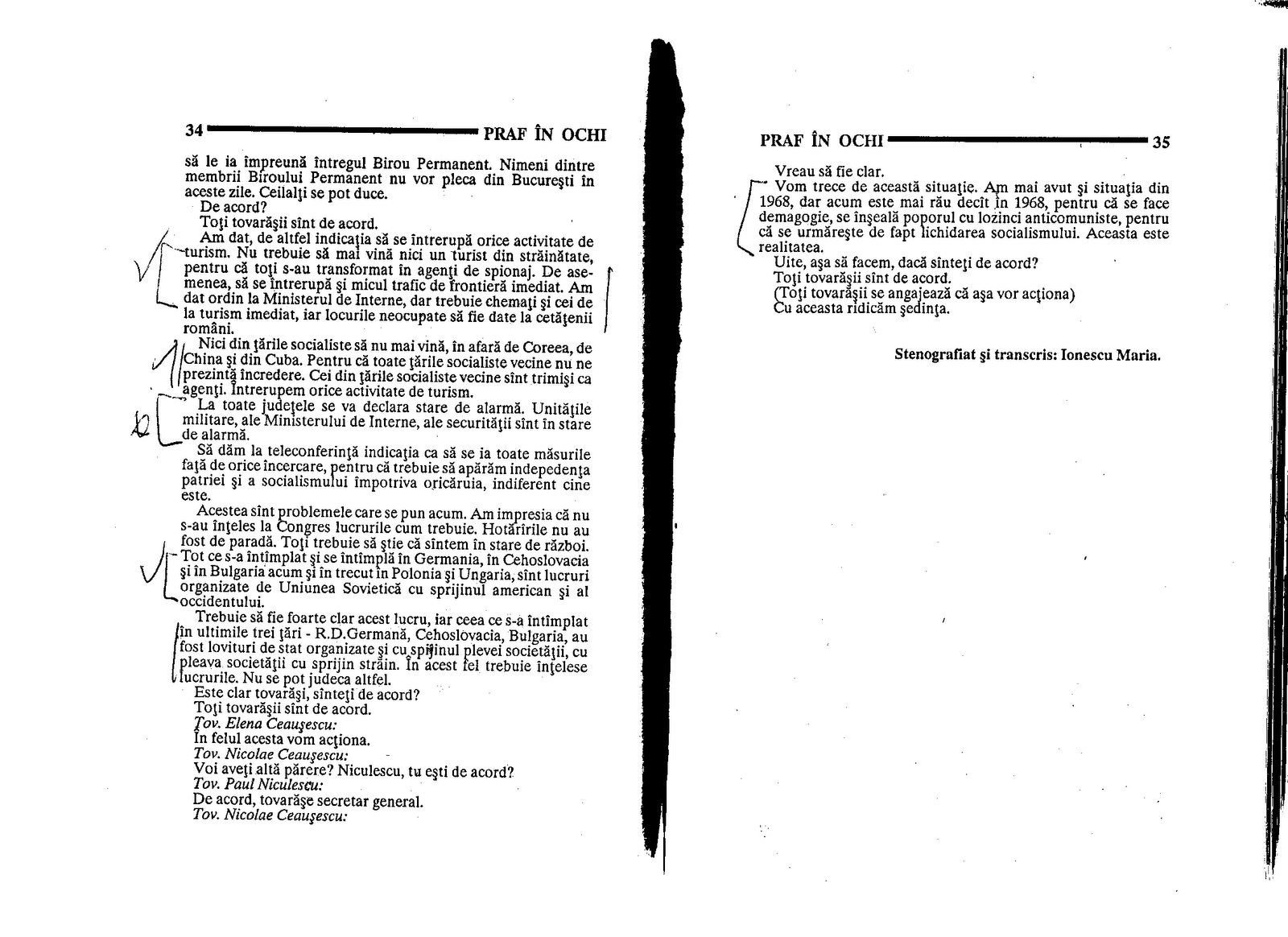
Este semnificativ ca Generalul Iulian Vlad, seful Securitatii, n-a suflat nici o vorba in timpul sedintei Comitetului Politic Executiv al CC al P.C.R. din ziua de 17 decembrie 1989 despre presupusi rolul “turistilor rusi” in ceea ce se intimpla la Timisoara.   DE FAPT IN NICI O TELECONFERINTA SAU SEDINTA CPExului din saptamana 17-22, NIMENI (CU EXCEPTIA LUI NICOLAE CEAUSESCU) N-AU VORBIT DESPRE ASA-ZISUL ROL AL “TURISTILOR RUSI/SOVIETIC” (De exemplu, vezi faptul ca nici Radu Balan sau Ion Coman n-a mentionat acest lucru in teleconferinta de 17 de la Timisoara http://mariusmioc.wordpress.com/2009/03/25/teleconferinta-lui-ceausescu-din-17-dec-1989/)  De ce?  Ideea venea din mintea lui Nicolae Ceausescu si faptul ca securistii si altii folosesc acest “argument” dupa decembrie 1989 vine numai dintr-o perspectiva RETROSPECTIVA:


from http://atomic-temporary-3899751.wpcomstaging.com/2009/11/27/the-1989-romanian-revolution-as-geopolitical-parlor-game-brandstatter%E2%80%99s-%E2%80%9Ccheckmate%E2%80%9D-documentary-and-the-latest-wave-in-a-sea-of-revisionism-part-iii/

In his 1992 book, he [the chief of the Securitate’s Counter-espionage Directorate, Colonel Filip Teodorescu] developed further on this theme, specifically focusing on the role of “Soviet tourists:”

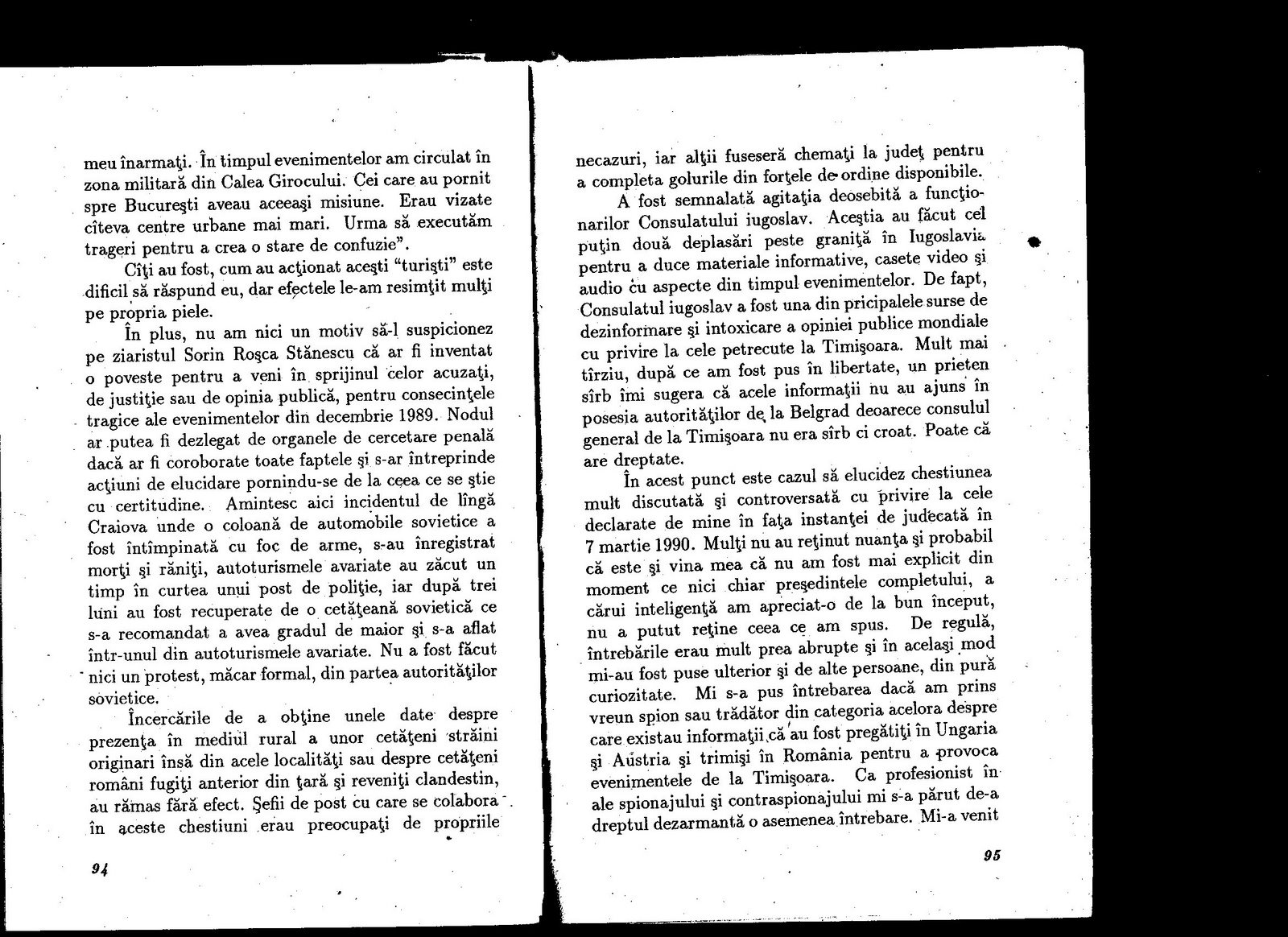
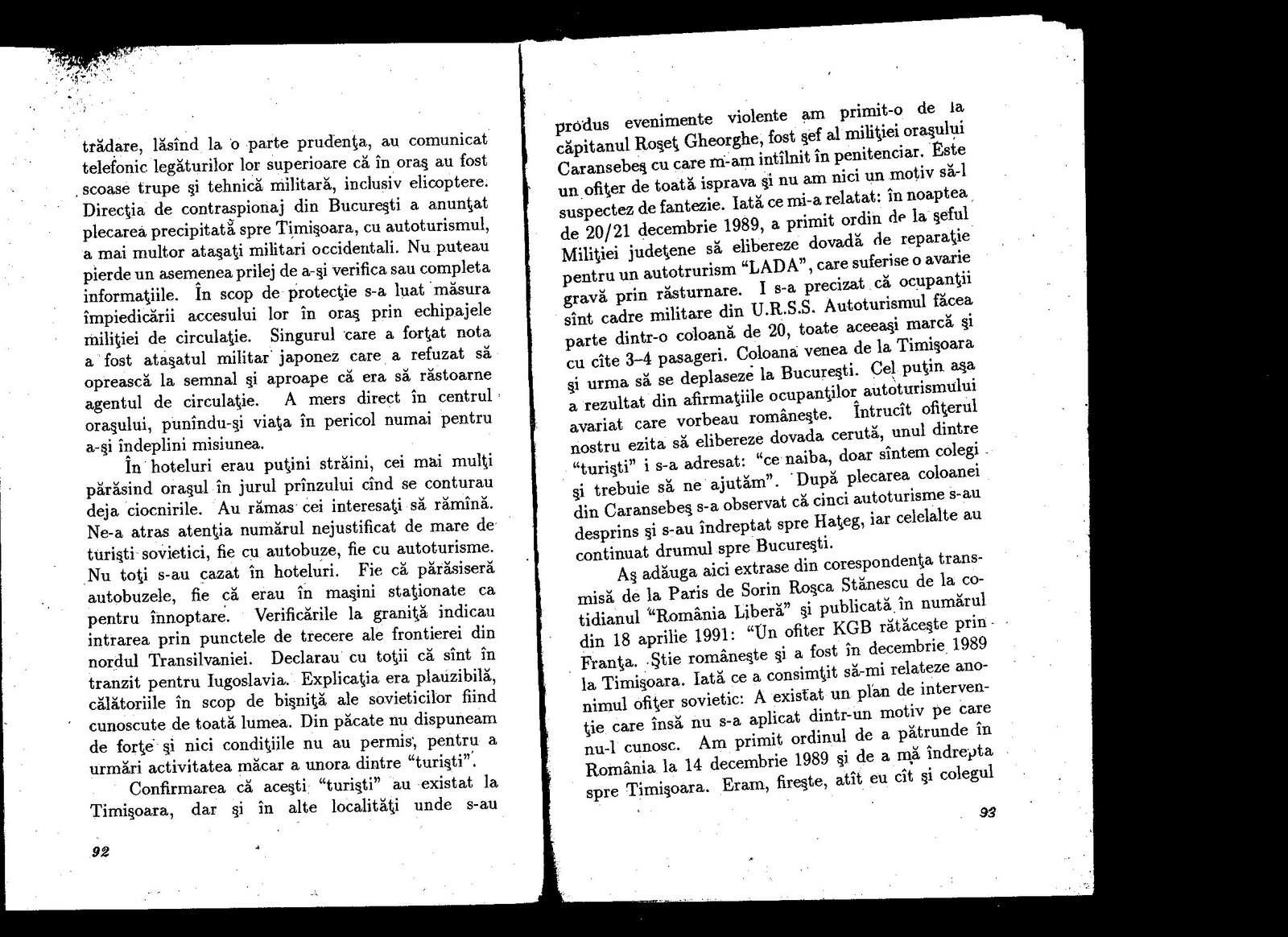
“There were few foreigners in the hotels, the majority of them having fled the town after lunch [on 17 December] when the clashes began to break out. The interested parties remained. Our attention is drawn to the unjustifiably large number of Soviet tourists, be they by bus or car. Not all of them stayed in hotels. They either had left their buses or stayed in their cars overnight. Border records indicate their points of entry as being through northern Transylvania. They all claimed they were in transit to Yugoslavia. The explanation was plausible, the Soviets being well-known for their shopping trips. Unfortunately, we did not have enough forces and the conditions did not allow us to monitor the activities of at least some of these ‘tourists’” (Teodorescu, 1992, p. 92).

As I have written before, if it was obvious before 18 December, as these Ceausescu regime officials claim, that “Soviet tourists” were involved in the events in Timisoara, then why was it precisely “Soviet travelers coming home from shopping trips to Yugoslavia” who were the only group declared exempt from the ban on “tourism” announced on that day (see AFP, 19 December 1989 as cited in Hall 2002b)?  In fact, an Agent France-Presse correspondent reported that two Romanian border guards on the Yugoslav frontier curtly told him:  “Go back home, only Russians can get through”!!!  The few official documents from the December events that have made their way into the public domain show the Romanian Ambassador to Moscow, Ion Bucur, appealing to the Soviets to honor the Romanian news blackout on events in Timisoara, but never once mentioning—let alone objecting to—the presence or behavior of “Soviet tourists” in Romania during these chaotic days of crisis for the Ceausescu regime (CWHIP, “New Evidence on the 1989 Crisis in Romania,” 2001).  It truly strains the imagination to believe that the Romanian authorities were so “frightened” of committing a diplomatic incident with the Soviets that they would allow Soviet agents to roam the country virtually unhindered, allowing them to go anywhere and do anything they wanted.

traducere de catre Marius Mioc http://mariusmioc.wordpress.com/2009/10/16/rich-hall-brandstatter-12/

După cum am mai scris înainte, dacă ar fi fost vădit înainte de 18 decembrie, după cum afirmă aceşti oficiali ai regimului Ceauşescu, că “turiştii sovietici” erau amestecaţi în evenimentele din Timişoara, de ce au fost tocmai “călătorii sovietici întorcîndu-se din excursiile pentru cumpărături din Iugoslavia” singurul grup care a fost exceptat de la interzicerea turismului anunţată în acea zi (vezi Agenţia France Presse, 19 decembrie 1989, după cum a fost citată în Hall, R. A., 2002, “The Securitate Roots of a Modern Romanian Fairy Tale: The Press, the Former Securitate, and the Historiography of December 1989” [Rădăcinile securiste ale unui basm românesc modern: Presa, fosta securitate şi istoriografia lui decembrie 1989], “Part 2: Tourists are Terrorists and Terrorists are Tourists with Guns” [Partea a 2-a: Turiştii sînt terorişti şi teroriştii sînt turişti înarmaţi], Radio Free Europe “East European Perspectives” [Radio Europa Liberă “Perspective est-europene], Vol. 4, nr. 8). În fapt, un corespondent al agenţiei France Press a relatat că doi grăniceri români de la graniţa cu Iugoslavia i-au spus tăios: “Întoarce-te acasă, numai ruşii au voie să treacă”!!! Puţinele documente oficiale despre evenimentele din decembrie 1989 care au devenit disponibile public îl arată pe ambasadorul român la Moscova, Ion Bucur, cerîndu-le sovieticilor să nu relateze despre evenimentele din Timişoara (după cum făcea şi presa română), dar fără să menţioneze niciodată, cu atît mai puţin să protesteze, faţă de prezenţa sau comportamentul “turiştilor sovietici” în România în timpul acelor zile haotice de criză pentru regimul Ceauşescu (CWHIP, “New Evidence on the 1989 Crisis in Romania,” 2001). Este o forţare a imaginaţiei să se creadă că autorităţile române erau aşa de “înfricoşate” de a provoca un incident diplomatic cu Uniunea Sovietică încît ar fi îngăduit agenţilor sovietici să cutreiere ţara nestingheriţi, lăsîndu-i să meargă oriunde şi să facă orice doresc.

——————————————————————————-

Document 1

Telegram from the Romanian Embassy in Moscow

to the Ministry of Foreign Affairs (Bucharest)

18 December 1989, 12:35 pm

Comrade Ion Stoian, Candidate Member of the Executive Political Committee

5

of the Central

Committee of the Romanian Communist Party (CC PCR), Foreign Minister,

1. We took note of your instructions (in your telegram nr. 20/016 750 of 17 December

1989)

6

and we will conform to the orders given.

We have taken actions to implement your instructions, both at the consular section of the

Embassy and at the General Consulate in Kiev.

[Furthermore] we would [like to] inform that the Director of the TAROM

7

office [in

Moscow] received, through his own channels, instructions regarding foreign citizens traveling to

our country.

2. Considering the importance of the problem and the nature of the activity of issuing

visas to Soviet citizens, we would like to mention the following problems [which have arisen],

[problems] to which we would like you to send us your instructions as soon as possible.

A. Beginning with the morning of 18 December of this year, Soviet citizens have begun

to make telephonic inquiries to the Embassy from border crossings into Romania, implying that

there are hundreds of vehicles which are not allowed to cross [the border] into our country. [W]e

anticipate that the Soviet government will ask for an explanation with regard to this decision

taken [by the Romanian government]. We ask that instructions be sent explaining the way we

must deal with the situation if it arises.

B. Continuously, at the Consular Section, we have given transit visas to Soviet Jews

who have the approval [of the Soviet government] to emigrate to Israel, as well as to foreign

students studying in the Soviet Union. Since the director of the TAROM office has received

instructions that he is to continue boarding transit passengers without any changes, we would like

to request instructions with regard to the actions we must take in such situations.

C. Considering the great number of Romanian citizens that are living in the Soviet

Union who during the holidays travel to our country, we would like to know if we should issue

them visas.

D. For business travel to Romania, the instructions given to TAROM are that the

applicants must show proof [of an invitation] from the ir Romanian partners.

Please inform whether we must inform the Soviet government of this requirement since

the official Soviet delegations use, for their travels to Bucharest, exclusively AEROFLOT

8

and

that we have no means of [us] controlling the planning of such travels.

5

Politburo

6

The 17 December telegram is not available at this time.

7

The state-owned Romanian National Airline— Transportul Aerian Român

8

Soviet Airlines.


Page 5

We are experiencing similar problems in dealing with the possible situation of Soviet

citizens with tourist passports, which have received a visa prior to the [17 December 1989]

instructions and who will be using AEROFLOT for their travel to Romania.

E. We request that the Civil Aviation Department send instruction to the TAROM office

regarding the concrete actions that should be taken in connection with the 20 December flight

[from Moscow to Bucharest] so that they are able to make the final decision, during boarding,

regarding the passengers [that are to be allowed on to the plane].

We would [like to] mention that the list of passengers is given to the Director of

TAROM, from AEROFLOT or other [travel] companies, without any mention of the purpose of

the trip.

(ss) [Ambassador] Ion Bucur

[Source: Archives of the Ministry of Foreign Affairs— Arhivele Ministerului Afacerilor Externe

(AMAE), Moscow/1989, vol. 10, pp. 271-272. Translated for CWIHP by Mircea Munteanu]

Document 2

Telegram from the Minister of Foreign Affairs (Bucharest) to all Embassies

19 December 1989

Cde. Chief of Mission,

In case you are asked during the exercise of your diplomatic attributes (we repeat: only in

case you are asked) about the so-called events taking place in Timisoara, reiterate, with all clarity,

that you have no knowledge of such events. After this short answer, and without allowing you to

be drawn into a prolonged discussion, resolutely present the following:

We strongly reject any attempts to intervene in the internal affairs of S.R. Romania, a free

and independent state. [We reject] any attempt to ignore the fundamental attributes of our

national independence and sovereignty, any attempt at [harming] the security interests of our

country, of violating its laws. The Romanian [government] will take strong actions against any

such attempts, against any actions meant to provoke or cause confusion, [actions] initiated by

reactionary circles, anti-Romanian circles, foreign special services and espionage organizations.

The [Romanian] socialist state, our society, will not tolerate under any circumstances a violation

of its vital interests, of the Constitution, and will take [any] necessary action to maintain the strict

following of the letter of the law, the rule of law, without which the normal operation of all

spheres of society would be impossible. No one, no matter who he is, is allowed to break the laws

of the country without suffering the consequences of his actions.

Instruct all members of the mission to act in conformity with the above instructions.

Inform [the Minister of Foreign Affairs] immediately of any discussions on this topic.

Aurel Duma [Secretary of State

9

, MFA]

[Source: Archives of the Ministry of Foreign Affairs— Arhivele Ministerului Afacerilor Externe

(AMAE), Ministry Telegrams, vol. 4/1989, pp. 387-388. Translated for CWIHP by Mircea

Munteanu.]

9

Assistant Deputy Minister— Secretar de State.


Page 6

Document 3

Telegram from the Romanian Embassy in Moscow

to the Ministry of Foreign Affairs

21 December 1989, 7:35 am

Cde. Ion Stoica, Minister [of Foreign Affairs],

Cde. Constantin Oancea, Deputy Minister [of Foreign Affairs],

DRI

10

On 20 December 1989, during a discussion with G. N. Gorinovici, Director of the

General Section for Socialist Countries in Europe, I expressed [the Romanian government’s] deep

indignation in regards with the inaccurate and tendentious way in which the Soviet mass media is

presenting the allegedevents taking place in Timisoara. I stressed that the stories made public by

radio and television are based on private, unofficial sources, and not on truthful information.

Many stories refer to the Hungarian press agency MTI, which is known for its antagonistic

attitude towards our country. I mentioned that V. M. Kulistikov, Deputy Chief Editor of the

publication Novoe Vremia, during an interview given to Radio Svoboda, expressed some opinions

vis-ŕ-vis Romania with are unacceptable. I brought to his [Gorinovici’s] attention the fact that on

19 December, Soviet television found it necessary to air news regarding the events in Timisoara

in particular, and in Romania in general, four separate occasions.

I argued that such stories do not contribute to the development of friendly relations

between our two countries and that they cannot be interpreted in any other way but as an

intervention in the internal affairs concerning [only] the Romanian government. I asked that the

Soviet government take action to insure the cessation of this denigration campaign against our

country and also to prevent possible public protests in front of our embassy. Gorinovici said that

he will inform the leadership of the Soviet MFA. In regards with the problems raised during our

discussion, he said that, in his opinion, no campaign of denigrating Romania is taking place in the

Soviet Union. “The mass media had to inform the public of the situation,” Gorinovici indicated,

in order to “counter-balance the wealth of information reaching the Soviet Union through

Western airwaves. Keeping silent on the subject would have only [served to] irritate the Soviet

public.” Following this statement, he recapitulated the well-known Soviet position with regards to

the necessity of allowing a diversity of opinions and ideas be expressed in the context of

informing the Soviet public about world events.

(ss) [Ambassador] Ion Bucur

[Source: Archives of the Ministry of Foreign Affairs— Arhivele Ministerului Afacerilor Externe,

Moscow/1989, vol. 10, pp. 297-298. Translated for CWIHP by Mircea Munteanu.]

10

Directia Relatii I— Directorate 1, Socialist Countries, Europe


Page 7

Document 4

Informational Note from the Romanian Embassy in Moscow

to the Ministry of Foreign Affairs (Bucharest)

21 December 1989, 8:00 am

Cde. Ion Stoian, Minister of Foreign Affairs,

Cde. Costantin Oancea, Deputy Foreign Minister,

DR1

During the evening of 20 December 1989, I was invited in audience at I. P. Aboimov,

Deputy Foreign Minister of USSR. He related to me the following:

1. Lately, the Soviet press published news in connection to events unfolding in Romania,

specifically with the events in Timisoara. It is true that some of the published materials are based,

generally, on foreign [i.e. not Romanian] sources. It is evident that the [Soviet] mass media need

information on the basis of which to inform the public. Aside from this, during meetings with

foreign journalists, there were many requests addressed to the Soviet [government] to state its

position in regards with the events taking place in Romania as they were presented by various

press agencies. Furthermore, during his recent visits in Brussels and London, [Foreign Minister

Edward] Shevardnadze

11

was asked to state his opinion vis-ŕ-vis those events. In London, after

the official talks ended,

12

the Soviet Foreign Minister had a difficult time convincing [Prime

Minister Margaret] Thatcher that there should be no comments to the press on the events

allegedly taking place in Romania. The [Romanian] Foreign Ministry is also informed that

interest in this matter was expressed during working meetings of the Second Congress of the

People’s Deputies taking place in Moscow at this time.

13

The [Soviet] ambassador in Bucharest

was instructed to contact the Romanian government and obtain, from authorized officials,

information to confirm or refute the version of the events distributed by foreign press agencies.

To this date, the Soviet Embassy was unable to obtain and transmit any such information.

Due to such problems, the Soviet government asks that the Romanian government send

an informational note, even one that is restricted [cu caracter închis] regarding the events that are

really taking place in Romania. [The Soviet government] is interested in receiving information

that is as comprehensive as possible. If information is not received, it would be extremely

difficult to create an effective set of directions for the Soviet mass media, with which there are,

even so, many difficulties. [The Soviet government] is worried that, based on the news reported

in the press, some of the deputies participating at the sessions, would ask that the 2

nd

Congress of

the People’s Deputies take a position vis-ŕ-vis the alleged events taking place in Romania. The

MFA prepared for the deputies an information note in which it stresses that it does not have any

official information, but it is possible that this argument will not accepted long. Based on the

information available to the MFA, the Congress will adopt a resolution with regards to the US

military actions in Panama.

Of course, there is no connection between the two events. In Panama, a foreign military

intervention is taking place, while in Romania the events are domestic in nature. I. P. Aboimov

stressed his previous request that the Romanian government send, in the spirit of cooperation

11

Edward Sevardnadze traveled to Brussels and London at the end of 1989. On 19 December he met at

NATO HQ with NATO Secretary General Manfred Woerner and Permanent Representatives of NATO

countries.

12

Prime Minister Thatcher met Shevardnadze in London on 19 December 1989.

13

The Second Congress of the People’s Deputies began its session on 12 December 1989.


Page 8

between the two countries, an informational note truthfully describing the current situation in the

country.

2. The Soviet MFA received a series of complaints that the border between the Soviet

Union and Romania has been closed for Soviet citizens, especially tourists. The Soviet

government was not previously informed with regards to this development. [T]his omission

causes consternation. The Soviet government is not overly concerned with the situation, but

[notes that] it creates difficulties with tourists that have already paid for and planned their

vacations accordingly.

3. With regards to the above statements, I said that I would, of course, inform Bucharest

of this. At the same time, I expressed the displeasure [of the Romanian government] with the fact

that the Soviet radio, television and newspapers have distributed news regarding events in

Romania taken from foreign news agencies, agencies that are distributing distorted and overtly

antagonistic stories regarding the situation in Romania. I gave concrete examples of such stories

published in newspapers such as Izvestia, Pravda, Komsomolskaia Pravda, Krasnaia Zvezda,

stories distributed by western press agencies as well as the Hungarian Press Agency MTI, which

is known for its antagonistic attitude towards our country. In that context, I mentioned that the

Romanian government has not requested that the Soviet Union inform it concerning events

unfolding in Grozny or Nagornîi-Karabah, nor has it published any news stories obtained from

Western press agencies, believing that those [events] are strictly an internal matter concerning

[only] the Soviet government.

I expressed my displeasure with the fact that some Soviet correspondents in Bucharest—

including the TASS correspondent— have transmitted materials from unofficial sources, which

contain untruthful descriptions of the events and which create in [the mind of] the Soviet public

an erroneous impression of the situation existing in our country. I stressed the point that such

behavior is not conducive to strengthening the relationship between our peoples and

governments, on the contrary, causing [only] serious damage [to said relationship]. I brought to

the attention of the Deputy Foreign Minister in no uncertain terms that a resolution of the

Congress of the People’s Deputies [concerning] the alleged events taking place in Romania

would be an action without precedent in the history of relations between the two countries and

would cause serious damage to the relationship.

At I. P. Aboimov’s question, I described the events regarding the situation of pastor

László Tökes, as described in your memorandum, stressing that this information does not have an

official character. I presented, in no uncertain terms, the decision of [the government of] Romania

to reject any attempts at interference in the internal matters of Romania. I expressed the decision

[of the Romanian leadership] to take any necessary measures against disruptive and diversionary

actions perpetrated by reactionary, anti-Romanian circles, by foreign special services and

espionage agencies (servicii speciale si oficinele de spionaj staine). With regard to the issue of

tourists crossing the border in Romania, I said that I did not posses an official communication in

this regard. I suggested that some temporary measures were adopted due to the need to limit

access of certain groups of tourists [in the country]. [Those limitats were imposed] due to

difficulties in assuring their access to hotel rooms and other related essential conditions. Those

limitations do not apply to business travel or tourists transiting Romania. I reminded [I. P.

Aboimov] that the Soviet government had introduced at different times such limitations on travel

for Romanian tourists to certain regions [of the Soviet Union] (Grozny and Armenia), which

[had] provoked dissatisfaction.

4. The conversation took place in a calm, constructive atmosphere.

(ss) [Ambassador] Ion Bucur


Page 9

[Source: Archives of the Ministry of Foreign Affairs— Arhivele Ministerului Afacerilor Externe

(AMAE), Telegrams, Folder: Moscow/1989, vol. 10, pp. 299-302. Translated for CWIHP by

Mircea Munteanu.]

Document 5

Information Note from the Romanian Embassy in Moscow

to the Ministry of Foreign Affairs

21 December 1989, 2:00 pm

Comrade Ion Stoica, Minister of Foreign Affairs,

1. On 21 December 1989, at 12:00 pm, I paid a visit to Deputy Foreign Minister I. P.

Aboimov to whom I presented a copy of the speech given by Comrade Nicolae Ceausescu,

General Secretary of the Romanian Communist Party [PCR] and President of the Socialist

Republic of Romania [SRR], on the 20 December 1989 over radio and television. I. P. Aboimov

made no comments with regard to the speech. He requested that the Soviet side receive

information as to whether,during the events taking place in Timisoara, any deaths had occurred

and what the current situation in the city was.

2. Aboimov said that during the 19 December discussions between the Soviet ambassador

in Bucharest and Cde. Nicolae Ceausescu, the latter expressed his disapproval with the official

declarations made by Soviet officials concerning the events in Timisoara. He [Ceausescu] said

that those [actions taking place in Timisoara] are the result of strategies developed beforehand by

[member nations of] the Warsaw Treaty Organization (WTO). [Ceausescu] suggested that certain

officials in Bucharest told ambassadors from socialist countries that they have information with

respect to the intention of the Soviet Union to intervene militarily in Romania.

As for the so-called official declarations [Aboimov added], they probably refer to a reply

made by Cde. E[dward] Shevardnadze, [Soviet] Minister of Foreign Affairs to a question from a

Western journalist during his trip to Brussels. [The question] referred to the events in Timisoara

and [the question of] whether force was used there. Cde. Shevardnadze answered that “I do not

have any knowledge [of this], but if there are casualties, I am distressed.” Aboimov said that, if

indeed there are casualties, he considered [Shevardnadze’s] answer justified. He stressed that E.

Shevardnadze made no other specific announcement in Brussels [with regards to the events in

Timisoara]. Concerning the accusations that the actions [in Timisoara] were planned by the

Warsaw Pact, and specifically the declarations with regard to the intentions of the USSR,

14

Aboimov said that, personally, and in a preliminary fashion, he qualifies the declarations as

“without any base, not resembling reality and apt to give rise to suspicion. It is impossible that

anybody will believe such accusations. Such accusations”— Aboimov went on to say— “have

such grave repercussions that they necessitate close investigation.”

He stressed that the basis of interaction between the USSR and other governments rested

on the principles of complete equality among states, mutual respect, and non-intervention in

internal affairs.

(ss) [Ambassador] Ion Bucur

[Source: Archives of the Ministry of Foreign Affairs— Arhivele Ministerului Afacerilor Externe

(AMAE), Moscow/1989, vol. 10, pp. 303-304. Translated for CWIHP by Mircea Munteanu.]

14

Ceausescu repeatedly accused the Soviet Union in December 1989 of planning an invasion of Romania.


Page 10

Document 6

Telegram from the Romanian Embassy in Moscow

to the Ministry of Foreign Affairs (Bucharest)

22 December 1989, 07:30 am

Cde. Constantin Oancea, Deputy [Foreign Affairs] Minister

Directorate 1— Socialist Countries, Europe

During a conversation between N. Stânea and V. L. Musatov, Deputy Director of the

International Department of the Central Committee (CC) of Communist Party of the Soviet Union

(CPSU) [Musatov], referring to the situation in Eastern European countries, declared:

The processes taking place [in Eastern Europe] are the result of objective needs.

Unfortunately, these processes taking place are [sometimes] incongruous. In some countries, such

as Hungary and Poland, the changes that took place went outside the initial limits planned by the

[local] communists, who have [now] lost control. The situation is also becoming dangerous in

Czechoslovakia and the German Democratic Republic [GDR]. At this time, in Bulgaria the

[Communist] Party is trying to maintain control, however, it is unknown which way the situation

will evolve. As far as it is concerned, the CPSU is trying to give aid to the communists.

Representatives of the CC of the CPSU have been or are at this time in the GDR [and]

Czechoslovakia to observe the situation personally. The attitude towards the old leadership is

regrettable. For example, [East German Communist Party leader] E[rich] Honecker will be

arrested. In the majority of these countries there are excesses against the communists. The Soviet

government is preoccupied with the future of “Our Alliance.” [The Soviet government] is

especially interested in the evolution of events in the GDR, in the background of the discussions

taking place regarding reunification. The Soviet Union is following all these events, but is not

getting involved in the internal affairs of the respective countries.

.

(ss) [Ambassador] Ion Bucur

[Source: Archives of the Ministry of Foreign Affairs— Arhivele Ministerului Afacerilor Externe

(AMAE), Moscow/1989, vol. 10, p. 313. Translated for CWIHP by Mircea Munteanu.]

Document 7

Telegram from the Romanian Embassy in Moscow

to the Ministry of Foreign Affairs (Bucharest)

22 December 1989, 04:20 pm

Cde. Ion Stoian, Minister of Foreign Affairs,


Page 11

On 22 December 1989, at 02:00 pm I. P. Aboimov, Deputy Foreign Affairs Minister,

called me at the Soviet Ministry of Foreign Affairs. Accompanying me was I. Rîpan, [Embassy]

secretary. V. A. Lapsin, [Soviet MFA] secretary was also present.

Aboimov said that he was instructed to present, on behalf of the Soviet leadership, the

following reply to the message sent [by the Romanian government] through the Soviet

ambassador in Bucharest [during his discussion with Nicolae Ceausescu on 19 December].

“The message sent [by] the Romanian nation on 20 December of this year, has been

carefully examined in Moscow. We consider the problems raised in the message as very serious,

15

since they are dealing with the basic issues of our collaboration.

In the spirit of sincerity, characteristic for our bilateral relations, we would like to

mention that we are surprised by its tone and the accusations regarding the position and role of

the Soviet Union with respect to the events taking place in Timisoara. We reject wholeheartedly

the statements with regard to the anti-Romanian campaign supposedly taking place in the Soviet

Union, not to mention the accusation that the actions against Romania have allegedly planned by

the Warsaw Treaty Organization [WTO]. Such accusations are unfounded and absolutely

unacceptable. Just as absurd are the declarations of certain Romanian officials who are suggesting

that the Soviet Union is preparing to intervene in Romania. We are starting, invariably, from the

idea that, in our relations with allied nations, as well as with all other nations, the principles of

sovereignty, independence, equality of rights, non-intervention in the internal affairs. These

principles have been once again confirmed during the [WTO] Political Consultative Committee

summit in Bucharest.

It is clear that the dramatic events taking place in Romania are your own internal

problem. The fact that during these events deaths have occured has aroused deep grief among the

Soviet public. The declaration adopted by the Congress of the People’s Deputies is also a

reflection of these sentiments.

Furthermore, I would like to inform you that our representative at the UN Security

Council has received instructions to vote against convening the Security Council for [the purpose

of] discussing the situation in Romania, as some countries have proposed. We consider that this

would be an infringement of the sovereignty of an independent state by an international

organization.

We want to hope that, in the resolution of the events in Romania, wisdom and realism

will prevail and that political avenues to solve the problems to the benefit of [our] friend, the

Romanian nation, will be found.

Our position comes out of our sincere desire not to introduce into our relationship

elements of suspicion or mistrust, out of our desire to continue our relations normally, in the

interest of both our nations, [and in the interest of] the cause of peace and socialism.

I. P. Aboimov asked that this message be sent immediately to Bucharest.

(ss) [Ambassador] Ion Bucur

[Source: Archives of the Ministry of Foreign Affairs— Arhivele Ministerului Afacerilor Externe

(AMAE), Telegrame, Folder Moscow/1989, vol. 10, pp. 324-325. Translated for CWIHP by

Mircea Munteanu]

15

Ceausescu had accused the Soviet leadership, in cooperation with “other Warsaw Pact members” of

masterminding the events taking place in Timisoara, and of preparing an attack on Romania.

—————————————————————————————————————-

e-Dossier No. 5

New Evidence on the 1989 Crisis in Romania

Documents Translated and Introduced

by Mircea Munteanu

1

Recently released Romanian documents translated by the Cold War International History

Project (CWIHP) shed new light on how, in December 1989, the dramatic albeit mostly peaceful

collapse of Eastern Europe’s communist regimes came to its violent crescendo with the toppling

and execution of Romanian dictator Nicolae Ceausescu. Following Solidarity’s electoral victory

in Poland, the demise of Communist authority in Hungary, the fall of Erich Honecker, a close

friend and ally of Ceausescu, and, finally, the deposing of Bulgaria’s Todor Zhivkov, Romania

had remained the last Stalinist bulwark in Eastern Europe. Much to everybody’s surprise,

however, an explosion of popular unrest in mid December 1989 over Securitate actions in

Timisoara quickly engulfed the Ceausescu regime, leading to the dictator’s ouster and execution.

CWIHP previously documented from Russian sources how, confronted with the violent

turmoil in Romania, the US administration sought intervention by the Soviet Union on behalf of

the oppositionforces. On Christmas Eve, 24 December 1989, with Moscow some eight hours

ahead of Washington, US Ambassador Jack Matlock went to the Soviet Foreign Ministry and met

with Deputy Foreign Minister I. P. Aboimov. According to the Soviet documents, the message

Matlock delivered— while veiled in diplomatic indirection— amounted to an invitation for the

Soviets to intervene in Romania. The Russian documents recorded that Matlock, apparently on

instructions from Washington, “suggested the following option: what would the Soviet Union do

if an appropriate appeal came from the [opposition] Front? He let us know that under the present

circumstances the military involvement of the Soviet Union in Romanian affairs might not be

regarded in the context of ‘the Brezhnev doctrine.’” Repudiating “any interference in the

domestic affairs of other states,” Aboimov— probably referring to the then ongoing US invasion

of Panama— proposed instead “that the American side may consider that ‘the Brezhnev doctrine’

is now theirs as our gift.”

2

The newly accessible Romanian documents, obtained by Romanian historians Vasile

Preda and Mihai Retegan, bring to light the Soviet reaction to the Romanian events in Timisoara

and Bucharest through the perspective of the Romanian ambassador in Moscow, Ion Bucur. His

cables, now declassified, illustrate the isolated and paranoid stance of the Ceausescu regime at the

height of its final crisis.

The events of December 1989 in Romania started, inconspicuously enough, with the

attempted relocation of the ethnic Hungarian Calvinist pastor László Tökés from his parish in

Timisoara. The failed attempts of the police (Militia) forces, joined by the secret police

(Securitate), to remove the pastor from his residence enraged the local population. Dispelling the

so-called “historical discord” between Hungarians and Romanians in the border region, the

population of Timisoara united together to resist the abuses of the regime.

Ceausescu’s reaction was a violent outburst. Blaming “foreign espionage agencies” for

inciting “hooligans” the ordered the Militia, the Securitate, the patriotic guards and the army to

use all force necessary to repress the growing challenge to the “socialist order.” The repression

caused over 70 deaths in the first few days alone; hundreds suffered injuries. By 20 December

however, it became clear that the popular uprising could not be put down without causing

massive casualties, an operation which the army did not want to undertake while Ceausescu was

1

For more information, please contact the CWIHP at Coldwar1@wwic.si.edu or 202.691.4110 or Mircea

Munteanu at MunteanuM@wwic.si.edu or 202.691.4267

2

See Thomas Blanton, “When did the Cold War End” in CWIHP Bulletin #10, (March 1998) pp. 184-191.


Page 3

out of the country. After the army withdrew in the barracks on 20 December, the city was

declared “liberated” by the demonstrators.

Ceausescu returned from a trip in Iran on 20 December and immediately convened a

session of the Politburo. He demanded that a demonstration be organized in Bucharest

showcasing the support of the Bucharest workers for his policies. The demonstration proved to be

a gross miscalculation. The popular resentment had, by that time, reached a new peak: The

demonstration quickly degenerated into chaos and erupted in an anti-Ceausescu sentiment. The

violent suppression of the Bucharest unrest rivaled that of Timisoara.

3

Securitate, police and army

forces fired live ammunition into the population in Piata Universitatii (University Plaza) and

close to Piata Romana (Roman Square).

The following documents show the attempts of the Romanian regime to maintain secrecy

on the events taking place in Romania— even with regard to its increasingly estranged Soviet ally.

From restricting the access of Russian tourists in Romania beginning with 18 December

4

(Document No. 1) to the demands made by the Romanian embassy in Moscow to the Soviet

leadership to prevent the Soviet media from publishing news reports about “alleged events”

taking place in Timisoara, Cluj and, later, Bucharest (Documents Nos. 4 and 5),Bucharest sought

to limit the damage to the regime’s image of stability. Afraid that information about the events

taking place in Romania would tarnish Ceausescu’s image of “a world leader,” the Foreign

Ministry instructed the Romanian embassies not to respond to any questions concerning the

“alleged” events and demanded that all actions taken by the Romanian government were

legitimate by virtue of its sovereignty. (Document No. 2).

The documents also present a picture of a regime grasping at straws, accusing even

former allies of conspiracy, and believing that isolation would insure its survival. Ceausescu’s

longstanding hysteria about the machinations of “foreign espionage agencies” — and his growing

mistrust towards Soviet leader Mikhail Gorbachev— reached new heights in his accusation that

turmoil in Romania was used by the Warsaw Pact to oust him (Ceausescu) from office, a

suggestion that struck Aboimov as utter “insanity.” (Documents Nos. 5 and 7). Quite the

contrary, the US-Soviet conversations suggest, was actually the case.

3

Official statistics place the death figure at 162 dead (73 in Timisoara, 48 in Bucharest, and 41 in the rest

of the country) and 1107 wounded (of which 604 in Bucharest alone).

4

There were persistent rumors, during and after the 1989 events in Romania that the Soviet KGB sent

numerous agents in Romania in December 1989. Some accounts accused the KGB of attempting to

destabilize the regime while others accused them of attempting to shore it up. Likely both accounts are

somewhat exaggerated. While it is clear that the KGB was interested in obtaining information about the

events, it is unlikely that it attempted to interfere, either way in the unfolding of the events. It is more likely

that the closing of the borders both with the USSR but also with Hungary and Yugoslavia, is likely that

stranded numerous transistors on Romanian territory.

Posted in Uncategorized | Tagged: , , , , , , , | 3 Comments »

(NEW for the 20th Anniversary) Bullets, Lies, and Videotape: The Amazing, Disappearing Romanian Counter-Revolution of December 1989 (Part II: “A Revolution, a Coup d’Etat, AND a Counter-Revolution”) by Richard Andrew Hall

Posted by romanianrevolutionofdecember1989 on December 22, 2009

for Part I see  His name was Ghircoias…Nicolae Ghircoias

Bullets, Lies, and Videotape:

The Amazing, Disappearing Romanian Counter-Revolution of December 1989

by Richard Andrew Hall, Ph.D.

Standard Disclaimer:  All statements of fact, opinion, or analysis expressed are those of the author and do not reflect the official positions or views of the Central Intelligence Agency (CIA) or any other U.S. Government agency.  Nothing in the contents should be construed as asserting or implying U.S. Government authentication of information or CIA endorsement of the author’s views.  This material has been reviewed by CIA to prevent the disclosure of classified information.  [Submitted 19 November 2009; PRB approved 15 December 1989]

I am an intelligence analyst for the Central Intelligence Agency.  I have been a CIA analyst since 2000.  Prior to that time, I had no association with CIA outside of the application process.

Part II

Romania, December 1989:   a Revolution, a Coup d’etat, AND a Counter-Revolution

This December marks twenty years since the implosion of the communist regimeof Dictator Nicolae Ceausescu. [1] It is well-known, but bears repeating:  Romania not only came late in the wave of communist regime collapse in the East European members of the Warsaw Pact in the fall of 1989 (Poland, Hungary, the GDR, Czechoslovakia, Bulgaria), it came last—and inevitably that was significant.[2] Despite the more highly personalist (vs. corporate) nature of the Ceausescu regime, the higher level of fear and deprivation that characterized society, and the comparative insulation from the rest of the East European Warsaw Pact states, Romania could not escape the implications of the collapse of the other communist party-states.[3] Despite the differences, there simply were too many institutional and ideological similarities, or as is often most importantly the case, that is how members of both the state and society interpreted matters.   “Going last” [in turn, in show] almost inevitably implies that the opportunities for mimicry, for opportunism, for simulation[4] on the one hand and dissimulation[5] on the other, are greater than for the predecessors…and, indeed, one can argue that some of what we saw in Romania in December 1989 reflects this.

Much of the debate about what happened in December 1989 has revolved around how to define those events…and their consequences.[6] [These can be analytically distinct categories and depending on how one defines things, solely by focusing on the events themselves or the consequences, or some combination thereof, will inevitably shape the answer one gets].  The primary fulcrum or axis of the definitional debate has been between whether December 1989 and its aftermath were/have been a revolution or a coup d’etat.  But Romanian citizens and foreign observers have long since improvised linguistically to capture the hybrid and unclear nature of the events and their consequences.  Perhaps the most neutral, cynical, and fatalistic is the common “evenimentele din decembrie 1989”—the events of December 1989—but it should also be pointed out that the former Securitate and Ceausescu nostalgics have also embraced, incorporated and promoted, such terminology.  More innovative are terms such as rivolutie (an apparent invocation of or allusion to the famous Romanian satirist Ion Luca Caragiale’s 1880 play Conu Leonida fata cu reactiunea[7] , where he used the older colloquial spelling revulutie) or lovilutie (a term apparently coined by the humorists at Academia Catavencu, and combining the Romanian for coup d’etat, lovitura de stat, and the Romanian for revolution, revolutie).

The following characterization of what happened in December 1989 comes from an online poster, Florentin, who was stationed at the Targoviste barracks—the exact location where Nicolae and Elena Ceausescu would be summarily tried and executed on 25 December 1989.  Although his definitions may be too economically-based for my taste—authoritarianism/dictatorship vs. democracy would be preferable—and the picture he presents may be oversimplified at points, the poster’s characterization shows that sometimes the unadorned straighttalk of the plainspoken citizen can cut to the chase better than many an academic tome:

I did my military service, in Targoviste, in fact in the barracks at which the Ceausescu couple were executed…It appears that a coup d’etat was organized and executed to its final step, the proof being how the President of the R.S.R. (Romanian Socialist Republic) died, but in parallel a revolution took place.  Out of this situation has transpired all the confusion.   As far as I know this might be a unique historical case, if I am not mistaken.  People went into the streets, calling not just for the downfall of the president then, but for the change of the political regime, and that is what we call a revolution. This revolution triumphed, because today we have neither communism, nor even neocommunism with a human face.  The European Union would not have accepted a communist state among its ranks.  The organizers of the coup d’etat foresaw only the replacement of the dictator and the maintenance of a communist/neocommunist system, in which they did not succeed, although there are those who still hope that it would have succeeded.  Some talk about the stealing of the revolution, but the reality is that we live in capitalism, even if what we have experienced in these years has been more an attempt at capitalism, orchestrated by an oligarchy with diverse interests…[8]

This is indeed the great and perhaps tragic irony of what happened in December 1989 in Romania:  without the Revolution, the Coup might well have failed,[9] but without the Coup, neither would the Revolution have succeeded.   The latter is particularly difficult for the rigidly ideological and politically partisan to accept; yet it is more than merely a talking point and legitimating alibi of the second-rung nomenklatura who seized power (although it is that too).  The very atomization of Romanian society[10] that had been fueled and exploited by the Ceausescu regime explained why Romania came last in the wave of Fall 1989, but also why it was and would have been virtually impossible for genuine representatives of society—led by dissidents and protesters—to form an alternative governing body on 22 December whose decisions would have been accepted as sufficiently authoritative to be respected and implemented by the rump party-state bureaucracy, especially the armed forces and security and police structures.  The chaos that would have ensued—with likely multiple alternative power centers, including geographically—would have likely led to a far greater death toll and could have enabled those still betting on the return of the Ceausescus to after a time reconquer power or seriously impede the functioning of any new government for an extended period.

The fact that the Revolution enabled the coup plotters to seize power, and that the coup enabled the Revolution to triumph should be identified as yet another version—one particular to the idiosyncracies of the Romanian communist regime—of what Linz and Stepan have identified as the costs or compromises of the transition from authoritarian rule.  In Poland, for example, this meant that 65 percent of the Sejm was elected in non-competitive elections, but given co-equal authority with the Senate implying that “a body with nondemocratic origins was given an important role in the drafting of a democratic constitution”; in fact, Poland’s first completely competitive elections to both houses of Parliament occurred only in October 1991, fully two years after the formation of the first Solidarity government in August 1989.[11] In Romania, this meant that second-rung nomenklaturists—a displaced generation of elites eager to finally have their day in the sun—who to a large extent still harbored only Gorbachevian perestroikist views of the changes in the system as being necessary, were able to consolidate power following the elimination of the ruling Ceausescu couple.

The self-description by senior Front officials (Ion Iliescu) and media promoters (such as Darie Novaceanu in Adevarul) of the FSN (National Salvation Front) as the “emanation of the Revolution” does not seem justified. [12] It seems directly tied to two late January 1990 events—the decision of the Front’s leaders to run as a political party in the first post-Ceausescu elections and the contestation from the street of the Front’s leaders’ legitimacy to rule and to run in those elections.  It also seems difficult to defend objectively as a legitimate description, since even according to their own accounts, senior Front officials had been in contact with one another and discussed overthrowing the Ceausescus prior to the Revolution, since there had existed no real competing non-Ceausescu regime alternative on 22 December 1989 (an argument they themselves make), and since they had clearly not been elected to office.   Moreover, when senior former Front officials, Iliescu among them, point to their winning of two-thirds of the votes for the new parliament in May 1990 and Iliescu’s 85 percent vote for the presidency, the numbers in and of themselves—even beyond the by now pretty obvious and substantiated manipulation, surveillance, and intimidation of opposition parties, candidates, movements and civil society/non-governmental organizations that characterized the election campaign—are a red flag to the tainted and only partly free and fair character of those founding elections.

But if the FSN and Ion Iliescu cannot be accurately and legitimately described as the “emanation of the Revolution,” it also seems reasonable to suggest that the term “stolen revolution”[13] is somewhat unfair.  The term “stolen revolution” inevitably suggests a central, identifiable, and sufficiently coherent ideological character of the revolution and the presence of an alternative non-Ceausescu, non-Front leadership that could have ensured the retreat of Ceausescu forces and been able to govern and administer the country in the days and weeks that followed.  The absence of the latter was pretty clear on 22 December 1989—Iasi, Timisoara, and Arad among others, had local, authentic nuclei leading local movements (for example, the FDR, Frontul Democrat Roman), but no direct presence in Bucharest—and the so-called Dide and Verdet “22 minute” alternative governments were even more heavily compromised by former high-ranking communist dignitary inclusion than the FSN was (the one with the least, headed by Dumitru Mazilu, was rapidly overtaken and incorporated into the FSN).

As to the question of the ideological character of the revolt against Ceausescu, it is once again instructive to turn to what a direct participant, in this case in the Timisoara protests, has to say about it.  Marius Mioc[14], who participated in the defense of Pastor Tokes’ residence and in the street demonstrations that grew out of it, was arrested, interrogated, and beaten from the 16th until his release with other detainees on the 22nd and who has written with longstanding hostility toward former Securitate and party officials, IIiescu, the FSN, and their successors, gives a refreshingly honest account of those demonstrations that is in stark contrast to the often hyperpoliticized, post-facto interpretations of December 1989 prefered by ideologues:

I don’t know if the 1989 revolution was as solidly anticommunist as is the fashion to say today.  Among the declarations from the balcony of the Opera in Timisoara were some such as “we don’t want capitalism, we want democratic socialism,” and at the same time the names of some local PCR [communist] dignitaries were shouted.  These things shouldn’t be generalized, they could have been tactical declarations, and there existed at the same time the slogans “Down with communism!” and flags with the [communist] emblem cut out, which implicitly signified a break from communism.  [But] the Revolution did not have a clear ideological orientation, but rather demanded free elections and the right to free speech.[15]

Romania December 1989 was thus both revolution and coup, but its primary definitive characteristic was that of revolution, as outlined by “Florentin” and Marius Mioc above.  To this must be added what is little talked about or acknowledged as such today:  the counter-revolution of December 1989.  Prior to 22 December 1989, the primary target of this repression was society, peaceful demonstrators—although the Army itself was both perpetrator of this repression but also the target of Securitate forces attempting to ensure their loyalty to the regime and their direct participation and culpabilization in the repression of demonstrators.  After 22 December 1989, the primary target of this violence was the Army and civilians who had picked up weapons, rather than citizens at large.  It is probably justified to say that in terms of tactics, after 22 December 1989, the actions of Ceausist forces were counter-coup in nature, contingencies prepared in the event of an Army defection and the possibility of foreign intervention in support of such a defection.  However, precisely because of what occurred prior to 22 December 1989, the brutal, bloody repression of peaceful demonstrators, and because the success of the coup was necessary for the success of the revolution already underway, it is probably accurate to say that the Ceausescu regime’s actions as a whole constituted a counter-revolution.  If indeed the plotters had not been able to effectively seize power after the Ceausescus fled on 22 December 1989 and Ceausescu or his direct acolytes had been able to recapture power, we would be talking of the success not of a counter-coup, but of the counter-revolution.

A key component of the counter-revolution of December 1989 concerns the, as they were christened at the time, so-called “terrorists,” those who were believed then to be fighting in defense of the Ceausescu couple.  It is indeed true as Siani-Davies has written that the Revolution is about so much more than “the Front” and “the terrorists.”[16] True enough, but the outstanding and most vexing question about December 1989—one that resulted in 942 killed and 2,251 injured after 22 December 1989—is nevertheless the question of “the terrorists.”  Finding out if they existed, who they were, and who they were defending remains the key unclarified question of December 1989 two decades later:  that much is inescapable.[17]


[1]The hyperbolic and popular academic designation of the Ceausescu regime as Stalinist is not particularly helpful.  Totalitarian yes, Stalinist no.  Yes, Nicolae Ceausescu had a Stalinist-like personality cult, and yes he admired Stalin and his economic model, as he told interviewers as late as 1988, and we have been told ad nauseum since.  But this was also a strange regime, which as I have written elsewhere was almost characterized by a policy of “no public statues [of Ceausescu] and no (or at least as few as possible) public martyrs [inside or even outside the party]”—the first at odds with the ubiquity of Nicoale and Elena Ceausescus’ media presence, the second characterized by the “rotation of cadres” policy whereby senior party officials could never build a fiefdom and were sometimes banished to the provinces, but almost were never eliminated physically, and by Ceausescus’ general reluctance to “spoil” his carefully created “image” abroad by openly eliminating high-profile dissidents (one of the reasons Pastor Tokes was harassed and intimidated, but still alive in December 1989)  (see Richard Andrew Hall 2006, “Images of Hungarians and Romanians in Modern American Media and Popular Culture,” at http://homepage.mac.com/khallbobo/RichardHall/pubs/huroimages060207tk6.html). Ken Jowitt has characterized the organizational corruption and political routinization of the communist party as moving from the Stalinist era—whereby even being a high-level party official did not eliminate the fear or reality of imprisonment and death—to what he terms Khrushchev’s de facto maxim of “don’t kill the cadre” to Brezhnev’s of essentially “don’t fire the cadre” (see Ken Jowitt, New World Disorder:  The Leninist Extinction, especially pp. 233-234, and chapter 4 “Neotraditionalism,” p. 142).   The very fact that someone like Ion Iliescu could be around to seize power in December 1989 is fundamentally at odds with a Stalinist system:  being “purged” meant that he fulfilled secondary roles in secondary places, Iasi, Timisoara, the Water Works, a Technical Editing House, but “purged” did not threaten and put an end to his existence, as it did for a Kirov, Bukharin, and sadly a cast of millions of poor public souls caught up in the ideological maelstorm.  Charles King wrote in 2007 that “the Ceausescu era was the continuation of Stalinism by other means, substituting the insinuation of terror for its cruder variants and combining calculated cooptation with vicious attacks on any social actors who might represent a potential threat to the state” (Charles King, “Remembering Romanian Communism,” Slavic Review, vol. 66, no. 4 (Winter 2007), p. 720).  But at a certain point, a sufficient difference in quantity and quality—in this case, of life, fear, imprisonment, and death—translates into a difference of regime-type, and we are left with unhelpful hyperbole.  The level of fear to one’s personal existence in Ceausescu’s Romania—both inside and outside the party-state—simply was not credibly comparable to Stalin’s Soviet Union, or for that matter, even Dej’s Romania of the 1950s.  In the end, Ceausescu’s Romania was “Stalinist in form [personality cult, emphasis on heavy industry], but Brezhnevian in content [“don’t fire the cadres”…merely rotate them…privileges, not prison sentences for the nomenklatura].”

[2] For a recent discussion of the “diffusion” or “demonstration” effect and regime change, see, for example, Valerie Bunce and Sharon Wolchik, “International Diffusion and Postcommunist Electoral Revolutions,”

Communist and Postcommunist Studies, vol. 39, no. 3 (September 2006), pp. 283­304.

[3] For more discussion, see Hall 2000.

[4]For discussion of the term see Michael Shafir, Romania:  Politics, Economics, and Society (Boulder, 1985).

[5]For discussion of the term see Ken  Jowitt, New World Disorder (University of California Berkely Press, 1992).

[6] For earlier discussions of this topic from a theoretical perspective , see, for example, Peter Siani-Davies, “Romanian Revolution of Coup d’etat?” Communist and Post-Communist Studies, vol. 29, no. 4 (December 1996), pp. 453-465; Stephen D. Roper, “The Romanian Revolution from a Theoretical Perspective,” Communist and Post-Communist Studies, vol. 27, no. 4 (December 1994), pp. 401-410; and Peter Siani-Davies, The Romanian Revolution of December 1989, (Ithaca, NY:  Cornell University Press, 2005), pp. 1-52 ff, but especially (chapter 7) pp. 267-286.  For a recent effort to deal with this question more broadly, see Timothy Garton Ash, “Velvet Revolution:  The Prospects, The New York Review of Books, Volume 56, Number 19 (December 3, 2009) at http://www.nybooks.com/articles/23437. For a good comparison and analysis of public opinion polling performed in 2009 and 1999 about classifying what happened in December 1989, see Catalin Augustin Stoica in http://www.jurnalul.ro/stire-special/a-fost-revolutie-sau-lovitura-de-stat-527645.html.

[7] http://ro.wikisource.org/wiki/Conu_Leonida_fa%C5%A3%C4%83_cu_reac%C5%A3iunea

[8] Entry from forum at http://www.gds.ro/Opinii/2007-12-20/Revolutia:+majoratul+rusinii!

[9]This is a point that was first made credibly by Michael Shafir in Michael Shafir, “Preparing for the Future by Revising the Past,” Radio Free Europe Report on Eastern Europe, vol. 1, no. 41 (12 October 1990).  It becomes all the clearer, however, when we consider that the XIV PCR Congress from 20-24 November 1989 went off without the slightest attempt at dissidence within the congress hall—a potential opportunity thereby missed—and that the plotters failed to act during what would have seemed like the golden moment to put an end to the “Golden Era,” the almost 48 hours that Nicolae Ceausescu was out of the country in Iran between 18 and 20 December 1989, after regime forces had already been placed in the position of confronting peaceful demonstrators and after they opened fire in Timisoara.  In other words, an anti-regime revolt was underway, and had the coup been so minutely prepared as critics allege, this would have been the perfect time to seize power, cut off the further anti-system evolution of protests, exile Ceausescu from the country, and cloak themselves in the legitimacy of a popular revolt.  What is significant is that the plotters did not act at this moment.  It took the almost complete collapse of state authority on the morning of 22 December 1989 for them to enter into action.  This is also why characterizations of the Front as the ‘counterstrike of the party-state bureaucracy’ or the like is only so much partisan rubbish, since far from being premised as something in the event of a popular revolt or as a way to counter an uprising, the plotters had assumed—erroneously as it turned out—that Romanian society would not rise up against the dictator, and thus that only they could or had to act.  It is true, however, that once having consolidated power, the plotters did try to slow, redirect, and even stifle the forward momentum of the revolution, and that the revolutionary push from below after December 1989 pushed them into reforms and measures opening politics and economics to competition that they probably would not have initiated on their own.

[10] I remain impressed here by something Linz and Stepan highlighted in 1996:  according to a Radio Free Europe study, as of June 1989 Bulgaria had thirteen independent organizations, all of which had leaders whose names were publicly known, whereas in Romania there were only two independent organizations with bases inside the country, neither of which had publicly known leaders (Juan J. Linz and Alfred Stepan, Problems of Democratic Transition and Consolidation: Southern Europe, South America, and Post-Communist Europe, (Baltimore: The Johns Hopkins University Press, 1996), p. 352).  For more discussion of this and related issues, see Hall 2000.

[11] The presidency was also an unelected communist holdover position until fall 1990.  See Linz and Stepan, Problems of Democratic Transition and Consolidation: Southern Europe, South America, and Post-Communist Europe, pp. 267-274.

[12] For a discussion of the roots and origins of these terms, see Matei Calinescu and Vladimir Tismaneanu, “The 1989 Revolution and Romania’s Future,” Problems of Communism, vol. XL no. 1-2 (January-April 1991), p. 52, especially footnote no. 38.

[13] Stephen Kotkin associates the concept, accurately if incompletely, with Tom Gallagher and Vladimir Tismaneanu in Stephen Kotkin, Uncivil Society:  1989 and the Implosion of the Communist Establishment (Modern Library Chronicles, 2009), pp. 147-148 n. 1.  Similar concepts have taken other names, such as “operetta war” (proposed but not necessarily accepted) by Nestor Ratesh, Romania:  The Entangled Revolution (Praeger, 1991) or “staging of [the] revolution” [advocated] by Andrei Codrescu, The Hole in the Flag (Morrow and Company, 1991).  Dumitru Mazilu’s 1991 book in Romanian was entitled precisely “The Stolen Revolution” [Revolutia Furata].  Charles King stated in 2007 that the CPADCR Report “repeats the common view (at least among western academics) of the revolution as being hijacked,” a term essentially equating to “stolen revolution,” but as Tismaneanu headed the commission and large sections of the Report’s chapter on December 1989 use previous writings by him (albeit without citing where they came from), it is hard to somehow treat the Report’s findings as independent of Tismaneanu’s identical view (for an earlier discussion of all this, see Hall 2008)

[14] Mioc does not talk a great deal about his personal story:  here is one of those few examples, http://www.timisoara.com/newmioc/5.htm.

[15] Quoted from http://mariusmioc.wordpress.com/2009/09/29/o-diferentiere-necesara-comunisti-si-criminali-comunisti/#more-4973

[16]Peter Siani-Davies, The Romanian Revolution of December 1989, (Ithaca, NY:  Cornell University Press, 2005), p. 286.

Posted in raport final, Uncategorized | Tagged: , , , , , , , , , , , , , , , , , , , , , , , , , , , , , , , , , , | 5 Comments »

“Dinca si Postelnicu au fost prinsi de pantera roz!”: 22 decembrie 1989

Posted by romanianrevolutionofdecember1989 on December 21, 2009

all videos posted by aetziu to youtube

Posted in Uncategorized | Tagged: , , , , | Leave a Comment »

20 decembrie 1989: Timisoara, Poporul si Dictatorul

Posted by romanianrevolutionofdecember1989 on December 19, 2009

Poporul

si Dictatorul

An excerpt from

A chapter from my Ph.D. Dissertation at Indiana University: Richard Andrew Hall, Rewriting the Revolution: Authoritarian Regime-State Relations and the Triumph of Securitate Revisionism in Post-Ceausescu Romania (defended 16 December 1996). This is the original chapter as it appeared then and thus has not been revised in any form.

20 December 1989: The Protesters Conquer Timisoara

Nicolae Ceausescu returned from Iran on the afternoon of Wednesday, 20 December. Several hours later, he took to the airwaves to denounce the “terrorist actions” in Timisoara “organized and unleashed in close connection with reactionary, imperialist, irredentist, chauvinist circles, and foreign espionage services in various foreign countries.”[14] Yet at the very moment Ceausescu was announcing to a national television audience that a “state of emergency” had been declared in Timis county, control of Timisoara was rapidly slipping away from the regime. On the morning of 20 December, Army units had begun a withdrawal from Timisoara. As soldiers disappeared from the streets, reports suggest that the remaining Securitate and Militia men either followed their lead or were overwhelmed by the crowds.[15] By evening, as many as 100,000 people–almost a third of Timisoara’s population–had reportedly taken to the center of town in triumph. What had motivated such a sudden reversal of fortunes? Had Timisoara been abandoned to the protesters?

Prevented from taking to the streets on 18 December, resistance had moved to the factories. Ad hoc strike committees were formed at some of Timisoara’s most important plants on the Monday and Tuesday. Ironically, the regime’s totalitarian reflexes appear to have contributed to the development of these strikes. In a sense “unwilling to leave well enough alone,” on Monday morning party officials had been dispatched to various factories in order to clarify what had not happened in the town the night before. Adelina Elena of the Electrobanat factory (ELBA for short) suggests that prior to the arrival of the party official at her factory, many workers indeed did not fully realize the scope of the violence on the previous night.[16] According to Elena, the presentation of the party official was so absurd that it provoked a reaction entirely opposite to what the regime wished. The party official had argued that

…hooligans, fascists, and corrupt and retrograde elements had devastated Timisoara. We also learned about Laszlo Tokes, a religious fanatic who incited vagabonds to attack, steal, and set things on fire. They also attracted children into these actions. All were drunk, including the children and the women; they had gotten drunk with the liquor which had been stolen from the supermarkets which had been broken into. They attacked the county [party] building, but not to be worried: all of them had been captured. All of them.[17]

This was the reason, they were told, for why a “state of emergency” was now in effect (unofficially declared at this point) and all gatherings of more than three people had been banned. The workers were warned about “rumor-mongering.” Upon returning to their workplaces, Elena claims that workers were left with a lingering question: “Where had so many ‘fascists,’ ‘hooligans,’ and ‘drunks’ of all ages in Timisoara come from so suddenly?”

The following morning of Tuesday, 19 December, the mostly female workforce of the ELBA plant walked off the job. The regime’s response was to send 200 soldiers to the plant to “persuade” the women to return to work. Once again, the effect was the opposite of what was intended. The women began by chanting “We will not work under arms!” and ended up chanting “Down with Ceausescu!” A panicked mayor, Petre Mot, and county party secretary, Radu Balan, rushed to the scene. Unable to disperse the angry crowd, Balan began frantically scribbling in a notebook the requests of some of the women: “We want heat…We want chocolate for our children…socks, underwear, cocoa, and cotton.”[18] Army General Stefan Guse was summoned to rescue Mot and Balan and himself ended up being cornered by the women. Only when clashes ensued outside the plant–claiming several lives in what appears to have been an intentional diversion–were the officials able to take advantage of the chaos and escape.

Back at party headquarters, General Guse was reportedly chided and ridiculed for “having been frightened by a bunch of women,” but the ELBA episode apparently left a lasting impression upon the Army recruits and perhaps even some of their commanders. After the incident, regime forces evacuated the area around the ELBA plant and the employees took to the streets. As of the afternoon of 19 December, gunfire tapered off and later ceased completely. Army recruits had confronted not vandals or foreign terrorists in the dead of night, but a determined workforce of women who were expressing basic frustration at the absurd humiliations of everyday life in the late Ceausescu era–complaints which were hardly foreign to the army recruits themselves.

By the morning of Wednesday, 20 December, a general strike prevailed throughout Timisoara and only the bread factories were in operation.[19] A demonstration in solidarity with those who had lost relatives in the violence of the preceding days–and were now demanding the return of their dead–drew columns of workers to the city center. Army units allowed citizens to proceed unhindered. This was the first clear indication of support by the Army rank and file for the demonstrators’ cause. Soldiers reportedly refused to carry out their orders and some even joined in the demonstration.[20] The slogan “The Army is with us” resounded throughout the center of Timisoara. Soon after, the Army began to withdraw to barracks.

At the time, observers were tempted to interpret this decision as evidence that the military chain of command was disintegrating and mid-level officers were taking matters into their own hands. Moreover, the withdrawal was viewed as an unequivocal sign of support for the demonstrators’ cause. Army Major Viorel Oancea, who on 22 December was to become the first Army officer in Timisoara to declare publicly his allegiance to the Revolution, nevertheless denies the idea of a spontaneous retreat: “Evidently, it was an order, the army was not in a position to be taking independent decisions…Probably General Guse or Ion Coman [took this decision]…”[21] The Army’s high command was undoubtedly concerned about its ability to maintain its institutional coherence under these circumstances and the only way to prevent a further breakdown in control was to take the soldiers off the streets.[22] Regardless of how it was intended, however, the townspeople of Timisoara nevertheless interpreted the action of retiring troops to barracks as support for their cause.

Reports suggest that while the Army’s retreat was in progress, uniformed Securitate and Militia personnel also disappeared from the streets. Whether this was part of a coordinated retreat by regime forces or was precipitated by the Army’s withdrawal is unknown. During the afternoon of 20 December, negotiations began between the “Action Committee of the Romanian Democratic Front (FDR)” (which was an outgrowth of the various strike committees set up over the previous two days) and two representatives of the regime, Prime Minister Constantin Dascalescu and fellow CPEx member Emil Bobu. At the time, such actions by senior government representatives seemed to suggest that a rift was developing in the upper reaches of the regime’s hierarchy and that some politicians might be abandoning ship. Army General Victor Stanculescu, maintains, however, that Dascalescu and Bobu had been dispatched to Timisoara on Ceausescu’s direct orders.[23] Likewise, Rady argues that they were “acting on the president’s instructions and…only playing for time.”[24]

The talks dragged on for hours and Dascalescu and Bobu made only vague promises, claiming that the demonstrators’ major demands had to await Ceausescu’s return to the country. According to Rady, such stalling tactics had been employed during the Brasov events of November 1987: negotiations had been conducted with representatives of the protesters, but once the regime had reestablished control their recent negotiating partners were promptly arrested.[25] Ceausescu’s announcement of a “state of emergency” clearly indicated that he had not ceded control of Timisoara to the demonstrators.[26] It thus seems that the disappearance of uniformed Securitate and Militia men had been designed to defuse the tense climate and to lend credibility to the effort of the regime’s negotiating team. Once the demonstrators had left the streets for good, these officers were likely to reappear.

The suggestion that the regime was merely attempting to reestablish control by other means is strengthened by the case of Ioan (Dorel) Curutiu. Puspoki has argued that the Securitate infiltrated several officers (at least one man and one woman) into the leadership of the demonstrators with the aim of compromising and manipulating the other leaders.[27] Curutiu was one of the FDR representatives who negotiated with Dascalescu and Bobu.[28] Curutiu’s comments since the events have been highly questionable.[29] But it is where Curutiu landed after the events which truly raises suspicions: in 1990 he turned up in the Interior Ministry’s “department of service and armament” with the rank of major.[30]

[14].. Quoted in Rady, Romania in Turmoil, 97.

[15].. Budapest Domestic Service, 2115 GMT 20 December 1989, in FBIS-EEU-89-244, 21 December 1989.

[16].. Adelina Elena, “Martor ocular. Fata in Fata,” Orizont, 6 January 1990, 5.

[17].. Ibid.

[18].. Ibid.

[19].. Rady, Romania in Turmoil, 96.

[20].. Ibid.; Nestor Rates, Romania: The Entangled Revolution (New York: Praeger, 1991), 33-34.

[21].. Major Viorel Oancea, interview by Tudorel Urian, “Frica, din nou pe strazi [Fear on the streets once again],” Cuvintul, no. 4 (14 February 1990), 5, 11.

[22].. Other factors have also been suggested as having hastened the withdrawal: such as the threat of the strike committee at the “Solvent” petrochemical works to blow up the plant if the Army did not withdraw immediately. See Rady, Romania in Turmoil, 96-97.

[23].. General Victor Atanasie Stanculescu, interview by Ioan Buduca, Cuvintul, no. 8-9 (29 March 1990), 9.

[24].. Rady, Romania in Turmoil, 97.

[25].. Ibid.

[26].. Ibid., 97-98.

[27].. F. Puspoki, “Piramida Umbrelor (III),” Orizont, no. 11 (16 March 1990), 4.

[28].. Radu Ciobotea, “Incredibil. La Timisoara–Militia inarma revolutionarii [Incredible. In Timisoara–the Militia was arming the revolutionaries],” Flacara, no. 33 (14 August 1991), 4-5.

[29].. He claims that on the afternoon of 20 December he was appointed “commander of the FDR’s revolutionary guards;” that the Militia sent a letter of recognition to the FDR; and that on 22 December the Militia supplied the revolutionaries with machine-guns and walkie-talkies.

[30].. Ibid.

Posted in Uncategorized | Tagged: , , , , , | Leave a Comment »

Saptezeci si noua … altfel

Posted by romanianrevolutionofdecember1989 on November 10, 2009

sau cu alte cuvinte … Calul Troian

Posted in Uncategorized | Tagged: , , , , , , , , | Leave a Comment »

decembrie 1989 : “Inca o Fateta a Diversiunii”

Posted by romanianrevolutionofdecember1989 on July 31, 2009

Sint citeva publicatii care gazduiesc cu seninatate unele actiune sa le zicem…ofensive indreptate impotriva armatei.  Nu stim in ce masura le avantajeaza sau nu aceste sageti otravite, nici nu ne-am propus sa aflam.  Probabil ca n-am avea nici cine stie ce sanse, intrucit serviciile de informatii puse in slujba minuitorilor de zvonuri si calomnii beneficiaza si de alte…servicii, lesne de inteles de ce factura.  De ce lesne?  Pentru ca le demasca…stilul materialelor publicate, o anume arie de notiuni si informatii, precum si modul de a le aranja, astfel incit, in continuare, castanele sa fie scoase din foc tot cu mina altuia…Numai ca astfel de intentii nu pot ramine chiar neobservate si nesesizate.  Semnele de mirare ca si nedumeririle celor care scriu si intreaba nu sint de fel cuminti si nevinovate.  Dimpotriva.  Veninul iese din coltii scosi din alveole inainte de muscatura, capul ascuns in nisipul fierbinte nu poate ascunde si clopoteii din…inima impietrita de otrava.  Sarpele n-a murit.

     Este si cazul intrebarii pe care si-o pune, cuminte, domnul G.I. Olbojan in numarul din 23-29 aprilie al publicatiei “Express” [sic. Zig-Zag ] “Mortii din TIR-ul frigorific — ofiteri D.I.A.?”  Ce aveti cu omul?  In fond, el doar intreaba.  Oricare cetatean al acestei tari poate sa intrebe orice!  Altfel n-ar mai fi democratiei!  Sursa de incredere care i s-a destainuit se vede, nu i-a dat si raspunsul cel mai potrivit, de vreme ce autorul articolului cu pricina inca intreaba.

     Dupa parerea autorului acestui articol, armata trebuia neaparat sa-si creeze un…inamic.  Doar si in poligon isi monteaza tiinte ca sa traga in ele, nu ?  De ce n-ar face-o in strada?

     Si apoi, dupa ce si-ar fi ucis proprii ofiteri–si probabil, nu pe cei mai slabi–ar fi trebuit sa-i recupereze, si sa-i fure adica de la morga!  Si a apelat, pentru aceasta, la bunavointa militiei si securitatii.  Prin aceasta remarcandu-se in fata “comandamantului suprem.”  Extraordinar!  Dupa cum se vede, armata si-a facut singura un…motiv!  Oare chiar asa naiv sa fie autorul articolului?

     Sa fim seriosi, domnilor!  In afara de citiva cercetasi care aveau misunea sa culeaga informatii si sa raporteze ce se intimpla in strada (o astfel de misiune este absolut necesara cind actioneaza armata), nici un alt ofiter n-a fost in strada decat cu subunitatea pe care o comanda.  Dar si cei care au fost acolo faceau parte din subunitatile de cercetare si nu din ceea ce autorul articolului respectiv numeste D.I.A.!  Intr-adevar, in depozitia sa, inculpatul Filip Teodorescu a dat un exemplu, in maniera in care o stim cu totii.  Si care nu se deosebeste prea mult de cea in care a scris articolul.  A se citi:  stim mai mult.  dar…atentie!  Sursa la care va referiti, domnule Olbojan, stia deci ca un intrus care, vezi doamne, ar fi fost de la D.I.A. (cu acte in regula!) ar fi avut misiunea sa destabilizeze activitatea inspectoratului M.I. !  Ar fi facut-o in prezenta lui Macri, a lui Teodorescu si a celor mai buni contraspioni ai tarii la acea data!  Al dracului trebuie sa fi fost instrusul asta!

     Serviciul de contrainformatii ai armatei, stimabili calomnitori, retineti, se compunea din lucratori ai Ministerului de Intere, care controlau fiecare miscare a cadrelor si ostasilor din toate unitatile si de la toate esaloanele, mai ales de la cele mari !  Si daca se intimpla ca vreunul sa aiba vreo legatura (inclusiv amoroasa) neprincipiala, ei erau primii care informau pe cei interesati.  Ei stiau totul si nu le scapa nimic despre sistemul de informare de la toate nivelurile!  Le-ar fi scapat tocmai o astfel de actiune!  Ia mai ginditi-va!

     Au fost sustrase file din registrele garzii, au fost impuscati raniti in lift, plus toate celelalte pe care dumneavoastra le sistematizate pe puncte si de puneti in spinarea armatei!

    Nu se stie nimic si totusi sursa dumneavoastra, care le stie pe toate, va lasa fara raspuns.  Deznodamintul cel mai fericit pe care il intrevedeti este si el tot un fel de a…confectiona tinte de carton sa avem in ce trage.  Cartoane inca mai exista (ziarele se tiparesc pe altceva) , dar si cind se vor termina, n-o sa le simtim prea mult lipsa.  Tintele se pot confectiona si din altceva.  Din plastic sau din oameni vii, chiar si dintre morti.  Daca nu ajung, cei vii, puteti trage si in cei morti.  Armata are destui.  Doar e democratie!  Tot trebuie sa aiba tintele din poligon culoare kaki, nu?  Chiar si cele de la casa denumita Postelnicu, de ling aeroportul Otopeni erau, in marea lor majoritate, kaki!

     Sa concluzionam.  Blinzii oameni ai lui Teodorescu si ai celorlalti (de profesie securisti, culegatori de informatii) n-au facut altceva decit sa contacteze pe cei din retea (a se citi pe informatori), in timp ce armata (prin D.I.A.) si-a scos patruzeci de ofiteri in bataia pustilor proprii!  Ei, blinzii nostri securisti, au stat de o parte si au asistat la acest spectacol straniu, in calitatea lor de contraspioni si, bineinteles, de organe de ordine.  Ei nu stiu nimic, ei n-au vazut nimic.  Au venit, au privit, au verificat daca sint sau nu sint spioni straini si au aflat-o spun, poate acum, prin intermediul unei surse demne de incredere si al unui semnatar de articol — ca si de cealalta parte a baricadei au fost tot…cei de la armata.  Deci armata si-a omorit patruzeci de oameni, apoi si i-a furat, iar acum ar trebui, probabil desfiintata, imbracat in zeghe si, de ce nu, trimisa iarasi sa termine canalele, sa stringa recolta, sa curete WC-ului, eventual sa lustruiasca cizmele, celor care vor primi misiunea sa o controleze si sa faca pe gardienii.  Pina aici totul e clar.

     Autorul scrie ca “lipsesc din proces si nici nu se face caz de absenta lor cei care au ales cadavrele si au facut sa dispara registrele cu evidenta ranitilor si mortilor.  Daca respectivi indivizi ar fi fost ofiteri de securitate, ar fi prezenti in proces si condamnati cu toata asprimea.”  Daca s-ar sti cine sint aceia, fiti sigur, domnule Olbojan, ca nu i-ar ocoli nimeni.  Poate ati uitat ca insesi cadrele armatei au cerut ca toti cei ce se fac vinovati de cele intimplate la Timisoara sa fie arestati.  Nu asta va intereseaza insa pe dumneavoastra, ci altceva.  Scopul pe care il urmariti este probabil acela de a mai crea inca o mica diversiune, pe linga toate celelalte.  Intrebarea care se pune este:  in folosul cui?  Nu este exclus ca si acest nevinovat articolas, pierdut intr-un podval, sa faca parte din acelasi sistem diabolic de actiune psihologica si radioelectronica, de dezinformare si razboi al zvonurilor si miniciunilor care, daca armata n-ar fi fost inteleapta si ferma pe pozitie, ar fi dus aceasta tara la cel mai cumplit dezastru.  Dumneavoastra (sau cei care v-au indemnat sa scrieti) stiti foarte bine cu ce anume se ocupa D.IA. (asa cum si inculpatul Teodorescu stie).  Si tocmai din acest motiv intreprinderea pe care o faceti mi se pare cel putin josnica.

     Cunosc bine armata romana, domnule Olbojan.  Toate armele si toate componentele ei au un loc in inima mea.  Ar trebui, daca sintet totusi roman, sa-l aiba si in inima dumneavoastra.  Va inchipuiti oare ca armata s-ar fi dedat la astfel de acte?  Poate tot ca, armata si-a creat si acele puhoaie de tinte aeriene false, pentru a-si consuma rachetele si munitia si a se juca de-a…razboiul!

     Ca sa puteti dormi linistit, domnule semnatar al articolui cu pricina, va informez ca treaba celor din D.I.A. este cu totul alta.  Spre folosul apararii acestei tari.  Si nu a vreunui regim politic.  Nici a vreunui clan sau vreunui stat in stat.  Cum a fost cel pe care incercati sa-l slujiti.

(Colonel V. Gheorghe, “Inca o Fateta a Diversiunii,” Armata Poporului, nr. 18 (21) joi 3 mai 1990, p. 1, p. 3a)

N-au fost vorbe in vint…Olbojan s-a dovedit a fi, intr-adevar, si deloc intimplator…un fost securist…si din articolul lui (incoace) s-a nascut ipoteza ca D.I.A. ar fi fost teroristii din decembrie…o ipoteza pretuita a fostei securitatii, imbratisata de catre Gheorghe Ratiu (fost sef Dir I, politia politica), Nicolae Plesita, Ion Hotnog, Teodor Filip, Dumitru Burlan (fostul doppelganger al lui Nicolae Ceausescu) si multi alti fosti securisti…

Cazul lui Gheorghe Ionescu Olbojan

Radio Free Europe Research “East European Perspectives”

3 April 2002, Volume  4, Number  7

 THE SECURITATE ROOTS OF A MODERN ROMANIAN FAIRY TALE: THE PRESS, THE FORMER SECURITATE, AND THE HISTORIOGRAPHY OF DECEMBER 1989

By Richard Andrew Hall

THE CASE OF GHEORGHE IONESCU OLBOJAN
Less well known than the comparatively high-profile cases of Corut and Bacescu is the case of Gheorghe Ionescu Olbojan. Olbojan’s treatment by the Romanian press corps differs little from that of Corut and Bacescu. Like Corut and Bacescu, in the early 1990s Olbojan was writing in the pages of Ion Cristoiu’s publications — specifically “Zig-Zag” in 1990. By the late 1990s, journalists who wrote about Olbojan’s publications did not hesitate to identify him as a former Securitate officer. A reviewer of Olbojan’s 1999 book, titled “The Black Face of the Securitate,” and Ion Mihai Pacepa in the satirical weekly “Catavencu” described Olbojan’s allegations that Ceausescu was overthrown by the Soviet Union in conjunction with Hungary, Yugoslavia, and Israel, and bluntly stated that Olbojan was a disgruntled former Securitate officer (“Catavencu,” 23 July 1999). Filip Ralu, a journalist working for the daily “Curierul national,” was even more specific: Olbojan, he wrote, was a DIE (Foreign Intelligence Directorate) officer (“Curierul national,” 19 March 2001).

Why so bold and so sure, we might ask. Because it was no longer a secret: Olbojan had admitted in print — at least as early as 1993 — that he indeed served in the former Securitate. On the dust jacket of his 1994 book “Pacepa’s Phantoms,” a polemic apparently in response to criticisms of his earlier book, “Goodbye Pacepa,” his editor proudly touts the “latest raid effected by former Securitate officer Gh. Ionescu Olbojan” (Olbojan, 1994). Inside, Olbojan describes how he was recruited in the 1970s while at the Bucharest Law Faculty, finished a six-month training course at the famous Branesti Securitate school, and worked at an “operative unit” of the “Center” from 1978 to 1982 and then at the famous Securitate front company “Dunarea” until being forced — he claims — to go on reserve status in 1986 after violating certain unspecified “laws and regulations of security work” (Olbojan, 1994, pp. 17-19). According to Olbojan, as early as the fall of 1990 — at a time when he was writing a series on the makeup of the former Securitate and when Cristoiu would address him with the words, “Olbojan, did you bring me the material?” — he “pulled back the curtain of protection behind which he had been hiding for so long” and revealed to a fellow journalist his Securitate background (Olbojan, 1994, pp. 14-15). There is thus no doubt here: It is not a question of supposition or innuendo by this or that journalist — Olbojan has publicly admitted to a Securitate past.

APRIL 1990: OLBOJAN WRITES ON THE REVOLUTION
In the ninth issue of “Zig-Zag,” which appeared in April 1990 — an issue in which Angela Bacescu wrote a famous piece revising the understanding of the deaths of a group of Securitate antiterrorist troops at the Defense Ministry during the December events, a piece that was vigorously contested by journalists in the military press (for a discussion, see Hall, 1999) — Olbojan wrote an article entitled “Were The Corpses In The Refrigerated Truck DIA Officers?” (Olbojan, 1990). In the article, Olbojan attacked the official account regarding the identity of 40 bodies transported by the Securitate and by the Militia from Timisoara to Bucharest on 18-19 December 1989 for cremation upon the express orders of Elena Ceausescu. The FSN regime maintained that these were the cadavers of demonstrators shot dead during antiregime protests, but Olbojan now advanced the possibility that they might have been the corpses of members of the army’s elite defense intelligence unit, DIA.

Olbojan’s “basis” for such an allegation was that nobody allegedly had come forward to claim the corpses of the 40 people in question and therefore they could not have been citizens of Timisoara. Mioc counters that this is preposterous, and that unfortunately this myth has circulated widely since Olbojan first injected it into the press (Mioc, 2000b) — despite the publication of correct information on the topic. Mioc republished a list with the names, ages, and home addresses of the (in reality) 38 people in question and noted that it was published in the Timisoara-based “Renasterea Banateana” on 2 March 1991, the Bucharest daily “Adevarul” on 13 March 1991, the daily “Natiunea” (also published in Bucharest) in December 1991, as well as in the daily “Timisoara” on 29 November 1991 — but significantly was refused publication in Tudor’s “Romania Mare”!

THE IMPLICATIONS AND INTENTIONS OF OLBOJAN’S APRIL 1990 REAPPRAISAL OF THE TIMISOARA EVENTS
On the face of things — in the spring 1990 context of a publication that appeared courageous enough to stand up to the rump party-state bureaucracy and with no public knowledge about Olbojan’s past — Olbojan’s article could be interpreted as a laudable, if poorly executed, effort at investigative journalism or at worst as innocuous. But context can be everything, and it is in this case. It seems significant that Olbojan considers his April 1990 “Zig-Zag” article important enough to reproduce in its entirety in his 1994 book “Pacepa’s Phantoms” and then discuss the impact the article had upon getting people to rethink the December 1989 events and how later works by other authors (including those with no connection to the former Securitate but also including the previously-mentioned notorious former Securitate officer Pavel Corut) confirmed his allegations (Olbojan, 1994, pp. 276-299).

The importance of suggesting that the cadavers transported to Bucharest for cremation were the bodies of army personnel and not average citizens may not be readily apparent. To make such a claim insinuates that the Iliescu leadership was/is lying about the December events and therefore should not be believed and may be illegitimate. It also insinuates that the events may have been more complicated and less spontaneous than initial understandings and the official history would have us believe: If those who were transported to Bucharest for cremation were not average citizens but army personnel, then is it not possible that Timisoara was a charade, a manipulation by forces within the regime — perhaps with outside help — to overthrow Ceausescu and simulate both revolutionary martyrdom and political change?

Moreover, it was significant that Olbojan maintained that the cadavers belonged not just to any old army unit but specifically to DIA. The army’s DIA unit — a unit which appeared to benefit organizationally from the December events, including having its chief, Stefan Dinu, for a time assume the command of the Romanian Information Service’s (SRI) counterespionage division (until his former Securitate subordinates appear to have successfully undermined him and prompted his replacement) — would during the 1990s become a common scapegoat for the post-22 December “terrorism” that claimed over 900 lives in the Revolution and initially had been blamed uniformly upon the Securitate (see, for example, Stoian, 1993 and Sandulescu, 1996). If the 40 cadavers were indeed DIA officers, then anything was possible with regard to the post-22nd “terrorism” — including that DIA, and not the Securitate’s antiterrorist troops, had been responsible for the tremendous loss of life. Indeed, in his 1994 book “Pacepa’s Phantoms,” Olbojan claims just that: In December 1989, there allegedly had been no Securitate “terrorists,” the “terrorists” had been from DIA, and it is they who were thus culpable for the bloodshed (Olbojan, 1994, pp. 276-291).

Nor can it be said that the timing of Olbojan’s publication was of inconsequence here: The trial of the Securitate and Militia officers charged with the bloody repression of demonstrators in Timisoara in December 1989 had begun the previous month and was still in progress at the time of the article’s appearance. Olbojan’s allegation clearly had implications for the verdicts of this trial. Mioc has noted of Olbojan’s account: “[T]he theory of the ‘mystery’ of the 40 cadavers would become the departure point for efforts to demonstrate the presence of foreign agents in Timisoara” (Mioc, 2000a). Indeed, during the Timisoara trial, reputed Securitate “superspy” Filip Teodorescu had attempted to implant this idea and would later reveal that among those his forces had arrested during the Timisoara events were two armed, undercover DIA officers in a Timisoara factory — the massive influx of foreign agents supposedly having eluded the “underfunded and undermanned” and “Ceausescu-distrusted” Securitate (Teodorescu, 1992). For Mioc, Olbojan’s echoing of Teodorescu’s attempts to muddy the historical waters of the birthplace of the Revolution, and Olbojan’s specific effort to sow wholly unnecessary confusion about the identity of the 40 cremated corpses (an issue which no one had considered the least bit suspicious until that time) cannot be separated from Olbojan’s admitted collaboration with the Securitate and his warm praise of that institution throughout most of the 1990s.

OLBOJAN’S CASE AS TYPICAL RATHER THAN ABERRANT
Significantly, even at the time, Olbojan’s account sparked innuendo in the press regarding his past, his credibility, his capacity for the truth, and his agenda in writing such an article. Unfortunately, but very tellingly, these accusations came not from the civilian press — of any political stripe — but from the military press. Colonel V. Gheorghe wrote in early May 1990 that Olbojan’s account was merely “yet another face of the diversion,” the latest in an emerging campaign attempting to exonerate the Securitate for the bloodshed, blame the army, plant the idea that the December 1989 Revolution was little more than a coup d’etat engineered from abroad, and cast doubt upon the spontaneity and revolutionary bravery of those who protested against Ceausescu and participated in the December events (Gheorghe, 1990).

Mioc notes accurately that “[I]n order for the [Olbojan’s] disinformation to succeed, the article was written in an anti-Iliescu and anticommunist style,” but he seems to imply that this was an exception (Mioc, 2000b). As the next two parts of this three-part article will demonstrate, far from being an exception, such an approach — in fact the dovetailing and entangling of Securitate disinformation with the agenda of the anti-Iliescu/anticommunist opposition — was all too common and ultimately a key cause of the destruction of the truth about the December 1989 Revolution and the Securitate’s institutional responsibility for the tremendous loss of life in those events.

(Richard Andrew Hall received his Ph.D. in Political Science from Indiana University in 1997. He currently works and lives in northern Virginia. Comments on this article can be directed to him at hallria@msn.com)

SOURCES Bacescu, A., 1990a “Adevarul despre Sibiu,” [The Truth On Sibiu] in “Zig-Zag,” (Bucharest) 19-26 June.

Bacescu, A., 1990b “Noi lumini asupra evenimentelor din decembrie 1989,” [New Light On The December 1989 Events] in “Romania Mare,” (Bucharest) 21 August.

“Curierul national,” (Bucharest) 2001, Internet edition, http://domino.kappa.ro/e-media/curierul.nsf.

Gheorghe, V., 1990, “Inca o fateta a diversiunii,” in “Armata poporului,” (Bucharest), 3 May.

Hall, R. A., 1997, “The Dynamics of Media Independence in Post-Ceausescu Romania,” in O’Neil, P.H. (ed.), Post-Communism and the Media in Eastern Europe, (Portland, OR: Frank Cass,), pp. 102-123.

Hall, R. A., 1999, “The Uses of Absurdity: The Staged War Theory and the Romanian Revolution of December 1989,” in “East European Politics and Societies,” Vol. 13, no.3, pp. 501-542.

Iftime, C., 1993, Cu Ion Cristoiu prin infernul contemporan [With Ion Cristoiu Through The Contemporary Inferno], (Bucharest: Editura Contraria).

“Catavencu,” (Bucharest), 1999 (Internet edition), http://www.catavencu.ro.

Mioc, M., 2000a “Ion Cristoiu, virful de lance al campaniei de falsificare a istoriei revolutiei,” http://timisoara.com/newmioc.51.htm

Mioc, M., 2000b “‘Misterul’celor 40 de cadavre,” http://timisoara.com/newmioc/53.htm

Olbojan Ionescu, G., 1990 “Mortii din TIR-ul Frigorific — ofiteri DIA?” [Were The Corpses In The Refrigerated Truck DIA Officers?] in “Zig-Zag,”, no. 23, 23-29 April.

Olbojan Ionescu G., 1994, Fantomele lui Pacepa [Pacepa’s Phantoms], (Bucharest: Editura Corida).

Sandulescu, Serban, 1996, Decembrie ’89: Lovitura de Stat a Confiscat Revolutia Romana [December ’89: The Coup d’tat Abducted the Romanian Revolution], (Bucharest: Editura Omega Press Investment).

Shafir, M., 1993, “Best Selling Spy Novels Seek To Rehabilitate Romanian ‘Securitate,'” in “Radio Free Europe/Radio Liberty Research Report,” Vol. 2, no. 45, pp. 14-18.

Siani-Davies, P., 2001, “The Revolution after the Revolution,” in Phinnemore, D. Light, D. (eds.), Post-Communist Romania: Coming to Terms with Transition (London: Palgrave), pp. 1-34.

Stoian, I., 1993, Decembrie ’89: Arta Diversiunii, [ December ’89: The Art Of Diversion], (Bucharest: Editura Colaj).

Teodorescu, F., 1992, Un Risc Asumat: Timisoara, decembrie 1989, [An Assumed Risk: Timisoara, December 1989] (Bucharest: Editura Viitorul Romanesc).

Compiled by Michael Shafir

Dumitru Burlan si ipoteza DIA

Late last July, there was a book-signing in Bucharest. The man signing books was Dumitru Burlan—64 years old, a colonel in the former Securitate’s Fifth Directorate, and, last but not least, Nicolae Ceausescu’s so-called “unique double.” On the occasion of his book-signing, Burlan was kind enough to say a few words about his book to the journalists gathered for the event. A correspondent for Reuters quoted Burlan as declaring: “Romania’s secret service [i.e. the Securitate] staged Nicolae Ceausescu’s down fall…the KGB wanted to overthrow Ceausescu, even his son Nicu did…I wrote the book to show the Romanian people a small part of the truth.”

The title of Burlan’s book is “Sensational: After 14 Years Nicolae Ceausescu’s Double Speaks!” That it is possible that anything could be “sensational” in Romania after the past 14 years is in itself difficult to believe. The bigger problem with the title, however, is that Burlan did not really wait 14 years to “confess.”

Two years ago Burlan gave a multipart interview to the Romanian monthly “Lumea Magazin” (http://www.lumeam.ro/nr10_ 2001/politica_si_servicii_secrete.html). In that interview, he commented on the biggest enduring controversy of the Romanian Revolution: Who was responsible for the violence that claimed 942 lives—85% of the total 1,104 people who died in all “between 22 December, when the Ceausescus fled power, and Christmas Day, when they were tried and executed? At the time, elements of the Securitate who remained loyal to the Ceausescus—the so-called ‘terrorists'”were blamed for the bloodshed. However, despite the pledge by the former communists who seized power from Nicolae Ceausescu to prosecute those responsible, justice has never been served.

In the same interview, Burlan answers that those responsible for the bloodshed “were from the Army, [specifically] from DIA [the Army’s intelligence unit].” According to Burlan, the DIA were also responsible for the placement of gunfire simulators “so that everything—[the staged war that Ceausescu’s successors allegedly put in motion]—would appear credible.”As for the Securitate, Burlan protests: how could they have done anything “with just their Makarov pistols?”

Burlan’s answers seek to accredit the idea that the former communists who took power from Ceausescu simulated resistance by alleged Ceausescu loyalists in order to ease their seizure of power and gain a revolutionary legitimacy they otherwise would have lacked. The Securitate were thus victims of their poor image among the populace and of a power grab by unscrupulous nomenklaturists who wished to legitimize themselves by heaping false blame on the Securitate.

Burlan’ s argument that the revolution was “staged,” some group other than the Securitate was responsible for the post-22 bloodshed, and that the Securitate did not open fire is a familiar tale by now. What has changed through the years is that certain variants—including the DIA variant Burlan markets—have become more common in the literature and interviews of the former Securitate and Ceausescu nostalgists. One doesn’t have to look far to see former high-ranking Securitate officers accrediting the idea that DIA, and most assuredly not the Securitate, bears responsibility for the December bloodshed. Just in the past three years, former Securitate officials such as Nicolae Plesita, Teodor Filip, and Ion Hotnog have argued this thesis. Nor is it the least bit surprising that these same officials marry the thesis with another perennial Securitate favorite: the suggestion that Russian and Hungarian agents posing as tourists—for those who with a distaste for detail, “occult forces”—played a seminal role in provoking the downfall of the Ceausescu regime and in the bloodshed that followed the Ceausescus’ flight from power. (For additional discussion of these ” tourists” see http://www.rferl.org/eepreport/2002/04/8-170402.htm l.)

The DIA variant, so dear to the hearts of Ceausescu’s double and his Securitate counterparts, has a long and fabled history. In the early and mid-1990s, it became a favorite of the opposition to the communist successor regime of President Ion Iliescu—an opposition that included many of those who had suffered most under the old regime. (After being voted out in 1996, Iliescu returned to the presidency in the 2000 elections.) In the opposition press, noted journalists such as Ioan Itu and Ilie Stoian at “Tinerama,” Cornel Ivanciuc [dovedit mai tirziu ca un colaborator al fostei securitatii] at “22” and later at “Academia Catavencu, ” and Petre Mihai Bacanu at “Romania Libera” promoted the DIA thesis at one time or another.

Opponents of the Iliescu regime believed the “staged war” story and its DIA variant be cause it seemed plausible given the undemocratic way the Iliescu regime behaved in the early post-Ceausescu years, and because it compromised Iliescu and his associates by suggesting that they “stole the revolution” through an elaborate plan to feign resistance by pro-Ceausescu elements of the Securitate. As with all beliefs that are viewed as spontaneous, grassroots/bottom-up, and therefore “pure,” the “staged war” theory possessed a power and hold on the imagination that ideas regimented “from above,” by a regime, can simply never achieve. Moreover, it possessed something of an (intellectual) haiduc romanticism and it was empowering at a time when the opposition was hounded by the Iliescu regime and weak, providing opponents with an issue of comparative consensus that could bind them together and provide them political identity. The theory thus fit with their fears, suspicions, and prejudices, and was politically expedient—a potent mixture that left them ripe for manipulation.

Unfortunately, very few of the opposition were familiar with or cared about the origins of the DIA thesis. The DIA thesis was older than they realized. Gheorghe Ratiu, the former head of the Securitate’s First Directorate (the one most considered “the political police”), was disseminating the theory back in early 1992. Indeed, the DIA theory can be traced back to a November 1990 interview with a former Securitate officer in a well-known provincial weekly (“Nu”), and probably even earlier—to two articles written by Gheorghe Ionescu Olbojan for “Zig-Zag” magazine in April 1990 and particularly July 1990. In fact, Olbojan lauded himself for this accomplishment—and for its spread and influence since—in a book he published in 1994. Olbojan’s pre-1989 occupation deserves mention, however: as he admits in the book, he worked for the Securitate. The roots of the DIA theory thus lie in the former Securitate. (For additional discussion of the Olbojan case see http://www.rferl.org/eepreport/2002/04/7-030402.html.)

For the former Securitate, the DIA theory had one goal above all others, and it is as old as history itself: blame someone else in order to hide your own responsibility. Unfortunately, although some journalists in Romania have written with skepticism and sarcasm about the effort of Ceausescu’s double to disinform history, it is telling that they leave much of his discussion of the Revolution untouched. The confluence of blind political partisanship, opportunism, half-truths, misinformation, and disinformation a la Burlan have simply debased and devalued the currency of truth as regards what exactly happened in December 1989. To believe in Romania today that the Securitate were responsible for the vast majority of the bloodshed in December 1989 is to be viewed as the equivalent of a flat-earther.

If not Ceausescu himself from the grave, at least his double, is having the last laugh.

Posted in raport final, Uncategorized | Tagged: , , , , , , , , , , , , , | Leave a Comment »