The Archive of the Romanian Revolution of December 1989

A Catch-22 December 1989, Groundhog-Day Production. Presenting the Personal Research & Scholarship of Richard Andrew Hall, Ph.D.

Posts Tagged ‘romanian revolution of december 1989’

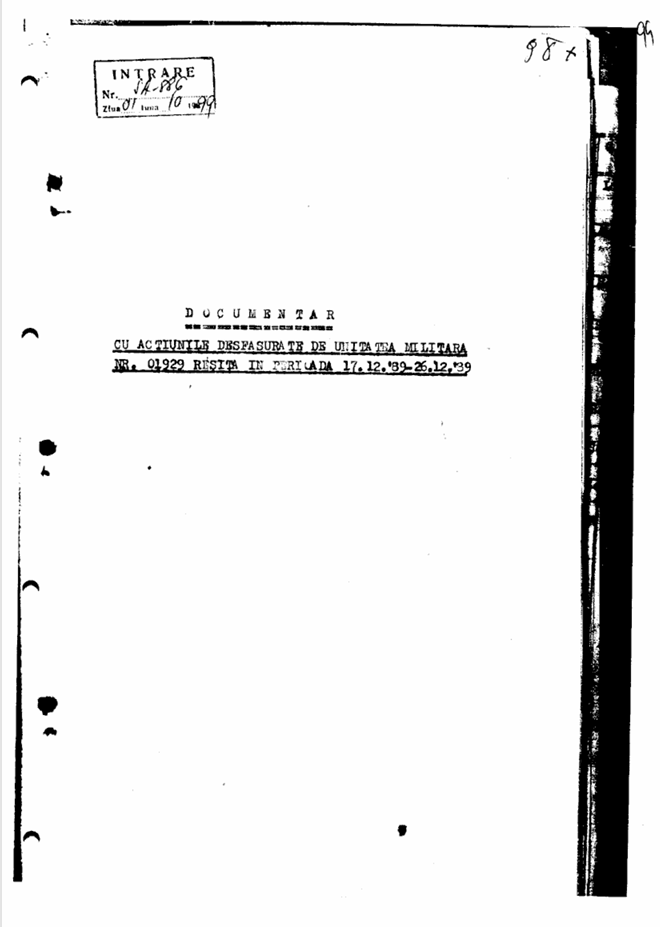
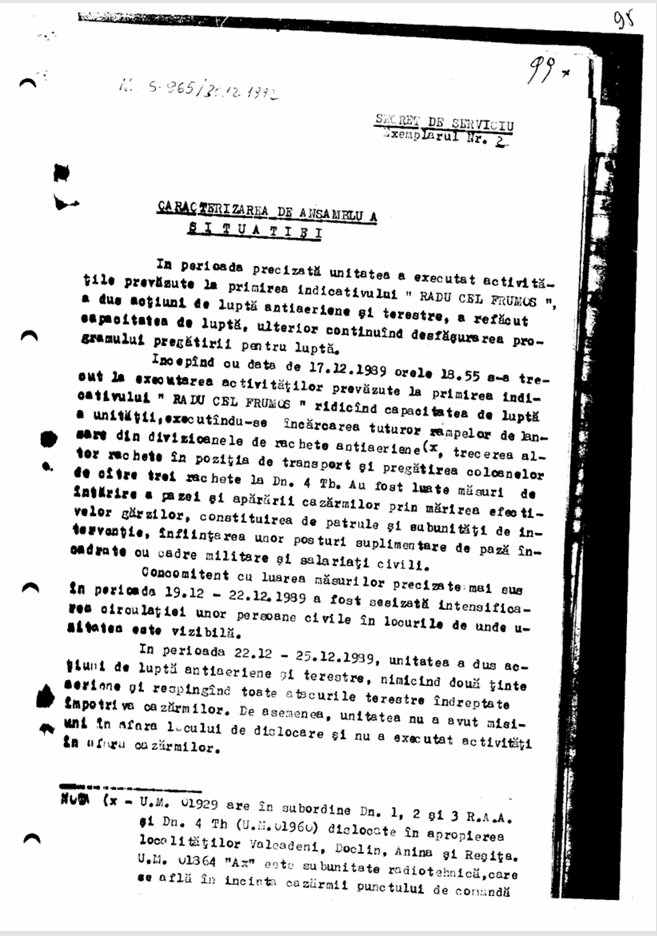
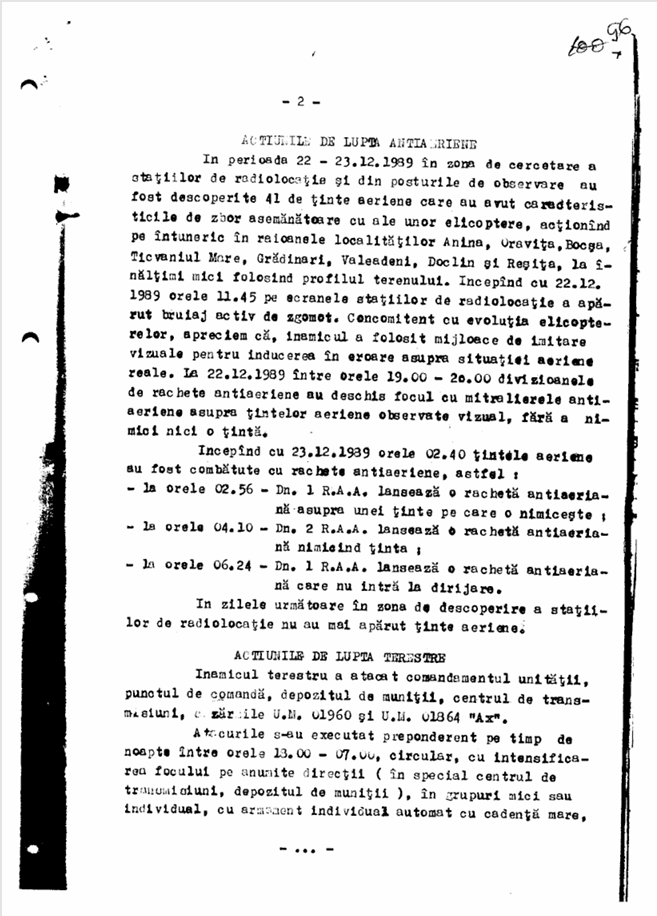
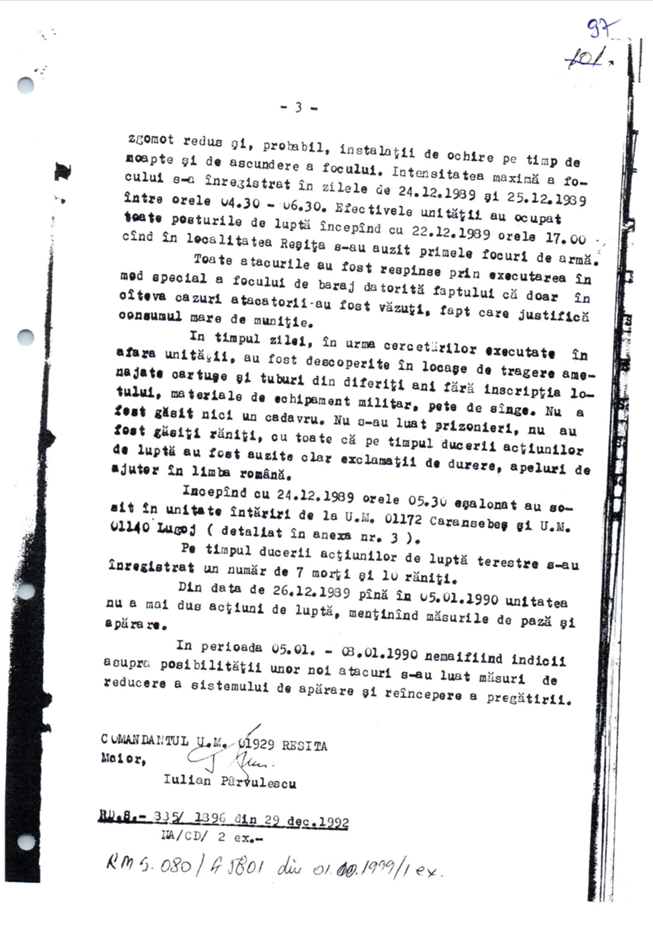
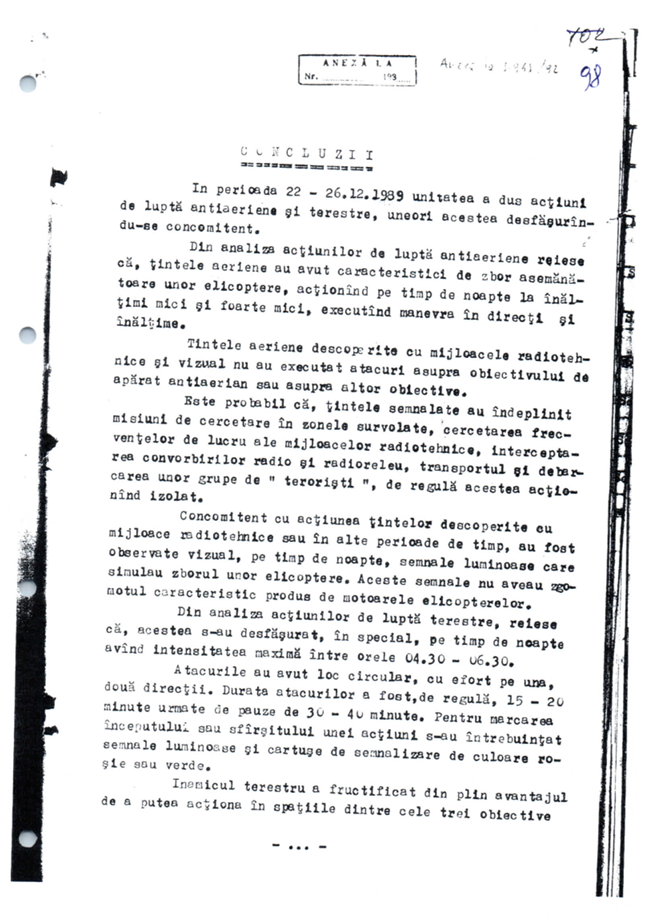
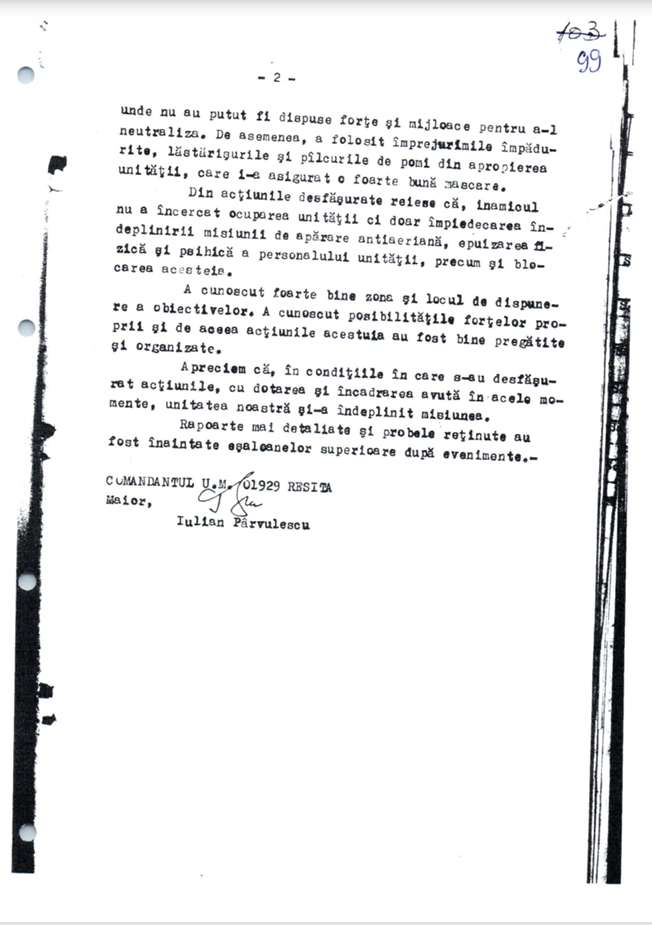
Military Prosecutor Catalin Ranco Pitu: “Every Army structure after January 1990…concluded that the terrorists did not exist” v. DOCUMENTAR CU ACTIUNILE DESFASURATE DE U.M. 01929 RESITA 17.12.’89-26.12.’89 (29.12.1992)

Posted by romanianrevolutionofdecember1989 on May 29, 2025

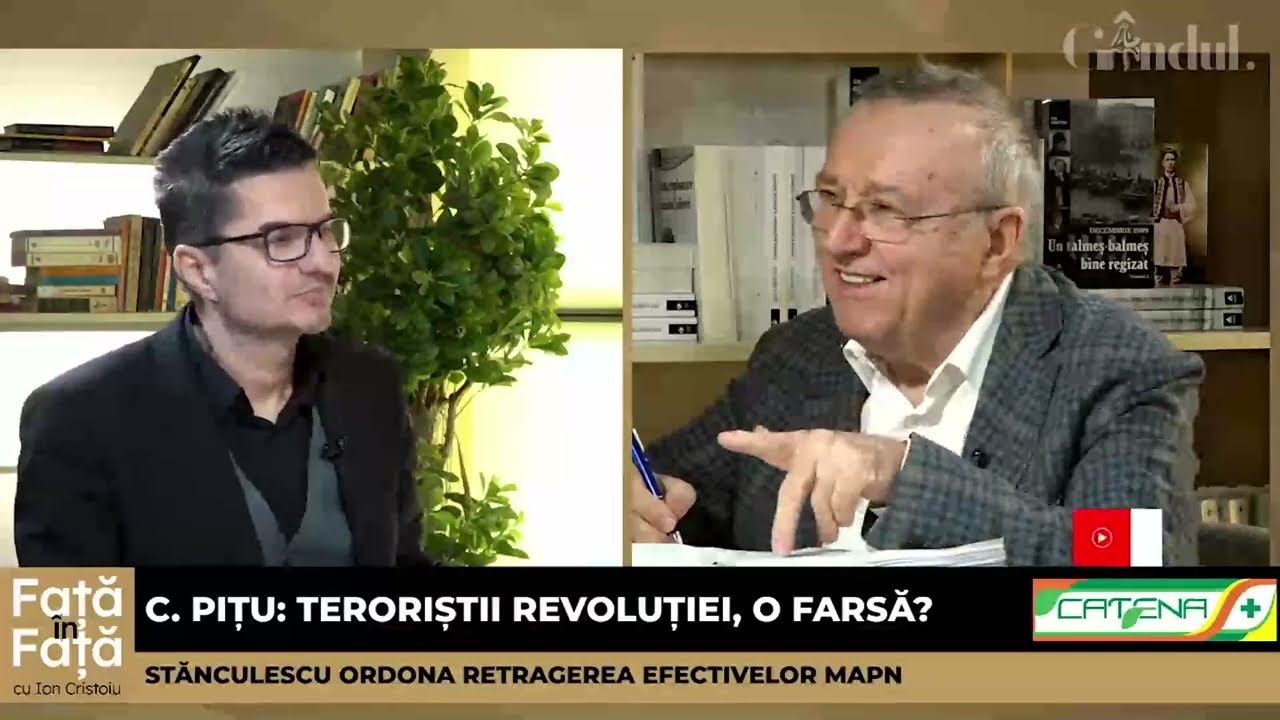
After he retired in March 2023, military prosecutor General Catalin Ranco Pitu began an extensive media tour. Among his first and most important stops was a 16 May 2023 interview by journalist Ion Cristoiu (alias “Coroiu,” his alleged codename as an informer for the communist era secret police, Securitate, of Nicolae Ceausescu; I have detailed on this site how Cristoiu launched the journalistic careers of former Securitate influencers–Angela Bacescu, Pavel Corut (aka Paul Cernescu), G.I. Olbojan, etc.). [Cristoiu supported and promoted the “suveranist,” far right, Trumpist cause of AUR Presidential Candidate George Simion in the 2025 Romanian Presidential Election.]

Asked by Cristoiu about the new documents Pitu had studied, Pitu references a series of documents declassified/”desecretized” and delivered to the Military Procuracy in 2017/2018. Because of how Pitu discusses and presents these documents, it is quite clear which file in the so called Dosarul Revolutiei (File of the Revolution) Pitu is talking about. Pitu could say that the documents prepared by various “Army structures”–which he identifies as military aviation, anti-aircraft defense, tank regiments, infantry, the marines–say one thing, but the military prosecutors determined through additional depositions and study that their claims and allegations did not hold up to closer scrutiny. But, no! Pitu instead makes the bombastic claim that “every Army structure…structures…prepared their own very thorough analyses after January 1990 about what happened hour by hour during the Revolution…their conclusions are phenomenal…EACH AND EVERY MATERIAL SHOWS THAT THE TERRORISTS [COUNTERREVOLUTIONARY CEAUSESCU LOYALISTS] DID NOT EXIST…” (from approximately min. 25:30-26:00 in the link below)

It is a brazen, childish and almost child-like claim. The documents in fact argue completely the opposite of what Pitu claims. Pitu seems to assume no one will ever see or read or study the documents he is referencing. He is wrong. Pitu and his believers and supporters are able to continue their media campaign because of access to personalities and platforms, where they never face anything even approaching challenging questions.

Were Pitu to admit that the military concluded exactly the opposite, as they did, then he could be forced to explain the discrepancy. What caused military prosecutors to claim differently? What changed over time and when did it change? It is simply easier to lie and to assume that no one will ever see what these “Army structures” argued.


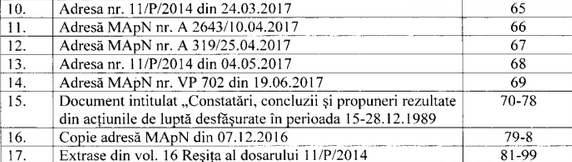
Below documents from #17 from the Table of Contents at the start of this post. As we will see in a future post, Pitu refers to the document “Constatari” from #15 above in both the Indictment (Rechizitoriul, 2022) and in his book, Ruperea blestemului (2024). So it would be difficult for Pitu to argue that he did not receive or see the following document. Even more than many of the other documents in this 2017/2018 tranche, this document was not in the immediate wake of December 1989. In fact, it is dated December 1992, three full years after the Revolution. The seductive deconstructionist Western academic obsession with “(false) myths” resulting from the confusion and suspicion of the moment and on public narratives designed to influence public opinion, thus faces a real challenge with an internal study, not designed for public distribution, three years after the events.

Posted in decembrie 1989 | Tagged: , , , , , | Leave a Comment »

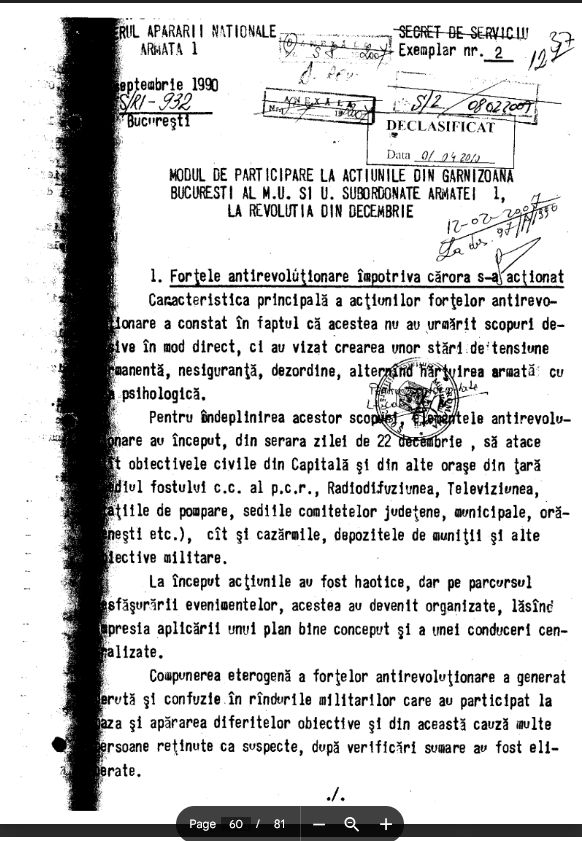
Military Prosecutor Catalin Ranco Pitu: “Every Army structure after January 1990…concluded that the terrorists did not exist” v. MODUL DE PARTICIPARE LA ACȚIUNILE DIN GARNIZOANA BUCUREȘTI AL M.U. (marilor unități) ȘI U. (unităților) SUBORDONATE ARMATEI 1, LA REVOLUȚIA DIN DECEMBRIE. (13 septembrie 1990)

Posted by romanianrevolutionofdecember1989 on May 20, 2025

After he retired in March 2023, military prosecutor General Catalin Ranco Pitu began an extensive media tour. Among his first and most important stops was a 16 May 2023 interview by journalist Ion Cristoiu (alias “Coroiu,” his alleged codename as an informer for the communist era secret police, Securitate, of Nicolae Ceausescu; I have detailed on this site how Cristoiu launched the journalistic careers of former Securitate influencers–Angela Bacescu, Pavel Corut (aka Paul Cernescu), G.I. Olbojan, etc.). [Cristoiu supported and promoted the “suveranist,” far right, Trumpist cause of AUR Presidential Candidate George Simion in the 2025 Romanian Presidential Election.]

Asked by Cristoiu about the new documents Pitu had studied, Pitu references a series of documents declassified/”desecretized” and delivered to the Military Procuracy in 2017/2018. Because of how Pitu discusses and presents these documents, it is quite clear which file in the so called Dosarul Revolutiei (File of the Revolution) Pitu is talking about. Pitu could say that the documents prepared by various “Army structures”–which he identifies as military aviation, anti-aircraft defense, tank regiments, infantry, the marines–say one thing, but the military prosecutors determined through additional depositions and study that their claims and allegations did not hold up to closer scrutiny. But, no! Pitu instead makes the bombastic claim that “every Army structure…structures…prepared their own very thorough analyses after January 1990 about what happened hour by hour during the Revolution…their conclusions are phenomenal…EACH AND EVERY MATERIAL SHOWS THAT THE TERRORISTS [COUNTERREVOLUTIONARY CEAUSESCU LOYALISTS] DID NOT EXIST…” (from approximately min. 25:30-26:00 in the link below)

It is a brazen, childish and almost child-like claim. The documents in fact argue completely the opposite of what Pitu claims. Pitu seems to assume no one will ever see or read or study the documents he is referencing. He is wrong. Pitu and his believers and supporters are able to continue their media campaign because of access to personalities and platforms, where they never face anything even approaching challenging questions.

Were Pitu to admit that the military concluded exactly the opposite, as they did, then he could be forced to explain the discrepancy. What caused military prosecutors to claim differently? What changed over time and when did it change? It is simply easier to lie and to assume that no one will ever see what these “Army structures” argued.

Significantly, these military after-action reports were not prepared for public dissemination and debate; they were not designed to influence public opinion. Moreover, they were drafted after the heat and confusion of December 1989 had died down, months after the events, when cooler heads and analysis could prevail. Arguments thus that the military was trying to redeem itself in the eyes of the population because of its participation in the bloody repression prior to 22 December 1989 fall by the wayside when one understands that these analyses were for restricted, internal consumption and study alone [such an argument is common, even among Western academics, see, for example, Peter Siani-Davies, The Romanian Revolution of December 1989 (2005), p. 286].

This is the first of the documents “referenced” by Pitu. My thanks to Costinel Mirea Venus for his painstaking transcription of the document. For the present time at least, I will have to ask those who cannot read Romanian to cut, paste, and use google translate or AI to understand. Thank you.

C1

MINISTERUL APĂRĂRII NAȚIONALE

ARMATA 1 37 127

~SECRET DE SERVICIU~

Exemplar nr. 2

Septembrie 1990

S/RI-932

București

S/2 08.02.2007

DECLASIFICAT

Data 01.04.2010

12-02-2007

La dos. 97/P/1990.

MODUL DE PARTICIPARE LA ACȚIUNILE DIN GARNIZOANA BUCUREȘTI AL M.U. (marilor unități) ȘI U. (unităților) SUBORDONATE ARMATEI 1, LA REVOLUȚIA DIN DECEMBRIE.

*1. Forțele antirevoluționare împotriva cărora s-a acționat*

Caracteristica principală a acțiunilor forțelor antirevoluționare a constat în faptul că acestea nu au urmărit scopuri decisive în mod direct, ci au vizat crearea unor stări de tensiune permanentă, nesiguranță, dezordine, alternând hărțuirea armată cu [diversiunea] psihologică.

Pentru îndeplinirea acestor scopuri, elementele antirevoluționare au început, din seara zilei de 22 decembrie, să atace atît obiectivele civile din Capitală și din alte orașe din țară (sediul fostului c.c. al p.c.r., Radiodifuziunea, Televiziunea, stațiile de pompare, sediile comitetelor județene, municipale, orășenești, etc.), cît și cazărimile, depozitele de muniții și alte obiective militare.

La început acțiunile au fost haotice, dar pe parcursul desfășurării evenimentelor, acestea au devenit organizate, lăsînd impresia aplicării unui plan bine conceput și a unei conduceri centralizate.

Compunerea eterogenă a forțelor antirevoluționare a generat derută și confuzie în rîndurile militarilor care au participat la paza și apărea diferitelor obiective și din această cauză multe persoane reținute ca suspecte, după verificări sumare au fost eliberate.

. /.

Page 60 / 81

(Ștampila, în centru dreapta)

ROMÂNIA

Ministerul Apărării Naționale Unitatea Militară 02490 S-

(cu mențiunea)

Pentru conformitate

Lt. col. s.i.

C2

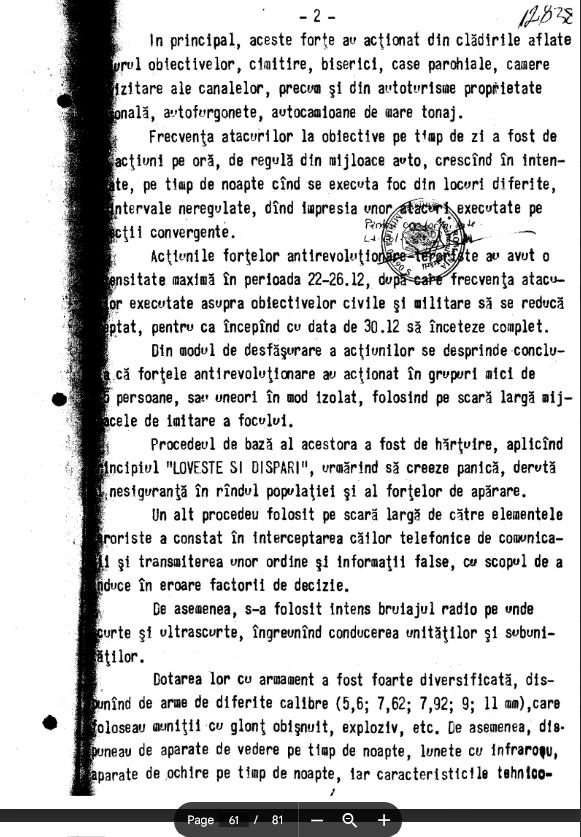
– 2 – 128 38

În principal aceste forțe au acționat din clădirile aflate în jurul obiectivelor, cimitire, biserici, case parohiale, camere de vizitare ale canalelor, precum și din autoturisme proprietate personală, autofurgonete, autocamioane de mare tonaj.

Frecvența atacurilor la obiective pe timp de zi a fost de […] acțiuni pe oră, de regulă de mijloace auto, crescînd în intensitate, pe timp de noapte cînd se executa foc din locuri diferite, [la] intervale neregulate, dînd impresia unor atacuri executate pe direcții convergente.

Acțiune forțelor antirevoluționare – teroriste au avut o intensitate maximă în perioada 22-26.12, după care frecvența atacurilor executate asupra obiectivelor civile și militare să se reducă treptat, pentru ca începînd cu data de 30.12. să înceteze complet.

Din modul de desfășurare a acțiunilor se desprinde concluzia că forțele antirevoluționare au acționat în grupuri mici de [2]-5 persoane, sau uneori în mod izolat, folosind pe scară largă mijloacele de imitare a focului.

Procesul de bază al acestora a fost de hărțuire, aplicînd principiul “LOVEȘTE ȘI DISPARI” urmărind să creze panică, derută și nesiguranță în rîndul populației și al forțelor de apărare.

Un alt procedeu folosit pe scară largă de către elementele teroriste a constat în interceptarea căilor telefonice de comunicații și transmiterea unor ordine și informații false, cu scopul de a induce în eroare factorii de decizie.

De asemenea, s-a folosit intens bruiajul radio pe unde scurte și ultrascurte, îngreunînd conducerea unităților și subunităților.

Dotarea lor cu armament a fost foarte diversificată, dispunînd de arme de calibre diferite (5,6; 7,62; 7,92; 9; 11 mm), care foloseau muniții cu glonț obișnuit, exploziv, etc. De asemenea, dispuneau de aparate de vedere pe timp de noapte, lunete cu infraroșu, aparate de ochire pe timp de noapte, iar caracteristicile tehnico-

Page 61 / 81

(Ștampila, în dreapta-sus)

ROMÂNIA

Ministerul Apărării Naționale Unitatea Militară 02490 S-

(cu mențiunea)

Pentru conformitate

Lt. col. s.i.

C3

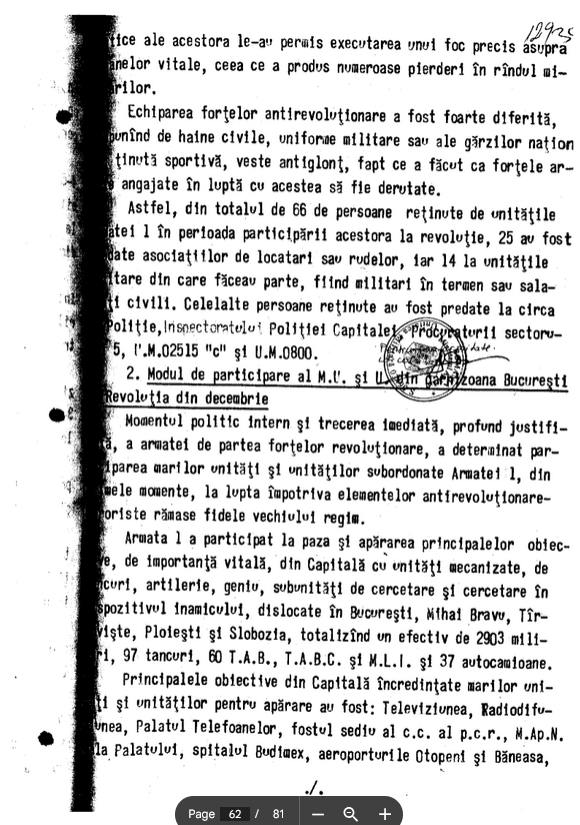
[- 3 -] 129 39

tactice ale acestora le-a permis executarea unui foc precis asupra organelor vitale, ceea ce a produs numeroase pierderi în rîndul militarilor.

Echiparea forțelor antirevoluționare a fost foarte diferită, dispunînd de haine civile, uniforme militare sau ale gărzilor naționale, ținută sportivă, veste antiglonț, fapt ce a făcut ca forțele armate angajate în luptă cu acestea să fie derutate.

Astfel, din totalul de 66 de persoane reținute de unitățile Armatei 1 în perioada participării acestora la revoluție, 25 au fost [predate] asociațiilor de locatari sau rudelor, iar 14 la unitățile militare din care făceau parte, fiind militari în termeni sau salariați civili. Celelalte persoane reținute au fost predate la circa […] Poliție, Inspectoratului Poliției Capitalei, Procuraturii sectorului 5, U.M. 02515 “c” și U.M. 0800.

*2. Modul de participare a M.U. și U. din garnizoana București la Revoluția din* *decembrie*

Momentul politic intern și trecerea imediată, profund justificată, a armatei de partea forțelor revoluționare, a determinat participarea marilor unități și unităților subordonate Armatei 1, din primele momente, la lupta împotriva elementelor antirevoluționare – teroriste rămase fidele vechiului regim.

Armata 1 a participat la pază și apărarea principalelor obiective, de important vitală, din Capitală cu unități mecanizate, de tancuri, artilerie, geniu, subunități de cercetare și cercetare în dispozitivul inamicului, dislocate în București, Mihai Bravu, Tîrgoviște, Ploiești și Slobozia, totalizînd un efectiv de 2903 militari, 97 tancuri, 60 T.A.B., T.A.B.C.și M.L.I. și 37 autocamioane.

Principalele obiective din Capitală încredințate marilor unități și unităților pentru apărare au fost: Televiziunea, Radiodifuziunea, Palatul Telefoanelor, fostul sediu al c.c. al p.c.r., M.Ap.N.,Sala Palatului, spitalul Budimex, aeroporturile Otopeni și Băneasa,

. /.

Page 62 / 81

(Ștampila, în centru dreapta)

ROMÂNIA

Ministerul Apărării Naționale Unitatea Militară 02490 S-

( cu mențiunea)

Pentru conformitate

Lt. col. s.i.

C4

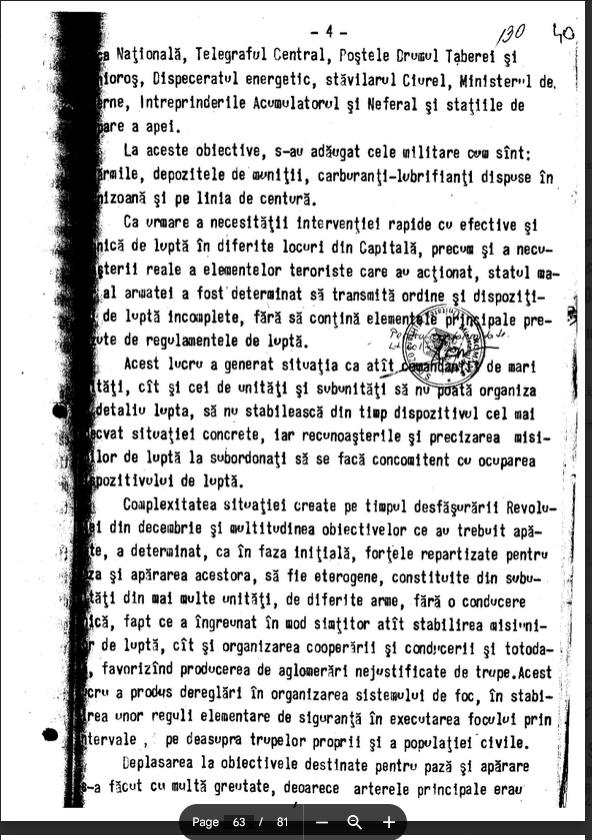
– 4 – 130 40

Banca Națională, Telegraful Central, Poștele Drumul Taberei și Moghioroș, Dispeceratul energetic, stăvilarul Ciurel, Ministerul de Interne, Intreprinderile Acumulatorul și Neferal și stațiile de epurare a apei.

La acest obiective s-au adăugat cele militare cum sînt: cazărmile, depozitele de muniții, carburanți – lubrifianți dispuse în garnizoană și pe linia de centură.

Ca urmare a necesității intervenției rapide cu efective și tehnică de luptă în diferite locuri din Capitală, precum și a necunoașterii reale a elementelor teroriste care au acționat, statul major al armatei a fost determinat să transmită ordine și dispoziții de luptă incomplete, fără să conțină elementele principale prevăzute de regulamentele de luptă.

Acest lucru a generat situația că atît comandanții de mari unități cît și cei de unități și subunități să nu poată organiza în detaliu lupta, să nu stabilească din timp dispozitivul cel mai adecvat situației concrete, iar recunoașterile și precizia misiunilor de luptă la subordonați să se facă concomitent cu ocuparea dispozitivului de luptă.

Complexitatea situației create pe timpul desfășurării Revoluției din decembrie și multitudinea obiectivelor ce au trebuit apărate, a determinat, ca în faza inițială, forțele repartizate pentru paza și apărarea acestora, să fie eterogene, constituite din subunități din mai multe unități, de diferite arme, fără o conducere unică, fapt ce a îngreunat în mod simțitor atît stabilirea misiunilor de luptă, cît și organizarea cooperării și conducerii și totodată, favorizând producerea de aglomerări nejustificate de trupe. Acest lucru a produs dereglări în organizarea sistemului de foc, în stabilirea unor reguli elementare de siguranță în executarea focului prin intervale, pe deasupra trupelor proprii și a populației civile.

Deplasarea la obiectivele destinate pentru pază și apărare s-a făcut cu multă greutate, deoarece arterele principale erau

– / –

Page 63 / 81

(Ștampila, în centru dreapta) ROMÂNIA

Ministerul Apărării Naționale Unitatea Militară 02490 S-

Pentru conformitate

Lt. col. s.i.

C5

– 5 – 131 41

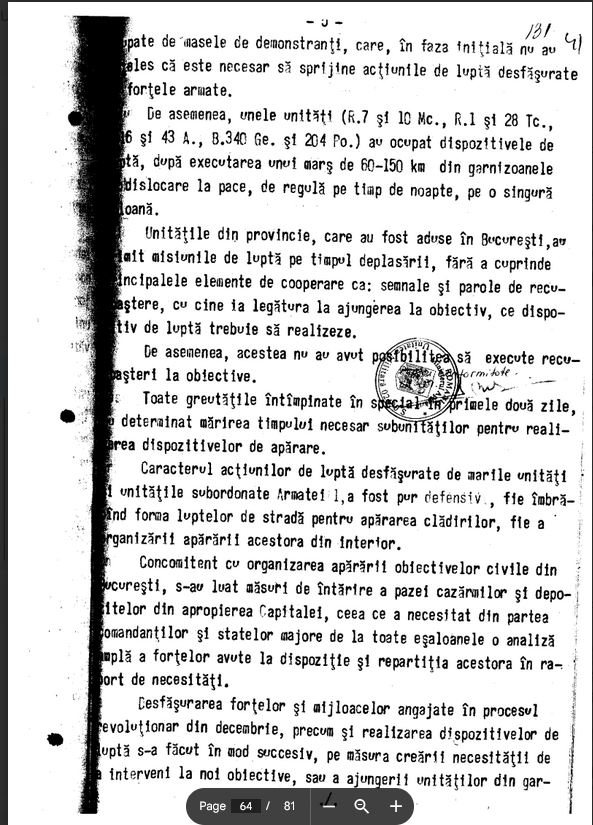
ocupate de masele de demonstranți, care, în faza inițială nu au înțeles că este necesar să sprijine acțiunile de luptă desfășurate de forțele armate.

De asemenea, unele unități (R.7 și 10 Mc., R1 și 28 Tc., R16 și 43 A., B. 340 Ge. și 204 Po.) au ocupat dispozitivele de luptă, după executarea unui marș de 60-150 km din garnizoanele dislocate la pace, de regulă pe timp de noapte, pe o singură coloană.

Unitățile din provincie, care au fost aduse în București, au primit misiunile de luptă pe timpul deplasării, fără a cuprinde principalele elemente de cooperare ca: semnale și parole de recunoaștere, cu cine ia legătura la ajungerea la obiectiv, ce dispozitiv de luptă trebuie să realizeze.

De asemenea, acestea nu au avut posibilitatea să execute recunoașteri la obiective.

Toate greutățile întîmpinate în special în primele două zile, au determinat mărirea timpului necesar subunităților pentru realizarea dispozitivelor de apărare.

Caracterul acțiunilor de luptă desfășurate de marile unități și unitățile subordonate Armatei 1, a fost pur defensiv, fie îmbrăcînd forma luptelor de stradă pentru apărarea clădirilor, fie a organizării apărării acestora din interior.

Concomitent cu organizarea apărării obiectivelor civile din București, s-au luat măsuri de întărire a pazei cazărmilor și depozitelor din apropierea Capitalei, ceea ce a necesitat din partea comandanților și statelor majore de la toate eșaloanele o analiză amplă a forțelor avute la dispoziție și repartizarea acestora în raport de necesități.

Desfășurarea forțelor și mijloacelor angajate în procesul revoluționar din decembrie precum și realizarea dispozitivelor de luptă s-a făcut în mod succesiv pe măsura creării necesității de a interveni la noi obiective sau ajungerii unităților din gar-

Page 64 / 81

(Ștampila, în centru dreapta) – ROMÂNIA

Ministerul Apărării Naționale Unitatea Militară 02490 S-

Pentru conformitate

Lt. col. s.i.

C6

– 6 – 132 42

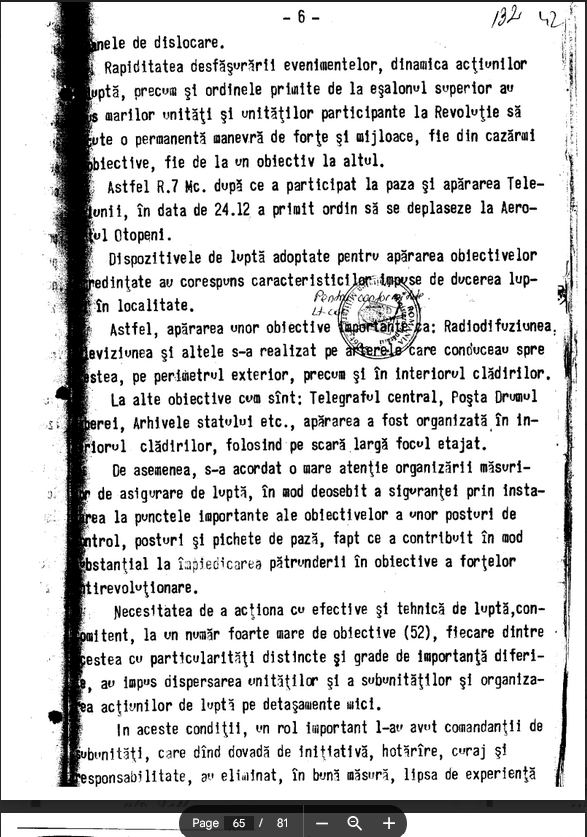
nizoanele [garnizoanele] de dislocarea.

Rapiditatea desfășurării evenimentelor, dinamica acțiunilor de luptă, precum și ordinele primite de la eșalonul superior au [impus] marilor unități și unităților participante la Revoluție să [execute] o permanentă manevră de forțe și mijloace, fie din cazări [și] obiective, fie de la un obiectiv la altul.

Astfel R.7 Mc. după ce a participat la paza și apărarea Televiziunii, în data de 24.12 a primit ordin să se deplaseze la Aeroportul Otopeni.

Dispozitivele de luptă adoptate pentru apărarea obiectivelor încredințate au corespuns caracteristicilor impuse de ducerea luptei în localitate.

Astfel, apărarea unor obiective importante ca: Radiodifuziunea, Televiziunea și altele s-a realizat pe arterele care conduceau spre acestea, pe perimetrul exterior, precum și în interiorul clădirilor.

La alte obiective cum sînt: Telegraful central, Poșta Drumul Taberei, Arhivele statului etc., apărarea a fost organizată în interiorul clădirilor, folosind pe scară largă focul etajat.

De asemenea, s-a acordat o mare atenție organizării măsurilor de asigurare de luptă, în mod deosebit a siguranței prin instalarea la punctele importante ale obiectivelor a unor posturi de control, posturi și pichete de pază, fapt ce a contribuit în mod substanțial la împiedicarea pătrunderii în obiective a forțelor antirevoluționare.

Necesitatea de a acționa cu efective și tehnică de luptă, concomitent, la un număr foarte mare de obiective (52), fiecare dintre acestea cu particularități distincte și grade de importanță diferite, au impus dispersarea unităților și subunităților și organizarea acțiunilor de luptă pe detașamente mici.

În aceste condiții, un rol important l-au avut comandanții de subunități, care dînd dovadă de inițiativă, hotărîre, curaj și responsabilitate, au eliminat, în bună măsură, lipsa de experiență

Page 65 / 81

(Ștampila, în centru dreapta) ROMÂNIA

Ministerul Apărării Naționale Unitatea Militară 02490 S-

Pentru conformitate

Lt. col. s.i.

C7

[ – 7 – 133 43]

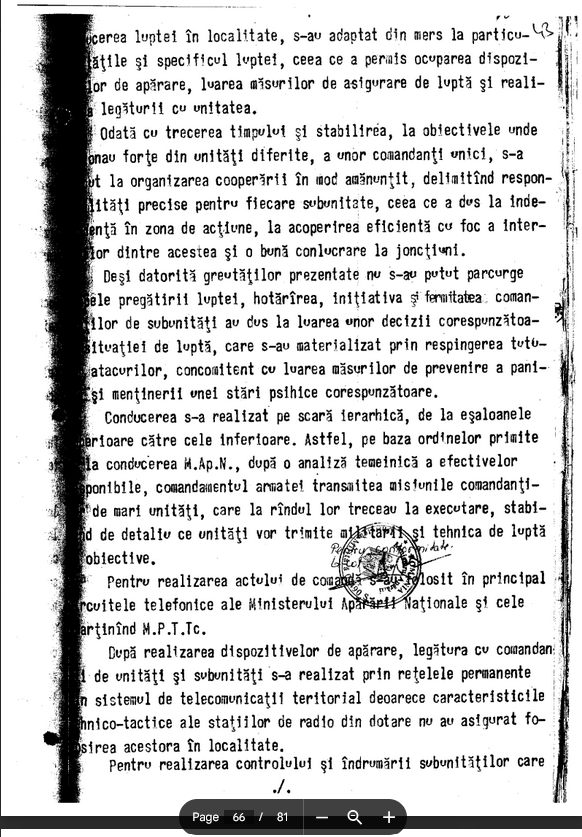
[în ducerea] luptei în localitate, s-au adaptat din mers la particularitățile și specificul luptei, ceea ce a permis ocuparea dispozitivelor de apărare, luarea măsurilor de asigurare de luptă și realizarea legăturii cu unitatea.

Odată cu trecerea timpului și stabilirea, la obiectivele unde [acționau] forțe din unități diferite, a unor comandanți unici, s-a trecut la organizarea cooperării în mod amănunțit, delimitînd responsabilități precise pentru fiecare subunitate, ceea ce a dus la independență în zona de acțiune, la acoperirea eficientă cu foc a intervalelor dintre acestea și o bună conlucrare la joncțiuni.

Deși datorită greutăților prezentate nu s-au putut parcurge [procesele] pregătirii luptei, hotărîrea, inițiativa și fermitatea comandanților de subunități au dus la luarea unor decizii corespunzătoare situației de luptă, care s-au materializat prin respingerea tuturor atacurilor, concomitent cu luarea măsurilor de prevenire a [panicii] și menținerii unor stări psihologice corespunzătoare.

Conducerea s-a realizat pe scară ierarhică, de la eșaloanele superioare către cele inferioare. Astfel, pe baza ordinelor primite [de] la conducerea M.Ap.N., după o analiză temeinică a efectivelor disponibile, comandamentul armatei transmitea misiunile comandanților de mari unități, la rîndul lor treceau la executare, [stabilind] de detaliu ce unități vor trimite militarii și tehnica de luptă [la] obiective.

Pentru realizarea actului de comandă s-au folosit în principal circuitele telefonice ale Ministerului Apărării Naționale și cele aparținând M.P.T.Tc.

După realizarea dispozitivelor de apărare, legătura cu comandanții de unități și subunități s-a realizat prin rețelele permanente din sistemul de telecomunicații teritorial deoarece caracteristice tehnico-tactice ale stațiilor de radio din dotare nu au asigurat folosirea acestora în localitate.

Pentru realizarea controlului și îndrumării subunităților care

. /.

Page 66 / 81

(Ștampila, în centru dreapta jos)

ROMÂNIA

Ministerul Apărării Naționale Unitatea Militară 02490 S-

Pentru conformitate

Lt. col. s.i.

C8

– 8 – 134 44

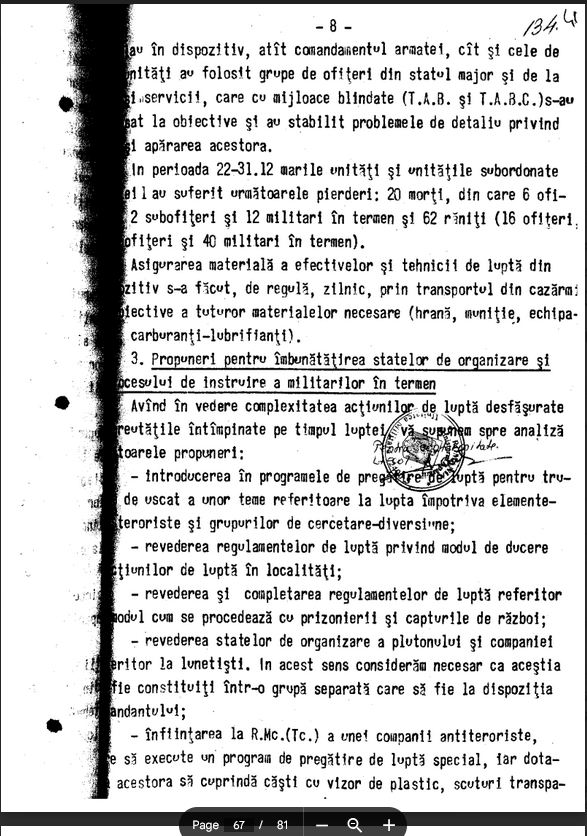
[acționau] în dispozitiv, atît comandantul armatei, cît și cele de [mari unități] au folosit grupe de ofițeri din statul major de la [aceleași] servicii, care cu mijloace blindate (T.A.B. și T.A.B.C.) s-au [deplasat] la obiective și au stabilit problemele de detaliu privind [paza] și apărarea acestora.

În perioada 23-31.12 marile unități și unitățile subordonate [Armatei 1] au suferit următoarele pierderi: 20 morți, din care 6 ofițeri, 2 subofițeri și 12 militari în termen și 62 răniți (16 ofițeri, [6 subofițeri] și 40 militari în termen).

Asigurarea materială a efectivelor și tehnicii de luptă din dispozitiv s-a făcut, de regulă, zilnic, prin transportul din cazărmi [la obiective] a tuturor materialelor necesare (hrană, muniție, [echipament], carburanți – lubrifianți).

3. Propuneri pentru îmbunătățirea statelor de organizare și [a procesului] de instruire a militarilor în termen

Avînd în vedere complexitatea acțiunilor de luptă desfășurate [și greutățile] întîmpinate pe timpul luptei vă supunem spre analiză următoarele propuneri:

– introducerea în programele de pregătire de luptă pentru [trupele] de uscat a unor teme referitoare la lupta împotriva elementelor teroriste și a grupurilor de cercetare – diversiune;

– revederea regulamentelor de luptă privind modul de ducere a acțiunilor de luptă în localități;

– revederea și completarea regulamentelor de luptă referitor la modul cum se procedează cu prizonierii și capturile de război;

– revederea statelor de organizare a plutonului și companiei referitor la lunetiști. În acest sens considerăm necesar ca aceștia să fie constituiți

într-o grupă separată care să fie la dispoziția comandantului;

– înființarea la R.Mc.

(Tc.) a unei companii antiteroriste, care se execută un program de pregătire de luptă special, iar dotarea acestora să cuprindă căști cu vizor de plastic, scuturi transpa-

. /.

Page 67 / 81

(Ștampila, în centru dreapta)

ROMÂNIA

Ministerul Apărării Naționale Unitatea Militară 02490 S-

Pentru conformitate

Lt. col. s.i.

C9

[ – 9 – 135 45]

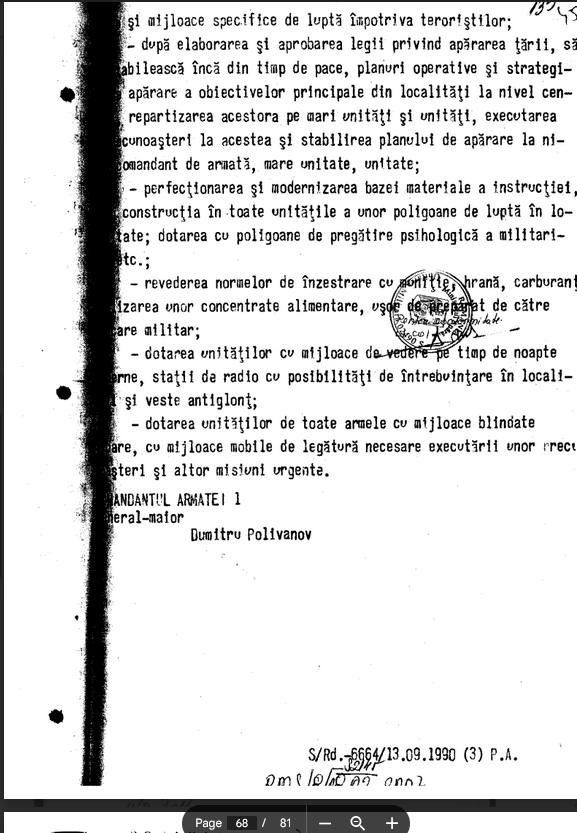
rente [transparente] și mijloace specifice de luptă împotriva teroriștilor;

– după elaborarea și aprobarea legii privind apărarea țării, să se stabilească încă din timp de pace, planuri operative și strategice de apărare a obiectivelor principale din localități la nivel [centralizat], repartizarea acestora pe mari unități și unități, executarea [de] recunoașteri la acestea și stabilirea planului de apărare la nivelul la nivel de comandant de armată, mare unitate, unitate;

Perfecționarea și modernizarea bazei materiale a instrucției, [prin] construcția în toate unitățile a unor poligoane de luptă în [localitate]; dotarea cu poligoane de pregătire psihologică a militarilor etc.;

– revederea normelor de înzestrare cu muniție, hrană, [utilizarea] unor concentrate alimentare, ușor de preparat de către fiecare militar;

– dotarea unităților cu mijloace de vedere pe timp de noapte [moderne], stații de radio cu posibilități de întrebuințare în [localități] și veste antiglonț;

– dotarea unităților de toate armele cu mijloace blindate [ușoare], mijloace mobile de legătură necesare executării unor recunoașteri și a altor misiuni urgente.

COMANDANTUL ARMATEI 1

General-maior Dumitru Polivanov

S/Rd. – 6664 /13.09.1990 (3) P.A. (…)

. /.

Page 68 / 81

(Ștampila, în centru dreapta)

ROMÂNIA

Ministerul Apărării Naționale Unitatea Militară 02490 S-

Pentru conformitate

Lt. col. s.i.

Posted in decembrie 1989 | Tagged: , , , , , , | Leave a Comment »

25 for the 25th Anniversary of the Romanian Revolution: #20 Identifying the Terrorists: Securitate General Iulian Vlad’s Ignored Declaration and other Evidence

Posted by romanianrevolutionofdecember1989 on December 26, 2014

(purely personal views, based on two decades of prior research and publications)

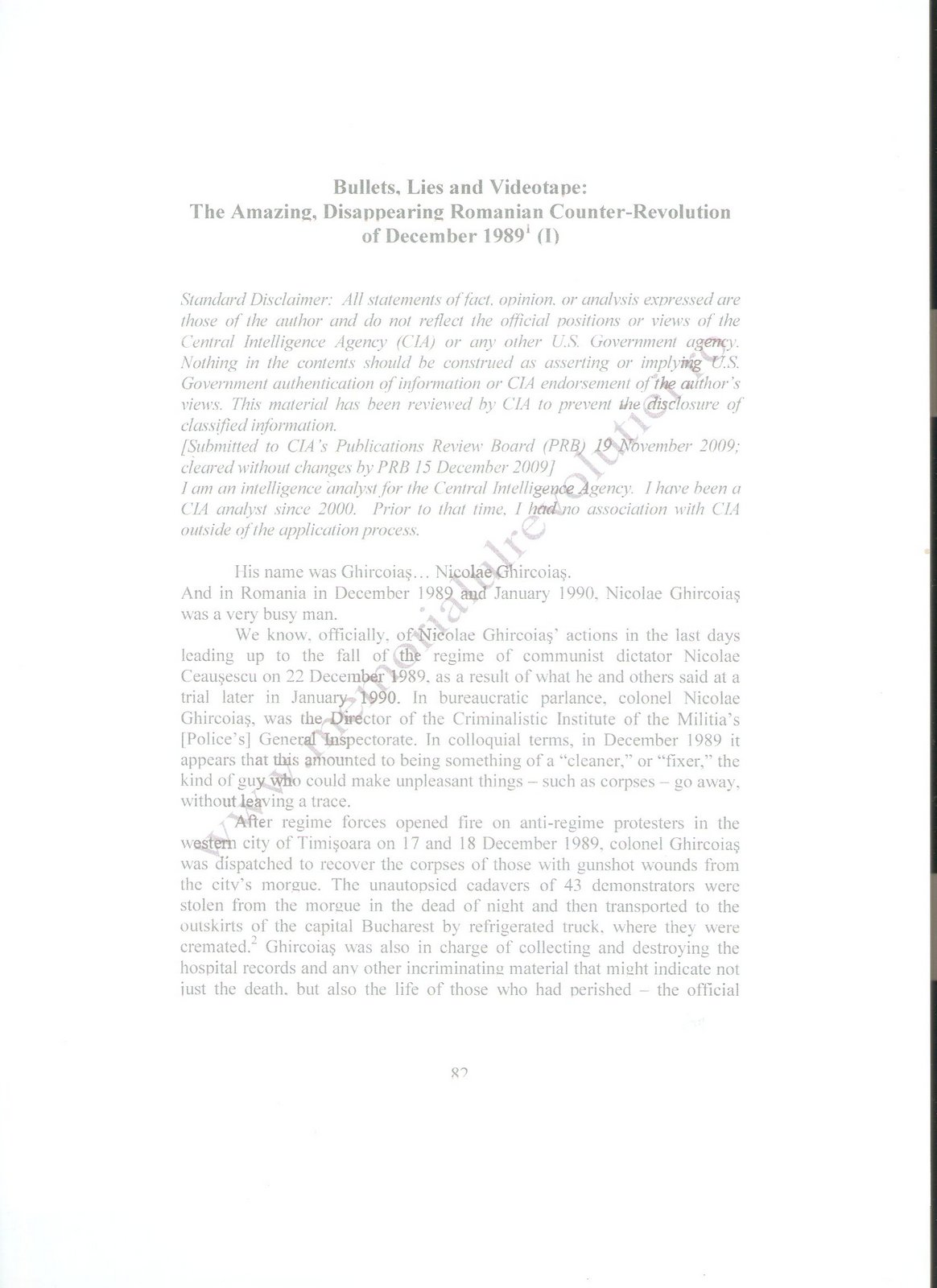
Bullets, Lies, and Videotape:
The Amazing, Disappearing Romanian Counter-Revolution of December 1989
by Richard Andrew Hall, Ph.D.

Standard Disclaimer: All statements of fact, opinion, or analysis expressed are those of the author and do not reflect the official positions or views of the Central Intelligence Agency (CIA) or any other U.S. Government agency. Nothing in the contents should be construed as asserting or implying U.S. Government authentication of information or CIA endorsement of the author’s views. This material has been reviewed by CIA to prevent the disclosure of classified information.
[Submitted to CIA’s Publications Review Board (PRB) 19 November 2009; cleared without changes by PRB 15 December 2009]
I am an intelligence analyst for the Central Intelligence Agency. I have been a CIA analyst since 2000. Prior to that time, I had no association with CIA outside of the application process.

Bullets Lies and Videotape The Amazing Disappearing Romanian Counter-Revolution of December 1989 by Richard Andrew Hall 103013tk1

Bullets Lies and Videotape The Amazing Disappearing Romanian Counter-Revolution of December 1989 by Richard Andrew Hall 103013tk1

COLONEL GHIRCOIAS MAKES THE ROUNDS OF BUCHAREST’S HOSPITALS

Unofficially, we also know of Colonel Ghircoias’ exploits after the Ceausescu regime collapsed on 22 December 1989, exploits for which he was not charged at his trial and for which he has never been charged.  Of the 1,104 people killed and 3,352 people injured during the December 1989 bloodshed, 942 of them were killed and 2,251 wounded after Nicolae and Elena Ceausescu fled power on 22 December 1989.  At the time, personnel of the communist regime’s secret police—known as the Securitate—and allied foreign mercenaries fighting to restore the Ceausescu regime—collectively christened “the terrorists”—were thought to be the primary source behind the post-22 December bloodshed.

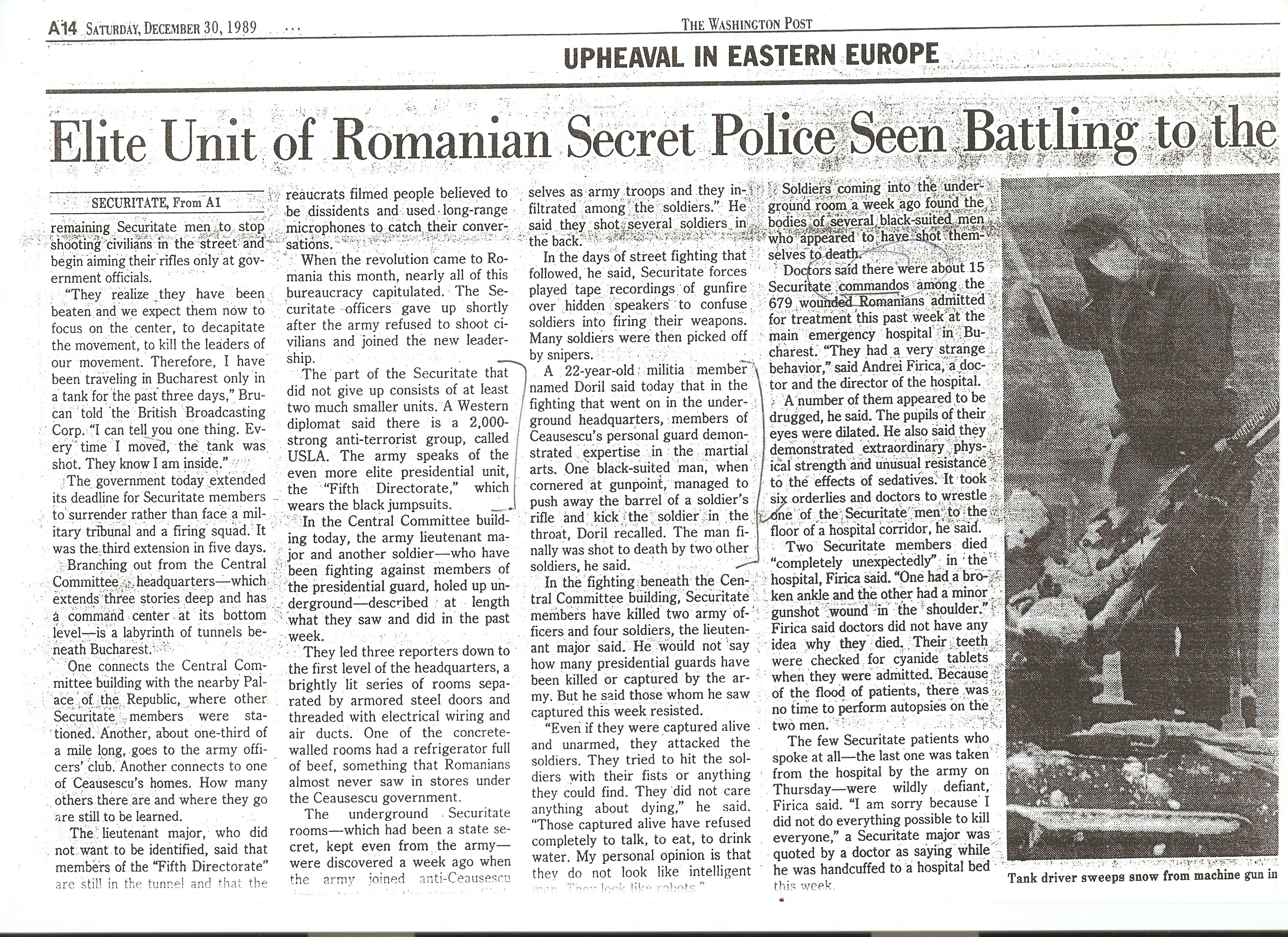
It was in this context, that doctors from Bucharest’s various main hospitals recall Colonel Ghircoias’ sudden, unannounced appearances during the last days of December 1989 and first days of January 1990.  Professor Andrei Firica of the Bucharest “Emergency Hospital” recounted in a 2004 media interview largely the same details he had conveyed to the press in the summer of 1990.  According to Firica, some 15 to 20 suspected terrorists had been interned at the “Emergency Hospital” in varying states of medical distress.  He says he made a small file of the medical situations of these patients.  A Militia colonel, whom he later was to see in [prisoner] stripes on TV as a defendant in the Timisoara trial—i.e. fairly clearly Ghircoias—came one day and counseled him to keep nosy foreign reporters away from the beds of the “terrorists,” stating ominously that “these were just terrorist suspects and he [Dr. Firica] didn’t want to wake up one day on trial for having defamed someone”!   The colonel later came and loaded the wounded terrorist suspects onto a bus and off they went.  Firica maintains the files he kept on the terrorist suspects “of course, disappeared.”  He noted, however, that he asked his son, who had studied theater and film at university, to film the terrorists tied down to the hospital beds, and he claims he gave copies of this cassette to the Procuracy.[4]

[5]

[In viewing these photos, witness what Constantin Fugasin recounted in “Unde ne sint teroristii?” Zig-Zag, in 1990, based in part on an interview with Dr. Andrei Firica:

At the Emergency Hospital 13 suspected of being what we call terrorists were interned.  Among these a few were definitely foreign, even though all had Romanian papers.  Two clearly had ‘Mongoloid’ (‘Asiatic’) features (one stated that his mother was Romanian, while his father was from Laos), while four others were Arabs.  Nevertheless, they spoke Romanian very well.  Doctor Nicolae Staicovici, who worked a time in Egypt and who treated them for a time spoke with them.  At a moment, he formed a question in Arabic.  One of the injured responded to him perfectly.  All were well-built, one was a ‘mountain of a man.’  He said nothing, although he probably had terrible pains.  There were also two terrorists who were not wounded.  One arrived at night, under some pretext.  Those on guard suspecting him, immobilized him.  He had on three layers of clothing and several ids.  They tied him to the stretcher, but although he appeared rather frail, at a given moment he ripped the restraints off.[6]]
 

[7]

[Dr. Andrei Firica, 2004:  From a diagnostic perspective, those who maintain that the terrorists didn’t exist are telling an outrageous lie…In the Emergency Hospital, people were brought who were shot with precision in the forehead, from behind, just a few yards in the crowd of demonstrators, such people who did this can only be called terrorists…[8]]


Dr. Nicolae Constantinescu, chief surgeon at the Coltea Hospital, also was paid the honor of a visit by Colonel Ghircoias during these days:

I remember that on 1 or 2 January ’90 there appeared at the [Coltea] hospital a colonel from the Interior Ministry, who presented himself as Chircoias.  He maintained in violent enough language that he was the chief of I-don’t-know-what “criminalistic” department from the Directorate of State Security [ie. Securitate].  He asked that all of the extracted bullets be turned over to him.  Thus were turned over to him 40 bullets of diverse forms and dimensions, as well as munition fragments.

To the question of whether he informed the Military Procuracy?

Of course, I announced the Prosecutor’s Office, and requested an investigation [of those shot in the revolution].  For example, when I showed them the apartment from where there were was shooting during the revolution, on the fourth floor of the ‘Luceafarul’ cinema, the prosecutors told me that they sought to verify it and uncovered that there was a Securitate ‘safehouse’ there and that was it.

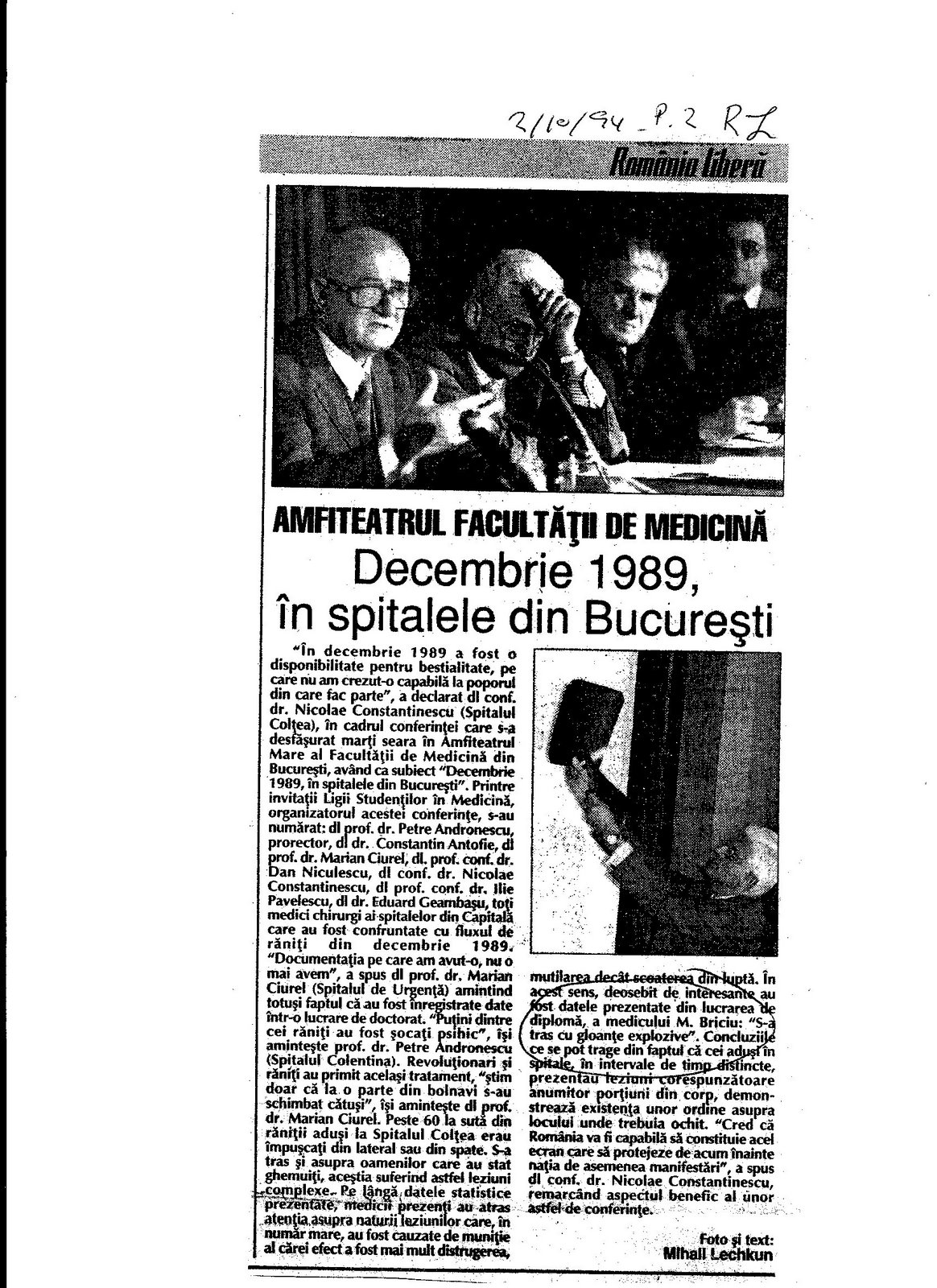
In 1992, I signed along with other doctors, university professors, renowned surgeons, a memorandum [see page 5 (below) for an article apparently linked to the memorandum] addressed to the Prosecutor General in which we requested an investigation regarding the wounded and dead by gunfire.  Not having received any response, after six months I went there to ask what was going on.  They told me they were working on it, and they showed me two or three requests and that was it.  One of the prosecutors took me into the hallway and told me “I have a child, a wife, it is very complicated.”  He asked me what I thought I was doing…I lit back into him, I told him I wasn’t just any kind of person to be blown off.

I showed him the x-rays of those who were shot, I showed him the bullets in the liver.  The x-rays exist, they weren’t my invention, I didn’t just dream all this up to demand an investigation!  I told them that there are some people who wish to find out the truth and they signed a memo to the Procuracy and they aren’t just anybody, but doctors with experience, experts in the field.  In vain, we requested ballistics tests and other research, in vain we presented forms, documents, x-rays, studies.  They did not want to undertake a serious investigation.[9]

[4]Professor Andrei Firica, interview by Florin Condurateanu, “Teroristii din Spitalul de Urgenta,” Jurnalul National, 9 March 2004, online edition, cited in Hall, “Orwellian…Positively Orwellian” http://homepage.mac.com/khallbobo/RichardHall/pubs/Voineaswar091706.html. For similar accounts, see Florin Mircea Corcoz si Mircea Aries, “Terorist ascuns in Apuseni?” Romania Libera, 21 August 1992, p. 1–“Colonelul Ghircoias, former director of the Securitate’s penal investigative unit, brought together the individuals accused of being terrorists and made them disappear”; Andreea Hasnas, “Reportajul unui film cu TERORISTI,” Expres, no. 10 (6-12 aprilie 1990), p. 5; Constantin Fugasin, “Unde ne sint teroristii?” Zig-Zag, 1990.

[5] Screen capture from http://www.dailymotion.com/video/x7rp6b_revolutia-romana-2225-dec1989-part_shortfilms posted by Alexandru2006.

[6] Significantly this video is in direct contradiction and contests the claims of the Sorin Iliesiu who maintains that “General Dan Voinea has said clearly:  The terrorists did not exist.  Those who seized power lied to protect the real criminals….The diversion of the ‘terrorists’ has been demonstrated by [the] Justice [System], not a single terrorist being found among the dead, wounded or arrested  (Sorin Iliesiu, “18 ani de la masacrul care a deturnat revoluţia anticomunistă,” 21 December 2007, http://www.romanialibera.com/articole/articol.php?step=articol&id=6709).  For a discussion, see Hall 2008.

[7] Screen capture from http://www.dailymotion.com/video/x7rp6b_revolutia-romana-2225-dec1989-part_shortfilms posted by Alexandru2006.

[8] Professor Andrei Firica, interview by Florin Condurateanu, “Teroristii din Spitalul de Urgenta,” Jurnalul National, 9 March 2004, online edition.

[9] Dr. Professor Nicolae Constantinescu, interview by Romulus Cristea, “”Nici acum nu-mi dau seama cum am putut sa operez nonstop timp de trei zile,” Romania Libera, 20 December 2006, online edition.

—————————————————————————————————————————————————————————————————

http://atomic-temporary-3899751.wpcomstaging.com/2014/09/23/a-tale-of-two-letters-by-securitate-director-general-iulian-vlad-what-the-romanian-press-does-and-does-not-publish/

http://atomic-temporary-3899751.wpcomstaging.com/2013/11/20/when-a-truth-commission-misses-crucial-evidence-the-romanian-cpadcr-final-report-and-securitate-general-iulian-vlads-declaration/

It is virtually certain that the authors of the Chapter on the Romanian Revolution of December 1989 (pp. 620-627, especially p. 625 http://www.presidency.ro/static/ordine/RAPORT_FINAL_CPADCR.pdf ) had no knowledge of Securitate General Iulian Vlad’s Declaration of 29 January 1990 … with predictable negative consequences for their understanding of what happened in December 1989.

And one wonders why I found (find) mainstream Romanian studies so unhelpful in trying to understand Nicolae Ceausescu’s overthrow and the Romanian Revolution of December 1989?  Read Vladimir Tismaneanu or Tom Gallagher (or in its 2014 variation, see Grigore Pop-Eleches in Bernhard and Kubik) on Romania in the early 1990s and one is presented with a world of good and evil, of angels and demons, with distance from former nomenklaturist and high-ranking communist Ion Iliescu and the core of the National Salvation Front being as being the simple formula for explaining and understanding any event or policy.  As opposed to this highly–one might say blatantly–politically partisan [and bureaucratically ignorant] approach, on the other side stand functional or deconstructionist explanations–the kind favored by Peter Gross, Katherine Verdery, Peter Siani-Davies, or Ruxandra Cesereanu–which would explain the press of the time as the function of market pressures, sensationalist appetites, an anomic readership, poor journalistic training and professionalism, etc.

How then does one explain the following conundrum:  the selective treatment of the letters and declarations of former Securitate Director General Iulian Vlad?  Oh, yes, the text of General Vlad’s letters which allege he was a stooge and victim of Ion Iliescu, etc. can be found in the Romanian press.  No problem!  But what about his declaration of 29 January 1990, where he deftly admits the responsibility of his institution for the bloodshed of December?  What, that not sensationalist enough, different enough to sell papers?  That’s not “anti-communist” enough for publication?  Is it somehow less credible than the other letters whose text has been published without problem?  24 plus years later, the Romanian media has yet to publish this document!  Could it be that the problem with this declaration is that it does not fit with and undermines the other popular narratives of December 1989 that minimize and even absolve the former Securitate of responsibility for the bloodshed of December 1989?

image0-001

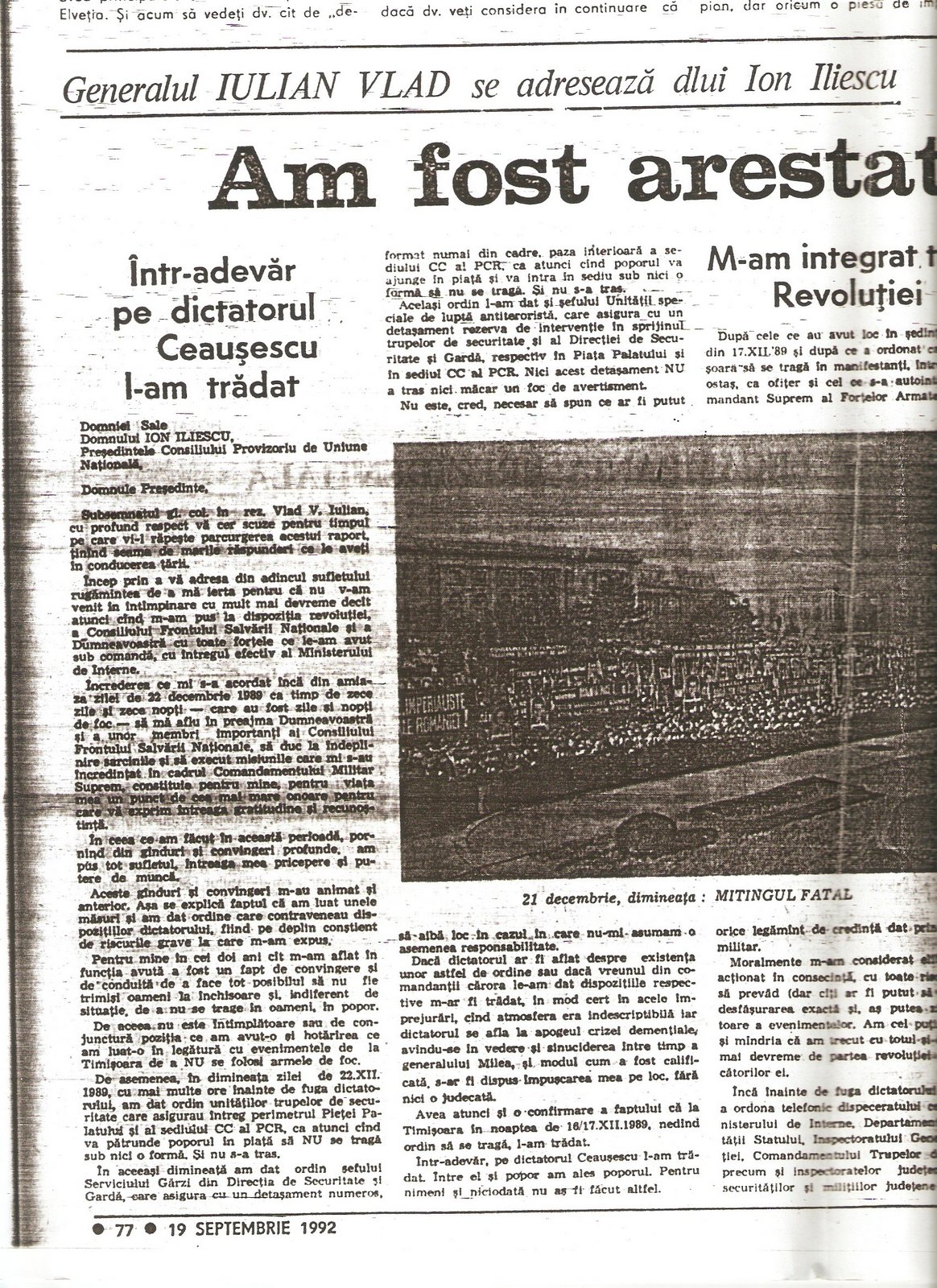
Ion Cristoiu’s Evenimentul Zilei debuted in June 1992 and was the flagship of opposition to the regime of Ion Iliescu.  In the fall of 1992 it ran a zealous campaign opposed to Iliescu’s reelection.  Here is the exculpatory letter from former Securitate General Iulian Vlad (dated 20 March 1990) that was published on 19 September 1992:

image0-004

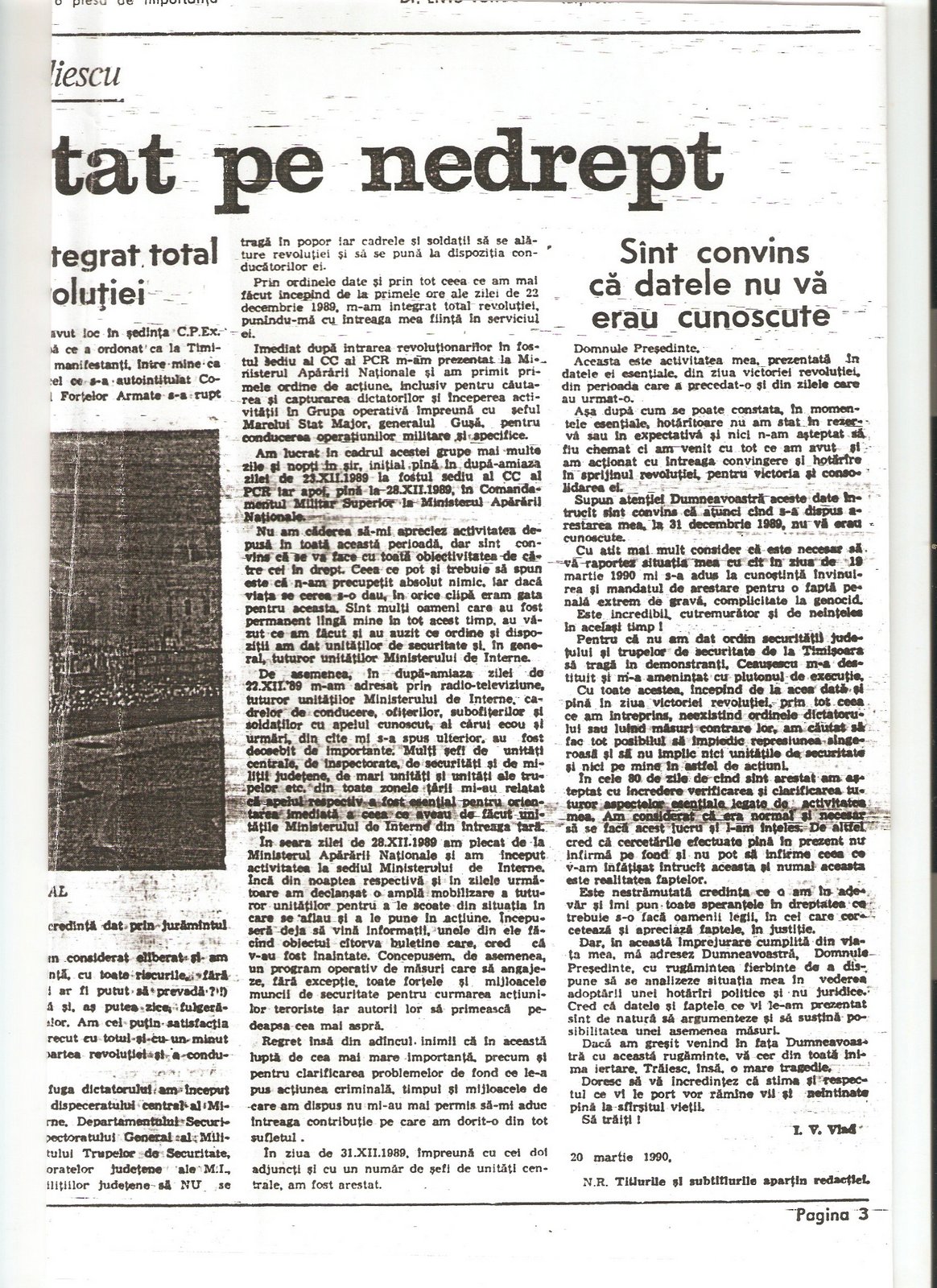
“Generalul IULIAN VLAD se adreseaza dlui Ion Iliescu:  Am fost arestat pe nedrept (20 March 1990),” Evenimentul Zilei, 19 septembrie 1992, p. 3.  “Intr-adevar pe dictatorul Ceausescu l-am tradat” “M-am integrat total Revolutiei” “Sint convins ca datele nu va erau cunoscute”  I.V. Vlad 20 martie 1990

And, yet, what of General Iulian Vlad’s declaration of 29 January 1990.  As far as I know, in 24 plus years, only this brief allusive mention on the 15th anniversary of the letter (although not mentioned or acknowledged in the article, and possibly accidental) has made its way into the Romanian press.  Below it:  the text of the statement of 29 January 1990!

image0-005

http://atomic-temporary-3899751.wpcomstaging.com/text-of-securitate-general-iulian-vlads-29-january-1990-declaration-identifying-the-terrorists/

image0-001

It took 22 years for the text of Securitate Director General Iulian Vlad’s handwritten declaration of 29 January 1990 to become public knowledge–thanks to former military prosecutor General Ioan Dan.  (Inevitably, there will no doubt be those who will allege that General Vlad was “forced” to write this declaration to save his skin, etc., that this was the “propaganda of the moment” and all a huge lie.  If that were the case, one would have expected Iliescu, Brucan, Militaru, Voican Voiculescu, etc. to have made every effort for Vlad’s declaration to leak to the media.  Instead, for 22 years it was hidden from public knowledge!)

Of Note:  No “Soviet tourists,” no DIA (Batallion 404) troops of the army’s intelligence wing, no “there were no terrorists:  the Army shot into everyone else and into itself”–in other words, none of the spurious claims that have littered the narrative landscape, fueled by the former Securitate over the past two decades plus.  No, Vlad knew who the terrorists of the Romanian Revolution of December 1989 were, because they reported to him!

image0

image0-002

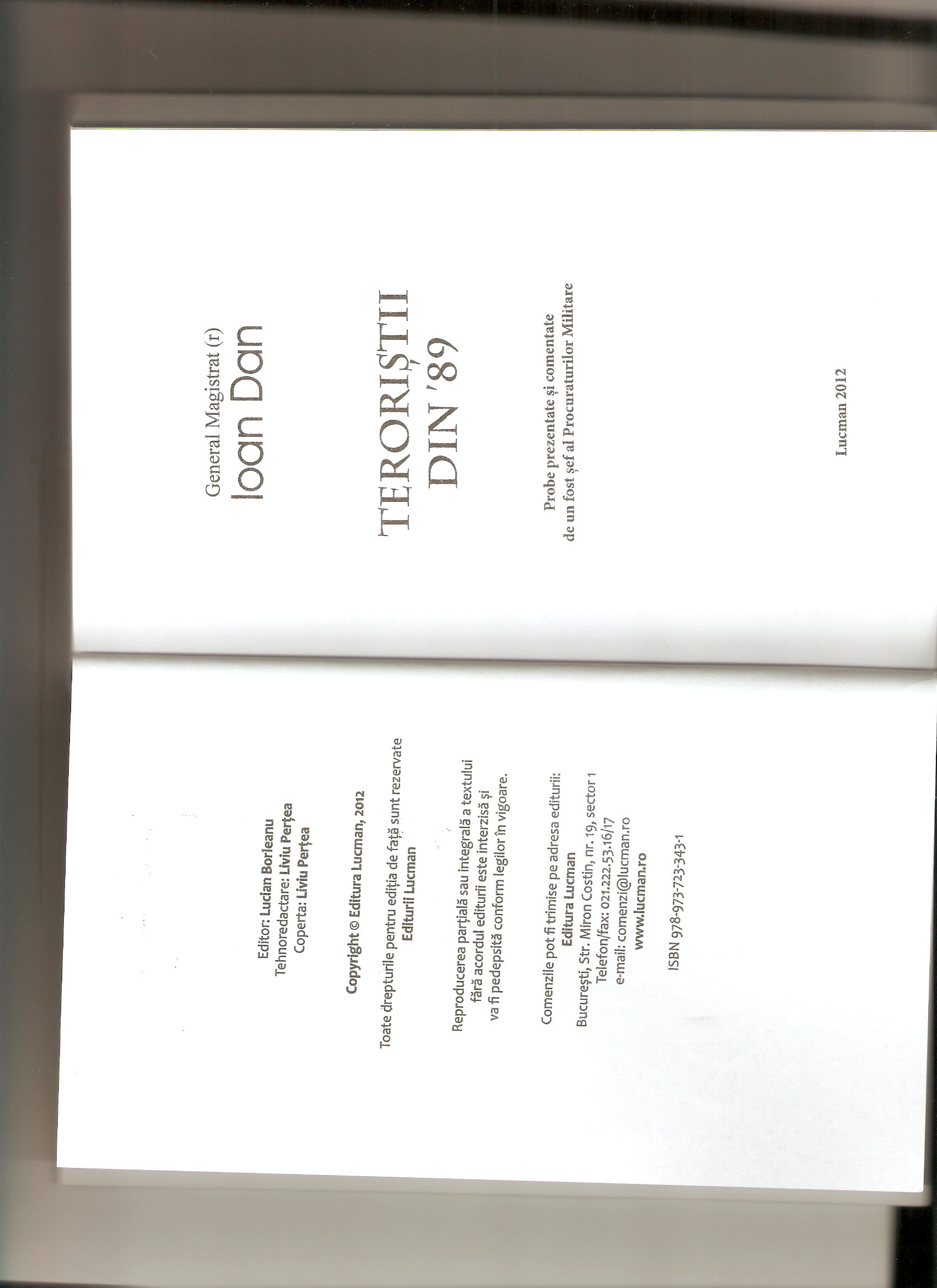
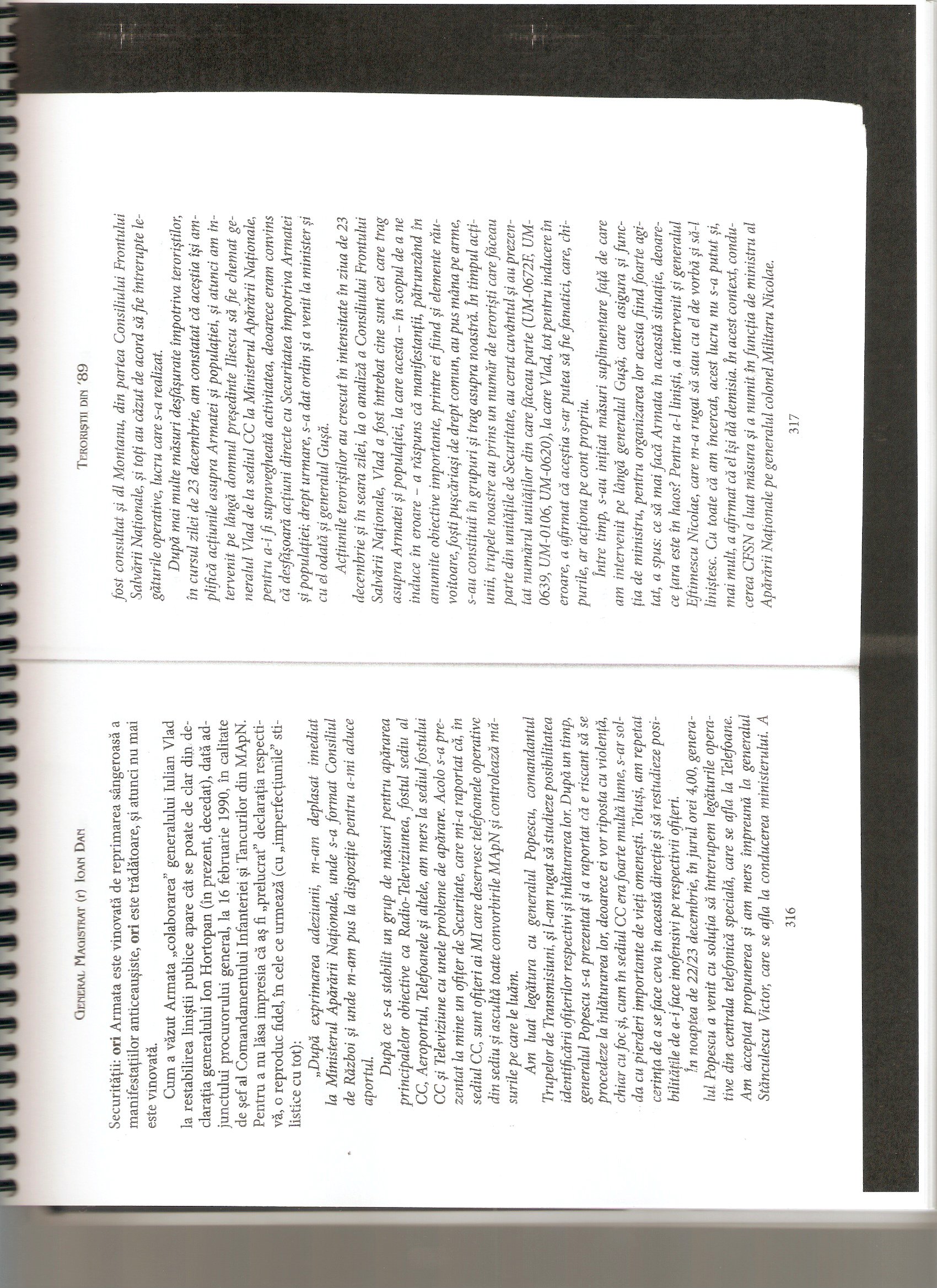
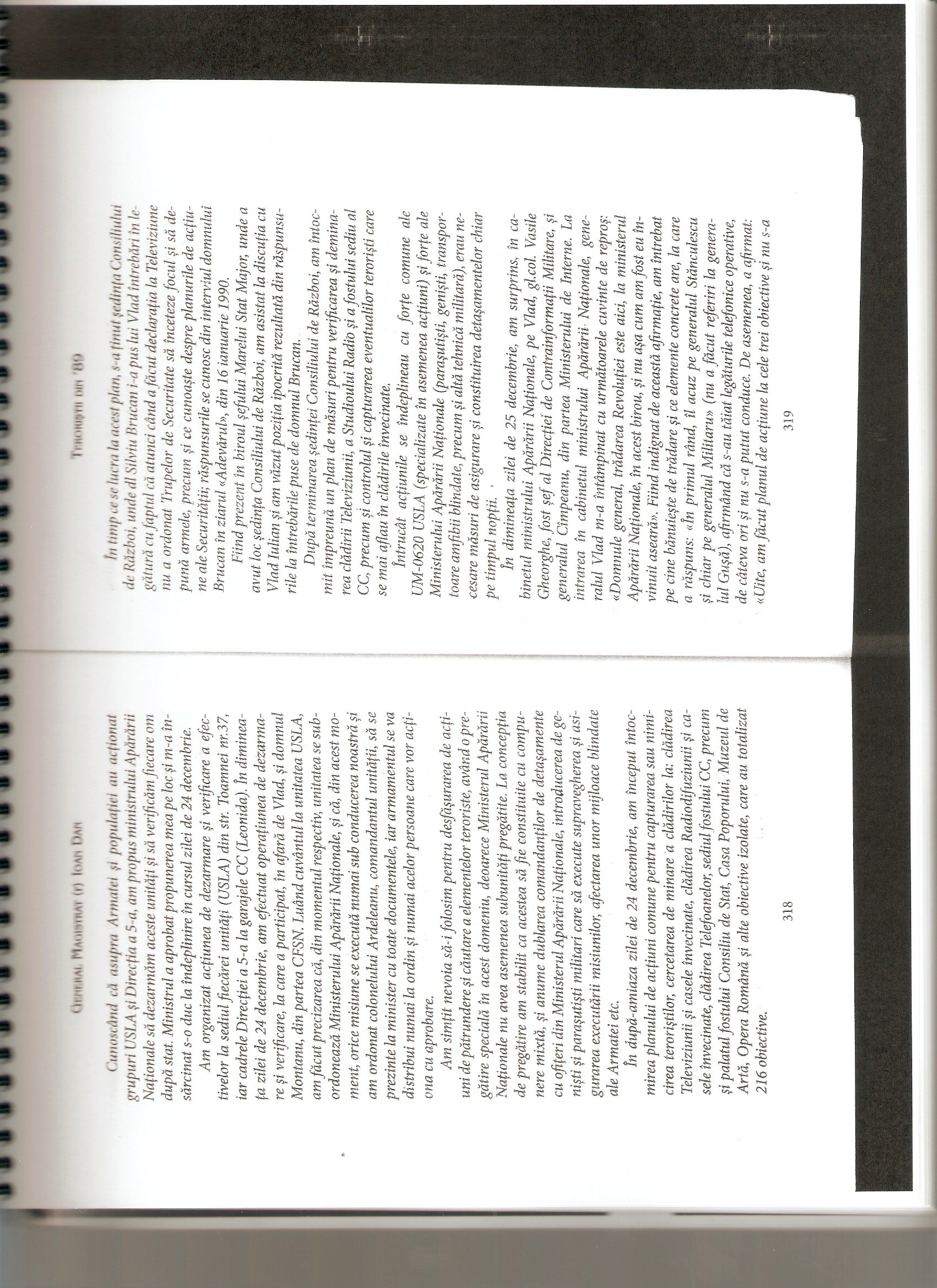
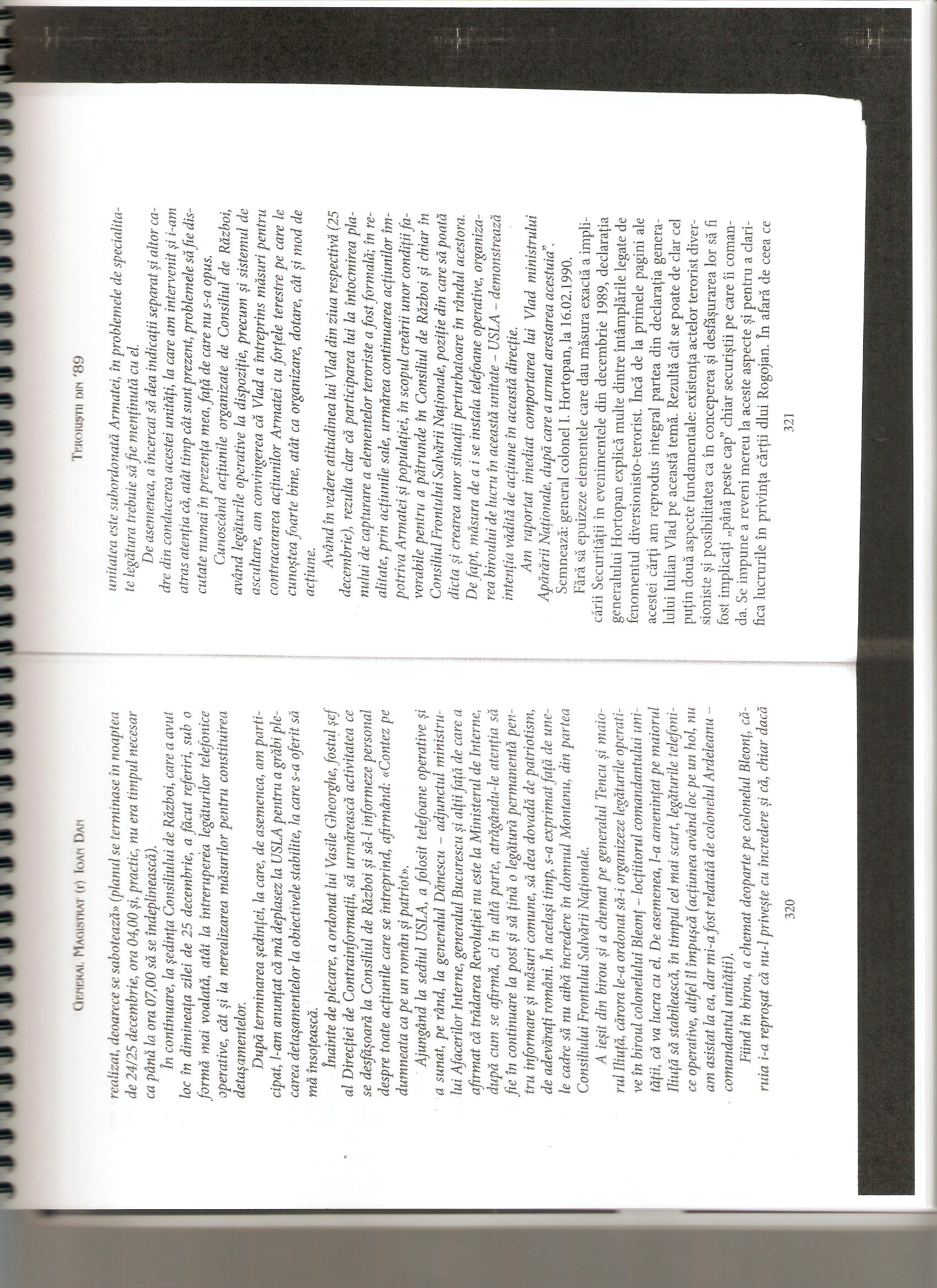
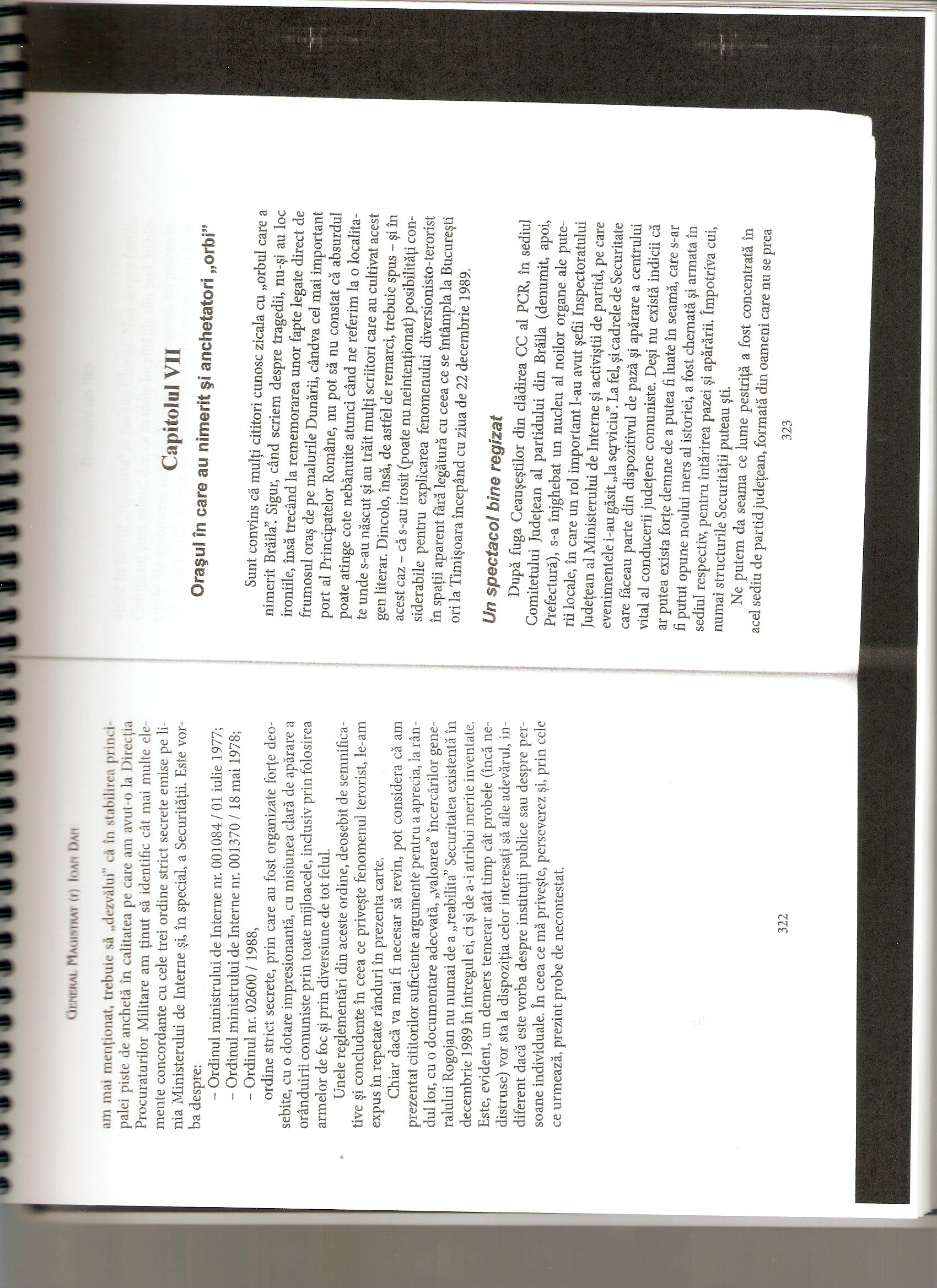
General Magistrat (r) Ioan Dan

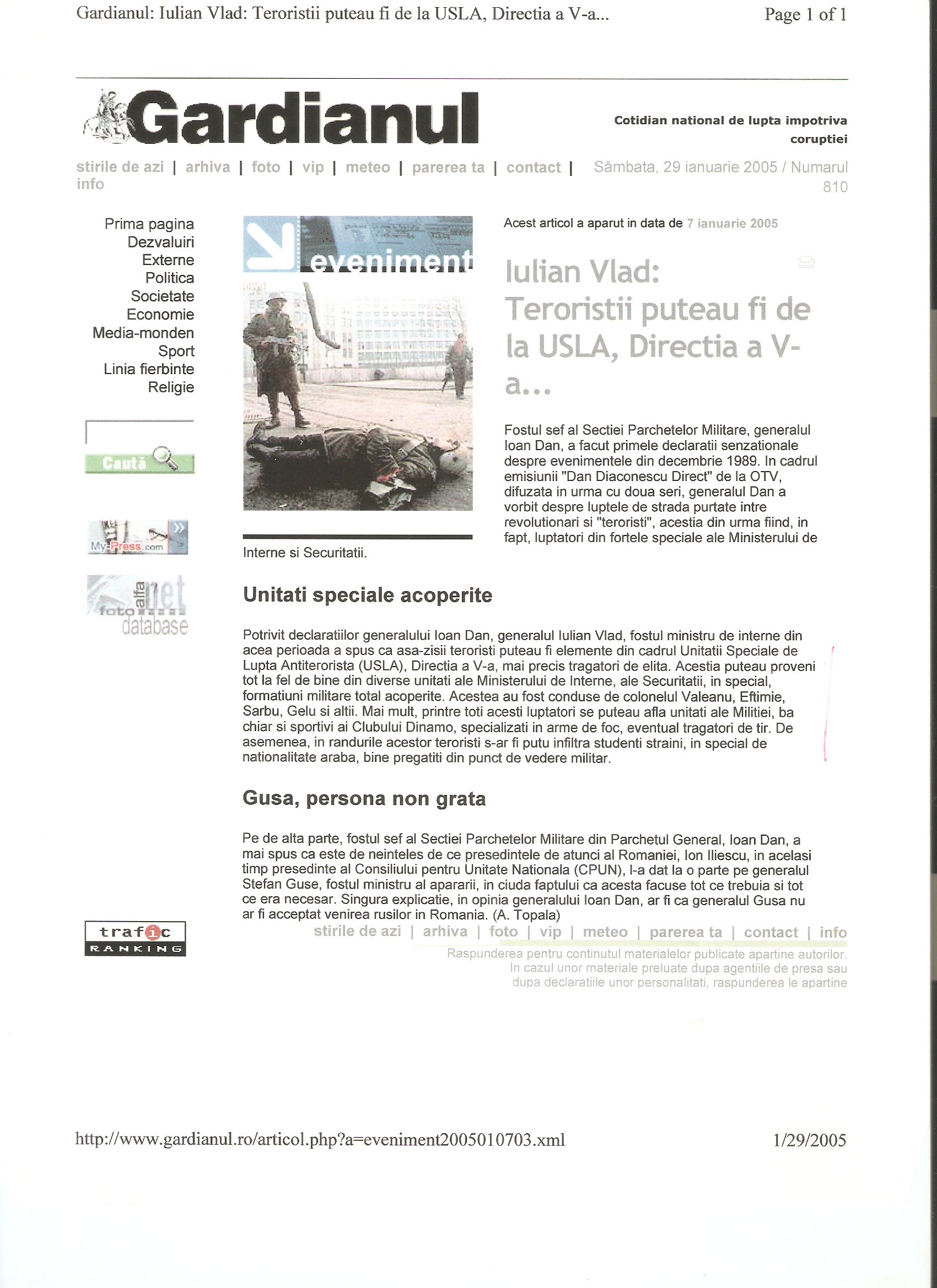
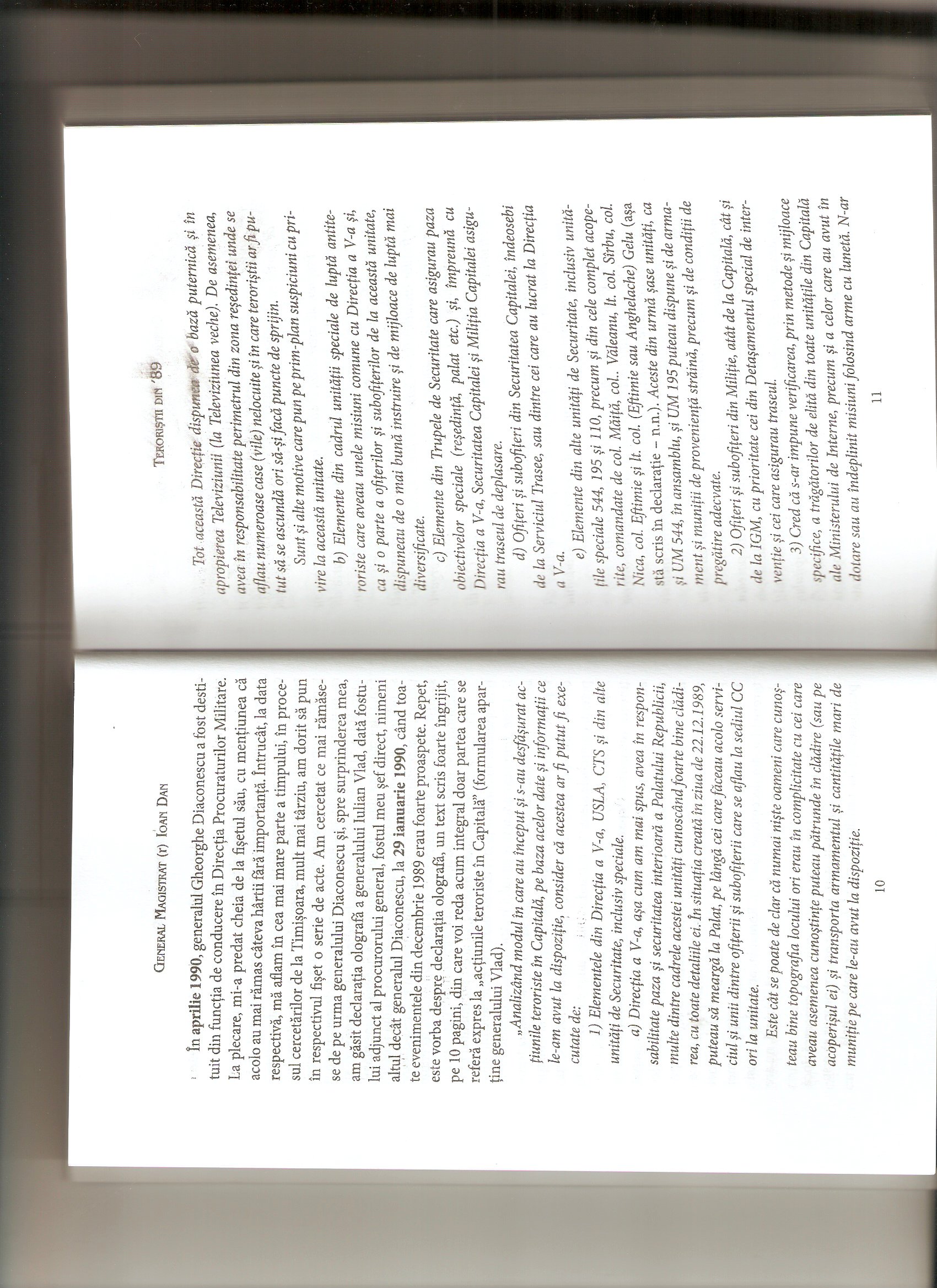
In aprilie 1990, generalul Gheorghe Diaconescu a fost destituit din functia de conducere in Directia Procuraturilor Militare.  La plecare, mi-a predat cheia de la fisteul sau, cu mentiunea ca acolo au mai ramas cateva hartii fara importanta. Intrucat, la data respectiva, ma aflam in cea mai mare parte a timpului, in procesul cercetarilor de la Timisoara, mult mai tarziu, am dorit sa pun in respectivul fiset o serie de acte.  Am cercetat ce mai ramasese de pe urma generalului Diaconescu si, spre surprinderea mea, am gasit declaratia olografa a generalului Iulian Vlad, data fostului adjunct al procurorului general, fostul meu sef direct, nimeni altul decat generalul Diaconescu, la 29 ianuarie 1990, cand toate evenimentele din decembrie 1989 erau foarte proaspete.  Repet, este vorba despre declaratia olografa, un text scris foarte ingrijit, pe 10 pagini, din care voi reda acum integral doar partea care se refera expres la “actiunile teroriste in Capitala” (formularea apartine generalului Vlad).

“Analizand modul in care au inceput si s-au desfasurat actiunile teroriste in Capitala, pe baza acelor date si informatii ce le-am avut la dispozitie, consider ca acestea ar fi putut fi executate de:

1) Elementele din Directia a V-a, USLA, CTS si din alte unitati de Securitate, inclusiv speciale.

a) Directia a V-a, asa cum am mai spus, avea in responsabilitate paza si securitatea interioara a Palatului Republicii, multe dintre cadrele acestei unitati cunoscand foarte bine cladirea, cu toate detaliile ei.  In situatia creata in ziua de 22.12.1989, puteau sa mearga la Palat, pe langa cei care faceau acolo serviciul si unii dintre ofiterii si subofiterii care se aflau la sediul CC ori la unitate.

Este ca se poate de clar ca numai niste oameni care cunosteanu bine topografia locului ori erau in complicitate cu cei care aveau asemenea cunostinte puteau patrunde in cladire (sau pe acoperisul ei) si transporta armamentul si cantitatile mari de munitie pe care le-au avut la dispozitie.

Tot aceasta Directie dispunea de o baza puternica si in apropierea Televiziunii (la Televiziunea veche).  De asemenea, avea in responsabilitate perimetrul din zona resedintei unde se aflau numeroase case (vile) nelocuite si in care teroristii ar fi putut sa se ascunda ori sa-si faca puncte de sprijin.

Sunt si alte motive care pun pe prim-plan suspiciuni cu privire la aceasta unitate.

b) Elemente din cadrul unitatii speciale de lupta antiterroriste care aveau unele misiuni comune cu Directia a V-a si, ca si o parte a ofiterilor si subofiterilor de la aceasta unitate, dispuneau de o mai buna instruire si de mijloace de lupta mai diversificate.

c) Elemente din Trupele de Securitate care asigurau paza obiectivilor speciale (resedinta, palat etc.) si, impreuna cu Directia a-V-a, Securitatea Capitalei si Militia Capitalei asigurau traseul de deplasare.

d) Ofiteri si subofiteri din Securitatea Capitalei, indeosebi de la Serviciul Trasee, sau dintre cei care au lucrat la Directia a V-a.

e) Elemente din alte unitati de Securitate, inclusiv unitatile speciale 544, 195 si 110, precum si din cele complet acoperite, comandate de col. Maita, col. Valeanu, lt. col. Sirbu, col. Nica, col. Eftimie si lt. col. (Eftimie sau Anghelache) Gelu (asa sta scris in declaratie–n.n.).  Aceste din urma sase unitati, ca si UM 544, in ansamblu, si UM 195 puteau dispune si de armament si munitii de provenienta straina, precum si de conditii de pregatire adecvate.

2) Ofiteri si subofiteri din Militie, atat de la Capitala, cat si de la IGM, cu prioritate cei din Detasamentul special de interventie si cei care asigurau traseul.

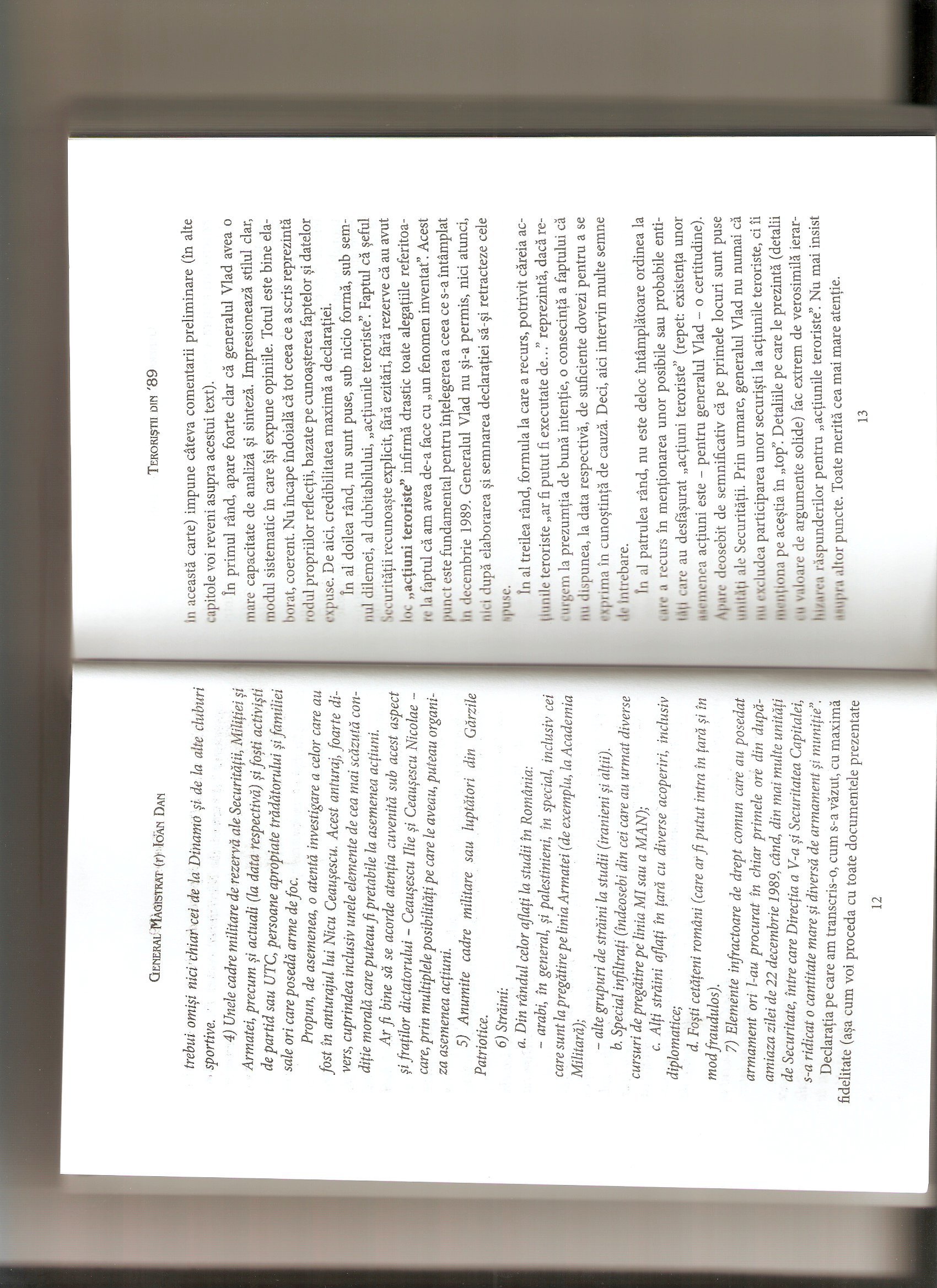
3) Cred ca s-ar impune verificarea, prin metode si mijloace specifice, a tragatorilor de elita din toate unitatile din Capitala ale Ministerului de Interne, precum si a celor care au avut in dotare sau au indeplinit misiuni folosind arme cu luneta.  N-ar trebui omisi nici chiar cei de la Dinamo si de la alte cluburi sportive.

4) Unele cadre militare de rezerva ale Securitatii, Militiei si Armatei, precum si actuali (la data respectiva) si fosti activisti de partid sau UTC, persoane apropriate tradatorului si familiei sale ori care poseda arme de foc.

Propun, de asemenea, o atenta investigare a celor care au fost in anturajul lui Nicu Ceausescu.  Acest anturaj, foarte divers, cuprindea inclusive unele elemente de cea mai scazuta conditie morala care puteau fi pretabile la asemenea actiuni.

Ar fi bine sa se acorde atentia cuvenita sub acest aspect si fratilor dictatorului–Ceausescu Ilie si Ceausescu Nicolae–care, prin multiplele posibilitati pe care le aveau, puteau organiza asemenea actiuni.

5) Anumite cadre militare sau luptatori din Garzile Patriotice.

6) Straini:

a. Din randul celor aflati la studii in Romania:

– arabi, in general, si palestinieni, in special, inclusiv cei care sunt la pregatire pe linia Armatei (de exemplu, la Academia Militara);

– alte grupuri de straini la studii (iranieni si altii).

b. Special infiltrati (indeosebi din cei care au urmat diverse cursuri de pregatire pe linia MI sau a MAN);

c. Alti straini aflati in tara cu diverse acoperiri, inclusiv diplomatice;

d. Fosti cetateni romani (care ar fi putut intra in tara si in mod fraudulos).

7) Elemente infractoare de drept comun care au posedat armament ori l-au procurat in chiar primele ore din dupa-amiaza zilei de 22 decembrie 1989, cand, din mai multe unitati de Securitate, intre care Directia a V-a si Securitatea Capitalei, s-a ridicat o cantitate mare si diversa de armament si munitie.”

http://atomic-temporary-3899751.wpcomstaging.com/2013/10/04/declaratia-generalului-ion-hortopan-cum-a-vazut-armata-colaborarea-generalului-iulian-vlad/

image0-010

Declaratia generalului colonel I. Hortopan, 16.02.1990 (din cate cunosc, pana publicarea cartii lui Dan Ioan, timp de 22 de ani, aceasta declaratie n-a aparut in presa romana)

“Actiunile teroristilor au crescut in intensitate in ziua de 23 decembrie si in seara zilei, la o analiza a Consilului Frontului Salvarii Nationale, Vlad a fost intrebat cine sunt cei care trag asupra Armatei si populatiei, la care acesta — in scopul de ne induce in eroare — a raspuns ca manifestantii patrunzand in anumite obiective importante, printre ei fiind si elemente rauvoitoare, fosti puscariasi de drept comun, au pus mana pe arme, s-au constituit in grupuri si trag asupra noastra.  In timpul actiunii, trupele noastre au prins un numar de teroristi care faceau din unitatile de Securitate, au cerut cuvantul si au prezentat numarul unitatilor din care faceau parte (UM-0672F, UM-0639, UM-0106, UM-0620), la care Vlad, tot pentru inducere in eroare, a afirmat ca acestia s-ar putea sa fie fanatici, care, chipurile, ar actiona pe cont propriu.”

image0-011

image0-012

image0-013

http://atomic-temporary-3899751.wpcomstaging.com/2013/09/07/former-securitate-officials-who-corroborated-general-iulian-vlads-declaration-on-the-terrorists-liviu-turcu-ion-mihai-pacepa-radu-vasilevici-marian-romanescu-and-others/ 

http://atomic-temporary-3899751.wpcomstaging.com/2013/05/14/planul-z-z-ion-mihai-pacepa-si-liviu-turcu-in-decembrie-1989/

I have attempted to trace Pacepa’s public discussion of Plan Z-Z to verify claims made by other actors (see below, Gheorghe Diaconescu, Giani Bucurescu/Virgil Lovescu) in the Romanian Revolution of December 1989.  All of these actors refer to Pacepa’s discussion on Radio Free Europe/Radio Europa Libera sometime apparently between 24 and 26 December 1989.  Unfortunately, although there are a series of audio clips and transcripts from these days on the Europa Libera site http://www.europalibera.org/archive/1989/latest/452/982.html, there is no mention of the Pacepa intervention in question and no indication of record of its existence on the Internet.

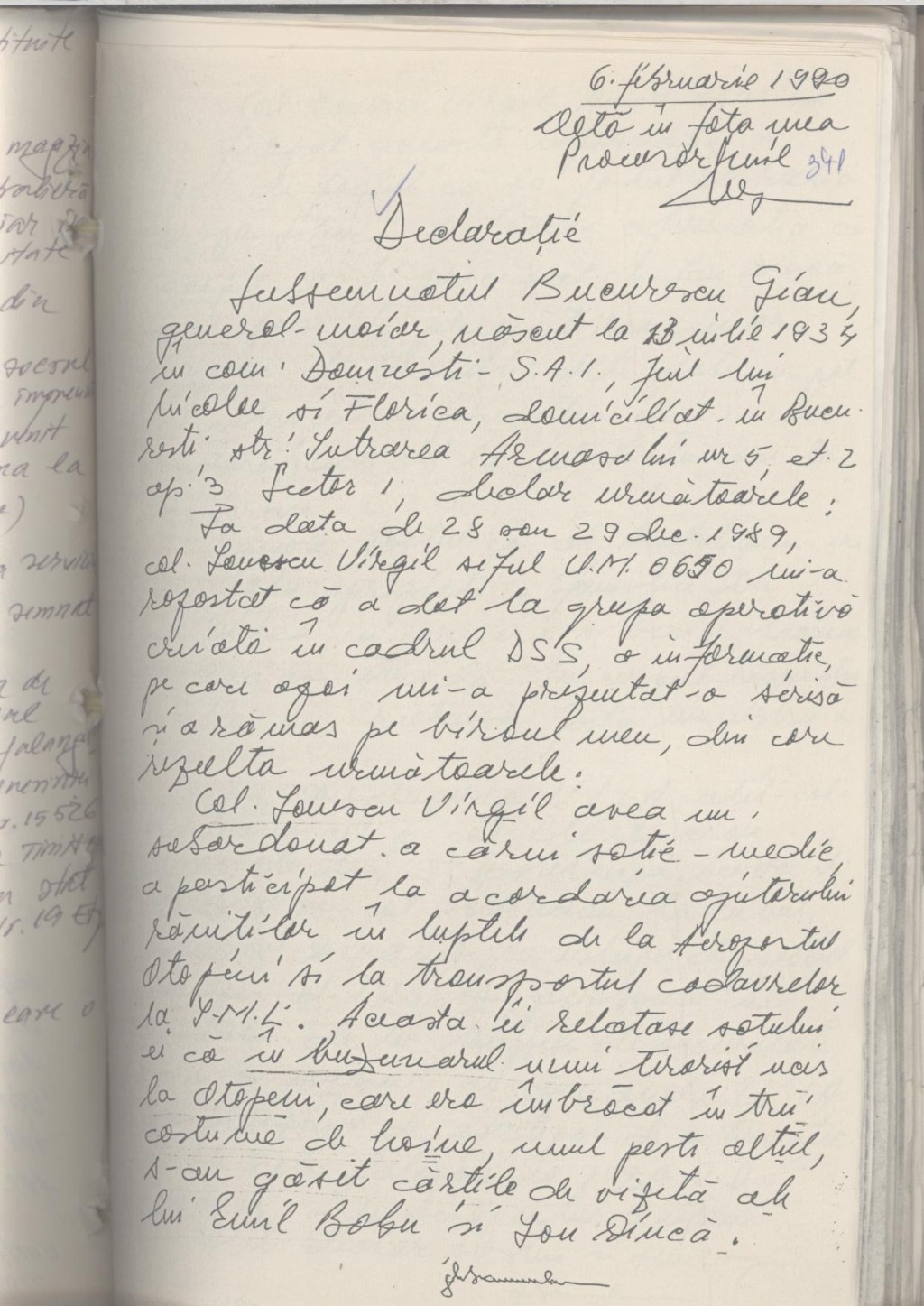
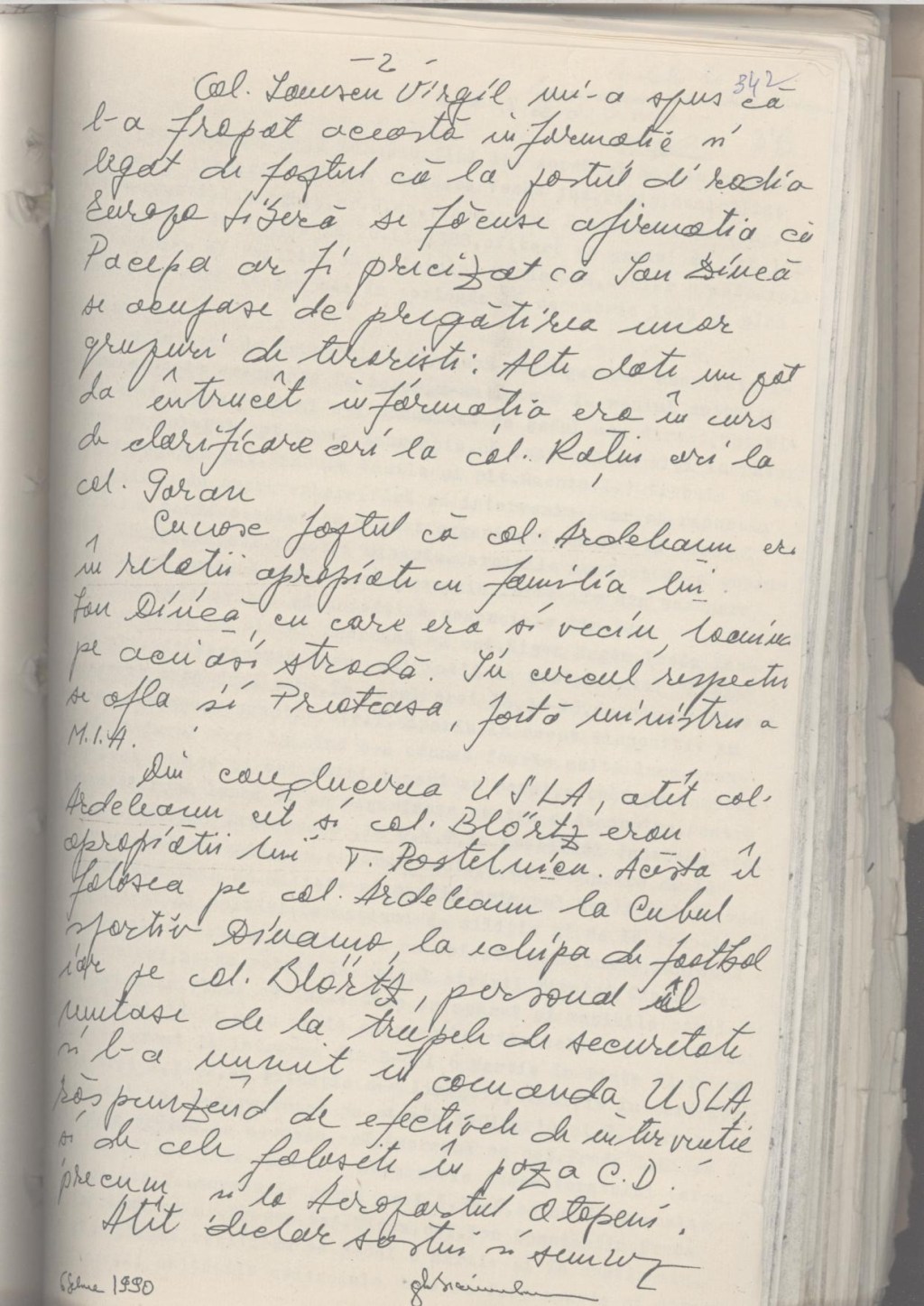
0436

6 februarie 1990

Declaratie.  Subsemnatul Bucurescu Giani, general-maior [D.S.S.]

La data de 28 sau 29 decembrie 1989, col. Lovescu [?] Virgil seful U.M. 0650 mi-a raportat ca…

Col. Lovescu [?] Virgil avea un subordonat a carui sotie-medic a participat la acordarea ajutorului ranitilor in luptele de la Aeroport Otopeni si la transportarea cadavrelor la I.M.L.  Acestea ii relatase sotului ca in buzunarul unui terorist ucis la Otopeni, care era imbracat in trei costume de haine, unul peste altul, s-au gasit cartile de vizita ale lui Emil Bobu si Ion Dinca.

Col. L Virgil mi-a spus ca l-a frapat aceasta informatie si legat de faptul ca la postul de Radio Europa Libera se facuse afirmatie cu Pacepa ar fi precizat ca Ion Dinca se ocupase de pregatirea unor grupuri de teroristi.  Alte date nu pot da intrucit informatia era in curs de clarificare ori la Col. Ratiu [DSS Dir I] ori la Col. Goran [SMB]…

Cunosc [?] faptul ca col. Ardeleanu [sef USLA] era in relatii apropriate cu familia lui Ion Dinca…

Din conducerea USLA atit col. Ardeleanu cit si col Blortz [Bleort] erau apropriatii lui T. Postelnicu

0437

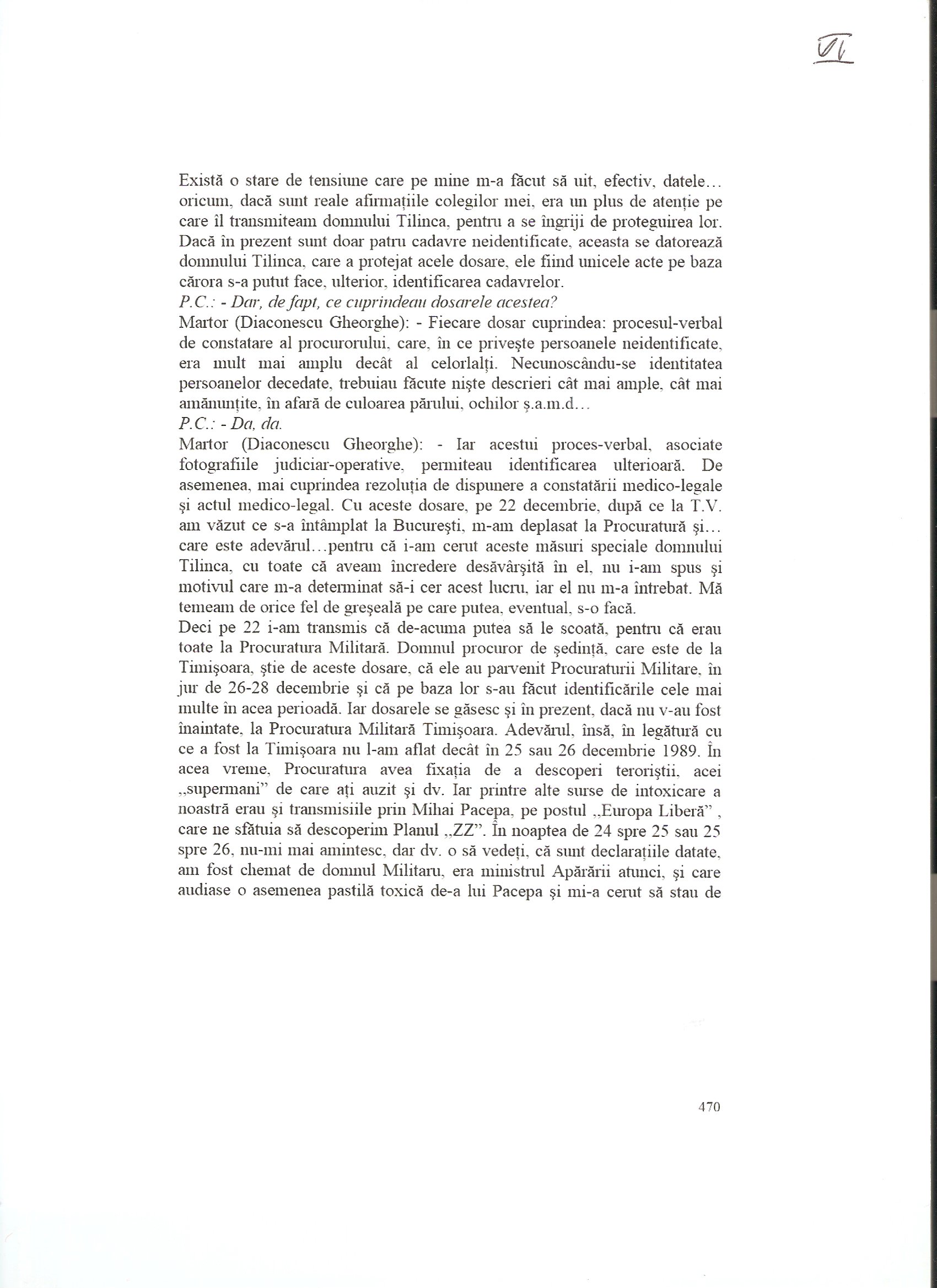
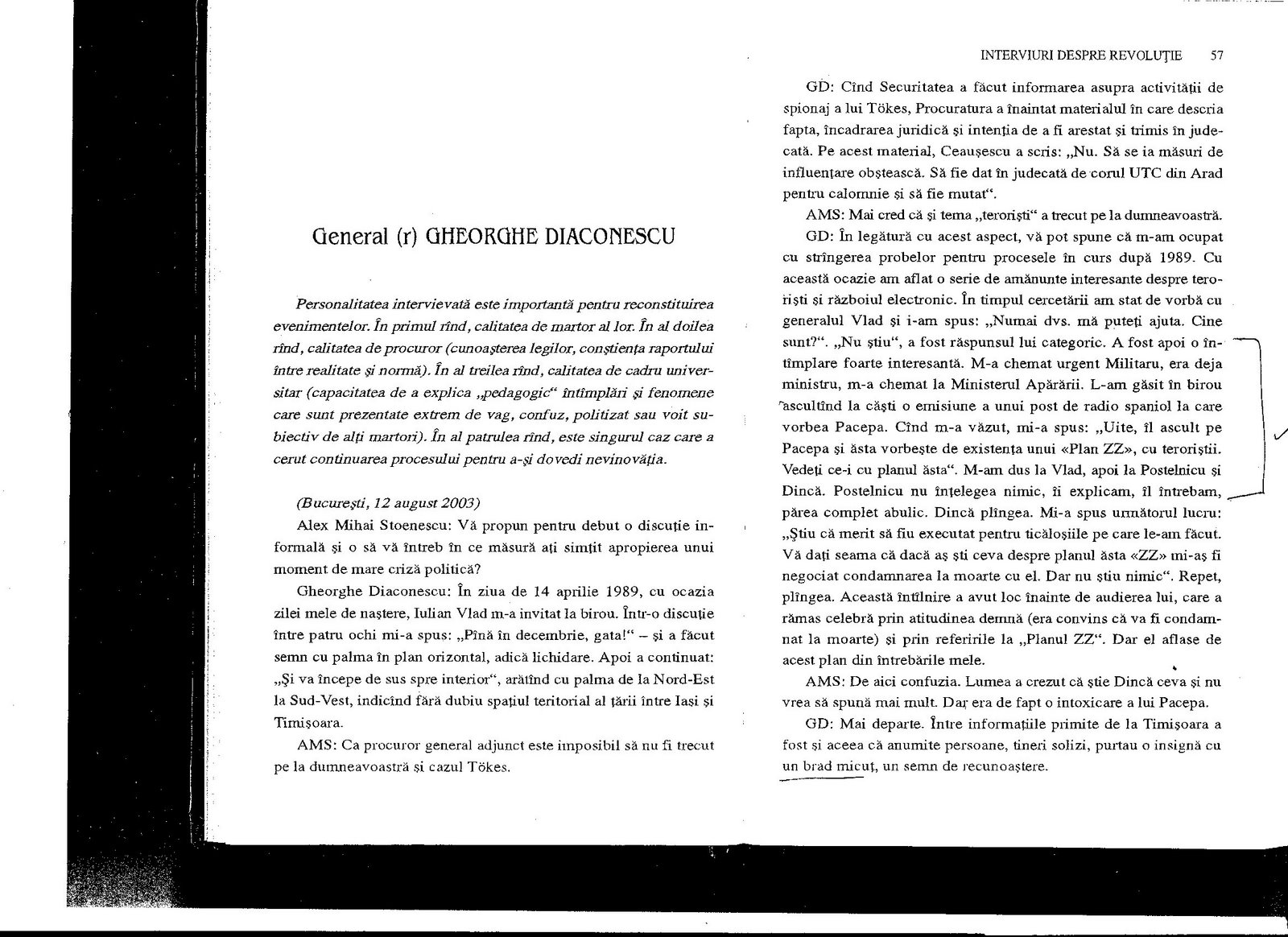
http://atomic-temporary-3899751.wpcomstaging.com/2012/12/28/what-can-we-learn-from-dosarele-revolutiei-de-la-timisoara-vi/

We have two different accounts from Gheorghe Diaconescu, which roughly match:

http://www.banaterra.eu/romana/files/procesul_de_la_timisoara_volumul_VI_continut.pdf

image0

image0-001

This also seems to confirm the following (when adjusted for the corrected dates):

Nestor Ratesh quotes one of Ceausescu’s senior party henchman, Ion Dinca, as having stated at his trial in early February 1990:

“During the night of 27-28 [of January 1990] at 12:30 A.M., I was called by several people from the Prosecutor’s Office to tell what I knew about the agreement entitled Z.Z. between Romania and five other states providing for the dispatching of terrorist forces to Romania in order to intervene in case of a military Putsch.  This agreement Z.Z. is entitled ‘the End of the End.’  I stated then, and I am stating now to you, that I have never been involved in this agreement, neither I nor other people.  And I was told:  Only you and two other people know this.  I stated that and a detailed check was made in order to prove that I was not involved in such acts.”[95]

[95] Ratesh, Romania:  The Entangled Revolution, pp. 66-67, quoting Radio Bucharest, 2 February 1990.  I don’t think from the context given it is clear that this alleged incident took place in January 1990, as Ratesh assumes; the reference to 27-28 might have been a reference to December 1989.

But it almost doesn’t matter when Pacepa first discussed this…because almost identical details were disclosed by Liviu Turcu, a DIE officer who had defected earlier in 1989 (thereby being far more knowledgeable of current plans/realities inside the Romanian security state), only without reference to a named plan, such as Plan Z-Z.  It was thus Turcu on 23 December 1989 (within 24 hours of the outbreak of terrorist hostilities in Romania; the interview would have taken place on Saturday the 23rd) who first informed Western media of the existence of such a plan–although it appears Turcu’s disclosures were never relayed by Romanian media or by Radio Europa Libera.

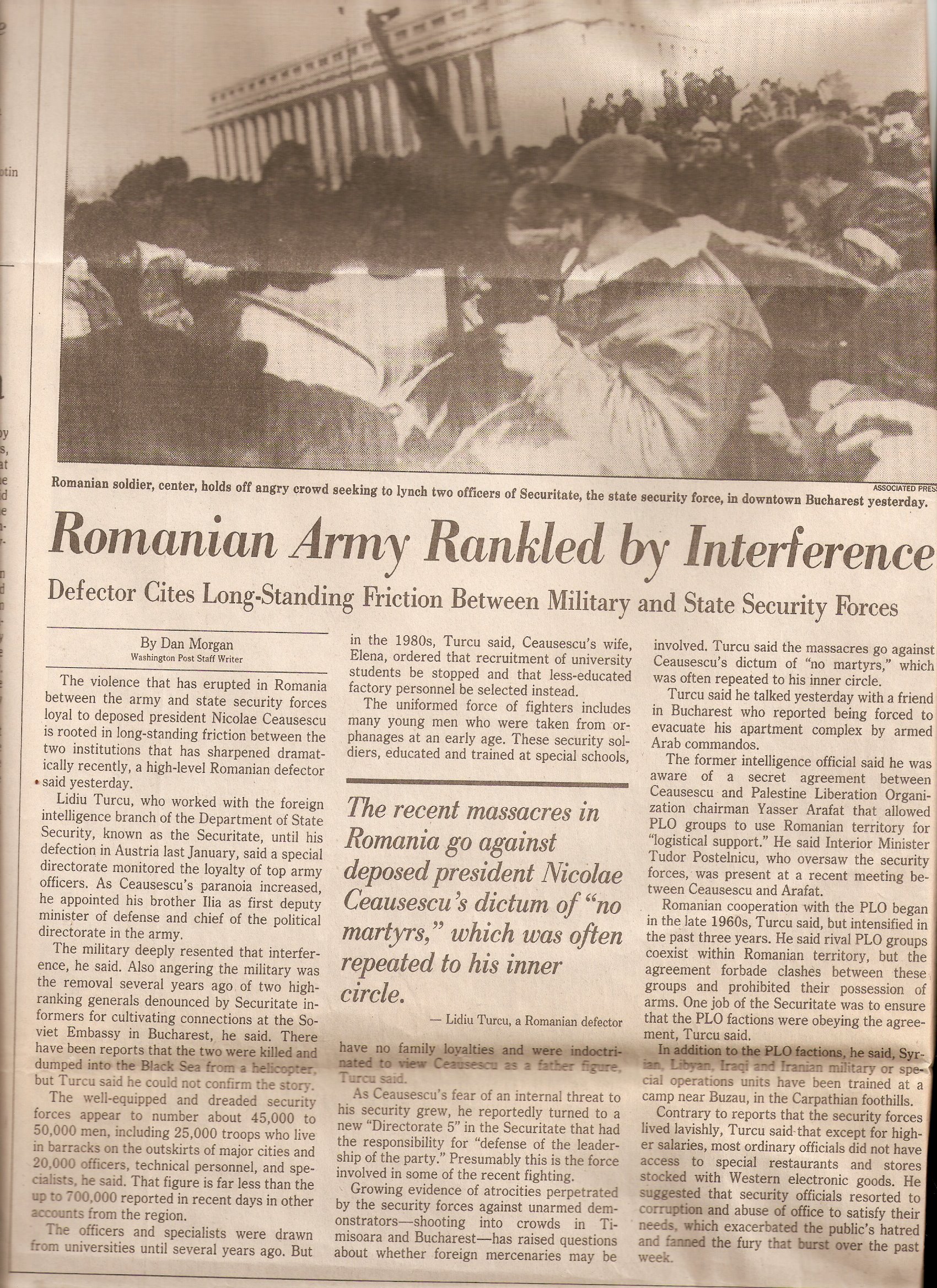
Romanian Army Rankled by Interference;Defector Cites Long-Standing Friction Between Military and State Security Forces

The Washington Post
December 24, 1989 | Dan Morgan

The violence that has erupted in Romania between the army and state security forces loyal to deposed president Nicolae Ceausescu is rooted in long-standing friction between the two institutions that has sharpened dramatically recently, a high-level Romanian defector said yesterday.

Lidiu Turcu, who worked with the foreign intelligence branch of the Department of State Security, known as the Securitate, until his defection in Austria last January, said a special directorate monitored the loyalty of top army officers. As Ceausescu’s paranoia increased, he appointed his brother Ilia as first deputy minister of defense and chief of the political directorate in the army.

The military deeply resented that interference, he said. Also angering the military was the removal several years ago of two high-ranking generals denounced by Securitate informers for cultivating connections at the Soviet Embassy in Bucharest, he said. There have been reports that the two were killed and dumped into the Black Sea from a helicopter, but Turcu said he could not confirm the story.

The well-equipped and dreaded security forces appear to number about 45,000 to 50,000 men, including 25,000 troops who live in barracks on the outskirts of major cities and 20,000 officers, technical personnel, and specialists, he said. That figure is far less than the up to 700,000 reported in recent days in other accounts from the region.

The officers and specialists were drawn from universities until several years ago. But in the 1980s, Turcu said, Ceausescu’s wife, Elena, ordered that recruitment of university students be stopped and that less-educated factory personnel be selected instead.

The uniformed force of fighters includes many young men who were taken from orphanages at an early age. These security soldiers, educated and trained at special schools, have no family loyalties and were indoctrinated to view Ceausescu as a father figure, Turcu said.

As Ceausescu’s fear of an internal threat to his security grew, he reportedly turned to a new “Directorate 5″ in the Securitate that had the responsibility for “defense of the leadership of the party.” Presumably this is the force involved in some of the recent fighting.

Growing evidence of atrocities perpetrated by the security forces against unarmed demonstrators-shooting into crowds in Timisoara and Bucharest-has raised questions about whether foreign mercenaries may be involved. Turcu said the massacres go against Ceausescu’s dictum of “no martyrs,” which was often repeated to his inner circle.

Turcu said he talked yesterday with a friend in Bucharest who reported being forced to evacuate his apartment complex by armed Arab commandos.

The former intelligence official said he was aware of a secret agreement between Ceausescu and Palestine Liberation Organization chairman Yasser Arafat that allowed PLO groups to use Romanian territory for “logistical support.” He said Interior Minister Tudor Postelnicu, who oversaw the security forces, was present at a recent meeting between Ceausescu and Arafat.

Romanian cooperation with the PLO began in the late 1960s, Turcu said, but intensified in the past three years. He said rival PLO groups coexist within Romanian territory, but the agreement forbade clashes between these groups and prohibited their possession of arms. One job of the Securitate was to ensure that the PLO factions were obeying the agreement, Turcu said.

In addition to the PLO factions, he said, Syrian, Libyan, Iraqi and Iranian military or special operations units have been trained at a camp near Buzau, in the Carpathian foothills.

Contrary to reports that the security forces lived lavishly, Turcu said that except for higher salaries, most ordinary officials did not have access to special restaurants and stores stocked with Western electronic goods. He suggested that security officials resorted to corruption and abuse of office to satisfy their needs, which exacerbated the public’s hatred and fanned the fury that burst over the past week.

For verification of some of Turcu’s claims (in particular, the less-discussed participation of Iraqis from Saddam Hussein’s Iraq, see here:  http://atomic-temporary-3899751.wpcomstaging.com/foreign-intervention/)

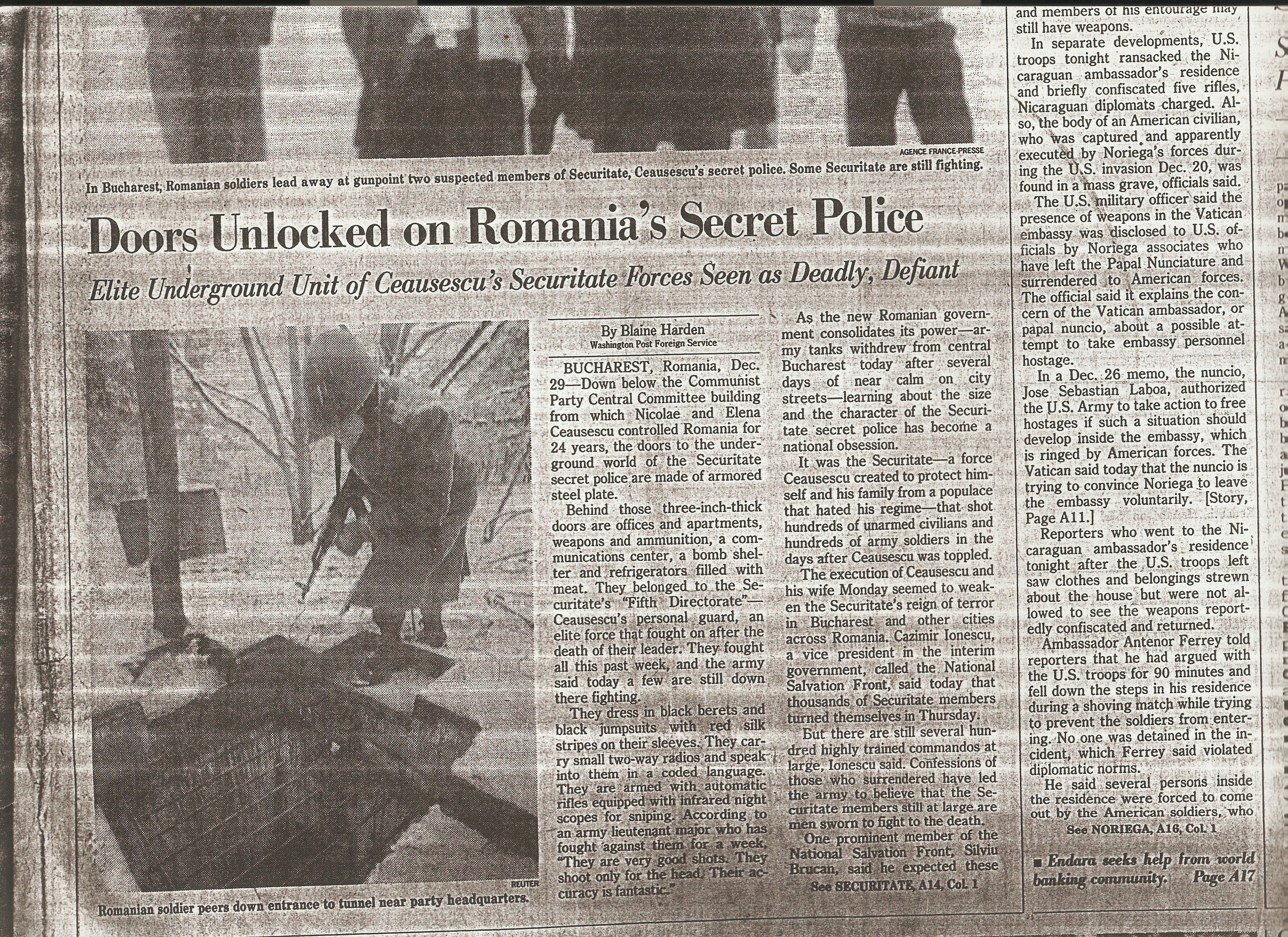
“They dress in black berets and black jumpsuits [combinezoane negre, salopete negre] with red silk stripes on their sleeves.  They carry small two-way radios and speak into them in coded language.  They are equipped with automatic rifles with infrared nightscopes for sniping.”


http://atomic-temporary-3899751.wpcomstaging.com/2010/11/19/les-souterrains-de-bucarest-ja2-20h-27121989-01min55s/

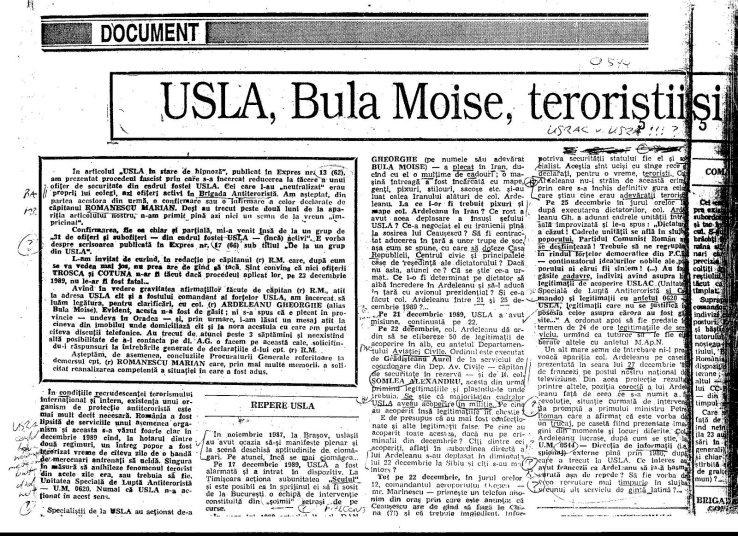
Sediul U.S.L.A , pe 25 decembrie 1989 in jurul orelor 18…

Pe 25 decembrie in jurul orelor 18, dupa executarea dictatorilor, col. Ardeleanu Gh. a adunat cadrele unitatii intr-o sala
improvizata si le-a spus: “Dictatura a cazut! Cadrele unitatii se afla in slujba
poporului. Partidul Comunist Roman nu se desfiinteaza! Trebuie sa ne regrupam in
rindul fortelor democratice din P.C.R.–continuatorul idealurilor nobile ale
poporului ai carui fii sintem ! (…) Au fost gasite cadavre, indivizi avind
asupra lor legitimatii de acoperire USLAC (Unitatea Speciala de Lupta
Antiterorista si Comando) si legitimatii cu antetul 0620–USLA, legitimatii care
nu se justifica in posesia celor asupra carora au fost gasite…” A ordonat apoi
sa fie predate in termen de 24 de ore legitmatiile de serviciu, urmind ca
tuturor sa le fie eliberate altele cu antetul M.Ap.N.

(capitanul Romanescu Marian, cu Dan Badea, “USLA, Bula Moise, teroristii si
‘Fratii Musulmani’,” Expres nr. 26 (75), 2-8 iulie 1991, 8-9)

image-15

(Capitanul Romanescu Marian (fost cadru USLA) si Dan Badea, “USLA, Bula Moise, teroristii, si ‘Fratii Musulmani’,” Expres nr. 26 (75), 2-8 iulie 1991, pp. 8-9)

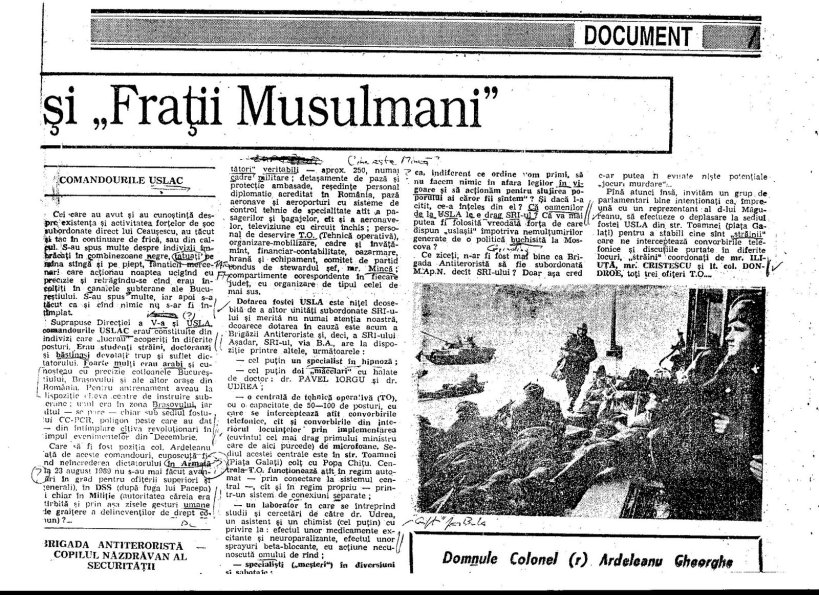
COMANDOURILE USLAC

Cei care au avut si au cunostinta despre existenta si activitatea fortelor de soc subordonate direct lui Ceausescu, au tacut si tac in continuare de frica, sau din calcul.  S-au spus multe despre indivizii imbracati in combinezoane negre, tatuati pe mina stinga si pe piept, fanaticii mercenari care actionau noaptea ucigind cu precizie si retragindu-se cind erau incoltiti in canalele subterane ale Bucurestiului.  S-au spus multe, iar apoi au tacut ca si cind nimic nu s-ar fi intimplat.

Suprapuse Directiei a V-a si USLA comandourile USLAC erau constituite din indivizi care “lucrau” acoperiti in diferite posturi. Erau studenti straini, doctoranzi si bastinasi devotati trup si suflet dictatorului.  Foarte multi erau arabi si cunosteau cu precizie cotloanele Bucurestiului, Brasovului si ale altor orase din Romania.  Pentru antrenament aveau la dispozitie citeva centre de instruire subterane:  unul era in zona Brasovului, iar altul–se pare–chiar sub sediul fostului CC-PCR, poligon care au dat–din intimplare citiva revolutionari in timpul evenimentelor din Decembrie.

image-13

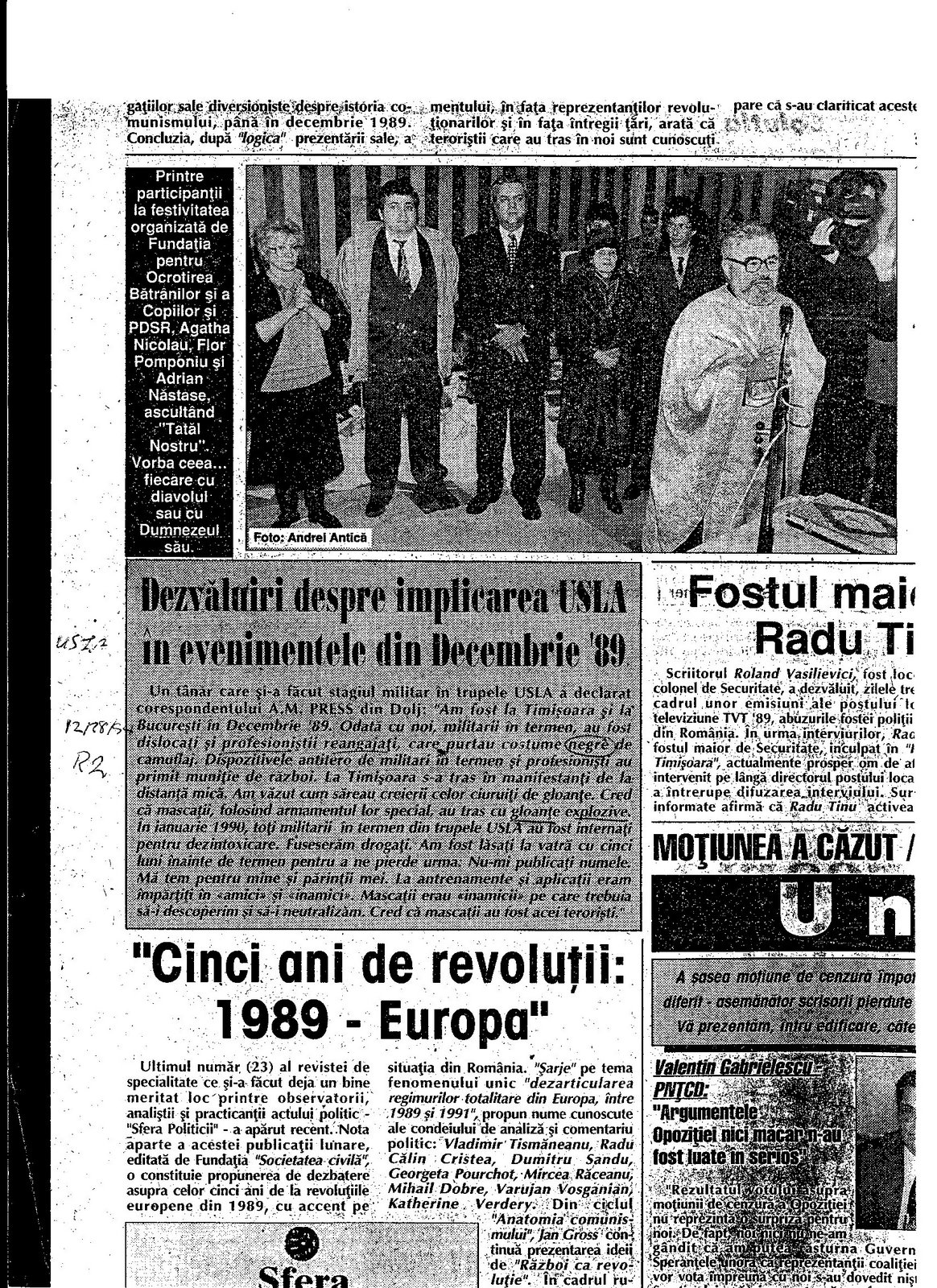
Dezvaluiri despre implicarea USLA in evenimentele din Decembrie ‘89

Un tanar care si-a facut stagiul militar in trupele USLA a declarat
corespondentului A.M. PRESS din Dolj: “Am fost la Timisoara si la Bucuresti in
Decembrie ‘89. Odata cu noi, militarii in termen, au fost dislocati si
profesionistii reangajati, care purau costume negre de camuflaj. Dispozitivele
antitero de militari in termen si profesionisti au primit munitie de razboi. La
Timisoara s-a tras in manifestanti de la distanta mica. Am vazut
cum sareau creierii celor ciuruiti de gloante. Cred ca mascatii, folosind armamentul lor special, au tras cu
gloante explozive.
In ianuarie 1990, toti militarii in termen din trupele USLA
au fost internati pentru dezintoxicare. Fusesaram drogati. Am fost lasati la
vatra cu cinci luni inainte de termen pentru a ne pierde urma. Nu-mi publicati
numele. Ma tem pentru mine si parintii mei. La antranamente si aplicatii eram
impartiti in “amici” si “inamici.” Mascatii erau “inamicii” pe care trebuia sa-i
descoperim si sa-i neutralizam. Cred ca mascatii au
fost acei teroristi.”

(Romania Libera, 28 Decembrie 1994, p. 3)

image-18image-17image-16image-15

image-4image-9

Posted in decembrie 1989, raport final | Tagged: , , , , , , , , , , , , , , , , , , , , , , , , , , , , , , , , , , , , , , | Leave a Comment »

25 for the 25th Anniversary of the Romanian Revolution: #18 Iliescu and the Front Appeal for Soviet Help: The What and the Why

Posted by romanianrevolutionofdecember1989 on December 24, 2014

(purely personal views, based on two decades of prior research and publications; please do not cite without prior author approval, thank you)

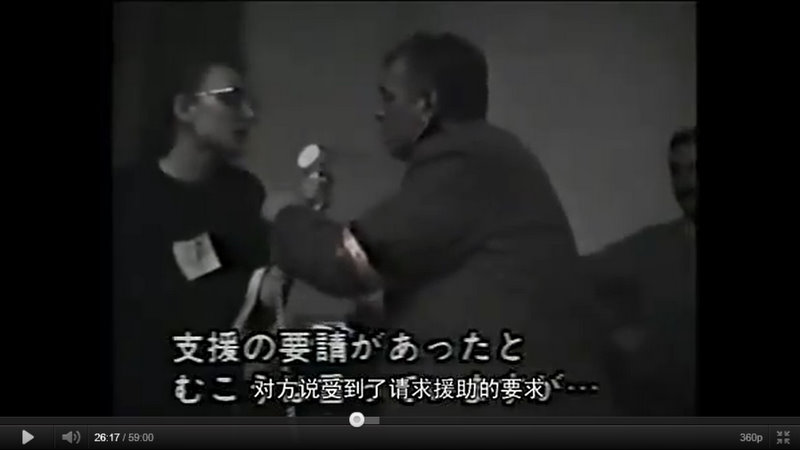
Imagini inedite si rare (ale lui Spiru Zeres si ale lui Dan Cioban): televiziune japoneza (NHK) si revolutia romana din decembrie 1989

On 23 December 1989 Leaders of the National Salvation Front Requested Soviet Military Assistance: Addressing the What and the Why (I)

On 23 December 1989 Leaders of the National Salvation Front Requested Soviet Military Assistance: Addressing the What and the Why (II)

Despite Ion Iliescu’s fervent and repeated denials to the contrary, leaders of the National Salvation Front, including apparently Ion Iliescu and Silviu Brucan, panicked on 23 December 1989 and requested Soviet military assistance.  The reporting from the time seems pretty clear on this point, and what is significant is that it was the Soviets themselves who acknowledged the existence of the request.  Here, for example, is a Los Angeles Times report (available on the Internet) by Michael Parks from Sunday 24 December 1989 reporting from Moscow, the previous day’s statements by Soviet officials on Saturday 23 December 1989:

Upheaval In Romania : Moscow Pledges Aid but Rejects Troop Request : Soviet Union: Gorbachev says Romania’s new government can expect humanitarian help from the Warsaw Pact.

December 24, 1989|MICHAEL PARKS | TIMES STAFF WRITER

MOSCOW — The Soviet Union, affirming its support for the popular uprising that overthrew Romanian President Nicolae Ceausescu, pledged Saturday to provide “immediate and effective humanitarian aid” to the country but drew the line at military assistance….

Gorbachev told the deputies that the Kremlin had considered a request for military assistance by leaders of the Front of National Salvation, the provisional government established by former Communist Party and government officials, military commanders and intellectuals in Bucharest. But he said Moscow had decided against sending in forces as the fighting appeared to abate….

Gorbachev said the request for military assistance had come overnight when Romanian army units, apparently loyal to Ceausescu, “turned against the people” and were threatening to retake strategic positions in Bucharest–including the Communist Party’s headquarters, where the provisional government’s leaders were meeting. But the loyalists’ counterattack was “suppressed,” Gorbachev said, when more troops were brought in….

http://articles.latimes.com/1989-12-24/news/mn-2156_1_warsaw-pact

—-

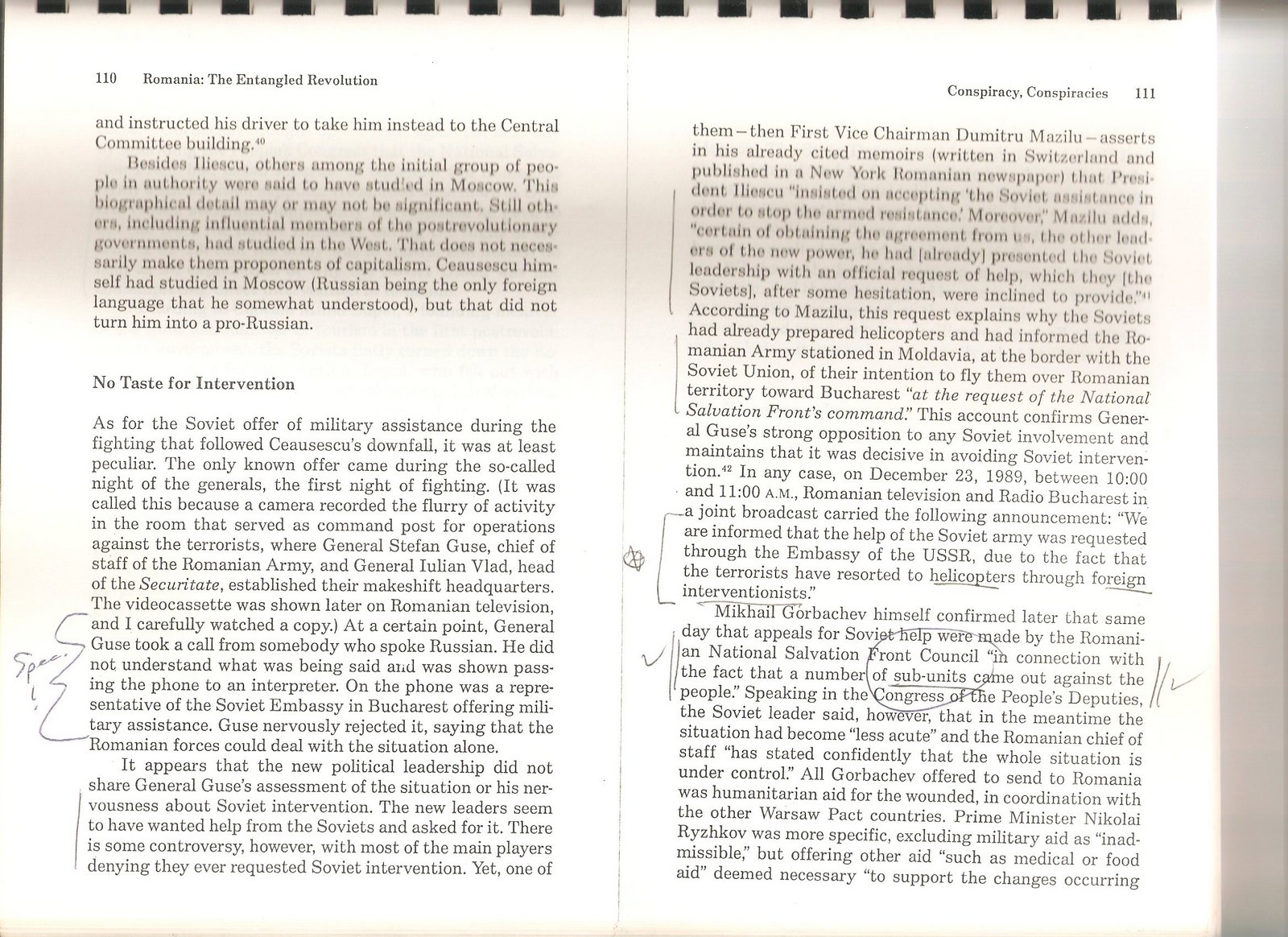
Nestor Ratesh noted in his 1991 The Entangled Revolution, notes the broadcast of this appeal as follows (commenters on online articles often express exasperation to denials of the appeal because personally they recall seeing or hearing it):

In any case, on December 23, 1989, between 10:00 and 11:00 A.M., Romanian television and Radio Bucharest in a joint broadcast carried the following announcement: 

“We are informed that the help of the Soviet army was requested through the Embassy of the USSR, due to the fact that the terrorists have resorted to helicopters through foreign interventionists.”

image0-001

As further confirmation, the Polish researcher Adam Burakowski unearthed a document from the Polish Ministry of Foreign Affairs that is translated below by Tomasz Kluz:

http://www.revista22.ro/n-decembrie-1989-iliescu-si-brucan-au-cerut-ajutor-militar-de-la-sovietici-7557.html

Copies of the document were published here:  http://adevarul.ro/news/eveniment/un-adevar-crunt-iliescu-chemat-trupele-sovietice-1_50ad210e7c42d5a6638f368a/index.html

* * *

Ministerul Afacerilor Externe

După utilizare, mesajul cifrat trebuie distrus conform prevederilor referitoare la utilizarea documentelor secrete

SECRET
Exemplar 12

Mesaj cifrat nr. …
din Bucureşti 23.12.89

URGENT
Către dir. J. Mąkosa
Însărcinat cu afaceri, Bauer informează prin depeşa nr. 189 din data de 23 luna curentă:

Ora 15.00.

1. De la sovietici:
În numele Frontului Salvării Naţionale, I. Iliescu şi S. Brucan au solicitat ajutor militar Ambasadei URSS, pentru că singuri nu se vor descurca.
Fără să aştepte răspunsul, FSN a anunţat la TV că Ambasada a promis ajutorul.
Răspunsul URSS: sunt gata să acorde orice fel de ajutor cu excepţia intervenţiei trupelor.
2. Polonezii de la aeroport sunt deocamdată în siguranţă. Ne sună. Noi nu putem [să-i sunăm]. Au primit pături şi hrană. Nu există nicio posibilitate de a ajunge la aeroport şi
de a-i lua de acolo.
3. Sovieticii au probleme cu cetăţenii lor, care s-au adăpostit în ambasadă după distrugerea Biroului Consilierului Comercial şi a locuinţelor.
4. La radio s-a anunţat că trupe arabe atacă Televiziunea.
La ora 15.00 auzim de acolo împuşcături care devin din ce în ce mai intense.

Spre ştiinţă:
(nume – fiecare primeşte câte un exemplar, în ordinea dată)

Întocmit în 15 exemplare a câte o pagină.
Bătut la maşina de scris nr. 7157 de Kowalczyk

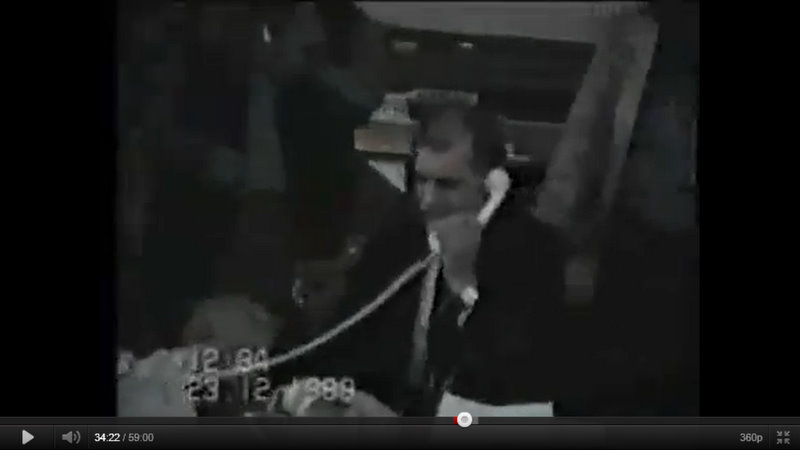
Army General Stefan Guse rejecting (if I recall correctly) Hungarian military’s offer of aid (conversation takes place through Russian translator since that was the assumed lingua franca)

Govoritz pa russkiy?

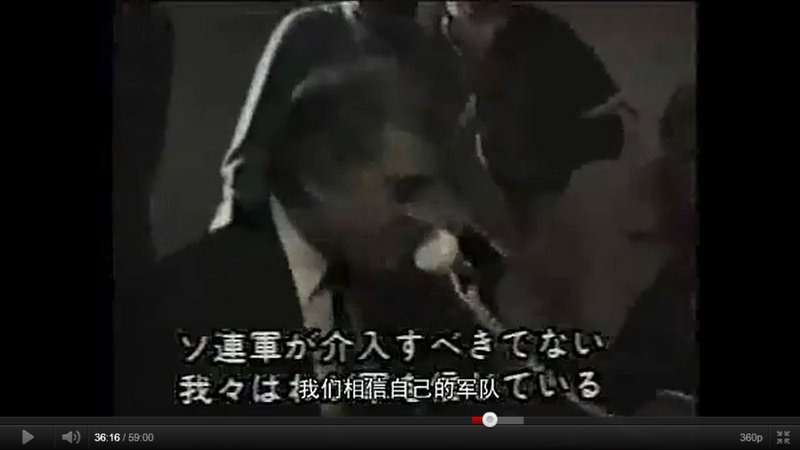
Dumitru Mazilu discussing terrorists in the service of the tyrant (Nicolae Ceausescu) and rejecting Soviet offers of help on 23 December 1989 (note reference to belief that Soviets were already entering the country…someone says at “Bacau”)

Despite Ion Iliescu’s fervent and repeated denials to the contrary, leaders of the National Salvation Front, including apparently Ion Iliescu and Silviu Brucan, panicked on 23 December 1989 and requested Soviet military assistance, as verified by three accounts herehttp://atomic-temporary-3899751.wpcomstaging.com/2014/05/10/on-23-december-1989-leaders-of-the-national-salvation-front-requested-soviet-military-assistance-addressing-the-what-and-the-why-i/How much of their unwillingness today to acknowledge that they made this request is dictated by embarrassment in such a Russophobic country over having made such a request and how much of it is dictated by the effort to erase the existence, actions, and culpability of the “terrorists” is unclear.

For many Romanians, that is all they need to know:  they don’t care about the context in which such a decision was made, that the Soviets appear to have for the most part turned down the request, and that the Front decision was dictated by the genuine confusion and fear that permeated the hours during which these appeals were made.  What then is the reality of the reasons Front officials gave for the request for Soviet assistance?  As Nestor Ratesh wrote in 1991 in The Entangled Revolution (p. 111):

In any case, on December 23, 1989, between 10:00 and 11:00 A.M., Romanian television and Radio Bucharest in a joint broadcast carried the following announcement:  “We are informed that the help of the Soviet army was requested through the Embassy of the USSR, due to the fact that the terrorists have resorted to helicopters through foreign interventionists.”

So we have two data points to investigate:

1) the existence of helicopters not under control of forces loyal to Nicolae Ceausescu’s overthrow, and 2) the existence of non-Romanians among the so-called “terrorists.”

We know that the claim of unidentified helicopters was an issue on the night of 22/23 December 1989, as this video makes clear.

[The following passage is indicative of Securitate General Iulian Vlad’s duplicity and lack of credibility.  Playing dumb about the report of unidentified helicopters, he responds to one of the revolutionary’s questions–suggesting that the helicopters belonged to Vlad’s Securitate–in a ridiculous and unserious manner,”perhaps they are yours?” he says to the man (!)]

1:32 Iulian Vlad: Dar eu nu-nţeleg de ce au plecat elicopterele.
1:34 Bărbat: Ale teroriştilor.
1:35 Iulian Vlad: Care terorişti, domnule, de unde au venit ăştia? Că n-au…
1:38 Bărbat: (neînţelegibil) speciale
1:40 Iulian Vlad: Păi de unde? Ori ale dînsului (arată spre Guşă), ori ale mele tre’ să fie. Altele nu sînt.
1:44 Bărbat: Ale dumneavoastră.
1:46 Iulian Vlad: Ale dumneavoastră, măi copii.
1:47 Bărbat: Au fost şi altele.
1:49 Iulian Vlad: Foarte curioasă treaba asta.
1:51 Bărbat: Sînt de la dumneavoastră cu alte ordine.

1:53 Iulian Vlad: Păi nu am decît trei elicoptere.

transcribed at http://mariusmioc.wordpress.com/2011/01/14/stefan-gusa-alerta-totala-peste-tot-astia-au-fost-niste-dementi-au-doborit-8-elicoptere-o-fi-avut-un-regiment-subteran-pe-undeva-video/

1) The question of unidentified HELICOPTERS:

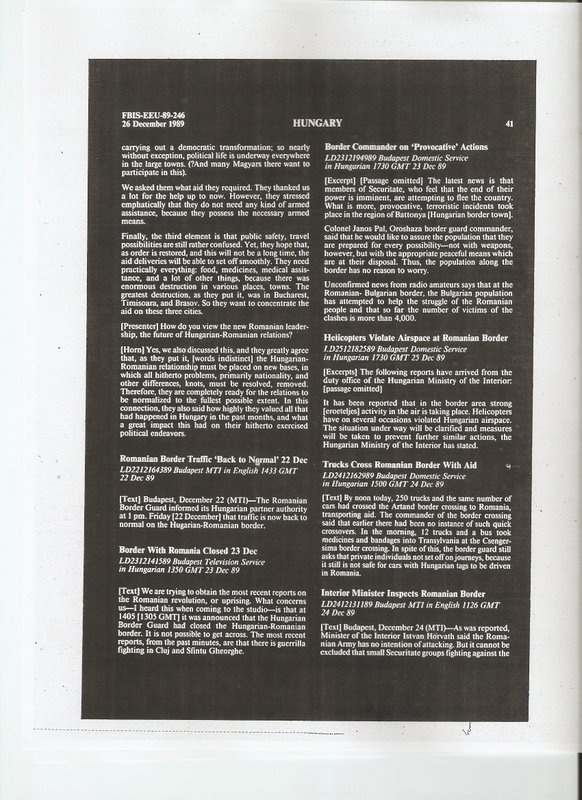
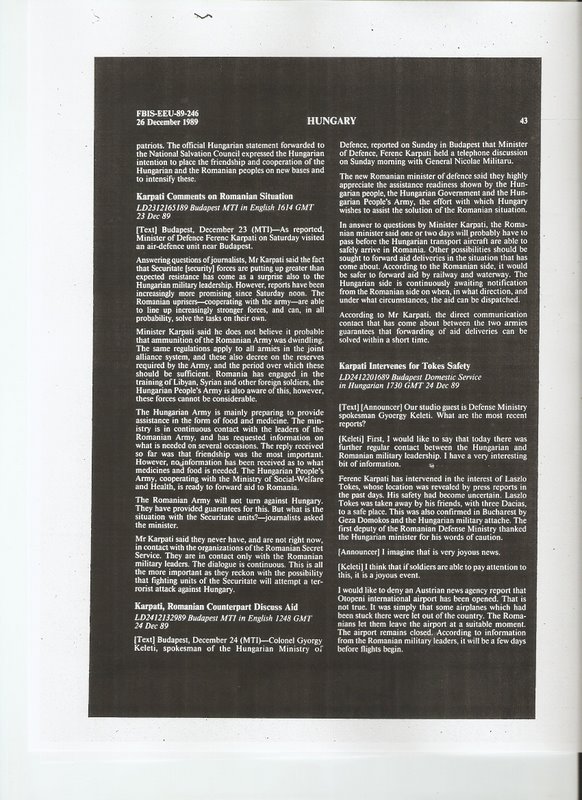
http://atomic-temporary-3899751.wpcomstaging.com/securitate-helicopters-transmitters-per-hungarian-defense-officials/

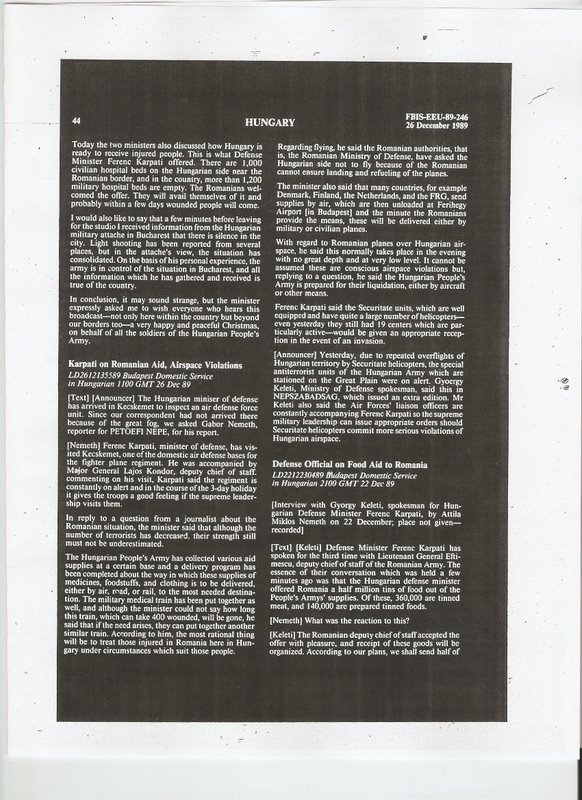
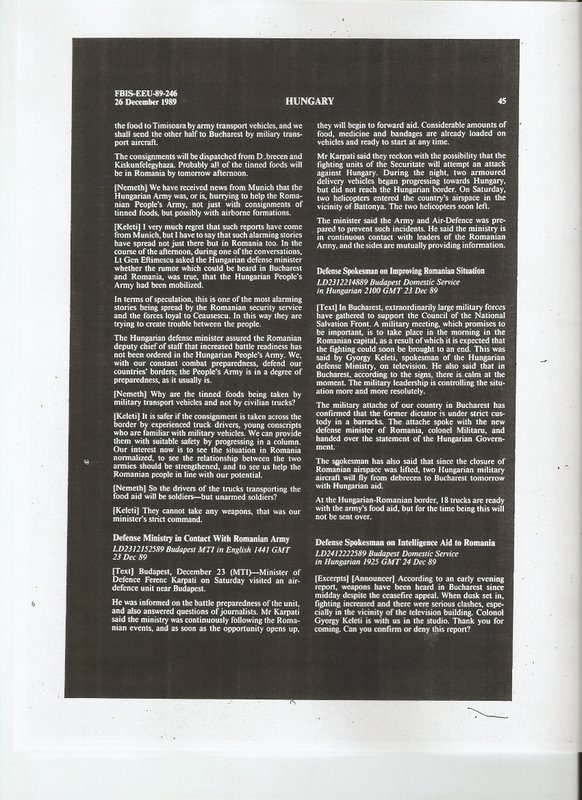
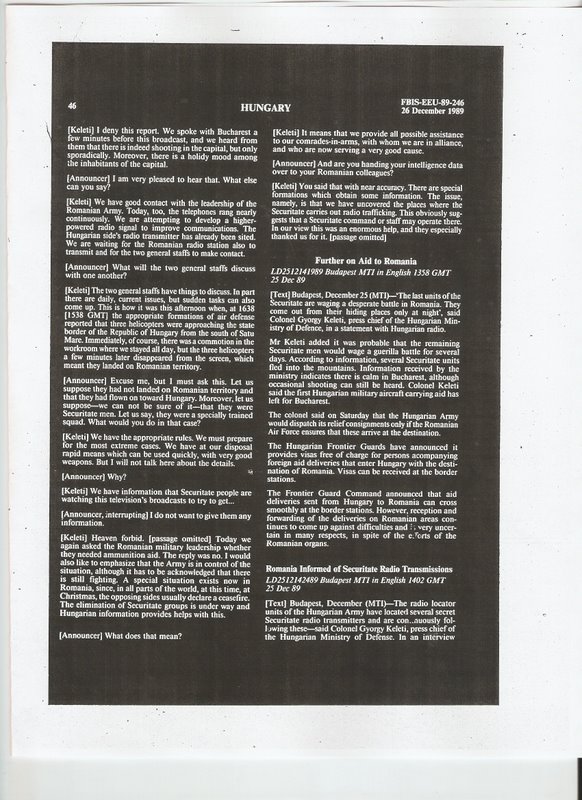
Hungarian defense officials related interesting and important information during the days of 23-26 December 1989.  (These are xeroxes from the Library of Congress of the Foreign Broadcast Information Service (FBIS) translations performed in December 1989.  Unfortunately, for some unknown reason, they were filed under Hungary and not Romania–unclear what the methodology for categorization was–meaning that they were easily missed by researchers, including myself, for many years.) Details include:

1) Not only did the Securitate have “a large number of helicopters” (Def. Min. Ferenc Karpati) but on Saturday 23 December 1989, two of them briefly violated Hungarian airspace near Battonya (which is not far from the Romanian city of Arad)

2) The Hungarian Army monitored and passed on to the Romanian Army locations of secret Securitate radio transmitters (in a later report, it is detailed that the number of active Securitate radio transmitters fell during these days from 31 to 19 to 5, concomitant with the decline in counter-revolutionary fighting).

3) Hungarian forces recognized “stories being spread by the Romanian security services and the forces loyal to Ceausescu,” including the reports that the Romanian Army was low on ammunition (a rumor designed to create panic and give the impression that the Romanian armed forces could be conquered) and that the Hungarians were to send planes into Romania (suggesting an effort to invade or take advantage of the chaos in Romania) which Col. Gyorgy Keleti of the Hungarian Ministry of Defense claimed he was asked about by Romanian Lt. Gen Eftimescu, whom he reassured it was an untrue rumor.


http://atomic-temporary-3899751.wpcomstaging.com/2013/09/14/lying-in-wait-securitate-director-general-vlad-in-the-cc-building-i/

Former USLA Captain Marian Romanescu admitted to journalist Dan Badea in 1991 that the USLA (special anti-terrorist unit) had its own helicopter force, thereby substantiating the suspicion of the unidentified revolutionary that the helicopters in question were “special”/”from a special unit.”  Thus, it is abundantly clear that Vlad’s claim that the Securitate had “just three helicopters” was a bald-faced lie.

image-12

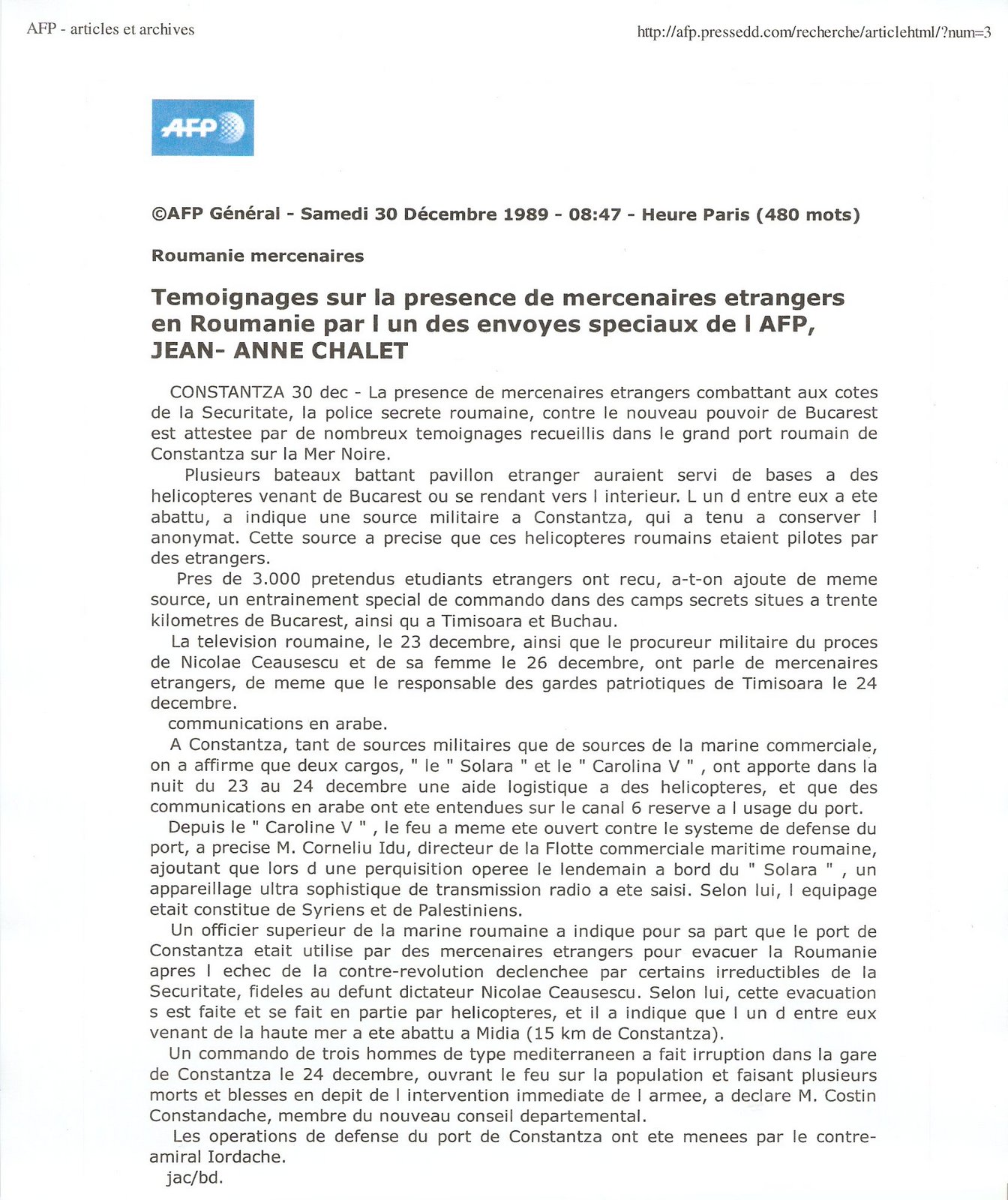
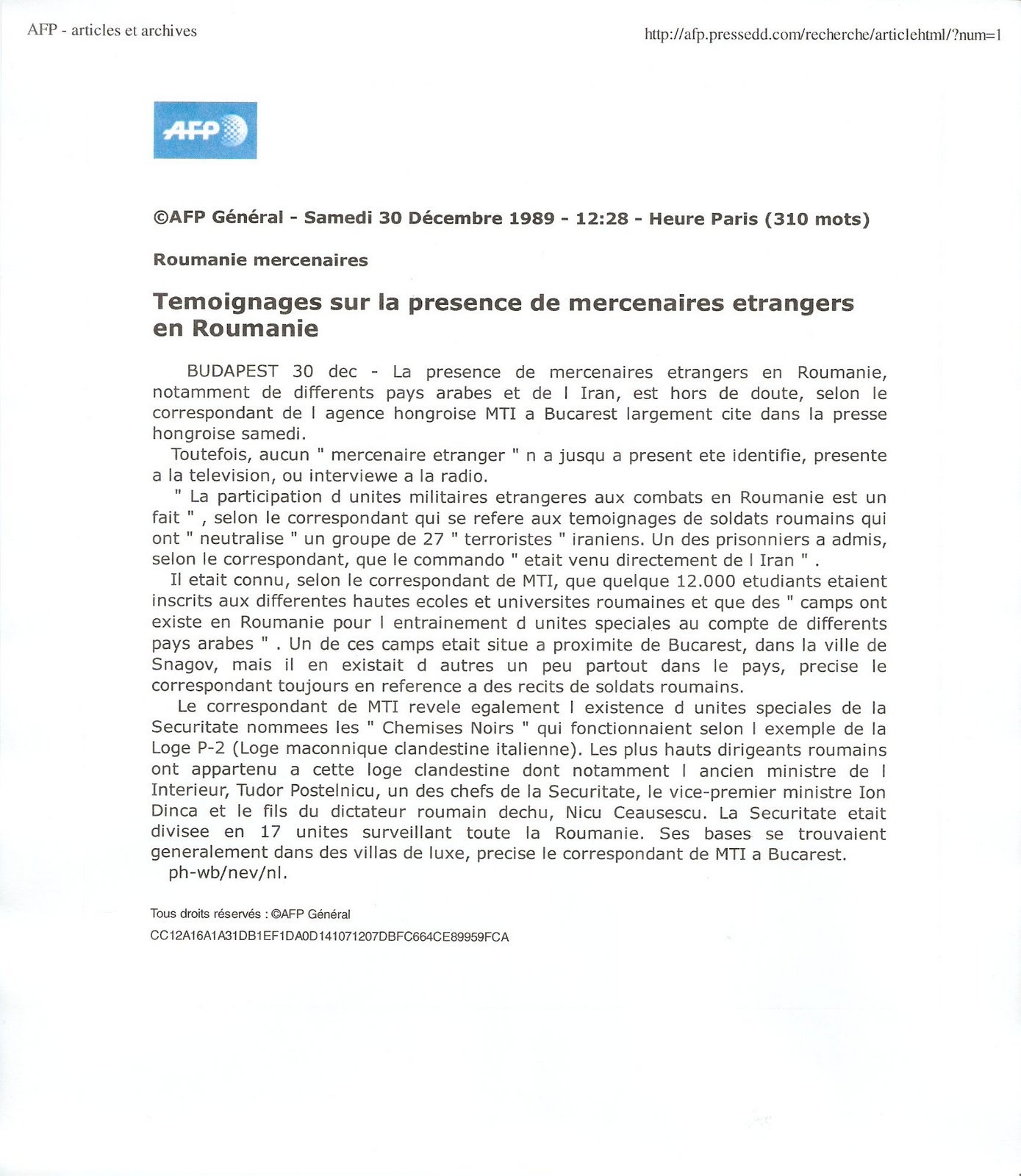
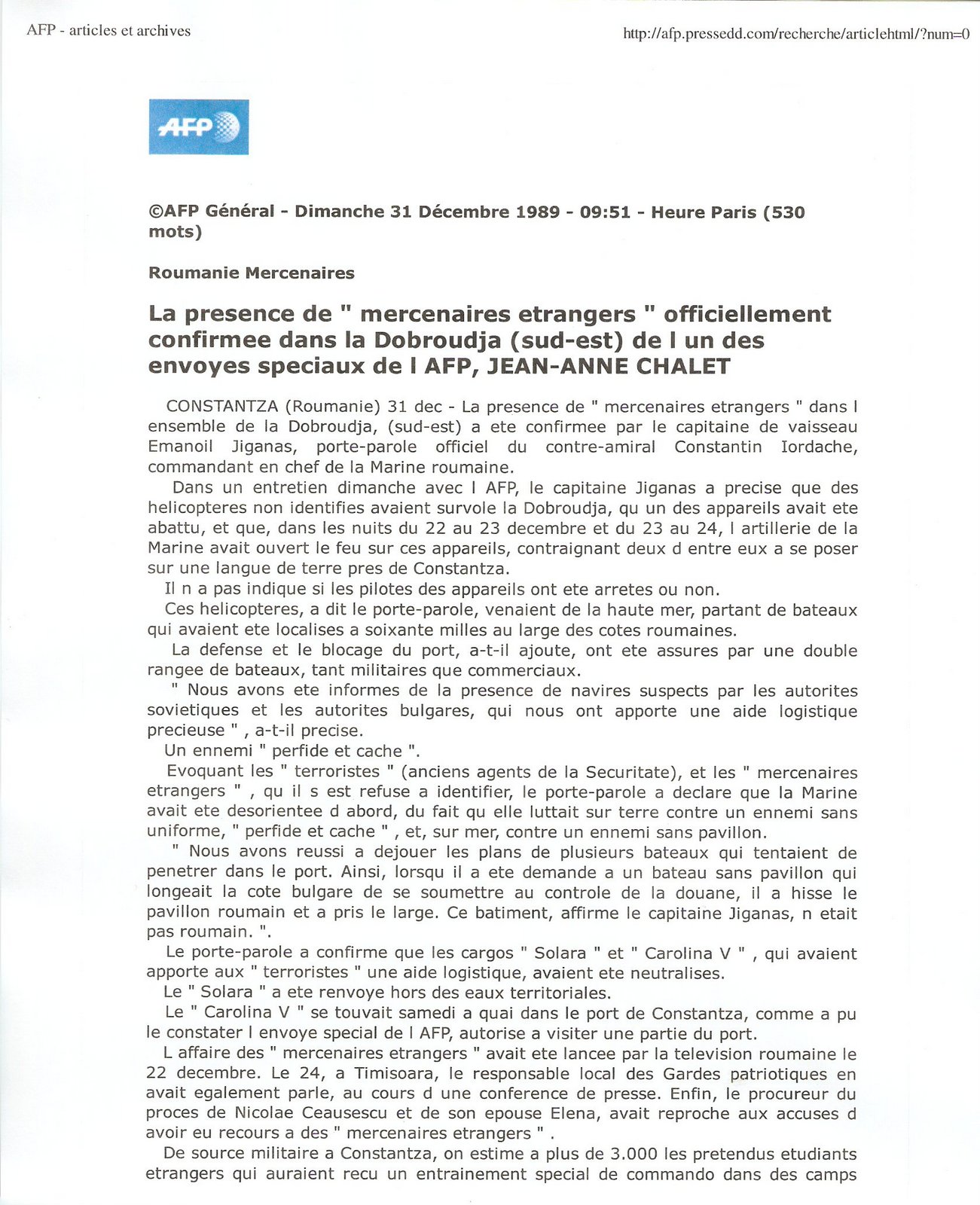
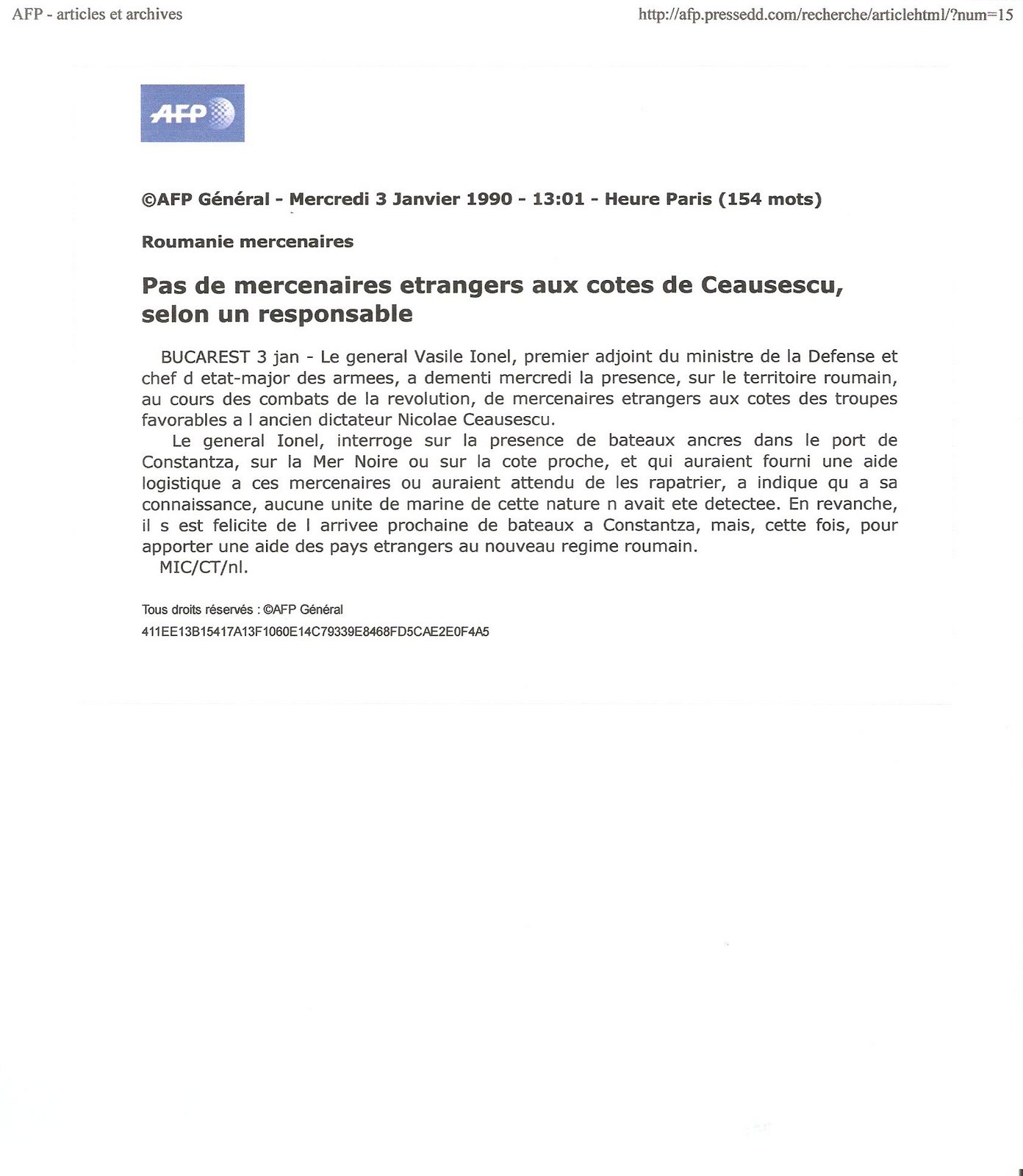
2) Regarding the involvement of “foreign interventionists”–in particular, mercenaries from Arab countries (and Iran) with treaty obligations to Ceausescu and Romania–the per cost AFP archives are a bonanza.

http://atomic-temporary-3899751.wpcomstaging.com/anatomy-of-a-cover-up-or-constanta-we-have-a-problem/

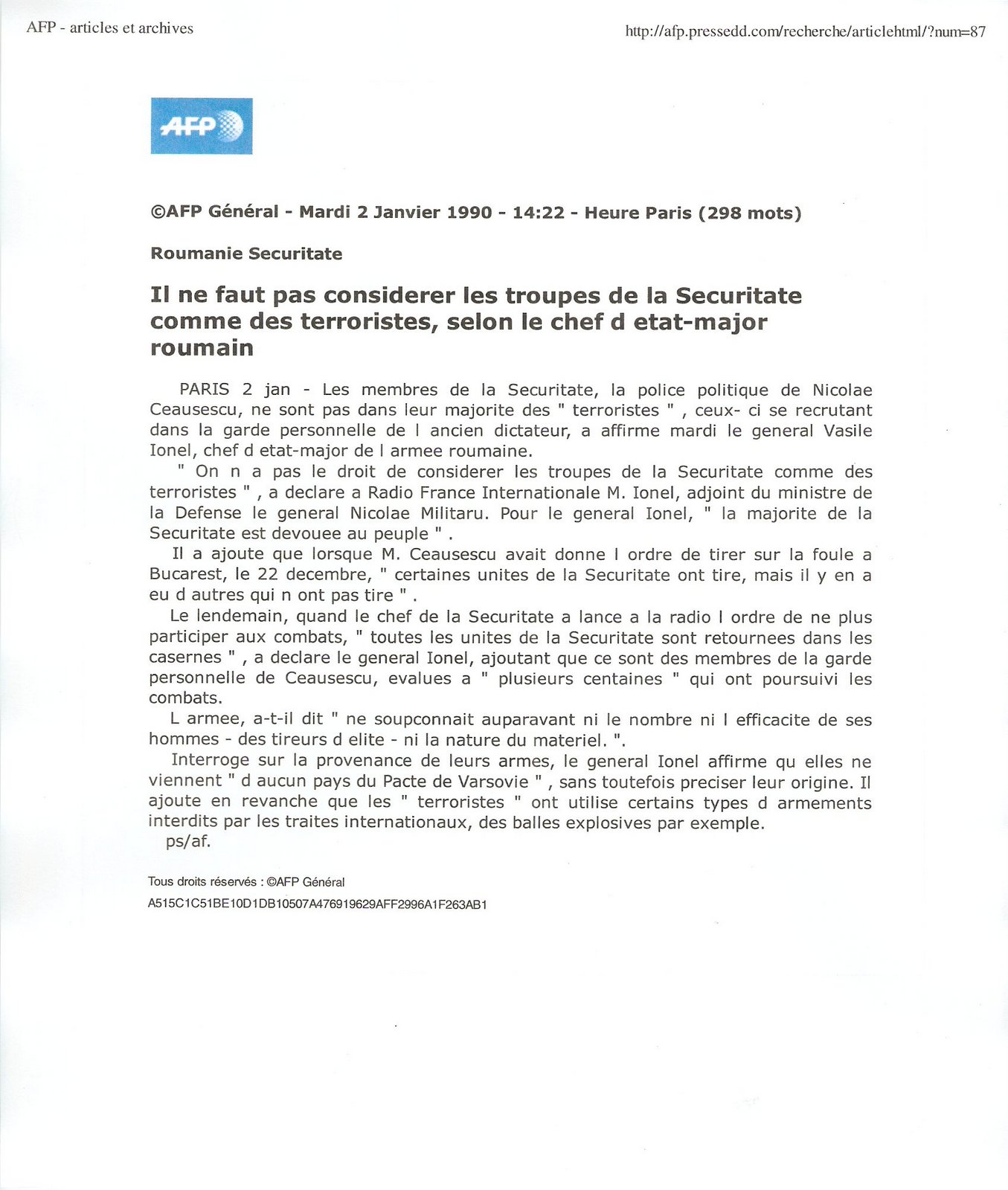
Note:  Not everything at this point had “disappeared”:  General Vasile Ionel confirmed that the terrorists had used foreign arms (arms not produced in Warsaw Pact countries, as he specified) and that they used munitions outlawed by international conventions, for example exploding DUM-DUM bullets (“balles explosives”).

Talk about a clear example where the stupidities about Front and/or Army “disinformation” “inventing the terrorists” cannot explain behavior and fall apart miserably:  The case of the comments of military commanders on the Black Sea coast during the period 29-31 December 1989…and the reaction of senior military authorities in Bucharest who realized those revelations could cause international problems for Romania’s new leaders and thus needed to quash the truth as quickly as possible.

———————————————————————————————-

©AFP Général – Lundi 25 Décembre 1989 – 08:33 – Heure Paris (386 mots)
Roumanie, prev Nuit de Noel a l hopital central de Timisoara De l un des envoyes speciaux de l AFP, NICOLAS MILETITCH
   TIMISOARA (Roumanie) 25 dec – Devant l hopital central de Timisoara, dimanche soir, une quarantaine de camions remplis de medicaments et de produits alimentaires tout juste arrives, attendaient d etre decharges.
   ” L aide nous vient d un peu partout. Hongrie, RFA, Tchecoslovaquie, France, Yougoslavie, URSS, Bulgarie, Italie… ” , indique a l AFP l un des soldats qui gardent l hopital. Les militaires sont partout autour de l hopital, sur les toits, dans les cours et meme a l interieur.
   ” Des hommes de la Securitate ont tire pres de l hopital a plusieurs reprises, ces dernieres heures ” , explique le docteur Aurel Mogosianu, chef du service de soins intensifs, en donnant des ordres a un soldat qui passe, la mitraillette a l epaule, dans un couloir, entre les malades.
   Le Dr Mogosianu, qui a une trentaine d annees d experience, pense que certaines blessures particulierement horribles, n ont pu etre provoquees que par des balles explosives tirees contre les manifestants.
   Dans une salle de soins intensifs, une femme de 23 ans essaie de parler au docteur, puis renonce. ” C est un cas difficile. Elle a eu le dos transperce par une rafale ” , precise le Dr Mogosianu.
   En bougeant a peine la main, la jeune femme esquisse le ” V ” de la victoire pour dire ” au revoir ” . Un effort irrealisable pour son voisin qui a recu une balle dans le cou, impossible a extraire.
   Comme la plupart de ses collegues, le docteur travaille, a peu de choses pres, 24 heures sur 24 depuis le debut des evenements. Dans un coin, une infirmiere dort, ecroulee sur une chaise.
   Pour faire face a l afflux de blesses, la television de Bucarest a demande a tous les etudiants en medecine du pays de se rendre dans les hopitaux de la capitale et de Timisoara, ou la situation est la plus critique.
   Victor Jancu, 20 ans, a entendu cet appel. Dans la nuit de vendredi a samedi, il a quitte Cluj et reussi a rejoindre Timisoara, a plus de 300 kms de la, en arretant des camions.
   Quelques visiteurs arrivent a l hopital, portant a la main une petite branche de sapin : a Timisoara aussi, on voudrait feter Noel.
   nm/jga/vr.
Tous droits réservés : ©AFP Général
021851451DC1ED1D715E06849EA4C6E0F37C0C25ECE8D503
©AFP Général – Mercredi 27 Décembre 1989 – 18:14 – Heure Paris (671 mots)

Roumanie Sibiu
Sibiu, la ville ou les combats ont ete les plus violents de l un des envoyes speciaux de l AFP, NICOLAS MILETITCH
   SIBIU (Roumanie) 27 dec – Sibiu, dans le centre de la Roumanie, est indubitablement la ville ou les combats entre l armee et la Securitate, fidele a Nicolae Ceausescu, ont ete les plus violents. C est la que Nicu, fils du dictateur, etait chef du parti.
   Des maisons totalement detruites et calcinees dont il ne reste plus que les murs, des eclats de verre partout dans les rues, des toits eventres par des tirs de grenades et par les mitrailleuses des tanks, des voitures et blindes brulant encore en travers de la route: tel etait le spectacle de desolation qu offraient mercredi plusieurs quartiers de Sibiu, a constate un envoye special de l AFP.
   Du 22 au 25 decembre, les affrontements se sont concentres aux abords des trois ecoles militaires de Sibiu, du siege de la police et de celui de la Securitate. Il ne reste plus grand-chose des deux batiments a trois etages qui abritaient la police et les services secrets. Les fenetres ont vole en eclats. Toutes les maisons des alentours, ou s etaient retranches les agents de la police secrete, portent d innombrables traces, et, dans la cour de la police, un blinde leger calcine est observe avec curiosite par les passants.
   ” C etait la guerre ici, avec des tanks, des balles explosives et des unites de commando. C est ici que Nicu Ceausescu a essaye de lancer une contre-offensive contre nous ” , souligne un militaire qui garde maintenant les lieux.
   Lynchages.
   Devant cet immeuble, une centaine de personnes commentent a haute voix un extrait des archives qu elles viennent de decouvrir: les fiches de renseignements que la Securitate avait etablies sur chaque habitant de Sibiu. ” Ecrit a un cousin en Suisse. Propos sans importance. Pendant son service militaire, ne frequentait que des soldats d origine allemande comme lui ” , est-il indique sur une de ces fiches qui comportent de nombreux renseignements personnels, certaines remontant a 1958.
   Dans la foule, on raconte comment une dizaine de Securistes (agents de la Securitate) arretes pendant les affrontements de ces derniers jours ont ete lynches par la population qui les a tues a coups de pied et de poing: ” Nous n avons pas de mots pour qualifier ces gens de la Securitate, ils sont pires que des monstres ” , dit une dame d une cinquantaine d annees, qui s interrompt et fond en larmes. Certains ont reussi neanmoins a conserver un certain sens de l humour noir: ” Quand les voitures de la Securitate ont ete brulees devant chez moi, j ai pense que c etait bien la premiere fois qu il faisait chaud dans mon appartement ” , a declare a l AFP une habitante de Sibiu, en faisant allusion a l impossibilite pour les Roumains de se chauffer en raison des restrictions.
   Les combats ont egalement ete tres durs dans le centre de Sibiu. Le principal hotel de la ville, le ” Continental ” , n a plus de fenetres sur cinq etages, et des traces de balles sont visibles jusqu au 11eme etage.
   ” Les Securistes avait pris position dans l hotel et avaient rempli deux etages de munitions ” , explique un employe de l etablissement. Des incendies ont eclate dans certaines chambres, touchees par des balles incendiaires. Face a l hotel, un panneau est reste accroche a un lampadaire: ” Militaires, ne tirez pas sur nos freres et nos parents. L armee est avec nous ” .
   Dans les rues de Sibiu, ou de tres nombreuses vitrines sont recouvertes de carton, la population vaquait normalement a ses occupations mercredi soir. Patrouilles de militaires, blindes legers et ambulances croisaient des voitures portant des cercueils sur le toit et des camions apportant de l aide alimentaire et medicale de Hongrie, de Tchecoslovaquie et de RFA.
   Sibiu pense deja a renaitre de ses cendres: malgre le froid tres vif, des equipes de nettoyage et de vitriers travaillaient tard dans la soiree dans la ville.
   nm/chm.
Tous droits réservés : ©AFP Général
BD17217619B14F18012007E4873636BFDDF186FE77CFAD4F
©AFP Général – Mardi 2 Janvier 1990 – 14:22 – Heure Paris (298 mots)

Roumanie Securitate
Il ne faut pas considerer les troupes de la Securitate comme des terroristes, selon le chef d etat-major roumain
   PARIS 2 jan – Les membres de la Securitate, la police politique de Nicolae Ceausescu, ne sont pas dans leur majorite des ” terroristes ” , ceux- ci se recrutant dans la garde personnelle de l ancien dictateur, a affirme mardi le general Vasile Ionel, chef d etat-major de l armee roumaine.
   ” On n a pas le droit de considerer les troupes de la Securitate comme des terroristes ” , a declare a Radio France Internationale M. Ionel, adjoint du ministre de la Defense le general Nicolae Militaru. Pour le general Ionel, ” la majorite de la Securitate est devouee au peuple ” .
   Il a ajoute que lorsque M. Ceausescu avait donne l ordre de tirer sur la foule a Bucarest, le 22 decembre, ” certaines unites de la Securitate ont tire, mais il y en a eu d autres qui n ont pas tire ” .
   Le lendemain, quand le chef de la Securitate a lance a la radio l ordre de ne plus participer aux combats, ” toutes les unites de la Securitate sont retournees dans les casernes ” , a declare le general Ionel, ajoutant que ce sont des membres de la garde personnelle de Ceausescu, evalues a ” plusieurs centaines ” qui ont poursuivi les combats.
   L armee, a-t-il dit ” ne soupconnait auparavant ni le nombre ni l efficacite de ses hommes – des tireurs d elite – ni la nature du materiel. “.
   Interroge sur la provenance de leurs armes, le general Ionel affirme qu elles ne viennent ” d aucun pays du Pacte de Varsovie ” , sans toutefois preciser leur origine. Il ajoute en revanche que les ” terroristes ” ont utilise certains types d armements interdits par les traites internationaux, des balles explosives par exemple.
   ps/af.
©AFP Général – Samedi 30 Décembre 1989 – 12:28 – Heure Paris (310 mots)

Roumanie mercenaires
Temoignages sur la presence de mercenaires etrangers en Roumanie
   BUDAPEST 30 dec – La presence de mercenaires etrangers en Roumanie, notamment de differents pays arabes et de l Iran, est hors de doute, selon le correspondant de l agence hongroise MTI a Bucarest largement cite dans la presse hongroise samedi.
   Toutefois, aucun ” mercenaire etranger ” n a jusqu a present ete identifie, presente a la television, ou interviewe a la radio.
   ” La participation d unites militaires etrangeres aux combats en Roumanie est un fait ” , selon le correspondant qui se refere aux temoignages de soldats roumains qui ont ” neutralise ” un groupe de 27 ” terroristes ” iraniens. Un des prisonniers a admis, selon le correspondant, que le commando ” etait venu directement de l Iran ” .
   Il etait connu, selon le correspondant de MTI, que quelque 12.000 etudiants etaient inscrits aux differentes hautes ecoles et universites roumaines et que des ” camps ont existe en Roumanie pour l entrainement d unites speciales au compte de differents pays arabes ” . Un de ces camps etait situe a proximite de Bucarest, dans la ville de Snagov, mais il en existait d autres un peu partout dans le pays, precise le correspondant toujours en reference a des recits de soldats roumains.
   Le correspondant de MTI revele egalement l existence d unites speciales de la Securitate nommees les ” Chemises Noirs ” qui fonctionnaient selon l exemple de la Loge P-2 (Loge maconnique clandestine italienne). Les plus hauts dirigeants roumains ont appartenu a cette loge clandestine dont notamment l ancien ministre de l Interieur, Tudor Postelnicu, un des chefs de la Securitate, le vice-premier ministre Ion Dinca et le fils du dictateur roumain dechu, Nicu Ceausescu. La Securitate etait divisee en 17 unites surveillant toute la Roumanie. Ses bases se trouvaient generalement dans des villas de luxe, precise le correspondant de MTI a Bucarest.
   ph-wb/nev/nl.
Tous droits réservés : ©AFP Général
CC12A16A1A31DB1EF1DA0D141071207DBFC664CE89959FCA
©AFP Général – Lundi 25 Décembre 1989 – 19:13 – Heure Paris (679 mots)
Roumanie, prev Dans un train de Noel: psychose des tireurs isoles et chasse aux hommes de la Securitate de l un des envoyes speciaux de l AFP, Jean-Anne CHALET
   A BORD DU TRAIN TIMISOARA-BUCAREST 25 dec – Dans le premier train de Noel entre Timisoara (ouest de la Roumanie) et Bucarest, les voyageurs partagent le pain et le sel et sont deja entres dans l ere de l ” apres-Ceausescu ” .
   Malgre la psychose des tireurs isoles, ce sont les agents de l ancien regime, les hommes de la Securitate, qui sont devenus les pourchasses, apres avoir ete chasseurs pendant des annees.
   Ces hommes, les plus craints de l ancien appareil repressif de Nicolae Ceausescu, qui continuent a resister dans plusieurs villes de Roumanie, sont traques. Lundi, deux d entre eux ont ete arretes par une garde patriotique dans la gare de Timisoara, la cite martyre, ou l on a denombre, selon les dernieres estimations, pres de cinq mille morts.
   Mais ils continuent de faire peur. Toute la nuit de Noel, les tirs ont ete incessants dans le centre de Timisoara, et lundi matin, il etait pratiquement impossible de circuler a pied ou en voiture.
   Pour gagner la gare a pied, l envoye special de l AFP a essuye le feu de tireurs isoles et il a fallu que les soldats interviennent au fusil mitrailleur pour le couvrir. Le train est parti de Timisoara avec une demi-heure de retard, apres l arrestation des deux agents de la Securitate. En cours de route, une bombe a ete decouverte dans le convoi et tous les voyageurs invites a descendre. Le wagon ou se trouvait l engin a ete detache du train.
   Les nouvelles sur un transistor.
   Dans la plupart des gares traversees, les references a l ancien regime avaient ete effacees, les drapeaux bleu-jaune-rouge de la Roumanie comportaient un grand trou au milieu, la ou figuraient jadis les emblemes du communisme. Des inscriptions aussi un peu partout : ” Mort au tyran ” , ” Vive la Roumanie libre ” .
   Dans ce compartiment, voyagent ensemble un ingenieur de 60 ans, un ancien architecte devenu tanneur par la force des choses, un jeune garde patriotique, un camionneur et un paysan.
   Le pain et le sel ont ete partages entre tous dans cette journee de Noel, et les informations captees sur un transistor commentees en termes severes. Tous sont d accord pour estimer que Ceausescu et son clan s etaient rendus responsables de veritables atrocites durant les 25 ans ou ils ont ete au pouvoir. ” Notre pays etait une sorte de bagne. Non seulement nous n avions aucune liberte, mais en plus, le tyran a fait executer beaucoup de Roumains, uniquement parce qu ils avaient ose resister ou discuter les ordres ” , declare le tanneur. ” Il poursuit son action criminelle encore aujourd hui, alors qu il a ete arrete, a travers les activites de la Securitate, qui mettent le pays a feu et a sang ” , surencherit l ingenieur.
   Tout le monde sous les banquettes.
   A ce moment, comme pour donner plus de poids a ces propos, une rafale d arme automatique est tiree le long de la voie, obligeant tout le monde a se cacher sous les banquettes. Nouvelle alerte quelques kilometres plus loin, avec arret force, controle de toutes les identites, et cinq interpellations de voyageurs d origine arabe.
   La psychose des mercenaires qui seraient a la solde de l ancien dictateur, ajoutee a celle des hommes de la Securitate, a cree, dans toutes les regions traversees par le train, une nervosite tant dans les rangs de l armee que parmi les gardes patriotiques. Cette affaire de mercenaires evoquee dimanche soir a Timisoara, au cours d une conference de presse par le commandant local des gardes patriotiques, a pris de l ampleur au cours de la journee de lundi, et diverses radios ” libres ” locales, captees dans le train, y ont fait allusion.
   Apres plusieurs haltes de controle, le train de Noel de Timisoara est arrive a Bucarest avec deux heures de retard et les impacts des rafales tirees durant le voyage.
   JAC/PSR/chm.
Tous droits réservés : ©AFP Général
7B1D215013513F163187079417E0D436F6A2635779EE100D
©AFP Général – Lundi 25 Décembre 1989 – 20:10 – Heure Paris (191 mots)

Roumanie Securitate
Une grande base d helicopteres en Roumanie serait aux mains de la Securitate, selon Budapest
   BUDAPEST 25 dec – Une importante base d helicopteres en Roumanie serait aux mains de la Securitate, la police secrete de Ceausescu, a declare lundi le porte- parole du ministere hongrois de la Defense a la television hongroise.
   Le colonel Gyorgy Keleti n a pas precise le nom de cette base, indiquant seulement qu elle se trouvait en Roumanie, a une centaine de km de la frontiere hongroise.
   ” Il semble que cette base soit aux mains des terroristes ” (la Securitate), a declare le porte-parole en rappelant que des helicopteres roumains avaient viole l espace aerien hongrois plusieurs fois ces derniers jours.
   D autre part, le colonel Keleti a annonce que l organisation caritative de l ordre de Malte avait recu l autorisation exceptionnelle de monter une station de radio sur la base militaire hongroise de Szeged, toute proche de la Roumanie. Cette station vise a assurer les communications entre l organisation et son siege en RFA, afin de faciliter la logistique de l acheminement des dons vers la Roumanie.
   rb/ph/chm.
Tous droits réservés : ©AFP Général
FE1B113C1B51B81391170AE4CFD3FFE3749689D6828ED1AC
©AFP Général – Lundi 25 Décembre 1989 – 19:28 – Heure Paris (539 mots)
Roumanie Securitate, prev Les hommes de la Securitate attaquent encore l armee mais cherchent surtout a fuir De l un des envoyes speciaux de l AFP, Nicolas MILETITCH
   MOLDOVA-NOUA (Roumanie) 25 dec – Des commandos de la Securitate ont attaque des unites militaires lundi, en fin de matinee, a Resica et Oravita, dans le sud du pays, mais divers indices indiquent que leur objectif reste principalement de quitter le pays.
   D autres affrontements armes ont ete egalement observes lundi a Tournu Sevrin, plus au sud, de l autre cote de la chaine des Carpates meridionales, et les routes de la region sont peu sures, a indique a l AFP un officier de l armee a Moldova-Noua.
   Selon des sources militaires, il y a eu d autres affrontements de l autre cote du pays, a Constanza, sur la Mer Noire.
   Sur les routes, les controles, souvent nerveux, effectues par les militaires et les patrouilles populaires, nombreux et minutieux, notamment a proximite de la frontiere, temoignent de la confusion qui regne encore dans plusieurs regions ou des commandos de la Securitate menent des actions isolees.
   La chasse a l homme se poursuit en Roumanie pour s emparer des derniers elements de la Securitate, qui tentent de fuir le pays, sans doute peu nombreux, mais bien equipes et entraines.
   Plusieurs d entre eux ont ete arretes en Yougoslavie, dans l apres- midi, pres de Klodovo, par les unites speciales de la police yougoslave envoyees sur place depuis quelques jours. Ces agents de la Securitate emportaient avec eux d importantes quantites d or.
   Dirigeants locaux elus.
   D autres se cachent encore dans les forets de la region, a-t-on indique a l AFP de source policiere. Sur la route qui longe le Danube entre Pojejenea et Macesti, des militaires, arme au poing, arretent les voitures.
   ” Beaucoup de terroristes (agents de la Securitate) tentent de passer de l autre cote en Yougoslavie ” , explique l un d eux. Juste retour des choses, l extraordinaire dispositif (barbeles, miradors, postes de garde tous les cent metres), mis en place par la police le long du Danube pour empecher les Roumains de fuir vers la Yougoslavie, est aujourd hui un obstacle supplementaire pour les agents de la police secrete aux abois.
   Il faudra sans doute encore attendre quelques jours pour que soient liquidees les dernieres poches de resistance, les agents de la Securitate risquant de manquer bientot de munitions, ont souligne a l AFP plusieurs officiers charges d assurer la securite dans la region.
   Si la situation n est pas encore completement sous le controle des nouvelles autorites et de l armee, sur la route (la circulation de nuit reste fortement deconseillee) et dans certaines villes, la vie semble revenir a la normale a peu pres partout ailleurs.
   ” Une nouvelle administration est deja mise en place dans notre region. Nous recevons nos instructions par la radio et la tele de Bucarest, et la vie a repris son cours ” , declare le directeur des Mines de Moldova-Noua, Ionec Danciu. Les nouveaux dirigeants de la ville ont ete elus librement par leurs citoyens . ” C est bien la premiere fois ” , releve Ionec Danciu, et parmi eux, se trouvent meme des membres du Parti communiste.
   NM/PSR/chm.
Tous droits réservés : ©AFP Général
5D12E1C215A1BB1D91AF0A440D3A872011DC02101F7E8656

©AFP Général – Mercredi 10 Janvier 1990 – 12:25 – Heure Paris (500 mots)
Roumanie medecine, lead Cinq jeunes Roumains, blesses durant les evenements, hospitalises a Marseille
   MARSEILLE 10 jan – Les premiers Roumains rapatries en France depuis les recents evenements, quatre hommes et une femme grievement blesses par balles a Bucarest et a Timisoara, sont arrives dans la nuit de mardi a mercredi, a Marseille, ou ils ont ete hospitalises.
   Ces personnes, rapatriees par un Transall de l armee francaise qui avait ete specialement affrete, ont ete admises dans cinq des onze etablissements de l Assistance publique de Marseille. Aucune indication n a ete fournie sur ces hopitaux, ni sur la nature precise des blessures.
   Selon le docteur Richard Domergue, responsable adjoint du SAMU de Marseille, qui a dirige ce rapatriement, la femme et ses quatre compatriotes, ” atteints par des projectiles de guerre dum-dum (NDLR: balles entaillees en croix, de maniere a provoquer de larges dechirures), souffrent de graves problemes fonctionnels mais nullement vitaux ” , a-t-il declare a l AFP.
   Le docteur avait ete avise de cette evacuation sanitaire, dans la nuit de lundi a mardi, par un telex de la cellule interministerielle de crise, mise en place par le gouvernement francais depuis des evenements en Roumanie.
   L equipe du SAMU, constituee de deux medecins et de deux infirmieres, a ete acheminee jusqu a Bucarest ou l attendait le Dr Lamare, de la cellule logistique en place a l ambassade de France.
   Quelques heures plus tard l avion, transportant les cinq blesses, places sous perfusion, se posait sur la base aerienne d Istres (Bouches-du-Rhone) ou attendaient des ambulances.
   Arrives a l hopital de la Timone, vers minuit, les Roumains, ages de 20 a 35 ans et parlant seulement leur langue natale, ont ete repartis dans divers etablissements, ” en fonction des places disponibles et des besoins medicaux : traumatologie, micro-chirurgie, orthopedie ” .
   ” Ces personnes ont ete atteintes lors de manifestations de rue pacifiques, par un ou deux projectiles, selon les cas, a explique le Dr Domergue. Elles presentent de grosses lesions pouvant entrainer la paralysie de membres ” . Elles vont subir un bilan de sante complet qui permettra notamment d etablir les risques eventuels de sequelles.
   Ambiance soixante-huitarde a Bucarest, selon le medecin marseillais.
   Il a precise que la femme a ete blessee lors de la manifestation de rue du 17 decembre a Timisoara. ” Elle a raconte avoir ete admise dans un hopital d ou elle a du etre evacuee apres que des tirs eurent ete entendus dans l etablissement ou des hommes de la Securitate achevaient des blesses ” , a rapporte le Dr Domergue.
   Il regne a Bucarest, selon le medecin marseillais, ” une ambiance soixante-huitarde, un peu revolutionnaire. On sent une certaine exhaltation et il y a beaucoup de mouvements dans les rues ” , a-t-il temoigne. Il a souligne ” la chaleur touchante ” manifestee par les Roumains a l equipe medicale francaise. ” Ils ont une confiance totale en nous. Nous ne pouvons pas les decevoir. Nous allons les dorloter, ca parait le minimun ” , a-t-il assure.
   JLL/dv.
Tous droits réservés : ©AFP Général
1A1E01C019D1F21A016E0F64596D317B0933F7131B5B1C34
©AFP Général – Mardi 6 Mars 1990 – 13:52 – Heure Paris (482 mots)

Roumanie medecine
De nombreux blesses du 21 et 22 decembre ont ete touches dans le dos ou a bout portant
   BUCAREST 6 mars – De tres nombreux blesses lors des affrontements des 21 et 22 decembre a Bucarest ont ete touches par des balles qui ont ete tirees de dos, parfois a bout portant, ainsi que par des balles dum-dum, a constate la Societe de Chirurgie de la capitale roumaine.
   La societe s est reunie a deux reprises, les 15 fevrier et le 1er mars dernier, sous la presidence du lieutenant-general Traian Oancea, chef de la 2e section de chirurgie de l Hopital militaire central de Bucarest.
   Au cours de ces travaux, menes ” scientifiquement ” , a precise mardi a l AFP le chef du service de chirurgie de l hopital de Colcea (centre de la ville) le dr Nicolae Constantinescu, les experts en balistique ont pu determiner qu un pourcentage important de blessures par balles avaient ete causees non par des balles de guerre mais par des balles coupees ou trafiquees.
   Les blessures observees etaient en effet non pas des trajectoires rectilignes, comme c est le cas en general pour les balles de guerre normales, mais des cavites creusees dans les tissus par l eclatement du projectile a son impact, resultant d une balle aplatie ou cisaillee s ecrasant sur le corps au lieu de le penetrer. ” Nous avons effectue 930 interventions dans la capitale sur des blessures par balle ” , a precise le docteur Constantinescu.
   la peur.
   ” Apres discussion entre nous, nous sommes en mesure de dire qu il ne s agit pas d affrontements mais d un crime organise contre le peuple. D autant, ajoute-t-il en parlant des cas qu il a traites lui-meme a l hopital Colcea, que 60% des plaies etaient dans le dos ou sur le flanc, et non de face, et que 10 a 15% des coups avaient ete tires a bout portant, avec des calibres 9 et 6,35mm ” .
   Le premier jour des affrontements, le 21, la majorite des blesses etaient des jeunes. ” Ils avaient tellement peur qu ils ne demandaient meme pas des calmants apres l anesthesie ” , ajoute le docteur qui cite le cas du danseur roumain de l Opera de Paris Vlad Stoinescu, blesse devant l hotel intercontinental : ” une balle l a touche au flanc, lui traversant l abdomen. La peur lui a fait parcourir tout seul les 300 metres le separant de notre hopital, ou il a donne son nom avant de s evanouir ” .
   Par ailleurs, les analyses de sang effectuees sur ces jeunes blesses ont fait decouvrir un taux anormalement bas de proteines dans le sang : 5 a 6 grammes pour cent au lieu de 7,3. ” C est la preuve de leur malnutrition, ils n avaient pas du manger de viande et de fromage depuis six mois pour la plupart ” , a ajoute le medecin.
   BAY/ave.
Tous droits réservés : ©AFP Général
411FD1741841E311716203546AC34BEC9C6CF7F0A69644B4
©AFP Général – Jeudi 5 Avril 1990 – 17:27 – Heure Paris (504 mots)

Roumanie justice
La repression escamotee dans le proces du general Ceausescu
   BUCAREST 5 avr – Le proces du general Nicolae-Andruta Ceausescu, frere du dictateur roumain, continue a donner l impression que la repression qui a fait des dizaines de morts et des centaines de blesses le 21 decembre pres de l hotel Intercontinental a Bucarest etait le fait d un homme seul, tirant avec un pistolet.
   Oubliees les centaines de personnes touchees par balles, les blessures a la balle dum-dum, les manifestants abattus a bout portant, selon les expertises des medecins et chirurgiens de l hopital Coltea.
   Au quatrieme jour des debats, devant le tribunal militaire de Bucarest, un seul temoignage, aussitot interrompu par le procureur militaire, a fait etat de l utilisation de leurs armes par des ” hommes en civil venant du service d ordre ” .
   Apres une vingtaine de temoins interroges depuis mardi matin, tous membres de l Ecole de la Securitate que commandait le general Ceausescu et presentant la meme version monocorde qui vise a innocenter en bloc l Ecole a l exception du general, le colonel Teodor Amariucai, premier officier de l armee -et non de la police- appele a la barre a cree la surprise en donnant sa version des affrontements du 21.
   ” Vers 19H30, une deuxieme serie de rafales de sommation tirees en l air par l armee, pour faire reculer les manifestants boulevard Balcescu, a provoque la confusion dans la foule, de nombreux manifestants se couchant a terre pour se proteger ” , a-t-il dit.
   contrepartie.
   ” C est alors que de nombreux civils en manteau, surgissant de derriere le cordon des forces de l ordre ou j etais, l ont traverse pour se lancer vers les manifestants. Certains matraquaient ceux qui etaient a terre, d autres tiraient de dessous leur manteau sur ceux qui s enfuyaient, on voyait leur poche tressaillir a chaque coup. J ai vu des flaques de sang, et des morts qu on trainait vers une camionnette.. “.
   Double intervention du procureur et du president du tribunal: ” ces faits font l objet de poursuites judiciaires, et seront penalement sanctionnes. Revenons aux faits concernant l inculpe ” .
   Officiellement, dans le cadre de ce proces, les temoignages se concentrent donc sur un ” fait divers ” , celui d un general se jetant sur la foule avec son pistolet d ordonnance ” sous l emprise d une crise de diabete ” .
   Deux nouveaux temoignages ont ” confirme ” jeudi que le general Ceausescu avait ” perdu le controle de lui-meme ” , notamment celui de son chauffeur, l adjudant Ion Turcin, qui dit que le general a braque son arme sur lui.
   Le general ecoute les temoins, tantot avec agacement, tantot avec indifference, mais sans rien ajouter.
   Les observateurs en viennent a se demander si le general n a pas d avance accepte de ne mettre personne en cause, parmi les personnes qui ont participe avec lui a la repression, pour obtenir en contrepartie des garanties pour lui ou, plus vraisemblablement, pour son epouse malade, son fils, sa fille et ses petits-enfants.
   BAY/ccd.

Posted in decembrie 1989, raport final | Tagged: , , , , , , , , , , , , , , , , , , , , | Leave a Comment »

Asociatia Memorialul Revolutiei 16-22 decembrie 1989 Timisoara. Centrul National de documentare, cercetare si informare publica privind revolutia din 1989.

Posted by romanianrevolutionofdecember1989 on September 9, 2014

(purely personal views as always, based on two decades of prior research and publications, thank you)

http://www.memorialulrevolutiei.ro/library/trad%20engleza1%281%29%281%29.pdf

–The contrast between, on the one hand, people who lived these events on the ground twenty-five years ago and have spent years attempting to tell the story of December 1989 and, on the other, the insular, elitist, and utterly disconnected Romanianist community in North America, could not be greater as the 25th anniversary of the overthrow of Nicolae Ceausescu’s communist regime and the Romanian Revolution of December 1989 approaches.

Just discovered that the Special Issue of the Asociatia Memorialul Revolutiei 16-22 Decembrie 1989 Timisoara (http://www.memorialulrevolutiei.ro/)’s journal is now available online (see link above).  My thanks to Marius Mioc for bringing my research to the attention of Gino Rado and for Gino Rado reaching out to me and for the Editorial Board being willing to publish my research.  This edition includes part 1 of my article and I believe part 2 will appear in a later issue of the journal.

image0-001

image0-003

image0-005

image0-007

image0-008

image0-010

Posted in decembrie 1989 | Tagged: , , , , , , , , , | Leave a Comment »

Before the Narratives of December 1989 Consolidated (Slight Return): Looking through the 272 Issues of the PNTCD’s “Dreptatea” Newspaper from 1990

Posted by romanianrevolutionofdecember1989 on September 6, 2014

(purely personal views as always, based on two decades of prior research and publications)

Thanks to the Fundatia Corneliu Coposu site at http://www.corneliu-coposu.ro/sectiune/index.php/239-ziarul-dreptatea/ copies of the PNTCD’s daily Dreptatea from the early 1990s are available to the public.  I have looked through the first 200 editions, from early February 1990 to early October 1990.  Many fascinating aspects of Romanian politics and life jump out at the reader.  For our purposes here, the most interesting aspect is the details that make their way into articles about December 1989.  This was at a time when, although beginning to consolidate, narratives of December 1989 remained somewhat fluid, focusing on what happened and less on how it did or did not fit into competing narratives.  It would not be long before these competing narratives would become not just descriptions of what had happened but increasingly political and ideological lenses to view and interpret what had happened–thus leading to the exclusion, knowingly or unknowingly, of details that contradicted or did not “fit” the narrative in question.  New theories and even new memories or perhaps better put, lapses in memory or amnesia, would displace earlier memories and details.

It is therefore almost surreal to read the details of December 1989 in the pages of the National Christian-Democratic Peasant Party’s daily Dreptatea, a party and a paper whose opposition to the National Salvation Front and the former communist nomenklatura, was unquestionable at the time and comes through clearly in the pages of this publication–including when it was not published for several days in June 1990 because miners at the behest of the Front’s leaders devastated the offices of the party and the daily….And yet, in articles about December 1989, journalists relayed details which today their political and ideological heirs consistently deny or seek to explain away or wouldn’t be caught dead including in any article about December 1989.  Most importantly, that the terrorists of December 1989 existed, that their core was provided by the Securitate and included Arabs from countries friendly to the dictatorial communist regime of Nicolae Ceausescu, and that the terrorists possessed and used atypical and highly destructive munitions that no other forces in Romania possessed:  in particular, exploding DUM-DUM bullets that are outlawed by an international convention of which Romania was a signatory.

——————————————————————————————————————–

Two recent finds to add to the original tranche:

Florin Oprea Salceanu, “Unde sint teroristii, domnule Iliescu?” Dreptatea (nr. 224) 1 noiembrie 1990, p. 3.

Adincurile noptii erau zguduite de vaietele ranitilor si suierul gloantelor dum-dum, de trasoare, de vidia.  Teroristii ocrotiti de noapte, in pozitiile cheie, impuscati fara mustrare de constiinta.

image0

Virginia Stanescu si Gabriel Stanescu, “Ce facem pentru eroii revolutiei?” Dreptatea (nr. 230), 8 noiembrie 1990, p. 1

Tinarul de 20 de ani, Marcel Ungureanu, ranit la 23 decembrie 1989 la Aeroportul Otopeni, facea parte din Unitatea Militara 01370 Focsani….Totul s-a petrecut intr-o clipita si Marcel s-a trezit la Spitalul nr. 9, impuscat in git si coloana, la sectia reanimare.  Din pacate, atentia acordata de cadrele medicale a fost de asa natura incit a ajuns in Italia [la Centrul Toscana-Ortopedie din Florenta] cu ranile infectate…Cei doi ramasi, Marcel si Mugur (acesta din urma impuscat cu gloante dum-dum care au explodat in corp distrugindu-i ficatul si rinichii) continua sa fie vizitati si ajutati de familii italiene.


image0-004

——————————————————————————————————————–

http://atomic-temporary-3899751.wpcomstaging.com/2014/06/14/before-the-narratives-of-december-1989-consolidated-looking-through-the-first-200-issues-of-the-pntcds-dreptatea-newspaper/


image0-011

Niculae Lucian, 30 ani, 21 decembrie 1989, Intercontinental (Bucuresti), piciorul distrus de gloantele dum-dum (also mentioned in http://atomic-temporary-3899751.wpcomstaging.com/2014/05/18/surgeons-from-bucharests-main-hospitals-discuss-their-experiences-in-december-1989-lt-gnl-traian-oancea-dr-nicolae-nae-constantinescu-dr-dan-gavriliu-dr-nicolae-angelescu/)

G.L. [Gilda Lazar], “Pentru un erou al Revolutiei,” Dreptatea, nr. 52 (6 aprilie 1990), p. 2.

Click to access dreptatea-nr52-1990-0406.pdf

image0-001

Aurelian Lazu, “REMEMBER,” Dreptatea, nr. 96 (1 iunie 1990), p. 2.

Click to access dreptatea-nr96-1990-0601.pdf

image0-015

soldat Eugen Mardare, glont dum-dum s-a explodat in abdomen

Raluca Gabriel Mocanu, “Eroii Tragici,” Dreptatea, nr. 100 (6 iunie 1990), p. 4.

Click to access dreptatea-nr100-1990-0606.pdf

image0-005

Ovidiu Craciun, doua dum-dum-uri

Traian Calin Uba, “Noi amintiri in alb,” Dreptatea, nr. 138 (24 iulie 1990), p. 3. 

Click to access dreptatea-nr138-1990-0724.pdf

image0-003

Ilie Costache, “Accident? [despre cazul avionului TAROM AN-24 prabusit pe 28 decembrie 1989], Dreptatea, nr. 36 (17 martie 1990), p. 3.

Click to access dreptatea-nr138-1990-0724.pdf

http://atomic-temporary-3899751.wpcomstaging.com/2014/01/10/nicolae-ceausescu-securitatea-libieni-cincufagarasbrasov-si-revolutia-romana/


image0-013

gloantele cu virful taiat

Odette Hanganu si Remus Agatinei, “Si Braila e oras martir.  Cind se va afla adevarul?,” Dreptatea, nr. 69 (28 aprilie 1990), p. 4.

Click to access dreptatea-nr69-1990-0428.pdf

http://atomic-temporary-3899751.wpcomstaging.com/2010/09/29/%E2%80%9Corwellian%E2%80%A6positively-orwellian%E2%80%9D-prosecutor-voinea%E2%80%99s-campaign-to-sanitize-the-romanian-revolution-of-december-1989-part-iii-a-fistful-of-bullets-unregistered-atyp/


image0-008

gloante cu cap vidia

Tudor Barbu, “Trei momente din decembrie si semnele lor de intrebare,” Dreptatea, nr. 36 (17 martie 1990), p. 3.

Click to access dreptatea-nr36-1990-0317.pdf

http://atomic-temporary-3899751.wpcomstaging.com/2013/12/06/vina-de-neiertat-a-tvr-a-contribuit-decisiv-la-victoria-revolutiei-iii/

http://atomic-temporary-3899751.wpcomstaging.com/2013/08/25/tvr-chirurgi-si-reportaje-despre-gloante-explozive-dum-dum/


image0-017

Sibiu, ROMBAC, 80 de specialisti din capitala

Cristina Mladin, “Inexactitati,” Dreptatea, nr. 101 (7 iunie 1990), p. 3.

Click to access dreptatea-nr101-1990-0607.pdf

http://atomic-temporary-3899751.wpcomstaging.com/2013/08/16/final-boarding-call-for-taroms-special-rombac-service-from-bucuresti-to-sibiu-would-the-large-party-of-suspicious-soviet-tourists-please-report-to-the-gate-immediately-iv/


Posted in decembrie 1989, raport final | Tagged: , , , , , , , , , , , , , , | 1 Comment »

The Absurdity of the Allegation that the Romanian Military Was Responsible for the Radioelectronic War in December 1989

Posted by romanianrevolutionofdecember1989 on August 25, 2014

(purely personal views based on two decades of prior research and publications, thank you)

Ah, yes, the recurrent allegation that the Romanian Army–or rather elements of it–in December 1989 disinformed the Romanian Army!

http://romanian.ruvr.ru/2013_12_18/Revolutia-Romana-Diversiunea-radioelectronica-din-1989-opera-conducerii-Aviatiei-Si-a-Apararii-AA-3453/

http://www.gazetadecluj.ro/stiri-cluj-investigatii/in-decembrie-1989-dia-manipula-armata-romana/

Who, in 1990, was at the forefront of informing the Romanians about the details of the radio-electronic war?  Civilian journalists at the main dailies Romania Libera or Adevarul, etc.?  NO!!!

It was the Army itself!  Army officers in the pages in the pages of the official Army daily!!!  In March 1990! 

There are many reasons for why the suggestion that the Army intentionally disinformed itself in December 1989 is absurd:  this is one of them!

Locotenent-colonel Alexandru Bodea, “Varianta la Invazia Extraterestrilor,” Armata Poporului, nr. 12 (21 martie 1990), p. 4.


decembrie 1989 si diversiunea radioelectronica: “Varianta la Invazia Extraterestrilor” (I)

decembrie 1989 si diversiunea radioelectronica: “Varianta la Invazia Extraterestrilor” (II)

decembrie 1989 si diversiunea radioelectronica: “Varianta la Invazia Extraterestrilor” (III)

decembrie 1989 si diversiunea radioelectronica: “Varianta la Invazia Extraterestrilor” (IV)

decembrie 1989 si diversiunea radioelectronica: “Varianta la Invazia Extraterestrilor” (V)

decembrie 1989 si diversiunea radioelectronica: “Varianta la Invazia Extraterestrilor” (VI) plus BONUS: de ce a ocolit zona Moldovei razboiul radioelectornic?!!!


http://atomic-temporary-3899751.wpcomstaging.com/2011/06/02/iosif-costinas-cu-locotenent-colonelul-petre-ghinea-o-lupta-cu-fortele-raului-orizont-timisoara-nr-5-221990-p-5/

http://atomic-temporary-3899751.wpcomstaging.com/2011/06/04/decembrie-1989-si-diversiunea-radioelectronica-brindusa-armanca-recuperarea-azurului-orizont-timisoara-nr-12-23-martie-1990-p-3/

http://atomic-temporary-3899751.wpcomstaging.com/2014/01/19/what-would-it-have-looked-like-if-nicolae-ceausescus-securitate-executed-a-plan-to-counter-an-invasion-but-the-invaders-never-came-i/

http://atomic-temporary-3899751.wpcomstaging.com/2014/01/21/what-would-it-have-looked-like-if-nicolae-ceausescus-securitate-executed-a-plan-to-counter-an-invasionbut-the-invaders-never-came-ii/

Posted in decembrie 1989, raport final | Tagged: , , , , , , , , , , | 2 Comments »