The Archive of the Romanian Revolution of December 1989

A Catch-22 December 1989, Groundhog-Day Production. Presenting the Personal Research & Scholarship of Richard Andrew Hall, Ph.D.

Posts Tagged ‘tismaneanu commission’

25 for 2014: 25 Things You Should Know about the Romanian Revolution on the 25th Anniversary of the Fall of Nicolae Ceausescu’s Communist Regime: #4 Timisoara Demonstrators Injured and Killed by Dum-Dum Bullets

Posted by romanianrevolutionofdecember1989 on March 2, 2014

(Purely personal views as always, based on over two decades of research and publications inside and outside Romania)

2014 marks the 25th anniversary of the collapse of communism in central and eastern Europe–Poland, Hungary, East Germany, Czechoslovakia, Bulgaria, and Romania.  This (likely aperiodic) series looks at 25 things I have learned about the events of the Romanian Revolution of December 1989.  The numbering is not designed to assign importance, but rather–to the extent possible–to progress chronologically through those events.

Significance:  No researcher has previously attempted to track and aggregate the discussion of atypical ammunition, to include exploding dum-dum bullets, that were used in the maiming and killing of demonstrators in Romania in December 1989.  Here we talk about their use prior to the flight from power of Nicolae and Elena Ceausescu at 12:09 on 22 December 1989.  Romanian prosecutors, mostly notably former military prosecutor General Dan Voinea, have refused to acknowledge the existence and use of dum-dum bullets in December 1989–and yet the documents of the military procuracy itself contradict them.  (Voinea’s “findings” are invoked as the basis for the chapter about December 1989 in the so-called Tismaneanu Commission Final Report).  Below, evidence from the testimonies of demonstrators, next of kin, and doctors in Timisoara.

An excellent documentary from 1991 posted to the internet by Florin Iepan only recently and seen rarely if at all since its showing in 1991.  There is much interesting information in this film.  (The film may have to be rewound to its beginning.)  The sequence beginning at 50:20 has doctors/medical staff talking about the destruction of internal organs among the wounded brought to the hospital and at 51:02-51:06 the doctor mentions the use of “explosive bullets.” (Scroll down for testimonies by doctors and medical staff about the use of explosive bullets by the repressive forces.)

Timisoara Decembrie 1989 / Timisoara December 1989,

regia/directed by – Ovidiu Bose Pastina
imaginea/camera – Doru Segal

Sahiafilm 1991

—————————————————————————————————————-

This post has four sections, as follows:

1) The testimonies of the demonstrators Ion Popovici (9 January 1990) and Marin Stoica (8 January 1990) show that they overheard the discussion of the use of Dum-Dum bullets between soldiers and Interior Ministry personnel.

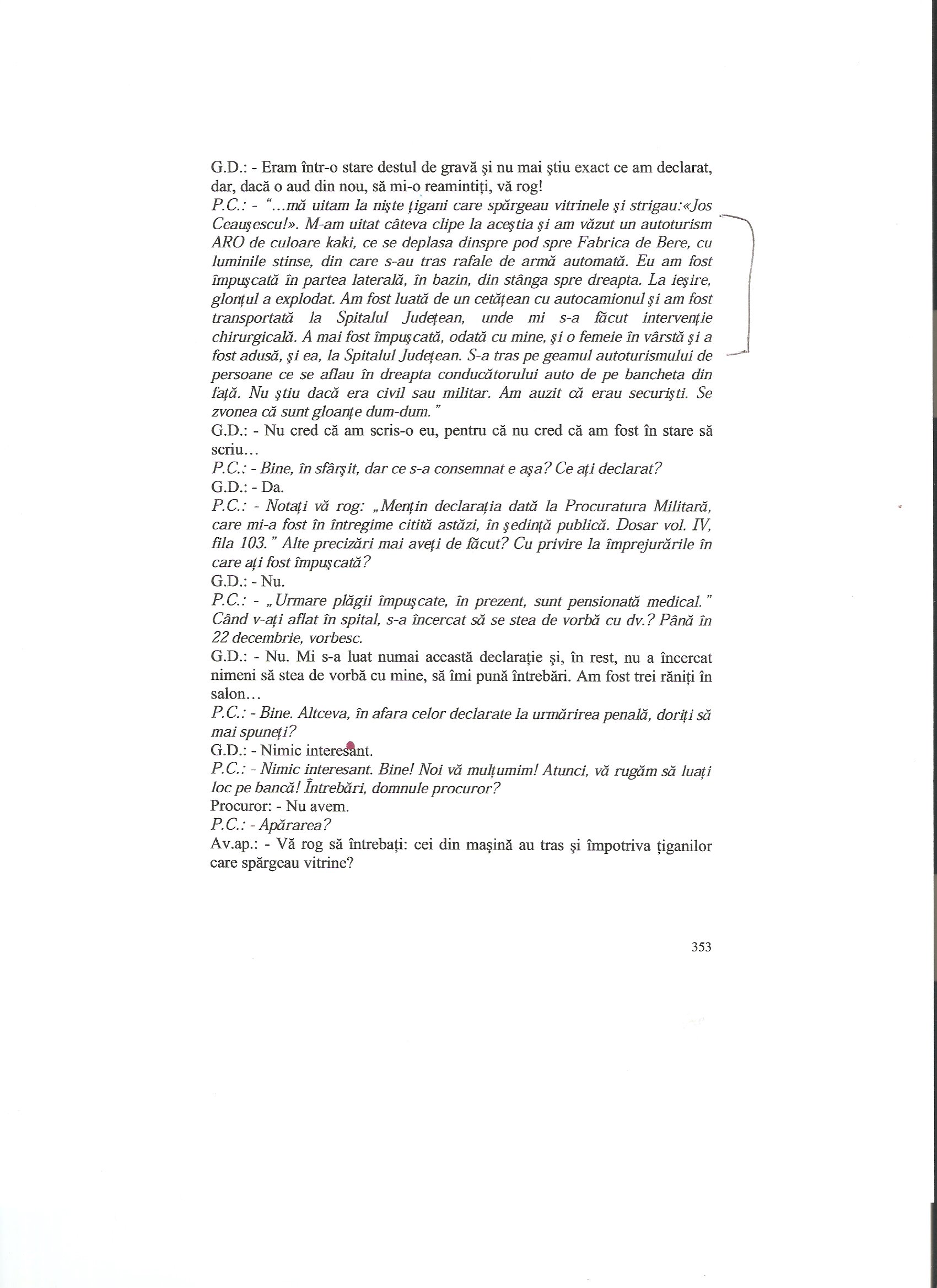
2) 7 Declarations and/or courtroom testimony about demonstrators injured or killed by dum-dum bullets:  Doina Gherasim, Cristian Rusu, Robert Buzatu, M. Csikos, Dobosan, Florin Nicoara, and Doru Sciadei.

3) 10 other testimonies from Victims or Relatives of Victims of Dum-Dum Bullets on 17-18 December 1989:  Valentin Aparashivei, Ioan Musca, Danut Gavra, Octavian Tintaru, Adrian Kali, Mariana Rodica Farcau, Leontina Banciu, Vasile Avram, Marius Ciopec, and Florica Sava.

4) 6 Doctors/Medical personnel from Timisoara alone have discussed the use of dum-dum bullets against demonstrators in Timisoara…:  Dr. Aurel Mogosanu, Dr. Atanasie Barzeanu, Rodica Novac, Dr. Fluture, Csaba Ungor, Goga Andras.

After reading these four sections, it should be pretty clear that anyone who denies the use of exploding dum-dum bullets in Timisoara is either uninformed, lying, or so in denial that they cannot bring themselves to admit reality.  This many people are simply not wrong…

————————————————————————————————————-

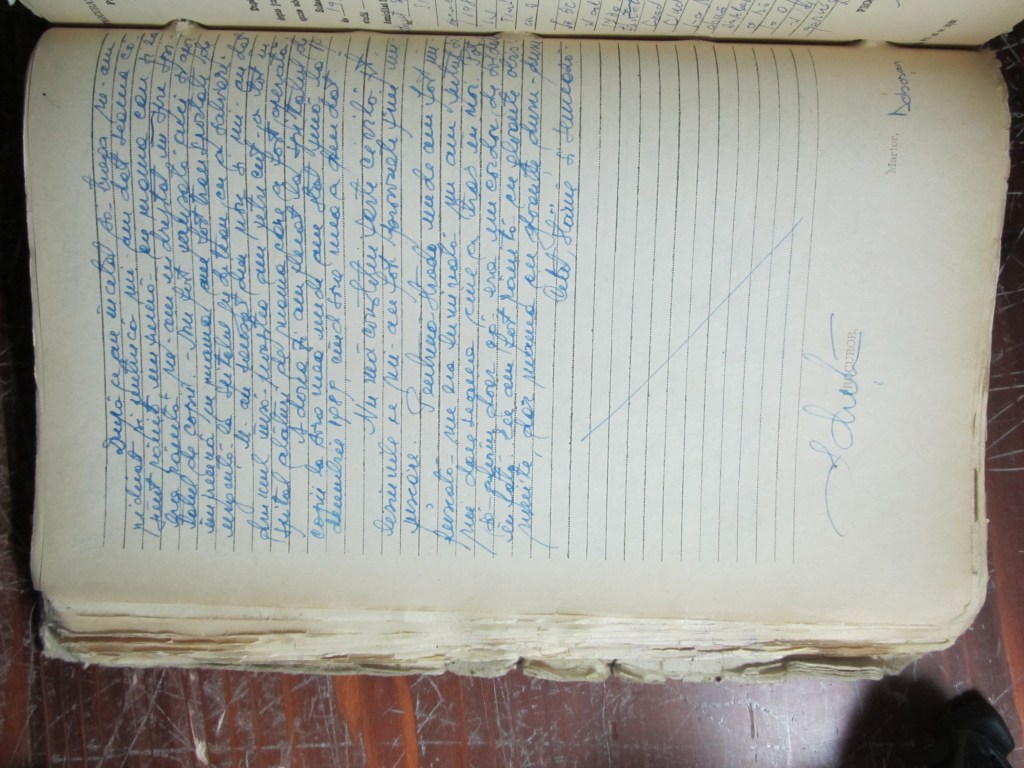
1) The testimonies of the demonstrators Ion Popovici (9 January 1990) and Marin Stoica (8 January 1990) show that they overheard the discussion of the use of Dum-Dum bullets between soldiers and Interior Ministry personnel.

Popovici:  “Mi-am revenit intr-un camion militar in care eram multi civili unii morti fiind adusi la garnizoana militara.  La garnizoana eu am fost dat jos si predat unui cpt (capitan) sau unui lt.major (locotenent major). vazand rana mea n-a vrut sa ma primeasca exprimand: Voi trageti cu dum dum si noi sa raspundem pentru acest lucru.”  (my thanks to A.K. for this transcription)

Popovici:  “I came to in a military truck in which there were lots of civilians some dead being brought to the military garrison.  At the garrison I was taken down and surrendered to a captain or lt. major, who looking at my wound did not want to receive me, exclaiming:  You shoot with dum-dum bullets and we are held responsible for it.

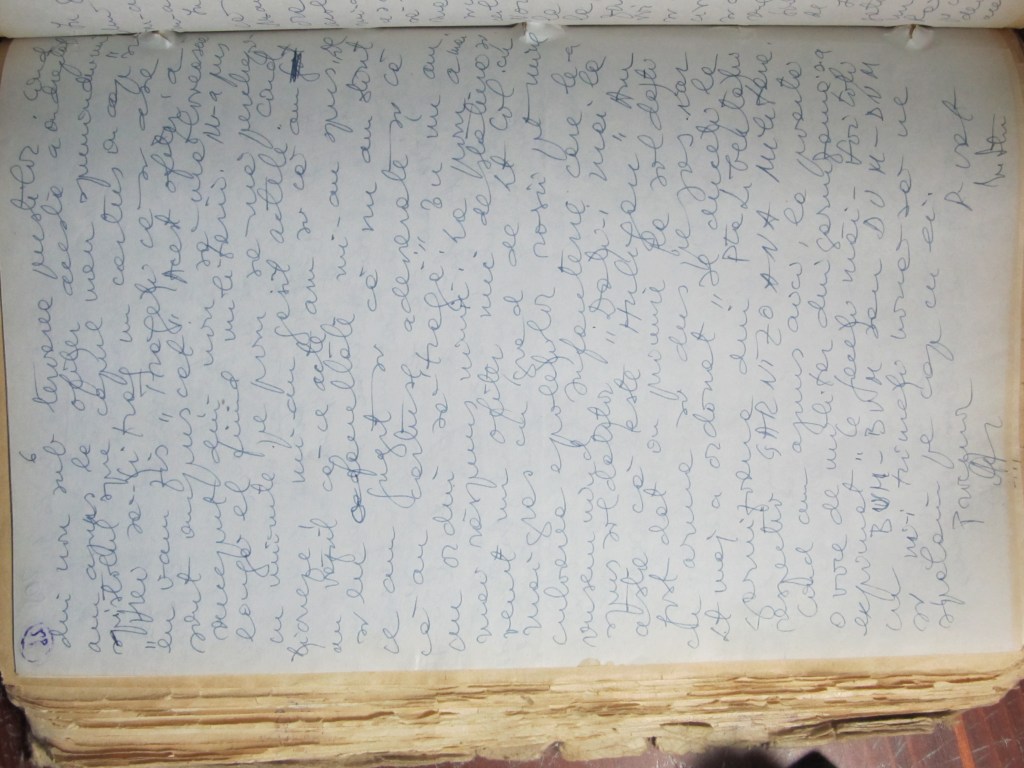
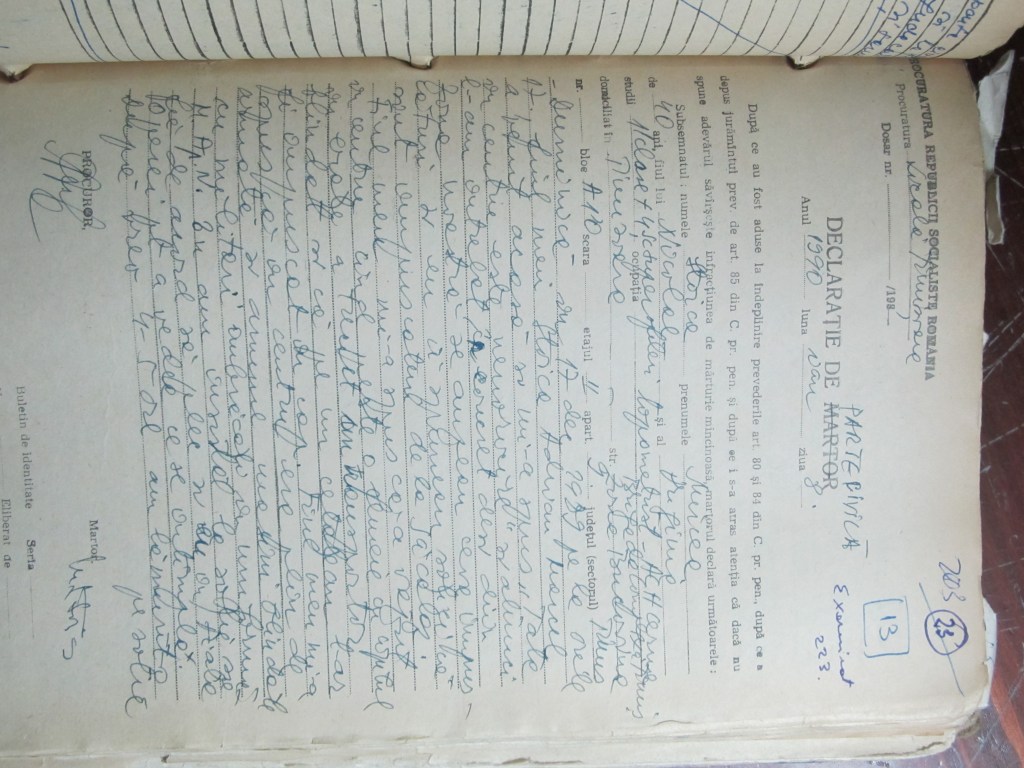
Mircea Stoica (declaratie, 8 ian 1990):  “Cind am ajuns aici, la poarta o voce de militar din garnizoana s-a exprimat:  “Ce faceti mai — voi toti cu BUM-BUM sau DUM-DUM si ni-i trimiteti noua sa ne spalam pe cap cu ei.”

Mircea Stoica (declaration, 8 January 1990):  “When I got there, I heard a soldier’s voice from the garrison exclaim:  “What are you guys doing? You all with your BUM-BUM or DUM-DUM and then you send`em to us to solve the problem [almost impossible to solve]” <very angry, pissed off> (my sincere thanks to Gigga Adrian Tudor for this transcription and translation of the quote!)

IMG_0291

available on this site http://www.banaterra.eu/romana/procesul-de-la-timisoara-1990-1991-vol-v ].  The following is from Volume V.]

Some excerpts: P.C.:  Ati dat o declaratie?   Po. I. :  Da  P.C.:  O mentineti?  Po. I. Da (p. 827) P.C.:  “Inteleg sa fiu audiat in cauza ca parte civila”, da?  V-as ruga sa faceti putin liniste!  “Mentin declaratia de la Procuratura si…” (p. 833)

Po. I.:  …Da [am fost ranit].  Si dupa aceea a venit unul dintre trei [civili mai in varsta] dupa mine, m-a tarat pana la masina si la masina, acolo, am luat o bataie…ca n-am putut doua saptamani nici sa mananc nimica.  M-a lovit cu patul de arma in falca si cu bocancii in cap.  Si m-au dus, m-au dus la Garnizoana.  La Garnizoana m-au aruncat din masina si a venit ofiterul de serviciu.  Au venit si acestia trei a spus lu’ ofiterul de serviciu, cica:  “Luati-l si duceti-l  la arest.”  Atata retin foarte bine minte, ca ofiterul a spus, cica:  “Nu, voi trageti cu dum-dum-uri si dupa aia Armata raspunde.  Voi omorati oameni si raspunde Armata dupa aceea.”  Asta tin minte precis.  Si de acolo mi-am dat seama ca nu poate sa fie soldati aceia. (p. 830)

Procesul de la Timisoara (II). Audierea partii civile Popovici Ion: “…Atata retin foarte bine minte, ca ofiterul a spus, cica: ‘Nu, voi trageti cu dum-dum-uri si dupa aia Armata raspunde.’”

IMG_0290

Mircea Stoica (declaratie, 8 ian 1990):  “Cind am ajuns aici, la poarta o voce de militar din garnizoana s-a exprimat:  “Ce faceti mai — voi toti cu BUM-BUM sau DUM-DUM si ni-i trimiteti noua sa ne spalam pe cap cu ei.”

Mircea Stoica (declaration, 8 January 1990):  “When I got there, I heard a soldier’s voice from the garrison exclaim:  “What are you guys doing? You all with your BUM-BUM or DUM-DUM and then you send`em to us to solve the problem [almost impossible to solve]” <very angry, pissed off>

(my sincere thanks to Gigga Adrian Tudor for this transcription and translation of the quote!)

Stoica Mircea, 40 ani, topometrist, Bd. Republicii, impuscat mina si picior http://www.timisoara.com/mioc/REVT06~1.HTM

197. Partea vătămată Stoica Maria cere 500000 lei, lunar, contribuţie de întreţinere, motivînd că, în decembrie 1989, soţul ei, Mircea Stoica a fost împuşcat, patru luni spitalizat, a rămas handicapat (gradul II de invaliditate), apoi a decedat.  În dovedirea cererii, depune acte de spitalizare şi de stabilire a capacităţii de muncă, care atestă vătămarea, cauzele şi consecinţele ei. Mai depune: declaraţia împuşcatului, actul lui de deces, actul de căsătorie şi carnetul de muncă (vol. 6 p. 304; vol. 10 p. 58-60, 170, 245-250; vol. 14 p. 54-61; vol. 27 p. 179-207).

http://www.procesulcomunismului.com/marturii/fonduri/mmioc/curteasup/docs/0307pciv.htm

IMG_0335

“Cind am ajuns aici, la poarta o voce de militar din garnizoana s-a exprimat:  “Ce faceti mai — voi toti cu BUM-BUM sau DUM-DUM si ni-i trimiteti noua sa ne spalam pe cap cu ei.”

IMG_0330

intreaga declaratie e aici:

imaginea 330
imaginea 331
imaginea 332
imaginea 333
imaginea 334
imaginea 335
imaginea 336

It doesn’t take a genius to recognize the important similarity between the testimonies of Mircea Stoica and Ioan Popovici:  both are party to/overhear military personnel referring to the 1) use of DUM-DUM bullets, 2) that those who are using them are clearly not fellow soldiers and instead likely M.I./Securitate personnel, and 3) the Army personnel are resentful of essentially being left to “hold the bag” for the results of the DUM-DUM munitions!

———————————————————————————————————————————

2) Declarations and/or courtroom testimony about demonstrators injured or killed by dum-dum bullets:  Doina Gherasim, Cristian Rusu, Robert Buzatu, M. Csikos, Dobosan, Florin Nicoara, Doru Sciadei, and Valentin Aparaschivei.

Doina Gherasim

IMG_0175

IMG_0305

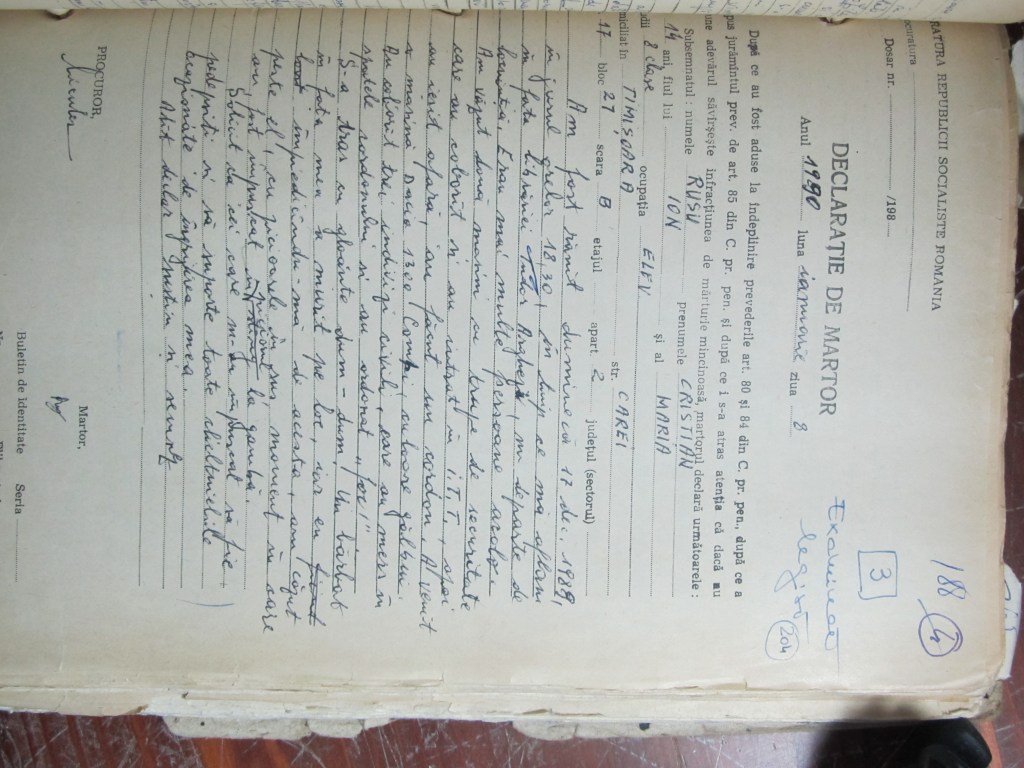
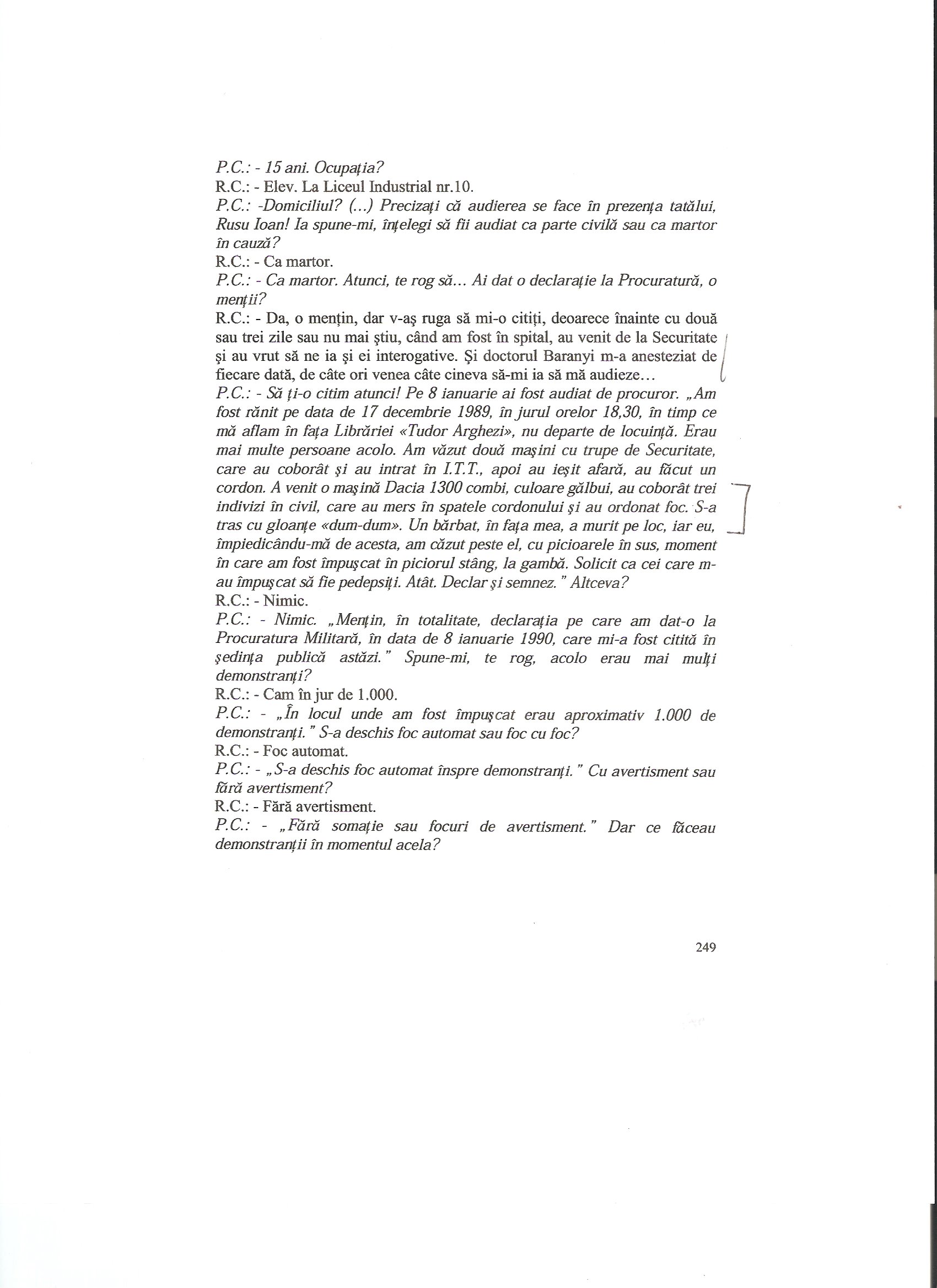
Cristian Rusu:  Pe 8 ianuarie audiat de procuror:  …A venit o masina Dacia 1300 combi, culoare glabui, au coborat trei indivizi in civil, care au mers in spatele cordonului si au ordonat foc.  S-a tras cu gloante “dum-dum.”

Robert Buzatu “a fost lovit de un glont exploziv”

IMG_0045

imaginea 43
imaginea 44
imaginea 45
imaginea 46

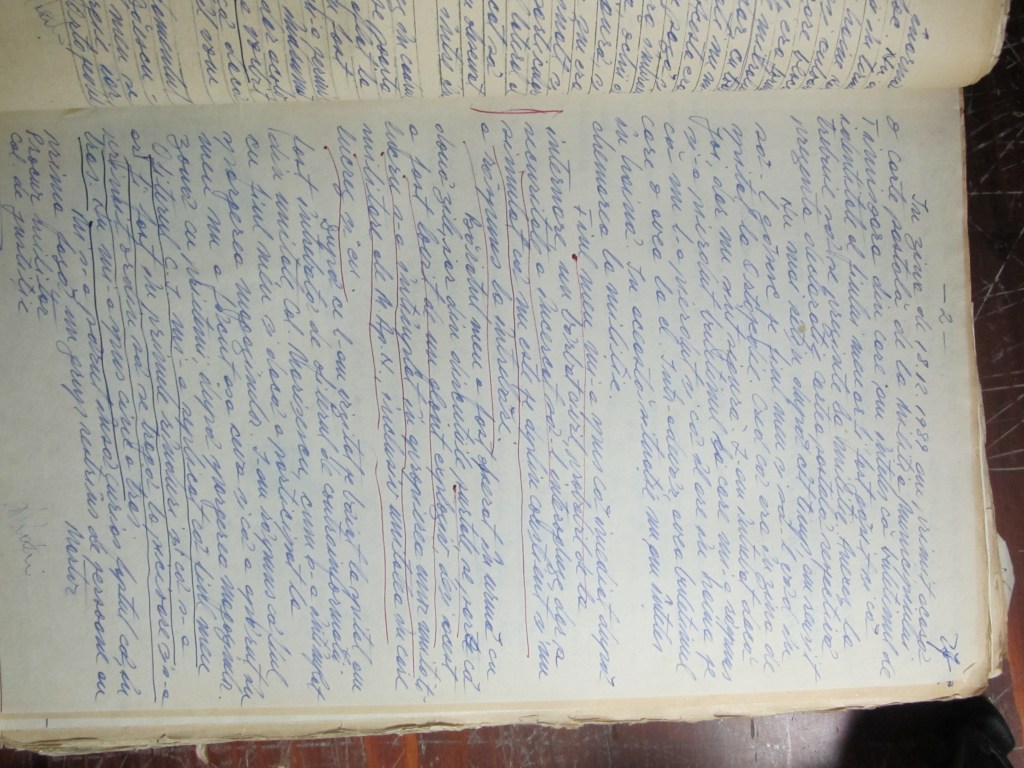
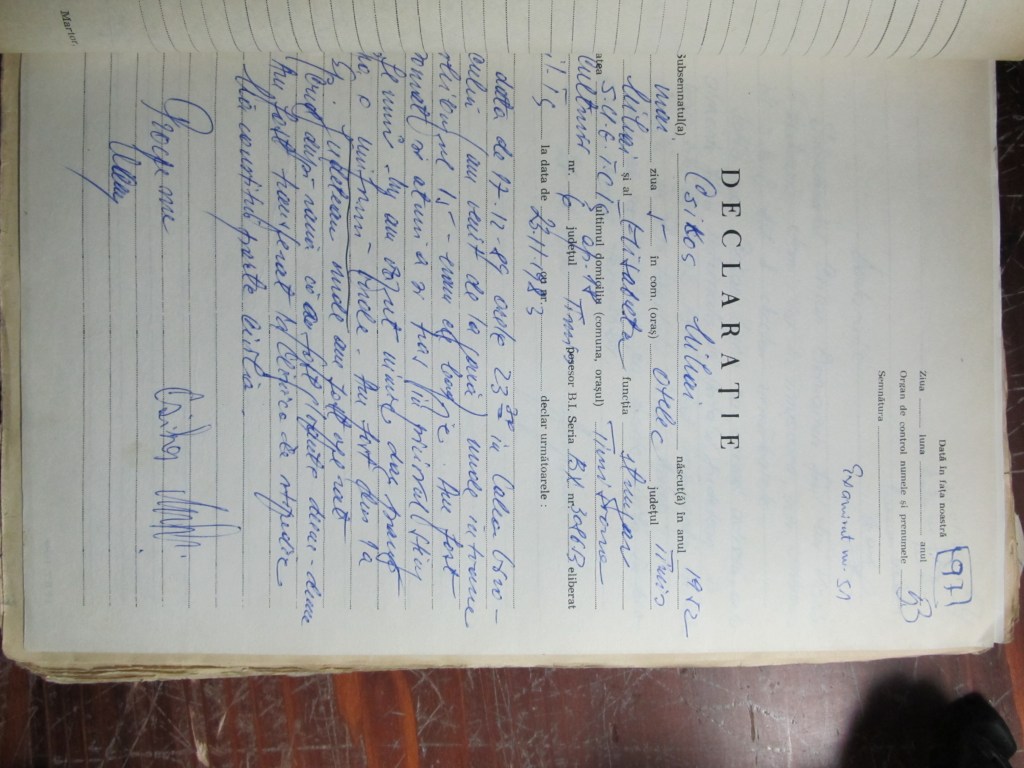
Csikos [?] “Cred dupa rana [?]  ca au fost gloante dum-dum”

IMG_0088

Dobosan “am fost ranit…cu gloante dum-dum”

imaginea 127
imaginea 128

IMG_0128

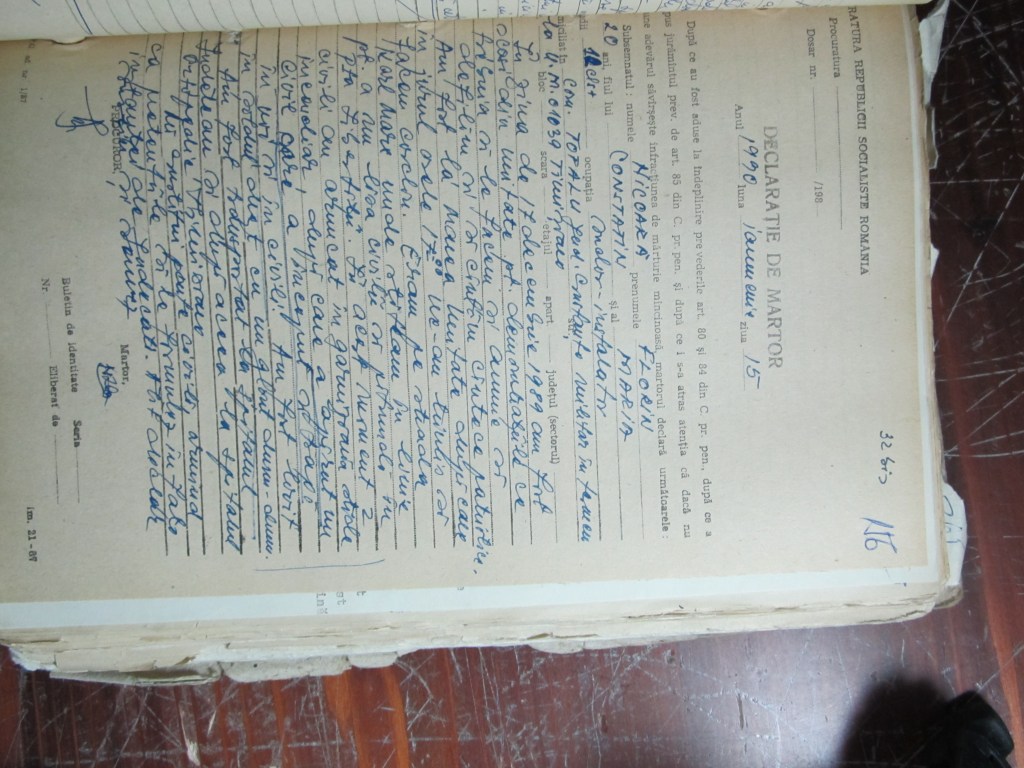
Florin Nicoara “Am fost lovit in soldul drept cu un glont dum-dum”

IMG_0257

Griga “civilii au fost impuscati cu gloante plate [?], care asa cum spuneau medicii cu rupt tesuturile”

imaginea 170
imaginea 171

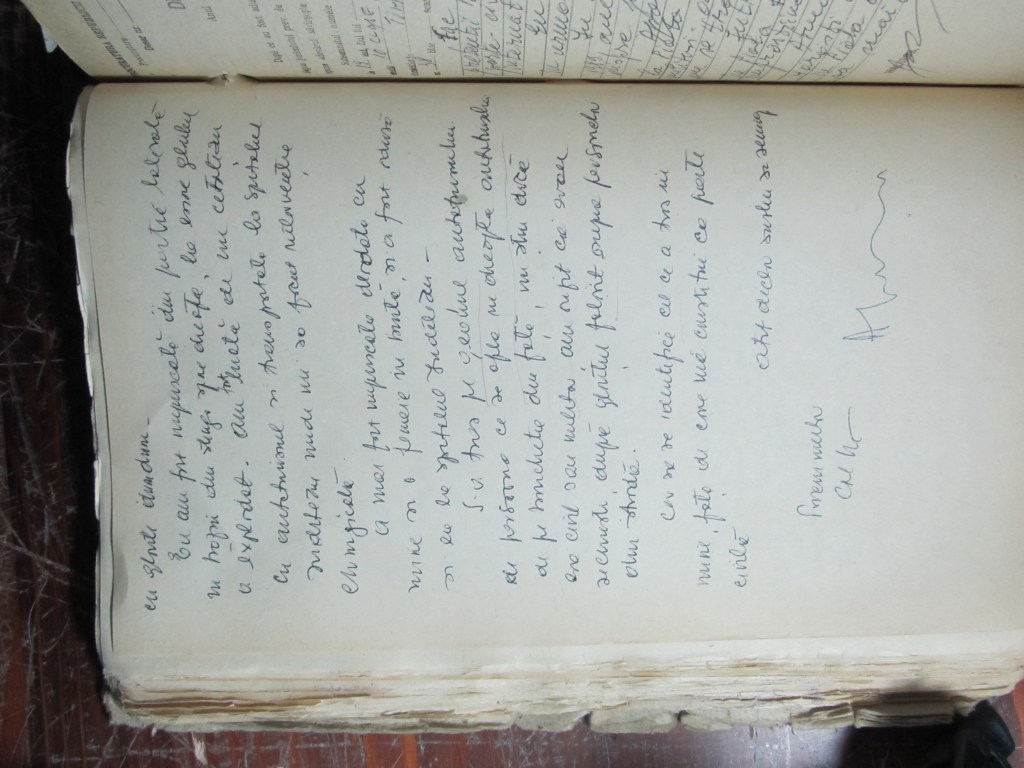
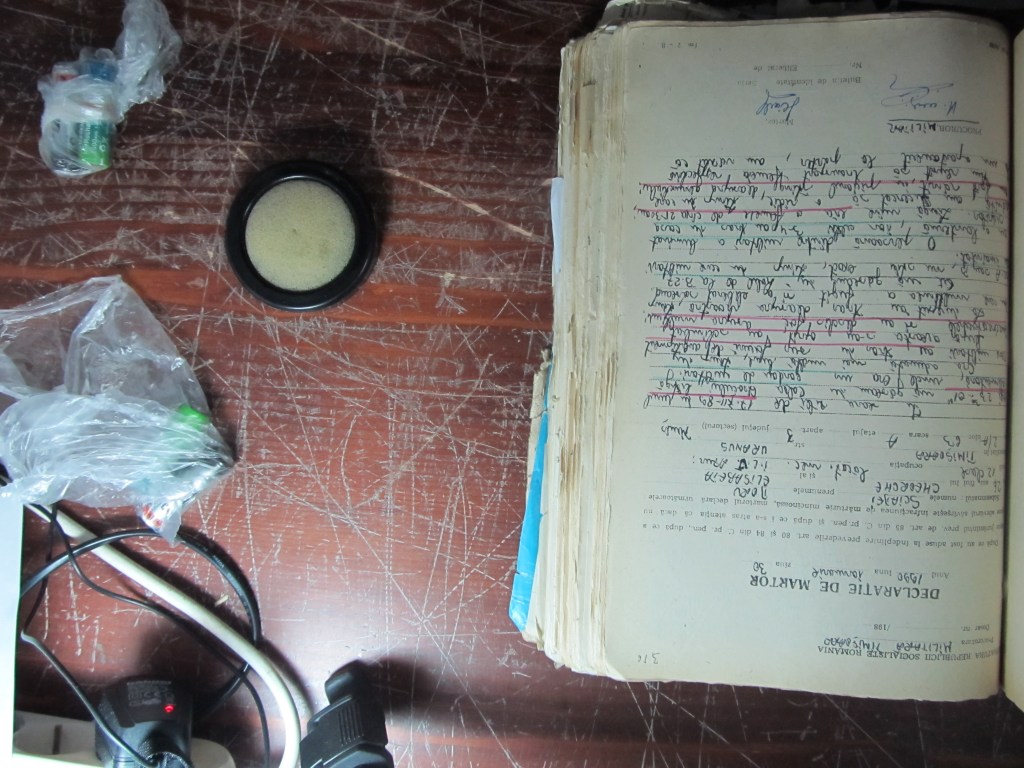
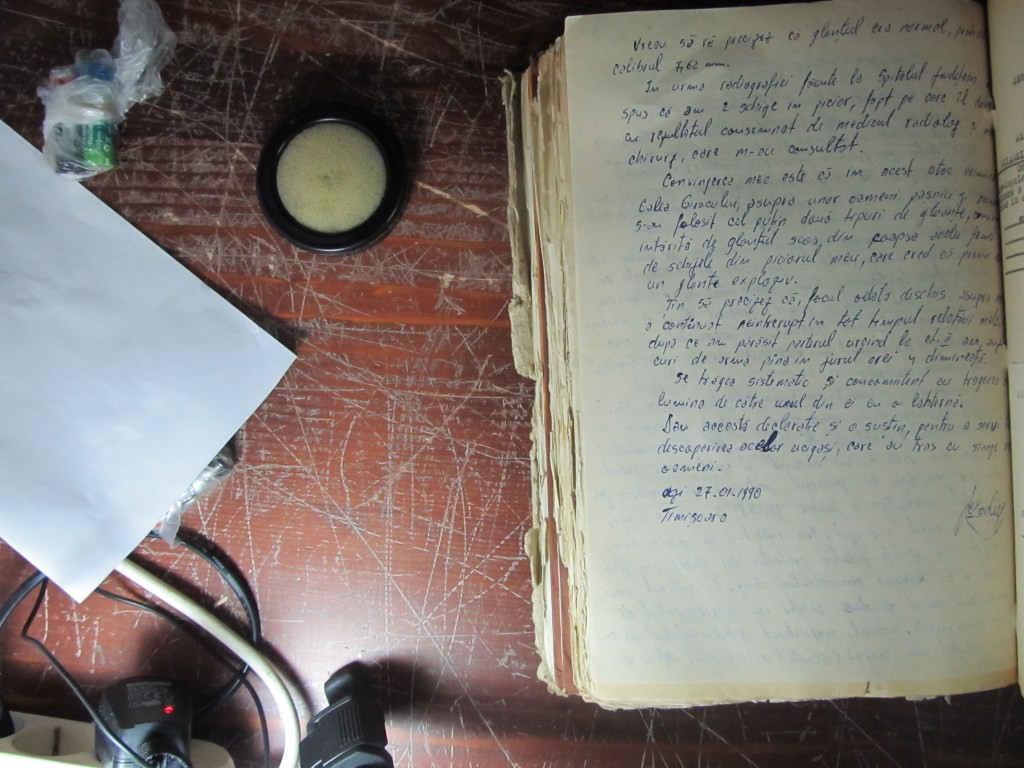
Doru Sciadei’s statement, 27 January 1990

IMG_0932

“In urma radiografiei facute la Spitalul Judetean au spus ca am 2 schije in picior…consemnat de medicul radiolog si chirurg, care m-au consultat.

Convingerea mea este ca in acest atac (pe ?) Calea Girocului, asupra unor oameni pasnici si (?) s-au folosit cel putin doua tipuri de gloante, convingerea intirita de glontul scos din coapsa (?) si schijele din piciorul meu, care cred ca provin de un glonte exploziv.

…Se trage sistematic si concomitent cu tragerea de lumina de catre unul din ei cu o lanterna.”

IMG_0929

3) Other testimonies from Victims or Relatives of Victims of Dum-Dum Bullets on 17-18 December 1989:  Valentin Aparashivei, Ioan Musca, Danut Gavra, Octavian Tintaru, Adrian Kali, Mariana Rodica Farcau, Leontina Banciu, Vasile Avram, Marius Ciopec, and Florica Sava.

Followed by 6 Medical Personnel Who Treated the Victims Attest to the Use of Dum-Dum Bullets

Cases available on the Internet mentioning the wounding or killing of demonstrators with dum-dum explosive bullets on 17-18 December 1989.  There are more than a dozen in all, many of whom we have seen were testified about during the Timisoara trials.

Doru Sciadei’s recollections are similar to those of Dorina Aparaschivei, whose husband, Valentin, was shot at the same location on Calea Girocului in Timisoara on 17 December 1989:

http://adevarul.ro/locale/timisoara/decembrie-89-manifestantii-ucisi-s-au-refugiat-casa-scarilor-1_50ad7b6a7c42d5a66395fbe7/index.html

Pe 17 decembrie 1989, duminică seara, toată Calea Girocului a fost cuprinsă de febra revoltei. Mii de locuitori au ieşit pe stradă să îşi arate nemulţumirea faţă de sistem. Pe fondul izbucnirii conflictelor între manifestanţi şi soldaţi, s-a format un grup de 40 de militari sub comanda lt.col. Constantin Caraivan, care aveau misiunea de a restabili ordinea. „În jurul orei 23, când au început să tragă, am decis să ne retragem spre casă. Am fost şi noi la baricade. Soţul meu spunea că se trage cu gloanţe de cauciuc, voia să mă liniştească”, a spus Dorina Aparaschivei.

Ca în filmele de acţiune

Cordoanele de militari înaintau pe de o parte şi de alta a trotuarului, iar în mijloc se deplasa un tanc. „Noi ne-am băgat în scara de bloc unde erau peste 20 de persoane. Valentin era de mână cu cei doi copii, care aveau 12 şi 15 ani. La un moment dat am văzut o lumină puternică, moment în care au început să tragă”, a mai adăugat femeia. Au fost cinci gloanţe trimise către casa scării, iar unul dintre ele a trecut prin geam şi l-a nimerit în piept pe Valentin Aparaschivei. În acel moment, un bătrân a ieşit în genunchi şi a strigat „Măi militarilor, de ce aţi împuşcat un om nevinovat?”. I s-a răspuns: „Bagă capul că te împuşc şi pe tine!”.

Salvarea a sosit în scurt timp, însă medicii nu au putut să mai facă nimic. Avea o gaură mare în piept, cât o gură de pahar. Se spunea că erau gloanţe explozibile. L-am dus în casă cu pătura şi l-am pregătit pentru înmormântare. A doua zi au venit patru oameni în albastru, cu un sicriu şi l-au luat”, a mai povestit Dorina Aparaschivei. [my emphasis inserted in this sentence]

Criminali cu lanterne

În aceea seară şi în noaptea care a urmat, în zonă au acţionat pe lângă militari persoane necunoscute, care aveau în dotare lanterne foarte puternice. Îndreptau fasciculul luminos către balcoane şi scări, după care trăgeau. Au acţionat de asemenea, şi securişti şi miliţieni în civil. Pe toată Calea Girocului, de la intersecţia cu strada Albac până la intersecţia cu Liviu Rebreanu au fost 11 victime prin împuşcare şi 26 de răniţi.

from Adevarul http://www.adevarul.ro/locale/timisoara/DECEMBRIE_-89-_Si-a_pierdut_iubita_si_piciorul_stang_0_173982752.html author Stefan Both

Danut Gavra with his two daughters in the Heroes’ Cemetery in December 2009

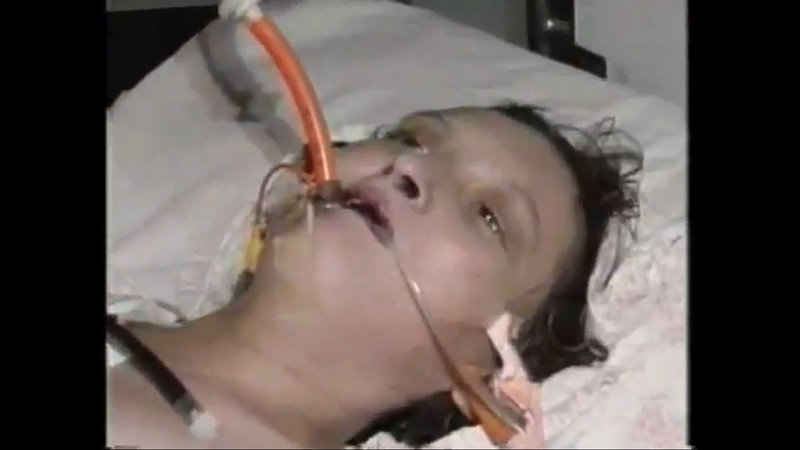
Irish Television (RTE) captured what were apparently the last hours of Florica Sava’s  tragic end.  Warning:  the scene from 11:00 to 11:30 is graphic and unsettling.

posted by mikenork

http://www.youtube.com/watch?v=c3A6IiaOWhs

Brendan O’Brien (reporter):  “Florica Sava, a 33 year old mother of two young sons, was shot from a car with a dum-dum bullet.  It caused massive internal injuries.  Doctors said she had just hours to live.”

http://atomic-temporary-3899751.wpcomstaging.com/2011/05/11/lets-go-to-the-videotape-i-to-the-army-its-confirmation-that-theyve-been-dealing-with-a-specially-trained-force-because-its-the-type-of-bullet-theyve-never-seen-before-itn-uk-telev/

4) SIX Doctors/Medical personnel from Timisoara alone have discussed the use of dum-dum bullets against demonstrators in Timisoara…:  Dr. Aurel Mogosanu, Dr. Atanasie Barzeanu, Rodica Novac, Dr. Fluture, Csaba Ungor, Goga Andras

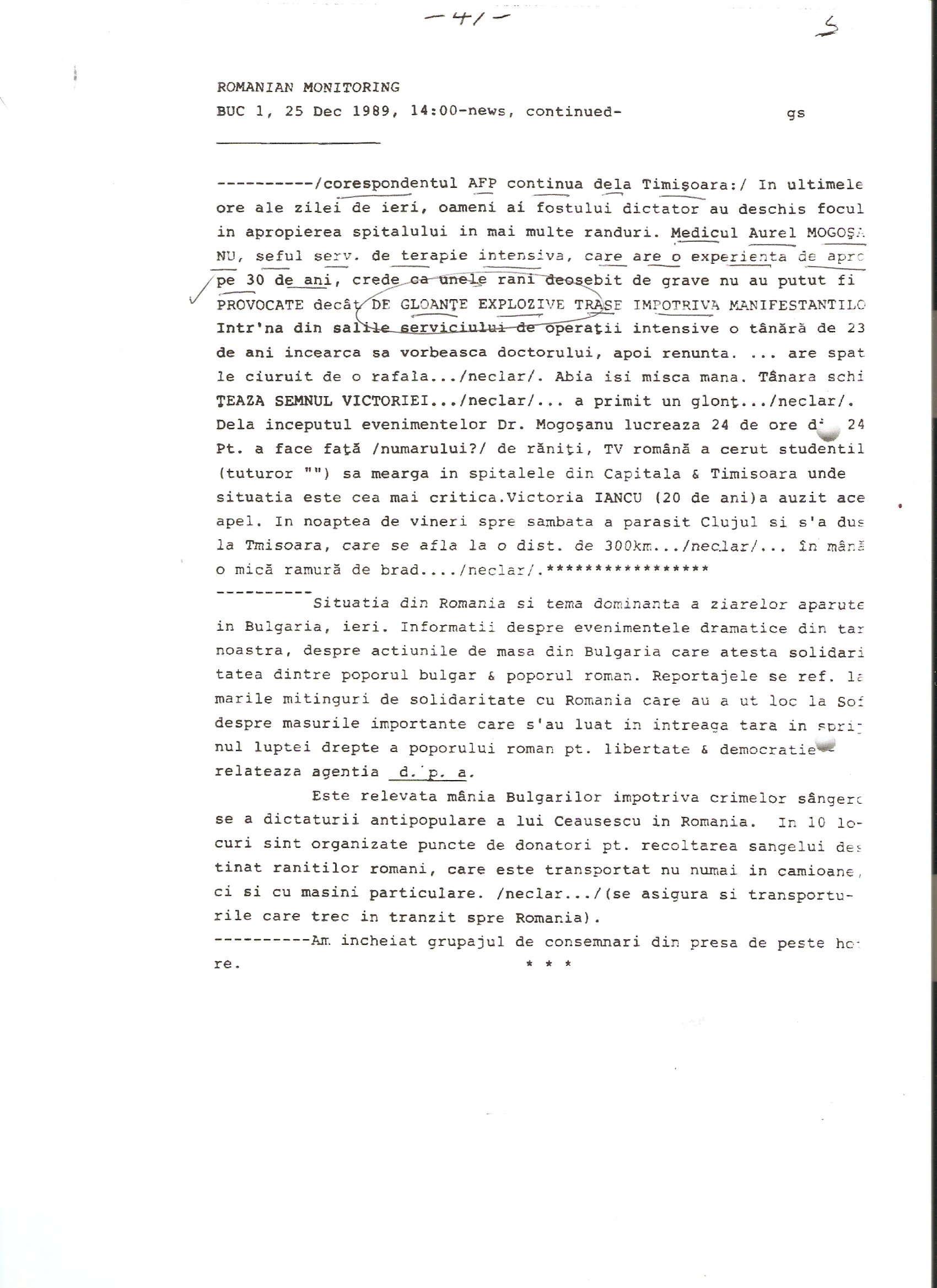
Doctors also reported on the wounds caused by explosive bullets (i.e. dum-dum bullets):  In this dispatch from Agence France Presse, relayed by Radio Free Europe on 25 December 1989, Dr. Aurel Mogosanu, a medic in the intensive care unit of a Timisoara hospital, says based on his thirty years of experience, some of the wounds could only have been CAUSED by EXPLOSIVE BULLETS SHOT AT THE PROTESTERS”

sursa (documentele Europa Libera disponibile la):  http://media.hotnews.ro/media_server1/generic_file-2009-12-22-6754154-0-radio-bucuresti-25-dec-pdf.pdf (p. 49 of 82)

©AFP Général – Lundi 25 Décembre 1989 – 08:33 – Heure Paris (386 mots)
Roumanie, prev Nuit de Noel a l hopital central de Timisoara De l un des envoyes speciaux de l AFP, NICOLAS MILETITCH
   TIMISOARA (Roumanie) 25 dec – Devant l hopital central de Timisoara, dimanche soir, une quarantaine de camions remplis de medicaments et de produits alimentaires tout juste arrives, attendaient d etre decharges.
   ” L aide nous vient d un peu partout. Hongrie, RFA, Tchecoslovaquie, France, Yougoslavie, URSS, Bulgarie, Italie… ” , indique a l AFP l un des soldats qui gardent l hopital. Les militaires sont partout autour de l hopital, sur les toits, dans les cours et meme a l interieur.
   ” Des hommes de la Securitate ont tire pres de l hopital a plusieurs reprises, ces dernieres heures ” , explique le docteur Aurel Mogosianu, chef du service de soins intensifs, en donnant des ordres a un soldat qui passe, la mitraillette a l epaule, dans un couloir, entre les malades.
   Le Dr Mogosianu, qui a une trentaine d annees d experience, pense que certaines blessures particulierement horribles, n ont pu etre provoquees que par des balles explosives tirees contre les manifestants.
   Dans une salle de soins intensifs, une femme de 23 ans essaie de parler au docteur, puis renonce. ” C est un cas difficile. Elle a eu le dos transperce par une rafale ” , precise le Dr Mogosianu.
   En bougeant a peine la main, la jeune femme esquisse le ” V ” de la victoire pour dire ” au revoir ” . Un effort irrealisable pour son voisin qui a recu une balle dans le cou, impossible a extraire.
   Comme la plupart de ses collegues, le docteur travaille, a peu de choses pres, 24 heures sur 24 depuis le debut des evenements. Dans un coin, une infirmiere dort, ecroulee sur une chaise.
   Pour faire face a l afflux de blesses, la television de Bucarest a demande a tous les etudiants en medecine du pays de se rendre dans les hopitaux de la capitale et de Timisoara, ou la situation est la plus critique.
   Victor Jancu, 20 ans, a entendu cet appel. Dans la nuit de vendredi a samedi, il a quitte Cluj et reussi a rejoindre Timisoara, a plus de 300 kms de la, en arretant des camions.
   Quelques visiteurs arrivent a l hopital, portant a la main une petite branche de sapin : a Timisoara aussi, on voudrait feter Noel.
   nm/jga/vr.
Tous droits réservés : ©AFP Général
021851451DC1ED1D715E06849EA4C6E0F37C0C25ECE8D503

mai mult despre Dr. Aurel Mogosanu in decembrie 1989:  http://www.sorinbogdan.ro/2009/12/timisoara-18-decembrie-1989/.

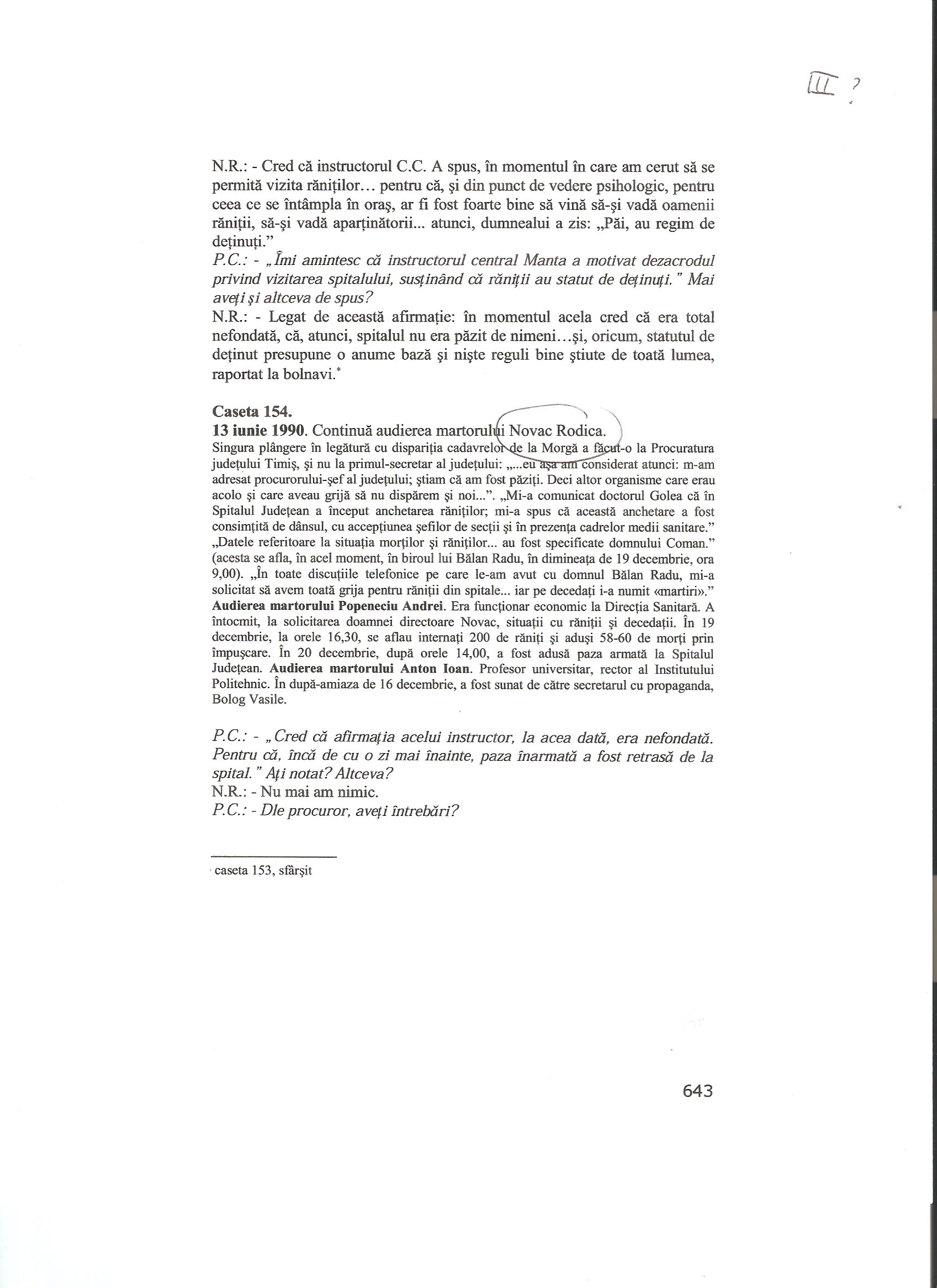
http://atomic-temporary-3899751.wpcomstaging.com/2011/09/30/procesul-de-la-timisoara-iii-audierea-martorului-rodica-novac-directorul-directiei-sanitare-timis-13-iunie-1990/

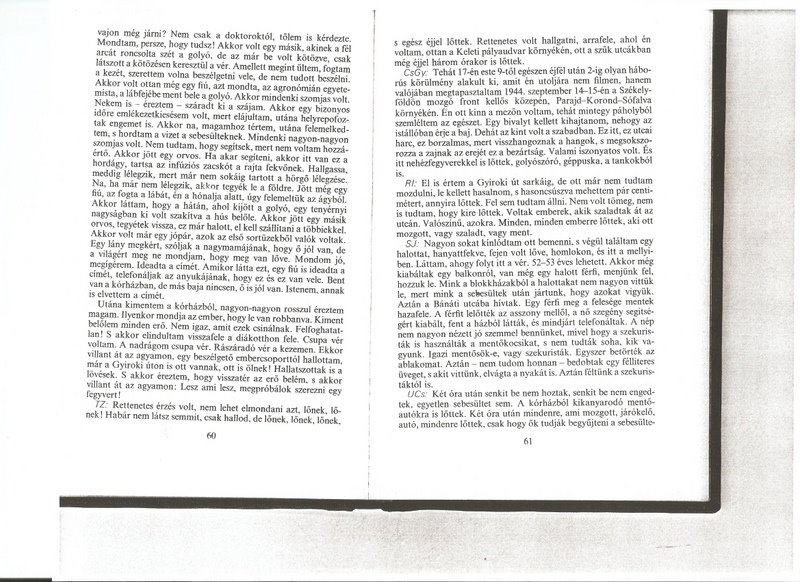
Rodica Novac’s claim is corroborated elsewhere by four other medical officials on call during the Timisoara repression.  First, in Romanian, by Dr. Atanasie Barzeanu, then in Hungarian by three doctors (Vladimir Fluture, Csaba Ungor, and Andras Goga) present and performing surgery in Timisoara hospitals from 17-19 december 1989 who recount separately their discovery of dum-dum exploding bullets among the bullets with which demonstrators arriving at the hospital had been shot.  december 1989: temesvari orvosok, dum-dum golyok, es a roman forradalom

Sava Florica, 33 de ani, vinzatoare la Loto-pronosport in cartierul Fabric, impuscata din mers, in Piata Traian

Barzeanu Atanasie, 65 anit, medic primar, doctor in stiinte, chirurg, Spitalul Judetean Timisoara

“…sintem deci in 18 decembrie…Pe la orele doua si patruzeci, cind inchideam o operatie–Sava Florica, 33 de ani, vinzatoare la Loto-pronosport in cartierul Fabric, impuscata din mers, in Piata Traian, dintr-un ARO, pacienta prezentindu-se o echimoza cu distrugerea tesuturilor (plaga in diametru de 15 centimetri), a tesuturilor din regiunea epigastrica, inclusiv a muschilor drepti abdominali, cu ruptura a colonului ascendent transvers si a jejuno-ileonului, fiind in stare de soc grav traumatic, hemoragic–, fara sa-mi poti explica nici macar acum cu ce fel de gloante a putut fi lovita, pentru ca nu am identificat nici orificiul de iesire si nici pe cel de intrare, a venit o asistenta de la Chirurgie I, care mi-a spus sa merg la domnul Ignat.”

Titus Suciu, Reportaj cu Sufletul la Gura, (Editura Facla 1990), pp. 133-134.

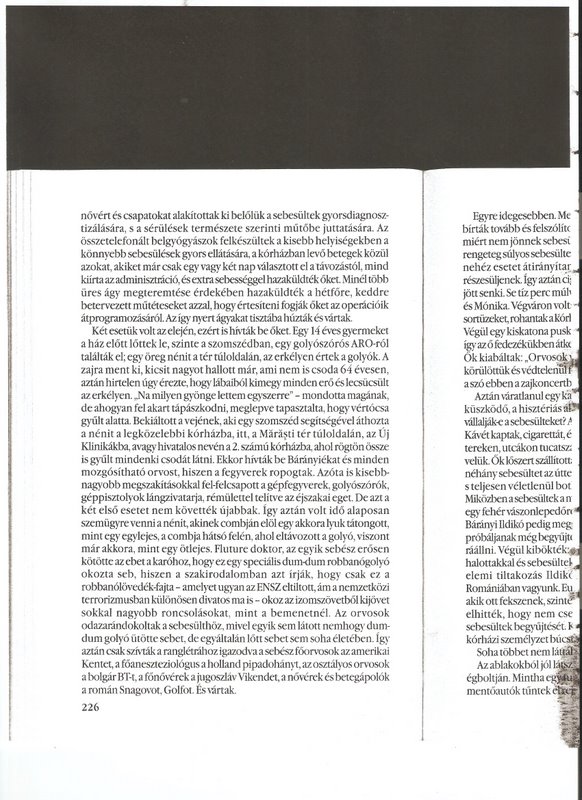
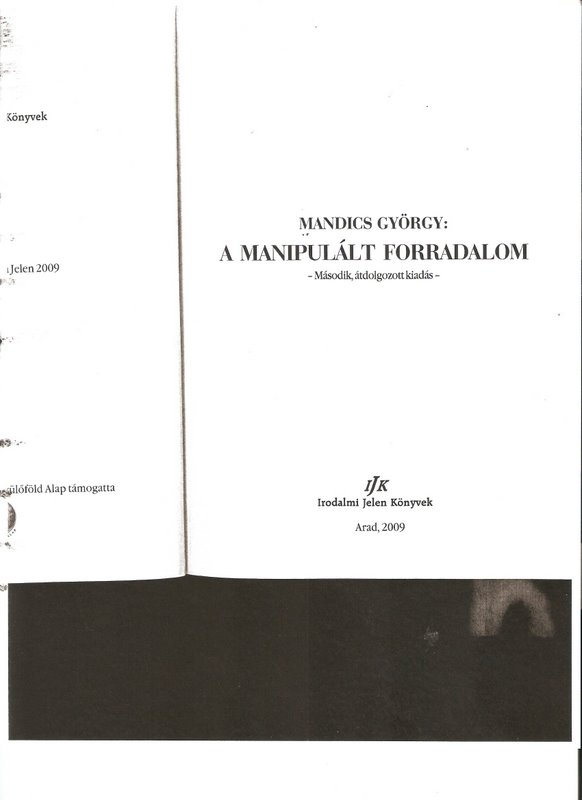
The following first appeared in Gyorgy Mandics’s Temesvari golgota (1991) pp. 348-349 and is reprinted in his A Manipulalt Forradalom (2009).  [My guess is this is also the source for the reference to dum dum bullets in the German language wikipedia entry for http://de.wikipedia.org/wiki/Rum%C3%A4nische_Revolution_1989 — Hans Vastag, György Mandics, Manfred Engelmann: Temeswar. Symbol der Freiheit. Wien 1992. ]

pp. 348-349

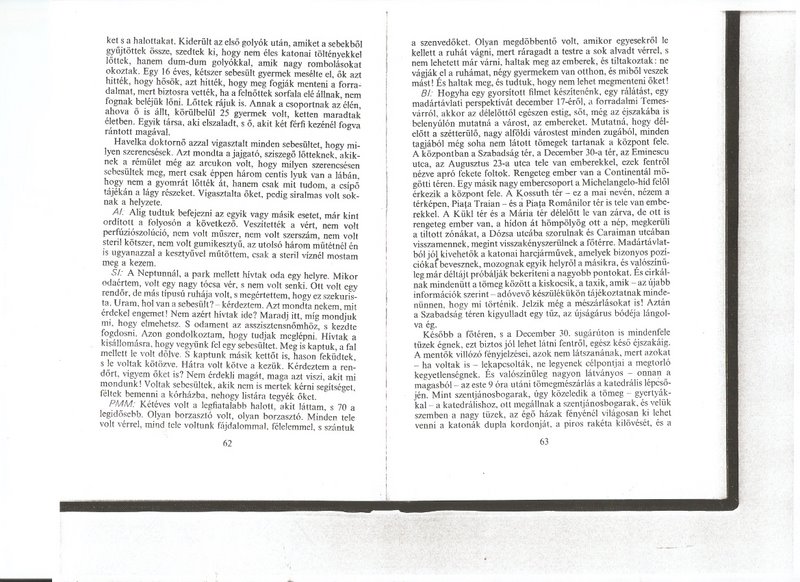
Ket esetuk volt az elejen.  Ezert is hivtak be oket.  Egy 14 eves gyermeket a haz elott lottek le, szinte a szomszedban, egy golyoszoros ARO-rol talaltak el; egy oreg nenit a ter tuloldalon, az erkelyen ertek a golyok.  A zarja ment ki, kicsit nagyott hallott mar, amire is csoda, 64 evesen, azt hirtelen ugy erezte, hogy labaibol kimegy minden ero es lecsusott az erholya.  Na milyen gyonge lettem egyszeruen–mondotta maganak. de ahogyan fel akart tapaszkodni meg lepve tapasztalt, hogy vertocsa gyult alatta.  Bekialtolt a vegenek aki egy szomszed segitsegevel athozta a nenit a legkozelebbi korhazba, itt a Marasti ter tuloldalan, az uj Klinikakba, avagy hivatalos neven a 2 szamu korhazba, ahol rogton osszecodult mindenki csodat latni.  Ekkor hivtak be Baranziekat es minden mozgositato orvost, hiszen a fegyverek ropogatak.  Azota is kisebb nagyobb megszakitasokkal, felfelecsapolt a gepfegyverek, golyoszorok, geppisztolyok langzivatarja, remulettel telitva az ejszaki eget.

p. 349

De azt a ket elso esett nem kovettek ujabbok.  Igz aztan volt ido alaposan szemugyre venni a nenit akinek combjan elol egz akkora lyuk tatongott mint egy egy lejes, a comba hatso felen ahol eltavotott a golyo, ott viszont mar akkora mint egy otlejes.  Fluture doktor, az egzik sebesz erosen kototte az ebet a korohoz, hogy ez egz specialis dum-dum robbanogolyo okozta seb, hiszen a szakirodalomban azt irjak, hogy csak ez a robbannolovedek-fajta-amelyet ugyan az ENSZ eltitott, am a nemzetkozi terrorizmusban kulonesen divatos ma is–okoz az izomszovetbol kijovet sokkal nagyobb roncsolasokat mint a bemenetnel.  Az orvosok odazarandokoltak a sebesulthoz, mivel egzik sem latott semhogy dum-dum golyo utotte sebet, de egyaltalan lott sebet sem soha eleteben.  Igz aztan csak szivtak a rangeletrahoz igazodva a sebesz foorvosok az amerikai Kentet, a foamnesztezialogus a holland pipadohanyt, az asztalyos orovosok a bolgar BT-t, a fonoverek a jugoslav Vikend-et, a noverek es helyapolok a roman Snagov-t, Golfot.  Es vartak.

(Note: it is unclear who the 64 yr. old described was…there are several individuals without ages listed as injured or dead during the events, but I think it more likely the age of the woman is incorrect)

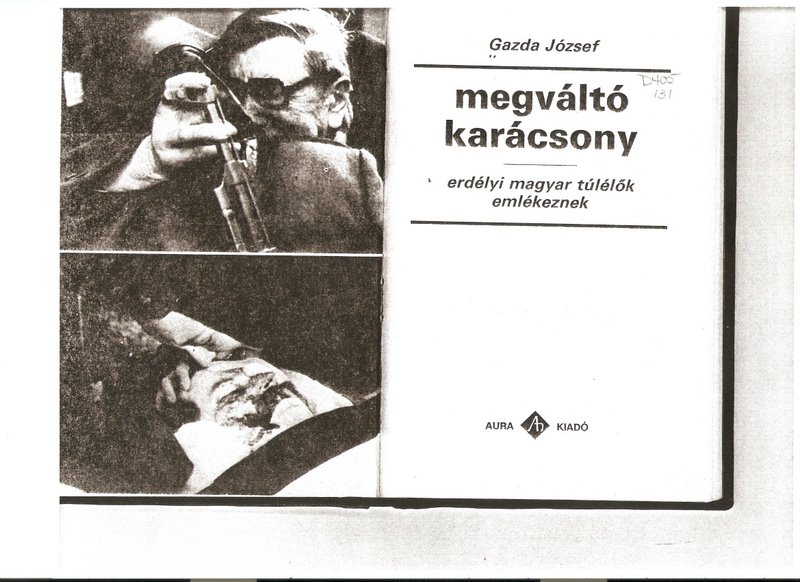
Jozsef Gazda Megvalto karacsonyErdelyi magyar tulelok emlekeznek. (1990)

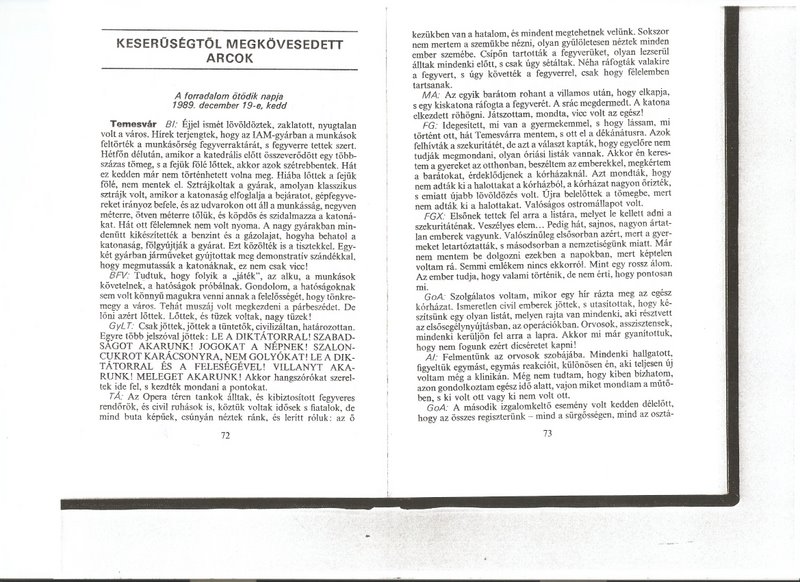
Ungor Csaba:  Ket ora utan senkit be nem hoztak, senkit be nem engedtek, egyetlen sebesult sem.  A korhazbol kikanyarado  mentoautokra is lottek.  Ket ora utan mindre, ami mozgott, jarokelo, auto, mindenre lottek, csak hogy ok tudjak begyujteni a sebesulteket s a halottakat.  Kiderult az elso golyok utan, amiket a sebekbol gyujottek ossze, szedtek ki, hogy nem eles katonai toltenyekkel lottek, hanem dum-dum golyokkal, amik nagy rombolasokat okoztak.  Egy 16 eves, ketszer sebesult gyermek meselte el, ok azt hittek, hogy hosok, azt hittek, hogy meg fogjak menteni a forradalmat, mert biztosra vettek, ha a felnottek sorfala ele allnak, nem fognak belejuk loni.  Lottek rajuk is.

Goga Andras:  A masodik izgalomkelto esemeny volt kedden delelott, hogy az osszes regiszterunk–mind a surgossegen, mind az osztalyon–, melyekre felirtuk a muteteinket, eltuntek, a mai napig sem talaltuk meg.  Bennuk voltak az ev osszes mutetei[***]…En aznap kettot operaltam.  Egy tuntetonek a bore alol vettem ki egy nagyon kulonleges golyok, nem is golyot, egy ilyen repeszdarabot, melyet a katonasag aztan megvizsgalt, s azt mondtak, nekik nincs tudmasuk, hogy ez mi lehet.  Egy masiknak pedig fejserulese volt, persze abban nem talaltam golyot, atment rajta.

RELATED:

Procesul de la Timisoara (XII): Timisoara, the key to the Revolution then; the key now to the truth about the Counter-revolution

Procesul de la Timisoara (XI): Dupa 22 decembrie–teroristii. Martorii Alexandru Koos, Ion Flocioiu, si Herlea Floarea

Procesul de la Timisoara (X): Gloante explozive (dum-dum) dupa 22 decembrie 1989

Procesul de la Timisoara (IX): Cine au fost cei “necunoscuti,” mai in varsta, care au tras inainte de 22 decembrie 1989? (2)

Procesul de la Timisoara (VIII): Cine au fost cei “necunoscuti”, mai in varsta, care au tras inainte de 22 decembrie 1989?

Procesul de la Timisoara (VII): “La Timisoara cred ca si domnul procuror a vazut cartuse de acest calibru…Dar au existat in corpurile delicte ale procuraturii. Eu l-am vazut. Este un cartus ceva mai lung, negru, cu botul taiat. 5,56.”

Procesul de la Timisoara (VI): Impuscati dintr-un ARO…Al cui apartinea ARO-ul?

Procesul de la Timisoara (V): Martorii Cristian Rusu, Daniela Lengyel, si Aurica Rusu (mama lui Marius Ciopec)

Procesul de la Timisoara (IV): Martorii Adrian Kali, Ioan Musca, Traian Orban, si Alexandru Koos

Procesul de la Timisoara (III): Audierea martorului Rodica Novac, directorul Direcţiei Sanitare Timiş (13 iunie 1990)

Procesul de la Timisoara (II). Audierea partii civile Popovici Ion: “…Atata retin foarte bine minte, ca ofiterul a spus, cica: ‘Nu, voi trageti cu dum-dum-uri si dupa aia Armata raspunde.’”

Procesul de la Timisoara (I): Missed Press Opportunities. The testimonies of Margaret Cacoceanu and Doina Gherasim (25-26 September 1990)

http://www.banaterra.eu/romana/search/node/%22procesul%20de%20la%20timisoara%22
Procesul de la Timişoara (1990-1991) – Vol. V
 ASOCIAŢIA MEMORIALUL REVOLUŢIEI  16-22 DECEMBRIE 1989, TIMIŞOARA     Editor: Miodrag Milin Timişoara, 2009   Ataşament Mărime procesul_de_la_timisoara_volumul_V_final.pdf 4 …Articol – dbaiski – 24 Iul 2009 – 16:03 – 0 comentarii – 1 fişier ataşat
Procesul de la Timişoara (1990-1991) – Vol. IV
 ASOCIAŢIA MEMORIALUL REVOLUŢIEI  16-22 DECEMBRIE 1989, TIMIŞOARA     Editor: Miodrag Milin Timişoara, 2009   Ataşament Mărime procesul_de_la_timisoara_volumul_IV_prefata.pdf …Articol – dbaiski – 24 Iul 2009 – 16:02 – 0 comentarii – 3 fişiere ataşate
Procesul de la Timişoara (1990-1991) – Vol. III
ASOCIAŢIA MEMORIALUL REVOLUŢIEI  16-22 DECEMBRIE 1989, TIMIŞOARA   Editor: Miodrag Milin Timişoara, 2009 Ataşament Mărime procesul_de_la_timisoara_volumul_III_prefata.pdf 126.6 KB proc …Articol – banaticus – 24 Iul 2009 – 16:01 – 0 comentarii – 4 fişiere ataşate
Procesul de la Timişoara (1990-1991) – Vol. I, II
ASOCIAŢIA MEMORIALUL REVOLUŢIEI  16-22 DECEMBRIE 1989, TIMIŞOARA   Editor: Miodrag Milin Timişoara, 2009 Ataşament Mărime prefata.pdf 199.39 KB procesul_de_la_timisoara_volumul_I.pdf …Articol – banaticus – 24 Iul 2009 – 16:00 – 0 comentarii – 3 fişiere ataşate
Procesul de la Timişoara (1990-1991) – Vol. VII
 Postul teritorial de Radio Timişoara Asociaţia ALTAR 1989, Timişoara Editor: Miodrag Milin Ataşament Mărime procesul_de_la_timisoara_volumul_VII_nota_asupra_editiei.pdf 68.46 KB procesu …Articol – dbaiski – 20 Mai 2009 – 17:06 – 0 comentarii – 3 fişiere ataşate
Procesul de la Timişoara (1990-1991) – Vol. VI
  ASOCIAŢIA MEMORIALUL REVOLUŢIEI  16-22 DECEMBRIE 1989, TIMIŞOARA   Editor: Miodrag Milin Timişoara, 2009 Ataşament Mărime procesul_de_la_timisoara_volumul_VI_nota_asupra_editiei …Articol – dbaiski – 20 Mai 2009 – 16:51 – 0 comentarii – 2 fişiere ataşate
Much of this has now been reposted or reproduced here:dosarelerevolutiei.ro

25 for 2014: 25 Things You Should Know about the Romanian Revolution on the 25th Anniversary of the Fall of Nicolae Ceausescu’s Communist Regime: #1 The Securitate Deny Foreign Instigation of the Timisoara Uprising

25 for 2014: 25 Things You Should Know about the Romanian Revolution on the 25th Anniversary of the Fall of Nicolae Ceausescu’s Communist Regime: #2 Shattered Glass: Securitate Vandalism to Justify Timisoara Crackdown

25 for 2014: 25 Things You Should Know about the Romanian Revolution on the 25th Anniversary of the Fall of Nicolae Ceausescu’s Communist Regime: #3 “Anti-terrorism” and Regime Repression

Posted in decembrie 1989, raport final | Tagged: , , , , , , , , , , , , , , , | 9 Comments »

When a Truth Commission Misses Crucial Evidence: The Romanian CPADCR Final Report and Securitate General Iulian Vlad’s Declaration

Posted by romanianrevolutionofdecember1989 on November 20, 2013

(purely personal views as always)

It is virtually certain that the authors of the Chapter on the Romanian Revolution of December 1989 (pp. 620-627, especially p. 625 http://www.presidency.ro/static/ordine/RAPORT_FINAL_CPADCR.pdf ) had no knowledge of Securitate General Iulian Vlad’s Declaration of 29 January 1990 … with predictable negative consequences for their understanding of what happened in December 1989.

image0-001

General Magistrat (r) Ioan Dan

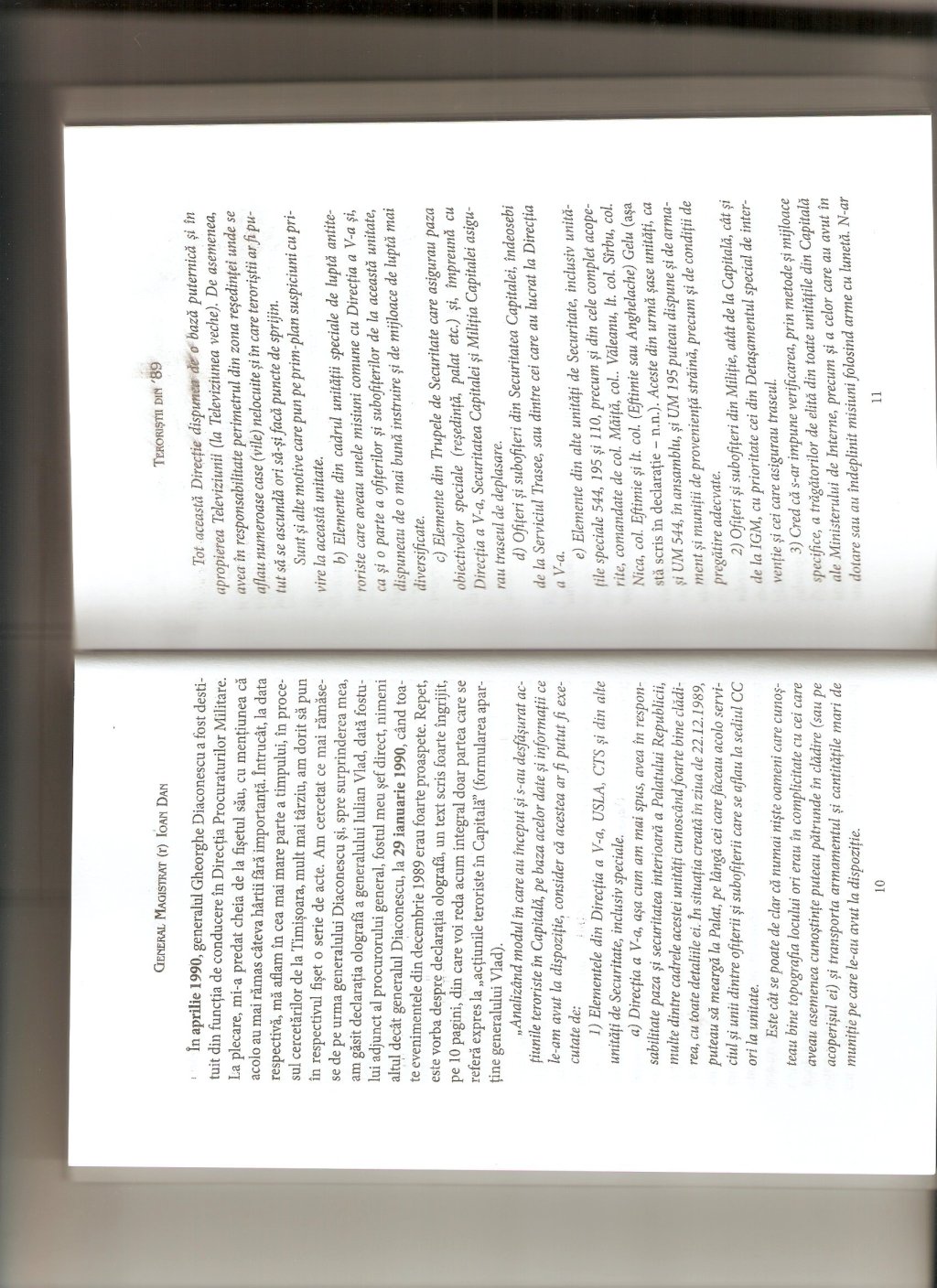
In aprilie 1990, generalul Ghoerghe Diaconescu a fost destituit din functia de conducere in Directia Procuraturilor Militare.  La plecare, mi-a predat cheia de la fisteul sau, cu mentiunea ca acolo au mai ramas cateva hartii fara importanta. Intrucat, la data respectiva, ma aflam in cea mai mare parte a timpului, in procesul cercetarilor de la Timisoara, mult mai tarziu, am dorit sa pun in respectivul fiset o serie de acte.  Am cercetat ce mai ramasese de pe urma generalului Diaconescu si, spre surprinderea mea, am gasit declaratia olografa a generalului Iulian Vlad, data fostului adjunct al procurorului general, fostul meu sef direct, nimeni altul decat generalul Diaconescu, la 29 ianuarie 1990, cand toate evenimentele din decembrie 1989 erau foarte proaspete.  Repet, este vorba despre declaratia olografa, un text scris foarte ingrijit, pe 10 pagini, din care voi reda acum integral doar partea care se refera expres la “actiunile teroriste in Capitala” (formularea apartine generalului Vlad).

image0

“Analizand modul in care au inceput si s-au desfasurat actiunile teroriste in Capitala, pe baza acelor date si informatii ce le-am avut la dispozitie, consider ca acestea ar fi putut fi executate de:

1) Elementele din Directia a V-a, USLA, CTS si din alte unitati de Securitate, inclusiv speciale.

a) Directia a V-a, asa cum am mai spus, avea in responsabilitate paza si securitatea interioara a Palatului Republicii, multe dintre cadrele acestei unitati cunoscand foarte bine cladirea, cu toate detaliile ei.  In situatia creata in ziua de 22.12.1989, puteau sa mearga la Palat, pe langa cei care faceau acolo serviciul si unii dintre ofiterii si subofiterii care se aflau la sediul CC ori la unitate.

Este ca se poate de clar ca numai niste oameni care cunosteanu bine topografia locului ori erau in complicitate cu cei care aveau asemenea cunostinte puteau patrunde in cladire (sau pe acoperisul ei) si transporta armamentul si cantitatile mari de munitie pe care le-au avut la dispozitie.

Tot aceasta Directie dispunea de o baza puternica si in apropierea Televiziunii (la Televiziunea veche).  De asemenea, avea in responsabilitate perimetrul din zona resedintei unde se aflau numeroase case (vile) nelocuite si in care teroristii ar fi putut sa se ascunda ori sa-si faca puncte de sprijin.

Sunt si alte motive care pun pe prim-plan suspiciuni cu privire la aceasta unitate.

b) Elemente din cadrul unitatii speciale de lupta antiterroriste care aveau unele misiuni comune cu Directia a V-a si, ca si o parte a ofiterilor si subofiterilor de la aceasta unitate, dispuneau de o mai buna instruire si de mijloace de lupta mai diversificate.

c) Elemente din Trupele de Securitate care asigurau paza obiectivilor speciale (resedinta, palat etc.) si, impreuna cu Directia a-V-a, Securitatea Capitalei si Militia Capitalei asigurau traseul de deplasare.

d) Ofiteri si subofiteri din Securitatea Capitalei, indeosebi de la Serviciul Trasee, sau dintre cei care au lucrat la Directia a V-a.

e) Elemente din alte unitati de Securitate, inclusiv unitatile speciale 544, 195 si 110, precum si din cele complet acoperite, comandate de col. Maita, col. Valeanu, lt. col. Sirbu, col. Nica, col. Eftimie si lt. col. (Eftimie sau Anghelache) Gelu (asa sta scris in declaratie–n.n.).  Aceste din urma sase unitati, ca si UM 544, in ansamblu, si UM 195 puteau dispune si de armament si munitii de provenienta straina, precum si de conditii de pregatire adecvate.

2) Ofiteri si subofiteri din Militie, atat de la Capitala, cat si de la IGM, cu prioritate cei din Detasamentul special de interventie si cei care asigurau traseul.

3) Cred ca s-ar impune verificarea, prin metode si mijloace specifice, a tragatorilor de elita din toate unitatile din Capitala ale Ministerului de Interne, precum si a celor care au avut in dotare sau au indeplinit misiuni folosind arme cu luneta.  N-ar trebui omisi nici chiar cei de la Dinamo si de la alte cluburi sportive.

4) Unele cadre militare de rezerva ale Securitatii, Militiei si Armatei, precum si actuali (la data respectiva) si fosti activisti de partid sau UTC, persoane apropriate tradatorului si familiei sale ori care poseda arme de foc.

Propun, de asemenea, o atenta investigare a celor care au fost in anturajul lui Nicu Ceausescu.  Acest anturaj, foarte divers, cuprindea inclusive unele elemente de cea mai scazuta conditie morala care puteau fi pretabile la asemenea actiuni.

Ar fi bine sa se acorde atentia cuvenita sub acest aspect si fratilor dictatorului–Ceausescu Ilie si Ceausescu Nicolae–care, prin multiplele posibilitati pe care le aveau, puteau organiza asemenea actiuni.

5) Anumite cadre militare sau luptatori din Garzile Patriotice.

6) Straini:

a. Din randul celor aflati la studii in Romania:

— arabi, in general, si palestinieni, in special, inclusiv cei care sunt la pregatire pe linia Armatei (de exemplu, la Academia Militara);

— alte grupuri de straini la studii (iranieni si altii).

b. Special infiltrati (indeosebi din cei care au urmat diverse cursuri de pregatire pe linia MI sau a MAN);

c. Alti straini aflati in tara cu diverse acoperiri, inclusiv diplomatice;

d. Fosti cetateni romani (care ar fi putut intra in tara si in mod fraudulos).

7) Elemente infractoare de drept comun care au posedat armament ori l-au procurat in chiar primele ore din dupa-amiaza zilei de 22 decembrie 1989, cand, din mai multe unitati de Securitate, intre care Directia a V-a si Securitatea Capitalei, s-a ridicat o cantitate mare si diversa de armament si munitie.”

image0-002

Posted in decembrie 1989, raport final | Tagged: , , , , , , , , , , , , , , , , , , | 4 Comments »

Dovada exista! Doua videouri noi din decembrie ’89 … impotriva procurorilor si uitarii: gloante dum-dum si vidia folosite de catre teroristii

Posted by romanianrevolutionofdecember1989 on October 16, 2009

In seara aceasta, am gasit citeva videouri de o importanta extraordinara pentru intelegerea Revolutiei Romane din decembrie 1989.  (Amindoua din site dailymotion.com sit postat de un Alexandru2006; 8 in total si de o importanta deosebita din punctul de vedere istoric, chiar daca se pare ca pina acum numai citeva sute de oameni le-au vazut).  In prima video, vedeti secventa 1:20-2:50 in care se arata gloantele dum-dum si vidia depistate din arhiva securitatii.  In a doua, secventa 0:45 – 1:20 filmate se pare la Piata Aviatorilor (deci zona TVR-ului) in care omul demonstreaza cum gloantele teroristilor (in cazul acesta, se pare de tip vidia) sint diferite de gloante obisnuite.   Mai jos, cei care au negat si neg in continuare existenta gloantelor aceste…numai ca dovezii filmate mai exista…
Revolutia  Romana 22 Dec.1989 – cd4

OARE CINE NU CREDE IN GLOANTELE DUM-DUM SI VIDIA???

PAVEL CORUT, STEFAN DEMETER, TEODOR UNGUREANU, VLADIMIR BELIS, DAN VOINEA

1) Pavel Corut (ocupatie inainte de 1990:  securist)

“…nu a existat o garda speciala care sa fi depus un juramint de credinta de legionar fata de dictator, nu au existat lunetisti dotati cu sisteme de ochire cu infrarosii, nu s-a tras cu gloante vidia…”

Paul Cernescu (aka Pavel Corut), “Cine a tras in noi?” Expres Magazin, nr. 65 (42) 1991, p. 12.

“…Treburile pareau sa se fi indreptat catre directia buna, dar in dimineata zilei de 23 decembrie [sic. 24 decembrie], capitanul P.I. m-a informat ca in fata ministerului sint doua masini blindate cu teroristi de la U.S.L.A., lichidati de tanchistii nostri.  Discutase cu locotenentul (comandant de pluton) care facuse isprava si acesta mindru de fapta sa, se laudase ca intentionase chiar sa se urce cu tancul pe ei, dar nu a reusit.  Soldatul curier de corospondenta din organigrama compartimentului m-a informat ca peste noapte santinela din postul 2 il impuscase mortal pe ofiterul comandant de garda, un tinar locotenent.  Mai tirziu am citit relatari fanteziste si patetice referitoare la moartea acestui ofiter, “lovit de gloante vidia si explozive.”  Nu este singurul  militar mort in accident de lupta….”

2) col. Stefan Demeter (sef al birou de servicii si inzestrare al (atunci) Inspectoratului judetean al M.I.):

“Dupa munitia folosita si zgomotele auzite in oras, rezulta clar ca pina in seara de 22 decembrie s-a tras cu pistoale mitraliera model 1963, de 7,62. Nu s-a folosit munitia “Dum-Dum” cu virf exploziv, interzisa de Tribunalul de Haga. Din 1989 si armamentul “Stecikin” car folosea munitie de 9 mm scurt a fost retras din toate inspectoratele judetene ale M.I. S-a vorbit mult despre gloante vidia. Motivul e simplu: materialul vidia e foarte casant si ar distruge teava armei. Este, deci, pe cit de inutil, pe atit de scump. “Exemplele” prezentate ca “gloante vidia” erau, de fapt, miezuri de otel ale gloantelor de 7,62.”

Radu Ciobotea, “M.I.–Martor Incomod,” Flacara, nr. 33, 14 august 1991, pp. 4-5.

3) procuror ceausist Teodor Ungureanu (Facultatea de Drept, promotia 1978) care n-a vazut si n-a gasit nici un terorist in decembrie 1989, sau dupa…gazdat de catre Jurnalul National in perioada 2004-2005 (cam 10 articole)

http://mariusmioc.wordpress.com/2009/04/14/procuror-teodor-ungureanu-diversiunea-3-gloantele-vidia-erau-miezurile-de-otel-care-intrau-in-alcatuirea-proiectilului-762-mm/

La cele de mai sus va trebui să adăugăm fabulaţiile cu privire la celebrele “gloanţe-widia”. Prin lansarea acestei aberaţii, cei mai de seamă reprezentanţi ai Armatei s-au compromis lamentabil. Ceea ce prezentau în emisiuni tv ori în paginile unor ziare ca fiind teribilele instrumente ale morţii, nu erau nimic altceva decât miezurile din oţel care intrau în alcătuirea internă a proiectilului cal. 7,62 mm-scurt destinat armelor tip AKM. Tot aşa aveau să fie făcute speculaţii asupra folosirii muniţiei explozive (de tip dum-dum), de către persoane care erau fie străine de efectele povocate asupra corpului uman de proiectile cu diverse energii cinetice (la momentul străpungerii), ori de fragmente din proiectile dezmembrate la un anterior impact cu un corp dur, fie de cei angajaţi într-o reală acţiune de dezinformare.

4) Vladimir Belis

dl profesor Vladimir Belis, care in decembrie 1989 era directorul Institutului de Medicina Legala Mina Minovici din Bucuresti

Povestile despre teroristi care trageau cu gloante “”dum-dum””, “”gloante cu cap vidia”” sau gloante de calibru mare, atipice pentru unitatile militare romanesti, vor ramane din cauza asta doar niste povesti care nu pot fi confirmate sau infirmate.

Belis nu a vazut cadavrele ceausestilor, Jurnalul National

5) si cu voia dvs.

Generalul Dan Voinea (procuror militar din 1982)

Dan Voinea, citat pe forumul asociatiei 21 decembrie 1989, nu exista victime de la dum-dum

“Toti alergau dupa un inamic invizibil”

Romulus Cristea
Joi, 22 Decembrie 2005

Interviu cu general-magistrat Dan Voinea

Romulus Cristea:  Munitia speciala, gloantele cu cap vidia sau dum-dum, a provocat victime? Presa de la acea vreme a fost plina cu astfel de relatari…
Nu exista victime (persoane impuscate) nici de la gloantele cu cap vidia, nici de la dum-dum. Pe durata evenimentelor s-a folosit munitie de razboi, munitie normala care se gasea la vremea respectiva in dotarea Ministerului de Interne si a Ministerului Apararii Nationale. Confuzia si informatiile false au aparut de la faptul ca se foloseau calibre diferite si, deci, zgomotul produs era altfel perceput.

Deci care este firul care reuneste aceste cinci cazuri?

Toti oameni patati de regimul Ceausescu,

si mai ales patati de relatii sau vulnerabilitatea lor fata cu fosta securitate…

deci putem intelege destul de usor de ce EI nu cred

in folosirea gloantelor dum-dum sau vidia in decembrie 1989…


Posted in raport final, Uncategorized | Tagged: , , , , , , , , , , , , , , , , , , , , , , | Leave a Comment »

2009: 20th Anniversary of the Revolutions of 1989 in Central and Eastern Europe

Posted by romanianrevolutionofdecember1989 on January 3, 2009

The Case of Romania

THE ROMANIAN REVOLUTION FOR DUM-DUMS:

(like me…and perhaps even you)

by Richard Andrew Hall, Ph.D.

Standard Disclaimer: All statements of fact, opinion, or analysis expressed are those of the author and do not reflect the official positions or views of the Central Intelligence Agency (CIA) or any other U.S. Government agency. Nothing in the contents should be construed as asserting or implying U.S. Government authentication of information or CIA endorsement of the author’s views. This material has been reviewed by CIA to prevent the disclosure of classified information.

I am an intelligence analyst for the Central Intelligence Agency. I have been a CIA analyst since 2000. Prior to that time, I had no association with CIA outside of the application process.

I have been researching the Revolution for the better part of the past 18 years. I first visited Romania in 1987 while backpacking through Europe, and I spent a total of about 20 months in the country during the years 1990, 1991, 1992, 1993-1994, and 1997, when I conducted pre-dissertation, dissertation, and post-dissertation research on the Revolution.

I have written on the topic of the Revolution, voluminously some might say, publishing in 1996, 1999, and 2000 before joining the Agency, and since I entered the Agency in 2002, 2004, 2005, and 2006.

It will and should be hard to believe for the outsider to this problem, but my work has been essentially the only systematic, ongoing investigation of the ballistics evidence—such are the shortcomings of small “communities of interest” investigating a peripheral historical topic and the perils of “group think.”

This article is, for lack of a better description, about “connecting the dots.”


–The story of the Romanian Revolution of December 1989 since December 1989 has been the struggle of disparate voices who share their memories, often with great frustration and a sense of resignation. They are hardly a unified chorus.

The accounts of ideologues seek to suggest to us that “the truth” miraculously is the province of people of this or that particular political persuasion in post-communist Romania. That is morality play and fairy tale; it is not the work of the serious historian. Would that history were so neat and tidy! It is not.

Instead, what one finds is that the people with the details that matter most are spread across the ideological and political spectrum—including people with what many of us might term distasteful, illiberal, ultranationalist, and nostalgic views.

There are those who relate these details in a narrative consistent with where those details lead.

There are those who relate these details even though it contradicts their narrative and ultimate conclusions about December 1989.

Finally, there are those—and there are many of them—who just know they experienced what they experienced. They aren’t sure exactly how it fits in with a larger narrative: they merely want to tell their story.

Together, they relate these details in the face of cynicism, indifference, and an often stunning intellectual conceit and deaf ear.

Theirs, however, and not the ideologues’, is the story of December 1989.


There was a lot of talk during the crimes of December ’89 about the special bullets with which the young and old alike were killed, bullets which—it is said were not in the arsenal of our military units. There was so much talk that there was no more to say and after there was no more to say for a sufficient amount of time the discussion was reopened with the line “such things don’t exist!” The special bullets didn’t exist!—our highest authorities hurried to tell us…In order to search for proof a little work is necessary by our legal organs that they are not terribly inclined to take….

[Dan Badea, “Gloante speciale sau ce s-a mai gasit in cladirea Directiei a V-a,” Expres, 16-22 April 1991]

The Internet allows the researcher to piece together history as never before. That’s a pretty bland statement, but the reality of it never ceases to amaze me. Take the case of those killed in the Romanian Revolution of December 1989 (officially 1,104 people perished in those events). Scroll through the list of those killed on the procesulcomunismului (“the trial of communism”) and portalulrevolutiei (“the portal to the revolution”) websites. For most, there is only limited information about the circumstances in which they died. For others, however, there is greater detail. As one scrolls through the names and photos, one of the similarities that begins to become apparent is that in cases where there is more information about the circumstances of the death, dum-dum bullets are mentioned. Thus, for example, we find the following five cases:

BUTIRI Florin, born in Joia Mare, 11 April 1969, he was living in Bucharest and was employed by the Bucharest Metro. He played rugby. On 22 December he participated in the demonstration at Sala Dalles [next to University Square]. On 23 December he went to defend the Radio Broadcast center on str. Nuferilor, and while he was saving some old people from a burning building he was shot. Brought to the Military Hospital because of a wound to his hip, caused by a dum-dum cartridge, they tried to ampute a leg. His stomach was also ravaged by a bullet. On 26 December 1989 he died. (http://www.procesulcomunismului.com/marturii/fonduri/ioanitoiu/aeroi/docs/album_2.htm)

FILOTI Claudiu
Profession: Lieutenant major UM 01171 Buzau, post-mortem Captain
Born: 30 July 1964
Birthplace: Vaslui
Date of death: 22 December 1989
Place of death: Bucharest, in the area of the Defense Ministry
Cause of death: Shot in the chest with dum-dum bullets (http://www.portalulrevolutiei.ro/index.php?menu=1&jud=53)

LUPEA Ion- Gabriel from Hunedoara, born in 1970…In 1989 he was sent from Bucharest to Anina [Resita], then to UM 01929. On 9 December 1989, he went on leave, but he was recalled. On the evening of 23 December he was on duty defending the unit [Anina-Resita], at the checkpoint, when around 11 pm they were attacked from the front and from the left flank. While crawling on hands and knees to bring more ammunition he was hit by a dum-dum bullet that entered above his left leg and exited through his left hand. Brought to the hospital he died Christmas Eve, making him the unit’s first hero; he was posthumously awarded the rank of sub-lieutenant. (http://www.procesulcomunismului.com/marturii/fonduri/ioanitoiu/aeroi/docs/album_5.htm)

MANESCU Dan, born 25 March 1964, a student in the Transportation Department, he joined with the other young people on 21 December and participated in the demonstrations in the center of the town [Bucharest]. Friday morning he went with his brother to the demonstrations and he returned after the flight of the dictator. He changed his clothes and returned for good, when on the night of 22/23 December a dum-dum bullet punctured his stomach in Palace Square. Brought to the Emergency hospital, he could not be saved. (http://www.procesulcomunismului.com/marturii/fonduri/ioanitoiu/aeroi/docs/album_5.htm)

POPTEAN Petre, born 27 December 1965, in Margau near Huedin, living in Bucharest…he worked as a driver for the Bucharest Transportation Department. On 21 December he went into town to protect his sister on her way home from work. The two of them left on Calea Victoriei and arrived at [Sala] Dalles, where in horror they watched…Petre called to his sister to aid the wounded. While on the ground, he was hit in the abdomen and left hip by dum-dum cartridges that caused him major wounds. His sister, Monica, was able to stop an ambulance with a Targoviste license number, but he didn’t make it to Hospital 9. At around 6 pm Petre passed away. (http://www.procesulcomunismului.com/marturii/fonduri/ioanitoiu/aeroi/docs/album_7.htm)

Let me draw the attention of the reader to two important details here. First, the use of dum-dum munitions was not confined to Bucharest (multiple locations), but includes the southwestern city of Resita (the case of Ion Lupea). Second, the use of dum-dum munitions occurred not just after communist dictator Nicolae Ceausescu fled at midday on 22 December 1989, but also before, on the evening of 21 December (the case of Petre Poptean).

Dum-dum bullets—which fragment and cause substantially more and more lethal damage to the organs of those who are hit—are outlawed by international convention (see more below). Moreover—or perhaps better-put, officially—no Romanian institution had them in their arsenal in December 1989. Yet, as we can see, almost two decades after the events, the obituaries of those gunned down in December 1989 include references to those munitions as having played a role not only in the wounding of people, but also in their deaths.

Despite the claims above attesting to not just the wounding, but the death of several people (civilians and soldiers) over several days in several locations from dum-dum bullets in December 1989, what did General Dan Voinea—removed from his post in December 2007 by Attorney General Laura Codruta Kovesi for violating basic judicial norms in another case[1]—who headed the investigations into December 1989 for well over a decade, have to say about them in late 2005? “Such things didn’t exist!”:

Romulus Cristea: “Did special ammunition, bullets with a vidia tip or dum-dum bullets, claim [any] victims? The press of the time was filled with such claims…”

Dan Voinea: There were no victims (people who were shot) from either vidia bullets or dum-dum bullets. During the entire period of the events war munitions were used, normal munitions that were found at the time in the arsenal of the Interior Ministry and the Defense Ministry. The confusion and false information were the product of the fact that different caliber weapons were used, and therefore, the resulting sound was perceived differently.[2] (Emphasis added)

So, there is no wiggle room here, no room for misinterpretation: according to Prosecutor Voinea , nobody was killed by dum-dum bullets in December 1989.

That’s a common claim among officials of the former communist regime—Voinea was a military prosecutor since 1982 and he was directly involved in the trial of the Ceausescus. Such conclusions were also repeated in late 2005 by Dr. Vladimir Belis, who was the head of the Medical Forensics Institute (IML) in Bucharest in December 1989: asked if other than the standard 7.62 mm caliber weapons belonging to the Army were used, he did not know and couldn’t say because he claimed no autopsies were ever performed.[3] The apparent official disinterest in munitions and autopsies is—ahem—shall we say “interesting” given the comments attributed to Belis’ subordinates and to doctors at Bucharest’s main hospitals—comments made in the early 1990s, but also made well over a decade later, in the mid 2000s.[4]

General Dan Voinea spoke in late 2005. Voinea’s argument that there were no dum-dum bullets, that there were no atypical munitions used, is directly linked to his contention that there were therefore “no terrorists” in December 1989. It has been routinely repeated in various forms by the media for well over a decade and by his supporters in intellectual circles at home and abroad. The encomia for General Voinea before and since that December 2005 interview by noted Romanian intellectuals and Romanianists are breathtaking. Tom Gallagher refers to him as the “indefatigable General Voinea”[5] and Western journalists have described him as “a one-man mission to uncover the truth about exactly what happened during those days.”[6] Sorin Iliesiu justifies his claims about the Revolution squarely on Voinea’s words:

General Dan Voinea has said clearly: The terrorists did not exist. Those who seized power lied to protect the real criminals….The diversion of the ‘terrorists’ has been demonstrated by [the] Justice [System], not a single terrorist being found among the dead[7], wounded[8] or arrested[9].”[10][11]

Highly problematic and damning for General Dan Voinea, Dr. Vladimir Belis, and fellow deniers are the following, detailed written testimonies of Gheorghe Balasa and Radu Minea presented by Dan Badea in April 1991, attesting to what they had found in December 1989 in the headquarters of the Securitate’s Fifth Directorate:

Balasa Gheorghe: From [Securitate] Directorate V-a, from the weapons depot, on 23-24 December 1989, DUM-DUM cartridges, special cartridges that did not fit any arm in the arsenal of the Defense Ministry were retrieved. Three or four boxes with these kinds of cartridges were found. The special bullets were 5-6 cm. in length and less thick than a pencil. Such a cartridge had a white stone tip that was transparent. All of these cartridges I personally presented to be filmed by Mr. Spiru Zeres. All the special cartridges, other than the DUM-DUM [ones] were of West German [FRG] make. From Directorate V-a we brought these to the former CC building, and on 23-24 December ’89 they were surrendered to U.M. 01305. Captain Dr. Panait, who told us that he had never seen such ammunition before, Major Puiu and Captain Visinescu know about [what was turned over].

In the former CC of the PCR, all of those shot on the night of 23-24 December ’89 were shot with special bullets. It is absurd to search for the bullet in a corpse that can penetrate a wall…

[of course, V-a worked hand-in-hand with the USLA, or the Securitate’s “special unit for anti-terrorist warfare,” and thus it was not suprising that in Directorate V-a’s headquarters…] Among things we also found were:…the training manual for the USLA. It was about 25 cm thick, and while there, I leafed through about half of it…[and I also came across] a file in which lots of different people under the surveillance of USLA officers were listed…

(Interviewed by Dan Badea, “Gloante speciale sau ce s-a mai gasit in cladirea Directiei a V-a,” Expres, 16-22 April 1991.)

Moreover, we know from the 2005 publication of the testimony of a detained V-th Directorate officer dated 2 February 1990, that he must have been asked to comment specifically on the existence of dum-dum ammunition—since he makes a point of emphasizing that “we didn’t have dum-dum ammunition or weapons with special properties, of foreign origin.”[12] So, in other words, we know from this interrogation document that six weeks after the Revolution, those who had taken power or at least the military prosecutors of the time were still interested in the existence of these munitions—thereby suggesting that they must have had some reason for believing in their existence, say for example the character of the injuries suffered by those shot during the events, as well as perhaps recovered bullet fragments, the testimonies of the doctors who operated on those wounded, etc…

Voinea’s ceaseless interviews and revelations during this period have been reprinted repeatedly since they took place and his conclusions been given wide circulation by journalists and people such as Sorin Iliesiu. Yet those who just relate what happened in December 1989 continue to mention the existence of dum-dum munitions. Thus, if one turns to the tourism site for the western border town of Curtici (near Arad) one can read the following about the history of the city, including the events of December 1989:

The following night [at the train station], the first team of five doctors from the Austrian “Lorenz Bohler” Hospital , who arrived in Curtici with a “hospital-wagon” took 18 people in critical condition to Austria for special treatment that lasted two to three months. That is, they needed organ transplants or special care, because of the monstrous results of dum-dum bullets.[13]

Or take the case of a poster on the 18th anniversary of the Revolution, who begins:

The Romarta (central Bucharest) file? What about the file on those who fired at me at the Astronomical Observatory on Ana Ipatescu Boulevard or those who at 1700 on 24 December fired near Casa Scanteii [press building] where I found a dum-dum cartridge in my bed—us having had to sleep in the bathroom.[14]

Finally, there are the cynical comments of those—no matter what they believe about December 1989—who cannot help but remember the dum-dum munitions and the horrible pain and trauma they caused their victims, many still living with the consequences of those wounds today…and how nobody wishes to remember them; for them, this is essentially a cruel, open secret.[15]

Unfortunately, no one in Romania has tied together such claims and the evidence I present above. I do not know how many of these people are still alive, but if the Romanian media were interested, the names are there for them to contact in order to confirm the claims above: Gheorghe Balasa, Radu Minea, Spiru Zeres, Major Puiu, and Captain Visinescu.

D’oh…Dum-Dum…(Tweedle) Dumb and (Tweedle) Dumber: Dum-Dum=Vidia

When I first viewed the youtube video “Romanian Revolution USLA attack Dec 23 1989 Revolutia” (http://www.youtube.com/watch?v=YlBRSxUVQ5E ), what struck me was: here, finally, after a decade and a half of almost unopposed revisionist denial, here was someone who claims to have been an eyewitness and has photos and details of the incident, and who maintains the now almost heretical idea that the Securitate’s “Special Unit for Anti-terrorist Warfare”(USLA for short) had indeed attempted to attack the heavily-guarded Defense Ministry Headquarters on Drumul Taberei in Bucharest on the night of 23-24 December 1989! But, in fact as we shall see, although important, that is actually not the most important thing about the one and only youtube video posted by “destituirea.”

For me the transcript of the USLA unit claiming to have witnessed army units attacking their own ministry and thus the supposed reason that the USLA men who witnessed it “had to be silenced by being killed”—a transcript leaked to the press in 1993 and which led scholars such as Denis Deletant and Peter Siani-Davies to consider this “case closed” essentially—was always highly problematic. It supplied what was said, but, if we are to believe the words of the USLA Commander Gheorghe Ardeleanu, speaking to the notorious Securitate cheerleader Angela Bacescu, it did not supply the much needed context: Ardeleanu claimed that he had been placed under arrest and that it was he who chose the names of the USLA officers who were to report to the Defense Ministry. The USLA units thus came in a situation in which those who had taken control of the country were in the Defense Ministry holding their commander under arrest.[16]

But more importantly, the transcript could not explain a) the lack of any corroboration since of these supposed Army units attacking the Defense Ministry on the night of 23-24 December 1989—truly hard to believe, given all the young recruits and given their comparative willingness to talk to the media after all these years, in comparison to the former Securitate, and b) the claims in summer 1990 by the Army cadre who had been involved in the firefight with the USLA and the interviews of civilians in the surrounding blocs of flats who had lived through the fighting in December 1989 and related what they had seen.[17] The interviewees had detailed the suspicious actions of the USLA convoy and made it clear that they came with less-than-friendly intentions.

Now, here, 17 years after those famous articles by Mihai Floca and Victor Stoica is a video supporting the claim that the USLA units attempted to force their way into the Defense Ministry. The photos of the inside of the USLA ABI vehicles and of the dead USLA men (wearing black jumpsuits underneath Army clothing) are perhaps the most extensive and detailed seen to date, and the anonymous poster plays coy as to where he got them from (he claims he does not want to reveal the source—something which, given the sensitivity of the issue, I am not surprised by).

But, as I mentioned previously, it is actually not the confirmation of this understanding of the Defense Ministry incident that is the most significant thing about this youtube video. It is at the 2:01-2:05 of 8:50 mark of this silent video that the poster makes the following interesting and critical insight/claim…

USLA’s bullets were called “vidia” or “dum-dum” were usually smaller than the regular army’s bullets…Most of the capital’s residents have found this type of bullets all around the military buildings near by. (at 2:01 of 8:50)[18]

And thus, it becomes clear that the discussion of “vidia” bullets and “dum-dum” bullets is interchangeable (or at least is treated as such)! (Hence, perhaps why Romulus Cristea asked his question of General Voinea as he did in December 2005: “Did special ammunition, bullets with a vidia tip or dum-dum bullets, claim [any] victims? The press of the time was filled with such claims…”) “Vidia” translates as “grooved,” and thus describes the modified feature of the bullets which makes them so lethal, thereby making the treatment of vidia and dumdum as de facto synonyms understandable.

This is critical because as I have previously written in detail, citing interviews and reminiscences in the Romanian press…vidia bullets showed up across the country in December 1989. In “Orwellian…Positively Orwellian: Prosecutor Voinea’s Campaign to Sanitize the Romanian Revolution of December 1989” (http://homepage.mac.com/khallbobo/RichardHall/pubs/Voineaswar091706.html) I detail examples of vidia bullets showing up across the country—Brasov, Sibiu, Bucharest (multiple locations), Braila, Caransebes, Craiova, and Hunedoara—as recounted by civilians and Army personnel, at various times since the events—not just during or right after. Such wide dispersion of the use of officially non-existent munitions is critical too because it infirms the notion that somehow demonstrators or the Army put their hands on such “free floating weapons” and used them during the December 1989 events—that it would have happened in one or two places could be explained, but that the same thing would happen in so many geographic centers is scarcely plausible.

Recall from our earlier extract from Prosecutor Dan Voinea’s December 2005 interview, his unambiguous denial of the use of vidia munitions. Nevertheless, significantly, since that interview we continue to find people who remember what they remember and they remember the use of vidia munitions. I have found yet more references. Alexandru Stepanian, who writes under the motto “Dreptate si Onoare! (Justice and Honor!),” not only claims to still have a vidia bullet from 22-23 December 1989 in the area around the TV Station in Bucharest, but he has placed a photo of it on the portalulrevolutiei website.[19] In fall 2006, the daughter of a priest recalled:

In December ’89, after he arrived from Timisoara, my father stayed with me on Stefan Cel Mare Boulevard. When we returned to our home, on the corner of Admiral Balescu and Rosenthal. I found the cupboard of the dresser pure and simple riddled with bullets, about 8 to 10 of them. Someone who knew about such things told me they were vidia bullets. They were brought to a commission, but I don’t know what happened to them.[20]

In 2007 a book entitled The Tales of the Terrorists was published in Galati. In one section, a Eugen Stoleriu recounts his dispatch to Bucharest as a military recruit during the events and how for the first time in his life he came across vidia bullets that were shot at him.[21]

Another apparent synonym for “vidia” is “crestata” or “notched.” I take it that the reference is to the same type of munitions because the damage caused to those wounded by them was equally catastrophic. In December 2007, Alexandru Tudor, a soccer official famous apparently for his stern, unsmiling demeanor, who was shot on 23 December 1989 around 10 am in the area of Piata Aviatorilor near the TV studio, recounted the episode that ended his career:

They brought me to Colentina Hospital and there I had the great fortune of two great doctors. If they had operated on me, they would have to amputate both my legs beneath the knee, but instead they left the bullets in there 12 days. Their explanation was that the bullets were too close to arteries, and since they were gloante crestate (notched bullets), it was very dangerous. After they were removed, I kept the bullets, I have them at home. I was on crutches for six months, I went through therapy, but I had to give up soccer.[22]

Also on the 18th anniversary of the Revolution, a frustrated poster to another site asked pointedly:

Who in Romania in 1989 had 5.5 mm caliber NATO-type munition, that in addition was “notched”—something outlawed by the Geneva Convention, while it is known that the Romanian Army had only the caliber used by Warsaw Pact nations for their weapons, that is to say 7,62 mm….At that time even the Olympic speed shooting champion, Sorin Babii, expressed his surprise….I had in my hand several samples of this cartridge: small, black, with a spiral on the top, or with 4 cuts (those who know a little bit about ballistics and medical forensics can attest to the devastating role caused by these modifications). I await a response to my questions…perhaps someone will be willing to break the silence. I thank you in advance. [emphases added][23]

In other words, the existence of crestate/vidia/dum-dum bullets is known, and not everyone has so blithely forgotten their existence.

A Dum-Dum by Any Other Name: Gloante explosive (exploding bullets), gloante speciale (special bullets)

Crestate, vidia, dum-dum…by now we know: these are very dangerous munitions…

In the field of firearms, an expanding bullet is a bullet designed to expand on impact. Such bullets are often known as Dum-dum or dumdum bullets. There are several types of dum-dum designs. Two popular designs are the hollow point (made during the manufacturing phase) and X-ing made usually by the user by making two notches perpendicular to each other on the tip of the bullet, commonly with a knife. The effect is that the bullet deforms and sometimes fragments upon impact due to the indentations. This creates a larger wound channel or channels with greater blood loss and trauma.

The hollow-point bullet, and the soft-nosed bullet, are sometimes also referred to as the dum-dum, so named after the British arsenal at Dum-Dum, near Calcutta, India, where it is said that jacketed, expanding bullets were first developed. This term is rare among shooters, but can still be found in use, usually in the news media and sensational popular fiction. Recreational shooters sometimes refer to hollow points as “JHPs”, from the common manufacturer’s abbreviation for “Jacketed Hollow Point”.

To be most correct, the term “Dum Dum Bullet” refers only to soft point bullets, not to hollow points, though it is very common for it to be mistakenly used this way.

The Hague Convention of 1899, Declaration III, prohibits the use in warfare of bullets which easily expand or flatten in the body, and was an expansion of the Declaration of St Petersburg in 1868, which banned exploding projectiles of less than 400 grams. These treaties limited the use of “explosive” bullets in military use, defining illegal rounds as a jacketed bullet with an exposed lead tip (and, by implication, a jacketed base).[24]

Thus, under the synonym for dumdum/vidia/crestate bullets of “exploding bullets,” we find the following on the Internet:

On the evening of 27 December 1989, Eugen Maresi, 20 years old, a military draftee, was sent to organize a checkpoint on soseaua Chitilei, at the entrance to Bucharest….A group of 25 soldiers came under fire from the belltower of a church. Eugen was the first shot…. “The doctors told me my only child was shot with (gloante explosive) exploding bullets. The fragments shattered all of his internal organs,” says Dumitru Maresi, the father of the [Drobeta Turnu] Severin hero. http://2003.informatia.ro/Article42788.phtml

and

Gheorghe Nicolosu, was shot in the leg…After he was operated on, it was established that the bullet with which he was shot did not figure in [the arsenal of] the Romanian Army. Nicolosu was operated on in Hunedoara, then arrived in Italy, where he underwent another surgery…In the same area, on Lipscani, Cristea Valeria, 36 years old, was shot in the stomach by ammunition that did not belong to the army. He died a few hours later, the doctors trying to save his life, but the glontul exploziv (exploding bullet) perforated his intestines. Another youngster, 18 year old Ion Gherasim was shot in the back at the entrance to UM 01933 by munition that did not belong to the army. (Emphases added) http://www.replicahd.ro/images/replica216/special2.htm

Once again, we are speaking here of far-flung locations across the country—Chitila (Bucharest) and Hunedoara—which makes the idea of accident and “free floating weapons” unlikely.

Ammunition…Consistent with the Confessions of Former Securitate Whistleblowers

And so, who was it, who has told us about “exploding bullets” and “special cartridges” like this, and who has it been said possessed them in December 1989?

For years I have been essentially the sole researcher inside or outside the country familiar with and promoting the claims of 1) former Timisoara Securitate Directorate I officer Roland Vasilevici—who published his claims about December 1989 under the byline of Puspoki F. in the Timisoara political-cultural weekly Orizont in March 1990 and under the pseudonym “Romeo Vasiliu”—and 2) an anonymous USLA recruit who told his story to AM Press Dolj (published on the five year anniversary of the events in Romania Libera 28 December 1994…ironically (?) next to a story about how a former Securitate official attempted to interrupt a private television broadcast in which Roland Vasilevici was being interviewed in Timisoara about Libyan involvement in December 1989).

Vasilevici claimed in those March 1990 articles and in a 140 page book that followed—both the series and the book titled Pyramid of Shadows—that the USLA and Arab commandos were the “terrorists” of December 1989. What is particularly noteworthy in light of the above discussion about “exploding bullets” was his claim that the USLA and the foreign students who supplemented them “used special cartridges which upon hitting their targets caused new explosions.”[25]

The anonymous USLA recruit stated separately, but similarly:

I was in Timisoara and Bucharest in December ’89. In addition to us [USLA] draftees, recalled professionals, who wore black camouflage outfits, were dispatched. Antiterrorist troop units and these professionals received live ammunition. In Timisoara demonstrators were shot at short distances. I saw how the skulls of those who were shot would explode. I believe the masked ones, using their own special weapons, shot with exploding bullets. In January 1990, all the draftees from the USLA troops were put in detox. We had been drugged. We were discharged five months before our service was due to expire in order to lose any trace of us. Don’t publish my name. I fear for me and my parents. When we trained and practiced we were separated into ‘friends’ and ‘enemies.’ The masked ones were the ‘enemies’ who we had to find and neutralize. I believe the masked ones were the ‘terrorists’. [emphases added]

As I have pointed out, despite the short shrift given these two revelations by Romanian media and Romanianists, one group has paid close attention: the former Securitate. That is not accidental. [26]

With the advent of the Internet, unverifiable bulletin board postings also pop up. On 23 December 2003, under the name of “kodiak,” the following appeared:

In ’89 I was a major in the USLA…and I know enough things that it would be better I didn’t know…15, 16, 20, 30 years will pass and nothing will be known beyond what you need and have permission to know…” (http://www.cafeneaua.com)[27]

Clearly, the legal constraints of security oaths and fear continue to cast a long shadow, long after the events of December 1989.

Si totusi…se stie [And nevertheless…it is known]

It took over three years into my research on the Revolution—and physically being in the Library of the Romanian Academy—before I came to the realization: oh yeah, that’s a good idea, yeah, I should systematically compare what the former Securitate have to say about December 1989 and compare it with what others are saying. It took a maddening additional half year before I came to the conclusion: oh yeah, and how about what the Army has to say? It may seem ridiculous—and it is in some ways indefensible from the perspective of performing historical research—but you have to understand how Romanian émigrés dominated early investigations of the Revolution, and how they divided the post-communist Romania media into the pro-regime (untrustworthy) press and the opposition (trustworthy) press, and the influence this “research frame” and methodology had at the time upon younger researchers such as myself.[28]

A more systematic mind probably would have come to these revelations long before I did. Instead, it took the accidental, simultaneous ordering of issues from 1990 and 1991 of the vigorous anti-Iliescu regime university publication NU (Cluj), the similarly oppositional Zig-Zag (Bucharest), and the former Securitate mouthpiece Europa to discover this. There I found Radu Nicolae making his way among diametrically opposed publications, saying the same things about December 1989. And it mattered: the source for example of Radu Portocala’s claim that there were “no terrorists” in December 1989 was Radu Nicolae. But more important still, was the discovery of Angela Bacescu revising the Defense Ministry incident, exonerating the USLA, and claiming there were no Securitate terrorists in Sibiu (only victims) in Zig-Zag…only to show up months later in Romania Mare and Europa months later writing the same stuff, and in the case of the Sibiu article republishing it verbatim. Nor was Bacescu alone among the former Securitate at Zig-Zag: she was for example joined by Gheorghe Ionescu Olbojan, the first to pen revisionist articles about the Army’s DIA unit.[29]

But without a broader comparative framework and approach to the Romanian media, all of this eluded the highly partisan Romanian émigré writers on the events. Nestor Ratesh alone among this group did seem puzzled and bothered by the similarity of Romania Libera Petre Mihai Bacanu’s conclusions on the V-th Directorate and those of Bacescu (he only alluded to her dubious reputation, however, and did not name her.) But Bacanu was fallible: memorably, but also upstandingly, in December 1993, he admitted based on what he claimed were new revelations, that his previous three and a half years of exonerating the USLA had been in vain since they were erroneous: they had after all played a significant role in the repression and killing of demonstrators on the night of 21-22 December 1989 in University Square. That alone should have precipitated a rethinking about assumptions and approaches to investigating the December 1989 events and particularly the role of the Securitate and the USLA, but it did not, and has not to this day…

Romanians and Romanianists like to indulge in the reassuring myth that the “schools” of research on the Revolution were separate from the beginning—that the defining feature was the political orientation of the author and whether he or she viewed the events of December 1989 as a revolution or coup d’etat. To the extent they are willing to admit that discussions of the “terrorists” cross-pollinated and became intertwined across the borders of the political spectrum, they assume that this must have happened later, after views had become consolidated.[30] But such a view is simply ahistorical and wishful-thinking. It is simply impossible to defend honestly when you have Angela Bacescu who “showed up with lots of documents and didn’t need any money” and wrote her revisionist tracts in the oppositional Zig-Zag, when she and Olbojan were the first ones to voice theses that later became staples of the anti-Iliescu opposition—long after they had left its press.

It is indicative that Romanians still have yet to confront this methodological flaw that one of the few studies in the country to read Securitate and Army sources in addition to journalist and participant accounts, still failed to address the key similarities across the political spectrum regarding the existence and identity of the “terrorists.” Smaranda Vultur wrote in a review of Ruxandra Cesereanu’s (otherwise, groundbreaking in comparison to what had appeared before it in Romanian in book form) Decembrie ‘89. Deconstructia unei revolutii (Iasi: Polirom 2004):

Beyond this, I would underscore however a deficit that results directly from the choice of the author to classify her sources based on how the source defines the events: as a revolution, a plot, or a hybrid of the two. Because of this one will thus find, contained in the same chapter, Securitate people and political analysts, revolutionaries and politicians of the old and new regimes, and journalists.[31]

In other words, my exact indictment of the approach inside and outside Romania to the study of the Revolution, and the reason why people are simply unable to acknowledge the similarity and even identicality of views of the “terrorists.”

After the aforementioned realizations in 1993-1994 about the need to be more comparative and systematic in investigating accounts of the Revolution, it took yet another two maddening years before I started to realize the significance of the ballistics evidence. It thus came comparatively late in the dissertation process. My timing was fortuitous, however. I wrote a short article in November 1996 that was published in two different forms in 22 and Sfera Politicii in December 1996—the mood in Romania was euphoric as seven years of the Iliescu regime had just come to an end through the ballot box. [32] True, it didn’t spark debate and loosen some lips as I had hoped, but it made my visit to Bucharest the following June —especially my interviews on one particular day with a journalist at Cotidianul and, several hours later, a member of the Gabrielescu Parliamentary Commission investigating the events (Adrian Popescu-Necsesti)—memorable to say the least….

Of course, not then, or even since, has anybody who has investigated the December 1989 events inside or outside Romania systematically attempted to replicate, test, or expand upon my earlier findings—other than myself. As I have noted elsewhere,[33] in Peter Siani-Davies’ otherwise excellent The Romanian Revolution of December 1989 he devotes essentially a paragraph to the ballistics’ topic in a 300 plus page book—and it is only in the context of addressing my own earlier research. Monica Ciobanu could thus not be more wrong in her declaration that Peter Siani-Davies’ 2005 volume had disproven the “myth of Securitate terrorists.”[34] Siani-Davies has nothing to say about dum-dum/vidia/exploding ammunition: hence why he does not believe in Securitate terrorists!

Since then, I have written on Securitate revisionism, “the terrorists,” and the ballistics evidence of Romanian Revolution of December 1989, in the words of one critic who seems unable to call things by their name “voluminously, although never exhaustively, elsewhere”—publishing in 1999, 2000, 2002, 2004, 2005, and 2006. [35] Now, more than a decade after those original ballistics’ articles, I return here putting things together I should preferably have put together long before…

The high stakes of what was at play in late December 1989 become all the clearer here. Nicolae Ceausescu’s successors faced not only the dilemma of having foreign citizens arrested for firing at and killing in cold blood Romanian citizens[36], but members of a Romanian state institution—the Securitate—in addition to those foreign citizens, had injured, maimed, and killed Romanian citizens using munitions that were outlawed by international conventions to which Romania was a party. Thus, beyond the culpability of an institution that was key to the ability of the nomenklaturists who had seized power to continue in power—i.e. the Securitate—and who undoubtedly had compromising information on those leaders, the new potentates were faced with a problem of international dimensions and proportions.

Dan Badea’s April 1991 article with which I opened this paper concluded thusly:

There are in these two declarations above[–those of Gheorghe Balasa and Radu Minea–] sufficient elements for an investigation by the Police or Prosecutor’s Office. [Dan Badea, “Gloante speciale sau ce s-a mai gasit in cladirea Directiei a V-a,” Expres, 16-22 April 1991]

That, of course, never appears to have happened. I hope that the information I have supplied above—significantly, much of it new, much of it from the Internet in recent years—should at the very least encourage Romanians and Romanianists to reopen and reexamine the ballistics evidence. Let us hope that on the twentieth anniversary of the Revolution, we may be able to read serious investigations of the ballistics evidence, rather than be subjected to the false and jaded refrain… such things did not exist!


[1] See, for example, Dorin Petrisor, “Procurorul Voinea, acuzat ca a lucrat prost dosarul Iliescu 13 iunie 1990,” Cotidianul, 7 December 2007, online edition. Voinea’s removal generally went unpublicized abroad—it was understandably not a proud day for his supporters. Kovesi claimed to have been taken aback by Voinea’s inexplicable, seemingly incompetent handling of the June 1990 files.

[2] General Dan Voinea, interview by Romulus Cristea, “Toti alergau dupa un inamic invizibil,” Romania Libera, 22 December 2005, online edition. Cristea’s apparent effort/belief—shared by many others—to suggest that it was only “the press of the time”—something I take to mean December 1989 and the immediate months after—that was filled with such claims and accusations is untrue. (The suggestion is to say that civilians with no knowledge of weapons and munitions repeated rumors spread out of fear and fueled by those who had seized power but needed to create an enemy to legitimize themselves and thus exploited those fears…) For examples of such claims “in the press of the time,” see the words of an employee of the Municipal Hospital (“In the room was a boy, very badly wounded by dum-dum bullets that had blown apart his diaphragm, his sacroiliac, and left an exit wound the size of a 5 lei coin,” Expres no. 10 (6-12 April 1990), p. 5) and the discussion of how Bogdan Stan died (“vidia bullets which explode when they hit their ‘target,’ entered into the bone marrow of his spine,” Adevarul, 13 January 1990). But such claims also appear long after the December 1989 events. Two and a half and three years after the December 1989 events, Army Colonel Ion Stoleru maintained in detail that the “terrorists” had “weapons with silencers, with scopes, for shooting at night time (in ‘infrared’), bullets with a ‘vidia’ tip [more on this and the relation to dum-dum munitions below]. Really modern weapons” and added, significantly, “The civilian and military commissions haven’t followed through in investigating this…” (see Army Colonel Ion Stoleru with Mihai Galatanu, “Din Celebra Galerie a Teroristilor,” Expres, no. 151 (22-28 December 1992), p. 4, and “Am vazut trei morti suspecti cu fata intoarsa spre caldarim,” Flacara, no. 29 (22 July 1992), p. 7.) Voinea’s steadfast denials would seem to validate Stoleru’s allegations more than a decade after he made them. Not surprisingly, but highly unfortunate, Cristea’s interview with Voinea forms the basis of conclusions about the terrorists on the Romanian-language Wikipedia webpage on the Revolution: see http://ro.wikipedia.org/wiki/Revolu%C5%A3ia_rom%C3%A2n%C4%83_din_1989.

[3] Laura Toma, Toma Roman Jr. , and Roxana Ioana Ancuta, “Belis nu a vazut cadavrele Ceausestilor,” Jurnalul National, 25 October 2005, http://www.jurnalul.ro/articole/34668/belis-nu-a-vazut-cadavrele-ceausestilor. “Frumos (Nice)…” as the Romanians say. Belis may not have interested himself in the ballistics evidence—but some of his employees apparently did (see IML Dr. Florin Stanescu’s comments in Ion Costin Grigore, Cucuveaua cu Pene Rosii (Bucharest: Editura Miracol, 1994), pp. 70-72). Moreover, there were exhumations. (“For a long time the Brasov Military Prosecutor didn’t do anything, even though there existed cases, declarations, documents, photos and even atypical unusual bullets brought in by the families of the deceased and wounded.” http://www.portalulrevolutiei.ro/forum/index.php?topic=1.msg214) On 14 June 1990, General Nicolae Spiroiu, future Defense Minister (1991-1994), appears to have been in the city of Brasov, assisting at the exhumation of people killed there during the December 1989 Revolution. Such a step was a rarity, and apparently followed earlier talks between Spiroiu, five other officers, and the staff of the local newspaper Opinia, who were seeking clarification over who was responsible for the deaths of their fellow citizens. “They found in particular bullets of a 5.6 mm caliber that are not in the Army’s arsenal,” wrote the journalist Romulus Nicolae of the investigation. (Romulus Nicolae, “Au ars dosarele procuraturii despre evenimente din decembrie,” Cuvintul, no. 32 (August 1991), pp. 4-5, cited in Richard Andrew Hall, “Orwellian…Positively Orwellian: Prosecutor Voinea’s Campaign to Sanitize the Romanian Revolution of December 1989,” http://homepage.mac.com/khallbobo/RichardHall/pubs/Voineaswar091706.html.)

[4] Dr. Nicolae Constantinescu, surgeon at Coltea Hospital: “I remember that on 1 or 2 January ’90 there appeared at the [Coltea] hospital a colonel from the Interior Ministry, who presented himself as Chircoias. He maintained in violent enough language that he was the chief of a department from the Directorate of State Security [ie. Securitate]. He asked that all of the extracted bullets be turned over to him. Thus were turned over to him 40 bullets of diverse forms and dimensions, as well as munition fragments. I didn’t hear anything back from Chircoias or any expert. Those who made the evidence disappear neglected the fact that there still exist x-rays and other military documents that I put at the disposition of the [Military] Prosecutor.”

( http://www.romanialibera.ro/a113826/revolutia-5-000-de-victime-nici-un-vinovat.html)

[5] Tom Gallagher, Modern Romania: The End of Communism, the Failure of Democratic Reform, and the Theft of a Nation, (NY: New York University Press, 2005), p. 190.

[6] Jeremy Bransten, “Romania: The Bloody Revolution in 1989: Chaos as the Ceausescus Are Executed,” RFE/RFL, 14 December 1999 at http://www.rferl.org/specials/communism/10years/romania2.asp. This unfortunate comment aside, Brantsen’s series is an excellent journalistic introduction to the December 1989 events.

[7] Iliesiu is dead wrong. See the signed testimony to the contrary by Ion Lungu and Dumitru Refenschi dated 26 December 1989, reproduced in Ioan Itu, “Mostenirea teroristilor,” Tinerama, no. 123 (9-15 April 1993), p. 7. I translated the important parts of this document in Hall, “Orwellian…Positively Orwellian” http://homepage.mac.com/khallbobo/RichardHall/pubs/Voineaswar091706.html. Significantly, according to this document, Dr. Belis had access to the dead terrorists:

Dead Terrorists. Although their existence is vehemently denied by all official institutions, we are able to prove that they existed and have sufficient details to identify them.…We continue with some excerpts of the declaration of Ion Lungu, head of the group of fighters who guarded the ‘Institute of Legal Medicine’ [IML, the main Bucharest morgue], beginning from the evening of 22 December 1989:

“Starting from the 23rd, there were brought, in succession, more ‘special’ corpses. They were brought only by military vehicles and were accompanied by officers. They were all dressed the same: kaki uniforms, with or without military insignia, fur-lined boots, cotton underwear. All the clothes were new. The established procedure at that point was that when the bodies were unloaded from the trucks, at the ramp to the back of the IML, to be disrobed and inspected. The documents found were released to Prosecutor Vasiliu and criminology officers. The weapons and munitions we found and surrendered—on the basis of a verbal procedure—to the officer on duty from UM 01046. Weapons and ammunition were found only on those ‘special’ corpses. Those who brought them said that they were terrorists. I turned over to this military unit five pistols (three Stecikin and two Makarov—all 9 mm caliber), two commando daggers and hundreds of 9 mm and 7.62 mm cartridges (compatible with the AKM machine gun). They were held separately from the other corpses, in a room—I believe that it used to be the coatroom—with a guard at the door.…

Access to the room with the terrorists was strictly forbidden. Only Prosecutor Vasiliu, criminologist officers, Dr. Belis, and the chief of autopsies could enter. On top of them, next to the arms, there were personal documents, passports (some blank), all types of identity cards—one of them was clearly false, it stated that the dead terrorist was the director at Laromet (at that plant no director died)—identity cards that were brand new, different service stamps in white. All had been shot by rifles (one was severed in two) and showed evidence of gunshots of large caliber. Some had tattoos (they had vultures on their chests), were young (around 30 years old), and were solidly built. I believe that their identity was known, since otherwise I can’t explain why their photographs were attached to those of unidentified corpses. They were brought to us in a single truck. In all, there were around 30 dead terrorists. [The document is signed by Ion Lungu and Dumitru Refenschi on 26 December 1989]”

[8] Once again Iliesiu is wrong. Professor Andrei Firica at the Bucharest “Emergency Hospital” apparently also was paid a visit by Colonel Chircoias (aka Ghircoias), see fn. 4. He claims that he “made a small file of the medical situations of the 15-20 suspected terrorists from [i.e. interned at] the Emergency Hospital,” but as he adds “of course, all these files disappeared.” Firica reports that a Militia colonel, whom he later saw on TV in stripes as a defendant in the Timisoara trial [i.e. Ghircoias], came to the hospital and advised him “not to bring reporters to the beds of the terrorists, because these were just terrorist suspects and I didn’t want to wake up one day on trial for having defamed someone” (!) The colonel later came and loaded the wounded terrorist suspects into a bus and off they went. (Professor Andrei Firica, interview by Florin Condurateanu, “Teroristii din Spitalul de Urgenta,” Jurnalul National, 9 March 2004, online edition.) Cited in Hall, “Orwellian…Positively Orwellian” http://homepage.mac.com/khallbobo/RichardHall/pubs/Voineaswar091706.html.

[9] I don’t even know where to begin on this one. As I have written before, not all of those detained were terrorists, and many of the terrorists seemed to have eluded arrest, but there are so many accounts of people arrested as terrorists who legitimately fit that description that I don’t even know where to begin. See the multiple translations in Hall, “Orwellian…Positively Orwellian” http://homepage.mac.com/khallbobo/RichardHall/pubs/Voineaswar091706.html.

[10] Sorin Iliesiu, “18 ani de la masacrul care a deturnat revoluţia anticomunistă,” 21 December 2007, found at http://www.romanialibera.com/articole/articol.php?step=articol&id=6709 (note: this is NOT the Romania Libera daily newspaper). One will find many well-known names in the West among those who signed this petition: Dragoş Paul Aligică, Matei Călinescu, Ruxandra Cesereanu, Anneli Ute Gabanyi, Tom Gallagher, Gabriel Liiceanu, Norman Manea, Nicolae Manolescu, Mircea Mihaies, Ion Mihai Pacepa, Horia-Roman Patapievici, Radu Portocală, Nestor Ratesh, Lavinia Stan, Stelian Tănase, Alin Teodorescu, and Vladimir Tismăneanu. Sorin Iliesiu, who is a filmmaker and Vice President of the “Civic Alliance” organization, has written that he was part of the “team” that “edited” the seven page chapter on the Romanian Revolution contained in the Report of the Presidential Commission to Analyze the Communist Dictatorship of Romania (PCACDR). He is not a scholar and most certainly not a scholar of the December 1989 events. A textual comparison of the Report’s chapter on the Revolution and Vladimir Tismaneanu’s chapter in a Dawisha and Parrott edited volume from 1997 is unambiguous: the introductory two paragraphs of the Report’s chapter are taken verbatim in translation from p. 414 of Tismaneanu’s 1997 chapter, and other verbatim paragraphs, sentences, and phrases from pp. 414-417 make up parts of the rest of the Report’s Revolution chapter without any reference to the 1997 chapter. As the author(s) of an earlier chapter in the Report cite(s) Tismaneanu’s 1997 chapter (see p. 376 fn. 55) correctly, this leaves really only two possible explanations for the failure of Iliesiu et. al. to cite that they have borrowed wholesale from Tismaneanu’s 1997 chapter: a) an absence of scholarly knowledge, or b) an attempt to mask their dependence upon and deference to Tismaneanu, the Chair of the Commission, since the citations that do appear are the exact citations from the 1997 chapter and claims are translated word-by-word, so much so that Iliesiu et. al. did not even bother to change verb tenses despite the passage of a decade. Iliesiu et. al. can attempt to avoid answering questions and attempt to change the subject, but the textual analysis is unambiguous: Tismaneanu’s unattributed 1997 chapter forms the bulk of the Report’s chapter on the Revolution. The only question that needs to be answered is: why and why are they unwilling to admit the textual identicality?

[11] All of this eludes Charles King in his Winter 2007 Slavic Review essay “Remembering Romanian Communism.” In his five page essay, he pauses no less than four times to mention the Revolution, despite the fact that its coverage takes up barely one percent of the PCACDR report. He relates the most banal of conclusions—“The report thus repeats the common view (at least among western academics) of the revolution as having been hijacked…”—yet misses or avoids what Iliesiu clearly seems most proud of: having inserted the claim that Nicolae Ceausescu was responsible for “only 162 deaths,” thereby insinuating Ceausescu’s successors bear responsibility for the other 942, and the claim to which such a reckoning is intimately related, namely Voinea’s that there were “no terrorists.” (It is interesting to note how Iliesiu et. al., the eternally suspicious of the state, miraculously become assiduous promoters of “official” and “state” claims once they turn out to be their own, thereby suggesting that their skepticism of the state is primarily situational rather than inherent—these are not equal opportunity skeptical and critical intellectuals.) King’s treatment of the Report is overall insufficiently informed, and as a consequence contextually-wanting and one-sided. He cites a handful of Romanian reviews of the Report, but they are almost uniformly positive accounts, almost as if supplied by the Chair of the Commission himself (see fn. 1, p. 718). He pauses to cite the former head of Radio Free Europe’s Romanian Research Division Michael Shafir’s 1985 book, yet makes no mention of Shafir’s trenchant criticisms (he gave the report a 7 out of 10 and mixed the positive with the negative) in a 1/12/07 interview in Ziua de Cluj, his extended critique “RAPORTUL TISMĂNEANU: NOTE DIN PUBLIC ŞI DIN CULISE” available in spring 2007 at http:// www.eleonardo.tk/ (no. 11), or his “Scrisoare (ultra)deschisa” in Observator Cultural no. 382 (25 July-1 August 2007) [given the timeline of scholarly publication, I am attempting to give King the benefit of the doubt here …He would certainly do well to read Shafir’s most recent discussion in Observator Cultural NR. 148 (406) 17 – 23 ianuarie 2008, “Despre clarificari nebuloase, plagiate, imposturi si careerism,” to see what a venerable critic and serious scholar was subjected to as a result of deigning to not wholeheartedly embrace the Report. Shafir’s treatment by the Report’s zealots has little to do with the liberal democratic view of the open society the Report’s authors ceaselessly profess.] Finally, had Charles King bothered to read Ciprian Siulea’s “Tentatia unui nou absolutism moral: Cu cine si de ce polemizeaza Vladimir Tismaneanu?” (Observator Cultural, nr. 379, 5-11 iulie 2007, once again conceivably within the publishing timeline) he might have refrained from parrotting the polarizing and unhelpful plebiscitary logic applied to the Report when he closed “The question is now whether the commission’s report will be used as yet another opportunity to reject history or as a way of helping Romanians learn, at last, how to own it” (p. 723). This, of course, suggests a certain infallible quality to the Report—which is far from the case—a conclusion only enhanced by King’s willingness to focus on the “hate speech” directed against the Report, but yet failing to cite and discuss any of the Romanian scholarly criticism of it.

[12] “Aghiotantii lui Ceausescu povestesc minut cu minut: O zi din viata dictatorului,” Romania Libera, 2 December 2005, online at http://www.romanialibera.ro/a5040/o-zi-din-viata-dictatorului.html. “Declaratie Subsemnatul TALPEANU ION, fiul lui Marin si Elena, nascut la 27 mai 1947 in comuna Baneasa, judetul Giurgiu, fost aghiotant prezidential cu grad de lt. col. in cadrul Directiei a V-a – Serviciul 1. Cu privire la armamentul din dotare arat ca, noi, aghiotantii aveam pistol “Makarov” cu 12 cartuse, iar sefii de grupa si ofiterii din grupa aveau pistolet “Makarov”, pistolet “Stecikin” si pistol-mitraliera AKM, cu munitie aferenta, care era cea obisnuita, in sensul ca nu aveam gloante dum-dum sau cu proprietati speciale, de provenienta straina.” (Dated 2 February 1990). His denial of dum-dum bullets is, of course, par for the course for former Securitate officers, who remember and thus “know nothing.”

[13] Quoted from http://www.tourismguide.ro/html/orase/Arad/Curtici/istoric_curtici.php. This raises an interesting point: there were foreign doctors who participated in Romania or in their home country in the surgery, treatment, and rehabilitation of those wounded. It would be interesting to hear what they remember and what they have to say regarding the munitions.

[15]Adina Anghelescu-Stancu refers to the “crippled and handicapped by dum-dum bullets” who do not number among Romania’s celebrities and about whom no one wishes to remember in today’s Romania, “Dureri care nu trec! (despre decembrie ‘89),” Gardianul, 18 December 2007, online at http://www.gardianul.ro/2007/12/18/editorial-c27/dureri_care_nu_trec_despre_decembrie_89_-s106259.html.

[16] I have examined the incident in detail several times, for the references to other works, see Richard Andrew Hall, “The Romanian Revolution as Geopolitical Parlor Game,” http://homepage.mac.com/khallbobo/RichardHall/pubs/checkmate040405.pdf, and Hall, “Orwellian…Positively Orwellian,” http://homepage.mac.com/khallbobo/RichardHall/pubs/Voineaswar091706.html.

[17] Once again, see “The Romanian Revolution as Geopolitical Parlor Game,” http://homepage.mac.com/khallbobo/RichardHall/pubs/checkmate040405.pdf, and “Orwellian…Positively Orwellian,” http://homepage.mac.com/khallbobo/RichardHall/pubs/Voineaswar091706.html. The critical articles were authored by Mihai Floca and Victor Stoica, who interviewed the Army cadre who had been involved in the incident and the residents of the surrounding apartment blocs who survived the fighting of those days.

[18] destituirea “Romanian Revolution USLA attack Dec 23 1989 Revolutia,” http://www.youtube.com/watch?v=YlBRSxUVQ5E

[19] For the photo see http://www.portalulrevolutiei.ro/documente/glont.htm; for one of his posts see http://www.portalulrevolutiei.ro/index.php?menu=6&pg=forum_thread.php&lnk=1&pagina=39. I cannot verify that this is indeed a “vidia” munition.

[20] Christian Levant, “Dacă tata nu-l salva pe Tokes, dacă nu salva biserici, tot se întâmpla ceva,” Adevarul, 30 September 2006, online at http://www.adevarul.ro/articole/dac-x103-tata-nu-l-salva-pe-tokes-dac-x103-nu-salva-biserici-tot-se-nt-mpla-ceva/200090.

[21] Cezar-Vladimir Rogoz, Povestirile teroristilor amintiri preluate si prelucrate de Cezar-Vladimir Rogoz, (Alma Print Galati 2007), p. 297, available online at http://www.bvau.ro/docs/e-books/2007/Rogoz,%20Cezar-Vladimir/povestirile_teroristilor.pdf.

[22]“A invatat sa zambeasca, [He learned how to smile],” http://marianmanescu.wordpress.com/2007/12/21/a-invatat-sa-zambeasca.

[25] Puspoki F., “Piramida Umbrelor (III),” Orizont (Timisoara), no. 11 (16 March 1990) p.4, and Roland Vasilevici, Piramida Umbrelor (Timisoara: Editura de Vest, 1991), p. 61.

[26] For the discussion of the former Securitate response to those who have violated the code of silence, see Hall, “Orwellian…Positively Orwellian,” http://homepage.mac.com/khallbobo/RichardHall/pubs/Voineaswar091706.html.

[28] I refer here to, for example, the works of Vladimir Tismaneanu, Matei Calinescu, Andrei Codrescu, Anneli Ute Gabanyi, Radu Portocala, and Nestor Ratesh. Some, like Tismaneanu in a 1993 article in EEPS, “The Quasi-Revolution and its Discontents,” were more explicit about this rather rigid dichotomous approach to the Romanian media, but it also comes through clearly in the sourcing, citations, and footnotes/endnotes of the others. (It continues to haunt the historiography of post-communist Romania, as works such as Tom Gallagher’s aforementioned Modern Romania make clear). To say the least, the issue of ballistics evidence essentially goes unanalyzed in these accounts. Moreover, although as we have seen, these authors have no problem affixing their names to petitions and the like, none of them has published any research on the December 1989 events since the early 1990s. It should tell you something that they continue to rely on and repeat the accounts they wrote in 1990 and 1991…as if nothing had been discovered or written since. In that way, it is almost fitting that the Report of the PCADCR reproduced Tismaneanu’s 1997 Dawisha and Parrott chapter in some places verbatim, down to failing to even change verb tenses when it states that certain questions “remain to be clarified.” I deconstructed the methodological faults in source selection in these émigré accounts in “The Romanian Revolution as Geopolitical Parlor Game” at http://homepage.mac.com/khallbobo/RichardHall/pubs/checkmate040405.html.

[29] For earlier discussions of all of this, see Richard Andrew Hall, “The Uses of Absurdity: The Staged-War Theory of the Romanian Revolution of December 1989,” East European Politics and Societies, vol. 13, no. 3, and Richard Andrew Hall, “The Securitate Roots of a Modern Romanian Fairy Tale,” Radio Free Europe East European Perspectives, April-May 2002, three part series, available at http://homepage.mac.com/khallbobo/RichardHall/pubs/romania%20securitate%205-2002.html.

[30] In “The Romanian Revolution as Geopolitical Parlor Game,” I demonstrated how even the so-called French and German schools (really the schools of Romanian émigrés in those countries) in 1990 were not and could not be independent from accounts in Romania, and that the accounts fed into and reinforced one another. It is simply intellectual myth—and an all too convenient one—to argue the antisceptic separation of these accounts as independent.

[31] Smaranda Vultur, “Revolutia recitita,” 22 no. 787 (9-15 April 2005) online at http://www.revista22.ro.

[32] Richard Andrew Hall, trans. Adrian Bobeica, “Ce demonstreaza probele balistice dupa sapte ani?” 22, no. 51 (17-23 December 1996), p. 10, and Richard Andrew Hall, trans. Corina Ileana Pop, “Dupa 7 ani,” Sfera Politicii no. 44 (1996), pp. 61-63.

[33] See my discussion in “Orwellian…Positively Orwellian,” at http://homepage.mac.com/khallbobo/RichardHall/pubs/Voineaswar091706.html.

[34] Monica Ciobanu’s review of Siani-Davies The Romanian Revolution of December 1989 and Tom Gallagher’s Modern Romania: Theft of a Nation is entitled “The Myth Factory” (found at http://www.tol.cz).

[35] Charles King, “Remembering Romanian Communism,” Slavic Review, Winter 2007, p 719. In King’s short article, he does not hesitate to make occasionally gratuitous citations for things he did not need to cite. Yet in discussing December 1989 and using the term “elsewhere”—which usually prefaces a description of “where else” one might find these things—there are no citations. “Although never exhaustively” is itself a gratuitous choice of words and far from accidental: in my last work on December 1989, I made light of how ridiculous it was for Daniel Chirot to claim that Peter Siani-Davies’ The Romanian Revolution of December 1989, an otherwise excellent work, was “near definitive” when so much was missing from Siani-Davies’ discussion—notably, for our purposes here, the question of dum-dum/vidia/exploding munitions. One could indeed be left with the impression that King intends to deliver a put-down, that some fellow Romanianists will no doubt catch, but yet deny the broader audience references to what he alludes and simultaneously protect his image from having delivered such a “palma” as the Romanians would say. It would appear that at least for readers of this paper, his goals won’t go completely fulfilled.
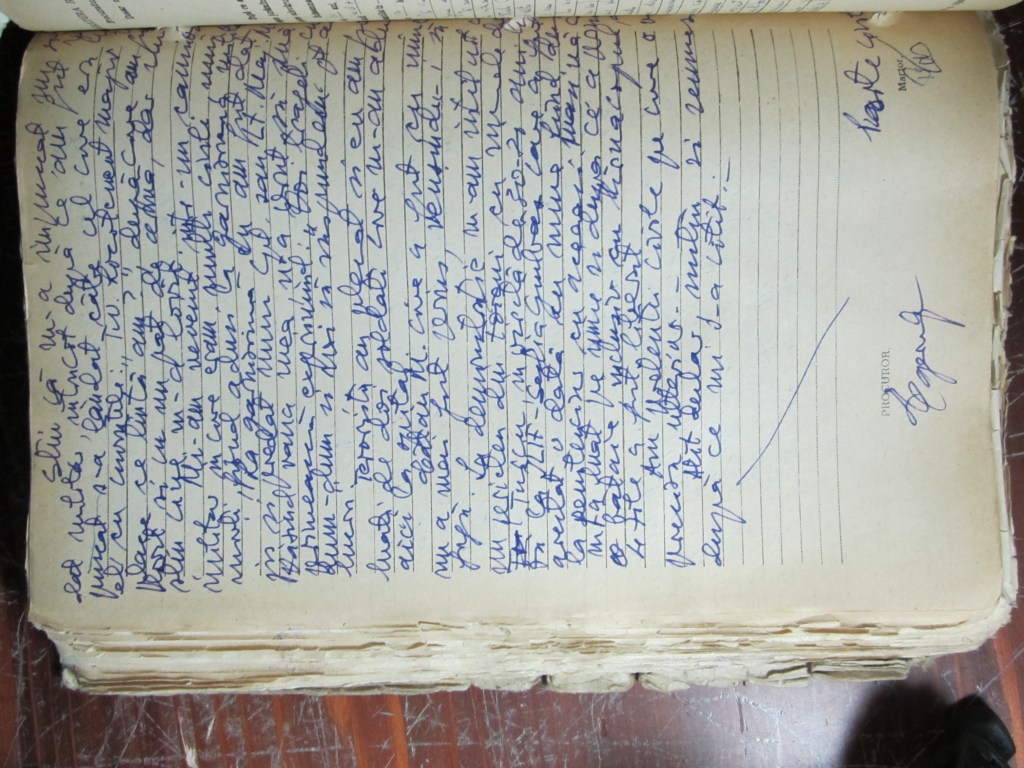
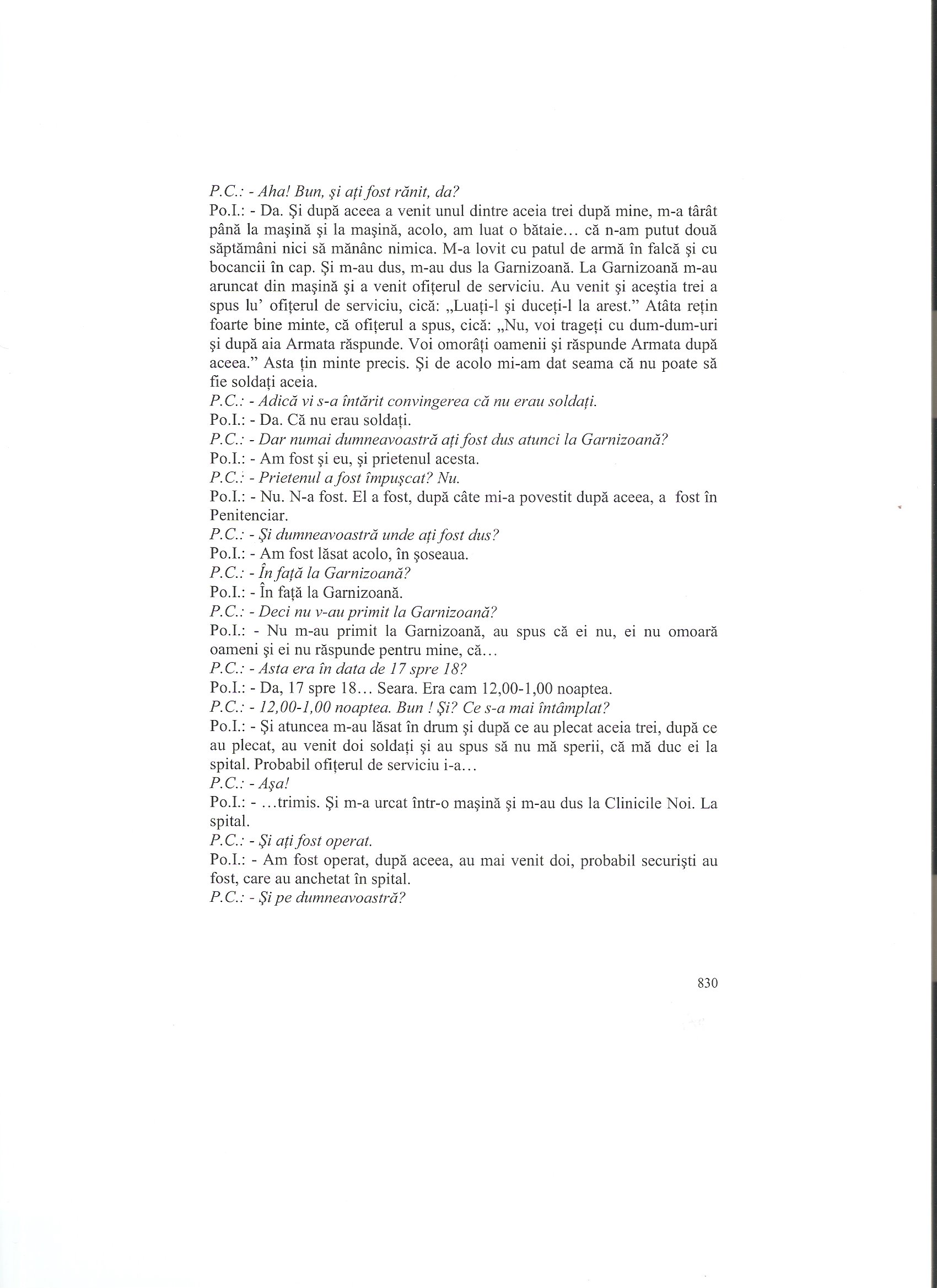
[36] See my discussion in “Orwellian…Positively Orwellian,” at http://homepage.mac.com/khallbobo/RichardHall/pubs/Voineaswar091706.html.

Posted in Uncategorized | Tagged: , , , , , , , , , , , , , | Leave a Comment »

The Romanian Revolution for Dum-Dums by Richard Andrew Hall

Posted by romanianrevolutionofdecember1989 on October 25, 2008

THE ROMANIAN REVOLUTION FOR DUM-DUMS:

(like me…and perhaps even you)

by Richard Andrew Hall, Ph.D.

Standard Disclaimer: All statements of fact, opinion, or analysis expressed are those of the author and do not reflect the official positions or views of the Central Intelligence Agency (CIA) or any other U.S. Government agency. Nothing in the contents should be construed as asserting or implying U.S. Government authentication of information or CIA endorsement of the author’s views. This material has been reviewed by CIA to prevent the disclosure of classified information.

I am an intelligence analyst for the Central Intelligence Agency. I have been a CIA analyst since 2000. Prior to that time, I had no association with CIA outside of the application process.

I have been researching the Revolution for the better part of the past 18 years. I first visited Romania in 1987 while backpacking through Europe, and I spent a total of about 20 months in the country during the years 1990, 1991, 1992, 1993-1994, and 1997, when I conducted pre-dissertation, dissertation, and post-dissertation research on the Revolution.

I have written on the topic of the Revolution, voluminously some might say, publishing in 1996, 1999, and 2000 before joining the Agency, and since I entered the Agency in 2002, 2004, 2005, and 2006.

It will and should be hard to believe for the outsider to this problem, but my work has been essentially the only systematic, ongoing investigation of the ballistics evidence—such are the shortcomings of small “communities of interest” investigating a peripheral historical topic and the perils of “group think.”

This article is, for lack of a better description, about “connecting the dots.”


–The story of the Romanian Revolution of December 1989 since December 1989 has been the struggle of disparate voices who share their memories, often with great frustration and a sense of resignation. They are hardly a unified chorus.

The accounts of ideologues seek to suggest to us that “the truth” miraculously is the province of people of this or that particular political persuasion in post-communist Romania. That is morality play and fairy tale; it is not the work of the serious historian. Would that history were so neat and tidy! It is not.

Instead, what one finds is that the people with the details that matter most are spread across the ideological and political spectrum—including people with what many of us might term distasteful, illiberal, ultranationalist, and nostalgic views.

There are those who relate these details in a narrative consistent with where those details lead.

There are those who relate these details even though it contradicts their narrative and ultimate conclusions about December 1989.

Finally, there are those—and there are many of them—who just know they experienced what they experienced. They aren’t sure exactly how it fits in with a larger narrative: they merely want to tell their story.

Together, they relate these details in the face of cynicism, indifference, and an often stunning intellectual conceit and deaf ear.

Theirs, however, and not the ideologues’, is the story of December 1989.


There was a lot of talk during the crimes of December ’89 about the special bullets with which the young and old alike were killed, bullets which—it is said were not in the arsenal of our military units. There was so much talk that there was no more to say and after there was no more to say for a sufficient amount of time the discussion was reopened with the line “such things don’t exist!” The special bullets didn’t exist!—our highest authorities hurried to tell us…In order to search for proof a little work is necessary by our legal organs that they are not terribly inclined to take….

[Dan Badea, “Gloante speciale sau ce s-a mai gasit in cladirea Directiei a V-a,” Expres, 16-22 April 1991]

The Internet allows the researcher to piece together history as never before. That’s a pretty bland statement, but the reality of it never ceases to amaze me. Take the case of those killed in the Romanian Revolution of December 1989 (officially 1,104 people perished in those events). Scroll through the list of those killed on the procesulcomunismului (“the trial of communism”) and portalulrevolutiei (“the portal to the revolution”) websites. For most, there is only limited information about the circumstances in which they died. For others, however, there is greater detail. As one scrolls through the names and photos, one of the similarities that begins to become apparent is that in cases where there is more information about the circumstances of the death, dum-dum bullets are mentioned. Thus, for example, we find the following five cases:

BUTIRI Florin, born in Joia Mare, 11 April 1969, he was living in Bucharest and was employed by the Bucharest Metro. He played rugby. On 22 December he participated in the demonstration at Sala Dalles [next to University Square]. On 23 December he went to defend the Radio Broadcast center on str. Nuferilor, and while he was saving some old people from a burning building he was shot. Brought to the Military Hospital because of a wound to his hip, caused by a dum-dum cartridge, they tried to ampute a leg. His stomach was also ravaged by a bullet. On 26 December 1989 he died. (http://www.procesulcomunismului.com/marturii/fonduri/ioanitoiu/aeroi/docs/album_2.htm)

FILOTI Claudiu
Profession: Lieutenant major UM 01171 Buzau, post-mortem Captain
Born: 30 July 1964
Birthplace: Vaslui
Date of death: 22 December 1989
Place of death: Bucharest, in the area of the Defense Ministry
Cause of death: Shot in the chest with dum-dum bullets (http://www.portalulrevolutiei.ro/index.php?menu=1&jud=53)

LUPEA Ion- Gabriel from Hunedoara, born in 1970…In 1989 he was sent from Bucharest to Anina [Resita], then to UM 01929. On 9 December 1989, he went on leave, but he was recalled. On the evening of 23 December he was on duty defending the unit [Anina-Resita], at the checkpoint, when around 11 pm they were attacked from the front and from the left flank. While crawling on hands and knees to bring more ammunition he was hit by a dum-dum bullet that entered above his left leg and exited through his left hand. Brought to the hospital he died Christmas Eve, making him the unit’s first hero; he was posthumously awarded the rank of sub-lieutenant. (http://www.procesulcomunismului.com/marturii/fonduri/ioanitoiu/aeroi/docs/album_5.htm)

MANESCU Dan, born 25 March 1964, a student in the Transportation Department, he joined with the other young people on 21 December and participated in the demonstrations in the center of the town [Bucharest]. Friday morning he went with his brother to the demonstrations and he returned after the flight of the dictator. He changed his clothes and returned for good, when on the night of 22/23 December a dum-dum bullet punctured his stomach in Palace Square. Brought to the Emergency hospital, he could not be saved. (http://www.procesulcomunismului.com/marturii/fonduri/ioanitoiu/aeroi/docs/album_5.htm)

POPTEAN Petre, born 27 December 1965, in Margau near Huedin, living in Bucharest…he worked as a driver for the Bucharest Transportation Department. On 21 December he went into town to protect his sister on her way home from work. The two of them left on Calea Victoriei and arrived at [Sala] Dalles, where in horror they watched…Petre called to his sister to aid the wounded. While on the ground, he was hit in the abdomen and left hip by dum-dum cartridges that caused him major wounds. His sister, Monica, was able to stop an ambulance with a Targoviste license number, but he didn’t make it to Hospital 9. At around 6 pm Petre passed away. (http://www.procesulcomunismului.com/marturii/fonduri/ioanitoiu/aeroi/docs/album_7.htm)

Let me draw the attention of the reader to two important details here. First, the use of dum-dum munitions was not confined to Bucharest (multiple locations), but includes the southwestern city of Resita (the case of Ion Lupea). Second, the use of dum-dum munitions occurred not just after communist dictator Nicolae Ceausescu fled at midday on 22 December 1989, but also before, on the evening of 21 December (the case of Petre Poptean).

Dum-dum bullets—which fragment and cause substantially more and more lethal damage to the organs of those who are hit—are outlawed by international convention (see more below). Moreover—or perhaps better-put, officially—no Romanian institution had them in their arsenal in December 1989. Yet, as we can see, almost two decades after the events, the obituaries of those gunned down in December 1989 include references to those munitions as having played a role not only in the wounding of people, but also in their deaths.

Despite the claims above attesting to not just the wounding, but the death of several people (civilians and soldiers) over several days in several locations from dum-dum bullets in December 1989, what did General Dan Voinea—removed from his post in December 2007 by Attorney General Laura Codruta Kovesi for violating basic judicial norms in another case[1]—who headed the investigations into December 1989 for well over a decade, have to say about them in late 2005? “Such things didn’t exist!”:

Romulus Cristea: “Did special ammunition, bullets with a vidia tip or dum-dum bullets, claim [any] victims? The press of the time was filled with such claims…”

Dan Voinea: There were no victims (people who were shot) from either vidia bullets or dum-dum bullets. During the entire period of the events war munitions were used, normal munitions that were found at the time in the arsenal of the Interior Ministry and the Defense Ministry. The confusion and false information were the product of the fact that different caliber weapons were used, and therefore, the resulting sound was perceived differently.[2] (Emphasis added)

So, there is no wiggle room here, no room for misinterpretation: according to Prosecutor Voinea , nobody was killed by dum-dum bullets in December 1989.

That’s a common claim among officials of the former communist regime—Voinea was a military prosecutor since 1982 and he was directly involved in the trial of the Ceausescus. Such conclusions were also repeated in late 2005 by Dr. Vladimir Belis, who was the head of the Medical Forensics Institute (IML) in Bucharest in December 1989: asked if other than the standard 7.62 mm caliber weapons belonging to the Army were used, he did not know and couldn’t say because he claimed no autopsies were ever performed.[3] The apparent official disinterest in munitions and autopsies is—ahem—shall we say “interesting” given the comments attributed to Belis’ subordinates and to doctors at Bucharest’s main hospitals—comments made in the early 1990s, but also made well over a decade later, in the mid 2000s.[4]

General Dan Voinea spoke in late 2005. Voinea’s argument that there were no dum-dum bullets, that there were no atypical munitions used, is directly linked to his contention that there were therefore “no terrorists” in December 1989. It has been routinely repeated in various forms by the media for well over a decade and by his supporters in intellectual circles at home and abroad. The encomia for General Voinea before and since that December 2005 interview by noted Romanian intellectuals and Romanianists are breathtaking. Tom Gallagher refers to him as the “indefatigable General Voinea”[5] and Western journalists have described him as “a one-man mission to uncover the truth about exactly what happened during those days.”[6] Sorin Iliesiu justifies his claims about the Revolution squarely on Voinea’s words:

General Dan Voinea has said clearly: The terrorists did not exist. Those who seized power lied to protect the real criminals….The diversion of the ‘terrorists’ has been demonstrated by [the] Justice [System], not a single terrorist being found among the dead[7], wounded[8] or arrested[9].”[10][11]

Highly problematic and damning for General Dan Voinea, Dr. Vladimir Belis, and fellow deniers are the following, detailed written testimonies of Gheorghe Balasa and Radu Minea presented by Dan Badea in April 1991, attesting to what they had found in December 1989 in the headquarters of the Securitate’s Fifth Directorate:

Balasa Gheorghe: From [Securitate] Directorate V-a, from the weapons depot, on 23-24 December 1989, DUM-DUM cartridges, special cartridges that did not fit any arm in the arsenal of the Defense Ministry were retrieved. Three or four boxes with these kinds of cartridges were found. The special bullets were 5-6 cm. in length and less thick than a pencil. Such a cartridge had a white stone tip that was transparent. All of these cartridges I personally presented to be filmed by Mr. Spiru Zeres. All the special cartridges, other than the DUM-DUM [ones] were of West German [FRG] make. From Directorate V-a we brought these to the former CC building, and on 23-24 December ’89 they were surrendered to U.M. 01305. Captain Dr. Panait, who told us that he had never seen such ammunition before, Major Puiu and Captain Visinescu know about [what was turned over].

In the former CC of the PCR, all of those shot on the night of 23-24 December ’89 were shot with special bullets. It is absurd to search for the bullet in a corpse that can penetrate a wall…

[of course, V-a worked hand-in-hand with the USLA, or the Securitate’s “special unit for anti-terrorist warfare,” and thus it was not suprising that in Directorate V-a’s headquarters…] Among things we also found were:…the training manual for the USLA. It was about 25 cm thick, and while there, I leafed through about half of it…[and I also came across] a file in which lots of different people under the surveillance of USLA officers were listed…

(Interviewed by Dan Badea, “Gloante speciale sau ce s-a mai gasit in cladirea Directiei a V-a,” Expres, 16-22 April 1991.)

Moreover, we know from the 2005 publication of the testimony of a detained V-th Directorate officer dated 2 February 1990, that he must have been asked to comment specifically on the existence of dum-dum ammunition—since he makes a point of emphasizing that “we didn’t have dum-dum ammunition or weapons with special properties, of foreign origin.”[12] So, in other words, we know from this interrogation document that six weeks after the Revolution, those who had taken power or at least the military prosecutors of the time were still interested in the existence of these munitions—thereby suggesting that they must have had some reason for believing in their existence, say for example the character of the injuries suffered by those shot during the events, as well as perhaps recovered bullet fragments, the testimonies of the doctors who operated on those wounded, etc…

Voinea’s ceaseless interviews and revelations during this period have been reprinted repeatedly since they took place and his conclusions been given wide circulation by journalists and people such as Sorin Iliesiu. Yet those who just relate what happened in December 1989 continue to mention the existence of dum-dum munitions. Thus, if one turns to the tourism site for the western border town of Curtici (near Arad) one can read the following about the history of the city, including the events of December 1989:

The following night [at the train station], the first team of five doctors from the Austrian “Lorenz Bohler” Hospital , who arrived in Curtici with a “hospital-wagon” took 18 people in critical condition to Austria for special treatment that lasted two to three months. That is, they needed organ transplants or special care, because of the monstrous results of dum-dum bullets.[13]

Or take the case of a poster on the 18th anniversary of the Revolution, who begins:

The Romarta (central Bucharest) file? What about the file on those who fired at me at the Astronomical Observatory on Ana Ipatescu Boulevard or those who at 1700 on 24 December fired near Casa Scanteii [press building] where I found a dum-dum cartridge in my bed—us having had to sleep in the bathroom.[14]

Finally, there are the cynical comments of those—no matter what they believe about December 1989—who cannot help but remember the dum-dum munitions and the horrible pain and trauma they caused their victims, many still living with the consequences of those wounds today…and how nobody wishes to remember them; for them, this is essentially a cruel, open secret.[15]

Unfortunately, no one in Romania has tied together such claims and the evidence I present above. I do not know how many of these people are still alive, but if the Romanian media were interested, the names are there for them to contact in order to confirm the claims above: Gheorghe Balasa, Radu Minea, Spiru Zeres, Major Puiu, and Captain Visinescu.

D’oh…Dum-Dum…(Tweedle) Dumb and (Tweedle) Dumber: Dum-Dum=Vidia

When I first viewed the youtube video “Romanian Revolution USLA attack Dec 23 1989 Revolutia” (http://www.youtube.com/watch?v=YlBRSxUVQ5E ), what struck me was: here, finally, after a decade and a half of almost unopposed revisionist denial, here was someone who claims to have been an eyewitness and has photos and details of the incident, and who maintains the now almost heretical idea that the Securitate’s “Special Unit for Anti-terrorist Warfare”(USLA for short) had indeed attempted to attack the heavily-guarded Defense Ministry Headquarters on Drumul Taberei in Bucharest on the night of 23-24 December 1989! But, in fact as we shall see, although important, that is actually not the most important thing about the one and only youtube video posted by “destituirea.”

For me the transcript of the USLA unit claiming to have witnessed army units attacking their own ministry and thus the supposed reason that the USLA men who witnessed it “had to be silenced by being killed”—a transcript leaked to the press in 1993 and which led scholars such as Denis Deletant and Peter Siani-Davies to consider this “case closed” essentially—was always highly problematic. It supplied what was said, but, if we are to believe the words of the USLA Commander Gheorghe Ardeleanu, speaking to the notorious Securitate cheerleader Angela Bacescu, it did not supply the much needed context: Ardeleanu claimed that he had been placed under arrest and that it was he who chose the names of the USLA officers who were to report to the Defense Ministry. The USLA units thus came in a situation in which those who had taken control of the country were in the Defense Ministry holding their commander under arrest.[16]

But more importantly, the transcript could not explain a) the lack of any corroboration since of these supposed Army units attacking the Defense Ministry on the night of 23-24 December 1989—truly hard to believe, given all the young recruits and given their comparative willingness to talk to the media after all these years, in comparison to the former Securitate, and b) the claims in summer 1990 by the Army cadre who had been involved in the firefight with the USLA and the interviews of civilians in the surrounding blocs of flats who had lived through the fighting in December 1989 and related what they had seen.[17] The interviewees had detailed the suspicious actions of the USLA convoy and made it clear that they came with less-than-friendly intentions.

Now, here, 17 years after those famous articles by Mihai Floca and Victor Stoica is a video supporting the claim that the USLA units attempted to force their way into the Defense Ministry. The photos of the inside of the USLA ABI vehicles and of the dead USLA men (wearing black jumpsuits underneath Army clothing) are perhaps the most extensive and detailed seen to date, and the anonymous poster plays coy as to where he got them from (he claims he does not want to reveal the source—something which, given the sensitivity of the issue, I am not surprised by).

But, as I mentioned previously, it is actually not the confirmation of this understanding of the Defense Ministry incident that is the most significant thing about this youtube video. It is at the 2:01-2:05 of 8:50 mark of this silent video that the poster makes the following interesting and critical insight/claim…

USLA’s bullets were called “vidia” or “dum-dum” were usually smaller than the regular army’s bullets…Most of the capital’s residents have found this type of bullets all around the military buildings near by. (at 2:01 of 8:50)[18]

And thus, it becomes clear that the discussion of “vidia” bullets and “dum-dum” bullets is interchangeable (or at least is treated as such)! (Hence, perhaps why Romulus Cristea asked his question of General Voinea as he did in December 2005: “Did special ammunition, bullets with a vidia tip or dum-dum bullets, claim [any] victims? The press of the time was filled with such claims…”) “Vidia” translates as “grooved,” and thus describes the modified feature of the bullets which makes them so lethal, thereby making the treatment of vidia and dumdum as de facto synonyms understandable.

This is critical because as I have previously written in detail, citing interviews and reminiscences in the Romanian press…vidia bullets showed up across the country in December 1989. In “Orwellian…Positively Orwellian: Prosecutor Voinea’s Campaign to Sanitize the Romanian Revolution of December 1989” (http://homepage.mac.com/khallbobo/RichardHall/pubs/Voineaswar091706.html) I detail examples of vidia bullets showing up across the country—Brasov, Sibiu, Bucharest (multiple locations), Braila, Caransebes, Craiova, and Hunedoara—as recounted by civilians and Army personnel, at various times since the events—not just during or right after. Such wide dispersion of the use of officially non-existent munitions is critical too because it infirms the notion that somehow demonstrators or the Army put their hands on such “free floating weapons” and used them during the December 1989 events—that it would have happened in one or two places could be explained, but that the same thing would happen in so many geographic centers is scarcely plausible.

Recall from our earlier extract from Prosecutor Dan Voinea’s December 2005 interview, his unambiguous denial of the use of vidia munitions. Nevertheless, significantly, since that interview we continue to find people who remember what they remember and they remember the use of vidia munitions. I have found yet more references. Alexandru Stepanian, who writes under the motto “Dreptate si Onoare! (Justice and Honor!),” not only claims to still have a vidia bullet from 22-23 December 1989 in the area around the TV Station in Bucharest, but he has placed a photo of it on the portalulrevolutiei website.[19] In fall 2006, the daughter of a priest recalled:

In December ’89, after he arrived from Timisoara, my father stayed with me on Stefan Cel Mare Boulevard. When we returned to our home, on the corner of Admiral Balescu and Rosenthal. I found the cupboard of the dresser pure and simple riddled with bullets, about 8 to 10 of them. Someone who knew about such things told me they were vidia bullets. They were brought to a commission, but I don’t know what happened to them.[20]

In 2007 a book entitled The Tales of the Terrorists was published in Galati. In one section, a Eugen Stoleriu recounts his dispatch to Bucharest as a military recruit during the events and how for the first time in his life he came across vidia bullets that were shot at him.[21]

Another apparent synonym for “vidia” is “crestata” or “notched.” I take it that the reference is to the same type of munitions because the damage caused to those wounded by them was equally catastrophic. In December 2007, Alexandru Tudor, a soccer official famous apparently for his stern, unsmiling demeanor, who was shot on 23 December 1989 around 10 am in the area of Piata Aviatorilor near the TV studio, recounted the episode that ended his career:

They brought me to Colentina Hospital and there I had the great fortune of two great doctors. If they had operated on me, they would have to amputate both my legs beneath the knee, but instead they left the bullets in there 12 days. Their explanation was that the bullets were too close to arteries, and since they were gloante crestate (notched bullets), it was very dangerous. After they were removed, I kept the bullets, I have them at home. I was on crutches for six months, I went through therapy, but I had to give up soccer.[22]

Also on the 18th anniversary of the Revolution, a frustrated poster to another site asked pointedly:

Who in Romania in 1989 had 5.5 mm caliber NATO-type munition, that in addition was “notched”—something outlawed by the Geneva Convention, while it is known that the Romanian Army had only the caliber used by Warsaw Pact nations for their weapons, that is to say 7,62 mm….At that time even the Olympic speed shooting champion, Sorin Babii, expressed his surprise….I had in my hand several samples of this cartridge: small, black, with a spiral on the top, or with 4 cuts (those who know a little bit about ballistics and medical forensics can attest to the devastating role caused by these modifications). I await a response to my questions…perhaps someone will be willing to break the silence. I thank you in advance. [emphases added][23]

In other words, the existence of crestate/vidia/dum-dum bullets is known, and not everyone has so blithely forgotten their existence.

A Dum-Dum by Any Other Name: Gloante explosive (exploding bullets), gloante speciale (special bullets)

Crestate, vidia, dum-dum…by now we know: these are very dangerous munitions…

In the field of firearms, an expanding bullet is a bullet designed to expand on impact. Such bullets are often known as Dum-dum or dumdum bullets. There are several types of dum-dum designs. Two popular designs are the hollow point (made during the manufacturing phase) and X-ing made usually by the user by making two notches perpendicular to each other on the tip of the bullet, commonly with a knife. The effect is that the bullet deforms and sometimes fragments upon impact due to the indentations. This creates a larger wound channel or channels with greater blood loss and trauma.

The hollow-point bullet, and the soft-nosed bullet, are sometimes also referred to as the dum-dum, so named after the British arsenal at Dum-Dum, near Calcutta, India, where it is said that jacketed, expanding bullets were first developed. This term is rare among shooters, but can still be found in use, usually in the news media and sensational popular fiction. Recreational shooters sometimes refer to hollow points as “JHPs”, from the common manufacturer’s abbreviation for “Jacketed Hollow Point”.

To be most correct, the term “Dum Dum Bullet” refers only to soft point bullets, not to hollow points, though it is very common for it to be mistakenly used this way.

The Hague Convention of 1899, Declaration III, prohibits the use in warfare of bullets which easily expand or flatten in the body, and was an expansion of the Declaration of St Petersburg in 1868, which banned exploding projectiles of less than 400 grams. These treaties limited the use of “explosive” bullets in military use, defining illegal rounds as a jacketed bullet with an exposed lead tip (and, by implication, a jacketed base).[24]

Thus, under the synonym for dumdum/vidia/crestate bullets of “exploding bullets,” we find the following on the Internet:

On the evening of 27 December 1989, Eugen Maresi, 20 years old, a military draftee, was sent to organize a checkpoint on soseaua Chitilei, at the entrance to Bucharest….A group of 25 soldiers came under fire from the belltower of a church. Eugen was the first shot…. “The doctors told me my only child was shot with (gloante explosive) exploding bullets. The fragments shattered all of his internal organs,” says Dumitru Maresi, the father of the [Drobeta Turnu] Severin hero. http://2003.informatia.ro/Article42788.phtml

and

Gheorghe Nicolosu, was shot in the leg…After he was operated on, it was established that the bullet with which he was shot did not figure in [the arsenal of] the Romanian Army. Nicolosu was operated on in Hunedoara, then arrived in Italy, where he underwent another surgery…In the same area, on Lipscani, Cristea Valeria, 36 years old, was shot in the stomach by ammunition that did not belong to the army. He died a few hours later, the doctors trying to save his life, but the glontul exploziv (exploding bullet) perforated his intestines. Another youngster, 18 year old Ion Gherasim was shot in the back at the entrance to UM 01933 by munition that did not belong to the army. (Emphases added) http://www.replicahd.ro/images/replica216/special2.htm

Once again, we are speaking here of far-flung locations across the country—Chitila (Bucharest) and Hunedoara—which makes the idea of accident and “free floating weapons” unlikely.

Ammunition…Consistent with the Confessions of Former Securitate Whistleblowers

And so, who was it, who has told us about “exploding bullets” and “special cartridges” like this, and who has it been said possessed them in December 1989?

For years I have been essentially the sole researcher inside or outside the country familiar with and promoting the claims of 1) former Timisoara Securitate Directorate I officer Roland Vasilevici—who published his claims about December 1989 under the byline of Puspoki F. in the Timisoara political-cultural weekly Orizont in March 1990 and under the pseudonym “Romeo Vasiliu”—and 2) an anonymous USLA recruit who told his story to AM Press Dolj (published on the five year anniversary of the events in Romania Libera 28 December 1994…ironically (?) next to a story about how a former Securitate official attempted to interrupt a private television broadcast in which Roland Vasilevici was being interviewed in Timisoara about Libyan involvement in December 1989).

Vasilevici claimed in those March 1990 articles and in a 140 page book that followed—both the series and the book titled Pyramid of Shadows—that the USLA and Arab commandos were the “terrorists” of December 1989. What is particularly noteworthy in light of the above discussion about “exploding bullets” was his claim that the USLA and the foreign students who supplemented them “used special cartridges which upon hitting their targets caused new explosions.”[25]

The anonymous USLA recruit stated separately, but similarly:

I was in Timisoara and Bucharest in December ’89. In addition to us [USLA] draftees, recalled professionals, who wore black camouflage outfits, were dispatched. Antiterrorist troop units and these professionals received live ammunition. In Timisoara demonstrators were shot at short distances. I saw how the skulls of those who were shot would explode. I believe the masked ones, using their own special weapons, shot with exploding bullets. In January 1990, all the draftees from the USLA troops were put in detox. We had been drugged. We were discharged five months before our service was due to expire in order to lose any trace of us. Don’t publish my name. I fear for me and my parents. When we trained and practiced we were separated into ‘friends’ and ‘enemies.’ The masked ones were the ‘enemies’ who we had to find and neutralize. I believe the masked ones were the ‘terrorists’. [emphases added]

As I have pointed out, despite the short shrift given these two revelations by Romanian media and Romanianists, one group has paid close attention: the former Securitate. That is not accidental. [26]

With the advent of the Internet, unverifiable bulletin board postings also pop up. On 23 December 2003, under the name of “kodiak,” the following appeared:

In ’89 I was a major in the USLA…and I know enough things that it would be better I didn’t know…15, 16, 20, 30 years will pass and nothing will be known beyond what you need and have permission to know…” (http://www.cafeneaua.com)[27]

Clearly, the legal constraints of security oaths and fear continue to cast a long shadow, long after the events of December 1989.

Si totusi…se stie [And nevertheless…it is known]

It took over three years into my research on the Revolution—and physically being in the Library of the Romanian Academy—before I came to the realization: oh yeah, that’s a good idea, yeah, I should systematically compare what the former Securitate have to say about December 1989 and compare it with what others are saying. It took a maddening additional half year before I came to the conclusion: oh yeah, and how about what the Army has to say? It may seem ridiculous—and it is in some ways indefensible from the perspective of performing historical research—but you have to understand how Romanian émigrés dominated early investigations of the Revolution, and how they divided the post-communist Romania media into the pro-regime (untrustworthy) press and the opposition (trustworthy) press, and the influence this “research frame” and methodology had at the time upon younger researchers such as myself.[28]

A more systematic mind probably would have come to these revelations long before I did. Instead, it took the accidental, simultaneous ordering of issues from 1990 and 1991 of the vigorous anti-Iliescu regime university publication NU (Cluj), the similarly oppositional Zig-Zag (Bucharest), and the former Securitate mouthpiece Europa to discover this. There I found Radu Nicolae making his way among diametrically opposed publications, saying the same things about December 1989. And it mattered: the source for example of Radu Portocala’s claim that there were “no terrorists” in December 1989 was Radu Nicolae. But more important still, was the discovery of Angela Bacescu revising the Defense Ministry incident, exonerating the USLA, and claiming there were no Securitate terrorists in Sibiu (only victims) in Zig-Zag…only to show up months later in Romania Mare and Europa months later writing the same stuff, and in the case of the Sibiu article republishing it verbatim. Nor was Bacescu alone among the former Securitate at Zig-Zag: she was for example joined by Gheorghe Ionescu Olbojan, the first to pen revisionist articles about the Army’s DIA unit.[29]

But without a broader comparative framework and approach to the Romanian media, all of this eluded the highly partisan Romanian émigré writers on the events. Nestor Ratesh alone among this group did seem puzzled and bothered by the similarity of Romania Libera Petre Mihai Bacanu’s conclusions on the V-th Directorate and those of Bacescu (he only alluded to her dubious reputation, however, and did not name her.) But Bacanu was fallible: memorably, but also upstandingly, in December 1993, he admitted based on what he claimed were new revelations, that his previous three and a half years of exonerating the USLA had been in vain since they were erroneous: they had after all played a significant role in the repression and killing of demonstrators on the night of 21-22 December 1989 in University Square. That alone should have precipitated a rethinking about assumptions and approaches to investigating the December 1989 events and particularly the role of the Securitate and the USLA, but it did not, and has not to this day…

Romanians and Romanianists like to indulge in the reassuring myth that the “schools” of research on the Revolution were separate from the beginning—that the defining feature was the political orientation of the author and whether he or she viewed the events of December 1989 as a revolution or coup d’etat. To the extent they are willing to admit that discussions of the “terrorists” cross-pollinated and became intertwined across the borders of the political spectrum, they assume that this must have happened later, after views had become consolidated.[30] But such a view is simply ahistorical and wishful-thinking. It is simply impossible to defend honestly when you have Angela Bacescu who “showed up with lots of documents and didn’t need any money” and wrote her revisionist tracts in the oppositional Zig-Zag, when she and Olbojan were the first ones to voice theses that later became staples of the anti-Iliescu opposition—long after they had left its press.

It is indicative that Romanians still have yet to confront this methodological flaw that one of the few studies in the country to read Securitate and Army sources in addition to journalist and participant accounts, still failed to address the key similarities across the political spectrum regarding the existence and identity of the “terrorists.” Smaranda Vultur wrote in a review of Ruxandra Cesereanu’s (otherwise, groundbreaking in comparison to what had appeared before it in Romanian in book form) Decembrie ’89. Deconstructia unei revolutii (Iasi: Polirom 2004):

Beyond this, I would underscore however a deficit that results directly from the choice of the author to classify her sources based on how the source defines the events: as a revolution, a plot, or a hybrid of the two. Because of this one will thus find, contained in the same chapter, Securitate people and political analysts, revolutionaries and politicians of the old and new regimes, and journalists.[31]

In other words, my exact indictment of the approach inside and outside Romania to the study of the Revolution, and the reason why people are simply unable to acknowledge the similarity and even identicality of views of the “terrorists.”

After the aforementioned realizations in 1993-1994 about the need to be more comparative and systematic in investigating accounts of the Revolution, it took yet another two maddening years before I started to realize the significance of the ballistics evidence. It thus came comparatively late in the dissertation process. My timing was fortuitous, however. I wrote a short article in November 1996 that was published in two different forms in 22 and Sfera Politicii in December 1996—the mood in Romania was euphoric as seven years of the Iliescu regime had just come to an end through the ballot box. [32] True, it didn’t spark debate and loosen some lips as I had hoped, but it made my visit to Bucharest the following June —especially my interviews on one particular day with a journalist at Cotidianul and, several hours later, a member of the Gabrielescu Parliamentary Commission investigating the events (Adrian Popescu-Necsesti)—memorable to say the least….

Of course, not then, or even since, has anybody who has investigated the December 1989 events inside or outside Romania systematically attempted to replicate, test, or expand upon my earlier findings—other than myself. As I have noted elsewhere,[33] in Peter Siani-Davies’ otherwise excellent The Romanian Revolution of December 1989 he devotes essentially a paragraph to the ballistics’ topic in a 300 plus page book—and it is only in the context of addressing my own earlier research. Monica Ciobanu could thus not be more wrong in her declaration that Peter Siani-Davies’ 2005 volume had disproven the “myth of Securitate terrorists.”[34] Siani-Davies has nothing to say about dum-dum/vidia/exploding ammunition: hence why he does not believe in Securitate terrorists!

Since then, I have written on Securitate revisionism, “the terrorists,” and the ballistics evidence of Romanian Revolution of December 1989, in the words of one critic who seems unable to call things by their name “voluminously, although never exhaustively, elsewhere”—publishing in 1999, 2000, 2002, 2004, 2005, and 2006. [35] Now, more than a decade after those original ballistics’ articles, I return here putting things together I should preferably have put together long before…

The high stakes of what was at play in late December 1989 become all the clearer here. Nicolae Ceausescu’s successors faced not only the dilemma of having foreign citizens arrested for firing at and killing in cold blood Romanian citizens[36], but members of a Romanian state institution—the Securitate—in addition to those foreign citizens, had injured, maimed, and killed Romanian citizens using munitions that were outlawed by international conventions to which Romania was a party. Thus, beyond the culpability of an institution that was key to the ability of the nomenklaturists who had seized power to continue in power—i.e. the Securitate—and who undoubtedly had compromising information on those leaders, the new potentates were faced with a problem of international dimensions and proportions.

Dan Badea’s April 1991 article with which I opened this paper concluded thusly:

There are in these two declarations above[–those of Gheorghe Balasa and Radu Minea–] sufficient elements for an investigation by the Police or Prosecutor’s Office. [Dan Badea, “Gloante speciale sau ce s-a mai gasit in cladirea Directiei a V-a,” Expres, 16-22 April 1991]

That, of course, never appears to have happened. I hope that the information I have supplied above—significantly, much of it new, much of it from the Internet in recent years—should at the very least encourage Romanians and Romanianists to reopen and reexamine the ballistics evidence. Let us hope that on the twentieth anniversary of the Revolution, we may be able to read serious investigations of the ballistics evidence, rather than be subjected to the false and jaded refrain… such things did not exist!


[1] See, for example, Dorin Petrisor, “Procurorul Voinea, acuzat ca a lucrat prost dosarul Iliescu 13 iunie 1990,” Cotidianul, 7 December 2007, online edition. Voinea’s removal generally went unpublicized abroad—it was understandably not a proud day for his supporters. Kovesi claimed to have been taken aback by Voinea’s inexplicable, seemingly incompetent handling of the June 1990 files.

[2] General Dan Voinea, interview by Romulus Cristea, “Toti alergau dupa un inamic invizibil,” Romania Libera, 22 December 2005, online edition. Cristea’s apparent effort/belief—shared by many others—to suggest that it was only “the press of the time”—something I take to mean December 1989 and the immediate months after—that was filled with such claims and accusations is untrue. (The suggestion is to say that civilians with no knowledge of weapons and munitions repeated rumors spread out of fear and fueled by those who had seized power but needed to create an enemy to legitimize themselves and thus exploited those fears…) For examples of such claims “in the press of the time,” see the words of an employee of the Municipal Hospital (“In the room was a boy, very badly wounded by dum-dum bullets that had blown apart his diaphragm, his sacroiliac, and left an exit wound the size of a 5 lei coin,” Expres no. 10 (6-12 April 1990), p. 5) and the discussion of how Bogdan Stan died (“vidia bullets which explode when they hit their ‘target,’ entered into the bone marrow of his spine,” Adevarul, 13 January 1990). But such claims also appear long after the December 1989 events. Two and a half and three years after the December 1989 events, Army Colonel Ion Stoleru maintained in detail that the “terrorists” had “weapons with silencers, with scopes, for shooting at night time (in ‘infrared’), bullets with a ‘vidia’ tip [more on this and the relation to dum-dum munitions below]. Really modern weapons” and added, significantly, “The civilian and military commissions haven’t followed through in investigating this…” (see Army Colonel Ion Stoleru with Mihai Galatanu, “Din Celebra Galerie a Teroristilor,” Expres, no. 151 (22-28 December 1992), p. 4, and “Am vazut trei morti suspecti cu fata intoarsa spre caldarim,” Flacara, no. 29 (22 July 1992), p. 7.) Voinea’s steadfast denials would seem to validate Stoleru’s allegations more than a decade after he made them. Not surprisingly, but highly unfortunate, Cristea’s interview with Voinea forms the basis of conclusions about the terrorists on the Romanian-language Wikipedia webpage on the Revolution: see http://ro.wikipedia.org/wiki/Revolu%C5%A3ia_rom%C3%A2n%C4%83_din_1989.

[3] Laura Toma, Toma Roman Jr. , and Roxana Ioana Ancuta, “Belis nu a vazut cadavrele Ceausestilor,” Jurnalul National, 25 October 2005, http://www.jurnalul.ro/articole/34668/belis-nu-a-vazut-cadavrele-ceausestilor. “Frumos (Nice)…” as the Romanians say. Belis may not have interested himself in the ballistics evidence—but some of his employees apparently did (see IML Dr. Florin Stanescu’s comments in Ion Costin Grigore, Cucuveaua cu Pene Rosii (Bucharest: Editura Miracol, 1994), pp. 70-72). Moreover, there were exhumations. (“For a long time the Brasov Military Prosecutor didn’t do anything, even though there existed cases, declarations, documents, photos and even atypical unusual bullets brought in by the families of the deceased and wounded.” http://www.portalulrevolutiei.ro/forum/index.php?topic=1.msg214) On 14 June 1990, General Nicolae Spiroiu, future Defense Minister (1991-1994), appears to have been in the city of Brasov, assisting at the exhumation of people killed there during the December 1989 Revolution. Such a step was a rarity, and apparently followed earlier talks between Spiroiu, five other officers, and the staff of the local newspaper Opinia, who were seeking clarification over who was responsible for the deaths of their fellow citizens. “They found in particular bullets of a 5.6 mm caliber that are not in the Army’s arsenal,” wrote the journalist Romulus Nicolae of the investigation. (Romulus Nicolae, “Au ars dosarele procuraturii despre evenimente din decembrie,” Cuvintul, no. 32 (August 1991), pp. 4-5, cited in Richard Andrew Hall, “Orwellian…Positively Orwellian: Prosecutor Voinea’s Campaign to Sanitize the Romanian Revolution of December 1989,” http://homepage.mac.com/khallbobo/RichardHall/pubs/Voineaswar091706.html.)

[4] Dr. Nicolae Constantinescu, surgeon at Coltea Hospital: “I remember that on 1 or 2 January ’90 there appeared at the [Coltea] hospital a colonel from the Interior Ministry, who presented himself as Chircoias. He maintained in violent enough language that he was the chief of a department from the Directorate of State Security [ie. Securitate]. He asked that all of the extracted bullets be turned over to him. Thus were turned over to him 40 bullets of diverse forms and dimensions, as well as munition fragments. I didn’t hear anything back from Chircoias or any expert. Those who made the evidence disappear neglected the fact that there still exist x-rays and other military documents that I put at the disposition of the [Military] Prosecutor.”

( http://www.romanialibera.ro/a113826/revolutia-5-000-de-victime-nici-un-vinovat.html)

[5] Tom Gallagher, Modern Romania: The End of Communism, the Failure of Democratic Reform, and the Theft of a Nation, (NY: New York University Press, 2005), p. 190.

[6] Jeremy Bransten, “Romania: The Bloody Revolution in 1989: Chaos as the Ceausescus Are Executed,” RFE/RFL, 14 December 1999 at http://www.rferl.org/specials/communism/10years/romania2.asp. This unfortunate comment aside, Brantsen’s series is an excellent journalistic introduction to the December 1989 events.

[7] Iliesiu is dead wrong. See the signed testimony to the contrary by Ion Lungu and Dumitru Refenschi dated 26 December 1989, reproduced in Ioan Itu, “Mostenirea teroristilor,” Tinerama, no. 123 (9-15 April 1993), p. 7. I translated the important parts of this document in Hall, “Orwellian…Positively Orwellian” http://homepage.mac.com/khallbobo/RichardHall/pubs/Voineaswar091706.html. Significantly, according to this document, Dr. Belis had access to the dead terrorists:

Dead Terrorists. Although their existence is vehemently denied by all official institutions, we are able to prove that they existed and have sufficient details to identify them.…We continue with some excerpts of the declaration of Ion Lungu, head of the group of fighters who guarded the ‘Institute of Legal Medicine’ [IML, the main Bucharest morgue], beginning from the evening of 22 December 1989:

“Starting from the 23rd, there were brought, in succession, more ‘special’ corpses. They were brought only by military vehicles and were accompanied by officers. They were all dressed the same: kaki uniforms, with or without military insignia, fur-lined boots, cotton underwear. All the clothes were new. The established procedure at that point was that when the bodies were unloaded from the trucks, at the ramp to the back of the IML, to be disrobed and inspected. The documents found were released to Prosecutor Vasiliu and criminology officers. The weapons and munitions we found and surrendered—on the basis of a verbal procedure—to the officer on duty from UM 01046. Weapons and ammunition were found only on those ‘special’ corpses. Those who brought them said that they were terrorists. I turned over to this military unit five pistols (three Stecikin and two Makarov—all 9 mm caliber), two commando daggers and hundreds of 9 mm and 7.62 mm cartridges (compatible with the AKM machine gun). They were held separately from the other corpses, in a room—I believe that it used to be the coatroom—with a guard at the door.…

Access to the room with the terrorists was strictly forbidden. Only Prosecutor Vasiliu, criminologist officers, Dr. Belis, and the chief of autopsies could enter. On top of them, next to the arms, there were personal documents, passports (some blank), all types of identity cards—one of them was clearly false, it stated that the dead terrorist was the director at Laromet (at that plant no director died)—identity cards that were brand new, different service stamps in white. All had been shot by rifles (one was severed in two) and showed evidence of gunshots of large caliber. Some had tattoos (they had vultures on their chests), were young (around 30 years old), and were solidly built. I believe that their identity was known, since otherwise I can’t explain why their photographs were attached to those of unidentified corpses. They were brought to us in a single truck. In all, there were around 30 dead terrorists. [The document is signed by Ion Lungu and Dumitru Refenschi on 26 December 1989]”

[8] Once again Iliesiu is wrong. Professor Andrei Firica at the Bucharest “Emergency Hospital” apparently also was paid a visit by Colonel Chircoias (aka Ghircoias), see fn. 4. He claims that he “made a small file of the medical situations of the 15-20 suspected terrorists from [i.e. interned at] the Emergency Hospital,” but as he adds “of course, all these files disappeared.” Firica reports that a Militia colonel, whom he later saw on TV in stripes as a defendant in the Timisoara trial [i.e. Ghircoias], came to the hospital and advised him “not to bring reporters to the beds of the terrorists, because these were just terrorist suspects and I didn’t want to wake up one day on trial for having defamed someone” (!) The colonel later came and loaded the wounded terrorist suspects into a bus and off they went. (Professor Andrei Firica, interview by Florin Condurateanu, “Teroristii din Spitalul de Urgenta,” Jurnalul National, 9 March 2004, online edition.) Cited in Hall, “Orwellian…Positively Orwellian” http://homepage.mac.com/khallbobo/RichardHall/pubs/Voineaswar091706.html.

[9] I don’t even know where to begin on this one. As I have written before, not all of those detained were terrorists, and many of the terrorists seemed to have eluded arrest, but there are so many accounts of people arrested as terrorists who legitimately fit that description that I don’t even know where to begin. See the multiple translations in Hall, “Orwellian…Positively Orwellian” http://homepage.mac.com/khallbobo/RichardHall/pubs/Voineaswar091706.html.

[10] Sorin Iliesiu, “18 ani de la masacrul care a deturnat revoluţia anticomunistă,” 21 December 2007, found at http://www.romanialibera.com/articole/articol.php?step=articol&id=6709 (note: this is NOT the Romania Libera daily newspaper). One will find many well-known names in the West among those who signed this petition: Dragoş Paul Aligică, Matei Călinescu, Ruxandra Cesereanu, Anneli Ute Gabanyi, Tom Gallagher, Gabriel Liiceanu, Norman Manea, Nicolae Manolescu, Mircea Mihaies, Ion Mihai Pacepa, Horia-Roman Patapievici, Radu Portocală, Nestor Ratesh, Lavinia Stan, Stelian Tănase, Alin Teodorescu, and Vladimir Tismăneanu. Sorin Iliesiu, who is a filmmaker and Vice President of the “Civic Alliance” organization, has written that he was part of the “team” that “edited” the seven page chapter on the Romanian Revolution contained in the Report of the Presidential Commission to Analyze the Communist Dictatorship of Romania (PCACDR). He is not a scholar and most certainly not a scholar of the December 1989 events. A textual comparison of the Report’s chapter on the Revolution and Vladimir Tismaneanu’s chapter in a Dawisha and Parrott edited volume from 1997 is unambiguous: the introductory two paragraphs of the Report’s chapter are taken verbatim in translation from p. 414 of Tismaneanu’s 1997 chapter, and other verbatim paragraphs, sentences, and phrases from pp. 414-417 make up parts of the rest of the Report’s Revolution chapter without any reference to the 1997 chapter. As the author(s) of an earlier chapter in the Report cite(s) Tismaneanu’s 1997 chapter (see p. 376 fn. 55) correctly, this leaves really only two possible explanations for the failure of Iliesiu et. al. to cite that they have borrowed wholesale from Tismaneanu’s 1997 chapter: a) an absence of scholarly knowledge, or b) an attempt to mask their dependence upon and deference to Tismaneanu, the Chair of the Commission, since the citations that do appear are the exact citations from the 1997 chapter and claims are translated word-by-word, so much so that Iliesiu et. al. did not even bother to change verb tenses despite the passage of a decade. Iliesiu et. al. can attempt to avoid answering questions and attempt to change the subject, but the textual analysis is unambiguous: Tismaneanu’s unattributed 1997 chapter forms the bulk of the Report’s chapter on the Revolution. The only question that needs to be answered is: why and why are they unwilling to admit the textual identicality?

[11] All of this eludes Charles King in his Winter 2007 Slavic Review essay “Remembering Romanian Communism.” In his five page essay, he pauses no less than four times to mention the Revolution, despite the fact that its coverage takes up barely one percent of the PCACDR report. He relates the most banal of conclusions—“The report thus repeats the common view (at least among western academics) of the revolution as having been hijacked…”—yet misses or avoids what Iliesiu clearly seems most proud of: having inserted the claim that Nicolae Ceausescu was responsible for “only 162 deaths,” thereby insinuating Ceausescu’s successors bear responsibility for the other 942, and the claim to which such a reckoning is intimately related, namely Voinea’s that there were “no terrorists.” (It is interesting to note how Iliesiu et. al., the eternally suspicious of the state, miraculously become assiduous promoters of “official” and “state” claims once they turn out to be their own, thereby suggesting that their skepticism of the state is primarily situational rather than inherent—these are not equal opportunity skeptical and critical intellectuals.) King’s treatment of the Report is overall insufficiently informed, and as a consequence contextually-wanting and one-sided. He cites a handful of Romanian reviews of the Report, but they are almost uniformly positive accounts, almost as if supplied by the Chair of the Commission himself (see fn. 1, p. 718). He pauses to cite the former head of Radio Free Europe’s Romanian Research Division Michael Shafir’s 1985 book, yet makes no mention of Shafir’s trenchant criticisms (he gave the report a 7 out of 10 and mixed the positive with the negative) in a 1/12/07 interview in Ziua de Cluj, his extended critique “RAPORTUL TISMĂNEANU: NOTE DIN PUBLIC ŞI DIN CULISE” available in spring 2007 at http:// www.eleonardo.tk/ (no. 11), or his “Scrisoare (ultra)deschisa” in Observator Cultural no. 382 (25 July-1 August 2007) [given the timeline of scholarly publication, I am attempting to give King the benefit of the doubt here …He would certainly do well to read Shafir’s most recent discussion in Observator Cultural NR. 148 (406) 17 – 23 ianuarie 2008, “Despre clarificari nebuloase, plagiate, imposturi si careerism,” to see what a venerable critic and serious scholar was subjected to as a result of deigning to not wholeheartedly embrace the Report. Shafir’s treatment by the Report’s zealots has little to do with the liberal democratic view of the open society the Report’s authors ceaselessly profess.] Finally, had Charles King bothered to read Ciprian Siulea’s “Tentatia unui nou absolutism moral: Cu cine si de ce polemizeaza Vladimir Tismaneanu?” (Observator Cultural, nr. 379, 5-11 iulie 2007, once again conceivably within the publishing timeline) he might have refrained from parrotting the polarizing and unhelpful plebiscitary logic applied to the Report when he closed “The question is now whether the commission’s report will be used as yet another opportunity to reject history or as a way of helping Romanians learn, at last, how to own it” (p. 723). This, of course, suggests a certain infallible quality to the Report—which is far from the case—a conclusion only enhanced by King’s willingness to focus on the “hate speech” directed against the Report, but yet failing to cite and discuss any of the Romanian scholarly criticism of it.

[12] “Aghiotantii lui Ceausescu povestesc minut cu minut: O zi din viata dictatorului,” Romania Libera, 2 December 2005, online at http://www.romanialibera.ro/a5040/o-zi-din-viata-dictatorului.html. “Declaratie Subsemnatul TALPEANU ION, fiul lui Marin si Elena, nascut la 27 mai 1947 in comuna Baneasa, judetul Giurgiu, fost aghiotant prezidential cu grad de lt. col. in cadrul Directiei a V-a – Serviciul 1. Cu privire la armamentul din dotare arat ca, noi, aghiotantii aveam pistol “Makarov” cu 12 cartuse, iar sefii de grupa si ofiterii din grupa aveau pistolet “Makarov”, pistolet “Stecikin” si pistol-mitraliera AKM, cu munitie aferenta, care era cea obisnuita, in sensul ca nu aveam gloante dum-dum sau cu proprietati speciale, de provenienta straina.” (Dated 2 February 1990). His denial of dum-dum bullets is, of course, par for the course for former Securitate officers, who remember and thus “know nothing.”

[13] Quoted from http://www.tourismguide.ro/html/orase/Arad/Curtici/istoric_curtici.php. This raises an interesting point: there were foreign doctors who participated in Romania or in their home country in the surgery, treatment, and rehabilitation of those wounded. It would be interesting to hear what they remember and what they have to say regarding the munitions.

[15]Adina Anghelescu-Stancu refers to the “crippled and handicapped by dum-dum bullets” who do not number among Romania’s celebrities and about whom no one wishes to remember in today’s Romania, “Dureri care nu trec! (despre decembrie ‘89),” Gardianul, 18 December 2007, online at http://www.gardianul.ro/2007/12/18/editorial-c27/dureri_care_nu_trec_despre_decembrie_89_-s106259.html.

[16] I have examined the incident in detail several times, for the references to other works, see Richard Andrew Hall, “The Romanian Revolution as Geopolitical Parlor Game,” http://homepage.mac.com/khallbobo/RichardHall/pubs/checkmate040405.pdf, and Hall, “Orwellian…Positively Orwellian,” http://homepage.mac.com/khallbobo/RichardHall/pubs/Voineaswar091706.html.

[17] Once again, see “The Romanian Revolution as Geopolitical Parlor Game,” http://homepage.mac.com/khallbobo/RichardHall/pubs/checkmate040405.pdf, and “Orwellian…Positively Orwellian,” http://homepage.mac.com/khallbobo/RichardHall/pubs/Voineaswar091706.html. The critical articles were authored by Mihai Floca and Victor Stoica, who interviewed the Army cadre who had been involved in the incident and the residents of the surrounding apartment blocs who survived the fighting of those days.

[18] destituirea “Romanian Revolution USLA attack Dec 23 1989 Revolutia,” http://www.youtube.com/watch?v=YlBRSxUVQ5E

[19] For the photo see http://www.portalulrevolutiei.ro/documente/glont.htm; for one of his posts see http://www.portalulrevolutiei.ro/index.php?menu=6&pg=forum_thread.php&lnk=1&pagina=39. I cannot verify that this is indeed a “vidia” munition.

[20] Christian Levant, “Dacă tata nu-l salva pe Tokes, dacă nu salva biserici, tot se întâmpla ceva,” Adevarul, 30 September 2006, online at http://www.adevarul.ro/articole/dac-x103-tata-nu-l-salva-pe-tokes-dac-x103-nu-salva-biserici-tot-se-nt-mpla-ceva/200090.

[21] Cezar-Vladimir Rogoz, Povestirile teroristilor amintiri preluate si prelucrate de Cezar-Vladimir Rogoz, (Alma Print Galati 2007), p. 297, available online at http://www.bvau.ro/docs/e-books/2007/Rogoz,%20Cezar-Vladimir/povestirile_teroristilor.pdf.

[22]“A invatat sa zambeasca, [He learned how to smile],” http://marianmanescu.wordpress.com/2007/12/21/a-invatat-sa-zambeasca.

[25] Puspoki F., “Piramida Umbrelor (III),” Orizont (Timisoara), no. 11 (16 March 1990) p.4, and Roland Vasilevici, Piramida Umbrelor (Timisoara: Editura de Vest, 1991), p. 61.

[26] For the discussion of the former Securitate response to those who have violated the code of silence, see Hall, “Orwellian…Positively Orwellian,” http://homepage.mac.com/khallbobo/RichardHall/pubs/Voineaswar091706.html.

[28] I refer here to, for example, the works of Vladimir Tismaneanu, Matei Calinescu, Andrei Codrescu, Anneli Ute Gabanyi, Radu Portocala, and Nestor Ratesh. Some, like Tismaneanu in a 1993 article in EEPS, “The Quasi-Revolution and its Discontents,” were more explicit about this rather rigid dichotomous approach to the Romanian media, but it also comes through clearly in the sourcing, citations, and footnotes/endnotes of the others. (It continues to haunt the historiography of post-communist Romania, as works such as Tom Gallagher’s aforementioned Modern Romania make clear). To say the least, the issue of ballistics evidence essentially goes unanalyzed in these accounts. Moreover, although as we have seen, these authors have no problem affixing their names to petitions and the like, none of them has published any research on the December 1989 events since the early 1990s. It should tell you something that they continue to rely on and repeat the accounts they wrote in 1990 and 1991…as if nothing had been discovered or written since. In that way, it is almost fitting that the Report of the PCADCR reproduced Tismaneanu’s 1997 Dawisha and Parrott chapter in some places verbatim, down to failing to even change verb tenses when it states that certain questions “remain to be clarified.” I deconstructed the methodological faults in source selection in these émigré accounts in “The Romanian Revolution as Geopolitical Parlor Game” at http://homepage.mac.com/khallbobo/RichardHall/pubs/checkmate040405.html.

[29] For earlier discussions of all of this, see Richard Andrew Hall, “The Uses of Absurdity: The Staged-War Theory of the Romanian Revolution of December 1989,” East European Politics and Societies, vol. 13, no. 3, and Richard Andrew Hall, “The Securitate Roots of a Modern Romanian Fairy Tale,” Radio Free Europe East European Perspectives, April-May 2002, three part series, available at http://homepage.mac.com/khallbobo/RichardHall/pubs/romania%20securitate%205-2002.html.

[30] In “The Romanian Revolution as Geopolitical Parlor Game,” I demonstrated how even the so-called French and German schools (really the schools of Romanian émigrés in those countries) in 1990 were not and could not be independent from accounts in Romania, and that the accounts fed into and reinforced one another. It is simply intellectual myth—and an all too convenient one—to argue the antisceptic separation of these accounts as independent.

[31] Smaranda Vultur, “Revolutia recitita,” 22 no. 787 (9-15 April 2005) online at http://www.revista22.ro.

[32] Richard Andrew Hall, trans. Adrian Bobeica, “Ce demonstreaza probele balistice dupa sapte ani?” 22, no. 51 (17-23 December 1996), p. 10, and Richard Andrew Hall, trans. Corina Ileana Pop, “Dupa 7 ani,” Sfera Politicii no. 44 (1996), pp. 61-63.

[33] See my discussion in “Orwellian…Positively Orwellian,” at http://homepage.mac.com/khallbobo/RichardHall/pubs/Voineaswar091706.html.

[34] Monica Ciobanu’s review of Siani-Davies The Romanian Revolution of December 1989 and Tom Gallagher’s Modern Romania: Theft of a Nation is entitled “The Myth Factory” (found at http://www.tol.cz).

[35] Charles King, “Remembering Romanian Communism,” Slavic Review, Winter 2007, p 719. In King’s short article, he does not hesitate to make occasionally gratuitous citations for things he did not need to cite. Yet in discussing December 1989 and using the term “elsewhere”—which usually prefaces a description of “where else” one might find these things—there are no citations. “Although never exhaustively” is itself a gratuitous choice of words and far from accidental: in my last work on December 1989, I made light of how ridiculous it was for Daniel Chirot to claim that Peter Siani-Davies’ The Romanian Revolution of December 1989, an otherwise excellent work, was “near definitive” when so much was missing from Siani-Davies’ discussion—notably, for our purposes here, the question of dum-dum/vidia/exploding munitions. One could indeed be left with the impression that King intends to deliver a put-down, that some fellow Romanianists will no doubt catch, but yet deny the broader audience references to what he alludes and simultaneously protect his image from having delivered such a “palma” as the Romanians would say. It would appear that at least for readers of this paper, his goals won’t go completely fulfilled.
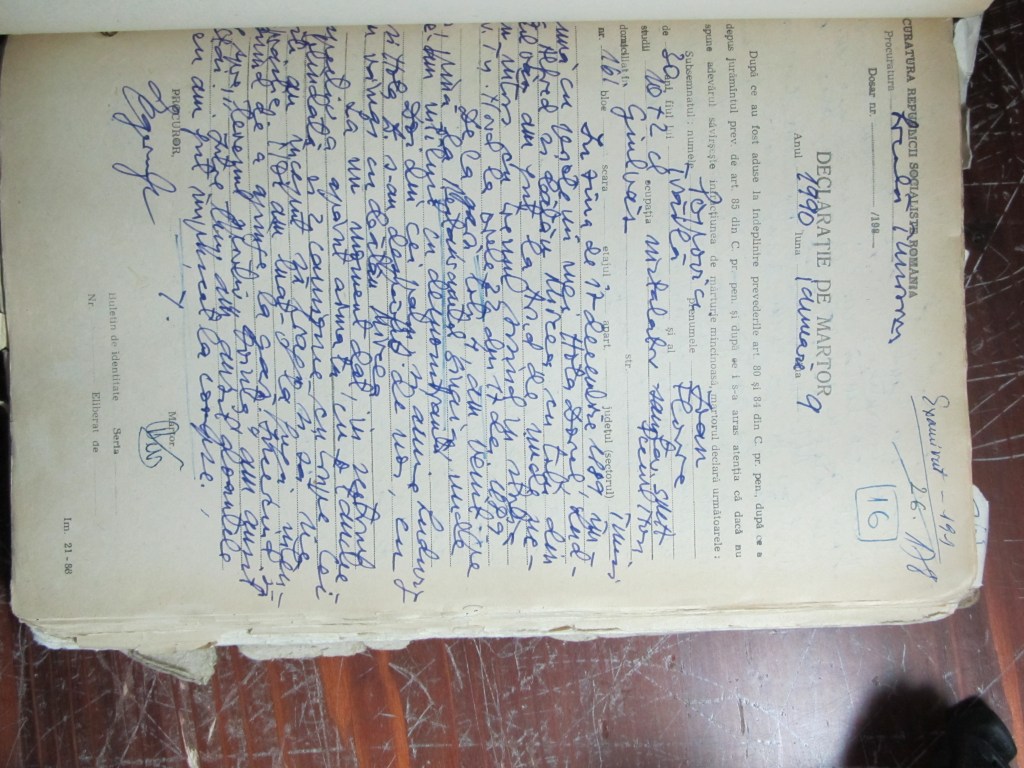
[36] See my discussion in “Orwellian…Positively Orwellian,” at http://homepage.mac.com/khallbobo/RichardHall/pubs/Voineaswar091706.html.

Posted in Uncategorized | Tagged: , , , , , , , , , , , , , , , , , , , , , , , , , , , , , , , , , , , , , , , , , , , , , , , , | Leave a Comment »